/


Текст
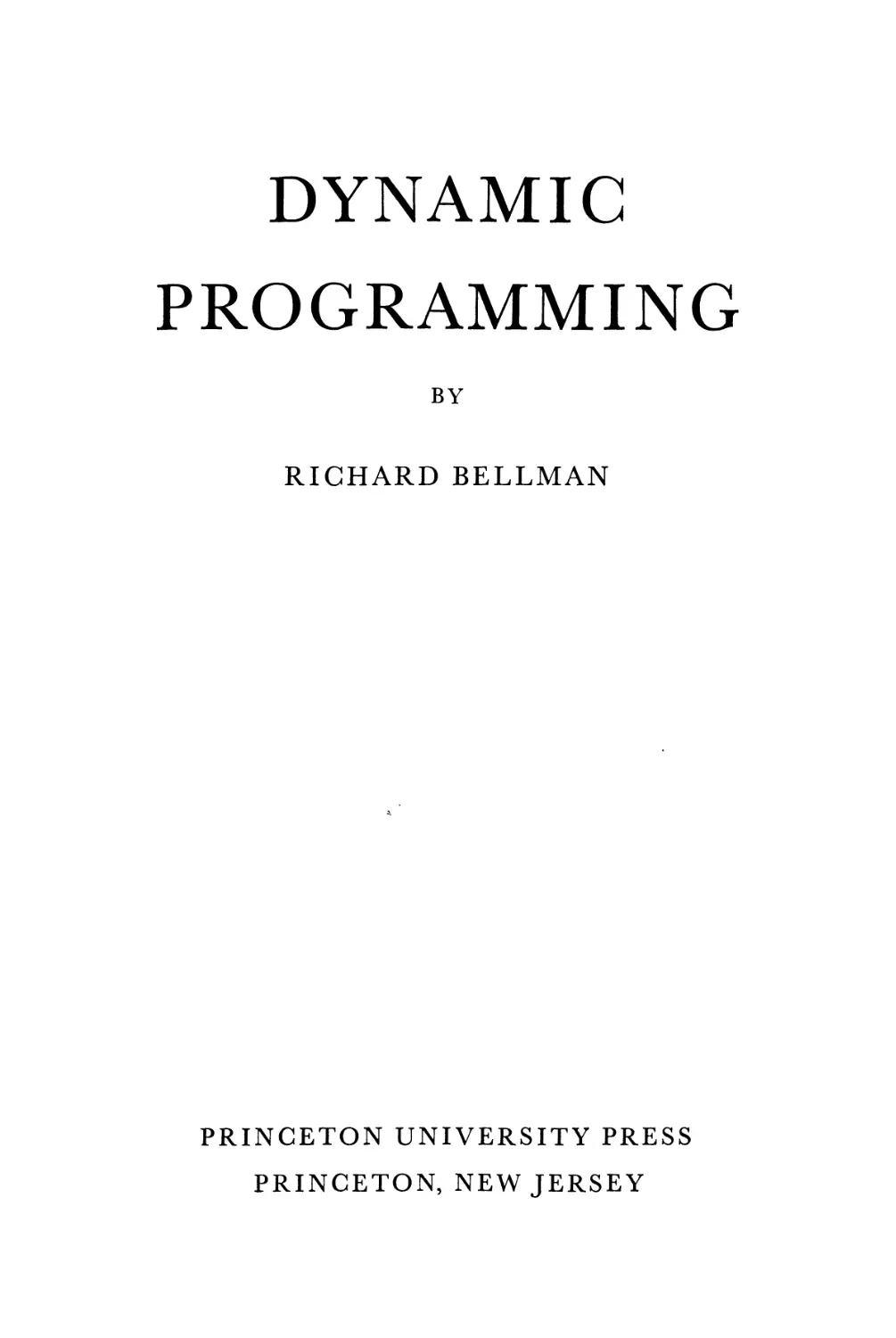
                    DYNAMIC
PROGRAMMING
BY
RICHARD BELLMAN
PRINCETON UNIVERSITY PRESS
PRINCETON, NEW JERSEY

A Rand Corporation Research Study
Published, 1957, by Princeton University Press
ISBN 0-691-07951-Х
Sixth Printing, 1972
Printed in the United States of America

To Betty-Jo
whose decision processes defy analysis

Preface
The purpose of this work is to provide an introduction to the
mathematical theory of multi-stage decision processes. Since these constitute
a somewhat formidable set of terms we have coined the term "dynamic
programming" to describe the subject matter. Actually, as we shall see,
the distinction involves more than nomenclature. Rather, it involves a
certain conceptual framework which furnishes us a new and versatile
mathematical tool for the treatment of many novel and interesting
problems both in this new discipline and in various parts of classical
analysis. Before expanding upon this theme, let us present a brief
discussion of what is meant by a multi-stage decision process.
Let us suppose that we have a physical system 5 whose state at any
time t is specified by a vector p. If we are in an optimistic frame of mind
we can visualize the components of p to be quite definite quantities such
as Cartesian coordinates, or position and momentum coordinates, or
perhaps volume and temperature, or if we are considering an economic
system, supply and demand, or stockpiles and production capacities. If
our mood is pessimistic, the components of p may be supposed to be
probability distributions for such quantities as position and momentum,
or perhaps moments of a distribution.
In the course of time, this system is subject to changes of either
deterministic or stochastic origin which, mathematically speaking, means
that the variables describing the system undergo transformations.
Assume now that in distinction to the above we have a process in which
we have a choice of the transformations which may be applied to the
system at any time. A process of this type we call a decision process,
with a decision equivalent to a transformation. If we have to make a
single decision, we call the process a single-stage process; if a sequence
of decisions, than we use the term multi-stage decision process.
The distinction, of course, is not hard and fast. The choice of a point
in three-dimensional space may be considered to be a single-stage process
wherein we choose (x, y, z), or a multi-stage process where we choose
first x, then y, and then z.
There are a number of multi-stage processes which are quite familiar
to us. Perhaps the most common are those occurring in card games, such
vn

PREFACE
as the bidding system in contract bridge, or the raise-counter-raise
system of poker with its delicate overtones of bluffing. On a larger scale,
we continually in our economic life engage in multi-stage decision
processes in connection with investment programs and insurance policies.
In the scientific world, control processes and the design of experiments
furnish other examples.
The point we wish to make is that in modern life, in economic,
industrial, scientific and even political spheres, we are continually
surrounded by multi-stage decision processes. Some of these we treat on
the basis of experience, some we resolve by rule-of-thumb, and some are
too complex for anything but an educated guess and a prayer.
Unfortunately for the peace of mind of the economist, industrialist,
and engineer, the problems that have arisen in recent years in the
economic, industrial, and engineering fields are too vast in portent and
extent to be treated in the haphazard fashion that was permissible in a
more leisurely bygone era. The price of tremendous expansion has become
extreme precision.
These problems, although arising in a multitude of diverse fields, share
a common property—they are exceedingly difficult. Whether they arise
in the study of optimal inventory or stock control, or in an input-output
analysis of a complex of interdependent industries, in the scheduling of
patients through a medical clinic or the servicing of aircraft at an
airfield, the study of logistics or investment policies, in the control of
servo-mechanisms, or in sequential testing, they possess certain common
thorny features which stretch the confines of conventional mathematical
theory.
It follows that new methods must be devised to meet the challenge of
these new problems, and to a mathematician nothing could be more
pleasant. It is a characteristic of this species that its members are
never so happy as when confronted by problems which cannot be
solved—immediately. Although the day is long past when anyone
seriously worried about the well of mathematical invention running dry,
it is still nonetheless a source of great delight to see a vast untamed
jungle of difficult and significant problems, such as those furnished by
the theory of multi-stage decision processes, suddenly appear before us.
Having conjured up this preserve of problems, let us see what compass
we shall use to chart our path into this new domain. The conventional
approach we may label "enumerative." Each decision may be thought
of as a choice of a certain number of variables which determine the
transformation to be employed; each sequence of choices, or policy as we
shall say, is a choice of a larger set of variables. By lumping all these
choices together, we "reduce" the problem to a classical problem of
vin

PREFACE
determining the maximum of a given function. This function, which
arises in the course of measuring some quantitative property of the
system, serves the purpose of evaluating policies.
At this point it is very easy for the mathematician to lose interest
and let the computing machine take over. To maximize a reasonably
well-behaved function seems a simple enough task; we take partial
derivatives and solve the resulting system of equations for the
maximizing point.
There are, however, some details to consider. In the first place, the
effective analytic solution of a large number of even simple equations
as, for example, linear equations, is a difficult affair. Lowering our sights,
even a computational solution usually has a number of difficulties of
both gross and subtle nature. Consequently, the determination of this
maximum is quite definitely not routine when the number of variables
is large.
All this may be subsumed under the heading "the curse of
dimensionality." Since this is a curse which has hung over the head of the physicist
and astronomer for many a year, there is no need to feel discouraged
about the possibility of obtaining significant results despite it.
However, this is not the sole difficulty. A further characteristic of
these problems, as we shall see in the ensuing pages, is that calculus is
not always sufficient for our purposes, as a consequence of the perverse
fact that quite frequently the solution is a boundary point of the region
of variation. This is a manifestation of the fact that many decision
processes embody certain all-or-nothing characteristics. Very often then,
we are reduced to determining the maximum of a function by a
combination of analytic and "hunt and search" techniques.
Whatever the difficulties arising in the deterministic case which we
have tacitly been assuming above, these difficulties are compounded in
the stochastic case, where the outcome of a decision, or tranformation,
is a random variable. Here any crude lumping or enumerative technique
is surely doomed by the extraordinary manner in which the number of
combinations of cases increases with the number of cases.
Assume, however, that we have circumvented all these difficulties and
have attained a certain computational nirvana. Withal, the
mathematician has not discharged his responsibilities. The problem is not to
be considered solved in the mathematical sense until the structure of the
optimal policy is understood.
Interestingly enough, this concept of the mathematical solution is
identical with the proper concept of a solution in the physical, economic,
or engineering sense. In order to make this point clear—and it is a most
important point since in many ways it is the raison d'etre for mathe-
IX

PREFACE
matical physics, mathematical economics, and many similar hybrid
fields—let us make a brief excursion into the philosophy of mathematical
models.
The goal of the scientist is to comprehend the phenomena of the
universe he observes around him. To prove that he understands, he must
be able to predict, and to predict, one requires quantitative
measurements. A qualitative prediction such as the occurrence of an eclipse
or an earthquake or a depression sometime in the near future does not
have the same satisfying features as a similar prediction associated with
a date and time, and perhaps backed up by the offer of a side wager.
To predict quantitatively one must have a mechanism for producing
numbers, and this necessarily entails a mathematical model. It seems
reasonable to suppose that the more realistic this mathematical model,
the more accurate the prediction.
There is, however, a point of diminishing returns. The actual world is
extremely complicated, and as a matter of fact the more that one studies
it the more one is filled with wonder that we have even "order of
magnitude" explanations of the complicated phenomena that occur, much
less fairly consistent "laws of nature." If we attempt to include too many
features of reality in our mathematical model, we find ourselves engulfed
by complicated equations containing unknown parameters and unknown
functions. The determination of these functions leads to even more
complicated equations with even more unknown parameters and functions,
and so on. Truly a tale that knows no end.
If, on the other hand, made timid by these prospects, we construct
our model in too simple a fashion, we soon find that it does not predict
to suit our tastes.
It follows that the Scientist, like the Pilgrim, must wend a straight
and narrow path between the Pitfalls of Oversimplification and the
Morass of Overcomplication.
Knowing that no mathematical model can yield a complete description
of reality, we must resign ourselves to the task of using a succession of
models of greater and greater complexity in our efforts to understand.
If we observe similar structural features possessed by the solutions of a
sequence of models, then we may feel that we have an approximation
to what is called a "law of nature."
It follows that from a teleological point of view the particular numerical
solution of any particular set of equations is of far less importance than
the understanding of the nature of the solution, which is to say the
influence of the physical properties of the system upon the form of the
solution.
Now let us see how this idea guides us to a new formulation of these
к

PREFACE
decision processes, and indeed of some other processes of analysis which
are not usually conceived of as decision processes. In the conventional
formulation, we consider the entire multi-stage decision process as
essentially one stage, at the expense of vastly increasing the dimension
of the problem. Thus, if we have an iV-stage process where ? decisions
are to be made at each stage, the classical approach envisages an MN-
dimensional single-stage process. The fundamental problem that
confronts us is: How can we avoid this multiplication of dimension which
stifles analysis and greatly impedes computation ?
In order to answer this, let us turn to the previously enunciated
principle that it is the structure of the policy which is essential. What
does this mean precisely? It means that we wish to know the
characteristics of the system which determine the decision to be made at any
particular stage of the process. Put another way, in place of determining
the optimal sequence of decisions from some fixed state of the system,
we wish to determine the optimal decision to be made at any state of
the system. Only if we know the latter, do we understand the intrinsic
structure of the solution.
The mathematical advantage of this formulation lies first of all in
the fact that it reduces the dimension of the process to its proper level,
namely the dimension of the decision which confronts one at any particular
stage. This makes the problem analytically more tractable and
computationally vastly simpler. Secondly, as we shall see, it furnishes us with
a type of approximation which has a unique mathematical property,
that of monotonicity of convergence, and is well suited to applications,
namely, "approximation in policy space".
The conceptual advantage of thinking in terms of policies is very
great. It affords us a means of thinking about and treating problems
which cannot be profitably discussed in any other terms. If we were to
hazard a guess as to which direction of research would achieve the greatest
success in the future of multi-dimensional processes, we would
unhesitatingly choose this one.
The theme of this volume will be the application of this concept of
a solution to a number of processes of varied type which we shall
discuss below.
The title is also derived in this way. The problems we treat are
programming problems, to use a terminology now popular. The adjective
"dynamic," however, indicates that we are interested in processes in
which time plays a significant role, and in which the order of operations
may be crucial. However, an essential feature of our approach will be
the reinterpretation of many static processes as dynamic processes in
which time can be artificially introduced.
XI

PREFACE
Let us now turn to a discussion of the contents.
In the first chapter we consider a multi-stage allocation process of
deterministic type which is a prototype of a general class of problems
encountered in various phases of logistics, in multi-stage investment
processes, in the study of optimal purchasing policies, and in the
treatment of many other economic processes. From the mathematical point
of view, the problem is related to multi-dimensional maximization
problems, and ultimately, as will be indicated below, to the calculus
of variations.
We shall first discuss the process in the conventional manner and
observe the dimensional difficulties which arise from the discussion of
even very simple processes. Then we shall introduce the fundamental
technique of the theory, the conversion of the original maximization
problem into the problem of determining the solution of a functional
equation.
The functional equations which arise in this way are of a novel type,
completely different from any of the functional equations encountered
in classical analysis. The particular one we shall employ for purposes
of discussion in this chapter is
A) /(*)= Max [g(y) + h{x — y)+f(ay + b(x — y))].
0 < у < ?
where g and h are known functions and a and b are known constants,
satisfying the condition 0 < a, b < 1.
After establishing an existence and uniqueness theorem, we shall
derive some simple properties of the optimal policy which can be deduced
from simple functional properties of g and h. In particular, we shall
present the explicit solution of some equations where g and h have
various special forms.
The advantage of obtaining these solutions lies in the fact that they
can be utilized to obtain approximations to the solutions of more
complicated equations, and, what is more important, approximations to the
associated optimal policies. The subject of approximation leads us to
the concept of approximation in policy space, of importance and utility
in both theoretical and practical discussion, and to the discussion of
the question of the stability of / under changes in g and h.
In the second chapter we consider a multi-stage decision process of
stochastic type in the guise of a gold-mining venture with a delicate
gold-mining machine. Here we encounter the equation
B) /(*,y) = Max
?: ?? *+/(U ~
¦ ri) ?> уЩ
-'.)y)]J
Xll

PREFACE
In addition to pursuing an investigation similar to that given in
Chapter I, we actually obtain a solution to this equation, and some of
its generalizations. The solution has a particularly simple and intuitive
form, and introduces the useful idea of ''decision regions."
We show, however, that some other generalizations do not have as
simple a structure, and, indeed, pose as yet unresolved problems. An
attempt to obtain approximate solutions to these problems for a
particular region of parameter space will lead us to the continuous versions
treated in Chapter VIII.
Chapter III is devoted to a synthesis of these processes which seem so
different at first glance. In this chapter we analyze the common features
of the two processes treated in the preceding chapters, and then proceed
to formulate general versions of these processes. In this way we obtain
the functional equation
C) / (P) = Max [g ?, q)+h (P, q) f (T (p, q))] ,
which includes both of the preceding, and a number of equations of
still more general type.
Also in this chapter we explicitly state the "principle of optimality"
whose mathematical transliteration in the case of any specific process
yields the functional equation governing the process. The concept of
"approximation in policy space" is also discussed in more detail.
In the following chapter, Chapter IV, a number of existence and
uniqueness theorems are established for several frequently occurring
classes of equations having the above form. Our proofs hinge upon a
simple lemma which enables us to compare two solutions of the equation
in C). Although these equations are highly non-linear, in many ways
they constitute a natural generalization of linear equations. For this
reason alone, aside from their applications, they merit study.
In Chapter V, we discuss a functional equation derived from a problem
of much economic interest at the current time, the "optimal inventory"
problem. Here we show that the various techniques we have discussed
in the preceding chapters yield the solutions of some interesting particular
cases. In particular, we show that the method of successive
approximations is an efficient analytic tool for the discovery of properties of the
solution and the policy, rather than merely a humdrum means of obtaining
existence and uniqueness theorems. There are many different versions
of the optimal inventory problem and we restrict ourselves to a discussion
of the mathematical model first proposed by Arrow, Harris,, and Marschak,
and treated also by Dvoretzky, Kiefer, and Wolfowitz.
Xlll

PREFACE
A particular equation of the type we shall consider is
л oo poo
D) /(*) = Min [g (y - x) + a { p(s — y) dG (s) +/@) dG (s)
у >x Jv Jy
+ jyj(y-s)dG(s)}}
We then turn to a study of what we call "bottleneck processes." These
we define as processes where a number of interdependent activities are
to be combined for one common purpose, with the level of this principal
activity dependent upon the minimum level of activity of the components.
Two chapters are devoted to these problems, the first, Chapter VI,
of theoretical nature, and the second, Chapter VII, given over to the
actual details of the complete solution of one particular process.
The problems that we encounter are particular cases of the general
problem, apparently not treated before in any mathematical detail, of
determining the maximum over ? of the inner product (x(T), a), where
? and ? are connected by means of the vector-matrix equation
E) dxjdt = Ax + Bz, ? @) = c,
and where there is a constraint of the form Cz + Dx <f. Here x, z, с
and/ are vectors and А, В, С and D are matrices. The linearity of the
operators and functional constitutes the principal difficulty.
We might observe parenthetically that it is often thought that
linearizing a problem facilitates its solution. On occasion, however,
particularly in variational problems, it frequently complicates affairs to an
enormous degree, since this linearization renders classical variational
techniques largely inapplicable. In return, however, the computational
solution of particular cases may often be obtained by routine procedures.
In Chapter VIII, we return to the gold-mining process, and consider
a continuous version. There are many problems, some of a quite recondite
nature, associated with the formulation of continuous stochastic decision
processes. In the processes at hand, we are fortunate in being able to
sidestep these difficulties. In the continuous version, combining the
classical variational approach with the techniques employed in previous
chapters, we are able to solve completely the continuous versions of a
number of problems that were resolutely intractable in the discrete case.
We now turn to the calculus of variations in Chapter IX, and show
that various characteristic problems may be viewed as dynamic
programming processes of continuous and deterministic type.
In geometric terms, the classical formulation is equivalent to
considering an extremal curve as a locus of points, while the dynamic
xiv

PREFACE
programming formulation conceives of the extremal as the envelope
of tangents.
Taking this latter point of view, we are able to obtain a new
formulation of some parts of the classical theory. In particular, we show how
to obtain partial differential equations, in terms of suitably introduced
state variables, for the principal eigen-value of the differential equation
F) u" + ?2? {? и=;0,и @) = w A) = 0.
Furthermore, we provide a new computational approach to variational
problems with constraints.
In Chapter X, we consider dynamic programming processes involving
two decision-makers, essentially opposed to each other in their interests.
This leads to the discussion of multi-stage games, and, in particular, to
the very interesting class of games called "games of survival." With the
aid of some heuristic reasoning, we are able to obtain a new rationale
for non-zero sum games, as a by-product.
The functional equations encountered in this domain have the general
form
G) / (p, f) = Max Min [(([g (?, ?', q, q') +
Q G' J J
* (P, P', 4> <t)f\Tx (P, P', q, q'), ? (?, ?', Я, f] 1 dG (q) dG' («?')].
They may be treated by means of the same general methods used in
Chapter IV to discuss the equation in C) above.
In the final chapter, we consider a class of continuous decision processes
which lead to non-linear differential equations of the form
7 iV
(8) ~ = Max [ ? ац (t; q) Xj + h (?)], %i @) - а, г = 1,2,..., ?,
dt q j = ?
together with the corresponding equations derived from the discrete
process.
These equations possess amusing connections with some classical
non-linear equations, as we indicate.
In addition to a number of exercises inserted for pedagogical purposes,
we have included a cross-section of problems designed to indicate the
scope of the application of the methods of dynamic programming.
There may be some who will frown upon some of the less than profound
subjects which are occasionally discussed in the exercises, and used to
illustrate various types of processes. We are prepared to defend ourselves
against the charges of lese majeste in a number of ways, but we prefer
the two following. In the first place, interesting mathematics is where
xv

PREFACE
you find it, sometimes in a puzzle concerning the bridges of Koenigsberg,
sometimes in a problem concerning the coloring of maps, or perhaps the
seating of schoolgirls, perhaps in the determining of winning play in
games of chance, perhaps in an unexpected regularity in the distribution
of primes. In the second place, all thought is abstract, and mathematical
thought especially so. Consequently, whether we introduce our
mathematical entities under the respectable sobriquets of A and B, or by the
more charming Alice and Betty, or whether we speak of stochastic
processes, or the art of gaming, it is the mathematical analysis that
counts. Any mathematical study, such as this, must be judged, ultimately
upon its intrinsic content, and not by the density of high-sounding
pseudo-abstractions with which a text may so easily be salted.
This completes our synopsis of the volume. Since the processes we
consider, the functional equations which arise, and the techniques we
employ are in the main novel and therefore unfamiliar, we have restricted
ourselves to a moderate mathematical level in order to emphasize the
principles involved, untrammeled by purely analytic details. Consistent
with this purpose we have not penetrated too deeply into any one domain
of application of the theory from either the mathematical, economic, or
physical side.
In every chapter we have attempted to avoid any discussion of deeper
results requiring either more advanced training on the part of the reader
or more high-powered analytic argumentation. Occasionally, as in
Chapter VI and Chapter IX, we have not hesitated to waive rigorous
discussion and proceed in a frankly heuristic manner.
In a contemplated second volume on a higher mathematical level, we
propose to rectify some of these omissions, and present a number of
topics of a more advanced character which we have either not mentioned
at all here, mentioned in passing, or sketched in bold outline. It will
be apparent from the text how much remains to be done.
In this connection it is worth indicating a huge, important, and
relatively undeveloped area into which this entire volume represents
merely a small excursion. This is the general study of the computational
solution of multi-dimensional variational problems. Specifically we may
pose the general problem as follows: Given a process with an associated
variational problem, how do we utilize the special features of the process
to construct a computational algorithm for solving the variational
problem ?
Dynamic programming is designed to treat multi-stage processes
possessing certain invariant aspects. The theory of linear programming
is designed to treat processes possessing certain features of linearity, and
the elegant "simplex method" of G. Dantzig to a large extent solves
xvi

PREFACE
the problem for these processes. For certain classes of scheduling
processes, there are a variety of iterative and relaxation methods. In
particular, let us note the methods of Hitchcock, Koopmans, and Flood for
the Hitchcock-Koopmans transportation problem, and the "flooding
technique" of A. Boldyreff for railway nets. Furthermore, there is the
recent theory of non-linear programming of H. Kuhn and A. W. Tucker
and E. Beale. The study of computational techniques is, however, in
its infancy.
Let us now discuss briefly some pedagogical aspects of the book. We
have taken as our audience all those interested in variational problems,
including mathematicians, statisticians, economists, engineers, operations
analysts, systems engineers, and so forth. Since the interests of various
members of this audience overlap to only a slight degree, some parts of
the book will be of greater interest to one group than another.
As a mathematics text the volume is suitable for a course on the
advanced calculus level, either within the mathematics department
proper, or in conjunction with engineering or economics departments,
in connection with courses in applied mathematics or operations research.
For first courses, or first readings, we suggest the following programs:
Mathematician: Chapters I, II, III, IV, IX, X
Economist: Chapters I, II, III, V, IX
Statistician: Chapters I, II, III, IX, X, XI
Engineer: Chapters I, II, III, IX
Operations Analyst: Chapters I, II, III, V, IX, X
Finally, before ending this prologue, it is a pleasure to acknowledge
my indebtedness to a number of sources: First, to the von Neumann
theory of games as developed by J. von Neumann, O. Morgenstern, and
others, a theory which shows how to treat by mathematical analysis
vast classes of problems formerly far out of the reach of the
mathematician—and relegated, therefore, to the limbo of imponderables—and,
simultaneously, to the Wald theory of sequential analysis, as developed
by A. Wald, D. Blackwell, A. Girshick, J. Wolfowitz, and others, a
theory which shows the vast economy of effort that may be effected by
the proper consideration of multi-stage testing processes; second, to a
number of colleagues and friends who have discussed various aspects of
the theory with me and contributed to its clarification and growth.
Many of the results in this volume were obtained in collaboration
with fellow mathematicians. The formulation of games of survival was
obtained in conjunction with J. P. LaSalle; the results on the optimal
inventory equation were obtained together with I. Glicksberg and O.
xvn

PREFACE
Gross; the results on the continuous gold-mining process in Chapter VIII
and the results in Chapter VII concerning specific bottleneck processes
were obtained together with S. Lehman; a number of results obtained
with H. Osborn on the connection between characteristics and Euler
equations, and on the convergence of discrete gold-mining processes to
the continuous versions will not appear in this volume. Nor shall we
include a study of the actual computational solution of many of the
processes discussed below, in which we have been engaging in conjunction
with S. Dreyfus.
I should particularly like to thank I. Glicksberg, O. Gross and A.
Boldyreff who read the final manuscript through with great care and
made a number of useful suggestions and corrections, and S. Karlin
and H. N. Shapiro who have done much valuable work in this field and
from whose many stimulating conversations I have greatly benefited.
Finally, I should like to record a special debt of gratitude to O. Helmer
and E. W. Paxson who early appreciated the importance of multi-stage
processes and who, in addition to furnishing a number of fascinating
problems arising naturally in various important applications, constantly
encouraged me in my researches.
A special note should be made here of the fact that most of the
mathematicians cited above are either colleagues at The RAND Corporation,
or are consultants. Our work has been conducted under a broad research
program for the United States Air Force.
Santa Monica, California Richard Bellman
xvin

Contents
PREFACE VU
CHAPTER I
A MULTI-STAGE ALLOCATION PROCESS
SECTION
1.1 Introduction 3
1.2 A multi-stage allocation process 4
1.3 Discussion 5
1.4 Functional equation approach 7
1.5 Discussion 9
1.6 A multi-dimensional maximization problem 10
1.7 A "smoothing" problem 10
1.8 Infinite stage approximation 11
1.9 Existence and uniqueness theorems 12
1.10 Successive approximations 16
1.11 Approximation in policy space 16
1.12 Properties of the solution—I: Convexity 19
1.13 Properties of the solution—II: Concavity 20
1.14 Properties of the solution—HI: Concavity 22
1.15 An "ornery" example 25
1.16 A particular example—I 26
1.17 A particular example—II 28
1.18 Approximation and stability 29
1.19 Time-dependent processes 30
1.20 Multi-activity processes 31
1.21 Multi-dimensional structure theorems 33
1.22 Locating the unique maximum of a concave function ... 34
1.23 Continuity and memory 37
1.24 Stochastic allocation processes 38
1.25 Functional equations 39
1.26 Stieltjes integrals 40
Exercises and research problems 40
Bibliography and comments 59
xix

CONTENTS
CHAPTER II
A STOCHASTIC MULTI-STAGE DECISION PROCESS
SECTION
2.1 Introduction 61
2.2 Stochastic gold-mining 61
2.3 Enumerative treatment 62
2.4 Functional equation approach 63
2.5 Infinite stage approximation 63
2.6 Existence and uniqueness 64
2.7 Approximation in policy space and monotone convergence . 65
2.8 The solution 66
2.9 Discussion 69
2.10 Some generalizations 69
2.11 The form of/(x, у) 71
2.12 The problem for a finite number of stages 72
2.13 A three-choice problem 74
2.14 A stability theorem 76
Exercises and research problems 77
Bibliography and comments 79
CHAPTER III
THE STRUCTURE OF DYNAMIC
PROGRAMMING PROCESSES
3.1 Introduction 81
3.2 Discussion of the two preceding processes 81
3.3 The principle of optimality 83
3.4 Mathematical formulation—I. A discrete deterministic process 83
3.5 Mathematical formulation—II. A discrete stochastic process 85
3.6 Mathematical formulation—III. A continuous deterministic
process 86
3.7 Continuous stochastic processes 87
3.8 Generalizations 87
3.9 Causality and optimality 87
3.10 Approximation in policy space 88
Exercises and research problems 90
Bibliography and comments 115
xx

CONTENTS
CHAPTER IV
EXISTENCE AND UNIQUENESS THEOREMS
SECTION
4.1 Introduction 116
4.2 A fundamental inequality 117
4.3 Equations of type one 119
4.4 Equations of type two 121
4.5 Monotone convergence 122
4.6 Stability theorems 123
4.7 Some directions of generalization 124
4.8 An equation of the third type 125
4.9 An "optimal inventory" equation 129
Exercises and research problems 132
Bibliography and comments 151
CHAPTER V
THE OPTIMAL INVENTORY EQUATION
5.1 Introduction 152
5.2 Formulation of the general problem 153
A. Finite total time period 154
B. Unbounded time period—discounted cost 156
С Unbounded time period—partially expendable items . . 156
D. Unbounded time period—one period lag in supply ... 156
E. Unbounded time period—two period lag 157
5.3 A simple observation 157
5.4 Constant stock level—preliminary discussion 158
5.5 Proportional cost—one-dimensional case 159
5.6 Proportional cost—multi-dimensional case 164
5.7 Finite time period 166
5.8 Finite time—multi-dimensional case 169
5.9 Non-proportional penalty cost—red tape 169
5.10 Particular cases 171
5.11 The form of the general solution 171
5.12 Fixed costs 172
5.13 Preliminaries to a discussion of more complicated policies . 173
5.14 Unbounded process—one period time lag 173
5.15 Convex cost function—unbounded process 176
Exercises and research problems 178
Bibliography and comments 182
xxi

CONTENTS
CHAPTER VI
BOTTLENECK PROBLEMS IN MULTI-STAGE
PRODUCTION PROCESSES
SECTION
6.1 Introduction 183
6.2 A general class of multi-stage production problems .... 184
6.3 Discussion of the preceding model 187
6.4 Functional equations 188
6.5 A continuous version 189
6.6 Notation 191
6.7 Dynamic programming formulation 192
6.8 The basic functional equation 192
6.9 The resultant nonlinear partial differential equation . ... 193
6.10 Application of the partial differential equation 193
6.11 A particular example 194
6.12 A dual problem 197
6.13 Verification of the solution given in § 10 200
6.14 Computational solution 202
6.15 Nonlinear problems 203
Exercises and research problems 204
Bibliography and comments 205
CHAPTER VII
BOTTLENECK PROBLEMS: EXAMPLES
7.1 Introduction 207
7.2 Preliminaries 209
7.3 Delta-functions 211
7.4 The solution 211
7.5 The modified w solution 214
7.6 The equilibrium solution 215
7.7 A short-time w solution 217
7.8 Description of solution and proof 218
Bibliography and comments 221
CHAPTER VIII
A CONTINUOUS STOCHASTIC DECISION PROCESS
8.1 Introduction 222
8.2 Continuous versions—I: A differential approach ' 223
8.3 Continuous versions—II: An integral approach 224
xxii

CONTENTS
SECTION
8.4 Preliminary discussion 224
8.5 Mixing at a point 226
8.6 Reformulation of the gold-mining process 227
8.7 Derivation of the differential equations 227
8.8 The variational procedure 228
8.9 The behavior of Kt 229
8.10 The solution for ? = oo 230
8.11 Solution for finite total time 231
8.12 The three-choice problem 233
8.13 Some lemmas and preliminary results 234
8.14 Mixed policies 235
8.15 The solution for infinite time, D > 0 236
8.16 D <0 240
8.17 Thecaser3 = r4 241
8.18 Nonlinear utility—two-choice problem 242
Bibliography and comments 244
CHAPTER IX
A NEW FORMALISM IN THE CALCULUS OF VARIATIONS
9.1 Introduction 245
9.2 A new approach 246
? oo
9.3 Max F{x,y)dt 248
у Jo
9.4 Discussion 251
9.5 The two-dimensional case 251
9.6 Max Г F(x,y)dt 252
у Jo
9.7 Max F (x, y) dt under the constraint 0 <; у < ? . . . . 253
у J°
9.8 Computational solution 254
9.9 Discussion 255
9.10 An example 256
9.11 A discrete version 258
9.12 A convergence proof 260
9.13 Max [TF(x,y,t)dt 263
у Jo
9.14 Generalization and discussion 264
9.15 Integral constraints 265
9.16 Further remarks concerning numerical solution 266
9.17 Eigenvalue problems 267
xxin

CONTENTS
SECTION
9.18 The first formulation 268
9.19 An approximate solution 269
9.20 Second formulation 270
9.21 Discrete approximations 270
9.22 Successive approximation 271
9.23 Monotone approximation 272
9.24 Uniqueness of solution 273
9.25 Minimum maximum deviation 273
Exercises and research problems 274
Bibliography and comments 282
CHAPTER X
MULTI-STAGE GAMES
10.1 Introduction 283
10.2 A single-stage discrete game 284
10.3 The min-max theorem 285
10.4 Continuous games 286
10.5 Finite resources 287
10.6 Games of survival 287
10.7 Pursuit games 288
10.8 General formulation 289
10.9 The principle of optimality and functional equations. . . . 291
10.10 More general process 292
10.11 A basic lemma 294
10.12 Existence and uniqueness 295
10.13 Proof of results 297
10.14 Alternate proof of existence 299
10.15 Successive approximations in general 300
10.16 Effectiveness of solution 300
10.17 Further results 302
10.18 One-sided min-max 302
10.19 Existence and uniqueness for games of survival 303
10.20 An approximation 306
10.21 Non-zero-sum games — games of survival 307
10.22 An approximate solution 308
10.23 Proof of the extended min-max theorem 308
10.24 A rationale for non-zero sum games 309
Exercises and research problems 310
Bibliography and comments 315
XXIV

CONTENTS
CHAPTER XI
MARKOVIAN DECISION PROCESSES
SECTION
11.1 Introduction 317
Ц.2 Markovian decision processes 317
Ц.З Notation 319
11.4 A lemma 320
Ц.5 Existence and uniqueness—I 321
Ц.6 Existence and uniqueness—II 324
11.7 Existence and uniqueness—III 325
11.8 The Riccati equation 325
11.9 Approximation in policy space 326
11.10 Discrete versions 328
11.11 The recurrence relation 330
11.12 Min-max 332
11.13 Generalization of a Von Neumann result 332
Exercises and research problems 334
Bibliography and comments 336
Index of applications 338
Name and subject index 339
xxv

DYNAMIC PROGRAMMING

CHAPTER I
A Multi-Stage Allocation Process
§ 1. Introduction
In this chapter we wish to introduce the reader to a representative
class of problems lying within the domain of dynamic programming and
to the basic approach we shall employ throughout the subsequent pages.
To begin the discussion we shall consider a multi-stage allocation
process of rather simple structure which possesses many of the elements
common to a variety of processes that occur in mathematical analysis,
in such fields as ordinary calculps and the calculus of variations, and
in such applied fields as mathematical economics, and in the study of
the control of engineering systems.
We shall first formulate the problem in classical terms in order to
illustrate some of the difficulties of this straightforward approach. To
circumvent these difficulties, we shall then introduce the fundamental
approach used throughout the remainder of the book, an approach based
upon the idea of imbedding any particular problem within a family of
similar problems. This will permit us to replace the original
multidimensional maximization problem by the problem of solving a system
of recurrence relations involving functions of much smaller dimension.
As an approximation to the solution of this system of functional
equations we are lead to a single functional equation, the equation
A) /(*)= Max [g(y)+h(x — y)+f(ay + b(x — y))].
0 < у < ?
This equation will be discussed in some detail as far as existence and
uniqueness of the solution, properties of the solution, and particular
solutions are concerned.
Turning to processes of more complicated type, encompassing a greater
range of applications, we shall first discuss time-dependent processes
and then derive some multi-dimensional analogues of A), arising from
multi-stage processes requiring a number of decisions at each stage.
These multi-dimensional equations give rise to some difficult, and as
yet unresolved, questions in computational analysis.
In the concluding portion of the chapter we consider some stochastic
3

A MULTI-STAGE ALLOCATION PROCESS
versions of these allocation processes. As we shall see, the same analytic
methods suffice for the treatment of both stochastic and deterministic
processes.
§ 2. A multi-stage allocation process
Let us now proceed to describe a multi-stage allocation process of
simple but important type.
Assume that we have a quantity ? which we divide into two non-
negative parts, у and ? — у, obtaining from the first quantity у а
return of g (y) and from the second a return of h (x — y).1 If we wish
to perform this division in such a way as to maximize the total return
we are led to the analytic problem of determining the maximum of
the function
A) Ri(x,y) =g(y) +h(x — y)
for all у in the interval [0, x]. Let us assume that g and h are continuous
functions of ? for all finite ? > 0 so that this maximum will always exist.
Consider now a two-stage process. Suppose that as a price for obtaining
the return g{y), the original quantity у is reduced to ay, where a is a
constant between 0 and 1, 0 <C a < 1, and similarly ? — у is reduced
to b (x — y), 0<b < 1, as the cost of obtaining h (x — y). With the
remaining total, ay + b (x — y), the process is now repeated. We set
B) ay + b [x — y) = xx = yx + (xx — yy),
for 0 < yx <L хъ and obtain as a result of this new allocation the return
g (yx) + h (x1 — yx) at the second stage. The total return for the two-
stage process is then
C) R2 {?, у, yx) = g(y) + h(x — y) + g Ы + h (*! — yx)
and the maximum return is obtained by maximizing this function of
у and yx over the two-dimensional region determined by the inequalities
D) a. 0<y<x
b. ?^??^??
Let us turn our attention now to the N-stage process where we repeat
1 The units of the return are, in this case, different from the units of x. Thus,
for example, ? may be in dollars, and g (y) may be man-hours of service from machines
purchased with the у dollars. In other cases, occurring in multi-stage investment
problems, or multi-stage production problems, this will not be so, in that the units
of the return will be the same as that of the resources, or a mixture of both situations
will occur. We are considering the simplest case here.
4

A MULTI-STAGE ALLOCATION PROCESS
the above operation of allocation N times in succession. The total return
from the iV-stage process will then be
E) /M*,y,yi,...,y*-i) = Е(У) + h{x — y) +g(yO
+ h {?? — y^ + ... + g (yN -1) + h {xN -1 — yN -?),
where the quantities available for subsequent allocation at the end of
the first, second, ..., (N — l)st stage are given by
F) ?? = ay + b (x — y),0<y < x,
x2 = ayx + b (xx — Уг), 0 < yx < xx,
XN-l = &УХ - 2 + Ь (xN-2 УМ - 2) ,
0 < yN - 2 < xn - 2, 0 < yN - 1 < xn -1
The maximum return will be obtained by maximizing the function Rn
over the iV-dimensional region in the space of the variables y, ylt. ..,
yN-i, described by the relations in F).
§ 3. Discussion
In setting out to solve this problem, the temptation is, quite naturally,
to use calculus. If the absolute maximum occurs inside the region, which
is to say if all the yi satisfy the strict inequalities 0 < у ? < Хг, and if
the functions g (x) and h (x) possess derivatives, we obtain for the
determination of the maximizing yi the system of equations,
(!) g' (Ул-i) —V (xn-i — Ул-?) = 0
g' {yN - 2) — V (xn - 2 — yN-i) + (a — b) W (xN - 1 — у ? -1) =0
g'{y) +h'(x~y) +(a~b)h'(x1 — y1) + ... =0,
upon taking partial derivatives. However, in the absence of this
knowledge, since we are interested not in local maxima, but in the absolute
maximum, we must also test the boundary values y* = Oand Xi, and
all combinations of boundary values and internal maxima. Furthermore,
if the solution of the equations in A) is not unique, we must run through
a set of conditions sufficient to ensure our having a maximum and not
5

A MULTI-STAGE ALLOCATION PROCESS
a minimum or a mere local maximum. It is evident that for problems
of large dimension, which is to say for processes involving a large number
of stages, a systematic procedure for carrying out this program is urgently
required to keep the problem from getting out of hand.
Suppose that we abdicate as an analyst in the face of this apparently
formidable task and adopt a defeatist attitude. Turning to the succor
of modern computing machines, let us renounce all analytic tools.
Consider, as a specific example, the problem posed by a 10-stage process.
Then, if we wish to go about the determination of the maximum
in a rudimentary fashion by computing the value of the function
R1Q — RlQ (y, yb ..., y9) at suitably chosen lattice points, we may
proceed to divide all the intervals of interest, О <C у <C x, 0 <C yx < xlt ...,
0 <C y9 <C x9, into, say, ten parts, and compute the value of R10 at each
of the 1010 points obtained in this manner. 1010 is, however, a number
that commands respect. Even the fastest machine available today or in
the near future, will still require an appreciable time to determine the
solution in this manner.
To give some idea of the magnitude of 1010, note that if the machine
took one second for the calculation of R10 at a lattice point, storage and
comparison with other values, the computation of 1010 values would require
2.77 million hours; if one millisecond, then 2.77 thousand hours; if one
micro-second, then 2.77 hours. This last seems fairly reasonable. Observe,
however, that if we consider a 20-stage process, we must multiply any
such value by 1010, i.e., 1020 = 1010 · 1010.
Needless to say, there are various ingenious techniques that can be
employed to cut this time down. Nonetheless, the method sketched
above is still an unwieldy and inelegant method of attack.
Furthermore, it should be realized that if we are sufficiently interested
in the solution of the above decision process to engage in computations,
we will, in general, wish to compute the answer not only for one particular
value of x, but for a range of values, not only for one set of values of
a and b but for a set of values, and not only for one set of functions
g and h, but for a class of functions. In other words, we will perform a
sensitivity analysis or stability analysis of the solution. Any such
sensitivity analysis attempted by the above methods will run into fairly
large computing times.
One of the aspects of the situation viewed in these terms which is
really disheartening is that this problem is, after all, only the
consequence of a very, almost absurdly, simple version of an applied problem.
It is clear that any modification of the problem in the direction of
realism, say subdivision of ? into more than two parts, which is to say
an increase in the number of activities we can engage in, or an increase
6

A MULTI-STAGE ALLOCATION PROCESS
in the types of resources, will increase the computing time at an
exponential rate.
Furthermore, as we have pointed out in the Preface, we must realize
that the essential purpose in formulating many of these mathematical
models of the universe, economic, physical, biologic, or otherwise, is not
so much to calculate numbers, which are in many cases of dubious value
because of the lack of knowledge of some of the basic constants and
functions involved, but rather to determine the structure of the solution.
Concepts are, in many processes, more important than constants.
The two, however, in general go hand-in-hand. If we have a thorough
understanding of the process, we have means, through approximation
techniques of various sorts, of determining the constants we require.
Furthermore, in the processes occurring in applications, of such enormous
complexity that trial and error computation is fruitless, it is only by
having an initial toe-hold on the solution that we can hope to use
computing machines effectively.
Going back to the idea of the intrinsic structure of a solution, we may
ask what it is that we really wish to know if we are studying a process
of this type. Naturally, we would like to obtain the point (y, ylf . . ., ум)
at which the maximum occurs, and any solution must furnish this. But
from the point of view of a person carrying out the process, all that is
really required at any particular stage of the process is the value of у
in terms of x, the resources available, and N, the number of stages
ahead; that is to say, the allocation to be made when the quantity
available is ? and the number of stages of the process remaining is N.
Viewed as a multi-stage process, at each stage a one-dimensional choice
is made, a choice of у in the interval [0, x]. It follows 2 that there should
be a formulation of the problem which preserves this dimensionality
and saves us from becoming bogged down in the complexities of
multidimensional analysis.
§ 4. Functional equation approach
Taking this as our goal, namely the preservation of one-dimensionality,
let us proceed as follows. We first observe that the maximum total return
over an iV-stage process depends only upon N and the initial quantity x.
Let us then define the function,
A) fN(x)= the maximum return obtained from an iV-stage process
starting with an initial quantity x, for N = I, 2, ...,
and ? > 0.
2 As an application of the useful principle of wishful thinking.
7

A MULTI-STAGE ALLOCATION PROCESS
We have
B) fN (x) = Max RN {x, y, .. ., у N_ ?), ? = 2, 3, ..
with
C) /iW - Max [?(y)+A(*_y)j.
0 < у < x
Our first objective is to obtain an equation for/2 (x) in terms of ft (x).
Considering the two-stage process, we see that the total return will be
the return from the first stage plus the return from the second stage,
at which stage we have an amount ay + b (x — y) left to allocate. It is
clear that whatever the value of у chosen initially, this remaining amount,
ay + b (x — y), must be used in the best possible manner for the
remaining stage, if we wish to obtain a two-stage allocation which
maximizes.
This observation, simple as it is, is the key to all of our subsequent
mathematical analysis. It is worthwhile for the reader to pause here a
moment and make sure that he really agrees with this observation,
which has the deceptive simplicity of a half-truth.
It follows that as a result of an initial allocation of у we will obtain
a total return of fx [ay + b (x — y)) from the second stage of our two
stage process, if yx is chosen optimally. Consequently, for the total
return from the two stage process resulting from the initial allocation
of y, we have the expression
D) R2(x,y, Ух) = g{y) + h(x — y) +fx{ay + b(x — y)).
Since у is to be chosen to yield the maximum of this expression, we
derive the recurrence relation
E) /,(*)= Max [g(y)+h(x-y)+f1(ay + b(x-y))]>
0 < у < x
connecting the functions fx (x) and /2 (x). Using precisely the same
argumentation for the iV-stage process, we obtain the basic functional
equation
F) fN{x)= Max [g(y) + h{x — y) +fN-i{ay + b (x — y))]
0 < у < x
for N >2, with /i (x) defined as in C) above.
Starting with/? (x), as determined by C), we use F) to compute/2 (x),
which, in turn, repeating the process, yields /3 (x), and so on. At each
step of the computation, we obtain, not only fk (x), but also у к (х), the
optimal allocation to be made at the beginning of a ?-stage process,
starting with an amount x.
8

A MULTI-STAGE ALLOCATION PROCESS
The solution, then, consists of a tabulation of the sequence of functions
{yk (x)} and {/* (*)} for ? > 0, к = 1, 2, ... .
Given the sequence of functions {yk{x)}, the solution of a specific
problem, involving a given N and a given ? has the form
G) У =}'?{?),
Ух = yN-i(ay + Ь(х — у)),
У 2 = yN-2{ay1 + b(x1 — y1))t
yN-l =·- yx {ayN-2 + Ь (Xn-2 У ?- 2)),
where (у, уъ ..., у ? - ?) is a set of allocations which maximizes the total
iV-stage return.
A digital computer may be programmed to print out the sequence of
values у, Уъ ..., Уы -1, in addition to tabulating the sequences {fk {x)}
and {yk (x)}.
§ 5. Discussion
The important fact to observe is that we have attempted to solve a
maximization problem involving a particular value of ? and a particular
value of N by first solving the general problem involving an arbitrary
value of ? and an arbitrary value of N. In other words, as we promised
in the first section, we have imbedded the original problem within a
family of similar problems. We shall exploit this basic method of
mathematical analysis throughout the book.
What are the advantages of this approach ? In the first place, we have
reduced a single iV-dimensional problem to a sequence of iV one-
dimensional problems. The computational advantages of this formulation
are obvious, and we shall proceed in the next sections to show that there
are analytic advantages as well, as might be suspected. As we shall see,
we will be able to obtain explicit solutions for large classes of functions
g and h, which can be used for approximation purposes. This point will
be discussed again below. Furthermore, we will be able to determine
many important structural features of the solution even in those cases
where we cannot solve completely. The utilization of structural properties
of the solution and the reduction in dimension combine to furnish
computing techniques which greatly reduce the time required to solve
the original problem. We shall return to this point in connection with
some multi-dimensional versions.
9

A MULTI-STAGE ALLOCATION PROCESS
§ 6. A multi-dimensional maximization problem
Before proceeding to a more detailed theory of the processes described
above, let us digress for a moment and briefly present two further
applications of the general method.
For the first application, consider the problem of determining the
maximum of the function
A) F (xlf x2, ..., ??) ~ ? gi (xi) ,
i = 1
over the region defined by
B) (a) xx + x2 + . . . + xN = с ,
(b) Xi > 0.
Each function gi (x) is assumed to be continuous for all ? > 0.
Since the maximum of F depends only upon с and N, let us define
the sequence of functions
C) fN (c) = Max F (xlt x2, ..., xN),
Ы
for с >0 and N = 1, 2, ... .
Then, arguing as above, we have the recurrence relation
D) fN (c) = Max [gN (x) +fN-i{c— ?)],
0 < ? < с
for Ar = 2, 3, ..., with
E) fi(c)=gi(c).
§ 7. A "smoothing,, problem
As the second application, let us consider the problem of determining
the sequence {xk} which minimizes the function
? ?
A) F {xlf x2, . .., xN) = ? gk (Xk — tk) + ? hk {xk — Xk-1).
к = 1 к = 1
Here {fk} is a given sequence, x0 = с a given constant, and we assume
that the functions gk (x) and hk (x) are continuous for all finite x, and
that gk (x), hk (x) -> oo as | ? | -> oo.
The genesis of this problem, explaining its name, will be discussed
in the exercises.
10

A MULTI-STAGE ALLOCATION PROCESS
Let us define the sequence {fR (с)}, R = 1, 2, ..., ?, by the property
that/д {с) is the minimum over all xR, xr+i, ..., xN of the function
у у
B) FR= ? gk{xjc — rk) + 27 **(** —#*-i),
?- = # it = R
where xR-\ = с
We have
C) /v (c) = Min [gjv (* — rN) + hN (x — c)],
X
and
D) /r (c) = Min [g* (* — rR) + hR{x — c) + fR +1 (*)],
for /?= 1, 2, ...,N— 1.
§ 8. Infinite stage approximation
Let us now return to the allocation process. The treatment we present
here serves as a prototype for the discussion of a number of multi-stage
processes, of diverse origin, but similar analytic structure.
If N is large, it is reasonable to consider as an approximation to the
iV7-stage process, the infinite stage process defined by the requirement
that the process continue indefinitely. Although an unbounded process
is always a physical fiction,3 as a mathematical process it has many
attractive features. One immediate advantage of this approximation
lies in the fact that in place of the sequence of equations given by D.6),
we now have the single equation
A) /(*)= Max [g(y) + h(x — y)+f(ay + b(x — y))]
о < у < ?
satisfied hyf(x), the total return of the process, with a single allocation
function у — у (х), determined by the equation.
To balance this, we encounter many of the usual difficulties associated
with infinite processes. It is, first of all, no longer clear that a maximum
exists rather than a supremum. This is to say, there may be no allocation
policy which actually yields the total return f(x). Furthermore, if we
wish to employ A) in an unrestricted fashion to determine properties
of the infinite process, we must show that it possesses no extraneous
solutions. In other words, we must establish existence and uniqueness
theorems if this equation is to serve a useful purpose.
3 We shall occasionally use the word "physical" to describe the "real" world.
It should be interpreted to mean economic, biological, engineering, etc., depending
upon the background and interests of the reader.
11

A MULTI-STAGE ALLOCATION PROCESS
§ 9. Existence and uniqueness theorems
The result we obtain in this section is actually a special case of a
more general result we shall derive in a later chapter. Repetition, however,
no matter how dismaying as a social or literary attribute, is no great
mathematical sin, and it is important to present the simpler case first,
enabling the basic ideas to appear unimpeded by technicalities of lesser
import.
Let us now demonstrate
Theorem 1. Let us assume that
A) a. g (x) and h (x) are continuous functions of ? for
x>0, g{0) ^h{0) = 0.
b. If m (x) = Max Max ( | g (y) \, \ h (y) | ), and
0 < у < x
oo
с = Max (a, b), then ? m (cn x) < oo for all ? > 0.
? = о
c. 0<? < 1, 0<fc < 1.
Under these assumptions, there is a unique solution to (8.1) which is
continuous at ? — 0, and has the value 0 at this point; moreover, this function
is continuous.
Before proceeding to the proof, let us digress for a moment and
consider the important special case where g and h are both non-negative.
The sequence {/лг (х)} as given by D.6) is a monotone increasing sequence,
with boundedness a consequence of condition (lb), as we shall show
below in a moment. Consequently, for all ? > 0, /^ (x) converges to a
function / (x) as iV -> oo.
Let us show that this function satisfies the equation
B) /(*)= Sup [g(y)+h(x — y)+f(ay + b(x-y))].
0 < у < x
To simplify our notation, let us set
C) T{f,y)=g{y) + h(x-y)+f{ay + b{x-y)).
The basic recurrence relation is then
D) /* + i(*)= Max T(fN,y).
0 < у < x
12

A MULTI-STAGE ALLOCATION PROCESS
From D) we obtain as a consequence of the monotonicity in N
E) /(*)> Max T(fN,y).
0 < у < x
For any у in the interval [0, x], this means that the inequality
F) f(x)>T(fN,y)
holds. Letting N —> oo, this yields
G) f(x)>T(f,y)
for all у in [0, x], which, in turn, leads to the result
(8) /(*)> Sup T(f,y).
0 < у < ?
We cannot write Max since we have no guarantee that the
0 < у < ?
limit function / (x) is actually continuous as a function of x.
On the other hand, from D) we also obtain
(9) /n + i(x)< Sup T(f,y),
0 < у < ?
for all N, and thus
A0) /(*)< Sup T{f,y).
0 < у < x
Comparing (8) and A0), we obtain B).
One of the defects of this proof based solely upon monotonicity is
that it does not yield the continuity of the limit function, a result which
implies the existence of an optimal policy. This optimal policy is a
function у (х) which yields the maximum in
A1) /(*)= Max T(f,y),
0 < у < ?
when the maximum exists.
The existence of an optimal policy for the infinite process is directly
of no particular importance computationally, or as far as applications
are concerned. It is, however, of great importance in connection with
the determination of the structure of optimal policies for the infinite
process. Thus, indirectly, the question of the existence of continuous
solutions is significant as far as numerical results are concerned, since
the solution of the infinite process can be used as an approximation to
the solution of the finite.
In order to establish the existence and uniqueness of a 'continuous
13

A MULTI-STAGE ALLOCATION PROCESS
solution of A1), we shall employ a technique that is applicable to a large
class of equations of this type, the method of successive approximations.
We shall, however, encounter monotonicity arguments again in later
chapters.
Turning to the recurrence relations in D), let us begin with the
observation that/i (x) is continuous for all ? > 0 by virtue of the assumptions
made concerning g (x) and h (x). It follows, inductively, that each
element of the sequence {/n{x)} is continuous. It is worth pointing
out, however, that the location of the maximizing у need not depend
continuously upon x. In other words, the policy is not necessarily a
continuous function of x. An example of this is given in § 15.
Let у ? (х) be a value of у which yields the maximum in D). It is a
matter of indifference as to which value of у we choose, if there is more
than one value producing the maximum. Then we have
A2) fN + i(x) = T(fN,yN),
/n + 2 (x) = ? (fN + i, yN + i),
and, as a consequence of the maximum property of the yN, the further
inequalities
A3) fN + ? (x) = ? (fN, yN) > ? (fN, yN + ?)
/n + 2 (x) = ? (fN + i, yN + i) > ? (fN + i, yN).
These, in turn, yield
A4) fN + ? (x) —fN + 2 (x) > ? (fN, yN + i) — ? (fN + i,yN + ?)
< ? (fN, yN) — ? (fN + i, yN)
The two inequalities combined yield the important estimate
A5) |/W + i (x) —/? + 2{?) |<Max [\T (fN,yN + i) — ? (fN + ?, yN + ?) |,
I T (fN, yN) — T(fN + i, yN) | ].
Turning to the definition of ? (/, у) given in C), we see that
A6) \T(fN,yN)-T(fN + 1,yN)\
= \/n (ayN + b(x — yN)) —fN + ? (ayN + b (x — yN)) \
Let us now define
A7) us{x)= Max \fN(z)—fN + 1(z) \,N= 1, 2, ...
0 < ? < ?
14

A MULTI-STAGE ALLOCATION PROCESS
Since ay + b (x — y) < ex for all у in [0, x], the relation in A6) yields
A8) uN + ? (x) < uN {ex).
It remains to estimate ux (x). We have, referring to the equations
for/i (x) and /2 (x), the relation
A9) | Л (x) —/, (*) I < Max [ IЛ (аУ1 + b (? - у,) |,
|/i (яу2 + ? (* — у2) | ] < т (сх),
using the definition of m (?) given in (lb).
Hence we see that ux (x) <; m (ел?), and thus, using A8), that un {%)
<m(cNJrl x). By virtue of our assumption concerning m (x) it follows
oo
that ? un {x) converges for all x, and what is important, uniformly in
\ = ?
any finite interval. The limit function/(#) = lim fN (x)t in consequence,
N-+ oo
exists and is continuous for all x. Furthermore, the uniformity of
convergence ensures that f (x) is a solution of (8.1).
It remains to establish the uniqueness of the solution. Let F (x) be
any other solution which exists for all ? and is continuous at ? = 0,
with F @) = 0.
In the equation
B0) /(*)= Max T(f,y),
0 < у < ?
let у — у (?) be a value of у which yields the maximum, and let w = w (x)
play the similar role in
B1) F (x) = Max ? (F, y).
0 < у < ?
Then, as above, we obtain the two inequalities,
B2) f(x)^T(f,y)>T(f,w)
F (x) =--T{F,w)>T (F, ?),
and, as before, this leads to
B3) \f(x)~F(x)\<Max[\T(f,y)~T(F,y)\,\T(f,w)-T(F,w)\).
<Mzx[\f(ay + b(x — y))—F(ay + b(x — y))\,
\f{aw -\- b(x — w)) —F{aw -\- b(x — w)) |].
Let us now define
B4) «(*)= Sup \f(z)—F{z)\.
0 < г < ?
15

A MULTI-STAGE ALLOCATION PROCESS
Since / (x) is continuous for all ? > 0 and F (x) is, by assumption,
continuous at ? = 0, we see that и (?) is continuous at ? = 0 and has the
value 0 there.
From B3) we obtain
B5) и (?) < и (сх),
whence, by iteration,
B6) и (?) < и (cN ?),
for all ? > 1. Since и (?) is continuous at ? — 0 and и @) = 0, upon
letting N -> oo we obtain и (?) < 0, and thus that f(x) = F (x). This
completes the proof of the existence and uniqueness of a solution of the
functional equation associated with the infinite process.
§ 10. Successive approximations
In considering the equation
A) /(*)¦= Max T(fy),
0 < у < ?
we have shown that a particular sequence of successive approximations
converged to the unique solution which is continuous at ? == 0 and
zero there. It is important for both analytic and computational purposes
to know that actually any sequence whose initial function satisfies
certain simple requirements converges.
The methods we have used above may also be employed to prove the
following
Theorem 2. Let /0 (x) satisfy the following conditions:
A) a. /0 (x) is continuous for ? > 0.
b./0@) = 0.
Then, if the conditions of Theorem 1 are fulfilled, the sequence defined by
B) fN+1(x)= Max ? (fN,y),N = 0,1, ...,
0 < у < ?
converges to the solution f (x) obtained above, uniformly in any finite interval,
§ 11. Approximation in policy space
We have employed above the classical technique of successive
approximations in order to obtain a solution to the nonlinear functional
equation
A) /(*)= Max T(f,y).
0 < у < ?
16

A MULTI-STAGE ALLOCATION PROCESS
We now wish to exploit a certain duality which is present in these
decision processes to show that we can choose the initial approximation
in such a way that we can always ensure this approximation being
monotone. This means that we have uniformly better convergence with
each iteration.
Let us begin by introducing some terminology. We shall call a sequence
of allocations; i.e., a sequence of admissible choices of y, a policy, and
a policy which yields / (x) an optimal policy.
The duality that exists in the theory of dynamic programming arises
from the interconnection between the functions / (#) which measure the
maximum return and the policies which yield these maximum returns.
Actually a policy is a function, since a policy is a determination of у as
a function of x. It is worthwhile nonetheless to preserve this terminology
since it possesses certain advantages derived from intuition. If the policy
is not unique, у will not be a single-valued function of x.
It follows from the functional equation that a knowledge of f(x)
yields y{x), and conversely any у (х) determines/(#), iteratively by
means of the functional equation
B) f(x) = T(f,y(x)).
Thus, for example, if the optimal policy consisted of the choice у = 0
continually,/(#) would satisfy the functional equation
C) /(*)=* (*)+№b
which would yield the result
D) f(x) = ? h(h*x).
? = 0
As we have mentioned above, the purpose of our investigation is not
so much, to determine f(x), which is really a by-product, but more
importantly, to determine the structure of the optimal policy, which
is to say to determine у (х).
This leads to an important and useful idea. Just as we can approximate
in the space of the functions/(#), so we can approximate in the space
of policies, у (х). Furthermore, in many ways, this is a more natural and
simpler form of approximation. The advantage of this type of
approximation analytically is that it always leads to monotone approximations.
From the standpoint of applications, it is by far the more natural
approximation since it is usually the one part of the problem about
which a certain amount is known as a result of experience.
Let у о (х) be an initial guess for an optimal policy and let f0 (x) be
17

A MULTI-STAGE ALLOCATION PROCESS
the return function derived from this policy function, which is to say
that f0 (x) satisfies the functional equation
E) fo(x) = T(f0,y0(x)),
an equation which we solve iteratively. To improve y0 {x), we determine
Ух{х) as a function of ? which maximizes T(f0ty) for 0 < у < ?.
Assume for the moment that yx (x) is itself continuous in x, (which need
not necessarily be the case), and that the return function fx (x) computed
using this policy is also continuous. This will always be the case, as we
point out again below, under the assumptions we have made. We now
continue in this way, generating a sequence of policies, {yN (x)}, and
a sequence of return function, {/n {x)}.
It is easy to show, utilizing the methods described in the foregoing
sections, that under the assumptions we have made the sequence {/n {x)}
is monotone increasing. A rigorous proof of the existence and
convergence of the sequences {yN {x)} and {/W (x)} described above seems
difficult to obtain. Consequently, we compromise for the following.
Theorem 3. Let /0 (x) be the result of an initial approximation in policy
space, that is,
F) /o (x) = ? (/„, ya (*)),
where yQ (x) is any continuous function of ? satisfying the conditions
G) 0<y0 (%)<*.
Under the assumptions of Theorem 1, the sequence defined by
(8) /n+i{x)= Max T{fN,y),N = 0, 1, 2, ...,
0 < у < ?
converges uniformly to the solution f (x) obtained, and this convergence is
monotone.
Proof. Let us demonstrate the monotonicity, which is the essential
feature, first. We have
(9) ЛМ - Max T(fQ,y).
0 < у < ?
Comparing the definition of/0 given in E) with the definition of fx above,
we see that/x >/0 for all values of x. From this it follows inductively
that fN+ ? >fN for all values of ? > 0.
It remains to prove the continuity of the function /0 (x) for ? > 0.
18

A MULTI-STAGE ALLOCATION PROCESS
The conditions upon g and h which we have imposed above show that
the formal series for /0 (x)
A0) fo(x)=g{yo)+h(x — yQ) + ...,
obtained iteratively, converges uniformly in any finite interval and
represents a continuous function of ? for ? > 0, if y0 (x) is a continuous
function of x.
§ 12. Properties of the solution—I: Convexity
Let us now show that we can derive certain structural properties of
the optimal policy from various simple structural properties of the
functions g and h. The structure of the optimal policy у (х) and that of
the return function / (x) turn out to be intimately entwined.
Our first result in this direction is
Theorem 4. //, in addition to the assumptions in Theorem 1, we impose
the conditions that g and h be convex functions of x, then f (x) will be a
convex function, and for each value of x, у will equal 0 or x.
Proof. The proof will be inductive. Since
A) /iW= Max (g(y) + h(x — y))
0 < у < x
and g (y) + h (x — y) is convex as a function of у for 0 < у < ?, it
follows that
B) ? (?) = Max (g (*), h (x) ),
since the maximum of a convex function must occur at one of the
end-points. As the maximum of two convex functions, fx (x) is convex.
Since g (y) + h (x — y) -\- fx [ay -f- b (x — y)) is a convex function of
у for у in [0, x] it follows by repetition of the above argument that
C) /2 (x) = Max (g (x) + Л (ax), h (x) + fx (bx)),
is a convex function of x. We see then, inductively that fN (x) is convex,
and thus that the limit function / (x) is convex.
Turning to the equation f(x) = Max T(f,y), the convexity of /
о < у < ?
reduces this to the simpler equation
D) /(x) = Max (g (x) + /(ax), h (x) + /(bx)),
showing that у = 0 or ? for each value of x. This equations is, sur-
19

A MULTI-STAGE ALLOCATION PROCESS
prisingly, still a difficult equation to solve in general. We shall consider
a particular case of it below.
§ 13. Properties of the solution—II: Concavity
Let us now demonstrate that an analogous result holds for the case
where g and h are both strictly concave functions of ? for ? > 0.
Theorem 5. //, in addition, to the assumptions in Theorem 1, we impose
the conditions that g and h be strictly concave functions of x, then f (x)
will be a strictly concave function of x.
In this case, the optimal policy will be unique.
Proof. Let us consider the one-stage case first, and perform some
simple calculations which will show us why the result should be true,
before proceeding to a rigorous proof using a different and more general
technique.
We have
A) /i(*)= Max [g(y) + h(x — y)].
0 < у < ?
Since g and h are strictly concave functions, the function g (y) -\- h (x — y)
is a strictly concave function of y. There is, in consequence, a single
maximum, which may, nonetheless, occur at an end point у = 0 or
у = ?. Let us suppose for the moment that it occurs at an interior point,
and that g and h possess second derivatives. Then,
B) M*) = g{y) + h(x — y)
where у is determined as a function of ? by means of the relation
C) g'(y) = h'(x — y).
Differentiation of B) yields
(±) ?' (x) = (g' (У) —h'(x — y)) dyjdx + h'(x-y) = V (x-y)>
and thus
E) //' (x) = h" (x — y){l— dyjdx).
Differentiating the relation in C), we obtain
F) g" (y) dyjdx - h" [x — y) A — dyjdx),
which yields
G) dyldx = *'(*- y)l(g" (y) + k'(x- y)).
20

A MULTI-STAGE ALLOCATION PROCESS
This shows that 1 > dyjdx > 0, and thus, returning to E), that// (x) < 0.
If the maximum is not actually inside, we can force it to be by various
modifications of the functions g and h which prevent the maximum from
ever being at у = 0 or у = x\ e.g., by addition of a term ? log у (x — y),
where ? is a small positive quantity. We can then proceed
inductively and establish the same result for all the members of the
sequence /n {x). This is, however, a rather clumsy method which does
not extend without pain to multi-dimensional problems. We shall
therefore use a more elegant and simple method.
Lemma l.IfG (x, y) is a concave function * of ? and у for x, у > 0, then
f (x) as defined by
(8) f(x) = Max G{x,y)
0 < у < x
is a concave function of ? for ? > 0.
Proof. We have, for 0<?< 1,
(9) /{?? + A—?)?)= . Max ?(??+A—?)?,?).
Ъ <У <?? + (\ — ?)?
We may replace у by the quantity у = X yx + A —X) y2 where yx and
y2 range independently over the intervals 0 < yx < x, 0 < y2 <; z. Then
A0) /{?? + {1—?)?)= Max G(Xx+ A — ?) z, Xyx + A — Л)у2).
0 < yx < ?
0 < У г < ?
Since G (?, у) is concave in ? and y, we have
A1) G{Xx + {\—X)z>Xy1 + {\—X)y2)>XG{x>y1) + {\-X) G(zty%)
Hence
A2) f(Xx + (\-X)z)> Max [XG(x>yi) + (l—X)G(z,y2)]
0 < ?/i <x
0 <yt < ?
>X Max G{x,y1)+{l—X) Max G^y.)
0 < yt <x 0 <yt<z
>A/(*) + (l-A)/(z).
Let us now apply this lemma to prove Theorem 5. It is easily verified
that g (y) + h (x — y) is a concave function of ? and у if g and /г are
concave functions. This shows immediately that fx (x) is concave.
Similarly, since /i (ay -\- b (x — y)) is a concave function of ? and y, /2 (#)
4 Concavity in both ? and у means the G (??? + A — Я) х^Ху\Л-{^ —Я) у2) > X
G (*i, Vi) + A — Я) G (*2I y2), for 0 < Я < 1.
21

A MULTI-STAGE ALLOCATION PROCESS
as defined by the basic recurrence relation is a concave function. We
thus proceed inductively and show that each function in the sequence,
{/n (x)}, is a strictly concave function, and hence that the limit function
is concave. That it is strictly concave follows from the strict concavity
of g and h, using Lemma 1 upon the functional equation for f(x).
Once we have established the strict concavity off(x), the uniqueness
of the maximizing у and thus of the optimal policy follows immediately.
This completes the proof of Theorem 5.
§ 14. Properties of the solution—III: Concavity
Let us now show that the assumption of concavity enables us to tell
quite a bit more about the nature of the solution.
Theorem 6. Let us assume that
A) a. g (x) and h (x) are both strictly concave for ? > 0, monotone
increasing with continuous derivatives and that g @) = h @) — 0.
b. g' @)/(l — a) > V @)/(l — b), V @) > g' (oo), b > a.
Then the optimal policy has the following form:
B) а. у = ? for 0 <[ ? <C x, where ? is the root of h' @) = g' (x)
-f- (b — a) g' (ax) + (b — a) ag' (a2 x) + ...
b. у = у (?) for ? > ? where у (х) is a function satisfying the
inequalities 0 < у (?) < ?, and у (х) is the solution of
3) g'M—*'(* —У) + (* — b)f'{ay + b(x — y)) = 0.
Remark. We have given the solution for only one of the possible
combinations of inequalities connecting g' @), h' @), b and a. It will be
easily seen from the procedure below, that corresponding results hold
for the other cases. Furthermore, the number of cases can be halved
by the observation that the interchange of у and ? — у results in an
interchange of a and b.
Proof. Let us employ the method of successive approximations. Set
D) f1(x)= Max [g(y)+A(*-y)].
0 < у < X
Since, by assumption, g'@) >h'@), for small x, we have g' (y) —
h' (x — y) > 0, for у in the interval [0, x]. Hence g (y) + h (x — y) is
monotone increasing in 0 <C у <C ? and the maximum occurs at у = ?.
As ? increases, the equation g' (y) — h' (x — y) =0 will ultimately
22

A MULTI-STAGE ALLOCATION PROCESS
have a root at у = ?, and then as ? increases further a root inside the
interval [0, x]. The critical value of ? is given as the solution of g' (x) —
h> @) = 0. This equation has precisely one solution, which we call ??.
For ? > Xi let yx — yx (x) be the unique solution of g' (y) = h' (x — y).
The uniqueness of solution is a consequence of the concavity assumptions
concerning g and h, and the existence of a solution is a consequence of
the continuity of g' and h\
Thus we have
E) /l (*) =gW, 0 <*<%b
= g{yi) + h{x~y1)) ? >xx.
and
F) fi{x) =g'{x), 0<x <Xl
= fe' ();i) —ti{x — yj] ^y^* + A' [x — yO = A' (x — yO,
for % > xx.
Since yx (%i) = xlt we see that/V (x) is continuous at д; = xlt and hence,
for all values of ? > 0. Furthermore /x (д;) is a concave function of #;
cf. the analysis of § 11.
Now let us turn to the second approximation
G) /,(*)= Max [g(y)+h(x — y)+f1(ay + b(x — y))].
0 < у < ?
The critical function is now D (y) = g' (y) — h' (x — y) + // (ay +
b (x — y)) (a — b). Since g' @) — h' @) + // @) (a — b) - g' @) — h' @)
+ g'@) (a —6) >A'@) [{(I—a) A + a — b)/(l— ?)} — 1] > 0, we
see that D (y) is again positive for all у in [0, x] for small x. Hence the
maximum occurs in G) at у = ? for small x. As ? increases, there will
be a first value of ? where D (x) = 0. This value, x2, is determined by
the equation g' (x) = Ar @) + (b — a) fx' (ax). Comparing the two
equations
(8) g' (x) = A' @)
g'(x) ^h'@) + (b — a)f1'(ax)>
we see that 0 < x2 < л^.
Hence the equation for x2 has the simple form
(9) g'(x) =h'@) + (b — a)g'(ax).
Thus у — ? for 0 < ? <; a:2 in G) and у = y2 (x) for л: > x2, where
y2 (л:) is the unique solution of
A0) g'(y) =h'(x-y) +(b-a)f1'(ay + b(x — y)).
23

A MULTI-STAGE ALLOCATION PROCESS
Furthermore
(И) f*'(x)=g'(*)> 0<x<x2
= h' (x — y2) + bfi (ay2 + b{x — y2)), x>x2,
and f2 (x) is continuous at # = x2.
Comparing A0) with the equation g' (y) = h' (x — y) defining ylt we
see that y2 (x) < у ? (л?). In order to carry out the induction and obtain
the corresponding results for all members of the sequence {fn}, defined
recurrently by the relation
/я+1= Max [gly)+h(x — y)+fn(ay + b(x — y))],
0 < у < x
we require the essential inequality /2' (x) > fx' (x). There are three
intervals [0, x2], [x2, *J> [xi, oo], to examine, each one requiring a
separate argument. Using A0) and A1) we have
A2) /,' (*) = W±TJ*-?=y±
v ; J v ' b — a
for ? > x2. Combining F) and the equation for yx we have
A3) //W = ?M^_!^.
о — a
The function [bgf (y) — ah' (x — y) ]/F — a) is monotone decreasing
in у for 0 < у <С at. Since y2 < yx we see that f2 (x) >// (at). This
completes the proof for the interval [xlt oo]. The interval [0, x2] yields
equality. The remaining interval is [x2, xx]. In this interval, we have
A±) /i' (*) = g' (x)
, , ? ? bg; Ы — <**' (* — У2)
/2 W = 7 " ·
о — a
Hence in this interval, since 0 < y2 <Z x,
A5) ? {?)**?^> >?(*).
о — a
since g' (x) > h' @) is a consequence of g' (y) > h' (x — y) for 0 <; у < #
and 0 <#<:#!. This completes the proof that f2 (x) >//(#).
We now have all the ingredients of an inductive proof which shows
that
A6) a. xx > x2 > ... xn > ... > 0
ь.Л'(*)<Л'(*)< ..·/«'(*)< ...
С Ух (х) >yt(x) > ...
24

A MULTI-STAGE ALLOCATION PROCESS
Since fn (x) converges tof(x), fn (x) to f (x)t yn (x) to у (?) and xn to x,
we see that the solution has the indicated form.
§ 15. An "ornery" example
Having imposed successively the conditions that g and h be both
convex or both concave, let us now show by means of an example
that the solution can be exceedingly complicated if we allow more
general functions possessing points of inflection.
Let us consider the equation
A) f(x)= Max [r10/Hr15^-2/)+/(.8y + .9(^-y))].
0 < у < ?
The function e~clx is used since it is one of the simplest possessing a
point of inflection. Determining / (*) by means of the method of
successive approximations, we obtain a well-behaved curve
f(x)'°
9
8
7
6
5
4
3
2
I
20 30 40 50
Figure 1
Note, however, the strange behavior of у [?)!
20
у(х)
10
о
Figure 2
25

A MULTI-STAGE ALLOCATION PROCESS
As soon as we allow changes of sign on the part of g" (x) and h" (x),
we seem to encounter functional equations which defy precise analysis.
§ 16. A particular example—I
Figures 1 and 2 show the difficulties that can be encountered in the
pursuit of general solutions. Let us then consider some simpler equations
which can be used for approximation purposes.
Theorem 7. The continuous solution of
A) /(x) = Max [ex* + f [ax), ex* + /(bx)],f @) = 0,
subject to
B) a. 0 < a, b < 1; c, d, e, g > 0,
b. 0 <d <g,
is given by
ex
d
C) f(x) = rzTd,0<x<x,
f(x) =ex° +f{bx),x>:x>
where
Гс/A-д*)-| W(,-d)
Since 0 < b < 1, f(x) may be found explicitly in the intervals
[xt x/b ], ... [xlbn, xlbn+1] ..., for ? = 0,1,2, ...
Proof. Let us represent by A the operation of choosing cxd -\-f{ax),
and by В the operation of choosing ex<* -\- f{bx). A solution corresponding
to an optimal sequence of choices, S may then be represented
symbolically by
E) S = AaiBbiAa2Bb2
where ai and bi are positive integers or zero, and Aa* means the choice
A repeated at times, with Bbi having a similar meaning.
Let us assume for the moment that the solution does have the indicated
form and show how to calculate x. At the point ~x either an A or В
26

A MULTI-STAGE ALLOCATION PROCESS
decision is optimal, while below ? only an A decision is optimal.
Consequently, symbolically, ? is the point where
F) BA00 = A0°.
To compute A°° we write
G) f[x) = Cxd + f(ax) = cxd + с (ax)d + с (a2#)d + ...
= cxdl(l — ad).
Similarly BA°° yields
(8) f(x) = *** + cbdxdl(l — ad).
Equating the two expressions, we find that ? has the stated value.
It remains to prove that the solution has the desired form. Let us
begin by showing that A is always used when ? is small. To do this it
is sufficient to show that f(x) = cxdj{\ —ad) is a solution for small xy
and then to invoke the uniqueness theorem.5 We must assure ourselves
that
cxd ^r ? cxd cbd xd 1
9 1 1 = Max h 7 > ex° + 1 ~A
v/ 1—ad \\—ad 1—ad\
for small x. This, however, is clear if g > d > 0 and 0 < b < 1.
We now proceed inductively. Let ? be the smallest value of ? for which
a-B-choice is optimal. At this point BA°° = A°°. This means that ? = x.
Let us now consider the interval ? > ?, and begin by asking for the
point p where AB and В A are equally effective as a set of first two
choices.
We Jhave, using an obvious notation,
A0) Jab (x) = cxd + eaPx* + / (abx)
}ba (x) = ex<i -f- cbdxd + f(abx).
Hence the required point p is given by
A1) p = [c(l — bd)\e A — ao)f{9-d)·
Since g > d, we see that p <x.
It follows then from the fact that Jab (x) </ba {x) for ? > p that
for ? > x, AB plus an optimal continuation is inferior to В A plus an
optimal continuation. From this we see that A cannot be used for ? > ~x
5 Strictly speaking, we haven't established this uniqueness theorem yet. However,
it is easy to see that the method used to establish Theorem 1 works equally well
in this case.
27

A MULTI-STAGE ALLOCATION PROCESS
unless followed by A °°, which we know is also impossible. This completes
the proof.
§ 17. A particular example—II
Another interesting case is that where g and h are quadratic in x.
We leave as an exercise the following result:
Theorem 8. Let cf d > 0 and 0 < b < a < 1. Let
A) /(*)= M2ix[cy — y* + d(x — y)—(x—y)* + f(ay + b(x—y))],
о <y <?
/@) = 0.
Then, in the interval · 0 <; ? < Min (c/2, d/2),f(x) has the following form,
which depends on the sign of cj(\ — a) — dj(l — 6):
Case I: c/(l — a) =rf/(l —6).
where
Case II: e/(l — a) < i/(l — 6).
/or 0 ^ ? <. Min (A, c/2, djl), where
m ? (l + b)[d(l-a)-c(l-b)]
E) Я = 2A-«?) ·
When ? < Min (c/2, dj2) use of A) as a recursion formula enables one to
obtain f (x) over the entire interval of interest.
Case III: c/(l — a)> dj{\ — b).
for 0^,x<, Min (?, c/2, d/2) where
G) ? = A +Л)[сA_ ft)_ rf(l_ «)/2(l— eft).
• This is the maximum interval over which the g and h functions are both
increasing.
28

A MULTI-STAGE ALLOCATION PROCESS
§ 18. Approximation and stability
It is, of course, interesting to have the explicit solutions of as many
equations as possible available. However, the true importance of the
explicit solutions of simple equations lies in the use of these solutions
as approximate solutions to more obdurate equations, and in furnishing
clues to the nature of optimal policies for more complicated processes.
In the above sections we have derived explicit solutions for the case
where g and h have monomial forms cxdt and for the case where they
are quadratic. Note that approximation to g (x) by means of cxd is
equivalent to an approximation to log g(ex) by means of log с + dx,
a straight line, which is readily accomplished.
Observe that as ? changes, we may change our approximating curves
so as to obtain better fits if we wish closer approximations. Furthermore,
let us point out that in general the approximation is most useful as an
approximation in policy space rather than in function space.
In order to use approximation techniques, we require an estimate
for the difference between the solutions 7 of the two equations
A) /(*)= Max [u{x,y) + f{ay + b{x — y))] f /@) = 0,
0 < у < ?
F(x) = Max [v(x,y) +F(ay + b (x — y))], jF@) = 0,
0 < у < ?
in terms of the difference between и (х, у) and ? (?, у). This is a stability
theorem in the classical sense.
Let us prove
Theorem 9. Let f(x) and F (x) be the continuous solutions of the above
equations under the assumptions that и (х, у) and ? (?, у) are continuous
oo
in ? and у for all x, у > 0, with 0 < a, b < 1, and that ? m (cnz) < oo
? = о
where m (z) = Max [Max Max { | и (?, у) |, | ? (?, у) | }].
0 < ?<? 0 <у <?
if
B) Мах {Мах \и(х,у) — ? (?, у) \ } = D (?),
0 < ? < ? 0 <у <?
оо
and ? D (cnz) < oo, с = Max (a, b), then
? = 0
C) \f(x)—F(x) |< ? D(c*x).
? = 0
7 The existence and uniqueness of these solutions is assured by the natural
modification of the proof of Theorem 1. When we speak of the solution, we shall
mean the continuous solution, or, generally, the solution furnished by the existence
theorem.
29

A MULTI-STAGE ALLOCATION PROCESS
Proof. Define
D) /i (x) = Max и (?, у)
О < у < ?
/? + ? (?) = Мах [и (х, у) + /? (ay + b (х — у))]
О < 2/ < х
FY (?) = Max v (я, у)
О < у < х
FN+i (?) = Мах [? {?, у) + FN (ay + b (? — у))].
О < у < ?
We know, using the methods given previously that /n (x) converges to
f(x), and Fn (x) converges to F (x) as N ~> oo.
Let us estimate the difference between fx and Fx. Clearly,
E) \f1(x)—F1(x)\< Max \u(x,y)—v(x,y)\<D(x).
0 < у < x
Proceeding, as in § 7, we have
F) \fN + i(x)—FN + i(x)\< Max \fN(ay + b(x~y))
0 < у < ?
— FN (ay + b (x — y)) | + Max \u(x,y) — ? (?, у) \
О < у < ?
It now follows inductively that
N
G) \fN+1(x)— FN + 1(x) |< ??(^?).
? = 0
Letting iV-> oo, we obtain C).
§ 19. Time-dependent processes
We have tacitly assumed in the foregoing pages that the processes
under consideration were time-independent in that the total return
depended only upon the initial quantity ? and the duration of the
process N, and not upon the time at which the process were initiated.
Let us now see how we can handle situations in which this is not the case.
Let us assume that as a result of the division of ? into у and (x — y)
at the kth stage, we receive a return gk (x,y) and are left with a quantity
а к (х, у). It is required to determine the allocation policy which maximizes
the total iV-stage return.
We shall assume that gk (x, y) is continuous in ? and у for ? > 0
and 0 < у <C ? and that ak (x, y) is likewise continuous in this region
30

A MULTI-STAGE ALLOCATION PROCESS
and satisfies the inequality 0 <Z a,k (x, y) < ax, a < 1, for k = 1, 2, ...
Define
A) fk,N {x) = total iV-stage return obtained starting with a quantity ?
at stage k and employing an optimal policy.
We have
B) fk, ! (x) = Max gk (x, y),
0 < у < ?
and for N > 2, arguing as in the preceding pages,
C) /ic,n{x)= Max (gk(x,y)+fk + i,N-i{ak{x,y))).
0 < у < x
Since the double subscript is distressing both analytically, esthetically,
and above all, computationally, let us see whether or not we can restore
the single subscript relation. Having made up our mind that we are
interested in an iV-stage process starting at stage 1, let us define
D) fk (x) = total return obtained starting with a quantity ? at stage k
and ending at stage N, employing an optimal policy,
k = 1, 2, ...,iV.
Then
E) fN (x) = Max gN (x, y)
0 < у < ?
fk[x) = Max \gt(x,y) +fk + i(ak{x,y))],k = 1, 2, ..., N — 1.
0 < у < ?
This simplification is essential if we are interested in computational
solutions, since the difference between the effort involved in the tabulation
of functions of one variable and functions of two variables is enormous,
while that between the tabulation of functions of two variables and
functions of three variables may be the difference between a feasible
and unfeasible approach.
The case of unbounded processes, i.e., N = oo, yields the set of
functional equations
F) /* (x) = Max [gk [x, y) + fk +1 (ак {х, у))].
0 < у < x
It is not difficult to obtain the analogues of Theorem 1 for these systems.
§ 20. Multi-activity processes
The process we have been using for expository purposes is the simplest
of its category since we allow only one type of resource, and require only
31

A MULTI-STAGE ALLOCATION PROCESS
one allocation at each stage. Let us now discuss the formulation of more
general and more realistic processes.
Let there be ? different kinds of resources, in quantities хъ x2, .. ·,
хм respectively. At each stage, a quantity хц of the ith resource is
utilized to produce an additional quantity of the /th resource. Hence
we have the equations, relating the resources at the (ft + l)8t stage to
the resources at the ftth stage,
?
A) xi (ft + 1) = Xi (ft) — ? хц (ft) + gi (xit (ft), X2i (ft), ..., XMi (ft)),
j ~ 1
for г = 1, 2, ..., Mt where
B) (a) xi}{k) >0,
?
(b) ? xi5 (ft) < xi (ft),
and the production functions, gi, are assumed known, together with
the initial quantities, Xi @) = cu
The x^ (ft) are to be chosen so as to maximize some pre-assigned
function
C) Rn = F (хг (iV), x%(N)9...,xm (?)),
of the final resources.
In many cases, as we shall see in Chapter 6, there are other constraints
in addition to those of B).
If we set
D) fa (clt c%i . .., cm) = Max RN,
{??}
we obtain, as before, the recurrence relations
?
E) Д(сьс1э ...,cM) = Max/*-i(c1— ???) +g1{y11,yn>.. .,yWi),...)
Ш 1 = ?
for A^ > 2, where the уц are restricted by the relations
F) (а) уц > О
и
(b) ? уц<си ?-1,2, ...,?,
and
G) Л (сь с2, ..., см) = F (си с2, ..., см).
32

A MULTI-STAGE ALLOCATION PROCESS
Existence and uniqueness theorems covering the unbounded versions
of these general processes will be given in Chapter IV, in conjunction
with a better notation. We shall encounter a particular example of this
equation further along in connection with the bottleneck processes of
Chapter VI. In the present chapter we shall discuss briefly some of the
difficult computational problems raised in maximizing over a
multidimensional domain.
§ 21. Multi-dimensional structure theorems
It is not difficult to extend the results we obtained in the one-
dimensional case concerning convexity and concavity of the solutions
of the functional equation of (8.1) to the multi-dimensional equations
of § 20.
Let G (x) be a scalar function of a vector variable x. It is said to
be convex if
A) G {?? + A — ?) у) < XG [?) + A — ?) G (у)
for all ? in the range 0 < ? < 1. The function is concave if the inequality
goes the other way.
The multi-dimensional analogue of Lemma 1, proved in § 13, is valid
and the proof is precisely the same. Using the lemma, we can establish
the result below.
Before stating the result, let us introduce a more convenient notation.
Let ? denote the vector whose components are ??, and уМ denote the
vector whose components are уцу for 1 < i, j < M. Then, in terms of
the process described above, we have
B) (а) * = Гу«>,
i
(b) y<0 >0,
where the notation у > 0 signifies that all components of у are non-
negative. Let D (x, y) denote the domain defined by B).
Theorem 10. If r (x, y) and a (x, y) are continuous concave functions of
? and у for all x, у > 0, and г (х, у), а (х, у) are monotone increasing in
the components of x, then the functions {fx (x)} defined by the equations
B) ? (?) = Max r (%, y),
D (x, y)
/? +1 (x) = Max [r (*, y) + fN (a (x, y))]
D (x, y)
are all concave functions of ? for ? :> 0.
33

A MULTI-STAGE ALLOCATION PROCESS
This implies a unique optimal policy for each N, if r (x, y) is strictly
concave.
The importance of this result resides in the following. If we have
an iV-stage process where k decisions must be made at each stage, the
functional equation approach reduces the iV^-dimensional maximization
problem to a set of N ^-dimensional problems. Although this is an
essential reduction, the ^-dimensional maximization problems
themselves possess thorny features.
If, however, the function of k variables we are maximizing is strictly
concave, we know that it possesses a unique relative maximum which
is the absolute maximum. Given this additional information that the
function under investigation has a unique relative maximum, we should
be able to determine a search procedure for the location of this maximum
which is far more efficient than the search procedure we would employ
for a general function.
§ 22. Locating the unique maximum of a concave function
The determination of optimal search procedures 8 for the location of
the maximum of a concave function or, conversely, for the minimum of
a convex function, is an extremely important and difficult problem which
has not been solved to date. The solution has, however, been obtained
in the one-dimensional case for the more general situation where the
function is unimodal, which is to say possesses a single relative maximum.
Let us pose the problem in the following terms. The function у — f (x)
is a strictly unimodal function defined on the interval [0, Ln]. We wish
to determine the maximum Ln with the property that we can always
locate the maximum of у =f(x) on a sub-interval of unit length by
calculating at most ? values of the function/^). Since the maximum
may not exist, it is safer to begin by setting
A) Fn = Sup Ln
We then have the following result
Theorem 11. Fn is the nth Fibonacci number] i.e., F0 = Fx = 1 and
B) Fn=Fn-i+Fn-2
for n>2.
Proof. The definition of F0 is a matter of convention, on the other
hand the value of F± is determined by the process.
8 It is actually not easy to specify precisely what we mean by an optimal search
procedure. It clearly depends upon the type of equipment we have, the type of
operations we permit, the "cost" of these operations, and so on. Consequently,
there are a variety of problems of the above type which may be posed. The subject
has not been explored to any extent.
34

A MULTI-STAGE ALLOCATION PROCESS
Let us now proceed inductively. Fix ? and calculate the values
У\ =f(xi)> У2 =fM where 0 < x1 < x2 < Ln. If yx > y2> the
maximum occurs on @, x2) since f(x) is strictly unimodal. If y2 > ylt the
maximum is on (xlt Ln). If yY = y2, choose either of the above intervals,
even though we know the maximum occurs on {хъ х2). Thus, at each
stage after the first computation we are left with a subinterval and the
value of / (x) at some interior point x. Since values at the ends of an
interval furnish no information per se, we restrict our attention to the
interior points.
For ? = 2, Ln = 2 — €,?? = 1 — €, x2 = 1, for arbitrarily small ? > 0.
From the preceding argument it follows that F2 — 2 = Fx + F0.
Consider the case where ? > 2 and assume that Fk = Fk - ? + Fk - 2
for & — 2, ..., » — 1. Let us begin by showing that
C) Fn < Fn - 1 + Fn - 2.
For if we calculate f(x) at %г and x2 on @, Ln) we have
0
X| X2
Figure 3
If У\ > У2> we obtain the new picture
Figure 4
35

A MULTI-STAGE ALLOCATION PROCESS
In this case x2 < Fn - ? since we have only (n — 2) additional choices
with xx a first choice, for the case k = ? — 1. Moreover, xx <Fn- lt
since the maximum could occur on [0, #J, with two choices of ? already
used.
Similarly if y2 > ylt we have Ln — ?? < Fn - ?
Thus in all cases Ln < Fn- ? + Fn- 2> which yields C). Now chose
Ln, Xi, Хг arbitrarily close to their respective upper bounds Fn - ? + Fn - 2>
Fn - ? and Fn - 2 respectively. Then Fn = Fn - ? + Fn - 2- This yields
the proof of Theorem 11. Furthermore, it yields the optimal policy,
since each ?? is either discarded or is the optimal first choice for the
remaining subinterval.
The sequence {Fn} has as its first few terms
D) 1, 1, 2, 3, 5, 8, 13, 21, 34, 55, ...,
with Fao > 10,000. Hence the maximum of a strictly unimodal function
can always be located within 10~4 of the original interval length with
at most 20 calculations of the value of the function.
It is easy to obtain an explicit representation for Fn, namely
E) Fn = r f + г г2п ,
{г 2 — г ?) {?2 — ?)
where
1 + V5
F) rx=—j— ~ 1.61
1 —V5
r2 = — -—.61
From this we see that Fn+ ijFn -> rx — 1.61 as ? -> oo. Thus, for
large n, a uniform approximate procedure is to choose the two first
values at distances Ljrx from either end, where L is the length of the
interval. This is a useful technique for machine computation.
Consider now the related problem where the unimodal function is
defined only for discrete values of x. Let Kn be the maximum number
of points such that the maximum .of the function can always be
identified in ? computations. The same type of proof as above establishes.
Theorem 12. K0 = ltK1 = 1, K2 = 2, Kz = 4, and
G) Kn = 1 + Fn, ? :> 3.
36

A MULTI-STAGE ALLOCATION PROCESS
§ 23. Continuity and memory
Let us suppose that we have a function of two variables, f{x,y),
depending continuously on ? and у for ? > 0 and 0 <C у <; ?. Define
the function
A) g{x) = Max f{x,y).
0 < у < x
It is clear that g (x) will be continuous, but the function у — у (х)
yielding the maximum need not be continuous. We have already seen
an example of this in connection with the functional equation of § 15.
Suppose, however, that we restrict / (x, y) to be a strictly concave
function of у for all у in [0, x], for ? > 0.
f (Х,У)
о у x
Figure 5
It is clear that as ? varies, the maximizing у will now be a continuous
function of x.
Let us see how we can utilize this information to simplify the memory
problem for computing machines. Consider the equations
B) /*+i(*)= Max [g(y) + h(x — y)+fN(ay + b(x — y))l
0 < у < ?
N = 1, 2, ... .
If we have no information concerning the location of a maximizing y,
we must have available all values of /n (z) for 0 < ? <C ax in order to
determine /n+i (x). Suppose, however, we take g (x) and h (x) to be
strictly concave as well as continuous. In this case, /n {x) is strictly
concave for each N and the function g (y) + h (x — y) + /n {ay +
b (x — y)) is strictly concave for 0 <C у <С x, and what is most important
the function yN (x) which yields the maximum in B) is unique and
continuous as a function of x.
It follows than that if we are using an A:-grid of values 0,?,2?,
to compute f{x), the complete set of values of /n {z) for 0 <C ? < ax is
37

A MULTI-STAGE ALLOCATION PROCESS
not required to compute /n+1 {x), but only the values of /n {z) in a
relatively small neighborhood of ? = у ? {?— ?).
The same idea extended to multi-dimensional equations can result in
a considerable saving of memory space in computing machines.
Reciprocally, we will be able to solve problems using existing machines which
might otherwise escape them. In any case, a great saving in running
time will result, once again increasing the feasibility of a solution by
these means.
§ 24. Stochastic allocation processes
In the preceding pages of the chapter, we have considered, in greater
and lesser detail, various multi-stage allocation processes characterized
by the property that the outcome of any decision was uniquely determined
by the choice of this decision. Processes of this type we call deterministic.
Not all multi-stage processes, however, possess this property, and, as
a matter of fact, many of the most interesting are quite definitely not
of this type. Let us consider here one important class of non-deterministic
processes in which the effect of a decision is to determine a distribution
of outcomes in the sense of probability theory. Processes of this type
we shall call stochastic.
We shall limit ourselves in this book to processes of these two types.
The discussion of the origin of processes of more complicated nature,
and their treatment, we shall defer to another place.
From the mathematical point of view, stochastic processes furnish
varied classes of fascinating analytic problems, and throw unexpected
light upon many processes of supposedly deterministic nature.
Applications of the theory are furnished by scores of processes drawn from
biologic, economic, engineering, and physical fields.
Returning to our domain of decision processes, a fundamental problem
confronting us is that of defining what we mean by an optimal policy
in the face of uncertain outcomes. What is crystal clear, but so often
overlooked in a posteriori comment, is the fact that a lack of complete
control over a process effectively prevents a guarantee of a maximum
return.
On the other hand, despite this Damoclean sword of uncertainty,
there must exist some means of comparing policies, taking into account
the possible fluctuation of outcomes.
What causes a major difficulty in applications is not that it is hard
to find such a measure, but rather that is is hard to find a unique measure.
In short, it must be emphasized that there is no one method which can
have any pretensions to the title of "best." Whatever method is used
depends to a large extent upon various analytic and arithmetic aspects
38

A MULTI-STAGE ALLOCATION PROCESS
of the process, and, it must be confessed, upon the philosophical and
psychological attitudes of the decision-makers.
Having thus dwelt upon the dismal side of the matter, to assuage
our consciences, let us now proceed more constructively.
The general idea, and this is fairly unanimously accepted, is to use
some average of the possible outcomes as a measure of the value of a
policy. It is in the choice of this average that the difficulties arise.
Let us point out in passing that there is a definite lack of unanimity
concerning the use of averages in determining policies for stochastic
processes which may be carried through once, or at best, only a few
times. In some cases, "distribution-free" policies can be obtained. In
general, however, there seems to be no other approach to these questions
than the usual one we present here.
The first average, or criterion, we shall employ is the common
arithmetic weighted average, or expected value. Due to the linearity of this
average, it possesses a most important invariant property which greatly
simplifies the functional equations which describe the process. This
property enables the future decisions to be based solely upon the present
state of the system, independently of the past history of the process.
The second criterion, which is far Jess frequently used, is the probability
of achieving at least a certain level of return. This also possesses the
proper invariant structure as far as multi-stage processes are concerned.
We will discuss this criterion in greater detail in a subsequent chapter.
§ 25. Functional equations
Let us now consider a simple stochastic version of the deterministic
process considered in § 2, and show that the same functional equation
technique is applicable.
In place of assuming that the outcome of a division of ? into у and
? — у is a return of g (y) + h (x — y), leaving a new quantity xx = ay
+ b (x — y), let us assume that with probability px there is a return
°f &i (y) + hi (x — У) and a remaining quantity axy -\- Ъх(х — у), and
with probability p2 = 1 —fix a return of g2 (y) + h2 (x — y) and a new
quantity a2y + b2(x — y)
Let us define
A) fN (x) = the expected total return of an iV-stage process, obtained
using an optimal policy, starting with an initial quantity x.
Then, as before, we obtain the equations
B) f1(x)= Max [МЫУ)+М*-У))+ЫЫУ)+М*-У))]>
0 < у < ?
39

A MULTI-STAGE ALLOCATION PROCESS
/n+i{x)= Max \J>1[g1(y)+h1(x — y)+fN(aly + b1(x — y))] +
0 < у < ?
p2[g2{y) + K(x — y) +fN{a2y + b2(x — y))]],
iorN>l.
The equations have the same analytic structure as those obtained
from the deterministic process. By agreeing to use the "expected value"
as the measure of the value of a policy, we have eliminated the stochastic
aspects of the process, at least as far as the analysis is concerned.
§ 26. Stieltjes integrals
For those who are familiar with the Riemann-Stieltjes integral, there
is a much more compact way of writing the above equations. Let
A) dG (u, v; x, y) = distribution function of a return of и and a
remaining quantity of v, starting with an initial
quantity ? and making an allocation of y.
Taking /n (x) to be defined as above, we obtain the equations
B) /i (x) = Max f udG (u, ?; ?, у) ,
о < у < ? J
/? +1 {?) = Мах Г [и + /? {?)] dG (и, ?; ?, у)
О < у < ?^
It is much simpler to describe the processes, to establish existence
and uniqueness theorems for the resultant functional equations, and to
derive analytic properties of the solution, using this short-hand notation.
The basic mathematical ideas are, however, the same.
Equations of this type will be discussed again in Chapter III within
a more general framework.
Exercises and Research Problems for Chapter I
1. Let us define the function
fN [a) = Max [xl x2 ... xn]
r
where R is the region determined by the conditions
a. xx + x2 + ... + xN = a, a > 0.
b. xt > 0.
40

A MULTI-STAGE ALLOCATION PROCESS
Prove that /n {a) satisfies the recurrence relation
fN(a)= Max xfN~i(a — ?), ? > 2 ,
0 < ? < a
with /? [a) = a.
2. Show inductively that fN (a) = aN/NN, and hence establish the
arithmetic-geometric mean inequality,
lxx + x2 + ... + xn\n
I Jj I >XiX2 ... XN,
for #i > 0, with equality only if xx = x2 = ... = xn.
3. Let us define the function
N
fN (a) = Min 27 хгр, р > 0,
R г = 1
where -R is the region defined by
a. ? Xi > a, a > 0.
г = 1
b. *< > 0.
Show that /n [a) satisfies the recurrence relation
fN{a)= Min [xp +fN-i(a — x)],N>2,
0 < ? < a
with /i (a) = ??.
4. Show that /zv (л) = ??> cn, where cn depends only upon N and p,
and thus that
cN = Min [xp + A — л:) ^Civ -1].
о < ? < ?
Determine слг for the ranges 0<,p <l,\ <p, respectively.
5. Consider the problem of minimizing the function
N
F (xlt x2, ..., xN) = ? pi Sil(Si + Xi),
i = 1
where the pi and Si are parameters subject to the conditions pi > 0,
? pi = 1, Si > 0, and the #f range over the region defined by Xi ^> 0,
i
N
? Xi — a,
i= 1
41

A MULTI-STAGE ALLOCATION PROCESS
Obtain the corresponding recurrence relations and show that the
solution is of the form
xj = o, o<j<t,
Xj>0, t + 1</ < N
under a suitable reordering of the Xi's.
6. Consider the problem of maximizing the function
F (x1} x2, . . ., xN) = ? ? (?? ,
г = 1
?
subject to the constraints x% > 0, ? x% = c. Show that the maximum
г = 1
is ? (с), under the assumption that ? (?) is convex.
7. Consider the case where ? (?) is a monotonically increasing function
which is strictly concave. Show that the solution of the corresponding
functional equation,
/n{c)= Max [(p{y) +fN-i{c — y)],N>2,
0 < у < с
Л (с) =4>{c),
has the form
уы = 0, 0 <C с < cn ,
= Zn, с > Cn,
where Zn is the unique solution of
?' (у) =f*-i(c — y)>
for N > 2, and show how to determine the sequence {cn}.
8. Obtain explicit recurrence relations, and the analytic form of the
sequence for the case where
? (У) = У — by2> Ь > 0,
and с is restricted to the range 0 < с < 1/2 6.
9. What are the analogues of these result for the case where the function
N
F has the form ? ?? (??, where each function ?? (?) satisfies the same
г = 1
conditions as above?
10. Carry through the corresponding analysis for the problem of mini-
N N
mizing F (xlf x2) ..., xN) = ? ? (??, subject to xt > 0, ? xt = a in the
i = 1 г = 1
42

A MULTI-STAGE ALLOCATION PROCESS
case where ? (?) is a non-negative monotonically increasing function
which is strictly convex. Consider, in particular, the case where
?(?) = ? -\- bx2, b > 0.
11. Consider the problem of maximizing
N
F (xlt x2, . . ., xN; ylt у 2, · · ·, У ?) = ? ? (??, yi),
г = 1
subject to
.? лт
Хг, Уг > 0, ? Xi = Clt ? у* = С2,
г = 1 г = 1
where ? (?, у) is a strictly concave function, monotone increasing in ? and
У·
Show that the corresponding functional equation
/n {clt c2) = Max [? (x,y) +/n-i (cx—x, c2—y)],
0 < ? < cx
0 <y < c2
possesses for each N > 2 a solution of the form
Figure 6
and show how to determine the boundary curves.
Consider, in particular, the case where
? (%fy) = ux ? + V\ У + ^2 *2 + 2w3 xy + ^4 У2,
12. Under the assumption that ? (?) is a monotonically increasing strictly
concave function, determine the maximum of F (xlt x2,.. ., xn) =
27 99 (?? over the region determined by
г = 1
43

A MULTI-STAGE ALLOCATION PROCESS
N
a. ? %i< a, %i > 0
г = 1
N
b. ? XiP < c2,
i = 1
for p > 1 and ^> < 1 respectively.
13. Obtain the recurrence relations arising from the problem of mini-
N
mizing ? ?% (?? subject to the restrictions
г = 1
a. 0 <; xt <C ?,
N
b. ? ?? (?? > a,
г = 1
under the assumptions that each щ (х) is a non-negative monotone in-
N
creasing function of x, with ? ?? (?) > a.
г = 1
14. Consider the corresponding multi-dimensional problem of mini-
N
mizing ? cpi (??, Vi) subject to the constraints
i = 1
a. 0 < ?? < Vi, 0 < yt < s{,
N
b. ? ?? (xt, yt) > a,
г = 1
under appropriate assumptions concerning the sequence {??}.
15. Determine the maximum of the function xx x2 ... xn over the region
defined by
N
a. ? Xi — 1, x% > 0,
i = 1
b. Ьхк < д;л +i, b > 1, ft = 1, 2, ..., N — 1.
лт
Consider the same problem for the function ? ??*, for different ranges
% = ?
oip.
16. Consider the recurrence relations
? (*) = Max [g (y) + h(x — y)]>
0 < у < ?
fN+1 (?) = Max [g (y) + A (^ — y) + /* (ay + b [x — y))]t
0 <y <x
44

A MULTI-STAGE ALLOCATION PROCESS
where g (y) = cxyd, h (y) = c2yd, with clt c2, d > 0. Show that /n (*) =
UNXd, where
ux = Max [cxvd + c2 A — v)d],
о < ? < ?
Un +i = Max [cxvd + c2(\ — v)d + uN (av + b A — v))d].
о < ? < ?
Show that
? Clv*+ca(l — v)d 1
lim Wiv = Max —— — .
^->oo o<*<i LI — (av + 6A— v))di
17. Consider the process described in § 2 under the assumption that it is
not required to use all the resources available at each stage. Show that the
functional equation obtained in this way has the form
/ (x) = Max [g (yx) + h (y2) + f (ayx + by2 + x — y1 — y2)].
Vi +Vt <*
Does this equation have a solution if g (x) and h (x) are both concave
functions of ? ? Does it have a solution if they are both convex ? Under
what conditions upon g (x) and h (x) does it have a solution with a
corresponding optimal policy?
18. Show that if there is a solution with yx + Уг < %, Уъ Уг > 0, then
g' (>?)/A — a) = h! (y2)/(l — b) under suitable assumptions concerning
g and h. What is the interpretation of this solution ?
19. Consider the process described in § 2 under the assumption that
additional resources are added at each stage, either externally or from the
conversion of all or part of the return g (y) + h (x — y) into resources,
and obtain the corresponding recurrence relations.
20. Consider the process described in § 2. Define gN (z) as the minimum
cost required to obtain a total return of ? at the end of N stages. Show that
gl(*)= Min [(i_a)yi+(l-b)yjf
9 (Vi) + h (yt) = ?
Vi, Уг > О
gN + i (z) = Min [A —a)y1 + {l— b) y2 + gN {z — g (yj — h (y2))]
V» Уг>0
21. There are N different types of items, with the ith item having weight
Wi and a value vu It is desired to load a ship having a total capacity of w
pounds with a cargo of greatest possible value. Show that this problem
leads to the problem of determining the maximum over the щ of the
N
linear form L = ? m v%t subject to the constraints, щ = 0, 1, 2, ..., ?,
г = 1
45

A MULTI-STAGE ALLOCATION PROCESS
? Пг wi <C w, and thus that this problem leads to the recurrence relations
i= 1
Л (w) — vi [wlwi]> (M denotes the greatest integer contained in a)
/n+i(w)= Max [xvn+i+/n(w — xwN+i)],
о < ? < —-—
" ~lWN + l\
where ? can assume only zero or integral values.
22. Suppose that we have a herd of cattle and the prerogative, at the
end of the year, of sending one part of the herd to market, and retaining
the other part for breeding purposes. Assume that the dollar value of у
cattle sent to market is ? (у), and that ? retained for breeding purposes
yield az, a > 1, at the beginning of the next year.
Show that the problem of determining a breeding policy which
maximizes the total return over an iV-year period leads to the recurrence
relation
/iW = Max ?(?)
0 < у < x
fN {?) = Max [? (у) + fN-1 {? {? — у)) J.
О < у < х
23. Determine the structure of the optimal policies in the following cases:
a. ? (у) = ky, k > 0
b. ? (у) is quadratic in у
c. ? (у) is strictly convex
d. ? (у) is strictly concave
24. Formulate the equations under the additional restriction that cattle
must be 2 years old before they can be sold. Take into account feeding
cost and mortality rates.
25. Consider the case in which there are probability distributions for the
price and demand.
26. In problem 22, let ? (?) = cxd, с, d > 0. Show that fN {x) = cNxd,
where cx — с and Cn +i = Max [rd + cn ad A — r)d], N = 1,2, ....
о < r < ?
Determine the asymptotic behavior of Cn + iJcn and vn + ijfN.
27. Suppose that we have a quantity ? of money, and that portions of
this money can be used for common goods, invested in bonds, or invested
in stocks. The return from у dollars invested in bonds is ay dollars, a > 1,
over a period of one year; the return from ? dollars invested in stocks is
46

A MULTI-STAGE ALLOCATION PROCESS
bz dollars, b > 1, over a period of one year. The utility of w dollars spent
is ? [w). How should the capital be utilized so as to derive a maximum
utility over an N year period ?
28. Consider the same problem under the assumption that the return
from stocks is a stochastic quantity.
29. A sophomore has three girl friends, a blonde, a brunette, and a
redhead. If he takes one of the three to the Saturday night dance, the other
two take umbrage, with the result that the probability that they will
refuse an invitation to next week's dance increases. Furthermore, as a
result of his invitation, there is a certain probability that the young lady
of his choice will be more willing to accept another invitation and a
certain probability that the young lady will be less willing.
Assuming that feminine memories do not extend back beyond one
week, what dating policy maximizes the expected number of dances the
sophomore attends—with a date ?
30. Obtain a sequence of recurrence relations equivalent to determining
N
the minimum of the linear form L = ? %%y subject to the constraints
г = 1
Xi > 0, Xi + Xi +i > at, г = 1, 2, ..., N — 1. Thus, or otherwise, show
that Min L = Max Ui, granted that one a% is positive.
i
31. Solve the corresponding problem for the case where the constraints
are ?? + ?? +1 + x% + 2 > tfi, i = 1, 2, ..., N — 2.
32. Determine the recurrence relations for the problem of minimizing L
N
= ? Ci Xi, d > 0, subject to the constraints
i = 1
Xi > 0, bi Xi + diXi+i>ai,i= 1,2, ..., N — 1.
33. Solve the problem formulated above in C2) for the case where the
constraints are
a. Xi -f- Xi +1 > a,i, г = 1, 2, ..., N — 1, xN > un, or
b. Xi + Xi +1 > Ui, г = 1,2, ..., N — 1, xx > a, xn > (In, or
с Xi -\- xi +1 + Xi + 2 > # 1, г = 1, 2, ..., N — 2, xn - 1 + xn > cln- 1,
Xn ?> ?>? ·
plus the usual constraint xt > 0.
34. Show how to approximate to/(#) in the interval [a, b] by means of a
47

A MULTI-STAGE ALLOCATION PROCESS
linear function их + ? according to the following measures of deviation
a· (/(*) — ux — vJ dx
b. Max \f(x) — их — ? |
a < ? < b
35. Suppose that it is necessary to traverse a distance x. If we travel at a
speed ? there is a probability p (v) ds of being stopped in the interval
(s, s + ds) and incurring a delay of d time units. At what fixed speed
should we travel in order to minimize the expected time required to cover
a distance ? ? (Greenspan)
36. Under the same conditions as those of Problem 35, at what speed
should we travel in order to minimize the probability of requiring more
than a time ? to cover the distance ? ?
37. Assume that there is a penalty of p dollars when stopped and that
actual travelling time costs с dollars per unit time. How do we proceed to
minimize expected cost ?
38. Obtain a recurrence relation equivalent to the problem of minimizing
N
the quadratic form Qn = ? (? к — ? к- ?J over all sets of values for the
У к = 1
? к for which ? ? к2 = 1, ? о = с.
к = 1
39. We are informed that a particle is in either of two states, which we
shall call 5 and Г, and are given the initial probability ? that it is in state
T. If we use an operation A we reduce this probability to ax, where ? is a
positive constant less than 1, whereas operation L, which consists of
observing the particle, will tell us definitely which state it is in. It is
desired to transform the particle into state 5 in a minimum time, with
certainty.
Uf(x) is defined to be the expected number of operations required to
achieve this goal, show that/(#) satisfies the equation
(L: l+xf{l)\
/@) = 0.
40. Show that there is a number x0 in the interval @,1) with the property
that
/(*) = 1 + */(l), 0 <x<Xo
= 1 +f(ax), 1 > ? > Xo-
48

Show that
A MULTI-STAGE ALLOCATION PROCESS
/(l) = MinlT-^lfft = lf2f
_ 1 1— ak
%o —
(l-*)/(l) (l-a)(k + \)'
for the minimizing value of k.
41. At each stage of a sequence of actions, we are allowed our choice of
one of two actions. The first has associated a probability px of gaining one
unit, a probability p2 of gaining two units, and a probability p3 of gaining
nothing and terminating the process. The second has a similar set of
probabilities pi, p2', p3'. We wish to determine a sequence of choices
which maximizes the probability of attaining at least ? units before the
process is terminated.
Let p (n) denote the this probability for ? = 1, 2, 3, .... Show that p (n)
satisfies the equation
lpip(n — l)+PiP(n — 2)\'
for ? = 2, 3, 4, ..., with p @) = 1, and
? A) = Max (plt рг').
42. With reference to § 7, show that if g (x) and h (x) are quadratic in x,
then/лг (c) = gin + ??? + ynC2 where oin, j&v, ?? are independent of c.
43. Show that there exist recurrence relations of the form
CLN +1 = Ri {(XN, ??, ??),
?? +1 = R2 («?, /?ЛГ, yjv),
улг +1 = R3 («iv, )ffiv, Yn),
where the Ri are rational functions.
44. Treat in a similar way the problem of minimizing the function
N
f(xlt x2,..., xn) = ? [g {xk —/*) + h (xic — xt- i)
к = 1
+ m (xjc — 2xk - ? + Xk - 2)],
where g (?), h (x) and m (x) are quadratic.
49

A MULTI-STAGE ALLOCATION PROCESS
45. Suppose that we have a machine whose output per unit time is r (t) as
a function of t, its age measured in the same units. Its upkeep cost per
unit time is и (t) and its trade-in value at any time t is s(t). The purchase
price of a new machine is p > s@). At each of the times t = 0,1, 2, ...,
we have the option of keeping the machine, or purchasing a new one.
Consider an unbounded process where the return one stage away is
discounted by a factor a, 0 < a < 1. Let f (t) represent the total overall
return obtained using an optimal policy.
Show that / (t) satisfies the equation
f(A _м \r(t)-u(t)+af(t+l), 1
/W-Max [s{t)_p + r{0)_u{0)+af{1)\
46. Using the fact that an optimal policy, starting with a new machine,
is to retain the machine for a certain number of time periods, and then
purchase another one, determine the solution of the above equation.
47. Is it uniformly true that, if given an over-age machine, the optimal
policy is to turn it in immediately for a new one ?
48. How does one formulate the problem to take into account
technological improvement in machines and operating procedures ?
49. A secretary is looking for a single piece of correspondence, ordinarily
a carbon on thin paper. She usually has 6 places she can look
Folder Number k
Three folders of about 30 sheets each 1,2,3
One folder of about 50 sheets 4
One folder of about 100 sheets 5
Elsewhere 6
The initial probabilities of the letter being in the various places are usually
k pk l-2fc tk
Probability of Probability of Time for one
letter in folder being found on examination
one examination
if in folder
1 .11 .95 1
2 .11 .95 1
3 .11 .95 1
4 .20 .85 2
5 .37 .70 3
6 .10 .10 100
50

A MULTI-STAGE ALLOCATION PROCESS
How shall the secretary look through the folders so as to
a. Minimize the expected time required to find a particular letter ?
b. Maximize the probability of finding it in a given time ? (F. Mos-
teller)
50. Let the function a (x) satisfy the constraint a (x) < d < 1 for all x.
Show that the solution of the equation
и = Max [b (x) + a (x) u] ,
X
if it exists, is unique, and is given by the expression
и = Max b (x)l(l — a (x)) .
X
Under what conditions does the solution exist ?
If a (x) does not satisfy the above condition, show that the number
of solutions is either 0, 1, 2 or a continuum, and give examples of each
occurrence.
51. We are given a quantity ? > 0 that is to be utilized to perform a
certain task. If an amount y, 0 <[ у <C ?, is used on any single attempt,
the probability of success is a (y). If the task is not accomplished on the
first try, we continue with the remaining quantity ? — у. Show that if
f(x) represents the over-all probability of success using an optimal policy,
thenf(x) satisfies the functional equation
/(*)= Sup [a(y) + (l-a(y))f(x-y)].
0 < У < X
52. Derive the corresponding equation for 1 —/(#), the probability of
failure.
53. Consider the two cases where a (y) is convex or concave, and obtain
the explicit solutions for these cases. Observe that in one case there is no
optimal policy.
54. Consider the process discussed in § 2 under the assumption that the
total return from an N-stage process is
r'n = g{y) + h(x — y) + g (yx) +h{xl — yl)+...
+ g (yN - ?) + h [xn - ? — yN-i) + k (xn),
where k (x) is a given function.
55. Consider the functional equation
/(*) - Max [g{y) +h(x — y) +f(ay + b{x — y))],
0 < у < ?
51

A MULTI-STAGE ALLOCATION PROCESS
under the assumption that
a· g (У) ~ °i yd> h (У) ~ c2 Уй> съ С2, d > 0, as у -> oo
or
b. g (y) ~ cxyd^ h (y) ~ c2yd*, съ c2, dlt d2 > 0 as у-> oo.
In both cases, determine the asymptotic behavior off(x) as x-> 00.
56. Determine a recurrence relation for
#1 %2 %П — 1 Xn
Mm + —-— + ... + + -—— ,
X{ > 0 L#2 "T~ #3 -^3 "T" #4 #П ~Г Xl %1 ~T~ ^2 J
with the introduction of suitable additional parameters.
57. Consider the problem of determining the minimum of the function
? ?
? gk {rk, rk +1) + ? hk {rk),
к = 1 к = 1
where Tn +1 = *?, and the rfc are subject to the constraint
a. 0<rk<bkt
N
b. 27 <pfc(rfc) > c,
к = 1
with each 99* (#) a known monotone increasing function of x, yk @) = 0.
Introduce the auxiliary problem:
Minimize
g ? ?) + g К rz) + ... + g {rN _ ь rN) + g (rN, v)
у
+ 27 hk(rk),
к = 2
with r2, r3t ..., Tn subject to the constraints
a. O^rjc^bjc
N
b. ? cpk (rk) > с.
к = 2
Show that if we designate the above minimum by F (u, v, c), then the
minimum in the original problem is given by
Min F(rlt rlt c — ??(?1)).
0 < rx < bx
52

A MULTI-STAGE ALLOCATION PROCESS
58. Introduce the sequence of functions, R = 2, 3, ..., N — 1,
Fr (u, v} c) = Min [g (u, rR) + g {rR, yr + i) + ... + g (tn - ?, rN)
rk N
+ g (rN, ?) + ? hk (rk)],
к = R
with
Far (u, v, c) = Min \jg (u, rN) + g (rN, v) + hN (rN)].
For each R, admit only c-values satisfying the restriction
N
? cpk (bjc) > c, where the bk are fixed positive constants.
к = R
Show that we have the recurrence relation
FR {u, v, c) = Min [g (u, rR) + hR (rR) + Fr + i (rR, v, c—yR (rR))],
rR
where rR varies over the interval defined by
a. 0 < rR <; bR,
N
b. ? ??? (bk) >c — ?? (rR).
к = R + 1
59. Consider in a similar fashion the problem of minimizing a function
such as
Rn = g (rlt r2t r3) + g (r2, r3t r4) + ... + g {rN - i, rN, rj
+ g {'N, Tlt T2).
60. Suppose that we have a quantity of capital x, and a choice of the
production in varying quantities of iV different products. Assume
initially that there is an unlimited supply of labor and machines for the
production of any items we choose, in any quantities we wish.
If we decide to produce a quantity ?? of the ith item, we incur the
following costs:
a. ai — unit cost of raw materials required for the ith item
b. Ы = unit cost of machine production of ith item
с Ci = unit cost of labor required for ith item.
d. d = a fixed cost, independent of the amount produced
of the ith item, if Xi > 0.
The cost of producing a quantity x% of the ith item is then
gi (xi) = {m + bi + d) Xi + Ci, Xi> 0
= 0, Xi = 0.
53

A MULTI-STAGE ALLOCATION PROCESS
Let pi be the selling price per unit of the ith item. The problem is to
choose the x% so as to maximize the total profit
N
Pn = ? pi Xi,
i = 1
subject to the constraints
N
(a) ? gi (xi) < ?,
i = 1
(b) Xi>0.
Let
fN (?) = Max Pn .
xi
Show that
/i (*) = ?? (* —CJ/fai + Ui + cO, ^ > Clf
= 0, 0<^<Ci,
and
Д (^) = Max [pN xn +/n-i{x — gN {xn))] .
Show that xn > 0 can be replaced by
fN - ? (x) —/n - ? (x — CN)
Xn > ? ·
pN
61. Assume that the demand for each item is stochastic. Let Gk (z)
represent the cumulant function for the demand ? for the kth item. Show that
the expected return from the manufacture of ? к of the kth item is
pk ? dGk (z) + pk \ Xk dG (z)
Jo J xk
Cxk
= pk \ ? dGk {z) + pk Xk A — Gk (xk)),
and obtain the recurrence relation corresponding to the problem of
maximizing the total expected return.
62. Consider the problem of maximizing the probability that the return
exceed r.
63. Consider the above problem in the deterministic and stochastic
versions when there are restrictions upon the quantity of machines
available and the labor supply.
54

A MULTI-STAGE ALLOCATION PROCESS
64. Obtain the recurrence relations corresponding to the case where we
have "complementarity" constraints such as
a. X\ x2 == ?, ?? Xg = ?, x$ Xiq X\\ ?=? ? t
and so on, or
b. XiXi+i = О, г = 1, 2, ..., ? — ?.
65. Suppose that we have a complicated mechanism consisting of N
interacting parts. Let the ith part have weight Wi, size Si, and let us
assume that we know the probability distribution for the length of time
that any particular part will go without a breakdown, necessitating a new
part. Assume also that we know the time and cost required for
replacement, and the cost of a breakdown. Assuming that there are weight and
size limitations on the total quantity of spare parts we are allowed to
stock, how do we stock so as to minimize
a. the expected time lost due to breakdowns,
b. the expected cost of breakdowns,
с a given function of the two, time and cost,
d. the probability that the time lost due to breakdowns will exceed T,
e. the probability that the cost due to breakdowns will exceed C?
66. Determine the possible modes of asymptotic behavior of the sequence
{un} determined by the recurrence relation
Un+i = Max [aun + b, cun + d],
and generally by the recurrence relation
iin+i = Max [a% un + Ъ{\, г = 1, 2, ..., k.
г
(cf. Problem 50).
67. Determine the minimum of
N
F (xlt x2, ..., xn) = ? gi (??) + Max (xlf x2} ..., xN),
г = 1
subject to the constraints ?? > 0.
68. Suppose that we have iV different activities in which to invest capital.
Let gi {??) be the return from the ith activity due to an investment of xu
Given an initial quantity of capital x, we are required to invest in at
most k activities so as to maximize the total return.
Denote the maximum return by Д, ? {?). Show that we have the
recurrence relation
55

A MULTI-STAGE ALLOCATION PROCESS
fk, n (x) = Max
for l<k<N — 1.
"Max [gN(y) +/*_i, ? -?, (* — y)],~
о < у < s
_fk,N-l{x)
69. Two corporations, with interlocking directorate, are forbidden by
anti-monopoly statutes from investing in the same enterprise. The first
corporation has capital ? to invest, the second capital y, with known
returns gi (z) from an investment of a quantity of capital ? in the ith of
N different enterprises.
Show that if the directors wish to maximize the total return from the
two corporations, they must maximize
У N
FN (xi, л) = ? gi (??) + ? gi (yi),
г=1 г = 1
subject to the constraints
N
a. ? Xi — x, Xi > 0,
г - 1
b. ? y< = y, yi > 0.
г = 1
С. Xi yi = 0.
Let
/n {x, y) = Max FN (xif yt)
Show that
/n (xt y) = Max
Max [gN (y^v) +/N-i(x,y
о < у N < у
Max [gN (xn) +/n-i(x —
_o < ? ? < x
~Ум)]
XN, У) )
Consider the case where the different corporations derive different
returns from the same enterprise.
70. It is decided to employ a policy of replacing all light bulbs in an
office building at one time. Assume that the cost of replacing the bulbs
is a, and that g (x) represents the cost due to lack of lighting if a time
interval ? elapses between replacements. Over a time interval T, it is
decided to make replacements at times xi, xi + #2, · · ·, xi + #2 + ... +
+ xn = T, where ? is to be determined.
56

A MULTI-STAGE ALLOCATION PROCESS
The efficiency of the program is to be measured by the average loss
sustained
%(a + g (?? )
F (??, x2, ..., Xn) = {-—
What is the optimal policy?
(I. R. Savage)
71. Let the functions gi (x) be such that the maximum of
N
FN (??, X2, . . . , XN) = ? gi (Xi)
i = 1
N
over the region x\ > 0, ? Xi = с may be obtained by use of a Lagrange
% = ?
multiplier Л, considering the expression
? ?
GN = ? gi (xt) — ? ? Xi.
г = 1 г = 1
On the other hand, let /n (c) = Max FN. Show that
W
X=fN'(c)
N
Obtain the corresponding result for the maximum of ? gi (xif yi)
i = 1
subject to
? ?
? Xi = ci, ? yi = c2, Xi, yt > 0.
i= 1 г =* 1
72. Let
Mr (xi, X2, .. ·, xn) = the rth largest of the quantities xi, хчУ ..., xn,
Nr (xi, X2, ..., xn) = the rth smallest of the quantities xi, X2, ..., Xn,
for r = 1,2, ..., N. Obtain recurrence relations connecting the members
of the sequences
{Mr (xi, X2, · · ·, xn)}, {N r {xi, X2, . · ·, xn)}, r = 1, 2, . . ., .
73. Consider the problem of maximizing ? 2~xi
i = 1
N
subject to the constraints x% > 0, ? 1/A + Xi) < x.
(J. V. Whittaker)
57

A MULTI-STAGE ALLOCATION PROCESS
74. A gambler has a capital of ? dollars and wishes to bet on the outcomes
of N different events. There is a probability pk that he can predict the
kth outcome correctly. The only constraint on the total amount that he
bets is the condition that he be able to pay off his losses.
Show that the problem of maximizing his expected return may be
converted into the problem of maximizing
75.
(a)
(b)
N
(?) = ? ркХк
к = 1
Хг > 0,
?^ Xг <~~- X ~\ Xj
г = 1
Consider the problem of
subject
to the
(a)
(b)
i
(c)
i
Ln
constraints
Хг > 0
А'
? х% < и + xj
= 1
N
? Хг < V.
= 1
subj
> / =
ect to the constraints
1,2, ...,N.
maximizing
(?) =
N
-- ? pk Xk
к = 1
Define /n (u, v) = Max Ln (x). Show that
/n {u, v) = Max [pN xn + /n _i {u — xN, Min (v — xn, u) ) ]
76. The problem of designing an efficient water distillation plant for
heavy water production involves the minimization of
VN = g(al) + S-M + ^+...+ SM
d\ #i#2 a\ a,2 ... am _i
where the ai are subject to the constraints
(a) at > 1
(b) a\ a* ... am — x.
Show that this may be reduced to the functional equation
/*+i(*) = Min \g(ai)+—fk[-
«! > ? L d\ \d\
and find the solution in the case where g (y) = yb, b > 0.
58

A MULTI-STAGE ALLOCATION PROCESS
77. Consider the case where
Vn = gi (#1) + h · · · ? ·
GL\ d\ fl>2 . . . йщ - 1
(E. Cerri, M. Silvestri and S. Villan, "The Cascading Problem in a Water
Distillation plant and Heavy Water Production," Z. Naturforschg., 11a,
694 A956).)
78. Consider the problem of allocating resources to N different activities,
leading to the problem of maximizing a function
? gi (xt) subject to the constraints ? %i = с, Xi> 0.
Show that the function /n (c) obtained via the usual recurrence relations
does not depend upon the way in which the activities are numbered.
Bibliography and Comments for Chapter I
§ 1. A fairly complete bibliography of papers up to 1954 plus some remarks
which complement the text may be found in R. Bellman, "The Theory of
Dynamic Programming," Bull. Amer. Math. Soc, vol. 60 A954), pp. 503-516.
§ 2. This process was first discussed in Econometric a, vol. 22 A954), pp.
37-48.
§ 7. Further discussion of this problem may be found in R. Bellman,
"A Class of Variational Problems," Quart, of Appl. Math., 1956. An
interesting discussion of general "smoothing" problems may be found in I. J.
Schoenberg, "On Smoothing Functions and their Generating Functions,"
Bull. Amer. Math. Soc, vol. 59 A953), pp. 199-230, where a number of
further references may be found.
§ 11. The importance of the concept of approximation in policy space
was stressed in R. Bellman, "On Computational Problems in the Theory
of Dynamic Programming," Symposium on Numerical Methods, Amer. Math.
Soc. Santa Monica, 1953.
§ 12. The elegant proof of Lemma 1 was found independently by I. Glicks-
berg and W. Fleming to whom the author posed the problem of finding a
better proof than that given in the opening lines of the section.
§ 17. The results in this section were derived by D. Anderson.
§ 18. A more complete discussion of the concept of the stability of solutions
of functional equations may be found in R. Bellman, Stability Theory of
Differential Equations, McGraw-Hill, 1954.
§ 19. The reduction of the sequence {fk, ? (#)} to a sequence {fk (x)} is an
important piece of mathematical legerdemain as far as computational
solutions are concerned; cf also § 6 and § 7. The limited storage capacity
of computing machines makes one quite stingy with subscripts and
parameters.
59

A MULTI-STAGE ALLOCATION PROCESS
§ 22. The proof in the text follows a paper of S. Johnson, "Optimal
Search is Fibonaccian," 1955 (to appear).
An equivalent result was found earlier by J. Kiefer, unbeknownst to
Johnson, using a much more difficult argument: J. Kiefer, "Sequential
Minimax Search for a Maximum," Proc. Amer. Math. Soc, vol. 4 A953),
pp. 502-6.
The problem of determining a corresponding result for higher dimensions
seems extraordinarily difficult, and nothing is known in this direction at
the present time.
§ 24. An excellent introduction to the study of stochastic processes is
given in the book by W. Feller, Probability Theory, John Wiley and Sons,
1948. A number of important physical processes are discussed in the book
by M. S. Bartlett, An introduction to stochastic processes with special reference
to methods and applications, Cambridge, 1955.
Exercise 76. See R. Bellman, Nuclear Engineering, 1957
60

CHAPTER II
A Stochastic Multi-Stage Decision Process
§ 1, Introduction
In the preceding chapter we considered in some detail a multi-stage
decision process in both deterministic and stochastic guises. In this
chapter we shall discuss a stochastic multistage decision process of an
entirely different type which possesses a number of interesting features. In
particular, in obtaining the solution of some simple versions of processes
of this type, we shall encounter the important concept of "decision
regions".
We shall follow essentially the same lines pursued in the previous
chapter, first a statement of the problem, then a brief discussion in
classical terms. Following this, the problem will be formulated in terms of a
functional equation, the required existence and uniqueness theorems will
be proved, and then the remainder of the chapter devoted to a discussion
of various properties of the solution, such as stability and analytic
structure.
For the simple process used as our model, we are fortunate enough to
obtain a solution which has a very interesting interpretation. Equally
fortunately as far as the mathematical interest of the problem is
concerned, this solution does not extend to more general processes of the same
type. This forces us to employ techniques of an entirely different type
which we shall discuss in a later chapter, Chapter 8.
The failure of the elementary solution is not due solely to the
inadequacy of the analysis. A counter-example has been constructed showing
that the solution of a multi-stage decision process of this class cannot
always have the simple form of the solution given in § 8 below. Another
proof of this fact is furnished by Lemma 8 of Chapter 8.
A number of interesting results which we do not wish to discuss in
detail are given as exercises at the end of the chapter.
§ 2. Stochastic gold-mining
We shall cast the problem in the mold of a gold-mining process.
Suppose that we are fortunate enough to own two gold mines,
Anaconda and Bonanza, the first of which possesses within it? depths an
61

STOCHASTIC MULTI-STAGE DECISION PROCESS
amount of gold x, and the second an amount of gold y. In addition, we
have a single, rather delicate, gold-mining machine with the property
that if used to mine gold in Anaconda, there is a probability px that it
will mine a fraction rx of the gold there and remain in working order, and
a probability A — px) that it will mine no gold and be damaged beyond
repair. Similarly, Bonanza has associated the corresponding probabilities
p2 and 1 — p2, and fraction r2.
We begin the process by using the machine in either the Anaconda or
Bonanza mine. If the machine is undamaged after its initial operation,
we again make a choice of using the machine in either of the two mines,
and continue in this way making a choice before each operation, until the
machine is damaged. Once the machine is damaged, the operation
terminates, which means that no further gold is obtained from either mine.
What sequence of choices maximizes the amount of gold mined before
the machine is damaged ?
§ 3. Enumerative treatment
Since we are dealing with a stochastic process, it is not possible to talk
about the return from a policy, a point we have already discussed in § 24
of the previous chapter, nor can we choose a policy which guarantees a
maximum return. We must console ourselves with measuring the value
of a policy by means of some average of the possible returns, and choosing
an optimal policy on this basis. As before, the simplest such average is
the expected value.
Let us then agree that we are interested in the policies (since there may
be many) which maximize the expected amount of gold mined before the
machine is damaged. A policy here will consist of a choice of A's and B's,
A for Anaconda and В for Bonanza. However, any such sequence such as
A) 5 = AABBBABB ...
must be read: A first, then A again if the machine is undamaged, then В
if the machine is still undamaged, and so on.
Let us initially, to avoid the conceptual difficulties inherent in
unbounded processes, consider only mining operations which terminate
automatically after N steps regardless of whether the machine is
undamaged or not. In this case it is quite easy, in theory, to list all feasible
policies, and to compute all possible returns.1 It is possible to use this
idea to some extent in certain problems. However, in general, this
procedure is rather limited in application, unrevealing as to the structure of an
optimal policy, and, as a brute force method, a betrayal of опе'з
mathematical birthright.
1 To quote numbers again, a 10-stage policy would require the listing of 210 =
1024 possible policies; if three choices at each stage, then 59,049 different policies.
62

STOCHASTIC MULTI-STAGE DECISION PROCESS
§ 4. Functional equation approach
In place of the above enumerative approach, we shall once again
employ the functional equation approach. Let us define
A) /n (x, y) = expected amount of gold mined before the machine
is damaged when A has ?, ? has у and an optimal
policy which can last at most N stages is employed.
Considering the one-stage process, we see that an ?-choice yields an
expected amount pxrxxy while a Б-choice yields рг r2 у. Hence
B) Л (х, у) = Max [?? ?? ?} р2 г2 у].
Let us now consider the general (N + 1)-stage process. Whatever
choice is made first, the continuation over the remaining N stages must
be optimal if we wish to obtain an optimal (N + 1)-stage policy. Hence
the total expected return from an A -choice is
C) /a (x, y) = px (rx x+/n (A - rx) x, y)),
and the total expected return from a Z?-choice is
D) /в {x, y) = рг (r2 У +/n {x, A — rt) У)).
Since we wish to maximize our total (N + 1)-stage return, we obtain
the basic recurrence relation
E) fN +1 {x, y) = Max [fA (x, y), fB {x, y) ],
= Max [p (rx ? + fN (A — rx) x, У), рг (г2 у +
fN(Xf(l-r2)y))].
§ 5. Infinite stage approximation
The same argumentation shows that the return from the unbounded
process, which we call/(#, y), assuming that it exists, satisfies the
functional equation
A) f(x, y) = Max [px (rx ? +/{{!—Tl) x, y)), p2 (r2 y+f(x, A—r.)y))].
Once again, the infinite process is to be considered as an approximation
to a finite process with large N. In return for the advantage of having
only a single function to consider, we face the necessity of establishing
the existence and uniqueness of a solution of the equation in A). This we
proceed to do in the next section.
63

STOCHASTIC MULTI-STAGE DECISION PROCESS
§ 6. Existence and uniqueness
Let us now prove the following result:
Theorem 1. Assume that
A) a. | ? | fc| < I.1
b. 0<гигг<1.
Then there is a unique solution to E.1) which is bounded in any rectangle
0<x<X,0^y<Y.
This solution/ (x, y) is continuous in any finite part of the region x, у > 0.
Proof: Let us, to simplify the notation, set
B) ?1(/) = ?»?*+/(A-'?)*.)')].
Г,(/)=М'.У+/(*.(!-'»)?)].
Then the functional equation in E.1) has the form
C) /(Ж,у) = Мах[Г1(/),Г1(/)].
Define the sequence of functions
D) ^ (*, y) = Max [px rx x, p2 r2 y],
/n+i (x, y) = Max [Tx (fN), T2 (fN)],
= Max [7\(/*)]
г = 1,2
precisely as in the recurrence relation of D.5).
Let i = % (N) = i (N, x, y) be an index which yields the maximum in
the expression Max [Ti(fN)], for N = 1, 2, ...
i = 1,2
Then we have,
E) fN +1 (AT, y) = Г< (iV) (/iv) > Ti (N+l) (/n)
/n+2 (X, У) = Ti (N+ 1) (fN +1) > ?? (iV) (fN +1) ,
using the same device we employed in the course of the existence and
uniqueness proof for the solution of the functional equation in (8.1) of
Chapter 1.
2 In the equation arising from the process described above, the p{ are non-
negative. The proof we give covers the more general equation as well.
64

STOCHASTIC MULTI-STAGE DECISION PROCESS
Hence
F) \/n+i (x, У) —/n+2 {x, y) I < Max [ | Tt m (/n) — ?* m (Jn+i) |,
| Ti (N +1){/n) Ti (N +1){/n +l) | ]
<Мах[|Г*(/*) — Ti{fN+i) |]
г = 1,2
< Max [ | px | \fN (A - rx) x, y) -fN+i (A —rx) x,y)\,
| p2 I [/zv (x, A -rj у) -/*+i (*, A -rt) y) |].
Let us now define
G) uN (x, y) = Max |/л (s, t) —fN+i {s, t) \
0 < s < ?
0 <. t < у
From F) we obtain
(8) uN +1 (x, y) < q uN (x, y),
where q = Max ( | ^i |, | />2 | )· Since 0 <C ^ < 1, we see that the series
? un {x, y) converges uniformly in any bounded rectangle 0<x<LX,
N = 1 _
О <С у < ?. Hence Jn (x, y) converges uniformly to a function f{x, y)
which satisfies the relation E.1), and which is continuous in any bounded
rectangle in the (x, y)-plane.
The uniqueness proof follows the same lines as the proof of Theorem 1
of Chapter 1 and is left as an exercise for the reader.
As we see from the above proof, the choice of fx (x, y) is arbitrary
provided only that it be bounded in any finite rectangle. It is interesting to
note that the limit function will be continuous even if the initial function
is not, as a consequence of the uniqueness of the solution.
§ 7. Approximation in policy space and monotone
convergence
As before, it is easily seen that we can ensure monotone convergence
by approximation in policy space, in the case where ръ р2 > 0. The two
simplest approximations are those corresponding to Л°° and B°°.3 From
the first policy we obtain the expected return
A) /л(х>у)=р1г1х1A-р1A-г1)),
and from the second, the return
B) fB(x,y)=ptr,yl(l—pt(l—rj).
3 It is interesting to observe the following difference between the process and
the functional equation obtained from it. The sequence A°° is conditional as far
as the process is concerned, but deterministic as far as the equation is concerned.
65

STOCHASTIC MULTI-STAGE DECISION PROCESS
As we shall see below in § 8 and § 9, we actually possess a far more
sophisticated technique for obtaining a first approximation in the discussion
of more complicated processes, at the expense, of course, of the above
simplicity of expression. The guiding principle is, however, quite simple.
§ 8. The solution
Let us now turn to the solution of the equation in E.1) for the case
where px and p2 are real numbers satisfying the inequality 0 < ръ p2 < 1.
It is intuitively clear that an Л-choice is made when xjy ;> 1 and a
Б-choice is made when yjx ;> 1 4.
It is also easily seen that the choice at each stage depends only on the
ratio xjy, since / (kx, ky) = kf (x, y) for k > 0. Perhaps the quickest
way to prove this is to invoke the uniqueness theorem, although it is
intuitively clear from the description of the process.
It follows then that if we examine the positive (x, y)-quadrant, and
divide it into an Л-set and a B-set, which is to say those values of ? and у
at which an Л-decision is the optimal first choice and those at which the
Б-decision is optimal, then (x, y) in the Л-set implies that (kx, ky) is in
the Л-set for all k > 0, and similarly for the B-set.
If these sets are well-behaved, it follows that their boundaries must be
straight lines,
Figure I
as conceivably in the figure above. The regions where A and В are used
are called decision regions.
Let us now boldly conjecture that there are only two regions, as in
Figure 2,
and see if we can determine the boundary line, L, if this is the case.
4 The notation a ^> 1 signifies that a is very large compared to 1.
66

STOCHASTIC MULTI-STAGE DECISION PROCESS
Figure 2
What is the essential feature of the boundary line which will enable us
to determine its equation ? It is this: it is the line on which А от В choices
are equally optimal.
If we use Л at a point (x, y), with an optimal continuation from the
first stage on, we have
A) /a (x, y) = pi ?? ? + 0?/(A — rx) X, У) ,
while similarly В at (x, y), and an optimal continuation, yield
B) J в (x, y)=p2r2y + p2f(x, A - r2) y).
Equating these two expressions we obtain the equation for L.
Unfortunately, this equation as it stands is of little use since it involves the
unknown function/.
In order to complete the analysis successfully we must make a further
observation. When at a point on L we employ A, we decrease ? while
keeping у constant and hence enter the В region; similarly, if we use В
at a point on L we enter the A region (see Figure 2 above). It follows that
for a point on L an initial first choice of A is equivalent to an initial first
and second choice of A and then B, while, conversely, an initial first
choice of В is equivalent to an initial first and second choice of В and
then A.
If we use A and then В and continue optimally, we have
C) Jab (x, y) =p1r1x + Pi рч *г У + Pi ?2/((l — ? ?, A — г г) у),
and similarly
D) Jba {?, у) =p2r2y + px p2rxx + ?? p2J{(l — rx) x, A — r2) y).
Equating Jab and Jba, the unknown function / disappears5 and we
obtain the equation
5 The meaning of this is that having survived both an A choice and a B choice,
it is no longer of any importance in the continuation of the process as to the original
order of these choices.
67

STOCHASTIC MULTI-STAGE DECISION PROCESS
E) Pir1xl(l-p1)=p2r2yl(l-p2)t
iorL.
It remains to establish this equation rigorously. Let us begin by proving
that there is a region near the дг-axis where A is always the optimal first
choice.
If у = о, we have
F) ^°> = MaxU/(*,o) J
= Pirlx + pif((l — r1)x,0).
Since / (x, y) is continuous in y, it follows that
G) f{x.y)>Pt{r%y+f(x,{l—r%)y)),
for 0 < у < kx, where k is some small positive constant, since the strict
inequality holds for у = 0.
Thus we have a region in which A is used first, shown below in Figure 3.
Figure 3
Let us now take a point ? = ? (?, у), in the region between L and у
у = kx, with the property that (x,(l — r2) y) is in the shaded region. In
other words, use of ? at ? must result in an Л-choice next, provided that
machine is undamaged. (This proviso is necessary when discussing the
process, but not when discussing the equation, as we have noted above.)
If В is optimal at P, we obtain
(8) /(х,У)=/ва(х,у),
68

STOCHASTIC MULTI-STAGE DECISION PROCESS
as given by D). However, we know that below L,fBA (x, y) < Jab (x, y).
Hence В cannot be optimal at P. Proceeding inductively in this fashion
we extend the shaded region up to L. Since precisely the same argument
shows that the region between L and the y-axis is a Б-region, we have
completed the proof of
Theorem 2. Consider the equation
m ¦ +/,A
fix, у) = Max , ?, у > О,
where 0 < ръ p2 < 1, 0 < rlt r2 < 1.
The solution is given by
A0)
f(*.y)
Pi [ri x + /(A — rx) x, y)],for
Pi fi X/{1 — Pi) > P2 У г У 1A — рг)
= Рг \r2 y+f(x,0-— г2) У)], №
рх гг х/{1 — рх) < рг г2 у 1A — р2).
For pir1xl(l — рг) = р2 г2 у 1A — р2) either choice is optimal,
§ 9. Discussion
The solution has a very interesting interpretation. We may consider
px rx ? to be the immediate expected gain and A — px) to be the
immediate expected loss. The theorem then asserts that the solution consists
of making the decision which at each instant maximizes the ratio of
immediate expected gain to immediate expected loss. As we shall see,
this intriguing criterion occurs from time to time throughout the theory
of dynamic programming.
§ 10. Some generalizations
The same methods suffice to prove the two results below.
Theorem 3. Consider the equation
A)
f (xt y) = Max
?: ? pk[cjcx +f(c'kX, y)],
к = \
N
?: ? qk[dky +f (x, d\ y)]
к = 1
where x, у > 0 and
? ?
B) (a) pk > 0, qk > 0, ? pk, ? qk < I,
к = 1 к = 1
(b) 1 > ck, dk > 0, c\ + ck = d'k + dk=l
69

STOCHASTIC MULTI-STAGE DECISION PROCESS
The optimal choice of operations is the following: If
C)
? ?
? pkCjc ? qicdk
k= 1 к = 1
*> w—У
? qk
N
1— ? pk
1
choose A ; if the reverse inequality holds, choose B. In case of equality, either
choice is optimal.
Theorem 4. Consider the functional equation
?
D) f(xlt x2,.. ·, xn) = Max [ ? pik[CikXt+f(xltx2, · · -,c'ikXi,.. .,Xn)]]
i к = 1
E)
(b) 1 > с ik > 0, dk + ^??' = 1 ·
The decision functions are
a) pik > 0, ? pik < 1, ? = 1, 2,
A: = 1
? pik Cik
Di (x) = ——^ Xi
1 — i7 pik
in the sense that the index which yields the maximum ofDi (x)for i = 1, 2, ...,
? is the index to be chosen in D). In case of equality, it is a matter of
indifference as to which is used.
It is clear that we can combine Theorems 3 and 4 into one more
comprehensive result, which in turn can be generalized by the use of the
Stieltjes integral. Thus a version of A) arising from a continuous
distribution of outcomes is
/ {x> У) = Max
j* [zx+f((l—z)x,y)]dG(z),
Jo iwy +f(x, A — w) У)] dH (w).
We leave the derivation of the extensions of Theorems 3 and 4, and the
statements and proof of the corresponding existence and uniqueness
theorem, as exercises for the reader.
70

STOCHASTIC MULTI-STAGE DFXISION PROCESS
§11. The form of f(x9y)
Having obtained a very simple characterization of the optimal policy,
let us now turn our attention to the function/(x, y). In general, no simple
analytic representation will exist. If, however, we consider the equation
/(.v, y) = Max
a, x + a2y + Рг/^гх.у)]
??* + b2y + q2f(x, d2y)\
we can show that if c2 and d2 are connected by a relation of the type сгт
= d2v, with m and ? positive integers, a piece-wise linear representation
for/(x, у) may be obtained.
It is sufficient, in order to illustrate the technique, to consider the
simplest case where the relation is c2 — d2.
Let (x, y) be a point in the Л-region. If Л is applied to (x, y), this point is
transformed into (c2 x, y), which may be in either an A- or a ^-region.
Let Ll be the line that is transformed into L6 when (x, y) goes into (c2 x, y),
let L2 be the line transformed into Lb and so on. Similarly, let Mx be the
line transformed into L when (x, y) goes into (x, d2 y), and so on. In the
sector L0Llf A is used first, followed by Б, as shown below.
Figure 4
Hence, for (x, y) in this sector we obtain
B) /(*, y) = ?, ? + a2 у + ?2/(c2 x, У)
= axx + a2y + p2(bxc2? + b2y) + qz^/M, ^2У)
= (<*i + p2 Ьхс2) ? + (?2 + ?2 Ьа) У + ^2 qiC2f{x,y)
6 The boundary line, whose equation obtained as above, is
K(l - i2) + Ьг (p2c2 — 1) ]* = [*, A - /,2) + „2 (?2rf2 _i) ]y
71

STOCHASTIC MULTI-STAGE DECISION PROCESS
This yields
C)
f(x>y) =
(Pi + P2 bi c2) ? + (a2 + P2 b2) у
for (?, у) in LOZ,!· Similarly, we obtain a linear expression for/in LOM^
Having obtained the representations in these sectors, it is clear that we
obtain linear expressions in Lx 0L2, and so on.
§ 12. The problem for a finite number of stages
Let us first establish
Theorem 5. Consider the recurrence relations
A) ? {x, У) = Max iPi ri x> P2 r2 У}
r , ? луг [A: Pifox+fNdl—rJx.y)],]
/n + i (x, y) = Max ,
LB: ^2[^2y+/лг(^, A—r2)y)]J
N= 1,2, ... .
For ?#сД А7", Й?Г? ar# two decision regions.
Proof. For each N > 2, the points determined by the condition that AB
plus an optimal continuation for the remaining (iV-2) moves is equivalent
to BA plus an optimal continuation for the remaining (N-2) moves lie on
the same line L we have determined above, namely
???? Р2Г2У
B)
L:
1
I-P2
Figure 4a
For the iV-stage process, any policy, and consequently, any optimal
policy has the form
C) SN'. А"гВЬг ... AaN BbN,
where the at and bi are positive integers or zero, restricted by the
condition, ? (ai + bi) = N.
72

STOCHASTIC MULTI-STAGE DECISION PROCESS
Let us now consider a point ? — ? {?, у) lying above L. НА is used at
Pt there are two possibilities: either A is used k times in succession, and
then followed by B,
D)
SN = AkB
Kk<N-
1
or Sn = AN. Let us consider the first case. If A is used (k — 1) times in
succession, we reach a point P' further above L. At ?', ?? cannot be the
first two moves in an optimal (N — k + 1)-stage policy, since В A plus
an optimal continuation is superior.
Consequently above L, either В is used first, or the optimal policy is
AN. Let us now show that if AN is optimal at P, then it is optimal in the
region between OP and the #-axis.
To demonstrate this we begin with the observation that it is
permissible to assume that ? + у = 1,0<х, у < 1, because of the
homogeneity of fN {x, y) as a function of ? and y. Considering the N-stage process,
we see that there are 2^ possible policies, say Plt P2, ..., P2n. Each of
these policies used at a point (x, y) yields a N-stage return which is a
linear function of ? and y, say Lk (x, y). For ? + у = 1, we may plot
these functions obtaining a set of 2^ straight lines,
^
X
Figure 5
If N were 2, so that the four policiesЛЛ, ??,??,?? yielded four lines
as above, the maximum return as a function of ? would have the form
f (x,y)
X
Figure 6
73

STOCHASTIC MULTI-STAGE DECISION PROCESS
It is clear that AN is an optimal policy for у = 0, ? = 1. It follows that if
Aw is optimal at (x, y), 0 < у < 1, the line corresponding to AN will
dominate all other lines for ? <C ? <C 1.
Combining the above results we see that for any N, the boundary
between the Л-region and the ?-region will either be AB = ? ? ???? = Mlt
where Mx is a policy of complicated form, or BN = M2 is also a
complicated policy.
We can now establish a sharper result:
Theorem 6. The decision regions for fN converge towards those of f as
N —> oo in a monotone fashion. There is always an integer ?0 with the
property that for N > N0 the regions for fN are identical with those off.
Proof: Consider the situation for N == 3. Let L2 be the boundary line
for the two-stage process, and assume that the relative positions of L2
and L are as shown below.
L= AB = BA
Figure 7
Let L2 (A -1) denote the line transformed into L2 when A is used at a point
on L2 {A-1), which is to say when (x, y) is transformed into (ex, y). Let Q
be a point in the sector between L2 and L2 (A-1). If A is used at Q as the
first move in a three-stage policy, В is used next, since the transformed
point is in the Б-region for a two stage process. However, if Q is above L,
we know that AB cannot be the first two moves of an optimal policy.
Hence В is used at Q. This shows that the ?-region for the three-stage
process is at least that containing the region above L2 (Л-1). This process
may be continued for larger and larger iV until Lk (A -1), for some finite k,
lies below L. At this point, the boundary line becomes AB = В A, and
remains so for all larger N.
§ 13. A three-choice problem
Let us now assume that in addition to the two A and В choices already
discussed, we have a third choice which is a compromise between the A
74

STOCHASTIC MULTI-STAGE DECISION PROCESS
and В choices. The equation we obtain in this case takes the form
A) /(*,y) = Max
M'i*+/(U—?)*.?)]
Рг[*гУ +f(x,{l— rt)y)]
Рз [г* х + ГьУ +/(A — r3) x, A — rA) y)]
where 0 < r3, rA < 1 and 0 < p3 < 1, and the quantities plt ptt rlt rs
satisfy the previous inequalities.
On the basis of what we know concerning the solution of the equation
where the C-term is missing, it might be suspected that the solution of
this equation would be determined in the following way: There are three
decision regions, as in the figure below, with А, В and С each optimal
first choices in these regions
Figure 8
Unfortunately, a counter-example has been constructed showing that
this is not true generally. It shows, by means of a fairly complicated but
straightforward calculation, that the solution can, for suitable values of
the parameter, take the form shown in Figure 9 below.
The solution of A) above seems to be quite a difficult problem, and very
little is known concerning the character of the solution.
Figure 9
75

STOCHASTIC MULTI-STAGE DECISION PROCESS
It is not even known whether or not the number of decision regions is
always finite and whether the number is uniformly bounded if finite. To
obtain some information about this problem in a part of the parameter
space, we shall consider a continuous version in Chapter 8, where with the
aid of variational techniques the decision regions may be determined.
For the continuous version they do assume the simple form shown in
the first figure above, Figure 8.
§ 14. A stability theorem
Let us now derive a stability theorem for the solution 7 of the equation
A) /(*,У) = Мах[В: ,i[riy+/(M1_fi)y)]_
Theorem 7. Let g (x, y) be the solution of
? + g ((i — ri) x> y)l
P2 [r2 У + g (x, A — r2) y)]i
Then, in any rectangle R: 0 <Lx<X, 0 <Ly < ?
ГА: рх[гх.
B) g(x,y) = Mzx\ Fl11
+ h {x, y).
C) \f(Xty)—g (Xt y) | < Max \h (x, y) \lq,
R
where q = Min (A — px), A — p2)).
Proof. The proof proceeds by successive approximations, as in the
corresponding section in Chapter 1. Consequently, we shall merely sketch
the details. Set
D) /i (x, y) = Max [px rx x, p2 r2 y]
gx {x, y) = Max [px rx x, p2 r2y] + h {x, y).
and, generally,
lAip^x+fndl—rJx.y)]
/я+1(^) = МаХ[в:М,2У+/я(М1-,)у)]
E)
ГА: pl[r1x + gn((l-r1)x,y)]]
gn+i{x,y) =Max \+h(xty).
LB: p2 \r2 у + gn (x, A — r2) y)]i
It is clear that
F) l/^^y)—gi(^y)|^Max|A(^fy) |.
it
7 By the term "solution", here and in the following pages, we shall mean the
unique solution in the appropriate function class.
76

STOCHASTIC MULTI-STAGE DECISION PROCESS
Applying the techniques used repeatedly above, we see that
G) Max \fn +i (x, y) — gn +i (*, y) | < Max p3 \fn {x, y) — gn (x, у) \
+ Max | h |
R
where p3 = Max (plt p2). Iteration of this inequality yields
(8) Max \fn (x, y)—gn(x,y)\<M<ix\h\(l+p3+... pz*-%
R R
for ? = 2, .. .,. Letting «->oowe obtain the stated result.
Exercises and Research Problems for Chapter II
1. With reference to the process described in § 2, consider the case
where the purpose of the process is to maximize the expected value of
? (R), where R is the total return, and ? (z) is a given function of z.
Define the function
/ (x, y, a) = expected value of (p(R) obtained employing an optimal
policy with initial quantities ? and у in the respective mines
and a quantity a already mined.
Show that / (x, y, a) satisfies the following functional equation
ГА: pxf(fx x, y, a + rxx) +p
LB: p2f{x,r2'y,a + r2y) + p2'? {<
, , ? , ?, у > о
2 ? Ш
f {x, У, я) = Мах
/(О, 0, ?) =?{?).
Here px' = 1 — ри рг' = 1 — р2, г/ = 1 — гъ г2' = 1 — г2
2. Establish an existence and uniqueness theorem for this equation.
3. Consider the case where ? (?) is defined as follows: ? (?) = 0,
О <С ? < и, ? (?) = 1, ? > и, where и < ? + У·
4. Let g (?, у) = Max Exp (ebr), b > 0, where Exp stands for expected
?
value and we maximize over all policies P. Show that g (x, y) satisfies the
equation
/ ? лт ГА: Pi*r*xS{ri'x,y) +pi]
? (? у) — Max I ,
*к ,У) LB: pt*rtvg{x,rt'y)+pt'\
77

STOCHASTIC MULTI-STAGE DECISION PROCESS
5. Show that the solution of the above equation is determined by the
relation between the functions px (ebrix — l)lpi and p2 (ebr*v — 1)/As'
6. Show that Theorem 2 is the limiting case of this result as b -> 0.
7. The function g (x, 0) satisfies the equation
g(*,0) - px <*»i*g (r/ x, 0) +px'.
Obtain its asymptotic behavior as ? ~> oo.
8. Referring to Problem 1 obtain some sufficient conditions upon ? (?)
which will ensure precisely two decision regions.
9. Solve the equation
f (x> y) = Max
Pii'i* +/(*V х>УI
Ръ\?ъУ +f(x,r2'y)]
Ръ\?ъ* + Г^У +f(tx,ty)]
10. Solve the equation
f(xt y) = Max
ГА:
LB:
: ? +f{ax, by)
у +f(cy,dx)\
assuming that 0 <C a, b, c, d < 1.
(Gross-Shapiro)
11. Consider the process described in § 2 under the assumption that there
is a probability px of obtaining rx ? and continuing, a probability p2 of
obtaining nothing and continuing, and a probability p3 of obtaining
nothing and terminating, if A is chosen, with px + p2 + p3 = 1, with
similar probabilities qlt q2, q3 if В is chosen. Show that the corresponding
functional equation is
/ [xt y) = Max
ГА: px [rx ?+/((!- Tl) x, y)] + p2f(x, y)
LB: qx [sx y+f (x, A — sx) y)} + q*f(x, У)
and that this may be written in the simpler form
?
f (x, y) = Max
A:
1-A
\?\* +/(A — ^i) *>У)]
. B: _^-[Sly+/(^(l-Sl)y)]
L ? — q2
12. Consider the process described in § 2 in which it is not possible to
observe the effect of any of the decisions once the process has started.
78

STOCHASTIC MULTI-STAGE DECISION PROCESS
Discuss the problem of determining the policies maximizing the expected
return in the following situations:
a. when the machine is undamaged, it mines a fixed fraction of the
gold in any particular mine.
b. when the machine is undamaged, there is a distribution of returns.
Suppose that we wish to maximize the probability that the return
exceeds a fixed quantity R0.
13. Consider the process described in § 2 under the assumption that the
machine mines a fixed quantity in each mine, dependent upon the mine, in
place of a fixed fraction, as long as the amount remaining in the mine
exceeds the fixed amount.
14. Show that the equation in E.1) is equivalent to
,M„ /A: P1[r1 + (l-r1)f(zl(l~rlm
/(*)-Max|B: M>v+/(A_ri)z)]
for 0 <C ? < oo.
15. Consider the equation
/ (x> y) = Max
for x, у > 0, 0 <L r, s, q < 1.
Show that a solution is
f(*>y)
A: rx+f{{l—r)x,y)
B: q[sy+f(x,(l-s)y)]i
sqy
l-q(l-s)
16. Show that the gold-mining process generating this equation possesses
no optimal policy, i.e. no policy yielding this return, but that there are
arbitrarily many policies yielding a return of more than
sqy
l-q(l-s)
? for any ? > 0.
17. Prove that the solution above is not unique in the class of bounded
functions over any bounded rectangle, but that it is unique over the class
of functions f(x, y) for which /@,0) = 0, f{x,y) is continuous at
% =z у = 0.
Bibliography and Comments for Chapter II
§ 1. The concept of "decision regions" is a very important one in the
study of decision processes. We shall meet it again in Chapter VIII, where it
79

STOCHASTIC MULTI-STAGE DECISION PROCESS
guides us to the solution of the variational problems treated there, and again
in Chapter IX, in connection with variational problems with constraints. An
interesting paper in this connection is K. D. Arrow, D. Blackwell, M. Girshick,
"Bayes and Minimax Solutions of Sequential Decision Problems," Econo-
metrica, vol. 17 A949), pp. 213-214.
§ 8. The result of § 8 was obtained in conjunction with M. Shiftman in
the summer of 1950.
§ 12. The type of geometric argument used here was extensively developed
by S. Karlin and H. N. Shapiro to give an alternative proof of Theorem 2
and other results.
§ 13. The first counter-example was obtained by S. Karlin and H. N.
Shapiro after a great deal of fruitless effort had been expended attempting
to establish a result based upon Figure 8. See S. Karlin and H. N. Shapiro,
"Decision Processes and Functional Equations," RM-933, Sept. 1952, The
RAND Corporation.
80

CHAPTER III
The Structure of Dynamic Programming Processes
§ 1. Introduction
In this chapter we wish to examine and compare the essential features
of the two processes we have considered in some detail in the first and
second chapters. Disparate as these processes may seem at first glance,
one being of deterministic type with a stochastic version and the other
of a stochastic type with no deterministic version, we shall see that from
an abstract point of view they are examples of the same general type of
process. It is therefore no accident that they are governed by functional
equations of a similar form.
After a discussion and analysis of these similarities, we shall consider
the formulation of the more general decision processes and from these
derive a number of functional equations possessing a common structure.
We could, if we so desired, condense these into one all-embracing
functional equation. However, since extreme generality is only gained at the
expense of fine detail, it seems decidedly better, from both a conceptual
and analytic point of view, to consider separately a number of important
sub-categories of processes, each of which possesses certain distinctive
mathematical and physical features.
We shall close the chapter with a further discussion of the concept of
approximation in function space, which we have already encountered in
the previous chapters, and a demonstration of its most important
property, that of monotone convergence.
§ 2. Discussion of the two preceding processes
Let us begin by observing that the processes discussed in Chapters I
and II have the following features in common:
a. In each case we have a physical system characterized at any stage
by a small set of parameters, the state variables.
b. At each stage of either process we have a choice of a number of
decisions.
с The effect of a decision is a transformation of the state variables,
d. The past history of the system is of no importance in determining
future actions.
81

DYNAMIC PROGRAMMING PROCESSES
e. The purpose of the process is to maximize some function of the state
variables.
We have purposely left the description a little vague, since it is the
spirit of the approach to these processes that is significant rather than the
letter of some rigid formulation. It is extremely important to realize that
one can neither axiomatize mathematical formulation nor legislate away
ingenuity. In some problems, the state variables and the transformations
are forced upon us; in others there is a choice in these matters and the
analytic solution stands or falls upon this choice; in still others, the state
variables and sometimes the transformations must be artificially
constructed. Experience alone, combined with often laborious trial and error,
will yield suitable formulations of involved processes.
Let us now identify the two processes discussed in the foregoing
chapters with the description given above.
In the unbounded multi-stage allocation process, the state variables
are x, the quantity of resources, and ? the return obtained up to the
current stage. The decision at any stage consists of an allocation of a
quantity у to the first activity where О <С у <: ?. This decision has the effect of
transforming ? into ay + b (x — y) and ? into ? + g (y) + h (x — y). The
purpose of the process is to maximize the final value of z.
In the stochastic gold-mining process, the state variables are ? and y,
the present levels of the two mines, and ? the amount of gold mined to
date. The decision at any stage consists of a choice of Anaconda or
Bonanza. If Anaconda is chosen, (x, y) goes into (A — rx) x, y) and ? into
? + rx x, and if Bonanza, (x, y) goes into (x,(l — r2) y) and ? into ? -f- r2y.
The purpose of the process is to maximize the expected value of ? obtained
before the machine is defunct.
In the finite versions of both processes, we have the additional
parameter of time, manifesting itself in the form of the number of stages
remaining in the process. It is, however, very useful to keep this state
variable distinct from the others, since, as usual, time plays a unique role.
Let us now agree to the following terminology: A policy is any rule for
making decisions which yields an allowable sequence of decisions; and an
optimal policy is a policy which maximizes a preassigned function of the
final state variables. A more precise definition of a policy is not as readily
obtained as might be thought. Although not too difficult for deterministic
processes, stochastic processes require more care. For any particular
process, it is not difficult to render the concept exact. The key word is,
of course, "allowable".
A convenient term for this preassigned function of the final state
variables is criterion function. In many applications, the determination of a
proper criterion function is a matter of some difficulty. From the analytic
82

DYNAMIC PROGRAMMING PROCESSES
point of view, a solution may be quite easy to obtain for one criterion
function, and quite difficult for a closely related one. It is well,
consequently, to retain a certain degree of flexibility in the choice of such
functions.
§ 3. The principle of optimality
In each process, the functional equation governing the process was
obtained by an application of the following intuitive :
Principle of Optimality. An optimal policy has the property that
whatever the initial state and initial decision are, the remaining decisions must
constitute an optimal policy with regard to the state resulting from the first
decision.
The mathematical transliteration of this simple principle will yield all
the functional equations we shall encounter throughout the remainder
of the book. A proof by contradiction is immediate.
§ 4. Mathematical formulation—I. A discrete deterministic
process
Let us now consider a deterministic process, by which we mean that the
outcome of a decision is uniquely determined by the decision, and assume
that the state of the system, apart from the time dependence, is described
at any stage by an M-dimensional vector p = (ръ р2, ...,Рм),
constrained to lie within some region D. Let ? — {TQ} where q runs over a
set 5 which may be finite, enumerable, composed of continua, or a
combination of sets of this type, be a set of transformations with the property
that p ? D implies that TQ (p) ? D for all q ? 5, which is to say that any
transformation Tq carries D into itself.
The term "discrete" signifies here that we have a process consisting of
a finite or denumerably infinite number of stages.
A policy, for the finite process which we shall consider first, consists of
a selection of N transformations in order, ? = (Tlt T2, . .., Tn),1 yielding
.successively the sequence of states
1) pi = Tx{p)t
P*=T2(p1),
pN = Tn {pN -1) .
These transformations are to be chosen to maximize a given function,
R, of the final state ps.
1 where we write 7\ for TQ , T2 for TQ , and so on.
83

DYNAMIC PROGRAMMING PROCESSES
There are a number of cases in which it is easy to see that a maximum
will exist, in which case an optimal policy exists. The simplest is that
where there are only a finite number of allowable choices for q at each
stage. Perhaps next in order of simplicity is where we assume that D is a
finite closed region, with R (p) continuous in p for p ? D, Tq (p) jointly
continuous in p and q for all p ? D and all q belonging to a finite closed
region 5.
These two cases cover the most important of the finite processes, while
their limiting forms account for the unbounded processes.
Observe that the maximum value of R{Pn), as determined by an
optimal policy, will be a function only of the initial vector p and the
number of stages N. Let us then define our basic auxiliary functions
B) fN (p) = Max R (pN)
?
= the iV-stage return obtained starting from an
initial state p and using an optimal policy.
This sequence is defined for N = 1,2, .. ., and for p ? D.
Simple as this step is, it represents a fundamental principle in analysis,
the principle of continuity. In order to solve our original problem
involving one initial vector, p, and a multi-stage process of a definite number of
stages, N, we consider the entire set of maximization problems arising
from arbitrary values of p and from an arbitrary number of stages.
The original process has thus been imbedded within a family of similar
processes. In place of attempting to determine the characteristics of an
optimal policy for an isolated process, we shall attempt to deduce the
common properties of the set of optimal policies possessed by the
members of the family.
This procedure will enable us to resolve the original problem in a
number of cases where direct methods fail.
To derive a recurrence relation connecting the members of the sequence
{/jv {p)}> let us employ the principle of optimality stated above in 3.
Assume that we choose some transformation Tq as a result of our first
decision, obtaining in this way a new state vector, Tq (p). The maximum
"return from the following (N— 1) stages is, by definition, fN-i {Tq(p)).
It follows that if we wish to maximize the total iV-stage return q must
now be chosen so as to maximize this N — 1 stage return. The result
is the basic recurrence relation
C) fN(p) = MaxfN-1(Tq(p)),
for N > 2, with
2 i.e. the value of the criterion function.
84

DYNAMIC PROGRAMMING PROCESSES
D) A(P) =Maxtf(r9tf»))
qeS
Observe that /n (p) is unique, but that the q which maximizes is not
necessarily so. Thus the maximum return is uniquely determined, but
there may be many optimal policies which yield this return.
For the case of an unbounded process, the sequence {/n(P)} is replaced
by a single function/^), the total return obtained using an optimal
policy starting from state p, and the recurrence relation is replaced by the
functional equation
E) f(p) = Maxf(Tg(p)).
§ 5. Mathematical formulation—II. A discrete stochastic
process
Let us once again consider a discrete process, but one in which the
transformations which occur are stochastic rather than deterministic.
A decision now results in a distribution of transformations, rather than
a single transformation. The initial vector p is transformed into a
stochastic vector ? with an associated distribution function dGq (p, z),
dependent upon p and the choice q.
Two distinct types of processes arise, depending upon whether we
assume that ? is known after the decision has been made and before the
next decision has to be made, or whether we assume that only the
distribution function is known. We shall only consider processes of the first
type in this volume, since processes of the second type require in general
the concept of functions of functions, which is to say Junctionals.
It is clear, as we have stated several times before, that it is now on the
whole meaningless to speak of maximizing the return. Rather we must
agree to measure the value of a policy in terms of some average value of
the function of the final state. Let us call this expected value the return.
Beginning with the case of a finite process, we define /n (p) as in D.2).
If ? is a state resulting from any initial transformation Tq, the return
from the last N — 1 stages will be/iv - ? (z), upon the employment of an
optimal policy. The expected return as a result of the initial choice of Tq
is therefore
(» f jN-1(z)dGg(pfz)
Jz e D
Consequently, the recurrence relation for the sequence {/n (p)} is
B) /*(?) = Max f fN-i(z)dGq(j>,z),N^>2,
qeS JzeD
with
85

DYNAMIC PROGRAMMING PROCESSES
C) ? (?) = Max f К B) rfGg (/», г).
^ ?s Jze D
Considering the unbounded process, we obtain the functional relation
D) /(/>) = Max f f(z)dGq(p,z)
qeS JzeD
§ 6. Mathematical formulation—III. A continuous
deterministic process
There are a number of interesting processes that require that decisions
be made at each point of a continuum, such as a time interval. The
simplest examples of processes of this character are furnished by the
calculus of variations. As we shall see in Chapter IX below, this conception
of the calculus of variations leads to a new view of various parts of this
classical theory.
Let us define
A) f(p; T) = the return obtained over a time interval [0, T] starting
from the initial state p and employing an optimal policy.*
Although we consider the process as one consisting of choices made at
each point / on [0, Г], it is better to begin with the concept of choosing
policies, which is to say functions, over intervals, and then pass to the
limit as these intervals shrink to points. The analogue of D.3) is
B) f(p;S + T)= Max f(pD;T)
J) [0, .SJ
where the maximum is taken over all allowable decisions made over the
interval [0, 5].
As soon as we consider infinite processes, occurring as the result of
either unbounded sequences of operations, or because of choices made
over continua, we are confronted with the difficulty of establishing the
existence of an actual maximum rather than a supremum. In general,
therefore, in the discussion of processes of continuous type, it is better to
use initially the equation
C) f&; S+T) = Supf(pD;T),
J)
which is usually easy to establish, and then show, under suitable
assumptions that the maximum is actually attained.
As we shall see in Chapter IX, the limiting form of B) as S ~> 0 is a
nonlinear partial differential equation. This is the important form for actual
analytic utilization. For numerical purposes, 5 is kept non-zero but small.3
3 We shall show, in Chapter IX, that it is possible to avoid many of the quite
difficult rigorous details involved in this limiting procedure if we are interested
only in the computational solution of variational processes.
86

DYNAMIC PROGRAMMING PROCESSES
§ 7. Continuous stochastic processes
An interesting and challenging question which awaits further
exploration is the formulation and solution of general classes of continuous
stochastic decision processes of both one-person and two-person variety.
Although we shall discuss a particular process in Chapter VI11, we shall not
discuss the general formulation of continuous stochastic decision
processes here, since a rigorous treatment requires delicate and involved
argumentation based upon sophisticated concepts.
§ 8. Generalizations
It will be apparent to the reader that the functional equations we have
derived above for the case where the state variables and the decision
variables were constrained to finite dimensional Euclidean spaces can be
extended to cover the case where the state variables and decision variables
are elements of more general mathematical spaces, such as Banach
spaces.
Rather than present this extension abstractly we prefer to wait until a
second volume where we will discuss examples ot these more general
processes. The theory of integral equations and variational problems
involving functions of several variables, as well as more general stochastic
processes, all afford examples of processes which escape the finite
dimensional formulation to which we have restricted ourselves in this volume,
and require for their formulation in the foregoing terms the theory of
functionals and operations.
§ 9. Causality and optimality
Consider a multi-stage process involving no decisions, say one generated
by the system of differential equations,
A) dxijdt — gi (xlf x2, · · ·, xn), xt @) — а, г =-- 1,2, ..., ?,
which may, more compactly, be written in vector form
B) dxjdt = g(x), x{0) = c.
The state of the system at time t, taking for granted existence and
uniqueness of the solution, is a function only of с and t, thus we may write
C) x{t)=--f(c,t).
The uniqueness of the solution leads to the functional equation
D) f(c,s + t)=f(f(c,s),t),
for s, t > 0, an analytical transliteration of the law of causality. This
equation expresses the fundamental semi-group property of processes of this
type.
87

DYNAMIC PROGRAMMING PROCESSES
Comparing D) above with F.2), we see that we may regard multi-stage
decision processes as furnishing a natural extension of the theory of
semi-groups. Any further discussion here along these lines would carry
us beyond our self-imposed limits, and we shall consequently content
ourselves with the above observation.
§ 10. Approximation in policy space
In solving a functional equation such as D.4) or E.3), we shall in Chapter
IV make use of that general factotum of analysis, the method of successive
approximations. The method very briefly, consists of choosing an initial
function f0 (/>), and then determining a sequence of functions, {/n (/>)}, by
means of the algorithm
A) fN (p) = Max/* . t (Tq (?)), ? = 1, 2, . . .
as, for instance, in D.4) We have already employed this method in
dealing with the equations of Chapters I and II.
In many important cases, this method after a suitable preliminary
preparation of the equation actually leads to a convergent sequence
whose limit yields the solution of the functional equation.4 We shall make
extensive use of it in the following chapter.
In the theory of dynamic programming, however, we have an alternate
method of approximation which is equally important in its own right, a
method which we call "approximation in policy space".
Before discussing this method of approximation, let us observe that
there is a natural duality existing in dynamic programming processes
between the function / (p) measuring the overall return, and the optimal
policy (or policies) which yields this return. Each can be used to determine
the other, with the additional feature that a knowledge of f(p) yields all
optimal policies, since it determines all maximizing indices q in an
equation such as D.4), while a knowledge of any particular optimal policy
yields f(p).
The maximizing index q can be considered to be a function of p. If the
index is not unique, we have a multi-valued function. Whereas we call
f (p) an element in function space, let us call q = q (p) an element of
policy space. Both spaces are, of course, function spaces, but it is worth
distinguishing between them, since their elements are quite different in
meaning.
It follows now that we have two ways of making an initial approxima-
4 It is interesting to observe that in many theories, as, for example, partial
differential equations, the preliminary transformation of the equation is of such
a nature that the principal difficulty of the existence proof resides in the
demonstration that the limit function actually satisfies the original equation.
88

DYNAMIC PROGRAMMING PROCESSES
tion. We may approximate to/(/>), as we do ordinarily in the method of
successive approximation, or we may, and this is a feature of the
functional equations belonging to dynamic programming processes,
approximate initially in policy space.5
Choosing an initial approximation q0 = q0 (p), we compute the return
from this policy by means of the functional equation
B) fo(P)=fo(Tqo(p)).
We have already given an example of this in § 11 of Chapter I.
There are now two ways we can proceed. Taking the function of q,
f0 {Tq (p)), we can determine a function q (p) which maximizes. Call this
function qx (p). Using this new policy, we determine}x (p), the new return,
by means of the functional equation
3) fi(P)=A(TQl(P)).
This equation is solved iteratively, a;s in A1.3) and A1.4) of Chapter I.
Continuing in this way, we obtain two sequences {/n (/>)} and {qx (/>)}.
In place of this procedure, we can define
D) Л(*) = Мах/в(Гв@)),
Q
and then continue inductively, employing the usual method of successive
approximations,
E) fN+i(P) = MaxfN(Tq(fi)).
я
It is immediate that/x >/0 and thus that the sequence {/n} is
monotone increasing. We shall discuss the convergence of this process in the
next chapter.
The first procedure, although a more natural one, seems more difficult
to treat rigorously and we shall not consider it here. In dealing with
various types of continuous processes, such as those furnished by the
calculus of variations, it would seem, however, that this technique is
required for successive approximations. We shall discuss this topic again
in Chapter IX.
5 Actually this type of approximation is tacitly encountered in other branches
of analysis as, for instance, in the theory of differential equations, where a
differential equation is frequently replaced by a difference equation for approximation
purposes. This replaces the space of general functions by the subspace of step-
functions.
89

DYNAMIC PROGRAMMING PROCESSES
Exercises and Research Problems for Chapter III
1. Suppose that we are given the information that a ball is in one of N
boxes, and the a priori probability, pk, that it is in the kth box. Show that
the procedure which minimizes the expected time required to find the
ball consists of looking in the most likely box first.
2. Consider the more general process where the time consumed in
examining the kth box is tk, and where there is a probability qjc that any
particular examination of the kth box will yield no information concerning
its contents. When this happens, we continue the search operation with
the information already available.
Let f{pi, p2> · · ·» Pn) be the expected time required to obtain the ball
using an optimal policy. Show that this function satisfies the equation
f{pi>p2, ...,Pn)= Min
к
77-^-T +A-Pn)APi*.Pi*. · · -A. . .,pN*)
\l — qk)
where pi* — pi /A — pk) and the 0 occurs in the kth place.
3. Prove that if we wish to obtain the ball, the optimal policy consists of
examining the box for which pk A — qk)/tk is a maximum first. On the
other hand, if we merely wish to locate the box containing the ball in the
minimum expected time, the box for which this quantity is a maximum
is examined first, or not at all.
4. Consider the situation in which we can simultaneously perform
operations which locate the ball within given sets of boxes.
5. We have a number of coins, all of the same weight except for one
which is of different weight, and a balance. Determine the weighing
procedures which minimize the maximum time required to locate the
distinctive coin in the following cases
a. The coin is known to be heavier
b. It is not known whether the coin is heavier or lighter.
6. Determine the weighing procedures which minimize the expected
time required to locate the coin.
7. Consider the more general problem where there are two or more
distinctive coins, under various assumptions concerning the properties of the
distinctive coins. (Cairns)
8. We are given ? items, not all identical, which must be processed
through a number of machines, w,of different type. The order in which the
machines are to be used is not immaterial, since some processes must be
90

DYNAMIC PROGRAMMING PROCESSES
carried out before others. Given the times required by the ith item on the
7th machine, a%j, г = 1,2, . .., ?, j = 1,2, .. ., m, we wish to determine
the order in which the items should be fed into the machines so as to
minimize the total time required to complete the lot.
Consider the case where there are only two stages with a%x = a% and
ai2 = bi, and where the machines must be used in this order. Let
f{alt blt a2, b2, . .., un, bN',t) = time consumed processing the N items
with required times ai, bi on the first and
second machines when the second
machine is committed for t hours ahead, and
an optimal scheduling procedure is
employed.
Prove that / satisfies the functional equation
/ (яь blf a2> b2> · · ·, oln, bN',t) = Min [ai + / (alf blf a2, b2t ..., 0, 0,
i
<In, bN\bi + max (t — at, 0)],
where the @, 0) combination is in place of (ai, bi).
9. Show that an optimal ordering is determined by the following rule:
Item г precedes item / if min (a«, bj) < min (aj, bi). If there is equality,
either ordering is optimal, provided that it is consistent with all the
definite preferences. (Johnson)
What is the solution if either machine can be used first ?
10. Let xt be the inactive time in the second machine immediately before
the ith item is processed on the second machine. Let at, bi be the times
required to process the ith item on the first and second machines
respectively and assume that the items are arranged in numerical order. Then
? и и — 1
? %i = Max [? ai — ? Ы\ (Johnson)
г = 1 \<u<ni = \ i = 1
11. For the three-stage process the corresponding expression for the total
idle time on the third machine is
и и — 1 ? ? — 1
Max [? ai — ? bi + ? bi — ? c{] (Johnson)
l<u< ? <ti i = l i = 1 г = 1 г = 1
12. Consider the following problem arising in the production of many-
part items, or alternately in the maintenance of a complex system. There
are iV different stages of production involved in turning out the final item.
The probability that the item is processed correctly at the ith stage is pi.
91

DYNAMIC PROGRAMMING PROCESSES
Assume that к machines are available which can be used to increase the
accuracy of any particular stage of the process in the following way. If
one machine is added to the ith stage, pi becomes pilt if two machines,
then pi2, and so on.
How should we distribute the machines to maximize the overall
accuracy of the process ? Consider the same problem under the following
alternative assumptions.
(a) At most w* machines are allowed at the ith stage
(b) A machine at the ith stage costs di dollars and we have at most d
dollars to spend.
(c) A machine at the iih stage requires hi operators at the ith point, and
at most h men are available.
13. A mistake found at the ith point requires a time U and a cost d to
rectify. Taking into account laboring costs, machine costs, and the cost of
turning out a defective item, say z, how much money should be spent on
checking equipment and how should it be used ?
14. Consider the problem of maximizing the function
?
? ?? (?? under the constraints
г = 1
a. xt > 0
?
b. ? xt = с
г = 1
c. xijc Xik +1 = 0 for a set of integers ix < i2 < iz < . .. < im>
m<Ln — 1.
Consider, in particular the cases
a. xt Xi +i = 0, г — 1, 2, . . ., ? — 1
b. xt Xi+i Xi +2 = 0, г = 1, 2, ...,n — 2
Consider the reverse situation, where we have constraints of the form
a· Xik Xik +i > dk.
Discuss the special cases
a. Xi Xi +1 ^^ 1,
b. Xi Xi+i xt+2 > 1.
15. A manager of a restaurant has two types of laundry service available
for napkins, a quick service which requires q days, and costs с cents per
napkin, and a slow service which requires p > q days and costs d cents,
d < c, per napkin. Assuming that he knows in advance the number of
92

DYNAMIC PROGRAMMING PROCESSES
customers he will have on any given day of an iV-day period and that
he prides himself on providing every customer with a napkin, how many
napkins should he purchase and how should he launder them so as to
minimize the total cost over the A7-day period ? Consider first the cases
where p = q + 1, and p = q + 2.
16. Consider the analogous problem under the assumption that k laun-
derings wear out a napkin.
17. Consider the above problem under the assumption that number of
customers on each day is a stochastic quantity.
18. We have a resource ? which may be utilized in a number of ways. If
у is a parameter specifying a particular use, let R (x, y) be the immediate
return, and D (x, y) the cost in resources. If f (x) is the total return from
repeated use of an initial resource x, obtained using an optimal allocation
policy, we derive the functional equation
/ (x) = Max [R (x, y) +f(x~D (xt y))].
у
Assuming that D (x, y) is small compared to x, for all y, show that we
obtain the formal approximate equation
R (?, y)
? (?) = Max ?^-- ,
у D{xty)
and give the interpretation of this result.
19. Consider the stochastic case. Show that the corresponding functional
equation has the form
/ (x) = Max [ zdR (y, z, x) + / (x — wdD (y, w, ?))],
у J о Jo
and the approximate equation has the form
zdR (y, z, x)
/'(*)= Max A; ,
y wdD (y, w, x)
and give the interpretation of the result.
20. Consider the application of approximation in policy space to the
functional equation
f(x) = Max [g(y) + h(x — y) +f(ay + b(x — y))].
0 < у < x
We choose an initial y0 (x) and compute f0 (x). Then determine yx (x) by
93

DYNAMIC PROGRAMMING PROCESSES
the condition that y1 maximize the function g (y) + h (x — y) +
f0 {ay + b (x — >')), compute/i (x) using yx {x), and so on. When are the
elements of the sequences {yn {x)} and {fn {x)} continuous in x, and when
do they converge ? Consider, in particular, the cases where g and h are
both convex, or both concave.
21. Assume that we have two machines, unimaginatively called I and II,
with the following properties. If machine I is used there is a probability r
of receiving a gain of one unit; if machine II is used, there is a probability
5 of receiving a gain of one unit. We shall assume that s is known, but that
r is determined only by an a priori probability distribution. The problem
is to determine a selection policy which maximizes the expected return
obtained over N trials, or alternatively the discounted return from an
unbounded process, discounting the return one stage hence by a factor
a < 1.
Assume that the distribution function for r after m successes and ?
failures on the first machine is given by
dFm,n (r) =
rm A r)n dF {f)
rm A — r)n dF (r)
Let fm, ? equal the expected return obtained using an optimal policy
for an unbounded process after the first machine has had m successes
and ? failures. Show that fm n satisfies the recurrence relation
fm, ? = Max
I: rdFm, ? (r) [1 + afm+i, „]
+ I (l—r) dFm, ? (r) [afm, ? +i],
II: s/(l— a)
22. Prove that there is a unique bounded solution to this equation, which
may be obtained by successive approximations.
23. Prove that for each w, ? > 0 there is a unique quantity s (w, n) with
the property that the sequence {fmn} is determined by the equations
(a) fmn = 5/A — a),l >s > s(m,n),
fmn = rdFmn (r) [1 + ofm +1, n]
+ a A — I rdFm,n[r))fm,n+i, 0<s<s{m, n).
94

DYNAMIC PROGRAMMING PROCESSES
The sequence s (m, n) has the following properties
(b) s (tn + 1, n) > s (m, n) > s (w, ? + 1),
and
(С) f m +1, ? > f m, ? > f m, n^-1·
How can the sequence s (m, n) be calculated ?
24. Prove the corresponding results for the process allowing only a finite
number of trials.
25. Consider the following situation. We have a warehouse with fixed
capacity and an initial stock of a certain product which is subject to
known seasonal price and cost variations. The problem is to determine
the optimal pattern of purchasing (or production), storage and sales.
Let В denote the fixed warehouse capacity, and A the initial stock in
the warehouse. Consider a seasonal product bought (or produced) and
sold for each of i = 1,2, . .., ? periods. For the ith period, let
A) d = cost per unit
Pi — selling price per unit
Xi = amount bought (or produced)
yi = amount sold
The constraints are as follows:
B) (a) Buying Constraints: The stock on hand at the end of the
ith period cannot exceed the warehouse capacity.
(b) Selling Constraints: The amount sold in the ith period
cannot exceed the amount available at the end of the
(i — l)st period.
(c) Non-negativity: Amounts purchased or sold in any
period are non-negative.
The problem is to determine the policy which maximizes the over-all
profit.
Show that it may be converted into the problem of determining the x%
and y% which maximize
?
C) ? = ? {pj уз — Cj Xj),
i = ?
subject to the constraints
г
D) (a) A + ? {xi — yi) <B, i = 1, 2, ..., w,
7 = 1
i— 1
(b) yi < A + ? {xj — yj), i = 1, 2, ..., n,
j= 1
(c) Xi, yi > 0.
95

DYNAMIC PROGRAMMING PROCESSES
26. For fixed B, define
fn(A) = MaxP, ? = 1, 2, ....
Show that/i (Л) = px A, and that
A) fn(A) = Max [^y! —c^! +/»-iH +xi — y^]>
for w > 2, where the maximum is over the region
B) (а) 0<У1<А
(b) x1 — y1<B — A, *i>0.
27. Prove that the function /n (v) is linear in v, namely
fN (v) — KN {pi, p2, · · ·, pN, ci, c2, . . ., cN) +
Ln {pi, p2, · · · , pN, C\, C2, · · · , Cn) V,
and thus that the optimal policy is independent of v.
(Dreyfus)
28. Consider the following idealized transportation system
k = 2 k = 3 k = N
0 0.
^•f
0 0
At each stage we have two terminals ? к and 5a> From either ? к or Sk
we can ship materials to Tk+i or Sk + i.
The maximum amounts we can ship along these routes are the following
a. Tk->Tk + i = Rk,k + i, Tn->F = Rn
b. Tk~>Sk+l = Rk,k+1 Sn~>F = Sjv
с Sk->Sk + i = SV fc+i
d. 5a:->7"a: + i = 5?:, a: + i
Starting with initial quantitites ? at ? к and у at 5 л, denote by Fk (x> y)
the quantity arriving at F using an optimal shipping policy. Show that
FN{x, y) = Min {x, Rn) + Min (y, Sn) ,
Fk {x, y) = Max Fa: +i (zx + ™2, <?2 + Щ),
96

DYNAMIC PROGRAMMING PROCESSES
where the maximum is taken over the region
Z\ + <?2 <L x, wx + w2 <C y,
0 <C Zi^CRjc.k+i, 0 ^ Z2^ Rk, к + i,
0 < wx < Skt к + ?, 0 < w2 < 5fc, a: + ?
29. Formulate the corresponding problem for the case where the
terminals have maximum capacities.
30. Consider the stochastic case where the capacities are random
variables with known distribution functions. Obtain a recurrence relation for
the maximum expected quantity arriving at F, under various
assumptions concerning the information pattern.
31. Consider the following transportation problem. We are given a number
of "sources", Slf S2, . .., Sm, and a number of "sinks" or "terminals",
Tlt T2, .. ., Tn. Each source Si has a quantity Xi of resources which must
be transported to various terminals in such a way that the total quantity
arriving at Tj fulfills an a priori demand yj. It is assumed that ? Xi =
i
? yj. Given the distances, dij, between the sources and the terminals, and
?
assuming that the cost of shipping a unit quantity of resources between
Si and Tj is equal to dij, we wish to determine the routing which
minimizes the total cost of supplying the demands.
Show that the problem above is equivalent to minimizing the sum
С = ? dij Xij
subject to the constraints
? Xij = ??, ? x^ = yj, Xij > 0. (Hitchcock-Koopmans)
/ *
32. Write, for fixed ylt y2, .. ., yn,
Min С — /? [??, ?2, . . ., ??).
?..
Show that
/l (#Ъ %2> · · · > %М) = d\N ?? + d2N #2 + · · · + dMN ??,
?
/? (??, х2, . . ., ??) = Min [ ? dn XiX +/?-?(?? — Хц, х% — Хц>
. . ., Хм — хм ?)]
where the minimum is over the region
?
? XiX = ylt 0 < XiX < Xi.
i = 1
97

DYNAMIC PROGRAMMING PROCESSES
? ?
33. Show that as a consequence of the relation ? x% = ? jj, we may
? = 1 j = 1
always reduce the dimension of the problem by one, by writing
/n (%i, %2> · · · , %М) = fN (Xi, X2> · · · , XM - l) ·
34. Consider the stochastic case where the dij represent random variables
with given distributions.
35. Assuming that the cost of transportation from an г-port to a /-port is
quadratically nonlinear, dij хц + ец Xij2, ец > 0, show that there is now
a unique minimizing schedule. (Prager)
36. Consider a similar multi-stage process where resources at (Ai, Bi, d)
must be transported to (Аг + ь Вг + lt d + t) and so on, until reaching
assigned destinations, Tlt T2, Г3, as indicated below
?? ?2 AN Tx
T2
37. Consider the problem of determining the minimum of
N
L (?) = ? a Xi,
i = 1
subject to the constraints
? dij Xj < bi, i = 1,2,..., M,
j = ?
Xi >0,
where we assume that ац > 0.
Denote Min L (x) by fN (blt b2, ..., bM). Show that
X
/n {blt b2, . .., bM) = Min [cN xn + /n - ? (?? — a\N xn, b2 — a^N xn, ...,
xN
Ьм — clmn Xn)],
where xN is constrained by the relations
xN > 0, xN < Min {bijaiN).
i
98
С ! C2
Bn
Cn

DYNAMIC PROGRAMMING PROCESSES
38. Suppose that we have an empty five-gallon jug, Jlt an empty two-
gallon jug, /2, and unlimited supplies of usquebaugh and water. The
allowable operations are
А г Fill/,
A 2 Empty 7? of any contents
A3 Fill/,
A 4 Empty /2 of any contents
Л 5 Pour contents of J1 into /2, as much as allowable
Л6 Pour contents of /2 into Jlt as much as allowable.
After any finite number of operations, the state of the system may be
described as follows:
1. There are г = 0, 1, 2 gallons of liquid in /2, with a
ratio r: A — r) of usquebaugh to water.
2. There are / = 0, 1, 2, 3, 4, 5 gallons in Jl with a
ratio s: A — s) of usquebaugh to water.
Starting in some initial state (г, /; r, s), let /(г, /; r} s) denote the
minimum number of operations required to attain a given state, say a fifty-
fifty mixture of water and usquebaugh in /2.
Show that
/(г, /; r, s) = 1 + Min Akf.
1 < к < 6
Is/(г, /; r, s) finite for all rational r, with / = 0, and all rational s,
with г = 0? If not, what final combinations of water and usquebaugh
can be attained in /2 in a finite number of operations ?
39. Consider the following problem: At each stage of sequence of actions
we are allowed our choice of one of two actions. The first has associated a
probability px of gaining one unit, a probability p2 of gaining two units,
and a probability ръ of terminating the process. The second has a similar
set of probabilities />/, p2', p3'. What sequence of choices maximizes the
probability of attaining at least ? units before the process is terminated ?
Let и (п) be the maximum probability. Then
/ ? л/г Г^1 и (к—У +p2u(n — 2) ]
и in) — Max , , ч , , ? ? , ? > 1,
V ; Ipi и (? — 1) + рг и (и — 2)_Г -
и (w) = 1, ? <; 0.
40. Prove that if
и (п) = Max
? < ? < /? l/
" 1
? ац и(п — /) , n>R,
и (I) > 0, ? - 0, 1, 2, ..., Д — 1,
99

DYNAMIC PROGRAMMING PROCESSES
and if
(a) ctij > 0
R
(b) there is one equation, rR = ? ?^ rR ~ i whose largest
j = ?
positive root is greater than the corresponding roots of
the other equations of this type;
(c) for this index k, akl ? ?,
under these circumstances, the solution of A) is given by
R
и (n) = ? akj и (? — /)
j = 1
for ? sufficiently large.
What happens if at least two characteristic equations have the same
maximum root ?
41. Consider the equation
R 1
? atiu(n — i) + gi\
и (?) = Max
? < ? < ? \-j
R
where ai} > 0, ? ац = 1, gi > 0, и (I) > 0, / = 0, 1, 2, ..., R — 1 .
i = ?
R
Let с = Max gt/ ? ja%j be attained for the single value
i j = 1
i = s. If asi > 0, the solution is given by
R
и (n) = ? aSj и (? — /) + gs
j = ?
for ? >?0 where n0 depends upon the initial conditions and coefficients.
42. Is the result true if asi = 0 ? Construct a counter-example.
43. Given a finite set {Ai} of non-negative square matrices, let С ? be the
matrix ВгВ2 ... Bn, where each Bi is an Aj, which possesses the
characteristic root of largest absolute value. Let vn be this root. Prove that ?
= lim YniIn exist. Let ? ? denote the smallest majorant of the products
Рл = ВхВг ... BN\ i.e., the ijth element in ? ? is greater than or equal
the ijth element in any Pn. Let m^ be the characteristic root of Mn of
largest absolute value. Prove that ? — lim MnxIn exists as iV -> oo.
Лт —> oo
44. Prove or disprove that ? = ?.
100

DYNAMIC PROGRAMMING PROCESSES
45. Consider the following problem: We are given initially ? dollars and
a quantity у of a serum, together with the prerogative of purchasing
additional amounts of the serum at specified times tx < t2 < At the
kth purchasing opportunity, tk, a quantity CkZ of serum may be purchased
for ? dollars, where с к is a monotone-increasing function of k. Given the
probability that an epidemic occurs between tk and tk +1, and the
condition that if an epidemic occurs we may only use the amount of serum on
hand, the problem is to determine the purchasing policy that maximizes
the over-all probability of successfully combating an epidemic, given the
probability of success with a quantity w of serum available.
The condition Ck > ck - ? is imposed to indicate the cheaper cost of
serum at a later date because of technological improvement. Let
pk = probability that the epidemic occurs between tk and
tk + ?, assuming that it has not occurred previously,
? (w) = probability of combating the epidemic successfully with
a quantity w of serum,
fk (xy y) = over-all probability of success using an optimal
purchasing policy from tk on, given ? dollars and a quantity
у of serum on hand.
Show that fk {x, y) satisfies the functional equation
fk [x, y) = Max [pk ? (у + ck ?) + A — pk) fk + i{x — ?, у + ck ?)]
О < ? < ?
46. Show that if ? (w) is convex for all values of w which occur, the
optimal policy consists of purchasing no serum at tlt t2, ..., tk - ? and then
using all available money at tk where k is chosen so as to maximize
[1 — A — ?? - 4 ? (у) + A — ?? ~ ? ? (у + скх),
if рк = p. Find the corresponding expression for general pk.
47. Let
FN(f) = Min |/— ? ak<pk\Rclx.
Show that
FN (/) = Min FN - ? (/— aN ? ?)
aN
48. Show that if we let
m (xlt x2, ..., xn) = the minimum of iV quantities,
хъ x2, ..., xn, we have the functional equation
101

DYNAMIC PROGRAMMING PROCESSES
m (m (xlt x2, ..., xn - 1), Xn) — w> (%i, %г, · · · ,%n),
and similarly for ? (xlt x2, ..., xn), the maximum of N quantities.
49. Show that
Max [A — xx) ex*+(l — x2) ex> + x* + ... + A — xN) ex*+ x* + · · · + XN] = eN,
where ex = e, eN — ?? ~ ?.
50. Set
fN (b, k) = Min Г е~к <х-ъ)г — ? <*-«»>' \dV (?).
Show that
. Г -^ <aN -&I /kb + aN X
fN(b,k) = Min U*+i N /iv-il fe ,k + l\
/i (о, й) = Min Г [*-* (' - *>" - <* ~ аУ] dV [?).
и JI
51. Obtain recurrence relations for the problem of determining the
minimum and maximum of
(a) QN = (???J + (хг + ax2J + ... (?? -\- x2 + ... + xN-i + axNJ,
subject to xx2 + x22 + ... + xN2 = 1,
(b) <2* = xx2 + (*i + ax2J + ...(^ + a#2 + a2 xz + · · · + aN -x *;vJ,
subject to #i2 + %22 + ... + *лг2 = 1,
(c) QN = *i2 + (%! + ?%2J + (xx + a%2 -|- [a + 6) %3J + ...
(*! + я*2 + (^ + ?) ?? + · · · (л + (? — 2) ?) #;?J,
subject to ??2 + x22 + ... + xn2 = 1.
52. Suppose that a piece of candy is to be shared by two children. Show
that an optimal procedure is to let one child divide the candy, and the
other choose the piece he wants. Show that this leads to the equation
r = Max Min (y, ? — y) = x/2,
о < у < ?
for the share of the first child.
102

DYNAMIC PROGRAMMING PROCESSES
53. What is the corresponding procedure for N children ? (Steinhaus)
54. Suppose that we have a vehicle which can carry enough gasoline to
go a distance of d miles. In order to traverse a distance of 2d miles over
barren territory, it is necessary to establish intermediate caches of
gasoline. How should these be located so as to minimize the total expenditure
of gasoline required to traverse this distance, and what is the total
distance travelled by the vehicle before it reaches its destination ?
(N. J. Fine, "The Jeep Problem," Amer. Math. Monthly, Vol. LIV, Jan.
1947)
55. Consider the following more realistic versions:
a. Use of more than one vehicle
b. Transportation of an additional cargo
с Use of some fixed caches, established in advance
d. Delivery to more than one destination
e. Establishment of a rate of delivery
f. Minimization of total cost, including cost of gasoline,
cost of purchasing vehicles, cost of establishing caches.
g. Arbitrary distance ? > 2d. (Helmer)
56. Prove that, in general, the problem of determining
Max Min
Ы Ы
N
? Fk (xk, у к)
U· = ?
У N
where ? хк < х, ? ук <у, Хк, у к > О
к = 1 к = 1
cannot be reduced to a recurrence relation of the form
/n (x, y) = Max Min [FN (xN, yN) +fx-i(x — xn, у — у ?)] .
57. Suppose that the requirements of a system at time ? are rn. Let xn be
the actual level, and let it be required to have xn > rn for all n.
Furthermore, the restriction on the level at any time is
Xn + ? — Xn <-~^ A \Xn ¦ Xn — ?) > % ^. 1 >
an "expansion-limitation".
We wish to chose the x% so as to minimize
N
J ({?}) = ? (Xn — fn) ·
? = 1
Show that the x% are given by
*i = ??
%2 — ?? = Min [Я ?1, ? ?2] = Min [Я xlt ?2]
%з — #2 = Min [Я2 ?1} Я ?2, ?3] — Min [Я (х2 —¦ хх), ?3]
Хп — Хп - ? = Min [Яп - 1 (ръ ?? ~ 2 ?2, . . ., ??\ =
Min [Я (хп- ? — Хп- 2)> ??],
103

DYNAMIC PROGRAMMING PROCESSES
where
q>k = Max
i
58. Determine the maximum of ? ?? ?? subject to the constraints
N i = 1
? Xi2 = 1, 0 <C xx < x2 <L ... < #лг, where the a* are non-negative.
i = 1
59. Consider the problem of determining the maximum of 77 (#< — a)
i = 1
N
subject to the restrictions 0 < x% < b, where b > a, and ? Xi — с
г = 1
Show that to obtain a functional equation we must consider also the
N
problem of determining the minimum of 77 (xi — a), and obtain the
% = ?
functional equations governing the problem.
Show that this problem does not arise if we consider
N
77 \xi — a |.
i = 1
60. Assume that we are a contestant on a quiz program where we have
an opportunity to win a substantial amount of money provided that we
answer a series of questions correctly.
Let rjc be the amount of money obtained if the &th question is answered
correctly, and let pk be the a priori probability that we can answer the
kth question where k = 1, 2, ..., N. Let ?(?) be the utility function
measuring the value to us of winning an amount x.
Assume that we have a choice at the end of each question of attempting
to answer the next question, or of stopping with the amount already won.
Determine the optimal policies to pursue under the following conditions:
a. Any wrong answer terminates the process with a total return of
zero.
b. A total of two wrong answers is allowed.

??
c. Having answered k0 questions correctly, we must win at least ? Гк,
no matter what happens subsequently. к = *
d. We are competing with other contestants. The contestant obtaining
the largest total has an opportunity to answer a "jackpot question"
N
worth much more than ? гк.
к - ?
104
Г) — г к -
? Я'-*
= к
(Shepherd).

DYNAMIC PROGRAMMING PROCESSES
e. At each stage of the process, we have a choice of a hard question or
an easy question with the proviso that a miss on an easy question
terminates the process with a return of zero, and a miss on a hard
question terminates the process with a total return of one-half the
amount won to date.
61. Let the quantities bi, ац be stochastic variables, subject to known
distributions. Obtain a recurrence relation for the sequence
{/n (*, clt c2, . ..,cm)}
defined by the equation
/n (t, съ c2, ..., cm) = Min Exp e* ? bi ?? ,
x{ L ? = ? J
where the Xi satisfy constraints of the form
a. Xi > 0,
b. ? ац Xj < d, г = 1, 2, ..., tn,
7 = 1
and for the sequence
gN (Clf C2, . . ., Cm) = Min Exp ? bi-Xi .
xt U = 1 J
In both cases, Exp represents the expected value with respect to the
random elements.
62. Consider the Selberg form
Qn(x)= ? ( ? Xk)\
? < N к \ ?
where хг = 1 and the other xk are as yet undetermined. The notation
? Xk means that the sum is to be taken over all integers k which divide
k\n
n, e.g. ? Xk = ?? + x% + Хг + х*· With the introduction of suitable
state variables, determine recurrence relations for Min Qn {x).
xi
63. The problem of determining the minimum and maximum
characteristic roots of the Jacobi matrix
105

DYNAMIC PROGRAMMING PROCESSES
ax bx ...
bx аг Ъг
/ = J . b2 a3 b3
Ъм - 2 un - ? Ьм - ?
... bN - ? o>n
where the dots signify that all the other elements are zero, is equivalent
to determining the minimum and maximum values of the quadratic form,
? ? — 1
QN (%) = ? a\ Xi2 + 2 ? bi Xi Xi+i,
г = 1 г = 1
N
on the sphere 27 Xi2 = 1.
г =1
Consider the two sequences
/лт {с) = Max [?? (д;) + %cxN],
s
gN {с) = Min [QN (x) + 2cxN],
where 5 represents the iV-dimensional sphere. Show that recurrence
relations may be obtained, connecting /n {c) with /n - ? {c), and gN (c)
with gN - ? (c).
64. Obtain analogous results for the quadratic form
? ? — I N — 2
Qn {?) = ? ui Xi1 + 2 27 Ог#г#г+1+2 27 Сг#г#г+2.
г = 1 г = 1 г = 1
65. Let A = (д^) be a positive definite symmetric matrix. Show that the
problem of solving the system of linear equations
N
? aij Xj = а, г = 1, 2, ..., ?,
7 = 1
is equivalent to determining the absolute minimum of the form
? ?
Qn {?) = ? ?? Xi Xj — 2 ? Ci Xi.
i, j = 1 г = 1
106

DYNAMIC PROGRAMMING PROCESSES
66. Define this minimum to be /y (clt c2, ..., Cn), and obtain a
recurrence relation connecting /n and /n - 1.
Show that/y is a quadratic form in the variables d,
N
/n (clt c2, . . ., cN) = ? b<Nhj Ci Cj,
i, j = 1
and show how the recurrence relation connecting/n and /? -? may be
utilized to obtain recurrence relations for the sequences lb .
67. A television broadcasting company wishes to lease video links so that
certain of its stations may be formed into a connected network. Video
links exist between all pairs of stations, and the costs, in general different,
of links between the various pairs of stations are known. Show that to
construct a network at minimal cost, we choose among the links not yet
included in the network the lowest price link which does not form any
loop with the links already chosen. (Kalaba)
?
68. Consider the problem of minimizing ? <fj (xj) over all ?—tuples of
j — 1 ?
non-negative integers ? = (xlt x2, ..., xn) which satisfy ? Xj = m,
j = ?
where ??> ?2, ·.., ?? are convex functions for x% > 0. Let / = {1,2,
n) and for any admissible set, {xXi x2, ..., xn}, let 5 + (x) denote the set of
indices j ? I for which Xj > 0. Show that a necessary and sufficient
condition that an admissible set of x% provide the minimum is
min [?, (xj +1) — ?> {xj)] > max [<^ (xs) — ?? (xs _ ?)],
j ? I j ? S+ (x)
and obtain the corresponding condition when the x% are restricted merely
?
to be non-negative and satisfy ? ?3· = m. (Gross)
i = i
69. Consider a rectangular matrix A = (ац). It is desired to start at the
A,1) position and proceed to the (m, n) position moving one step to the
right or one step down each move, in such a way as to minimize the sum
of the atj encountered. Show how to determine optimal paths. (Dreyfus)
70. Suppose that we have a toaster capable of toasting two slices of bread
simultaneously, each on one side. What toasting procedure minimizes the
time required to toast three slices of bread, each on two sides ?
(J. E. Littlewood)
Solve the generalized problem requiring the processing of iV ?-sided items
by means of ? machines which can each process R items on s sides
simultaneously.
107

DYNAMIC PROGRAMMING PROCESSES
71. Consider a 3-terminal communication system,
?2
?, ?3/
with message loads at each of the terminals for the other terminals.
Let Гц denote the maximum number of messages that can be sent
from Ti to Tj in unit time, and consider the two cases, first, where there
is no interference between signals going from Ti to Tj and those going
in the reverse direction from Tj to Ti, and, second, where the total
number messages in both directions cannot exceed r^.
Let Xij, i, j = 1, 2, 3, г ± j, denote the quantity of messages at Ti
with ultimate destination Tj, and assume that a unit time is consumed
transmitting a message from any Ti to any Tj. Denoting by fn {xij) the
maximum quantity of messages that can be delivered in ? time units,
derive a recurrence relation for the sequence {Jn (хц) }.
(Juncosa-Kalaba)
72. A newspaper delivers papers to a number of newsstands. Assuming
that the distribution of sales at each of these stands is known, and
assuming that a certain quantity of unsold papers may be returned,
suitably discounted, how many papers should be published, and how
should they be distributed?
73. Consider the problem of minimizing a sum
FN (xi, x2, . . ., xN) = gi (xi) + g2 {хг) + - - - + gs (xn),
where each gt is a convex function, and the variables are subject to the
constraints a < xi < x2 < ... < Xn < b. Define
/n {a, b) = Min FN (xi, x2, ..., Xn), for iV = 1, 2, ...,
and — oo<a<?<oo. Show that
fi + ? {a, x) = Min [g} + ? (y) + fj (a, x) ].
? < У < x
108

DYNAMIC PROGRAMMING PROCESSES
74. Let g (x) be continuous and convex for ? > d. Define
g (r, s) = Min g (x), d < r < s.
r < ? < s
Show that for d <a <b < c, we may write
g {a, c) = g {a, b) + g {b, c)—g {b, b).
In addition, show that g(a,x), as a function of x, is continuous and
convex for ? > a. (Karush)
75. Prove that under the above hypotheses that
/n (#, c) = /n {a, b) + /n {b, c) —/n {b, b), —oo < a < b < с <оо.
(Karush)
76. Let the gi (y) be convex functions for — oo < у < oo which are
bounded from below. Then /n {a, b) may be written in the form
/n (a, b) = un {a) + vN (b), a < b,
where un (x) and vn {x) are, respectively, increasing and decreasing
convex functions for — oo < ? < oo. (Karush)
77. Let
?
/? (#0, #Ъ #2, * · · > ax) = МЩ Max \ Ul ? XkCL -k\ .
Ci 0 < L < N к = 0
Show that
/n (ло, #ь a2, · · ·, л ?) = Min Max [| a0 — Xo Co\,/n - ? («i — ?? c0,
Co
а>ъ — X2 Co, ...)]·
78. Derive a similar expression for
?
/? (#0, ль #2, · · ·> ax) = Мщ -Г (aL — ? Xk cL - k)%,
^ L = 0 к = 0
and obtain thereby recurrence relations for the coefficients in
? (?)
jn (яо, #ь · · · > &?) = ? qrs Яг ^s·
s = 0
79. A sleuth investigating a murder has iV witnesses, one of whom is
the murderer, of different degrees of reliability. Let pi be the probability
that the ith witness tells the truth at any particular time to any particular
question. The detective interviews the witnesses in some order, asks
the first witness a question, and then each succeeding witness a question,
109

DYNAMIC PROGRAMMING PROCESSES
which may be a direct question or a question concerning the truth of the
testimony of preceding witnesses. Supposing that he is allowed one
question at a time, and that the time required for the ith witness to
answer a question is U, in what order should the witnesses be interrogated,
and what questions should be asked to maximize the probability of
determining the murderer in a fixed time T?
80. Consider the problem of minimizing the function
FN (??, x2> . . ., Xn) = ?? fa) + ?2 fa) + · · · + ?? {??)
over all values of the x% subject to
(a) Xi > 0
(b) xi > n,
xi + X2 > ^2,
xi + X2 + ... + xn > rN .
Define the sequence
N
fk (z) = Min ? ?? (??) ,
? г = к
over the region determined by
(a) xt > 0
(b) xk > г к — ?,
Xk + Xk + 1 > Г к + 1 ?,
Xk + Xk + 1 + · · · + *?? > ?N Z,
for ? > 0, й = 1, 2, ..., N. Show that
Д (z) = Min [99* (**) + /* + 1 (rfc) ] ,
xk > 0
zfc > rfc — г
for ^ = 1, 2, ..., iV — 1, and hence that Min Fn fa, #2, . · ·, xn) — /1 @).
X
81. Show that the above problem with the additional restriction that
Xi +1 — xt < di +1 may be reduced to the problem of determining the
sequence {fk {z, c)} as defined by
/* (z, c) = Min [(fk (Xk) +fk + i{z + Xk, Xk) ] .
R
(Management Science, Vol. 3 A956), p. 111-113).
110

DYNAMIC PROGRAMMING PROCESSES
82. Consider similarly the restriction Xi . \< ???.
83. Determine the structure of the optimal policy in the case where
the (fk (x) are linear functions of ?, yk (?) — г к х, and we assume
a. rk , ? > rk
b. rk . ? < rk
с the Vi steadily increase, then decrease,
d. the Yt steadily decrease, then increase.
(Antosiewicz-НоЯтап)
84. (liven a continuous convex function, f(x), and two values, one
positive, f(xi) > 0, and one negative, f (X2) < 0, X\ < #2, we wish to
determine the position of the zero of the function in [??, #2]. The problem
is to minimize the maximum length of interval in which we can guarantee
that the zero lies after ? evaluations off(x), where the evaluations are
performed sequentially.
Define Rn (s, y) to be the minimum length of interval on which we
can guarantee locating the zero in [?, 1] of any convex function/, given
that /@) = 1, /A) = —y, that we know that the root is between 5
and 1, and that we have ? evaluations to perform. Show that
Ro (x, y) = — s,
1 + у
Rn (s, y) = Min Max
(Gross-Johnson)
85. A man is standing on a queue waiting for service, with N people
ahead of him. He knows the utility of waiting out the queue, r, and the
probability p that a person will be served in unit time. On the other
hand, he incurs a cost of с for every unit of time spent waiting. The
problem is to determine his waiting policy if he wishes to maximize
his expected return.
Let /n denote the expected return obtained employing an optimal
waiting policy when there are N people ahead. Show that
fN = Max {—c + pfN _! + (!— p)fN, 0],
_ Ix (у — г'')
Max xRn-i\-^ ~,v
it (.r — *)
XV V
Max A —x) Rn -1
_0 < r < 1— jr(l -.v)
v у
1 — ?' 1 — ? ' ?
111

DYNAMIC PROGRAMMING PROCESSES
iV = 1, 2, . . ., with /o = r. Hence show that
/„ = Max [/.v-, y. ?]
and thus do'ermine the optimal policy. (Haight)
86. Consider the same problem under the assumption that he can wait
at most a time T. (Haight)
87. What policy does he pursue if he knows that a probability p exists,
Iku does not know its precise value? (Haight)
88. Consider a forestry firm in which we start with a fixed capital and
a certain presence of timber. We assume that
1. There is a fixed initial amount of cash available, and no revenue
other than proceeds from selling timber, and from interest on cash
on hand. No borrowing is allowed, and all current expenses must
be covered by cash and sales.
2. Trees can be grown only from seed; it is impossible to buy young
trees from outside the "economy."
3. The annual increment of "timber" depends on the age of the tree
(growth rates need not be monotonic).
4. The cost of "carrying" a growing tree for one year depends on the
age of the tree.
5. The selling value of a tree depends only on its timber content,
i.e. its age.
6. The aim of the process is to maximize the money available after
a fixed number of years.
Four activities may be engaged in, lending, planting, carrying, and
felling.
1. Money can be lent for a year at interest rate r.
2. Money can be used to plant trees.
3. Money and trees can be used to provide older trees.
4. Trees of a given age can be cut down to provide money.
Over a given time period how does one proceed so as to maximize
the total assets, capital plus timber?
(Morton, Dynamic Programming, Proceeding of an International Conference
on Input-Output Analysis, J. Wiley and Sons, 1956).
89. Consider a multi-component electronic system whose reliability may
be taken to be the product of the reliabilities of the individual components.
112

DYNAMIC PROGRAMMING PROCESSES
N-l
N
To improve the reliability of a particular stage, we can put a number
of units in parallel. Let pk(xk) be the reliability of the kth stage when
Xk units are put in parallel at the kth stage, and let gk {xk) be the cost
of inserting Xk units in parallel.
The problem is to maximize the total reliability
Pn (?) = ? pk (xk),
к = 1
subject to the restrictions
a. Xk = 1, 2, 3, . . .,
b. ? gk {Xk) < c.
к = 1
If fN (c) = Max PN (x), show that
fN (c) = Max [PN (x)fN _ ? (c—gN(x))]f
where the maximum is over
a. x = 1, 2, ...,
b. ?лг (я) < с.
(Nadel)
90. Assume that there are two "costs," one in terms of actual money,
and the other in terms of weight.
91. Discuss the connections between the following problems:
? ?
a. Maximize 77 pk (xk), subject to ? gk (xk) < ci,
k= 1 k= 1
N
? hk {xk) < c2, and ? к = 1, 2, ..., .
*= ?
Л" Лг Л"
b. Maximize 77 />fc (л^л) — ?? ? gk (?к) — ?2 ? hk (Xk),
к = 1 ?* = 1 ?*=1
subject to л?л = 1, 2,
113

DYNAMIC PROGRAMMING PROCESSES
с Maximize ? pk (xk) —?? ? gk (xic), subject to
к = 1 к = 1
?
? hk {xk) < C2, and %k = 1, 2, . . ., .
A· = 1
?' ??
d. Minimize ? gk (xk) + ?? ? hk {xk), subject to
к = 1 A· = 1
? pk{xk) >r, Xk = 1,2, ...,.
? = 1
92. Obtain the corresponding functional equations, and discuss the
question of most convenient computation.
93. The requirement for a machine of a certain type as a function of
time is known. It is desired to institute a procurement policy to meet
this demand at minimum cost, given the following information.
1. Procurement of new machines cost p dollars per machine.
2. Maintenance of a machine costs m dollars per time period.
3. Cost of upkeep and repair per period is a known function of the
number of machines on hand and the number required.
Show that the corresponding functional equation is
fN (x) = Min [Pzi + ? (zi + x) + U (zi + x) + fN - ? {x + zi) ].
zx + a· > rx
where z\ can assume only the values 0, 1, 2, ... .
Obtain the solution under the assumption that each function Lk (x)
has the form
LK (x)
rK ? oo
and, as a special case, is parabolic, i.e. a quadratic in x.
94. Consider the problem for the case where two distinct types of
machines are being procured, with joint maintenance facilities, but
independent demand.
114

DYNAMIC PROGRAMMING PROCESSES
Bibliography and Comments for Chapter III
§ 1. The basic ideas of this chapter, together with the "principle of
optimality", were first stated in the monograph 4'An Introduction to the
Theory of Dynamic Programming," RAND Corporation, 1953, an
outgrowth of a shorter paper written in 1952, but not published then. This
paper, in turn, was the result of research done in 1949, 1950 and 1951, and
contained in a number of unpublished papers.
§ 3. As we have recently shown in connection with some joint work
(R. Bellman and R. Kalaba, "On the Principle of Invariant Imbedding and
Propagation Through Inhomogeneous Media," Proc. Nat. Acad. Set., A956),
the "principle of optimality" is actually a particular application of what we
have called the "principle of invariant imbedding." A special form of the
invariance principle was used by Ambarzumian "On the Scattering of
Light by a Diffuse Medium," С R. Doklady, Set. U.R.S.S. 38 A943), p. 257
and extensively developed by S. Chandrasekhar Radiative Transfer,
Oxford, 1950. An early use of the method is due to G. Stokes (Mathematical
and Physical Papers, Vol. IV, "On the intensity of the light reflected from
or transmitted through a pile of plates," pp. 145-156).
The functional equation technique used throughout is intimately related
to the "Point of Regeneration" method used in the study of branching
processes, cf. R. Bellman and Т. Е. Harris, "On Age-Dependent Binary
Branching Processes," Ann. Math., Vol. 55 A952), pp. 280-295.
Actually, we have made no systematic effort to trace the origin and use
of invariance principles, and the above references represent only a few of
the many that could be cited. One, however, which cannot be ignored is
J. Hadamard, "Le principe de Huygens," Bull. Soc. Math. France, 52 A924),
pp. 610-640, where there is an interesting discussion of causality, functional
equations and Huygens' principle.
The classic reference to semi-group theory is E. Hille, "Functional
Analysis and Semi-groups," Amer. Math. Soc, 1948.
§ 6. A detailed discussion of the formulation of variational problems as
continuous decison processes will be found in Chapter 9.
§ 9. A discussion of causality and optimality, together with the interrelation
with semi-groups may be found in R. Bellman, "Dynamic Programming and A
New Formalism in the Theory of Integral Equations," Proc. Nat. Acad. Set.,
Vol. 41 A955), pp. 31-34.
Problem 92. See R. Bellman, "Dynamic Programming and Lagrange
Multipliers", Proc. Nat. Acad. Set., Vol. 42 A956), pp. 767-769.
115

CHAPTER IV
Existence and Uniqueness Theorems
§ 1. Introduction
In the previous chapter we outlined the skeletal structure of dynamic
programming processes and derived various general classes of functional
equations. In this chapter, we shall abstract the particular methods
utilized in Chapter I and II to treat the equations occurring therein and
derive some existence and uniqueness theorems for the more general
equations of Chapter III. Our principal tool will be the method of successive
approximations due to Picard.
Although all the proofs follow essentially a common track, each requires
its own detour at an appropriate point. Consequently, in place of
attempting to frame the hypotheses in such general terms that we can state
all our results in a single theorem, at the possible expense of clarity and
loss of understanding of the simple mechanism involved, we have divided
our results into a number of theorems referring to particular classes of
equations. The basic method of proof is, however, the same throughout.
Our first step consists of formalizing the device we have used before to
compare the solutions of two equations, cf. § 7 of Chapter I and § 6 of
Chapter II. The resulting inequality is essential to our proofs in this
chapter, and will be utilized again in our treatment of multi-stage games in a
later chapter, and in comparison theorems in the calculus of variations in
Chapter IX.
The first class of equations we treat are those where each operation
results in a shrinking of resources, which is to say, the point
transformations involved are shrinking transformations in the sense of Cacciopoli.
Equations of this type we rather unimaginatively call equation of type one.
The next class of equations which we discuss are those where the
probability of survival decreases uniformly with each operation. This is
equivalent to the functional transformation being a shrinking transform
mation. These equations we name equations of type two.
Both types have, in particular cases, the form
A) / (P) = Sup [g (p, q)+h (p, q) f (? (?, q))}
where the quantities occurring are as defined in the previous chapter.
116

EXISTENCE AND UNIQUENESS THEOREMS
As we shall see these equations are rather readily treated by standard
iterative techniques, with the aid of our basic inequality. Equations which
do not belong to either of these classes usually require some fancier
techniques, as we shall see in our treatment of a particular equation in
§ 8. All equations not of types one or two, we blithely lump together as
those of type three.
Following these results on existence and uniqueness, we shall discuss
monotone convergence in a general setting, and state some general
stability theorems established in the same fashion as before.
After indicating some directions of generalization, which can be carried
quite far, we shall consider a particular equation of type three, as
mentioned above. Here we have a combination of two types of shrinking
transformations, and the treatment is a bit more involved.
We shall close the chapter with a discussion of an interesting integral
equation arising in the theory of "optimal inventory" or "stock control,"
a subject which we shall treat in greater detail in the following chapter,
where particular solutions are obtained.
Apart from their interest in connection with multi-stage decision
processes, the equations we consider possess the analytic merit of
constituting in many ways a natural extension of linear equations. As such, their
study is valuable since they serve as a bridge between the well-regulated
preserve of linear equations and the as yet untamed jungle of nonlinear
equations.
§ 2. A Fundamental inequality
Let us consider the two functional transformations
A) $i (/, P,q)=g (P, q) + f / (r) dG (P, q, r) ,
JreD
S,{f,p,q) = IHpiq)+ f f(r)dG(p,q,r),
JreD
where dG (p, q, r) > 0, and define two additional transformations as
follows:
B) a. f2(P) = S*VS1(f1,p,q)
b. F2(p) ^ Sup S,(Fltp,q).
Q
There is no need to go into a discussion of what we mean by the Stieltjes
integral here since we are using it in a purely formal manner. All our
results will actually be utilized for the case where f(r) dG (p, q, r) ?
JreD
117

EXISTENCE AND UNIQUENESS THEOREMS
^ iP> 4)f(T {p, q)), and the reader unfamiliar with the Stieltjes integral
need merely make this transformation to reduce all the equations to
familiar terms, or he may consider dG (p, q, r) to have the form
? (p, q, r) dr, with ? > 0.
The inequality we wish to prove is
Lemma 1.
C) |/2 (P)-F% (P) | < Sup [ | g (p, q)-h(p, q) \
+ f \h{r)-F1(r)\dG(ptqtr)\.
JreD
Proof. Let us simplify the notation initially by assuming that both
transformations in B) have the property that the supremum is actually a
maximum. Let then q = q (p) be a value of q for which the maximum is
assumed in Ba), and q = q (p) be a value of q for which the maximum is
assumed in Bb). Then we have the following set of equalities and
inequalities:
D) a. fi(p)=S1(fup,q)>S1(f1,p,q)
b. F2 (p) = S2 (Fi, p, q) > Si (Fu p, q) ,
as in § 7 of Chapter I and § 6 of Chapter II.
From these follow immediately
E) fAP)-F2(P)>{g(prq)-h(p,q)}+ f {m-F^rftdGifi.q.r),
JreD
and
f*{P)-F*(P)<:{g(P,q)-h(p,q)}+ f (h{r)-F,{r))dG{p,qj).
JreD
These, in turn, yield the single inequality
F) \fAP)-FAP)\
g<t>,q)-h(p,q)\+ ? \f1(r)-F1(r)\dG(p,q,r),
JreD
g (P, q)-h(p,q)\+ f |? (r) -F, (r) | dG(p,q,r) ,
JreD
<i Max
from which the result in C) is immediate.1
To obtain the result as stated in terms of the supremum it is only
necessary to note that the supremum may be obtained arbitrarily closely
by the value of the function for some q = q(p). The argument then
proceeds via a limiting procedure.
1 We are using the simple result that a < ? < b implies | ? \ < Max ( | a |, | b | ).
118

EXISTENCE AND UNIQUENESS THEOREMS
§ 3. Equations of Type One
Let us now impose the following conditions upon the functions entering
into the equation of A.1):
A) a. g (p, q) is uniformly bounded for all q ? S and all p ? D
satisfying the restriction \\p\\<cu where \\p || =
? pi2] . D is the domain off, it contains the nullvector
p = ?, and ? (p, q) ? D for all p ? D.
b. g@,q) = Ofor allqeS.
с | h (p, q) | < 1 for all p ? D and q ? S.
d. J j ? (p, q) 11 <; a \ \ p \ \, for some a < 1, for all q ? S and
all p ? D.
e. If ? (c) = Sup Sup | g (p, q) !, then ? ? (anc) < oo.
I | ? | I <- r q ' /, = (I
Equations which satisfy these assumptions are called equations of Type
One. In many cases, it may be more convenient, and natural, to use the
л
norm ? p || = ? \pi\. It will be clear from the argumentation below
/ - ?
that the precise form of the norm is of little importance.
Our principal result concerning these equations is the following:
Theorem 1. Consider the equation
B) f{P)=SvV\g(P,q)+h(p,q)f(T{p,q))}, ???
/(?) = ?!
assumed to be of Type One.
There is exactly one solution of B) which is continuous at p = ? and equal
to zero there, and defined over all of D.
This solution may be obtained as the limit of the sequence {fn (p)} defined
as follows:
C) a. /„ (P) = Sup g (p, q)
*./.-! (P) =?Sup \g (P, q)+h (P, q) fn (T (P, q))], ? = 0, 1, 2, . . .
4
Alternatively, any initial function f0 (p) which is continuous at p = ? and
equal to zero there, and bounded for \\ p \\ < c^for any cx > 0, p ? D, may be
used in Cb) to yield a convergent sequence.
U 8 (P> 4)> h iP> 4)> ??? ? (p, q) are continuous in p in any bounded
119

EXISTENCE AND UNIQUENESS THEOREMS
portion of D, uniformly for all q l \ '.7: - */ (p) is continuous in any bounded
portion of D.
Proof. Let us сопы^с: tie sequence defined by C). Using Lemma 1,
proved in § 2, we have for ? > 1,
D) |/„+i (P) -/„ (f) | < Sup \h (p, q)\\fn (T{p, q)) -f.-i(T(j>,q))\
<Sup \/?(? ip, q)) -fn-!iT ip, q))\,
Q
and
E) ?? (P) -fo (P) I < Sup \f0 (T (p, q))\ = Sup | g (p, q) |.
Q Q
Let us now define the new sequence
F) vn(c) = Sup\fn+i(p)—fn(p) |, \\p\\^c,p?D.
P
Using the function defined in A e), we see that v0 (c) = ? (с). Turning
to D) we have, for p ? D, \\ p \\<c.
G) Svv\fn+i(P)-fn(P)\<ZSupSup\fn(T&tq))-fn-i(T(ptq))\
q ? q
< Sup \'fn(P)-fn-i(P)\,
I I p I I < ac
by virtue of our assumption concerning ? (p, q). Hence vn +i (c) <C vn {ac),
oo
? = 0,1, 2, ..., or vn (c) < v0 (an c). It follows that the series ? [fn +i(p)
? = 0
— fn(P)] converges uniformly for \\p\\<c, and hence that {fn (p)}
converges uniformly to a function f (p) for \\p \\ < c.
This completes the proof of existence and the proof of the statements
concerning convergence and continuity.
To establish uniqueness, let f (p) and F (p) be two solutions of A)
continuous at p = ?, and hence defined for all p ? D. Let
(8) ? (c) = Sup \f(p)-F(p)\ , \\p\\<c , psD.
?
Applying Lemma 1, we have
(9) \f(p)-F(p)\<Sup\f(T(p,q))-FiTip,q))\,
Я
whence
A0) ? (c) < ? {ac) < . .. < ? {an c).
Since / (p) and F (p) are continuous for p = 0, ? [an c) ~> 0 as ? -> oo.
Hence ? (c) — 0, and/(/>) =F(p).
120

EXISTENCE AND UNIQUENESS THEOREMS
The utility of Lemma 1 lies in the fact that it enables us to bypass any
discussion of the behavior of the maximizing q as a function of p, a subject
of great difficulty about which little is known, in general.
§ 4. Equations of Type Two
Let us now consider the equation of A.1) where we impose the
conditions
A) a. | g (p, q) | is uniformly bounded for all q ? S, and
\\?\\<^,???.
b. | h (p, q) | <; a < 1 for all q ? S and uniformly in any
region \\p || <C clt p ? D.
С || ? (p, q) || <: || p \\ for all p or alternatively D is a
bounded region, and no condition is imposed upon ? apart
from the condition that ? (p, q) ? D for all p ? D.
Equations satisfying these conditions we shall call equations of Type Two.
We shall demonstrate.
Theorem 2. //
B) / (p) = Sup [g (p, q) + h (P, q) f (? (?, q))]
Я
is an equation of Type Two, there is a unique solution which is bounded in
any finite part of D.
The solution may be found by means of successive approximations as
before, and the previous statements concerning continuity of the solution
remain valid.
Proof. Let
C) fo (p) = Sup g(p,q)
я
/- +1 (p) = Sup [g (P, q)+h (P, q) fn (T (p, q))], и = 0, 1, 2, . ..
Я
Using Lemma 1, we have
D) | /„ +1 (p) -fn (p) | < Sup ? (?, q) [/„ (? (?, q)) -/„ _ ? (? (?, <?))] I
я
< a Sup \fn (? (?, q)) -fn - ? (? (?, q)) I,
Я
where a < 1. From this point on the proof clearly parallels the proof of
Theorem 1. The vanishing at p = ? is now a consequence of fhe equation
itself.
121

EXISTENCE AND UNIQUENESS THEOREMS
§ 5. Monotone convergence
We have in the preceding sections demonstrated convergence of the
successive approximation under assumptions which yielded essentially
geometric convergence. Let us now show that, under the assumption
that h [p, q) > 0, which is true in all the applications to date, we have at
our disposal a method of choosing an initial approximation which will
yield monotone convergence in addition.
In some equations of Type Three, where convergence of geometric type
is either difficult to establish, or else non-existent, this is a valuable
technique.
Let us consider our equation in the form
A) f(p) = Max [g (p, q) + h (p, q)f(T (p, q))].
Q
Let q0 = qo {p) be an initial approximation to q (p) and let f0 {p) be
determined by use of this policy, i.e.,
B) fo (P) = g (P, qo) + h (P, q0) fo (T (p, q0)) ,
and the sequence {fn (/>)}, ? = 1,2, . . ., then be determined recursively,
C) fn +i (P) = Sup [g(P,q)+h(p,q)fn(T(p,q))], ? = 0, 1, 2, . . .
[Having introduced the concept of approximation in policy space, it is
now convenient to use the supremum again to bypass questions of no
little difficulty, concerning continuity over q.] Let us assume, as in the
case of equations of Types One and Two, that sufficient conditions have
been imposed to have the sequence {fn (p)} uniformly bounded in any
finite portion of D.
It is immediately seen that fx (p) >f0 (P), and therefore, by virtue of
the non-negativity of h (p, q), that/n +i (p) >fn (p) for all n. It follows
that/w (p) converges to a function f (p) as ? -> oo, in any finite part of D.
If q is a member of a finite set 5, there is no question of the
convergence of {fn {p)} to an actual solution of C), where the supremum is now
a maximum. If 5 contains a continuum, it is perhaps not immediate that
f(p) is the bounded solution of
D) / (P) = Sup [g (p, q) + h (P, q) f (T (p, q))] .
<i
To establish this, we observe that by virtue of the monotone convergence,
we have
E) /„ +l (P) < Sup [g (p, q)+h (P, q)f(T (P, q))] ,
whence
122

EXISTENCE AND UNIQUENESS THEOREMS
F) f (P)< Sup-g(p,q) +h(p,q)f(T(p,q))].
On the other hand, we have
G) f(P) > Sup -g (p, q)+h (p, q) f„ (T (p, q))}
q
>g(P,q) + b(p,q)f«(T(ptq))
for all q ? S and all n. Letting ? -> oo, we obtain the reverse inequality to
F), and hence equality.
This property of monotone convergence or, at worst, monotone
approximation, is particularly useful in other parts of the theory of dynamic
programming, and in particular, in applications to the calculus of
variations, as we shall see in a later chapter.
§ 6. Stability theorems
In the theory of functional equations a problem of great theoretical
interest, with important physical ramifications, is that of the dependence
of the solution upon the form of the equation. In particular, a great deal
of effort has been devoted to the determination of those equations which
have the property that small changes in the form of the equation effect
correspondingly small changes in the form of the solution. Equations
which do not have this property are in the main of little physical interest.
Let us now consider the two equations,
A) a. / (p) = Sup [g (p, q) + h (p, q)f(T (p, ?))],
Я
b. F (p) = Sup [G (p, q) + h (p, q) F (T (p, q))],
Q
and assume, to begin with, that they are both of Type One. We wish to
obtain an inequality for Sup \f{p) —F (p) \,p ? D, \\ p \\ < c, where /
?
and F are the unique solutions vanishing at p = ?, and continuous there,
of their respective equations.
To obtain this inequality, we employ the method of successive
approximations in both equations, setting
B) ? (?) = Sup g (p, q)
Q
fn + i(p) = Sup [g (P, q)+h (P, q) fn (T (p, «?))]
Q
F1(p) = SnpG(p,q)
Q
Fn+1 (P) = Sup [G (p, q)+h (P, q) Fn (T (p, q))]
Q
123

EXISTENCE AND UNIQUENESS THEOREMS
We have
C) | F, (?) -? (p) I < Sup | G (p, q)-g(p, q) \,
Я
and
D) | F„+1(p) -/„ +1 (P) \<SuV[\G(p,q)-g (p, q)
+ h(p,q)\\Fn(T(p,q))-fn(T(p,q))\}.
Let us define
E) и {с) = Sup Sup \G(p,q)—g (p, q) \.
\\P\\<r q
Then we have
Theorem 3. With the above notation, for equations of Type One,
oo
F) Sup | F (P)-f(P)\< ? и (an с).
I ? ? ? < с л = о
Proof. Set
G) wn {с) = Sup Sup | Fn (p) —fn (p) \ -
\\P\\ <c q
n — 1
It can be shown inductively that we have wn (c) < ? и (ак с), п > 1,
к = О
using D), and the hypotheses governing an equation of Type One. Letting
? ~> oo, we obtain F), since Fn (p) -> F (p), and/n (p) ->/(/>).
Similarly,
Theorem 4. With the above notation, for equations of Type Two,
(8) Sup \F(p)-(p)\<u(c)l(l-a).
\\P\\ <c
The proof follows the same lines as above, and is therefore omitted.
Similar estimates can be obtained in the cases where h (p, q) and
? (p, q) are perturbed.
§ 7. Some directions of generalization
A first generalization of A.1) is the equation
A) f(p) = Sup [g (p, q)+ ? hi (p, q)f(Tt (p, <?))],
q г = 1
which, in turn, is a particular case of
B) / (P) = Sup [g(p,q)+ \ f (r) dG (p, q,r)].
q J r ? D
124

EXISTENCE AND UNIQUENESS THEOREMS
The methods utilized above yield analogues of the preceding theorems
concerning existence, uniqueness and stability for the above equations,
and systems of the form
C) ft (P) - Sup [g, (p, q)+ ? \ fj (r) dGtj (p, q, r)l « = 1,2 JV,
which is equivalent in form to B) if we employ vector-matrix notation.
An example of B) is the equation of "optimal inventory,"
D) f(x) = lni[v(x,y)+a[{l-Giy))/@)+ f*/(y - s) dG {$)]},
у > X Jo
which we shall treat in detail in the next chapter.
§ 8. An equation of the third type
The technique of approximation in policy space which yields monotone
convergence, discussed above in § 5, is very useful in establishing the
existence of solutions of equations of Type Three, a class, let us recall, defined
quite simply as the complementary class of equations of Type One or
Type Two.
Establishing the uniqueness of the solution of equations of Type Three
is, in general, a problem of a greater level of difficulty, as we shall see
below, and in a later chapter on multi-stage games where we discuss
"games of survival."
Let us illustrate these remarks by considering the functional equation,
A) f(p) = Min[l + ? pkf(**),Min[l +/{???)]],???0,
к = 0 I
f{*o) -О,
where / runs over the set of integers 1,2, ..., M. Here we set
B) P = (po,p„ ...,pn),pi>0, ? pt = l;
i = 0
?
Tip = (poi, pxi, . . ., pni), pu >0,poi ? 1, ? ри = 1,
г = О
where pu = pu (p); / = 1, 2, ..., M\
я* = @, ..., 1, ..., 0), the 1 occurring in the &th place,
k = 0, 1, ..., n.
The function / (p) is a scalar function of p.
125

EXISTENCE AND UNIQUENESS THEOREMS
This equation is a greatly extended version of the equation appearing
in Exercise 39 of Chapter I.
This equation can be considered to arise in the following way. A system
is known to be in one of (N + 1) different states, which we denote by
0, 1, 2, . . ., AT, with an initial probability {pk} that it is in the kth state.
By means of a combination of the following operations, each of which
consumes a unit time, we wish to transform the system into the 0-state,
with certainty that it is in that state, in a minimum expected time:
L: We observe the actual state of the system and proceed with that
knowledge;
A: We perform an operation ? ? that converts the original
probability distribution {pk} into a new distribution {pki}.
Let p = (po, pi, · · ·, Pn), and/(/>) denote the expected time required
using an optimal policy, when the system is initially in state p. Then f(p)
satisfies A) above.
We shall prove
Theorem 5. If for each transformation ??, and for all p, it is true that
?
C) ? pki<clt 0 <сг<\,
к = 1
then there exists a unique bounded solution to (I) above. This function is
positive for p ? x0.
Proof. We shall employ the method of successive approximations, using
as our first approximation an approximation in policy space. Let us re-
n
present by L the choice of 1 + ? pkf'(#*)» anc* by 7\ the choice of / =
к = 0
1 in A). We consider the function F1 (p) determined by the policy
symbolized by LTl LTX . .., and the function F2 (p) determined by the policy
T1 LTl L... It is clear that
D) Fl(p) = l+F1(Tlp), рфхо,
F2(p) - 1 + ? PuF^xjc), рфхо,
к = 0
F1 (? ?) = F2 (??) = 0.
Hence, for / = 1, 2, ..., ?,
E) Fl{xi) = 2+ ? ptiF^xt), 1=1,2, ..., п.
к = l
?
Since, by assumptions ? ры <С сх < 1, the determinant of the system
к = 1
126

EXISTENCE AND UNIQUENESS THEOREMS
does not vanish and the system has a unique solution, necessarily positive,
as we see by solving iteratively. Having determined F1 (xi), the
determination of F2 (p) and, hence, F1 (p) for general p, is immediate.
To begin our successive approximations, define
F) foU>) = №n[Fl(p),F1(P)]t
fn+i(p) = Min[[l + ? pkfn (хкIЖп{\ +??(???)]},???0
к = 1 I
/?+1 (? о) = 0.
It is readily seen that/0 (p) >fi{p) > ... /» (p) >1,рфх<>.
Hence fn (p) converges monotonically to a function / (p) which clearly
satisfies the functional equation. This establishes the existence of a
bounded solution.
The uniqueness proof is considerably more complicated and proceeds
in a series of steps. Letf(p) and g (p) be two bounded solutions of A). The
first step is
Lemma 2. Sup \f(p)—g(p)\ = Max | / (xk) — g (xk) | .
? к
Proof. The inequality
G) Max | (Xk) - g (Xk) | < Sup | /(/>)- g (j>) \
к ?
is clear. To demonstrate the reverse inequality, we consider four cases:
(8) a. /(/.) = 1 + ? pkf(xk)
/· = ?
g (P) = 1 + ? pk g (xk)
к = 1
b. /(?) = 1 + ? pkf{xk)
к = 1
g (p) = 1 + g (T, p)
с f(P) = \+f{Tlp)
g(j>) = l+ ? pkg(xk)
к = 1
d. f(P) = l+f(Tlp)
g (P) = ? + g (??. P)
Consider first the case corresponding to (a). We have
127

EXISTENCE AND UNIQUENESS THEOREMS
(9) f(P)-g(fi)=Zpkif (xk) - g (*»)],
к = 0
whence
A0) \f(P)-g(P) I < Max \f(xk) -g (xk) | .
к
Therefore for all p for which (8a) holds, the lemma is correct. Equation
?
(8a) will hold whenever p is close to x0, since 1+27 pkf{xk) is less than 2
к = 1
in this case, and 1 + f(Tip) > 2. Thus 1 + f(Tip) and 1 + g(Tip)
will exceed the result of the L-move2 for p close to x0, for I = 1,2, ..., M.
This is an important point since the crux of our proof is the fact that
(8a) will always occur after a finite number of moves, by virtue of the
condition in C).
Now consider case (8b). We have
(?) f(P) = 1 + ? pkf(xk) < 1 +/(?, ?)
к = 0
e (?) = ? + g (?,p) < ? + ? pk g (**).
* =o
Hence
A2) \f(P)-g(P)\< Max {Max |/(**) — g (**) | , Sup |/(?, ?) -
к ?
— g(TiP)\},
and similarly for (8c).
From (8d) we derive
A3) \AP)-g{fi)\<ZM&x{\f(T,p)-g(T,p)\,\f(T„p)-g{T,.p)\}.
We now iterate these inequalities. For any fixed p, Tix Ti2 ... Тщ р
will be in the region governed by (8a) for ? large enough. Consequently,
we obtain
A4) Sup \f(p)-g(p) | < Max \f(xk) - g (xk) \.
? к
This completes the proof of the lemma.
It remains to show that Max | / (xk) — g (xk) | = 0. Let k be an index
к
at which the maximum is assumed. It follows from the functional equation
for/and g that
A5) /(**) = 1 +f(Tixk)9l = l{k)
g(xk) = l+g(Tl'xk),V = l'(k).
2 i.e., L-choice.
128

EXISTENCE AND UNIQUENESS THEOREMS
As above we have
{16) f(xk) = l+f(TlXk)<l +f(Tl>xk)
g (xk) = 1 + g GY **) < 1 + g (?, **).
If both inequalities are proper, we have
A7) |/(**) — g Ы |< Max | |/(Г, **) - g (Г, **) |, \fT{ xk) -
-g(Tl,xk)\\<:Sup\f(p)-g(p)\,
?
a contradiction.
Thus, for either I or /', we have
A8) /(**) - 1 +f(Tixk), or
g (xk) = 1 + g (?? xk).
This means that the first choices from the position Xk can be the same.
Consider now the situation for second moves. Using the same argument,
we see that the second moves, i.e., the equations for f(Ti?k) a.ndg(TiXic)
can also be the same, and so on, inductively.
Let pn — pn (xk) be the distribution achieved after ? moves, where the
(n + l)st move puts ? к into the region governed by (8a), The argument
above shows that/and g land in this region on the same move. Thus,
A9) f(xk) = (n + 1) + ? pknf[xk)
к = 0
?
g {xk) = {n + 1) + ? pkng {xk),
к = 0
and consequently
?
B0) | / (**) - g (xk) | < ? pkn\f (xk) - g (xk) |
к = 1
<\l—pon\ Sup \f(Xk) — g (Xk) I .
k
Since 1 > pon > 0, this implies that \f(xk) —g {xk) | = 0. Hence Sup
?
\f(P) — & (P) I — 0» which completes our uniqueness proof.
§ 9. An "optimal inventory" equation
In this section we shall discuss the equation
??? ???
A) /(*) = Inf [A (y—*)+a[ p(s — y)<p(s)ds+f@) \ cp(s)ds
+ jyof(y — s)(p(s)ds]],
129

EXISTENCE AND UNIQUENESS THEOREMS
for x > 0, which we have already mentioned above in its more general
form involving a Stieltjes integral. As we shall see in the following chapter
this is an equation which occurs in the study of "optimal inventory" or
"stock level" control. The proof of existence and uniqueness of solution
logically appears here since we shall employ the same techniques as in
the previous sections.
Consistent with the policy we have followed throughout, we shall not
consider the general equation, involving Stieltjes integrals.
To simplify the subsequent notation, set
/» oo ?* oo
B) T(y,x,f) = k{y — x) + a[\ p(s — y)(p(s)ds+f@) <p(s)ds
Jy Jy
f{y — s)cp(s) ds].
/:
The equation in A) then has the form
C) f(x) = IniT(y,x,f).
У > x
Let us impose the following conditions:
л oo
D) a. ? (s) > 0, ? (s) ds = 1
I* oo
b. p (s) is monotone increasing, continuous, and p (s) 99E) ds < 00
с k (y) is continuous for у > 0, k @0) = 00.
d. 0 < a < 1.
Under these conditions, we have the result
Theorem 6. There is a unique solution to (I) which is bounded for ? in any
finite interval. This solution f (x) is continuous.
Let f0 (x) be any non-negative continuous function defined over 0 <C x.
Define the sequence {fn (x)} as follows,
E) fn+i (x) = Min ? (у, *,/„), ? = 0, 1, 2, ... .
у > ?
Then f (?) — lim fn (?) exist for ? > 0 and is the solution of
n~-> 00
F) f(x) = Min ? {y,x,f).
у > ?
Proof. The proof follows very familiar lines. For each ? > 1, let
130

EXISTENCE AND UNIQUENESS THEOREMS
yn = yn (?) be a value of у for which ? (у, x,fn) attains its minimum.
Since fx (x) is continuous by assumption, we see inductively that each
element of the sequence is continuous. Since ? (oo, x,fn) = 00, the
minimum is attained.
We have then,
G) /n+i = ? [yn, x,fn) < ? (yn - ?, xjn)
fn= ? (у ? - 1, *, /? - l) < ? [у ?, X, fn - l)
Combining these inequalities in the usual way, we obtain
(8) |/»+i— /n|<Max{ I T{yn>x>fn) — T{yn,xJn-i) \,
\T(yn- 1, X, fn) — ? (yn- 1, X, fn - l) I }
or
(9) l/n +1 — fn I < Max {a n |/„ (yn — s) —/„ - 1 (уя — s) | ? (s) ds
+ я|/„ (о) —fn _ 1 @)I —95E) *fc,
# \fn{yn-i — s)—fn-i(yn—s) I<p(s)ifc +
/» OO
«l/»@)-/n-i@)| ?(*)&}
Hence
Л OO
A0) Max |/n +1 (*) —/« W I < я Max |/„ (x) —/„ _ 1 (*) | 99 (s) <fc
0 < ? < oo ()<а-<схэ Jo
< я Max |/n (*) —/n - 1 (x) I.
0 < ? < 00
OO
Thus the series ? (fn+i(x)—fn(x)) converges uniformly in a finite
? = 0
interval for all ? > 0, and /n (л?) converges to / (x) for all # > 0. Since
each/n (л?) is continuous,/(#) is also continuous.
To prove uniqueness, let F (x) be another solution which is uniformly
bounded for ? > 0. Using the same technique as above for the two
equations
A1) F(x) = Min T(y>x,F)
у > ?
f(x) = Min T(y,x,f),
у > ?
we readily show that F (x) —f (x) is identically zero. The case where Min
is replaced by Inf in A) is again handled by an approximation process.
131

EXISTENCE AND UNIQUENESS THEOREMS
Finally, let us note that if we take
л oo
A2) fx (x) = Min [k (y — x) + a \ p{s — y)(p (s) ds]
у > ? JV
ft (x) = Min [T(y,x,fJ],
У > x
and so on, we obtain monotone increasing convergence, since f2(x) >¦
fx (x), and hence, inductively, fn +1 (x) >fn [x) for all n.
On the other hand, we may also obtain monotone convergence by
approximating in policy space. We may set у = ? for all ? > 0 and obtain
as our first approximation
Л°° ГХ
A3) /i (x) = a p (s — ?) ? (s) ds + a \ jx(x — s) ? ds
Jo Jo
г* oo
+ */i@) J^ <p{s)ds
for ? > 0.
This equation is a "renewal equation" whose solution we shall discuss
in an appendix to the following chapter.
Determining/2 (x) by means of the equation
л oo ?* oo
A4)/8(*) = Min[&(y — x) + a p(s—y)<p(s)ds + af1@) (p{s)ds +
у > ? Jy Jy
it follows that/2 (я) <f\ (x). We thus obtain monotone decreasing
convergence if we set
A5) fn+i(x) = Min T{y,x,fn).
у > x
Exercises and Research Problems for Chapter IV
1. Determine the structure of the optimal policies associated with the
functional equation
ftP) = M*x[R(P,q)+f(T(p,q))]
Q
under the assumption that R (p, q) and ? (p, q) are convex functions of
p and q, and that R (p, q) and ? (p, q) are monotone increasing functions
of p for each q.
132

EXISTENCE AND UNIQUENESS THEOREMS
2. Carry through the details of an existence and uniqueness theorem for
the system of equations
fttP) = mx[gi(p,q)+ ? f п/,(г)аСц(р,д,г)],% = 1, 2, ...,?.
q ; = 1 JreD
3. Show that we obtain an equation belonging to this class if we add to
Problem 45 of chapter I the further condition that at any stage there is a
probability px that the tradein value will be ruled by the function tx (x) and a
probability p2 = 1 — px that it will be ruled by the function t2 (x).
4. Consider the multi-dimensional process where the resources at any
stage are measured by the non-negative vector p. At each stage ? is
r
divided into r non-negative vectors qjf p = ? qj. As a result of this allo-
7 = 1 r
cation, we obtain a return R (q) = R (qj) and assume a cost of ? fa, qj).
? = ?
Here (c, q) denotes the inner product of the two vectors.
Let Fn (z) denote the cost incurred obtaining a total return of ? in N
stages, employing an optimal policy. Show that
Fx (z) = Min ? {Cj, qj),
R (q) = ? 7 = 1
q> 0
N
Fn +i (*) = Min [ ? (Cj, qj) +FN(z — R (q))].
q > 0 ; = 1
5. Under what conditions does the limiting equation
F (z) = Min [ ? (Cj, qj)+F(z-R (p))]f F @) = 0,
q > о ; = i
have a solution ?
6. How can the following problem be formulated mathematically? We
are lost in a forest whose shape and dimensions are precisely known to us.
How do we get out in the shortest time ?
7. Consider the case where the "forest'' is the region between two parallel
lines. (Gross).
8. Generalize the result of Theorem 5 by considering processes in which
we have either a denumerable number of different transformations at
each stage, or a continuum of transformations.
9. Consider the still more general process where there are a denumerable
number, or continuum, of states.
133

EXISTENCE AND UNIQUENESS THEOREMS
10. Derive the functional equations corresponding to non-linear criteria
and establish the corresponding existence and uniqueness theorems.
11. Consider, in particular, the criterion, for stochastic processes, of
maximizing the probability of obtaining at least a return R0.
12. Consider the equation
x* -{- ax = b, a, b > 0.
Since for ? > o,
x2 = Max [2xu — u2],
? > 0
the equation may be written
Max [2xu + ax — u2] = b,
? > 0
yielding, for the positive root
Min
u2 + b
? > о \ 2u + л/
On the other hand, setting x2 = y, we may write
у -J- ay* = b,
obtaining
Thus
2yl = Min
у = Max
+ и
au/2
>f > <> Ll + a/2u.
?
b — au/2
aj2u
<*<
a + 2u
for all 0 < и < 2 Ъ/а.
13. Generalize these results, considering the equation xn + ax = b.
Show that
%n = Max (xu — g (u)), ? > 1,
и > 0
= Min (ям + /г (w)), 0 < ? < 1,
for suitable g (и) and h (u), obtaining, ? > 1,
?? + (?
я = Min
и > О
-1) {и/п)пПп-D1
а -\- и J '
134

EXISTENCE AND UNIQUENESS THEOREMS
and, for 0 < ? < 1
? = Max
и > 0
b — (l — n) {uln)nnn-D
1 + an
14. Show that if ? (?) is strictly convex and differentiable, we have
? (?) = Max [? [и) — [и — ?) ?' (и)].
и
and if concave,
? (?) = Min [? (и) — (и — ?) ?' (и) ].
и t
Give both analytic and geometric proofs.
15. Consider the multi-dimensional analogue,
C? 3?
? («?, u2) — («! — ??) ?— — (tt8 — x*l ?—
??? cu2
for convex functions, and the corresponding result for concave functions.
16. Discuss the possibility of using these results to obtain explicit
solutions for non-linear systems of the form
where ?? and ?2 are both concave or both convex.
17. Newton's method furnishes a sequence of successive approximations
Xn+l = Xn —/ (Xn)lf {Xn)
to the solution of/ (x) = 0. Show that if/' (x) > 0 in [ a, b ] and also/" \x)
> 0 in this interval, we have
x= Min [У-/(У)//'(У)]>
и < У < Ь
for a root in this interval.
Obtain corresponding expressions for the multi-dimensional case.
18. Consider the two equations
(a) v(p) = L(v,p,q) + a{p,q)t
(b) и (p) = Max [L {u, p,q) + a {p, q)].
Q
where и (р) is a scalar function of a vector p, belonging to a region R,
and q a vector variable, belonging to a set 5 which may or may not depend
upon p.
135

EXISTENCE AND UNIQUENESS THEOREMS
Assume that
A) There is a unique solution of (a) for any fixed q = q (p), denoted by
? (p, q), for p in R.
B) There is a unique solution of (b) for p in R.
C) If w (p) > L (w, p, q) + a (p, q) for a fixed q = q (p),
then w {p) >v {p, q).
Prove that under these assumptions we have
и (p) = Max ? (p, q)
Q
19. Under what assumptions concerning the matrix A (p, q) = (a^ (p, q)),
can we determine the solutions of the systems
Ui (P) = Max [?? (/>, q)+ ? ai} {p, q) щ {р)], г = 1, 2, . .., ?,
q j = 1
or
?
Max [я* (/>, ^) Ui (p) + 27 tftf (p, q) щ (p)] = cit i = 1, 2, ..., N,
q j = 1
in the above fashion ?
20. Let Fi (x) = G\ (x) = д:, and
X2, .. ·, ^n) = Max (^i, Gn - ? (^2, · · ·, Xn) ),
Gn (x\, X2, ..., Xn) = Min (#1, Fn - ? (#2, · ·., Xn) ).
Prove that
lim · · · Fn (xi, X2, . · ·, Xn) dx\ dx2 . . . dxn = ? V3lq,
П^ oo J О JO
lim .. . I Gn {xi, X2, . .., Xn) dx\ dx2 . . . dxn — 1 — ? V3/q.
П —> схэ J ° J °
(Gross-Wang, Amer. Math. Monthly, Vol 63 A956), p. 589).
21. Let the у г be independent random variables assuming the values
1 with probability p and the value 0 with probability 1 — p. Let the %%
be a set of positive quantities. Set
{? ? \
? Xi yi j ? Xi > x\ ,
i = 1 i = 1 J
and /jv (x) = Inf giv (д?; Xi)
136

EXISTENCE AND UNIQUENESS THEOREMS
Show that
fN(x)= Inf \pfN-i(\ -*N) + (\-p)fNA-JL-^9
о < «^ < ? L \ I —xn J VI— xnI J
and thus obtain a non-trivial uniform lower bound for gN (x; xi). (Harris)
22. Under what conditions does there exist a unique solution of the
equation
и (?) = Min ? fij (?) и (? + ??), 0 < ? < С,
i j=l
и (?) = О, ? < О,
и (?) = 1, х> С,
where, for 0 < ? < С,
(a) р$ (х) > О
(b) ??,(?) = 1.
; = ?
Consider the case where ? assumes only a discrete set of values, {kA},
and atj = ntijA, where тц is a positive or negative integer.
23. Consider problem 15 in the exercises at the end of Chapter 3. Show
that the problem of determining minimum cost is equivalent to the problem
N
of determining the minimum of Ln (?) = ? ?? subject to the constraints
t = 1
a. Xi > 0,
b. хк + Хк + ? + ... + Xk + r > ak) k = 1, 2, ..., N,
where Xn + к = Хк.
(Management Science, 1957).
24. Consider the more general problem of determining the minimum
of LN (у) = у ? + У 2 + ... + у ? subject to the constraints
(a) yt > 0
(b) yi >r,yN> s,
(c) yi + y2 > ??,
Уг + Уз > b2,
У ? -1 + У ? > bN -1.
137

EXISTENCE AND UNIQUENESS THEOREMS
Write, for fixed r, fN (s) = Min L(y), N > 2. Show that
f2(s) = Max {s + r, bi),
fN(s) = Min [z +fN -i(bN -i — z)],
? > s*
where s* = Max (s, 0).
Show that
fjc (s) = Max (s + ujc, vjc), k = 1,2, ... ,
where ujc and vjc are functions of r.
25. Show that
uic = Max (r + a*,/?*),
vk = Max (r + yk, ok),
for & > 3, where
clic + ? = ул,
/3fc + 1 = Ofc,
yfc + ? = Max (ал + bk, ??),
Sjc + i = Max(/?fc + bk, dk).
N
26. Consider, in like fashion, the problem of minimizing Ln (?) = ? Xi
% = ?
subject to the constraints
a. Xi > 0,
b. xi > x,
с ?? + #2 > у,
d. ^i + x2 + #з > ??,
#2 + #3 + #4/ > ^2,
#?? -2 + XN -1 + XN > &?? -2,
*?? -1 + #лг > 5,
XN > Г.
27. Consider the problem of minimizing Ln [?) = ? Cixi subject to the
г = ?
constraints
138

EXISTENCE AND UNIQUENESS THEOREMS
a. Xi > 0,
b. bn ?? + bu X2 > ??,
Ь22 X2 + ^23 X3 > Ь2,
bN - 1, N - 1 XN - 1 + Ьы - 1, NXN ~>Ьы -I,
c. #i > ?, ?? > r.
Obtain the corresponding functional equation and the analogues of the
above results under suitable assumptions concerning the coefficients Ъц.
28. Let us suppose that we are given a map containing N distinct
locations numbered in some fashion i= 1,2, ...,N, and a matrix
? = (tij) telling us the time required to travel from г to /, with tu = 0.
Starting at the first location, we wish to pursue a route which minimizes
the total time required to travel to the Nth point, using any of the other
locations, and only these, as intermediary stops.
Let/i denote the time required to go from itoN,i= 1,2, ..., N — 1,
/n = 0, using an optimal policy. Show that
fi = Min [tij + /;·], i = 1, 2, ..., iV — 1.
i
29. Show this equation has a solution {fi} unique up to an additive
constant.
30. Show that any one of these solutions suffices to determine the
optimal policy.
31. Consider the following approximation in policy space,
/№ = ti, i +1 + ti +1, i +2 + ... + tN -1, N,
for г = 1, 2, ..., N— 1, and let the sequence {/^кЦ be defined by
/i<* + i) = Min [и, +fjM], г = 1, 2, ..., iV — 1,
k = 1,2, ... .
Show that the vectors {fi.^} converge to a solution of the above
functional equation, and thus may be used to determine optimal policies.*
2N 2N
32. Consider the problem of maximizing ? gi (?? subject to ? Xi < c,
г = 1 г = 1
Xi > 0. Show that this is equivalent to maximizing fN (yi) + hN (уг)
subject to yi, y2 > 0, yi + У2 = c, where
* R. Bellman, A. Routing Problem, Quarterly of Applied Mathematics, 1957.
139

EXISTENCE AND UNIQUENESS THEOREMS
N
/?{??) = Max ? gi (??),
Rx г = 1
2N
hN(y2) = Max ? gi (xt),
R2 г = N + 1
and Ri, R2 are defined by
Ri: ?? > 0, ? ?? < yi,
t = 1
2N
R2'. oci > 0, ? ?? < У2.
i = N + 1
What computational advantages are there in employing this technique
and its natural extension? Discuss the multi-dimensional case.
33. A gambler receives advance information concerning the outcomes
of a sequence of independent sporting events over a noisy
communication channel. We assume that the outcome of each event is the result
of play between two evenly matched teams, and that p is the probability
of a correct transmission, and q = 1 — p, the probability of incorrect
transmission.
Assuming that the gambler starts with an initial amount x, and bets
on the outcome of each event so as to maximize his expected capital at
the end of N stages of play, show that he wagers his entire capital at
each stage, provided that p > 1/2, and nothing if p < 1/2.
34. Let us assume that the gambler plays so as to maximize the expected
value of the logarithm of his capital after iV stages. Assuming that
he uses the same betting policy at each stage, determine this ratio of the
amount bet to the total capital.
(J. Kelly, "A New Interpretation of Information Rate," 1956, Symposium
on Information Theory, Transactions I. R. E. 1956, pp. 185-189).
35. Let us assume that the gambler plays so as to maximize the expected
value of the logarithm of his capital after iV stages. Let /n (x) denote
the expected value obtained using an optimal policy. Show that
/n +i{x) = Max [pfN (x + y) + qfN {x — y)], ? = 1, 2, . . . ,
0 < у < ?
assuming that there are equal odds, with
/1 (x) = Max [p log (x + y) + q log (x — y) ].
0 < у < ?
(For this and the following results, see R. Bellman and R. Kalaba, "On
the Role of Dynamic Programming in Statistical Communication Theory",
Transactions I. R. E., 1957.
140

EXISTENCE AND UNIQUENESS THEOREMS
36. Show inductively that
/v (x) = log ? + N k,
where
k = Max [/> log A + r) + q log A — r) ],
0 < r < 1
and hence that there is a number r0 such that the optimal policy at each
stage is determined by the relation у = r0 x.
37. Consider the time-dependent case where the probability of correct
transmission depends on the stage. Establish the corresponding functional
equation and deduce the structure of the optimal policy.
38. For the case where the purpose of the process is to maximize the
expected value of the return, or the logarithm of the return after N
stages, the above analysis shows that the optimal policy is independent
of the quantity of resources available at each stage.
Consider the problem of determining the class of criterion functions
possessing this property. Let ? (?) be a monotone increasing concave
function defined over 0 <C ? < oo, normalized by the condition ?' A) = 1
and consider the one-stage process where we wish to maximize
E(y) =??{? + у) + A — ?) ? (? — у)
for 0 < у < ?, where 1> р > 1/2. Show that if for all ? > 0, there is
a maximum of the form у = г (p) x, then we must have
ук + 1
^M = ?^fT + Cl,k >~1,
or, as an extreme case,
<p(y) = logy + d.
39. Consider the case where successive signals are not independent. Let
the probability of a correct transmission at the kth stage depend upon
the transmission of the signal at the (k — l)st stage. Define, for ? > 0,
k - 1,2, ...,N,
fk (?) = expected value of the logarithm of the final capital obtained
from the remaining k stages of the original TV-stage process,
starting with an initial capital x, the information that the
(k — l)st signal was transmitted correctly, and using an optimal
policy.
gk (#) = the corresponding function in the case where the (k — l)st
signal was transmitted incorrectly.
Then
fk (x) = Max [pN _ к +iffc -i(x + y) + A — Pn - к +i) gk -i{x — y) ],
0 < r < 1
141

EXISTENCE AND UNIQUENESS THEOREMS
gk (x) = Max [rN _ k +ifk -i{x + y) + A — rN - k +i) gk -i(x — y)]>
? < у < ?
where
pic = probability of correct transmission of the kth signal if the
(k—1M? signal was transmitted correctly.
qk = probability of correct transmission of the kth signal if the
(k— lMi signal was transmitted incorrectly.
Show that fk (x) = log ? + Лк, gk (?) = log ? + bk. Determine ak and
bk and the structure of the optimal policy.
40. Consider the situation in which the channel transmits any of ?
different symbols. Upon receiving a symbol the gambler must make
bets on what he believes the transmitted signal actually was. Assume
that the gambler possesses the following information:
ptj — the conditional probability that the /-signal was sent if the
г-signal is received.
qt = the probability of receiving the г-signal.
rj = the return from a unit winning bet on signal /.
Assume that the gambler is free to bet an amount zi on the ith signal,
subject to the restriction that ??%<?. Defining the sequence {/n (x)}
as above, show that
? ? ? ?
,? >2,
?
/? {?) = ? qt Max
г = 1 ??{ < ?
Zi > 0
? ?
? pijfN - 1 (Г) Zj + ? ? Zs
4=1 * =?
?
/? (?) = ? qi Max
??{ < ?
?,- > 0
? ?
? pij log (tj Zj + ? — ? zs)
.) = 1 * = 1
Prove, as before, that /n (x) = log ? + Nak, determine ak and the
structure of the optimal policy. Show that the optimal policy is
independent of the qi.
41. Consider the case in which there are a continuum of different signals.
Let dG (u, v) = conditional probability that a signal with label between
? and ? -\- dv is sent if the ^-signal is received.
dH (u) = probability that a signal with label between и and и + du
is received at any stage.
Show that the corresponding functional equations are
/•со Г лею ?
fN (?) = I Max fN _i B* (?) ) dG {и, ?) dH (и),
J _oo L ? (?) J—oo J
142

EXISTENCE AND UNIQUENESS THEOREMS
/l (*)
f°° Max f°° log Bz (v) ) <*? (?, ?) 1 <*Я (и)
J— CO (_ г (?;) J— DO J
assuming for the sake of simplicity that the odds are even, and that
all money must be bet. The maximization is over all functions satisfying
a. z(v) > 0, b. \ ? (?) dv = ?.
J — со
Obtain the form of fN (x) and the structure of the optimal policy.
42. Consider the case where p itself is a random variable, subject to a
known probability distribution.
43. Consider the case in which the probability distrinution is unknown.
We do, however,- have an a priori estimate dG(p), and agree, after k
successful transmissions and I unsuccessful transmissions, that the new
a priori estimate is to be
pk{\ __p)dG(p)
dGki (p)
j*p*(l-p)dG(p)
44. Several industrial plants are located along a river, numbered from
north to south, 1, 2, . . ., N. A certain quantity of water flows down
this river, to be allocated along the way to these plants. Assume to
begin with that water allocated to a plant cannot be used by any other
plants, and determine the allocation policy which maximizes the return
to the community. (W. Hall)
45. Consider the same problem under the assumption that a certain
quantity of the water allocated to each industry returns to the river,
sometimes immediately, and sometimes several stages further down.
(W. Hall)
46. Suppose that the waste products of each industry pollute the water,
and the cost of using this water depends on the pollution level. Determine
the optimal allocation policy in this case. (W. Hall)
47. Suppose that the quantity of water available is seasonal, and that
the demand is seasonal. Dams exist at various places along the river
where water can be stored. Determine the optimal allocation policy.
(W. Hall)
48. There are ? different industrial plants whose construction along a
river is being considered. The ith plant has production value vt, discharges
waste products in quantity w% into the river, and has a tolerance level U,
143

EXISTENCE AND UNIQUENESS THEOREMS
which if the plant is to be utilized, must exceed the sum of the wastes
from the upstream plants. We wish to choose a subset of the ? plants
to build along the river so as to maximize the economic value of the
plants. (L. ?. ?. Boelter)
Show that this is a maximization problem over 2nn\. choices, which
can be reduced to [?\·?\ — 1 choices. (Gross-Johnson)
49. Show that any optimal solution can be reordered by increasing
values of t% + w% without loss of optimality, and thus that there are
fewer than 2я cases to consider. (O. Gross-S. Johnson)
50. If Vi = 1 for г = 1, 2, ..., n, show that an optimal solution may
be found using the following procedure:
a. Order and renumber the items according to the magnitude of
U + wu
%
b. Compute Si = ? Wi, and d% = U — s% _ i.
с If dk < 0 is the first violation, delete an item in the set г < k
whose wi is largest.
d. Recompute as in step (b) for the new set, and repeat steps (b)
and (c) until all violations are removed. (O. Gross-S. Johnson)
51. Show that in the general case an optimal solution has no greater
number of items than there are in the optimal solution of the same
problem with all the Vi equal. (O. Gross-S. Johnson)
52. Consider the problem of finding an approximate solution of the
equations f(x, y) = a, g (x, y) = b. Let {хк, Ук}, k = 0, 1, 2, . .., be a
sequence of guesses, and
dN = (f(xN, yy) — aJ + (g (xN, yN) — bJ.
Assuming that x0 = ci, у о = c2, and that (xt + ? — x%J + (y< + ? — JiJ
<> r2, for i = 0, 1. 2, ..., let for N = 0,1,2, ...
/n (ci, c2) = Min dN.
Show that
/? + ? (ci, c2) = Min [fN (xi, yi) ],
R
where R is the region determined by (xi — ciJ + (yi — c2J < r2.
144

EXISTENCE AND UNIQUENESS THEOREMS
53. Set xi = d + r cos ?, yi = c2 + r sin ? and assume that r is a small
quantity. Then
/? + ? (ci, c2) = Min [fN {ci + r cos ?, c2 + r sin 0) ]
?
= Min [/* (ci, c2) + r [cos ? dfNjdci + sin ? 0/*/&2] ].
?
From this determine approximate values for cos ? and sin ?. What is
the connection with the classical gradient method ?
54. Consider the problem of determining the Cebycev norm
dN = Min Max \f{x) — ? ck xk\ .
c, 0 < x < 1 ? = 0
Discuss the convergence of the following scheme. Let {c°k} be an initial
approximation, and cq determined as the minimum of
N
Max \f(x) — Co— ? c°k xk\ .
0<я<1 к= 1
The let c\ be determined as the minimum of
Max \f(x)—Co' — c\x—? c°iexk\,
0 <x <1 к= 2
and so on.
55. Suppose that we wish to send a rocket to the moon. Since there are
questions of cost and engineering involved in carrying large quantities
of fuel, and the containers for large quantities of fuel, we attempt to
cut down on the quantity of fuel required and the size of the rocket by
building a multi-stage rocket of the following type:
I*—Nose Cone—*\
Third
Stage
Second
Stage
First
Stage
-Sub-Rocket I-
Sub-Rocket 2-
145

EXISTENCE AND UNIQUENESS THEOREMS
After the fuel carried in the last stage, the kth stage is consumed, this
stage drops off, leaving a (k — 1) stage sub-rocket, and so on.
The problem is to build a &-stage rocket of minimum weight which
will attain a final velocity of v. Let
Wt = initial gross weight of sub-rocket k.
wjc = initial gross weight of stage k.
pk = initial propellant weight of stage k.
vie = change in rocket velocity during burning of stage k.
Assume that the change in velocity Vk is a known function of Wk and
pk, so that vk = ? [Wk> pk) and thus pk = p (Wk, vk). Since Wk =
Wk -i + Wk, and the weight of the kth stage is a known function, g (pk),
of the propellant carried in the stage, we have
Wk = g(p (Wk -i + wky vk) ),
whence, solving for Wk, we have
wk = w (Wk ~ ?, vk).
Let ft (v) denote the minimum weight of sub-rocket k achieving a
terminal velocity of v. Then
ft (v) = Min [w (fk -i(v — vk), vk) +fk-i{v — vk)],
0 < vk < ?
for k > 2, with
/o (v) = Wo = weight of nose cone
fi(v)= Min (w(Wo,v0) + Wo).
0 < v1 < ?
(R. P. Ten Dyke)
56. Consider the problem of maximizing the linear form
3N
Ln (?) = ? x% over all non-negative xt satisfying the constraints
г = 1
an ?? + a\2 X2 + #13 хз < c\t
#21 Xl + #22 X2 + #23 ХЗ < C2,
#31 Xl + #32 X2 + #33 X3 + h #4 < Сз,
#44 ^4 \ #45 Xi ~T~ #46 -^6 ^ ^4>
#54 ^4 "T" #55 ^5 "? #56 ^6 ^ ^5>
#64 *4 + #65 *5 + #66 *6 + ^2 %7 < Ce,
#3?? _ 2, 3N - 2 #ЗЛГ - 2 + #ЗЛГ - 2, 3iV - 1 *ЗЛГ - 1 + #ЗЛГ - 2, ЗЛГ X3N < СЗЛГ - 2,
#ЗЛГ - 1, ЗЛГ - 2 #ЗЛГ - 2 + #ЗЛГ - 1, 3N - 1 #ЗЛГ - 1 + #ЗЛГ - 1, 3N X3N < СЗЛГ - 1,
#ЗЛГ, 3N - 2 X3N - 2 + CL3N, 3N - 1 #ЗЛГ - 1 + #ЗЛГ, ЗЛГ X3N <[ СЗЛГ,
and %» > 0, where ац > 0, bi > 0.
146

EXISTENCE AND UNIQUENESS THEOREMS
Define the sequence of functions
fN(z) = Max LN(x),
where the xi are subject to the constraints given above with the exception
that the last constraint is now
#3iV, 3N - 2 %3N - 2 + U-3N, 3N - 1 %3N - 1 + #3?', 3? %3N < Z.
Show that
fN {Z) = MaX [%3N - 2 + %3N - 1 + %3N + fN - 1 {C3N -3 bN - 1 #3iV - 2)],
lx*N -t, X*N -1, *a,y]
N > 1,
where #злг _2, #3iv -1, #3iv are subject to
#3iV -2,3N - 2 #3iV - 2 + #3iV -2,3N -\ %3N - 1 + #ЗЛГ - 2, ЗЛГ #ЗЛГ < C3iV - 2,
#3iV - 1, 3iV - 2 %3N - 2 + #ЗЛГ - 1, ЗЛГ - 1 #3iV - 1 + #ЗЛГ - 1, 3N X3N < C^N - 1,
Q>3Ny 3N - 2 %3N - 2 + #ЗЛГ, ЗЛГ - 1 %3N - 1 + #ЗЛГ, ЗЛГ #3.V < 2:,
&ЛГ - 1 #ЗЛГ - 2 < C3iV - 3, Xi > 0.
The function /o B:) is taken to be identically zero.
57. Obtain corresponding results for the case where the matrices are of
different order.
58. Consider the case where the 3kth equation, k = 1, 2, ..., has the
form
#3fc -2,3k -2 %3k - 2 + d3k - 2, 3k - 1 %3k - 1 + #3fc - 2, 3k %3k + &2 ^3fc + 1
+ C2 X3k + 2 + ^2 ХЗк + 3 < ^3fc ·
59. Show that the above functional equation can be reduced to the form
fN (Z) = MaX [gN (X3N -2,Z) + fN - 1 (C3N - 3 &iV - 1 X3N - 2) ] ,
x*N-t
where X3N ~ 2 satisfies an inequality
0 < X3N - 2 < Min [CLN, ZJa3N, 3N - 2] ·
60. Consider the problem of resolving a set of linear equations of the
form
#n xi + #12 X2 + #13 #3 = съ
#21 #1 + #22 #2 + #23 ХЗ = С2,
#31 Xl + #32 #2 + #33 ХЗ + &1 ХЬ — C3,
01 *3 + #44 *4 + #45 *5 + «46 *6 = C4,
[47

EXISTENCE AND UNIQUENESS THEOREMS
#54 %Z I #55 ^5 I #56 ^6 == ^5>
#64 ^4 "? #65 ^5 "? #66 -^6 ! ^2 #7 ~ ^6
U/V - 1 *3/V - 3 + #1 + 32V, 1 + 3/V Xl + 3/V + #1 + 3/V, 2 - 3/V #2 + 3/V
+ #1 + 3/V, 3 + 3/V X3 + 3/V = C\ + 3N
#2 + 32V, 1 + 3/V Xl + 3/V + #2 4- 3/V, 2 + 3/V #2 + 3/V
+ #2 + 3/V, 3 + 3/V #3 + 3/V = C2 + 3/V
#3 + 3/V, 1 + 3/V #1 + 3/V + #3 + 3/V, 2 + 3/V #2 + 3/V
+ #3 + 3/V, 3 + 3/V #3 + 3/V = Сз + 3/V,
where (##) is a symmetric matrix, and, in addition, positive definite.
Linear systems of this type arise in the study of multicomponent
systems where there is weak coupling between stages.
The problem of solving this system is equivalent to that of determining
the minimum of the inhomogeneous quadratic form
{x\ ?? x1) + (x2, A2 x2) + ... + (xN, AN xn)
— 2 (c\ x1) — 2 (c2, x2) + ... — 2 (cN, xN)
+ 2 bi Хз ?* + 2 Ь2 Хб Х7 + ... + 2 O/v _ ! #3?? - 1 X3N - 2
where the vectors xk and ck are defined by
Xk = (*3fc -2, #3fc -1, *3fr), Ск = (Сзк -2, ^ЗЛ: -1, C3k),
and Л a: = {at +зк,з + з*)» *, / = 1, 2, 3.
Show that the problem can be reduced to that of determining the
sequence {/n {z)} defined by the recurrence relation
fN (z) = Min [ {xN, AN xn) — 2 ZX3N — 2 {cN, xN) +
(я3/у> x3tf - ?, жз/у - а)
+ //V - 1 (^/V - 1 #3/V - 2) ] ·
(Illinois Journal of Mathematics, 1957).
61. Show that this may be reduced to the form
fN (z) = Min [gN {z, y) + //v -1 {bN -1 y) ],
У
where
g/v {z, y) = Min [ {xN, AN ?") — 2 z*3/v — 2 (c", *") ].
62. Show that /# {z) = un + vn ? -{- wn z2, where un, vn, wn are
independent of z, determine the recurrence relations connecting {un, vn, wn)
and {un -?, vn -1, wn -1), and thus determine the solution of the linear
system.
US

EXISTENCE AND UNIQUENESS THEOREMS
63. Consider the problem of determining the maximum of
.? ? — ?
Qn (x) = ? (x\ ???*) + 2 ? hi x2i xi + 2i
г = 1 г = 1
Л'
over the sphere Sn, ? (x\ xl) = 1.
i = 1
Consider the associated functions of ? defined by
fN (z) = Max [qN (x) + 2 z*3;v] ,
and obtain the recurrence relation connecting /n (z) and Jn -i(z).
64. Generalize the foregoing results to the case where the matrices Ak
are not necessarily of the same dimension.
65. Obtain existence and uniqueness theorems under appropriate
assumptions for the following functional equations
a. f(p)= Min Max [g (p, q), f(T (p, q) )]
b./(/>)= Min Max [g(p,q),h(p,q)f(T(p,q))]
Q
С f(p) = Min Max [ g (P, q), r (P, q) + ("/(*) dG (z, p, q) ].
q JR
66. Consider the problem of assigning m different types of machines to
? different tasks. Let Ац > 0 be the amount of task / performed by a
unit input of machine i, and assume that
a. If Aij > 0, and V < i, then ??? > 0.
b. If Aij > 0, and /' > /, then Ац, > О.
c. If г < г', j < /', Ащ > 0, then
(Ay.IAti) < (AvrlApj).
Let Xij be the quantity of machines of type г to be used for task /.
The matrix ? = (ху), г = 1, 2, . . ., w, / = 1, 2, . . ., «, is said to be
feasible if %^ > 0, 2' Aij Xij = Tj,j= 1,2, ...,«, and 27 *fj < Мг,
г= 1 7=1
г = 1, 2. , т.
Consider the following policy. Assign xn up to the minimum of ??
and Mi. If #n = ??, then assign xu = min (Гг, Mi — #ц), and so on.
When Mi is used up in this way, on the jth task for some /, assign x^j in
such a way that either task / is finished or all machines of type 2 are
assigned. Complete the assignment of machines in this way.
Show that if this policy does not lead to a feasible allocation, then
there exists no feasible policy. (Arrow-Markowitz-Johnson)
149
)

EXISTENCE AND UNIQUENESS THEOREMS
67. Show that the above policy yields the solution of the problem of
m
maximizing Tn = ? Ащ хы subject to
г = 1
?
a. ? Xij = ??, г = 1,2, . . ., m, хц > 0,
/ = ?
m
b. ? Atj Xij = Tj, j = 1,2, .. ., ? — 1,
г = 1
provided that the A^ satisfy the above conditions. (Johnson)
N
68. Show that the problem of maximizing the sum ? gi (xi, у ? subject
г = ?
to the constraints
лг
a. Xi > 0, ? Xi = x,
г = 1
N
b. Уг < 0, ? Уг = у,
г = 1
can, under appropriate assumptions concerning the functions gi (x, y),
be reduced to the problem of maximizing
? ?
SN = ? gi (Xit yi) ~? ? у г,
г = 1 г = 1
subject to the constraints
лг
a. Xi > 0, ? Xi = ?,
i = 1
b. Уг > О.
This last problem leads to the recurrence relations
fn (x) = Max [ Max [gn {xn, y) —??] + fn -1 (x — xn) ] ,
0 < xn < ? у > 0
involving a one-dimensional sequence, for each fixed Я.
How does one use the solution of this second problem to solve the
original? (Proc. Nat. Acad. Set., 1956).
69. Each year the walnut crop consists of walnuts of different grades,
say Gi, G2, . . ., Gjc, in quantities q\, ^2, . . ., qk. Using various quantities
of each grade, assortments of walnuts are put together for commercial
sale at different prices. Assume that there are fixed demands di for the
ith assortment, and that each assortment mixes walnuts of different
grades in its own fixed ratios. How many packets of each assortment
should be made in order to maximize total profit ?
70. Consider the case where the demand is stochastic with known
distributions for each type of packet.
150

EXISTENCE AND UNIQUENESS THEOREMS
Bibliography and Comments for Chapter IV
§ 1. This chapter follows R. Bellman, "Functional equations in the Theory
of Dynamic Programming — I, Functions of Points and Point
Transformations," Trans. Amer. Math. Soc, vol., Vol. 80 A955), pp. 51-71. An entirely
different treatment of a more abstract type, making use of Tychonoff's
Theorem, is contained in an unpublished paper by S. Karlin and H. N.
Shapiro, "Decision Processes and Functional Equations." The RAND
Corporation, RM-933, Sept. 1952.
See also, S. Karlin, "The Structure of Dynamic Programming Models,"
Naval Research Logistics Quarterly, Vol 2 A955), pp. 285-294.
§ 6. A discussion of the importance of stability theory in the domain of
differential equations may be found in R. Bellman, Stability Theory of
Differential Equations, McGraw-Hill, 1952.
§ 8. The choice of f0 (p) in (8.6) is due to a suggestion of H. N. Shapiro.
§ 9. This equation will be discussed in extenso in the following chapter.
151

CHAPTER V
The Optimal Inventory Equation
§ 1. Introduction
In this chapter we wish to study a class of analytic problems arising
from an interesting stochastic allocation process occurring in the study of
inventory and stock control.
Although the general equation seems to be quite difficult to treat, we
can obtain an explicit solution of a particular case where certain simple,
but not too far from realistic, assumptions are made, and we can
determine the structure of the optimal policy in some other cases.
These explicit solutions are useful since they lay bare certain
meaningful combinations of essential parameters. Since the inverse problem of the
estimation of parameters from observed data plays a critical role in this
theory, this is a feature which can be of importance.
Furthermore, and this is a remark pertinent to all decision processes,
the analytic form of the solution will occasionally possess a simple
economic interpretation, which when verbalized, opens the way to the
approximation of optimal policies for more complicated processes.1
\part from the results we obtain, the methods we employ to investigate
the structure of optimal policies possess an independent interest. The
reader has already encountered them, in part, in § 12 of Chapter I, and
will encounter them again in a later chapter devoted to the calculus of
variations. What stands out quite vividly is the fact that the method of
successive approximations is not only useful in the production of
existence and uniqueness theorems, to which relatively dull task it is usually
relegated, but is, in addition, a powerful analytic tool for the discovery
and proof of properties of the solution of a functional equation, and in
our case, for the determination of the behavior of optimal policies.
We shall begin with the formulation of a class of related problems
occurring in the study of "optimal inventory." Following this, we devote a
section to the simple formal observation upon which all the analysis in
this chapter hinges.
We then consider a number of cases in which the optimal policy is
1 This idea has, of course, been used extensively in the physical and engineering
world.
152

THE OPTIMAL INVENTORY EQUATION
characterized in an especially simple and intuitive way, namely, by the
maintenance of a constant "stock level". In particular, this is the case, in
both the multi-dimensional as well as the one-dimensional case, if all the
ordering costs are directly proportional to the amounts ordered.
If the initial ordering cost includes a fixed cost which is independent of
the amount ordered, the problem seems to become very much more
difficult. This fixed cost may represent a "red tape" cost, or a "set-up"
cost, in the case of manufacturing processes. We shall not treat any
problems of this type here, since at the present time practically no solutions
of the corresponding functional equations exist, and very little seems to
be known concerning the character of the optimal policies arising from
processes of this more realistic type.
To illustrate further the method of successive approximations, we shall
consider two processes, each variants of the relatively simple process
discussed above. In the first, linearity is discarded, in that the cost is
taken to be a convex function of the amount ordered; in the second,
simultaneity is voided, in that there is assumed to be a time-lag in
satisfying an order. Although the optimal policies cannot be described in
simple terms, we can determine their general structure.
From the mathematical point of view, we have to deal with a very
interesting class of quasi-linear integral equations, nonlinear versions of the
renewal equation which we shall discuss in an appendix. As usual, these
nonlinear equations possess certain quasi-linear properties which we can
occasionally use as handholds and footholds in making our way through
this tortuous terrain.
§ 2. Formulation of the general problem
The problem we shall discuss here, in various masquerades, is one very
particular case of the general problem of decision-making in the face of
an uncertain future. The version we shall consider is concerned with the
problem of stocking a supply of items to meet an uncertain demand,
under the assumptions that there are various costs associated with over-
supply and undersupply.
The situation may be described as follows: At various specified times,
determined in advance or dependent upon the process itself, we have an
opportunity to order supplies of a certain set of items, where the cost of
ordering depends naturally upon the number ordered of each item, and
where there may or may not be, in addition, some fixed costs,
administrative or otherwise, which are independent of the number ordered. At
various other times, demands are made upon the stocks of these items.
The interesting case is that where these demands are not known in
advance, but where we do know the joint distribution of the demands which
153

THE OPTIMAL INVENTORY EQUATION
can be made at any particular time. The incentive for ordering lies in a
penalty which is assessed whenever the demand for an item exceeds the
supply. Different penalties may be levied in different fields of activity.
A case which we shall treat in great detail is that where the penalty is
directly proportional to the excess of demand over supply. Its importance
lies in the fact that we can solve the functional equations arising from
the process explicitly under the crucial assumption that the cost of initial
ordering depends only upon the amount ordered, and is either a linear
function, or, more generally, convex.
Speaking loosely, we wish to determine the ordering policy at each
stage which will minimize some average function of the overall cost of the
process. In practical applications, an important aspect of the problem,
which we shall not discuss here, is that of determining suitable criteria for
the various costs, which are both realistic and analytically malleable.
In the following subsections we shall consider various sets of
assumptions which yield various functional equations, all of which belong to a
common family. Additional processes will be discussed in the exercises.
A. Finite total time period
The first process we shall consider involves the stocking of only one
item. We shall assume that orders are made at each of a finite number of
equally-spaced times, and immediately fulfilled. After the order has been
made and filled, a demand is made. This demand is satisfied as far as
possible, with excess demand leading to a penalty cost.
Let us assume that we know completely the following functions:
A) a. 99E)^5 = probability that the demand will lie between s and
s + ds.2
b. k (z) — the cost of ordering ? items initially to increase the stock
level.
с p (z) = the cost of ordering ? items to meet an excess, z, of demand
over supply, the penalty cost.
Observe that we assume that these functions are independent of time.
Furthermore, we suppose that these orders can be filled immediately.
Let ? denote the stock level at the initiation of the process. Assuming
that there are ? stages, we will order a quantity yx at the first stage, y2 at
the second stage, and so on.
2 We shall avoid Stieltjes integrals throughout to simplify the discussion. It
will readily be seen that most of our results carry over to the more general situation
when suitable attention is paid to possible nonuniqueness of roots of equations.
This is left as a set of exercises, of nontrivial nature, for the reader.
154

THE OPTIMAL INVENTORY EQUATION
A set of functions (yb y2, . .., yn), у к = у к (*), specifying for each k
the quantity yk to be ordered at the kth stage when the stock level is ? will
be called a policy. Corresponding to each policy, there will be a certain
expected total cost for this w-stage process, composed of initial ordering
and penalty costs.
The problem we set ourselves is that of determining the policy, or
policies, which minimize the expected total cost. A policy which yields
this minimum expected cost is called optimal. All this is in accordance
with our previous notation.
We obtain an equally interesting but more difficult class of problems if
we attempt to minimize the probability that the cost exceeds a fixed
level.
At any stage, the problem is characterized completely by two state
variables, x, the supply of stock, and n, the number of remaining stages.
Let us then define
B) fn (x) = expected total cost for an w-stage process starting with an
initial supply x, and using an optimal ordering policy.
Let us now proceed to obtain a functional equation for/n (x). We have
л со
C) Л(*)=Л(У —*)+ P(s — y)<p(s)ds,
Jy
if a quantity у — ? > 0 is ordered.
Although it may seem odd to order a quantity у — ?, instead of say y,
it turns out that it is simpler to think of ordering up to a certain level, y.
The optimal stock level turns out to be a more basic quantity than the
amount ordered.
Since у is to be chosen to minimize the expected cost, we see that/i (x)
is given by
л со
D) f1(x) = Min[k(y — x)+\ p(s — y)<p(s)ds].
у > ? JV
In general, for «>2we have
л со
E) /„ (*) = Min [k (y — x) + p(s — y)<p (s) ds +
у > x Jy
ЛСО *y
/n - ? @) ? (s) ds + fn-i(y — s)cp (s) ds] ,
upon enumerating the various cases corresponding to the possibility of
an excess of demand over supply, and corresponding to the possibility of
being able to fulfill the demand.
155

THE OPTIMAL INVENTORY EQUATION
B. Unbounded time period—discounted cost
If we wish to consider an unbounded period of time over which this
process operates, we must introduce some device to prevent infinite costs
from entering.
The most natural such device is that of discounting the future costs,
using a fixed discount ratio, a, 0 < a < 1, for each period. This possesses
a certain amount of economic justification and a great deal of
mathematical virtue, particularly in its invariant aspect.
If we set
F) / (x) = expected total discounted cost starting with an initial supply
? and using an optimal policy,
we obtain, by the same enumeration of possibilities, in place of E) the
functional equation
r* oo r* oo
G) f(x) = Min [k (y — x) + a \ p {s — y) ? (s) ds + af@) ? (s) ds
у > ? Jy Jv
+ а Г7(У — s)(p{s)ds].
The advantage of G) over E) is the usual one that it contains/(#), one
function of one variable, in place of a sequence of functions, {fn (x)}.
C. Unbounded time period—partially expendable items
If we assume that some of the items supplied upon demand may be
partially recovered, so that a demand of s items results in a return of bs
items, 0 <C b < 1, which may be used again, the analogue of G) is
r* oo л oo
(8) f(x) = Min [k (y — x) + <* \ P(s — y)(p (s) ds + a \ /(fo)<p(s)<Zs
у > ? Jy JV
+ a Г/{У — s + bs)(p (s) ds].
D. Unbounded time period—one period lag in supply
Let us now assume that when we order a quantity ? it does not become
available until one period later. If the current supply is ? and у was on
order from the period before, ? + У will be available to meet the next
demand. The functional equation corresponding to G) is now of more
complicated form
r* oo ?* oo
(9) / (?) = Min [k(z)\- a \ p {s — ?) ? (s) ds + of (?) ? (s) ds
?>0 Jx Jx
+ a \ f(x — s + ?) ? (s) ds].
156

THE OPTIMAL INVENTORY EQUATION
The quantity ? now represents the total quantity available at any stage
to meet the demand.
E. Unbounded time period—two period lag
If we have a two period lag, we require two state variables to describe
the state of the process, namely,
A0) ? = quantity of stock available to meet next demand,
у = quantity to be delivered one period hence.
Hence we define
A1) f{x,y) = expected total cost with ? and у as above, using an
optimal policy.
Thenf(x, y) satisfies the equation
A2) f(x, y) = Min [ОД-f a p (s — ?) ? (s) ds + af(y, ?) ? (s) ds
г > 0 J* Jx
+ a \ f(x — s + y, ?) ? (s) ds].
We shall not consider the equations in (8), (9), or A2) here, although
they are amenable to the same techniques of successive approximation
we shall apply to the others. There does not seem to exist any explicit
solution comparable in simplicity to that obtainable for G).
§ 3. A simple observation
In this section, we wish to present, in as simple a form as possible, the
fundamental analytic property of functional equations of the form
A) и (?) = Min ? (?, у), у ? R (?),
if
upon which all the subsequent work in this chapter depends.3
In general, the variation will be over some region, R (x), in this case, a
set of intervals, dependent upon x. Let us assume that over some interval
of #-values, a < ? < b, the minimum is attained inside the region R (x),
and that ? is differentiable. Then at the minimizing value of у we have
B) 0 = vy .
This determines a function у (х), which need not be single-valued but
which we do assume differentiable.
3 This property has already been used, without explicit remark in § 11 of
Chapter I.
157

THE OPTIMAL INVENTORY EQUATION
On any one particular branch of this function у (?), we have
C) и (?) = ? (?, у).
The crucial observation is now that for a < ? < b, we have
D) u' (x) — vx + vy dyjdx == vx,
since vy = 0, by B).
Similarly, if
E) и (*!, x2) = Min [? (xlt x2, ylt y2)], (ylt y2) ? R {xlt x2),
У\,Уг
and we assume that the minimum is always attained inside the region,
we have
F) ??? = vXi,
Ux2 = Vx2 ,
at the minimizing points.
Let us now apply these remarks to the functional equation ot B.7),
under the assumption that k (z) = kz, k > 0 and p (z) — pz, linear
functions of z. We have
??? ???
G) f(%) = Min [ky — kx + a p (s — y) ? (s) ds + af @) ? (s) ds
у > ? Jv Jy
+ a I f(y — s)<p (s) ds\ ·
If the minimum is attained at a point у > ?, we have at this point
Л°° ГУ
(8) k — ар \ ? (s) ds + a \ f'(y — s) ? (s) ds —- 0,
Jy Jo
an equation independent of x\
Furthermore, for this value of y, we have
(9) f'(x) = -k.
These two results, correctly combined and interpreted, furnish the clues
to the solutions of the problems involving proportional costs. We shall
discuss them in more detail in later sections, and we shall also utilize their
multi-dimensional analogues.
§ 4. Constant stock level—preliminary discussion
In this and the next few sections we shall consider several processes
characterized by the principle of "constant stock level." The common
feature of these models is the assumption that the cost of initial ordering is
158

THE OPTIMAL INVENTORY EQUATION
directly proportional to the amount ordered, and that the distribution
of demand remains the same from stage to stage. The addition of an
administrative fixed cost, "red-tape" cost, changes the nature of the
optimal policy in an essential manner.4 This cost may also represent
"setup" cost in manufacturing processes.
In § 5, we shall obtain the complete solution, for an arbitrary
distribution function ? (s), for the case where the penalty cost is also directly
proportional to the number ordered. In § 6 we extend this result to the
multi-dimensional case, and show that the solution for the case where
there are many items subject to a joint distribution of demand possesses
the very important property of sub-optimality.
Turning from the consideration of these processes involving unbounded
time intervals, we consider the finite process described in § 2 and show
that again the assumption of direct proportionality entails a principle of
constant stock level at each stage. This level, of course, changes with the
stage.
This section serves as an excellent introduction to the use of successive
approximations as an analytic tool in the study of these functional
equations.
We enter territory where the going is much rougher when we
consider the case where the penalty cost includes a "red-tape" term which is
independent of the amount ordered. The form of the solution now seems
in the general case to depend upon the form of the demand function.
Nevertheless, several important classes of distribution functions fall
within catagories which we can handle precisely.
Finally, we indicate briefly the form of the general solution without,
however, being able to make any constructive use of it.
§ 5. Proportional cost—one-dimensional case
In this section we present the solution of the case where both cost
functions, direct ordering and penalty ordering, are directly proportional
to the amounts ordered.
Theorem 1. Consider the equation
A) / (x) = Min [k (y — x) + a \ ? (s — y) ? (s) ds + af @) ? (s) ds
? > x J У J У
+ a\^f{y — s)v(s)ds].
where we impose the conditions
4 In the sense that it changes the policy from one of known form to one of
unknown form.
159

THE OPTIMAL INVENTORY EQUATION
B) a. k and p are positive constants,
??? ???
b. ? (s) > 0, ? (s) ds = 1, s ? (s) ifc < oo,
c. 0 <a < 1,
d. ap > k.
Let ? be the unique root of
Лоо Лу
C) ? = л^> \ ? (s) ^5 + ?^ 9? (s) ds 5.
ГЛгп ^ optimal policy has the form
D) a. /or ()<:#<#, у = ?,
b. for x>~x,y = ?.
In other words, the optimal stock level is x.
Ifap < k, the solution is given by у = ? for ? > 0, i.e. never order.
Proof. In order to understand the genesis of this solution, let us proceed
heuristically. If we can obtain a plausible solution by some formal means
and then verify directly that it satisfies the equation in A) above, the
uniqueness theorem established in § 9 of Chapter IV tells us that it is the
solution. Let us point out, however, that the method of successive
approximations would have led us to this solution in a systematic fashion.
As pointed out in § 3, if the minimum occurs at у > ?, the minimizing
values of у must be roots of the equation
E) k + a [—pj~tp(s) ds + JV (У - s) ? (s) d*] = 0,
and at this value of у we have
F) /'(*) = -*.
Now let us pull ourselves up by our bootstraps. If the solution has the
conjectured form, the complicated term, f'(y — s) ? (s) ds may be
replaced by the simpler term — k ? ? (s) ds, so that equation E) may
be replaced by
5 The interpretation of this equation is that the run-out probability must be
set at the level where the marginal cost for holding inventory is just balanced
by the marginal penalty for run-out.
160

THE OPTIMAL INVENTORY EQUATION
G) k — ap \ ? (s) ds — ak ? (s) ds = 0,
precisely the equation of C).
Since ? (s) ds = 1, this equation reduces to
(8) ? ? (s) ds - (ap — k)\a (p — k),
which possesses exactly one root under the assumption that ? (s) > 0.
Observe that the limiting cases behave properly. If ap — k = 0, у = 0,
if я — 1, у = oo; if ^> = oo, у = oo.
Having determined x, we proceed to determine / (x) as follows. For
0 < % < % we have
/» OO ЛОО
(9) f(x)=k(x — x) + a[\- p{s — x)(p{s) ds +/@) _ <p (s) ifc
+ (*/(* — s)<p(s) ds]>
and/' (#) = — k, or,
A0) /(*) = /@)—A*.
Substituting A0) in (9), and setting ? = 0, we obtain the following result
for/@N,
kx + />a _ E — ?) ? (s) ds — ak (x — s) ? (s) ds
<"> /@)= * ,,_., '·
To determine / (x) for ? > ?1 we have the equation
ЛОО ???
A2) /(*)=«[ P(s — x) <p(s)ds +/@) y(s)& +
?/(^ — 5)^E) ^]
which we write in the form
A3) f(x)=u(x)+a\ f(x — s) ? (s) ds,
6 Note that the ? we obtain from G) is the value of ~x which minimizes this
expression for / @).
7 Observe that as far as applications are concerned, this part of the solution
is of very little interest, since for only one initial interval, if at all, will ? ever
exceed x.
161

THE OPTIMAL INVENTORY EQUATION
where и (?) is a known function of x. This, in turn, we write
? ? - ? ? ?
A4)/(#) = и (?) -f a\ f{x — s) ? (s) ds + a _f(x—s) ? (s) ds.
Jo J ?-?
In the interval [x — x, %],/{% — s) is known, hence we may write,
combining the и (х) term and the second integral
? ? - ? _
A5) f{%)=v(x)+al f(x — s)(p(s)ds, x>x.
If we now set ? — ? = ? and f (? + ?) — g (?), we see that g (z) satisfies
the equation
A6) g (z) = ? (x + z) + a \ g (z — s) ? (s) ds, ? > 0,
a simple renewal equation whose properties are discussed in the appendix.
Actually, it is much simpler to differentiate A2) first and then proceed
as above. Let us observe, parenthetically, that it seems to be a general
characteristic of functional equations in the theory of dynamic
programming that the derivatives satisfy simpler equations, and are the more
basic quantities. This is due to the fact that they represent "marginal
returns", or "prices", which in purely mathematical language means
that they represent Lagrange multipliers. This, in turn, is connected with
the general problem of constructing dual processes, a subject we shall not
pursue here.
Let us now turn to a proof that the conjectured solution is actually
a solution. Call the function obtained above F (x) and denote the constant
/@) determined in A1) by C. Then F (x) is completely determined by
the following equations.
A7) a. F{x) = C — kx, 0<x<x
??? ???
b. F (x) = a [ p{s — x)(p{s)ds + F @) ? (s) ds
+ F (x — s) ? (s) ds], ? > ?,
Jo
An essential point in our verification of the solution is the fact that
F (x) + kx is strictly increasing for ? > 0. This we establish as follows.
From A7b), we see that
A8) F' (x) = — ap \ ? (s) ds + a \ F' (x — s) ? (s) ds,
Jx Jo
162

THE OPTIMAL INVENTORY EQUATION
for x > x. In [x — x, x], we have 0 < ? — 5 < ? and hence F' (x — s) =
—k, as we see from A7a). Thus for ? > ?.
? °° Г х (* ? — ?
A9) F'(x) =-—ap (p{s)ds — ka q>(s)ds + a F'{x — s)<p(s)ds,
J X J X-X J О
or
г °° г ?
B0) F' (?) +k = [k — ap \ ? (s) ds — ak ? (s) ds]
J X J О
+ a r~*[F'(x — s) + k](p{s
(s) ds.
(s) ds
The expression
ЛОО Г ?
B1) и (?) = k — ар ? ? (s) ds — ak \ ? (s
J ? Jo
is zero at ? = ? and positive thereafter. Setting ? — ? = ? and Ff (? + ?)
+ k = g (?), we see that g (z) satisfies the equation
B2) g (z) = и (? + ?) + ? g {? — s) ? (s) ds,z>0.
It follows, cf. p. 177f, that g (z) > 0 for ? > 0.
Hence, F' (#) + ? > 0 for # > i, and F (x) + &# is strictly increasing
for ? > x.
Let us now return to the problem of demonstrating that F (x) satisfies
the equation in A). Consider first the case where ? > ?. Then
B3) F (x) = Min [ ... ]
у > ?
= Min [k (y — x) + F (y) ] ,
у > ?
using the representation in A7b). Since ky + F (y) > kx + F (#) for
у > #, we see that the minimum occurs at у = ?, yielding F [x), as
desired.
Now consider the interval 0 <C ? < ?. Write
B4)
Min = Min
у > ?
Min [
у > ?
Min [
_? > у > ?
]
As above, the minimum over у > ? reduces to the value at у = ?.
Hence
B5)
Min [
] = Min [ .
? > у > ?
]
Since F (x) = С — kx for 0 <x< x, it follows that the minimum is
assumed at у = ?, as in the original derivation of the value of x.
163

THE OPTIMAL INVENTORY EQUATION
In the case ap <C k, taking ? — 0 in A7) yields an F which is easily
seen to satisfy B3), since, as above, F (y) + ky is non-decreasing.
This completes the proof. It is interesting to note that the solution for
0 <C ? <: x, the most important part of the solution, can be found without
reference to the form of the solution for ? > ?.
This completes the verification of the fact that F (x) is a solution, and
consequently the solution, within the class of uniformly bounded
functions over ? > 0.
§ 6. Proportional cost—multi-dimensional case
Let us now consider the multi-dimensional version of the problem.
Here we have TV items whose stock levels will be denoted by xlt x2, . . .„
xn, and whose demand (sx s2, . .., sn) at any time is subject to a joint
distribution function whose density is ? (slt s2, . . ., sn).
In formulating the functional equation for the function / ( X\t X^> · · ·> Xn)>
the minimum expected over-all discounted cost, let us, for the sake of
simplicity, consider only the two-dimensional case.
The remarkable fact that emerges is that the form of the solution is
precisely the same as if ? (slt s2, . .., sn) had the form ?? (sx) ?2 (s2) . · .
?? (sn), i.e. uncorrelated demands. It is this which yields the important
sub-optimalization property of the solution which we discuss below. An
enumeration of cases yields the following functional equation forf(xl, x2) :
A) f(xl,X2)=^n[k1{y1 — xl)+k2{y2 — x2)+a[\ [Pi(si — yi)
Vi > *i J Ух JVi
+ Рг (s2 — У2)] ? (si, s2) dsx dsz
+ /@,0) ? (sb st) dst ds2
+ [?? Ei — yi) + / @, У2 — s2)] ? (slf s2) dsx ds2
Jy, Jo
+ U(yi — si> °) + P2 {s2 — У2)] ? (si, s2) dsx ds2
Jo Jy2
ГУ1 ГУг
+ / (Ух — Si, у2 — s2) ? {slt s2) dsx ds2]]
Jo Jo
Let us simplify our notation a bit by setting ? (slt s2) dsx ds2 =
dG (slt s2) and call the quantity within the brackets К (ylt y2). We then have
3K
дК r Г°° Г°°
B) 7?- = *? + *1 — ??\ ( dG(su
164

THE OPTIMAL· INVENTORY EQUATION
ry, s f С00
p« [Уг 3f
+ Jo Jo ^ C7! — 5Ь У2 ~ 52) ?/G Eb 52)] ,
д К С°° ?°°
—- = k2 + a [ — p2\ ( dG (slt s2)
p. p. ?/
Furthermore, as above, if yx > #b y2 > x2, we have
3/ _ df _
##! ь дх2
Consequently, if we assume that the solution here has the same form
as in the one-dimensional case, the critical levels xx and x2 are given as
roots of the equations
??? ??? ?*? ЛОО
D) a. k, + a{ — ?, ( dG(s1,s2)) — kl ( dG(s1>St))] = 0
J Xy J S2 - 0 JO J52 = 0
лоо Лоо Л^ Лоо
b. k2 + a[ — p2 I ( rfG(slf s2)) —Aa ( rfG(s1,s1))] = 0
ЛГ2 Js,--() Jo Js,=-0
These roots exist and are unique provided we make the same
assumptions as above, namely, apx > kly ap2 > k2, and dG > 0.
We see that xx depends for its determination only upon the condi-
r°° _
tional distribution dG (slt s2), and similarly to determine x2 we require
J s2 = о
only ?/G (sb s2).
J Sj --= 0
This is the important property of suboptimalization mentioned above.
The verification of the solution follows precisely the same lines as that
for the one-dimensional case, and hence will be omitted, since the details
are, of course, much more tedious.
Let us state our conclusion as
Theorem 2. Let us imbose the following conditions upon the equation in A):
E) a. ki and pi are positive constants,
Лоо Лоо лоо Лоо
b. ? > 0, ? dsx ds2 = 1, Si ? dsY ds2 < oo
J О J О J 0 J О
c. 0 < a < 1,
d. apt > ki,
165

THE OPTIMAL INVENTORY EQUATION
Let %i be the unique root of
лооЛоз f* у i*oo
F) ki = apt ( (p{sl,s2)ds2)dsl — aki ( ? (sl, s2) ds2) ds
J у J st = о Jo J«,ito
Then the optimal policy has the form
G) a. for 0 <: ?? <; xit yt = яг·
Ь. /ОГ #f > Xi, уi = X{
In other words, the optimal stock level for the ith item is ??.
If apt <; kifor any i, we set x\ = О (г = 1, 2).
It is clear that this form of the solution extends immediately to the
iV-dimensional case.
§ 7. Finite time period
Let us now consider the corresponding problem for a finite process
where we do not discount future costs. We now wish to minimize the
total expected cost.
We define
A) fN(x) = expected cost over an A7-stage period starting with an
initial quantity ? and using an optimal iV-stage policy.
Then
Лоо
B) /, (?) = Min [k(y — x) + p\ (s-y)<p (s) ds]
Лоо лоо
/„ +i (?) - Min \k{y — x) + p {s ~y)cp (s) ds +/„ @) <p(s) ds
у ¦> J- J У J У
+ I fn (У — s) ? is) ds], ? = 1, 2, . . .
We wish to prove, under the natural assumption p > k,
Theorem 3. For each n, the optimal policy has the form
C) a. for ? <; xn, у — %n у
b. for ? > xn, у = ?
where the sequence xn is monotone increasing in n.
Proof. The proof will be inductive. We have, with fl (x) defined as in
B), as our critical stock level the solution of
D) k = p ? ? (s) ds ,
Jy
166

THE OPTIMAL INVENTORY EQUATION
which, if it exists, is unique, and which does exist if p > k, as is
reasonable. Call this value ??. It is clear then that for ? — 1, the optimal policy
is у — xx for ? <: xx; у == ? for ? > #!. When у = ?? we have /? (#) =
- - /e, and for ? > хъ we have
Лоо
/? (x) = ? I (* —*)<pE) ^5»
Hence/? (x) + k >0 for all * > 0.
Consider the case ? = 2. We have
Лоо Лоо
F) /2 (*) = Min [й (у - Ж) + ? (s —y)9>(s)«*s+/i@) 9>U)*
+ ?/? (У — s)(p(s)ds].
The critical value of у is attained by setting the partial derivative with
respect to у equal to zero, or
G) k = p ?" ? (s) ds - JV/ (y - s) ? (s) ds = F, (y).
The function Fx (y) has the derivative
(8) F\{y)=-pv (y) -/,' @) ? (у) - J" /Г (у - s) ? (s) ds.
Since//' > 0, р +// @) >& +// @) = 0, we see that F\ (y) is
monotone decreasing, and there can be at most one root of G). However,
^i @) = ? > k, Fx (oo) = 0. Hence there is precisely one root. Call this
root x2.
The policy is then
(9) у = x2, 0 < ? < x2,
у = x, x2<x.
The geometric picture is illuminating. Write F) in the form
A0) /2 (x) + kx = Min ? (y),
where ? (у) is a known function. From what we have demonstrated above,
? (y) has the following graph
167

THE OPTIMAL INVENTORY EQUATION
U X2 у
Figure 1
The function f2 (x) + kx is obtained by drawing the tangent to ? (у)
at у = x2 and continuing it to the left until it hits the v-axis. The
function /2 (x) + kx is now constant for 0 < ? < x2 and equal to ? (?) for
? > x2.
f2(x)+kx
0 X2
Figure 2
It remains to show that x2 > xx. The quantity ix is determined by
equation D), while x2 is determined by G). Since —// > 0, it follows
that the curve
Г°° Г у
A1) W = g2{y)=P\ ^E)^5— //(у — 5)^E)^5
J?/ Jo
always lies above the curve
A2) w = gl(y)=p\ <p(s)ds,
Jy
w = g,(y)
w = k
w = g2(y)
168
Figure 3

THE OPTIMAL INVENTORY EQUATION
From this it is clear the x2 > xx.
In order to continue this proof inductively, we must show that
A3) _/a'(*)>_//(*).
We have
A4) —// (x) = k, 0 < ? < xx
— f\ (x) = ? \ ? is) ds, ? > xx
and
A5) — /2' (x) = k, 0 < л < *2
= /> ? (s) ds — // (л: — s) ? (s) ds, ? > x2.
J ? Jo
In the intervals [0, #J and [x2, oo], the inequality is clear. In [хъ х2],
the inequality follows from the monotonicity of k — p ? (s) ds, which
is zero at ? = xx.
Finally, we wish to demonstrate the convexity of/2 (x). This is clearly
true in [0, x2]. In [x2, oo], we have, using A5)
A6) f2"{x)=Pcp(x) +/i'@)?(*) + jXofi'(x — s)<p(s)ds.
Since// @) + ? > 0, //' > 0, we have/2" (x) > 0.
We now have all the ingredients of an inductive proof.
§ 8. Finite time—multi-dimensional case
The hardy reader may verify that the solution in the multidimensional
case has precisely the same general character.
§ 9. Non-proportional penalty cost—red tape
As soon as we consider the case where the penalty is not directly
proportional to the excess of demand over supply, we encounter
difficulties, and it appears that the simple and elegant solution obtained for the
case of proportional cost is no longer valid generally.
There are, however, a number of interesting cases in which we still
obtain a solution involving constant stock level. The most interesting of
these occur when we take the cost of ordering (s — y) to be p (s — y) + q,
where q is a fixed administrative cost which appears whenever an excess
demand occurs, regardless of the amount of the demand. The initial
ordering cost is still assumed to be proportional.
169

THE OPTIMAL INVENTORY EQUATION
Let us then consider the equation
A) f{x) = Min [k (y — x) + a [ [p (s — y) + q] ? (s) ds +/@) <p{s) ds
у > x JV JV
+ jVof(y-s)<p(s)ds}},
distinguished from the equation we have considered above only by the
additional term aq ? (s) ds. It is surprising how much complication this
innocuous-appearing expression would seem to introduce.
We shall, to begin with, proceed formally on the assumption that there
is a constant stock level solution. The critical level is then determined by
the solution of
B) 0 = k + a[—p r<p(s)ds — q<p{y)+ [* f {y — s) ? (s) ds],
Jy Jo
and we have /' [x) — — k when у > x.
It follows then that ? will be a root of
C)
k +
a[ — p\ ?
Jy
s) ds — q(p(y) — k
ГУ
? ? {s) ds]
Unfortunately, it is not true that this equation has a unique root for all
density functions ? (s). This equation may be written in the form
D)
A — a) k = a(p — k) ? (s) ds + aq ? (у).
Jy
A simple condition under which this equation has a unique root is ?' (у) < 0.
If we do assume that this equation has a unique root, the proof is almost
exactly as before. There is, however, a more general result where the
optimal policy is that of constant stock level, which we shall now discuss.
If the equation above, C) or D), does not possess a unique root, it may
still happen that the largest root of D) corresponds to an absolute
minimum of the function in the brackets in A), over the interval [0, x].
Thus the picture may be
[···]
Figure 4
170

THE OPTIMAL INVENTORY EQUATION
Let us prove
Theorem 4. Under the assumptions upon a, k, p, q and ? (s), stated in
Theorem I, and the additional assumption that the last minimum of
C°° ry
F) ? (у) = ky + a [ J [p(s — y) +q]cp (s) ds — k (y — s) ? (s) ds
is the absolute minimum in 0 < у < oo, the optimal policy in A) is given
by the rule
G) (а) у = ?, for 0<#< x,
у — ?, for ? > ?,
where ? is the value of у where the absolute minimum is attained.
Proof. Let ? be the value of у which yields the last minimum, and the
absolute minimum in the interval [0, oo], of the function ? (у) above.
Then, precisely, as in the case where q = 0, we have/(#) —f@) —kx
in 0 < ? < x, and/@) is determined by substituting this result in A), in
the range 0 <C x <C x. In the interval [x, oo],f(x) is determined by setting
у = ? in A).
The proof that / (x) actually satisfies the equation now continues in
exactly the same way as in the case where q = 0.
§ 10. Particular cases
Some particular cases where the above conditions are satisfied are
A) (a) ? {?) = e-l* -?>* / ?°° e~u% du
(b) ? (?) = Ье~Ьх
We leave the verification as exercises for the reader.
§ 11. The form of the general solution
Let/(#) be the solution of (9.1), which is to say
A) f(x)+kx = UmF(y),
у >x
where
B) Fiy) = ky + a[p Г (s-y)cp(s)ds + (f@) + q) ? ? (s) ds
Jy Jy
+ f*f(y — s)tp(s)ds]
171

THE OPTIMAL INVENTORY EQUATION
Let F (y) have the graph
C)
F(y)
Figure 5
Then, the optimal policy has the following form
D) (а) у = хъ О < ? < ??
(b) у = ?, ?? <С ? <С ?2
(c) у = ?3, ?2 < ? < *3>
(d) у = ?, ? > #з,
and
E) /(*) + kx = F (хх), О < ? < *х
= i7 (л?), ^! < ^<С х2
= i7 (#8), ^2 < ^ < ^з
= i7 (л?), *3 < # < оо
However, the problem of determining how many different regions exist,
given the cost functions and the demand functions, and how to fit this
information together, seems quite difficult, and is unsolved at the present
time.
§ 12. Fixed costs
Let us now consider the case where there is a constant red-tape cost in
initial ordering. This problem is also unsolved to date.
The equation now has the form
A) f(x) = mn[k(y — x) +g(y-x) + a[ Г p(s — y)cp(s)ds
у > ? Jy
+ / @) J~ ? (s) ds + J* f(y-s)<p (s) ds]],
172

THE OPTIMAL INVENTORY EQUATION
where
B) g(x)=g,x>0
= 0, ? = 0.
Here g represents the fixed cost.
It is tempting to envisage a solution of the following form
C) у = 5 for 0 < ? < s
= ? for s < ?
where 0 < s < S < oo. A policy of this type is called an '^-policy."
Policies of this type are used in various establishments, and have a fine
intuitive flavor. Unfortunately, it is easy to construct relatively simple
examples which show that this policy cannot be optimal in all cases, and
there the matter rests.
§ 13. Preliminaries to a discussion of more complicated
policies
In the previous sections we have considered some processes having
solutions of quite simple and intuitive form. We now wish to consider two
cases in which the solutions are of a more complicated nature. The first of
these will be one involving a time-lag in the fulfilling of orders, the second
will treat the case where the initial ordering function is a non-linear
convex function of the amount ordered, with no red-tape cost in either
case.
In both cases we shall employ the method of successive approximations
to determine the properties of the solution.
§ 14. Unbounded process—one period time lag
The functional equation we shall consider is that derived in § 2, namely
A) f(x) = Min [kz + a [ ? ? {s — ?) ? (s) ds +f(z) f°° ? (s) ds
?>0 Jx J*
+ jZof(x — s + z)cp(s)ds]]
We shall prove
Theorem 5. The optimal policy is given by the rule
B) ? =-¦ z(x)for0<x<x
? = 0, for ? < ?,
where ? (?) > 0 and ? (?) = 0.
173

THE OPTIMAL INVENTORY EQUATION
This function ? (?) is monotone decreasing in x.
Proof. The proof will proceed by induction, based upon the following
sequence of successive approximations
C) /0{x) = a[ rp(s — x)<p{s)ds+f0{0) fp(s)is+ F fo(x—s)(p{s)ds],
JZ JX JO
(a function we have repeatedly encountered before), and for ? — 0, 1,
2, ...,
D) fn +1 (x) = Min ? (?, ?, fn),
? > 0
where ? (?, x,fn) is the expression contained within the brackets in A).
Let us now consider ? (?, x,f0) as a function of z, say Mt (z).
We have
E) M/ (z) = k + af0' (z) <p(s) ds + a \ /</ (x — s + ?) ? (s) ds,
and the second derivative is
F) ?/ (*) - л/о" (*) J 9^ W * + л ? /?" (^ — 5 + ?) ? {s) ds.
Since/о" > 0, we see that Mx" (z) > 0 for all ? > 0. Hence the
equation Mi (z) = 0 has at most one root in ? for any x. For large x, it is clear
that there will be no root, and for small x, say ? = 0, there will be a root
provided that a, p and k are properly related, a point we will check
subsequently. Meanwhile, let us show that this root, which we call zx (x) is
monotone decreasing in ?. ^
To show this consider the expression G0 (x, z) — — af0' (?) ? (s) ds —
a I fo{x — 5 + z) ? E) ds, as a function of ? for fixed z. Its derivative
with respect to ? is
8:
G)
Go p
— — — a fo"(x — s -\- ?) ? (s) ds,
) ? Jo
which is negative. Hence, the family of curves w — G0 (x, z) looks as
follows
w = G0(x,z)
Figure 6
174

THE OPTIMAL INVENTORY EQUATION
This graph very clearly shows that zx (x) is monotone decreasing in x, and
equal to zero for ? > xx.
In order to obtain similar results for the second approximation, we
must show that //' (x) > 0. We have
(8) ? (?) = ? (?, (?), *,/0), 0 < ? < хъ
= ?@,*,/0), xx<x.
In [0, x±], we have
??? rx
(9) ?' (x) = — a? 9> (s) ^ + ? /о' (л; — s + ?) ? (s) ds,
J X J О
and
A0) //'(*) =???(?) -\- ?}' (?) ? (?)
+ (л Г/о" (* — 5 + г) ? (s) ds) A + dzjdx).
From (9), we see that/0' @) = — ap. Since /0' (#) is monotone increasing
in ? it follows that ap + #/o' (z) > 0 for ? > 0. Hence we will have
?" (*) > 0 if we show that 1 + dzjdx > 0.
To do this we return to the equation defining zlt namely Mt' (z) = 0.
Using the expression in E), we see that
Лею Г>х
A1) [?/?" (?). \ ? (s) ds + a \ /0" (x — s + ?) ? (s) ds] dz/dx
+ я Г/о" (х — s + ?) ? (s) ds = 0,
which shows anew that dzjdx <C 0 and that 1 + dzjdx > 0.
We require finally a relation connecting/</ (л?) and// (x).
We have
/*oo ? ?
A2) /о' (я) = — ар \ ? (s) ds + а \ /</ (х — s) ? (s) ds.
J ? Jo
Hence in [0, x] we see that /</ (x) <// (x), since /0' (#) is monotone
increasing in x. Since fx (x) = /0 (л?) for ? >x, we have
A3) /o'(*)<//(*)
for all ? > 0.
Continuing as in the preceding pages, we see that we obtain a function
zn (x) for each ? having the property that
A4) (a) zn (x) > Ofor 0< ? < xn
(b) zn {x) = 0 for xn < x,
175

THE OPTIMAL INVENTORY EQUATION
and zn (x) monotone decreasing in x. Furthermore the sequence xn will
be monotone decreasing and possess a limit x.
It remains to show that ? = 0 if a, p and k are suitably related. This
is equivalent to checking as to whether or not /0 (x) is the solution.
Returning to E), we set ? = 0 and examine the equation
A5) k + af0' {z) = 0
If k + ?/?' @) < 0, there will be a solution of this equation. Turning to
A2), we see that/0' @) = — ap. Hence we require
A6) k<a2p
the intuitive and expected condition for a process involving a one-stage
delay.
§ 15. Convex cost function—unbounded process
As another illustration of the power of the method of successive
approximations, let us consider the case where the cost of ordering, g (y — x),
is a strictly convex function of the amount, у — ?, ordered. The equation
is now
Лоо лоо
A) /(*) = Min[g(y — x) + a[\ fi(s — y)<p(s)ds+f@)\ <p(s)ds
у>? JV Jy
+ j*f(y-s)<p(s)ds]].
As usual, we set
B)/,(*) = e[ j>(s — x)<p{s)ds+ft@)\ <p(s)ds+\ f0(x — s)<p(s)ds],
Jx Jx Jo
and, for ? = 1, 2,
C) fn + i{x) - Min Г (у, *,/„).
у > ?
Let us begin with the consideration oifx (x), assuming that g (x) possesses
a continuous derivative for ? > 0.
If у > ?, у is determined by the equation
ЛОО fy
W g' (У — x) = a [p <p(s) ds — /0' (y — s) ? (s) ds].
Jy Jo
Since we have assumed that g (x) is convex, i.e. g" (x) > 0, it follows that
this equation can have at most one root, since the left side is monotone
increasing and the right-side monotone decreasing.
For ? = 0, there is a root provided that
E) g'@) <ap.
176

THE OPTIMAL INVENTORY EQUATION
For x large, there is no root if g' F) > 0.
If у > ?, we have
F) /i'(*)=-g'(y-*),
and
G) /l'(«) = -g'(y-a;)(iy/i*-l).
To determine the magnitude of dyjdx — 1, we turn to D). This yields
(8)' g" (y — ?) [dyjdx —\) = [ — af><p<y) — af0' @) ? (у) —
ГУ
(a /о" (У — s) ? {s) ds) ] dyjdx.
From this we readily conclude that dyjdx > 0 and dyjdx — 1 < 0.
Hence //' (x) > 0.
Furthermore, we see that —// > —/</. We now have all the details
of an inductive proof of
Theorem 6. There is a function у (?) and a number ? with the properties
(9) (а) у (?) > ?, у (х) is monotone increasing
(b) у (?) > ?, for ? <C x, у {?) = ?, ? > ?
(c) x>Qifap>g'{0)
This function у (?) is the optimal policy in A).
Appendix Chapter V—The Renewal Equation
The equation
A) и (?) — / (?) + I и (? — s) ? (s) ds,
which occurs in a great many different areas of analysis, is commonly
called the renewal equation.
There are two important methods available for establishing properties
of the solutions, the method of the Laplace transform, and the Liouville-
Neumann method of solution — which is successive approximations.
The Laplace transform technique owes its success to the fact that
/.
и (x — s) ? (s) ds is a convolution having the formal property that
??? ?? /»oo
B) e~tx[ u(x — s) ? (s) ds] dx = ( e~tx и (х) dx)
JO JO JO
e~st <p(s)ifc).
177

THE OPTIMAL INVENTORY EQUATION
Hence A) yields, proceeding completely formally,
Лоо Лоо Лоо
C) e~tx u(x) dx = e~txf{x) dx j A — e-'x<p(x)dx),
Jo Jo Jo
from which a great deal can be deduced concerning the asymptotic
behavior of и (?) as ? ~> oo, using either Tauberian theorems or complex
variable theory, under appropriate assumptions concerning /and ?.
However, the properties of most interest to us here, positivity,
convexity, et al, can most readily be deduced by considering the sequence of
approximants
D) u0 = f(x)
un +i =/(#) + I un {x — s) ? (s) ds ,
and showing that each function un {x) has the required property.
This approach is justified by the following result.
Theorem 9. Let us assume that
E) a. / (x) is bounded in every finite interval [0, x0]
Лоо
b. ? ? (s) | ds < 1.
Then there is a unique solution to (I) which is bounded in any interval
[0, Xol
This solution may be obtained as the limit of the sequence given by D).
/// (x) is differentiable and ? (?) is continuous, we have
F) u' (x) = f (x) + и @) ? {?) + Г и' (x — s)(p (s) ds.
Iff (x) >0,? {?) > 0, then и {?) > 0.
There are a number of other combinations of conditions corresponding
to those given in Ea) and Eb) which also yield existence and uniqueness.
The proof of Theorem 9 is readily obtained following the techniques
we have by now applied many times over.
Exercises and research problems
1. Obtain the analogue of Theorem 3 for the case where the distribution
function of demand varies from stage to stage.
178

THE OPTIMAL INVENTORY EQUATION
2. Consider the case where there are fixed costs in both initial purchasing
and the penalty cost and the distribution of demand has the form ? (?)
= 1/k, 0 < ? < k, ? (?) = 0, ? > k.
3. Consider the process with a fixed cost in the case where there are only
two levels of .demand, high and low. Can one generalize the result
obtained here to the case of an arbitrary finite number of different demands ?
4. Obtain the analogues of Theorems 1, 2, and 3 in the case where there
is a storage cost at each stage proportional to the quantity of items stored
over the previous stage.
5. Obtain the functional equations corresponding to the process in which
both the demands and times of demand are random. Consider the cases
where the times of demand have a continuous distribution and a discrete
distribution.
6. Obtain the analogue of Theorem 5 for processes with arbitrary time
lags.
7. Consider the case where there is fixed cost and determine
a. The "constant stock level" policy which minimizes expected cost
b. The "sS"-policy which minimizes expected cost.
8. We are interested in producing a single item over a given number of
time periods in order to satisfy known future demands. We wish to do
this in such a way as to minimize costs, knowing the costs for production,
storage, and change in production rate as functions of time.
Let us consider the discrete version first. Let
? = the number of periods,
rt = demand at time t,
xt = amount produced in time interval [t—l,t],
Xo = given initial production,
yt = xt+i — xt > 0, the increase in production rate
at time t,
Ut = excess of supply over demand at time t.
The costs are
d — cost of producing an item in the period [i — 1, г],
di — cost of storing an item in excess of demand for
one period,
a — cost of increasing production rate by one unit
per unit of time.
Assume that we wish to minimize the total cost of the ?-period process
under the condition that the supply must always exceed the demand.
179

THE OPTIMAL INVENTORY EQUATION
9. Consider the above problem under the condition that production
cannot be expanded in an arbitrary fashion. In particular, discuss the
two cases
a. xt <C xt +i < axt, I < a < oo
b. xt <C xt +i <C xt + b, b > 0.
10. Consider the case where the demand is stochastic, under the following
two alternative assumptions
a. Demand must always be satisfied
b. Demand can be postponed one stage
11. Obtain the functional equations corresponding to the process
described in § 2 under the assumption that we desire to minimize the
probability that the cost exceeds a given quantity с
12. Consider the functional equations discussed in the chapter under the
assumption that the distribution function ? (s) ds is replaced by the more
general Stieltjes distribution dG (s). Obtain the requisite existence and
uniqueness theorems and determine in which ways the theorems
established above must be modified in order to remain valid.
13. In what ways is the problem of ordering for a military supply depot
different from the problem of ordering items for a department store ?
14. Assume that there is no penalty for not being able to meet the
demand, but that there is a return of b dollars for each item demanded and
supplied. Suppose that this return can be used to increase the quantity
available at the next stage. Given an initial stock of x, and a supply of
money equal to y, how should one order so as to maximize the total
expected return ? Consider both finite and infinite processes under the
assumption of proportional costs.
15. Consider the equation
f{x) - Max [g (y) + h (x — y) + ? f(y — s)k (s) ds]
0 < у < ? Jo
where
(a)
(b)
(c)
(d)
(e)
g @) = A @)
g' (У) > 0, К
k (s) > 0
g" (У) > 0, h'
h{y)—g (y)
= 0
(y) > o, g'
' (y) > о
@) < К @).
is monotone increasing in
У-
180

THE OPTIMAL INVENTORY EQUATION
Show that the solution is given by
/= h(x),0<x<x
= g (x) + f(x — s) k (s) ds, ? > ?
where ? is determined as the non-zero root of
h(x) =
h(x — s) k (s) ds.
16. Consider a situation where one must order items to be sold in
anticipation of an uncertain demand which can be taken as a known stochastic
variable. Let equal ordering periods be indexed 0,1, 2, ..., and the demand
be described by a distribution
Fi (x) = probability that the demand is less than or equal
to ? in period i.
Let p be the unit selling price and С (у), assumed differentiable, be the
total ordering cost for у units in any .period; / be the inventory at the
beginning of the present period (period 0); and suppose that all units
ordered at the beginning of the period are immediately available—units
may be ordered only once during a period and cannot be disposed of
except through sales at price p on demand.
Given any ordering policy, uit at each stage there will be a cash return
of
Pi (xit yt, Ii) = p min (It + Уг, Xi) С (yi) .
Let the purpose of the process be to maximize the expected value of
oo
[ ? a* Pi (xit yi, Ii)], 0 <a<l.
i = 0
Show that the resultant system of recurrence relations is
Лоо
fk {I) = max [ [p min (I + y,x)—C (y)
у > 0 JO
+ afk + i (max @, I + у — ?)] dFk (x)],
and solve in the case where С (у) = су. (Harlan D. Mills)
17. Consider the equation
Л OO Л OO
f(x) = Min [kz + a \ p (s — ?) ? (s) ds + af (?) ? (s) ds
z> о Jx Jx
~\~ a \ f(x — s + ?) ? (s) ds ] ,
181

THE OPTIMAL INVENTORY EQUATION
corresponding to a one period lag in supply.
Assuming that the optimal policy is to choose ? so that ? + ? = L,
for 0 < ? < L, and ? = 0 for ? > L, determine L.
18. Prove or disprove that this is the optimal policy.
19. Examine the conjecture that in the general k period lag case, the
optimal policy is to order nothing if the sum of the quantities on order
and on hand exceed a certain quantity L, and to order a quantity equal
to the difference if L exceeds this sum.
Bibliography and Comments for Chapter V
§ 1. The mathematical model of the inventory problem we consider here
originated in the pioneer paper of K. D. Arrow, T. E. Harris and J. Marschak,
"Optimal Inventory Policy," Econometrica, July, 1951. Stimulated by their
investigations, two further papers appeared A. Dvoretsky, J. Kiefer and
J. Wolfowitz, "The Inventory Problem I, II," Econometrica, vol. 20 A952),
pp. 187-222.
The first of these papers is devoted to existence and uniqueness of the
solution of the basic functional equation, and to a discussion of some
particular processes. The second paper is more statistical in nature and devoted
to the question of determining the distribution of functions of demand as
the process continues.
The results of this chapter were obtained in conjunction with I. Glicks-
berg and O. Gross, R. Bellman, I. Glicksberg and O. Gross, "On the Optimal
Inventory Equation," Management Science, vol. 2 A955), pp. 83-104.
Since the appearance of these papers, a large number of papers, both
published and privately circulated, have appeared on the topic of inventory
control. We suggest that the interested reader thumb through the pages of
Econometrica, Jour. Soc. Ind. Appl. Math., Jour. Operations Research Society,
Management Science, and Saval Quarterly Jour, of Logistics, where he will
find further results and references.
§ 3. The results discussed here are in accordance with the remark of an
earlier chapter that the derivatives of the return functions, or "marginal
returns" possess a simpler structure that the return functions in many cases.
Appendix. Further results concerning renewal equations and functions of
similar type may be found in W. Feller, "On the Integral Equation of
Renewal Theory," Ann. Math. Stat., vol. 12 A941), R. Bellman, (with the
collaboration of J. M. Danskin), "A Survey of the Theory of Time-Lag,
Retarded Control and Hereditary Processes," RANI) Corporation, 1954,
R-271.
182

CHAPTER VI
Bottleneck Problems in Multi-Stage
Production Processes
§ 1. Introduction
In this chapter we shall discuss a particular class of significant and
difficult variational problems arising from the study of multi-stage
production processes.
We shall first formulate a discrete version of the process, which under
certain assumptions of proportionality of output to input leads us to the
problem of determining the maximum of a linear form subject to linear
constraints, a basic problem to which the theory of linear programming
has made notable contributions in recent years. Although the state of
analytic research on this fundamental problem is still in its early stages, a
large class of problems arising in applications can be successfully resolved
numerically, with the aid of modern computing machines and various
iterative techniques such as the "simplex" technique.
The study of bottleneck processes, however, which combine a moderate
number of activities at each stage with a large number of stages,
encounters the usual difficulty of dimensionality if conventional computational
methods are used. As in the treatment of the processes of the previous
chapters, we can circumvent this obstacle to some degree by using a
formulation in terms of functional equations. Since, however, we are
interested in explicit analytic solutions, in order to study the character of optimal
policies, we shall formulate continuous versions of processes. It is worth
emphasizing that the continuous process may actually be closer to
reality than the discrete version in many cases. An essential weapon in our
mathematical armory is the use of the dual continuous process, thus
exploiting the linearity of the process.
To illustrate the method, we shall treat a simple process in detail, in
this chapter, while a more complicated process will be discussed in the
subsequent chapter. In many cases, these analytic methods, applied with
faith and resolution, permit us to obtain explicit analytic solutions of the
maximization problem, together with an explicit description of the
optimal policies. Many difficulties, however, remain as far as the construction
of a general theory is concerned. Examining the following pages, the
183

BOTTLENECK PROBLEMS
reader will quickly see that the mathematical theory of these problems is
in its rudimentary stages.
The variational problem is that of determining the maximum over the
vector function ? (t) of the inner product (x(T), a), where ? and ? are
connected by the vector-matrix differential equation
A) dxjdt = A x + Bz, * @) = с,
and ? satisfies the constraint
B) Cz<Dx,
iorO<t<T.
The techniques we employ to discuss this problem will be further
developed and applied to classical problems in the calculus of variations
in Chapter 9.
§ 2. A General class of multi-stage production problems
A central problem in the theory and application of mathematical
economics is that of integrating a complex of industries, of similar or
variegated type, so as to produce a given product in a most efficient manner.
Here the criterion of efficiency may be minimum time, or maximum
profit, or some combination of both.
As an example, which is quite elementary from the economic point of
view, but sufficiently advanced from the mathematical viewpoint to
generate problems which we cannot resolve as readily as we would desire,
let us consider a simple model of a three-industry production process
where the individual industries are the "auto" industry, the "steel"
industry, and the "tool" industry.1
In this highly condensed or "lumped" model of economic interplay 2
we shall assume that the state of each industry is completely specified at
any time by its stockpile of raw material and by its capacity to produce
new quantities using these raw materials. Furthermore, we shall begin by
assuming that it is sufficient to consider that changes in these basic
quantities, stockpile and capacity, occur only at discrete times t = 0,
1, 2, . .., T.
1 Needless to say, these names are used merely to guide our intuition. It is
not suggested that any deep significance be attached to them.
2 This type of lumping is precisely analogous to what is done in the study of
electric circuits in the low frequency case, where we introduce the concepts of
"resistance", "inductance" and "capacitance".
184

BOTTLENECK PROBLEMS
Let us then define the following state variables:
A) Xl (t
X3 (t
x4{t
xb{t
x%{t
= number of autos produced up to time t,
= capacity of auto factories at time t,
= stockpile of steel at time t,
— capacity of steel mills at time t,
— stockpile of tools at time t,
— capacity of tool factories at time t,
We make the following assumptions concerning the interdependence of
these three industries:
B) a. An increase in auto, steel or tool capacity requires only steel and
tools;
b. Production of autos requires only auto capacity and steel;
с Production of steel requires only steel capacity ;
d. Production of tools requires only tool capacity and steel.
The dynamics of the production process may be described as follows:
At the beginning of each unit time period, say t to t + 1, we allocate
various quantities of steel and tools, taken from their respective
stockpiles, for the purposes of producing autos, steel, and tools — which is to
say increasing the stockpiles of these quantities—and for the purposes of
increasing the auto, steel, and tool capacities.
Let, fori = 1, 2, ...,
C) a. Zi (t) = amount of steel allocated at time t for the purpose of
increasing ?? (t),
b. Wi (t) = amount of tools allocated at time t for the purpose of
increasing ?? (t).
Upon referring to the assumptions in B) we see that
D) a. zz (t) = 0
b. wx [t) = wz [t) - wb (t) - 0
In order to obtain relations connecting x% (t + 1) with xt (t), z% (t) and
Wi (t), we must make some further assumptions concerning the relations
between output and input. The simplest assumption to make is that we
have a linear production process with output of an item always directly
proportional to the minimum input of required resources.3 Thus, produc-
3 As we have observed in the preface, this may not actually be the simplest
for mathematical purposes. A more realistic assumption predicated upon a law
of diminishing returns, involving nonlinear functions, may actually lead to a
simpler mathematical problem. The reason for this is that nonlinear functions
take more kindly to a variational approach. On the other hand, linear problems
may be more readily treated numerically, in some cases.
185

BOTTLENECK PROBLEMS
tion is directly proportional to capacity whenever there is an abundance
of raw materials, i.e., stockpile, and directly proportional to the minimum
quantity of raw materials whenever there is an abundance of capacity.
It is because of this dependence upon the minimum resource that we
use the name "bottleneck problems."
As an illustration, the increase in the number of autos from t to t + 1
will depend upon the capacity of auto factories at t, xx (t), and the
quantity zx (t) of steel, as denned above in Ca). Since production depends upon
the minimum of capacity and supply of raw material, we obtain the
equation
E) xx {t+l)= x, (t) + Min Gl *, (*), ax zx @),
where ?? and ax are taken to be known positive constants.
In a similar fashion, combining the assumptions in with those of the
previous paragraph, we obtain the following equations which relate
Xi (t+l)toxi (t), Zi (t), and Wi (t) :4
F) Xl {t + 1) = xi (t) + Min Gl x2 (*), a, zx (t))
x2 (* + 1) = x2 (t) + Min (a2 z2 (t), ?2 w2 (t))
x3 (t + 1) - xz (t) — zx [t) — z2 (t) — z, (t) — zb (t) — ze (/) + 72 *4 (t)
x, (* + 1) = x, (t) + Min (a4 z, (t), ?? w, (?)
xb (t + 1) = xb (t) — w2 (t) — wx (t) — w% (t) + Min [yb x% {t),ab zb (t)]
x, (t + 1) = xe (t) + Min (a6 z, (*), ?, w, (t)),
where щ, ??, and ?? are constants.
The constraints upon z% and wt are obviously
G) (a) zit Wi>0
(b) zx + z2 + zx + zb + Zii < хъ
(c) w2 + u\ + w% <xb
together with the "common-sense" constraints
(8) (a) ax zx < yx ?2
(c) a2 z2 = ?2 w2
(b) a4 z4 = ?4 wx
(d) ab zb < yb xB
(e) aB zB = ?? wB
4 All these equations are conservation equations which state that the quantity
of an item at time / + 1 is the quantity at time /, minus the quantity used over
[/, / + 1], plus the quantity produced over [/. / -f- 1].
186

BOTTLENECK PROBLEMS
The meaning of these equations is that there is no advantage to any
allocation beyond the capacity of production, and again that the
minimum resource determines the production level.
By means of these additional constraints we may eliminate the
variables Wi completely, obtaining in place of D.6) the system of equations:
Xl (* + 1) = *! (t) + a, zx W, *i @) = clt
x2 (t + 1) = x2 (t) + a2 z2 (t), x2 @) = c2t
x3 (* + 1) = x3 (t) — zx (t) — z2 (t) — z4 (t) — zb (t) — ze (t)
(9) +уа*4@»*з(О) = c3>
x, (* + 1) = x, (t) + a4 z, (t), x4 @) - c,,
xb (t + 1) = xb (t) — ?2 z2 (t) — ?4 z4 (t) — ?6 26 (t) + a5 zb (t),
?? = (??/??, хь @) = сь,
хе (t + 1) = хе (t) + ?6 ze (?, *6 @) = св-
The constraints, in turn, have the form, for each t:
(a) Zi > 0
(b) zx + z2 + 24 + *ь + z* < *з
A0) (c) y222 + y424 + Уб*б < xb
(d) zx<f2x2
(e) 25</6*6.
We must now choose the 2< (tf) for ? = 0, 1, 2, ..., ? — 1, subject to
the above constraints, so as to maximize xx (T).
§ 3. Discussion of the preceding model
It is easy to see that xx (?), the total number of autos produced over
the time period [0, T], may be written as a linear expression in the
quantities Zi (t),t = 0, 1, 2, ..., T— 1,г = 1, 2, ..., 6. The problem of
maximizing xx (T) subject to the linear constraints of B.10) is
consequently within the domain of linear programming. It may be solved
computationally for explicit values of the coefficients and the time T, by
iterative processes of various types, provided that ? is not too large. In
particular, for dynamic processes of the kind considered here, a number
of important simplifications are possible.
However, in general, in analyses of the type presented here, we are not
so much interested in the numerical solution corresponding to any
particular set of constants as we are in the complete set of numerical values
obtained from a range of parameter values. In other words, in most cases
the whole interest of the investigation lies in a "sensitivity analysis," or
equivalently a "stability analysis," of the solution.
187

BOTTLENECK PROBLEMS
This sensitivity analysis is required because of the many assumptions
we have made such as linearity of output, the crude description of
industries in terms of lumped capacities and stockpiles we have employed, the
absence of time lag or "lead time" in production, and so on. Any
conclusions concerning the structure of optimal policies that may be drawn
from the simplified mathematical model can have validity only if these
conclusions are relatively insensitive to the precise values of various
parameters which occur.
It is clear from what we have said above that the numerical work
involved in performing any reliable sensitivity analysis using purely
computational techniques, involving as it does a probing of
many-dimensional space, will be tedious, time consuming, and inevitably incomplete.
The question arises then as to whether or not it is possible to determine
the intrinsic structure of an optimal policy, regardless of any numerical
values we may subsequently assign to the parameters. This knowledge is
not only of importance in itself, in allowing us to make a complete
sensitivity analysis of the solution, but is also extremely helpful in determining
approximate solutions in cases where explicit analysis seems hopeless,
and in furnishing analytic clues to the solution of more complicated
processes.
As a first step towards obtaining the solution, both analytically and
computationally, we shall reformulate the problem in terms of functional
equations.
§ 4. Functional equations
It is clear that the total output of cars obtained using an optimal
allocation policy is a function only of the initial resources, съ .. ., cB, and
the duration of the process, T. Furthermore, cx need not be explicitly
mentioned.
Let us then define for ? = 1,2, ...
A) / (c2, c3, ..., c6; T) = The total output obtained over a time interval
? starting with initial resources Ci, г —
2, 3, . .., 6, and employing an optimal policy
Employing the principle of optimality, we obtain the following functional
equation for f(c2, cZf ..., c6; T):
B) f(c2, cZ9 ..., ce; ? + 1) = Max [a, zx + f (c2f, cz\..., ce'; ?)],
?
where
188

BOTTLENECK PROBLEMS
(a)
(b)
(c)
(d)
(e)
zt >0
4 + z2 + г4 + Z;, + ze < c3
?2 z2 + у4 г4 + y6 z6 < c5
Z\ </г сг
^5 iSs /б C6
C2 — C2 -J- &2 %2
^3 ~ ^3 ^1 ^2 ^4 ^5 ^6 "Г У 2 ^4
C) c4' = c4 + ?4 24
^5 ~ ^5 ^2 ^2 ^4 ^4 ^6 ^6 I" ^5 ^5
^6 — ^6 T~ #6 ^6>
and ? denotes the region in the (zlt z2, zit zb, 26)-space defined by the
following inequalities
D)
The analytic problem of determining /, and, more importantly, the
nature of the optimal policy is still one of great difficulty. The
computational problem is also formidable involving as it does the tabulation of a
function of five variables for each value of T. The homogeneity of the
process enables us to reduce this to a problem involving four variables.
We shall refer to this fact again in following sections.
The computational problem involved in determining the maximum
over the region Z, a polyhedral region bounded by planes, may be greatly
simplified by observing that the maximum occurs at vertices.
§ 5. A Continuous version 5
To simplify the analytic problem, we shall transform the discrete
process into a continuous process. In so doing, our purpose is to avail
ourselves of the combination of the powerful methods of calculus,
together with the resources of linear algebra. It is very often true, in dealing
with the physical world, that continuous models are far simpler to discuss
than discrete models.
To obtain a continuous version, we assume that decisions are made at
times 0, At, 2 At, and so on, and that the allocations zi (t), wi (t) previously
made over the time interval [t, t + 1] are replaced by allocations zi (t) At,
Wi (t)'At over the interval [t, t -(- At]. The quantities zt (t) and Wi (t)
are now rates of allocation of resources.
Turning to the equations in B.9) describing the discrete process and
allowing At to approach zero, the new equations take the form
5 Chapter VIII is devoted to a similar continuous version of the discrete process
of Chapter II.
189

(a)
(b)
(с)
(d)
(e)
z(>0
2i + z2 + z4 + z5 + ze < oo
У2 ?* + Yt «4 + Ye 2„ < oo
г1 ??=/2 #2
г5 ??/? #6
BOTTLENECK PROBLEMS
x1{t) = ?^! (?,^? @) - cx,
i2 W = a2 z2 {t), x2 @) = c2)
x* W =—?? @ — 4 W — ** (t) — *ь (t) — zB (t) + ?2 xx (t),
A) x*{0) =cz,
xA(t) = a42:4(tf), *4@) = c4,
*5 W = — *2 *2 @ — ?4 *4 W — ^6 *6 @ + «5 *5 (*), Xb @) = C5
ie(*) = aeze{t), xe{0) = ce.
(* signifies differentiation with respect to t).
The constraints upon the zi are now
B)
This means that the constraints of Bb) and Bc) disappear. Two
conditions which were automatically satisfied before must now be added.
These are the conditions that the stockpiles be non-negative at all times,
C) (b') xz > 0
(c') *5>0,
From these constraints we see that whenever xz = 0 we must have
D) zx + zz + zx + zb + ze < 72 *4
and similarly when xb — 0 we must have
E) ?2 22 + ?4 ^4 + ?6 26 < ?5 ??
It follows that z2, z3> z4, and ze are unbounded whenever x3 and #5 are
positive. This means that delta-function type solutions may occur. This
point will be discussed in more detail in the subsequent chapter where an
example involving this type of solution is discussed. However, a rigorous
discussion of this feature of a solution will be postponed until the second
volume. We shall proceed essentially in a formal manner in this and the
following chapter at various points where a rigorous discussion would take
us too far afield.6
6 It is important to point out that the continuous process is described by the
above equations. A detailed discussion of this point is given in Chapter VIII,
where we also discuss the connection between the discrete and continuous processes.
190

BOTTLENECK PROBLEMS
The problem is now to maximize xx (T) subject to the above constraints.
After some discussion of notation, we shall approach this problem
using the functional equation approach of dynamic programming.
§ 6. Notation
Let us introduce vector-matrix notation which will greatly simplify
the notation and thus be of considerable help in presenting the general
theoretical approach, unclouded by a superabundance of superscripts.
Following the discussion of the basic concepts, we shall consider a
particular example, to illustrate the analytic minutiae, which are not trivial.
Let ? (t), ? (t), and с denote respectively the w-dimensional column
vectors
x2 (t) \ I z2 (t)
* w = I ; ),*№ =
Xn (t) I \zn (t)
and /i?, Bj, for such values of г and / as occur, denote ? ? m matrices.
We shall be dealing only with vectors ? and ? whose components are
non-negative. To indicate this fact we use the notation ? > 0 to denote
the relations ?? > 0, i — 1, 2, . . ., n. The inequality ? > у is equivalent
to ? — у > 0.
Turning to the equation in E.1), we see that it may be written
A) dxjdt = Ax ? + A 2 ?, ? @) = с
where Ax and A2 are matrices determined by the coefficients in E.1).
Similarly, the constraints in E.2)—E.5) take the form
B) ? > 0
??? <CB2x
The problem of maximizing xx (T) is a particular case of the problem of
?
maximizing a linear combination, ? c\ ?? (?). To express this in simple
i = 1
form, we introduce the inner product of two vectors ? and y, namely
?
C) (X, у) = ? Xi у г
г = 1
The general problem is then that of choosing ? (t) so as to maximize
(? (?), a) where ? is a given vector, subject to the relations given above in
A) and B).
191

BOTTLENECK PROBLEMS
One of the difficulties that arises in the continuous case, and not in the
discrete process, is that this maximum may not exist if we restrict ? (t) to
be a function in the usual sense. We shall proceed on the assumption that
the constraints in F.2) are sufficient to ensure the existence of a
maximizing function. This will be the case if F.2) has the form ? <? B3 x,
where B3 is a positive matrix. A complete treatment will require the use
of Stieltjes integrals.
§ 7. Dynamic programming formulation
Since the forms of the equations in F.2) are time-independent,
it follows that Max (? (?), a) (where we shall assume throughout
?
the remainder of this expository chapter that the maximum actually
exists) is a function only of ? and the components of c, which is to say, of
the initial stockpiles and capacities, the state variables and the duration
of the process.
Let us then write
A) Max (x (T), a) =f(c, T) =f(clt c2, ..., cn; T).
?
§ 8. The basic functional equation
We shall now derive a functional equation for / using the Principle of
Optimality 7, which in this case states that the nature of any optimal
allocation policy over the interval [О, Г], which is to say, one which yields
the maximum of (? (?), a), is such that its continuation over any final
sub-interval [5, T] must be an optimal policy for a process of duration
? — 5 starting from the initial state с E).
Here с (S) is the vector ? (S) obtained from F.1) using an allocation
policy over [0, 5].
The mathematical transliteration of the verbal principle yields the
functional equation
A) f(c,S + T)=f(c(S),T)
for an optimal policy over [0, 5 + ?].
It follows that the policy over [0, 5] is determined by the equation
B) f(c, S + T) = Max/(c E), ?),
where we maximize over all feasible policies over [0, 5], that is to say,
over all ? (t) satisfying the constraints.
Equation B), together with the initial condition/(c, 0) = (c, a), is the
basic functional equation governing the process.
7 Chapter III, § 3.
192

BOTTLENECK PROBLEMS
§ 9. The resultant nonlinear partial differential equation
Let us now use the basic equation in (8.2) to derive a partial differential
equation for/, on the assumption that/and ? possess the requisite
differentiability properties. As we shall see below, it is quite permissible to
proceed formally at this point since we shall derive a technique for
verifying the validity of any proposed solution.
Let us take 5 to be an infinitesimal. Then we have
(l) (a) /(C,s + :r)=/(c,:r) + s/r + o(S),
(b) c(S)=c + S[A1c + A,z@)]+o(S),
(c) f(c (S), T)=f(c + S[AlC + A,z @)], T) + о (S)
= /(c, T) + S((AlC + A2z@), ??+?(?),
дс
where dfjd с denotes the vector
8c 1
1 ?
/ &1
У
dc2
u
B)
дсь
As 5 shrinks to 0, the maximum over the interval [0, 5] shrinks to a
maximum at S — 0, or a maximum over ? @), under our assumptions of
continuity. With reference to the expansions in A) above, we see that the
infinitesimal analogue of A) is the nonlinear partial differential equation
C)
dfjdT = Max
2@)
Axc + A2z(Q),
del
where ? @) is constrained by the equations in F.2).
§ 10. Application of the partial differential equation
The importance of the equation in (9.3) resides in the fact that it
permits us to determine the solution over [0, ? -{- A T] if the solution has
already been determined over [0, ?] for all initial states.
It turns out to be true that in many of these problems the difficulties
are readily resolved for small T, since for processes of short duration, the
193

BOTTLENECK PROBLEMS
obvious, crude, policies are optimal. It follows then that we have, in
theory, a systematic means of continuing the solution up to any desired
value of T. Although systematic, the details are by no means trivial, as
we shall see in the next chapter.
In the next section, we shall go through the analysis involved in
resolving a relatively simple problem. Much of the analysis can be discarded,
once we have ascertained the structure of the solution, which in many
cases is plausible on economic grounds.
§ 11. A Particular example
As an application of the general approach presented above, let us now
consider the problem of maximizing x2(T), where
A) dxjdt = ax zx, xx @) = cXt
dx2jdt = a2z2 — zx, x2 @) — c2,
and zXt z2y the rates of allocation, as functions of t are subject to the
following constraints:
B) (a) zx,z2>0,
(b) zx + z2<x2i
(c) z2 < xx,
(d) x2>0.
for 0 < t < T.
In this case, the rates zx and z2 are uniformly bounded, and it is easy to
see, using either a direct weak convergence argument, or relying upon
classical theorems in the calculus of variations, that the maximum is
assumed. Hence we may set in rigorous fashion,
C) JKc2, T) - Max x2{T).
ro, T]
As in the general case, / satisfies the functional equation
D) f(cx, c2) S + T)= Max f(xx E), x2 E), T),
[0,51
which, in the limit as 5 ~> 0, yields the partial differential equation
which, at the moment, we recall, is purely formal, since we do not know
whether or not / has the requisite continuity properties.
E)
дт
= Max
7 (П\
194

BOTTLENECK PROBLEMS
The maximum is taken over the region defined by
F) (a) 0<zvz2t
(b) zx + z2<c2t
(c) z2 <clt
with the additional constraint
G) a2z2 — ??>0,
if ?2 = 0. The variables are now zx = zx @), z2 = z2 @).
Let us now sketch the analytic procedure that will yield a solution. We
begin with the most complicated case, that where c2 < cv For a process
of short duration, the solution is trivial. We have
(8) zx = 0, z2 = x2,
f=c2 ea*T.
This policy is pursued until a "bottleneck" develops, which is to say,
c2 exceeds cx. Using the optimal policy described in (8) we see that this
situation will occur as soon as ? exceeds Tx = log (Ci/c2)/#2-
To obtain the solution for ? > Tlt we rewrite E) in the form
df ? / 8f 8f\ 8f 1
(9) а? = ^хНй^-^+й*Ы·
The location of the maximizing point (zt @), z2 @)) will depend upon the
sign and magnitude of the coefficients of z^ and z2. For ? < 7\ we have
df df Bf
Using our assumption concerning the continuity of df/dclt dfjdc2, we
suspect that the solution for ? slightly greater than ?? will have the
form
A1) (a) z1 = 0,z2 = x2for0<S<T1
(b) zx = 0, z2 = xx for Tx < S < ?.
Applying this policy, / takes the form
A2) /=с1 + (Г-Г1)а1с11
where Tx is as above. In order to determine how long this policy endures
when ? > Tlt we consider the process as starting from 5 = Tv In terms
of d' — cx (Tj), c2 — c2 (ri),/has the form
A3) f=c%* + а%с1'{Т—Т1)
195

BOTTLENECK PROBLEMS
The equation which replaces (9) has precisely the same form with cx, ca
replaced by cXt c2, namely
A4)
8T
Max
«(??)
( ^ 8f\^.
«V
2 3„ ' ^2
OC9
We have, using A3),
A5)
а*Ы~Ы = агаЛТ-Тг)~1ш
'дс2'
= a*
The coefficient of zx is negative for ? < ?* = Tx + ljax a2, 0 at T*, and
positive thereafter.
It follows that the new policy given by A1) remains optimal for Tx <
T< T*.
Furthermore, since Г* — Тг is independent of cx and c2t we see that
we know the form of the optimal policy over a tail interval.
It remains to determine what the policy is in the middle of the interval
[0, T] in the general case when ? exceeds T*. We suspect from an
examination of the vertices in the figure below that it has the form
A6) zx = x2 — ??, z2 = #!.
It is instructive to consider the region determined by the constraints
in F) when c2 > cx
?
When maximizing over z, the three crucial points are the vertices P>
Q and Rt where ? = ? @, cx)t Q = (c2 — clt cx)f R = (cit 0). It is the
principle of continuity which leads us to choose @ as the maximizing vertex
as soon as ca surpasses cx.
196

BOTTLENECK PROBLEMS
Instead of verifying this directly, which may be done, we shall describe
in the next section a more elegant technique which exploits the linearity
of the process. This technique serves not only as a means of verifying
proposed solutions, but also as a theoretical tool for the determination of
the nature of optimal policies.
§ 12. A Dual problem
Let us, to illustrate the principles we shall employ, take our basic
equation to have the form
A) dxjdt = Azyz{0) = c,
with constraints of the form
B) (a) 2>0
(b) Bz < ?
(c) x>0.
Note that the equation in F.1) may always be written in the form of
A), if ?? > 0, by first writing it in the form
C) dxjdt = Axw + A2z,x{0) = c,
with the constraints
D) (a) z > 0
(b) Bz < ?
(c) xc <L ?.
and then combining the vectors w and ? into one. However, an equation
of the type appearing in F.1) may also be treated directly by these
methods.
Since ? = с + Azdt, the constraint of Bb) may be written
(Г>) Bz + Г Czdt < с, (С = —A)
The problem of maximizing (? (?), a) is equivalent to that of maximizing
гт гт
(Az, a) dt = (z,a') dt, where a'= A 'a. Here A 'denotes the transpose
of A.
Beginning all over again, we start with the problem of maximizing
J ^= (z, a') dt over all ? satisfying the constraints
197

BOTTLENECK PROBLEMS
F) (a) z > 0
ft
с
(b) Bz + Г Czdtx < ¦
Let w (t) be a non-negative vector of the same dimension as c. Then by
virtue of Fb) we have
G) [ (w, Bz + Г Czdtx) dt < Г (w, c) dt
Jo Jo Jo
Let, as above, B' denote the transpose of B. Then, as is easily seen,
(Bz, w) — (?, ?' w). Integration by parts yields, for any constant matrix
C,
(8) Г (w, Г Czdt,) dt= Г ( [TC'wdtlt z) dt
Jo Jo J о Jt
Combining these two results, we have
(9) Г (w, Bz + f Czdtx) dt - Г (B'w + Г C'wdtlt z) dt
Jo Jo Jo J t
Let us now assume that it is possible to find a vector w — w (t) which
is non-negative and satisfies the inequality
A0) B'w + Г Cwdtx > a'
We then have the chain of equalities and inequalities:
A1) Г (wt c) dt > Г (w, Bz + Г Czdtj) dt
Jo Jo Jo
= Г (B'w + Г C'wdt, z) dt > ? (?', ?) dt
Jo J t Jo
From this it is clear that
A2) Inf ? (w, c) dt > Sup ? (?, a') dt
(V J<> ? JO
where the infimum and supremum are taken over all w and ? satisfying
the inequalities of A0) and Fb). If the minimum and maximum are
assumed, the details are as above. If, however, the minimum and maximum
are not assumed, then delta-functions will occur, which is to say, we must
reformulate the problems in terms of Stieltjes integrals. A number of
interesting and difficult problems arise in this way, which we shall not
discuss here.8
198

BOTTLENECK PROBLEMS
If the two extremes in A1) are equal, we see that the following
relations must hold 9
A3) Wi = 0 if a > {Bz + f Czdt)i
z, = 0 if a/ <{B' w + ? C'wdfy
The important fact which we now wish to establish is that, conversely,
any pair of non-negative ? and w satisfying A3) and the original
constraints will furnish solutions to the maximum and minimum problems.
To demonstrate this, let us note that if A3) holds, all the relations in
A1) are equalities. Assume now that ? is another vector satisfying all the
constraints and for which
A4) ? {?, ?') dt < ? {?, ?') dt
Jo Jo
Then with the w associated with ? we have
A5) ? {?, a') dt< ? (?, B'w + ? C'wdtx) dt
JO JO J t
= ( {Bz + f Czdt1} w) dt < Г (с, w) dt
Jo Jo Jo
= ? (?, a') dt,
a contradiction.
It follows then that we have a procedure for verifying a conjectured
solution. Given z, we seek to determine w by means of A3). Having
obtained w, we test to see whether or not w satisfies the given constraints. In
the next section we shall carry through the details for the problem of § 11.
This procedure will encounter difficulties if w is not uniquely determined
by A3). In this case, various alternative solutions must be considered.
8 In particular, we shall not discuss the connection with a min-max result in
the theory of games, a result corresponding to known results for the discrete
problem.
9 Apart from sets of measure zero.
199

BOTTLENECK PROBLEMS
§ 13. Verification of the solution given in § 11
Applying the techniques described above, we find that the dual of the
problem posed in § 11 is the problem of minimizing (cx wx + c2 w2) dt
over wx (t) and w2 (t), where у and w are connected by the equations,
A) dyxjdt = — ax wx + w2, yx{T) = — 1,
dy2jdt = — a2 w2f y2 (T) = a2 10,
and the constraints have the form
B) (a) wlt w2>0
(b) wx + w2 > y2
(c) w2 > yx
The equations of A2.13) are now:
If
C) (a) z2 < xx, then wx — 0
(b) zx + z2 < x2> then z?>2 = 0
(c) w2 > yb then zx = 0
(d) ге/i + 2^2 > y2, then z2 — 0
We have omitted the conditions corresponding to x2 > 0 since we
suspect that the proposed optimal allocation policy automatically keeps
x2 > 0. This is actually the case.
We wish to verify that the policy which maximizes ? (?) is the
following:
D) (a) For ? — \\ax a2 <t<T, zx (t) = 0, z2 = Min (xx, x2)
/u\ T7 л ^ * ^ ? ? / A) if ^2 < X\, zx = 0, z2 = x2
(b) For 0 < t < ? — \\ax a8,
B) if ^2 > xx, zx — x2 — xXf z2 = ^i
It is easily seen that this is a permissible policy in that zx — x2 — xx is
actually non-negative when zx and z2 have the above values.
Having prescribed z, we can determine w using C) and then test for
consistency. There are two cases to consider, depending upon whether x2
ever exceeds xx or not.
Let us assume then that ? > Tx, in which case x2 can exceed xx if
appropriate policies are used.
10 Observe that the dual process proceeds backwards in time.
200

BOTTLENECK PROBLEMS
Case I: T — \\ax a2 < Tx < T. The solution is given by
E) for t < Tx: zx — 0, z2 = x2
for t > Tx: zx = 0, z2 = xx
For t < Tx these results yield, in conjunction with B) and C)
F) for T1<T:w1 (t) - 0, w2 (t) = y2 (t)
for TX>T: w2 (t) = 0, ?*! (*) = y2 (t)
For t > Txwe obtain, using A)
G) y2 {t) = alf yt (*) = — 1 + ax a2(T — t)<0
while for t < TXf we have
(8) yt(*) = а2еаг(т1-ь) > 0
yx (*) = ?? ?2 (? — Tx) — ea* <Tr -0 < 0
Hence, the inequalities z#b z#2 > 0, w2 > уь ге^ > у2 are satisfied in their
respective intervals.
Case II: 7\ < ? — \jax a2. This is the most interesting case. The vectors
? and w are now determined as follows:
for ? — \\ax a2<t<lT\ zx = 0, w2 = 0
z2 = #lf z^ = y2
(9) for Tx < ? < ? — \\ax a2: zx = x2 — xx, w2 = yx
z2 = *b z^ = y2 — yx
for 0 < t < 7V ^ = 0, ге^! = 0
г2 = #2, wt = Уг
For Г — \\ax a2<t <T we have
A0) y2 (i) = a2, yl(t)= — l + ax a2 (T — t)
Hence, in this interval yx (t) < 0 = w2. Note that yx (T — \\ax a2) = 0.
In the range Tx <t<T — \\ax a2y we have the equations
A1) iyxjit = —a2y2 + (ax + 1) yx
dy2jdt = — a2y2
Let us show that yx > 0 and y2 > yx in this range. Starting from
t = ? — \jaxa% where the inequalities are satisfied, let us reverse the
time. The backward equations are
A2) dyjdt = a2 y2 — A + ax) yx
dy2jdt = a2 ya
201

BOTTLENECK PROBLEMS
From this we obtain
A3) d\dt(y2-y,) = (l + a1)y1
Hence, if yx remains non-negative, we will have y2 — yx > 0. It is clear
that dyjdt starts out positive and stays positive as long as (ylf y2) remains
above a2 y2 — A + ax) yY = 0. If it hits the line we have dyjdt = 0, which
means that yx has a maximum or a point of inflection. Both are excluded,
since
d2 у л dy2 dyY
A4) _ = в1__A + в1)_ = в1.у1>0
This shows that wx and w2 remain non-negative in this interval.
Finally, for t < Tx we have
A5) dyjdt = y2, dyxjdt == — a2y2
As t decreases, y2 increases and yx decreases. Hence, y2 > yx remains
valid.
This completes the verification.
§ 14. Computational solution
The problem of maximizing xN, where
A) Xk +1 = «и Xk + ??2 Ук + ЬХ1 Zk + Ь12 Wk, Xo = Clt
у к + i = ?2? Xk + a22 у? + b21 Zk + b22 Wk, y0 = c2,
over sequences {za:} and {wk} subject to constraints of the form
B) dix Zk + di2 wk < di3 Xk + dii yk} г = 1,2, . . ., ?,
may be reduced, as we know, to the computation of the sequence
{/* (^1, ct)}, k - 1, 2, ..., N, where
C) ? (clf c2) = clt
/n+i (cit c2) == Max [Д (au cx + a12 c2 + bn ? -\- b12 w,
?
*21 Cl + ^22 02 + 681 ? + Ь22 W)] ,
where i? is the region defined by
D) dix Z + dioW <C ^i3 Ci + ^г-4 C2, t ~ 1,2, . . . , M.
Although it is not difficult to show that the maximum value is attained
at a vertex of the region defined by D), an exercise we recommend to the
reader, which means that the maximization at each stage is trivial
computationally, we are still faced with the problem of the tabulation of a
202

BOTTLENECK PROBLEMS
sequence of functions of two variables. What seems to make the problem
particularly onerous in this case is the fact that we have a possibly
increasing grid in the (clf c2) plane. In other words, if we wish to compute
/n {clt c2) in the region 0 < cx < clt 0 < c2 < c2, we may have to calculate
fN - ? in a larger region,/W _ 2 in a still larger region and so on.
It is clear that whenever a situation of this type arises, we have a very
costly and time-consuming computation.
Let us now show that we can simultaneously reduce the computation
of the sequence {/n {clt c2)} to the computation of two sequences of
functions of one variable, and to the case where we have a fixed grid.
Our basic tool is the following homogeneity property of /n {clf c2),
E) /n (cb c2) = dfN A, c8/Ci),
= c2fN{cljc2i 1),
for clt c2 > 0.
We may thus write C) in the form
F) fN+1 (clt c2) = Max (an cx + a12 c2 + bn ? + b12 w)
I #21 ci ~г агг
fN I 1, ;
\ allcl + a12
= Max
R
• -..-, , -.*C2 + b21Z + b22W^
N\ ' *n <a + «12 C2 + bnZ + b12 W)
(a21 cx + a22 c2 + b21z + ?22 w)
\?21 cx + a22 c2 + b21z -\- b22 w * /.
We see then that the calculation of /n +i {clt c2) can be effected if we
know the two functions
G) gN(x) =fN{x,l),0<x<l,
hN(x) =/?A,?),0<,?<, 1.
Hence the computation of the sequence {/n (clt c2)} may be reduced to the
computation of the two sequences {gN (#)}, {JtN {x)}.
§ 15. Nonlinear problems
A variety of problems in analysis, and in applications to control
problems arising in engineering and mathematical economics, reduce to the
maximization or minimization of an integral of the form
A) J (z) = I F (Xlt X2, . . .,Xn\ Zlt Z2, . . ., Zm) dt,
over all functions z% (t)
203

BOTTLENECK PROBLEMS
subject to a number of constraints of the form
B) (a) dxijdt = Gt (x, z), г = 1, ..., k
(b) Rj{x,z) <0, / = 1, 2, ...I.
In some cases, the nonlinearity leads to a more complete analysis, since
it permits us to determine the extremal by classical variational techniques,
rather than test vertices as we must do in linear problems. In cases where
constraints of the type above enter, we must combine the two approaches.
In either situation, the functional equation technique may be utilized for
both analytic and numerical purposes.
Problems of this type will be discussed in Chapter 9.
Exercises and Research Problems for Chapter VI
1. Consider the problem of maximizing the linear form
?
L (x) — ? bi Xi, subject to the constraint x% > 0 and
г = 1
?
? ?? Xj <Lci,i = 1,2, ..., M, where we assume that the coefficients
i = ?
aij and bi are positive. Let
fn {clt c2 . .., cm) = Max L (x).
Show that
? (clt c2, ..., cm) = bx Min Cijail}
i
fn+i {clt c2, .. ., cm) = Max [bn+i x
?
+ fn {Ci — ain +1 xf . . ., cm — dMn +1%)],
where 0 < ? < Min [djatn +1].
i
2. Show that/n (c\, C2, ... ,cn) is a concave function of the d for d = 0.
3. What conclusion can be drawn from this result concerning the number
of the maximizing ?? which are non-zero ?
4. Consider the above problem for the case where ? = 1, 2, or 3, and
determine the dependence of the maximizing x\ upon the parameters Cj,
and the analytic form of fn.
5. Show that the tabulation of the function fn (clf c2, ..., см) can always
be reduced to the tabulation of the function fn (clf c2, ..., 1). Establish
the corresponding result for the bottleneck process discussed above.
204

BOTTLENECK PROBLEMS
6. Consider the problem of maximizing и (Т) where
dujdt — au + v, n @) = с,
over all function ? (t) satisfying the constraint 0 < ? < и for 0 < t <C T.
Here all the quantities involved are scalars.
7. Solve the general problem of maximizing (? (?), a) where
dxjdt = A x + By, ? @) = с,
over all vectors у (? satisfying the constraint 0 < у < ? for 0 < ? < Г.
Here я, у, с and ? are vectors, while A and Б are matrices.
8. Show that the problem of maximizing x2 (T) under the conditions
(a) dx2jdt == a2z2 — z3, x2 @) = c2,
dxz\dt = &з уд z3 — ?2 z2, x3 @) = c3,
where z2 and z3 are functions of ^ subject to the restraints
(b) 1. z2 + z3 < #2,
2. 72 *2 + Уз <*3 < ^3,
3. z2, z3 > 0,
is equivalent to solving the partial differential equation
(с) -- = Max
01 D B)
/ У 8f\
df df
v2 vu3/ GC3 CC2
where D (z) is the region determined by (b), under appropriate
assumptions of continuity.
All parameters appearing are assumed to be non-negative and / =
f(c2,o3> t).
9. Show that optimal policies depend only upon the ratio r = c2jc3, or
x2jx2, and ? the time remaining.
10. Determine the form of the solution for small T.
11. Solve the problem in the special case where b3 = 0.
Bibliography and Comments for Chapter VI
§ 1. A discussion of the theory of linear programming may be found in
Activity Analysis of Production and Allocation, Edited by Т. С Koopmans,
Cowles Commission, U. of Chicago, 1951, where there is an account of the
"simplex" technique of G. Dantzig, and a number of applications. An
205

BOTTLENECK PROBLEMS
account of an iterative technique of a different type, the "flooding" technique
of A. Boldyreff may be found in A. Boldyreff, Determination of the Maximal
Steady Flow of Traffic Through a Railroad Network, RAND Corporation,
P-687, 1955. Both of these are "relaxation techniques" of the kind brought
into prominence by R. V. Southwell.
§ 5. The methods and results of this and the following section were
announced in R. Bellman, "Bottleneck Problems and Dynamic Programming,"
Proc. Nat. Acad. Sci., vol. 39 A953), and presented in detail by R. Bellman,
"Bottleneck Problems, Functional Equations and Dynamic Programming,"
Econometrica, vol. 23 A955), pp. 73-87.
§ 9. A rigorous theory of these variational problems will involve at least
Lebesgue-Stieltjes integrals and, most likely, the theory of distributions of
L. Schwarz. It may well be that this will serve as a motivation for the study
of variational problems involving distributions.
§ 12. As in the discrete case, the dual problem is most logically discussed by
treating the min-max problem containing both the original and the dual
process. A number of results can be established concerning the existence
of a value of the corresponding game and the equivalence, min-max =
max-min, using existing results in the theory of continuous games, in the
case where the policy functions are uniformly bounded as a consequence of
the constraints. The general case however, awaits a theory of games over the
space of the distribution functions of L. Schwarz.
It is remarkable that so much can be obtained using only the easily derived
result of A2.12).
§ 13. R. S. Lehman has found a continuous version of the "simplex"
method of Dantzig which can be used to obtain the solutions of variational
problems of this type in a systematic fashion. A preliminary account of his
results may be found in R. S. Lehman, "On the Continuous Simplex Method"
RM-1386, RAND Corporation, 1954.
206

CHAPTER VII
Bottleneck Problems: Examples
§ 1. Introduction
In the previous chapter, we discussed a multi-stage production process
involving three industries, which we called the auto, steel, and tool
industries. Taking this problem as our motivation, we were led to a general
theoretical formulation of a class of continuous multi-stage production
processes in terms of the concepts and techniques of the theory of
dynamic programming.
The purpose of the present chapter is to show by grinding through the
details of a particular example that this new approach may be utilized
to provide explicit analytic solutions of problems of this general type.
The analysis is decidedly difficult and it cannot be said that these
problems have in any sense been tamed.
We shall consider a lumped two-industry process, involving what we
call the auto and steel industries. The high degree of lumping (or more
pedantically "conglomeration") is indicated by the fact that at any time
t we assume that the state of the industrial system is completely specified
by the following quantities:
A) xx (t) — auto stockpile at time t
x2 (t) = auto capacity at time t
xz (t) = steel stockpile at time t
#4 (t) — steel capacity at time t
Taking t to be a continuous variable, at each instant we must
determine rates of allocation of the steel stockpile towards three distinct
objectives:
B) a. Production of autos
b. Building of auto factories,
i.e., increase of auto capacity
с Building of steel mills,
i.e., increase of steel capacity
207

BOTTLENECK PROBLEMS: EXAMPLES
The last two of these three objectives are to be sublimated to the
primary objective of maximizing the total number of autos produced over a
time-period T, which is to say, the quantity xx (T).
The basic assumptions of our model are the following: The measures
of stockpile and capacity are chosen so that one unit of capacity, either
auto or steel, is required for the production of one unit of stockpile in
unit time. We assume that bl units of steel are required to make one unit
of autos, b2 units of steel are required to increase auto capacity by one
unit, and 64 units of steel are required to increase steel capacity by one
unit. However, we shall assume that no steel is required to produce
additional steel.
A very important assumption is that there is no time-lag between
allocation and increase in capacity of production. The problems which arise
when time-lag is considered are an order of magnitude more difficult and
will not be discussed here.
Let
C) (a) zx (t) = rate of production of autos
(b) z2 (t) = rate of increase of auto capacity
(c) z3 (t) — rate of production of steel
(d) z4 (t) — rate of increase of steel capacity
We derive, following the lines of the argumentation of the previous
chapter, the following system of equations
D) dxjdt = zx (t), xx @) - c,
dx2\dt = z2 (t), x2 @) = c2
dxzjdt = z3 (t) — b1 zx (t) — b2 z2 (t) — bA ?4 (t), x3 @) = c3
dxjdt = zA (t), x4 @) = c4
the Zi and x% are subject to the following constraints
(a) zx [t) < x2 [t)
(b) z,(t)<x4(t)
(c) zt(t) >0, i= 1, 2, 3, 4,
(d) xz {t) > 0
The first two constraints are capacity constraints, i.e., limitations of
bottleneck type; the third is a statement that rates of production must be
non-negative, i.e., no scrapping or "cannibalization," and the fourth
asserts that the steel stockpile must be non-negative, i.e., no borrowing.
The problem is now to determine the Zi (t), satisfying the restrictions of
208

BOTTLENECK PROBLEMS: EXAMPLES
E), which maximize xx (T). Because of the lack of any explicit upper
bound on z2 and z4, various difficulties arise which must be surmounted
by the use of delta functions.
§ 2. Preliminaries
In § 1, we formulated in mathematical terms the problem of utilizing
the steel and auto industries so as to maximize auto production. Let us
continue from equations A.4) and A.5).
The equations can be combined to provide an equivalent system of
integral inequalities:
A) z1<x2\ zx (t) — z2 (s) ds<c2)
0<x3: J (— *з (s) + ?? zx (s) + b2 z2 (s) + &4 z* {s)) ds < c3,
23<*4: z3{t)—\ Zt{s)ds^cA
Our problem is a special case of the following more general problem.
Let ? be the set of all vector functions ? (t) which satisfy the conditions
B) (a) z(t)>0
(b) Bz (t) + ? Cz {s) ds < с
where В and С are matrices and с is a constant vector. We now wish to
find a vector function ? (t) in ? which maximizes
C) ^(zW.a)
dt
This is the problem we discussed in the previous chapter. It was shown
there that there is a dual problem which furnishes a sufficient condition
that a z (t) belonging to ? be a maximizing vector, or in other words, that
a feasible solution be optimal.
Let W be the set of vector functions w (t) for which
D) w (t) > 0
B' w (t) + С ? w (s) ds>a
where B' and С are the transposes of В and С The dual problem is that
of finding the minimum of (i& (t), c) dt, for w eW.
209

BOTTLENECK PROBLEMS! EXAMPLES
As we showed in § 11 of Chapter 4, we have for all ? and w in the
respective classes ? and W, the inequality
E) f (z(t),a) dt< [ (w{t), c) dt
If we can find two vector functions ? and w for which B.5) holds with
equality, they must yield the maximum and minimum, respectively, for
the two problems. Two such vector functions for which equality holds
will be said to be paired with each other. Thus, a sufficient condition that
a z belonging to ? be optimal is that it can be paired with some w in W.
For the auto-steel problem formulated above we have
/l 0 0 0 \ /? —1 0 0 \ / 1
F) ? = I 0 0 0 0 1 С == I &! ?8 —1 ?4 ? ? = I О
\ooio/ \о о о —? / \ о
The dual system of inequalities is therefore
G) h = w2 (t) + Ьх Г wz (s) ds — 1 > 0
ГТ ГТ
l2 = — z?;2 (s) ds + b2 wz (s) ds > 0
lz = Wt (t) — iv3 (s) ds > 0
?4?!L w3 (s) ds — Wt (s) ds > 0.
We have chosen to call the components of w, w2, wz and z#4 in order to
keep the connection with the inequalities z1 <C x2> 0 <C xZf z3 <C #4 clear.
The optimality conditions, i.e., the conditions that B.5) hold with
equality, are:
(8) If Zi (t) > 0, then li (t) = 0, (i = 1, 2, 3, 4)
If zx (t) < x2 (t), then w2 (t) = 0
If 0 <*3(*), thenze^*) = 0
If z3 {t) < Xi (t), then wx (t) = 0
The following are equivalent to the optimality conditions:
(9) If U (t) > 0, then Zi (t) = 0, (i = 1, 2, 3, 4)
If z^2 (t) > 0, then *! (t) = #2 (?
If w3 (? > 0, then 0 = x3 (t)
If Wi (t) > 0, then zz [f) = #4 (?
210

BOTTLENECK PROBLEMS.* EXAMPLES
§ 3. Delta-functions
Before we proceed to determine the solution, let us discuss the use that
we will make of delta functions. It can easily happen that the general
problems discussed above have no solutions if the sets ? and W are
composed only of vectors having components which are integrable
functions. In fact, as we shall later see, this is the usual case in the auto-steel
problem. This difficulty can be evaded by enlarging the sets ? and W so
that they contain vector "functions" whose components are sums of
integrable functions and "delta functions." In these enlarged classes
the problems have solutions. By a delta function concentrated at t0 with
weight ?, which we denote by ?? (t — t0), we mean an improper function
such that
rt Oif t < to
?? (s — to) 9? E) ds =
Jo ??(??) lit > to
for every function ? continuous at t0. (For t = t0 the integral in undefined
except when ? (t0) = 0, in which case it is denned to be 0.)
The use of delta functions can be justified rigorously either by the
alternative use of Stieltjes integrals, or by regarding the delta functions
as obtained by completing the space of integrable functions by a process
similar to that used in obtaining the real numbers from the rationals.
The optimality conditions remain the same even when ? and W are
enlarged in the above way. We observe that there is no harm in the
violation of the optimality conditions at isolated points or even in sets of
measure zero when only measurable functions are allowed as components
of ? and w. But, when one of the vectors, w, for example, has a component
Wi which is a delta function at the point t0, then for a z to be paired with w,
the corresponding optimality conditions must be satisfied at the point t0.
We shall find that we never have to use delta functions concentrated
at any point other than 0 to obtain an optimal z. Intuitively, this means
that discontinuous changes are not necessary except at the beginning.
§ 4. The solution
The procedure that we use will be to construct a number of ^-solutions
which we can pair with z's belonging to ? and hence obtain solutions of
our problem. The chief difficulty occurs in constructing ^-solutions with
suitable properties. In this we are guided by a combination of guesswork
and observation of properties that an optimal ? should have. Guesswork
could be eliminated at the expense of considering a very much larger
number of cases.
First of all, it is clear that we should always have z3 — #4. To produce
too much steel is not harmful. This tells us that we should have /3 (t)
211

BOTTLENECK PROBLEMS! EXAMPLES
= 0 for all t\ i.e., wx (t) = wz (s) ds. The remaining inequalities of
B.7) then become Jt
A) к = ^2 (t) -f ?? w4{t) — l>0
l2 = b2 Wi (t) — w2 (s) ds > 0
гт
/4 ? ?4 г^4 (tf) — wA (s) ds > 0
Shortly before ? it is clear that we should be producing autos since xt
is the quantity we wish to maximize at time T. Hence, we will have zx
> 0, which implies that /t = 0. This alone will not give us sufficient
information to determine w2 and w4.
We first construct a w solution, which we shall call the basic z^-solution,
with the property that l2 — 0 near the end. This means that we must have
w4 (T) = 0. Then by D.1) we have
1
B) wA{t) = -A—*-Мг-«)/&,)
We see that w2, w3, and wx all remain positive as t decreases. We must
check to see whether the inequality lx > 0 is satisfied. With the above
choice of w we have
b, (T — t) b2
C) h = T i1 — e~bl {T~t)/b>) — —? ~ + iL(l— e~b> <Т~»1Ь>)
0i bx bx2
The quantity on the right side of this equation is positive for Г — t small
but is negative when ? — t is large. Let t0 be the value of t for which the
right side becomes zero. Then ? —10 is the solution of the equation
4+S
D) T — to = \bA + ^ I A — е-*г (T-t0)/tt)
Thus we see that at t0 we must abandon one of the equations lx = 0
and l2 = 0. Let us try to choose w so that к = 0 and /4 = 0 before t0. We
have
E) w4 (t) = wx (to) eK-t)/b,
w2(t) = l—b.w^to) е1*о-М*А
To verify that l2 > 0 we compute its derivative. We find
dl2 dWi I bA
F) Tt =?* -& + w> =! - 1?? + bj Wi {t°] eK't)/bi
212

BOTTLENECK PROBLEMS! EXAMPLES
A condition sufficient to insure that l2 > 0 is that dl2jdt <C 0 for d\\t < t0.
This will hold if
which by D.2) and D.4) is equivalent to ? — t0 > b4. This last inequality
can be checked by putting ?4 in place of ? — t in D.3) and verifying that
the quantity thus obtained is positive. We have
(8)
1
Hence l2 > 0 for all t <C t0 with the above choice of w.
We also see from D.5) that wA and w3 remain positive. Thus D.5) will
give a satisfactory choice of w until w2 becomes zero. Let t1 be the value
of t when this happens. Then, by D.2) and D.4) we have
b4 + b2jb,
(9)
e<t0-«,)/*«
(T-to)
Before t1 let us see whether we can choose w2 = 0 and have /4 = 0. We
see that w4 > 0 and w3 > 0. We have dl2/dt — b2 dwjdt < 0 so that
l2 > 0, and dljdt = bx dw^jdt < 0 so that lx > 0. Hence this choice of w
will be valid for all t < tx.
Our basic solution is summarized in the following table. This table also
lists the properties that a ? paired with this w solution must have. Any ?
with these properties gives a policy which, if feasible (i.e., satisfies the ?
constraints), is optimal.
A0)
t < tx
/j > 0
/2 > 0
/3 = 0
/4 = 0
w2 = 0
wz > 0
w4 > 0
*1 =
z2 =
*3 =
^3 =
= 0
= 0
= 0
= XX
h <
lx = 0
/2 > 0
/3 = 0
/4-0
w2 > 0
z#3 > 0
w4 > 0
/ < t0
z2 =
*1 =
*3 =
^3 =
0
*2
0
*4
*0 <
/j = 0
/2 = 0
/3 = 0
/4 > 0
z#2 > 0
z^3 > 0
w4 > 0
/ < Г
?4 = 0
г1 = ^2
*3 = 0
^3 = *4
Figure 1
Let us see how this table can be used to obtain a partial solution of the
auto-steel problem. For the moment let us assume c3 = 0. For t < t1we
must have
213

BOTTLENECK PROBLEMS! EXAMPLES
A1) zx = 0, z2 = 0, zz = xAt zAt = xjb^.
For t1 <t < to we must choose
A2) ?? = *2, z2 = 0, г3 = *4, 24 = -4 .
This can be done if and only if xx (t^ — bx x2 {t\) > 0. Let us assume that
this inequality is satisfied. Then for t0 < t < ? we must have
X\ "? ?2
A3) zx = x2, z2 = , zz = xA, z4 = 0
°2
which is possible provided #4 (^) — Ьг x2 (t^ > 0. Thus we see that for
certain initial conditions we can obtain the optimal solution.
§ 5. The modified w solution
As already has been noted, we run into trouble if xA (tj — bx x2 (t^
< 0. To handle this case we consider a modification of the basic w
solution of Fig. 1 above. Let u0 be in the interval [tlf T]. For each such u0
we define a solution as follows:
For Uo < t < ? we let w (t) be the same as in the basic solution. For
t < Uo we choose w2 (t) = 0. For t <u0 but near u0 we choose wx (t)
= \jbx so that /1 — 0. This choice will keep /4 > 0 for a while before u0.
We define ??? to be the point where Z4 becomes 0 with this choice of w.
For t < Ui we choose w so that lx = 0. It is easily seen that this choice
makes lx > 0, /2 > 0, wz > 0 and u\ > 0 for all t < ux. Hence, in this
way we obtain a w solution for each u0 in the interval [tlf T]. We observe
that for Uo = tiy ux = ^1 and this solution is identical with our basic
solution of Fig. 1. Note that u1 depends continuously on u0. Since for u0
= ?, ux — ? — 04, there is a w solution for each ux in the interval
[tltT — bA].
These w solutions together with the properties of the corresponding ?
solutions, are summarized in the following table:
t <uY
/t > 0
/2 > 0
/3 = 0
/4 = 0
w2 = 0
wz > 0
w4 > 0
zx = 0
^2 = 0
*3= 0
^3 ™ XA
Since w3 is a de
u1<i<u0 u0<t<T
lx = 0 I ^i = 0 J
/2 > 0
/з = 0
/4 > 0
w2 = 0
w3 - 0
z?;4 > 0
^ = 0 /2 > 0 |
/3 = 0 ;
z, = 0 { /4 = 0 ,
w2 > 0 .'
, wz > 0 !
^3 = *4 1 ^4 > ° ;
tx <t <t0 u0 <t <T
| /1 = 0
z2 = 0 ¦ /2 = 0
' ^з = 0
/4 > 0
^1 = *2 1 W2 > 0
дг3 == 0 ! ш3 > 0
z3 = дг4 w4 > 0
lta function at w0> we must have хъ (и0) = 0.
t0<t<T
^4 = 0
^1 = *2
*3 = 0
^3 ~ X\
Figure 2
214

BOTTLENECK PROBLEMS! EXAMPLES
Note that if u0 > to, then there is no t satisfying the conditions of the
third column; and ifu0 — ? then there is no t satisfying the conditions of
the last column either.
§ 6. The equilibrium solution
A policy which seems plausible in some instances is the following:
Make an initial adjustment to bring x3 down to zero in such a way that
after the adjustment x4 — bl x2. If this is done, after the initial
adjustment no increase in capacities is necessary and all available steel can be
used for auto production. Such a policy would require for the w paired
with it that /2 @) = 0 and /4 @) = 0, because in general both z2 and z4
will have to be delta functions. We shall construct a w solution with this
property.
First, we note that our basic w solution has this property when ? is
such that t0 = 0. This suggests that we try to choose
A) w4{t) ==ае-ьЛт-1Iьг + ?
where a and ? are constants. If w2 is chosen so that lx — 0, the inequalities
D.1) become
B) l2 = b2 w4 (t) -—{T—t)+b1i wx (s) ds > 0
lx ? bA wA (t) — w4 (s) ds > 0.
If l2 @) - l4 @) -=¦ 0, then
C) w, @) = -7—t^y ·
b2 + bx 64
We set ? = e~b^/b* and from F.1) — F.3) derive the following two
equations for a and ?:
D) b2 a + (b2 + b, ?) ? = ?
(b2 + ЪгЪА) Еа + (b2 + M4) ? - ?.
A solution of these equations will give a w for which /2 @) = /4 @) = 0.
We have
= г[ь1(ь«-Л]
/1
E) a = T
?
? = ?
?
where
1 b. + b.T
1 Ъ2 + Ьг 6.
b2 I
(bt + b, bt) ? ?
= ? [62 A — ?) — b, 64 ?]
?
215

BOTTLENECK PROBLEMS! EXAMPLES
F) ? =
Also
G)
b2 b2 + bxT
(b2 + b, b€) Eb2 + b, b,
= (b2 + ?? ?) [b2 — ЬгЕ — Ьх ЕТ)
?= {b2 + b, bA) ? (b2 e*iT^ — h — b, T)
> {b2 + b, b4) ? F, + Ьх Г — Ь, — Ьх Г) = 0
Now let us assume that ? — t0 > ? > 64. Then from F.5) we see that
a <C 0. Let us check to be sure that for the w we have denned w2 (t),
w3 (t), and Wi (t) are non-negative for 0 <C t <L T. This is equivalent to
verifying that 0 < u\ (t) < 1/6,. and dwJdt<Z0. We have dwjdt =
ab1/b2 еМг-0&8 <C 0. Hence it will be sufficient to check that wx (T)
> 0 and wA @) < 1/&!· Since ? —10 > ?, we conclude from D.4) and
F.3) that
(8)
and
(9)
fr2 + bi 64 62 + bx bA b2 + &! fr4
Г-^0 Ь4+ &,/&! 1/L
< -;—, ? ? = ?/??
г*4(Л =<* + ? = 7*1 №4
b./bJil — ^ — rj^O
We also must check that for 0 < t < T, l2 > 0 and lx > 0.
Since
A0)
dl2\dt = 62 <fte;4/<U + 1 — ^ Wi (t) = 1 — &! ?
and l2 (T) = b2 w4 (T) > 0, we have l2 > 0 for all t in [0, Г]. Similarly,
we know that /4 (Г) = b4 w4 (T) > 0. Hence, if we show that dHJdt2 < 0,
we will have proved that /4 > 0 for all t in [0, Г]. We have
(И)
d4t
~dP
= a[bt +
bi.
M2
This completes the proof that the w which we have defined is a solution.
Its properties, together with those a z paired with it must have, are
summarized in the following table:
216

BOTTLENECK PROBLEMS: EXAMPLES
A2)
t =
/2 =
U =
Note
0 ! 0 <
I
lx = 0
0 l2 > 0
/3 = 0
0 /4 > 0
w2 > 0
1 wz > 0
, ^4 > °
This solution is
for ? > b4.
? < ?
z2 = 0
^4 = 0
1 Z1 = X2
j xz = 0
; %z — X\
valid only
Figure 3
§ 7. A short-time w solution
The z# solution which we construct next will be useful in finding the
solution of our maximum problem when the total time is short, ? < b4.
This solution differs from those already constructed in that it allows xz
to be positive and z2 to be a delta function concentrated at 0.
For 0 < t < ? let wx (t) = ?, w2 {t) = 1 — bx ? where 0 < ? < 1/61?
Then lx (t) = 0, lA (t) > 0 for 0 < t < T. Also
A) l*(t)=b1Y — (T — t)(l-biy) = [b1 + bl(T — t)]Y — {T — Q
?
Now, if we choose ? =
then l2 @) = 0 and l2 (t) >0fovt>0.
b2 + b1T
Thus we obtain a solution of the system of inequalities D.1). It is
summarized below together with the properties a z paired with it must have.
B)
t = 0
0 < i < ?
lx = 0
h > 0
/3 = 0
/4 > 0
w2 > 0
wz = 0
w4 > 0
z2 = 0
«г4 = О
-8? = *2
z3 = xx
T,xz(T) = 0.
Note: This solution is valid for
? < b4 only.
Figure 4
217

BOTTLENECK PROBLEMS: EXAMPLES
§ 8. Description of solution and proof
We now can give the complete solution to the original problem. There
are quite a few cases that we must consider separately. The critical values
to and tlf which are defined by D.4) and D.9), depend on T, but in such a
way that for fixed Ьъ b2 and 64, ? — t0 and ? — t1 are constants.
Case I: ? is large enough so that t1 > 0. In this case we choose zA to be a
delta function concentrated at 0 to bring x3 down to zero immediately.
This means that if the total time is long enough we should not keep any
steel in storage but should be using it to build more steel plants. The use
of the delta function is permissible because /4 = 0 for t near 0. For
0 < t < t1 we let
A) zx — 0, z2 — 0, zz = #4, z4 — x4/b4
thus keeping x3 at zero level. At t1 we must distinguish different subcases:
B) IA: *4(*i) — b1x2(t1) >0
IB: *4 (*i) — ?? *2 (*i) <0
In case IA we can produce autos at capacity without running out of
steel. Hence we let
X\ Ол X2
for ??<? t <C t0] and for t0 < t <; ? we let
X\ 0\ X2
y±) ?? ~==^ X2) Z2 = ~ , 23 = X^y Z± ~=^ U.
o2
This solution for Case IA is optimal because it can be paired with our
basic w solution of Fig. 1.
In Case IB we do not have enough steel to produce autos at capacity.
Hence we continue to produce no autos for t > tlf i.e.,
x4
E) zx = 0, z2 = 0, z3 = x4, zx = —.
??
We do this until xA — bx x2 becomes zero or t = ? — b4, whichever
happens first. If xA — bx x2 becomes zero at t' then we choose z1 — x2, z2
= 0, zz = xA, zA — 0 thereafter. This solution is seen to be optimal by
pairing it with the w solution of Fig. 2 for which ux — t'. As we have
already remarked there is such a solution no matter what t' is, so long as
h <t' <T — bA. If, on the other hand, xA {T — 64) — b, x2 {T — 64) < 0,
then for ? — b4 < К Г we choose
F) zx= -, z2 = 0, z3 = xA, z4 = 0.
0i
218

BOTTLENECK PROBLEMS! EXAMPLES
This solution can be seen to be optimal by pairing it with the w solution
of Fig. 2, for which u0 = T, ux = ? — 64.
Case II: ? is such that tl-<10<to. As before we choose zx to be a delta
function concentrated at 0 to bring хъ down to zero immediately.
Thereafter the solution is as before. There are two subcases:
G) ПА: *4@) — b1x2{0) >0
IIB: *4@) — b1x2{0) <0
In Case IIA we let zx — x2, i.e., produce autos at capacity. We use the
remaining steel to increase steel capacity before t0 and to increase auto
capacity after t0. That is, for 0 < t < t0 we let
X\ Oi X2
(8) ?? = x2, z2 = 0, z3 = x4, z4 = ——
о*
and for t > ^0 we let
X\ 0\ X2
[yj Zi :=- X2) Z2 z==: ~ , 23 = %4, 24 = U.
This solution is optimal because it can be paired with our basic solution
of Fig. 1.
Case IIB is similar to IB. The same prescription holds, and the solution
is paired with one from Fig. 2.
Case III: ? is such that t0 <L 0 < ? — bA. There are three subcases:
cz
???: c4 — bi c2>b1 —
A0) HIB: c4 — b1c2< — -L
C>4
Cg О I C3
IIIC: —— <c4 — b1c2< ——.
bx b2
In Case ??? we use our initial stockpile of steel to increase auto
capacity, i.e., we let z2 be a delta function concentrated at 0 bringing xz down
to zero. Thereafter, we let zx = x2 and use any remaining steel to increase
auto capacity, i.e.,
A1) zx = x2) z2 = , zz = xA, zt = 0.
o2
This solution is optimal because it can be paired with the basic w solution
of Fig. 1.
219

BOTTLENECK PROBLEMS: EXAMPLES
In Case IIIB we find ourselves short on steel capacity. The policy and
proof are the same as in Case IB.
In Case IIIC we can make an initial adjustment so that x3 becomes zero
and #4 = b1 x2. We do this by choosing z2 and z4 to be delta functions
concentrated at 0. After that we let ?? = x2, z2 = 0, z3 = #4, z4 = 0. This
solution is optimal because it can be paired with the equilibrium w
solution of Fig. 3.
Case IV: ? <; b4. There are three subcases which depend on the initial
values:
IVA: c4 — blc2 >
A2) IVB: c4 — b1c2>
b -- — -b'
IVC: —-—<; c4— b1c2 < - 1.3
In Case IVA the solution and proof are the same as in Case ???.
In Case IVB we choose z2 = 0 and z4 = 0 for all t. As always we let
z3 = xA. We choose zx in any way such that zx (t) < x2 (t) and xz (T) = 0.
Thus, in this case the solution is not unique. Any solution of this form
can be seen to be optimal by pairing it with the w solution of Fig. 2 for
which u0 = T.
In case IVC we find ourselves in an intermediate case, unable to follow
the policies suggested by IVA and B. In this case we make an initial
adjustment of the steel stockpile down to the value c3', using this steel to
increase auto capacity. Thereafter we choose zx = x2, z2 = 0, z3 = x4,
and 24 = 0. The value c3' is determined so that xz (T) = 0. It is found that
,104 , b1c3 — b2{c4 — b1c2)
A3) Сз = —? + hf—
has this property. This solution is optimal because it can be paired with
the short-time w solution of Fig. 4.
220

BOTTLENECK PROBLEMS: EXAMPLES
Summary Initial Adjustments
Cases
A
В
С
I: tx> 0.
II: /1<0</0
Adjust xz to 0 by
increasing xx.
"Build steel capacity".
No Case No Case
III: /0<0< T — b4
IV: ? <b4
Bring xz to 0 by
increasing x2
"Build auto capacity".
Adjust so that x3 = 0,
*4 = b1x2, by
increasing x2 and
*4.
No initial
adjustments.
Adj ust x3
downward,
but not to 0,
so that
x3 (T) = 0.
Increase x2.
After the initial adjustments the optimal policy can be determined by
a priority system. Before tlf building steel capacity, i.e., z4, has first
priority. This continues after tx until either x4 >b1x2ort = b4, whichever
comes first. When this happens, which may be at tlt of course, first priority
is given to auto production, zx. This will use up all available steel unless
#4 ih) > &i ?2 {h)' In that case second priority is given to building steel
capacity until the time t0. After t0 second priority is given to building
auto capacity.
Bibliography and Comments for Chapter VII
§ 1. The results of this chapter were obtained in collaboration with
R. S. Lehman in an unpublished paper; R. Bellman and R. S. Lehman,
Studies on Bottleneck Problems in Production Processes, Part I, P-492,
RAND Corporation, 1954.
An analysis of similar type, but more intricate, resolving a variational
problem in this general class, may be found in R. S. Lehman, Studies in
Bottleneck Problems in Production Processes, Part II, P-492, RAND
Corporation, 1954.
221

CHAPTER VIII
A Continuous Stochastic Decision Process
§ 1. Introduction
As we have seen in Chapter II, the formulation of the goldmining
problem in its discrete form leads to a number of unsolved problems in
connection with the three-choice problem, the non-linear utility problem,
and many others we could formulate. We turn, therefore, to a continuous
version of the problem in the hopes of overcoming these difficulties by use
of the more powerful tools of continuity. As we shall see, we can now
resolve the corresponding questions in complete detail and thereby obtain
a clear insight into the structure of optimal policies. The information we
obtain concerning the structure of policies can now be used to furnish
useful approximations to the original discrete process.
One very interesting and significant fact emerges. Whereas the original
discrete problem had certain linear aspects which made variational
analysis difficult, at least in the case where we considered expected return,
the continuous version is sufficiently non-linear to permit us to employ a
variational approach in the classical manner, with certain modifications
required by the presence of constraints. However, in carrying through
this approach, our knowledge of the form of the solution for the discrete
case is of great service in telling us in advance what to expect to find. It
is a combination of the two techniques, old and new, which permit a
successful attack upon the problem.
Before turning to the method we shall actually employ, we shall discuss
two alternative approaches, each possessing certain features of difficulty
which render them inappropriate.
It is perhaps equally as important to know which methods fail, and
why, as it is to know methods which work. In more general decision
processes of this type, a correct formulation of a continuous version is not
trivial. Particularly is this true in the case of multi-stage games of
continuous type.
There are many different possible formulations, and the correctness of
an approach must be judged not only on the grounds of its mathematical
rigor, but also on the grounds of analytic difficulty. If we do not have a
systematic means of resolving specific problems, we do not have a
satisfactory theory.
222

CONTINUOUS STOCHASTIC DECISION PROCESS
After this preliminary discussion, we shall turn to the approach we
shall actually employ, which is a compromise between the two
preliminary methods.
A justification of our approach lies in the fact that we can demonstrate
that the limit of the discrete process, in a suitable sense, is the continuous
process we discuss. We shall, however, not discuss in this volume these
important and interesting questions.
§ 2. Continuous versions—I: A differential approach
Let us now proceed to discuss some possible continuous analogues of
the functional equation of E.1) of Chapter II.
Our basic assumption in this and the following sections will be that
each operation is to have a high probability of obtaining a small amount
of gold and leaving the machine undamaged. In other words, we
renounce any hope of solving our problem for all values of the parameters,
and consider, instead, a small region of the parameter space, (rlf r2, qlf q2).
We introduce the quantities
1 — qx ? — the probability of obtaining rx ? ? and leaving the machine
undamaged if Anaconda is mined,
1 — q2 ? = the probability of obtaining r2 у ? and leaving the machine
undamaged if Bonanza is mined.
where qx and q2 are positive and ? is a small enough positive quantity so
that 1 — qx ? and 1 — q2 ? are probabilities, and rx ? and r2 ? are less
than one.
With/(#, y) as before, we have the functional equation
??: {\—qxd){rxx6+f[x — r1xdt v))l
|_B: A ~q2?) (?2?? + f {x, у — r2 у ?))\
A) f(x,y) = Max
This equation is precisely E.1) of Chapter 2 for these new parameters.
Proceeding formally, on the assumption that / has continuous partial
derivatives, we have, for small ?, the approximate equation
{2)f{x,y) = Max
A: f(x,y)+d(r1x — qlf(x,y)—r1xdfldx)+0(P)'\
-B: f(x,y)+o(r2y~q2f(x,y)-r2ydfldy)+0^)]
The limiting form as ? -> 0 is the equation
??: rx ? — q±f—r1xdfjdx\
|_B: r2y~q2f—r2ydfldy\
This approach does not seem to be a fruitful one because of the
difficulty of establishing existence and uniqueness theorems for functional
equations of this type.
C) 0 = Max
223

CONTINUOUS STOCHASTIC DECISION PROCESS
§ 3. Continuous versions—II: An integral approach
Let us now consider a diametrically opposed approach. Let Sn denote
some sequence of A (or Anaconda)-choices and В (or Bonanza)-choices
totalling N in number. Set
pNk {x, y) = the probability of surviving N stages and ending in the
state represented by (xnjc, yNk), using Sn, upon starting
in state (x, y).
Rn {x, y) = expected return from N stages using Sn, starting in state
(x> У)·
If Sn actually consists of the first N choices of an optimal policy, we
obtain forf(x, y) the functional equation
A) f{x,y) = RN {?, y) + ? pNk {?, y)f{xNk, yNk)
к
If ? ?, where ? is as above, is chosen to remain finite as ? -> 0 and
N ~> oo, and set equal to t, the analogue of B.1) is a functional equation
of the type
B) f(x, y) = Max [Rs {x, y, t) + ? ? f(xr, ys) dGs (r, s, x, y, t)]
S Jr=0Js=0
where 5 denotes a continuous policy over the interval [0, t] and dGs is a
transition probability determined by this policy.
Functional equations of this type occur in the general theory of
stochastic processes. We shall not pursue this approach in this volume
because of the many difficulties involved in justifying this equation and in
defining general continuous policies. Instead, we shall employ an approach
intermediate between the differential and the integral approach
which yields a functional equation bearing the same relation to B) as the
diffusion or heat equation bears to the Chapman-Kolmogoroff equation
in the theory of diffusion processes.
A justification of this approach is the fact that it can be demonstrated
that the solution of the discrete process approaches the solution given by
the continuous process as ? ~> 0. However, as stated above, we shall not
discuss this question here.
§ 4. Preliminary discussion
Let us continue to use the simple equation of B.1) as our model for the
following discussion. According to the solution discussed earlier in Chapter
II, the A- and Б-regions are separated by the boundary curve
V\X УчУ
?1 ?2
224

CONTINUOUS STOCHASTIC DECISION PROCESS
which, as ? -> 0, approaches the line
B)
r1 ? r2y
For each ? > 0, the optimal policy has the following form:
"If below Ld continue using the Л-policy until in the Б-region, above
Ld. Then use the Б-policy until in the Л-region, below L6, and so on;
similarly if above Ld to start."
Geometrically:
¦-*-* (x,y)
Figure 1
The limiting form of this policy as ? -> 0 is the following:
"If (,r, y) is below L, use A until the line L is reached, then continue
along L thereafter; if (x, y) is above L, use В until the line L is reached,
then continue along L thereafter."
•(Х.У)
Figure 2
Let us observe that a policy of this type, which requires motion along
L, is not included in the set of policies associated with any nonzero ?.
These policies, allowing only the use of A or B, yield broken-line paths
consisting of horizontal and vertical pieces, as in Fig. 1.
It is clear, however, that a path such as that given in Fig. 2 may be
arbitrarily closely approximated by an optimal policy as ? -> 0.
This suggest the important point that a continuous version of the ori-
225

CONTINUOUS STOCHASTIC DECISION PROCESS
ginal discrete problem may not possess an optimal policy yielding a
maximum return. Instead there may only exist a sequence of policies
yielding a supremum-unless we suitably broaden the concept of a policy.
The natural way to accomplish this extension is to allow for the mixing of
decisions, in some suitable sense, at each time.
§ 5. Mixing at a point
The introduction of mixing at a point is, however, with no intention to
pun, a mixed blessing, since it carries along with it a number of difficulties
of both physical and mathematical nature. Mathematically, we find
ourselves confronted by the same difficulties that made us wish to bypass
the integral formulation of § 3; physically, we are reluctant to accept a
policy which involves mixing decisions as one applicable to a problem
where a choice of one or the other decision is required.
To avoid simultaneously the conceptual difficulties of both
mathematical and physical origin, let us employ an interpretive device which has
been used before in a very similar situation. The essence of this device is
the observation that, under certain natural continuity assumptions,
mixing decisions at a point is equivalent to mixing decisions over small
intervals about the point.
We shall assume then, to construct our mathematical model, that we
are considering a process which requires at the times t = О, А, 2А, etc.,
that we determine the proportion of the following time interval of length
A which will be devoted to A and В respectively. Thus, over a typical
interval [kA, kA + A], we devote the first part, [kA, kA + ???] to the
use of A ; and over the second part [kA + ???, kA + A], B is used:
A B
kA kA + ??? {k + ?) ?
Figure 3
The choice of ?? will depend upon k, or more specifically upon ? {kA),
and у (kA), and k itself, if the process is finite.
Assuming that A is small, so that the process is sufficiently well
described by first-order effects, we shall in the limit as ? -> 0 obtain a set of
differential equations which we will use to define our continuous process.1
A continuous policy will now be equivalent to a function ?? (t).
In the next chapter, we shall derive the differential equations. To
illustrate the power of the method we shall, in turn, solve problems
corresponding to the two-choice problem, to the two-choice problem for a
1 Recall the corresponding comment in Chapter VII.
226

CONTINUOUS STOCHASTIC DECISION PROCESS
finite number of stages, to the two-choice problem with a nonlinear
utility function, corresponding to the problem discussed in Exercise 1
of Chapter II, and to the three-choice problem of § 13 of that chapter.
Although the analysis is quite detailed, the guiding ideas are simple.
To justify the use of this formalism, it should be shown that the
continuous process obtained in this way is actually the limit of the original
discrete process in a natural sense. This will be discussed in the second
volume.
§ 6. Reformulation of the gold-mining process
Let us now proceed to carry through the program outlined in the
preceding sections. An interesting feature of the mathematics will be the
continued interplay between the techniques of the classical calculus of
variations and those of dynamic programming.
Let us, to clarify the issue, rephrase the problem we are considering:
"At each of the time instants t = kA we shall have to make a decision
concerning the proportion of the following interval of length A which will
devoted to the use of the machine in mine A and to the use of the machine
in mine B. This involves the choice of a fraction ??, which depends upon
the amounts of gold in the two mines at time t, and upon t itself, if the
process is finite.
We arbitrarily assume that once this proportion ?? has been chosen, the
first part of the interval [kA, (k + ??) ?], is devoted to use of the machine
in A, and the second part, [(k + ? J ?, (k + 1) A], to use of the machine
in B. If ? is the amount of gold in mine A at time kA, there is a probability
1 — qx ? ?? that an amount rx ? ?? ? is mined, and that the machine is
undamaged; and a probability qx ?? ? that no gold is mined and that the
machine is irretrievably damaged. If mine В contains у at time kA there
is a probability 1 — q2y2A that the amount r2 у ?2 ? is obtained, and
that the machine is undamaged; and a probability q2 ?2 ? that the
operation ceases, where ?2 ~ 1 — ??.
The problem is to determine the sequence of operations which
maximizes the expected amount of gold mined before the machine is damaged."
§ 7. Derivation of the differential equations
It is easily seen that if A is small, permuting the order of operations
in [kA, (k + 1) A] is a second-order effect. It is this feature which allows
mixing over intervals to perform the function of mixing at a point.
A policy now consists of a sequence {?? (kA)}, k ~ 0, 1, 2, ... . For
any given policy, let
227

CONTINUOUS STOCHASTIC DECISION PROCESS
x (t) = amount of gold remaining in A provided the operation has
continued to t,
у (t) = amount of gold remaining in В provided the operation has
continued to t,
p (t) = probability that the machine survives until t, i.e., that the
operation continues until t,
f (t) = expected amount of gold mined up to time t,
where t = nA, ? = О, 1, 2, . . . .
Ignoring the second-order terms in A, we have
A) x(t + A) =x(t) — rxq>x(t)x(t)A
y(t + A) =y(t)—r2(p2(t)y(t)A
P(t + A) =p (t) A — qx ?? (t) A—q2(p2 (t) A)
f(t + A) =f(t)+p(t)[Vl(t)rlX(t)+Vl(t)riy(t)]A
Letting A -> 0, we obtain the system of differential equations
B) dxjdt = — ?? (t) rx ? (t), ? @) = x0,
dyjdt = — ?2 (t) r2 y{t), у @) = у о,
dp/dt = —p(t) ^ (t) qx + ?, (t) ?J, p @) = 1
dfjdt - ? (t) [?? (t) rx x (t) + ?2 (t) r2 у (*)], / @) = 0
We now take these equations as the defining equations of our process, and
ignore their formal origin. The problem we set ourselves is that of
determining ?? — ?? (t), where
C) 0<???)<1>???) = 1 —Ы'Ь
so as to maximize f(T). A case of particular importance is ? = oo.
We shall derive similar equations for the three-choice problem in § 12
below.
§ 8. The variational procedure
Let ?? and ?2 be functions furnishing the maximum,2 and let
A) W = <Pi + efii[t),
where ? is a small positive quantity, and ??, ?2 are two functions of t
satisfying for all ? > 0 the conditions
B) 0<?? + ???<1>?1+?2 = 0
(which implies | ? г \ < ?/?), so that the ?? are also admissible ?' s.
2 It is easy to show, as a consequence of the uniform boundedness of the function
9?! (/), that the maximum is attained.
228

CONTINUOUS STOCHASTIC DECISION PROCESS
It follows that ?? (t) < 0 if <pt (t) = 1, ?? {? >???( {? = 0, and ?? can
be of either sign if 0 < ?, (t) < 1, the region where free variation is
permitted. Performing the variation, we find readily that
C) x{t)=x (t) (l—sr1 B, (<)) + ? (?)»
y(t) =y{t)(l—ertBt(t)) + ?(?)
P(t) =p(t){l—eq1B1(t)—eqtBtM) + o{e)
f(T) -f(T) = ? f* {-/' (t) (Я1 B1 (<) + q2B2 (<)) + r.B^pit) x' (t)
+ r2 Вг (t) ? (t) y' (t) + rx ?, (t) ? (t) ? (t) + r2/32 @ ? (t) у (t))} it
+ ?(?)
where we have set
D) Bt (t)= ? ?t (s) ds
and the bars refer to the perturbed variables.
Integrating by parts to eliminate the Bi (t), we find
E) f(T) -f (?) = ? jj [Kx (t) ?, (t) + K2 (t) ?2 (t)] dt + ? (?)
where
F) K1 (t) = — ?1 j* f (s) ds + ?,? (?) ? (T) - rx ^ P' (s) ? (s) ds
K* W = — ?. ? ? (s) ds + r2p (T) у (?) - r2 ? ?' (s) у (s) ds
Since/(Г) —f(T) < 0, we see that whenever K% (t) > Kj (t) we must
have cpi (t) = 1, ?? (t) — 0. These relations yield implicit equations for
cpi and ?]. In the next section we shall discuss the behavior of the K-
functions in more detail, in order to determine ?? (t) explicitly.
§ 9. The behavior of Кг.
The fundamental relation is
A) d/dt (tf ? _ K2) = (?1 - q2) f (t) - p' (t) (r2 у — гхх)
= Plqi'ty — qi^x].
3 The term ? (?) denotes a function of / which approaches 0 as ? -> 0 for all t
in [О, Г].
229

CONTINUOUS STOCHASTIC DECISION PROCESS
Thus a "mixed policy" (one for which more than one of the ?? is positive
for a given t, which implies ?? (t) = K2 (t)) can be optimal only on the
line q1r2y — q2 rx x. This line is precisely the boundary line that one
obtains by passage to the limit from the solution in the discrete case as
? -> 0, as in § 4.4
If a mixed policy is pursued along the line, ?? and ?2 must be chosen to
stay on this line, which means that the slope, 5 = y/x, must be kept
constant. Since
B) djdt (y/x) = y'jx — (x'jx) s (t) — [>! ?? — r2 ?2] s
we see that we must have
C) ?? = ^?71·?^^??:
§ 10. The solution for ? =00
With these preliminaries out of the way, let us determine the optimal
policy for the infinite process, ? = oo. The infinite problem is, as usual,
simpler than the finite case because of the homogeneity introduced by
infinite time; after any initial actions, we are confronted by a problem of
the same type, with different initial values. Let us note that a
consequence of this, and the homogeneity of the equations with respect to ?
and y, is that the decision at any point is a function only of the slope
5 = y/x.
Let us begin by observing that if policy A is ever used above the line
<7i r2 У — #2 ri x ш the (x, y)-plane, it is used thereafter. This follows
immediately from (9.1) which shows that Кг — K2 is increasing when qx r2 y
— #2 V\ % > 0. Since use of A decreases ? and leaves у unchanged, once
Kx > K2 the use of A maintains the inequality.
Near the y-axis, however, the use of A continually is not as rewarding
as continual use of B. For with ?? = ?, ?2 = 0, for t > 0, we have
A) x{t)=x0e-^
У W = У о
p(t) = *-M
/ (? = I У\ х0е~г^ е-*** ds
and thus
fA @0) = rx x0l(q1 + rx) .
4 Having been led to expect the appearance of this line as a consequence of
the analysis of the discrete case, it is relatively easy to spot it.
230

CONTINUOUS STOCHASTIC DECISION PROCESS
However, ?1 = 0, ?2 = 1 for all t yields similarly fB (oo) = r2 y0/(^2 + ??)-
For уо/хо sufficiently large fB (oo) >/a (oo). Thus, there is a region near
the y-axis where В is used.
This region where В is used extends down to the line qx r2 у = q2 r1 x.
To prove this we observe that a mixed policy cannot be pursued above
the line, and that if A is ever used above the line it is always used
thereafter. Using A indefinitely, however, would eventually take (x, y) into
the region near the y-axis where В is known to be optimal, a
contradiction. Hence В is always used above the line. Similarly, below the line A
is always used.
When the line q1r2y — q2 rx ? is reached, the point (x, y) must remain
on the line thereafter. For if not, then an A policy must be used in а Б
region or vice versa, which is impossible. Hence, on the line itself the
mixed policy of (9.3) must be employed.
We have thus demonstrated
Theorem 1. With reference to the equations G.2) and the constraints G.3),
the maximum value of f (oo) is attained by use of the policy
B) ?? = 1 for q^r2y <q2r1x,
?2 = 1 for qxr2y > q2rxx ,
У2 Г\
?? = ; > ?2 = ; for qxr2y = q2rxx.
Гг + Г2 rx + r2
Note that ?1 and ?2 are determined almost everywhere by the above
arguments, and hence are essentially unique. The above constructive
derivation of the solution furnishes an alternative existence proof.
§ 11. Solution for finite total time
In finding the solution for finite T, we shall begin by determining what
policy is used last. Since an optimal policy has the property that its
continuation after any initial part is also optimal, we shall consider first
the case where ? is small. We have
A) / (?) = ?? ? (s) [?? (s) rx x (s) + ?2 (s) r2 у (s)] ds
— ???? ?? {s) ds + r2y0 ?2 (s) ds + ? (?)
Jo Jo
for ? close to 0.
It follows then that for small ? the maximum is obtained by taking
?? (s) = \} ?2 (s) = 0 for rx x0 > r2 y0 and ?1 (s) = 0, ?2 (s) = 1 for r2 y0
> r1 x0. As is to be expected, for processes of small duration expected
gain, without worry about termination, is the determining factor.
231

CONTINUOUS STOCHASTIC DECISION PROCESS
If qx = q2 the lines r2 у = rx ? and qx r2 y.= q2 Г\ x coincide, and the
optimal policy is easily found to be the same as that for ? = oo.
Let us consider the general case where qx ? q2. Assume, without loss
of generality, that the line r2 у = rx ? lies above the line qx r2 у = q2 *\ x-
The positive quadrant then is divided into three regions, which we label
I, II, III. (Fig. 4).
r2y = r, x
Figure 4
As before, it follows that in region I a B-policy once used must be
continued thereafter, while in regions II and III the same holds for an
Л-policy. Also, in regions I and II an Л-policy is used if the time remaining
is sufficiently small, and in III a Б-policy under the same conditions.
From this we conclude that an Л-policy is always used in I, and a Б-policy
always while in III.
Let us now establish that an optimal policy never switches from Л to
B. Let us suppose otherwise and let t0 be the time at which the change
occurs. Since at t0, A is terminated, the point (x(t0), у {to)) must be in
region I, or on the boundary between I and II. Using В will keep the
point (x (t), у (t)) in I for all t > t0 since we know that В once used in I
must be continued. However, this contradicts the fact that A is used in I
whenever the time remaining is sufficiently small. Similarly, the
combination of using the mixed policy and then В cannot occur, since the
changeover must occur on the boundary between I and II, and then В is used
thereafter in region I, a contradiction.
This reduces the number of types of solutions to six: Л always; В
always; the mixed policy followed by Л ; Л then the mixed policy and
finally В; В then the mixed policy and then Л ; В followed by Л.
Let t0 be the value of t at which the last change of policy is made in an
optimal strategy, if such a change occurs. For t0 < t < T, we must have
?? (? = 1> ?2 [? = 0. We now compute the value of Kx (t0) — K2 (t0).
We have for t0 <t<T,
232

CONTINUOUS STOCHASTIC DECISION PROCESS
B) x{t)=x (t0) e~r, (t-t0)t y(t)=y {to)
p(t) = p (to) е-я* (*-О,
f'(t) = p{t0) e-(Qi + rl)(t-t0)riX^o)
and, after some simplification,
C) Kx (to) — K2 (to) = ? (to) r, ? (to)
1 - —q-—)e-(Qi+rl)(T-t0)
q* г2 у (to
+
q1 + r1 rxx(t0)_
For any fixed point (x (t0), у (t0)) in II, the right side is positive for
? —10 small, and negative for ? —10 large. It is equal to zero for
precisely one value of ? —10. This zero determines when the changeover
occurs. When it occurs, A is used for the remaining time, with any of the
six beginnings above, depending upon the location of the initial point.
§ 12. The three-choice problem
The continuous version of the three-choice problem mentioned above
in § 13 of Chapter II leads via the same formal process as given in § 7 to the
following. Given
A) dxjdt = — [?? (t) rx + ?3 (t) r3] x(t), ? @) = x0
dyjdt = — [?2 (t) r2 + ?3 (t) r4] у (t), у @) = y0
dpjdt = —p{t) [?, (t) qx + ?2 (t) ?2 + <?з W q*l ? @) - 1 ,
dfjdt = ? (t) [(?? (t) rx + ?? (t) r, )x (t) + (?2 (t) r2 + ?? (t) r4) у (t)]
/@)=0,
where, for all t,
B) ?? + ?2 + ?3 = 1, ?? > 0,
It is required to determine the ?? (t) so as to maximize/(T).
We shall consider only the case where ? = oo.
As before, let us set ?? — ?? -{- ???, and Bi (t) — ?? (s) ds
We obtain
C) x(t) =*WA—cr^W—cr8B8(*)) +?(?)
y(t) = у (t) A — ? r2B2(t) — ? r9B9{t)) + ? (?)
? (t) = p(t) A - ? ? qtBt(t)) + ? (?)
г = 1
dfjdt = p [(?? rx + ?3 ?3) ? + (?2 *г + ?* ГА) у]
233

CONTINUOUS STOCHASTIC DECISION PROCESS
Consequently, following the same technique as before, we obtain
D) 7 (?) -/ (?) = ? j* [?, ?, + ?2?2 + ?3 ?3] dt + ? (?)
where
E) К, (t) = - q, j*f (s) ds + ?,? (?) ? (?)- r, J^ p' (s) ? (s) ds
Кг (t) = - q, Г'/' (s) is + r2 />(Г) у (Г) — r2 Г p' (s) у (s) ds
Jt Jt
K3 (t) =~q3 JV (s) is + ? (?) [г, * (Г) + г4 у (Г)]
— р' (s) [rz x (s) +r4y (s)] ds
§ 13. Some lemmas and preliminary results
The statements in the lemmas below concerning the dependence of the ?%
upon the Ki are, of course, taken to hold almost everywhere.
Lemma 1. If К г [t) > Kj (t), then ?? (t) = 1 or yj (t) = 0.
Proof: Let ? be the set of t for which the assertion does not hold. Let
?? — \} ?] = — 1 for t in E, and let the /S's be zero otherwise. The
variation is admissible for ? sufficiently small and makes f (T) —f (T) positive
if m (E) > 0.
Lemma 2. If Ki (t) > Kj (t) for j ? г, then ?? = 1.
The proof follows immediately from the above.
Lemma 3. // there is a j such that Ki (t) < Kj (t), then ?? = 0.
Again a simple consequence of Lemma 1.
Let us now compute the derivatives of the Ki. A straight-forward
calculation yields the symmetric results
(i) tfi'W==i[Ci?, + capj
K2' (t) = p [— C1 ?1 — Cz ?3]
Kz if) = ? [— С 2 ?? + С ? ?*]
where we have set
B) d = qx r2 у — q2 rx ?
С2 = qi r4 у — (qz rx — qx r3) ?
С ? = (qz r2 — 42 rA) y — qi'zX
234

CONTINUOUS STOCHASTIC DECISION PROCESS
The relative positions of the three lines d — 0 are determined by the
quantity
C)
D = 9? r2 Уъ + q2 Гх Га — q* r? r2
If we assume that all three lines lie in the positive quadrant, a
straightforward calculation shows that if D > 0 the lines have the position shown
in Fig. 5, while if D < 0 they Це as shown in Fig. 6.
Figure 5
Figure 6
It is possible for both cases D > 0, D < 0 to occur. The case where one
of the lines C2 = 0, C3 = 0 lies outside the positive quadrant yields an
immediate simplification of the following arguments without changing
the over-all structure. Consequently, we shall discuss in detail only the
above cases.
§ 14. Mixed policies
As above, we denote by the term "mixed policy" a situation in which
some of the cpi have values different from 0 and 1. By an Л-policy we
shall mean ?? = 1, aB-policy ?2 = 1, and a C-policy ?? = 1. Let us prove
Lemma 4. No optimal policy contains a mixture of A, B, and С policies.
Proof: Let us assume that in some interval we have simultaneously
??> ?2> ?? > 0. In this interval we must have Kx = K2 = K3.
This vields
A)
?? + ?2 + ?? = 1
Kx' — ?'^? [Сх ?? + Cxcp2 + (C2 + C3) ?9] - 0
Кх —К3'^р [C2 ?? + (Сх — С3) ?2 + С2 ?3] = 0
The solution for ??, ?2, ?? is, if Cx — C2 — C3 ф 0,
B) ?? =
С,
— С,
С,
"^2 ^3
?2 =
Lx C2
с.
<Рз =
d
сх — с
г
2 ^3
235

CONTINUOUS STOCHASTIC DECISION PROCESS
Since the ?% must be positive in this interval, we must have Съ — C2,
and — C3 all of the same sign. It is easily verified upon referring to Figs.
2 and 3 that in both cases D > 0, D < 0, this can never occur.
Furthermore, C1 — C2 — C3 — 0 only if the lines Cx — 0, C2 = 0, C3
= 0 coincide. When this occurs the problem is equivalent to the two-
choice problem.
Let us now investigate the possibility of using mixed policies involving
only two of the three policies, A, B, or С
Lemma 5. Concerning the mixing of two and only two policies, we have the
following results:
C) (a) A mixture of A and В is permissible only along
d = 0, where ?? = r2\{rx + r2), ?2 = r1j(r1 + r2).
(b) A mixture of A and С is permissible only along C2 = 0, where
r* — rz гл
?? = ; » <Рз
Г\ + ri — г* ri + ri — г*
(с) A mixture of В and С is permissible only along Cz = 0, where
rz — rx r2
?2 = ¦ > ?*
г 2 + r3 — r 4 r2 + r3 — r4
Proof: If ??, ?2 > 0, ?3 — 0, we must have Kx = K2 > K3. In an
interval where this occurs,
D) 0 = /^' —tf.'^tC^i + p.)]
Hence Cjl = 0. The values of ?1 and ?2 which keep (x, y) on this line are
determined as in the two-choice case. The other assertions in Lemma 5
are obtained similarly.
§ 15. The solution for infinite time, D > 0
Having obtained these auxiliary results, we now proceed to find the
solution to the problem of maximizing / (oo). We shall assume that r3 >
r4, since the case r4 > r3 can be handled by interchanging the roles of ?
and у and A and B. The degenerate case, r3 = r4, will be discussed
separately.
Let us make an initial observation that when rz > r4 the mixed
AC policy is never used, for by A4.3) ?? and ?? cannot both be positive.
The solution takes two distinct forms depending upon whether D > 0 or
236

CONTINUOUS STOCHASTIC DECISION PROCESS
D < 0. Let us begin by considering D > 0. We shall establish the
principal results in a series of lemmas.
Lemma 6. In an optimal policy, В is used near the y-axis.
Proof: There is a region near the y-axis where A is not used. For if
C\ > 0, C2 > 0 and A is used, i.e., ?1 (t) — 1, we have ??' — 0, K2
< 0, Kz < 0. This means that Kx remains the largest for tx > t. Hence,
if A is used in this region, it must be pursued thereafter. Let us now
compute the results of a continued Л-policy, a continued B-policy, and a
continued C-policy. We have
A) /a (oo) = rx x0l(q1 + rx)
fB (oo) = r2 y0\{q2 + r2)
r ? ? Г3 Х0 Г\Уо
fc (oo) = ¦ f-
42 + гъ ЧъЛ- г*
A comparison of fA (oo) and /в (oo) shows that fB (oo) > /a (oo) for
y0jx0 sufficiently large.
Let us now show that in the region above the line C3 = 0, if С is used
it is used continually thereafter. Using С increases the slope 5 (t) =
у (t)jx (t), for with ?? — 1 we have
B) s' (t) = s (t) [rz — rA) > 0
On the other hand, using В decreases the slope. Hence, we cannot use В
after C, for to do so would return us to a region where С was to be used.
We have already shown that A cannot be used after С when close to the
y-axis. A comparison of /в (oo) and fc (oo) shows that it is better to use
В rather than С near the y-axis if r2yj{q2 + r2) > rAyj{qz + rA), or
<7з r2 — #2 Y\ > 0· This, however, is precisely equivalent to the condition
that C3 = 0 lie within the positive quadrant, which we have assumed.
It follows that there is a region near the y-axis where neither A nor С
is used. Since by Lemma 5 no mixed policy is used above the line C3 = 0,
we conclude that there is a region adjoining the y-axis where В must be
used.
Lemma 7. The lower boundary of the В-region adjoining the y-axis is the
line Cz = 0. On that line a mixed ВС-policy is employed. Below C3 = 0,
В is never used.
Proof: Let us begin with initial values (x0, y0) near the y-axis in the
region where В is used and consider what form an optimal strategy can
237

CONTINUOUS STOCHASTIC DECISION PROCESS
have. В cannot be used indefinitely since this would eventually take
(x, y) near the #-axis where comparison of/л (оо) and /в (oo) shows that
A is superior. However, since both A and С increase the slope yjx, В
cannot be followed by Л or С since both of these would immediately put
the point (x, y) back into a region where В is to be used. Consequently, В
must be followed by one of the mixed policies.
As we have already seen, for rz > r4 the mixed policy AC is never used
in an optimal strategy. We assert that if a mixed policy is used in an
optimal strategy, then continuing the mixed policy forever is optimal. For
let (t0, ti) be an interval on which the mixed policy is pursued. Since the
point (x (tj, у (tj) lies on the same ray as (x (t0), у (t0)), because of the
homogeneity the same policy, continued for an equal length of time,
is optimal. Hence the mixed policy may be continued forever. Taking
this remark into account, we can show that for D > 0 the mixture AB
never occurs in an optimal strategy. By Lemma 5a, AB could only be
used on the line C\ = 0. If AB were used there, we would have
#Y = ? [C3 ?* — C2 <pi] < 0
since C2 > 0 and C3 < 0 there (cf. Fig. 2). Since Kx (oo) = K2 (oo) =
Kz (oo) = 0 and Ki = K2 = 0 while AB is being used, it follows that
Kz > K1 = K2 while the ЛВ-mixture is being used. This, however,
implies that <p3 = 1, ?? = ?2 = 0, which is a contradiction.
The remaining possibility then is that ВС is used after В on the line
C3 = 0. В cannot be used below this line as a consequence of the above
arguments.
Lemma 8. There is a line L = 0 between C2 = 0 and the x-axis such that
С is used in the region between C3 = 0 and L = 0, and the policy A is used
in the region below L = 0.
Proof : By the results already established we know that the only policies
which can be used in the region below the line C3 = 0 are A and С Since
both of these policies increase the slope exponentially, eventually the
point (x, y) will reach the line C3 = 0 where the mixed policy ВС is
employed.
Let us investigate the possibilities of changes from A to С and from
С to A. By A3.1) we have
?? (t) — AY (t) = p [C1 ?2 -\-C2cp3-\- C2 ?1 — C3 ?2]
and hence when only С or Л is used,
C) Kx' (t) - Kzf (t) =iC.[0>i + ?J
which is positive above C2 = 0 and negative below. Now in a changeover
from С to Л we must have Kx' — Kz' > 0. Consequently, a change from
238

CONTINUOUS STOCHASTIC DECISION PROCESS
С to A cannot occur below C2 = 0. Similarly, we observe that a change
from A to С cannot occur above C2 = 0. Also there cannot be a change
from A to ВС because when A is used above C2 = 0, K1 — K3 is positive
and increases; hence ВС, which requires K3 > Къ cannot be used. Thus
the assumption that A can be used above C2 = 0 leads to a contradiction,
since, as we know, ВС must be used eventually.
We also can prove that a change from A to С cannot occur on the line
C2 = 0. For suppose that such a change occurred. At this time of change
we would have Kx = Kz. The C-policy will then take the point (x, y)
above the line C2 = 0 where Kx — K3' > 0, hence Kx > Kz, which
means that A must be used, a contradiction.
There are now two possible cases:
A) С is used in the entire region below C3 = 0.
B) There is a line L = 0 lying between the %-axis and C2 = 0 such that
A is used below L = 0 and С is used above.
The following proof by contradiction shows that the first case does not
occur. Let (x0, y0) be a point below C3 = 0. By assumption С and ВС
are the only policies used so that we must have Kz' (t) = 0 for all t > 0.
Since Kz (oo) = 0, we have K3 @) = 0. Because С is preferable at (x0,
y0), we must have 0 = K3 @) > Kx @). Hence, since Kx (oo) = 0, we
have by A3.1)
rt' Л°о
D) О^Я^оо) — К,@) = p(t)C%dt+ , p(t)[C1<p1 + C1<p9]dt
Jo Jt
where t' is the time of changeover from С to ВС. Keeping x0 fixed, let
y0 -> 0. This entails t' -> oo. Since Cx ?2 + C2 ?? is uniformly bounded,
the second integral tends to zero. We have then, using the expressions for
x, y, p, obtained from a C-policy
E) lim f e~ Q*l [qx г4у0е~г^ — (qz rx — qx r3) x0 e~ r> *] dt > 0
yo->0 J°
or
F) — (?з rx — qx rz) Xo e-b* + rt)tdt = — W V1-^- Xo > 0,
Jo qz + ^з
which contradicts the assumption that the line C2 = 0 passes through
the positive quadrant.
This completes the consideration of the case D > 0 when both C2 =
0 and C3 = 0 are contained in the positive quadrant. The complete result
is
Theorem 2. If D = qx r2 rz + Я2 ri ?\ — qz ri Yi > 0, the solution to the
problem of maximizing f @0) subject to A2.1) is given schematically by Fig. 7.
It does not seem possible to specify L in any simple way.
239

CONTINUOUS STOCHASTIC DECISION PROCESS
Finally, let us discuss the degenerate cases in which C3 = 0 or C2 = 0
do not lie in the positive quadrant. If C3 = 0 lies outside, the C-region
extends all the way to the y-axis.
§ 16. D < 0
Let us now consider the case in which D < 0. In this case it turns out
that С is never used, which means that the solution is as given in the
two-choice problem
Lemma 11. В is used near the y-axis.
Proof : Precisely as before.
Lemma 12. The lower boundary of the B-region adjoining the y-axis is
d = 0. On that line А В is used. Below the line В is not used.
Proof : As in the case D > 0 we conclude that a B-policy must be
followed by one of the mixed policies AB or ВС. However, in the present case
where D < 0, the mixed policy ВС cannot be used in an optimal strategy.
For when ВС is used, we have
A) K1'(t)=p[C1<p1 + C1<p9] <0
because C3 = 0 is below C2 = 0 and Cx = 0. Also Kx (oo) = K2 (oo)
= K3 (oo) = 0, and K2 (t) = Kz' (t) = 0 when the mixed policy ВС is
used. Hence Kx (t) > K2 (t) = Kz (t) when the ВС-mix is used. This,
however, is a contradiction since it implies that ?1 = 1, ?2 = ?? = 0.
Hence, a Б-policy must be followed by use of AB on C1 = 0.
Again the same argument as above shows that В is not used below Cx
= 0.
Lemma 12. A is used in the entire region between Cx = 0 and the x-axis.
Proof: First, С is not used just before the ЛВ-mixture. While AB is
employed, Kx' {t) = K2' (t) = 0, and Kz (t) = p[ — C2cp1 + C3 ?2] > 0, as
240

CONTINUOUS STOCHASTIC DECISION PROCESS
can be seen from Fig. 7. It follows that K3 < K2 and Kz < ??
immediately before the changeover to AB occurs. Hence С is not used immediately
before AB.
It follows then that there is a region below C1 = 0 and adjoining this
line, where A is used. However, it is impossible to use another choice
before A is an optimal policy. When A is used below Cb we have
B) tf / (t) = 0, K2' (t)=—pC1> 0, K9r (t) =—pC2>0
Hence, Kx is the largest for all smaller t, and the Л-region extends to the
%-axis.
Collecting the above results, we have
Theorem 8. If D = qx r2 rz + q2 rx r4 — qz rx r2 < 0, the solution to the
problem of maximizing f (oo) never uses a C-policy and has the two-choice
form:
С ? = О
Figure 8
§ 17. The case r3z=rA
Some of the preceding arguments fail in this case because the C-policy
keeps the slope y\x constant. It follows from A4.3b) and A4.3c) that
neither of the mixed policies AC or ВС is ever used.
Let us first of all show that if D < 0, С is never used. To do this we
compare the result of using AB repeatedly with that obtained from using
С
When AB is used continually, an easy calculation yields
A)
where
B)
}a в (oo)
Г + 5
Гл Г*
(Xo + Уо)
h r2 + 42 rx
241

CONTINUOUS STOCHASTIC DECISION PROCESS
Similarly the result of using С continually is
?
C) /с (oo) = ' (Xo + Уо)
Hz ? гз
The inequality fAB (oo) >/c (oo) is equivalent to D < 0.
If Z) > 0, the above argument proves that no mixed policies are
pursued. Different cases arise depending upon which of the lines C2 = 0, C3
= 0 pass through the positive quadrant. As before, it can be established
that if C3 = 0 is the positive quadrant, it is better to use В rather than С
near the y-axis. Let us now determine where the changeover from ? to С
can be made. Let t0 be the time of changeover. For t0 < t < oo, we
have
D) tf / (t) = — C2, K' (t) = — pC3, K3' (t) = 0
Also, we must have Kx (t0) < K2 (t0) = K2 (t0). Using again the remark
that Kx (со) = К2 (со) = Kz (oo), we see that for t > t0, we must have
C3 = 0. Thus, В is followed until the line C3 = 0 is encountered and then
С is followed. In this degenerate case С plays the role of ВС. Similarly,
changeover from A to С occurs when C2 = 0 is reached. If C3 does not lie
within the positive quadrant, С is used up to the y-axis. If C2 = 0 does
not lie within, С is used up to the %-axis.
§ 18. Nonlinear utility—two-choice problem
Let us now consider briefly the two-choice problem discussed in § 6—10
under the condition that we wish to maximize the expected value of some
function и of the total return R.
In view of the results obtained for the discrete problem, or rather of
the lack of results, it is somewhat surprising to find that for every utility
function u, which is strictly increasing and has a continuous derivative,
the optimal policy is precisely the same as that for the linear utility
problem solved above. This alone should be sufficient to warn the
unwary that continuous versions should not be used without close
attention to the kind of approximation they afford.
Since any monotone-increasing utility function can be approximated
arbitrarily closely by a function of the above type, it follows that this
policy is optimal for any monotone-increasing utility function, although
not necessarily unique. A function of this class of great theoretical and
practical importance is
A) u{R) = 0for0<# < Ro
= 1 for R > R0
242

CONTINUOUS STOCHASTIC DECISION PROCESS
The expected value of и (R) is the probability that R is greater than or
equal to R0.
Let the variables have their previous connotations; we obtain as
before
B) dx/dt = — ?2 (t) ?? ? (t) , ? @) = x0
dy\dt = — ?2 (t) r2 у (t) , у @) = у0
dp/dt = —p(t) [?? (t) qx + ?2 (t) q2] , j> @) = 1
Let ? (t) = x0 + у о — x (t) — y(t), the quantity which represents the total
amount of gold mined up to t if the machine has survived up to this time.
The expected value of и (R) is given by the integral
C) G = — I u(z (t)) dp (t)
This is easiest seen by considering that we are paid for the total amount
of gold that the machine has mined up to the time that the machine is
damaged.
Our aim is to find the functions ?? (t), ?2 (t) subject to the constraints
D) 0<<рг< 1,^! -\~?2 = 1
which maximize G.
Pursuing the same perturbation techniques as above, we obtain after
some straightforward calculation
Лею
E) G-G = eJo [K» @/3, @ + Л, @ J», @ ] * + о («)
where
Лео
F) К1 = Я1р (t) и (? (?) - J^ ? (s) и' (? (s)) rx x (s)
— 9j p' (s) и (? (s))] ds
Лео
K2 = q2p (t) и (? (?) - J^ ? (s) и' (? (s)) r2 у (s)
— q2 p' (s) и {? E))] ds
Furthermore,
G) К,' (t) - Kt' (t) = ? (t) u' (? (?) [q, r2 у (t) -q,rxx (*)]
It follows that if we assume that u' (z) > 0 when ? > 0, the arguments
and results of the linear case carry over with very slight modifications.
243

CONTINUOUS STOCHASTIC DECISION PROCESS
Bibliography and Comments for Chapter VIII
§ 1. The results of this chapter were obtained in collaboration with R. S.
Lehman: R. Bellman and R. S. Lehman, "On the Continuous Gold-Mining
Equation," Pvoc. Xat. Acad. Set., vol. 40A954), pp. 115-119, R. Bellman and
R. S. Lehman, "On a Functional Equation in the Theory of Dynamic
Programming and its Generalizations," (unpublished).
§ 2. Equation B.3) can be used in a formal manner to obtain the character
of the solution, but nothing as yet has been done in the study of nonlinear
partial differential equations of this type.
§ 3. The modern theory of stochastic processes, as expounded in J. L.
Doob, Stochastic Processes, J. Wiley and Sons, A953), furnishes a basis for
a rigorous theory of such equations, but the mathematics required is
definitely on an exalted plane.
§ 5. The concept of mixing at a point being replaced by mixing over a
small interval was used in R. Bellman and D. Blackwell, "Some two-person
games involving bluffing," Proc. К at. Acad. Sci., vol. 35 A949), pp. 600-5,
in the study of some simple two-person poker games; cf. also R. Bellman,
"On Games Involving Bluffing," Rend. Circ. Mat. Palermo B), vol. 1 A952),
pp. 1-18.
Extensive results concerning the convergence of the discrete process to the
continuous version will be found in H. Osborn, "On the Convergence of
Discrete Stochastic Processes to their Continuous Analogues," RM-1368,
RAND Corporation, A955), H. Osborn, "The Problem of Continuous
Programs," P-718, Rand Corporation, A955).; see also, Рас. Jour. Math., Vol. 6
A956), pp. 721-731.
244

CHAPTER IX
A New Formalism in the Calculus of Variations
§ 1. Introduction
In two previous chapters, in our treatment of multi-stage production
processes, we encountered the problem of maximizing the functional
(x(T), a) over all functions ? (t) subject to the relations
A) a. dxjdt = Az , ? @) = с ,
b. Bz < Cx ,
с z>0.
Utilizing the fact that the maximum, which we assume is attained, is a
function only of the initial vector с and the duration of the process T, we
obtained a functional equation for f(c, T) = Max (? (?), a), which we
?
converted into a partial differential equation. As we mentioned at the
end of Chapter 7, this same approach is equally available for the study of
other classes of problems in the calculus of variations.
We shall pursue the investigation in this chapter, devoting our
attention to two particular classes of problems. The first is that of determining
the maximum or minimum of functionals of the form
B) / (z) = \ F (xx ,x2, . . ., xn, zlt z2, . . ., zm) dt,
subject to relations and constraints of the form
C) a. dxi/dt —- Gi (x, z) , xt @) = a , г = 1,2, ...,»,
b. Rk(xtz) < 0, к = 1, 2, ...,/.
The second is the eigenvalue problem associated with the equation
D) u" + ?2 ? (t) и =-- 0 , и @) = и A) = 0.
Since this problem is, under reasonable assumptions concerning ?{?),
equivalent to the problem of determining the relative minima of
E) J(u) = ? u'2dt,
245

A NEW FORMALISM
subject to the constraints
F) a. (\(t)u2 dt = 1 ,
b. w@) = и (I) = 0,
we have a problem closely related to that described in equations B) and
C). The two-point boundary condition, however, introduces features of
novelty and difficulty.
Following our usual approach, we shall introduce suitable state
variables and derive a functional equation for the minimum of / (u) as a
function of these variables. The limiting form of this functional equation
will be a partial differential equation.
We shall then turn to a discussion of the numerical solution of these
equations. After indicating the conventional solution by means of partial
difference equations, we shall show how difference equations can enter
along another route. The importance of this alternate approach lies in the
fact that it enables us to bypass a number of thorny, analytic difficulties
native to the domain of the calculus of variations. It also enables us to
avoid a number of difficulties associated with the stability of
computational techniques.
Using this approach, we shall consider also some problems involving a
Cebycev functional
/ (z) = Max F (#b x2, . . ., xn; zlf z2, .. ., zm)
0 < t < ?
In any case, we shall throughout the chapter consistently adopt a
purely formal viewpoint. In this introductory, expository account we
are primarily interested in presenting the basic principles of the
functional equation method. A rigorous account, necessarily of a higher level
of difficulty, will be reserved for the second volume.
§ 2. A new approach
Before embarking upon the high seas of analysis, let us discuss the
basic idea of this new approach to continuous variational problems.
The classic technique in the calculus of variations, patterned directly
upon the finite dimensional techniques of calculus, depends upon the
concept of a function yielding an extremum as a point in function space,
and the characterization of this point by means of variational properties.
We shall instead consider the calculus of variations as consisting of a
particular class of multi-stage decision processes of continuous type. A
function yielding an extremum may then be considered to be a
continuous policy.
246

A NEW FORMALISM
Let us give some simple examples which may serve to illustrate this
idea more clearly than any abstract discussion.
Example 1. Determine the curve connecting two points, ? and Q, having
the property that a particle travelling along the curve under the influence of
gravity will go from ? to Q in minimum time.
У
Figure 1
[the classical brachistochrone problem)
It is clear that along an extremal, whatever the path between ? and
some intermediate point R, the path between R and Q must be such as to
minimize the time required to traverse RQ, given the left-hand velocity
at R.
At each point on the curve, we determine a direction of motion, which
is to say a tangent to the curve. The optimal policy or extremal may be
expressed not only by means of an equation for у in terms of x, the
usual approach, but also by means of an equation for dy/dx in terms of у
and the given left-hand velocity at (x, y).
Example 2. Suppose that we are presented with the problem of drawing a
curve passing through ? and Q, as in the figure below, of fixed length L,
which will include a maximum area in the curvilinear quadrilateral bounded
by the curve, the perpendiculars PP', QQ', and the segment P'Q' of the
x-axis.
It is clear that along an extremal, whatever the path between ? and R,
and whatever the shaded area obtained in this way, the continuation
from R to Q must maximize the area RR' Q'Q subject to the restriction
that the curve RQ have length L — L'.
The optimal policy may be expressed by means of an equation for dy/dx
in terms of у and L — L', rather than by an equation for у in terms of x.
Both of the conclusions in these two examples are applications of the
"principle of optimality" discussed in Chapter 3, and applied in all of the
preceding chapters. The mathematical expression of this principle will
yield our new approach to the calculus of variations.
247

A NEW FORMALISM
Figure 2 (the classical isoperimetric problem)
An advantage of this new approach lies in the fact that very often in
the determination of optimal policies for multistage processes, the
determination of the next move in terms of the current state of the process is
in many ways a simpler, more natural and even more important piece
of information than the determination of the entire sequence of moves in
an optimal policy to be followed from some fixed initial position.
Speaking in geometrical terms, we seek to determine the intrinsic
equations of extremal curves. In place of considering the curve as the
locus of points, we regard it as the envelope of tangents, a dual approach
to the classical treatment.1
In general, as is always to be expected, the combination of the two
approaches, local and global, will be most powerful, since some aspects of
an extremal are most simply described in point coordinates, and others in
tangential coordinates.
We shall in the following sections apply these ideas to a number of
representative problems, and discuss the application of this approach to
the computation of solutions.
§ 3. Max
ax ? F(x,y)
У Jo
dt
In Chapter 1 we considered the discrete process which gave rise to the
functional equation
A) /(*)=Max [g(y) + h(x-y)+f(ay + b(x-y))],f@) = 0.
0 < у < ?
1 In the terminology of game theory, there may be a considerable advantage
to viewing a process in its extensive rather than normal form. Essentially, only then
do we take full advantage of the intrinsic structure of a process and thus differentiate
it from other multi-stage processes and other multi-dimensional maximization
problems.
248

A NEW FORMALISM
A continuous version of this process gives rise to the problem of
maximizing the functional
B) Jiy) = j~[g(y) + b(*-y)]dt,
with respect to у (t), where
C) a. dx/dt = — ay — b (x — y), a, b > 0, ? @) = с ,
b. 0<y(t) <*(/), t >0.
Let us then, to introduce our method, consider as our first example, the
problem of maximizing an integral of the form
? oo
D) J{y) = \0 F^x-y)dt·
subject to the relation between ? and у ,
E) dx/dt = G(x,y),x@) =c.
To begin with, let us omit any constraint such as Cb).
Let us once again repeat that we shall proceed lormally since we are
interested here only in presenting the mechanics of our approach. This is
to say, we shall consistently assume that maxima and minima exist, and
that the extremals possess the requisite differentiability properties we
shall need. The problem of establishing these properties rigorously is
quite distinct from that of deriving the formalism and will not be
considered here. Furthermore, as we shall indicate below, in a number of
cases, we can pursue a path which eliminates any necessity for obtaining
a priori results concerning the nature of the maximizing y.
Returning to the maximization problem posed above, we observe that
the maximum value of / (y) will be a function only of the initial value of
x, namely c. Let us therefore write
F) Max/(y)=/(c),
У
and proceed to derive a functional equation for/(c).
Let у = у (t) be a function yielding the maximum of / (y). We have
then
rS ???
G) /(c) = F(x,y)dt+ F(x,y)dt,
Jo JS
for any 5 > 0.
Consider the second integral. The effect of any initial choice of у (t),
for t in the interval [0, 5], will be, by way of the differential equation of
E), to convert с into the value of ? at S, which we call с E). It follows
then, that whatever the initial choice of у over [0, 5], we will have over
249

A NEW FORMALISM
the remaining interval, [5, oo], a problem of precisely the same form as
the original, with the difference that с is now с (S) = ? E). Since the
integrand is independent of t, and also the differential equation, the new
interval may be considered to be [0, oo], with ? @) = с E).
It follows then, invoking the principle of optimality, that equation G)
may be rewritten
(8) /(c) = f*F(x,y)dt+f(c{S)).
Since the choice of the function у must be made so as to yield the
maximum value /(c), we obtain the basic functional equation
(9) /(c) = Max [ FF(x,y)dt+f(c(S))]t
yW,s\ Jo
for any 5 > 0.
From this equation we shall derive a differential equation for / (c) by
letting 5 approach 0. For small 5 we have, under appropriate
assumptions of continuity,
A0) /(c) = Max [F (с, у @)) S+f(c + SG(c,y @)) + о E)] .
у [о, s\
As the interval [0, 5] shrinks to zero, a choice of у over [0, 5] becomes
ultimately a choice of у @). Let us, for notational simplicity, set ? — у @).
Then A0) leads to
A1) /(c) = Max [F(c,v)S+f(c) + SG (c, v) /' (с)] + о (S) ,
V
which in the limit as 5 -> 0 yields
A2) 0 - Max [F (c, v) + G [c, v)f (c)].
V
Applying calculus to determine this maximum, we obtain the two
equations
A3) 0 = F(c,v) +G(c>v)f'(c),
0 = Fv{c,v) +Gv{c,v)f'(c).
Elimination of /' (c) between these two equations yields the determi-
nantal equation
A4)
F (c, v) G (c, v)
Fv (c, v) Gv [c, v)
0,
which determines ? as a function of c.
Having determined ? as a function of c, which is to say, у as a function
250

A NEW FORMALISM
of x, we return to the differential equation of E) and find x, and
subsequently y, as functions of t by solving the differential equation
A5) dx/dt = G [x, у [?)], ? @) = с .
From this we see that relatively simple policy, у — ? (?), may yield a
relatively complicated extremal function, ? = ? (t).
§ 4. Discussion
Let us take G (x, y) to be uniformly negative and equal to — A (x, y) so
that we may consider the above to represent a continuous allocation
process where the rate of return is F (x, y) and the rate of expenditure of
resources is A (x, y). Starting from the basic equation
A) 0 = Max [F {c, v) — A (c, v) f (c)] ,
V
we have, for all v,
B) 0 >F(c, v)— A (c,v)f'(c),
and thus
C) f'(c)>F(c,v)IA(c,v).
Since there is equality for at least one value of v, we obtain the equation
F (c, v)
<*> ™ = »???7?
This equation tells us that the policy which maximizes the overall
return proceeds locally to maximize the ratio of the rate of return to the
rate of expenditure of resources, a policy we have encountered before,
cf. Exer. 18 of Chapter 1, § 8 of Chapter 2.
This is a very interesting interpretation of the Euler equation for
variational problems of the above simple form. We leave it to the reader to
verify that A4) of § 3 is a first integral of the Euler equation obtained in
the classical manner.
§ 5. The two dimensional case
We leave as an exercise the proof of the result that the same technique
applied to the problem of determining the maximum of
Лоо
A) ^К^УьУг)^
over all functions yx (t) and y2 (t) subject to
B) dxjdt = G (хъ x2> ylt y2) , xx @) = cx,
dx2jdt = ? (xlt x2, ylf y2) , x2 @) = c2,
251

A NEW FORMALISM
yields the determinantal equation
F (clf c2, u, v) G (clt c2, u, ?) ? (c1, c2, u, ?) (
C) \ Fu Gu ? u ? =0,
Fv Gv Hv \
connecting the values уг @) = и (clt c2), y2 @) = ? (c1, c2) .
It is an open problem as to whether or not a solution to the above
variational problem can be obtained in the same form as in the one-
dimensional case, i.e., in the form yx = ?? (xlt x2), y2 = ?2 (xlt x2).
§ 6. Max I F(x,y)dt.
у Jo
Let us now consider the more general problem of determining the
maximum of
A) / (y) = jj F (x, y) it
subject to the relation connecting ? and у ,
B) dxjdt = G{x,y) , ? @) = с.
As we shall point out again below, there are certain advantages to
considering the finite problem, despite the complication caused by an
additional parameter.
The two state variables are now с and T. In many applications, с
represents the initial quantity of resources and ? the duration of the
process. We now write
C) Max/(y)=/(c, T).
У
Employing precisely the same reasoning as in the previous section, we
obtain the functional equation
D) f(c,T)= Max [ fSF(x,y)dt+f(c(S),T — S)],
y|0,.S'J Jo
which leads, in the limit as 5 ~> 0, to the nonlinear partial differential
equation
E) 0 = Max [F (c, v) +G (c, v) fc —/r] .
V
This, in turn, leads to the simultaneous equations
F) fT = F(c,v)+G(c,v)fc
0 = Fv (c, v) + Gv (c, v) fc.
252

A NEW FORMALISM
Solving for fc and /? we have
G) fc = —Fv (c, v)jGv {c, ?)??? (с, ?)
fT^F — GFvIGv = Q{c,v)
To obtain an equation for v, the fundamental variable, we equate }тс
with/ст and obtain the equation
(8) Pv VT = QvVc+Qc
This is a first order linear partial differential equation for ? = ? (с, Т),
which may be solved by means of the method of characteristics, a point
we shall mention again below in § 14, or by numerical means, given ?
@, ?) or ? (с, 0).
It is here the advantage of a ?-dependent formulation becomes clear.
We can determine ? as a function of с for ? = 0 quite readily, since for
small T, we have
(9) /(c, T) - Max [F (c, ?) ? + ? (?)].
?
Consequently, for T = 0, ? = ? (с, 0) is determined by the condition
that it maximizes F (c, v).
§ 7. Max F(x9y) dt under the Constraint 0 < у < ?
У Jo
Let us now consider the problem of determining the maximum of
гт
J (y) = I F (x, y) dt subject to the relations
A) (a) dxldt^G(x)y),x@)=c)
(b) 0 < у < ? .
As far as the classical approach is concerned, the difficulty of the
problem resides in the fact that у cannot be determined, in general, by
means of an unrestricted variation. When 0 < у < ?, we may vary
freely, and in intervals where this inequality holds, у must satisfy the
Euler equation. However, when у = 0 or x, we merely have an Euler
inequality. The heart of the problem lies in determining how to fit
together the three types of solution, у = 0, у = ?, and у a solution of the
Euler equation. This is equivalent to determining the transition points
where two types of solution join.
At the present time, there exists no uniform technique for solving
these problems in explicit analytic form. Certain classes of problems of this
type do have a simple structure to their solution, as we shall briefly
discuss below.
253

A NEW FORMALISM
Let us now see how the functional equation technique applies to this
problem. Define
B) /(с,Г) = Мах/(у)
У
As above, we derive the partial differential equation
C) fT = Max [F {c, v) +G (c, v) fc] .
0 < ? < с
The original constraint 0 < у < ? has been translated into the
constraint 0 < ? < с The initial condition is
D) /(c,0) = 0 ,
for all с
We see that the constraint 0 < ? < с prevents us from differentiating
freely with respect to v. In § 10, we shall show how C) can be used to
derive the structure of the solution, under certain assumptions concerning
F and G.
§ 8. Computational solution
Let us examine the nonlinear partial differential equation
A) /r = Max[FM) +G(c,v)fc],
0
with/(c, 0) — 0 and sketch a procedure that may be used to compute the
solution.
In place of allowing the variables ? and с continuous variation, we
restrict their range to the set of values
B) ? = 0, Д 2Д ...,kA, ...
с - 0, ± 0, + 20, . .., ± k ?, . . .
where ? and ? are both positive quantities.
The partial derivatives /? and fc are now approximated to by the
difference quotients
, „f(c,T + A)-f(c,T)
C) Jt =.
/c =
A
f(c+d,T)—f{c — d,T)
20
with the result that the nonlinear differential equation in A) assumes the
approximate form
254

A NEW FORMALISM
D) f(c,T + A)=f(c,T)
? ? f(c + d,T)—f(c—6,T)Y\
+ ? [Max (F (c, v)+G (c, v) ^ '-^ '—'-JJ
/(c,0)=0
Starting with the known values for/(c, 0) we can compute successively
the values oif(c, A),f(c, 2?),.. ., and so on.
Although this method is conceptually very simple, there are great
difficulties encountered in actual computing practice. Essentially the
main question is how to choose the quantities ? and ?. The convergence
of the process and the stability of the numerical solution depend upon
the proper ch oice ofthese parameters. For the linear equations that appear
when the maximum is removed, there is a fairly complete and
satisfying theory of these matters. For nonlinear equations, however,
practically no theory exists and the matter rests in the realm of art and
experience.2
It is interesting to observe that the numerical solution of G.3), an
equation with a constraint, is easier to obtain than the numerical solution
of A) above, due to the fact that the existence of the constraint narrows
the range that must be examined to determine the maximum.
Consequently, in many cases, the more realistic process will possess a simpler
computational solution.
In § 11 we shall discuss an alternate computational scheme, also based
upon difference equations, which in practice seems to be more efficient
and which enables us to proceed in a rigorous fashion, without having to
enter difficult domains of the calculus of variations.
§ 9. Discussion
We have mentioned above the difficulties that may arise in solving a
variational problem subject to restraints, and also the fact that certain
cases may be completely resolved.
Let us show how the functional equation in (8.1) may be used to yield
information concerning the structure of the solution. We shall consider
only the case where F (c, v) is strictly concave in ? for all c, and G (c, v)
is linear in v. The nonlinear partial differential equation then has the
form
A) /r = Max [F (c, v) + (g (c) + h (c) v) fc]
0 ^ ? < с
2 There is also the problem of choosing a suitable difference-quotient дрргох1т-
ation. In C), we choose a symmetric approximation for fc and an asymmetric
one for fa. For the case of linear equations, stability considerations may often
be helpful. For nonlinear equations, practically nothing is known.
255

A NEW FORMALISM
The function F (c, v) + (g (c) + h (c) v) fc is strictly concave in ? for all
values of с and T, and the maximum over ? is uniquely assumed. It may,
however, occur at ? = 0, ? = с or at an interior point.
Assuming that all the functions involved vary continuously with с and
T, we can make the following important observation. Since the function
F (c, v) + (g (c) + h (c) v) fc varies continuously and is strictly concave,
the maximum cannot shift from ? = 0 to ? = с without passing through
interior points of the interval [0, c] first.
This is a particular case of the fact that the maximum value for ?
depends continuously upon с and T. This remark can be used to shorten
greatly the time involved in the computational solution of these
processes, and furthermore, it makes feasible the numerical solution of
multidimensional processes.3
It follows that any extremal must have the following structure. An
interval where у = 0 must be followed and preceded by an interval in
which 0 < у < ?, and similarly for an interval where у = ?.
The question arises as to how often the solution can switch from one
type to another. In order to answer this, we must make further
assumptions concerning the functions which appear. It is not difficult to
construct examples showing that there may be an arbitrarily large
number of such transitions if F is chosen suitably. In the example considered
in the next section we will carry through the discussion in greater detail.
§ 10. An example
Let us consider the problem of determining the maximum of
A) Jb>) = f*(x — y)dt
under the conditions
B) a. dxjdt = b(y),x@) = с
b. 0<y<#
The basic equation is
C) /r= Max ic — v + b(v)fe].
0 < r < с
Let us now assume that b (y) satisfies the conditions
D) a. b @) = 0 , b' @) = oo
b. b' (y) > 0 , b' (y) -> 0 as у ~> oo
с b" (y) < 0 ,
3 Cf. the remarks in § 22 and § 23 of Chapter I.
256

A NEW FORMALISM
A simple function satisfying these conditions is y1/2.
Let us assume, as is quite plausible, that/c > 04. Then, turning to the
determination of the maximum of ? (?) = с — ? + b (v) fc, we see that
the derivative with respect to v, K' (v) = — 1 + b' (v) fc, is positive for
small v, negative for large ? and zero for just one value of v. Let us
furthermore assume, as is also plausible in this case, that fc — 0 at ? = 0 and
monotone increasing thereafter as a function of T.
If we allow ? to traverse the interval 0 <; ? < oo, we see that there
will always be a solution of K' (v) — 0. However, if ? is constrained by the
condition that 0 <; ? < с, then if fc is large, which is to say, if ? is large,
K' (v) will remain positive throughout the interval 0 < ? < с. This
means that the maximum will be at ? = с, or у = ?, for ? large compared
to c.
It remains to determine the transition curve ? = ? (с) at which this
cross-over in policy occurs. We know that the solution will have the form
E) а. у = ? , 0 < t < tx
b. 0 <y <x , tx<t <T ,
The first part of the curve, where у = ?, will appear only if ? is
sufficiently large. If ? is small, the solution will consist only of the second part,
where 0 < у < ?.
Consider then the case where ? is small. There are two courses we may
pursue. We may first use the fact that the maximum in C) occurs inside
the interval, which means that C) is equivalent to the two equations
F) fT = c — v + b{v)fc
0 = —1 + b' (v)fe
These equations, combined with the boundary values
G) /(c, 0) = 0, v(c, 0) = 0
suffice to determine / (c, T), for ? small.
Alternatively, we may use the classical variational technique, armed
with the knowledge that we can ignore the constraint 0 < у < ?. Setting
(8) /(y)= F[c+ itb(y)ds~y]dt>
JO JO
we readily obtain as the variational equation, the Euler equation
(9) (r-*)&'(y)-l = 0.
With у determined uniquely by this equation, we can compute / (y) for
the extremal and thus/(c, T).
4 In the following section, we shall show how these results may be derived by
a consideration of the discrete process.
257

A NEW FORMALISM
As ? increases, the critical value of T, as a function of c, is furnished
by the value for which the equation
A0) —1 + b'(v)fc = 0
has the solution ? = с, which is to say the value of ? furnished by the
equation
(?) ^·?> = ^
life [с, ?) is monotone increasing as a function of T, as surmised, this
equation has one root ? (с). Once we have determined this critical value
the solution is completely determined.
§ 11. A discrete version
One of the methods we can employ to make the above arguments
rigorous is based upon the discrete approximation to the continuous
problem.5 Considering the problem above in § 10, a discrete version is the
problem of determining the maximum of
N
A) / (У) = / (Уо, Ух, У г, · · ·, У ?) = ? (хк — yk)
к = 0
over all y% subject to the relations
B) a. xjc + i = xjc + b (yk) ,
b. 0<y*<**, к = 0, 1, 2, ...,N.
If we set
C) uN (c) = Max / (y) ,
У
we obtain the recurrence relations
D) a. u0 (c) = c,
b. uN + i (c) = Max [c — ? + uN {c + b (v))] , iV = 0, 1, ... .
0 < ? < с
Using the same methods we have employed in § 12 of Chapter 1, and in
our discussion of the optimal inventory equation, it is easy to establish
the following result:
Theorem 1. For each N > 1, there exists a function vn (c) with the
following properties:
5 They may also be rigorously established using classical techniques. A reference
will be found in the bibliography at the end of the chapter.
258

A NEW FORMALISM
E) a. vn (c) is monotone decreasing as с increases,
b. vN+i(c) >vn{c) , N = 1,2, ...
c. There is a unique solution to ? ? {с) = с which we call
Cn', Cn +1 > Cn .
d. For 0 < с <; Cn, un (c) = un - ? {c + b (c)), i.e. ? = с.
e. For cN < с, uN (с) = с — vN (с) + uN - ? [с + b (vN {с))] ,
f. un {с) > un -i{c), N = 1, 2, .. ,,/orc > 0.
The proof, which is inductive along the usual lines, we leave to the
reader.
A similar result can be obtained for the more general case,
corresponding to the problem in § 7, if we impose suitable conditions on F (x, y)
and G (x, y). The proof is much more detailed.
As we saw in § 7—8, the problem of determining the maximum of / (y)
гт
= F [x, y) dt subject to the relations
F) (a) dxldt = G{x,y),x@) = с
(b) 0 < у < ?
can be reduced to the problem of solving the nonlinear partial
differential equation
G) /r= Max [F(c,v)+G{c,v)fc],f(c,0) = 0
0 < ? < с
This equation may be approached numerically by converting it into a
partial difference equation.
In order to use this method with confidence, we must first establish the
fact that the variational problem is equivalent to solving this nonlinear
equation, a matter of some difficulty when constraints are imposed, and
then that the finite difference method yields an approximate solution to the
nonlinear equation, again a complicated question. Both of these problems
may be avoided in the following way. We replace the original problem by
the problem of determining the maximum over yjc of the function
(8) F (Ы) =? ? F {xk, yk) ,
к = 0
subject to the relations
(9) (a) xk + i = Xk + AG (xk, yk), x» = с
(b) 0 < уk < Xk, k = 0, 1, 2, . .., iV ,
where xk = x (kA), yk = y(ka) t NA = T.
259

A NEW FORMALISM
Setting
A0) /n (c) = Max / ({yk}) ,
у
we replace the above maximization problem by the recurrence relations
(И) /oW = 0,
fN +1 (c) = Max [Zl F (c, v) + fN (c + ^ G (c, v))] .
? < г < с
In cases treated to date this has turned out to be a more reliable
computational procedure, and it possesses a number of other attractive
features from the numerical point of view as well.
It turns out to be not too difficult to show that
A2) lim fN(c) =f(ctT),
under conditions upon F and G that are normally assumed in the calculus
of variations. Actually, these conditions can be greatly lightened.
However, any discussion of this would take us too far afield.
§ 12. A convergence proof
Since a discussion of the convergence question, even under strong
assumptions, becomes quite long-winded in its full generality, without
adding much in principle, we shall content ourselves with the proof of a
typical result.
Let us set
A) f{c,T) = Max Г F{x,y)dt,
у J°
subject to the constraints
B) a. dxjdt = G{x,y), ? @) = с,
b. 0<y<*.
It is convenient to set у = ? ?? so that we have, introducing a new F
and G,
C) f(c,T) = Max [T F{x,(p)dt,
у Jo
6 This is particularly so in the numerical calculation since this change of
independent variable permits the maximization to be over a fixed region, 0 < ?]? < 1,
rather than over a variable region. On the other hand, there are cases where the
variable region is desirable, particularly in connection with shrinking processes.
260

A NEW FORMALISM
where
D) a. dx/dt = G{x,<p) , ? @) = с,
b. 0 < 9? < 1 for all* > 0 .
Let us now define, for ? = 1, 2, . . ., a sequence of approximating
problems: Maximize
у
E) /.? {{?*}, ?) = ? F {xk, <pk)ln, ? = [?/?] .
к = 0
where я л? and ^a: are related by the equations
F) xk + ? — **: = G (xk, <pk)\n , ? = 0, 1, . .., ? — 1,
Xo == С ,
and the variables cpk are constrained by the relations
G) 0 <<?*·< 1 , k = 0, 1, . .., N.
Here, as above, Xk =- # (& Zl), <fk = ? (k ?) .
For each с and Г, let
(8) /(с, Г, n) = Max JN ({<pk}, n) .
We wish to show that
(9) lim/(c, T,n) =f(c,T).
П —> oo
We first require the following
Lemma: LetG{x,q)) satisfy a Lipschitz condition for m <x <lM,
0<9?< 1. Let
A0) a. ? (t) be a step-function with constant value cpk> §<??< 1, in
the interval kjn < t < (k + l)/n, ? == 0, 1, ..., ?\
b. {^a:} 6e defined recursively by F), an<f /^ ^ uniform bounds on
the sequence be m and M\m<Xk<M.
c. ? (t) be step function with constant value %к for kjn<t < (k + l)/n,
d. # (tf) 6e defined as the solution of the differential equation in D).
Then there exists a constant k depending only upon G and ? such that
? (t) —x{t)\< k/n, for0<t<N.
This may be proved by the Cauchy-Lipschitz method, applied in the
same way as in the proof of the existence theorem for systems of ordinary
differential equations.
261

A NEW FORMALISM
Let us now state the limit relation of (9) as
Theorem 2. Under the assumptions
A1) a. F and G have continuous second partial derivatives.
b. There exist constants p, q, r such that px <G (x, y) < qx + r,
for ? > 0 and 0 < у <C ?
c. Gy is of one sign: either Gy>0orGy< Ofor all ? > 0, and
0<y <x
we have
A2) lim/(c, Ttn) =f{c, ?) ,
>? -> oo
/or all c>0,T > 0.
Proof: Given с > 0 and Г > 0, let iV = [?/?], as above. The condition
of (lib) enables us to assert the uniform boundedness of ? (t) for
0 < t < T. Let w < * (^ < M, and thus m<xk<M. Since, by
assumption, F (?, ?), and G (?, ?) satisfy Lipschitz conditions in the region
m<x<M, §<? < 1, by virtue of the Lemma above, there exists a
constant Bx dependent only on c, T, F and G, such that
A3) \J(<p)—JN({<Pk},n)\<?B'lnt
whenever ? (t) and ?^ are as in Lemma 1 above. It follows that
A4) f(c, ?, n)</(c, T) + B'/n,
for all ? = 1, 2, ... .
Let {ni} be a subsequence of {n} for which lim/(c, T, m) = lim inf
/(с, Г, ?). Given ? > 0, let 9? @ be chosen so that
(Щ f{c,T)<J(<p)+e.
Now 99 (t) is the limit almost everywhere of a sequence {9?™ (t)} of step-
functions for which 0 <Z (pm (t) <Z 1, and we have lim J (???) = J {?)·
Hence we may take the ? appearing in A5) to be a step-function, and
actually a step-function constant in each interval of the form kjn < t <
(k + l)/w, for some arbitrarily large ? = щ. From A3) we have
A6) f(c,T) <JN({(pk},n) JrB'ln + e<f{c,T,n) + B'/n + ?.
Hence
A7) f(c, T) < lim f(c, T, щ) +? = lim inf/(с, ?, ?) + ? .
Пг -> ?? гг —> ехэ
262

A NEW FORMALISM
On the other hand, using A4) we see that
A8) lim sup/(c, ?, n) </(c, T) .
11 —> OO
Since ? is arbitrary, we see that A2) holds.
If {?fen} maximizes Jn ({q>k}, n), then {q>kn} determines for each ?
= 1,2, . . ., a step function ?? (t) with the property that
A9) lim J(<pn) =f(c,T).
11 —> oo
If there is a convergent subsequence which converges almost everywhere
to a limit 99 (t), then lim / (99?) = J (?), and 99 (tf) is a maximizing func-
W —> OO
tion.
If this function possesses suitable monotonicity properties we can
employ Helly's theorem to obtain a convergent sub-sequence. Otherwise,
we must use weak convergence arguments or analogous techniques.
§ 13. Max (TF(x9y9t)dt
У J о
So far we have considered time independent processes—those where
F and G are independent of t. Let us now treat the more general case,
that of maximizing
A) J(y) = j*F(x,y,t)dt,
subject to the relation
B) dxjdt - G (x, y, t) , ? @) = с .
In order to apply the functional equation technique, we imbed this
problem within the wider problem of determining the maximum of
13) J(y) = jTaF(x,y,t)dt,
subject to the constraint
D) dxjdt = G (x, y, i) , ? (a) = с .
Here a ranges over the interval [0, T].
Keeping ? fixed, the two state variables are now a and c, and we may
write
E) Max/(y) =f(a,c).
у
263

A NEW FORMALISM
The functional equation for/is
F) / (a, c) = Max [ (a + S F{x, y, t)dt+f(a + S, с E))],
// [a. a -J- S] J a
for 0 < 5 < ? — a.
Letting S -> 0, we obtain the equation
G) 0 = Max [F (c, v,a) + fa + G {c, v, a) /J ,
V
where ? = ? (а, с) is the value of у (а).
From G) we obtain the two equations
(8) 0 = F {c, v,a) +fa + G {c, v, a) fc
0 = Fv (c, v, a) + Gv (c, v, a) fc
Solving for fa and/c, we obtain
(9) fc^—FvIGv = P{c,v,a)
fa = (FGV — Fv G)IGV = Q (c, v, a).
As above, equating the values of/ca and/ac, we obtain the first order
partial differential equation for v,
A0) PvVa + Pa =QvVc + Qc
Those who are familiar with quasi-linear partial differential equations
of this type will readily verify that the characteristics of this equation
are equivalent to the Euler equations obtained by classical variational
techniques.
§ 14. Generalization and discussion
If we now consider the problem of determining the maximum of the
functional
A) J(V) = f*F{xW,y(t))dt,
subject to relations
B) dx/dt = g(x,y), x@) =c,
where x, у, с and g are ?-dimensional column vectors, and F is a scalar
function of ? and y,7 we can proceed in a similar fashion. Setting
C) f(c, Г) = Мах/(у),
У
7 Any explicit dependence upon / can always be removed by consideration of /
as a dependent variable xn + lt defined by dxn + 1/dt = I, xn+ 1@) =0.
264

A NEW FORMALISM
the principle of optimality yields the functional equation
D) f(c, S 4-T) = Max [ ? F (x, y) dt +f(c E), T)}
y[o.s\ Jo
The classical transversality conditions fall out as a special case in this
equation, as might be expected on the basis of the duality between point
and tangential coordinates which we have indicated above.
Carrying through the calculations similar to those in (8) and (9) in § 11
above, we obtain a system of quasi-linear partial differential equations
for the vector ? = ? (с, ?) = у @).
This equation has a characteristic theory, and, as is to be expected,
the characteristics are equivalent to the Euler equations of the
variational problem. The rigorous proof is quite complicated and will not be
presented here.
§ 15. Integral constraints
We considered above in § 7 a variational problem where у was
constrained by the condition 0 < у < ?. Let us now discuss the problem for
the case where we impose the additional constraint
A) ? ydt<m.
The minimum of F (x, y) dt will now be a function of the three state
variables c, ? and m. Denote it by f(c, T, m). Using the above methods,
we see that / satisfies the equation
B) fT = Max [F (c, v) + G (c, v) fc — vfm] .
0 < ? < с
Problems involving constraints of the type encountered in the
preceding sections arise in the consideration of many physical problems if
we impose realistic bounds on such quantities as velocity, acceleration,
radius of curvature, rate of allocation of resources, and so forth. Integral
constraints, such as that appearing above, or a constraint of the form
гт
y'2 dt <C w, appear if we assume that resources are bounded, that the
kinetic energy is bounded, and so on.
Generally speaking, integral constraints are more readily handled than
point constraints. Although, theoretically, the Lagrange multiplier
method is capable of treating both types of constraints, as well as more
general classes, in practice we encounter the difficulty discussed above of
determining when the variable is within the domain of variability, and
when it is on the boundary.
265

A NEW FORMALISM
§ 16. Further remarks concerning numerical solution
Let us consider the problem of determining the maximum of the
integral
A) J(x)== f*F(x,x'tt)dt,
where ? @) = с, but ? is otherwise unrestrained. Assuming that F
satisfies appropriate conditions, the solution is determined by the Euler
equation
B) dFjdx — djdt dF\dx' - 0 .
This is a second order equation, of the form
C) x" = G (x, x\ t) ,
which means that two boundary conditions are necessary to determine
the solution. One condition is furnished by the original constraint ? @)
= с, while the other, arising from the variational procedure is
As we see, one condition is at t = 0, and the other at t = T. On the
other hand, in order to integrate C) in a convenient fashion, either with
a digital computer or an analog computer, we require the values of ? and
%' at t = 0 or at t = T. Unfortunately, we do not obtain either of these
sets of conditions from the above analysis.
We are thus confronted by the classical difficulty of a two-point
boundary condition. If G is linear in ? and x', we face no particular difficulty; It,
however, as is generally true, G is nonlinear, we must face the fact that
there is no systematic technique for determining the solution of C),
satisfying D) and the initial condition.
The usual procedure is to start the integration at t = 0, beginning with
a range of values of ? @), and narrowing the range until D) is sufficiently
well approximated. This is a time-consuming procedure, sometimes
complicated by stability problems, which becomes rapidly more inefficient as
the dimension of the variational problem increases.
We have assumed that F is a function possessing a sufficiently smooth
behavior to justify the use of B). If we allow F to possess terms such as
| ? — a \ or Max (x — a, x' — b, g (t)), functions which arise very
naturally in economic and engineering processes, the application of the
usual variational approach becomes increasingly difficult.
Combine the above complications with those furnished by the
existence of constraints, and we see that conventional methods must be sup-
266

A NEW FORMALISM
plemented if we wish to resolve a variety of problems arising in a very
natural way from the physical world.
Let us note, finally, that the remarks we made concerning the need
for a sensitivity or stability analysis, in Chapter 7 and in connection with
discrete decision processes, are, of course, equally valid in the context of
continuous decision processes.
§ 17. Eigenvalue problem
Let us now devote our attention to the problems of determining the
values of ? which permit a non-trival solution of the equation
A) u" + ?2?(? и = О,
и @) = и A) == 0,
to exist.
The connection between our previous work and this problem, which at
first sight seems far removed, arises from the fact that under light
conditions on <p(t), the eigenvalue problem is equivalent to the problem of
determining the relative minima of u'2 dt subject to the constraints
B) (\{t) u2dt = 1, u{0)=u{l) = 0,
or, conversely, to that of determining the relative maxima of ?(? и2 dt
subject to the constraints
C) [Yu'2dt=\, W@)=w(l)=0.
What makes this problem different in quality from those we have
considered above is the fact that as we traverse an extremal the condition
и @) = 0 is violated. Consequently, we must imbed this problem in a
more general class of problems possessing the requisite invariance
properties if we wish to employ the functional equation approach. Happily,
there are several ways of doing this.
In the first approach, we consider the minimization of
D) J (и) = Г u'2dt,
over all и satisfying the conditions
E) (а) и {a) = k, и A) = 0
и2 dt = 1
(b) j\(t)
267

A NEW FORMALISM
Here the new state variable a satisfies the condition 0< a < 1. We
assume that the function ? (t) satisfies the constraint 0 < bx <C ? (t) <[ b2
for 0 <C t <C 1, and is continuous over [0, 1].
An equivalent problem is that of maximizing
F) K(u) = ? <p(t) u2dt,
subject to the constraints
G) (а) и (a) = k, и (I) = 0
(b) [lu'*dt=\.
A second less obvious formulation that serves the purpose is the
following: Minimize
(8) / (u) - Г и'2 dt
subject to the constraints
(9) (а) и (a) = 0,«A) = 0,
(b) ? [? [t) и2 + k A — t) ? {t) u]dt = l.
§ 18. The first formulation
Let us set
A) f(a,k) = Min ? u'*dt,
subject to the constraints
B) (а) и (a) = k, и (I) = 0,
(b) Г <p(t) u2dt = 1
We write, along an extremal,
C) (a) ? ? {t) u2dt = 1 — s ? (a) k2,
J a + s
(b) и (a + s) = k + sv ,
(c) f(a,k) =v2s+ Г u'2dt,
Ja + s
to terms in о (s).8
8 In order to simplify the analysis, we shall proced directly to the derivation
of the limiting partial differential equation.
268

A NEW FORMALISM
Now make the change of variable
D) u(t) = [l—s<p {a) k2/2] w (t), a + s < t < 1 ,
in order to maintain the condition Bb). We then have
E) (a) w (a + s) = k + sv + 5 ? [a) k3/2 ,
(b) f(a, k) = v2s + A — $?(?) k2) ? w'2 dt
J a + s
to terms in о (s).
Combining the above results, we obtain the approximate functional
equation
F) f(a, k) = Min [v2 s + A — ?? (a) k2) f (a + s, k + sv
+ s<p(a) ^/2)] + o(s).
Letting 5 -> 0, the result is the equation
G) 0 - Min [v2 + v/jc] +fa + ~~/* — ? (a) k2f,
? ?
or
(8) fa = fk2l± — ? (?) ?»/*/2 + ? И k2 f
The initial condition is at a = 1, and not trivial, since f(a, k) -> oo as
a -> 1. There are two ways to determine this initial condition, as we shall
discuss in the next section.
§ 19. An approximate solution
If a is close to 1, and ? (t) continuous, as assumed, we may replace the
variational problem in A7.1) and A7.2) by the approximate problem:
Minimize u'2 dt, subject to the constraints
A) (а) и {a) = k, и (I) = 0
(b) Г u2dt = 1
upon absorbing the factor ? A) into the function и (t).
This problem may be approached in two ways. Using the classical
approach, we obtain the Euler equation
B) и" + Я и - 0 ,
which may be resolved explicitly. The unknown parameter is determined
by the constraints in (la) and (lb).
269

A NEW FORMALISM
The second method uses A7.8) with ? (a) = 1. Since the solution of the
problem in A) above is known for k = 0, namely
C) m0) = ^—,
we can obtain a solution to A7.8) as a power series in k, for k > 0. Since
we are primarily interested in the solution for small k, this is a useful
form of the solution for numerical purposes.
§ 20. Second formulation
We leave the derivation of the corresponding partial differential
equation for the variational problem defined by A6.8) and A6.9) as an exercise
for the reader, with the hint that the essential point is to renormalize
и (t) constantly so as to maintain the initial condition и (а) = 0.
§ 21. Discrete approximations
Since the partial differential equation for the minimum f(a, k)
possesses certain unpleasant features as far as initial values are concerned, the
following discrete formulation may be of value.
Let us consider the problem of minimizing the function
N
A) F (Ulf U2, . . . , UN - l) = ? {Ufc Uk - lJ ,
к = 1
subject to the constraints
N — 1
B) (a) ? q>kUk*=l,
k = ?
(b) u0 = a, un = 0.
Corresponding to the use of the state variable R, we consider the
sequence {/r (a)} defined as follows
Л'
C) fR(a) = Min ? (ujc — Uk-iJ,
K) *· = R
where the и к are subjected to
D) (a) ? (рк ик2 = 1 ,
к = li
(b) ur~ ? = a, un = 0,
for ? = 1, 2, ..., iV— 1 .
Since this involves a variable range for each quantity ujc, let us make a
change of variable
E) yicuk = vjc,
270

A NEW FORMALISM
under the assumption that 0 < bY < ? к <C b2 < oo for k = 0, 1, 2, .. ., N.
Then
? IVk Vic - l\ 2
F) /д(а) = Min Г (- — ,
{vk} t = R ?* ?* ~ 1/
where
G) (a) ? vk* = 1
к - It
(b) г;д _ ? = ?? _ ? ?, ?? = 0 .
We leave as an exercise the task of determining the recurrence relation
for the sequence {/« (a)}.
§ 22. Successive approximation
Returning to the equation
A) /(c) = Max [ (SF(x,y)dt+f{c(Sm,
obtained in § 3, it is tempting to envisage the use of successive
approximations for the solution of the equation. If, however, we choose an
initial function f0 (c), and define a second approximation by means of the
equation
B) Л (с) = Max [ Г F (?, у) dt + f0 (с E))] ,
J)[0,S] Jo
we see that in the limit, as 5 -> 0, we must have/! (c) = f0 (c), provided
that f0 (c) is continuous.
At first sight, this would seem to render the use of successive
approximations impossible. Actually this is not so. What is true is that we must
approximate in policy space rather than in function space. WTe must
concentrate our attention primarily upon ? = ? (с, Т) rather than upon
f(c, T). Nonetheless, f(c, T) still plays an important auxiliary role.
To illustrate this point, let us discuss the problem of maximizing
C) /(y) = j^F(x,y)dt,
subject to the relations
D) dx/dt = G{x,y), ? @) = с .
Then, as in § 6, we obtain the equation
E) fT = Max [F (c, v) +G{c,v)fe].
V
271

A NEW FORMALISM
Let us now choose an initial approximation v0 = v0 (с, Т), which is
equivalent to y0 = у о (x, ? — t), keeping in mind the connection between
physical time t, and T, the remaining time for the process. Using this
value of y0, we compute x0 by means of the differential equation,
F) dxo/dt = G (x0, y0 {xo, ? — t)) , Xo @) = с ,
and then f0 (с, Т) by means of
G) fo {c, T)= Г F (x0, у0) dt.
This function, f0, satisfies the linear partial differential equation
(8) foT = F {C, V0) + G (C, V0) foe .
To obtain the next approximation to an extremal y, or an optimal v,
we determine ?? (с, Т) as a function which maximizes the function
(9) F(c,v) +G(c,v)foc
Using v1(c, T), we obtain yx{x, ? — t) and then xx and/? as above.
Having obtained /? we compute v2 as a function which maximizes
A0) F{c,v) +G(c,v)flc,
and continue in this way, deriving a sequence of approximations to
/, {/n}, and a sequence of approximations to v, {vn}.
§ 23. Monotone approximation
Let us now show that this sequence of approximations to/is monotone
increasing, a fact which is important theoretically and computationally.
We have
A) flT = F(c,vl) +G(cfVl)/1Cl
for = F {c, v0) + G (c, v0) foe < F (c, vj + G (c, ? J foc -
Hence
B) (/i-/*)r>G(*,iM(/i-/*)c.
Since/! (c, 0) = f0 (c, 0) = 0, we see that fx —f0 > 0 for all ? > 0.
Continuing in this way, we readily establish the monotone property
of the sequence {/n}. If the sequence is uniformly bounded, we have
convergence. However, it is essential to know when the sequence of
partial derivatives, {fnc}> {fur}, and the sequence of policies {vn} also,
converge. The general question is a difficult one and we shall not enter
into it here.
It is interesting to note, however, that we do possess a systematic
technique for improving any particular policy.
272

A NEW FORMALISM
§ 24. Uniqueness of solution
As we have noted above, we are bypassing any of the rigorous aspects
of the derivation of the partial differential equations we have
encountered and any study of the existence of the solution of these equations.
It is, however, worth noting that the uniqueness of solution may be
established quite readily by means of the same device we have formalized
as Lemma 1 in Chapter 3.
Consider, for example, the equation
A) fT = Max [F (c, v) + G {c, v) fc] ,
V
and assume that there exists another solution of this equation, g = g (c,T),
which possesses the same initial value, namely
B) f(c,0) =g(c, 0)=0,
for all c. Then, we have also
C) gT = Max \F (c, w) + G (c, w) gc].
Let ? = ? (c, T) be a function which furnishes the maximum in A) and
w = w (с, Т) a function which furnishes the maximum in C). Then we
have the inequalities
D) fT = F (c, v) + G (c, v)fe >F(c,w) +G (c, w) fc
gr = F (c, w) + G {c, w) gc >F (c, v) + G {c, v) gc.
These inequalities yield
E) fr — gT>G {c, w) {fс — gc)
<G(c,v)(fe — gc).
Thus, if we set и = f— g, we see that и satisfies the inequalities
F) G {c, w) uc<ut <G (c, v) uc .
Since the solutions of
G) xt— G(c, w) xc = 0, x(c,0) = 0,
yT — G{c,v)yc=0, у {с, 0) = 0 ,
are identically zero, it follows from a comparison theorem that и is
identically zero.
§ 25. Minimum maximum deviation
Let us now discuss the numerical solution of a variational problem
of the following type:
273

A NEW FORMALISM
Minimize
A) Max \u — a | ,
0 < t < ?
over all functions ? (t) satisfying the constraint — 1 <C ? < 1, where
B) du/dt = g (u,v),u @) = cx.
Consider the corresponding discrete process where
C) Uк + 1 = Uk + g [Uk, Vk) ?, U0 = Clt
and ик = и {kA), ? = ?/?, vk = ? (kA).
Define
D) fN (cj = Min Max | uk — a \.
{гл} о < к < у
Then
E) fo (cO = | ct — я | ,
and
F) Д + i (d) = Max [ | cl — a |, Min fN (cx + g {clt ?) ?)] ,
\v\<l
for iV = 0, 1, 2,
We have thus reduced the solution of the original variational problem
to a computation of a sequence of functions of one variable determined
by the foregoing recurrence relation.
Exercises and Research Problems for Chapter IX
1. Obtain functional equations for the following quantities
a. Max Г /2 ^,/@) = с, Г/'2 dt = 1
/ J о jo
b. Max Г/2^ dt,f@) = с, Г\f'Jn dt = 1
f J о Jo
с Max ? fdt,f{0)=c, [ f2dt<ay ? ?/2 dt <C b
f Jo Jo Jo
f
2. Obtain functional equations for the following quantities
a. Max fgdt,f@) ¦= c,f monotone increasing, f2dt<l\
f Jo Jo
??
b. Max fgdt,f@) = c,f monotone increasing and convex (concave),
/ Jo
ГТ
Jo f2dt= ^
274

A NEW FORMALISM
3. Carry through the analysis suggested in § 18 and obtain the first few
terms of the expansion of/ (a, k) as a power series in k, for a close to 1.
4. Follow the same procedure for the second formulation of the eigenvalue
problem.
5. Obtain a functional equation for the following quantity
Min ? [{x — cJ + kf2} dt,
f J°
dxjdt = — ax -f- /, ? @) = с .
6. Obtain a corresponding result for the general case
Min ? [ ? (*<*> — скJ +/2] dt,
f JO /·,,()
*<*> = ax x^'-D + ... + aN ? +/,
xM@) =ck, k = 0, 1, ...,2V— 1.
7. Use the functional equation approach to determine the minimum of
? A— ?J dt over f where 0</< ?, ? > 1, dxjdt = —x+f,
? @) = 1, and [T fdt <a <T,
8. Under the same conditions determine the minimum of
[T [dx\dtJ dt.
9. Determine the minimum of /2 dt over all / satisfying
dxjdt = —x+f,x@) = 1, 1 — a < ? < 1 + a for 0 < t < ?.
10. Determine the minimum of (x — y) dt over y, given that
a. dxjdt = b (y), * @) = c, 0 < у < ? ,
b. 6" (у) is continuous and 6" (y) < 0, 6' (y) > 0
с b' @ +) = + oo
11. Consider the same problem under the assumption that b' @ +) is
finite.
275

A NEW FORMALISM
12. Determine the minimum of [K (y) + L (x — y)]dt over all у where
a. A' @) = L @) = 0
b. A" (x), L" (?) > 0 for all ?',
c. dxjdt = — ay — b (x — y), ? @) = e, b > a > 0.
13. Consider the problem of minimizing the functional
/ (x) = ^ ax (t) (x - bx (t))* + a2 (t) (xf — b2 (t)J] dt,
r ?
0 < 5 < 7\ over all functions # such that ? (s) = c, and x'2 dt < схэ.
Assume that all functions appearing are continuous and that at (t) > 0
in the interval 0, T].
Define
f(ct s) = Min/ (x, s) .
Show that
/- = —ax (s) (c - b, E))« + b2fc —fc*lla% (s) ,
/(c, T) = 0 for all с .
14. Show that/(c, s) = и (s) + cv (s) + c2 w (s), where u, ? and w depend
only upon 5.
15. Show that u, ? and w satisfy the equations
(a) u' (s) =—ax (s) b,2 (s) + b2 (s) ? (s) — v2 E)/4ла (s) ,
(b) v' (s) = 2a, (s) Ьг (s) + 2&2 (s) w (s) — ? (s) w {s)/a2 (s) ,
(c) w' (s) =—ax (s) — w2 {s)/a2 (s) ,
with и (?) = ? (?) = гс (?) = 0.
16. Obtain the corresponding results for the functional
/ (x) = j^ [a, (t) (x — bx (t)J + a2 (t) (xf - b2 (*))» +
az(t)(x" — bz(t))*]dt
17. Consider the following discrete analogue of the problem in 13.
We wish to minimize the function
л
J (?) = ? [? к (х к) + ? к (х к — Хк - ?)] ,
К = 1
276

A NEW FORMALISM
over all possible values of the ? ?, ? = 1, 2, . . ., Лт, with x0 = x. As
usual, assume that ?? (?) and ?? (?) are continuous functions, with
appropriate properties at ? = oo.
Show that this problem leads to the sequence {/к {х)} defined as follows
fx (x) = ? in ?? (??) + ?? (xx — x)] ,
'?-
fn [?) = Min \?? (??) + ? ? (xr — ?) + /? +1 (лг/f)] ·
rR
18. Consider, in particular, the case where ?? and ? ? are quadratic in #,
with ? к = Ък [x — dKJ, ? к = ск х2. Show that, in this case, fx (x)
— их + vn ? + wn x2, where их, ? ? and wx are independent of x.
19. Show that
un-i = [by- \d2x- ? + их — (dx- ? bx- ? — vxl2J]l\bx- ? 4- ey- ? + z^jv]
— 2eN _ ? (^v - ? bx - ? — Vx/2)
Vx - l = — - -
PjV - 1 + CN - 1 + W-W
^ - ? Fw -f- «'л-)
On - ? + ew - ? + Wn
20. Let {^k} denote the sequence of minimizing xk's. Show that
xex -{- dx bx — vJ2 ,
x1 = — - - -
b2 + ex + w2
_ Xk-i + da-iba-i — vK +1/2
Ък + ^/v + wK
21. Treat in a corresponding manner the problem of minimizing the
expression
у
J (x) = ? [ак {хк — ЪкJ + ек (хк — Хк - ?J + gn (sK — dKJ] ,
A' -- 1
where sK — xx + *2 + · · · + хк.
22. Consider the stochastic case where the parameters appearing are
stochastic variables, and it is desired to minimize the expected value of
/w.
23. Consider the scalar equation
dujdt = g (u, v), и @) = с ,
where ? is to be chosen so as to minimize the functional / (v) =
h (u — c) dt.
271

A NEW FORMALISM
Let/(c, T) = Min / (v), and derive a functional equation for/.
24. Consider the process where we wish to minimize
I h(u — ic(t)) dt.
25. Consider the problem where we wish to minimize
Max ¦ и — a (t) i ,
о < t - ?
where ? (/) is a known function of t.
26. Consider a corresponding two-dimensional problem, using the
equation
u" + b{u2— 1) u' + и =f(t) ,
with — 1 </@ < 1.
27. Treat in the same fashion the problem of maximizing
/ (/, g) = j' Min (x, y) dt,
where
dxjdt == ax + /, ?' @) — d ,
dy/d/ = fry + #, V @) = c2,
and the functions f(t) and g(t) satisfied the constraints.
/+tf = l,/,^>0.
28. Consider the equation
dHi\dt2 + a2u =f(t),u @) = clt и @) = c2l ?2 < 1.
We wish to choose/(/) subject to — 1 <f(t) < 1 so as to reduce и to
zero in minimum time. What is the corresponding functional equation ?
29. Obtain the solutions of the brachistochrone and isoperimetric
problems using the functional equation approach.
30. Determine the path of a ray of light through an inhomogeneous
medium, assuming that the path minimizes time.
31. Consider the problem of determining the minimum of
Jn(w)= Max Max ;| uk\t |1 — vk\]t
over all sequences {&>} satisfying the conditions \u'k\ < 1, where
uk · ? -=-- g [uh-, vk, wic), u0 == ci,
vk + ? ^ h (uk, Vk, wk), v0 = c2 .
278

A NEW FORMALISM
Let
fx{ci,Co) = Min /??
Show that
fx + ? (ci, c2) = Max r 'cil, |1 — c2\, Min/y (g (сь с2, zt·), Л (ci, c2, ^) ) ] .
I < ?
32. Obtain the corresponding recurrence relations for the case where
/?? = Max Dk{uktvk).
и < к < У
33. Consider a rocket-powered aircraft moving in level flight with a
mass equal to the fixed mass of the aircraft, u\ plus the mass of the
fuel, m. The force of propulsion is taken to be a known function of the
rate of burning of the fuel, the velocity of the aircraft and the mass of
the fuel. Equivalently the force of propulsion is a known function of
the thrust and drag, which are, in turn, known functions of the burning
rate, the velocity, and the mass.
Let
A) ? (t) = the distance along the *-axis from the origin at time t.
? (t) = velocity of the aircraft.
m (t) = mass of fuel.
w = fixed mass of aircraft.
у (t) = burning rate of fuel.
F (y, v, m) = force of propulsion.
Then
and
d2x
(^ + w) - = F (y, v,
dv
(w -\- m) — = F (y, v, m), ? (?) = vo,
dt
dyyi
—- = —y, m @) = Wo.
dt
34. Consider a discrete version of the process described above, and
impose a restriction on the burning rate, 0 < у (t) <; R.
Let
f(v, m) = the range covered starting with initial velocity ? and a
quantity of fuel w, ending with terminal velocity vt,
using an optimal burning policy.
279

A NEW FORMALISM
Show that
F (y, v, m) ?
f(v, m) = vA + Max [f(v + — , m — у ?) ?
о < у < и iv -f- m
and show how the quantity vt enters.
(R. Bellman — S. Dreyfus, H. Cartaino — S. Dreyfus)*
35. Similarly, let us define
f{v, w, d) = the time required to traverse a distance d, starting from
initial velocity vo and a given quantity m of fuel, with a
required terminal velocity vT> using an optimal burning
policy.
Show that
F (y, v, m) ?
f(vt m, d) = ? + Min [f(v + , m — yzJ, d~ ??) ] .
o<y<n w + m
36. Consider the equation
d^x dx dx
__ .J. ix2 — l) ? ? = ? (? + ? (?, —, t), ? @) = ci, ?' @) = c2,
dt2 dt dt
dx
where the function ? = ? (x, —, t) is to be determined, subject to the
dt
constraint \v\<\, so as to minimize the expected value of
J(x) = j*x*dt+ \x(T)\,
over a suitable class of random functions r (t).
Going over to the discrete version, show that we obtain the recurrence
relation
fo(ci,c2) =Ad* + \d + ?2?\ ,
/n (ci, c2) = Min [Zlci2 + fN _ ? (d + c2 zJ, c2 +
h'ol < ? ^-°°
[— (ci2 — 1) ^2 — ci + ^o + vo] ^1) ^G (ro) ] ,
where dG (r0) is the distribution function for the independent random
variables {>*}.
37. Consider the linear equation
d ? dx
— + x = r (t) + ? (x, —, t),x @) = ci, x' @) = c2l
? r dt
* H. Cartaino - S. Dreyfus, Application of Dynamic Programming to the
Minimum Time-to-Climb Problem, Aeronautical Engineering Review, 1957.
280

A NEW FORMALISM
where ? is to be determined so as to minimize the expected value of
J (x) = f [x2 + (dx/dtJ] dt.
Find the corresponding recurrence relations, determine the structure of
the sequence {/v (ci, c2) }, and the optimal policy.*
38. Returning to the problem discussed in 7, consider the problem of
determining ? so as to minimize
/ = Prob { Max |*| > a } .
? <_ t < ?
Show that the discrete version leads to recurrence relation
J*oo
fn(Ci + C2A,C2 +
i<oi _- ? -^
; — (ci2 — 1) c2 — d + r0 + ?0]?) dG (y0)
39. Consider the case where the ri are not independent. Assume, to begin
with, that the distribution of rn + ? depends on the value of rn. Define
/n {ci, c-2, r) = minimum expected value of Jn, given the initial state
(ci, c-2), and the information that the value of the random
variable at the preceding stage was r.
Show that the recurrence relation for the sequence {f\} is
/n (ci, c2, r) = Min [zlci2 + ?" fs _ ? (ci + c2A, c2 +
J — со
[— (ci2 — l)c2 — ci + r0 + vo] A) dG (r0t r)]
40. Consider the problem of determining a monotone decreasing sequence
of approximations to the first characteristic value of u" + ?? {? и = 0,
и @) = и A) = 0. Let ? (t) be a continuous positive function of t in
[0, 1], so that the first characteristic value is defined by
u'2 dt
;u = Min Jr~
¦ dt
SI? (t) u2
Let us approximate in policy space by considering functions u' (t)
which are constant on the intervals [/e/1, (/e + 1)·4],
k - 0, 1, 2, ...,??— 1, ?? = 1, i.e.
и' (t) = ик, kA<t < (k + 1) A.
Let ?? (?) denote the minimum over this space. Show that
??(?) >??B?'),
* R. Bellman, Dynamic Programming and Stochastic Control Processes,
Trans. I.R.E.. 1957.
281

A NEW FORMALISM
and derive a recurrence method for computing ?? (?).
41. Consider the corresponding problem for the equation
wD) + ?? (t) и = О, и @) = и' @) = и A) = «' A) = 0,
corresponding to the variational problem defined by
Г u"*dt
?? = Min li
[\(t)u2dt
Bibliography and Comments for Chapter IX
§ 1. The method presented in this chapter was announced in R. Bellman,
"Dynamic Programming and a new formalism in the calculus of variations,"
Proc. Nat. Acad. Set., vol. 39 A953), pp. 1077-1082.
§ 3. A number of applications of the functional equation approach to
mathematical economics may be found in R. Bellman, "On the Application
of Dynamic Programming to Variational Problems arising in Mathematical
Economics," Proc. Symposium on Calculus of Variations and Applications,
Chicago, 1956.
§ 7. A treatment of the problem in this section using classical variational
techniques may be found in R. Bellman, W. Fleming and D. V. Widder,
"Variational Problems Involving Constraints," Annali di Matematica, 1956.
§ 11. A discussion of this problem may be found in R. Bellman, "Notes
on the Theory of Dynamic Programming," Jour. Soc. Ind. Appl. Math., 1955.
§ 12. A convergence proof of a different type, based upon the functional
equations describing the process, may be found in R. Bellman, "Functional
Equations in the Theory of Dynamic Programming—VI, A Direct
Convergence Proof," Annals of Math., 1957.
The proof given here is due to W. Fleming.
§ 14. A proof of the equivalence of the characteristics of the system of
quasilinear partial differential equations for the v% and the Euler equations
obtained in the usual manner has been obtained by H. Osborn. It may be
found in Chapter 7 of R. Bellman, "Dynamic Programming of Continuous
Processes". The RANI) Corporation, R-271, 1954.
§ 21. This last formulation seems the most promising for computational
purposes.
§ 22. The results of this section were sketched in R. Bellman, "Monotone
Approximation in Dynamic Programming and the Calculus of Variations,"
Proc. Nat. Acad. Set., vol. 40 A954), pp. 1073-5.
§ 25. A discussion of the application of the functional equation technique
to some analytic problems arising from control processes may be found in
R. Bellman, "On the Application of Dynamic Programming to the Study
of Control Processes," Proc. Symposium on Nonlinear Control Processes,
Bklyn Polytechnic Inst., 1956.
282

CHAPTER X
Multi-Stage Games
§ 1. Introduction
In the previous chapters we have discussed a number of decision
processes which, although of different origins and varying analytic structure,
possess an important feature in common—all decisions are directed
towards the single goal of maximizing the value of the criterion function.
In this chapter we shall consider a class of multi-stage decision processes
where this unanimity of purpose no longer holds true. Some decisions
will be made to maximize and some to minimize.
Perhaps the most interesting fashion in which we encounter those cross-
purpose processes is in the study of activities in which two animate
adversaries counter optimal moves at each stage of the process.
A number of situations in the economic world may be profitably
considered in these terms, and the theory of games of chance and skill
affords a number of fascinating applications of the general techniques.
Furthermore, in the physical world, in connection with testing and
experimentation, it is often useful to conceive of nature, in some vague
anthropomorphic fashion, as an opponent attempting to conceal the
truth from us. The design of experiments may be conceived of as a game
in which we attempt to extract information from a stubborn, but fair,
opponent.
The mathematical theory developed in recent years to treat problems
characterized by this interplay between divergent aims is the theory of
games. Although a good deal of effort had been directed in this direction
by E. Borel, the theory rests upon a fundamental result of von Neumann,
the celebrated min-max theorem. We shall very briefly discuss the
foundations of the theory prior to a discussion of multi-stage games.
These multi-stage games may be considered not only to constitute an
extension of the single-stage theory, but in many ways they may be
considered to be more fundamental. The single-stage game may be conceived
of as a steady-state version of an original dynamic process, namely the
multi-stage process.
After these preliminaries, we shall discuss some particular multi-stage
games arising from multi-stage allocation processes, and then consider
283

MULTI-STAGE GAMES
"games of survival" and pursuit games. Following these examples, we
shall present a general formulation, along the lines of Chapter 3, and then,
as in Chapter 4, prove a number of existence and uniqueness theorems for
certain important special classes of equations.
In the main, the techniques used correspond to those employed in the
treatment of the one-person processes. Games of survival, however,
present special difficulties, requiring more advanced tools for a general
treatment. The method we employ is applicable only to a restricted class
of equations.
One of the interesting aspects of games of survival is the application
of this concept to the study of non-zero-sum games, where the players are
no longer in direct opposition. A formulation of these games in terms of
survival enables us to remetrize these games so as to make them zero-
sum. Furthermore, as we shall show below, a quite reasonable
approximation enables us to derive a new metric for non-zero-sum games, one with
an associated min-max theorem.
§ 2. A Single-stage discrete game
We shall now consider a class oi decision processes involving two
persons which we shall call games. The two protagonists, whom we shall
call players, will be named rather prosaically A and B.1 Let us consider a
particular game.
The rules of the game are as follows. The first player, A, has a choice of
? different plays, which we shall designate by the numbers 1, 2, . . .,
M, and the second player, В has a choice of N different plays, denoted by
1,2, . . ., N. HA chooses the г—th of his alternatives and В the /—th of
his alternatives, A receives a quantity ац and В a quantity bij. If these
quantities are positive, we may think of them as gains, and if negative as
losses.
A convenient way to indicate these returns or payoffs, is by means of
the two payoff or game matrices
A) MA = Ы, MR = (btJ), 1 < i < ? , 1 < / < N.
Let us now consider the single-stage process where each player makes
precisely one play. The determination of optimal play, defined as that
which maximizes return, is straightforward if A is required to move
before В and if В can use this information. If A takes the г—th alternative,
В chooses / = j(i) so as to maximize Ъц. Consequently A chooses г so as to
maximize at, д,·). A similar rule determines the choice of / if В is required
to move first.
1 The successors of the algebraic A, B, and С discussed by S. Leacock.
284

MULTI-STAGE GAMES
The only interesting case is that where both players are required to
move simultaneously, without knowing of the other's choice.
In these circumstances, they can protect themselves by mixing their
choices, which is to say they will randomize their choices in a certain
fashion. Let us assume then that A makes the г—th choice with
probability pi and В the /—th choice with probability qj. The vector p =
(Pi> p2> · · ·> рм) specifies A's probability distribution and the vector q
= (<7i> 12> · · · > <1n) specifies B's probability distribution.
As in our discussion of the stochastic processes of the previous chapters,
we can no longer speak of the return, but must agree to consider some
average return. The simplest such, as usual, is the expected return. The
expected return to A will be
? ?
B) ? a {p, q) = ? ? ац pi qj,
i = ? j = ?
while that for В is
м ?
C) Ев {p, q) = ? ? Ьц pi qj.
г = 1 j = 1
The first player would like to choose p so as to maximize ? a, while the
second player would like to choose q so as to maximize Ев.
§ 3. The min-max theorem
In order to obtain definitive results, we must assume that the players
are in direct opposition, expressed by the relation
A) bij = — aij.
In this case, the game is called zero-sum, and only in this case does a
satisfactory general theory exist. We then have
B) EB{p.q)=—EA{p,q),
from which it is clear that any choice of p and q which increases EA (p, q)
decreases Ев (р, q), and vice versa.
It is sufficient then to consider EA (p, q) in our further discussion. We
can, using this expression, define two values of the game,
C) V a = Min Max ? a {p, q)
q ?
VB = Max Min ? a (p, q) .
P Q
The first is the expected return to A if В is required to choose q before A
chooses p, while the second is the value to A if the situation is reversed.
285

MULTI-STAGE GAMES
It is a remarkable fact (the min-max theorem of von Neumann), the
basic result in the theory of games, that
D) Va=Vb.
This common value is called the value of the game. We shall assume this
result without proof here.
The interpretation of this result is that A can announce his probability
distribution p in advance, and likewise В can announce q, without either
gaining from this advance knowledge. This is neither an intuitive, nor a
trivial, result, but it is true.
§ 4. Continuous games
Let us now suppose that in place of choosing one of a discrete set of
moves, A must choose from a continuum and similarly B. As a simple
example, suppose that A must choose a real number ? in the interval
[0, 1], and В similarly a real number у in [0, 1]. Considering the zero-sum
case only, there is now a payoff function К (?, у) which measures the
value of this set of moves to A, with — К {х, у) the value to B.
If A chooses a distribution F (x) to govern the frequency with which
he chooses x, and В the distribution function G (y), the expected gain to
A will be
A) VA= Г AK(x,y)dF(x)dG[y).
Jo Jo
The continuous analogue of the min-max theorem is the result:
B) Max Min VA = Min Max VA ,
F G G F
where the variation is over the space of functions defined by
C) (a) dF > 0, Г1 dF (x) = 1 ,
(b) dG > 0, Г1 dG (y) = 1 ,
provided that К (х, у) is jointly continuous in x, у over the unit square.2
If К (х, у) is not continuous, B) need not hold, and Va {F, G) need not
even exist for all F and G.
2 This theorem is a very fine illustration of the utility of the Stieltjes integral,
since the result is not valid if we consider only functions F (x) and G (y) which are
integrals, i.e., dF (x) = ? (?) dx, dG (y) = ? (у) dy.
286

MULTI-STAGE GAMES
§ 5. Finite resources
In many situations involving multi-stage play, the above model is not
satisfactory. This is particularly so in multi-stage processes where each
player possesses finite resources. Here the choice of plays depends upon
the quantity of resources available, and the game terminates when either
player has no resources. Consequently we cannot consider the set of N
games as consisting of N disjoint plays.
Let us consider a simple example. Suppose that A has a quantity ? and
В a quantity y. At each stage each player may allocate 1 or 2 units of his
resources with the return ац to Л if Л makes an allocation of г and В an
allocation of /, and a return of — ац to B, where i, j = 1,2.
Here, for the sake of initial simplicity, the return ац is in units different
from those of ? and y, and so cannot be reconverted into resources.
Let us take the process to terminate as soon as either side has no
resources and suppose that each plays to maximize his total return.
Assume that we may define the function
A) f(xfy) = expected return from the process to A when A has ? and
В has у initially, and each employs an optimal policy.
On the first move, A mixes his choices according to the probability
distribution p = (plt p2) and В according to the distribution q = (qlt q2),
where p and q will, in general, be functions of ? and y.
An enumeration of possibilities yields the relation
2 2
B) f(x>y)= ? ? Pillion +f(x — *>y — j)] >
г = 1 j = 1
for an optimal policy, assuming for the moment that the principle of
optimality is equally valid for multi-stage games. A proof of this will be
given in § 9. Thus the functional equation forf(x, y) is
[ 2 2
C) / (x, y) = Max Min 27 ? pi qi [ац +/{х — г,у
? q \i = 1 j = 1
[ 2 2
= Min Max ? ? ? pi qj \ац + / (? — г, у
q p U = 1 j = 1
for x, у > 0, with the boundary conditions
D) f(x,y) = 0if%<0ory<0.
§ 6. Games of survival
Returning to the game described in § 2, let us take A to have ?, ? to
have у and assume that the returns ац and Ьц are in the same units as ?
-/)]
·/)]
287

MULTI-STAGE GAMES
and y, say dollars, and that Ьц = — сщ, the zero-sum case. Let us now
suppose that the game is continued until one player is ruined, and that
each player attempts to ruin the other. A game of this type we call a game
of survival. It is a generalized "gambler's ruin" problem.
Assuming the existence of the function
A) f(xty) = probability that A ruins В when A has ?, ? has y, and
each player employs an optimal policy,
and proceeding as before, we obtain the functional equation
B) / (x, y) = Max Min ? f (x + ац, у — ai3) pi qj
? q i, i
= Min Max ? f (x + ац, у — ?*,·) pi qj,
q ? i, j
x, У > 0, with the boundary conditions
C) f(x>y) = b* >0, y<0,
= 0, ? < 0, у > 0.
Since the game is zero-sum, the quantity of resources in the game
remains constant. Thus the state of the process is specified by x, the
quantity possessed by A. Setting ? + у = с, and f(x, у) = f(x), we obtain
the simpler equation
D) f(x) = Max Min ? f(x + atJ) pi qj = Min Max ? f(x + atJ) pi qj,
? q i,j q ? i, j
ior0<x<c, withf(x) = 0 for x < 0,f(x) = 1, % > c.
§ 7. Pursuit games
Another interesting class of games are those involving the pursuit of
one player by another. In some cases there is a question as to whether
one player can catch the other, in other cases where capture is certain,
the problem is to determine the choice of paths for one player which
minimizes the time of capture and for the other player a path which
maximizes the time of capture.
The continuous versions of these problems are quite difficult to
formulate rigorously, and as a consequence most of the results obtained in
this connection pertain to the discrete version.
Consider the following simple problem. The two players, A and В are
situated at the points kA, IA respectively on the line, where A > 0 and
k and / are integers or zero. At each move of the game, each player has
the choice of moving one unit to the right or to the left. Moves are made
simultaneously with full information as to the positions of each player.
288

MULTI-STAGE GAMES
After each move there is pay-off from Б to Л of an amount g (d) where d
= | k — 1\?, the distance between the players. Furthermore, there is a
probability 1 — a (d) that the process terminates on that move.
The total pay-off of the multi-stage game is taken to be the expected
value of the quantity that В pays A before the process terminates. Once
again assume that the function
A) f[d) = expected pay-off if A and В are initially d units apart and
both employ optimal strategies,
exists. Then proceeding as before, we obtain the functional equation
B) f(i) = a (d) Max Min [p, qj(i) + p2 q2f(d) + pi <72/(<* - 2)
P Q
+ p*q1f(d+2)]+g(d).
= a (d) Min Max [...]+ g (d) ,
q ?
where plt p2 are the probabilities of A going to the left or the right
respectively on any move,and qltq2a.re the corresponding probabilities for
B. In general, optimal plt p2, ql and q2 will depend upon d.
§ 8. General formulation
Let us now describe, in some generality, a class of multi-stage games we
wish to analyze. At any stage of the game, the states of the two players,
A and B, are represented by w-dimensional vectors, ? and y, which we can
think of as "resources."
In order to avoid for the moment the conceptual difficulties of infinite
processes, we shall first consider a finite process. At the beginning of each
stage of an iV-stage process, A allocates a certain quantity of his
resources, a vector u, and В a certain quantity of his resources, a vector v; this
will be represented symbolically by the notation 0<u<x, 0<^<y,
where the inequalities hold component-wise.
As a result of this allocation, there are two consequences. A receives a
payoff of R (u, ?; x, y), a scalar function, and В a payoff of — R(u,v, x, y)
— a zero-sum process. In addition to these payoffs, there is an alteration
in their resources; ? is transformed into ? [?, у; и, ?), and y becomes
?' (?, у; и, ?). The process now continues in the same fashion for (N — 1)
additional stages.
The total return to A of the N-stage process is
A) RN — RN (u, ult u2, . . ., un - li v, vlt . . ., vn - ?) x, y)
= R{u,v) + R (ult vj + ... + R (uN - i, vn - ?) ·
There are several ways we can treat this iV-stage process. One extreme
289

MULTI-STAGE GAMES
regards the iV-stage game as a single-stage game of complicated type,
requiring a choice of a set of vectors (u, ult . .., un-i) by A and a set
(v, vlt ..., vn - 1) by B, where the choice of uk and vk is dependent upon
the choice of u, ult . . ., uk - i, v,vlt . . ., Vk - 1. Alternatively, we can
employ the functional equation approach. For the case of unbounded
processes, or processes involving stochastic interaction, the recurrence
technique is, in general, the only feasible one. For the case of finite
deterministic processes, this technique is usually simpler analytically and
computationally.
We shall assume that R (u,v; x, y) is a continuous function of и and ?
for all finite values of и and ?, ? and y, and that similarly ? {?, у, и, ?),
?' {?, у, и, ?) are continuous functions of x, у, и, and ? for all finite values
of the vector variables.
The general case where only boundedness and measurability of the
functions are assumed may be handled using the same principles, at the
expense of introducing Sup-Inf operators in place of Max-Min. The
particular case where x, у, и, ?, ?, ?' assume only finite sets of values is also
interesting to consider, and has the advantage of avoiding continuity
considerations.
One advantage to considering the iV-stage process as a single-stage
process, as described above, is that it permits us to define the multi-stage
game precisely on the basis of known results for the single-stage game and
thus the value of the multi-stage game. Once having defined the game,
we can prove that recurrence techniques are applicable.
The value of the N-stage game described above is given by the
expression
B) vn = Max Min [J J RN dG (u, ult u2, . . ., un - 1) dG' (v, vlt v2, . . ., vn - 1)]
G G'
= Min Max [...],
G' G
where G and G' are distribution functions over regions of quite
complicated form defined by the inequalities
C) 0 < и < ?, 0 < ? < у
0<uN-i<:Tn-i, 0<^-?< ?'? - ?.
The quantities ? and ?' depend upon ?, у, и, and v) Tlt 7Y depend upon
?, у, и, ?, иъ vlt and so on.
290

MULTI-STAGE GAMES
§ 9. The principle of optimality and functional equations
Let us now change our notation, replacing ? by ? and у by ?', in order
to consider more general situations where ? and у are not necessarily
vectors whose elements are quantities of resources.
Since vn depends only upon the initial states, we may define the
sequence of functions
A) ??(?,?') =??,?=1,2,...
Assuming for the moment that the principle of optimality is valid for
multi-stage games, we obtain the following recurrence relations.3
B) fx (P, P') = Max Min [ ff R (u, v) dG («) dG' (v)]
G G' 0 <u < ?
0 < ? < ?'
= Min Max [...],
G' G
/? +1 {P, P') = Max Min [ Я [R К v) + /n {T, T')] dG (u) dG' (v)]
G G' 0 < и < ?
? < ? < ?'
= Min Max [...].
G' G
That this principle is valid for one-person processes where we are
attempting to maximize a return, or minimize a "cost" is clear by
contradiction. Since its validity may not be as obvious for game processes, let
us present a brief proof for the sake of completeness.
The recurrence relation in B) provides a sequence, not necessarily
unique, of pairs of distribution functions, {Gn (и, Р, Pf), G'n (?, ?, ?')}
which furnish the sequence {/? {?, ?')}- In order to show that the
function/w (?, ?') is actually the value of the N-stage game, it is sufficient to
show that A can guarantee an expected return of /? (?, ?') if he chooses
и at the first stage of an iV-stage process in accordance with the
distribution function Gn (u, P, P')t when the states of A and В are described by
? and P', respectively, and similarly that В can guarantee an expected
loss of not more than —/? (?, ?').
To demonstrate this, consider the one-person iV-stage process in which
A employs the fixed strategy represented by the sequence of distribution
functions, {Gk (u, P, P')}, k = 1,2, . .., N, and Б attempts to minimize
A's expected N-stage return. It is sufficient to consider this process,
since any other policy employed by В yields a larger expected return
for A. Let
3 To simplify the notation, we shall write R (u, v) for R (u, ?; ?, ?').
291

MULTI-STAGE GAMES
B) wn {?, ?') = N-stage expected return to A when A employs the
fixed strategy {Gk (u, ?, ?')}, В employs a minimizing
strategy, and A and В are in the states ? and Pf
initially.
Then we have the recurrence relations
C) w1(P>P') = lni J [J R(u,v)dG(u,P,P')\dG'(v),
G' 0 < ? < P' 0 < и < ?
wN+1 (?, ?') = Inf / [ / [R (и, ?) + wN (?, Г)]
О' 0 < ? < ?' 0 < и < ?
dGN+\(ii,P,P')} dG'(v).
upon employing the principle of optimality for the one-person process.
Considering the origin of the function Glt we see that the minimum in
the relation for wl (P, P') in C) is attained by the function G' = GV, not
uniquely in general. Hence,
D) wx (·?, ?') = Vi (?, ?') .
Since wl ? vu the relation for w2 yields in the same way the fact that
w2 = v2, and thus, inductively, we see that
E) wN (?, ?') = vN (?, ?').
In precisely the same way we show that if В employs the strategy
Gn' (v, P, P'), A cannot obtain more than vn (P, P'). Hence vn (?, ?') is
the value of the iV-stage game.
§ 10. More general process
Before presenting some precise statements concerning the processes we
have discussed above, let us consider a sequence of more general processes
which may be treated by means of the same techniques we shall employ
below.
Consider, to begin with, an infinite process of the type described in § 8
in which we allow the transformations ? and ?', as well as the return Rf
to depend upon the stage.
We then consider the functions
A) f(P, P'\k) = the value to A of the infinite process beginning at the
k—th stage when A and В possess ? and P' at this
stage, and both employ optimal strategies.
This sequence, with the usual proviso relating to existence, satisfies the
recurrence relation
292

MULTI-STAGE GAMES
B) f{P>P'>k)
= Max Min [JJ [R К v, k) + /(Гл, Г*'; fc + 1)] <*G («) <*?' (v)]
G G' 0 < u < ?
0 < i' < /v
= Min Max [ ] .
G' G
Let us now complicate the process to a further degree. We have
assumed, in the above formulation, that the interaction between the players
was perfectly determined once и and ? were chosen. In a variety of
processes, a choice of и and ? determines a distribution of outcomes, which
is to say the interaction is stochastic rather than deterministic. Let
Kjc (z, t, t' \ u, v) denote the distribution function, where ? is the value of
Rk (и, ?), t the value of ? к and t' the value of 7Y.
The functional equation of B) is replaced by
C) f(P,P';k)
= Max Min [JJ [J [z + /(t, V; k + 1)] dKk] dG (u) dG' (v)]
G G' 0 < ? < ?
О < ? < ?'
= Min Max [ ] .
G' G
Finally, let us consider the case where we are concerned with a
nonlinear function of the total return, R, rather than the total return itself.
A particularly important situation is that where A wishes to maximize
the probability of achieving a return of at least R0, a specified constant.
Another interesting utility function is eaR.
Let us assume that A wishes to maximize the expected value of ? (R),
where ? is a given function of R. To describe this nonlinear situation, we
must introduce an additional state variable, a, the total return obtained
by A from the previous stages of the process. Defining the function
f(P, P', a\ k) essentially as in A), we obtain the associated functional
equation
D) f(P,P',a;k)
= Max Min [JJ [f(t, t',a + z\k + 1) dKk] dG (u) dG' (v)]
G G' 0 < и < ?
О < ? < ?'
= Min Max [ ].
G' G
None of these functional equations will be discussed here in connection
with the existence and uniqueness of solutions since the basic approach
is the same for all cases.
293

MULTI-STAGE GAMES
§ 11. A basic lemma
Let us present a simple but extremely useful inequality which exhibits
the quasi-linearity of the transformation
A) L (/) = Max Min ? (?, ?'; /; G, G') = Min Max T.
О G' G' G
It will play the same role in the existence and uniqueness proofs of this
chapter that Lemma 1 of Chapter 4 played in that chapter.
Lemma l.4 Let
B) L{f) = Max Min [ff[R{u, v) + h(P, P'\u,v) f(T,T)]dG (u) dG' [v)]
G G' и ? S
? ? S'
== Min Max [ ].
G' G
Lx (F) = Max Min USiR, (u, v) + h (P, P'; u, v) F (Г, Г)] dG (u) dG'{v)}
G G' и ? S
? ? S'
= Min Max [ ].
G' G
Then
C) | L {f) — Lx (F) | < Max Max [\R(u,v)— R, (?, ?) \
и ? S ? ? .S"
+ \h(P,P'>,u>v)\\f(T,T')-F(T>T')\].
Proof : Let us write
B) L (/) = Max Min ? {?, ?'; /; G, G') = Min Max ? (?, ?': /, G, G')
G G' G' G
Lx (F) = Max Min 7\ (P, P';F;G, G') - Min Max 7\ (P, P'',F;G, G') .
G G' G' G
Let (Gi,Gi) be a pair of functions yielding the value L(f), and let
(G2, G2') be a pair of functions yielding the value L1(F). Then, by virtue
of the saddle-point property, we have the following chain of equalities
and inequalities:
E) L (/) = ? (?, ?' ;f;G1,Gl')^T (?, ?'; /; G„ G')
<Т{Р,Р';/;СЪС;),
Ll(F) = 7\ (?, P';F;G,, Gt') > ?, (?, P';F; Glt Gt')
l^T^P.P'-.F-.GbGJ).
4 It is assumed that max-min = min-max for each transformation. A similar
result holds for the one-sided max-min operator; see § 18.
294

MULTI-STAGE GAMES
Combining these inequalities we have
F) L(f)~L1(f)>T(P,Pf;f;G2}G1f)-T1(P>Pf;F;G2>G1f)
< ? (?, ?'; /; G1# G2') — ?, (?, P'\F\Glt G,') .
The inequalities in F) yield
G) L (/) - U (F) > SS [R («. v) - R1 («, ?) + h (?, ?'; и, ?) [f (T, Г)
?? ? S
? ? »S"
-F(T,T)]]dG2(u)dG^{v)
> // [R {и, ?) — R, {и, ?) + h (P, ?'; и, ?) [f (?, ?)
и ? S
? ? S'
— F(T,T')]]dG1(u)dG2'(v).
Using as in Chapter 4 the fact that a<ic<b implies | с \ < Max
(| a |, | b |), we obtain from G) the further inequality
(8) | L (/) - U (F) | < Max { [ J J [ | R (u, v) - R, (u, ?) |
и ? S
? ? >S"
+ \h(P, P';u, v) \\f(T, T')-F(T, T) \ ] dG, (u) dG,' (v)],
[fil\R («. v) -R1(u,v)\+\h (P, P';u, v) | \f(T, ?)
a e S
? ? ?'
— F(T,T') \]dG1(u)dG2'{v)},
from which C) follows immediately.
It is easy to make the modifications required to obtain the analogous
result for the case where Max Min is replaced by Sup Inf.
§ 12. Existence and uniqueness
Before stating our results, let us introduce some notation. Let ? and P'
represent n- and n'-dimensional vectors defined over regions D and D',
respectively, each containing the origin in its respective space. For all
values of u,v,P and P', the transformed vectors ? (?, ?'; и, ?),
?' (?, ?'; u, v), are required to lie within these same domains, where и
and ? are k- and ^'-dimensional choice vectors, respectively, constrained
to domains 5 and 5', which may or may not depend upon ? and P'.
Since we shall be dealing with shrinking transformations in the theorem
below, there is no loss of generality in taking D and D' to be finite.
In each space, let us introduce the norm, [ \P \ |, equal to the sum of
the absolute values of the components of P,
295

MULTI-STAGE GAMES
(i) 11P 11 = ? | Pi I,
i = 1
| I P'\ I = ? | iy |.
i = 1
Actually, these norms need not be identical, and, in some situations, it
might be useful to consider norms molded to the structure of the
functional equation, rather than standard norms of the above type.
The functional equation we shall consider in some detail is
B) /(P, P') = Max Min [J J [R {u, v)
G G' и ? S ? ? S'
+ h (P, P'; u, v)f(T, T')] dG (u) dG' (v)]
= Min Max [ ] ,
G' G
where ? = T(P,P'\ uy ?), ? = ? (?, ?' \u,v).
To simplify our notation, let us represent the operator appearing
within the outer brackets in equation B) by ? (?, ?';/; G, G'). The
equation in B) then assumes the form
C) / (?, ?') - Max Min ? (?, ?'; /; G, G')
G G'
- Min Max ? (?, P';/;G,G').
G' G
There is a question as to whether this should be referred to as one
equation or as a pair of equations. We shall refer to C) as "an equation."
The result we shall demonstrate is
Theorem 1. Consider the equation in B) under the following assumptions:
D) [a) The functions R {u, v), h (P, P'\u,v),T (?, ?'; u, v) and ? (?,
?'; и, ?) are continuous functions of ? and ?', и and v, in any
bounded domain of the variables.
(b) The choice domains, S (P, P'), 5' (?, ?'), vary continuously with
? and P\
(c) ? and T' are shrinking transformations, i.e.,
Max ( | | ? | | + | | Г | |) < k ( | | ? | | + | | ?'\ |),
ueS
? ? S'
where k is a fixed constant less than 1.
296

MULTI-STAGE GAMES
oo
(d) Let ? w (kn c) < oo for all с > 0, where
? = 1
w {c) = Max (Max | R (u, ?) \ ) .
| | ? | | + | | P'\ | < с ueS
? ? S'
(e) Max | ? («, vt P, P') | | < 1 .
u, ?, ?, ?'
If the above conditions are satisfied, we can assert that there is a unique
solution of the equation in B) within the class of functions f (P', P') which
are continuous for all finite ? and P' and vanish when ? and P' are both
null vectors.
This solution may be found by the method of successive approximations,
E) f0 {P, P') = Max Min [ f J R {u, v) dG (u) dG' (v)]
G G' и ? S
? ? S'
= Min Max[ ] ,
G' G
/» + i(P,P') = Max Min ? (?, P'\fn\GtG')9
G G'
= Min Max ? (?, P'\fn\GtG')tn >0.
G' G
The solution is obtained as the limit f(P, P') = lim fn (?, ?'), in any
bounded region of (?, ?') space.
We shall further demonstrate
Theorem 2. Under the hypothesis of Theorem I, a set of functions {G (u),
G' (v)) furnished by the functional equation constitute a set of optimal
strategies for ? and B, respectively, in the multi-stage game described above.
§ 13. Proof of results
Let us now proceed to the proofs of these results. Let
A) f0 (P, P') - Max Min [ JJ R (w, v) dG (u) dG' (?)],
G G' ue 5
? ? S'
= Min Max [ ],
G' G
and
B) /„ +1 (P, P') - Max Min ? {?, ?'; /„; G, G') - Min Max ? ,
G G' G' G
where ? is defined as in D.2) and D.4).
297

MULTI-STAGE GAMES
By virtue of our assumptions concerning the coefficient functions and
the domains 5 and S', we can assert the existence of the saddlepoint in
A), and the continuity of f0 (?, ?'). Inductively, then, all the/» (?, ?')
exist and are continuous for all finite ? and P'.
Let us now show that the sequence {fn} converges uniformly in any
finite portion of the (P, P')-regions. Using Lemma 1 we obtain the
inequality
C) |/n+i(P,P')-/n(P,P')|
< Max Max [JJ |/„ (Г, Г) —/„ _ , (Г, Г )| dG (u) dG' (?)] ,
О G'
? = 2, 3, ....
Define the new sequence
D) «»+i(c)= Max \fn+i[P,P')—fn(PtP')\.
\\Р\\+\\Г'\\<г
Then C) yields, using the assumption of Da) of § 3,
E) Un+i (c) < un (kc), ? = 2, 3,
Also, we have
F) | /2 (?, ?') — ? {?, P')\,< Max Max ff | R (u, v) \ dG (u) dG' (?) ,
G G'
whence
G) u2 (c) < w (c) .
Using our assumption that ? w (kn c) < oo, we see that the series
?[/?+? (?, ?') —fn {?, ?')] converges uniformly in any finite region.
?
Hence fn (?, ?') converges uniformly to a function/(?, ?') which
satisfies the original functional equation.
This completes the proof of existence. Let us now turn to a proof of
uniqueness. Let F (Pf P') be another solution which is continuous at
? — 0, ?' = 0, and bounded in any finite region. We see that F (?, ?')
is then actually continuous for all finite ? and ?', although this fact is
not necessary for our proof. It does simplify it a bit since we can replace
Sup-Inf by Max-Min.
We then have the two equations
(8) F (P, P') = Max Min T{P,P'\F\ G, G') = Min Max ?
G G' G' G
f {P, P') - Max Min ? (?, ?'; /; G, G') -Min Max ?
G G' G' G
298

MULTI-STAGE GAMES
Applying Lemma 1, we see that
(9) | F (P, Pf) —f(P, P1) | < Max Max [JJ IF (T, T) —/(?, ?) \ dGdG'
G G' ueS
? ? S'
Let
A0) ? {с) = Max \F (?, ?') —f (?, ?) | .
11 ? 11 + 11 P'\ I < с
The (9) yields the relation
(П) A{c)<A{kc),
which, upon iteration, yields ? (с) <C ? (kn с), ? — 1, 2, .... Since F and
/ are both continuous at ? = 0, ?' = 0, and have the common value 0
there, we see that ? (kn c) -> 0 as и -> oo. Hence ? (с) = 0 and F ? /.
This completes the proof of Theorem 1.
§ 14. Alternate proof of existence
In the study of functional equations of this class, the proof of the
existence is "cheap," while the proof of the uniqueness requires varying
degrees of effort. As far as the functional equations arising from the
calculus of variations are concerned, the opposite is true; there, existence is
difficult and uniqueness is simple.
Let us indicate how we may establish the existence of a solution of the
Sup-Inf equation in the case where we assume that R (u, v) > 0 and
h(P, P'\u, v) > 0. It follows inductively that the sequence {/„ (?, ?')}
is monotone increasing and bounded. Hence the sequence converges to a
function f{P,P').
To show that this function satisfies the functional equation
A) f(P, P1) = Sup Inf ? {?, P'\f\ G, G')
G G'
= Inf Sup T,
G' G
we proceed as follows. We have
B) /(P, P') >fn+i (P, P1) - Sup Inf ? (?, P';fn\ G, G') ,
G G'
and thus
C) / (P, P') > Sup Inf ? (?, ?'; /; G, G').
G G'
Conversely, utilizing the positivity of the operator, we have
D) fn +1 (P, P') < Sup Inf ? (?, ?'; /; G, G') ,
299

MULTI-STAGE GAMES
for all n, and, in consequence,
E) / {P, P1) < Sup Inf ? {?, ?'; /; G, G').
Comparing C) and E) we see that we have equality.
§ 15. Successive approximations in general
The sequence of approximations, {fn {?, ?')}, used to construct the
function f (?, ?') was precisely that obtained from the finite ?-stage
processes. This is actually not the best sequence to use if we are interested
only in the infinite stage process. As we have pointed out in previous
pages, approximation in "policy space", here "strategy space", is in
many ways a more natural and more important type of approximation.
To justify this and other types of approximations we require
Theorem 3. Under the assumptions of Theorem 1, the sequence defined by
A) /n+i(P, P') = МахМтГ(Р, P'\fn\GtG')tn = 0, 1, ...
О .G'
= МтМахГ(Р, P'\fn\G, G')
G' G
converges to the solution of E.3) for any initial function f0 (Pf P') which is
continuous in any finite part of the (?, ?')-domain, and equal to zero at
? = 0, ?' = 0.
The proof is precisely the same as that given above.
§ 16. Effectiveness of solution
We have established existence and uniqueness of the functional
equation derived above under the assumption that the infinite process
possessed a value for each player. The question now arises as to whether the
functional equation actually yields sufficient information to allow each
player to obtain this value. If so, we say that the solution is effective, and
theoretically, the functional equation is equivalent to the game.5
The solution will be effective under the hypotheses of Theorem 1,
which is to say, continuity.
To show effectiveness, under the hypotheses of Theorem 2, we must
show that if A uses a distribution function G (u) = G (u; ?, ?') obtained
from a pair (G, G') which yield the min-max, then, regardless of what В
may do, A can guarantee himself a return of at least/(?, ?').
5 In many ways, however, this is not true. Once the functional equation has
been formulated, and the process discarded, we have restricted ourselves to a
certain direction of approach which may not be optimal for the derivation of all
properties of the process. It is well then to keep in mind that the above functional
equation is only one of many possible mathematical descriptions of the process.
300

MULTI-STAGE GAMES
Employing this fixed strategy, A's return will be, at worst, determined
by the solution of the functional equation
A) F(PlP') = Min[JJ[R(f#|V)
G' и ? S
? ? S'
+ h {?, ?'; ?, Г) F (Г, Г)] dG (u) dG' (v)].
It is easy to show, using the techniques of the preceding chapters,
together with the assumptions we have made, that this equation has a
unique continuous solution which is zero at ? = 0, ?' = 0. Furthermore,
the solution of this equation may be obtained as the limit of the sequence
defined by
B) F0 (P, P') = Min [JJ R (u, v) dG (u) dG' (?)] ,
G' и ? S
? ? S'
F» + i(P,P') = Min JJ [R («. v)
G' и ? S
? ? S'
+ h (P, P'; u, v) Fn (Г, Г)] dG (u) dG' (v).
It is clear, from the derivation of G (u), that F ?/?. Hence, inductively,
Fn+i =fn +i, as defined by A4.1). Thus
C) F (P, П - Hm Fn - lim/» =f(P, P1).
П —> схэ ? -н>- оо
This demonstrates the eftectiveness of the solutions.
With reference to the remarks made in § 6 of Chapter 4, let us now
establish
Theorem 4. Let
A) ? [с) = Max Max | R {u, v) — R' {u, ?) \.
|| ? I I + || P'll <c ueS
V € S'
Then, under the hypotheses of Theorem 1, the solutions of
B) f(P, P') = Max Min J J [R {u, v) +h{P, Pf; u, v)f(T, T')] dGdG'
G G' и ? S
V € 8'
= Min Max [...]»
G G'
F (P, P') = Max Min J J [R' {u} v) + h (?, ?' ;u,v)F G\ V) ] dGdG'
G G' и ? S
? ? ?"
= Min Max [...]
G' G
301

MULTI-STAGE GAMES
satisfy the inequality
oo
C) \f{P, P') — F{P, ?') |< ? A{k"c).
? = 0
Proof. Applying the Lemma of § 3, we see that
D) \f(P, P')— F{P, P') | < Max Max JJ[ | R — R' \
(i G' и ? S
? ? S'
+ | / (?, ?) — F (?, ?) | ] dGdG'.
Iteration of this inequality yields the desired result.
§ 17. Further results
The results obtained in the previous sections depended upon the fact
that the total resources of the system were diminished as a consequence
of the play at any particular stage of the game. Analytically, we may
express this by the statement that the transformation (?, ?') -> (?, ?')
is a shrinking transformation.
Let us now introduce a shrinking transformation in another way by
assuming that
A) \h{P,P',u,v)\<k <1,
for all admissible P, P', u, and v. Provided that we assume that ? and
P' now be within bounded domains, with ? and T' transformations of
these domains into themselves for all и and v, we obtain ready analogues
of the preceding theorems under the assumption of A). We shall leave
the formulation and proofs of the results as exercises for the reader.
§ 18. One-sided min-max
Let us now consider the equation
A) / (P, P') = Min Max [R (u, v) + h (P, P'; u, v) f {?, ?')] ,
? ? S' и ? S
which arises from the allocation process described above if the second
player is required to announce his choice of ? to the first player before
each play.
We can obtain an analogue of the basic lemma of § 10 in the following
way. For any function R (u, v) permitting the operations we have
B) Min Max R ( u, v) — Min Max R (u, ?) ,
? ? >S" и ? S ? ? S' и (?) ? S
where и (?) is now a function which maximizes R (u, v) for fixed v. Let
U (?) be this function.
302

MULTI-STAGE GAMES
Let V be a value of ? which minimizes R (U (v), v). Then we have the
inequalities
C) R{U{V), V)<R{U{v),v),
R{U{V), V) >R{u{V), V),
for any other admissible values of и and v. This saddlepoint property
yields the analogue of Lemma 1. Having obtained this lemma, the
proofs of existence and uniqueness proceed in a straightforward fashion.
§ 19. Existence and uniqueness for games of survival
We shall prove the following result:
Theorem 5. Consider the equation
A) /(*) =MinMax[?l9l/(*— 1) +plqtf(x + a) +
q ?
P*qif(x + с) + р2Я2/(х — Ь)],
= Max Min [/>!?!/(*—1) +piq2f{x + a) +
P q
РгЧхКх + с) + p2qif(x — b)],
for ? = 1, 2, 3, ... d — 1, associated with the game matrix
-1 a\
? A · с -b
where a, b, and с are positive integers, a > 1, andf(x) satisfies the boundary
conditions:
C) f{x) = 0,x<0,f{x) = l,x>d.
There is a unique function f (x) satisfying the inequalities 0 <C / (x) <C 1,
which satisfies A) and C).
Proof. To simplify the notation, let us set V (f(x)) as the value of the
game whose matrix is
Ш //(*-!) /(* + «)
[ ' \f{x + c) f(x-b)j
The functional equation in A) has the form
E) /(*) = V(f(x)), x=l,2,...d—l
f(x) = 0, x<0
f(x) = 1 , x>d.
303

MULTI-STAGE GAMES
Let us define the sequence {fn {x)} as follows.
F) fo{x) = l,x>d,
= 0, ? < d — 1 ,
fn+i{x) = 7(/«(*))fn = 0f 1,2, ...,*= 1,2, ... i—1,
/й+??^?,??/,
= 0, ? < 0 .
It is clear that fl (x) >/0{x) for all x, and hence inductively that
fn +i (л?) >/n (л?). It follows from the fact that 0 <Lfn (x) < 1 for all #
and n, that /n (#) converges as ? -> oo for all # to a function f(x). That
/(л?) satisfies E) is easily seen. This completes the proof of existence.
Since f0 (x) is a monotone increasing function of x, each function fn (x)
is monotone increasing, and hence f (x) is monotone increasing. Let us
now demonstrate the important result that it is actually strictly monotone.
Upon this fact our proof of uniqueness depends.
We have
G) /A) = V
I 0 f(a)\
\f(c) 0 J'
If/ (a) and/ (c) are positive, we have/ A) > 0 .
To establish the fact that f (a) and/(c) are positive, let us assume, on
the contrary, that f (x) = 0, for ? = 0, 1, 2, . .., k < d, but f (k + 1)
= 0. Then
(8)
J[) \f(k + c)f(k-b)) V[f(k + c) 0 )'
Since f(k + a) >f(k + 1) > 0,f{k + c) > /(& + 1) > 0, it follows
that/(^) > 0, which is a contradiction unless k = 0. Thus/A) > 0.
We have
(9) /B) = W /A) /(? + 2?
Since/(l)>0f/(a + 2) > / [a + 1), / (c + 2) >/ (c)f/B - b) > 0,
we must have /B) >/ A), unless / B — ?) — 0 and the solution is
p2 z= q2 — 1. This is clearly impossible since it yields/B) = 0 </(l)
and we know that/B) >/(l) .
We thus prove, inductively, that
A0) 0=/@)</(l) </B) <... </(i) = l,
with strict inequality at every step.
304

MULTI-STAGE GAMES
The uniqueness now follows readily. Let us set
A1) ? (?, q,f) = ?, qif(x — l)+pl q2f(x + a)
+ p2qif{* + c) + p2q2f{x — b).
Let / and g be solutions of
A2) / (x) = Min Max ? {?, q, f) = Max Min ? {?, q, f)
q ? ? q
g (x) = Min Max ? (p, q, g) = Max Min ? [p, q, g) ,
q ? ? q
for 0 < x < d, and
A3) f{x) = g{x) = 0, *<0
= l,x>d,
with the further assumption that g (x) is bounded for 0 < ? < d.
Under the assumption that/(л?) ^?. g (?), set
A4) A = M*x\f(x)—g(x) |,
X
and let у be the largest integer in [0, d] for which the maximum, assumed
non-zero, is attained.
If we let pi = pi (y), qt = qi (y), pi = pi (y), qt = 1ц (у) be sets of values
for which the Min Max = Max Min is assumed, we have
A5) f(y) = T(p,q,f)
g{y) = ? (?, q, g) ,
and, as in Lemma 1,
A6) ? = |/(y) -g (у) [ < Max [ | Г (?, ?,/-g) |].
P,Q
Since, for all p and q,
A7) |r(/>,9,/-g)|<zl,
we see that A6) is an equality, which means that
A8) T(p,q,f) = T(p,q,f),
T(p,q,f) = T(p,q,f).
Consider the relation
A9 / (y) - g (y) = p\ q, [f (y - 1) - g (y - 1)]
+ />.?i[/(y + <0—g(y + c)]
+ />i?.[/(y + «) —g(y + e)]
+ Ptq,[f(y — b) — g(y-b)].
Since 27 ^t- qj = 1, if any of the brackets in A9) have absolute value less
г. ?
305

MULTI-STAGE GAMES
than ?, the corresponding coefficient pi qj must be zero. By assumption,
у was the largest value for which \f(y) —g (y) | = ?. Hence J>2 qx =
0,^1^ = 0.
Since pi -}- p2 = 1> both p1 and p2 cannot be zero, which means q1 =
0 or q2 = 0. Turning to the game matrix
B0) \f(y + c) fiy-b)
we see that the strict monotonicity of / (x) as a function of ? makes it
impossible for qx — 0 or q2 = 0 to be optimal play at ? = у. This yields
a contradiction to ? > 0 and completes the proof of uniqueness.
We see then that the proof of uniqueness of a strictly increasing
solution is relatively easy, with the whole difficulty of the complete
uniqueness proof centering about the proof of strict monotonicity.
The method we have employed is quite general and applies to large
classes of functional equations. It fails, however, to treat the general case
where we assume only that the elements ац of the game matrix A are real
quantities.
§ 20. An approximation
Let us now return to the general equation
A) f(x) = Max Min ? pi qjf{x + ai3) ,
? q i, 1
= Min Max ? pi qjf{x + а,ц) ,
q ? г, j
and assume that ? is large compared to ац.
The reasoning we shall employ below, while quite formal, possesses
many features of interest. Assume that we can write
B) f(x + ац) ш/{х)+ atjf (x) .
Then A) takes the form
C) f(x) ш Max Min ? Pi 4i [f (x) + atjf (x)]
? q i, i
Max Min [/ (x) + /' (?) ? pi qj atj] ,
which leads to
D) 0 ш Max Min [/' (?) ? pi q, atj]
? q i, i
Ш Min Max [/' (?) ? pi qj atj] .
q ? г, i
Assume now that /' (x) > 0. Then we obtain the approximate
equations for the unknown distributions p and q,
306

MULTI-STAGE GAMES
E) 0 = Max Min ? ai} pt q}
P Q i,)
= Min Max ? ац pi qj,
q V i, ?
an equation which is independent of / (x)!
The meaning of this equation is that for large x, with a large number of
plays remaining before the end of the game, the play is approximately
the same as that employed in the single-stage game where both players
wish merely to maximize the expected return from one play.
In taking aij small compared to ? we are essentially passing over to a
continuous version of the process. As we noted in § 18 of Chapter 8 in the
discussion of the nonlinear utility function, the optimal policy was
independent of the form of the criterion function. Here is another
manifestation of this general principle, and we shall encounter a further example in
§ 22 devoted to a similar approximation for non-zero-sum games.
§ 21. Non-zero-sum games—games of survival
Let us now turn to a discussion of the more general situation where
bij ^ — atj. Here there is no generally acceptable theory for the
determination of optimal play in a single-stage process. Consequently, we shall
turn immediately to the discussion of a multi-stage process. Let us assume
once more that the players are both striving to ruin the other, and that
the game continues until this occurs. They are now in direct opposition
and we can use a Min-Max formulation.
Since the game is non-zero-sum, the state of the process depends upon
the fortunes of both A and ?, ? and y, respectively. Let us define
A) f[xty)= probability that A ruins В when A has ?, ? has y, and both
employ optimal policies.
Thenf(x, y), provided that it exists, satisfies the functional equation
B) f{x, y) = Max Min ? pi qjf{x + aih у + by)
P q i, j
= Min Max ? pi qjf{x + ац, у + Ьц) ,
q ? г, j
with the boundary conditions
C) /(*, y) = 1,* >0,y <0
= 0, ? < 0, у > 0
= 1/2, ? = у = 0 (by convention) .
It is easy to establish the following result, using the methods we have
employed above.
307

MULTI-STAGE GAMES
Theorem 6. If a^ + bij < Ofor all i, j, there is a unique bounded solution
to B), C).
§ 22. An approximate solution
Let us assume that we are dealing with a process where ац and bij are
always negative. Then assuming that ? and у are large compared to ац
and bij, and that we may write
A) f(x + aijf у + Ьц) ш/{х, у) + aufx + bijfy,
we obtain the approximate equation
B) f(x, у) ш Max Min ? pi qj [f{x, у) + яуД + bijfy]
P Q i,j
Ш Min Max ? pi qj [f(x, y) + atJfx + bijfy] .
q ? г, j
From this we obtain the approximate equations
C) 0 = Max Min. [fx ? ai} pi q} + fy ? Ъц pi qj]
? q i, j i, j
= Min Max [fx ? ац pi qj + fy ? bij pi qj] .
q ? г, j г, j
Using the same reasoning employed in § 4 of Chapter 9, we see that these
yield
D) —fxlfy = Max Min [ ? Ьц pi qj\ ? aij pi qj]
? q i, j i, j
= Min Max [ ? bij pi qj\ ? ац pi qj] .
q ? г, j i, j
This is a very reasonable criterion. Observe that it makes no difference
whether we solve ior fx=fy ?? fyjfXi since m aximizing fx\fy is equivalent
to minimizing/y//*.
In the next section we shall demonstrate that Max Min in D) actually
equals Min Max.
§ 23. Proof of the extended min-max theorem
In this section we wish to prove
Theorem 7. // ? Ьцрг qj >d > Ofor all distribution vectors p and qy
then
? ац pi qj ? ?^ pi qj
A) Max Min Ъ1 = Min Max bl
? q ? bij pi qj q ? ? bij pi qj
i, ? i> ?
308

MULTI-STAGE GAMES
Proof. There is no loss of generality in further assuming that Ьц <C т <
1 for all i, j so that ? bij pi qj < m for all relevant p and q. Consider the
ь j
system of recurrence relations
B) u0 = Max Min ? atj pi qj — Min Max ? ai} pi q}.
V q i,j q ? i, j
un + i = Max Min [ ? ац pi qj + [1 — ? Ьц pi qj] un]
? q и i i. j
— Min Max [ ? dij pi qj + [1 —? bij pi qf\ un] .
q ? i,) i, j
It is easy to show, using the methods discussed above, that the
sequence {un} converges to a value u, satisfying the equation
C) и — Max Min [ ? ац pt qj + [1 — ? bij pi qj] u]
? q ?, j i, i
= Min Max [ ? dij pi qj + [1 — ? bij pi qj] u] .
q ? i, j i, j
The condition 0 < 1 — ? bij pi qj < 1 — d yields geometric convergence
of the series ? (un+i — un)-
? =- 0
Since и satisfies C), it is easy to see that it is given by the expression
D) и = Max Min ? ац pi qj\ ? bij pi qj
? q i, i i, j
— Min Max ? dij pi qjj ? bij pi qj,
q ? i, i i, i
which establishes the theorem.
§ 24. A rationale for non-zero sum games
The importance of the above result, combined with the approximation
procedure discussed in § 14, is that we now have a possible rationale for
the play of non-zero sum games, namely one based upon the criterion
function
A) R{p,q) =*?%*>.
? bij pi qj
Whether or not to accept this is a matter of individual taste. It must be
realized that this question must always arise in two-person processes,
where it is not a priori evident that both individuals are employing the
same criterion function, or, what is worse, they may not have
commensurable utility scales.
309

MULTI-STAGE GAMES
Exercises and research problems for Chapter X
1. Consider the following game. Two players, I and II, match coins
according to the following rules:
a. I and II both lose one, if a head-head combination occurs,
b. I gains one, II loses one if a tail-tail combination occurs,
с I loses one, II gains one if head-tail, tail-head occur.
The first player starts with a quantity m and the second player with a
quantity n. Each plays so as to ruin the other. Let p (m, n\ x, y) be the
probability that I will be ruined before or together with II if I shows
heads with probability ? and II shows heads with probability y.
Define
q1 — xy — Probability that I and II both display heads
q2 — ? A — у) + у A — ?) — Probability that a head-tail combination
appears
qz = A — ?) (? — у) = Probability that both I and II display tails.
Obtain the recurrence relation
? (m, n) = q1p (m — I, n — 1) + q2p (m — 1, ? + 1)
+ q3p{m + l,n + 1) ,
for m, ? > 1, with the boundary conditions
p (m, 0) = 0, m > 1, p @, n) = 1, > 0
(R. Bellman and D. Blackwell)
2. Show that for ? > 2 we obtain the finite set of equations
p{l,n) = (<7! + <72) +q3pB,n — 1)
P B, ? — 1) - qx ? A, n — 2)+q2p A, ?) + qzp C, ? — 2)
? (? — 1, 2) = ft /> (? — 2, 1) + q2 (? — 2, 3) +q3p (?, 1)
? (?, 1) = q2p(n—l, 2)
3. Show that
РB,1) = ±Ь + 11Ь
i—q^q*
and hence that Min Max p (m, n, x, y) ? Max Min p (tn, n, x, y) in gene-
x у ух
ral. (It is interesting to note that Min Max ш .4397, ?' = .43, у' = .5,
? у
Max Min ш .4304, ?' = .43, у' = 1, where ?' = 1 — я, у' = 1 — у.
310

MULTI-STAGE GAMES
4. It follows from the fundamental min-max theorem for continuous
games that Min Max K(m, n; A,B) = Max Min K(m,n\ ?,?), where
л в в а
К (m,n; ?,?) = p (m, ?; ?, у) dA (?) dB (у),
Jo Jo
and ?,? range over the space of monotone functions of uniformly
bounded variation equal to 1. Show that the solution for m = 2, ? — 1
is given by
a. II chooses the value of у', у 0, for which p B, 1, 0, y') = p B, 1, 1, y'),
a pure strategy.
b. I chooses a mixed strategy, using either all heads or all tails in the
combination (a, 1 — a), where a is chosen so that ap B, 1, 0, y') +
A — a) p B, 1, 1, y') has a maximum at y' = y0.
5. Show that the expected probability of ruin for I is y0 Ш .4302, the
unique real root of y' = A — y'J/(l — y' + y'2)·
6. Prove that as m, ? ~> oo along any fixed direction, m\n = r, player II
can choose у so that uniformly in ? we have
lim p (m, n) = 1 .
M, /I —> oo
7. Show that the above considerations lead to the following principle: In
playing a game of this type, I should try to make the stakes as high as
possible, whereas II should try to make them as low as possible.
8. Let
?, ?
/n (ulf u2, . . ., un) vlf v2, · · ·, гмг) = Min Max [ ? ац х% у;
у ? i, j = 1
? ?
+ ? UiXi + ? Vj yi\ = Max Min [...], N = 1,2, ...
г = 1 1 = 1 x У
Derive a recurrence relation for {/n}.
9. Consider the game of survival described by the matrix
where the total fortune of both players is 4 and k describes the fortune of
the first player. Show that/(&), the probability of survival of the first
player, satisfies the equations
/(l)=/C)+/B)/(/B)+/C))
/B)=/C)/(l+/C)-/(l))
/C) = (l_/B)/(l)/B-/B) -/A)) (Hausner)
311

MULTI-STAGE GAMES
10. Hence show that
/A) = 1 - V2/2,/B) = 1/2,/C) = V2/2,
and that the corresponding optimal strategies are given by
pl=y/2—\,pt = 1/2, p3 = 2 — д/2
?1 = д/2 — 1, q, = 1 — V2/2, ?3 = л/2 — 1
11. Consider the game of survival described by
?-:-?)·
where a and b are positive integers. Let vn (k) be the probability that A
survives when the fortunes of both players total ? and A possesses k of
this. Show that
Vn +1 (k + 1) = Vn (k) + A Vn (k)) Vn+1 A)
12. Show that
m — Vn+1^ + д) Vn+i(l + b)
~ vn+i A + a) + v» +i A + &)
and hence that
m Vvn(a)vn(b)
Vn +1 A) =
1 + Vvn {a) vn (b)
13. Show that
Mi)= "•A + ft) - "-W
z;n A + я) + v« A + ?) v„ A + a)
pn+i (& + !)= pk (k) = pn- ic+i A)
14. Prove Theorem 5 by showing that val (A —??) is a continuous
function of Я which is monotone decreasing as a function of Я. Hence
show that there is exactly one solution of the equation val (A —??) = 0
which may be represented in the form given in B3.1). (Karlin).
15. Consider the equation
u{p)=L {u (p, q, q')) + a {p, q, q') ,
and the related equation
? {p) = Max Min [L (v (p, q, q')) + a (p, q, q')]
= Min Max [ ... ].
я.' я
312

MULTI-STAGE GAMES
Under what conditions may we write
? (p) = Max Min и (p) = Min Max и (р) ?
q q' q' q
16. Consider, in particular, the system of equations
?
?? = Max Min [d (q, q') + ? ац (q, q') xj] ,
q q' 7 = 1
?
= Min Max [a (q, q') + ? ai} (q, q) x}], г = 1, 2, . . ., п.
q' q j = ?
under appropriate conditions concerning the matrix A (q, q') =
(ai}{q,q')). (L. Shapley)
17. Suppose that we are given the information that a coin has a fixed but
unknown probability p of landing heads and a probability q = 1 — p of
landing tails, and that p has a known a priori distribution function i?F (p).
The coin is to be tossed N times and we are to call heads or tails before
each toss with the full knowledge of the results of the previous tosses.
What policy maximizes the expected number of correct calls ?
18. Suppose that we can toss the coin as many times as we please, at a
cost of с per toss, and then are required to furnish a value for p, the
probability of heads. If p' is the value decided upon, the cost of deviation
from the true value is g (p — p'), where g is a known function. What
policy minimizes the total expected cost ?
19. Returning to problem 17, suppose that an opponent has the choice
of choosing F (p) so as to minimize the expected number of correct calls
obtained using an optimal policy. Can one characterize the optimal
selection of F (p) by the statement that the opponent chooses F (p) in
such a way as to minimize the information available after any finite set of
tosses ? On this hypothesis, determine Min-Max.
20. Generalize these results to cases where there are many different
possible outcomes at each stage, e.g. a six-sided die.
21. Player A has resources in quantity x, and Player В resources in
quantity y. A divides ? up into ? parts, ? = ?х%, Хг > 0, and В likewise,
г
у = ? yi, yi > 0. The payoff to A is
г
.?
? (?, у) = ? a Max (*< — yif 0) ,
г = 1
and the negative of this to B.
313

MULTI-STAGE GAMES
Write
fn {x, y) = Max Min [J ? (?, у) dG (xlt x2} ..., xn) dG' (ylf y2, ..., yn)]
G O'
= Min Max [ . .. ].
G' G
Obtain the recurrence relations connecting/n and/n - 1. (Colonel Blotto)
22. Let A be a positive matrix, i.e. ац > 0 for all i, j. Show that A has a
unique characteristic root of largest absolute value, which is positive,
and that the associated characteristic vector may be taken to be positive.
Denote this root by p (A), the Perron root of A.
23. Show that
?
p (A) = Max Min ? ац Xj\xi,
? г 7 = 1
?
= Min Max ? aij Xj/xi,
? г j = 1
where the variation is over the region Xi > 0, ? x% = 1.
t
24. Show that
p (A) = Max Min ? ац Xj/xt,
К г 7 = 1
?
= Min Max ? aij Xj/xt,
IV г ;' = 1
where R' is defined by ?? > d, ? x% = 1, and d may be taken to be
г
d = Min Ягу/Мах (? ац) .
i, 7 г j
25. Prove that p (A) is the unique solution of
?
? = Max Min [ ? a^ Xj + ? A — ? ?] ,
К г 7 = 1
or of
n
? = Min Max [ ? ац Xj + Я A — ? ?] ,
It' i 7 = 1
where R' is as above.
26. Consider the nonlinear recurrence relation
n
un +1 = Min Max [ ? aij Xj + un A — #«)] .
Я' г 7=1
with w0 arbitrary. Prove that p (A) = lim wn.
П -> oo
(Proc. Лш. Ма//г. Soc, 1956).
314

MULTI-STAGE GAMES
Bibliography and Comments for Chapter X
§ 1. An excellent introduction to the theory of games is J. D. Williams,
The Compleat Strategy st, McGraw-Hill, 1955. The classic work in the field
is J. Von Neumann and O. Morgenstern, The Theory of Games and Economic
Behavior, Princeton University Press, 1948. An exposition of the application
of the mathematical theory of games to the study of card games is contained
in R. Bellman and D. Black well, "Red Dog, Blackjack and Poker," Scientific
American, vol. 184 A951), pp. 44-47; cf. also, the references given in the
comment on § 5 of Chapter VIII. There is also a discussion of several poker
games in "The Theory of Games and Economic Behavior" cited above, and
quite a few authors since have studied particular games. The interested
reader may refer to the Studies in Game Theory issued by Princeton
University Press for further references.
We have completely avoided in this volume any contact with the theory
of sequential analysis of Wald, and the general theory of statistical decision
processes and the design of experiments. The interested reader may refer
to Wald's book, A. Wald, Statistical Decision Functions, J. Wiley and Sons,
1950, to the book by D. Blackwell and A. Girshick, Theory of Games and
Statistical Decisions, J. Wiley and Sons, 1954, and generally to the current
and back numbers of the Annals of Mathematical Statistics for papers in
this field. See also H. Robbins, "Some Aspects of the Sequential Design of
Experiments," Bull Amer. Math. Soc, vol. 58 A952), pp. 527-536.
§ 3. A proof the min-max theorem may be found in the Von Neumann-
Morgenstern book cited above, as well as in the Blackwell-Girshick volume
where extensions are also discussed.
Although there are theories of non-zero-sum games and iV-person games,
N > 2, available, none of them have the elegance or the finality of the two-
person zero-sum theory because of the lack of a corresponding min-max
theorem. A large part of Von Neumann-Morgenstern is devoted to these
questions, and a fundamental result in the field is contained in J. F. Nash,
"Equilibrium Points in iV-person Games," Proc. Nat. Acad. Set., vol. 36
A950), pp. 48-9.
§ 4. For an abstract discussion of continuous games, see S. Karlin, "The
Theory of Infinite Games," Annals of Math., 1951 and for some particular
results see M. Dresher and S. Karlin, "Solutions of Convex Games as Fixed
Points," Contributions to the Theory of Games II, Annals of Mathematics
Study No. 28, Princeton University Press, 1951.
§ 5. As far as we know, the first treatment of games where both players
have finite resources, and, in particular, "games of survival," is contained in
R. Bellman and J. P. LaSalle, "On Non-Zero Sum Games and Stochastic
Processes," RM-212, The RAND Corporation, 1949, R. Bellman and
D. Blackwell, "On a Particular Non-Zero Sum Game," RM-250, The RAND
Corporation, 1949.
The name "games of survival" was given in the course of some seminar
lectures at RAND.
§ 7. The subject of "pursuit games" has been intensively investigated by
R. Isaacs, who resolved a number of special games, and developed a general
theory of this class of problems. See R. Isaacs, "Games of Pursuit," P-257,
315

MULTI-STAGE GAMES
The Rand Corporation, 1955, R. Isaacs, "The Problem of Aiming and
Evasion," P-642, The RAND Corporation, 1955, R: Isaacs, "Differential
Games—I, II, III, IV," RM-1391, 1399, 1411, 1486, The RAND Corporation,
1955.
§ 8. The results of this and the following sections, 9-17, follow the paper
of R. Bellman, "Functional Equations in the Theory of Dynamic
Programming—III, Multi-Stage Games," Rendiconti di Palermo, 1957.
§ 18. The technique utilized here was suggested by W. Fleming. Further
results on existence and uniqueness were announced by L. Shapley,
"Stochastic Games," Proc. Nat. Acad. Sci., vol. 39 A953), pp. 1095-1100.
§ 19. The proof presented here is contained in R. Bellman, "Introduction
to the Theory of Dynamic Programming," RAND, R-245, 1953, Chapter VI.
Since the original papers cited above, a good deal of work has been done on
the subject. The deepest results so far obtained are contained in M. Peisa-
koff, "More on Games of Survival," RM-884, The RAND Corporation, 1952,
and J. Milnor and L. Shapley, "On Games of Survival," P-622, The RAND
Corporation, 1955.
§ 20. The contents of this section and those of 21, 22, and 24 were
presented in R. Bellman, "Decision Making in the Face of Uncertainty-II,
"Naval Research Logistics Quarterly, vol. 1 A954), pp. 323-332.
§ 21. This proof of the extended min-max theorem is due to L. Shapley
in the references cited in the comment on § 18. The formulation of the
theorem and the original proof are due to Von Neumann.
316

CHAPTER XI
Markovian Decision Processes
§ 1. Introduction
In this chapter we shall study some decision processes of a different
form than those previously encountered, giving rise to a new class of
functional equations.
We shall consider discrete processes, which lead us to the study of the
difference equation
A) xi (n + 1) = Max ? an (q) Xj (n), *< @) = а, г == 1, 2, . .., ?,
q j = 1
and some continuous processes which generate the equation
B) dxijdt = Max ? atj (q) xj (t), xt @) = cit г = 1, 2, .. ., ? ,
Я. ? = 1
in the one-person case, and the equation
C) dxt/dt = Max Min [ ? aif (p, q) x} (t))], xt @) = a, i = 1, 2, . .., ?,
q ? j = 1
= Min Max [...],
P Q
in the two-person case.
As we shall see, equations of this type have connections with the
classical theory of differential and difference equations. We shall, however,
reserve any detailed exploration of this liaison until the second volume.
§ 2. Markovian decision processes
Let us describe, in this section, a decision process which motivates the
study of a class of nonlinear difference equations, of which A.1) is a
representative. We shall then consider the limiting form, namely A.2).
Consider a physical system 5 which at any of the times t = 0, ?,
2?, ... must be in one of a set of states which we denote by 5b 52,
Sn. Assume that at any time t there is a probability x% (t) that the system
is in the ith state, and that transition probabilities exist governing the
317

MARKOVIAN DECISION PROCESSES
changeover from one state to another. It is important to realize that
these are very strong assumptions concerning the nature of the system.
Let
A) aij = the probability that the system will be in state г at t + ? if it
is in state / at time t.
The relation between the set of probabilities {x% (t + ?)} and the set
{%i (t)} is then given by the relations
B) Xi(t + ?) = ? ацх}{г),1 = 1, 2, ..., ?,
? = 1
for t = 0, ?, 2 ?, ...,. Setting ?% (? ?) = y% (?), we may write these
equations in the simpler form
C) ?? (? + 1) = ? ац yj (?), г = 1,2, ...,?.
j = 1
The asymptotic behavior of the state vector (ylt y2, . . ., ум) as t -> oo
is determined by the algebraic character of the characterisitic roots of
the matrix A = (ац). A process of this type is called a Markoff process.
There exists an extensive mathematical theory of these processes.
Let us now consider Markovian decision processes. Assume that the
transition probabilities, ац, depend upon a parameter q, which may be a
vector, and that at each stage of the process q is to be chosen so as to
maximize the probability that the system is in the state 5X. In place of
the equations in C) we obtain the nonlinear system
N
D) yx (n + 1) = Max ? axi [q] y} (?) ,
я j = ?
N
уг (п + 1) = ? aij {q*) yj (n), г = 2, 3, . . ., iV.
;' = ?
where q* = q* (n) in the remaining iV — 1 equations is one of the values
of q which maximizes yx(n + 1).
Since the са$ are transition probabilities, they are restricted by the
conditions
D) ац > 0, ? an = 1, / = 1,2, ..., N,
г
for all q.
To obtain more general equations, consider the situation in which we
have iV different types of items and let x% (t) represent the quantity of
the ith item at time t. These items have the property that a unit
quantity of the ith item generates an amount ац of the /th item over the time
318

MARKOVIAN DECISION PROCESSES
interval [t,t + ?). Here ац > 0 represents production, and the reverse
inequality represents consumption. Once again let ац depend upon a
parameter q and let the purpose of the process be to maximize the
quantity of the first item available at any time. In this case we obtain
the equation in D) with no restriction on the magnitude or sign of the a^.
In the limit as ? —> 0, we obtain in place of D) the nonlinear
differential system
dx N
E) --1 = Max ? blS (q) x, (t), xx @) = cx,
at q j = ?
dxi N
-- = ? bij (q*) Xj (t), Xi @) = a, г = 2, 3, . . ., N.
dt j — ?
To obtain this system, we set, in the usual fashion
F) atj = ЬцА, г ф j
ац = 1 — bu ? ,
and then let ? ~> 0. Having obtained the equations by means of this
formalism, we now define the continuous process by means of the equation
in E). In return for this, we must establish existence and uniqueness of
solutions, which is to say we must show that this method of defining a
process is actually valid.
§ 3. Notation
Taking account of the foregoing remarks, we shall begin by considering
the continuous version first. Introducing vector-matrix notation to
simplify our notation,
A) x= * \,A(q)=(ai,(q)),c =
the system
dxi
у
B) — = Max ? aij (q) xh ?? @) = a, i = 1, 2, .. ., iV ,
dt q j = 1
takes the form
C) dxldt = Max A (q) ?, ? @) =c.
Q
319

MARKOVIAN DECISION PROCESSES
where it is understood that the maximum is taken element by element.
By this we mean that the set of ^'s for each row is distinct from the
corresponding set for any other row. Thus,
D) a1j{q) = av-{qn,q12, ...,qlk) ,
a2j (q) = a2j (q21, q22, . . ., q2k) ,
dNj (q) = a>Nj (qNi, qN2, · · ·, 4??) ,
so that there is no interaction between the various maximizations. After
discussing this case, we shall return to the equations obtained in the
preceding sections, where interaction occurs.
It is convenient to employ the notation
E) | \x | | = ? \Xi |,
i = 1
I I A I | = ? | ati\
i, j = ?
These fulfill the usual requirements for norms, and in addition we have
A0) ||Л*||<;||Л||||*||.
§ 4. A lemma
As is usual in the theory of differential equations, the first step in
establishing existence and uniqueness of a solution consists of converting the
differential equation into a suitable integral equation. This enables us to
take advantage of the smoothing properties of integration.
Considering the more general equation
A) dxjdt = Max [A {q, t) ? + b {q, t)], ? @) = с,
я
we obtain the integral equation
B) ? = с + I Max [A {q, s) ? + b (q, s)] ds
Jo q
which may be written
C) ? = Max [c + I b(q,s)ds+ \ A (q, s) xds].
q J о Jo
Since q is a function of t, pointwise maximization yields global
maximization.
It is easy to demonstrate the following result in much the same way as
Lemma 1 of Chapter 2 was established.
320

MARKOVIAN DECISION PROCESSES
Lemma. Let
D) Tx (x) = Max [bx {q, t) + ? A (q, s) xds],
q Jo
T2 (y) = Max [6, (q, t)+ V A (q, s) yds].
q Jo
then
E) | | Tx (x) - T2 (y) | | < Max [ | | bx (q, t) - b2 (q, t) \ \
+ jto\\A(q,s)\\\\X-y\\ds
This lemma will be the fulcrum of our existence and uniqueness proof.
§ 5. Existence and uniqueness—I
Let us now consider the question of the existence and uniqueness of
solutions of the equation
A) dxjdt = Max [A (q, t) ? + b (qt t)]t x @) = с.
Q
There are a number of cases of particular interest, corresponding to
different assumptions that can be made concerning the function A (q, t),
b (q, t), and the set of admissible functions q (t). We shall discuss one class
of equations and leave the matter there, since the method used will
illustrate the procedures that may be employed in other cases.
Our first result is
Theorem 1. Assume that q is an element of a set of functions S with the
property that
B) \\A(q,t)\\, \\b(q,t)\\<f(t),
where f (t) is integrable over any finite interval 0 <C t <C T. Assume further
that the maximum of A (qy t) ? + b (q, t) is attained for q ? S for any fixed
t and ? values.1
Then there is a unique solution to A) satisfying the equation almost
everywhere. This solution may be found as the limit of the successive
approximations,
C) Xo = с ,
Xn + i = с + Max [ [A (q, s) xn + b (q, s)} ds, ? = 0, 1, ...
q Jo
1 The purpose of this assumption is to handle simultaneously the case where q
assumes only a discrete set of values, in which case the maximum is always attained,
and the case where q varies continuously.
321

MARKOVIAN DECISION PROCESSES
Proof. Let us first show that the xn are uniformly bounded in the
interval [0, T]. Specifically, we shall show that
C) | | Xn | |< яехр( Г f{s) ds) ,
where
D) a=\\c\\ + jj(s)ds.
The inequality certainly holds for ? = 0. Assume that it is valid for
k — 0, 1, ..., n. Then we have, from C),
E) ||*n + i||<|M|+ f Max ? ? (?, s) I |rfs
Jo q
+ ? (Max \\A(q,s)\\)\\x»\\ds
Jo q
<a+ [lf(s) | \xn | \ds
Replacing | | xn \ \ by its bound, we have
F) ? xn + i I I < a + jj(s) [aexp( jj(Sl) ds,)] ds
and thus obtain the same bound for | | xn +i | |.
Let us now establish the convergence of the sequence {xn}. Applying
the Lemma of § 4 to the two relations
G) xn +1 = с + Max [ Г [A (q, s) xn + b [q} s)] ds] ,
q Jo
Xn = с + Max [ [A (q, s) xn -1 + b (q, s)] ds]
q Jo
we obtain the inequality
(8) | | xn + i — Xn | | < Max Г \\ A (q, s) \\\\xn~ xn -i\\ds
q Jo
< f(s) I I *n — Xn -i I I ds, ? = 1, 2, ...
Iterating this relation, starting with the inequality for | | xx — Xo\\,
we obtain the inequality
(9) | \x„+1- xn || < (| | с | | + 1) ( jj(s) is)»+V(» + 1)!
322

MARKOVIAN DECISION PROCESSES
which establishes the uniform convergence of the sequence {xn} in the
interval [0, T] to a function ? (t). This function is continuous for 0 < t
<L T, satisfies the integral equation
A0) ? (t) = с + Г Max [A {q, s) ? + b (qt s)] ds,
Jo q
and hence the differential equation almost everywhere.
Finally, let us demonstrate uniqueness. Let у (t) be another solution
of the equation, existing in some interval [0, 5]. Then in this interval у (t)
satisfies the equation in A0). Applying the lemma of § 4, we derive the
inequality
A1) ||*W-yW||<Max Г\\А(д,з)\\\\х-у\\аз
q Jo
<.j'j(s)\\x-y\\ds
This inequality has the form
A2) u(t) < Г/E) u(s) ds,
where/(s), и (s) > 0.
Hence, for an arbitrarily small positive constant a, we have
A3) u{t)<a-\- Гf(s) u(s) ds.
Dividing through, this yields
fit) и It)
A4) TT-^ ^/W'
K } a+ f{s)u(s)ds
Integrating between 0 and s, we have
A5) a + Г f{s) и (s) ds < a A/(s)</*
Combining this with A3), we obtain the inequality
(lf(s)ds
A6) u(t)<a e°
Since a is an arbitrary positive constant, we see that и (t) = 0.
323

? +1
MARKOVIAN DECISION PROCESSES
An alternative proof proceeds as follows. It is clear that a constant b
exists such that | \x — y\ | < b in [0, s]. Hence
A7) u{t)<b V f(s) ds.
Use this inequality on the right side of A2), obtaining
A8) u(t)<b ? (f(s) jj(Sl) dSl) ds = 6/2! ljj(s) ds \ 2
Continuing in this way, we have for each ? = 1, 2, ..., the inequality
аз, «w^_^l_ (/;/(,)&)'
Letting w -> oo, we see again that и (t) = 0 .
§ 6. Existence and uniqueness—II
Let us now consider the equation of B.5). In general, equations of this
general type need not have unique solutions, due to multiplicity of
maximizing ^-values. Consider, for example, the equation
A) dxjdt = Max [1 — q* A — q)*] + xit %x @) = 0
ч.
dx2jdt = q* x2 , x2 @) = 1
Since q* = 0 or 1, we obtain infinitely many sets of solutions, of which the
following are representative
B) x1 = 2t,x1 = t + {et — l)
X2 — A, X2 — & ·
We can, however, obtain uniqueness theorems if we restrict ourselves
to solutions obtained in the following way. First solve the equations
C) dx2\dt = b2 (q, t) + ? a^ (q) Xj, x2 @) = c2,
j = ?
dxNJdt = bN {q, t) + ? Unj (q) Xj, Xn @) = Cn ,
j = ?
for the quantities x2, x3, . . ., Xn in terms of function xlf regarding q for
the moment as some unknown function.
Each xkf k = 2, 3, . .., N, will have the form
D) Xjc = uk {q, t) + I vjc [q, t, s) xx (s) ds
324

MARKOVIAN DECISION PROCESSES
Substituting these expressions into the equation
N
E) dxjdt = Max [bx (q, t) + ? a^ (q) Xj], xx @) = cx,
g 7 = 1
we obtain an equation of the form
F) dxjdt = Max [b (q, t) + an (q) ?? + ? ? {q, t, s) xx (s) ds] .
q Jo
This equation we write in the form
G) ?1 = d + Max [ I b (q, s) ds + alx (q) xx ds +
[ ' ? (q, t, s) xx (s) ds] dti]
Jo Jo
Using the methods employed in § 5, it is easy to establish the existence of
a unique solution of this equation under the hypotheses of Theorem 1.
§ 7. Existence and uniqueness—III
It is possible, using the same technique of successive approximation
and inequalities, to establish existence and uniqueness theorems for
more general systems of differential equations of the form
A) dxjdt = Max/(*, q, t), ? @) = с .
Q
Since these results are more within the province of differential equations
than pertinent to the theory of decision processes, we shall leave it for
the ambitious reader to frame his own analogues of the classical existence
and uniqueness theorems.
§ 8. The Riccati equation
Although we do not wish to penetrate too deeply here into the study of
this class of nonlinear differential equations, the following result seems
particularly worthy of notice.
The change of variable
A) ? = u'ju
converts the general second order linear differential equation
B) u" + p(t)u' + q (t)u = 0,
into the first order non-linear equation
C) v1 + v> + p(t)v + q(t) -0.
325

MARKOVIAN DECISION PROCESSES
This equation is called a Riccati equation. It is clear from the foregoing
that the general solution of C) is equivalent to the general solution of B),
and hence, in general, cannot be obtained explicitly in terms of
quadratures.
Let us now show that C) can be interpreted to be an equation of the
general class exhibited above. We begin with the observation that
D) — v2 = Min (w2 — 2 wv).
Hence C) may be written
E) v' = Min [w2 — 2wv — p (t) ? — q (t)] ,
w
where w now varies over all functions of t.
For fixed w, let V (w, t) represent the solution of
F) V = w2 — 2 wV — p (t) V — q (t) ,
fixed by the condition V @) = ? @) = с. This solution has the explicit
representation
f (p(s) + 2w)ds ft -f (p{s1)-\-2w)dsl
- (p(s) + 2w)ds rt
G) V = ce3° + (w^ — q(s))e'
ds.
obtained in the usual way by means of an integrating factors.
Let us now show that
(8) ? = Min V (w, t) .
w
For an arbitrary function w = w (t), we have
(9) v' < w2 — 2 wv — p (t) ? — q (t) ,
which shows that ? <C V (w, t). Hence ? < Min V (w, t). On the other
w
hand ? = V (w*t t) for the minimizing value w*, which is actually ? (t).
Hence the equality in (8) holds.
We thus have an explicit representation for the solution of the Riccati
equation in terms of quadratures and a minimization.
§ 9. Approximation in policy space
As we have discussed in the preceding chapters, there are two types of
successive approximations in the theory of dynamic programming, one
based upon approximation to the functions which satisfy the functional
equation, and the other based upon approximation to the policies which
326

MARKOVIAN DECISION PROCESSES
yield these solutions. We have applied the traditional method above in
§ 3. Let us now discuss the second method.
Consider the scalar equation
A) dujdt = Max [b (q, t) + a (q, t) и], и @) = с ,
< oo.
wherewe impose the restrictions | a (q, t) |, \b(q, t) \ <f (t), I °f(t)dt
Jo
We begin by guessing an initial policy function q0 = q0 (t), and
determining u0 by means of the equation
B) duo/dt = b (q0, t) + a (q0, t) u0f u0 @) = с.
Next determine qx by the condition that it maximize the function
b [q, t) + a (q, t) u0, and compute u1 as the solution of
C) dux\dt — b (qly t) + a (qlf t) иъ ux @) = с.
Continuing is this way we determine a sequence of functions {un} and a
sequence of policies {qn}. It remains to show that this sequence {un}
actually converges.
We have
D) du1/dt = b (qlt t) + a (qlf t) иъ ux @) = с ,
duojdt = b (q0, t) + a (q0, t) u0
< b {qi, t) + a (qlf t) u0, u0 @) =¦ с,
referring to the definition of qx.
The solution of
E) dvjdt = g(t)v + h (t), ? @) = с,
has the form
F) v = ceJo + I h(s) eJs ds.
which we may write as L (h), an operator on the function h.
Since e**9 * * > 0, it follows that
G) L (hx) > L (h2)
if hx (t) > h2 (t) for ? > 0. Hence
(8) uo < ult for 0 < ? < ?
Proceeding in the same fashion, we see inductively that un <un+\ for
327

MARKOVIAN DECISION PROCESSES
? = 0, 1, 2, ... Since each member of the sequence {un} is uniformly
ГТ (Tf(s)ds
bounded by (c + / (s) ds) ? , it follows that the sequence
{un {t)} converges to a function и (t). This limit function satisfies the
integral equation
(9) и (t) = с + Max [b (q, s) + a (q, s) u] ds ,
Jo q
and hence the differential equation almost everywhere. We see then that
approximation in policy space leads to convergent sequences in the one-
dimensional case.
Let us turn now to the corresponding question for systems of the form
A0) dxjdt = Max [b (q, t) + A {q, t) ?], ? @) = с
я
Using the same procedure as above, it is easy to see that the problem
reduces to determining conditions upon the matrix A (q, t) which will
ensure that f (t) > 0 for t > 0 ensures that у > 0 for t > 0, where у is
the solution of
(П) dyldt = A(q,t)y+f(t),y@)=0
Since the solution of A1) is given by
A2) w= Г Y(t) ? -1{s)f{s)dsf
where У (t) is the matrix solution of
A3) dYjdt = A (q} t) У, У @) = / ,
we see that a necessary and sufficient condition is
A4) У (t) ? ~ 1 (s) > 0 for t > s > 0 ,
and uniformly for q e 5.
Since this is a difficult condition to verify, we shall content ourselves
with the remark that ац (q, t) > 0, г Ф j, is a sufficient condition.
If then the condition ац (q, t) > 0, г'? /, is satisfied for t > 0 and all
q e S, we have the desired convergence in policy space.
§ 10. Discrete versions
In this section we wish to ascertain the asymptotic behavior of the
sequence {xi (»)}, г = 1, 2, ..., Nf determined by the recurrence
relations
N
A) x. (»+l) = Max ? ац (q) Xj (»), i = 1, 2, . . ., ?, ? > 0
q j = 1
328

MARKOVIAN DECISION PROCESSES
under certain assumptions concerning the initial values й = х% @) and the
coefficient matrix A (q).
We shall begin by considering the homogeneous equation
B) Xyi = Max ? aij (q) yhi = 1,2, .. ., iV ,
q j = 1
where we impose the following conditions
C) (a) q = (qlt q2, .. ., qs) runs over a set 5 with the property that the
maximum is attained in A) for any set of parameters
{Уъ У2, ...,Улг).
(b) 0 < ?? (q) < m < oo for q e 5 and i, j = 1,2, ..., N.
(c) for any q, let ? (q) denote the characteristic root of A (q) =
(aij (q)) of largest absolute value, the Perron root. It is assumed
that (p(q) assumes its maximum for q e 5.
Let us now prove
Theorem 2. Under these assumptions, there exists a unique positive
constant ? with the property that the homogeneous system in B) has a positive
solution у г > 0, г = 1, 2, . .., N. This solution is unique up to a
multiplicative constant, and
D) ? = Max ? (q)
q ? S
Proof. We shall begin by establishing the existence of a positive ? and a
positive solution {yi}. The simplest, though least elementary, method
employs the Brouwer nxedpoint theorem. Consider the region defined by
E) Уг > 0, ? Уi = 1
г = 1
The normalized transformation
F) yt = [Max ? aij (q) yj\ \ ? Max [ ? ai} (q) y;·],
q j = 1 i = 1 q j = 1
is a continuous mapping of this region into itself. It follows that there
exists a fixed point {yi}, constituting the required positive solution since
dij (q) > 0. The parameter ? is the denominator in F).
To show that this solution is unique up to multiplicative constant, let
[?, ?] be another solution of B) with ? > 0 and ? a positive vector. Let
{q} be a set of values for which the maximum is attained in B) and {q} a
similar set associated with z. We have
329

MARKOVIAN DECISION PROCESSES
G) Xji = ? Uij (q) yj >Zaij{q)yj>i= 1,2, . . ., ? ,
??? = ? ?? (q) Zj
i
Assume, without loss of generality that ? <?, and thus that у and ?
are non-proportional vectors. If у and ? are proportional, then у = ?.
Let ? be a positive constant chosen so that one, at least, of the
components y% — ? Zi is zero, one at least is positive, and the others are
non-negative. If i is an index for which у г — ? zi is zero, we have
лг
(8) 0 = ? [уг — ???) > Ху% — ???? > ? ац (q) {yj — ? Zj) > 0,
j = ?
since ciij(q) > 0, a contradiction. Hence у and ? are proportional, which
means that ? = ?.
To show that ? = Max ? (q), we proceed as follows. Let ? = Max ? (q).
Q Q
It is clear that A, as the characteristic root of some A (q), satisfies the
inequality ?<?. Assume for the moment that ? < ?. Let ? = (zlt z2,. . . ,Zn)
be a positive characteristic vector associated with ? and q a set of #-values
which yield ? = ? (q). Then we have
.V N
(9) ? Zi = ? ciij (q) Zj < Max ? ац (q) Zj
j = 1 q j = 1
Since each y% is positive, we can find a positive constant m such that
A0) Zi<myi,i = 1, 2, .. ., N.
Then (9) yields
N
A1) ? Zi <[ Max ( ? ац (q) yj) m = mXyi
q j = 1
Thus, instead of A0) we obtain the result z% < myi ?/?. Iterating this, we
obtain Zi <; my г [?\?? for arbitrary k. Since ?/? < 1, by assumption,
this yields z\ = 0, a contradiction. Hence ? = ?.
§ 11. The recurrence relation
Returning to the recurrence relation of A0.1), let us prove
Theorem 3. //, in addition to the conditions of A0.3), we assume that there
is a unique qfor which the maximum value of q is assumed, and that c% > 0,
then
A) %? (?) ~ ayi ?? ,
as ? -> oo, where a = a (clt c2, . . ., cn) .
330

MARKOVIAN DECISION PROCESSES
Proof. Let us take d > 0, without loss of generality. There are then two
positive constants k and К such that kyt < a < Kyi for г = 1,2. . .., N.
Let us show inductively that
B) kyt ? n < Xi (П) < Kyt Я ?
Assume that we have the result for n, then
C) %i (n + 1) < ? ?? Max ? ац (q) ?> = ??? + ? yi
q y = l
>kXn Max ? aij (q) yj = k ?? + x у г
q y = l
To establish the asymptotic behavior we show that for sufficiently
large n, the set of g-'s which furnish the maximum in A0.1) is precisely
the set which yields Max ? (q).
ч.
Assume the contrary. This means that infinitely often in the recurrence
relation of A0.1) we will employ a set {q} which is not identical with the
set, {q}, which furnishes the maximum of ? (q).
We then have
N
D) Xi (n + 1) = ? a^ (q) Xj (n), i = 1, 2, . . ., ? ,
/ = ?
N
< ( ? atj (q) yj) ? ??
i = ?
For some index i we must have
N
E) ? ai5 (q) yj < Xyi,
1 = ?
with strict inequality. For if ? ац (q) yj > ? у г for all i, the characteristic
i = 1
root of A (q) = (aij (q)) of largest absolute value would at least equal Я
= Max ? (q), contradicting the assumption concerning the uniqueness of
q.
the maximum of ? (q).
Hence for some component, say the first, we have
F) xx(n + 1)<:????+1?1> 0 <? < 1
Since aij {q*) > 0 for all i, j, where q* is the value of q for which Я =
? (q*), we see that, for i = 1, 2, . .., N,
331

MARKOVIAN DECISION PROCESSES
N
G) ??{? + 2)<???? + 1[? ац (q*) у, + ? atl {q*) у J ,
7 = 2
< ?1???+2??,
where дх < 1.
Consequently, if a set of ^'s distinct from q* are used R times, we obtain
(8) xi(n)<d1RKXnyif
for ? large. Since 0 < 6X < 1, we eventually contradict the lower bound
for ?? (n) if R is large. Hence a set of ^'s distinct from q* can only be used
a bounded number of times, with the bound determined by k and K.
§ 12. Min-max
The same method we employed to demonstrate Theorem 1 establishes
the following result
Theorem 4. Consider the equation
A) dxjdt = Max Min [A (p, q,t) ? + b (p, q} t)}
? я
= Min Max [...], ? @) = с ,
q ?
where we assume that
B) (a) For fixed values of ? and t, the max-min in A) is equal to the min-
max, where p and q range over some set of admissible vectors S.
(b) Max | \A (p, q, t) \ |, Max | | b {p, q, t) \ \ <f(t) for t > 0, where
s s
!.
?
f (t) dt < oo.
Then there is a unique solution to(\)in0^t^T which satisfies the equation
almost everywhere, and may be found as the limit of the following sequence
C) (a) x0 = с ,
(b) xn + i = с + I Max Min [A (p, q, s) xn + b (p, q, s)] ds
J ? ? q
= с + I Min Max [A (p, q, s) xn + b (p, q, s)] ds
J о q ?
§ 13. Generalization of a von Neumann result
In the chapter devoted to multi-stage games, we established the result
that
332

MARKOVIAN DECISION PROCESSES
(AP> q) [Ар, я)
A) Max Min ' \ = Min Max и Ч)
(Bp, q) q * p (Bp, q) '
where A and В are matrices, and p and q are probability vectors, provided
that (Bp, q) > d > 0 for all p and q.
Let us now obtain the following generalization
Theorem 5. Consider the scalar equation
B) dujdt = Max Min [(Ap, q) — (Bp, q)u],u @) = c,
? g
= Min Max [(Ap, q) — (Bp, q) u] .
q ?
If(Bp, q) > d > 0 for all probability vectors p and q, we have
(Ap, q)
C) lim и (t) = Max Min 7-^ -
t^ 00 ? ? \BP,q)
(Ap, q)
= Min Max
(Bp, q)
Proof. The classical min-max theorem of Von Neumann guarantees the
equality of max-min and min-max of (Ap, q) — (Bp, q) и for each u. The
other conditions of Theorem 4 are satisfied and ensure the existence and
uniqueness of и (t).
To obtain the asymptotic behavior, consider first the scalar equation
D) dujdt = a — bu, и @) = с,
where a and b are constants and where b > 0. It is easy to see that the
solution is bounded as t -> 00, and we can show that lim и (t) = ajb by
<-> 00
means of the following simple argument. Whenever dujdt = 0, we must
have и — ajb. Hence и (t) can have at most one turning point for
t > 0, and thus is ultimately monotone. Since и (t) is bounded, it
approaches a finite limit which must be ajb.
Consider the nonlinear equation
E) dujdt = Max [a (p) —b(p)u],u@) =c,
?
where b (p) > b > 0 for all p, \a(p) \<M for all p, and a (p) and b (p)
are such that the maximum is assumed. At any turning point of u, we
must have
F) и = Max a(p) I b (p) .
?
333

MARKOVIAN DECISION PROCESSES
Consequently, u(t) must be ultimately monotone and approach the finite
limit given in F).
We see that precisely the same argument works for the equation of B).
At a turning point we must have
(AP> Я) (AP> Ч)
G) и = Max Min ~^~2- = Min Max ~^r
v я (ВР>Я) я ? №Р>Я)
Exercises and Research Problems for Chapter XI
1. A merchant has ? identical items and a length of time t to dispose of
these. Goods may be sold at times 0, 1, 2, .. ., t, and the probability of
selling an item depends upon its price. Let ? (?) be the probability that an
item of price ? is sold when displayed at a particular time.
Define fn {t) to be the maximum expected return from ? items over a
maximum sale period of t. Assuming independence of sales, obtain the
recurrence relation
/„ (t) = Max [ ? ?) ? (?)* A - ? (г))- -*[/»_ t (< - 1) + кг]],
? > 0 к = 0
with fn @) = 0. (Darling)
2. Assume that the items are on sale continuously, and that ? (?) dt
represents the probability that an item of price ? will be sold in a
time-interval (t, t + dt). Show that the limiting form of the above recurrence
relation is
fN' {t) = Max [ — ?? (z)fN (t) + ?? {z)fN -,{()+ ?? {?)]
? > 0
/? @) = 0 ,
N >l,fo(t) =0.
3. Consider the case N = 1 in Problem 4. Show that if we solve the
equation
F'W=-f(^(H?(»).f(o) = o,
obtaining
-Js i0
then/! (t) = Max F (t, z) .
? > 0
4. Show that the equation
' if. z) = f
J О
F(t)=F(t,z)= \ е-** ^{z)ds,
?' (*) = Max [- ? (?) /, {?+?? (?)], fv @) - 0
г > 0
334

MARKOVIAN DECISION PROCESSES
is equivalent to the two equations
// (?)=—? (?) fx (t)+z<p (*),/, @) = 0
0 = —?* B)/гУ) + ?(?) + ??' (?) .
5. Consider in detail the particular cases where
a. ?(?) = b e~bz
b. ? [?) = {k — ?)/k, 0<z<k
= 0, ? > k
6. Obtain the solution of the equations in Exercise 2 for general N.
7. Consider the similar situation in which we have the same item in two
price ranges. How do we set the prices ?
8. Consider the process in Problem 1 in which we reduce the price per
item for multiple orders. How should this be done to maximize expected
profit ?
9. Establish existence and uniqueness theorems for integral equations of
the form
и (t) = Max [a (q, t) + \ К (q, t, s) и (s) ds] ,
q Jo
under appropriate assumptions.
10. Obtain results corresponding to those in § 8 for the equations
и' = ик + p{t)u + q (t) ,
for k > 1 and 0 < k < 1.
11. Consider the general case where
u' == g (u, t) ,
and g is either strictly convex in и for all t, or strictly concave.
12. Consider the Riccati equation
— = u* + a(t),u{0) = c,
d t
and the sequence of successive approximations defined by
duo
— = 2u0vo — v02 + a (t), uq @) = c,
dt
dtin + 1
—-— = 2un + ? un — un2 + a (t), un + ? @) = c,
at
where v0 (t) is an arbitrary continuous function.
335

MARKOVIAN DECISION PROCESSES
Show that this method is equivalent to a certain approximation in
policy space, and that u0 <; u\ < . .. <un<L . . ., in a common interval
of definition.
13. Similarly, consider the sequence defined by
—-— = ? (un, t) + (un + ? — Un) -— , un + ? @) = c,
at dun
in connection with the equation dujdt = ? (u, t), и @) = с.
14. What is the connection between this method of successive
approximations and Newton's method for solving equations?
15. What is the connection between the approximation schemes outlined
above and the concept of approximation in policy space?
Bibliography and Comments for Chapter XI
§ 1. A discussion of these processes, and formulation of the corresponding
functional equations is contained in R. Bellman, "Functional Equations in
the Theory of Dynamic Programming—IV, Multi-Stage Decision Processes
of Continuous Type," Rand Paper p. 705, June 1955.
§ 2. For a treatment of Markoff processes, we refer to the book W. Feller,
Probability Theory, John Wiley and Sons, 1948.
§ 5. Existence and uniqueness theorems for this type of nonlinear
differential equation were given in R. Bellman, "Functional Equations in the Theory
of Dynamic Programming—II, Nonlinear Differential Equations," Proc. Nat.
Acad. Sci., vol. 41 A955), pp. 482-5.
The consequence of the inequality in E.13), stated in E.16), is a
fundamental inequality in the study of boundedness and stability of the solutions of
linear and nonlinear differential equations. It was first used in this way in
R. Bellman, "The Stability of Solutions of Linear Differential Equations,"
Duke Math. Jour., vol. 10 A943), pp. 643-7, and other applications may be
found in R. Bellman, Stability Theory of Differential Equations, McGraw-
Hill, 1952.
§ 8. For an application of this device to other classes of functional
equations see R. Bellman, "Functional Equations in the Theory of Dynamic
Programming—V, Positivity and Linearity," Proc. Nat. Acad. Sci., vol. 41
336

MARKOVIAN DECISION PROCESSES
A955), pp. 743-6. and also R. Bellman, "On the Explicit Solutions of Some
Algebraic Equations," Math. Mag., 1956.
§ 10. The contents of this section appeared originally in R. Bellman, "On
a Class of Quasi-Linear Equations," Can. Jour, of Math., 1956.
§ 13. This extension was announced in the paper cited above in the
comment on § 8.
337

INDEX OF APPLICATIONS
allocation processes, 7, 31, 40 (exer. 17, 18, 19, 20), 51 (exer. 54), 55 (exer. 68),
59 (exer. 78), 93 (exer. 18, 19, 20), 108 (exer. 72), 313 (exer. 21)
calculus of variations, Chapter IX
cargo-loading, 45 (exer. 21), 103 (exer. 54, 55)
cascade process, 58 (exer. 76, 77), 99 (exer. 38)
cattle-breeding, 46 (exer. 22, 23, 24, 25, 26), 102 (exer. 52)
communication and information theory, 140 (exer. 33, 34, 35), 141 (exer. 36,
37, 38, 39), 142 (exer. 40, 41), 143 (exer. 42, 43)
control processes, Chapter IX
equipment replacement, 50 (exer. 45, 46, 47, 48), 56 (exer. 70), 114 (exer. 93,
94)
forestry, 112 (exer. 88)
game theory, Chapter X
information theory; see communication theory
inventory and stock level, Chapter V, 334 (exer. 1, 2, 3, 4), 335 (exer. 5, 6, 7, 8)
investment, 46 (exer. 27, 28), 55 (exer. 68), 56 (exer. 69)
maximization or minimization of linear functions, 47 (exer. 30, 31, 32), 55
(exer. 64), 58 (exer. 75), 95 (exer. 25), 96 (exer. 26, 27, 28), 97 (exer. 29,
31, 32), 98 (exer. 33, 37), 137 (exer. 23, 24), 138 (exer. 25, 26, 27), 146
(exer. 56), 147 (exer. 57, 58, 59, 60)
multi-dimensional maximization, 10, 40 (exer. 1), 41 (exer. 2, 3, 4, 5), 42
(exer. 6, 7, 8, 9, 10), 43 (exer. 11, 12, 13, 14, 15), 52 (exer. 56, 57), 53 (exer.
58, 59), 54 (exer. 68), 56 (exer. 69), 57 (exer. 71, 72, 73), 59 (exer. 78), 92
(exer. 14), 101 (exer. 47, 48), 102 (exer. 49, 50, 51), 103 (exer. 56), 104 (exer.
58, 59), 105 (exer. 61), 107 (exer. 68), 108 (exer. 73), 109 (exer. 74, 75, 76),
113 (exer. 90, 91), 114 (exer. 92), 139 (exer. 32), 145 (exer. 54), 150 (exer. 68)
multi-stage production and scheduling, 53 (exer. 60), 54 (exer. 61, 62, 63), 90
(exer. 8, 9, 10, 11, 12), 92 (exer. 15), 93 (exer. 16, 17), 96 (exer. 26, 27),
103 (exer. 57), 107 (exer. 70), 112 (exer. 88), 133 (exer. 4, 5), 149 (exer. 66),
150 (exer. 69, 70), Chapters VI, VII
optimal trajectory, 48 (exer. 35, 36, 37), 107 (exer. 69), 279 (exer. 33, 34),
280 (exer. 35)
probability theory, 136 (exer. 21), Chapter XI
reliability, 55 (exer. 65), 91 (exer. 12), 92 (exer. 13), 112 (exer. 89), 113 (exer.
90, 91)
rockets, 145 (exer. 55), 279 (exer. 33, 34), 280 (exer. 35)
search processes, 34, 111 (exer. 84), 133 (exer. 6, 7)
sequential testing, 47 (exer. 29), 48 (exer. 39, 40), 49 (exer. 41), 50 (exer. 49),
90 (exer. 1, 2, 3, 4, 5, 6, 7), 94 (exer. 21, 22, 23), 95 (exer. 24), 99 (exer. 39,
40), 100 (exer. 41, 42), 104 (exer. 60, 109 (exer. 79), 111 (exer. 85), 112
(exer. 86, 87), 313 (exer. 17, 18, 19, 20)
smoothing, 10, 49 (exer. 42, 43, 44), 95 (exer. 25), 103 (exer. 57), 110 (exer.
80, 81), 111 (exer. 82, 83), 137 (exer. 23, 24)
solution of equations, 134 (exer. 12, 13), 135 (exer. 14, 15, 16, 17, 18), 136
(exer. 19), 144 (exer. 52), 145 (exer. 53), 335 (exer. 10, 11, 12), 336 (exer.
13, 14, 15)
stochastic allocation, 37, 51 (exer. 51, 52, 53), 61fL, 101 (exer. 45, 46),
Chapter VIII
transportation, 96 (exer. 28), 97 (exer. 29, 30, 31), 98 (exer. 33, 34, 35, 36),
103 (exer. 54, 55), 107 (exer. 67, 69), 108 (exer. 71), 139 (exer. 28, 29, 30, 31)
water resources, 143 (exer. 45, 46, 47, 48), 144 (exer. 49, 50, 51)

NAME AND SUBJECT INDEX
allocation process, 4, 38
Ambarzumian, 115
Antosiewicz, 111
Arrow, xiii, 80, 149, 182
approximation in policy space, 16,
65, 88, 326
Bailey, E. В., xvi
Bartlett, 60
Beale, xvii
Bellman, B. J., ?
Bellman, R., 59, 60, 115, 139, 140,
151, 182, 206, 221, 244, 280, 282,
310, 315, 316, 337
Blackwell, xvii, 80, 244, 310, 315
Boelter, 144
Boldyreff, xvii, xviii, 206
Borel, 283
bottleneck process, 185
Cairns, 90
Cartaino, 280
causality, 87, 115
Cerri, Silvestri, and Villan, 59
Chandrasekhar, 115
computational solution, 25, 114, 254,
266
concavity, 19, 22, 33, 34
continuous deterministic process, 86
continuous stochastic process, 87
convexity, 19, 42, 176
criterion function, 82
Danskin, 182
Dantzig, xvi, 205
Darling, 334
decision process, vii, 317
decision region, 79
delta-function, 198, 211
differential approach, 223
discrete deterministic process, 83
discrete stochastic process, 85
Doob, 244
Dresher, 315
Dreyfus, xviii, 96, 280
dual process, 197, 200, 209
Dvoretzky, xiii, 182
dynamic programming, vii, xvi,
Chapter HI
existence and uniqueness, Chapter
IV
Feller, 60, 182, 337
Fine, 103
Fleming, 59, 282, 316
Flood, xvii
flooding technique, 206
functional equation, 7, 39, 188, 29
games of survial, 287, 303
Girshick, xvii, 80, 315
Glicksberg, xvii, 59, 182
Greenspan, 35
Gross, xviii, 78, 107, 111, 133, 136,
144, 182
Hadamard, 115
Haight, 112
Hall, 143
Harris, xiii, 115, 182
Hausner, 311
Helmer, xviii, 103
Hille, 115
Hitchcock, xvii, 97
Hobby, 101
Hoffman, 111
integral approach, 224
Isaacs, 315, 316
Johnson, 60, 91, 111, 144, 149, 150
Juncosa, 108
Kalaba, 107, 108, 115, 140
Karlin, xviii, 80, 151, 312, 315
Karush, 109
Kelly, 140
Kiefer, xiii, 60, 182
Koopmans, xvii, 97, 205
Kuhn, xvii
La Salle, xvii, 315
Leacock, 284
Lehman, xviii, 206, 221, 244
linear programming, xvi, 183
Littlewood, 107
Markowitz, 149
Marschak, xiii
Milnor, 316
Mills, 181
min-max, 285, 332
mixing, 226
monotone convergence, 122
339

NAME AND SUBJECT INDEX
Morgenstern, xvii, 315
Morton, 112
Mosteller, 51
multi-stage decision process, vii
Nadel, 113
Nash, 315
non-zero sum game, 287, 309
optimal inventory, 129, 152,
Chapter V
optimal policy, 82, 87
Osborne, xviii, 244, 282
Paxson, xviii
Peisakoff, 316
policy, viii, 155
policy space, 16, 65, 88
principle of optimality, 83, 291
renewal equation, 177
Robbins, 315
Savage, 57
Schoenberg, 59
Schwarz, 206
Selberg, 105
sensitivity analysis, 6, 187
Shapiro, xviii, 78, 80, 151
Shapley, 313, 316
Shepherd, 104
Shiftman, 8
simplex technique, 183, 205, 206
smoothing, 10
Southwell, 206
stability, 29, 76, 123
state variables, 81
Stieltjes integral, 40, 117, 198
Stokes, 115
successive approximations, 14, 16,
Chapter IV, 300
Ten Dyke, 146
Tucker, A. C, xvi
Tucker, A. W., xvii
von Neumann, xvii, 283, 315, 316,
332
Wald, xvii, 315
Wang, 136
Whittaker, 57
Widder, 282
Williams, 315
Wolfowitz, xiii, xvii, 182
zero-sum game, 285

Selected RAND Books
Arrow, Kenneth J., and Marvin Hoffenberg. A TIME SERIES
ANALYSIS OF INTERINDUSTRY DEMANDS. North-Holland Publishing
Company, Amsterdam, Holland, 1959.
Brodie, Bernard. STRATEGY IN THE MISSILE AGE. Princeton
University Press, Princeton, New Jersey, 1959.
Dantzig, George B. LINEAR PROGRAMMING AND EXTENSIONS.
Princeton University Press, Princeton, New Jersey, 1963.
Dole, Stephen H. HABITABLE PLANETS FOR MAN. (Reprint),
American Elsevier Publishing Company, New York, 1970.
Dorfman, Robert, Paul A. Samuelson, and Robert M. Solow. LINEAR
PROGRAMMING AND ECONOMIC ANALYSIS. McGraw-Hill
Book Company, Inc., New York, 1958.
Downs, Anthony. INSIDE BUREAUCRACY. Little, Brown and
Company, Boston, Massachusetts, 1967.
Fisher, Gene H. COST CONSIDERATIONS IN SYSTEMS
ANALYSIS. American Elsevier Publishing Company, New York, 1970.
George, Alexander L. PROPAGANDA ANALYSIS: A STUDY OF
INFERENCES MADE FROM NAZI PROPAGANDA IN WORLD
WAR II. Row, Peterson and Company, Evanston, Illinois, 1959.
Goldhamer, Herbert, and Andrew W. Marshall. PSYCHOSIS AND
CIVILIZATION. The Free Press, Glencoe, Illinois, 1953.
Gurtov, Melvin. SOUTHEAST ASIA TOMORROW: PROBLEMS
AND PROSPECTS FOR U.S. POLICY. Johns Hopkins Press,
Baltimore, Maryland, 1970.
Halpern, Manfred. THE POLITICS OF SOCIAL CHANGE IN THE
MIDDLE EAST AND NORTH AFRICA. Princeton University
Press, Princeton, New Jersey, 1963.
Hearle, Edward F. R., and Raymond J. Mason. A DATA
PROCESSING SYSTEM FOR STATE AND LOCAL GOVERNMENTS.
Prentice-Hall, Inc., Englewood Cliffs, New Jersey, 1963.
Hitch, Charles J., and Roland McKean. THE ECONOMICS OF
DEFENSE IN THE NUCLEAR AGE. Harvard University Press,
Cambridge, Massachusetts, 1960.
Johnson, John J. (ed.). THE ROLE OF THE MILITARY IN
UNDERDEVELOPED COUNTRIES. Princeton University Press,
Princeton, New Jersey, 1962.
Johnstone, William С BURMA'S FOREIGN POLICY: A STUDY IN
NEUTRALISM. Harvard University Press, Cambridge,
Massachusetts, 1963.

Kolkowicz, Roman. THE SOVIET MILITARY AND THE
COMMUNIST PARTY. Princeton University Press, Princeton, New Jersey,
1967.
Leites, Nathan. ON THE GAME OF POLITICS IN FRANCE.
Stanford University Press, Stanford, California, 1959.
Leites, Nathan, and Charles Wolf, Jr. REBELLION AND
AUTHORITY. Markham Publishing Company, Chicago, Illinois, 1970.
McKean, Roland N. EFFICIENCY IN GOVERNMENT THROUGH
SYSTEMS ANALYSIS: WITH EMPHASIS ON WATER
RESOURCE DEVELOPMENT. John Wiley & Sons, 1958.
McKinsey, J.C.C. INTRODUCTION TO THE THEORY OF GAMES.
McGraw-Hill Book Company, Inc., New York, 1952.
Meyer, John R., Martin Wohl, and John F. Kain. THE URBAN
TRANSPORTATION PROBLEM. Harvard University Press,
Cambridge, Massachusetts, 1965.
Nelson, Richard R., Merton J. Peck, and Edward J. Kalachek.
TECHNOLOGY ECONOMIC GROWTH AND PUBLIC POLICY. The
Brookings Institution, Washington, D.C., 1967.
Nelson, Richard R., T. Paul Schultz, and Robert L. Slighton.
STRUCTURAL CHANGE IN A DEVELOPING ECONOMY. Princeton
University Press, Princeton, New Jersey, 1971.
Pascal, Anthony. THINKING ABOUT CITIES: NEW
PERSPECTIVES ON URBAN PROBLEMS. Dickenson Publishing Company,
Belmont, California, 1970.
Quade, Edward S., and Walter I. Boucher. SYSTEMS ANALYSIS
AND POLICY PLANNING: APPLICATIONS IN DEFENSE.
American Elsevier Publishing Company, New York, 1968.
Rosen, George. DEMOCRACY AND ECONOMIC CHANGE IN
INDIA. University of California Press, Berkeley and Los Angeles,
California, 1966.
Sharpe, William F. THE ECONOMICS OF COMPUTERS. Columbia
University Press, New York, 1969.
Smith, Bruce L., and Chitra M. Smith. INTERNATIONAL
COMMUNICATION AND POLITICAL OPINION: A GUIDE TO THE
LITERATURE. Princeton University Press, Princeton, New Jersey,
1956.
The RAND Corporation. A MILLION RANDOM DIGITS WITH
100,000 NORMAL DEVIATES. The Free Press, Glencoe, Illinois,
1955.
Wolf, Charles, Jr. FOREIGN AID: THEORY AND PRACTICE IN
SOUTHERN ASIA. Princeton University Press, Princeton, New
Jersey, 1960,