/



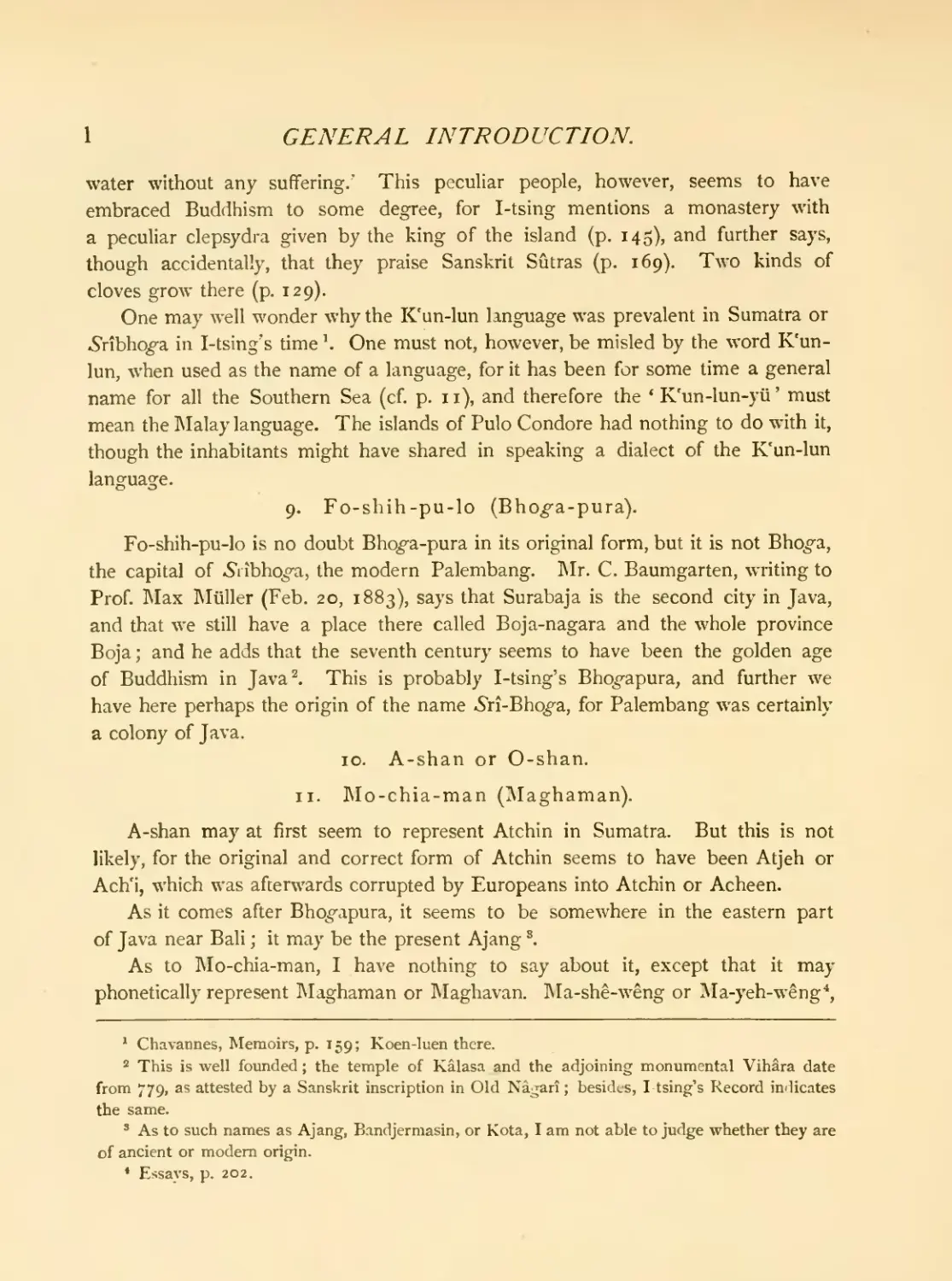
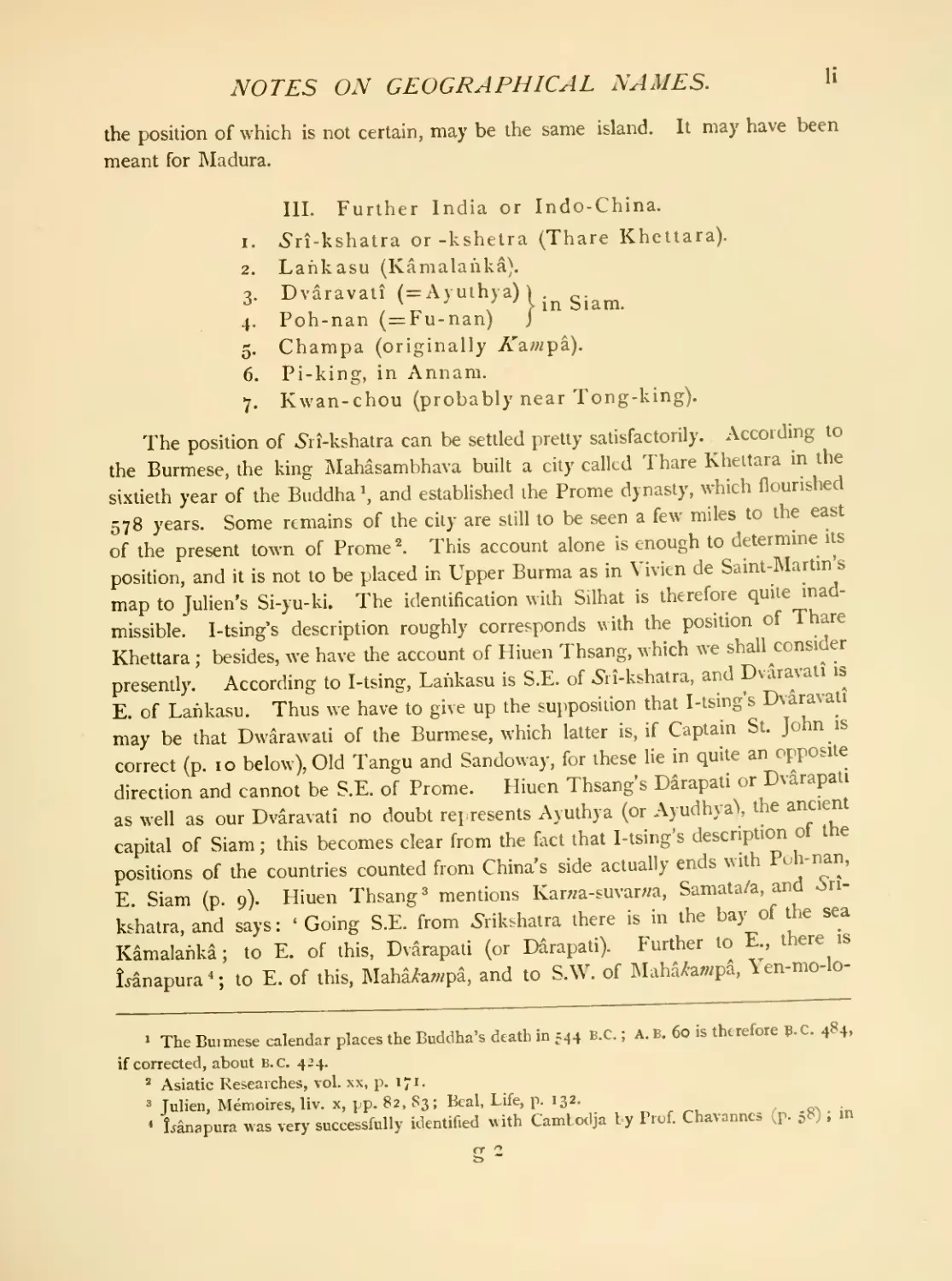
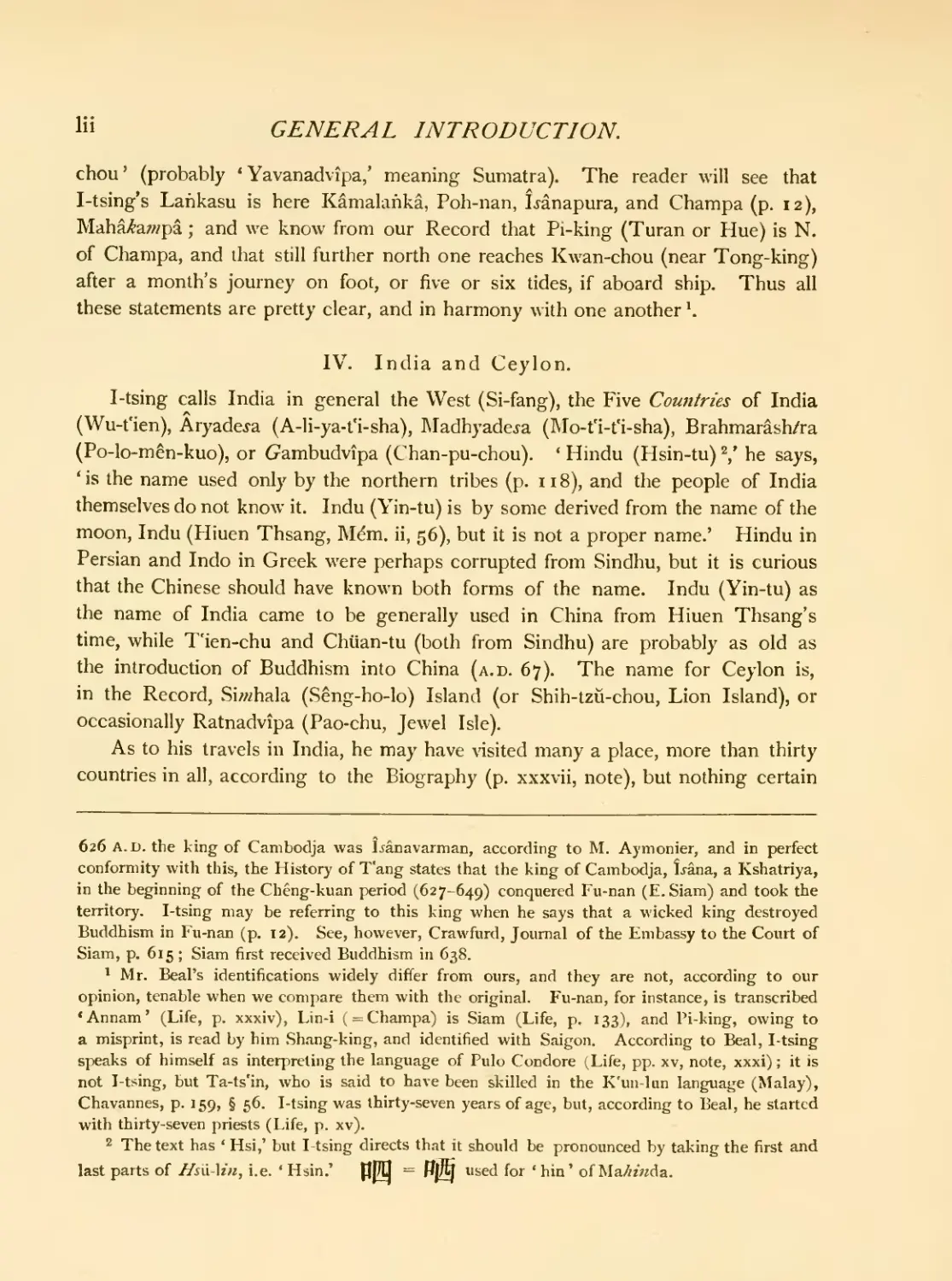
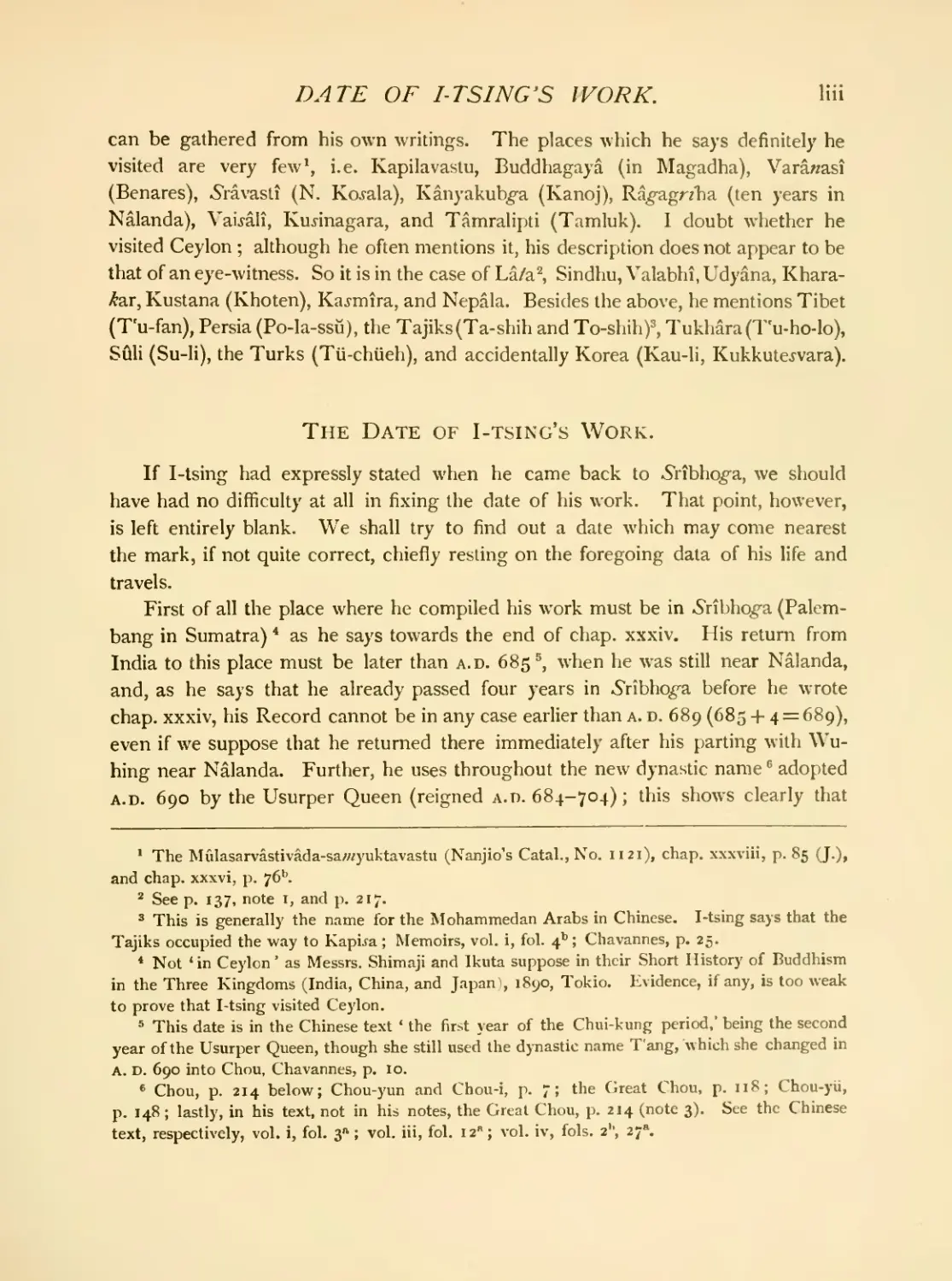
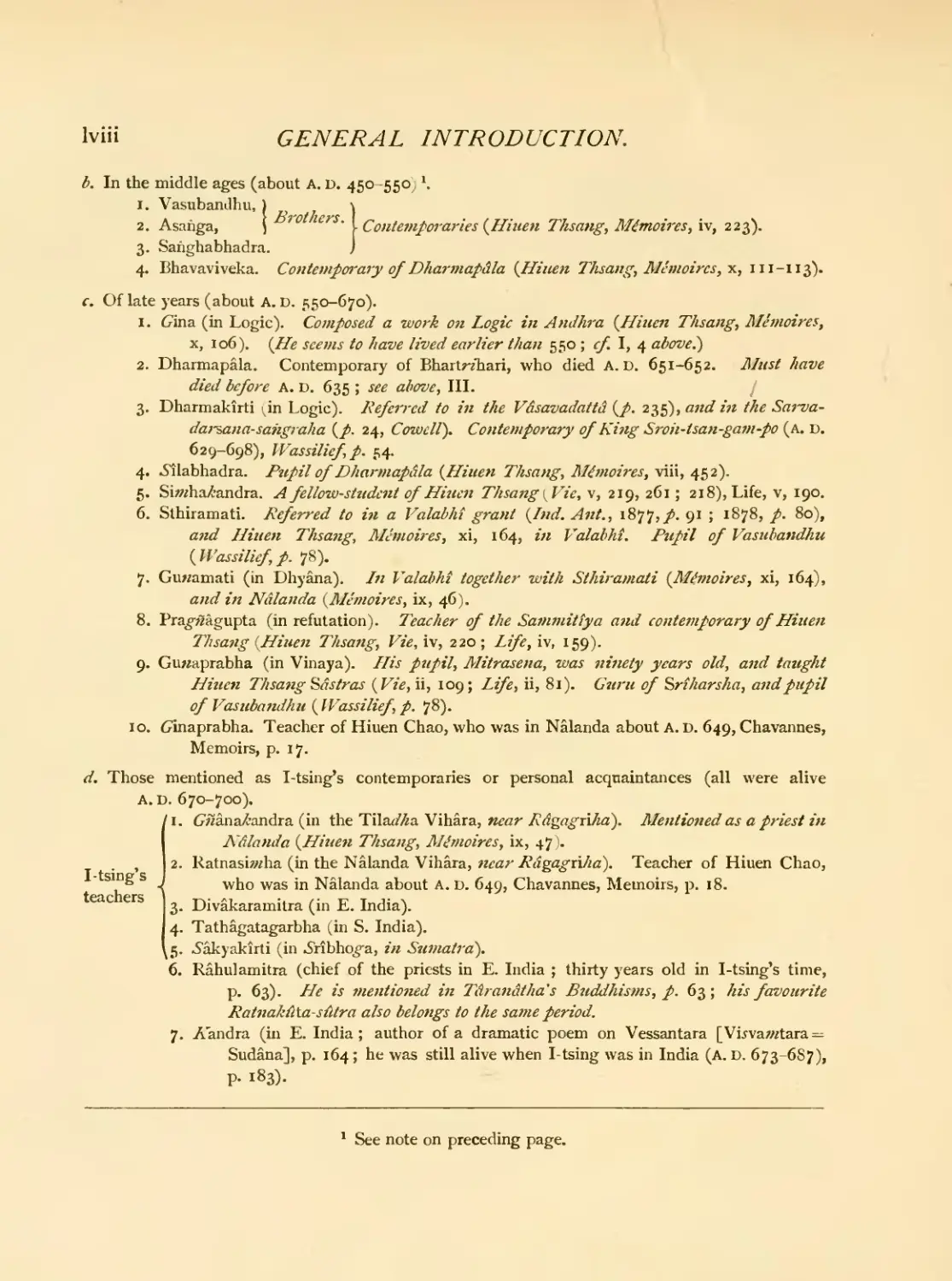
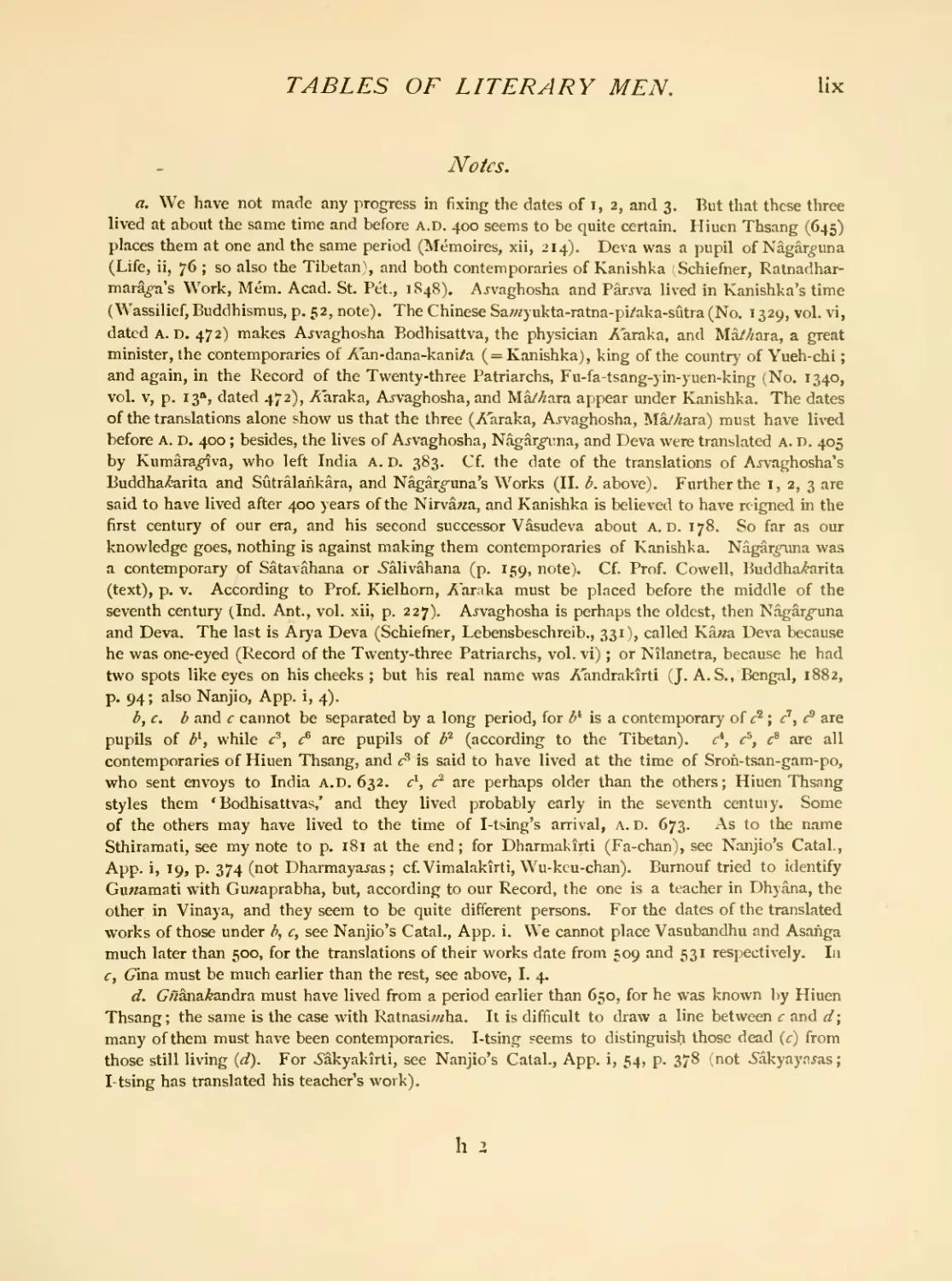
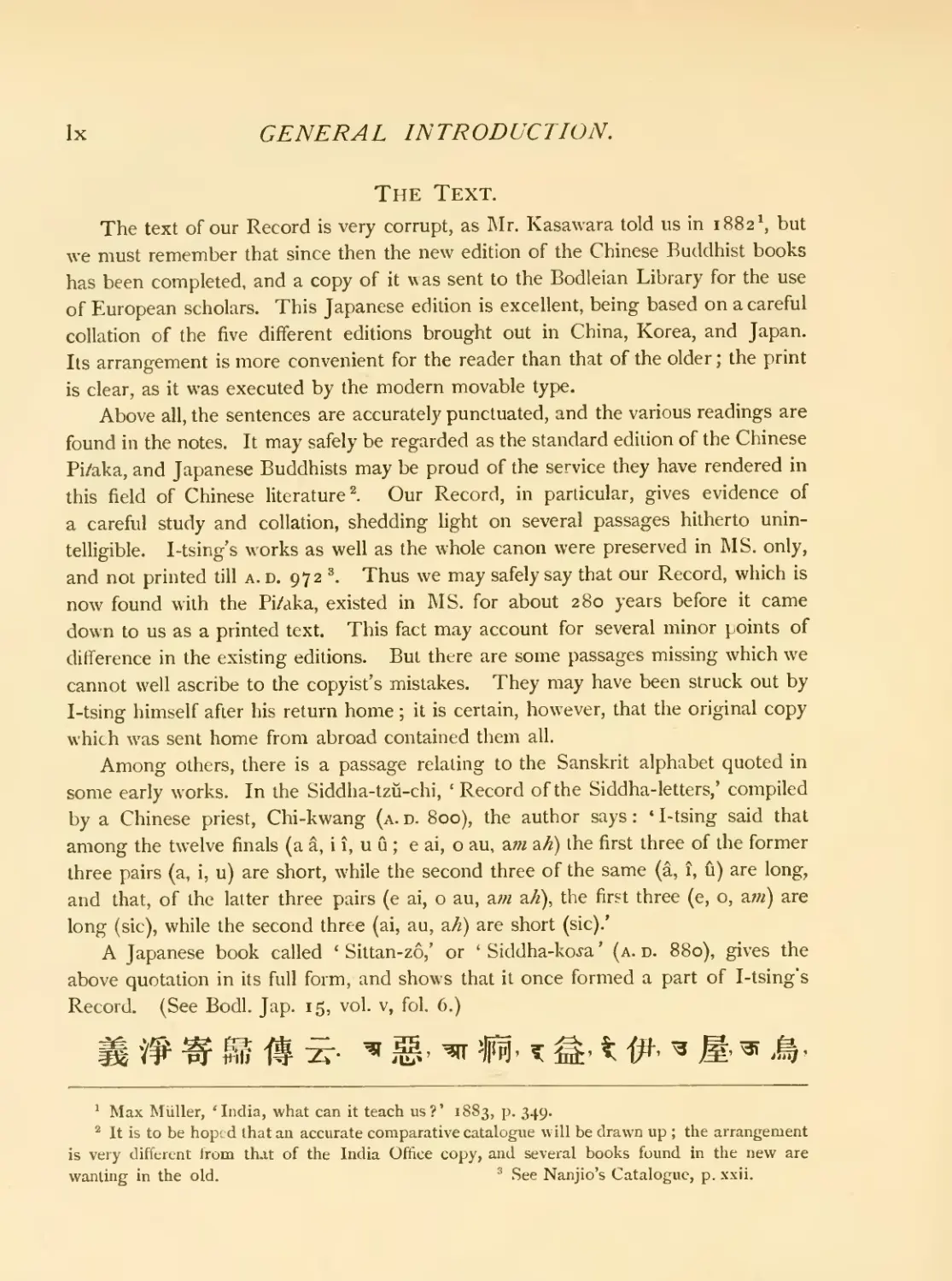
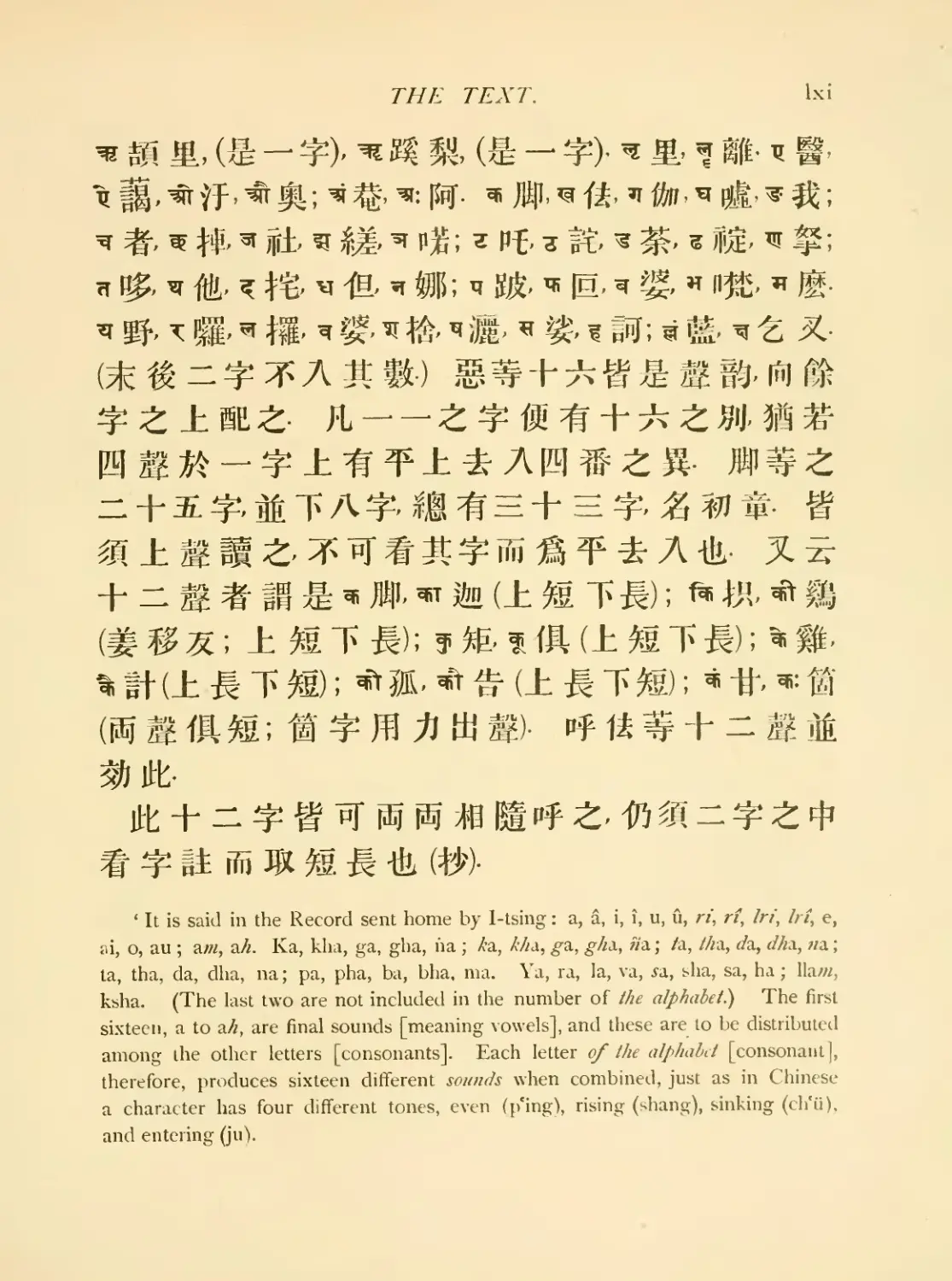
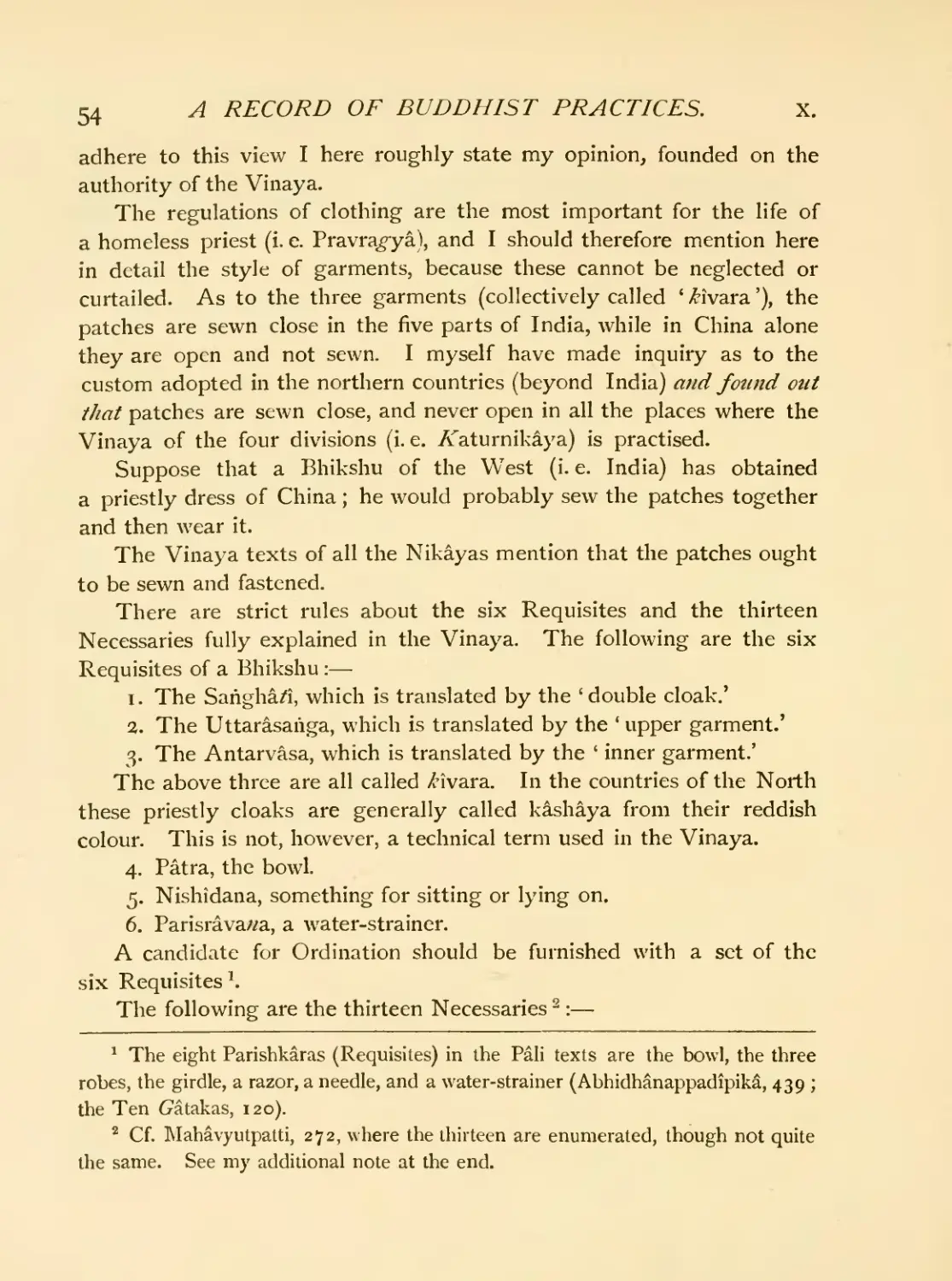
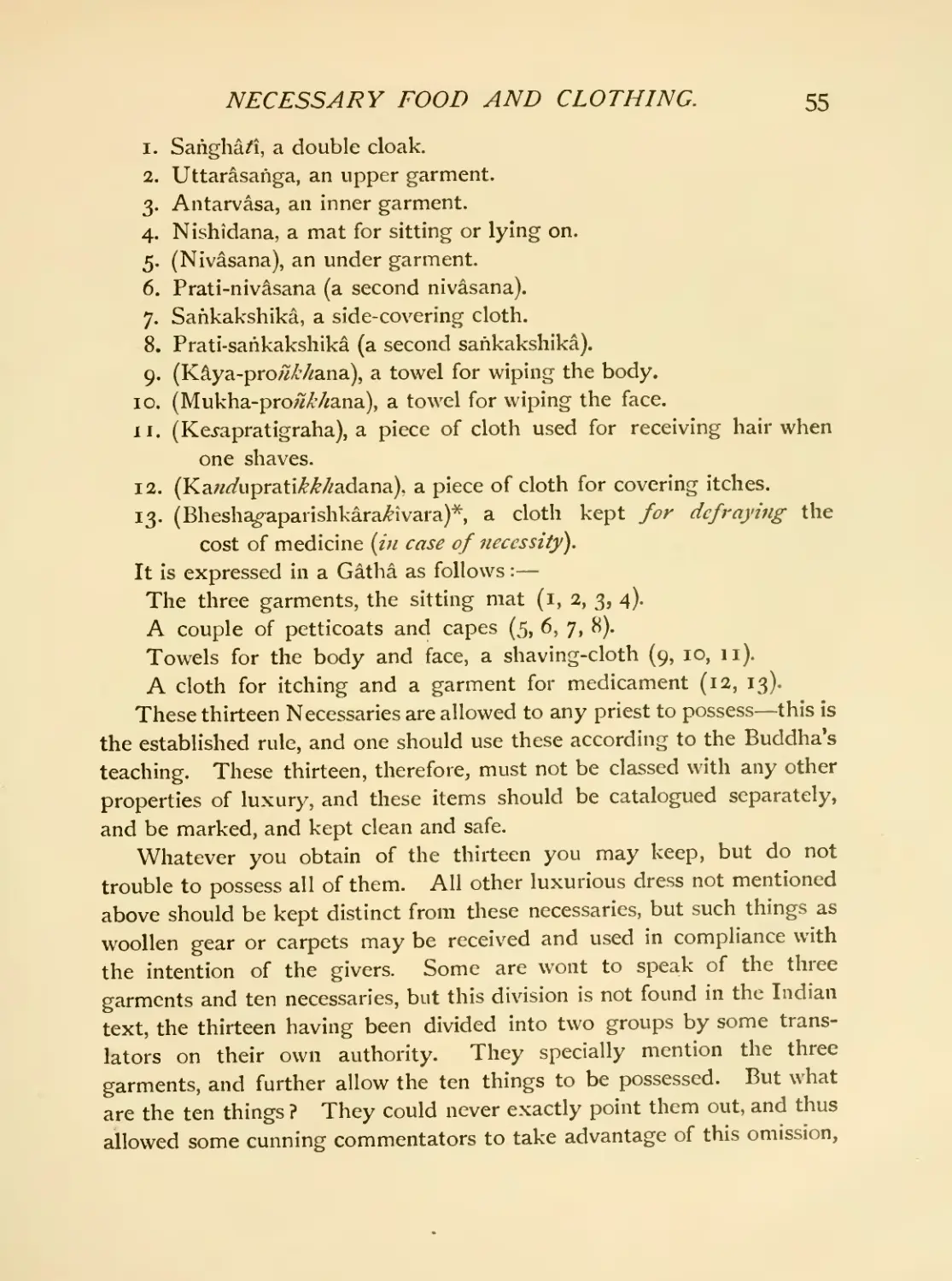
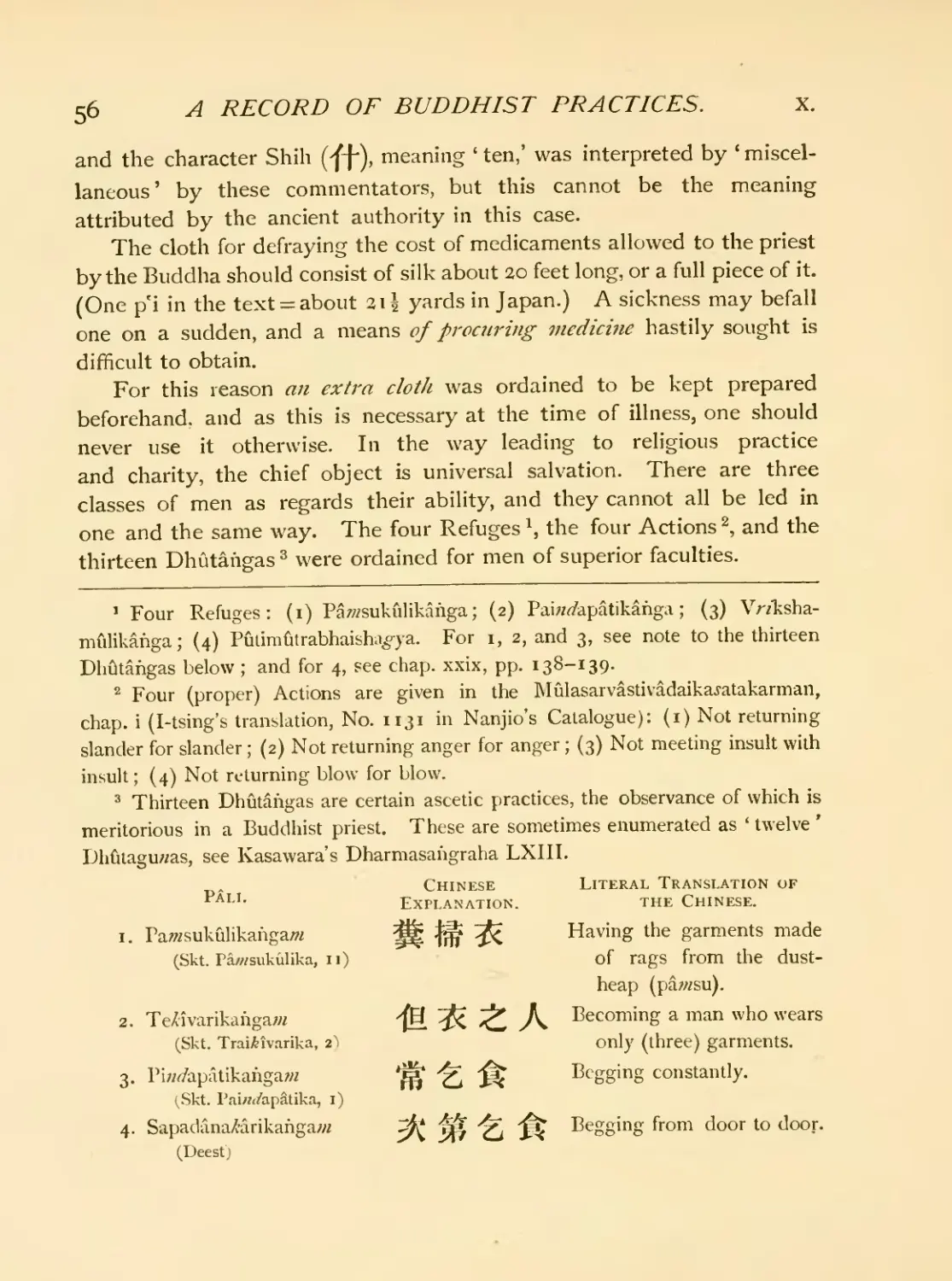
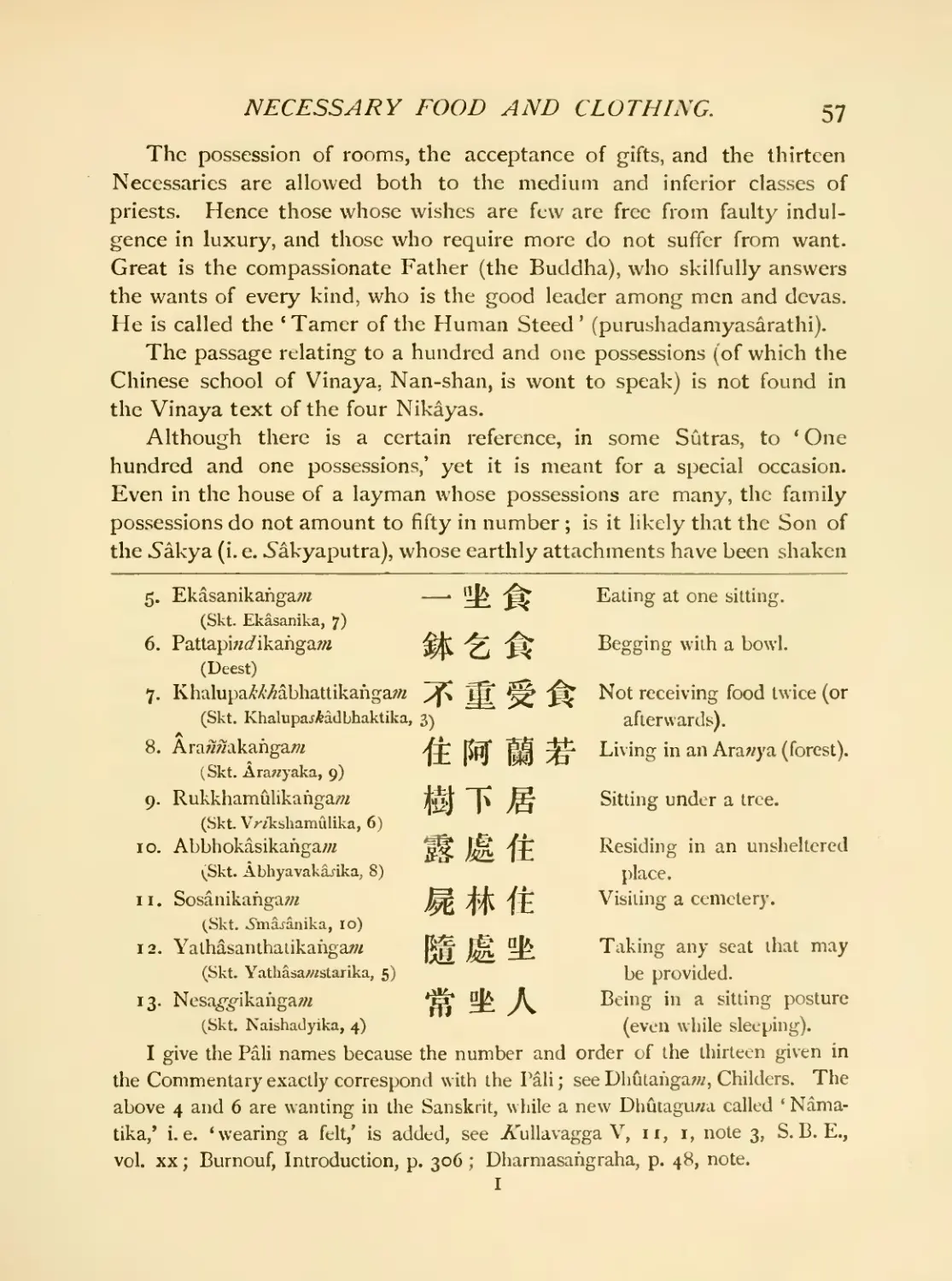
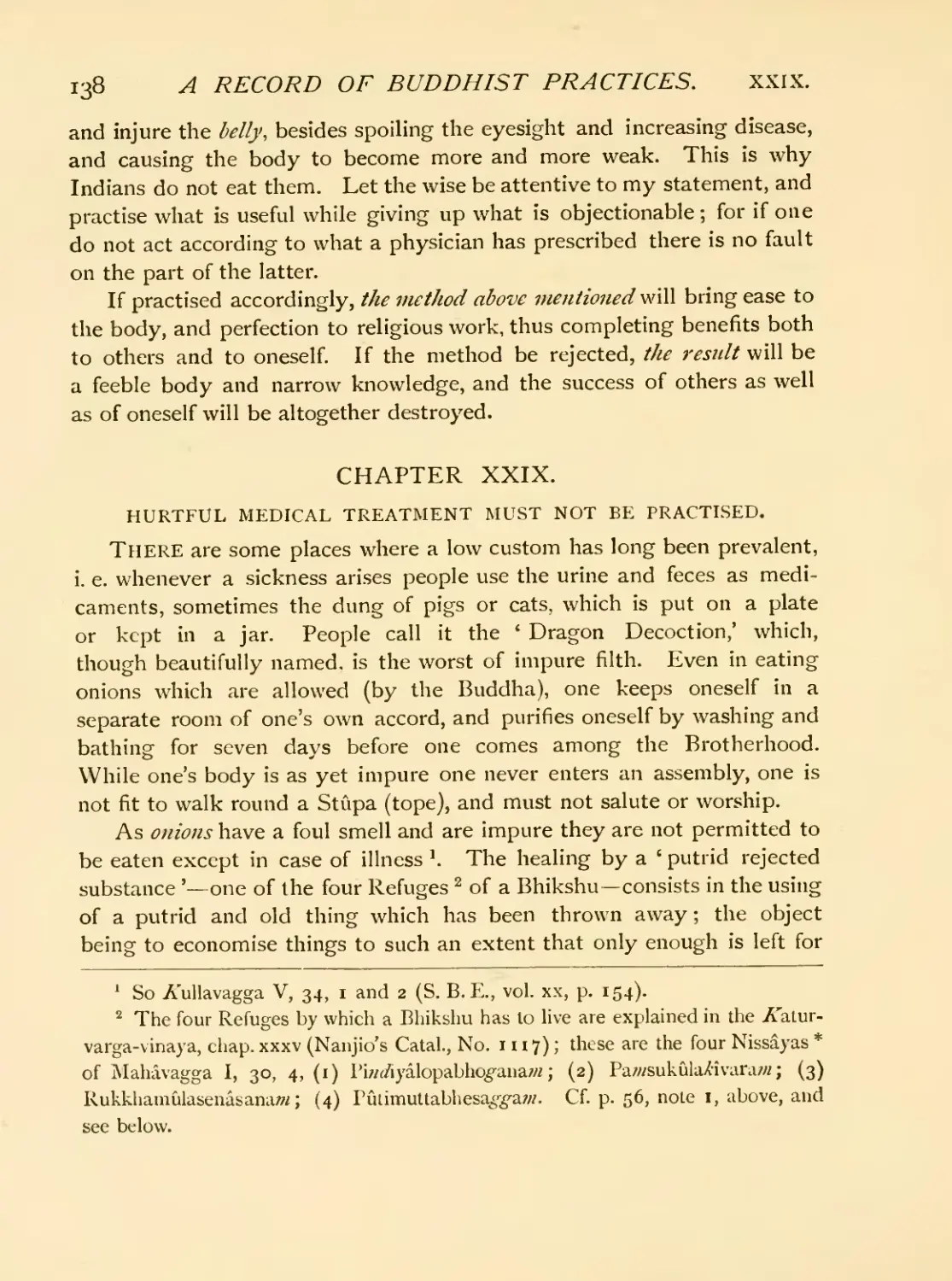
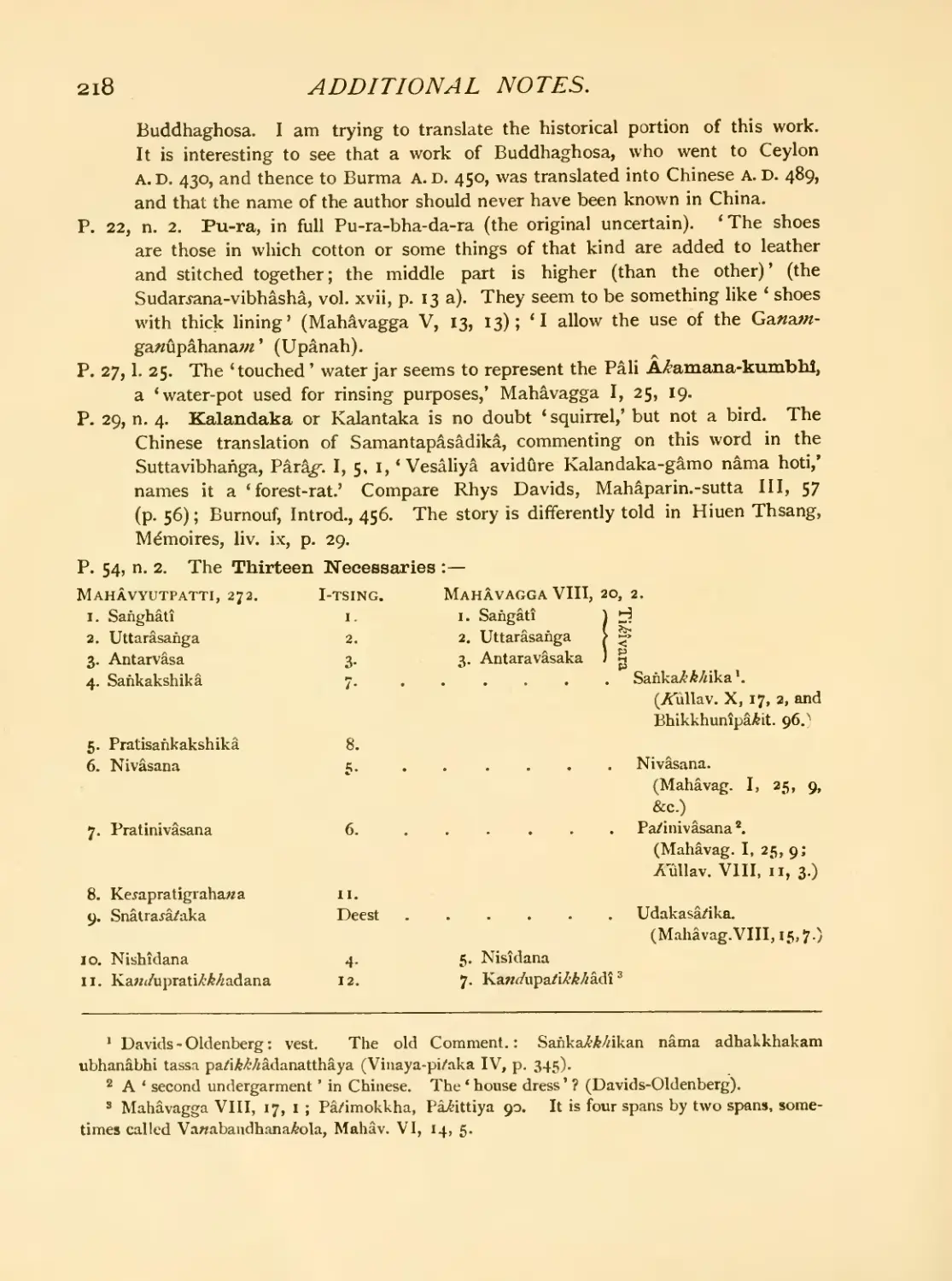






Текст
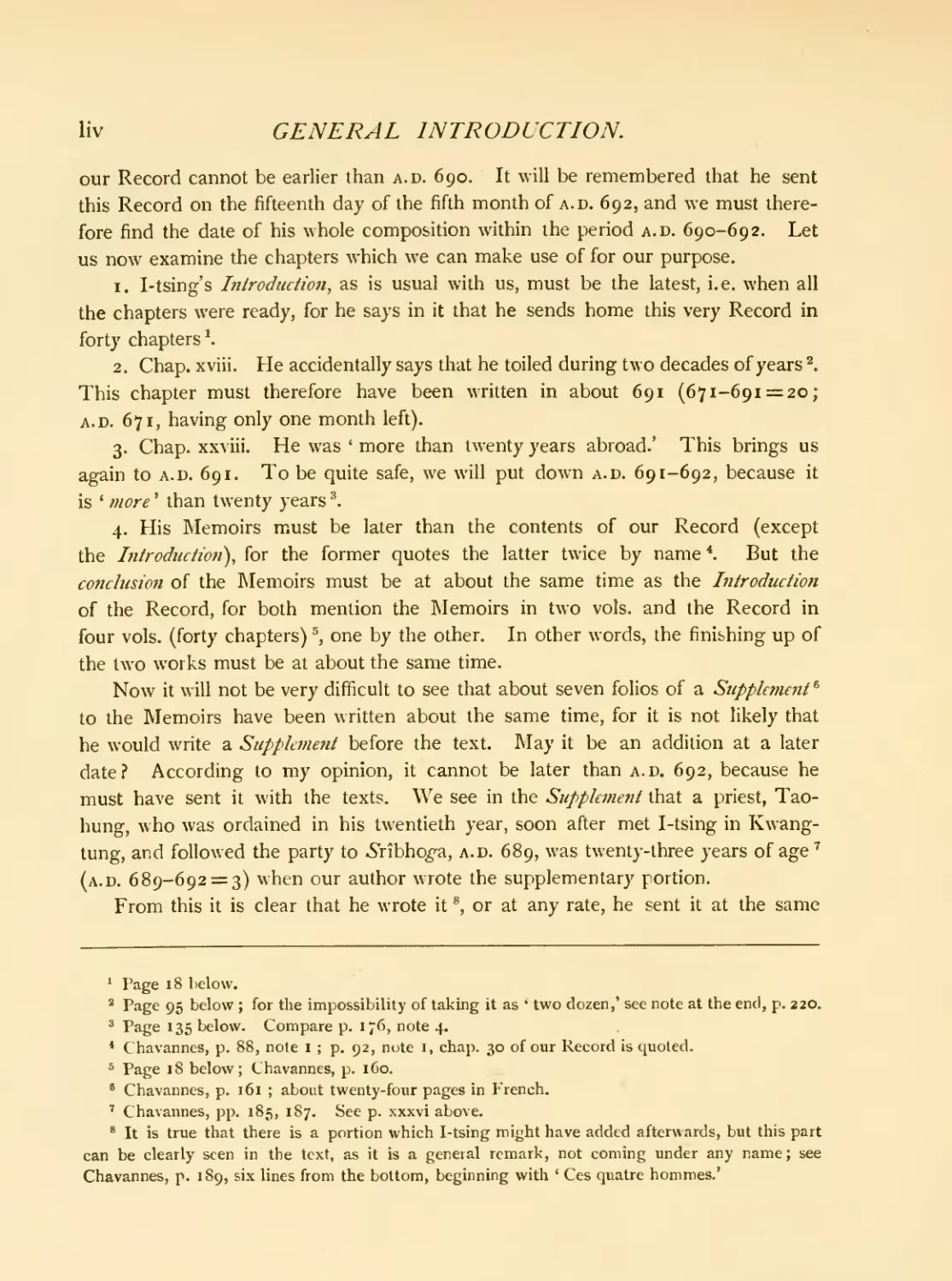
                    [BLI430
116

OF PR/jJg^
> JAN 19
i

BUDDHIST PRACTICES IN INDIA
TAKAKUSU

Bonbon
HENRY FROWDE
Oxford University Press Warehouse
Amen Corner, E.C.
THE MACMILLAN CO., 66 FIFTH AVENUE

v^rtNVW VI I I, J

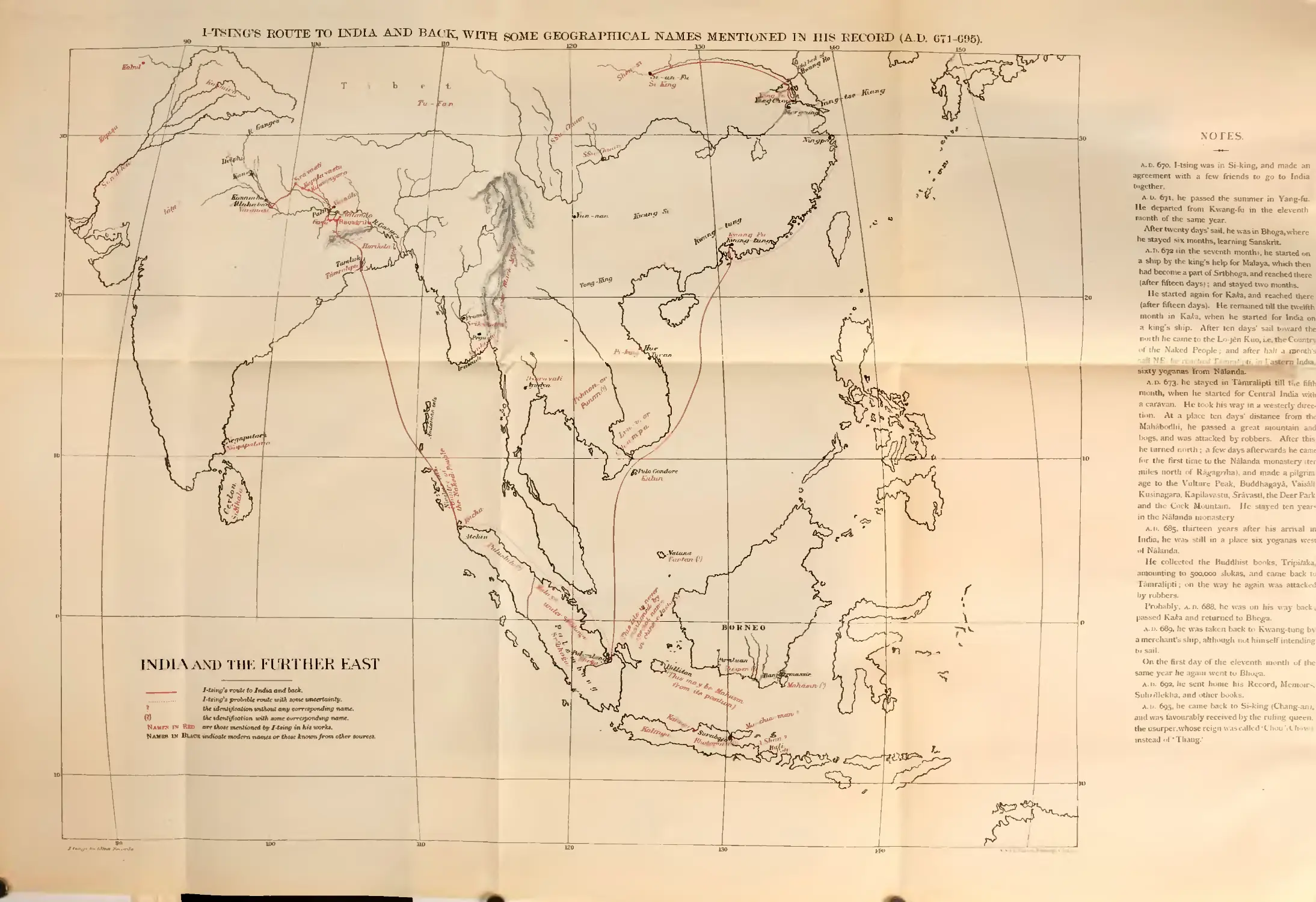
r-TSnSTG'S ROUTE TO INDIA AND BACK, WITH SOME GEOGRAPHICAL NAMES MENTIONED IN HIS RECORD (A.D. 671-695).
the eleventh
n Bhoga.vher
A.D. 670, I-tsingwas in Si-king, and made
agreement with a few friends I
together.
a. i). 671, he passed the sum
lie departed from Kwang-fu
month of the same year.
After twenty days' sail, he was
he stayed six months, learning Sanskrit.
a. n. 672 tin the seventh monthi, he started on
a ship by the king's help for Malaya, v ..
had become a part of Sribho^a, and reached there
(after fifteen days) ; and stayed two months.
lie started again for Kata, and reached there
(after fifteen days). He remained till the twelfth
month in Ka£a, when he started for India on
a king's ship. After ten days' sail toward the
north he came to the Ln-_j£n Kuo, i.e. iheCountn
oi thi Nak. J P.
sixty yoganas rrom Nalanda.
a.d. 673. he stayed in Tamralipti till I
month, when he started for Central India with
a caravan. He took his way in a westerly direc-
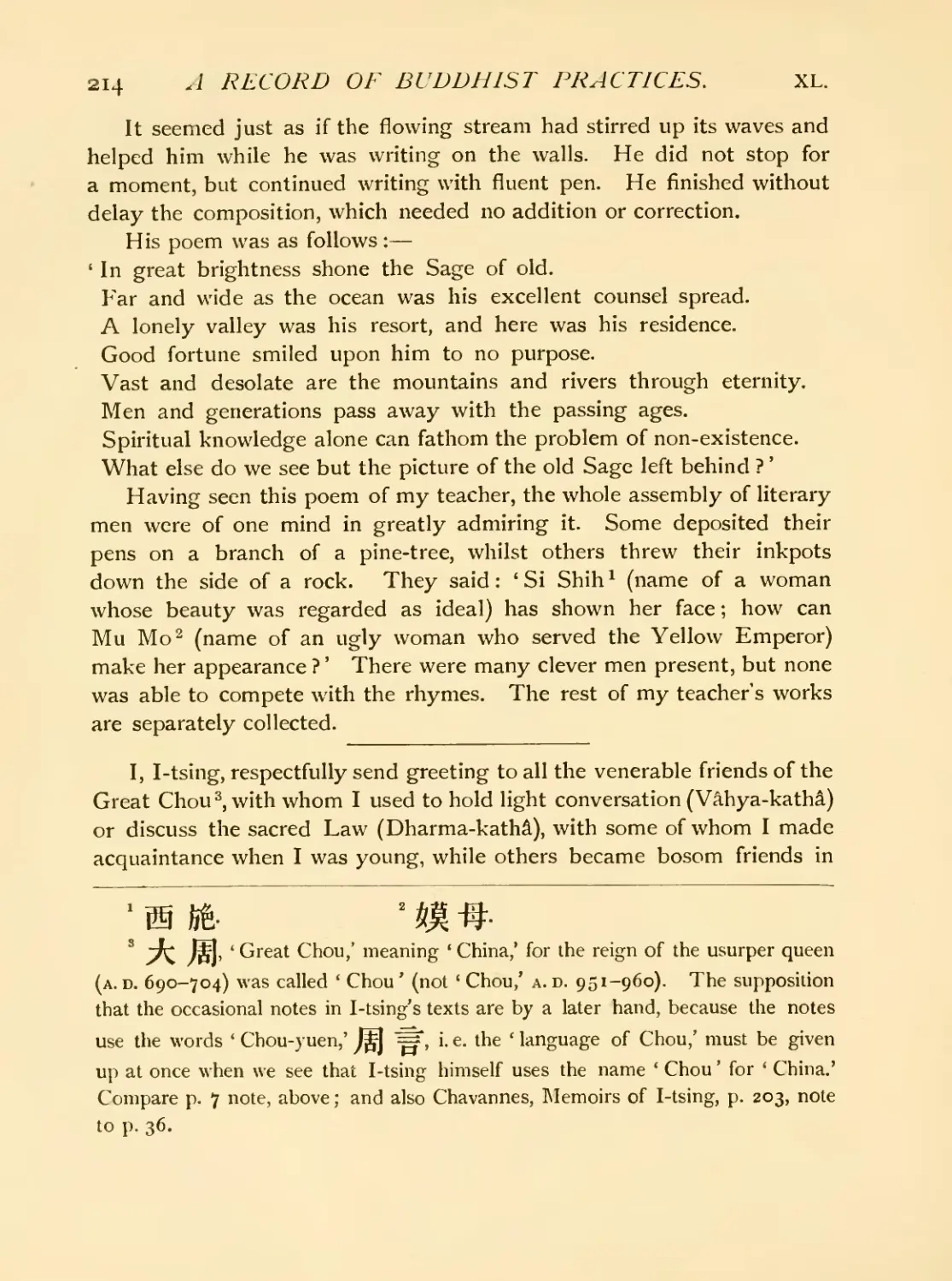
tion. At a place ten days' distance from the
Maliabodhi, he passed a great mountain and
bogs, and was attacked by robbers. After this
he turned mirth ; a few days afterwards he can™
lor the first time to the Nalanda monastery iter
miles north of Ragagnha), and made a pilgrim
age to the Vulture- Peak, Buddhagaya, Vaiaal]
Kusinagara, Kapilavastu, Sravastl, the Deer Park
and the Cock Mountain. He stayed ten years
in the Nalanda mona
A.D. 685, thirteen years after his arrival in
India, he was still in a place six yqganas wesl
of Nalanda.
He collected the Buddhist books, Tripi/aka
amounting to 500,000 slokas, and came back to
Tamralipti; on the way he again was
by robbers.
Probably, a.d. 688. he was on his way back:
passed KaAa and returned to Bhoga.
a.d. 689, he was taken back to Kwang-tung bv
a merchant's ship, although not himself intending
1 In the fii si day I month of the
same ■■ 1 11 he again went to Bhoga.
a.d. 692, he sent home his Record,
Suhr/llekha, and oth< 1
a. n. 695, he came back to Si-king (Chang-am,
j 1 id was favourably received by the rulii .
the usurper.whose reign was 1
instead ol'Thang.'

A RECORD
* JAN 19
%
V,
}/.LS
OF
THE BUDDHIST RELIGION
AS PRACTISED IN
INDIA AND THE MALAY ARCHIPELAGO
(A.D. 671-695)
By I-TSING
Translated by J. TAKAKUSU, B.A., Ph.D.
WITH A LETTER FROM THE RIGHT HON. PROFESSOR F. MAX MULLER
WITH A MAP
Ojcfovb
AT THE CLARENDON PRESS
1896

PRINTED AT THE CLARENDON PRESS
BY HORACE HART
PRINTER TO THE UNIVERSITY

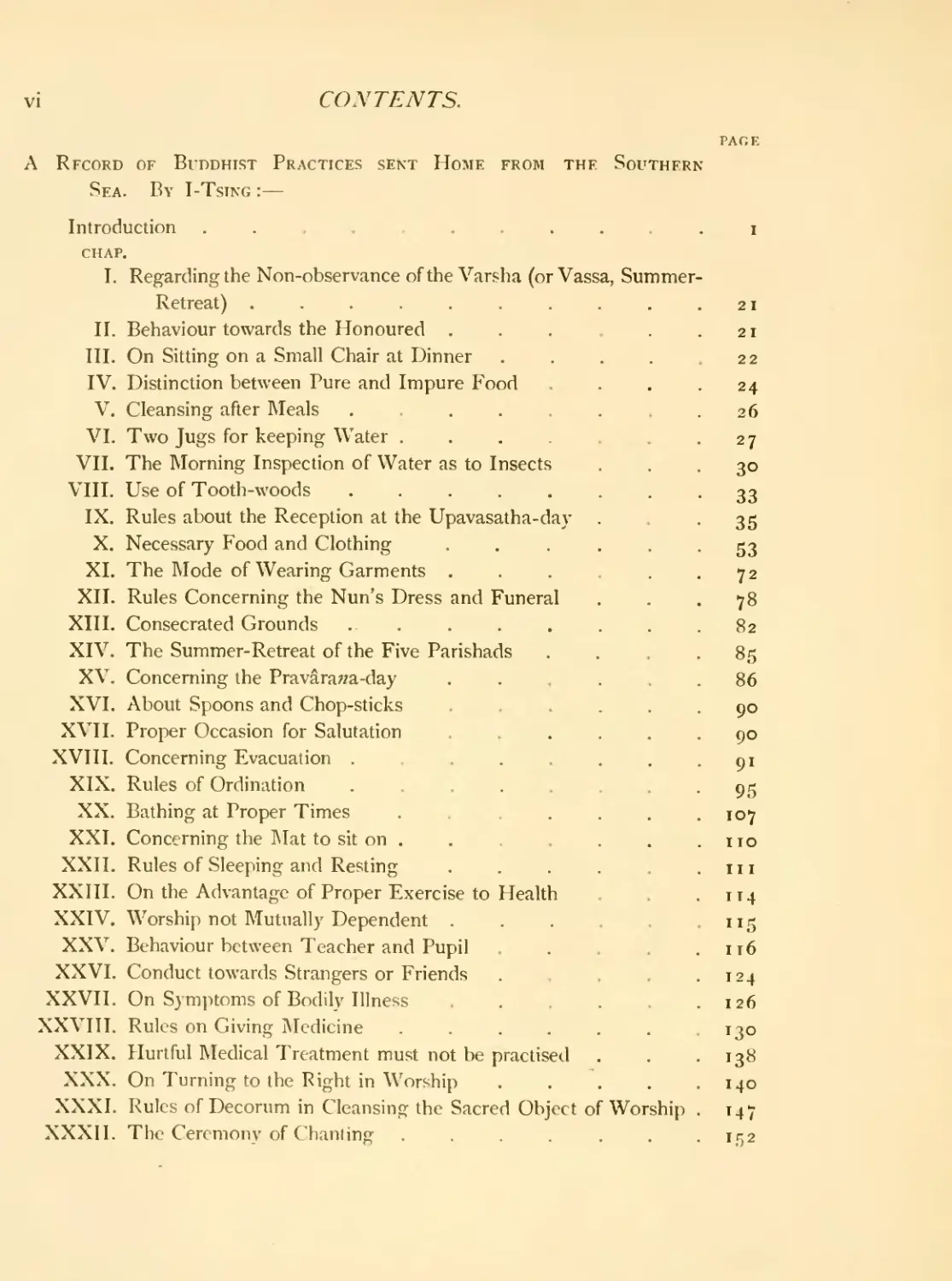
CONTENTS.
Map of I-tsing's Route to India and Back, with some Geographical Names
mentioned in his Record \joface title-page]
Letter from the Right Honourable Professor F. Max Muller to
Mr. J. Takakusu .......... ix
General Introduction : —
Preliminary Remarks ......... xvii
The Mulasarvastivada School ....... xxi
The Result of I-tsing's Description of the Buddhist Schools . xxiii
The Life and Travels of I-tsing : —
I. His Boyhood, to his Departure from China .... xxv
II. His Journey to India ........ xxvii
III. His Return Home, to his Death ..... xxxvii
Notes on some Geographical Names : —
I. The Country of the Naked People .... xxxviii
II. The Islands of the Southern Sea ...... xxxix
III. Further India or Indo-China ...... li
IV. India and Ceylon ........ Hi
The Date of I-tsinsfs Work ........ liii
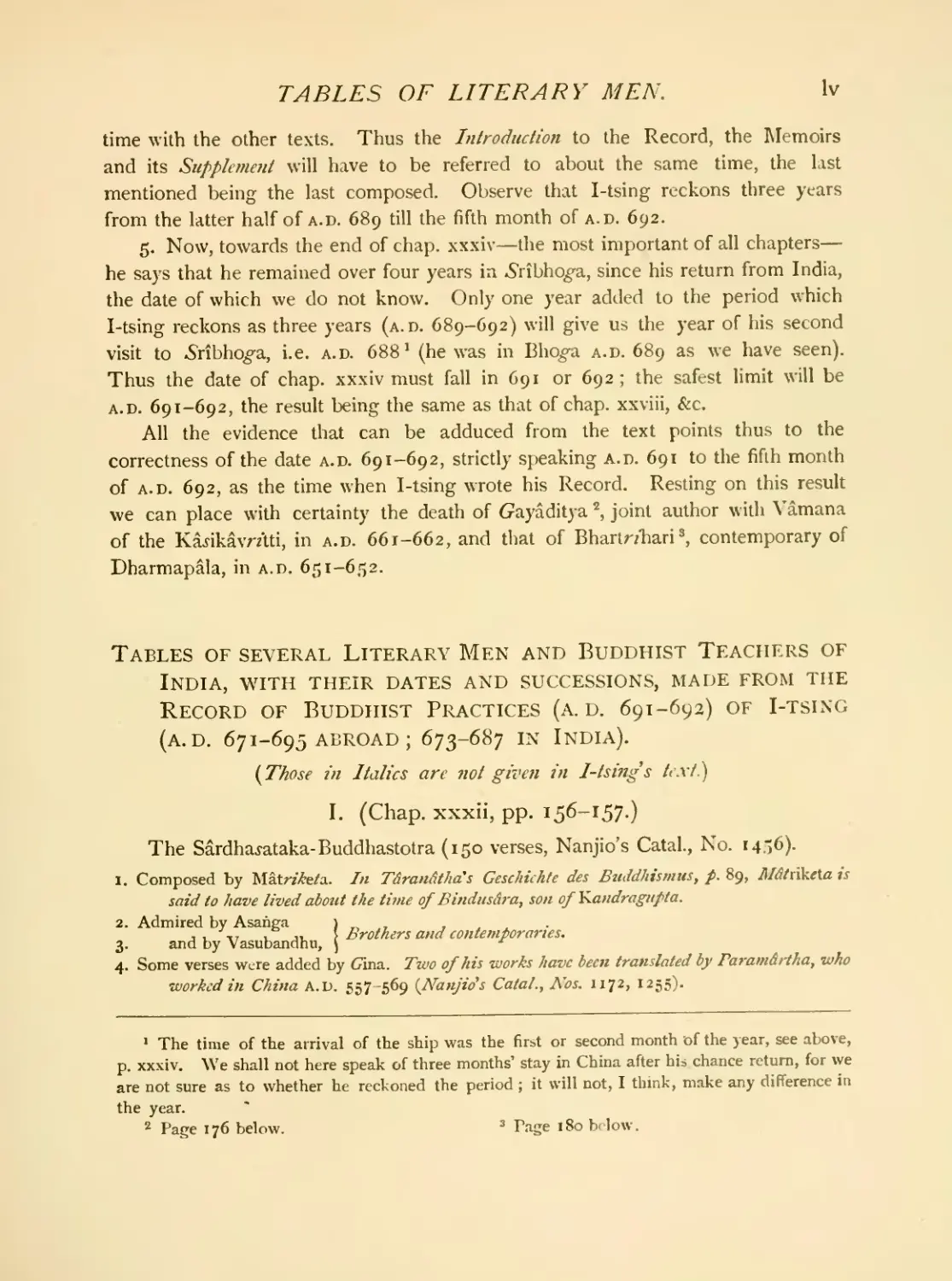
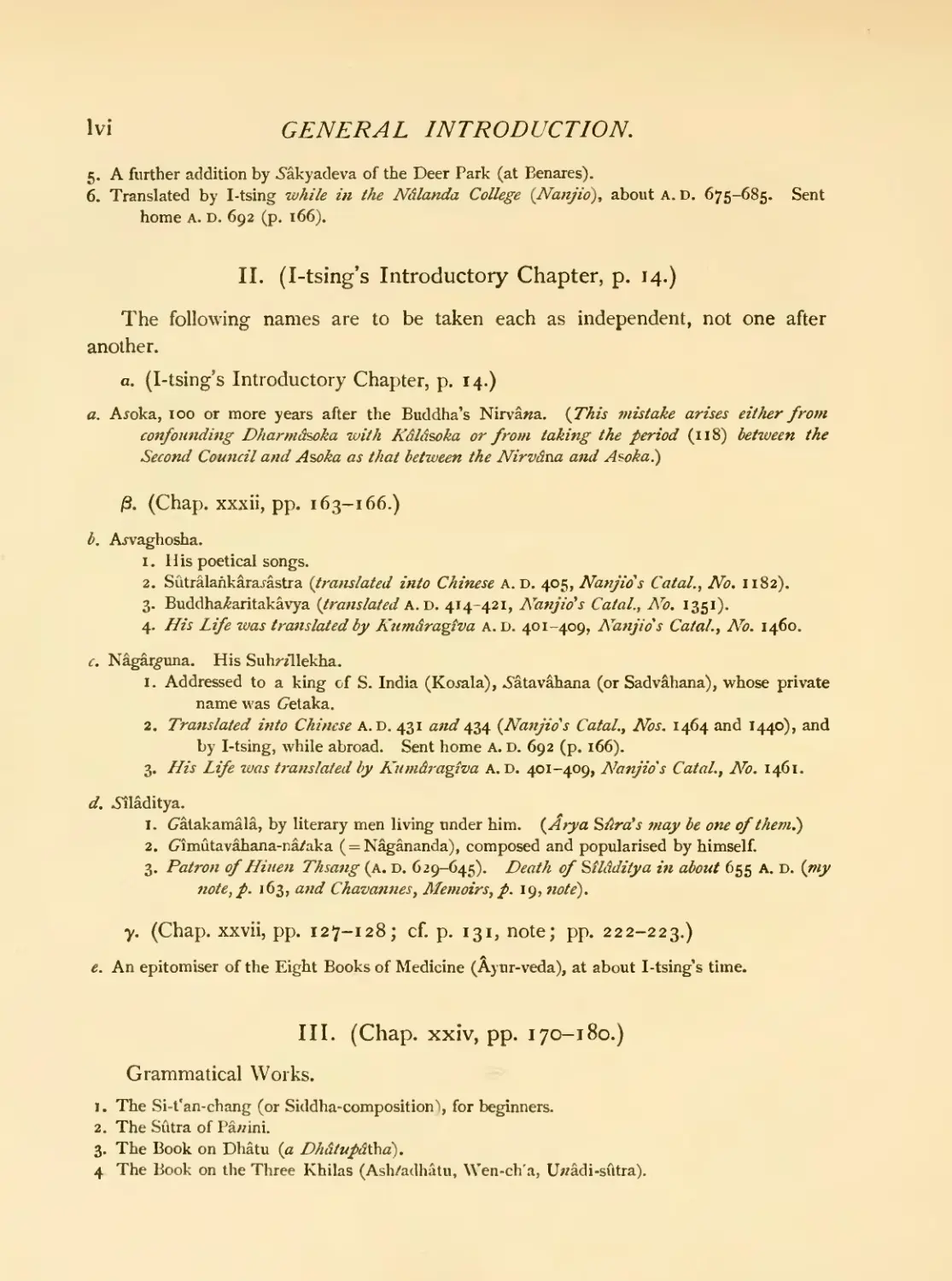
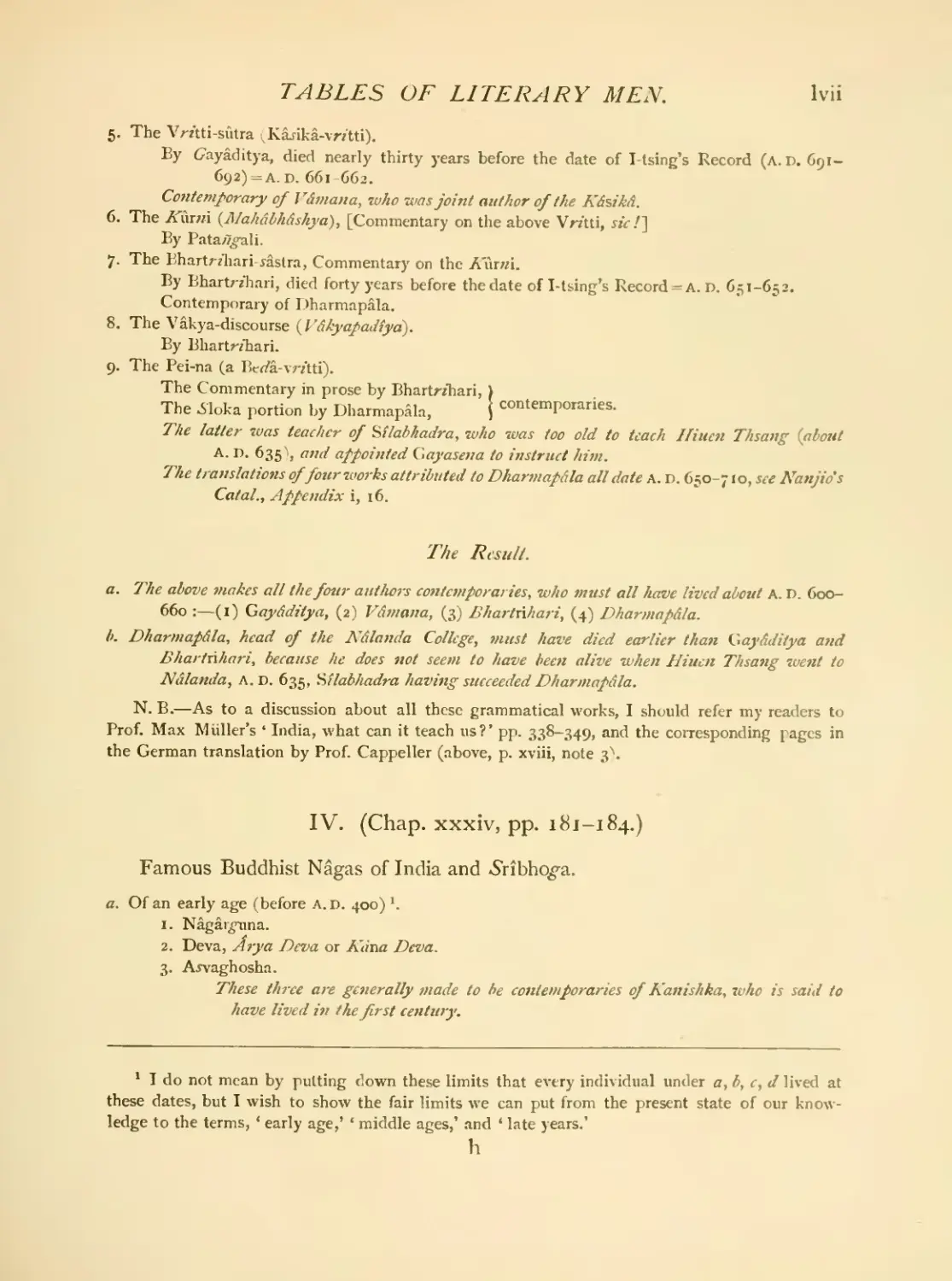
Tables of several Literary Men and Buddhist Teachers of India, with
their dates and successions, made from the Record of Buddhist
Practices ,of I-tsing .........
The Text .........
Additional Notes to the Map ........
Iv
lx

VI
CONTENTS.
i Record of Buddhist Practices sent Home from the Southern-
Sea. By I-Tsing : —
Introduction ...........
chap.
I. Regarding the Non-observance of the Varsha (or Vassa, Summer-
Retreat) .......
II. Behaviour towards the Honoured .
III. On Sitting on a Small Chair at Dinner
IV. Distinction between Pure and Impure Food
V. Cleansing after Meals .....
VI. Two Jugs for keeping Water ....
VII. The Morning Inspection of Water as to Insects
VIII. Use of Tooth-woods .....
IX. Rules about the Reception at the Upavasatha-day
X. Necessary Food and Clothing
XI. The Mode of Wearing Garments .
XII. Rules Concerning the Nun's Dress and Funeral
XIII. Consecrated Grounds ......
XIV. The Summer- Retreat of the Five Parishads
XV. Concerning the Pravara«a-day
XVI. About Spoons and Chop-sticks
XVII. Proper Occasion for Salutation
XVIII. Concerning Evacuation .....
XIX. Rules of Ordination
XX. Bathing at Proper Times ....
XXI. Concerning the Mat to sit on .
XXII. Rules of Sleeping and Resting
XXIII. On the Advantage of Proper Exercise to Health
XXIV. Worship not Mutually Dependent .
XXV. Behaviour between Teacher and Pupil
XXVI. Conduct towards Strangers or Friends
XXVII. On Symptoms of Bodily Illness
XXVIII. Rules on Giving Medicine ....
XXIX. Hurtful Medical Treatment must not be practised
XXX. On Turning to the Right in Worship
XXXI. Rules of Decorum in Cleansing the Sacred Object of Worship
XXXII. The Ceremony of Chanting ......
21
21
22
24
26
27
30
33
35
53
72
78
82
85
86
90
90
9i
95
107
no
in
114
"5
116
124
126
130
138
140
152

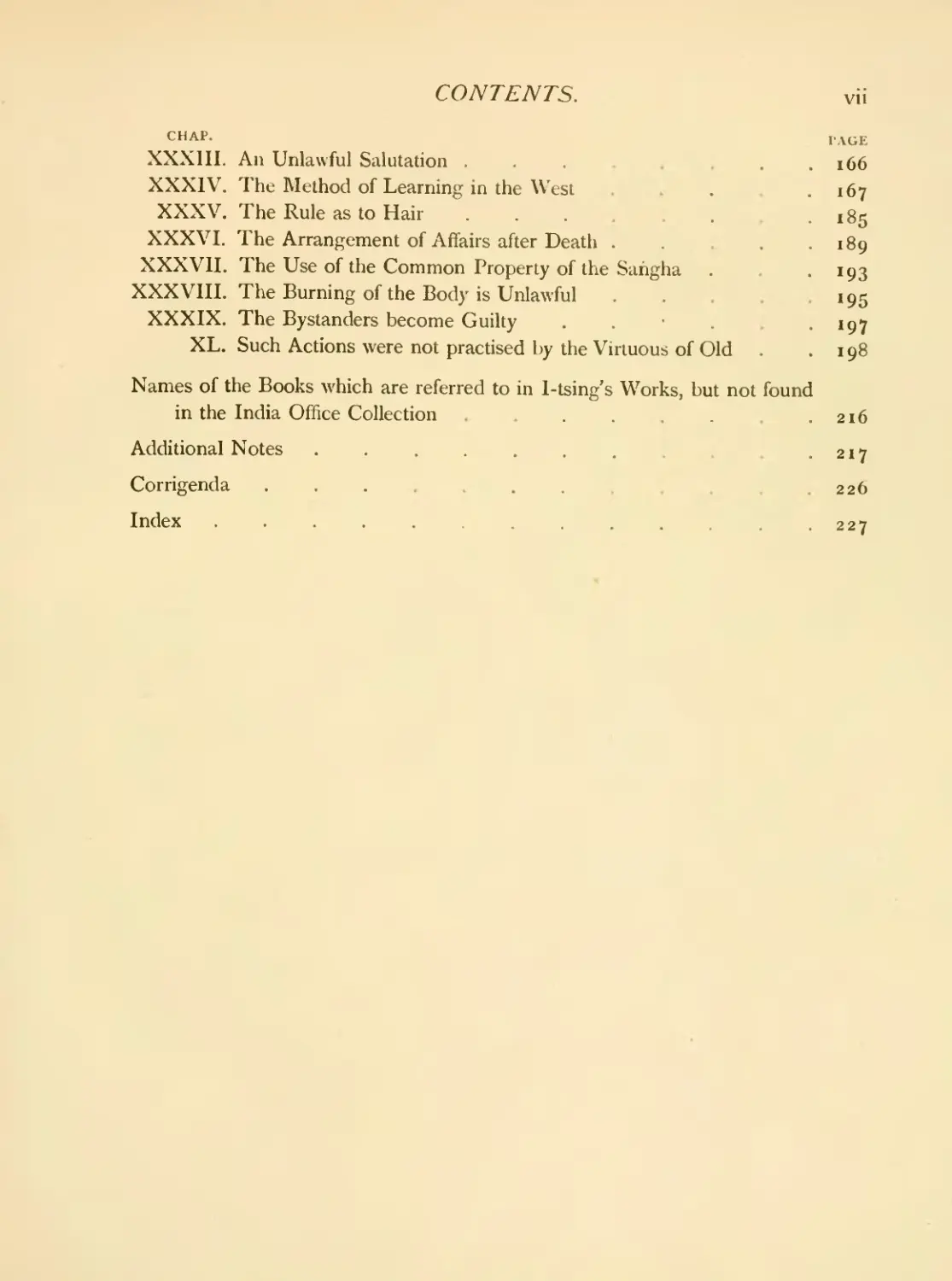
CONTENTS.
VII
CHAP.
XXXIII. An Unlawful Salutation .
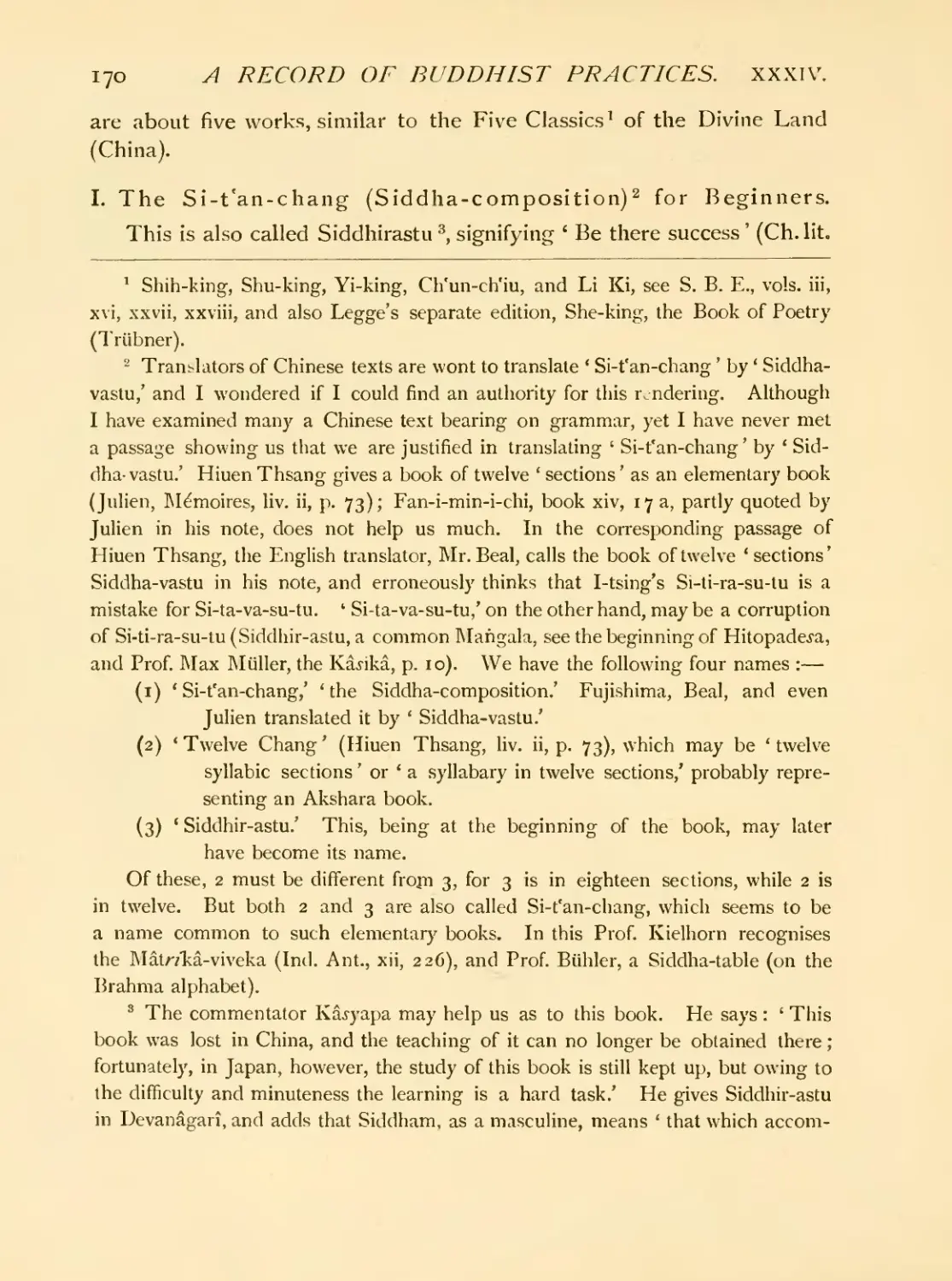
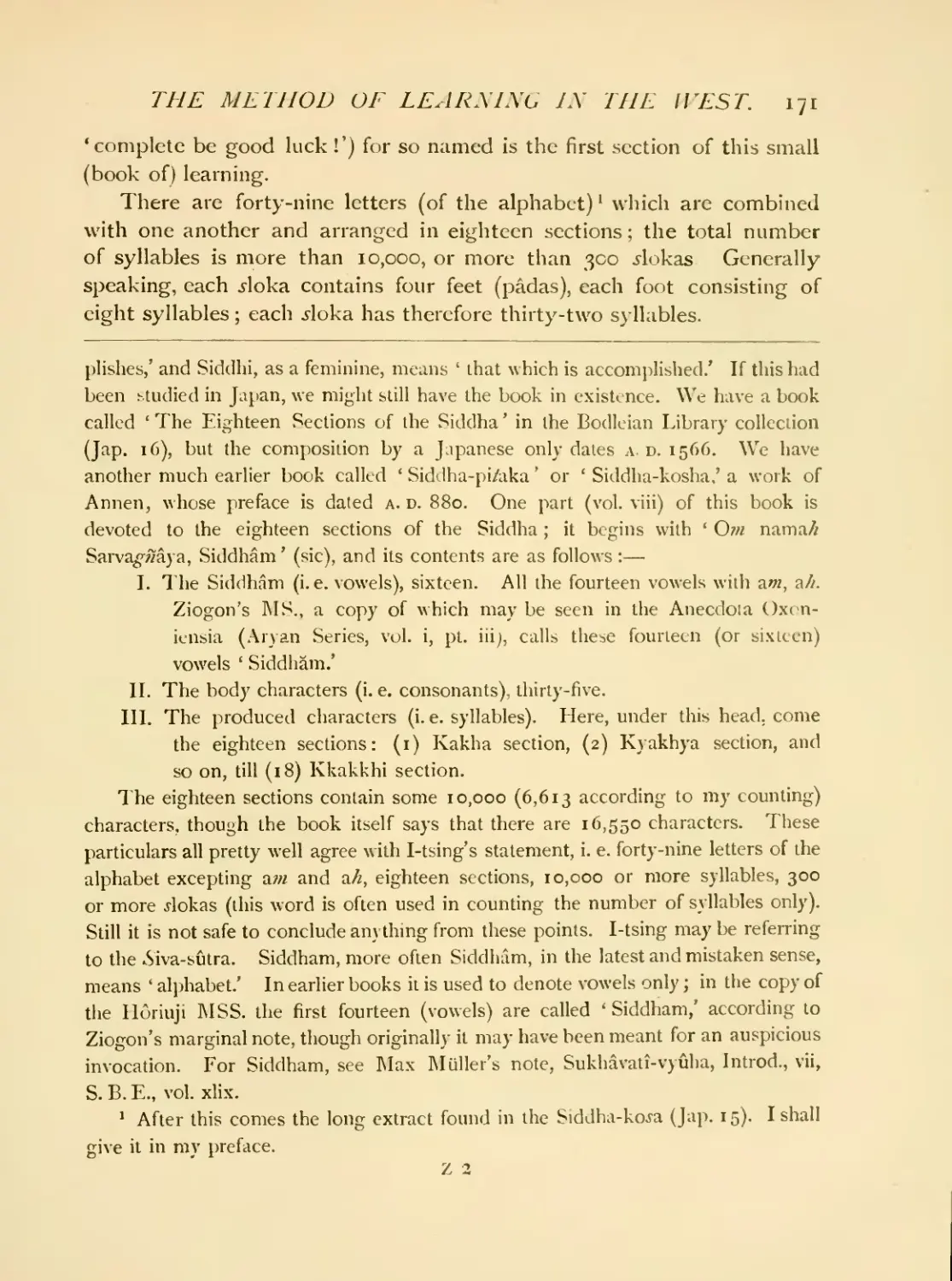
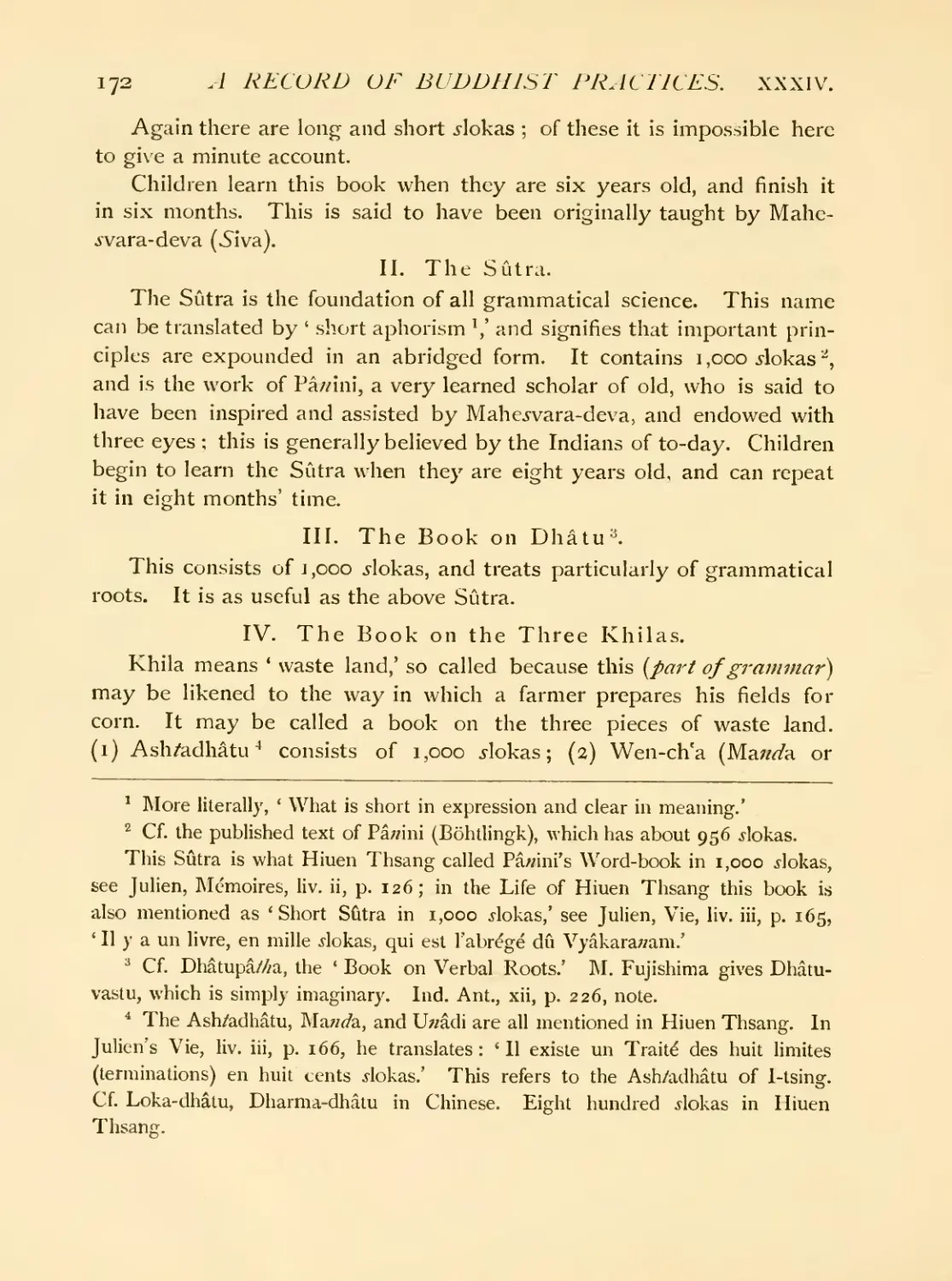
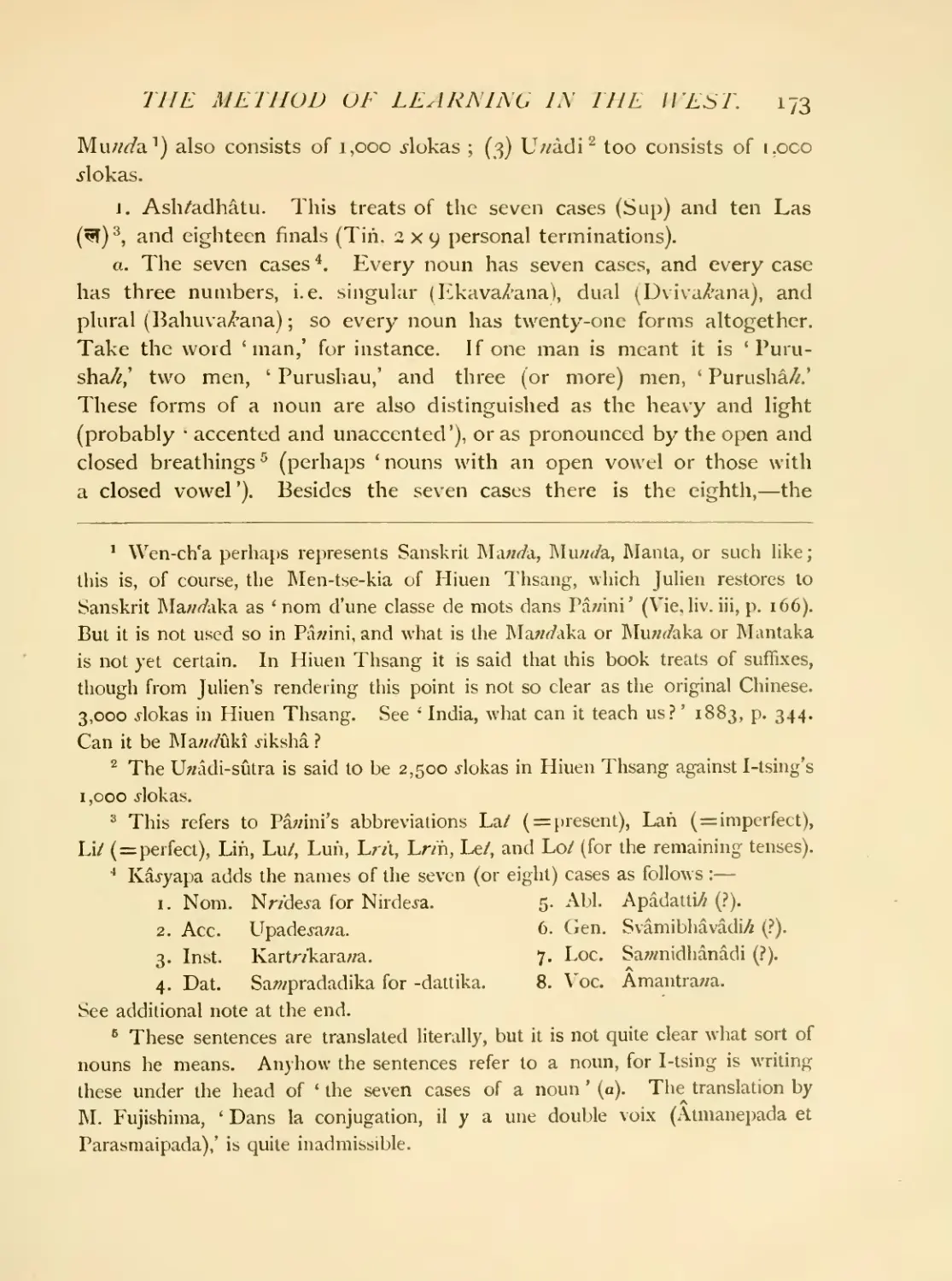
XXXIV. The Method of Learning in the West
XXXV. The Rule as to Hair . . .
XXXVI. The Arrangement of Affairs after Death .
XXXVII. The Use of the Common Property of the Sahgha
XXXVIII. The Burning of the Body is Unlawful
XXXIX. The Bystanders become Guilty
XL. Such Actions were not practised by the Virtuous of Old
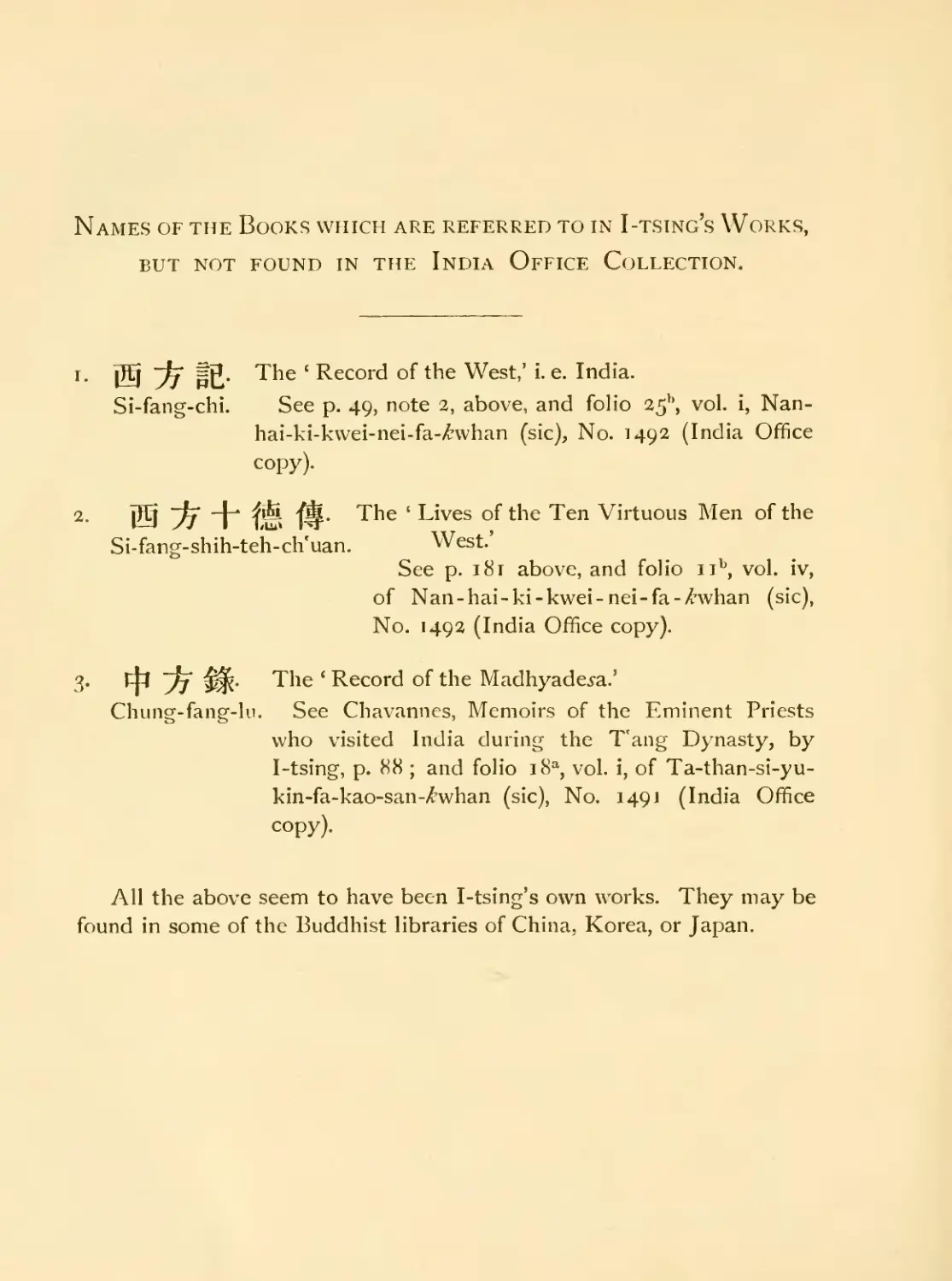
Names of the Books which are referred to in I-tsing's Works, but not found
in the India Office Collection
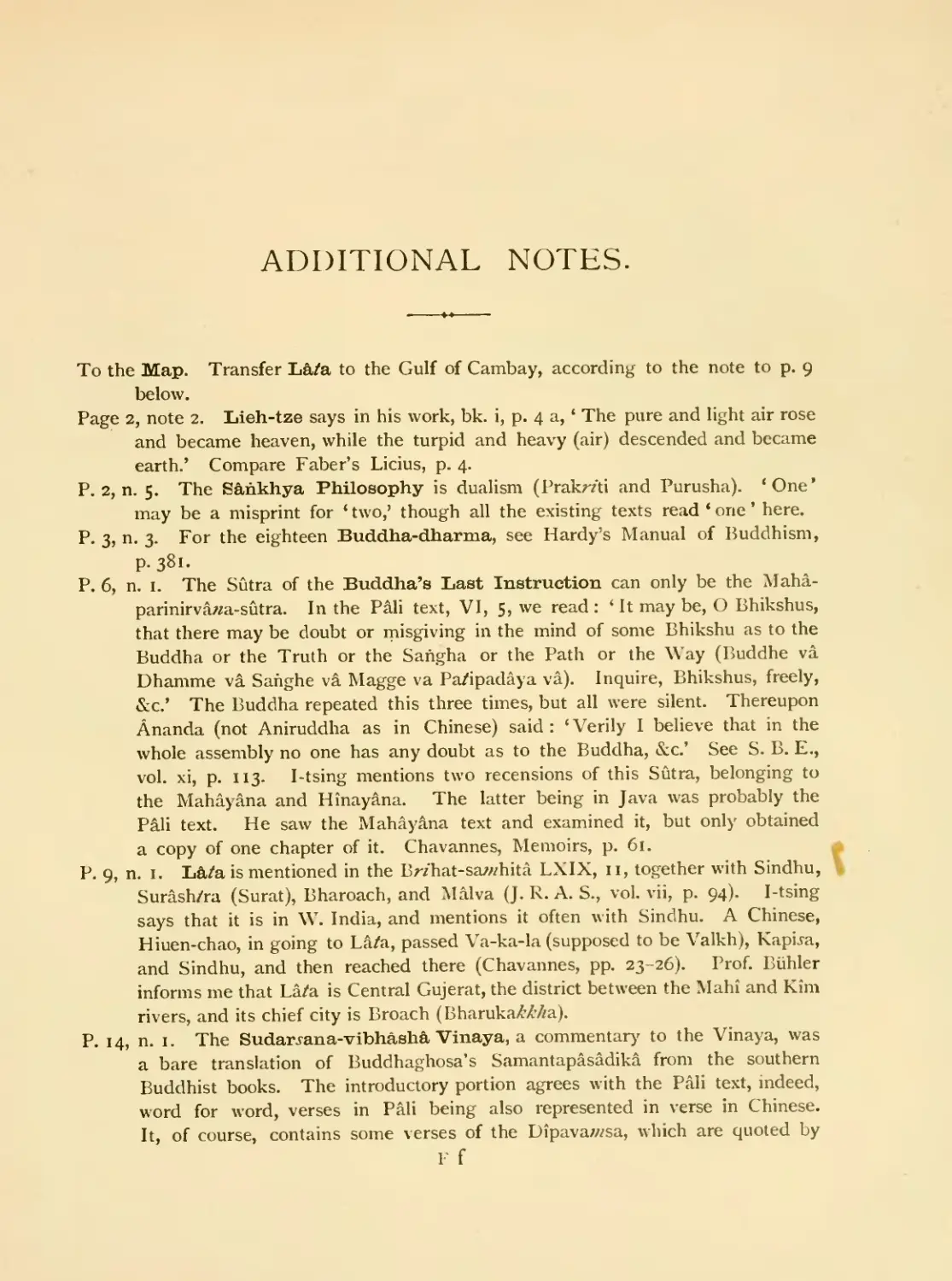
Additional Notes ......
Corrigenda ........
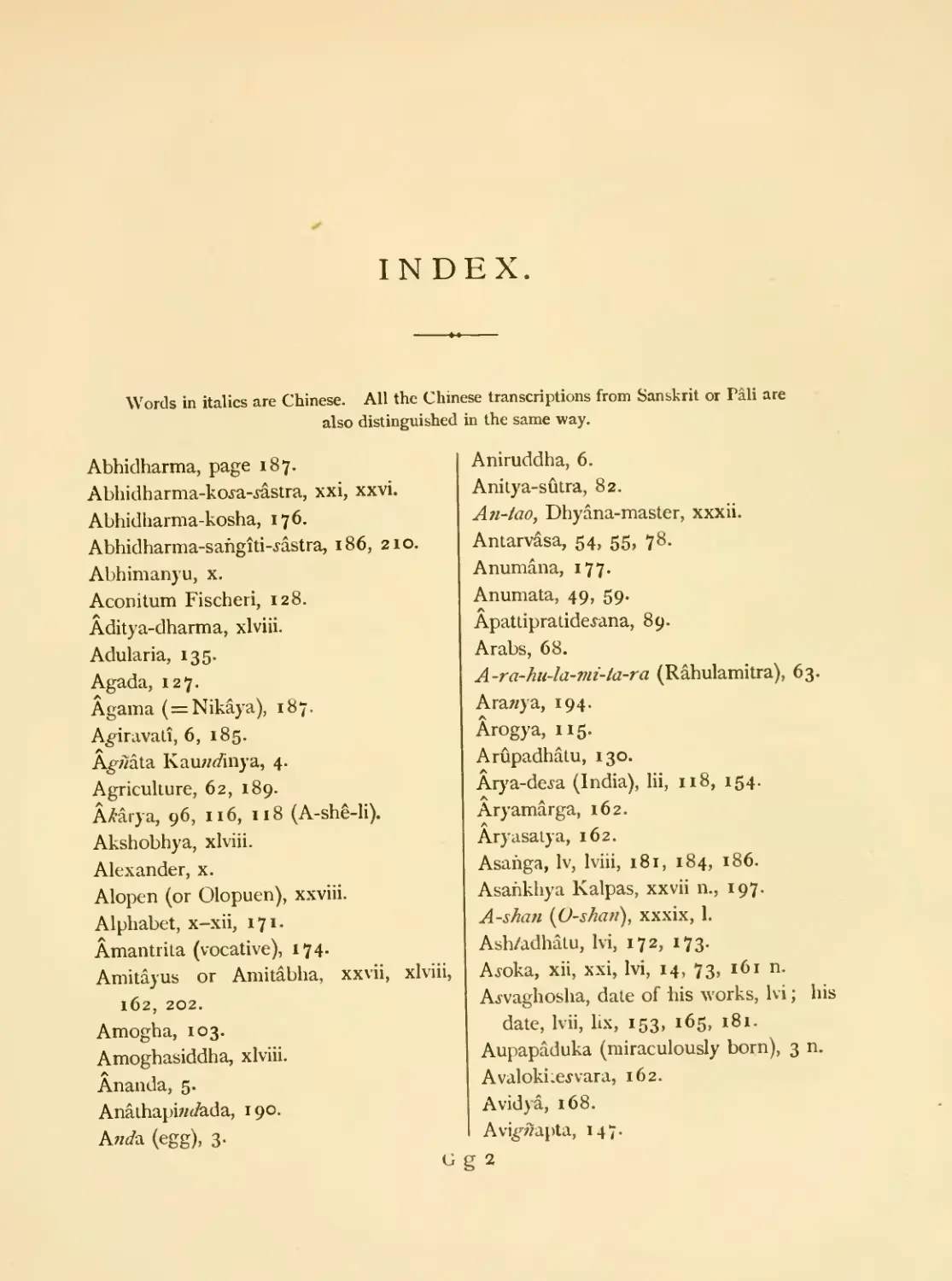
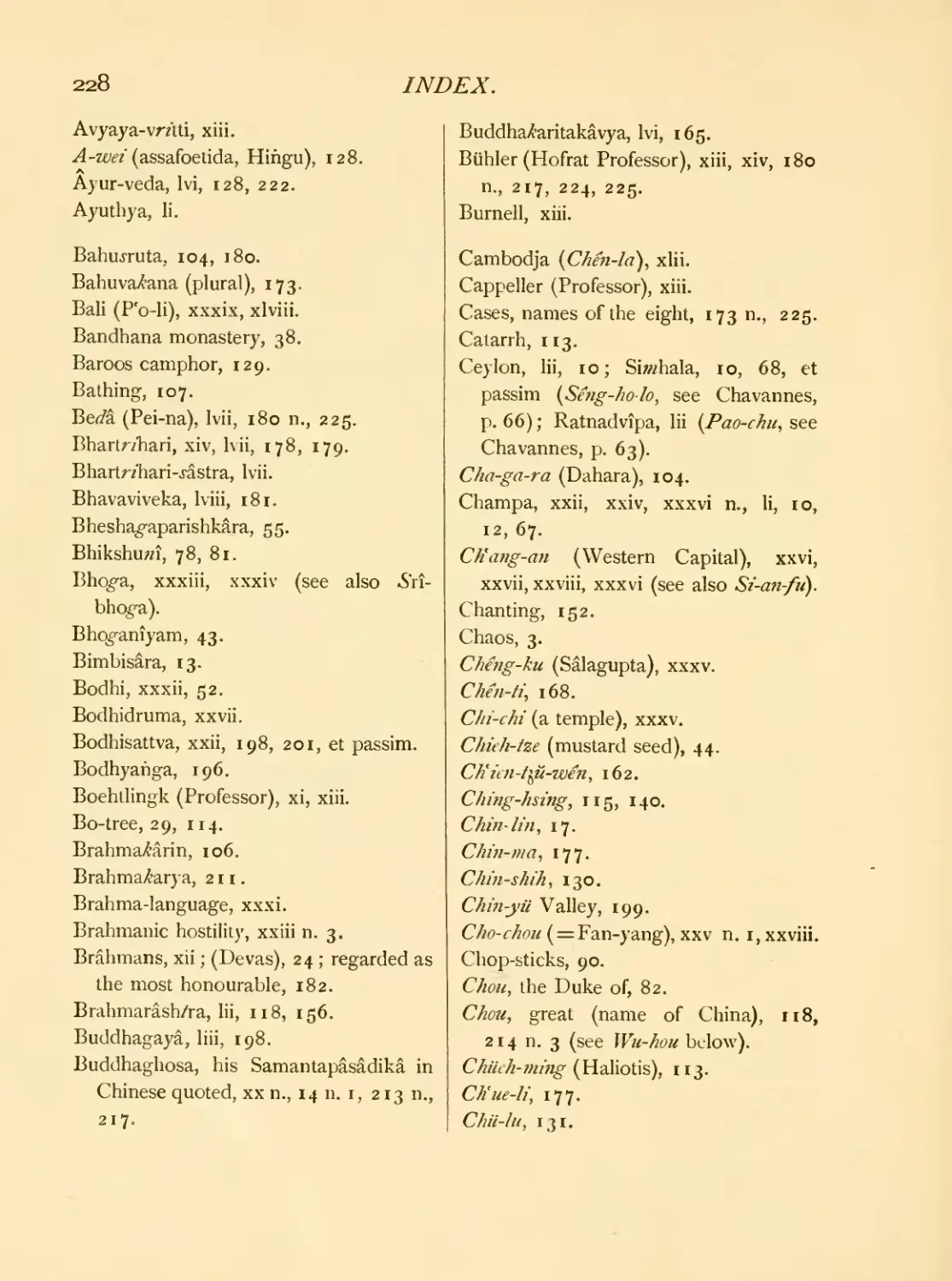
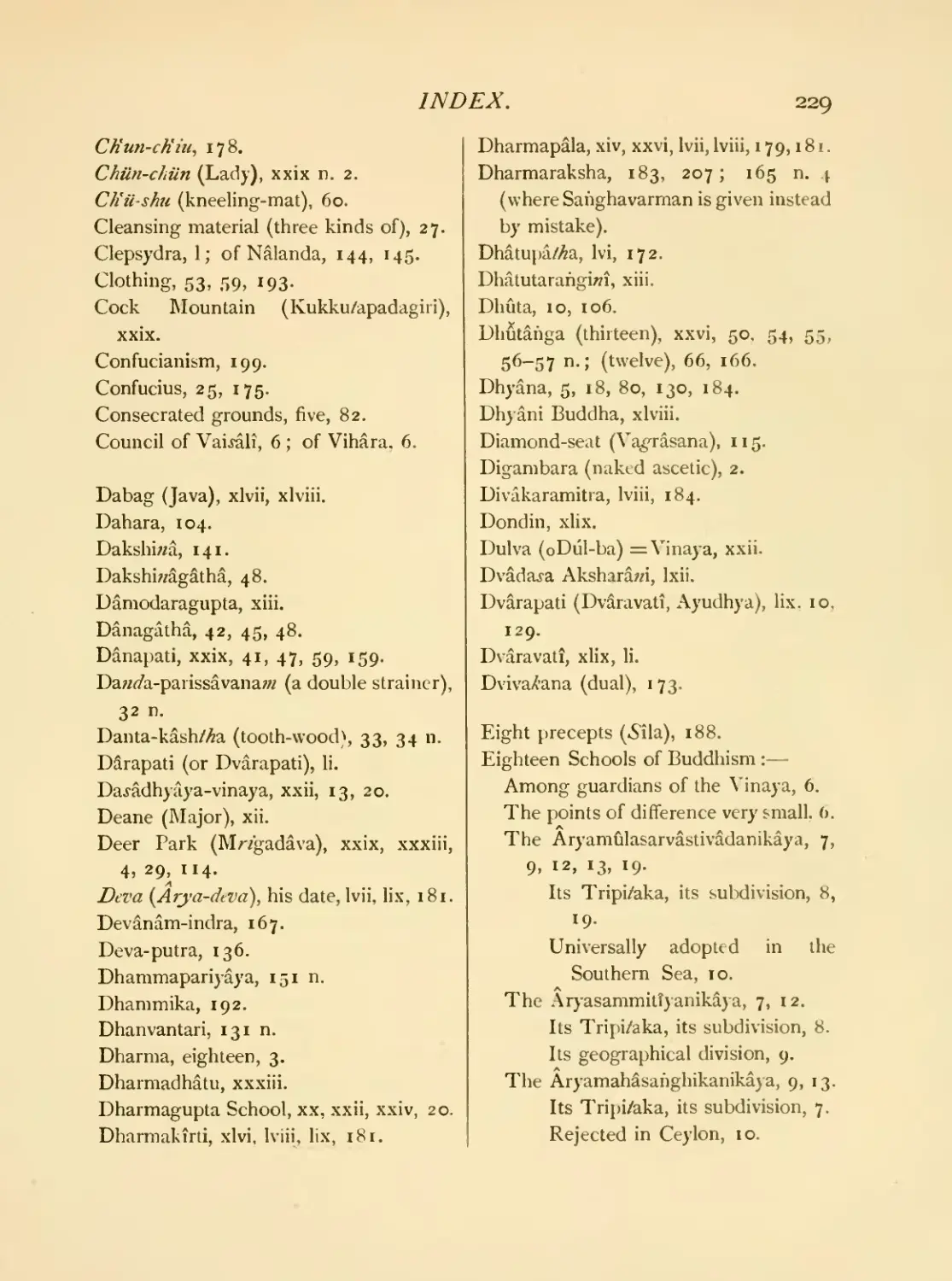
Index .......
PAGE
166
167
185
189
J 93
195
197
198
216
217
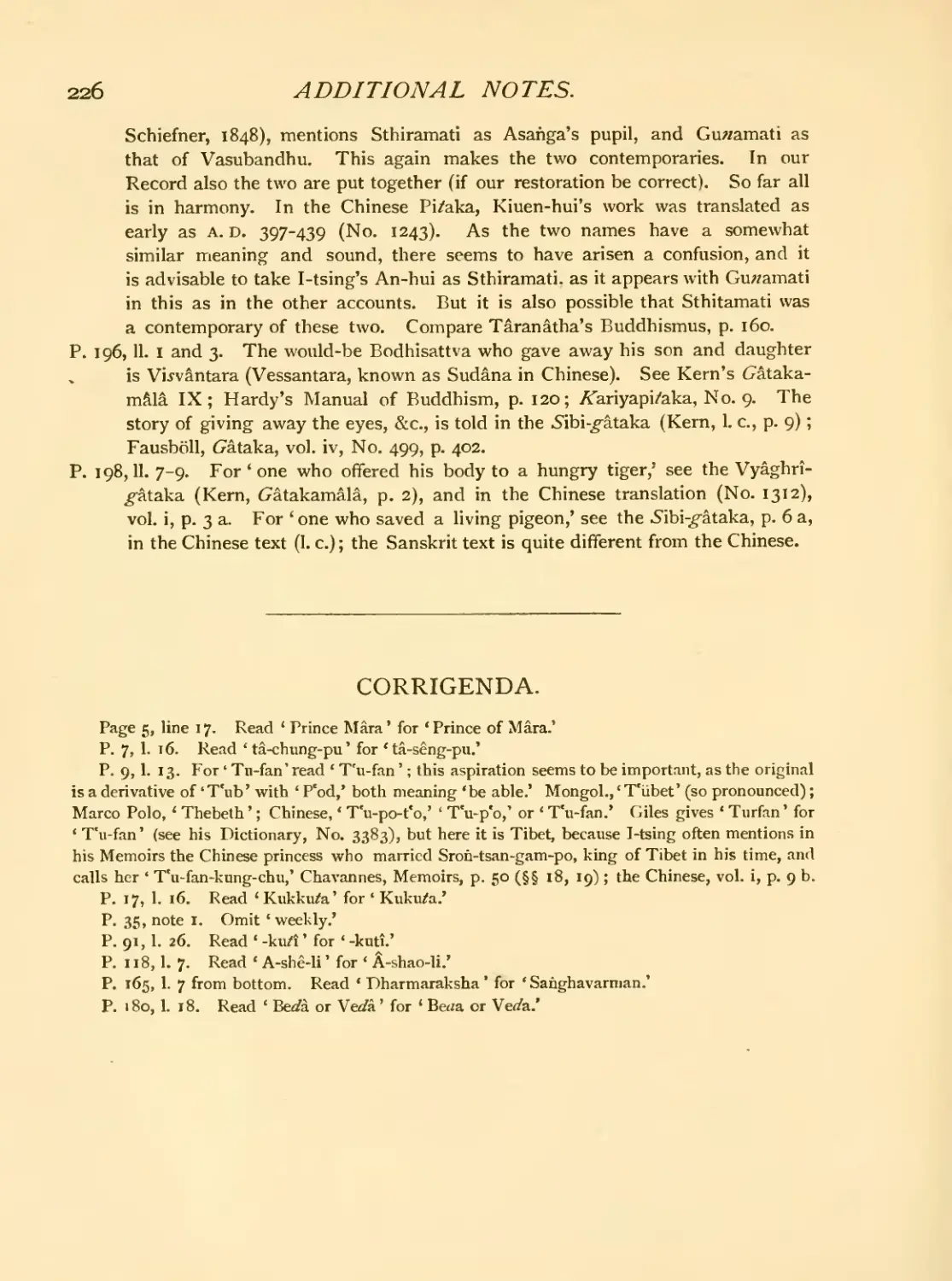
226
227

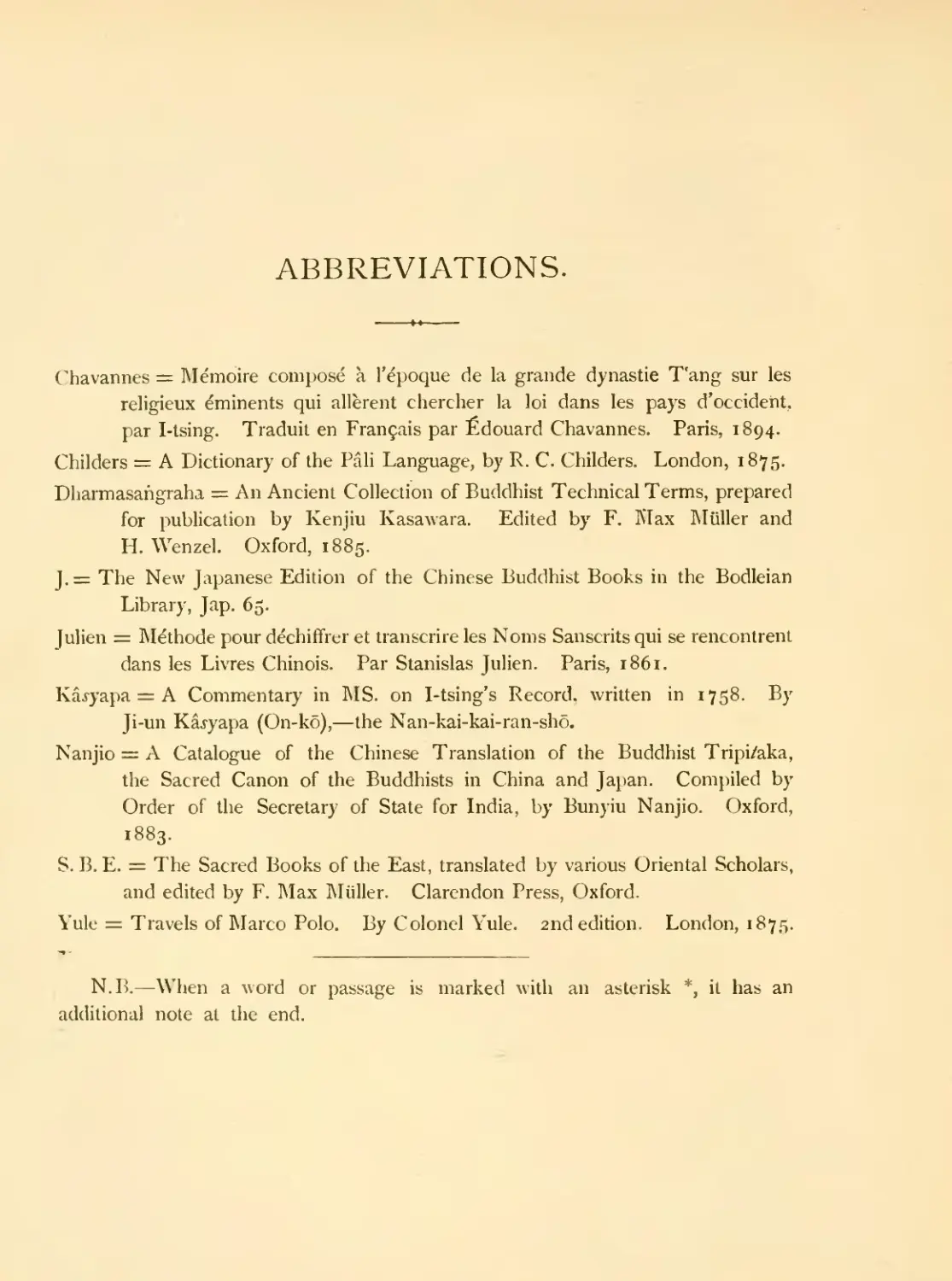
ABBREVIATIONS,
Chavannes = Memoire compose a Tepoque de la grande dynastie T'ang sur les
religieux eminents qui allerent chercher la loi dans les pays d'occideht,
par I-tsing. Traduit en Francais par EMouard Chavannes. Paris, 1894.
Childers = A Dictionary of the Pali Language, by R. C. Childers. London, 1875.
Dharmasahgraha = An Ancient Collection of Buddhist Technical Terms, prepared
for publication by Kenjiu Kasawara. Edited by F. Max Miiller and
H. Wenzel. Oxford, 1885.
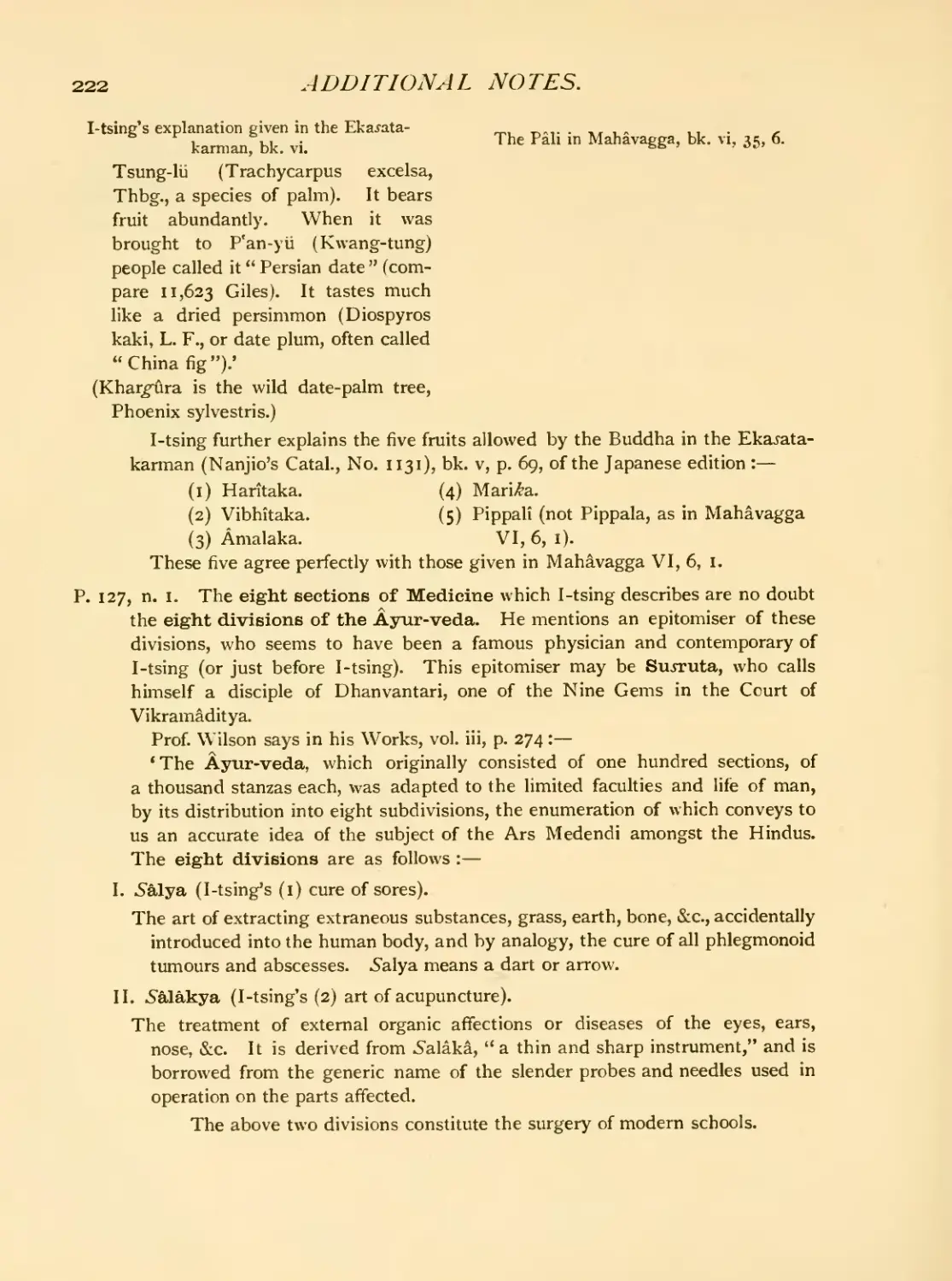
J.= The New Japanese Edition of the Chinese Buddhist Books in the Bodleian
Library, Jap. 65.
Julien = Me'thode pour dechiffrer et transcrire les Noms Sanscrits qui se rencontrent
dans les Livres Chinois. Par Stanislas Julien. Paris, 1861.
Ka-ryapa = A Commentary in MS. on I-tsing's Record, written in 1758. By
Ji-un Kasyapa (On-ko), — the Nan-kai-kai-ran-sho.
Nanjio = A Catalogue of the Chinese Translation of the Buddhist Tripi/aka,
the Sacred Canon of the Buddhists in China and Japan. Compiled by
Order of the Secretary of State for India, by Bunyiu Nanjio. Oxford,
1883.
S. B. E. = The Sacred Books of the East, translated by various Oriental Scholars,
and edited by F. Max Miiller. Clarendon Press, Oxford.
Yule = Travels of Marco Polo. By Colonel Yule. 2nd edition. London, 1875.
N.B. — When a word or passage is marked with an asterisk *, it has an
additional note at the end.

LETTER FROM THE RIGHT HONOURABLE
PROFESSOR F. MAX MULLER
TO
MR. J. TAKAKUSU.
Oxford :
January, 1896.
My dear Friend,
Ever since I made the acquaintance of Stanislas Julien at Paris,
in 1846. being constantly with him while he translated Hiuen Thsang's
Travels in India, I felt convinced that the most important help for settling
the chronology of mediaeval Sanskrit literature would be found in Chinese
writers. I was particularly anxious for a translation of I-tsing's work ;
and as far back as 1880 1 I expressed a hope that the Record of that
great Chinese traveller's stay in India would soon be rendered accessible
to us in an English translation. Some of the contents of his book became
known to me through one of my Japanese Buddhist pupils, Kasawara ;
but he unfortunately died before he could finish his translation of the
whole Record. From the fragments of his translation, however,
I gathered some important facts, which were published first in the
Academy, October 2, 1880, then in the Indian Antiquary 2 , and in the
1 See the Academy, October 2, 18S0.
2 See further on, p. xviii, 2.
b

x LETTER FROM PROFESSOR F. MAX MULLER
appendix to my ' India, what can it teach us ? ' under the title of
Renaissance of Sanskrit Literature.
From I-tsing or from any of the Chinese travellers in India we must
not expect any trustworthy information on the ancient literature of
India. What they tell us, for instance, on the date of the birth of
Buddha, is mere tradition, and cannot claim any independent value. It is
interesting to know that the name of Pacini and his great Grammar were
known to them, but what they say about his age and circumstances
does not help us much. All that is of importance on this subject has
been collected and published by me in my edition of the PratLrakhya,
1H56, Nachtrage, pp. 12-15.
The date of Pacini can be fixed hypothetically only. It has been
pointed out that Pata/z^ali in his Mahabhashya speaks of Pushpamitra,
and according to some MSS. of isfandragupta also. A'andragupta was
the founder of the Maurya dynasty, Pushpamitra was the first of the
dynasty which succeeded the Mauryas. As it seems that Pata^ali in
one place implies the fall of the Mauryas, which happened in 178 B.C., it
has been supposed that he must have lived about that time. And this
date seemed to agree with the statement, contained in the Ra^atarangi//}
(1148 A.D.), that his work, the Mahabhashya, was known in Kashmir
under king Abhimanyu, that is, in the middle of the first century B.C.
As there is a series of grammarians succeeding each other between
Pata/^ali and Pacini, it was argued with some degree of plausibility that
Pacini cannot have lived later than the fourth century B. C.
But all this is constructive chronology only, and would have to
yield as soon as anything more certain could be produced. It was
quite right, therefore, that Professor Weber, of Berlin, should point
out and lay stress on the fact that Pacini quotes an alphabet called
Yavanani which he (Weber) takes to mean Ionian or Greek. This
alphabet, he argues, could not have been known before the invasion of
Alexander, and Pacini could therefore not have written before 320 B.C.

TO MR. J. TAKAKUSU. xi
Although Professor Boehtlingk maintains that writing, at least for
monumental purposes, was known in India before the third century, he
has produced no dated inscription to support his assertion, still less has
he proved that this non-existent alphabet was called Yavandnt We
cannot deny the possibility that a knowledge of alphabetic writing may
have reached India before the time of Alexander; nor need Yavandnt
have meant Ionian or Greek. No one has ever held that any one of
the Indian alphabets was derived direct from the Greek letters such as
they were at the time of Alexander. No writer of any authority has
derived these Indian alphabets from any but a Semitic or Aramaic
source. Even Semitic (Phenician) inscriptions before that of Eshmunezar
at the end of the fifth century B. c. (fourth century, according to Maspero)
are very scarce. I only know of that of Siloam about 700 B.C., and that
of Mesha about 900 B.C. Professor Weber's argument cannot therefore
be brushed away by a mere assertion.
Still less could any scholar say that the existence of the ancient
Vedic literature was impossible or inconceivable without a knowledge of
alphabetic writing. Where the art of alphabetic writing is known and
practised for literary purposes, no person on earth could conceal the fact,
and I still challenge any scholar to produce any mention of writing in
Indian literature before the supposed age of Pacini. To say that
literature is impossible without alphabetic writing shows a want of
acquaintance with Greek, Hebrew, Finnish, Estonian, Mordvinian, nay
with Mexican literature. Why should all names for writing, paper, ink,
stylus, letters, or books have been so carefully avoided if they had been
in daily use ? Besides, it is well known that the interval between the use
of alphabetic writing for official or monumental purposes and its use for
literature is very wide. Demand only creates supply, and a written
literature would presuppose a reading public such as no one has yet
claimed for the time of Homer, of Moses, of the authors of the Kalcvala,
of Kalevipoeg or of the popular and religious songs of Ugro-Finnish or
b 2

xii LETTER FROM PROFESSOR F. MAX MULLER
even Mexican races. To say that the art of writing was kept secret,
that the Brahmans probably kept one copy only of each work for
themselves, learnt it by heart and taught it to their pupils, shows what
imagination can do in order to escape from facts. The facts on which
I base my negative vote are these : —
The inscriptions of A.roka are still the earliest inscriptions in India
which can be dated, and the tentative character of the local alphabets in
which they are written forms in my eyes a proof of the recent intro-
duction of alphabetic writing in different parts of India. I see no reason
to doubt the possibility that the Brahmans were acquainted with alpha-
betic writing at an earlier time, and I should hail any discovery like that
of Major Deane (if indeed they are Indian inscriptions) as an important
addition to the history of the migrations of the Hieratic or so-called
Phenician alphabet. But that is very different from asserting that writing
was known, or must have been known, whether for monumental or literary
purposes, before say 400 B. C. I have still to confess my ignorance of
any book having been written on palm leaves or paper before the time
of Vattagamani (88-76 B.C.), or of any datable inscription before the
time of Asoka..
But though the works of Chinese pilgrims throw little light on the
ancient literature, or even on what I called the Renaissance period up
to 400 A. D., they have proved of great help to us in fixing the dates
of Sanskrit writers whom they either knew personally or who had died
not long before their times. I pointed this out in a paper on the Ka^ika-
vrz'tti x published in the Academy, October 2, 1880.
Professor von Boehtlingk, in the introduction to his edition of Pacini's
Grammar (p. iv), referred the Klrika-vntti to about the eighth cen-
tury A.D., on the supposition that Vamana, the author of the Kajika,
1 Ka^ika, a commentary on Pacini's Grammatical Aphorisms, by Paw/it
Vamana and Gayaditya. Edited by PaWit Balajastri (Benares, 1876, 1878).

TO MR. J. TAKAKUSU. xiii
was the same as the Vamana mentioned in the Chronicle of Kashmir
(iv, 496). Kalha/za Paw/ita, the author of that chronicle, after men-
tioning the restoration of grammatical studies in Ka^mira under CTayapi^a,
and the introduction of Pata/^ali's Mahabhashya, passes on to give
a list of the names of other learned men at the king's court, and he
mentions more particularly Kshtra (author of Avyaya-vrz'tti and the
Dhatutarangim), Damodaragupta, Manoratha, vSankhadatta, ATataka,
Sandhimat, and Vamana. This Vamana was supposed to have been
the author of the Kajika. There was nothing to support this conjecture,
and Professor von Boehtlingk has himself surrendered it.
Another conjecture was stated by Professor H. H. Wilson that the
Vamana at the court of CayapWa was the same as Vama«a, the author
of the Kavyalankara-vrztti. But this Vamana quotes among other
authors Kavira^a, the author of the Raghavapa;/^/aviya \ who lived
after 1000 A.D. 2 , while c7ayapk/a died in 776 (or 786) A.D.
Lastly Dr. Cappeller, the editor of the Kavyalankara-vrztti, after
ascribing its author Vamana to the twelfth century, tried to identify
him with Vamana, the author of the Kayika-vr/tti.
Professor Goldstiicker referred the grammarian Vamana to a period
more recent than the thirteenth century.
Among later scholars Dr. Blihler placed Vamana in the tenth, Burnell
in the twelfth century, while Schonberg 3 showed that he was quoted by
Kshemendra in the eleventh century.
This will show the uncertainty of chronology even in the later history
of Indian literature. And it will show at the same time the value of
Chinese travellers such as I-tsing. I-tsing studied Sanskrit in India
1 Pathak in Indian Antiquary, 1883, p. 20, tries to ascribe the poem to Arya
£rutakirti, Saka 1045.
2 Mr. Rice in his Karnata Authors (Journ. R. A. S., 1883, p. 298) fixes his date
at 1170 a.d.
3 Schonberg, Kshemendra's Kavikaw/Mbharawa, p. 15, note.

xiv LETTER FROM PROFESSOR F. MAX MULLER
before the end of the seventh century, and he knew the Kaj-ika-vr/tti.
This book, which is a commentary on Pacini's Sutras, was really the
work of two authors, Vamana and Cayaditya. It is sometimes ascribed
to one, sometimes to the other ; nay the two names have also been
assigned to one and the same person. There was, however, a tradition
which assigned certain portions of the Grammar to Vamana, and others
to ^ayaditya l . I-tsing quotes the VWtti-sutra as the work of Caya-
ditya. The name VWtti-sutra is strange. We expect Sutra-vrztti.
But Bhartrzhari uses the same name 2 . I-tsing states that Cayaditya
died not later than 661-662 A. D., that is, about ten years before his
own arrival in India.
It can thus be shown that what I-tsing calls a commentary on this
work, or a Kvxrn 3 , was meant for Pataw^ali's Mahabhashya, as taught
in I-tsing's time, as a commentary on the Ka^ika arrangement of the
Sutras of Pacini. Pata^ali is actually called K&rnik&ra by Bhartrzhari,
who himself commented on Pata/T^ali's Mahabhashya. This BhartrzTiari
also, a Buddhist of the Vidyamatra sect, died, as I-tsing tells us, in about
^5 l ~^5 2 A - D - Among his contemporaries is mentioned Dharmapala, and
this Dharmapala would seem to have been the teacher of Silabhadra, the
same who received Hiuen Thsang at Nalanda in 63$ a.d. Other works
of Bhartr/hari mentioned by I-tsing are the Vakya-discourse and Pei-na.
The former contains 700 jlokas, and its commentary 7,oco .riokas. As
it is a grammatical work, we can hardly be wrong in taking it to be
Bhartrz'hari's Vakyapadiya 4 . As to the Pei-na, Professor Buhler has
proposed a very ingenious conjecture that it may stand for Be^a, a boat,
i.e. a commentary 5 . Such a name, however, never occurs with reference
to any work of BhartrzTiari.
1 Below, p. 176, note 3.
2 Mahabhashya, ed. Kielhorn, vol. ii, p. iii, p. 21. 3 Below, p. 178, note 2.
4 Cp. Kielhorn, Indian Antiquary, xii, p. 226.
8 Below, p. 225, additional note to p. 180.

TO MR. J. TAKAKUSU. xv
I need not repeat what I have written in my ' India, what can it teach
us 1 ?' about the remaining grammatical works, the book on the so-called
Three Khilas, the Dhatupa//£a, and the Si-t'an-chang, mentioned by
I-tsing. Some difficulty still remains as to the nature of some of these
works, but this, I hope, will be cleared up in time.
All those who know how few certain dates there are in the history of
Indian literature will welcome a text, such as I-tsing's, as a new sheet-
anchor in the chronology of Sanskrit literature. We have as yet only
three such anchors, as I have pointed out in my Introduction to the
Amitayur-dhyana-sutra 2 : —
i. The date of A'andragupta (Sandrokyptos) as fixed by Greek-
historians, and serving to determine the dates of A^oka and
his inscriptions in the third, and indirectly of the Buddha in
the fifth century, before our era.
2. The dates of several literary men as supplied by Hiuen
Thsang's travels in India (a.d. 629-645).
3. The dates supplied by I-tsing in the latter half of the seventh
century (a.d. 671-695).
The most important of all the dates given by I-tsing are those of
Bhartr/hari, Cayaditya, and their contemporaries. They serve as
a rallying-point for a number of literary men belonging to what I called
the ' Renaissance period of Sanskrit literature.'
Let me now congratulate you on the completion of your translation,
which realises a wish long entertained by me. Your work will be
a lasting memorial of my dear departed pupil Kasavvara, who began it,
though he was not allowed to finish it. It will show what excellent and
useful work may be expected from Japanese scholars. If I have gladly
1 The 1st edition, 1883, pp. 343-345-
2 S. B. E., vol. xlix, translated by Takakusu. See my Introduction, p. xxi.

xvi LETTER FROM PROFESSOR F. MAX MULLER.
given my time and help to you as formerly to Kasawara and Bunyiu
Nanjio, it was not only for the sake of our University, to which you
had come to study Sanskrit and Pali, but in the hope that a truly
scholarlike study of Buddhism may be revived in Japan, and that your
countrymen may in time be enabled to form a more intelligent and
historical conception of the great reformer of the ancient religion of
India. Religions, like everything else, require reform from time to time ;
and if Buddha were alive in our days he would probably be the first
to reform the abuses that have crept into the Buddhism of Tibet,
China, and Japan, as well as of Ceylon, Burma, and Siam. A reformed
Buddhism, such as I look forward to, would very considerably reduce
the interval which now separates you from other religions, and would
help in the distant future to bring about a mutual understanding and
kindly feeling between those great religions of the world in place of
the antagonism and the fiendish hatred that have hitherto prevailed
among the believers in Christ, in Buddha, and Mohammed— a disgrace
to humanity, an insult to religion, and a lasting affront to those who
came to preach peace on earth, and good will toward men.
Your sincere Friend,
F. Max Muller.

GENERAL INTRODUCTION.
Preliminary Remarks.
After the introduction of Buddhism into China, a.d. 67 ', Fa-hien was the first
to make a pilgrimage in India, the holy land of the Buddhists. His journey,
which lasted about sixteen years (a.d. 399-414), was detailed in his F6-kue-ki 2 .
Next followed the travels of Sun-yun and Hwui-seng, a.d. 518; unfortunately,
however, their narrative 3 is very short, and not to be compared with that of the
other travellers. Much later, in the T'ang dynasty, the Augustan age of Chinese
Buddhist literature, we have first the famous Hiuen Thsang, of whom we know so
much through his work, Si-yu-ki, the Record of the Western Kingdom 4 . His
travels in India covered some seventeen years (a.d. 629-645), and anything that
came under his notice was fully recorded in the said work, which is an
indispensable text-book for Indian history and geography.
Soon after Hiuen Thsang's death, another, by no means less famous, Buddhist,
I-tsingby name, started for India, a.d. 671, and arrived in Tamralipti, at the mouth
of the Hooghly, a.d. 673. He studied in Nalanda, the centre of Buddhist learning,
at the east end of the Ra^agr/ha valley, for a considerable time, and collected some
400 Sanskrit texts, amounting to 500,000 .dokas. On his way home he stayed
1 This is the date of the arrival of the first Indian Sramanas, Kasyapa Matanga and Bharn//a
(or Dharmaraksha), who were invited by the Chinese Emperor Ming-ti (A.D. 58-75^, and it is
the historical beginning of Buddhism in China, though there are some traces of it in the earlier
literature.
2 Fa-hien's F6-kue-ki, by Remusat, 1836; by Beal, 1869 and 1S84; by H. A. Giles, 1877 ;
a notice by T. Waiters in the China Review, 1879 an & *88o; lastly by Professor Legge, 1886
(Clarendon Press).
3 A translation in Beal's Fa-hien, pp. 174-208.
4 Memoires sur les Contrees Occidentales, by Stan. Julien, 1858; the Records of the Western
Kingdoms, by Beal, 1884; Histoire de la Vie de Hiouen Thsang, by Julien, 1853 ; the Life of
Hiuen Thsang, by Beal, 1888.
C

xviii GENERAL INTRODUCTION.
in Sribho^a (Palembang, in Sumatra), where he further studied and translated
Buddhist books, either Sanskrit or Pali.
From £ribho£-a, I-tsing sent home his work, which is here translated, a.d. 692,
through another Chinese priest, Ta-ts'in, who was then returning to China. The
book is therefore called ' Nan-hai-chi-kuei-nai-fa-ch'uan,' a ' Record of the Inner
Law sent home from the Southern Sea 1 / the islands which lie off the Malay
peninsula being then known as the islands of the Southern Sea. Our author
returned home a.d. 695, and was well received by the ruling empress, Wu-hou of
Chou (as the period of her reign was called). Thus his stay abroad covers,
roughly speaking, a period of twenty-five years (a.d. 671-695), though we must
allow a few months' stay at home after his chance return to China, about which we
shall have to speak presently. After 695 he was at home engaged in interpreting
Buddhist texts with some nine Indian priests, -Sikshananda, iyvara, and others.
He completed fifty-six translations in 230 volumes, a.d. 700-712 ; besides, there
exist five works of his compilation 2 , among which the chief is our Record here
given.
Now as to our knowledge of this book.
1. Mons. Stanislas Julien made use of our Record in collecting the specimens
of the Chinese transcriptions of Sanskrit terms, as may be seen in his Methode
pour de'chiffrer et transcrire les Noms Sanscrits qui se rencontrent dans les Livres
Chinois (Paris, 1861).
2. Prof. Max Miiller first recognised the importance of the contents of this work.
His earliest notice about the grammatical works mentioned by I-tsing appeared in
the Academy for September 25 and October 2, 1880; the next in the Indian
Antiquary for December, 1880 (p. 305). A portion of the translation prepared by
the late Kenjiu Kasawara, a Japanese Buddhist and pupil of the Professor, was
published in ' India, what can it teach us?' 1883, pp. 210-213 and 343 _ 349 3 -
3. Mr. Samuel Beal's notice of I-tsing's work appeared in the Indian Antiquary,
1 88 1, p. 197. Some matters contained in it were discussed by him in the Academy
for September 9, 1883. He gave also a short abstract of the Record as well as the
Memoirs in his Life of Hiuen Thsang, 1888, pp. xxxii-xxxvi.
4. Prof. W. Wassilief published a Russian translation of chapter ix of our
Record in the Memoirs of the Historico-Philological Branch of the Academy,
1 Nanjio's Catalogue of the Chinese Buddhist Books, No. 1492.
2 Loc. cit, Nos. 1491, 1506, 1507, 1508.
3 See pp. 183, 296 ff., in Prof. Cappeller's German translation, Indien in seiner weltgeschicht-
lichen Bedeutung, Leipzig, 1884.

PRELIMINARY REMARKS. *ix
St. Petersburg, for October 24, 1888. I have carefully compared his translation
with mine, with the help of Dr. Grusdef of Moscow. Both agree on the whole,
while there are many insignificant points in which we differ from each other ; but
I am glad to say that there was nothing to necessitate an alteration of my trans-
lation, which was already printed, when I received a copy of the Russian translation
through the kindness of Prof. Serge d'Oldenbourg.
5. Mr. R. Fujishima, a Japanese priest, translated into French two chapters of
the forty in the Journal Asiatique for November-December, 1888, entitled 'Deux
Chapitres des Memoires d'1-tsing,' pp. 41 1-439. The points of difference between
his renderings and mine have been carefully noted in the present work, for these
chapters (xxxii and xxxiv) are of special importance, inasmuch as they contain the
names and dates of several literary men of India, the account of an eye-witness,
which cannot be obtained from any other source.
Mr. Kasawara left his MS. with Prof. Max Miiller when he went home from
England in 1881. We see, in the Journal of the Pali Text Society, 1883, p. 71,
how the Professor was entertaining the hope of printing our Record. He says :
1 I may add that I possess an English translation of I-tsing's " Nan-hai-chi-kuei-
nai-fa-ch'uan," made by Kasawara during his stay at Oxford. It is not complete,
and he hoped to finish it after his return to Japan, where a new edition of the
Chinese text is now being published from an ancient Korean copy, collated with
several Chinese editions. With the help, however, of Mr. Bunyiu Nanjio and some
other scholars, I hope it will be possible before long to publish Kasawara's trans-
lation of that important work.' Mr. Nanjio once examined the MS., and noted:
' Kasawara leaves out more than a half of the original work in his translation.
But I think the portion he has translated agrees with the original pretty well.'
In reality his translation covered some seventy-two pages out of 206 in all, the
obscure and uninteresting portion naturally being left out. With the exception of
chapters xxxii and xxxiv, his MS. was either incomplete or an abstract only. It
was his labour, however, that prepared the way for my present work, and the
memory of his early death continually served to encourage me while handling his
MS. or trying to make out the obscure passages of our Record.
The object of I-tsing's work was to correct the misrepresentations of the
Vinaya rules, and to refute the erroneous opinions held by the schools of the
Vinaya-dharas then existing in China. He therefore dwells chiefly on the monastic
life and discipline of his time ; but mingled with this we have also several important
facts recorded in our work. As to the importance of I-tsing's contribution to the
history of Indian literature (chaps, xxxii, xxxiv), the book will speak for itself.
The other chapters also are indispensable for the study of the development of
c 2

xx GENERAL INTRODUCTION.
Buddhism, especially of the Schools of the Chinese Vinaya, our knowledge of
which is still very limited. The present work is an exclusive representation of the
Mulasarvastivada School, one of the four chief Nikayas prevalent in India, and this
will, I hope, lead some Chinese scholars to a study of the Vinaya, which is still
almost an unbeaten track in Chinese literature. The Vinaya of this particular
school is rich and by far the most complete of all, having also with it a complete
commentary (Vibhasha) and several ' helps ' to its study, almost all of which
have been translated by I-tsing himself (below, p. xxxvii). We have, besides, two
other Vinaya-pi/akas, which bear a close relation to the above, belonging to the
Mahuasaka and Dharmagupta Schools — two subdivisions of the Mulasarvastivada,
according to I-tsing (p. 20) 1 . All these schools are known both to the Sinhalese
and to the Tibetans, and the Mahuasaka and Sarvastivada existed as early as
Axoka's time; both of them are said to have developed out of the Sthavira-nikaya,
which is identified by Prof. Oldenberg with the Vibha^yavadi 2 of the historical
records of Ceylon (the name being also found in Tibetan and Chinese). We have
now in existence the Vinaya-pi/aka in six recensions, represented in three languages.
The complete text of the Theravada is preserved in Pali (1), which in substance
closely corresponds with the Mahuasaka-vinaya in Chinese (2) 3 ; that of the Mula-
sarvastivada in Tibetan (3) as well as in Chinese (4), along with these that of the
Dharmagupta — a subdivision of the last (5). Moreover, of the school furthest
removed from the orthodox, we have the Mahasanghika-vinaya (6), in a complete
state, brought home by Fa-hien, a.d. 414, from Pa/aliputra, and translated
a.d. 416.
Seeing that we have such ample materials, a careful examination of them and
a scientific comparison of all the results would much help us in ascertaining the
stages of development of the traditional opinions of all the schools, for the Vinaya
was held by them as the most important in determining the difference of traditions
handed down by various authorities. When all these works have been examined,
and the historical developments traced out, some chapters of our Record relating
1 But it does not necessarily follow that the subdivisions are chronologically later than the
school to which they belong, for it is possible that the schools which had been originally
independent may later have come under a more flourishing school and made it the chief, seeing
that there are not many material differences in their doctrines. In the Dipavawsa the
Sarvastivada is said to have separated itself from the Mahuasaka.
' Vinaya-pi/akam, p. xvii. In the Chinese translation of Buddhaghosa's Samantapasadika, the
Vibhajgavadi, under Anoka's Council, is rendered Fen-pieh-shuo, 'He who adheres to the doctrine
of distinction.' Nanjio's Catal., No. 11 25 ; book ii, fol. 9*.
3 Vinaya-pi/akam, p. xlvii.

PRELIMINARY REMARKS. xxi
to the Disciplinary Rules, though they may seem to some to be uninteresting at
present, will, I hope, turn out a valuable manual showing how they modified and
practised the original rules of the Buddha in the seventh century of our era.
The Mulasarvastivada School.
In the course of 100-200 years after the Buddha's Nirvana 1 , that is to say,
after the Council of Vai^ali, the object of which was chiefly to refute the ten theses
of the Va^ian Bhikshus, the Buddhist Church is said to have split into various
schools. The Sarvastivada-nikaya, to which I-tsing himself belonged, as it is one of
the earliest schools, must have developed itself in the same period. In the Dipa-
vawsa V, 47, it is said that the Mahiwsasaka first separated itself from the Theravada,
and from the Mahiwsasaka, the Sabbatthivada, and Dhammagutta. The history of
our school, however, begins with the Kathavatthu of Moggaliputta Tissa (b.c. 240),
the head of Anoka's Council. It does not seem to have played a very im-
portant part at that time, for Tissa's work directs only three questions against
the Sabbatthivadas: — 1. Can an Arhat fall from Arahatship? (Parihayati Araha
Arahattati); 2. Does everything exist? (Sabbam atthiti) ; 3. Is continuation of
thought samadhi? (^itta-santati samadhiti) 2 . All these would be answered in
the affirmative by the Sabbatthivadas against the opinions of the orthodox school.
This materialistic school appears later on as the Vaibhashika, which is most
likely identical with that of Sayawa's Sarvadanana-sahgraha, — the Presentationalist,
as Prof. Cowell (p. 15) calls it. About 300 years after the Nirvawa, Katyayani-
putra compiled the GTzanaprasthana-jastra 3 , which is the fundamental work of
the Sarvastivadas. It is on this book Vasumitra and others composed, at the
time of Kanishka, an elaborate commentary called the Mahavibhasha-^astra
(No. 1263), belonging to this school, and they were consequently collectively
called the Vaibhashikas. About 400 years later, in the fifth century a.d.,
Vasubandhu wrote the Abhidharma-koja-jastra (No. 1267), in which he, as an
adherent of the Mahayana, refuted the views of the Vaibhashikas. Thereupon,
his contemporary and former teacher, Sahghabhadra of the Sarvastivada-nikaya,
refuted in turn the opinions expressed in the Koya in his Nyayanusara-jastra
(No. 1265). But it was before these two teachers that this school found a home
in C. India. Fa-hien (a.d. 399-414), who went to India to collect the Vinaya
1 Dipavawsa V, 16-18 ; Mahavawsa V, 8. 2 J. R. A. S., 1892, p. 8 f., i, a, 6 ; xi, 6.
3 Compare Hiuen Thsang's Memoires, iv, 200; YVassilief, Buddhismus, pp. 217, 21 S ;
Bumouf, Introduction, 399 ; Nanjio's Catal., No. 1275.

xxii GENERAL INTRODUCTION.
texts, says that this school was followed in Pa/aliputra as well as in China, and
that the Vinaya of it had not as yet been reduced to writing 1 . In Hiuen
Thsang's time (a.d. 629-645), this school seems to have been widely followed.
He mentions some thirteen places as belonging to it ; Kashgar, Udyana, and many
other places on the northern frontier, Persia in the west, Matipura, Kanoj, and
a place near Ra^agnba in C. India. The Tibetan Vinaya, which was translated
between the seventh and thirteenth centuries 2 , is said to belong to this school 3 ,
though the analysis of the Dulva ( = Vinaya) in reality presents a closer resem-
blance to the Da^adhyaya-vinaya, which is, according to I-tsing, not exactly the
text of the Sarvastivadas (p. 20). I-tsing in our Record gives the geographical
extension of this school (p. xxiv). It flourished in C. and N. India, and had some
followers in E. and W. India, but it seems to have had very few adherents in
S. India, and was entirely absent in Ceylon. In Sumatra, Java, and the neigh-
bouring islands, almost all belonged to this school, and in China all the four
subdivisions of it were flourishing. Even in Champa a trace of it was found.
No other school, so far as we can ascertain, ever flourished so ividely as the
Sarvastivada, either before or after the seventh century ; though its adherents in
India alone, in Hiuen Thsang's time, were not so numerous as those of the other
schools 4 .
This school no doubt belongs to the Hinayana, though our author does
not expressly say so. He mentions the two Bauddha systems, Madhyamika
(of Nagargnna) and Yoga&irya (of Asahga), found in Sayawa's philosophical work,
and says that only these two were the Mahayana then existing or that ever
existed. I-tsing makes an attempt to harmonise the two extreme Yanas, pointing
out some facts common to both, such as the adoption of the same Vinaya and the
same Prohibitions (p. 14). What constitutes the difference between the two is,
according to him, the worship of a Bodhisattva and the reading of a Mahayana-
sutra, which are peculiar to the Mahayanists. But it seems to have been the
case that some of the eighteen schools, after coming into contact with the
Mahayana, adopted its custom, or at all events, studied its system along with
their own 6 . I-tsing' s statement (p. 14) seems to imply that one and the same
1 Chap, xxxix ; Legge, p. 99.
2 As. Res. xx, p. 41 seq. The first Buddhist king, Sroh-tsan-gam-po, sent his minister,
Thonmi Sambhota, to India for the scriptures in 632 a. d.
3 Wassilief, Buddhismus, p. 96. 4 J. R. A. S., 1891, p. 420.
5 The Mahabodhi-vihara in Gaya, for instance, adheres to the Sthavira School, yet belongs
also to the Mahayana ; the surrounding circumstances may have occasioned this. See below
p. xxxii, note 2.

BUDDHIST SCHOOLS. *»"
school adheres to the Hinayana in one place and to the Mahayana in another ;
a school does not exclusively belong to the one or the other.
As to the difference of the opinions held by the eighteen schools, he does
not say a word ; but we can see, from the fact that he is very particular in stating
that his Record is in accordance with his own school only and no other \ that the
opinions of the other schools were irreconcileable. He gives some trifling points
of difference in their practices, such as the arrangement of lodging-places, the
methods of accepting alms or wearing garments ", though they are not sufficient to
draw a line between the Mulasarvastivada-nikaya and the other schools 3 .
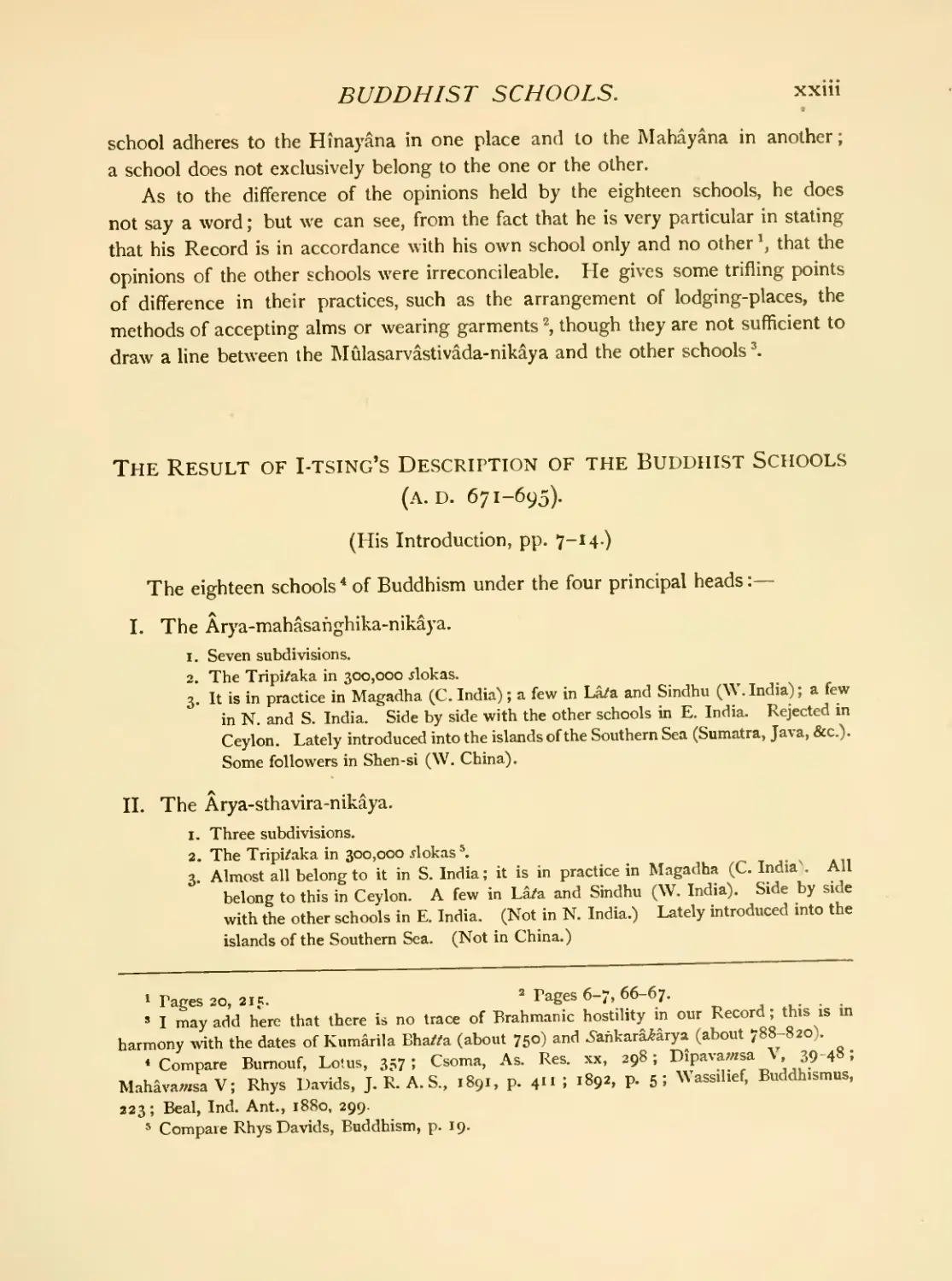
The Result of I-tsing's Description of the Buddhist Schools
(a. d. 671-695).
(His Introduction, pp. 7-14-)
The eighteen schools 4 of Buddhism under the four principal heads :—
I. The Arya-mahasahghika-nikaya.
1. Seven subdivisions.
2. The Tripi/aka in 300,000 5lokas.
3. It is in practice in Magadha (C. India) ; a few in La/a and Sindhu (\Y. India) ; a few
in N. and S. India. Side by side with the other schools in E. India. Rejected in
Ceylon. Lately introduced into the islands of the Southern Sea (Sumatra, Java, &c).
Some followers in Shen-si (W. China).
II. The Arya-sthavira-nikaya.
1. Three subdivisions.
2. The Tripi/aka in 300,000 .rlokas 5 . r A - ^
3 Almost all belong to it in S. India ; it is in practice in Magadha (C. India . All
belong to this in Ceylon. A few in La/a and Sindhu (W. India). Side by side
with the other schools in E. India. (Not in N. India.) Lately introduced into the
islands of the Southern Sea. (Not in China.)
» Tages 20, 21 5 . * Pages 6-7, 66-67. .,*...
* I may add here that there is no trace of Brahmanic hostility in our Record; this is in
harmony with the dates of Kumarila Bha//a (about 750) and ^ankaraiarya (about 788-820).
* Compare Burnouf, Lotus, 357 5 Csoma, As. Res. xx, 298; Dipavawsa \ 39-48 5
Mahava/«saV; Rhys Davids, J. R. A. S., 1891, p. 4"; 1892, p. 5 i Wassihef, Buddhismus,
223; Beal, Ind. Ant., 1880, 299.
5 Compare Rhys Davids, Buddhism, p. 19.

xxiv GENERAL INTRODUCTION.
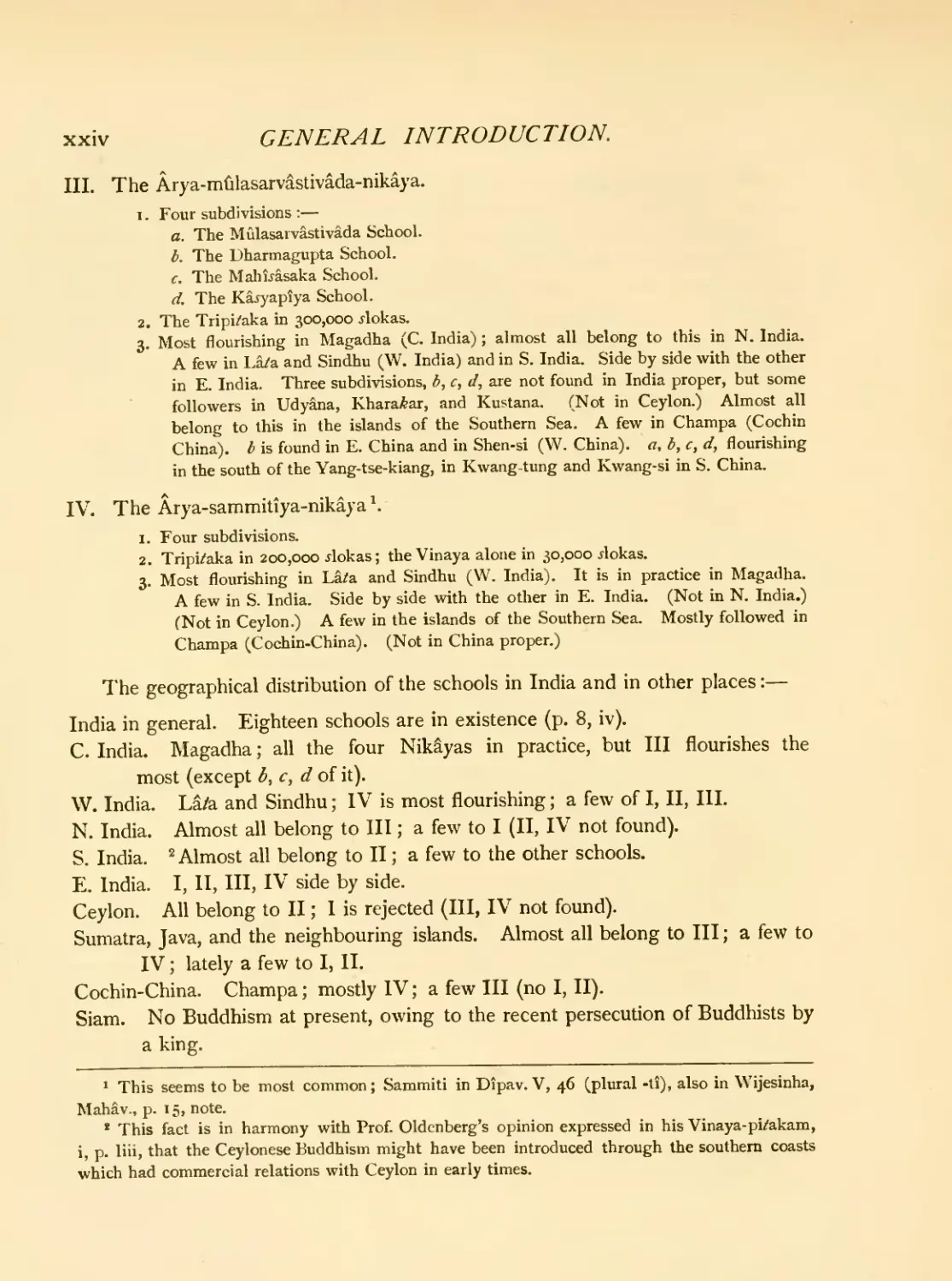
III. The Arya-mulasarvastivada-nikaya.
i. Four subdivisions : —
a. The Mulasarvastivada School.
b. The Dharmagupta School.
c. The Malmasaka School.
d. The Kasyapiya School.
2. The Tripi/aka in 300,000 jlokas.
3. Most flourishing in Magadha (C. India) ; almost all belong to this in N. India.
A few in La/a and Sindhu (W. India) and in S. India. Side by side with the other
in E. India. Three subdivisions, b, c, d, are not found in India proper, but some
followers in Udyana, Khara£ar, and Kustana. (Not in Ceylon.) Almost all
belong to this in the islands of the Southern Sea. A few in Champa (Cochin
China), b is found in E. China and in Shen-si (W. China), a, b, c, d, flourishing
in the south of the Yang-tse-kiang, in Kwang-tung and Kwang-si in S. China.
IV. The Arya-sammitiya-nikaya 1 .
1. Four subdivisions.
2. Tripi/aka in 200,000 .flokas; the Vinaya alone in 30,000 .dokas.
3. Most flourishing in lAta. and Sindhu (W. India). It is in practice in Magadha.
A few in S. India. Side by side with the other in E. India. (Not in N. India.)
(Not in Ceylon.) A few in the islands of the Southern Sea. Mostly followed in
Champa (Cochin-China). (Not in China proper.)
The geographical distribution of the schools in India and in other places : —
India in general. Eighteen schools are in existence (p. 8, iv).
C India. Magadha ; all the four Nikayas in practice, but III nourishes the
most (except b, c, d of it).
\V. India. La/a and Sindhu ; IV is most nourishing ; a few of I, II, III.
N. India. Almost all belong to III ; a few to I (II, IV not found).
S. India. 2 Almost all belong to II ; a few to the other schools.
E. India. I, II, III, IV side by side.
Ceylon. All belong to II ; I is rejected (III, IV not found).
Sumatra, Java, and the neighbouring islands. Almost all belong to III ; a few to
IV ; lately a few to I, II.
Cochin-China. Champa; mostly IV; a few III (no I, II).
Siam. No Buddhism at present, owing to the recent persecution of Buddhists by
a king.
1 This seems to be most common; Sammiti in Dipav. V, 46 (plural -ti), also in Wijesinha,
Mahav., p. 15, note.
2 This fact is in harmony with Prof. Oldenberg's opinion expressed in his Vinaya-pi/akam,
i, p. liii, that the Ceylonese Buddhism might have been introduced through the southern coasts
which had commercial relations with Ceylon in early times.

LIFE AND TRAVELS OF LTSING. xxv
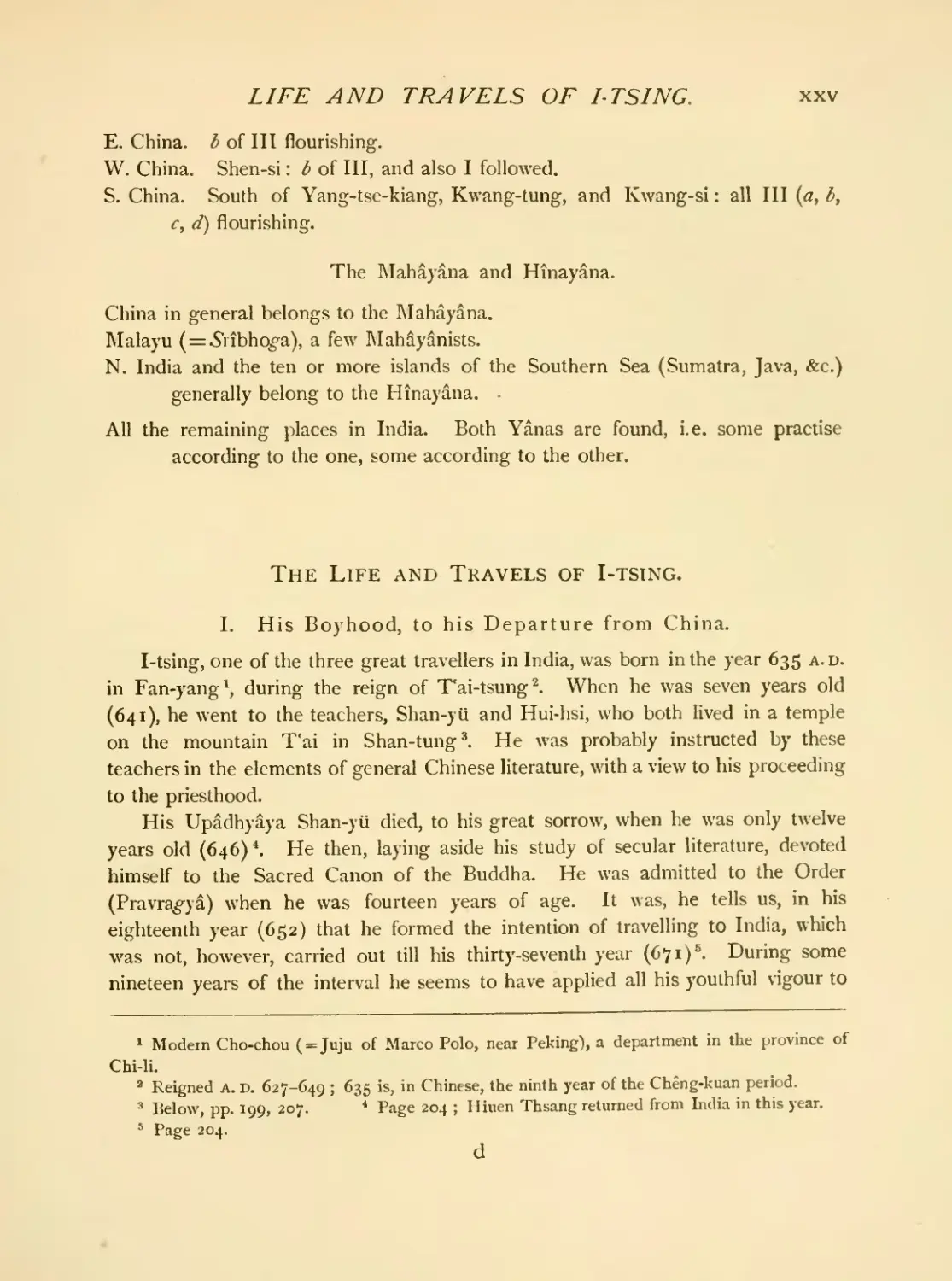
E. China, b of III flourishing.
W. China. Shen-si : b of III, and also I followed.
S. China. South of Yang-tse-kiang, Kwang-tung, and Kwang-si : all III (a, b,
c, d) flourishing.
The Mahayana and Hinayana.
China in general belongs to the Mahayana.
Malayu ( = *Sribhoo-a), a few Mahayanists.
N. India and the ten or more islands of the Southern Sea (Sumatra, Java, &c.)
generally belong to the Hinayana.
All the remaining places in India. Both Yanas are found, i.e. some practise
according to the one, some according to the other.
The Life and Travels of I-tsing.
I. His Boyhood, to his Departure from China.
I-tsing, one of the three great travellers in India, was born in the year 635 a.d.
in Fan-yang 1 , during the reign of T'ai-tsung 2 . When he was seven years old
(641), he went to the teachers, Shan-yu and Hui-hsi, who both lived in a temple
on the mountain T'ai in Shan-tung 3 . He was probably instructed by these
teachers in the elements of general Chinese literature, with a view to his proceeding
to the priesthood.
His Upadhyaya Shan-yu died, to his great sorrow, when he was only twelve
years old (646) 4 . He then, laying aside his study of secular literature, devoted
himself to the Sacred Canon of the Buddha. He was admitted to the Order
(Pravragya) when he was fourteen years of age. It was, he tells us, in his
eighteenth year (652) that he formed the intention of travelling to India, which
was not, however, carried out till his thirty-seventh year (67 1) 5 . During some
nineteen years of the interval he seems to have applied all his youthful vigour to
1 Modem Cho-chou ( = Juju of Marco Polo, near Peking), a department in the province of
Chi-li.
2 Reigned A. D. 627-649 ; 635 is, in Chinese, the ninth year of the Cheng-kuan period.
3 Below, pp. 199, 207. 4 Page 204 ; Hivten Thsang returned from India in this year.
s Page 204.
d

xxvi GENERAL INTRODUCTION.
the study of religion, so as ' not to render his life useless by indulging himself in
secular literature V
He received his Full Ordination (Upasawpada) at the required age of twenty
(654), his KarmaX-arya, Hui-hsi, then becoming his Upadhyaya to take the place
of the deceased Shan-yii. On the same day, pointing out to him the importance
of holding firm to the Noble Precepts of the Buddha, and also the fact that the
Buddha's teaching was becoming misinterpreted, the Upadhyaya instructed him in
earnest 2 . The words of his teacher must have guided him throughout the whole
of his life, for what he did or wrote afterwards perfectly accords with them.
After that incident, he devoted himself exclusively to the study of the Vinaya
text during the following five years (654-658). He made great progress in his
pursuit, and his teacher ordered him to deliver a lecture on the subject; in fact he
calls himself on one occasion * One versed in the Vinaya,' so far as the Chinese
study of it is concerned 3 .
Next to the Vinaya he proceeded to learn the larger Sutras, practising some of
the thirteen Dhutangas 4 during his residence in the mountain Vihara. Owing to
the instigation of his Upadhyaya he then went to Eastern Wei 5 to study Asahga's
two .Sastras belonging to the Abhidharma-pi/aka ; thence he moved to the
Western Capital 6 , where he further read the Abh.idharma-ko.ra and Vidyamatra-
siddhi of Vasubandhu and Dharmapala respectively 7 . While he stayed at Ch'ang-an
he may have witnessed the ' noble enthusiasm of Hiuen Thsang 8 ,' and probably
also the grand ceremony of his funeral carried out under the special direction of
the emperor, for his death occurred during I-tsing's stay in the capital (664).
Stirred up perhaps by the great personality of Hiuen Thsang and by the honour
and glory that attended him, I-tsing seems to have made a great effort to carry
out his long meditated enterprise of a journey to India, which was in his time the
home of Buddhist literature. I-tsing indeed became a great admirer of Hiuen
Thsang as well as of Fa-hien, as his biographer tells us 9 . He stayed in the
capital till a.d. 670, the year prior to his departure from home.
As to his travels, the reader will perhaps prefer to read them in I-tsing's own
words, though the record is unfortunately short 10 .
1 Page 209 ; this was his teachers instruction. 2 Page 209. 3 Page 65.
4 Compare pp. 56, 57, note. » Or, Yeh, now Chang-teh Fu in Honan.
6 Si-an Fu or Ch'ang-an (^Kenjanfu of Marco Polo) in Shen-si. 7 Page 210.
8 Compare the Life of I-tsing (Nanjio's Catal., No. 1495) ; Chavannes, Memoirs, p. 193.
See 1. c. ; for his own words about his two predecessors, see below, pp. 184, 207.
10 It would have seemed superfluous to give a long account after Hiuen Thsang ; I-tsing
must hava knowa the Si-yu-ki, see e.g. his sayings against 'Indu' (p. 11S; cf. Hiuen Thsang,
Memoires, ii. 56) and about the six seasons (p. 102, notes 3, 4).

LIFE AND TRAVELS OF I-TSING. xxvii
II. His Journey to India.
1 1, I-tsing, was in the Western Capital (Ch'ang-an) in the first year of the
Hsien-heng period (670), studying and hearing lectures. At that time there were
with me Ch'u-i, a teacher of the Law, of Ping-pu 2 ; Hung-i, a teacher of the
Sastra, of Lai-chou 3 , and also two or three other Bhadantas ; we all made an
agreement together to visit die Vulture Peak (Gr/dhraku/a), and set our hearts
on (seeing) the Tree of Knowledge (Bodhidruma) in India. Ch'u-i, however, was
drawn back by his affection towards (his home in) Ping-ch'uan 4 , for his mother
was of an advanced age, whereas Hung-i turned his thought to Sukhavati 5 on
meeting Hiuen-Chan in Kiang-ning G . Pliuen-k'uei (one of the party) came as
far as Kwang-tung ; he, however, as others did, changed his mind which he had
formerly made up. So I had to start for India, only with a young priest, Shan-
hing, of Tsin-chou 7 .
The old friends of mine in the Divine Land (China) thus unfortunately parted
with me and all went their ways, while not a single new acquaintance in India
was yet found by me. Had I hesitated then, my wish would never have been
fulfilled. I composed two stanzas imitating, though not in earnest, the poem on
the fourfold Sorrow 8 .
During my travel I passed several myriads of stages,
The fine threads of sorrow entangled my thought hundredfold.
Why was it, pray, you let the shadow of my body alone
Walk on the boundaries of Five Regions of India?
Again to console myself:
A good general can obstruct a hostile army,
But the resolution of a man is difficult to move 9 .
If I be sorry for a short life and be ever
Speaking of it, how can I fill up the long Asahkhya age 10 ?
1 The Ta-t'ang-si-yu-ku-fa-kao-seng-Ch'uan, vol. ii, fol. 4 b ; Chavannes, § 46, p. 114.
2 Ping-chou or T'ai-yuen in Shen-si.
3 Lai-chou Fu, in the Shan-tung promontory, said to have been named after the Lai aborigines.
4 A Japanese text has Ping-chou.
■ To be born in the Land of Bliss it is necessary to repeat daily the name of Amitabha
according to the Old Pure Land School ; An-yang = Sukhavati. 6 In kiang-su.
7 A place in P'ing-yang in Shen-si. This priest was a pupil of I-tsing; he came as far as
Sumatra and returned to China owing to illness, Chavannes, § 47, p. 126.
8 An ancient poem composed by Chang-heng (a.d. 78-139), loc. cit., p. 115.
9 Cf. the Analects, IX, 25.
10 A Bodhisattva passes through three Asahkhya (immeasurable: ages, practising charity, dec;
I-tsing is here alluding to this.
d 2

xxviii GENERAL INTRODUCTION.
Previous to my departure from home I returned to my native place (Cho-chou)
from the capital (Ch'ang-an). I sought advice from my teacher, Hui-hsi, saying :
' Venerable Sir, I am intending to take a long journey ; for, if I witness that with
which I have hitherto not been acquainted, there must accrue to me great
advantage. But you are already advanced in age, so that I cannot carry out my
intention without consulting you.' He answered : ' This is a great opportunity for
you, which will not occur twice. (I assure you) I am much delighted to hear of
your intention so wisely formed. If I live long enough (to see you return), it will
be my joy to witness you transmitting the Light. Go without hesitation ; do not
look back upon things left behind. I certainly approve of your pilgrimage to
the holy places. Moreover it is a most important duty to strive for the pros-
perity of Religion. Rest clear from doubt ! '
2 On the eve of my departure, I went to the tomb of my master (Shan-yii) to
worship and to take leave. At that time, the trees around the tomb (though)
injured by frost had already grown so much that each tree would take one hand
to span it 3 , and wild grasses had filled the graveyard. Though the spirit-world
is hidden from us, I nevertheless paid him all honour just as if he had been
present 4 . While turning round and glancing in every direction, I related my
intention of travelling. I invoked his spiritual aid, and expressed my wish to
requite the great benefits conferred on me by this benign personage.
e In the second year of the Hsien-heng period (671) I kept the summer- retreat
(varsha or vassa) in Yang-fu 6 . In the beginning of autumn (seventh moon) I met
unexpectedly an imperial envoy, Feng Hsiao-ch'uan of Kong-chou 7 ; by the help
of him I came to the town of Kwang-tung, where I fixed the date of meeting with
the owner of a Persian ship 8 to embark for the south. Again accepting the
1 Page 210. 2 Page 204. 3 This is an alternative translation, cf. 1. c.
4 Cf. the Analects, III, 12.
5 The Si-yu-ku-fa-kao-seng-ch'uan, vol. ii, fol. 5 a ; Chavannes, p. 116.
6 Yang-chou ( = Yangju of Marco Polo) in Kiang-su.
7 Old name for the S. E. part of Kwang-si.
In I-tsing's time there was regular navigation between Persia, India, the Malay islands, and
China. I think this explains the route of the first Nestoiian missionary, Olopuen or Alopen, who
went to China a.d. 635. Dr. Legge supposed that he would have come to China overland
through Central Asia (Christianity in China in the Seventh Century, p. 45). Dr. Edkins says
that illaditya received the Syrian Christians, Alopen and his companions, A. D. 639 (Athenaeum,
July 3, 1880, p. 8). If so, it would seem that he went back to India. If, on the other hand,
these were two different men, the fact would rather favour Yule's conjecture that Alopuen, which
is supposed to be Syriac ' Alopano,' might be merely a Chinese form of the Syriac 'Rabban,'
by which the Apostle had come to be generally known (Cathy, p. xciv). For Adam, the writer of
the Syro-Chinese inscription, see p. 169 note, and also my additional note at the end (p. 223).

LIFE AND TRAVELS OF I-TSING. xxix
invitation of the envoy I went to Kang-chou 1 , when he became my Danapati
(Benefactor) for a second time. His younger brothers, Hsiao-tan and Hsiao-chen,
both imperial envoys, Ladies 2 Ning and P'en, all the members of his family,
favoured me with presents.
Things of superior quality and excellent eatables were given me by them ;
each striving to do the best. In doing so, they hoped that I might not be in any
want during the sea voyage, yet they feared that there might be some troubles
for me in the dangerous land. Their affection was as deep as that of my parents,
readily granting whatever the orphan wished to have. They all became my refuge
or resource, and together supplied the means of (visiting) the excellent region.
All I could have done regarding my pilgrimage (to the Holy Land) is due
only to the power of the family of Feng. Moreover the priests and laymen of the
Lin-nan 3 experienced a bitter feeling at our parting ; the brilliant scholars of
the northern provinces were all distressed by our bidding farewell, as they thought
never to see us again.
In the eleventh month of this year (a.d. 67 1) 4 we started looking towards the
constellations Yi and Chen 5 , and having Fan-ytt (Kwang-tung) right behind us.
I would sometimes direct my thoughts far away to the Deer Park (Mr/gadava at
Benares); at other times I would repose in the hope of (reaching) the Cock
Mountain (Kukku/apadagiri near Gaya).
At this time the first monsoon began to blow, when our ship proceeded
towards the Red South 6 , with the ropes a hundred cubits long suspended from
above, two by two 7 . In the beginning of the season in which we separate from
the constellation Chi 8 , the pair of sails, each in five lengths 9 , flew away, leaving
1 A place in Kwang-chou in the province of Kwang-tung.
2 Chun-chun is a daughter of an imperial prince of the third degree, but often used as a title
of honour of a noble lady, as here.
3 South of the Plum Range, i. e. Kwang-tung and Kwang-si. * Page 21 1.
5 Yi = serpent, twenty-two stars in Crater and Hydra ; Chen = worm, /3, 7, 8, « Corvus. Long.
I 7°° 5^' 9" — 18 7 56' 52", i. e. about the south.
6 The colour assigned to the south is red, and that to the north is sombre, see below.
7 I. e. ' the preparation of the spars having been duly made.' Prof. Chavannes* correction of
' Kuei ' to * Kua ' is confirmed by Kiryapa's copy of the Record ; Memoirs, p. 1 18, note 4.
8 Chi stands for the constellation 7, 6, €,/3Sagittarii = Leopard. Long. 268 D 28' 15". This
constellation consists of the stars which are visible in heaven only when the sun is 16 or more
below the horizon. Accordingly, the first heliacal rising (ortus heliacus)' at dawn for Lat. 20
(Canton) is on about Feb. 8, and the last heliacal setting (occasus heliacus) in the evening dusk,
for Lat. 20 is on about Dec. 1 1 . The corresponding day in the lunar month to our Dec. 1 1 will
be about the 1st of the eleventh month, being about the time when the Chi constellation disappears.
9 For this note, see next page.

xxx GENERAL INTRODUCTION.
the sombre north behind. Cutting through the immense abyss, the great swells
of water lie, like a mountain, on the sea. Joining sideways with a vast gulf-stream,
the massive waves, like clouds, dash against the sky.
Before sailing twenty days the ship reached Bho^a 1 , where I landed and
stayed six months, gradually learning the *S"abdavidya (Sanskrit grammar). The
king gave me some support and sent me to the country of Malayu, which is now
called .Sribho^a 2 , where I again stayed two months, and thence I went to Ka-cha 3 .
Here I embarked in the twelfth month, and again on board the king's ship I sailed
to Eastern India. Going towards the north from Ka-cha, after more than ten
days' sail, we came to the country of the Naked People (Insulae Nudorum).
Looking towards the east we saw the shore, for an extent of one or two Chinese
miles, with nothing but cocoa-nut trees and betel-nut forest 4 , luxuriant and pleasant
(to be seen). When the natives saw our vessel coming, they eagerly embarked
in little boats, their number being fully a hundred. They all brought cocoa-nuts,
bananas, and things made of rattan-cane and bamboos, and wished to exchange
them. 5 What they are anxious to get is iron only ; for a piece of iron as large
as two fingers, one gets from them five to ten cocoa-nuts. The men are entirely
naked, while the women veil their person with some leaves. If the merchants in
joke offer them their clothes, they wave their hands (to tell that) they do not use them.
By this time the wind begins to blow from N. E. ; hence the common expression : ' Chi hao feng,
Pi hao yii,' ' the constellation Chi (Sagittarius) loves wind, and the Pi (Taurus) loves rain,' that
is, the two draw wind and rain respectively towards themselves, and it means ' wind comes from
the N.E., and the rain from the S.W.' The Chinese ^Eolus is therefore Chi-po, i. e. Lord Chi
or Uncle Sagittarius.
9 Lit. 'the pair of fives flew alone;' the sail may have consisted of five lengths of canvas.
Chavannes : 'et la girouette de plumes flotta isolee.'
1 See below.
2 This is I-tsing's note. We must thus recognise Bho^a, the Capital and the country of
.Snbho^a ( = Malayu), though I-tsing uses both names indiscriminately. The notes in I-tsing's
text have often been erroneously supposed to be by a later hand. As I have said elsewhere
(pp. 8, 214, notes), we have no reason whatever to suppose this. He is wont to note any
difficult passage throughout his works and translations. There are some such notes which no
one but one who had been in India could add, e.g. see Memoirs, vol. ii, fol. I2 a ; Record, vol. i,
fol. 3 a ; vol. iii, fols. n ft , n b ; vol. iv, fol. 14a. The commentator Kajyapa takes all the notes
as by I-tsing. Besides, the note to the Mulasarvastivada-ekaj-atakarman quoted below (pp. xxxiii,
xxxiv) clears up all doubts, where he says that Malayu then became Bho^n.
3 Ka-cha must be S. of the country of the Naked People, somewhere on the Atchin coast.
This may represent Sanskrit ka^/^a, ' shore.' The Chinese characters are now pronounced
Hsieh-ch'a or Chieh-ch'a (ch'a is often misprinted for t'u; if so here, then Chieh-t'u).
4 Pin-lang, from the Malay pinang; Sanskrit pilga.
b These agree with an account given of the Nicobar Islands, see below, p. xxxviii, 1.

LIFE AND TRAVELS OF I-TSING. *xxi
This country is, I heard, in the direction of the south-west limit Shu-ch'uan
(Ssii-ch'uan, in China). This island does not produce iron at all ; gold and silver
also are rare. The natives live solely on cocoa-nuts (nalikera) and tubers; there
is not much rice. And therefore what they hold most precious and valuable
is Loha 1 , which is the name for iron in this country. These people are not
black, and are of medium height. They are skilled in making round chests
of rattan; no other country can equal them. If one refuses to barter
with them, they discharge some poisoned arrows, one single shot of which
proves fatal. In about half a month's sail from here in the north-west
direction we reached Tamralipti 2 , which constitutes the southern limit of E. India.
It is more than sixty yo^anas from Mahabodhi and Nalanda (C. India).
3 On the eighth day of the second month of the fourth year of the Hsien-hgng
period (673) I arrived there. In the fifth month I resumed my journey westwards,
finding companions here and there.
I met for the first time Ta-ch'£ng-teng (Mahayanapradipa) 4 in Tamralipti, and
stayed with him a (part of the) year, while I learned the Brahma-language
(Sanskrit) and practised the science of words (grammar, Sabdavidya). Lastly,
I started together with the master Teng ( = Ta-ch'eng-teng), taking the road
which goes straight to the west, and many hundreds of merchants came with us
to C. India.
At a distance of ten days' journey from the Mahabodhi Vihara we passed
a great mountain and bogs ; the pass is dangerous and difficult to cross. It is
important to go in a company of several men, and never to proceed alone. At
that time I, I-tsing, was attacked by an illness of the season ; my body was
fatigued and without strength. I sought to follow the company of merchants, but
tarrying and suffering, as I was, became unable to reach them. Although I exerted
myself°and wanted to proceed, yet I was obliged to stop a hundred times in going
five Chinese miles. There were there about twenty priests of Nalanda, and with
them the venerable TSng, who had all gone on in advance. I alone remained
behind, and walked in the dangerous defiles without a companion. Late in the
day, when the sun was about to set, some mountain brigands made their appear-
name
» Lo-ho in the Japanese text, but Lo-a in the Chinese. They evidently used the Sanskrit
- Page 185, note. 3 Page 211. •
« A pupil of Hiuen Thsang. He travelled in Dvaravatt (W. Siam), Ceylon, S. India and
came to Tamralipti, where he stayed twelve years ; skilled in Sanskrit. I-tsmg goes with him
to Nalanda, Vai/ali, and Kumagara; died in the Parinirva«a Vihara at the last-mentioned town
(Memoirs, i, fols. 13, 14 ; Chavannes, § 32, p. 68).

xxxii GENERAL INTRODUCTION.
ance ; drawing a bow and shouting aloud, they came and glared at me, and one
after another insulted me. First they stripped me of my upper robe, and then took
off my under garment. All the straps and girdles that were with me they snatched
away also. I thought at that time, indeed, that my last farewell to this world was
at hand, and that I should not fulfil my wish of a pilgrimage to the holy places.
Moreover, if my limbs were thus pierced by the points of their lances, I could
never succeed in carrying out the original enterprise so long meditated. Besides,
there was a rumour in the country of the West (India) that, when they took
a white man, they killed him to offer a sacrifice to heaven (Devas). When
I thought of this tale, my dismay grew twice as much. Thereupon I entered
into a muddy hole, and besmeared all my body with mud. I covered myself with
leaves, and supporting myself on a stick, I advanced slowly.
The evening of the day came, and the place of rest was as yet distant. At
the second watch of night I reached my fellow-travellers. I heard the venerable
Teng calling out for me with a loud voice from outside the village. When we
met together, he kindly gave me a robe, and I washed my body in a pond and
then came into the village. Proceeding northwards for a few days from that
village, we arrived first at Nalanda and worshipped the Root Temple (Mula-
gandhaku/i), and we ascended the Grzdhraku/a (Vulture) mountain, where we saw
the spot on which the garments were folded \ Afterwards we came to the Maha-
bodhi Vihara 2 , and worshipped the image of the real face (of the Buddha). I took
stuffs of thick and fine silk, which were presented by the priests and laymen of
Shan-tung, made a kashaya (yellow robe) of them of the size of the Tathagata,
and myself offered this robe to the Image. Many myriads of (small) canopies
(also), which were entrusted to me by the Vinaya-master Hiuen of Pu 3 , I presented
on his behalf. The Dhyana-master An-tao of Ts'ao 4 charged me to worship the
image of Bodhi, and I discharged the duty in his name.
Then I prostrated myself entirely on the ground with an undivided mind,
sincere and respectful. First I wished for China that the four kinds of benefits B
1 Hiuen Thsang, torn, iii, p. 21 : ' Au milieu d'un torrent, il y a une vaste pierre sur laquelle
le Tathagata fit secher son vetement le religieux. Les raies de l'etoffe detachent encore aussi
nettement que si elles avaient ete ciselees.'
2 Near the Bodhi tree, built by a king of Ceylon (Memoirs, Chavannes, p. S4). This Vihara
belonged to the Theravada, yet adhered to the Mahayana (Hiuen Thsang, iii, p. 487 seq.) ; this
fact perhaps misled Hiuen Thsang, who mentions Ceylon as belonging to both. Bharuka£<Ma
and Surash/ra also belonged to both, according to Hiuen Thsang. Compare Oldenberg, Vinaya-
ptfakam, p. liii, note.
s Pu-chou in Shan-tung. 4 Ts'ao-chou in Shan-tung. 5 Page 196, note 3.

LIFE AND TRAVELS OF I-TSING. xxxiii
should widely prevail among all sentient beings (Han-shih=sattva) in the region
of the Law (Dharmadhatu), and I expressed my desire for a general reunion
under the Naga-tree to meet the honoured (Buddha) Maitreya and to conform to
the true doctrine 1 , and then to obtain the knowledge that is not subject to births.
I went round to worship all the holy places ; I passed a house which is known
(to the Chinese) as ' Fan-chang ' (in Vauali) 2 and came to Kurinagara, everywhere
keeping myself devout and sincere. I entered into the Deer Park (Mrcgadava at
Benares) and ascended the Cock Mountain (Kukku/apadagiri near Gaya) ; and
lived in the Nalanda Vihara for ten years (probably a.d. 675-685).
3 In the first year of the Ch'ui-kung period (685) I parted with Wu-hing in
India (in a place six yo^anas east from Nalanda) *.
After having collected the scriptures, I began to retrace my steps to come
back 5 . I then returned to Tamralipti. Before I reached there, I met a great
band of robbers again ; it was with difficulty that I escaped the fate of being
pierced by their swords, and I could thus preserve my life from morning to
evening. Afterwards I took ship there and passed Ka-cha 6 . The Indian texts
I brought formed more than 500,000 jlokas, which, if translated into Chinese,
would make a thousand volumes, and with these I am now staying at Bho^-a.
7 Roughly speaking, the distance from the middle country (Madhyamadcya) of
India to the border lands (Pratyantaka) is more than 300 yo^anas in the east and
in the west. The border lands in the south and in the north are more than
400 yo^anas distant. Although I myself did not see (all the limits) and ascertain
(the distance), yet I know it by inquiry. Tamralipti is forty yo^anas south from
the eastern limit of India. There are five or six monasteries ; the people are
1 Page 2 1 3, note I. Tsung here = ' school,' ' tenet,' ' doctrine.'
2 Fan-chang = ' ten cubits square.' In Vai^ali there was a house which is said to be the room
of Vimalakirti, contemporary of the Buddha ; YVan-hiuen-ts'e, chief envoy to iSiluditya, when in
Vauali, measured the house and found that this room was ten cubits each way (Kasyapa).
Hence it was afterwards known as Fan-chang ; later any room where a head priest lived was
called so. Now any abbot and also any monastery are called Fan-chang. Compare Julien,
Memoires, vii, p. 385 ; Beal, Life of Hiuen Thsang, p. 100 ; Chavanues, Memoirs, p. 72, where
I-tsing passes Vauali between the Diamond Seat and Ku^inagara.
2 Memoirs, vol. i, fol. 6 a ; Chavannes, p. 10.
4 Loc. cit., vol. ii, fol. n b ; Chavannes, p. 147. See below, p. xlvi.
5 Yen here is not a verb but a particle ; for an analogous use, see the Nestorian Inscription
(Legge, Christianity in China, &c, p. 25), and Memoirs, vol. ii, fol. I3 b , line 9.
6 He landed here and met a man from the north i^Tukhara or Suli), who told him that there
were two Chinese priests travelling in the north (whom I-tsing considered to be his own friends),
Chavannes, p. 106.
7 The Mfilasarvastivada-ekasatakarman (Nanjio's Catal., No. 1131), book v, p. 57.
e

xxxiv GENERAL INTRODUCTION.
rich. It belongs to E. India, and is about sixty yo^anas from Mahabodhi and
•SYi-Nalanda. This is the place where we embark when returning to China.
Sailing from here two months in the south-east direction we come to Ka-cha. By
this time a ship from Bhoga will have arrived there. This is generally in the first
or second month of the year. But those who go to the Siwhala Island (Ceylon)
must sail in the south-west direction. They say that that island is 700 yo^anas
off. We stay in Ka-cha till winter, then start on board ship for the south, and we
come after a month to the country of Malayu, which has now become Bho^a;
there are many states (under it). The time of arrival is generally in the first or
second month. We stay there till the middle of summer and we sail to the north ;
in about a month we reach Kwang-fu (Kwang-tung). The first half of the year
will be passed by this time.
When we are helped by the power of our (former) good actions, the journey
everywhere is as easy and enjoyable as if we went through a market, but, on the
other hand, when we have not much influence of Karma, we are often exposed to
danger as if (a young one) in a reclining nest l . I have thus shortly described the
route and the way home, hoping that the wise may still expand their knowledge
by hearing more.
Many kings and chieftains in the islands of the Southern Ocean admire and
believe (Buddhism), and their hearts are set on accumulating good actions. In
the fortified city of Bho^a Buddhist priests number more than 1,000, whose minds
are bent on learning and good practices. They investigate and study all the
subjects that exist just as in the Middle Kingdom (Madhya-de^a, India) ; the rules
and ceremonies are not at all different. If a Chinese priest wishes to go to the
West in order to hear (lectures) and read (the original), he had better stay here
one or two years and practise the proper rules and then proceed to Central India.
2 At the mouth of the river Bho^a I went on board the ship to send a letter 3
(through the merchant) as a credential to Kwang-chou (Kwang-tung), in order to
meet (my friends) and ask for paper and cakes of ink, which are to be used
in copying the Sutras in the Brahma-language, and also for the means (cost)
of hiring scribes. Just at that time the merchant found the wind favourable, and
raised the sails to their utmost height. I was in this way conveyed back (although
1 Or does this refer to a robbers' den ?
2 Memoirs, vol. ii, fol. I7 b ; Chavannes, p. 176.
3 Fu-shu means ' to send a letter.' I-tsing does not intend to go home, therefore he says
(below) : ' Even if I asked to stop,' &c. This was a very puzzling point. Beal makes out
that I-tsing was intending to return but was left behind, while Chavannes thinks that I-tsing
intended to return in order to get paper and ink, and did so.

LIFE AND TRAVELS OF I-TSING. xxxv
not myself intending to go home). Even if I asked to stop, there would have
been no means of doing so. By this I see it is the influence of Karma that can
fashion (our course), and it is not for us, men, to plan it. It was on the
twentieth day of the seventh month in the first year of the Yung-ch'ang period
(689) that we reached Kwang-fu. I met here again with all the priests and laymen.
Then in the midst of the assembly in the temple of Chih-chih I sighed and said :
' I first went to [he country of the West with the hope of transmitting and
spreading (the Law) * ; I came back and stayed in the island of the Southern
Ocean. Some texts are still wanting, though what I brought (from India) and
left at Bho^-a amounts to 500,000 slokas belonging to the Tripi/aka. It is necessary
under this circumstance that I should go there once again. But I am already
more than fifty years of age (fifty-five) ; while crossing the running waves once
more, the horses that pass through cracks 2 may not stay, and the rampart of my
body may be difficult to guard. If the time for the morning dew (for drying)
comes on a sudden, to whom shall those books be entrusted ?
' The Sacred Canon is indeed an important doctrine. Who is then able to
come with me and take it over ? To translate (the texts) as we receive (instruc-
tions in them) we want an able person.'
The assembly unanimously told me : ' Not far from here there is a priest,
Cheng-ku (Salagupta), who has long been studying the Vinaya doctrine ; from his
earliest age he has preserved himself perfect and sincere. If you get that man, he
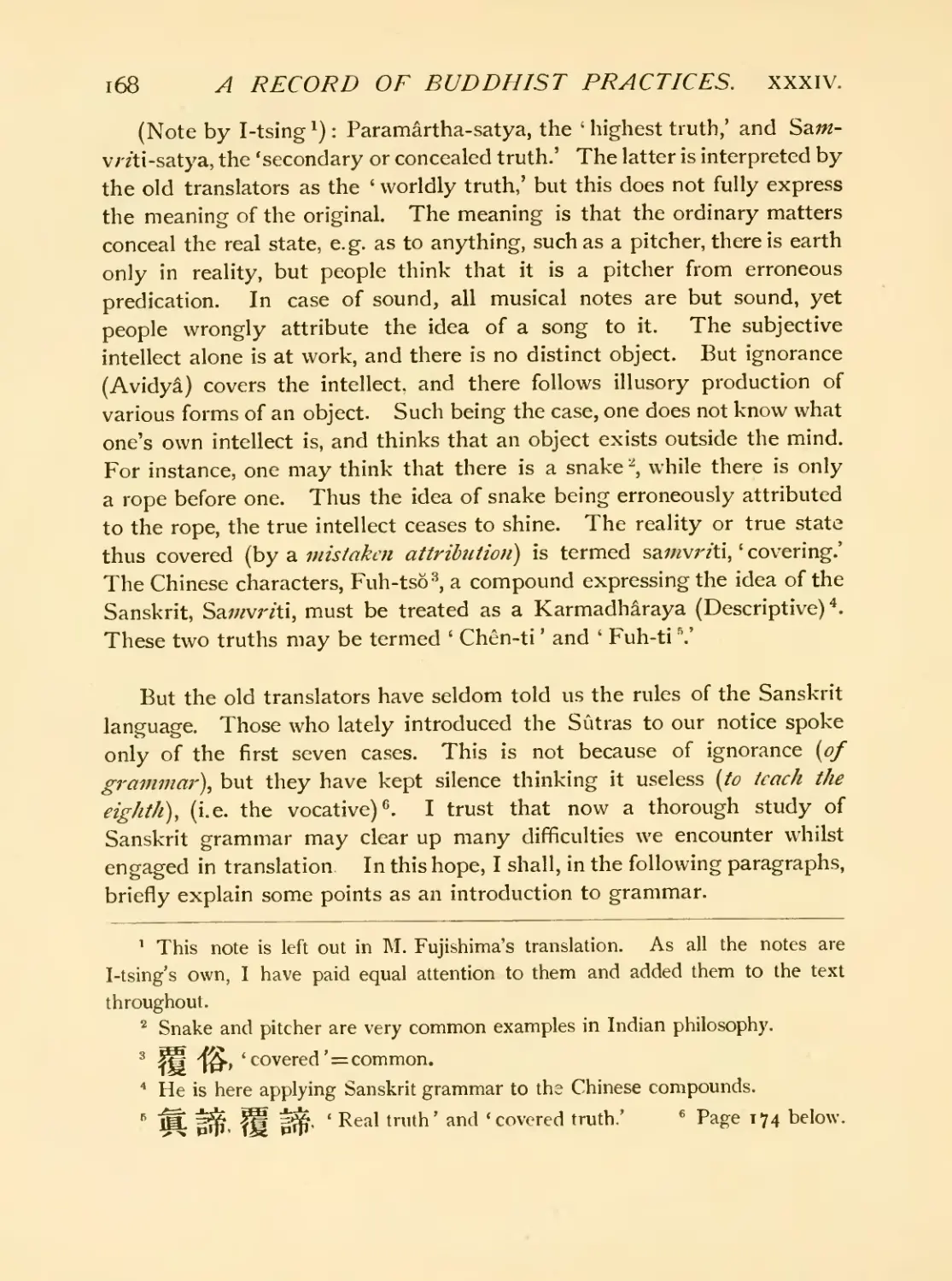
will prove an excellent companion to you.' As soon as I heard these words,
I thought that he would, in all probability, answer my want. Thereupon I sent
a letter to him to the temple of the mountain, roughly describing the preparation
for the journey. He then opened my letter ; on seeing it he soon made up his
mind to come with me. To make a comparison, a single sortie at the town of
Liao-tung broke the courageous hearts of the three generals, or one little stanza
from (or, about) the Himalaya mountain drew the profound resolution of the great
hermit 3 . He left with joy the quiet streams and pine forests in which he lived ;
he tucked up his sleeves before the hill of the Stone Gate (Shih-men, N.W. of
Kwang-tung), and he raised his skirts in the temple of the Edict (Chih-chih). We
bent our parasol (and talked friendly as Confucius did) and united our feelings in
rubbing away the worldly dust ; as we both gave up (to Religion) our five limbs,
1 Liu-t'ung = ' propagating ' or ' transmitting.'
- A strange simile in Chinese : ' Human life passes away as quickly as a white colt runs
through a crack.'
3 Liao-tung and the Himalaya are well known, but I cannot explain at present to what
incidents he is alluding.
e 2

xx xvi GENERAL INTRODUCTION.
we concluded (our friendship) in openheartedness, as if from former days.
Although I never saw him before in my life, yet he was, I found, just the man who
answered unexpectedly my wish. On a fine night we both discussed seriously as
to what had to be done. Cheng-ku then said to me : ' When Virtue wishes to
meet Virtue, they unite themselves without any medium, and when the time is
about ripe, no one can stay it even if they wanted.
' Shall I then sincerely propose to propagate our Tripi/aka together with you, and
to help you in lighting a thousand lamps (for the future) ? ' Then we went again
to the mountain Hsia 1 to bid farewell to the head of the temple, K'ien, and others.
K'ien clearly saw what was to be done at the right moment and acted accordingly ;
he never intended to retain us any longer with him. When we saw him and laid
before him what we had meditated, he helped us and approved of all. He was
never anxious about what might be wanting to himself, whilst his mind was intent
only on helping others. He made, together with us, the preparations for the
journey, so as not to let us be in want of anything. Besides, all the priests and
laymen of Kwang-tung provided us with necessary things.
Then on the first day of the eleventh month of the year (a.d. 689) we departed
in a merchant ship. Starting from Fan-yii we set sail in the direction of Champa 2
with the view of reaching Bhoga. after a long vogage, in order to become the ladders
for all beings, or the boats, to carry them across the sea of passion. While we
were glad to accomplish our resolutions as soon as possible, we hoped not to fall
in the middle of our journey.
[Cheng-ku, Tao-hung, and two other priests followed I-tsing and studied
Sutras three years in Bhog-a ; Tao-hung was then (689) twenty years old, and,
when I-tsing wrote the Memoirs, twenty-three years s .]
4 1, I-tsing, met Ta-ts'in in •SYibho^a (where he came a.d. 683). I requested
him to return home to ask an imperial favour in building a temple in the West.
When he saw that benefits would be great and large (had this petition been granted),
Ta-ts'in disregarding his own life agreed to re-cross the vast ocean. It is on the
fifteenth day of the fifth month in the third year of the T'ien-shou period (692)
that he takes a merchant ship to return to Ch'ang-an (Si-an-fu). Now I send
with him a new translation of various Sutras and -Sastras in ten volumes, the
Nan-hai-chi-kuei-nai-fa-ch'uan (the Record) in four volumes, and the Ta-t'ang-si-
yu-ku-fa-kao-seng-ch'uan (the Memoirs) in two volumes.
A hill situated near Kwang-tung, where Cheng-ku lived.
Zampa of Odoric (about 1323 a.d.) ; Chamba of Marco Polo (1288 a.d.). Skt. Aampa.
Chavannes, pp. 185, 187. 4 Loc. cit., p. 160, § 56.

LIFE AND TRAVELS OF I-TSING. xxxvii
III. His Return Home, to his Death.
The Biography 1 tells us that I-tsing was twenty-five years (671-695) abroad
and travelled in more than thirty countries, and that he came back to China at
Midsummer in the first year of the Cheng-sheng period (695) of T'ien-hou (the
queen-usurper, 684-704) ; further that he brought home some four hundred
different texts of Buddhist books, the jlokas numbering 500,000, and a real plan
of the Diamond Seat (VagTasana) of the Buddha.
In a.d. 700-712 I-tsing translated 56 works in 230 volumes, though some of
them were of an earlier date. Among these works there are several important
Sutras and Sastras, but to know how he represented the Mulasarvastivada School,
with which our Record is particularly connected, it will suffice to give here only
the Vinaya texts as below : —
A. The India Office Collection.
Mulasarvastivada-vinaya-sutra, 1 vol.
,, ,, ,, -vinaya, 50 vols.
„ ,, ,, -sawyukta-vastu, 40 vols.
,, ,, ,, -sanghabhedaka-vastu, 20 vols.
,, ,, ,, -bhikshnm-vinaya, 20 vols.
,, „ ,, -vinaya-sarigraha, 14 vols.
,, ,, ,, -ekajatakarman, 10 vols.
,, ,, ,, -nidana, 5 vols.
,, ,, ,, -matr/ka, 5 vols.
,, „ ,, -\inaya-nidana-rnat;-?'ka-gatha (15 leaves).
„ ,, ,, -sawyukta-vastu-gatha (10 leaves).
,, ,, ,, -vinaya-gatha, 4 vols.
,, ,, ,, -bhikshu/n-vinaya-sutra, 2 vols.
B. The Bodleian Library Collection (Jap. 650) besides the above.
14. No. (1). Mulasarvastivada-pravra^ya(-upasa;«pada-)vastu, 4 vols.
(Cf. Mahavagga, Khandhaka I.)
15. ,, (2). Mulasarvastivada- varshavasa-vastu, 1 vol.
(Cf. Mahav., Khandh. III.)
16. ,, (3). Mulasarvastivada-pravara«a-vastu, 1 vol.
(Cf. Mahav., Khandh. IV.)
17. ,, (4). Mulasarvastivada-/£arrna-vastu, 1 vol.
(Cf. Mahav., Khandh. V.)
18. ,, (5). Mulasarvastivada-bhaisha^ya-vastu, iS vols.
(Cf. Mahav., Khandh. VI.)
19. ,, (6). Mulasarvastivada-kaMina£ivara-vastu, 1 vol.
(Cf. Mahav., Khandh. VII.)
I.
No.
11 10.
2.
,,
111S.
3-
)>
1121.
4
>>
1123.
5-
>>
1 1 24.
6
)>
1127.
7-
>>
1131.
S
)>
"33-
9
>>
H34-
10
>>
1 140.
1 1
• .,
1141.
12
>)
"43-
13
>>
1 149.
1 The Sung-kao-seng-ch'uan, chap, i (Nanjio's Catal., No. 1495); Chavannes, Memoirs,
p. 193 seq.

xxxviii GENERAL INTRODUCTION.
He thus represented the whole texts of the Vinaya belonging to his own
Nikaya, and founded a new school for the study of this branch of Buddhist
literature in China. He died a.d. 713, in his seventy-ninth year. His life and
works are greatly commended by the emperor Chung-tsung, his contemporary, in
the preface to the Tripi/aka Catalogue.
Notes on some Geographical Names.
I. The Country of the Naked People (|^ \ H).
I-tsing passed this island when he sailed for India. It is ten days distant in
the north from Ka-eha, and it points to one of the smaller Nicobar Islands lying
on the north side. The description given by I-tsing agrees with some of the later
accounts of the islands, so much so, that we are fully justified in identifying his
Lo-jen-kuo with the present Nicobar. The group is believed to be the Lanja-
balus or Lankhabalus of the Arab navigators in the ninth century, who recorded
as follows : ' These islands support a numerous population. Both men and women
go naked, only the women wear a girdle of the leaves of trees. When a ship
passes near, the men come out in boats of various sizes and barter ambergris and
cocoa-nuts for iron V The description of Marco Polo in the thirteenth century
does not agree so well as the above. He says : ' When you leave the island of
Java (Java the less= Sumatra) and the kingdom of Lambri, you sail north about
150 miles, and then you come to two islands, one of which is called " Necuveran "
(or Necouran) 2 . In this island they have no king nor chief, but live like beasts;
and I tell you they all go naked, both men and women, and do not use the
slightest covering of any kind. They are idolators ; there are all sorts of fine and
valuable trees, such as red sanders and Indian nuts and cloves and brazil and
sundry other good spices V
1 Colonel Yule, Marco Polo, vol. ii, chap, xii, p. 289 seq.; Relation des Voyages faits par
les Arabes et les Persans dans l'lnde et a la Chine, dans le ix e siecle de l'ere Chretienne, by
Reinaud, torn, i, p. 8.
2 Rashiduddin uses the name of Nakvaram (not Lakvaram), which may be a less corrupted
form of the name, perhaps allied with Naga (Yule, Cathy, p. 96). This may be Hiuen Thsang's
Nalikera-dvipa (Cocoa-nut Island"), as Yule thinks.
3 Yule, Marco Polo, vol. ii, chap, xii, p. 289 ; he says (p. 291) : 'The natives now do not go
quite naked ; the men wear a narrow cloth, the women a grass girdle. Famous for the abundance
of Indian nuts or cocoa, also betel and areca-nuts; and they grow yams, but only for barter.'

NOTES ON GEOGRAPHICAL NAMES. xxxix
The above two accounts as well as I-tsing's certainly refer to one and the
same island, though the latter does not mention any name for it. It seems to have
passed under the name of ' Lo-jen-kuo,' just like ' Insulae Nudorum,' as marked
in Prof. Lassen's map *. The group of the Nicobar Islands was called the ' Land
of Rakshasas ' in the history of Tang (618-906) 2 .
II. The Islands of the Southern Sea (j^g y|J f|j y>|i|i|).
One must not confound what I-tsing calls the Islands of the Southern Sea
with what we know as the South Sea Islands. By the term ' Nan-hai ' is meant
the Southern China Sea or Malay Archipelago, and I-tsing includes in it Sumatra,
Java, and the then known neighbouring islands. There are, he tells us s , more than
ten countries, and all are under the influence of Buddhism. The Islands of the
Southern Sea are : —
1. Fo-lu-shi Island; Pulushih (*g? ^ frjj $|{).
2. Mo-lo-yu Country ; Malayu (^ jjg \jjffr j\\) 4 : or,
Shih-li-fo-shih Country; Sribho^a (P %\\ $| Jjjj g|).
3. Mo-ho-hsin Island ; Mahasin (^ ^pj f=f yj/jij).
4. Ho-ling Island, or Po-ling ; Kalihga (^pj* [|g? ^l|'j).
5. Tan-tan Island ; Natuna (UH |lg. $|i|).
6. P'en-p'en Island; Pern-pen (^ ^ ^ij).
7. P'o-li Island; Bali (||S JI $j\).
8. K'u-lun Island ; Pulo Condore (JJjjj -f$j $j\).
9. Fo-shih-pu-lo Island ; Bho^apura (f»$j ^f ^j|j[ ||| $$)•
10. A-shan Island, or O-shan (ftflf Mfe i J M)-
11. Mo-chia-man Island; Maghaman (^ ^£ Yj|§ 7^H)-
There are many more islands, not mentioned here.
The above eleven islands are, according to the author, enumerated from the
1 Karte von Alt-Indien zu Prof. Lassen's Indischer Alterthumskunde, Bonn, 1853.
2 Book 222 ; see also the Essays on Indo-China, second series, vol. i, p.' 207. Some Chinese
accounts of the Andaman Islands (Chinese, Yen-t'o-mang ; Japanese, An-da-ban) also agree
with I-tsing's, e. g. nakedness, iron, &c. ; they were, of course, the same race. Chao-ju-kua's
description of it was given by Dr. Hirth, J. A. S. China, vol. xxii, Notes and Queries, p. 103.
3 Page 10. * Marco Polo, 'Malaiur' (chap, viii .

xl GENERAL INTRODUCTION.
west, and following this order, we shall try to assign each its own place, as far as
possible.
i. P'o-lu-shi (Pulushih).
P'o-lu-shi may at first seem to represent the Barussae Insulae, which are, in
Lassen's map, a group of the Andaman Islands in the Indian Ocean. I-tsing, how-
ever, does not seem to be referring to an island so far away, when he says that
two Korean priests went on board to the country of P'o-lu-shi, west of Aibho^a,
and there they fell ill and died 1 . Prof. Chavannes found in the History of T'ang
(chap, ccxxii c) a country called ' Lang-po-lou-se,' which is said to be the western
part of Shih-li-fo-shih, and identified with our P'o-lu-shi and Marco Polo's Ferlec
( = Parlak), which is the present Diamond Point. His identification seems to be
correct, as the country of -Sribhog-a extended (see below) as far as the coast of
Malacca during the T'ang dynasty (618-906).
2. Mo-lo-yu (Malayu), or Shih-li-fo-shih (Sribhog-a).
-Sribhoga seems to have been a very flourishing country in the time of our
author, who went there twice and stayed some seven years (688-695), studying
and translating the original texts, either Sanskrit or Pali. In his works he uses
the name ' Bhoga ' or ' .Sribhoga ' indiscriminately 2 . It seems that the capital of
this country was from the first called Bho^a, probably a colony of Java, and that,
when the kingdom became great, and extended so far as Malayu, which seems to
have been annexed or to have come spontaneously under the realm of the Bhoga
prince, the whole country as well as the capital received the name of -SYibhog-a.
The change of the name Malayu to iSribhog-a must have happened just before
I-tsing's time or during his stay there, for whenever he mentions Malayu by
name he adds that ' it is now changed into .Sribhog-a or Bhog-a.'
As our author is the earliest writer who mentions these names, his account
well deserves a careful examination. From his Record and Memoirs we gather
the following facts : —
1 . Bhoga the capital was on the river Bhoga, and it was the chief trading port
with China, a regular navigation between it and Kwang-tung being con-
ducted by a Persian merchant (p. xxviii, note 8).
2. The distance from Kwang-tung to Bhoga was about twenty days by a
favourable wind, or sometimes a month (pp. xxx, xlvi).
1 Chavannes, Memoirs, p. 36, §§ 8, 9, and note.
2 About nine times .Sribho^a and twelve times Bhqfti (the latter more often referring to the
capital).

NOTES ON GEOGRAPHICAL NAMES. xl>
3. Malayu, which newly received the name of iSYibho^a, was fifteen days' sail from
Bho^a the capital, and from Malayu to Ka-cha was also fifteen days, — so
that Malayu lies just halfway between the two places (p. xlvi).
4. The country of .Sribho^a was east of Pulushih (p. xl).
5. The king of Bho^a possessed ships, probably for commerce, sailing between
India and Bho^a (pp. xxx, xlvi).
6. The Bhq^a king as well as the rulers of the neighbouring states favoured
Buddhism (p. xxxiv).
7. The capital was a centre of Buddhist learning in the islands of the Southern
Sea, and there were more than a thousand priests (p. xxxiv).
8. Buddhism was chiefly what is called the Hinayana, represented for the most
part by the Mulasarvastivada School. There were two other schools newly
introduced, besides the Sammitiya. A few Mahayanists were in Malayu
( = «Snbhog"a the New) (pp. 10, 11).
9. Gold seems to have been abundant. I-tsing once calls -SVibho^a ' Chin-chou,'
'Gold Isle 1 .' People used to offer the Buddha a lotus-flower of gold
(p. 49). They used golden jars, and had images of gold (pp. 45, 46).
10. People wear Kan-man (a long cloth) (p. 12).
1 1. Other products were : pin-lang (Mai. pinang, Skt. puga), nutmegs (g-ati), cloves
(lavahga), and Baros-camphor (karpura) (p. 48). They used fragrant oil
(p. 45). People in these places make sugar-balls by boiling the juice
of plants (or trees) 2 , and the priests eat them at various hours, while the
Indians make sugar from rice-grain, and in making ' stone-honey ' they
use milk and oil (Nanjio's Catal., No. 1131, book x, p. 72).
12. In the country of -Sribho^a, in the middle of the eighth month and in the
middle of spring (second month), the dial casts no shadow, and a man
standing has no shadow at noon. The sun passes just above the head
twice a year (pp. 143, 144).
13. The language was known as 'Kun-lun' (Malay, not Pulo Condore) (p. 1).
Shih-li-fo-shih, though not unknown 3 , has not been satisfactorily described
by the Chinese historians, while the name seems to have been very familiar to
Buddhist writers subsequent to I-tsing. Fo-shih (=Bho^a) is mentioned in the
History of T'ang (618-906) as being on the south shore of the Straits of Malacca,
1 Chavannes, p. 1S1, note 2. Cf. Reinand, Relation, torn, i, p. lxxv. Sumatra is famous
for gold ; Yule, Marco Polo, vol. ii, chap, ix, p. 26S.
2 Or, ' by boiling the wine (syrup) prepared from plants.'
3 E.g. the History of T'ang, book 222 c.
f

xlii GENERAL INTRODUCTION.
and four or five days distant from Ho-ling (= Java) \ Next in the History of
Sung (960-1279) 2 there is a country in the Southern Sea called San-bo-tsai
(San-fo-ch'i), which is in all probability Shih-li-fo-shih (=»Snbho£-a) of 1-tsing, and
its description runs as follows : —
' The kingdom of San-bo-tsai is that of the southern barbarians. It is situated
between Cambodja (Chen-la) and Java (She-p'o), and rules over fifteen different
states. Its products are rattan, red kino, lignum-aloes, areca-nuts (pin-lang), and
cocoa-nuts. They use no copper cash, but their custom is to trade in all kinds of
things with gold and silver. The weather is mostly hot, and in winter they have
no frost or snow. The people rub their bodies with fragrant oil. This country
does not produce barley, but they have rice, and yellow and green peas. They
make wine from flowers, cocoa-nuts, pin-lang or honey 3 . They write with
Sanskrit 4 characters, and the king uses his finger-ring as a seal ; they know also
Chinese characters; in sending tributes (to China) they write with them. With
a favourable wind the distance from this country to Kwang-tung (Canton) is
twenty days. Many family names there are " P'u." In 960, the king Shih-li-ku-
ta-hia-li-tan 5 sent tribute to China. In 992, this country was invaded by Java.
In 1003, two envoys from San-bo-tsai related that a Buddhist temple was erected
in order to pray for the long life of the Chinese emperor, and the emperor gave
to that temple a name and a bell specially cast for the purpose. In 1017, an
envoy from thence brought bundles of Sanskrit books, folded between boards.
In 1082, three envoys came to have an audience of the emperor, and presented
lotus-flowers of gold 6 (Chin-lien-hua) containing pearls, ca?nphor-baros, and sa-tien.'
The Descriptions of the Barbarians 7 , compiled under the same dynasty (960-
1279), gives a long account of San-bo-tsai (San-fo-ch'i), which agrees in the main
with the above history of Sung. According to this book, San-bo-tsai lies right
1 Book 436, p. 20, as quoted by Chavannes, p. 42.
2 Book 489 ; some portion has been translated in the Notes on the Malay Archipelago, by
W. P. Groeneveldt; see the Essays on Indo-China, second series, vol. i, p. 187.
3 Cf. Crawfurd, Hist, of Ind. Arch., vol. i, p. 398.
4 Fan (barbarian) may mean any foreign characters, but here it seems to mean Sanskrit ;
so also Mr. Groeneveldt, see loc. cit., p. 188.
5 Something like -Sn-ku/a-harit, or .Sri-gupta-harita.
6 In the History of Liang (502-556), Kandari, eastern coast of Sumatra, sent an envoy and
presented a Fu-yan flower of gold, loc. cit., p. 1S7; Fu-yan is 'mallow,' but often used for
1 lotus.'
7 Chu-f'an-shih, by Chao-ju-kua. It is a rather rare book, and I am obliged to Dr. Rosthorn
of Vienna for lending it to me. Dr. Hirth is going to translate it (J. R. A. S., Jan. 1896).

NOTES ON GEOGRAPHICAL NAMES. xliii
to the south of Ch'iian-chou ] ; the people put a cotlon cloth (sarongs) round their
bodies, and use a silk parasol. They wage war on water as well as on land, and
their military organisation is excellent. When the king dies, the people shave
their heads as a sign of mourning. Those who follow another in death burn
themselves in the pile of fuel. This custom is called ' T'ung-sheng-ssu,' ' living
and dying together 2 .'
There is an image of the Buddha called the ' Mountain of Gold and Silver.'
The king is commonly called the ' Essence of the Snake.' The crown of gold
worn by him is very heavy, and the king alone can wear it. He who can wear it
succeeds to the throne.
This country being on the sea contains the most important points for trade,
and controls the incoming and outgoing ships of all the barbarians. Formerly
they made use of iron chains to mark the boundary of the harbour.
Among the fifteen states which are mentioned in the same work as dependent
on San-bo-tsai, Tan-ma-ling, Pa-lin-feng, Sin-da, Lan-pi, and Lan-wu-li may be
identified respectively with Tana-malayu (the next to Palembang in the list of
Sumatran kingdoms in De Barros) 3 , with Palembang, Sunda, Jambi, and Lambri *,
all indicating that they belonged to Sumatra.
We have another important and somewhat earlier account by the Arab
travellers of the ninth century, who speak of the island of Sarbaza r ', which was
then subject to the kingdom of Zabedj 6 (=Iabadiu of Ptolemy, about a. d. 150,
1 Ch'iian-chou and its bay ( = Zayton of Marco Polo), in Fu-kien, lie lat. 25 N., opposite to
N. Formosa.
2 Or, 'sharing the life and death of another.' In the island of Bali there are the customs
of Satya and Bela, generally speaking, ' Burning one's body after another's death,' the origin of
which will be no doubt Indian. Satya is the well-known Satee (Sati), and Bela is supposed by
Mr. Friedrich to be the Sanskrit Vela, ' sudden and easy death.' — Wilson. Bela in Balinese
means 'dying with the man of higher rank' (a wife with her husband, a slave with his master,
a subject with his prince). Our T'ung-sheng-ssu evidently represents the custom of Bela.
3 Yule, Marco Polo, vol. ii, chap, viii, p. 263.
* Lamori, or Lambri, included Atchin, or was near it, where the Pole Star is not visible
(Odoric) ; Yule, Cathy, p. 84 ; Marco Polo, vol. ii, chap, xi, p. 2S3, note ; cf. p. 289, note.
5 Reinaud, Relation des Voyages, torn, i, p. 93 ; ii, p. 48. Mr. Groeneveldt identified
San-bo-tsai with Sarbaza (Essays, p. 187, note) ; the identification of these two names has since
been fully discussed by Prof. P. A. van der Lith, Ajaib el Hind, pp. 247-253 (see Serboza, and
Beal's communication about I-tsing's account of it).
6 I do not think .Snbho^a is Zabedj, as in Chavannes, but Sarbaza, subject to Zabedj (=Java).
Palembang was a Javanese colony, Yule, Marco Polo, vol. ii, p. 263. Zabedj of the Arabs
represents some great monarchy then existing in the Malay Islands, probably in Java, the king
of which was known to the Arabs by the Hindu title Maharaja (Relation, torn, i, p. 93). Dabag,
one of the islands of the seas, where the Syrian bishops, Thomas and others, weie sent by the
f 2

xliv GENERAL INTRODUCTION.
Yavadi (Ya-p'o-t'i) of Fa-hien, a.d. 414,. and Yavada (Ya-p'o-ta) of the History of
the First Sung, a.d. 420-478), which seems to be a corruption of Yavadvipa.
Now, as to the position of San-bo-tsai (San-fo-ch'i), it is generally understood to
be the present Palembang 1 in the southern part of Sumatra, and we have nothing
to say against this general belief, while there are on the other hand many points
which indicate the correctness of this identification. In all accounts, this great
kingdom of the Southern Sea is about twenty days distant, or sometimes a month,
from Kwang-tung. The capital is an important trading port, and the people seem
to have embraced Buddhism for some time ; and there are several points which
show that they were of Hindoo origin. The country is, according to all accounts,
rich in gold, and the gift of golden lotus-flowers is peculiar to the people. The
accounts as to the use of fragrant oil, kan-man (sarongs), &c, and the products
also, though common to the other islands, are in general agreement. Above all,
the names, Shih-li-fo-shih (= Sribho^a) of I-tsing, Sarbaza of the Arabs, and
San-bo-tsai (= San-fo-ch'i) of the Chinese historians, are the weightiest proof,
especially when we see that none of the accounts given under these three names
contradict each other.
The constant hostility with Java mentioned in the Chinese history may
account for the Arabs making Sarbaza dependent on Zabedj (=Java).
Now we are in a position to see that the capital and trading-port of San-
bo-tsai, which went under the name of Chiu-chiang ('Old Port' or 'Old River')
after 1397, was what I-tsing called the river Bho^a where he went on board ship
to send a message to Kwang-tung, and it is therefore the river Palembang of
our time ; and what he calls the ' fortified city of Bhogu ' (p. xxxiv) is the modern
Palembang, while the whole country of -Sribho^a is much larger than the present
province of Palembang. There were many depe?ident states.
The Yin-yai-sheng-lan, compiled a.d. 14 16, makes these points perfectly
clear. It says : ' Chiu-chiang is the same country which was formerly called San-
bo-tsai ; it is also called Palembang (P'o-lin-pang), and is under the supremacy
of Java.
' From whatever place ships come, they enter the strait of Banka (P'eng-chia)
at the Freshwater River (Tan-chiang, the Chinese name for the river Palembang),
patriarch Elias (Assemanni, iii, part i, p. 592), is probably a relic of the form Zabedj of the
early narratives, used also by Al-Biruni. Ibn Khurdadbah and Adrisi use Jaba for Zabedj ; Yule,
Cathy, p. civ.
1 The History of Ming (1368-1643), book 324: 'In 1397, San-bo-tsai was for the last time
conquered by Java, and the name was changed into Chiu-chiang ' (' Old Port ' or ' Old River,'
which is the name for Palembang up to the present day). See Essays, &c., p. 195.

NOTES ON GEOGRAPHICAL NAMES. xlv
and near a place with many pagodas built with bricks, after which the merchants
go up the river in smaller craft, and so arrive at the capital.'
As to the name ' Malayu,' it seems to have existed for a long time. The Tan-
ma-ling (Tana-malayu) of the Descriptions of the Barbarians (960-1279), and
Malaiur of Marco Polo in the thirteenth century, are in all probability the
remnants, of the name Malayu, which was used before our author's time.
Unfortunately, however, the city of Malaiur of Marco Polo has not been satis-
factorily traced. Colonel Yule says l : ' Probabilities seem to me to be divided
between Palembang and its colony Singhapura (Palembang itself is a Javanese
colony). Palembang, according to the commentary of Alboquerque, was called
by the Javanese Malayo. The list of Sumatran kingdoms in De Barros makes
Tana-malayu 2 the next to Palembang. On the whole I incline to this interpre-
tation/
This point, I think, becomes clear from the notice I have given above that
the country Bho^a, i.e. Malayu, lay on the southern shore of Malacca; if Malaiur
be Singapore, it must lie on the northern shore where, according to the same
history, the country was called Lo-yiieh 3 . Further for the determination of the
position of -Sribho^a-Malayu, I-tsing furnishes us with important data (pp. 143,
144): 'In the Sribho^a country (not the capital), we see the shadow of the dial-
plate become neither long nor short (i.e. " remain unchanged " or " no shadow ") in
the middle of the eighth month (^autumnal equinox), and at midday no shadow
falls from a man who is standing on that day. So it is in the middle of spring
(=vernal equinox) V From this we can see that the country of S\ ibho^a covered
1 Marco Polo, vol. ii, book iii, chap, viii, p. 263.
2 The Descriptions of the Barbarians says that this country uses trays of gold and silver for
barter.
3 This is the place where Shinnio Taka-oka, an imperial prince of Japan, died, A. D. 8S1, on
his way to India to search for the Law. He was twenty years in China learning buddhism,
whence he started for the West. The place of his death is supposed to be near Saigon in Champa
or in Siam. If, however, our identification be right, it must have been in or near Singapore.
4 We are perfectly justified in taking these two dates as the two equinoxes. A year is divided
into four seasons, each of three months (1st, 2nd, and 3rd, Spring; 7th, 8th, and 9th, Autumn).
Therefore, the ' Middle of Spring' is the middle of the second month. The Chinese names for
the two equinoxes are accordingly Ch'un-fen a and Chiu-fen b , ' Division of Spring ' and ' Division
of Autumn.' I-tsing uses Ch'un-chung c , ' Middle of Spring,' which conveys the same idea as the
above, and Pa-yiieh-chung d , ' Middle of the eighth month ' (when the calendar is exact, this will
be the 'Middle of Autumn'). In the Japanese calendar, the autumnal equinox is marked
a ##- b fC#- "##. d AM*¥-

xlvi GENERAL INTRODUCTION.
the places lying on the Equator ; and the whole country therefore must have
covered the N.E. side of Sumatra from the southern shore of Malacca to the city
of Palembang, extending at least five degrees, having the equatorial line at about
the centre of the kingdom.
With the last conquest of 1379, the name San-bo-tsai, .SYibhog-a, once a great
monarchy, wellnigh disappears from the history, the new conquerors establishing
themselves at the ' Old Port.' By this time Sumatra was perhaps thoroughly
converted to Islam, though we find no traces of it in Marco Polo's travels at the
close of the thirteenth century 1 .
To better understand I-tsing's route via Bhog-a and Malayu, the following
extract from his work may be useful. He says 2 : —
' Wu-hing came to Aibho^a after a month's sail. The king received him
very favourably, and respected him as the guest from the Land of the Son of
Heaven of the Great T'ang. He went on board the king's ship to the country
of Malayu, and arrived there after fifteen days' sail. Thence he came to Ka-cha
again after fifteen days. At the end of winter he changed ship and sailed to the
west. After thirty days he reached Nagapatana (now Negapatam, io° 8' N.,
79° 9' E.). From here he started again on board for the Siwhala Island ; he arrived
there after twenty days. He worshipped the Buddha's tooth there, and again
sailed for the north-east. He came to Harikela, which is the eastern limit of
E. India, and is a part of Gambudvipa. He stayed there one year and went to
Mahabodhi, Nalanda, and Tila^/za 3 . Near Tila^a lived a teacher of logic, from
whom Wu-hing learned the logical systems of (zina and Dharmaktrti, &c. He
wanted to come back by the northern route. When I, I-tsing, was in India, I saw
him off six yo^-anas east of Nalanda, and we said goodbye, each hoping to see
the other once again in this world.'
Chiu-pa-yueh-chung a ( = middle of the eighth month of the old calendar). That I-tsing meant
the equinoxes by those terms is certain from the following passage (p. 144), in which he clearly
recognises the equinoxes by saying: ' the sun passes just above the head twice a year.' When we
take -Sribho^a here as the capital, the result is as I have noted, p. 144, but our author expressly
says the country of i'ribho^a, and we must not limit it to the capital, which he very often, if not
always, calls simply Bho^a.
1 The first Mohammedan king in Atchin began to reign A. D. 1205, probably the time of the
introduction of Islam (Marco Polo, vol. ii, p. 269) ; the stimulus of conversion to Islam had
not taken effect on the Sumatran States at the time of Polo, but it did so soon afterwards, and,
low as they have now fallen, their power at one time was no delusion (loc. cit., p. 270).
2 Cf. Chavannes, Memoirs, p. 144. 3 See below, p. 184, note 2.
AM*-

NOTES ON GEOGRAPHICAL NAMES.
xlvii
3. Mo-ho-hsin (Mahasin).
The only name which comes near to this is Masin of the Syrians. The
bishops, Thomas, Taballaha, Jacob, and Denha, were ordained by the Syrian
patriarch Elias, a.d. 1503, 'to go to the lands of the Indians and the islands of
the seas which are between Dabag (Java, cf. Zabedj) and Sin (China) and Masin V
Mahasin and Masin may be the present Bandjermasin on the southern coast of
Borneo.
4. Ho-ling (Po-ling, Kalihga).
This name is no doubt Indian, probably taken from Kalihga on the coast of
Coromandel 2 . According to the Chinese history \ this is another name for Java,
or a part of it 4 , which had the earliest intercourse with Ceylon and perhaps also
with the southern coasts of India. But the following statement of the Chinese
historians, if correct, points to a place in the Malay Peninsula (6° 8' N.): —
' In Ho-ling, when at the summer solstice a gnomon is erected 8 feet high,
the shadow (at noon) falls on the south side and 2 feet 4 inches ( = 2f feet) long 5 .'
Thus — North latitude of the place of observation = (f>
Zenith distance of the sun . . . =z
North declination of the sun . . =8
Equator Zenith
We have —
. - _ £1 _ fLi
log tan z = 9-477
z = 1 6° 7'
8 = 23° 5'
<£=o- z =23° 5'
16 7' = 6° 8' N.
[There is clearly a confusion in the statement, if a place in Java (6° 8' S.) be meant.
I must leave the point unsettled, until I have examined all the parallel passages in the Chinese
books.]
1 Assemanni, iii, part i, p. 592 ; Yule, Cathy, p. ciii.
2 See Lassen, Indische Alterthumskunde, ii, p. 1076 ; iv, p. 711.
3 The New History of T'ang (618-906), book 222, part ii : ' Kalinga is also called Java;'
book 197 : ' Kalinga lies to the east of Sumatra.'
* Mr. Groeneveldt places it on the north coast (long. 111° E.), while Prof. Chavannes on the
western part of Java (Memoirs, p. 42, note).
5 The New History of T'ang (618-906), book 222, part ii ; see also Essays on Indo-China,
second series, vol. i, p. 139.

xlviii GENERAL INTRODUCTION.
As to the names of Java, the oldest Iabadiu of Ptolemy (circa a.d. 150),
Javadi of Fa-hien (414), and Yavada of the history of the first Sung (420-478)
probably represent Yavadvipa l , the ' country of millet.' The same name appears
in some later accounts as Zabedj (the Arabs) or Dabag (the Syrians). Neither
of them, however, seems to have been used in I-tsing's time, though the name ' Java '
occurs later in the History of Sung (960-1279) 2 and in Marco Polo's travels 2 at
the close of the thirteenth century ; and till the present day. Now a word about
the Javanese civilisation will not be out of place. Java in Fa-hien' s time (414)
was already settled by the Hindus ; he says : ' Heretic Brahmans flourish there,
and the Buddha-dharma hardly deserves mentioning.' One of the old inscriptions
from Pagaroyang in Sumatra, dated a.d. 656, calls the king Adityadharma, the
ruler of the ' first Java ' (or Yava). Moreover some of the Sanskrit inscriptions
found in Java seem to date from the fifth century and they are Vaishwava 3 .
Buddhism was, according to I-tsing, chiefly the Hinayana, but it is remarkable
indeed that the ancient ruins of the temple of Kalasam (Kalasa) and the Vihara
of Chandi Sari (dating from 779) indicate that the Buddhism here prevalent was
a later form of the so-called Mahayana, as proved by the discovery of the images
of Dhyani Buddhas, Akshobhya, Ratnasambhava, Amitabha or Amoghasiddha 4 .
The Buddhist faith, whether the Hinayana or Mahayana, possibly lasted till the
propagation of Islam, as was the case with Sumatra.
5. Tan-tan (Natuna).
6. P'en-p'en (Pempen).
7. P c o-li (Bali).
According to Mr. Bretschneider 5 , the islands of Natuna were called Tan-tan,
which is probably I-tsing's Tan-tan. Tan-tan (Don-din) of the History of Sui
(5 1 8-6 1 7) 6 , which is supposed to be in Southern Siam or Northern Malacca,
if correct, is not the island here mentioned, for our author knows that Siam
1 Lassen, vol. iv, p. 482. Not the ' country of barley,' for Java and Sumatra never produce
barley, but millet is there called Java (Essays, second series, vol. i, pp. 132, 137).
2 Loc. cit., p. 141 ; the Descriptions of the Barbarians, of the same date, mentions Java, at
one place Maha-Java ; Yule, Marco Polo, vol. ii, chap, ix, p. 266 ; Sumatra is also ' Java the
less.* Sumatra, perhaps Skt. Samudra, the ' sea.' Cf. Ch. Nan-hai.
3 Prof. Kern, Over den invlow der Indische, Arab, en Europ. beschaving op de Volken van den
Ind. Archipel., p. 7 ; Yule, Marco Polo, vol. ii, chap, ix, p. 267.
1 Minutes of the Batavian Society, April, 1886; Essays, pp. 140, 141.
5 The Knowledge possessed by the Ancient Ohinese of the Arabs, &c.,p. 19; see also Julien,
Hiuen Thsang, torn, i, p. 451.
6 Book S2 ; Essays, p. 205.

NOTES ON GEOGRAPHICAL NAMES. xlix
(Dvaravati) is not one of the islands of the sea, and mentions no continental place
among them. Besides, the identification of Dondin is by no means conclusive
Colonel Yule marks Andaman Islands ' Dondin ? '
Fen-pen, I think, represents modern Pembuan on the southern coast of
Borneo. This seems to be right, for I-tsing says that P'u-p'en (=P'en-p'en) was
situated in the north of Kalihga (N.E. Java) \ There is, however, a place named
P'an-p'an 2 in the southern part of Siam, which may be the present P'un-p'in or
Bandon. But this identification is again very doubtful.
P'o-li, probably the present Bali Island, E. of Java, was called P'ang-li by the
Chinese 3 , but the accounts given of this island are very scanty. Owing to the
interesting discovery of the Kavi literature there, the name is now well known to
us. I should refer my readers to Mr. R. Friedrich's Account of the Island of Bali
(Essays on Indo-China, second series, vol. ii).
8. K'u-lun (K'un-lun, Pulo Condore).
K'u-lun is identical with K'un-lun, the Chinese name for Pulo Condore. The
native name is Kon-non, Condore being a corruption of it. The Arab travellers
of the ninth century call this group of islands by the name of Sundar 4 Fulat, while
Marco Polo names the same Sundur and Condur. It consists of one isle of
twelve miles long, two of two or three miles, and some six other smaller isles, the
largest being specially called Pulo Condore. According to I-tsing, the people of
these isles alone are woolly-haired with black complexion (p. 12).
We often hear from Chinese writers of the ' slaves from K'un-lun V later
signifying slaves in general, without any reference to the land where they came
from. The inhabitants in I-tsing' s time appear to have been negroes ; the com-
mentator Kiiuyapa also, quoting an early authority, describes them as if of a
different race : ' K'u-lun, Ku-lun, and K'un-lun are one and the same country.
In this country no ceremony or courtesy is observed. The people live by
robbing and pirating. They are fond of man's flesh, like Rakshasas or some
wicked demons.
' Their language is not correct. They differ from the other barbarians. They
are skilled in diving in the water, and if they will, can stay all day long in the
1 Chavannes, Memoirs, p. 77.
2 The New History of Tang (618-906), book 222 b ; Essays, p. 241.
s The Hsing-ch'a-sheng-lan (1436'.
4 Or, Sondor ; Yule, perhaps Sanskrit Sundara, 'beautiful.'
5 See, e.g. Essays, p. 257, note.

1 GENERAL INTRODUCTION.
water without any suffering." This peculiar people, however, seems to have
embraced Buddhism to some degree, for I-tsing mentions a monastery with
a peculiar clepsydra given by the king of the island (p. 145), and further says,
though accidentally, that they praise Sanskrit Sutras (p. 169). Two kinds of
cloves grow there (p. 129).
One may well wonder why the K'un-lun language was prevalent in Sumatra or
.Sribho^-a in I-tsing's time \ One must not, however, be misled by the word K'un-
lun, when used as the name of a language, for it has been for some time a general
name for all the Southern Sea (cf. p. 11), and therefore the ' K'un-lun-yii ' must
mean the Malay language. The islands of Pulo Condore had nothing to do with it,
though the inhabitants might have shared in speaking a dialect of the K'un-lun
language.
9. Fo-shih-pu-lo (Bho^-a-pura).
Fo-shih-pu-lo is no doubt Bho^a-pura in its original form, but it is not Bho^a,
the capital of •SVibho^a, the modern Palembang. Mr. C. Baumgarten, writing to
Prof. Max Miiller (Feb. 20, 1883), says that Surabaja is the second city in Java,
and that we still have a place there called Boja-nagara and the whole province
Boja ; and he adds that the seventh century seems to have been the golden age
of Buddhism in Java 2 . This is probably I-tsing's Bho^apura, and further we
have here perhaps the origin of the name iSri-Bho^a, for Palembang was certainly
a colony of Java.
10. A-shan or O-shan.
11. Mo-chia-man (Maghaman).
A-shan may at first seem to represent Atchin in Sumatra. But this is not
likely, for the original and correct form of Atchin seems to have been Atjeh or
Ach'i, which was afterwards corrupted by Europeans into Atchin or Acheen.
As it comes after Bho^apura, it seems to be somewhere in the eastern part
of Java near Bali ; it may be the present Ajang s .
As to Mo-chia-man, I have nothing to say about it, except that it may
phonetically represent Maghaman or Maghavan. Ma-she-weng or Ma-yeh-weng 4 ,
1 Chavannes, Memoirs, p. 159; Koen-luen there.
2 This is well founded ; the temple of Kalasa and the adjoining monumental Vihara date
from 779, as attested by a Sanskrit inscription in Old Nagari ; besides, I tsing's Record indicates
the same.
3 As to such names as Ajang, Bandjermasin, or Kota, I am not able to judge whether they are
of ancient or modem origin.
4 Essays, p. 202.

NOTES ON GEOGRAPHICAL NAMES.
the position of which is not certain, may be the same island. It may have been
meant for Madura.
III. Further India or Indo-China.
i. Sri-kshatra or -kshetra (Thare Khettara).
2. Lahkasu (Kamalahka).
5. Dvaravati (=Ayuthya)) . c . _
6 , v _ ' \ \ in Siam.
4. Poh-nan (=Fu-nan) J
5. Champa (originally A^awpa).
6. Pi-king, in Annam.
7. Kwan-chou (probably near Tong-king).
The position of Sii-kshatra can be settled pretty satisfactorily. According to
the Burmese, the king Mahasambhava built a city called Thare Khettara in the
sixtieth year of the Buddha \ and established ihe Prome dynasty, which flourished
578 years. Some remains of the city are still to be seen a few miles to the east
of the present town of Prome 2 . This account alone is enough to determine its
position, and it is not to be placed in Upper Burma as in Vivien de Saint-Martins
map to Julien's Si-yu-ki. The identification with Silhat is therefore quite inad-
missible. I-tsing's description roughly corresponds with the position of Thare
Khettara ; besides, we have the account of Hiuen Thsang, which we shall consider
presently. According to I-tsing, Lahkasu is S.E. of Sn-kshatra, and Dvaravati is
E. of Lahkasu. Thus we have to give up the supposition that I-tsing's Dvaravati
may be that Dwarawati of the Burmese, which latter is, if Captain St. John is
correct (p. 10 below), Old Tangu and Sandoway, for these lie in quite an opposite
direction and cannot be S.E. of Prome. Hiuen Thsang's Darapati or Dvarapati
as well as our Dvaravati no doubt represents Ayuthya (or Ayudhya), the ancient
capital of Siam; this becomes clear from the fact that I-tsing's description ot the
positions of the countries counted from China's side actually ends with Poh-nan,
E. Siam (p. 9). Hiuen Thsang 3 mentions Kar*a-suvar«a, Samata/a and An-
kshatra, and says: ' Going S.E. from Srikshatra there is in the bay of the sea
Kamalahka; to E. of this, Dvarapati (or Darapati). Further to E there is
tenapura*; to E. of this, Maha&uwpa, and to S.W. of MahaJampa, Yen-mo-lo-
» The Bu.mcse calendar places the Buddha's death in 544 B.C. ; A. b. 60 is therefore B.C. 484,
if corrected, about B.C. 424.
2 Asiatic Researches, vol. xx, p. 171.
3 Julien, Memoires, liv. x, pp. 82, S3; Beal, Life, p. 132.
' Lanapura was very successfully identified with Cambodja by Prof. Chavnnncs (p. 3 8) , in
s 2

Ki GENERAL INTRODUCTION.
chou' (probably ' Yavanadvipa,' meaning Sumatra). The reader will see that
I-tsing's Lahkasu is here Kamalahka, Poh-nan, Lranapura, and Champa (p. 12),
Maha&mpa ; and we know from our Record that Pi-king (Turan or Hue) is N.
of Champa, and that still further north one reaches Kwan-chou (near Tong-king)
after a month's journey on foot, or five or six tides, if aboard ship. Thus all
these statements are pretty clear, and in harmony with one another *.
IV. India and Ceylon.
I-tsing calls India in general the West (Si-fang), the Five Countries of India
(Wu-t'ien), Aryade^a (A-li-ya-t'i-sha), Madhyad&ya (Mo-t'i-t'i-sha), Brahmarash/ra
(Po-lo-men-kuo), or Gambudvipa (Chan-pu-chou). ' Hindu (Hsin-tu) V he says,
'is the name used only by the northern tribes (p. 118), and the people of India
themselves do not know it. Indu (Yin-tu) is by some derived from the name of the
moon, Indu (Hiuen Thsang, Me'm. ii, 56), but it is not a proper name.' Hindu in
Persian and Indo in Greek were perhaps corrupted from Sindhu, but it is curious
that the Chinese should have known both forms of the name. Indu (Yin-tu) as
the name of India came to be generally used in China from Hiuen Thsang's
time, while T'ien-chu and Chuan-tu (both from Sindhu) are probably as old as
the introduction of Buddhism into China (a.d. 67). The name for Ceylon is,
in the Record, Si;«hala (Seng-ho-lo) Island (or Shih-tzii-chou, Lion Island), or
occasionally Ratnadvipa (Pao-chu, Jewel Isle).
As to his travels in India, he may have visited many a place, more than thirty
countries in all, according to the Biography (p. xxxvii, note), but nothing certain
626 A.D. the king of Cambodja was Lanavarman, according to M. Aymonier, and in perfect
conformity with this, the History of Tang states that the king of Cambodja, trana, a Kshatriya,
in the beginning of the Cheng-kuan period (627-649) conquered Fu-nan (E. Siam) and took the
territory. I-tsing may be referring to this king when he says that a wicked king destroyed
Buddhism in Fu-nan (p. 12). See, however, Crawfurd, Journal of the Embassy to the Court of
Siam, p. 615 ; Siam first received Buddhism in 638.
1 Mr. Beal's identifications widely differ from ours, and they are not, according to our
opinion, tenable when we compare them with the original. Fu-nan, for instance, is transcribed
' Annam' (Life, p. xxxiv), Lin-i ( = Champa) is Siam (Life, p. 133), and Pi-king, owing to
a misprint, is read by him Shang-king, and identified with Saigon. According to Beal, I-tsing
speaks of himself as interpreting the language of Pulo Condore (Life, pp. xv, note, xxxi) ; it is
not I-tsing, but Ta-ts'in, who is said to have been skilled in the K'un-liin language (Malay),
Chavannes, p. 159, § 56. I-tsing was thirty-seven years of age, but, according to Beal, he started
with thirty-seven priests (Life, p. xv).
2 The text has ' Hsi,' but I-tsing directs that it should be pronounced by taking the first and
last parts of Hsu-Un, i.e. 'Hsin.' PjJD = f/|/y used for 'bin' oCMa/iinda.

DATE OF I-TSING'S WORK. liii
can be gathered from his own writings. The places which he says definitely he
visited are very few 1 , i.e. Kapilavastu, Buddhagaya (in Magadha), Varawasi
(Benares), iSravasti (N. Kerala), Kanyakub^-a (Kanoj), Ra^agrzna (ten years in
Nalanda), Vaijali, Ku.nnagara, and Tamralipti (Tamluk). I doubt whether he
visited Ceylon ; although he often mentions it, his description does not appear to be
that of an eye-witness. So it is in the case of La/a 2 , Sindhu, Valabhi, Udyana, Khara-
£ar, Kustana (Khoten), Kajmira, and Nepala. Besides the above, he mentions Tibet
(T'u-fan), Persia (Po-la-ssu), the Tajiks (Ta-shih and To-shih) 3 , Tukhara(T'u-ho-lo),
Suli (Su-li), the Turks (Tii-chiieh), and accidentally Korea (Kau-li, Kukkutejvara).
The Date of I-tsing's Work.
If I-tsing had expressly stated when he came back to Sribhqg'a, we should
have had no difficulty at all in fixing the date of his work. That point, however,
is left entirely blank. We shall try to find out a date which may come nearest
the mark, if not quite correct, chiefly resting on the foregoing data of his life and
travels.
First of all the place where he compiled his work must be in -Sribho^a (Palem-
bang in Sumatra) 4 as he says towards the end of chap, xxxiv. His return from
India to this place must be later than a.d. 685 s , when he was still near Nalanda,
and, as he says that he already passed four years in -SYibhoga before he wrote
chap, xxxiv, his Record cannot be in any case earlier than a. d. 689 (685 + 4 = 689),
even if we suppose that he returned there immediately after his parting with Wu-
hing near Nalanda. Further, he uses throughout the new dynastic name G adopted
a.d. 690 by the Usurper Queen (reigned a.d. 684-704); this shows clearly that
1 The Miilasarvastivada-sa/wyuktavastu (Nanjio's Catal., No. 11 21), chap, xxxviii, p. 85 (J.),
and chap, xxxvi, p. t j6 b .
2 See p. 137, note 1, and p. 217.
3 This is generally the name for the Mohammedan Arabs in Chinese. I-tsing says that the
Tajiks occupied the way to Kapija ; Memoirs, vol. i, fol. 4 b ; Chavannes, p. 25.
4 Not ' in Ceylon ' as Messrs. Shimaji and Ikuta suppose in their Short History of Buddhism
in the Three Kingdoms (India, China, and Japan), 1890, Tokio. Evidence, if any, is too weak
to prove that I-tsing visited Ceylon.
5 This date is in the Chinese text ' the first year of the Chui-kung period,' being the second
year of the Usurper Queen, though she still used the dynastic name T'ang, 'which she changed in
A. D. 690 into Chou, Chavannes, p. 10.
6 Chou, p. 214 below; Chou-yun and Chou-i, p. 7; the Great Chou, p. 118; Chou-yii,
p. 148 ; lastly, in his text, not in his notes, the Great Chou, p. 214 (note 3). See the Chinese
text, respectively, vol. i, fol. 3* ; vol. iii, fol. I2 a ; vol. iv, fols. 2 b 27".

liv GENERAL INTRODUCTION.
our Record cannot be earlier than a.d. 690. It will be remembered that he sent
this Record on the fifteenth day of the fifth month of a.d. 692, and we must there-
fore find the date of his whole composition within the period a.d. 690-692. Let
us now examine the chapters which we can make use of for our purpose.
1. I-tsing's Introduction, as is usual with us, must be the latest, i.e. when all
the chapters were ready, for he says in it that he sends home this very Record in
forty chapters \
2. Chap, xviii. He accidentally says that he toiled during two decades of years 2 .
This chapter must therefore have been written in about 691 (671-691 = 20;
a.d. 671, having only one month left).
3. Chap, xxviii. He was ' more than twenty years abroad.' This brings us
again to a.d. 691. To be quite safe, we will put down a.d. 691-692, because it
is ' more ' than twenty years 3 .
4. His Memoirs must be later than the contents of our Record (except
the Introduction), for the former quotes the latter twice by name 4 . But the
conclusion of the Memoirs must be at about the same time as the Ifitroduction
of the Record, for both mention the Memoirs in two vols, and the Record in
four vols, (forty chapters) 5 , one by the other. In other words, the finishing up of
the two works must be at about the same time.
Now it will not be very difficult to see that about seven folios of a Supplement 6
to the Memoirs have been written about the same time, for it is not likely that
he would write a Supplement before the text. May it be an addition at a later
date? According to my opinion, it cannot be later than a.d. 692, because he
must have sent it with the texts. We see in the Supplement that a priest, Tao-
hung, who was ordained in his twentieth year, soon after met I-tsing in Kwang-
tung, and followed the party to -Sribho^a, a.d. 689, was twenty-three years of age 7
(a.d. 689-692 = 3) when our author wrote the supplementary portion.
From this it is clear that he wrote it s , or at any rate, he sent it at the same
1 Page 18 below.
2 Page 95 below ; for the impossibility of taking it as ' two dozen,' see note at the end, p. 220.
3 Page 135 below. Compare p. 176, note 4.
4 Chavannes, p. 88, note 1 ; p. 92, note 1, chap. 30 of our Record is quoted.
5 Page 18 below; Chavannes, p. 160.
6 Chavannes, p. 161 ; about twenty-four pages in French.
7 Chavannes, pp. 185, 187. See p. xxxvi above.
8 It is true that there is a portion which I-tsing might have added afterwards, but this part
can be clearly seen in the text, as it is a general remark, not coming under any name; see
Chavannes, p. 189, six lines from the bottom, beginning with ' Ces quatre hommes.'

TABLES OF LITERARY MEN. lv
time with the other texts. Thus the Introduction to the Record, the Memoirs
and its Supplement will have to be referred to about the same time, the last
mentioned being the last composed. Observe that I-tsing reckons three years
from the latter half of a.d. 689 till the fifth month of a.d. 692.
5. Now, towards the end of chap, xxxiv — the most important of all chapters —
he says that he remained over four years in .Sribho^a, since his return from India,
the date of which we do not know. Only one year added to the period which
I-tsing reckons as three years (a.d. 689-692) will give us the year of his second
visit to .Sribhqg-a, i.e. a.d. 688 l (he was in Bho^a a.d. 689 as we have seen).
Thus the date of chap, xxxiv must fall in 691 or 692; the safest limit will be
a.d. 691-692, the result being the same as that of chap, xxviii, &c.
All the evidence that can be adduced from the text points thus to the
correctness of the date a.d. 691-692, strictly speaking a.d. 691 to the fifth month
of a.d. 692, as the time when I-tsing wrote his Record. Resting on this result
we can place with certainty the death of Gayaditya 2 , joint author with Yamana
of the Klrikavnftti, in a.d. 661-662, and that of Bhartr/hari 3 , contemporary of
Dharmapala, in a.d. 651-652.
Tables of several Literary Men and Buddhist Teachers of
India, with their dates and successions, made from the
Record of Buddhist Practices (a.d. 691-692) of I-tsing
(a.d. 671-695 abroad ; 673-687 in India).
(Those in Italics are not given in I-tsing' s text.)
I. (Chap, xxxii, pp. 156-157.)
The Sardlmataka-Buddhastotra (150 verses, Nanjio's Catal., No. 1456).
1. Composed by Matrz&i/a. In Tdrandtha's Geschichte des Buddhismus, p. 89, Mdttikeia is
said to have lived about the time of Bindusdra, son ofKandragupta.
2. Admired by Asahga ) „ ,
, , , T 1. j. \ Brothers and contemporaries.
3. and by Vasubandhu, \ *
4. Some verses were added by Cina. Two of his works have been translated by Paramdrtha, who
worked in China a.d. 557-569 {Nanjio's Catal., A'os. 1172, 1255).
1 The time of the arrival of the ship was the first or second month of the year, see above,
p. xxxiv. We shall not here speak of three months' stay in China after his chance return, for we
are not sure as to whether he reckoned the period ; it will not, I think, make any difference in
the year.
2 Page 176 below. 3 Page 180 below.

lvi GENERAL INTRODUCTION.
5. A further addition by .Sakyadeva of the Deer Park (at Benares).
6. Translated by I-tsing while in the Ndlanda College {Nanjio), about A. D. 675-6S5. Sent
home A. D. 692 (p. 166).
II. (I-tsing's Introductory Chapter, p. 14.)
The following names are to be taken each as independent, not one after
another.
a. (I-tsing's Introductory Chapter, p. 14.)
a. Ajoka, 100 or more years after the Buddha's Nirvawa. {This mistake arises either from
confounding Dharmdsoka with Kdldsoka or from taking the period (118) between the
Second Council and Asoka as that between the Nirvdna and Asoka.)
/3. (Chap, xxxii, pp. 163-166.)
b. A^vaghosha.
1. His poetical songs.
2. Sutralankara^astra {translated into Chinese A. D. 405, Nanjio s Catal., No. 11 82).
3. Buddha^aritakavya {translated A. D. 414-421, A T anjio's Catal., No. 1351).
4. His Life xuas translated by Kumdragiva A. D. 401-409, Nanjios Catal., No. 1460.
c. Nagar^una. His Suhrzllekha.
1. Addressed to a king of S. India (Ko^ala), .Satavahana (or Sadvahana), whose private
name was Cetaka.
2. Translated into Chinese A. D. 431 and 434 {Nanjio's Catal., Nos. 1464 and 1440), and
by I-tsing, while abroad. Sent home A. D. 692 (p. 166).
3. His Life was translated by Kumdragiva A. D. 401-409, Nanjio's Catal., No. 146 1.
d. .Siladitya.
1. Catakamala, by literary men living under him. {Atya Stira's may be one of them.)
2. Cimutavahana-na/aka ( = Nagananda), composed and popularised by himself.
3. Patron of Hiuen Thsang (a. d. 629-645). Death of Silddilya in about 655 A. D. {my
note,j>. 163, and Chavannes, Memoirs, p. 19, note).
y. (Chap, xxvii, pp. 127-128; cf. p. 131, note; pp. 222-223.)
e. An epitomiser of the Eight Books of Medicine (Ayur-veda), at about I-tsing's time.
III. (Chap, xxiv, pp. 170-180.)
Grammatical Works.
1. The Si-t'an-chang (or Siddha-composition), for beginners.
2. The Sutra of Pawini.
3. The Book on Dhatu {a Dhdtupdiha).
4 The Book on the Three Khilas (Ash/adhatu, Wen-ch'a, U^adi-sfltra).

TABLES OF LITERARY MEN. lvii
5. The VWtti-sfitra (K&rika-vretti).
By Gayaditya, died nearly thirty years before the date of I-tsing's Record (a. d. 691-
692) = a. d. 661-662.
Contemporary of Vdmana, who was joint author of the K&siM.
6. The K\\xn\ (Mah&bh&skya), [Commentary on the above Vrz'tti, sic!]
By Pata/7§"ali.
7. The Bhartrzhari-jastra, Commentary on the Aur/n.
By Bhartrzhari, died forty years before the date of I-tsing's Record = A. D. 651-652.
Contemporary of Dharmapala.
8. The Vakya-discourse (V&kyapadfyd).
By Bhart/vhari.
9. The Pei-na (a Berfa-vrftti).
The Commentary in prose by Bhartr/hari, )
The iSloka portion by Dharmapala, j contemporaries.
The latter was teacher of Silabhadra, who was too old to teach Iliucn Thsang
A. D. 635 \ and appointed Gayasena to instruct him.
The translations of four works attributed to Dharmapdla all date A. D. 650-710, sec Nanjids
Catal., Appendix i, 16.
The Result.
a. The above makes all the four authors contemporaries, who must all have lived about A. n. 600-
660 : — (1) Gaydditya, (2) Vdmana, (3) Bhartrikari, (4) Dharmapdla.
b. Dharmap&la, head of the N&landa College, must have died earlier than Gaydditya and
Bhartnhari, because he does not seem to have been alive 'when Iliucn Thsang went to
Ndlanda, A. d. 635, Sflabhadra having succeeded Dharmap&la.
N. B. — As to a discussion about all these grammatical works, I should refer my readers to
Prof. Max M tiller's ' India, what can it teach us?' pp. 338-349, and the corresponding pages in
the German translation by Prof. Cappeller (above, p. xviii, note 3\
IV. (Chap, xxxiv, pp. 181-184.)
Famous Buddhist Nagas of India and iSYibhq^a.
a. Of an early age (before A. D. 400) K
1. Nagar^una.
2. Deva, Arya Deva or Kdua Deva.
3. Ajvaghosha.
These three are generally made to be contemporaries of A'auishka, who is said to
have lived in the first century.
1 I do not mean by putting clown these limits that every individual under a, b, c, d lived at
these dates, but I wish to show the fair limits we can put from the present state of our know-
ledge to the terms, ' early age,' ' middle ages,' and ' late years.'
h

Iviii GENERAL INTRODUCTION.
b. In the middle ages (about A. D. 450-550) \
1. Vasubandhu,
Brothers
•
2. Asanga, \ ' I Contemporaries {Hiuen Thsang, Mimoires, iv, 223).
3. Sarighabhadra. j
4. Bhavaviveka. Contemporary of Dharmap&la {Hiuen Thsang, Memoires, x, 111-113).
f. Of late years (about A. D. 550-670).
1. Cina (in Logic). Composed a work on Logic in Andhra {Hiuen Thsang, Memoires,
x, 106). {He seems to have lived earlier than 550 ; cf. I, 4 above?)
2. Dharmapala. Contemporary of Bhartr?hari, who died A. D. 651-652. J/z*.tf have
died before A. D. 635 ; see above, III.
3. Dharmakirti (Jn Logic). Referred to in the Vdsavadattd {p. 235), and in the Sarva-
darsana-sangraha (p. 24, Cowell). Contemporary of King Sroh-tsan-gam-po (a. d.
629-698), Wassilief p. 54.
4. .Sllabhadra. Pupil of Dharmapala {Hiuen Thsang, Mimoires, viii, 452).
5. Siwha/l-andra. A fellow-student of Hiuen Thsang {Vie, v, 219, 261; 218), Life, v, 190.
6. Sthiramati. Referred to in a Valabhi grant {hid. Ant., 1877,/. 91 ; 1878, p. 80),
and Hiuen Thsang, Memoires, xi, 164, in Valabhi. Pupil of Vasubandhu
{Wassilief p. 78).
7. Guwamati (in Dhyana). In Valabhi together with Sthiramati {Memoires, xi, 164),
and in Ndlanda {Memoires, ix, 46).
8. Pra^v/agupta (in refutation). Teacher of the Sammitiya and contemporary of Hiuen
Thsang {Hiuen Thsang, Vie, iv, 220 ; Life, iv, 159).
9. Guwaprabha (in Vinaya). His pupil, Mitrasena, was ninety years old, and taught
Hiuen Thsang Sdstras {Vie, ii, 109 ; Life, ii, 81). Guru of Sriharsha, and pupil
of Vasubandhu {Wassilief , p. 78).
10. Ginaprabha. Teacher of Hiuen Chao, who was in Nalanda about A. D. 649, Chavannes,
Memoirs, p. 17.
d. Those mentioned as I-tsing's contemporaries or personal acquaintances (all were alive
A. D. 670-700).
'1. C«ana/tandra (in the Tiladha "Vihara., near Rdgagiiha). Mentioned as a priest in
Ndlanda {Hiuen Thsang, Mtmoires, ix, 47).
2. Ratnasiwha (in the Nalanda Vihara, near Rdgagriha). Teacher of Hiuen Chao,
who was in Nalanda about A. D. 649, Chavannes, Memoirs, p. 18.
3. Divakaramitra (in E. India).
4. Tathagatagarbha (in S. India).
5. .Sakyakirti (in ^Snbho^a, in Sumatra).
6. Rahulamitra (chief of the priests in E. India ; thirty years old in I-tsing's time,
p. 63). He is inentioned in Tdrandtha's Buddhisms, p. 63; his favourite
Ratnahuta-sutra also belongs to the same period.
7. Aandra (in E. India; author of a dramatic poem on Vessantara [ Vi^vawtara =
Sudana], p. 164 ; he was still alive when I-tsing was in India (A. D. 673-687),
p. 183).
1 See note on preceding page.
I-tsing's
teachers

TABLES OF LITERARY MEN. lix
Notes.
a. We have not made any progress in fixing the dates of i, 2, and 3. But that these three
lived at about the same time and before a.d. 400 seems to be quite certain. Hiuen Thsang (645)
places them at one and the same period (Memoires, xii, 214). Deva was a pupil of Nagar^una
(Life, ii, 76 ; so also the Tibetan), and both contemporaries of Kanishka (Schiefner, Ratnadhar-
mara^a's Work, Mem. Acad. St. Pet., 1848). Ajvaghosha and Panrva lived in Kanishka's time
(Wassilief, Buddhismus, p. 52, note). The Chinese Sawyukta-ratna-pi/aka-sritra (No. 1329, vol. vi,
dated a.d. 472) makes Axvaghosha Bodhisattva, the physician Aaraka, and Ma///ara, a great
minister, the contemporaries of A'an-dana-kani/a ( = Kanishka), king of the country of Yueh-chi ;
and again, in the Record of the Twenty-three Patriarchs, Fu-fa-tsang-yin-yuen-king (No. 1340,
vol. v, p. 13", dated 472), Aaraka, A.rvaghosha, and Ma7/*ara appear under Kanishka. The dates
of the translations alone show us that the three (Aaraka, A^vaghosha, Ma//*ara) must have lived
before A. D. 400 ; besides, the lives of Ajvaghosha, Nagarf una, and Deva were translated A. n. 405
by Kumara^va, who left India A. D. 383. Cf. the date of the translations of Asvaghosha's
Buddha£arita and Sutralankara, and Nagar^una's Works (II. b. above). Further the 1, 2, 3 are
said to have lived after 400 years of the Nirva«a, and Kanishka is believed to have reigned in the
first century of our era, and his second successor Vasudeva about a.d. 178. So far as our
knowledge goes, nothing is against making them contemporaries of Kanishka. Nagarjiina was
a contemporary of Satavahana or .Salivahana (p. 159, note). Cf. Prof. Cowell, Buddha£arita
(text), p. v. According to Prof. Kielhorn, Aaraka must be placed before the middle of the
seventh century (Ind. Ant., vol. xii, p. 227). A^vaghosha is perhaps the oldest, then Nagar^una
and Deva. The last is Arya Deva (Schiefner, Lebensbeschreib., 331), called Ka«a Deva because
he was one-eyed (Record of the Twenty-three Patriarchs, vol. vi) ; or Nilanetra, because he had
two spots like eyes on his cheeks ; but his real name was Aandrakirti (J. A. S., Bengal, 1882,
p. 94; also Nanjio, App. i, 4).
b, c. b and c cannot be separated by a long period, for b* is a contemporary of c 1 ; c 7 , c 3 are
pupils of b l , while <r 3 , c 6 are pupils of b 2 (according to the Tibetan). c 4 , c^, c s are all
contemporaries of Hiuen Thsang, and c 3 is said to have lived at the time of Sron-tsan-gam-po,
who sent envoys to India a.d. 632. c 1 , r are perhaps older than the others; Hiuen Thsang
styles them ' Bodhisattvas,' and they lived probably early in the seventh century. Some
of the others may have lived to the time of I-tsing's arrival, a. d. 673. As to the name
Sthiramati, see my note to p. 181 at the end; for Dharmakirti (Fa-chan), see Nanjio's Catal.,
App. i, 19, p. 374 (not Dharmayaras ; cf. Vimalakirti, Wu-keu-chan). Burnouf tried to identify
Guwamnti with Gu;zaprabha, but, according to our Record, the one is a teacher in Dhyana, the
other in Vinaya, and they seem to be quite different persons. For the dates of the translated
works of those under b, c, see Nanjio's Catal., App. i. We cannot place Vasubandhu and Asanga
much later than 500, for the translations of their works date from 509 and 531 respectively. In
c, (7ina must be much earlier than the rest, see above, I. 4.
d. (jViana&andra must have lived from a period earlier than 650, for he was known by Hiuen
Thsang; the same is the case with Ratnasiwha. It is difficult to draw a line between c and d;
many of them must have been contemporaries. I-tsing seems to distinguish those dead (c) from
those still living (d). For .Sakyakirti, see Nanjio's Catal., App. i, 54, p. 378 (not .Sakyayruas ;
I-tsing has translated his teacher's work).

lx GENERAL INTRODUCTION.
The Text.
The text of our Record is very corrupt, as Mr. Kasawara told us in 1882 1 , but
we must remember that since then the new edition of the Chinese Buddhist books
has been completed, and a copy of it was sent to the Bodleian Library for the use
of European scholars. This Japanese edition is excellent, being based on a careful
collation of the five different editions brought out in China, Korea, and Japan.
Its arrangement is more convenient for the reader than that of the older ; the print
is clear, as it was executed by the modern movable type.
Above all, the sentences are accurately punctuated, and the various readings are
found in the notes. It may safely be regarded as the standard edition of the Chinese
Pi/aka, and Japanese Buddhists may be proud of the service they have rendered in
this field of Chinese literature 2 . Our Record, in particular, gives evidence of
a careful study and collation, shedding light on several passages hitherto unin-
telligible. I-tsing's works as well as the whole canon were preserved in MS. only,
and not printed till a. d. 972 s . Thus we may safely say that our Record, which is
now found with the Pi/aka, existed in MS. for about 280 years before it came
down to us as a printed text. This fact may account for several minor points of
difference in the existing editions. But there are some passages missing which we
cannot well ascribe to the copyist's mistakes. They may have been struck out by
I-tsing himself after his return home ; it is certain, however, that the original copy
which was sent home from abroad contained them all.
Among others, there is a passage relating to the Sanskrit alphabet quoted in
some early works. In the Siddha-tzu-chi, 'Record of the Siddha-letters,' compiled
by a Chinese priest, Chi-kwang (a. d. 800), the author says : ' I-tsing said that
among the twelve finals (a a, i i, u u ; e ai, o au, am ah) the first three of the former
three pairs (a, i, u) are short, while the second three of the same (a, 1, u) are long,
and that, of the latter three pairs (e ai, o au, am ah), the first three (e, o, am) are
long (sic), while the second three (ai, au, ah) are short (sic).'
A Japanese book called ' Sittan-zo,' or ' Siddha-koja ' (a. d. 880), gives the
above quotation in its full form, and shows that it once formed a part of I-tsing's
Record. (See Bodl. Jap. 15, vol. v, fol. 6.)
IffHf^ * B- ^ ffl- *©.*#•«&« <*>
1 Max Muller, 'India, what can it teach us?' 1883, p. 349.
2 It is to be hoped that an accurate comparative catalogue will be drawn up ; the arrangement
is very different from that of the India Office copy, and several books found in the new are
wanting in the old. 3 See Nanjio's Catalogue, p. xxii.

THE TEXT.
lxi
^H- ■*■??■ ^jfe; ^H'.^N- * W'^f*. iftr>*at'*$S'.
^ #. * if. ^ S±> * 1B f $ ; * nt 3 fc. ^ ^. 5 fifc * $;
* b£. t f&. * ffe >5 ^B. 1 * 1 Sit i! is, w ^, w ig& * Jg.
" %■ x gf-« ti- ^-^ifr "8- * &* if; «g. 1 -£ X
+ - ffi # n * * # w jt (± « -p® ; I* & * m
m&&-> ± ITS); f *&ffft(±$ITft); %J».
% ir(± ft T tiD ; *». * £ (± ft TM) ; * 1h <* : ®
ifc + n 3= g fT ffi E » Bt ■»* £< ft 2C - * 2 #
jf * gi ffi m £s ft & (#)•
' It is said in the Record sent home by I-tsing : a, a, i, i, u, u, ri, ri, hi, In, e,
ai, o, au ; aw, a.h. Ka, kha, ga, gha, ha ; /'a, kM, ga, gha., «a; /a, ///a, </a, d%a, «a;
ta, tha, da, dha, na; pa, pha, ba, bha, ma. Ya, ra, la, va, sa., sha, sa, ha; Haw,
ksha. (The last two are not included in the number of the alphabet) The first
sixteen, a to zh, are final sounds [meaning vowels], and these are to be distributed
among the other letters [consonants]. Each letter of the alphabet [consonant I,
therefore, produces sixteen different sounds when combined, just as in Chinese
a character has four different tones, even (p'ing), rising (shang), sinking (ch'ii),
and entering (ju).

Ixii GENERAL INTRODUCTION.
' The twenty-five letters, ka to ma, and the last eight, ya to ha, thirty-three in all,
are called the " first composition;" all these must be pronounced according to the
Chinese " rising " (shang) tone, in spite of the Chinese equivalents being other
tones, such as " even," " sinking," or " entering." Further, what are called the
"twelve sounds" [probably " Dvadaja-akshanmi"] are ka, ka (the first short, the
second long); ki, ki (the first short, the second long) ; ku, ku (the first short, the
second long) ; ke, kai (the first long, the second short) ; ko, kau (the first long,
the second short); kaw, kaA (both are short); kah is obtained by pronouncing
the Chinese ka emphatically. The " twelve sounds" of kha, &c, are pronounced
after the above manner. These twelve letters [meaning syllables] are to be pro-
nounced two by two in succession [ka, ka. ; ki, ki ; &c], and of these pairs one
should distinguish a short from a long, guiding oneself by the note I have\given
under each pair (quoted).'
The Chinese characters here given well accord with those used in the Record,
with the exception of a very few, and the quotation contains nothing whatever
contrary to the passages in the existing Record. In chap, xxxiv, under the
Si-t'an-chang, he says (p. 171) : 'There are forty-nine letters 1 (of the alphabet),
which are combined together and arranged into eighteen sections.' After this, very
likely he added the above by way of notes, as he generally did in other cases, to
explain what the forty-nine were and how they were to be pronounced, and at the
same time to show his friends at home a correct transliteration of the Sanskrit
alphabet. That the above quotation once formed a part of our author's Record is
confirmed by a much later work, a commentary on the Siddha-tzu-chi (published
a. d. 1669) 2 . The commentator, Yu-kwai, says that whether I-tsing's pronunciation
was that of C. India or of S. India is a question discussed from olden times. ' But
why is it,' he asks, ' that the citation of the text of the Siddha-tzu-chi 3 is somewhat
different from the actual words of I-tsing found in the Record, according to which
a?//, a// are both short?' He himself answers this question, attributing the
difference to the careless citation on the part of the author of the Siddha-tzii-chi.
From this we see that the original Record with the above quotation existed as late
as 1669. Another commentator (a.d. 1696) 4 of the same work seems to have still
1 Ka^-yapa adds : ' The number of the letters of the alphabet is severally recorded in Buddhist
books, e. g. as fifty in the Mahavairo-fcanabhisambodhi (No. 530), Ma^iunpariprz'MM (No. 442),
Vn^ra'-fekhara-sutra (Nos. 1033, 1036), and Mahaparinirva«a-sutra ; as forty-six in the Lalita-
vistara (Chinese, No. 159; forty- four in the Sanskrit text (Calcutta), p. 146) ; as forty-seven in
the Siddha-tzii-chi (Bodl. Jap. 10) ; and now by I-tsing, as forty-nine.'
3 Bodl. Jap. 1 1 ; it may have been written earlier, though published so late.
» Above, p. lx. ' Bodl. Jap. 12, 13.

THE TEXT. lxiii
possessed a text different from ours ; for he quotes a passage from our Record,
which we have not in the existing text. While discussing the Nirva/m aspiration
[Visarga], he says: 'Among the twelve mata 1 (=matr/ka), given in I-tsing's
Record, a/j is transcribed by " a-han 2 " in Chinese, which is against the pronuncia-
tion in C. India, where 2.h is read by the Chinese " entering " tone. He may have
introduced the pronunciation of S. India. He was, however, in Nalanda for years,
and it is but natural that he should represent C. India in reading. Thus we see in
his translations that whenever a Nirvawa aspiration comes, he notes it as an
" entering " tone. There are some in C. India, it may be noticed, who read a/i like
the Chinese a or o (in an " even " tone) V This quotation again shows us that the
Record had once contained something more about the alphabet. Later in the year
1758 Kasyapa Ji-un wrote a commentary on the very Record of I-tsing. He had
the same text as we have now. As this priest was one of the best Siddha scholars
in Japan, well versed in the canon, and very curious about any book relating to
Sanskrit, and yet did not come across any text but ours, the original text which
contained all the quotations above referred to seems to have wellnigh disappeared
in Japan as well as in China. He says : ' There seem to have been several texts
of the Record. Many quotations found in the works of Tsang-ning (a. d. 988) of
the Sung dynasty, Shou-kwang of the Ming dynasty (a. d. 1368-1628), and Annen
of Japan (a. d. 880), are not found in the existing text. I request the learned
antiquaries of later times to seek and discover the original text in a stone
depository of some famous temples of China and Japan. My commentary has
been written only on the current edition, and awaits correction or addition by
a later hand.'
In my present translation I have used the India Office copy (a. d. 1681),
Prof. Legge's (a. d. 1714), Mr. Nanjio's (text with commentary in MS., a.d. 1758),
and the new Japanese edition in the Bodleian Library (1883), all based on one and
the same older text without the quotations in question. There is, besides these,
another elaborate commentary on our Record, written by a Japanese. I am sorry
to say that I failed to get it copied in time to be used for our translation.
1 must now fulfil the pleasant duty of acknowledging the kind help severally
rendered. First of all I thank the Delegates of the University Press for under-
1 Here we have mata, but not mota. For mat;vka, see Prof. Biihler's note in the ' Ancient
Palm Leaves,' Anecd. Oxon., Aryan Series, vol. i, pt. iii, 1884, p. 67.
[JpT Vm . ' Kpjf ; so in the quotation above, see p. lxi, line 2.

lxiv GENERAL INTRODUCTION.
taking the publication on the recommendation of Prof. Max Miiller, who has taken
an unceasing interest in this work from the beginning to the end. Without his
instruction, advice, and help I should never have been able to introduce I-tsing's
work to students of Sanskrit Literature and Buddhism. For his patience and
attention in the revision of the whole of my MS., the settlement of the meaning
of a number of passages, &c, and for several other valuable suggestions, I here
express my sincere gratitude. For some matters I am obliged to Profs. Biihler and
Oldenberg, and also to Profs. Kern, Kielhorn, and Legge, Dr. Winternitz, and
Mrs. H. Smith. Prof. Nagaoka of Tokyo, now in Berlin, kindly looked through
the points relating to astronomy. Thanks are due also to Prof. Windisch,
who pointed out some matters of importance, just before my Introduction was
ready for Press. The printing reflects great credit on the University Press of
Oxford, and has been carefully superintended by Mr. J. C. Pembrey, the Oriental
Reader.
J. Takakusu.
Berlin, January 6, 1896.
ADDITIONAL NOTES TO THE MAP.
1. The degree of longitude from Ferro is given on the map. To know that from Greenwich,
reduce about 18 (exactly, 17 39' 46") from the given numbers.
2. The position of La/a on the map is not right; see my note at the end (p. 217, note
to p. 9).

A RECORD OF BUDDHIST PRACTICES
SENT HOME FROM THE SOUTHERN SEA
By I-TSING.
INTRODUCTION.
In the beginning, as the three thousand worlds were being produced,
there appeared a sign of their coming into existence. When all things
were created, there was as yet no distinction between animate and inani-
mate things. The universe was an empty waste, without either sun or
moon revolving. While misery and happiness were in an undistinguished
state, there was no difference between positive and negative principles.
When the Brahman gods (lit. ' pure heaven ') came down to the earth, their
bodily light naturally followed them. As they derived their nourishment
from the fatness of the earth, there sprang up a greedy and grasping
nature, and they began to consume one after another the creeping
plants of the forest and fragrant grains of rice. When their bodily light
gradually faded away, the sun and moon became manifest. The state
of marriage and agriculture arose, and the principles relating to sovereign
and subject, father and son. were established. Then the inhabitants
looked up to the azure firmament above, and saw its heavenly bodies
high and majestically floating in their splendour. Looking down they
B

2 A RECORD OF BUDDHIST PRACTICES.
saw the yellow earth with the water ever moved by the wind, and
the earth becoming more and more solid. The statements that the two
principles, positive and negative, converted themselves into heaven and
earth, and men came into being in the space between them x ; that,
influenced by impure and pure air, the dualisation of nature came into
existence of its own accord 2 ; and that the fashioning power of the
two divisions of nature may be compared to the art of casting with its
large furnace 3 , and that the production of all things can be likened to the
making of clay images 4 , — all these are only absurd statements resulting
from narrow learning. Thereupon the mountains stood firm, the stars
were scattered above, and the inanimate beings spread and multiplied.
At last their views became different, and they were classed under
ninety-six heads ; the principles (tattva) were divided into twenty-five
classes. The Sankhya system of philosophy teaches that all things
came into existence from One 5 . But the Vaij-eshika system declares
that the five forms of existence arose from the six categories (padartha).
Some think it necessary, in order to get rid of rebirth, to have their body
naked (Digambara) and the hair plucked out ; others insist, as the
means of securing heaven, on anointing their body with ashes 6 or tying
up their locks of hair. Some say life is self-existent, while others
believe that the soul becomes extinct on death. There are many who
think that existence is a perfect mystery, dark and obscure, and its
reality is not to be explored, and it is too minute and complicated for
us to know whence we have come into being.
Others say that man always regains human form by recurring births,
or that after death men become spirits. ' I do not know,' one says 7 ,
1 See the I-king (Sacred Books of the East, vol. xvi, p. 373).
' 2 See the Lieh-tze, book i, p. 3 a (Faber's Licius, p. 4) *.
3 See the A'wang-tze (Ta-sung-shi), S. B.E., vol. xxxix, p. 250.
* See the Lao-tze, S. B. E., vol. xxxix, p. 55.
6 For the tenets of Indian Philosophy, see Prof. Cowell's Sarvadanana
Sahgraha under each system, and Colebrooke's Miscellaneous Essays, vol. i.
6 These are the Bhfttas according to Hiuen Thsang, probably -Saivas.
7 See the Writings of ^Twang-tze, S. B. E., vol. xxxix, book ii, sect. 11,
p. 197.

INTRODUCTION. 3
' whether a butterfly became myself or whether I became a butterfly.'
Once, when gathered together men imagined that they saw wasps in the
place, and again coming together they were perplexed on finding cater-
pillars there \ One compares Chaos with a bird's egg (a;/^a), or Darkness
with the state of an embryo (or infancy).
These people do not as yet realise that birth is in consequence of the
grasping condition of mind and heart (Tr/sh«a. ' thirst '), and that our
present existence is due to our former actions (Karma). Are they not
thus plunged and floating in the sea of suffering, borne to and fro, as it
were, by the stream of error ?
It is only our Great Teacher, the highest of the world (Loka^yesh/7/a),
the .Sakya, who has himself pointed out an easy path, teaching an
admirable principle, he who has explained the twelve chains of causation
(Nidana) 2 and acquired the eighteen matchless qualities (Dharma) 3 , who
has called himself the teacher of gods and men (Sasta Devamanu-
shyawam), or the Omniscient One (Sarva^"«a) ; he alone has led the four
classes of living beings 4 out of the House of Fire (the world), and
delivered the three stages 5 of existence from abiding in Darkness. He
has crossed over the stream of Klej-a (passion), and ascended to the
shore of Nirvana.
When our Sage first attained to Buddhahood on the Dragon River
1 This is a famous simile in China. When caterpillars have young ones, wasps
come and carry them off, and this has given rise to the belief that caterpillars are
changed into wasps. /J> #jji ^^ i& gives this story.
2 For the twelve Nidanas, see Prof. Oldenberg's Buddha, &c, chap. ii.
3 These are : perfect deed, speech, and thought ; knowledge of past, present,
and future ; Pra^wa, Moksha, calm mind, and the like.
4 I.e. Those born of the womb (1), of eggs (2), from moisture (3), or
miraculously (4). The fourth ' miraculously born ' is aupapaduka in the
Northern Buddhist texts ; this is a misrepresentation of the Pali Opapatiko.
See Childers, s. v., and Burnouf, Lotus, p. 394. Cf. Va^raX'Medika III, S. B. E.,
vol. xlix, p. 113. The fourth is generally udbhig^a, i.e. ' produced from sprouts,'
but not so with the Buddhists.
5 The three stages of existence: (1) the world of passion (kama); (2) the
world of form (rupa) ; (3) the world without form (arfipa). See bhavo, Childers.
B 2

4 A RECORD OF BUDDHIST PRACTICES.
(Naganadi, i.e. Naira;7^ana) \ the nine classes of beings 2 began to entertain
hopes of emancipation. Then the removal of Light to the Deer Park
(mrzgadava at Benares) brought satisfaction to the religious cravings
of the six paths 3 of existence.
As soon as he had begun to set in motion the Wheel of the Law, five
persons 4 first enjoyed the benefit of his teaching. Next, he taught the
typical virtue (lit. 'the footsteps of vSila') of discipline, and thousands of
people bowed their heads before him. Thereupon His Brahma-voice was
heard in the city of Ra^agn'ha, bringing salvation (fruit) to numberless
souls.
Returning home to requite parental love in the Palace of Kapilavastu,
he found numerous disciples who inclined their hearts to his teaching.
He began his teaching with (the conversion of) A^v/ata KauWinya 5 ,
whose first prayer he accepted in order to reveal the truth.
He concluded his career with the ordination of Subhadra 5 , so that
the last period of his life should accord with his original wish (lit.
'tied-up mind, resolution').
Eight decades he lived, founding and protecting the Brotherhood ;
he preached his doctrine of salvation in the nine assemblages 6 . Any
doctrine, however hidden, he expounded in teaching. Even a man of
little ability he received without reserve.
When he preached to the lay followers he expressed himself in
a concise form, and taught the five prohibitive precepts (pa/X£a.rila) only.
1 Here the Naganadi must mean Naira%^ana (Nilajan), as it is the place where
.Sakyamuni attained Buddhahood. Cf. Naganadi, Lalita-vistara, p. 336.
2 The nine classes of beings are the subdivisions of the above three stages ;
each of those three are divided into three.
3 The six paths of existence are as follows : human beings, Devas, Pretas
(spirits), the brute creation (Tiryagyoni), Asuras (demons), and hells.
4 AgT/ata Kauwr/inya and his friends first received the teaching of the Buddha.
Rhys Davids, Buddhist Suttas, p. 155; Oldenberg, Buddha, p. 130.
5 A§7?ata and Subhadra are here translated J i%& and jjp fj^ respectively.
The last convert of the Buddha was Subhadra, Rhys Davids, Buddhism, p. 81 ;
Buddhist Suttas, pp. 103-111. For A^ata Kau;/rfinya, see the last note.
6 The commentator Kjuyapa understands this to mean the nine classes of
beings above referred to.

INTRODUCTION. 5
But in instructing the priests exclusively, he fully explained the purport
of the seven skandhas (i.e. groups) 1 of offences. He considered that
even the great sins of those who dwell in the existing world would
disappear at the advance of morality (.rila), and the faults, however small
they might be, would be done away with, when his law of discipline
(Vinaya) had been clearly taught. Since anger expressed against a small
branch of a tree brought, as a punishment, a birth among the snakes 2 ,
and mercy shown towards the life of a small insect raised one to the
heavenly abode 3 , the efficacious power of good or bad actions is indeed
evident and indisputable. Therefore the Sutras and 3astras were both
given to us, and meditation (dhyana) and wisdom (pra^v/a) were es-
tablished by the Buddha ; is not the Tripi/aka the net par excellence
for catching people? Thus, whenever one came in person to the
Great Master, His teaching was of one kind ; and when the Master
desired to teach and save people according to their abilities, he
would lay aside those arguments which were most adapted to another.
When we see that the Prince of Mara bewitched the mind of
Ananda 4 when the latter received the first words of the Buddha at
Vaij-ali, and that by the last declaration on the Hiraz/yavati (i.e. the
1 See the Patimokkha, S. B. E., vol. xiii, pp. 1-67; A'ullavagga IX, 3, 3, S. B. E.,
vol. xx, p. 309.
2 This story is told in the Sawyuktavastu, book xxi (Nanjio's Catal., No. 1121).
A priest named Elapatra was engaged in meditation under a former Buddha
Karyapa. When he ceased from his meditation, a bough of the ela tree under
which he was sitting touched and hurt his head as he moved. He lost his temper
and broke off the bough and threw it away. In consequence of this action he
was born as a snake.
3 See below, chap, vii, p. 32, note 3.
4 Ananda is translated into Chinese by the ' Delight.' The ' first word of the
Buddha at Vaisali' refers to the following story. The Buddha spoke to Ananda
concerning the length of his life, at Vaijali (Hiuen Thsang, Mdmoires, Julien,
livre vii, p. 390), and further said to him : ' Those who have obtained the four super-
natural powers can live one kalpa or even more if they like.' He repeated this
three times, but Ananda could not understand it as his mind was perplexed by the
influence of Mara the tempter. This is told in the Sa/z/yuktavastu, book xxxvi
(Nanjio's Catal., No. 1121). Cf. Mahaparinibbana-sutta III, 4, 5 and 56.

6 A RECORD OF BUDDHIST PRACTICES.
river A^iravati), Aniruddha x (a disciple of the Buddha) proved the in-
disputable truth set forth by the Buddha, we can say that His teaching
career on earth had come to an end, and His work was crowned with
success. His footsteps were no more on the banks of the two rivers
(Hira//yavati and Naira/^ana) ; men and gods were therefore in despair,
and His shadow faded away in the avenue (or 'two rows') of the Sala-
trees, when even snakes and spirits became broken-hearted.
They all mourned and wept so much that their tears made the path
under the Sala-trees wet and muddy, and those who grieved the most
shed tears of blood all over their bodies which then looked like flowering
trees.
After our Great Master had entered Nirvana the whole world seemed
empty and deserted. Afterwards, there appeared able teachers of the
Law, who collected the Sacred Books of the Buddha, assembling at
one time to the number of 500 (at the cave of Vihara) and at another of
700 (at Vauali). Among the great guardians of the Vinaya, there arose
eighteen different divisions 2 . In accordance with several views and
traditions, the Tripi/akas of various sects differ from one another.
There are small points of difference such as where the skirt of the lower
garments is cut straight in one, and irregular in another, and the folds of
the upper robe are, in size, narrow in one and wide in another.
When Bhikshus lodge together, there is a question whether they
are to be in separate rooms or to be separated by partitions made by
ropes, though both are permitted in the Law. There are other cases :
when receiving food, one will take it in his hand, while another will
mark the ground where the giver should place food, and both are in
the right. Each school has traditions handed down from teacher to
1 Aniruddha is here translated into Chinese by the ' Non-prevention.' This
refers to the following incident. The Buddha was about to die, and said to the
disciples : ' If you have doubt about the Four Noble Truths, you must ask me at
once. Do not let it remain unsettled.' He repeated this three times, but no one
spoke out. Aniruddha, who was possessed of a Divine-eye, said to the Buddha as
he saw the minds of all Bhikshus : ' The sun may become cold, the moon hot, yet
the Four Noble Truths set forth by the Buddha cannot be disproved.' This is
told in the Sutra of Buddha's Last Instruction * (Nanjio's Catal., No. 122).
2 See the note on eighteen schools above.

INTRODUCTION. 7
pupil, each perfectly defined and distinct from the other (lit. ' the affairs
are not confounded or mixed ').
(Note by I-tsing) 1 : 1. The Aryamulasarvastivadanikaya (school)
cuts the skirt of the lower garment straight, while the other three
schools (see below) cut it of irregular shape. 2. The same school
ordains separate rooms in lodgings, while the Aryasammitinikaya
school allows separate beds in an enclosure made by ropes. 3. The
Aryamulasarvastivadanikaya (school) receives food directly into the
hand, but the Aryamahasarigh.ikanikaya (school) marks a space on
which to place the food.
There exist in the West (India) numerous subdivisions of the
schools which have different origins, but there are only four principal
schools of continuous tradition. These are as follows : —
I.
The Aryamahasanghikanikaya (school), translated in Chinese by
Sheng-ta-seng-pu, meaning ' the Noble School of the Great Brother-
hood.' This school is subdivided into seven. The three Pifakas
(canonical books) belonging to it contain 100,000 stanzas (.riokas) each,
or 300,000 stanzas 2 altogether ; which, if translated into Chinese, would
amount to 1,000 volumes (each volume representing 300 jlokas).
II.
The Aryasthaviranikaya, translated in Chinese by Sheng-shang-tso-
pu, or ' the Noble School of the Elders.' This school is subdivided into
1 Notes in I-tsing's text are often supposed to be by another hand ; but when
we carefully examine the whole of the annotations in I-tsing's works and translations,
we cannot attribute the notes to any but the same author. The ' Chou-yun ' in
the commentary does not mean the Chou dynasty (951-960), but the reign of the
Queen usurper, which was also called 'Chou' (690-704). So this by no means
proves that the commentary or notes in I-tsing's text are by a later hand.
2 Hardy's Eastern Monachism (p. 168 sq.) gives the number of letters in the
Pi/akas and commentaries as follows : —
1. The Vinaya, 69,250 stanzas (32 syllables a stanza).
2. The Sutta, 396,500 „
3. The Abhidhamma, 126,250 ,,
Total, 592,000 stanzas.

8 A RECORD OF BUDDHIST PRACTICES.
three. The number of stanzas in the three Pi/akas belonging to it is the
same as in the preceding school.
III.
The Aryamulasarvastivadanikaya, translated in Chinese by Sheng-
ken-pen-shuo-yi-chieh-yu-pu, or ' the Noble Fundamental School which
affirms the Existence of All Things.' This school is subdivided into four.
The number of stanzas (.dokas) in the three Pi/akas belonging to it is
the same as in the above.
IV.
The Aryasammitinikaya, translated in Chinese by Sheng-cheng-
liang-pu, or 'the Noble School of the Right Measure' (or inference).
This school is subdivided into four. The three Pi/akas of this school
contain 200,000 * stanzas, the Vinaya texts alone amounting to
30,000 stanzas ; it is to be noticed, however, that certain traditions
handed down by some of these schools differ much with regard to this
view of division, and that I have mentioned here these eighteen schools
as they at present exist. I have never heard, in the West (India), of the
division into five principal schools (Nikaya), of which some Chinese
make use.
As to their separation from one another, their rise and decline, and
sectarian names, there is much difference of opinion. As this subject,
however, has been treated elsewhere 2 , I shall not take the trouble to
describe them here.
Throughout the five divisions of India, as well as in the islands of the
Southern Sea, people speak of the four Nikayas. But the number of
the votaries in each school is unequal in different places.
In Magadha (Central India) the doctrines of the four Nikayas are
generally in practice, yet the Sarvastivadanikaya flourishes the most.
1 J. has 300,000 instead of 200,000 ; the latter seems to be the right number,
for if it were 300,000, I-tsing would say that it is the same as in the above
school.
2 Not by I-tsing himself. For books treating of the eighteen schools, see
Nanjio's Catalogue, Nos. 1284, 1285, 1286. See also Rhys Davids' note on the
eighteen schools, J. R. A. S., 1891 and 1892.

INTRODUCTION. 9
In La/a 1 and Sindhu — the names of the countries in Western India — the
Sammitinikaya has the greater number of followers, and there are
some few members of the other three schools. In the northern region
(N. India) all belong to the Sarvastivadanikaya, though we some-
times meet the followers of the Mahasaiighikanikaya. Towards the
South (S. India), all follow the Sthaviranikaya, though there exist a
few adherents of the other Nikayas. In the eastern frontier countries
(E. India), the four Nikayas are found side by side (lit. 'The eastern
frontier countries practise mixedly the four Nikayas ').
(Note by I-tsing) : Going east from the Nalanda monastery 500
yo^anas, all the country is called the Eastern Frontier.
At the (eastern) extremity there is the so-called 'Great Black 2 '
Mountain, which is, I think, on the southern boundary of Tu-fan 3
(Tibet). This mountain is said to be on the south-west of Shu-
Chuan (Ssu-Chuan), from which one can reach this mountain 4 after
a journey of a month or so. Southward from this, and close to the
sea-coast there is a country called 5rikshatra 5 (Prome) ; on the south-
east of this is Lahkasu (probably Kamalahka) G ; on the east of this
1 La/a* cannot be identified with certainty, perhaps it is a place in Rajputana
or Delhi ; La/a represents Rash/ra, according to Lassen. Cf. Bohtlingk-Roth, s.v.
2 This may be Mahakala, or some word of the like meaning.
3 Tibet is Bod in Tibetan, pronounced like French ' peu ; ' the Chinese for
'Bod' is Fan i^f), the Sanskrit Bho/a. Upper Tibet is Teu-peu, hence
another name for Tibet in Chinese is Tu-fan, as we have here in I-tsing's text.
Istakhri (circa a. d. 590) speaks of ' Tobbat,' see Yule, Glossary of Anglo-Indian
Words, s.v. India, p. 332. See Mr. Rockhill, ' Tibet,' J. R. A. S., 1891, p. 5.
4 Beal thought ' this mountain ' was a name, and he calls it Sz'ling, see Ind.
Ant., July, 1881, p. 197.
6 For -Srikshatra, see HiuenfThsang (Julien), torn, iii, pp. 82-83, and Beal »
Si-yu-ki, vol. ii, p. 200.
6 Lahkasu is, in all probability, Kamalahka of Hiuen Thsang, i. e. Pegu and
the Delta of the Irawadi, see Beal, Si-yu-ki, vol. ii, p. 200. There is a country called
Lahkasu in a Chinese history (see History of the Liang Dynasty (502-557),
book 54) which Mr. Groeneveldt doubtfully identified with a part of Java (see
Essays on Indo-China, 2nd series, vol. ii, p. 135)-
C

io A RECORD OF BUDDHIST PRACTICES.
is Dva(ra)pati (Dvaravati, Ayudhya) 1 ; at the extreme east, Lin-i
(Champa)-. The inhabitants of all these countries greatly reverence
the Three Jewels (Ratnatraya) 3 . There are many who hold firmly to
the precepts and perform the begging dhuta 4 which constitutes a custom
in these countries. Such (persons) exist in the West (India) as I have
witnessed, who are indeed different from men of ordinary character.
In the Siwhala island (Ceylon) all belong to the Aryasthaviranikaya,
and the Aryamahasarighikanikaya is rejected.
In the islands of the Southern Sea — consisting of more than ten
countries — the Mulasarvastivadanikaya has been almost universally
adopted (lit. ' there is almost only one '), though occasionally some
have devoted themselves to the Sammitinikaya ; and recently a few
followers of the other two schools have also been found. Counting from
the West there is first of all P'o-lu-shi (Pulushih) island, and then the
Mo-lo-yu (Malayu) country which is now the country of ^"ribho^a (in
Sumatra), Mo-ho-sin (Mahasin) island, Ho-ling (Kalihga) island (in
Java), Tan-tan island (Natuna island), Pem-pen island, P'o-li (Bali)
island, K c u-lun island (Pulo Condore), Fo-shih-pu-lo (Bho^apura) island,
O-shan island, and Mo-chia-man island 5 .
There are some more small islands which cannot be all mentioned
here. Buddhism is embraced in all these countries, and mostly the
1 Dva(ra)pati was identified with Old Tangu and Sandoway in Burma by
Capt. St. John (see Phoenix, May, 1872), lat. 18 20' N., long. 94 20' E. Cf.
History of Burma (Triibner's Oriental Series), see Index, Dwarawati. But this
position does not at all agree with I-tsing's description. Professor Chavannes
notes in his Memoirs of 1-tsing (p. 203) that Dvaravati was the Sanskrit name
of Ayuthya or Ayudhya, the ancient capital of Siam. This agrees very well with
I-tsing's description, though I do not know the authority for Chavannes' note.
2 Champa was a Buddhist country, Buddhism having been introduced from
Ceylon, and generally connected with the name of Buddhaghosa according to
Dr. Bastian (see Colonel Yule, Marco Polo, chap, v, book ii, p. 250). But this
country was afterwards converted to Islam.
3 Buddha, Dharma, and Sahgha.
* The begging dhuta, one of the thirteen or twelve dhutas, see note below,
p. 56, and Childers, s.v.
5 For all these countries, see my geographical notes above.

INTRODUCTION.
11
system of the Hinayana (the Smaller Vehicle) is adopted except in
Malay u ( = 5ribho^a), where there are a few who belong to the Maha-
yana (the Larger Vehicle).
Some of these countries (or islands) are about a hundred Chinese
miles round, some many hundred in circuit, or some measure about
a hundred yq^anas. Though it is difficult to calculate distance on the
great ocean, yet those who are accustomed to travel in merchant ships
will know the approximate size of these islands. They were generally
known (to Chinese) by the general name of the ' Country of Kun-lun,'
since [the people of) K'u-lun first visited Kochin and Kwang-tung 1 .
1 This sentence is not very clear ; more literally, ' Because, indeed, the K'u-lun
first came to Chiao-kwang (Kochin and Kwang-tung) all were afterwards called the
" Country of Kun-lun." ' The vagueness of the Chinese sentences puzzles us
much. Professor Chavannes' rendering may be seen from the following extract :
'Void, d'apres I-tsing lui-meme (Nan-hai - ..., chap, i, p. 3 et 4) quelle est
l'origine de ce nom : ce furent des gens du pays de Kiue-loen (ijffi 4&f\ qui
vinrent les premiers dans le Tonkin et le Koang-tong; e'est pourquoi on prit
l'habitude d'appliquer le nom de Kiue-loen ou de Koen-loen (|3 )&) a toutes
les contrees des mers du sud qui etaient alors fort peu connues. Cependant,
remarque I-tsing, ce nom a pris ainsi une extension que rien ne justifie ; en effet,
les gens du pays de Kiue-loen sont noirs et ont les cheveux cr£pus, tandis que les
habitants des grandes-iles des mers du sud (les Malais) ne different guere des
Chinois.' Professor Chavannes further remarks: 'If we compare the text of the
history of the T'ang (chap, ccxxii c) with this passage, we see that in the Fou-nan
(Siam) the people are black and go naked, and that the sovereign has the family
name of Kou-long "^ ^ likewise, in the state P'an-p'an (in the peninsula of
Malacca) the sovereign has the title of emperor Koen-loen or Kou-long. Thus
the country that I-tsing calls Kiue-loen must be Siam and the states of the
peninsula of Malacca, where the sovereign calls himself by a name that one can
transcribe Koen-loen, Kou-long, or Kiue-loen ; the people of this country are
black. When their name had been applied by the Chinese to all the people of the
southern seas, it happened that the greater part of these people were of the Malay
race, not black, and very different from the inhabitants of Siam ; it is there that
the name of the Kiue-loen tribes came improperly to designate the Malay race.'
See Chavannes' Memoirs of I-tsing, p. 63, note. Cf. my note to Kun-lun above.
C 2

12 A RECORD OF BUDDHIST PRACTICES.
Except in the case of Kun-lun (Pulo Condore) where the people are
woolly-haired (lit. curly-headed) and of black skin, the inhabitants of
the (other) islands are similar in appearance to the Chinese ; it is their
habit to have their legs bare and to wear the Kan-man (a cloth) l .
These things will be more fully discussed elsewhere in the Description
of the Southern Sea 2 . Setting out from Kwan-chou (a district in
Annam) 3 , right to the south, one will reach Pi-king 4 after a journey of
rather more than half a month on foot, or after only five or six tides
if aboard ship ; and proceeding still southwards one arrives at Champa 5 ,
i.e. Lin-i.
In this country Buddhists generally belong to the Aryasammiti-
nikaya, and there are also a few followers of the Sarvastivadanikaya.
Setting out south-westwards, one reaches (on foot) within a month,
Poh-nan (Kuo 6 ), formerly called Fu-nan. Of old it was a country, the
inhabitants of which lived naked ; the people were mostly worshippers
of heaven (the gods or devas), and later on, Buddhism flourished there,
but a wicked king has now expelled and exterminated them all, and
there are no members of the Buddhist Brotherhood at all, while adherents
of other religions (or heretics) live intermingled. This region is the
1 Kan-man is said to be a Sanskrit word ; the Chinese is sometimes ^ jap
' Ho-man.' I think Kan-man here represents the Sanskrit Kambala. This,
no doubt, refers to the Malayan ' Sarongs,' the native name of a piece of cotton or
silk which is fastened round the middle and hangs down to the feet. In the
History of the Lian Dynasty (502-557), book 54, it is said as follows: ' Men and
women (in Siam) all use a broad and long piece of cotton, which they wrap round
their body below the loins and called Kan-man (-^j- %m\ or Tu-man (^ mW)''
See Essays on Indo-China, 2nd series, vol. i, p. 260.
2 See below, chap. xi. 3 |||| jty, somewhere near Tongking.
4 fj "§!*' according to J., and 'Shang-king' is, no doubt, a misprint; Pi-king is
in the north of Champa, and lies in the province of Jih-nan, which is, according to
Chinese writers, a kind of colony on the spot or neighbourhood of Hue (see Essays
on Indo-China, 2nd series, vol. i, p. 128 note, and Chavannes, Memoirs, p. 108
note). Thus Pi-king may be Turan or somewhere near it.
5 See above, note 2, p. 10.
6 Poh-nan is Siam, but also includes a part of Cambodja.

INTRODUCTION. 13
south corner of Cambudvipa (India), and is not one of the islands of the
sea. In the Eastern Hsia(i.e. China) Buddhists practise mostly according
to the Dharmagupta school, but in many places in Kwan Chung (Shen-si)
some belong, from olden times, to the Mahasahghikanikaya as well as to
the above. In olden times in Kiang-nan (south of the Yang Tze-kiang)
and Ling-piao (south of the Range, i.e. Kwang-tung and Kwang-si) the
Sarvastivadanikaya has flourished. When we speak of the Vinaya as
being divided into the Da.yadhya.ya (' Ten Readings ') or into the A^atur-
varga (' Four Classes '), these names are chiefly taken from the divisions
or bundles of the texts adopted by (those) schools. On examining
carefully the distinctions between these schools and the differences of
their discipline, we see that they present very many points of disagree-
ment ; that which is important in one school is not so in another, and
that which is allowed by one is prohibited by another. But priests
should follow the customs of their respective schools, and not interchange
the strict rules of their doctrine for the more lenient teaching of another.
At the same time they should not despise others' prohibitions, because
they themselves are unrestricted in their own schools ; otherwise the
differences between the schools will be indistinct, and the regulations as
to permission and prohibition will become obscure. How can a single
person practise the precepts of the four schools together?
The parable of a torn garment and a gold stick shows how we
(who practise according to the different schools) may equally gain the goal
of Nirvana 1 . Therefore those who practise in accordance with the Laws
should follow the customs of their own schools.
(Note by I-tsing) : King Bi;//bisara once saw in a dream that a piece
of cloth was torn, and a gold stick broken, both into eighteen fragments.
Being frightened, he asked the Buddha the reason. In reply the
1 This idea is well expressed by Hiuen Thsang (Julien, Me'moires, I, 77);
I borrow here Prof. Rhys Davids' wording of Hiuen Thsang's expression.
(Man. of Buddhism, p. 218.)
' The schools of philosophy are always in conflict, and the noise of their
passionate discussions rises like the waves of the sea. Heretics of the different
sects attach themselves to particular teachers, and by different routes walk to the
same goal.'

14 A RECORD OF BUDDHIST PRACTICES.
Buddha said : ' More than a hundred years 1 after my attainment of
Nirvawa, there will arise a king, named A^oka, who will rule over the
whole of t7ambudvipa. At that time, my teaching handed down by
several Bhikshus will be split into eighteen schools, all agreeing, however,
in the end, that is to say, all attaining the goal of Final Liberation
(Moksha). The dream foretells this, O king, you need not be afraid ! '
Which of the four schools should be grouped with the Mahayana or
with the Hinayana is not determined.
In Northern India and in the islands of the Southern Sea, they
generally belong to the Hinayana, while those in China 2 devote them-
selves to the Mahayana ; in other places, some practise in accordance
with one, some with the other. Now let us examine what they pursue.
Both adopt one and the same discipline (Vinaya), and they have in
common the prohibitions of the five skandhas (' groups of offences ') 3 , and
also the practice of the Four Noble Truths.
Those who worship the Bodhisattvas and read the Mahayana Sutras
1 The following four dates of A^oka are found in the Chinese Tripi/aka : —
i. 116 years after the Buddha's Nirvana.
2. 1 1 8 years „ „ „
3. 130 years
4. 218 years „ ,, ,,
This last is more interesting, for it agrees with the date obtained from the Pali or
Sinhalese sources. This is found in a Vinaya book called the Sudansana-vibMsha
Vinaya, which was translated into Chinese a. d. 489. This book contains many
dates, which all agree with the Sinhalese chronicle. The accounts of the Buddhist
councils, names of the Indian and Ceylonese kings, Aroka's mission, and
Mahendra's work in Ceylon, present much resemblance to the Ceylonese historical
accounts. This again shows that we have to pay more attention to the Vinaya
texts, which are the most trustworthy among the Chinese Buddhist works. As
this book was preserved among the Vinaya works, no scholars have noticed as far
as I know that this date '218 years P. B. N.' was found in this special work.
(See Nanjio's Catal., No. 1125.) See my note at the end.
2 The text has the ' Divine Land,' and the 'Red Province,' meaning 'China,' i.e.
m ffl- * If-
3 See A^ullavagga IX, 3, 3 (S. B. E., vol. xx, p. 308).

INTRODUCTION. 15
are called the Mahayanists (the Great), while those who do not perform
these are called the Hinayanists (the Small). There are but two
kinds of the so-called Mahayana. First, the Madhyamika ; second, the
Yoga. The former profess that what is commonly called existence is
in reality non-existence, and every object is but an empty show, like
an illusion, whereas the latter affirm that there exist no outer things
in reality, but only inward thoughts, and all things exist only in the
mind (lit. ' all things are but our mind ').
These two systems are perfectly in accordance with the noble doctrine.
Can we then say which of the two 1 is right? Both equally conform to
truth and lead us to Nirva/za. Nor can we find out which is true or
false ? Both aim at the destruction of passion (kle.ya) and the salvation
of all beings. We must not, in trying to settle the comparative merits
of these two, create great confusion and fall further into perplexity.
For, if we act conformably with any of these doctrines, we are enabled
to attain the Other Shore (Nirvana), and if we turn away from them,
we remain drowned, as it were, in the ocean of transmigration. The
two systems are, in like manner, taught in India, for in essential points
they do not differ from each other.
We have as yet no ' eye of wisdom.' How can we discern right or
wrong in them ?
We must act just as our predecessors have done, and not trouble
ourselves to form our judgement about them. In China, the schools of
all Vinayadharas are also prejudiced ; and lecturers and commentators
have produced too many remarks on the subject. These have rendered
difficult many hitherto easy passages of the five skandhas (groups of
offences) and the seven skandhas (another enumeration of the five
skandhas), and made obscure the helps to religion (Upaya) and the
observance of the rules, and made offences which were obvious difficult
to be recognised.
Consequently one's aspiration {after the knoivledge of the Vinaya) is
baffled at the beginning (lit. 'at one basketful of earth in making
a mountain '), and one's attention flags after attending to but one
lecture. Even men of the highest talent can only succeed in the study
I-tsing seems to mean the Mahayana and Hinayana.

16 A RECORD OF BUDDHIST PRACTICES.
after becoming grey-haired, while men of medium or little ability
cannot accomplish their work even when their hair has turned per-
fectly white.
Books on the Vinaya were gradually enlarged, but became obscure,
so that their perusal is the task of a whole life.
A peculiar method has been adopted by teachers and pupils. They
discourse on paragraphs, separating them into smaller and smaller
sections ; they treat of the articles concerning the offences by dividing
them sentence by sentence.
For the labour expended in this method an effort is required as great
as that of forming a mountain ; and the gain is as difficult to acquire as
the procuring of pearls from the vast ocean.
Those who write books should seek to enable their readers to under-
stand easily what they treat of, and should not use enigmatic language,
which will require explanation afterwards, if ridiculed by others.
As, when a river has overflowed, and its water has been swept into
a deep well, a thirsty man wishing to drink of the pure water of the well
could only procure it by endangering his life, so it is difficult to gain
a knoivledge of the Vinaya after it has been handled by many men. Such
is not the case when we simply examine the Vinaya texts themselves.
In deciding cases of grave or slight offences, a few lines suffice. In
explaining the expedients for settling cases, one does not require even
half a day. Such is the general object of study among the priests in
India and in the islands of the Southern Sea. In the Divine Land
(China) the teaching of duty to others (propriety) prevails everywhere ;
the people respect and serve their sovereign and their parents ; they
honour and submit to their elders. They are simple in manner of life,
and meek and agreeable in character. They take what they honestly
may take.
Filial children and faithful subjects act with caution and economise
their expenditure. The emperor governs beneficially millions of his
subjects, pitying the unfortunate people 1 with great care (lit. 'taxing
his thought ') from dawn ; while his ministers, whose minds are awake
to State affairs even the whole night, execute their duties with respect
1 Lit. ' as though they had fallen into ditches.'

INTRODUCTION. I?
(lit. clasping the hands) and attention 1 . Sometimes an emperor greatly
opens the way to the Triyana 2 and invites the teachers, preparing
hundreds of seats ; sometimes he constructs /^aityas (sepulchres) through-
out his dominion, so that all the wise incline their hearts to Buddhism ;
or he builds temples (Saiigharama) here and there throughout his realm
in order that all the ignorant may go and worship there to mature their
merit. Farmers sing merrily in their fields, and merchants joyfully
chant on board ship, or in their carts. In fact, the people who honour
cocks (i.e. Korea, see below) and those who respect elephants (India), as
well as the inhabitants of the regions of Chin-lin (lit. gold-neighbours)
and Yii-lin (lit. Gem-hill) 3 , come and pay homage at the Imperial Court.
Our people manage their affairs peacefully in a peaceful state (or better,
'peace and tranquillity are our objects'), and everything is so perfect
that there can be nothing to be added.
(Note by I-tsing) : Those who respect the cocks are the people of Kau-
li (Korea) which is called in India Kuku/eyvara, Kuku/a meaning ' cock,'
uvara, ' honourable.' People in India say that that country honours
cocks as gods, and therefore people wear wings on their heads as an orna-
mental sign 4 . Those who honour elephants are Indians to whose kings
the elephant is most sacred ; this is so throughout the five parts of India.
As to the Chinese priests who have become homeless, they observe
the rules and give lectures, while the students study seriously, and
understand the deepest principles taught by their teachers. There are
those who, having freed themselves from the bonds of worldly affairs,
1 Lit. ' as if treading on thin ice.'
2 .Siavakayana, Pratyekabuddhayana, and Mahayana, according to the Dharma-
sahgraha II.
3 Chin-lin (lit. Golden Neighbours) is, according to Kaxyapa, the same as
' Chin Chou ' (lit. Golden Island), which corresponds to Skt. Suvarwa-dvipa. The
' Golden Island ' is the name once applied, by I-tsing, to Sumatra or at any rate
to *SYibho£-a, where gold is said to have been abundant.
Yu-lin (lit. Gem-hill) is, Ka^yapa says, Yii-men-kwan (lit. Gem-gate-pass),
which was constructed near the Ko-ko River (probably Ko-ko-nor).
4 We do not know the origin of this story; but Korea is sometimes called
Ki-lin, ' cock-forest.'
D

18 A RECORD OF BUDDHIST PRACTICES.
have retired to a deep valley, where they wash their mouths with the
water of the stony stream or sit in woody thickets tranquillising their
thoughts.
Walking and worshipping six times a day, they strive to requite the
benefits conferred by those of pure faith ; engaged in deep meditation
twice a night, they become worthy of the respect of gods and men. These
actions are authorised by the Sutras and the Vinaya. How can there be
a fault here? But on account of some misinterpretations handed down,
the disciplinary rules have suffered, and errors constantly repeated have
become customs which are contrary to the original principles. Therefore,
according to the noble teaching and the principal customs actually
carried on in India, I have carefully written the following articles
which are forty ; n number, and have divided them into four books.
This is called ' Nan-hai-chi-kuei-nai-fa-ch'uan,' i.e. 'The Record of
the Sacred Law, sent home from the Southern Sea.' I am sending
you with this another work of mine, ' Ta-t'ang-si-yu-ku-fa-kao-seng-
ch'uan,' i.e. 'Memoirs of Eminent Priests who visited India and
Neighbouring Countries to search for the Law under the Great T'ang
Dynasty' (A.D. 618-907), and several Sutras and 6astras, in all, ten
books l . I hope that the venerable priests with mind intent on the
promulgation of their religion, without having any prejudice, will act
with discrimination and in accordance with the teaching and practice of
the Buddha, and that they will not disregard the weighty laws described
in this work because they deem the author of no note.
Further, the principles and purports of the Sutras and ^Sastras handed
down by the ancients minutely correspond with the Dhyana (meditation)
doctrine ^of India), but the secrets of calm meditation are difficult to de-
scribe to you in my message. I have, therefore, only roughly sketched
the practices of the Law which accord with the Vinaya doctrine, in
order to send home in advance, and lay before you the words which rest
on the authority of my teachers. My life may sink with the setting sun
this day, still I work to do something worthy of the promotion of the
Law ; the burning Light may go out at the early dawn, yet I hope
1 Among these, there were Nagar§-una's Suhrzllekha, Matrz£e/a's hymn in
150 verses, the Anitya-sufra and others.

INTRODUCTION.
19
that hundreds of lamps may continue to burn for the future. If you
read this Record of mine, you may, without moving one step, travel in
all the five countries of India, and before you spend a minute you may
become a mirror of the dark path for a thousand ages to come. Will
you, I pray, read and examine carefully the Tripi/aka, and beat the Ocean
of the Law. as it were, to stir up the four waves ' ; and resting on the
authority of the five skandhas, launch the ship of compassion to carry
across the beings who are plunged into the six desires. Although
I have received the personal direction from my teachers, and have fully
examined the deep purport of our doctrine, I must, nevertheless, further
deepen and expand my knowledge ; for if I do not, I am afraid I shall
be an object of ridicule in the ' eye of wisdom.'
The following are the contents of the work : —
1. The non-observance of the Varsha does not entail degradation.
2. Behaviour towards the honoured ones.
3. Sitting on a small chair at dinner.
4. Distinction between pure and impure food.
5. Cleansing after meals.
6. Two jugs for keeping water.
7. The morning inspection of the water with regard to insects.
8. Use of a tooth-wood in the morning.
9. Rules of the Upavasatha ceremony.
10. Special requirements as to raiment and food.
11. Method of vestments.
12. Garments of a nun. — Rules of burial ceremonies.
13. Rules as to sacred enclosures.
14. The Varsha of the Parishads.
15. The period of Pravarawa (relaxation after the Varsha).
16. The mode of using spoons and chopsticks.
17. Proper times for religious worship.
18. On evacuation.
19. Regulations for ordination.
20. The proper occasions for ablutions.
1 I. e. ' all the people.'
D 2

20 A RECORD OF BUDDHIST PRACTICES.
21. Concerning the mat to sit on.
22. Rules of sleeping and resting.
23. On the advantage of proper exercise to health.
24. Worship not mutually dependent.
25. Behaviour between teacher and pupil.
26. Conduct towards strangers or friends.
27. On symptoms of bodily illness.
28. Rules on giving medicine.
29. Hurtful medical treatment must not be practised.
30. On turning to the right in worship.
31. Rules of decorum in cleansing the sacred objects of worship.
32. The ceremony of chanting.
33. The unlawful reverence to the sacred objects.
34. Rules for learning in India.
35. On the propriety of long hair.
36. On disposing of the property of a deceased priest.
3J. Use of the property of the Brotherhood.
38. The burning of the body is unlawful.
39. The bystanders become guilty.
40. Such hurtful actions were not practised by the virtuous of old.
All the things mentioned in this work are in accordance with the
Aryamulasarvastivadanikaya, and should not be confounded with the
teaching of other schools. The matters contained in this work resemble
generally the Vinaya of the Daradhyaya (Ten Readings).
There are three subdivisions l of the Aryamulasarvastivadanikaya :
1. The Dharmagupta ; 2. the Malmasaka ; 3. the Ka^yapiya.
These three do not prevail in India, except in the following places :
Udyana, Khara^ar, and Kustana, where there are some who practise
the rules laid down in these schools.
The Vinaya of the so-called Dai-adhyaya (Ten Readings), (though
not unlike), does not belong to the Aryamulasarvastivada school.
1 Cf. p. 8, iii ; there we have four subdivisions and here only three. That is,
one school is called Mulasarvastivada, and as it is the same name as that of the
original school, I-tsing does not name it separately here.

BEHAVIOUR TOWARDS THE HONOURED. 21
CHAPTER I.
REGARDING THE NON-OBSERVANCE OF THE VARSHA (OR VASSA,
SUMMER RETREAT).
The Bhikshus who did not observe the Varsha l fail, of course, to
obtain the ten benefits 2 derived from it, but there is no reason why they
should be degraded from their original position in the Order to a lower
place. Nor is it seemly for a priest to be obliged to suddenly alter his
action and pay respect to an inferior, one day, from whom but the day
before he received due honour. Such degradation in rank was customary,
however, (in China), though without any authority or proof in its support.
For if, when observing the Varsha, one accept an invitation outside, it is
as great a fault as theft. One should, therefore, carefully examine
the principles on which the custom rests, and should never disregard
them. The rank of a Bhikshu ought to be determined by the date of
his ordination.
Even if he have not observed the Varsha, let him not be degraded.
If we read and examine the teaching of the Buddha, there is no authority
in it {for this custom).
Then who at some former date introduced this practice (among
the Chinese) ?
CHAPTER II.
BEHAVIOUR TOWARDS THE HONOURED.
ACCORDING to the teaching of the Buddha, when a priest is in presence
of the holy image, and approaches the honoured teachers, it is right for
1 Varsha is originally ' rainy season/ including four months from the middle of
June to the middle of October. These four months are a period of retreat for the
Buddhist priests, who are forbidden to travel, but live in some place away from
their monasteries. This summer retreat is called the Varsha (Vassa in Pali), and
kept up as the most important period in the Buddhist life. For further particulars
see Childers' Pali Dictionary, s. v., and Mahavagga III, S. B. E., vol. xviii.
2 Ten benefits are possession of garments, freedom in sojourning, &c. ; the
five privileges are given in Mahavagga VII, 1, 3, and the Vinaya-sahgraha (Nanjio's
Catal, No. 1127).

22 A RECORD OF BUDDHIST PRACTICES. III.
him, except in case of illness, to have his feet bare ; he is never allowed
to put on sandals before tcacJiers or images, and must always have his
right shoulder bare and the left covered with his cloak, wearing no cap.
He may walk about {with sandals, &c.), in other places without blame,
if he have (his superior's) permission. In a cold region, a priest is
allowed to wear small sandals or any kind of shoes suitable to the
climate. Countries lying in different latitudes (lit. directions) have
widely different climates.
In following the teaching of the Buddha, some rules must admit of
slight modification.
It may reasonably be allowed that we should temporarily wear more
clothes in the months of severe winter in order to protect the body,
but during the warm spring and summer, one ought strictly to live
in accordance with the Vinaya rules 1 . That one should not walk
round the holy stiipa with sandals on was taught expressly from the
beginning.
And it has long been proclaimed that a priest must never approach
the temple (lit. gandhaku/i) with his slippers 2 on. But there are
some who perpetually disobey the rules ; and it is indeed a grave insult
to the golden rule of our Buddha.
CHAPTER III.
ON SITTING ON A SMALL CHAIR AT DINNER.
In India the priests wash their hands and feet before meals, and sit
on separate small chairs. The chair is about seven inches high by
a foot square, and the seat of it is wicker-work made of rattan cane.
The legs are rounded, and, on the whole, the chair is not heavy. But
for junior members of the Order blocks of wood may be used instead.
They place their feet on the ground, and trays, {011 which food is served),
1 ' Vinaya ' is the discipline laid down by the Buddha. The whole is called
'Vinaya pi/akam;' the Pali text was published by Prof. Oldenberg, 1879.
2 The text has ' pu-ra,' which is, according to KJuyapa, a kind of shoes in
Sanskrit, but I cannot find a Sanskrit word corresponding to the sound *.

SITTING ON A SMALL CHAIR AT DINNER. 23
are placed before them. The ground is strewn with cow-dung, and
fresh leaves are scattered over. The chairs are ranged at intervals of
one cubit, so that the persons sitting on them do not touch one another.
I have never seen one sitting at a meal cross-legged on a large couch.
The measurement of a couch according to the rule laid down by the
Buddha ought to be the width of the Buddha's eight fingers : as the
Buddha's finger is said to have been three times larger than that of an
ordinary individual, the width of his eight fingers is equal to that of our
twenty-four fingers. This is one and a half feet in Chinese measurement.
In the temples of China (lit. the Eastern Hsia) the height of a couch
exceeds two feet ; this of course is not to be used for sitting upon. For
he who sits on it incurs the blame of using a high couch (one of the
Buddha's eight jilas). Many Bhikshus of the present time break this
rule ; but how do they mean to exonerate themselves ? All those who
are guilty of this breach of rule should consult the code of measurement.
But couches used in the temples of the Holy Rock and the Four
Dhyanas (i. e. A'aturdhyana) 1 are one foot high ; this height was laid
down by the virtuous men of old and is indeed authoritative.
To sit cross-legged side by side, and to have meals with knees stretched
out, is not a proper way — pray notice this. I have heard that after the
introduction of Buddhism into China, the Bhikshus were accustomed to
sit on chairs (not cross-legged) at meals. At the time of the Tsin dynasty
(A. D. 265-419) the error was introduced, and they began to sit cross-
legged at meals. It is nearly 700 years (B.C. 8; 700-692 = 8) 2 ago that
the noble doctrine of the Buddha first passed into the East (China) ; the
period often dynasties has gone by, each having its able representative.
Indian Bhikshus came to China one after another, and the Chinese priests,
of the time being, crowded together before them, and received instruc-
tion from them. There were some who went to India themselves and
witnessed the proper practice there. On their return home they pointed
out wrong customs, but who of them has ever been followed ?
1 These are two Chinese temples, being Ling-yen (|1l $j) and Ssu-shan
(JZ5J jji^) respectively. There seem to have been several so-named temples in
China ; Ka^yapa mentions two as examples.
2 This date must not be taken too literally.

24 A RECORD OF BUDDHIST PRACTICES. IV.
It is often said in the Sutras \ 'Wash your feet after a meal ; ' from
this it is clear that they did not sit cross-legged on a couch (for there
would be no use in washing feet, if they had not touched the ground).
And also it is said : ' Food is thrown down near to the feet ; ' from
this we can see that the priests used to sit with their feet straight on the
ground. The disciples of the Buddha ought to have the Buddha's
methods. Even if it be not possible to follow out his rules, it is wrong
to ridicule them.
If one sit cross-legged, and with his garment folded round the knees,
it is difficult to keep clean and not to spill food (lit. to 'protect one's
purity '), and spilled food and stains easily cling to the garment.
To preserve what has been left from the meal, as is done in China, is
not at all in accordance with Indian rules. By being gathered from the
table the food pollutes the trays, and those who serve touch the clean
utensils. Thus making the preservation of purity vain, no good result
has as yet been obtained. Pray carefully notice these points, and see the
comparative merit of each practice.
CHAPTER IV.
DISTINCTION BETWEEN PURE AND IMPURE FOOD.
AMONG the priests and laymen in India, it is customary to distinguish
between clean and unclean food. If but a mouthful of the food have
been eaten, it becomes unclean (lit. ' touched ') ; and the utensils in which
food was put are not to be used again. As soon as the meal is finished,
the utensils used are removed and piled up in one corner. All the
remaining food is given to those who may legally eat such (i. e. the
departed spirits, birds, and the like) ; for it is very improper to keep the
food for further use.
This is the custom among both rich and poor, and is not only
a custom observed by us, but even by the Brahmans (Devas, gods). It
is said in several Sastras : ' It is considered to be mean not to use
a tooth-wood, and not to wash the hands after evacuation, and not to
1 See the Va^raXvMedika, translated by Prof. Max Miiller (i), p. 112, vol. xlix,
S. B. E.

DISTINCTION BETWEEN PURE AND IMPURE FOOD. 25
distinguish between clean and unclean food.' How can we consider it
seemly to use again the utensils that have already been touched, to
preserve food remaining over in the kitchen, to keep in a jar the rice
that has been left from a meal, or to put back the remainder of the soup
in a pot? Nor is it right to eat next morning the soup and vegetables
that have been left, or to partake later of the remaining cake or fruits.
Those who observe the Vinaya rules may know something of this
distinction, but those who are idle and negligent combine to pursue the
wrong course. At a reception or any ordinary meals, no one ought to
touch another or taste any fresh food until he has rinsed his mouth with
pure water, and after each course, a mouthful of which would defile him,
he must repeat the rinsing. If he touch another person before rinsing
his mouth, the person touched is defiled and must rinse his mouth.
When a man has touched a dog he has to purify himself. Those who
have partaken of a meal must remain together on one side of the hall,
and should wash their hands and rinse their mouths, and also wash the
things used during the meal and the soiled pots.
If they neglect these points, any prayers or charms that they may
have offered will have no efficacy, and any offerings they may make
will not be accepted by the Spirits. Therefore, I say, everything must
be clean and pure, if you prepare either food or drink, intending to offer
it to the Three Jewels, or to the Spirits, or mean it for an ordinary meal
for yourselves. Until the person is purified after a meal or after evacua-
tion, he is unfit to sit at table again. Even the world speaks of a fast
for the purpose of purification. When people are sacrificing to Confucius
in his temple, they ought first to clip their nails, and keep their body
under control and free from defilement. Purification is required thus
even in the matters concerning Confucius, his disciple Yen Hui,
and others, and people do not offer the leavings from a meal. In pre-
paring food for a reception or for an ordinary meal of the Bhikshus,
there must be a superintendent in the matter. If there be a delay in
preparing food at a reception, and if the guests fear that they should be
behind the prescribed meal-time in waiting, the invited, be he priest or
layman, can partake of a meal separately out of what has been provided,
though not yet served. This is allowed by the Buddha, and does not
cause guilt.
E

26 A RECORD OF BUDDHIST PRACTICES. V.
I have heard that of late meals are often delayed till the afternoon
(noon being the prescribed meal-time), while the preparation is being
superintended by priests or nuns. This is not right, as one commits
a fault in doing good. Now the first and chief difference between India
of the five regions and other nations is the peculiar distinction between
purity and impurity.
Once upon a time when the Mongolians of the North sent men to
India, the messengers were despised and ridiculed, as they did not
wash themselves after evacuation, and preserved their food in a tray.
This was not all ; they were scorned and spoken ill of, as they sat
together (W the floor) at a meal, with their feet straight out, and touching
one another's, and they did not keep out of the neighbourhood of pigs
and dogs, and did not use a tooth-brush. Therefore those who are
practising the Law of the Buddha ought to be very careful on these
points. But in China the distinction of pure and impure food has
never been recognised from ancient time.
Although they hear my admonition on this point, they will not adhere
to the rules, and will not be awakened until I shall see them and speak
to them in person.
CHAPTER V.
CLEANSING AFTER MEALS.
WHEN a meal is finished, do not fail to cleanse the hands. In
getting the water, fetch a water-jar yourself or order others to do so.
The cleansing may be done with water taken (from a spring) out of a
basin ; or it may be done in some secluded place (where water is always
at hand) or on a conduit (Prawali) or on the steps leading down. Chew
tooth-wood in the mouth ; let the tongue as well as the teeth be care-
fully cleansed and purified. If the (unclean) spittle be yet remaining
in the mouth, the religious fast may not be observed, while the lips
should be washed either with pea-flour or with mud made by mixing
earth with water, so as not to leave any taint of grease.
Afterwards the water must be poured (for rinsing) out of the clean
jar into a conch-shell cup, which is to be held over fresh leaves or in

TWO JUGS FOR KEEPING WATER. 27
the hands. If the cup touches the hand, it is necessary to rub it with
the three kinds of cleansing material, i. e. pea-flour, dry earth, and cow-
dung 1 , and to wash it with water to take off the taint. In a secluded
place water may be poured right into the mouth from a clean jar, but
this is forbidden in a public spot. After rinsing the mouth two or three
times it will generally be cleansed. Before doing this it is not allowed
to swallow the mouth-water or spittle. Any one breaking this rule and
so lowering his dignity will be considered faulty. The saliva must be
spit out before the mouth has been rinsed with pure water ; if noontide
be passed without cleansing, the offender will be guilty of failing to
observe the prescribed time. Men know little of this point. Even if
they know it, it is not easy to observe it rightly. Judging from this
strict point of view, it is difficult indeed to keep entirely free from fault
even if pea-flour or ash-water be used, for there may be a taint of food
in the teeth or grease on the tongue. The wise should see this and be
careful in the matter. It is surely not seemly for any one to spend his
time after meals chaffing and chattering, nor is it right to remain impure
and guilty all day and night, without preparing water in a clean jar or
without chewing a tooth-wood. If such laziness be indulged in during
one's lifetime, no end of trouble is to be found. It is, be it added, also
lawful to let one's pupils fetch and pour out the clean water from a jar.
CHAPTER VI.
TWO JUGS FOR KEEPING WATER.
THE clean water is kept separately from water for cleansing pur-
poses (lit. ' touched ' water) *, and there are two kinds of jars (i. e. kundl
and kala.ya) for each. Earthenware or porcelain is used for the clean
jar, and the jar for water for cleansing purposes (lit. ' touched ' water) is
made of copper or iron. The clean water is ready for drinking at any
time, and the ' touched ' water for cleansing purposes after having been
to the urinal. The clean jar must be carried in a clean hand, and be
1 Ka.ryapa remarks that the Skt. for the cow-dung is ' Gomaya' or ' Gomavi,'
and that Chinese cow-dung is unfit for the purifying purpose, being so dirty.
E 2

28 A RECORD OF BUDDHIST PRACTICES. VI.
placed in a clean place, while the jar for the ' touched ' water should be
grasped by the ' touched ' (or ' unclean ') hand and be put in an unclean
(or ' touched ') place. The water in a pure and fresh jar can be drunk
at any time ; the water in any other jar is called 'special water' (more
lit. 'seasonable water,' i. e. water to be used at certain prescribed times,
probably kalodaka).
To drink from a jar holding it upright in front is no fault ; but drink-
ing in the afternoon is not permissible. A jar must be made to fit one's
mouth ; the top of the cover should be two fingers l high ; in it a hole
as small as a copper chopstick is made.
Fresh water for drinking must be kept in such a jar. At the side of
the jar there is another round hole as large as a small coin, two fingers
higher than the drinking-mouth. This hole is used for pouring in water ;
two or three gallons may be put in it. A small jar is never used.
If one fear that insects or dust may enter in, both the mouth and the
hole may be covered by means of bamboo, wood, linen, or leaves. There
are some Indian priests who make jars according to this style. In taking
water, the inside of the jar must be first washed in order to get off any
dirt or dust, and then fresh water must be poured in. Is it seemly to
take water without distinction between the clean and the unclean, or to
keep only one small jar made of copper, or even to pour out the remain-
ing water while the attached lid is held in the mouth? Such a jar is
not fit to be used, for in it pure water cannot be distinguished from
impure. Within such a jar there may be dirt or stain ; it is unfit to keep
fresh water in, and being small, the water is little in quantity, wanting
about one gallon or two kilograms every time.
As to the construction of a jar-bag, it is made of cotton cloth about
two feet long and one foot wide, which is doubled by putting both ends
together, and the edges which meet are sewed together. To its two
corners cords about seven and a half inches " long are attached ; the bag
1 Two finger-widths (angulas), not ' two finger-joints ; ' Kajyapa says ' it
would be about one Chinese inch.'
2 The text has — ■ ^| ' a span ' (vitasti), i. e. ' the length of thumb and middle
finger stretched ;' this is twelve angulas long, or seven and a half inches, according
to Kajyapa. For ' Sugata-vitasti,' see Patimokkha, p. 8, note 2, S. B. E., vol. xiii.

TWO JUGS FOR KEEPING WATER. 29
containing a jar is carried in travelling hung from the shoulder. The
shape of the bag of a begging-bowl is similar to the above. It covers
the mouth of the bowl in it sufficiently for dust to be kept off. The
bottom is made pointed, so that the bowl does not move about. But
the bag for the bowl is different from that for the jar, as is explained
elsewhere 1 .
A priest who travels carries his jar, bowl, necessary clothes, by hang-
ing them from his shoulders over his cloak, taking an umbrella in his
hand. This is the manner of the Buddhist priest in travelling.
He takes also, if his hand be not much occupied, a jar for unclean
water, leather shoes in a bag, at the same time holding a metal staff
obliquely, and going about at ease . . . 2
At the season of pilgrimage to the A'aityas of Ragagriha, the Bo-tree,
the Vulture-peak, the Deer-park, the holy place where the Sala-trees
turned white 3 like the wings of a crane (in Ku^inagara), and the lonely
grove that has been dedicated to a squirrel 4 .
1 The Mulasarvastivada-sa/wyuktavastu, chap, xxxiii (Nanjio's Catal., No. 1 1 2 1).
2 Here there is a sentence, the meaning of which is not clear to me. The
Chinese Jj Pj| ft $g jft ^ Jt & seems to mean something like this :
« The manner exactly corresponds to what is in the Parable of the Crow— the
Sutra on the moon.' The commentator says nothing but that the parable of the
Bird— the Sutra on the Moon is the name of one Sutra, i. e. Sutra on the Parable
of the Crow and the Moon, which is, according to him, 23, vol. ii of the Catalogue
of the Tripi/aka, published in the Ming Dynasty (Nanjio's Catal., No. 948, the
JTandropamana-sutra). But this Sutra has nothing corresponding to our sentences.
The meaning of the context will not have to be altered even if we make out
that particular sentence.
s « This refers to the story that at the time of the Buddha's Nirvana the trees
blossomed at once, though not in season (Mahaparinibbana-sutta V, 4, S. B. E.,
vol. xi, p. 86).
4 ' The grove of the squirrel ' is the Kalantaka-nivapa, otherwise called the
'Vewu-vana.' Kalantaka or Kalandaka is a bird which resembles the Chinese
magpie (Kajyapa, so also I-tsing), but this must be a mistake *.
The Sahghabhedakavastu, chap, viii (Nanjio's Catal., No. 11 23), gives an
account of the grove as follows : —
< This bamboo grove belonged to a rich man at one time. When Bi;//bisara

30 A RECORD OF BUDDHIST PRACTICES. VII.
In these seasons travelling priests assemble by thousands in every
one of the above places day after day from every quarter, and all travel
in the same manner (as described above). Venerable and learned priests
of the Nalanda monastery ride in sedan-chairs, but never on horseback,
and those of the Maharaja monastery do the same. In this case neces-
sary baggage is carried by other persons or taken by boys ; — such are
the customs among the Bhikshus in the West (India).
CHAPTER VII.
THE MORNING INSPECTION OF WATER AS TO INSECTS.
Water must be examined every morning. According as it is found
in different places, i. e. in jars, in a well, in a pond, or in a river.
The means also of examining it differ. Early in the morning jar-
water is first to be examined. After pouring about a handful of it, by
inclining the jar, into a pure bronze cup, a ladle made of bronze, a conch-
shell, or a plate of lacquer-work, pour it slowly on a brick. Or, by means
of a wooden instrument made for this purpose, observe the water for
some moments, shutting the mouth with the hand. It is likewise well to
examine it in a basin or in a pot. Insects even as small as a hair-point
must be protected. If any insects are found, return the water again
into the jar, and wash the vessel with other water twice until no insects
was yet prince he used to take pleasure in the grove and wanted the owner to
give it to him. This was declined. When the prince succeeded to the throne
he took possession of this grove by force. The owner was vexed and died of
heart-disease. After death he became a snake to take vengeance on the king.
In spring the flowers were beautiful ; the king went out to the garden together
with many female attendants. He fell asleep after having enjoyed the garden
walk. All maids went away from the king, charmed by the flowers; there was
only one maid who was guarding the king with a sword. There appeared
a poisonous snake ready to attack the sleeping king. At this very moment the
Kalandaka shrieked noisily, and the maid on guard noticed the snake and cut it
asunder. As a reward for the good service to the king, His Majesty dedicated
this grove to the memory of the birds and named it " Kalandaka- vewu-vana." '
For Kalandaka*, see Mahavagga (S. B. E.) Ill, i, i note; and for the eight
Aaityas in the holy spots, see below, chap, xx, p. 108.

MORNING INSPECTION OF WATER AS TO INSECTS. 31
are left in it. If there is a river or a pond in the neighbourhood, take
the jar there and throw away the water containing insects ; then put in
fresh filtered water. If there is a well, use its water, after filtering it,
according to the usual manner. In examining well-water, after some
has been drawn, observe it in a water-vessel, taking about a handful of it
in a bronze cup, as stated above. If there is no insect, then the water
can be used through the night, and if any be found it must be filtered
according to the process mentioned above. As to the examining of the
water of a river or pond, details are found in the Vinaya \
The Indians use fine white cloth for straining water ; and in China
fine silk may be used, after having slightly boiled it with rice-cream ;
for small insects easily pass through the meshes of raw silk. Taking
a piece of softened silk about four feet of the Hu-ch'ih 2 (name of a common
measure), lay it lengthwise by taking its edges, then double it by taking
both ends, and sew them together so as to form them into the shape of
a net. Then attach cords to its two corners, and loops to both sides ;
and put across it a stick about one foot and six inches long, in order to
stretch it wide. Now fasten its two ends to posts, while placing a basin
under it. When you pour water into it from a pot, its bottom must be
inside the strainer, lest some insects drop off together with the drops of
water, and should hardly escape destruction by falling on the ground or
into the basin. When water comes out through the strainer, scoop and
examine it, and, if it contains some insects, then return the water, and, if
it is clean enough, use it. As soon as enough water has been obtained,
turn up the strainer, which is to be held at both ends by two persons, put
it into the ' life-preserving vessel,' rinse it with water three times, and
again pour water over it outside. Pour in water once more in order to
see, by means of straining it, whether some insects still remain in it.
If no insects be found, remove the strainer in any manner. Even after
being thus filtered, the water, when a night has passed, is liable to need
examining again ; for one who neglects to examine the water that has
stood through a night, whether it contains insects or not, is said, in the
Vinaya, to be guilty.
1 See the Vinaya-sangraha (Nanjio's Catal., No. 1127).
J ^8? T^ m Chinese.

32 A RECORD OF BUDDHIST PRACTICES. VII.
There are many ways of protecting life while drawing water. The
strainer just described is suitable in case of drawing water from a well.
In a river or a pond you may filter the water by a double jar l within the
willow vessel safely placed in the water. During the sixth or the seventh
month the insects are so minute, and different from what they are in the
other seasons, that they can pass even through ten folds of raw silk.
Those who wish to protect life should try to set the insect free by
some means or other. A plate-like tray maybe used for the purpose, but
the silk strainer is also very useful. The tray is generally made of
copper, in India, in accordance with the rules laid down by the Buddha :
one must not neglect these points. The life-preserving vessel is a small
water-pot with an open mouth as wide as the vessel itself. It has two
knobs on the sides of the bottom-part, to which cords are fastened. When
it is let down into water, it is turned upside down, and, after having been
plunged into water twice or thrice, it is drawn up.
The high priests must not touch the filters used in the temple, nor
the water kept in a room for filtering purposes. The lower priests who
have not yet received full ordination, can take and drink any water ; but
if they drink at an improper time they ought to use a clean strainer,
clean jar, and pure vessels, such as are fit to be used. As regards living
creatures, an injury to them is a sin, and is prohibited by the Buddha.
It is this prohibition that is the most weighty of all, and an act of
injury is placed at the head of the ten sins. One must not be neglectful
of this. The filter is one of the six possessions ~ necessary to the priests,
and one cannot do without it. One should not go on a journey three or
five Chinese miles without a filter. If a priest be aware of the fact that
the residents in the temple where he is staying do not strain their water,
he must not partake of food there. Even if the traveller die on his way
from thirst 3 or hunger, such a deed is sufficient to be looked upon as a
splendid example. The daily use of water necessitates inspection.
1 This may be the Daw^a-parissavanaw (a double strainer) of A^ullavagga V,
13, 3, though the way of straining seems very different.
2 For the six possessions, see chap, x, p. 54, i.e. the six Requisites.
3 This story is told in the Sawyuktavastu, book vi (Nanjio's Catal., No. 1121).
Two Bhikshus from the south started for -Sravasti to see the Buddha. They were

USE OF TOOTH-WOODS. 33
There are some who use the strainer, but let the insects die
within it. Some are desirous of preserving life, but few know how to
do it. Some shake (or ' upset ') the strainer at the mouth of a well, and
do not know the use of the life-preserving vessel. The insects will, no
doubt, be killed when they reach the water of a deep well. Others
make a small round strainer which only contains one quart or two
pints. The silk of which it is made is raw, rough, and thin ; and in using
it one does not look for the insects at all, but after hanging it at the side
of the jar, others are ordered to do the actual inspection.
Thus one pays no attention to the protection of life, and commits sins
from day to day. Handing down such error from teacher to pupil, they
yet think they are handing down the Law of the Buddha. It is indeed
a grievous and regretful matter ! It is proper for every person to keep
a vessel for examining water, and every place must be furnished with a
life-preserving vessel.
CHAPTER VIII.
USE OF TOOTH-WOODS.
EVERY morning one must chew tooth- woods, and clean the teeth with
them, and rub off the dirt of the tongue as carefully as possible. Only
after the hands have been washed and the mouth cleansed is a man fit to
make a salutation; if not, both the saluter and the saluted are at fault.
Tooth-wood is DantakashZ/^a 1 in Sanskrit — danta, tooth, and kash///a,
a piece of wood. It is made about twelve finger-breadths in length, and
even the shortest is not less than eight finger-breadths long 2 . Its size
is like the little finger. Chew softly one of its ends, and clean the teeth
with it. If one unavoidably come near a superior, while chewing the
ivood. one should cover the mouth with the left hand.
thirsty, but the water around them was full of insects. The elder did not drink,
and died : he was born in heaven. The younger drank and was censured by
the Buddha. Much the same story is told in the Gataka Commentary (Rhys
Davids' Buddhist Birth Stories, vol. i, p. 278); and in A\rllavagga V, 13, 2.
1 These passages are quoted in Julien's Hiuen Thsang, liv. i, p. 55 note.
2 I.e. ' ahgula ' = one twenty-fourth hasta. In A'ullavagga V, 31, 2, the
length of a toolh-stick is limited to eight finger-breadths.

34 A RECORD OF BUDDHIST PRACTICES. VIII.
Then, breaking the wood, and bending it, rub the tongue. In
addition to the tooth-wood, some toothpicks made of iron or copper
may be used, or a small stick of bamboo or wood, flat as the surface of
the little finger and sharpened at one end, may be used for cleaning the
teeth and tongue ; one must be careful not to hurt the mouth. When
used, the wood must be washed and thrown away.
Whenever a tooth-wood is destroyed or water or saliva is spit out, it
should be done after having made three fillips with the fingers, or after
having coughed more than twice ] ; if not, one is faulty in throwing it
away. A stick taken out of a large piece of wood, or from a small stem
of a tree, or a branch of an elm, or a creeper, if in the forest; if in
a field, of the paper mulberry, a peach, a sophora japonica (' Huai'),
willow-tree, or anything at disposal, must be prepared sufficiently
beforehand 2 . The freshly-cut sticks (lit. wet ones) must be offered to
others, while the dry ones are retained for one's own use.
The younger priest can chew as he likes, but the elders must have
the stick hammered at one end and made soft ; the best is one which is
bitter astringent or pungent in taste, or one which becomes like cotton
when chewed. The rough root of the Northern Burr-weed (Hu Tai) is
the most excellent ; this is otherwise called Tsang-urh or Tsae-urh, and
strikes the root about two inches in the ground. It hardens the teeth,
scents the mouth, helps to digest food, or relieves heart-burning. If
this kind of tooth-cleaner be used, the smell of the mouth will
go off after a fortnight. A disease in the canine teeth or tooth-
ache will be cured after a month. Be careful to chew fully and
polish the teeth cleanly, and to let all the mouth-water come out ; and
then to rinse abundantly with water. That is the way. Take in the
water from the nose once. This is the means of securing a long life
1 Klsyapa, quoting the Sawyuktavastu, chap, xiii, says that the Buddha did
not allow a tooth-wood or anything to be thrown away without making some noise
beforehand for a warning.
2 The Dantakash//zas were bits of sweet-smelling wood or root, or creeper
(Gataka I, 8o; Mahavawja, p. 23), the ends of which were to be masticated as
a dentifrice, not rubbed on the teeth, and not 'tooth-brushes' as Childers translates.
See Zullavagga V, 31, 1 (S.B. E.), note; Br/hat-sa^hitaLXXXV; Sujruta II, 135.

RULES ABOUT THE UPAVASATHA-DAY. 35
adopted by Bodhisattva Nagar^una. If this be too hard to put in
practice, to drink water is also good. When a man gets used to these
practices he is less attacked by sickness. The dirt at the roots of the
teeth hardened by time must all be cleaned away. Washed with warm
water, the teeth will be freed from the dirt for the whole of life. Tooth-
ache is very rare in India owing to their chewing the tooth-wood.
It is wrong to identify the tooth-wood with a willow-branch. Willow-
trees are very scarce in India. Though translators have generally used
this name, yet, in fact, the Buddha's tooth-wood-tree (for instance) which
I have personally seen in the Nalanda monastery, is not the willow. Now
I require no more trustworthy proof from others tlian this, and my readers
need not doubt it. Moreover, we read in the Sanskrit text of the
Nirvawa-sutra thus : ' The time when they were chewing tooth-woods.'
Some in China use small sticks of willow which they chew completely
in their mouth without knowing how to rinse the mouth and remove the
juice. Sometimes it is held that one can cure a sickness by drinking the
juice of the tooth-wood. They become impure, in so doing, contrary to
their desire for purification. Though desirous of being released from
a disease, they fall into a greater sickness. Are they not already aware
of this fact ? Any argument would be in vain ! It is quite common
among the people of the five parts of India to chew the tooth-wood.
Even infants of three years old are taught how to do it.
The teaching of the Buddha and the custom of the people correspond
on this point, and help each other. I have thus far explained the com-
parative merit of the use of the tooth-wood in China and India. Each
must judge for himself as to whether he will adopt or reject the custom.
CHAPTER IX.
RULES ABOUT THE RECEPTION AT THE UPAVASATHA-DAY 1 .
I SHALL briefly describe the ceremony of inviting priests, in India as
well as in the islands of the Southern Sea. In India the host comes
1 I. e. the fast-day ; it is a day of religious observance and celebration for
laymen and priests, and is a weekly festival when laymen see a priest and take
upon themselves the Upavasatha-vows, i.e. to keep the eight Silas during the day.
F 2

36 A RECORD OF BUDDHIST PRACTICES. IX.
previously to the priests, and, after a salutation, invites them to the fes-
tival. On the Upavasatha-day he informs them, saying, ' It is the time.'
The preparation of the utensils and seats for the priests is made
according to circumstances. Necessaries may be carried (from the
monastery) by some of the monastic servants ; or provided by the host.
Only copper utensils as a rule are used, which are cleansed by being
rubbed with fine ashes. Each priest sits on a small chair placed at such
a distance that one person may not touch another. The shape of the chair
has been already described in chap. iii. It is not wrong, however, to use
earthenware utensils once, if they have not been used before. When they
have been already used, they should be thrown away into a ditch, for used
vessels (lit. ' touched ') should not be preserved at all. Consequently in
India, at almsgiving places at the side of the road, there are heaps of
discarded utensils which are never used again. Earthenware (of superior
quality) such as is manufactured at Siang-yang (in China) may be kept
after having been employed, and after having been thrown away may
be cleansed properly. In India there were not originally porcelain and
lacquer works. Porcelain, if enamelled, is, no doubt, clean. Lacquered
articles are sometimes brought to India by traders ; people of the islands of
the Southern Sea do not use them as eating utensils, because food placed
in them receives an oily smell. But they occasionally make use of them
when new, after washing the oily smell away with pure ashes. Wooden
articles are scarcely ever employed as eating utensils, yet, if new, they
may be used once, but never twice, this being prohibited in the Vinaya.
The ground of the dining-hall at the host's house is strewn over with
cow-dung, and small chairs are placed at regular intervals ; and a large
quantity of water is prepared in a clean jar. When the priests arrive
they untie the fastenings of their cloaks. All have clean jars placed
before them : they examine the water, and if there are no insects in it,
they wash their feet with it, then they sit down on the small chairs.
When they have rested awhile, the host, having observed the time and
finding that the sun is nearly at the zenith, makes this announcement :
4 It is the time.' Then each priest, folding his cloak by its two corners,
ties them in front, and taking up the right corner of his skirt, holds it by
the girdle at his left side. The priests cleanse their hands with powder
made of peas or earth-dust; and either the host pours water, or the

RULES ABOUT THE UPAVASATHA-DAY. 37
priests themselves use water out of the YLundi (i.e. jars) ; this is done
according as they find one way or the other more convenient. Then
they return to their seats. Next eating-utensils are distributed to the
guests, which they wash slightly so that water does not flow over them.
It is never customary to say a prayer before meals. The host, having
cleansed his hands and feet (by this time), makes an offering to saints
(images of arhats) at the upper end of the row of seats ; then he dis-
tributes food to the priests. At the lowest end of the row an offering
of food is made to the mother, Hariti.
At the former birth of this mother, she from some cause or other,
made a vow to devour all babes at Ra^agrz'ha. In consequence of this
wicked vow, she forfeited her life, and was reborn as a Yakshi ; and gave
birth to five hundred children. Every day she ate some babes at Ra^a-
gr/ha, and the people informed the Buddha of this fact. He took and
concealed one of her own children, which she called Her Beloved Child.
She sought for it from place to place, and at last happened to find it
near the Buddha. ' Art thou so sorry,' said the World-honoured One to
her, ' for thy lost child, thy beloved ? Thou lamentest for only one lost
out of five hundred ; how much more grieved are those who have lost
their only one or two children on account of thy cruel vow? ' Soon con-
verted by the Buddha, she received the five precepts and became an Upa-
sika 1 . ' How shall my five hundred children subsist hereafter? ' the new
convert asked the Buddha. ' In every monastery,' replied the Buddha,
' where Bhikshus dwell, thy family shall partake of sufficient food, offered
by them every day.' For this reason, the image of Hariti is found either
in the porch or in a corner of the dining-hall of all Indian monasteries
depicting her as holding a babe in her arms, and round her knees three or
five children. Every day an abundant offering of food is made before
this image. Hariti is one of the subjects of the four heavenly kings 2 .
She has a power of giving wealth. If those who are childless on account
of their bodily weakness (pray to her for children), making offerings of
food, their wish is always fulfilled. A full account of her is given in the
1 The conversion of the mythical monster is said to have occurred in the
sixteenth year of the Buddha's ministry ; see Rhys Davids, Buddhism, p. 73.
2 Aaturmahara^-adevas (A'atummahara^ika deva), Mahavagga I, 6, 30.

38 A RECORD OF BUDDHIST PRACTICES. IX.
Vinaya 1 ; so I have only given it in brief. The portrait of ' the demon
mother of the children ' (Kuei-tze-mu) has already been found in China.
There is likewise in great monasteries in India, at the side of a pillar
in the kitchen, or before the porch, a figure of a deity carved in wood,
two or three feet high, holding a golden bag, and seated on a small
chair, with one foot hanging down towards the ground. Being always
wiped with oil its countenance is blackened, and the deity is called Maha-
kala or the great black deity. The ancient tradition asserts that he
belonged to the beings (in the heaven) of the Great god (or Maheyvara).
He naturally loves the Three Jewels, and protects the five assemblies 2
from misfortune. Those who offer prayers to him have their desires
fulfilled. At meal-times those who serve in the kitchen offer light and
incense, and arrange all kinds of prepared food before the deity. I once
visited the Pan-da-na monastery (Bandhana) 3 , a spot where the great
Nirva/za was preached (by the Buddha). There, usually more than
a hundred monks dine. In spring and autumn, the best seasons for
pilgrimages, the monastery is sometimes unexpectedly visited by a
multitude (of travellers). Once five hundred priests suddenly arrived
there, about midday. There was no time to prepare food for them
exactly before noon. The managing priest said to the cooks : ' How
shall we provide for this sudden increase ? ' An old woman, the
mother of a monastic servant, replied : ' Be not perplexed, it is quite
a usual occurrence.' Immediately she burnt abundant incense, and
offered food before the black deity ; and invoked him, saying : ' Though
the Great Sage has gone to Nirvana, yet beings like thyself still exist.
Now (a multitude of) priests from every quarter has arrived here to
worship the holy spot. Let not our food be deficient for supplying
them ; for this is within thy power. May thou observe the time.'
1 The Sawyuktavastu, chap, xxxi ; Sawyuktaratna-sutra VII, 106.
2 The five Parishads are: (i) Bhikshus, (2) Bhikshu;zis, (3) £ikshama«as,
(4) .Sramaweras, (5) -Sramawens. For four Parishads see Childers, s. v. parisa (f),
where -Slkshamawas, i. e. the women who are under instruction with the view of
becoming .Sramaweris, are included in the .SYamaweris.
3 This is no doubt a monastery in Maku/a-bandhana in Kujinagara, see
Mahaparinibbana-sutta VI, 45, S. B.E., vol. xi, p. 129.

RULES ABOUT THE UPAVASATHA-DAY. 39
Then all the priests were asked to take seats. The food, provided
for only the priests in residence at the monastery, when supplied was
sufficient for that great multitude of priests, and there was as much
remaining over as usual. All shouted ' Good ! ' and applauded the power
of that deity. I myself went there to worship the spot ; consequently
I saw the image of that black deity before which abundant offerings
of food were made. I asked the reason, and the above account was re-
lated to me. In China the image of that deity has often been found
in the districts of Kiang-nan, though not in Huai-poh. Those who
ask him (for a boon) find their wishes fulfilled. The efficacy of that
deity is undeniable. The Naga (snake) Mahamu/tilinda 1 of the Maha-
bodhi monastery (near Gaya) has also a similar miraculous power.
The following is the manner of serving food. First, one or two
pieces of ginger about the size of the thumb are served (to every guest),
as well as a spoonful or half of salt on a leaf. He who serves the salt,
stretching forth his folded hands and kneeling before the head priest,
mutters ' Saz/zpragatam ' (well come !). This is translated by ' good
arrival.' The old rendering of it is Sam-ba 2 which is erroneous. Now
the head priest says : ' Serve food equally.'
This word (Sawpragatam) conveys the idea that the entertainment
is well provided, and that the time of the meal has just arrived. This
is what is understood according to the sense of the word. But when the
Buddha with his disciples once received poisoned food from some one,
he taught them to mutter ' Sawpragatam ; ' then they all ate it. As
much poison as was in the food was changed into nourishment. Con-
sidering the word from this point of view, we see that not only docs it
mean 'well-arrived,' but that it is also a mystic formula. In either
language, whether of the East or of the West (i.e. in Chinese or in
Sanskrit), one may utter this word as one likes. In the Ping and Fan 3
districts (in China) some pronounce Shi-chi, or ' the time has arrived,'
which has a great deal of the original character.
He who serves food, standing before the guests, whose feet are in a
1 Mu&linda, in Mahavagga I, 3, comes to protect the Buddha, and even to
hear the sermon; see S. B. E., vol. xiii, p. 80.

40 A RECORD OF BUDDHIST PRACTICES. IX.
line, bows respectfully, while holding plates, cakes, and fruits in his hands,
serves them about one span away from (or above) the priest's hands ;
every other utensil or food must be offered one or two inches above the
guest's hands. If anything be served otherwise, the guests should not
receive it. The guests begin to eat as soon as the food is served ; they
should not trouble themselves to wait till the food has been served all round.
That they should wait till the food has been served equally all round
is not a correct interpretation. Nor is it according to the Buddha's
instruction that one should do as one likes after a meal.
Next some gruel made of dried rice and bean soup is served with hot
butter sauce as flavouring, which is to be mixed with the other food with
the fingers. They (the guests) eat with the right hand, which they do not
raise up higher than the middle part of the belly. Now cakes and fruits
are served ; ghee and also some sugar. If any guest feels thirsty, he
drinks cold water, whether in winter or summer. The above is a brief
account of the eating of the priests in daily life as well as at a reception.
The ceremony of the Upavasatha-day is observed on a scale so grand
that all the trays and plates are full of the cakes and rice remaining over ;
and melted butter and cream can be partaken of to any extent.
In the Buddha's time king Prasena^it * invited the members of the
Buddha's Order, in order to offer them a feast, when drink, food, ghee,
cream, &c, were served to such an extent that they overflowed profusely
on the ground. There is some reference to this in the Vinaya texts.
When I first arrived in Tamralipti, in Eastern India, I wished to invite the
priests on a small scale one fast-day. But people hindered me, saying :
' It is not impossible to prepare just enough food for the guests, but
according to the traditional custom of olden times it is necessary to have
an abundant supply. It is feared that men may smile, if the food
supplied be only just sufficient to satisfy the stomach. We hear that
you come from a great country in which every place is rich and
prosperous ; if you cannot prepare food in abundance you had better
give up the idea.' Therefore I followed their custom, which is not at
all unreasonable, for if the intention of giving food be generous the
reward obtained for the good work will be correspondingly abundant.
1 Or Pasenadi, king of Kosala.

RULES ABOUT THE UPAVASATHA-DAY. 41
He who is poor makes gifts, after a meal, of such trifles as he can afford.
When the meal is finished the mouth is washed with a little water,
which should be drunk. Some water must be poured out in a basin
in order to wash slightly one's right hand ; and that done, one can leave
the table, when one should take a handful of food in the right hand and
bring it out in order to give to others ; this is allowed by the Buddha,
whether the food belongs to the Buddha or to the Brotherhood. But to
give away food before one eats is not taught in the Vinaya. Further
a trayful of food is offered to the dead and other spirits who are worthy
of offerings. The origin of this custom is traced to the Vulture Peak,
as is found fully explained in the Sutras 1 .
One should bring that handful of food before the elder (i.e. Sthavira)
and kneel down ; the elder should sprinkle a few drops of water and say
the following prayer :
'By virtue of the good works which we are about to accomplish, may
we generously benefit the world of spirits who, having eaten the food,
may be reborn in a pleasant state after death.
'The happiness of a Bodhisattva resulting from his good actions is
limitless as the sky.
' He who benefits others can obtain such results as this (the happiness
of a Bodhisattva); one should continue such actions evermore.'
After this, the food is to be brought out and to be placed in a hidden
spot, in a forest, grove, river, or pond, in order to give it to the departed.
In the country on the rivers Yang-tze and Huai (in China), people
prepare an additional tray of food on every fast-day ; this custom is the
same as above.
After the above ceremony is over the host (i.e. Danapati) offers
tooth-woods and pure water to the guests. The custom of rinsing is
the same as explained in chap. v. On taking leave, the invited priests
pronounce the words : ' All the meritorious deeds that have been done
I gladly approve of.'
Each guest reads a gatha (a stanza) separately, but there is no
religious ceremony after a meal. The priests can do what they like with
the food left over (i.e. UH7/ish/abho^ana) ; they can either order a boy
1 I have not yet been able to find out this allusion.
G

42 A RECORD OF BUDDHIST PRACTICES. IX.
to carry it away or give it to the needy who are entitled to eat such
food. Or if it be in a year of famine and it be feared that the host is
mean, one should ask the host if that which is over may be taken away.
There is no rule, however, for a host himself to gather up the remains
of the feast. Such is the general rule for receiving offerings on an
Upavasatha-day in India.
Sometimes the ceremony differs in one point or other : the host
sets up holy images beforehand, and when noontide is at hand all the
guests have to sit down and stretch forth their folded hands before these
images, and each has to meditate upon the objects of worship. That
done, they begin to eat. Sometimes the guests select one priest to go
before the image and worship and praise the Buddha in a loud voice,
kneeling down and stretching forth his folded hands.
(Note by I-tsing) : ' Kneeling ' is to put the two knees down to the
ground, with both thighs supporting the body. It was wrongly rendered
by the ' Mongolian way of kneeling,' in the older translations. But this
is done in all the five parts of India ; why then should we call it the
' Mongolian way of kneeling? '
The chosen priest (see above) has to speak of nothing but praise
of the Buddha's virtues. The host (i. e. Danapati) offers lights and
scatters flowers, with undivided attention, full of respect ; he anoints
the priests' feet with powdered perfume and burns incense abundantly,
which latter is not done by separate individuals 1 .
An offering of music, such as the drum and stringed instruments,
accompanied by songs, is made if the host likes it. ' Then the meal
begins as each is served ; and when it is finished, water from a jar is
poured out in a basin before each guest. Then the head of the table
(i.e. Sthavira) pronounces for the sake of the host a short Danagatha.
This latter is an alternative manner for receiving the offerings of food
(on a fast-day) in India.
But the Indian way of eating is different from that of China in
various points. I wish now to roughly sketch the general mode of
taking food according to the Vinaya rules.
1 It is often the case that several men burn incense one after another. On
this occasion, I-tsing says, it is not done separately.

RULES ABOUT THE UPAVASATHA-DAY. 43
Pa/H'abhqo-aniyam and Pa;Xtakhadaniyam are often mentioned in the
Vinaya 1 . Bho^aniyam means what is to be swallowed and eaten
(i. e. wet and soft food), and Khadaniyam, what is to be chewed or
crunched (i.e. hard and solid food). Pa«£a being 'five,' we can
translate the former by Chinese Wu-tan-shih 2 (i.e. five kinds of
food), which has been hitherto known as the five kinds of proper food 2
in the general sense according to the meaning. The five Bho^aniyas
are: 1. rice; 2. a boiled mixture of barley and peas; 3. baked corn-
flour ; 4. meat ; 5. cakes. Pa/X6akhadaniyam is to be translated by Wu-
chio-shih (i.e. five kinds of chewing food) : 1. roots ; 2. stalks ; 3. leaves ;
4. flowers ; 5. fruits. If the first group of five (i. e. Pa;7^abho^aniyas)
be eaten, the other group of five is in no wise to be taken by those who
have no reason for taking more food, but if the latter five be eaten first,
the former five can be taken as one likes.
We may regard milk, cream, &c, as besides the two groups of the
five mentioned above ; for they have no special name given in the Vinaya,
and it is clear that they are not included in the proper food.
Any food made of flour (such as pudding or gruel), if so hard that
a spoon put in it stands upright without inclining any way, is to be
included among cakes and rice. Baked flour mixed with water is also
included in one of the five, if a finger-mark can be made on the surface
of it.
As to the five countries of India, their boundaries are wide and
remote ; roughly speaking, the distance from Central India to the limit
in each direction (lit. east, west, south, and north) is about 400 yo^anas,
the remote frontier not being counted in this measurement. Although
I, myself, did not see all these parts of India, I could nevertheless
ascertain anything by careful inquiry.
All food, both for eating and chewing, is excellently prepared in
various ways. In the north, wheat-flour is abundant; in the western
district, baked flour (rice or barley) is used above all ; in Magadha
1 E.g. the Sawzyuktavastu, book x (Nanjio's Catal., No. 112 1), and Patimokkha,
Pa£. 37, S.B. E., vol. xiii, p. 40. For Khadaniya and Bho^aniya, Childers, s. v.
2 3l 1® ^ in Chinese, 3l j£ in the older translation.
G 2

44 A RECORD OF BUDDHIST PRACTICES. IX.
(in Central India) wheat-flour is scarce, but rice is plentiful l ; and the
southern frontier and the eastern border-land have similar products
to those of Magadha.
Ghee, oil, milk, and cream are found everywhere. Such things as
cakes and fruit are so abundant that it is difficult to enumerate them
here. Even laymen rarely have the taste of grease or flesh. Most of
the countries have the rice which is not glutinous in abundance ; millet
is rare, and glutinous millet is not found at all. There are sweet melons;
sugar-canes and tubers are abundant, but edible mallows are very
scarce. Wan-ching (a kind of turnip) grows in sufficient quantities;
there are two kinds of this, one with a white seed, the other with a black
seed. This has recently become known as Chieh-tze (mustard seed) in
China. Oil is extracted from it and used for flavouring purposes ; this
is done in all countries. In eating leaves of it as a vegetable we find
them of the same taste as Wan-ching (a kind of turnip with a white root
below the ground). But the root is hard, not like the Chinese turnip.
The seed is somewhat larger and can no longer be considered ' mustard
seed.' The change in the growth of this plant is considered to be some-
thing like the change of an orange-tree into a bramble when brought
north of the Yang-tze River 2 .
When I was in the Nalanda monastery, I discussed this point with the
Dhyana master Wu-hing 3 , but we were doubtful still and could not
exactly distinguish one from the other. None of the people of all the
1 Central India seems to have been suited for rice cultivation from early times.
Names of king Suddhodana (Pure-rice), who settled in Kapilavastu, and his
four brothers, Clear-rice, Strong-rice, White-rice, and Immeasurable-rice, show the
importance of this cultivation to the -Sakyas (see Oldenberg's Buddha, p. 97 note).
Hiuen Thsang, at the beginning of book viii (Julien, vol. iii, p. 409), speaks of
Magadha as a very fertile country, good for the cultivation of various kinds of rice.
2 What he means here is this, that Indian mustard seed (Sarshapa) is larger
than the Chinese ; its taste is like Chinese turnip, but the roots, being hard, are
different from the Chinese ; and that the difference may be accounted for by the
difference of soil, just as an orange-tree becomes a thorn when it is removed from
the Kiang-nan (south of the Yang-tze River) to the north of the river.
3 A Chinese priest whom I-tsing met unexpectedly in India, and whose
Sanskrit name was Pra^/zadeva ; his biography is found in the second work of

RULES ABOUT THE UPAVASATHA-DAY. 45
five parts of India eat any kind of onions ', or raw vegetables, and there-
fore they do not suffer from indigestion ; the stomach and the intestines
are healthy, and there is no trouble in their becoming hard and aching.
In the ten islands of the Southern Sea, the entertainment on the fast-
day is made on a grander scale. On the first day the host prepares
a Pin-lang nut 2 , fragrant oil prepared from Fu-tzu 3 (mustaka, Cypcrus
rotundus), and a small quantity of crushed rice placed on a leaf in a
plate ; these three items being arranged on a large tablet are covered
with a white cloth, water is poured out and kept in a golden jar, and
the ground in front of this tablet is sprinkled with water. After these
have been prepared, the priests are invited. In the forenoon of the last
day, the priests are asked to anoint their bodies and wash and bathe.
When the horse-hour (midday) of the second day has passed, a holy
image is conveyed (from the monastery) on a carriage or on a palanquin,
accompanied by a multitude of priests and laymen, playing or striking
drums and musical instruments, making offerings of incense and flowers,
and taking banners which shine in the sun, — in this manner it is carried
to the courtyard of the house. Under a canopy amply spread, the image
of gold or bronze, brilliant and beautifully decorated, is anointed with some
aromatic paste, and then put in a clean basin. It is bathed by all those
present with perfumed water (gandhodaka). After being wiped with
a scented cloth, it is carried into the principal hall of the house, where it
is received amidst rich offerings of lights and incense, while hymns of
praise are sung. Then the priest first in rank (Sthavira) recites the
Danagatha for the host to declare the merit of a religious feast with
regard to the future life. Then the priests are led outside the house to
wash their hands and rinse their mouths, and. after this, sugar-water
and Pin-lang fruits (i.e. betel-nuts) are offered to them in sufficient
quantity ; then they withdraw from the house. In the forenoon of the
I-tsing, Memoirs of Eminent Priests who visited India during the T'ang dynasty
(Nanjio's Catal., No. 1491); Chavannes' translation, § 52, p. 138.
1 See chap, xxviii below, p. 137 ; onions forbidden, A'ull. V, 34. 1.
2 I. e. betel-nut ; it is called Pin-lang, from the Malay Pinang, which is the
fruit of Areca Catechu.
3 Read fj for fr.

46 A RECORD OF BUDDHIST PRACTICES. IX.
third day, the host, going to the monastery, announces to the priests :
' It is the time.' They, after bathing, come to the festal house. This
time too the image is set up, and the ceremony of bathing it is held more
briefly. But the offerings of flowers and incense and music are twice as
grand as on the previous morning. Numerous offerings are arranged
orderly before the image, and on both sides of it five or ten girls stand
in array ; and also some boys, according to convenience. Every one
of them either carries an incense-burner, or holds a golden water-
jar, or takes a lamp or some beautiful flowers, or a white fly-
flapper. People bring and offer all kinds of toilet articles, mirrors,
mirror-cases, and the like, before the image of the Buddha. ' For what
purpose are you doing this ? ' I once inquired of them. ' Here is the
field, and we sow our seed of merit,' they replied; 'if we do not make
offerings now, how can we reap our future rewards ? ' It may be said
reasonably that such is also a good action. Next, one of the priests, on
being requested, kneels down before the image, and recites hymns in praise
of the Buddha's virtues. After this two other priests, being requested,
sitting near the image, read a short Sutra of a page or a leaf. On such
an occasion, they sometimes consecrate idols (lit. bless idols), and mark
the eyeballs of them, in order to obtain the best reward of happiness.
Now the priests withdraw at pleasure to one side of the room ; and,
folding up their Kashayas (i. e. yellow robes), and binding their two
corners at the breasts, they wash their hands : then they sit down to eat 1 .
As to the processes such as strewing the ground with cow-dung,
examining water, or washing the feet, and as to the manner of taking
or serving food, all these particulars are much the same as in India, with
this addition, that in the islands of the Southern Sea the priests take the
three kinds of pure meat 2 also. They frequently use leaves sewn together
1 (Note by I-tsing) : Ka-Cha (Kashaya) is a Sanskrit word meaning the reddish
colour (colour of Kan-da (?), an orchidaceous plant). It is not a Chinese word ;
what then is the use of choosing for the transliteration the two Chinese words
which indicate robes (i. e. #0 |£ ; ^ being a sign of its being a robe).
According to the Buddhist word of the Vinaya text, the three garments are all
called A'lvara.
2 Three kinds of pure meat : (i) Meat of animals, &c, is pure when it is not

RULES ABOUT THE UPAVASATHA-DAY. 47
•
for plates as capacious as half a mat (on which they sit) ; and rice-
cakes made of one or two Shang l (a Shang = about l\ qt.) of non-glutinous
grains, are prepared in such a plate. Having made similar vessels
capable of one or two Shang of grains, they bring them and offer them
before the priests. Then twenty or thirty kinds of food are served to
them. This, however, is the case of an entertainment by comparatively
poor people. If it be by kings or rich men, bronze-plates, bronze-bowls,
and also leafed plates as large as a mat are distributed : and the number
of the several kinds of food and drink amounts to a hundred. Kings on
such an occasion disregard their own high dignity, and call themselves
servants, and help the priests to the food with every sign of respect.
The priests have to receive as much food as is given, but never to resist
it, however excessive it may be. If they have only food just enough to
satisfy, the host would not be pleased ; for he only feels satisfied when
seeing food served over-abundantly. Four or five Shang of boiled rice
and cakes in two or three plates are given to each. The relations and the
neighbours of the host help the entertainment, bringing with them several
kinds of food, such as rice-cakes, boiled rice, vegetables for soup, &c.
Usually the remainder of the food (i. e. U^/Hsh/abho^ana) given to one
person may satisfy three persons ; but in case of a richer entertainment,
it could not be eaten up even by ten men. The food remaining over is
left to the priests, who order their servants to carry it to the monastery.
The ceremony of the Upavasatha-day reception in China differs from
that of India. In China the host -gathers the food left over, and the
guests are not allowed to take it away. The priests may act according
to the custom of their time, being self-contented and free from blame ;
thus the host's intention of gifts is by no means incomplete. But if the
host (i. e. Danapati) has made up his mind not to gather the food re-
maining, and asks the guests to take it away, one may act as best suits
the circumstance.
seen that it is being killed for oneself; (2) When it is not heard that it has been
killed for oneself; (3) When it is not suspected that it may have been killed for
oneself. See Mahavagga VI, 31, 14, 2, S. B. E., vol. xvii, p. 117.
Kajyapa says that this is only a Hinayana rule and is mean and low.
1 'Shang' here represents the Sanskrit prastha=32 palas.

48 A RECORD OF BUDDHIST PRACTICES. IX.
After the priests have finished eating, and have washed their hands
and mouths, the remaining food is removed, the ground is cleansed,
and flowers are scattered on it. There is illumination and burning of
incense so that the air is perfumed, and whatever is to be given
to the priests is ranged before them. Now perfume paste, about the
size of a fruit of the Wu-tree (Dryandra-seeds), is given to each of them,
and they rub their hands with it in order to make them fragrant and
clean. Next, some Pin-lang fruit (betel-nuts) and nutmegs, mixed with
cloves and Baros-camphor, are distributed : in eating these they get the
mouth fragrant, the food digested, and the phlegm removed. These
fragrant medicinal things and the others are given to the priests, after
they have been washed with pure water, and wrapped in leaves.
Now the host, approaching the priest first in rank, or standing before
the reciter (of the Sutras), pours water from the beaked mouth of a jar
(KuwdTi) into a basin, so that water comes out incessantly like a slender
stick of copper. The priest mutters the Danagathas, while taking flowers,
and receiving with them the flowing water. First, verses from the
words of the Buddha are recited, and then those composed by other
persons. The number of the verses may be many or few according to the
reciter's will, and according to circumstances. Then the priest, calling
out the host's name, prays for happiness upon him, and wishes to transfer
the happy reward of good actions done at present to those already
dead, to the sovereigns, as well as to the snakes (Nagas) and spirits ;
and prays, saying, ' May there be good harvests in the country, happy
be the people and other creatures ; may the noble teaching of the Sakya
be everlasting.' I have translated these Gathas as seen elsewhere 1 .
These are the blessing given by the World-honoured himself, who always
said the Dakshiwagathas 2 after the meal. This (Dakshi//a) means a gift
offered, while Dakshi/nya is one worthy to be honoured with gifts. The
Holy One, therefore, commands us that, after the meal, we should recite
one or two Danagathas in order to reward the host's hospitality ; and if
we neglect it, we are against the holy laws, and are not worthy to con-
1 See the ' Rules of Confession,' by I-tsing (Nanjio's Catal., No. 1506).
2 For the examples of Benediction, see Mahaparinibbana-sutta I, 31; Mahavagga
VI, 35, 8; Gataka T, 119.

RULES ABOUT THE UPAVASATHA-DAY. 49
sume the food offered. The rule of begging the remaining food is some-
times carried out after the feast.
Then gifts are distributed. Sometimes the host provides a ' wishing-
tree ' (Kalpa-vrzksha). and gives it to the priests ; or, makes golden lotus-
flowers, and offers them to the image of the Buddha. Beautiful flowers as
high as the knees, and white cloth, are offered in profusion on a couch.
In the afternoon, sometimes a lecture is given on a short Sutra. Some-
times the priests withdraw after passing the night. When they depart,
they exclaim ' Sadhu ' and also ' Anumata.' Sadhu means ' good ! ' and
Anumata is translated by the word Sui-hsi (or thou ' art approved ') l .
Whenever gifts are made to others or to oneself, one should equally
express approval (i. e. Anumata) of the action, for, by rejoicing at and
praising another's gifts, one can obtain religious merit. The above is the
general custom of entertainment on an Upavasatha-day in the islands
of the Southern Sea.
There is another custom followed by the middle class of the people.
First day, the priests are invited and presented with betel-nuts ; second
day, the image of the Buddha is bathed in the forenoon, the meal is taken
at noontide, and Sutras are recited in the evening. There is still another
custom practised by the poor class of people. First day, the host
presents tooth-woods to priests and invites them ; on the morrow, he
simply prepares a feast. Or sometimes the host goes and salutes priests,
and expresses his wish of invitation without giving gifts.
The custom of reception on a fast-day differs also in the Turkish and
Mongolian countries such as Tukhara (i.e. the Tochari Tartars) and Suli
(west of Kashgar, peopled by Mongols or Turks ; sometimes spelt ' Suri ').
In these countries the host first presents a flower-canopy and makes
offerings to the A'aitya. A great crowd of priests surrounds the A^aitya
and selects a precentor to offer a prayer in a full form. That done, they
begin to take meals. Rules about the flower-canopy .are mentioned in
the ' Record of the West V
1 I-tsing here adds a note on the transliteration of Danapati. He, as usual,
condemns the older translators.
2 We do not know what this book is. It does not mean Hiuen Thsang's
books ; much less Fa-hien's travels. It seems to be a book of his own.
H

50 A RECORD OF BUDDHIST PRACTICES. IX.
Although the ceremonies of an Upavasatha-day in different countries
vary so much in the general arrangements as well as in the food, yet the
regulation of the Brotherhood, the protection of purity, the mode of
taking food with fingers, and all other rules are much the same. There
are some members of the Order who practise some of the Dhutahgas
(i. e. special regulations of daily life for Bhikshus), such as living on alms
and wearing only the three garments (i.e. pai/^apatikariga and trai£ivari-
kahga) 1 . Such a Bhikshu would not accept any invitation, and does not
care for the gifts of any precious things such as gold, any more than for
mucus or saliva, but lives retired in a lonely forest. If we turn to the
East (China) and see the custom of reception on a. fast-day, the host sends
a note of invitation to the priests ; and even on the next day he does not
come and ask in person.
When compared with the rules set by the Buddha, this practice seems
short of due respect. The laymen ought to be taught the regulations.
Coming to a reception one should bring a filter, and the water supplied
for the use of priests must be carefully examined. After eating, one
should chew a tooth- wood ; if any juice be left in the mouth, the religious
ceremony of Upavasatha undertaken will not be complete. In such
case the guilt of missing a prescribed time will be incurred, though one
should pass the whole night in hunger. It is hoped that one will
examine the mode of taking food in India, and discuss the Chinese
custom by comparison. The merit of each practice will naturally be
clear if one has more suitable points than the other. The wise must
judge for themselves, as I have no time to devote to a full discussion here.
Some time ago, I tried to argue as follows : the World-honoured One,
the highest, the Father of great compassion, exercised mercy over the
people who are plunged in the sea of transmigration, his great exertion
being extended over three great kalpas (i. e. long ages). Wishing that
people would follow him, he lived for seven dozens of years preaching his
doctrine. He thought that as the foundation of preserving the Laws,
the regulations on food and clothing were the first and foremost ; but he
was afraid that any earthly troubles might come of them, and he there-
fore made strict rules and prohibitions.
1 For the three garments, see Mahavagga VIII, 13, 4, note, S. B.E., vol. xvii,
p. 212. For the Dhutahgas, see p. 56 below, note.

RULES ABOUT THE UPAVASATHA-DAY. 51
The regulations are the will of the Master, and one should by all
means obey and practise them. But on the contrary there are some
who carelessly think themselves guiltless, and who do not know that
eating causes impurity.
Some observing one single precept on adultery say that they are free
from sin, and do not at all care for the study of the Vinaya rules. They
do not mind how they swallow, eat, dress, and undress. Simply direct-
ing their attention to the Doctrine of Nothingness is regarded by them
as the will of the Buddha. Do such men think that all the precepts
are not the Buddha's will ? Valuing one and disregarding another results
from one's own judgement. The followers imitate one another and
never look at those books of precepts ; they copy only two volumes of
the ' Doctrine of Nothingness,' and say that the principle contained
in it embraces all the three deposits (i. e. Tripi/aka) of scriptures.
But they do not know that every meal, if unlawful, causes the suffer-
ing of pouring sweat in hell; nor are they aware that every step wrongly
taken brings to one misery of living as a rebel.
The original intention of a Bodhisattva is to keep the air-bag (which
has been given to all beings that are floating in the sea of existence) 1 tight,
without leaking. Not overlooking even a small offence of our own. wc
can also fulfil the declaration that this life is the very last. We can
reasonably practise both the Maha(yana) and the Hina(yana) doctrines
in obedience to the instruction of the merciful Honoured One, preventing
small offences, and meditating upon the great Doctrine of Nothingness.
If affairs have been well administered and our minds tranquillised, what
fault is there in us (in following both doctrines) ?
Some are afraid of misleading others as well as themselves, and follow
only one side of the teaching.
Of course the law of ' Nothingness ' is not a false doctrine, but the
Canon of the Vinaya (moral discipline) must never be neglected. One
should preach the morality (Sila) every fortnight, and at the same time
confess and wash off one's own sins ; one should always teach and en-
courage the followers to worship the Buddha three times every day.
1 Ka-syapa says that the Nirvawa-sutra refers to a Rakshasa's asking the Buddha
for an air-bag to cross the sea. But we do not find this allusion in the Pali text.
H 3

52 A RECORD OF BUDDHIST PRACTICES. IX.
The teaching of the Buddha is becoming less prevalent in the world
from day to day ; when I compare what I have witnessed in my younger
days with what I see to-day in my old age the state is altogether
different, and we are bearing witness to this, and it is to be hoped that
we shall be more attentive in future.
The necessity of eating and drinking is permanent, but those who
are honouring and serving the Buddha should never disregard any points
of his noble teaching.
Again I say : the most important are only one or two out of eighty
thousand doctrines of the Buddha ; one should conform to the worldly
path, but inwardly strive to secure true wisdom. Now what is the worldly
path ? It is obeying prohibitive laws and avoiding any crime. What is
the true wisdom ? It is to obliterate the distinction between subject
and .object, to follow the excellent truth, and to free oneself from worldly
attachments ; to do away with the existing trammels of the chain of
causality ; further to obtain religious merit by accumulating numerous
good works, and finally to realise the excellent meaning of perfect reality.
One should never be ignorant of the Tripi/aka, nor be perplexed in
the teaching and principles contained in it. Some have committed sins
as numerous as the grains of sand of the Ganges, yet they say that
they have realised the state of Bodhi (i. e. true wisdom). Bodhi means
enlightenment, and in it all the snares of passion are destroyed. The
state in which neither birth nor death is found is the true permanence.
How can we thoughtlessly say, as some do, while living in the sea of
trouble, that we live in the Land of Bliss (Sukhavati)?
One who wishes to realise the truth of permanence should observe
the moral precepts in purity. One should guard against a small
defect which results, just as a small escape of air from the life-belt may
result, in loss of life ; and one should prevent a great offence that makes
one's life useless, just as a needle the eye of which has been broken off
becomes useless. First and foremost of all the great offences are those
in food and clothing. Final Liberation (Moksha) will not be very far
from one who follows the teaching of the Buddha, but transmigration will
go on for evermore for one who disregards the noble words. I have
thus far mentioned the lawful practices and briefly described the former
examples, all resting on noble authorities, but not on opinions of my

NECESSARY FOOD AND CLOTHING. 53
own. I hope that I do not offend you in my straightforward statements,
and that my Record will help towards the solution of any doubts that you
may have. If I did not exactly state the good and bad practices {of
India and China), who would ever know what is good or bad in the two ?
CHAPTER X.
NECESSARY FOOD AND CLOTHING.
It may be observed that the earthly body which requires support is
only maintained by food and clothing, while the spiritual knowledge
that is beyond the bond of births can only be increased by means of the
principle of nothingness. If the use of food and clothing be against
proper rules, every step will involve some crime ; while tranquillisa-
tion of the mind without moral regulation will cause more and more
perplexity as one goes on meditating.
Therefore those who seek for Final Liberation (Moksha) should use
food and clothing according to the noble words of the Buddha, and those
who practise the principle of meditation should follow the teaching of
former sages in tranquillising their thoughts. Watch over the life here
below, which is but a dungeon for the beings that have gone astray,
but look eagerly for the shore of Nirvawa, which is the open gate of
enlightenment and quietude. The ship of the Law should be manned
ready for the sea of suffering, and the lamp of wisdom should be held
up during the long period of darkness. There are express laws in the
Vinaya text on the observance and neglect that are evident in the light
of the regulations of clothing and the rules of eating and drinking, so that
even beginners in the study can judge the nature of an offence.
Each individual must himself be responsible for the results of his own
practices, whether good or bad, and there is no need of argument here.
But there are some who are, as teachers of the students, grossly offending
against the Vinaya rules ; there are others who say that -the usage of the
world, even if against the Buddha s discipline, does not involve any guilt.
Some understand that the Buddha was born in India, and Indian
Bhikshus follow Indian customs, while we ourselves live in China, and,
as Chinese monks, we follow Chinese manners. ' How can we,' they
argue, ' reject the elegant dress of the Divine Land (China) to receive
the peculiar style of garments of India?' For the sake of those who

54
A RECORD OF BUDDHIST PRACTICES. X.
adhere to this view I here roughly state my opinion, founded on the
authority of the Vinaya.
The regulations of clothing are the most important for the life of
a homeless priest (i. e. Pravra^ya), and I should therefore mention here
in detail the style of garments, because these cannot be neglected or
curtailed. As to the three garments (collectively called '£ivara'), the
patches are sewn close in the five parts of India, while in China alone
they are open and not sewn. I myself have made inquiry as to the
custom adopted in the northern countries (beyond India) and fottnd out
that patches are sewn close, and never open in all the places where the
Vinaya of the four divisions (i. e. TTaturnikaya) is practised.
Suppose that a Bhikshu of the West (i. e. India) has obtained
a priestly dress of China ; he would probably sew the patches together
and then wear it.
The Vinaya texts of all the Nikayas mention that the patches ought
to be sewn and fastened.
There are strict rules about the six Requisites and the thirteen
Necessaries fully explained in the Vinaya. The following are the six
Requisites of a Bhikshu : —
i. The Sangha/i, which is translated by the 'double cloak.'
1. The Uttarasariga, which is translated by the ' upper garment.'
3. The Antarvasa, which is translated by the ' inner garment.'
The above three are all called £ivara. In the countries of the North
these priestly cloaks are generally called kashaya from their reddish
colour. This is not, however, a technical term used in the Vinaya.
4. Patra, the bowl.
5. Nishidana, something for sitting or lying on.
6. Parisravawa, a water-strainer.
A candidate for Ordination should be furnished with a set of the
six Requisites \
The following are the thirteen Necessaries 2 : —
1 The eight Parishkaras (Requisites) in the Pali texts are the bowl, the three
robes, the girdle, a razor, a needle, and a water-strainer (Abhidhanappadipika, 439 ;
the Ten Gatakas, 120).
2 Cf. Mahavyutpatti, 272, where the thirteen are enumerated, though not quite
the same. See my additional note at the end.

NECESSARY FOOD AND CLOTHING. 55
1. Sangha/i, a double cloak.
2. Uttarasanga, an upper garment.
3. Antarvasa, an inner garment.
4. Nishidana, a mat for sitting or lying on.
5. (Nivasana), an under garment.
6. Prati-nivasana (a second nivasana).
7. Sankakshika, a side-covering cloth.
8. Prati-sankakshika (a second sankakshika).
9. (Kaya-pro/XWana), a towel for wiping the body.
10. (Mukha-pro;X(7/ana), a towel for wiping the face.
11. (Kerapratigraha), a piece of cloth used for receiving hair when
one shaves.
12. (Ka/tt/uprati££//adana), a piece of cloth for covering itches.
13. (Bhesha^aparishkara^ivara)*, a cloth kept for defraying the
cost of medicine (in case of necessity).
It is expressed in a Gatha as follows : —
The three garments, the sitting mat (1, 2, 3, 4).
A couple of petticoats and capes (5, 6, 7, 8).
Towels for the body and face, a shaving-cloth (9, 10, 11).
A cloth for itching and a garment for medicament (12, 13).
These thirteen Necessaries are allowed to any priest to possess— this is
the established rule, and one should use these according to the Buddha's
teaching. These thirteen, therefore, must not be classed with any other
properties of luxury, and these items should be catalogued separately,
and be marked, and kept clean and safe.
Whatever you obtain of the thirteen you may keep, but do not
trouble to possess all of them. All other luxurious dress not mentioned
above should be kept distinct from these necessaries, but such things as
woollen gear or carpets may be received and used in compliance with
the intention of the givers. Some are wont to speak of the three
garments and ten necessaries, but this division is not found in the Indian
text, the thirteen having been divided into two groups by some trans-
lators on their own authority. They specially mention the three
garments, and further allow the ten things to be possessed. But what
are the ten things ? They could never exactly point them out, and thus
allowed some cunning commentators to. take advantage of this omission,

56
A RECORD OF BUDDHIST PRACTICES.
x.
and the character Shih (ff ), meaning ' ten,' was interpreted by « miscel-
laneous ' by these commentators, but this cannot be the meaning
attributed by the ancient authority in this case.
The cloth for defraying the cost of medicaments allowed to the priest
by the Buddha should consist of silk about 20 feet long, or a full piece of it.
(One pi in the text = about %\\ yards in Japan.) A sickness may befall
one on a sudden, and a means of procuring medicine hastily sought is
difficult to obtain.
For this reason an extra cloth was ordained to be kept prepared
beforehand, and as this is necessary at the time of illness, one should
never use it otherwise. In the way leading to religious practice
and charity, the chief object is universal salvation. There are three
classes of men as regards their ability, and they cannot all be led in
one and the same way. The four Refuges \ the four Actions 2 , and the
thirteen Dhutahgas 3 were ordained for men of superior faculties.
1 Four Refuges: (1) Pawsukiilikahga ; (2) Paiwrfapatikinga ; (3) Vnksha-
mulikahga; (4) Putimutrabhaisha^ya. For 1, 2, and 3, see note to the thirteen
Dhutahgas below ; and for 4, see chap, xxix, pp. 138-139.
2 Four (proper) Actions are given in the Mulasarvastivadaikajatakarman,
chap, i (I-tsing's translation, No. 1 131 in Nanjio's Catalogue): (1) Not returning
slander for slander ; (2) Not returning anger for anger ; (3) Not meeting insult with
insult; (4) Not returning blow for blow.
3 Thirteen Dhutahgas are certain ascetic practices, the observance of which is
meritorious in a Buddhist priest. These are sometimes enumerated as ' twelve '
Dhutaguwas, see Kasawara's Dharmasahgraha LXIII.
Pali.
Pawsukulikahgaw
(Skt. Pawsukulika, u)
Te/vivarikahgaw
(Skt. TraiMvarika, 2)
Pi«</apatikahga/«
(Skt. Pai«</apatika, 1)
SapadanaMrikahgazw
(Deest)
Chinese
Explanation.
Literal Translation of
the Chinese.
Having the garments made
of rags from the dust-
heap (pa?//su).
Becoming a man who wears
only (three) garments.
Begging constantly.
Begging from door to door.

NECESSARY FOOD AND CLOTHING.
57
The possession of rooms, the acceptance of gifts, and the thirteen
Necessaries are allowed both to the medium and inferior classes of
priests. Hence those whose wishes are few are free from faulty indul-
gence in luxury, and those who require more do not suffer from want.
Great is the compassionate Father (the Buddha), who skilfully answers
the wants of every kind, who is the good leader among men and devas.
He is called the 'Tamer of the Human Steed' (purushadamyasarathi).
The passage relating to a hundred and one possessions (of which the
Chinese school of Vinaya. Nan-shan, is wont to speak) is not found in
the Vinaya text of the four Nikayas.
Although there is a certain reference, in some Sutras, to ' One
hundred and one possessions,' yet it is meant for a special occasion.
Even in the house of a layman whose possessions are many, the family
possessions do not amount to fifty in number ; is it likely that the Son of
the .Sakya (i. e. vSakyaputra), whose earthly attachments have been shaken
5. Ekasanikahgaw
(Skt. Ekasanika, 7)
6. Pattapiw^/ikahgazw
(Deest)
7. Khalupa/W'Mbhattikangatfz ^\ Jfj[ >^> ^aT
(Skt. Khalupaj-Hdbhaktika, 3)
A
8. Araz/wakangazra
(Skt. Arawyaka, 9)
9. Rukkhamulikahgazz*
(Skt. VWkshamulika, 6)
10. Abbhokasikahgaz;/.
(Skt. AbhyavakiLrika, 8)
11. Sosdnikarigazz/.
(Skt. JTmcbanika, 10)
12. Yalhasanthatikahgazz*
(Skt. Yathasa/y/staiika, 5)
13. Nesa^ikahgazzz
(Skt. Naishadyika, 4)
my m
lit
** A
Eating at one sitting.
Begging with a bowl.
Not receiving food twice (or
afterwards).
Living in an Araz/ya (forest).
Sitting under a tree.
Residing in an unsheltered
place.
Visiting a cemetery.
Taking any seat that may
be provided.
Being in a sitting posture
(even while sleeping).
I give the Pali names because the number and order of the thirteen given in
the Commentary exactly correspond with the Pali; see Dhutahgaw, Childers. The
above 4 and 6 are wanting in the Sanskrit, while a new Dhutaguwa called ' Nama-
tika,' i.e. 'wearing a felt,' is added, see A'ullavagga V, 11, 1, note 3, S. B. E.,
vol. xx ; Burnouf, Introduction, p. 306 ; Dharmasahgraha, p. 48, note.
I

58 A RECORD OF BUDDHIST PRACTICES. X.
off, should possess more than one hundred things? Whether this is
permissible or not can be ascertained by appealing to reason.
As to fine and rough silk, these are allowed by the Buddha. What
is the use of laying down rules for a strict prohibition of silk? The
prohibition was laid down by some one ; though intended for lessening
complication, such a rule increases it. The four Nikayas of the Vinaya
of all the five parts of India use (a silk garment). Why should we reject
the silk that is easy to be obtained, and seek the fine linen that is diffi-
cult to be procured? Is not this the greatest hindrance to religion?
Such a rule may be classed with the forcible prohibitions that have never
been laid down (by the Buddha).
The result is that curious students of the Vinaya increase their
self-conceit and cast slight upon others (zvho are using silk). People
who are disinterested and less avaricious are much ashamed of such, and
say : ' How is it that they regard self-denial as a help to religion ? '
But if (the refusal of 'the use of silk) comes from the highest motive of
pity, because silk is manufactured by injuring life, it is quite reason-
able that they should avoid the use of silk to exercise compassion on
animate beings. Let it be so ; the cloth one wears, and the food one
eats, mostly come from an injury to life. The earthworms (that one may
tread on while walking) are never thought of ; why should the silkworm
alone be looked after? If one attempts to protect every being, there will
be no means of maintaining oneself, and one has to give up life without
reason. A proper consideration shows us that such a practice is not right.
There are some who do not eat ghee or cream, do not wear leather
boots, and do not put on any silk or cotton. All these are the same class
of people as are mentioned above.
Now as to killing. If a life be destroyed intentionally, a result of this
action (Karma) will be expected ; but if not intentionally, no guilt will
be incurred, according to the Buddha's words. The three kinds of meat 1
that are pure are ordained as meats that can be eaten without incurring
guilt. If the spirit of this rule be disregarded, it will involve some offence
though small.
(In eating the three kinds of meat), we have no intention of killing,
and therefore we have a cause or reason that makes our eating of flesh
1 See chap, ix, p. 46, note 2.

NECESSARY FOOD AND CLOTHING. 59
guiltless. (Such meat is as pure) as any other thing which we receive as
a gift, and therefore we have an example (or instance) which helps us in
making our reasoning very clear. When the cause and instance (of our
eating flesh) are so clear and faultless, then the doctrine we advocate
becomes also clear and firm. Now the three branches of reasoning have
been as clearly constructed as above 1 , and besides, we have the golden
words of the Buddha to the same effect. What then is the use of arguing
any further? As a doubtful reading of 'Five Hundred' (for 'Five
Days ') has been originated by the pen of an author, and a mistaken
idea about ' Three Pigs ' (for ' Earth-Boar ') has also been received as
true by the believers 2 , (so people are led to confusion if we go on
arguing things too much.)
Such deeds as begging personally for cocoons containing silkworms,
or witnessing the killing of the insects, are not permissible, even to
a layman, much less to those whose hearts aspire to final emancipation.
These deeds, when looked at in this light, prove themselves to be quite
impermissible. But supposing a donor (i. e. Danapati) should bring and
present [some stick thing as silk elotk), then a priest should utter the word
' Anumata ' (i. e. ' approved '), and accept the gift in order to have a means
of supporting his body while he cultivates the virtues ; no guilt will be
incurred by so doing. The ecclesiastic garments used in the five parts
of India are stitched and sewn at random, with no regard to the threads
of cloth being lengthway or crossway. The period of making (them)
does not exceed three or five days. I think that a full piece of silk can
be made into one cassock 3 of five lengths, and into another of seven
lengths, the lining lengths being three fingers wide, the collar, an inch.
This collar has three rows of stitching, while the lining pieces are all sewn
together. These cassocks are used in performing a ceremony as occasion
may demand. And why should we use a good and excellent one ?
1 I-lsing is here trying to construct a syllogism according to the Indian logic ;
my translation of these passages is as literal as possible, though I am obliged to
put in some words in brackets.
2 3l "§* for j£ and ^El ^ f° r tL 3%" are use< ^ as instances of
mistakes in writing or misprints, but I cannot state how these mistakes came about.
8 ' Kashdya,' the yellow robe.
I 2

60 A RECORD OF BUDDHIST PRACTICES. X.
Economy is aimed at in using a ragged garment 1 . One may sometimes
gather pieces left on dust-heaps, sometimes pick up abandoned rags in
the cemetery groves ; when one has accumulated them, one stitches them
together and uses the cassock made of them to protect the body against
the cold and hot weather. There are some, however, who say that in the
Vinaya texts the ' thing to lie on ' is the same thing as the three gar-
ments (i. e. Tri£ivara), but when it became evident that, {among the ' things
to lie on'), one which is made of the silk from wild cocoons was prohibited,
a strange idea was introduced, and it was considered that the priestly
garments should not be of silk, and the priests became very particular
about choosing linen as the material. But they did not know that in
the original text the thing to lie on was, from the beginning, a mattress.
Kau^eya 2 (n.) is the name for silkworms, and the silk which is reared
from them is also called by the same nameKau.yeya 3 (n.) ; it is a very valu-
able thing and is prohibited to be used (for a mattress). There are two
ways of making the mattress ; one way is to sew a piece of cloth so as to
make a bag in which wool is put, the other is to weave (cotton) threads
(into a mattress), the latter being something like Ch'ii-shu 4 (a kneeling-
mat '). The size of a mattress is two cubits wide and four cubits long ;
it is thick or thin according to the season. Begging for a mattress is
forbidden, but if given by others no guilt is incurred (in accepting it), but
the (actual) use of it was not allowed (by the Buddha) 5 , and strict rules
were laid down in detail. All these are the things to lie on, and are not
the same thing as the three garments (i. e. Tri^ivara).
Again, the ' right livelihood ' mentioned in the Vinaya means, above
1 ^'Rl -^C ' tne text nas ^J ^ ty mistake.
2 This word occurs in Hiuen Thsang. See Julien, Me"moires, liv. ii, 68.
3 For some reference to Kaureya, see Mahavagga VIII, 3, 1 ; Julien's Hiuen
Thsang, I, 253; II, 68, 189.
4 The Chinese is ||£ |j^. It may be observed that this name is not Chinese,
and that this mat was first brought from India. The Chinese is sometimes
*|§ jUj§ ' * cannot )' et fi n( l tne Sanskrit equivalent. Perhaps Ur«a.
5 It is often the case that a thing is allowed to be possessed, but not allowed
to be used. I-tsing may be thinking of a rule to the above effect, though this is
not clear.

NECESSARY FOOD AND CLOTHING. 61
all, one's eating (lit. mouth and stomach). The tilling of land should
be done according to its proper manner (i. e. to till land for oneself
is not permissible, but to do so for a Buddhist community, Sarigha, is
allowable), while sowing or planting are not against the teaching (lit. the
net of teaching). If food be taken according to the law, no guilt will be
incurred, for it is said in the beginning 1 , ' by building up one's character
one could increase one's own happiness.'
According to the teaching of the Vinaya, when a cornfield is culti-
vated by the Sarigha (the Brotherhood or community), a share in the
product is to be given to the monastic servants or some other families
by whom the actual tilling has been done. Every product should be
divided into six parts, and one-sixth should be levied by the Sangha ;
the Sangha has to provide the bulls as well as the ground for cultivation,
while the Sarigha is responsible for nothing else. Sometimes the division
of the product should be modified according to the seasons.
Most of the monasteries in the West follow the above custom, but
there are some who are very avaricious and do not divide the produce,
but the priests themselves give out the work to servants, male and female,
and see that the farming is properly done.
Those who observe the moral precepts do not eat food given by such
persons, for it is thought that such priests themselves plan out the work
and support themselves by a ' wrong livelihood ; ' because in urging on
hired servants by force, one is apt to become passionate, the seeds may
be broken, and insects be much injured while the soil is tilled. One's
daily food does not exceed one Shang, and who can endure hundreds of
sins incurred while striving to get even that ?
Hence an honest man hates the cumbersome work of a farmer, and
permanently keeps away from it (lit. rejects it and gallops away for
ever) carrying with him a pot and a bowl.
Such a man sits still in a place in a quiet forest and takes pleasure in
company with birds and deer ; being free from the noisy pursuit of fame
and profit he practises with a view to the perfect quietude of Nirvaz/a.
According to the Vinaya it is allowable for a Bhikshu to try to gain
profits on behalf of the Brotherhood (i. e. Sarigha), but tilling land
and injuring life are not permitted in the Buddha's teaching, for there
1 In what or by whom? The text has zfrj pf .

62 A RECORD OF BUDDHIST PRACTICES. X.
is nothing so great in injuring insects and hindering proper action as
agriculture. In the books written, we have not seen the slightest refer-
ence to acres of land (lit. ten acres, but ' ten ' here is as much as to say
' some ') that might lead one to a sinful and wrong livelihood ; but as to
the rules on the three garments that may be faultlessly, nay, rightly carried
out, how much x pen and ink have been wasted by people ! Alas ! these
matters can only be explained to those who are believing, but not be
discussed with those who are sceptical. I only fear that those who are
handing down the Laws may embrace an obstinate view.
When I for the first time visited Tamralipti I saw in a square outside
the monastery some of its tenants who, having entered there, divided
some vegetables into three portions, and, having presented one of the three
to the priests, retired from thence, taking the other portions with them.
I could not understand what they did, and asked of the venerable Ta-
shang Tang (Mahayana Pradipa 2 ) what was the motive. He replied :
' The priests in this monastery are mostly observers of the precepts. As
cultivation by the priests themselves is prohibited 3 by the great Sage,
they suffer their taxable lands to be cultivated by others freely, and
partake of only a portion of the products. Thus they live their just life,
avoiding worldly affairs, and free from the faults of destroying lives by
ploughing and watering fields.
I also observed, that every morning the managing priest (of that
monastery) examined water on the side of a well ; that, if there was no
insect in it, that water was used, and if there was a life in it, it was
filtered ; that, whenever anything, even a stalk of vegetable, was given
(to the priests) by other persons, they made use of it through the assent
of the assembly ; that no principal office was appointed in that monastery ;
that when any business happened, it was settled by the assembly ; and
1 J. has jj|| ^f^g instead of j|Jf Jj|£ ^, which is the reading of all other
texts. The former is, no doubt, correct. }*3 is certainly a mistake for
Jill ; JJU is a word used for ' left out ' in copying ; and thus jjg ffifo might have
been a marginal remark by a copyist, showing that here the character j|g was
left out ; but gradually these two characters might have got into the text. This
is the only explanation I can give ; otherwise this passage is unintelligible.
2 See Chavannes, p. 68, § 32. 3 Patimokkha, S.B. E., vol. xiii, p. 33.

NECESSARY FOOD AND CLOTHING. 63
that, if any priest decided anything by himself alone, or treated the
priests favourably or unfavourably at his own pleasure, without regarding
the will of the assembly, he was expelled (from the monastery), being
called a Kulapati (i. e. he behaved like a householder).
The following things also came under my notice. When the nuns
were going to the priests in the monastery, they proceeded thither after
having announced (their purpose to the assembly). The priests, when
they had to go to the apartments of the nuns, went there after having
made an inquiry. They (the nuns) walked together in a company of
two, if it was away from their monastery ; but when they had to go to
a layman's house for some necessary cause, they went thither in a com-
pany of four. I saw that on the four Upavasatha-days of every month
a great multitude of priests, all having assembled there late in the after-
noon from several monasteries, listened to the reading of the monastic
rites, which they obeyed and carried out with increasing reverence.
I also witnessed the following things. One day a minor teacher
(i. e. one who is not yet a Sthavira) sent to a tenant's wife two Shang
(prastha) of rice, carried by a boy. This action was considered to be
a sort of trick. The case was brought by a person before the assembly.
The teacher was summoned, examined, and he and his two accomplices
admitted the charge. Though he was free from crime, yet, being
ashamed, he withdrew his name (from the assembly), and retired from
the monastery for ever. His preceptor sent him his clothing (which was
left behind him) by another person. Thus all the priests submitted to
their own laws, without ever giving any trouble to the public court.
Whenever women entered into the monastery, they never proceeded to
the apartments (of the priests), but spoke with them in a corridor for
a moment, and then retired. At that time there was a Bhikshu named
A-ra-hu-(not 'shi')la-mi-ta-ra (Rahula-mitra) * in that monastery. He
1 This Rahula-mitra may be the same as that Rahulaka whose verses are given
in the Subhasitavali of Vallabhadeva (2900), and in the .Sarhgadharapaddhati
(135, 14). These verses are (see p. 104, Peterson's Subhashitavali) —
I. Subh. 2900 : Yzh kurute parayoshitsahgawz
Va;7/Wati yajX'a dhanawz parakiyam ;
Yaj/fa sada guruvv/ddhavimani
Tasva sukha^ na paratra na £eha.

64 A RECORD OF BUDDHIST PRACTICES. X.
was then about thirty years old ; his conduct was very excellent and
his fame was exceedingly great. Every day he read over the Ratnaku/a-
siitra 1 , which contains 700 verses. He was not only versed in the three
collections of the scriptures, but also thoroughly conversant with the
secular literature on the four sciences. He was honoured as the head
of the priests in the eastern districts of India 2 . Since his ordination he
never had spoken with women face to face, except when his mother or
sister came to him, whom he saw outside (his room). Once I asked
him why he behaved thus, as such is not holy law. He replied : ' I am
naturally full of worldly attachment, and without doing thus, I cannot
stop its source. Although we are not prohibited (to speak with women)
by the Holy One, it may be right (to keep them off), if it is meant to
prevent our evil desires.'
The assembly assigned to venerable priests, if very learned, and also
to those who thoroughly studied one of the three collections, some of the
best rooms (of the monastery) and servants. When such men gave daily
lectures, they were freed from the business imposed on the monastics.
When they went out, they could ride in sedan-chairs, but not on horse-
back. Any strange priest who arrived at the monastery, was treated by
the assembly with the best of their food for five days, during which he
was desired to take rest from his fatigue. But after these days he was
treated as a common monastic. If he was a man of good character, the
assembly requested him to reside with them, and supplied him with
bed-gear as suited to his rank. But if he was not learned, he was
regarded as a mere priest ; and, if he, on the contrary, was very learned,
he was treated as stated above. Then his name was written down on the
register of the names of the resident priests. Then he was just the same
as the old residents. Whenever a layman came there with a good
II. 6arhga. 135, 14 :
Unnidrakandaladalantaraliyamana —
Gu;7§-anmadandhamadhupa;7/('itameghakale;
Svapnespi ya// pravasati pravihaya kanta/w
Tasmai vishawarahitaya namo vr/shaya.
1 Two translations of this Sutra exist in the Chinese Collection, one in
a. d. 25-220, the other in a. d. 589-618 (Nanjio's Catal., Nos. 251 and 51).
- The text has the ' Eastern Arya-de^a.'

NECESSARY FOOD AND CLOTHING. 65
inclination, his motive was thoroughly inquired into, and if it was his
intention to become a priest, he was first shaved. Thenceforth his name
had no concern with the register of the state ; for there was a register-
book of the assembly (on which his name was written down). If he
afterwards violated the laws and failed in his religious performances,
he was expelled from the monastery without sounding the Gha«/a (bell).
On account of the priests' mutual confession, their faults were prevented
before their growth.
When I have observed all these things, I said to myself with emotion :
' When I was at home, I thought myself to be versed in the Vinaya, and
little imagined that one day, coming here, I should prove myself really
one ignorant (of the subject). Had I not come to the West, how could
I ever have witnessed such correct manners as these ! '
Of these above described some are the monastic rites, while others
are specially made for the practke of self-denial ; and all the rest are
found in the Vinaya, and most important to be carried out in this
remote period (from the Buddha's time). All these form the ritual of
the monastery Bha-ra-ha 1 at Tamralipti.
The rites of the monastery Nalanda are still more strict. Conse-
quently the number of the residents is great and exceeds 3,000'-. The
lands in its possession contain more than 200 villages. They have been
bestowed (upon the monastery) by kings of many generations. Thus
the prosperity of the religion continues ever, owing to nothing but (the
fact that) the Vinaya (is being strictly carried out).
I never saw (in India) such customs as are practised (in China), i. e.
(in deciding a matter concerning the monastery), the ordinary officials
have a special sitting at the court, and all the priests concerned in the
matter attend there in a row, shouting and disputing, or cheating and
despising one another, just like ordinary people. The priests run about
to see off an officer who is leaving and to welcome a new one who is
arriving. When the inspection or examination by the new officer does
not reach so far as the matters or things of the monastery, the priests visit
1 Barahat or Varaha ?
2 3,000 (not 5,000) in chap, xxxii below, p. 153, and 3,500 in I-tsing's
Memoirs. See Chavannes, p. 97.
K

66 A RECORD OF BUDDHIST PRACTICES. X.
the residence of the officer and ask the (same) favour through the under-
officers (so hastily that) they omit inquiring after the officer's health.
Now why do we become homeless ? It is because we wish to keep
apart from the worldly troubles in order to abandon the dangerous path
of the five fears \ and thereby to arrive at the peaceful terrace of the
noble eightfold (path) 2 . Is it right, then, that we should be involved in
troubles, and once again be caught in the net (of sin) ?
If we behave so, our wish of attaining the perfect calm (Nirvawa)
will never be fulfilled. Nay, it may be said that we are acting en-
tirely against 'liberation' (Moksha), and do not pursue the way to
quietude (Nirvawa). It is only reasonable that we should support our
life practising the twelve Dhutahgas 3 , and possessing only the thirteen
necessary things 4 , according to our circumstances. The influence of
Karma (action) is to be done away with ; the great benefits conferred
by our teacher, our Sarigha, and our parents are to be requited, and the
deep compassion that was shown by Devas, Nagas, or sovereigns is to
be repaid. To behave so is indeed to follow the example of the Tamer
of the Human Steed (i.e. the Buddha), and to pursue rightly the path of
Discipline (Vinaya). And I have thus discussed the mode of life of
a priest, and also spoken of the present practices of (China and India).
May all the virtuous not find my discussion too tedious !
The distinction of the four Nikayas (schools) is shown by the difference
of wearing the Nivasana (i. e. under-garment). The Mulasarvastivada-
nikaya pulls up the skirt on both sides, (draws the ends through the
girdle and suspends them over it), whereas the Mahasahghikanikaya
takes the right skirt to the left side and presses it tight (under the
girdle) so as not to let it loose ; the custom of wearing the under-gar-
ment of the Mahasahghikanikaya is similar to that of Indian women.
The rules (of putting on the under-garment) of the Sthaviranikaya and
of the Sammitinikaya are identical with those of the Mahasahghikanikaya,
1 Five fears are (i) failure of livelihood, (2) bad name, (3) death, (4) a birth
in the lower form as an animal, &c., (5) worldly influence.
2 Rhys Davids, Buddhism, pp. 47, 108; Oldenberg, Buddha &c, p. 211.
3 See above, p. 56, where thirteen Dhfitahgas are mentioned.
4 See above, p. 55.

NECESSARY FOOD AND CLOTHING. 67
except that the former (the Sthavira and Sammiti) leave the ends of
the skirt outside, while the latter presses it inwardly as mentioned above.
The make of the girdle (Kayabandhana) is also different l .
The nun's mode of putting on the under-garment is the same as that
of a Bhikshu of her respective school. But the Chinese Saiikakshika,
shoulder-covering robes, nivasana, drawers, trousers, robe, and shirt, are
all made against the original rules. Not only having both sleeves in
one and the same garment, the back of which is sewn together, but even
the wearing of the garment is not in accordance with the Vinaya rules.
All manners of dress in China are liable to produce guilt.
If we come to India in Chinese garments, they all laugh at us ;
we get much ashamed in our hearts, and we tear our garments to be
used for miscellaneous purposes, for they are all unlawful. If I do
not explain this point, no one will know the fact. Although I wish to
speak straightforwardly, yet I fear to see my hearer indignant. Hence
I refrain from expressing my humble thought, yet I move about reflecting
upon those points.
I wish that the wise may pay serious attention and notice the proper
rules of clothing. Further, laymen of India, the officers and people of
a higher class have a pair of white soft cloth for their garments, while
the poor and lower classes of people have only one piece of linen. It
is only the homeless member of the Sahgha who possesses the
three garments and six Requisites 2 , and a priest who wishes for more
(lit. who indulges in luxury) may use the thirteen Necessaries 2 . In
China priests are not allowed to have a garment possessed of two
sleeves or having one back, but the fact is that they themselves follow
the Chinese customs, and falsely call them Indian. Now I shall roughly
describe the people and their dresses in e7ambudvipa and all the remote
islands. From the Mahabodhi eastward to Lin-i (i.e. Champa) there
are twenty countries extending as far as the southern limits of Kwan
Chou (in Annam) 3 . If we proceed to the south-west we come to the
sea ; and in the north Kajmira is its limit. There are more than ten
countries (islands) in the Southern Sea, added to these the Siwhala
1 One text has Jfi ffi for ^ |gj (J.) J the latter is the better reading
2 See p. 55 above. R See p. 12 above.
K 2

68 A RECORD OF BUDDHIST PRACTICES. X.
island (Ceylon). In all these countries people wear two cloths (Skt.
kambala). These are of wide linen eight feet long, which has no girdle
and is not cut or sewn, but is simply put around the waist to cover the
lower part.
Besides India, there are countries of the Parasas (Persians) and the
Tajiks l (generally taken as Arabs), who wear shirt and trousers. In the
country of the naked people 2 (Nicobar Isles) they have no dress at all ;
men and women alike are all naked. From Ka^mira to all the Mongolic
countries such as Suli, Tibet :! , and the country of the Turkish tribes,
the customs resemble one another to a great extent ; the people in these
countries do not wear the covering-cloth (Skt. kambala), but use wool
or skin as much as they can, and there is very little karpasa (i. e.
cotton), which we see sometimes worn. As these countries are cold, the
people always wear shirt and trousers. Among these countries the
Parasas, the Naked People, the Tibetans 4 , and the Turkish tribes
have no Buddhist law, but the other countries had and have followed
Buddhism ; and in the districts where shirts and trousers are used the
people are careless about personal cleanliness. Therefore the people of
the five parts of India are proud of their own purity and excellence. But
high refinement, literary elegance, propriety, moderation, ceremonies of
welcoming and parting, the delicious taste of food, and the richness of
benevolence and righteousness are found in China only, and no other
country can excel her. The points of difference from the West are :
(i) not preserving the purity of food (see chap, iv) ; (2) not washing after
having been to the urinal (see chap, xviii below) ; (3) not chewing the
tooth-woods (see chap. viii). There are some also who do not consider
it wrong to wear an unlawful garment ; they quote a passage from
an abridged teaching (Sawkshiptavinaya) which reads as follows : ' If
1 Chavannes, p. 25. '-' Chavannes, p. 100. 3 Chavannes, pp. 13, 14.
4 We know very little of the introduction of Buddhism into Tibet. In a. d.
632 the first Buddhist king of Tibet sent an envoy to India to get the Buddhist
Scriptures. I-tsing's date is a. d. 671-695, and says that that country had no
Buddhism. We know, however, that some of the Parasas (Persian settlers) had
become Buddhists in Hiuen Thsang's time (see Hiuen Thsang under Persia), and
Tibet too was Buddhistic in his time.

NECESSARY FOOD AND CLOTHING. 69
anything which is considered to be impure in one country is considered
pure in another, it can be practised there without incurring any guilt.'
But this passage was misunderstood by some translators ; the real
meaning is not like the above, as I have fully explained elsewhere 1 .
As to the things that are used by a Bhikshu of China, nothing but
the three garments are in accordance with the rules laid down by the
Buddha. When we incur guilt by wearing an unlawful garment we must
give it up.
In a warm country like India one may wear only a single piece of
linen through all the seasons, but in the snowy hills or cold villages one
cannot subsist (without some more clothes) even if one wish to keep to
the rules. Besides, to keep our body in health and our work in progress
is the Buddha's sincere instruction to us ; and self-mortification and toil
are the teaching of heretics. Reject our teacher or follow another ;
which would you do ?
The Buddha allowed the use of a garment called 'Li-pa Y which can be
worn in any cold regions ; this is enough to warm one's body, and there
is no religious blame in using it. Li-pa in Sanskrit can be translated
'abdomen-covering cloth.' I shall shortly describe here how it is made.
Cut a piece of cloth so as to have no back and to have one shoulder bare.
No sleeves are to be attached. Only one single piece is used and made
just wide enough to put on. The shoulder part (which may be called
a short) sleeve of the cloth is not wide and is on the left-hand side ; this
must not be wide and large. It is tied on the right-hand side so that
the wind may not touch the body. A great quantity of cotton-wool is
put in so as to make it very thick and warm. Or sometimes it is sewn
together on the right-hand side, and ribbons are attached at the highest
point of one's side. Such are the original rules for making the cloth 3 .
I saw several pieces of this cloth while in the West ; the priests from
the north (Suli, &c.) generally bring and wear it. In the place near the
1 The Mulasarvastivadaikajatakarman, chap. x.
2 Skt., Repha, Lepa, or the like ; I have to leave it uncertain at present.
8 It is not clear what sort of cloth I-tsing means, and my translation must be
regarded as tentative. One image of the Buddha has a cloth over his chest, having
a very short sleeve on the left-hand side, which may be I-tsing's ' Li-pa ' cloth.

70 A RECORD OF BUDDHIST PRACTICES. X.
Nalanda monastery we do not see it, for the climate is so hot that
people do not need such cloth. The Buddha allowed this for the people
of a cold region. (As to the corresponding Chinese cloth) the back and
bare shoulder are in accordance with the proper rules, but the right-hand
side of the cloth has an additional (piece), thus making it illegal. If one
acts against the proper rules, one is guilty of an offence. One may
(legally) cover one's abdomen with the ' Li-pa ' cloth to protect oneself
against severe cold, or one may wear a thick mantle to keep out the
frost.
Before the images of the Buddha or other honoured saints it is usual
to have one's shoulder bare, and guilt is incurred by covering it. To
become homeless means to become free from troubles.
When one lives indoors in winter, one may well use a charcoal fire,
and it is not necessary to have the trouble of wearing many clothes. If
one needs thick clothing owing to an illness, one may do temporarily
what one likes provided that one does not break the rules. The winter
in China, however, is very severe, often piercing our bodies, and without
warm clothing our life is in danger. This is a great difficulty in religion,
but salvation must include the people of such a region.
Have your sleeves square and your shoulder bare that you may be
distinguished from laymen, and wear it in the cold winter instead of the
' Li-pa.' Though not exactly in accordance with the proper rules, it is
permissible for a time as it is meant to protect our life. As a wheel wants
oiling (so our life wants warmth). We ought to be much ashamed (when
we live in an unlawful manner). If we can pass the winter without
wearing (an illegal garment) it is all the better. Other things, such
as robe, trousers, drawers, and shirt, must never be used ; (even if you
use these things for a time) you must not wear them when winter is over.
Some, again, wear a half shirt, which was never allowed by the
Buddha. In fleeing from the busy (world) and pursuing the important
(path) we simply look up to, and accord ourselves with, the noble heart
(of the Buddha). One may fail oneself (in carrying out the Buddha's
precepts), but one must never mislead others by teaching them or setting
a bad example.
You may well supplant old practices with new ones ; then it may
be said that you all, sitting side by side (in the monastery) on the

NECESSARY FOOD AND CLOTHING. 71
Shao Shih T mount (in China), make yourselves as lofty as (those on)
the Vulture Peak (in India), and that you are as if gathering together
in the city of Ra^agr/ha and also communicating with all those in the
Imperial seat of China.
The Large River (Hwang Ho in China) unites its pure stream with
the lake of Mu/dlinda (in Buddhagaya). The Slender Willow (Hsi-lew) 2
joins in its splendour with the tree of Bodhi which is, and will be, ever
flourishing with its shining glory until after the field of mulberry-trees
has changed (into the sea), or the Kalpa stone has been entirely rubbed
away 3 . Praise, then, be to (the Buddha) ! Let us make an effort (in
following his doctrine) ! The sunlike Buddha has set, leaving his doctrine
behind for the later ages. If we practise his doctrine, it is just as if we
were living in the presence of our great teacher, while if we act against
his teaching, many faults will appear in us. It is, therefore, said in a
Sutra : ' Let my precepts be well practised, then I, (the teacher), exist all
the same in this world 4 '.
Some may say : ' The virtuous men of the former ages did not speak
(against Chinese practices) ; then why should we, men of the later time,
alter the rules ? ' But it is wrong to say so. For we have to follow
the Law (Dharma), and not a man. The Buddha has precisely taught
us about this point. If your practices as regards food and clothing have
no failure when compared with the rules prescribed in the Vinaya-pi/aka,
then you can keep to them. To practise the rules but not to learn them
is difficult. When a pupil does not practise after having learnt the rules,
the teacher is not blamable.
1 This is a mountain situated south of Sung mountain in Ho-nan. A famous
temple on the Shao Shih was called Shao-lin.
2 This is the name of an island where the sun and moon set, in the Shan Hai
King ; but I-tsing here uses it as if it were the name of a tree.
3 ' The field of mulberry-trees becoming the sea ' is a Chinese simile for a long
time. A Kalpa is said to be the period during which an angel can rub away
a great stone by her wing coming at times.
4 Probably the Mahaparinirvawa-siitra is meant here. Cf. Rhys Davids,
Buddhism, p. 82 : 'After I am dead let the Law and Rules of the Order, which
I have taught, be a Teacher to you ' (Book of the Great Decease, VI, 1).

72 A RECORD OF BUDDHIST PRACTICES. XI.
Again, I say in verse :
In the life of man, the first and foremost are food and clothing,
To man these two are the fetter and chain
Which bind him to the field of rebirth.
Let the Noble Word be followed,
Rest and freedom will be his.
If selfishness be his guide,
Sin and trouble will drag him along.
Beware, wise man ! Retribution is manifest.
When the Eight Airs l retired from your body
The Five Fears 2 will no longer threaten you.
Be ever pure as the gem that is pure even in mud ;
As clear as the dews on the lotus leaves.
Clothing is enough, if your body is covered.
Food is sufficient, if you do not die of hunger.
Seek the Moksha (Liberation) only and not man or Deva.
Lead your life practising the Dhutahgas 3 .
Finish your years by protecting the living creatures.
Reject the empty birth of the Nine Worlds 4 . Aspire to the perfect
course of the Ten Stages 5 . In receiving gifts may you behave as the
500 Arhats would have behaved. In giving blessings may you expect
to give them to the 3,000 worlds.
CHAPTER XI.
THE MODE OF WEARING GARMENTS.
I NOW describe, according to the Vinaya, the mode of wearing the
religious garments, and the use of ribbons.
Take a garment of five cubits long and fold it into three. At the
pleated part of the shoulder, at four or five finger-widths from the collar,
1 The five vital airs in Vedantasara V, and ten airs according to the followers
of Kapila.
2 See above, p. 66. 3 See above, p. 56. * See above, p. 3, and p. 4, note 2.
6 There are ten stages through which a Bodhisattva goes.

THE MODE OF WEARING GARMENTS. 73
a square piece of five finger-widths each way is to be attached ; its four
sides are stitched into the garment. Make a small hole in the centre of
this square piece, and put a ribbon through the hole. The ribbon may
be of silk or cotton of the same size as the shirt-ribbon. The length of
the ribbon must be only two finger-widths, both ends of which must be
tied fast together and its remainder must be cut off. Attach one more
ribbon through holes, and draw it out so as to cross the other ribbon ;
thus we have two ribbons. The inner fastenings come at the pleated
part of the garment at the chest. The fastenings of sleeves arc like
those of a shirt. Such are the rules 1 .
I have thus described for you the proper rules about garments, but
the important points only. If you wish to be well acquainted with the
method, you must wait until we see each other. The skirt of a garment
is also plaited with ribbons. One can turn the skirt up as one likes ;
this was allowed by the Buddha. At both sides of the skirt a ribbon
and a fastening should be attached, to be used in pulling up the skirt
a little and tying it in front, during the meal (as one sits on a small and
low chair). This is an important rule. When one is in the monastery
or before the members of the Sarigha, it is not necessary for one to wear
the bands (or ribbons) or to have one's shoulder bare. But on going out
of the monastery or on entering the house of a layman, one should
wear them ; on other occasions one can have them over the shoulders.
While executing private business one can have them in any way one
likes. When one is before the image of the Buddha one has to put them
in order.
Take the right corner of the garment and put it over the left
shoulder and let it hang at the back, not letting it stay on the arm. If
one wishes to have the bands (ribbons), the entire shoulder is first to be
made bare, and take it to the back by the inside fastenings. Let the
corner of the garment come again over the shoulder, and the garment
itself be round the neck. Both hands come below the garment (which is
so put round the neck) ; the other corner of the garment hangs in front.
The image of king Aj-oka has its garment in this way.
The mode of holding an umbrella while walking is very attractive ;
1 The whole description is obscure, and my rendering is tentative only.
L

74 A RECORD OF BUDDHIST PRACTICES. XI.
one should regularly wear the upper robe according to the teaching.
The umbrella is to be woven with bamboo sticks and to be made as thin
as a case of bamboo work, but not doubly covered. The size may be
two or three feet (in diameter) according as one desires. The centre
should be made double so as to put the handle on. The length of the
handle should be in proportion to the width of the cover. The cover of
bamboo work may be varnished with lacquer. It may be woven of reed
instead of bamboo ; this resembles a hat of rattan work. If paper be
inserted in weaving, it becomes stronger. We do not use such an
umbrella in China ; yet it is a very important thing to be used. In
the sudden pour of rain our garments may be protected from wet, and
in the burning heat of summer we can keep ourselves cool. The use of
an umbrella 1 is in accordance with the Vinaya rules and beneficial to our
bodies ; and there is no harm whatever in using it. Considering the
matter in these ways we find that the use of an umbrella is very important.
But it is not used in China.
The upper corner of a Kashaya generally hangs over the fore-arm
(lit. the ' elephant-nose ') in China. Every Indian priest who came to
China also followed the Chinese manner. The fine silk of which the
Kashaya is made slips down from the shoulder ; thus making the
custom of having it over the arm — a custom against the proper rule.
Afterwards when the Tripi/aka Teacher of China 2 came (to India)
he advocated that the Kashaya should hang over the (left) shoulder, but
there are several elderly teachers who dislike this mode. The common
error of keeping to the old accustomed practices exists wherever we go.
As to the three garments (Tri^ivara), if you put some short ribbons
instead of the long strings (hitherto used), there will be no point that breaks
the rules. If you wear a whole piece put round the lower part of your
body instead of the common trousers, it will save you the trouble of
sewing and stitching. The water-pot, the alms-bowl, and all that you.
have should be hung over your shoulders. They must be hung so as to
just reach the sides of your body, and the front one must not cross with
another behind. The rope which is used in hanging things is not long
but just enough to put over the shoulder. When the things hang by
1 A'ullavagga V, 23, 3, note. 2 By this Hiuen Thsang is meant.

THE MODE OF WEARING GARMENTS. 75
the chest, the breathing is not easy, and it ought not to be so according
to the proper rules.
I shall speak of the pot-bag later 1 . Men of Suli in the North often
let the things that hang over the shoulders cross one another ; the rules
seem to have been modified in that region, but they are not the rules
laid down by the Buddha.
If you have some extra clothes, put them over your shoulder, over the
robe (which you wear) and the pot (you carry).
When you pay a visit to a temple or at the house of a layman, you
have to go to the hall, put down your umbrella, and then begin to untie
the things which are to be hanged. On the wall of the hall many
ivory hooks are to be prepared, so as to give a visitor a place where
he can hang his things. As to other matters, see chapter xxvi, which
i s devoted to the rules about meeting a friend.
When the Kashaya is made of a thin silk, it is too fine, and does not
stay on the shoulder ; and when you bow in worship it often slips down
to the ground. If you wish to make it with a stuff that does not so
easily slip down, the best is a rough silk or soft white linen.
As to the Chinese Sankakshika, that is to say, the side-covering cloth,
it will be right if you make it one cubit longer. In wearing the
Sankakshika you have to make the right shoulder bare, and only cover
the left shoulder.
A Sankakshika and a skirt only are usually worn while in one's own
rooms. When one goes out and worships the image, one should add
the other garments. Now I shall briefly describe the mode of putting
on the skirt. According to the rules of the skirt adopted by the
Mulasarvastivada school, the skirt is a piece of cloth, five cubits long by
two cubits wide. The material may be silk or linen according as one
can get it.
The Indians make it single, while the Chinese make it double ; the
length or width is not fixed. Having put it round the (lower part of
your) body, pull it up so far as to cover your navel. Now you have to
hold with your right hand the upper corner of your skirt at the left-hand
side, and pull out (with your left hand) the other end of your skirt which
1 I-tsing forgot this promise.
L 2

76 A RECORD OF BUDDHIST PRACTICES. XI.
is inside around your right-hand side. Cover your left side with the left
flap of your upper garment, (and your right side with the right flap).
Bring both ends of your skirt right in front with both hands, join
them in the middle and make three twists with them.
Then take the three twists round your back ; raise them higher,
about three fingers, and then push them down inwards about three
fingers. Thus the skirt does not slip off even if you have no strings.
Now take a waist-band about five cubits long, let the hooked part come
right below your navel, and tie round the upper edge of your skirt.
Both ends of the waist-band must come to your back, and cross each
other ; then they are again to be pulled back to your left and right sides,
where you have to press them fast with your arms, while you join and
tie both ends (in front) three times. If the waist-band is too long, you
have to cut off ; if too short, some must be added. Both ends of the
waist-band must not be sewed or decked.
The mode of wearing the skirt above described, distinguishes the
Sarvastivadanikaya from the other schools, and is called ' parimaw/ala-
nivasa ' (-yati) *, which is in Chinese the ' round-right wearing of a skirt.'
The width of the (waist-)band is similar to that of a finger. The shoe-
string, socks-tie, &c, may be round or square, both being allowable.
Such a thing as a flax-rope is not allowed to be used in the Vinaya texts.
When you sit on a small chair or a block of wood, you have to hold
the upper part of your skirt at a point under the flap of your upper
garment, and quickly pull up your skirt so as to come under your thighs
(on the seat). Both of your knees are to be covered, but your shanks
may be bare without fault.
That the whole skirt should cover from one's navel to the point four
finger-widths above one's ankle-bones is a rule followed while one is in
a layman's house. But when we are in the monastery, it is allowable to
have the lower half of one's shanks bare. This rule was laid down by
the Buddha himself; and it must not be modified in any way by our
will. It is not right to act against the teaching and follow one's selfish
1 Patimokkha, p. 59, note (S. B. E., vol. xiii), ' I will put on my undergarment
all round me,' i. e. the Sekhiya Dhamma I, ' parimaWalazft nivasessamiti Sikkha
Karawiya,' J. R. A. S., 1876, p. 92.

THE MODE OF WEARING GARMENTS. 77
desire. When the skirt (nivasa) you wear is long and touches the ground,
you are on the one hand spoiling the pure gift from a believing layman ;
on the other hand you are disobeying the precepts of the Great Teacher.
Who among you would follow my kind remonstrance ? May there
be among ten thousands of priests a single person who is attentive to
my words !
The skirt (nivasa) worn in India is put crosswise round the lower
part of one's body. The white soft cloth of India, used as a skirt, is
two cubits wide, or sometimes half the width (i. e. one cubit).
The poor cannot obtain this cloth, (so much as a regular skirt requires).
(To save expense) one may join and stitch both edges of the cloth, and
open and put one's legs through, it will answer the purpose.
All the rules of wearing the garment are found in the Vinaya texts.
I have briefly described only the important points. A minute discussion
can only be made when we see one another.
Further, all the garments of a homeless priest must be dyed to
Kan-da (i.e. yellow colour) \ The dye may be prepared from Ti-huang
(Rehmannia glutinosa), yellow powder, or a thorny Nieh-tree (Pterocarpus
indicus). These dyes, however, are to be mixed with the colours made
of red earth or red stone-powder. One should see that the colour is not
too deep or too light.
To save expense, one may use only dates, red earth, red stone-
powder, wild pear, or Tu-tzu (earth-purple). The cloth may be worn
out in dying with these dyes, but not so much as one needs to get
another one.
The dye prepared from mulberry bark, and blue and green colours
are prohibited. The true purple and dark brown are not adopted in
the West.
As to shoes and sandals, there are some rules laid down by the Buddha.
Long shoes or sandals with linings are against the rules. Anything
that is embroidered or ornamented the Buddha did not allow to be used.
It is minutely explained in the ' Rules about Leathers 2 .'
1 Kan-da, or Gan-da, seems to be a Sanskrit word, see p. 46, note 1 above.
2 I-tsing translated this text belonging to the Vinaya ; it only exists in the Korean
collection. Mahavagga V is devoted to the rules concerning the foot-clothing, &c.

78 A RECORD OF BUDDHIST PRACTICES. XII.
CHAPTER XII.
RULES CONCERNING THE NUN'S DRESS AND FUNERAL.
The Chinese dress of the nuns is that of ordinary women, and the
existing mode of wearing it is much against the proper rules. According
to the Vinaya, there are five garments for a nun (Bhikshuzn).
i. Sangha/i.
2. Uttarasariga.
3. Antarvasa.
4. Saiikakshika.
5. A Skirt. (Cf. p. $$ above.)
The style and rules of the first four are the same as those of the
elder (male) members of the Saiigha, but a part of the skirt is different.
In Sanskrit a nun's skirt is called ' Kusulaka,' which is translated by the
' bin-like garment,' for the shape is like a small bin (Kusula), both ends
of it being sewn together ; its length is four cubits, while its width is two.
It may cover as far up as the navel, and comes down as low as four fingers
above the ankles. In wearing, one should put one's legs through, and
pull it up past one's navel. Contracting the top of the skirt round the
waist, one should tie it at one's back.
The rules and measures of the band or ribbons of a nun are the same
as those of a priest. At her chest and sides there must not be any ties
or clothes.
But when her breasts become very high and large, be she young or
old, some cloth may be used without fault.
It is wrong if she does not observe the rules because she is ashamed
(of her being bare-breasted) before men, or if she decorates herself
extravagantly, and thereby incurs guilt in every way. At the death of
such a guilty person, the sins (that adhere to her) will be as drizzling rain
(so many) ; if she has even one offence out of many, she should make it
good at once. When she is out-of-doors or before a priest, or when she
is invited to a layman's house to a feast, her Kashaya must always be
round her neck, and cover her body ; the shoulder-ribbon of the Kashaya
is not to be untied. During the meal she must not have her chest bare,

RULES CONCERNING NUN'S DRESS AND FUNERAL. 79
but with her hands coming out from under (the Kashaya). Wearing a
Sankakshika 1 , having one shoulder bare or having a shirt or trousers
are prohibited by the Great Sage himself, and these must not be had by
the nuns.
In all the countries of the Southern Sea, the nuns have a special
garment, which, though not in accordance with the Indian style, is also
called Sankakshika. It is two cubits each way. The edges of it are
sewn together except a foot at the centre ; the corners are (turned back)
an inch and stitched fast. In wearing this, one holds it up and puts
one's head and shoulders through, having the right shoulder wholly
out of it. No waist-band is used. It covers one's sides, breasts, navel,
and knees. If one wishes to wear it, one can do so without fault.
The cloth is lined with only two ribbons ; it is good enough to cover
the shame. But if one does not like to wear it, one should wear a
regular Sankakshika, similar to that of a great Bhikshu (male mendicant).
While one is in the monastery or in one's own rooms, a Kusulaka and
a Sankakshika will be sufficient.
(Note by I-tsing) : In examining the Indian texts I never met with
the name of ' shoulder-covering cloth ; ' the original is Sankakshika, which
is sometimes shortened to Ki-chi in Chinese. It is not called a 'skirt,'
but translations of this name were hitherto various.
One should reject a garment which is against the rules and wear one
which is strictly according to the teaching. A Sankakshika is made of
the whole width and a half of a stuff, either silk or linen, four or five
cubits in length. It is worn over one's shoulders, just as one wears
1 the five-lined ' garment. In all places one should sufficiently cover the
shame ; even in a urinal one must not have one's shoulders bare.
This garment is to be worn in spring and summer, and warmer
clothing can be used in autumn and winter if one likes. Begging food
with a bowl one can sufficiently support one's body.
If one, though a female, has a powerful mind, she need not engage
1 This seems to be contradictory to what he said before, for at the beginning
of this chapter I-tsing mentioned Sankakshika as one of the nun's dresses.
Perhaps he meant here a Chinese one, which is different from that of India.

80 A RECORD OF BUDDHIST PRACTICES. XII.
in shuttle and loom, nor do ordinary (household) works ; much less does
she need to wear many garments, now five, now ten.
There are some who never think of meditation (Dhyana) or reading,
ever hastening onward driven by earthly desires. There are others who
make much of ornament and dress, not caring for the precepts (Sila).
All these persons are liable to an examination by the lay followers.
Nuns in India are very different from those of China. They support
themselves by begging food, and live a poor and simple life.
Here a question may be asked : ' The benefit and supply to the
female members of the Order are very small, and monasteries of many
a place have no special supply of food for them. This being the case,
there will be no way of living if they do not work for their maintenance ;
and if they do so, they often act against the Vinaya teaching and disobey
the noble will of the Buddha. How should they decide for themselves
as to taking one course and rejecting the other? When once one's body
is at ease, one's religion prospers. Pray, let us hear your judgement on
these points (lit. right or wrong).'
I answer this question as follows : ' One's original intention was to
become homeless, with the purpose of attaining the " final liberation "
(Moksha). To cut off the injurious roots of the three (poisonous) trees \
and to dam the vast volume of the four rolling streams 2 ; one should
accomplish the " Dhuta " practices and avoid the dangerous path of
suffering and enjoyment ; with one's mind sincere, and with one's desires
suppressed, one should pursue the true path of quietness. Religion will
prosper by one's observing the precepts (.Sila) night and day. If one
thinks only of having one's body at ease, one is in the wrong. When
one is strict in practice and sincere in conduct in accordance with the
Vinaya teaching, one is followed and honoured by dragons (naga),
spirits, devas, and men. Why should one, then, be so anxious about
one's livelihood and follow the vain labour (of the worldly course).'
The five garments, a pot, and a bowl are enough for the nuns to
subsist upon ; and a small apartment is sufficient to maintain their lives.
1 I. e. greed, hate, and stupidity ; otherwise called ' three poisons.'
2 I. e. earthly desire, the state of being, erroneous view, and ignorance ; other-
wise called ' four yokes.'

RULES CONCERNING NUN'S DRESS AND FUNERAL. 81
Personal possessions can be diminished and the troubles of the lay-
devotees can thus be avoided ; they can be pure like a precious stone
lying in the mud or a lotus-flower in water, and thus their life, though
called a low one, is, in reality, a life of wisdom that is equal to that
of an exalted person.
At the time of their parents death, Bhikshus or Bhikshu/ns do
not always use sufficient care in a funeral service or have the same
mourning as common people, and yet consider themselves to be dutiful
children.
Some prepare a shrine for the dead in their rooms, and make offerings
or spread out a coloured cloth to show that they are in mourning.
Others keep their hair unshaven, contrary to the usual practice, or carry
a mourning-stick or sleep on a straw mat. All these practices are
not the Buddha's teaching, and one can well omit them without fault.
What one ought to do is as follows : — First purify and decorate one
room for the departed or sometimes put up some (small) canopies or
curtains temporarily, and offer perfumes and flowers, while reading
Sutras and meditating on the Buddha. One should wish that the
departed spirit may be born in a good place. This is what makes
one a dutiful child, and how one requites the benefits conferred by the
departed while alive.
Three years' mourning or seven days' fasting are not the only ways
in which a benevolent person is served after death. (As these practices l
confer no benefits), the dead may again be tied to the earthly troubles
(i.e. reborn as a living creature) and suffer the chain and fetters (of
sins). Thus the dead may pass from darkness to darkness, ever ignorant
of the three divisions of the chain of causality (twelve Nidanas), and from
death to death, never witnessing the ten stages of perfection 2 .
According to the Buddha's teaching, when a priest is dead, after one
has recognised him to be really dead, on the same day his corpse is
sent on a bier to a cremation-place, and is there burnt. While the
corpse is burning, all his friends assemble and sit on one side. They
sit either on grass bound together, or on elevations of earth, or on
1 I. e. three years' mourning and seven days' fasting.
2 The ten stages through which a Bodhisattva goes.
M

82 A RECORD OF BUDDHIST PRACTICES. XIII.
bricks or stones. The ' Sutra on Impermanence ' (' Anitya-sutra ') 1 is
recited by a skilled man, as short as a page or a leaf, so that it may
not become tiresome.
(Note by I-tsing) : I am sending home this Sutra together with the
Record.
Then they all meditate on the impermanency (of all conditions).
On returning to their residence they bathe together, in their clothes, in
the pond outside the monastery. If there is no pond, they go to a
well and wash themselves. They wear old clothes, so that they may
not injure new ones. Then they put on dry clothes. On returning to
their apartments, they cleanse the floor with powdered cow-dung. All
other things remain as usual. There is no custom as to putting on a
mourning- dress. They sometimes build a thing like a stupa for the
dead, to contain his Sarlra (or relics). It is called a ' Kula,' which is like
a small stupa, but without the cupola on it.
But there is some difference between the stupas of an ordinary man
and an exalted person, as is minutely described in the Vinaya text 2 .
It is not right for a priest to lay aside the noble teaching of the
Skkya. the Father, and follow the common usage handed down by
the duke of Chou, crying and weeping many a month, or wearing
a mourning-dress for three years.
There was a priest named Lin-yu (in the Sui dynasty, A. D. 605-
618), who never cried or wept according to the Chinese custom or put
on a mourning-dress. He thought much of the dead, and for the latter's
sake he practised meritorious actions. Many teachers living near the
capital followed his example. Some think that he is not filial. But
they do not know that his action is in accordance with the Vinaya.
CHAPTER XIII.
CONSECRATED GROUNDS.
There are five kinds of consecrated grounds : —
1. Ki-sin-tso, the ground consecrated by an individual's vow of
building a monastery on the spot.
1 Nanjio's Catalogue, No. 727. 2 The Sawyuktavastu, chap, xviii.

CONSECRATED GROUNDS. 83
2. Kung-in-ch'ih, the ground set apart by means of a proclamation
by more than two Bhikshus for building a monastery.
3. Ju-niu-wo, the ground where a building, in shape like a cow lying
down, stands.
4. Ku-fei-ch'u, a ruin of a temple or other sacred buildings.
5. Ping-fa-tso 1 , the ground chosen and consecrated with a sacred rite
(Karma) by Bhikshus.
As to the Ki-sin-tso (1), when a monastery is about to be built
and the foundation-stone has been laid, a Bhikshu superintending the
work should express his intention as follows : ' On this spot of the
monastery or of the house let us build a pure kitchen for the Sahgha.'
As to the Kung-in-ch'ih (2), when the foundation-stone has been
laid, if there be three Bhikshus in charge, one should say to the others :
' Venerable sirs, be attentive, we have marked out and selected this place,
and on this very spot of the monastery or of the house we shall build
a monastic kitchen for the Sahgha.'
The second and the third Bhikshus should also pronounce the
same. The Ju-niu-wo (3) are monasteries, the buildings of which are
like a cow lying down, the gates to the apartments being scattered
here and there. Such a building, though it has never been consecrated
by a rite, is considered pure (sacred). The Ku-fei-ch'u (4) is a place
which has long been abandoned by the Sahgha. If the Sahgha comes
there again, the very spot that had anciently been used becomes pure,
but they must not pass a night without performing a rite (Karma). The
Ping-fa-tso (5) is the consecrated ground both by rite (Karma) and declara-
tion. This is explained in the Mulasarvastivadanikayaikaj-atakarman.
1 All these names are Chinese, and it is difficult to see what are the originals.
In Mahavagga VI, 34, 4-5, a Kappiya-bhumi of four kinds is allowed to be
used: (1) one that becomes 'Kappiya' by means of a proclamation (I-tsing's
1 and 2) ; (2) an ox-stall (Gonisadika, cf. I-tsing's 3) ; (3) a building belonging
to laymen ; and (4) a duly chosen one (I-tsing's 5). That I-tsing's Ju-niu-wo,
a ' building like a lying cow,' represents the original ' Gonisadika ' (ox-stall) is
almost certain, but how it has come about to be understood so is difficult to see.
In chap, x above (p. 61), I-tsing says that the Sahgha gives out bulls, and so
a Vihara may have been in possession of an ox-stall in his time as well as in
Buddhaghosa's time. S. B. E., vol. xvii, pp. 120, 121.
M 2

84 A RECORD OF BUDDHIST PRACTICES. XIII.
When one of these five sacred rules has been carried out, the Buddha
says, all Bhikshus can obtain the twofold enjoyments in it : (i) Cooking
within and storing without ; (2) Storing within and cooking without,
both being free from guilt.
Rules of consecrating a ground are much the same when we com-
pare the ceremonies of the Sahghas of the four Nikayas, witness the
practices of the present time, and carefully examine the purport of the
Vinaya. If the ground be not yet consecrated, drinking, eating, or lodg-
ing on the spot involves guilt ; if the rite be performed there is no fault
in cooking and lodging thereon.
What we call a monastery is a general designation for the place of
residence (for the Sahgha), the whole of which may be regarded as
a monastic kitchen. In every apartment, raw and cooked food may be
kept. If sleeping in the monastery is not allowed, all the priests then
residing must go out and lodge somewhere. There is, then, the fault of
not protecting the sleeping-place (against any evils) ; and moreover the
keeping of provisions in the monastery is allowable (according to the
Vinaya). The traditional custom of India is to consecrate the whole
monastery as a ' kitchen,' but to take a part of it to be used as a kitchen
is also allowed by the Buddha. These points are not the same as those
which the Vinaya teachers of China profess to teach.
If one sleeps out of the monastery without consecrating the place to
protect the purity of one's garments, one is blamable. If the consecra-
tion be duly carried out, the one who sleeps there incurs no guilt. The
monastic kitchen wants a consecration. Such is the Buddha's privilege
to us, and our own inclination must not be regarded. In the lawful spots
for protecting the purity of garments there are differences between the
places under trees (or in a village), &c.
The protection of a spot is not intended simply to guard against
women; as a (female) servant sometimes enters the kitchen, and yet
the (consecrated) kitchen is not to be considered a village, (so a place is
sacred when consecrated apart from women). When one enters a village,
one's carrying the three garments (Tri£ivara) does not mean to guard
oneself against women. Then the Karmadana's (subdirector of the
monastery) superintending the monastic works with his three garments,
especially when a female comes in, is too strict a custom.

THE SUMMER-RETREAT OF THE FIVE PARISH ADS. 85
CHAPTER XIV.
THE SUMMER-RETREAT OF THE FIVE PARISHADS.
The first summer-retreat is on the first day of the dark half of the
fifth moon, and the second summer-retreat is on the first day of the
dark half of the sixth moon ; only on these two days should the summer-
retreat be entered upon. No other commencement of the summer-retreat
between the two is allowed in the text 1 . The first summer-retreat ends
in the middle of the eighth moon, while the second ends in the middle
of the ninth moon. On the day on which the summer-retreat closes,
priests and laymen perform a great ceremony of offerings (Piifa). After
the middle of the eighth moon, the month is called Karttika ; a meeting
is held on the ' Ka-ti ' (Karttika ?) in Kiang-nan (in China), that is, at the
time when the first summer ends. The sixteenth day of the eighth
moon is the day on which the Ka//;ina robes are spread out 2 (as a present
to the Sangha), which is an ancient custom.
It is said in the Vinaya (chap, vii, the Vinaya-sangraha) : ' If there
be a proper opportunity (for going out) one should receive permission
for a day's absence.' This passage means that as one has so many
opportunities (i. e. invitations or any other business) one should receive
permission for so many days' absence, that is to say, for a matter to
be done in one night, one should receive a day's permission, and thus even
to seven days 3 , but one can go to different persons only. If there be an
occasion (to meet one and the same man) for a second time, the Vinaya
ordains that one should apply again and go off. When the period of
absence exceeds seven days, say eight days, or even to forty nights,
one should receive permission during the ceremony that is going on.
But it is not permissible for one to stay out for the half of the summer-
retreat; therefore only forty nights are allowed as the maximum. If
1 A school in China used to have three summer-retreats in one year. For
the date of the two retreats, see Mahavagga III, 2, 2. See my note at the end.
2 Ka//mia-astara, see Mahavagga VII, 1,3, note (pp. 148-150), and Childers, s.v.
3 Seven days seem to be the maximum allowance, except on urgent necessity,
see Mahavagga III, 5, 5, &c.

86 A RECORD OF BUDDHIST PRACTICES. XV.
there be a sick person 1 or a difficult affair to be attended to, one should
go off; in such a case one will not break the summer-retreat though
leave of absence is not taken. The five Parishads 2 of the homeless
members have to enter upon the retreat ; among these a member of the
lower class is permitted to be absent in case of necessity, by asking
another to apply for permission on his behalf. Before the Varsha
(Rainy-season) rooms are assigned to each member; to the elders
(i. e. Sthavira) better rooms are given, and thus gradually to the lowest.
In the monastery of Nalanda such rules are practised at present ; the
great assembly of priests assigns rooms every year. This is what the
World-honoured taught us himself, and it is very beneficial. Firstly, it
removes one's selfish intention ; secondly, the rooms for priests are
properly protected. It is most reasonable that the homeless priests
should act in this way. Thus the monasteries in the south of the Kiang
sometimes assign rooms to priests ; this has been handed down by the
ancient worthies and is still in practice. Is it seemly that one should
occupy a temple and regard it as one's own possession, and pass one's
life without knowing whether such a practice as this is permissible or
not? During former generations this was not carried out. In the
whole of China men of later generations have lost sight of the Law. If
the assignment of rooms be practised according to the teaching, it would,
indeed, prove to be greatly beneficial (to the Sahgha).
CHAPTER XV.
CONCERNING THE PRAVARA7VA-DAY.
The day on which the summer-retreat ends and the season (lit. the
year) closes should be the Sui-i (lit. ' according to one's wish ' or
' indulgence ; ' Pravarawa), i. e. pointing out the faults of others, as one
likes, according to the three points (i. e. what one has seen, what one
has heard, and what one has suspected). Then follows confession and
1 Cf. Mahavagga III, 6, i, &c.
2 Bhikshus, Bhikshums, .Sikshamawas, .Sramaweras, and Sramawens are called
the five Parishads ; to these sometimes Upasakas and Upasikas are added as seven
Parishads in all. See Mahavagga III, 5, 4, and Childers, s. v. Parisa (f.).

CONCERNING THE PRAVARANA-DAY. 87
atoning for faults \ A former translation of Pravara^a was Sse-sse,
i.e. 'self-indulgence' according to its sense.
On the night of the fourteenth day (the fifteenth day is the last day
of the retreat), the assembly should invite a precentor to mount a high
seat and recite a Buddhist Sutra, when lay devotees as well as priests
throng together like clouds or mist. They light lamps continually, and
offer incense and flowers. The following morning they all go out round
villages or towns and worship all the A'aityas with sincere mind.
They bring storied carriages, images in sedan-chairs, drums, and
other music resounding in the sky, banners and canopies hoisted high
in regular order (lit. entwined and arranged), flattering and covering
the sun; this is called Sa-ma-kin-li (Samagri)-, which is translated as
'concord' or 'thronging together.' All great Upavasatha-days arc like
this day. This is what we call in China ' Ceremony of going around
a city.' At the beginning of the forenoon (9 to 11 a.m.) they come back
to the monastery, at noon they keep the great Upavasatha-ceremony,
and in the afternoon all gather together, each taking in his hand a tuft
of fresh rushes. Handling it with their hands or treading on it with
their feet they do what they like, first Bhikshus, next Bhikshu«is ; then
the three lower classes of the members. If it be feared that the time
should be too long owing to the largeness of the number, the Sarigha
should order several members to go together and receive the Pravarawa-
ceremony. When any offence has been pointed out by another, one
should confess and atone for it according to the Law.
At this time, either the laymen present gifts, or the Sahgha itself
distributes them, and all sorts of gifts are brought out before the
assembly. The five venerable persons (one each from the five
Parishads (?)) should then ask the heads of the assembly (i. e. Sthaviras) :
' Can these things be given to the members of the Saiigha and made
1 Cf. Mahavagga IV, 1, 14, ' Let the senior Bhikshus say: " I invite the Sahgha
to charge me with any offence of which they think me guilty, which they have
seen, or heard of, or which they suspect ; may you speak to me, sirs, out of pity
towards me ; if I see (an offence), I will atone for it." ' I-tsing seems to be
almost translating these words literally.
2 Childers, s. v. Samaggi and Uposatho, where he calls it ' reconciliation
uposatha.'

88 A RECORD OF BUDDHIST PRACTICES. XV.
their own possession, or not ? ' The heads of the assembly reply : ' Yes,
they can.' Then all garments, knives, needles, awls, &c., are received and
equally distributed. Such is the teaching (of the Buddha). The reason
why they present knives and awls on this day is, that they wish the
recipients to obtain (sharp) intelligence and keen wisdom. When thus
the Pravara//a ends, all go their ways (lit. to east or west). If they
have fully kept their residence in the summer there is no need of passing
a night there ; this is fully explained elsewhere, and I shall not state it
here in detail. The idea of the ' confession of sins ' is that, declaring
one's own offence and speaking of one's past faults, one would desire
to alter (i. e. atone for) the past conduct and repair the future, and to
carefully condemn oneself with perfect sincerity. Every half month one
should make a Poshadha \ and every morning and evening one should
reflect on one's own offences.
(Note by I-tsing) : Poshadha 1 ; posha means ' nourishing,' dha means
' purifying,' and thus Poshadha means nourishing (or cherishing) good
quality, and purifying the guilt of breaking precepts. It was formerly
transliterated by Pu-sa, which is too short and wrong.
An offence of the first group (i. e. the Para^ika offences or sins
involving expulsion from the Brotherhood, see Childers, s. v.) cannot be
atoned for. As to an offence of the second group (i.e. Sahghaduesha 2
1 Poshadha here is understood to mean confession, though I-tsing's etymo-
logy is very curious. This word can only be traced back to the Pali Uposatho,
' fasting/ and ' fast-day.' Childers observes that the Northern Buddhists, misled
by the change of ava to o, and ignorant of the word Upavasatha, which docs not
belong to classical Sanskrit, have rendered Uposatha by Uposhadha, which is, of
course, a mere mechanical adaptation, and has no etymology (Burnouf, Lotus, 450;
Introduction, 227), and that in Burnouf 's Lotus, 636, we have Uposatha, which
is merely an adoption of the Pali word. When the original Upavasatha has been
forgotten while using Uposhadha, the ' u ' of Uposhadha might easily be dropped
and a false etymology be applied to it.
In the Lalita-vistara we have already Poshadha (p. 46), Poshadeya (p. 15), and
Poshadhaparigr/hita (adj. ' in which they hold Poshadha'). In the Brahmanic
Sanskrit we have Upavasatha (fasting) in the -Satapatha Brahmawa I, 1, 1, 7 ;
III, 9, 2, 7 ; II, 1, 4, 1. This last gives the idea of staying at one's house.
2 Chavannes has Sahghava.resha, see Memoirs, p. 167.

CONCERNING THE PRAVARANA-DAY. 89
offences or sins requiring suspension and penance but not expulsion,
see Childers, s.v.), the offender should, after a penance, be reinstated in
a community of the Bhikshus forming a body of twenty 1 , but if the
offence be a slight one, it should be confessed and atoned before those
who are not one's equals. In Sanskrit, we say ' Apattipratide^ana,'
Apatti meaning sin or offence, pratidejana, confessing before others.
While thus confessing one's own faults and desiring to be purified,
one hopes the sins are expiated being confessed one by one. To confess
sins all at once is not permitted in the Vinaya. Formerly we used the
word San-kuei, but this does not refer to ' confession.' For kshama
(the Chinese 'San' in 'San-kuei' stands for kshama) is the Western
word (i. e. Indian) and means ' forbearance,' while kuei (of ' San-kuei ') is
a Chinese word meaning ' repentance.'
Repentance has no connexion whatever with forbearance. If we
strictly follow the Indian text we should say, when we are atoning for an
offence : ' I confess my offence with a sincere mind V From this, it is
evident that translating kshama by ' repentance ' has no authority.
People of the West, when they have made a mistake or unintention-
ally touched another's body, say ' kshama,' sometimes stroking the body
of the one whom they have offended, or sometimes touching his shoulder ;
they do this without regard to their position ; if both parties be elders
(i. e. Sthaviras), they look at each other with their hands hanging down,
or if one party be inferior, the inferior one joins the hands and pays due
respect to the other. The idea of kshama 3 is ' beg your pardon,' ' please
do not be angry.' In the Vinaya, the word kshama is used when we
apologise to others, but Dejrana (pratidcyana) is used when we confess our
sins ourselves.
Fearing lest we should mislead men of later ages, I have thus spoken
about the errors introduced in the former time. Although we are
accustomed to the present practices, yet we must strive to follow the
original rules.
Sanskrit, pravarawa, is translated by ' (Doing) as one wishes ; ' it also
1 Cf. Pa/idesaniya Dhamma, Patimokkha, p. 56, S. B. E., vol. xiii.
2 Patimokkha, p. 56, ' I have fallen into a blameworthy offence . . ., and confess it.'
3 Kshamaya, i. e. ' ask pardon/ is meant here.
N

9 6 A RECORD OF BUDDHIST PRACTICES. XVI-XVII.
means ' satisfying,' and it again conveys the sense of ' pointing out
another's offence according to his wish.'
CHAPTER XVI.
ABOUT SPOONS AND CHOP-STICKS.
As to the mode of eating in the West, they use only the right hand,
but if one has had an illness or has some other reason, one is permitted
to keep a spoon for use. We never hear of chop-sticks in the five parts of
India ; they are not mentioned in the Vinaya of the Four Schools (Nikayas),
and it is only China that has them. Laymen naturally follow the old
custom (of using sticks), and priests may or may not use them according
to their inclination. Chop-sticks were never allowed nor were they
prohibited, thus the matter should be treated according to the ' abridged
teaching,' for when the sticks are used, people do not discuss or murmur.
In China they may be used, for if we obstinately reject their use,
people may laugh or complain.
They must not be used in India. Such is the idea of the ' abridged
teaching ' (Sawkshipta-vinaya).
CHAPTER XVII.
PROPER OCCASION FOR SALUTATION.
The manner of salutation should be in accordance with the rules,
otherwise it is just as much as falling down on the fiat ground. The
Buddha, therefore, says : ' There are two kinds of impurity with which
one should not receive salutation nor salute another.'
If it be against the teaching, every bow one makes involves the guilt
of negligence. Now what are the two kinds of impurity ?
Firstly, the impurity contracted through eating and drinking.
Through the eating of anything or even the swallowing of a dose of
medicine one is unfit for salutation before one rinses one's mouth and
washes one's hands. Even when one has drunk syrup, water, tea, or
honey-water, or had ghee or moist sugar, one is equally unfit before one
duly purifies oneself.
Secondly, the impurity contracted by having been to the lavatory.

CONCERNING EVACUATION 91
Having been to the lavatory one becomes impure, and a purification of
one's body, hands, and mouth is necessary.
So too when one's body or garments have become impure, stained by
anything such as saliva, mucus.
The impurity by not using tooth-woods in the morning is included in
this.
At the meeting of the priests or on the fast-day, one should only
join one's hands while impure. Joining one's hands is paying honour, and
therefore one need not do the complete salutation. If one does, one is
acting against the teaching. Salutation must not be done in a busy spot
or impure place, or on the way. These points are described in the
Vinaya texts. Several practices are hindered by a wrong traditional
custom or by a different climate, though one wishes strictly to obey the
teaching.
As long as there are some who practise as ourselves, and whom
we could look at as guilty companions, none of us will take warning
against a small offence 1 !
CHAPTER XVIII.
CONCERNING EVACUATION.
I shall now describe shortly the rules concerning evacuation.
One should put on a bathing-skirt for the lower part of the body, a
Saiikakshika 2 robe for the upper part. One should then fill up a jar
(lit. ' touched jar ') with water for cleansing purposes, go to the lavatory
with that jar, and shut the door in order to hide oneself. Fourteen balls
of earth are provided and placed on a brick plate, or sometimes on
a small board, outside the lavatory (Vanfras-kuti). The size of the
brick or board is one cubit long and half a cubit wide. The earth-balls
are to be ground into powder and made into two rows, the powder of
1 This is very difficult to translate. A better rendering may be sought out, but
I think I have hit the sense of the passage.
2 The Sahkakshika is a side-covering robe or cloth, which is worn under all
other robes. For this word, see Mahavyutpatti, § 240, and Julien, Hiuen Thsang,
vol. ii, liv. i, p. 33, and p. 55, 7 above.
N 2

02 A RECORD OF BUDDHIST PRACTICES. XVIII.
each ball being placed separately. There must be an additional ball
placed there. One should take three other balls in the lavatory, and
put them aside. Of these three, one is to be used in rubbing the body,
another in washing the body. The manner of washing the body is as
follows : one should wash the body with the left hand, and again purify
with water and with the earth. There is still one ball left, with which
one should roughly wash the left hand once. If there be a piece of card
(or peg) it is well to bring it in, but when it has been used one should
throw it away outside the lavatory. But if an old paper be used, it
must be thrown away in the urinal. After the purification has been
done, one should put down (i.e. adjust) the clothes, put the water-jar
on one side, open the door with the right hand, and come out holding
the jar in the right hand. Again embracing the jar with the left arm
but closing the left hand, one should shut the door behind him with the
right hand, and leave the urinal. One should now come to the place where
the earth-balls are kept, and squat down on one side ; if one use a mat,
one should place it according as the occasion demands. The jar should
be placed on the left knee (?), and be pressed down by the left arm.
First the seven earth-balls which are near one's body should be used
one by one in order to wash the left hand, and then the other seven
one by one to wash both hands.
The surface of the brick and wood (board) should be cleanly washed.
There is still another ball with which the jar, arms, abdomen, and feet
(soles of feet) are to be washed ; when all are pure and clean, one may
go away according to one's own desire. The water in the jar is not fit
to be put in the mouth and to the lips. One should come back to one's
room and wash the mouth with water contained in a clean jar. When
one has touched the jar after having been to the lavatory, one should
again wash the hands and rinse the mouth, and then one is fit to touch
any other utensils. Such are the rules concerning the voiding of the
bowels. To save trouble a priest always washes himself; but he who
has a page can let the latter wash him.
After having been to the lavatory one should in any case wash one's
hands with one or two earth-balls, for purity is the foundation of paying
honour. True, there are some who consider these points a very small
matter, but there arc strict prohibitions in the Vinaya.

CONCERNING EVACUATION. 93
Before purification one should not sit on a chair belonging to the
Sahgha, or salute the Three Jewels (Triratna). Such is the way in which
Shen-tze (Kayaputra) subdued a heretic \ The Buddha therefore laid
down the rules for the Bhikshus. If you practise (his precepts), the
merit that comes from following the Vinaya rules will attend you.
If not, the guilt that is incurred by disobeying his teaching will come
upon you. Such rules as above were never introduced into China.
Even if they were taught, people would dislike them, and say, ' in the
universal void taught by the Mahayana, what is pure and what is
impure ? Your inside is ever full ; what is the use, then, of the outward
purification ? ' But they do not know that they are, by so thinking,
neglecting the teaching of the Buddha, and doing wrong to his noble mind.
Guilt is incurred in doing honour to, or receiving it from, each other.
Gods (devas) and spirits get disgusted with our ways of wearing gar-
ments and eating food.
If one does not wash and purify oneself, the people of the five
divisions of India will laugh at one ; and such a man will be spoken ill of
wherever he goes. The men on whom the propagation of religion rests
should hand down the teaching (of the Buddha). Since we have gone
forth from worldly troubles, rejected our homes and become homeless,
we are bound to obey strictly every word of the 5akya, the Father.
How could we cast a displeased glance at the contents of the Vinaya ?
Even if you do not believe these points, you had better try what has
been directed. After five or six days you may know the faults of not
washing yourselves.
In winter you may use warm water ; in the other three seasons you
may use what you like. But the use of the small vessel (to keep water
in) and the cloth (to wipe one's body) is not in accordance with the
Vinaya texts. Some keep water in their mouth and go out of the
lavatory ; this practice is also against the rules of purification.
The dwelling-place of the priests must have its lavatories kept clean.
If one cannot do so oneself, persuade others to do so. A shelter is
thus offered to priests who come from all quarters, common and exalted
alike. It is important that the expense should be small.
1 I cannot state with certainty what this reference is.

94 A RECORD OF BUDDHIST PRACTICES. xvm.
Such is the act of purification, and it is not a vain thing.
Prepare a large vessel which can hold a Shih or two, fill it with
earth, and put it near the lavatory. For the purpose of keeping water,
a priest is allowed to use a basin of earthenware in case he has no
water-jar prepared in his own private rooms.
The basin full of water is to be brought in and placed at one corner
of the lavatory, and the body is cleansed with his right hand.
In the watery region (Kiang and Hwai in China) the ground is low,
and a (china) pot is often used for the privy. One cannot wash at the
same place ; and a washing-place should be made separately, with water
always flowing out.
The temple Fa-fuh in Fen-chou ; the Ling-yen x on the mount Tai ;
the Yii-hsen in the city Hsing ; the Pa-ta in Yang-chou ; in all these
temples in China the lavatories were arranged according to the proper
rules, except that of the preparation of water and earth. Had a person
taught and altered this point, the arrangement might have been exactly
like that of Ra^agrz'ha. It is the fault of the former teachers and not
the ignorance of the later pupils that is to be blamed. The earth and
the water in the jar, which are to be kept at the lavatory, must be
safely placed and sufficiently supplied.
The second jar (from which one pours out water) should have a spout
attached to it. If one uses a ku;/^/i, it is to be made according as
I explained before 2 .
A copper jar with a wide mouth and a lid is not fit to be used in
washing. If you make another mouth at the side of it. guard the top
of its cover with tin, and make a hole at the centre of the pointed top.
You may use the copper jar in time of need.
So far I have toiled with my pen and used my paper, the result
being the minuteness of my description. I hope that there may be some
who will listen to my remonstrance and pursue the (proper) course.
The Great Sage entered Nirvana in the twin Sala-trees, and the
Arhats also became ashes in the five parts of India.
1 Page 23, note, above. 2 Chap, vi above.

RULES OF ORDINATION. 95
The Law that has been left behind is only beginning to dawn in its
shadow and sound 1 . Go and entrust yourselves to those who have
abandoned the worldly life ; rise and follow the men who have rejected
earthly care. The busy and turpid world of darkness you must quit ; the
quiet and white life of purity you should pursue. Let both the dirt
outside and the error inside be wiped away, and the tying above and the
binding below be equally cut off. With your body in quiet and with
your mind in purity, the four actions 2 of yours will never be troubled,
and the three objects 3 of honour should always be friends.
Then you are not an object of mockery among living men ; how
should you fear the angry look of the prince of Death (Yama)? We
should tax our thoughts as to how to benefit the nine worlds of beings,
and complete the good cause (for Buddhahood) through three long ages.
If, as I earnestly hope, one man out of a million improve himself (by
my words) I shall not be sorry for the difficulty and bitterness which
I endured, during the two dozen years of my toil *.
CHAPTER XIX.
RULES OF ORDINATION.
As to the ceremonies pertaining to admission to the priesthood (lit.
' the homelessness ') which are performed in the West, there are minute
rules for them, all established by the Sage (Buddha), as can be fully seen
in the 'One Hundred Karmas ' i ; but I shall briefly cite here some
points only 5 concerning them. Any one who has turned his thoughts
(to religion) and is desirous of being a priest (lit. ' a homeless ') enters the
presence of a teacher of his own choice, and relates to him his wish.
The teacher, through some means or other, inquires whether there is any
impediment in the way ; i. e. such as patricide, matricide, and the like.
1 He means to say that the influence of the Law is yet small.
2 I. e. going, staying, sitting, and lying. 3 I. e. the Three Jewels.
4 I.e. the Mulasarvastivadanikayaika-ratakarman, Nanjio's Catal., No. 1131.
5 Chinese ^ ;J{f ~}j (^ ; lit. ' briefly point out squares and angles/

96 A RECORD OF BUDDHIST PRACTICES. XIX.
If he finds no such difficulty he allows what was asked, and accepts him
(as a candidate for orders). Having accepted him, the teacher leaves
him at leisure ten days or a month, and then imparts to him the five
precepts 1 .
The man who hitherto was not a member of the seven Assemblies
(i. e. seven Parishads) 2 is now called an Upasaka ; this is his first
step into the Law of the Buddha. Then the teacher, having arranged
a Pa^a (or a simple cloak), a Sarikakshika, a Nivasana, a bowl, and a filter
(for the candidate), addresses himself to the Sahgha, and relates that the
candidate has a desire to become a priest (homeless). When the Sahgha
has admitted him, the teacher on his behalf asks the A£aryas (to conduct
the ceremony). Then the candidate, in a private place, has his hair and
beard shaved by a barber (lit. a man who shaves the head), and takes
a bath, cold or warm according to the season. The teacher through
some means or other examines him as to whether he is not a eunuch,
&c, and then puts the Nivasana (i.e. under-garment) on the candidate.
Then the upper cloak is given him, which he receives, touching it with
his head. After putting on his priestly cloak, he receives the bowl. He
is now called a homeless priest (i. e. Pravra^ita). Next, in the presence
of the teacher (Upadhyaya), the A^arya imparts to him the ten precepts
(i. e. ten ^Slkshapadas), either by reciting or by reading them. After the
priest has been instructed in these precepts, he is called 5rama«era.
(Note by I-tsing) : 5rama//era is to be interpreted ' one who seeks
for rest,' meaning ' one who wishes to enter Nirvana, the complete rest.'
The former transliteration was ' Sha-mi,' which is too short and wrong in
pronunciation, and this name was interpreted as 'resting in compassion,'
which has no authority, though the meaning may have.
1 The text has ^^ ||| ; lit. ' place or object of learning ; ' the original is
Sikshapadam, i. e. sentence of moral training, precept. Padam, meaning either
' place ' or ' sentence,' was here translated by ' place.' The five and ten .Siksha-
padas are identical with the five and ten 6'ilas respectively ; the five being the
well-known fundamental precepts or commands of the Buddha, i. e. ' Do not kill,
steal, tell a lie, commit adultery, nor drink any intoxicating liquor.' Childers,
Sikkha, s.v., and Silaw.
2 See p. 86, note 2, above.

RULES OF ORDINATION. 97
The dignity, the ceremonies, the attitude and method and the rites of
asking instruction and announcing one's intention are the same for those
who proceed to receive full ordination l (as well as those who desire the
ordination as 5rama«era). But in case of a 5rama;/era a transgression
of the twelve particulars set forth in the Vinaya texts does not involve
guilt ; for a 5ikshama«a (fern.), however, there arc some modifications of
the rule. Now what are the twelve particulars ?
1. One must distinguish (between legal and illegal) robes (Nissaggiya
1-10).
2. One must not sleep without garments.
3. One must not touch fire 2 (probably Pa£ittiya $6).
4. One must not eat too much food (Pa/Httiya 35, 36, and 34).
5. One must not injure any living things (Pa£ittiya 61).
6. One must not throw filth upon the green grass (Pa/fcittiya 1 1 and 20).
7. One must not recklessly climb up a high tree (unless in emergency).
8. One must not touch jewels (Pa£ittiya 84 ; Nissaggiya 18 and 19).
9. One must not eat food left from a meal (Pa^ittiya 38).
10. One must not dig the ground (Pa£ittiya 9).
11. One must not refuse offered food.
12. One must not injure growing sprouts.
The two lower classes of members (i. e. Sramaweras and Srama//eris)
need not conform to the twelve, but the Sikshama«as (fern.) incur guilt
if they fail to keep the last five particulars (8-12 above). These three
lower members also have to observe the summer-retreat (i. e. Varsha).
The six important rules and six minor rules (for women) are given
elsewhere 3 . If they are not guilty of breach of any rules they can be
1 I. e. Upasazwpada ; Prof. Rhys Davids prefers ' initiation ' to ( ordination ' as
the translation of Upasawpada, p. 377, Milinda II, S. B. E., vol. xxxvi ; for the cere-
mony of leaving home (Pabba^a) to become a Sramaz/era, and the full ordination
(Upasawipada) to become a Bhikshu, see Childers, s.v., and IVtahavagga I, 28-76.
2 According to Ka-ryapa, this is burning fire in an open ground.
3 The Vinaya-sahgrahn, chap, xii (Nanjio's Catal, No. n 27), gives the six
rules and six minor rules for the female members.
a. The six important rules : —
1. A female must not travel alone.
O

98 A RECORD OF BUDDHIST PRACTICES. XIX.
considered as ' acting in accordance with the laws ; ' in this case they
may properly be included among the five assemblies (i. e. Parishads) and
partake of the benefits conferred. It is wrong for a teacher not to
impart the ten precepts to one who has become a priest (lit. ' left
home '), and not to communicate the complete precepts (Mahaiila, s. v.
Sila, Childers) out of fear that one should transgress them. For in such
a case the novice falsely bears the name (of .Sramawera which means)
' seeking rest/ and vainly embraces the appellation (of Pravra^ita, i. e.
one) 'who has gone forth from his home.' It is a great loss to one,
though some may think that there is some benefit in being a priest even
under such conditions. It is said in a Sutra l : ' He who is counted among
the number of priests without receiving the ten precepts has a seat only
temporarily open for him. How can he hold the seat and make it per-
manent (lit. long-period)?'
In China the admission to the priesthood is by public registration.
After having shaved one's hair, one takes refuge for a time with a teacher ;
the latter never holds himself responsible for imparting to one a single
prohibitive rule, nor does the pupil himself ask to be instructed in the
ten moral precepts.
Before he proceeds to full ordination, he is doing wrong in that he
acts according to his own wish. On the day on which he receives full
ordination he is ordered to go into the Bodhimaw/ala without any
2. A female must not cross a river alone.
3. ., „ touch the body of a man.
4. „ ,, have the same lodging with a man.
5. ,, „ act as a matchmaker.
6. „ „ conceal a grave offence committed by a nun.
b. The six minor rules : —
1. A female must not take gold or silver which does not belong to her.
2. „ „ shave the hair in any place but the head.
3. „ „ dig up an uncultivated ground.
4. „ „ wilfully cut growing grass or a tree.
5. „ „ eat food which is not offered.
6. ,, „ eat food which has once been touched.
1 The Mahaparinirva/za-sfitra is meant here (Nanjio's Catal., No. 113, not
1 T4, see vol. vi, fol. 13 13 of the older edition).

RULES OF ORDINATION. 99
previous knowledge of the proceedings laid down in the Vinaya. How
can he conduct himself becomingly at the time of the ceremony? This
is not the way to maintain the laws. Such a man is utterly unfit to be
made a resident priest. What wonder then if he become an overburdened
debtor, notwithstanding his receiving gifts from others. He ought, in
accordance with the teaching, to save others as well as himself. Those
who go through public registration should previously ask a teacher
about it. The teacher must inquire into the difficulties {that prevent
registration) 1 , and if the candidates be free and fit (lit. pure and clean)
the teacher should communicate to them the five precepts. Having seen
the candidate's head shaved he should invest him with the Pa/a (i.e.
simple cloak), and at the same time communicate to him the ten precepts.
When the novice has become acquainted with all the religious rites
and reached the required age 2 , if he be desirous of receiving full ordination,
the teacher, having seen his pupil's wish and resolve to keep the precepts,
arranges for him the six Requisites (p. 54 above), and asks nine other
persons 3 (to take part in the ceremony). The ceremony may be held
on a small terrace or within a large enclosure or within a natural boundary.
In the area, mats belonging to the Sangha may be used, or each individual
may use his own. Incense and flowers are prepared in an expensive way.
Then the candidate is taught to pay respect three times to each priest
present, or sometimes to touch the feet of every priest approaching his
person. These two are the ceremonies of salutation according to the
teaching of the Buddha. After this ceremony, he is instructed to seek to
learn the (great) precepts (Mahajila). That done three times, the Upa-
dhyaya invests him before the assembly with the garments and the bowl.
Then the candidate has to carry the bowl around and show it suc-
cessively to every one of the priests there assembled. If it be a proper
one, all the assembled priests say : 'A good bowl ; ' if they do not say
this, they incur the fault of transgressing the Law. After this, the bowl
is to be accepted by the candidate according to the Law. Then the
A/fcarya who conducts the ceremony (Karma) imparts to him the great
1 These are the Disqualifications for receiving the ordination, Mahavagga I, 76.
2 Twenty years of age, according to Kajyapa ; Mahavagga I, 49, 5.
3 There should be ten teachers altogether, according to Kiuyapa.
O 2

ioo A RECORD OF BUDDHIST PRACTICES. XIX.
precepts (Mahajila) either by reading the text which is held up before
him or by muttering them ; for both are allowed by the Buddha. One
who has received the precepts is called an Upasaz/^panna : (i.e. one who
has received the Upasawpada ordination).
(Note by I-tsing) : Upasawpanna ; upa means ' near ' and sawpanna
' full ' or ' complete,' signifying Nirvana. In receiving the complete pre-
cepts a person is nearer to Nirvana. This idea was vaguely expressed
by the older interpretation, Yii-tso (JL J^ ' complete ').
As soon as the ceremony is over, one should quickly measure the
shadow of the sun (in order to determine the date of ordination) 2 and
also write down the name of the season (there are five).
The following is the way of measuring the shadow. Take a piece of
wood about a cubit (one hasta) long, like a slender chop-stick, bending it
at a point four finger-breadths from the end 3 , in the shape of a carpenter's
square (|__), make the shorter end of it point upwards without allowing
the other (longer) part to be separated from the perpendicular part of
the stick. At noon, when one lays the longer part of the stick
along the ground, the shadow of the perpendicular part of it falls on the
horizontal part of the stick. One measures the falling shadow with four
fingers. If the shadow extends just as long as four finger-breadths, the
measure is called one Purusha (or Paurusha) 4 . and thus the measure-
ment of time goes on by the names of so many Purushas or sometimes
one Purusha and a finger-breadth or half a finger-breadth, or simply one
finger-breadth and so on (when not measuring quite so much as one
Purusha). In this way (the differences of time) are to be measured and
considered by adding and reducing of fingers.
(Note by I-tsing): Purusha 4 is 'man ;' the reason why the shadow
1 See Childers, s. v. 2 See also Mahavagga I, 77.
3 ' Finger-breadth ' is in Sanskrit ' ahgula ; ' twelve angulas = one vitasti
(a span, Chinese — ■ j$fe ^f^), the ' finger-breadth; must not be confused with
1 finger-joint ' (Anguliparvan), which is also a measure. For instance, see ' A'atur-
angulam/ Sukhavativyuha, Sanskrit text, § 21, p. 43. See above, p. 28, note.
4 Purusha, as a measure, generally means the length of a man with his arms
and fingers extended, and our nearest corresponding measure would be ' a fathom.'
But, according to I-tsing, it seems to mean four angulas (four finger-breadths =

RULES OF ORDINATION. 101
that measures four finger-breadths is called 'one man' (Eka-purusha) is
that, when the shadow of the perpendicular stick which itself measures four
finger-breadths is also four finger-breadths in length on the horizontal
stick, a man's shadow falling on the ground is the same length as the
real height of that man. When the shadow of the perpendicular stick-
is eight finger-breadths in length on the horizontal stick, the man's
shadow on the ground is just double the person's height. It is so with
a man of medium size ; it is not necessarily so with all persons l . Other
measurements are also made by this method.
It must be mentioned [that the ordination has taken place) before the
meal or after it. When the weather is cloudy, or at night, one must
measure the time in a suitable way.
According to the way adopted in China, one calculates the length of
the shadow of the sun with a measure which points upwards, or one uses
(an instrument) on which the divisions of the twelve hours are marked.
What are the five seasons? It is difficult to know, unless through direct
instruction, the division of the months, as it differs in different countries.
In India the first is called the winter season, in which there are four
months, i.e. from the 16th of the 9th moon to the 15th of the 1st
moon. The second is the spring season, in which there are also four
months, i.e. from the 16th of the 1st moon to the 15th of the 5th
moon. The third is the rainy season, in which there is only one month,
i.e. from the 16th of the 5th moon to the 15th of the 6th moon. The
one-third vitasti (span) = one-sixth hasta), and thus we must take Purusha or
Paurusha, if used technically, to mean four finger-breadths. Does Saptapaurusha
in Sukhavativyuha, Sanskrit text, § 21, p. 43, also mean twenty-eight ahgulas being
technically used ? Or seven fathoms, as Prof. Wax Miiller translates ? The Chinese
translation by Bodhirufl has ' seven feet ' for Sapta-paurusha. The fallen flowers
are seven fathoms deep, and when one walks on them, they sink down only four
inches (angula). The great difference between seven fathoms and four inches
makes us think that in Buddhism, or at any rate in a Buddhist school, Paurusha
has been used technically for four ahgulas as I-tsing tells us. See the Land of Bliss,
p. 43, S. B. E., vol. xlix.
A detail of this measure is given in Mulasarvastivadaikajatakarman, book i.
1 I-tsing seems to be wrong. It must be the same with any one.

102 A RECORD OF BUDDHIST PRACTICES. XIX.
fourth is the last season so called, which is only one day and night, i.e.
the day and night of the 16th of the 6th moon. The fifth is the long
season, i.e. from the 17th of the 6th moon to the 15th of the 9th moon.
This is, however, the division of the year in the Vinaya only, as
ordained by the Buddha. In this system of division there is evidently
a deep meaning.
According to the usages in different districts there are three seasons 1 ,
or four 2 or six seasons 3 , which are mentioned elsewhere 4 . All the
priests in India and in the islands of the Southern Sea, when they meet
one another for the first time, ask : 'Venerable Sir, how many summer-
retreats (Varshas) have you passed ? ' He who has been questioned
replies : ' So many.' If they have passed the same number of summer-
retreats, one inquires in which season the other was ordained. If it
happens to be in the same season as the other, the interlocutor further
questions how many days there were left in that season. If the number
of the days is still the same, the one asks whether the other was ordained
before the meal or after it, on that day. If both were ordained in the *
same forenoon, then one inquires the length of the shadow ; and if this
differs, the seniority of the two is determined. But if the shadow be the
same, then there is no difference between them. In this case the order
of seats is determined by the earliest arrival, or the managing priest
(i.e. Karmadana) suffers them to decide the matter themselves. Those
who go to India must ask 5 these points. This is somewhat different
from the custom in China, where the priests simply mention the date of
1 The ordinary division of seasons is into three seasons : Winter, Spring,
and Summer. Kajyapa gives the corresponding months in China as follows :
Winter, 15th of the 8th moon to 15th of the 12th moon; Spring, i6th of the 12th
to 15th of the 4th moon; Summer, 16th of the 4th to 15th of the 8th moon.
2 The four seasons are given in Hiuen Thsang, Julien, Memoires, liv. ii, p. 63.
3 The six seasons are also given by Hiuen Thsang, Julien, Memoires, liv. ii,
p. 62. These are »Suira// (thaw, 1), Vasanta// (spring, 2), Grishma/; (summer, 3),
Varsha/z (rain, 4), .Sarat (harvest, 5), Hemanta^ (winter, 6). See Prof. Max Muller,
Rig-veda (2nd edition), vol. iv, p. xxxv. See my note at the end.
4 By ' elsewhere ' he perhaps meant Hiuen Thsang, Si-yu-ki, at any rate
Kajyapa supposes so.
5 J. has B3, i. e. ' must get accustomed to these points.'

RULES OF ORDINATION. 103
ordination. But in the Nalanda monastery the priests often receive the
Upasawpada x ordination (i. e. full ordination) in the early morning, on
the first day of the ' long season ' (17th of the 6th moon, see above), when
the day has just begun to dawn. They mean to claim seniority among
those who are ordained in the same summer. This is the early dawn of
the 17th day of the 6th moon of China ; (they do so because, otherwise),
they cannot get the second summer-retreat 2 .
(Note by I-tsing) : This division is in accordance with the summer-
retreat of India. If we follow the old practice of China, the second
summer-retreat would be on the 17th of the 5th moon.
If one receive the ordination when the night of the 16th day of the
6th moon (i. e. a day before the second summer-retreat begins) is about
to end, one would be the junior of all ordained in the same summer.
(When one is ordained at the dawn of the 17th of the 6th moon, i.e.
the commencement of the second varsha), the candidate obtains the
second summer-retreat as well, and he therefore need not make gifts
to others after the ordination, except to his teachers, to whom something
either trifling or extravagant may be given. Some such thing as a girdle
or a filter should be brought and offered to the teachers who are present
in the place of the ordination (and take part in it), in order to show
sincere gratitude (lit. unerring mind, i. e. Amogha). Then the Upa-
dhyaya giving out the contents of the Pratimoksha 3 teaches the candidate
the character of the offences and how to recite the precepts.
These having been learnt, the candidate begins to read the larger
Vinaya-pi/aka ; he reads it day after day, and is examined every morn-
ing, for if he does not keep to it constantly he will lose intellectual
1 See Childers, s.v. ; Oldenberg, Buddha, p. 347 seq.
2 Two summer-retreats are held in one year; the first begins on the 1st day
of the dark half of the 5th moon, and ends in the middle of the 8th moon ; and
the second begins on the 1st day of the dark half of the 6th moon, and ends in the
middle of the 9th moon (see chap. xiv). If one receive the ordination on the 1 7th
of the 6th moon, i. e. the beginning of the second summer, one can claim the
residence of the second summer-retreat as well as the first. Choosing the early
dawn also means getting an earlier ordination.
3 See the Vinaya text, part i, S. B. E., vol. xiii.

104 A RECORD OF BUDDHIST PRACTICES. XIX.
power. When he has read the Vinaya-pi/aka, he begins to learn the
Sutras and 5astras. ■ Such is the way in which a teacher instructs in
India. Although it is a long period since the days of the Sage, yet such
a custom still exists unimpaired. These two teachers (i. e. Upadhyaya
and Karma£arya) : are likened to parents. Can it be right for a man
who has taken unusual pains to be ordained to pay no more attention
to the precepts when he has been ordained ?
It is surely a pity that such a beginning should have no satisfactory
end. There are some who after having desired to be ordained, when
they first met their teachers, have never after ordination approached
their teachers again ; they neither read the book on precepts nor open
the Vinaya texts : such men have been vainly admitted into the religious
ranks, and will be a loss to themselves and to others also. Persons of
this kind cause destruction to the Law.
The following are the grades (lit. Rules of Practice) of Indian priests.
After the Upasawpada ordination, the priest is called Cha-ga-ra (i.e.
Dahara), which is translated by ' small teacher,' and those who have com-
pletely passed ten summer-retreats 2 are called Sthavira (elders), which
is translated by ' settled position,' for a Sthavira can live by himself with-
out living under a teacher's care. He can also become an Upadhyaya.
In letters or any communication one puts down Srama//era N. N.,
Dahara (small) Bhikshu N. N., or Sthavira Bhikshu N. N. ; but if one be
learned both in the sacred and secular literatures and famed as virtuous,
one should call oneself a Bahujruta N. N. One must not call oneself
a Sahgha N. N. (as they do in China), for Sangha is the name of the
whole assembly of priests. How then can one individual call himself
a Sangha, which contains four classes of men (priests)? In India there
is no such custom as calling oneself a Sangha (as in China).
Any one who becomes an Upadhyaya must be a Sthavira, and must
have passed the full ten summer-retreats. The age of a Karma£arya
and private instructor, and of other teachers who are witnesses, is not
1 For these two teachers, see Mahavagga I, 32, 1, note, pp. 178-9, S. B. E.,
vol. xiii.
a The number of years for Sthavira given here confirms the statement of
Childers, s. v. 'thero' (also Hardy's E. Mon. 11, and Bumouf's Intr. Bud. 288).

RULES OF ORDINATION. 105
limited T ; they must be fully acquainted with the Vinaya, being them-
selves pure; and must be either in the full or in the half number 2 . It
is said in the Vinaya : ' Those are guilty of defiling others who call
a man Upadhyaya who is not really an Upadhyaya, or A^arya who is
not an AZ-arya, or vice versa, and those also who being themselves
Upadhyayas refuse to be called so.'
When a man has asked one, saying: 'What is your Upadhyayas
name?' or 'Whose pupil are you?' and also when one has oneself
thought it proper to tell the name of one's Upadhyaya as required by
circumstances, one should say : ' Under the present circumstances I tell
you the name of my Upadhyaya ; he is N. N. by name.' One should
not wonder that the (pronoun) ' I' is used here 3 , for the expression of ' I '
is not a haughty word in India and in the islands of the Southern Sea.
Even to call others < you ' is not disrespectful language.
It is simply meant to distinguish one from another, and these words
never convey an idea of haughtiness, quite unlike the custom of China,
which considers the use of'I' and 'you' rude and unconventional. If
one still dislikes the use of ' I,' one may use ' now ' instead of ' I V These
points are in conformity with the teaching of the Buddha ; and must be
practised by the priests. Do not join the train of people who are blind
to black and white (i. e. wrong and right).
Those white-robed (laymen) who come to the residence of a priest,
and read chiefly Buddhist scriptures with the intention that they may
one day become tonsured and black-robed, are called 'children' (Ma//ava).
1 The text has M ^ rfe ^ lf|, but ^ cannot very well be construed
here. I should amend the reading by placing j|| instead of that character ;
these two are very much alike when written in a running hand.
2 The text has ptj ^ M jjjjj ; lit. ' full in the medium or the extreme number.'
Kajyapa says that tfl :§£ j^ is ten in number, and jg j]g ||£ is five in
number, but why they are called the ' medium ' and : extreme ' we do not know.
3 The reader is reminded that in Chinese, courteous language does not like the
use of a pronoun of the first person, but use is made of secondary nouns, such as
' servant,' ' slave,' or one's real name.
* This substitute is admissible in Chinese, though it is very strange in English.

io6 A RECORD OF BUDDHIST PRACTICES. XIX.
Those who (coming to a priest) want to learn secular literature only,
without having any intention of quitting the world, are called 'students'
(Brahma^arin). These two groups of persons (though residing in a
monastery) have to subsist at their own expense.
(Note by I-tsing) : In the monasteries of India there are many
' students ' who are entrusted to the Bhikshus and instructed by them in
secular literature.
On one hand the ' students ' serve under the priests as pages, on the
other the instruction will lead to pious aspirations. It is therefore very
good to keep them, inasmuch as both sides are benefitted in this way.
It is worth one bowl of gifts gained by the Dhuta, without any trouble.
Even if their service only be counted as gain, they are rather useful ;
let them bring the tooth-woods or serve at the meals, and it is sufficient
to supply the present need. It is not a bad way in any case.
These ' students ' must not be fed from the permanent property of
the Sahgha, for this is prohibited in the teaching of the Buddha ; but if
they have done some laborious work for the Sahgha, they are to be fed
by the monastery according to their merit.
Food made for ordinary purposes or presented by the giver to be
used by the ' students ' can be given to them without wrong-doing.
The Shadow of the Buddha has faded away from the Dragon River,
and the Light of his splendour has disappeared from the Vulture Peak ;
how many Arhats have we who could hand down the Sacred Law?
Thus it is said in a .Sastra : ' When the Great Lion closed his eyes,
all the witnesses also passed away one after another. The world became
ever more defiled by passion. One should be on one's own guard without
overstepping (the moral discipline).'
All the virtuous should join in protecting the Law. But if you, being
remiss and idle, let human inclination work, what would you do with the
men and Devas whose guidance is in your charge ?
It is said in the Vinaya : ' As long as there is a KarmaKirya (the
holder of Rules) my Law will not be destroyed. If there be no one who
holds and supports the Karma (Rules) my Law will come to an end.' It
is also said: 'While my precepts exist, I live.' These are not empty
sayings, but have a deep meaning, and therefore should be duly respected.
Again I express the same in verse :

BATHING AT PROPER TIMES. 107
The shadow of the Great Master has faded away, and the chief
magnates of the Law have also passed from us. The heretics stand high
as a mountain, and the small hill of benevolence is also being ruined.
To preserve the radiance of the sun-like Buddha is indeed the work
of the good and wise. If one follow the narrow path, how can one teach
the greater way? (The good Law) has been fortunately handed down
to the intelligent, who have diligently to promote it.
It is to be hoped that one will transmit and propagate the Law
without defiling it, but making it ever more fragrant to remotest ages.
What is meant by ' making the Law ever more fragrant? '
It is stirring up the waves in the Ocean of 5ila (morality). Thus the
teaching of the Buddha may not come to an end though it has already
been near its end, and the practice of the Law may not be wrong though
it has almost suffered misapprehension. We should make our practice
agree with the Right Teaching taught in Ra^agr/ha, and endeavour to
arrive at the point of undefiled discipline laid down at the Ceta Gardens.
CHAPTER XX.
BATHING AT FROPER TIMES.
Now I shall describe the manner of bathing. Bathing in India is
different from that in China. The weather is moderate in all seasons,
somewhat different from other districts. There are flowers and fruits
always, even in the twelfth month. Snow and ice are unknown. There
is frost, but slightly. Though it is hot (in certain seasons), yet the heat
is not intense ; and even in the warmest season people do not suffer from
'prickly heat 1 .' When it is very cold, they have not chapped feet, for
they wash and bathe frequently, and think much about the purity of the
body. In their daily life they do not eat without having first washed.
Water is exceedingly abundant in the pools everywhere. It is con-
sidered meritorious to dig ponds -. If we go but one yo^'ana, we see
1 The so-called ' prickly heat ' is a severe form of Lichen tropicus.
2 Cf. Si-yu-ki, Julien, Memoires, liv. viii, p. 466, where two brother Brahmans,
according to the command of Mahervara Deva, build a monastery and dig a pool
to gain religious merit.
P 2

108 A RECORD OF BUDDHIST PRACTICES. XX.
twenty or thirty bathing-places ; and they vary in size, some being one
mou (or about 7332 square yards), others five mou. On all sides of
a pond Sala-trees are planted, which grow to the height of about forty
or fifty feet. All these pools are fed by rain-water, and are as clear as
a pure river. Near every one of the eight iTaityas a there is a pool in
which the World-honoured One used to bathe. The water in these pools
is very pure, different from that in others.
There are more than ten great pools near the Nalanda monastery,
and there every morning a gha;//i is sounded to remind the priests of the
bathing-hour. Every one brings a bathing-sheet with him. Sometimes
a hundred, sometimes a thousand (priests) leave the monastery together,
1 The eight Aaityas are — ■
1. In Lumbini Garden, Kapilavastu, the Buddha's birthplace. (Cp.
Lalita., p. 94.)
2. Under the Bodhi tree near the Naira/T^ana river, Magadha, where
Buddhahood was obtained.
3. In Vara«asi (Benares), in the country of the Kans, the place where
the Buddha preached his Law for the first time.
4. In Geta Garden, .Sravasti, where the Buddha's great supernatural
powers were displayed.
5. In Kanyakub^a (Kanoj), where the Buddha descended from the
Trayastrima Heaven.
6. In Rag-agr/ha, where a division among the disciples arose and the
Buddha taught them accordingly.
7. In Vauali, where the Buddha spoke about the length of his life.
Reference to this occasion in I-tsing's Introduction, see p. 5, and
also in Si-yu-ki, Julien, liv. vii, p. 390.
8. In the great avenue of the Sala-trees in Kurinagara, where the
Buddha entered Nirvana. See my note at the end.
The above names are to be found in (1) Jiun Kitsyapa's Commentary; (2)
Mulasarvastivadanikaya-vinaya-sa?ftyuktavastu, book xxxviii, translated by I-tsing,
a. d. 710 (Nanjio's Catal., No. 1121); (3) Ash/a-maha-^aitya-stotra, composed by
king Siladitya (Nanjio's Catal., No. 1071); (4) most clearly, in the ' Sutra on the
Names of the Great A'aityas ' (Nanjio's Catal., No. 898), see Nanjio's note in the
Catalogue. Cf. the eight Stupas, Mahaparinibbana-sutta VI, 51-62 (pp. 131-135)-

BATHING AT PROPER TIMES. 109
and proceed in all directions towards these pools, where all of them take
a bath.
The regulation concerning the bathing-sheet is as follows : Take soft
cloth five feet long by a foot and a half wide, and put it round the body
(over the under-garment). Draw out and take off the ordinary under-
garment, and let both ends of the bathing-cloth come in front. Then
take hold of the upper corner of the left end with the right hand, and by
pulling it up towards the waist let it touch the body ; join this with the
right end of the cloth ; and twisting both together, push them in between
the waist and the cloth itself. This is the way of putting on a bathing-
sheet. The same is the rule for putting on an under-garment at bed-
time. When a man is about to come out of the bathing-place, he should
shake his body and emerge from the water very slowly lest he should
take out some insects adhering to the cloth. The rules concerning the
manner of coming up to the bank are laid down in the Vinaya texts K
In case of having a bath in the monastery without going to the pond,
the bathing-cloth is put on in the same manner, but the water is poured
on by another man, and an enclosure is to be made around the spot for
bathing.
The World-honoured One taught how to build a bath-room, to con-
struct a brick pond in an open place, and to make a medical bath in order
to cure a disease. Sometimes he ordained the whole body to be anointed
with oil, sometimes the feet to be rubbed with oil every night, or the
head every morning ; for such a practice is very good for maintaining
clear eyesight and keeping off the cold.
Concerning all these details, we have sacred authority which is too
voluminous to be fully stated here. A detailed account is found in
the Vinaya texts \ Further, bathing should always take place when
one is hungry. Two kinds of benefits are derived by having meals
after bathing. First, the body is pure and empty, being free from all
1 In the Mttlasarvastivadanikaya-sawyuktavastu, book v (Nanjio's Catal., No.
1 121), and the Vinaya-sahgraha, book xii (Nanjio's Catal., No. 1127).
2 For the construction of a bathing-room enjoined by the Buddha, &c, see
the Mulasarvastivadanikaya-sa»*yuktavastu, book iii (Nanjio's Catal., No. 1121),
and also in the ^aturvarga-vinayapi/aka (Nanjio's Catal., No. in 7).

no A RECORD OF BUDDHIST PRACTICES. XXI.
dirt. Second, the food will be well digested, as the bathing makes one
free from phlegm or any disease of the internal organs. Bathing after
a good meal (lit. much eating) is forbidden in the ' Science of Medicine '
(/Tikitsa-vidya). Therefore we can see that the {Chinese) saying: 'Wash
hair when hungry, but bathe after food,' does not hold good in every
country. When a bathing-sheet only three feet long is worn (as usual
in China), it cannot preserve decency, being too short. Bathing without
any cloth is contrary to the teaching of the Buddha. People ought to use
a bathing-garment made of a cloth the length of which measures four
times its breadth ; then it can cover the body as is seemly. Such a prac-
tice is not only in perfect harmony with the noble teaching of the Buddha,
but also produces no shame before men and gods. As to the right or
wrong of other matters the wise should carefully judge for themselves.
Even in night bathing one should adhere to the proper custom ;
how much more then should one cover the body before the people's
eyes !
CHAPTER XXI.
CONCERNING THE MAT TO SIT ON.
In the five parts of India there is no such custom as using a mat to
sit on while worshipping. Nor is there any reference in the rules of the
four Nikayas to the custom of standing and saluting others three times.
General rules for doing homage will be found in other chapters (xxv
and xxx). In making a mat for sitting or lying on (Nishidana) a piece
of cloth is cut (in two), and the pieces placed one upon the other and
stitched together. Patches (or fringe) are attached to the mat. I have
no time to give here a minute description of its size 1 . It is used for
preserving the mattress belonging to another, when one happens to sleep
1 Ka.ryapa gives a sketch of the mat, and says : ' Its length is the Buddha's
two spans, and its width the Buddha's one span and a half. As the Buddha's
fingers were twice as long as ours, the length would be about 4 feet 5 inches, and
the width 3 feet 3f inches. One third of the mat is fringed at the bottom. The
venerable Udayi was very tall ; a mat of the measurement then prescribed was too
short and his feet extended beyond the edge. Accordingly he brought some

RULES OF SLEEPING AND RESTING.
in
thereon. Whenever one uses anything which is another's possession,
whether it be new or old, one must spread (one's own mat) over it.
But if the thing be one's own, and be old, one need not use (another mat).
But one should avoid destroying gifts of the faithful by dirtying them.
The sitting-mat is not used when one performs a salutation.
The priests in the Southern Sea islands keep a cloth three or five
feet long, doubled up like a napkin, and they use it for kneeling on when
they perform a salutation. They carry it on the shoulder when walking.
Whenever Indian Bhikshus come to the islands, they cannot but smile
when they see this custom.
CHAPTER XXII.
RULES OF SLEEPING AND RESTING.
As apartments (in a monastery) are not spacious in India, and the
residents are numerous, the beds are removed after the occupants have
risen. They are put aside in a corner of the room, or removed outside
leaves on which to place his feet. The Buddha saw this and lengthened the
measurement. So the lengthened portion must always be fringed or patched,
representing leaves.' This must have been an important custom among the
The Miilasarvastivadin's Nishidana.
Bhikshus, for it was one of the ten theses promulgated by the Vaggian Bhikshus
of Vaijali that ' a rug or mat need not be of the limited size prescribed if it had
no fringe' (see A"ullavagga XII, i, i (9)). Cf. Patimokkha, Pa/Httiya 89. See
my additional note at the end.

H2 A RECORD OF BUDDHIST PRACTICES. XXII.
the doors. The width of a bed is two cubits ( = 3 feet), and its length
four cubits (= 6 feet). The mat is made of the same size, and is not
heavy. The floor (of an apartment) is cleansed by strewing over it
dry cow-dung. Next, chairs, blocks of wood, small mats, &c, are
arranged. Then the priests take their seats according to rank, as usual.
Necessary utensils are placed on the shelves *.
There is no such custom as screening one's bed with a cloth (as
in China). For, if a man is unfit to sleep in the same apartment
with others, he should not do so. And if all are equally qualified,
why should one screen oneself from others 2 ? In using the bed which is
the possession of the Brotherhood (Sahgha), one should put something
between the body and the bed ; and it is for this purpose that the mat
(Nishidana) is used. If one does not conform to this rule one is liable to
suffer the retribution of the 'black back 3 .' We have strict injunctions
of the Buddha on this point, and we must be very careful about it.
In the ten islands of the Southern Sea, as well as in the five divisions
of India (lit. the West), people do not use wooden pillows to raise the
head. It is only China that has this custom.
The pillow-covers are made almost the same way throughout the
West. The material is silk or linen ; the colour varies according to one's
own liking. It is sewed in a square bag one cubit long and a half
cubit wide. The pillow is stuffed with any suitable home products, such
as wool, hemp-scraps (or waste hemp), the pollen of Typha latifolia
(P'u), the catkins of the willow, cotton, reed (Ti), Tecoma grandiflora
1 Concerning the bedsteads, &c., see ^ullavagga VIII, 1, 4, note.
2 My translation follows Jiun Ka^yapa's Commentary. Such a novice who lias
not yet received full ordination is unfit to sleep in the same apartment as those
who have received it.
s One text has S instead of M ', the latter is decidedly the better reading.
In the Mulasarvastivadaikajatakarman we read : ' The Buddha said that Bhikshus
must not use the bed-gear belonging to the Brotherhood without putting something
on it. He further pointed to a man whose back was black, and told Ananda that
that man was a priest under the former Buddha named K;uyapa, but he fell into
Hell on account of his using the bed-gear belonging to the Sahgha without any
proper thing between, and he was born 500 times with black back'

RULES OF SLEEPING AND RESTING. 113
(T'iao), soft leaves, dry moths, the ear-shell (Chueh-ming, i.e. Haliotis),
hemp or beans ; it is made high or low. according to the cold or warm
season, the object being to get comfort and to rest one's body. There
is indeed no fear of its being hard to the touch. But a wooden pillow
is rough and hard 1 , and it allows the wind to pass below the neck
and frequently causes headache. However, usages differ according to
the country ; I am here simply stating what I heard in a foreign land.
and therefore whether one should carry out this or not must be judged
by one's own inclination. But warm things keep off cold, and hemp or
beans are good for the eyesight, besides very beneficial ; thus such things
can be used without any mistake. In a cold country, if one expose ones
head there often follows a chill (or acute febrile disease). Catarrh in
winter months is due to the same cause. If one warm the head at
proper times 2 there should not be any trouble or disease. The saying,
(in China), ' Head cold and feet warm,' cannot always be relied on.
Sometimes a holy image is placed in the rooms where the priests
reside, either in a window or in a niche especially made for it. When
they sit at meals, the priests screen the image with a linen curtain.
They bathe it every morning, and always offer it incense and flowers.
Every day at noon they sincerely make offerings of a portion of what-
ever food they are going to eat. The case containing the scriptures is
placed on one side. At sleeping hour they retire into another room 3 .
There is the same custom in the islands of the Southern Sea. The
following is the manner in which the priests usually worship in their
private rooms. Every monastery has its holy image, which is enshrined
in a special temple. The priest must not fail to wash the image after
it is constructed during his lifetime. And it is not allowable that the
simple offering of food should be made only on a fast day. If these
regulations are carried out, then to have the image in the same room is
1 The text has $gj, ' whip,' but the commentator K&jyapa- happily conjectures
that it should be £i£, < hard ;' my translation follows him.
2 All but the Korean edition have ^ — 0$ instead of ^ Q^; my trans-
lation follows the latter.
3 Or ' they remove the image into a different room.' It is certain, at any rate,
that the sleeping-chamber is not the same as the room where the image is.
Q

114 A RECORD OF BUDDHIST PRACTICES. XXIII.
not wrong. While the Buddha was living, His disciples lived in the same
rooms, and an image represents the real person ; we can live in the
same rooms without any harm. This traditional custom has long been
practised in India.
CHAPTER XXIII.
ON THE ADVANTAGE OF PROPER EXERCISE TO HEALTH.
In India both priests and laymen are generally in the habit of
taking walks, going backwards and forwards along a path, at suitable
hours, and at their pleasure : they avoid rtoisy places. Firstly, it cures
diseases, and secondly, it helps to digest food. The walking-hours are
in the forenoon (before eleven o'clock) and late in the afternoon. They
either go away (for a walk) from their monasteries, or stroll quietly along
the corridors. If any one neglects this exercise he will suffer from ill-
health, and often be troubled by a swelling of the legs, or of the stomach,
a pain in the elbows or the shoulders. A phlegmatic complaint likewise
is caused by sedentary habits. If any one, on the contrary, adopts this
habit of walking he will keep his body well, and thereby improve his
religious merit. Therefore there are cloisters (A^arikrama) l where the
World-honoured used to walk, on the Vulture Peak, under the Bo-tree,
in the Deer Park, at Ra^agrzha, and in other holy places. They are
about two cubits wide, fourteen or fifteen cubits long, and two cubits
high, built with bricks ; and on the surface of each are placed fourteen
or fifteen figures of an open lotus-flower, made of lime, about two cubits
( = three feet) 2 in height, one foot in diameter, and marked (on the surface
of each figure) with the footprint of the Sage. At each end of these
walks stands a small TTaitya, equal to a man's height, in which the holy
image, i.e. the erect statue of Sakyamuni, is sometimes placed. When
any one walks towards the right round a temple or a A'aitya, he does it
1 See Mahavagga V, i, 14, note ; Aullavagga V, 14, 1 ; Ind. Ant., vol. x, 192.
2 Read ' two cubits ' (chou) for ' two inches ' in the text. I-tsing describes
the cloisters again in his Memoirs (see my additional note at the end ; also
Chavannes, p. 96^ and gives 'two chou,' i.e. three feet. This is confirmed by
Hiuen Thsang (Julien, liv. viii, p. 470) ; he gives 'three feet/

WORSHIP NOT MUTUALLY DEPENDENT. 115
for the sake of religious merit ; therefore he must perform it with special
reverence. But the exercise (I am now speaking of) is for the sake of
taking air, and its object is to keep oneself in good health or to cure
diseases. Formerly it was termed Hsing-tao (or 'walking on a way');
we now term it Ching-hsing (or 'perambulating'), both having the same
signification. But this suitable practice has long since been discon-
tinued at Tung-ch'uan (i.e. China) ! We read in the Stitras : ' Looking at
trees, they walk.' Moreover, we see the very place (where the Buddha
used to take a walk) close to the Diamond-seat (i.e. Va^rasana) ; only we
find there no round (lotus-formed) pedestal (such as they make in China).
CHAPTER XXIV.
WORSHIP NOT MUTUALLY DEPENDENT.
The rules of salutation are to be practised according to the teaching
of the Buddha. One who has proceeded to full ordination and whose date
of ordination is earlier ] can claim a salute from the juniors. The Buddha
said - : ' There are two kinds of men who are worthy of salutation ; first,
the Tathagata ; second, elder Bhikshus.' This is the golden word of the
Buddha ; why should we then trouble ourselves to be humble and unas-
suming ? When the junior sees a senior he should quietly show respect and
salute with the word 'Vande' (i.e. ' I salute,' but often ' Vandana'); and
the senior in accepting the salutation should say ' Arogya ' (n.' health '),
holding his hands right in front. This word implies one's praying that
the one addressed may not have any disease (aroga). If they do not say
these words, both parties are faulty. Whether standing or sitting, the
ordinary ceremony should not be changed. Those who are worthy of
receiving salutation need not salute others who are inferior to themselves.
Such is the rule among the priests of the five parts of India. It is
1 Lit. ' the measurement of the shadow is before others.'
2 Jiun Kajyapa thinks that this quotation is from the Vinaya-sahgraha, book
xiii (Nanjio's Catal., No. 11 2 7), where four kinds of those worthy of salutation are
enumerated: (1) Tathagata, to be respected by all ; (2) Pravra^itas or homeless
priests, to be saluted by laymen ; (3) Bhikshus who received the Upasawpada
ordination earlier, to be saluted by those who received it later; (4) those who
received the Upasawpada, to be saluted by those who have not yet received it.
Q3

n6 A RECORD OF BUDDHIST PRACTICES. XXV.
unseemly that the junior should expect the senior to stand when the
salutation is about to take place. Nor is it right for the senior to be
afraid of offending or displeasing the junior while receiving salutation ;
and from this motive some hastily take hold of the junior and do not
allow him to bow ; sometimes the junior strenuously seeks to be respected,
but is unable to rise to a proper position. Yet they often say : ' If they
act otherwise, they are not observing the ceremonies.' Alas ! they make
little of the noble teaching and give way to personal feeling, and do not
conform to the rules of paying respect or receiving honour. One should
indeed pay great attention to this point. Who ought to stop this long-
prevailing error ? (More literally : ' Long is the stream overflowing !
Who ought to dam it up ? ')
CHAPTER XXV.
BEHAVIOUR BETWEEN TEACHER AND PUPIL.
The instruction of pupils (Saddhiviharika) is an important matter
for the prosperity (of religion). If this is neglected, the extinction of
religion is sure to follow. We must perform our duties very diligently,
and should not (allow ourselves too great license) like a net that allows
water to run through it.
It is said in the Vinaya 1 : ' Every morning early a pupil, having chewed
tooth-wood, should come to his teacher and offer him tooth-wood and
put a washing-basin and a towel at the side of his seat. Having thus
served him, the pupil should go and worship the holy image and walk
round the temple. Then returning to his teacher, he makes a salutation,
holding up his cloak, and with clasped hands, touching (the ground with
his head) three times, remains kneeling on the ground. Then with
bowed head and clasped hands, he inquires of the teacher, saying : " Let
my Upadhyaya be attentive," or : " Let my A^arya be attentive ;" I now
make inquiries whether my Upadhyaya has been well through the night,
whether his body (lit. four great elements) has been in perfect health,
whether he is active and at ease, whether he digests his food well,
1 Cf. the Mulasarvastivadanikaya-sawyuktavastu, book xxxv (Nanjio's Catal.,
No. 1121), and also Mahavagga I, 25, 6 seq.

BEHAVIOUR BETWEEN TEACHER AND PUPIL. 117
whether he is ready for his morning meal.' Inquiries may be short or
full according to circumstances. Then the teacher answers these in-
quiries concerning his own health. Next, the pupil goes to salute his
seniors who are in neighbouring apartments. Afterwards he reads
a portion of the scripture, and reflects on what he has learnt. He
acquires new knowledge day by day, and searches into old subjects
month after month, without losing a minute.
Waiting till the time for the simpler meal 1 the pupil should ask to be
allowed to partake of a meal, according to his own appetite. What use
is there in hurrying to take rice-water before dawn— so hastily that he
does not tell even his teacher, nor chew a tooth-wood, nor has he time
to inspect water as to insects. He will not even be able to wash and
cleanse himself. Is such a man not aware that he transgresses the four
points 2 of the Buddha's teaching ? All errors proceed from these. I pray
that those who are responsible for the preservation of the Law 3 may
regulate these points properly.
(Notes by I-tsing) : Note 1. Upadhyaya . . . Upa='near.' When we
pronounce pa (long), another a is contained in it, and Adhyaya means
' teaching to read.' This term was wrongly transcribed by ' Ho-shang '
iM f$f> O-sho and Wa-dj5 in Japanese). A general name for ' learned
men' in the West (India) is Wu-she \ but this is not a Buddhistic (or
1 According to the commentator Kijyapa, the first smaller meal-time is just
after sunrise. The simpler meal is breakfast.
2 The four points of the Buddha's teaching transgressed are (1) eating before
sunrise, (2) not telling the teacher of one's going to have a meal, (3) not chewing
a tooth-wood, and (4) not inspecting water as to insects (Karyapa).
3 The text has J£ f$ £ ^; the first two characters are generally trans-
lated by ■ resident priest.' It is true the term became later an appellation for a
< resident priest,' but by translating so, we do not do justice to. the original idea of
the term. Originally it was intended for j± 1j$ — g < preserver or main-
tainer of the Three Jewels.' At any rate I-tsing uses it here in this sense.
* Here four names of the same or different origin are brought together :—
1. Upadhyaya, a regular name for teacher, used throughout I-tsing s
translations and works.

n8 A RECORD OF BUDDHIST PRACTICES. XXV.
regular) word. In all Sanskrit Sutras and Vinaya texts the term Upa-
dhyaya is used, which is translated by ' teacher of personal instruction.'
In the northern countries the teacher is generally called Ho-she ; this
caused the translators to adopt the erroneous transcription.
Note 2. AMrya 1 is translated ' teacher of discipline ;' it means ' one
who teaches pupils rules and ceremonies.' This term was wrongly
transcribed ' A-shao-li ' (A-jari, in Japanese) by the old translators.
Note 3. To tell a teacher of one's own doings, &c, mentioned above,
is the custom which is taught in the Arya-de?a ; arya meaning ' noble,'
de^a ' region,' the Noble Region, a name for the West. It is so called
because men of noble character appear there successively, and people all
praise the land by that name. It is also called Madhya-dej-a, i.e.
Middle Land, for it is the centre of a hundred myriads of countries.
The people are all familiar with this name. The northern tribes (Hu =
Mongols or Turks) alone call the Noble Land ' Hindu,' but this is not at
all a common name. It is only a vernacular name, and has no special
significance. The people of India do not often know this designation,
and the most suitable name for India is the ' Noble Land.'
Some say that Indu means the moon, and the Chinese name for India,
i.e. Indu, is derived from it ; although it may mean this, it is, nevertheless,
not the common name. As to the Indian name for the Great Chou
(China), i.e. Kim., it is only a name and has no special meaning.
Further we ought to note that the whole country comprising the five
parts of India is called the 'kingdom of the Brahmans' (Brahmarash/ra).
2. Ho-she (^P jjtt)> used in the North Countries. This may safely be
identified with the Kashgarian vernacular of Sanskrit Upadhyaya,
i. e. Hua-hsieh (fg jjj£).
3. Ho-shang; O-sho or Wa-djo (7^ $$\ » long-used term in China,
and said to be derived from the above Kashgarian pronunciation.
4. Wu-she L^j jjfJA a general name for 'the learned' in India, but not
a regular word. This may be also a corruption of Upadhyaya, and
may be the same as the above Kashgarian term.
1 For the relation of A/fcarya to Upadhyaya, see Mahavagga 1,32, 1, note, S.B.E.,
vol. xiii, pp. 178, 179.

BEHAVIOUR BETWEEN TEACHER AND PUPIL. 119
Suli on the north is all called the Mongolian Frontier (or Border).
One should not confuse them nor call all of them by one name.
When one has shaved the head, worn a Pa/a (simple garment), and
received the Upasawpada ordination after having become ' homeless,'
one need not tell one's teachers the five things as is ordained in the
Vinaya 1 , but must tell everything else; if not, one will be faulty.
The five things to be confessed are : (1) the chewing of tooth-wood ;
(2) drinking water; (3) going to stool; (4) making water ; (5) A"aitya-
vandana, or worshipping of a /v~aitya within forty-nine fathoms in the
sacred boundary. When, for example, the novice is about to eat,
he should go near his teacher, and having saluted according to the
rule, announce to him as follows : ' Let my Upadhyaya be attentive ;
I now announce to you that I wash my hands and utensils, and wish
to have a meal.' The teacher should say, ' Be careful.' All other
announcements should be made according to this example. The teacher
will then tell his pupil what to do, concerning the matter and time of
announcement. When there are many things to announce the pupil
can do so all at once. After the lapse of five summers from the time
that the pupil masters the Vinaya, he is allowed to live apart from his
Upadhyaya. He can then go about among the people and proceed to
pursue some other aim. Yet he must put himself under the care of
some teacher wherever he goes. This will cease after the lapse of ten
summers, i.e. after he is able to understand the Vinaya. The kind object
of the Great Sage is to bring one up to this position. If a priest does
not understand the Vinaya, he will have to be under another's care
during the whole of his lifetime. If there be no great teacher, he must
live under the care of a sub-teacher. In this case the pupil should do
all but salutation, for he cannot salute his teacher in the morning, or ask
his health, since he must always act in accordance with the Vinaya, with
which he is unacquainted ; and even if it be necessary to announce any
matter, how can he do so when he himself does not understand the way.
Sometimes he receives from the sub-teacher instruction in the morning
and in the evening. Even though the sub-teacher instruct such a pupil,
the meaning of the Vinaya text may not be understood as it ought to
1 In the Mulasarvastivadanikaya-vinaya-sarigraha, book xiii.

120 A RECORD OF BUDDHIST PRACTICES. XXV.
be. For if he who confesses (i.e. the pupil) cannot rightly indicate his
point, how can he who answers (i.e. the teacher) give a proper command.
A full confession is, therefore, not to be made. But negligence has long
become a habit ; pursuing an easy course people do not trouble to
conform to the Laiv.
If we practise in accordance with the teaching of the Buddha, then
the succession of the Law will never be interrupted. If his rules be
slighted, what else can there be that is weighty ? Thus, it is said in the
Vinaya text : ' Rather be a butcher than be a priest who gives others
full ordination and leaves them untaught 1 .'
The following is also the manner in which a pupil waits on his
teacher in India. He goes to his teacher at the first watch and at the
last watch in the night. First the teacher bids him sit down comfortably.
(Selecting some passages) from the Tripi/akas, he gives a lesson in a way
that suits circumstances, and does not pass any fact or theory unex-
plained. He inspects his pupil's moral conduct, and warns him of
defects and transgressions. Whenever he finds his pupil faulty, he
makes him seek remedies and repent. The pupil rubs the teacher's body,
folds his clothes, or sometimes sweeps the apartment and the yard. Then
having examined water to see whether insects be in it, he gives it to the
teacher 2 . Thus if there be anything to be done, he does all on behalf of
his teacher. This is the manner in which one pays respect to one's
superior. On the other hand, in case of a pupil's illness, his teacher
himself nurses him, supplies all the medicine needed, and pays attention
to him as if he were his child.
In the fundamental principles of the Law of the Buddha, teaching and
1 In the Mulasarvastivadanikaya-vinaya-sahgraha, book xiii, 1 1 (Nanjio's
Catal., No. 1127). The idea is elsewhere expressed, as quoted by Jiun Kjbyapa,
as follows : ' Butchers such as a A'aw^ala will kill many lives but do not destroy
the Good Law of the Tathagata, and therefore may not fall into the three lower
existences, i. e. Hell, Brute Creation, and Departed Spirits ; but he who initiates
others and becomes a teacher, and cannot teach properly, causes destruction to the
Good Law, and therefore will certainly fall into Hell.'
This passage is found in the Bhadra^ila-sutra, book iv (Nanjio's Catal., No. 1085).
2 Cf. Mahavagga I, 25, 10, n, 14, and 15.

BEHAVIOUR BETWEEN TEACHER AND PUPIL. 121
instruction are regarded as the first and foremost, just as king A"akra-
vartin very carefully protects and brings up his eldest son ; so carefully
is a pupil instructed in the Law. There is a distinct injunction of
the Buddha's in the Vinaya ; ought we to cast a slight upon this
point ?
As to K aityavandana (' worshipping a iTaitya ') above referred to,
when the Great Teacher, the World-honoured, entered into Nirvaz/a, and
men and gods assembled together, to burn his remains in the fire, people
brought there all kinds of perfumes until they made a great pile, which
was called ATti, meaning ' piling V Derived from this we have afterwards
the name of A"aitya. But there are other explanations of this word :
firstly, because it is thought that all the virtues of the World-honoured
are deposited together (or collected, A"it) here ; secondly, because it is
formed by piling up bricks or earth. The meaning of this word has been
thus clearly handed down. Another name for it is Stupa. the meaning
being the same as TTaitya 2 . A general name adopted by the old trans-
lators is T'a (T5 in Japanese) 3 , and the special name is Chih-t'i Both are
wrong, but both may be used, since people understand by the names
what they are, without discussing the meaning of these words. There
are two ways of explaining a name in the West (India). Firstly, as
a name having a meaning ; secondly, as a name having no meaning.
The name having a meaning has a reason in the name, and is to be
explained according to the meaning of the word. In this case the name
and the thing itself are in conformity with each other.
Such names as Shan-ju (i.e. 'well-entered' into the Mahay ana) had
a meaning in the beginning, and were given on account of virtuous
action, but when people become familiar with the name they do not
think of its meaning, and simply call the man by the name Shan-ju
because the world calls him so. In this way it has become a name
1 Cf. Mahaparinibbana VI, 35 : Sabbagandhanaw &taka»z karitva Bhagavato
sarfrazB X-itaka^ aropesuw. Thus I-tsing's ' ATiti ' seems to represent ' Aitakd,'
a funeral pile.
2 For the difference and relation between Aaitya and Stupa, see Prof. Kern's
Buddhismus, p. 173 seq., where they are minutely dealt with.
3 T'a stands for T'a-p'o, J|fc §J (Japanese, To-ba). Cf. the Pali, Thupa.
R

122 A RECORD OF BUDDHIST PRACTICES. XXV.
having no meaning. Vandana means 'salutation.' When we are about
to go out to worship a /ifaitya, and people have asked where we are going,
we answer : ' We are going to such and such places to worship A'aityas.'
The meaning of salutation or worship is to respect one's superiors and
to remain humble. When one is about to make a salutation or to
announce something, one must first adjust the priestly cloak, and gather
it up over the left shoulder, pressing the garment (with the right hand)
to one's left side, so that it may fit tightly to the body. Now stretching
down one's left hand, one should take hold of the left part of the under-
garment, while the right hand must follow the grasped part of the skirt
and fold (or double) the garment with the lowest part of the skirt so that
it well covers the knees ; in so doing one should not allow any part of
one's body to be seen. Let the back part of the skirt quickly touch the
body. Holding up the upper and under-garments one should not allow
them to touch the ground. Both heels must be placed together, the neck
and back on a level ; with the ten fingers flat on the ground one should now
bow his head. There should be no covering lower down than the knees.
Then one should stretch forth one's folded hands and again touch the
ground with one's head. Thus should one carefully salute three times.
But in an ordinary salutation only once will suffice. There is no such
custom as standing up in the middle. Indians think it very strange
when they see one standing np and making salutation three times. If
one fear that there be any dust on the forehead (after the salutation), one
should first rub it and again wipe it over. Next, dust on the shins should
be wiped off; and with the garments adjusted one should sit down in
a corner of the room, or stand awhile. In tlie latter case, the honoured
one will offer a seat. When one is being censured for some fault, one may
stand all the time without fail. Such is the traditional custom handed
down uninterruptedly from teacher to pupil ever since our Buddha was on
earth. It is also found in Sutras and the Vinaya ; it is often said that
one approaches the Buddha, touches both his feet, and sits down in a
corner of the room. But never have we heard of a sitting-mat being used.
Having done homage three times, one stands in a corner — such is the
Buddha's teaching. There are many seats in the rooms of the honoured
elders, and those who come in should sit down according to the proper
manner. On sitting down, one's feet touch the ground ; but there is no

BEHAVIOUR BETWEEN TEACHER AND PUPIL. 123
such custom as to sit down at ease \ It is often said in the Vinaya that
one should first make ' Wu-ch'ii-chu-chia' - ; this is translated by 'squat-
ting,' i.e. having both feet placed on the ground and both knees upright,
and the garments tight round the body without letting them down to the
ground, and that is an ordinary rule for protecting the garments while
speaking of sacred subjects (religious). The same is observed by one
who confesses sins before an individual, or by one who does homage to
a great assembly, or asks to be forgiven when censured, or salutes the
Brotherhood after full ordination.
There is another posture to be adopted while looking on and praising
a temple (Gandhakurf), i.e. bowing and worshipping with one's folded
hands, with both knees resting on the ground. But there is no such custom
in any country (but China) as saluting or worshipping while sitting on
a couch. Nor do we find such a custom as using a woollen mat {while
worshipping). Is it reasonable to assume such a haughty attitude as the
above while wishing to pay respect to others ? If one be on a couch or on
a mat, one is not paying due respect even in an ordinary social gathering.
How much less is this form seemly when worshipping an honoured teacher,
or the Great Master! The Indian lecture-halls and dining-rooms arc
1 The text has ||j£ Jj|v, but according to Ka^yapa it ought to b e f £
1 to rest one's knees (on the ground)'.
2 The Chinese pj^ JjjfJ jfy fe ' Wu-ch'ii-chu-chia ; ' Japanese, U-kut-chik-
ka. The word in Pali is Ukku/ikaws-nisfdati ; the corresponding word in Sanskrit
is given by Childers as Utka/uka, The Sanskrit Utka/ukasana is translated by
|tj|ji B£, < sitting cross-legged on the hams ; ' and this posture is quite
different from what I-tsing is here mentioning. I-tsing clearly means ' squatting/
but not ' sitting on the hams cross-legged.' His description of this posture quite
agrees with that given by Professors Rhys Davids and Oldenberg (Aullavagga IV,
4, 10, note): 'This verb does not mean "to sit on the hams" as rendered by
Childers. The exact posture, unknown to Europe, is to crouch down on the feet
(keeping both toes and heels on the ground) in such a way that the hams do not
touch the ground, but come within an inch or two of it. It is regarded in the Pi/akas
as a posture of humility.' Another posture of humility is kneeling with the right knee,
see Sukhavati (L.) § 4 (DaksM»a^anuma«dala«s prz'thivyaw pratish/Mpayati).
r a

124 ^ RECORD OF BUDDHIST PRACTICES. XXVI.
never furnished with large couches, but there are only blocks of wood
and small chairs, on which people sit while hearing a lecture or having
meals. Such is the proper manner.
It has long been customary in China to sit square-kneed. Though
one may sit according to the custom of the time being, yet one should
distinguish between what is proper and improper.
CHAPTER XXVI.
CONDUCT TOWARDS STRANGERS OR FRIENDS.
In the days when the Great Teacher lived, he himself, being the lord
of religion, used to pronounce a welcome whenever a strange Bhikshu
arrived. Though the Indian monks have established several rites (for
the reception of their friends), yet it is a general rule that whenever any
one perceives a person coming (to the monastery), whether he be
a stranger or a friend, a disciple or pupil, or an acquaintance, he instantly
proceeds to receive him, and pronounce ' Svagata,' which is translated
by ' welcome l ! ' But if he finds the visitor to be a stranger, he proceeds
to pronounce another, ' Sushvagata,' which is translated by ' most
welcome l ! ' If one does not pronounce these, then one has deviated from
the monastic rite on the one hand, and is guilty according to the Vinaya
on the other. This is invariably done without questioning whether the
new-comer be a superior or an inferior (to the host). And it is always
the case that, when a person has arrived^ the host takes off the visitor's
water-jar and bowl, and hangs them up on pegs on the wall, and bids
the new-comer rest, seated comfortably in a private place, if he be
a novice ; in the front apartment, if he be a venerable guest. If the host
be junior to the visitor, he, in honour of his superior, holds the calves of
the visitor's legs, then strokes all parts of his body ; and if the host be
the senior, he strokes his back, but not so far down as his waist and his
feet, in order to soothe him. But if they be both equal in age, then no
difference is made.
1 Or this may mean, ' the guest then says " Sushvagata " (in reply) as soon
as the "Svagata'' is pronounced,' in this case Sushvagata would mean 'well-
welcomed.'

CONDUCT TOWARDS STRANGERS OR FRIENDS. 125
When (the new-comer) has recovered from his fatigue, having washed
his hands and feet, he approaches the place where his superior is, and
pays respect to him by prostrating himself once; and, while kneeling, holds
his superior's feet. His superior, stretching out his right hand, strokes
his inferior's shoulder and back, — but if it is not long since they have
separated, he does not stroke him with his hand. Now the teacher
inquires after his health, and the pupil answers how he is. Then the
latter withdraws on one side, and with due respect sits down. They do
not stand as the Chinese do. The general rule in India is to sit on a small
block of wood, and all have the feet bare. There is no such custom
in the Eastern Hsia (i. e. China), and therefore the ceremony of holding
another's feet is not carried out.
It is often said in the Sutras that men and gods came to the Buddha,
bowed their heads down to both feet of the Buddha, then withdrew and
sat on one side ; and this is such a form as I am now describing. Then
the host, considering the season of the year, must offer either hot water
or some other drink.
Ghee, honey, sugar, or any other eatables and drink, can be offered
according to one's desire. Or if it be one of the eight kinds of syrup l
alloivcd by the Buddha, it must be strained and made clear before one
offers it. If it be thick with dregs, it is never allowed by the Buddha.
The juice of the stewed apricot is, by nature, thick, and we can
reasonably consider it as excluded from the legal drinks. It is said in the
Vinaya : ' Syrup must be purely strained until its colour becomes like the
yellow leaf of the reed.'
Such are the ceremonies of receiving visitors, whether teachers,
pupils, disciples, strangers, or friends. It is not right for one to perform
Ho-nan (see below) in haste as soon as one reaches the house of a man,
1 For the eight kinds of syrup, see Mahavagga VI, 35, 6, and also the Vinaya-
sangraha, book viii (Nanjio's Catal., No. 1127), and the Eka^atakarman, book v,
p. 57 (Nanjio's Catal., No. 1131).
The eight Panas are, according to I-tsing : moX'a, X-oX'a, kolaka, ajvattha,
utpala (or Udumbara), parusaka, mr/dhvika, and khar^ura; in Mahavagga VI,
35, 6 : amba, ^ambu, X'oX-a, mo/'a, madhu, muddika, saluka, and pharusaka. See
my additional note at the end.

i 2 6 A RECORD OF BUDDHIST PRACTICES. xxvii.
without regard to one's own garments and cap, either braving cold
weather or enduring heat, consequently with the hands and feet benumbed
or with sweat all over the body. Such a system of haste is very much
against rule.
The teacher is wrong if he lets the pupil stand instead of sitting on
one side while idly talking about anything but religion. Does such a man,
indeed, consider the promotion of the Law to be of pressing need ?
Ho-nan is in Sanskrit Panti (Vande, ' I salute ') or Vandana, translated
by ' salutation.' As people failed to transcribe the real sound, they
called it Ho-nan (Wa-nan or Wa-dan in Japanese), and as one cannot
change the accustomed sound, Ho-nan is still used. But if we take the
original sound, it ought to be Pan-ti (Vande).
On the road, or in a crowd, such salutation as above mentioned is
not proper. But one ought just to stretch forth the folded hands and say
with the mouth ' Pan-ti ' (' Vande ') while bowing down the head. There-
fore it is said in a Sutra : ' Or one only stretches one's folded hands,
and bows down one's head a little.' Such is also the way of doing honour.
A man from the South 1 questions one whom he meets 2 ; he is thus
unconsciously conforming to the proper method. Had he only changed
the questioning into the word ' Vande ' (' I salute '), his action would have
been entirely the same as that ordained in the Vinaya.
CHAPTER XXVII.
ON SYMPTOMS OF BODILY ILLNESS.
As I said before (in chap, xxv), one should take a small meal
according to one's appetite (or ' considering whether one's own body
is light or heavy '), that is to say, according to the condition of the
four great elements 3 , of which one's body consists. If one's appetite
1 Men of the South are, according to the commentator Jiun Ka-ryapa, the
Vinaya teachers of Kiang-nan (south of the Yang-tsze-kiang), who adhere to the
Vinaya of the Ten Readings.
2 This would probably be an inquiry after one's health.
3 I.e. earth, water, fire, and air (Mahabhuta).

ON SYMPTOMS OF BODILY ILLNESS. 127
be good, an ordinary meal should be taken. If one be indisposed, one
should investigate the cause ; and when the cause of ill-health has been
discovered, one should take rest. When health is recovered one will
feel hungry, and should take food first at the next light meal. Day-
break is generally called 'the time of phlegm,' when the juice of the
night food is still hanging about the chest, being as yet undispersed.
Any food taken at this time disagrees.
If, for example, one add fuel when the fire is already flaming, the
added fuel will be consumed, but if one put grass over a fire which is
not as yet blazing, the grass will remain as it is, and the fire will not
even burn.
Lighter meals are allowed by the Buddha in addition to the ordinary
meal ; be it rice-water or rice itself, food is to be taken according to
one's appetite.
If one could subsist on rice-water only, while carrying out the Law,
then nothing else should be eaten ; but if one want rice-cakes, which
will nourish the body, one can have them without fault. Not only is it
called a disease when one has a headache and lies in bed, but also the
cause of a disease is brought about when eating causes discomfort to
one. When sickness has not been cured by medicine, one may eat food
at any unprescribed hour if this be the physician's order. ' In such case,'
the Buddha said, ' the food is to be given in a private place.' Otherwise
food is forbidden at an improper time. The medical science, one of the
five sciences (vidya) in India, shows that a physician, having inspected
the voice and countenance of the diseased, prescribes for the latter
according to the eight sections of medical science (see below).
If he does not understand the secret of this science, he will, though
desirous of acting properly, fall into mistakes. The following are the
eight sections of medical science 1 . The first treats of all kinds of sores ;
the second, of acupuncture for any disease above the neck ; the third, of
the diseases of the body ; the fourth, of demoniac disease. ; the fifth, of the
Agada medicine (i.e. antidote); the sixth, of the diseases of children;
the seventh, of the means of lengthening one's life ; the eighth, of the
1 These perfectly agree with the eight divisions of the Ayur-veda, see my
additional note at the end.

128 A RECORD OF BUDDHIST PRACTICES. XXVII.
methods of invigorating the legs and body. 'Sores' (i) are of two
kinds, inward and outward. The disease above the neck (2) is all that is
on the head and face; any disease lower down from the throat is called
a ' bodily ' disease (3). The ' Demoniac ' (4) is the attack of evil spirits,
and the ' Agada' (5, but 6 of Ayur-veda) is the medicine for counter-
acting poisons. By ' Children ' (6, but 5 of Ayur-veda) is meant from
the embryo stage until after a boy's sixteenth year; 'lengthening
life ' (7) is to maintain the body so as to live long, while ' invigorat-
ing the legs and body ' (8) means to keep the body and limbs strong
and healthy. These eight arts formerly existed in eight books, but
lately a man epitomized them and made them into one bundle. All
physicians in the five parts of India practise according to this book, and
any physician who is well versed in it never fails to live by the official
pay. Therefore Indians greatly honour physicians and much esteem
merchants, for they do not injure life, and they give relief to others
as well as benefit themselves. I made a successful study in medical
science, but as it is not my proper vocation I have finally given it up.
Further we must notice that the medical herbs in India are not the
same as those of China (Eastern Hsia) ; those which exist in one country
are not found in the other, and the materials used cannot be treated in the
same way. For instance, the ginseng (Aralia quinquefolia), the Chinese
fungus (Pachyma Cocos), the Tang-kuei (Aralia cordata), the Yuan-chih
(Polygala sibirica), the tubers of aconite (Aconitum Fischeri), the Fu-tsze
(Aconitum variegatum), the Ma-huang (Corchorus capsularis), the Hsi-
hsin (Asarum Sieboldii), and such like are the best herbs in the Divine
Land (i.e. China), and are never found in the West (i.e. India). Hari-
taka (yellow myrobalan) is abundant in India ; in North (India) there is
sometimes the Yu-chin-hsiang 1 (Kunkuma), and the A-wei 2 (assafoetida)
1 HJS £> ^§:, ' Yu-chin-hsiang ' (Jap. Golden Turmeric, species of Curcuma),
is not yet identified (Giles) from a Chinese source. Ka\ryapa, quoting a book on
medicine, says that this plant grows in Syria (Ta-ch'in), and blossoms between the
second and third months, shaped like safflower, and that the flowers are picked
between the fourth and fifth months. This is Sanskrit Kunkuma, ' saffron.'
2 A-wei grows in Persia, eight or nine feet high, the bark is blue-yellow.

ON SYMPTOMS OF BODILY ILLNESS. 129
is abundant in the western limit of India. The Baroos camphor is found
a little in the islands of the Southern Sea, and all the three kinds 1 of
cardamoms are found in Dvara(-vati) 2 ; two kinds 3 of cloves grow in
Pulo Condore. Only the herbs above mentioned are used in India in
the same way (as in China) ; all other herbs are not worth gathering.
Generally speaking, a disease which has befallen the body arises
from too much eating, but it is sometimes brought about by much
labour, or by eating again before the former food has been digested 4 ;
when illness is thus caused it results in the cholera morbus, in conse-
quence of which one will suffer from a sense of sickness for several
consecutive nights, and the swollen belly will continue more than ten
days. In such case, those who are rich can buy the costly pill prepared
from kidneys, or the valuable glue that comes from Ta-ch'in (Syria),
but those who are poor can do notliing, and pass away with the morning
dews. What can one do when an illness has got the upper hand?
Every effort will be in vain, even if the physician of Lu come in the
morning and prescribe pills and powder, or if Pien Chi'ao visit in the
evening and offer a medical decoction or plaster. Cauterised with fire
or with a puncture applied, ones body is treated just as wood or stone;
except by the shaking of the legs and moving of the head, the sick
differs not from a corpse.
Such results are indeed due to one's ignorance of the cause of disease,
and the want of understanding how to remedy (lit. to moderate and
protect). It may be said that people hope for recovery without ground,
just like some who, wishing to stop a stream, do not dam it at its
The leaf comes out in the third month, and is like the rat-ear. It has no flower
or fruit (Ka^yapa).
1 The three kinds are, according to the commentator, (1) the ' grass ' cardamoms,
which are abundant in the Ling-nan (i.e. south of the Plum Range =Kwang-tung
and Kwang-hsi), (2) the ' white ' cardamoms, found in the country of Ka-ko-ra (?),
also called the ' many bones,' and (3) the 'flesh' cardamoms growing in the Sti-li
country (W. of Kashgar), and is called Ka-ku-lok, this is not found in China.
2 See p. 10 above.
3 Two kinds of cloves are Ting-tzu-hsiang and Mo-ting-hsiang (Karyapa).
* Lit. ' having the morning meal before the night meal is digested, and the
midday meal before the morning food is passed.'
S

130 A RECORD OF BUDDHIST PRACTICES. XXVIII.
source ; or like those who, being desirous to cut down a forest, do not
fell the trees at their roots, but allow the current or the sprouts to
increase more and more.
Those who have been learning the Sutras and .Sastras will ever
grieve, simply gazing at the Tripi/aka, being unable to pursue the study
any further, and those who have been practising the tranquillising of
thoughts (i.e. Dhyana) will long be sighing, thinking of the eight regions
of meditation (i.e. the four dhyanas and four arupadhatus). Those who
seek to advance to the ' Master of Classics ' (Ming-ching) will have to
cut off the bridles at the Gate of the Golden Horse \ and those who are
competing for the ' Advanced Scholar ' (Chin-shih) will finally cease to
move toward the Court of the Stone Gutter 2 . Is it not a sad thing that
sickness prevents the pursuit of one's duty and vocation ? It is not
indeed a small matter for one to lose one's glory and favour, and I there-
fore describe the above, which the reader will not, I hope, object to as
a lengthy repetition. I desire that an established disease may be cured
without expending much medicine, and that a fresh disease may be pre-
vented, thus not necessitating a physician ; — then a healthy condition
of body (lit. the four elements) and the absence of any disease may be
expected. Is it not beneficial if people can benefit others as well as
themselves by the study of medicine ?
But the swallowing of a poison, or death and birth, is often due to
one's former action (i. e. Karma) ; still it does not follow that a man
should hesitate to avoid or further a circumstance that leads to or averts
a disease in the present life.
CHAPTER XXVIII.
RULES ON GIVING MEDICINE.
EVERY living creature is subject either to the peaceful working or
failure of the Four Great Elements (i.e. Mahabhuta). The eight seasons
1 Chinese, Chin-ma-men ; it is the Imperial palace for scholars, the Han-lin.
So called from a bronze horse placed there by Wu-ti, of the Han dynasty.
2 Chinese, Shih-ch'ii-shu, the Imperial library and office of compilation ; this
is said to have been originally built by Hsiao-ho, minister of the founder of the
Han dynasty, to keep the books spared in the Ch'in dynasty.

RULES ON GIVING MEDICINE. 131
coming one after another, the development and change of the bodily
condition are ceaseless. Whenever a disease has befallen one, rest and
care must at once be taken.
Therefore the World-honoured (i.e. Loka^yesh//^a = the Buddha) him-
self preached a Sutra on the Art of Medicine \ in which he said : ' Failure
of health (lit. moderation) of the Four Great Elements is as follows :—
1. The Chii-lu, i.e. making the body slothful and heavy, owing to an
increase of the element earth.
2. The Hsieh-po, i.e. having very much eye-mucus or mouth-water,
owing to an accumulation of the element water.
3. The Pi-to, i.e. having head and chest very feverish, owing to the
overpowering heat caused by the element fire.
4. The Fo-to, i.e. violent rush of breath, owing to the moving
influence of the element air V
1 This Sutra
has not yet been translated into Chinese (Ka-ryapa).
2 (Chinese.)
(Japanese.)
(Sanskrit.)
1. Chii-lu
Go-ro
Gulma (or may be Guru, or Gaurava).
2. Hsieh-po
Sho-ha
Sleshman (=Kapha). Cf. Pali Semho.
3. Pi-to
Hit-ta
Pitta.
4. P'o-to
Ba-ta
Vata.
Of these Chii-lu (1) only is difficult to be restored. Gulma is a 'diseased
swelling of the abdomen ' or ' chronic enlargement of the spleen ' in medicine.
Though this can well be represented by Chii-lu, the phonetical probability is
rather in favour of Guru or its derivation. We must, however, wait for a confir-
mation from a Sanskrit or Pali source.
As to the latter three (2, 3, 4) we have no difficulty in restoring them, for these
represent what is called ' Tri-dosha,' a ' disturbance of the three humours of the
body,' i. e. phlegm (Kapha or Sleshman), bile (Pitta), and wind (Vata). Buddhaghosa
seems to mean these three (or four) ' doshas' by saying ' Semhadi-dos'-ussanna-kaya '
in his explanation of the words ' Abhisannakaya ' (A'ullavagga V, 14, 1) ; ' Semha '
of course representing ' Sleshman.' By Vata, ' wind,' is meant a ' disease caused
by wind,' e.g. ' Udaravatabadha,' i.e. a ' disease caused by wind in the stomach'
(Mahavagga VI, 14, 1). The above points are pretty well confirmed by Su^ruta
Dhanvantari's pupil (who may be the man whom I-tsing mentions as the epitomiser
of the eight divisions of the Ayur-veda, p. 128). In his work on Medicine, I, 1,
Su^ruta says : Sariras tv annapanamula vatapittakapha*omtasannipatavaishamya-
S 2

i 3 2 A RECORD OF BUDDHIST PRACTICES, xxvni.
These are what we call in China, (i) the sinking heaviness, (2) the
phlegmatic disease, (3) the yellow fever, (4) the rising breath or air
(dizziness, asthma, or cold). But if we discuss sickness according to
the common custom, there are only three kinds (instead of four), i.e.
disease caused by the air (Vata), fever (Pitta), and phlegmatic disease
(Kapha), and the ' sinking heaviness' (1) is similar to the ' phlegmatic ' in
its condition, and accordingly the disease of the element earth is not
distinguished from that of the element water. To find out the cause of
illness one should examine oneself in the morning. If one feel any
disturbance in the four elements on inspection, then the abstaining
from eating is first to be observed. Even in great thirst one must not
take any syrup or water, for this is the strictest prohibition in this
science. This abstinence is to be continued, sometimes a day or two,
sometimes four or five days, until the disease has been quite cured.
There will be no failure in recovery. If one feel that there is food
remaining in the stomach; one should press or stroke the belly at the
navel, drink as much hot water as one can, and put the finger inside
the throat to cause vomiting ; drinking and ejecting, one should continue
the same till the remnant of food is exhausted.
Or there is no harm if one drink cold water, and hot water mixed
with dry ginger is also an excellent thing. During the day, at least, on
which the treatment is adopted, the patient must abstain from eating, and
food should be taken for the first time the following morning. If this be
difficult, some other measure must be taken under the circumstances.
In case of violent fever, the application of cooling by means of water is
prohibited ; in case of the ' sinking heaviness ' (1) and « shivering cold ' the
best remedy is to remain near the fire, but in hot and damp places
lying south of the River (Yan-tsze) and the Range (Plum) the above
rule is not to be applied, and when a fever arises in these regions,
nimitta/5, ' Bodily diseases have their origin in (irregularity of) food and drink, their
apparent causes being the derangement of the humours, i. e. air, bile, phlegm, blood,
or of all these combined.'
Here < somta-sannipata ' may stand for I-tsing's ' Chii-lu ' (1) ; both seem to refer
to one and the same disease, though the names differ from one another. For
annapanamiila/j, compare p. 129, line 6, above.

RULES ON GIVING MEDICINE. 133
cooling by water is efficacious. When suffering from a 'Feng-chi 1 ,' the best
remedy is to anoint the wounded and painful spot with oil, and to warm
it with a heated bed-sheet. If one anoint the same with warm oil good
also results. Sometimes we find that for some ten days phlegm fills the
gullet, water coming incessantly out of the mouth and nose, and the
accumulated breath, being enclosed in the air-pipe, causes acute pain to
the throat ; in such a case speaking is difficult, on account of want of voice,
and all food is tasteless.
Fasting is an effective cure, without any trouble of cauterising the
head or rubbing the throat. This is in accordance with the general rule
of the science of medicine 2 , i. e. healing a disease without using a decoc-
tion or any medicine.
The reason is that when the stomach is empty violent fever abates,
when the juice of food is absorbed a phlegmatic disease is cured, and
when the internal organs are at rest and bad breath dispersed, a severe
cold will naturally be over. There will be no failure in a cure if this
method be adhered to.
There is, indeed, no trouble in feeling the pulse ; what use is it, then,
to inquire one's fate of a diviner?
Each man is himself the king of physicians, and any one can be
Givaka 3 . Tan-Ian 4 , the Master of the Law, used to cure disease by
moderating the temperature — a thing a hermit alone can do. Hui-ssu 5 ,
the Dhyana-master, destroyed an evil sickness (by meditation) while
sitting in a room — a thing common knowledge can never attain to. If
it be necessary to consult some famous physician in Lo-yang, the eastern
capital, then the poor and needy are (on the ground of expense) cut off
from the ford of life ; and when it is a case of gathering the best herbs
1 Feng-chi, lit. ' wind-pressure,' is not very clear. The commentator supposes
that it is lock-jaw. I think it represents ' Vata-abadha,' rheumatism (Childers).
2 In these chapters, the Vidya, not the Vinaya, is I-tsing's guide ; he knew
something of medicine, as he himself says, p. 128 above.
3 A famous physician in the Buddha's time. See Mahavagga VIII, 1, 4 seq.
4 T'an-lan is a patriarch of the Sukhavati school. Died a. d. 542.
5 Hui-ssu (E-shi) is the third patriarch of the Tien-thai sect. Died a. d. 577.
See Nanjio's Catal., Appendix iii. 10, or |j| ^j j^ ^ ZL "J" — '•

i 3 4 A RECORD OF BUDDHIST PRACTICES. XXVIII.
from the western field, the parentless and helpless will lose their way.
But the fasting we are now speaking of is simple and admirable, for it
can be practised equally by poor and rich. Is it not important ?
Food should be abstained from in all other diseases, such as a sudden
appearance of a carbuncle or a smaller boil ; a sudden rush of blood causing
fever ; a violent pain in the hands and feet ; any injury to the body
caused by heavenly phenomena (such as lightning), climate, or sword and
arrow ; a wound inflicted by falling down ; an acute febrile disease or
cholera morbus ; the half-day diarrhoea, a headache, heart-disease, eye-
disease, or toothache. A pill called ' San-teng ' (lit. the equal mixture of
the three) is also good for curing several sicknesses and not difficult
to obtain. Take the bark of Haritaka (or ki) \ dry ginger, and sugar, and
prepare the three in equal quantities ; grind the former two and mix them
with the sugar by means of some drops of water, and then prepare them
in pills. About ten pills for one dose, every morning, is the limit, and
no dieting is required. In case of diarrhoea, about two or three doses
are sufficient for recovery. The benefit derived from this pill is very
great, as it can relieve a patient from giddiness, cold, and indigestion ;
and that is why I mention it here. If there be no sugar, jelly or honey
will suffice. If one bite a piece of Haritaka every day and swallow its
juice, one's whole life will be free from disease. These points which
form the science of medicine were handed down from 6akra Devendra,
as one of the five sciences of India, which is followed throughout the
five parts of that country. In it, the most important rule is fasting.
The old translators taught that if a disease be not cured by abstaining
from food for seven days, one should then seek help from Avalokitcrvara.
Most of the Chinese were not accustomed to such a practice, and con-
sidered it as a separate religious fast, thus never attempting to study
or practise it as a science. This error is due to want of knowledge
concerning the science of medicine on the part of the old translators.
In case of sickness brought about by swallowing a ' red stone ' (Tan-shih),
a chronic illness or the swelling of the stomach, one may also adopt the
above-mentioned method.
(Note by I-tsing) : I fear that there may be some who swallow a ' red
1 I. e. yellow myrobalan, Mahavagga VI, 6, i.

RULES ON GIVING MEDICINE. 135
stone 7 ' (Tan-shih) ; it is not a good thing to take, though it suppresses
hunger. The Fei-tan (the ' flying red stone 2 ') is never found in any-
country but China.- The swallowing of a stone is practised only in the
Divine Land (i.e. China), but a crystal or an adularia (lit. 'white stone')
sometimes produces fire ; if swallowed, one's body is ' burnt and cracked.'
People of these days do not distinguish this, and those who die of this
fault are innumerable. Thus one should be deeply aware of its danger.
Poisons such as that of snake-bites are not to be cured by the above-
mentioned method. While abstaining from food, walking and working
are to be strictly avoided.
He who is taking a long journey can walk without any harm through
fasting ; but when the disease for which he is fasting is cured, he must
take a rest, and eat newly-boiled rice and drink a quantity of well-boiled
lentil-water mixed with some spice. If one feel chilly the last-named
water is to be drunk with some pepper, ginger, or the Piper longum
(Pippali) 3 . If one feel cold, Kashgarian onions (Pala/^u) or wild mustard
must be applied.
It is said in the JTastra on medical treatment 4 : ' Anything of acrid
or hot flavour removes a cold, with the exception of dry ginger.' But if
mixed with other things it is also good. One should moderate and rest
the body during as many days as one has been abstaining from food.
Drinking cold water is to be avoided ; other dieting is to be carried out
according to medical advice. If one drink rice-water it is to be feared that
the phlegm wall be increased. In case of being troubled by cold, eating
will not hurt one ; for a fever, the medical decoction is that prepared by
well boiling a bitter ginseng (the root of Aralia quinquefolia).
Tea is also good. It is more than twenty years since I left my native
country, and this alone as well as the ginseng decoction was the
medicament to my body, and I had hardly any serious disease.
1 'Red stone' is identified with the 'Red sand' (Tan-sha), i.e. cinnabar or
red sulphuret of mercury, by the commentator Ka-ryapa.
2 The ' Flying Cinnabar,' if swallowed, enables a man to fly (Kiuyapa).
3 These three pungent substances make 'teka/ula gruel,' Mahavagga VI, 17, 1.
For Pippali, see Mahavagga VI, 6, 1, note 6.
4 Not identified.

136 A RECORD OF BUDDHIST PRACTICES. XXVIII.
There are in China more than four hundred kinds of herbs, stones,
stalks, and roots, most of which are excellent and rare in colour and
taste, and very fragrant in their smell ; thereby we can cure any disease
and control the temper. In the healing arts of acupuncture and cautery
and the skill of feeling the pulse China has never been superseded by any
country of C7awbudvipa (India) ; the medicament for prolonging life
is only found in China. Our hills are connected with the Himalaya,
and our mountains are a continuation of the Gandhamadana l ; all sorts
of things strange and precious are found there in abundance. From the
character of men and the quality of things, China is called the ' Divine
Land.' Is there any one, in the five parts of India, who does not admire
China ? All within the four seas respectfully receive the command. They
(Indians) say that Ma^guni 2 is at present living in that country (China).
When they hear that one is a priest of the Deva-putra, all pay great
honour and respect, wherever one goes. Deva means ' heaven ' and putra
' son ; ' the priest of the Deva-putra is more fully ' One who has come
from the place where dwells the Son of Heaven of ATina (China) 3 . We
1 This mountain range, Gandhamadana, is generally translated by ' Fragrant
mountain/ sometimes more fully, ' Hsiang-tsui/ i.e. ' Fragrant intoxicating moun-
tain.' It is the region of the Anavatapta lake, from which the four rivers, .Sita,
Gahga, Sindhu, and Vakshu (Oxus) derive their source. This lake is perhaps the
Manasarowar lake (lat. 31 N., long. 8i°3), and Hiuen Thsang's identification
with the lake Sirikof (lat. 38 20 N.) on the plateau of Pamir may be altogether
wrong (see Eitel's Handbook, s. v. Anavatapta). So we should take the Gandha-
madana as the high plateau north of the Himalaya, on which the lake Anavatapta
lies. I-tsing mentions this mountain again in chap, xxxiv, p. 169.
2 The Indians seem to have had some impression of Ma/Tjauri's dwelling in
China in I-tsing's time. We meet with this statement again in chap, xxxiv, p. 169.
3 The reader is reminded that the Chinese Emperor is still called the ' Son of
Heaven/ an old term used by Confucius or his direct disciples (b.c. 551-479).
Deva-putra is a literal translation of ' Son of Heaven ' (Tien-tze).
The name, A'ina, which I-tsing is using, is taken from Sanskrit, and probably
is the same as jfifina of Indian literature. But how long this name had been
used in India or from which name of China it had been taken is uncertain. It
was once supposed to have been taken from the Ch'in dynasty (b.c 222),
forming a landmark in Indian chronology, but this supposition was given up

RULES ON GIVING MEDICINE. 137
see that the herbs and stones are indeed excellent and of rare quality,
but the tending and protection of the body, and the inspection of the
causes of disease are very much neglected. Therefore I have here
described the general methods of medical treatment in order to meet the
wants of the time. When fasting does not hurt at all, one should begin
medical treatment accotfing to the proper method. The medical
decoction prepared from the bitter ginseng specially serves to remove
a fever. Ghee, oil, honey, or syrups relieve one from cold. In the
country of La/a 1 in W. India, those who are taken ill abstain from
food, sometimes half a month, sometimes a full month. They never
eat until the illness from which they are suffering is entirely cured.
In Central India the longest period of fasting is a week, whereas in the
islands of the Southern Sea two or three days is the limit. This is due
to the differences of territory, custom, and the constitution of the body.
I do not know whether or no fasting for curing a disease should be
practised in China. But if abstaining from food for a week prove to be
fatal, it is because disease does not remain in the body, for while a
disease is in the body, fasting even for more days does not cause death.
I witnessed some time ago a man who abstained from food for thirty
days and recovered again. Why then should we doubt the efficacy of
long fasting ?
Nor is it good to force a sick person when attacked by a violent fever
to drink hot rice-water or to take food, simply noticing that he is ill but
not inspecting the cause of his illness. Nay, it is a dangerous thing !
There may be a case of recovery by such treatment, yet it is not after
all worth teaching people to follow. Such is strictly prohibited in the
science of medicine. Further, in China, people of the present time cat
fish and vegetables mostly uncooked ; no Indians do this. All vegetables
are to be well cooked and to be eaten after mixing with the assafoetida,
clarified butter, oil, or any spice.
People (in India) do not eat any kind of onions. I was tempted and
ate them sometimes, but they cause pain while taking a religious fast
by several scholars. Nothing is certain but that A'ina was used as denoting the
Chinese in Hiuen Thsang's and I-tsing's time.
1 In the B/v'hat-sawhita LX1X, n, Malava, Bharoach, Surat (Surash/ra), La/a,
and Sindhu are mentioned in one group ; compare p. 9, note 1, above.
T

138 A RECORD OF BUDDHIST PRACTICES. XXIX.
and injure the belly, besides spoiling the eyesight and increasing disease,
and causing the body to become more and more weak. This is why
Indians do not eat them. Let the wise be attentive to my statement, and
practise what is useful while giving up what is objectionable ; for if one
do not act according to what a physician has prescribed there is no fault
on the part of the latter.
If practised accordingly, the method above mentioned 'will bring ease to
the body, and perfection to religious work, thus completing benefits both
to others and to oneself. If the method be rejected, the result will be
a feeble body and narrow knowledge, and the success of others as well
as of oneself will be altogether destroyed.
CHAPTER XXIX.
HURTFUL MEDICAL TREATMENT MUST NOT BE PRACTISED.
THERE are some places where a low custom has long been prevalent,
i. e. whenever a sickness arises people use the urine and feces as medi-
caments, sometimes the dung of pigs or cats, which is put on a plate
or kept in a jar. People call it the ' Dragon Decoction,' which,
though beautifully named, is the worst of impure filth. Even in eating
onions which are allowed (by the Buddha), one keeps oneself in a
separate room of one's own accord, and purifies oneself by washing and
bathing for seven days before one comes among the Brotherhood.
While one's body is as yet impure one never enters an assembly, one is
not fit to walk round a Stupa (tope), and must not salute or worship.
As onions have a foul smell and are impure they are not permitted to
be eaten except in case of illness *. The healing by a ' putrid rejected
substance '—one of the four Refuges 2 of a Bhikshu— consists in the using
of a putrid and old thing which has been thrown away ; the object
being to economise things to such an extent that only enough is left for
1 So Aullavagga V, 34, 1 and 2 (S. B.E., vol. xx, p. 154).
2 The four Refuges by which a Bhikshu has to live are explained in the A'atur-
varga-vinaya, chap, xxxv (Nanjio's Catal., No. 11 17) ; these are the four Nissayas *
of Mahavagga I, 30, 4, (1) Piw^/iyalopabho^anaw ; (2) Pawsukula/tfvara/// ; (3)
RukkhamulasenasanazK ; (4) Putimuttabhesa^aw. Cf. p. 56, note i, above, and
see below.

HURTFUL MEDICAL TREATMENT. 139
bare subsistence. A valuable medicine is, of course, open to any, and it
is never wrong to take it.
Sanskrit words for 'putrid-rejected-medicine' are Puti-mukta (or
-muktij-bhaisha^ya x which are to be translated by the words ' putrid or
old-rejected-medicine.'
Feces and urine are permitted to be used as medicine in the Vinaya,
but these are the dung of a calf and urine of a cow 2 . In India, those who
have been condemned as lowest criminals have their body besmeared with
dung and are forcibly driven out to a wilderness, being excluded from
the society of men. Those who carry off feces and clear away filth have
to distinguish themselves by striking sticks 3 while going about ; when one
has by mistake touched any of them, one thoroughly washes oneself and
one's garments.
Our Great Master was in the habit of avoiding, first of all, people's
murmurs and slander while managing affairs according to circumstances.
Would He then allow the use of such foul things as filth assuredly in
opposition to the wish of the people of His time? The reasons why
He would not do so are fully explained in the Vinaya. It is, indeed,
1 There is much controversy about the meaning of these words among the
Chinese interpreters. Some would have Puti-mutra-bhaisha^-ya, i. e. ' having urine
as medicine;' this is no doubt correct. I-tsing and others, on the other hand,
would have Puti-mukta-bhaisha^ya, and hold that it means the old medicine which
was once used and thrown away, and that it is not the same as urine or feces.
I fancy that as the original Pali words, ' Puti-mutta-bhesa^a ' (Mahavagga I, 30,
4), may stand for either ' Puti-mutra-bhaisha^ya ' or ' Puti-mukta-bhaisha^ya,'
thus a difference of opinion may have arisen. Puti-muttaw means ' decomposing
urine' (of a cow, Mahavagga VI, 14, 7), which is also mentioned below. Cf. the
translation of Mahavagga 1, 30, 4, ' The religious life has decomposing urine as
medicine for its resource.' The Vinaya text, part i, S. B.E., vol. xiii.
2 So Buddhaghosa in Mahavagga VI, 14, 7 : Mutta-haritakan ti gomutta pari-
bhavitazw haritakaw.
3 This statement is confirmed by Fa-hien. He says in chap, xvi of his narra-
tive : ' KatidMa. is the name for those who are held to be wicked men, and live
apart from others. When they enter the gate of a city or a market-place, they strike
a piece of wood to make themselves known, so that men know and avoid them,
and do not come into contact with them.' Legge's Travels of Fa-hien, p. 43.
T 2

140 A RECORD OF BUDDHIST PRACTICES. XXX.
mean to give others as medicine such a foul substance as urine or
feces. One should not let people follow such a practice and make it a con-
stant custom. If this be heard of by foreigners, the transforming influence
of our country will be lessened. And again, why shall we not use all those
fragrant herbs that exist in abundance? Foul substances are what we
dislike, how can we bear to give them away ? And as an antidote for
snake-bites we have the ' stones ' of sulphur, flowers of sulphur, and
gamboge, and it is not very difficult to keep a piece by one. When
infected by fever or malaria we have the decoctions of liquorice root,
heng-shau 1 , and bitter ginseng, which are not very difficult to keep
prepared. Cold can always be removed by taking some ginger, pepper,
and the fruit of Piper longum. Solid and dry sugar can satiate hunger
and thirst when eaten. If there be nothing laid by to meet the cost of
medicine, want of money is certain at the time of need. Are we free
from fault if we disregard the teaching and do not practise it as we
ought? People use money lavishly and neglect to provide for imminent
need ; if I did not notify them, who would understand the points clearly ?
Alas ! People would not take good medicine, and, seeking the least
expense, would use the ' Dragon Decoction.' Though their motive may
be to get some benefits from such medicine, yet they are not aware of
their grave offence to the noble teaching. Some followers of the Arya-
sammiti school speak of the Puti-mukta-bhaisha^ya (as being the foul
substance), but of course it is a different school from ours, and we have
nothing to do with it. Though the Vinaya-dvavif/wati-prasannartha-
.yastra (Nanjio's Catal., No. 1139) has also a certain reference to such
medicine, this book is not what is studied in the Aryasarvastivada school.
CHAPTER XXX.
ON TURNING TO THE RIGHT IN WORSHIP.
' WALKING round towards the right ' is in Sanskrit Pradakshi//a.
The prefix Pra has many meanings ; and now, as forming a part of this
word, it expresses 'proceeding round.' Dakshiwa means 'right,' and
signifies generally any matter respectable and convenient. They (Indians)
1 Lit. ' constant mountain ;' it is a kind of wild tea, according to Karyapa.

ON TURNING TO THE RIGHT IN IVOR SHIP. 141
call, consequently, the right hand Dakshi//a, implying that to follow the
right is respectable and convenient. It is therefore suitable to the cere-
mony of walking round. Dakshiwa (as a feminine noun) also means ' gift,'
in which case it differs (in signification) from what is mentioned above, as
I explained before (see chap, ix, p. 48). Throughout the five divisions
of India, they all call the east ' front ' and the south 'right,' though one
cannot say the right and left in the same manner (i. e. one cannot say
left for north).
We should read in the Sutras the phrase : ' walking round towards
the right three times 1 ,' but it is wrong, if one translates it simply by
' walking round the Buddha's side.' This phrase in the Sutras : ' three
times walking round towards the right,' is a full description of the walking ;
and there is another curtailed one : ' a hundred thousand times walking
round,' without saying ' towards the right.'
What is walking towards the right or towards the left, however,
would seem a little difficult to determine. Is it the walking round
towards the right, if a man proceeds towards his own right-hand side ?
Or is it to step out towards his left-hand side? Once I heard an ex-
planation of a learned man in China, that the ' walking round towards
the right ' means to have one's right hand inside the circle (he makes) '-,
and that the ' walking round towards the left ' means to have one's left
1 E. g. Mahaparinibbana, chap, vi, 46 : padakkhi«a;« katva.
2 This is no doubt a right explanation according to the Indian custom, but
I-tsing speaks against it.
Ka^yapa gives an illustration as follows: —
0) w
(a) Pradakshiwaw kri, i. e. ' turn one's right hand towards an object.'
(b) Prasavyaw kri, i. e. ' turn one's left hand towards an object.'

142 A RECORD OF BUDDHIST PRACTICES. xxx.
hand inside that circle ; and that, in fact, therefore, when one walks round
towards one's left-hand side, the ' walking round towards the right ' has
been accomplished. This is merely that learned man's opinion, which is
not at all proper. This has made the ignorant puzzled at the proper
mode, and misled even some eminent persons who obsequiously agreed
to it. Now, how should we settle the matter, inferring by principles
alone? It is simply to rely on the Sanskrit texts, and to give up in-
dividual inclinations. To proceed towards the right-hand side (i. e. not
turning towards the right) is the walking round towards the right l , and to
proceed towards the left-hand side is the walking round towards the left.
This is the rule set fort Ji by the Buddha, which is beyond our dispute.
Next (we shall treat of) ' the time' and 'improper time.' In the
Sutra which treats of ' the time 2 ,' there are different bearings with
regard to times suitable to several circumstances. But, in the Vinaya books
of the four schools (Nikaya), it is unanimously affirmed that the noon
(lit. horse-hour, i. e. twelve o'clock) is the proper time (for the meal). If
the shadow (of a dial) has passed as little even as a single thread, it is said
to be an improper time (for the meal). If a person who guards himself
against the fault (of missing the time) wants to get the exact cardinal
points, he has to calculate the north star at night, and at once to observe
(the quarter of) the south pole (i.e. 'south star') 3 ; and, (doing this), he
1 According to I-tsing, Pradakshiwam means 'walking towards one's own
right, i. e. turning one's left hand towards an object.' Kajyapa again shows this
as follows : — Pradakshi»a»z kri, according to I-tsing.
2 The Sutra on proper and improper time (Nanjio's Catal., No. 750).
3 Each observation of time requires to see : (1) the direction of the meridian
(which is obtained by observing the pole-star); (2) the time when a more southern
(and therefore more quickly moving) star goes through the meridian.

ON TURNING TO THE RIGHT IN WORSHIP. 143
is enabled to determine the exact line 1 (of the south and the north).
Again he has to form a small earthen elevation at a suitable place.
This mound is to be made round, of one foot diameter, and five inches
high, at the centre part of which a slender stick is to be fixed. Or, on
a stone stand, a nail is to be fixed, as slender as a bamboo chop-stick,
and its height should be four fingers' width long. At the exact moment
of the horse-hour (noon) a mark is to be drawn along the shadow (of the
stick, fallen on the stand). If the shadow has passed the mark, one should
not eat. In India such (dials) are made almost everywhere, which are
called Vela/£akras, i. e. time-wheels. The way of measuring the shadow
is to observe the shadow of the stick, when it is shortest : this is
exact midday. But in the C7awbudvipa, the length of the shadows
differs, owing to different situation of places. In the province of Lo 2 ,
for instance, there falls no shadow ; but the case is different in other
places. Again, for instance, in the vSribhq^a country, we see the shadow
of the dial-plate neither become long nor short, in the middle of the
8th month (i. e. about the time of the autumnal equinox). At midday
no shadow falls from a man who stands on that day. The case is the
same in the middle of spring (i. e. about the time of the vernal equinox) 3 .
1 81 ptj in Chinese, which is the hour in which the sun is in the position p x >
Ssu (Serpent or Virgo), and our 9-1 i a. m. The point of the compass corre-
sponding to this is SSE. £ E.
2 The province of Lo is probably Central India. Lo was the capital of China
and the centre of 'all under heaven' ('/ff, ^C ~T» ^ R-0> an< ^ I* tsin o ma y
have once for all used it as meaning Central India, though very strange.
3 If I-tsing's ' middle of the 8th month ' and ' middle of spring (2nd month) '
were exactly the autumnal and vernal equinoxes respectively, it would have been
easy to settle where «Sribhq§ r a was. In the old Japanese calendar, which is
practically the same as that of China, the ' middle of the 8th month ' or ' middle of
spring' does not mean the 15th day of the 8th and 2nd month's respectively, but
simply the day on which the day and night are of equal length. But we are
ignorant whether it was so in China in I-tsing's time or not ; we are not safe in
taking them as exact equinox days. Besides, I-tsing may be writing according to
a calendar then current in Sumatra or India. All we can say with certainty is
that the equinoxes fall on a day either before or after the 15th of the 2nd and

i 4 4 A RECORD OF BUDDHIST PRACTICES. XXX.
The sun passes just above the head twice in a year. When the sun
travels in the south, the shadow (of a man) falls northwards, and becomes
as long as two or three feet, and when the sun is in the north, the
shadow is the same at the south side (of a man). In China the shadow
in the northern part differs in length from that in the southern part ; the
doors in the north country are always made to face the sun. When it is
midday in the eastern sea coast of China (Hai-tung) it is not yet so in
Kwan-hsi (i.e. the region on the west of Shen-si in China). Thus
since there are natural differences, one cannot insist on one case being
universal. Therefore it is said in the Vinaya : ' the hour is determined
according to midday in respective places.' As every priest is desirous to
act according to the holy laws, and as eating is necessary every day, so
he must be careful in measuring the shadow in order to eat at the fixed
time. If he fails (even) in this, how can he carry out other precepts?
Eminent men therefore, who preach and carry out the laws, and who
are not surprised at the minute and complicated rules, should take a dial
with them even when travelling by sea, much more so, when they are on
the land. The following is a saying in India : ' He who observes the
water as to insects and the time as to midday is called a Vinaya-teacher.'
Besides, clepsydrae are much used in great monasteries in India.
These together with some boys who watch them are gifts from kings of
many generations, for the purpose of announcing hours to the monastics.
Water is filled in a copper vessel, in which a copper bowl floats. This
bowl is thin and delicate, and holds two Shang (prasthas) of water (about
two pints). In its bottom a hole is pierced as small as a pin-hole, through
which the water springs up ; this hole is to be made larger or smaller
8th months, according to the Chinese calendar. According to 1-tsing, the 8th
month is Karttika, in which the autumnal equinox generally falls. See my
additional note to p. 85 at the end.
Now as to the position of ^ribho^a. If the present Palembang were SYibho^a
in I-tsing's time, the ' middle of the 8th month ' would be six days after the
autumnal equinox in Sumatra. But, on the other hand, if the ' middle of the 8th
month ' were exactly the equinox day in autumn, then .Sribho^-a must be sought
somewhere on the Equator or some 2-5 degrees north of Palembang. Professor
Lamp of Kiel Observatory kindly helped me in these points.

ON TURNING TO THE RIGHT IN WORSHIP. 145
according to the time of the year. This must be well set, measuring
(the length of) hours.
Commencing from the morning, at the first immersion of the bowl,
one stroke of a drum is announced, and at the second immersion, two
strokes ; at the third immersion, three strokes. But, at the fourth im-
mersion, besides four strokes of a drum, two blasts of a conch-shell, and
one more beat of a drum are added. This is called the first hour, that
is when the sun is at the east (between the zenith and the horizon).
When the second turn of four immersions of the bowl is done, four
strokes (of a drum) are sounded as before, and a conch-shell is also
blown, which is followed by two more strokes (of a drum). This is
called the second hour, that is the exact (beginning of the) horse-hour,
(i. e. noon). If the last two strokes are already sounded, priests do
not eat, and if any one is found eating, he is to be expelled according to
the monastic rites. There are also two hours in the afternoon which are
announced in the same way as in the forenoon. There are four hours at
night which are similar to those of day. Thus division of one day
and one night together makes eight hours. When the first hour
at night ends, the sub-director (Karmadana) announces it to all, by
striking the drum in a loft of the monastery. This is the regula-
tion of the clepsydra in the Nalanda monastery. At sunset and at
dawn, a drum is beaten (' one round ') at the outside of the gate.
These unimportant affairs are done by the servants (' pure men ') ] and
porters. After sunset till the dawn, the priests never have the service of
striking the Gha«/a, nor is it the business of those servants (' pure men ')
but of the Karmadana. There is a difference of four and five (strokes of
the Gha«/a), which is fully mentioned elsewhere 2 .
The regulation of the clepsydra is somewhat different in the
monasteries of Mahabodhi and Kuj-inagara, where a bowl is immersed
sixteen times between morn and midday.
In the country of Pulo Condore of the Southern Sea, a large copper
vessel (or pot) filled up with water is used. In its bottom a hole is
1 Those who clean things, see below, p. 154.
2 Ka^yapa suggests that this quotation may be the Vinaya-sarigraha, book xi
(Nanjio's Catal., No. 11 27), but nothing more is found in that text.
U

146 A RECORD OF BUDDHIST PRACTICES. XXX.
opened through which the water is let out. Every time when the
vessel becomes empty, a drum is beaten once, and when four strokes
are made, it is midday. The same process is made till sunset. There
are also eight hours at night as at day-time, so that it makes sixteen
hours altogether. This clepsydra is also a gift from the king of that
country.
Owing to the use of those clepsydrae, even in thick clouds and in
a dark day, there is no mistake whatever about the horse-hour (i. e. noon),
and even when rainy nights continue, there is no fear of missing the
watches. It is desirable to set such ones (in monasteries in China),
asking for the royal help, as it is a very necessary matter among the
Brotherhood.
In order to set a clepsydra, one has first to calculate (the lengths of)
the day and night, and then to divide them into hours. There may be
eight immersions of the bowl from morn to midday. If it happens that
the immersions are less than eight (when it is midday), the hole of the
bowl is to be opened a little wider. To set it right, however, requires
a good mechanician. When the day or night becomes gradually shorter,
half a ladle (of water) is to be added, and when the day or night grows
gradually longer, half a ladle is to be let off.
But as its object is an announcement of time, it may be reasonable
and also allowable for the Karmadana to use a small bowl (for the same
purpose) in his own apartment.
Though there are five watches (at night) in China, and four hours in
India, there are only three hours, according to the teaching of the
Tamer 1 , i. e. one night is divided into three parts 2 . The first and the
third are occupied by remembrance, mutterings (of prayers), and medi-
tation ; and during the middle hour, priests sleep, binding their tJionghts
(or, with attention). Those who deviate from this, are guilty of
violating the law, except in the case of disease, and if they carry it on
with reverence, they are, after all, doing good to themselves as well as to
others.
1 One of the epithets of the Buddha ; the full Sanskrit is Purusha-damya-
sarathi, i. e. ' the tamer of the human steed.'
2 According to this, night and day make six hours.

RULES OF DECORUM. 147
CHAPTER XXXI.
RULES OF DECORUM IN CLEANSING THE SACRED OBJECT
OF WORSHIP.
There is no more reverent worship than that of the Three Honour-
able Ones (Three Jewels), and there is no higher road (cause) to perfect
understanding than meditation on the Four Noble Truths. But the
meaning of the Truths is so profound that it is a matter beyond the
comprehension of vulgar minds, while the Ablution of the Holy Image is
practicable for all. Though the Great Teacher has entered Nirvana, yet
his image exists, and we should worship it with zeal as though in his
very presence. Those who constantly offer incense and flowers to it are
enabled to purify their thoughts, and also those who perpetually bathe his
image are enabled to overcome their sins that involve them in darkness 1 .
Those who devote themselves to this work will receive invisible 2
(Avi^apta) rewards, and those who advise others to perform it are doing
good to themselves as well as to others by the visible 2 (Vi^apta) action.
Therefore it is desired that those who wish to accumulate religious merit
should set their minds on performing these deeds.
In Indian monasteries, when the monastics are going to bathe the
image in the forenoon, the priest in charge (Karmadana) strikes a Gha;//a
(a gong) for an announcement. After stretching a jewelled canopy over
the court of the monastery, and ranging perfumed water-jars in rows at
the side of the temple, an image either of gold, silver, copper, or stone is
put in a basin of the same material, while a band of girls plays music
1 Lit. 'action caused by sloth,' i. e. -|^ '(% ^ |j| ; Sanskrit, Styanakanna,
Styana being a technical term used in the Buddhist metaphysics. I-tsing uses it
here in a wider sense.
2 Chinese, M f|, i.e. 'invisible ;' ^Ej fp, i. e. ' visible.' ^ and f£ are
both translations of the Sanskrit word ' Vi^»apta,' the former being adopted by
the new translators, the latter by the old (i. e. before Hiuen Thsang).
U 2

148 A RECORD OF BUDDHIST PRACTICES. xxxi.
there. The image having been anointed with scent, water with perfume
is poured over it.
(Note by I-tsing) : Sanskrit, ' Karma-dana,' Karma being ' action,'
dana, ' giving,' i. e. ' One who gives others various actions.' This term
was hitherto translated by ' Wei-na V which is not right ; Wei is
1 Wei-na (jj& $[$) is in Sanskrit ' Karma-dana ; ' the sense of Karma-
dana is represented by the first word, 'Wei,' i.e. 'arranging' or 'laying down
direction ' (|^ for ||ij ^$i), while the latter ' na ' is added to show that the
original word had the sound ' na ' at the end.
An analogous case is to be found in Shan-ting (jjjjp. jj?), Sanskrit, 'Dhyana.'
' Shan' represents 'Dhya,' showing that the original had this sound at the beginning,
while ' ting ' is a translation of the word ' Dhyana/ i. e. ' meditation.' There are
many such words, and they belong to the Sinico-Sanskrit class of Buddhist words
Karma-dana is a priest whose duty it is to announce the commencement of
any service or ceremony, &c, by striking a bell, and to superintend the preparation
of food. I-tsing in his Memoirs of Chinese Travellers in India (Nanjio's Catal.,
No. 1 49 1, vol. i) says : ' One who builds a monastery is called the " owner of the
monastery, i. e. Viharasvamin." The keeper, the warder of the gate, and he who
announces the affairs of the Sahgha are called Viharapalas, in Chinese, the " pro-
tectors of the house." But one who sounds the Gha«/a (gong) and superintends
food is called Karma-dana, which is in Chinese the "giver of actions" (i.e.
manager). The word, Wei-na, is insufficient ' (Chavannes, Memoirs, p. 89). In
Hiuen Thsang's texts we meet once with the term, Wei-na (Julien's Vie de Hiouen
Thsang, vol. i, p. 143; Beal's Life of Hiuen Thsang, book hi, p. 106), and the
Wei-na sounds the gong when Hiuen Thsang is received at the Nalanda
Vihara. Wei-na was correctly commented there by Julien as ' le Karmadana —
le sous-directeur.' Julien's note probably rests on I-tsing's explanation. Beal,
however, took Wei-na as pure Sanskrit, and a far-fetched explanation of the words
was made ; he says (book iii, p. 106, note) :
' In the original, Wei-na, i. e. Vena, the early riser. He is the sub-director of
the convent. Vena, in the sense of the rising sun, or the early riser, is found in
the 7?/g-veda, vide Wallis, Cosmology of the i?*'g-veda, p. 35. But Vena has also
the sense of the " knower," and hence the Chinese rendering " Chi-sse," " he who
knows things, or business." He is, according to Julien, also called Karmadana,

RULES OF DECORUM. 149
Chinese, meaning ' systematising ' or ' arranging/ while ' na ' is Sanskrit ;
and ' Karmada ' is represented in the Chinese ' wei.'
The scent is prepared as follows : take any perfume-tree, such as
sandal-wood or aloes-wood, and grind it with water on a flat stone until
it becomes muddy, then anoint the image with it and next wash it with
water.
After having been washed, it is wiped with a clean white cloth ;
then it is set up in the temple, where all sorts of beautiful flowers are
furnished. This is the ceremony performed by the resident members
under the management of the priest in charge (Karmadana).
In individual apartments also of a monastery, priests bathe an image
every day so carefully that no ceremony is omitted. Now as to the
flowers, any sort, either from trees or from plants, may be used as offer-
ing. Fragrant flowers blossom continually in all seasons, and there arc
many people who sell them in the streets. In China, for instance, during
summer and autumn, pinks and lotus-flowers flourish here and there ;
in spring the ' golden thorns,' peaches, and apricots blossom everywhere.
The althea, pomegranate, red cherry, and plum flower one after another
in season.
The garden hollyhock, the fragrant grass in the forest and such like
must be picked, brought in, and arranged, ready to be offered. They
ought not to be left in the orchards to be simply looked at from afar.
which appears to be allied to the Chinese Hing (Karma). The Pali equivalent
is Bhattuddesako.'
To Beal, the sound ' Wei-na ' seems to have been only a guide in finding out
the original. The Chinese rendering, ' Chi-sse/ i. e. ' he who knows things/ does
not well support Beal's conjecture, because ' Chi-sse' is a common name for an
officer in charge.
This term Karma-dana similarly puzzled some of the Chinese priests. The
commentator, Jiun Kajyapa, mentions that some have taken Wei-na as pure
Sanskrit, and explained it by ' keeping the Order (Vinayin ?);' or ' pleasing the
Sahgha ' (Venya ?).
It is difficult to admit any explanation but I-tsing's, i.e. Wei-na stands for
Karma-dana, which is practically the same as those of Julien and the com-
mentator Kajyapa. Besides, Vena is very un-Buddhistic to range with Yihaia-
pala or Viharasvamin.

150 A RECORD OF BUDDHIST PRACTICES. XXXI.
But sometimes in the winter one may not be able to procure flowers at
all ; in this case one may make artificial flowers by cutting silks and
anointing them with good scents, and may offer these before the image
of the Buddha. This is a very good way.
Copper images, whether large or small, are to be brightened by
rubbing them with fine ashes or brick-powder, and pouring pure water
over them, until they become perfectly clear and beautiful like a mirror.
A large image must be washed in the middle and the end of a month
by the whole assembly of priests, and a small one every day, if possible,
by individual priests. By so doing, one may gain great merit at small
expenditure.
If one take up with two fingers the water with which an image has
been washed, and drop it on the head, it is called the ' water of good
omen ' by which one may wish for good luck. One should not smell
the flowers that have been offered to an image, nor should one trample
on them even when taken off, but put them aside in a clean place.
It should never happen that a priest should neglect to wash the holy
image during his whole life, and he is to be blamed if he do not even
care to offer those beautiful flowers which are to be found everywhere
in the fields. He must not be inactive and remiss, resting and simply
looking at the gardens and pond, avoiding the trouble of picking flowers
and bathing images, nor should he lazily finish his worship by simply
opening the hall and doing general homage. If such be the case, the
successive line of teacher and pupil will be broken, and the method
of worship will not be according to authority.
The priests and the laymen in India make A"aityas or images with
earth, or impress the Buddha's image on silk or paper, and worship it with
offerings wherever they go. Sometimes they build Stupas of the Buddha
by making a pile and surrounding it with bricks. They sometimes form
these Stupas in lonely fields, and leave them to fall in ruins. Any one
may thus employ himself in making the objects for worship. Again,
when the people make images and -ATaityas which consist of gold, silver,
copper, iron, earth, lacquer, bricks, and stone, or when they heap up the
snowy sand (lit. sand-snow), they put in the images or i^aityas two
kinds of 5ariras. i. The relics of the Great Teacher. 2. The Gatha of
the Chain of Causation.

RULES OF DECORUM. 151
The Gatha is as follows : —
1 ' All things (Dharmas) arise from a cause.
The Tathagata has explained the cause.
This cause of things has been finally destroyed ;
Such is the teaching of the Great Sramaz/a (the Buddha).'
If we put these two in the images or A'aityas, the blessings derived from
them are abundant. This is the reason why the Sutras 2 praise in para-
bles the merit of making images or A'aityas as unspeakable. Even if
a man make an image as small as a grain of barley, or a /Taitya the size
of a small jujube, placing on it a round figure, or a staff like a small pin,
a special cause for good birth is obtained thereby, and will be as limitless
as the seven seas, and good rewards will last as long as the coming four
births. The detailed account of this matter is found in the separate
Sutras 3 .
Teachers and others should always be attentive to this point. The
washing of the holy image is a meritorious deed which leads to a
1 Ka.syapa gives the original as follows : —
' Ye dharma hetuprabhavasteshaw hetuw tathagata uvafo. I
Tesharo /'a yo nirodha evawvadi mahajramawa^ II '
This famous stanza is given in Burnouf's Lotus, p. 522, and is identical with
our verse here. The Pali version is given in Mahavagga I, 23, 5 and 10; and it
is called ' Dhammapariyaya ' : —
'Ye dhamma hetuppabhava tesaw hetu;« tathagato aha
Tesaw ka. yo nirodho evawvadi mahasama«o.'
Professors Oldenberg and Rhys Davids translate as follows :—
'Of all objects which proceed from a cause, the Tathagata has explained
the cause, and he has explained their cessation also ; this is the Doctrine of the
Great Samawa.'
The translators add that this stanza doubtless alludes to the formula of the
twelve Nidanas, which explains the origination and cessation of what are called
here 'Dhamma hetuppabhava.' See Mahavagga I, 23, 5, S. B. E., vol. xiii.
Instances of this stanza being buried or carved on the stone in the Stupa are seen
in Burnouf's note (Lotus, p. 522).
2 See below.
8 The Sutras which recommend the making of the images, &c, are numerous,
and Kajyapa gives six of them (e.g. Nanjio, No. 523).

152 A RECORD OF BUDDHIST PRACTICES. XXXII.
meeting with the Buddha in every birth, and the offering of incense
and flowers is a cause of riches and joy in every life to come. Do it
yourself, and teach others to do the same, then you will gain immeasur-
able blessings.
In the eighth day of the fourth month 1 , I saw somewhere in China
several priests or laymen bringing out an image to the roadside ; they
washed the image properly, but did not know how to rub it, and left it
to be dried by the wind and sun, without regard to the proper rules.
CHAPTER XXXII 2 .
THE CEREMONY OF CHANTING.
The custom of worshipping the Buddha by repeating his names has
been known in the Divine Land (China) as it has been handed down
(and practised) from olden times, but the custom of praising the Buddha
by reciting his virtues has not been in practice. (The latter is more im-
portant than the former), because, in fact, to hear his names only does
not help us to realise the superiority of his wisdom ; whilst in reciting
his virtues in descriptive hymns, we may understand how great his virtues
are. In the West (India) priests perform the worship of a A"aitya 3 and
the ordinary service late in the afternoon or at the evening twilight. All
the assembled priests come out of the gate of their monastery, and walk
three times round a Stupa, offering incense and flowers. They all kneel
down, and one of them who sings well begins to chant hymns describing
the virtues of the Great Teacher with a melodious, pure, and sonorous
voice, and continues to sing ten or twenty .ylokas. They in succession
return to the place in the monastery where they usually assemble.
1 This day is kept up as the Buddha's birthday. The custom of bathing the
Buddha still exists in Japan.
2 A French translation by M. Fujishima, a Japanese priest, will be found in
the Journal Asiatique (Nov.-Dec.), 1888, p. 416.
3 The text has ' Aaitya-vandana/ Aaitya being the name of the sacred build-
ings containing relics of the Buddha or saints. For I-tsing's explanation of this
word, see chap, xxv, p. 121 (there, Ah = adj.), and for the names of the eight
Aaityas of the Buddha, see chap, xx, p. 108.

THE CEREMONY OF CHANTING. 153
When all of them have sat down, a Sutra-reciter, mounting the Lion-
seat (Siwhasana), reads a short Sutra. The Lion-seat of well-proportioned
dimensions is placed near the head priest. Among the scriptures which
are to be read on such an occasion the ' Service in three parts x ' is often
used. This is a selection by the venerable Ajvaghosha. The first part
containing ten dokas consists of a hymn in praise of the three ' Honour-
able Ones 25 (Triratna). The second part is a selection from some
scriptures consisting of the Buddha's words. After the hymn, and after
reading the words of the Buddha, there is an additional hymn, as the third
part of the service, of more than ten jlokas, being prayers that express
the wish to bring one's good merit to maturity.
These three sections follow one another consecutively, from which its
name— the Three-part Service— is derived. When this is ended, all the
assembled priests exclaim ' Subhashita ! ' that is, 'well-spoken,' from
su = well, and bhashita = spoken 3 . By such words the scriptures are
extolled as excellent. They sometimes exclaim 'Sadhu 4 !' signifying
• well done ! ' instead of the other.
After the Sutra-reciter has descended, the head priest rising bows to
the Lion-seat. That done, he salutes the seats of the saints 5 , and then
1 Lit. the ' thrice-opened service.'
2 The 'Three Honourable Ones' are not Amitabha, Avalokitejvara, and
Mahasthama, as M. Fujishima supposed (p. 417. Jo umal Asiatique, Nov.-Dec.
1 888). See my note below, p. 160.
3 All the etymologies except those in notes are I-tsing's.
4 J. has Sadhu ; the other editions have Fo-tu, which would make the original
Badu, or Bade as in Fujishima's translation ; but I do not see how Bade
could mean < bien.' In favour of the reading ' Sadhu,' moreover, we have several
points : (1) It is explained by ' Well !' or ' Well done ! ' a usual exclamation in
India. (2) I-tsing uses again and again the same characters and interpretation
in his other translations, e. g. see the translation of the Mulasarvastivadaiksuata-
karman (Nanjio's Catal., No. 1131). (3) % 'Ba'or'PV for ^ 'Sa'or'Sha/
or vice versa, is one of the most numerous misprints in Chinese Buddhist texts,
e.g. P'o-lo-tu-lo stands for Sanskrit Salatura, the native place of Pacini; P'o
is evidently a misprint for Sa. See Julien, Hiuen Thsang, torn, i, 165 ; ii, 125 ;
ii 312. Quoted by Weber, p. 218, History of Sanskrit Literature (1 riibner).
5 Kajyapa says that the word ' saints ' here means Bodhisattvas and Arhats.
X

154 A RECORD OF BUDDHIST PRACTICES. XXXII.
he returns to his own. Now the priest second in rank rising salutes
them in the same manner as the first, and afterwards bows to the head
priest.
When he has returned to his own seat, the priest third in rank per-
forms the same ceremonies, and in the same manner do all the priests
successively. But if a great crowd be present, after three or five persons
have performed the above ceremony, the remaining priests salute the
assembly at one and the same time, after which they retire at pleasure.
The above is a description of the rites practised by the priests in
Tamralipti l in the Eastern Aryadeya (E. India).
In the Nalanda monastery the number of priests is immense, and
exceeds three thousand 2 ; it is difficult to assemble so many together in
one place. There are eight halls and three hundred apartments in this
monastery. The worship can only take place separately, as most con-
venient to each member. Thus, it is customary to send out, every day,
one precentor to go round from place to place chanting hymns, being
preceded by monastic lay servants and children carrying with them
incense and flowers :! . He goes from one hall to another, and in each
1 An ancient kingdom and city (now Tamluk, at the mouth of the Hooghly),
a centre of trade with India and China in I-tsing's time.
2 J. has 3,000, but all the other texts 5,000 ; the former is a right reading,
for I-tsing, in chap, x, p. 65, gives the number of priests in Nalanda as ' more
than 3,000,' and in his Memoirs, as '3,500/ See Chavannes' translation, p. 97.
3 (a) ' To send out one precentor ' is in Chinese ^g — . pjg K* 3JL
(jjjj, lit. ' To send out one teacher who takes the lead in chanting.' This is
a priest.
(l>) ' Monastic lay servants,' lit. ' pure men.' It is pretty certain that they
are not, as Julien thought, priests. Hiuen Thsang on one occasion sends out
a ' pure man ' to pull down and trample under foot a document which was put up
by a heretic ; when the ' pure man ' was asked who he was, he answered, ' I am
the servant of Mahayanadeva ' (Beal, Life of Hiuen Thsang, book iv, p. 161).
A 'pure man' is attending at a meal (Fa-hien, chap. iii). In I-tsing's Record we
have many similar instances. A ' pure man ' carries a chair and utensils when
a priest goes to a reception (chap, ix, p. 36) ; he carries away the remnant of the
food eaten by a priest (chap, ix, p. 47) ; he cultivates the field for the church

THE CEREMONY OF CHANTING. 155
he chants the service, every time three or five dokas in a high tone, and
the sound is heard all around. At twilight he finishes this duty. This
precentor generally is presented by the monastery with some special
gift (Pu£-a). In addition there are some who, sitting alone, facing the
shrine (Gandhaku/i), praise the Buddha in their heart. There are others
who, going to the temple, (in a small party) kneel side by side with their
bodies upright, and, putting their hands on the ground, touch it with
their heads, and thus perform the Threefold Salutation. These are the
ceremonies of worship adopted in the West (i. e. in India) \ Old and
(chap, x, p. 61) ; the time-drum is beaten by him, but he is not allowed to strike
the gong announcing the beginning of a service (chap, xxx, p. 145). And when
a priest is very learned (bahujruta) or has finished the study of one Pi/aka, the
Sahgha gives him the best rooms and servants (lit. ' pure men to serve him ') (chap.
x, p. 64). He may be a professed Upasaka, but he is not a priest in any case.
The ' pure man ' is probably ' purifying man.' In Japan, the monastic gardener is
often called by this name. It does not signify ' Brahmans,' as Julien supposed
(Mem., liv. ii, p. 78), in any case ; and ' Vimala,' suggested by Legge (Fa-hien,
chap, iv, p. 18, note), is very doubtful. Perhaps Pali 'Aramiko' (Aiill. p. 282).
(c) The word 'children,' for which we have the author's own explanation
(chap, xix, p. 105) : ' Those Upasakas who come to the abode of a Bhikshu chiefly
in order to learn the Sacred Books, and intending to shave their hair and wear
a black robe, are called " children " ' (i. e. ' ma7/ava').
Now the question is whether the latter two, i. e. the ' pure men ' and ' children,'
who carry incense and flowers, take part in chanting. We can answer this
question in the negative or in the affirmative. Probably not. ' One who takes
the lead in chanting ' does not imply that that person is taking the lead in chanting
in this service, for the name may be used technically. I explain this, because,
from Fujishima's translation, it appears as if a priest is conducting a procession of
priests. All I-tsing mentions is one priest, ' pure men,' and ' children,' and no
other priests go with them.
1 The 'West' in I-tsing never means Western India, but India in general.
Taking the 'West' as Western India, as M. Fujishima does, is a blunder that
would not arise, had one carefully compared all the names of India used in the
text. In this case, at any rate, it cannot mean Western India, for the Nalanda
monastery is in Central India, seven miles north of ancient Ra^agrcha (Cunning-
ham, Anc. Geogr., vol. i, p. 467).
X 2

156 A RECORD OF BUDDHIST PRACTICES. XXXII.
infirm priests are allowed to use small mats whilst worshipping. Though,
(in China), the hymns in praise of the Buddha have long existed, yet the
manner of using them for a practical purpose is somewhat different from
that adopted in India * (lit. ' Brahma-rash/ra '). The words which
begin with ' Praise be to the signs of the Buddha,' and are used when
worshipping the Buddha (in China), should be intoned in a long
monotonous note, and the rule is to proceed thus for ten or twenty
j-lokas at one time. Further, Gathas such as the one beginning with.
' O Tathagata ! ' are really hymns in praise of the Buddha 2 .
It is true that, when the note is much lengthened, it is difficult to
understand the meaning of the hymn sung. A delightful thing it is,
however, to hear a skilful person recite ( The Hymn in one hundred and
fifty verses 3 ,' ' that in four hundred verses,' or any other song of praise
at night, when the assembled priests remain very quiet on a fasting
night (such as the night of an Uposatha). In India numerous hymns
of praise to be sung at worship have been most carefully handed down,
for every talented man of letters has praised in verse whatever person
he deemed most worthy of worship. Such a man was the venerable
Matn'£e/a, who, by his great literary talent and virtues, excelled all
learned men of his age. The following story is told of him. While
the Buddha was living, He was once, while instructing his followers,
wandering in a wood among the people. A nightingale in the wood,
seeing the Buddha, majestic as a gold mountain, adorned by his perfect
1 The text has Fan — Brahman for 'Brahma-rash/ra,' meaning India in
general ; he says in chap, xxv, p. 118, that the whole territory of the five divisions
of India is called the 'Brahman kingdom;' not simply 'Central India,' as
M. Fujishima makes it out.
2 What I-tsing wishes to make clear is this : that the praising of the Buddha
exists both in China and India, but the Indians chant in a long sing-song fashion,
while the Chinese read the text or Gatha in the ordinary way. He would have
the text or Gatha chanted in China.
s The hymns in 150 verses and in 400 verses are those of Matr/^e/a ; the 150
verses were translated into Chinese by 1-tsing while he was staying in the Nalanda
monastery (a. d. 675-685), and revised by him afterwards (a. d. 708). It is called
'Sardhai-ataka-Buddhaprai-awsagatha/ For the translation, see Nanjio's Catal.,
No. 1456. The 400 verses were not translated into Chinese.

THE CEREMONY OF CHANTING. 157
signs, began to utter its melodious notes, as if it sang in praise of him.
The Buddha, looking back to his disciples, said : ' The bird, transported
with joy at sight of me, unconsciously utters its melodious notes. On
account of this good deed, after my Departure (Nirvazza) this bird shall
be born in human form, and named Matrz^e/a l ; and he shall praise
my virtues with true appreciation.' Previously, as a follower of another
religion, when born as man, Matrzkefa had been an ascetic, and had
worshipped Mah&yvaradeva. When a worshipper of this deity, he had
composed hymns in his praise. But on becoming acquainted with the
fact that his birth 2 had been foretold, he became a convert to Buddhism,
robed in colour, and free from worldly cares. He mostly engaged him-
self in praising and glorifying the Buddha, repented of his past sins,
and was desirous henceforward of following the Buddha's good example,
regretting that he could not see the Great Teacher himself, but his
image only. In fulfilment of the above prediction (Vyakarazza), he wrote
hymns in praise of the Buddha's virtues to the greatest extent of his
literary powers.
He composed first a hymn consisting of four hundred j-lokas, and
afterwards another of one hundred and fifty 3 . He treats generally of
the Six Paramitas, and expounds all the excellent qualities of the Buddha,
the World-honoured One. These charming compositions are equal in
beauty to the heavenly flowers, and the high principles which they
contain rival in dignity the lofty peaks of a mountain. Consequently
in India all who compose hymns imitate his style, considering him the
father of literature. Even men like the Bodhisattvas Asaiiga and
Vasubandhu admired him greatly.
Throughout India every one who becomes a monk is taught Matz'z-
ketas two hymns as soon as he can recite the five and ten precepts (Sila).
This course is adopted by both the Mahayana and Hinayana schools.
There are six reasons for this. Firstly, these hymns enable us to know
the Buddha's great and profound virtues. Secondly, they show us how
to compose verses. Thirdly, they ensure purity of language 4 . Fourthly,
1 I-tsing notes ' Matrz'= mother, Ae/a=lad or child.'
2 Lit. ' his name had been foretold.' 3 See above, p. 156, note 3.
4 Lit. ' they cause the organ of speech or tongue to become pure.'

158 A RECORD OF BUDDHIST PRACTICES. XXXII.
the chest is expanded in singing them. Fifthly, by reciting them nervous-
ness in an assembly is overcome. Sixthly, by their use life is prolonged,
free from disease. After one is able to recite them, one proceeds to learn
other Sutras. But these beautiful literary productions have not as yet
been brought to China 1 . There are many who have written com-
mentaries on them, nor are the imitations 2 of them few. Bodhisattva
6"ina himself composed such an imitation. He added one verse before
each of the one hundred and fifty verses, so that they became altogether
three hundred verses, called the ' Mixed ' hymns (probably Sa;«yukta-
praj-a;//sa). A celebrated priest of the Deer Park, 5akyadeva 3 by name,
again added one verse to each of China's, and consequently they amounted
to four hundred and fifty verses (.dokas), called the ' Doubly Mixed '
hymns.
All those who compose religious poems take these for their patterns.
Bodhisattva Nagar^una wrote an epistle in verse which is called the
Suhn'llekha 4 , meaning ' Letter to an intimate friend ; ' it was dedicated
1 I-tsing sent home a translation of the 150 verses, together with our Record,
as he says towards the end of this chapter.
2 This imitation may be ' Samasya-verse,' as M. Fujishima supposed ; the text
has ^P, which is the 'imitation of a rhyme' in China.
3 It may be £akradeva, as M. Fujishima restored, but more likely Sakyadeva,
as transcribed by I-tsing, who is very strict in Sanskrit words generally. It is not
likely that he would use the same characters for both -Sakya and -Sakra, as the old
translators did. See ' India, what can it teach us?' note on { Renaissance,' p. 303.
Kajyapa also gives 6akyadeva in his Commentary.
4 This is a famous little poem of Nagargoma. We have a Tibetan translation,
as well as three Chinese translations. The date of the Tibetan seems to be
uncertain, while the dates of the Chinese are quite certain ; the first translation in
a d. 431 by Guwavarman (Nanjio's Catal., No. 1464), the second in a. d. 434 by
Sahghavarman (No. 1440), and the third in a.d. 673 by I-tsing himself, when he
first arrived at Tamralipti, in India (No. 1441 ; here Nanjio gives the date a.d.
700-712, for the date of I-tsing's journey was not yet ascertained in his time).
An English translation of the Tibetan, with some discussions, was published
in the Journal of the Pali Text Society, 1886, pp. 1-3 1, by Dr. Wenzel, who has
also brought out a German translation. Another English version, with the Chinese
text, by Mr. S. Beal (1892, Luzac & Co.). The Tibetan contains 123 verses,

THE CEREMONY OE CHANTING. 159
to his old Danapati, named £i-in-ta-ka (Getaka) 1 , a king in a great
country in Southern India, who was styled So-to-pho-han-na (Sadva-
hana \ or vSatavahana). The beauty of the writing is striking, and his
and the Chinese 153 ; the number in Tibetan may probably represent that of the
Sanskrit .rlokas.
1 The addressee of Nagarg-una's epistle, king So-to-pho-han-na, whose private
name was Gi-in-ta-ka, is not as yet identified with certainty. Information about
him may be summed up as follows : —
(1) Chinese source. Hiuen Thsang speaks of him as a king of Southern
Kosala, and gives a legend concerning Nagar^una and the king. The king's
name is, according to him, Sadvaha; the corresponding Chinese words being
' In-ching,' which mean the 'leader of the good' (Julien, Memoires, liv. x, p. 95).
I-tsing, in his translation of the Suhr/llekha, says : ' This is a poem written by
Nagar^una as a letter to his intimate friend, the king of Sheng-shih (|j| i B)'
Sheng-shih means 'riding on the scholars' or 'borne by the scholars ; ' this may
be Sadvahana, used here as the name of his country. Cf. I-tsing's translation of
Gimuta-vahana, i. e. Sheng-yun, or ' borne by the cloud' (f{| |J). See below.
It is true there is another reading for Sheng-shih, namely Sheng-tu (fj| "r, )>
and Beal supposed it to be Sindhu, but his supposition is untenable when we see
that I-tsing used a different transliteration for Sindhu (above, p. 9). Moreover,
Sheng is never used for transliteration so far as I know ; Julien, too, does not
seem to have met with an instance of this character being used in transcribing
a Sanskrit word, for he does not give the phonetic value of it in his ' method.' But
as we do not find a king called ' Sadvahana ' in India, we have at present to leave
it unconfirmed.
(2) Tibetan source. According to Taranatha (see Geschichte des Buddhismus,
ubersetzt von Schiefner, pp. 2, 71, 303, and 304), the king's name was Udayana
(or Utrayana), and he was also called Antivahana, which Schiefner doubtfully
identifies with the Greek name Antiochos, but there is another reading for this,
i. e. ^antivahana. Further, Udayana was (1. c, p. 303) called Getaka when, as
a boy, he was met by Nagar^una. See Prof. Max Muller's letter, Journal of Pali
Text Society, 1883, p. 75.
With the help of the above information we can restore So-to-pho-han-na to
Sadvahana, and Gi-in-ta-ka to Getaka. For some more discussions, see Max
Muller's letter above referred to, Dr. Wenzel's Suhrdlekha (Journal of Pali Text
Society, 1886), Nanjio's note (his Catal., No. 1464). and Mr. Beal's Suh/Yllekha

160 A RECORD OF BUDDHIST PRACTICES. XXXII.
exhortations as to the right way are earnest. His kindness excels that
of kinship, and the purport of the epistle is indeed manifold. We should,
he writes, respect and believe the Three Honourable Ones x (i. e. Triratna,
(1892, Luzac & Co.). I may add here that Beal tried to restore Gi-in-ta-ka to
Sindhuka and to make him a Pahlava king, but unfortunately I-tsing again uses
a different transliteration for Sindhuka (see his Ekajatakarman, Nanjio's Catal.,
No. 1 131 ; J., book vii, p. 65).
As the restoration of the name is still uncertain, it is fair to point out here that
So-to-pho-Mn-na (Japanese, Sha-ta-ba-kan-na) is nearer to *Satavahana than to
Sadvahana. Further, a conjecture may be formed that it was originally 6atavahana
and corrupted into something like Sadavahana or Sadvahana, just as -Satakarm is
in Pali Sadakawi, and the Chinese, not knowing the original, gave a fanciful
etymology to the name and interpreted it as the ' leader of the good.' How did the
Tibetan come to mention -Santivahana or Antivahana ? We know from Wilson's
Works (vol. iii, p. 181, as quoted by Prof. Max M tiller) that -Satavahana is a
synonym of Salivahana, the enemy of Vikramaditya. The -Saka era which begins
in a. d. 78 is also called the -Salivahana era; see Max Miiller, 'India, &c.,' 1883,
p. 300. .Salivahana may have been read .Santivahana, the 1 being misread as nt,
and afterwards the Si also being read A, the name may have become Antivahana.
It is very curious to find so many names for one and the same person. We must
wait for some corroboration from an Indian source. Cf. Ind. Ant., 1873, 106.
1 Chinese, jj^j* jj|^ i. e. the ' Three Honourable Ones/ I-tsing uses this
term as identical with the 'Three Precious Ones,' i.e. Triratna. In his Record
it occurs seven times, and, except in two cases, it is doubtful what he means.
Here, in our case, the term must mean the Triratna and nothing else, for he is
giving a general summary of the Suhn'llekha, and we see that in the beginning of
the book in question, the Three Jewels, i.e. the Buddha, Dharma, and Sahgha, are
mentioned ; and further, in chap, xxxv, p. 188, the context shows us that the term
means Triratna. M. Fujishima took it as meaning Amitabha, Avalokitcrvara, and
Mahasthama (Journal Asiatique, Nov. 1888, p. 417), as quoted by Prof. Cowell
(S. B. E., vol. xlix, p. ix). But whether these three holy beings had formed a triad
and occupied the foremost place at the time of Nagar^una or Ajvaghosha is
doubtful. Amitabha and Avalokit&yvara appear in the Suh/Vllekha, but not
Mahasthama. Fa-hien, in his Record, once uses the term, ' Three Honourable
Ones.' Prof. Legge rightly treated it as identical with the ' Three Precious Ones '
(Fa-hien, p. 116, note); so did Beal in his Suh/Yllekha (p. 9).

THE CEREMONY OE CHANTING. 161
Tibetan Suhrzllekha, verse 4), and support our fathers and mothers
(verse 9). We should keep the precepts (5ila, verse 11), and avoid com-
mitting sinful deeds (verses 10-12).
We should not associate with men until we knoiv their character. We
must regard wealth and beauty as the foulest of things l (verses 25, &c).
We should regulate well our home affairs, and always remember that the
world is impermanent. He treats fully of the conditions of Pretas
(departed spirits) and of the brute creation (Tiryagyoni), likewise of those
of the gods, men, and the hell spirits. Even though fire should be
burning above our head, he further writes, we ought to waste no time
in putting it out, but should keep in view perpetually our Final Libera-
tion (Moksha), reflecting on the truths of the ' Chain of Causality '
(twelve Nidanas 2 , verses 109-112).
Since I wrote the above I found a most satisfactory passage, confirming my
statements, in I-tsing's translation of the Ekaratakarman of the Mulasarvastivadn-
nikaya (Nanjio's Catal., No. 1131 ; J., p. 38). It is as follows: —
(*) 9i ft H WL M & % &
(«> B # tt ff tt ft $ %■■
(3) M it i% Dm M $H ty M-
(1) I take refuge with the Buddha as the most honourable of the Bi-ped.
(2) I take refuge with the Dharma as the most honourable among all things
that refer to the freedom from desire.
(3) I take refuge with the Sahgha as the most honourable of all assemblies.
The same idea is found in Dipavawsa XI, 35; there king A^oka says:
Buddho dakkhiweyyan' aggo, Dhammo aggo viraginara 1
Sawgho X'a pu;7/7akkhettaggo, ti;zi agga sadevake 11
'The Buddha is the best among those who are worthy of presents, the Dhamma
is the best of all things which refer to the extinction of the passions, and the
Sawgha is the best field of merit ; these are the three best objects in the world of
men and devas.'
1 Lit. ' We should practise the meditation of impurity with regard to all the
wealth and beauty.'
2 For the twelve Nidanas, see Prof. Oldenberg's Buddha, chap, ii, p. 223 seq.;
for the eight Paths, pp. 128, 211 ; for the four Truths, p. 209; for this last also
Prof. Rhys Davids' Buddhism, p. 106 seq.
V

1 62 A RECORD OF BUDDHIST PRACTICES. XXXII.
He advises us to practise the threefold wisdom l (three Traguas),
that we may clearly understand the 'noble eightfold path' (eight Arya-
margas), and teaches us the ' four truths ' (four Aryasatyas) to realise
the twofold attainment of perfection 2 . Like Avalokitesvara, we should
not make any distinction between friends and enemies (cf. verse 120).
We shall then live hereafter in the Sukhavati 3 for ever, through the
power of the Buddha Amitayus (or Amitabha, verse 121), whereby one
can also exercise the superior power of salvation over the world.
In India students learn this epistle in verse early in the course of
instruction, but the most devout make it their special object of study
throughout their lives. As. in China, the Sutras about Avalokitcsvara
(chapter 24 in Saddharmapuw/arika) 4 and the Last Admonition of the
Buddha (abridged Mahaparinirvawa-sutra) 5 are recited by young priests,
as the ' Composition of the One Thousand (Chinese) Characters ' (Ch'ien-
tju-wen) and the ' Book of Filial Piety' (Hsiao King) 7 are learnt by lay-
students, just so the work above referred to is studied (in India) with
great earnestness, and is regarded as standard literature. There is
another work of a similar character called ' Catakamala 8 .' Cataka means
1 Wisdom obtained (1) from study (-Sruta), (2) by thought (Jfimti), (3) by
meditation (Bhavana), see Kasawara Dharma-sahgraha, ex, p. 28 ; the note from
the Chinese list given in p. 63 ought to have been placed under cxiv, three Guanas.
See also Childers, s.v. Pa;7/7a.
2 Ka.ryapa says that twofold attainment of perfection is the attainment of the
great wisdom and the great compassion that a Buddha possesses.
3 I. e. The Land of Bliss ; see Max Muller on this (Introd. Sukhavali-vyuha,
S. B. E., vol. xlix, pp. v-xii).
4 I. e. Samantamukha-parivarta Avalokite^vara-vikurva«a nirdcra ; Kern, chap.
24, but chap. 25 of the common Chinese text of Kumara^iva. Also Nanjio's
Catal., No. 137. This is still widely read in the East.
5 Nanjio's Catal., No. 122 ; referred to, p. 6, note 1, above.
fi A Chinese school-book written by Chou Hsing-ssii, about a.d. 504.
7 Another common book of instruction, translated by Prof. Legge, S. B. E.,
vol. iii.
8 The Sanskrit text of Arya -Sura's Gatakamala was published by Prof. Kern
in the Harvard Oriental Series, vol. i, edited by Prof. Lanman, 1891.
We have a translation in the Chinese Tripi/aka, though it does not much agree

THE CEREMONY OF CHANTING. 163
'previous births,' and mala, 'garland ;' the idea being that the stories of
the difficult deeds accomplished in the former lives of the Bodhisattva
(afterwards the Buddha) are strung (or collected) together in one place.
If it were to be translated (into Chinese) it would amount to more than
ten rolls \ The object of composing the Birth-stories in verse is to teach
the doctrine of universal salvation in a beautiful style, agreeable to the
popular mind and attractive to readers. Once king 5iladitya 2 , who was
exceedingly fond of literature, commanded, saying : ' Ye who are fond of
poetry, bring and show me some pieces of your own to-morrow morning/
When he had collected them, they amounted to five hundred bundles :; ,
and, on being examined, it was found that most of them were C7ata-
kamalas. From this fact one judges that Catakamala is the most
beautiful (favourite) theme for laudatory poems. There are more than
ten islands in the Southern Sea ; here both priests and laymen recite
the Gatakamala, as also the verses above mentioned 4 ; but the former
has not yet been translated into Chinese 5 . King 5iladitya versified
the story of the Bodhisattva e7imutavahana ,; (Ch. ' Cloud-borne '), who
with the original. See Nanjio's Catal., No. 131 2 ; it was translated into Chinese
A.D. 960-II27.
1 Prof. Kern's edition has 1,340 verses and contains thirty-four Gatakas, while
the Chinese has four volumes containing only fourteen Gatakas (Nanjio's Catal.,
No. 1 31 2). A comparison of this text with the Pali and Chinese texts will be
very important. It has since been translated by Mr. Speyer, 1895.
2 King Siladitya of Kanoj died towards the end (a.d. 655, not 650) of the
Yung Hui period (a.d. 650-655). See Beal, Life of Hiuen Thsang, p. 156;
Julien, Vie, iv, p. 215 ; and Max Miiller, ' India, what can it teach us ? ' p. 286.
3 *jfc means ' folded between boards.' We know well that Sanskrit MSS.
were kept in this way. Not jlokas, as M. Fujishima makes it out.
4 I. e. 150 verses, 400 verses, and Suhr/llekha.
5 Since then, it was translated in a.d. 960-1127 (Nanjio's Catal., No. 1312).
As the date of Arya Sura is not yet settled, I may add here that one of his works
was translated into Chinese a. d. 434, and we cannot place him later than this.
This is, no doubt, the Buddhist play Naganandam ; it was edited in Calcutta
in 1864 by Chandra Ghosha, and in Bombay, 1893, by Govind Brahme and
Para%ape. A translation appeared in 1872 (Trubner) by Mr. Boyd, with a preface
Y 2

164 A RECORD OF BUDDHIST PRACTICES. XXXI I.
surrendered himself in place of a Naga. This version was set to music
(lit. string and pipe). He had it performed by a band accompanied by
dancing and acting, and thus popularised it in his time. Mahasattva
A'andra (lit. ' Moon-official,' probably ATandradasa), a learned man in
Eastern India, composed a poetical song about the prince Vuvantara
(Chinese, Pi-yu-an-ta-ra) 1 , hitherto known as Sudana, and people all
sine and dance 2 to it throughout the five countries of India.
by Prof. Cowell. Though, in the prologue, this play, like the Ratnavali, is assigned
to Sn Harshadeva (= Siladitya), Prof. Cowell would ascribe it to Dhavaka for
several reasons. He also advocates an early date for it. Now we know
that the play cannot be later than I-tsing's stay abroad (a. d. 671-695), and
that .S'iladitya died about a. d. 655 (see p. 163, note 2). Prof. Weber has dis-
cussed the subject in Literarisches Centralblatt, 8 Juni, 1872, No. xxiii, p. 614.
Mr. S. Beal's correspondence about these passages in the Academy, Sept. 29,
1883, No. 595, pp. 217, 218, is simply a blunder; he makes out that Siladitya
was accustomed himself to take the part of Gimutavahana on the stage — this is
utterly impossible. The story of Cimutavahana is told in the Katha-sarit-sagara I,
1 75. For the discussion about this play, see M. S. Le'vi, Le Theatre Indien, 1890,
pp. 190-195, 319, 320.
1 This is, of course, a song about the Vijvantara-( = Vijva;«tara, Kern)-^ataka,
being the Buddha's last birth but one. This Gataka is found in Kern's Gataka-
mala (9th) and Morris' ^ariyapi/aka (9th). See Childers, s. v. Vessantara. This
seems to be the most famous among Buddhists, for it is heard from the mouths of
all the Buddhist travellers in India: (1) Fa-hien refers to Sudana (= Vessantara)
in his travels (Legge's, ch. xxxviii, p. 106) ; (2) Sung-yun tells us that he and his
companions could not refrain from tears when they were shown the picture of the
sufferings of this prince, in the White Elephant Temple near Varusha (Beal,
Catena, p. 4); Hiuen Thsang speaks of him (Julien, Me'moires, liv. ii, p. 122).
See Mr. R. L. Mitra's Nepalese Buddhist Literature, p. 50, and Hardy's Manual
of Buddhism, pp. 1 16-124.
In the French translation of M. Fujishima, these passages were entirely
misunderstood; see Journal Asiatique, Nov. t888, p. 425. He seems to have
taken Pi-yu as Avadana^ataka, and An-ta-ra as Andhra, instead of Pi-yu-an-ta-ra
as Virvantara, which is my restoration. I do not know how Pi-yu in our text
could mean Avadana, much less Avadana^ataka. It is true Julien gives in his
-' For this note, sec next page.

THE CEREMONY OF CHANTING. 165
A^vaghosha also wrote some poetical songs and the Sutralarikara^astra :; .
He also composed the Buddha/foritakavya (or ' Verses on the Buddha's
career '). This extensive work, if translated, would consist of more than
ten volumes 4 . It relates the Tathagata's chief doctrines and works
during his life, from the period when he was still in the royal palace till
Hiuen Thsang (Index, p. 494, last volume) ' Pi-yu,' 'les Avadana ; ' but one must
never confound this Pi-yu with the Pi-yu of our text, for the former is a translation
of Avadana, meaning ' example ' or ' parable,' while the latter is simply a trans-
literation, which cannot mean anything unless restored to the Sanskrit original.
Pi-yu-an-ta-ra can represent nothing but Vuvantara, a prince who was also
called Sudana, according to Chinese writers. See Koppen, Religion des Buddhas,
i, 325, note. Sudana does not occur in the Sanskrit text of the Vuvantara-^ataka
as an' epithet of the king. Prof. Kern also wrote to me to the same effect, see
the additional note at the end. For ' yu ' read ' shu ' (ijfjjjj as J. has it).
2 The text has M for ^ J. ; I follow the latter.
3 This work was translated into Chinese by Kumara^iva about a. d. 405
(see Nanjio's Catal., No. 1182). M. Fujishima gives Alawkaralika-jastra (Ala/w-
kara/ika ?), but perhaps he means ' Sutralahkara-^astra of A^vaghosha.' Alahkara-
/ika is Asahgha's work (Nanjio's Catal., No. 1190).
4 This important work was published by Prof. Cowell in the Anecdota
Oxoniensia, and translated by him in the S. B. E., vol. xlix. We have Tibetan and
Chinese translations of this ' Mahakavya,' both in twenty-eight chapters. The
Chinese version of Sahghavarman, a.d. 414-421, has been translated by Beal in
the S. B.E., vol. xix ; the Chinese is in five volumes and about 2,310 verses,
according to Beal's division, while Prof. Cowell's Sanskrit text has about 1,368
jlokas (though the latter part is by a later hand). I-tsing says that it would amount
to more than ten volumes. He generally means 300 ^lokas by one volume ; if so
in this case, the Buddha/fcaritakavya I-tsing mentions may have contained 300 x 10
= 3,000 -Slokas. I-tsing does not seem to have remembered the then existing
translation of Sahghavarman. A minute comparison of the Sanskrit with the
Chinese original will throw light on several doubtful points in both texts, and at
the same time we may see how far Beal's translation is justifiable. His version
has already served to verify numerous ingenious corrections proposed by some
scholars; see especially Kielhorn's ' Zur Ajvaghosha's BuddhaX'arita ' (Aus den
Nachrichten der K. Gesellschaft der Wissenschaften zu Gottingen, Philologisch-
histor. Klasse, 1894, No. 3); the last part referring to Beal's translation.

166 A RECORD OF BUDDHIST PRACTICES. XXXIII.
his last hour under the avenue of Sala-trees : — thus all the events are
told in a poem.
It is widely read or sung throughout the five divisions of India, and
the countries of the Southern Sea. He clothes manifold meanings and
ideas in a few words, which rejoice the heart of the reader so that he
never feels tired from reading the poem. Besides, it should be counted as
meritorious for one to read this book, inasmuch as it contains the noble
doctrines given in a concise form. I am sending to you the 'Hymn in one
hundred and fifty .dokas l ' and the 'Epistle of Nagar^una' (Suhrzllekha),
both translated for special objects, trusting that those who like praise-
songs will often practise and recite them.
CHAPTER XXXIII.
AN UNLAWFUL SALUTATION.
THERE are distinct rules concerning salutation. It is right to perform
the devotional exercise six times day and night, strenuously moving
hands and feet, or to reside quietly in one room, only performing the
duty of collecting alms, carrying out the Dhutarigas 2 , and practising the
principle of self-contentment. And it is proper to wear only three
garments (Tri-/£ivara), and not to possess any luxurious things ; one
should ever direct one's thought to Final Liberation (lit. ' non-birth ') by
fleeing from the enticements of the world. It is not right to observe the
same rules and ceremonies of the Order in various ways. Nor is it
seemly for one wearing the mendicant robe to salute common laymen in
such places as a market. Go and examine the Vinaya texts ; such obser-
vances are forbidden in them. The Buddha said : ' There are only two
groups which you ought to salute. First, the Three Jewels ; second, the
Elder Bhikshus 3 .' There are some who bring the image of the Buddha
to the highway in order to get money from people, thus defiling the holy
objects of worship by dust and dirt. There are others who bend their
1 The 150 verses of Matr/X'e/a ; see above, and Nanjio's Catal., No. 1456.
2 See Childers, s. v. The thirteen Dhutarigas are certain ascetic practices, the
observance of which is meritorious in a Buddhist priest. See also above, p. 56.
3 See above, p. 115, note 2.

THE METHOD OF LEARNING IN THE WEST 167
body, wound their face, cut their joints, or injure their skin, wishing to
gain a livelihood by thus falsely displaying (signs of mortification) as if
for a good purpose. Such customs do not exist in India. Do not let
men be misled by such practices any more !
CHAPTER XXXIV.
THE METHOD OF LEARNING IN THE WEST.
ONE single utterance of the Great Sage (the Buddha) comprises all
(the languages throughout) the 'three thousand ' worlds. This is taught
in (the words ending with) the seven case- and nine personal-termina-
tions \ according to the ability of those who tread the ' five paths 2 ,' and
provides a means of salvation. There is a store of doctrine appealing to
thought only, and the King of heaven (Devanam-indra) protects this
scripture of inexpressible ideas. When, however, the doctrine is expressed
in words, and interpreted (e. g. in Chinese), the people of China can
understand (the meanings contained in) the letters of the original sound 3 .
Expression in words causes a man to develop his intellect according to
his various circumstances and mental faculties. It leads a man from
perplexity into conformity with truth, and secures him perfect quietude
(i. e. Nirvana).
The highest truth (Paramartha-satya) is far beyond the reach of word
or speech, but a concealed truth (Sawzvrz'ti-satya) may be explained by
words or phrases.
1 The seven cases are grammatically termed ' Sup' (= case-ending). Native
grammarians count only seven cases, and the vocative case is included in the
nominative. The nine terminations are grammatically called ' tin,' which means
all the personal terminations in the conjugation of a verb. M. Fujishima translates
it by ' declensions/ which must be a mistake.
2 The five Gatis: gods, men, the brute creation, the departed spirits, and hells.
3 This passage is by no means easy. ' Letters of the original sound ' is as
much as to say ' the Sanskrit language.' Kasawara translated by ' the root-sound
characters,' but with a query ; Fujishima by ' les lettres qui produisent des sons,'
but he leaves out ' China,' which is in the text. My rendering follows the com-
mentator Ka.yyapa's interpretation.

168 A RECORD OF BUDDHIST PRACTICES, xxxiv.
(Note by I-tsing x ) : Paramartha-satya, the ' highest truth,' and Saw-
v/z'ti-satya, the 'secondary or concealed truth.' The latter is interpreted by
the old translators as the ' worldly truth,' but this does not fully express
the meaning of the original. The meaning is that the ordinary matters
conceal the real state, e.g. as to anything, such as a pitcher, there is earth
only in reality, but people think that it is a pitcher from erroneous
predication. In case of sound, all musical notes are but sound, yet
people wrongly attribute the idea of a song to it. The subjective
intellect alone is at work, and there is no distinct object. But ignorance
(Avidya) covers the intellect, and there follows illusory production of
various forms of an object. Such being the case, one does not know what
one's own intellect is, and thinks that an object exists outside the mind.
For instance, one may think that there is a snake 2 , while there is only
a rope before one. Thus the idea of snake being erroneously attributed
to the rope, the true intellect ceases to shine. The reality or true state
thus covered (by a mistaken attribution) is termed sarnvrtti, ' covering.'
The Chinese characters, Fuh-tso 3 , a compound expressing the idea of the
Sanskrit, Sarnvriti, must be treated as a Karmadharaya (Descriptive) 4 .
These two truths may be termed ' Chen-ti ' and ' Fuh-ti V
But the old translators have seldom told us the rules of the Sanskrit
language. Those who lately introduced the Sutras to our notice spoke
only of the first seven cases. This is not because of ignorance (of
grammar), but they have kept silence thinking it useless (to teach the
eighth), (i.e. the vocative) 6 . I trust that now a thorough study of
Sanskrit grammar may clear up many difficulties we encounter whilst
engaged in translation. In this hope, I shall, in the following paragraphs,
briefly explain some points as an introduction to grammar.
1 This note is left out in M. Fujishima's translation. As all the notes are
I-tsing's own, I have paid equal attention to them and added them to the text
throughout.
2 Snake and pitcher are very common examples in Indian philosophy.
3 ?§ 'f&» ' covere d' = common.
4 He is here applying Sanskrit grammar to the Chinese compounds.
B HL frfr, H frfr- ' Real truth' and 'covered truth.' 6 Page 174 below.

THE METHOD OF LEARNING IN THE WEST 169
(Note by I-tsing) : Even in the island of Pulo Condore ' (in the south)
and in the country of Suli (in the north)-, people praise the Sanskrit Sutras,
how much more then should people of the Divine Land (China), as well as
the Celestial Store House (India), teach the real rules of the language!
Thus the people of India said in praise {of China) : ' The wise Maagurri
is at present in Ping Chou "', where the people are greatly blessed by his
presence. We ought therefore to respect and admire that country, &c/
The whole of their account 4 is too long to be produced.
Grammatical science is called, in Sanskrit, 5abdavidya,one of the five
Vidyas 5 ; *Sabda meaning 'voice,' and Vidya 'science.' The name for
the general secular literature in India is Vyakara/za c , of which there
1 See p. 10 seq. above. 2 Page 49 above.
3 It is curious to see that Ma;7^mn Kumarabhuta, who is often invoked at the
beginning of the Mahayana books, is in some way or other connected with China.
A tradition that he was then present in China seems to have been prevalent in
India. I-tsing twice alludes to him ; first, in chap, xxviii, p. 136, he says that people
say Mangusri is living in China ; and again, here, he says that Ma/afgwri is at present
in Ping Chou (a district in Chi-li, now called Cheng-ten Fu, in China). Pragma,
an Indian priest who came to China a. d. 782, is said to have started on hearing
that Ma/Tgurri was then in the East. This is that Pra^/7a who was translating the
Mahayanabuddhi Sha/paramita-siitra (No. 1004), together with King-ching (Adam),
the Nestorian missionary and the builder of the famous monument of the Christian
mission in China *. Whether Pra^«a found Mangusri in China or not we do not hear.
Ma;7o-ujri seems to have been a stranger in India. We have some allusion to this in
Burnouf's Lotus, p. 502, App. iii : ' II est Stranger au Nepal, car ilvientde Sirslia, ou
plus exactement de Chcha, " la tete," lieu que le Svayambhu Purawa et Ie Commen-
taire Newari du traite' envingt-cinq stances (Pn;7^avi;;watika) comme une montagne
de Mahatchin, sans aucun doute Mahatchina, " le pays des grands Tchinas." '
4 I-tsing seems to be quoting these passages from a book.
5 The five Vidyas are (1) .Sabdavidya, 'grammar and lexicography,' (2)
Silpasthanavidya, 'arts,' (3) A'ikitsavidya, 'medicine,' (4) Hetuvidya, 'logic,'
and (5) Adhyatmavidya, ' science of the universal soul' or philosophy.
6 Vyakarawa is really ' grammar.' On the technical meaning of Yyakarawa
in Buddhist literature, see Burnouf, Introduction, p. 54. In Iliuen Thsang it is
said : ' The books of the Brahmans are called Vy&kara»a ; they are extensive and
are in 1,000,000 .dokas,' see Jutien, Vie, liv. iii. p. 165.
Z

170 A RECORD OF BUDDHIST PRACTICES. XXXIV.
are about five works, similar to the Five Classics 1 of the Divine Land
(China).
I. The Si-t'an-chang (Siddha-composition) 2 for Beginners.
This is also called Siddhirastu 3 , signifying ' Be there success ' (Ch.lit.
1 Shin-king, Shu-king, Yi-king, Ch'un-ch'iu, and Li Ki, see S. B. E., vols, iii,
xvi, xxvii, xxviii, and also Legge's separate edition, She-king, the Book of Poetry
(Triibner).
2 Translators of Chinese texts are wont to translate ' Si-t'an-chang ' by ' Siddha-
vastu,' and I wondered if I could find an authority for this rendering. Although
I have examined many a Chinese text bearing on grammar, yet I have never met
a passage showing us that we are justified in translating ' Si-t'an-chang ' by ' Sid-
dha- vastu.' Hiuen Thsang gives a book of twelve ' sections ' as an elementary book
(Julien, Me'moires, liv. ii, p. 73); Fan-i-min-i-chi, book xiv, 17 a, partly quoted by
Julien in his note, does not help us much. In the corresponding passage of
Hiuen Thsang, the English translator, Mr. Beal, calls the book of twelve 'sections'
Siddha-vastu in his note, and erroneously thinks that I-tsing's Si-ti-ra-su-tu is a
mistake for Si-ta-va-su-tu. ' Si-ta-va-su-tu,' on the other hand, may be a corruption
of Si-ti-ra-su-tu (Siddhir-astu, a common Mangala, see the beginning of Hitopade^a,
and Prof. Max Miiller, the Ka\rika, p. 10). We have the following four names : —
(1) ' Si-t'an-chang/ ' the Siddha-composition.' Fujishima, Beal, and even
Julien translated it by ' Siddha-vastu.'
(2) 'Twelve Chang' (Hiuen Thsang, liv. ii, p. 73), which may be 'twelve
syllabic sections ' or ' a syllabary in twelve sections,' probably repre-
senting an Akshara book.
(3) 'Siddhir-astu.' This, being at the beginning of the book, may later
have become its name.
Of these, 2 must be different from 3, for 3 is in eighteen sections, while 2 is
in twelve. But both 2 and 3 are also called Si-t'an-chang, which seems to be
a name common to such elementary books. In this Prof. Kielhorn recognises
the Matnka-viveka (Ind. Ant., xii, 226), and Prof. Biihler, a Siddha-table (on the
Brahma alphabet).
3 The commentator Kajyapa may help us as to this book. He says : ' This
book was lost in China, and the teaching of it can no longer be obtained there ;
fortunately, in Japan, however, the study of this book is still kept up, but owing to
the difficulty and minuteness the learning is a hard task.' He gives Siddhir-astu
in Devanagaii, and adds that Siddham, as a masculine, means ' that which aceom-

THE METHOD OE LEARNING IN THE WEST. 171
'complete be good luck !') for so named is the first section of this small
(book of) learning.
There are forty-nine letters (of the alphabet) ' which are combined
with one another and arranged in eighteen sections ; the total number
of syllables is more than 10,000, or more than 300 dokas. Generally
speaking, each .rioka contains four feet (padas), each foot consisting of
eight syllables ; each j-loka has therefore thirty-two syllables.
plishes,' and Siddhi, as a feminine, means ' that which is accomplished.' If this had
been studied in Japan, we might still have the book in existence. We have a book
called ' The Eighteen Sections of the Siddha ' in the Bodleian Library collection
(Jap. 16), but the composition by a Japanese only dales a. d. 1566. We have
another much earlier book called ' Siddha-pi/aka ' or ' Siddha-kosha, 5 a work of
Annen, whose preface is dated a. d. 880. One part (vol. viii) of this book is
devoted to the eighteen sections of the Siddha ; it begins with ' Or/i nama//
Sarva£v7aya, Siddham' (sic), and its contents are as follows : —
I. The Siddham (i. e. vowels), sixteen. All the fourteen vowels with aw, a//.
Ziogon's IMS., a copy of which may be seen in the Anecdoia Oxon-
iensia (Aryan Series, vol. i, pt. iii), calls these fourteen (or sixteen)
vowels ' Siddham.'
II. The body characters (i. e. consonants), thirty-five.
III. The produced characters (i. e. syllables). Here, under this head, come
the eighteen sections: (1) Kakha section, (2) Kyakhya section, and
so on, till (18) Kkakkhi section.
The eighteen sections contain some 10,000 (6,613 according to my counting)
characters, though the book itself says that there are 16,550 characters. These
particulars all pretty well agree with I-tsing's statement, i. e. forty-nine letters of the
alphabet excepting a?« and afi, eighteen sections, 10,000 or more syllables, 300
or more rlokas (this word is often used in counting the number of syllables only).
Still it is not safe to conclude anything from these points. I-tsing may be referring
to the -Siva-sutra. Siddham, more often Siddham, in the latest and mistaken sense,
means ' alphabet.' In earlier books it is used to denote vowels only ; in the copy of
the Horiuji MSS. the first fourteen (vowels) are called ' Siddham/ according 10
Ziogon's marginal note, though originally it may have been meant for an auspicious
invocation. For Siddham, see Max Midler's note, Sukhavati-vyuha, Introd., vii,
S.B.E., vol. xlix.
1 After this comes the long extract found in the Siddha-ko.ni (Jap. 15). I shall
give it in my preface.
Z 2

172 A RECORD OF BUDDHIST PRACTICES. XXXIV.
Again there are long and short j-lokas ; of these it is impossible here
to give a minute account.
Children learn this book when they are six years old, and finish it
in six months. This is said to have been originally taught by Mahc-
.yvara-deva (5iva).
II. The Sutra.
The Sutra is the foundation of all grammatical science. This name
can be translated by ' short aphorism V and signifies that important prin-
ciples are expounded in an abridged form. It contains i ,000 .ylokas -,
and is the work of Pacini, a very learned scholar of old, who is said to
have been inspired and assisted by Mahej-vara-deva, and endowed with
three eyes ; this is generally believed by the Indians of to-day. Children
begin to learn the Sutra when they are eight years old, and can repeat
it in eight months' time.
III. The Book on Dhatu 3 .
This consists of 1,000 j-lokas, and treats particularly of grammatical
roots. It is as useful as the above Sutra.
IV. The Book on the Three Khilas.
Khila means ' waste land,' so called because this {pari of grammar)
may be likened to the way in which a farmer prepares his fields for
corn. It may be called a book on the three pieces of waste land.
(1) Ash/adhatu 4 consists of 1,000 j-lokas ; (2) Wen-ch'a (Ma«</a or
1 More literally, ' What is short in expression and clear in meaning.'
2 Cf. the published text of Pacini (Bohtlingk), which has about 956 .dokas.
This Sutra is what Hiuen Thsang called Pacini's Word-book in 1,000 jlokas,
see Julien, Memoires, liv. ii, p. 126; in the Life of Hiuen Thsang this book is
also mentioned as 'Short Sfitra in 1,000 j-lokas,' see Julien, Vie, liv. iii, p. 165,
' II y a un livre, en mille jlokas, qui est l'abrege du Vyakarawam.'
3 Cf. Dhatupa//;a, the ' Book on Verbal Roots.' M. Fujishima gives Dhatu-
vastu, which is simply imaginary. Ind. Ant., xii, p. 226, note.
4 The Ash/adhatu, Ma«(/a, and Uwadi are all mentioned in Hiuen Thsang. In
Julien's Vie, liv. iii, p. 166, he translates: 'II existe un Traite' des huit limites
(terminations) en huit cents jlokas.' This refers to the Ash/adhatu of I-tsing.
Cf. Loka-dhatu, Dharma-dhatu in Chinese. Eight hundred jlokas in Hiuen
Thsancr.

THE METHOD OF LEARNING IN THE I VEST. 173
Miiz/rt'a 1 ) also consists of 1,000 ^lokas ; (3) U-vadi 2 too consists of i.oco
.dokas.
j. Ash/adhatu. This treats of the seven cases (Sup) and ten Las
(*f) 3 , and eighteen finals (Tin, 2x9 personal terminations).
a. The seven cases 4 . Every noun has seven cases, and every case
has three numbers, i.e. singular (Ekava/'ana), dual (Dviva/f'ana), and
plural (Bahuva^ana) ; so every noun has twenty-one forms altogether.
Take the word 'man,' for instance. If one man is meant it is ' Puru-
sha//,' two men, ' Purushau,' and three (or more) men, ' Purusha//.'
These forms of a noun are also distinguished as the heavy and light
(probably ; accented and unaccented'), or as pronounced by the open and
closed breathings 5 (perhaps ' nouns with an open vowel or those with
a closed vowel '). Besides the seven cases there is the eighth, — the
1 Wen-ch'a perhaps represents Sanskrit Manda., Mu//</a, Mania, or such like ;
this is, of course, the Men-tse-kia of Hiuen Thsang, which Julien restores to
Sanskrit Maw/aka as ' nom d'une classe de mots dans Pawini' (Vie, liv. iii, p. 166).
But it is not used so in Pacini, and what is the Maw</aka or Mu«</aka or Mantaka
is not yet certain. In Hiuen Thsang it is said that this book treats of suffixes,
though from Julien's rendering this point is not so clear as the original Chinese.
3,000 jlokas in Hiuen Thsang. See ' India, what can it teach us? ' 1883, p. 344.
Can it be Mawc/uki jiksha. ?
2 The Uwadi-sutra is said to be 2,500 jlokas in Hiuen Thsang against I-tsing's
1,000 jlokas.
3 This refers to Pacini's abbreviations La/ ( = present), Lah (= imperfect),
Li/ (= perfect), Lin, Lu/, Luh, L/v't, Lrm, Le/, and Lo/ (for the remaining tenses).
4 Ka-ryapa adds the names of the seven (or eight) cases as follows : —
1. Nom. Nn'deva for Nirde^a. 5. Abl. Apadatti// (?).
2. Ace. Upadejawa. 6. Gen. Svamibhavadi/z (?).
3. Inst. Kartr/karawa. 7. Loc. Sawnidhanadi (?).
4. Dat. Sazwpradadika for -dattika. 8. Voc. Amantrawa.
See additional note at the end.
6 These sentences are translated literally, but it is not quite clear what sort of
nouns he means. Anyhow the sentences refer to a noun, for I-tsing is writing
these under the head of ' the seven cases of a noun ' (a). The translation by
M. Fujishima, ' Dans la conjugation, il y a une double voix (Atmanepada et
Parasmaipada),' is quite inadmissible.

i 7 4 A RECORD OF BUDDHIST PRACTICES. XXXIV.
vocative case (Amantrita), which makes up the eight cases. As the
first case has three numbers, so have the remaining ones, the forms of
which, being too numerous to be mentioned, are omitted here. A noun
is called Subanta \ having (3 x 8) twenty-four (inflected) forms.
/3. The ten Las (*f) 2 . There are ten signs with L (for the verbal
tenses) ; in conjugating (lit. expressing) a verb, the distinctions of the
three, times, i.e. past, present, and future, are expressed.
y. The eighteen finals (Tin). These are the forms of the first, second,
and the third person 3 (of the three numbers of a verb), showing the
differences of the worthy and unworthy, or this and that*. Thus every
verb (in one tense) has eighteen different forms which are called Tinanta 5 .
2. Wen-ch a (Mauda. or Munda) treats of the formation of words by
means of combining (a root and a suffix or suffixes). For instance, one
of many names for 'tree' in Sanskrit is VWksha 6 . Thus a name for a
thing or a matter is formed by joining (the syllables) together, according
to the rules of the Sutra, which consist of more than twenty verses 7 .
3. The U/zadi 8 . This is nearly the same as the above (Manda),
with the exception that what is fully explained in the one is only
mentioned briefly in the other, and vice versa.
1 Subanta, i. e. ' that which has " sup " at the end,' ' sup' being the case-ending.
See the beginning of this chapter, p. 167, note 1.
- See above, p. 173, note 3. 3 Lit. Uttama, Madhyama, and Prathama.
4 We should expect here ' Atmanepada and Parasmaipada.' ' This and that '
may be a vague way of expressing the grammatical terms ' Atmane ' and ' Parasmai,'
for Chinese has no grammatical terms for these. Still. ' worthy and unworthy ' is
very strange.
5 Tinanta, ' that which has " Tin " at the end ; ' ' Tin ' being the personal
terminations of a verb.
6 VWksha is an U/zadi word formed from Vro.sk with affix sa and kit (U/zadi,
3, 66).
7 M. Fujishima translates : ' Le Ma;/(/a (?) est un ensemble de mots. C est
ainsi que l'arbre est l'agglomeration d'un nombre plus ou moins grand de fibre
et de canaux (le nom de l'arbre en Skt. est VWksha) ' (Journal Asiatique, Nov.
1888, p. 429). I do not think that M. Fujishima understood I-tsing's meaning;
he put in brackets that important instance ' -VWksha,' which I-tsing gave in the
text. ' On forme ce qu'on appelle un Mazzr/a,' moreover, is not in the text.
8 The U/zadi is a class of primary suffixes beginning with u.

THE METHOD OE LEARNING IN THE WEST. 175
Boys begin to learn the book on the three Khilas (or 'three pieces
of waste land') when they are ten years old, and understand them
thoroughly after three years' diligent study.
V. The VWtti-sutra 1 (Ka.rikavrztti).
This is a commentary on the foregoing Sutra (i.e. Pacini's Sutra).
There were many commentaries composed in former times, and this is
the best of them.
It cites the text of the Sutra, and explains minutely its manifold
meaning, consisting altogether of 18,000 .ylokas. It exposes the laws
of the universe 2 , and the regulations of gods and men. Boys of fifteen
begin to study this commentary, and understand it after five years.
If men of China go to India for study, they have first of all to learn
this {grammatical) work, then other subjects ; if not, their labour will
be thrown away. All these books should be learnt by heart. But this,
as a rule, applies only to men of high talent, while for those of medium
or little ability a different measure (method) must be taken according
to their wishes. They should study hard day and night, without letting
a moment pass for idle repose. They should be like the Father K'ung
(i.e. Confucius), by whose hard study the leather binding of his Yi-king :;
was three times worn away; or imitate Sui-shih 4 . who used to read
1 For the Ka^ika, see Max Mtiller's notices in the Academy, Sept. 25 and
Oct. 2, 1880 ; the Indian Antiquary, Dec. 1880; 'India, what can it teach us?'
1883, p. 339.
2 The ' Laws of all that is within the universe ' seems curious as said of a com-
mentary on grammar, and this is not the case with the Ka^ika. This sentence can
be taken to mean ' the rules of all that is in the Sutra,' as M. Fujishima does, but
not very well. My rendering agrees with that of Ka^yapa and of Kasawara.
3 According to the Chinese biographer, SsG-ma Ch'ien, while Confucius was
reading the Yi-king, i. e. the Book of Divination, the leather binding of this book
was worn away three times. See S. B. E., vol. xvi, Introd. i, p. 1.
4 J. has Jjfe )fcpj for J* 3&p. This seems to refer to the story of Tung Yu
of the Wei dynasty, who used to say to his pupils : ' Read a book a hundred
times, then you will understand it by yourself.' But I-tsing has Sui-shih instead
of Tung Yu. Was Sui-shih another name for him ?

176 A RECORD OF BUDDHIST PRACTICES. XXXIV.
a book a hundred times. The hairs of a bull are counted by thousands,
but a unicorn has only one horn 1 . The labour or merit of learning
the above works is equal to that of proceeding to (the grade of) the
Master of Classics (' Ming-king ') 2 .
This Vrztti-sutra is a work of the learned t7ayaditya 3 . He was
a man of great ability ; his literary power was very striking. He
understood things which he had heard once, not requiring to be taught
twice. He revered the Three Honourable Ones (i.e. Triratna), and
constantly performed the meritorious actions. It is now nearly thirty
years since his death 4 (a. D. 661-662). After having studied this
commentary, students begin to learn composition in prose and verse,
and devote themselves to logic (Hetuvidya) and metaphysic (Abhi-
1 That is to say, ' Few are clever.'
2 I follow J., which reads _£ EjH ML
3 Gayaditya, joint author with Vamana of the Kimkavrz'tti. The text of the
Ka^ika was published by PawcTit Bala^astri, Professor of Hindu Law in the Benares
Sanskrit College (1876, 1878). Balajastii has assigned 1, 2, 5, and 6 to Gaya-
ditya, and the rest to Vamana. The MS. of the Karika, discovered by Prof.
Biihler in Kashmir (Report, p. 72), assigns the first four to Gajaditya, and the
last four to Vamana. For further discussions, see Max Miiller's ' India, what can
it teach us?' p. 341 ; Kielhorn's Katyayana and Pata;7^ali. p. 12, note. Cf. Peter-
son's Second Report, p. 28 ; Bhandarkar, Second Report, p. 58.
4 Gayaditya's death falls in a. d. 661-662, for the date of I-tsing's composition
must be between the nth month of a.d. 691 and the 5th month of a. d. 692.
I-tsing sent this Record through the Venerable Ta-ts'in on the 15th day of the
5th month in the 3rd year of the T'ien-shou period, i.e. a.d. 692. His composition
must be earlier than this, but must be later than (the nth month of) a.d. 691, for
he says in chap, xxviii that he spent more than twenty years since his departure
from home in (the nth month of) a. d. 671. Moreover he says, towards the end
of the present chapter (xxxiv), that he passed four years in Bhog-a, after he came
there from India; this statement perfectly agrees with the above dates. Four
years before a.d. 691-692 would be a.d. 688-689, and we know that he was
in Bhog-a in the 6th month of a. d. 689. Further, see my preface. The time of
Gayaditva's death, a. d. 660, fixed by Prof. Max Miiller (' India, &c./ p. 346),
is near enough. M. Fujishima mentions a.d. 650-670, which is the widest limit
one can put down (Journal Asiatique, Nov. 1888, p. 430).

THE METHOD OF LEARNING IN THE WEST. 177
dharmakosha). In learning the Nyaya-dvara-taraka-jastra 1 , they rightly
draw inferences (Anumana); and by studying the Gatakamala 2 their
powers of comprehension increase. Thus instructed by their teachers
and instructing others 3 they pass two or three years, generally in the
Nalanda monastery in Central India, or in the country of Valabhi (Wala)
in Western India. These two places are like Chin-ma, Shih-ch'u, Lung-
men, and Ch'ue-li 4 in China, and there eminent and accomplished men
assemble in crowds, discuss possible and impossible doctrines, and after
having been assured of the excellence of their opinions by wise men,
become far famed for their wisdom. To try the sharpness of their wit
(lit. 'sharp point of the sword'), they proceed to the king's court to lay
down before it the sharp weapon (of their abilities); there they present
their schemes and show their {political) talent, seeking to be appointed
in the practical government. When they are present in the House of De-
bate, they raise their seat 5 and seek to prove their wonderful cleverness.
1 This is an Introduction to Logic, composed by Nagar^una, and translated
into Chinese by I-tsing, a. d. 711. See Nanjio's Catal., Nos. 1223, 1224.
2 See chap, xxxii, p. 162 above, note 8. It was translated by J. S. Speyer.
3 !&} OC lW IX' a tcc hnical expression for the ' transmission from teacher
to pupils.' Lit. ' instructing, with a space of ten feet between the two.'
* These are the seats of learning in China.
(1) Chin- ma (<^» JSk P^, lit. 'Metal Horse Gate') is the Han-lin or
Imperial Academy, so called from a bronze horse placed there by -jfjr *p^*, Wu-ti,
emperor of the Han dynasty (b. c. 142-87).
(2) Shih-ch'ii (^j Vf|) is the library and the place where the Literati employed
by Imperial order assemble.
(3) Ch'ue-li (fIS J9) is in Ch'ii-fu (jjfj JtL), the native place of Confucius,
and therefore a centre of the literati. It is in Shan-tung.
(4) Lung-men (fjg^ P^, lit. 'Dragon Gate') is the native place of Ssu-ma
Ch'ien, the great historiographer, and also the place where Tsze Hsia, a disciple
of Confucius, dwelt (in Ho-nan).
6 ]§I Jrtl> ^ l - ' to mu kipty or double the seats/ is not very clear. Kajyapa
says that it was an Indian custom that when a disputant had been beaten, his
seat had to be given up to the victorious opponent, who took it, and added it to
his own. I-tsing uses this term also in his Memoirs of the Eminent Priests.
See Chavannes, p. 127 (cf. note 3).
A a

178 A RECORD OF BUDDHIST PRACTICES. XXXIV.
When they are refuting heretic doctrines all their opponents become
tongue-tied and acknowledge themselves undone. Then the sound of
their fame makes the five mountains (of India) vibrate, and their renown
flows, as it were, over the four borders. They receive grants of land,
and are advanced to a high rank ; their famous names are, as a reward,
written in white on their lofty gates 1 . After this they can follow what-
ever occupation they like.
VI. The Kurul.
Next, there is a commentary on the Vrz'tti-sutra entitled Kurui,
containing 24,000 j-lokas.
It is a work of the learned Pata/T^ali. This, again, cites the
former Sutras (Pacini), explaining the obscure points (lit. 'piercing the
skin') and analysing the principles contained in it, and it illustrates
the latter commentary (Vr/tti), clearing up many difficulties (lit. ' re-
moving and breaking the hair and beard of corn') 2 .
Advanced scholars learn this in three years. The labour or merit
is similar to that of learning the Ch'un-ch'iu and the Yi-king in China.
VII. The Bhartr/harwastra.
Next, there is the Bhartn"hari-.fastra. This is the commentary on
the foregoing isTur/n, and is the work of a great scholar Bhartr/hari.
It contains 25,000 j-lokas, and fully treats of the principles of human life
as well as of grammatical science, and also relates the reasons of the rise
and decline of many families. The author was intimately acquainted
1 The Chinese is *M "iff' Wj P^> ana " by no means clear. My rendering is
only tentative. M. Fujishima translates : ' Alors ceux dont la reputation a e'te'
ainsi consacre'e re9oivent du roi quelque domaine et ils sont pourvus de plus
d'un titre qui leur donne acces a, la cour, ou bien le prince leur accorde une
certaine recompense ; apres quoi ces hommes d'elite emploient leur temps a leur
volonte" (pp. 431-432).
2 Here we see that I-tsing is bringing in the meaning of Ktxni. A'urwi means
1 grinding,' and is used as the name of Pataw^ali's commentary. This, no doubt,
refers to Pata^ali's important work, Mahabhashya, and, as Prof. Max Miiller
points out, Pata^ali is called Aurwikr/t, or Aunzikara, the author of A'urm. See
'India, what can it teach us?' 1883, p. 347. For Mahabhashya, see Weber's
History, pp. 219-226, and Kielhorn's note, Indian Antiquary, March, 1886, p. 80.

THE METHOD OF LEARNING IN THE WEST 179
with the doctrine of 'sole knowledge' (Vidyamatra), and has skilfully
discussed about the Hetu and Udaharaz/a l (the cause and example of
logic). This scholar was very famous throughout the five parts of
India, and his excellences were known everywhere (lit. 'to the eight
quarters'). He believed deeply in the Three Jewels (i.e. Ratnatraya),
and diligently meditated on the 'twofold nothingness' (Sunya) 2 .
Having desired to embrace the excellent Law he became a homeless
priest, but overcome by worldly desires he returned again to the laity.
In the same manner he became seven times a priest, and seven times
returned to the laity. Unless one believes well in the truth of cause and
effect, one cannot act strenuously like him 3 . He wrote the following
verses, full of self-reproach :
Through the enticement of the world I returned to the laity.
Being free from secular pleasures again I wear the priestly cloak.
How do these two impulses
Play with me as if a child ?
He was a contemporary of Dharmapala 4 . Once when a priest in the
monastery, being harassed by worldly desires, he was disposed to return
1 No texts have < Hetu-vidya ' here, which is given in M. Fujishima's trans-
lation, J. A., 1888, p. 432.
2 The 'twofold nothingness,' ' both Atman and Dharma are but an empty show.
3 I-tsing seems to admire Bhartr/hari's conduct.
4 All editions but one have ' Dharmapala,' while one edition has gf JfJ ftjfl,
i. e. ' several teachers of the Law/ which seems to be a misprint ; for one would
not say, ' he was a contemporary of several teachers of the Law,' without having
previously mentioned the teachers. I-tsing has never mentioned any < teachers
of the Law ' before. Among the grammarians mentioned above by I-tsing (1. e.
Pamni, Gayaditya, and Pata^ali), Gayaditya was alone put down as a Buddhist,
but not as a priest, and therefore not a ' teacher of the Law.' Thus from the context
we are forced to adopt another reading. The Japanese edition, as the result of
a collation from many texts, has < Dharmapala,' and rejects the solitary reading,
< several teachers of the Law.' There is no doubt whatever as to the correctness
of the reading ' Dharmapala.' M. Fujishima unfortunately had a bad text, and
translated it vaguely. After I wrote the above, I found that Ka^yapa's text had
< Dharmapala, a teacher of the Sastra ; ' this again confirms our reading « Dhar-
mapala,' and admits of no more doubt.
A a 2

180 A RECORD OF BUDDHIST PRACTICES. XXXIV.
to the laity. He remained, however, firm, and asked a student to get
a carriage outside the monastery. On being asked the cause, he
replied : ' It is the place where one performs meritorious actions, and
it is designed for the dwelling of those who keep the moral precepts
(Sila). Now passion already predominates within me, and I am in-
capable of adhering to the excellent Law. Such a man as myself should
not intrude into an assembly of priests come here from every quarter.'
Then he returned to the position of a lay devotee (Upasaka), and
wearing a white garment continued to exalt and promote the true
religion, being still in the monastery. It is forty years since his death
(A.D. 651-652) *.
VIII. The Vakya-discourse.
In addition there is the Vakya-discourse (Vakyapadiya) 2 . This
contains 700 j-lokas, and its commentary portion has 7,000 (j-lokas).
This is also Bhartrz'hari's work, a treatise on the Inference supported
by the authority of the sacred teaching, and on Inductive arguments.
IX. The Pei-na.
Next there is Pei-na (probably Sanskrit ' Beda ' or 'Ve^a') 3 . It
contains 3,000 .riokas, and its commentary portion is in 14,000 (.riokas).
The jloka portion was composed by Bhartr/hari, while the commentary
portion is attributed to Dbarmapala, teacher of the 5astra. This book
fathoms the deep secrets of heaven and earth, and treats of the philo-
sophy of man (lit. 'the essential beauty of the human principles').
A person who has studied so far as this {book), is said to have mastered
grammatical science, and may be compared to one who has learnt
the Nine Classics and all the other authors of China. All the above-
mentioned books are studied by both priests and laymen ; if not, they
cannot gain the fame of the well-informed (lit. ' much heard,' Bahumita,
or 'Knowing much of the .Sruti ').
1 See note 4, p. 176 above.
2 Edited by PawdTit Manavalli, Benares, 1884-1887. Ind. Ant., xii, 226.
3 A work of this name, i.e. Beafc-vr/tti, is found in Mr. S. K. Bhandarkar's
Catalogue of the MSS. in the Deccan College, Bombay, 1888, p. 146, No. 381 ;
Aufrecht's Catalogus Catalogorum, p. 198, under Ganmambhodhi. This was
pointed out by Prof. Biihlcr ; see notes at the end.

THE METHOD OF LEARNING IN THE WEST. 181
The priests learn besides all the Vinaya works, and investigate the
Sutras and Sastras as well. They oppose the heretics as they would
drive beasts (deer) in the middle of a plain, and explain away disputa-
tions as boiling water melts frost. In this manner they become famous
throughout Gambudvipa (India), receive respect above gods and men,
and serving under the Buddha and promoting His doctrine, they lead all
the people (to Nirvana). Of such persons in every generation only one
or two appear. They are to be likened to the sun and moon, or are to be
regarded as dragon and elephant l . Such were Nagar^una, Deva, A*va-
ghosha 2 of an early age; Vasubandhu, Asanga, Sangabhadra, Bhavaviveka
in the middle ages ; and Cina, Dharmapala, Dharmakirti, Silabhadra,
Si/wha&tndra, Sthiramati* Guwamati, Pra^v/agupta (not 'Matipala'),
Gu/zaprabha, Ginaprabha (or ' Paramaprabha') of late years' 5 .
None of these great teachers was lacking in any of those kinds of qualities
(virtues) above mentioned, secular or sacred. The men free from covctous-
ness, and practising self-content, lived matchless lives. Men of such
character have scarcely been found among the heretics or other people.
(Note by I-tsing) : Their lives are fully described in the ' Biography
of the Ten Virtuous Men (or Bhadantas) of India " (Cina— Ginaprabha).
1 Kajyapa says that it is not ' Dragon and Elephant,' but it is ' Dragon-
Elephant,' for the best kind of elephant is called dragon (=Naga). He seems to
be right; so in Pali, ' ete naga mahapa»/7a ' (Samantapasadika, p. 313).
2 I-tsing thus gives Nagar^una first, then Deva and Ajvaghosha. This order
was changed in the French translation of M. Fujishima (Journal Asiatique, Nov.-
Dec. 1888, p. 434), as quoted by Prof. Cowell in his Buddha/forita (Preface, p. v,
Aryan Series, Anecdota Oxoniensia). I-tsing does not place Ajvaghosha first and
before Nagar^una. As a patriarch of the Northern Buddhism, however, Ajvaghosha
has an earlier place than the rest, for he is the twelfth patriarch, while Nag%una
and Deva occupy the fourteenth and fifteenth respectively.
3 The text has }§=< remote ' (1), X$ = ' middle ' (2), and }£ = ' recent ' (3).
M. Fujishima has (1) ' dans les temps anciens,' (2) ' dans les temps modernes,' and
(3) 'parmi nos contemporains! Prof. Wassilief has expressed a doubt about the
accuracy of M. Fujishima's rendering in the Zapiski of the Petersburg Archaeo-
logical Society, iv, 32. I have no objection to his translation (2), but 'parmi nos
contemporains ' (3) is somewhat misleading.
4 I am trying to find out what this book is, though not yet successful.

182 A RECORD OF BUDDHIST PRACTICES. XXXI V.
- Dharmakirti made a further improvement in Logic (after £ina) ;
Guwaprabha popularised for a second time the study of the Vinaya-
pi/aka ; Gu//amati devoted himself to the school of the Dhyana (i.e.
meditation), and Pra£v7agupta (not Matipala) fully expounded the true
doctrine by refuting all antagonistic views. As invaluable gems display
their beautiful colours in the vast and unfathomable ocean where whales
alone can live; and as medical herbs present their excellent qualities
on the Fragrant Peaks (Gandhamadana) of immeasurable height, so all
kinds of worthy men are found among those who adhere to the Buddha-
dharma, which is wide and comprehensive. These men could compose
a work on the spot, whatever subject was required. What need then
was there for them of fourteen steps 1 ? Such men could commit to
memory the contents even of two volumes 2 , having heard them only
once. What, then, was the need to them of reading a book a hundred
times (as Sui-shih did, see above, p. 175) ?
(Note by I-tsing) : A heretic composed 600 .riokas, with which he
disputed with Dharmapala 3 ; the latter understood and remembered his
opponent's verses, hearing them only once before the assembly.
The Brahmans are regarded throughout the five parts of India as
the most honourable (caste). They do not, when they meet in a place,
associate with the other three castes, and the mixed classes of the
people have still less intercourse with them. The scriptures they revere
are the four Vedas, containing about 100,000 verses ; 'Veda' hitherto
was wrongly transcribed by the Chinese characters ' Wei-t'o ;' the mean-
ing of the word is ' clear understanding ' or ' knowledge.' The Vedas
have been handed down from mouth to mouth, not transcribed on paper
or leaves. In every generation there exist some intelligent Brahmans
who can recite the ioo,oco verses. In India there are two traditional
1 This probably refers to the story that T'so-chi was commanded by his
brother Wen Ti (of Wei) to compose a Chinese poem in seven steps ; he did so.
The Indian teachers are able to compose verses at once, not wanting an interval
of seven steps. But why ' fourteen ' ?
2 'Two volumes;' probably the 600 jlokas of the heretic were in two volumes.
I-tsing generally means by ' one volume ' 300 jlokas.
3 The story is fully told in Hiuen Thsang, Me'moires, v, 288-290.

THE METHOD OE LEARNING IN THE WEST. 183
ways by which one can attain to great intellectual power. Firstly, by
repeatedly committing to memory the intellect is developed : ; secondly,
the alphabet fixes one's ideas. By this way, after a practice of ten days
or a month, a student feels his thoughts rise like a fountain, and can
commit to memory whatever he has once heard [not requiring to be told
twice]. This is far from being a myth, for I myself have met such men.
In Eastern India there lived a great man (Mahasattva) named
Sandra 2 (lit. 'Moon-official,' it may be 'A^andradasa'), being like a Bodhi-
sattva, endowed with great talent. This man was still alive when I,
I-tsing, visited that country. One day a person asked him : ' Which
is the more injurious, temptation or poison?' He at once answered:
' There is indeed a great difference between the two ; poison is injurious
only when it is swallowed, whilst the other destroys (burns) one's in-
tellect when only contemplated.'
Ka^yapa-matanga and Dharmaraksha 3 preached good tidings in the
eastern capital Lo (Honan-fu) ; the fame of Paramartha 4 reached even
to the Southern Ocean (i.e. Nanking), and the venerable Kumara^iva 5
supplied a virtuous pattern to the foreign land (China). Afterwards
1 J. has fj§ ;§p 4^ ^Ip which my translation follows. But the other
editions have ^ f f ^, of which it is difficult to make sense. M. Fuji-
shima tried to translate it from the latter reading, but not very well. J. is
decidedly better.
2 & M !? in a11 editions > if we follow thiSj u ou§ht t0 be ' ' He was
named the Sun-moon ' (something like Siirya/bndra or Suryasoma). But as
we had before a man called ' Moon-official,' a native of Eastern India, and
styled Mahasattva, we have reason to think that this reading is a misprint for
V£f P[ H 1jf i. e. ' He was named Moon-official,' and to take this as the
same man with '< Moon-official' of chap, xxxii, p. 164. Kayyapa actually says
that a Korean text has for 0, and therefore the name is ' Moon-official,' but
not ' Sun-moon-official.'
3 These two were the first Indian Buddhists in China ; they came to China in
a.d. 67, and translated several Sutras. Nanjio's App. ii, 1 and 2.
* Paramartha came to China a. d. 548, and translated thirty-one works.
* Kumara^iva came to China about a.d. 401, and translated fifty Sanskrit
books into Chinese. Nanjio's App. ii, 59> 104-105.

184 A RECORD OF BUDDHIST PRACTICES. XXXIV.
the Bhadanta Hiuen Thsang followed out his professorial career in his
own country. In this way, both in the past and present, have teachers
spread far and wide the light of Buddhism (or 'the Sun of the Buddha').
To those who learn the doctrines of ' existence ' and ' non-existence '
the Tripi/aka itself will be their Master, while for those who practise the
Dhyana (meditation) and Vragiik (wisdom) the seven Bodhi-aiigas : will be
a guide.
The following are the (most distinguished) teachers who now live in
the West. C7;/ana^andra, a master of the Law, lives in the monastery
Tilarf7/a (in Magadha) 2 ; in the Nalanda monastery, Ratnasi;//ha ; in
Eastern India, Divakaramitra 3 ; and in the southernmost district, Tatha-
gatagarbha. In •Sribho^a 4 of the Southern Sea resides .Sakyakirti, who
travelled all through the five countries of India in order to learn, and
is at present in Sribhoga. (in Sumatra).
All these men are equally renowned for their brilliant character, equal
to the ancients, and anxious to follow in the steps of the Sages. When
they have understood the arguments of Hetuvidya (logic), they aspire to
be like Cina (the great reformer of logic) ; while tasting the doctrine of
Yoga^arya they zealously search into the theory of Asariga.
When they discourse on the ' non-existence ' they cleverly imitate
Nagargnna ; whilst when treating of the ' existence ' they thoroughly
fathom the teaching of Sanghabhadra. I, I-tsing, used to converse with
these teachers so intimately that I was able to receive invaluable in-
struction personally from them (lit. ' I came closely to their seats and
desks and received and enjoyed their admirable words ').
1 The seven constituents of Bodhi, i. e. recollection, investigation, energy, joy,
calmness, contemplation, and equanimity. See Childers, s. v. bogghaiigo ; Burnouf,
Lotus, 796 ; Kasawara, Dharma-sa7#graha, § 49 ; Mahavyutpatti, § 39.
2 Tilaa^a monastery is Tilaa^aka of Hiuen Thsang (Julien, Me'moires, viii,
440, and Vie, iv, 211). I-tsing mentions this monastery as two yo^anas distant
from Nalanda in his Memoirs (see Chavannes, p. 146, note). Modern Tillara,
W. of Nalanda. Cf. Cunningham, Ancient Geography of India, i, 456.
8 A Divakaramitra is referred to as a Buddhist Bhadanta in the Harsha/oarita,
the Kashmir edition, pp. 488 and 497. M. Fujishima gives »Sakramitra by mis-
take. See Julien, Melhode pour De'chiffrer les Noms Sanscrits, p. 70.
1 For 6'iibho^a, see my note, pp. 143-144.

THE RULE AS TO HAIR. 185
I have always been very glad that I had the opportunity of acquiring
knowledge from them personally which I should otherwise never have
possessed, and that I could refresh my memory of past study by com-
paring old notes with new ones.
It is my only desire to receive the light handed down from time to
time, and my satisfaction is in the fact that I have learned the Law [in
the morning], and my wish is to dispel my hundred doubts rising as dust,
and (if my wish be fulfilled in the morning) I shall not regret dying at
eventide 1 .
While still gathering a few gems left behind on the Vulture Peak,
I picked up some very choice ones ; when searching for jewels deposited
in the Dragon River (Naganadi = A^iravati), I have obtained some
excellent ones. Through the unseen help of the Three Jewels and by
the far-reaching influence of the royal favour, I was enabled at last to
turn the course of my travel eastward, sailed from Tamralipti 2 , and
arrived at 6nbhq£"a 3 .
Here I have remained over four years, and, employing my time in
various ways, have not yet determined to leave this place for my native
country.
CHAPTER XXXV.
THE RULE AS TO HAIR.
THROUGHOUT the five divisions of India no one with unshaven head
(lit. 'with long hair') may take all the final vows (lit. 'may receive the
complete precepts '), nor is there any precedent for this in the Vinaya,
nor did such a custom ever exist of old. For if a priest conform to the
same habits as a layman, he cannot abstain from faults. If one cannot
carry out the precepts, it is useless to vow to observe them.
Therefore if a man's mind be set on the priesthood, he should demand
to be shaved, wear the coloured cloak, purify his thoughts, and make the
1 Cf. Confucius's saying, |l}J ||fj ^ ty $£ Pj* ^t' in the Lun -}' ti -—
Legge, Analects, p. 168 (Clarendon Press, 1893).
2 An ancient trading-port in E. India, near the mouth of the Hooghly.
8 See above, pp. 143-144, note 3.
B b

186 A RECORD OF BUDDHIST PRACTICES. XXXV.
' Final Liberation ' his aim. He should observe the five, and then the ten
precepts, without fail. He who vowed to observe all the precepts with
a perfect mind should practise them in accordance with the Vinaya texts.
After having learnt the Yoga£arya-.yastra (No. 1170), he ought to
study thoroughly Asaiiga's eight .Sastras.
(Note by I-tsing) : The eight .Sastras are —
J . Vidyamatra-viwj'ati(-gatha)-j'astra or Vidyamatrasiddhi (by Vasu-
bandhu) (Nanjio's Catalogue of Chinese Tripi/aka, No. 1240).
2. Vidyamatrasiddhi-tridaj-a-^astra-karika. (by Vasubandhu) (Nanjio's
Catal., No. 1215).
3. Mahayanasamparigraha-^astramula (by Asahga) (Nanjio's Catal.,
Nos. 1 1 83, 1184, 1247).
4. Abhidharma(-sangiti)-i , astra (by Asahga) (Nanjio's Catal., No.
1 199 ; Commentary by Sthitamati, No. 1178).
5. Madhyantavibhaga-jastra (by Vasubandhu) (Nanjio's Catal.,
Nos. 1244, 1248).
6. Nidana-jastra (Nos. 1227, 13 14 by Ullahgha, No. 121 1 by .Sud-
dhamati).
7. Sutralahkara-/ika (by Asahga, No. 1190).
8. Karmasiddha-j-astra (by Vasubandhu, Nos. 1221, 1222).
Although there are some works by Vasubandhu among the above-
mentioned .Sastras, yet the success {in the Yoga system) is assigned to
Asahga {and thus the books of Vasubandliu are included among Asahga s).
When a priest wishes to distinguish himself in the study of Logic he
should thoroughly understand Cina's eight .Sastras.
(Note by I-tsing) : These are —
1. The vSastra on the meditation on the Three Worlds (not found).
2. Sarvalakshawadhyana-jastra (karika) (by Cina) (Nanjio's Catal.,
No. 1229).
3. The .Sastra on the meditation on the object (by Cina). Probably
Alambanapratyayadhyana-jastra (Nanjio's Catal., No. n73)«
4. The .Sastra on the Gate of the Cause (Hetudvara) (not found).
5- The .S&stra on the gate of the resembling cause (not found).
6. The Nyayadvara(taraka)-^astra (by Nagar^una) (Nanjio's Catal.,
Nos. 1223, 1224).

THE RULE AS TO HAIR. 187
7. rra^;7apti-hetu-sarigraha(?)-j-astra (by Cina) (Nanjio, No. 1228).
8. The 5astra on the grouped inferences (not found).
While studying the Abhidharma (metaphysics) he must read
through the six Padas 1 , and while learning the Agamas 2 he must
entirely investigate the principles of the four Classes (Nikaya). When
these have all been mastered, the priest will be able successfully to
combat heretics and disputants, and by expounding the truths of the
religion to save all. He teaches others with such zeal that he is un-
conscious of fatigue. He exercises his mind in contemplating the 'Two-
fold Nothingness.' He calms his heart by means of the ' eight Noble
Paths,' attentively engages himself in the ' four Meditations,' and strictly
observes the rules of the ' seven groups ' (Skandhas) 3 .
Those who pass their life in this manner are of high rank.
There are those who, though they cannot act as the above, but must
remain at home, yet are not bound much by home affairs. They live
1 These are six different treatises on Metaphysics, which all belong to the
Sarvastivada School, Nos. 1276, 1277, 1281, 1282, 1296, and 1317.
2 These are the Agamas (a division of the Tripi/aka) : —
(1) Dirghagama (30 Sutras, cf. Dighanikaya, 34 suttas).
(2) Madhyamagama (222 Sutras, cf. Ma^imanik., 152 suttas).
(3) Sawyuktagama (Sawyuttanikaya, 7760 sutiantas).
(4) Ekottaragama (Anguttaranikaya, 9557 suttantas).
There are five ' Nikayas' in Pali, the fifth being Khuddakanikaya (15 sections).
3 The seven Skandhas contain certain priestly offences: —
(1) Parag-ika offence is that which involves expulsion.
(2) Sanghadi-resha offences are thirteen in number, and require suspen-
sion and penance, but do not involve expulsion.
(3) Sthulatyaya is a grave offence (Thulla/Waya).
(4) PrayajX'ittika offences are ninety-two in number, and require con-
fession and absolution (PaX'ittiya).
(5) Naisargika are thirty in number. They are the Praya^ittika sins,
accompanied with forfeiture (Nissaggiya).
(6) Dushkr/ta, ' sinful acts ' (Dukkata).
(7) Durbhashita, ' evil speaking ' (Dubbhasita).
See Apattikhandho, Childers' Pali Dictionary, Aullavagga IX, 3, 3.
B b 2

188 A RECORD OF BUDDHIST PRACTICES. XXXV.
uprightly and are desirous to quit worldly cares. If they are asked for
anything, they offer it to the deserving.
They wear very simple dress, only desiring decency. They hold
firmly the eight precepts, and remain diligent throughout their lives.
(Note by I-tsing) : The eight precepts are — (i) not killing, (%) not
stealing, (3) not committing adultery, (4) not telling a lie, (5) not
drinking an intoxicating beverage, (6) neither taking pleasure in music,
nor wearing garlands and anointing with perfumes, (7) not using a high
and wide couch, and (8) not taking food at forbidden hours.
They trust in, and respect the Three Honourable Ones (i.e. the
Three Jewels), and devoting themselves to the attainment of Nirva;/a
(or aiming at Nirvana) they concentrate their thoughts on it.
These are the persons next in order (to the high classes).
There are those who, remaining within the confines (of worldly affairs),
support their wives and bring up their children. They honour those
superior to themselves most respectfully, and have mercy on those that
are lower than themselves.
They receive and keep the five precepts, and always observe the four
fasting-days (Upavasatha).
(Note by I-tsing) : The four fasting- days are —
(a) In the dark half of the moon (the moonless half, Kalapaksha),
the 8th and 14th (in Pali, also ' Atthaml ' and ' A'atuddasi '),
or the 10th and 15th.
(b) In the bright half of the moon (the moonlit half, 5ukrapaksha),
the 8th and 15th (in Pali, also 'A#//ami' and ' Pa/7£adasi ').
On these days one should receive the eight precepts, and the rite is
called the ' Holy Practice.' If one receive only the eighth precept with-
out the other seven (' not eating except at a prescribed time ' is the
eighth precept, see above), one's merit (lit. ' cause of happiness ') is very
small. The purpose of the eighth precept is to prevent the other seven
precepts' being transgressed, but not to keep one's stomach hungry in vain.
They behave toward others with sympathy, and carefully restrain
themselves. They pursue some faultless occupation, and pay tribute to
the authorities. Such are also regarded as good men.

ARRANGEMENT OF AEEA1RS AFTER DEATH. 189
(Note by I-tsing) : By faultless occupation is meant trading, because it
does not injure life. It is customary at present in India to regard traders
as more honourable than farmers ; this is because agriculture injures the
life of many insects. In cultivating silkworms or in slaughtering animals
one contracts a great cause of suffering.
Many millions of lives will be injured during the whole year. If
accustomed to such practice for a long time, though without considering
it faulty, one will suffer the retribution in numberless ways in future
births. He who does not follow such occupation is called the 'faultless.'
But there are graceless people who, spending their lives in an aim-
less manner, do not know the three Refuges (i. e. Refuge to the Buddha,
the Dharma and the Priesthood), and do not observe a single precept
during the whole of their lives ; how can these men who do not under-
stand that Nirvana is a state of perfect tranquillity be aware that their
future births will revolve like a wheel ?
Under this misapprehension they commit sin after sin. Such persons
form the lowest class.
CHAPTER XXXVI.
THE ARRANGEMENT OF AFFAIRS AFTER DEATH.
THERE is a full description in the Vinaya of the manner of arranging
the affairs of a deceased Bhikshu. I shall here briefly cite the most
important points. First of all an inquiry should be made as to whether
there are any debts, whether the deceased has left a will, and also if any
one nursed him while ill. If there be such, the property must be distributed
in accordance with the law. Any property remaining must be suitably
divided.
This is a verse from the Udana (a division of the Tripi/aka) x :
'Lands, houses, shops, bed-gear,
Copper, iron, leather, razors, jars,
1 See Max Miiller, Dhammapada, S.B.E., vol. x, p. ix, and Chiklers, s. v.
Tipi/akaw. About twenty lines beginning with this Udana are found agreeing
verbatim in the Vinaya-sahgraha (Nanjio's Catal., No. 1127), vol. vii, chap, xxix,
p. 38, in the Japanese edition (Bodl. Jap. 65).

190 A RECORD OF BUDDHIST PRACTICES. XXXVI.
Clothes, rods, cattle, drink, food,
Medicine, couches, the three kinds of
Precious things, gold, silver, &c,
Various things made or unmade ;
These should be classed as divisible
or indivisible, according to their character.
This is what was ordained by the World-honoured Buddha.'
The following is the specification: — Lands, houses, shops, bed -gear,
woollen seats, and iron or copper implements are not distributable.
Among those last named, however, large or small iron bowls, small
copper bowls, door-keys, needles, gimlets, razors, knives, iron ladles,
braziers, axes, chisels, &c, together with their bags ; earthen utensils,
i.e. bowls, smaller bowls, kuw/ikas (pitchers) for drinking and for
cleansing water, oil-pots and water-basins are distributable ; the rest
are not. Wooden and bamboo implements, leather bedding, shaving
things ; male and female servants ; liquor, food, corn ; lands and houses,
are all to be made the property of the priests assembling from every
quarter. Among these, things which are movable are to be kept in
storehouses, and to be used by the assembly. Lands, houses, village-
gardens, buildings, which are immovable, become also the property of
the assembly. If there remain clothes or anything wearable, whether
cloaks, bathing-shirts, dyed or undyed, or waterproofs, pots, slippers,
or shoes, they are to be distributed on the spot to the priests then
assembled. A garment which has one pair of sleeves cannot be divided,
but a white garment which is made double may be divided as one
likes.
Long rods are to be used as banner-staffs before the Gambunada-
varwa image of the Buddha. Slender ones are to be given to the
Bhikshus, to be used as metal staffs.
(Note by I-tsing) : The origin of the image called ' e7ambunadavar«a '
is mentioned in the Vinaya. When the Buddha was not among the
assembly, the members of the order were not very reverential ; this
circumstance caused the rich Anathapi;/^ada to ask the Buddha, saying,
' I wish to make a Gambunadavar^a (golden coloured) image of thee,
to put in front of the Assembly.' The Great Master allowed him to
make this image.

ARRANGEMENT OF AFFAIRS AFTER DEATH. 191
The metal staff is in Sanskrit ' Khakkhara V representing the sound
{produced by the staff, when carried in walking). The old translator
translated it by ' metal staff/ for the sound is produced by metal ; you
can call it ( staff-metal ' if you like. As I myself saw, the staff used
in the West (India) has an iron circle fixed on the top of it ; the
diameter of the circle is two or three inches, and at its centre there
stands a tube-like metal butt four or five angulas in length. The stick
itself is made of wood, either rough or smooth, its length reaching to
a man's eyebrows. About two inches down from the top circle there is
fastened an iron chain, the rings of which are either round or elliptic, and
are made by bending a wire and joining its ends in another ring, each
being made as large as you can put your thumb through. Six or eight
of these chains are fastened through the top circle. These chains are of
iron or copper. The object of (using) such a staff is to keep off cows
or dogs while collecting alms in the village. It is not necessary to think
of carrying it so as to tire one's arms. Moreover, some foolishly make
the staff all of iron, and place on the top four iron circles. It is very
heavy and difficult for an ordinary person to carry about. This is not
in accordance with the original rules.
Quadrupeds, elephants, horses, mules, asses for riding, are to be
offered* to the Royal Household. Bulls and sheep should not be distri-
buted, but belong to the whole assembly. Such goods as helmets, coats
of arms, &c, are also to be sent to the Royal Household. Miscellaneous
weapons, after having been made into needles, gimlets, knives, or heads
for metal staffs, are distributed among the priests then assembled. If
not sufficient for all the priests, the elders alone may take them.
Things such as nets are made into network for windows. Paints
of good quality, such as yellow, vermillion, azure, blue, green, are sent
to the temple to be used for colouring images and the ornaments around.
White and red earth and inferior blue substances are distributed
to the assembled priests. The wine if it is nearly sour is to be buried
in the ground, and when it has turned into vinegar the priests may use it.
1 This name seems to have been used as meaning a staff carried by Buddhists,
though not a proper Sanskrit word. See Mahavyutpatti, 268; H. Th. ii, 509. Cf.
' Kattara-da//«V Mahavagga V, 6, 2 ; Aullavagga VIII, 6, 3, and Gataka i, 9.

192 A RECORD OF BUDDHIST PRACTICES. XXXVI.
But if it remain sweet it must be thrown away, but it must not be
sold. For the Buddha has said : ' Ye Bhikshus, who have been ordained
by me, must not give wine to others, nor take it yourselves. Do not
put wine into your mouths, even so little as a drop fallen from the point
of a reed.' If one eat corn-flour mixed with wine, or soup made from
the dregs of wine, one is guilty. One must not be doubtful on this
point, for there is a prohibitive rule about this in the Vinaya. I know
that the monastery of the Holy Rock 1 (in China) uses water for mixing
corn-flour. The former residents of this monastery had sense enough
to avoid using wine for this purpose, thereby incurring no guilt.
Medical substances are to be kept in a consecrated (lit. 'pure') store,
to be supplied to sick persons when needed. Precious stones, gems,
and the like are divided into two portions, one being devoted to pious
objects (Dhammika), the other to the* priests' own use (Sarighika). The
former portion is spent in copying the scriptures and in building or
decorating the ' Lion Seat.' The other portion is distributed to the
priests who are present. Things such as chairs inlaid with jewels are to
be sold, and (the receipts) are to be given to those present.
Wooden chairs are to be made common property 2 . But the scriptures
and their commentaries should not be parted with, but be kept in a
library to be read by the members of the Order 2 . Non-Buddhistic
books are to be sold, and (the money acquired) should be distributed
among the priests then resident. If deeds and contracts are payable at
once, (the money is) to be realised and to be immediately distributed; if
they are not payable at once, the deeds should be kept in the treasury,
and when they fall due, (the money) should be devoted to the use of the
Assembly 2 . Gold, silver, wrought or unwrought goods, shells (cowrie,
Kapardaka), and coins, are divided into three portions, for the Buddha,
for Religion (Dharma), and for the priesthood (Sahgha). The portion for
the Buddha is spent in repairing the temple, stiipas that contain holy
hair or nails, and other ruins.
The portion belonging' to Religion is used for copying the scriptures
and building or decorating the ' Lion Seat.' Another portion belonging
to the Assembly is distributed to the resident priests.
*^ Ire' ' Ling-yen,' above, p. 23, note 1. 2 Of the A'atiuklisasangha.
?Vk

USE OF COMMON PROPERTY OF THE SANGHA. 193
The six Requisites 1 of a priest are to be given to the sick nurse.
The fragmentary articles remaining are to be suitably divided.
A full account of this subject is found in the larger Vinaya.
CHAPTER XXXVII.
THE USE OF THE COMMON PROPERTY OF THE SANGHA.
In all the Indian monasteries the clothing of a Bhikshu is supplied out
(of the common funds) of the resident priests. The produce of the farms
and gardens, and the profits arising from trees and fruits, are distributed
annually in shares to cover the cost of clothing. Here is a question.
Seeing that the rice or any other food in possession of the deceased
becomes the property of the church, how can an individual priest obtain
his share from what has become church property? We reply thus:
the giver presents villages or fields in order to maintain the priests
in residence. Is it reasonable then that he who gives food should wish
the recipient to live without clothing? Further, if we examine the
actual management (of daily affairs), a householder gives clothing to
one who serves him. Why should the head of the community refuse
a similar gift? Therefore it is lawful to supply clothing as well as food.
Such is the general opinion of the priests of India, though the
Vinaya rules are sometimes silent, sometimes explicit on this point.
The Indian monasteries possess special allotments of land, from the
produce of which the clothing of the priests is to be supplied. The
same is the case in some of the Chinese temples. By virtue of the
original intention of the giver of the field, any one (living) in the monas-
tery, be he priest or layman, can obtain gifts from the same source.
But no one will be at fault if he do not partake of the food. A gift
to the church, whether a field, or house, or some insignificant thing, is
understood to be given for the clothing and food of the priests. There
is no doubt whatever on this point. If the original intention of the bene-
factor was unreservedly charitable, then the benefits of the gift can be
considered as conferred upon all, though presented to the church only.
1 See chap, x, p. 54 above.
C c

i 9 4 A RECORD OF BUDDHIST PRACTICES. XXXVII.
Thus the church can make use of the benefaction as it likes, without
any fault, as long as it carries out the original intention of the giver.
But in China, an individual generally cannot get clothing from the
church property, and is thus obliged to provide for this necessity, thereby
neglecting his proper function. Not that one who obtains his food and
clothing should live without any bodily or mental labour, but it is a fact
that one can be much freer, if one lives in the monastery engaged simply
in meditation and worship, without needing to take thought about pro-
curing clothes and food.
With nothing but the three garments (made of rags) from a Pawsu
(dust-heap), begging food from house to house, living under the trees in
an Ara/^ya (forest), one may lead the holy life of an ascetic \ Inward
meditation and knowledge increase in proportion as one's aim is firmly
fixed on reaching the Path to Final Liberation (Moksha). Love and
compassion being shown outwardly, one's mind is directed to the Ford
of Salvation. A life ended in this way is the highest. The priestly
garments must be supplied out of the common property of the resident
priests, and anything such as bed-clothes, &c, must be equally distri-
buted, but not be given to an individual only ; thus church property
should be guarded by them more carefully than their own possessions.
If there be several contributions, the church should give away in charity
the greater and keep the smaller. This is in accordance with the
noble teaching of the Buddha, for he expressly said : ' If you use things
properly, there will not be any fault found in you. You will be able to
maintain yourselves sufficiently, and be free from the trouble and cost
of arduously seeking a livelihood?
It is unseemly for a monastery to have great wealth, granaries full
of rotten corn, many servants, male and female, money and treasures
hoarded in the treasury, without using any of these things, while all the
members are suffering from poverty. The wise should always act
according to the proper judgement of what is right or wrong.
There are some monasteries which do not supply food for the resi-
dents, but divide everything among them, and make them provide their
1 Such a life of the old Buddhists still existed in I-tsing's time, see p. 50 above.
The life is in accordance with the Dhutahgas, see p. 56, note, above.

THE BURNING OF THE BODY IS UNLAWFUL. 195
own food, and such monasteries do not admit a stranger to reside there.
Thus those who come from any quarter are induced by these monas-
teries themselves to lead an unlawful life (or, ' the authorities of such
a house would be responsible for the unlawful manner of life of all the
priests coming in contact with them '). Evil retribution would inevitably
overtake those who cause such an unlawful practice, and no one but
they themselves would suffer future consequences.
CHAPTER XXXVIII.
THE BURNING OF THE BODY IS UNLAWFUL.
For the Buddhist mendicants there is but one method of study to
pursue. Those who are but beginners in the study are intent on becom-
ing brave and bright, while ignorant of their Sacred Books. They
follow in the steps of those who considered the burning of fingers as
a devout deed, and the destroying of their body by fire as a blessed
action. They follow their own inclination, thinking in their heart such
actions to be right. True, there are some references to such deeds in
the Sutras, but they are meant for laymen, for it is right for them to
offer, not only any treasures in their possession, but even their own life,
when needed. Therefore it is often said in the Sutra : ' If a person
incline his heart to the Law,' &c, and thus it does not refer to the
mendicants themselves. Why? The homeless mendicants should strictly
confine themselves to the rules of the Vinaya. If they are not guilty
of transgressing them, they are acting in conformity with the Sutra. If
there be any transgression of the precepts, their obedience is at fault.
As priests, they should not even destroy one stalk of grass, though
the temple be covered with it. They should not steal even a grain of
rice, though they be starving in a lonely field. But it is right for a lay-
man, such as he who is known by the name of ' Lovely-to-see-for-All-
Beings 1 ,' to offer food by roasting his own arm. The Bodhisattva
1 In Sanskrit, Sarvasattvapriyadawana, who is constantly addressed as 'young
man of good family.' The story of burning his body, &c, is told in Saddharma-
pu^arika XXII, in which Prof. Kern recognises a Buddhist version of the myth of
the phoenix, see S. B. E., vol. xxi, p. 378 seq.
C c 2

196 A RECORD OF BUDDHIST PRACTICES. XXXVIII.
gave away his male and female offspring*, but a mendicant need
not look for a male and female in order to give away. The Maha-
sattva offered his own eyes and body *, but a Bhikshu need not do
so. Hsien Yii (AVshi-nandita ?) 1 surrendered his life, but this is not
a precedent to be followed by a Vinaya student. King Maitribala
sacrificed himself, but the mendicant ought not to follow his example.
I hear of late that the youths (of China or India, probably the former)
bravely devoting themselves to the practice of the Law, consider the
burning of the body a means of attaining Buddhahood, and abandon
their lives one after another.
This should not be. Why ? It is difficult to obtain the state of human
life after a long period of transmigration. Though born in a human
form a thousand times, one may yet not have wisdom, nor hear the seven
Bodhyarigas 2 , nor meet the Three Honourable Ones (Ratnatraya).
Now we are lodged in an excellent place, and have embraced an admirable
teaching. It is but vain to give up our insignificant body after having
studied but a few j-lokas of the Sutra. How can we think much of
such a worthless offer, so soon after we have begun to meditate on
' impermanence ? '
We ought strictly to observe the precepts, requiting the four kinds of
benefits 3 conferred upon us, and engage ourselves in meditation in order
to save the three classes of beings 4 . We must feel how great a danger
lies even in a small fault, just as if one were holding an air-tight bag (in)
swimming across a bottomless sea. We must be strictly on our guard
while practising to gain wisdom, just as in putting the spurs into a running
horse on thin ice.
Thus conducting ourselves and helped by good friends, our mind will
be stable till the last moment of our life. With resolutions rightly formed,
we should look forward to meeting the coming Buddha Maitreya. If
1 According to Kruyapa this was an epithet of Maitribala, whose Gataka is
found in the Gatakamala (8th). See Kern's edition, p. 41.
2 See Childers, s. v. Bogg/iahgo.
3 The benefits conferred by the Buddha (1), king (2), parents (3), and bene-
factors (4).
4 The world of passion (Kamaloka) ; that of form (Rupaloka) ; that without
form (Arupaloka), i.e. Tribhava.

THE BYSTANDERS BECOME GUILTY. 197
we wish to gain the 'lesser fruition' (of the Hinayana), we may proceed
to pursue it through the eight grades of sanctification l . But if we learn
to follow the course of the ' greater fruition ' (of the Mahayana), we must
try to accomplish our work through the three Asankhya Kalpas.
I have never heard any reason why we should rashly give up our
life. The guilt of suicide is next to the breach of the prohibitions in the
first class 2 . If we carefully examine the Vinaya texts, we never see any
passage allowing suicide.
We learn from the Buddha's own words the important method of
controlling our sensations. What use is it to burn our body in
destroying our passions? The Buddha did not allow even castration,
but on the other hand he himself encouraged the releasing of fishes in
a pond. The Buddha's word forbids us to transgress a weighty precept
and follow our own will. We are disregarding his noble teaching if
we take refuge in such a practice as burning our bodies. But we are
not discussing concerning those who wish to follow the practice of
a Bodhisattva without receiving the Vinaya rules at all, and to sacrifice
themselves for the good of others.
CHAPTER XXXIX.
THE BYSTANDERS BECOME GUILTY.
An action such as burning the body is regarded usually as the mode
of showing inward sincerity. Two or three intimate friends combine
and make an agreement among themselves to instigate the young
students to destroy their lives. Those who first perish in this way arc
guilty of the Sthula-offence 3 , and those who later follow their example
are liable to the Para^ika-oflfence 4 , for they wish to obtain a reward
whilst disobeying the law (prohibiting suicide), and firmly adhere to their
ill-formed resolution, seeking death by transgressing the precepts. Such
men have never studied the Buddha's doctrine. If fellow-students en-
courage this practice they incur the guilt (that cannot be atoned for),
1 See Childers, Ariyapuggalo.
2 The first are the Pai%ika-offences, see Childers, s. v.
3 The grave offences, see Childers, s. v. Thulo; p. 187 above.
4 The first and worst group of offences, see Childers, s. v.

198 A RECORD OF BUDDHIST PRACTICES. XL.
just as when the eye of a needle is knocked off (it can never be restored).
Those who say to one : ' Oh, why do you not throw yourself into the fire ? '
commit the sin (which cannot be undone), just as a broken stone cannot
be united. One has to be careful of this point. The proverb says : ' It
is better to requite the favours of others than to destroy one's own life,
and it is better to build up character than to defame one's name/ It
was the Bodhisattva's work of salvation to offer his body to a hungry
tiger 1 . It is not seemly for a vSrama^a to cut the flesh from his body in
order to give it away instead of a living pigeon 1 . It is not in our power
to imitate a Bodhisattva. I have roughly stated what is right or wrong
according to the Tripi/aka. The wise should be fully aware of what is
the proper practice to follow.
In the River Ganges many men drown themselves every day. On
the hill of Buddhagaya too there are not unfrequently cases of suicide.
Some starve themselves and eat nothing. Others climb up trees and
throw themselves down.
The World-honoured One judged these misled men to be heretics.
Some intentionally destroy their manhood and become eunuchs.
These actions are entirely out of harmony with the Vinaya Canon.
Even those who consider such practices to be wrong are afraid of sinning
if they prevent such actions. But if one destroy life in such a way, the
great object of one's existence is lost.
That is why the Buddha prohibited it. The superior priests and wise
teachers never acted in any such harmful way as the above-mentioned.
I will now state in the following chapter the traditions handed down by
the virtuous men of old.
CHAPTER XL.
SUCH ACTIONS WERE NOT PRACTISED BY THE VIRTUOUS OF OLD.
Now as to my teachers, my Upadhyaya (i.e. teacher in reading)
was the venerable Shan-yu 2 (a Chinese priest), and my Karma^arya
(i.e. teacher in discipline) was Hui-hsi 3 , Master of Dhyana (i.e. medi-
tation). After the seventh year of my age I had the opportunity of
1 See notes at the end. 2 M. }g. 3 j£ ^j. J. has |J jgj.

SUCH ACTIONS ARE UNPRECEDENTED. 199
waiting on them. Both of them were teachers of great virtue who lived
in the monastery Shen-t'ung, built (a. D. 396) by the Dhyana-master,
(Seng-) Lang, a sage of the Chin-yu Valley of Tai Shan. Shan-yii was
a native of Teh Chou, and Hui-hsi, of Pei Chou 1 . Both thought that
the solitary forest life, though good for one's self, had little p,>wer to
benefit others, and came to P'ing-lin. where, according to rule, they took
up their abode in the temple of ' Earth-Cave ' (T'u-k'u), overlooking the
clear stream named ' Stooping Tiger V The temple is situated about
forty Chinese miles west of the capital of Ch'i Chou (in Shan-tung).
They were in the habit of preparing an unlimited store of food, by
which means they could freely supply the people or make offerings to
the Buddhas. Whatever gifts they received, they gave away freely and
willingly. It may be said of them that their Four Vows (Pra/ndhana) 3
were limitless as heaven and earth, and the salvation they preached to
the people by the Four Elements of Popularity (Sahgraha-vastu 4 ) was
very liberal, and those who were saved by them were innumerable as
the sand or dust. They dutifully built temples wherein to live, and
did many meritorious deeds. Now I shall briefly state the seven virtues
of my Upadhyaya, Shan-yii.
1. The Wide Learning of my Teacher.
Besides his deep insight into the Tripi/aka, he was well read in very
many authors. He was equally learned in both Confucianism and
Buddhism, and skilled in all the six arts of the Confucian school. He
was well versed in the Sciences of Astronomy, Geography, and Mathe-
matics, the Arts of Divination, and the Knowledge of the Calendar ; thus
he could explore the secret of anything, had he cared to do so. How
vast in him was the Ocean of Wisdom, with its ever-flowing tide ! How
brilliant was his garden of literature, with its ever-blooming flowers!
i§- $$> ffi 1?§ \ ^ M — JVi ^ Kt ' The world !y connexions of
these priests were respectively in the provinces Teh and Pei/ which is another
way of saying ' they were born there.' Other editions except J. have an unintel-
ligible reading here. Teh Chou is Chi-nan in Shan-tung.
' # & if U bul J- has tt for £• * H & * »■
4 See Childers, Sahgaho ; Mahavyutp., § 31.

200 A RECORD OF BUDDHIST PRACTICES. XL.
The works of his own production, the pronouncing dictionary of the
Tripi/aka, and several word-books have been handed down to later
generations. He used to say, ' There is no character in Chinese which
I do not know ' (more lit. ' It is not a character, if I do not know it ').
2. The Immense Ability of my Teacher.
My teacher was skilled in writing according to the styles of the
'Seal Character,' Oman and Chou 1 , and also the styles of Chung and
Chang 2 . He had a good ear for the musical notes of string- and wind-
instruments, as in the case of Tzti Ch'i 3 , who could tell whether the lute
of Yii Po-ya expressed a peak or a stream. He could use the axe as
skilfully as the artisan Shih removes a (little bit of) mud like a (fly's)
wing 4 . Thus it may be said of him that a wise man is not a mere
utensil 5 (as we should say, 'he is not a one-stringed instrument').
3. My Teacher's Intelligence.
When my teacher was studying the Sutra of the Great Decease
(Mahaparinirvawa-sutra), he read it through in one day. When he re-read
the same for the first time he finished the whole in four months, care-
fully testing the hidden doctrine contained in it, and earnestly searching
1 (1) ||5-, Chuan, the ' seal ' character, is said to have existed in two styles, the
greater and the smaller. The ' greater seal ' is said to have been invented about
b. c. 800 by Shih-chou, a minister of the Chou dynasty, while the ' smaller seal '
style is assigned to Li-ssu, the notorious minister of the first Ch'in emperor
(b. c 221-210). In this 'smaller seal' style is written the first Chinese dictionary,
H& a£, ' Shuo-wen,' published a.d. 100. See p. 203, note 4, below.
(2) J^, Chou, the ' seal ' character, named after the inventor, is identical with
the ' greater seal,' above-mentioned.
2 (0 lit ^ofWei(A.D. 2 20-260), who wrote the 'Official Servant's 'style well.
(2) SJ| is jjrjl ^j who was skilled in the running hand.
8 |!i Hr ^ ( a connoisseur of music), name of a musical woodcutter in the
story of ^ Yft ^, a lute-player who never played after the former's death.
4 Shih once removed a little bit of mud on the top of the nose with his axe
without causing any injury, see _A"wang-tze XXIV, iii, ii, 6, S. B.E., vol. xl, p. 101.
6 Cf. the Analects, book ii, p. 150, ^ -^r sfi ^.

SUCH ACTIONS ARE UNPRECEDENTED. 201
for its deep meaning. In educating a little boy he was in the habit of
beginning with half a character ; one cannot imagine his having occasion
to grasp his sword (on account of anger with his pupil). He would
instruct a man of great ability as if he were filling a perfect vessel, and
the instructed would have the benefit of being beautified by precious
gems. Some time ago, when people had become destitute of principle
during the last period of the Sui dynasty (a.d. 589-617), my teacher
removed to the town of Yang 1 in consequence of the disturbance. Many
priests agreed, when they saw him there, that he was but a fool, as he
was plain and rustic in personal appearance. They compelled the new-
comer to read the Sutra of the Great Decease, and ordered two under-
teachers to see it done sentence by sentence. His tone was grave and
sorrowful as he raised his voice in reading. From sunrise till afternoon
all the three cases of the Sutra were read through. There was no one
amongst those present who did not praise and congratulate him, and
they bade him rest, greatly commending his wonderful powers. People
know this incident full well, and this is not merely my own eulogy.
4. The Liberality of my Teacher.
Here is an instance of his bargaining. Whatever price one demands,
that he gives. Be the article dear or cheap, he does not mind, and
never beats down the price. If some balance be due to him and the
debtor bring the sum, he will not receive it at all. Men of his time
considered him a man of unsurpassed generosity.
5. The Loving-kindness of my Teacher.
With him honesty had a greater weight than riches. He followed
the practice of a Bodhisattva ; when one begged from him. he never
refused. His constant wish was to give away three small coins every
day. Once during a cold winter month there came a travelling priest
named Tao-an, who had walked a long way, braving a heavy snow-
storm, and his feet were bitterly frozen. He was obliged to stay in the
village for a few days ; his swollen feet were wounded and covered with
sores. The villagers conveyed him in a carriage to the monastery
1 Yang-chou, in the province of Kiang-su.
Dd

202 A RECORD OF BUDDHIST PRACTICES. XL.
where my teacher dwelt. As soon as the latter came out to the gate
and saw the poor man's feet, without regard to himself he bound up the
sores with his own garment. The garment was one newly-made and
worn that day for the first time. The bystanders would have hindered
him, saying that he had better get an old garment so that he should
not stain the new one. In reply he said : ' When rendering help in
a case of bitter suffering, what time have we to make use of anything
but what is at hand.' All those who saw or heard of this action praised
him much. Although such a deed is not in itself very difficult to
accomplish, nevertheless its like is not often practised.
6. My Teacher's Devotion to Work.
My teacher read through all the eight classes of the Pra^aparamita-
sutra a hundred times, and read the same again and again when he
afterwards perused the whole of the Tripi/aka.
As regards the practice of the meritorious deeds necessary for
entrance into the Pure Land (Sukhavati), he used to exert himself day
and night, purifying the ground where the images of the Buddhas were
kept, and where the priests abode. He was rarely seen idle during his life.
He generally walked bare-footed, fearing lest he should injure any insects.
Training his thought and directing his heart, as he did, he was hardly
ever seen inactive and remiss. The stands of incense dusted and cleaned
by him were beautiful, like the lotus-flowers of Sukhavati that unfolded
for the sake of the nine classes of the saved beings 1 . The sight of the
hall of the Sutras, decked and adorned by him, was something like the
sky above the Vulture Peak, showering down the Four Flowers.
One could not but praise his religious merit when one saw his work
in the sanctuary. He was personally never conscious of getting tired ;
he expected the end of his life to be the end of his work. His leisure
from reading he devoted to the worship of the Buddha Amitayus ( =
Amitabha). The four signs of dignity were never wanting in him. The
sun's shadow never fell upon him idle (i.e. 'he never wasted a minute
of time marked by the sun's course'). The smallest grains of sand,
1 See my Amitayur-dhyana-sutra, iii, S. B.E., vol. xlix, p. 188 seq.

SUCH ACTIONS ARE UNPRECEDENTED. 203
when accumulated, would fill up heaven and earth. The deeds which
make up salvation are of various kinds.
7. His Fore-knowledge of the Decrees of Heaven 1 .
One year before his death, he collected all his own writings and other
books in his possession, and heaping them up into a great pile, he tore
them up and made them into mortar to be used (as material) for the
two statues of the Va^ra 2 , which were then in preparation. His pupils
came forward and remonstrated with him, saying: 'Our Honoured
Master, if it be necessary to use papers, let us use blank papers instead.'
The Master replied : ' I have long been entirely taken up with this
literature by which I have been led astray. Ought I to-day to allow it
to mislead others? If I do, it is as bad as causing one to swallow
a deadly poison or leading one into a dangerous path. That would
never do A priest may lose sight of his proper function if he attain too
great success in secular work. The permission to do both is given by
the Buddha to men of superior talent only, but indulgence in any but one s
proper avocation will lead to great error. What one does not wish to
have oneself, must not be given to others V On hearing this, the pupils
retired saying : ' It is well.' But the important books, such as Shuo-wen
and other lexicons, were given to the pupils. He then taught them,
saying: 'When you have done a rough study of the Chinese classics
1 * w ^ x . tsing borrowed this term from Confucius's saying (Analects,
book ii, 4). That is to say, ' he knew the time of his death beforehand.'
2 & Hll M 111- The ' Diamond ' may mean the 'Diamond-Hero,' i.e.
Va^rapLi, a name of Indra as a guardian god of Buddhism. But the use of the
character 'Diamond' in Buddhistic Chinese is not strictly confined to its literal
sense, and it may mean here some images of the Buddha. .
» Analects, book xii, 2, Confucius's saying: 'not to do toothers as you would
not wish done to yourself.' _^
* m^T The famous dictionary compiled a.d. 100 by gf fjE, Hsu Shen,
and containing about 10,000 characters, analysed with a view to prove the
' hieroglyphic' origin of the Chinese language. See p. 200, note 1, above.
D d 2

204 A RECORD OF BUDDHIST PRACTICES. XL.
and history, and acquired a vague knowledge of the characters, you
should turn your attention to the Excellent Buddhist Canon. You must
not let this snare prove too great an attraction.' Previous to his death
he told his pupils that he was certainly going to leave this world after
three days ; that he should die while holding a broom 1 , and his remains
were to be left in the marshy wilderness. Early in the morning on the
third day he walked by the clear stream, and sitting down quietly under
a white willow-tree which stood desolate, near to the green waving
reeds, he passed away holding a broom in his hand. One of his pupils,
the Dhyana-master, Hui-li by name, went to see his teacher there early
that very morning. But what is it? The latter is silent. The pupil
drew near and touched the master's body with his hands. He felt
warmth still proceeding from the master's head, but the hands and feet
were already cold. Then weeping, he called together all the distant
friends. When all had assembled, the priests grieved and wept so much
that the sad scene might be compared with the red river 2 pouring out
its stream of blood on the earth ; his lay-followers also sobbed and
cried, so that the confused crowd might be compared to the gems on
the precious mountain broken to pieces. Sad it is that the tree of Bodhi
should wither so soon ; it is also piteous that the vessel of the Law
should sink so suddenly. He was buried in the west garden of his
monastery. He was sixty-three years of age. What he left behind
him after his death consisted of only three garments, a pair of slippers
and shoes, and the bed-clothes which he was using.
When my teacher died, I was twelve years old. The great elephant
(i.e. 'great teacher') having departed, I was destitute of my refuge.
Laying aside my study of secular literature, I devoted myself to the
Sacred (Buddhist) Canon. In my fourteenth year I was admitted to
the Order, and it was in my eighteenth year that I formed the intention
of travelling to India, which was not, however, realised till my thirty-
seventh year. On my departure, I went to my late master's tomb to
1 Perhaps as a sign of his not forgetting the sweeping of the sanctuary until
death.
2 Lit. ' the golden river.'

SUCH ACTIONS ARE UNPRECEDENTED. 205
worship, and to take leave. At that time, seared foliage of the trees
around had already grown so as to half embrace the tomb, and wild
grasses filled the graveyard. Though the spirit world is hidden from us,
nevertheless I paid him all honour just as if he had been present 1 .
While turning round and glancing in every direction, I related my
intention of travelling. I invoked his spiritual aid, and expressed my
wish to requite the great benefits conferred on me by that benign
personage (lit. ' face ').
The Dhyana-master, Hui-hsi, my second teacher, exclusively devoted
himself to the study of the Vinaya. His mind was clear and calm. He
never neglected the devotional exercises which were to be performed,
six times day and night. He was never tired of teaching from morning
till night the four classes of the devotees 2 (Bhikshu, -m, Upasaka, and
Upasika). It may be said of him that even in time of confusion he is
quite free from alarm, nay, that he is more peaceful and quiet ; and no
one, be he priest or layman, has ever found him partial.
The Saddharmapu-w/arika was his favourite book ; he read it once
a day for more than sixty years ; thus the perusal amounted to twenty
thousand times. Although he happened to live during the troublous times
of the last period of the Sui dynasty (a.d. 589-617), and to wander
here and there guided by fate alone, yet he never relinquished 3 his
determined idea (of reading). He possessed the six organs of sense in
perfection, and the four elements 4 of a healthy body. He never had
any illness during the sixty years of his life. Whenever he began to
recite the Sutras near the stream, there appeared an auspicious bird which
came and alighted in a corner of the hall. While he was reciting, the
bird also cried as if it were influenced by his voice, and as if listening to
him. He was ever good in disposition, and well acquainted with musical
m
1 $p '{E £, % see Analects > book iu > I2 - 2 13
3 J. reads ilg|, i.e. 'incurable disease,' while the other texts read ||| , ' to
abandon,' which I follow.
|7tJ -fc, four great constituents of the body : earth, water, fire, and air.

206 A RECORD OF BUDDHIST PRACTICES. XL.
notes 1 . He was especially skilled in writing the running hand, and also
the 'clerk's style.' He was never weary of guiding and instructing.
Although he did not care much for the study of secular books, yet he
was naturally gifted and well versed in them. Both his Gatha. on the
six Paramitas and the words of prayer composed by him were written
on the lamp-stands of the Temple of the Earth-cave 2 . Afterwards
when he was engaged in copying the Saddharmapu7^arika (the ' Lotus
of the Good Law') he compared the styles of the famous handwritings
(of old), and chose the best of all 3 (in copying). Breathing out the impure
air, and keeping scents in his mouth, he was in the habit of purifying
himself by washing and bathing. Suddenly there once appeared
miraculously on this Sutra a relic of the Buddha. When the copy of the
Sutra was finished, the title on each scroll was impressed in golden
letters, which were beautiful by the side of the silver hooks of the scroll 4 .
He deposited them in the jewelled cases, which, being in themselves
bright, added to the brilliancy of the gemmed rollers. The then ruling
emperor came to Tai Shan, and hearing the news, asked the owner to
present the copy to the imperial household, to be used in worship.
These two teachers of mine, Shan-yii and Hui-hsi, were the suc-
cessors of the former sage, (Seng-) Lang the Dhyana-master.
Lang the Dhyana-master was born in the time of the two dynasties
of Ch'in 5 , and was celebrated beyond all the five classes of people.
He received offerings from all quarters ; he in person visited the gate of
every almsgiver. He taught men according to circumstance and ability.
His deeds were suited to the needs of the devotees. The exercise, how-
ever, of his personal influence was far above the worldly affairs. The
'JDIJftHfKttttlMi M 18 # %• This is a «* stran s e
sentence. My translation follows the explanatory marks of the separate Japanese
edition.
2 T'u-k'u, see p. 199 above.
9 tS* $^ & ^ jl }£ Jh $&• M y translation follows Kajyapa.
4 A splendid specimen of the MS. of the Chinese Saddharmapiwfiforika can be
seen in the library of the Indian Institute, Oxford.
6 The former Ch'in, a.d. 350-394, and the latter Ch'in, a.d. 384-417.

SUCH ACTIONS ARE UNPRECEDENTED. 207
temple of Shen-t'ung 1 (i.e. 'Miraculous Power') was named thus after
him. His religious character was beyond our understanding. Full
information is given in his separate biography (Liang-kao-seng-ch'uan).
At that time the rulers respected Buddhism, and people were
devotional (about A. D. 350-417).
When they were intending to build this temple, on entering the forest
they heard a tiger roaring near the northern stream of T'ai Shan. On
emerging from it they again heard a horse neighing 2 in the southern
valley of the mountain. The water in the Heavenly Well 3 , though
constantly drawn, never decreased, and the grains in the Celestial
Granary 3 , though perpetually taken out, did not diminish in quantity.
The man himself has long disappeared, but the influence left behind him
is not yet lost. These two teachers of mine, and another resident priest,
the venerable Dhyana-master, Ming-teh, were well versed in the Vinaya
doctrine and fully acquainted with the purport of the Sutras. As
instructors of the disciples they severely prohibited the practice of such
things as burning one's fingers or destroying one's body by fire 4 , which
were never taught by the Buddha. I myself received instruction from
these teachers in person, and did not get my information from a hearsay
statement. You should also carefully examine the above points of the
sages of old, and give your attention to the teaching of the ancients.
From the time that the white horse 5 was unbridled till the dark
elephant was saddled , Kajyapamatanga and Dharmaraksha"', illumining
the world by their rays (of wisdom), became as it were the sun and moon
of the Divine Land (China), and K'ang-seng-hui and Fa-hien °, by
JP$ jilL tF> kuik A - D - 39 6 > above, p. 199 ; Liang-kao-seng-ch'uan, book v.
2 I-tsing perhaps has in his mind the story told of A^vaghosha, the author
of the BuddhaX-arita, that he miraculously made horses neigh before a king.
3 These were perhaps made in memory of Seng-Lang the Sage.
4 I-tsing comes back here to the subject of this chapter.
5 These two priests came to China a. n. 67, the first translators of Buddhist
texts, which are said to have been brought loaded on a white horse. The White
Horse monastery was built at Lo-yang. One work of translation is ascribed to
Ka-yyapamatahga, and five to Dharmaraksha. Nanjio's Catal., App. ii, 1-2.
6 K'ang-seng-hui, an Indian of Tibetan origin, who came to China A.n. 241,

208 A RECORD OF BUDDHIST PRACTICES. XL.
virtue of their example, became the ford and bridge to the Celestial
Treasure House (India). Tao-an and Hui-yen 1 were stooping like
tigers on the south of the rivers Yang-tze and Han; Hsiu and Li 2
were flying high like falcons on the north of the rivers Hwang and Chi.
Successors in the Order were found regularly and continuously ; thus
the wave of wisdom has been perpetuated uncorrupted. Devout laymen
praised and appreciated the unceasing fragrance of the Law. We have
never heard that any of those teachers allowed the practice of burning
one's fingers.
Nor have we ever seen the burning of one's body permitted by them.
The mirror of the Law is before our eyes, and the wise should carefully
learn therefrom.
The Dhyana-master, Hui-hsi, used, in the stillness of the evening,
to sympathise with me in my boyhood, and comforted me with many
a kind word. Sometimes his talk was about the (frailty of) yellow
leaves (i.e. about impermanence), so that he might divert me from my
intense longing for my mother.
Sometimes he spoke to me telling me of the habit of young crows 3 ,
and urging that I should strive to repay the great love with which I had
been brought up. Sometimes he said : ' You must arduously strive to
promote the prosperity of the Three Jewels, so that they may not cease
and translated two works. Fa-hien is a well-known Chinese traveller in India,
a. d. 399-414 ; translated four works and wrote the account of his own journey.
1-tsing here probably refers to Fa-hien's travel by saying ' the dark elephant was
saddled.' Ka-ryapa has no explanation. Nanjio's Catal., App. ii, 21, 45.
1 Tao-an died a.d. 389. He first proposed to use the common surname
Shih=<Sakya, and was followed everywhere. Hui-yen, who submitted himself to
the Eastern Tsin, a.d. 317-419, was the founder of the White Lotus Society.
The Pure Land School was first preached by him. He sent his disciples to
Udyana to get Sanskrit texts, a. d. 408.
2 ill ^(C and jj Jj§|, i. e. Hui-hsiu and Fa-li. Both lived in the time of
the Sui dynasty (a.d. 589-618), Hui-h?iu being a teacher of the Mahayana-
sa?;/parigraha School. For Fa-li, see next page.
3 I. e. ' filial piety.' In China crows are said to return to their parents as
much food as they receive while young.

SUCH ACTIONS ARE UNPRECEDENTED. 209
to exist ; nor should you indulge in the study of secular literature to
such an extent as to render your life useless.' Even when I had reached
the age of ten years, I could only listen to his instruction ; I was not
yet able to fathom his meaning. Every morning at the fifth watch
I went to his room to ask what to do. Each time the master showed
his affection by patting me with his hand as lovingly as a kind
mother fondles her child. Whenever he had any nice food, he used
to give me the most delicate portion. If I asked him for anything,
I was never disappointed. My Upadhyaya, Shan-yii, was a strict father
to me, while the Dhyana-master, Hui-hsi, was a tender mother. Thus
our relations were almost as perfect as though we had been kinsmen.
When I reached the age of Ordination, Hui-hsi became my Upa-
dhyaya. Once after I had sworn to the Precepts, when he was taking
the air on a fine night, suddenly as he was burning incense, my master,
overcome by emotion, thus instructed me : 'It is long since the Great
Sage attained Nirva//a, and now his teaching is becoming misinterpreted.
Many are those who wish to bow to the Precepts, yet few are they who
observe them. You must abstain with firm resolve from the important
things prohibited, and not transgress the first group (meaning the
Para^-ika-offences). If you are guilty of any of the other transgressions,
it is I who will suffer in hell on account of you. Besides, you ought not
to do such hurtful things as to burn your fingers or destroy your body
with fire.' On the same day that the Holy Precepts had been graciously
imparted to me, I was thus instructed and happily favoured with his pity.
Since that time I have made such a strenuous effort that whenever
I found myself liable to fail, I feared greatly that I had already com-
mitted an offence, however small it might be. I devoted myself to the
study of the Vinaya for five years.
I could fathom the depth of the comments composed by Fa-li \ the
Vinaya teacher, and explain accurately the principles treated by another
Vinaya teacher, Tao-hsuan 2 , in his works. As soon as. I had become
1 S 1 M died A - D - 6 35- A teacher of the Nirva " a School, and author of the
commentary of the A'aturvarga-vinaya. See p. 208, note 2.
2 ^ ^ died a.d. 667. The founder of the Vinaya School, author of some
eight works. See Nanjio's Catal., App. hi, 21.
E e

210 A RECORD OF BUDDHIST PRACTICES. XL.
acquainted with the Vinaya rules (lit. ' observance and transgression '),
my teacher ordered me to deliver one lecture on this subject.
While I was attending his lecture on the Greater Sutra 1 , I went
round begging food, having only one meal, and sat up all night, without
lying down.
The forest monastery where we lived was very distant from the
village, but I never neglected this practice. Whenever I think of the
kind instruction of my great teacher my tears overflow. — I do not know
whence they come.
We see that, when a Bodhisattva wishes in pity to save those who are
suffering, he is willing to throw himself even into the blazing flame of
a great fire, and, when a philanthropist thinks of looking after a child of
poverty he watches even the narrow entrance of a small house. This is
no mistake. I received all instruction personally from him, and I did
not learn from him by hearsay. One day he graciously said to me :
' At present I do not lack those who wait on me, and you should no
longer remain with me, for it hinders your study.' Then I departed
from him, with a metal staff in my hand, for Eastern Wei, where I devoted
myself to the study of the Abhidharma(-sangiti) and the Samparigra-
ha^astra (Nanjio's Catal., iii, Nos. 1178, 1199; 1183, 1184, 1247). From
thence I went to the Western Capital (Si-an Fu), carrying a satchel on
my back, and there I studied diligently the Kosa and the Vidyamatra-
siddhi (Nanjio's Catal., iii, Nos. 1267, 1269; 1197, 1210, 1238, 1239, 1240).
On my departure for India I returned from this capital to my native
place 2 . I sought advice from my great teacher Hui-hsi, saying:
' Venerable Sir, I am intending to take a long journey ; for, if I witness
that with which I have hitherto not been acquainted, there must accrue
to me great advantage. But you are already advanced in age, so that
I cannot carry out my intention without consulting you.' My teacher
thus answered me : ' This is a great opportunity for you which will not
occur twice. (I assure you) I am much delighted to hear of your
1 A separate Japanese edition takes this sentence quite differently. It seems
inadmissible to take y^ $fi^ as ' generally.'
2 His home was in Fang-yang, now Chao-chou yffij in Chi-li.

SUCH ACTIONS ARE UNPRECEDENTED. 211
intention so wisely formed (lit. " I am aroused by your righteous
reasons "). Why should I indulge any longer my personal affection ?
* If I live long enough (to see you return), it will be my joy to witness
you transmitting the Light. Go without hesitation ; do not look back
upon things left behind. I certainly approve of your pilgrimage to the
holy places. Moreover it is a most important duty to strive for the
prosperity of Religion. Rest clear from doubt.'
Thus not only was my intention graciously approved, but now I had
his command, which I could not in any case disobey.
At last I embarked from the coast of Kwang-chou (Canton), in the
eleventh month in the second year of the Hsien Heng period (a. D. 671),
and sailed for the Southern Sea. Thus I could journey from country to
country, and so could go to India for pilgrimage. On the eighth day in
the second month in the fourth year of the Hsien Heng period (a. D. 673),
I arrived at Tamralipti 1 , which is a port on the coast of Eastern India.
In the fifth month I resumed my journey westwards, (while) finding com-
panions here and there. Then I went to the Nalanda monastery and to
the Diamond Seat, and thus at last visited all the holy places. Then
I retraced the course of my journey and arrived at vSribho^a l .
It may be said of him that he was a great, good, and wise teacher,
who perfected the Brahma£arya (religious studentship), and mastered the
true teaching of the Purushadamya-sarathi (Tamer of the human steed,
i. e. the Buddha). Nor do we err in speaking thus. In fact he became
the typical man of the period, satisfying the needs of the world and
guiding the life of mankind.
I was brought up and instructed by him personally until I reached
manhood. Coming across this raft in the ocean of existence I advanced
one day's voyage (nearer to the shore). I was fortunate enough to discover
the Ford of Life in association with these two teachers. Good actions or
charity, however insignificant, are generally praised in songs and music
by the people. How much more then should such great wisdom and
benevolence as that of my teachers be eulogised in poem or composition !
My poem is as follows : —
1 My loving father and mother ! You protected me in the past ages.
1 Cf. chap, xxxiv, towards the end, p. 185.
E e 2

212 A RECORD OF BUDDHIST PRACTICES. XL.
You brought and entrusted me in my boyhood to the care of these
intelligent teachers. You did this, suppressing your love and grief, while
I was still a helpless child. Whilst taking lessons, I practised from time
to time what I had learnt. I rooted my character in the soil of good
admonitions and rules. The two teachers J were to me as sun and moon
giving light. Their virtues may be compared to those of the Yin and
Yang (i. e. " the positive and negative principles that pervade nature ").
The point of my sword of wisdom was sharpened by them. And
by them also my body of the Law was nourished. They were never
tired in their personal instruction. Sometimes they taught me through-
out the whole night, taking no sleep ; sometimes for the whole
day, without any food. The most gifted man looks often as if he is
possessed of no special talent, and yet such a man's wisdom is too deep
to be gauged by us. Such men were my teachers.
' Light disappeared from the Mount T'ai (his two teachers left T'ai
Shan, see the beginning of this chapter). Virtue was hidden in the
riverside of Ch'i (the two teachers came to Ch'i, and settled there ; one
died in Ch'i). The sea of wisdom was in them vast, and stretched far.
The grove of meditation flourished luxuriantly. Their styles of com-
position were very elegant ; their power of mental abstraction very
wonderful. " Grind, but you cannot reduce the mass. Dye, but you
cannot make it black 2 ." On the eve of his departure from this world,
my teacher (Shan-yu) showed a strange sign. A curious example was
manifested when the bird listened to a man's reading 3 . While I was
still young, one (Shan-yu) passed away 4 , leaving the other (Hui-hsi)
behind. Whatever meritorious deeds I may have accomplished, I offer
as masses for the deceased. To one I would repay after his death the
benefits conferred on me during his lifetime. To the other may I be
able to requite his kindness in his lifetime, though I be far separated
from him. May we meet each other some day in order that we may
prolong our happiness.
1 May I receive their instruction at each successive birth, in order
to secure Final Liberation. I hope that my charity may increase
to a mountain-height by the practice of righteousness.
1 Shan-yu and Hui-hsi. 2 g&j Wfc. :! P. 205 above. i P. 204 above.

SUCH ACTIONS ARE UNPRECEDENTED. 213
' Deep as the depth of a lake be my pure and calm meditation. Let
me look for the first meeting under the Tree of the Dragon Flower 1 ,
when I hear the deep rippling voice of the Buddha Maitreya. Passing
through the four modes of birth 2 , I would desire to perfect my
mind, and thus fulfil the three long Kalpas (ages) required for
Buddhahood.' ___
Fearing lest my readers should think my statement about the literary
power of my teacher groundless, I shall give a specimen of his style.
Once on the fifteenth day of the second month (this day was kept up as
the day of Nirvana) 3 , priests and laymen crowded to the South Hill —
where (Seng-) Lang the Dhyana-mastcr resided (Tai Shan). They visited
the strange objects of the 'Heavenly Well 4 ' and 'Celestial Granary 4 ,'
and worshipped at the holy niche and the sacred temple. There they
performed a grand ceremony of worship and almsgiving. About this
time all the literary men in the dominion of the king of Ch'i assembled
there, each having oceans of writings and mountains of literature at his
command. They were all vying for distinction 5 , and boasting of their
excellent character 6 .
It was proposed that they should compose a poem celebrating the
statue of the deceased Lang and his temple, and they unanimously put
my teacher Hui-hsi forward to compose the same. He accepted the
offer without hesitation.
1 Tree of the dragon-flower, meaning a Naga-tree. There is a belief that the
coming Buddha Maitreya will be born in Ketumati and gain Buddhahood under
a Naga-tree, after the manner of -Sakyamuni, who gained Buddhahood under the
Bodhi-tree.
2 Four modes of birth, i.e. (1) birth from the womb, (2) from eggs, (3) from
moisture, (4) miraculous birth. See p. 3 note, above.
3 In Buddhaghosa's Samanta-pasadika it is said : ' Visakha-pu;wamadivase
pa/M'usasamaye parinibbute Bhavagati.' The corresponding passage of the Chinese
translation of Buddhaghosa's introduction has : ' The Buddha having entered Nir-
va«a early in the morning of the 15th day of the 2nd month.' See Oldenberg,
Vinaya-pi/akam, iii, p. 283 ; and my additional note to p. 14, at the end.
* See p. 207, note 3, above. 5 Lit. ' like an awl in a sack.'
6 Lit. ' having a precious stone in a box.'

214 A RECORD OF BUDDHIST PRACTICES. XL.
It seemed just as if the flowing stream had stirred up its waves and
helped him while he was writing on the walls. He did not stop for
a moment, but continued writing with fluent pen. He finished without
delay the composition, which needed no addition or correction.
His poem was as follows : —
' In great brightness shone the Sage of old.
Far and wide as the ocean was his excellent counsel spread.
A lonely valley was his resort, and here was his residence.
Good fortune smiled upon him to no purpose.
Vast and desolate are the mountains and rivers through eternity.
Men and generations pass away with the passing ages.
Spiritual knowledge alone can fathom the problem of non-existence.
What else do we see but the picture of the old Sage left behind ? '
Having seen this poem of my teacher, the whole assembly of literary
men were of one mind in greatly admiring it. Some deposited their
pens on a branch of a pine-tree, whilst others threw their inkpots
down the side of a rock. They said : ' Si Shih 1 (name of a woman
whose beauty was regarded as ideal) has shown her face ; how can
Mu Mo 2 (name of an ugly woman who served the Yellow Emperor)
make her appearance ? ' There were many clever men present, but none
was able to compete with the rhymes. The rest of my teacher's works
are separately collected.
I, I-tsing, respectfully send greeting to all the venerable friends of the
Great Chou 3 , with whom I used to hold light conversation (Vahya-katha)
or discuss the sacred Law (Dharma-katha), with some of whom I made
acquaintance when I was young, while others became bosom friends in
3 ^C J$J> ' Great Chou,' meaning ' China,' for the reign of the usurper queen
(a. d. 690-704) was called ' Chou ' (not ' Chou/ a. d. 951-960). The supposition
that the occasional notes in I-tsing's texts are by a later hand, because the notes
use the words ' Chou-yuen,' jS =*, i. e. the ' language of Chou,' must be given
up at once when we see that I-tsing himself uses the name ' Chou ' for ' China.'
Compare p. 7 note, above; and also Chavannes, Memoirs of I-tsing, p. 203, note
to p. 36.

SUCH ACTIONS ARE UNPRECEDENTED. 215
middle age ; the more gifted of these became spiritual teachers, but
many insignificant men were among them. In the forty chapters of the
present work I have treated only of important matters, and what I have
recorded is customary at the present time among the teachers and pupils
of India. My record rests distinctly on the words of the Buddha, and
is not evolved from my own mind. Our life passes swiftly like a rapid
river. We cannot prognosticate in the morning what will happen in the
evening. Thus fearing lest I may not be able to see you and state
these things to you in person, I send the record and present it to you
before my return. Whenever you have time to spare, pray study the
matter recorded in the book, and thus you may approach my heart. All
that I state is in accordance with the Aryamulasarvastivadanikaya
(School) and no other.
Again I address you in rhyme as follows : —
' The good doctrine of our master have I respectfully recorded.
Oh, that great and gracious counsel !
All rests on the noble teaching of the Buddha ;
I cannot say that my humble intellect has sought it out.
I may not have any chance of a personal meeting with you.
Thus I send on my record to you beforehand.
I shall be happy if you find this work worth keeping.
Let it even accompany you in your carriage.
Let the word of a humble man even such as myself be accepted.
Following in the footprints of sages of a hundred past generations,
I sow the beautiful seed for thousands of years to come.
My real hope and wish is to represent the Vulture Peak T in the Small
Rooms 2 of my friends, and to build a second Ra^agrma City
in the Divine Land of China.'
1 Grz'dhraku/a near Ra^agr/ha, now called -Sailagiri.
2 Name of a peak of the mountain Sung in Honan where many of his friends
lived. I-tsing perhaps uses this name in both senses.

Names of the Books which are referred to in I-tsing's Works,
but not found in the india office collection.
r. \fij -jj =£. The ' Record of the West,' i. e. India.
Si-fang-chi. See p. 49, note 2, above, and folio 25 b , vol. i, Nan-
hai-ki-kwei-nei-fa-£whan (sic), No. 1492 (India Office
copy).
2 - H ~)j ~P tS fS- The ' Lives of the Ten Virtuous Men of the
Si-fang-shih-teh-ch'uan. West.
See p. 181 above, and folio u b , vol. iv,
of Nan-hai-ki-kwei-nei-fa-^whan (sic),
No. 1492 (India Office copy).
3. pfj -jj ^. The ' Record of the Madhyadeja.'
Chung-fang-ln. See Chavannes, Memoirs of the Eminent Priests
who visited India during the T'ang Dynasty, by
I-tsing, p. 88 ; and folio i8 a , vol. i, of Ta-than-si-yu-
kin-fa-kao-san-£whan (sic), No. 1491 (India Office
copy).
All the above seem to have been I-tsing's own works. They may be
found in some of the Buddhist libraries of China, Korea, or Japan.

ADDITIONAL NOTES.
To the Map. Transfer La/a to the Gulf of Cambay, according to the note to p. 9
below.
Page 2, note 2. Lieh-tze says in his work, bk. i, p. 4 a, ' The pure and light air rose
and became heaven, while the turpid and heavy (air) descended and became
earth.' Compare Faber's Licius, p. 4.
P. 2, n. 5. The Sankhya Philosophy is dualism (Prakr/ti and Purusha). 'One'
may be a misprint for ' two,' though all the existing texts read ' one ' here.
P. 3, n. 3. For the eighteen Buddha-dharma, see Hardy's Manual of Buddhism,
p. 381.
P. 6, n. 1. The Sutra of the Buddha's Last Instruction can only be the Maha-
parinirva;za-sutra. In the Pali text, VI, 5, we read : ' It may be, O Bhikshus,
that there may be doubt or misgiving in the mind of some Bhikshu as to the
Buddha or the Truth or the Sangha or the Path or the Way (Buddhe va
Dhamme va Sahghe va Magge va Pa/ipadaya va). Inquire, Bhikshus, freely,
&c.' The Buddha repeated this three times, but all were silent. Thereupon
Ananda (not Aniruddha as in Chinese) said: 'Verily I believe that in the
whole assembly no one has any doubt as to the Buddha, &c.' See S. B. E.,
vol. xi, p. 113. I-tsing mentions two recensions of this Sutra, belonging to
the Mahayana and Hinayana. The latter being in Java was probably the
Pali text. He saw the Mahayana text and examined it, but only obtained
a copy of one chapter of it. Chavannes, Memoirs, p. 61.
P. 9, n. 1. La/a is mentioned in the Brz'hat-sawhita LXIX, 11, together with Sindhu,
Surash/ra (Surat), Bharoach, and Malva (J. R. A. S., vol. vii, p. 94). I-tsing
says that it is in W. India, and mentions it often with Sindhu. A Chinese,
Hiuen-chao, in going to La/a, passed Va-ka-la (supposed to be Valkh), Kapira,
and Sindhu, and then reached there (Chavannes, pp. 23-26). Prof. Biihler
informs me that La/a is Central Gujerat, the district between the Mahi and Kim
rivers, and its chief city is Broach (Bharuka/-/7/a).
P. 14, n. I. The Sudarjana-vibhasha Vinaya, a commentary to the Vinaya, was
a bare translation of Buddhaghosa's Samantapasadika from the southern
Buddhist books. The introductory portion agrees with the Pali text, indeed,
word for word, verses in Pali being also represented in verse in Chinese.
It, of course, contains some verses of the Dipavawsa, which are quoted by
F f
X

2l8
ADDITIONAL NOTES.
Buddhaghosa. I am trying to translate the historical portion of this work.
It is interesting to see that a work of Buddhaghosa, who went to Ceylon
A. D. 430, and thence to Burma A. D. 450, was translated into Chinese A. D. 489,
and that the name of the author should never have been known in China.
P. 22, n. 2. Pu-ra, in full Pu-ra-bha-da-ra (the original uncertain). 'The shoes
are those in which cotton or some things of that kind are added to leather
and stitched together; the middle part is higher (than the other)' (the
Sudarcana-vibhasha, vol. xvii, p. 13 a). They seem to be something like ' shoes
with thick lining' (Mahavagga V, 13, 13); 'I allow the use of the Ga.na.m-
ga«upahana?/z ' (Upanah).
P. 27, 1. 25. The ' touched ' water jar seems to represent the Pali A/£amana-kumbhi,
a 'water-pot used for rinsing purposes,' Mahavagga I, 25, 19.
P. 29, n. 4. Kalandaka or Kalantaka is no doubt ' squirrel,' but not a bird. The
Chinese translation of Samantapasadika, commenting on this word in the
Suttavibhanga, Vkrkg. I, 5, I, ' Vesaliya avidure Kalandaka-gamo naraa hoti,'
names it a 'forest-rat.' Compare Rhys Davids, Mahaparin.-sutta III, $7
(p. 56) ; Burnouf, Introd., 456. The story is differently told in Hiuen Thsang,
Me'moires, liv. ix, p. 29.
P. 54, n. 2. The Thirteen Necessaries : —
Mahavyutpatti, 272.
1. Sanghati
2. Uttarasanga
3. Antarvasa
4. Sankakshika
5. Pratisankakshika
6. Nivasana
7. Pratinivasana
8. Kesapratigrahawa
9. Snatraja/aka
10. Nishidana
1 1 . Kam/upratU'Madana
I-TSING.
1.
2.
3-
7-
Mahavagga VIIT, 20, 2.
1. Sangati
2. Uttarasanga
3. Antaravasaka
11.
Deest
4-
12.
Sanka^Mika 1 .
(AAillav. X, 17, 2, and
Bhikkhunipa£it. 96. "*
Nivasana.
(Mahavag. I, 25, 9,
&c.)
Pa/inivasana 2 .
(Mahavag. I, 25, 9;
Aullav. VIII, 11, 3.)
Udakasa/ika.
(Mahavag.VIII,i5,7.)
Nisidana
Ka«</upa/i/tyWadi :
1 Davids - Oldenberg : vest. The old Comment.: Sanka^^/akan nama adhakkhakam
ubhanabhi tassa pa/i^Madanatthaya (Vinaya-pi/'aka IV, p. 345).
2 A ' second undergarment ' in Chinese. The ' house dress' ? (Davids-Oldenberg).
3 Mahavagga VIII, 17, 1 ; Pa/imokkha, Pa/'ittiya 90. It is four spans by two spans, some-
times called Va«abandhana£ola, Mahav. VI, 14, 5.

ADDITIONAL NOTES.
219
Mahavyutpatti, 272.
12. Varsha ja/i£i vara
13. Parishkara<6ivara
I-TSING.
Deest
13. Bhesha^a-parish-
kara-£ivara
9. Kaya-pro/7£/«ana
10. Mukha-pro//£/;ana
Mahavagga VIII, 20, 2.
4. Vassikasa/ika l
9-
Parikkhara-£olaka 2
8. Mukhapu/7/7jana-
£olaka
6. Pa££attrma«a 3
71, n. 4. Compare the words of Mahakaryapa in Buddhaghosa's Samantapa-
sadika (p. 283) : ' Yava dhammavinayo ti////ati tava anatitasatthukam eva
pava£anam hoti, vuttaw h' etaw Bhagavata : yo vo maya Ananda dhammo
ka vinayo ka desito pa«#atto so vo mam' Akka.ye.rn. sattha 'ti.'
85, n. I. As the Karttika month begins in the middle of the Chinese eighth
month, which is generally the day of autumnal equinox, we can compare
the months as follows : —
Five Seasons
(in the Vinaya) 5 .
Winter
Spring
Rainy Season'
Last Season 7
Long Season
Chinese
(from 1 6th till 15th day).
9-10 months
IO-II
Indian.
Marga-rirsha//
PaushaA
Magha/z ) ,
Phalguna/z 1 J
AaitraA
Nov.-Jan.
n.-March
. March-May
Vaisakha/j >
tfyaishMaA j M j uly
Ashadha/j )
^SravawaA )
> July-Sept.
BhadrapadaA )
., . 8 > Sept.-iNov.
Karttika/* J v
Six Seasons 4 .
Sisira/i (Thaw).
VasantaA (Spring).
Grfshma^ (Summer).
YarshaA (Rain).
6"arat (Harvest).
Hemanta/i (Winter).
P. 86. Pravarawa is the closing ceremony of the Varsha residence, lasting only
1 The ' robes for the rainy season.'
2 Mahavagga VIII, 20, 1. This is a piece of cloth requisite (for making water-strainers or
bags), but it seems to take the place of ' bhesha^-parishkara-Mvara ' of I-tsing.
3 The bed-covering or cushion to sit on.
4 Prof. Max Muller, Veda-sawhita IV, p. xxxv.
5 See above, pp. 101, 102. •
• The earlier period of the Varsha. So^also in Mahavagga III, 2, 2 : 'The earlier tune for
entering upon the Vassa is the day after the Asa//*a full moon.'
' The later period of the Varsha. Mahavagga : 'The later period (for entering upon the
Vassa) is a month after the Asa//;a full moon.' For the connection of the double period with
that of the Brahmawas and Sutras, see S. B. E., vol. xiii, p. 300, note.
» The ceremony of the KaMina-astara is on the 16th of the Sth moon. Further, see
Mahavagga VII, 1, 3, note.
F f 2

220 ADDITIONAL NOTES.
one day. It is also an occasion for giving presents to the priests. See
Mahavagga IV. Pali, pavara«a (f.).
P. 95, 1. 16. 'Two dozen years' is 'two Chi' in Chinese. Chi generally means
twelve ; if so here, it will be twenty-four years. We have only twenty years
from 671 till 692, when he sent the Record. Chi is also used for ten, and
so here; and it is 'two decades,' or 'two rounds.' Compare p. 4, 1. 18; he
uses 'eight decades' (Chi) for the Buddha's age, who is said to have lived
eighty-one years.
P. loo, n. 3. Compare the Eka^atakarman (No. 1131), bk. i, fol. 9 (Bodl. Library),
where the way of measuring the shadow is explained at length.
P. 102, nn. 1, 3. The three seasons are otherwise enumerated : 1. Hemanta (winter) ;
2. Grishma (summer) ; 3. Varsha (rain).
P. 108, n. 1. Compare the eight Stupas in Mahaparinib.-sutta (towards the end),
and Csoma, Asiatic Researches, vol. xx, pp. 296, 315.
P. no, n. 1. Ka^yapa's measure of Wishidana agrees with that of the Pa/imokkha
VII, Pa^ittiya 89. He takes Sugata-vidatthi as the 'Buddha's span,' as
in Dickson's translation (J. R. A. S., vol. viii, p. 118). James d'Alwis, the
'Accepted Span' (J. A. S., Ceylon, 1874); compare S. B. E., vol. xiii, p. 8,
note 2 ; p. 54, note 3.
P. 114, n. I. I-tsing's description of the Aankrama of Nalanda, where the Buddha
used to take walks (Chavannes, Memoirs, p. 96) : — ' Au centre est un petit
"Aaitya." De Test de l'autel a Tangle de la salle, il y a l'emplacement d'un
promenoir de Fo (Buddha) ; il est fait de rangees de briques ; il est large
d'environ deux coude'es, long de quatorze ou quinze et eleve de plus de deux.
Sur le promenoir on a fagonne, avec de la chaux qu'on a laissee blanche, des
representations de fleur de lotus ; elles sont hautes d'environ deux coudees et
larges de plus d'un pied; il y en a quatorze ou quinze; elles marquent les
traces des pieds de Fo (Buddha).'
P. 125, n. 1. The eight kinds of Syrup (pana) : —
I-tsing's explanation given in the Eka^ata-
karman, bk. vi. The p ali in Mahavagga, bk. vi, 35, 6.
1. Kokapana. 3. Ao>£apana.
' The Kofca is sour like Prunus mume The plantain syrup (Buddhaghosa and
(plums), and in form like the pods of Profs. Oldenberg and Rhys Davids).
Gleditchia sinensis, Lam. The Koka. Koka may also be cocoa-nut or
plant (or tree) is also called " Tan- cinnamon, according to Bdhtlingk
da-li " (Ta^rtliliya ? or perhaps for and Roth, s. v.
Kadali ; so Buddhaghosa : Koka.-
panan ti a/Z/zika-kadali-phalehi kata-
panam). The pericarp is one or two
finger-breadths in width, and three or
four inches in length. Indians eat it
regularly (perpetually).'

ADDITIONAL NOTES.
221
I-tsing's explanation given in the Eka^ata-
karman, bk. vi.
2. Mo^apana. 4.
' The Mo^a is proper banana (or plan-
tain ; Chinese, Pa-chiao) ; when we
put a little pepper on the fruit and
press it hard with the fingers, it
changes itself into fluid.'
3. Ku-la-ka-pana (Kolaka, 'black pep- (1
per'?).
' The fruit is like the sour date (i. e.
wild spinous date, a variety of Zizy-
phus vulgaris, Lam.).'
4. A-yvatthapana.
' This is the Bodhi-tree ; the syrup is
prepared from the fruit of the Bodhi-
tree.'
5. Udumbarapana.
' Its fruit is like Li (Prunus communis,
Huds. ; a plum).'
(Phonetically it can also stand for Ut-
pala, ' lily ; ' we have in Pali Saluka,
' water-lily,' but I-tsing says the 'fruit,'
not the ' root.')
6. Parusakapana.
' Its fruit is like Ying-yii (Vitis labrusca,
L., a kind of wild grape-vine).'
7. Mmlhvikapana.
' This is the syrup prepared from the
grapes.'
8. Khar^urapana.
' It is like a small date in its shape.
It tastes bitter but somewhat sweet.
It comes mostly from Persia, but
grows also in the Madhyadera (India),
but that which grows in India tastes
somewhat differently. The tree grows
wild (independently), and resembles
The Pali in Mahavagga, bk. vi, 35, 6.
Mo/'apana.
Mo/ta-panan ti anatf//ikehi kadali-
phalehi kata-pana;« (Buddhaghosa).
This is also the plantain-tree, but
there seems to be some difference
between Mo£a and A'o^a with regard
to seed (A////ika).
). Ambapana (mango).
I, 2, 5, 7 of the Pali have no corre-
sponding names in I-tsing's list.
(2). Cambupana (rose-apple).
(5). Madhupana (honey).
8. Pharusakapana.
This is the Grewia Asiatica of Linnaeus.
See Bohtlingk-Roth, s. v. Parusaka
(Oldenberg and Rhys Davids).
6. Muddikapana.
The grape-juice.
(7). Salukapana (root of the water-lily).

222 ADDITIONAL NOTES.
I-tsing's explanation given in the Eka.rata- _ A „ . ,, , „ , ,
karman, bk. vi. The Pah in Mahavagga, bk. vi, 35, 6.
Tsung-lu (Trachycarpus excelsa,
Thbg., a species of palm). It bears
fruit abundantly. When it was
brought to P'an-yii (Kwang-tung)
people called it " Persian date " (com-
pare 11,623 Giles). It tastes much
like a dried persimmon (Diospyros
kaki, L. F., or date plum, often called
"China fig").'
(Khargiara is the wild date-palm tree,
Phoenix sylvestris.)
I-tsing further explains the five fruits allowed by the Buddha in the Ekarata-
karman (Nanjio's Catal., No. 1131), bk. v, p. 69, of the Japanese edition : —
(1) Haritaka. (4) Marina.
(2) Vibhitaka. (5) Pippali (not Pippala, as in Mahavagga
(3) Amalaka. VI, 6, 1).
These five agree perfectly with those given in Mahavagga VI, 6, I.
P. 127, n. I. The eight sections of Medicine which I-tsing describes are no doubt
the eight divisions of the Ayur-veda. He mentions an epitomiser of these
divisions, who seems to have been a famous physician and contemporary of
I-tsing (or just before I-tsing). This epitomiser may be Svuruta, who calls
himself a disciple of Dhanvantari, one of the Nine Gems in the Court of
Vikramaditya.
Prof. Wilson says in his Works, vol. iii, p. 274 : —
' The Ayur-veda, which originally consisted of one hundred sections, of
a thousand stanzas each, was adapted to the limited faculties and life of man,
by its distribution into eight subdivisions, the enumeration of which conveys to
us an accurate idea of the subject of the Ars Medendi amongst the Hindus.
The eight divisions are as follows : —
I. Salya (I-tsing's (1) cure of sores).
The art of extracting extraneous substances, grass, earth, bone, &c, accidentally
introduced into the human body, and by analogy, the cure of all phlegmonoid
tumours and abscesses. 5alya means a dart or arrow.
II. Salakya (I-tsing's (2) art of acupuncture).
The treatment of external organic affections or diseases of the eyes, ears,
nose, &c. It is derived from Salaka, " a thin and sharp instrument," and is
borrowed from the generic name of the slender probes and needles used in
operation on the parts affected.
The above two divisions constitute the surgery of modern schools.

ADDITIONAL NOTES. 223
III. Kaya-/ftkitsa (I-tsing's (3) treatment of the diseases of the body).
The application of the Ars Medendi (A'ikitsa) to the body in general (Kaya).
It forms what we mean by the science of medicine.
IV. Bhuta-vidya (I-tsing's (4) treatment of demoniac disease).
The restoration of the faculties from a disorganised state induced by demoniacal
possession. The art vanished before the diffusion of knowledge, but it
formed a very important branch of medical practice through all the schools,
Greek, Arabic, or European.
V. Kaumara-bhr/tya (I-tsing's (6) treatment of the diseases of children).
The care of infancy, comprehending not only the management of children from
their birth, but the treatment of irregular lactic secretion, and puerperal
disorders in mothers and nurses.
VI. Agada (I-tsing's (5) Agada medicine).
The administration of antidotes — a subject which, as far as it rests upon
scientific principles, is blended with our medicine and surgery.
VII. Rasayana (I-tsing's (7) application of the means of lengthening one's life).
Chemistry, or more correctly alchemy, as the chief end of the chemical
combinations it describes, and which are mostly metallurgic, is the discovery
of the universal medicine — the elixir that was to render health permanent,
and life perpetual.
VIII. Vao-ikara//a (I-tsing's (8) methods of invigorating the legs and body).
Promotion of the increase of the human race — an illusory research, which, as
well as the preceding, is not without its parallel in ancient and modern times.'
Prof. Wilson further remarks : — ' We have, therefore, included in these
branches all the real and fanciful pursuits of physicians of every time and
place. Sujruta, however, confines his own work to the classes 5alya and
.Salakya or surgery ; although, by an arrangement not uncommon with our
own writers, he introduces occasionally the treatment of general diseases and
the management of women and children when discussing those topics to which
they bear relation.' (See Wilson's Works, vol. iii, p. 276.)
P. 164, n. 1. VLyvawtara-sudana. Prof. H. Kern wrote to me in answer to my
inquiry about the name : — ' I have not met with Sudana as a name or surname
of VLrvawtara, neither in Sanskrit nor in Pali sources. Even the word as an
appellative, a Bahuvrihi compound, though explainable, is unknown to me.
H. K.'
P. 169, n. 3. As the statement that a Nestorian Missionary was translating
a Buddhist Sutra will probably surprise my readers, I think it best to give a full
account of the fact from a Buddhist book. It is indeed curious to find the

224
ADDITIONAL NOTES.
name of MESSIAH in a Buddhist work, though the name comes in quite
accidentally. The book is called ' The New Catalogue of the Buddhist Books
compiled in the Cheng Yuan Period' (a. D. 785-804), in the new Japanese
edition of the Chinese Buddhist Books (Bodleian Library, Jap. 65 Di), -fife j^,
p. "]■}> ! this book is not in Nanjio's Catalogue).
The seventeenth volume (p. 73) gives the story, which runs as follows :—
' TPragna, a £rama;za of Kapwa in N. India, came to China via Central India,
Siwhala (Ceylon), and the Southern Sea (Sumatra, Java, &c), for he heard
that Mangusri was in China. He arrived at Canton (Kwang-tung). In the
third year of the Chien Chung period (a.d. 782) he came to the Upper Province
(North). In the second year of the Cheng Yuan period (a. D. 786) he met
a relation of his, who came to China before him.
'He translated, together with King-ching, a priest from Persia named Adam,
who was in the monastery of Ta-ch'in (Syria), the Sha/paramita-sutra from a
Mongolian text. They finished seven volumes. But at that time Pra^a was not
acquainted with the Mongolian language, nor did he understand the language
of T'ang (Chinese). King-ching (Adam) did not know the Brahma language
(Sanskrit), nor was he versed in the teaching of the .Sakya (Buddha). Though
they pretended to be translating the text, yet they could not, in reality, obtain
a half of its precious (meanings). They were seeking vainglory privately, and
wrongly trying their luck. Some people presented a memorial (to the Imperial
Court) accusing them of this fact ; the will of the accusers was done. The
Emperor (Te-tsung), who was intelligent, wise, and accomplished, who revered
the Canon of the .Sakya (Buddha), examined what they had translated, and found
that the principles contained in it were obscure and the wording was rough.
' ' Moreover, the Sangharama of the .Sakya and the monastery of Ta-ch'in
(Syria) differ much in their customs, and their religious practices are entirely
opposed to each other. King-ching (Adam) ought to hand down the
teaching of MESSIAH (Mi-shi-ho) 2 , and the 6"akyaputriya-5rama«as should
propagate the Sutras of the Buddha. It is to be wished that the boundaries of
the doctrines may be made distinct, and the followers may not intermingle.
The right must remain away from the wrong, just as the rivers Ching and Wei
flow separately.' For Adam and his famous monument, see Dr. Legge's
Christianity in China in the Seventh and Eighth Centuries (Clarendon Press).
173, n. 4. I meant to give here Kasyapa's Devanagari for all these names, and his
explanations of their meanings, but I omit them for the present, hoping to get
a better MS. of the commentary in time. As to the style of the Devanagari
characters, Prof. Biihler thinks that they are very bad corruptions of a model in
1 Hereafter the sentences seem to be a part of the imperial edict.
jSjjjjj j* gfjj in Chinese.

ADDITIONAL NOTES. 225
rather ancient Siddha-matr/ka script, somewhat similar to that of the Horiuzi
palm-leaves (see Anecdota Oxoniensia, Aryan Series, vol. i, pt. 3), but perhaps
100-150 years later (a.d. 700-750; the original palm-leaves date A. D. 609) ;
and that the copyist had no notion of what he wrote.
The names of the cases in Pavzini are : —
1. Nom. Prathama (the first). 5. Abl. Apadana, Paȣami.
2. Ace. Karman, Dvitiya. 6. Gen. Shash//n (the sixth).
3. Inst. Karawa, Tritiya. 7. Loc. Adhikara«a, Saptami.
4. Dat. Sampradana, A'aturthi. 8. Voc. (a nom.) Amantrita.
The case-relations in KaMayana's Grammar (Senart, Kando VI): —
2. Kammaw (or by some, Upayoga). 5. Apadanaw (or by some, Nissakka).
3. Karanam. 6. Sami.
4. Sampadana;«. 7. Okaso or Avakaso (or by some,
Bhummo).
P. 180, n. 3. That the Pei-na of I-tsing would probably be a grammatical work called
"Bedk was pointed out to me by Professor G. Biihler. I add here his note to
me, dated October 9, 1895 : —
' There is a title in Sanskrit which would correspond to your " Pe-na,"
" Pe-«a," or " Pi-^/a," and that is 'Bedk. A work of this name, Beda-vn\t\
(^^l^frt), is mentioned in Mr. S. K. Bhandarkar's Catalogue of the MSS. in
the Deccan College, Bombay, 1888, p. 146, No. 381, and in Aufrecht's Catalogus
Catalogorum, p. 198, under Canmambhodhi (meaning "the ocean of birth," and
the commentary is appropriately called Beda-vr/tti, i. e. " the boat-commentary,"
to cross the ocean).
' Now Bedk is the same as Veda, and means "a boat" (see BW. sub voce), or
as much as Nauka, which again is a very common title for Sanskrit works, as
you may see from the Catalogus Catalogorum. I think this is the Sanskrit
equivalent of the mysterious Pe-na or Pe-da. But, of course, I do not know
what Bhartr/hari's " boat " was. I-tsing's description of it is very vague— as
vague as most of his descriptions, which make me doubt that he ever read the
works he mentions. G. B.'
P. 181, 1. 12. Sthiramati and Sthitamati. There seems to be a certain confusion
between the two names on the part of Chinese translators. In Hiuen Thsang,
Sthiramati is Kien-hui and Sthitamati An-hui. I-tsing here has An-hui, but
it seems to be meant for Sthiramati (so also Kasawara and Fujishima). Sthira-
mati and Gu;mmati are often (if not always) mentioned together. Both were in
Nalanda (Memoires, liv. ix, p. 46) ; a monastery in Valabhi was inhabited by
the two (Memoires, liv. xi, p. 164). In a Valabhi grant published by Prof.
Biihler (Ind. Ant., 1877, p. 91), the grantee is the monastery Sri Bappapada
(1. c, 1878, p. 80), built by A^arya Bhadanta Sthiramati ; and Prof. Biihler
thinks that it must be the same monastery as that mentioned by Hiuen Thsang.
The Life of Buddha, by Ratnadharmara^a (compiled 1734, a translation by

226 ADDITIONAL NOTES.
Schiefner, 1848), mentions Sthiramati as Asanga's pupil, and Gu«amati as
that of Vasubandhu. This again makes the two contemporaries. In our
Record also the two are put together (if our restoration be correct). So far all
is in harmony. In the Chinese Pi/aka, Kiuen-hui's work was translated as
early as A. D. 397-439 (No. 1243). As the two names have a somewhat
similar meaning and sound, there seems to have arisen a confusion, and it
is advisable to take I-tsing's An-hui as Sthiramati. as it appears with Gu^amati
in this as in the other accounts. But it is also possible that Sthitamati was
a contemporary of these two. Compare Taranatha's Buddhismus, p. 160.
P. 196, 11. I and 3. The would-be Bodhisattva who gave away his son and daughter
is Vi^vantara (Vessantara, known as Sudana in Chinese). See Kern's Cataka-
mala IX; Hardy's Manual of Buddhism, p. 120; A'ariyapi/aka, No. 9. The
story of giving away the eyes, &c, is told in the Sibi-^ataka (Kern, 1. c, p. 9) ;
Fausboll, ^ataka, vol. iv, No. 499, p. 402.
P. 198,11. 7-9. For 'one who offered his body to a hungry tiger,' see the Vyaghri-
^-ataka (Kern, Gatakamala, p. 2), and in the Chinese translation (No. 1312),
vol. i, p. 3 a. For ' one who saved a living pigeon,' see the Sibi-^ataka, p. 6 a,
in the Chinese text (1. c.) ; the Sanskrit text is quite different from the Chinese.
CORRIGENDA.
Page 5, line 17. Read ' Prince Mara' for 'Prince of Mara.'
P. 7, 1. 16. Read ' ta-chung-pu ' for ' ta-seng-pu.'
P. 9, 1. 13. For ' Tii-fan' read ' T'u-fan ' ; this aspiration seems to be important, as the original
is a derivative of 'T'ub' with 'P'od,' both meaning 'be able.' Mongol., 'T'iibet' (so pronounced);
Marco Polo, ' Thebeth ' ; Chinese, ' T'u-po-t'o,' ' T'u-p'o,' or ' T'u-fan.' Giles gives ' Turfan ' for
' T'u-fan' (see his Dictionary, No. 3383), but here it is Tibet, because Ttsing often mentions in
his Memoirs the Chinese princess who married Sron-tsan-gam-po, king of Tibet in his time, and
calls her ' T'u-fan-kung-chu,' Chavannes, Memoirs, p. 50 (§§ 18, 19) ; the Chinese, vol. i, p. 9 b.
P. 17, 1. 16. Read ' Kukkufo' for ' Kuku/a.'
P. 35, note 1. Omit 'weekly.'
P. 91, 1. 26. Read ' -ku/i ' for ' -knti.'
P. 118, 1. 7. Read ' A-she-li ' for ' A-shao-li.'
P. 165, 1. 7 from bottom. Read ' Dharmaraksha ' for ' Sanghavarman.'
P. 1 So, 1. 18. Read ' Beda. or Veda. ' for ' Be^a or Veda..'

INDEX.
Words in italics are Chinese. All the Chinese transcriptions from Sanskrit or Pali are
also distinguished in the same way.
Abhidharma, page 187.
Abhidharma-ko^-a-jastra, xxi, xxvi.
Abhidharma-kosha, 176.
Abhidharma-sahgitwastra, 186, 210.
Abhimanyu, x.
Aconitum Fischeri, 128.
Aditya-dharma, xlviii.
Adularia, 135.
Agada, 127.
Agama ( = Nikaya), 187.
A^iravati, 6, 185.
A§77ata Kau7/</inya, 4.
Agriculture, 62, 189.
AMrya, 96, 116, 118 (A-she-li).
Akshobhya, xlviii.
Alexander, x.
Alopen (or Olopuen), xxviii.
Alphabet, x-xii, 171.
Amantrita (vocative), 1 74-
Amitayus or Amitabha, xxvii, xlviii,
162, 202.
Amogha, 103.
Amoghasiddha, xlviii.
Ananda, 5.
Anathapiw/ada, 190.
A«</a (egg), 3.
G
Aniruddha, 6.
Anitya-sutra, 82.
An-tao, Dhyana-master, xxxii.
Antarvasa, 54, 55, 78.
Anumana, 177.
Anumata, 49, 59.
Apattipratidejana, 89.
Arabs, 68.
A-ra-hu-la-mi-ta-ra (Rahulamitra), 63.
Arawya, 194.
Arogya, 115.
Arupadhatu, 130.
Arya-de^a (India), Hi, 118, 154.
Aryamarga, 162.
Aryasatya, 162.
Asahga, lv, lviii, 181, 184, 186.
Asahkhya Kalpas, xxvii n., 197.
A-shan (O-shan), xxxix, 1.
Ash/adhatu, lvi, 172, 173.
A^oka, xii, xxi, lvi, 14, 73, 161 n.
A^vaghosha, date of his works, lvi ; his
date, lvii, lix, 153, 165, 181.
Aupapaduka (miraculously born), 3 n.
Avalokkesvara, 162.
Avidya, 168.
Avi^-;7apta, 147.
g 2

228
INDEX.
Avyaya-vrztti, xiii.
^4-zf<?/(assafoetida, Hihgu), 128.
Ayur-veda, lvi, 128, 222.
Ayuthya, li.
Bahuj-ruta, 104, 180.
Bahuva^ana (plural), 173.
Bali (P'o-li), xxxix, xlviii.
Bandhana monastery, 38.
Baroos camphor, 129.
Bathing, 107.
Be^a (Pei-na), Ivii, 180 n., 225.
Bhartnhari, xiv, lvii, 178, 179.
Bhartr/hari-jastra, lvii.
Bhavaviveka, lviii, 181.
Bheshag-aparishkara, 55.
Bhikshuwi, 78, 81.
Bho^-a, xxxiii, xxxiv (see also S\\-
bhog-a).
Bhq§-aniyam, 43.
Bimbisara, 13.
Bodhi, xxxii, 52.
Bodhidruma, xxvii.
Bodhisattva, xxii, 198, 201, et passim.
Bodhyahga, 196.
Boehtlingk (Professor), xi, xiii.
Bo-tree, 29, 114.
Brahma/£arin, 106.
Brahma/fcarya, 211.
Brahma-language, xxxi.
Brahmanic hostility, xxiii n. 3.
Brahmans, xii ; (Devas), 24 ; regarded as
the most honourable, 182.
Brahmarash/ra, lii, 118, 156.
Buddhagaya, liii, 198.
Buddhaghosa, his Samantapasadika in
Chinese quoted, xxn., 14 n. 1, 213 n.,
217.
Buddha^aritakavya, lvi, 165.
Biihler (Hofrat Professor), xiii, xiv, 180
n., 217, 224, 225.
Burnell, xiii.
Cambodja (Chen-la), xiii.
Cappeller (Professor), xiii.
Cases, names of the eight, 173 n., 225.
Catarrh, 113.
Ceylon, Hi, 10 ; Siwhala, 10, 68, et
passim (Seng-holo, see Chavannes,
p. 66) ; Ratnadvipa, lii (Pao-chu, see
Chavannes, p. 63).
Cha-ga-ra (Dahara), 104.
Champa, xxii, xxiv, xxxvi n., li, 10,
12, 67.
Cliang-an (Western Capital), xxvi,
xxvii, xxviii, xxxvi (see also Si-an-fu).
Chanting, 152.
Chaos, 3.
Cheng-ku (Salagupta), xxxv.
Chen-ti, 168.
Chi-chi (a temple), xxxv.
Chieh-tze (mustard seed), 44.
Ch'zen-/$-wen, 162.
Chuig-hsing, 115, 140.
Chin-ltn, 17.
Chin-ma, 177.
Chm-shih, 130.
Chin-yu Valley, 199.
Cho-chou ( = Fan-yang), xxv n. 1, xxviii.
Chop-sticks, 90.
Chou, the Duke of, 82.
Chou, great (name of China), r 18,
214 n. 3 (see Wu-hou below).
Chiuh-ming (Haliotis), 113.
Ch'ue-li, 177.
Chii-lu, 131.

INDEX.
"22.C)
Ch'un-ch'iu, 178.
Chiin-chiin (Lady), xxix n. 2.
Ch'u-shu (kneeling-mat), 60.
Cleansing material (three kinds of), 27.
Clepsydra, 1; of Nalanda, 144, 145.
Clothing, 53, 59, 193.
Cock Mountain (Kukku/apadagiri),
xxix.
Confucianism, 199.
Confucius, 25, 175.
Consecrated grounds, five, 82.
Council of Vaijali, 6 ; of Vihara, 6.
Dabag (Java), xlvii, xlviii.
Dahara, 104.
Dakshi7za, 141.
Dakshwagatha, 48.
Damodaragupta, xiii.
Danagatha, 42, 45, 48.
Danapati, xxix, 41, 47, 59, 159.
Da7/</a-parissavana;w (a double strainer),
32 n.
Danta-kash//za (tooth-wood), 33, 34 n.
Darapati (or Dvarapati), li.
Da^adhyaya-vinaya, xxii, 13, 20.
Deane (Major), xii.
Deer Park (Mr/gadava), xxix, xxxiii,
4, 29, 114.
Deva (Arya-deva), his date, lvii, lix, 181.
Devanam-indra, 167.
Deva-putra, 136.
Dhammapariyaya, 151 n.
Dhammika, 192.
Dhanvantari, 131 n.
Dharma, eighteen, 3.
Dharmadhatu, xxxiii.
Dharmagupta School, xx, xxii, xxiv, 20.
Dharmakirti, xlvi, lviii, lix, 181.
Dharmapala, xiv, xxvi, lvii, lviii, 179,181.
Dharmaraksha, 183, 207; 165 n. 1
(where Sahghavarrnan is given instead
by mistake).
Dhatupa///a, lvi, 172.
Dhatutarahgim, xiii.
Dhuta, 10, 106.
Dhutahga (thirteen), xxvi, 50, 54, 55,
56-57 n.; (twelve), 66, 166.
Dhyana, 5, 18, 80, 130, 184.
Dhyani Buddha, xlviii.
Diamond-seat (Va^rasana), 115.
Digambara (naked ascetic), 2.
Divakaramitra, lviii, 184.
Dondin, xlix.
Dulva (oDul-ba) =Vinaya, xxii.
Dvada^a Aksharawi, Ixii.
Dvarapati (Dvaravati, Ayudhya), lix. 10.
129.
Dvaravati, xlix, li.
DvivaX-ana (dual), 173.
Eight precepts (£ila), 188.
Eighteen Schools of Buddhism : —
Among guardians of the Yinaya, 6.
The points of difference very small. 0.
The Aryamulasarvastivadanikaya, 7,
9. I2 > x 3> 1 9-
Its Tripi/aka, its subdivision, 8,
19.
Universally adopted in the
Southern Sea, 10.
The Aryasammittyanikaya, 7, 12.
Its Tripi/aka, its subdivision, 8.
Its geographical division, 9.
The Aryamahasahghikanikaya, 9, 13.
Its Tripi/aka, its subdivision, 7.
Rejected in Ceylon, 10.

230
INDEX.
The Aryasthaviranikaya, 9, 10.
Its Tripi/aka, its subdivision, 7.
The only school in Ceylon, 10.
As they at present exist, 8.
Books treating of eighteen schools,
8 n.
The Dharmagupta School, 13.
As to the difference between the
schools, 13.
Separated in Ajoka's time, 14.
Whether they are Mahayana or
Hinayana is not settled, 14.
The Da^adhyaya School, 20.
The Dharmagupta, Mahuasaka, and
Kajyapiya Schools, 20.
(See also Sarvastivada, Sammitiya,
Sthavira, Mahasahghika, &c.)
Ekava/£ana (singular), 173.
Equinox, xlv n., 143.
Eshmunezar, xi.
Fa-fuh, a temple in Fen-chou, 94.
Fd-hien, xvii, xxi, xxvi, 139 n., 207.
Fd-li, 209; as Li, 209.
Fan-chang (in Vauali), xxxiii.
Fan-yang= C/10-c/iou or Juju, xxv.
Fei-tan, 135.
Feng-c/ii, 133.
Five Parishads (assemblies), 38, 85.
Five Skandhas, 14, 19.
Fo-kue-ki, xvii.
Food, 24, 53.
Fo-shih-pu-lo (Bhq^apura), xxxix, 1, 10.
Four Noble Truths, 14, 147, 162.
Fuh-li, 168.
Fuh-tso, 168.
Fujishima, xix, 174 n.
Fu-nan, li, 12.
Funeral, 78.
Fu-tsu (mustaka), 45.
Fu-tsze (Aconitum variegatum), 128.
Gambudvipa, xlvi, Hi, 13, 14, 67, 136,
143, 181.
Crambunadavarwa, 190.
Gandhaku/i, xxxii, 22, 123, 155.
Gandhamadana, 136, 182.
Gandhodaka, 45.
Ganges (Gahga), 52, 198.
Garments, 72.
Gatakamala, lvi, 162, 163, 177.
Gatha, on the Chain of Causation, 151 ;
beginning with 'O Tathagata,' 156.
Gayaditya, xiv, Iv, lvii, 176 n.
Cayapi^a, xiii.
Getaka (Satavahana), lvi, 159.
Gha»/a, 65, 145.
Gha/7/1, 108.
Gi-in-ta-ka, 159 (see Getaka).
Crimutavahana, 163.
Gimutavahana-na/aka = Naganandam,
xlviii.
Gina, xlvi, lv, lviii, 158, 181, 184, 186.
Ginaprabha, lviii, 181.
Ginseng (Aralia quinquefolia), 128.
Givaka, 133.
C«ana-('andra, lviii, lix, 184.
Gwana-prasthana-jastra, xxi.
Gold, 190, 192.
Golden lotus-flowers, xli, xliv, 49.
Goldstiicker (Professor), xiii.
Grammar, 168 seq.
Grammatical Works mentioned by
I-tsing, lvi— lvii.
Gndhraku/a (Vulture Peak), xxvii, xxxii,
215 (see also Vulture Peak).

INDEX.
231
Gulma (Chu-lu), 131.
Guftamati, lviii, lix, 181.
Gu^aprabha, lviii, lix, 181.
Hair, 185.
Hai-tung, 144.
Harikela, xlvi.
Hantaka, 128, 134.
Hariti (a Yakshi), 37.
Heliacal rising and setting of the con-
stellation Sagittarius, xxix n. 8.
Heng-shan (a tea), 140.
Hetuvidya, 176, 184.
Himalaya, 136.
Hinayana, xxii, xxv, xlviii, 11, 14, 51,
157, 197-
Hindu, 118.
Hirawyavati, 5, 6.
Hiuen Thsang, ix, xiv, xv, xvii, xxii, xxvi,
184.
Ho-ling (or Po-ling, Kalihga), xxxix,
xlvii, 11.
Homer, xi.
Ho-nan (Wa-nan), 126.
Honan-fn, 183.
Ho-shang, 117.
Hsiao- king, 162.
Hsieh-po, 131.
Hsien-yu (Rishi nandita?), 196.
Hsi-hsin (Asarum Sieboldii), 128.
Hsing-tao, 115.
Hsin and Li, 208.
Huai-poh, 39.
Hu-ch'ih (name of a common measure),
Hui-hsi, I-tsing's teacher, xxv, xxviii,
198, 205, 208.
Hui-li, 204.
Hui-ssii, 133.
Hui-yen, 208.
Hwang River, 208.
Hwui-seng, xvii.
Iabadiu (of Ptolemy), xliii, xlviii.
India, names of, lii, 43 (see also Gambu-
dvipa).
Inscriptions, xi, xii.
Insulae Nudorum (the country of the
Naked People), xxx.
Iron, not produced in the Nicobar
Islands, xxx.
I^ana-pura (Cambodja), li, lii.
Ijvara, xviii.
I-ising, ix, xiii, xiv ; his Life and
Travels, xxv-xxxviii; his protector,
xxviii.
Java (She-p'o), xlii, xlviii.
Julien, Stanislas, ix, xviii.
Ju-niu-zvo, 83.
Ka-cha ( = Ka-/('a in the map), xxx n.
3, xxxiii, xxxiv, xxxviii, xlvi.
^Taitya, 17,29, 49,87; eight, 108, 114,
150, 151.
Aaitya-vandana, 119, 121, 122.
Aakravartin, 121.
Kalapaksha, 188.
Kala^a, 27.
Kalevala, xi.
Kalevipoeg, xi.
Kalhawa Paw^ita, xiii.
Kalihga (Ho-hng), xxxix, xlvii, xlix, 10.
Kalodaka, 28.
Kalpa-stone, 71.
Kalpa-vrz'ksha (wishing-tree), 49.

232
INDEX.
Kawbala (cloth), 60 (see also Kan-
man).
Ka«a-deva, li.
Kan-da (yellow colour), 77.
Aandra, lviii, 164, 183.
Aandragupta, x, xv.
Aandrakirti = Deva, lix.
Ka«</uprati^^adana, 55.
Kang-chou, xxix.
Kang-seng-nui, 207.
Kanishka, xxi, lix.
Aankrama, 114, 220.
Kan-man (sarongs, Ka7«bala), xliv, 12.
Kanoj, xxii, liii.
Kanyakub^-a, see Kanoj.
Kapardaka (cowrie), 192.
Kapha, 132.
Kapilavastu, liii, 4.
Aaraka, the physician, lix.
Karma, xxxiv, xxxv, 3, 58, 66, 83, 99.
Karmadana, 84, 102, 145, 148-149.
Karmadharaya, 168.
KarmaAarya, xxvi, 104, 106, 198.
Karmasiddha-.rastra, 186.
Karwa-suvama, li.
Karpasa (cotton), 68.
Karttika, 85, 219.
Kasawara, ix, xv, xviii, xix, lx.
Kashaya (yellow robe), xxxii, 46, 54, 74,
78, 79-
Kashgar, xxii.
Karikavrz'tti, xii, xiii, lvii, 175, 176.
Kamrira, x, xiii, liii, 67.
Karyapa Matahga, xvii n. 1, 183, 207.
Ka^yapiya School, xxiv, 20.
Aataka, xiii.
Ka//nna, 85.
Ka-ti, 85.
A^aturmahara^adevas, 37 n. 2.
Aaturvargavinaya, 13.
Katyayantputra, xxi.
Kait-li (Korea), 17.
Kaiueya (silk), 60.
Kavi literature, xlix.
Kavira^a, xiii.
Kavyalahkara, xiii.
Kayabandhana, 67.
Kayapro;7/Wana, 55.
Kern (Professor), 165 n. 1, 223.
Kejapratigraha, 55.
Khadaniyam, 43.
Khakkhara (a metal stick), 191.
Khara/'ar, liii, 20.
Khilas, the three, lvi, 172.
K tang-nan, 13, 39, 86.
Kiang-m'ng, xxvii.
A7-<r^/(Sahkakshika), 79.
Alkitsavidya, 169 n.
Ama, 118, 136, 137.
King-ching (Adam), 169, 224.
Ki-sin-tso, 82.
Kitchen, 84.
Alvara, 54.
Kle.ra (passion), 3, 15.
Kochin, 1 1 .
Kong-cnou, xxviii.
Korea (Kau-ti), liii ; Kukku/e^vara, 1 7 .
Kshama, 89.
Kshemendra, xiii.
Kshira, xiii.
Kuei-tze-mu, 38.
Ku-fei-ch'n, 83.
Kukku/apadagiri (Cock Mountain), xxix,
xxxiii.
Kukku/ejvara (Korea), 17.
Kula, 82.

INDEX.
233
Kulapati, 63.
K'u-lun (Pulo Condore), xxxix, xlix, io,
11, 12.
Kumarag-iva, lvi, 183.
Kumarila-bha//a, xxiii n. 3.
Randi, 27, 37, 48, 94-
Ku/z</ika, 190.
Kung-in-cKih, 83.
Kun-lun (Malay) language, 1.
Ktam (=Mahabhashya), xviii, lvii, 178.
A'urmkara, xiv, 178 n.
Kurinagara, xxxiii, liii, 29, 145.
Kustana, liii, 20.
Kusulaka, 78.
Kwan-chou, li, 12, 67.
Kwan-hsi, 144.
Kwang-chou (Canton), 211.
Kwang-lung— Canton, xxvii, xxxiv, 11.
Lacquer works (not in India), 36.
Lambri, xxxviii.
Lahkasu (Kamalanka), li, 9.
Lan-wu-li (Lambvi), xliii.
Las, the ten, 173, 17 4-
La/a, liii, lxiv, 9, 137. «?■
Leathers, 77.
Liang-kao-seng-ch'uan, 207.
Ling-yen, on the mount T'ai, 94.
Lin-i (Champa), Hi n., 10, 12, 67.
Lin-nan, south of the Plum Range, xxix
Lin-yu, 82.
Lion seats, 192 (see also Sirahasana).
Li-pa (the original uncertain), 69.
Loha (iron), xxxi.
Lo-jai-kuo (Nicobar), xxxix.
Lokagyesh/Aa, 3, 131.
Lo-yang, 133.
Lung-men, 177.
Madhyadwa (India), xxxiv, lii, 118.
Madhyamika of Nagarguna, xxii, 15.
Madhyantavibhaga-rastra, 186.
Magadha, xxiii-xxiv, 8, 43, 44-
Mahabhashya, x, xiv, lvii, 178 n.
Mahabhuta, 126 n., 130.
Maha-bodhi, xxxi, xxxiv, 67.
Mahabodhi-vihara in Gaya, xxii n. 5 ;
xxxi, xxxii n. 2 ; 39, M5-
Mahakala (name of a mountain), 9 n.,
(god) 38.
MahjUa/wpa, li.
Mahaka^yapa, 219.
Mahamu&linda, 39, 80.
Mahaparinirvana-sutra, 162, 200,217.
Maharaja monastery, 30.
Mahasambhava, li.
Mahasahghika School, xx ; its geogra-
phical distribution, xxiii, xxiv, 7.
Mahasattva, 164, 183.
Mahlrila, 98, 99.
Mahavibhasha-jastra, xxi.
Mahayana, xxii, xxv, xlviii, 11, 14. 5 1 .
I57 ' I97> * A, q*
Mahayanasamparigraha-jastramula, 1 80 .
Mahwvara, 38, 157, i7 2 -
Malmasaka School, xx, xxi, xxiv, 20.
Ma-huang (Corchorus capsularis), 128.
Maitreya, xxxiii, 196, 213.
Malacca, xli.
Malaiur, xiv.
Malaria, 140.
Malayu, xxx, xxxiv, xxxix, xl-xlvi, 10.
Mawava, 105, 155 n -
MafiSgimf, 136, 169.
Manoratha, xiii.
Mara, 5.
Mat, to sit on, no.
h

234
INDEX.
A/a/a, see Matr/ka.
Ma/^ara, minister of Kanishka, lix.
Matipura, xxii.
Ma.tr/ka, lxiii n.
Matr/X'e/a, lv, 156, 157.
Maurya, x.
Medical substances, 190, 192.
Medicine, 130, 131, 133, 139; eight
sections of, 222.
Mesha, xi.
Messiah (Mi-shi-ho), 224.
Ming-ching , 130.
Ming-king, 176.
Ming-teh, 207.
Mo-chia-man (Maghaman), xxxix, 1, 10.
Mo-ho-hsin (Mahasin), xxxix, xlvii, 10.
Moksha, 14, 52, 66, 80, 161, 194.
Mo-lo-yu (Malayu), xxxix, xl-xlvi, 10.
Mongolian kneeling, 42.
Months, names of, 219.
Moses, xi.
Mr/gadava (at Benares), xxix, 4 (see
also Deer Park).
Mukha-pro«/Wana, 55.
Mulagandhaku/i (Root Tower or
Temple), xxxii (see Gandhaku/i).
M ulasarvastivadaikajata -karman (Nan-
jio's Catal., No. 1131), 83, 95 n. 4.
Mulasarvastivada School, xx ; note on
this school, xxi ; its geographical
distribution, &c, xxiv.
Mu-mo, 214.
Mustaka (Cyperus rotundus), 45.
Myrobalan, 128.
Naga, 39, 48, 164.
Naga Mahamu&linda, 39, 80.
Naganadi (Dragon River), 4, 185.
Naganandam, xlvi, 163 n.
Nagapatana (Negapatam), xlvi.
Nagarg'una, his Suhr/llekha, lvi ; his
date, lvii, lix, 35, 158, 166, 181.
Naga-tree, xxxiii, 213.
NairaT^ana, 4, 6.
Naked People, the country of, xxx, 68.
Nalanda, xvii, xxxi, xxxii, xxxiii, xxxiv,
9> 3°> 35; the rites of, 65, 86, 103;
clepsydra in, 145; number of priests
in, 154; m, 2I1 -
Nalikera (cocoa-nuts), xxxi.
Nalikera-dvipa (Cocoa-nut Island),
xxxviii n. 2.
Nan-hai-chi-kuei-nai-fa-ch'ua?i, xviii, 18.
Nan-shan (aVinaya School), 57.
Navigation, between Persia, India, Su-
matra, and China, xxviii n.
Nepala, liii, (Chavannes, hid. Ndpaul).
Nestorian Missionary, 169, 223.
Nicobar Islands, xxviii n. 5, xxxviii,
68.
Nidana (Causation), 3, 81 ; a Gatha on
the twelve, 150, 161.
Nidana-.rastra, 186.
Nikaya (Agamas), four, 187.
Nikaya (the four schools of Buddhism),
xx.
Nilanetra (=Deva), lix.
Nirva#a, xxi, 6, 15, 38, 66, 96, 167,
188 ; day of, 213.
Nirvawa aspiration (Visarga), lxiii.
Nishidana, 54, 55, no, 220.
Nivasana, 55, 66, 67, 77, 96.
Nun's dress, 78.
Nyay ad vara-jastra, 186.
Nyay advara-taraka- jastra, 177.
Nya.yanusara-ja.stra, xxi.

INDEX.
2 35
Olopuen (Alopen), xxviii.
Omniscient (Sarvag7/a), 3.
Onions, not eaten in India, 45, 138.
Opapatiko, 3 n.
Ordination, 95 seq.
Pachyma Cocos, 128.
Padartha (six categories), 2.
Pai;/</apatikahga, 50.
Palawan, 135.
Pa-lin-feng (Palembang), xliii.
Pawsu, 194.
Pawini, lvi, 178; date, x; Sutra, 172.
Pa;7/£abhogamyam, 43.
Pa^akhadaniyam, 43.
Pa«£a.nla (five precepts), 4, 157.
Pan-ti (Vande), 126.
Pan-yii (Kwang-tung), xxix.
Paragika-offence, 88, 197.
Paramartha, 183.
Paramartha-satya, 167, 168.
Parasas (Persians), 68.
Parimaw^alanivasa, 76.
Parisrava;/a, 54.
Pa/a, 96, 99.
Pa-la, in Yang-chou, 94.
PaValiputra, xx, xxii.
Patawgali, x, xiii, xiv, lvii, 178.
Patra, 54.
Pei-na (Be^a), lvii, 180, 225.
P'en-p'eti Island (Pempen), xxxix, xlviii,
10.
Persia, xxii, xxvi n., liii.
Phlegm, 127.
Pien Chiao, 129.
Pi-king, in Annam, li, 12.
Pillow, 112.
Ping Chou, 169.
Pin-lang (Skt. puga), xxx n. 4, xli,
45, 48.
Piper longum, 140.
Pippali, 135.
Pi- to, 13T.
Pitta (Pi- to), 131.
Pi-yu-an-ta-ra (Vijvantara), 164.
Poh-nan (Fu-nan), li, 12.
Po-li (Bali), xxxix, xlviii, 10.
Po-lu-shi (Pulushih), xxxix, xl, ro.
Porcelain (not in India), 36.
Poshadha (=Uposhadha), 88.
Po-lo, 131.
Pradakshiwa, 140.
Pradakshi»a/« kri, 141 n.
Pragwa, 5 ; threefold, 162, 184.
Prag#agupta, lviii, 181.
Prag/zaparamita-sutra, 202.
Prag#apti-hetu-sahgraha-.rastra, 187.
Prawali (conduit), 26.
Prasenagit (king), 40.
Prastha, 63.
Pratimoksha, 103.
Prati-nivasana, 55.
Pratijakhya, x.
Prati-sahkakshika, 55.
Pratyantaka, xxxiii.
Pravarawa, 86, 89.
Pravragita, 96.
Pravragya, xxv, 54.
Pretas (spirits), 161.
Prickly heat, 107.
Prome, li.
Property (church), 193.
Puga, 85, 155.
Pulo Condore (K'u-lun), xxxix, xlix,
io, 129, 145, 169.
Pu-ra (a shoe), 22 n., 218.
H h 2

236
INDEX.
Purusha (as a measure), 100.
Purusha (declined), 173.
Purushadamyasarathi, 57.
Pu-sa (Poshadha), 88.
Pushpamitra, x.
Puti-mukta-bhaisha^-ya, 139.
Ra^agrz'ha, xxii, liii, 29, 37, 107, 114.
Raghavapawt/viya, xii.
Rahula-mitra, lviii, 63.
Ratnadvipa (Pao-chu, Ceylon), Hi (see
also Ceylon).
Ratnasambhava, xlviii.
Ratnasiflzha, lviii, 184.
Ratnatraya, 10, 196 (see also Triratna).
Root Temple (Mulagandhaku/i), xxxii.
Sabbatthivada School, the questions
directed against this, xxi (see Mula-
sarvastivada).
•Sabda-vidya (grammar), xxx, xxxi,
169.
Saddharmapu//^/arika, 162, 195 n., 205.
Saddhiviharika, 116.
Sadhu, 49, 153.
Sadvahana, see iSatavahana.
Sakya, 3, 48, 57, 82.
.Sakyadeva, lvi, 158.
*Sakyakirti, lviii, lix, 184.
■Sakyamuni, 114.
Sala-tree, 6, 29, 108, 166.
-Salivahana, lix.
Salutation, 90, 115, 121; threefold,
i55-
Samagii, 87.
Samanta-pasadika, xx (see under Bud-
dhaghosa).
Samata/a, li.
Sawkshipta-vinaya, 68, 90.
Sammitiya ( = Sammiti) School, xxiv,
7, 66, 140.
Samparigraha-^astra, 210 (see Maha-
yana-).
Sampragataw, 39.
Sawzvrzti-satya, 167.
San-bo-tsai (San-fo-cK 1) = iSri-bhq^a,
xlii seqq.
Sandals, 22, 77.
Sandhimat, xiii.
Sahghabhadra, xxi, lix, 181, 184.
Sahghadijesha, 88.
Sahgharama, 17.
Sahghati, 54, 55, 78.
Sahghika, 192.
Sahkakshika, 55, 67, 75, 78, 96.
■SahkaraMrya, xxiii n. 3.
6ahkhadatta, xiii.
Sahkhya system, 2, 217.
San-kuei, 89.
San-teng, 134.
Sarbaza, xliii.
Sardhajataka Buddhastotra, lv.
iS'arira, 82.
Sarongs, xliii (see also Kan-man,
Kawbala).
Sarshapa (mustard seed), 44.
Sarva£?*a (Omniscient), 3.
Sarvalaksha«adhyana-jastra, 186.
Sarvasattvapriyadar.yana, 195.
Sarvastiva.da-nika.ya, xxi-xxiv, 7, 8, 9,
10, 20, 66, 75, 76, 140.
.Sasta Devamanushyawam, 3.
£atavahana [ox Sadvahana), lvi, lix, 159.
Sati (Satee), xliii n. 2.
Saya«a's Sarvadanrana-sahgraha, xxi,
xxii.

INDEX.
237
Schonbcig, xiii.
Schools of Buddhism: eighteen under
four heads, xxiii; geographical dis-
tribution of them, xxii.
Seasons (four or six), 102 ; the Indian
and Chinese seasons compared, 219;
(three), 220.
Sing-ho-lo (Siwhala), lii ^see Ceylon).
Seng-lang, 199, 206.
Seven Paribhads, 96.
Seven Skandhas, 5, 187 n.
Shadow, the measuring of the, 100.
Shan-hing, I-tsing's companion, xxvii.
Shan-ju, 121.
Shan-tung, xxv.
Shan-yii, I-tsing's teacher, xxv, xxviii,
198.
Shao-shih mountain, 71.
Sheng - cheng - Hang -pu (Sammitiya
School), 8.
Sheng-ken-pen-shuo-yi-chieh-yu-pu ^Sai-
vastivada), 8.
Sheng-shang-iso-pu (Sthavira School), 7.
Sheng-td-chung-pu (Mahasahghika), 7.
Shen-si (Kwan Chung), 13.
Shen-Cung monastery, 199.
Shi-ch'ti, 177.
Shih-li-fo-shih (see Malayu\ xxxix,
xl-xlv.
Shin-nio Taka-oka (a Japanese Prince),
xlv n.
Shu-Ch'uan (Ssii-Ch'uan^, xxxi, 9.
Siam, no Buddhism, xxiv, 12.
Si- an Fu (Ch'ang-an), xxxvi, 210.
Siang-yang, 36.
Siddha-kora (Sittan-zo), lx.
Siddha-/zu-chi, lx, lxii.
Siddhirastu, 170.
6'ikshama;/a, 97.
Sikshananda, xviii.
•Sikshapada, 96.
.S'ilabhadra, xiv, lviii, 181.
Siladitya, his Nagananda, lvi, 163.
Silk, 58, 60.
Siloam, xi.
Siz/dia/fouidra, lviii, 181.
Siwhala-island (see Ceylon), xxxii, xlvi,
lii, 10.
Si;;/hasana, 153.
Sindhu, lii, liii, 9.
Singhapura, xlv.
Si-shih, 214.
Si-fan-chang (Siddha-composition), hi,
lxii, 170.
Six Paramitas, 206.
Six Requisites, 54, 57, 193.
Si-yn-ki [Hsi-yii-chi), xvii.
Skirt, 76, 78.
■Sleshman (Hsieh-po), 131.
Snake-bites, 135.
So-to-pho-hdn-na (Satavahana or Sadva-
hana), 159.
Span (vitasti), 28.
iSramawera, 96.
-Sravasti, liii.
■SYi-bho^a, xxxvi. xl-xlvi, 144, 184, 185,
211.
iSrikshatra or -kshetra, li, 9.
Sri-Nalanda, see Nalanda.
Sroh-tsan-gam-po, lix.
Sthavira, 104.
Sthavira-nikaya, see Theravada.
Sthiramati, lviii, 181, 225.
Sthitamati, 225.
Sthula-offence, 197.
Stupa, 22, 82, 138, 150, 151, 192.

2 3 8
INDEX.
Subhadra, 4.
Subhashita, 153.
Sugata-vidatthi, 220.
Suhrj'llekha, lvi, 158, 166.
Suicide, 197, 198.
Sui-shih, 175, 182.
Sukhavati (Land of Bliss), xxvii, 52,
162, 202.
.Sukrapaksha, 188.
Suli, liii, 49, 68, 69, 119, 169.
-Sunya, 179.
Sun-yun, xvii.
Sup (cases), 173.
Surabaja, 1.
Sushvagata, 124.
Sutralahkara-jastra, lvi, 165.
Sutralahkara-/ika, 186.
Svagata, 124.
Syrup (eight kinds of), 125, 220.
T'a {To, stupa), 121.
Ta-ch'eng - leng (Mahayana - pradipa),
xxxi, 62.
Ta-ch'in (Syria), 129.
T'ai, mountain, xxv.
T'ai Shan, 206, 212, 213.
T'ai-fsung, Emperor, xxv.
Tajiks, liii, 68.
Tamralipti, xvii, xxxi, xxxiii, liii, xlv, 40,
154, 185, 211.
Tang-kuei (Aralia cordata), 128.
T'an-hn (Don-ran), 133.
Tan-ma-ling (Tana-malayu), xliii, xlv.
Tan-shih (red stone), 135.
Tan-tan (Natuna), xxxix, xlviii, 10.
Tao-an, 201, 208.
Tao-hsiian, 209.
Ta-tang-si-yu-ku-fa-kao-seng-cKuan, 1 8.
Tathagata, 115, 156, 165.
Tathagatagarbha, lviii, 184.
Ta-tsin, xxxvi.
Tattva, twenty-five, 2.
Tecoma grandiflora (Two), 112.
Teh Chou, 199.
Theravada = Sthavira-nikaya, xx ; its
geographical distribution, &c, xxiii,
xxiv, 66 (see Eighteen Schools).
Thirteen Necessaries, 54, 55, 66 ; those
of the MaMvyutpatti and the Maha-
vagga compared, 218.
Three Jewels, 10, 25, 147, 166, 185,
188, 208.
Tibet (T'u-fan), liii, 9, 68.
Ti-hnang (Rehmannia glutinosa), 77.
Tilaa^a, xlvi, 184.
Tin, 173, 174.
Tihanta, 174.
Tiryagyoni, 161.
Tooth-wood, 24, 33.
Trai^ivarakahga, 50.
Travels of I-tsing, xxv-xxxviii.
Tri-dosha, 131.
Tri/£ivara, 60, 74, 84, 166.
Tripi/aka, the net for catching people,
xxxi, xxxii, 19, 120, 202 ; the Tripi-
/akas of various schools differ, 6 ;
number of the jlokas in the, 7 ; the
same given by Hardy, 7 n. ; Ajoka's
dates in the Chinese Tripi/aka, 14 n.;
he who studied all the three is treated
specially, 64; the master, 184.
Triratna (Three Honourable Ones), 153,
160, 176 (see also Three Jewels).
T/7'sh«a (thirst), 3.
Triyana, 17.
Tstn-chou, xxvii.

INDEX.
239
Tu-fan (Tibet), liii.
Tukhara, liii.
Tukhara (the Tochari Tartars), 49.
Tu-k'u (Earth-cave), 199, 206.
Tung-cKuan (China), 115.
Turks {Tii-chiieh), liii, 68.
Typha latifolia (P'u), 112.
Tzu Ch'i, 200.
Udaharawa, 179.
Udana, 189.
Udbhi^a, 3 n. 4.
Udyana, xxii, liii, 20.
Ugro-Finnish, xi.
U/W/zish/abho^ana, 41, 47.
Umbrella, 74.
Uwadi-sutra, Ivi, 174.
Upadhyaya, xxv, 96, 104, 116, 117
(Ho-shang), 198.
Upasaka, 96, 205.
Upasa/wpada, xxvi, 100, 119.
Upasawpanna, 100.
Upasika, 37, 205.
Upavasatha (Uposatha), 19, 40, 42, 50,
63; in the Islands of the Southern
Sea, 45; in China, 47; four times
monthly, 63 ; dates of the ceremony,
188.
Uttarasahga, 54, 55, 78.
Va^ra, 203.
Va^rasana (Diamond -seat), xxxvii, 115.
Vahya-katha, 214.
Vaibhashika, a Buddhist school, xxi.
Vai^ali, xxxiii, liii.
Vaijeshika system, 2.
Vakya-discourse, xiv, lvii, 180.
Vakyapadiya, xiv, lvii, 180.
Valabhi (Wala), liii, 177.
Vamana, xii, xiii, lvii, 176 n.
Vandana, 115.
Varawasi (Benares), liii.
Var>£as-ku/i, 91.
Varsha = Vassa, xxviii, 21, 86, 103.
Vasubandhu, xxi, lv, lviii, 157, 181.
Vasumitra, xxi.
Vata (P'o-lo), 131.
Vattagamani, xii.
Vedas (Wei'-fo), not written, 182.
VelaX'akra, 143.
Vibha^yavadi = Theravada, xx.
Vibhasha, xx.
Vidya (five sciences of India), 127.
Vidyamatra, xiv, 179.
Vidyamatrasiddhi of Dharmapala, xxvi,
210.
Vidyamatrasiddhi - trida^a -jastra-karika,
186.
Yidyamatra-vijwjati-gatha-j-astra, 186.
Vi^;7apta, 147.
Vimalakirti, xxxiii n.
Vinayadhara, xix.
Vinaya-dvaviw^ati - prasannartha-jastra,
140.
Vinaya literature, number of its re-
censions in existence, xx; Table of
I-tsing's translations, xxxvii.
Visarga (Nirvawa aspiration), lxiii.
Vijvawtara, lviii, 226 (see Pi-yu-an-
ta-rd).
Vitasti (span), 28.
Vrrksha, 174.
Vmii-sutra, lvii (see also Klrika-
wztti).
Vulture Peak (Gr/dhra-ku/a), xxvii,
xxxii, 29, 1 14, 185.

240
INDEX.
Vyakarawa (prediction), 157; (grammar),
169.
Wan-ching (a turnip), 44.
Wan-hiuen-ts'e (envoy to Siladitya),
xxxiii n.
Water-jars (two kinds of), 27.
Water-strainers, 31.
Weber (Professor), x, xi.
Wei-na, 148.
Wen-ch'a, lvi, 173, 174.
Wilson (Professor), xiii.
Writing, the styles of, C/iuan, Chon, Chung,
Chang, 200; clerk's style, 206.
Wu-cJiil-chu-chia (Utka/uka), 123.
Wu-hing, xlvi, 44.
Wu-hou of Chou, the Usurper Queen,
xviii, liii n. 6, 7 n. 1, 214 n. 3.
Wu-tan-shih, 43.
Yama, 95.
Fang-/u = Fang-chou, xxviii, 201.
Yang-tze, 208.
Yavada (Fa-p'o-ta), xliv, xlviii.
Yavadi (Fa-p'o-fi), xliv, xlviii.
Yavadvipa, xliv, xlviii.
Yavanani, x, xi.
Fen-hut, disciple of Confucius, 25.
Fen-mo-lo-chou ( Yavana-dvipa ?), lii.
Ft and Chen, names of constellations,
xxix.
Fi-king, 175, 178.
YogaMrya of Asahga, xxii, 15, 184.
Filan-chih (Polygala sibirica), 128.
Fu-chin-hsiang (Kuhkuma), 128.
Fii-hsen, in the city Hsing, 94.
Fil-kwai, Ixii.
Fii-lin (Gem-hill), 17.
Fii-tso, ico.
Zabedj, xliii seq., xlvii, xlviii.
THE END.

Date Due

I

L1450.I16
record of the Buddhist religion as
Princeton Theological Seminary-Speer Library