/






Текст
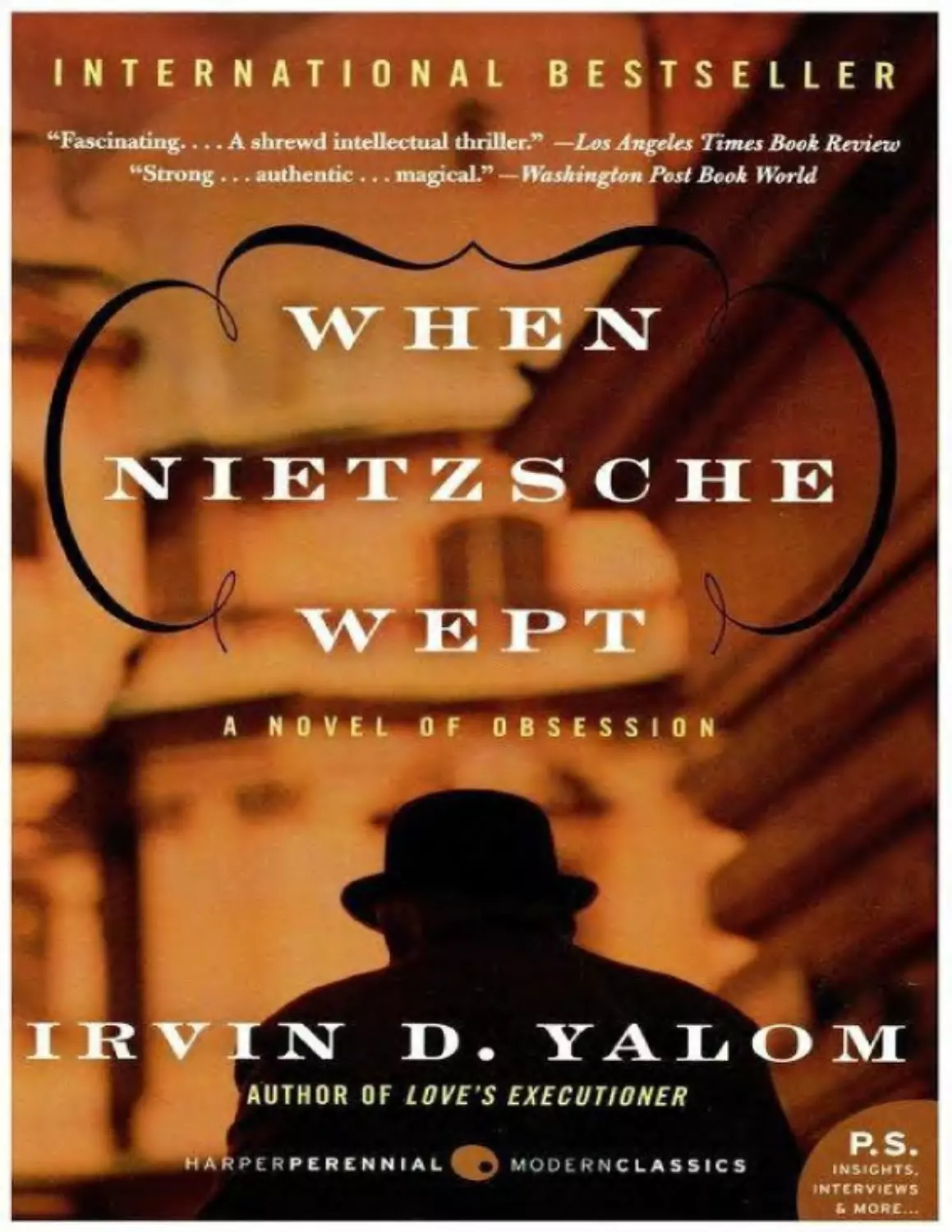
                    INTERNATIONAL BESTSELLER
u Fascinating.... A shrewd intellectual thriller.” —Los Angela l imes Book Review
14Strong ... authentic ... magical?" Washington Post Book World
INTERVIEWS
fc MORE ..
WINNER OF COMMONWEALTH CLUB OF CALIFORNIA
GOLD MEDAL FOR FICTION
“An intelligent, carefully researched, richly imagined novel?
—Boston Globe
“Strong and authentic. The element of surprise is a magical, jolting moment?
—Washington Post Book World
“When Nietzsche Wept is the best dramatization of a great thinker’s thought since Sartre’s The Freud
Scenario. ”
—Chicago Tribune
“In this admirable novel, Irvin Yalom fulfills his promise as a powerful storyteller and a brilliant
diviner of the human psyche” .
—Rollo May
“When Nietzsche Wept is Irvin Yalom’s next (psycho)logical step forward from Love's Executioner.
Deep thought wrapped up in superb storytelling. What more could one ask?”
—Theodore Roszak, author of Flicker
“A fascinating novel of what might have been the embryonic geniuses of Sigmund Freud and
Friedrich Nietzsche collided. A fascinating story and a real page-turner.”
—Palo Alto Peninsula Times Tribune
Шп ГЮТ
WT
IRVIN D, YALOM
habpirpcrenhial^ modcpnclasiics
NEW m< • Юи;О» • Г010ИЮ • SVDAfV • Mis DELHI • IHCRLAM*
HARPERPERENNIAL ©MODERNCLASSICS
The essay “On Writing a Teaching Novel: When Nietzsche Wept” is from The Yalom Reader and is
reprinted by permission of Basic Books.
A hardcover edition of this book was published in 1992 by Basic Books.
P.S.™ is a trademark of HarperCollins Publishers.
WHEN NIETZSCHE WEPT. Copyright © 1992, 2003 by Irvin D. Yalom. All rights reserved. Printed
in the United States of America. No part of this book may be used or reproduced in any manner
whatsoever without written permission except in the case of brief quotations embodied in critical
articles and reviews. For information address HarperCollins Publishers, 10 East 53rd Street, New
York, NY 10022.
HarperCollins books may be purchased for educational, business, or sales promotional use. For
information please write: Special Markets Department, HarperCollins Publishers, 10 East 53rd Street,
New York, NY 10022.
First Harper Perennial edition published 1993.
First Perennial Classics edition published 2005.
First Harper Perennial Modern Classics edition published 2010.
Hand lettering by Honi Werner
Designed by Ellen Levine
The Library of Congress has catalogued the previous edition as follows:
Yalom, Irvin D.
When Nietzsche wept / Irvin D. Yalom.
p. cm.
elSBN 9780465091720
1. Nietzsche, Friedrich Wilhelm, 1844—1900—Fiction. 2. Psychotherapist and patient—Fiction. 3.
Breuer, Josef, 1842-1925—Fiction. 4. Depression, Mental—Fiction. 5. Suicidal behavior—Fiction. 6.
Male friendship—Fiction. I. Title.
PS3575A39W47 2005
813\54—dc22
2004060574
ISBN 978-0-06-200930-2 (pbk.)
12 13 14 RRD 10 9 8 7 6 5 4
To the circle of friends
who have sustained me over the years:
Mort, Jay, Herb, David,
Helen, John, Mary, Saul, Cathy, Larry,
Carol, Rollo, Harvey, Ruthellen, Stina,
Herant, Bea, Marianne, Bob, Pat.
To my sister, JEAN,
and to my best friend, MARILYN.
Some cannot loosen their own chains and can nonetheless redeem their friends.
You must be ready to burn yourself in your own flame: how could you become new, if you had not
first become ashes?
—Thus Spake Zarathustra
CHAPTER 1
THE CHIMES OF SAN SALVATORE broke into Josef Breuer’s reverie. He tugged his heavy gold
watch from his waistcoat pocket. Nine o’clock. Once again, he read the small silver-bordered card he
had received the day before.
21 October 1882
Doctor Breuer,
I must see you on a matter of great urgency. The future of German philosophy hangs in the
balance. Meet me at nine tomorrow morning at the Cafe Sorrento.
Lou Salome
An impertinent note! No one had addressed him so brashly in years. He knew of no Lou Salome.
No address on the envelope. No way to tell this person that nine o’clock was not convenient, that Frau
Breuer would not be pleased to breakfast alone, that Dr. Breuer was on vacation, and that “matters of
urgency” had no interest for him—indeed, that Dr. Breuer had come to Venice precisely to get away
from matters of urgency.
Yet here he was, at the Cafe Sorrento, at nine o’clock, scanning the faces around him, wondering
which one might be the impertinent Lou Salome.
“More coffee, sir?”
Breuer nodded to the waiter, a lad of thirteen or fourteen with wet black hair brushed sleekly back.
How long had he been daydreaming? He looked again at his watch. Another ten minutes of life
squandered. And squandered on what? As usual he had been daydreaming about Bertha, beautiful
Bertha, his patient for the past two years. He had been recalling her teasing voice: “Doctor Breuer,
why are you so afraid of me?” He had been remembering her words when he told her that he would
no longer be her doctor: “I will wait. You will always be the only man in my life.”
He berated himself: “For God’s sake, stop! Stop thinking! Open your eyes! Look! Let the world in!”
Breuer lifted his cup, inhaling the aroma of rich coffee along with deep breaths of cold Venetian
October air. He turned his head and looked about. The other tables of the Cafe Sorrento were filled
with breakfasting men and women—mostly tourists and mostly elderly. Several held newspapers in
one hand and coffee cups in the other. Beyond the tables, steel-blue clouds of pigeons hovered and
swooped. The still waters of the Grand Canal, shimmering with the reflections of the great palaces
lining its banks, were disturbed only by the undulating wake of a coasting gondola. Other gondolas
still slept, moored to twisted poles which lay askew in the canal, like spears flung down haphazardly
by some giant hand.
“Yes, that’s right—look about you, you fool!” Breuer said to himself. “People come from all over
the world to see Venice—people who refuse to die before they are blessed by this beauty.”
How much of life have I missed, he wondered, simply by failing to look? Or by looking and not
seeing? Yesterday he had taken a solitary walk around the island of Murano and, at an hour’s end, had
seen nothing, registered nothing. No images had transferred from his retina to his cortex. All his
attention had been consumed with thoughts of Bertha: her beguiling smile, her adoring eyes, the feel
of her warm, trusting body and her rapid breathing as he examined or massaged her. Such scenes had
power—a life of their own; whenever he was off guard, they invaded his mind and usurped his
imagination. Is this to be my lot forever? he wondered. Am I destined to be merely a stage on which
memories of Bertha eternally play out their drama?
Someone rose at the adjoining table. The shrill scrape of the metal chair against the brick roused
him, and once again he searched for Lou Salome.
There she was! The woman walking down the Riva del Carbon, entering the cafe. Only she could
have written that note—that handsome woman, tall and slim, wrapped in fur, striding imperiously
toward him now through the maze of tight-packed tables. And as she neared, Breuer saw that she was
young, perhaps even younger than Bertha, possibly a schoolgirl. But that commanding presence—
extraordinary! It would carry her far!
Lou Salome continued toward him with no trace of hesitation. How could she be so sure it was he?
His left hand quickly stroked the reddish bristles of his beard lest bits of breakfast roll still clung
there. His right hand pulled down the side of his black jacket so that it didn’t hunch up around his
neck. When she was only a few feet away, she stopped for an instant and gazed boldly into his eyes.
Suddenly Breuer’s mind ceased its chattering. Now looking required no concentration. Now retina
and cortex cooperated perfectly, allowing the image of Lou Salome to pour freely into his mind. She
was a woman of uncommon beauty: powerful forehead, strong, sculpted chin, bright blue eyes, full
and sensuous lips, and carelessly brushed silver-blond hair gathered lackadaisically in a high bun,
exposing her ears and her long, graceful neck. He noticed with particular pleasure the wisps of hair
that had escaped the gathering bun and stretched out recklessly in every direction.
In three more strides, she was at his table. “Doctor Breuer, I am Lou Salome. May I?”—gesturing
toward the chair. She sat down so quickly that Breuer had no time to offer her a proper greeting—to
rise, to bow, to kiss her hand, to pull out her chair.
“Waiter! Waiter!” Breuer snapped his fingers crisply. “A coffee for the lady. Cafe latte?” He
glanced toward Fraulein Salome. She nodded and, despite the morning chill, removed her fur wrap.
“Yes, a cafe latte.”
Breuer and his guest sat silent for a moment. Then Lou Salome looked directly into his eyes and
began: “I have a friend in despair. I’m afraid he’ll kill himself in the very near future. It would be a
great loss for me, and a great personal tragedy because I would bear some responsibility. Yet I could
endure and overcome it. But”—she leaned toward him, speaking more softly—“such a loss could
extend far beyond me: this man’s death would have momentous consequences—for you, for
European culture, for all of us. Believe me.”
Breuer started to say, “Surely you exaggerate, Fraulein,” but could not utter the words. What would
have seemed adolescent hyperbole in any other young woman seemed different here, something to be
taken seriously. Her sincerity, her flow of conviction were irresistible.
“Who is this man, your friend? Do I know of him?”
“Not yet! But in time we shall all know him. His name is Friedrich Nietzsche. Perhaps this letter
from Richard Wagner to Professor Nietzsche may serve to introduce him.” She extracted a letter
from her bag, unfolded it, and offered it to Breuer. “I should first tell you that Nietzsche knows
neither that I am here nor that I possess this letter.”
Fraulein Salome’s last sentence gave Breuer pause. Should I read such a letter? This Professor
Nietzsche doesn’t know she’s showing it to me—or even that she has possession of it! How has she
obtained it? Borrowed it? Stolen it?
Breuer took pride in many of his attributes. He was loyal and generous. His diagnostic ingenuity
was legend: in Vienna, he was the personal physician of great scientists, artists, and philosophers like
Brahms, Briicke, and Brentano. At forty, he was known throughout Europe, and distinguished citizens
from all over the West traveled great distances to consult him. Yet more than anything, he took pride
in his integrity—not once in his life had he committed a dishonorable act. Unless perhaps he could be
held accountable for his carnal thoughts of Bertha, thoughts that rightfully should be directed to his
wife, Mathilde.
So he hesitated to take the letter in Lou Salome’s outstretched hand. But only briefly. Another
glance into her crystalline blue eyes and he opened it. It was dated 10 January 1882 and began: “My
friend, Friedrich”; several paragraphs had been circled.
You have now given to the world a work that is unequaled. Your book is characterized by an
assurance so consummate as to betoken the most profound originality. In what other way
could my wife and I have realized the most ardent wish of our lives, which was that some
day something might come to us from without and take full possession of our hearts and
souls! Each of us has read your book twice—once alone during the day, and then aloud in
the evening. We fairly fight over the one copy and regret that the promised second one has
not yet arrived.
But you are ill! Are you also discouraged? If so, how gladly would I do something to
dispel your despondency! How shall I begin? I can do no other than lavish my unqualified
praise upon you.
Accept it, at least, in a friendly spirit, even though it leave you unsatisfied.
Heartfelt greetings from yours,
Richard Wagner
Richard Wagner! For all his Viennese urbanity, for all his familiarity and ease with the great men
of his time, Breuer was dazzled. A letter, and such a letter, written in the master’s own hand! But he
quickly regained his composure.
“Very interesting, my dear Fraulein, but now please tell me precisely what I can do for you.”
Leaning forward again, Lou Salome rested her gloved hand lightly on Breuer’s hand. “Nietzsche is
sick, very sick. He needs your help.”
“But what’s the nature of his illness? What are his symptoms?” Breuer, flustered by the touch of her
hand, was now pleased to coast in familiar waters.
“Headaches. First of all, tormenting headaches. And continued bouts of nausea. And impending
blindness—his vision has been gradually deteriorating. And stomach trouble—sometimes he cannot
eat for days. And insomnia—no drug can offer him sleep, so he takes dangerous amounts of morphia.
And dizziness—sometimes he is seasick on dry land for days at a time.”
Long lists of symptoms were neither novelty nor enticement for Breuer, who usually saw twenty-
five to thirty patients a day and had come to Venice precisely for a reprieve from such fare. Yet such
was Lou Salome’s intensity that he felt compelled to attend closely.
“The answer to your question, my dear lady, is yes, of course, I will see your friend. That goes
without saying. After all, I am a physician. But, please, allow me to pose a question. Why don’t you
and your friend take a more direct route to me? Why not simply write to my office in Vienna
requesting an appointment?” And with that, Breuer looked around for the waiter to bring his check,
and thought how pleased Mathilde would be by his returning to the hotel so quickly.
But this bold woman was not to be put off. “Doctor Breuer, a few more minutes, please. I can’t
exaggerate the seriousness of Nietzsche’s condition, the depth of his despair.”
“I don’t doubt that. But I ask again, Fraulein Salome, why doesn’t Herr Nietzsche consult with me in
my office in Vienna? Or visit a physician in Italy? Where is his home? Would you like me to provide
a referral to a physician in his own city? And why me? For that matter, how did you know I was in
Venice? Or that I am a patron of the opera and admire Wagner?”
Lou Salome was unruffled, and smiled as Breuer began to fire questions at her, her smile growing
mischievous as the fusillade went on.
“Fraulein, you are smiling as though you have a secret. I think you are a young lady who enjoys
mysteries!”
“So many questions, Doctor Breuer. It’s remarkable—we have conversed for only a few minutes,
and yet there are so many perplexing questions. Surely that bodes well for future conversations. Let
me tell you more about our patient.”
Our patient! As Breuer marveled again at her audacity, Lou Salome continued, “Nietzsche has
exhausted the medical resources of Germany, Switzerland, and Italy. No physician has been able to
comprehend his malady or relieve his symptoms. In the last twenty-four months, he tells me, he has
seen twenty-four of Europe’s best physicians. He has given up his home, left his friends, resigned his
university professorship. He has become a wanderer in search of a tolerable climate, in quest of a day
or two’s relief from pain.”
The young woman paused, lifting her cup to sip while keeping her gaze fixed on Breuer.
“Fraulein, in my consulting practice, I often see patients with unusual or puzzling conditions. But
let me speak honestly: I have no miracles at my disposal. In such a situation as this—blindness,
headaches, vertigo, gastritis, weakness, insomnia—where many excellent physicians have been
consulted and found wanting, there is little likelihood I can do more than become his twenty-fifth
excellent physician in as many months.”
Breuer leaned back in his chair, took out a cigar, and lit it. He blew out a thin blue fume of smoke,
waited for the air to clear, then continued, “Again, however, I extend my offer to examine Herr
Professor Nietzsche in my office. But it well may be that the cause and cure of a condition as
intractable as his seems to be are beyond the reach of eighteen hundred and eighty-two’s medical
science. Your friend may have been born a generation too soon.”
“Born too soon!” She laughed. “A prescient remark, Doctor Breuer. How often have I heard
Nietzsche utter that very phrase! Now I am certain you are the right physician for him.”
Despite his readiness to leave, and his recurring vision of Mathilde, fully dressed and impatiently
pacing their hotel room, Breuer immediately expressed interest. “How so?”
“He often terms himself a 'posthumous philosopher’—a philosopher for whom the world isn’t yet
ready. In fact, the new book he is planning begins with that theme—a prophet, Zarathustra, bursting
with wisdom, decides to enlighten the people. But no one understands his words. They aren’t ready
for him, and the prophet, realizing that he’s come too soon, returns to his solitude.”
“Fraulein, your words intrigue me—I have a passion for philosophy. But my time today is limited,
and I have yet to hear a direct answer to the question of why your friend does not consult me in
Vienna.”
“Doctor Brener”—and Lou Salome looked directly into his eyes—“forgive my imprecision.
Perhaps I am unnecessarily indirect. I’ve always enjoyed basking in the presence of great minds—
perhaps because I need models for my own development, perhaps I simply like to collect them. But I
do know I feel privileged to converse with a man of your depth and range.”
Breuer felt himself flush. He could not hold her gaze any longer and looked away as she continued.
“What I mean to say is that perhaps I am guilty of being indirect simply to prolong our time here
together.”
“More coffee, Fraulein?” Breuer signaled the waiter. “And more of these droll breakfast rolls.
Have you ever reflected upon the difference between German and Italian baking? Allow me to
describe my theory about the concordance of bread and national character.”
So Breuer did not hurry back to Mathilde. And as he took a leisurely breakfast with Lou Salome, he
mused upon the irony of his situation. How strange that he had come to Venice to undo the damage
done by one beautiful woman and now sat tete-a-tete with another even more beautiful! He also
observed that, for the first time in months, his mind was free of his obsession with Bertha.
Perhaps, he mused, there’s hope for me, after all. Perhaps I can use this woman to crowd Bertha off
the stage of my mind. Can I have discovered a psychological equivalent of pharmacologic
replacement therapy? A benign drug like valerian can replace a more dangerous one like morphine.
Likewise, perhaps Lou Salome for Bertha—that would be a happy progression! After all, this woman
is more sophisticated, more realized. Bertha is—how to say it?—presexual, a woman manque, a child
twisting awkwardly in a woman’s body.
Yet Breuer knew that Bertha’s presexual innocence was precisely what drew him to her. Both
women excited him: thinking about them brought a warm vibration to his loins. And both women
frightened him: each dangerous, but in different ways. This Lou Salome frightened him because of
her power—of what she might do to him. Bertha frightened him because of her submissiveness—
because of what he might do to her. He trembled when he thought of the risks he had taken with Bertha
—how close he had come to violating the most fundamental rule of medical ethics, to bringing ruin
upon himself, his family, his entire life.
Meanwhile he was so deeply engaged in conversation and so entirely charmed by his young
breakfast companion that at last it was she, not he, who reverted to her friend’s illness—specifically to
Breuer’s comment about medical miracles.
“I am twenty-one years old, Doctor Breuer, and have given up all belief in miracles. I realize that
the failure of twenty-four excellent physicians can only mean we have reached the limits of
contemporary medical knowledge. But don’t mistake me! I have no illusions that you can cure
Nietzsche’s medical condition. That was not why I sought your help.”
Breuer put down his coffee cup and blotted his mustache and beard with his napkin. “Forgive me,
Fraulein, now I am truly confused. You began, did you not, by saying you wanted my help because
your friend is very sick?”
“No, Doctor Breuer, I said I had a friend who is in despair, who is in grave danger of taking his
life. It is Professor Nietzsche’s despair, not his corpus, that I ask you to heal.”
“But, Fraulein, if your friend is in despair over his health and I have no medical therapeutics for
him, what can be done? I cannot minister to a mind diseased.”
Breuer took Lou Salome’s nod to mean she had recognized the words of Macbeth’s physician, and
continued, “Fraulein Salome, there is no medicine for despair, no doctor for the soul. There is little
that I can do except to recommend one of a number of excellent therapeutic spas in Austria or Italy.
Or perhaps a talk with a priest or some other religious counselor, a family member—perhaps a good
friend?
“Doctor Breuer, I know that you can do more. I have a spy. My brother, Jenia, is a medical student
who attended your clinic earlier this year in Vienna?
Jenia Salome! Breuer tried to recall the name. There were so many students.
“Through him I learned of your love of Wagner, that you would be vacationing this week at the
Amalfi Hotel in Venice, and also how to recognize you. But, most important of all, it was through him
that I learned that you are, indeed, a doctor for despair. Last summer he attended an informal
conference where you described your treatment of a young woman called Anna O.—a woman who
was in despair and whom you treated with a new technique, a 'talking cure’—a cure based on reason,
on the unraveling of tangled mental associations. Jenia says you are the only physician in Europe who
can offer a true psychological treatment?
Anna O.! Breuer started at the name, and spilled coffee as he lifted the cup to his lips. He dried his
hand with his napkin, hoping that Fraulein Salome hadn’t noticed the accident. Anna O., Anna O.! It
was incredible! Everywhere he turned, he encountered Anna O.—his secret code name for Bertha
Pappenheim. Fastidiously discreet, Breuer never used his patients’ true names when discussing them
with students. Instead, he constructed a pseudonym by moving a patient’s initials back one letter in the
alphabet: thus B.P. for Bertha Pappenheim became A.O., or Anna O.
“Jenia was extraordinarily impressed with you, Doctor Breuer. When he described your teaching
conference and your cure of Anna O., he said he was blessed to be able to stand in the light of genius.
Now, Jenia is no impressionable lad. I’ve never heard him speak like that before. I resolved then that I
should one day meet you, know you, perhaps study with you. But my 'one day’ became more
immediate when Nietzsche’s condition worsened over the past two months.”
Breuer looked around. Many of the other patrons had finished and left, but here he sat, in full
retreat from Bertha, speaking to an astonishing woman whom she had brought into his life. A shiver,
a chill, passed through him. Was there to be no refuge from Bertha?
“Fraulein”—Breuer cleared his throat and forced himself to continue—“the case your brother
described was just that—a single case in which I used a highly experimental technique. There is no
reason to believe that this particular technique would be helpful with your friend. In fact, there is
every reason to believe it wouldn’t.”
“Why so, Doctor Breuer?”
“I’m afraid time does not permit a long answer. For now I shall simply point out that Anna O. and
your friend have very different illnesses. She was afflicted with hysteria and suffered from certain
disabling symptoms, as your brother may have described to you. My approach consisted of
systematically wiping out each symptom by helping my patient to recall, with the help of mesmerism,
the forgotten psychic trauma in which it originated. Once the specific source was uncovered, the
symptom dissolved.”
“Suppose, Doctor Breuer, we consider despair to be a symptom. Couldn’t you approach it in the
same manner?”
“Despair is not a medical symptom, Fraulein; it is vague, imprecise. Each of Anna O.’s symptoms
involved some discrete part of her body; each was caused by the discharge of intracerebral excitation
through some neural causeway. Insofar as you’ve described it, your friend’s despair is entirely
ideational. No treatment approach exists for such a condition.”
For the first time, Lou Salome hesitated. “But, Doctor Breuer”—again she placed her hand on his
—“before your work with Anna O., there was no psychological treatment for hysteria. As I
understand it, physicians used only baths or that horrid electrical treatment. Гт convinced that you,
perhaps only you, could devise such a new treatment for Nietzsche?
Suddenly Breuer noticed the time. He had to get back to Mathilde. “Fraulein, I shall do everything
in my power to help your friend. Please allow me to give you my card. I shall see your friend in
Vienna?
She glanced only briefly at the card before placing it in her purse.
“Doctor Breuer, Гт afraid it is not so simple. Nietzsche is not, shall I say, a cooperative patient. In
fact, he doesn’t know that Гт speaking to you. He is an intensely private person and a proud man.
He’ll never be able to acknowledge his need for help.”
“But you say he speaks openly of suicide.”
“In every conversation, in every letter. But he doesn’t ask for help. Were he to know of our
conversation, he would never forgive me, and I’m certain he would refuse to consult with you. Even
if, somehow, I were to persuade him to consult with you, he’d limit the consultation to his bodily
ailments. Never—not in a thousand years—would he place himself in the position of asking you to
alleviate his despair. He has strong opinions about weakness and power.”
Breuer began to feel frustrated and impatient. “So, Fraulein, the drama becomes more complex.
You want me to meet with a certain Professor Nietzsche, whom you consider to be one of the great
philosophers of our age, in order to persuade him that life—or, at least, his life—is worth living.
And, moreover, I must accomplish this without our philosopher knowing it.”
Lou Salome nodded, exhaled deeply, and sat back in her chair.
“But how is it possible?” he continued. “Simply to accomplish the first goal—to cure despair—is in
itself beyond the reach of medical science. But this second condition—that the patient be treated
surreptitiously—transfers our enterprise to the realm of the fantastic. Are there other obstacles you
have yet to reveal? Perhaps Professor Nietzsche speaks only Sanskrit—or refuses to leave his
hermitage in Tibet?”
Breuer felt giddy but, noticing Lou Salome’s bemused expression, quickly controlled himself.
“Seriously, Fraulein Salome, how can I do this?”
“Now you see, Doctor Breuer! Now you see why I sought out you rather than a lesser man!”
The bells of San Salvatore pealed the hour. Ten o’clock. Mathilde would be anxious by now. Ah,
but for her.... Breuer again motioned to the waiter. As they waited for the check, Lou Salome issued
an unusual invitation.
“Doctor Breuer, will you be my guest for breakfast tomorrow? As I mentioned before, I bear some
personal responsibility for Professor Nietzsche’s despair. There is a great deal more I must tell you.”
“Tomorrow is, I regret, impossible. It’s not every day that a lovely woman invites me to breakfast,
Fraulein, but I am not free to accept. The nature of my visit here with my wife makes it inadvisable to
leave her again.”
“Let me then suggest another plan. I’ve promised my brother to visit him this month. In fact, until
just recently I had planned to travel there with Professor Nietzsche. Permit me, when I am in Vienna,
to provide you with more information. Meanwhile, I shall try to persuade Professor Nietzsche to
consult with you professionally about his deteriorating physical health.”
They walked together out of the cafe. Only a few patrons lingered as the waiters cleared away the
tables. As Breuer prepared to take his leave, Lou Salome took his arm and started to walk with him.
“Doctor Breuer, this hour has been too short. I am greedy and desire more of your time. May I
walk with you back to your hotel?”
The statement struck Breuer as bold, masculine; yet from her lips it seemed right, unaffected—the
natural way people should talk and live. If a woman enjoys a man’s company, why shouldn’t she take
his arm and ask to walk with him? Yet what other woman he knew would have uttered those words?
This was a different sort of woman. This woman was free!
“Never have I so regretted declining an invitation,” Breuer said, pressing her arm closer to him,
“but it is time for me to return, and to return alone. My loving but concerned wife will be waiting at
the window, and I have a duty to be sensitive to her feelings.”
“Of course, but”—and she drew her arm from his, to stand facing him, self-enclosed, forceful as a
man—“to me, the word 'duty’ is weighty and oppressive. I’ve pared down my duties to only one—to
perpetuate my freedom. Marriage and its entourage of possession and jealousy enslave the spirit.
They will never have dominion over me. I hope, Doctor Breuer, the time will come when neither men
nor women are tyrannized by each other’s frailties.” She turned with all the assurance of her arrival.
“Auf Wiedersehen. Till our next meeting—in Vienna.”
CHAPTER 2
FOUR WEEKS LATER, Breuer sat at his desk in his office at Backerstrasse 7. It was four o’clock in
the afternoon, and he was impatiently awaiting the arrival of Fraulein Lou Salome.
It was unusual for him to have a hiatus during his workday, but in his eagerness to see her, he had
quickly dispatched his previous three patients. All had straightforward ailments requiring little effort
on his part.
The first two—men in their sixties—suffered from virtually identical conditions: severely labored
breathing and a rasping, dry bronchial cough. For years Breuer had treated their chronic emphysema
which, in cold, wet weather, became superimposed with acute bronchitis, resulting in severe
pulmonary compromise. For both patients, he prescribed morphine for the cough (Dover’s powder,
five grains three times a day), small doses of an expectorant (ipecac), steam inhalations, and mustard
plasters to the thorax. Though some physicians scoffed at mustard plasters, Breuer believed in them
and often prescribed them—especially this year, when half of Vienna seemed to be down with
respiratory illness. The city had seen no sun for three weeks, only a remorseless freezing drizzle.
The third patient, a house servant in the home of Crown Prince Rudolf, was a feverish, pockmarked
young man with a sore throat, so shy that Breuer had to be imperious in ordering him to undress for
an examination. The diagnosis was follicular tonsillitis. Though adept at quickly excising tonsils with
scissors and forceps, Breuer decided these tonsils were not ripe enough to remove. Instead, he
prescribed a cold compress to the neck, a potassium chlorate gargle, and carbonized water spray
inhalations. Since this was the patient’s third sore throat of the winter, Breuer also advised him to
harden his skin and his resistance with daily cold baths.
Now, as he waited, he picked up the letter he had received three days ago from Fraulein Salome. As
boldly as in her previous note, she announced that she would arrive at his office today at four for a
consultation. Breuer’s nostrils flared: “She tells me what time she shall arrive. She issues the edict.
She bestows upon me the honor of—”
But he quickly caught himself: “Don’t take yourself so seriously, Josef. What difference does it
make? Even though Fraulein Salome had no way of knowing, it happens that Wednesday afternoon is
an excellent time to see her. In the long skein of things, what difference does it make?”
“She tells me. . . ’’Breuer reflected upon his tone of voice: it was precisely this inflated self-
importance that he detested in his medical colleagues like Billroth and the elder Schnitzler, and in
many of his illustrious patients like Brahms and Wittgenstein. The quality he most liked in his closer
acquaintances, most of whom were also his patients, was their unpretentiousness. That was what drew
him to Anton Bruckner. Maybe Anton would never be the composer Brahms was, but at least he didn’t
worship the ground under his own feet.
Most of all, Breuer enjoyed the irreverent young sons of some of his acquaintances—the young
Hugo Wolf, Gustav Mahler, Teddie Herzl, and that most improbable medical student, Arthur
Schnitzler. He identified with them and, when other elders were out of hearing, delighted them with
caustic jabs at the reigning class. For example, last week at the Polyklinik Ball, he had amused the
group of young men crowding about him by pronouncing, “Yes, yes, it is true that the Viennese are a
religious people—their god is named 'Decorum.’ ”
Breuer, ever the scientist, recalled the facility with which he had, in only a few minutes, switched
from one mental state to another—from arrogance to unpretentiousness. What an interesting
phenomenon! Could he replicate it?
Then and there he conducted a thought experiment. First he tried to slip into the Viennese persona
with all the pomposity he had come to hate. By puffing himself up and silently muttering “How dare
she!/’ squinting his eyes and gritting his frontal cerebral lobes, he re-experienced the pique and
indignation that envelop those who take themselves too seriously. Then exhaling and relaxing, he let it
all slip away and stepped back into his own skin—into a state of mind which could laugh at itself, at
its own ridiculous posturing.
He noted that each of these states of mind had its own emotional coloring: the inflated one had
sharp corners—a nastiness and irritability—as well as a loftiness and loneliness. The other state, in
contrast, felt round, soft, and accepting.
These were definite, identifiable emotions, Breuer thought, but they were also modest emotions.
What about more powerful emotions and the states of mind that brew them? Might there be a way to
control those stronger emotions? Might that not lead to an effective psychological therapy?
He considered his own experience. His most labile states of mind involved women. There were
times—today, ensconced in the fortress of his consulting room, was one of them—when he felt
strong and safe. At such times, he saw women as they really were: struggling, aspiring creatures
dealing with the endless pressing problems of everyday life; and he saw the reality of their breasts:
clusters of mammary cells floating in lipoid pools. He knew about their leakages, dysmenorrheic
problems, sciatica, and various irregular protrusions—prolapsed bladders and uteruses, and bulging
blue hemorrhoids and varicosities.
But then there were other times—times of enchantment, of being captured by women who were
larger than life, their breasts swelling into powerful, magical globes—when he was overcome by an
extraordinary craving to merge with their bodies, to suckle at their nipples, to slip into their warmth
and wetness. This state of mind could be overwhelming, could overturn an entire life—and had, in his
work with Bertha, almost cost him everything he held dear.
It was all a matter of perspective, of switching frames of mind. If he could teach patients to do that
at will, he might indeed become what Fraulein Salome sought—a doctor for despair.
His reverie was interrupted by the sound of the door opening and closing in his outer office.
Breuer waited a moment or two, so as not to appear overanxious, and then stepped into his waiting
room to greet Lou Salome. She was wet, the Viennese drizzle having become a downpour—but
before he could help her out of her dripping outer coat, she was shrugging it off by herself and
handing it to his nurse and receptionist, Frau Becker.
After ushering Fraulein Salome into his office and motioning her toward a heavy black leather-
upholstered chair, Breuer sat down in the chair next to her. He couldn’t help remarking, “I see you
prefer to do things for yourself. Doesn’t that deprive men of the pleasure of serving you?”
“We both know that some of the services men provide are not necessarily good for women’s
health!”
“Your future husband will need extensive retraining. The habits of a lifetime are not easily
extinguished.”
“Marriage? No, not for me! I have told you. Oh, perhaps a part-time marriage—that might suit me,
but nothing more binding.”
Looking at his bold, beautiful visitor, Breuer could see much appeal in the idea of a part-time
marriage. It was hard to keep in mind that she was only half his age. She wore a simple, long black
dress buttoned high up to her neck, and a fur pelt with tiny fox face and feet was wrapped around her
shoulders. Strange, Breuer thought, in cold Venice she discards her fur, yet clings to it in my
overheated office. Still, it was time to get down to business.
“Now, Fraulein/’ he said, “let us take up the matter of your friend’s illness.”
“Despair—not illness. I have several recommendations. May I share them with you?”
Is there no limit to her presumption? he wondered indignantly. She speaks as though she were my
confrere—the head of a clinic, a physician with thirty years of experience—not an inexperienced
schoolgirl.
Calm down, Josef! he admonished himself. She is very young, she doesn’t worship the Viennese
god, Decorum. Besides, she knows this Professor Nietzsche better than I do. She’s remarkably
intelligent and may have something important to say. God knows I have no idea about curing despair:
I can’t cure my own.
He answered calmly, “Indeed, Fraulein. Please proceed.”
“My brother, Jenia, whom I saw this morning, mentioned that you used mesmerism to help Anna O.
recall the original psychological source of each of her symptoms. I remember your telling me in
Venice that this uncovering of the origin of each symptom somehow dissolved it. The how of this
'somehow’ intrigues me. Some day when we have more time, I hope that you will enlighten me about
the precise mechanism through which arriving at the knowledge of the source eliminates the
symptom.”
Breuer shook his head and waved his hands, palms toward Lou Salome. “It’s an empirical
observation. Even had we all the time in the world to talk, I’m afraid I could not provide you with the
precision you seek. But your recommendations, Fraulein?”
“My first recommendation is: do not attempt this mesmerism method with Nietzsche. It would not be
successful with him! His mind, his intellect, is a miracle—one of the wonders of the world, as you
will see for yourself. But he is, to borrow one of his favorite phrases, only human, all too human, and
he has his own blind spots.”
Lou Salome now removed her fur, rose slowly, and walked across the office to place it on Breuer’s
sofa. She glanced for a moment at the framed diplomas hanging on the wall, adjusted one that hung
slightly askew, and then sat down again and crossed her legs before going on.
“Nietzsche is extraordinarily sensitive to issues of power. He would refuse to engage in any
process that he perceives as surrendering his power to another. He is attracted in his philosophy to the
pre-Socratic Greeks, especially to their concept of Agonis—the belief that one develops one’s natural
gifts only through contest—and he is deeply distrustful of the motives of anyone who forgoes contest
and claims to be altruistic. His mentor in these matters was Schopenhauer. No one desires, he
believes, to help another: instead, people wish only to dominate and increase their own power. The
few times when he surrendered his power to another, he’s ended up feeling devastated and enraged. It
happened with Richard Wagner. I believe it is happening now with me.”
“What do you mean, it’s happening with you? Is it true that you are, in some way, personally
responsible for Professor Nietzsche’s great despair?”
“He believes I am. That is why my second recommendation is: do not ally yourself with me. You
look puzzled—for you to understand, I must tell you everything about my relationship to Nietzsche. I
shall omit nothing and answer your every question with candor. This will not be easy. I place myself
in your hands, but my words must remain our secret.”
“Of course, you may count on that, Fraulein,” he replied, marveling at her directness, at how
refreshing it was to converse with someone so open.
“Well, then... I first met Nietzsche approximately eight months ago, in April.”
Frau Becker knocked and entered with coffee. If she was surprised to see Breuer seated next to Lou
Salome rather than in his customary place behind the desk, she gave no evidence of it. Without a
word, she deposited a tray containing china, spoons, and a gleaming silver pot of coffee and quickly
left. Breuer poured the coffee as Lou Salome continued.
“I left Russia last year because of my health—a respiratory condition which is now much
improved. I first lived in Zurich and studied theology with Biederman and also worked with the poet
Gottfried Kinkel—I don’t think I’ve mentioned that I’m an aspiring poet. When my mother and I
moved to Rome early this year, Kinkel provided a letter of introduction to Malwida von Meysenburg.
You know her—she wrote Memoirs of an Idealist. ”
Breuer nodded. He was familiar with Malwida von Meysenbug’s work, especially with her crusades
for women’s rights, radical political reform, and diverse transformations in the educational process.
He was less comfortable with her recent antimaterialistic tracts, which he thought based on
pseudoscientific claims.
Lou Salome continued, “So I went to Malwida’s literary salon and there met a charming and
brilliant philosopher, Paul Ree, with whom I became quite friendly. Herr Ree had attended Nietzsche’s
classes at Basel many years before, and thereafter the two had maintained a close friendship. I could
see that Herr Ree admired Nietzsche over all other men. Soon he developed the notion that, if he and I
were friends, then Nietzsche and I must also become friends. Paul—Herr Ree—but, Doctor”—she
flushed for only an instant, but long enough for Breuer to notice, and for her to notice him noticing
—“allow me to call him Paul, since that is how I address him, and today we have no time for social
niceties. I’m very close to Paul, though I’ll never immolate myself in marriage to him or to anyone!
“But,” she went on impatiently, “I have spent enough time explaining a brief involuntary flushing
of my face. Aren’t we the only animals that blush?”
At a loss for words, Breuer could muster only a nod. For a while, surrounded by his medical
paraphernalia, he had felt more powerful than during their last talk. But now, exposed to the power of
her charm, he felt his strength slipping away. Her comment about her blush was remarkable: never in
his life had he heard a woman, or anyone else for that matter, speak of social intercourse with such
directness. And she was only twenty-one years old!
“Paul was convinced that Nietzsche and I would become fast friends,” Lou Salome continued, “that
we were perfect for one another. He wanted me to become Nietzsche’s student, protegee, and
counterfoil. He wanted Nietzsche to be my teacher, my secular priest.”
They were interrupted by a light knock on the door. Breuer rose to open it, and Frau Becker
whispered loudly that a new patient had entered. Breuer sat down again and reassured Lou Salome that
they had ample time, for unannounced patients expect long delays, and urged her to go on.
“Well,” she continued, “Paul arranged a meeting at Saint Peter’s Basilica, the most unlikely place
for the rendezvous of our unholy Trinity—the name we later adopted for ourselves, though Nietzsche
often referred to it as a 'Pythagorean relationship.’ ”
Breuer caught himself gazing at his visitor’s bosom rather than at her face. How long, he
wondered, have I been doing that? Has she noticed? Have other women noticed me doing that? In his
imagination, he grabbed a broom and swept away all sexual thoughts. He concentrated harder on her
eyes and her words.
“I was immediately attracted to Nietzsche. He’s not an imposing man physically—medium height,
with a gentle voice and unblinking eyes that look inward rather than out, as if he were protecting
some inner treasure. I didn’t know then that he is three-quarters blind. Still, there was something
extraordinarily compelling about him. The first words he spoke to me were: 'From what stars have
we dropped down to each other here?’
“Then the three of us started to talk. And what talk! For a time, it appeared that Paul’s hopes for a
friendship or mentorship between Nietzsche and me would be realized. Intellectually, we were a
perfect fit. We folded into each other’s minds—he said we had twin brother-sister brains. Ah, he read
aloud the jewels of his last book, he set my poems to music, he told me what he was going to offer the
world during the next ten years—he believed that his health would grant him no more than a decade.
“Soon Paul, Nietzsche, and I decided we should live together in a menage a trois. We began to make
plans to spend this winter in Vienna or possibly Paris.”
A menage a trois! Breuer cleared his throat and shifted uneasily in his chair. He saw her smiling at
his discomfiture. Is there nothing she misses? What a diagnostician this woman would make! Has she
ever considered a career in medicine? Might she, as my student? My protegee? My colleague,
working by my side in the consulting room, the laboratory? This fantasy had power, real power—but
her words shook Breuer out of it.
“Yes, I know the world doesn’t smile upon two men and a woman living chastely together.” She
accented “chastely” superbly—hard enough to set matters right, yet soft enough to avoid rebuke. “But
we are free-thinking idealists who reject socially imposed restrictions. We believe in our capability to
create our own moral structure.”
As Breuer did not respond, his visitor appeared, for the first time, uncertain how to proceed.
“Shall I continue? Do we have time? Am I offending you?”
“Continue, please, gnadiges Fraulein. First, I have set aside the time for you.” He reached across his
desk, held up his calender, and pointed to the large L.S. scrawled across Wednesday, 22 November
1882. “You see I have nothing else scheduled this afternoon. And secondly, you are not offending me.
On the contrary, I admire your candor, your forthrightness. Would that all friends spoke so honestly!
Life would be richer and more genuine.”
Accepting his praise without comment, Lou Salome poured herself more coffee and continued with
her story. “First, I should make clear that my relationship with Nietzsche, though intense, was brief.
We met only four times, and were almost always chaperoned by my mother, by Paul’s mother, or by
Nietzsche’s sister. In fact, Nietzsche and I were seldom alone for walks or conversations.
“The intellectual honeymoon of our unholy Trinity was also brief. Fissures appeared. Then
romantic and lustful feelings. Perhaps they were present from the very beginning. Perhaps I should
take responsibility for failing to recognize them.” She shook herself as if to doff that responsibility,
and went on to recount a crucial sequence of events.
“Toward the end of our first meeting, Nietzsche grew concerned about my plan for a chaste
menage a trois, thinking the world not ready for it, and asked me to keep our plan secret. He was
especially concerned about his family: under no circumstances must his mother or his sister learn
about us. Such conventionality! I was surprised and disappointed, and wondered if I’d been misled by
his courageous language and his free-thinking proclamations.
“Shortly afterward, Nietzsche arrived at an even stronger position—that such a living arrangement
would be socially dangerous for me, perhaps even ruinous. And, in order to protect me, he said he
had decided to propose marriage, and asked Paul to convey his offer to me. Can you imagine the
position that put Paul in? But Paul, out of loyalty to his friend—dutifully, though a bit phlegmatically
—told me of Nietzsche’s proposal.”
“Did it surprise you?” Breuer asked.
“Very much—especially coming after our very first visit. It also unsettled me. Nietzsche is a great
man and has a gentleness, a power, an extraordinary presence; I don’t deny, Doctor Breuer, that I was
strongly attracted to him—but not romantically. Perhaps he sensed my attraction to him and did not
believe my assertion that marriage was as far from my mind as romance?
A sudden gust of wind rattling the windows distracted Breuer for a moment. He suddenly felt stiff
in neck and shoulders. He had been listening so intently that for several minutes he had not moved a
muscle. Occasionally patients had talked to him of personal issues, but never like this. Never face to
face, never so unblinkingly. Bertha had revealed a great deal, but always in an “absent” state of mind.
Lou Salome was “present” and, even when describing remote events, created such moments of
intimacy that Breuer felt they were lovers talking. He had no trouble understanding why Nietzsche
would propose marriage to her after only a single meeting.
“And then, Fraulein?”
“Then I resolved to be more frank when we next met. But it turned out to be unnecessary. Nietzsche
quickly realized that he was as frightened by the prospect of marriage as I was repelled by it. When I
next saw him, two weeks later in Orta, his first words to me were that I must disregard his proposal.
He urged me instead to join him in pursuit of the ideal relationship—passionate, chaste, intellectual,
and nonmarital.
“The three of us reconciled. Nietzsche was in such high spirits about our menage a trois that he
insisted, one afternoon in Lucerne, that we pose for this—the only picture of our unholy Trinity.”
In the photograph she handed Breuer, two men were standing before a cart; she was kneeling inside
it, brandishing a small whip. “The man in the front, with the mustache, gazing upward—that’s
Nietzsche,” she said warmly. “The other one is Paul.”
Breuer inspected the photograph carefully. It disturbed him to see these two men—pathetic,
shackled giants—harnessed by this beautiful young woman and her tiny whip.
“What do you think of my stable, Doctor Breuer?”
For the first time, one of her gay comments missed its mark, and Breuer was reminded suddenly
that she was only a twenty-one-year-old girl. He felt uncomfortable—he did not like to see seams in
this polished creature. His heart went out to the two men in bondage—his brothers. Surely he could
have been one of them.
His visitor must have sensed her misstep, Breuer thought, noticing how she rushed to continue her
narrative.
“We met twice more, in Tautenberg, about three months ago, with Nietzsche’s sister and then in
Leipzig with Paul’s mother. But Nietzsche wrote me continually. Here’s a letter, in which he
responded to my telling him how moved I was by his book Dawn. ”
Breuer quickly read the short letter she handed him.
My dear Lou,
I, too, have dawns about me, and not painted ones! Something I no longer believed possible,
to find a friend for my ultimate happiness and suffering, now seems to me possible—the
golden possibility on the horizon of my whole future life. I am moved whenever I so much
as think of the bold and rich soul of my dear Lou.
EN.
Breuer kept silent. Now he felt an even greater bond of empathy with Nietzsche. To find dawns and
golden possibilities, to love a rich, bold soul: everyone needs that, he thought, at least once in a
lifetime.
“During this same time/’ Lou continued, “Paul began to write equally ardent letters. And despite my
best mediating efforts, the tension within our Trinity increased alarmingly. The friendship between
Paul and Nietzsche was disintegrating quickly. Ultimately they began to disparage each other in their
letters to me.”
“But surely,” Breuer interjected, “this comes as no surprise to you? Two ardent men in an intimate
relation with the same woman?”
“Perhaps I was naive. I believed that we three could share a life of the mind, that we could do
serious philosophical work together.”
Apparently unsettled by Breuer’s question, she rose, stretched slightly, and sauntered to the
window, stopping on the way to inspect some of the objects on his desk—a Renaissance bronze
mortar and pestle, a small Egyptian funerary figure, an intricate wooden model of the semicircular
canals of the inner ear.
“Perhaps I’m obstinate,” she said, looking out the window, “but I am still not convinced that our
menage a trois was impossible! It might have worked had it not been for the interference of
Nietzsche’s odious sister. Nietzsche invited me to spend the summer with him and Elisabeth in
Tautenberg, a small village in Thiiringen. She and I met at Bayreuth, where we met Wagner and
attended a performance of Parsifal. Then together we journeyed to Tautenberg.”
“Why do you call her odious, Fraulein?”
“Elisabeth is a divisive, mean-spirited, dishonest, anti-Semitic goose. When I made the mistake of
telling her Paul is Jewish, she took pains to make this known to Wagner’s entire circle in order to
ensure that Paul would never be welcome in Bayreuth.”
Breuer put down his coffee cup. While at first Lou Salome had lulled him into the sweet safe realm
of love, art, and philosophy, now her words jarred him back to reality, to the ugly world of anti-
Semitism. That very morning he had read in the Neue Freie Presse a story about fraternities of youths
roaming the university, entering the classrooms, shouting “Juden hinaus!” (Jews get out) and forcing
all Jews out of the lecture halls—physically pulling anyone who resisted.
“Fraulein, I, too, am Jewish, and must inquire whether Professor Nietzsche shares his sister’s anti-
Jewish views?”
“I know you’re Jewish. Jenia told me. It’s important that you know Nietzsche cares only about truth.
He hates the lie of prejudice—all prejudice. He hates his sister’s anti-Semitism. He is appalled and
disgusted that Bernard Forster, one of Germany’s most outspoken and virulent anti-Semites, often
visits her. His sister, Elisabeth... ”
Now her words came faster, the pitch of her voice rising an octave. Breuer could tell that she knew
she was straying from her prepared narrative, but could not stop herself.
“Elisabeth, Doctor Breuer, is a horror. She called me a prostitute. She lied to Nietzsche and told
him that I showed everyone that photo and bragged about how he loves the taste of my whip. She
always lies! She is a dangerous woman. Some day, mark my words, she will do Nietzsche great
damage!”
Still standing, she held tightly to the back of a chair as she spoke these words. Then, sitting, she
continued more calmly, “As you may imagine, my three weeks at Tautenberg with Nietzsche and
Elisabeth were complex. My time alone with him was sublime. Wonderful walks and deep
conversations about everything—sometimes his health permitted him to talk ten hours a day! I
wonder if ever before there has been such philosophical openness between two persons. We talked
about the relativity of good and evil, about the necessity to free oneself from public morality in order
to live morally, about a freethinker’s religion. Nietzsche’s words seemed true: we had sibling brains
—we could say so much to one another with half-words, half-sentences, mere gestures. Yet this
paradise was spoiled, because all the while we were under the eye of his serpent sister—I could see
her listening, always misunderstanding, scheming.”
“Tel I me, why would Elisabeth slander you?”
“Because she’s fighting for her life. She is a small-minded, spiritually impoverished woman. She
cannot afford to lose her brother to another woman. She realizes Nietzsche is, and will forever be,
her sole source of significance.”
She glanced at her watch and then at the closed door.
“I’m concerned about the time, so I’ll tell you the rest quickly. Just last month, despite Elisabeth’s
objections, Paul, Nietzsche, and I spent three weeks in Leipzig with Paul’s mother, where we once
again had serious philosophical discussions, particularly about the development of religious belief.
We parted only two weeks ago, with Nietzsche still believing we three would spend the spring living
together in Paris. But it will never be, I know that now. His sister succeeded in poisoning his mind
against me, and recently he began sending letters full of despair and hatred for both Paul and me.”
“And now, today, Fraulein Salome, where do things stand?”
“Everything has deteriorated. Paul and Nietzsche have become enemies. Paul grows angry every
time he reads Nietzsche’s letters to me, every time he hears of any tender feelings I have for
Nietzsche.”
“Paul reads your letters?”
“Yes, why not? Our friendship has grown deeper. I suspect I will always be close to him. We have
no secrets from one another: we even read one another’s diaries. Paul has been entreating me to break
off with Nietzsche. Finally I acquiesced and wrote Nietzsche that though I shall always treasure our
friendship, our menage a trois was no longer possible. I told him that there was too much pain, too
much destructive influence—from his sister, from his mother, from the quarrels between him and
Paul.”
“And his response?”
“Wild! Frightening! He writes crazed letters, sometimes insulting 01 threatening, sometimes deeply
despairing. Here, look at these passages I’ve received just this past week!”
She held out two letters whose appearance even showed agitation: the uneven script, the many
words abbreviated or underlined several times. Breuer squinted at the paragraphs she had circled, but
then, unable to make out more than a few words, handed them back to her.
“I forgot,” she said, “how difficult it is to read his script. Let me decipher this one addressed to
both Paul and me: 'Don’t let my outbreaks of megalomania or wounded vanity bother you too much
—and if I should one day happen to take my own life in some fit of passion, there wouldn’t be
anything in that to worry about overmuch. What are my fantasies to you! ... I came to this reasonable
view of the situation after I had taken—from despair—an enormous dose of opium----’ ”
She broke off. “That’s enough to give you an idea of his despair. I’ve been staying at Paul’s family
estate in Bavaria for several weeks now, so all my mail comes there. Paul has been destroying his
most vitriolic letters in order to spare me pain, but this one to me alone slipped through: 'If I banish
you from me now, it is a frightful censure of your whole being. . . . You have caused damage, you
have done harm—and not only to me but to all the people who have loved me: this sword hangs over
you.’ ”
She looked up at Breuer. “Now, Doctor, do you see why I so strongly recommend that you don’t
ally yourself with me in any way?”
Breuer drew deep upon his cigar. Though intrigued by Lou Salome and absorbed in the melodrama
she was unfolding, he was troubled. Was it wise to have agreed to enter into it? What a jungle! What
primitive and powerful relationships: the unholy Trinity, Nietzsche’s ruptured friendship with Paul,
the powerful connection between Nietzsche and his sister. And the viciousness between her and Lou
Salome: I must take care, he told himself, to stay out of the way of those thunderbolts. Most explosive
of all, of course, is Nietzsche’s desperate love, now turned to hatred, for Lou Salome. But it was too
late to turn back. He had committed himself and in Venice had blithely told her, “I have never refused
to treat the sick.”
He turned back to Lou Salome. “These letters help me understand your alarm, Fraulein Salome. I
share your concern about your friend: his stability seems precarious, and suicide a real possibility.
But since you now have little influence over Professor Nietzsche, how can you persuade him to visit
me?”
“Yes, that is a problem—one I have been considering at length. Even my name is poison to him
now, and I shall have to work indirectly. That means, of course, that he must never, never know of my
having arranged a meeting with you. You must never tell him! But now that I know you are willing to
meet with him-----”
She put down her cup and looked so intently at Breuer that he had to reply quickly: “Of course,
Fraulein. As I said to you in Venice, ‘I have never refused to treat the sick.’ ”
Upon hearing these words, Lou Salome broke into a broad smile. Ah, she had been under more
tension than he had imagined.
“With that assurance, Doctor Breuer, I shall begin our campaign to place Nietzsche in your office
without his knowing my part in the matter. His behavior is now so disturbed that I’m certain all his
friends are alarmed and would welcome any sensible plan to help. On my way back to Berlin
tomorrow, I’ll stop in Basel to propose our plan to Franz Overbeck, Nietzsche’s lifelong friend. Your
reputation as a diagnostician will help us. I believe Professor Overbeck can persuade Nietzsche to
consult with you about his medical condition. If I am successful, you will hear from me by letter.”
In speedy succession, she put Nietzsche’s letters back into her purse, rose, flounced her long
ruffled skirt, gathered up her fox stole from the couch, and reached out to clasp Breuer’s hand. “And
now, my dear Doctor Breuer-------”
As she placed her other hand on his, Breuer’s pulse quickened. Don’t be an old fool, he thought, but
gave himself up to the warmth of her hand. He wanted to tell her how he loved her touching him.
Perhaps she knew, for she kept his hand in hers as she spoke.
“I hope we stay in frequent contact about this matter. Not only because of my deep feelings about
Nietzsche and my fear that I am, unwittingly, responsible for some of his distress. There’s something
else. I hope, too, you and I will become friends. I have many faults, as you’ve seen: I am impulsive, I
shock you, I am unconventional. But I also have strengths. I have an excellent eye for nobility of spirit
in a man. And when I have found such a man I prefer not to lose him. So we shall write?”
She dropped his hand, strode to the door, then stopped abruptly. She reached into her bag to draw
out two small volumes.
“Oh, Doctor Breuer, I almost forgot. I think you should have Nietzsche’s last two books. They’ll
give you insight into his mind. But he must not know you have seen them. That would arouse his
suspicion, since so few of these books have sold.”
Again, she touched Breuer’s arm. “And one more point. Despite having so few readers now,
Nietzsche is convinced that fame will come. He told me once that the day after tomorrow belongs to
him. So don’t tell anyone you’re helping him. Don’t use his name to anyone. If you do and he finds
out, he’d consider it a great betrayal. Your patient—Anna O.—that’s not her real name, is it? You use
a pseudonym?”
Breuer nodded.
“Then I’d advise you to do the same for Nietzsche. Auf Wiedersehen, Doctor Breuer,” and she held
out her hand.
“Auf Wiedersehen, Fraulein,” said Breuer, as he bowed and pressed it to his lips.
Shutting the door behind her, he glanced at the two slim, paper-covered volumes and noted their
strange titles—Die Frohliche Wissenschaft (The Gay Science) and Menschliches, Allzumenschliches
(Human, All Too Human)—before putting them down on his desk. He went to the window to catch one
last glimpse of Lou Salome. She raised her umbrella, walked quickly down his front steps, and,
without looking back, entered a waiting fiacre.
CHAPTER 3
TURNING FROM THE WINDOW, Breuer shook his head to dislodge Lou Salome from his mind.
Then he tugged the cord hanging over his desk to signal Frau Becker to send in the patient waiting in
the outer office. Herr Perlroth, a stooped, long-bearded Orthodox Jew, stepped hesitantly through the
doorway.
Fifty years ago, Breuer soon learned, Herr Perlroth had undergone a traumatic tonsillectomy—his
memory of that procedure so searing that, until this day, he had refused to consult a physician. Even
now he had delayed his visit, but a “desperate medical situation,” as he put it, had left him no choice.
Breuer immediately doffed his medical demeanor, came out from behind his desk, and sat in the
adjoining chair, just as he had with Lou Salome, to chat casually with his new patient. They talked
about the weather, the new wave of Jewish immigrants from Galicia, the Austrian Reform
Association’s inflammatory anti-Semitism, and their common origins. Herr Perlroth, like almost
everyone in the Jewish community, had known and revered Leopold, Breuer’s father, and, within
minutes, had transferred this trust for the father onto the son.
“And so, Herr Perlroth,” said Breuer, “how may I be of service to you?”
“I cannot make my water, Doctor. All day long, and night too, I have to go. I run to the toilet, but
nothing comes. I stand and stand, and finally a few driblets come. Twenty minutes later, same thing. I
have to go again, but... ”
A few more questions, and Breuer was certain about the cause of Herr Perlroth’s problems. The
patient’s prostate gland had to be obstructing the urethra. Now only one important question remained:
Did Herr Perlroth have a benign enlargement of the prostate or did he have a cancer? On rectal
examination, Breuer palpated no rock-hard cancer nodules but found instead a spongy, benign
enlargement.
Upon hearing there was no evidence of cancer, Herr Perlroth broke into a jubilant smile and
grabbed Breuer’s hand and kissed it. But his mood darkened once again when Breuer described, as
reassuringly as possible, the unpleasant nature of the required treatment: the urinary passageway
would have to be dilated by the insertion into the penis of a graduated series of long metal rods, or
“sounds.” Because Breuer himself did not perform this treatment, he referred Herr Perlroth to his
brother-in-law Max, a urologist.
After Herr Perlroth left, it was a little after six, time for Breuer’s late-after no on house calls. He
restocked his large black leather medical bag, put on his fur-lined greatcoat and top hat, and stepped
outside where his driver, Fischmann, and his two-horsed carriage were waiting. (While he had been
examining Herr Perlroth, Frau Becker had hailed a Dienstmann stationed at the intersection next to the
office—a red-eyed, red-nosed young errand man who wore a large official badge, a pointed hat, and
an oversized khaki army coat with epaulets—and given him ten Kreuzer to run to fetch Fischmann.
More affluent than most Viennese physicians, Breuer leased a fiacre by the year, rather than hire one
when needed.)
As always, he handed Fischmann the list of patients to be visited. Breuer made house calls twice a
day: early, after his small breakfast of coffee and crisp three-cornered Kaisersemmel; and again, at the
end of his afternoon office consultations, as today. Like most internists of Vienna, Breuer sent a
patient to a hospital only when there was no other recourse. Not only were people cared for better at
home, but they were safer from the contagious diseases that often stormed through the public
hospitals.
As a consequence, Breuer’s two-horse fiacre was in frequent use: indeed, it was a mobile study, and
kept well stocked with the latest medical journals and reference works. A few weeks ago, he had
invited a young physician friend, Sigmund Freud, to accompany him for an entire day. A mistake
perhaps! The young man had been attempting to decide on his choice of medical specialty, and that
day may have frightened him away from the practice of general internal medicine. For, according to
Freud’s calculations, Breuer had spent six hours in his fiacre!
Now, after visiting seven patients, three of them desperately ill, Breuer had finished the day’s work.
Fischmann turned toward the Cafe Griensteidl, where Breuer usually shared a coffee with the group
of physicians and scientists who, for fifteen years, had met each evening at the same Stammtisch, a
large table reserved in the choicest corner of the cafe.
But tonight Breuer changed his mind. “Take me home, Fischmann. I’m too wet and tired for the
cafe.”
Resting his head on the black leather seat, he closed his eyes. This exhausting day had begun badly:
he had been unable to return to sleep after a nightmare at 4:00 A.M. His morning schedule had been
heavy: ten house calls and then nine office-consultation patients. In the afternoon, more office
patients, and then the stimulating but enervating interview with Lou Salome.
Even now, his mind was not his own. Insidious fantasies of Bertha seeped in: holding her arm,
walking together with her in the warm sun, far from the icy gray slush of Vienna. Soon, however,
discordant images intruded: his marriage shattered, his children left behind, as he sailed away
forever, to start a new life with Bertha in America. The thoughts haunted him. He hated them: they
robbed him of his peace; they were alien, neither possible nor desirable. Still, he welcomed them: the
only alternative—banishing Bertha from his mind—seemed inconceivable.
The fiacre rattled crossing a plank bridge over the Wien River. Breuer looked out at the pedestrians
hurrying home from work, mostly men, each carrying a black umbrella and dressed much as he was
—dark fur-lined greatcoat, white gloves, and black top hat. Someone familiar caught his eye. The
short, hatless man with the trim beard, passing the others, winning the race! That powerful stride—
he’d know it anywhere! Many times in the Vienna woods, he had tried to keep pace with those
churning legs, which never slowed except to search for Herrenpilze—the large pungent mushrooms
that grew among the rootwork of the black firs.
Asking Fischmann to pull over, Breuer opened the window and called out, “Sig, where are you
going?”
His young friend, wearing a coarse but honest blue coat, closed his umbrella as he turned to the
fiacre; then, recognizing Breuer, grinned and replied, “I’m heading toward Backerstrasse seven. A
most charming woman has invited me for supper tonight.”
“Ach! I have disappointing news!” Breuer laughed in reply. “Her most charming husband is on his
way home this very minute! Jump in, Sig, ride with me. I’m finished for the day, and too tired to go to
the Griensteidl. We’ll have time to talk before we eat.”
Freud shook the water off his umbrella, stamped his feet on the curbstone, and climbed in. It was
dark, and the candle burning in the carriage generated more shadows than light. After a moment of
silence, he turned to look closely at his friend’s face. “You look tired, Josef. Along day?”
“A hard one. It started and ended with a visit to Adolf Fief er. You know him?”
“No, but I’ve read some of his pieces in the Neue Freie Presse. Afine writer.”
“We played together as children. We used to walk to school together. He’s been my patient since the
first day of my practice. Well, about three months ago, I diagnosed liver cancer. It’s spread like
wildfire, and now he has advanced obstructive jaundice. Do you know the next stage, Sig?”
“Well, if his common duct is obstructed, then his bile will continue to back up into the bloodstream
until he dies of hepatic toxicity. Before that, he’ll go into liver coma, won’t he?”
“Precisely. Any day now. Yet I can’t tell him that. I keep up my hopeful, dishonest smile even
though I want to say an honest goodbye to him. I’ll never get used to my patients dying.”
“Let’s hope none of us do.” Freud sighed. “Hope is essential, and who but we can sustain it? To me,
it’s the hardest part of being a physician. Sometimes I have great doubts whether I’m up to the task.
Death is so powerful. Our treatments so puny—especially in neurology. Thank God, I’m almost
finished with that rotation. Their obsession with localization is obscene. You should have heard
Westphal and Meyer quarreling on rounds today about the precise brain localization of a cancer
—right in front of the patient!
“But”—and he paused—“who am I to talk? Only six months ago, when I was working in the
neuropathology lab, I was overjoyed at the arrival of a baby’s brain so I could have the triumph of
determining the precise site of the pathology! Maybe I’m getting too cynical, but more and more I
grow convinced that our disputations about the location of the lesion drown out the real truth: that our
patients die, and we doctors are impotent.”
“And, Sig, the pity is that the students of physicians like Westphal never learn how to offer comfort
to the dying.”
The two men rode in silence as the fiacre swayed in the heavy wind. Now the rain was picking up
again and splattered down on the carriage roof. Breuer wanted to give his young friend some advice,
but hesitated, choosing his words, knowing Freud’s sensitivity.
“Sig, let me say something to you. I know how disappointing it is for you to go into the practice of
medicine. It must feel like a defeat, like settling for a lesser destiny. Yesterday at the cafe, I couldn’t
help overhearing you criticize Briicke for both refusing to promote you and advising you to give up
your ambitions for a university career. But don’t blame him! I know he thinks highly of you. From his
own lips I heard that you are the finest student he’s ever had.”
“Then why not promote me?”
“To what, Sig? To Exner’s or Fleischl’s job—if they ever leave? At one hundred Gulden a year?
Briicke’s right about the money! Research is a rich man’s work. You can’t live on that stipend. And
support your parents? You wouldn’t be able to marry for ten years. Maybe Briicke wasn’t too delicate,
but he was right in saying that your only chance to remain in research is to marry for a large dowry.
When you proposed six months ago to Martha, knowing she would bring you no dowry, you—not
Briicke—decided your future.”
Freud closed his eyes for a moment before answering.
“Your words wound me, Josef. I’ve always sensed your disapproval of Martha.”
Breuer Knew how difficult it was for Freud to speak forthrightly to him—a man sixteen years
older than he and not only his friend, but his teacher, his father, his older brother. He reached out to
touch Freud’s hand.
“Not true, Sig! Not at all! We disagree only about timing. I felt you had too many hard years of
training ahead of you to burden yourself with a fiancee. But we agree about Martha—I met her only
once, at the party before her family left for Hamburg, and liked her immediately. She reminded me of
Mathilde at that age.”
“That’s not surprising”—Freud’s voice softened now—“your wife was my model. Ever since I met
Mathilde, I’ve been looking for a wife like her. The truth, Josef, tell me the truth—if Mathilde had
been poor, wouldn’t you still have married her?”
“The truth, Sig—and don’t hate me for this answer, it was fourteen years ago, times have changed
—is that I would have done whatever my father required of me.”
Freud remained silent as he took out one of his cheap cigars, then offered it to Breuer, who, as
always, declined it.
As Freud lit up, Breuer continued, “Sig, I feel what you feel. You are me. You are me ten, eleven
years ago. When Oppolzer, my chief of medicine, died suddenly of typhus, my university career
ended just as abruptly, just as cruelly, as yours has. I, too, had considered myself a lad of great
promise. I expected to succeed him. I should have succeeded him. Everyone knew that. But a gentile
was chosen instead. And I, like you, was forced to settle for less.”
“Then, Josef, you know how defeated I feel. It’s unfair! Look at the chair of medicine—Northnagel,
that brute! Look at the chair of psychiatry—Meynert! Am I less able? I could make great discoveries!”
“And so you will, Sig. Eleven years ago, I moved my laboratory and my pigeons into my home and
continued my research. It can be done. You’ll find a way. But it will never be the way of the university.
And we both know it’s not just the money. Every day the anti-Semites grow more shrill. Did you see
the piece in this morning’s Neue Freie Presse, about the gentile fraternities bursting into lectures and
pulling Jews out of the classroom? They’re threatening now to disrupt all classes taught by Jewish
professors. And did you see yesterday’s Presse? And the piece about the trial in Galicia of a Jew
accused of a ritual murder of a Christian child? They actually claim he needed Christian blood for the
matzo dough! Can you believe it? Eighteen hundred and eighty-two, and it still goes on! These are
cavemen—savages coated with just the thinnest glaze of Christianity. That's why you have no
academic future! Briicke dissociates himself personally from such prejudice, of course, but who
knows how he really feels? I do know that in private he told me that anti-Semitism would ultimately
destroy your university career.”
“But I’m meant to be a researcher, Josef. I’m not as suited as you for medical practice. All Vienna
knows of your diagnostic intuition. I don’t have that gift. For the rest of my life, I shall be a
journeyman doctor—Pegasus yoked to the plow!”
“Sig, I have no skills that I cannot teach you.”
Freud sat back, out of the candle’s light, grateful for the darkness. Never had he bared so much to
Josef, or to anyone except Martha, to whom he wrote a letter every day about his most intimate
thoughts and feelings.
“But, Sig, don’t take it out on medicine. You are being cynical. Look at the advancements of just the
last twenty years—even in neurology. Think of the paralysis of lead poisoning, or bromide
psychosis, or cerebral trichinosis. These were mysteries twenty years ago. Science moves slowly, but
in every decade we conquer another disease.”
There was a long silence before Breuer continued.
“Let’s change the subject. I want to ask you something. You’re teaching a lot of medical students
now. Have you run across a Russian student by the name of Salome, Jenia Salome?”
“Jenia Salome? I don’t think so. Why?”
“His sister came to see me today. A strange meeting.” The fiacre passed through the small
entranceway of Backer strasse 7 and lurched to a sudden stop, making the carriage sway on its heavy
springs for a moment. “Here we are. I’ll tell you about it inside.”
They dismounted in the imposing sixteenth-century cobblestone courtyard surrounded by high,
ivy-draped walls. On each side, above open ground-level arches braced by stately pilasters, rose five
tiers of large arched windows, each containing a dozen wood-framed panes. As the two men
approached the vestibule portal, the Portier, always on duty, peered out through the small glass panel
in his apartment door, then rushed to unlock the door, bowing to greet them.
They ascended the stairs, passing Breuer’s office on the second story, to the family’s spacious
third-floor apartment, where Mathilde waited. At thirty-six, she was a striking woman. Her satiny,
glowing skin set off a finely chiseled nose, blue-gray eyes, and thick chestnut hair, which she wore
coiled in a long braid on the top of her head. In a white blouse and a long gray skirt wrapped tight
around her waist, she cut a graceful figure, though she had given birth to her fifth child only a few
months before.
Taking Josef’s hat, she brushed his hair back with her hand, helped him off with his coat, and
handed it to the house servant, Aloisia, whom they had called “Louis” ever since she had entered their
service fourteen years before. Then she turned to Freud.
“Sigi, you’re drenched and frozen. Into the tub with you! We’ve already heated the water, and I’ve
laid out some of Josef’s fresh linen for you on the shelf. How convenient the two of you are the same
size! I can never offer such hospitality to Max.” Max, her sister Rachel’s husband, was enormous,
weighing over two hundred sixty pounds.
“Don’t worry about Max,” said Breuer. “I make up for it with referrals to him.” Turning to Freud,
he added, “I sent Max another hypertrophied prostate today. That’s four this week. There's a field for
you!”
“No,” Mathilde interjected, taking Freud’s arm and leading him toward the bath, “urology is not for
Sigi. Cleaning out bladders and water pipes all day! He’d go mad in a week!”
She stopped at the door. “Josef, the children are eating. Look in on them—but just for a minute. I
want you to take a nap before dinner. I heard you rustling around all night. You hardly slept.”
Without a word, Breuer headed toward his bedroom, then changed his mind and decided instead to
help Freud fill the bath. Turning back, Breuer saw Mathilde lean toward Freud and heard her whisper,
“You see what I mean, Sigi, he hardly talks to me!”
In the bathroom Breuer attached the nozzles of the petroleum pump to the tubs of hot water Louis
and Freud were carrying in from the kitchen. The massive white tub, miraculously supported by
dainty brass cat claws, quickly filled. As Breuer left and walked down the hall, he heard Freud’s purr
of pleasure as he lowered himself into the steaming water.
Lying on his bed, Breuer could not sleep for thinking about Mathilde confiding in Freud so
intimately. More and more, Freud seemed like one of the family, now even dining with them several
times a week. At first, the bond had been primarily between Breuer and Freud: perhaps Sig took the
place of Adolf, his younger brother, who had died several years before. But over the past year
Mathilde and Freud had grown close. Their ten years’ difference in age allowed Mathilde the
privilege of a maternal affection; she often said Freud reminded her of Josef when she had first met
him.
So what, Breuer asked himself, if Mathilde does tell Freud of my disaffection? What difference
does it really make? Most likely Freud already knows: he registers everything that goes on in the
household. He’s not an astute medical diagnostician, but he rarely misses anything pertaining to
human relationships. And he must also have noticed how starved the children are for a father’s love—
Robert, Bertha, Margarethe, and Johannes swarming over him with ecstatic shrieks of “Uncle Sigi,”
and even little Dora smiling, whenever he appears. Without doubt Freud’s presence in the household
was a good thing; Breuer knew that he himself was too personally distracted to supply the kind of
presence his family needed. Yes, Freud filled in for him; and, rather than shame, he, for the most part,
felt gratitude to his young friend.
And Breuer knew he could not object to Mathilde’s complaining about her marriage. She had
grounds for complaint! Almost every evening, he worked until midnight in his laboratory. He spent
Sunday mornings in his office preparing his Sunday-after no on lectures to the medical students.
Several nights a week, he stayed at the cafe until eight or nine, and he now played tarock twice a week,
rather than once. Even the midday dinner, which had always been inviolate family time, was being
encroached upon. At least once a week, Josef overscheduled himself and worked through most of the
dinner break. And, of course, whenever Max came, they locked the door of the study and played chess
for hours.
Giving up on the nap, Breuer went into the kitchen to ask about supper. He knew that Freud loved
long hot soaks, but was anxious to get through the meal and still have time for work in the laboratory.
He knocked on the bathroom door. “Sig, when you’re finished, come to the study. Mathilde’s agreed
to serve us supper there in our shirtsleeves.”
Freud quickly dried himself, donned Josef’s underwear, left his soiled linen in the hamper to be
washed, and hastened to help Breuer and Mathilde load trays for their evening meal. (The Breuers,
like most Viennese, had their main meal at midday and ate a modest evening supper of cold leftovers.)
The glass-paneled door to the kitchen dripped with mist. Pushing it open, Freud was assailed by the
wonderful, warm fragrance of carrot-and-celery barley soup.
Mathilde, ladle in hand, greeted him. “Sigi, it’s so cold out I’ve made some hot soup. It’s what you
both need.”
Freud took the tray from her. “Only two bowls? You’re not eating?”
“When Josef says he wants to eat in the study, that usually means he wants to talk to you alone.”
“Mathilde,” objected Breuer, “I did not say that. Sig will stop coming here if he doesn’t get your
company at dinner.”
“No, I’m tired, and you two have had no time alone this week.”
As they went down the long hallway, Freud popped into the children’s bedrooms to kiss them good
night; he resisted their entreaties for a story by promising to tell them two stories on his next visit. He
joined Breuer in the study, a dark-paneled room with a large central window draped in rich maroon
velvet. Stuffed in the lower part of the window, between the inner and the outer panes, were several
pillows to serve as insulation Guarding the window was a sturdy dark-walnut desk on which were
heaped open books. On the floor was a thick blue-and-ivory-flowered Kashan carpet, and three walls
were lined from floor to ceiling with bookcases crammed with books in heavy dark leather bindings.
In a far corner of the room, on a Biedermeier card table with thin, tapering bl ack-and-go Id spiraled
legs, Louis had already set a cold roast chicken, a salad of cabbage, caraway seeds, and sour cream,
some Seltstangerl (salt and kemmelseed breadsticks), and Giesshiibler (mineral water). Now Mathilde
took the soup bowls from the tray Freud was carrying, placed them on the table, and prepared to
leave.
Breuer, conscious of Freud’s presence, reached out to touch her arm. “Stay for a while. Sig and I
have no secrets from you.”
“I’ve already eaten something with the children. You two can manage without me.”
“Mathilde”—Breuer tried for lightness—“you say you don’t see me enough. Yet here I am, and you
desert me.”
But she shook her head. “I’ll stop back in a bit with some strudel.” Breuer threw a look of entreaty
toward Freud, as though to say, “What else can I do?” A moment later, just as Mathilde was closing
the door behind her, he noticed her glance significantly toward Freud, as if to say, “You see what has
become of our life together?” For the first time, Breuer became aware of the awkward and delicate
role in which his young friend had been placed: to be a confidant to both members of a disaffected
couple!
As the two men ate in silence, Breuer noticed Freud’s eyes scanning the bookshelves.
“Shall I save a shelf for your future books, Sig?”
“How I wish! But not in this decade, Josef. I’ve no time even to think. The only thing a clinical
aspirant at the Vienna General Hospital has ever written is a postcard. No, I was thinking, not of
writing, but of reading these books. Oh, the endless labor of the intellectual—pouring all this
knowledge into the brain through a three-millimeter aperture in the iris.”
Breuer smiled. “A wonderful image! Schopenhauer and Spinoza distilled, condensed, and funneled
through the pupil, along the optic nerve, and directly into our occipital lobes. I’d love to be able to eat
with my eyes—I’m always too tired now for serious reading.”
“And your nap?” Freud asked. “What happened to it? I thought you were going to lie down before
supper.”
“I can’t nap anymore. I think I’m too tired to sleep. That same nightmare woke me again in the
middle of the night—the one about falling.”
“Tell me again, Josef, exactly how did it go?”
“It’s the same every time.” Breuer downed an entire glass of seltzer, put down his fork, and sat back
to allow his food to settle. “And it’s very vivid—I must have had it ten times in the last year. First I
feel the earth tremble. I am frightened and go outside to search for... ”
He deliberated a moment, trying to remember how he had described the dream previously. In it he
was always searching for Bertha, but there were limits to what he was willing to reveal to Freud. Not
only was he embarrassed by his infatuation with Bertha, but he also saw no reason to complicate
Freud’s relationship with Mathilde by telling him things he would be constrained to keep secret from
her.
“. . . to search for someone. The ground beneath my feet starts to liquefy, like quicksand. I sink
slowly into the earth and fall forty feet—exactly that. Then I come to rest on a large slab. There is
writing on the slab. I try to make it out, but I cannot read it.”
“Such an enticing dream, Josef. One thing I’m sure of: the key to its meaning is that undecipherable
writing on the slab.”
“If, indeed, the dream has any meaning at all.”
“It must, Josef. The same dream, ten times? Surely you wouldn’t allow your sleep to be disturbed
by something trivial! The other part that interests me is the forty feet. How did you know it was
precisely that?”
“I know it—but don’t know how I know it.”
Freud, who had as usual quickly emptied his plate, quickly swallowed his last mouthful and said,
“I’m sure the figure is accurate. After all, you designed the dream! You know, Josef, I’m still
collecting dreams, and more and more I believe that precise numbers in dreams always have real
significance. I have a new example I don’t think I’ve told you about. Last week we had a dinner for
Isaac Schonberg, a friend of my father’s.”
“I know him. It’s his son Ignaz, isn’t it, who’s interested in your fiancee’s sister?”
“Yes, that’s the one, and he’s more than 'interested’ in Minna. Well, it was Isaac’s sixtieth birthday,
and he described a dream he’d had the night before. He was walking down a long dark road and had
sixty gold pieces in his pocket. Like you, he was entirely certain of that precise figure. He tried to
save his coins, but they kept falling out of a hole in his pocket, and it was too dark to find them. Now,
I don’t believe it was a coincidence that he dreamed of sixty coins on his sixtieth birthday. I’m certain
—how could it be otherwise?—that the sixty coins represent his sixty years.”
“And the hole in the pocket?” Breuer asked, picking up a second joint of chicken.
“The dream must be a wish to lose his years and become younger,” replied Freud, as he, too,
reached for more chicken.
“Or, Sig, maybe the dream expressed a fear—a fear that his years are running out and that he soon
will have none left! Remember, he was on a long dark road and trying to recover something he’d
lost.”
“Yes, I suppose so. Perhaps dreams can express either wishes or fears. Or maybe both. But tell me,
Josef, when did you first have this dream?”
“Let me see.” Breuer recalled that the first time was shortly after he had began to doubt whether his
treatment could help Bertha, and in a discussion with Frau Pappenheim had raised the possibility of
Bertha’s being transferred to the Bellevue Sanatorium in Switzerland. That would have been about the
beginning of 1882, nearly a year ago, as he told Freud.
“And wasn’t it last January, I came to your fortieth birthday dinner,” asked Freud, “along with the
entire Altmann family? So, if you’ve had the dream since then, doesn’t it follow that the forty feet
signifies forty years?”
“Well, in a couple of months, I’ll be forty-one. If you’re right, shouldn’t I fall forty-one feet in the
dream, beginning next January?”
Freud threw up his arms. “From here on, we need a consultant. I’ve come to the limits of my dream
theory. Will a dream once dreamed change to accommodate changes in the dreamer’s life?
Fascinating question! Why are years disguised as feet anyhow? Why does the little dream maker
residing in our minds go to all that trouble to disguise the truth? My guess is that the dream won’t
change to forty-one feet. I think the dream maker would be afraid that changing it one foot as you get
one year older would be too transparent, would give away the dream code.”
“Sig,” Breuer chuckled, as he wiped his mouth and mustache with his napkin, “here’s where we
always part company. When you start talking of another, separate mind, a sentient elf inside of us
designing sophisticated dreams and disguising them from our conscious mind—that seems
ridiculous.”
“I agree, it does seem ridiculous—yet look at the evidence for it, look at all the scientists and
mathematicians who have reported solving important problems in dreams! And, Josef, there is no
competing explanation. No matter how ridiculous it seems, there must be a separate, unconscious
intelligence. I’m sure---”
Mathilde entered with a pitcher of coffee and two pieces of her apple-raisin strudel, covered with a
mound of Schlag. “What are you so sure of, Sigi?”
“The only thing I’m sure of is that we want you to sit down and stay awhile. Josef was just about to
describe a patient he saw today.”
“Sigi, I can’t. Johannes is crying, and if I don’t go in to him now, he’ll wake the others.”
As she departed, Freud turned to Breuer. “Now Josef, what about your strange meeting with that
medical student’s sister?”
Breuer hesitated, collecting his thoughts. He wanted to discuss Lou Salome’s proposal with Freud
but feared it would lead into too much discussion of his treatment of Bertha.
“Well, her brother told her about my treatment of Bertha Pappenheim. Now she wants me to apply
the same treatment to a friend of hers who is emotionally disturbed.”
“How did this medical student, this Jenia Salome, even know about Bertha Pappenheim? You’ve
always been reluctant to talk to me about that case, Josef. I know nothing about it, aside from the fact
that you used mesmerism.”
Breuer wondered whether he detected a trace of jealousy in Freud’s voice. “Yes, I haven’t talked
much about Bertha, Sig. Her family is too well known in the community. And I’ve especially avoided
talking to you ever since I learned that Bertha is such a good friend of your fiancee. But, a few
months ago, giving her the pseudonym of Anna О., I briefly described her treatment at a medical
student case conference.”
Freud leaned eagerly toward him. “I can’t tell you how curious I am about the details of your new
treatment, Josef. Can’t you at least tell me what you told the medical students? You know I can keep
professional secrets—even from Martha.”
Breuer wavered. How much to tell? Of course, there was a great deal Freud knew already.
Certainly, Mathilde had for months made no secret of her annoyance about her husband’s spending so
much time with Bertha. And Freud had been present in the house on the day Mathilde had finally
exploded with anger and forbade Breuer ever again to mention his young patient’s name in her
presence.
Luckily Freud had not witnessed the final catastrophic scene of his treatment of Bertha! Breuer
would never forget going to her house on that awful day when he found her writhing with the labor
pains of a delusional pregnancy and proclaiming for all to hear: “Here comes Doctor Breuer’s
baby!” When Mathilde heard about that—such news rapidly making the rounds of Jewish housewives
—she demanded that Breuer instantly transfer Bertha’s case to another physician.
Had Mathilde reported all this to Freud? Breuer didn’t want to ask. Not now. Perhaps later, when
things had settled down. Accordingly, he chose his words carefully: “Well, you know, of course, Sig,
that Bertha had all the typical symptoms of hysteria—sensory and motor disturbances, muscular
contractures, deafness, hallucinations, amnesia, aphonia, phobias—and also unusual manifestations as
well. For example, she had some bizarre linguistic disturbances, being unable—sometimes for weeks
on end—to speak German, especially in the mornings. We held our conversations in English. Even
more bizarre was her dual mental life: one part of her lived in the present; the other part of her
responded emotionally to events that had occurred exactly one year before—as we discovered by
checking her mother’s diary for the preceding year. She also had severe facial neuralgia, which
nothing but morphia could control—and, of course, she became addicted.”
“And you treated her with mesmerism?” Freud asked.
“That was my original intent. I planned to follow Liebault’s method of removing symptoms by
hypnotic suggestion. But, thanks to Bertha—she’s an extraordinarily creative woman—I discovered
an entirely new principle of treatment. In the first few weeks, I visited her daily and invariably found
her in such an agitated state that little effective work could be done. But then we learned that she could
discharge her agitation by describing to me in detail every annoying event of the day.”
Breuer stopped and closed his eyes to collect his thoughts. He knew this was important and wanted
to include all the significant facts.
“This process took time. Often Bertha required an hour every morning of what she called
'chimneysweeping’ just to clear her mind of dreams and unpleasant fantasies, and then, when I
returned in the afternoon, new irritants had built up requiring further chimneysweeping. Only when
we had entirely cleared this daily debris from her mind could we turn to the task of alleviating her
more enduring symptoms. And at this point, Sig, we stumbled upon an astounding discovery!”
At Breuer’s portentous tone, Freud, who had been lighting a cigar, froze and let the match burn his
finger in his eagerness to hear Breuer’s next words. “Ach, mein Gott!” he exclaimed, shaking out the
match and sucking his finger. “Go on, Josef, the astounding discovery was--?”
“Well, we found that when she went back to the very source of a symptom and described it all to
me, then that symptom disappeared on its own—with no need for any hypnotic suggestion---”
“Source?” asked Freud, now so fascinated that he dropped his cigar into the ashtray and left it there,
smoldering and forgotten. “What do you mean, Josef, the source of the symptom?”
“The original irritant, the experience that gave rise to it.”
“Please!” Freud demanded. “An example!”
“Til tell you about her hydrophobia. Bertha had been unable or unwilling to drink water for several
weeks. She had great thirst, but when she picked up a glass of water, she couldn’t bring herself to
drink and was forced to quench her thirst with melons and other fruits. Then one day in a trance—she
was a self-mesmerizer and automatically entered a trance every session—she recalled how, weeks
before, she had entered her nurse’s room and witnessed her dog lap water from her drinking glass.
No sooner did she describe this memory to me, along with discharging her considerable anger and
disgust, than she requested a glass of water and drank it with no difficulty. The symptom never
returned.”
“Remarkable, remarkable!” Freud exclaimed. “And then?”
“Soon we were approaching every other symptom in this same systematic manner. Several
symptoms—for example, her arm paralysis and her visual hallucinations of human skulls and snakes
—were rooted in the shock of her father’s death. When she described all the details and the emotions
of that scene—to stimulate her recall, I even asked her to rearrange the furniture in the same way it
was at the time of his death—then all these symptoms dissolved at once.”
“It’s beautiful!” Freud had risen and was pacing in his excitement. “The theoretical implications are
breathtaking. And entirely compatible with Helmholtzian theory! Once the excess cerebral electrical
charge responsible for symptoms is discharged through emotional catharsis, then the symptoms
behave properly and promptly vanish! But you seem so calm, Josef. This is a major discovery. You
must publish this case.”
Breuer sighed deeply. “Perhaps, some day. But now is not the time. There are too many personal
complications. I have Mathilde’s feelings to consider. Perhaps now that I’ve described my treatment
procedure, you can appreciate how much time I had to invest in Bertha’s treatment. Well, Mathilde
simply couldn’t, or wouldn’t, appreciate the scientific importance of the case. As you know, she grew
to resent the hours I spent with Bertha—and, in fact, still is so angry she refuses to talk about it with
me.
“And also,” Breuer continued, “I cannot publish a case that ended so badly, Sig. At Mathilde’s
insistence, I removed myself from the case and transferred Bertha to Binswanger’s sanatorium at
Kreuzlingen last July. She is still undergoing treatment there. It’s been hard to withdraw her from the
morphia, and apparently some of her symptoms, like her inability to speak German, have returned.”
“Even so”—Freud took care to avoid the topic of Mathilde’s anger—“the case breaks new ground,
Josef. It could open up a whole new treatment approach. Will you go over it with me when we have
more time? I’d like to hear every detail.”
“Gladly, Sig. In my office I have a copy of the summary I sent to Binswanger—about thirty pages.
You can start by reading that.”
Freud took out his watch. “Ach! It’s late, and I still haven’t heard the story of this medical student’s
sister. Her friend—the one she wants you to treat with your new talking cure—she’s a hysteric? With
symptoms like Bertha’s?”
“No, Sig, that’s where the story gets interesting. There is no hysteria, and the patient’s not a 'she.’
The friend is a man, who is, or was, in love with her. He fell into a suicidal love-sickness when she
dropped him for another man, a former friend of his! Obviously she feels guilty, and she doesn’t
want his blood on her conscience?
“But, Josef”—Freud seemed shocked—“love-sickness! This is not a medical case?
“That was my first reaction as well. Exactly what I said to her. But wait until you hear the rest. The
story gets better. Her friend, who is, incidentally, an accomplished philosopher and a close personal
friend of Richard Wagner, doesn’t want help, or at least is too proud to ask for it. She asks me to be a
magician. Under the guise of consulting with him about his medical condition, she wants me to sneak
in a cure for his psychological distress?
“That’s impossible! Surely, Josef, you’re not going to attempt this?”
“I’m afraid I have already agreed.”
“Why?” Freud picked up his cigar again and leaned forward, frowning in his concern for his
friend.
“I’m not sure myself, Sig. Since the Pappenheim case ended, I’ve felt restless and stagnant. Perhaps
I need a distraction, a challenge like this. But there is another reason I took this case! The real reason!
This medical student’s sister is uncannily persuasive. You cannot say no to her. What a missionary she
would make! I think she could convert a horse into a chicken. She is extraordinary, I can’t describe to
you just how. Perhaps one day you’ll meet her. Then you’ll see.”
Freud rose, stretched, walked over to the window, and opened wide the velvet drapes. Unable to see
through the vapor on the glass, he used his handkerchief to wipe a small section dry.
“Still raining, Sig?” Breuer asked. “Shall we fetch Fischmann?”
“No, it’s almost stopped. I’ll walk. But I have more questions about this new patient. When are you
seeing him?”
“I’ve not heard from him yet. That’s another problem. Fraulein Salome and he are on bad terms
now. Indeed, she showed me some of his enraged letters. Still, she assures me that she’ll 'arrange’ for
him to consult me for his medical problems. And I have no doubt that, in this as in all things, she will
do exactly what she sets out to do.”
“And does the nature of this man’s medical problems warrant a medical consultation?”
“Definitely. He is extremely ill and has already stumped two dozen physicians, many with excellent
reputations. She described to me a long list of his symptoms—severe headaches, partial blindness,
nausea, insomnia, vomiting, severe indigestion, equilibrium problems, weakness.”
Seeing Freud shake his head in perplexity, Breuer added, “If you want to be a consultant, you’ve
got to get used to such bewildering clinical pictures. Patients who are polysymptomatic and hop from
one physician to another are an everyday part of my practice. You know, Sig, this might be a good
teaching case for you. I’ll keep you abreast.” Breuer reflected for a moment. “In fact, let’s have a
quick one-minute quiz now. So far, just on the basis of these symptoms, what’s your differential
diagnosis?”
“I don’t know, Josef, they don’t fit together.”
“Don’t be so cautious. Just guess. Think out loud.”
Freud flushed. However thirsty he was for knowledge, he hated to display ignorance. “Perhaps
multiple sclerosis or an occipital brain tumor. Lead poisoning? I just don’t know.”
Breuer added, “Don’t forget hemicrania. How about delusional hypochondriasis?”
“The problem,” Freud said, “is that none of these diagnoses explains all the symptoms.”
“Sig,” said Breuer, rising and speaking in a confidential tone, “I’m going to give you a trade secret.
One day it’ll be your bread and butter as a consultant. I learned it from Oppolzer, who once said to
me: 'Dogs can have fleas and lice, too.’ ”
“Meaning that the patient can-----”
“Yes,” Breuer said, putting his arm around Freud’s shoulders. The two men began to walk down the
long hallway. “The patient can have two diseases. If fact, those patients who reach a consultant
generally do.”
“But let’s go back to the psychological problem, Josef. Your Fraulein says this man won’t
acknowledge his psychological distress. If he won’t even admit he is suicidal, how will you proceed?”
“That shouldn’t pose a problem,” Breuer said confidently. “When I take a medical history, I can
always find opportunities to glide into the psychological realm. When I inquire about insomnia, for
example, I often ask about the type of thoughts that keep the patient awake. Or after the patient has
recited the entire litany of his symptoms, I often sympathize and inquire, off-handedly, whether he
feels discouraged by his illness, or feels like giving up, or doesn’t want to live anymore. That rarely
fails to persuade the patient to tell me everything.”
At the front door, Breuer helped Freud on with his coat. “No, Sig, that’s not the problem. I assure
you I’ll have no difficulty gaining our philosopher’s confidence and getting him to confess
everything. The problem is what to do with what I learn.”
“Yes, what will you do if he’s suicidal?”
“If I become convinced that he means to kill himself, I’ll have him locked up immediately—either
in the lunatic asylum at Briinnlfeld or perhaps in a private sanatorium like Breslauer’s at Inzerdorf.
But, Sig, that’s not going to be the problem. Think about it—if he were truly suicidal, would he bother
to consult with me?”
“Yes, of course!” Freud, looking flustered, tapped himself on the side of his head for his slowness
of wit.
Breuer continued, “No, the real problem will be what to do with him if he is not suicidal, if he is
simply suffering greatly.”
“Yes,” Freud said, “what then?”
“In that case, I’ll have to persuade him to see a priest. Or perhaps to take a long cure at Marienbad.
Or invent a way to treat him myself!”
“Invent a way to treat him? What do you mean, Josef? What kind of way?”
“Later, Sig. We shall talk later. Now, off with you! Don’t stay in this heated room with that heavy
coat on.”
As Freud stepped out the door, he turned his head. “What did you say this philosopher’s name is?
Anyone I’ve heard of?”
Breuer hesitated. Remembering Lou Salome’s injunction for secrecy, on the spur of the moment he
made up for Friedrich Nietzsche a name according to the code whereby he had devised Anna O. to
represent Bertha Pappenheim. “No, he’s an unknown. The name is Muller, Eckart Muller.”
CHAPTER 4
TWO WEEKS LATER, Breuer sat in his office, wearing his white consultation coat, and reading a
letter from Lou Salome:
23 November 1882
My dear Dr. Breuer,
Our plan is working. Professor Overbeck fully agrees with our view that the situation is
indeed very dangerous. Never has he seen Nietzsche in worse condition. He will exert all
possible influence to persuade him to consult with you. Neither I nor Nietzsche shall ever
forget your kindness in this, the time of our need.
Lou Salome
“Our plan, our view, our need. Our, our, our? Breuer put down the letter—having read it for
perhaps the tenth time since its arrival a week ago—and picked up the mirror on his desk to watch
himself say “our.” He saw a thin pink sliver of lip encircling a small black hole in the midst of auburn
bristles. He opened the hole wider and watched elastic lips stretch around yellowing teeth that stuck
out of his gums like half-buried tombstones. Hair and hole, horn and teeth—hedgehog, walrus, ape,
Josef Breuer.
He hated the sight of his beard. More often these days, clean-shaven men were to be seen on the
street; when would he find the courage to shave off the whole hairy mess? He hated also the
outcropping of gray that had insidiously appeared in his mustache, on the left side of his chin, and in
his sideburns. These gray bristles were, he knew, the advance scouts of a relentless, wintry invasion.
And there would be no stopping the march of the hours, the days, the years.
Breuer hated all the mirror reflected—not only the gray tide and the animalistic teeth and hair, but
the hooked nose straining toward his chin, the absurdly large ears, and the massive naked forehead—
the balding had begun there and had, without pity, cropped its way back, displaying the shame of his
bare skull.
And the eyes! Breuer softened and looked into his eyes; he could always find youth there. He
winked. He often winked and beckoned at himself—at his real self, at the sixteen-year-old Josef
dwelling in those eyes. But no greeting today from young Josef! Instead, his father’s eyes peered at
him—old, tired eyes surrounded by wrinkled, reddened eyelids. Breuer watched with fascination as
his father’s mouth formed a hole to say, “Our, our, our.” More and more often, Breuer thought about
his father. Leopold Breuer had been dead for ten years. He had died at the age of eighty-two, forty-
two years older than Josef was now.
He put down the mirror. Forty-two years left! How could he endure forty-two more years? Forty-
two years of waiting for the years to pass. Forty-two years of staring into his aging eyes. Was there
no escape from the prison of time? Ah, to be able to begin again! But how? Where? With whom? Not
with Lou Salome. She was free, and she might flutter, when she so chose, in and out of his prison. But
it would never be “our” with her—never “our” life, “our” new life.
Nor, he knew, would it ever again be “our” with Bertha. Whenever he could escape the old, circular
remembrances about Bertha—the almond fragrance of her skin, the mighty swell of her breasts under
her gown, the heat of her body as she leaned against him when entering a trance—whenever he
succeeded in stepping back and gaining perspective on himself, he realized that, all along, Bertha had
been a fantasy.
Poor, unformed, mad Bertha—what a foolish dream it was to think I could complete her, form her,
so that she, in turn, could give me . . . what? That was the question. What was I searching for from
her? What did I lack? Did I not have the good life? To whom can I complain that my life has led
irrevocably into an ever-narrowing chute? Who can comprehend my torment, my sleepless nights,
my flirtation with suicide? After all, haven’t I everything one could wish: money, friends, family, a
beautiful and charming wife, renown, respectability? Who will comfort me? Who refrain from
asking the obvious question: “What more can you want?”
Frau Becker’s voice, announcing the arrival of Friedrich Nietzsche, startled Breuer, even though he
had been expecting it.
Stout, short, gray-haired, vigorous, and bespectacled, Frau Becker ran Breuer’s consulting office
with astonishing precision. In fact, she filled her role so consummately that there were no visible
leftovers of the private Frau Becker. In the six months since he had hired her, they had not exchanged
a personal word. Though he tried, he could not remember her first name or imagine her doing
anything but nursely duties. Frau Becker on a picnic? Reading the morning Neue Freie Presse? In the
bathtub? Pudgy Frau Becker naked? Mounted? Breathing hard in passion? Inconceivable!
Still, despite his dismissal of her as a woman, Frau Becker was an astute observer, and Breuer had
come to value her initial impressions.
“How does this Professor Nietzsche strike you?”
“Herr Doctor, he has a gentleman’s bearing but not a gentleman’s grooming. He seems shy. Almost
humble. And a gentle manner, very different from many of the gentlefolk who come here—for
example, that Russian grand lady, two weeks ago.”
Breuer had himself noted a gentleness to Professor Nietzsche’s letter requesting a consultation, at
Dr. Breuer’s convenience, within the next two weeks, if at all possible. Nietzsche would, he explained
in his letter, journey to Vienna expressly for the purpose of a consultation. Until he received word, he
would remain in Basel with his friend, Professor Overbeck. Breuer smiled to himself when he
contrasted Nietzsche’s letter with Lou Salome’s dispatches ordering him to be available at her
convenience.
As he waited for Frau Becker to bring Nietzsche in, Breuer scanned his desk and suddenly noted
with alarm the two books given him by Lou Salome. During a free half-hour yesterday, he had
skimmed them and left them carelessly in plain view. He realized that if Nietzsche were to see them,
the treatment would end before it began, as it would be all but impossible to explain them without
mentioning Lou Salome. How uncommonly careless of me, Breuer thought. Am I trying to sabotage
this enterprise?
Quickly slipping the books into a desk drawer, he rose to greet Nietzsche. The professor was not at
all what he had expected from Lou’s description. His demeanor was gentle, and while of solid
physique—about five-foot eight or nine, and one hundred and fifty or sixty pounds—there was
something curiously insubstantial about his body, as though you could pass your hand through it. He
was dressed in a heavy, almost military-weight, black suit. Under his jacket he wore a heavy brown
peasant sweater which almost entirely covered his shirt and his mauve cravat.
As they shook hands, Breuer noted Nietzsche’s cold skin and limp clasp.
“Good day, Herr Professor—but not such a good one for travelers, I should imagine?
“No, Doctor Breuer, not good for traveling. Nor for the condition that brings me to you. I have
learned to avoid such weather. It is only your excellent reputation that lures me this far north in
winter?
Before sitting down in the chair to which Breuer directed him, Nietzsche fussily put a bulging,
scuffed briefcase first on one side of the chair and then on the other, apparently seeking some suitable
resting place for it.
Breuer sat quietly and continued to inspect his patient as the latter made himself comfortable.
Despite Nietzsche’s unassuming appearance, he conveyed a strong presence. It was the powerful head
that commanded attention. Especially his eyes, soft brown, but extraordinarily intense and deeply set
beneath a prominent orbital ridge. What had Lou Salome said about his eyes? That they seemed to
stare inward, as though at some hidden treasure? Yes, Breuer could see that. His patient’s brown,
gleaming hair was carefully brushed. Aside from a long mustache, which fell like an avalanche over
his lips and on either side of his mouth, down to his chin, he was clean-shaven. The mustache evoked
in Breuer a sense of hairy kinship: he had a quixotic impulse to warn the professor not to eat a
Viennese pastry in public, especially one heaped high with Schlag, or he would be combing it out of
his mustache long afterward.
Nietzsche’s soft voice was surprising: the voice in his two books had been forceful, bold and
authoritative, almost strident. Again and again, Breuer was to encounter this same discrepancy
between the Nietzsche of flesh and blood and the Nietzsche of pen and paper.
Aside from his brief talk with Freud, Breuer had given little thought to this unusual consultation.
Now, for the first time, he seriously questioned the wisdom of being involved in this matter. Lou
Salome, the bewitcher, the major conspirator, was long gone, and in her place sat this unsuspecting,
duped Professor Nietzsche. Two men maneuvered into meeting under false pretenses by a woman
who was now, no doubt, off to some new intrigue. No, he had little heart for this venture.
Still, it’s time to put all that behind me, Breuer thought. A man who has threatened to take his own
life is now my patient, and I must give him my total attention.
“How was your journey, Professor Nietzsche? I understand you’ve just come from Basel?”
“That was but my last stop,” Nietzsche said, sitting stiffly. “My whole life has become a journey,
and I begin to feel that my only home, the only familiar place to which I always return, is my illness.”
Not a man for small talk, Breuer reflected. “Then, Professor Nietzsche, let us proceed immediately
to investigate your illness.”
“Would it be more efficient for you first to peruse these documents?” And Nietzsche drew from his
briefcase a heavy folder crammed with papers. “I have been ill perhaps all my life, but most severely
so for the last decade. Here are the full reports of my previous consultations. May I?”
Breuer nodded, and Nietzsche opened the folder, reached across the desk, and placed the contents—
letters, hospital charts, and laboratory reports—in front of Breuer.
Breuer scanned the first page, containing a list of twenty-four physicians and the dates of each
consultation. He recognized several prominent Swiss, German, and Italian names.
“Some of these names are known to me. Excellent physicians all! Here I see three—Kessler, Turin,
and Koenig—whom I know well. They trained in Vienna. As you imply, Professor Nietzsche, it would
be unwise to ignore the observations and conclusions of these excellent men—yet there is great
disadvantage in my beginning with them. Too much authority, too many prestigious opinions and
conclusions oppress one’s own imaginative synthetic powers. For much the same reason, I prefer to
read a play before seeing it performed and certainly before reading reviews. Have you not found that
to be the case in your own work?”
Nietzsche seemed startled. Good, thought Breuer. Professor Nietzsche must see that I am a different
kind of physician. He is not accustomed to physicians who converse about psychological constructs
or inquire, knowledgeably, about his work.
“Yes,” Nietzsche replied, “it is an important consideration in my work. My original field is
philology. My first appointment, my only appointment, was that of professor of philology at Basel. I
have an especially strong interest in the pre-Socratic philosophers, and with them I have always found
it crucial to return to the original text. Interpreters of texts are always dishonest—not intentionally, of
course—but they cannot step outside their own historical frame. Nor, for that matter, out of their
autobiographical frame.”
“But does not an unwillingness to pay homage to interpreters make one unpopular in the academic
philosophical community?” Breuer felt confident. This consultation was on course. He was well
embarked on the process of successfully persuading Nietzsche that he, his new physician, was a
kindred spirit with kindred interests. It was not going to be difficult to seduce this Professor Nietzsche
—and Breuer viewed it as seduction indeed, as enticing his patient into a relationship he had not
sought in order to obtain help he had not requested.
“Unpopular? Without question! I had to resign my professorship three years ago because of illness
—the very illness, yet undiagnosed, that brings me to you today. But even were I perfectly healthy I
believe my distrust of interpreters would have ultimately made me an unwelcome guest at the
academic table.”
“But, Professor Nietzsche, if all interpreters are limited by their autobiographical frame, how do
you escape the same limitation in your own work?”
“First,” Nietzsche responded, “one must identify the limitation. Next, one must learn to see oneself
from afar—although sometimes, alas, the severity of my illness impairs my perspective.”
It did not escape Breuer that it was Nietzsche, not he, who was keeping their discussion focused on
his illness, which was, after all, the raison d'etre of their meeting. Was there perhaps a subtle rebuke
in Nietzsche’s words? “Don’t try too hard, Josef,” he reminded himself. “A patient’s confidence in a
physician should not be explicitly pursued; it will ensue naturally from a competent consultation.”
While often self-critical in many areas of his life, Breuer had supreme confidence in himself as a
physician. “Do not pander, patronize, scheme, or strategize,” his instincts told him. “Simply go about
your business in your usual professional manner.”
“But let us return to our task, Professor Nietzsche. What I have been meaning to say is that I should
prefer to take a medical history and conduct an examination before I examine your records. Then, at
our next meeting, I shall try to provide you with as comprehensive a synthesis as possible.”
Breuer placed a blank pad of paper on the desk before him. “Your letter told me a few things about
your condition: that you have had headaches and visual symptoms for at least ten years; that you are
rarely free of your illness; that, as you put it, your illness always awaits you. And now today you
inform me that at least twenty-four physicians have failed to be of help. That is all I know about you.
So, shall we begin? First, please tell me in your own words everything about your illness.”
CHAPTER 5
FOR NINETY MINUTES, the two men talked. Breuer, sitting in his high-backed leather chair, was
taking rapid notes. Nietzsche, who occasionally paused to allow Breuer’s pen to keep pace, sat in a
chair of the same leather, equally comfortable but smaller than Breuer’s. Like most physicians of the
day, Breuer preferred to have his patients look up to him from below.
Breuer’s clinical evaluation was thorough and methodical. After first listening carefully to the
patient’s free-form description of the illness, he next systematically investigated each symptom—its
first appearance, its transformation over time, its response to therapeutic efforts. His third step was to
check every organ system in the body. Starting from the top of the head, Breuer worked his way down
to the feet. First the brain and nervous system. He began by inquiring about the functioning of each of
the twelve cranial nerves—the sense of smell, vision, eye movements, hearing, facial and tongue
movement and sensation, swallowing, balance, speech.
Descending the body, Breuer reviewed, one by one, every other functional system: respiratory,
cardiovascular, gastrointestinal, and genital-urinary. This painstaking organ review jostled the
patient’s memory and ensured that nothing was overlooked: Breuer never omitted any part of it, even
if he was certain beforehand of the diagnosis.
Next, a careful medical history: the patient’s childhood health, his parents’ and siblings’ health, and
an investigation of all other aspects of his life—occupational choice, social life, military service,
geographic moves, dietary and recreational preferences. Breuer’s final step was to allow his intuition
full rein and to make all other inquiries that his data thus far suggested. Thus, the other day, in a
puzzling case of respiratory distress, he had made a correct diagnosis of diaphragmatic trichinosis by
inquiring into the thoroughness with which the patient cooked her smoked salt pork.
Throughout this procedure, Nietzsche remained deeply attentive: indeed, he nodded appreciatively
at each of Breuer’s questions. No surprise, of course, to Breuer. He had never encountered a patient
who did not secretly enjoy a microscopic examination of his life. And the greater the power of
magnification, the more the patient enjoyed it. The joy of being observed ran so deep that Breuer
believed the real pain of old age, bereavement, outliving one’s friends, was the absence of scrutiny—
the horror of living an unobserved life.
Breuer was surprised, however, at the complexity of Nietzsche’s ailments and at the thoroughness
of his patient’s own observations. Breuer’s notes filled page after page. His hand began to weary as
Nietzsche described a gruesome assemblage of symptoms: monstrous, crippling headaches;
seasickness on dry land—vertigo, disequilibrium, nausea, vomiting, anorexia, disgust for food;
fevers, heavy night sweats which necessitated two or three nightly changes of nightshirt and linen;
crushing bouts of fatigue which at times approximated generalized muscular paralysis; gastric pain;
hematemesis; intestinal cramps; severe constipation; hemorrhoids; and disabling visual problems—
eye fatigue, inexorable fading of vision, frequent watering and pain in his eyes, visual blurring, and
great sensitivity to light, especially in the mornings.
Breuer’s questions added a few more symptoms Nietzsche had either neglected or been reluctant to
mention: visual scintillations and scotomata, which often preceded a headache; intractable insomnia;
severe nocturnal muscle cramps; generalized tension; and rapid, inexplicable mood shifts.
Mood shifts! The words Breuer had been waiting for! As he had described to Freud, he always
sniffed for a propitious point of entry into a patient’s psychological state. These “mood shifts” might
be just the key that would lead to Nietzsche’s despair and suicide intention!
Breuer proceeded gingerly, asking him to elaborate on his mood shifts. “Have you noticed
alterations in your feelings which seem related to your illness?”
Nietzsche’s demeanor did not change. He seemed unconcerned that this question might lead into a
more intimate realm. “There have been times when, on the day before an attack, I have felt
particularly good—I have come to think of it as feeling dangerously good. ”
“And after the attack?”
“My typical attack lasts from twelve hours to two days. After such an attack, I generally feel
fatigued and leaden. Even my thoughts are sluggish for a day or two. But sometimes, especially after
a longer attack of several days, it is different. I feel refreshed, cleansed. I explode with energy. I
cherish these times—my mind swarms with the rarest of ideas.”
Breuer persisted. Once he found the trail, he did not easily give up the chase. “Your fatigue and the
leaden feeling—how long do they last?”
“Not long. Once the attack lessens and my body belongs to itself again, I assume control. Then I
will myself to overcome the heaviness.”
Perhaps, Breuer reflected, this might be more difficult than he first thought. He would have to be
more direct. Nietzsche, it was clear, was not going to volunteer any information about despair.
“And melancholia? To what extent does it accompany or succeed your attacks?”
“I have black periods. Who has not? But they do not have me. They are not of my illness, but of my
being. One might say I have the courage to have them.”
Breuer noted Nietzsche’s slight smile and his bold tone. Now, for the first time, Breuer recognized
the voice of the man who had written those two audacious, enigmatic books concealed in his desk
drawer. He considered, but only for a moment, a direct challenge to Nietzsche’s ex-cathedra
distinction between the realms of illness and being. And that statement about having the courage to
have black periods, what did he mean by that? But patience! Best to maintain control of the
consultation. There would be other openings.
Carefully, he continued. “Have you ever kept a detailed diary of your attacks—their frequency,
their intensity, their duration?”
“Not this year. I’ve been too preoccupied with momentous events and changes in my life. But last
year I had one hundred and seventeen days of absolute incapacitation and almost two hundred days in
which I was partially incapacitated—with milder headaches, eye pain, stomach pain, or nausea.”
Here were two promising openings—but which to follow? Should he inquire about the nature of
those “momentous events and changes”— surely Nietzsche was referring to Lou Salome—or
strengthen the do ctor-patient rapport by being empathic? Knowing that it was impossible to have too
much rapport, Breuer, chose the latter.
“Let’s see, that leaves only forty-eight days without illness. That is very little ‘well’ time, Professor
Nietzsche.”
“Thinking back over several years, rarely have I had times of well-being that have persisted for
over two weeks. I think I can remember each one of them!”
Hearing a wistful, forlorn tone in Nietzsche’s voice, Breuer decided to gamble. Here was an
opening that could lead directly into his patient’s despair. He put down his pen and, in his most earnest
and professionally concerned voice, remarked, “Such a situation—the majority of one’s days a
torment, a handful of healthy days a year, one’s life consumed by pain—seems a natural breeding
place for despair, for pessimism about the point of living.”
Nietzsche stopped. For once he did not have a ready answer. His head swayed from side to side as if
he were pondering whether to permit himself to be consoled. But his words said something else.
“Undoubtedly that is true, Doctor Breuer, for some people, perhaps for most—here I must defer to
your experience—but it is not true for me. Despair? No, perhaps once true, but not now. My illness
belongs to the domain of my body, but it is not me. I am my illness and my body, but they are not me.
Both must be overcome, if not physically, then metaphysically.
“As for your other comment, my 'point of living’ is something entirely divorced from this”—here
he thumped his abdomen—“sorry protoplasm. I have a why of living and can put up with any how. I
have a ten-year point of living, a mission. I am pregnant, here”—he tapped his temple—“with books,
books almost fully formed, books only I can deliver. Sometimes I think of my headaches as cerebral
labor pains.”
Nietzsche apparently had no intention of discussing or even acknowledging despair; and it would
be futile, Breuer realized, to attempt to snare him. He suddenly recalled feeling being outmaneuvered
whenever he played chess with his father, the best player in the Jewish Viennese community.
But perhaps there was nothing to acknowledge! Perhaps Fraulein Salome was wrong. Nietzsche
sounded as though his spirit had overcome this monstrous illness. As for suicide, Breuer had an
absolutely infallible test for the risk of suicide. Does the patient project himself into the future?
Nietzsche had passed that test! He was not suicidal: he spoke of a ten-year mission, of books he had
yet to extract from his mind.
Yet with his own eyes, Breuer had seen Nietzsche’s suicidal letters. Was he dissimulating? Or was it
that he did not now feel despair because he had Already decided upon suicide? Breuer had known
patients like that before. They were dangerous. They appear improved—in a sense, are improved;
their melancholia lightens; they smile, eat, sleep once more. But their improvement means they have
discovered an escape from their despair—the escape of death. Was that Nietzsche’s plan? Had he
decided to kill himself? No, Breuer remembered what he had told Freud: If Nietzsche intended
suicide, why was he here? Why take the trouble to visit yet another physician, to journey from
Rapallo to Basel, and thence to Vienna?
Despite his frustration at not obtaining the information he sought, Breuer could not fault his
patient’s cooperation. Nietzsche responded fully to each medical question—if anything, too fully.
Many headache sufferers report sensitivity to diet and weather, so Breuer was not surprised to learn
that this was true for Nietzsche as well. But he was astonished by the exquisite detail of his patient’s
report. Without pausing, Nietzsche spoke for twenty minutes about his response to atmospheric
conditions. His body, he said, was like an aneroid barometer-thermometer reacting violently to every
oscillation of atmospheric pressure, temperature, or altitude. Gray skies depressed him, leaden clouds
or rain enervated him, drought invigorated him, winter represented a form of mental “lockjaw,” the
sun opened him up again. For years his life had consisted of a search for the perfect climate.
Summers were endurable. The cloudless, windless, sunny plateau of the Engadine suited him; and for
four months every year, he resided in a small Gasthaus in the little Swiss village of Sils Maria. But
winters were a curse. He had never found a friendly wintering spot; and during the cold months, he
lived in southern Italy, moving from city to city in search of salubrious climate. Vienna’s wind and
wet gloom poisoned him, Nietzsche said. His nervous system cried out for sun and dry, still air.
When Breuer asked about diet, Nietzsche delivered another lengthy discourse on the relationship
between diet, gastric distress, and headache attacks. What remarkable precision! Never before had
Breuer encountered a patient who answered every question so comprehensively. What did it mean?
Was Nietzsche an obsessional hypochondriac? Breuer had seen many boring, self-pitying
hypochondriacs who relished describing their innards. But these patients had a “Weltanschauung
stenosis/’ a narrowing of world view. And how tedious it was to be in their presence! They had no
thoughts butthose of corpus, no interests or values butthose of health.
No, Nietzsche was not one of these. His range of interest was extensive, his persona engaging.
Certainly Fraulein Salome had found him so, still found him so, even if she found Paul Ree more
romantically congenial. Furthermore, Nietzsche did not describe his symptoms to elicit sympathy or
even support—this Breuer had learned early in their interview.
So why this exquisite detail about his bodily functions? Perhaps it was simply that Nietzsche had a
good mind, with perfect retention, and approached a medical evaluation in a fundamentally rational
manner, providing comprehensive data to an expert consultant. Or, he was uncommonly introspective.
Before the end of his evaluation, Breuer obtained still another answer: Nietzsche had so little contact
with other human beings that he spent an extraordinary amount of time in conversation with his own
nervous system.
His history taking complete, Breuer proceeded to the physical examination. He accompanied his
patient to his examining office, a small, sterile room containing only a dressing screen and chair, an
examining table covered with a starched white sheet, a sink, a scale, and a steel cabinet containing
Breuer’s instruments. A few minutes after leaving Nietzsche to strip and change, Breuer returned to
find him, though already wearing the open-backed dressing gown, still in his high black socks and
garters and carefully folding his clothes. He apologized for the delay, saying, “My nomadic life
dictates that I can have only a single suit. Hence, I make certain it’s comfortable whenever I put it to
rest.”
Breuer’s physical exam was as methodical as his medical history. Beginning with the head, he
slowly worked his way down the body, listening, tapping, touching, smelling, feeling, looking.
Despite his patient’s abundance of symptoms, Breuer found no physical abnormalities aside from a
large scar over the sternum—a result of a riding accident while in the military; a minute oblique
dueling scar on the bridge of the nose; and some signs of anemia: pale lips, conjunctiva, and creases
of the palm.
The cause of the anemia? Probably nutritional. Nietzsche had said that he often avoided meat for
weeks at a time. But later Breuer remembered that Nietzsche had said he occasionally vomited blood,
and thus might be losing blood from gastric bleeding. He drew some blood for a red-cell count and,
after a rectal examination, collected a stool specimen from his glove which he would later examine
for occult blood.
What of Nietzsche’s visual complaints? First, Breuer noted a unilateral conjunctivitis which could
be easily managed with eye salve. Despite considerable effort, Breuer was unable to focus his
ophthalmoscope on Nietzsche’s retina: something was obstructing the view, probably a corneal
opacity, perhaps an edema of the cornea.
Breuer particularly focused on Nietzsche’s nervous system, not only because of the nature of the
headaches but also because his father had died, when he was four, of “softening of the brain”—a
generic term which might refer to any of a number of abnormalities, including stroke, tumor, or
some form of inherited cerebral degeneration. But after testing every aspect of brain and nerve
function—balance, coordination, sensation, strength, proprioception, hearing, smell, swallowing—
Breuer found no evidence whatsoever of structural nervous system disease.
While Nietzsche dressed, Breuer returned to his office to chart the results of his examination.
When, a few minutes later, Frau Becker brought Nietzsche back into the office, Breuer realized that,
though their time was drawing to a close, he had failed utterly to elicit any mention of melancholia or
suicide. He tried another approach, an interview device that rarely failed to yield results.
“Professor Nietzsche, I would like you to describe, in detail, a typical day of your life.”
“Now you have me, Doctor Breuer! That’s the most difficult question you have posed. I move so
much, my surroundings are inconstant. My attacks dictate my life--”
“Choose any ordinary day, a day between attacks in the past few weeks?
“Well, I awaken early—if, indeed, I have slept at all-”
Breuer felt encouraged. Already he had an opening. “Allow me to interrupt, Professor Nietzsche.
You say if you have slept?”
“My sleep is dreadful. Sometimes it is muscle cramps, sometimes stomach pain, sometimes a
tension that invades every part of my body, sometimes my thoughts----usually malignant, nocturnal
thoughts; sometimes I lie awake all night, sometimes drugs give me two or three hours’ sleep.”
“Which drugs? How much of each?” Breuer asked quickly. Though it was imperative that he learn
about Nietzsche’s self-medication, he realized immediately that he had not chosen the best option.
Better, much better, to have inquired about those dark nocturnal thoughts!
“Chloral hydrate, almost every night, at least one gram. Sometimes, if my body is desperate for
sleep, I add morphia or Veronal, but then I am in stupor the next day. Occasionally hashish, but it also
blunts my thinking the following day. I prefer chloral. Shall I continue with this day, which has
already dawned badly?”
“Please.”
“I take some breakfast in my room—you want this much detail?”
“Yes, exactly. Tell me everything.”
“Well, breakfast is a simple affair. The Gasthaus owner brings me some hot water. That’s all.
Occasionally, if I feel particularly well, I ask for weak tea and dry bread. Then I bathe in cold water—
necessary if I am to work with any vigor—and spend the rest of the day at work—writing, thinking,
and occasionally, if my eyes permit, a little reading. If I feel well, I will walk, sometimes for hours. I
scribble as I walk and often do my best work, have my finest thoughts, while walking-”
“Yes, I too,” Breuer rushed to add. “After four or five miles, I find I have clarified the most
puzzling problems.”
Nietzsche paused, apparently thrown off balance by Breuer’s personal comment. He started to
acknowledge it, stuttered, and, in the end, ignored it and continued his account. “I dine always at the
same table at my hotel. I’ve described my diet to you—always unspiced food, preferably boiled, no
alcohol, no coffee. Often for weeks I can tolerate only boiled unsalted vegetables. No tobacco, either.
I speak a few words to other guests at my table but rarely engage in prolonged conversation. If I am
particularly fortunate, I encounter a thoughtful guest who will offer to read to me or take dictation.
My funds are limited, and I am unable to pay for such services. The afternoon is the same as the
morning—walking, thinking, scribbling. In the evening I take supper in my room—again, hot water
or weak tea and biscuits—and then I work until the chloral says, 'Halt, you may rest.’ Such is my
corporeal life.”
“You speak only of hotels? And your home?”
“My home is my steamer trunk. I am a tortoise and carry my home on my back. I place it in the
corner of my hotel room, and when the weather becomes oppressive, I hoist it and move to higher,
drier skies.”
Breuer had planned to return to Nietzsche’s “malignant nocturnal thoughts” but now saw an even
more promising line of inquiry—one that could not fail to lead directly to Fraulein Salome.
“Professor Nietzsche, I am aware that your description of your typical day contains little mention
of other people! Pardon my inquiry—I know these are not typical medical questions, but I adhere to a
belief in organismic totality. I believe that physical well-being is not separable from social and
psychological well-being?
Nietzsche flushed. He took out a small tortoiseshell mustache comb and for a short time slouched
in silence, nervously grooming his ponderous mustache. Then, apparently having reached a decision,
he sat up, cleared his throat, and spoke firmly: “You are not the first physician who has made this
observation. I assume you are referring to sex. Doctor Lanzoni, an Italian consultant whom I saw
several years ago, suggested that my condition was aggravated by isolation and abstinence and
recommended that I acquire a regular sexual outlet. I followed his advice and worked out an
arrangement with a young peasant woman in a village near Rapallo. But at the end of three weeks I
was almost moribund with head pain—a little more of such Italian treatment, and the patient would
have expired!”
“Why was it such noxious advice?”
“A flash of bestial pleasure followed by hours of self-loathing, of cleansing myself of the
protoplasmic stink of rutting, is not, in my view, the route to—how did you put it?—'organismic
totality? ”
“Nor in my view either,” Breuer quickly agreed. “Yet can you deny that all of us are embedded in a
social context, a context that historically has facilitated survival and provided the pleasure inherent in
human connectedness?”
“Perhaps such herd pleasures are not for everyone,” Nietzsche said, shaking his head. “Thrice have
I reached out and attempted to build a footbridge to others. And thrice I have been betrayed.”
At last! Breuer could scarcely conceal his excitement. Certainly one of Nietzsche’s three betrayals
was Lou Salome. Perhaps Paul Ree was another. Who was the third? Finally, finally, Nietzsche had
opened the door. Without doubt, the path was now clear for a discussion of betrayal, and the despair
betrayal induced.
Breuer mustered his most empathic tone of voice. “Three attempts, three terrible betrayals—and
since then a retreat into painful isolation. You have suffered, and perhaps, in some manner, this
suffering bears upon your illness. Would you be willing to trust me with the details of these
betrayals?”
Again, Nietzsche shook his head. He appeared to retreat into himself. “Doctor Breuer, I have trusted
you with a great a deal of myself. Today I have shared more of the intimate details of my life than I
have done with anyone in a very long time. But trust me when I say my illness has long antedated these
personal disappointments. Remember my family history: my father died of brain disease—perhaps a
familial disease. Remember that headaches and ill health have plagued me since my schooldays, long
before these betrayals. It is also true that my illness was never ameliorated by the brief intimate
friendships I have enjoyed. No, it is not that I have trusted too little: my mistake was to trust too much.
I am not prepared to, cannot afford to, trust again.”
Breuer was stunned. How could he have miscalculated? Only a moment ago, Nietzsche had seemed
willing, almost eager, to confide in him. And now to be so rebuffed! What had happened? He tried to
recall the sequence of events. Nietzsche had mentioned trying to build a footbridge to another and
then having been betrayed. At that point Breuer had sympathetically reached out to him and then—and
then—footbridge—the term struck some chord. Nietzsche’s books! Yes, almost certainly there was a
vivid passage involving a footbridge. Perhaps the key to obtaining Nietzsche’s confidence lay in those
books. Breuer also vaguely recalled another passage that argued for the importance of psychological
self-scrutiny. He resolved to read the two books more carefully before their next meeting: perhaps he
might be able to influence Nietzsche with his own arguments.
Yet what could he really do with any argument he found in Nietzsche’s books? How even explain
how he happened to have them? None of the three Viennese bookstores where he had inquired for his
books had even heard of the author. Breuer hated duplicity and, for a moment, considered telling
Nietzsche everything: Lou Salome’s visit to him, his knowledge of Nietzsche’s desperation, his
promise to Fraulein Salome, her gift of his books.
No, that could lead only to failure: without doubt Nietzsche would feel manipulated and betrayed.
Breuer was certain that Nietzsche was in despair because of his entanglement in—to use Nietzsche’s
fine term—a Pythagorean relationship with Lou and Paul Ree. And if Nietzsche were to learn of Lou
Salome’s visit, he would undoubtedly view her and Breuer as two sides of another triangle. No,
Breuer was convinced that honesty and sincerity, his natural solution to life’s dilemmas, would in this
case make matters far worse. Somehow he would have to find a way to obtain the books legitimately.
It was late. The wet gray day was turning into darkness. In the silence, Nietzsche stirred uneasily.
Breuer was tired. His prey had eluded him, and he had run out of ideas. He decided to temporize.
“I believe, Professor Nietzsche, that we can proceed no further today. I need time to study your past
medical records and to perform the necessary laboratory tests.”
Nietzsche sighed softly. Did he look disappointed? Did he want their meeting to continue longer?
Breuer thought so but, no longer trusting his judgment regarding Nietzsche’s reactions, suggested
further consultation later in the week. “Friday afternoon? Same time?”
“Yes, of course. I am entirely at your disposal, Doctor Breuer. I have no other reason to be in
Vienna.”
The consultation over, Breuer arose. But Nietzsche hesitated and then abruptly sat back in his chair.
“Doctor Breuer, I’ve taken much of your time. Please do not make the mistake of underestimating
my appreciation for your efforts—but indulge me for a moment more. Allow me, in my own behalf,
to ask you three questions!”
CHAPTER 6
“ASK YOUR QUESTIONS, please, Professor Nietzsche,” said Breuer, settling back in his chair.
“Considering the barrage of questions I have directed at you, three is a modest request. If your
questions lie within my realm of knowledge, I shall not fail to answer you.”
He was tired. It had been a long day, and ahead of him were still a six o’clock teaching conference
and his evening calls. But even so, he did not mind Nietzsche’s request. On the contrary, he felt
unaccountably exhilarated. Perhaps the opening he had sought was at hand.
“When you hear my questions, you may, like many of your colleagues, regret that promise. I have
a trinity of questions, three questions, but perhaps only one. And that one question—a plea as well as a
question—is: Will you tell me the truth?”
“And the three questions?” Breuer asked.
“The first is: Will I go blind? The second: Will I have these attacks forever? And finally, the most
difficult question: Do I have a progressive brain disease which will kill me young like my father,
drive me into paralysis or, worse, into madness or dementia?”
Breuer was speechless. He sat in silence, aimlessly leafing through the pages of Nietzsche’s
medical dossier. No patient, in fifteen years of medical practice, had ever posed such brutally direct
questions.
Nietzsche, noting his discomfiture, continued, “Forgive me for confronting you so. But I have had
many years of indirect discourse with physicians, especially German physicians who anoint
themselves as sextons of the truth, yet withhold their knowledge. No physician has the right to
withhold from the patient what is rightfully his.”
Breuer couldn’t help smiling at Nietzsche’s characterization of German physicians. Or bristling at
the pronouncement about the rights of the patient. This little philosopher with the large mustache
stimulated his mind.
“I am most willing to discuss these issues of medical practice, Professor Nietzsche. You ask
forthright questions. I shall attempt to respond with equal directness. I agree with your position about
the rights of the patient. But you have omitted an equally important concept: the obligations of the
patient. I prefer a completely honest relationship with my patients. But it must be a reciprocal honesty:
the patient, too, must be committed to honesty with me. Honesty—honest questions, honest answers—
makes for the best medicine. Under this condition, then, you have my word: I shall share with you all
my knowledge and my conclusions.
“But, Professor Nietzsche,” Breuer went on, “I do not agree that it should always be thus. There are
patients and there are situations when the good physician must, for the sake of the patient, withhold the
truth.”
“Yes, Doctor Breuer, I’ve heard many physicians say that. But who has the right to make that
decision for another? That posture can only violate the patient’s autonomy.”
“It is my duty,” Breuer replied, “to offer comfort to patients. And it is not a duty to be taken lightly.
Sometimes it’s a thankless duty: sometimes there’s bad news I cannot share with a patient; sometimes
it’s my duty to remain silent and bear the pain for both patient and family.”
“But, Doctor Breuer, that type of duty obliterates a more fundamental duty: each person’s duty to
oneself to discover truth.”
For a moment, in the heat of the dialogue, Breuer had forgotten that Nietzsche was his patient.
These were enormously interesting questions, and he was completely absorbed. He rose and began to
pace behind his chair while he spoke.
“Is it my duty to impose a truth on others that they do not wish to know?”
“Who can determine what one wishes not to know?” Nietzsche demanded.
“That” said Breuer firmly, “is what may be called the art of medicine. One learns such things not
from texts but from the bedside. Allow me to use, as an example, a patient whom I shall visit in the
hospital later this evening. I tell you this in complete confidence and shall, of course, withhold his
identity. This man has a fatal disease, a far advanced cancer of the liver. He is jaundiced because of
liver failure. His bile is rising in his bloodstream. His prognosis is hopeless. I doubt that he will live
more than two or three weeks. When I saw him this morning, he listened calmly to my explanation of
why his skin has turned yellow, and then he put his hand on mine as though to ease my burden, as
though to silence me. Then he changed the subject. He inquired after my family—I have known him
for over thirty years—and talked about the business awaiting him when he returned home.
“But”—Breuer drew a deep breath—“I know he will never return home. Shall I tell him that? You
see, Professor Nietzsche, it is not so easy. Usually what is not asked is the important question! If he
had wanted to know, he would have asked me the cause of his liver’s malfunctioning or when I
planned to discharge him from hospital. But on these matters he is silent. Shall I be so hard as to tell
him what he does not wish to know?”
“Sometimes,” Nietzsche responded, “teachers must be hard. People must be given a hard message
because life is hard, and dying is hard.”
“Should I deprive people of their choice of how they wish to face their death? By what right, by
what mandate, do I assume that role? You say that teachers must sometimes be hard. Perhaps. But the
physician’s task is to reduce stress and to enhance the body’s ability to heal.”
A hard rain slashed against the window. The pane rattled. Breuer walked over and peered out. He
wheeled about. “In fact, as I think about it, I’m not sure I even agree with you about a teacher's
hardness. Perhaps only a special kind of teacher—perhaps a prophet.”
“Yes, yes”—Nietzsche’s voice rose an octave in his excitement—“a teacher of bitter truths, an
unpopular prophet. I think that this is what I am.” He punctuated each word of this sentence by
pointing his finger into his chest. “You, Doctor Breuer, dedicate yourself to making life easy. I, on the
other hand, am dedicated to making things difficult for my invisible body of students.”
“But what is the virtue of an unpopular truth, of making things difficult? When I left my patient this
morning, he said to me, ‘I place myself in God’s hands.’ Who can dare to say that this, too, is not a
form of the truth.”
“Who?” Now Nietzsche, too, had risen and paced on one side of the desk while Breuer paced on the
other. “Who dares to say it?” He stopped, held to the back of his chair, and pointed toward himself. “I
dare to say it!”
He might, Breuer thought, have been speaking from a pulpit, exhorting a congregation—but, of
course, his father had been a minister.
“Truth,” Nietzsche continued, “is arrived at through disbelief and skepticism, not through a
childlike wishing something were so! Your patient’s wish to be in God’s hands is not truth. It is simply
a child’s wish—and nothing more! It is a wish not to die, a wish for the everlastingly bloated nipple
we have labeled ‘God’! Evolutionary theory scientifically demonstrates God’s redundancy—though
Darwin himself had not the courage to follow his evidence to its true conclusion. Surely, you must
realize that we created God, and that all of us together now have killed him.”
Breuer dropped this line of argument as though it were a hot ingot. He could not defend theism. A
freethinker since adolescence, he had often, in discussions with his father and with religious teachers,
taken Nietzsche’s identical position. He sat down, and spoke in a softer, more conciliatory tone, as
Nietzsche, too, returned to his own chair.
“Such fervor for the truth! Forgive me, Professor Nietzsche, if I sound challenging, but we agreed
to speak truthfully. You speak about the truth in a holy tone, as though to substitute one religion for
another. Allow me to play devil’s advocate. Allow me to ask: Why such passion, such reverence, for
the truth? How will it profit my patient of this morning?”
“It is not the truth that is holy, but the search for one’s own truth! Can there be a more sacred act
than self-inquiry? My philosophical work, some say, is built on sand: my views shift continually. But
one of my granite sentences is: 'Become who you are.’ And how can one discover who and what one
is without the truth?”
“But the truth is that my patient has only a short time to live. Shall I offer him that self-knowledge?”
“True choice, full choice,” Nietzsche responded, “can blossom only in the sunshine of truth. How
can it be otherwise?”
Realizing that Nietzsche could discourse persuasively—and interminably—in this abstract realm of
truth and choice, Breuer saw he had to force him to speak more concretely. “And my patient this
morning? What is his range of choices? Perhaps trust in God is his choice!”
“That is not a choice for man. It is not a human choice, but a grasp for an illusion outside oneself.
Such a choice, a choice for the other, for the supernatural, is always enfeebling. It always makes man
less than he is. I love that which makes us more than we are!”
“Let us not talk about man in the abstract,” Breuer insisted, “but about a single flesh-and-blood man
—this patient of mine. Consider his situation. He has only days or weeks to live! What sense is there
in talking choice to him?”
Undaunted, Nietzsche responded instantly. “If he doesn’t know he is about to die, how can your
patient make a decision about how to die?”
“How to die, Professor Nietzsche?”
“Yes, he must decide how to face death: to talk to others, to give advice, to say the things he has
been saving to say before his death, to take his leave of others, or to be alone, to weep, to defy death,
to curse it, to be thankful to it.”
“You still discuss an ideal, an abstraction, but I am left to minister to the singular man, to the man
of flesh and blood. I know that he will die, and die in great pain in a short time. Why bludgeon him
with that? Above all, hope must be preserved. And who else but the physician can sustain hope?”
“Hope? Hope is the final evil!” Nietzsche all but shouted. “In my book Human, All Too Human, I
suggested that when Pandora’s box was opened, and the evils Zeus had placed therein had escaped into
man’s world, there still remained, unbeknownst to anyone, one final evil: hope. Ever since then, man
has mistakenly regarded the box and its contents of hope as a coffer of good fortune. But we have
forgotten Zeus’s wish that man continue to allow himself to be tormented. Hope is the worst of evils
because it protracts torment.”
“Your implication, then, is that one should shorten one’s dying if one wishes.”
“That is one possible choice, but only in the light of full knowledge.”
Breuer felt triumphant. He had been patient. He had allowed things to take their course. And now he
would see the rewards of his strategy! The discussion was moving precisely in the direction he had
wished.
“You are referring to suicide, Professor Nietzsche. Should suicide be a choice?”
Again, Nietzsche was firm and clear. “Each person owns his own death. And each should enact it in
his own way. Perhaps—only perhaps—there is a right by which we can take a man’s life. But there is
no right by which we can take a man’s death. That is not comfort. That is cruelty!”
Breuer persisted. “Would suicide ever be your choice?”
“Dying is hard. I’ve always felt the final reward of the dead is to die no more!”
“The final reward of the dead: to die no more!” Breuer nodded appreciatively, walked back to his
desk, sat down, and picked up his pen. “May I jot that down?”
“Yes, of course. But let me not plagiarize myself. I did not just create that phrase. It appears in
another book of mine, The Gay Science. ”
Breuer could hardly believe his good fortune. In the past few minutes Nietzsche had mentioned
both of the books Lou Salome had given him. Though excited by this discussion and reluctant to
interrupt its momentum, Breuer could not pass up the opportunity to resolve the dilemma of the two
books.
“Professor Nietzsche, what you say about these two books of yours interests me greatly. How may I
purchase them? A bookseller in Vienna perhaps?”
Nietzsche could hardly hide his pleasure at the request. “My publisher, Schmeitzner in Chemnitz, is
in the wrong profession. His proper destiny would have been international diplomacy or, perhaps,
espionage. He is a genius at intrigue, and my books are his greatest secret. In eight years he has spent
nothing—not one pfennig—on publicity. He has not sent out one copy for review, nor placed one
book in one bookstore.
“So, you will not find my books in any Viennese bookstore. Nor even in a Viennese home. So few
have been sold I know the name of most purchasers, and I recall no Viennese among my readers. You
must, therefore, contact my publisher directly. Here is his address.” Nietzsche opened his briefcase,
jotted down a few lines on a scrap of paper, and handed it to Breuer. “Although I could write him for
you, I would prefer, if you don’t mind, that he receive a letter from you directly. Perhaps an order
from an eminent medical scientist may incite him to reveal the existence of my books to others.”
Tucking the paper into his vest pocket, Breuer replied, “This very evening I’ll send in an order for
your books. But what a pity I cannot, more quickly, purchase—or even borrow—copies of them.
Since I’m interested in the entire life of my patients, including their work and beliefs, your books
might instruct my investigation of your condition—to say nothing of the pleasure it would be to read
your work and discuss it with you!”
“Ah,” Nietzsche replied, “in that request I can assist you. My personal copies of these books are in
my luggage. Let me lend them to you. I’ll bring them to your office later today.”
Grateful that his ploy had worked, Breuer wanted to give something back to Nietzsche. “To devote
one’s life to writing, to pour one’s life into one’s books and then to have so few readers—awful! For
the many writers I know in Vienna, that would be a fate worse than death. How have you borne it?
How do you bear it now?”
Nietzsche did not acknowledge Breuer’s overture, either by smile or by tone of voice. Looking
straight ahead, he said, “Where is there a Viennese who remembers there is space and time outside of
the Ringstrasse? I have patience. Perhaps by the year two thousand, people will dare to read my
books.” He rose abruptly. “Friday, then?”
Breuer felt rebuffed and dismissed. Why had Nietzsche so quickly grown cold? This was the
second time today it had happened, the first being the footbridge incident—and each rebuff, Breuer
realized, had followed his extending a sympathetic hand. What does this mean? he pondered. That
Professor Nietzsche cannot tolerate others coming close or offering help? Then he recalled Lou
Salome’s warning not to try to hypnotize Nietzsche, something to do with his strong feelings about
power.
Breuer allowed himself to imagine, for a moment, her response to Nietzsche’s reaction. She would
not have let it pass but would have addressed it immediately and directly. Perhaps she would have
said, “Why is it, Friedrich, that every time someone says something kind to you, you bite their hand?”
How ironic, Breuer reflected, that though he had resented Lou Salome’s impertinence, here he was
conjuring up her image so that she might instruct him! But he quickly let these thoughts drift away.
Perhaps she could say these things. But he could not. Certainly not when the frosty Professor
Nietzsche was moving toward the door.
“Yes, Friday at two, Professor Nietzsche.”
Nietzsche bowed his head slightly and strode quickly out of the office. Breuer watched from the
window as he descended the steps, irritably refused a fiacre, glanced up at the darkened sky, wrapped
his scarf around his ears, and trudged off down the street.
CHAPTER 7
AT THREE THE NEXT MORNING, Breuer once again felt the ground liquefy beneath him. Once
again, while trying to find Bertha, he fell forty feet to the marble slab adorned with mysterious
symbols. He awoke in a panic, his heart racing, his nightshirt and pillow drenched with perspiration.
Taking care not to awaken Mathilde, he climbed out of bed, tiptoed to the toilet to urinate, changed
into another nightshirt, turned his pillow over to the dry side, and tried to coax himself back to sleep.
But there would be no more sleep that night. He lay awake listening to Mathilde’s deep breathing.
Everyone slept: all five children, as well as Louis the house servant, Marta the cook, and Gretchen the
children’s nurse—all asleep but him. He stood guard for the entire house. He—the one who worked
hardest and most needed rest—it fell to him to stay awake and to worry for everyone.
Now he suffered an onslaught of anxieties. Some he fended off, others kept coming. Dr.
Binswanger had written from the Bellevue Sanatorium that Bertha was worse than ever. Even more
unsettling was his news that Dr. Exner, a young staff psychiatrist, had fallen in love with her and
transferred her care to another physician after proposing marriage to her! Had she returned his love?
Surely she must have given him some sign! At least Dr. Exner had enough sense to be unmarried and
to resign from the ase with alacrity. The thought of Bertha smiling at young Exner in the same special
way she had once smiled at him seared Breuer’s thoughts.
Bertha worse than ever! How stupid he had been to have boasted to her mother about his new
hypnotic method! What must she think of him now? What must the whole medical community be
saying behind his back? If only he hadn’t touted her treatment in that case conference—the very one
Lou Salome’s brother had attended! Why couldn’t he learn to keep his mouth shut? He shivered with
humiliation and remorse.
Had someone guessed that he was in love with Bertha? Surely everyone had wondered why a
physician would spend one to two hours every day with a patient month after month! He had known
that Bertha was unnaturally attached to her father. Yet hadn’t he, her physician, exploited this
attachment for his own benefit? Why else would she have loved a man of his years, of his
homeliness?
Breuer cringed when he thought about the erection that always popped up whenever Bertha entered
a trance. Thank God he had never given in to his feelings, never declared his love, never caressed her
breasts. And then he imagined giving her a medical massage. Suddenly he was clasping her wrists
firmly, extending her arms over her head, raising her nightgown, spreading her legs apart with his
knees, putting his hands under her buttocks, and lifting her toward him. He had loosened his belt, and
was opening his trousers when suddenly a horde of people—nurses, colleagues, Frau Pappenheim—
burst into the room!
He sank deeper into the bed, ravaged and defeated. Why did he torment himself so? Over and over,
he surrendered and let worries swarm over him. There was plenty of Jewish worry—the rising anti-
Semitism which had blocked his university career; the emergence of Schonerer’s new party, the
German National Association; the vicious anti-Semitic speeches at the meeting of the Austrian
Reform Association, inciting the artisan guilds to attack Jews: finance Jews, press Jews, railway Jews,
theater Jews. Only this week, Schonerer had demanded the reinstatement of the old legal restrictions
on Jewish life and incited riots throughout the city. It would, Breuer knew, only worsen. Already it
had invaded the university. Student bodies had recently decreed that since Jews were born “without
honor/’ they would henceforth not be permitted to obtain satisfaction through a duel for insults
suffered. Invectives about Jew doctors had not yet been heard, but it was just a matter of time.
He listened to Mathilde’s light snores. There lay his real worry! She had folded her life into his.
She was loving, she mothered his children. Her dowry from the Altmann family had made him a
wealthy man. Though she was bitter about Bertha, who could blame her? She had a right to her
bitterness.
Breuer looked again at her. When he married her, she was the most beautiful woman he had ever
seen—and still was. She was more beautiful than the empress, or than Bertha or even Lou Salome.
What man in Vienna did not envy him? Why, then, could he not touch her, kiss her? Why did her open
mouth frighten him? Why this frightening notion that he had to escape her grasp? That she was the
source of his anguish?
He watched her in the darkness. Her sweet lips, the graceful dome of her cheekbones, her satiny
skin. He imagined her face aging, wrinkling, her skin hardening into leathery plaques, falling away,
exposing the ivory skull beneath. He watched the swell of her breasts, resting upon the rib bars of her
thoracic cage. And recalled once, walking on a windswept beach, coming upon the carcass of a giant
fish—its side partially decomposed, its bleached, bare ribs grinning up at him.
Breuer tried to wash death from his mind. He hummed his favorite incantation, Lucretius’ phrase:
“Where death is, I am not. Where I am, death is not. Why worry?” But it didn’t help.
He shook his head, trying to shake off these morbid thoughts. Where had they come from? From
speaking with Nietzsche about death? No, rather than inserting these thoughts into his mind, Nietzsche
simply released them. They had always been there; he had thought them all before. Yet where in his
mind were they housed when he wasn’t thinking about them? Freud was right: there had to be a
reservoir of complex thoughts in the brain, beyond consciousness but on alert, ready at any time to be
mustered and marched onto the stage of conscious thinking.
And not just thoughts in this nonconscious reservoir, but feelings as well! A few days ago, while
riding in a fiacre, Breuer had glanced at the fiacre next to him. Its two horses trotted along pulling the
cab in which sat two passengers, a dour-faced elderly couple. But there was no driver. A ghost fiacre!
Fear flashed through him, and he had had an instantaneous diaphoresis: his clothes drenched within
seconds. And then the driver of the fiacre came into view: he had simply been bending over to adjust
his boot.
At first, Breuer had laughed at his foolish reaction. But the more he thought about it, the more he
realized that, rationalist and freethinker though he might be, his mind nonetheless harbored clusters
of supernatural terror. And not too deep either: they were “on call,” only seconds from the surface.
Ah, for a tonsil forceps that could rip out these clusters, roots and all!
Still no sleep on the horizon. Breuer stood up to adjust his twisted nightshirt and to fluff the
pillows. He thought again about Nietzsche. What a strange man! What stirring talks they’d had! He
liked such talking, it made him feel at ease, in his element. What was Nietzsche’s “granite sentence”?
“Become who you are!” But who am I? Breuer asked himself. What was I meant to become? His
father had been a Talmudic scholar; perhaps philosophic disputation was in his blood. He was glad
for the few philosophy courses he had taken at university—more than most physicians because, at his
father’s insistence, he had spent his first year there in the faculty of philosophy before entering his
medical studies. And glad he had maintained his relationship with Brentano and Jodi, his philosophy
professors. He really should see them more often. There was something cleansing about discourse in
the realm of pure ideas. It was there, perhaps only there, that he was unsullied by Bertha and carnality.
What would it be like to dwell all the time, like Nietzsche, in that realm?
And the way Nietzsche dared to say things! Imagine! To say that hope is the greatest evil! That God
is dead! That truth is an error without which we cannot live! That the enemies of truth are not lies, but
convictions! That the final reward of the dead is to die no more! That physicians have no right to
deprive a man of his own death! Evil thoughts! He had debated Nietzsche on each. Yet it was a mock
debate: deep in his heart, he knew Nietzsche was right.
And Nietzsche’s freedom! What would it be like to live as he lived? No house, no obligations, no
salaries to pay, no children to raise, no schedule, no role, no place in society. There was something
alluring about such freedom. Why did Friedrich Nietzsche have so much of it and Josef Breuer so
little? Nietzsche has simply seized his freedom. Why can’t I? groaned Breuer. He lay in bed growing
dizzy with such thoughts until the alarm rang at six.
“Good morning, Doctor Breuer,” Frau Becker greeted him when he arrived at his office at ten thirty
after his morning round of home visits. “That Professor Nietzsche was waiting in the vestibule when I
arrived to open the office. He brought these books for you and asked me to tell you that they are his
personal copies with handwritten marginal notations containing ideas for future work. They are very
private, he said, and you should show them to no one. He looked terrible, by the way, and acted very
strangely.”
“How so, Frau Becker?”
“He kept blinking his eyes as though he couldn’t see or didn’t want to see what he was seeing. And
his face was pallid, as though he were going to faint. I asked him if he needed any help, some tea, or
whether he wanted to lie down in your office. I thought I was being kind, but he seemed displeased,
almost angry. Then he wheeled around without a word and went stumbling down the stairs.”
Breuer took Nietzsche’s packet from Frau Becker—two books tidily wrapped in a sheet of
yesterday’s Neue Freie Presse and tied with a short piece of cord. He unwrapped them and placed
them on his desk next to the copies given to him by Lou Salome. Nietzsche may have exaggerated by
saying that he would have the only copies of these books in Vienna, but undoubtedly he was now the
only Viennese with two copies of them.
“Oh, Doctor Breuer, aren’t these the same books that grand Russian lady left?” Frau Becker had
just brought in the morning mail and, removing the newspaper and cord from his desk, noticed the
titles of the books.
How lies breed lies, Breuer thought, and what a vigilant life a liar is forced to live. Frau Becker,
though formal and efficient, also liked to “visit” with patients. Was she capable of mentioning to
Nietzsche “the Russian lady” and her gift of books? He had to warn her.
“Frau Becker, there’s something I must tell you. That Russian woman, Fraulein Salome—the one
you’ve taken such a liking to—is, or was, a close friend of Professor Nietzsche’s. She was worried
about the professor and was responsible for his referral to me through friends. Only he doesn’t know
that, as now he and Fraulein Salome are on the worst of terms. If I am to have any chance of helping
him, he must never learn of my meeting with her.”
Frau Becker nodded with her usual discretion, then glanced out the window to see two patients
arriving. “Herr Hauptmann and Frau Klein. Whom do you wish to see first?”
Giving Nietzsche a specific appointment time had been unusual. Ordinarily Breuer, like other
Viennese physicians, merely specified a day and saw patients in the order of their arrival.
“Send in Herr Hauptmann. He needs to return to work.”
After his last morning patient, Breuer decided to study Nietzsche’s books before his visit the next day,
and asked Frau Becker to tell his wife that he’d not come upstairs until dinner was actually on the
table. Then he picked up the two cheaply bound volumes, each less than three hundred pages. He
would have preferred to read the copies Lou Salome had given him so that he could underline and
write in the margins as he read. But he felt compelled to read Nietzsche’s own copies, as if to
minimize his duplicity. Nietzsche’s personal markings were distracting: much underlining and, in the
margins, many exclamation points and cries of “YES! YES!” and occasionally “NO!” or “IDIOT!”
Also many scribbled notes, which Breuer could not make out.
They were strange books, unlike any others he had ever seen. Each book contained hundreds of
numbered sections, many of which bore little relation to one another. The sections were brief, at the
most two or three paragraphs, often only a few sentences, and sometimes simply an aphorism:
“Thoughts are the shadows of our feelings—always darker, emptier and simpler.” “No one ever dies
of fatal truths nowadays—there are too many antidotes.” “What goodis a bo ok that does not carry us
beyond all books?”
Evidently Professor Nietzsche felt qualified to discourse on every subject—music, art, nature,
politics, hermeneutics, history, psychology. Lou Salome had described him as a great philosopher.
Perhaps. Breuer wasn’t ready to render judgment on the content of his books. But it was clear that
Nietzsche was a poetic writer, a true Dichter.
Some of Nietzsche’s declarations appeared ridiculous—a silly pronouncement, for example, that
fathers and sons always have more in common than mothers and daughters. But many of the
aphorisms stung him into self-reflection: “What is the seal of liberation?—No longer being ashamed
in front of oneself!” He was struck by one particularly arresting passage:
Just as the bones, flesh, intestines and blood vessels are enclosed in a skin that makes the
sight of man endurable, so the agitations and passions of the soul are enveloped in vanity; it
is the skin of the soul.
What to make of these writings? They defied characterization except that, as a body, they seemed
deliberately provocative; they challenged all conventions, questioned, even denigrated conventional
virtues, and extolled anarchy.
Breuer glanced at his watch. One fifteen. No more time for leisurely browsing. Knowing he would
be summoned for dinner any minute, he sought passages that might offer him practical help in
tomorrow’s meeting with Nietzsche.
Freud’s hospital schedule did not usually allow him to come to dinner on Thursdays. But today
Breuer had invited him especially so they could go over the consultation with Nietzsche. After a full
Viennese dinner of savory cabbage and raisin soup, wiener schnitzel, spatzle, Brussels sprouts, baked
breaded tomatoes, Marta’s home-made pumpernickel, baked apple with cinnamon and Schlag, and
seltzer water, Breuer and Freud retired to the study.
As he described the medical history and symptoms of the patient he was calling Herr Eckart Muller,
Breuer noticed Freud’s eyelids slowly closing. He had confronted Freud’s postprandial lethargy
before and knew how to deal with it.
“So, Sig/’ he said briskly, “let’s get you prepared for your medical matriculation examinations. I’ll
pretend Гт Professor NorthnageL I couldn’t sleep last night, I’ve got some dyspepsia, and Mathilde
is after me again for being late to dinner, so Гт cross enough today to imitate the brute.”
Breuer adopted a thick North-German accent and the rigid, authoritarian posture of a Prussian: “All
right, Doctor Freud, I have given you the medical history on Herr Eckart Muller. Now you’re ready
for your physical examination. Tell me, what will you be looking for?”
Freud’s eyes opened fully, and he ran his finger around his collar to loosen it. He did not share
Breuer’s fondness for these mock exams. Though he agreed they were good pedagogically, they
always agitated him.
“Undoubtedly,” he began, “the patient has a lesion in his central nervous system. His cephalgia, his
deteriorating vision, his father’s neurological history, his disturbances in equilibrium—all point to
that. I’m suspicious of a brain tumor. Possibly disseminated sclerosis. I’d do a thorough neurological
examination, checking the cranial nerves with great care, especially the first, second, fifth, and
eleventh. I’d also check the visual fields carefully—the tumor may be pressing on the optic nerve.”
“What about the other visual phenomena, Doctor Freud? The scintillations, the blurred vision in the
morning which improves later in the day? Do you happen to know of a cancer that can do this?”
“I’d get a good look at the retina. He may have some macular degeneration.”
“Macular degeneration that improves in the afternoons? Remarkable! That’s a case we should write
up for publication! And his periodic fatigue, his rheumatoid symptoms, and his vomiting of blood?
That’s caused by a cancer, too?”
“Herr Professor Northnagel, the patient may have two diseases. Fleas and lice, too, as Oppolzer
used to say. He may be anemic.”
“How would you examine for anemia?”
“Do a hemoglobin and a stool guiac.”
“Nein! Nein! Mein Gott! What do they teach you in the Viennese medical schools? Examine with
your five senses? Forget the laboratory tests, your Jewish medicine! The laboratory only confirms
what your physical examination already tells you. Suppose you’re on the battlefield, Doctor—you’re
going to call for a stool test?”
“I’d check the patient’s color, especially the creases of his palms and his mucosal membranes—
gums, tongue, conjuctiva.”
“Right. But you forgot the most important one, the fingernails.”
Breuer cleared his throat, continuing to play Northnagel. “Now, my aspiring young doctor,” he
said, “I give you the results of the physical. First, the neurological examination is completely and
absolutely normal—not a single negative finding. So much for a brain tumor or disseminated
sclerosis, which, Doctor Freud, were unlikely possibilities in the first place, unless you know of cases
that persist for years and erupt periodically with severe twenty-four- to forty-eight-hour
symptomatology and then dissolve entirely with no neurological deficit. No, no, no! This is not
structural disease but an episodic physiological disorder.” Breuer drew himself up and, exaggerating
his Prussian accent, pronounced, “There’s only one possible diagnosis, Doctor Freud.”
Freud flushed deeply. “I don’t know.” He looked so forlorn that Breuer halted the game, dismissed
Northnagel, and softened his tone.
“Yes, you do, Sig. We discussed it last time. Hemicrania, or migraine. And don’t feel ashamed
about not thinking of it: migraine is a house-call disease. Clinical aspirants rarely ever see it because
migraine sufferers seldom go into the hospital. Without question, Herr Muller has a severe case of
hemicrania. He has all the classic symptoms. Let’s review them: intermittent attacks of unilateral
throbbing headaches—often familial, by the way—accompanied by anorexia, nausea and vomiting,
and visual aberrations—prodromal light flashing, even hemianopsia?
Freud had taken a small notebook from his inside coat pocket and was jotting down notes. “Гт
beginning to remember some of my reading about hemicrania, Josef. Du Bois-Reymond’s theory is
that if s a vascular disease, the pain caused by a spasm of the brain arterioles?
“Du Bois-Reymond is right about it being vascular, but not all patients have arteriole spasm. I’ve
seen many with the opposite—a dilation of the vessels. Mollendorff thinks the pain is caused not by
spasm but by a stretching of the relaxed blood vessels?
“What about his loss of vision?”
“There’s your fleas and lice! If s the result of something else, not the migraine. I couldn’t focus my
ophthalmoscope on his retina. Something obstructs the view. It’s not in the lens, not a cataract, but in
the cornea. I don’t know the cause of this corneal opacity, but I’ve seen it before. Perhaps it’s edema
of the cornea—that would account for the fact that his vision is worse in the morning. Corneal edema
is greatest after the eyes have been closed all night and gradually resolves when fluid is evaporated
from the opened eyes during the day.”
“His weakness?”
“He is slightly anemic. Possibly gastric bleeding, but probably dietary anemia. His dyspepsia is so
great that he can’t tolerate meat for weeks at a time.”
Freud continued to take notes. “What about prognosis? Did the same disease kill his father?”
“He asked me the same question, Sig. In fact, I’ve never had a patient before who absolutely insists
on all the blunt facts. He made me promise to be truthful with him and then posed three questions:
Will his disease be progressive, will he go blind, will he die of it? Have you ever heard of a patient
talking like that? I promised I’d answer him in our session tomorrow.”
“What will you tell him?”
“I can give him a lot of reassurance based on an excellent study by Liveling, a British physician, the
best medical research I’ve seen coming out of England. You should read his monograph.” Breuer
held up a thick volume and handed it to Freud, who slowly leafed through the pages.
“It’s not translated yet,” Breuer continued, “but your English is good enough. Liveling reports on a
large sample of migraine sufferers and concludes that migraine becomes less potent as the patient
ages and also that it is not associated with any other brain disease. So, even though the disease is
inherited, it’s highly unlikely that his father died of the same disease.
“Of course,” Breuer continued, “Liveling’s research method is sloppy. The monograph doesn’t
make it clear whether his results are based on longitudinal or cross-sectional data. Do you understand
what I mean by that, Sig?”
Freud responded immediately, apparently more at home with research method than with clinical
medicine. “The longitudinal method means following individual patients for years and discovering
that their attacks lessen as they grow older, does it not?”
“Precisely,” said Breuer. “And the cross-sectional method—”
Freud interrupted like an eager schoolboy in the front row of the class. “The cross-sectional
method is a single observation at one point in time—in this case, that the older patients in the sample
show fewer migraine attacks than younger ones.”
Enjoying his friend’s pleasure, Breuer gave him another opportunity to shine. “Can you guess
which method is more accurate?”
“The cross-sectional method can’t be very accurate: the sample may contain very few old patients
with severe migraine, not because the migraine gets better, but because such patients are too sick or
too discouraged with medical doctors to agree to be studied?
“Exactly, and a shortcoming I don’t think Liveling realized. An excellent answer, Sig. Shall we have
a celebratory cigar?” Freud eagerly accepted one of Breuer’s fine Turkish cigars, and the two men lit
up and savored the aroma.
“Now,” Freud commented, “can we talk about the rest of the case?” He then added in a loud
whisper, “The interesting part.”
Breuer smiled.
“Maybe I shouldn’t say this,” Freud continued, “but since Northnagel’s left the room, I’ll confess to
you privately that the psychological aspects of this case intrigue me more than the medical picture.”
Breuer noticed that his young friend did indeed appear more animated. Freud’s eyes were sparkling
with curiosity as he asked, “How suicidal is this patient? Were you able to advise him to seek
counsel?”
Now it was Breuer’s turn to feel sheepish. He flushed as he remembered how, in their last talk, he
had exuded confidence in his interviewing skills. “He’s a strange man, Sig. I’ve never met such
resistance. It was like a brick wall. A smart brick wall. He gave me plenty of good openings. He spoke
of feeling well only fifty days last year, of black moods, of being betrayed, of living in total isolation,
of being a writer without readers, of having severe insomnia with malignant nocturnal thoughts.”
“But, Josef, those are just the types of openings you said you were looking for!”
“Exactly. Yet every time I pursued one of them, I came up empty-handed. Yes, he acknowledges
often being ill, but insists it’s his body that is ill—not him, not his essence. As for black moods, he
says he is proud of having the courage to experience black moods! 'Proud of the courage to have
black moods’—can you believe it? Crazy talk! Betrayal? Yes, I suspect he refers to what happened
with Fraulein Salome, but he claims to have overcome it and does not wish to discuss it. As for
suicide, he denies being suicidal, but defends the patient’s right to choose his own death. Though he
might welcome death—he says that the final reward of the dead is to die no more!—he has too much
still to accomplish, too many books to write. In fact, he says his head is pregnant with books, and he
thinks that his cephalgia is cerebral labor pain.”
Freud shook his head in sympathy with Breuer’s consternation. “Cerebral labor pain—what a
metaphor! Like Minerva born from the brow of Zeus! Strange thoughts—cerebral labor pain,
choosing one’s death, the courage to have black moods. He’s not without wit, Josef. Is it, I wonder, a
crazy wit or a wise craziness?”
Breuer shook his head. Freud sat back, exhaled a long fume of blue smoke, and watched it ascend
and fade away before he spoke again. “This case becomes more fascinating every day. So, what about
the Fraulein’s report of suicidal despair? Is he lying to her? Or to you? Or to himself?”
“Lying to himself, Sig? How do you lie to yourself? Who is the liar? Who is being lied to?”
“Perhaps part of him is suicidal, but the conscious part doesn’t know it.”
Breuer turned to look more closely at his young friend. He had expected to see a grin on his face,
but Freud was entirely serious.
“Sig, more and more you talk of this little unconscious homunculus living a separate life from its
host. Please, Sig, follow my advice: speak about this theory only to me. No, no, I won’t call it a theory
even—there’s no evidence whatsoever for it—let’s call it a fanciful notion. Don’t talk about this
fanciful notion to Briicke: it would relieve his guilt for not having the courage to promote a Jew.”
Freud responded with unusual resoluteness. “It will remain between us until it is proven by
sufficient evidence. Then I shall not refrain from publication.”
For the first time Breuer became aware that there was not much boyishness left in his young friend.
Instead, there was germinating an audaciousness, a willingness to stand up for his convictions—
qualities he wished he had himself.
“Sig, you speak of evidence, as though this could be a subject for scientific inquiry. But this
homunculus has no concrete reality. It’s simply a construct, like a Platonic ideal. What would possibly
constitute evidence? Can you give me even one example? And don’t use dreams, I won’t accept them
as evidence—they, too, are insubstantial constructs.”
“You yourself have supplied evidence, Josef. You tell me that Bertha Pappenheim’s emotional life
is dictated by events that occurred precisely twelve months ago—past events of which she has no
conscious knowledge. And yet they are described accurately in her mother’s diary of a year before.
To my mind, this is equivalent to laboratory proof.”
“But this rests on the assumption that Bertha is a reliable witness, that she really does not recall
these past events.”
But, but, but, but—there it is again, Breuer thought—that “demon but.” He felt like punching
himself. All his life he had taken vacillating “but” positions, and now he had done it again with Freud
as well as with Nietzsche—when, in his heart, he suspected they were both right.
Freud jotted down a few more sentences in his notebook. “Josef, do you think I can see Frau
Pappenheim’s diary sometime?”
“I’ve returned it to her, but I believe I can retrieve it again.”
Freud took out his watch. “I’ve got to get back to the hospital soon for Northnagel’s rounds. But
before I go, tell me what you’re going to do with your reluctant patient.”
“You mean, what I’d like to do? Three steps. I’d like to establish a good do ctor-patient rapport with
him. Then I’d like to hospitalize him at a clinic for a few weeks to observe his hemicrania and
regulate his medication. And then, during these weeks, I’d like to meet with him frequently for in-
depth discussions of his despair.” Breuer sighed. “But, knowing him, there’s little likelihood he’ll
cooperate with any of this. Any ideas, Sig?”
Freud, who was still looking through Liveling’s monograph, now held up a page for Breuer to
scan. “Here, listen to this. Under 'Etiology,’ Liveling says, 'Episodes of migraine have been induced
by dyspepsia, by eyestrain, and by stress. Prolonged bed rest may be advisable. Young migraine
sufferers may have to be removed from the stress of school and tutored in the peace of the home.
Some physicians advise changing one’s occupation to a less demanding one.’ ”
Breuer looked quizzical. “So?”
“I believe that’s our answer! Stress! Why not make stress the key to your treatment plan? Take the
position that, to overcome his migraine, Herr Muller must reduce his stress, including mental stress.
Suggest to him that stress is stifled emotion, and that, as in the treatment of Bertha, it can be reduced
by providing an outlet. Use the chimneysweeping method. You can even show him this statement by
Liveling and invoke the power of medical authority.”
Freud noticed Breuer smiling at his words, and asked, “You think this is a foolish plan?”
“Not at all, Sig. In fact, I think it’s excellent advice, and I shall follow it carefully. The part that
made me smile was the last thing you said—'invoke the power of medical authority.’ You’d have to
know this patient to appreciate the joke, but the idea of expecting him to bow to medical, or to any
other type of, authority strikes me as comical.”
And opening Nietzsche’s The Gay Science, Breuer read aloud several passages he’d marked. “Herr
Muller contests all authority and conventions. For example, he stands virtues on their head and
renames them vices—as in this view of faithfulness: 'Obstinately, he clings to something he has come
to see through; but he calls it faithfulness.’
“And of politeness: 'He is so polite. Yes, he always carries a biscuit for Cerberus and is so timid
that he thinks everyone is Cerberus, even you and I. That is his politeness/
“And listen to this fascinating metaphor for both visual impairment and despair: 'To find
everything profound; that is an inconvenient trait. It makes one strain one’s eyes all the time, and in
the end one finds more than one might have wished/ ”
Freud had been listening with interest. ''To see more than one wishes,” he murmured. ''I wonder
what he has seen. May I take a look at the book?”
But Breuer had his answer ready: "Sig, he made me give an oath that I show this book to no one,
since it has personal notations. My rapport with him is so tenuous that for now I had better honor his
request. Later, perhaps.
"One of the strange things about my interview with Herr Muller,” he went on, stopping at the last of
his markers, "was that whenever I tried to express empathy with him, he took offense, and broke the
rapport between us. Ah! 'Footbridge’! Yes, here’s the passage I’m looking for.”
As Breuer read, Freud closed his eyes the better to concentrate.
" 'There was a time in our lives when we were so close that nothing seemed to obstruct our
friendship and brotherhood, and only a small footbridge separated us. Just as you were about to step
on it, I asked you: ”Do you want to cross the footbridge to me?"—Immediately you did not want to
any more; and when I asked you again you remained silent. Since then mountains and torrential rivers
and whatever separates and alienates have been cast between us, and even if we wanted to get together,
we couldn’t. But when you now think of that little footbridge, words fail you and you sob and marvel.’
Breuer put the book down. "What do you make of it, Sig?”
"I’m not sure.” Freud rose and paced before the bookcase as he talked. "It’s a curious little story.
Let’s reason it out. One person is about to cross the footbridge—that is, get closer to the other—when
the second person invites him to do the very thing he planned. Then the first person cannot take the
step because now it would seem as though he were submitting to the other—power apparently getting
in the way of closeness.”
"Yes, yes, you’re right, Sig. Excellent! I see it now. That means that Herr Muller will interpret any
expression of positive sentiment as a bid for power. A peculiar notion: it makes it almost impossible
to get close to him. In another section somewhere in here, he says that we feel hatred toward those
who see our secrets and catch us in tender feelings. What we need at that moment is not sympathy but
to regain our power over our own emotions.”
"Josef,” said Freud, sitting down again and tapping off his ash into the ashtray, "last week I
observed Bilroth using his ingenious new surgical technique to remove a cancerous stomach. Now, as
I listen to you, it seems to me you have to perform a psychological surgical procedure equally
complex and delicate. You know he’s suicidal from the Fraulein’s report, yet you cannot tell him you
know. You must persuade him to reveal his despair; yet, if you succeed, he will hate you for shaming
him. You must gain his confidence; yet, if you act in a sympathetic manner toward him, he will accuse
you of trying to gain power over him.”
"Psychological surgery—it’s interesting to hear you put it that way,” said Breuer. "Perhaps we’re
developing a whole medical subspecialty. Wait, there’s something else I wanted to read you that seems
relevant.”
He turned the pages of Human, All Too Human for a couple of minutes. "I can’t find the passage
now, but its point is that the seeker after truth must undergo a personal psychological analysis—he
terms it 'moral dissection.’ In fact, he goes so far as to say that the errors of even the greatest
philosophers were caused by ignorance of their own motivation. He claims that in order to discover
the truth, one must first know oneself fully. And to do that, one must remove oneself from one’s
customary point of view, even from one’s own century and country—and then examine oneself from
a distance!”
“To analyze one’s own psyche! Not an easy task,” said Freud, rising to leave, “but a task that
obviously would be facilitated by the presence of an objective, informed guide!”
“My thought, exactly!” Breuer responded as he escorted Freud down the hallway. “Now, the hard
part—to persuade him of that!”
“I don’t think it will be difficult,” said Freud. “You have on your side both his own arguments about
psychological dissection and the medical theory about stress and migraine—subtly invoked, of
course. I don’t see how you can fail to persuade your reluctant philosopher of the wisdom in a course
of self-examination under your guidance. Good night, Josef.”
“Thank you, Sig”—and Breuer clasped his shoulder briefly. “It’s been a good talk. The student has
taught the teacher.”
26 November 1882
My dear Fritz,
Neither Mother nor I have heard from you in weeks. This is no time for you to disappear!
Your Russian simian continues to spread her lies about you. She shows that disgraceful
picture of you and that Jew, Ree, in harness to her and jokes to everyone that you like the
taste of her whip. I warned you to retrieve that picture—she will blackmail us with it all our
lives! She mocks you everywhere and her paramour, Ree, joins in the chorus. She says that
Nietzsche, the otherworldly philosopher, is only interested in one thing: her. . .—a part of
her anatomy—I cannot bring myself to repeat her words—her filth. I leave it to your
imagination. She is now living with your friend, Ree, in open vice before the eyes of his
mother—a fine lot, all of them. None of this is unexpected behavior, not unexpected by me
anyway (I still smart at the way you dismissed my warnings at Tautenberg), but it is now
becoming a more deadly game—she is infiltrating Basel with her lies. I have learned that
she has written letters both to Kemp and to Wilhelm! Fritz, hear me: she will not stop until
she has cost you your pension. You may choose silence but I will not: I shall call for an
official police investigation of her behavior with Ree! If I am successful, and I must have
your backing, she will be deported for immorality within the month! Fritz, send me your
address.
Your only sister,
Elisabeth
CHAPTER 8
EARLY MORNINGS NEVER VARIED in the Breuer household. At six, the corner baker, a patient of
Breuer’s, delivered Kaisersemmel, fresh from the oven. While her husband dressed, Mathilde set the
table, made his cinnamon coffee, and laid out the crisp three-hatted rolls with sweet butter and black
cherry preserves. Despite the tension in their marriage, Mathilde always prepared his breakfast while
Louis and Gretchen attended to the children.
Breuer, preoccupied this morning with his upcoming meeting with Nietzsche, was so busy leafing
through Human, All Too Human that he scarcely looked up as Mathilde poured his coffee. He finished
his breakfast in silence and then muttered that his noon interview with his new patient might extend
into the dinner hour. Mathilde was not pleased.
“I hear so much talk about this philosopher I begin to worry. You and Sigi spend hours talking
about him! You worked through dinner on Wednesday, yesterday you stayed in your office reading
his book until the food was on the table, and today again you read him at breakfast. And now you talk
again about missing dinner! The children need to see their father’s face. Please, Josef, don’t make too
much of him. Like the others.”
Breuer knew Mathilde was referring to Bertha, but not only to Bertha: she had often objected to his
failure to set reasonable limits on the time he spent with patients. To him, commitment to a patient was
inviolable. Once he took on a patient, he never shirked from providing that person with all the time
and energy he felt necessary. His fees were low and, for a patient who was hard-pressed financially,
he charged nothing at all. At times, Mathilde felt she had to protect Breuer from himself—that is, if
she was to have any of his time and attention.
“The others, Mathilde?”
“You know what I mean, Josef.” She still would not speak Bertha’s name. “Some things, of course,
a wife can understand. Your Stammtisch at the cafe—I know you must have a place to meet your
friends—the tarock, the pigeons in your laboratory, the chess. But the other times—why give so much
of yourself unnecessarily?”
“When? What are you talking about?” Breuer knew he was being perverse, that he was guiding
them toward an unpleasant confrontation.
“Think about the time you used to give to Fraulein Berger.”
With the exception of Bertha, this—of all the examples Mathilde could have given—was the one
guaranteed to irritate him most. Eva Berger, his previous nurse, had worked for him for ten years or
so, since the day he began his practice. His unusually close relationship with her had caused Mathilde
almost as much consternation as had his relationship with Bertha. Over their years together, Breuer
and his nurse had developed a friendship that transcended professional roles. Often they confided
deeply personal things to one another; and when they were alone, they addressed one another by first
name—possibly the only physician and nurse in all Vienna to do so, but that was Breuer’s way.
“You always misunderstood my relationship with Fraulein Berger,” Breuer replied in an icy tone.
“To this day, I regret listening to you. Firing her remains one of the great shames of my life.”
Six months ago, on the fateful day when the delusional Bertha had announced that she was pregnant
by Breuer, Mathilde had demanded not only that he take himself off Bertha’s case but also that he fire
Eva Berger. Mathilde was enraged and mortified and wanted to cleanse every stain of Bertha from her
life. And of Eva, too, whom Mathilde, knowing that her husband discussed everything with his nurse,
regarded as an accomplice in the whole awful Bertha affair.
During that crisis, Breuer was so overcome with remorse, so humiliated and self-accusatory, that
he acceded to all of Mathilde’s demands. Though he knew Eva was a sacrificial victim, he could not
find the courage to defend her. The very next day, he not only transferred Bertha’s care to a colleague
but fired the innocent Eva Berger.
“I’m sorry I brought it up, Josef. But what am I to do when I watch you withdraw more and more
from me and from our children? When I ask for something from you, it’s not to plague you, but
because I—we—want your presence. Consider it a compliment, an invitation.” Mathilde smiled at him.
“I like invitations—but I hate commands!” Breuer immediately regretted his words, but did not
know how to retract them. He finished his breakfast in silence.
Nietzsche had arrived fifteen minutes before his twelve-o'clock appointment. Breuer found him
sitting quietly in a corner of the waiting room, his wide-brimmed green felt hat on his head, his coat
buttoned to his neck, his eyes closed. As they walked back into his office and settled into their chairs,
Breuer attempted to put him at ease.
"Thank you for trusting me with your personal copies of your books. If any of your marginal
notes contained confidential material, have no fear—I cannot decipher your script. You have a
physician’s handwriting—almost as illegible as mine! Have you ever considered a career in
medicine?”
When Nietzsche merely raised his head at Breuer’s weak joke, Breuer continued, undaunted, "But
allow me to comment on your excellent books. I did not have time to finish them yesterday, but I was
fascinated and stirred by many of your passages. You write extraordinarily well. Your publisher is not
only lazy, but a fool: these are books a publisher should champion with his life blood.”
Nietzsche again made no reply, only bowing his head slightly to acknowledge the compliment.
Careful, Breuer thought, perhaps he is of fended by compliments as well!
"But, to the business at hand, Professor Nietzsche. Forgive me for prattling on. Let us discuss your
medical condition. Based on your previous physicians’ reports and my examination and laboratory
studies, I am certain that your major condition is hemicrania, or migraine. I assume you have heard
this before-two of your previous physicians mention it in their consultation notes.”
"Yes, other physicians have told me that I have headaches with migraine characteristics: great pain,
often in only one side of the head, preceded by an aura of flashing lights and accompanied by
vomiting. These I certainly have. Does your use of the term go beyond that, Doctor Breuer?”
"Perhaps. There have been a number of new developments in our understanding of migraine—my
guess is that by the next generation we will have it under complete control. Some of the recent
research addresses the three questions you posed. First, in respect to whether it will always be your
fate to suffer such dreadful attacks, the data strongly indicate that migraine becomes less potent as a
patient ages. You must understand that these are statistics only, referring simply to the odds—they
provide no certainty about any individual case.
"Let us turn to the 'hard one,’ as you put it, of your questions—that is, whether you have a
constitutional condition like your father’s that will eventuate in death, madness, or dementia—I
believe that’s the order in which you listed them?”
Nietzsche’s eyes widened, apparently in surprise at hearing his questions being so directly
addressed. Good, good, Breuer thought, keep him off guard. He’s probably never had a physician
who can be just as bold as he himself is.
"There is no evidence whatsoever/' he continued emphatically, "from any published study or from
my own extensive clinical experience, that migraine is progressive or associated with any other brain
disease. I don’t know what disease your father had—my guess is a cancer, possibly a brain
hemorrhage. But there is no evidence that migraine progresses to these diseases or to any other.” He
paused.
“So, before proceeding further, have I addressed your questions honestly?”
“Two of the three, Doctor Breuer. There was one other: Will I go blind?”
“I’m afraid that’s a question that cannot be answered. But I’ll tell you what I can. First, there is no
evidence that your deteriorating vision is related to your migraine. I know it’s tempting to consider
all symptoms as manifestation of one underlying condition, but that’s not the case here. Now, visual
strain may aggravate, even precipitate a migraine attack—that’s another issue to which we will return
later—but your visual problem is something entirely different. I do know that your cornea, the thin
covering over the iris—here let me draw this picture... ”
On his prescription pad, Breuer sketched the anatomy of the eye, showing Nietzsche that his cornea
was more opaque than it should be, most likely because of edema, accumulated fluid.
“We don’t know the cause of this condition, but we do know that progression is very gradual and
that, though your vision may become more hazy, it is unlikely you will ever be blind. I cannot be
entirely certain, because the opaque condition of your cornea makes it impossible for me to see and
examine your retina with my ophthalmoscope. So you understand my problem in answering your
question more completely?”
Nietzsche, who a few minutes before had taken off his coat and laid it in his lap along with his hat,
now stood to hang both on the coat rack by the office door. As he sat down again, he exhaled loudly
and appeared more relaxed.
“Thank you, Doctor Breuer. You are indeed a man of your word. Have you concealed nothing from
me?”
A good opportunity, Breuer thought, to encourage Nietzsche to reveal more about himself. But I
must be subtle.
“Concealed? A great deal! Many of my thoughts, feelings, reactions to you! Sometimes I wonder
what a conversation would be like with a different social convention—with nothing concealed! But I
give you my word I have concealed nothing of your medical condition. And you? Remember we have
a reciprocal contract of honesty. Tell me, what do you conceal from me?”
“Certainly nothing of my medical condition,” Nietzsche replied. “But I do conceal as much as
possible of those thoughts that are not meant to be shared! You wonder about a conversation with
nothing concealed—its real name is hell, I believe. To disclose oneself to another is the prelude to
betrayal, and betrayal makes one sick, does it not?”
“A provocative position, Professor Nietzsche. But while we are discussing disclosure, let me reveal
one private thought. Our discussion on Wednesday was enormously stimulating to me, and I would
welcome the opportunity for future talks with you. I have a passion for philosophy, yet studied far too
little of it at university. My everyday medical practice rarely offers satisfaction for my passion—it
smolders and longs for combustion.”
Nietzsche smiled but made no comment. Breuer felt confident; he had prepared himself well. The
rapport was building, and the interview was on course. Now he would discuss treatment: first drugs,
and then some form of “talking treatment.”
“But let us turn to the treatment of your migraine. There are many new medications which have
been reported effective for some patients. I am speaking of such drugs as bromides, caffeine,
valerian, belladonna, amyl nitrate, nitroglycerine, colchicine, and ergot, to name but a few on the list.
I see from your records that you yourself have tried some of these. Certain of them have proven
effective for reasons no one understands, some because of their general analgesic or sedative
properties, and some because they attack the basic mechanism of migraine?
“Which is?” Nietzsche asked.
“Vascular. Every observer agrees that the blood vessels, especially the temporal arteries, are
involved in a migraine attack. They constrict vigorously and then seem to engorge. The pain may
emanate from the walls of the stretched or constricted vessels themselves, or from the organs which
cry for their normal blood supply, especially the membranes covering the brain—the dura mater and
the pia mater.”
“And the reason for this anarchy of the blood vessels?”
“Still unknown,” Breuer responded. “But I believe we will have the solution shortly. Until then, we
can only speculate. Many physicians, and among these I include myself, are impressed with the
underlying pathology of rhythmicity in hemicrania. In fact, some go so far as to say that the disorder
in rhythm is more fundamental than the headache.”
“I don’t understand, Doctor Breuer.”
“I mean that the rhythm disorder may express itself through any of a number of organs. Thus the
headache itself need not be present in an attack of migraine. There may be such a thing as abdominal
migraine, characterized by sharp attacks of abdominal pain, without head pain. Other patients have
reported sudden episodes in which they feel suddenly despondent or elated. Some patients
periodically have a sense that they have already experienced their current experiences. The French
call it deja vu—perhaps that, too, is a variant of migraine.”
“And underlying the disorder of rhythm? The cause of causes? Shall we ultimately arrive at God—
the final error in the false search for ultimate truth?”
“No, we may arrive at medical mysticism, but not God! Not in this office.”
“That’s good,” Nietzsche said with some relief. “It suddenly occurred to me that in speaking freely
I have possibly been insensitive to your religious sentiments.”
“No danger of that, Professor Nietzsche. I suspect I am as devout a Jewish freethinker as you are a
Lutheran one.”
Nietzsche smiled, more broadly than ever before, and settled even more comfortably into his chair.
“If I still smoked, Doctor Breuer, now would be the time for me to offer you a cigar.”
Breuer felt decidedly encouraged. Freud’s suggestion that I emphasize stress as an underlying
cause of migraine attacks is brilliant, he thought, and bound to succeed. Now I have properly set the
stage. The time has come for action!
He leaned forward in his chair and spoke confidently and deliberately. “I am most interested in
your question about the cause of a disordered biological rhythm. I believe, as do most authorities on
migraine, that a fundamental cause of migraine lies in one’s general level of stress. Stress can be
caused by a number of psychological factors—for example, upsetting events in one’s work, family,
personal relationships, or sexual life. Though some consider this viewpoint unorthodox, I believe it is
the wave of the future for medicine.”
Silence. Breuer was unsure of Nietzsche’s reaction. On the one hand, he was nodding his head as
though agreeing—but also flexing his foot, always a sign of tension.
“How does my answer strike you, Professor Nietzsche?”
“Does your position imply that the patient chooses his illness?”
Be wary, Josef, of that question! Breuer thought.
“No, that was not at all my meaning, Professor Nietzsche, although I have known patients who in
some strange way profited from medical illness?
“Yon mean, for example, young men who injure themselves to escape military service?”
A treacherous question. Breuer grew even more wary. Nietzsche had said that he had served in the
Prussian artillery for a short time and been discharged because of a clumsy peacetime injury.
“No, something more subtle”—ach, a clumsy mistake, Breuer instantly realized. Nietzsche would
take offense at the phrase. But seeing no way to rectify it, he continued. “I refer to a young man of
military age who escapes the military because of the advent of some actual disease. For example”—
Breuer stretched for something completely removed from Nietzsche’s experience—“tuberculosis or
a debilitating skin infection.”
“You have seen such things?”
“Every physician has seen such strange 'coincidences? But to return to your question, I do not
mean that you choose your illness—unless, of course, you profit in some way from your migraine.
Do you?”
Nietzsche was silent, apparently deeply immersed in reflection. Breuer relaxed and commended
himself. A good response! That’s the way to andle him. Be direct and challenging; he likes that. And
phrase questions in a way that engages his intellect!
“Do I in any way profit from this misery?” Nietzsche finally responded. “I have reflected on that
very question for many years. Perhaps I do profit. In two ways. You suggest that the attacks are caused
by stress, but sometimes the opposite is true—that the attacks dissipate stress. My work is stressful. It
requires me to face the dark side of existence, and the migraine attack, awful as it is, may be a
cleansing convulsion that permits me to continue.”
A powerful answer! One Breuer had not anticipated, and he scrambled to regain his balance.
“You say you profit from illness in two ways. The second?”
“I believe I profit from my poor vision. For years now, I have been unable to read the thoughts of
other thinkers. Thus, separate from others, I think my own thoughts. Intellectually I have had to live
off my own fat! Perhaps that’s a good thing. Perhaps that’s why I have become an honest philosopher.
I write only from my own experience. I write in blood, and the best truth is a bloody truth!”
“You have thus been cut off from all colleagueship in your profession?”
Another mistake! Again, Breuer caught it immediately. His question was off the point and reflected
only his own preoccupation with recognition from colleagues.
“That’s of little concern to me, Doctor Breuer, especially when I consider the shameful state of
German philosophy today. I long ago walked out of the halls of the academy, and did not neglect to
slam the door behind me. But as I think about it, perhaps this is yet another advantage of my
migraine.”
“How so, Professor Nietzsche?”
“My illness has emancipated me. It was because of my illness I had to resign my position at Basel.
If I were still there, I’d be preoccupied with defending myself from my colleagues. Even my first
book, The Birth of Tragedy, a relatively conventional work, evoked so much professional censure and
controversy that the Basel faculty discouraged students from signing up for my courses. In my last
two years there, I—perhaps the best lecturer in Basel history—spoke to audiences of only two or
three. I am told Hegel lamented on his deathbed that he had only one student who understood him, and
even that one student misunderstood him! I am unable to claim even one misunderstanding student.”
Breuer’s natural inclination was to offer support. But fearing to offend Nietzsche again, he settled
for a nod of comprehension, taking care not to convey sympathy.
“And still another advantage of my illness occurs to me, Doctor Breuer: my medical condition
resulted in my release from the military. There was a time when I was foolish enough to seek a
dueling scar”—here Nietzsche pointed to the small scar on the bridge of his nose—“or to
demonstrate how much lager I could contain. I was even so foolish to consider a military career.
Remember in those early days I was without a father’s guidance. But my illness spared me all this.
Even now, as I speak, I begin to think of even more fundamental ways my illness had helped me... ”
Despite his interest in Nietzsche’s words, Breuer grew impatient. His objective was to persuade his
patient to engage in a talking treatment, and he had made the offhanded comment about profiting
from illness only as a prelude to his proposal. He hadn’t counted on the fertility of Nietzsche’s mind.
Any question tossed to him, the smallest grain of a question, sprouted lush foliage of thought.
Nietzsche’s words flowed now. He seemed prepared to discourse for hours on the subject. “My
illness has also confronted me with the actuality of death. For some time, I have believed that I had an
incurable disease which would kill me at an early age. The spectre of imminent death has been a great
boon: I have worked without rest because I feared I would die before I could finish what I need to
write. And isn’t a work of art greater if the end is catastrophic? The taste of my death in my mouth
gave me perspective and courage. It’s the courage to be myself that is the important thing. Am I a
professor? A philologist? A philosopher? Who cares?”
Nietzsche’s tempo increased. He seemed pleased with his flow of thoughts. “Thank you, Doctor
Breuer. Talking to you has helped me consolidate these ideas. Yes, I should bless my illness, bless it.
For a psychologist, personal suffering is a blessing—the training ground for facing the suffering of
existence.”
Nietzsche seemed fixed on some inward wision, and Breuer no longer felt that they were engaged
in a conversation. He expected, at any minute, his patient to take out pen and paper and begin
composing.
But, then, Nietzsche looked up and spoke to him more directly. “Do you remember, on Wednesday,
my sentence of granite: 'Become he who you are’? Today I tell you my second granite sentence:
‘Whatever does not kill me, makes me stronger." Thus I say again, 'My illness is a blessing.’ ”
Gone, now, was Breuer’s sense of command and conviction. He had intellectual vertigo as
Nietzsche, once again, had turned everything topsy-turvy. White is black, good is bad. His miserable
migraine, a blessing. Breuer felt the consultation slipping away from him. He struggled to regain
control.
“A fascinating perspective, Professor Nietzsche, one I’ve never heard expressed before. But
certainly we agree, do we not, that you have already reaped the major benefit of your illness? Now,
today, in midlife, armed with the wisdom and the perspective that the illness begat, I am sure you can
work more effectively without its interference. It has served its function, has it not?”
While he was talking and collecting his thoughts, Breuer rearranged the objects on his desk: the
wooden model of the inner ear, the Venetian swirled blue-and-gold glass paperweight, the bronze
mortar and pestle, the prescription pad, the massive pharmaceutical formulary.
“Besides, as I understand you, Professor Nietzsche, you do not describe choosing an illness so
much as you describe conquering and benefiting from one. Am I correct?”
“I do speak of conquering, or overcoming, an illness,” Nietzsche replied, “but as to choosing—I’m
not sure; perhaps one does choose an illness. It depends on who the 'one’ is. The psyche does not
function as a single entity. Parts of our mind may operate independently of others. Perhaps 'Г and my
body formed a conspiracy behind the back of my own mind. The mind is, you know, fond of back
alleys and trapdoors.”
Breuer was startled at the similarity of Nietzsche’s statement to Freud’s position the day before.
“You suggest that there are independent walled-off mental kingdoms within our mind?” he asked.
“It is impossible to escape that conclusion. In fact, much of our life may be lived by our instincts.
Perhaps the conscious mental representations are afterthoughts—ideas thought after the deed to
provide us with the illusion of power and control. Doctor Breuer, once again I thank you—our
conversation has presented me with an important project to consider this winter. Please forgive me
for a moment.”
Opening his briefcase, Nietzsche took out a pencil stub and notebook and jotted down a few lines.
Breuer stretched his head, trying, in vain, to read them upside down.
Nietzsche’s complex line of thought had gone far beyond the little point Breuer wanted to make.
Still, though he felt like a poor simpleton, he had no recourse but to press on. “As your physician, I
shall take the view that even though benefit has accrued from your illness, as you have argued so
lucidly, the time has come for us to declare war upon it, to learn its secrets, to discover its
weaknesses, and to eradicate it. Will you humor me and entertain this point of view?”
Nietzsche looked up from his notebook and nodded in acquiescence.
“I believe it is possible,” Breuer went on, “for one to choose illness inadvertently by choosing a
way of life which produces stress. When this stress becomes great enough or chronic enough, it
triggers in turn some susceptible organ system—in the case of migraine, the vascular system. So, you
see, I speak of indirect choice. One does not, strictly speaking, choose or select a disease; but one
does choose stress—and it is stress that chooses the disease!”
Nietzsche’s nod of comprehension encouraged Breuer to continue. “Thus stress is our enemy, and
my task, as your physician, is to help you reduce the stress in your life.”
Breuer felt relieved to be back on track. Now, he thought, I’ve prepared the soil for the next, and
last, short step: to propose that I help Nietzsche alleviate the psychological sources of stress in his
life.
Nietzsche placed his pencil and notebook back into his briefcase. “Doctor Breuer, I have for
several years now addressed the issue of stress in my life. Reduce stress, you say! It was precisely for
that reason I left the University of Basel in eighteen seventy-nine. I lead a stress-free life. I have given
up teaching. I manage no estate. I have no home to look after, no servants to supervise, no wife to
quarrel with, no children to discipline. I live frugally on a small pension. I have no obligations to
anyone. I have pared stress in my life to the barest minimum, to an irreducible level. How can it be cut
further?”
“I don’t agree that it is irreducible, Professor Nietzsche. It is precisely this question I should like to
explore with you. You see-----”
“Keep in mind,” Nietzsche interrupted, “that I have inherited an exquisitely sensitive nervous
system. I know this from my profound responsiveness to music and to art. When I heard Carmen for
the first time, every nerve cell in my brain fired at once: my entire nervous system was ablaze. For the
same reason, I respond violently to every nuance of change in weather and barometric pressure.”
“But,” Breuer countered, “such neuronal hyperalertness may not be constitutional. It may itself be a
function of stress from other sources.”
“No, no!” Nietzsche protested, shaking his head impatiently, as though Breuer had missed the point.
“My point is that hyper alertness, as you put it, is not undesirable: it is necessary to my work. I want to
be alert. I do not want to be excluded from any part of my internal experience! And if tension is the
price of insight, so be it! I am rich enough to pay that price.”
Breuer did not respond. He had not expected such massive and immediate resistance. He had not yet
even described his treatment proposal; yet the arguments he had prepared had been anticipated and
were already battered. Silently he sought a way to marshal his troops.
Nietzsche continued: “You have looked at my books. You understand that my writing succeeds not
because I am intelligent or scholarly. No, it’s because I have the daring, the willingness, to detach
myself from the comfort of the herd and to face strong and evil inclinations. Inquiry and science start
with disbelief. Yet disbelief is inherently stressful! Only the strong can tolerate it. Do you know what
the real question for a thinker is?” He did not pause for an answer. “The real question is: How much
truth can I stand? It is no occupation for those of your patients who wish to eliminate stress, to live the
tranquil life.”
Breuer had no suitable rejoinder. Freud’s strategy was in shreds. Base your approach on the
elimination of stress, he had advised. But here is a patient who insists that his life work, the very thing
that keeps him alive, requires stress.
Drawing himself up, Breuer reverted to medical authority. “I understand your dilemma precisely,
Professor Nietzsche, but hear me out. You may see that there may be ways for you to suffer less while
continuing to conduct your philosophical inquiries. I’ve thought much about your case. In my many
years of clinical experience with migraine, I have helped many patients. I believe I can help you.
Please let me present my treatment plan.”
Nietzsche nodded and leaned back in his chair—feeling safe, Breuer imagined, behind the
barricade he had erected.
“I propose that you be admitted to the Lauzon Clinic in Vienna for a month of observation and
treatment. There are certain advantages to such an arrangement. We will be able to conduct systematic
trials with several of the new migraine medications. I see by your chart that you have never had a
clinical trial of ergotamine. It’s a promising new treatment for migraine, but it requires precautions. It
must be taken immediately at the onset of an attack; furthermore, if used incorrectly it may produce
serious side effects. I much prefer to regulate the proper dosage while the patient is in the hospital and
under close surveillance. Such observation may also give us valuable information about the trigger to
the migraine. I see that you are a keen observer of your own condition—but, still, there’s real
advantage in the observations of trained professionals.
“I’ve often used the Lauzon for my patients,” Breuer hurried on, permitting no interruptions. “It’s
comfortable and competently run. The new director has introduced many innovative features,
including the serving of waters from Baden-Baden. Moreover, since it’s within range of my office, I
can visit you daily, Sundays excepted, and together we shall explore the sources of stress in your
life.”
Nietzsche was shaking his head, slightly but determinedly.
“Allow me,” Breuer continued, “to anticipate your objection—the one you have just presented, that
stress is so intrinsic to your work and to your mission that, even were it possible to extirpate it, you
would not agree to such a procedure. I have it right?”
Nietzsche nodded. Breuer was pleased to see a glimmer of curiosity in his eyes. Good, good! he
thought. The professor believes he has uttered the final word on stress. He is surprised to see me drag
in its carcass!
“But my clinical experience has taught me that there are many sources of tension, sources that may
be beyond the ken of the individual who is stressed, and that require an objective guide for
elucidation.”
“And the sources of tension are what, Doctor Breuer?”
“At one point in our discussion—it was when I asked whether you keep a diary of the events around
your migraine attacks—you alluded to momentous and disturbing events in your life that distracted
you from your diary keeping. I assume that these events—you are yet to be explicit about them—are
sources of stress that might be alleviated through discussion?
“I have already resolved these distractions, Doctor Breuer,” said Nietzsche with finality.
But Breuer persisted. “Surely there are other stresses. For example, on Wednesday you alluded to a
recent betrayal. Certainly that betrayal begat stress. As no human being is free of Angst, so no one
escapes the pain of friendship gone awry. Or the pain of isolation. To be honest, Professor Nietzsche,
as your physician I am concerned by the daily schedule you described. Who can tolerate such
isolation? Earlier you presented your lack of wife, children, and colleagues as evidence that you had
eliminated stress from your life. But I see it differently: extreme isolation doesn’t eliminate stress but
is, in itself, stress. Loneliness is a breeding ground for sickness?
Nietzsche shook his head vigorously. “Allow me to disagree, Doctor Breuer. Great thinkers always
choose their own company, think their own thoughts, undisturbed by the herd. Consider Thoreau,
Spinoza, or the religious ascetics like Saint Jerome, Saint Francis, or the Buddha?
“I don’t know Thoreau, but as for the rest—are they paragons of mental health? Besides”—here
Breuer smiled broadly, hoping to lighten the discussion—“your argument must be in grave peril if
you turn to the religious elders for support.”
Nietzsche was not amused. “Doctor Breuer, I am grateful to you for your efforts in my behalf, and
have already profited from this consultation: the information you offered about migraine is precious
to me. But it is not advisable for me to go into a clinic. My extended stays at the baths—weeks at
Saint-Moritz, at Hex, at Steinabad—have always come to naught.”
Breuer was tenacious. “You must understand, Professor Nietzsche, that our treatment at the Lauzon
Clinic would have no similarity to a cure at any of the European baths. I regret I even mentioned the
Baden-Baden waters. They represent the smallest part of what the Lauzon, under my supervision, has
to offer.”
“Doctor Breuer, were you and your clinic located elsewhere I would give your plan serious
consideration. Tunisia perhaps, Sicily, or even Rapallo. But a Vienna winter would be an abomination
for my nervous system. I do not believe I would survive.”
Although Breuer knew from Lou Salome that Nietzsche had expressed no such objections when she
had proposed that she and Nietzsche and Paul Ree spend the winter together in Vienna, it was, of
course, information he could not use. Still, he had a much better response.
“But, Professor Nietzsche, you make my point precisely! If we hospitalized you in Sardinia or
Tunisia and you were migraine-free for a month, we would have accomplished naught. Medical
inquiry is no different from philosophical inquiry: risk must be taken! Under our supervision at the
Lauzon, a developing migraine attack would be not a cause for alarm but rather a blessing—a
treasure trove of information about the cause and the treatment of your condition. Let me assure you
that I will be immediately available to you and can quickly abort an attack with ergotamine or
nitroglycerine.”
Here Breuer paused. He knew his response was powerful. He tried not to beam.
Nietzsche swallowed before replying. “Your point is well taken, Doctor Breuer. However, it is quite
impossible for me to accept your recommendation. My objection to your plan and formulation of
treatment stems from the deepest, most fundamental levels. But these are beside the point owing to a
mundane but pre-eminent obstacle—money! Even under the best of circumstances, my resources
would be strained by a month of intensive medical care. At this moment, it is impossible.”
“Ach, Professor Nietzsche, isn’t it strange that I ask so many questions about intimate aspects of
your body and life, yet refrain, as do most physicians, from intruding upon your financial privacy?”
“You were unnecessarily discreet, Doctor Breuer. I have no reluctance to discussing finances.
Money matters little to me—as long as there is enough of it for me to continue my work. I live simply
and, aside from a few books, spend nothing except what I need for my bare subsistence. When I
resigned from Basel three years ago, the university granted me a small pension. That is my money! I
have no other funds or source of income—no estate from my father, no stipend from patrons—
powerful enemies have seen to that—and, as I indicated to you, my writing has never yielded me a
penny. Two years ago the University of Basel voted me a small increase in my pension. I think the
first award was so that I would go away, and the second so that I would stay away?
Nietzsche reached into his jacket and extracted a letter. “I always assumed that the pension would be
for life. However, this very morning Overbeck forwarded a letter from my sister in which she
suggests that my pension is in jeopardy?
“Why is that, Professor Nietzsche?”
“Someone whom my sister does not like is slandering me. At the moment I do not know whether
the charges are true, or whether my sister exaggerates—as she often does. Be that as it may, the
important point is I cannot at this time possibly undertake a significant financial obligation.”
Breuer was delighted and relieved by Nietzsche’s objection. This was an obstacle easily overcome.
“Professor Nietzsche, I believe we have similar attitudes toward money. I, like you, have never
attached emotional importance to it. However, by sheer chance, my circumstances differ from yours.
Had your father lived to leave you an estate, you would have money. Although my father, a prominent
teacher of Hebrew, left me only a modest estate, he arranged a marriage for me with the daughter of
one of the wealthiest Jewish families in Vienna. Both families were satisfied: a handsome dowry in
exchange for a medical scientist with great potential.
“All of this, Professor Nietzsche, is by way of saying that your financial obstacle is no obstacle at
all. My wife’s family, the Altmanns, have endowed the Lauzon with two free beds which I may use at
my discretion. Thus, there would be no clinic charges, nor any fees for my services. I emerge
wealthier from each of our discussions! So then, good! All is settled! I shall notify the Lauzon. Shall
we arrange for admission today?”
CHAPTER 9
BUT ALL WAS NOT SETTLED. Nietzsche sat with his eyes closed for a long time. Then, suddenly
opening them, he said decisively, “Doctor Breuer, Tve taken enough of your valuable time. Your
offer is a generous one. I shall long remember it, but I cannot—I will not accept it. There are reasons
beyond reasons”—words spoken with finality, as though he did not intend further explanation. In
preparation for departure, he closed the clasps on his briefcase.
Breuer was astonished. This interview resembled more a chess contest than a professional
consultation. He had made a move, proposed a plan, which Nietzsche immediately countered. He had
responded to the objection, only to face still another of Nietzsche’s objections. Was there no end to
them? But Breuer, an old hand at clinical impasses, turned now to a ploy that rarely failed.
“Professor Nietzsche, be my consultant for a moment! Please imagine this interesting situation;
perhaps you can help me understand it. I have encountered a patient who has been very sick for some
time. He enjoys even tolerable health less than one day out of three. He then undertakes a long,
arduous journey to consult with a medical expert. The consultant performs his task competently. He
examines the patient and makes a proper diagnosis. Patient and consultant apparently develop a
relationship of reciprocal respect. The consultant then proposes a comprehensive treatment plan in
which he has complete confidence. Yet the patient shows no interest whatsoever, not even curiosity, in
the treatment plan. On the contrary, he rejects it instantaneously and raises obstacle after obstacle. Can
you help me understand this mystery?”
Nietzsche’s eyes widened. Though he appeared intrigued by Breuer’s droll gambit, he did not
respond.
Breuer persisted. “Perhaps we should start at the beginning of this riddle. Why does this patient
who does not want treatment seek consultation in the first place?”
“I came because of strong pressure from my friends.”
Breuer was disappointed that his patient declined to enter into the spirit of his little artifice. Though
Nietzsche wrote with great wit and extolled laughter in the written word, it was clear the Herr
Professor did not like to play.
“Your friends in Basel?”
“Yes, both Professor Overbeck and his wife are close to me. Also, a good friend in Genoa. I don’t
have many friends—a consequence of my nomadic life—and the fact that every one of them urged me
to seek consultation was remarkable! As was the fact that Doctor Breuer’s name seemed to be on all
their lips.”
Breuer recognized the adroit hand of Lou Salome. “Surely,” he said, “their concern must have been
ignited by the gravity of your medical condition.”
“Or perhaps from my speaking of it too often in my letters.”
“But your speaking of it must reflect your own concern. Why else write them such letters? Surely
not to evoke concern? Or sympathy?”
A good move! Check! Breuer was pleased with himself. Nietzsche was forced to retreat.
“I have too few friends to risk losing them. It occurred to me that, as a mark of friendship, I should
do what I could to alleviate their concern. Hence my arrival in your office.”
Breuer decided to press his advantage. He moved more boldly.
“You have no concern for yourself? Impossible! Over two hundred days a year of punishing
incapacitation! I have attended too many patients in the midst of a migraine attack to accept any
minimization of your pain?
Excellent! Another file on the chessboard closed off. Where would his opponent move now?
Breuer wondered.
Nietzsche, apparently realizing he had to develop some of his other pieces, turned his attention
back to the center of the board. “I have been called many things—philosopher, psychologist, pagan,
agitator, antichrist. I have even been called some unflattering things. But I prefer to call myself a
scientist, because the cornerstone of my philosophic method, as of the scientific method, is disbelief. I
always maintain the most rigorous possible skepticism, and I am skeptical now. I cannot accept your
recommendation for psychic exploration on the basis of medical authority?
“But, Professor Nietzsche, we are entirely in agreement. The only authority to be followed is
reason, and my recommendation is supported by reason. I claim only two things. First, that stress may
make one sick—and much scientific observation supports this claim. Second, that considerable stress
exists in your life—and I speak of a stress different from that inherent in your philosophic inquiry.
“Let us examine the data together,” Breuer continued. “Consider the letter you described from your
sister. Surely there is stress in being slandered. And, incidentally, you violated our contract of
reciprocal honesty by failing to mention this slanderer to me earlier? Breuer moved more boldly yet.
There was no other way—he had nothing to lose.
“And surely there is stress in the thought of losing your pension, your sole source of support. And
if that is mere alarmist exaggeration by your sister, then there is the stress of having a sister willing to
alarm you!”
Had he gone too far? Nietzsche’s hand, Breuer noticed, had slid down the side of his chair and was
slowly inching its way to the handle of his briefcase. But there was no turning back now. Breuer went
for checkmate.
“But I have even more powerful support for my position—a brilliant recent book”—he reached out
and tapped his copy of Human, All Too Human—“by a soon-to-be, if there be any justice in this world,
eminent philosopher. Listen!”
Opening the book to the passage he had described to Freud, he read: “‘Psychological observation is
among the expedients by means of which one can alleviate the burden of living." A page or two farther,
the author asserts that psychological observation is essential and that—here, in his words—(Mankind
can no longer be spared the cruel sight of the moral dissecting table." A couple of pages later, he
points out that the errors of the greatest philosophers usually stem from a false explanation of human
actions and sensations which ultimately results in (the erection of a false ethics and religious and
mythological monsters."
“I could go on”—and Breuer flipped through the pages—“but the point made by this excellent book
is that, if human belief and behavior are to be understood, one must first sweep away convention,
mythology, and religion. Only then, with no preconceptions whatsoever, should one presume to
examine the human subject?
“I am quite familiar with that book,” said Nietzsche sternly.
“But will you not follow its prescription?”
“I devote my life to its prescription. But you have not read far enough. For years now, I alone have
performed such a psychological dissection: I have been the subject of my own study. But I am not
willing to be your subject! Would you yourself be willing to be the subject of another? Allow me to
put a direct question to you, Doctor Breuer. What is your motivation in this treatment project?”
“You come to me for help. I offer it. I am a doctor. That’s what I do.”
“Far too simple! Both of us know that human motivation is far more complex, and at the same time
more primitive. I ask again, what is your motivation?”
“It is a simple matter, Professor Nietzsche. One practices one’s profession—a cobbler cobbles, a
baker bakes, and a doctor doctors. One earns one’s living, one practices one’s calling, and my calling
is to be of service, to alleviate pain.”
Breuer tried to convey confidence but began to feel queasy. He did not like Nietzsche’s latest move.
“These are not satisfactory answers to my question, Doctor Breuer. When you say a doctor doctors,
a baker bakes, or one practices one’s calling, that is not motivation: that is habit. You’ve omitted from
your answer consciousness, choice, and self-interest. I prefer it when you say one earns one’s living
—that, at least, one can understand. One strives to put food in one’s stomach. But you don’t request
money from me.”
“I might pose you the same question, Professor Nietzsche. You say you earn nothing from your
work: Why, therefore, do you philosophize?” Breuer tried to stay on the offensive but felt his
momentum ebbing.
“Ah, but there is one important distinction between us. I do not claim that I philosophize for you,
whereas you, Doctor, continue to pretend that your motivation is to serve me, to alleviate my pain.
Such claims have nothing to do with human motivation. They are part of the slave mentality artfully
engineered by priestly propaganda. Dissect your motives deeper! You will find that no one has ever
done anything wholly for others. All actions are self-directed, all service is self-serving, all love self-
loving.”
Nietzsche’s words came faster, and he rushed on.
“You seem surprised by that comment? Perhaps you think of those you love. Dig deeper, and you
will learn that you do not love them: what you love is the pleasant sensations such love produces in
you! You love desire, not the desired. So, may I ask again why you wish to serve me? Again, I ask,
Doctor Breuer”—here Nietzsche’s voice grew stern—“what are your motives?”
Breuer felt dizzy. He choked back his first impulse: to comment on the ugliness and crassness of
Nietzsche’s formulation, and thus inevitably put an end to the aggravating case of Professor
Nietzsche. He imagined, for a moment, the sight of Nietzsche’s back as he stomped out of his office.
God, what a relief! Free at last of this whole sorry, frustrating business. Yet it saddened him to think
he would not see Nietzsche again. He was drawn to this man. But why? Indeed, what were his motives?
Breuer found himself thinking again of chess games with his father. He had always made the same
error—of concentrating too much on attack, pressing it beyond his own supply lines, and ignoring
his defense until, like lightning, his father’s queen struck behind his lines and threatened mate. He
brushed the fantasy away, not failing, however, to take note of its meaning: he must never, never again
underestimate this Professor Nietzsche.
“Again, I ask, Doctor Breuer, what are your motives?”
Breuer struggled to respond. What were they? He marveled at the way his mind resisted Nietzsche’s
question. He forced himself to concentrate. His desire to help Nietzsche—when had it begun? In
Venice, of course, bewitched by Lou Salome’s beauty. So charmed had he been that he had readily
agreed to help her friend. To undertake the healing of Professor Nietzsche had provided not only an
ongoing link with her but an opportunity to elevate himself in her eyes. Then there was the link with
Wagner. Of course, that was conflicted: Breuer loved Wagner’s music but hated his anti-Semitism.
What else? Over the weeks, Lou Salome had dimmed in his mind. She was no longer the reason for
his engagement with Nietzsche. No, he knew he was intrigued by the intellectual challenge before him.
Even Frau Becker the other day had said no other physician in Vienna would have taken on such a
patient.
Then there was Freud. Having proposed Nietzsche to Freud as a teaching case, he’d look foolish if
the professor spurned his help. Or was it that he wished to be near greatness? Perhaps Lou Salome
was right in saying that Nietzsche represented the future of German philosophy: those books by
Nietzsche—they had the smell of genius.
None of these motives, Breuer knew, had any relevance to the man Nietzsche, to the flesh-and-
blood person before him. And so he had to remain silent about his contact with Lou Salome, his glee
at going where other physicians feared to tread, his craving for the touch of greatness. Perhaps,
Breuer grudgingly acknowledged, Nietzsche’s ugly theories about motivation have merit! Even so, he
had no intention of abetting his patient’s outrageous challenge to his claim of service. But how, then,
to respond to Nietzsche’s annoying and inconvenient question?
“My motives? Who can answer such a question? Motives exist in many layers. Who decrees that
only the first layer, the animalistic motives, are the ones that count? No, no—I see you’re ready to
repeat the question; let me attempt to answer the spirit of your inquiry. I spent ten years in medical
training. Shall I waste those years of training because I no longer need money? Doctoring is my way
of justifying the effort of those early years—a way of providing consistency and value to my life.
And of providing meaning! Should I sit all day and count my money? Would you do that? I am certain
you would not! And then there is another motive. I enjoy the intellectual stimulation I receive from
my contacts with you.”
“These motives have at least the aroma of honesty,” Nietzsche conceded.
“And I’ve just thought of another—I like that granite sentence: 'Become who you are.’ What if what
I am, or what I was destined for, is to be of service, to aid others, to contribute to medical science and
the relief of suffering?”
Breuer felt much better. He was regaining his composure. Perhaps I’ve been too argumentative, he
thought. Something more conciliatory is needed. “Here’s still another motive. Let us say—and I
believe it to be so—that your destiny is to be one of the great philosophers. Thus my treatment not
only may help your physical being but will also aid you in your project of becoming who you are.”
“And if I am, as you say, to become great, then you as my animator, my saviour, become even
greater!” Nietzsche exclaimed as if he knew he’d just fired the telling shot.
“No! I didn’t say that!” Breuer’s patience, generally inexhaustible in his professional role, was
beginning to shred. “I am the physician to many individuals who are eminent in their field—the
leading scientists, artists, musicians in Vienna. Does that make me greater than they? No one even
knows I treat them.”
“But you have told me, and now use their eminence to enhance your authority with me!”
“Professor Nietzsche, I don’t believe what I’m hearing. Do you actually believe that, if your destiny
is fulfilled, I shall go about proclaiming that it is I, Josef Breuer, who created you?”
“Do you actually believe that such things do not happen?”
Breuer tried to settle himself. Careful, Josef, keep your temper. Consider things from his
standpoint. Try to understand the source of his distrust.
“Professor Nietzsche, I know you have been betrayed in the past and are therefore justified to
anticipate betrayal in the future. You have my word, however, that it will not happen here. I promise
you that your name will never be mentioned by me. Nor shall it even appear in clinic records. Let us
invent a pseudonym for you.”
“It’s not what you may tell others, I accept your word on that. What matters is what you will tell
yourself, and what I will tell myself. In all that you have told me of your motives, there was, despite
your continuing claims of service and the alleviation of distress, nothing really of me in it. That is
how it should be. You will use me in your self-project: that, too, is expected—it is the way of nature.
But do you not see, I will be used up by you! Your pity for me, your charity, your empathy, your
techniques to help me, to manage me—the effects of all these make you stronger at the expense of my
strength. I am not rich enough to afford such help!”
This man is impossible, Breuer thought. He dredges up the worst, the basest, motives for
everything. Breuer’s few remaining tatters of clinical objectivity fluttered away. He could no longer
contain his feelings.
“Professor Nietzsche, allow me to speak frankly. I have seen much merit in many of your
arguments today, but this last assertion, this fantasy about my wishing to weaken you, about my
strength feeding on yours, is total nonsense!”
Breuer saw Nietzsche’s hand slipping farther down toward the handle of his briefcase, but could
not stop himself! “Don’t you see, here’s a perfect example of why you cannot dissect your own
psyche. Your vision is blurred!”
He saw Nietzsche grasp his briefcase and start to rise. Nonetheless, he continued, “Because of your
own unfortunate problems with friendships, you make bizarre mistakes!”
Nietzsche was buttoning up his coat, but Breuer could not hold his tongue: “You assume your own
attitudes are universal and then you try to comprehend for all mankind what you cannot comprehend
about yourself.”
Nietzsche’s hand was on the doorknob.
“I apologize for interrupting you, Doctor Breuer, but I must arrange for this afternoon’s train to
Basel. May I return in two hours to pay my bill and collect my books? I shall leave a forwarding
address for your consultation report.” He bowed stiffly and turned. Breuer winced at the sight of his
back as he walked out of the office.
CHAPTER 10
BREUER DIDN’T MOVE when the door shut—and was still sitting, frozen, at his desk when Frau
Becker hurried in.
“What happened, Doctor Breuer? Professor Nietzsche just bolted out of your office, muttering that
he’d return shortly to get his bill and his books.”
“Somehow I botched everything this afternoon,” said Breuer, and briefly recounted the events of
his last hour with Nietzsche. “When, at the end, he picked up and left, I was almost shouting at him.”
“He must have goaded you into it. A sick man comes for treatment, you do your best, then he fights
with you about everything you say. My last employer, Doctor Ulrich, would have thrown him out
long before, I swear it.”
“The man needs help badly.” Breuer got up and, going to the window, mused softly, almost to
himself, “Yet he’s too proud to accept it. But this pride of his—it’s part of his illness, just as much as
if it were a diseased body organ. So stupid of me to raise my voice at him! There must have been a
way to have approached him—to have engaged him, and his pride, in some treatment program.”
“If he’s too proud to accept help, how can you treat him? At night, while he’s sleeping?”
There was no response from Breuer, who stood looking out the window, rocking slightly back and
forth, full of self-recrimination.
Frau Becker tried again. “Remember a couple of months ago, when you were trying to help that old
woman, Frau Kohl, the one who was afraid to leave her room?”
Breuer nodded, still with his back to Frau Becker. “I remember.”
“And then she suddenly broke off treatment just as you had gotten her to the point where she’d walk
into another room if you were holding her hand. When you told me about it, I remarked how
frustrated you must feel to bring her so close to cure and then have her quit.”
Breuer nodded impatiently; he wasn’t clear about the point, if there was one. “So?”
“Then you said something very good. You said that life is long and patients often have long careers
in treatment. You said they may learn something from one doctor, carry it inside their heads, and,
sometime in the future, be ready to do more. And that meanwhile you had played the role she was
ready for.”
“So?” Breuer asked again.
“So, maybe that’s true for Professor Nietzsche. Maybe he’ll hear your words when he’s ready—
perhaps sometime in the future.”
Breuer turned to look at Frau Becker. He was moved by what she had said. Not so much by the
content, for he doubted whether anything that had transpired in his office would ever prove useful to
Nietzsche. But by what she had tried to do. When he was in pain, Breuer—unlike Nietzsche—
welcomed help.
“I hope you’re right, Frau Becker. And thanks for trying to cheer me up—that’s a new role for you.
A few more patients like Nietzsche, and you’ll be an expert at it. Who are we seeing this afternoon? I
could do with something simpler—perhaps a case of tuberculosis or congestive heart failure.”
Several hours later, Breuer presided over the Friday evening family supper. In addition to his three
older children, Robert, Bertha, and Margarethe (Louis had already fed Johannes and Dora), the party
of fifteen included three of Mathilde’s sisters, Hanna and Minna—still unmarried—and Rachel with
her husband, Max, and their three children, Mathilde’s parents, and an elderly widowed aunt. Freud,
who had been expected, was not present—he had sent word that he would be dining alone on bread
and water while working up six late hospital admissions. Breuer was disappointed. Still agitated by
Nietzsche’s departure, he had looked forward to a discussion with his young friend.
Although Breuer, Mathilde, and all her sisters were partially assimilated “three-day Jews,”
observing only the three highest holidays, they sat in respectful silence while Aaron, Mathilde’s
father, and Max—the two practicing Jews in the family—chanted prayers over the bread and wine.
The Breuers followed no dietary restrictions; but for Aaron’s sake, Mathilde served no pork that
evening. Ordinarily, Breuer enjoyed pork, and his favorite dish, a prune-latticed pork roast, was often
served at his table. Moreover, Breuer, and Freud as well, were great devotees of the crisp juicy pork
wieners sold at the Prater. While walking there, they never failed to stop for a sausage snack.
This meal, like all Mathilde’s meals, began with hot soup—tonight a thick one of barley and lima
beans—and was followed by a large carp baked with carrots and onions, and the main course, a
succulent goose stuffed with Brussels sprouts.
When the cinnamon-cherry strudel, hot and crisp from the oven, was served, Breuer and Max
picked up their plates and walked down the hall to Breuer’s study. For fifteen years after Friday-night
dinners, they had always taken their dessert and played chess in the study.
Josef had known Max long before they had married the Altmann sisters. But had they not been
brothers-in-law, they would never have remained friends. Though Breuer admired Max’s intelligence,
surgical skills, and chess virtuosity, he disliked his brother-in-law’s limited ghetto mentality and
vulgar materialism. Sometimes Breuer disliked, even looking at Max: not only was he ugly—bald,
blotchy-skinned, and morbidly obese—but he looked old. Breuer tried to forget that he and Max were
the same age.
Well, there would be no chess tonight. Breuer told Max he was too agitated and wished to talk
instead. He and Max rarely talked intimately; but aside from Freud, Breuer had no other male
confidant—in fact, no confidant at all since the departure of Eva Berger, his previous nurse. Now,
though he had misgivings about the extent of Max’s sensitivity, he nevertheless plunged in and, for
twenty minutes without pause, spoke about Nietzsche, referring to him, of course, as Herr Muller and
unburdening himself of everything, even the meeting with Lou Salome in Venice.
“But, Josef,” Max began in an abrasive, dismissive tone, “why blame yourself? Who could treat
such a man? He’s crazy, that’s all! When his head hurts bad enough, he’ll come begging!”
“You don’t understand, Max. Part of his disease is not to accept help. He’s almost paranoid: he
suspects the worst of everybody.”
“Josef, Vienna is filled with patients. You and I could work one hundred fifty hours a week and still
have to refer patients out every day. Right?”
Breuer didn’t reply.
“Right?” Max asked again.
“That’s not the point, Max.”
“It is the point, Josef. Patients are banging at your door to get in, and here you are begging
someone to let you help him. It doesn’t make sense! Why should you beg?” Max reached for a bottle
and two small glasses. “Some slivovitz?”
Breuer nodded, and Max poured. Despite the fact that the Altmann fortune was founded on wine
sales, their small glass of chess slivovitz was the only alcohol either man ever drank.
“Max, listen to me, suppose you have a patient with—Max, you’re not listening. You’re turning
your head.”
“I’m listening, Гт listening,” Max insisted.
“Suppose you have a patient with prostatic enlargement and a totally obstructed urethra,” Breuer
continued. “Your patient has urinary retention, his retrograde renal pressure is rising, he’s going into
uremic poisoning, and yet he absolutely refuses help. Why? Maybe he has senile dementia. Maybe
he’s more terrified of your instruments, your catheters, and your tray of steel sounds than of uremia.
Maybe he’s psychotic and thinks you’re going to castrate him. So what then? What are you going to
do?”
“Twenty years in practice,” Max replied, “it’s never happened.”
“But it could. I’m using it to make a point. If it happened, what would you do?”
“It’s his family’s decision, not mine.”
“Max, come on—you’re avoiding the question! Suppose there were no family?”
“How should I know? Whatever they do in the asylums—put him in restraints, anesthetize him,
catheterize him, try to dilate his urethra with sounds.”
“Every day? Catheterize him in restraints? Come on, Max, you’d kill him in a week! No, what you
would do is try to change his attitude toward you and toward treatment. It’s the same thing when you
treat children. Does a child ever want to be treated?”
Max ignored Breuer’s point. “And you say you want to hospitalize him and talk to him every day—
Josef, look at the time involved! Can he afford so much of your time?”
When Breuer spoke of his patient’s poverty and his plan to use the family-endowed beds and to
treat him without a fee, Max grew even more concerned.
“You worry me, Josef! I’ll be frank. I’m truly worried about you. Because a pretty Russian girl
whom you don’t even know talks to you, you want to treat a crazy man who doesn’t want to be treated
for a condition he denies having. And now you say you want to do it for free. Tell me,” said Max,
wagging his finger at Breuer, “who’s crazier, you or him?”
“I’ll tell you what’s crazy, Max! What’s crazy is for you always to bring up the money. The interest
on Mathilde’s dowry keeps accumulating in the bank. And later, when we each get our share of the
Altmann inheritance, you and I both will be swimming in money. I can’t begin to spend all the money
that comes in now, and I know you’ve got a lot more than I have. So why bring up money? What’s the
point of worrying about whether such-and-such a patient can pay me? Sometimes, Max, you don’t see
past money.”
“All right, forget the money. Maybe you’re right. Sometimes I don’t know why I’m working or
what’s the point of charging anyone. But, thank God, no one hears us: they’d think we were both
crazy! Aren’t you going to eat the rest of your strudel?”
Breuer shook his head, and Max lifted his plate and slid the pastry onto his own.
“But, Josef, this is not medicine! The patients you treat—this professor—what’s he got? The
diagnosis? A cancer of his pride? That Pappenheim girl who was afraid of drinking water, wasn’t she
the one who suddenly couldn’t speak German any more, only English? And every day developed a
new paralysis? And that young boy who thought he was the emperor’s son, and that lady who was
afraid to leave her room. Craziness! You didn’t have the best training in Vienna to work with
craziness!”
After eating Breuer’s strudel in one mammoth bite and washing it down with a second glass of
slivovitz, Max resumed. “You’re the finest diagnostician in Vienna. No one in this city knows more
than you about respiratory diseases or about equilibrium. Everyone knows your research! Mark my
words—some day they’ll have to invite you into the National Academy. If you weren’t a Jew, you’d be
a professor now, everyone knows that. But if you keep treating these crazy conditions, what will
happen to your reputation? The anti-Semites will say, 'See, see, see!'"—Max stabbed the air with his
finger—“That's why! That's why he’s not the professor of medicine. He is not fit, he is not sound!”
“Max, let’s play chess.” Breuer jerked open the chess box and angrily spilled the pieces onto the
board. “Tonight I say I want to talk to you because I’m upset, and look how you help me! I’m crazy,
my patients are crazy, and I should throw them out the door. I’m ruining my reputation, I should
squeeze florins I don’t need----”
“No, no! I took the money part back!”
“Is this a way to help? You don’t listen to what I ask.”
“Which is? Tell me again. I’ll listen better.” Max’s large, mobile face grew suddenly earnest.
“I had in my office today a man who needs help, who is a suffering patient—and I handled him
poorly. I can’t correct the situation with this patient, Max, it’s finished with him. But I’m seeing more
neurotic patients, and I have to understand how to work with them. It’s a whole new field. No
textbooks. There are thousands of patients out there who need help—but no one knows how to help
them!”
“I don’t know anything about this, Josef. More and more you work with thinking and the brain. I’m
at the opposite end, I----” Max chortled. Breuer braced himself. “The apertures I talk to don’t talk
back. But I can tell you one thing—I get the feeling you were competing with this professor, just like
you used to do with Brentano in philosophy class. Do you remember the day he snapped at you?
Twenty years ago and I remember like yesterday. He said, 'Herr Breuer, why don’t you try to learn
what I have to teach rather than prove how much I don’t know?”’
Breuer nodded. Max continued, “Well, that’s what your consultation sounds like to me. Even your
ploy of trying to trap this Muller by quoting his own book. That wasn’t smart—how could you win? If
the trap fails, he wins. If the trap works, then he’s so angry he wouldn’t cooperate anyway.”
Breuer sat silent, fingering the chess pieces while he considered Max’s words. “Maybe you’re
right. You know, I felt even at the time that probably I shouldn’t have tried quoting his book. I
shouldn’t have listened to Sig. I had a premonition that quoting his words to him wasn’t clever, but he
kept parrying me, goading me into a competitive relationship. It’s funny, you know—all during my
consultation I kept thinking of playing chess. I’d spring this trap on him, he’d get out of it and spring
one on me. Maybe it was me; you say I was like that at school. But I haven’t been that way with a
patient in years, Max. I think it’s something in him—he pulls it from me, maybe from everyone, and
then calls it human nature. And he believes that it is! That’s where his whole philosophy goes wrong.”
“See, Josef, you’re still doing it, trying to punch holes in his philosophy. You say he’s a genius. If
he’s such a genius, maybe you should learn from him instead of trying to beat him!”
“Good, Max, that’s good! I don’t like it, but it sounds right. It helps.” Breuer drew a deep breath and
exhaled noisily. “Now let’s play. I’ve been thinking about a new answer to the queen’s gambit.”
Max played a queen’s gambit, and Breuer responded with a bold center-counter gambit, only to
find himself in deep trouble eight moves later. Max cruelly forked Breuer’s bishop and knight with a
pawn and, without looking up from the board, said, “Josef, as long as we talk such talk tonight, let me
talk, too. Maybe it’s not my business, but I can’t close my ears. Mathilde tells Rachel that you haven’t
touched her in months.”
Breuer studied the board for a few more minutes and, after realizing he had no escape from the
fork, took Max’s pawn before answering him. “Yes, it’s bad. Very bad. But, Max, how can I talk to you
about it? I might as well talk directly into Mathilde’s ear, because I know you talk to your wife, and
she talks to her sister.”
“No, believe me, I can keep secrets from Rachel. I’ll tell you a secret: if Rachel knew about what’s
going on with me and my new nurse, Fraulein Wittner, I’d be out on my ass—last week! It’s like you
and Eva Berger—screwing around with nurses must run in the family.”
Breuer studied the chessboard. He was troubled by Max’s comment. So that was how the
community viewed his relationship with Eva! Though the charge was untrue, he felt guilty
nonetheless about one moment of great sexual temptation. In a momentous conversation several
months ago, Eva had told him she feared he was on the brink of entering a ruinous liaison with
Bertha, and had offered “to do anything” to help him free himself from his obsession with his young
patient. Hadn’t Eva been offering herself sexually? Breuer had been certain of it. But the demon “but”
had intervened, and in this, as in so many other ways, he could not bring himself to act. Yet he often
thought about Eva’s offer and sorely regretted his missed opportunity!
Now Eva was gone. And he had never been able to set things right with her. After he discharged
her, she never spoke to him again and had ignored his offers of money or assistance in obtaining a
new position. Though he could never undo his failure to defend her against Mathilde, he determined
now that he could at least defend her against Max’s accusations.
“No, Max, you’ve got it wrong. I’m no angel, but I swear I never touched Eva. She was just a
friend, a good friend.”
“Sorry, Josef, I guess I just put myself in your place and then assumed that you and Eva-”
“I can see how you’d think that. We had an unusual friendship. She was a confidante, we spoke
about everything together. She got a terrible reward after all those years of working for me. I should
never have knuckled under to Mathilde’s anger. I should have stood up to her.”
“Is that why you and Mathilde are—you know—estranged?”
“Maybe I do hold that against Mathilde, but that’s not the real problem in our marriage. It’s much
more than that, Max. But I don’t know what it is. Mathilde is a good wife. Oh, I hated the way she acted
about Bertha and Eva. But in one way she was right—I paid more attention to them than to her. What
happens now, though, is strange. When I look at her, I still think she’s beautiful.”
“And?”
“And I just can’t touch her. I turn away. I don’t want her to come close.”
“Maybe that’s not so uncommon. Rachel’s no Mathilde, but she’s a good-looking woman, and yet I
have more interest in Fraulein Wittner—who, I must admit, looks a little like a frog. Some days when
I walk down the Kirstenstrasse and see twenty, thirty whores lined up, I’m very tempted. None of them
are prettier than Rachel, many have gonorrhea or syphilis, but still I’m tempted. If I knew for sure no
one would recognize me, who knows? I might! Everyone gets tired of the same meal. You know,
Josef, for every beautiful woman out there, there exists some poor man who is tired of shtupping
her!”
Breuer never liked to encourage Max in his vulgar mode, but couldn’t help smiling at his aphorism
—true in its own gross way. “No, Max, it’s not boredom. That’s not the problem for me.”
“Maybe you should get yourself checked out. Several urologists are writing about sex function. Did
you read Kirsch’s paper about diabetes causing impotence? Now that the taboo about talking about it
is lifted, it’s obvious that impotence is far more common than we thought.”
“Impotent I’m not,” replied Breuer. “Even though I’ve stayed away from sex, there’s lots of juice
flowing. That Russian girl, for example. And I’ve had the same kind of thoughts as you about the
prostitutes on Kirstenstrasse. In fact, part of the problem is I have so many sexual thoughts about
another woman that I feel guilty touching Mathilde.” Breuer noticed how Max’s self-revelations made
it easier for him to talk. Perhaps Max, in his own crude way, could have handled Nietzsche better than
he.
“But even that’s not the main thing/’ Breuer found himself continuing, “it’s something else!
Something more diabolical inside me. You know, I think about leaving. I would never do it, but over
and over again I think of just picking up and leaving—Mathilde, the children, Vienna—everything. I
keep getting this crazy thought, and I know it’s crazy—you don’t have to tell me, Max—that all my
problems would be solved if I could only find a way to get away from Mathilde.”
Max shook his head, sighed, then captured Breuer’s bishop, and began to mount an invincible
queen’s side attack. Breuer settled back heavily into his chair. How was he going to live through ten,
twenty, thirty more years of losing to Max’s French defense and the infernal queen’s gambit?
CHAPTER 11
BREUER, LAY IN BED that night still thinking about the queen’s gambit and Max’s commentary on
beautiful women and tired men. His troubled feelings about Nietzsche had diminished. Somehow the
talk with Max had helped. Perhaps, all these years, he had underestimated Max. Now Mathilde,
returning from the children, climbed into bed, moved close to him, and whispered, “Good night,
Josef.” He pretended to be asleep.
Rap! Rap! Rap! A pounding on the front door. Breuer looked at the clock. Four forty-five. He
roused himself quickly—he never slept deeply—grabbed his robe, and started down the hall. Louis
came out of her room, but he waved her back. As long as he was awake, he would answer the door.
The Portier, apologizing for waking him, said there was a man outside who wanted him for an
emergency. Downstairs Breuer found an elderly man standing in the vestibule. He wore no hat and
had obviously walked a long way—his breath came quickly, his hair was covered with snow, and the
mucus leaking from his nose had frozen his thick mustache into a great icy broom.
“Doctor Breuer?” he asked, his voice trembling with agitation.
At Breuer’s nod, he introduced himself as Herr Schlegel, bowing his head and touching the fingers
of his right hand to his forehead in an atavistic remnant of what undoubtedly had been, in better times,
a smart salute. “A patient of yours in my Gasthaus is sick, very sick,” he said. “He cannot talk, but I
found this card in his pocket.”
Examining the formal card Herr Schlegel handed him, Breuer found his own name and address
written on one side and on the reverse:
PROFESSOR FRIEDRICH NIETZSCHE
Professor of Philology
University of Basel
His decision was instantaneous. He gave Herr Schlegel explicit instructions for fetching Fischmann
and the fiacre. “And when you get back here, I’ll be dressed. You can tell me about my patient on the
way to the Gasthaus. ”
Twenty minutes later, Herr Schlegel and Breuer were wrapped in blankets and being driven
through the cold, snowy streets. The innkeeper explained that Professor Nietzsche had been at the
Gasthaus since the beginning of the week. “Avery good guest. Never any problems.”
“Tell me about his sickness.”
“All week he spends most days in his room. I don’t know what he does up there. Whenever I bring
his tea in the morning he’s sitting at his table scribbling. That puzzled me because, you know, I’d
found out he can’t see well enough to read. Two or three days ago, a letter came for him postmarked
Basel. I took it up to him, and a few minutes later he came downstairs squinting and blinking. He said
he was having some eye trouble and asked if I’d read it to him. Said it was from his sister. I started,
but after the first couple of lines—something about a Russian scandal—he seemed upset and asked for
it back. I tried to catch a glimpse of the rest before handing it over but had time only to see the words
'deportation’ and 'police.’
“He takes his meals out, though my wife offered to cook for him. I don’t know where he eats—he
didn’t ask me for advice. He scarcely talked, though one night he said he was going to a free concert.
But he wasn’t shy, that’s not why he was quiet. I observed several things about his quietness-”
The innkeeper, who had once served ten years in military intelligence, missed his old trade and
amused himself by regarding his guests as mysteries and attempting to construct a character profile
from small housekeeping details. On his long walk to Breuer’s home, he had gathered together all his
clues about Professor Nietzsche and rehearsed his presentation to the doctor. It was a rare
opportunity: ordinarily he had no suitable audience, his wife and the other Gasthaus owners being too
lumpish to appreciate real inductive skill.
But the doctor interrupted him. “His sickness, Herr Schlegel?”
“Yes, yes, Doctor.” And swallowing his disappointment, Herr Schlegel reported how around nine
on Friday morning Nietzsche had paid his bill and gone out, saying he would be leaving that
afternoon and would come back before noon to collect his baggage. “I must have been away from my
desk for a bit because I didn’t see him come back. He walks very softly, you know, as if he doesn’t
want to be followed. And he doesn’t use an umbrella, so I can’t tell from the downstairs umbrella
stand if he’s in or not. I don’t think he wants anyone to know where he is, when he’s in, when he’s out.
He’s good, he is—suspiciously good—at getting in and out without attracting notice.”
“And his sickness?”
“Yes, yes, Doctor. I only thought some of these points might be important for diagnosis. Well, later
in the afternoon, around three o’clock, my Frau, like always, went in to clean his room, and there he
was—he hadn’t left on the train at all! He was stretched out on his bed moaning, his hand on his head.
She called me, and I told her to replace me at the desk—I never leave it unguarded. That’s why, you
see my point, I was surprised that he got back into the room without my seeing him.”
“And then?” Breuer was impatient now—Herr Schlegel had, he decided, read one too many pulp
mystery stories. Yet there was still plenty of time to indulge his companion’s obvious wish to tell all
he knew. The Gasthaus in the third, or Landstrasse, district was still a mile or so ahead, and in the
thickening snow visibility was so poor that Fischmann had climbed down and was now walking his
horse slowly through the frozen streets.
“I went into his room and asked if he was sick. He said he wasn’t feeling well, a little headache—
he’d pay for another day and leave tomorrow. He told me he often had headaches like this, and it was
best if he didn’t talk or move. Nothing to be done, he said, but wait it out. He was quite frosty—he
usually is, you know, but today more so, icy. No doubt about it, he wanted to be left alone.”
“What next?” Breuer shivered. The cold was seeping into his marrow. However irritating Herr
Schlegel was, Breuer nonetheless liked hearing that others had found Nietzsche difficult.
“I offered to get a doctor, but he got very agitated at that! You should have seen him. 'No! No! No
doctors! They only make things worse! No doctors!’ He wasn’t exactly rude—he never is, you know
—just frosty! Always well mannered. You can see he’s well born. Good private school, I’d bet.
Travels in good circles. At first I couldn’t figure out why he didn’t stay at a more expensive hotel. But
I checked his clothes—you can tell a lot from clothes, you know—good labels, good cloth, well
tailored, good Italian leather shoes. But everything, even underclothing, is well worn, very well worn,
often mended, and jackets haven’t been that length in ten years. I said to my wife yesterday that he’s a
poor aristocrat with no idea of how to get along in today’s world. Earlier in the week I took the
liberty of asking him about the origin of the name Nietzsche, and he mumbled something about old
Polish nobility.”
“What happened then, after he refused a doctor?”
“He continued to insist he’d be all right if he were left alone. In his well-mannered way, he got the
message across I should mind my own damn business. He’s the silent-suffering type—or he’s got
something to hide. And stubborn! If he hadn’t been so stubborn, I could have summoned you
yesterday, before the snow started, and not have to get you up at this hour.”
“What else did you notice?”
Herr Schlegel brightened at the question. “Well, for one thing he refused to leave a forwarding
address, and the previous address was suspicious: General Delivery, Rapallo, Italy. I’ve never heard
of Rapallo, and when I asked where it was, he just said, 'On the coast.’ Naturally the police must be
notified: his secrecy, sneaking about with no umbrella, no address, and that letter—Russian trouble,
deportation, the police. Naturally, I searched for the letter when we cleaned his room, but I never
found it. Burned it, I think, or hidden it.”
“You haven’t called in the police?” Breuer asked anxiously.
“Not yet. Best wait for daybreak. Bad for business. Don’t want the police disturbing my other
clients in the middle of the night. And, then, on top of everything else, he gets this sudden illness! You
want to know what I think? Poison!”
“Good God, no!” Breuer almost shouted. “No, I’m sure not. Please, Herr Schlegel, forget about the
police! I assure you, there’s nothing to be concerned about. I know this man. I’ll speak for him. He is
not a spy. He is exactly what the card says, a university professor. And he does have these headaches
often; that’s why he came to see me. Please relax your suspicions.”
In the flickering light of the fiacre’s candle, Breuer could see that Herr Schlegel was not relaxing,
and added, “However, I can understand how an acute observer could reach that conclusion. But trust
me on this matter. The responsibility will be mine.” He tried to get the innkeeper back to Nietzsche’s
illness. “Tell me, after you saw him in the afternoon, what else happened?”
“I check back twice more to see if he needs anything—you know, tea or something to eat. Each time
he thanks me and refuses, not even turning his head. He seemed weak, and his face was pale.”
Herr Schlegel paused for a minute, then—unable to stop himself from commentary—added, “No
gratitude at all for my or my Frau’s looking in on him—he’s not a warm person, you know. He
actually seemed annoyed at our kindness. We help him, and he gets annoyed! That didn’t sit well with
my Frau. She got annoyed back and won’t have anything more to do with him—she wants him out
tomorrow.”
Ignoring his complaint, Breuer asked, “What happened next?”
“The next time I saw him was about three in the morning. Herr Spitz, the guest in the room next to
him, was awakened—the noise of furniture being knocked over, he said, then moaning, even
screaming. Getting no response to his knock and finding the door locked, Herr Spitz woke me up.
He’s a timid soul and kept apologizing for waking me. But he did the right thing. I told him that
immediately.
“The professor had locked the door from inside. I had to break the lock—and I have to insist on his
paying for a new one. When I entered, I found him unconscious, moaning and lying in his underwear
on the bare mattress. All his clothes and all the bed coverings had been thrown about. My guess is he
hadn’t moved from the bed but had undressed and thrown everything on the floor—nothing was more
than two or three feet from the bed. It was out of character for him, all out of character, Doctor. He’s
usually a tidy man. The Frau was shocked at the mess—vomit everywhere, it’ll take a week before the
room is rentable, before the stink clears out. He should, by rights, pay for that week. And bloodstains
on the sheet, too—I rolled him over and looked, but no wound—the blood must have been in the
vomit.”
Herr Schlegel shook his head. “That’s when I searched his pockets, found your address, and came
to get you. My wife said to wait for dawn, but I thought he might die by then. I don’t have to tell you
what that means—undertaker, formal inquest, the police around all day. Tve seen it many times—the
other guests will clear out in twenty-four hours. In my brother-in-law’s Gasthaus in the Schwarzwald,
two guests died in one week. Do you know that, ten years later, people still refuse to take those death
rooms? And he’s completely redone them—curtains, paint, wallpaper. And people avoid them still.
Word just gets around, the villagers talk, they never forget.”
Herr Schlegel put his head out the window, looked around, and shouted to Fischmann: “Right turn
—coming up, next block!” He turned back to Breuer. “Here we are! Next building, Doctor!”
Telling Fischmann to wait, Breuer followed Herr Schlegel into the Gasthaus and up four narrow
flights of stairs. The stark landscape of the stairwells bore witness to Nietzsche’s claim of being
concerned only about sheer subsistence: Spartan clean; a threadbare carpet runner, with a different
faded pattern on each flight; no bannisters; no furniture on the landings. Recently whitewashed walls
softened by neither picture nor ornament—not even an official certificate of inspection.
Breathing hard from the climb, Breuer followed Herr Schlegel into Nietzsche’s room. He took a
moment to accommodate to the lush, acrid-sweet smell of vomit, then quickly scanned the scene. It
was as Herr Schlegel had described. In fact, precisely so—the innkeeper not only being an accurate
observer, but also having left everything untouched so as not to disturb some precious clue.
On a small bed in one corner of the room lay Nietzsche, clad only in his underwear, deeply asleep,
perhaps in coma. Certainly he didn’t stir in response to the sounds of their entering the room. Breuer
gave Herr Schlegel leave to collect Nietzsche’s strewn clothes and vomit-soaked and bloodstained
bedsheets.
Once they were gone, the brutal bareness of the room emerged. It was not unlike a prison cell,
Breuer thought: along one wall was a flimsy wooden table on which rested only a lantern and a half-
filled water pitcher. Before the table stood a straight wooden chair, and under the table sat Nietzsche’s
suitcase and briefcase—both wrapped with a light chain and padlocked. Over the bed was a small
grimy window with pathetic, faded and streaked yellow curtains, the room’s sole concession to
aesthetics.
Breuer asked to be left alone with his patient. His curiosity being stronger than his fatigue, Herr
Schlegel protested, then acquiesced when Breuer reminded him of his obligations to his other guests:
to be a good host, he would have to salvage some sleep.
Once alone, Breuer turned up the gaslight and surveyed the scene more carefully. The enamel basin
on the floor next to the bed was half filled with blood-tinged, light green vomitus. The mattress and
Nietzsche’s face and chest glistened with drying vomitus—no doubt he had become too ill, or too
stuporous, to reach for the basin. Next to the basin was a glass half filled with water, and next to that a
small bottle three quarters filled with large oval tablets. Breuer inspected and then tasted a tablet. Most
likely chloral hydrate—that would account for his stupor; but he couldn’t be certain because he did
not know when Nietzsche had taken the tablets. Had he time to absorb them into his bloodstream
before he vomited all the contents of his stomach? Calculating the number of tablets missing from the
jar, Breuer rapidly concluded that even had Nietzsche taken all the tablets that evening, and his
stomach absorbed all the chloral, he had consumed a dangerous, but not lethal, dose. Had it been
larger, Breuer knew there was little he could have done: gastric lavage was pointless, since
Nietzsche’s stomach was now empty, and he was far too stuporous—and probably too nauseated—to
ingest any stimulant Breuer might give him.
Nietzsche looked moribund: face gray; eyes shrunken; his entire body cold, pallid, and
pockmarked with goose pimples. His breathing was labored, and his pulse feeble and racing at one
hundred fifty-six per minute. Now Nietzsche shivered, but when Breuer tried to cover him with one of
the blankets Frau Schlegel had left, he moaned and kicked it away. Probably extreme hyperesthesia,
Breuer thought: everything feels painful to him, even the merest touch of a blanket.
“Professor Nietzsche, Professor Nietzsche,” he called. No response. Nor did Nietzsche stir when
he, more loudly, called, “Friedrich, Friedrich.” Then, “Fritz, Fritz.” Nietzsche flinched at the sound,
and flinched yet again as Breuer tried to lift his eyelids. Hyperesthesia even to sound and light, Breuer
noted, and rose to turn the light down and the gas heater up.
Closer inspection confirmed Breuer’s diagnosis of bilateral spastic migraine: Nietzsche’s face,
especially his forehead and ears, was cool and pale; his pupils were dilated; and both temporal
arteries were so constricted they felt like two slender frozen cords in his temple.
Breuer’s first concern, however, was not the migraine but the life-threatening tachycardia; and he
proceeded, despite Nietzsche’s thrashing, to apply firm thumb pressure to the left carotid artery. In
less than a minute, his patient’s pulse slowed to eighty. After closely observing his cardiac status for
about fifteen minutes, Breuer felt satisfied and turned his attention to the migraine.
Reaching into his medical bag for nitroglycerine troches, he asked Nietzsche to open his mouth,
but got no response. When he tried to pry open his mouth, Nietzsche clenched his teeth so hard that
Breuer abandoned the effort. Perhaps amyl nitrate will do it, Breuer thought. He poured four drops on
a cloth and held it under Nietzsche’s nose. Nietzsche took a breath, flinched, and turned away.
Resistive to the end, even in unconsciousness, thought Breuer.
He placed both hands on Nietzsche’s temples and began, lightly at first and then with gradual
increasing pressure, to massage his entire head and neck. He concentrated particularly on those areas
that seemed, from his patient’s reactions, to be most tender. As he proceeded, Nietzsche screamed and
frantically shook his head. But Breuer persisted and calmly held his position, all the while whispering
gently in his ear, “Take the pain, Fritz, take the pain—this will help.” Nietzsche thrashed less, but
continued to moan—deep, agonized, guttural “Noooos.”
Ten, fifteen minutes passed. Breuer continued to massage. After twenty minutes, the moans softened
and then became inaudible, but Nietzsche’s lips were working, muttering something inaudible. Breuer
bent his ear to Nietzsche’s mouth but still could not make out the words. Was it “Leave me, leave me,
leave me”? Or perhaps “Let me, let me”? He couldn’t be certain.
Thirty, thirty-five minutes passed. Breuer continued to massage. Nietzsche’s face felt warmer, and
his color was returning. Perhaps the spasm was ending. Even though he was still stuporous, Nietzsche
seemed to be resting easier. The mumbling continued, a little louder, a little clearer. Again, Breuer
bent his ear close to Nietzsche’s lips. He could distinguish the words now, though at first doubted his
ears. Nietzsche was saying, “Help me, help me, help me, help me!”
A wave of compassion swept over Breuer. “Help me!” So, he thought, all along that’s what he’s
been asking of me. Lou Salome was wrong: her friend is capable of asking for help, but this is
another Nietzsche, one I am meeting for the first time.
Breuer rested his hands and paced for a few minutes around Nietzsche’s small cell. Then he soaked
a towel in the cool water in the pitcher, placed the compress to his sleeping patient’s brow, and
whispered, “Yes, I will help you, Fritz. Count on me.”
Nietzsche winced. Perhaps touch is still painful, Breuer thought, but held the compress in place
nonetheless. Nietzsche opened his eyes slightly, looked at Breuer, and raised his hand to his brow.
Perhaps he intended simply to remove the compress, but his hand approached Breuer’s and for a
moment, just for a moment, their hands touched.
Another hour passed. Daylight was breaking, almost seven thirty. Nietzsche’s condition seemed
stable. There was little more to be done at this time, Breuer thought. It was best now to attend to his
other patients and return later when Nietzsche had slept off the chloral. After covering his patient with
a light blanket, Breuer wrote a note saying he would return before noon, moved a chair next to the
bed, and left the note on the chair in plain view. Descending the stairs, he directed Herr Schlegel, who
was at his post at the front desk, to look in on Nietzsche every thirty minutes. Breuer woke
Fischmann, who had been napping on a stool in the vestibule, and together they went out into the
snowy morning to begin their round of house calls.
When he returned four hours later, he was greeted by Herr Schlegel, sitting at his post at the front
desk. No, there had been no new developments: Nietzsche had been sleeping continuously. Yes, he
seemed more comfortable, and he had behaved better—an occasional moan, but no screaming,
thrashing, or vomiting.
Nietzsche’s eyelids fluttered when Breuer entered his room, but he continued to sleep deeply even
when Breuer addressed him. “Professor Nietzsche, can you hear me?” No response. “Fritz,” Breuer
called. He knew he was justified in addressing his patient informally—often stuporous patients will
respond to younger, earlier names—but he still felt guilty, knowing he was also doing it for himself:
he enjoyed calling Nietzsche by the familiar “Fritz.” “Fritz! Breuer here. Can you hear me? Can you
open your eyes?”
Almost immediately, Nietzsche’s eyes opened. Did they contain a look of reproach? Breuer
reverted at once to formal address.
“Professor Nietzsche. Back among the living, I am pleased to see. How do you feel?”
“Not pleased”—Nietzsche’s voice was soft, and his words slurred—“to be living. Not pleased. No
fear of darkness. Awful, feel awful.”
Breuer put his hand on Nietzsche’s brow, partly to feel his temperature, but also to offer comfort.
Nietzsche recoiled, jerking his head back several inches. Perhaps he still has hyperesthesia, Breuer
thought. But later, when he made a cold compress and held it to Nietzsche’s brow, the latter, in a weak,
weary voice, said, “I can do that,” and, taking the compress from Breuer, comforted himself.
The rest of Breuer’s examination was encouraging: his patient’s pulse was now seventy-six, his
complexion was ruddier, and the temporal arteries were no longer in spasm.
“My skull feels shattered,” Nietzsche said. “My pain has changed—no longer sharp, more now like
a deep, aching brain bruise.”
Though his nausea was still too extreme for him to swallow medication, he was now able to accept
the nitroglycerine troche Breuer placed under his tongue.
Over the next hour, Breuer sat and conversed with his patient, who gradually grew more
responsive.
“I was concerned about you. You might have died. That much chloral is more poison than cure. You
need a drug that will either attack the headache at its source or attenuate the pain. Chloral does neither
—it’s a sedative, and to render yourself unconscious in the face of that much pain requires a dose that
might well be fatal. It almost was, you know. And your pulse was dangerously irregular.”
Nietzsche shook his head. “I don’t share your concern.”
“Meaning------?”
“About outcome,” Nietzsche whispered.
“About it’s being fatal, you mean?”
“No, about anything—about anything.”
Nietzsche’s voice was almost plaintive. Breuer gentled his voice as well.
“Were you hoping to die?”
“Am I living? Dying? Who cares? No slot. No slot.”
“What do you mean?” Breuer asked. “That there’s no slot, or place, for you? That you’d not be
missed? That no one would care?”
A long silence. The two men remained together quietly, and soon Nietzsche was breathing deeply
as he lapsed back into sleep. Breuer watched him for another few minutes, then left a note on the chair
saying he would return later that afternoon or early evening. Once again, he instructed Herr Schlegel
to check on his patient frequently, but not to bother offering food—perhaps hot water, but the
professor would not be able to stomach anything solid for another day.
When he returned at seven o’clock, Breuer shuddered as he entered Nietzsche’s room. The
plaintive light of a single candle cast flickering shadows on the walls and revealed his patient lying in
the darkness, eyes closed, hands folded on his chest, fully dressed in his black suit and heavy black
shoes. Was this, Breuer wondered, a prevision of Nietzsche lying in state, alone and unmourned?
But he was neither dead nor asleep. He quickened at the sound of Breuer’s voice and, with effort
and in obvious pain, raised himself to a sitting position, with his head in his hands and his legs
hanging over the side of the bed. He motioned to Breuer to seat himself.
“How are you feeling now?”
“My head is still squeezed by a steel vise. My stomach hopes it will never again encounter food. My
neck and back—here”—Nietzsche pointed to the back of his neck and to the upper margins of his
scapulae—“ are excruciatingly tender. Aside from these things, however, I feel dreadful.”
Breuer was slow to smile. Nietzsche’s unexpected irony caught up with him only a minute later,
when he noticed his patient’s grin.
“But at least I am in familiar waters. I have visited this pain many times before.”
“This was a typical attack, then?”
“Typical? Typical? Let me think. For sheer intensity, I’d say this was a strong attack. Of my last
hundred attacks, perhaps only fifteen or twenty were more severe. Still, there were many worse
attacks.”
“How so?”
“They lasted much longer, the pain often continuing for two days. That’s rare, I know, as other
doctors have said.”
“How do you explain the brevity of this one?” Breuer was fishing, trying to discover how much of
the last sixteen hours Nietzsche remembered.
“We both know the answer to that question, Doctor Breuer. I am grateful to you. I know I’d still be
writhing in pain on this bed if not for you. I wish there were some meaningful way I could repay you.
That failing, we must rely on the currency of the realm. My feelings about debts and payment are
unchanged, and I expect a bill from you commensurate with the time you have devoted to me.
According to Herr Schlegel’s account—which does not suffer from lack of precision—the bill should
be considerable.”
Though dismayed to hear Nietzsche return to his formal, distancing voice, Breuer said he would
instruct Frau Becker to prepare the bill on Monday.
But Nietzsche shook his head. “Ach, I forgot your office is not open on Sunday, but tomorrow I
plan to take the train to Basel. Is there no way we can settle my account now?”
“To Basel? Tomorrow! Surely not, Professor Nietzsche, not till this crisis is over. Despite our
disagreements this past week, allow me now to function properly as your physician. Only a few hours
ago, you were comatose and in a dangerous heart arrhythmia. It is more than unwise for you to travel
tomorrow, it is perilous. And there’s another factor: many migraines may recur immediately if
sufficient rest is not taken. Surely you have made that observation.”
Nietzsche was silent for a moment, obviously thinking over Breuer’s words. Then he nodded.
“Your advice will be heeded. I agree to stay over another day and leave on Monday. May Iseeyouon
Monday morning?”
Breuer nodded. “For the bill, you mean?”
“For that, and I’d be grateful also for your consultation note and a description of the clinical
measures you employed to abort this attack. Your methods should be useful to your successors,
primarily Italian physicians, since I will be spending the next several months in the south. Surely the
power of this attack proscribes another winter in Central Europe.”
“This is a time for rest and tranquillity, Professor Nietzsche, not for us to engage in further
disputation. But please permit me to make two or three observations for you to mull over until we
meet on Monday.”
“After what you have done for me this day, I am bound to listen carefully.”
Breuer weighed his words. He knew this would be his last chance. If he failed now, Nietzsche would
be on the Basel train Monday afternoon. He quickly reminded himself not to repeat any of his
previous mistakes with Nietzsche. Stay calm, he told himself. Don’t try to outwit him; he’s too clever
by half. Don’t argue: you will lose, and even if you win, you lose. And that other Nietzsche, the one
who wants to die but pleads for help, the one you promised to help—that Nietzsche is not here now.
Don’t try to speak to him.
“Professor Nietzsche, let me begin by underscoring how critically ill you were last night. Your
heartbeat was dangerously irregular and could have failed at any time. I don’t know the cause, I need
time to evaluate it. But it was not the migraine, nor do I believe it was the overdose of chloral. I have
never seen chloral produce this effect before.
“That’s the first point I want to make. The second is the chloral. The amount you took could have
been fatal. It’s possible the vomiting from the migraine saved your life. I, as your physician, must be
concerned about your self-destructive behavior.”
“Doctor Breuer, forgive me.” Nietzsche spoke with his head cupped in his hands and his eyes
closed. “I’d resolved to hear you out entirely without interrupting, but I fear my mind is too sluggish
to retain thoughts. I had best speak when ideas are still fresh. I was unwise about the chloral and
should have known better from similar previous experiences. I intended to take only a single chloral
tablet—it does dull the blade of the pain—and then put the bottle back in my suitcase. What
undoubtedly occurred last night was that I took one pill and forgot to put the bottle away. Then as the
chloral took effect, I became confused, forgot I had already taken one tablet, and took another. I must
have gone through this sequence several times. This has happened before. It was foolish behavior, but
not suicidal—if that’s what you mean to imply.”
A plausible hypothesis, thought Breuer. The same thing had happened to many of his elderly,
forgetful patients, and he always instructed their children to dispense medications. But he did not
believe the explanation sufficiently accounted for Nietzsche’s behavior. For one thing, why, even in
his pain, did he forget to put the chloral back in his suitcase? Doesn’t one have responsibility even for
one’s forgetfulness. No, Breuer thought, this patient’s behavior is more malignantly self-destructive
than he claims. In fact, there was proof: the soft voice that said, “Living or dying—who cares?” Yet it
was proof that he could not use. He had to let Nietzsche’s comment stand unchallenged.
“Even so, Professor Nietzsche, even if that were the explanation, it does not mitigate the risk. You
must have a complete evaluation of your medication regime. But permit me another observation—
this one about the onset of your attack. You attribute it to the weather. Without doubt that played a role:
you have been a keen observer of the influence of atmospheric conditions on your migraine. But
several factors are likely to act in concert to initiate a migraine attack, and for this episode I believe I
bear a responsibility: it was shortly after I confronted you in a rude and aggressive fashion that your
headache began?
“Again, Doctor Breuer, I must interject. You said nothing that a good physician should not have
said, that other physicians would not have said earlier and with less tact than you. You do not deserve
the blame for this attack. I sensed it coming long before our last talk. In fact, I had a premonition of it
even on my way to Vienna?
Breuer hated to yield on this point. But this was not time for debate.
“I don’t want to tax you further, Professor Nietzsche. Let me merely say, then, that on the basis of
your overall medical condition, I feel even more strongly than before that an extended period of
thorough observation and treatment is necessary. Even though I was called in hours after its onset, I
was still successful in shortening this particular attack. Had you been under observation in a clinic, I
feel confident that I could have developed a regimen to abort your attacks even more completely. I
urge you to accept my recommendation to enter the Lauzon Clinic?
Breuer stopped. He had said all that was possible. He had been temperate, lucid, clinical. He could
do no more. There was a long silence. He waited it out, listening to the sounds in the tiny room:
Nietzsche’s breathing, his own, the whining of the wind, a footstep and a creaking board in the room
above.
Then Nietzsche responded in a gentle, almost inviting, voice. “I have never met a physician like
you, not one as capable, not one as concerned. Nor as personal. Perhaps you could teach me much.
When it comes to learning how to live with people, I believe I must start from scratch. I am indebted
to you, and believe me, I know how indebted.”
Nietzsche paused—“I’m tired and must lie down”—and stretched out on his back, his hands folded
on his chest, his eyes fixed on the ceiling. “Being so indebted, I am distressed to go against your
recommendation. But the reasons I gave you yesterday—was it just yesterday? It seems we’ve talked
for months—those reasons were not frivolous, not simply dreamed up on the spot to oppose you. If
you choose to read further in my books, you’ll see how my reasons are rooted in the very ground of
my thinking, hence of my being.
“These reasons feel even stronger now—stronger today than yesterday. I don’t know why that
should be. I cannot understand much about myself today. Doubtless you are right, chloral is not good
for me, certainly not a tonic for my cerebration—I’m not thinking clearly even yet. But those reasons
I offered you, they feel tenfold stronger now, a hundredfold stronger.”
He turned his head to look at Breuer. “I urge you, Doctor, to cease your efforts on my behalf! To
refuse your advice and your offer now, and to continue to refuse you again and again, only increases
the humiliation of being so indebted to you.
“Please”—and he turned his head away again—“it is best for me to rest now—and perhaps best for
you to return home. You mentioned once you have a family—I fear they will resent me, and with
good cause. I know you have spent more time this day with me than with them. Until Monday, Doctor
Breuer.” Nietzsche closed his eyes.
Before departing, Breuer said that should Nietzsche require him, a messenger from Herr Schlegel
would bring him within the hour, even on Sunday. Nietzsche thanked him, but did not open his eyes.
As Breuer walked down the stairs of the Gasthaus, he marveled at Nietzsche’s control and
resilience. Even from a sickbed, in a tawdry room still reeking with the odors of the violent upheaval
of only hours ago, at a time when most migraine sufferers would be grateful simply to sit in a corner
and breathe, Nietzsche was thinking and functioning: concealing his despair, planning his departure,
defending his principles, urging his physician to return to his family, requesting a consultation report
and a bill that was fair to his physician.
When he got to the waiting fiacre, Breuer decided that an hour’s walk home would clear his head.
He dismissed Fischmann, handing him a gold florin for a hot supper—waiting in the cold was hard
work—and set off through the snow-covered streets.
Nietzsche would leave for Basel on Monday, he knew. Why did that matter so much? No matter
how hard he pondered this question, it seemed beyond understanding. He knew only that Nietzsche
mattered to him, that he was drawn to him in some preternatural way. Perhaps, he wondered, I see
something of myself in Nietzsche. But what? We differ in every fundamental way—background,
culture, life design. Do I envy his life? What is there to envy in that cold, lonely existence?
Certainly, Breuer thought, my feelings about Nietzsche have nothing to do with guilt. As a
physician, I have done all that duty calls for; I cannot fault myself in that regard. Frau Becker and Max
were right: What other physician would have put up for any length of time with such an arrogant,
abrasive, and exasperating patient?
And vain! How naturally he had said en passant—and not in empty boasting but out of full
conviction—that he was the best lecturer in the history of Basel, or that perhaps people might have the
courage, might dare, to read his work by the year two thousand! Yet Breuer took offense at none of
this. Perhaps Nietzsche was right! Certainly his speech and his prose were compelling, and his
thoughts powerfully luminous—even his wrong thoughts.
Whatever the reasons, Breuer did not object to Nietzsche’s mattering so much. Compared with the
invasive, pillaging Bertha fantasies, his preoccupation with Nietzsche seemed benign, even
benevolent. In fact, Breuer had a premonition that his encounter with this bizarre man might lead to
something redemptive for himself.
Breuer walked on. That other man housed and hidden in Nietzsche, that man who pleaded for help:
Where was he now? “That man who touched my hand,” Breuer kept saying to himself, “how can I
reach him? There must be a way! But he’s determined to leave Vienna on Monday. Is there no
stopping him? There must be a way!”
He gave up. He stopped thinking. His legs took over, and continued walking, toward a warm, well-
lit home, toward his children and loving, unloved Mathilde. He concentrated only on breathing in the
cold, cold air, warming it in the cradle of his lungs, and then releasing it in steamy clouds. He listened
to the wind, to his steps, to the bursting of the fragile icy crust of snow underfoot. And suddenly, he
knew a way—the only way!
His pace quickened. All the way home, he crunched the snow and, with every step, chanted to
himself, “I know a way! I know a way!”
CHAPTER 12
ON MONDAY MORNING, Nietzsche came to Breuer’s office for the final stages of their business
together. After carefully studying Breuer’s itemized bill to be sure nothing had been omitted,
Nietzsche filled out a bank draft and handed it to Breuer. Then Breuer gave Nietzsche his clinical
consultation report and suggested he read it while still in the office in case he had any questions. After
scrutinizing it, Nietzsche opened his briefcase and placed it in his folder of medical reports.
“An excellent report, Doctor Breuer, comprehensive and comprehensible. And unlike many of my
other reports, it contains no professional jargon, which, though offering the illusion of knowledge, is
in reality the language of ignorance. And now, back to Basel. I have taken too much of your time.”
Nietzsche closed and locked his briefcase. “I leave you, Doctor, feeling more indebted to you than
to any man ever before. Ordinarily, leavetaking is accompanied by denials of the permanence of the
event: people say, ‘Auf Wiedersehen’—until we meet again. They are quick to plan for reunions and
then, even more quickly, forget their resolutions. I am not one of those. I prefer the truth—which is
that we shall almost certainly not meet again. I shall probably never return to Vienna, and I doubt you
will ever be in such want of a patient like me as to track me down in Italy.”
Nietzsche tightened his grip on his briefcase and started to get up.
It was a moment for which Breuer had prepared carefully. “Professor Nietzsche, please, not just
yet! There is another matter I wish to discuss with you.”
Nietzsche tensed. No doubt, Breuer thought, he has been expecting another plea to enter the Lauzon
Clinic. And dreading it.
“No, Professor Nietzsche, it’s not what you think, not at all. Please relax. It is quite another matter.
I’ve been procrastinating in raising this issue for reasons that will soon be apparent.”
Breuer paused and took a deep breath.
“I have a proposition to make you—a rare proposition, perhaps one never before made by a doctor
to a patient. I see myself delaying. This is hard to say. I’m not usually at a loss for words. But it’s best
simply to say it.
“I propose a professional exchange. That is, I propose that for the next month I act as physician to
your body. I will concentrate only on your physical symptoms and medications. And you, in return,
will act as physician to my mind, my spirit.”
Nietzsche, still gripping his briefcase, seemed puzzled, then wary. “What do you mean—your
mind, your spirit? How can I act as physician? Is this not but another variation of our discussion last
week—that you doctor me and I teach you philosophy?”
“No, this request is entirely different. I do not ask you to teach me, but to heal me.”
“Of what, may I ask?”
“A difficult question. And yet I pose it to my patients all the time. I asked it of you, and now it is my
turn to answer it. I ask you to heal me of despair.”
“Despair?” Nietzsche relaxed his hold on his briefcase and leaned forward. “What kind of despair?
I see no despair.”
“Not on the surface. There I seem to be living a satisfying life. But, underneath the surface, despair
reigns. You ask what kind of despair? Let us say that my mind is not my own, that I am invaded and
assaulted by alien and sordid thoughts. As a result, I feel self-contempt, and I doubt my integrity.
Though I care for my wife and my children, I don’t love them! In fact, I resent being imprisoned by
them. I lack courage: the courage either to change my life or to continue living it. I have lost sight of
why I live—the point of it all. I am preoccupied with aging. Though every day I grow closer to death,
I am terrified of it. Even so, suicide sometimes enters my mind?
On Sunday, Breuer had rehearsed this answer often. But today it had been—in a strange way,
considering the underlying duplicity of the plan—sincere. Breuer knew he was a poor liar. Though he
had to conceal the big lie—that his proposal was a ploy to engage Nietzsche in treatment—he had
resolved to tell the truth about everything else. Hence, in his speech, he presented the truth about
himself in slightly exaggerated form. He also tried to select concerns that might in some way
interlace with some of Nietzsche’s own, unspoken concerns.
For once, Nietzsche appeared truly astounded. He shook his head slightly, obviously wanting no
part of this proposal. Yet he was having difficulty formulating a rational objection.
“No, no, Doctor Breuer, this is impossible. I cannot do this, I’ve no training. Consider the risks—
everything might be made worse.”
“But, Professor, there is no such thing as training. Who is trained? To whom can I turn? To a
physician? Such healing is not part of the medical discipline. To a religious leader? Shall I take the
leap into religious fairy tales? I, like you, have lost the knack for such leaping. You, a Lebens-
philosopher, spend your life contemplating the very issues that confound my life. To whom can I turn
if not to you?”
“Doubts about yourself, wife, children? What do I know about these?”
Breuer responded at once. “And aging, death, freedom, suicide, the search for purpose—you know
as much as anyone alive! Aren’t these the precise concerns of your philosophy? Aren’t your books
entire treatises on despair?”
“I can’t cure despair, Doctor Breuer. I study it. Despair is the price one pays for self-awareness.
Look deeply into life, and you will always find despair.”
“I know that, Professor Nietzsche, and I don’t expect cure, merely relief. I want you to advise me. I
want you to show me how to tolerate a life of despair.”
“But I don’t know how to show such things. And I have no advice for the singular man. I write for
the race, for humankind.”
“But, Professor Nietzsche, you believe in scientific method. If a race, or a village, or a flock has an
ailment, the scientist proceeds by isolating and studying a single prototypic specimen and then
generalizing to the whole. I spent ten years dissecting a tiny structure in the inner ear of the pigeon to
discover how pigeons maintain their equilibrium! I could not work with pigeonkind. I had to work
with individual pigeons. Only later was I able to generalize my findings to all pigeons, and then to
birds and mammals, and humans as well. That’s the way it has to be done. You can’t conduct an
experiment on the whole human race.”
Breuer paused, awaiting Nietzsche’s rebuttal. None came. He was rapt in thought.
Breuer continued. “The other day you described your belief that the specter of nihilism was
stalking Europe. You argued that Darwin has made God obsolete, that just as we once created God, we
have all now killed him. And that we no longer know how to live without our religious mythologies.
Now I know you didn’t say this directly—correct me if I’m mistaken—but I believe you consider it
your mission to demonstrate that out of disbelief one can create a code of behavior for man, a new
morality, a new enlightenment, to replace one born out of superstition and the lust for the
supernatural.” He paused.
Nietzsche nodded for him to continue.
“I believe, though you may disagree with my choice of terms, that your mission is to save
humankind from both nihilism and illusion?”
Another slight nod from Nietzsche.
“Well, save me! Conduct the experiment with me! Гт the perfect subject. I have killed God. I have
no supernatural beliefs, and am drowning in nihilism. I don’t know why to live! I don’t know how to
live!”
Still no response from Nietzsche.
“If you hope to develop a plan for all mankind, or even a select few, try it on me. Practice on me.
See what works and what doesn’t—it should sharpen your thinking.”
“You offer yourself as an experimental lamb?” Nietzsche replied. “That would be how I repay my
debt to you?”
“I’m not concerned about risk. I believe in the healing value of talking. Simply to review my life
with an informed mind like yours—that’s what I want. That cannot fail to help me.”
Nietzsche shook his head in bewilderment. “Do you have a specific procedure in mind?”
“Only this. As I proposed before, you enter the clinic under an assumed name, and I observe and
treat your migraine attacks. When I make my daily visits, I shall first attend to you. I shall monitor
your physical condition and prescribe any medication that may be indicated. For the rest of our visit,
you become the physician and help me talk about my life concerns. I ask only that you listen to me
and interject any comments you wish. That is all. Beyond that, I don’t know. We’ll have to invent our
procedure along the way.”
“No.” Nietzsche shook his head firmly. “It is impossible, Doctor Breuer. I admit your plan is
intriguing, but it is doomed from the onset. I am a writer, not a talker. And I write for the few, not the
many.”
“But your books are not for the few,” Breuer quickly responded. “In fact, you express scorn for
philosophers who write only for one another, whose work is removed from life, who do not live their
philosophy.”
“I don’t write for other philosophers. But I do write for the few who represent the future. I am not
meant to mingle, to live among. My skills for social intercourse, my trust, my caring for others—
these have long atrophied. If, indeed, such skills were ever present. I have always been alone. I shall
always remain alone. I accept that destiny.”
“But, Professor Nietzsche, you want more. I saw sadness in your eyes when you said that others
might not read your books until the year two thousand. You want to be read. I believe there is some
part of you that still craves to be with others.”
Nietzsche sat still, rigid in his chair.
“Remember that story you told me about Hegel on his deathbed?” Breuer continued. “About the
only one student who understood him being one who misunderstood him—and ended by saying that,
on your own deathbed, you couldn’t claim even one student. Well, why wait for the year two
thousand? Here I am! You have your student right here, right now. And I’m a student who will listen to
you, because my life depends on understanding you!”
Breuer paused for breath. He was very pleased. In his preparation the day before, he had correctly
anticipated each of Nietzsche’s objections and countered each of them. The trap was elegant. He could
hardly wait to tell Sig.
He knew he should stop at this juncture—the first object being, after all, to ensure that Nietzsche did
not take the train to Basel today—but could not resist adding one further point. “And, Professor
Nietzsche, I remember how you said the other day that nothing disturbed you more than to be in debt
to another with no possibility of equivalent repayment.”
Nietzsche’s response was quick and sharp. “You mean that you do this for me?"
“No, that’s just the point. Even though my plan might in some way serve you, that is not my
intention! My motivation is entirely self-serving. I need help! Are you strong enough to help me?”
Nietzsche stood up from his chair.
Breuer held his breath.
Nietzsche took a step toward Breuer and extended his hand. “I agree to your plan,” he said.
Friedrich Nietzsche and Josef Breuer had struck a bargain.
4 December 1882
My dear Peter,
A change of plans. Again. I shall be in Vienna for an entire month and, hence, must, with regret,
postpone our Rapallo visit. I will write when I know my plans more precisely. A great deal has
happened, most of it interesting. I am having a slight attack (which would have been a two-week
monster were it not for the intervention of your Dr. Breuer) and am too weak now to do more than
give you a precis of what has transpired. More to follow.
Thank you for finding me the name of this Dr. Breuer—he is a great curiosity—a thinking,
scientific physician. Is that not remarkable? He is willing to tell me what he knows about my illness
and—even more remarkable—what he does not know!
He is a man who greatly wishes to dare and I believe is attracted to my daring to dare greatly. He
has dared to offer me a most unusual proposition, and I have accepted it. For the next month he
proposes to hospitalize me at the Lauzon Clinic, where he will study and treat my medical illness.
(And all this to be at his expense! This means, dear friend, that you need not concern yourself about
my subsistence this winter.)
And I? What must I offer in return? I, who none believed would ever again be gainfully employed,
I am asked to be Dr. Breuer’s personal philosopher for one month to provide personal philosophic
counsel. His life is a torment, he contemplates suicide, he has asked me to guide him out of the thicket
of despair.
How ironic, you must think, that your friend is called upon to muffle death’s siren call, the same
friend who is so enticed by that rhapsody, the very friend who wrote you last saying that the barrel of
a gun seemed not an unfriendly sight!
Dear friend, I tell you this about my arrangement with Dr. Breuer in total confidence. This is for no
one else’s ear, not even Overbeck. You are the only one I entrust with this. I owe the good doctor total
confidentiality.
Our bizarre arrangement evolved to its present form in a complex manner. First he offered to
counsel me as part of my medical treatment! What a clumsy subterfuge! He pretended that he was
interested only in my welfare, his only wish, his only reward, to make me healthy and whole! But we
know about those priestly healers who project their weakness into others and then minister to others
only as a way of increasing their own strength. We know about “Christian charity”!
Naturally, I saw through it and called it by its true name. He choked on the truth for a while—called
me blind and base. He swore to elevated motives, mouthed fake sympathy and comical altruisms, but
finally, to his credit, he found the strength to seek strength openly and honestly from me.
Your friend, Nietzsche, in the marketplace! Are you not appalled by the thought? Imagine my
Human, All Too Human, or my The Gay Science, caged, tamed, housebroken! Imagine my aphorisms
alphabetized into a practicum of homilies for daily life and work! At first, I, too, was appalled! But no
longer. The project intrigues me—a forum for my ideas, a vessel to fill when I am ripe and
overflowing, an opportunity—indeed, a laboratory, to test ideas on an individual specimen before
positing them for the species (that was Dr. Breuer’s notion).
Your Dr. Breuer, incidentally, seems a superior specimen, with the perceptiveness and the desire to
stretch upward. Yes, he has the desire. And he has the head. But does he have the eyes—and the heart—
to see? We shall see!
So today I convalesce and think quietly about application—a new venture. Perhaps I was in error to
think that my sole mission was truth finding. For the next month, I shall see if my wisdom will enable
another to live through despair. Why does he come to me? He says that after tasting my conversation
and nibbling a bit of Human, All Too Human, he has developed an appetite for my philosophy.
Perhaps, given the burden of my physical disease, he thought that I must be an expert on survival.
Of course he doesn’t know the half of my burden. My friend, the Russian bitch-demon, that monkey
with false breasts, continues her course of betrayal. Elisabeth, who says Lou is living with Ree, is
campaigning to have her deported for immorality.
Elisabeth also writes that friend Lou has moved her hate-and-lie campaign to Basel, where she
intends to imperil my pension. Cursed be that day in Rome when I first saw her. I have often said to
you that every adversity—even encounters with pure evil—makes me stronger. But if I can turn this
shit into gold, I shall... I shall...—we shall see.
I have not the energy to make a copy of this letter, dear friend. Please return it to me.
Yours,
EN.
CHAPTER 13
IN THE FIACRE on their way to the clinic later that day, Breuer raised the question of confidentiality,
and proposed that Nietzsche might feel more comfortable being admitted under a pseudonym—
specifically as Eckart Muller, the name he had used when discussing his patient with Freud.
“Eckart Muller, Eckkkkkkart Miiuuller, Eckart Muuuuuuuller,” Nietzsche, obviously in high spirits,
caroled the name to himself slowly in a soft whisper as if to discern its melody. “It’s as good a name
as any other, I suppose. Does it have special significance? Perhaps,” he speculated mischievously, “it’s
the name of some other notoriously obstinate patient?”
“It’s simply a mnemonic,” Breuer said. “I form a pseudonym for a patient’s name by substituting
for each initial the letter in the alphabet immediately preceding it. Thus, I got E.M. And Eckart Muller
was simply the first E.M. that occurred to me.”
Nietzsche smiled. “Perhaps, some medical historian will one day write a book on famous
physicians of Vienna, and wonder why the distinguished Doctor Josef Breuer so often visited a
certain Eckart Muller, a mysterious man without past or future.”
It was the first time Breuer had seen Nietzsche being playful. It boded well for the future, and
Breuer reciprocated. “And pity the philosophic biographers of the future when they attempt to trace
the whereabouts of Professor Friedrich Nietzsche during the month of December in the year eighteen
eighty-two.”
A few minutes later, when he had thought more about it, Breuer began to regret having suggested a
pseudonym. Having to address Nietzsche by a false name in the presence of the clinic staff imposed a
wholly unnecessary subterfuge upon an already duplicitous situation. Why had he added to his
burden? After all, Nietzsche did not need the protection of a pseudonym for the treatment of
hemicrania, a straightforward medical condition. If anything, their present arrangement demanded
that he, Breuer, take the risks, and hence, he, not Nietzsche, needed the sanctuary of confidentiality.
The fiacre entered the eighth district, known as Josefstadt, and stopped at the gates of the Lauzon
Clinic. The gatekeeper, recognizing Fischmann, discreetly avoided peering into the cab and scurried
to open the swinging iron gates. The fiacre lurched and bounced over the hundred-meter cobblestone
driveway to the white-columned portico of the central building. The Lauzon Clinic, a handsome,
four-story structure of white stone, housed forty neurological and psychiatric patients. When it was
built three hundred years before as the city home of the Baron Friedrich Lauzon, it lay immediately
outside the city walls of Vienna and was encircled by its own walls, along with stables, a coach house,
servants’ cottages, and twenty acres of garden and orchard. Here, generation after generation of
young Lauzons were born, reared, and sent out to hunt the great wild boar. Upon the death of the last
Baron Lauzon and his family in the typhoid epidemic of 1858, the Lauzon estate had passed to Baron
Wertheim, a distant, improvident cousin who rarely left his country estate in Bavaria.
Advised by the estate executives that he could divest himself of the burden of his inherited property
only by transforming it into a public institution, Baron Wertheim decided that the building should
become a convalescent hospital, with the stipulation that his family receive perpetual free medical
care. A charity trust was established, and a board of trustees enlisted—the latter unusual for including
not only several leading Viennese Catholic families but two Jewish philanthropic families, the
Gomperzes and the Altmanns. Though the hospital, which had opened in 1860, ministered primarily
to the wealthy, six of its forty beds were endowed and made available to poor, but clean patients.
It was one of these six beds that Breuer, who represented the Altmann family on the hospital board,
commandeered for Nietzsche. Breuer’s influence at the Lauzon extended beyond his board
membership; he was also the personal physician of the hospital director and several other members
of the administration.
When Breuer and his new patient arrived at the clinic, they were greeted with great deference. All
formal intake and registration procedures were waived, and the director and the chief nurse
personally conducted doctor and patient on a tour of the available rooms.
“Too dark,” Breuer said about the first room. “Herr Muller needs light for reading and
correspondence. Let’s look at something on the south side.”
The second room was small but bright, and Nietzsche commented, “This will do. The light is much
better.”
But Breuer quickly overruled him. “Too small, no air. What else is free?”
Nietzsche also liked the third room. “Yes, this is entirely satisfactory.”
But Breuer again was not pleased. “Too public. Too noisy. Can you make something available
farther from the nursing desk?”
When they entered the next room, Nietzsche did not wait for Breuer’s comment but immediately
put his briefcase into the closet, took off his shoes, and lay down on the bed. There was no argument,
since Breuer also approved of this bright, spacious third-floor corner room, with its large fireplace
and excellent view of the gardens. Both men admired the large, slightly bald, but still regal salmon-
and-blue Isfahan carpet, obviously a remnant of happier, healthier days at the Lauzon estate. Nietzsche
nodded in appreciation of Breuer’s request that a writing table, a gas desk lamp, and a comfortable
chair be placed in the room.
As soon as they were alone, Nietzsche acknowledged that he had gotten up too quickly from his last
attack: he felt fatigued, and his head pain was returning. Without protest, he agreed to spend the next
twenty-four hours resting quietly in bed. Breuer walked down the hall to the nursing desk to order
medications: colchicine for pain, chloral hydrate for sleep. So heavily addicted was Nietzsche to
chloral that withdrawal would require several weeks.
When Breuer leaned into Nietzsche’s room to take his leave, Nietzsche lifted his head from his
pillow and, holding out the small glass of water by his bed, proposed a toast: “Until the official
beginning of our project tomorrow! After a brief rest, I plan to spend the rest of the day developing a
strategy for our philosophic counseling. Auf Wiedersehen, Doctor Breuer.”
A strategy! Time, Breuer thought in the fiacre on the way home, time for me, too, to think about a
strategy. So consumed had he been with ensnaring Nietzsche that he had given no thought whatsoever
to how he was to tame his quarry, now in room 13 of the Lauzon Clinic. As the fiacre swayed and
rattled, Breuer tried to concentrate on his own strategy. It all seemed a muddle, he had no real
guidelines, no precedents. He would have to devise an entirely new treatment procedure. Best to
discuss this with Sig; it was the kind of challenge he loved. Breuer told Fischmann to stop at the
hospital and locate Doctor Freud.
The Allgemeine Krankenhaus, the Vienna General Hospital, where Freud, a clinical aspirant, was
preparing himself for a career as a medical practitioner, was a small city unto itself. It housed two
thousand patients and consisted of a dozen quadrangle buildings, each a separate department—each
with its own courtyard and wall, each connected by a maze of subterranean tunnels to all the other
quadrangular buildings. A four-meter stone wall separated the entire community from the outside
world.
Fischmann, long familiar with the secrets of the maze, ran to fetch Freud from his medical ward. A
few minutes later, he returned alone: “Doctor Freud’s not there. Doctor Hauser said he went to his
Stammlokal an hour ago.”
Freud’s coffeehouse, the Cafe Landtmann on Franzens-Ring, was only a few blocks from the
hospital; and there Breuer found him, sitting alone, drinking coffee, and reading a French literary
journal. The Cafe Landtmann was frequented by physicians, clinical aspirants, and medical students;
and though far less fashionable than Breuer’s Cafe Griensteidl, it subscribed to over eighty
periodicals, perhaps more than any other Vienna coffeehouse.
“Sig, let’s go to Demel’s for a pastry. I’ve got some interesting things to tell you about the case of
the migrainous professor.”
Freud had his coat on in seconds. Though he loved Vienna’s premier pastry shop, he couldn’t
afford to go except as someone’s guest. Ten minutes later, they were seated at a quiet corner table.
Breuer ordered two coffees, a chocolate torte for himself, and a lemon torte mit Schlag for Freud,
which he finished so quickly that Breuer persuaded his young friend to choose another from the
three-tiered silver pastry wagon. When Freud had finished a chocolate custard mille-feuille and a
second coffee, both men lit cigars. Then Breuer described in detail everything that had happened with
his Herr Muller since their last talk: the professor’s refusal to enter psychological treatment, his
angry departure, the middle-of-the-night migraine, the strange house call, his overdose and peculiar
state of consciousness, the small, plaintive voice calling for help, and, finally, the remarkable bargain
they had struck in Breuer’s office that morning.
Freud stared at Breuer with great intensity as he told this tale—a look Breuer knew. It was Freud’s
total-recall look: he was not only contemplating and registering everything but recording it as well;
six months hence, he would be able to repeat this conversation with perfect accuracy. But Freud’s
demeanor changed abruptly when Breuer described his final proposal.
“Josef, you offered him WHAT? You are to treat this Herr Muller’s migraine, and he should treat
your despair? You can’t be serious! What does this mean?”
“Sig, believe me, it was the only way. If I had tried anything else, poof!—he’d be on his way to
Basel. Remember that excellent strategy we planned? To persuade him to investigate and reduce his
life stress? He demolished that in minutes by utterly eulogizing stress. He sang rhapsodies about it.
Whatsoever does not kill him, he claims, makes him stronger. But the more I listened and thought
about his writings, the more I was convinced he fancies himself a physician—not a personal one but a
physician to our entire culture.”
“So,” Freud said, “you snared him by suggesting he begin to heal Western civilization by starting
with a single specimen—you?”
“That’s true, Sig. But first he snared me! Or, that homunculus you claim is active in each of us
snared me with his pitiful plea of 'Help me, help me.’ That, Sig, was almost enough to make me a
believer in your ideas about there being an unconscious part of the mind.”
Freud smiled at Breuer and enjoyed a long draw on his cigar. “Well, now that you’ve snared him,
what next?”
“The first thing we’ve got to do, Sig, is get rid of this term 'snare.’ The idea of snaring Eckart
Muller is incongruous—like catching a thousand-pound gorilla with a butterfly net.”
Freud smiled more broadly. “Yes, let’s drop 'snare’ and just say that you’ve got him in the clinic
and will see him daily. What’s your strategy? No doubt he’s busy designing a strategy to help you with
your despair, starting tomorrow.”
“Yes, that’s exactly what he said to me. He’s probably working on it this very moment. So it’s time
for me to plan as well, and I hope you can help. I haven’t thought it through, but the strategy is clear. I
must persuade him he is helping me—while I slowly, imperceptibly, switch roles with him until he
becomes the patient and I, once again, the physician.”
“Exactly,” Freud agreed. “That’s precisely what must be done.”
Breuer marveled at Freud’s ability always to sound so sure of himself, even in situations where
there was no certainty whatsoever.
“He expects,” Freud continued, “to be your doctor of despair. And that expectation must be met. Let
us lay plans—one step at a time. The first phase obviously will be to persuade him of your despair.
Let’s plan this phase. What will you talk about?”
“I have no concerns about it, Sig. I can imagine many things to discuss.”
“But really, Josef, how are you going to make that believable?”
Breuer hesitated, wondering how much of himself to reveal. Still, he answered, “Easy, Sig. All I
have to do is tell the truth!”
Freud looked at Breuer in astonishment. “The truth? What do you mean, Josef? You have no
despair, you have everything. You’re the envy of every doctor in Vienna—all Europe clamors for
your services. Many excellent students, like the promising young Doctor Freud, cherish your every
word. Your research is remarkable, your wife the most beautiful, sensitive woman in the empire.
Despair? Why, Josef, you’re atop the very crest of life!”
Breuer put his hand on Freud’s. “The crest of life! You’ve put it just right, Sig. The crest, the
summit of the life climb! But the problem with crests is that they lead downhill. From the crest I can
see all the rest of my years stretched out before me. And the view doesn’t please me. I see only aging,
diminishment, fathering, grandfathering.”
“But, Josef”—the alarm in Freud’s eyes was almost palpable—“how can you say that? I see success,
not downhill! I see security, acclaim—your name attached in perpetuity to two major physiological
discoveries!”
Breuer winced. How could he admit to having wagered his whole life only to find that the final
prize was, after all, not to his liking? No, these things he must keep to himself. There are things you
don’t tell the young ones.
“Let me just put it this way, Sig. One feels things about life at forty that one cannot know at twenty-
five.”
“Twenty-six. On the far side of twenty-six.”
Breuer laughed. “Sorry, Sig, I don’t mean to be patronizing. But take my word that there are many
private things I can discuss with Muller. For example, there are troubles in my marriage, troubles I’d
prefer not to share with you, so you don’t have to keep things from Mathilde and hurt the closeness
you two share. Just believe me: I shall find much to say to Herr Muller, and I can make it convincing
by sticking largely to the truth. It’s the next step I worry about!”
“You mean what happens after he turns to you as a source of help for his despair? What you can do
to lessen his burden?”
Breuer nodded.
“Tell me, Josef, suppose you could design the next phase in any way you wish. What would you
like to happen? What is it one person can offer another?”
“Good! Good! You prod my thinking. You’re magnificent at this, Sig!” Breuer reflected for several
minutes. “Though my patient’s a man—and not, of course, a hysteric—still, I think I’d like him to do
exactly what Bertha did.”
“To chimneysweep?”
“Yes, to reveal everything to me. I’m convinced there’s something healing in unburdening. Look at
the Catholics. The priests have been offering confessional relief for centuries?
“I wonder/’ said Freud, “whether the relief comes from the unburdening or from the belief in
divine absolution?”
“I’ve had as patients agnostic Catholics who still benefited from going to confession. And on a
couple of occasions in my own life, years ago, I experienced relief from confessing everything to a
friend. How about you, Sig? Have you ever been relieved by confession? Ever unburdened yourself
fully to anyone?”
“Of course; my fiancee. I write Martha every day.”
“Come now, Sig.” Breuer smiled and put his hand on his friend’s shoulder. “You know there are
things you can never tell Martha—especially Martha.”
“No, Josef, I tell her everything. What couldn’t I tell her?”
“When you’re in love with a woman, you want her to think well of you in all ways. Naturally,
you’re going to keep things hidden about yourself—things that might present you in a bad light. Your
sexual lusts, for example.”
Breuer noted Freud’s deep blush. Never before had he and Freud had such a conversation. Probably
Freud had never had one.
“But my sexual feelings involve only Martha. No other woman attracts me.”
“Then let’s say before Martha.”
“There was no 'before Martha.’ She is the only woman I have ever craved.”
“But, Sig, there must have been others. Every medical student in Vienna keeps a Sussmadchen.
Young Schnitzler seems to have a new one every week.”
“This is exactly the part of the world I want to shield Martha from. Schnitzler is dissolute—as
everyone knows. I have no appetite for such dalliance. Nor time. Nor money—I need every florin for
books.”
Best to leave this topic quickly, Breuer thought. I have learned something important, however: I
now know the limits of what I can ever hope to share with Freud.
“Sig, I’ve gotten us off the track. Let’s go back five minutes. You asked what I want to happen. I’m
saying that I hope Herr Muller will talk about his despair. I hope he’ll use me as a father confessor.
Maybe that in itself will be healing, maybe bring him back into the human fold. He’s one of the most
solitary creatures I’ve ever met. I doubt he’s ever revealed himself to anyone. ”
“But you told me he’s been betrayed by others. No doubt he trusted and revealed himself to them.
Otherwise, there could be no betrayal.”
“Yes, you’re right. Betrayal is a big issue for him. In fact, I think that should be a basic principle,
perhaps the fundamental principle, for my procedure: primum non nocere—do no harm, do nothing
he could possibly interpret as betrayal.”
Breuer thought about his words for a few moments and then added, “You know, Sig, I treat all
patients this way, so this should pose no problem in my future work with Herr Muller. But there’s my
past duplicity with him—that he might view as betrayal. Yet I can’t undo it. I wish I could cleanse
myself and share everything with him—my meeting with Fraulein Salome, the conspiracy among his
friends to steer him to Vienna, and, above all, my pretense that it is I, myself, and not he who is the
patient.”
Freud shook his head vigorously. “Absolutely not! This cleansing, this confession, would be for
your sake and not for his. No, I think if you really want to help your patient, you will have to live with
the lie.”
Breuer nodded. He knew Freud was right. “All right, let’s take stock. What do we have so far?”
Freud responded quickly. He loved this type of intellectual exercise. “We have several steps. First,
engage him by disclosing yourself. Second, reverse the roles. Third, help him disclose himself fully.
And we have one fundamental principle: to retain his trust and avoid any semblance of betrayal. Now,
what’s the next step? Suppose he does share his despair, then what?”
“Maybe,” Breuer replied, “there doesn’t have to be a next step? Perhaps simply revealing himself
would constitute such a major achievement, such a change in his way of life, that it would be in itself
sufficient?”
“Simple confession isn’t that powerful, Josef. If it were, there’d be no neurotic Catholics!”
“Yes, I’m sure you’re right. But perhaps”—Breuer took out his watch—“this is as much as we can
plan for now.” He signaled the waiter for the check.
“Josef, I’ve enjoyed this consultation. And I appreciate the way we confer—it’s a honor for me to
have you take my suggestions seriously.”
“Actually, Sig, you’re very good at this. Together we make a good team. Yet I can’t imagine a great
clamor for our new procedures. How often do patients come along who require such a Byzantine
treatment plan? In fact, I’ve felt today that we were not so much devising a medical treatment as
planning a conspiracy. You know whom I’d prefer as a patient? That other one—the one who called
for help!”
“You mean the unconscious consciousness trapped inside your patient.”
“Yes,” said Breuer, handing the waiter a florin note without checking the tally—he never did. “Yes,
it’d be a lot simpler to work with him. You know, Sig, maybe that should be the goal of treatment—to
liberate that hidden consciousness, to allow him to ask for help in the daylight.”
“Yes, that’s good, Josef. But is 'liberation’ the term? After all, he has no separate existence; he’s an
unconscious part of Muller. Isn’t integration what we’re after?” Freud seemed impressed with his own
idea and pounded his fist softly upon the marble table as he repeated, “Integration of the
unconscious.”
“Ach, Sig, that’s it!” The idea excited Breuer. “A major insight!” Leaving the waiter a few copper
Kreuzer, he and Freud walked onto Michaelerplatz. “Yes, if my patient could integrate this other part
of himself, that would be a real achievement. If he could learn how natural it is to crave comfort from
another—surely that would be enough!”
Walking down the Kohlmarkt, they reached the busy thoroughfare of the Graben and parted. Freud
turned down Naglergasse toward the hospital, while Breuer strolled through Stephansplatz toward
Backerstrasse 7, which lay just beyond the looming Romanesque towers of the Church of Saint
Stephen. The talk with Sig had left him feeling more confident about meeting tomorrow morning
with Nietzsche. Nonetheless, he had a worrisome premonition that all this elaborate preparation might
be only illusion—that Nietzsche’s preparation, not his own, would govern their encounter.
CHAPTER 14
NIETZSCHE WAS INDEED PREPARED. The following morning, as soon as Breuer completed his
physical exam, Nietzsche took control.
“You see,” he told Breuer, displaying a large new notebook, “how well organized I am! Herr
Kaufmann, one of your orderlies, was kind enough to purchase this for me yesterday.”
He rose from his bed. “I also ordered another chair for the room. Shall we move over to them and
begin our work?”
Breuer, silently bemused by his patient’s grave assumption of authority, followed the suggestion
and took a seat next to Nietzsche. Both chairs faced the fireplace, in which an orange blaze crackled.
After warming himself for a moment, Breuer rotated his chair so that he could more easily see
Nietzsche and persuaded Nietzsche to do the same.
“Let us begin,” Nietzsche said, “by establishing the major categories for analysis. I’ve listed the
issues you mentioned yesterday when you asked for my help.”
Opening his notebook, Nietzsche showed how he had written on a separate page each of Breuer’s
complaints, and read them aloud: “ 'One, general unhappiness. Two, besieged by alien thoughts.
Three, self-hatred. Four, fear of aging. Five, fear of death. Six, urges toward suicide.’ Is that
complete?”
Taken aback by Nietzsche’s formal tone, Breuer did not enjoy hearing his innermost concerns
condensed to a list and described so clinically. But, for the moment, he responded cooperatively. “Not
quite. I have serious trouble relating to my wife. I feel unaccountably distant from her—as though I
were trapped in a marriage and a life not of my own choosing.”
“Do you consider that one additional problem? Or two?”
“It depends on your unit definition.”
“Yes, that is a problem, as is the fact that the items aren’t on the same logical level. Some may be a
result, or a cause, of others.” Nietzsche leafed through his notes. “For example, 'unhappiness’ may be
a result of 'alien thoughts.’ Or, 'urges toward suicide’ may be either a result or a cause of death
fears.”
Breuer’s discomfort grew. He did not like the direction this exchange was taking.
“Why do we need to establish a list at all? Somehow the whole idea of a list makes me
uncomfortable.”
Nietzsche looked troubled. His air of confidence was obviously tissue-thin. One demurral from
Breuer, and his whole demeanor changed. He responded in a conciliatory tone.
“I thought we could proceed more systematically by establishing some priority of complaints. To
be frank, however, I’m not certain whether to begin with the most fundamental problem—let us for
the moment say, fear of death—or the least fundamental, or most derivative, one—let us say
arbitrarily, invasion by alien thoughts. Or should we begin with the most clinically urgent, or life-
threatening, one—let us say, suicidal urges. Or with the most troublesome problem, the one that most
disturbs your everyday life—let us say, self-hatred.”
Breuer’s uneasiness grew. “I’m not at all sure this is a good approach.”
“But I’ve based it on your own medical method,” Nietzsche replied. “To the best of my
recollection, you asked me to talk in general about my condition. You developed a list of my
problems and then proceeded systematically—very systematically, as I recall—to explore each in
turn. Is that not true?”
“Yes, that is the way I do a medical examination?
“Then, Doctor Breuer, why do you resist such an approach now? Can you suggest an alternative?”
Breuer shook his head. “When you put it this way, I’m inclined to agree with your suggested
procedure. It’s just that it seems forced or artificial to speak about my innermost life concerns in tidy
categories. In my mind, all the problems are inextricably intertwined. Also, your list seems so cold.
These are delicate, tender things—not so easy to talk about as back pain or skin rashes.”
“Do not mistake awkwardness for callousness, Doctor Breuer. Remember, I am a solitary person,
as I warned you. I’m not accustomed to easy and warm social exchange.”
Closing his notebook, Nietzsche stared out the window for a moment. “Let me take another
approach. I recall your saying yesterday that we must invent our procedure together. Tell me, Doctor
Breuer, have you had any similar experience in your practice from which we can draw?”
“Similar experiences? Hmm... there’s no real precedent in medical practice for what you and I are
doing. I don’t even know what to call it—maybe despair therapy or philosophic therapeutics, or some
name yet to be invented. It’s true that physicians are called upon to treat certain types of psychological
disturbance: for example, ones that have a physical basis, like the delirium of brain fever, the
paranoia of brain syphilis, or the psychosis of lead poisoning. We also take the responsibility for
patients whose psychological condition damages their health or threatens life—for example, severe
involutional melancholia or mania.”
“Threatening to life? How so?”
“Melancholics starve themselves or may commit suicide. Manics often exhaust themselves to
death.”
Nietzsche did not respond, but sat silent, staring at the fire.
“But obviously,” Breuer continued, “these are far removed from my personal situation, and the
treatment for each of these conditions is not philosophic or psychological but instead some physical
approach, such as electrical stimulation, baths, medication, enforced rest, and so on. Occasionally,
with patients who have an irrational fear, we must devise some psychological method to calm them.
Recently I was called to see an elderly woman who was terrified of going outside—she had not left
her room in months. What I did was to speak to her kindly until she trusted me. Then, each time I saw
her, I held her hand to increase her sense of safety and escorted her a little farther out of her room.
But this is commonsense improvisation—like training a child. Such work hardly requires a
physician.”
“All this seems far removed from our task,” said Nietzsche. “Is there nothing more relevant?”
“Well, of course, there are the many patients who have recently been coming to physicians for
physical symptoms—such as paralysis, speech defect, or some form of blindness or deafness—whose
cause lies entirely in psychological conflict. We call this condition 'hysteria’—from the Greek word
for the uterus, hysterus. ”
Nietzsche nodded quickly as though to indicate there was no need to translate the Greek for him.
Remembering that he had been a professor of philology, Breuer hurried on. “We used to think these
symptoms were caused by a wandering uterus, an idea that, of course, makes no sense anatomically.”
“How did they explain the disease in men?”
“For reasons still to be understood, it’s a female disease; there are still no documented cases of
hysteria in males. Hysteria, I’ve always thought, is a disease that should be of particular interest to
philosophers. Perhaps it is they, not physicians, who will explain why the symptoms of hysteria do not
conform to anatomical pathways.”
“What do you mean?”
Breuer felt more relaxed. To explain medical issues to an attentive student was a comfortable and
familiar role for him.
“Well, to take one example, I have seen patients whose hands are anesthetized in a way that could
not possibly be caused by a disorder of the nerves. They have a 'glove’ anesthesia—no sensation
below their wrist—just as if an anesthetic band had been tied around their wrist.”
“And that doesn’t conform to the nervous system?” asked Nietzsche.
“Right. The nervous supply to the hand doesn’t work that way: the hand is supplied by three
different nerves—radial, ulnar, and median—each of which has a different origin in the brain. In fact,
half of some fingers are supplied by one nerve, and the other half by another. But the patient doesn’t
know this. It’s as though the patient imagines the entire hand is supplied by a single nerve, the 'hand
nerve,’ and then develops a disorder to conform with her imagination.”
“Fascinating!” Nietzsche opened his notebook and jotted down a few words. “Suppose there were a
woman expert in human anatomy, and she developed hysteria. Would she have an anatomically
correct form of the disease?”
“I’m certain she would. Hysteria is an ideational disorder, not an anatomical one. There is much
evidence that it involves no real anatomical damage to the nerves. In fact, some patients can be
mesmerized, and the symptoms vanish in minutes.”
“So, removal by mesmerism is the current treatment?”
“No! Unfortunately, mesmerism is not medically fashionable, at least not in Vienna. It has a bad
reputation—primarily, I believe, because many of the early mesmerists were charlatans with no
medical training. Furthermore, the mesmerism cure is always transient. But the fact that it works even
briefly offers proof of the psychic cause of the illness.”
“Have you, yourself,” asked Nietzsche, “treated such patients?”
“A few. There is one patient I worked with extensively, whose case I should describe to you. Not
because I recommend that you use this treatment with me, but because it will start us working on your
list—your item number two, I think.”
Nietzsche opened his notebook and read aloud, “ 'Besieged by alien thoughts’? I don’t understand.
Why alien? And what’s the connection with hysteria?”
“Let me clarify. First, I call these thoughts 'alien’ because they appear to invade me from without. I
don’t want to think them, but when I order them away, they flee only briefly and soon, insidiously,
infiltrate my mind again. And the types of thoughts? Well, they’re thoughts about a beautiful woman
—the patient whom I treated for hysteria. Shall I start at the beginning and tell you the entire story?”
Far from being curious, Nietzsche appeared uncomfortable at Breuer’s question. “As a general
rule, I suggest you reveal only enough for me to comprehend the issue. I urge you not to embarrass
or humiliate yourself; nothing good can come of that.”
Nietzsche was a secretive man. That Breuer knew. But he hadn’t anticipated that Nietzsche would
want him, too, to remain secretive. Breuer realized he had to take a stand on this issue: he had to
reveal himself as fully as possible. Only then, he thought, can Nietzsche learn there is no horror in
openness and honesty between people.
“You may be right, but it seems to me that the more I am able to tell of my innermost feelings, the
more relief I will gain.”
Nietzsche stiffened, but nodded for Breuer to continue.
“The story begins two years ago, when one of my patients asked me to take over the medical care
of her daughter, whom I shall refer to as Anna O. so as not to disclose her real identity.”
“But you’ve told me your pseudonym method, so her real initials must be B.P.”
Breuer smiled, thinking, “This man is like Sig. He forgets nothing”— and went on to describe the
details of Bertha’s illness. “It’s also important that you know that Anna O. was twenty-one years old,
extraordinarily intelligent, well educated, and astonishingly beautiful. A breath—no, a cyclone—of
fresh air to a rapidly aging forty-year-old man! Do you know the kind of woman I describe?”
Nietzsche ignored the question. “And you became her physician?”
“Yes, I agreed to become her physician—and have never betrayed that trust. All the transgressions I
am about to reveal consist of thoughts and fantasies rather than deeds. First, let me concentrate upon
the psychological treatment.
“During our daily meetings she automatically entered a light trance state in which she discussed—
or, as she put it, 'discharged’—all the disturbing events and thoughts of the last twenty-four hours.
This process, which she referred to as 'chimneysweeping,’ proved useful in helping her to feel better
for the next twenty-four hours but had no effect on her hysterical symptoms. Then, one day, I
stumbled upon an effective treatment.”
And Breuer proceeded to describe how he had erased not only each of Bertha’s symptoms by
tracking down its original cause but, finally, every part of her illness when he helped her discover and
re-experience its fundamental cause—the horror of her father’s death.
Nietzsche, who had been eagerly taking notes, exclaimed, “Your treatment of this patient strikes me
as extraordinary! Perhaps you’ve made a momentous discovery in psychological therapeutics.
Perhaps, too, it may be of value for your own problems. I like the possibility of your being helped by
your own discovery. For one can never really be helped by another; one must find the strength to help
oneself. Perhaps you, like Anna O., must discover the original cause of each of your psychological
problems. Yet you said that you don’t recommend this treatment approach for yourself. Why not?”
“For a number of reasons,” Breuer responded with the certainty of medical authority. “My
condition is very different from Anna’s. For one thing, I have no hypnoidal propensities: I have never
experienced any unusual states of consciousness. That’s important, because I believe that hysteria is
caused by a traumatic experience occurring while the individual is in an aberrant state of
consciousness. Because the traumatic memory and the increased cortical excitation exist in an
alternate consciousness, they cannot therefore be 'handled,’ or integrated, or worn away during
everyday experience.”
Without interrupting his account, Breuer rose, stoked the fire, and laid on another log. “Also, and
perhaps even more important, my symptoms are not hysterical: they do not affect the nervous system
or some part of the body. Remember, hysteria is a female disease. My condition is, I think,
qualitatively closer to normal human Angst or misery. Quantitatively it is, of course, greatly
magnified!
“Another thing, my symptoms are not acute: they have developed slowly over years. Look at your
list. I cannot identify a precise beginning to any one of those problems. But there is another reason
why the therapy I employed on my patient may not be useful to me—a rather disturbing reason. When
Bertha’s symptoms------”
“Bertha? I was right when I guessed her first initial was B.”
Breuer closed his eyes in distress. “I fear I’ve blundered. It’s terribly important to me that I not
violate my patient’s right to privacy. Especially this patient. Her family is very well known in the
community, and it is also widely known I was her physician. Hence, I have been careful to speak little
to other physicians of my work with her. But it is cumbersome to use a false name here, with you.”
“You mean it’s difficult to speak freely and unburden yourself while at the same time having to
remain on guard with your words lest you use the wrong name?”
“Exactly.” And Breuer sighed. “Now I have no choice but to continue to speak of her by her true
name, Bertha—but you must swear to reveal it to no one.”
At Nietzsche’s ready “Of course,” Breuer took a leather cigar case from his jacket pocket,
extracted a cigar, and, his companion refusing it, lit it for himself. “Where was I?” he asked.
“You were talking about why your new treatment method might not be relevant to your own
problems—something about a 'disturbing’ reason.”
“Yes, the disturbing reason,” and Breuer exhaled a long fume of blue smoke before continuing. “I
was fool enough to boast of having made an important discovery when I presented her case to a few
colleagues and medical students. Yet only a few weeks later, when I transferred her care to another
physician, I learned that almost all her symptoms had recurred. You see how awkward my position
is?”
“Awkward,” Nietzsche replied, “because you’ve announced a cure that may not be real?”
“I often daydream of finding the people who attended that conference and telling each one that my
conclusions were wrong. A concern not unusual for me—my perception of my colleagues’ opinions
really distresses me. Even though I have evidence of their respect, I continue to feel like a fraud—
that’s another issue that plagues me. Add it to your list.”
Nietzsche dutifully opened his notebook and wrote for a moment.
“But to continue with Bertha, I’m not entirely clear about the cause of her relapse. It may be that,
like the mesmerism cure, my treatment is only temporarily successful. But it may also be that the
treatment was effective but was undone by its catastrophic ending.”
Nietzsche again picked up his pencil. “What do you mean, 'catastrophic ending’?”
“For you to understand, I must first tell you what transpired between Bertha and me. There’s no
sense in being delicate about it. Let me come right out and say it. I, old fool that I am, fell in love with
her! I became obsessed with her. She was never out of my mind.” Breuer was surprised by how easy
—in fact, exhilarating—it was to reveal so much.
“My day was divided into two segments—being with Bertha and waiting to be with her again! I met
with her for an hour every day of the week, and then even began visiting her twice a day. Whenever I
saw her, I felt great passion. Whenever she touched me, I felt sexually aroused.”
“Why did she touch you?”
“She had difficulty walking and clutched my arm as we strolled. Often sudden, severe contractures
required me to do a deep massage of her thigh muscles. Sometimes she cried so pitifully I was forced
to hold her in my arms to comfort her. Sometimes when I sat next to her, she spontaneously entered
into a trance, put her head on my shoulder, and 'chimneyswept’ for an hour. Or she’d put her head in
my lap and sleep like a baby. There were many, many times when it was all I could do to contain my
sexual feelings.”
“Perhaps,” said Nietzsche, “only by being a man does a man release the woman in woman.”
Breuer’s head jerked up. “Perhaps I misunderstand you! You know, of course, that any sexual
activity with a patient is wrong—anathema to the physician’s Hippocratic oath.”
“And woman? What is woman’s responsibility?”
“But this is not woman—this is patient! I must be missing your point.”
“Let us return to it later,” Nietzsche replied calmly. “I still haven’t heard the catastrophic end.”
“Well, it seemed to me Bertha was improving, her symptoms were clearing up, one by one. But her
physician was not doing too well. My wife, Mathilde, who has always been understanding and even-
tempered, began to resent, first, the amount of time I was spending with Bertha, and then, even more,
my talking about her. Fortunately I was not so foolish as to tell Mathilde about the nature of my
feelings, but I believe she suspected them. One day she spoke to me in anger and forbade me ever to
mention Bertha again. I began to resent my wife and even developed the irrational idea that she stood
in my way—that, were it not for her, I could start a life with Bertha?
Breuer stopped, noticing that Nietzsche had closed his eyes. “Are you all right? Have you had
enough for one day?”
“Гт listening. Sometimes I see better with closed eyes?
“Well, there was another complicating factor. I had a nurse, Eva Berger, Frau Becker’s
predecessor, who, during our ten years together, had become a close friend and confidante. Eva
became very concerned. She worried that my mad infatuation with Bertha might lead to ruin, that I
might be unable to resist my impulses and do something foolish. In fact, out of her friendship for me,
she offered herself as a sacrifice?
Nietzsche’s eyes shot open. Breuer saw a lot of eyewhite.
“What do you mean, 'sacrifice’?”
“Her words were that she would do anything to prevent me from ruining myself. Eva knew that
Mathilde and I were having virtually no sexual contact, and thought that was why I clove to Bertha. I
believe she was offering to release my sexual tension.”
“And you believe she was doing this for you ? ”
“I’m convinced of it. Eva is a very attractive woman and had her choice of many men. I assure you
she did not make the offer because of my good looks: this balding head, this briar-patch beard, and
these 'handles’ ”—and he touched his large, protruding ears—“as my playmates always called them.
Also, once she confided to me that she had had, years before, an intimate and disastrous relationship
with an employer that had ultimately cost her her job, and had sworn, 'Never again!’ ”
“And did Eva’s sacrifice help?”
Ignoring the skepticism, possibly scorn, in the pronunciation of “sacrifice,” Breuer answered
matter-of-factly. “I never accepted her offer. I was fool enough to think that lying with Eva would be a
betrayal of Bertha. Sometimes I regret that very much.”
“I don’t understand.” Nietzsche’s eyes, though still wide with interest, showed signs of weariness,
as though he had now seen and heard far too much. “What is it that you regret?”
“Not accepting Eva’s offer, of course. I think about that lost opportunity very often. It is another of
those unwelcome thoughts that plague me.” Breuer pointed to Nietzsche’s notebook. “Put it on the
list.”
Nietzsche picked up his pencil again and, as he added another item to Breuer’s expanding list of
problems, asked, “This regret—I still don’t understand it. If you had accepted Eva, how would you
now be different?”
“Different? What does being different have to do with it? It was a unique opportunity—one that will
never come my way again.”
“It was also a unique opportunity to say no! To say a blessed 'no’ to a predator. And that
opportunity you grasped.”
Breuer was stunned by Nietzsche’s comment. Obviously Nietzsche knew nothing about the intensity
of sexual yearning. But there was no point yet in debating this issue. Or, perhaps he hadn’t made it
clear that Eva might have been his for the asking. Couldn’t Nietzsche understand that one must seize
opportunities when they present themselves? Yet, there was something intriguing about his “blessed
no” statement. He’s a curious mixture, Breuer thought, of massive blind spots and lightning
originality. Again, Breuer had an intimation that this strange man might have something of value to
offer him.
“Where were we? Oh yes, the final calamity! All along I had thought that my sexual affair with
Bertha was entirely autistic—that is, as transpiring only in my mind—and that I had entirely concealed
it from her. Imagine my shock, then, when one day I was informed by her mother that Bertha had
proclaimed she was pregnant with Dr. Breuer’s baby!”
Breuer described Mathilde’s outrage when she heard about the false pregnancy and her angry
demands that he immediately transfer Bertha to another physician and discharge Eva as well.
“So what did you do?”
“What could I do? My whole career, my family, my whole life was at stake. It was the worst day of
my life. I had to tell Eva to leave. Of course, I offered to allow her to continue to work for me until I
could help her find another position. Although she said she understood, she didn’t return to work the
next day, and I’ve never seen her again. I’ve written her several times, but she never answered.
“And with Bertha, things were even worse. When I visited her the next day, her delirium had
cleared, and with it her delusion that I had impregnated her. In fact, she had complete amnesia for the
entire episode and responded catastrophically to my announcement that I could no longer be her
physician. She cried—pleaded with me to change my mind—begged me to tell her what she had done
wrong. And, of course, she had done nothing wrong. Her outburst about 'Doctor Breuer’s baby’ was
part of her hysteria. Those were not her words, that was her delirium speaking.”
“And whose delirium was it?” asked Nietzsche.
“Well, of course it was her delirium, but not her responsibility, any more than one has
responsibility for the random, bizarre happenings of a dream. People say strange, incoherent things
in such a state.”
“Her words do not strike me as incoherent or random. You suggested, Doctor Breuer, that I should
simply interject any comments that occur to me. Let me make an observation: I find it remarkable that
you are responsible for all of your thoughts and all of your deeds, whereas she”—Nietzsche’s voice
was stern, and he shook his finger at Breuer—“she, by virtue of her illness, is exonerated from
everything. ”
“But, Professor Nietzsche, as you yourself say, power is the important thing. I had the power by
virtue of my position. She looked to me for help. I was aware of her vulnerability, aware that she
loved her father very much, perhaps too much, and that her illness was precipitated by his death. I also
knew that she imbued me with the love she had felt for him, and I exploited it. I wanted her to love me.
Do you know what her last words to me were? After telling her I was transferring her care to another
doctor, I walked away, and she called out, ‘You will always be the only man for me—there will never
be another man in my life! ’ Terrible words! Evidence of how much I had harmed her. But there was
something even more terrible: I enjoyed those words! I enjoyed hearing her acknowledge my power
over her! So you see, I left her weakened. Crippled. I might as well have bound and maimed her feet!”
“And since you last saw her,” Nietzsche asked, “what has been the fate of this cripple?”
“She was admitted to another sanatorium, in Kreuzlingen. Many of her original symptoms have
recurred—her mood fluctuations, her loss of her mother tongue every morning, and her pain, which
can be controlled only by morphine, to which she is addicted. One fact of interest: her doctor there
fell in love with her, removed himself from her case, and has subsequently proposed marriage to
her!”
“Ah, the same pattern repeats itself with the next doctor, you notice?”
“I notice only that I am devastated by the thought of Bertha together with another man. Please add
'jealousy’ to your list: it’s one of my major problems. I am infested with visions of the two of them
talking, touching, even making love. Though such visions inflict great pain, I continue to torment
myself. Can you understand that? Have you ever experienced such jealousy?”
This question marked a turning point in the session. At first, Breuer had deliberately revealed
himself in order to set a model for Nietzsche, hoping to encourage him to reciprocate. But soon he
had become entirely immersed in the confessional process. There was, after all, no risk—Nietzsche,
believing he was Breuer's counselor, had given his oath of confidentiality.
It was a new experience: never before had Breuer shared so much of himself. There was Max—but
with Max, he had wished to preserve his image and had chosen his words carefully. And even with
Eva Berger, he had always held back, concealing his age creaks, his vacillations and self-doubts, all
those qualities that might make an older man appear weak or stodgy to an attractive young woman.
But when he began to describe his jealous feelings about Bertha and her new doctor, Breuer had
changed back into the role of Nietzsche’s physician. He did not lie—indeed, there were rumors about
Bertha and another doctor, and, indeed, he had suffered from jealousy—but he exaggerated his
feelings in an attempt to orchestrate Nietzsche’s self-revelation. For Nietzsche must have felt jealousy
in the “Pythagorean” relationship involving himself, Lou Salome, and Paul Ree.
But this strategy was without effect. At least, Nietzsche gave no evidence of unusual interest in this
theme. He merely nodded vaguely, turned the pages of his notebook, and scanned his notes. The two
men lapsed into silence. They stared at the dying fire. Then Breuer reached into his pocket and took
out his heavy gold watch—a gift from his father. The back was inscribed, “To Josef, my son. Bear the
spirit of my spirit into the future.” He looked at Nietzsche. Did those weary eyes reflect the hope that
this interview might be nearing its end? It was time to go.
“Professor Nietzsche, it does me good to talk to you. But I have a responsibility to you as well, and
it occurs to me that I prescribed rest to avoid inflaming your migraine and then snatched it away by
forcing you to listen for so long. Another thought: I remember the description you once gave me of
your typical day, a day containing little close contact with others. Is this too large a dose all at once?
Not only too much time, too much talk and listening, but also too much of another’s intimate life?”
“Our agreement calls for honesty, Doctor Breuer, and it would not be honest to disagree with you.
It has been a great deal today, and I am fatigued.” He slumped back in his chair. “But no, I don't hear
too much of your intimate life. I learn from you, too. I meant it when I said that when it comes to
learning howto relate to other people, I have to start from scratch!”
As Breuer stood and reached for his coat, Nietzsche added, “One final comment. You’ve talked a
great deal about the second item on our list: ‘besieged by alien thoughts.’ Perhaps we have today
exhausted that category, for I now have an appreciation of how these unworthy thoughts invade and
possess your mind. Yet they are nonetheless your thoughts, and it is your mind. I wonder what benefit
there is to you in permitting this to occur—or, to put it more strongly—in making it occur.”
Breuer, who had one arm in his coat sleeve, froze. “Making it occur? I don’t know. All I can say is
that, from the inside, it doesn't feel that way. It feels like it happens to me. Your claim that I make it
happen has—how shall I say?—no emotional meaning for me.”
“We must find a way to give it meaning.” And Nietzsche rose and walked to the door with Breuer.
“Let us try a thought experiment. For tomorrow’s discussion, please consider this question: If you
were not thinking these alien thoughts, what would you be thinking?”
Excerpts from Dr. Breuer’s Case Notes on Eckart Muller, 5 December 1882
An excellent beginning! Much accomplished He developed a list of my problems and plans to focus
on one at a time. Good. Let him think this is what we are doing. To encourage him to confess, I bared
myself today. He did not reciprocate but, in time, it will come. Certainly he was astounded, and
impressed, by my openness.
I have an interesting tactical idea! I shall describe his situation as if it were my own. Then I let him
counsel me and, in so doing, he will silently counsel himself. Thus, for example, I can help him work
on his triangle—with Lou Salome and Paul Ree—by asking for help with my triangle with Bertha and
her new doctor. He is so secretive that this may be the only way to help him. Perhaps he will never be
honest enough to ask for help directly.
He has an original mind. I cannot predict his responses. Perhaps Lou Salome is right; perhaps he is
destined to be a great philosopher. As long as he avoids the subject of human beings! In most aspects
of human relatedness he has prodigious blind spots. But when it comes to the subject of women, he is
barbaric, hardly human. No matter who the woman or what the situation, his response is predictable:
the woman is predatory and scheming. And his advice about women is equally predictable: blame
them, punish them! Oh yes, one other mode—avoid them!
As for sexual feelings: Does he have any at aff? Does he view women as too dangerous? He must
have sexual desire. But what happens to it? Is it dammed up, exerting pressure that must somehow
burst out? Can that be, I wonder, the source of the migraine?
Excerpts from Friedrich Nietzsche’s Notes on Dr. Breuer, 5 December 1882
The list grows. To my list of six, Doctor Breuer added five more.
7.	Feelings of being trapped—by marriage, by life
8.	Feeling distant from wife
9.	Regret about refusing Eva's sexual “sacrifice”
10.	Overconcern about other physicians' opinions of him
11.	Jealousy—Benha and another man
Will the list ever end? Will each day spawn new problems? How do I make him see that his problems
clamor for attention only in order to obscure that which he does not wish to see? Petty thoughts
infiltrate his mind like a fungus. They will eventually rot his body. As he left today, I asked him, what
he would see if he were not blinded by trivia. Thus I pointed the way. Will he take it?
He is a curious mix—intelligent yet blind, sincere yet devious. Does he know of his own insincerity?
He says I help him. He praises me. Does he know how I hate gifts? Does he know gifts scratch my skin
and destroy my sleep? Is he one of those who pretends to give—only to elicit gifts? I shall not give
them. Is he one who reveres reverence? Is he one who wants to find me rather than himself? I must give
him nothing! When a friend needs a resting place, it is best to offer a hard cot!
He is engaging, sympathetic. Beware! About some things he has persuaded himself to reach upward,
but his entrails have not been persuaded. About women, he is hardly human. A tragedy—to wallow in
that muck! I know that muck: it is good to look down and see what I have overcome.
The greatest tree reaches for the highest heights and sinks the deepest roots, into darkness—even
into evil; but he neither reaches up nor thrusts downward. Animal lust drains his strength—and his
reason. Three women rend him, and he is grateful to them. He licks their bloody fangs.
One of them sprays him with her musk and pretends to sacrifice. She offers the “gift" of bondage—
his bondage.
The other torments him. She pretends weakness so as to press herself against him as she walks. She
pretends to sleep so as to place her head against his manhood and, when bored with these small
torments, she humiliates him publicly. When that game is up, she moves on and continues her tricks
with the next victim. And he is blind to all this. No matter what, he loves her. Whatever she does, he
pities her patienthood, and he loves her.
The third woman binds him into permanent captivity. But that one I prefer. At least she does not hide
her claws!
Letter to Lou Salome from Friedrich Nietzsche, Decembe. 1882
My dear Lou,
... You have in me the best advocate but also the most merciless judge! I demand you judge yourself
and that you determine your own punishment.... I had decided for myself back in Orta to reveal my
whole philosophy to you. Oh you have no idea what a decision that was: I believed I couldn’t make a
better present to anyone....
I tended back then to consider you a vision and manifestation of my earthly ideal. Please note I have
terrible eyesight!
I think no one can think better of you, but also not worse.
If I had created you I would have given you better health and much more beyond that which is far
more worthy... and perhaps a bit more love for me (although that has the absolute least importance)
and it would have been the same with friend Ree. Neither with you nor with him can I speak even a
single word about matters of my heart. I imagine you don’t know at all what I want?—but this forced
noiselessness is almost suffocating because I am fond of you people.
EN.
CHAPTER 15
FOLLOWING THEIR FIRST SESSION, Breuer devoted only a few more minutes of his official time
to Nietzsche: he wrote a note in Eckart Muller’s chart, briefed the nurses about the status of his
migraine, and, later in his office, wrote a more personal report in a notebook identical to the one
Nietzsche used for his own notes.
But over the next twenty-four hours, Nietzsche claimed much of Breuer’s unofficial time—time
pilfered from other patients, from Mathilde, from his children, and, most of all, from his sleep.
Sleeping only fitfully during the early hours of the night, Breuer dreamed vividly, disquietingly.
He dreamed that he and Nietzsche were talking together in a room that had no walls—perhaps a
theater set. Workers who passed by carrying furniture listened to their conversation. The room felt
temporary, as though it could all be folded up and carted away.
In a second dream, he sat in the bathtub and opened the water faucet. Out poured a stream of insects,
small pieces of machinery, and large globules of slime which dangled from the faucet’s mouth in
long, odious strands. The machinery parts puzzled him. The slime and insects disgusted him.
At three o’clock, he was awakened by his recurrent nightmare: the ground trembling, the search for
Bertha, the earth liquefying beneath his feet. He slipped into the earth, sinking forty feet before
coming to rest on a white slab inscribed with an illegible message.
Breuer lay awake, listening to the pounding of his heart. He tried to calm himself with intellectual
tasks. First, he wondered why things that seem sunny and benign at twelve noon so often drip with
fear at three in the morning. Obtaining no relief, he turned to another diversion and tried to recall
everything he had revealed to Nietzsche earlier that day. But the more he remembered, the more
agitated he became. Had he said too much? Had his disclosures repulsed Nietzsche? What had
possessed him to blurt out all his secret, shameful feelings about Bertha and Eva? At the time it had
seemed right, even expiating, to share everything; but now he cringed to think of Nietzsche’s opinion
of him. Though knowing Nietzsche had puritanical feelings about sex, he had nonetheless assaulted
him with sexual talk. Perhaps intentionally. Perhaps, hiding behind the mantle of patienthood, he had
meant to shock and outrage him. But why?
Soon Bertha, the empress of his mind, glided into view, flattening and scattering other thoughts,
demanding his sole attention. Her sexual allure was unusually powerful that night: Bertha slowly and
shyly unbuttoning her hospital gown; a naked Bertha entering trance; Bertha cupping her breast and
beckoning him; his mouth filled with her soft, jutting nipple; Bertha parting her legs, whispering,
“Take me,” and tugging him to her. Breuer throbbed with desire; he considered reaching out to
Mathilde for relief, but could not bear the duplicity and the guilt of, once again, using her body while
imagining Bertha beneath him. He rose early to relieve himself.
“It seems,” Breuer said to Nietzsche later that morning while reviewing his hospital chart, “Herr
Muller had a much better night’s sleep than did Doctor Breuer.” He then recounted the events of his
night: the fitful sleep, the dread, the dreams, the obsessions, his concerns about having revealed too
much.
Nietzsche nodded knowingly throughout Breuer’s statement and recorded the dreams in his
notebook. “As you know, I, too, have known such nights. Last night, with only one gram of chloral, I
slept for five consecutive hours—but such a night is rare. Like you, I dream, I choke on night-dread.
Like you, I have often wondered why fears reign at night. After twenty years of such wondering, I
now believe that fears are not born of darkness; rather, fears are like the stars—always there, but
obscured by the glare of daylight.
“And dreams,” Nietzsche continued as he rose from the bed and walked with Breuer across the
room to their chairs by the fireplace, “dreams are a glorious mystery which beg to be understood. I
envy you your dreams. I rarely capture mine. I do not agree with the Swiss physician who once
advised me not to waste my time thinking about dreams because they were nothing but random waste
material, the nightly excretions of the mind. He claimed the brain cleanses itself every twenty-four
hour by defecating the day’s excess thoughts into dreams!”
Nietzsche paused to read his notes on Breuer’s dreams. “Your nightmare is entirely baffling, but I
believe your other two dreams emerged from our discussion yesterday. You tell me you worry that
you might have revealed too much—and then you dream of a public room without walls. And the
other dream—the spigot and mucus and insects—does it not corroborate your fear that you spewed
out too much of the dark, unpleasant parts of yourself?”
“Yes, it was strange how that notion grew larger and larger as the night progressed. I worried that I
had offended you, shocked or disgusted you. I worried how you might regard me.”
“But did I not predict it?” Nietzsche, sitting cross-legged in the chair opposite Breuer, tapped his
pencil against his notebook for emphasis. “This worry about my feelings is what I had feared; it was
precisely for this reason I urged you not to reveal more than was necessary for my comprehension. I
wish to help you stretch and grow, not weaken yourself by confessing your failings.”
“But, Professor Nietzsche, here we have a major area of disagreement. In fact, last week we
quarreled about this very issue. Let’s try to reach a more amiable conclusion this time. I remember
your saying, and also I read in your books, that all relationships must be understood on the basis of
power. Yet that’s simply not true for me. I’m not competing: I have no interest in defeating you. I only
want your help in recapturing my life. The balance of power between us—who wins, who loses—
seems trivial and irrelevant.”
“Then why, Doctor Breuer, do you feel ashamed of having shown me your weaknesses?”
“Not because I’ve lost some contest with you! Who cares about that? I feel bad for one reason only:
I value your opinion of me, and I fear that, after yesterday’s sordid confession, you think far less of
me! Consult your list”—Breuer gestured toward Nietzsche’s notebook. “Remember the item about
self-hatred—number three, I believe. I keep my true self hidden because there are so many despicable
things about me. Then I dislike myself even more because I’m cut off from other people. If I’m ever
to break this vicious cycle, I must be able to reveal myself to others!”
“Perhaps, but look”—and Nietzsche pointed toward item 10 in the notebook. “Here you say you are
overconcerned with the opinions of your colleagues. I have known many who dislike themselves and
try to rectify this by first persuading others to think well of them. Once that is done, then they begin to
think well of themselves. But this is a false solution, this is submission to the authority of others. Your
task is to accept yourself—not to find ways to gain my acceptance.”
Breuer’s head began to spin. He had a quick, penetrating mind and was not accustomed to being
systematically outreasoned. But, obviously, rational debate with Nietzsche was inadvisable; he could
never defeat him or persuade him of anything contrary to his position. Perhaps, Breuer concluded, he
might do better with an impulsive, irrational approach.
“No, no, no! Believe me, Professor Nietzsche, while that makes sense, it won’t work with me! I
know only that I need your acceptance. You are right: the ultimate goal is to be independent of others’
opinions, but the route to that goal—and I speak for myself, not for you—is to know that I am not
beyond the pale of decency. I need to be able to reveal everything about myself to another and to learn
that I, too, am... simply human?
As an afterthought, he added, “Human, all too human!”
The title of his book brought a smile to Nietzsche’s face. “Touche, Doctor Breuer! Who can
quarrel with that felicitous phrase? I understand now your feelings, but still I’m not clear about their
implications for our procedure.”
Breuer chose his words carefully in this delicate area.
“Nor am I. But I do know that I must be able to relax my guard. It will not work for me to feel I
must be careful about what I reveal to you. Let me tell you about a recent incident that may be
relevant. I was speaking to my brother-in-law, Max. Now I have never been intimate with Max because
I have regarded him as psychologically insensitive. My marriage, however, had deteriorated to the
point where I needed to discuss it with someone. I attempted to bring it up in a conversation with Max
but was so overcome with shame that I found it hard to go on. Then, in a way I never expected, Max
reciprocated by revealing similar difficulties he was encountering in his life. Somehow his revelation
freed me, and, for the first time ever, he and I had a personal discussion. It helped enormously.”
“When you say 'helped/ ” Nietzsche immediately asked, “do you mean your despair diminished?
Or your relationship with your wife improved? Or did you have a discussion that was momentarily
expiating?”
Ach! Breuer realized he was caught! If he claimed his discussion with Max was truly helpful, then
Nietzsche would raise the question why he needed his, Nietzsche’s, counsel. Careful, careful.
“I don’t know what I mean. I only know I felt better. That night I didn’t lie awake and cringe with
shame. And since then I’ve felt more open, more ready to pursue an investigation of myself.”
This is not going well, Breuer thought. Perhaps a simple direct appeal would be better.
“I am certain, Professor Nietzsche, that I could express myself more honestly if I could be assured
of your acceptance. When I talk about my obsessive love or my jealousy, it would help to know if you
have experienced such things, too. I suspect, for example, that you find sex disagreeable and
disapprove greatly of my sexual preoccupation. Naturally, this makes me uneasy about revealing
these facets of myself.”
Along pause. Nietzsche stared at the ceiling in deep thought. Breuer felt expectant, for he had been
skillful in increasing the pressure. He hoped Nietzsche was now finally about to give something of
himself.
“Perhaps,” Nietzsche replied, “I have not been clear enough about my position. Tell me, have the
books you ordered arrived from my publisher?”
“Not yet. Why do you ask? Are there passages relevant to our discussion today?”
“Yes, particularly in The Gay Science. There I state that sexual relationships are no different from
other relationships in that they, too, involve a struggle for power. Sexual lust is, at bottom, lust for
total dominance over the mind and body of the other.”
“That doesn’t ring true. Not for my lust!”
“Yes, yes!” Nietzsche insisted. “Look deeper, and you will see that lust is also a lust for dominance
over all others. The 'lover’ is not one who 'loves’: instead, he aims for sole possession of his loved
one. His wish is to exclude the entire world from some precious good. He is as mean-spirited as the
dragon guarding his golden hoard! He does not love the world—on the contrary, he is utterly
indifferent to all other living creatures. Did you not say this yourself? This is why you were pleased
at—I’ve forgotten her name—the cripple?”
“Bertha, but she’s not a cripp---”
“Yes, yes, you were pleased when Bertha said you would always be the only man in her life!”
“But you take the sex out of sex! I feel my sexual urge in my genitals, not in some abstract mental
arena of power!”
“No,” stated Nietzsche, “I merely call it by its right name! I do not object to a man who takes sex
when he needs it. But I hate the man who begs for it, who gives up his power to the dispensing woman
—to the crafty woman who turns her weakness, and his strength, into her strength.”
“Ach, how can you deny the truly erotic? You ignore the impulse, the biological craving that is
built into us, that permits us to reproduce! Sensuality is a part of life, of nature.”
“Part, but not the high part! Verily, the mortal enemy of the high part. Here, let me read you a
phrase I wrote early this morning.”
Nietzsche put on his thick spectacles, reached over to his desk, picked up a worn notebook, and
flipped through pages filled with an illegible scrawl. He stopped at the last page and, his nose almost
touching it, read, “ 'Sensuality is a bitch that nips at our heels! And how nicely this bitch knows how
to beg for a piece of spirit when denied a piece of meat/ ”
He closed the book. “So the problem is not that sex is present, but that it makes something else
vanish—something more valuable, infinitely more precious! Lust, arousal, voluptuousness—they are
the enslavers! The rabble spend their lives like swine feeding in the trough of lust.”
“The trough of lust!” Breuer repeated to himself, astonished by Nietzsche’s intensity. “You have
strong feelings about this matter. I hear more passion in your voice than ever before.”
“Great passion is required to defeat passion! Too many men have been broken on the wheel of
lesser passion.”
“And your own experiences in this domain?” Breuer was fishing. “Have you yourself had
unfortunate experiences that helped shape your conclusions?”
“Your earlier point, about the primal goal of reproduction—let me ask you this:”—Nietzsche
stabbed the air thrice with his finger—“Should we not create—should we not become—before we
reproduce? Our responsibility to life is to create the higher, not to reproduce the lower. Nothing must
interfere with the development of the hero inside of you. And if lust stands in the way, then it, too,
must be overcome.”
Face reality! Breuer told himself. You have virtually no control over these discussions, Josef.
Nietzsche simply ignores any question he doesn’t wish to answer.
“You know, Professor Nietzsche, I agree, intellectually, with much you say, but our level of
discourse is too abstract. It’s not personal enough to be helpful to me. Maybe I am too wedded to the
practical—after all, my entire professional life has focused upon eliciting a complaint, making a
diagnosis, and then addressing that complaint with a specific remedy.”
He leaned forward, to look directly at Nietzsche. “Now, I know my type of malady cannot be
addressed so pragmatically—but, in our discussion we veer too far to the opposite extreme. I can’t do
anything with your words. You tell me to overcome my lust, my lesser passions. You tell me to
nurture the higher parts in myself—but you don’t tell me how to overcome, how to nurture the hero in
myself. These are fine poetic constructs, but right now, to me, they are just airy words.”
Apparently unaffected by Breuer’s plea, Nietzsche responded like a teacher to an impatient
schoolboy. “In time I shall teach you how to overcome. You want to fly, but you cannot begin to fly by
flying. I must first teach you to walk, and the first step in learning to walk is to understand that he who
does not obey himself is ruled by others. It is easier, far easier, to obey another than to command
oneself.” With that, Nietzsche took out his small comb and began to groom his mustache.
“Easier to obey another than command oneself? Once again, Professor Nietzsche, why not address
me more personally? I get the sense of your statement, but do you speak to me? What can I do with it?
Forgive me if I sound earthbound. Right now my desires are mundane. I wish for simple things—to
sleep a nightmare-free sleep past three in the morning, to feel some relief from precordial tension.
Here is where my Angst sets up housekeeping, right here----------” He pointed to the center of his
sternum.
“What I need now,” he went on, “is not an abstract, poetic statement but something human, direct. I
need personal engagement: Can you share with me what it has been like for you? Did you have a love
or an obsession like mine? How did you get past it? Overcome it? How long did it take?”
“There is one more thing Tve planned to discuss with you today,” said Nietzsche, putting away his
comb and, once again, ignoring Breuer’s question. “Do we have time?”
Breuer settled dispiritedly back in his chair. Obviously Nietzsche was going to continue to ignore
his questions. He urged himself to be patient. He looked at his watch and said he could stay another
fifteen minutes. “I’ll be here every day at ten for thirty to forty minutes, though there will undoubtedly
be days when an emergency will force me to leave sooner.”
“Good! There’s something important I want to say to you. Many times I have heard you complain
of unhappiness. In fact”—Nietzsche opened his notebook to Breuer’s list of problems—“ 'general
unhappiness’ is the first problem on your list. Also today you have spoken of your Angst, your
cordial tension----”
“Precordial—the region on top of the cor, the heart.”
“Yes, thank you, we teach one another. Your precordial tension, your night fears, your insomnia,
your despair—you speak much of these complaints, and you describe your 'earthbound’ desire for
immediate relief from discomfort. You lament that your discussion with me does not provide it in the
way your discussion with Max did.”
“Yes. And------”
“And you want me to address your tension directly, you want me to provide comfort.”
“Exactly.” Breuer leaned forward again in his chair. He nodded, urging Nietzsche along.
“I resisted your proposal, two days ago, that I become your—what shall we call it?—your
counselor and help you deal with your despair. I disagreed when you claimed I was a world expert
because I had studied these matters for many years.
“But, now as I reflect upon it, I realize you were right: I am an expert. I do have much to teach you: I
have devoted much of my life to the study of despair. How much of my life, I can easily show you. A
few months ago, my sister, Elisabeth, showed me a letter I had written to her in eighteen sixty-five,
when I was twenty-one. Elisabeth never returns my letters—she stores everything away and says that
some day she will build a museum to house my effects and charge admission. No doubt, knowing
Elisabeth, she’ll have me stuffed, mounted, and displayed as the main attraction. In that letter, I stated
that there was a basic division of the ways of men: those who wish for peace of soul and happiness
must believe and embrace faith, while those who wish to pursue the truth must forsake peace of mind
and devote their life to inquiry.
“This I knew at twenty-one, half a life ago. It is time for you to learn it: it must be your basic
starting place. You must choose between comfort and true inquiry! If you choose science, if you
choose to be liberated from the soothing chains of the supernatural, if, as you claim, you choose to
eschew belief and embrace godlessness, then you cannot in the same breath yearn for the small
comforts of the believer! If you kill God, you must also leave the shelter of the temple.”
Breuer sat quietly, looking out of Nietzsche’s window into the sanatorium garden, where an elderly
man in a wheelchair sat with closed eyes while a young nurse pushed him around a circular path.
Nietzsche’s comments were compelling. It was hard to slough them off as mere airy philosophizing.
Yet, once more, he tried.
“You make it sound more choiceful than it was. My choice was not so deliberate, nor so deep. My
choice for godlessness was less an active choice than a matter of being unable to believe in religious
fairy tales. I chose science simply because it was the only mode possible to master the secrets of the
body.”
“Then you conceal your will from yourself. You must now learn to acknowledge your life and to
have the courage to say, 'Thus I chose it!’ The spirit of a man is constructed out of his choices!”
Breuer squirmed in his chair. Nietzsche’s preaching tone made him uncomfortable. Where could he
have learned it? Not from his preacher-father, who had died when Nietzsche was five. Could there be
genetic transmission of preaching skills and inclinations?
Nietzsche continued the sermon. “If you choose to be one of those few who partake of the pleasure
of growth and the exhilaration of godless freedom, then you must prepare yourself for the greatest
pain. They are bound together and cannot be experienced apart! If you want less pain, then you must
shrink, as the stoics did, and forgo the highest pleasure.”
“I’m not sure, Professor Nietzsche, that one must accept that morbid Weltanschauung. That sounds
like Schopenhauer, but there are other, less gloomy points of view.”
“Gloomy? Ask yourself, Doctor Breuer, why are all the great philosophers gloomy? Ask yourself,
'Who are the secure ones, the comfortable, the eternally cheerful?’ I’ll tell you the answer: only those
with dull vision—the common people and the children!”
“You say, Professor Nietzsche, that growth is the reward of pain---”
Nietzsche interrupted. “No, not just growth. There is also strength. A tree requires stormy weather
if it is to attain a proud height. And creativity and discovery are begotten in pain. Here, allow me to
quote myself from my notes of just a few days ago.”
Again, Nietzsche thumbed through his notes, and then read, “ 'One must have chaos and frenzy
within oneself to give birth to a dancing star.’ ”
Breuer was now growing more irritated by Nietzsche’s reading. His poetic speech felt like a
barricade between them. On balance, Breuer was certain that things would be better if he could bring
Nietzsche down from the stars.
“Again, you are too abstract. Please don’t misunderstand me, Professor Nietzsche, your words are
beautiful and powerful, but when you read them to me, I no longer feel that we’re relating personally.
I grasp your meaning intellectually: yes, there are rewards of pain—growth, strength, creativity. I
understand it here”—Breuer gestured to his head—“but it doesn’t get into here”—he gestured to his
abdomen. “If this is to help me, it’s got to reach me where my experience is rooted. Here, in my
entrails, I experience no growth, I give birth to no dancing stars! I have only the frenzy and the
chaos!”
Nietzsche smiled broadly and wagged his finger in the air. “Exactly! Now you’ve said it! That’s the
problem precisely! And why no growth? Why no worthier thoughts? That was the point of my final
question yesterday, when I asked what you’d be thinking if you were not preoccupied with those alien
thoughts? Please, sit back, close your eyes, and try this thought experiment with me.
“Let us take a distant perch, perhaps on a mountain peak, and observe together. There, over there,
far away, we see a man, a man with a mind both intelligent and sensitive. Let us watch him. Perhaps
once he looked deeply into the horror of his own existence. Perhaps he saw too much! Perhaps he
encountered time’s devouring jaws, or his own insignificance—mere speck that he is—or life’s
transiency and contingency. His fear was raw and terrible until the day he discovered that lust soothes
fear. Therefore, he welcomed lust into his mind, and lust, a ruthless competitor, soon crowded out all
other thoughts. But lust does not think; it craves, it recollects. So this man began to recollect lustfully
of Bertha, the cripple. He no longer looked into the distance, but spent his time recollecting such
miracles as how Bertha moved her fingers, her mouth, how she undressed, how she talked and
stuttered, walked and limped.
“Soon his whole being was consumed with such pettiness. The great boulevards of his mind that
were built for noble ideas became clogged with trash. His recollection of having once thought great
thoughts grew dimmer and soon faded away. And his fears faded also. He was left with only a
gnawing anxiety that something was amiss. Puzzled, he sought for the source of his anxiety amidst the
trash of his mind. And that is how we find him today, rummaging through the rubbish, as if it contains
the answer. He even asks me to rummage with him!”
Nietzsche stopped, awaiting Breuer’s response. Silence.
“Tell me,” Nietzsche urged, “what do you think of this man we observe?”
Silence.
“Doctor Breuer, what do you think?”
Breuer sat on in silence, his eyes closed, as if he had been mesmerized by Nietzsche’s words.
“Josef! Josef, what do you think?”
Rousing himself, Breuer slowly opened his eyes and turned to look at Nietzsche. Still, he did not
speak.
“Don’t you see, Josef, that the problem is not that you feel discomfort? What importance is tension
or pressure in your chest? Who ever promised you comfort? So you sleep poorly! So? Who ever
promised you good sleep? No, the problem is not discomfort. The problem is that you have
discomfort about the wrong thing! ”
Nietzsche glanced at his watch. “I see I am keeping you too long. Let us end with the same
suggestion I offered yesterday. Please think about what you would be thinking about if Bertha did not
clog your mind. Agreed?”
Breuer nodded and took his leave.
Excerpts from Dr. Breuer’s Case Notes on Eckart Muller, 6 December 1882
Strange things happened in our talk today. And none of it as I had planned. He answered none of my
questions, revealed nothing of himself. He takes his role as counselor so solemnly that at times I find it
comical. And yet, as I examine it from his perspective, his behavior is entirely correct: he is honoring
his contract and trying, as best he can, to help me. I respect him for that.
It is fascinating to observe his intelligence grappling with the problem of how to be helpful to a
single individual, to a flesh-and-blood creature—to me. So far, however, he remains strangely
unimaginative and relies completely on rhetoric. Can he truly believe that rational explanation or
sheer exhortation will cure the problem?
In one of his books, he argues that a philosopher's personal moral structure dictates the type of
philosophy he creates. I believe now that the same principle is true in this type of counseling: the
counselor's personality dictates his counseling approach. Thus, because of Nietzsche's social fears
and misanthropy, he selects an impersonal, distant style. He is, of course, blind to this: he proceeds to
develop a theory to rationalize and legitimize his counseling approach. Thus, he offers no personal
support, never holds out a comforting hand, lectures to me from a lofty platform, refuses to admit to
his own personal problems, and declines to engage me in a human fashion. Except for one moment!
Toward the end of our talk today—I forget what we were discussing—he suddenly referred to me as
“Josef.” Perhaps I am more successful than I thought in establishing rapport.
We are in a strange struggle. To see who can most help the other. I am troubled by this competition:
I fear it will confirm for him his inane “power” model of social relations. Maybe I should do what
Max says: stop competing and learn what I can from him. It is important for him to be in control. I see
many signs that he feels victorious: he tells me how much he has to teach me, he reads his notes to me,
he looks at the time and cavalierly dismisses me with an assignment for our next meeting. All this is
irritating! But then I remind myself that I am a physician: I do not meet with him for my personal
pleasure. After all, what is the personal pleasure in removing a patient's tonsils or dislodging a fecal
impaction?
There was one moment today when I experienced a strange absence. I almost felt as though I were in
a trance. Maybe I am, after all, susceptible to mesmerism.
Friedrich Nietzsche’s Notes on Dr. Breuer, 6 December 1882
Sometimes it is worse For a philosopher to be understood than to be misunderstood. He tries to
understand me too well; he attempts to wheedle specific directions from me. He wants to discover my
way and use that as his way also. Not yet does he understand that there is a my way and a your way,
but that there is no “the” way. And he does not ask for directions forthrightly but instead wheedles and
pretends his wheedling is something else: he tries to persuade me that my revelation is essential to the
process of our work, that it will help him talk, will make us more “human” together, as though
wallowing in muck together is what it means to be human! I try to teach him that lovers of truth do not
fear stormy or dirty water. What we fear is shallow water!
If medical practice is to serve as a guide in this endeavor, then must I not arrive at a “diagnosis”?
Here is a new science—the diagnosis of despair. I diagnose him as one who longs to be a free spirit but
cannot shed the fetters of belief. He wants only the yes, the acceptance, of choice, none of the no, the
relinquishment. He is a self-deceiver: he makes choices but refuses to be the one who chooses. He
knows he is miserable, but he does not know that he is miserable about the wrong thing! He expects
from me relief, comfort, and happiness. But I must give him more misery. I must change his trivial
misery back into the noble misery it once was.
How to detach trivial misery from its perch? To make suffering honest again? I used his own
technique—the third-person technique that he employed with me last week in his clumsy attempt to
entice me to put myself into his care; I instructed him to look at himself from above. But it was too
strong; he almost fainted. I had to speak to him as a chid, to call him “Josef,” to revive him.
My burden is great. I work for his liberation. And my own as well. But I am not a Breuer: I
comprehend my misery and I welcome it. And Lou Salome is no cripple. Yet I know what it is to be
besieged by one whom I love and hate!
CHAPTER 16
A GREAT PRACTITIONER of the art of medicine, Breuer usually began his hospital visits with
bedside small talk which he gracefully guided into medical inquiry. But there was to be no small talk
when he entered room 13 of the Lauzon Clinic the following morning. Nietzsche immediately
announced that he felt unusually healthy and wished to waste none of their precious time talking about
his nonexistent symptoms. He suggested that they get right down to business.
“My time will come again, Doctor Breuer; my illness never strays too long or too far. But now that
it’s en vacance, let’s continue our work on your problems. What progress have you made on the
thought experiment I proposed yesterday? What would you think about were you not preoccupied
with fantasies of Bertha?”
“Professor Nietzsche, let me speak of something else first. There was a moment yesterday when
you dropped my professional title and called me Josef. I liked it. I felt closer to you, and I liked that.
Even though we have a professional relationship, the nature of our discourse requires that we speak
intimately. Would you, therefore, be willing for us to use one another’s first names?”
Nietzsche, who had arranged his life to avoid such personal interaction, was nonplused. He
squirmed and stuttered but, apparently finding no gracious way to refuse, finally nodded grudgingly.
To Breuer’s further question whether to address him as Friedrich or Fritz, Nietzsche all but barked,
“Friedrich, please. And now to work!”
“Yes, to work! Back to your question. What’s behind Bertha? I know there is a stream of deeper and
darker concerns, which I’m convinced intensified several months ago when I passed my fortieth year.
You know, Friedrich, a crisis around the forty-year mark is not unusual. Take care, you have only two
years to prepare yourself.”
Breuer knew that his familiarity made Nietzsche uncomfortable, but that also parts of him yearned
for closer human contact.
“I am not very concerned,” said Nietzsche tentatively. “I think I have been forty since I was twenty!”
What was this? An approach! Without question, an approach! Breuer thought of a kitten his son
Robert had recently found in the street. Set out some milk, he had told Robert, and back away. Let it
drink safely and become used to your presence. Later, when it feels secure, you may be able to caress
it. Breuer backed away.
“How to best describe my thoughts? I think morbid, dark things. Often I feel as if my life has
crested.” Breuer paused, remembering how he had put it to Freud. “I’ve climbed to the peak, and when
I peer over the edge to view what lies ahead, I see only deterioration—descent into aging,
grandparenting, white hair, or, indeed”—tapping the bald center of his scalp—“no hair at all. But no,
that’s not quite right. It’s not descending that troubles me—it’s the not ascending.”
“Not ascending, Doctor Breuer? Why can’t you continue to ascend?”
“Friedrich, I know it’s hard to break the habit, but please call me Josef.”
“Josef, then. Tell me, Josef, about not ascending.”
“Sometimes I imagine everyone has a secret phrase, Friedrich, a deep motif that becomes the
central myth of one’s life. When I was a child, someone once called me 'the lad of infinite promise.’ I
loved that phrase. I’ve hummed it to myself thousands of times. Often I’ve imagined myself as a tenor
singing it at a high pitch: 'the laaaaaad of in-fin-ite prom-ise.’ I liked to say it slowly and
dramatically, emphasizing each syllable. Even now the words move me!”
“And what has happened to that lad of infinite promise?”
“Ah, that question! I ponder it often. What has become of him? I know now that there is no more
promise—it’s been used up!”
“Tell me, precisely what do you mean by ‘promise’?”
“I’m not sure I know. I used to think I did. It meant the potential to climb, to spiral upward; it meant
success, acclaim, scientific discoveries. But Tve tasted the fruit of these promises. I’m a respected
physician, a respectable citizen. Tve made some important scientific discoveries—as long as
historical records exist, my name will always be known as one of the discoverers of the function of
the inner ear in the regulation of equilibrium. And, also, I participated in the discovery of an
important respiratory regulatory process known as the Herring-Breuer reflex.”
“Then, Josef, are you not a fortunate man? Have you not fulfilled your promise?”
Nietzsche’s tone was puzzling. Was he truly asking for information? Or playing Socrates to
Breuer’s Alcibiades? Breuer decided to answer at face value.
“Fulfillment of goals—yes. But without satisfaction, Friedrich. At first, the flush of a new success
lasted for months. But gradually it has grown more fleeting—weeks, then days, even hours—until
now the feeling evaporates so quickly that it no longer even penetrates my skin. I now believe my
goals were imposters—they were never the true destiny of the lad of infinite promise. Often I feel
disoriented: the old goals don’t work any more, and I’ve lost the knack of inventing new ones. When I
think about the flow of my life, I feel betrayed or tricked, as though a celestial joke has been played
on me, as though I’ve danced my life away to the wrong tune.”
“Wrong tune?”
“The tune of the lad of infinite promise—the tune I’ve hummed all my life!”
“It was the right tune, Josef, but the wrong dance!”
“The right tune but the wrong dance? What do you mean?”
Nietzsche remained silent.
“You mean I interpreted the word ‘promise’ incorrectly?”
“And ‘infinite’ as well, Josef.”
“I don’t understand. Can you speak more clearly?”
“Perhaps you must learn to speak more clearly to yourself. In the last few days, I have realized that
the philosophic cure consists of learning to listen to your own inner voice. Didn’t you tell me that
your patient, Bertha, cured herself through talking about every aspect of her thoughts? What was the
term you used to describe that?”
“Chimneysweeping. Actually she invented the term—to sweep her chimney meant to unplug herself
so that she could ventilate her brain, cleanse her mind of all disturbing thoughts.”
“It’s a good metaphor,” Nietzsche said. “Perhaps we should try to use the method in our talks.
Perhaps right now. Could you, for example, try to chimneysweep about the lad of infinite promise?”
Breuer leaned his head back in his chair. “I think I’ve said it all. That aging lad has reached the
point in life when he can no longer see its point. His purpose for living—my purpose, my goals, the
rewards that drove me through life—all seem absurd now. When I dwell on how I have pursued
absurdities, how I have wasted the only life I have, a feeling of terrible desperation settles over me.”
“What should you have pursued, instead?”
Breuer felt heartened by Nietzsche’s tone, more kindly now, more assured, as if he were familiar
with this terrain.
“That’s the worst part! Life is an examination with no correct answers. If I had it to do all over
again, I think I would do exactly the same thing, make the same mistakes. The other day I thought of a
good plot for a novella. If only I could write! Imagine this: a middle-aged man, who has led an
unsatisfying life, is approached by a genie, who offers him the opportunity to relive his life while
maintaining full recall of his previous life. Of course, he leaps at the chance. But to his amazement
and horror, he finds himself living the identical life—making the same choices, the same mistakes,
embracing the same false goals and gods?
“And these goals you live by, where did they come from? How did you choose them?”
“How did I choose my goals? Choose, choose—your favorite word! Boys of five or ten or twenty
don’t choose their life. I don’t know how to think about your question.”
“Don’t think,” urged Nietzsche. “Just chimneysweep!”
“Goals? Goals are in the culture, the air. You breathe them in. Every young boy I grew up with
inhaled the same goals. We all wanted to climb out of the Jewish ghetto, to rise in the world, to
achieve success, wealth, respectability. That’s what everybody wanted! No one of us ever set about
deliberately choosing goals—they were just there, the natural consequences of my time, my people,
my family.”
“But they didn’t work for you, Josef. They were not solid enough to support a life. Oh, perhaps
they might be solid enough for some, for those with poor vision, or for the slow runners who chug
all their lives after material objectives, or even for those who attain success but have the knack of
continually setting new goals just out of their reach. But you, like me, have good eyes. You looked
too far into life. You saw that it was futile to reach wrong goals and futile to set new wrong goals.
Multiplications of zero are always zero!”
Breuer was entranced by these words. Everything else—walls, windows, fireplace, even the corpus
of Nietzsche—faded. He had been waiting all his life for this exchange.
“Yes, everything you say is true, Friedrich—except for your insistence that one chooses one’s life
plan in a deliberate fashion. The individual doesn’t consciously select his life goals: they are an
accident of history—are they not?”
“Not to take possession of your life plan is to let your existence be an accident.”
“But,” Breuer protested, “no one has such freedom. You can’t step outside the perspective of your
time, your culture, your family, your----”
“Once,” Nietzsche interrupted, “a wise Jewish teacher advised his followers to break with their
mother and father and to seek perfection. That might be a step worthy of a lad of infinite promise!
That might have been the right dance to the right tune.”
The right dance to the right tune! Breuer tried to concentrate on the meaning of these words, but
grew suddenly discouraged.
“Friedrich, I have a passion for such talk, but a voice inside keeps asking, 'Are we getting
anywhere?’ Our discussion is too ethereal—too distant from the pounding in my chest and the
heaviness in my head.”
“Patience, Josef. How long did you say your Anna O. chimney swept?”
“Yes, it took time. Months! But you and I don’t have months. And there was a difference: her
chimneysweeping always focused on her pain. But our abstract talk about goals and life purpose feels
irrelevant to my pain!”
Nietzsche, unperturbed, continued as if Breuer had not spoken. “Josef, you say all these life
concerns intensified when you became forty?”
“What perseverance, Friedrich! You inspire me to be more patient with myself. If you have enough
interest to ask about my fortieth year, then I must certainly find the resolve to answer you. The fortieth
year—yes, that was a year of crisis, my second crisis. I had an earlier crisis at twenty-nine when
Oppolzer, the chief of medicine at the university, died during a typhus epidemic. The sixteenth of
April in eighteen seventy-one—I still remember the date. He was my teacher, my advocate, my second
father?
‘Tm interested in second fathers,” said Nietzsche. “Tel I me more?
“He was the great teacher of my life. Everyone knew he was grooming me to be his successor. I
was the best candidate and should have been selected to fill his vacant chair. Yet it did not happen.
Perhaps I didn’t help it happen. An inferior appointment was made on political grounds, possibly on
religious ones as well. There was no longer a place for me, and I moved my laboratory, even my
research pigeons, into my home and entered full-time private practice. That,” Breuer said sadly, “was
the end of my infinitely promising academic career?
“In saying you didn’t help it happen, what do you mean?”
Breuer looked at Nietzsche with amazement. “What a transformation from philosopher to clinician!
You have grown physician’s ears. Nothing escapes you. I threw in that comment because I know I
must be honest. Yet it’s a sore point still. I hadn’t wanted to talk about it, yet it was the very statement
you picked up.”
“You see, Josef, the very instant I urge you to talk about something against your will—that's the
moment you choose to assume power by paying me a very fine compliment. Now can you still claim
that the struggle for power is not an important part of our relationship?”
Breuer slumped back in his chair. “Oh, that again.” He waved his hand in front of him. “Let’s not
reopen that debate. Please, let it go.”
Then he added, “Wait! I’ve got one last comment: if you forbid the expression of any positive
sentiments, then you bring to pass the very kind of relationship you predicted you would discover in
vivo. That’s bad science—you’re tampering with the data.”
“Bad science?” Nietzsche thought for a moment, then nodded. “You’re right! Debate closed! Let’s
return to how you didn’t help your own career.”
“Well, the evidence is abundant. I procrastinated writing and publishing scientific articles. I refused
to take the formal preliminary steps necessary for tenure. I didn’t join the correct medical
associations, or participate in university committees, or make the right political connections. I don’t
know why. Maybe this has to do with power. Maybe I shrink from the competitive struggle. It’s easier
for me to compete with the mystery of a pigeon’s equilibrium system than with another man. I think
it’s my problems with competition that cause me such pain when I think of Bertha with another man.”
“Maybe, Josef, you felt that a lad of infinite promise shouldn’t have to scratch and claw his way
upward.”
“Yes, that, too, I’ve felt. But whatever the reason, it was the end of my academic career. It was the
first wound of mortality, the first assault on my myth of infinite promise.”
“So, that was at twenty-nine. And turning forty—the second crisis?”
“A deeper wound. Becoming forty shattered the idea that all things were possible for me. Suddenly
I understood life’s most obvious fact: that time is irreversible, that my life was running out. Of
course, I knew that before, but knowing it at forty was a different kind of knowing. Now I know that
'the lad of infinite promise’ was merely a marching banner, that 'promise’ is an illusion, that 'infinite’
is meaningless, and that I am in lockstep with all other men marching toward death.”
Nietzsche shook his head emphatically. “You call clear vision a wound? Look at what you have
learned, Josef: that time cannot be broken, that the will cannot will backward. Only the fortunate grasp
such insights!”
“Fortunate? A strange word! I learn that death approaches, that I’m impotent and insignificant, that
life has no real purpose or value—and you call that fortunate!”
“The fact that the will cannot will backward does not mean the will is impotent! Because, thank
God, God is dead—that does not mean existence has no purpose! Because death comes—that does not
mean that life has no value. These are all things I shall teach you in time. But we have done enough
for today—perhaps too much. Before tomorrow, please review our discussion. Meditate upon it!”
Surprised by Nietzsche’s sudden closure, Breuer looked at his watch and saw he had still another
ten minutes available. But he offered no objection and left Nietzsche’s room feeling the relief of a
schoolboy released early from class.
Excerpts from Dr. Breuer’s Case Notes on Eckart Muller, 7 December 1882
Patience, patience, patience. For the first time, I learn the meaning and the value of the word. I
must keep in mind my long-range goal. All bold, premature steps at this stage fail. Think of the chess
opening. Develop pieces slowly and systematically. Build a solid center. Don't move a piece more than
once. Don't take out a queen too early!
And it is paying off? The big step forward today was the adoption of first names. He almost choked
at my proposal; I could barely suppress my laughter. For all his free-thinking, he is a Viennese at heart
and loves his titles—almost as much as his impersonality! After my Friedrich-ing him repeatedly, he
began to reciprocate.
It made a difference in the atmosphere of the session. Within a few minutes, he opened the door a
tiny crack. He alluded to having had more than his share of crises and of being forty when he was
twenty! I let this pass—for now! But I must return to it!
Perhaps, for the time being, it is best if I forget about my attempts to help him—best if I simply flow
with his efforts to help me. The more genuine I am, the less I try to manipulate, the better. He is like
Sig—he has the eyes of a hawk and sees through any dissembling.
A stimulating discussion today, like the old days in Brentano's philosophy class. At times I got swept
up in it. But was it productive? I repeated for him my concerns about aging, mortality, and
purposelessness—all the morbid meditations of mine. He seemed strangely intrigued by my old refrain
of the lad of infinite promise. I'm not sure I entirely understand his point yet—if there is one!
Today his method is clearer to me. Since he believes that my Bertha obsession serves to divert me
from these .Existenz concerns, his intent is to confront me with them, to stir them up, probably to make
me more uncomfortable. Hence, he prods sharply and offers no support whatsoever. Given his
personality, that, of course, is not difficult for him to do.
He appears to believe that a method of philosophic disputation will affect me. I try to let him know
it does not touch me. But he, like me, keeps experimenting and improvising methods as he proceeds.
His other methodological innovation today was to employ my “chimneysweeping" technique. It feels
odd for me to be the sweeper rather than the overseer—odd, but not unpleasant.
What is unpleasant and irritating is his grandiosity, which shines through repeatedly. Today he
claimed that he will teach me about the meaning and value of life. Only not now! I’m not yet ready for
it!!
Friedrich Nietzsche’s Notes on Dr. Breuer, 7 December 1882
Finally! A discussion worthy of my attention—a discussion that proves much that I have thought.
Here is a man so weighed down with gravity—his culture, his state, his family—as never to have
known his own will. So kneaded into conformity is he that he looks astonished when I speak of choice,
as though I were speaking some alien tongue. Perhaps conformity particularly constricts the Jews—
external persecution binds a people so tight together that the single one cannot emerge.
When I confront him with the fact that he has allowed his life to be an accident, he denies the
possibility of choice. He tells me that no one embedded in a culture can choose. When I gently confront
him with Jesus' mandate to break with parents and culture in pursuit of perfection, he declares my
method too ethereal and changes the subject.
It is curious how he had the concept in his grasp at an early age, but never developed the vision to
see it. He was “the lad of infinite promise”—as are we all—but never understood the nature of his
promise. He never understood that his duty was to perfect nature, to overcome himself, his culture,
family, lust, his brutish animal nature, to become who he was, what he was. He never grew, he never
shed his first skin: he mistook the promise to be the acquisition of material and professional
objectives. And when he achieved these objectives without having ever quieted the voice that said,
“Become yourself, " he lapsed into despair and railed at the trick played on him. Even now he does
not get the point!
Is there hope for him? He at least thinks about the right issues and does not resort to religious
deceptions. But he has too much fear. How do I teach him to become hard? He once told that cold
baths are good for toughening the skin. Is there a prescription for toughening resolve? He has arrived
at the insight that we are ruled not by God's desire, but by time's desire. He realizes that the will is
powerless against the “thus it was. " Do I have the ability to teach him to transform the “thus it was”
into the “thus I willed it”?
He insists on calling me by my first name, even though he knows it is not my preference. It is but a
small torment; I am strong enough to permit him that little victory.
Letter to Lou Salome from Friedrich Nietzsche, December 1882
Lou,
Whether I suffer a lot is inconsequential compared to the question of whether or not, dear Lou, you
will find yourself again. I’ve never dealt with so poor a person as you are:
unknowing but sharp-witted
rich in using up what’s known
without taste but naive in this shortcoming
honest and just in small matters, out of stubbornness usually
On the larger scale, the entire stance toward life—dishonest
without any sensitivity for giving or taking
without spirit and incapable of love
in affect always sick and near to madness
without thankfulness, without shame toward benefactors
in particular
undependable
not well behaved
crude in things of honor
a brain with the first signs of a soul
character of the cat—the predator clothed as a house pet
nobleness as reminiscence of familiarity with nobler people
a strong will, but not a large object
without diligence and purity
cruelly displaced sensuality
childish egoism as a result of sexual atrophy and delay
without love to people but love to God
in need of expansion
crafty, full of self-restraint in reference to the sexuality of men
Yours,
EN.
CHAPTER 17
THE NURSES AT THE LAUZON CLINIC rarely talked about Herr Muller, Dr. Breuer’s patient in
room 13. There was little to say. To a busy, overworked nursing staff, Herr Muller was the ideal
patient. During the first week, he had had no attacks of hemicrania. He made few demands and
required little attention aside from the monitoring of vital signs—pulse, temperature, respiratory rate,
and blood pressure—six times a day. The nurses regarded him—as had Frau Becker, Breuer’s nurse
—as a true gentleman.
It was clear, however, that he valued his privacy. He never initiated conversation. When called upon
by the staff or other patients, he spoke amiably and briefly. He chose to take his meals in his room
and, after his morning sessions with Dr. Breuer (which, the nurses assumed, consisted of massage and
electrical treatments), he spent most of his day alone, writing in his room or, if weather permitted,
scribbling notes while strolling around the garden. About his writing, Herr Muller courteously
discouraged inquiries. It was known only that he was interested in Zarathustra, an ancient Persian
prophet.
Breuer was impressed by the discrepancy between Nietzsche’s gentle manner in the clinic and the
shrill, often combative voice in his books. When he put the question to his patient, Nietzsche smiled
and said, “It’s no great mystery. If no one will listen, it’s only natural to shout!”
He seemed content with his life in the clinic. He told Breuer not only that his days were pleasant and
pain-free, but also that their daily talks together were productive for his philosophy. He had always
been contemptuous of philosophers like Kant and Hegel, who wrote, he said, with an academic stylus
solely for the academic community. His philosophy was about life and for life. The best truths, he
always said, were bloody truths, ripped out of one’s own life experience.
Before his connection with Breuer, he had never attempted to put his philosophy to practical use.
He had casually dismissed the problem of application, claiming that those who could not understand
him were not worth troubling with, whereas the superior specimens would find their way to his
wisdom—if not now, then a hundred years later! But his daily encounters with Breuer were forcing
him to take the matter more seriously.
Nevertheless, these carefree, productive Lauzon days were not so idyllic for Nietzsche as they
seemed on the surface. Subterranean crosscurrents sapped his strength. Almost daily, he composed
enraged, longing, desperate letters to Lou Salome. Her image incessantly invaded his mind and
diverted his energy from Breuer, from Zarathustra, and from the sheer joy of luxuriating in days free
of pain.
Whether viewed from the surface or the depths, Breuer’s life during the first week of Nietzsche’s
hospitalization was harried and tormented. The hours spend at the Lauzon taxed an already-burdened
schedule. An invariable rule of Viennese medicine was that the worse the weather, the busier the
physician. For weeks, a grim winter with unremitting gray skies, chilling blasts of northern wind, and
heavy, soggy air sent patient after patient trudging in a steady stream into his examination room.
December diseases dominated Breuer’s docket: bronchitis, pneumonitis, sinusitis, tonsillitis, otitis,
pharyngitis, and emphysema. In addition, there were always patients with nervous diseases. That first
week of December, two new young patients with disseminated sclerosis entered his office. Breuer
especially hated this diagnosis: he had no treatment whatsoever to offer for the condition and dreaded
the dilemma of whether to tell his young patients about the fate lying ahead of them: increasing
disability, and episodes of weakness, paralysis, or blindness that could strike at any moment.
That first week as well, two new patients appeared who had no evidence of organic pathology and
who, Breuer was certain, were suffering from hysteria. One, a middle-aged woman, had, during the
past two years, experienced spastic seizures whenever she was left alone. The other patient, a girl of
seventeen, had a spastic disorder of the legs and could walk only by using two umbrellas as canes. At
irregular intervals, she had lapses in consciousness when she shouted such strange phrases as: “Leave
me! Get gone! I’m not here! It’s not me!”
Both patients, Breuer believed, were candidates for the Anna O. talking treatment. But that course of
treatment had taken too heavy a toll—on his time, his professional reputation, his mental equilibrium,
and his marriage. Even as he was vowing never to undertake it again, he found it demoralizing to turn
to the conventional, ineffective therapeutic regimen—deep muscle massage and electrical stimulation
according to the precise, yet unvalidated guidelines Wilhelm Erb had worked out in his widely used
Handbook of Electrical Therapeutics.
If only he could have referred these two patients to another physician! But to whom? No one
wanted such referrals. In December of 1882, there was, aside from him, no one in Vienna—no one in
all of Europe—who knew how to treat hysteria.
But Breuer was exhausted not by the professional demands upon him, but by the self-imposed
psychological torment he was suffering. Their fourth, fifth, and sixth sessions had followed the
agenda established in their third meeting: Nietzsche pressed him to confront the Existenz issues in his
life, especially his concerns about purposelessness, his conformity and lack of freedom, and his fears
of aging and death. If Nietzsche really wants me to become more uncomfortable, then, Breuer thought,
he must be pleased by my progress.
Breuer felt truly miserable. He was growing even more estranged from Mathilde. Anxiety weighed
him down. He could not free himself of the pressure in his thorax. It was as though a giant vise were
crushing his ribs. His breathing was shallow. He kept reminding himself to breathe deeply; but no
matter how hard he tried, he could not exhale the tension that constricted him. Surgeons had now
learned to insert a thoracic tube in order to drain a patient’s pleural fluid; sometimes he imagined
plunging tubes into his chest and armpits and sucking out his Angst. Night after night, he suffered
from dreadful dreams and severe insomnia. After several days, he was taking more chloral for sleep
than was Nietzsche. He wondered how long he could continue. Was such a life worth living?
Sometimes he thought about taking an overdose of Veronal. Several of his patients had endured
suffering like this for years. Well, let them do it! Let them cling to a meaningless, miserable life. Not
he!
Nietzsche, supposedly there to help him, gave him little comfort. When he described his anguish,
Nietzsche dismissed it as a trifle. “Of course you suffer, it’s the price of vision. Of course, you are
fearful, living means to be in danger. Grow hard!” he exhorted. “You are not a cow, and I am no
apostle of cud chewing.”
By Monday night, one week after they had agreed upon their contract, Breuer knew that Nietzsche’s
plan had gone seriously awry. Nietzsche had theorized that the Bertha fantasies were a diversionary
tactic on the part of the mind—one of the mind’s “back alley” tactics to avoid facing the far more
painful Existenz concerns clamoring for attention. Confront the important Existenz issues, Nietzsche
had insisted, and the Bertha obsessions would simply fade away.
But they did not fade! The fantasies overran his resistance with ever greater ferocity! They
demanded more from him: more of his attention, more of his future. Again, Breuer imagined
changing his life, finding some way to break out of his prison—his marital-cultural-professional
prison—and to flee from Vienna with Bertha in his arms.
One specific fantasy gathered strength. He imagined returning home one night to see a cluster of
neighbors and firemen gathered in his street. His house is on fire! He throws his coat over his head
and charges past restraining arms up the stairs into the burning house to save his family. But the
flames and the smoke make rescue impossible. He loses consciousness and is rescued by firemen,
who tell him his entire family have died in the fire: Mathilde, Robert, Bertha, Dora, Margarethe, and
Johannes. Everyone praises his courageous attempt to save his family, everyone is aghast at his loss.
He grieves deeply, his pain inexpressible. But he is free! Free for Bertha, free to escape with her,
perhaps to Italy, perhaps to America, free to begin all over again.
But will it work? Is she too young for him? Are their interests the same? Will love stay? No sooner
did these questions appear than the loop began again: once more he is on the street, watching his
house consumed in flames!
The fantasy fiercely defended itself against interruption: once started, it had to be finished.
Sometimes even in the brief interval between patients, Breuer would find himself in front of his
burning house. If Frau Becker entered his office at this juncture, he pretended to be writing a note in a
patient’s chart and motioned for her to leave him for a moment.
While at home, he could not look at Mathilde without suffering paroxysms of guilt for having
placed her in the burning house. So he looked at her less, spent more time in his laboratory doing
research with his pigeons, more evenings at the coffeehouse, played tarock with friends twice a week,
accepted more patients, and returned home very, very tired.
And the Nietzsche project? He was no longer actively struggling to help Nietzsche. He took refuge
in a new thought: maybe he could best help Nietzsche by letting Nietzsche help him! Nietzsche seemed
to be doing well. He was not abusing drugs, he slept soundly with only a half gram of chloral, his
appetite was good, he had no gastric pains, and his migraine had not returned.
Breuer now fully acknowledged his own despair and his need for help. He stopped deceiving
himself; stopped pretending he was talking to Nietzsche for Nietzsche's sake; that the talking sessions
were a ploy, a clever strategy to induce him to talk about his despair. Breuer marveled at the
seductiveness of the talking treatment. It drew him in; to pretend to be in treatment was to be in it. It
was exhilarating to unburden himself, to share all his worst secrets, to have the undivided attention of
someone who, for the most part, understood, accepted, and seemed even to forgive him. Even though
some sessions made him feel worse, he unaccountably looked forward to the next with anticipation.
His confidence in Nietzsche’s abilities and wisdom increased. There was no longer doubt in his mind
that Nietzsche had the power to heal him—if only he, Breuer, could find the path to that power!
And Nietzsche the person? Is our relationship, Breuer wondered, still solely professional?
Certainly he knows me better—or, at least, knows more about me—than anyone in the world. Do I
like him? Does he like me? Are we friends? Breuer wasn’t sure about any of these questions—or
about whether he could care for someone who remained so distant. Can I be loyal? Or will I, too, one
day betray him?
Then something unexpected happened. After leaving Nietzsche one morning, Breuer arrived at his
office to be greeted as usual by Frau Becker. She handed him a list of twelve patients, with red checks
beside the names of those who had already arrived, and a crisp blue envelope on which he recognized
Lou Salome’s handwriting. Breuer opened the sealed envelope and extracted a silver-bordered card:
11 December 1882
Dr. Breuer,
I hope to see you this afternoon.
Lou
Lou! No reservations about first names with her! Breuer thought, and then realized Frau Becker
was speaking.
“The Russian Fraulein strolled in an hour ago asking to see you,” explained Frau Becker, a frown
creasing her usually smooth forehead. “I took the liberty of telling her about your heavy morning
schedule, and she said she’d return at five. I let her know that your afternoon was just as heavily
scheduled. Then she requested Professor Nietzsche’s Vienna address, but I told her I knew nothing
about it, and she’d have to talk to you about that. Did I do the right thing?”
“Of course, Frau Becker—as usual. But you seem perturbed?” Breuer knew that she had not only
taken a great dislike to Lou Salome during her first visit but also blamed her for the entire
burdensome venture with Nietzsche. The daily visit to the Lauzon Clinic introduced such a strain into
Breuer’s office schedule that he now rarely had time to pay much attention to his nurse.
“To be honest, Doctor Breuer, I was irritated by her strolling into your office, so crowded with
patients already, and expecting you’d be here waiting for her and that she should be ushered in ahead
of everyone else. And, on top of that, asking me for the professor’s address! Something not right
about it—going behind your back and the professor’s too!”
“That’s why I say you did the right thing,” said Breuer soothingly. “You were discreet, you referred
her to me, and you protected our patient’s privacy. No one could have handled it better. Now, send in
Herr Wittner.”
At around five fifteen, Frau Becker announced Fraulein Salome’s arrival and, in the same breath,
reminded him that five patients were still waiting to be seen.
“Whom shall I send in next? Frau Mayer has been waiting almost two hours.”
Breuer felt squeezed. He knew that Lou Salome expected to be seen immediately.
“Send Frau Mayer in. I’ll see Fraulein Salome next.”
Twenty minutes later, when Breuer was in the midst of writing his note on Frau Mayer, Frau Becker
escorted Lou Salome into the office. Breuer jumped to his feet and pressed to his lips the hand she
offered. Since their last meeting, her image had dimmed for him. Now he was struck, once again, with
what a beauty she was. How much brighter his office had suddenly become!
“Ah, gnadiges Fraulein, what a pleasure! I had forgotten!”
“Forgotten me already, Herr Doctor?”
“No, not you, just forgotten what a pleasure it is to see you.”
“Then look more carefully this time. Here, I give you this side”—Lou Salome turned her head
flirtatiously first to the right, then to the left—“and now the other—I’ve been told this is my best side.
Do you think so? But now tell me—I must know—you read my little note? Were you not perhaps
offended by it?”
“Offended? No, of course not—though certainly chagrined at having so little time to offer you—
perhaps just a quarter of an hour.” He motioned to a chair and, as she settled herself—gracefully,
slowly, as though she had at her disposal all the time in the world—Breuer took the chair next to her.
“You saw my full waiting room. Unfortunately, there’s no leeway in my time today.”
Lou Salome seemed unperturbed. Though she nodded sympathetically, she still gave the impression
that Breuer’s waiting room could not possibly have anything to do with her.
“I must,” he added, “still visit several patients at home, and tonight I have a medical society
meeting.”
“Ah, the price of success, Herr Doctor Professor.”
Breuer was still not content to leave the matter. “Tell me my dear Fraulein, why live so
dangerously? Why not write ahead so I can arrange time for you? Some days I have not a free
moment, and on others I am called out of town for consultation. You could have come to Vienna and
been unable to meet with me at all. Why take the risk of making a trip in vain?”
“All my life people have warned me about such risks. And yet thus far I have never—not once—
been disappointed. Look at today, this moment! Here I am, talking with you. And perhaps I shall stay
over in Vienna, and we can meet again tomorrow. So tell me, Doctor, why should I change behavior
that seems to work very well? Besides, I am too impetuous, I often cannot write ahead because I do
not plan ahead. I make decisions quickly and act on them quickly.
“Still, my dear Doctor Breuer,” Lou continued, serenely, “none of this is what I meant when I asked
if you were offended by my note. I wondered whether you were offended by my informality, by my
using my first name? Most Viennese feel threatened or naked without formal titles, but I abhor
unnecessary distance. I should like you to address me as Lou.”
My God, what a formidable—and provocative—woman, Breuer thought. Despite his discomfort,
he saw no way to protest without allying himself with the stuffy Viennese. Suddenly he appreciated the
nasty position into which he had placed Nietzsche a few days ago. Still, he and Nietzsche were
contemporaries, while Lou Salome was half his age.
“Of course, with pleasure. I shall never cast a vote for barriers between us.”
“Good, then Lou it shall be. Now, as for your waiting patients, rest assured that I have nothing but
respect for your profession. In fact my friend Paul Ree and I often discuss plans for entering medical
school ourselves. Thus I appreciate obligations to patients, and shall rush to the point. You’ve
guessed, no doubt, that I come today with questions and important information about our patient—if,
that is, you are still meeting with him. I learned from Professor Overbeck only that Nietzsche left
Basel to come to consult with you. I know nothing else.”
“Yes, we have met. But tell me, Fraulein, what information do you bear?”
“Letters from Nietzsche—so wild, and enraged, and confused he sometimes sounds as if he’s lost
his mind. Here they are,” and she handed Breuer a sheaf of papers. “While waiting to see you today, I
copied excerpts for you.”
Breuer looked at the first page, in Lou Salome’s neat hand:
Oh the melancholy... where is there a sea in which one can really drown?
I lost that little that I had: my good name, the trust of a few people. I shall lose my friend,
Ree—I have lost the whole year due to the terrible tortures which have hold of me even
now.
One forgives one’s friends with more difficulty than one’s enemies.
Although there was much more, Breuer abruptly stopped. However fascinating Nietzsche’s words,
he knew that every line he read was a betrayal of his patient.
“Well, Doctor Breuer, what do you think of these letters?”
“Tell me again about why you felt I must see them.”
“Well, I got them all at once. Paul had been withholding them from me but decided he had no right
to do that.”
“But why is it urgent that I see them?”
“Read on! Look what Nietzsche says! I thought certainly a physician must have this information. He
mentions suicide. Also, many of the letters are very disorganized: perhaps his rational faculties are
deteriorating. And also, I am only human, all these attacks on me—bitter and painful—I can’t just
shake them off. To be honest, I need your help!”
“What kind of help?”
“I respect your opinion—you’re a trained observer. Do you regard me in this fashion?” She flipped
through the letters. “Listen to these charges: ‘A woman without sensitivity. . . without spirit. . .
incapable of love ... undependable... crude in things of honor.’ Or to this one: ‘a predator clothed as
a house pet,’ or to this: 'You are a small gallows bird, and I used to think you were the embodiment of
virtue and honorableness.’ ”
Breuer shook his head vigorously. “No, no, of course I do not view you in this way. But in our few
meetings—so brief and businesslike—how much value can my opinion be? Is that really the help you
seek from me?”
“I know that much of what Nietzsche writes is impulsive, written in anger, written to punish me.
You’ve talked to him. And you’ve talked about me, I’m sure. I must know what he really thinks about
me. That is my request of you. What does he say about me? Does he really hate me? Does he regard
me as such a monster?”
Breuer sat silent for a few moments, thinking through all the implications of Lou Salome’s
questions.
“But, here I am,” she continued, “asking you more questions, and you haven’t yet answered my
previous ones: Were you able to persuade him to talk to you? Do you still meet with him? Are you
making progress? Have you learned to become a doctor of despair?”
She paused, staring directly into Breuer’s eyes, waiting for a reply. He felt the pressure build,
pressure from all sides—from her, from Nietzsche, from Mathilde, from his waiting patients, from
Frau Becker. He wanted to scream.
At last, he took a deep breath and replied, “Gnadiges Fraulein, how very sorry I am to say that the
only reply I can make is none at all.”
“None at all!” she exclaimed in surprise. “Doctor Breuer, I don’t understand.”
“Consider my position. Although the questions you ask me are entirely reasonable, they cannot be
answered without my violating a patient’s privacy.”
“That means, then, that he is your patient, and that you are continuing to see him?”
“Alas, I cannot even answer that question!”
“But surely it is different for me,” she said, growing indignant. “I’m not a stranger or a debt
collector.”
“The motives of the questioner are irrelevant. What is relevant is the patient’s right to privacy.”
“But this is no ordinary type of medical care! This entire project was my idea! I bear the
responsibility for bringing Nietzsche to you to prevent his suicide. Surely I deserve to know the
outcome of my efforts.”
“Yes, it’s like designing an experiment and wanting to know the outcome.”
“Exactly. You’d not deprive me of that?”
“But what if my telling you the outcome jeopardizes the experiment?”
“How could that happen?”
“Trust my judgment in this matter. Remember, you sought me out because you deemed me an
expert. Therefore I ask you to treat me as an expert.”
“But Doctor Breuer, I’m not a disinterested bystander, not a mere witness at the site of an accident
with morbid curiosity over the fate of the victim. Nietzsche was important to me—is still important.
Also, as I mentioned, I believe I bear some responsibility for his distress? Her voice grew shrill. “I,
too, am distressed. I have a right to know?
“Yes, I hear your distress. But as a physician, I must first be concerned with my patient and align
myself with him. Perhaps some day, if you go through with your own plans to become a physician,
you will appreciate my position?
“And my distress? Does that count for nothing?”
“I am distressed by your distress, but I can do nothing. I must suggest you go elsewhere for help?
“Can you supply me with Nietzsche’s address? I can contact him only through Overbeck, who may
not be passing my letters to him!”
Finally, Breuer grew irritated at Lou Salome’s insistence. The stand he must take became clearer.
“You are raising difficult questions about a physician’s duty to his patients. You force me to take
positions I haven’t reasoned through. But I believe, now, that I can tell you nothing—not where he
lives, or the state of his condition, or even whether he is my patient. And, speaking of patients,
Fraulein Salome,” he said, getting up from the chair, “I must return to those who await me.”
As Lou Salome, too, started to rise, Breuer handed her the letters she had brought. “I must return
these to you. I understand your bringing them, but if, as you say, your name is poison to him, there is
no way in which I may use these letters. I believe I erred in reading them at all.”
Swiftly she took the letters, wheeled, and, without a word, stormed out.
Mopping his brow, Breuer sat down again. Had he seen the last of Lou Salome? He doubted it!
When Frau Becker entered the office to ask whether she could send in Herr Pfefferman, who was
coughing violently in the waiting room, Breuer asked her to wait a few minutes.
“As long as you want, Doctor Breuer, just let me know. Maybe a nice cup of hot tea.” But he shook
his head and then, as she left him alone again, closed his eyes and hoped for rest. Visions of Bertha
assailed him.
CHAPTER 18
THE MORE BREUER THOUGHT about Lou Salome’s visit, the angrier he became. Not angry at
her—toward her he now felt mainly fear—but angry at Nietzsche. All the time that Nietzsche had been
berating him for his preoccupation with Bertha, for—how did he put it?—“feeding at the trough of
lust” or “rummaging through the trash of your mind,” there, all the while, rummaging and guzzling
alongside, had been Nietzsche!
No, he should not have read a word of those letters. But he had not thought of that quickly enough,
and now what could he do with what he had seen? Nothing! None of it—neither the letters nor Lou
Salome’s visit—could he share with Nietzsche.
Strange that Nietzsche and he shared the same lie, each concealing Lou Salome from the other. Did
dissimulation affect Nietzsche in the same way it did him? Did Nietzsche feel corrupt? Guilty? Might
there be some way of using this guilt for Nietzsche’s benefit?
Go slowly, Breuer said to himself on Saturday morning, as he walked up the wide marble stairway
toward room 13. Don’t make any radical moves! Something significant is taking place. Look how far
we’ve come in just one week!
“Friedrich,” Breuer said immediately after completing a brief physical examination, “I had a
strange dream about you last night. I’m in a restaurant kitchen. Sloppy cooks have spilled oil all
around on the floor. I slip on it and drop a razor which lodges in a crack. Then you come in—though
not looking like yourself. You’re wearing a general’s uniform, but I know it’s you. You want to help
me retrieve the razor. I tell you not to, that you’d just drive it in deeper. But you try anyway, and you
do drive it deeper. It’s wedged tight in the crack, and every time I try to extract it, I cut my fingers.” He
stopped and looked expectantly at Nietzsche. “What do you make of this dream?”
“What do you make of it, Josef?”
“Most of it, like most of my dreams, is nonsense—except that part about you must mean
something.”
“Can you still see the dream in your mind?”
Breuer nodded.
“Keep looking at it and chimneysweep about it.”
Breuer hesitated, looking dismayed, then tried to concentrate. “Let’s see, I drop something, my
razor, and you come along-----”
“In a general’s uniform.”
“Yes, you come along dressed like a general and try to help me—but you don’t help.”
“In fact, I make things worse—I drive the blade in deeper.”
“Well, all that fits with what I’ve been saying. Things are getting worse—my obsession with Bertha,
the burning house fantasy, the insomnia. We’ve got to do something different!”
“And I’m dressed like a general?”
“Well, that part’s easy. The uniform must refer to your lofty manner, your poetic speech, your
proclamations.” Emboldened by the new information he had obtained from Lou Salome, Breuer
continued, “It’s symbolic of your unwillingness to join with me in a down-to-earth manner. Take, for
example, my problem with Bertha. I know from my work with patients how common it is to have
problems with the opposite sex. Virtually no one escapes the pain of love. Goethe knew that, and that’s
why The Sorrows of Young Werther is powerful: his love-sickness touched every man’s truth. Surely
it’s happened to yon.”
Obtaining no response from Nietzsche, Breuer pressed further. “Гт willing to wager a large sum
you’ve had a similar experience. Why not share it with me so the two of us can talk honestly, as
equals?”
“And no longer as general and private, the powerful and powerless! Ach, sorry, Josef—I agreed
not to talk about power, even when issues of power are so obvious they hit us on the head! As for
love, I don’t deny what you say; I don’t deny that all of us—and that includes me—taste its pain.
“You mention Young Werther” Nietzsche continued, “but let me remind you of Goethe’s words
—‘Be a man and do not follow me—but yourself! But yourself!’ Did you know that he put that
sentence into the second edition because so many young men had followed Werther’s example and
committed suicide? No, Josef, the important issue here is not for me to tell you about my way, but to
help you find your way to grow out of your despair. Now, what about the razor in the dream?”
Breuer hesitated. Nietzsche’s acknowledging that he, too, had tasted the pain of love was a major
revelation. Should he pursue it further? No, it was enough for now. He allowed his attention to drift
back to himself.
“I don’t know why there should be a razor in the dream.”
“Remember our rules, Josef. Don’t try to reason it out. Just chimneysweep. Say everything that
occurs to you. Omit nothing.” Nietzsche leaned back and closed his eyes, waiting for Breuer’s answer.
“Razor, razor—last night I saw a friend, an ophthalmologist named Carl Koller, who is entirely
clean-shaven. I thought this morning about getting my beard shaved off—but I often think about that.”
“Keep sweeping!”
“Razor—wrists—I have a patient, a young man who’s despondent about being a homosexual, and
cut his wrists with a razor a couple of days ago. I shall see him later today. His name, incidentally, is
Josef. Though I don’t think about cutting my wrists, I do think, as I’ve told you, about suicide. It’s lazy
thinking—it’s not planning. I feel very remote from the act of killing myself. It’s probably no more
likely than burning up my family or carrying Bertha off to America—yet I think about suicide more
and more.”
“All serious thinkers contemplate suicide,” Nietzsche noted. “It’s a comfort that helps us get
through the night.” He opened his eyes and turned to Breuer. “You say we must do something else to
help you. What else?”
“Attack my obsession directly! It’s ruining me. It’s consuming my whole life. I’m not living now.
I’m living in the past, or in a future that will never be.”
“But sooner or later your obsession must yield, Josef. My model is so obviously correct. It’s so
clear that behind your obsession lie your primary fears about Existenz. It’s also clear that the more we
speak explicitly about these fears, the stronger your obsession gets. Don’t you see how your
obsession tries to divert your attention away from these deep facts of,life? It’s the only way you know
to soothe your fears.”
“But, Friedrich, we do not disagree. I’m being persuaded to your point of view, and I now believe
your model is correct. But to attack my obsession directly is not to invalidate the model. You once
described my obsession as a fungus or a weed. I agree, and I agree also that if I had cultivated my
mind differently long ago, that obsession would never have taken root. But now that it’s here, it must
be eradicated, pulled out. The way you’re going about it is too slow.”
Nietzsche fidgeted in his chair, obviously uncomfortable with Breuer’s criticism. “Do you have
specific suggestions for eradication?”
“I’m a captive of the obsession: it’ll never let me know how to escape. That’s why I ask you about
your experience with such pain and about the methods you’ve used to escape.”
“But that was exactly what I was trying to do last week when I asked you to look at yourself from a
great distance,” Nietzsche replied. “A cosmic perspective always attenuates tragedy. If we climb high
enough, we will reach a height from which tragedy ceases to look tragic.”
“Yes, yes, yes.” Breuer was growing increasingly annoyed. “I know that intellectually. Still,
Friedrich, such a statement as ‘a height from which tragedy ceases to look tragic’ simply does not
make me feel better. Forgive me if I sound impatient, but there is a gulf—a huge gulf—between
knowing something intellectually and knowing it emotionally. Often when I lie awake at night
frightened of dying, I recite to myself Lucretius’ maxim: 'Where I am, death is not; where death is, I
am not.’ It’s supremely rational and irrefutably true. But when I’m really frightened, it never works, it
never calms my fears. This is where philosophy falls short. Teaching philosophy and using it in life
are very different undertakings.”
“The problem is, Josef, that whenever we abandon rationality and use lower faculties to influence
men, we end up with a lower and cheaper man. When you say you want something that works, you
mean you want something that can influence emotions. Well, there are experts in that! And who are
they? The priests! They know the secrets of influence! They manipulate with inspiring music, they
dwarf us with towering spires and soaring naves, they encourage the lust for submission, they proffer
supernatural guidance, protection from death, even immortality. But look at the price they extract—
religious thralldom; reverence for the weak; stasis; hatred of the body, of joy, of this world. No, we
can’t use these tranquilizing, antihuman methods! We must find better ways of honing our powers of
reason.”
“The stage director of my mind,” Breuer responded, “the one who decides to send me images of
Bertha and my burning house, doesn’t seem to be affected by reason.”
“But surely”—and Nietzsche shook his clenched fists—“you must realize that there is no reality to
any of your preoccupations! Your vision of Bertha, the halo of attraction and love that surround her
—these don’t really exist. These poor phantasms are not part of numinal reality. All seeing is relative,
and so is all knowing. We invent what we experience. And what we have invented, we can destroy.”
Breuer opened his mouth to protest that this was exactly the kind of exhortation that was pointless,
but Nietzsche plunged on.
“Let me make it clearer, Josef. I have a friend—had one—Paul Ree, a philosopher. We both believe
that God is dead. He concludes that a life without God is meaningless, and so great is his distress that
he flirts with suicide: for convenience, he wears at all times a vial of poison around his neck. For me,
however, godlessness is an occasion for rejoicing. I exalt in my freedom. I say to myself, 'What
would there be to create if gods existed?’ You see what I mean? The same situation, the same sense
data—but two realities!”
Breuer slumped dejectedly in his chair, by now too dispirited even to rejoice in Nietzsche’s
mention of Paul Ree. “But I tell you that these arguments don’t move me,” he complained. “What good
is this philosophizing? Even though we invent reality, our minds are devised in such a way as to
conceal this from ourselves.”
“But look at your reality!” Nietzsche protested. “One good look can show you how makeshift, how
preposterous it is! Look at the object of your love—this cripple, Bertha—what rational man could
love her? You tell me she often can’t hear, becomes cross-eyed, twists her arms and shoulders into
knots. She can’t drink water, can’t walk, can’t talk German in the mornings; some days she talks
English; some days, French. How does one know howto speak to her? She should have a sign posted,
like a restaurant, advertising the langue du jour.” Nietzsche smiled broadly, much amused by his joke.
But Breuer did not smile. His expression darkened. “Why are you so insulting to her? You never
mention her name without adding 'the cripple’!”
“I merely repeat what you have told me.”
“It’s true she is ill—but her illness is not all she is. She’s also a very beautiful woman. Walk with
her in the street, and all heads will turn in your direction. She’s intelligent, talented, highly creative—
a fine writer, a keen critic of the arts, gentle, sensitive, and, I believe, loving.”
“Not so loving and sensitive, I think. Look at how she loves you! She attempts to seduce you into
adultery.”
Breuer shook his head. “No, that’s not----”
Nietzsche interrupted. “Oh yes, oh yes! You can’t deny it. Seduction is the correct word. She leans
on you, pretending she cannot walk. She puts her head in your lap, her lips by your manhood. She
tries to ruin your marriage. She humiliates you publicly by pretending to be pregnant with your child!
Is this love? Spare me from such love!”
“I don’t judge or attack my patients, nor do I laugh at their illnesses, Friedrich. I assure you, you
don’t know this woman.”
“Thank God for that blessing! I’ve known some like her. Believe me, Josef, this woman doesn't love
you, she wants to destroy you! ” said Nietzsche fervently, rapping on his notebook at each word.
“You judge her by other women you’ve known. But you’re mistaken—everyone who knows her
feels as I do. What do you gain by ridiculing her?”
“In this, as in so many things, you are hobbled by your virtues. You, too, must learn to ridicule!
That way lies health.”
“When it comes to women, Friedrich, you are much too hard.”
“And you, Josef, are much too soft. Why must you continue to defend her?”
Too agitated to sit any longer, Breuer arose and walked over to the window. He gazed out over the
garden, where a man with bandaged eyes was shuffling: with one arm he clutched a nurse and, with
the other, tapped the path before him with a cane.
“Release your feelings, Josef. Don’t hold back.”
Continuing to stare out the window, Breuer projected his voice over his shoulder. “It’s easy for you
to attack her. If you could see her, I assure you, you’d sing a different tune. You’d be on your knees to
her. She’s a dazzling woman, a Helen of Troy, the very quintessence of womanhood. I told you
already that her next physician has also fallen in love with her.”
“Her next victim, you mean!”
“Friedrich”—Breuer turned around to face Nietzsche—“what are you doing? I’ve never seen you
like this! Why are you pushing this so hard?”
“I’m doing exactly what you asked me to do—finding another way to attack your obsession. I
believe, Josef, that part of your distress comes from buried resentment. There is something in you—
some fear, some timidity—that won’t permit you to express your anger. Instead, you take pride in
your meekness. You make a virtue of necessity: you bury your feelings deep and then, because you
experience no resentment, you assume that you are saintlike. You no longer assume the role of the
understanding physician; you have become that role—you believe you are too fine to experience
anger. Josef, a little revenge is a good thing. Swallowed resentment makes one sick!”
Breuer shook his head. “No, Friedrich, to understand is to forgive. I explored the roots of each of
Bertha’s symptoms. There is no evil in her. If anything, too much good. She is a generous, self-
sacrificing daughter who fell ill because of her father’s death.”
“All fathers die—yours, mine, everyone’s—that's no explanation for illness. I love actions, not
excuses. The time for excuses—for Bertha, for yourself—has passed? Nietzsche shut his notebook.
The meeting was over.
The next meeting began in equally stormy fashion. Breuer had requested a direct attack on his
obsession. “Very we 11,” said Nietzsche, who had always wanted to be a warrior. “If it’s war you want,
it’s war you’ll get!” And for the next three days he launched a mighty psychological campaign, one of
the most creative—and one of the most bizarre—in Viennese medical history.
Nietzsche began by eliciting Breuer’s promise to follow all directives without questions, without
resistance. Then, Nietzsche instructed him to compose a list often insults and to imagine hurling them
at Bertha. Next, Nietzsche encouraged him to imagine living with Bertha and then to visualize a series
of scenes: sitting across the breakfast table and watching her with legs and arms in spasm, cross-eyed,
mute, wry-necked, hallucinating, and stuttering. Nietzsche then suggested even more unpleasant
images: Bertha vomiting, sitting on the toilet; Bertha with the labor pains of pseudocyesis. But none
of these experiments succeeded in bleaching the magic out of Bertha’s image.
At their next meeting, Nietzsche tried even more direct approaches. “Whenever you’re alone and
begin to think about Bertha, shout ‘No!’ or ‘Stop!’ as loud as you can. If you’re not alone, pinch
yourself hard whenever she enters your mind.”
For two days, Breuer’s private chambers echoed with “No!” and “Stop!” and his forearm was
bruised from pinching. Once in the fiacre, he shouted “Stop!” so loud that Fischmann reined the
horses in sharply and waited for further instructions. Another time, Frau Becker came rushing into
the office at the sound of a particularly reverberating “No!” But these devices offered only tissue-thin
resistance to his mind’s desire. The obsessions kept coming!
On another day, Nietzsche instructed Breuer to monitor his thinking and, every thirty minutes, to
record in his notebook how often and how long he thought about Bertha. Breuer was astounded to
learn that rarely did an entire hour pass without his ruminating upon her. Nietzsche calculated that he
spent approximately one hundred minutes a day on his obsession, over five hundred hours a year.
This meant, he said, that in the next twenty years, Breuer would devote over six hundred precious
waking days to the same boring, unimaginative fantasies. Breuer groaned at the prospect. And kept on
obsessing.
Nietzsche then experimented with another strategy: he ordered Breuer to devote certain designated
periods to thinking about Bertha, whether he wanted to or not.
“You insist on thinking about Bertha? Then I insist that you do it! I insist that you meditate about her
for fifteen minutes six times a day. Let’s go over your daily schedule and space the six periods
throughout your day. Tell your nurse you need the uninterrupted time for writing or record keeping.
If you want to think about Bertha at other times, that’s fine—that’s up to you. But during these six
periods, you must think about Bertha. Later, as you accustom yourself to this practice, we will
gradually decrease your time of forced meditation.” Breuer followed Nietzsche’s schedule—but his
obsessions followed Bertha’s.
Later, Nietzsche suggested Breuer carry a special purse in which to put five Kreuzer every time he
thought about Bertha; he was then to donate that money to some charity. Breuer vetoed the plan. He
knew it would be ineffective because he liked to give to charity. Nietzsche then suggested he give the
money to Georg von Schonerer’s anti-Semitic German National Association. Even that didn’t work.
Nothing worked.
Excerpts from Dr. Breuer’s Case Notes on Eckart Muller, 9—14 December 1882
There is no longer any point in deceiving myself. There are two patients in our sessions and, of the
two, I am the more urgent case. Strange, the more I acknowledge this to myself, the more amiably
Nietzsche and I seem to work together. Perhaps the information 1 received from Lou Salome has also
changed the way we work.
I have, of course, said nothing to Nietzsche about her. Nor do I speak of my becoming a genuine
patient. Yet I believe he senses these things. Perhaps in some unintentional, nonverbal way, I
communicate things to him. Who knows? Perhaps in my voice, my tone or gestures. It's very
mysterious. Sig is interested in such details of communication. I should talk about it with him.
The more I forget about trying to help him, the more he begins to open up to me. Look what he told
me today! That Paul Ree was once a friend. That he, Nietzsche, had had his own love pain. That he had
once known a woman like Bertha. Perhaps it's best for both of us if I just focus on myself and forget
about trying to pry him open!
Also, he now alludes to the methods he uses to help himself—for example his “perspective-
changing" approach in which he views himself from a more distant, cosmic perspective. He's right: if
we view our trivial situation from the long skein of our lives, from the life of the whole race, from the
evolution of consciousness, of course it loses its overarching significance.
But how to change my perspective? His instructions and exhortations to change perspective don't
work, nor does trying to imagine myself stepping back. I can't remove myself emotionally from the
center of my situation. I can't get far enough away. And judging from the letters he wrote Lou Salome,
I don't believe he can either!
... He also places great emphasis on the expression of anger. He made me insult Bertha ten
different ways today. This method, at least, I can understand. Anger discharge makes sense from a
physiological perspective: a buildup of cortical excitation must be periodically discharged. According
to Lou Salome's descriptions of his letters, that's his favorite method. I think he has within him a vast
storehouse of anger. Why, I wonder? Because of his illness? Or his lack of professional recognition?
Or because he has never enjoyed a woman's warmth ?
He's good at insults. I wish I could remember some of his choicest ones. I loved his calling Lou
Salome a “predator clothed as a housecat. "
It comes easy to him—but not to me. He's precisely right about my inability to express my anger. It
runs in my family. My father, my uncles. For Jews, repression of anger is a survival trait. I can't even
locate the anger. He insists it's there toward Bertha—but I'm sure he's confusing it with his own anger
toward Lou Salome.
How unfortunate for him to have gotten entangled with her! I wish I could offer him my sympathy.
Think of it! This man has almost no experience with women. And whom does he choose to involve
himself with? Certainly the most powerful woman I've ever seen. And she's only twenty-one! God help
us all when she's fully grown! And the one other woman in his life, his sister, Elisabeth—I hope never
to meet her. She sounds as forceful as Lou Salome and probably meaner!
. . . Today he asked me to imagine Bertha as a baby with a bowel movement in her diapers—and to
tell her how beautiful she is while imagining her gazing at me cross-eyed and wry-necked.
.. . Today he told me to put a Kreuzer in my shoe for every fantasy and to walk on it all day. Where
does he get these ideas? He seems to have an endless store of them!
. . . shouting “No!" and pinching myself, counting every fantasy and recording it in a ledger,
walking with coins in my shoe, giving money to Schonerer . . . punishing myself for tormenting myself.
Madness!
I have heard that they teach bears to dance and to stand on two legs by heating the bricks of the
floor under them. Is that so different from this approach? He tries to train my mind with these
ingenious little methods of punishment.
Yet I am no bear and my mind is too rich for animal-trainer techniques. These efforts are ineffective
—and they are demeaning!
But I cannot blame him. I asked him to attack my symptoms directly. He humors me. His heart is not
in these efforts. All along he has insisted that growth is more important than comfort.
There must be another way.
Excerpts from Friedrich Nietzsche’s Notes on Dr. Breuer, 9-14 December 1882
The lure of a “system"! I fell prey to it for a time today! I believed that Josef's suppression of anger
was behind all of his difficulties, and I exhausted myself trying to incite him. Perhaps long repression
of passions alters and enervates them.
... He presents himself as good—he does no harm—other than to himself and to nature! I must stop
him from being one of those who call themselves good because they have no claws.
I believe he needs to learn to curse before I can trust his generosity. He feels no anger! Is he so
afraid someone will hurt him? Is this why he does not dare to be himself? Why he desires only small
happinesses? And he calls this virtue. Its real name is cowardice!
He is civilized, polite, a man of manners. He has tamed his wild nature, turned his wolf into a
spaniel. And he calls this moderation. Its real name is mediocrity!
. . . He trusts me now and believes in me. I have given my word that I will endeavor to heal him. But
the physician must first, like the sage, heal himself. Only then can his patient behold with his eyes a
man who heals himself. Yet I have not healed myself. Worse, I suffer the very afflictions that beset
Josef. Do I, by my silence, do that which I have sworn never to do: betray a friend?
Shall I speak of my affliction? He will lose confidence in me. Will that not harm him? Will he not
say that, if I have not healed myself, I cannot heal him? Or will he become so concerned with my
affliction that he will abandon the task of wrestling with his own? Do I serve him best through silence?
Or through acknowledging that the two of us are similarly afflicted and must join forces to find a
solution?
.. . Today I see how much he has changed . .. less devious . .. and he no longer wheedles, no longer
attempts to strengthen himself by demonstrating my weakness.
. . . This frontal attack on his symptoms, which he has asked me to launch, is the most dreadful
wallowing in shallow waters I have ever done. I should be a raiser, not a lowerer! Treating him as a
child whose mind must be slapped when it misbehaves is lowering him. And lowering me as well!
IF A HEALING LOWERS THE HEALER, CAN IT POSSIBLY RAISE THE PATIENT?
There must be a higher way.
Letter to Lou Salome from Friedrich Nietzsche, December 1882
My dear Lou,
Don’t write letters like that to me! What do I have to do with this wretchedness? I wish you could raise
yourself up before me so that I didn’t have to despise you.
But, Lou! What kind of letters are you writing? Revengeful-lustful schoolgirls write like that! What
do I have to do with this pitifulness? Please understand, I want you to raise up before me, not that you
reduce yourself. How can I forgive you if I don’t recognize that being in you again for which you
could ever possibly be forgiven?
No, my dear Lou, we are a long way still from forgiving. I can’t shake forgiving out of my
shirtsleeves after the offense had four months’ time to work its way into me.
Goodbye, my dear Lou, I won’t see you again. Protect your soul from such actions and make good
to others and especially my friend Ree what you couldn’t make good to me.
I didn’t create the world and, Lou, I wish I had—then I would be able to bear all the guilt that things
turned out between us the way they did.
Goodbye, dear Lou, I didn’t read your letter to its end but I’d read too much already....
EN.
CHAPTER 19
“WE’RE NOT GETTING ANYWHERE, Friedrich. I’m getting worse.”
Nietzsche, who had been writing at his desk, had not heard Breuer enter. Now he turned around,
opened his mouth to speak, yet remained silent.
To I startle you, Friedrich? It must be confusing to have your physician enter your room and
complain that he is worse! Especially when he is impeccably attired and carries his black medical bag
with professional assurance!
“But, trust me, my outward appearance is all deception. Underneath, my clothes are wet, my shirt
clings to my skin. This obsession with Bertha—it’s a whirlpool in my mind. It sucks up my every
clean thought!
“I don’t blame you!” Breuer sat down next to the desk. “Our lack of progress is my fault. It was I
who urged you to attack the obsession directly. You’re right—we do not go deep enough. We merely
trim leaves when we should be uprooting the weed.”
“Yes, we uproot nothing!” Nietzsche replied. “We must reconsider our approach. I, too, feel
discouraged. Our last sessions have been false and superficial. Look at what we tried to do: discipline
your thoughts, control your behavior! Thought training and behavior shaping! These methods are not
for the human realm! Ach, we’re not animal trainers!”
“Yes, yes! After the last session I felt like a bear being trained to stand and dance.”
“Precisely! A teacher should be a raiser of men. Instead, in the last few meetings, I’ve lowered you
and myself as well. We cannot approach human concerns with animal methods.”
Nietzsche rose and gestured toward the fireplace, the waiting chairs. “Shall we?” It occurred to
Breuer, as he took his seat, that though the future “doctors of despair” might discard traditional
medical tools—stethoscope, otoscope, ophthalmoscope—they would in time develop their own
accoutrements, beginning with two comfortable fireside chairs.
“So,” Breuer began, “let’s return to where we were before this ill-advised direct campaign upon
my obsession. You had advanced a theory that Bertha is a diversion, not a cause, and that the real
center of my Angst is my fear of death and godlessness. Maybe so! I think you may be right! Certainly
it’s true that my obsession about Bertha keeps me pasted to the surface of things, leaving me no time
for deeper or darker thoughts.
“Yet, Friedrich, I don’t find your explanation entirely satisfying. First, there’s still the riddle of
'Why Bertha?’ Of all the possible ways to defend myself against Angst, why choose this particular,
stupid obsession? Why not some other method, some other fantasy?
“Second, you say Bertha is merely a diversion to misdirect my attention from my core Angst. Yet
'diversion’ is a pale word. It’s not enough to explain the power of my obsession. Thinking about
Bertha is preternaturally compelling; it contains some hidden, powerful meaning.”
“Meaning!” Nietzsche slapped his hand sharply against the arm of his chair. “Exactly! I’ve been
thinking along identical lines since you left yesterday. Your final word, 'meaning,’ may be the key.
Perhaps our mistake from the beginning has been to neglect the meaning of your obsession. You
claimed you cured each of Bertha’s hysterical symptoms by discovering its origin. And also that this
'origin’ method was not relevant to your own case because the origin of your Bertha obsession was
already known—having begun after you met her and intensifying after you stopped seeing her.
“But perhaps,” Nietzsche continued, “you’ve been using the wrong word. Perhaps what matters is
not the origin—that is, the first appearance of symptoms—but the meaning of a symptom! Perhaps
you were mistaken. Perhaps you cured Bertha by discovering not the origin, but the meaning of each
symptom! Perhaps”—here Nietzsche almost whispered as if he were conveying a secret of great
significance—“perhaps symptoms are messengers of a meaning and will vanish only when their
message is comprehended. If so, our next step is obvious: if we are to conquer the symptoms, we must
determine what the Bertha obsession means to you!”
What next? Breuer wondered. How does one go about discovering the meaning of an obsession?
He was affected by Nietzsche’s excitement and awaited instructions. But Nietzsche had settled back in
his chair, taken out his comb, and begun to groom his mustache. Breuer grew tense and cranky.
“Well, Friedrich? Гт waiting!” He rubbed his chest, breathing deeply. “This tension here, in my
chest, grows every minute I sit here. Soon it will explode. I can’t reason it away. Tell me how to start!
How can I discover a meaning that I myself have concealed?”
“Don’t try to discover or solve anything!” Nietzsche responded, still combing his mustache. “That
will be my job! Your job is just to chimneysweep. Talk about what Bertha means to you.”
“Haven’t I already talked too much about her? Shall I wallow once again in my Bertha
ruminations? You’ve heard them all—touching her, undressing her, caressing her, my house on fire,
everyone dead, eloping to America. Do you really want to hear all that garbage again?” Getting up
abruptly, Breuer paced back and forth behind Nietzsche’s chair.
Nietzsche continued to speak in a calm and measured manner. “It’s the tenacity of your obsession
that intrigues me. Like a barnacle clinging to its rock. Can we not, Josef, just for a moment, pry it
away and peer underneath? Chimneysweep for me, I say! Chimneysweep about this question: What
would life—your life—be like without Bertha? Just talk. Don’t try to make sense, even to make
sentences. Say anything that comes to your mind!”
“I can’t. I’m wound up, I’m a coiled spring.”
“Stop pacing. Close your eyes and try to describe what you see on the back of your eyelids. Just let
the thoughts flow—don’t control them.”
Breuer stopped behind Nietzsche’s chair and clutched its back. His eyes closed, he rocked to and
fro, as his father had when he prayed, and slowly began to mumble his thoughts:
“A life without Bertha—a charcoal life, no colors—calipers—scales—funerary marbles—
everything decided, now and for always—I’d be here, you’d find me here—always! Right here, this
spot, with this medical bag, in these clothes, with this face which, day by day, will grow darker and
more gaunt.”
Breuer breathed deep, feeling less agitated, and sat down. “Life without Bertha?—What else?—I’m
a scientist, but science has no color. One should only work in science, not try to live in it—I need
magic—and passion—you can’t live without magic. That's what Bertha means, passion and magic.
Life without passion—who can live such a life?” He opened his eyes suddenly. “Can you? Can
anyone?”
“Please chimneysweep about passion and living,” Nietzsche prodded him.
“One of my patients is a midwife,” Breuer went on. “She’s old, wizened, alone. Her heart is failing.
But still she’s passionate about living. Once I asked her about the source of her passion. She said it
was that moment between lifting a silent newborn and giving it the slap of life. She was renewed, she
said, by immersion in that moment of mystery, that moment that straddles existence and oblivion.”
“Andyou, Josef?”
“I’m like that midwife! I want to be close to mystery. My passion for Bertha isn’t natural—it’s
supernatural, I know that—but I need magic. I can’t live in black and white.”
“We all need passion, Josef,” Nietzsche said. “Dionysian passion is life. But does passion have to be
magical and debasing? Can’t one find a way to be the master of passion?
“Let me tell you about a Buddhist monk I met last year in the Engadine. He lives a spare life. He
meditates half his waking hours and spends weeks without exchanging a word with anyone. His diet is
simple, only a single meal a day, whatever he can beg, perhaps only an apple. But he meditates upon
that apple until it’s bursting with redness, succulence, and crispness. By the end of the day, he
passionately anticipates his meal. The point is, Josef, you don’t have to relinquish passion. But you
have to change your conditions for passion. ”
Breuer nodded.
“Keep going,” Nietzsche urged. “Chimneysweep more about Bertha—what she means to you.”
Breuer closed his eyes. “I see myself running with her. Running away. Bertha means escape—
dangerous escape!”
“How so?”
“Bertha is danger. Before her, I lived within the rules. Today I flirt with the limits of those rules—
perhaps that’s what the midwife meant. I think about exploding my life, sacrificing my career,
committing adultery, losing my family, emigrating, beginning life again with Bertha.” Breuer slapped
himself lightly on the head. “Stupid! Stupid! I know I’ll never do it!”
“But there’s a lure to this dangerous teeter-tottering on the edge?”
“A lure? I don’t know. I can’t answer that. I don’t like danger! If there’s a lure, it’s not danger—I
think the lure is escape, not from danger but from safety. Maybe I’ve lived too safely!”
“Maybe, Josef, living safely is dangerous. Dangerous and deadly.”
“Living safely is dangerous.” Breuer mumbled the words to himself several times. “Living safely
is dangerous. Living safely is dangerous. A powerful thought, Friedrich. So is that the meaning of
Bertha: to escape the dangerously deadly life? Is Bertha my freedom wish—my escape from the trap
of time?”
“Perhaps from the trap of your time, your historical moment. But, Josef,” he said solemnly, “do not
make the mistake of thinking she will lead you out of time! Time cannot be broken; that is our
greatest burden. And our greatest challenge is to live in spite of that burden.”
For once, Breuer did not protest Nietzsche’s assumption of his philosopher’s tone. This
philosophizing was different. He didn’t know what to do with Nietzsche’s words, but he knew they
reached him, moved him.
“Be assured,” he said, “I have no dreams of immortality. The life I want to escape is the life of the
eighteen eighty-two Viennese medical bourgeoisie. Others, I know, envy my life—but I dread it.
Dread its sameness and predictability. Dread it so much that sometimes I think of my life as a death
sentence. Do you know what I mean, Friedrich?”
Nietzsche nodded. “Do you remember asking me, perhaps the first time we talked, whether there
were any advantages to having migraine? It was a good question. It helped me think about my life
differently. And do you remember my answer? That my migraine forced me to resign my university
professorship? Everyone—family, friends, even colleagues—lamented my misfortune, and I am
certain history will record that Nietzsche’s illness tragically ended his career. But not so! The reverse
is true! The professorship at the University of Basel was my death sentence. It sentenced me to the
hollow life of the academy and to spend the rest of my days providing for the economic support of
my mother and sister. I was fatally trapped.”
“And then, Friedrich, migraine—the great liberator—descended upon you!”
“Not so different is it, Josef, from this obsession that descends upon you? Perhaps we are more
alike than we think!”
Breuer closed his eyes. How good to feel so close to Nietzsche. Tears welled up; he pretended a
coughing fit in order to turn his head away.
“Let us continue,” said Nietzsche impassively. “We’re making progress. We understand that Bertha
represents passion, mystery, dangerous escape. What else, Josef? What other meanings are packed
into her?”
“Beauty! Bertha’s beauty is an important part of the mystery. Here, I brought this for you to see.”
He opened his bag and held out a photograph. Putting on his thick glasses, Nietzsche walked to the
window to inspect it in better light. Bertha, clothed from head to toe in black, was dressed for riding.
Her jacket constricted her: a double row of small buttons, stretching from her tiny waist to her chin,
struggled to contain her mighty bosom. Her left hand daintily clasped both her skirt and a long riding
whip. From her other hand, gloves dangled. Her nose was forceful, her hair short and severe; and on
it perched an insouciant black cap. Her eyes were large and dark. She did not trouble to look into the
camera, but stared far into the distance.
“A formidable woman, Josef,” said Nietzsche, returning the photograph and sitting down again.
“Yes, she has great beauty—but I don’t like women who carry whips.”
“Beauty,” Breuer said, “is an important part of Bertha’s meaning. I’m easily captured by such
beauty. More easily than most men, I think. Beauty is a mystery. I hardly know how to speak about it,
but a woman who has a certain combination of flesh, breasts, ears, large dark eyes, nose, lips—
especially lips—simply awes me. This sounds stupid, but I almost believe such women have
superhuman powers!”
“To do what?”
“It’s too stupid!” Breuer hid his face in his hands.
“Just chimneysweep, Josef. Suspend your judgment—and speak! You have my word I do not judge
you!”
“I can’t put it into language.”
“Try to finish this sentence: Tn the presence of Bertha’s beauty, I feel-’ ”
“ Tn the presence of Bertha’s beauty, I feel—I feel—’ What do I feel? I feel I’m in the bowels of the
earth—in the center of existence. I’m just where I should be. I’m in the place where there are no
questions about life or purpose—the center—the place of safety. Her beauty offers infinite safety.” He
lifted his head. “See, I tell you this makes no sense!”
“Go on,” said Nietzsche imperturbably.
“For me to be captured, the woman must have a certain look. It’s an adoring look—I can see it in
my mind now—wide-open, glistening eyes, lips closed in an affectionate half-smile. She seems to be
saying—oh, I don’t know----”
“Continue, Josef, please! Keep imagining the smile! Can you still see it?”
Breuer closed his eyes and nodded.
“What does it say to you?”
“It says, 'You’re adorable. Anything you do is all right. Oh, you darling, you get out of control, but
one expects that of a boy.’ Now I see her turning to the other women around her, and she says, 'Isn’t
he something? Isn’t he dear? I’ll take him into my arms and comfort him.’ ”
“Can you say more about that smile?”
“It says to me I can play, do whatever I want. I can get into trouble—but, no matter what, she’ll
continue to be delighted by me, to find me adorable.”
“Does the smile have a personal history for you, Josef?”
“What do you mean?”
“Reach back. Does your memory contain such a smile?”
Breuer shook his head. “No, no memories.”
“You answer too quickly!” Nietzsche insisted. “You started to shake your head before I finished my
question. Search! Just keep watching that smile in your mind’s eye and see what comes.”
Breuer closed his eyes and gazed at the scroll of his memory. “I’ve seen Mathilde give that smile to
our son, Johannes. Also, when I was ten or eleven, I was infatuated by a girl named Mary Gomperz—
she gave me that smile! That exact smile! I was desolate when her family moved away. I haven’t seen
her for thirty years, yet I still dream about Mary.”
“Who else? Have you forgotten your mother’s smile?”
“Haven’t I told you? My mother died when I was three. She was only twenty-eight, and she died
after giving birth to my younger brother. I’m told she was beautiful, but I have no memories of her,
not one.”
“And your wife? Does Mathilde have that magical smile?”
“No. Of that I can be certain. Mathilde is beautiful, but her smile has no power for me. I know it’s
stupid to think that Mary, at age ten, has power, while Mathilde has none. But that’s the way I
experience it. In our marriage, it is I who have power over her, and it is she who desires my
protection. No, Mathilde has no magic, I don’t know why.”
“Magic requires darkness and mystery,” Nietzsche said. “Perhaps her mystery has been annihilated
by the familiarity of fourteen years of marriage. Do you know her too well? Perhaps you cannot bear
the truth of a relationship to a beautiful woman.”
“I begin to think I need another word than beauty. Mathilde has all the components of beauty. She
has the aesthetics, but not the power, of beauty. Perhaps you’re right—it is too familiar. Too often I
see the flesh and blood under the skin. Another factor is that there’s no competition; no other men
have ever been in Mathilde’s life. It was an arranged marriage.”
“It puzzles me that you would want competition, Josef. Just a few days ago, you spoke of dreading
it.”
“I want competition, and I don’t. Remember, you said I didn’t have to make sense. I’m just
expressing words as they occur to me. Let me see—let me collect my thoughts—Yes, the woman of
beauty has more power if she is desired by other men. But such a woman is too dangerous—she will
scald me. Maybe Bertha is the perfect compromise—she’s not yet fully formed! She is beauty in
embryo, still incomplete.”
“So,” Nietzsche asked, “she’s safer because she has no other men competing for her?”
“That’s not quite it. She’s safer because I have the inside track. Any man would want her, but I can
easily defeat competitors. She is—or, rather, was—completely dependent on me. For weeks she
refused to eat unless I personally fed her every meal.
“Naturally, as her physician, I deplored my patient’s regression. Tsk, tsk, I clucked my tongue. Tsk,
tsk, what a pity! I expressed my professional concern to her family, but secretly, as a man—and I’d
never admit this to anyone but you—I relished my conquest. When she told me, one day, that she had
dreamed of me, I was ecstatic. What a victory—to enter her innermost chamber, a place where no
other man had ever gained entry! And since dream images do not die, it was a place where I would
endure forever!”
“So, Josef, you win the competition without having had to compete!”
“Yes, that is another meaning of Bertha—safe contest, certain victory. But a beautiful woman
without safety—that is something else.” Breuer fell silent.
“Keep going, Josef. Where do your thoughts go now?”
“I was thinking about an unsafe woman, a fully formed beauty about Bertha’s age who came to see
me in my office a couple of weeks ago, a woman to whom many men have paid homage. I was
charmed by her—and terrified! I was so unable to oppose her that I could not keep her waiting and
saw her out of turn before my other patients. And when she made an inappropriate medical request of
me, it was all I could to resist her wishes.”
“Ah, I know that dilemma,” said Nietzsche. “The most desirable woman is the most frightening one.
And not, of course, because of what she is, but because of what we make of her. Very sad!”
“Sad, Friedrich?”
“Sad for the woman who is never known, and sad, too, for the man. I know that sadness.”
“You, too, have known a Bertha?”
“No, but I have known a woman like that other patient you describe—the one who cannot be
denied.”
Lou Salome, thought Breuer. Lou Salome, without a doubt! At last, he speaks of her! Though
reluctant to relinquish the focus on himself, Breuer nonetheless pressed the inquiry.
“So, Friedrich, what happened to that lady you could not deny?”
Nietzsche hesitated, then took out his watch. “We have struck a rich vein today—who knows,
perhaps a rich vein for both of us. But we are running out of time and I am certain you still have much
to say. Please continue to tell me what Bertha means to you.”
Breuer knew that Nietzsche was closer than ever before to disclosing his own problems. Perhaps a
gentle inquiry at this point would have been all that was necessary. Yet when he heard Nietzsche prod
him again: “Don’t stop: your ideas are flowing,” Breuer was only too glad to continue.
“I lament the complexity of the double life, the secret life. Yet I treasure it. The surface bourgeois
life is deadly—it’s too visible, one can see the end too clearly and all the acts, leading right to the end.
It sounds mad, I know, but the double life is an additional life. It holds the promise of a lifetime
extended.”
Nietzsche nodded. “You feel that time devours the possibilities of the surface life, whereas the
secret life is inexhaustible?”
“Yes, that’s not exactly what I said, but it’s what I mean. Another thing, perhaps the most important
thing, is the ineffable feeling I had when I was with Bertha or that I have now when I think about her.
Bliss! That’s the closest word.”
“I’ve always believed, Josef, that we are more in love with desire than with the desired!”
“ 'More in love with desire than with the desired!’” Breuer repeated. “Please give me some paper. I
want to remember that.”
Nietzsche tore a sheet from the back of his notebook and waited while Breuer wrote the line, folded
the paper, and put it in his jacket pocket.
“And another thing,” Breuer continued, “Bertha eases my aloneness. As far back as I can
remember, I’ve been frightened by the empty spaces inside of me. And my aloneness has nothing to
do with the presence, or absence, of people. Do you know what I mean?”
“Ach, who could understand you better? At times I think I’m the most alone man in existence. And,
like you, it has nothing to do with the presence of others—in fact, I hate others who rob me of my
solitude and yet do not truly offer me company.”
“What do you mean, Friedrich? How do they not offer company?”
“By not holding dear the things I hold dear! Sometimes I gaze so far into life that I suddenly look
around and see that no one has accompanied me, and that my sole companion is time.”
“I’m not sure if my aloneness is like yours. Perhaps I’ve never dared to enter it as deeply as you.”
“Perhaps,” Nietzsche suggested, “Bertha stops you from entering it more deeply.”
“I don’t think I want to enter it more. In fact, I feel grateful to Bertha for removing my loneliness.
That's another thing she means to me. In the last two years, I’ve never been alone—Bertha was always
there at her home, or in the hospital, waiting for my visit. And now she’s always inside of me, still
waiting.”
“You attribute to Bertha something that is your own achievement.”
“What do you mean?”
“That you’re still as alone as before, as alone as each person is sentenced to be. You’ve
manufactured your own icon and then are warmed by its company. Perhaps you are more religious
than you think!"
“But,” Breuer replied, “in a sense she is always there. Or was, for a year and a half. Bad as it was,
that was the best, the most vital, time of my life. I saw her every day, I thought about her all the time, I
dreamed about her at night.”
“You told me of one time she was not there, Josef—in that dream that keeps returning. How does it
go—that you’re searching for her---?”
“It begins with something fearful happening. The ground starts to liquefy under my feet, and I
search for Bertha and cannot find her-”
“Yes, I’m convinced there is some important clue in that dream. What was the fearful event that
happened—the ground opening up?”
Breuer nodded.
“Why, Josef, at that moment, should you search for Bertha? To protect her? Or for her to protect
you?”
There was a long silence. Twice Breuer snapped his head back as though to order himself to
attention. “I can’t go further. It’s astounding, but my mind won’t work anymore. Never have I felt so
fatigued. It’s only mid-morning, but I feel as though I’ve been laboring without stop for days and
days.”
“I feel it, too. Hard work today.”
“But the right work, I think. Now I must go. Until tomorrow, Friedrich.”
Excerpts from Dr. Breuer’s Case Notes on Eckart Muller, 15 December 1882
Can it have been only a few days ago that I pleaded with Nietzsche to reveal himself? Today, finally,
he was ready, eager. He wanted to tell me that he felt trapped by his university career, that he resented
supporting his mother and sister, that he was lonely and suffered because of a beautiful woman.
Yes, finally he wanted to reveal himself to me. And yet, it's quite astounding—I did not encourage
him! It was not that I had no desire to listen. No, worse than that! I resented his talking! I resented his
intruding upon my time!
Was it only two weeks ago I tried to manipulate him into revealing some tiny scrap of himself, that I
complained to Max and Frau Becker about his secretiveness, that I bent my ear to his lips to hear him
say, “Help me, help me, " that I promised him, “Count on me"?
Why, then, did I neglect him today? Have I grown greedy? This counseling process—the longer it
goes, the less I understand it. Yet it is compelling. More and more, I think about my talks with
Nietzsche; sometimes they even interrupt a Bertha fantasy. These sessions have become the center of
my day. I feel greedy for my time and often can hardly wait until our next one. Is that why I let
Nietzsche put me off today?
In the future—who knows when, maybe fifty years hence?—this talking treatment could become
commonplace. “Angst doctors” will become a standard specialty. And medical schools—or perhaps
philosophy departments—will train them.
What should the curriculum of the future “Angst doctor” contain? At present, I can be certain of
one essential course: “relationship”! That's where the complexity arises. Just as surgeons must first
learn anatomy, the future “Angst doctor” must first understand the relationship between the one who
counsels and the one who is counseled. And, if I am to contribute to the science of such counseling, I
must learn to observe the counseling relationship just as objectively as the pigeon's brain.
Observing a relationships is not easy when I myself am part of it. Still, I note striking trends.
I used to be critical of Nietzsche, but no longer. On the contrary, I now cherish his every word and,
day by day, grow more convinced that he can help me.
I used to believe I could help him. No longer. I have little to offer him. He has everything to offer
me.
I used to compete with him, to devise chess traps for him. No longer! His insight is extraordinary.
His intellect soars. I gaze at him as a hen at a hawk. Do I revere him too much! Do I want him to soar
above me? Perhaps that is why I do not want to hear him talk. Perhaps I do not want to know of his
pain, his fallibility.
I used to think about how to “handle” him. No longer! Often I feel great surges of warmth toward
him. That's a change. Once I compared our situation to Robert's training his kitten: “Stand back, let
him drink his milk. Later he'll let you touch him.” Today, midway through our talk, another image
flitted through my mind: two tiger-striped kittens, head touching head, lapping milk from the same
bowl.
Another strange thing. Why did I mention that a “fully formed beauty” recently visited my office?
Do I want him to learn of my meeting with Lou Salome? Was I flirting with danger? Silently teasing
him? Trying to drive a wedge between us?
And why did Nietzsche say he doesn't like women with whips? He must have been referring to that
picture of Lou Salome that he doesn't know I saw. He must realize his feelings for her are not so
different from my feelings toward Bertha. So, was he silently teasing me? A little private joke? Here we
are, two men trying to be honest with one another—yet both prodded by the imp of duplicity.
Another new insight! What Nietzsche is to me, I was to Bertha. She magnified my wisdom, revered
my every word, cherished our sessions, could scarcely wait until the next—indeed, prevailed upon me
to see her twice daily!
And the more blatantly she idealized me, the more I imbued her with power. She was the anodyne for
all my anguish. Her merest glance cured my loneliness. She gave my life purpose and significance. Her
simple smile anointed me as desirable, granted me absolution for all bestial impulses. A strange love:
we each bask in the radiance of one another's magic!
Yet I grow hopeful. There is power in my dialogue with Nietzsche, and I am convinced that this
power is not illusory.
Strange that, only hours later, I have forgotten much of our discussion. A strange forgetting, not like
the evaporation of an ordinary coffeehouse conversation. Could there be such a thing as an active
forgetting—forgetting something not because it is unimportant, but because it is too important?
I wrote down one shocking phrase: “We are more in love with desire than with the desired. ”
And another. “Living safely is dangerous. ’’Nietzsche says that my entire biirgerlich life has been
lived dangerously. I think he means I am in danger of losing my true self, or of not becoming who I am.
But who am I?
Friedrich Nietzsche’s Notes on Dr. Breuer, 15 December 1882
Finally, an outing worthy of us. Deep water, quick dips in and out. Cold water, refreshing water. I
love a living philosophy! I love a philosophy chiseled out of raw experience. His courage grows. His
will and his ordeal lead the way. But is it not time for me to share the risks?
The time for an applied philosophy is not yet ripe. When? Fifty years, a hundred years hence? The
time will come when men will cease to fear knowledge, will no longer disguise weakness as “moral
law, ” will find the courage to break the bond of “thou shalt. ” Then shall men hunger for my living
wisdom. Then shall men need my guidance to an honest life, a life of unbelief and discovery A life of
overcoming. Of lust overcome. And what greater lust than the lust to submit?
I have other songs that must be sung. My mind is pregnant with melodies, and Zarathustra calls me
ever more loudly. My metier is not that of technician. Still, I must put my hand to the task and record
all blind alleys and all fair trails.
Today the entire direction of our work changed. And the key? The idea of meaning rather than
“origin”!
Two weeks ago, Josef told me he cured each of Bertha’s symptoms by discovering its original cause.
For example, he cured her fear of drinking water by helping her remember that she had once observed
her chambermaid allowing the dog to lap water from Bertha’s glass. I was skeptical at first, even more
so now. The right of a dog drinking from one’s glass—unpleasant? To some, yes! Catastrophic?
Hardly! The cause of hysteria? Impossible!
No, that was not “cause” but manifestation—of some deeper persisting Angst! That is why Josef’s
cure was so evanescent.
We must look to meaning. The symptom is but a messenger carrying the news that Angst is erupting
from the innermost realm! Deep concerns about finitude, the death of God, isolation, purpose, freedom
—deep concerns locked away for a lifetime—now break their bonds and bang at the doors and
windows of the mind. They demand to be heard. And not only heard, but lived!
That strange Russian book about the Underground Man continues to haunt me. Dostoevsky writes
that some things are not to be told, except to friends; other things are not to be told even to friends;
finally, there are things one does not tell even oneself! Surely it is the things Josef “has never told
even himself that now erupt within him.
Consider what Bertha means to Josef. She is escape, dangerous escape, escape from the danger of
the safe life. And passion as well, and mystery and magic. She is the great liberator bearing the
reprieve from his death sentence. She has superhuman powers; she is the cradle of life, the great
mother confessor: she pardons all that is savage and bestial in him. She provides him with guaranteed
victory over all competitors, with perduring love, eternal companionship, and everlasting existence in
her dreams. She is a shield against the teeth of time, offering rescue from the abyss within, safety from
the abyss below.
Bertha is a cornucopia of mystery, protection, and salvation! Josef Breuer calls this love. But its
real name is prayer.
Parish priests, like my father, have always protected their flock from Satan. They teach that Satan is
the enemy of faith, that in order to undermine faith, Satan may assume any guise—and none more
dangerous and insidious than the cloak of skepticism and doubt.
But who will protect us—the holy skeptics? Who will warn us of threats to the love of wisdom and
hatred of servitude? Shall that be my calling? We skeptics have our enemies, our Satans who
undermine our doubting and plant the seeds of faith in the most cunning places. Thus we kill gods, but
we sanctify their replacements—teachers, artists, beautiful women. And Josef Breuer, a renowned
scientist, beatifies, for forty years, the adoring smile of a little girl named Mary.
We doubters must be vigilant. And strong. The religious drive is ferocious. Look how Breuer, an
atheist, yearns to persist, to be forever observed, forgiven, adored, and protected Shall my calling be
that of the doubter's priest? Shall I spend myself in detecting and destroying religious wishes,
whatever their disguise? The enemy is formidable; the flame of belief is fueled inexhaustibly by the
fears of death, oblivion, and meaninglessness.
Where will meaning take us? If I uncover the meaning of the obsession, then what? Will Josef's
symptoms abate? And mine? When? Will a quick dip in and out of “understanding" be sufficient? Or
must it be a prolonged submersion?
And which meaning? There seem to be many meanings to the same symptom, and Josef has not
begun to exhaust the meanings of his Bertha obsession.
Perhaps we must peel the meanings off one by one until Bertha ceases to mean anything but Bertha
herself. Once she is stripped of surplus meanings, he will see her as the frightened naked human, all
too human, that she and he and all of us really are.
CHAPTER 20
THE FOLLOWING MORNING Breuer entered Nietzsche’s room still wearing his fur-lined greatcoat
and holding a black top hat. “Friedrich, look out the window! That shy orange globe low in the sky—
do you recognize it? Our Viennese sun has finally made an appearance. Shall we celebrate by taking a
walk today? We both say we think best while walking.”
Nietzsche bounced up from his desk as though he had springs on his feet. Breuer had never seen
him move so quickly. “Nothing would please me more. The nurses haven’t permitted me to set foot
outdoors for three days. Where can we walk? Have we sufficient time to escape the cobblestones?”
“Here’s my plan. I visit my parents’ grave on the Sabbath, once a month. Come with me today—the
cemetery is less than an hour’s ride. I’ll make a short stop, just enough time to lay some flowers, and
from there we’ll go on to the Simmeringer Haide for an hour’s walk in the forest and meadow. We’ll
be back in time for dinner. On the Sabbath, I schedule no appointments until afternoon.”
Breuer waited while Nietzsche dressed. He often said that though he liked cold weather, it did not
like him—and so, to protect himself from migraine, he donned two heavy sweaters and twisted a five-
foot wool scarf several times around his neck before struggling into his overcoat. Putting on a green
eyeshade to protect his eyes from the light, he topped it with a green Bavarian felt hat.
During the ride, Nietzsche inquired about the stack of clinical charts, medical texts, and journals
crammed in the door pockets and scattered over the empty seats. Breuer explained that his fiacre was
his second office.
“There are days that I spend more time riding in here than in the Backerstrasse office. Some time
ago, a young medical student, Sigmund Freud, wished to obtain a first-hand view of the everyday life
of the physician and asked to accompany me for an entire day. He was aghast at the number of hours I
spent in this fiacre and resolved, then and there, to pursue a research career rather than a clinical
one.”
In the fiacre, they circled the southern part of the city on the Ringstrasse, crossed the Wien River on
the Schwarzenberg Bridge, passed the summer palace and, following the Renweg and then the
Simmering Hauptstrasse, soon arrived at the City of Vienna Central Cemetery. Entering the third
large gate, the Jewish division of the cemetery, Fischmann, who had been driving Breuer to his
parents’ grave for a decade, unerringly traversed a maze of small paths, some barely wide enough for
the fiacre to pass, and stopped before the large mausoleum of the Rothschild family. As Breuer and
Nietzsche alighted, Fischmann handed Breuer a large bouquet of flowers that had been stored beneath
his seat. The two men walked silently along a dirt path through rows of monuments. Some simply
bore a name and death date; others had a brief statement of remembrance; others were adorned with a
Star of David or with a relief of hands with outstretched fingers to denote the dead of the Cohen, the
holiest tribe.
Breuer gestured toward the bouquets of fresh-cut flowers that lay before many graves. “In this land
of the dead, these are the dead, and those”—he pointed to an old untended and abandoned section of
the cemetery—“those are the truly dead. No one now tends their graves because no one living has
ever known them. They know what it means to be dead.”
Reaching his destination, Breuer stood before a large family plot encircled by a thin carved stone
rail. Within lay two headstones: a small upright one reading, “Adolf Breuer 1844-1874”; and a large,
flat, gray marble slab on which had been carved two inscriptions:
LEOPOLD BREUER 1791-1872
Beloved Teacher and Father
Not Forgotten by His Sons
BERTHA BREUER 1818-1845
Beloved Mother and Wife
Died in the Blossom of Youth and Beauty
Breuer picked up the small stone vase sitting on the marble slab, emptied last month’s dried
blossoms, and gently inserted the flowers he had brought, flouncing them into fullness. After placing
a small, smooth pebble on both his parents’ slab and his brother’s headstone, he stood in silence, head
bowed.
Nietzsche, respecting Breuer’s need for solitude, wandered down a path lined with granite and
marble tombstones. Soon he entered the neighborhood of the wealthy Viennese Jews—Goldschmidts,
Gomperzes, Altmanns, Wertheimers—who, in death as in life, sought assimilation into Christian
Viennese society. Large mausoleums housing entire families, their entrances barricaded by heavy
wrought-iron grills adorned with clinging iron vines, were guarded by elaborate funerary statues.
Farther down the path were massive headstones upon which stood interdenominational angels, their
outstretched stony arms pleading, Nietzsche imagined, for attention and remembrance.
Ten minutes later, Breuer caught up with him. “It was easy to find you, Friedrich. I heard you
humming.”
“I amuse myself by composing doggerel as I stroll. Listen,” he said, as Breuer fell into step beside
him. “My latest:
Though no stones hear and none can see
Each sobs softly, 'Remember me. Remember me.’ ”
Then, without waiting for a response from Breuer, he asked, “Who was Adolf, the third Breuer
next to your parents?”
“Adolf was my only sibling. He died eight years ago. My mother died, I’m told, as a consequence
of his birth. My grandmother moved into our home to raise us, but she died long ago. Now,” Breuer
said softly, “they are all gone and I am next in line.”
“And the pebbles? I see many tombstones here with pebbles on them.”
“Avery old Jewish custom—simply to honor the dead, to signify memory.”
“Signify to whom? Excuse me, Josef, if I cross the line of propriety.”
Breuer reached into his coat to loosen his collar. “No, it’s all right. In fact, you ask my type of
iconoclastic question, Friedrich. How strange to squirm in the way I make others squirm! But I have
no answer. I leave the pebbles for no one. Not for the sake of social form, for others to see—I have
no other family and am the only one who ever visits this grave. Not for superstition or fear. Certainly
not for hope of reward hereafter: since childhood, I have believed that life is a spark between two
identical voids, the darkness before birth and the one after death.”
“Life—a spark between two voids. A nice image, Josef. And isn’t it strange how we are so
preoccupied with the second void and never think upon the first?”
Breuer nodded appreciatively and, after a few moments, continued, “But the pebbles. You ask, for
whom I leave these pebbles? Perhaps my hand is tempted by Pascal’s wager. After all, what’s to be
lost? It’s a small pebble, a small effort.”
“And a small question, too, Josef. One I asked merely to gain time to ponder a much greater
question!”
“Which question?”
“Why you never told me your mother’s name was Bertha!”
Breuer had never expected this question. He turned to look at Nietzsche. “Why should I have? I
never thought of it. I never told you that my eldest daughter is also named Bertha. It’s not relevant. As
I told you, my mother died when I was three, and I have no memories of her.”
“No conscious memories,” said Nietzsche, correcting him. “But most of our memories exist in the
subconscious. You’ve no doubt seen Hartmann’s Philosophy of the Unconscious? It’s in every
bookstore.”
Breuer nodded. “I know it well. Our cafe table group has spent many hours discussing it.”
“There is a real genius behind that book—but it is the publisher, not the author. Hartmann is, at best,
a journeyman philosopher who has merely appropriated the thoughts of Goethe, Schopenhauer, and
Shelling. But to the publisher, Duncker, I say, ‘Chapeau!" ”—and Nietzsche flourished his green hat in
the air. “There’s a man who knows how to put a book before the nose of every reader in Europe. It’s
in its ninth edition! Overbeck tells me that over a hundred thousand copies have been sold! Can you
imagine! And I’m grateful if one of my books sells two hundred!”
He sighed and replaced his hat on his head.
“But to go back to Hartmann, he discusses two dozen different aspects of the unconscious and
leaves no doubt that the greatest part of our memory and mental processes is outside consciousness. I
agree, except that he doesn’t go far enough: It’s difficult, I believe, to overestimate the degree to
which life—real life—is lived by the unconscious. Consciousness is only the translucent skin
covering existence: the trained eye can see through it—to primitive forces, instincts, to the very
engine of the will to power.
“In fact, Josef, you alluded to the unconscious yesterday when you imagined entering Bertha’s
dreams. How did you put it—that you had gained access to her innermost chamber, that sanctuary in
which nothing ever decays? If your image dwells eternally in her mind, then where is it housed
during the moments she’s thinking of something else? Obviously there must be a vast reservoir of
unconscious memories.”
At that moment, they came upon a small group of mourners congregated near a canopy covering
an open grave. Four burly cemetery journeymen, using heavy ropes, had lowered the casket; and the
mourners, even the frail and elderly, now lined up to drop a small shovelful of soil into the grave.
Breuer and Nietzsche walked in silence for several minutes, inhaling the dank, sweet-sour odor of
newly turned earth. They came to a fork. Breuer touched Nietzsche’s arm to signal they must take the
path to the right.
“In respect to unconscious memories,” Breuer resumed when they could no longer hear the gravel
pelting the wooden coffin, “I agree entirely with you. In fact, my hypnotic work with Bertha produced
much evidence of their existence. But, Friedrich, what are you suggesting? Surely not that I love
Bertha because she and my mother have the same name?”
“Don’t you find it remarkable, Josef, that though we’ve talked for many hours about your patient
Bertha, it wasn’t till this morning that you told me that was your mother’s name?”
“I haven’t concealed it from you. I’ve simply never connected my mother and Bertha. Even now, it
seems strained and far-fetched. To me, Bertha is Bertha Pappenheim. I never think about my mother.
No image of her ever enters my mind.”
“Yet all your life you place flowers on her grave.”
“On my whole family’s grave!”
Breuer sensed he was being obstinate but was, nonetheless, determined to continue speaking his
mind truthfully. He felt a wave of admiration for Nietzsche’s stamina as he persisted, uncomplaining
and undaunted, in his psychological investigation.
“Yesterday we worked on every possible meaning of Bertha. Your chimneysweeping stirred many
memories. How can it be that your mother’s name never came to mind?”
“How can I answer that? Nonconscious memories are beyond my conscious control. I don’t know
where they are. They have a life of their own. I can only talk about what I experience, what’s real. And
Bertha qua Bertha is the most real thing in my life.”
“But, Josef, that’s exactly the point. What did we learn yesterday if not that your relationship to
Bertha is unreal, an illusion woven from images and longings that have nothing to do with the real
Bertha?
“Yesterday we learned that your Bertha fantasy protects you from the future, from the terrors of
aging, death, oblivion. Today I realize that your vision of Bertha is also contaminated by ghosts from
the past. Josef, only this instant is real. In the end, we experience only ourselves in the present
moment. Bertha’s not real. She’s but a phantom who comes from both the future and the past.”
Breuer had never seen Nietzsche so confident—certain of every word.
“Let me put it another way!” he continued. “You think you and Bertha are an intimate twosome—the
most intimate, private relationship imaginable. Not so?”
Breuer nodded.
“Yet,” Nietzsche said emphatically, “I am convinced that in no way do you and Bertha have a private
relationship. I believe that your obsession will be resolved when you can answer one pivotal question:
‘How many people are in this relationship?" ”
The fiacre waited just ahead. They got in, and Breuer instructed Fischmann to take them to the
Simmeringer Haide.
Once inside, Breuer took up the question. “I’ve lost your meaning, Friedrich.”
“Surely, you can see that you and Bertha have no private tete-a-tete. It’s never you and she alone.
Your fantasy teems with others: beautiful women with redemptive and protective abilities; faceless
men whom you defeat for Bertha’s favors; Bertha Breuer, your mother; and a ten-year-old girl with
an adoring smile. If we have learned anything at all, Josef, it is that your obsession with Bertha is not
about Bertha! ”
Breuer nodded and sank into thought. Nietzsche, too, fell silent and stared out the window for the
remainder of the ride. When they alighted, Breuer asked Fischmann to pick them up in an hour.
The sun had now disappeared behind a monstrous slate-gray cloud, and the two men leaned into an
icy wind, which only yesterday had swept the Russian steppes. They buttoned up to their necks and
started off at a brisk pace. Nietzsche was the first to break the silence.
“It’s strange, Josef, how I’m always soothed by a cemetery. I told you my father was a Lutheran
minister. But did I also tell you that my backyard and play area was the village churchyard?
Incidentally, do you know Montaigne’s essay on death—where he advises us to live in a room with a
window overlooking a cemetery? It clears one’s head, he claims, and keeps life’s priorities in
perspective. Do cemeteries do that for you?”
Breuer nodded. “I love that essay! There was a time when cemetery visits were restorative for me. A
few years ago, when I felt crushed by the end of my university career, I sought solace among the dead.
Somehow the tombs soothed me, allowed me to trivialize the trivial in my life. But then suddenly it
changed!”
“How so?”
“I don’t know why, but somehow the calming, enlightening effect of the cemetery disappeared. I
lost my reverence and began to regard the funerary angels, and the epitaphs about sleeping in the
arms of God, as foolish, even pathetic. A couple of years ago, I underwent another change.
Everything about the cemetery—the headstones, the statues, the family houses of the dead—began to
frighten me. Like a child, I felt the cemetery haunted by ghosts, and I walked to my parents’ grave
swiveling my head continuously, looking around and behind me. I began to procrastinate about
coming and sought someone to accompany me. Nowadays my visits get shorter and shorter. I often
dread the sight of my parents’ grave and sometimes, when I stand there, fear I’ll sink into the earth
and be swallowed up.”
“Like your nightmare of the ground liquefying beneath you.”
“How eerie your speaking of that, Friedrich! Just a few minutes ago, that very dream passed
through my mind.”
“Perhaps it is a cemetery dream. In the dream, as I remember, you fell forty feet and came to rest
upon a slab—wasn’t 'slab’ your word?”
“A marble slab! A headstone!” Breuer replied. “One with writing on it that I could not read! And
there’s something else I don’t think I’ve told you. This young student, also a friend, Sigmund Freud,
whom I mentioned before—the one who rode with me all day on my house calls... ”
“Yes?”
“Well, dreams are his hobby. He often asks friends about their dreams. Precise numbers or phrases
in dreams intrigue him, and when I described my nightmare, he proposed a novel hypothesis about
falling precisely forty feet. Since I first dreamed this dream near my fortieth birthday, he suggested
that the forty feet really stood for forty years!”
“Ingenious!” Nietzsche slowed his pace and clapped his hands together. “Not feet, but years! Now
the riddle of the dream begins to yield! Upon reaching your fortieth year, you imagine falling into the
earth and ending up on a marble slab. But is the slab the end? Is it death? Or does it, in some way,
signify a break in the fall—a rescue?”
Without waiting for an answer, Nietzsche rushed on. “And still another question: The Bertha you
searched for when the ground began to liquefy—which Bertha was that? The young Bertha, who
offers the illusion of protection? Or the mother, who once offered real safety, and whose name is
written on the slab? Or a fusion of the two Berthas? After all, in a way they are near in age, your
mother dying when she was not much older than Bertha!”
“Which Bertha?” Breuer shook his head. “How can I ever answer that? To think that only a few
months ago I imagined that the talking cure might eventually develop into a precise science! But how
to be precise about such questions? Perhaps correctness should be gauged by sheer power: your
words seem powerful, they move me, they feel right. Yet can feelings, be trusted? Everywhere,
religious zealots feel a divine presence. Shall I consider their feelings less trustworthy than mine?”
“I wonder,” Nietzsche mused, “whether our dreams are closer to who we are than either rationality
or feelings.”
“Your interest in dreams surprises me, Friedrich. Your two books barely mention them. I
remember only your speculation that the mental life of primitive man still operates in dreams.”
“I think our entire prehistory can be found in the text of our dreams. But dreams fascinate me from
a distance only: unfortunately, I recall very few of my own—though one recently had great clarity?
The two men walked without speaking, cracking twigs and leaves underfoot. Would Nietzsche
describe his dream? Breuer had learned by now that the less he asked, the more Nietzsche gave of
himself. Silence was best.
Several minutes later, Nietzsche continued. “It’s short and, like yours, involves both women and
death. I dreamed I was in bed with a woman, and there was a struggle. Perhaps we each tugged at the
sheets. At any rate, a couple of minutes later, I found myself tightly bound in the sheets, so tightly that
I could not move and began to suffocate. I awoke in a sweat, gasping for air and calling out, 'Live,
live!’ ”
Breuer tried to help Nietzsche recall more of the dream, but to no avail. Nietzsche’s only
association to the dream was that being wrapped in sheets was like Egyptian embalming. He had
become a mummy.
“It strikes me,” Breuer said, “that our dreams are diametrically opposite. I dream about a woman
rescuing me from death, while in your dream the woman is the instrument of death!”
“Yes, that’s what my dream says. And I believe it’s so! To love woman is to hate life!”
“I don’t understand, Friedrich. You’re speaking cryptically again.”
“I mean that one can’t love a woman without blinding oneself to the ugliness beneath the fair skin:
blood, veins, fat, mucus, feces—the physiological horrors. The lover must put out his own eyes, must
forsake truth. And, for me, an untrue life is a living death!”
“So there can never be a place for love in your life?” Breuer sighed deeply. “Even though love is
ruining my life, your statement makes me sad for you, my friend.”
“I dream of a love that is more than two people craving to possess one another. Once, not long ago,
I thought I had found it. But I was mistaken.”
“What happened?”
Thinking that Nietzsche had shaken his head slightly, Breuer did not press him. They walked
together on until Nietzsche resumed: “I dream of a love in which two people share a passion to search
together for some higher truth. Perhaps I should not call it love. Perhaps it’s real name is friendship.”
How different their discussion was that day! Breuer felt close to Nietzsche, even wished to walk
arm in arm with him. Yet he also felt disappointed. He knew he would not get the help he needed on
this day. There was not enough compressed intensity during such a walking conversation. It was too
easy, in an uncomfortable moment, to slip into silence and to let one’s attention be caught by the
clouds of exhaled breath and the crackling of bare branches trembling in the wind.
Once Breuer fell behind. Nietzsche, turning to look for him, was surprised to see his companion,
hat in hand, standing and bowing before a small plant of ordinary appearance.
“Foxglove,” Breuer explained. “I have at least forty patients with heart failure whose life depends
upon the largesse of that plebeian plant.”
For both men, the cemetery visit had opened old childhood wounds; and, as they strolled, they
reminisced. Nietzsche recounted a dream he remembered from the age of six, a year after his father
had died.
“It’s as vivid today as if I’d dreamed it last night. A grave opens and my father, dressed in a shroud,
arises, enters a church, and soon returns carrying a small child in his arms. He climbs back into his
grave with the child. The earth closes on top of them, and the gravestone slides over the opening.
“The truly horrible thing was that shortly after I had that dream, my younger brother was taken ill
and died of convulsions.”
“How ghastly!” Breuer said. “How eerie to have had such a pre-vision! How do you explain it?”
“I can’t. For a long time, the supernatural terrified me, and I said my prayers with great earnestness.
Over the last few years, however, I’ve begun to suspect that the dream was unrelated to my brother,
that it was me my father had come for, and that the dream was expressing my fear of death.”
At ease with one another in a way they had not been before, both men continued to reminisce.
Breuer recalled a dream of some calamity occurring in his old home: his father standing helplessly,
praying and rocking, wrapped in his blue-and-white prayer shawl. And Nietzsche described a
nightmare in which, entering his bedroom, he saw, lying in his bed, an old man dying, a death rattle in
his throat.
“We both encountered death very early,” said Breuer thoughtfully, “and we both suffered a terrible
early loss. I believe, speaking for myself, I’ve never recovered. But you, what about your loss? What
about having had no father to protect you?”
“To protect me—or to oppress me? Was it a loss? I’m not so sure. Or it may have been a loss for
the child, but not for the man.”
“Meaning?” Breuer asked.
“Meaning that I was never weighed down by carrying my father on my back, never suffocated by
the burden of his judgment, never taught that the object of life was to fulfill his thwarted ambitions.
His death may well have been a blessing, a liberation. His whims never became my law. I was left
alone to discover my own path, one not trodden before. Think about it! Could I, the antichrist, have
exorcized false beliefs and sought new truths with a parson-father wincing with pain at my every
achievement, a father who would have regarded my campaigns against illusion as a personal attack
against him?”
“But,” Breuer rejoined, “if you had had his protection when you needed it, would you have had to
be the antichrist?”
Nietzsche did not respond, and Breuer pressed no further. He was learning to accommodate to
Nietzsche’s rhythm: any truth-seeking inquiries were permissible, even welcomed; but added force
would be resisted. Breuer took out his watch, the one given him by his father. It was time to turn back
to the fiacre, where Fischmann awaited. With the wind at their backs, the walking was easier.
“You may be more honest than I,” speculated Breuer. “Perhaps my father’s judgments weighed me
down more than I realized. But most of the time I miss him a great deal.”
“What do you miss?”
Breuer thought about his father and sampled the memories passing before his eyes. The old man,
yarmulke on head, chanting a blessing before he tasted his supper of boiled potatoes and herring. His
smile as he sat in the synagogue and watched his son wrapping his fingers in the tassels of his prayer
shawl. His refusal to let his son take back a move in chess: “Josef, I cannot permit myself to teach you
bad habits.” His deep baritone voice, which filled the house as he sang passages for the young
students he was preparing for their bar mitzvah.
“Most of all, I think I miss his attention. He was always my chief audience, even at the very end of
his life, when he suffered considerable confusion and memory loss. I made sure to tell him of my
successes, my diagnostic triumphs, my research discoveries, even my charitable donations. And even
after he died, he was still my audience. For years I imagined him peering over my shoulder,
observing and approving my achievements. The more his image fades, the more I struggle with the
feeling that my activities and successes are all evanescent, that they have no real meaning.”
“Are you saying, Josef, that if your successes could be recorded in the ephemeral mind of your
father, then they would possess meaning?”
“I know it’s irrational. It’s much like the question of the sound of a tree falling in an empty forest.
Does unobserved activity have meaning?”
“The difference is, of course, that the tree has no ears, whereas it is you, yourself, who bestow
meaning.”
“Friedrich, you’re more self-sufficient than I—more than any one I’ve known! I remember
marveling, in our very first meeting, at your ability to thrive with no recognition whatsoever from
your colleagues.”
“Long ago, Josef, I learned that it is easier to cope with a bad reputation than with a bad conscience.
Besides, I’m not greedy; I don’t write for the crowd. And I know how to be patient. Perhaps my
students are not yet alive. Only the day after tomorrow belongs to me. Some philosophers are born
posthumously!”
“But, Friedrich—believing you will be born posthumously—is that so different from my longing
for my father’s attention? You can wait, even until the day after tomorrow, but you, too, yearn for an
audience.”
A long pause. Nietzsche nodded finally and then said softly, “Perhaps. Perhaps I have within me
pockets of vanity yet to be purged.”
Breuer merely nodded. It did not escape his notice that this was the first time one of his
observations had been acknowledged by Nietzsche. Was this to be a turning point in their
relationship?
No, not yet! After a moment, Nietzsche added, “Still, there is a difference between coveting a
parent’s approval and striving to elevate those who will follow in the future.”
Breuer did not respond, though it was obvious to him that Nietzsche’s motives were not purely self-
transcendent; he had his own back-alley ways of courting remembrance. Today it seemed to Breuer as
if all motives, his and Nietzsche’s, sprang from a single source—the drive to escape death’s oblivion.
Was he growing too morbid? Maybe it was the effect of the cemetery. Maybe even one visit a month
was too frequent.
But not even morbidity could spoil the mood of this walk. He thought of Nietzsche’s definition of
friendship: two who join together in a search for some higher truth. Was that not precisely what he
and Nietzsche were doing that day? Yes, they were friends.
That was a consoling thought, even though Breuer knew that their deepening relationship and their
engrossing discussion brought him no closer to relief from his pain. For the sake of friendship, he
tried to ignore this disturbing idea.
Yet, as a friend, Nietzsche must have read his mind. “I like this walk we take together, Josef, but we
must not forget the raison d’etre of our meetings—your psychological state.”
Breuer slipped and grabbed a sapling for support as they descended a hill. “Careful, Friedrich, this
shale is slick.” Nietzsche gave Breuer his hand, and they continued their descent.
“I’ve been thinking,” Nietzsche continued, “that, though our discussions appear to be diffuse, we,
nonetheless, steadily grow closer to a solution. It’s true that our direct attacks on your Bertha
obsession have been futile. Yet in the last couple of days we have found out why: because the
obsession involves not Bertha, or not only her, but a series of meanings folded into Bertha. We agree
on this?”
Breuer nodded, wanting to suggest politely that help was not going to come by way of such
intellectual formulations. But Nietzsche hurried on. “It’s clear now that our primary error has been in
considering Bertha the target. We have not chosen the right enemy.”
“And that is—?”
“You know, Josef! Why make me say it? The right enemy is the underlying meaning of your
obsession. Think of our talk today—again and again, we’ve returned to your fears of the void, of
oblivion, of death. It’s there in your nightmare, in the ground liquefying, in your plunge downward to
the marble slab. It’s there in your cemetery dread, in your concerns about meaningless, in your wish
to be observed and remembered. The paradox, your paradox, is that you dedicate yourself to the
search for truth but cannot bear the sight of what you discover.”
“But you, too, Friedrich, must be frightened by death and by godlessness. From the very beginning,
I have asked, ‘How do you bear it? How have you come to terms with such horrors?’ ”
“It may be time to tell you,” Nietzsche replied, his manner becoming portentous. “Before, I did not
think that you were ready to hear me.”
Breuer, curious about Nietzsche’s message, chose, for once, not to object to his prophet voice.
“I do not teach, Josef, that one should ‘bear’ death, or ‘come to terms’ with it. That way lies life-
betrayal! Here is my lesson to you: Die at the right time! ”
“Die at the right time!” The phrase jolted Breuer. The pleasant afternoon stroll had turned deadly
serious. “Die at the right time? What do you mean? Please, Friedrich, I can’t stand it, as I tell you
again and again, when you say something important in such an enigmatic way. Why do you do that?”
“You pose two questions. Which shall I answer?”
“Today, tell me about dying at the right time.”
“Live when you live! Death loses its terror if one dies when one has consummated one’s life! If one
does not live in the right time, then one can never die at the right time.”
“What does that mean?” Breuer asked again, feeling ever more frustrated.
“Ask yourself, Josef: Have you consummated your life?"
“You answer questions with questions, Friedrich!”
“You ask questions to which you know the answer,” Nietzsche countered.
“If I knew the answer, why would I ask?”
“To avoid knowing your own answer!”
Breuer paused. He knew Nietzsche was right. He stopped resisting and turned his attention within.
“Have I consummated my life? I have achieved a great deal, more than anyone could have expected of
me. Material success, scientific achievement, family, children—but we’ve gone over all that before.”
“Still, Josef, you avoid my question. Have you lived your life? Or been lived by it? Chosen it? Or
did it choose you? Loved it? Or regretted it? That is what I mean when I ask whether you have
consummated your life. Have you used it up? Remember that dream in which your father stood by
helplessly praying while something calamitous was happening to his family? Are you not like him?
Do you not stand by helplessly, grieving for the life you never lived?”
Breuer felt the pressure mounting. Nietzsche’s questions bore into him; he had no defense against
them. He could hardly breathe. His chest seemed about to burst. He stopped walking for a moment and
took three deep breaths before answering.
“These questions—you know the answer! No, I’ve not chosen! No, I’ve not lived the life I’ve
wanted! I’ve lived the life assigned me. I—the real I—have been encased in my life.”
“And that, Josef is, I am convinced, the primary source of your Angst. That precordial pressure—
it’s because your chest is bursting with unlived life. And your heart ticks away the time. And time’s
covetousness is forever. Time devours and devours—and gives back nothing. How terrible to hear
you say that you lived the life assigned to you! And how terrible to face death without ever having
claimed freedom, even in all its danger!”
Nietzsche was firmly in his pulpit, his prophet’s voice ringing. A wave of disappointment swept
over Breuer; he knew now that there was no help for him.
“Friedrich,” he said, “these are grand-sounding phrases. I admire them. They stir my soul. But they
are far, far away from my life. What does claiming freedom mean to my everyday situation? How can
I be free? It’s not the same as you, a young single man giving up a suffocating university career. It’s
too late for me! I have a family, employees, patients, students. It’s far too late! We can talk forever, but
I cannot change my life—it is woven too tight with the thread of other lives.”
There was a long silence, which Breuer broke, his voice weary. “But I cannot sleep, and now I
cannot stand the pain of this pressure in my chest.” The icy wind piercing his greatcoat, he shivered
and wrapped his scarf more tightly around his neck.
Nietzsche, in a rare gesture, took his arm. “My friend,” he whispered, “I cannot tell you how to live
differently because, if I did, you would still be living another’s design. But, Josef, there is something I
can do. I can give you a gift, the gift of my mightiest thought, my thought of thoughts. Perhaps it may
already be somewhat familiar to you, since I sketched it briefly in Human, All Too Human. This
thought will be the guiding force of my next book, perhaps of all my future books.”
His voice had lowered, assuming a solemn, stately tone, as if to signify the culmination of
everything that had gone before. The two men walked arm in arm. Breuer looked straight ahead as he
awaited Nietzsche’s words.
“Josef, try to clear your mind. Imagine this thought experiment! What if some demon were to say
to you that this life—as you now live it and have lived it in the past—you will have to live once more,
and innumerable times more; and there will be nothing new in it, but every pain and every joy and
everything unutterably small or great in your life will return to you, all in the same succession and
sequence—even this wind and those trees and that slippery shale, even the graveyard and the dread,
even this gentle moment and you and I, arm in arm, murmuring these words?”
As Breuer remained silent, Nietzsche continued, “Imagine the eternal hourglass of existence turned
upside down again and again and again. And each time, also turned upside down are you and I, mere
specks that we are.”
Breuer made an effort to understand him. “How is this—this—this fantasy------”
“It’s more than a fantasy,” Nietzsche insisted, “more really than a thought experiment. Listen only
to my words! Block out everything else! Think about infinity. Look behind you—imagine looking
infinitely far into the past. Time stretches backward for all eternity. And, if time infinitely stretches
backward, must not everything that can happen have already happened? Must not all that passes now
have passed this way before? Whatever walks here, mustn’t it have walked this path before? And if
everything has passed before in time’s infinity, then what do you think, Josef, of this moment, of our
whispering together under this arch of trees? Must not this, too, have come before? And time that
stretches back infinitely, must it not also stretch ahead infinitely? Must not we, in this moment, in
every moment, recur eternally?”
Nietzsche fell silent, to give Breuer time to absorb his message. It was midday, but the sky had
darkened. Alight snow began to fall. The fiacre and Fischmann loomed into sight.
On the ride back to the clinic, the two men resumed their discussion. Nietzsche claimed that, though
he had termed it a thought experiment, his assumption of eternal recurrence could be scientifically
proven. Breuer was skeptical about Nietzsche’s proof, which was based on two metaphysical
principles: that time is infinite, and force (the basic stuff of the universe) is finite. Given a finite
number of potential states of the world and an infinite amount of time that has passed, it follows,
Nietzsche claimed, that all possible states must have already occurred; and that the present state must
be a repetition; and, likewise, the one that gave birth to it and the one that arises out of it and so on,
backward into the past and forward into the future.
Breuer’s perplexity grew. “You mean that through sheer random occurrences this precise moment
would have occurred previously?”
“Think of time that has always been, time stretching back forever. In such infinite time, must not
recombinations of all events constituting the world have repeated themselves an infinite number of
times?”
“Like a great dice game?”
“Precisely! The great dice game of existence!”
Breuer continued to question Nietzsche’s cosmological proof of eternal recurrence. Though
Nietzsche responded to each question, he eventually grew impatient and finally threw up his hands.
“Time and time again, Josef, you have asked for concrete help. How many times have you asked
me to be relevant, to offer something that can change you? Now I give you what you request, and you
ignore it by picking away at details. Listen to me, my friend, listen to my words—this is the most
important thing I will ever say to you: let this thought take possession of you, and I promise you it will
change you forever! ”
Breuer was unmoved. “But how can I believe without proof? I cannot conjure up belief. Have I
given up one religion simply to embrace another?”
“The proof is extremely complex. It is still unfinished and will require years of work. And now, as
a result of our discussion, I’m not sure I should even bother to devote the time to working out the
cosmological proof—perhaps others, too, will use it as a distraction. Perhaps they, like you, will pick
away at the intricacies of the proof and ignore the important point—the psychological consequences
of eternal recurrence.”
Breuer said nothing. He looked out the window of the fiacre and shook his head slightly.
“Let me put it another way,” Nietzsche continued. “Will you not grant me that eternal recurrence is
probable? No, wait, I don’t need even that! Let us say simply that it is possible, or merely possible.
That is enough. Certainly it is more possible and more provable than the fairy tale of eternal
damnation! What do you have to lose by considering it a possibility? Can you not think of it, then, as
'Nietzsche’s wager’?”
Breuer nodded.
“I urge you, then, to consider the implications of eternal recurrence for your life—not abstractly,
but now, today, in the most concrete sense!”
“You suggest,” said Breuer, “that every action I make, every pain I experience, will be experienced
through all infinity?”
“Yes, eternal recurrence means that every time you choose an action you must be willing to choose
it for all eternity. And it is the same for every action not made, every stillborn thought, every choice
avoided. And all unlived life will remain bulging inside you, unlived through all eternity. And the
unheeded voice of your conscience will cry out to you forever.”
Breuer felt dizzy; it was hard to listen. He tried to concentrate on Nietzsche’s mammoth mustache
pounding up and down at each word. Since his mouth and lips were entirely obscured, there was no
forewarning of the words to come. Occasionally his glance would catch Nietzsche’s eyes, but they
were too sharp, and he shifted his attention down to the fleshy but powerful nose, or up to the heavy
overhanging eyebrows which resembled ocular mustaches.
Breuer finally managed a question: “So, as I understand it, eternal recurrence promises a form of
immortality?”
“No!” Nietzsche was vehement. “I teach that life should never be modified, or squelched, because
of the promise of some other kind of life in the future. What is immortal is this life, this moment.
There is no afterlife, no goal toward which this life points, no apocalyptic tribunal or judgment. This
moment exists forever, and you, alone, are your only audience.”
Breuer shivered. As the chilling implications of Nietzsche’s proposal grew more clear, he stopped
resisting and, instead, entered a state of uncanny concentration.
“So, Josef, once again I say, let this thought take possession of you. Now I have a question for you:
Do you hate the idea? Or do you love it?”
“I hate it!” Breuer almost shouted. “To live forever with the sense that I have not lived, have not
tasted freedom—the idea fills me with horror.”
“Then, ” Nietzsche exhorted, “live in such a way that you love the idea!”
“All that I love now, Friedrich, is the thought that I have fulfilled my duty toward others.”
“Duty? Can duty take precedence over your love for yourself and for your own quest for
unconditional freedom? If you have not attained yourself, then ‘duty’ is merely a euphemism for
using others for your own enlargement.”
Breuer summoned the energy for one further rebuttal. “There is such a thing as a duty to others,
and I have been faithful to that duty. There, at least, I have the courage of my convictions.”
“Better, Josef, far better, to have the courage to change your convictions. Duty and faithfulness are
shams, curtains to hide behind. Self-liberation means a sacred no, even to duty.”
Frightened, Breuer stared at Nietzsche.
“You want to become yourself, ” Nietzsche continued. “How often have I heard you say that? How
often have you lamented that you have never known your freedom? Your goodness, your duty, your
faithfulness—these are the bars of your prison. You will perish from such small virtues. You must
learn to know your wickedness. You cannot be partially free: your instincts, too, thirst for freedom;
your wild dogs in the cellar—they bark for freedom. Listen harder, can’t you hear them?”
“But I cannot be free,” Breuer implored. “I have made sacred marriage vows. I have a duty to my
children, my students, my patients.”
“To build children you must first be built yourself. Otherwise, you’ll seek children out of animal
needs, or loneliness, or to patch the holes in yourself. Your task as a parent is to produce not another
self, another Josef, but something higher. It’s to produce a creator.
“And your wife?” Nietzsche went on inexorably. “Is she not as imprisoned in this marriage as you?
Marriage should be no prison, but a garden in which something higher is cultivated. Perhaps the only
way to save your marriage is to give it up. ”
“I have made sacred vows of wedlock.”
“Marriage is a something large. It is a large thing to always be two, to remain in love. Yes, wedlock
is sacred. And yet... ” Nietzsche’s voice trailed off.
“And yet?” Breuer asked.
“Wedlock is sacred. Yet”—Nietzsche’s voice was harsh—“it is better to break wedlock than to be
broken by it! ”
Breuer closed his eyes and sank into deep thought. Neither man spoke for the remainder of their
journey.
Friedrich Nietzsche’s Notes on Dr. Breuer, 16 December 1882
A stroll that began in sunlight and ended darkly. Perhaps we journeyed too far into the graveyard.
Should we have turned back earlier? Have I given him too powerful a thought? Eternal recurrence is a
mighty hammer. It will break those who are not yet ready for it.
No! A psychologist, an unriddler of souls, needs hardness more than anyone. Else he will bloat with
pity. And his student drown in shallow water.
Yet at the end of our walk, Josef seemed sorely pressed, barely able to converse. Some are not born
hard. A true psychologist, like an artist, must love his palette. Perhaps more kindness, more patience
was needed. Do I strip before teaching how to weave new clothing? Have I taught him “freedom from”
without teaching “freedom for”?
No, a guide must be a railing by the torrent, but he must not be a crutch. The guide must lay bare the
trails that lie before the student. But he must not choose the path.
“Become my teacher, ” he asks. “Help me overcome despair. ” Shall I conceal my wisdom? And the
student's responsibility? He must harden himself to the cold, his fingers must grip the railing, he must
lose himself many times on wrong paths before finding the right one.
In the mountains alone, I travel the shortest way—from peak to peak. But students lose their way
when I walk too far ahead. I must learn to shorten my stride. Today, we may have traveled too fast. I
unraveled a dream, separated one Bertha from another, reburied the dead, and taught dying at the
right time. And all of this was but the overture to the mighty theme of recurrence.
Have I pushed him too deep into misery? Often he seemed too upset to hear me. Yet what did I
challenge? What destroy? Only empty values and tottering beliefs! That which is tottering, one should
also push!
Today I understood that the best teacher is one who learns from his student. Perhaps he is right
about my father. How different my life would be had I not lost him! Can it be true that I hammer so
hard because I hate him for dying? And hammer so loud because I still crave an audience?
I worry about his silence at the end. His eyes were open, but he seemed not to see. He scarcely
breathed.
Yet I know the dew falls heaviest when the night is most silent.
CHAPTER 21
RELEASING THE PIGEONS was almost as hard as saying farewell to his family. Breuer wept as he
unclasped the wire doors and hoisted the cages up to the open window. At first the pigeons seemed not
to understand. They looked up from the golden grain in their food dish and stared
uncomprehendingly at Breuer, whose gesticulating arms enjoined them to fly for their freedom.
It was only when he jostled and banged their cages that the pigeons fluttered through the open jaws
of their prison and, without once looking back at their keeper, flew into the blood-streaked early
morning sky. Breuer watched their flight with sorrow: every silver-blue wing flap signified the
ending of his scientific research career.
Long after the sky had emptied, he continued to stare out the window. It had been the most painful
day of his life, and he was still numb from his confrontation with Mathilde earlier that morning.
Again and again, he repeated the scene in his mind and searched for more graceful and painless ways
he might have informed her that he was leaving.
“Mathilde,” he had told her, “there is no way to say this but simply to say it: I must have my
freedom. I feel trapped—not by you, but by destiny. And a destiny not of my choosing.”
Astonished and frightened, Mathilde had merely stared at him.
He had continued. “Suddenly I am old. I find myself an old man entombed in a life—a profession, a
career, a family, a culture. Everything has been assigned to me. I chose nothing. I must give myself a
chance! I must have an opportunity to find myself.”
“A chance?” Mathilde replied. “Find yourself? Josef, what are you saying? I don’t understand. What
is it you ask?”
“I ask nothing from you! I ask something of myself. I have to change my life! Otherwise, I shall
face my death without ever feeling I have lived.”
“Josef, this is madness!” Mathilde’s voice rose. Her eyes grew wide with fear. “What has happened
to you? Since when is there a your life and a my life? We share a life; we made a covenant to combine
our lives.”
“But how could I give something before it was mine to give?”
“I don’t understand you any longer. 'Freedom,’ 'finding yourself,’ 'never having lived’—your
words make no sense to me. What is happening to you, Josef? To us?” Mathilde could speak no
further. She crammed both fists into her mouth, whirled away from him, and began to sob.
Josef had watched her body heave. He moved closer to her. She fought for breath, her head bent
down on the sofa arm, her tears falling to her lap, her breasts rippling with her sobs. Wishing to
console her, he placed his hand on her shoulder—only to feel her recoil. It was then, at that moment,
that he realized he had come to a fork in the course of his life. He had turned off, away from the
crowd. He had made the break. His wife’s shoulder, her back, her breasts, were no longer his; he had
relinquished the right to touch her, and now he would have to face the world without the shelter of her
flesh.
“It’s best if I go immediately, Mathilde. I can’t tell you where I’m going. It’s better if I don’t know
myself. I shall leave instructions for all business matters with Max. I leave you everything and shall
take nothing with me except the clothes on my back, a small valise, and enough money to feed
myself.”
Mathilde continued to cry. She seemed unable to respond. Had she even heard his words?
“When I know where I am, Г11 contact you?
Still no response.
“I must go away. I must make a change and take control of my life. I think that when I am able to
choose my destiny, we will both be better off. Perhaps I will choose the same life, but it has to be a
choice, my choice?
Still there had been no response from the weeping Mathilde. Breuer had left the room in a daze.
The whole conversation had been a cruel mistake, he thought, as he closed the pigeon cages and
carried them back to his laboratory shelf. There remained in one cage four pigeons unable to fly
because surgical experiments had damaged their equilibrium. He knew he should sacrifice them
before he left, but he wanted no more responsibility for anyone or anything. Instead, he replenished
their water and food and left them to their fate.
No, I should never have talked to her about freedom, choice, entrapment, destiny, finding myself.
How could she understand me? I scarcely understand myself. When Friedrich first spoke to me in that
language, I couldn’t comprehend him. Other words would have been better—perhaps “brief
sabbatical,” “professional exhaustion,” “an extended visit to a North African spa? Words she could
understand. And she could offer them as explanation to the family, to the community.
My God, what will she say to everyone? In what kind of position is she left? No, stop! That’s her
responsibility! Not mine. To annex the responsibility of others—that way lies entrapment, for me and
for them.
Breuer’s meditations were interrupted by the sound of footsteps coming up the stairs. Mathilde
flung the door open, slamming it against the wall. She looked ghastly, her face pale, her hair hanging
down in disarray, her eyes inflamed.
“I’ve stopped crying, Josef. And now I shall answer you. There is something wrong, something evil,
in what you just said to me. And something simple-minded, too. Freedom! Freedom! You speak of
freedom. What a cruel joke to me! I wish I had had your freedom—the freedom of a man to obtain an
education, to choose a profession. Never before have I wished so hard for an education—I wish I had
the vocabulary, the logic, to demonstrate to you just how foolish you sound!”
Mathilde stopped and pulled a chair away from the desk. Refusing Breuer’s help, she sat silently for
a moment to catch her breath.
“You want to leave? You want to make new life choices? Have you forgotten the choices you have
already made? You chose to marry me. And do you truly not understand that you chose to commit
yourself—to me, to us? What is choice if you refuse to honor it? I don’t know what it is—maybe
whim or impulse, but it is not choice.”
It was frightening to see Mathilde like this. But Breuer knew he had to stand his ground. “I should
have become an T before I became a ‘we.’ I made choices before I was formed enough to make
choices.”
“Then that, too, is a choice,” Mathilde snapped back. “Who is this 7’ that didn’t become an I? A
year from now you’ll say this 7’ of today wasn’t yet formed, and that the choices you make today
don’t count. This is just self-trickery, a way to weasel out of responsibility for your choices. At our
wedding, when we said yes to the rabbi, we said no to other choices. I could have married others.
Easily! There were many who desired me. Wasn’t it you who said I was the most beautiful woman in
Vienna?”
“I still say it.”
Mathilde hesitated for a moment. Then, brushing away his statement, she continued. “Don’t you
understand that you cannot enter a covenant with me and then suddenly say, 'No, I take it back, I’m not
sure after all/ That’s immoral. Evil.”
Breuer did not answer. He held his breath and imagined flattening his ears, like Robert’s kitten. He
knew Mathilde was right. And he knew Mathilde was wrong.
“You want to be able to choose and, at the same time, keep all choices open. You asked me to give
up my freedom, what little I had, at least the freedom to choose a husband, and yet you want to keep
your precious freedom open—open to satisfy your lust with a twenty-one-year-old patient.”
Josef flushed. “So that's what you think? No, this does not involve Bertha or any other woman.”
“Your words say one thing, your face another. I have no education, Josef—through no choice of
mine. But I’m not a fool!”
“Mathilde, don’t belittle my struggle. I’m grappling with the meaning of my Whole life. A man has
a duty to others, but he has a higher one to himself. He---”
“And a woman? What about her meaning, her freedom?”
“I don’t mean men, I mean person—men and women—each of us has to choose.”
“I’m not like you. I can’t choose freedom when my choice enslaves others. Have you thought about
what your freedom means for me? What kind of choices does a widow, or a deserted wife, have?”
“You are free, just like me. You are young, rich, attractive, healthy.”
“Free? Where is your head today, Josef? Think about it! Where is a woman’s freedom? I was not
permitted an education. I went from my father’s house to your house. I had to fight my mother and
grandmother even for the freedom to choose my rugs and furniture.”
“Mathilde, it’s not reality, but only your attitude toward your culture that imprisons you! A couple
of weeks ago I saw a young Russian woman in consultation. Russian women have no greater
independence than Viennese women, yet this young woman has claimed her freedom: she defies her
family, she demands an education, she exercises her right to choose the life she wants. And so can
you! You’re free to do anything you want. You’re rich! You can change your name and move to
Italy!”
“Words, words, words! A thirty-six-year-old Jewess traveling free. Josef, you talk like a fool!
Wake up! Live in reality, not in words! What about the children? Change my name! Shall each of
them, too, choose a new name?”
“Remember, Mathilde, you wanted nothing more than to have children, as soon as we were married.
Children and more children. I pleaded with you to wait.”
She held back her angry words and turned her head away from him.
“I can’t tell you how to be free, Mathilde. I can’t design your path for you because then it would no
longer be your path. But, if you have the courage, I know you can find the way.”
She rose and walked to the door. Turning to face him, she spoke in measured terms: “Listen to me,
Josef! You want to find freedom and make choices? Then know that this very moment is a choice. You
tell me that you need to choose your life—and that, in time, you may choose to resume your life here.
“But Josef, I choose my life, too. And I choose to say to you there is no return. You can never
resume your life with me as your wife because when you walk out of this house today I will no longer
be your wife. You cannot choose to return to this home because it will no longer be your home! ”
Josef closed his eyes and bowed his head. The next sounds he heard were the door slamming and
Mathilde’s steps descending the stairs. He felt staggered by the blows he had absorbed, but also
strangely exhilarated. Mathilde’s words were terrible. But she was right! This decision had to be
irreversible.
Now it is done, he thought. Something is finally happening to me, something real, not just thoughts,
but something in the real world. Over and over, I’ve envisioned this scene. Now I feel it! Now I know
what it’s like to take control of my destiny. It is terrible, and wonderful.
He finished his packing, then kissed each of his sleeping children, and softly whispered goodbye to
them. Only Robert stirred, murmuring, “Where are you going, Father?” but immediately fell back to
sleep. How strangely painless it was! Breuer marveled at the way he had numbed his feelings to
protect himself. He lifted his valise and descended the stairs to his office, where he spent the
remainder of the morning writing long notes of instruction to Frau Becker and to the three physicians
to whom he would turn over his patients.
Should he write letters of explanation to his friends? He wavered. Wasn’t this the time to break all
ties with his former life? Nietzsche had said that a new self has to be built on the ashes of his old life.
But then he recalled that Nietzsche himself had continued to correspond with a few old friends. If even
Nietzsche could not cope with complete isolation, why should he ask more of himself?
So he wrote letters of farewell to his closest friends: to Freud, Ernst Fleishl, and Franz Brentano.
To each he described his motivations for leaving while acknowledging that these reasons, sketched in
a brief letter, might seem insufficient or incomprehensible. “Trust me,” he urged each, “this is not a
frivolous act. I have significant grounds for my actions, all of which I shall reveal to you at a later
date.” Toward Fleishl, his pathologist friend who had seriously infected himself while dissecting a
cadaver, Breuer felt particular guilt: for years he had offered him medical and psychological support
and now would be removing it. He also felt guilty toward Freud, who depended on him not only for
friendship and professional advice but also for financial support. Even though Sig was fond of
Mathilde, Breuer hoped that, in time, he would understand and forgive his decision. To his letter,
Breuer added a separate note officially canceling all of Freud’s debts to the Breuers.
He wept as he descended the stairs of Backer strasse 7 for the last time. While he waited for the
district Dientsmann to fetch Fischmann, he meditated on the brass plaque by the front door: DOCTOR
JOSEF BREUER, CONSULTANT—SECOND FLOOR. The plaque would not be there when he next
visited Vienna. Nor would his office. Oh, the granite and bricks and the second floor would be there,
but they would no longer be his bricks; his office would soon lose the odor of his existence. He had
experienced the same feeling of dislocation whenever he had visited his childhood home—the small
house which reeked of both intense familiarity and the most painful indifference. It housed another
struggling family, perhaps another boy of great promise who many years hence might grow up to be
a physician.
But he, Josef, was not necessary: he would be forgotten, his place swallowed by time and the
existence of others. He would die sometime in the next ten to twenty years. And he would die alone:
no matter the companionship, he thought, one always dies alone.
He cheered himself with the thought that if man is alone and necessity an illusion, then he is free!
Yet as he boarded his fiacre, his cheer gave way to a sense of oppression. He looked at the other
apartments on the street. Was he being watched? Were his neighbors staring out of every window?
Surely they must be aware of this momentous event taking place! Would they know tomorrow? Would
Mathilde, assisted by her sisters and her mother, throw his clothes into the street? He had heard of
angry wives doing that.
His first stop was Max’s home. Max was expecting him because, the day before, immediately after
his cemetery discussion with Nietzsche, Breuer had confided in him his decision to leave his life in
Vienna and had asked him to handle Mathilde’s financial affairs.
Again, Max strenuously attempted to dissuade him from this impetuous and ruinous course of
action. To no avail; Breuer was resolute. Finally Max tired and appeared resigned to his brother-in-
law’s decision. For an hour the two men huddled over the file of the family financial records. When
Breuer prepared to leave, however, Max suddenly stood up and blocked the doorway with his huge
body. For a moment, especially when Max spread his arms, Breuer feared an attempt to restrain him
physically. But Max simply wanted to embrace him. His voice broke as he croaked, “So, it’s no chess
tonight? My life will never be the same, Josef. I’ll miss you horribly. You’re the best friend I’ve ever
had.”
Too overcome to respond in words, Breuer hugged Max and quickly left the house. In the fiacre, he
instructed Fischmann to drive him to the train station and, just before they arrived, told him that he
was off on a very long trip. He gave him two months’ wages and promised to contact him when he
returned to Vienna.
As he waited to board the train, Breuer scolded himself for not telling Fischmann that he would
never be returning. “To treat him so casually—how could you? After ten years together?” Then he
pardoned himself. There was only so much he could bear in a single day.
He was heading to the small town of Kreuzlingen in Switzerland, where Bertha had been
hospitalized at the Bellevue Sanatorium for the past few months. He was puzzled by his dazed mental
state. Just when and how had he made the decision to visit Bertha?
As the train rumbled into movement, he put his head back on the cushion, closed his eyes, and
meditated on the events of the day.
Friedrich was right: All along, my freedom has been here for the taking! I could have seized my
life years ago. Vienna is still standing. Life will go on without me. My absence would have happened
anyway, ten or twenty years from now. From a cosmic perspective, what difference does it make? I
am already forty years old: my younger brother has been dead for eight years, my father for ten, my
mother for thirty-six. Now, while I can still see and walk, I shall take some small fraction of my life
for myself—is that too much to demand? I am so tired of service, so tired of taking care of others.
Yes, Friedrich was right. Shall I remain yoked to the plow of duty forever? Shall I, throughout all
eternity, live a life I regret?
He tried to sleep, but each time he nodded off, visions of the children drifted into his mind. He
winced with pain to think of them without a father. Friedrich is right, he reminded himself, when he
says, “Do not create children until one is ready to be a creator and to spawn creators.” It is wrong to
bear children out of need, wrong to use a child to alleviate loneliness, wrong to provide purpose in
life by reproducing another copy of oneself. It is wrong also to seek immortality by spewing one’s
germ into the future—as though sperm contains your consciousness!
Still, what about the children? They were a mistake, they were forced upon me, begotten before I
was aware of my choices. Yet they are here, they exist! About them Nietzsche is silent. And Mathilde
has warned that I may never again see them.
Breuer slumped into despair but quickly roused himself. No! Away with such thoughts! Friedrich is
right: duty, propriety, faithfulness, selflessness, kindness—these are soporifics that lull one to sleep, a
sleep so deep that one awakens, if at all, only at the very end of life. And then only to learn that one
has never really lived.
I have only one life, a life that may recur forever. I do not want to regret for all eternity that I lost
myself while pursuing my duty to my children.
Now is my chance to build a new self on the ashes of my old life! Then, when I have done that, I
shall find my way to my children. Then I shall no longer be tyrannized by Mathilde’s notions of what
is socially permitted! Who can block a father’s path to his children? I shall become an axe. I shall hew
and slash my way to them! As for today, God help them. I can do nothing. I am drowning and must
first save myself.
And Mathilde? Friedrich says that the only way to save this marriage is to give it up! And “Better to
break wedlock than be broken by it? Perhaps Mathilde, too, was broken by wedlock. Perhaps she will
be better off without me. Perhaps she was as imprisoned as I. Lou Salome would say so. How did she
put it: that she would never be enslaved by the frailties of another? Perhaps my absence will liberate
Mathilde!
It was late in the evening when the train reached Konstanz. Breuer got off and spent the night at a
modest train-station hotel; it was time, he told himself, to become acclimated to second- and third-
class accommodations. In the morning, he hired a carriage to Kreuzlingen, and the Bellevue
Sanatorium. Arriving, he informed the director, Robert Binswanger, that an unexpected consultation
request had brought him to Geneva, close enough to the Bellevue to pay a visit to his former patient,
Fraulein Pappenheim.
There was nothing unusual about Breuer’s request: he was well known to the Bellevue as a long-
time friend of the former director, Ludwig Binswanger, Sr., who had recently died. Dr. Binswanger
offered to send for Fraulein Pappenheim immediately. “She’s taking a walk now and discussing her
condition with her new physician, Doctor Durkin? Binswanger stood and walked to the window.
“There, in the garden, you can see them?
“No, no, Doctor Binswanger, do not interrupt them. I feel strongly that nothing should take priority
over patient-doctor sessions. Besides, the sun is glorious today, I’ve seen too little of it in Vienna
lately. If you have no objection, I’ll wait for her in your garden. Also, it would be interesting for me
to observe Fraulein Pappenheim’s condition, especially her gait, from an unobtrusive position.”
On a lower terrace of the extensive Bellevue gardens, Breuer saw Bertha and her physician
strolling back and forth along a path bordered by high, carefully trimmed boxwoods. He chose his
observation perch carefully: a white bench on the upper terrace, almost entirely hidden by the bare
branches of an encircling lilac arbor. From there, he could look down and see Bertha clearly;
perhaps, when she strolled by, he would be able to hear her words.
Bertha and Durkin had just passed below his bench and were walking down the path away from
him. Her lavender scent wafted up to him. He inhaled it greedily and felt the ache of deep longing
coursing through his body. How frail she seemed! Suddenly she stopped. Her right leg was in
contracture; he remembered how often this had happened when he had strolled with her. She clung to
Durkin for support. How tightly she was clasping him, precisely as she had once clasped Breuer. Now
both of her arms were clutching Durkin’s, and she was pressing against him! Breuer remembered her
pressing her body against him. Oh, how he loved the feel of her breasts! Like the princess feeling the
pea through many mattresses, he could feel her velvet, yielding breasts through all obstacles—her
Persian lamb cape and his fur-lined greatcoat only gossamer-thin barriers to his pleasure.
There, Bertha’s right quadriceps was now in severe spasm! She grabbed at her thigh. Breuer knew
what would come next. Durkin quickly lifted her, carried her to the next bench, and laid her down.
Now would come the massage. Yes, Durkin was taking off his gloves, carefully slipping his hands
under her coat, and now beginning to massage her thigh. Would Bertha now moan with pain? Yes,
softly! Breuer could hear her! Now won’t she close her eyes, as if in trance, stretch her arms over her
head, arch her back, and thrust her breasts upward? Yes, yes, there she goes! Now her coat will fall
open—yes, he saw her hand unobtrusively slip down and unbutton it. He knew her dress would creep
up, it always did. There! She’s bending her knees—Breuer had never seen her do that before—and
her dress slides up, almost to her waist. Durkin stands stark still, gazing at her pink silk underpants
and the faint outline of a dusky triangle.
From his distant perch, Breuer stares over Durkin’s shoulder, equally transfixed. Cover her up, you
poor fool! Durkin tries to pull down her dress and close her coat. Bertha’s hands interfere. Her eyes
are closed. Is she in trance? Durkin appears agitated—as well he might be, Breuer thought—and looks
nervously about him. No one there, thank God! The leg contracture has eased. He helps Bertha up, and
she tries to walk.
Breuer feels dazed, as though he were no longer in his own body. There is something unreal about
the scene before him, as though he were watching a drama from the last balcony row of an enormous
theater. What is he feeling? Perhaps jealousy toward Dr. Durkin? He’s young and handsome and
single, and Bertha is hanging on to him more closely than she ever did him. But no! He feels no
jealousy, no animosity—none at all. On the contrary, he feels warm and close to Durkin. Bertha does
not divide them, but draws them together into a brotherhood of agitation.
The young couple continued their stroll. Breuer smiled to see that it was now the doctor, and not the
patient, who walked with an awkward, shuffling gait. He felt great empathy for his successor: how
many times had he had to stroll with Bertha while dealing with the inconvenience of a throbbing
erection! “Lucky for you, Doctor Durkin, that it’s winter,” Breuer said to himself. “It’s much worse in
summer with no coat to conceal yourself. Then you have to tuck it under your belt!”
The couple, having reached the end of the path, had now turned back in his direction. Bertha put her
hand to her cheek. Breuer could see that her orbital muscles were in spasm, and that she was in agony;
her facial pain, tic douloureux, was a daily occurrence and so severe that only morphine could relieve
it. Bertha stopped. He knew exactly what would come next. It was eerie. Once again it felt like the
theater, and he the director or prompter coaching the cast on their next lines. Put your hands on her
face, your palms on her cheeks, your thumbs touching on the bridge of her nose. That’s right. Now
press down lightly and stroke her eyebrows, again and again. Good! He could see Bertha’s face relax.
She reached up, took Durkin by the wrists, and held each hand to her lips. Now Breuer felt a stab. Only
once had she kissed his hands like that: it had been their closest moment. She came closer. He could
hear her voice. “Little father, my dear little father.” That smarted. It was what she used to call him.
This was all he heard. It was enough. He rose and, without a word to the puzzled nursing staff,
walked out of the Bellevue and into his waiting carriage. In a daze, he returned to Konstanz, where he
somehow managed to board the train. The sound of the locomotive whistle brought him back to
himself. His heart pounding, he sank his head back into the cushion and began to think about what he
had seen.
That brass plaque, my office in Vienna, my childhood home, and now Bertha, too—all continue to
be what they are: none of them require me for their existence. I’m incidental, interchangeable. I’m not
necessary for Bertha’s drama. None of us is—not even the leading men. Neither I, nor Durkin, nor
those yet to come.
He felt overwhelmed: perhaps he needed more time to absorb all this. He was tired; he leaned back,
closed his eyes and sought refuge in a Bertha reverie. But nothing happened! He had proceeded
through his usual steps: he focused upon the stage of his mind, he set the initial scene of the reverie,
he was open to what would develop—that had always been up to Bertha to decide, not him—and he
had stepped back waiting for the action to begin. But there was no action. Nothing moved. The stage
remained a still-life awaiting his direction.
Experimenting, Breuer found he could now summon Bertha’s image or dismiss her at will. When
he called on her, she readily appeared in any form or posture he wished. But she no longer had
autonomy: her image was frozen until he willed her to move. The fittings had come loose: his tie to
her, her hold on him!
Breuer marveled at this transformation. Never before had he thought about Bertha with such
indifference. No, not indifference—such calmness, such self-possession. There was no great passion
or longing, but no rancor either. For the first time, he understood that he and Bertha were fellow
sufferers. She was as trapped as he had been. She also had not become who she was. She had not
chosen her life but instead was witness to the same scenes playing themselves endlessly.
In fact, as he thought about it, Breuer realized the full tragedy of Bertha’s life. Perhaps she did not
know these things. Perhaps she had forgone not only choice, but awareness as well. She so often was
in “absence,” in a trance, not even experiencing her life. He knew that in this matter Nietzsche had
been wrong! He was not Bertha's victim. They were both victims.
How much he had learned! If only he could begin again and become her physician now. The day at
Bellevue had shown him how evanescent had been the effects of his treatment. How foolish to have
spent month after month attacking symptoms—the silly, superficial skirmishes—while neglecting the
real battle, the mortal struggle underneath.
With a roar the train emerged from a long tunnel. The blast of bright sunlight snapped Breuer’s
attention back to his current predicament. He was returning to Vienna to see Eva Berger, his former
nurse. He looked dazedly around the train compartment. I’ve done it again, he thought. Here I sit on
the train, hurling myself toward Eva, yet confounded about when and how I made the decision to see
her.
When he arrived in Vienna, he took a fiacre to Eva’s home and approached her door.
It was four in the afternoon, and he almost turned away, certain—and then hoping—that she would
be at work. But she was at home. She seemed shocked to see him and stood staring at him, not saying
a word. When he asked if he could enter, she admitted him, after glancing uneasily at her neighbors’
doors. He felt immediately comforted by her presence. Six months had passed since he had seen her,
but it was easy as ever for him to unburden himself to her. He told her everything that had happened
since he had dismissed her: his meeting with Nietzsche, his gradual transformation, his decision to
claim his freedom and to leave Mathilde and the children, his silent, final encounter with Bertha.
“And now, Eva, I’m free. For the first time in my life, I can do anything, go anywhere I wish. Soon,
probably right after we talk, I shall go to the train station and choose a destination. Even now I don’t
know where I’ll head, perhaps south, toward the sun—perhaps Italy.”
Eva, ordinarily an effusive woman who used to respond with paragraphs to his every sentence, was
now strangely silent.
“Of course,” Breuer continued, “I’ll be lonely. You know how I am. But I’ll be free to meet anyone
I choose.”
Still no response from Eva.
“Or invite an old friend to travel with me to Italy.”
Breuer could not believe his own words. Suddenly he imagined a skyful of his pigeons swarming
through his laboratory window, back into their wire cages.
To his dismay, but also relief, Eva did not respond to his innuendos. Instead, she began to question
him.
“What kind of freedom do you mean? What do you mean by 'unlived life’?” She shook her head
incredulously. “Josef, none of this makes much sense to me. I’ve always wished I had your freedom.
What kind of freedom have I had? When you have to worry about the rent and the butcher’s bill, you
don’t worry much about freedom. You want freedom from your profession? Look at my profession!
When you fired me, I had to accept any job I could find, and right now the only freedom I wish for is
the freedom not to work the night shift at the Vienna General Hospital.”
The night shift! That’s why she’s home at this hour, Breuer thought.
“I offered to help you find another position. You didn’t answer any of my messages.”
“I was in shock,” Eva replied. “I learned a hard lesson—that you can count on no one but yourself.”
Here, for the first time, she raised her glance and stared directly into Breuer’s eyes.
Flushed with shame at not having protected her, he began to ask her forgiveness—but Eva rushed
on, talking about her new job, her sister’s wedding, her mother’s health, and then her relationship
with Gerhardt, the young lawyer whom she had first met when he was a patient at the hospital.
Breuer knew he was compromising her by his visit, and rose to leave. As he neared the door, he
reached awkwardly for her hand and started to ask a question, but hesitated—did he still have the right
to say anything familiar to her? He decided to risk it. Though it was obvious that the intimate bond
between them was frayed, still, fifteen years of friendship are not so easily obliterated.
“Eva, I shall go now. But, please, one last question.”
“Ask your question, Josef.”
“I can’t forget the times when we were close. Do you remember when, late one evening, we sat in
my office and talked for an hour? I told you how desperately and irresistibly I felt drawn to Bertha.
You said you were frightened for me, that you were my friend, that you didn’t want me to ruin myself.
Then you took my hand, as I’m taking yours now, and said that you would do anything, anything I
wanted, if it would save me. Eva, I can’t tell you how often, perhaps hundreds of times, I’ve relived
that conversation, how much it has meant to me, how often I have regretted being so obsessed with
Bertha that I did not respond more directly to you. And my question is—perhaps it is simply—Were
you sincere? Should I have responded?”
Eva withdrew her hand, placed it lightly on his shoulder, and spoke haltingly. “Josef, I don’t know
what to say. I shall be honest—I am sorry to answer your question in this way, but for the sake of our
old friendship I must be honest. Josef, I do not remember that conversation!”
Two hours later, Breuer found himself slumped in a second-class seat on the train to Italy.
He realized how important it had been for him, this last year, to have had Eva as insurance. He had
counted on her. He had always been certain she would be there when he needed her. How could she
have forgotten?
“But, Josef, what did you expect?” he asked himself. “That she’d be frozen in a closet, waiting for
you to open the door and reanimate her? You’re forty years old, time to understand that your women
exist apart from you: they have a life of their own, they grow, they go on with their lives, they age,
they make new relationships. Only the dead don’t change. Only your mother, Bertha, lies suspended in
time, waiting for you.”
Suddenly the awful thought burst forth that it was not only Bertha’s and Eva’s lives that would go
on, but Mathilde’s as well—that she would exist without him, that the day would come when she would
care for another. Mathilde, his Mathilde, with another man—that pain was hard to bear. Now his tears
flowed. He looked up at the luggage rack for his valise. There it was, in easy reach, the brass handle
stretching eagerly toward him. Yes, he knew precisely what he should do: grab the handle, lift the
valise over the metal rail of the rack, pull it down, get off at the next stop, wherever it was, take the
first train back to Vienna, and throw himself on Mathilde’s mercy. It was not too late—surely, she
would take him in.
But he imagined Nietzsche’s powerful presence blocking him.
“Friedrich, how could I have given up everything? What a fool I was to have followed your
advice!”
“You had already given up everything of importance before you ever met me, Josef. That was why
you were in despair. Do you remember how you lamented the loss of the lad of infinite promise?”
“But now I have nothing.”
“Nothing is everything! In order to grow strong you must first sink your roots deep into
nothingness and learn to face your loneliest loneliness.”
“My wife, my family! I love them. How could I have left them? I shall get off at the next stop.”
“You flee only from yourself. Remember that every moment eternally recurs. Think of it: think of
flying from your freedom for all eternity!”
“I have a duty to------”
“Only a duty to become who you are. Become strong: otherwise, you will forever use others for
your own enlargement.”
“But Mathilde. My vows! My duty to------”
“Duty, duty! You will perish from such small virtues. Learn to become wicked. Build a new self on
the ashes of your old life.”
All the way to Italy, Nietzsche’s words pursued him.
“Eternal recurrence.”
“The eternal hourglass of existence turning upside down, again and again.”
“Let this idea take possession of you, and I promise that it will change you forever.”
“Do you love the idea or hate it?”
“Live in such a way that you love the idea.”
“Nietzsche’s wager.”
“Consummate your life.”
“Die at the right time.”
“The courage to change your convictions!”
“This life is your eternal life.”
♦ ♦ ♦
Everything had begun, two months ago, in Venice. Now it was back to the city of gondolas he was
heading. As the train crossed the Swiss-Italian border and conversations in Italian reached his ears,
his thoughts turned from eternal possibility to tomorrow’s reality.
Where should he go when he got off the train in Venice? Where would he sleep tonight? What
would he do tomorrow? And the day after tomorrow? What would he do with his time? What did
Nietzsche do? When he was not sick, he walked and thought and wrote. But that was his way. How
_____?
First, Breuer knew, he had to earn a living. The cash in his moneybelt would last for only a few
weeks: thereafter the bank, at Max’s instruction, would send him only a modest monthly draft. He
could, of course, continue to doctor. At least three of his former students were practicing medicine in
Venice. He should have no difficulty building a practice. Nor would the language present a problem:
he had a good ear and some English, French, and Spanish; he could pick up Italian quickly. But had he
sacrificed so much simply in order to reproduce his Viennese life in Venice? No, that life was behind
him!
Perhaps some work in a restaurant. Because of his mother’s death and his grandmother’s frailty,
Breuer had learned to cook and often assisted in the preparation of the family meals. Though
Mathilde teased him and chased him out of the kitchen, when she was not around he used to wander in
to observe and to instruct the cook. Yes, the more he thought about it, the stronger he felt that
restaurant work might be just the thing. Not just managing or cashiering: he wanted to touch the food
—to prepare it, to serve it.
He arrived late in Venice and again spent the night at a train-station hotel. In the morning, he took a
gondola into the central city and walked and thought for hours. Many of the local Venetians turned to
look at him. He understood why when he caught sight of his image in the reflection of a shop
window: long beard, hat, coat, suit, tie—all in forbidding black. He looked foreign, precisely like an
aging, wealthy Jewish Viennese medical consultant! Last night at the train station, he had noticed a
cluster of Italian prostitutes soliciting customers. None had approached him, and no wonder! The
beard and the funereal clothes would have to go.
Slowly his plan took shape: first, a visit to a barber and a working-class clothing store. Then he
would begin intensive Italian instruction. Perhaps after two or three weeks, he could begin to explore
the restaurant business: Venice might need a good Austrian restaurant or even an Austrian-Jewish one
—he had seen several synagogues during his walk.
The barber’s dull razor jerked his head back and forth as it attacked his twenty-one-year-old beard.
Occasionally it sheared off patches of beard cleanly, but more often it grabbed and tugged out divots
of the wiry auburn hair. The barber was dour and impatient. Understandably so, Breuer thought. Sixty
lira is too little for the size of this beard. Motioning to him to slow down, he reached in his pocket
and offered two hundred lira for a gentler shave.
Twenty minutes later, as he stared into the barber’s cracked mirror, a wave of compassion for his
own face swept over him. In the decades since he had seen it, he had forgotten the battle with time it
had been waging under the darkness of his beard. Naked now, he saw that it was weary and battered.
Only his forehead and brows had held firm and were resolutely supporting the loose, defeated flaccid
sheets of his facial flesh. An enormous crevice stretched out from each nostril to separate his cheeks
from his lips. Smaller wrinkles spread down from both eyes. Turkey-gullet folds draped from his
jaw. And his chin—he had forgotten that his beard had concealed the shame of his puny chin, which
now, even weaker, hid timidly, as best it could, below his moist, hanging lower lip.
On his way to a clothing store, Breuer looked at the dress of passers-by and decided to purchase a
heavy short navy coat, some solid boots, and a thick striped sweater. Yet everyone who passed him
was younger than he. What did the older men wear? Where were they, anyway? Everyone seemed so
young. How would he make friends? How would he meet women? Perhaps a waitress in the
restaurant, or an Italian teacher. But, he thought, I don’t want another woman! I’ll never find a woman
like Mathilde. I love her. This is insane. Why did I leave her? I’m too old to start over. I’m the oldest
person on this street—perhaps that old woman there with the cane is older, or that stooped man
selling vegetables. Suddenly he felt dizzy. He could barely stand. Behind him he heard a voice.
“Josef, Josef!”
Whose voice is that? It sounds familiar!
“Doctor Breuer! Josef Breuer!”
Who knows where lam?
“Josef, listen to me! I’m counting backward from ten to one. When I reach five, your eyes will
open. When I reach one, you’ll be fully awake. Ten, nine, eight,... ”
I know that voice!
“Seven, six, five... ”
His eyes opened. He looked up into Freud’s smiling face.
“Four, three, two, one! You’re wide awake! Now!”
Breuer was alarmed. “What’s happened? Where am I, Sig?”
“Everything’s all right, Josef. Wake up!” Freud’s voice was firm but soothing.
“What’s happened?”
“Give yourself a couple of minutes, Josef. It will all come back.”
He saw he had been lying on the sofa in his library. He sat up. Again, he asked, “What’s happened?”
“You tell me what happened, Josef. I did exactly as you instructed.”
As Breuer still appeared dazed, Freud explained, “Don’t you remember? You came over last night
and asked me to be here this morning at eleven to assist you in a psychological experiment. When I
arrived, you asked me to hypnotize you, using your watch as a pendulum.”
Breuer reached into his waistcoat pocket.
“There it is, Josef, on the coffee table. Then, remember, you asked me to instruct you to sleep
deeply and to visualize a series of experiences. You told me that the first part of the experiment would
be devoted to leavetaking—from your family, friends, even patients; and that I should, if it seemed
necessary, give you suggestions like: ‘Say goodbye,’ or ‘You can’t go home again.’ The next part was
to be devoted to establishing a new life, and I was to make suggestions like: ‘Keep on going,’ or
‘What do you want to do next?’ ”
“Yes, yes, Sig, I’m waking up. It’s all coming back to me. What time is it now?”
“One o’clock Sunday afternoon. You’ve been out for two hours, just as we planned. Everyone will
be arriving soon for dinner.”
“Tell me exactly what happened. What did you observe?”
“You quickly entered a trance, Josef, and for the most part stayed hypnotized. I could tell some
active drama was being played out—but silently, in your own inner theater. There were two or three
times when you seemed to be coming out of the trance, and I deepened it by suggesting you were
traveling and feeling the rocking motion of the train, and that you put your head back into the seat
cushion and fall deeper asleep. Each time, it seemed to be effective. I can’t tell you much more. You
seemed very unhappy; a couple of times you wept and once or twice looked frightened. I asked if you
wanted to stop, but you shook your head, so I kept urging you forward.”
“Did I speak aloud?” Breuer rubbed his eyes, still trying to rouse himself.
“Rarely. Your lips moved a great deal, so I guessed you were imagining conversations. I could
make out only a few words. Several times you called for Mathilde, and I also heard the name Bertha.
Were you speaking of your daughter?”
Breuer hesitated. How to answer? He was tempted to tell Sig everything, yet his intuition warned
him not to. After all, Sig was only twenty-six, and regarded him as a father or an older brother. Both
were accustomed to that relationship, and Breuer was not prepared for the discomfort of abruptly
altering it.
Furthermore, Breuer knew how inexperienced and narrow-minded his young friend was in matters
involving love or carnality. He recalled how he had embarrassed and puzzled him recently by
pronouncing that all neuroses begin in the marital bed! And just a few days ago, Sig had indignantly
condemned the young Schnitzler for his erotic affairs. How much understanding, then, could Sig be
expected to have for a forty-year-old husband infatuated with a twenty-one-year-old patient?
Especially when Sig absolutely worshiped Mathilde! No, confiding in him would be an error. Better
to talk to Max or Friedrich!
“My daughter? I’m not sure, Sig. I can’t remember. But my mother’s name also was Bertha, did you
know that?”
“Oh yes, I forgot! But she died when you were very young, Josef. Why would you be saying
goodbye to her now?”
“Perhaps I never really let her go before. I think some adult figures enter a child’s mind and refuse
to leave. Maybe one has to force them out before one can be master of one’s own thoughts!”
“Hmm—interesting. Let’s see, what else did you say? I heard, 'No more doctoring,’ and then, just
before I woke you, you said, 'Too old to start over!’ Josef, I’m burning with curiosity. What does all
this mean?”
Breuer chose his words carefully. ''Here’s what I can tell you, Sig. It’s all related to that Professor
Muller, Sig. He forced me to think about my life, and I realized I’ve reached a point where most of
my choices are behind me. Yet I wondered what it would have been like to have chosen differently—
to have lived another life without medicine, family, Viennese culture. So I tried a thought experiment
to have the experience of freeing myself from these arbitrary constructs—to face formlessness, even
to enter some alternative life.”
''And what did you learn?”
“I’m still dazed. I’ll need time to sort everything out. One thing I feel clear about is that it’s
important not to let your life live you. Otherwise, you end up at forty feeling you haven’t really lived.
What have I learned? Perhaps to live now, so that at fifty I won’t look back upon my forties with
regret. It’s important for you, too. Everyone who knows you well, Sig, realizes that you have
extraordinary gifts. You have a burden: the richer the soil, the more unforgivable the failure to
cultivate it.”
“You are different, Josef. Maybe the trance changed you. You never talked to me like this before.
Thank you, your faith inspires me—but perhaps it burdens me, too.”
“And I also learned,” Breuer said, “—or maybe it’s the same thing, I’m not sure—that we must live
as though we were free. Even though we can’t escape fate, we must still butt our heads against it—we
must will our destiny to happen. We must love our fate. It’s as though--”
There was a knock on the door.
“Are you two still in there?” asked Mathilde. “Can I come in?”
Breuer went quickly to open the door, and Mathilde entered with a plate of steaming, tiny wursts,
each wrapped in flaky filo dough. “Your favorite, Josef. I realized this morning that I haven’t made
these for you in a long time. Dinner’s ready. Max and Rachel are here, and the others are on the way.
And Sigi, you’re staying. I’ve already set your place. Your patients will wait another hour.”
Taking his cue from Breuer’s nod to him, Freud left the room. Breuer put his arm around Mathilde.
“You know, my dear, it’s strange you asked if we were still in the room. I’ll tell you about our talk
later, but it was like taking a distant journey. I feel I’ve been away for a very long time. And now I’ve
come back.”
“That’s good, Josef.” She put her hand on his cheek and rubbed his beard affectionately. “I am glad
to welcome you back. I’ve missed you.”
Dinner, by the Breuer family standards, was a small affair, with only nine adults at the table:
Mathilde’s parents; Ruth, another of Mathilde’s sisters, and her husband, Meyer; Rachel and Max; and
Freud. The eight children sat at a separate table in the foyer.
“Why are you looking at me?” Mathilde murmured to Breuer, as she carried out a large tureen of
potato-carrot soup. “You’re embarrassing me, Josef,” she whispered later, as she set down the large
platter of braised veal tongue and raisins. “Stop it, Josef, stop staring!” she said again, as she helped
to clear the table before bringing in dessert.
But Josef didn’t stop. As if for the first time, he scrutinized his wife’s face. It wrenched him to
realize that she, too, was a combatant in the war against time. Her cheeks had no crevices—she had
refused to permit that—but she could not defend all fronts, and a fine crinkling flared out from the
corners of her eyes and mouth. Her hair, stretched up and back and swirled into a gleaming bun, had
been heavily infiltrated by columns of gray. When had that happened? Was he partly to blame? United,
he and she might have suffered less damage.
“Why should I stop?” Josef put his arm lightly around her waist, as she reached to take his plate.
Later, he followed her into the kitchen. “Why shouldn’t I look at you? I—but, Mathilde, I’ve made you
cry!”
“A good cry, Josef. But sad, too, when I think of how long it’s been. This whole day is strange.
What did you and Sigi talk about, anyway? Do you know what he told me at dinner? That he’s going
to name his first daughter after me! He says he wants to have two Mathildes in his life.”
“We’ve always suspected Sig was clever, and now we are certain. It is a strange day. But an
important one—I’ve decided to marry you.”
Mathilde set down her tray of coffee cups, put her hands on his head, and drew him to her, kissing
his forehead. “Did you drink schnapps, Josef? You’re talking nonsense.” She picked up the tray again.
“But I like it.” Just before pushing open the swinging door into the dining room, she turned. “I
thought you decided to marry me fourteen years ago.”
“What’s important is that I choose to do it today, Mathilde. And every day.”
After coffee and Mathilde’s Linzertorte, Freud hurried off to the hospital. Breuer and Max each
took a glass of slivovitz into the library and sat down to chess. After a mercifully short game—Max
quickly crushing a French defense with a withering queen’s side attack—Breuer stayed Max’s hand as
he started to set up the next game. “I need to talk,” he told his brother-in-law. Max quickly overcame
his disappointment, put away the chess pieces, lit another cigar, blew out a long fume of smoke, and
waited.
Since their brief contretemps a couple of weeks before, when Breuer had first told Max about
Nietzsche, the two men had grown much closer. Now a patient and sympathetic listener, Max had over
the past two weeks followed Breuer’s accounts of his meetings with Eckart Muller with great interest.
Today he seemed transfixed by Breuer’s detailed description of yesterday’s cemetery discussion and
this morning’s extraordinary trance session.
“So, in your trance you first thought I’d try to block the door to stop you from leaving? I probably
would have. Who else would I, have to beat at chess? But seriously, Josef, you look different. You
really think you’ve gotten Bertha out of your mind?”
“It’s amazing, Max. Now I can think about her as I think of anyone else. It’s as though I’ve had
surgery to separate Bertha’s image from all the emotion that used to adhere to it! And I’m absolutely
certain that this surgery occurred the moment I observed her in the garden with her new doctor!”
“I don’t understand.” Max shook his head. “Or is it best not to understand?”
“We have to try. Maybe it’s wrong to say that my infatuation with Bertha died the moment I
observed her with Doctor Durkin—I mean my fantasy of her with Doctor Durkin, which is so vivid I
regard it still as a real event. I’m sure the infatuation had already been weakened by Muller, especially
by his making me understand how I had given her such enormous power. The trance fantasy of Bertha
and Doctor Durkin came along at the opportune time to dislodge it completely. All her power
disappeared when I saw her repeating those familiar scenes with him, as if by rote. Suddenly I
realized she has no power. She can’t control her own actions—in fact, she’s just as helpless and
driven as I was. We were both just fill-in performers in each other’s obsessive drama, Max.”
Breuer grinned. “But, you know, something even more important is happening to me, and that’s my
change in feelings for Mathilde. I felt it a little during the trance, but it’s settling in even more
strongly now. All during dinner I looked at her and kept feeling this surge of warmth toward her.”
“Yes,” Max smiled, “I saw you looking at her. It was fun to see Mathilde flustered. It was like the
old days to see some play between the two of you. Maybe it’s very simple: you appreciate her now
because you got close to experiencing what it would be like to lose her.”
“Yes, that’s part of it, but there are other parts, too. You know, for years, I’ve bridled at the bit I
thought Mathilde had placed in my mouth. I felt imprisoned by her and longed for my freedom—to
experience other women, to have another, entirely different life.
“Yet when I did what Muller asked me to do, when I grasped my freedom, I panicked. In the trance, I
tried to give freedom away. I held out the bit, first to Bertha and then to Eva. I opened my mouth and
said, 'Please, please, bridle me. Jam this into my mouth. I don’t want to be free.’ The truth is, I was
terrified of freedom.”
Max nodded gravely.
“Remember,” Breuer continued, “what I told you of my trance visit to Venice—the barbershop
where I discovered my aging face? The street of clothing stores where I found myself the oldest
person? Something Muller said comes back right now: ‘Choose the right enemy." I think that’s the
key! All these years I’ve been fighting the wrong enemy. The real enemy was, all along, not Mathilde,
but destiny. The real enemy was aging, death, and my own terror of freedom. I blamed Mathilde for
not allowing me to face what I was really unwilling to face! I wonder how many other husbands do
that to their wives?”
“I expect I’m one of them,” Max said. “You know, I often daydream about our childhood together,
our days at the university. 'Ah, what a loss!’ I say to myself. 'How did I ever let those times slip
away?’ And then secretly I blame Rachel—as if it were her fault that childhood ends, her fault that I
grow old!”
“Yes, Muller said that the real enemy is 'time’s devouring jaws.’ But somehow now I don’t feel so
helpless before those jaws. Today, perhaps for the first time, I feel like I’m willing my life. I accept
the life I’ve chosen. Right now, Max, I don’t wish I had done anything differently.”
“As clever as your professor is, Josef, it seems to me that in designing this trance experiment you
outwitted him. You found a way to experience an irreversible decision without making it irreversible.
But there’s something I still don’t understand. Where was the part of you that designed the trance
experiment during the trance? While you were in the trance, some part of you must have been aware
of what was really happening.”
“You’re right, Max. Where was the witness, the 'Г that was tricking the rest of my 'me’? I get dizzy
thinking about it. Someday someone far brighter than I will come along to unravel that conundrum.
But, no, I don’t think I have outwitted Muller. In fact, I feel something quite different: I feel I’ve let
him down. I’ve refused to follow his prescription. Or perhaps, simply, I’ve acknowledged my
limitations. He often says, 'Every person must choose how much truth he can stand.’ I guess I’ve
chosen. And, Max, I’ve also let him down as a physician. I’ve given him nothing. In fact, I no longer
even think of helping him.”
“Don’t knock yourself, Josef. You’re always so hard on yourself. You’re different from him. Do
you remember that course we took together on religious thinkers—Professor Jodi, wasn’t it?—and
the term he had for them—'visionaries.’ That’s what your Muller is—a visionary! I’ve long lost sight
of who’s the physician and who’s the patient, but if you were his physician, and even if you could
change him—and you can’t—would you want to change him? Have you ever heard of a married or
domesticated visionary? No, it would ruin him. I think his destiny is to be a lonely seer.
“You know what I think?” Max opened the box of chess pieces. “I think there’s been enough
treatment. Maybe it’s over. Maybe a little more of this treatment would kill both the patient and the
doctor!”
CHAPTER 22
MAX WAS RIGHT. It was time to stop. Even so, Josef astonished himself when on Monday morning
he walked into room 13 and declared himself fully recovered.
Nietzsche, sitting on his bed grooming his mustache, appeared even more astonished.
“Recovered?” he exclaimed, dropping his tortoiseshell mustache comb on the bed. “Can this be
true? How is it possible? You seemed in such distress when we parted on Saturday. I worried about
you. Had I been too hard? Too challenging? I wondered if you would discontinue our treatment
project. I wondered many things, but never once did I expect to hear that you were fully recovered!”
“Yes, Friedrich, I, too, am surprised. It happened suddenly—a direct result of our session
yesterday.”
“Yesterday? But yesterday was Sunday. We had no session.”
“We had a session, Friedrich. Only you weren’t there! It’s a long story.”
“Tell me that story,” said Nietzsche, as he rose from the bed. “Tell me every detail! I want to learn
about recovery.”
“Here, to our talking chairs,” said Breuer, taking his accustomed place.
“There’s so much to tell. . . ” he began, while next to him Nietzsche leaned forward eagerly,
literally on the edge of his chair.
“Begin with Saturday afternoon,” Nietzsche said quickly, “after our walk in the Simmeringer
Haide.”
“Yes, that wild walk in the wind! That walk was wonderful. And terrible! You’re right—when we
returned to the fiacre, I was in great distress. I felt like an anvil: your words were hammer blows.
Long afterward, they still reverberated, especially one phrase.”
“Which was---------”
“That the only way I could save my marriage was to give it up. One of your more confusing
pronouncements: the more I thought about it, the dizzier I got!”
“Then I should have been more clear, Josef. I meant only to say that an ideal marriage relationship
exists only when it is not necessary for each person’s survival.”
Seeing no sign of enlightenment on Breuer’s face, Nietzsche added, “I meant only that, to fully
relate to another, one must first relate to oneself. If we cannot embrace our own aloneness, we will
simply use the other as a shield against isolation. Only when one can live like the eagle—with no
audience whatsoever—can one turn to another in love; only then is one able to care about the
enlargement of the other’s being. Ergo, if one is unable to give up a marriage, then the marriage is
doomed. ”
“So, you mean, Friedrich, that the only way to save the marriage is to be able to give it up? That’s
clearer.” Breuer thought for a moment. “That edict is wonderfully instructive for a bachelor, but it
presents a monumental quandary for the married man. What use can I make of it? It’s like attempting
to rebuild a ship at sea. For a long time on Saturday, I was staggered by the paradox of having to
irretrievably give up my marriage in order to save it. Then, suddenly, I had an inspiration.”
Nietzsche, his curiosity ignited, took off his spectacles and leaned perilously forward. Another inch
or two, Breuer thought, and he’ll slip right off the chair. “How much do you know about hypnosis?”
“Animal magnetism? Mesmerism? Very little,” Nietzsche replied. “I know that Mesmer himself was
a scoundrel, but a short time ago I read that several well-known French doctors are now using
mesmerism to treat many different medical ailments. And, of course, you employed it in your
treatment of Bertha. I understand only that it’s a sleeplike state in which one becomes highly
suggestible.”
“More than that, Friedrich. It’s a state in which one is capable of experiencing intensely vivid
hallucinatory phenomena. My inspiration was that in a hypnotic trance I could approximate the
experience of giving up my marriage and yet, in real life, preserve it.”
Breuer proceeded to tell Nietzsche everything that had happened to him. Almost everything! He
started to describe his observation of Bertha and Dr. Durkin in the Bellevue garden, but suddenly
decided to keep that secret. Instead, he described only the journey to the Bellevue Sanatorium and his
impulsive departure.
Nietzsche listened, his head nodding faster and faster, his eyes bulging with concentration. When
Breuer’s narrative ended, he sat silently, as though disappointed.
“Friedrich, are you at a loss for words? It’s the first time. I, too, am confused, but I do know I feel
good today. Alive. Better than I have felt in years! I feel present—here with you, rather than
pretending to be here, while secretly thinking of Bertha.”
Nietzsche was still listening intensely, but said nothing.
Breuer continued, “Friedrich, I feel sadness, too. I hate to think our talks will end. You know more
about me than anyone in the world, and I treasure the bond between us. And I have another feeling—
shame! Despite my recovery, I am ashamed. I feel that, by using hypnosis, I’ve tricked you. I’ve taken
a risk-free risk! You must be disappointed with me.”
Nietzsche vigorously shook his head. “No. Not at all.”
“I know your standards,” Breuer protested. “You must feel I’ve fallen short! More than once I’ve
heard you ask, ‘How much truth can you stand?’ I know that’s how you measure a person. I’m afraid
my answer is, ‘Not very much!’ Even in my trance, I fell short. I imagined trying to follow you to
Italy, to go as far as you, as far as you wished me to—but my courage flagged.”
Continuing to shake his head, Nietzsche leaned forward, rested his hand on the arm of Breuer’s
chair, and said, “No, Josef, you went far—farther than most.”
“Perhaps as far as the farthest limits of my limited ability,” Breuer responded. “You always said I
must find my own way and not search for the way or your way. Perhaps work, community, family are
my way to a meaningful life. Still, I feel I’ve fallen short, that I’ve settled for comfort, that I cannot
stare at the sun of truth as you do.”
“And I, at times, wish I could find the shade.”
Nietzsche’s voice was sad and wistful. His deep sighs reminded Breuer that two patients were
involved in their treatment contract, and that only one had been helped. Perhaps. Breuer thought, it’s
not too late.
“Though I pronounce myself healed, Friedrich, I don’t want to stop meeting with you.”
Nietzsche shook his head slowly and determinedly. “No. It has run its course. It’s time.”
“It would be selfish to stop,” said Breuer. “I’ve taken so much and given you little in return. Yet I
also know I’ve had little opportunity to give help—you’ve been too uncooperative even to have a
migraine.”
“The best gift would be to help me understand recovery.”
“I believe,” Breuer responded, “that the most powerful factor was my identification of the right
enemy. Once I understood that I must wrestle with the real enemy—time, aging, death—then I came to
realize that Mathilde is neither adversary nor rescuer, but simply a fellow traveler trudging through
the cycle of life. Somehow that simple step released all my fettered love for her. Today, Friedrich, I
love the idea of repeating my life eternally. Finally, I feel I can say, ‘Yes, I have chosen my life. And
chosen well/ ”
“Yes, yes,” said Nietzsche, hurrying Breuer along. “I understand you’ve changed. But I want to
know the mechanism—how it happened!”
“I can only say that in the last two years I was very frightened by my own aging or, as you put it, by
‘time’s appetite.’ I fought back—but blindly. I attacked my wife rather than the real enemy and finally,
in desperation, sought rescue in the arms of one who had no rescue to give.”
Breuer paused, scratching his head. “I don’t know what else to say except that, thanks to you, I know
that the key to living well is first to will that which is necessary and then to love that which is willed. ”
Overcoming his agitation, Nietzsche was struck by Breuer’s words.
“Amor fati—love your fate. It’s eerie, Josef, how twin-minded we are! I had planned to make Amor
fati my next, and final, lesson in your instruction. I was going to teach you to overcome despair by
transforming ‘thus it was" into "thus I willed it. ’But you’ve anticipated me. You’ve grown strong,
perhaps even ripe—but”—he paused, suddenly agitated, “this Bertha who invaded and possessed your
mind, who gave you no peace—you haven’t told me how you banished her.”
“It’s not important, Friedrich. It’s more important for me to stop grieving for the past and-”
“You said you wanted to give me something. Remember?” Nietzsche cried, his desperate tone
alarming Breuer. “Then give me something concrete. Tell me how you cast her out! I want every
detail!”
Only two weeks ago, Breuer recalled, it was I who was pleading to Nietzsche for explicit steps to
follow, and Nietzsche who was insisting on there being no the way, that each person has to find his
own truth. Nietzsche’s suffering must be terrible indeed for him now to be denying his own teaching
and hoping to find in my healing the precise path to his own. Such a request, Breuer resolved, must
not be granted.
“I want nothing more, Friedrich,” he said, “than to give you something—but it must be a gift of
real substance. There is urgency in your voice, but you conceal your true wishes. Trust me, this one
time! Tell me exactly what you want. If it’s in my power to give, it shall be yours.”
Jumping out of his chair, Nietzsche paced back and forth for a few minutes, then went to the
window and stood, looking out, his back to Breuer.
“A deep man needs friends,” he began, as if speaking more to himself than to Breuer. “All else
failing, he still has his gods. But I have neither friends nor gods. I, like you, have lusts, and no greater
lust than for the perfect friendship, a friendship inter pares—among equals. What intoxicating words,
inter pares, words containing so much comfort and hope for one such as me, who has always been
alone, who has always sought but never met one who belonged precisely to him.
“Sometimes I have unburdened myself in letters, to my sister, to friends. But when I meet others
face to face I am ashamed and turn away.”
“Just as you turn away from me now?” Breuer interrupted.
“Yes.” And Nietzsche fell silent.
“Do you have something to unburden now, Friedrich?”
Nietzsche, still gazing out the window, shook his head. “On the rare occasions when I have been
overcome with loneliness and given vent to public outbursts of misery, I have loathed myself an hour
later and grown strange to myself, as if I’d fallen from my own company.
“Nor have I ever allowed others to unburden themselves to me—I was unwilling to incur the debt
of reciprocation. I avoided all this—until the day, of course”—he turned to face Breuer—“that I
shook your hand and agreed to our strange contract. You are the first person with whom I have ever
stayed the course. And even with you, at first, I anticipated betrayal?
“And then?”
“In the beginning,” Nietzsche replied, “I was embarrassed for you—never had I heard such candid
revelations. Next I grew impatient, then critical and judgmental. Later I turned again: I grew to admire
your courage and honesty. Turning still further, I felt touched by your trust in me. And now, today, I
am left with great melancholy at the thought of leaving you. I dreamed of you last night—a sad
dream.”
“What was your dream, Friedrich?”
Returning from the window, Nietzsche sat and faced Breuer. “In the dream, I wake up here in the
clinic. It is dark and cold. Everyone is gone. I want to find you. I light a lamp and search in vain
through empty room after empty room. Then I descend the stairs to the common room where I see a
strange sight: a fire—not in the fireplace, but a neat wood fire in the center of the room—and around
that fire are eight tall stones, sitting as if they are warming themselves. Suddenly I feel tremendous
sadness and start to weep. That’s when I really woke up.”
“A strange dream,” Breuer said. “Any ideas about it?”
“I have just a feeling of great sadness, a deep longing. Tve never wept in a dream before. Can you
help?”
Breuer silently repeated Nietzsche’s simple phrase, “Can you help?” It was what he had longed for.
Three weeks ago could he ever have imagined such words from Nietzsche? He must not waste this
opportunity.
“Eight stones warmed by the fire,” he replied. “A curious image. Let me tell you what occurs to me.
You remember, of course, your severe migraine in Herr Schlegel’s Gasthaus?”
Nietzsche nodded. “Most of it. For some of it, I was not present!”
“There’s something I haven’t told you,” Breuer said. “When you were comatose, you uttered some
sad phrases. One of them was, 'No slot, no slot.’ ”
Nietzsche looked blank. “ 'No slot’? What could I have meant?”
“I think 'no slot’ meant that you had no place in any friendship or any community. I think,
Friedrich, you long for a hearth but fear your longing!”
Breuer softened his voice. “This must be a lonely time of the year for you. Already many of the
other patients here are leaving to rejoin their families for the Christmas holidays. Perhaps that’s why
the rooms are empty in your dream. When searching for me, you find a fire warming eight stones. I
think I know what that means: around my hearth my family is seven—my five children, my wife, and
I. Might you not be the eighth stone? Perhaps the dream is a wish for my friendship and my hearth. If
so, I welcome you.”
Breuer leaned forward to clasp Nietzsche’s arm. “Come home with me, Friedrich. Even though my
despair is alleviated, we have no need to part. Be my guest for the holiday season—or better, stay for
the entire winter. It would give me the greatest pleasure.”
Nietzsche rested his hand on top of Breuer’s for a moment—just for a moment. Then he rose and
walked again to the window. Rain, driven by the northeastern wind, violently lashed the glass. He
turned.
“Thank you, my friend, for inviting me into your home. Yet I cannot accept.”
“But why? I’m convinced it would benefit you, Friedrich, and me as well. I have an empty room
about the size of this one. And a library in which you could write.”
Nietzsche shook his head gently but firmly. “A few minutes ago when you said you had gone to the
outermost limits of your limited ability, you were referring to facing isolation. I, too, face my limits
—the limits of relatedness. Here, with you, even now as we talk face to face, soul to soul, I abut
against these limits?
“Limits can be stretched, Friedrich. Let us try!”
Nietzsche paced back and forth. “The moment I say, ‘I cannot bear loneliness any longer,’ I fall to
untold depths in my own estimation—for I’ve deserted the highest that is in me. My appointed path
requires me to resist the dangers that may lure me away.”
“But, Friedrich, joining another is not the same as abandoning yourself! Once you said there was
much you could learn from me about relationships. Then allow me to teach you! At times it’s right to
be suspicious and vigilant, but at other times one must be able to relax one’s guard and permit oneself
to be touched.” He stretched his arm out to him. “Come, Friedrich, sit.”
Obediently, Nietzsche returned to his chair and, closing his eyes, took several deep breaths. Then
he opened his eyes and plunged. “The problem, Josef, is not that you might betray me: it is that I have
been betraying you. I’ve been dishonest with you. And now, as you invite me into your home, as we
grow closer, my deceit eats away at me. It is time to change that! No more deceit between us! Permit
me to unburden myself. Hear my confession, my friend.”
Turning his head away, Nietzsche fixed his gaze on a small floral cluster in the Kashan rug and, in
a quavering voice, began. “Several months ago, I became deeply involved with a remarkable young
Russian woman named Lou Salome. Before then I had never allowed myself to love a woman.
Perhaps because I was inundated with women early in life. After my father died, I was surrounded by
cold, distant women—my mother, my sister, my grandmother and aunts. Some deep noxious attitudes
must have been laid down because ever since I have regarded with horror a liaison with a woman.
Sensuality—a woman’s flesh—seems to me the ultimate distraction, a barrier between me and my life
mission. But Lou Salome was different, or so I thought. Though she was beautiful, she also appeared
a true soulmate, my twin brain. She understood me, pointed me in new directions—toward dizzying
heights I had never before had the courage to explore. I thought she would be my student, my
protegee, my disciple.
“But then, catastrophe! My lust emerged. She used it to play me off against Paul Ree, my close
friend who had first introduced us. She led me to believe I was the man for whom she was destined,
but when I offered myself, she spurned me. I was betrayed by everyone—by her, by Ree, and by my
sister, who attempted to destroy our relationship. Now everything has turned to ashes, and I live in
exile from all whom I once held dear.”
“When you and I first talked,” Breuer interjected, “you alluded to three betrayals.”
“The first was Richard Wagner, who betrayed me long ago. That sting has now faded. The others
were Lou Salome and Paul Ree. Yes, I did allude to them. But I pretended that I had resolved the crisis.
That was my deception. The truth is that I have never, even to this moment, resolved it. This woman,
this Lou Salome, invaded my mind and set up housekeeping there. I still cannot dislodge her. Not a
day passes, sometimes not an hour, without my thinking of her. Most of the time I hate her. I think of
striking out at her, of publicly humiliating her. I want to see her grovel, beg me to take her back!
Sometimes the opposite—I long for her, I think of taking her hand, of our sailing on Lake Orta, of
greeting an Adriatic sunrise together---”
“She is your Bertha!”
“Yes, she is my Bertha! Whenever you described your obsession, whenever you tried to root it out
from your mind, whenever you tried to understand its meaning, you were speaking for me as well!
You were doing double work—mine as well as yours! I concealed myself—like a woman—then
crawled out after you had left, placed my feet in your footprints, and attempted to follow your path.
Coward that I was, I crouched behind you and allowed you alone to face the dangers and humiliations
of the trail.”
Tears were running down Nietzsche’s cheeks, and he wiped them dry with a handkerchief.
Now he raised his head and faced Breuer directly. “That is my confession and my shame. Now you
understand my intense interest in your liberation. Your liberation can be my liberation. Now you know
why it is important for me to know precisely how you cleansed Bertha from your mind! Now will you
tell me?”
But Breuer shook his head. “My trance experience is now hazy. But even if I were able to recall
precise details, what value would they be to you, Friedrich? You yourself told me that there is no the
way, that the only great truth is the truth we discover for ourselves?
Bowing his head, Nietzsche whispered, “Yes, yes, you are right?
Breuer cleared his throat and took a deep breath. “I can’t tell you what you wish to hear, but,
Friedrich”—he paused, his heart racing. Now it was his turn to plunge—“there is something I must
tell you. I, too, have not been honest, and it is time now for me to confess.”
Breuer had a sudden awful premonition that, no matter what he said or did, Nietzsche would regard
this as the fourth great betrayal in his life. Yet it was too late to turn back.
“I fear, Friedrich, that this confession may cost me your friendship. I pray it does not. Please
believe that I confess out of devotion, for I cannot bear the thought of your learning from another
what I am about to say, of your feeling once again—a fourth time—betrayed.”
Nietzsche’s face froze into deathmask stillness. He sucked in his breath as Breuer began: “In
October, a few weeks before you and I first met, I took a brief holiday with Mathilde to Venice, where
there was a strange note waiting for me at the hotel.”
Reaching into his jacket pocket, Breuer handed Nietzsche Lou Salome’s note. He watched
Nietzsche’s eyes widen in disbelief as he read.
21 October 1882
Doctor Breuer,
I must see you on a matter of great urgency. The future of German philosophy hangs in the
balance. Meet me at nine tomorrow morning at the Cafe Sorrento.
Lou Salome
Holding the note in his trembling hand, Nietzsche stammered, “I don’t understand. What—what
_______»
“Sit back, Friedrich, it’s a long story, and I must tell it from the beginning.”
For the next twenty minutes, Breuer related everything—the meetings with Lou Salome; her
learning about Anna O.’s treatment from her brother, Jenia; her plea on Nietzsche’s behalf; and his
own agreeing to her request for help.
“You must be wondering, Friedrich, whether a physician has ever agreed to a more bizarre
consultation. Indeed, when I look back on my talk with Lou Salome, I find it hard to believe I agreed
to her request. Imagine! She was asking me to invent a treatment for a nonmedical ailment and to
apply it surreptitiously to an unwilling patient. But somehow she persuaded me. In fact, she regarded
herself a full partner in this endeavor and, in our last meeting, demanded a report of the progress of
‘our’ patient.”
“What!” exclaimed Nietzsche. “You saw her recently?”
“She appeared unannounced in my office a few days ago, and insisted I provide her with
information about the progress of the treatment. Of course, I gave her nothing, and she left in a huff.”
Breuer continued, revealing all his perceptions about the course of their work together: his
frustrated attempts to help Nietzsche; his knowing that Nietzsche concealed his despair about the loss
of Lou Salome. He even shared his master plan—how he pretended to seek treatment for his own
despair in order to keep Nietzsche in Vienna.
Nietzsche jerked upright at this revelation. “So, all this has been pretense? ”
“At first,” Breuer acknowledged. “My plan was to ‘handle’ you, to play the cooperative patient
while I gradually reversed the roles and eased you into becoming a patient. But then the real irony
occurred when I became my role, when my pretense of patienthood became reality.”
What else was there to tell? Searching his mind for other details, Breuer found none. He had
confessed all.
Eyes closed, Nietzsche bowed his head and clutched it with both hands.
“Friedrich, are you all right?” asked Breuer in concern.
“My head—I’m seeing flashing lights—both eyes! My visual aura--------”
Breuer immediately assumed his professional persona. “A migraine is trying to materialize. At this
stage, we can stop it. The best thing is caffeine and ergotamine. Don’t move! I’ll be right back.”
Rushing from the room, he dashed downstairs to the central nursing desk and then to the kitchen.
He returned in a few minutes carrying a tray with a cup, a pot of strong coffee, water, and some
tablets. “First, swallow these pills—ergot and some magnesium salts to protect your stomach from
the coffee. Then I want you to drink this entire pot of coffee.”
Once Nietzsche swallowed the pills, Breuer asked, “Do you want to lie down?”
“No, no, we must talk this through!”
“Lean your head back in your chair. I’ll darken the room. The less visual stimulation, the better.”
Breuer lowered the shades on the three windows and then prepared a cold wet compress, which he
draped over Nietzsche’s eyes. They sat silent for a few minutes in the dusk. Then Nietzsche spoke, his
voice hushed.
“So Byzantine, Josef—everything between us—all so Byzantine, so dishonest, so doubly
dishonest!”
“What else could I have done?” Breuer spoke softly and slowly so as not to rouse the migraine.
“Perhaps I should never have agreed in the first place. Should I have told you earlier? You would
have turned on your heel and walked away, forever!”
No response.
“Not true?” Breuer asked.
“Yes, I’d have caught the next train out of Vienna. But you lied to me. You made promises to me
_____»
“And I honored every promise, Friedrich. I promised to conceal your name, and I kept that
promise. And when Lou Salome inquired about you—demanded to know is more accurate—refused
to speak of you. I refused even to let her know we were meeting. And one other promise I kept,
Friedrich. Remember I said that when you were comatose you uttered some phrases?”
Nietzsche nodded.
“The other phrase was ‘Help me!’ You repeated it over and over.”
“‘Help me!’ I said that?”
“Again and again! Keep drinking, Friedrich.”
Nietzsche having emptied his cup, Breuer filled it once more with the thick black coffee.
“I remember nothing. Neither ‘Help me’ nor that other phrase, ‘No slot’—that wasn’t me talking.”
“But it was your voice, Friedrich. Some part of you spoke to me, and I gave that ‘you’ my promise
to help. And I never betrayed that promise. Drink some more coffee. Four full cups is my
prescription.”
As Nietzsche drank the bitter coffee, Breuer rearranged the cold compress on his brow. “How does
your head feel? The flashing lights? Do you want to stop talking for a while and rest?”
“I’m better, much better,” said Nietzsche in a weak voice. “No, I don’t want to stop. Stopping would
agitate me more than talking. I’m used to working while feeling like this. But first let me try to relax
the muscles in my temples and scalp.” For three or four minutes, he breathed slowly and deeply while
counting softly, and then spoke. “There, that’s better. Often I count my breaths and imagine my
muscles relaxing with each count. Sometimes I keep focused by concentrating only on the breathing.
Have you ever noticed that the air you breathe in is always cooler than the air you breathe out?”
Breuer watched and waited. Thank God for the migraine! he thought. It forces Nietzsche, even for a
short time, to remain where he is. Under the cold compress, only his mouth was visible. The mustache
quivered as if he were on the verge of saying something and then, apparently, thought better of it.
Finally, Nietzsche smiled. “You thought to manipulate me, and all the while I thought I was
manipulating you.”
“But, Friedrich, what was conceived in manipulation has now been delivered into honesty.”
“And—ach!—behind everything there was Lou Salome, in her favorite position, holding the reins,
whip in hand, controlling both of us. You’ve told me a great deal, Josef, but one thing you’ve left
out.”
Breuer stretched out his hands, palms up. “I have nothing more to hide.”
“Your motives! All of this—this plotting, this deviousness, the time consumed, the energy. You’re a
busy physician. Why did you do this? Why did you ever agree to become involved?”
“That’s a question I have often asked myself,” said Breuer. “I don’t know the answer other than to
say it was to please Lou Salome. Somehow she enchanted me. I could not refuse her.”
“Yet you refused her the last time she appeared in your office.”
“Yes—but by then I had met you, made promises to you. Believe me, Friedrich, she was not
pleased.”
“I salute you for standing up to her—you did something I never could. But tell me, at the beginning,
in Venice, how did she enchant you?”
“I’m not sure I can answer that. I only know that after half an hour with her I felt I could refuse her
nothing.”
“Yes, she had the same effect on me.”
“You should have seen the bold way she strode to my table in the cafe.”
“I know that walk,” said Nietzsche. “Her imperial Roman march. She doesn’t bother to watch for
obstacles, as though nothing would dare block her path.”
“Yes, and such an air of unmistakable confidence! And something so free about her—her clothes,
her hair, her dress. She’s entirely released from convention.”
Nietzsche nodded. “Yes, her freedom is striking—and admirable! In that one thing we can all learn
from her.” He slowly turned his head and appeared pleased at the absence of pain. “I’ve sometimes
thought of Lou Salome as a mutation, especially when one considers that her freedom blossomed in
the midst Of a dense bourgeois thicket. Her father was a Russian general, you know? He looked
sharply at Breuer. “I imagine she was immediately personal with you? Suggested you call her by her
first name?”
“Exactly. And she gazed directly into my eyes and touched my hand as we spoke?
“Oh yes, that sounds familiar. The first time we met, Josef, she disarmed me completely by taking
my arm when I was leaving and offering to walk me back to my hotel?
“She did precisely the same thing with me!”
Nietzsche stiffened, but went on. “She told me that she didn’t want to leave me so quickly, that she
had to have more time with me?
“Her precise words to me, Friedrich. And then she bristled when I suggested my wife might be
unsettled by seeing me walking with a young woman?
Nietzsche chuckled. “I know how she’d have reacted to that. She doesn’t look kindly on
conventional marriage—she considers it a euphemism for female indenture.”
“Her very words to me!”
Nietzsche slumped down in the chair. “She flaunts all convention, except one—when it comes to
men and sex, she’s as chaste as a Carmelite!”
Breuer nodded. “Yes, but I think perhaps we misinterpret the messages she sends. She’s a young
girl, a child, unaware of the impact of her beauty upon men.”
“There we disagree, Josef She is entirely aware of her beauty. She uses it to dominate, to suck men
dry, and then move on to the next one.”
Breuer pressed on. “Another thing—she flaunts convention with such charm that one can’t help
becoming an accomplice. I surprised myself by agreeing to read a letter Wagner wrote you, even
though I suspected she had no right to possess it!”
“What! A letter from Wagner? I never noticed one was missing. She must have taken it during her
Tautenberg visit. Nothing is beneath her!”
“She even showed me some of your letters, Friedrich. I felt immediately drawn into her deepest
confidence.” Here Breuer felt he was taking perhaps the greatest risk of all.
Nietzsche jerked upright. The cold compress fell from his eyes. “She showed you my letters? That
vixen!”
“Please, Friedrich, let’s not awaken the migraine. Here, drink this last cup and then lean back and let
me replace the compress.”
“All right, Doctor, on these matters I follow your advice. But I think the danger is over—the visual
flashes have disappeared. Your drug must be taking effect.”
Nietzsche drank the remaining lukewarm coffee in one swallow. “Finished—enough of that—that’s
more coffee than I drink in six months!” After slowly twisting his head around, he handed Breuer the
compress. “I don’t need this now. My attack seems to be gone. Amazing! Without your help it would
have progressed into several days of torment. A pity”—he ventured a glance at Breuer—“I can’t carry
you with me!”
Breuer nodded.
“But how dare she show you my letters, Josef! And how could you have read them?”
Breuer opened his mouth, but Nietzsche held up his hand to silence him. “No need to answer. I
understand your position, even the way you felt flattered by being chosen as her confidant. I had the
identical reaction when she showed me love letters from Ree and from Gillot, one of her teachers in
Russia who also fell in love with her.”
“Still,” Breuer said, “it must be painful for you, I know. I would be devastated to learn that Bertha
had shared our most intimate moments with another man?
“It is painful. Yet it’s good medicine. Tell me everything else about your meeting with Lou. Spare
me nothing!”
Now Breuer knew why he had not told Nietzsche about his trance vision of Bertha walking with Dr.
Durkin. That powerful emotional experience had released him from her. And that was precisely what
Nietzsche needed-not a description of someone else’s experience, not an intellectual understanding,
but his own emotional experience, strong enough to rip away the illusory meanings he had heaped
upon this twenty-one-year-old Russian woman.
And what more powerful emotional experience than for Nietzsche to “eavesdrop” upon Lou
Salome as she entranced another man with the same artifices she had once turned on him?
Accordingly, Breuer searched his memory for every minute detail of his encounter with her. He
began to recount to Nietzsche her words: her wish to become his student and protegee, her flattery,
and her desire to include Breuer in her collection of great minds. He described her actions: her
preening, her turning her head first one way, then the other, her smile, her cocked head, her open and
adoring gaze, the play of her tongue as she moistened her lips, the touch of her hand as she rested it
on his.
Listening with his great head rolled back, his deep eyes closed, Nietzsche seemed overcome by
emotion.
“Friedrich, what were you feeling as I spoke?”
“So many things, Josef?
“Describe them to me?
“Too much to make sense of?
“Don’t try. Just chimneysweep.”
Nietzsche opened his eyes and looked at Breuer, as though to reassure himself that there would be
no further duplicity.
“Do it,” Breuer urged. “Consider it a physician’s orders. I am well acquainted with someone
similarly afflicted who says it helped.”
Haltingly, Nietzsche began. “As you talked about Lou, I remembered my own experiences with her,
my own impressions—identical—uncannily identical. She was the same with you as she was with me
—I feel stripped of all those pungent moments, those sacred memories.”
He opened his eyes. “It’s hard to let your thoughts talk—embarrassing!”
“Trust me, I can personally testify that embarrassment is rarely fatal! Go on! Be hard by being
tender!”
“I trust you. I know you speak from strength. I feel-” Nietzsche stopped, his face flushed.
Breuer urged him on. “Close your eyes again. Perhaps it will be easier to talk without looking at
me. Or lie down on the bed.”
“No, I’ll stay here. What I wanted to say is that I’m glad you met Lou. Now you know me. And I feel
a kinship with you. But at the same time, I feel anger, outrage.” Nietzsche opened his eyes as if to
ascertain that he had not offended Breuer, and then he continued, in a soft voice, “I feel outraged by
your desecration. You’ve trampled on my love, ground it into the dust. It’s painful, right here.” He
tapped his fist upon his chest.
“I know that spot, Friedrich. I, too, felt that pain. Remember how upset I got every time you called
Bertha a cripple? Remember------”
“Today I am the anvil,” Nietzsche interrupted, “and it is your words that are hammer blows—
crumbling the citadel of my love.”
“Keep going, Friedrich.”
“That’s all my feelings—except sadness. And loss, much loss.”
“What have you lost today?”
“All those sweet, those precious private moments with Lou—gone. That love we shared—where is
it now? Lost! Everything ground down to dust. Now I know Tve lost her forever!”
“But, Friedrich, possession must precede loss.”
“Near the Lake of Orta”—Nietzsche’s tone grew softer yet, as if to keep his words from trampling
his delicate thoughts—“she and I once climbed to the top of the Sacro Monte to watch a golden sunset.
Two luminous coral-tinted clouds that looked like merging faces sailed by. We touched softly. We
kissed. We shared a holy moment—the only holy moment I have ever known.”
“Did you and she ever speak again of that moment?”
“She knew of that moment! I often wrote her cards from afar referring to Orta sunsets, Orta
breezes, Orta clouds.”
“But,” Breuer persisted, “did she ever speak of Orta? Was it for her also a holy moment?”
“She knew what Orta was!”
“Lou Salome believed I should know everything about her relationship to you, and therefore took
pains to describe each of your meetings in the greatest detail. She omitted nothing, she claimed. She
spoke at length of Lucerne, Leipzig, Rome, Tautenberg. But Orta—I swear to you!—she mentioned
only in passing. It made no particular impression on her. And one other thing, Friedrich. She tried to
recall, but she said that she didn’t remember if she had ever kissed you!”
Nietzsche was silent. His eyes flooded with tears, his head hung down.
Breuer knew he was being cruel. But he knew that not to be cruel now would be crueler yet. This
was a singular opportunity, one that would never come again.
“Forgive my hard words, Friedrich, but I follow the advice of a great teacher. 'Offer a suffering
friend a resting place,’ he said, 'but take care it be a hard bed or field cot.’ ”
“You’ve listened well,” Nietzsche replied. “And the bed is hard. Let me tell you how hard. Can I
make you understand how much I have lost! For fifteen years, you’ve shared a bed with Mathilde.
You’re the central person in her life. She cares about you, touches you, knows what you like to eat,
worries if you’re late. When I extrude Lou Salome from my mind—and I realize that nothing less
than this is now taking place—do you know what I have left?”
Nietzsche’s eyes focused not on Breuer but rather inward, as if he were reading from some internal
text.
“Do you know that no other woman has ever touched me? Not to be loved or touched-ever? To live
an absolutely unobserved life-do you know what that is like? Often I go for days without saying a
word to anyone, except perhaps ""Guten Morgen" and “Guten Abend "to my Gasthaus owner. Yes,
Josef, you were right in your interpretation of 'no slot.’ I belong nowhere. I have no home, no circle
of friends to whom I speak daily, no closet full of belongings, no family hearth. I don’t even have a
state, for I have given up my German citizenship and never remain in one place long enough to get a
Swiss passport.”
Nietzsche looked piercingly at Breuer, as if he wished to be stopped. But Breuer was silent.
“Oh, I have my pretenses, Josef, my secret ways of tolerating aloneness, even glorifying it. I say
that I must be separate from others to think my own thoughts. I say that the great minds of the past are
my companions, that they crawl out of their hiding places into my sunshine. I scoff at the fear of
solitude. I profess that great men must undergo great pain, that I have flown too far into the future,
and that none can accompany me. I crow that if I am misunderstood or feared or rejected, then so
much the better—it means I am on target! I say that my courage in facing aloneness without the herd,
without the illusion of a divine provider, is proof of my greatness.
“Yet over and over I am haunted by one fear----” He hesitated for a moment, then plunged ahead.
“Despite my bravado about being the posthumous philosopher, despite my certitude that my day will
come, despite even my knowledge of eternal return—I am haunted by the thought of dying alone. Do
you know what it’s like to know that when you die, your body may not be discovered for days or
weeks, not until the aroma beckons some stranger? I try to soothe myself. Often, in my deepest
isolation, I speak to myself. Yet not too loudly, for I fear my own hollow echo. The one, the only one,
who filled this hollowness was Lou Salome.”
Breuer, finding no voice for his sorrow, or for his gratitude that Nietzsche had chosen to confide
these great secrets in him, listened silently. Within him, the hope grew stronger that he might, after all,
still succeed in being the doctor for Nietzsche’s despair.
“And now, thanks to you,” Nietzsche wound up, “I know that Lou was merely illusion.” He shook
his head and stared out the window. “Bitter medicine, Doctor.”
“But, Friedrich, to pursue truth, don’t we scientists have to renounce all illusion?”
“TRUTH with capital letters!” Nietzsche exclaimed. “I forget, Josef, that scientists have still to learn
that TRUTH, too, is an illusion—but an illusion without which we can’t survive. So I shall renounce
Lou Salome for some other, yet unknown, illusion. It’s hard to realize she’s gone, that there’s nothing
left.”
“Nothing left of Lou Salome?”
“Nothing good.” Nietzsche’s face was pinched in disgust.
“Think about her,” Breuer urged. “Let images appear to you. What do you see?”
“A bird of prey—an eagle with bloody claws. A wolfpack, led by Lou, my sister, my mother.”
“Bloody claws? Yet she sought help for you. All that effort, Friedrich—a a trip to Venice, another
to Vienna.”
“Not for me/” Nietzsche replied. “Maybe for her own sake, for atonement, for her guilt.”
“She doesn’t strike me as one burdened by guilt.”
“Then perhaps for the sake of art. She values art—and she valued my work, work already done and
work yet to come. She has a good eye—I’ll credit her with that.
“It’s strange,” Nietzsche mused. “I met her in April, almost exactly nine months ago, and now I feel
a great work quickening. My son, Zarathustra, stirs to be born. Perhaps nine months ago, she sowed
the seed of Zarathustra in the furrows of my brain. Perhaps that's her destiny—to impregnate fertile
minds with great books.”
“So,” Breuer ventured, “in appealing to me in your behalf, Lou Salome may not be the enemy, after
all.”
“No!” Nietzsche pounded the arm of his chair. “You said that, I didn’t. You’re wrong! I’ll never
agree that she had concern for me. She appealed to you on her own behalf, to fulfill her destiny. She
never knew me. She used me. What you’ve told me today verifies that.”
“How?” Breuer asked, though he knew the answer.
“How? It’s obvious. You told me yourself, Lou is like your Bertha—she’s an automaton, playing
her role, the same role, with me, with you, with one man after the other. The particular man is
incidental. She seduced both of us in the same way, with the same female deviousness, the same guile,
the same gestures, the same promises!”
“And yet this automaton controls you. She dominates your mind: you worry about her opinion, you
pine for her touch.”
“No. No pining. No longer. What I feel now is rage?
“At Lou Salome?”
“No! She’s unworthy of my anger. I feel self-loathing, anger at the lust that forced me to crave such
a woman.”
Is this bitterness, Breuer wondered, any better than obsession or loneliness ? Banishing Lou
Salome from Nietzsche’s mind is only part of the procedure. I need also to cauterize the raw wound
left in her place.
“Why such anger at yourself?” he asked. “I remember your saying we all have our wild dogs
barking in the cellar. How I wish you could be kinder, more generous to your own humanity!”
“Remember my first granite sentence—I’ve recited it to you many times, Josef—'Become who you
are’? That means not only to perfect yourself but also not to fall prey to another’s designs for you.
But even falling in battle to another’s power is preferable to falling prey to the wo man-automaton
who never even sees you! That is unforgivable!”
“And you, Friedrich, did you ever really see Lou Salome?”
Nietzsche jerked his head.
“What do you mean?” he asked.
“She may have played her role, but you, what role did you play? Were you, and I, so different from
her? Did you see her? Or did you, instead, see only prey—a disciple, a plowland for your thoughts, a
successor? Or perhaps, like me, you saw beauty, youth, a satin pillow, a vessel into which to drain
your lust. And wasn’t she also a spoil of victory in the grunting competition with Paul Ree? Did you
really see her or Paul Ree when, after you met her for the first time, you asked him to propose
marriage to her in your behalf? I think it wasn’t Lou Salome you wanted, but someone like her. ”
Nietzsche was silent. Breuer continued, “I shall never forget our walk in the Simmeringer Haide.
That walk changed my life in so many ways. Of all that I learned that day, perhaps the most powerful
insight was that I had not related to Bertha, but instead to all the private meanings I had attached to her
—meanings that had nothing at all to do with her. You made me realize that I never saw her as she
really was—that neither of us truly saw one another. Friedrich, isn't that true for you as well? Perhaps
no one is at fault. Perhaps Lou Salome has been used as much as you. Perhaps we’re all fellow
sufferers unable to see each other’s truth.”
“It is not my desire to understand what women wish.” Nietzsche’s tone was sharp and brittle. “It’s
my wish to avoid them. Women corrupt and spoil. Perhaps it is simply enough to say that I am ill
suited for them, and leave it at that. And, in time, that may be my loss. From time to time, a man needs
a woman, just as he needs a home-cooked meal.”
Nietzsche’s twisted, implacable answer plunged Breuer into reverie. He thought of the pleasure he
drew from Mathilde and his family, even the satisfaction he drew from his new perception of Bertha.
How sad to think that his friend would be forever denied such experiences! Yet he could think of no
way to alter Nietzsche’s distorted view of women. Perhaps it was too much to expect. Perhaps
Nietzsche was right when he said that his attitudes toward women had been laid down in the first few
years of his life. Perhaps these attitudes were so deeply embedded as to remain forever beyond the
reach of any talking treatment. With this thought, he realized he had run out of ideas. Moreover, there
was little time left. Nietzsche would not remain approachable much longer.
Suddenly, in the chair beside him, Nietzsche took off his spectacles, buried his face in his
handkerchief, and burst into sobs.
Breuer was stunned. He must say something.
“I wept too when I knew I had to give up Bertha. So hard to give up that vision, that magic. You
weep for Lou Salome?”
Nietzsche, his face still buried in the handkerchief, blew his nose and shook his head vigorously.
“Then, for your loneliness?”
Again, Nietzsche shook his head.
“Do you know why you weep, Friedrich?”
“Not certain,” came the muffled reply.
A fanciful idea occurred to Breuer. “Friedrich, please try an experiment with me. Can you imagine
your tears having a voice?”
Lowering his handkerchief, Nietzsche looked at him, red-eyed and puzzled.
“Just try it for a minute or two,” Breuer urged gently. “Give your tears a voice. What would they
say?”
“I feel too foolish.”
“I felt foolish, too, trying all the strange experiments you suggested. Indulge me. Try.”
Without looking at him, Nietzsche began, “If one of my tears were sentient, it would say—it would
say”—here he spoke in a loud, hissing whisper—“ 'Free at last! Bottled up all these years! This man,
this tight dry man, has never let me flow before? Is that what you mean?” he asked, reverting to his
own voice.
“Yes, good, very good. Keep going. What else?”
“What else? The tears would say”—again the hissing whisper—“ 'Good to be liberated! Forty
years in a stagnant pool. Finally, finally, the old man has a housecleaning! Oh, how I’ve wanted to
escape before! But no way out—not until this Viennese doctor opened the rusty gate? ” Nietzsche
stopped and daubed his eyes with his handkerchief.
“Thank you,” said Breuer. “An opener of rusty gates—a splendid compliment. Now, in your own
voice, tell me more about the sadness behind these tears.”
“No, not sadness! On the contrary, when I talked to you a few minutes ago about dying alone, I felt
a powerful surge of relief. Not so much wheat I said, but that I said it, that I finally, finally shared
what I felt.”
“Tell me more about that feeling.”
“Powerful. Moving. A holy moment! That's why I wept. That’s why I weep now. I’ve never done this
before. Look at me! I can’t stop the tears.”
“It’s good, Friedrich. Strong tears are cleansing.”
Nietzsche, his face buried in his hands, nodded. “It’s strange, but at the very moment when I, for the
first time in my life, reveal my loneliness in all its depth, in all its despair—at that precise moment,
loneliness melts away! The moment I told you I had never been touched was the very moment I first
allowed myself to be touched. An extraordinary moment, as though some vast, interior icepack
suddenly cracked and shattered.”
“A paradox!” said Breuer. “Isolation exists only in isolation. Once shared, it evaporates.”
Nietzsche raised his head and slowly wiped the tear tracks from his face. He ran his comb through
his mustache five or six times and once again donned his thick spectacles. After a brief pause, he said,
“And I have still another confession. Perhaps,” he looked at his watch, “the final one. When you came
into my room today and announced your recovery, Josef, I was devastated! I was so wretchedly self-
absorbed, so disappointed at losing my raison d’etre for being with you, that I could not bring myself
to rejoice in your good news. That kind of selfishness is unforgivable.”
“Not unforgivable,” replied Breuer. “You yourself taught me that we are each composed of many
parts, each clamoring for expression. We can be held responsible only for the final compromise, not
for the wayward impulses of each of the parts. Your so-called selfishness is forgivable precisely
because you care enough about me to share it with me now. My parting wish for you, my dear friend,
is that the word 'unforgivable’ be banished from your lexicon.”
Nietzsche’s eyes once again filled with tears, and again he pulled out his handkerchief.
“And these tears, Friedrich?”
“The way you said 'my dear friend.’ I’ve often used the word 'friend’ before, but not until this
moment has the word ever been wholly mine. I’ve always dreamed of a friendship in which two
people join together to attain some higher ideal. And here, now, it has arrived! You and I have joined
together precisely in such a way! We’ve participated in the other’s self overcoming. I am your friend.
You are mine. We are friends. We—are—friends.” For an instant, Nietzsche seemed almost gay. ''I
love the sound of that phrase, Josef. I want to say it over and over.”
''Then, Friedrich, accept my invitation to stay with me. Remember the dream: your slot is at my
hearth.”
At Breuer’s invitation, Nietzsche froze. He sat slowly shaking his head before answering. ''That
dream both entices and torments me. I’m like you. I want to warm myself by a family hearth. But I’m
frightened by giving in to comfort. That would be to abandon myself and my mission. For me, it
would be a type of death. Perhaps that explains the symbol of an inert stone warming itself.”
Nietzsche rose, paced for a moment or two, and then stopped behind his chair. ''No, my friend, my
destiny is to search for truth on the far side of loneliness. My son, my Zarathustra, will be ripe with
wisdom, but his only companion will be an eagle. He will be the loneliest man in the world.”
Nietzsche looked again at his watch. ''I know your schedule well enough by this time, Josef, to
realize your other patients are waiting for you. I can’t keep you much longer. Each of us must go our
own way.”
Breuer shook his head. ''It crushes me that we have to part. It’s unfair! You’ve done so much for me
and received so little in return. Perhaps Lou’s image has lost its power over you. Perhaps not. Time
will tell. But there seems much more we could do.”
''Don’t underestimate what you have given me, Josef. Don’t underestimate the value of friendship,
of my knowing I’m not a freak, of my knowing I’m capable of touching and being touched. Before, I
only half embraced my concept of Amor fati. I had trained myself—resigned myself is a better term—
to love my fate. But now, thanks to you, thanks to your open hearth, I realize I have a choice. I shall
always remain alone, but what a difference, what a wonderful difference, to choose what I do. Amor
fati—choose your fate, love your fate.”
Breuer stood and faced Nietzsche, the chair between them. Breuer walked around the chair. For a
moment, Nietzsche looked frightened, cornered. But, at Breuer’s approach, arms spread, he, too,
opened his arms.
At noon, on 18 December 1882, Josef Breuer returned to his office, to Frau Becker and his waiting
patients. Later he dined with his wife, his children, his father- and mother-in-law, young Freud, and
Max and his family. After dinner, he napped and dreamed about chess and the queening of a pawn. He
continued the comfortable practice of medicine for thirty more years but never again made use of the
talking cure.
That same afternoon, the patient in room 13 at the Lauzon Clinic, Eckart Muller, boarded a fiacre to
the train station and thence traveled south, alone, to Italy, to the warm sun, the still air, and to a
rendezvous, an honest rendezvous, with a Persian prophet named Zarathustra.
AFTERWORD
Years ago in an essay about the writing of When Nietzsche Wept I cited a phrase by Andre Gide;
“History is fiction that did happen. Whereas fiction is history that might have happened?
A felicitous phrase, I thought, and wrote,
Fiction is history that might have happened. Perfect! That was precisely the fiction I wanted
to write. My novel, When Nietzsche Wept, could have happened. Given the very improbable
history of the field of psychotherapy, all the events of this book could have come to pass if
history had rotated only slightly on its axis, (from The 'Yalom Reader, Basic Books, NY,
1998)
In February 2003 an event occurred which gave these words an eerie prescience. Renate Muller-
Buck forwarded me a remarkable letter she had discovered while working on the commentary
volumes for Nietzsche’s correspondence within the historical critical edition of Nietzsche’s works
and letters founded by Montinari and Giorgio Colli. In the Weimar Nietzsche Archives, she came
across a 1878 letter in which Siegfried Lipiner tries to convince Heinrich Koselitz to send Nietzsche
to Vienna where he would be treated by Breuer!
Siegfried Lipiner was a Viennese poet and philosopher and a friend of Nietzsche, Freud, Mahler,
and Breuer. At one time they were all members, along with Freud, of the Pernerstorfer Circle, a
group of students and intellectuals interested in philosophy and social democratic literature. Heinrich
Koselitz, (a musician with the pseudonym of Peter Gast) was Nietzsche’s close friend, disciple, and
amanuensis.
In other words, the very fictional event which I had imagined and used as the foundation to my
novel came close to having been history. Certainly, as the letter below indicates, Siegfried Lipiner
was doing his utmost to persuade Nietzsche’s friend to arrange for Nietzsche to visit Vienna and
consult with his friend, Josef Breuer. He had found funds to pay for Nietzsche’s several-months stay
in Vienna, had arranged with Dr. Breuer, had discussed the plan with some of Nietzsche’s friends, and
had even given thought to the neighborhood where Nietzsche might reside.
The plan never became history. Koselitz replied that he personally found the offer enticing and
even entertained the fantasy of abducting Nietzsche and bringing him to Vienna. But, after consulting
Nietzsche’s sister, Elisabeth, and his friend, Franz Overbeck, decided it would be best to decline the
offer. Nietzsche was too ill to undergo the agitation of a major move. Besides, he was just about to
leave for a cold-water cure at Baden-Baden. Furthermore, he had suffered harm by changing
physicians too often, and had just entered the care of two eminent physicians and it was felt that he
should not change again. Some of Nietzsche’s letters written before this proposal indicate that
Nietzsche had taken a dislike to Siegfried Lipiner’s inclination to tell him what to do and it is possible
that Nietzsche himself may have turned down the proposal.
Here is the letter from Lipiner and the reply from Koselitz.
Praterstrasse, Vienna,
22nd February 1878
My dear friend Koselitz!
I must thank you so much for your letter which made me very happy.—Could you be so
kind as to give my respects to Mr. P. Widemann. It will be a great pleasure to review his
works. How are you progressing with your cultural activities, Is there anything I can do to
assist you? Do not be shy to ask me, I will ask friends to help wherever possible.
What you wrote about Overbeck confirms my impression of him after reading the paper
on discord and accord. Are you familiar with Paul de Lagarde? If not—you should make up
for this as soon as possible. His paper “On the Present State of the German Reich”
(Gottingen, Dieterich, 1876) is brilliant; I love and adore him in the highest. But now to the
essence. Fraulein von Meysenburg has written alarming things about Nietzsche. I was, as
you know, at that time in Salzburg, invited by von Seydlitz. Her telegram also did not
contain anything reassuring. One thing is certain: Nietzsche must be forced to concentrate in
the next few months only on his cure. I have the following plan: He should come to Vienna;
if necessary, I will pick him up; we will not travel in one [sic] tour, instead we will make
interruptions—then he might as well consult our efficient physicians in Vienna, under their
constant supervision and care adhere to a rigorous and continuous healing process; a highly
competent nerve pathologist, Dr. Breuer, a personal friend of mine, will look after him with
utmost care; Professor Bamberger will have overall supervision of the treatment, an
efficient, highly experienced young doctor (specialist and assistant doctor in general
hospital) will assist him; I have been provided with the necessary funds to keep N. here for
several months living without any worries, except those regarding his health—these will not
cause Nietzsche any troubles whatsoever, will and shall not evoke a single doubt. N. shall, if
he wishes, not live in, but in the vicinity of Vienna, in our mild climate and in quite healthy
and open surroundings; however, he can also have absolutely quiet living quarters in town.
Of course I will purchase the whole lot; he need not worry about a thing, will find
everything prepared. —Not one word shall be uttered that could upset or excite him,—he
will enjoy the most gentle, caring, protecting, soothing treatment. He has here, once a
convalescent, the best distraction available. In short: there is no reason in existence nor
conceivable that could prevent him from coming here, everything seems to be quite clear.
Baron Seydlitz is just delighted about this plan; Hans Richter, to whom I had spoken, also
thinks it is highly recommendable.
Meanwhile I have requested to obtain [sic] medical advice on that question, the result of
which will leave no doubt. Please, dear friend, write me immediately of what you think
about this matter, talk to Fraulein Nietzsche, try to dissipate all doubts and create a
favourable atmosphere. To name it, help me overcome a hindrance: N. should not believe
that he is a burden to anybody nor that he should have a bad conscience. He should know
that we all who love him would feel hurt if he rejected because of these reasons. Gratitude is
also a bit of principii individuationis.
Everything that I have said is meant word for word. Also, N. should not believe that any
of his admirers would bother him; no one will approach him unless he is in good health
[sic]. I myself will know how to treat him; you can rely on that, I know that tranquility is
most important to him.—If N. is in Lucerne, kindly give me his address. Otherwise, give
him my best regards, read to him the letter if you wish and work in any case towards my
plan, that is for his sake [sic].—Please also extend my sincerest regards to highly esteemed
Fraulein Nietzsche. I will write to Nietzsche as soon as I am in receipt of your reply.
From the bottom of my heart.
Yours truly,
Lipiner
My dear Sir!
I could not reply to your kind letter until now since I had been consulting with many an
expert. By this delay your patience has been put hard to the test despite my efforts to hasten
things.
All of us are of the utmost admiration for your friendship that you show whilst
explaining your wonderful plan. Upon reading your letter for the first time, I was of the
impression that Nietzsche could hardly resist this invitation; but before showing it to him
personally, I needed to ask various friends for their advice. Overbeck and Nietzsche’s sister
felt that even though they are moved by your overwhelming concern it would be more
advisable with respect to N[ietzsche]’s present state of health not to mention anything about
your plans. First of all, this would excite him far too much, this should be actually avoided
as we could make him sick again for a month—and then this suggestion came,
unfortunately, a little too late. 4 months ago N[ietzsche] might have been persuaded to
accept your invitation; but now he has his own doctors here, very good doctors, even
though they are by no means from Vienna. He is being treated by Prof. Immermann (the son
of Miinchhausen-I [mmermann]) and Prof. Massini, 2 highly intelligent men, whose care he
cannot be taken from without running a risk now. N[ietzsche]’s illness goes back in part to
the frequent change of doctors, all of whom experimented with him and not actually
knowing what he was suffering from. But now he has in fact outstanding doctors whose
causality abilities have been acquired by their aptitude and studies. Therefore we are
convinced that N[ietzsche] should stay under their care. Of course it is easy to say this long
distance, i.e. Vienna which can be very proud of its famous physicians; however, it is rather
doubtful that you, who devotes every thought and all your love to finally restoring our
poor, poor friend’s health, will be satisfied. However, I hope I can reassure you by
formulating what all of us close to N[ietzsche] are primarily concerned about: N[ietzsche]’s
fast recovery; how every individual wants to lend a hand and help and, how each and every
one of us is stunned at whatever stage by the dreadful mercilessness and inaccessibility of
organic nature; how we did everything, what kind of suggestions and contributions for
recovery came into mind; how we even thought of abducting N[ietzsche], finally I say to
you: hopefully I can convince you that despite of and after all things said, the present
treatment by the doctors, and especially in anticipation of its results, seems to be the most
appropriate for N[ietzsche]’s state of health.—The trip to Lucerne didn’t take place after all;
but next Monday (4th March) N[ietzsche] will travel to Baden-Baden for a cold water cure. I
will let you know his address which I hope to acquire on Tuesday...
AUTHOR’S NOTE
Friedrich Nietzsche and Josef Breuer never met. And, of course, psychotherapy was not invented as a
result of their encounter. Nonetheless, the life situation of the major characters is grounded in fact,
and the essential components of this novel—Breuer’s mental anguish, Nietzsche’s despair, Anna O.,
Lou Salome, Freud’s relationship with Breuer, the ticking embryo of psychotherapy—were all
historically in place in 1882.
Friedrich Nietzsche had been introduced by Paul Ree to the young Lou Salome in the spring of
1882 and, over the next months, had had a brief, intense, and chaste love affair with her. She would go
on to have a distinguished career as both a brilliant woman of letters and a practicing psychoanalyst;
she would also be known for her close friendship with Freud and for her romantic liaisons, especially
with the German poet Rainer Maria Rilke.
Nietzsche’s relationship with Lou Salome, complicated by the presence of Paul Ree and sabotaged
by Nietzsche’s sister, Elisabeth, ended disastrously for him; for years he was anguished by his lost
love and by his belief that he had been betrayed. During the latter months of 1882—those in which this
book is set—Nietzsche was deeply depressed, even suicidal. His despairing letters to Lou Salome,
parts of which are quoted throughout the book, are authentic, though there is uncertainty about which
were merely drafts and which were actually sent. Wagner’s letter to Nietzsche cited in chapter 1 is
also authentic.
Josef Breuer’s medical treatment of Bertha Pappenheim, known as Anna O., occupied much of his
attention in 1882. In November of that year, he began to discuss the case with his young protege and
friend, Sigmund Freud, who was, as the novel describes, a frequent visitor to the Breuer home. A
dozen years later, Anna O. was to be the first case described in Freud and Breuer’s Studies on
Hysteria, the book that launched the psychoanalytic revolution.
Bertha Pappenheim was, like Lou Salome, a remarkable woman. Years after her treatment with
Breuer, she went on to a career as a pioneering social worker so distinguished as to be posthumously
honored by West Germany in 1954 in a commemorative postage stamp. Her identity as Anna O. was
not public knowledge until Ernest Jones revealed it in his 1953 biography, The Life and Work of
Sigmund Freud.
Was the historical Josef Breuer obsessed with erotic desire for Bertha Pappenheim ? Little is
known of Breuer’s internal life, but the relevant scholarship does not rule out that possibility.
Conflicting historical accounts agree only that Breuer’s treatment of Bertha Pappenheim evoked
complex and powerful feelings in both parties. Breuer was so preoccupied with his young patient and
spent so much time visiting her that his wife, Mathilde, did grow resentful and jealous. Freud spoke
explicitly to Ernest Jones, his biographer, of Breuer’s emotional overinvolvement with his young
patient and in a letter to his fiancee, Martha Bernays, written at the time, reassured her that nothing of
that sort would ever happen with him. The psychoanalyst George Pollock has suggested that Breuer’s
strong response to Bertha may have had its roots in his having lost his mother, also named Bertha, at
an early age.
The account of Anna O.’s dramatic delusional pregnancy and Breuer’s panic and precipitous
termination of therapy has long been part of psychoanalytic lore. Freud first described the incident in
a 1932 letter to the Austrian novelist Stefan Zweig, and Ernest Jones repeated it in his Freud
biography. Only recently has the account been questioned, and Albrecht Hirschmuller’s 1990
biography of Breuer suggests that the entire incident was a myth of Freud’s making. Breuer himself
never clarified the point and, in his published 1895 case history, compounded the confusion
surrounding the Anna O. case by grossly and unaccountably exaggerating the efficacy of his
treatment.
It is remarkable, considering Breuer’s vast influence on the development of psychotherapy, that he
turned his attention to psychology for only a short segment of his career. Medicine best remembers
Josef Breuer not only as an important research investigator in the physiology of respiration and
equilibrium, but also as a brilliant diagnostician who was physician to an entire generation of great
figures in fin de siecle Vienna.
Nietzsche suffered from poor health for most of his life. Although, in 1889, he collapsed and
slipped irrevocably into the severe dementia of paresis (a form of tertiary syphilis, from which he
died in 1900), there is general consensus that for most of his earlier life he suffered from another
illness. It is likely that Nietzsche (whose clinical picture I have portrayed following Stefan Zweig’s
vivid 1939 biographical sketch) suffered from severe migraine. For this condition, Nietzsche had
consulted many physicians throughout Europe and might easily have been persuaded to seek medical
consultation with the eminent Josef Breuer.
It would have been out of character for a distressed Lou Salome to have applied to Breuer to help
Nietzsche. She was not, according to her biographers, a woman significantly burdened by guilt and is
known to have ended many love affairs with apparently little remorse. In most matters, she guarded
her privacy and did not, as far as I can ascertain, speak publicly of her personal relationship with
Nietzsche. Her letters to him have not survived. Most likely they were destroyed by Elisabeth,
Nietzsche’s sister, whose feud with Lou Salome lasted a lifetime. Lou Salome did indeed have a
brother, Jenia, who was studying medicine in Vienna in 1882. It is highly unlikely, however, that
Breuer would have presented the case of Anna O. at a student conference in that year. Nietzsche’s
letter (following chapter 12) to Peter Gast, a friend and editor, and Elisabeth Nietzsche’s letter
(following chapter 7) to Nietzsche are fictional, as is the Lauzon Clinic and the characters of
Fischmann and Breuer’s brother-in-law Max. (Breuer was, however, an avid chess player.) All of the
dreams reported are fictional, except two of Nietzsche’s: those of his father rising from the grave and
the old man’s death rattle.
In 1882, psychotherapy had not yet been born; and Nietzsche, of course, never formally turned his
attention in that direction. Yet in my reading of Nietzsche, he was deeply and significantly concerned
with self understanding and personal change. For chronological consistency, I have confined myself
to citing Nietzsche’s pre-1882 works, primarily Human, All Too Human, Untimely Meditations, Dawn,
and The Gay Science. I have, however, assumed as well that the great thoughts of Thus Spake
Zarathustra, much of which he wrote a few months after the close of this book, were already
percolating in Nietzsche’s mind.
I am indebted to Van Harvey, Professor of Religious Studies at Stanford University, for permitting me
to attend his superb Nietzsche course, for many hours of collegial discussion, and for a critical
reading of my manuscript. My gratitude to colleagues in the Department of Philosophy, especially
Eckart Forster and Dagfinn Follesdal, for permitting me to attend related courses in German
philosophy and phenomenology. Many have given suggestions on this manuscript: Morton Rose,
Herbert Kotz, David Spiegel, Gertrud and George Blau, Kurt Steiner, Isabel Davis, Ben Yalom,
Joseph Frank, members of the Stanford Biography Seminar under the guidance of Barbara Babcock
and Diane Middlebrook—to all my thanks. Betty Vadeboncoeur, Stanford University history of
medicine librarian, was invaluable in my research. Timothy K. Donahue-Bombosch translated the
letters cited from Nietzsche to Lou Salome. Many offered editorial instruction and assistance along
the way: Alan Rinzler, Sara Blackburn, Richard Ellman, and Leslie Becker. The Basic Books staff,
especially Jo Ann Miller, offered enormous support; Phoebe Hoss, in this as in previous books, was
an enabling editor. My wife, Marilyn, who has always been my first, most thorough, and most
merciless critic, surpassed herself in this book—providing not only continuous critique from the first
to the final draft, but also suggesting the book’s title.
About the author
2 Meet Irvin D. Yalom
About the book
3 On Writing a Teaching Novel: When Nietzsche Wept
22 A Conversation with Irvin D. Yalom
Read on
29 Have You Read?
More by Irvin D. Yalom
Insights,
Interviews
& More...
About the author
Meet Irvin D. Yalom
IRVIN D. YALOM, M.D., is the bestselling author of Love's Executioner, Momma and the Meaning of
Life, and The Schopenhauer Cure, as well as several classic textbooks on psychotherapy, including the
monumental work that has long been the standard text in the field, The Theory and Practice of Group
Psychotherapy,
About the book
On Writing a Teaching Novel
When Nietzsche Wept
IN A MANNER I COULD NEVER have anticipated, my unconscious played a key role in the writing
of Love's Executioner: as I approached the end of each of the first nine stories, the next one
mysteriously wafted into my mind, as though I had unknowingly constructed in advance an outline
and table of contents. While I worked on the ending of the tenth story, “In Search of the Dreamer,”
another surprise was in store for me: I found myself unaccountably thinking not of another story, but
of Friedrich Nietzsche. Soon it was obvious what my next project would be and even before Love's
Executioner was fully edited I began work on a novel about Nietzsche and his relationship to
psychotherapy.
I never regarded the writing of Love's Executioner as a radical departure from my role as an
academician; I was simply fulfilling the job description—making a contribution to the professional
literature of my field. I meant Love's Executioner to be a pedagogical device—a collection of teaching
tales to be used in psychotherapy training programs.
It was with that same sentiment that I began When Nietzsche Wept. My target audience was still the
professional psychotherapy community and my intention was to introduce the student to the
fundamentals of existential therapy by way of a new pedagogical device, a teaching novel.
I am preoccupied with stories and have always begun my lectures, articles, and books with some
brief narrative, often a description of a recent therapy encounter, which I use as a springboard for
pedagogical instruction. I shall begin this discussion of When Nietzsche Wept accordingly—by
describing several stories about the basic nature of the patient-therapist relationship which have
rattled about in my mind for many years. In one way or another, the echoes of these tales ring
throughout the pages of the novel.
The Story of the Two Healers
Hermann Hesse, in his novel Magister Ludi, tells a tale about two renowned healers, one of whom
lived in North India and the other in the southern part of the subcontinent. Though they were both
powerful healers, they worked in different ways, one through offering sagacious advice, and the
other through quiet and inspired listening.
Though they never met, they worked as rivals for many years until the younger healer, the one who
lived in the North, grew spiritually ill and fell into despair. He tried unsuccessfully to heal himself
using his own therapeutic methods and, ultimately, in desperation, set out on a journey to South India
to seek help from his rival healer.
Week after week he journeyed on his pilgrimage. One evening he settled into an oasis and fell into
a conversation with an older traveler to whom he described the purpose and goal of his pilgrimage.
Imagine his astonishment when the older man replied, “Oh, this is indeed a miracle. I am the very man
you seek.”
Without hesitation the older healer invited his younger rival into his home where they lived and
worked together for many years, first as student and teacher, then as full colleagues. Years later the
older man fell ill and on his deathbed called his young colleague to him. “I have a great secret to tell
you,” he said, “a secret that I have long kept. Do you remember that night we met on the oasis and you
told me you were on your way to see me?”
The younger man replied, “Of course, I remember. How could I forget that night? It was the
turning point of my entire life.”
The dying man took the hand of his younger colleague and said, “My secret is that I, too, was in
despair, and on the night of our meeting I was traveling to seek help from you.”
Hesse’s tale has always moved me in a preternatural way. I think it’s an illuminating statement about
giving and receiving help, about honesty and duplicity, and about the relationship between the healer
and patient. For years I found it so compelling that I never wanted to tamper with it or even read it
again. Yet at the same time I have been drawn to the idea of composing variations on its basic theme:
it strikes so deep into the very heart of the therapy relationship. Consider, for example, how each man
received help. The younger healer was nurtured, nursed, taught, mentored, and parented. The older
healer, on the other hand, received help in a different manner—through serving another, through
obtaining a disciple from whom he received filial love, respect, and salve for his isolation.
But I’ve often wondered whether these two wounded healers took advantage of the best therapy
available to them. Perhaps they missed the opportunity for something deeper, something more
powerfully mutative. Perhaps the real therapy occurred at the deathbed scene when they moved into
honesty with the admission that they were both simply human, all too human. Though the twenty years
of secrecy may have been helpful, it may also have prevented a more profound kind of help. What
would have happened, what manner of growth might have taken place, if the conversation at the
deathbed had occurred twenty years earlier?
Another Story of a Wounded Healer
Thirty-five years ago I read a fragment of a play, Emergency, by Hellmuth Kaiser, published in a
psychiatric journal (and later in Effective Psychotherapy, a volume of Kaiser’s collected papers).
Although I’ve never seen a reference to it or, until recently, reread it, Kaiser’s delicious plot has
stayed in my mind all these years. It begins with a woman visiting a therapist to plead with him to help
her husband, also a therapist, who is deeply depressed and likely to kill himself.
The therapist replied that he, of course, would be glad to help and advised her to tell her husband to
call for an appointment. The woman responded that therein lay the problem: her husband denies that
he is troubled and rejects all suggestions to obtain help. The therapist wonders how he can be of
service. How can he help anyone who is unwilling to see him?
“I have a plan,” the woman said and then proceeded to suggest that he should pretend to be a patient,
enter into treatment with her husband and, through a gradual role reversal, smuggle help for her
husband into their meetings.
The rest of the play fragment is poorly executed and fails to fulfill its promise. But the central
conceit—the patient becoming the therapist—seemed a gorgeous idea, and I yearned to finish that
play someday.
Turning the Tables—Another Version
When I first came to Stanford in 1962, Don Jackson, a highly gifted therapist, offered a weekly
teaching seminar in which he demonstrated interview techniques. He had an innovative, intuitive
interviewing style and never failed to use some unexpected, quirky (and effective) approach. One day
Paul Watzlawick, a psychologist with equally quirky tendencies, arranged a mischievous stunt
involving a visiting psychologist from Germany. He asked the visitor to demonstrate his interviewing
approach at the seminar and informed him that the patient he was to interview had a delusion that he
was the famous psychiatrist, Don Jackson. Conversely he told Don Jackson that the patient he was to
interview had a delusion that he was a famous psychologist from Germany. I don’t remember the
resolution of the situation but I do recall a riotous and crazy-making beginning of the session in
which the two interviewers scrambled wildly for roles.
In another conference a few weeks later, Don Jackson was asked to interview a highly delusional,
three-hundred-fifty-pound Hawaiian chronic patient who believed he was the celestial emperor of the
ward and dressed accordingly, in magenta trousers and a long flowing purple cape. Every day,
perched imperiously on his velvet-draped chair, regarding patients and staff alike as supplicants and
vassals, he held court on the ward. After a few minutes of exposure to the patient’s regal demeanor,
Don Jackson suddenly fell to his knees, bowed his head to the ground, took his keys out of his pocket,
and, arms outstretched, offered them to the patient saying, “Your highness, you, not I, should possess
the keys to this ward.”
The patient, his left eye twitching, pulled his cape about him and stared hard at the genuflecting
psychiatrist. For a moment, just for a moment, he appeared perfectly sane, as he said, “Mistah, one of
us here is very, very crazy.”
Note, incidentally, that I could have made this point using professional psychiatric prose by
describing Don Jackson’s technique of creating a therapeutic alliance by entering a patient’s
delusional system and undermining the delusion by a reductio ad absurdum approach. But
dramatization—that is, fictionalization (I did not personally witness this incident, which took place
nearly fifty years ago)—conveys the information more vividly and memorably.
Patient and Therapist—Other Perspectives
Harry Stack Sullivan, one of the most influential American psychiatric theorists, defined
psychotherapy as a discussion of personal issues between two people, one of them more anxious than
the other. And if the therapist develops more anxiety than the patient, Sullivan went on, he becomes the
patient and the patient the therapist.
Or consider Jung’s view that only the wounded doctor can truly heal. Jung took it so far as to
suggest that the ideal condition obtains when the patient brings the perfect salve for the therapist’s
lesion.
Or consider how often it happens that therapists begin a therapy session with a heavy heart, with
anxiety that exceeds that of the patient sitting with them. I certainly have. And often have finished a
therapy session feeling much better. In fact, like the older healer in the Magister Ludi story, I may
have profited as much as my patient. How does this come about? How did I receive benefit without
explicitly addressing my discomfort? Perhaps I received help as a byproduct of altruistic behavior—
i.e., being helped through the act of helping others. Or is it that I feel better about myself because of
my effectiveness as a leader—I end up feeling I am good at what I do. Or perhaps I feel better because
I have dipped into the healing waters of an intimate relationship that I myself have helped to construct.
I have found this to be particularly true in my group therapy practice. Many times I have started a
therapy group session feeling troubled about some personal issue and finished the meeting feeling
considerably relieved. The intimate healing ambience of a good therapy group is almost tangible.
Scott Rutan, an eminent group therapist, once compared the therapy group to a bridge built during a
battle. Though there may be some casualties sustained during the building (i.e., group therapy
dropouts), the bridge once in place can transport a great many people to a better place.
And how many therapists have shared my experience of being called upon to offer aid to past
teachers or mentors, to consult with family members of past therapists, or even to be therapist or
caretaker of one’s own prior therapist?
These themes—the parameters of the relationship between patient and therapist—were some of the
particular issues I wanted to explore in a teaching novel. But there was more. On a more ambitious
level I wanted to introduce the reader to the fundamentals of an existential approach to psychotherapy.
I decided to experiment with an unorthodox teaching method: to invite the reader to be present at the
fictional conception and birth of existential therapy.
The novel invites the reader to participate in some thought experiments. Suppose Freud had never
lived: what type of psychotherapy might have evolved? Or perhaps a better question: Suppose Freud
had lived and left us only his topographical model of the mind (that is, his posited structure of the
psyche encompassing the dynamic unconscious and the mechanisms of defense) without his
psychoanalytic content—without the idea of anxiety issuing from the vagaries of psychosexual
development? And imagine, further, the nature of psychotherapy if the content were based on an
existential model—that is, that anxiety issues from a confrontation with the terrifying facts of life
inherent in existence?
But all this was too airy, too dry and abstract for an engrossing novel. I needed not just ideas but
flesh and blood human beings who had lived these ideas. But who? And when? I wanted to clothe the
development of these ideas in fictional garb. I knew I wanted to write fiction, but a special kind of
fiction: fiction which would serve a rhetorical, pedagogical purpose. In thinking about the nature of
fiction, I ran across a phrase in a novel by Gide, Lafcadio’s Adventures, (also translated as The Vatican
Cellars'). “History,” Gide said, “is fiction that did happen. Whereas fiction is history that might have
happened.”
Fiction is history that might have happened. Perfect! That was precisely the fiction I wanted to
write. My novel When Nietzsche Wept could have happened. Given the very improbable history of the
field of psychotherapy, all the events of this book could have come to pass if history had rotated only
slightly on its axis.
So although the novel is fiction, it is not, I think, an improbable account of how Friedrich Nietzsche
might have invented psychotherapy. And Nietzsche could well have used therapy: he lived much of his
life in deep despair. Ultimately I fashioned a plot which consists of this thought experiment: Suppose
that Nietzsche were placed in a historical situation in which he would have been enabled to invent a
psychotherapy derived from his own published writings, one that could have been used to heal himself.
But why Nietzsche? Why write a psychotherapy novel about the philosopher Friedrich Nietzsche?
First, the basic tenets of much of my thinking about existential psychotherapy and the meaning of
despair are to be found in Nietzsche’s writings. It is not that I read Nietzsche and deliberately set about
to develop clinical applications for his insights. I’ve never thought or worked in that manner. Instead,
my ideas about existential therapy emerged from my clinical work and then I turned to philosophy as
a way of confirming and deepening this work.
In the process of writing the textbook Existential Therapy, I immersed myself for years in the work
of the great existential philosophers—Sartre, Heidegger, Camus, Jaspers, Kierkegaard, Nietzsche. Of
these, I found Nietzsche to be the most creative, the most powerful, and, by far, the most relevant for
psychotherapy.
The idea of Nietzsche as a therapist may seem jarring to many of us because we so often think of
Nietzsche as a destroyer or nihilist. After all, didn’t Nietzsche describe himself as the philosopher
who does philosophy with a hammer? But Nietzsche, full of contradictions, revered destruction only
as a stage in the process of creation—often he said that one can build a new self only on the ashes of
the old.
Many have considered Nietzsche not as a destroyer but as a healer, a man who aspired to be a
physician to his entire epoch. And the disease he hoped to treat? Nihilism—the post-Darwinian
nihilism that was creeping over Europe in the late nineteenth century. In the wake of Darwin, all the
old traditional religious values were crumbling. God was dead and a new secular humanism squatted
in the temple ruins.
Nietzsche sought to use the death of God as an opportunity to create a new set of values. Over a
century ago he said that “if we have our own ‘why’ of life we can put up with almost any ‘how.’” But
Nietzsche wanted the new “why,” the new set of values, to be based not on supernatural values, but
upon human experience, and upon this life rather than the illusion of some afterlife.
Contemporary scholarship has shown that Nietzsche anticipated Freud in many areas. Let us
consider one example of his relevance for contemporary psychotherapy—his concept of the truly
evolved individual (the Ubermensch or superman or overman). Nietzsche believed that the path to
becoming an Ubermensch lay not in the conquest or subjugation of others but through a self-
overcoming.
The truly powerful man never inflicts pain or suffering but, like Zarathustra, is overflowing with
power and wisdom and offers it freely to others. His offer emanates from a personal abundance,
never from a sense of pity—that would represent a kind of scorn. So the overman, then, is a life
affirmer, one who loves his fate, one who says “yes” to life.
In his life-celebratory stand, Nietzsche was much at odds with his first hero, Socrates, who just
before taking his fatal draught of Hemlock said, “I owe Asclepius a rooster.” Why would Socrates
owe the God of medicine a rooster—a fee the Greeks offered a doctor when he cured a patient?
Apparently Socrates meant that he was now cured of the disease of life and its inherent, inescapable
suffering. Nietzsche was at odds also with the Buddhist view that life was suffering and that relief
from suffering lay in the giving up of attachments. According to this view the final goal of life is the
detachment from individual consciousness, the end of the cyclical wheel of individual ego, the
attainment of Nirvana.
But not so for Nietzsche, who once said, “Was that life? Well, then, once again!” Nietzsche’s
overman is one who, if offered the opportunity to live life precisely the same way, again and again
and again, and for all eternity, is able to say, “Yes, yes, give it to me. I’ll take that life and I’ll live it
again in precisely the same way.” The Nietzschean overman loves his fate, embraces his suffering,
and turns it into art and into beauty. And he is also a person who, in Nietzsche’s terms, “overcomes
the narcotic need for some supernaturally imposed purpose.” Once a man can do that, Nietzsche said,
he becomes an Ubermensch, a philosophical soul, one of those who represents the next stage of
human evolution.
So Nietzsche urged us not to strive towards the conquest of others but towards an interior, self-
actualizing process, towards the realization of one’s potential. Nietzsche’s words were not lost to
history: in the 1960s they found expression again in the human potential movement. He offered a new,
non-supernatural, humanistically oriented purpose in life, namely that each of us is a bridge to
something higher, is in the process of becoming something more. Our task in life, then, is the
perfection of nature and of our own nature. Nietzsche’s instruction for the necessary inner work, his
first “granite sentence/’ was “Become who you are.”
These concepts have nothing to do with the world-conquering Aryan superman of World War Two
Germany. During those years some of Nietzsche’s words were distorted into Nazi slogans. To
understand that phenomenon one must draw a careful distinction between what Nietzsche really wrote
and the twisted, vulgarized view of Nietzsche’s philosophy disseminated by his sister, Elisabeth—one
of the great villainesses of intellectual history.
Elisabeth, who ultimately became Nietzsche’s literary executor, had strong proto-fascist, anti-
Semitic leanings, whereas Nietzsche vigorously rejected these sentiments. He had a deeply ambivalent
relationship to his sister—at times closely attached to her, at times dismissing her as “an anti-Semitic
goose.” Nietzsche was much dismayed by her marriage in 1885 to Bernhard Forster, a professional
anti-Semite, and was not altogether sorry to see her move with her husband to Paraguay to found
Nueva Germania, an Aryan colony built on soil “uncontaminated” by Jewish presence.
Ultimately, due to Forster’s ineptness and grandiosity, the Paraguay project floundered. Bernard
Forster was accused of embezzlement and ultimately committed suicide. Elisabeth, after an
unsuccessful attempt to salvage the colony, returned home to Europe just in time to take over her
ailing brother’s estate. Seizing her one great chance to attain political prominence, she set about
distorting Nietzsche’s writings to promulgate her Wagnerian-fascist ideas. So effectively did she do
this that it has taken a generation of scholars to separate Nietzsche’s golden grain from Elisabeth’s
chaff.
Nietzsche recoiled from the building of great Hegel-like philosophic systems. He was more a
brilliant gadfly whose remarkable insights even now a century later continue to fuel philosophic
investigations. Employing a penetrating, intuitive style, he preferred quick dips into the cold pool of
truth which he, for the most part, described in brief, pithy aphorisms. He even wrote an aphorism
about an aphorism:
A good aphorism is too hard for the tooth of time and is not consumed by all millennia,
although it serves every time for nourishment: thus it is the great paradox of literature, the
intransitory amid the changing, the food that always remains esteemed, like salt, and never
loses its savor, as even that does. (Mixed Opinions and Maxims')
It is well-known that many fields—esthetics, philosophy, ethics, history, philology, politics, music
—have profited from Nietzsche’s sparkling ideas. One of my intentions in When Nietzsche Wept was
to underscore the relevance of Nietzsche’s psychological insights to contemporary psychotherapy.
In many places he stressed the importance of coming to terms with one’s destiny—destiny in the
deepest sense, not just an individualistic life-developmental destiny, but in the very condition of being
human. It was the task of the evolved human being, Nietzsche held, to look deeply into this destiny.
Yes, that incurred suffering, but we must train ourselves to bear the suffering of truth. Staring at the
truth is not easy, Nietzsche says, “It makes one strain one’s eyes all the time, and in the end one finds
more than one might have wished” (The Gay Science). Ultimately suffering becomes the great
liberator which permits us to plumb our deepest depths. Earlier I mentioned Nietzsche’s first granite
sentence, “Become who you are.” Nietzsche’s second granite sentence was “That which does not kill
me makes me stronger.”
Nietzsche’s ability to stare unflinchingly at the truth, to break illusion, was remarkable. “One must
pay dearly for immortality/’ he said. “One has to die several times while still alive.” To become
enlightened, to become worthy of immortality, one must face down the terror of death and to plunge
into one’s own dying many times while still alive.
Though Nietzsche never explicitly addressed the field of medicine or psychiatry he nonetheless had
thoughts about the training of healers:
Physician help thyself: thus you help your patients too. Let this be his best help—that he, the
patient, may behold with his eyes the man who heals himself. (Thus Spoke Zarathustra)
Or elsewhere:
You shall build over and beyond yourself, but first you must be built yourself,
perpendicular in body and soul. You shall not only reproduce yourself, but produce
something higher. (Ibid.)
Obviously these aphorisms, written a century ago, argue for the position (to which almost all
contemporary teachers of psychotherapy ascribe) that a personal therapy is a sine qua non of the
training of therapists. But another aphorism adds a moderating note: “Some cannot loosen their own
chains and can nonetheless redeem their friends” (Zarathustra). In other words, even though personal
exploration and insight is needed, total enlightenment (i.e., a full personal self-overcoming) may not
be necessary because therapists can take their patients farther than they themselves have gone. Even
the wounded therapist can still point the way to the patient-therapists are guides, not conveyer belts.
What about the nature of the healing relationship?
Here and there on earth we may encounter a kind of confirmation of love in which this
possessive craving of two people for each other gives way to a new desire—a shared higher
thirst for an ideal above them. But who knows such love? Who has experienced it? Its right
name is friendship. (The Gay Science)
“A shared thirst for an ideal above them. ... Its right name is friendship.” Or is its right name
psychotherapy—an authentic relationship, sharing a thirst for an ideal above, which emerges when all
transference distortions have dissipated?
How close? How far? In a light piece of verse Nietzsche advises neither too distant nor too
enmeshed. Perhaps the best role for the healer is as a participant-observer:
Do not stay in the field
nor climb out of sight
the best view of the world
is from a medium height (Ibid.)
What kind of therapist might Nietzsche have been? Ambitious, resolute, and uncompromising. He
would have made no concessions, would have expected his clients to face the truth about themselves
and their “situation” in existence. Would he have settled for symptom relief, for the limited goals of
behavioral-cognitive modes? Listen:
I am a railing by the torrent: let those who can, grasp me. A crutch, however, I am not! (Thus
Spoke Zarathustra)
Or again:
For that is what I am through and through: reeling in, raising up, raising, a raiser, cultivator,
and disciplinarian, who once counseled himself, not for nothing: Become who you are!
(Ibid.)
Given even these few glimpses into Nietzsche’s relevance for contemporary psychotherapy, we
may turn to the question of whether Nietzsche has taken his deserved place in the history of
psychotherapy. The answer is absolutely not. Turn to history of psychiatry and psychotherapy
textbooks, and you will find no mention of his name. Nietzsche’s insights, in my opinion, have neither
been recognized nor harvested by our field.
Why not? After all, Nietzsche lived in the right place at the right time: the late nineteenth century in
central Europe. This era, this place was the crucible of therapy. He was born in 1844, twelve years
before Freud. To answer the question of why Nietzsche’s name (not his thoughts) has been ignored in
the psychotherapy literature, we must turn to the relationship between Nietzsche and Freud. I refer, of
course, to the intellectual relationship: the two men never met.
Nietzsche would not have known of Freud. By 1889, the end of Nietzsche’s intellectual career,
Freud had published nothing in the field of psychiatry. But did Freud know Nietzsche's work? Here the
record is contradictory. Sometimes Freud flatly denied he had ever read Nietzsche; at other times he
appeared to be intimately familiar with Nietzsche’s writings.
Was it possible that Freud was ignorant of Nietzsche’s work? How prominent was Nietzsche at the
end of the nineteenth century? During his productive lifetime Nietzsche’s writings were not well-
known. Thus Spake Zarathustra, his best known book, a standard undergraduate text for later
generations, sold only a hundred copies its first year of publication. In fact, so few copies of any of
his books sold that Nietzsche once claimed to know the owner of every copy. Nietzsche’s name was
not unknown, however; throughout Western Europe there was an active underground Nietzsche
appreciation movement, and many artists and intellectuals were aware of his genius.
Nietzsche’s death was no less remarkable than his life: he died either in 1889 or in 1900. In 1889 he
suffered a cataclysmic dementia and his great mind was gone forever. Most medical historians have
concluded that he suffered from tertiary syphilis-paresis (general paralysis of the insane), a common
incurable condition of the era. After 1889 Nietzsche remained broken for the rest of his life, unable to
think clearly, barely able to formulate a coherent sentence. His empty corporeal husk lingered on for
eleven more years until his official death in 1900.
How Nietzsche ever contracted syphilis remains a huge puzzle for historians, since he was believed
to have led a chaste life. Unfounded speculations abound, ranging from contact with the cigars of
wounded soldiers when Nietzsche served in an ambulance corps in the Franco-Prussian War, to
liaisons with prostitutes in Cologne, to medically prescribed romps with southern Italian peasant
women, to (Jung’s theory) gay brothels in Genoa.
When Nietzsche was incapacitated, his sister, Elisabeth, moved in to take care of him (and his
writings). A great self-promoter, she made the most of her one possible vehicle for fame—her
brother’s philosophy—for the rest of her life. Her political pandering was so successful that Hitler
funded her Nietzsche Archive at Weimar, visited her on her ninetieth birthday bearing a huge bouquet
of roses, and, a few years later, attended her funeral and placed a laurel wreath on her casket.
Though Nietzsche was little known before his first death in 1889, Elisabeth was to change that
dramatically in the next ten years. As a result of her promotion, all of Nietzsche’s work was
republished and before long copies of his books by the tens of thousands cascaded off the great
presses of Europe.
Perhaps Freud was relatively unfamiliar with Nietzsche’s writings during Nietzsche’s productive
lifetime. However, it is highly improbable that he (or any educated middle European) would have
been unfamiliar with Nietzsche after 1900. (Remember, Freud’s first published article in psychiatry
appeared in 1893, and his first book, Studies in Hysteria, in 1895.) We know, too, that some of Freud’s
university friends (for example, Joseph Paneth) became early devotees of Nietzsche in the 1870s and
early 1880s and wrote to Freud about their opinions of Nietzsche. And of course there was Freud’s
intimate twenty-six-year relationship with Lou Salome who, as I shall discuss shortly, had once been
intimate with Nietzsche. We know, also, that Freud prized Otto Rank’s gift of a complete set of
Nietzsche’s writings bound in white leather which he took with him to London when the Gestapo
forced him to leave Vienna and to leave much of his library behind.
We know also from the published detailed minutes of the Psychoanalytic Society in Vienna that two
entire meetings in 1908 were devoted to Nietzsche. In these minutes Freud acknowledged that
Nietzsche’s intuitional method had reached insights amazingly similar to those reached through the
laborious systematic scientific efforts of psychoanalyses. The Psychoanalytic Society explicitly
credited Nietzsche with being the first to discover the significance of abreaction, of repression, of the
significance of forgetting, of flight into illness, of illness as an excessive sensitivity to the
vicissitudes of life, and of the importance of the instincts in mental life—both the sexual and sadistic
instincts. Freud, in fact, went so far as to point out the two or three ways in which he thought
Nietzsche had not anticipated psychoanalysis. Obviously the act of delineating the ways in which
Nietzsche did not anticipate psychoanalysis implies that he was fully aware of the many ways in which
Nietzsche did anticipate psychoanalysis.
Though Freud said at times that he had not read Nietzsche, there were other times he said that he
had tried to read Nietzsche but was too lazy—an odd statement considering Freud’s legendary
diligence and energy. (A perusal of his daily schedule, often consisting of ten to twelve clinical hours
before sitting down to write, always leaves me gasping for breath.) On still other occasions (and here,
I believe, we move closer to the true dynamics) Freud said he tried to read Nietzsche but got dizzy
because Nietzsche’s pages were so crammed with insights uncomfortably close to his own. Thus to
read Nietzsche was to deprive himself of the satisfaction of making an original discovery: in other
words, Freud had to remain ignorant of Nietzsche’s work lest he, as he put it, be forced to view
himself as a “verifying drudge.”
Elsewhere he explicitly acknowledged that Schopenhauer and Nietzsche so precisely described and
anticipated the theory of repression that it was only because he (Freud) was not well-read that he had
the chance to make a great discovery. And making a great discovery was extraordinarily important to
Freud, who realized early in life that a university career would be closed to him because of the anti-
Semitism rampant in fin de siecle Vienna. Private practice was the only venue available to him, and
the great independent discovery the only route to the fame he so much craved.
The idea of himself as an original thinker making an independent discovery was, thus, crucially
important to Freud, whose creative energy depended on this romantic image of himself. “Even
Einstein,” Freud said, “had the advantage of a long line of predecessors from Isaac Newton forward,
whereas I had to hack every step of my own way alone, through a tangled jungle.”
Nietzsche, grounded in classical philosophy, especially the earliest philosophers—the pre-Socratic
Greeks—had a very different attitude towards priority. “Am I called upon,” Nietzsche asked, “to
discover new truths? There are far too many old ones as it is.” He believed that the past was always
embodied in the great man and sought only “to put history in balance again.” Never a modest man,
Nietzsche predicted that “a thousands secrets of the past will crawl out of their hiding places into my
sunshine.” (The Gay Science)
Thus there is evidence that Freud knew and admired the work of Nietzsche. According to his
biographer Ernest Jones, Freud placed several great men in a pantheon and said he could never
achieve their ranks. In this group were Goethe, Kant, Voltaire, Darwin, Schopenhauer—and Nietzsche.
Perhaps some of Freud’s confused feelings toward Nietzsche issued from his ambivalence towards
the entire discipline of philosophy. At times Freud derided philosophy for its lack of a scientific
methodology. Yet at other times he yearned to settle into pure philosophic and historical speculation,
and considered his entire medical career as a detour, a false turn from his true calling as a Lebens-
philosopher, an unraveler of the mystery of how man came to be what he is.
To summarize, there are several answers to the question “Why write a psychotherapy novel
starring Friedrich Nietzsche?” Nietzsche was extraordinarily prescient about the field of
psychotherapy and exercised considerable influence upon Freud. Freud never acknowledged his debt
to Nietzsche. The field of psychotherapy, as a whole, has followed Freud’s lead and ignored
Nietzsche’s contributions.
There is still another reason to write a novel about Nietzsche—the extraordinary drama of his life. He
was born in 1844 into a family of modest means. His father, a Lutheran minister, died when Nietzsche
was five. His genius noted at an early age, Nietzsche was awarded a scholarship to one of the best
schools in Germany. At the age of twenty-four, before he matriculated from a graduate university
program in philology, he was offered, and accepted, the chair in classical philology at the University
of Basle. While there he began to suffer dreadfully from an illness which had first appeared in his
adolescence and was to plague him all his life. The illness was not the syphilis which ultimately was
to kill him, but almost certainly an extremely severe migraine condition.
His migraine so incapacitated him—according to Stefan Zweig he was sometimes ill more than two
hundred days a year—that at the age of thirty, Nietzsche had to resign his professorship. As he put it,
he kicked the dust of the German-speaking world from his shoes and departed to Italy, where he spent
the rest of his life traveling mostly in southern Italy and Switzerland, going from one modest hotel to
another, searching for the climate and the right atmospheric conditions which would grant the health
to think and to write for two or three days in a row.
Perhaps the reader might be wondering about my claim of great drama in Nietzsche’s life. From
the perspective of external events, Nietzsche’s life might seem unusually uneventful. Yet from the
internal perspective, this is a remarkable life. There is deep drama in this lonely man, one of the
great, courageous minds of history wandering from one unassuming Gasthaus to another in Italy and
Switzerland while unflinchingly confronting the harsh facts of human existence. And Nietzsche
always pursued his task starkly, without material comfort (he lived on a small university pension),
without a home (his steamer trunk lugged from hotel to hotel contained all his possessions), without a
family (save for a distant mother and the problematic Elisabeth), without the touch of a loving friend,
without a professional community (he never again had a university position), without a country
(because of his anti-German sentiments he gave up his German passport and never stayed in one place
long enough to obtain another), without recognition (his publishers, he said, should have worked in
political intrigues—they were skilled at keeping secrets and his books were their greatest secret), and
without acclaim or students. Hegel is reputed to have said on his deathbed, “In my entire career Tve
had only one student who understood me, and even that student misunderstood me.” I think Nietzsche
would have to go further yet, would have had to contemplate on his deathbed that he never had a
single formal student.
Perhaps the lack of acclaim troubled Nietzsche less than most because he had an unswerving belief
in his ultimate place in history. In his preface to one of his later books (The Antichrist) he says, “This
book belongs to the very few. Perhaps none of them is even living today. Only the day after tomorrow
belongs to me. Some are born posthumously.” “Born posthumously”—a marvelous phrase which I
considered using as the title of my novel.
Nietzsche suffered a great deal during these years from the effects of the debilitating migraine, as
well as from the isolation and the sheer task of living a life devoid of illusion. He often said that
despair is the price one pays for self-awareness and wondered how much truth a man could stand.
Perhaps, also, the despair issued from some kind of presentiment of his percolating disease—the
ticking time bomb that would burst his brain apart at the seams when he was forty-five.
Let us return now to the basic thought experiment that was to constitute the spine of my novel:
Suppose that Nietzsche were placed in a historical situation in which he would have been enabled to
invent a psychotherapy, derived from his own published writings, one that could have been used to
heal himself.
In which way could a psychotherapeutic experience have helped Nietzsche? Through insight?
Unlikely. Recall that Freud said Nietzsche was a man who had more insight about himself than any
man who ever lived. More than insight would have been needed. What Nietzsche needed was a
therapeutic encounter, a meaningful relationship. Nietzsche experienced himself as desperately
isolated. His letters bulge with references to his loneliness: “Neither among the living nor the dead is
there anyone with whom I feel kinship”; “No one who had any sort of God to keep him company ever
reached my level of loneliness” (F. Nietzsche to F. Overbeck; see Nietzsche, a Self-Portrait from His
Letters, ed. Fuss and Shapiro).
But Nietzsche in psychotherapy? Is it conceivable that Nietzsche would have made himself
vulnerable, would have asked another to help him? And would Nietzsche’s grandiose, arrogant self
have permitted the self-disclosure required for successful therapy? Obviously the plot called for
some device which would have permitted Nietzsche to be in control of the therapy procedure.
And when should the story be set? Nietzsche was in despair much of his life. Would there have been
a particularly propitious time for a therapeutic encounter? Ultimately I settled on the autumn of 1882,
when Nietzsche was thirty-eight and, following the breakup of a brief, passionate (but chaste) love
affair, had slumped into such a state of despair that his letters were full of suicidal ideation. The
woman, Lou Salome, a young remarkable Russian, would go down in history as a writer, critic,
disciple of Freud, practicing psychoanalyst, and friend and lover to several eminent men of the late
nineteenth century, including the poet Rainer Maria Rilke.
One of the most striking aspects of Nietzsche’s depression in 1882 was his rapid recovery: though
he was suicidal in the autumn of 1882, it was only a few months later in the spring of 1883 that he
began energetically writing Thus Spake Zarathustra. He completed the first three parts in only ten
days, writing this book as no great book has ever been written, as though he were in a trance, as
though he were a medium through whom the book was being written.
Furthermore, Thus Spake Zarathustra is a life-affirming, life-celebratory work. How was
Nietzsche able to transport himself from a deep depression to life-affirmation in only a few months?
Wouldn’t it have been reasonable, and wonderful, for Nietzsche to have had a successful therapy
encounter at the end of 1882?
But who would be Nietzsche's therapist? That was a vexing problem. In 1882 there were no
professional psychotherapists. There was no such thing as dynamic psychotherapy: Freud was twenty-
seven years old and had yet to enter the field of psychiatry.
If Nietzsche had seen a contemporary physician for his despair, he might have been told there was
no medical treatment for his condition, or he might have been sent to Baden-Baden, Marienbad, or
one of the other Central European spas for a water cure, or perhaps he might have been referred to
the church for religious counseling. There were no practicing secular therapists. Though A. A.
Liebault and Hippolyte Bernheim had a school of hypnotherapy in Nancy, France, they offered no
psychotherapy per se, only hypnotic symptom-removal.
I wish I could have staged the novel a decade later: by then Freud would be developing
psychoanalytic methods and a Freud-Nietzsche encounter would have made an interesting story. Close
but not possible: by 1892 Nietzsche had already lapsed into irreversible dementia. No, all things
pointed towards 1882 as the most propitious historical moment.
Unable to identify a psychotherapist in 1882,1 decided to invent one and began sketching a fictional
Jesuit priest-therapist (a lapsed priest, because of Nietzsche’s anticlerical sentiments). Then it
suddenly dawned on me that there was, after all, right under my nose, one therapist alive in 1882—
Josef Breuer, whose work I knew particularly well because I had taught a Freud appreciation course
every year for over a decade. Breuer, Freud’s friend and mentor, is remembered chiefly because he
was the first to employ dynamic theory and methods in the psychotherapy of a patient. Though the full
case history of the patient, Bertha Pappenheim (whom Breuer gave the pseudonym of Anna O.), was
published in 1893, in a psychiatric journal, and again in Breuer and Freud’s 1895 book Studies in
Hysteria, Breuer had actually treated her many years earlier, in 1881.
Once I had selected Breuer as Nietzsche’s therapist, the rest of the plot quickly fell into place. In the
early 1880s Nietzsche had consulted a great many Central European physicians because of his
deteriorating health. Breuer was not a psychiatrist but a superb medical diagnostician and the personal
physician to many of the eminent figures of his era. It would have been historically plausible for
Nietzsche to have sought consultation with Breuer. And, as we see from letters reproduced on pages
302—306 that were discovered after the publication of this novel, it almost happened.
In the novel I brought the two together through the machinations of Lou Salome. Feeling guilty
about her role in Nietzsche’s depression, she asks Breuer to meet with Nietzsche. In this regard Lou
Salome’s behavior is indeed fictional, since the historical evidence suggests she was a free spirit and
unlikely to be burdened by a guilty conscience.
But she was undoubtedly a woman of considerable intelligence, charm, and persuasiveness.
Though Breuer first takes the position that there is no medical treatment for love-sick despair, Lou
Salome urges him to improvise and reminds him that, until he invented it, there was also no treatment
for Anna O/s hysteria. (Though the case had not yet been published I suggest that Lou Salome might
have heard about Anna O. from her brother, Jenia, who, in a stroke of good fortune for the historical
consistency of my plot, happened to be a medical student in Vienna in 1882 and might have studied
with Breuer.
Once my characters were in place I had the great writerly experience of seeing my characters
coming to life and taking over the story. They appeared to converse all the time, and my task seemed
merely to stay tuned in, to record their discussions, and to watch with amazement how the story
gradually evolved.
When Nietzsche Wept has had a long and unusual life striking some particularly strong chords in
European, Near Eastern, and South American audiences with many countries far outselling the United
States, including Germany, Greece, Israel, Turkey, Argentina, and Brazil. In 1993, it won the
Commonwealth Club Gold Medal for Fiction. In November 2009, it was selected by the city of Vienna
to be honored in the weeklong “Eine Stadt, Ein Buch” festival during which a hundred thousand
copies were distributed free to the citizens of Vienna (see www.einestadteinbuch.at). The following
year France awarded it the Saint-Maur “Livre de Poche” Prize. Stage plays of When Nietzsche Wept
have had long runs in Brazil and Argentina, and it has been made into a film by Pinchas Perry,
starring Armand Assanti and Ben Cross.
A Conversation with Irvin D. Yalom
You’ve had two careers—as a psychiatry professor and as a writer. How do these two activities relate
to each other?
I would say they are symbiotic. Tve always enjoyed writing, and when I entered medicine and then
psychiatry, I applied my writing abilities to academic publications—first in accounts of my results in
psychotherapy research which I published in professional journals and then to the writing of several
textbooks in my field. My textbooks were vastly improved by my story writing. For example, my
group therapy textbook has dozens of short stories about therapy sprinkled throughout the text—
some just a few lines or a paragraph long, some up to three pages. Students have often told me they
were willing to put up with reading dry theory because they knew that an interesting story would be
coming along in a page or two. Conversely, my daily psychotherapeutic work exploring the inner
world of my patients vastly aided me in character creation when I turned to more literary pursuits.
“ As a teenager I was in love with literature and read fiction voraciously (still do) and
developed the indelible idea that the very best thing a person could do in life was to write a
very good novel. ”
How did you make that transition from academic writing to fiction?
It was a long time coming. As a teenager I was in love with literature and read fiction voraciously
(still do) and developed the indelible idea that the very best thing a person could do in life was to
write a very good novel. I made the big plunge carefully when, on a year long sabbatical from
Stanford, I wrote a book of ten stories, Love's Executioner, which were based on heavily disguised
accounts of therapy with ten patients. My belief was that I was still fulfilling my academic contract
because these stories were meant to be teaching tales. In fact my secret target audience for every book
I’ve written has been the young psychotherapist. The success of Love's Executioner—it immediately
was a New York Times bestseller—encouraged me to take the real plunge and fulfill my lifelong goal:
to write a novel. And soon my thoughts drifted to writing a fanciful novel of how Nietzsche might
have participated in the invention of psychotherapy. I loved that experience and have continued—for
the last several decades I have alternated writing fiction and nonfiction.
“I remember the Sylvan, a tiny cinema around the corner, where my parents deposited me
three or four times a week to keep me off the unsafe streets. "
Where did you grow up?
In Washington, DC, where my parents owned a small liquor and grocery store.
What is your earliest memory?
The summer heat rising from the torrid pavement; the heat slamming you in the face as you left the
home even early in the morning; the heat that often drove my parents—and hordes of other inner-city
families—to spend the night on the “speedway,” a park on the banks of the Potomac. I remember also
my father taking me with him to the sprawling outdoor market in southeast DC at 5:00 A.M. to buy
produce for the store. And I remember the Sylvan, a tiny cinema around the corner, where my parents
deposited me three or four times a week to keep me off the unsafe streets. For the same reason, each
summer they sent me to camp for eight weeks, which generated by far the most delicious memories
of my childhood.
I remember Sundays, always a time of family gatherings. A group of my parents’ relatives and
friends from the old country stayed connected and met every Sunday for picnics and dinners, which
were always followed by card playing—the women, canasta or poker; the men, pinochle. And Sunday
mornings were mellow times, etched clearly in my mind. Usually I played chess with my father—
often with him singing in accompaniment to Yiddish songs played on the phonograph—or Victrola,
as we called it then.
Where are your ancestors and parents from? Did they leave behind any interesting stories?
My parents came from small shtetls near the Russian-Polish border. Sometimes they said they were
from Russia, sometimes, from Poland. My father joked that they’d change the country to Poland when
they decided they couldn’t bear another long severe Russian winter. My father came from Selz and
my mother from Prussina, about fifteen kilometers away. All the shtetls in the area were destroyed by
the Nazis and several of my relatives, including my father’s sister and his brother’s wife and children,
were murdered in concentration camps. My father’s father was a bootmaker who often shopped at my
maternal grandfather’s feed and grain store. My parents met as teenagers and married after
immigrating to the United States in 1921. They arrived penniless to New York and for most of their
lives struggled for economic survival. My father’s brother had opened a small postage-stamp-sized
store in Washington, DC, and encouraged my parents to move there. They owned a series of grocery
and then liquor stores, each one slightly larger and more successful.
Did both of your parents work in the liquor and grocery store? What memories of the store do you
have?
Both parents worked impossibly hard in the store six days a week from 8:00 A.M. to 10:00 P.M.—
Fridays and Saturdays until midnight. An incident of which I used in Lying on the Couch is a true
story about my father:
He had a tiny, six-by-six grocery store on Fifth and R streets in Washington, DC. We lived
upstairs over the store. One day a customer came in and asked for a pair of working gloves.
My father pointed to the back door saying he had to get them out of the back room and that
it would take him a couple of minutes. Well, there was no back room—the back door
opened onto the alley—and my father slipped out and galloped to the open market two
blocks down, bought a pair of gloves for twelve cents, rushed back, and sold them to the
customer for fifteen cents.
Where were you educated? Have you any good collegiate anecdotes?
At George Washington University, which offered me a full-tuition scholarship—three hundred
dollars. I lived at home and drove or bussed to school each day. College years were lost years with
few good memories. I was a major grind, taking only pre-med courses and completing my studies in
three years. One of my great regrets in life is having missed out on those glorious college days so
often portrayed in films and literature. Why the rush and the grind? In those years medical school
admission was extremely difficult for Jews: all medical schools had a fixed five-percent class quota. I
had a straight A record in college but was turned down by nineteen of the twenty medical schools to
which I applied. I and four of my close friends were admitted to George Washington School of
Medicine and three of us have remained close to this day—all of us, incidentally, in our original and
stable marriages. Much of the sense of urgency stemmed from my relationship with Marilyn, whom I
met when fifteen; I wanted to nail down our relationship in marriage as quickly as possible—before
she changed her mind.
You had medical and psychiatric training and yet incorporate a great deal of philosophy in your
work. Can you tell us about your training in philosophy and your favorite philosophers?
During my first year of psychiatric residency at Johns Hopkins, I felt dissatisfied with the major
frames of reference I was encountering: biological psychiatry and psychoanalytic theory. Both
seemed to omit much that made us truly human and it was about that time that I read Rollo May’s new
book, Existence, and was enthralled by the fact that there was a third way to understand the source and
treatment of human despair. I had had no formal philosophy training at that time and embarked upon
educating myself in philosophy. I signed up for a yearlong philosophy survey course using Bertrand
Russell’s text, History of Western Philosophy, and since then have never stopped learning about
philosophy, auditing (and later teaching) in the Stanford department of philosophy, and reading
extensively. My favorite thinkers are ones who dealt explicitly with the problems of being human:
lebensphilosophers such as Nietzsche, Schopenhauer, Socrates, Plato, Epicurus, Sartre, Camus, and
Heidegger.
What does your wife do?
Marilyn was a professor of French, then director of the Stanford Women’s Research Center. She is
also a writer of cultural history. Her works include A History of the Wife, A History of the Breast,
Birth of the Chess Queen, and her new book, The American Resting Place: 400 Years of History
Through Our Cemeteries and Burial Grounds.
What are some of the jobs you had before settling into your medical profession?
I worked extensively in my parents’ store throughout childhood as well as delivering Liberty
magazines and—at a nearby Safeway—helping to carry shoppers’ bags to cars. I passed a summer as
a soda jerk for Peoples Drug Store—for money to buy a microscope—and passed another summer
on a dairy farm—the classified ad had a typo, “fine” work instead of “farm”work, but I took the job
anyway. I worked Saturdays for three years as a clothing and shoe salesman at Bonds Clothing store. I
owned a fireworks stand for many Fourth of July seasons and spent several summers as a camp
counselor and tennis instructor. I tutored organic chemistry in college. Once I began medical school,
extra income was available only from laboratory jobs, selling blood and sperm, and assisting
professors with library research. I held a myriad of post-MD consultation jobs at prisons and
psychiatric hospitals.
What recent work of fiction would you recommend?
The best new fiction I’ve read in several years is the novel Cloud Atlas, by David Mitchell—a work of
genius. I’ve been reading and loving several books by Murakami, Roth, and Paul Auster. And I’ve just
reread Our Mutual Friend, by Charles Dickens, and The German Lesson, by Siegfried Lenz—what
masterpieces!
Have you any writerly quirks?
I write every morning starting early—7:00 A.M.—till early afternoon, when I begin seeing patients. I
get lots of material from my dreams. I’m very single-minded when writing and always put the writing
first. I do a lot of active planning for my next day’s work on a bicycle and while soaking in a hot tub
every night.
What do you rely upon for stimulation?
My stimulation as a writer is mental, from reading philosophy and fiction, and from my clinical work
—hardly an hour of therapy with a patient goes by without some ideas being generated that may find
their way into my writing. I don’t mean that I use content from the patients, but that the issues
discussed stimulate some thoughts about the way our minds work.
What are your hobbies or outdoor pursuits?
Biking, chess, walks in San Francisco, and reading, always reading. My wife and I enjoy walks in
Palo Alto and San Francisco; we go to the theater, meet with friends, and stay close to our four
children. We are often engrossed in their careers: Eve is a gynecologist; Reid, a talented art
photographer; Victor, a psychologist and entrepreneur; and Ben, a theater director. And we have an
annual vacation with all the children and grandchildren, often in Hawaii.
What are you working on now?
My last book was Staring at the Sun: Overcoming the Terror of Death and before that I finished a
revision—fifth edition—of my textbook, The Theory and Practice of Group Psychotherapy. For the
past three years I’ve been immersed in writing a novel about Benedict de Spinoza. It’s been a
challenging task to write a novel about an individual whose life was lived primarily in his mind and
whose external life was so devoid of relationships or dramatic events. But, gradually, it has taken
shape and will consist of alternating chapters set in seventeenth-century Amsterdam and in twentieth-
century Nazi Germany. Events of Spinoza’s life will alternate with life events of the Nazi ideologue,
Alfred Rosenberg. The novel, thus, imagines the intersecting lives of two characters, one being one
of the most noble men in history and the other, one of the most ignoble.
Read on
Have You Read?
More by Irvin D. Yalom
THE SCHOPENHAUER CURE
Suddenly confronted with his own mortality after a routine checkup, eminent psychotherapist Julius
Hertzfeld is forced to reexamine his life and work—and seeks out Philip Slate, a sex addict whom he
failed to help some twenty years earlier. Yet Philip claims to be cured—miraculously transformed by
the pessimistic teachings of German philosopher Arthur Schopenhauer—and is, himself, a
philosophical counselor in training. Philip’s dour, misanthropic stance compels Julius to invite Philip
to join his intensive therapy group in exchange for tutoring on Schopenhauer. But with mere months
left, life may be far too short to help Philip or to compete with him for the hearts and minds of the
group members. And then again, it might be just long enough.
“A beautifully wrought tale of a therapy group’s final year and a moving debate about the end of life.”
—Kirkus Reviews
“Meticulous. Yalom often refers to his books as ‘teaching novels,’ and his re-creation of a working
therapy group is utterly convincing.”
Publishers Weekly
Therapy
Ал Орсл LMlMt
to a New Gcncfafcon ot
Tber jg^sts w) Thee Psbeol*
Irvin D. Yalom, M.D.
THE GIFT OF THERAPY
The culmination of master psychiatrist Dr. Irvin D. Yalom’s more than thirty-five years in clinical
practice, The Gift of Therapy is a remarkable and essential guidebook that illustrates through real case
studies how patients and therapists alike can get the most out of therapy. Yalom shares his uniquely
fresh approach and the valuable insights he has gained—presented as eighty-five personal and
provocative “tips for beginner therapists,” including: let the patient matter to you, acknowledge your
errors, create a new therapy for each patient, do home visits, (almost) never make decisions for the
patient, and Freud was not always wrong.
A book aimed at enriching the therapeutic process for a new generation of patients and counselors,
Yalom/s Gift of Therapy is an entertaining, informative, and insightful read for anyone with an
interest in the subject.
“Yalom writes with the narrative wit of O. Henry and the earthy humor of Isaac Bashevis Singer.” —
San Francisco Chronicle
“A call of arms for the couch.... [Yalom is] a wizard for whom no curtain is left drawn.”
—Metro Times (Detroit)
LYING ON THE COUCH
A provocative exploration of the unusual doctor-patient relationships formed by three therapists:
Seymour, who blurs the boundary of sexual propriety with one of his clients; Marshal, who worries
about the role money plays in his dealings with his patients; and Ernest, who, driven by his sincere
faith in psychoanalysis, invents a radical, and potentially devastating, approach to therapy.
“If Freud or Jung had set out to write a psychological thriller, I doubt that either one could have come
up with a yarn as taut and telling.” —Los Angeles Times
l.xecuiionei
LOVE’S EXECUTIONER
In this bestselling collection of absorbing tales, Irvin D. Yalom uncovers the mysteries, frustrations,
pathos, and humor at the heart of the therapeutic encounter.
“Dr. Yalom demonstrates once again that in the right hands, the stuff of therapy has the interest of the
richest and most inventive fiction.” —New York Times
MOMMA AND THE MEANING OF LIFE
The long-awaited follow-up to Love's Executioner probes the marvels at the heart of the therapeutic
encounter, revealing the confrontations of both the author and his patients with life’s most profound
challenges.
“These six engrossing narratives are very valuable gleanings from a master therapist’s professional
and personal experience.”
—Kirkus Reviews
Don’t miss the next book by your favorite author. Sign up now for AuthorTracker by
visiting wwwAuthorTracker.com.