/
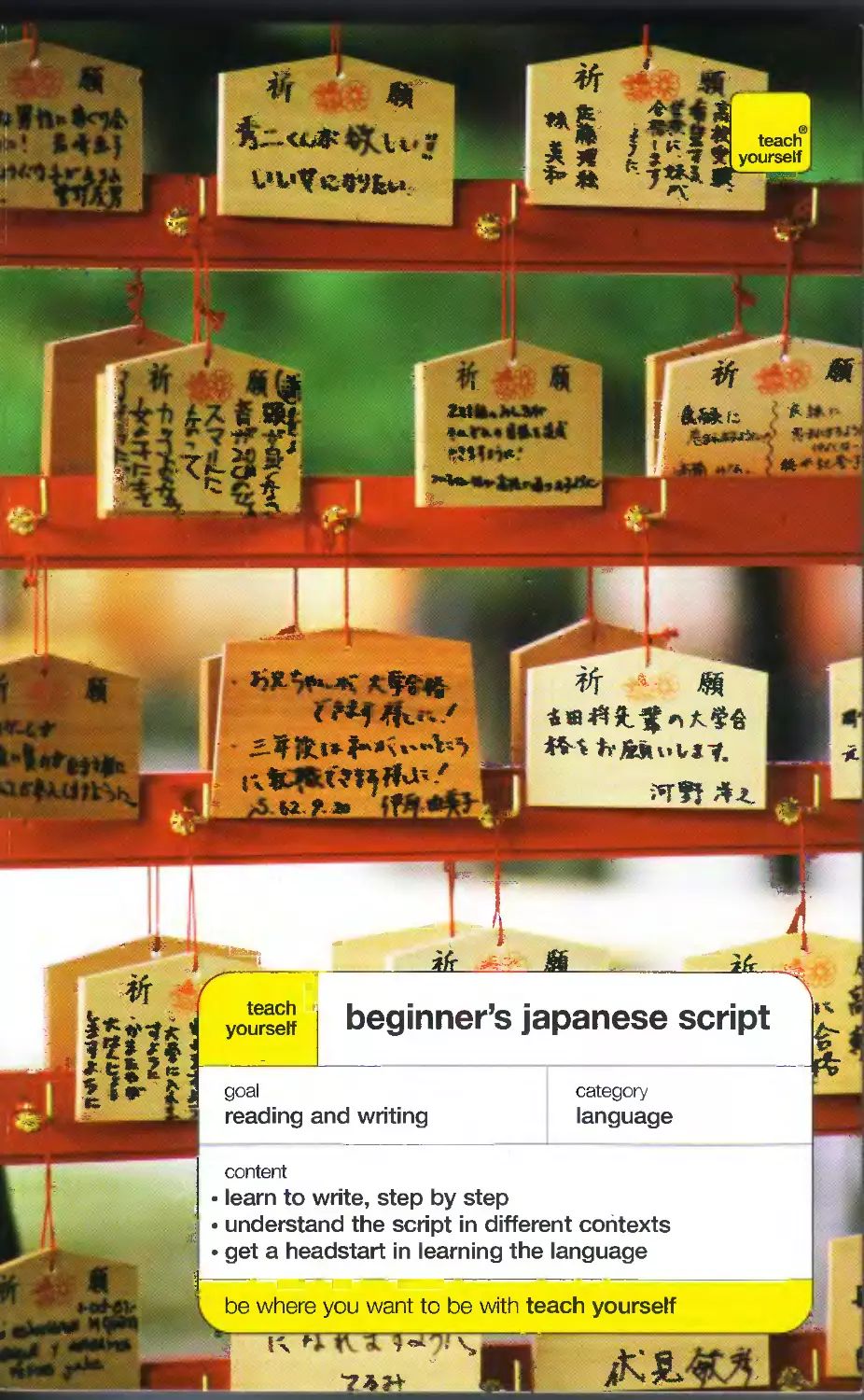




Текст
                    content

•	learn to write, step by step

•	understand the script in different contexts

•	get a headstart in learning the language

be where you want to be with teach yourself
t'x HK*
For UK order enquiries: please contact Bookpoint Ltd, 130 Milton Park, Abingdon, Oxon
0X14 4SB. Telephone: +44 (0) 1235 827720. Fax: +44 (0) 1235 400454. Lines are open
09.00-18.00, Monday to Saturday, with a 24-hour message answering service. Details
about our titles and how to order are available at www.teachyourself.co.uk

For USA order enquiries: please contact McGraw-Hill Customer Services, PO Box 545,
Blacklick, OH 43004-0545, USA. Telephone: 1-800-722-4726. Fax: 1-614-755-5645.

For Canada order enquiries: please contact McGraw-Hill Ryerson Ltd, 300 Water St,
Whitby, Ontario L1N 9B6, Canada. Telephone: 905 430 5000. Fax: 905 430 5020.

Long renowned as the authoritative source for self-guided learning - with more than
40 million copies sold worldwide - the teach yourself series includes over 300 titles in the
fields of languages, crafts, hobbies, business, computing and education.

British Libraiy Cataloguing in Publication Data:, a catalogue record for this title is available
from the British Library.

Library of Congress Catalog Card Number: on file.

First published in UK 1996 by Hodder Arnold, 338 Euston Road, London, NW1 3BH.

First published in US 1996 by Contemporary Books, a Division of the McGraw-Hill
Companies, 1 Prudential Plaza, 130 East Randolph Street, Chicago, IL 60601 USA.

This edition published 2003.

The teach yourself name is a registered trade mark of Hodder Headline Ltd.

Copyright © 1996,2003 Helen Gilhooly

In UK. All rights reserved. Apart from any permitted use under UK copyright law, no part of
this publication may be reproduced or transmitted in any form or by any means, electronic
or mechanical, including photocopy, recording, or any information, storage and retrieval
system, without permission in writing from the publisher or under licence from the
Copyright Licensing Agency Limited. Further details of such licences (for reprographic
reproduction) may be obtained from the Copyright Licensing Agency Limited, of 90
Tottenham Court Road, London W1T 4LP.

In US. All rights reserved. Except as permitted under the United States Copyright Act of
1976, no part of this publication may be reproduced or distributed in any form or by any
means, or stored in a database or retrieval system, without the prior written permission of
Contemporary Books.

Typeset by Transet Limited, Coventry, England.

Printed in Great Britain for Hodder Arnold, a division of Hodder Headline, 338 Euston Road,
London NW1 3BH, by Cox & Wyman Ltd, Reading, Berkshire.

Hodder Headline’s policy is to use papers that are natural, renewable and recyclable
products and made from wood grown in sustainable forests. The logging and
manufacturing processes are expected to conform to the environmental regulations of the
country of origin.

Impression number 10 9 8 7 6

Year	2010 2009 2008 2007 2006 2005
introduction		vii
01	ж -ж	1
	introduction	2
	work it out!	3
	linking kanji to pictures 1	4
	days of the week	5
	reading practice	В
	writing practice 1	8
	conclusion	11
02	Ж'-Ж	12
	introduction	13
	work it out!	13
	linking kanji to pictures 2	14
	kanji build up	15
	working out the meaning	17
	review	17
	reading practice	18
	kanji readings	20
	writing practice 2	24
	conclusion	27
	test	28
03		29
	introduction	30
	numbers 1-10	30

contents
numbers 11-99	32
five new kanji	34
more about dates	36
the Japanese calendar	36
reading practice	38
kanji readings	39
writing practice 3	40
conclusion	42
04	ЖНЖ	43
introduction	44
finding clues	44
more kanji components	46
reading practice	49
more kanji compounds	51
kanji readings	52
writing practice 4	54
conclusion	57
test	58
05	Ж/гЖ	59
introduction	60
work it out!	60
how to read hiragana	60
the hiragana chart	61
contracted sounds	67
hiragana that change their sound	68
the small о (tsu)	69
reading practice	70
hiragana and kanji	71
conclusion	72
06	ЖАЙ!	73
introduction	74
work it out!	74
decoding kanji	76
abstract kanji	78
07

08

09

complex kanji	78	у
kanji compounds 1	80	о
kanji compounds 2	81	a CD
kanji readings	82	□  (0
writing practice 5	83
conclusion	85
test	85
	87
introduction	88
types of kanji	88
kanji components	89	L—
more about radicals and components	90
locating the radical	93
kanji readings	94
using kanji dictionaries	96
writing practice 6	98
conclusion	102
	103
about this unit	104
introduction	104
work it out!	105
kanji for places	105
more about places	108
more place names	108
kanji signs	111
more signs	114
a map of Japan	115
warning signs	117
pairs of signs	118
miscellaneous signs	118
conclusion	121
	125
introduction	126
work it out!	126
	how to read katakana	127
VI о	the katakana chart	128
о 3  ф	pronunciation of rand /	130
3 л	katakana that change their sound	131
	contracted sounds	135
	the small v (tsu)	136
	extra katakana sounds	136
	contracted words	139
	reading practice	140
	writing practice 7	147
	conclusion	148
10	Ж1й!		149
introduction		150
grammar functions		150
writing letters		169
conclusion		175
key to the activities		176
index (1) Japanese-English		187
index (2) English-Japanese		197
taking it further		202
The Japanese language presented such difficulties to 16th-century
European missionaries that they called it the Devil’s tongue. In
actual fact, there are many features of the Japanese language
which make it relatively straightforward to learn. The grammar,
for example, follows logical rules and is very regular. It is the
reading and writing of Japanese which offers the greatest
challenge to the learner.

This book will make the reading and writing of Japanese
accessible to you through a step-by-step approach which will
help you to gradually build up your knowledge of Japanese
script. The aim of this book is to show you that written Japanese
can be interesting, challenging and also fun to learn.

In the Japanese education system, the learning of Japanese script
is spread throughout the nine years of compulsory education.
By the end of this period, the Japanese student will have learnt
1942 kanji (Chinese characters). This is the basic number
prescribed by the Japanese Ministry of Education as essential
for reading texts such as newspapers thoroughly. There are
many more kanji (over 5000 in many kanji dictionaries) which
are used for more specialized vocabulary and texts. Although
1942 kanji sounds like a large amount, it is worth making the
comparison with English where, although we learn the alphabet
relatively quickly, learning and understanding the meaning of
vocabulary and different types of text takes much longer.

^introduction

A brief history

The Japanese writing system was introduced into Japan by the
Chinese around the middle of the 6th century AD. The Chinese
viii

language is very different to Japanese in structure and so the
writing system was gradually adapted to fit the structure of the
Japanese language. There are now three scripts which make up
the Japanese writing system (four if you include romaji or
roman script, i.e. alphabet). Let’s look at each of these in turn.

Kanji

Kan is an ancient word meaning Chinese and ji means letter
or character, hence kanji is translated as ‘Chinese characters’.
This was the script which was invented by the Chinese and
introduced to Japan. Kanji are ideographs; this means that the
whole character conveys a meaning or idea (whereas in the
roman alphabet system, letters are grouped together to make
words). For example H is the kanji for sun. K^nji were
originally drawn from pictures of nature and gradually developed
into the standardised kanji used today. For example H sun
developed like this:

Q в

You will learn more about this in Unit 1.

There is usually more than one pronunciation for a kanji
character. There are two types of pronunciation known as
onyomi (Chinese reading) and kunyomi (Japanese reading). You
will learn more about this in Unit 2.

Kana

The other two scripts in the Japanese writing system are called
hiragana and katakana and are known collectively as kana.
They are phonetic alphabets or syllabaries, which means that
each symbol represents one sound only. This differs from the
roman alphabet system where letters are grouped into sounds
and where the same letter can be pronounced in different ways
depending on its grouping (eg: a in rat, rate, far and fare). The
difference between the Japanese phonetic system and the
alphabet system can be shown through an example:

In English the word house is made up of five letters: H-O-U-S-E.

In Japanese the word for house (uchi) is made up of two sounds
U-CHI. These sounds are represented by two hiragana symbols:
9
The hiragana and katakana scripts represent the same set of
46 basic sounds but the symbols are written differently and the
two scripts are used for different purposes as described in the
following sections.

Hiragana О Ь йШ

The word hiragana means rounded / easy to use and indicates
both the shape and the relative simplicity of the script. Each
symbol was developed from simplified kanji with the same
pronunciation. For example, the hiragana symbol (ka) is a
simplified version of the kanji (pronounced ka). The left side
remains very similar in the hiragana symbol, the right side ‘box’
has been reduced to a slanting line.

Hiragana is used to write the grammatical parts of words and
sentences and to write Japanese words which don’t have a kanji.
For example, when writing verbs (action words) the kanji is
used to express the main idea or meaning and hiragana is used
to indicate the function of the verb:

1 listen is written: И 5 T

The kanji M conveys the meaning listen-, t are three
hiragana which show that the action is present tense 1 listen.

I listened is written: M 5 £ L k.

The same kanji И conveys the meaning listen. The four
hiragana show that it is a past action: I listened. You will learn
more about this in Units 5 and 10.

Japanese children learn hiragana first and then gradually replace
words and parts of words with kanji as they progress. Hiragana
is also used to indicate how to pronounce a kanji when it is first
learnt or if it is unusual. When used in this way, it is called
furigana and is written beside or above the kanji.

IX

3

Katakana

The kata of katakana means partial and this is because each
katakana symbol was developed from part of a kanji with the
same pronunciation. For example, the katakana symbol P (ka),
comes from the left side of the kanji An (pronounced ka). (In this
example, the same kanji is the root of both the hiragana and
katakana symbol; this isn’t always the case.)
X

э

3
а
с
о

о

The katakana script represents the same set of sounds as
hiragana but the symbols are written differently and are used for
different purposes. In overall appearance, hiragana symbols
are rounded in shape and katakana symbols are more angular.
This will become more apparent once you have worked through
Units 5 and 9.

Katakana has a number of uses. Firstly, it is used for writing non-
Japanese words which have been introduced into the language.
These fall into two categories:

1	Loanwords For example, %—J > (wokuman)
means walkman;

L t* (terebi) means television.

2	Foreign names For example, countries, cities and personal
names:

T A 'J P (amerika) = America-,

>''9 {pari) — Paris; X ; Л (sumisu) = Smith.

There are also two categories in which katakana is used for
writing Japanese words:

3	To make words stand out Katakana makes words stand out
in a similar way to writing a word in bold, italics or capitals.
It is used increasingly in advertising (to make the product
stand out), for slang words and exclamations, for pop group
names and in headlines. Examples include: b 3 ? (Toyota)
and > n (Pachinko - the Japanese pinball game).

4	The classification of plants and animals

About this book

The ten units which make up this book will gradually increase
your knowledge of written Japanese. Units 1-4 introduce
mainly kanji which developed from pictures of nature. About
3% of kanji fall into this category but, as you will learn, they
are also used as components of more complex kanji. Units 4 and
6-8 will teach you how to decipher these more complex kanji
giving you the tools to take your study further on completion
of this book. There are plenty of hints to aid your learning and
you will learn to build stories to remember the meanings of the
kanji.

Units 8 and 10 give you the chance to put your learning into
practice. Unit 8 introduces you to a number of practical kanji
words such as signs, notices and warnings of the kind you
would see all around you in Japan. Unit 10 introduces a number
of reading passages and helps you to decipher them and extract
their meaning. You will also encounter different styles of printed
and handwritten text.

Two of the units are devoted to teaching the two phonetic
scripts; hiragana (Unit 5) and katakana (Unit 9). There are lots
of practice activities and ideas to help you learn and remember
these two scripts. You can leave these units out and come back
to them later if you wish to concentrate only on kanji, but if you
take your study of Japanese further, then a knowledge of these
scripts is essential.

There are sections throughout the book which concentrate on
how to write Japanese. Again, you may wish to leave these out
and concentrate on reading only.

О This symbol indicates a hint, tip or piece of information about
written Japanese, to help you with your learning.

Pacing yourself

•	Remember that it is YOU who sets the pace - keep
enjoyment of learning at the top of your agenda!

•	Find a balance between moving through the book and
revising what you have learnt. Don’t expect to remember
everything (even Japanese people forget kanji!) and use the
indexes at the back where possible to find words you have
forgotten.

•	Build up a set of small flashcards with kanji on one side and
English on the other to test yourself from time to time. Start
your own dictionary too by using a notebook or address
book to write down new words.

Acknowledgements

Thank you to everyone who has advised me on the writing of
this book. In particular, to Masae Sugahara and Miyuki Nagai
of the School of East Asian Studies, Sheffield University - Masae
for the calligraphy and for reading and commenting on the text,
Miyuki for the artwork and ideas for mnemonics; to Niamh
Kelly of the Japanese Department, Dublin City University for
reading the text and making lots of useful suggestions; Mavis
Pilbeam of the Japanese Department of the British Museum for
her thorough and very helpful proofreading; Robert Gilhooly

xi

Й
3
a.
c
a
о
xii

3
CL
C
ft
О
□

for providing the photographs; my students (including Margaret
Teasdale) for being ‘guinea pigs’; Sue Hart and Carolyn Taylor
at Hodder and Stoughton; and John Rogers for doing all the
cooking!

The publishers and author would like to thank the following for
the use of material in this book: Kyoto Newspaper Company
and Nobuko Kogawa (29/10/98) and Kinako Matsumoto,
Seikyo Newspaper (14/9/92).

About the author

Helen Gilhooly has lived and worked in Japan, and has
extensive experience of teaching Japanese and writing teaching
materials at secondary school and adult level. She has an MA
and a PGCE in Japanese and is the Language College Director of
Aldercar Community Language College in Derbyshire. She is
also a teacher trainer of Japanese at Nottingham University.
Helen Gilhooly has written Teach Yourself Beginner’s Japanese
and Teach Yourself Japanese Life, Language and Culture.
unit 1

In this unit you will

•	learn how Japanese script
developed from pictures

•	learn to read the days of
the week

•	begin to write
2

с
□

I

1$ U Й> IC Introduction

In the introduction to this book you learnt about the history
and development of the Japanese writing system and about the
three different scripts or writing forms: tf Ь % (hiragana),
Л 5 (katakana), and Ж^ (kanji). The focus of Units 1-4
is going to be on Ж^ (kanji) and by the end of these four units
you will have learnt to recognize 58 Ж^ (kanji) characters
and also to understand the meanings of words made up from
combinations of these.

Ж^ (kanji) characters are ideographs. This means that each
character represents a whole object or idea. For example:

0 is the Ж^ (kanji) symbol for sun

Я is the Ж^ (kanji) symbol for moon

As you learnt in the introduction, Ж^ (kanji) were written
originally as pictures of the world which the ancient Chinese
saw around them. These pictures were gradually, over time,
standardized into regular shapes with rules about how to write
them correctly. However, the pictures which each Ж^ (kanji)
developed from can be very useful in helping you to remember
the meanings. Look at these developments:

H (sun) developed something like this:

As well as sun it also has the meaning day. These two concepts
are connected because the rising and setting of the sun defines a
day.

Я (moon) developed something like this:

As well as moon it also has the meaning month. These two
concepts are connected because the length of a month (28 days)
is measured by the progress of each new moon.

You can see from these two examples that Ж*? (kanji) do not
necessarily have only one meaning but can represent a number
of associated ideas.
Work it out!

The aim of this section is to give you the opportunity to work
out for yourself the meanings of Ж^ (kanji) by linking them
to pictures of the objects they represent. The Ж^ (kanji) you
will start with all have meanings linked to nature and the
world which surrounded the ancient Chinese. To carry out this
activity, look at pictures 1-12 that follow and then see if you
can link them to the Ж*? (kanji) a-1 at the foot of this page. Try
to match the shape of the pictures to the Ж^ (kanji) characters.
Л* AJT о ~C (ganbatte) — good luck!

3
c
□

I

forest

rice field

Ж^ (kanji)

a ill b Jl|
g h #

eft	f !K

к I:	1ft

Check your answers at the back of the book then look again at
the pictures and see if you can envisage how the pictures became
the standardized Ж ft2 (kanji) which are used today.
4

unit 1 Ш

L

И

Explanation: Linking kanji to pictures 1

There follows an artist’s impression of the progression of
changes, from standardized 'Ж^ (kanji) character back to
original picture.

Ж^ (kanji)  Character	&(e)  Picture		(eigo)  English
111	lL|	lL -	। [\ ! Н		mountain
JU	J’l	"I -	*		river
			jSL-’	Jfik	gold/money
Ш	ffi ->				rice field
n		я	- -	’t	bamboo
•к			- bV		fire
	->	*			tree
		44 -			wood
		Д -			forest
Ж	7j<				water
					ground
					stone
я	я				moon
0	в	е			sun
Did you notice how two trees are used to represent a wood and
three trees a forest? You will learn more about this type of Ж'?:
(kanji) in Unit 2.

5

Activity 1

How well can you remember the Ж^ (kanji) and meanings you
have learnt so far? Test yourself by linking each Ж'/ (kanji)
with its English meaning. The first one is done for you.

I
Ж

1	Hl	a	water ( )
2		b	moon ( )
3	!k	c	earth ( )
4	tf	d	river ( )
5		e	tree ( )
6	zK	f	forest ( )
7	ffl	g	fire ( )
8		h	stone ( )
9	JU	i	sun ( )
10		j	mountain ( 1 )
11	ж	к	rice field ( )
12		1	bamboo ( )
13	в	m	wood ( )
14	я	n	gold ( )

Explanation: Days of the week

Look at the Ж'г (kanji) that follow and remind yourself of their
meanings:

В, Я, Л, zK, zK, ±

sun, moon, fire, water, tree, gold, earth

These Ж^ (kanji) are also used to represent the first part of the
words for the days of the week. В is the first part of Sunday, Я
is the first part of Monday and so forth. Here are some tips to
help you remember which Ж^ (kanji) represents which day of
the week. The first two are easy!

В Sun -> SUNday.

Я Moon —> MOONday or Monday as it has become in
English.

1K Fire also represents Tuesday. In English, Tuesday derives
from the word Tiw who was the Norse god of war. If you
connect the ideas of war and fire in your mind then you will
remember that FIREday is Tuesday!
6

&
I
я

ZK Water also represents Wednesday - easy to remember
because both start with ‘W’!

Tree also represents Thursday - both start with ‘T’ (but do
not confuse with Tuesday).

Gold/Money also represents Friday - Friday is often pay
day!

± Earth/Soil and Saturday. This is the beginning of the
weekend and a good day for working in the garden!

—- Activity 2

Link the Ж^ (kanji) in the left column with the corresponding
day of the week in the right.

1 X

2 H

3 1.

4 zK

5 Я

6 &

7 zK

a Monday ( )
b Tuesday ( )
c Wednesday ( )
d Thursday ( )
e Friday ( )
f Saturday ( )
g Sunday( )

Reading practice

Throughout the book, this section will give you opportunities to
put into practice and further develop your reading of Ж^ you
have learnt.

The Ж^ (kanji) in Activity 2 represent the first part of the
words for the days of the week. In fact, the days of the week
are written using three Ж^ (kanji) characters. The other two
are ЩН and they represent day. You already know H and
have learnt that it can mean day. ВД represents the concept of
‘weekday’ but simply remember them as together representing
the day part of Monday, Tuesday, etc.

This is what the complete words for the days of the week look
like in Ж^ (kanji):

HUSH	Sunday
	Monday
Л-BSH	Tuesday
ZKBSH	Wednesday
zKBSH	Thursday
	Friday
±BSH	Saturday
When two or more Ж^ (kanji) are combined in this way
to produce new words and meanings, they are called
(jukugo) or compound words. You will learn more about these
in Unit 2.

By the way, you will often see the days of the week written with
the first Ж^ (kanji) only, for example, on calendars and diary
sheets. This is like writing ‘Mon, Tues, Wed’ in English.

Activity 3

The following is part of a music events column from a teenage
magazine. Notice that the groups and events are written partly
in English script. It is highly fashionable in the Japanese music
world (and not only there) for group names and song titles to be
written in English. The effect of the script is often far more
important than the meaning of the words. (Rancid Japan Tour
and Michelle Gun Elephant from the extract are just two
examples of this!)

The day of the week on which each of the events will take place
is written in brackets next to the date (13th-23rd). Notice that
only the first Ж^ (kanji) for each of the days of the week is
written. Now have a go at answering the questions that follow
the text.

7

&
I

Я

13(*) |	©ROTTEN ORANGE TOUR  B¥3,500(1	1 CDft)WW0PEN17: 00-START18: ООФЖЖ/GARLIC BOYS.  YELLOW MACHINGUN. У-уУЛлХЖ ©SMASH WESTn06-361-0313
15(&) ।	RANCID JAPAN TOUR 1999 •4W*«blitz*»W¥5.8o»!£Wope  N17: 00-START18: 00»7’7L.<Z. 'LIFE WON’T WAIT,	16. 23. 24  В t BLITZTy-T	V.	>«03-5466-0777
17(h) ।	THE MICHELLE GUN ELEPHANT rWORLD PCHYCO BLUES TOUR “ALL STANDING/ MAXIMUMZ'"j  ¥4.200фв5И/ОРЕМ16: 00-START18: ООвТЛ-АТ. гф+->Л,-у, tfXSfiWS v>x7L  <r№X<r>^9>7!-< >7'77-. ®ЯЧ*?ЯС~.УЯ03-5436-9600
19(л) ।	DOWN BEAT •^/r/®ft^YELLOWeiq^/¥2,500(774'-V-4e#T¥2.000-»Z2  e^/OPEN-START21: ооежж/оJ KEN-BO, KOYA ATSUSHItUWHIP HOP-f^O К ®YELLOWS03-3479-0690
21(*) ।	Lauryn Hill JAPAN TOUR •Wr/B*ffitffi»m/s : ¥7,ooo-a ¥6,ooo« BWSTART19: 00»УПГЛ<^<Д>ИИИгс*е"у	D7-(X 22. 23Bl;t  yfXfe'L ©О К—ёЯЯЯЙтП03-3402-5999
21(*) ।	ZEPPET STORE rCOMING UP ROSES TOUR'98j •«Maseru В QUATTRO*tW¥ 3.800*ffijffl/OPEN18: 00-START19 : 00»И*;ЁгУ'О7’'а.-АГО'» УЛ- rROSEj *4Sffl®ZEPPET STOREOT’ZT’-	УTOKYOTT03-3357-8080
22 (ft)|	Breath г3	•ВДт/ЖйЖ=У1рт<»Н*/Ж1ЭД«,Д/орен18:  3O-START19:OO*/\-raoH7*WWH>f'’. Вгеа1Ь*ВДйЗУЯ»8»4уТУ^ЖМФ. A  a^atcfll. />77>->з >«03-5467-25441

_ _ WORLD CONNECTION "KOOL" •Wf/a»«YELLOwem/*3.ooo (»

23(±) I J74'V4^T¥2,500-ttC2 КU>?ft)<BWOPEN• START21: OWttWDJ : KO KIM
URA, FUJIMOTO VJ: E-MAIL©YELLOWO03-3479-0690
8

с
3

»

М

I

On which day of the week do the following events take place?

1	Rotten Orange Tour

2	Down Beat

3	The Michelle Gun Elephant... Tour

4	Rancid Japan Tour

5	World Connection ‘Kool’.

How many events are taking place on:

6	a Friday

7	a Saturday

8	a Thursday?

9	Which day of the week is not represented in the events
extract?

#< HW* Writing practice 1

This section will introduce you to some simple rules for writing
Ж^ (kanji). You will learn some further rules in Unit 2 and will
then practise writing some of the Ж^ (kanji) you have learnt.

The rules for writing Ж^ (kanji) are very precise and Japanese
children spend many hours of their school life learning and
practising the correct order for writing each Ж^ (kanji). (In a
similar way, we learn how to write the letters of the alphabet
correctly at school.) Each single part of а Ж^ (kanji) is called
a stroke and the order in which Ж^ (kanji) are written is
called Ш ?! Ж (kakijun) or stroke order.

The Japanese use squared paper when they are learning how to
write because it helps to ensure that Ж^ (kanji) are all the same
size and are balanced correctly. If you can, use large squared
graph paper which is subdivided into four smaller squares
during the initial stages of learning to write. This will help
you to balance left and right, and top and bottom of each
Ж^ (kanji). Alternatively you could use ordinary graph paper
and have four smaller squares making up one larger square.
The Ж^ (kanji) taught in the earlier units will also have an
example written in this type of square so that you can copy
exactly from the book. Once you feel confident, you can use
clear squares or use smaller squared paper / graph paper for
practising and perfecting your technique.

Here are some simple rules to get you started and examples to
copy.
Rule 1: Horizontal Ж^ {kanji) strokes are written from left to
right.

(rei) Example: three

9

unit 1 %

Rule 2: Vertical Ж^ {kanji) strokes are written from top to
bottom.

#!l {rei) Example: river

Rule 3: Where the Ж^ (kanji) character has an intersecting
horizontal and vertical stroke, the starting stroke is usually the
horizontal one (but there are some exceptions).

(Я1 (rei) Example: earth

Notice you work downwards; the final stroke is the bottom
horizontal one.

Rule 4: A left-hand diagonal line is written before a right-hand
diagonal line.

И {rei) Example: tree

Rule 5: Here is a square Ж^ (kanji).
10

unit 1 Ж

Rule 6: When the square contains other strokes within it, you fill
in this part before writing the bottom line of the square.

"M (rei) Example: sun

Я

You can combine these rules you have learnt to write й (stone)-.

Using these six rules, you have learnt to write the following
Ж'г (kanji) in this section:

JIL ±, Ж, H, 5

(three, river, earth, tree, sun, stone)

Now see if you can write them on squared paper in the correct
order from memory (refer back to the rules to check when you
have finished).

As a final note in this section, although it is important to
understand and apply the basic rules for writing Ж^ (kanji),
there are some aspects of stroke order which do not fall easily
into rules and so you also need to learn and practise the stroke
order for each ЖФ (kanji) character. Do not be daunted by this,
however, because ‘practice makes perfect’ and if you write Ж‘Г
(kanji) over and over again and concentrate on the correct
stroke order you will begin to develop a feel for the order in
which they are written. You will also begin to develop your
own way of remembering and to apply this to writing more
complicated Ж^ (kanji). In the meantime, you will be given lots
of help and advice in the writing sections of this book, and the
unit summaries at the back of the book give the stroke order for
the main Ж*/-’ (kanji) taught in each unit.
Conclusion

This section in each unit will summarize the main aspects of the
unit. In addition, Units 2, 4, 6 and 8 contain a test so that you
can evaluate how well you have remembered the Ж'^ {kanji)
you have learnt up to that point. In this unit you have learnt
14 Ж^ {kanji), seven compound words (days of the week)
and six basic rules for writing Ж^ {kanji).

The following terms and sub-headings have been used in this
unit:

11

c
□

I
я

Ci r e

я®

X»

dai ikka
hajime ni
kanji
renshil
yomu renshu
kaku renshii
rei
oivari ni

unit 1
introduction
kanji (Chinese characters)
activity/practice
reading practice
writing practice
example
conclusion

Other key words and terms are given in the conclusion of Unit 2.
Refer to these if you want to say the terms and sub-headings
used throughout this book in Japanese.
unit 2

In this unit you will

•	add some new (kanji)
to the 14 you have learnt
already

•	learn the Japanese
pronunciation of these
SS'Z (kanji)

•	apply your learning to real
reading situations

•	learn more about writing
Japanese script
Ji U йб IZ Introduction

1	Can you remember the meanings of the Ж^ you were
introduced to in Unit 1 ? You can see them in the following
list, so test yourself and check back to Unit 1 if there are any
you are unsure about.

2	Can you remember which Ж^ represents which day of the
week? They are listed below in their full form. Remember it
is the first Ж'У: which tells you which day of the week it is.
ЯЩН НЩН ±ЩН tMSH зкввн

Again, check back to Unit 1 if you are unsure of any them.

13

c
□

w

II

Nd

Work it out!

In this section, as with Unit 1, you will be introduced to some
new Ж^ through the pictures of natural objects that they are
derived from. Most of the Ж'? introduced in this unit are
associated with the human body. Try matching the pictures (1-
12) with the Ж? (a-1) on the following page (without looking
at the answers!). In two cases (eye and car/vehicle) you may need
to imagine the pictures turned on their side to identify them.
14

а	П	b	А	сП	dA	e	Г	f	A

g	4-	h	T	i Л	j Ж	к	Ж	1	H

N

ll

Explanation: Linking kanji to pictures 2

An artist’s impression of the changes from standardized Ж^
back to picture follows. Check your answers to the previous
activity with this sequence.

Ж^		1&(e)  Picture			(eigo)  English
		A. >	К -		person
it	<г	A—>	ic -		woman
=?	*	J- -			child
II	s	g			eye
if			->		ear
П	□	о -*	0 ->	0-0	mouth
f		f -*			hand
		£ 4	►	-ъ®	foot
A	A	A -			power/strength
ж	ж	& -	*	5^n)	horse
ж	+		ffl “		 ” cart/vehicle/car

gate


Iя] H П -> M
In this set of new Ж'/ there is an example of an abstract noun,
Л (p oiver/strength), being portrayed in picture form through
the image of the muscles in the arm. Another point of interest is
that Ж originally developed from the picture of a cart which
would have been the type of transport or vehicle used when
Ж'^ were first developed. In modern times it has taken on the
meaning of car.

Kanji build up

This section in this unit and throughout the book will introduce
you to new Ж^ and new words based on the Ж^ you have
learnt so far.

15

Ы
H

1	Complex kanji

The pictorial Ж^ that you have been introduced to so far not
only have meanings in themselves but are also used as parts or
components of Ж^ that are more complex. You actually learnt
two of these more complex Ж^ in Unit 1. They were # (wood)
and (forest). Both are created from Ж (tree) - two trees
represent a wood, three trees a forest. Here are four more Ж^
built from simpler ones which you have learnt already. The
meanings of the components are incorporated into these
complex Ж^ forms. Notice that the simpler Ж^ when used as
components of more complex Ж^ may change their shape
slightly or appear ‘squashed’.

W (man) - This is made from the components EH (rice field) and
ij (power). In other words, the man uses his power to work in
the rice fields.

if (like, love) - This is a combination of (woman) and -f
(child). The abstract idea of love is expressed through the love
between women and children.

WJ (bright) - This is a combination of Й (sun) and Я (moon).
1'he sun and moon shining together would create a very bright
light.

Ж (root, origin). Ж (tree) with a horizontal line through the
trunk indicates the root of the tree.

Unit 4 will look at these complex Ж5? in more detail but you
can see from these examples that a knowledge of the simpler
Ж‘г can also help you to decipher the more complex ones.
16

м
я
п
я

2	Kanji compounds

The four Ж^ you have just been introduced to are created by
combining simpler Ж'? to form one complex Ж'?. Another
way in which Ж'? are used to create new meanings is by
forming words from two or more separate Ж^. You have
already been introduced to this idea through the days of the
week. Three separate Ж'? are used to make up each day.
For example, ЙWH means Monday. Here are some more
examples:

А Д means population (‘people’s mouths’ = number of mouths
to feed)

ЖЛ means horse power

A A means girl (‘woman child’)

(Notice that these are two separate ЖА, unlike if (complex
Ж^) which means love/like.)

H A means ]apan (‘sun’s root’ describes Japan as the place east
of China where the sun rises. This is where the term ‘land
of the rising sun’ comes from).

To summarize the two points in this section: Ж A can join
together and form one ЖА (for example, M) or they can
form words made up of two or more Ж A (for example, АД).

Activity 1

Some compound words made up of two or three ЖА follow.
Can you work out their meanings? (You may want to look back
at the ЖА you have learnt so far in Units 1 and 2 and refresh
your memory before trying this activity.)

a ZMJ b MA c НЖА d ЖЖ e АЛ
f АЛЖ g ЖН h АШ i Р1Д j AB

Once you have thought about the possible meanings of these
words, look at the list of English words that follows and decide
which best fits each ЖА before you check the answers at the
back of the book.

1 volcano	2 boy	3 Japanese person

4 carriage	5 in the public eye	6 water power

7 gateway 8 manpower

9 a rickshaw (man-pulled carriage)

10 a paddy field (a field flooded with water for wet rice
growing)
Explanation: Working out the meaning

You will have noticed that sometimes the meanings are a direct
‘translation’ of the separate Ж'? into their new meaning. For
example, AlU (‘fire mountain’ or volcano). In other cases you
need to think more laterally or abstractly. For example, A В {in
the public eye). However, once you know what the meanings
are they are easy to remember because the pictorial Ж'? act
as a visual jog to the memory. And words are created in a very
logical fashion. For example, АЛЖ means literally ‘human-
powered vehicle’ and that is what a rickshaw is as the following
illustration shows.

17


In fact, the word rickshaw is a corruption of the Japanese word
jin-riki-sha. Jin (person) has been dropped and the other two
words (power, vehicle) have had their pronunciation ‘anglicized’.
Try saying the Japanese rikisha and you’ll see what I mean!

1KW Review

Before continuing any further, here is an activity to help you
review the single Ж'? learnt so far in this unit.

Match the following Ж'? with their English meanings from the
selection in the box. Then try the activity in reverse by taking
the English meanings from the box first.

Л. Л, Ж, А, ВД, Д. 34	34 g, Ж,

n, A, £

vehicle	man	eye	root	person	bright
ear	foot	woman	gate	hand	child
mouth  -	like	horse	power

If there are any of these characters that you are not sure about,
look back through the unit and check your answers.
18

с
□

rs

и
ss

Reading practice

The way in which dates are written in Japanese is interesting.
You were introduced to the Ж^ for moon Я and sun В in
Unit 1 and you also learnt that these Ж^ have the connected
meanings of day В and month Я - so let us look at how this
works in practice. This is how a typical Japanese calendar looks
for the month of January:

1Яа

В	Я	'X	/к	Ж &		±ь
IB	2B	ЗВ	4В	5В	6В	7ВС
8B	9B	10В	ИВ	12В	13В	14В
15B	16B	17В	18В	19В	20В	21В
22B	23B	24В	25В	26В	27В	28В
29B	ЗОВ	31В

a is the month written in numerals and Ж^. Japanese months
do not have a name as such, so they are assigned a number
from 1 to 12. Therefore, 6Я is June (the sixth month), 1Я
is January (the first month) and 12Я is December.

b are the Ж^ for the days of the week (as you learnt in
Unit 1). They are shortened in this case to just the first Ж^
of the three which you learnt (for example, /КИ В means
Wednesday) because this is all that is needed to identify each
day of the week. (This is rather like writing Tues, Wed, etc. in
English.)

c are the days of the month. Each number is followed by В
(similarly in English we follow the dates with st, nd, rd or th.
For example, 1st, 7th).

Activity 2

Using the calendar and information just given, try answering the
following questions.

1 On which day of the week is a 1st b 4th c 9th d 14th?

2	How many days in the month fall on a Wednesday and what
are they?

3	On which day of the week will 1Я 1 В fall?

(Note that Japanese dates are written in the order: month then
date.)
Activity 3

At the foot of this page is a calendar from a Japanese travel
brochure. Look at it and answer questions 1-4.

19

c
□
&

w

1	What are the starting and finishing months on this calendar?

2	In which months do the following happen:

a the 2nd is a Tuesday

b the 24th is a Monday

c the 6th is a Friday?

1 On what day of the week is:

a May 5th

b October 26th

c February 18th

d August 21st

e December 25th?

4 On what days of the week do these Japanese festivals fall:

a Girls’ Day (March 3rd)

b New Year’s Day

c Tanabata (Star Festival, July 7th)

d Golden Week (April 29th-May 5th)

e Emperor’s Birthday (December 23rd)?

4Я						5f							6Я							7f
a	Я	X	**	£	±	S	Я		*	*	£		В	я	X	* *	£	+		В	DIES	*	*	£	+
	1	2	3 4	5	6				1	2	3	4						1			nn	3	4	5	6
7	8	9	1011	12	13	5	6	7	8	9	10	11	2	3	4	5 6	7	8		7	□El	10	11	12	13
14	15	16	1718	19	20	12	13	14	15	16	17	18	9	10	11	1213	14	15		14	низ	17	18	19	20
?1	22	23	2425	26	27	19	20	21	22	23	24	25	16	17	18	19 20	21	22		SI  S3		24	25	26	27
						|26i	27	28	29	30	31			24	25	26(27	28	29				SIH

8Я			9Я	I							10Я							11Я
В ЯЛ*	□□	±	a	Я	Л	*	*	£	+	a	Я Л		*	*	£	+	R	Я	Л	*	*	□	+
	ПН	3.  10  17  24	1	2	3	4	5	6	7			П	2	3	4	5						П	2
4 5 6 7	O0		8	9	10	11	12	13	14	6	71	□	9	10	11	12	3	4	5	6	7	□	9
11 121314	EE		15	16	17	18	19	20	21	13	14		16	17	18	19	10	11	12	13	14	IB	16
19 20 21			22	23	24	25	26	27	28	20	21	S3	23	24	25	26	17	18	19	20	21		23
	SEE	EBI	29	30						27	28		30	31			24	25	26	27	28	к	30

12Я							1Я							2f							ЗЯ
	Я	Л	*	*	□	±	a	1	л	□	*	£	i		Я	Л	*	*	£	±	В	Я	Л	*	*	£	+
1	?	3	4	5	□	7			7  14	SOH	2	3	4							1							1
в	9	10	11	12	И	14	5	□			9	10	11	2	3	4	5	6	7	8	2	3	4	5	6	7	8
В 12	i6	17	18	19	S3	21	12	IE!			16	17	18	9	10	11	12	13	14	15	9	10	11	12	13	14	15
	23	24	25	26	Si	28	19		21		23	24	25	16	17	18	19	20	21	22	16	17	18	19	20	21	22
29	30	31			□J		26j	ЭЗ	28		30	31		23	24	25	26	27	28		%	%	25	26	27	28	29
20

м

«5
И
Ж

ЙЖРЧ Activity 4

Convert the following random dates into English as in the
examples. Remember the Japanese order: month, date, day.

Rei 1 8ЯЗН (Л.) = Tuesday August 3rd (order: August

3rd Tuesday)

Rei 2 10Я26Н (4z) = Friday October 26th

а 2Я14Н (±)	b 11Я20Н(Ж)	c 5Я5Н (Я)

d 9ЯЮВ (H)	e 12Я25Н (zK)	f 4Я10Ш

о

кэ

Kanji readings

This section will teach you about reading Ж^ in Japanese.
As suggested in the Introduction, if you wish to focus on
just understanding the meaning of Ж^ then you can miss
these sections out throughout the book or come back to them
later.

1	Kunyomi and onyomi

In the Introduction you learnt that there are two ways of reading
Ж^ in Japanese, the kunyomi (ВОрК^) or Japanese reading and
the onyomi ( or Chinese reading. The onyomi has
developed from the original Chinese pronunciation but over the
centuries it has been adapted to and become part of the Japanese
language. The kunyomi is the native Japanese word.

For example, Jl| (river) can be pronounced SEN (onyomi) and
kawa (kunyomi). Kawa was the Japanese word for ‘river’ and so
when Ж^ were introduced from China this word was linked to
the Ж^ character JI I.

By the way, notice that kawa (kunyomi) when written in romaji
(romanized script or alphabet) is written in lower case and
SEN (onyomi) in upper case. This system is used in many
Ж^ workbooks and dictionaries and is also followed in this
book.

2	Rules for using kunyomi and onyomi

As a general rule, the kunyomi is used for single Ж^ words
whereas the onyomi is used for compound Ж^ words of two or
more Ж^. Here is an illustration of this.
a Single ЖА words

A (person) is pronounced hit о (kunyomi)

Д (mouth) is pronounced kuchi (kunyomi)

b Compound Ж'? words

The above Ж'^ make up the compound word ЛП
(population) which is pronounced JINKO.

JIN and KO are the onyomi of A and П respectively.

There will be further examples and the opportunity to practise
new information and rules as you progress through the book so
do not worry if you have understood only some of the details
so far. There are exceptions to the rules about when to use
kunyomi and onyomi but these will be pointed out to you when
necessary and explained, and there will be lots of reinforcement
activities too.

21

□

/1. Activity 5

In this unit you are going to concentrate on the kunyomi
(Japanese reading) only. In the following list are the Ж^ you
learnt in Unit 1 with their kunyomi and a guide to how to
pronounce these readings. Look over these and practise saying
them. Then see how well you can remember them by covering
up the kunyomi column, looking at the Ж^ and saying them
trom memory.

	Meaning	Kunyomi	Pronunciation
ill	mountain	yama	ya-ma (a of mat)
III	river	kawa	ka-wa (a of mat)
fc	gold/money	kane	ka-ne (a of mat, e of end)
III	rice field	ta	ta (a of mat)
ft	bamboo	take	ta-ke (a of mat, e of end)
A	fire	hi	(i of hit)
*	tree	ki	(i of hit)
	wood	hayashi	ha-ya-shi (a of mat, i of hit) mo-ri (o of hot, i of hit)
ft	forest	mori
A	water	mizu	mi-zu (i of hit, и of blue)
I.	ground, earth	tsuchi	tsu-chi (tsu is one syllable, chi of chin)
6	stone	ishi	i-shi (i of hit)
Л	moon	tsuki	tsu-ki (tsu is one syllable, i of hit)
II	sun	hi	(i of hit)
22

О Pronunciation rules

го

И

Й

There are five vowel sounds in Japanese. These are a, i, u, e and o.
They are always pronounced in the same way. A general guide to
their pronunciation can be seen in the list just given and can be
summarized as follows:

•	a as in mat	• e as in end

•	i as in hit	• о as in hot

•	и as in blue

These vowels are attached to consonants to make new sounds but
remember, the pronunciation of each vowel remains constant. The
sound tsu is an unfamiliar one in English - it is one beat or syllable,
‘squash’ the t and s together as you say it.

You may have noticed that the readings of fk (fire) and H (day) are
the same - they are both pronounced hi. There are many examples of
Japanese words which have the same pronunciation but are written
with different Ж^. The difference in meaning can be understood
from reading the Ж^ or from the context. There are many examples
in English, too, of words which are pronounced in the same way but
which have different meanings. These differences in meaning are
indicated by the spelling or the context or both.

A Activity 6

How well can you remember the kunyomi reading and
pronunciation of each Ж^? You may want to look back at the
readings on the previous list and practise saying them out aloud
- looking at the Ж^ as you do so - before trying the following
activity.

i Tick the correct Ж'A

1 ta	a	b	ffl	c JU
2 mori	a ±	b		с Ж
3 ishi	a	b		c ±
4 kawa	a JU	b	ill	с Ж
5 ki	a 0	b	‘X	с zk

ii This time tick the correct kunyomi-.

1	a	kane	b	kawa	c	ki
2	a	ta	b	hayashi	c	take
3	Я	a	tsuchi	b	tsuki	c	ishi
4	#	a	hayashi	b	ki	c	mori
5	/К	a	mori	b	kawa	c	mizu
23

iii Now you are going to test your understanding of the three
aspects of Ж^ you have learnt - the Ж^ itself, the kunyomi
and the meaning in English. You will link these three aspects
by choosing one from each of two categories (a-c and i-iii)
to match the first item as in the examples:

01	Red	ta	a  i	я  rice fields	b 0  ii moon	С Щл/  iii gold
	Rei 2	Я	a	tsukii	b tsuchi	c hi
			i	day	ii moom/	iii earth
1	fire	a	zK	b	c	к
		i	ki	ii	hi	iii	mizu
2		a	mori	b	hayashi	c	ishi
		i	wood	ii	tree	iii	forest
3	yatna	a	JU	b	ft	c
		i	mountain ii		river	iii	wood
4	gold	a	Ж	b	C	к
		i	kawa	ii	kane	iii	mori
5		a	wood	b	bamboo c	river
		i	take	ii	tsuki	iii	tsuchi
6	rnizu	a	water	b	moon	c	forest
		i	к	ii	iii	zK
7	stone	a	ffl	b	Tl	c	0
		i	ishi	ii	tsuchi	iii	ki
8	±	a	sun	b	moon	c	earth
		i	tsuchi	ii	tsuki	iii	ishi
9	kawa	a	JU	b	zK	c
		i	bamboo	ii		gold	iii	river
10		a	wood	b	forest	c	tree
		i	mori	ii	hayashi iii	ki

ro

II
Я

Activity?

i he following activity gives you the opportunity to use the
kunyomi for Ж^ learnt so far in a real reading situation.
Japanese surnames are made up of either single Жт’ or two or
three compounded together. The Ж^ used in surnames are
often fairly simple ones including some of those you have learnt
in Units 1 and 2. Although Ж^ used in surnames have literal
meanings (for example, the surname ft llj (Takeyama) literally
means ‘bamboo mountain’), the Japanese do not think of them
in this way. Many English surnames also have literal meanings
(for example, Rivers, Hill, Robinson) but again, they are known
as names not meanings.
24

го
ж


When saying Japanese surnames you use the kunyomi. You
learnt at the beginning of this section that in general the onyomi
is used for compound Ж^ words. However, names are an
exception to this rule.

Can you say these common surnames in Japanese:

a	#	b	c ^Ш	d	LljJll

e	Ш	f	Ш g ЖИ	h	5Л1

For the following surnames (i-m), Ш is pronounced da instead
of ta. How do you say these names?

i	j	к 5Ш 1 ШИ m Л1Ш

Writing practice 2

In Unit 1 you learnt some basic rules for writing Ж^. Now you
are going to revise these rules with some new Ж^ you have
learnt in this unit. You will also learn some further rules and,
once you are familiar with these, you will have a go at writing
Ж^ in the correct order.

Rules 1-3: You learnt in Unit 1 that you write from left to right
and from top to bottom. Usually, where two lines intersect, the
highest horizontal line is written before the vertical line, and
then you work downwards. For example, hand. Note: the short
top stroke is written from right to left.

Rule 4: Diagonal lines follow the same rule of writing the left
diagonal before the right. For example, person.

Rule 5: You also learnt in Unit 1 how to write a square. This is
how mouth is written (notice that the shape is different from the
square).
Rule 6: When there is a middle part to the square, you write the
bottom line last. For example, eye.

25

c
3

to
ж
ll
Ж

And rice field (but notice this is an exception to Rule 3 because
the vertical intersecting line inside the square is written before
the horizontal).

1 lere are two further rules.

Rule 7: Where а has a distinct left and right part, the left
section is written before the right and where it has a distinct top
and bottom part, the top section is written first. For example,
wood.

Note that the left section is narrower than the right.
And forest is similar.
Activity 8

Can you write the following Ж^ applying the rules you have
been introduced to so far? Remember to use squared paper to
achieve the right balance and proportions.

Rules 1-4:

HI {river) H {three) A {power) A (person)

Rules 5 and 6:

II (sun) Я (moon) Д (rice field - exception to Rule 3)

Rule 7:

U (wood) ft (bamboo)

27

II
И

Rule 8:

4' (small - Unit 6) A (water) ill (mountain)

You can check your answers by looking back through the
writing sections of Units 1 and 2. For А, Я, ff look up their
stroke order in the unit-by-unit Ж^ charts at the back of this
book. Then use the writing sections and charts for Units 1 and 2
to practise writing all the Ж? you have learnt so far. The rules
given in these two units will give you general guidance in most
cases but they are not exhaustive so pay attention to the
stroke order for individual Ж^ and remember that there are
exceptions to rules.

It 0 IC Conclusion

In this unit you have been introduced to 16 new single Ж A as
well as 14 compound Ж^ words and 13 Japanese surnames.
You have also learnt to read dates and have been introduced to
the readings of some Ж^А And you have reviewed writing rules
and learnt two new ones.

I'he following new terms and sub-headings have been used in
this unit:

Ai	fukushii	review

oft a A'	kanji no yomikata	kanji readings

•JIIi^lA	kunyomi	Japanese reading

fiW	onyomi	Chinese reading

f X f	tesuto	test
28

С
3
Д

го

и
№

Test

This section is designed to test how well you have remembered
what you have learnt in Units 1 and 2.

1	The Ж^ below are grouped by theme. Which is the odd one
out?

a Parts of the body: 0, /Е, Ж, W
b Days of the week: Я . i, /к, zK, В , #
c People and animals: Ж, T, Л,
d Abstract ideas: if, 4?, ВД, Л

2	What do these compound Ж 3е words mean? (f is a new
word):

а ЛД	b ВФ	c

d РШ	e ЛШ	f

3 Match these dates to the festivals and holidays on the right:

а 12Я25В	i April Fool’s Day
b 1Л1В	ii Christmas Day
c 7JJ4B	iii Hallowe’en (October 31st)
d ЗЯ21В	iv May Day (May 1st)
e 4JJ1B	v Spring Equinox (March 21st)
f 10JJ31B	vi New Year’s Day
g 5Я1В	vii American Independence Day (July 4th)

4 Can you say these Japanese surnames? (* indicates a change
in pronunciation from ta to da)-.

a ll|H* b Jtlll с	d Ш e

5	Can you write the following Ж 3е in the correct stroke
order?

±, в, а, г-, ж, zk iii, н

i
unit 3

In this unit you will

•	learn to read numbers in
Japanese

•	use these numbers in real
reading situations

•	practise writing
& U £) IC Introduction

In Unit 2 you learnt how to read dates. You are now going to
review this by reading the following dates. Choose the English
equivalent from the selection below the dates. (Remember that
the order in Japanese is month, date, day.)

а 4Л21Н (fk) b 11Я5Н (±) с 9ЯЮН (Ж)

iii Tuesday 21 April

i Wednesday 21 April

ii Wednesday 10 September iv Saturday 5 November

If you are still unsure about reading dates then look back at the
section on dates in Unit 2 (p. 18) to refresh your memory.

Explanation: Numbers 1-10

Two systems of numbering have already been used in this book.
One of these is the arabic number system (1, 2, 3 ... ). This
system is internationally recognized and is used widely in Japan.
However, every language has its own words when counting
(English: one, two, three ...; French: un, deux, trois ... etc.). In
Japanese there are Ж'/’ which represent the words for numbers.
They have been used alongside arabic numbers in this book to
number activities and explanations. These are the Ж^ numbers
1-10:

Д, Tl, А, -Ь, /V, Ju +

The following section gives some tips for memorizing these Ж^
and you may already have thought of some. First, though, a
word on how they developed. These Ж^ represent abstract
concepts and so instead of developing from pictures, they are
made up of a series of points and lines. You have learnt one
other abstract Ж^ so far - Л (power/strength). This looks
similar to the Ж'?' for nine JL so look carefully at the difference.
There is also a picture to help you remember the difference:
you bend your arm inwards to flex your muscle (A); % has a
Q-shape. Now look at the pictures.
о Remembering the numbers 1

Here are some tips for remembering the Ж? for numbers:

—\	H (1, 2, 3) are easy as you have probably noticed -

‘one line, two lines, three lines'

И is a four-sided square and so is easy to relate to the number 4.

h. When you look at this Ж'Г, you can trace the arabic number 5
in it. Try it!

A The number 6 in Japanese is pronunced roku - not unlike the
English word rocket! With a little imagination, you should see a
rocket taking off in this Ж^!

£

'Г

E If you turn this Ж? upside down, a continental number 7
emerges.

-+-t

A The arabic number 8 turned on its side is also the mathematical
symbol for infinity. Imagine that the Ж^ is a road leading into the
distance and on into infinity!

/l With a lot of imagination this looks like a combination of the Ж^
for 8 and for 1, and of course 8 + 1 = 9.

I' The roman numeral for 10 is X. This looks like the Ж'? tilted to
one side.

You may find your own ways of remembering these and other Ж'?.
I find that it really helps to try to associate a new Ж^ with an idea
or picture in your mind (and you will be learning more about this
In future units). Once you have begun to remember new Ж^ you
will probably not need to refer to these ideas again but they can
really help at first.
32

1$??— Activity 1


1 Match the sequence of Ж+ numbers on the left with their
equivalent sequences on the right:

Я

a	-,	И

b	+,	Л.	A.	+

С	+

d zzi. A, A

e	—,	Д,	А,	7k

f	A,	A,	+

i 3, 6, 9

ii 2, 4, 6, 8

iii 8, 9, 10

iv 1,2, 3,4
v 1,3, 5, 7

vi 10, 9, 8, 7

2 The following sequence of numbers 1-10 is out of order.
Point at each of these Ж+ numbers in sequence then look
back to p. 30 to check that you are correct:

a, 3£, A, A, A, +, И, +

3 The odd one out. The following sequences of Ж+ numbers
all have one number missing when matched with the arabic
numbers on the right. Which number is it?

b +, A, A, —
с И, A, -t, 7k
d X, ra, A, +

1, 2, 3, 4, 5, 6

10, 8, 6, 4, 2

4, 5, 6, 7, 8

2, 4, 6, 8, 10

Kanji build up: Numbers 11-99

These are easy to read because they are logically made from
combinations of the Ж? numbers 1-10. It is not necessary to
write them all out for you, but here are the numbers 11-21 (in
sequence) to give you an idea of how it works.

+—*, +—, + m, + Д, + A, + A, + -t, + 7k.»
+A, a+, a+-

Can you see the pattern? The numbers 11-19 are made up of
10 plus the relevant unit:

+— = 10 + 1 = 11; +“ = 10 + 2=12

20 is made up of a 2 in front of a 10: X+. Remember the order
like this: 2 x 10 (= 20). You then add the relevant unit to make 21,
22, 23, and so on:

“4— = 2x10 + 1 =21
“+“ = 2 x 10 + 2 = 22

—+H = 2x10 +3 = 23
I#??— Activity 2

33

1 The numbers 20, 30, 40, 50, 60, 70, 80, 90 follow in
sequence. Look at them and make sure you can recognize
them before moving on to the next activity.

—+, —И К £+, A+, -tH', Д+, Д+

c
□

co

2 Now the same sequence has been jumbled up. Return the
numbers to the original sequence by pointing at each in
turn. Then check with the above sequence to see if you are
right.

A+, Д+, —И+, -t+, 3l~H —+, Д+

3 How are you getting on so far? Remember you can always
look back to earlier sections if you need to refresh your
memory. Next you are going to practise reading the sequence
of numbers from 21-30. This time they have already been
jumbled up. Can you put them in the correct sequence?

a —+Д
e — +И
i —"HE

b “+=
f -+Д

i

d X++

h

Now check your answers at the back of the book.

4 Finally, in this section you are going to pull together
everything you have learnt so far about numbers and have a
go at reading a random selection of numbers between 1 and
99! Try writing down your answers in arabic numbers and
then checking them at the back of the book. о "C
{ganbatte) - good luck!

а	Д	b	A	c	-t	d	+Д

e	+-b	f	+H	g	Z2.+	h	Tl+

i	-t+	j	—+—	к	+~.	I

m	3£+И	n	A+E	о	-t+A	p	Д+-В

q	Д+Д	г	Д+Д

How did you get on? You might find that this is a good place
to take a break and digest what you have learnt so far before
moving on to the next section.
Kanji build up: Five new kanji

Й" 100 ^F 1000 7j 10,000 PJ yen (Japanese currency)
year

Here are some visual clues and ideas to help you associate each
Ж^ with its meaning:

П (100) Turned on its side the Ж'?’ looks like this:
«л ИП You can trace the numerals 100
in this.

^F (1000) This looks like the Ж^ for ten (+) but with an
extra part on the top in the same way that 1000
looks like 10 but with 2 extra zeros!

Jj (10,000) In the Western counting system we count in
thousands until we reach one million. The
Japanese system of counting is slightly different.
Instead of saying ten thousand, there is an extra
word to represent this amount. Hence the Ж^':
symbol 7j. If you look carefully at this, you can
see a leaning ‘T’ on the left and, ignoring the line
at the top, you can also make out the shape of an
‘h’. Using a little twisted logic (!) you can let the T
represent ‘ten’ and the Th represent ‘thousand’ -
ten thousand!

To work out larger amounts of this unit, multiply the number by
10,000. For example:

F7j = 10 x 10,000 = 100,000

= 100 x 10,000 = 1,000,000

PJ The Japanese currency is the yen, represented by this Ж'~Г
and by the international symbol ¥. All currencies can be written
in words or numerals. For example: six pounds or £6, six dollars
or $6, and in Japanese:

Words: API Numerals: ¥6

The character PJ, because it is a suffix to money amounts, is easy
to recognize and remember.

Here is a visual image for remembering this Ж^:
Can you make out the left half of the Ж'Т: for bamboo (ft)
at the front and a house shape behind? In Japan, bamboo
decorations are put outside the front of houses at New Year,
hence the visual clue leads you to the meaning year.

Look back over this section and remind yourself of the visual
clues to the meanings; then try the next section.

35

Q


HfiTO- Activity 3

1 Put these multiples of 100 into the correct order (100-900).
Which one is missing?

a	TO	b	HK	cTO	d ИК

e	Ff	f	-TO	g AM	h -bM

2 How do you write these Ж'/1 number amounts in arabic
numbers?

a A"F

e -TO

b E^F c LT*
f E (or — d" )

d AT*

3 Match these multiples of 10,000 with their arabic number
equivalent below them:

a TO b K7j c	d ME e EE

i 90,000	ii 1000,000	iii 20,000

iv 900,000	v 10,000,000

4	Combinations of M, E\ ft

Put these amounts in order from the smallest to the largest:
a TO b TOTO с LME d TOE

e TO f TOE g TO

Now write out these amounts (in the new order) in arabic
numbers.

5	Match the ЖЕ money amounts on the left with their
equivalent on the right:

a	TOR	i	¥7500

b	TOR	ii	¥300

c	MEER	iii	¥3000

d	MMEER	iv	¥70,000

e	TOR	v	¥5000

f	EEEMR	vi	¥450

g	TOR	vii	¥150
Explanation: More about dates

There are a number of ways in which the year can be written in
Japanese. Let us look at these using the year 1999 as the model.
Notice that the Ж^ for year (^) is written after the numbers.

1

2 —ЛЛЛ^

3 1999^1

99^ J

This is 1999 written out in full using Ж^
numbers

Here 1999 is written as it looks, 1-9-9-9
The year is written in arabic numbers,
notice that is still used.

The first example is rarely used and the most commonly used is
the third. Zero is usually written as 0.

&KWK Activity 4

1 In this activity you are going to match the years written in
Ж^ with those in arabic numerals:

1 -'ЛА:гД-

2	— /VAA^

3	AOOO^E

4	—A^A^K

5	-^Aozf

a 2000A
b 1963

c 19604₽

d 1616^₽

e 18634

2	Now match the dates written in Ж^ with those written in
arabic:

1	+-Я+-0	а	6Я24Н

2	АЯ+/<Н	b	ЗЯ31Н

3	+Я-Н	с	6Я18Н

4	АЛ '-Р А!	d	11Ш1Н

5	e 8Я21Н

6 /ЛЛ'А'ЧИ f 10Я2Н

Dates are most often written with arabic numerals but not
always.

3	Now write out the dates 1-6 above in English.

Explanation: The Japanese calendar

Used alongside the Western calendar in Japan is the Japanese
system of (nengo) or ‘era names’. An era is defined by the
length of rule of each Emperor. The present Emperor, Akihito,
began his reign (the Emperor in modern Japan has a symbolic
role with no political power) in 1989 and the new era is called
(Heisei) which means ‘Attainment of Peace’. The previous
era was called BHft (Showa) which means ‘Enlightened Peace’.
Once an Emperor has died, he is referred to by the name of his
era. Akihito’s father, Hirohito, who died in 1989 is, therefore,
now referred to as Emperor Showa. The FSft (Shoiva) era lasted
for 63 years from 1926-89.

When the year is written according to the (nengo) system,
it follows this pattern:

Heisei 11th year

To match this to the Western calendar, you count up from and
including 1989 which was Heisei 1st Year. Therefore:

- 1999

Arabic numbers can also be used:	1

37

Hfift (Showa) years are counted from and including 1926. A
good way of calculating these is to have an ‘anchor’ year, for
example, your year of birth, then count from here:

HflftHT'lk^E (Showa 38th year) = 1963

Alternatively, add 25 years to the Showa year to get the Western
year, or take 25 years away from the Western year to arrive at
the Showa year:

IW ft(Showa 20th year) = 20 + 25 = (19)45

1985 = 85 - 25 = BBft A+*F (Showa 60th year)

Activity 5

I Match the following Т Д (Heisei) years with their Western
calendar equivalents:

a b  c d  e f	i 1994 ii 1990 iii 1997 iv 1992 v 1998 vi 1995

The first year of an era is written not with -- (one) but with
7C which means beginning-.

= Heisei 1st year (1989)

2 Match the following HBft (Showa) years with their Western
calendar equivalents. Remember to add 25 years to the
Showa year:
	a		i 1939
oo	b		ii 1926
□	c		iii 1973
co	d		iv 1988
ж	e		v 1950
lu  Ж	f		vi 1968

йяЗД&Ш Reading practice

This section will pull together everything you have learnt in this
unit and give you the opportunity to read numbers and dates in
authentic contexts.

Activity 6

1 numbers are most often used when the text is written
vertically (see Question 3, p. 39). Japanese business cards
are often produced with the Japanese script written vertically
on one side and the romanized script (for the benefit of
non-Japanese clients) written horizontally on the other. The
following phone numbers are written horizontally. Notice
that the area code is in brackets and a horizontal line (~)
separates the two parts of the phone number. Do not confuse
this with the number (one). Can you convert them into
arabic numerals?

a (OH) Hfi/V-----------H-trfc

b	(O^rt)	~

c	(OTCHO)	~Н£/кАЛ

d (ОН)

e	(0 _‘	~

2 The following is part of a newspaper advertisement for a
series of three conferences. When will the conference be held
(give the full date) in:

a London (О У H >)

b Tokyo (Жл^)

c Dusseldorf (У- ? -t 7k К 7k 7) ?


'98Ф 12Я 5B(±)

ЖЖ'98^ 12Я 6B(B)

-rzL’y-biUDk? '98^ 12Я12В(±)
The advertisement reproduced

here is for a Japanese theatre
production. Give the year, month,
date and day of the performance
in the Western calendar.

Kanji readings

In this section you are going to focus on saying the numbers
I-10 in Japanese. If you have worked through Teach Yourself
Beginner’s Japanese, this is in Unit 2. Otherwise, turn to
the Ж^ chart for Unit 3 (pp. 190-1) and learn to say the
onyomi reading for the numbers 1-10. Turn back to the section
in Unit 2 (p. 22) if you need to re-check the pronunciation
rules.

О Remembering the numbers 2

Try memorizing how to say the numbers in Japanese by relating them
to English-sounding words. For example, (ich/) and 22 (ni) sound
like ‘itchy knee’!

Activity 7

Align the numbers that follow with their Ж^ and onyomi
reading. Check your answers against the Unit 3 Ж^ chart at the
back of the book.
Ж^	(eigo) English one
£	two
	three
—*	four
л	five
%	six
	.	seven
	eight
и	nine
-в	ten

д‘й1е<?* (onyomi)

SHICHI

К YU

NI

SHI

ICHI

HACHI

JU

ROKU

GO

SAN

W < A Writing practice 3

In Units 1 and 2 you learnt eight basic rules for writing Ж^ and
you practised writing all the Ж'Т1 you had learnt in those units.
Next you are going to learn three simple rules for improving the
shape of your strokes by looking at stroke endings. The
Japanese learn calligraphy in order to perfect the shape of Ж'Т1
using brushes but if you pay attention to these three rules, you
will be able to improve the way in which you write Ж'Т1 even
with a pen or pencil. The three main types of stroke ending are
as follows:

Now you are going to try writing the numbers 1-10 on squared
paper (do not look at the stroke order that follows yet). Employ
the eight rules you have learnt, the only exception is the number
9 where the vertical (left-hand) line is written first. Think about
the stroke endings too from the previous examples.

ы

S?
UI
ж

How did you get on? The numbers 1-10 follow, written out for
you. Look at the stroke order and the shapes and proportions of
the strokes (for example, the left side of eight is a different shape
to the right side, and the same for four and six; the strokes of
two and three are not all the same length) then try to copy them
as closely as possible.
О (С Conclusion

In this unit you have been introduced to numbers up to 10,000
through 13 Ж^. You have also learnt the Ж^ for yen and for
year. You have put this learning into practice to read number
and money amounts, dates and telephone numbers. You have
also learnt about the Japanese calendar and have been
introduced to two compound Ж^ words for the present
and previous eras. Altogether, you have learnt 15 single Ж^
(plus related compounds) and three new compound words
You have learnt to count in Japanese from
1-10 and have applied the writing rules you learnt previously
to writing Ж*? numbers.
unit 4

In this unit you will

•	learn to recognize 12
used in action words (verbs)

•	be introduced to words
made up of combinations
of these and other

•	learn more about
pronouncing and
writing
44

& I/ £6 IC Introduction

Е
Ж

In Unit 2 you learnt that some Ж^, as well as having meanings
in themselves, are used as components of more complex Ж^Н
(see p. 15). The Ж^ you will be introduced to in this lesson
are created from simpler Ж^, some of which you have learnt
already. In the following activity you are going to review some
key Ж^ to refresh your memory before moving on to learning
the new Ж^ in this unit.

1	Can you remember the meanings of the Ж^ that follow?

а	П	b A-	c	A	d Bl	e ill

f	Fl	g A	h	В	i T

2	Now look at the new Ж^ in the following list. They each
contain simple Ж^ as part of their structure. Can you spot
them? (You do not need to know the meaning of the whole
Ж A* at this stage.)

а	И b	Й	c	W	dW

e f	Ж	g	ФК	h Ж

Check the answers to these two activities in the back before
moving on to the next section.

Explanation: Finding clues

The new Ж^ introduced in the second activity you have just
completed can all be used as verbs (that is, action or doing
words). So far, you have not learnt the meaning of any of them
but you have identified simpler Ж^ within them. These can be
a clue to their meanings and you are going to use these clues to
work out the meanings for yourself. Before you can do this, here
are three extra pieces of information.

This si

when used as а Ж^ component

has the meaning ‘human legs’. You can see it in 2b of the
introduction above.

2

3

You can see it in 2f.

has the meaning ‘animal legs’.

The Ж^ for person (A) takes this form 'j when used as
part of a more complex Ж^А You can see an example of this

in 2g.
* Activity 1	45

The following seven Ж^ (a—g) all represent verbs. The story §
clues (1—7) link the different components of each Ж^ into a £
story which indicates the Ж^ meaning. (The component ЗД
meanings are in bold.) This technique should help you to E
remember that meaning. Now can you work out which Ж^
has which meaning?

а И b й cn d e Ж f ft g Ф

Story clues

1	A person resting by a tree during their work break. Meaning:
to rest; holiday.	|ч.

2	An eye running around on human legs. Meaning: to look, ----

watch or see.

3	Mountains upon mountains but somewhere there is a way
out. Meaning: to go out.

4	A neighbour is pressing an ear between the gates of the house
to hear the gossip. Meaning: to hear or listen.

5	An eye with animal legs is a shellfish. A sideways eye above it
is a human inspecting it before buying. Meaning: to buy.

6	At school the child is expected to wear a special hat when
studying. Meaning: to study.

7	The mouth spoke words which rose up in lines. Meaning:
to say; words.

1 low did you get on? There follows the same Ж^ this time with
their meanings and a picture representation as well:

p fl ear At -the  Gj И to listen, jT to hear  W to say	] i—»  blah  Vs/ blah...	to study  -/i'll have -fhlsA  ' 7л • Ж to buy	'(A. Le+’5 3° ‘t®	•  Jbe =5 Й to see, **	watch, look  'Яг \ IT to rest  [wayout^  Ж to go out
46

Now read through the stories again. Do you see how the
components of these Ж*? help to indicate their meanings?

Ж
Н
И

W- Activity 2

This is a quick activity designed to help you review the Ж^
learnt so far in this unit. Simply match the Ж^ on the left with
the meanings on the right.

1	Ж	a	to listen
2	fit	b	to look
3	ж	c	to say
4	M	d	to study
5		e	to go out
6	я	f	to buy
7	-		g	to rest

&1Ж-. Activity 3

Here are seven more Ж^ which you are going to learn in this
lesson:

He IS Ш ifc Л

Some of the components which make up these Ж^ are
contained in the following list. Can you locate and ring the
appropriate part on the Ж^ above? The number in brackets
indicates the number of times the component appears.

1	JL human legs (x 2)

2	# to say (x 2)

3	Д mouth (x 3)

4	± earth (x 2)

5	H sun (x 1)

6	=F 1000 (xl)

How did you get on? You can find the answers in the
explanations that follow.

Explanation: More kanji components

The handwritten Ж*? which follow have had their component
parts numbered. These numbers are referred to in the
explanations. A story is given to help you remember the
meaning.
47


Ж
H
И

1 This upper part looks like i (earth) except that the top
horizontal line is longer, like this: dt. In fact this Ж*? means
samurai but when used as part of a more complex Ж*? we
are going to take its meaning as earth.

2	In between the legs and the earth is a table.

3	‘Human legs’.

Story: People walked over to the tabletop sale to see a samurai
selling clods of earth.

Meaning: to sell

1	You should have identified to say I words (W) at the left of this

2	Can you see that this is the same as the Ж*? you have just
learnt (to sell: 7b) ?

Story: Notice outside a bookstore: ‘Words for sale. Buy a book
and read the words’.

Meaning: to read Ik.

I (Ince again, the left side is to say I words.

2 1000 (=Fj.

< mouth (Д). Together 2 and 3 make up the Ж*? for tongue
(Л).

Story: Thousands of words were spoken by the tongue.
Meaning: to talk, speak nS.
IS
%

1	This comes from а Ж^ you have not learnt yet, brush (Ж).
Before pens were invented, writing was done with calligraphy
brushes. Here is a picture to help you link the meaning to the
character:

О

2	You will have recognized this as sun. An alternative meaning
is mouth (П) with a line in it (H). You could think of this as
a condensed version of Tf (to say) with the words about to
come out of the mouth.

Story: Written words are created by a calligraphy brush.

Meaning: to write Ш.

1	Think of this as a roof, in this case, the roof of a house.

2	This means white and represents the sun with a ray coming
off it. In ancient China the rays of the sun were seen as white.

3	This lower part is actually a truncated version of (fire)
which you learnt in Unit 1.

Story: White rice boiled over a fire in a Japanese home.

Meaning: to eat; food Jt.

1	You have just been introduced to the left side of this Ж^. It
is slightly truncated but indicates the same meaning, food.

2	A more detailed picture of the right side will help you with
the meaning.
49

Story: The left side gives the general meaning (food). The right
side is a person taking a drink.

Meaning: to drink-, a drink ft.

W
IS
%

Notice the difference between the handwritten and printed
versions (A) of this Ж^А And do not confuse it with person

(printed = A; handwritten = Д. ).

In this new Ж^А the ‘person’ appears to be walking back across
I he page. The printed version shows this ‘person’ clearly
indicating their direction (flick at the top points to the left).

'dory: People going in walk to the left.

Meaning: enter, go in

It iff И Activity 4

I his is a review activity for you to test yourself on the second set of
/ you have just learnt. Match the Ж^А on the left with the
meanings on the right.

1	ft	a	drink
2	A	b	eat
1	7 IS	c	read
4	M	d	talk
S	ft	e	enter
6	ITS	f	sell
7	fit	g	write

I low did you get on? If you are still uncertain about some of
these, read through the stories and look at the composition of
r.i« h Ж^ again, until you are sure.

Reading practice

You now know the first Ж^А of the instruction in this heading -
it means read. Before you try this next section, let us summarize
the Ж-f* you have learnt in this unit. First look at the Ж^А and
50

В
Ж

see if you can remember the meaning before looking at the
English beneath them.

1	M	2	Я	3	W	4 Ж	5
6	ж	7	ft	8	Ж	9 A	10 M
11		12		13	a	14 A
1	listen		2	look	3	write	4 say	5 study
6	buy		7	rest	8	go out	9 sell	10 read
11	speak		12	eat	13	drink	14 enter

Activity 5

Here are some sentences in Japanese followed by some in
English overleaf. At this stage you will not be able to read
the whole sentence because you have not learnt hiragana yet
(Unit 5). There is also one Ж^ (Зи)* which you have not seen
yet. However, you will be able to understand the key words of
the sentence from your knowledge of Ж^Т. By matching these
with the full English sentences you will be able to get the
meaning of the whole sentence. For example:

МОА(1ЖеЖ1‘4 Lt» The man (male person) bought
2 2	2 4	a car.

The Ж A you have already learnt have numbers below them.
These refer to the unit in which the Ж^ was first introduced so
that you can check back if you need to. Did you notice that
the verb comes at the end of the sentence? The order would
sound like this: the man a car bought. In the sentences this will
appear in brackets (marked as lit.). Now have a go yourself,
o £! ganbatteX Good luck!

1 A A(i

2 2

2

2 2

3 JloAti

2 2

4

1 2 (7)	4

1	4

JU Lt.

1	4

tSbibto

2	12	4

5	UOTHi ЖЛ' &ИА

2 2	2	2

6	AoA(i	t'iiLA

2 2	12	4

7	UlfflSAtt Же i L to

2 1	2	4
Match each one to its Japanese partner in the list on p. 50 (not
in order).

a The woman (female person) ate some bamboo shoots
(bamboo children), (lit. The woman some bamboo shoots
ate.)

b The girl (female child) rested on Saturday, (lit. The girl on
Saturday rested.)

c Mr Yamada (Mountain-rice field) sold his car. (lit. Mr
Yamada his car sold.)

d The boy (male child) likes horses, (lit. The boy horses likes.)

c The woman (female person) studied Japanese, (lit. The
woman Japanese studied.)

f Mr Hayashi (Wood) talked to Mrs Morita (Forest-rice field).
(lit. Mr Hayashi to Mrs Morita talked.)

g The man (male person) looked at the moon. (lit. The man at
the moon looked.)

51

I low did you get on? Check your answers at the back of the
book.

Kanji build up: More kanji
compounds

In this section you will be introduced to some new compound

<* У words. First you need to learn a new ЖУ:

14j thing

I'his ЖУ is used to make verbs into nouns. This is best
explained with an example:

W (to buy) + $3 (thing) =	= shopping (lit. buying things)

KWA Activity 6

Г1к ЖУ compounds that follow have been made into nouns
by adding tyn (thing) to them. Can you work out what their
meanings would be in English? There is a list of English words
m r indom order beneath the Ж^ words which you can refer to
11 you need to.

I ЮМ 2	3 ft® 4	5	6

i	writing	b	food	c	items for	sale

d	sightseeing	e	book	f	drinks
MW-E Activity?

Here are some more compound words using Ж^ you have been
introduced to in this unit. See if you can work out their
meanings by matching them with their English equivalents on
the right.

1		a	a study visit
2		b	start school
3	AAr"	c	eating and drinking
4		d	absence from school (long term)
5		e	reading
6		f	buying and selling
7	W	g	going in and out

Activity 8

This activity introduces compound Ж^ words which use Ж'?'
from the first four units of this book. Think about the literal
meaning and then see if you can work out what you would say
in English. The box of English words (in random order) will act
as a checklist once you think you have worked out the meaning
of a word. Here are some amusing examples to get you started!

(Я Rei 1

M Rei 2

Rei 3

Hl H lit. go out eye gold = a pop-eyed goldfish
fKAllj lit. resting fire mountain = a dormant
volcano

22.lit. two feet = two pairs (of footwear)

1 7tk 2 ЛД	3 ШД	4 ffczK

5	6 1^	7 JfcH	8 НАЛ

f'  buyer	dealer (seller)	entrance	Japanese person
exit	drinking water	holiday	academic ability

Kanji readings

You were first introduced to how Ж A are pronounced in
Unit 2 and you can refer back to that unit for guidance on
pronunciation (p. 22). In this section in Unit 3 you used the
kanji chart at the back of the book to learn the onyomi (Chinese
readings) of the numbers 1-10. Now turn to the chart for Unit 4
on pages 191-2 which contains all the single Ж^ introduced in
this unit. Focus on the onyomi readings and try to memorize
them. Here are some hints to help you.
О Memorizing kanji readings

1	Look back at the simple pronunciation rules you were given in
Unit 2 (p. 22).

2	Say the readings out loud.

3	See if you can match each reading to an English word and make
a little story to help you remember. For example, the onyomi of 1=t
(eat) is SHOKU. So how about: 'It was a SHOCK how much food
he could eat!’ And the onyomi of Я (look) is KEN so: 'KEN looked
out of the window.’ Do you get the idea?

4	Test yourself by covering up the reading, looking at the Ж^ and
saying the reading out loud.

Now try Activity 9.

Activity 9

I This is a simple linking activity. Link the Ж^ on the left
with their correct reading:

1	Ж	a	DOKU
2	ft	b	SHOKU
3	Ж	c	NYU
4	M	d	BAI (use twice)
5		e	KYU
6	я	f	SHUTSU
7	и	g	WA
8		h	BUN
9		i	KEN
10		i	IN
11		к	GAKU
12	IS	1	SHO
13		m	GEN
14	it

2 Now try saying these compound Ж^ words in Japanese:

а тЕЖ (buying and selling)

b st# (reading)

c A^ (start school)

d H' A (going in and out)

c (eating and drinking)

f Я^ (study visit)

g (absence from school)

ii ЯИ (knowledge; experience)
54

г
ж

Ш < И Writing practice 4

You should now recognize the first Ж'? in this heading - it
means write. In this section you are going to learn to write the
14 Ж^ which have been introduced in this unit. Remember:
stroke order is important for writing accurately, for helping you
to remember the Ж^ and for counting the number of strokes.
And there are sometimes slight differences between handwritten
and printed versions of the same Ж^.

О Writing kanji

One way to remember how to write more complex Ж^ is to
visualize the components they are made up of. For example, in
preparing yourself to write И (listen) from memory, say to yourself
‘gate and ear’. Look carefully at the proportions and overall balance
of each Ж^. For example, where а Ж'^ has a distinct left and right
side, the left side is narrower (the proportions are approximately left
side = 1/3; right side = 2/3).
57
c
a

It 0IZ Conclusion

In tins unit you have been introduced to 14 Ж^ which represent
Ast ion words and have learnt to pronounce their onyomi and to
write them. You have also learnt the meanings of 26 compound
Ж i words and have identified the key words in a set of
jAp.incse sentences. Now try the test to see how well you have
remembered the Ж^ you have learnt in the first four units!
58

Test

fi?
Е

The ЖА (including some compound words) you have learnt
so far are grouped in themes. Can you remember their English
meanings? (Some 'ЖА appear more than once if they cover
more than one category.)

1	People and animals

а	Ж	b	А	c	iz.	d	S

e	A	f	AA	g	MT	h	HAA

2	Elements of nature

a	LLl	b	АШ	c	HI	d	A e A

f	A	g	TF	h	S	i	H

3	Numbers and money

a	b £	c AAH	d IT

e ДАН f —A	g A	h ААА1Т

4	Dates

а АШ—Fl (±)	b

c -aa-a	d w-ct

5	Verbs (action words)

a	W	b	c	fifc

f	De	g	A	h	Й

6	Parts of the body

a	A	b	1=1	c	A

dii	с	нй

i Ж	j	'A

di	e	A
unit 5

In this unit you will

•	learn to read the 46

(hiragana) symbols which
make up the phonetic

‘alphabet’

•	learn some rules for making
extra sounds from the

46 main symbols

•	be introduced to picture-
sound associations to
make learning easier

•	learn how to write V- Affifi
(hiragana)

•	have a go at reading some
words and phrases
& I/ &) iC Introduction

60

□

Ul

Look back to pages viii-x of the Introduction which give an
overview of the different types of Japanese script and in
particular the section on	(hiragana). Then answer

the following questions based on the information you have
just read.

1	What are the two main uses of Jr % ?

2	Which script (Ж?,	Я ? Я1 (katakana)) is

learnt first by Japanese children in primary schools?

3	What did % develop from?

4	How many basic symbols make up the modern Z»5 &
syllabary?

Work it out!

You have not learnt to read any t? h to & yet (apart from these
four symbols) but try this simple matching activity. There are six
h to % words (a-f) in the left column which are repeated in a
different order in the right column. Match up the same words
and write the correct letter in the brackets on the right. The first
one is done for you.

a	tl	o < X.	(	)
b	b s	£	(	)
c	С A	H	(	a)
d	'Э < Л	С A	(	)
e	§ t b	в	(	)
f		§ £ 9	(	)

Explanation: How to read hiragana

Let us begin by looking at the first four lines of the	to 4’

syllabary with the romanized pronunciation and learn how to
read them.

Notice that the chart is written in the traditional way, from top
to bottom and from right to left. Therefore, you read in columns
rather than rows. And you begin to read from the top right-
hand corner. Can you now answer these two questions:

ta tz	sa §	ka	a io
chi Ь	shi L	ki r*	i I'
tsu O	su	ku C	и b
te ~C	se -C	ke	e X.
to £	so %	ko C	о

J
I What is the first U h t5: & symbol?

2 Which column do you read first and in what order?

Io save you looking in the back, the answers are 1 <b> a	я

Iba. 1‘ i. Ou. z e. 45 o.

I he next point to notice is that the first five sounds are what we	H

call vowel sounds. In Unit 2 (p. 22) you were introduced to the	”

Croininciation of Japanese sounds. A quick checklist follows to
rip you remember the pronunciation.

b	a	as in mat	A	e	as in end

I •	i	as in hit	45	о	as in hot

*) и as in blue

And, as you also learnt in Unit 2, consonants are attached to O1
««uh of these vowels to create new sounds. Each of these sounds
represented by a h % symbol. This is why the Japanese
•yll.ibary is called ‘a phonetic alphabet’. (The roman alphabet
consists of 26 letters which are used in various combinations to
err.ite a range of sounds.)

W W -* Activity 1

In ihc ‘Work it out!’ activity on p. 60 you matched six U Ь %
words. This time you are going to try to read these words. Use
Ihc chart of the first 20 symbols on p. 62 and see if you can say
ihc words. Their English meanings are written in brackets.

•	T L (sushi)

•	С Л (voice)

•	5 t 9 (sugar)

b <£> ё (autumn)
d О С X. (desk)
f 52 I' t (school pupil)

Explanation: The hiragana chart

You arc now going to be introduced to the whole
ch >rt (pp. 62 and 63), including the correct order to write each
•ymhol. To help you understand the layout of the chart, an
• aplanation is now given using the first symbol b.

printed

••r»ion

I
The printed version of each symbol is also included (top left
hand corner) because this sometimes differs slightly from the
handwritten version.

Have a go at writing the tf h //' % because this will help you to
remember how to read them. The basic rules you learnt for Ж'У’
also apply here - you write horizontal strokes from left to right,
and vertical/diagonal strokes from top to bottom. As you write
each one (using graph paper if possible), say its sound to yourself.

Activity 2

The activities in this unit will keep referring you back to the
different charts, so do not worry about learning all the symbols
at once! There is also a section later to help you explore ways to
remember the 46 basic U h % symbols but first here is an
activity to get you reading.
I Л», h sequence of t? h A* r£ symbols in the activity is taken from
a column, row or diagonal of the chart. Try to read (out loud)
r <H.h of the O' h %, then refer back to the relevant part of the
chart to refresh your memory. Then try again to read the
•rqucnce from memory. Continue like this until you can read
the sequence confidently, then move on to the next one.

I he first part of this activity refers to the first page of the chart
(p 62).

I I'he third column (always count from the right): § , L ,
f. -e, e

 I he third row (reading from right to left): У, "t, О, Й
I I'he diagonal from top left to bottom right: fj, "t, (f,
4 I he diagonal from top right to bottom left: £>, T, "С, О

4 I he second column:	If, C

a Ilie fourth row: X., (t, -It, t, fa
64

<л

и

Have you noticed that the syllables in the row sequences always
end with the same vowel sound?

Now look at the sequences 1-6 again and answer these
questions:

7	How many times do the symbols a L b ? с c appear?

8	Which symbol appears three times?

9	Which symbol appears the most times?

(Answers to 7-9 are at the back of the book.)

The second part of this activity refers to the second page of the
chart (p. 63).

10	The first column: (i,	li

11	The fourth column:	9, ft, -5

12	The fifth row: Й»	, d, Л-

13	The diagonal from top left to bottom right:	9 ,	.

14	The diagonal from top right to bottom left: (i,	,

tl, h,

Now look at the sequences 10-14 again and answer these
questions:

15	How often do the symbols a itt and b appear?

16	How many symbols only appear once?

17	Which symbol appears the most times?

(Answers to 15-17 are at the back of the book.)

О Remembering hiragana

This section will introduce you to a way of remembering V~ h Л''
through visual and sound association (mnemonics). The basic idea is
that you find a way to make the shape of each symbol suggest a
picture or story which connects it to its sound. For example, here
are some ideas for the first five Vhtffy. Concentrate on the
sounds (for example, aim = e) rather than the letters or spellings.

1 (a)	2 (z)	3 (u)

4(e)

5(o)
Stories

I b (a) is an opera singer singing an aria (Japanese
pronunciation has a short ‘a’ sound)

2 I* (») is an American Indian 4 A (e) aim for the target

t b (u) ooh, my back hurts! 5 45 (o) is an ostrich

65

Cl

l>o you get the idea? Here are another ten to get you started,
•hen, if you find this method helps you, try to think of your
own. You might not have inspiration for all of them at first, but
•гу й few at a time and write down your ideas in a notebook.

il
L
It

t
Ll

ktories

tf (hi) is someone laughing, hee hee

10

(wa) is a baby crying, tvaaaa

(ku) for cuckoo

(to) is the toe of a shoe

(ne) is the Loch Ness monster

(chi) is a cheerleader

(nu) looks like a bowl of noodles

(shi) she’s got long hair

(ke) for KO (knocked out)

(ko) is a Cox apple

W_£ Activity 3

<»w that you have been introduced

to the 46 h %

hols, it is time to put your learning into practice and try
ding some words. To make it easier for you, the words are in
frr sets. Set 1 consists of U h tg. from the first page of the
• •• <rl and Set 2 consists of those from the second page. The final
• •• •Henge is Set 3, which comprises words using V~ from


66

unit 5 SS/i-Я

the whole chart. See how many symbols/words you can read
from memory then use the chart to search for those you cannot
remember. Keep coming back to this activity. Try keeping a
score of how many words you can read each time and challenge
yourself to improve it! Where you have already learnt the Ж*?
for a word this is also given in brackets. However, the purpose
of this activity is to practise reading t? 6	%.

Set 1

СЛ

a <f> 5 (morning)
d L it I* (clock)
g ЛО (cloth)

Set 2

b ~C (hand ^)
e L (salt)

с & О (summer)
f & (г (what)

a £ %> (evening)
d А-Ф (winter)
g € *) (forest ^k)

b <2* <?*> (ear If)
e t>’ h (village)
h Ъ/L (bowl)

c (X -6 (spring)
f i (mountain ill)

Set3

а Ъ' (X J: ? (good morning)

c ft C (cat)

e l' Й (dog)

g (navel)

i tl I * (example )

b 5 =t 9 U h (goodbye)
d -if Az -tf I* (teacher)
f ah (eye 0)
h O' i (person A)
j 1г (x Л (Japan В A)

a Similar hiragana

You have probably confused some of the similar-looking O' A> A
already. This section will line these up and point out the differences to
help you keep them separate in your mind. Notice the punctuation,
by the way - a comma , and a full stop „ - not all that different from
English.

& .	ё	o	5	(ki) has two horizontal lines, 5 (sa) has one.

5 ,	6	о	§	(sa) leans to the left, 6 {chi) looks like the number

5 (the top has slipped!)

I ‘,	С	о	I •	(/) is more or less vertical, С (ко) is horizontal.

I >,	9	o	I •	(/) - the left stroke is slightly longer than the right,

9 (ri) - the right stroke is longer than the left.

it, (X, (x Q it (ke) has no loop at the end, (X (ha) has only one
horizontal line, lx (ho) has two horizontal lines.

(X, i о The top horizontal line in ix (ho) sits on top of the
vertical line whereas in i (ma) both horizontal lines
cut through the vertical.
♦ . tr.

Л. tio

4. d.

"t (su) curves to the left, tr (mu) curves to the right
and has an extra stroke.

Ifo (nu) has two stroke ends at the top and a loop at
the bottom whereas Ф (me) has the same stroke
ends but no loop, and fX (ne) has only one vertical
stroke.

(ru) has a loop, d (ro) looks a bit like a number 3.

67

UI

Hi

Explanation: Contracted sounds

You have now been introduced to the 46 basic Vhfffy
•yinbols. As well as these 46, there are other sounds which are
made by combining some of the basic symbols. This is done by
ombimng the symbols which end in the ‘i’ sound (£ , L , 6,

U, (X,	9) with a small version of	or io Each

•mind is pronounced as a single syllable or ‘beat’. Look at the
lullowmg chart:

СЛ

• (*l)	->	(kya)		(feyw)	& X (kyo)
I (*hi)	—> L-f (sha)	L<3>	(shu)	LX	(sho)
*» (ibt) —>	(cha)			(chu)	L>x	(cho)
a (mi	—>	(nya)		(nyu)	UX	(rzyo)
С» (hi)	(hya)	C-4D	(hyu)	ex	(fcyo)
* ("><)	—>	(mya)		(myu)	<^x	(myo)
* In)	—> 9^ (rya)		(ryu)	9x	(ryo)

H P! I'M Activity 4

I l.i* activity is going to utilize some of the wide range of
| ‘onomatopoeic’ words which the Japanese have in their
[ Ipiguage. These are words which sound like the action or sound
I *<>rd they name. In Japanese, such words usually repeat a sound
I *»kc. I he nearest English equivalents are phrases such as ‘woof
for a dog’s bark; ‘plip plop’ for the sound of rain; and
J gobble gobble’ for the sound of a turkey but words like this in
Ut|uiesc are not limited to children’s words.

< point to note before you start this activity - many of the
*i>tdh that follow are lengthened by the addition of a vowel
F normally 5 (u), at the end (but (a) is also used in these
 teemples). For instance,	(a mouse’s squeak) is

f»i»nounced ‘chuu chuu’ (usually written ‘chu chu’ - the line
the vowel represents the additional ‘u’). Let one sound run
"Ьно the other smoothly - do not separate 6 (chu) and ? (u).
68

<л

W

*

Now practise reading and saying the following onomatopoeic
words. Refer back to the earlier chart to help you as necessary.
Two symbols you have learnt previously, Д (и) and Ъ (ro) arc
also used here.

a £	(scream with laughter)

b L Az L Az (fizzing sound)

c L Ф 3 L Ф 9 (fizzing sound)

d h> ® 9 Ф 7 (mouse’s squeak)

e	t	$	& £ $	(miaow)

f	Ф	9 t? Ф 9	(whistling sound)

g	O'	i	-5 V- £ 3	(swaying; lanky)

h	c*	=£	-5 I* =t -3	(looking around)

Explanation: Hiragana that change
their sound

You have learnt nearly ail the extra rules for O' h % so you
can relax, they are not endless! And also, if you think you have
taken in enough at any stage, leave this unit, carry on with the
units and come back to this later. You are not expected t< >
remember everything in this unit in one go and no one is setting
the pace except you!

Some of the	symbols change their sound with the

addition of two small strokes * (ten ten) at the top right of the
symbol. Let us look at these:

1	k sounds become g sounds (hard g as in get)-.

fr, !, <, It С -> Г, <\ (Г, С"
(ka, ki, ku, ke, ko) ga gi gu ge go

2	s sounds -» z sounds:

L, t, -t*, f ->	-tf, €

(sa, shi, su, se, so) za ji* zu ze zo

* L' is pronounced ji.

3	t sounds become d sounds:

fc, Ъ, -о. r, t -> Zf, (6*<?) -C,
(ta, chi, tsu, te, to) da (ji zu)*de do

* the sounds % (ji) and O* (zu) are not normally used
because they create the same sound as L* (ji) and T (zu)
See 2.
4	h sounds become h sounds:

a. t?, л., a -> (i\ if, ><, a’
(ha, hi, fu, he, ho) ba bi bu be bo

< In addition, h sounds become p sounds when a small circle °
(таги) is added:

U. If,	(i	(i\ If, &, (f

(ha, hi, fu, he, ho)	pa pi pu pe po

I hcsc five sets of rules cover all the sound changes for single
О (-> symbols. Look over these rules, cover up the romaji
and try reading them, then try the simple activity that follows.

69

UI

W
к
я

И W II Activity 5

Viy the sounds out loud or write them down. Refer to the rules
given earlier for the answers.

•	B‘, l\ if, if	b

I ff, if, tf d <",	&

•	C*.	(f, (i°

I mally in this section, do you remember the contracted sounds
HHi learnt on p. 67? Well, the rules just given also apply to
(hric I'he chart that follows groups these sounds on the left.
Ihc romaji is also given on the right but cover this up and see if
hni can work out how to read the h # 4' before you refer to
H.. romaji.

Г	5’ ® , В’ X	gya, gyu, gyo
	L' Ф , If i	ja, ju, jo
у*,	If J:	bya, byu, byo
F’’*	tf®, If i	pya, pyu, pyo

Explanation: The small O (tsu)

t'r final rule you need to know in order to read
jbopcrly is the use of the small О in a word. When you see this,
bn do not pronounce it but pause slightly (a glottal stop) before
ting the next sound. This is shown in romaji by doubling the
HI consonant. The length of this pause is the same as in these
Bgglish examples: headdress (pause after ‘hea’, not ‘head dress’);
b«i hookcase (pause after ‘boo’). Here are some Japanese
> чирк-s with the romaji and a pronunciation guide beneath:

1 "C (wait!)
matte
ma (pause) te

b В о ~C (stamp)
kitte

ki (pause) te

c 5 о & (ticket)
kippu
ki (pause) pu
70

w

w

ВяЗДШИ Reading practice

Take a deep breath! You are now going to put into practice
everything you have learnt in this unit. These initial activities
will keep referring you back to the different sections and
remember - you can keep revisiting these activities to see if you
can improve your score. You do not need to be perfect first time
round! Most of these words are usually written with but
the purpose of the activities that follow is to practise reading

Activity 6

This activity will use t? G23& from the initial chart (pp. 62-3)
and contracted sounds (pp. 67, 69).

See how many of these words you can read.

a S 'P < (customer)	b

с	7 U 9	7 (milk)	d

e	17	^P	fl (See	you!)	f

g	6	Ф	7 Ь =t	C (lunch)	h

i	J:	9 I'i	(hospital)	j

& =t 7 (today)

L "P L Л (photograph)

6 t 9 L i ( (breakfast)

U * < (100)

9 t C 9 (travel)

Activity 7

This activity will use U b Л' % frOm the initial chart (pp. 62-3)
plus Obfi'% which change their sound (pp. 68-9). Once
again, see how many of these words you can read.

a At' (water)

b (keys)

c 17 f A. (dictionary)

d TAb (telephone)

e	(dandelion)

f	£ (sound of heart beating fast)

g 23 <3<23 (gulping sound - when drinking)

Activity 8

This activity gives you practice at reading words with the small

(p. 69).

a 6 1 i (a little)

c J?> If 9 (as expected)

e 23(Т'Э T (Good luck!)

b i o "C (wait)

d C 9 (school)

f i of C (straight ahead)

1
Explanation: Hiragana and kanji

You will already have noticed from the instruction words used
throughout this book (and in the last activity) that Japanese is
written as a mixture of birtf and (and ij 5 ij -
katakana, introduced in Unit 9). The U b ir & parts of the
words have a grammatical function. As mentioned in the
Introduction, Japanese children first learn to read and write
uiiing only b tf. As they learn Ж^ they make their writing
more sophisticated by replacing words and parts of words
written in Ubifitf with Ж^. Although it may seem to be
a simpler task to read using birtf (rather than having to
learn 2000 Ж^1) in fact, once you know Ж^, texts become
easier to read and scan because Ж^ offer visual clues to the
meaning.

71

□
w


и

И

It fl ft Activity 9

You have learnt that t? b tf has a grammatical function. Now
you are going to put this to practice. Below are five of the verbs
(action words) you learnt in Unit 4. The b ir & symbols after
each Ж'? serve to show the tense of the verb, ,f endings
indicate the present or future (for instance, I eat I will eat) and
1 L tz indicates the past (I ate). (For those of you who have
Lath Yourself Beginner’s Japanese, verbs are introduced in
Unit 8.) The kunyomi (Japanese reading) is used for single Ж^
verbs with b ir tf endings. In Japanese texts, unfamiliar
readings are indicated in 9 irtf (furigana) which is I? birtf
written above, below or beside Ж^ to show the pronunciation.

Now see if you can read these verbs:

ft

•	t^it(Ieat)
о

b i T (I drink)
A

•	t (1 look)

d Д f ,t t (I write)
it 1-

•	И (I talk)

tz

tf'* Hfc (Iate)

<r>

i L tz (I drank)

Jnl i L tz (I looked)
ir

D i* Ji L fc (I wrote)

nJ L i L tz (I talked)
72

<л

кн
Й

СЛ

WW + Activity 10

In Unit 4 (р. 50) you worked out the meanings of a set of
Japanese sentences by identifying the key Ж^ words. The same
sentences now follow again, but this time you are going to
practise reading the whole sentence in Japanese. You can do this
now because you have learnt to read О ь ^4. The readings
for the Ж? words or parts of words are given in 9 Л5 4
(furigana). Check the English meanings of the sentences by
referring back to Unit 4. Read out aloud!

Grammar note: (I, S’. U and have grammar functions
which you will learn more about in Unit 10. When (X has this
function it is pronounced tv a (and when it is used as part of a
word it is pronounced in the usual way as ha).

feA,& vt	i*

1	к о A (X НЖИ S’ (Ti к £o
fe-ДЛ	C	t'17t/

2	к о?(Х±И icfk .mt,
fe <t C	C” <t OJ &

3	Ж 0Д (X Я S-Я i Lt
(i*

4	J*	LiLZco

fe t C	C	7 i	4

5	Ж Of (X Ж
feA,#	tft t(t	c	t

6	Д oAatt ofStmt

X t'	< A> t 7

7	III В 5АЛХ Ж SkHL to

Ц- 0 IC Conclusion

In this unit you have learnt the 46 basic U ъ symbols plus
related sounds and rules. You have had the chance to write them
and to read words and phrases in t> h A ff. You have learnt the
two main uses of О

•	to write words not normally written in Ж*?

•	to indicate grammar functions and word endings.

You will come across У 6 again in Unit 10 and you can
refer back to this unit whenever you need to, so do not worry if
you have not taken everything in with the first attempt!
unit 6

In this unit you will

•	learn to decode the
meanings of 39 new Ж'?

•	learn to read more
compound Ж'? words

•	try some activities to review
all the Ж'? you have learnt
so far

•	learn to read and write 11
adjectives (describing words)
74

U Й) IZ Introduction

с
D
я:

о


In Units 1 and 2 you looked at Ж^ which derive from pictures
of nature. Here is a selection of them. Can you remember their
meanings?


a	i.	b?K	c	ix,	d-H

e	П	f Л	g	H	h Л

Work it out!

As you did in Units 1 and 2, see if you can match the following
pictures with the correct Ж? (a-j).

How did you get on? Check your answers at the back and then
look at the development sequence from picture to modern kanji
that follows.
J
76	‘ Activity 1

§ Match the Ж^ in the left column with the English meanings in
о the right column. Look back at the Ж^ pictures if you need to
iffi remind yourself of the meanings.

Ж	a		1	small
	b	fr	2	big
	c	Ж	3	old
	d		4	tall/high (also means ‘expensive’
	e	Ж	5	bird
	f	Л	6	COW
	g		7	rice
о	h		8	thread
	i	ж	9	axe
	j	ж	10	stand (up)

Explanation: Decoding kanji

About 2-3% of Ж-Л derive from simple pictorial
representations. As you have already learnt, many of thest
simple pictorial Ж^ are also used as components in mon
complex Ж^. You will be looking at this in more detail in
Unit 7 but one of the purposes of this unit is to introduce you
to some more simple Ж^2 which will help you in this unit,
and later, to decode the meaning and make-up of other more
complex Ж^.

Let us start with four new Ж^ and look at how their
components can be brought together into a story to give the
meaning.

1	Ш (mother). You can see the outline of (woman) in this

Ж^ —>	The two short strokes within the Ж'з2

indicate breasts, hence mother.

2	3c (cheap, safe). Again, you can see the Ж2? for woman
The component above is like a hat or covering. So the
Ж~?* looks like a woman wearing a cheap hat!

3	)A (wide, spacious). The left side of this Ж'^ should remind
you of a cliff or cave.

Within it is a triangular shape with a wide base (it also
looks like a wide nose!).
4	Ж {new). You have learnt two of these components in
this unit. The top left is if. (stand (up)), the rightside
is Jr (axe). The remaining component (bottom left) is
Ж (tree).

Story: cut down a standing tree and get new wood.

•KK— Activity 2

Now you are going to try to link new Ж^ with stories to
establish their meanings. Three of the following Ж'?’ represent
colours (blue, white, black) and the other two mean father and
rain. Which is which? Look at the Ж^, read the stories and link
them up.

- ,'M b Й

77

c
□

о

о
о

c W d 5С е Ж

I Rain. This Ж^ looks like drops of rain against a window.

2 White. The components, sun (H) and ray (short stroke)
depict the white rays of the sun.

1	Father. He has a long moustache and dimples in his cheeks!

4	Black. The components, rice field, earth and fire (four short
flame!ike’ strokes) depict the deep black colour which the
earth turns when the rice stubble is burnt after the harvest.

1	Blue. This Ж^ also means green (for example, the colour of
traffic lights and apples). Its components are earth with an
extra horizontal line which means plants growing out of the
ground and moon. Young plants are green and we speak of a
blue moon.

HffActivity 3

Am in Activity 1 you are going to see how well you can
remember the Ж^ you have been introduced to in this section
(nine in total). Link the Ж^ to the English meaning.

'ft
w
л

12.
V
I'l

к

1	father

2	mother

3	white

4	black

5	blue, green

6	cheap, safe

7	wide, spacious

8	new

9	rain
78

a

Explanation: Abstract kanji

In Unit 3 you learnt the Ж^ for numbers	etc.).

These are from a small group of Ж^ which depict abstract
ideas using shapes and lines. The Ж^ for the words above,
below and inside are formed in a similar way. Look at these
Ж^:

1	11 (above, on top) has a baseline with a ‘t’ shape above it.

2	T (below, under) has a baseline with a ‘t’ shape below it.

3	Ф (inside, middle) is a box with a line through the middle.

You can also imagine _t and T to look like the top and roots of
a plant.

You have now learnt 22 new Ж^ in this unit. Let us review
them, grouping them together by theme.

Colours

W (blue) Й (white) Ш (black)

Adjectives (describing words)

ЙС (big) zb (small) Й (old) (new)

fl) (tall, expensive) fx (cheap, safe) )Z (wide)

People, animals

Lf (mother) 4C (father) ф (cow) M (bird)

Nature, basic items

ffi (rain) Ж (rice) Er (axe) Д (thread)

Position

_t (above) T (below) Ф (inside) ft (stand up)

Kanji build up: Complex kanji

In Units 2 and 4 you learnt that more complex Ж^ are made
from combinations of simpler Ж^. These simpler Ж? become
components of the more complex ones. Examples you have
learnt include Ц (man), ki (like) and (listen). Now let us look
at Ж^ you have learnt in this unit which are also used as
components in more complex Ж^.
iH Rain is used as a component of more complex Ж^ to
indicate types of weather (with rain as their basis), such as:

IF Cloud. The lower components are two and triangle shape -
think of them as ‘two cloud shapes’!

* Cloudy weather. The lower part is cloud and the upper
component is Id (sun). Cloudy weather blocks out the sun!
Snow (‘frozen rain’). The lower component (э) looks like LLj
(mountain) on its side. Think of snow-covered mountains!

IK Thunder. The lower component is rice field, a place where
farmers would be very aware of thunderstorms.

Electric is an interesting progression from thunder. This time
you can see a flash of lightning through the rice field - and
lightning creates electricity!

79

о

W

Kt

Activity 4

You are going to try identifying more complex Ж^ by looking
dt the components and linking them into a meaning. Here are
the Ж'?:

л	К	Ьйо	с	н	d	Y^

<	'J?	f Ж	g	Ж	h

Story meanings

I Meaning: island. Japan is made up of many, many small
islands, often just rocky hills in the sea with only birds living
on them. This Ж^, therefore, is a depiction of a bird sitting
(you can’t see its tail feathers) on a mountain.

2 Meaning: dove, pigeon. The components bird and nine
represent a dove.

Meaning: hot/bitter (taste). The components stand up and
ten combine to give an image of strong flavours which make
t he taste buds stand up to the power of ten!

4 Meaning: dog. The components big + short stroke depict a
large dog with its tongue hanging out!

Meaning: sound, noise. Components: stand up and sun.
Stand in the sun and listen to the sounds.

* Meaning: pointed, tapered. Components big and small. Put
simply, tapering to a point involves something becoming
smaller.

’ Meaning: few, a little. Components: small and a diagonal
stroke.

I Meaning: frost. Components: rain, tree and eye. Frost (made
from rain) on trees looks like millions of sparkling eyes.
80

о>

Ж

Й

Finally, the 'Ж'?’ for fat is A. This looks very similar to A
(dog). You can distinguish them by thinking of the short stroke
in dog as the tongue and of the short stroke in fat as a marker
indicating the widest or fattest part of the Ж'А

In this section of kanji build up you have been introduced to
14 new Ж^. They are listed here. Can you remember their
meanings? Check back through the section if there are any you
are unsure about.

ж, ж, s, ж ж. я, ж, w, йк ж о

Kanji build up: Kanji compounds 1

Remember that kanji compounds are words created from two or
more Ж^. You have come across examples of these in Units 1-4.
Words such as ЛП (population), Ц1Ш1 (Sunday) and fW/I
(food) are some of the Ж£? compounds you have learnt so far.

The next two activities are designed to get you thinking about
the meanings of some new Ж^ words using the Ж^ you have
been introduced to in this unit plus others you have learnt in
earlier units.

ЭДЖ/i. Activity 5

This activity uses combinations of Ж^ you have learnt in this
unit only. Match the two Ж^ words in the box with the English
meanings from the list beneath it.


а ЙМ e ЖЛ  -	ь лт f жф	c g	d fjTa h йЖ	У

Meanings

1 vast 2 swan 3 calf 4 puppy, small dog 5 parents

6 polished (white) rice 7 pale; blue-white 8 heavy rain

A Activity 6

This activity combines Ж^ from this unit with some you have
learnt from previous units. Those from previous units are:
^f(year), (study), (woman), Ж (vehicle), Ж (hand),
Jy (person), Д (mouth), 11 (eye), IU1 (listen), (talk),
Ф (middle)
Again, choose the appropriate Ж^ word from the box to match
its English meaning. The bracketed information gives the literal
meaning in cases where the meaning may not be immediately
obvious.

81

a	b	W	c		d ЖА	e
f жл	g	кк	h		i	j
к	i		m	«тЖ	n	о шж
p	q	ФАЖ

Ж

»

1 university (big study)

1 good at (upper hand)

S youth (blue years =
innocence)

7 child (small person)

9 clue (the thread mouth

11 new year

I $ hoy (few years)

IS new car

16 second-hand car (in the
middle of being old)

2	train (electric vehicle)

4	bad at (lower hand)

6	your superiors (their eye level
is above you)

8	adult (big person)

10	telephone (electric talk)

12	older {than you} years above)

14	girl (a few I a little bit a
woman)

17	newspaper (newly heard)

' heck your answers before moving on to the next section.

Kanji build up: Kanji compounds 2

I mally in this section, you are going to extend your knowledge
oi compounds a little further by learning three new Ж^Г
nd looking at how these are used in combination with Ж^ you
have learnt in this unit to make new words.

I 14 means country and is the depiction of a king (3E lit. jewel)
within the boundaries (□) of his kingdom. Examples of its
usage are:

Ж14 ‘rice country’ is the Japanese word for America. (The
rice grown in America is short-grained like Japanese
rice and often packaged and sold as Japanese rice.)

•I1 Ж ‘middle rice’ is the Japanese word for Central America.
'1'14 ‘middle country’ means China (the central country of
Asia).

Ж14 Mother country means exactly that, the country you
originate from.

- IM Island country (such as Japan, Britain and Australia).
82

Й

О
О

2	Й means meat or flesh. You can see two people (A) hanging
from a frame!

Й ‘cow meat’ means beef.

M Й ‘bird meat’ means chicken.

3	be means school. The left side, tree (A) indicates a wooden
building (Japanese schools were traditionally made of wood)
and the right side is father (A) wearing a hat. Think of this
as a teacher.

'T’Jz ‘study school’ means school.

‘small school’ means elementary or primary school.
Q'T-fe' means middle school or junior high school.

Mfe means high school (abbreviated version ofA^r'T-Jz)

ftWL' Activity 7

In this unit you have been introduced to 36 new ЖФ
compounds. You can see them all in the following list and your
task is to test your memory by writing the meanings in the
brackets after each word. Then check your answers by looking
back through the previous sections.

ЙМ (	) Affi (	) A# (	) #Й (	)
AA(	) ФФ (	) 1ZA (	) ЙА (	)
Hr¥ (	) W(	) (	) Ш'А (	)
A^(	) 4>A (	) AA (	) AU (	)
^±(	) й±(	) (	) (	)
ИгШ (	) HrW (	) AB (	) ФА (
ФВ (	) #B(	) MB (	) ФЙ (	)
МЙ (	) »(	) zbW (	) (	)
Ж^(	) ЖШ(	) Шпй (	) Ф АШ (	)

Kanji readings

In this section you are going to learn to say the 11 adjectives
(describing words), learnt in this unit, in Japanese. Look up the
kunyomi (Japanese reading) for the following ЖШ1 in the unit
chart at the back of the book.

Ж, A. А, 'J?*, A, Hr, A, 14, Й

* Ш has two kunyomi — sukuna(i) means few, suko(shi) means a
little.

Notice that part of the reading is written in brackets. This is
the part which is written in Id h %. For example: taka(i) is
written ЙI‘ meaning: tall, expensive.
Memorize the whole reading including the part in brackets then
try the activity that follows.

H'if? A Activity 8

You are now going to practise reading the 11 adjectives as
complete words including the	endings. Even if you

have not yet worked through Unit 5, you can still do this
because the whole word is given in the unit chart. And the
answers are given at the back of the book.

а Й1*	b		c	zb 5 U	d Л § I'
c 'J? I *	f		g	#1'	h	О
 &U	j	14U	к			0)

A’ < Writing practice 5

In Units 1 and 2 you learnt some general rules for writing Ж'A
You put these into practice in Unit 3 to write Ж^ numbers and
in Unit 4 to write Ж2? verbs. Now you are going to learn to
write the ten Ж'Ь from Activity 8 in this unit. Use squared paper
and focus on the proportions and overall balance of each Ж'A
(>ncc you feel confident, see if you can write them from memory.
Keep saying the meaning (and the readings) to yourself as you

j

85

o>

Ж
>

Ж

II0 IC Conclusion

In this unit you have been introduced to a total of 39 single Ж'-Г
through picture association and through analysing their
component parts. You have also learnt 36 new Ж^ compounds
and have practised reading and writing the Ж'Ь words for
11 adjectives. Units 1-6 have altogether introduced you to 97
single Ж^Ь, 100 Ж^ compounds (including 13 surnames)
and the whole	syllabary! L d (omedeto)

I ongratulations! Of course, you might not remember all or
even most of these but the purpose of this book is to help you
understand more about Japanese script, about how it is made up
and to find ways for you to break the Ж^ code and to build on
your learning. Even Japanese people forget Ж^ from time to
tunc; it takes time and practice to build up your knowledge of
them. But remember - Japanese script can be fun to learn too!

Test

a The test at the end of Unit 4 contained a summary of all the
single Ж-Z you had learnt up to that point. This activity
pulls together all the single Ж4? you have learnt in this unit.
Can you identify them all? They are in ascending order of
stroke number. The answers are at the back but do not worry
it you can not do them all on the first attempt - you can keep
coming back to this activity!

1		2	T	3 zb	4 ±	5 Ф	6 dt
7	A	8	zj?	9 Jf	10	11 Ф	12 ±
13	*	14		15 fo	16 Й	17 Ж	18 $
19	Ж	20		21 Й	22	23 ffi	24 W
25		26	H	27 Ж	28 S	29 №	30 Ж
31		32	ж	33 9	34	35 Ж	36 ®
37		38	ж	39
86

э
о

я

b This activity is designed to test how well you remember the
compound words you have learnt so far. The surnames are
not included, you can review these by turning to Activity 7 of
Unit 2. The words below are grouped by theme (loosely in
some cases!). What do they mean in English?

S

Days of the week

1 ВВДВ  4 A®B	2 ±ЩВ	3	ZKIWB
School and  5 A^  8	study 6 9	7 Ф«  10 Я^
Countries 11 BA 14 ФЖ	12 ФИ  15 ФИ	13  16	жи ^и
Food and drink  17 ФЙ	18 МЙ  20	21 ЙЖ		19  22	жж
Transport 23 ЖЖ 26 ЖЖ	24 ЗГгЖ  27 АЛ Ж	25	ФЖЖ
Animals 28 ФА	29 ЖФ	30	й^
People  31 АЖ  34 Ж'Ж	32 ФА  35	33  36	АА АФ
Shopping and travel  37 Ж4Й	38 Я^  40 ЙД	41 ftcB		39	Ай
unit 7

In this unit you will

•	learn about the different
types of Ж'?

•	learn more about Ж^
radicals and components

•	identify Ж'/- meanings from
their radical

•	learn to write Ж^ in the
correct proportions
It I/ Й) IZ Introduction

In Units 2, 4 and 6 you looked at how simpler Ж^ are used as
components of more complex ones. Look back over these units
if you find now or later that you need to refresh your memory.
In this unit you are going to look in more depth at ways you
can crack the code for more complex Ж'A First of all you are
going to test your memory of some of the complex Ж^Т you
have learnt so far.

1 What are the meanings of the Ж^ that follow?

aft	b	5ЙК

g Й	h	it

mW	n	ft

с W
i Ж
о Hj

J

e ВД
к liit

f И

I ий

2 What are the meanings of the left sides of the Ж^ in this
list? (You will not know the whole meaning at this stage.)
Refer to p. 44 if you need more information about the left
side of a.

а<Ф	bug	с	Й	d	Й	e f

g M	h ft	i	ОТ	j	ШТ	к	ЙК 1	M

m St n ts

Explanation: Types of kanji

There are a number of ways in which Ж^ have been developed.
You are already familiar with the first three of these categories:

1	Pictorial kanji

These fairly simple Ж^Т derive from pictures of nature.
Examples are ill (mountain), Jl| (river) and A (person). They
make up about 2-3% of all ЖФ.

2	Simple abstract kanji

These Ж^ convey abstract ideas through symbols, for example,
the numbers (Unit 3). There are only a very few of this kind.

3	Complex pictorial kanji

These are made up of two or more basic pictorial Ж? which
together convey a new meaning. Examples are ft (wood), Ц
(man) and ВД (bright) but Activity 2 in the introduction to this
unit has more examples which you will be learning. Again, this
type of Ж^ makes up about 2-3% of all Ж^.

4	Sound and meaning kanji

Part of the Ж^ conveys the general meaning and part conveys
the pronunciation (onyomi or Chinese reading). By identifying
the component parts you have a clue to the meaning and how to
uy it. Examples (from Introduction, Activity 2) include (time)
«nd (turn). About 90% of Ж^ belong to this group.

I his unit is going to focus on categories 3 and 4 and you are
fomg to learn ways of cracking the Ж^ code!

A

Explanation: Kanji components

An you have already learnt, more complex Ж'? are made up
of simpler ones which we have called components. One of
these components, known as the radical, often gives a clue to
the general meaning of the whole Ж^. Many radicals are
themselves Ж^, usually of the simple pictorial kind. In
dictionaries, Ж^ are grouped by their radical (same radical,
I Mine group). You will learn more about this later in the unit.

I in Activity 2 of the introduction to this unit, you identified the
I irft part of each Ж^. You were, in fact, identifying the radical
и. this activity - the most common location of a radical is on the
I Utt side of а Ж5?. There are in total 214 radicals according to
the traditional Chinese classification. The purpose of this unit is

I In introduce you to a few of the more common radicals and to
I make you familiar with the idea of radicals so that you have a
I ».ihd foundation to build on.

I ttff* Activity 1

 In this activity you will have a go at identifying new Ж^ (a-l
 •« low) which are formed by combining two or more pictorial

• (category 3 on p. 88). You have already come across some
I nt these new Ж5?2 in Activity 2 of the introduction to this unit.
I Beneath a-l are a number of stories and meanings. See if you can
I Midi each Ж'Г with a story and meaning by looking at the
 pHuponents that make up the Ж^.

•	tt	b	Щ	с	ж	d Ж	e f	B|

|	M	h	£	i	%.	jig	к	Н I	&
90

Stories and meanings

1	Three women together are very wicked! Meaning:
wickedness.

2	Heaping fire upon fire creates a blaze. Meaning: blaze, flame.

3	A fire burning wood (two trees). Meaning: burn, kindle.

4	A field burnt by fire is ready for cultivation. Meaning:
cultivated field.

5	The mouth of the bird creates birdsong. Meaning: cry, chirp
(of birds, animals).

6	A person’s words are to be believed. Meaning: believe.

7	The three mouths (the lines in two look like tongues)
chanted in unison. Meaning: chant, recite.

8	They dug up the rice field and buried the treasure in the
earth beneath. Meaning: be buried.

9	The visual image is ‘speaking fiery words’. Meaning:
discussion, conversation.

10	‘Speaking five mouths’. In other words, five languages.
Meaning: language(s).

11	The sun rising above the horizon. Meaning: dawn.

12	The child is attached to its ancestors by a genetic thread
(there is a short line above the thread which is attached to
the child). Meaning: grandchild.

Explanation: More about radicals
and components

In the last activity you arrived at the meaning of the Ж^ by
linking the components into a story. You can do this with many
Ж^ and even though sometimes the story or link may seem far
fetched, if the meanings of the components are kept consistent,
this method can be a very useful code-breaker and memory ‘jog’
when learning new Ж^.

You have already learnt in this unit that the radical of а Ж*У:
usually conveys its general meaning. Let us look at this in mon
detail using the radical W {say). Some Ж^ follow which
contain this radical (on the left side):

вй {narrative, history)
BE {proof, certificate)
{conversation)

Bn {language)

йК {translation)
{tune)

iW {poem)

W {lesson)

These examples show that the radical indicates a general link
with the meaning of speech or words (including musical ‘words’


or notes in the case of Я - tune). Now let us look at some of the
more common radicals. Remember there are 214 altogether but
the aim of this unit is to introduce you to the idea of radicals
«nd to show you ways in which they can be helpful in learning

Ж

Here are the left-hand radicals which you identified in Activity 2
• introduction). You learnt the meanings in earlier units.

Я

К (person)
(woman)

Л
III

(moon)

(rice field)

(mouth)
(sun, day)
(tree)
(eye)

±. (earth)
(child)

X (fire)

и (say; words)

(gold, metal - as a radical it normally means metal)
(car, vehicle, also wheel)

Д
H
Ж

You have already learnt that а Ж'? may change shape slightly
when used as a radical. Here are some examples (the radical is
on the left):

I Radicals may appear ‘squashed’
2 Radicals may have some shorter

1J1 (radical = earth)
(radical = tree)

strokes

I Radicals may change their shape (T (radical = person)

Here are two more useful radicals whose shape differs from the
•you have met already:

(water) as a left-hand radical —> ifl (looks like three splashes
of water)

I (hand) as a left-hand radical —> -Iff (squashed and the top
line has gone)

< hie more point to note before you begin the next activity is that two
fl the radicals already mentioned have two meanings. They are:
Л (moon) but this has the second meaning flesh (from a
’squashed’ version of Й - fleshlmeat)

II (sun) but can also take the meaning speak (from H (to
speak) - ‘a tongue in a mouth’ - although this is rare)

Bff- Activity 2

 this activity you will look at a number of Ж'У- with the
>dt< al missing. The meaning of the full Ж^ is given (plus a
Могу where appropriate) and you have to decide which radical
(Iroin those listed above) will complete the Ж^ (the answers
*r on the next page). Here is an example to help you:
Components: tongue and mouth. Story: you must drink
water to live. Meaning: to live. Answer: (radical - water).
а Ж Components: root (of tree). Story: the root/origin of a
person is their body. Meaning: body.

b T Component: a marker or post. Story: rice fields mark a
town’s boundaries. Meaning: town.

c Component: measurement. Story: the villagers measured
and cut wood to make their homes. Meaning: village.

d 2k Components: tree and short top branches = not yet (that
is, not yet a fully-grown tree) Story: someone who is not
yet a woman. Meaning: younger sister.

e T Component: a marker or post. Story: fire on a post makes
a lamp to mark your way. Meaning: lamp.

f H Component: axe. Story: with his hand he wielded the axe
to break the object. Meaning: break, snap, fold.

g К Component: people, nation. Story: the people closed
their eyes and slept. Meaning: sleep.

h di Component: dog. Story: dogs bark with their mouths.
Meaning: bark.

i "T Component: measurement. Story: part of the body (flesh)
used as an old measurement, from elbow to fingertip.
Meaning: elbow.

j Й Component: white. Story: the hotel we stayed at had
water and clean white towels. Meaning: stay at.

к 4' Component: ten, but imagine it to be a needle with
thread coming out of it (horizontal line). Story: needles
are made of metal. Meaning: needle.

1 A 4- A Components: two (+ a shape which looks like a
nose! In the Ж^ the two is above the nose). Story:
the car’s two wheels rotate. Meaning: to rotate, turn.

m Components: earth and measurement = temple (think of
the Buddhist priests plotting out the area of land before
building the temple). Story: the temple bell struck each
hour all through the day. Meaning: time, hour.

How did you get on? Here are the Ж^ you have identified,
complete with their radical and meaning. Think about how the
radical gives a clue to the general meaning and how you can fit
the components together into a story.

a (body)	b	ДГ (town)	c	(village)
d (younger sister)	e	'ЛГ (lamp)	f	(fold, snap)
g ifc (sleep)	h	ЧК(bark)	i M (elbow)
j 1Й (stay at) m ffijf (time)	к	St (needle)	1 Ik (turn)
Activity 3

In Activity 2 in the introduction to this unit you identified the
left hand radicals of Ж*? but not the full meaning. You have
now come across all these meanings so turn back to Activity 2
on page 88, and see if you can identify all the Ж^. The answers
•re in Activities 1 and 2 (pp. 89, 91).

Explanation: Locating the radical

V» far you have identified radicals on the left side of Ж^. This
. the most common position of a radical but not the only one.
Here are the other locations with examples (the radical is in
brackets).

93

О

bight side Ж shape (^) capital ( P )
Above tea I-44*)	$ cheap (^)

Hrlow enjoyable fife) emergency (>6)

Vr round - complete H country (П)

Surround - partial JS shop (Г") Ш road, way (1_)
И listen (M)

borne radicals are located in more than one position. For
• • ample, Ж (tree) is found:

I left side woods)

I above (St investigate)
1 below (^ enjoy)

And in different positions, some radicals change their shape. For
♦ < <mple, Л. (fire):

I left side Й0 (field)

I below Ж (boil) Here it looks like four small flames.

A * '£>' (heart):

left side 'IW (feeling)

I below (emergency)

Ц ft W Activity 4

Vtw box on the next page contains some common radicals
bund in the right-hand, above, below or surround positions,
th» it names/meanings are given in brackets.
94

(vegetation)		(yawn)		t (vapour)
p	(village)	(lid)		(hat!)
		t—7 (cover)		or zu» (fire)
at	(bamboo)	j—| (enclosure)		(hole)
07?	(rain)			or (heart)

W


Look at the Ж^ a-m that follow and decide: 1 which is its
radical (from the box) and 2 its location. Here is an example to
help you. Think as well how the radical may indicate the general
meaning.

Rei ¥ (potato) 1 vegetation radical

2 above (link: a potato is a vegetable)

а Зс (cheap)
c (capital city)
e B3 (picture, diagram)
g Ж (writing brush)
i S (air, sky)
к 15 (spirit)
m Hr (snow)

b 1Ё (flower)
d M (large city)
f (song)
h Ж (black)
j Ж (army)
1 BA (think)

Explanation: Kanji readings

It has already been mentioned earlier on in this unit that as well
as the radical often giving the general meaning of Ж^2, the other
component(s) sometimes indicate the reading (onyomi). Below
are six Ж‘?: whose right sides (or in the case of temple the whole
Ж^) are all the same and are read either JI or SHI.

vF (temple) JI
W (samurai) JI

(time) JI

lilj (tower, soar) JI

# (hold) JI
й (poem) SHI

Notice how the left side (the radical) gives a clue to the meaning
We have discussed some already, for example, W (poem) has the
radical W (say, words). # (hold) has the radical T- (hand
remember it changes its shape slightly). Look at the radicals of
the others and think about how these give a pointer to then
meaning. (The radical for temple is earth.)
Activity 5

I hi* activity gets you to look at Ж^ whose right sides
•nd onyomi reading are the same. You will first be given the
tight side (this can stand alone as а Ж'^ too) and then will
< house from a selection of radicals (the full Ж^ is also given
in brackets) which radical gives the full Ж^ its particular
meaning. Refer to pp. 91, 93-4 if you cannot remember the
meaning of a radical. The first one has the answers immediately
•Iter, to help you get started.

Hight side: $ (SHO) Meaning: call, send for, summon

Radicals (Ж^) Meanings

•	f	(Й)	i beckon, invite	(	)
b	II	(BS)	ii inherit	(	)
•	K	(Й)	iii imperial edict, decree (	)
d	A	(J9)	iv clear, bright	(	)
•	Я	(f3)	v swamp, marsh	(	)

Viewers

I • a = Й (link: beckon with your hand)

I • d = $9 (link: inheritance ‘thread’ to relatives)

• • e = IB (link: spoken ‘summons’ = decree)

» - b = B0 (link: sun and bright)

R  с = Й? (link: swamps are watery)

D Before you try the activity

hl * at the example above.

I Sometimes the right-side meaning can be clearly included in the
Ink (as in i-iii); sometimes it is not quite so clear (as in iv and v).

I The radicals are given in their full Ж^ form but they may change
shape when used as part of а Ж‘? (as in i and v).

I Right side: W (SEI) Meaning: blue

ledicals (Ж^) Meanings

| {heart) ('It) i purify, cleanse ( )

I	И	(Bf)	ii	request, ask	(	)

[	4»	(iW)	iii	spirit/white rice/purity	(	)

I	W	(M)	iv	fine weather, clear up	(	)

h (rice) (1W)	v	feeling, emotion	(	)
2 Right side: T (SAKU} No meaning

Radicals		(Ж^)	Meanings
a	H	(ft)	i yesterday, previous (
b		(ft)	ii make, create	(
c	X	(ft)	iii vinegar	(
d	W (liquid, alcohol) (0f)		iv explosion	(

3 Right side: T (KAN} Meaning: get dry, parch

Radicals (Ж^) Meanings

a	¥	(ff)	i wickedness, mischief ( )
b	X	(if)	ii liver	( )
c	zK	(*f)	iii perspire	( )
d	H (flesh) (ffF)		iv snore	( )
e	# (nose) (#F)		v pole, rod
f	n		vi restrain	( )
g	B	(*)	vii drought, dry weather ( )

Explanation: Using kanji dictionaries

How did you get on in the last activity? It is important to restart
at this stage that although many Ж^ have a part which gives a
clue to the reading (of the onyomi) and that the radical often
gives a clue to the general meaning, they do not all fall into these
categories. However, remember, you can really begin to make
inroads into your learning of Ж'/^ when you have some rules
and clues like this to help you.

Knowing about radicals does become essential when you start
to use а Ж*? dictionary. As you learnt in the introduction, the
Japanese Ministry of Education made a list of 1942 Ж'/ which
are essential to know in everyday communication. However,
there are many more Ж'?”- than this which are used in specialist,
academic and pre-war writings and documents. (Compare this
situation with the many more words in an English dictionary
than most people know or use in everyday life.) А Ж'/
dictionary, therefore, may have 5000 or more entries but main
of these are not in common usage.

The most commonly used Ж? dictionary for non-Japanese
people is the Japanese-English Character Dictionary by Andrew
Nelson (but often referred to simply as ‘Nelson’). Ж^ arc
traditionally looked up in a dictionary by first identifying tin-
radical and then locating the section where all Ж^ with this
radical are grouped. Radicals are ordered by their number of
•trokes from those of one stroke through to those of 16/17 (in
Nelson). The number and type of radical does vary slightly from
dictionary to dictionary. In Nelson each radical is numbered
(from 1-214) and its number is clearly printed at the top of
•very page so that it is easy to turn to the section you are
looking for. There is a list of all the radicals with their number in
the inside front cover.

Once you have identified the radical and turned to the relevant
•action, you next count the number of remaining strokes in the
B'Z you are looking up, excluding the radical stroke number.
All with the same radical are grouped according to the
number of remaining strokes, from 1 through to the highest
number (this can be up to 24 or more in the case of very
complicated Ж^). As an extra guide, on the side of every page,
the radical on that page is given in square brackets with the
number of remaining strokes grouped on the same page printed
next to it. For example:

97


И

tells you that on this page are Ж^ with the radical
and four remaining strokes.

Here are the steps for looking up а Ж^ (using Nelson). You
• ant to find the meaning of

I You identify the radical (?k).

3	Count the number of its strokes (four).

I Turn to the radical list in the inside cover, find Ж in the 4-
•troke group and make a note of its number (75).

4	lurn to section 75 (radical numbers are labelled at the top of
each page).

В Count the number of remaining strokes in ft (four).

» hnd the sub-section containing all Ж'^ with four remaining
•trokes (quick reference at the side of each page).

’ Run your eye down the Ж'^ listed until you find
Meaning: branch.
98

Ж
t¥
St

If you know the pronunciation of the Ж^ you can look it up in
the index at the back. Look through all Ж^ of the same reading
until you see the one you want. There is a number next to ii
(every Ж^ is given its own number). Find this number by
looking at the bottom edge of each page.

These steps are to help you get started if you want to use а Ж'/’
dictionary. Identifying the radical is not always easy (Nelson
lists a series of steps at the beginning of the dictionary to assist
you) and at the beginning you are bound to make mistakes in
counting the number of strokes. But practice makes perfect (!)
and with time and experience you will be able to master looking
up even very complicated Ж^. You can now see one reason
why writing Ж^ correctly is so important - so that you can
count how many strokes there are!

If you have access to а Ж^ dictionary, start by looking up the
Ж'^ you have been introduced to in this unit because the radical
has already been identified for you.

Ш	Writing practice 6

This is the last formal teaching section for writing in this book
(although in Unit 10 you will be taught techniques for letter
writing). This writing section is going to focus on the balance
between the components of Ж^ (this has already been
mentioned in Units 4 and 6). The Жд'?: that follow have left sides
which you are already familiar with as separate Ж'Г but which
change their shape slightly when used as radicals. Copy the
models carefully and notice changes in size, proportion anei
orientation of the radical. Look carefully at the way the whole
Ж'? is written and do not let the different components divide
and look like separate Жд-^. As a rule of thumb, where there is a
left and right side, the left side takes up one-third and the right
side two-thirds.

The Ж^ you are going to learn to write are: (time),
ffl (cultivated field), (village), III (stay), St (needle), (turn),
M (younger sister), if. (bury) and xC (spirit).
99

unit 7 JH;»

OOI-
102

«
t¥
Й

0 IC Conclusion

In this unit you have covered more than 70 Ж^ and 38 of the
214 radicals. However, the purpose of this unit was to introduce
you to a technique of breaking down Ж~^ into their component
parts in order to extract meaning. Therefore, you are not
expected to remember all the Ж^ which you have analysed
during this unit. More important is the method you have been
introduced to for decoding Ж'^. The unit chart at the back,
therefore, will not include all the Ж'^ from this unit, but those
learnt in Activities 1 and 2 will be included for reference
purposes.

Units 8, 9 and 10 will build on the knowledge and technique s
that you have acquired from the first seven units of this book
Unit 8 covers general signs and information notices that you
would see if you went to Japan; Unit 9 teaches 5 t /
(katakana) the script for non-Japanese words; and Unit 1(>
offers you the chance to read a variety of Japanese texts. You
could take these units in any order — Unit 8, for example
teaches a large number of signs and so you might wish to ‘dip
into’ that unit and then move on and return to it at a later date
It is up to you - you take control of your learning and if you find
that something is difficult, or you just want a change, then move
on to another unit.
In this unit you will

•	learn to read everyday signs
and written information

•	find clues and stories to
help you remember new
words

•	learn to recognize different
writing styles

•	decipher authentic everyday
street signs and information
104

с
3

со

ч

Ж

About this unit

You will be introduced to a large number of signs in this
unit with lots of clues to help you remember them. You aic
certainly not expected to remember them all but to help you
progress through this unit, the kanji build up sections contain
additional words which you can leave out or come bai к
to later if you find there is already enough new information t<
take in.

it U IZ Introduction

When we travel around places, even within our own local area,
we are constantly being informed by written signs and notices
all around us. We pick out the information of use or interest
(‘sale’, ‘no entry’, ‘closed’, ‘danger’) and scan over tin
information we do not require. Visitors to Japan with m>
knowledge of written Japanese are struck almost immediately
by the lack of information they are able to get from the signs
and notices around them. There is some information in English,
particularly in larger cities such as Tokyo, but your experiem r
of Japan will be so much richer if you can understand some of
the information that is written in Japanese.

When children first learn to read they will obsessively read out
all the shop names and road signs they see. In the same was,
once you can recognize some of the common signs in Japanese,
your eyes will feast on the new source of information open to
you. Neon signs, advertisements, shop notices, tourist places,
signs at stations - you find yourself able to operate much more
efficiently and with more confidence because you can pick out
the information you need and get to the places you want to
go to.

This and the next unit will introduce you to some of the more
common signs you may see around you in Japan. And not onh
in Japan - television programmes and films often show neon
lights and other signs written in Japanese which, once you h.ne
completed this book, you can have a go at reading. And in
Japanese department stores, restaurants and other speciality
shops in large cities outside Japan you see many signs ami
information written in Japanese. So there are plenty of
opportunities to practise what you are going to learn in tint
unit.
Work it out!

105

11rut of all you are going to try reading some common signs
which you have already learnt in previous units. The words
that follow have a box of English meanings beneath them (with
ilues and stories in brackets where necessary). Can you match
them up?

co

• ЛД	b жп	c in	d Ж	e ±9
1 E9	g ЖЖ	h АЛ	i 4'A	j
к	1 AS	m Ж IB	n	o fkH

I immigration (enter a
country)

2 train (electric vehicle)

child (small person)
entrance

up*

1000 yen

men

8

9

10

11

12

13

14

15

I

6

7

Ml (shop)

M (bureau, office)

Ш (place)

N (garden)

holiday

emigration (exit a country)
adult (big person)
school

exit

down*

women

temple

Thr answers in the back also have in brackets the number of the
jhit where the word was first introduced so that you can look it
vi tgain if you need to.

A quick note about _t 9 (up) and E *) (down): these signs are
specifically on trains. ‘Up’ trains are travelling to Tokyo
• >ni any direction) and ‘down’ trains are travelling away from

xplanation: Kanji for places

I re are a number of Ж^ which are used to indicate different
of places such as shops, rooms, public institutions and
es. Let us look at seven key ones. They are:

2 Ж (store, roof)

4	(place)

6 1Й (hall, large building)

let us look at each one in more detail.

I Vi (shop). The radical for this is which means dotted cliff

<1 means cliff). Both these radicals indicate some type of
enclosure. Think of it in this case as the roof and back wall
of the shop. The front wall is, of course, a window and so
is open. Inside the shop is b (fortune) and Д (mouth),
together meaning й (fortune telling). To run a shop you
have to be good at divining the customer’s needs!

2	Ж (store, roof). The radical is P meaning flag. Within it is
S (arrive) which has within it ± (earth). The flag is a banner
advertising a newly built store (earth connection!), waiting
for the customers to arrive!

3	Pl (bureau, office). The radical again is P (flag) and within it
is a mouth or opening enclosed on two sides. This Ж*?- is
used in words such as ‘post office’ so think of it as the glass
counter behind which the office clerk sits. The ‘flag’ is the
board calling the next customer!

4	and 5 Plx and Ш (place). Plx is generally used to indicate an
office or ‘over-the-counter’ type of place (tourist information
office, foreign exchange bureau) whereas Ш has the general
meaning grounds. (hence ± - earth - as the radical). The
radical for iff is P (flag with ‘one’ above it) and this by itself
means door. You came across the right side in the previous
unit, If meaning axe. (Use the axe on the door to mark the
spot or place!)

6	Ж (hall, large building). This 'Ж'Ь is often used in publie
or government buildings. You should recognize the left
side. It is the radical version of it (food). The right side
W has the general meaning of government. Put together,
large halls (such as concert halls, art galleries) are often
funded by local government and you can usually buy
refreshments too!

7	Й (garden). This Ж^ is very easy to remember! First, there
is the radical which you have already come across in the
previous unit - Д which means enclosure or, in this case, the
walls around a garden. Within the walls there is ± (earth
think of flower beds!), Д (mouth - but think of this as a
pond!) and off the ‘pond’ are a number of garden paths. Can
you see it now?

Activity 1

Now let us put what you have learnt so far into practice. Some
Ж^ which you have already learnt follow. The English meaning
is in brackets and, remember, if you want to review а at
any time, look up the English word in the index and it will refet
you back to the page where you first learnt it. There are also
•omc new Ж Ж with some tips on how to remember them. Here
are the ЖФ:

ft. (sell) W (write) Ж (book) 7k.1T (800) Й (meat)

Л (drink) Ж (vehicle) Ж (hand)

FWfcart (the first ЖЖ looks like an artist’s easel!).

Ф city, market (woman in hat holding shopping bags).

I I construction (looks like scaffolding or tower).

it public (7k eight + A looks like a nose! Eight nosey people
= the public!).

I Pt drawing, map (11 is the picture frame, the inside is
modern art).

I * fish (components: hook, rice field, fire. The fish is hooked,
cooked on fire, eaten with rice).

M rice wine, alcohol (water radical indicates liquid, right side
looks like a decanter).

I • tea (vegetation radical indicates tea leaves + umbrella
shape for drinking tea under).

1 t medicine (vegetation and tree indicate herbal medicine. Й
(white) + four short strokes = aspirin dissolving!).

H wash (water radical on left).

i»w you are going to match some		common signs and shop
uncs with their English equivalents.
bookshop (two answers)	1	&Й ( )
j newsstand, a kiosk	2	( )
pharmacy (two answers)	3	ЖШ ( )
butcher’s	4	ЮШ( )
toilet (hand washing)	5	ЖЖ ( )
art gallery	6	ОЙ( )
greengrocer’s (800 varieties!)		(focus on 2nd + 3rd ЖЖ)
park	7	( )
hshmonger’s	8	жж ( )
market (place)	9	( )
library	10	ЙЖ ( )
lea/coffee shop	11	)
wine shop, liquor store	12	nwit ( )
drinking place, bar	13	IW ( )
factory	14	7кТГЖ( )
	15	ЖЖ ( )
	16	>Ж ( )
	17	Ь’ЗЧЯН* ( )

J
108

5

co

Explanation: More about places

How did you get on with this activity? Some of the words
need further explanation. AWB (greengrocer’s) literally means
‘800 shop’ so think of 800 types of fruit and vegetables! You
should have worked out the meaning of	(coffee/tea shop '

from the second and third Ж^. The first one has a general
meaning of ‘eat, drink, smoke’ and its radical Д (month)
indicates this general meaning. It is not widely used and
focusing on the second two Ж^ gives you the meaning. J.Ж
(factory) and flf W (market) are both places which have grounds
and so use Ш for place.

Finally,	(toilet) has hiragana (o) at the beginning

which is used in front of some words to make them sound more
polite and genteel. This is sometimes translated as ‘honourable’,
so in this case ‘the honourable hand washing (place)’ although
its real meaning is toilet! The end hiragana I' is sometimes
left off.

Kanji build up: More place names

As explained in the introduction, these sections will teach
additional Ж ft words which you can leave out or come back to
later if you feel you have taken in enough at this stage.

The following are key to the additional place names
introduced further on:

1 ft (master)	2 Ж (station)

3 ft (convenience; mail) 4 ft (go)

Now let’s look at them in detail.

1	ft looks like a candlestick with a flame on top so you can
remember it as ‘candle’ (its real meaning is master). It is a
component of the following two iltft:

Й (reside, stop-over) ft (reside, dwell)

Й The radical is Ж (horse). In old times, stop-over places
or inns were a place to rest horses on a long journey. Л
welcoming candle in the window would light your way.

ft The radical is A (person). A person is master (real
meaning of ft) in their own residence.
Places

ЙЖШ car park (stop-over place for vehicles)
address (place of residence)

co

2	W'i The radical is horse, the right side K. is the measurement
foot. Think of it in this case as being ‘R’ for ‘railway’.
Meaning: railway station (before trains, transport was by
horse!).

I f£ {convenience; mail) The left side is person, the right is
— (one) and (tag). Here are two words it is used in -
you supply the story!

Places

(Sl/r toilet, urinal (A place for your convenience,
perhaps? The first might conjure up a strong
image here!)

Й1МЖ post office (first two both mean mail plus Ж
- bureau)

If (to go) The radical I means going person.

Places

Miff (bank) means silver (radical is metal).
Story: go to the bank to get silver (money).
(shopping area) You should recognize fS
(shop), Ж means trade^ Й consists of ‘double
earth’ (i) between 41 and means street or
quarters (earth piled up to make a road).
(travel information) feff means travel. Ж
has the left-side radical which means
direction, the right side comes from
meaning clothes. Story: go (ff) in the
direction of a holiday with a suitcase of
clothes! ЖЙ0Т means information (place).
Quick story for Ж; tourists would certainly
want more information about a woman
wearing a large hat in a tree! (Й is
introduced later in this unit).

More places containing Pfi (place):

PlfWi (money exchange place). Й means both. You can see
ill (mountain) within this with a small mountain on both
110

sides of the large one! The upper part of W (exchange) looks
like two people who are exchanging. Both gain from the
exchange!

(fare adjustment office). You learnt the first Ж^ in
Unit 7: it means purity or ivhite rice. The radical means rice.
Focus on this meaning to give you a story for the whole
word. In ancient times, rice rather than money was used as
payment including fares!

And did you know, if you travel by underground in Japan
and do not know the fare to your destination, buy the
cheapest ticket and pay the difference when you arrive, at the
W- fare adjustment office.

6	More places containing Ш (place)-.

(ticket office). TtJSj literally means ‘selling place’.
Й means cut (71 means sword). means token and has t'j
(bamboo) at the top and ft (attach) below. Maybe in ancient
times a ticket was a token cut from bamboo!

1Й1Ж (theatre). 1Й1 means drama. If you look hard enough yon
can make out the outline of the arch and curtains around a
stage with a kabuki actor standing in the middle!

7	More places containing ilJ (hall):

(cinema). Focus on Й which means picture but you
can also see within it four squares representing the screens of
a multi-screen cinema!

ЖМ (Japanese inn). Ж means travel. A place to stay when
travelling.

(museum). You learnt in Unit 4 - it means things.
Focus on hf meaning PhD or esteem. Esteemed items arc
kept in museums. Also, think of the left side of ffl as an
ancient Japanese sword!

Activity 2

In the previous kanji build up section you were introduced to 1 *>
more place names. The following activity gives you the chance
to see how many you can now recognize. If you do not get them
all on the first try, simply go back over the explanations - then
try again!

Match the English words (there are clues in brackets) to tin
Ж^ words in the box.
• travel information (woman in tree)
b Japanese inn (travel place)
C museum ( Japanese sword)
<1 theatre (proscenium arch)
• car park (stop-overs for horses!)
I address (master of residence)
[fare adjustment office (pay with rice)
money exchange (two people exchange)

I shopping area (double earth for road)
I railway station (horse + R for railway)
1 ticket office (cut bamboo selling place!)
I hank (go to bank for silver money)
m cinema (four squares = four screens)
n post office (mail bureau)
о toilet (convenience / your own story)

unit 8 ® Лй

i ЙЖЖ ( )	2 Wtf ( )	з Ж( )
1 (1ЯЛ ( )	5	( )	6	)
7	( )	8 ЖЬЖЙгЛ ( )	9 ЙШ ( )
10	( )	11 ( )	12 tJS ( )
13 4ft®® ( )	14 Ж® ( )	15	( )  J

Explanation: Kanji signs

toil have so far been exposed to a total of 47 place names (or
12 if you missed out the kanji build up section). Next you are
going to learn to recognize more common signs and written
information containing ЖЖ or components that you are
already familiar with. These are:

I 1 (vehicle)	2 4? (room)	3 И (country)

4 Ж (seat)	5 Й (thing)	6 M (fee)

Now let us look at these in detail.

1 I1 (vehicle). Here are five Ж^ words containing Ж:

Ж Ж unoccupied taxi ?ЙЖ occupied taxi

И Ж long-distance train ЙВ^?Ж sleeper train

ЛЙЖ bicycle

ЖЖ and ЖЖ. These signs are displayed on the windscreens
of taxi cabs and at car parks. j? means sky or empty and, if
you look carefully, looks like an aeroplane taking off into the
air from a runway! It is also used in 'Ж (airport).
112

/Й means full or enough. The radical is water and it contains
a component you have already learnt in this unit, W (both).
Above this is the component vegetation. Story: water anil
vegetation together are enough to live on!

М1Ж. You have already learnt ЖЖ (electric train). This is
used generically but also for local trains, whereas i'll fl1
denotes long-distance trains. The right-hand component 'J
looks like a long rail track!

ft г^Ж. rf means pedestal but can you see a person with a
large nose A lying on a bed! ft means to sleep and has the
radical (lid), in this case roof. On the left is a component
which looks like a bed standing upright - the type you pull
down from the wall on a train.

You met fe (turn, rotate) in Unit 7. Й means
automatic or self. You can see PI (eye) with an extra short
stroke. Think of this as a small nose (between the eyes!). The
Japanese point to their nose (rather than their chest) when
they refer to ‘me’. Altogether we have ‘self-rotating vehicle’,
in other words, a bicycle*.

2 Ж (room). This is similar to (store) which you learnt
earlier in this unit (on p. 106). The radical is different. Hen
it is (lid, roof). The lower part is $ (arrive) but focus on
its difference from shop because it has a roof - ‘rooms have
roofs’. Here are two Ж*? words containing Ж:

Western-style room WUl Japanese-style room

ЖЖ and are words used in hotels and estate agents.
(Japanese-style rooms) have tatami mats on the floor,
futon mattresses to sleep on and Japanese baths whereas
ЖЖ (Western-style rooms) have carpets on the floor and in
hotels have Western beds and bathrooms.

Ж means ocean (the West is across the ocean!) and tin-
radical is water. The right side ¥ means sheep (can you sec
the horns of the ram?), an animal associated with the West
fH is the old Chinese word for Japan. You learnt it as peat <
in Unit 3 (as part of the Showa era). The left side
represents the ears of rice as it grows in the fields, and rice is
Japan’s staple food.

3 И (country). Here are five words containing this Ж-?:
ИЙ domestic £ЬИ abroad, foreign

foreign exchange	international phonr

лите passport control
Й means inside (inside the country). You can see a person A
inside a frame. (Do not confuse with Й flesh — two persons
in a frame).

means outside (outside the country). The radical means
evening (imagine it as a crescent moon shape) and imagine
a person b standing outside looking at the moon. #HSA
means foreigner (outsider).	contains W meaning

exchange (p. 109).

You learnt ЖЖ {telephone} in Unit 6. Й? is used to
indicate international and consists of the radical village
(think of the global village) and meaning festival. (Think
of the upper part being a marquee and the lower part a
trestle table, set up for a fete or festival.)

4


113

ASWSL First you have enter the country (to enter a
country you have to show your passport). Focus then on
17. You learnt on p. 106 that the component W means
government and passport control is a government or civil
service organization.

Ж (seat). The radical is {dotted cliff) but for this
imagine it is the roof and side of a train carriage (with
electric cable on the roof). The component within looks like
a computer game character! He has a square head, stick
body and arms. You cannot see his legs because he is sitting
down! Here are two signs containing Ж:

unreserved seat	reserved seat

You have already learnt that Й means self. Й Й means
freedom — the freedom to make your own (self) decisions.
With Ж it means free / unreserved seat.

H? means finger I indicate. The general meaning is indicated
by the left-hand radical hand (from ^). Ж means fixed. The
general meaning (putting a limit on something) is indicated
by the radical (a crown or in this case a lid). Therefore the
•eats indicated are limited/reserved.

Note: Ж'Й' means set meal (in other words, the menu is fixed).

W (thing). You first learnt this in Unit 4 (p. 51).

luggage, parcel

£itlW left behind by mistake I lost luggage

I ook at as a picture of a suitcase (Д) coming through the
conveyor belt at the airport! means forgotten. Remember
th.it the radical da' (heart) is used for emotions and thoughts.
I* means deceased or lost.
114

с

00

6 (fee). Focus on the radical Ж (rice) which you know can
represent payment:

means fee (lit. ‘fee money’)

xm means entrance fee (lit. ‘enter place fee’)

means admission free (lit. ‘no fee’). ЙЙ means
nothing and looks like a prison window with no
prisoner inside!

Activity 3

In the last section you were introduced to 22 new information
words and three new general Ж^ (^,	*4). Test yourself

by seeing how many you can recognize (write the English
meanings in the brackets). If you cannot remember all of them
at first, check your answers by looking back through the section.

(	) ЖЖ (	)	(	)

(	) НЙ (	)

^ьи ( ) £ьна ( >	( )

(	) AHWS (	) & (	)

ЙГШ (	)	Ш (	)

(	) AW (	) W+ (	)

Kanji build up: More signs

As with the last kanji build up section, you can leave this one
out and come back to it later if you wish to.

1 Here are three compound words containing Ж (room):

bathroom	powder room, toilet

waiting room

iff'5?. means bathe and has the water radical on the left.
The right-hand component looks like a house, as in ‘bath
house’!

Note: The word for a Japanese-style bath is Ж 8. This type
of bath is deeper and shorter than Western baths, and you
sit with your knees bent and only your head above water.
8 means backbone (can you see the vertebrae?) - you sit in
the bath with back straight.

{EtS^. {E^tt means cosmetics (think of the rice radical Ж as
a powder puff!). Powder room is a euphemism for ladies'
toilet or bathroom.
IsL Focus on which means wait. The left-hand radical
is going person and the right-hand radical is (temple).

2 In the previous section (p. 112) you learnt (Japanese) and
1T (Western). Here are four more words containing these:

Japanese cuisine Western cuisine

Japanese-style A Western-style

Activity 4

In the last section you were introduced to eight new compound
words. Can you match them up with their English meanings?

I ft ft

2

4

7
а

a Western-style
b Japanese-style
c Western cuisine
d Japanese cuisine
e bathroom
f (Japanese) bath
g waiting room
h powder room (ladies’ toilet)

Explanation: A map of Japan

In this section you will learn
to recognize the main islands
«nd cities of Japan. First, you	Д <

«re going to learn the four

I • <npass directions:

And here are quick clues to help you remember them:

il north (looks like two people sitting back to back to keep
warm (cold in the North))

* south (yen symbol ¥ (more money in the South of Japan!))
• east (components: sun and tree. Sun rising in the East from
behind the tree)

A west (looks like Д four - do not confuse them - and it is the
fourth compass direction)

Now look at the map of Japan (overleaf) with the main islands
•nd cities labelled in Ж^ and romaji. How many Ж^ do you
Cognize? There is a list of clues on the next page to help you
|мгп the names. You have not learnt any of the Ж^ for 3, 6
•nd 12. They are included for interest only.
	Place	Ж^Ж Meanings	Story clue
1	0Ф	sun, root	‘Land of the rising sun’
2		North, sea, way	‘North island across the sea’
3		paper money, hood	Winter Olympics held here - brought in money!
4		root/main, province	Main (biggest) island of Japan
5	жж	East, capital	(Which it is!)
6	Ж'&	side, seacoast	‘City on the seacoast to the side of Tokyo’
7		big, slope	Osaka is built on a hillside
8		capital, city	Kyoto used to be the capital of Japan
9	14®	wide, island	Hiroshima stands in a wide bay dotted with small islands
10	гаи	four, country	Shikoku is the fourth of the main islands of Japan
11		nine, province	Kyushu is divided into nine provinces (administrative)
12		long, promontory	Describes Nagasaki harbour
Explanation: Warning signs

It is very useful and often essential to be able to read this type of
Mgn. A friend of mine drove up a closed road and got stuck in a
•now drift because she could not read the sign at the head of the
road. After that she learnt to recognize Й (forbidden) as ‘two
Harry Worths (the entertainer who used to stand half behind
mirrors lifting his leg and arm up and down) dancing on a
picnic table’! That alone would have prevented her going
up that road.

We start by learning some general warning then look at
how they are used.

V forbidden (just mentioned)

«lE no, not allowed (li means stop)

strictly forbidden to smoke (fire radical)

'I1 middle. In signs means during or under

HW/t Activity 5

I lere are some common warning signs using the Ж^ we have
|ust met plus ones you know already.

Match each word to its English meaning.

I

2 йЛЗЬЬ

4 Е£ЖЖ

5

a Outdoor shoes strictly forbidden ( )

b No smoking ( )

c No parking ( )

d Under construction ( )

e No admittance ( )

hnally in this section, three more useful warning signs with
dues to remember:

л ж Ц Emergency exit (-II- looks like a path cleared of clutter
for easy access)

lift Caution (it Story: ‘pour water on a candle to caution
against fire’!)

KtFt Danger (M looks like a snake in a box - dangerous if it
escapes!)
Explanation: Pairs of signs

This is the final Explanation section! Ten follow which can
be paired as opposites in meaning.

ЙЕ left
£ right
^9" push
91 < pull
MJ open

Я close

Sil it arrival

Ж % departure
ЖЖФ open for
business
closed

Use of X for I (am / am not left handed)
И (‘Tick the right box’)

Hand radical is pushing the doorbell
91 looks like an archery bow which you pull
Gates (elevator doors). Two people holding
one door each open

One person cannot hold the doors and they
close

Remember that S means arrive or ‘the nose
of the plane touching ground’
Ж means go out

Ж is a backbone with a hat on - a shop
assistant!

№ means holiday

Kanji build up: Miscellaneous signs

And finally, some miscellaneous signs. Once more, you can miss
this section out if you need to consolidate what you have learnt
so far.

means grilled (fire radical plus component looking like a
barbecue). Look at these words:

fee ?! M

t

Я1Т&

лМт

yakiniku - grilled meat

yakitori - barbecued chicken on bamboo skewers
okonomiyaki - a type of thick pancake cooked on
an iron griddle at your table

sukiyaki - beef grilled then cooked with vegetables
in a cast iron pot

shinkansen or bullet train. W (new) helps you to
remember this

underground (train). Lit-, ‘ground under iron’.

Iron indicates the rail track

express (train). Lit: ‘hurry go’

special express. Lit: ‘special hurry’
•KW A Activity 6

I ook at the pictures of various Japanese signs. There is a range
of written styles, both vertical and horizontal left to right. How
many can you recognize? You may need to come back to this
activity after you have worked through the conclusion (which
includes a review of all the signs learnt in this unit) but keep a
«core and see if you can improve on it!

119

c
□

CO


I	4

The name of a temple entrance
9

10

11


SHIMOKITAZAWA

What is Shimokitazawa the name of? (Focus on the last kanji)
h 0 IC Conclusion

tHb~C t: b (omedetd) Congratulations! You have worked
through a minimum of 76 Ж^ signs in this unit. This does not
Include the 12 island and city names, and the 31 signs in the
Itjiip build up sections. This makes an overall total of 119 signs,
which is a huge amount and obviously you are not going to
remember them all in one go. To help you review and
consolidate your learning, all the signs are grouped below by
theme. How many do you remember? The English is also given
*t (he end of the unit so test yourself, then check and use these
pages as a check list. (Signs taught in the kanji build up sections
arc marked with an asterisk.)
122

О Remembering kanji words

С
□

оо

Try writing out the words on small squares of card. Put the Ж^ on
one side and the English on the other. Use these mini flashcards to
test yourself by looking at the Ж^ side, giving your answer then
turning the card over to see if you are right. Try doing ten in the
morning, ten in the evening and gradually build up the number you
can remember.

General

1 th 1=1	2 AM	3	А	4	Я 1МЯЛ*
5 ЖА	6 Ж A	7	8
9	10 &	11	Я	12
13
Shopping and places in town  1	2 ЙЖ	3 ЛЯЖ	4 ЖЖ
5 ЙЖ	6 ЖЖ	7 1^^Й	8
9 Ш75	10	11 ЖЖ	12 ЙШ
13 ЖШ	14 &И	is нте	16 Ж/SW*
17 Д^М 18 Шт*	19	20
2i mw* 22 йжш*	23 WT	24 51 <
25 Ц	26 M	27	28 йсЖФ
29 it	3o w  Sightseeing and entertainment i ите	2	3^0	4
5	6 даш*	7 #1Ш*	8
9 AW io ЖМ  Travel and transport  1 -It	2 S  4 Й	5 #ДЛ  7 mW	8	АД<=  10 ж*	11 ЖЖ  13 T 9	14 ЭДЖ  16 ЙЙЖ	17  19	20	3 Ж  6 ЯЖ  Я 9 ДЙ  12 ±9  15 Й£Ж  18  *	21 WW
22 ШтЖЙЖ*	23  25 !&,#*	26  28 ЖЖ	29	ЙШЖ	*	24 Мг*  *	27 ФЖ  зо

Accommodation

1 те* 2	3

4	5 SB* 6 W1
Warnings
1 КЖЖ1Н 2  1 ГЖФ	6	*AMih	3	4  7 ft® 8 W
Food and drink
1	2  4	5		3 ЙЙ*  6

English meanings

123

General
1 exit	2	entrance  4 man	5	adult  7 toilet	8	toilet  10	left	11	right  11	Western-style	3	woman  6	child  9	toilet I powder room  12 Japanese-style
Shopping and places in town
1 shop	2	butcher
1 greengrocer	4	book shop
1 fish shop	6	liquor store
7 coffee shop	8	bar
9 bookstore	10	kiosk
1 i and 12 pharmacy/chemist’s	13	market
14 park	15	library
If» shopping area	17	international telephone
IK hank	19	post office
20 foreign exchange	21	exchange bureau
22 car park	23	push
24 pull	25	open
2<' close	27	open (for business)
2H closed  10 jchool	29	factory

iiKhtseeing and entertainment

I art gallery
♦ cinema
• entrance fee

2 temple	3 holiday

6 museum	7 theatre

10 admission free

4 festival

8 fee

Travel and transport

I north

.1 cast

J foreigner

7 departure

* domestic

2 south

4 west

6 arrival

8 passport control

10 station
124  §	11 train	12 up
	13 down  15 sleeper	14 long-distance train  16 unreserved seat
co	17 reserved seat	18 luggage
В	19 lost property	20 fare adjustment office
и	21 ticket office	22 travel information
о nr>	23 bullet train  25 special express  27 unoccupied (taxi)  29 bicycle  Accommodation  1 Japanese inn	24 express  26 underground/subway  28 occupied (taxi)  30 waiting room  2 Western-style room
	3 Japanese-style room	4 bathroom  5 (Japanese) bath	6 address  Warnings  1	no parking	2	no admittance  3	no smoking	4	outdoor shoes strictly forbidden  5	under construction 6	emergency exit  7	caution	8	danger  Food and drink  1	Japanese cuisine	2	Western cuisine  3	yakiniku - grilled meat	4	yakitori - grilled chicken  5	okonomiyaki - grilled	6	sukiyaki - beef ‘hot pot’  pancake
unit 9

In this unit you will

•	learn to read the 46

(katakana) symbols which
make up the phonetic

‘alphabet’

•	learn some rules for making
extra sounds from the 46
main symbols

•	be introduced to picture-
sound associations to make
learning easier

•	learn how to write Л *7
(katakana)

•	have a go at reading some
words and phrases
126

С
э

<0

М
г3"

U 36IZ Introduction

h Р h Л (katakana) is the script used to represent foreign
words which have been adopted into the Japanese language
(loanwords) and foreign names (personal names, countries etc.).
Most of the loanwords are derived from English words and
this means that once you can read the script you can normally
work out what a word means. This makes 11 7 h Л a fun script
to learn and working out the meanings can be an enjoyable
challenge!

In Unit 5 you learnt to read the О script. You may have
decided to work through the units first and then to work
on Units 5 and 9. And you could work through this unit without
learning U h 1)' % first but as most of the rules are the same for
both scripts you will be referred back to the appropriate page in
Unit 5 to read through the explanations there.

Begin by looking back to the section of the introduction which
deals with an overview of the different types of Japanese script
(pp. viii-x) and the section on h 7 h . Can you answer these
questions based on the information you have just read?

1 What is 11 7 111~ used for? (name four uses)

2 What do 7 7 7 symbols originate from?

3 How many basic symbols make up the 7 7 7 syllabary?

Work it out!

You have not learnt to read any 7 7 7 7 yet (apart from these
three symbols) but as you did in Unit 5 you are going to pair
up 7 5 7 7 words which are the same. There are six words
(a-f) in the left column which are repeated in a different order
in the right column. Match up the same words and write the
correct letter in the brackets on the left. The first one is done for

you.

a	ir —A

b	7 4 X

c	I—X	b

d	X x—	A

e	X h—	b

f	X-'X

X 11-b
xx —A

X — '7

T 4 x
b-x b

( )
( )
(a)
( )
( )
( )
Explanation: How to read katakana

127

I et us begin by looking at the first four lines of the ft 5 ft ft
lyllabary with the romanized pronunciation and learn how to
read them. The order and pronunciation is exactly the same
As 17 hft'ti (see pp. 60-1 to refresh your memory). Only the
symbols are different. The chart is written in the traditional way
from top to bottom right to left. This is to give you practice at
reading vertically. Remember that you read in columns not rows
and begin to read from the top right symbol.

ta 5 sa ka ft а У
chi У	shi >	ki	%	i

tsu 'У	su 7	ku	У	и	'ft

te У	se -t	ke	ft	e	X-

to b	so У	ko	7	о	ft

c
□

<0

о
co

Activity 1

In the Work it out! activity you matched six ft У ft Л words.
Now you are going to try to read those words. Use the chart of
the first 20 symbols and say the words out loud then see if you
tan match them to their English meanings in the box that
follows. Remember that Ji !> hj' is used to write foreign
(mainly English) words. The pronunciation is adapted to suit
Japanese pronunciation rules (every consonant is followed by a
vowel) but you can usually recognize the word once you have
read it correctly. A dash — after a symbol means that you
lengthen the sound of that symbol ( 0 [u] performs this function
in 6 Ъ ft' %. See p. 67).

a ft — A	bl—7 b

d	e 7. ft- b

c

f

A

skirt ( )	suit ( ) steak ( )

take ( )	ice ( ) toast ( )

О Remembering katakana

In Unit 5 you were introduced to the idea of remembering U ft' ft
through visual and sound association (p. 64). Here are a few ideas for
Ф > ft ft symbols to get you started. Try to think of your own and
writ» them down. Some symbols are easier than others but just do a
at a time.
128

Т

(a) looks like an antelope

(i)	is a leaning T which rhymes with i

(ki) looks like a door key


(u) looks like a uisukii (и/h/sky) flask

(е) looks like elevator doors

Explanation: The katakana chart

You are now going to be introduced to the whole ft & Я
chart, including the correct order in which to write each symbol.
This follows exactly the same format as for U h % in Unit 5
(p- 61).
Ai with l> h % try to learn to write i) 9 f) Л because this
will help you to remember how to read them too. Look carefully
at the stroke order and remember that in general you write
horizontal strokes from left to right and vertical/diagonal
Mrokes from top to bottom (variations to the direction are
marked with an arrow on the individual symbol).

О Organize your learning

Don't worry about learning all the symbols in one go - keep referring
back to the charts.

You might find it useful to make а Я Я vocabulary book for this
unit. You could either organize the words by theme (food, drink,
clothes, electrical gadgets etc.) or alphabetically using the 46 basic
•ymbols (one per page) and enter all words beginning with a

129

§
я:

<o

CD
з
я:

<0

J*
Я

particular symbol on the same page. Whichever way you choose,
write out each f word with its romaji pronunciation (optional)
and its English meaning next to it. You can then test yourself by
covering up the English and seeing if you can read the f? ft f
word. And it will form a useful dictionary too!

Activity 2

Now that you have been introduced to the 46 t 5 ЯT
symbols, it is time to put your learning into practice and have a
go at reading some words. As in Unit 5, the words are in three
sets. Set 1 refers to the first part of the chart, set 2 refers to the
second and set 3 to the whole chart. You also have to select tin
correct English meanings so say the words out loud. You mat
be able to do this even if you cannot read all the (kana)
symbols. See how many symbols/words you can read from
memory before using the chart to search for those you cannot
remember. Keep coming back to this activity and try to improve
your score each time!

Explanation: Pronunciation of r and /

Japanese pronunciation does not distinguish between r ami
/ sounds. Try replacing r sounds with I sounds if you cannot
work out the meaning. For example 7 >(ranchi) means
lunch.

Set 1

a 7 —A
e -t— fl —

1 skating ( )

4 taxi ( )

7 coat( )

Set 2

Ь	7	7 7	C

f	*	A —	g

2	skiing	(	)

5 cake( )

d

*7- b

3 cocoa (

6 sweater (

a 7 — > У

d > r? >

1 memo ( )

4 ham ( )

b >'2» c > t

e к У

2 lemon ( )	3 melon ( )

5 ramen (Chinese noodles) ( )
4		b	7 4 X ? I) — д c	tV —
ll	5 47-	e	b? b	f	U 7 b 7 У
1	7-7	h	Zr 7 7
1	restaurant	(	)	2 tennis ( )	3 rice ( )
4	chicken (	)	5 curry ( )	6 ice cream
•	camera (	)	8 tomato ( )

О Similar katakana

«о

r*"
W

You have probably already confused some of the similar-looking
♦ Z? Л. This section will line these up so that you can look at the
 inferences and keep them separate in your mind.

T. V (a, ma)
(ku, ta, nu)
I A (na, me)
к. "J (shi, tsu)

It, (sa, se)

•X - *7 (u, fu, wa)

Л/, lz (ru, re)

* The long stroke in z is written upwards

(кН, a tick) and the short strokes are almost at right angles to the long

•<oke.

The long stroke in '7 is written downwards and is at a steeper angle.
The short strokes stand side by side.

к. '7 (n, so)	* > has the same features as z and У

I the same features as 7 (but each only has one short stroke).

Similar hiragana and katakana

good news is that some t 5 t t symbols are very similar to
’ t? h & % equivalents (in many cases they originated from the
e ?^^). This can make them easier to remember. They are listed
I, If h /n % first then i

It. 7 (Ace)
t ^(n/)
♦ . (ya)

Zn, Zz (ka)

С. з (ко)
(he)

5, * (ki)

-t (se)
€, -t (mo)

9, >J (ri)

explanation: Katakana that change
their sound

Ai iin, the rules are exactly the same as for If h Z>: only the
toript is different. Read over the If h Zn & section again (p. 68)
then fill in the gaps in the following activity. And remember, just
as with all the units in this book, you set the pace!

co
в
r^
a

г Activity 3

When you add * (ten ten) to certain symbols you get a change in
sound.

1	k sounds become g sounds (hard g as in get):

it - A, ?, 'J, 3	7", X

(ka) (ki) (ku) (ke) (ko) ()()()()()

2	s sounds z sounds:

V, x, -t, у ->	X, -t\ /

(sa) (shi) (su) (se) (so) ( )( )* ( ) ( ) ( )

3	t sounds become d sounds:

ЗС X, b -> X, К

(ta) (te) (to) ()()()

4	h sounds become b sounds:

✓X t, 7,	* -> t\ 7\ d?

(ha) (hi) (fu) (he) (ho) ()()()()()

5	In addition, h sounds become p sounds when a small circle
is added:

/\ t, 7,	& -> t\ X, Ж

(ha) (hi) (fu) (he) (ho) ( )( )( ) ( )( )

Check whether you have filled in the brackets correctly hv
referring back to this section in Unit 5 (pp. 68-9).

WWH Activity 4

This activity is designed to help you build up your confidence
in reading Л У T and to ease you away from referring back
to the charts (bur they are always there if you need them!).
This will be done by re-introducing a few it 5 it symbols at .i
time and getting you to read words which contain them. Section
by section you will build up the number of symbols until you arc
reading words containing them all. For each section look ovct
the Я 2 Я symbols then match up the words and meanings
beneath them. When a symbol has linked sounds (for example,
A(ka)^ Jf(ga)) they are given together but not all un-
necessarily used in that section.
У (so),	(z«), > (shi)' > (ji)' 7 (su)' X (zu)'

1- (chi)' У (te)' T (de)' b (to)' b* (do)' У (n)

а b-Xb b r-»f-b c

d	e

i jeans ( )	ii cheese ( ) iii toast ( )

iv (movie) scene ( ) v dessert ( )

<o

e*
Й

# (ka)' if (ga)' -t (se)' -tf (ze), У (so), '/ (zo)'

•7 (tsu)' (ha)' s* (ba)' s'(pa)

a y — -t — z?	b s'у s<—#—	c s<y у

d s<7	e X#—b

i pants, trousers ( ) ii skirt ( )
hi sausage ( )	iv bus or bath ( )

v hamburger ( )

n (ko)' zf (go), У (ta)' У (da)' t (hi)' tf (bi)'
t" (pi)' 7 (fu)' 7" (bu)' ~f (pu)

a X У —7
c t —y —

i tobacco (cigarettes) ( )
iii heater ( )

v scarf ( )

vii dance ( )

c ff d s'^
g

ii (cassette) tape ( )

iv pub ( )

vi pizza ( )

% (ki)' ¥ (gi)' У (ke)' f (ge),	(he)' < (be),

(ре)' Л (ho)' jK (bo)' Ж (po)

a

d 'O

К

ь vy—	c

e 7^—'7'7 — 7'	f

b
d-ryy

i passport ( ) ii suitcase ( )
iv pen ( )	v bench ( )

vii button ( )

iii chicken ( )
vi guitar ( )
7 (ra), 'J (ri)' 7k* (ru)' U (re)' п (ro) (/or г sound
can be used for these)

* 7k is often used as the final / sound, for example, sfc 7 Л-
(hotel)'	(pool).

a	7 7^	b # к —	c	к > 7 J] —
d	к * b 7>	e 7 и > b f	7 4 Л !l У 9
g	7 —7тк	h 7'7'7k	i	7 7k 7
i	e—?k	к -t—7k	1	< —	7k
i iii	table ( ) golf ( )	ii curry ( )  iv front (reception) ( )
V vii ix	beer ( ) sale ( ) ice rink ( )	vi salad ( ) viii double ( )  x baseball (	)
xi	rental car ( ]	1	xii restaurant (	)

? (ku)' f (gu)' v (ma), \ (mi)' A (mu). } (me)'

-t (mo)

a	b -r b	b	£ 7k ?	c Д

d 7	e	/ 7 Д	f	4 A

i tomato ( ) ii ham ( )	iii gram ( )

iv camera ( ) v mocha (coffee) ( ) vi milk ( )

Л (па), = (ni)' 7 (nu)'	(ne)' J (no)

&	b 7 — 7 c 4 ’J 5 4

d 7— b e P7 —

i tennis ( ) ii canoe ( )	iii banana ( )

iv necktie ( ) v note(book) ( )

8

7 (a)' 4 (i)' •> (u\ J- (e\ J[ (о)' V (wa)

a	—Д

d

i ice cream ( )
iv stereo ( )

b 7'7 •> Я
e 7 A>

ii escalator (
v blouse ( )

c	—?'

) iii wine ( )
Explanation: Contracted sounds

I he only three symbols you did not use in the last activity were
\, -X, 3 (ya, yu, yo). These are used as normal symbols but
<Im> are used to form contracted sounds. You learnt about these
lor If in Unit 5. The rules are the same for 5 Z? Л-
Head back over this section (p. 67) to remind or familiarize
yourself with the rules before trying the next activity.

135

<o

r*"

И

Й ff ti Activity 5

Witte the pronunciation of the contracted	sounds in

the brackets. The first line has been done for you:

Й (ii)	—> \ \ (kya)	if X	(kyu)	\ 3	(iyo)
¥ (Ki)	—> if Y ( )	¥ X	( )	V H	( )
. (sfii)	-> -> 7 ( )	У	( )	У з	( )
‘ (/»)	)	У -3-	( )	У 3	( )
• (<ii)	( )	T-3-	( )		( )
 («»)	( )	— 3-	( )	— 3	( )
I (hi)	->tY( )	t X	( )	t 3	( )
• (/«)	-> t* * ( )	t a-	( )	t" 3	( )
• (pi)	-> t" Y ( )	tfx	( )	t° 3	( )
t (””)	( )	1 -3-	( )	; 3	( )
9 (ri)	-> В ( )	!) a-	( )	') Э	( )

N«»w check your answers with the equivalent charts in Unit 5
(pp. 67 and 69).

HffA‘ Activity 6

Now let us put into practice what you have learnt above. Match
the 1} $ T words in the left column to their English meanings
no the right.

• * * У 7°
h S * 7 —

 S’ * Д
i S’^-x

 S'  Y > 7"
I » • з к — b

i t x — S ij 7k

I л i л- — > — > s >

1	computer ( )

2	communication ( )

3	camp(ing) ( )

4	jam ( )

5	musical ( )

6	menu ( )

7	shower ( )

8	jogging ( )

9	chocolate ( )

10	juice ( )
136

Explanation: The small У (tsu)

This was introduced for U h % in Unit 5 (p. 69). When you
see a small У (tsu) in a word, you do not pronounce it but pause
slightly (a glottal stop) before saying the next sound. In Я 5 h
Л words this has the effect of ‘holding back’ the next sound so
that it becomes closer in pronunciation to the original word or
at least easier for the Japanese to pronounce. An example will
make this clearer:

rk У b К У f (hotdog) is pronounced hot(to)dog(gu)

The pronunciation of to and gu is ‘held back’ (and written here
in brackets).

OTL Activity 7

Match the it % it Л words with their English meanings:

a	Я У 7	1	toilet paper ( )
b	V Л -у	2	coin locker ( )
c	< у V 7	3	jacket ( )
d	ч-у Л-	4	cup ( )
e	*У *7 ~~	5	hockey ( )
f	ТУ?	6	soccer (football)
g		7	sandwich ( )
h	^7^'У ь	7к	8	mix ( )
i	Ь Л к у b	9	match ( )
j		10	basketball ( )

Explanation: Extra katakana sounds

You learnt in the introduction that there are a number of uses of
it 5 fit but this unit focuses on the two main uses of it 5 it T
1 to represent foreign words adopted into the Japanese languag<
(loanwords) and 2 to represent foreign names (cities, countries,
personal names, designer and brand names). However, not even
sound in a foreign language has an equivalent sound in Japanese
and, as you will have noticed already, this leads to changes in
pronunciation when the word is adapted to Japanese. Some of
these changes have already been pointed out. This section deals
with the rest.


th sound. This sound does not exist in Japanese and so is
rcpl iced by s sounds:

f 7 у > ma ra so n (marathon)

•'/ J- sat cha (Thatcher)
A i % su mi su (Smith)
T J- — ma shit (Matthew)

ti also does not exist and is replaced with > (shi) or S? (ji)-.

S- К shi do nt (Sydney)
t' S'' 4 bi ji ne su (business)

er sound. This is replaced by a lengthened a sound (using

if— ha n ba ga (hamburger)
t* - fl — pl ta (Peter)

Some / sounds are replaced with h sounds:

r U rh У it — К te re ho n ka do (telephone card)
J — t — ko hl (coffee)

v sound. This sound does not exist naturally in Japanese, the
nearest equivalent being a b sound:

3- U <— fl — e re be ta (elevator)

< U — ,-j<—/к ba re bo ru (volleyball)
bi de о (video)

47zfc T fb ra bu ho te ru (Love Hotel)

I hcre also exists a group of sounds which have been
designed to represent v sounds:

tfr (va) 7 4 (vi) 7 (vu) 7 (ve) 7 it (vo)

I he rule is that these are used in foreign names and countries
but rules are often broken! Foreign names and countries are
also written using the b sounds; other loanwords are
•ometimes written using the v sounds:

•У 1 f b ’J T vi ku to ri a (Victoria) or

t' if b (J 7* bi ku to ri a

"Tf* 'JУ va i о ri n (violin) or

< 4 it >J У ba i о ri n
138

5 w sounds. These are formed in two ways:

<о

е*
%

i *7 A (ui). J- (we), *7 if (uo)

ii *7 A (wi)' Ф (we)„ *7 (wo)

(the second symbol is small)

Traditionally, i are used for loanwords and ii are used
for foreign names and countries. However, as with 4, in
practice this is not a ‘hard and fast’ rule. It has become very
fashionable to use the small symbols and young people in
particular are tending to use them.

i *7 A 7- \ — и i su ki (whisky)
7? j- % — и eta (waiter)

ii J As *7 x- — no ru we (Norway)

9 г У wo ku ma n (walkman)

6 Combination sounds using small 7 (a), 4 (i), 7 (и), J- (e),
* (o):

In 4 and 5 these are used in forming v and w sounds. They
are also used to make a number of other sounds which do
not exist in Japanese but are needed for foreign words. They
are easy to read if you remember that the vowel part of the
first symbol is replaced with the vowel sound of the small
symbol. For example:

7 7 (fa) the и sound of 7 (fu) is replaced with 7 (a)

Now you work out these sounds:

7 4 (	)

i (	)

7 A (	)

7	(

A- (
fA (

)	7* (	)

)	7 7 (	)

)

)

7* (	)

There are a few other sounds such as 7 7 (kwa), 7 7 (gwa)
and 7 Я (kwo) but these are not used very often. Here are
the sounds you should have written/worked out in the
previous paragraph:

7 4 (fi)

у (je)

4 (ti)

^^(fe)

(che)

7 A (di)*

У T (fo)

7 7 (tsa)

> x. (she)

7 (tse)

* Sometimes this sound is represented by > (ji) 7 > ra ji о
(radio).
Hft'/k Activity 8

139

This activity is designed so that you can practise reading words
which contain the extra sounds you have just learnt (Rules 1-6).
Match the words:

<o

a?

И

a		1	earphone(s) ( )
b	t 'У 7 d у	2	check-in (counter) ( )
c	X /Iz P у 3- d 9	3	fax ( )
d	X /L 7 7 4 —	4	spaghetti ( )
c	<7x—buz	5	disco ( )
f		6	Sweden ( )
8	d\*-y	7	fork ( )
h	У T 'У 9 7	8	waitress ( )
i		9	milk shake ( )
i	b	10	milk tea ( )
к	7^ 3-— 7 У	11	(camera) film ( )
1	T 1 7 n	12	silver seat (seats for elderly/disabled)

Explanation: Contracted words

This is the final Explanation section - you will then be ready to
put your learning into real practice! Loanwords adopted into
any language often change pronunciation either to fit that
language or because that is the way the word is heard. Take the
word Japan, for example, which actually is sounded Nihon or
Nippon in Japanese but was heard as Japan by early European
travellers. You have already seen the ways that loanwords are
adapted to fit Japanese pronunciation rules. One final way in
which loanwords are adapted is by shortening or contracting
them. You have already met some examples of shortened words:

7 — b (noto) notebook (the book part is no longer part of the
word)

Other examples of shortened words are:

7 k t'' (terebi) television (sion is missing; vi is pronounced bi)

They can sometimes take on new or specific meanings:

У F (sando) toasted sandwich (from
(sandoitchi) meaning sandwich)

• V У К 1 у J- (small 4) is used increasingly (see p. 138)
if > К (hamu sando) toasted ham sandwich
140

Examples of contracted words are:

Я

5 > ij -t (rajikase) means radi(o)casse(tte) (missing parts in
brackets)

? Z з  (masukomi) means mass comm(unication) or mass
media

These types of words can cause the most confusion when you
are trying to work out meanings but practice makes perfect! So
try the matching activity that follows.

Activity 9

Match the ij % ij words in the left column to their romaji
and English equivalents and write the appropriate letters in the
brackets.

1	b	'<4	( ) a toire	a	supermarket
2	b 4 к		( ) b waishatsu	b	word processor
3	7> t"	— 7.	( ) c wanplsu	c	personal computer
4	7 — 7 о		( ) d hdmu	d department store
5	zt	У	( ) e otobai	e	one piece (= dress)
6	77}	Г7 У	( ) f supa	f	white shirt
7	# —Л		( ) g wapuro	g	(plat)form
8		b	( ) h famikon	h	autobike (= motor bike)
9		—	( ) i pasokon	i	toilet
10	7 4>	у	( ) j depato	i	family computer

ВнЗДИШ Reading practice

Congratulations! You have worked through the whole of ij 9
Ij and you can now put your learning into practice. There
follows a series of activites which use ij % ij words in a range
of contexts which you might encounter if you visit Japan or if
you watch TV programmes or videos about Japan.

Activity 10

We will begin with a coffee shop menu. These popular places
sell an assortment of drinks and light Western-style meals which
means the menus are written in ij 5 1jj~. Once you can read the
menu, you can order your food!
»**	E—7 3 7 7° ***
Th -7 b 3 — t —	500 H
	600 H
; ;L 7 f 4 -	400 Н
4 —	500 Н
n — n — 7	600 Н
л — 7	400 Н
i/l 7	350 Н
*»»***>!*****	* « Л- « ЭЬ

X	600 Н
	700 Н
1*7*	700 Н
Z.rVfvT'C
	700 Н
s-b v-*	800 Н
tyb-x b	600 Н
f-7 У	500 Н
^7^	700 Н
7 у 7^'' 4	700 Н
7-*	500-800 Н
			7

1	What is the name of this coffee shop? (clue: there is a link
with the moon!)

2	What two types of coffee can you buy?

3	What two types of tea can you buy?

4	How much (H = yen) is Coca-Cola?

5	How much does an orange juice cost?

6	What types of sandwich filling can you order?

7	How much would you pay for a meat sauce spaghetti dish?

8	How much would a drink of milk, pizza toast and apple pie
cost in total?

9	You have a maximum of 1000 yen to spend. What drink and
main meal would you choose?

10	Which two desserts cost 700 yen?
142

<0

Ж

W I * Activity 11

You learnt in the introduction to this book and to this unit that
t) 5 Я Л is used a lot nowadays in advertising. This is because
it has the effect of making words stand out (as we use capital
letters or italics). Native Japanese words written in Я ft
require a knowledge of Japanese vocabulary to work out their
meanings. In this activity you should recognize all the words
because they are the names of well-known Japanese companies.
Different fonts have been chosen for this activity so that you
can get used to reading different styles. These styles are used
frequently, for example, on neon signs. A checklist of Japanese
companies written in romaji is also given - but not all appear in
the activity! So now work out which companies are advertising
in the signs.

Checklist

Sony, Toyota, Sanyo, National, Mitsubishi, Honda, Casio,
Seiko, Yamaha, Nikon, Suzuki, Kawasaki, Matsui, Subaru.

HT Activity 12

Electrical stores housing the latest gadgets can be found all over
Japan. Most electrical gadgets are given foreign names and so
are written in Л $ t i~. Look at the floor plan, and answer the
questions.
		4
Floor 6	777, t —7—, х7з7, b А к
Floor 5	Tit",	k—*f—7^4X7
Floor 4	7 — 7 ct, b А к
Floor 3	—	7°')у7—> 77b
Floor 2	#7 7, к 7%, 7 4/kA, Hk
Floor 1	CD7°k —	7^7
Basement	7^'7-t, г —7'кз —У—,
			 У

<о

Ж
с’’
ж

1	On which floors are the toilets?

2	Which floor do you think specializes in computer ware?

3	Besides computers, what else is sold on this floor?

4	Which floor sells air conditioners?

5	What is being sold on the fifth floor?

6	Where could you buy a camera lens?

7	Where could you buy a stereo?

8	How many floors sell audio equipment?

9	As well as word processors, what else can you buy on the
fourth floor?

10	Which floor would you go to for a tape recorder?

| - Activity 13

Match the currencies in the left column with the countries in the
right (some may require a little guesswork!):

1	Ж 7 К	а	7 4 >J У
2	у	b	7 7 Л
	Л-— П	с	А % ') 7
4	К /к	d	7 А 7
S	7 7 7	е	АУ F
6	/к и —	f	А 7 9 7

IP4 Activity 14

I here follows a list of world currency rates from a Japanese
newspaper. Can you work out the countries and currencies
listed? Use your answers from Activity 13 to get you started on
this task. The country is given first followed immediately by
the currency with no gap. You will notice that three Ж^ are
included in the list, these are Ж (see Unit 6, p. 74), (this is the
Ж^ for England) and Ж (see Unit 8, p. 115). This is because
many countries can be written using а Ж^ name as well as
being phonetically written in katakana.

ЖК/к

J.— o

Xf777>
iltff H/k
} \ У Z1 "<'J
b 7 9 7 К /к

К К/к

Ж7 7 9 7 7 > К
9 7/к
4> К/kt"-

НН-7
> > Jf Л?—/к К /к
-г к — > 7 9 >
4 у Н4 7 7100/kt"7
7 4 9 t° У у

134.65Н

117.36

192.77

79.65

84.79

15.76

69.99

57.69

13.19

36.49

2.94

3.13

73.82

1.43

2.78

№ i /i’ Activity 15

Finally, there is a set of % % Я 7 signs from photographs taken
in Tokyo. Can you read them and work out the English
meaning? ЛЛТ X. (ganbatte) - good luck!

Which famous restaurant is this?
What is happening at this
shop?

unit 9 Ж A.®

fes® .	-X'::

The two kanji mean
environment. What are
people being asked to do?
146

§

u>

>
%

What is CoCo?

7

MU>$r4>DAY

8

»

11

ИгшавхР!I

МьШт
What type of tree is this?

What type of whisky is this?

What is the title of the film? (bottom line)
What are the actors’ names? (above picture)

147

unit 9 ЖЛ.Ж

W < WW Writing practice 7

This short activity is designed to help you write your name in
t 5 i] . A short list of popular first names follows. Try saying
your name out loud and matching the appropriate t 5
symbol to each syllable. You will need to refer back to the
various rules given in this unit. For example, the name LAURA
has the sounds to ra. The nearest to these sounds are:

о — 7 (rora)
148

And CHRISTOPHER sounds out as k ri s to phaa. In Japanese
this becomes:

9 9 7 b 7 7— {kurisutofa}

If you know a Japanese person, work out your name and get
them to check it. Here is a list of 20 names to help you.

ANNA	7}	{ana)
CATHY	Tjy-	(kashi-)
CLARE		(kurea)
DIANA		(daiana)
HILARY	E 7 >)-	(hirari-)
JANE	x. У	(jein)
MARY	7 7')-	(meari-)
MICHELLE		(misheru)
SARA	-t—7	(se-ra)
SUE	7 —	(su-)
ANDREW	7>Y')	(andoryu)
BILL	t'/U	(biru)
BRAD	7'7 7 b*	(buraddo)
GREGG	7 L 7 7	(gureggu)
JOHN	а У	(jon)
MIKE		(maiku)
PAUL		(po-ru)
ROBERT		(roba-to)
STEVE	77 Л—7	(suti-bu)
TOM	Ь A	(tomu)

Conclusion

You have covered the whole of the it 5 it Л syllabary in this
unit including the various rules and adaptations of non-Japanese
words. You have had opportunities to read a wide range of
words and to identify typical street signs. Hopefully you have
discovered that because it 5 it Л is used to write non-Japanese
(and often English words) it can be fun and very accessible.
There is a lot to take in so treat this unit as one you can keep
re-visiting and that you can enjoy! And look for opportunities
to read t t Л around you (TV programmes, newspapers,
magazines, visits to Japan) so that you can impress your friends
and family!
unit 10

In this unit you will

• learn to read different types
of text including:

-	cooking instructions

-	cartoons

-	weather forecast

-	song lyrics

-	haiku (short poems)

• learn the basics for reading
and writing letters
150

st

Й

It U Й) ЪС Introduction

The aim of this unit is to pull together everything you have learnt
throughout this book and apply it to reading Japanese texts.
There are many types of text which use different styles of
writing and have different levels of difficulty. This unit will get
you started on reading and will introduce you to some
techniques for accessing text which you can then build on.

Some tips on grammar functions and particles are given first and
you can refer back to these as necessary. Where Ж^ appear in a
text which have been introduced in earlier units, there is a short
pre-activity for you to see how many you can remember.
However, do not worry if you cannot remember them all, the
activity is simply a device to get you thinking about what you
have learnt and for making connections. Check the answers to
these pre-activities in the back before proceeding and, if you
want to look back to where the Ж^ was first introduced,
remember that you can look up the English meaning in the
index and this will refer you back to that unit.

You will be asked to mark parts of the texts as a way of
identifying and separating different words and features. This is
especially helpful because Japanese writing does not normally
have gaps between words (as you will notice in the texts that
follow). You could use different coloured highlighter pens or use
different types of markings (circle, underline, overline). Or you
could copy the relevant parts of the text onto paper and mark
them.

Explanation: Grammar functions

Read through the information that follows but do not worry if
you are not clear about all of it because the texts will have
practical examples and you can then refer back to the
summaries beneath the text to consolidate your learning.

Particles and sentence order

1	Every noun in a Japanese sentence is usually followed by a
particle. A particle is a grammar marker which tells you the
function of the noun it marks. Let us look at some examples
to help you understand this. In English, the sentence order
tells you the function of the main sentence parts:
I ate Japanese food

‘I’ is the subject of the sentence (who ate) and comes at the
beginning of the sentence

‘ate’ is the verb

‘Japanese food’ is the object of the sentence (what I ate) and
comes after the verb

This order is called SVO (subject, verb, object).

We also use particle-type words (called prepositions) such as
‘with’, ‘by’ and ‘at’:

I ate Japanese food at home with chopsticks

at marks ‘home’ and with marks ‘chopsticks’. They are
placed before (pre-position) the noun they mark.

2	This is what happens in Japanese:

fA (X	f L t I Japanese cuisine ate

$A (I) is followed by the particle (X. It marks the subject
of the sentence (Japanese food) is followed by the
particle &. It marks the object of the sentence.

The order in Japanese is SOV (subject, object, verb).

There are other particles with different functions such as "C*
(with)-.

^A(X (XL’C*	I chopsticks with Japanese

food ate

However, the order of the Japanese sentence is more flexible
than the English order because the particles, not the order,
tell you the functions of the different parts. So you could say:
LA (X	(XL"C*	I Japanese food chopsticks

with ate

But the verb always comes at the end of the sentence.

1 Particles are always placed after the noun or time expression
they mark. Look at the diagram showing the key particles:

151
152

Ж


4 Particle descriptions

(i (pronounced iva as a particle not ha) topic or subject
marker of sentence

(g«) subject marker of verb

% (o) object marker of sentence

(de) 1 with, by: (i L- ТГ (with chopsticks)-, (by
train)

2 place where action happens:	(at/in

the restaurant)

t (ni) 1 to (direction): МмС (to Tokyo) (also can use
pronounced e)

2 at, on (after time): ЙЙН t (on Monday)-, ^В.У
U (at one o’clock)

3 at, in, on (place/position): ЖЛЯ l-fllA'CT1 i

(I live in Tokyo)

(no) 1 of, ’s: II Ж О Ж (Japan’s rice or Japanese rice)

2 links a noun with its position: djO_t
(mountain’s top or on top of the mountain)

t (to) 1 and (between nouns): НЖ£ЖИ (Japan and
America)

2 with (accompanied by):	(with a

Japanese person)

Quick translation tips

You will be given lots of pointers throughout this unit so this is
a summary list for you to refer back to as necessary.

1	Find the topic/subject of the sentence by looking for (i:

i’t (I book read) subject is fA (I)

2	Then translate ‘backwards’ from the end of the sentence:

(Ж»(£) A S’ J T
<---------------------

book	read

3	Describing words are generally placed in the same order as
English:

’ЙЧ'Ж# i k. (I old book read)

4	In the texts that follow, both literal (lit.) and natural English
are given to help you understand the phrases and structuring.

5	Where relevant or helpful the meaning of the Ж^ radical is
given in brackets. Assume it is a left-hand radical unless
stated otherwise.

i
153

HiW* Activity 1 (Manga)

%


Г/cLZNc ITt>

cS l 'JI

tIizoW-

• A (manga - ‘cartoon’) and 7 =• У (anime) or animation are
very popular in Japan and are known around the world,
t irtoon books fill bookshops and kiosk shelves and Japanese
Ccople of all ages can be seen reading them on trains, in
ookshops and at home. The one-frame cartoon here is taken
from the Kyoto News, a Japanese newspaper. It is from the
rducation section and is a joke about	(kydiku mama)

or 'education mothers’ who go to great lengths to ensure their
< hildren study hard and get into the best schools. Now work
through the series of activities starting with a review.

1	Kanji review

There are three Ж^ in the cartoon and you have learnt them
ill! Do you remember them? They are:

a A b MIL с T

i l ind and mark these Q Й'ЛС words:

а Л: L- IC (tashika ni) certainly, indeed
b I i (motto) more

c It t* (kedo) but
154

с
3

3 Mark these particles and grammar functions:

a & (o) object marker

b ... & 5 I * (nasai) verb ending indicating a command, in
this case ‘read!’

c ... t (1 (to tea) used in reported speech (I said that...).
(i adds emphasis (I did say . . . )

d Г indicates open quote mark (close quote mark is J ). IT J
means quote within a quote.

Honyaku

ГХгЬтНг ... ilitofc
rt шшг id
(t <*?...

Translation

‘Indeed I did say . . .
“Read more books!”
but. .

The ‘but’ trails off, the reader fills in the rest from the picture
(‘but this is ridiculous!’).

Notice the technique of translating the information outside
the double quotes first then adding the part in double quotes.
This would be the order in which we would say it in English
whereas in Japanese the ‘I said’ part comes at the end.
Emphasis on fc. L 1C (indeed) is achieved by placing it at
the beginning.

HtW— Activity 2 Cookery instructions


I he sequence is from the children’s educational section of a
newspaper. There are two sets of simple cooking instructions.

I	Kanji review

Write down the English meanings of these and it % it
words:

155

Ж

a	zfc (mizu)	b	T? (tama)	c fK (hi) d	(yubi)

e	? Z b	f	7 4	g 7 7 j s>y

Now mark them in the text. Remember to check your
answers in the back before proceeding.

Я

2 Title:	(top three pictures)

a Find and mark these Ж'?:

№ (tamago) egg ft (kado) corner, edge (ate) hit
(oya yubi) thumb (lit.: parent finger)

b Find and mark these V" h P' % words:

(warn) break	(katai) hard

frtl&) (wareme) a crack	(atete) put

i A (= H'J mae) front b L -6 (=^§.'5 tishiro) back
U A (nejiru) twist

c Find and mark these t) 5 Jib words:

zi у a у (konkon) tap tap (sound)

di b У ( poton) with a plop (sound)

d Mark these particles. Remember that particles are
positioned after the word they mark:

& (o) positioned after the object of the sentence - the
object marker (appears two times)

U (ni) to, in, on (appears three times)
t (to) with (placed after the word); and (placed
between two nouns)

c	Honyaku	Translation
Title	Breaking an egg
A«£l'ft£	on a hard edge
3 уауЬ	hit with a tap tap
stable	in the crack
ШМЬ-с-с	put (your) thumb
iAt bL5CUL4	twist to the front and back

(forwards and backwards)
156

3 Title: zKHEtfJX b (lower three pictures - excluding thought
bubble)

a Find and mark these Ж'?:

%

Я

(abura) oil

?|<d£ (mizutama) water ball/drop

(yubisaki) fingertip

в 5 (oki) place

(otosu) drop

(jubun) enough

b Find and mark these It h 4’ and t) 5 # words:

tztz/otz {> <0 (tatanda mono) folded (thing)

О (T "t (nobasu) spread

О (t "C (tsukete) switch on, apply (appears twice)

£> tz tz %> (Й1.Ф & = atatameru) warm up (also appears
as fotztz Kl'5)

<Z tz h (korogattara) if (it) rolls

L £> L (shirushi) sign

17 Ф о (/и) ping

з > о (konro) hob

c Mark these particles and grammar functions:

S’ (o) object marker (appears five times)

"C* (de) with, by means of

IC (ni) on, into (three times)

"C (te) verb ending meaning and

(ga) subject marker

tz h (tara) verb ending meaning if, when

d ЙЖ Honyaku	Translation

Title zKT. т 7. b

T 4 > a. % tz tz totz t Of

7 7	trS £

kZ'WCbtztzlbb

7 7 d
tz h

-hfrhtztzi^i:i'

L L

Water drop test
with a folded tissue
spread the oil
place the frying pan on
the hob
switch on the heat (fire) and
warm up
apply water to the fingertip
and
drop into the frying pan
if (when) the water drop rolls
(it’s) a sign that it is
warmed up enough.
£ Activity 3 How to make green tea

i he sequence of four instructions on the tea packet (p. 158)
»how you how to make perfect Japanese green tea. Once you
can read them, you can try making green tea for yourself!

I	Kanji review

Write down the English meanings of these Ж'? words. Then
mark them in the text and write down how many times each
appears.

a ft	b A	с	II	d	A e if#

f ®	g A	h	Ш	i

2 General points

I lere are some general words used throughout the text which
are useful to look at first. They will be referred to again in
the translations so use this list as a reference list.

(- bun) means share, part, per. 3 A 5b means three
people’s worth or three helpings (food)

~~ H (- me) means -th, -rd, -nd as in 4 "Э | {fourth). 1 Ж В
means first infusion

* 4b (fun) also means minute. 2 ft means two minutes.

I he vocabulary and translation is now introduced section by
•cction. Once introduced, vocabulary is not repeated in later
•cc t ions so you will need to refer back as necessary.

Picture 1

Ie f ind and mark these Ж^:

ft^ A (nomikata) how to drink

Aft (ninzit) number of people

4b (bun) part, per Sa (yu) hot water

Ж A (alternative: Sift*?*1 = yu nomi) teacup

~4bli (bunme) parts ЙтЖ (ondo) temperature

I (yaku) approximately

(MS' i L (yuzamashi) hot water cooler

R 9 (kawari) in place of, instead of

ftlllT £> (shiyo suru) use

Ю1 (benri) convenient, handy

Ь hind and mark these О h 4’ words:

I < I • L I ’ (oishii) delicious (J if (hodo) about
A ft "C £ £ L ft (irete samashimasu) put in and cool

157
158


4-
Я

8#Ш&*АПГ5£Ь£-Го

fef#0iaffi^8Or

teffl-mfgm-'-h

fe^0«^®J:An±-r<
3A#1?6~8g

(A^Ci^l.5^)

//

fcm*fiO'T*0£f$'t>£t.
if&pe№i#
(&vfe£*4mAli

fifcu)


—?®£W050£L«
c Mark these particles and grammar functions:

159

0 (no) between two nouns indicates that the second noun
belongs to the first (x 3)

U (ni) into, in (x 2)

it (o) before a noun makes the word sound more honorific,
(x 2)

& (o) object marker (x 2)

4 (to) if (x 1)

i! Wit) Honyakи Translation

Match the Japanese on the left with the translation on the
right. The first is done for you:

I L	(title)

2

3	8#i(J 4"A

fit 5 i L i To

4 fc’itoMOJ 80°C

S	. teffi

-r$4

6 fir i L oft 9 t

7

i If you use teacups . . . ( )
ii it is handy ( )

iii instead of a water cooler ( )
iv the temperature of the hot

water is about 80°C ( )
v a delicious drinking method
. (1)

vi put in about eight parts hot
water and cool ( )

vii into drinking cups per
number of people ( )

Picture 2

4a bind and mark these 'Ж?:

H (ha) leaves XXtfi (kyusu) teapot

3 A5h (sanninbun) 3 helpings

A 5 L' (dsaji) tablespoon Й (see a))
(haibun) cupful/spoonful

b < ircle the particle tf (de) meaning ‘for’; Oxl;^xl;txl

	Honyaku

П 1 to

3 Kft-C 6-8g

(Л? ГЙ1 -5^#)

Translation

Put the tea leaves in the teapot

for three helpings (people) (it is) 6-8
grams

(in tablespoons (it’s) approximately

1.5 spoonfuls)
160


Picture 3

5а Find and mark these Ж^:

Slsf Т (shinto suru) brew, permeate

k> i"t (machimasu) wait

МЖ (shinshutsu) brewing

11)1"! (jikan) time 1 ft (ippun) 1 minute

jUl* (koi) strong, dark

S & A (sukina hito) people who like

ЙФ12 (nagame ni) lengthen

1 M В (ichimaeme) the first infusion

10 (jiibyd) 10 seconds (atsui) hot

b Mark these particles and grammar functions:

13 (honorific) x 4; Ox3; 12x3; % хЗ; Лтх2; (1 x2
T (yori) than (placed after)

с Й0Ж Honyaku Translation

Match the Japanese on the left with the correct translation
on the right:

1

2

3

4 OHOfc
&Ы t

5 шиши#

6

7 МФ 12

i the hot water on the tea leaves ( )
ii lengthen (the time) ( )

iii put in the teapot ( )

iv wait for it (the hot water . . . ) to
brew ( )

v people who like strong tea ( )
vi the hot water in the teacups ( )
vii brewing time (is) about 1 minute

Asterisked part:	the brewing time for the second infusion

(refill) is about 10 seconds

2nd Bracketed part: use hot water that is hotter than for the
first infusion

Picture 4

6a Find and mark these Ж^:

й (' (sosogu) pour into (bunryo) quantity
1ф^г!2 (kinto ni) uniformly kliS (saigo) final

—'Ж (itteki) one drop $ 9 (shibori) squeeze, extract

b Grammar points:

£ if (made) up to

— ?! 9 1 L 1 ? (kirimasho) let’s finish . . .
c ЛЖ Honyaku

*>•#(* ...fit*) 5 5 i L i b

Translation

pour the quantity of tea
uniformly

(let’s) squeeze out the tea

to the final drop

161

И ff РЧ Activity 4

\ ЛД Г fil (Tenkf yohd) The weather forecast

I hc weather forecast shown on p. 162 is taken from the Kyoto
newspaper. Its title (top left-hand comer) is:

И X Ь О (kyd no tenki) Today’s weather

I	Kanji review

Decode the place names that follow (refer to map of Japan in
Unit 8, p. 116):

a A® b ЖЖ с	d

Now find them on the weather report (look at the left side of
the text) and mark them (Ж^₽ appears four times).

2 Key

Below the written text (beginning 29 H . . . ) there is a key
consisting of two boxes. Can you see them?

I'he box with the straight line in the middle indicates О ij
(nochi) which means later. For example:	means ‘sunny

later cloudy’.

Ihe box with the slanting line indicates
(tokodoki ichiji) meaning sometimes I for a time. For
example:	‘sometimes sunny, for a time cloudy’.

I ook at the left-hand column (^ J; 0 AxC)

a Find these place names:

IM# Fukui И Fukuoka ttl3 Kobe Nara
ft AH! Nagoya	Kagoshima

Now answer these questions from the information given
in the left-hand column.

b What is the weather going to be like in:

i Tokyo ii Osaka iii Fukui iv Kagoshima?

c Name two other cities where it will be:

i cloudy then sunny ii sunny then cloudy

Ж
162

Ж

аг^жю^
qsushs
@O£fl-pS
awies o™v о
waw^io
S'n&Stf?E»V
Rgee^l^A):3
SS*V Ь”$®’Ш£6

да?
®вшж*
<4 йШ^НйГл

g M»-»*
g |w Ъпн 1-ЧК-Р1Ч
s M’ * Ж

1X1 f о TS7 'K ; 1ПЕ
,rj

Й5ЮВД1К 0^-R ~

m fir

ЮЕ


i
a

К К
Middle

and lower picture-symbol columns

Ж7Ж® (Kanji review). Write down the meanings of
these Ж^:

163

i Jfc
v Я

ii Ж
vi fk

iii

vii zK

iv ±

ni-vii also represent the days of the week. Which days do
they represent? (see Unit 1, p. 5). Check your answers in
the back then find them in the text.

b

You should have identified ZjtUP (Kyoto) four times in
these columns. The other place name (also mentioned
four times) is (Shiga). After both these place names
arc these Ж^: 4tn₽ (hokubu) and Жй₽ (nanbu). means
part, therefore ‘north part’ and ‘south part’ (of the Kyoto
and Shiga areas). The middle column is today’s weather,
the lower column is the forecast for the 30th-4th. Now
answer these questions.

What is today’s weather like in:

i the north part of Kyoto (area)
ii the south part of Shiga (area)
iii the south part of Kyoto (area)?

• I What is the weather forecast for:

 south Kyoto on Friday
ii south Kyoto on Tuesday
iii north Kyoto on Sunday
iv north Shiga on Saturday
v south Shiga on Wednesday
vi north Kyoto on Monday?

On which day and where might you need an umbrella?
(I wo answers)

Ighi-side pictures (top and bottom)

11 preceded by a number indicates a date.

3 II means 3rd (day).

preceded by a number indicates ‘o’clock’.

I means 3 o’clock.

I <»<>k at the top satellite picture. When was it taken? (time
end date)

I hc lower picture has a number of circular symbols to
the right followed by Ж^. You learnt most of these in
164

Units 6 and 7. Can you identify them now? They arc
quite small, the size of a real newspaper:

i йн	ii в (also look up 9)

iii Ж	iv Ж v Ж

Look back to the previous units if you need to, then check
your answers in the back and mark the terms in the texi
(some are quite small).

c There are four other circular symbols with weather terms.
Find and mark them:

'ftBu good weather W mist, fog

Ж|и].Л wind direction!strength	sleet

6 The text

A short text is located above the picture-symbol columns
Go through steps 1-4 that follow then try your own
translation before looking at step 5 (the translation).

i Find and highlight the following Ж^ words and phrases
What do they mean?

a 29 0	b 9 с Д

d ВнЛ	e	f U

ii Find and highlight the following Ж^ words and phrases

a	(yowai) weak

b	(kiatsu) atmospheric pressure

c	(tani) valley (trough)

d	(eikyd) influence,	effect

e	(asa) morning

f	(ooi) many

g OfS (sono go) after that

h ЖМ£Е (kokiatsu) high pressure

i	(mikorni) expectation

j 0 Ф (nitchu) all day

к МЙп (kion) temperature

1	Ж (do) degrees

m 5 (agari) to rise

n IIO 0 (zenjitsu) previous day

о Ж L* (onaji) same

p § (atatakasa) warmth

iii Find and mark these h tf ff. words:

a b (uchi) during

b Zf Ъ b (daro) will probably
с . . . 13 isistjtl'C (ni oowarete) be covered by (literal
translation)

d tz I * tz 11 (daitai) generally

c . . . 13 ti- (ni naru) become . . .

f <” h l> (gurai) about (x 2)

g i (made) up to

h ... 13 % 9 9 (ni nariso) it looks like it will be (come)
. . . (9 = seem, look like)

•v 1’ind and mark these particles and grammar functions:

It (tva) topic marker (x 3) О (no) of, ’s (x 7)

X* (de) through, by means of (x 1)

Л1 (ga) subject marker (x 1) t (to) as (x 1)

t > f Hint: Try to translate the text yourself before
working through step 5. Remember: find the topic or
subject then work through the sentence/phrase from
the end.

v Honyaku

29 Hit

b
'#ZL>tz*> b

. . . 13 £ 9	9

till

Translation

The 29th

(start from the end of this
sentence and work
backwards): through the
influence (because of the
effect) of a trough of low
(weak) pressure
during the morning
the clouds will probably
be many (there will be a
lot of cloud)

after that... it is expected
(that)

high pressure will spread
and

generally it will be (come)
fine weather

the daytime temperature
will rise up to about 24
degrees

it looks like it will be
about the same warmth
as the previous day
(yesterday)

165


WW3t Activity 5

166

с
3

»

о

ТЖ (Tegami) Letters

This section will get you first to read a letter which is
handwritten, and then will give you some tips for writing a letter
yourself!

This letter is written downwards and you start reading at the
top right, down the column. This is the traditional way of
writing letters but many Japanese people nowadays write in
Western style, horizontally from left to right. Writing
downwards can give a letter a more formal or traditional tone.
This is a New Year’s greetings card and as this is a traditional
custom, such cards are often (but not always) written in the
traditional downwards style.

New Year cards, like Christmas cards in the West, are sent by all
Japanese people to a wide range of friends, acquaintances,
colleagues and clients. They normally have a short greeting but
this card has been sent by a Japanese friend to a friend in
England and is a combined New Year’s greeting card and letter.

1	Start by identifying and marking Ж^ you have already been
introduced to. As before, see how many you can remember
then check the answers in the back before proceeding further
а	b	ИЛ	c	d	e	№	f	H*

g	в	ь	ве	i	ff	j	S	к	1

m	15	n	Л-	о	EL	p	q

2	Find and mark these set phrases and read the explanations:

a is В t itt ~C (о-me ni kakarete) lit. ‘I was able to set
eyes on you’. This is a respectful way of saying T was able
to see/meet you’.

b . . . L <54c {tanoshimi ni) I am looking forward to . . .
This phrase ends with (C. The full sentence would end
with Ltl'J t (shiteimasn) but this is often omitted.

c iSjC^~C (o-genki de) Take care!

3	Now mark these Ж'? words and phrases.

а ВД It J: L X. (akemashite) to dawn (from ВД if & (akeru))
b	(o-tegatni) letter

c (otto) husband
d (sakunen) last year
e ^зЖ (shashin) photograph

f Ж 9 £(okurimasu) send
unit 10 Ж+Я
168

С

g (rainen) next year

h Ж (natsu) summer

i X (mata) again

j TC.E1. (gantan) New Year’s Day

к fET Hanako (girl’s name. fE means ‘flower’)

4	Next mark these C* h t)' & words and phrases:

a fcaOfi 9CTl*£t

(omedetd gozaimasu) congratulations

b 9 & i 7 С* сГ 11 J L tz (arigato gozaimashita) thank
you (for what you have done)

c ? ft h < (ureshiku) happily ? ft E tz (ureshikatta)
was/were happy

d I• tz tz 5 J L tz (itadakimashita) received (see 6c this
section)

e "C* & (dekiru) be able to

f ft'C'ti (sore dewa) and so, well, finally (used at end of
letter)

5	Mark these two Я t? tj j~ words:

a U > (heren) Helen b d % ') X (Igirisu) England

6	Find and mark these particles and grammar functions:

a is (o) adds tone of respect to nouns (put before the word)
(x 2; also see 2a and c above).

b tz (to) and, with (see also к below).

с M £ -if £ (yomasete) (you) let me read + I ‘ tz tz ?! £ L tz
(I received), lit. ‘I received you letting me read’. It is a
polite way of acknowledging something which someone
has done for you. Another example is:	"CI' Z: Zf ?

£ L tz (yasumasete itadakimashita) ‘(You) let me take a
break’.

d (£ (wa) topic marker (x 2).

e (de) in, at (particle used to mark the place (where
something happens).

f (3 (ni) with, to (x 2; also see 2a this section).

g О (sono) that.

h О (no) see notes at beginning of unit (x 2).

i & (o) object marker (x 2).

j fl ?! tz I» (ikitai) I want to go (tz I ‘ = want to).

к tzЖ "5 "С I* £	( ... to omotteimasu) I think that . . .

(tz here means ‘that’).

1 Ct (koto) placed after a verb this can be translated as
‘. .. ing’. Therefore: X* ?! %> C tz (dekiru koto) being able
to.
' Я । Ж Honyaku Translation

I his time you are going to do some of the work! The
translation follows, phrase by phrase. It is not in order,
however, and your task is to work out the correct order.
Some of it may be obvious from the English (!) but keep
referring back to the text and points (1-6) of this section so
that you get a good understanding of how the letter is
siructured.

169


a lit. ‘Next year’s summer I think that I want to go to
England’ = Next summer I hope to ... / would like to ...
b With my husband (my husband and I) read your letter
happily (with pleasure).

с I look forward to being able to meet again.

d Thank you for your letter.

a I am sending (you) the photographs of (/from) that time.

( Well, take care.

g lit. ‘the new year has dawned, congratulations’ = Happy
New Year!

h New Year’s Day, 1999. (From) Hanako Yamamoto (in
Japanese, surname precedes first name}.

I I was happy that last year I was able to meet with Helen
in Japan. (The Japanese often use your name instead of
saying ‘you’.)

Л < Writing letters

I lr(*s start by looking at some of the features of the letter you
have just read.

a Did you notice that the date is written at the end of the
letter, and is followed by the name of the writer? This is
standard practice.

b Hanako (the writer) begins with a greeting, in this case
‘Happy New Year’. You will learn some more seasonal
greetings in the next section.

I lanako then says thank you for the letter she received.
You can use this structure to thank someone for
something they have sent you such as:

У > b present-, (1 & 5 postcard-, it — К card

Just add £> 9 t 9 С'5' l1 J L tz (thank you) after the item.

J I lanako brings the letter to a close with	, Ib’TC

(Well, take care).
2 Now let us look at useful phrases and techniques you can use
to write a letter to a Japanese friend.

a Begin with their name followed by § Az (san) if you know
the person well or § i (sama) for a very formal letter. In
this case you might use the surname. For example:
JET1 § Az (Hanako san)

ШФ? i (Yamamoto-sama) (or JET1 § i Hanako-sama)
b Rather than beginning with an enquiry about a person’s
health (‘How are you?’) the Japanese tend to comment on
the weather first and then maybe a comment about the
person’s health. Here are some useful phrases for different
times of the year:

(yoi o-toshi o) Have a good year (normally
used before New Year’s day).

i	L	9 Happy New Year (used during

New Year).

> !1 —• Ь У X т X (men kurisumasu) Merry Christmas.

i tz i tz Ж § ~C l* i "t (mada mada samusa ga
tsuzuiteimasu) The cold weather continues.

J: b J ?! i L tz (yoyaku haru ga kimashita) At
last spring has come.

?! IF L	"С I» i (kibishii atsusa ga

tsuzuiteimasu) The unrelenting heat continues.

о ~C ?! ~C I' i (shizuka ni aki ga yattc
kiteimasu) Autumn has crept up on us quietly.

c Enquiries about health:	"t Л' (o-genki desu ka)

How are you? (informal) ТС® ~C' L fl J: 9 (o
genki de o-sugoshi desho ka) How are you? (formal)

d Closing phrases:

Either: fl £*<£,	(see Id this section) Well,

take care.

Or:	iTd,	(dewa, o-karadani ki <>

tsukete) Well, take care of yourself.

Ъ lz ~C I* i T (o-henji o-machi
shiteimasu) I wait for your reply

§ ct b & (sayonara) Goodbye.

Л* lz <Z (kashiko) sincerely (used by women;
formal).

e You don’t need to use an equivalent of ‘Dear’ or ‘from’
when writing a letter. The person’s name plus § Az/ В £
(see 2a this section) and you own name at the end (aftci
the date) is enough.
II you are writing a brief note or postcard, you can miss out
Ite* icasonal greetings and closing phrases and use this pair
l phrases instead:	(zenryaku) Greetings! (used at the

u ginning); % (so so) Excuse the rush (used at the end).

Й W A* Activity 6

t C 6 (Sakura) The cherry blossom song

Пн» ж perhaps the most well-known Japanese song. The music
to reproduced as well (p. 172), so that you can try singing it
htoic you have studied its meaning! Notice that the lyrics are
•riitcn in tf so that it is clear which sound fits which

II» rr are the words of the song, this time with Ж^ as well. The
rv., ip is written to the side. You could write the romaji below
Hw U h & on the music but try instead to read the U* h ft' &
u ausc this will be very good reading practice! Here is the
tout

о

. Hi
III I
Я
• ГЛ'
II U 9

L Hi

Sakura, Sakura
noyama mo sato mo
miwatasu kagiri
kasumi ka kumo ka
asahi ni niou
Sakura, Sakura
hanazakari

Wh it are the meanings of the following Ж^.

•	ill	b Я

d 1Я (Unit 10, p. 164, iie)

•	II	f JE (Unit 10, p. 168)

I md and mark these Ж^ words:

•	Hi (sakura) cherry blossom (x 4)

b ffilj (noyama) fields and hills

. W (sato) home town

 WЖ "t (miwatasu) survey the scene, look out over

• ВИ (kagiri) endless, everywhere; as far as

I Я (kasumi) mist (notice the rain radical)

(UH 11 (asahi)morning sun

? (niou) be fragrant

I (Life (hanazakari) (flowers) in full bloom

1 I md and mark these particles and grammar functions:

a t ... & (mo . . . mo) both . . . and
h fr ... ir (ka . . . ka) either ... or
* U (ni) in

<K Honyaku Translation

I hi* tune you are going to try the translation completely by
Ciursclf! Song lyrics and poems often use very minimal
{uage, and use words to evoke a sense of what is being
btcHhed rather than spelling it all out. When translating into
liigli'.h there are a number of stages to follow:

Ж

I Translate individual words and phrases (here done for you),
м Put together in ‘literal’ English.

* ( «insider what meanings are being conveyed and change into

• more natural English structure.

At this stage, translators need to decide whether it is more
important to keep closely to the original Japanese or to
interpret’ the text and put their own individual mark on it.
I his may depend on the text or on the purpose of the
translation. Certainly with poems and songs it may be
necessary to change words in order to make the song fit the
tunc or for the poem to retain its structure, rhythm or rhyme,
the c ase of this song, however, you will be singing it in
«ncse so focus on conveying the sense of the Japanese words
ire natural English (but why not have a go at getting the
h >h to fit the tune too!). There is a sample translation at
hack so that you can check for meaning but as long as the
mug is correct, other versions are equally acceptable.

* L Activity 7 1#^! Haiku

Iiu were developed in Japan but nowadays are known and
Irn ail over the world. They are a style of poetic writing
к a small number of words to convey a much deeper feeling
Mion. Traditionally the poems were observations of nature
h would evoke a strong sense of the scene described or of
motions underlying it. Modern haiku explore many themes
continue to be popular both in Japan and internationally.

lutku traditionally is a 17-syllable poem of three lines: 5-7-5
By Ilafiles, 7 syllables, 5 syllables). The four great masters of
• •ncse haiku were Basho (1644-94), Buson (1716-84), Issa
Ч2-1Н26) and Shiki (1867-1902). A few haiku by these
masters follow - you are going to have a go at translating
them! A choice of English translations of a word will often bi
given so that you can ‘experiment’ with your translation. Then
are sample translations at the back so that you can check on
meanings. Most translators try to capture the sense of the poem
in English without retaining the 5-7-5 form but once you have
the meaning you could try to reduce it to 17 syllables!

I

suzushisa ya
aota no naka ni
hitotsu matsu

Shiki

1	You have met these Ж^ in this book. What do they mean?
a#	b В	с Ф d "

2	The new Ж^ words are:

а ЙЯ L 5 (suzushisa) coolness (water radical)

b (matsu) pine tree (tree radical)

3	Particles and grammar functions

а (ya) A poetic convention, for emphasis translated as
‘the’ or ‘a’ (like (i wa) Some translators use . . . after
the word to set the scene. For example:	The

coolness . . .

b О (no) of с 1г (ni) in

d (hitotsu) one (item); a single (thing)

II

AM^1	furuike ya	Basho

kawazu tobikomu

zKoFt	tnizu no oto

1	You have met these Ж^ in this book. What do they mean?

a b zK c Ef

2	The new Ж^ words are:

a M (ike) pond (water radical)

b Й (kawazu) frog (insect radical)

с	(tobikomu) leap / plunge / dive I jump into

3	Particles and grammar functions:

a J?1 (ya) see 3a above b О (no) of

III

yiikaze ya	Buson

zKWB® tnizu aosagi no

hagi о utsu

L I You have met these Ж^ in this book. What do they mean?

a M, (p. 164, 5c) b Ж c Hf

I ) I he new Ж^ words are:

a (уй) evening

b Ж (sagi) heron (bird radical, below)
с 85 (hagi) leg, shin (flesh radical)
d If'? (utsu) hit, knock/lap against (hand radical)

• I he particles and grammar functions are:

a № (ya) see 3a	b О (no) of

c 4? (o) object marker

aki no yo ya	Issa

0“J0 tabi no otoko no
II* hari shigoto

I I You have met these Ж^ in this book. What do they mean?

a № b M с M

1	he new Ж^ words are:

a ft (aki) autumn b (yo) night

I с II * (shigoto) work

I I he particles and grammar functions are:

I a № (ya) see I, 3a b О (no) of, connects linked words

H 0IZ Conclusion

	9 i Ф (omedeto gozaimasu) Congratulations'.

Ahi have completed Teach Yourself Beginner’s Japanese Script. I
th it you now feel you have a good grounding in Japanese
(••dmg and writing and are ready to take your study further
tackle new challenges! Look for every opportunity to use
b„«r learning so that you can consolidate it, and re-visit the
Ьи1« in this book to refresh your learning. If you have not yet
Atikd the spoken language or only have the basics, then how
Akut trying Teach Yourself Beginner’s Japanese next? And
write to me (c/o Hodder and Stoughton) to let me know
^bw you got on with this book.

Влгц. a i

175
key to the activities

Unit 1

Work it out!

1 c, 2 g, 3 h, 4 i, 5 a, 6 1, 7 f, 8 j, 9 e, 10 k, 11 b, 12 d.

Activity 1

a 6, b 14, c 10, d 9, e 11, f 12, g 3, h 2, i 13, j 1, к 7,1 14, m 8,
n 5.

Activity 2

a 5, bl, c 4, d 7, e 6, f 3, g 2.

Activity 3

1 Wed 2 Tues 3 Sun 4 Fri 5 Sat 6 2 7 1 8 2 9 Mon

Unit 2

Work it out!

1 1, 2 k, 3 g, 4 e, 5 d, 6 a, 7 c, 8 b, 9 h, 10 i, 11 j, 12 f.

Activity 1

a 6, b 2, c 3, d 4, e 8, f 9, g 10, h 1, i 7, j 5.

Activity 2

1	a Sun b Wed c Mon d Sat.

2	4 (4th, 11th, 18th, 25th).

3	Sun.
April, March.

•	April, July b June, Feb, March c Sept, Dec.

•	Sun b Sat c Tues d Wed e Wed.

•	Mon b Wed c Sun d Mon-Sun e Mon.

Ilvtty 4

Srtt 14th Feb b Thurs 20th Nov
Mon 5 th May d Sun 10th Sept
Wrd 25th Dec f Fri 1st April.

Itvdy 6

I h, 2 c, 3 b, 4 a, 5 c

I I, 2 c, 3 b, 4 a, 5 c;

key to the activities

1 c,n 2 a,iii T h.i 8 c,i  Wvity 7	3 c,i 4 b,ii 5 b,i 6 a,iii 9 a,iii	10 a,ii.
Hayashi	b	Morita c	Moriyama	d	Yamakawa
lakcyama	f	Mori	g	Kita	h	Ishikawa
kanrda  * awada.	j	Takeda к	Ishida	1	Yamada

num b wood c power d gold,
population b Japan c girl d gateway
volcano f men and women.

it b vi c vii d v e i f iii g iv.

Yamada b Takeyama c Morita d Mori
к writing sections/charts.

e Ishida.

3

luction

b iv c ii.

ty 1

b vi c v di e ii f iii. 3 a 6, b 4, c 5, d 8.

ty 2

K, b, e, i, c, d, f, a, j.

v b6 c7 d 19 e 17 f 13 g 20 h 50 i 70

|l к 32 1 43 m 54 n 65 о 76 p 87 q 88 r 99.
9

ГО
й>
О

№
И

Activity 3

1	е, f, b, d, с, h, g, а; 600.

2	а 8000 Ь 5000 с 7000 d 6000 е 2000 f 1000.

3	a iii bi с iv d ii e v.

4	a, e, b, g, d, c, f. 200; 2000; 2200; 20,000; 200,000;

2,000,000; 20,000,000.

5	a ii b v c vii d vi e iv f i g iii.

Activity 4

1	1 b, 2 e, 3 a, 4 d, 5 c.

2	1 d, 2 c, 3 f, 4 e, 5 b, 6 a.

3	111th Nov 2 18th June 3 2nd Oct 4 21st Aug

5 31st Mar 6 24th June.

Activity 5

1	a iv	b v	c vi	di	e iii	f ii.

2	a iii	b v	c iv	di	e vi	f ii.

Activity 6

1	a	(03)358-1377	b	(097)592-4211

c	(0720) 21-3866	d	(03)3593-2704

e (0279)221-3154.

2	a	Sat 5th Dec 1998	b	Sun 6th Dec 1998

c Sat 12th Dec 1998.

3	Sat 21st Oct 1995.

Unit 4

Introduction

1	a mouth b ear c person d eye e mountain
f gate g tree h sun(day) i child.

2 a gate and ear b eye c sun d mouth e child f eye
g tree h mountain.

Activity 1

a 4, b 2, c 7, d 6, e 5, f 1, g 3.

Activity 2

1 f, 2 g, 3 e, 4 a, 5 d, 6 b, 7 c.

Activity 4

1 b, 2 e, 3 f, 4 g, 5 a, 6 d, 7 c.
л. Mrtty 5

11, 2 b, 3 g, 4 f, 5 d, 6 a, 7 c.

* rty6

4 I, 2 b, 3 c, 4 d, 5 a, 6 e.

MMty 7

I, 2 r, 3 b, 4 g, 5 c, 6 a, 7 d.

>’^ty8

I alrr 2 entrance 3 exit 4 drinking water

► adcnuc ability 6 buyer 7 holiday 8 Japanese person.

• . tty 9

I d, 2 e, 3 f, 4 h, 5 k, 6 i, 7 m, 8 b, 9 c, 10 d, 11 j, 12 g,

11 I. 14 a.

•	ba i ba i b dokusho c nyugaku d shutsunyu e inshoku
Ikrngaku g kyugaku h kenbun.

key to the activities

•	horse b person c woman d man e child f girl

। boy h Japanese person.

•	mountain b volcano c river d water e fire f tree

wood h forest i rice field.

I b 5 c 60 yen d 100 e 4000 yen f 20,000

। '»ld, money h 3700.

it 11th Sept b 20th August
Hritei 12th year = Year 2000.
listen b eat c drink d say
look i buy j rest.

•at b mouth c foot d eye

c 1991 (year)
e talk f read
e hand.

g sell

6

I Uon

write grammar and non-Ж^ Japanese words.

splified Ж*? with the same pronunciation.

It out!

ing down): d, f, a, c, b, e.
5
№
и

I

Activity 1

a sushi b aki с кое d tsukue e satou/sato € seito.

Activity 2

7a 1 b2 c2. 8 it. 9 t. 15 a2 b 2. 16 10. 17 (i

Activity 3

Set 1 a asa b te c natsu d tokei e shio f nani g nuno

Set 2 a yoru b mimi c haru d fuyu e mura f yama
g mori li wan.

Set 3 a ohayou/ohayo b sayounara/sayonara c neko

d sensei  Activity 4	e inu	f me g heso	h hito i rei j nihon
a kyaa kyaa	b	shun shun	c shu shu
d chu chu	e	nyaa nyaa	f hyu hyu
g hyoro hyoro	h	kyoro kyoro.

Activity 6
a kyaku	b куб	c	gyunyu	d shashin
e ja ne	f choshoku	g	chushoku h hyaku
i byoin	j ryoko.
Activity 7
a mizu	b kagi		c jiten	d denw
e tanpopo	f doki doki		g gabu gabu.
Activity 8 a chotto	b matte	c	yappari
d gakko	e ganbatte	f	massugu.
Activity 9
a tabemasu, tabemashita		b	nomimasu, nomimashita
c mimasu,	mimashita	d	kakimasu, kakimashita
e hanashimasu, hanashimashita.

Unite

Introduction

a earth	b tree

e mouth	f horse

c woman
g sun

d stone

h moon.
«к К out!

•	 b I, с 5, d 6, е 3, f 9, g 8, h 2, i 7, j 4.

K|MMty 1

•	b 9, c 4, d 10, e 8, f 3, g 1, h 5, i 2, j 7.

1*М1у2

« b 2, c 5, d 3, e 1.

f0MMty 3

b •, b 4, c 5, d 8, e 7, f 2, g 3, h 4, i 1.

MMMty4

•	• b f, c 5, d 3, e 7, f 2, g 8, h 6.

1 b К, c 5, d 7, e 4, f 3, g 1, h 6.

<>i

6

I, b 5, c 13, d 14, e 1, f 7, g 8, h 9, i 12, j 6, к 3,14, m 15

I. о 2, p 10, q 16.

8
l«k л

b
f
j

yasui
sukoshi

hiroi

g
к

chiisai
furui
shiroi.

d okii

h atarashii

1	above	2	below	3	small
4	big	5	middle (also inside)	6	dog
1 w	fat	8	a little	9	axe
1')	father	11	cow	12	stand
П	old	14	mother	15	wide
Ik	white	17	rice	18	cheap, safe
!•	thread	20	pointed	21	meat
U	hot/bitter	23	rain	24	blue
И	country	26	sound	27	tall, expensive
J*	Inland	29	school	30	black
«1	bird	32	snow	33	cloud
«4	new	35	thunder	36	electric
»T	dove	38	cloudy	39	frost.

<T>

№
01
a

<t>

<n
182	b 1 Sunday  4 Tuesday	2  5	Saturday start school	3 Wednesday  6 primary school
3	7 middle school	8	high school	9 absent from schoo
О	10 study visit	11	Japan	12 China
5	13 America	14	Central America
<D Ш	15 mother country	16	island country 17 beef
a	18 chicken	19	food	20 drink
	21 white rice	22	drinking water 23 train
w	24 new car	25	secondhand	car 26 carriage
	27 rickshaw	28	puppy	29 calf
	30 swan	31	parents	32 child
	33 adult	34	boy	35 girl
	36 girl	37	shopping	38 sightseeing
	39 entrance	40	exit	41 holiday.

Unit 7

Introduction

1	a	wood	b	forest	c	man	d	like
	e	bright	f	listen	g	see	h	write
	i	say/words	j	sell	к	read	1	speak
	m	buy	n	rest	о	go out	P	study.
2	a	person	b	mouth	с	earth	d	woman
	e	child	f	sun	g	moon	h	tree
	i	fire	i	rice field	к	eye	1	say/wonh
	m	gold	n	car.

Activity 1

аб b7 c4 d9 e 12 f5 g 10 h2 i3 j8 kll II

Activity 4

a	1	hat radical	2	above
b	1	vegetation	2	above
c	1	lid	2	above
d	1	village	2	right side
e	1	enclosure	2	surround
f	1	yawn	2	right side
g	1	bamboo	2	above
h	1	fire	2	below
i	1	hole	2	above
i	1	cover	2	above
к	1	vapour	2	partial surround
1	1	heart	2	below
m	1	rain	2	above.
tl	ii d	iii e	iv b	v a.
1 J	iib	iii d	iv c.
lb	ii d	iii c	iv e	v f vi a vii g.

И 8

•t iuction

)4(4) b 12(4) с 14(2) d 7(2) е5(6) f 13(6) g2(6)
) 10(6) i 3(6) j 15(7) к 11(6) 11(4/6) m 9(4/6)
«(I) о 8(4).

Ik	2 c 3 j 4 k	5 m	61	7b	8 c 9 a	10 d
11л	12f 13 о  4ty2	14 g	15 a	16 i	17 e.
Be  d	2f 3j 4o  13m 14 b	5 n  15 c.	61	7i 8	a 9 h	10 g 11 к

-.ty4

2 h, 3 g, 4 e, 5 f, 6 h, 7 c, 8 a.

Mty 5

2 c, 3 b, 4 a, 5 d.

6

loilrt	2	entrance	3	toilet
' 1 hundergate’	5	push	6	pull
-41th gate	8	north gate
lliro'.hima, Osaka	10	grilled (food)
' «ilway station	12	Fuji Bank
I’prmng times	14	international phone
tircrcrved	16	unoccupied taxi
J«pr-ncse-style room	18	no admittance	19	no smoking.

9

ion

n words; foreign names; to make words stand out; plant/

•mm.il classification.

hurt of 3$^.

4*


j^l Work it out!

(in order from top) e, d, a, f, b, c.

Ф

MS

£	Activity 1

®	skirt(e) suit(f)	steak(c)	cake(a) ice(d) toast(b).

b>

=	Activity 2

g	Set 1 1 g, 2 f, 3	b, 4	c,	5 a, 6 e, 7 d.

Set 2 1 c, 2 e, 3 d, 4 b, 5 a.

Set 3 1 f, 2 g, 3 d, 4 a, 5 c, 6 b, 7 h, 8 e.

Activity 4
1 id ii c iii a iv e v b.
2 i c ii e iii a iv d v b.
3 if ii b iii e iv d v a vi c vii g.
4 i c ii e iii a iv d v g vi b vii f.
5 i g ii b iii i iv e v j vi a vii к viii h ix f x
xi c xii d.
6 i a ii c iii e iv d v f vi b.
7 i b ii e iii a iv c v d.
8 i a ii c iii e iv d v b.
Activity 6
1 h, 2 j, 3 a, 4 c, 5 i, 6 g, 7 b, 8 e, 9 f, 10 d.
Activity 7
1 i, 2 g, 3 j, 4 a, 5 e, 6 d, 7 b, 8 c, 9 f, 10 h.
Activity 8
1 g, 2 b, 3 h, 4 a, 5 1, 6 k, 7 i, 8 e, 9 c, 10 d, 11 f, 12 j.

Activity 9

1 eh 2 ai 3 ce

Activity 10

1 Luna

4 600 yen

7 800 yen

9 your choice

4 gb 5 ic 6 hj 7 dg 8 jd 9 fa 10 bf

2 hot, iced	3 milk, lemon

5 400 yen	6 cheese, ham, mixed

8 350 + 600 + 700 = 1650 yen

10 parfait, apple pie.

Activity 11

1	Toyota	2	Sony	3	Casio

4	National	5	Sanyo	6	Mitsubishi.
2.4,6

rnnters, software

V, video, laserdiscs

I

I ix machines

itvtty 13

Philippines peso,

I I ngland (UK) pound,

' India rupee,

tty 14

2 3

4 6

6 2

8 2: basement, floor 1

10 basement.

b 4 America dollar,
d 5 Switzerland franc,
f 3 Italy euro.

*• top)-. America dollar, euro, England pound, Swiss franc,
il i dollar, Mexico peso, Australia dollar, New Zealand
at, South Africa rand, Saudi Arabia rial, India rupee, Thai
l, Singapore dollar, Malaysia ringgit, Indonesia rupiah,
ippine peso.

15

MU ionaid’s	2 karaoke	3 opening sale
dco| and books	5 recycle	6 a curry house
Valentine’s Day	8 beer	9 dessert
1 mail	11 piano	12 Toyota
«ingle malt	14 wine	15 Christmas tree

fy of Angels, Nicholas Cage, Meg Ryan.

10

ly 1

ok b read c say.

ty2

water	b	jewel (ball)	c	fire	d finger

test	f	tissue	g	frying	pan.

iy3

drink/1 b person/3 c eye/3 d enter/2 e tea/5

i»nvenience/mail/l g big/1 h go out/2 i time/2.

A, 2/vii, 3/vi, 4/iv, 5/i, 6/iii, 7/ii.

|/vi, 2/iiiJ 3/i, 4/iv, 5/vii, 6/v, 7/ii.
Activity 4

1	a Osaka b Tokyo c Sapporo d Kyoto.

3b i cloudy later sunny ii sunny later cloudy
iii sunny sometimes cloudy iv rainy later cloudy.

3c i two of: Nagoya, Fukuoka, Sapporo ii Kobe, Nara.

4a i north ii south iii gold/Friday iv earth/Saturday
vmoon/Monday vi fire/Tuesday vii water/Wednesday.

4c All are cloudy later sunny.

4d i cloudy sometimes sunny ii sunny sometimes cloudy
iii cloudy sometimes rainy iv cloudy sometimes sunny
v sunny sometimes cloudy vi cloudy.

4e Sunday: North Kyoto and North Shiga.

5a 28th, 21:00 or 9 o’clock.

5b isunny/fine ii cloudy (cloud) iii rain iv thunder vsnow

6i a 29th b cloud c tall (high) d fine e weather f above

Activity 5

a	New Year	b	bright	c	hand	d read
e	previous	f	Japan	g	eye	h time
i	g°	i	think	к	meet	1 enjoy
m	spirit	n	year	о	dawn	p Yamamoto
q	child.	7	order =	g> d,	b, i, e.	a, c, f, h.

Activity 6

1	a mountain b look c cloud d morning e sun

f flower. Sample translation: Cherry blossom, chcrrv
blossom, over fields and hills, I survey the endless scene
(or: as far as the eye can see; or: an endless scene), (like) ты
or cloud, fragrant in the morning sun, cherry blossom,
cherry blossom, in full bloom.

Activity 7

I la blue/green b rice field c middle

d one. Sample translation: The coolness, In the middle <>t j
green rice field, one pine tree.

II	la old b water

c sound. Translation: An old pond, A frog dives in, 1 hr
sound of water.

Il	l la wind b water

c blue. Translation: The evening breeze . .., water lap*
against the legs of a blue heron.

I	V la travel b man

c needle. Translation: An autumn night..., A travelling
man’s, Needlework.
unit-by-unit summary of main including: number of
Acs (in brackets), on and kun readings, English meanings
I (ukugo (compound word) examples.

lot stroke

><uh unit.

order of main Ж^ refer to the writing sections
The stroke order for those Ж^ in Units 1 and 2

ith don’t appear in the writing sections is given in these
rts (labelled ‘pic’).

On readings (onyomi) are given in capitals, kun readings
«yomi) in lower case. The bracketed part of a kun reading
к ntcs the part written in hiragana (dictionary form is given
vcibs).

It 1

SAN, yama;
mountain
SE N, kawa, gawa;

river

NICHI, JITSU, hi, bi, ka;
day, sun

(.ETSU, GATSU, tsuki;

month, moon
DO, TO, tsuchi;

earth, ground

( IIIKU, take;

hamboo

MOKU, BOKU, ki;

tree, wood

RIN, hayashi, hayashi;

woods

[pic.l]

[pic.2]

index (1) Japanese-English: kanji charts

J
188

।
m
3

<c

&	SHIN, mori;
(12)	forest
zK	SUI, tnizu;
(4)	water
И	DEN, ta/da;
(5)	rice field  KIN, KON, капе;
(8)	gold, money	[pic.3]
	KA, hi, bi;
(4)	fire	[pic.4]
	SEKI, SHAKU, ishi, koku;
(5)	stone

pic.l

Vj		)	p				Vj

pic .2

pic.3

pic.4

Unit 2

Д	KO, KU, kuchi, guchi;
(3)	mouth
£	SOKU (ZOKU), ashi, ta (riru);
(7)	foot (leg)	[pic.5]
0	MOKU, me;
(5)	eye
jfc	JO, NYO, onna;
	woman	[pic.6]
T	SHI, SU, ко;
(3)	child	[pic-7]
NIN, JIN, hito;

I	) person
|1, mitni;

J ear	[pic.8]

SHU, te;

11	hand

RYOKU, RIKI, chikara;

II power, strength	[pic.9]

SHA, kuruma;
vehicle, car	[pic. 10]

BA, uma;

0| horse	[pic.ll]

I MON, kado;

| gate

О AN, NAN, otoko;

1 man	[pic. 12]

KO, kono(mu);

1	like, love	[pic.	13]

MEI, MYO, aka(rui), aki(raka);

I	bright, light	[pic.	14]

I ION, moto;

root, origin, main,	book	[pic.	15]

л		1-7	О	7		7?


190

pic. 13

ВЯ	eR	I	П	я	0	В)		sfl	0Я

pic. 14

pic. 15

Unit3

(1)

g)

(5)

(4)

(4)
4;

(2)

ICHI, hito(tsu);

one

NI, futa(tsu);

two

SAN, mit(tsu);

three

SHI, yon, yo, yot(tsu);

four

GO, itsu(tsu);

five

ROKU, mut(tsu);

six

SHICHI, nana(tsu);

seven
HACHI, yat(tsu);

eight

К YU, KU; kokono (tsu);
nine

JU, to;

ten

I IYAKU;

hundred

SEN, chi;

thousand

MAN, BAN;

ten thousand, all

bN;

yen, circle

NEN, toshi;

year, age

191

S’

4

BUN, ki(ku);

hear, listen

kbN, mi(ru);

look, see, watch

SI IO, ka(ku);

и'rite

GEN, (GON), i(u), koto;

tay

<,AKU, mana(bu);

study, learn

BAI, ka(u);

buy

К YU, yasu(mu);

rest

SI IUTSU, de(ru), da(su);

go / come out

BAI, u(ru);

tell

DOKU, yo(mu);

read

VJK, hanashi, hana(su);

talk

SHOKU, ta(beru);

eat
Д2)

m
□

<a

IN, no(mu);

drink

NYU, i(ru), hai(ru);

enter, put in

BUTSU, MOTSU, mono;

thing

Unite

H RITSU, ta(tsu), tachi;

(5)	stand (up)

Ж	KO, taka(i);

(10)	high, expensive

M CHO, tori;

(11)	bird

Ж BE1, MAI, kome;

(6)	rice

Д	DAI, TAI, o(kii);

(3)	big, great

fT KIN, ono;

(4)	axe

Ф	GYU, ushi;

(4)	cow, cattle

A	KO, furu(i);

(5)	old

%	SHI, ito;

(6)	thread

/J> SHO, chii(sai), ко, о;

(3)	small

# BO, haha, (o)ka(san);

(5)	mother

AN, yasu(i);

(6)	cheap, safe

|4	KO, hiro(i);

(5) wide, spacious

W SHIN, atara(shii);

(13) new

Ж KOKU, kuro(i);

(11) black

Й HAKU, BYAKU, shiro(i), jiro;

(5) white
SEI, SHO, ao(i);

blue, green, inexperienced

EU, chichi, to, (o)td(san);

father

11,	ame;

rain

|0, ue, nobo (ru), a(garu);

above, on, top

KA, GE, shita, moto, kuda(ru);

below, under, go down

CHU, naka;

inside, middle, within

I IN, kumo;

<	loud;

DON, kumo(ri);

cloudy weather

RAI, kaminari;

thunder

SETSU, yuki;

snow

DEN;

electric

kl-N, inu;

TO, shima, jima;

island

(>N, IN, oto, ne;

sound

Si UN, kara(i);

hot, hitter, spicy;

sO, shimo;

frost

SI Ю, suku(nai), suko(shi);

few, a little

I AI, TA, futo(i);

fat, deep {voice)

KOKU, kuni, guni;

<	ountry

NIKU;

meat, flesh

kO;

n bool

1
fa

2. ф

ш ~

Q)
□
Ф
СЛ
Ф

I
m
ZJ
(Q
гг

It	SHIN, shin(jiru);
(9)	believe, trust;
ИМ	SHO, tona(eru);
(11)	chant, recite;
	hata, hatake;
(9)	cultivated field
м	DAN;
(15)	talk, discussion
	SON, mago;
(Ю)	grandchild
п>	MEI, na(ku);
(14)	cry, chirp
£	EN, hono;
(8)	blaze, flame
	FUN, ta(ku), ya(ku);
02)	burn, kindle
fnt	GO; kata(ru);
(14)	language, word, tell
ift	MAI, u(meru);
(10)	bury / be buried
в.	TAN;
(5)	dawn
	KAN;
(9)	wicked, noisy
	KATSU;
(9)	live, energy
&	TAI, TEI, karada;
(7)	body
ИТ	CHO, machi;
(7)	town
tt	SON, mura;
(7)	village
М	MAI, imoto;
(8)	younger sister
Й"	TO, hi;
(6)	lamp, light
Фт	SETSU, o(ru);
(7)	fold, snap, bend
К	MIN, nemu(i);
(Ю)	sleep (y)
	HAI, ho(eru);
(7)	bark
•t с :нО, hiji

IT	elbow

b	BAKU, to(maru);

II ! stay at, put up
SHIN, hari;

• 10) needle

Ш TEN, koro(garu);

II) turn, change

11, toki, doki;

IIO) time

Unite

•	TEN, tnise;

'»	shop, store

1 >KU, ya;

Bl shop

 KYOKU;

Г bureau, office

SHO, JO, tokoro;

B) place

|0, ba;

В) place

to KAN;

В’) hall, large building

•	1 N, sono;

В ' ) garden

‘ HI, ichi;

i tty, market
KO, KU;
< onstruction
KO, dyake;
public

IO, ZU, haka(ru);
drawing, map

*	GYO, sakana, uo;

Bl M

*	SI IU, sake, saka;

Di rice wine, alcohol

•	CHA;

Bl tea

•	YA KU, kusuri;

B* medicine

195

i.o

D>

«g
0)
3
CD
8

I
m
□
CQ
5=
196	ft	SEN, ara(u);
	(9)	wash
index (1) kanji cha	ft  (5) Й	SHU, nushi; master, owner CHU;
«g	(15)	reside, stop-over
Ш □	ft	JU, su(mu);
Ф w	(7)	reside, live
Ф 1	SR	EKI;
«1	(14)	station
	ft	BEN, BIN;
	(9)	convenience, mail
	ft	KO, GYO, AN, i(ku), yu(ku), okona(u);
	—		go, hold SHITSU;
	(9)	room
	Й	NAI, DAI, uchi;
	(4)	inside, home
		GAI, GE, soto, hoka;
	(5)	outside, foreign
	Ж	SEKI;
	(10)	seat, place
	M	RYO;
	(10)	charge, materials
	*	HOKU, BOKU, kita;
	(5)	north
	Ж	NAN, minami;
	(9)	south
	Ж	TO, higashi;
	(8)	east
	Й	SEI, SAI, nishi;
	(6)	west
	%	KIN;
	(13)	forbidden
	ft	U, YU, migi;
	(5)	right
	ft	SA, hidari;
	(5)	left
		KAI, a (keru), hira, (ku);
	(12)	open
	m	HEI, shi (meru), to (jiru);
	di)	close
11».- number in brackets indicates the page where the word first
| ipears.

• hove (78) abroad (112) absence from school (52)
•tedcmic ability (52) address (109) admission free (114)
••Hilt (81) alcohol (107) a little (79) America (81) arrival
4118) art (107) art gallery (107) ask (95) axe (74)

»d at (81) bamboo (3) bamboo shoots (51) bank (109)
»r (107) bark (92) bathroom (114) beckon (95) beef
12) believe (90) below (78) bicycle (111) big (74) bird
M) bitter (79) black (77) blaze (90) blue (77) blue-white
Ю) body (92) book (51) bookshop (107) boy (16, 81)
Mnch (97) break (92) bright (15, 95) brush (48) bullet
.m (118) bureau (106) burn (90) bury (90) be buried
и») buy (45) buyer (52) buying and selling (52)

• If (80) car (14) car park (109) carriage (16) cart (14)
frntial America (81) certificate (90) chant (90) cheap (76)
fckken (82) child (14, 81) China (81) chirp (90) cinema
111) city (107) cleanse (95) clear (95) clear up (95)
•<»e (1 t8) closed (118) cloud (79) cloudy weather (79)
♦»•< (81) coffee shop (107) construction (107) convenience
108) conversation (90) cosmetics (114) country (81)
(75) create (96) cry (animal) 90 cultivated field (90)

index (2) English-Japanese: word index
198
ii
as

2 m


D

dawn (90) day (2) dealer (52) decree (95) departure
(118) discussion (90) dog (79) domestic (112) dormant
volcano (52) dove (79) down (105) drawing (107) drink
(49) drinking place (107) drinking water (52) drinks (51)
drought (95) dry weather (95) dwell (108)

CD
T5

CD

<?

E

ear (14) earth (3) east (115) eat (48) eating and drinking
(52) eight (30) elbow (92) electric (79) elementary school
(82) emotion (95) enter (49) entrance (52) entrance fee
(114) exit (52) explosion (96) express (118) eye (14)

factory (107) fare adjustment office (110) fat (80) father
(77) fee (111) feeling (95) few (79) fine weather (951
fire (4) fish (107) fishmonger (107) five (30) flame (89)
flesh (82) fold (92) food (48, 51) foot (14) forbidden
(117) foreign (112) foreign exchange (112) forest (4)
four (30) Friday (6) frost (79)

G

garden (105) gate (14) gateway (16) girl (16, 81) go
(108) go in (49) going in and out (52) gold (5) good at
(81) go out (45) grandchild (90) greengrocer (107) grilled
(118) ground (4)

H

hall (105) hand (14) hear (45) heavy rain (80) high (75)
high school (82) history (90) hold (94) holiday (45, 52)
horse (14) horse power (16) hot (79) hour (92) hundred
(34)

I

imperial edict (95) information (109) inherit (95) inn,
Japanese (110) inside (78) international phone (112) invite
(95) island (79) island country (81) items for sale (51)
J

|apnn (16) Japanese: bath (114), cuisine (115), inn (111),
prrnon (16), room (112), style (115) junior high school (82)

К

kindle (90) kiosk (107)

199
i a
аф

X
as
s g1

Ю

w

L

bmp (92) language (90) large building (105) left (118)
Wh luggage (113) lesson (90) library (107) like (15) listen
(45) liquor store (107) live (92) liver (96) long-distance
Ham (111) look (45) love (15) luggage (113)

Q)
U

3
Ф

8

M

make (96) mail (108) man (15) manpower (16) map (107)
market (107, 108) marsh (95) master (108) meat (82)
medicine (107) middle (78) middle school (82) mischief
1*6) Monday (5) money (4) money exchange (109)
month (2) mother (76) mother country (81) mountain (4)
киш (2) mouth (14) museum (110)

N

errative (90) needle (92) new (77) new car (81)
rwspaper (81) new year (81) nine (30) noise (79) north
116) not allowed (117)

liupied taxi (111) office (105) old (75) older (81) one
4») on top (78) open (118) open for business (118)

•gin (15)

kldy field (16) pair (52) pale (80) parcel (113) parents
10) park (107) passport control (112) person (14)
rrnpire (96) pharmacy (107) pigeon (79) place (105)
win (90) pointed (79) pole (96) polished rice (80)
bipulation (16) post office (109) powder room (114)
$ □'
о о.
a CD
X

S Ц1
<Q

Й'

D>
TJ

Q>
□

8
о

power (15) previous (96) primary school (82) proof (90)
public (107) public eye, in the (17) pull (118) puppy (80)
purify (96) purity (95) push (118)

R

rain (77) read (47) reading (52) recite (90) request (95)
reserved seat (113) reside (108) rest (45) restrain (96)
rice (75) rice field (4) rickshaw (16) right (118) river (4)
rod (96) roof (106) room (111) root (15) rotate (92)

s

safe (76) samurai (94) Saturday (6) say (45) school (82)
seat (111) secondhand car (81) sell (47) seller (52) set
meal (113) seven (30) shop (105) shopping (51) shopping
area (109) sightseeing (51) six (30) sleep (92) sleeper
train (111) small (75) small dog (80) smoke (117) snap
(92) snore (96) snow (79) soar (94) sound (79) south
(116) spacious (77) speak (47) special express (118)
spirit (95) stand (news) (107) stand (up) (76) start school
(52) station (108) stay at (92) stone (4) store (106)
strength (15) strictly forbidden (117) study (45) study visit
(52) Sunday (5) superiors (81) swamp (95) swan (80)

T

talk (47) tall (75) tapered (79) tea (107) teashop (107)
telephone (81) temple (92) ten (30) ten thousand (34)
theatre (110) thing (51) thousand (34) thread (75) three
(30) thunder (79) Thursday (6) ticket office (110) time
(92) toilet (107, 108, 114) tower (94) town (92) tram
(81) translation (90) travel (109) tree (4) Tuesday (6)
tune (90) turn (92) two (30)

u

under (78) underground (118) university (81) unoccupied
taxi (111) unreserved seat (113) up (105)

V

vast (80) vehicle (14) village (92) vinegar (96) volcano
(16)
w

wait (115) waiting room (115) wash (107) watch (45)
water (3) water power (16) Wednesday (6) west (116)
western-style (115) + cuisine (115), room (112) white (77)
white rice (80, 95) wickedness (90, 96) wide (76) wine
1107) wine shop (107) woman (14) wood/s (3) words
♦ S) write (48) writing (51)

V

ГСП (34) year (36) yesterday (96) younger sister (92)

<outh (81)

201

S э
O Q.
ara
x
taking it further

There is a wealth of workbooks, internet sites and software
packages that can help you to take your study of Japanese script
further. The suggestions below are taken from my own teaching
experience and feedback from students and other teachers. It is
by no means an exhaustive list and the internet in particular is
continuously producing new and often improved possibilities
However, the list does include some of the real ‘backbones’ and
classics for learning to read and write Japanese.

Books

1 Spoken language

Try other titles in Hodder and Stoughton’s teach yourself series

•	Teach Yourself Beginner’s Japanese, Helen Gilhooly, 2002
This includes a chapter on script.

•	Teach Yourself Instant Japanese, Elisabeth Smith, 1998.

•	Teach Yourself Japanese, Helen Ballhatchet and Stet in
Kaiser, 2001.

2 Written language - kana scripts

There are various good kana workbooks which take you
systematically through the learning process, including the
following:

•	Easy Hiragana, Fujihiko Kaneda et al., McGraw-Hill, 198'»

•	Easy Katakana, Tina Wells et al., McGraw-Hill, 1989

•	Let’s Learn Hiragana, Let’s Learn Katakana (2 volumes), > 1
Mitamura, Kodansha Europe, 1992.
•	Hiragana Gambatte, Katakana Gambatte (2 volumes),
Deleece Batt, Kodansha Europe, 1994. Teaches through
manga-style art and mini-articles on Japanese society and
culture.

•	Hiragana/Katakana in 48 minutes (2 volumes), Hiroko C
Quackenbush et al, Curriculum Corporation, 1989. Set of
flashcards for memorizing kana through picture and sound
association.

•	Introduction to Written Japanese (2 volumes), Jim Gleeson,
Tuttle Language Library, 1997.

•	Kana Can Be Easy, Kunihiko Ogawa, The Japan Times,
1992. Teaches kana through mnemonics and picture stories.

•	All About Katakana, Anne M Stewart, Kodansha Europe,
1993. How to memorize katakana quickly with over 1000
examples of its usage.

203

и

5'
co

c
3
j

«>

3 Written language - kanji

•	250 Essential Kanji for Everyday Use, Tuttle & Co., 1998.
Includes many illustrations and photos of everyday kanji
such as signs and maps, as well as stroke order, readings and
compounds of 250 common kanji.

•	Basic Kanji Book 500 (2 volumes), Chieko Kano et al,
Bonjinsha. A workbook which introduces 12-15 themed
kanji per chapter with background stories and exercises to
help consolidate learning.

•	Essential Kanji, P G O’Neil, Weatherhill, 1974. A systematic
reference book of the 2000 essential kanji.

•	A Guide to Remembering the Japanese Characters, Kenneth
G Henshall, Tuttle & Co., 1998. Another systematic
reference which also includes mnemonics and stories to
explain the development of each kanji and help you to
remember them.

•	Remembering the Kanji, James W Heisig, Japan Publications
Trading Company, 1990. This course teaches you how
to remember kanji through imaginative and memorable
pictures and stories.

•	/ et’s Learn Kanji, JY and YK Mitamura, 1997. A new
approach to learning 250 basic kanji through radicals and
< omponents.

•	lapan in Your Pocket - Illustrated Japanese Characters,
Japan Travel Bureau, Inc, 1993. A pocket-sized book which
introduces everyday kanji via their radicals in an easy-to-
read format.
• Read Japanese Today, Len Walsh, Tuttle & Co., 1969.
Another pocket-sized book which introduces kanji through
pictures and mnemonics.

4 Texts and readers (for intermediate and
advanced learners)

•	Kanji from the Start, a Comprehensive Japanese Reader,
Martin Lam and Shimizu Kaoru, Kodansha International,
1995. This introduces new kanji in each chapter along with
text incorporating them plus grammar explanations.

•	An Introduction to Newspaper Japanese, О and N
Mizutami, Japan Times, 1986. Helps the intermediate
learner decipher newspaper headings and articles.

•	Tottochan, Kuroyanagi Tetsuko, Kodansha. The best-selling
novel of the author’s school life in 1950s Japan which is
available in Japanese, English and bilingual versions.

•	Dondon Yomeru, Iroirona Hanashi, Akimoto Miharu, 1991
This is a compilation of simplified short stories by famous
Japanese novelists.

The Kodansha Power Japanese series has a number of Japanese
readers including:

•	Kanji Idioms, George Wallace and Kayoko Kimiya, 1995
introduces lots of four-character compound words with
explanations and translations of their use.

•	Read Real Japanese, Janet Ashby, 1994 - a series of short
essays with English translations and grammar explanations
from famous Japanese personalities such as the musician,
Sakamoto Ryuichi and the female novelist, Yoshimoto
Banana.

5 Magazines (available from Japanese
bookshops)

•	Hiragana Times (monthly). Written in kana, kanji and
English and aimed at cross-cultural communication. Has its
own website: www.hiraganatimes.com/.

•	The Nihongo Journal (monthly, available with cassetn
Website: www.alc.co.jp/nj/). Language instruction for
learners of all levels with up-to-date information about Japan

•	Mangajin (quarterly). Extracts from popular Japanese
comics with translation, grammar and cultural explanations
in English.
• Dictionaries

•	The Oxford Starter Japanese Dictionary, Jonathan Bunt,
Oxford University Press, 2000. Two-way dictionary especially
written for students of Japanese, with examples of how the
words are used in practice. Entries in script and English.

•	Webster’s New World Compact Japanese Dictionary, 1997.
Two-way dictionary, entries in romaji, script and English.

•	Pictorial Japanese and English Dictionary, ed. John Pheby,
Oxford University Press, 1997.

•	Dictionary of Basic Japanese Grammar, S Makino and
M Tsutsui, The Japan Times, 1992.

•	Kodansha Kanji Learner’s Dictionary, Jack Halpern,
Kodansha International, 2002.

•	The New Nelson Japanese-English Character Dictionary,
Andrew N Nelson, Tuttle & Co, 1997. An update of the
classic kanji dictionary with contemporary definitions.

•	The Compact Nelson, Japanese-English Character
Dictionary, John H Haig, Tuttle & Co. A portable version of
Nelson’s classic kanji dictionary.

•	The Kanji Dictionary, Mark Spahn & Wolfgang
Hadamitzky, Tuttle & Co, 1996. 47,000+ kanji compounds.

•	Canon Wordtank Super Electronic Dictionary. Electronic
dictionaries are very popular in Japan but mainly are created
for Japanese native speakers. The Canon Wordtank is for
foreign learners of Japanese and features include two-way
dictionaries, kanji dictionary and useful expressions.

7 General

•	Teach Tourself Japanese Language, Life & Culture, Helen
Gilhooly, Hodder and Stoughton, 2002. For a general
introduction to all aspects of Japanese Efe and society.

•	Kodansha Bilingual Encyclopedia of Japan, 1998. An easy-
to-read comprehensive encyclopedia with entries and index
in English and Japanese.

•	Kodansha Encyclopedia of Japan, 1999. A detailed and
comprehensive English language reference book on all
aspects of Japan. Also available on CD-ROM with various
extras such as dictionary and links to worldwide web.

•	Japan Made Easy - All You Need to Know to Enjoy Japan,
Boye Lafayette De Mente, Passport Books, 1995. Practical
advice and information for visiting Japan including lots of
‘dos and don’ts’.
S’
ж
3
<0

•	Japan, Chris Taylor, Lonely Planet, 1997. Traveller’s
guidebook includes lots of interesting facts and advice about
Japan.

Websites

The internet is constantly changing and developing and it is
always worth doing searches for new Japanese language sites
but some good current ones include:

•	Japanese Writing Tutor Site: members.aol.com/writejapan/
This is an excellent site for learning how to write hiragana
and katakana (a ‘virtual’ calligraphy brush demonstrates thi
shape and stroke order of each symbol for you to copy) and
also includes an introduction to 45 basic kanji.

•	Jim Breen’s Japanese Page: www.csse.monash.edu.au/~jwb/
japanese.html (or do a search for Jim Breen). This site
includes instructions on how to download a freeware
Japanese word processing programme (JWPce), a Japanese
English dictionary and links to many other Japanese learning
sites and free/share ware.

•	Web Resources for Teaching and Learning of Japanese
Language (compiled by Anai Sensei, Essex University)
www.essex.ac.uk/centres/j apan /resources/menu.html.

•	A useful kanji tutor site: www.kanjicards.com.

•	Write hiragana: www.jfet.org.uk/FSl.html.

•	JIN (Japan Information Network): www.jinjapan.org/
index.html. Various information about Japan with links to
Japanese language sites found under Japan Web Navigator -
Education.

•	For information on the Japanese Language Proficiency
Tests (there are four levels from beginners to advanced)
www.soas.ac.uk/centres/Japan/proficiency.html.

Software

•	Kanakun, Fujitsu, Aus 1998, CD-ROM. Hiragana and
Katakana tutor which has animated stroke order,
pronunciation practice and lots of recognition games.

•	Kantaro, Macquarie University, Sydney, Fujitsu 1993, CD
ROM x 3. Interactive kanji learning programme which
teaches kanji through picture association and includes
writing practice, readings and compounds.

•	Kanji Sensei 3.0, Frank Potter, 1996, Pacific Rim Systems,
2 x floppy disks. This is becoming more difficult to get hold
of but it worth persisting because it is an excellent kanji tutor
which works systematically and thematically through basic
kanji, giving stroke order demonstrations and practice and
opportunities to test yourself against the computer tutor.

•	Free Light Japanese, Chilly Mazarin, Free Light software,
1995, CD-ROM. A Japanese learning programme for
Windows which teaches hiragana, katakana and kanji with
drills and pictures.

•	Blackbelt Japanese, Rising Wave Inc., Honolulu 1995, CD-
ROM. Language-learning games for recognition (but not
writing practice) of the Japanese writing system.

•	Talk Now! Learn Japanese, Eurotalk Interactive, London
1998, CD-ROM. Beginners’ conversational Japanese but
adapted from European languages and so not culturally
specific.

I here are also a number of Japanese word-processing packages
available which either work independently of Windows or are
Windows compatible. They can also be used for sending e-mail
in Japanese listed (providing the receiver has compatible
•oftware). The ones below also have other features such as
dictionaries and kanji look-up facilities:

•	NJStar, NJStar Software Corp., 1991-99. Information
(including downloadable trial program) available at their
website at www.njstar.com. This package works separately
to Windows but it is possible to cut and paste into Windows
and it has a range of advanced features such as various fonts
and dictionaries.

•	Kanji Kit 2000, Japanese Utility for English Windows,
Pacific Software Publishing, Inc.: www.pspinc.com/Isg.
Works with many Windows applications such as Photoshop,
Corel Draw, Internet Explorer, MS Excel/Word etc. Can
be used to create Japanese sites and customized kanji
characters.

•	JWPce (see website section above for contact details). A basic
word-processing package for typing in Japanese script
(works separately to Windows) but with useful features such
as dictionaries and kanji search facility.

207
ЕГ

<Q

Ф
Organizations

•	Japanese embassies across the world have JICC (Japan
Information and Cultural Centres) from which you can
borrow books and videos as well as subscribe to a number
of magazines and newsletters and find out about Japanese
classes, societies and other organizations in your country.
Go to www.embjapan.org and you will find links to every
JICC and Japanese embassy in the world.

•	Japan National Tourist Organization (JNTO):
www.jnto.go.jp/

•	For information on the JET programme (teaching English in
Japan): www.jetprogramme.org/
„ s teach	beginner’s Japanese
yourself  J  . В ё	helen gilhooly

• Are you new to language learning?

• Do you want lots of practice and examples?

• Do you want to improve your confidence to speak?

Beginner’s Japanese is written for the complete beginner
who wants to move at a steady pace and have lots of
opportunity to practise. The grammar is explained clearly
and does not assume that you have studied a language
before. You will learn everything you need to get the most
out of a holiday or to go on to further study.
world cultures: japan

helen gilhooly

•	Are you interested in the story of Japan and the Japanese?

•	Do you want to understand how the country works today?

•	Are you planning a visit to Japan or learn Japanese?

World Cultures: Japan will give you a basic overview of
Japan - the country, its language, its people and its culture -
and will enrich any visit or course of study. Vocabulary lists
and ‘Taking it Further’ sections at the end of every unit will
equip you to talk and write confidently about all aspects of
Japanese life.

teach
yourself


beginner’s Japanese script

helen gilhooly

•	Do you want a step-by-step introduction to reading and writing
Japanese?

•	Are you learning Japanese?

•	Are you planning a business trip or vacation?

Beginner’s Japanese Script will help you get used to reading
and writing Japanese, whether you are studying the language or
planning a trip for business or pleasure. The step-by-step
approach will build your confidence to read and write in a variety
of real contexts.

Helen Gilhooly has lived and worked in Japan and is a university
teacher-trainer and director of a specialist language school.

Why not try • World Cultures: Japan • Beginner’s Japanese

•	or visit www.books.mcgraw-hill.com?

Cover • Charles O’Rear/Corbis • Prayers in a Japanese shrine

the leader in self-learning with more than 300
titles, covering all subjects

be where you want to be with teach yourself

©
teach
yourself

US $10.95

CAN $17.95