/














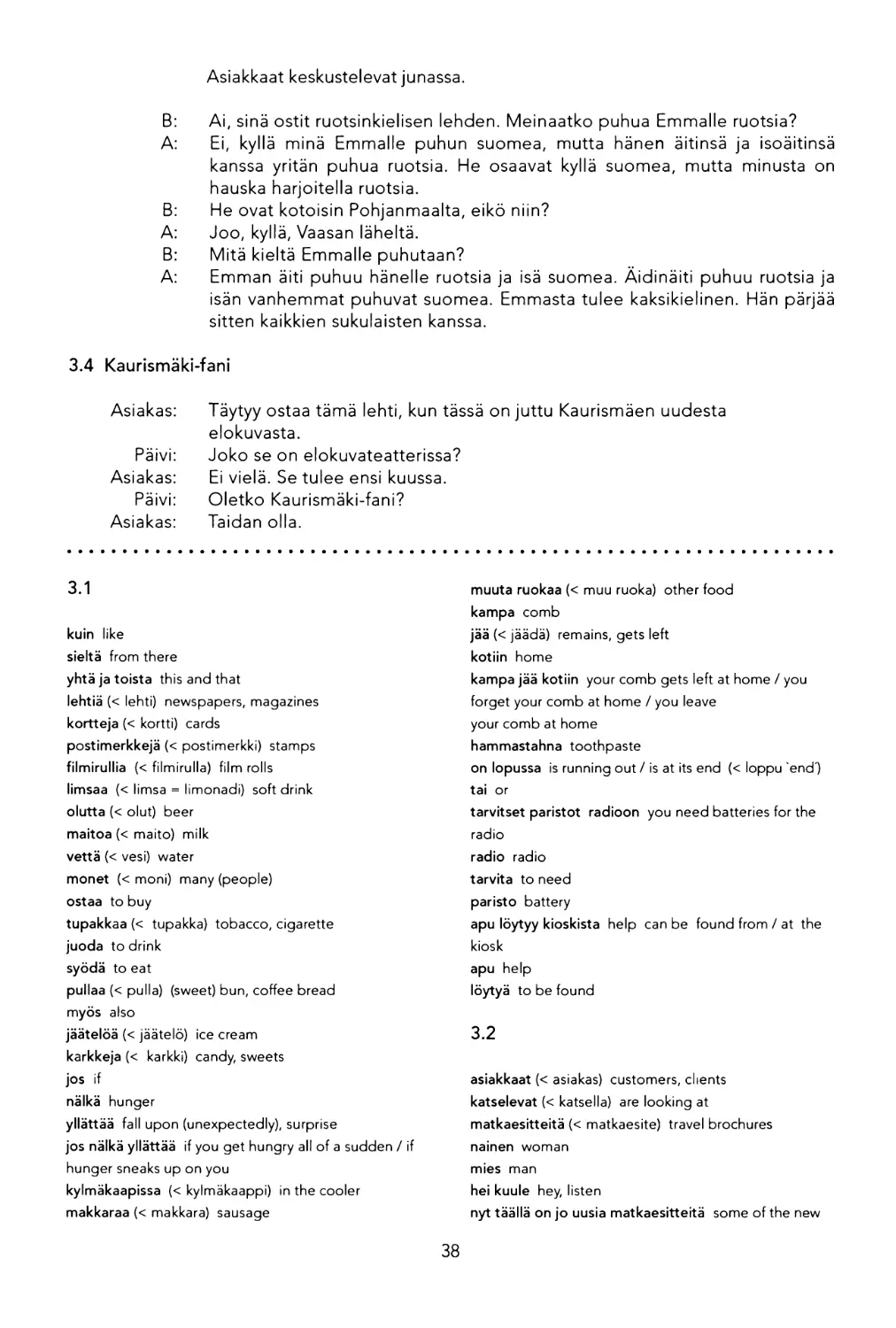

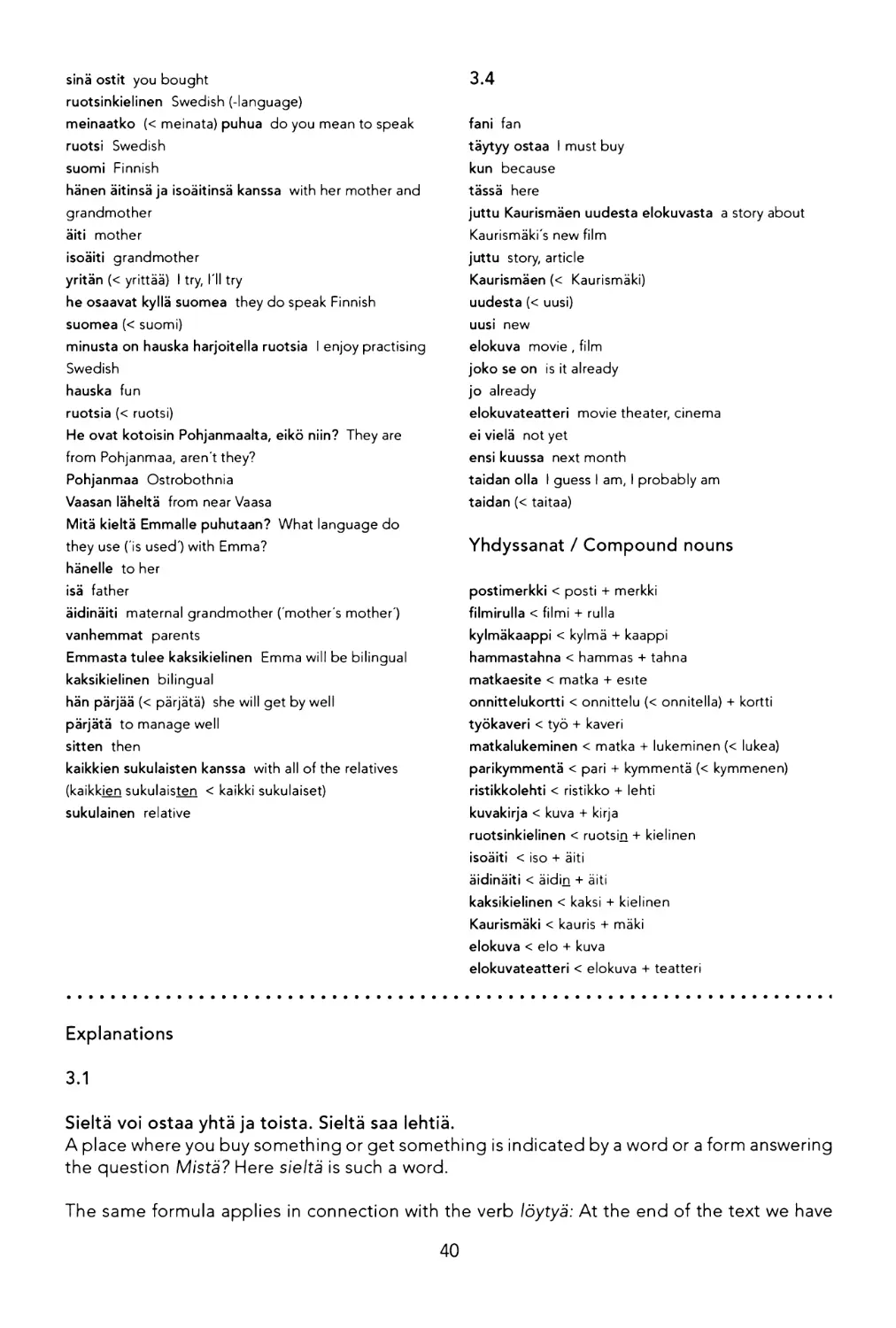


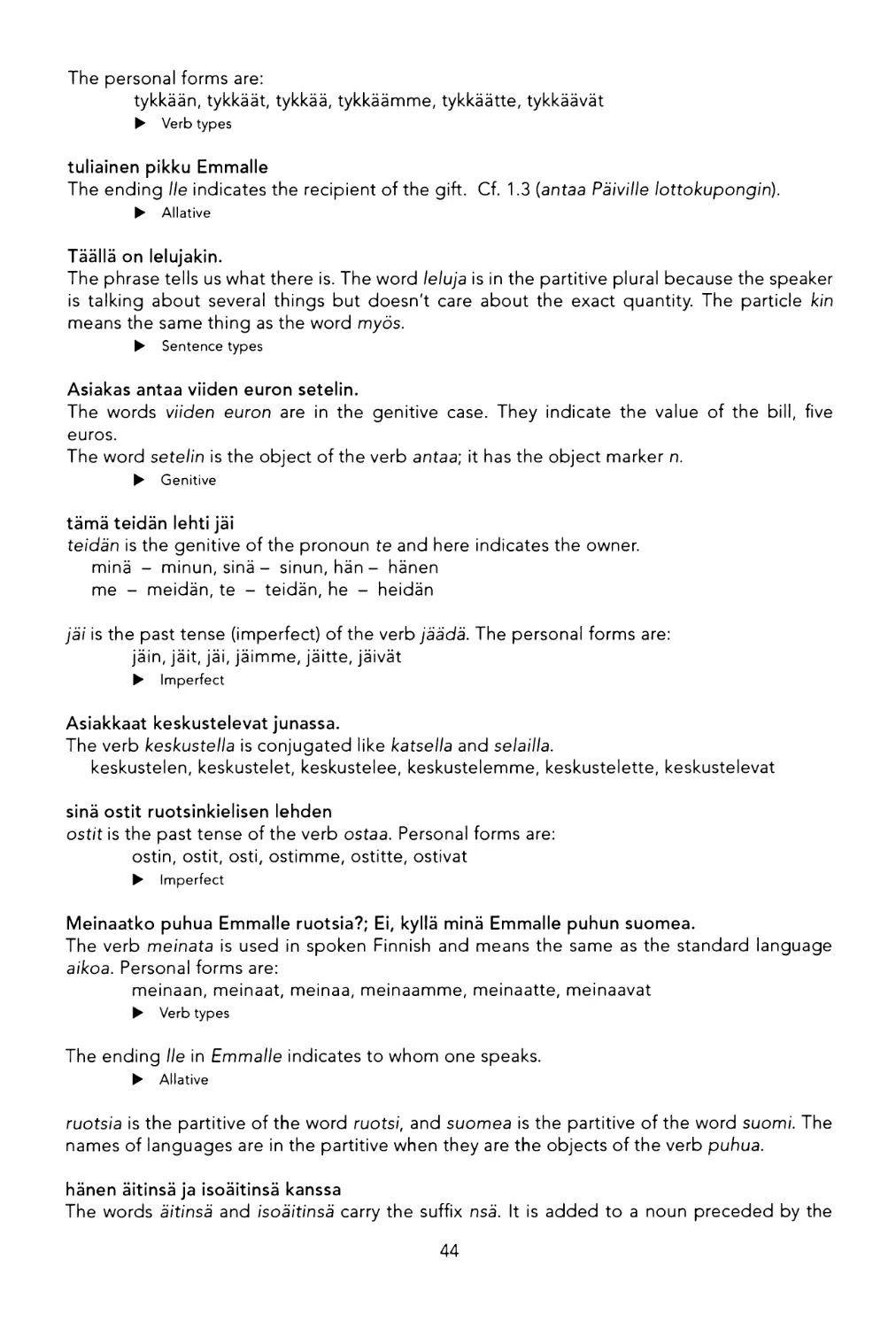


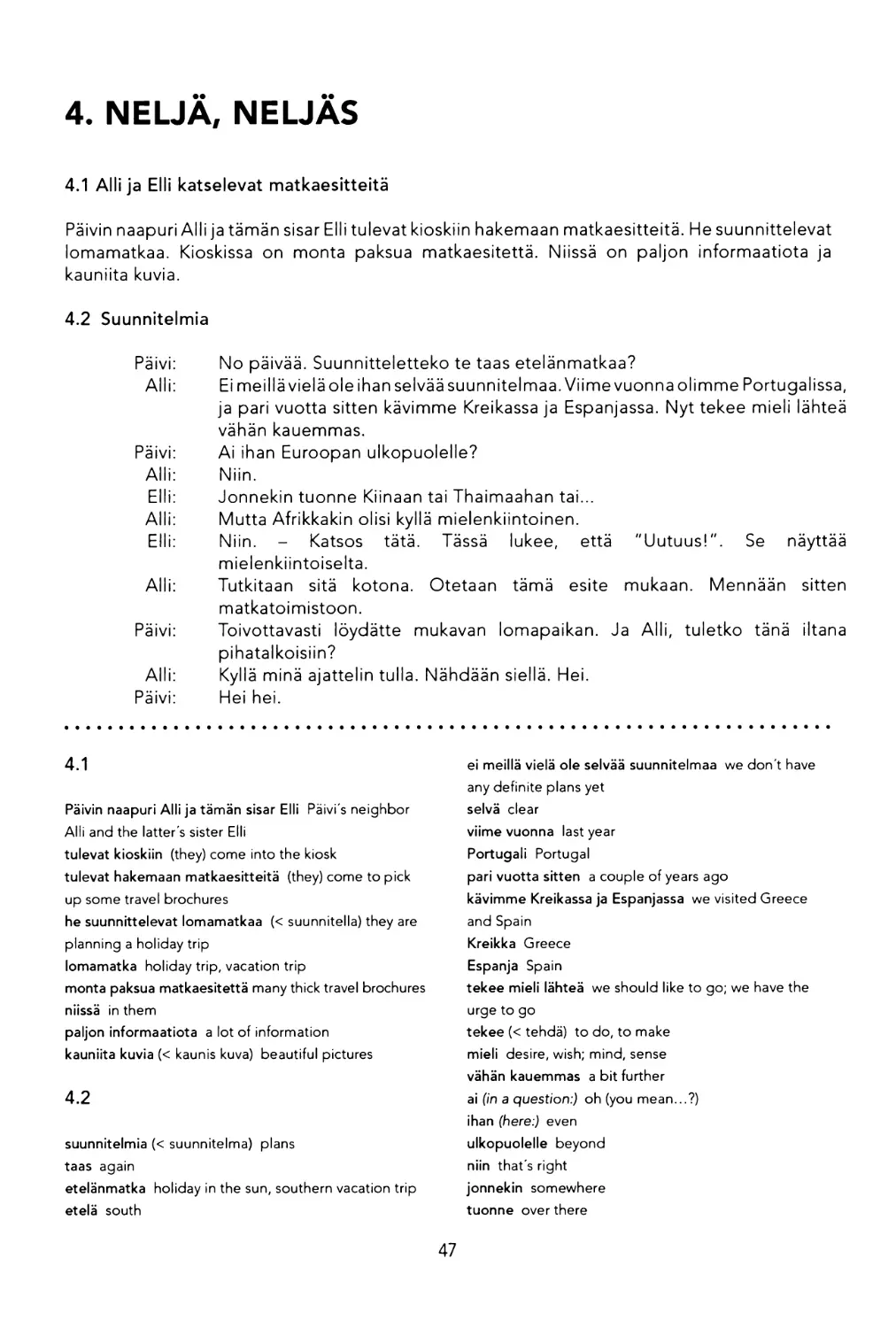
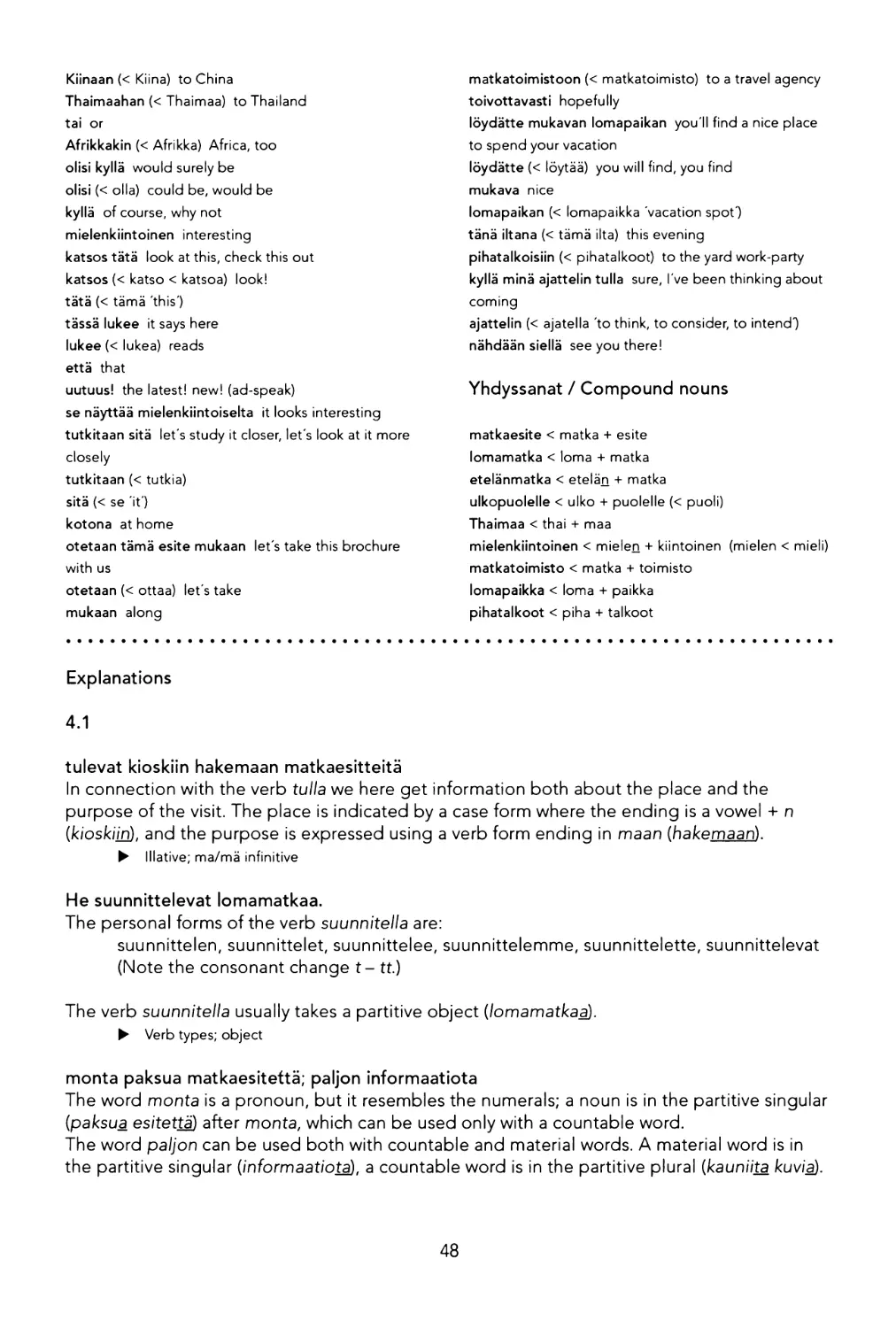


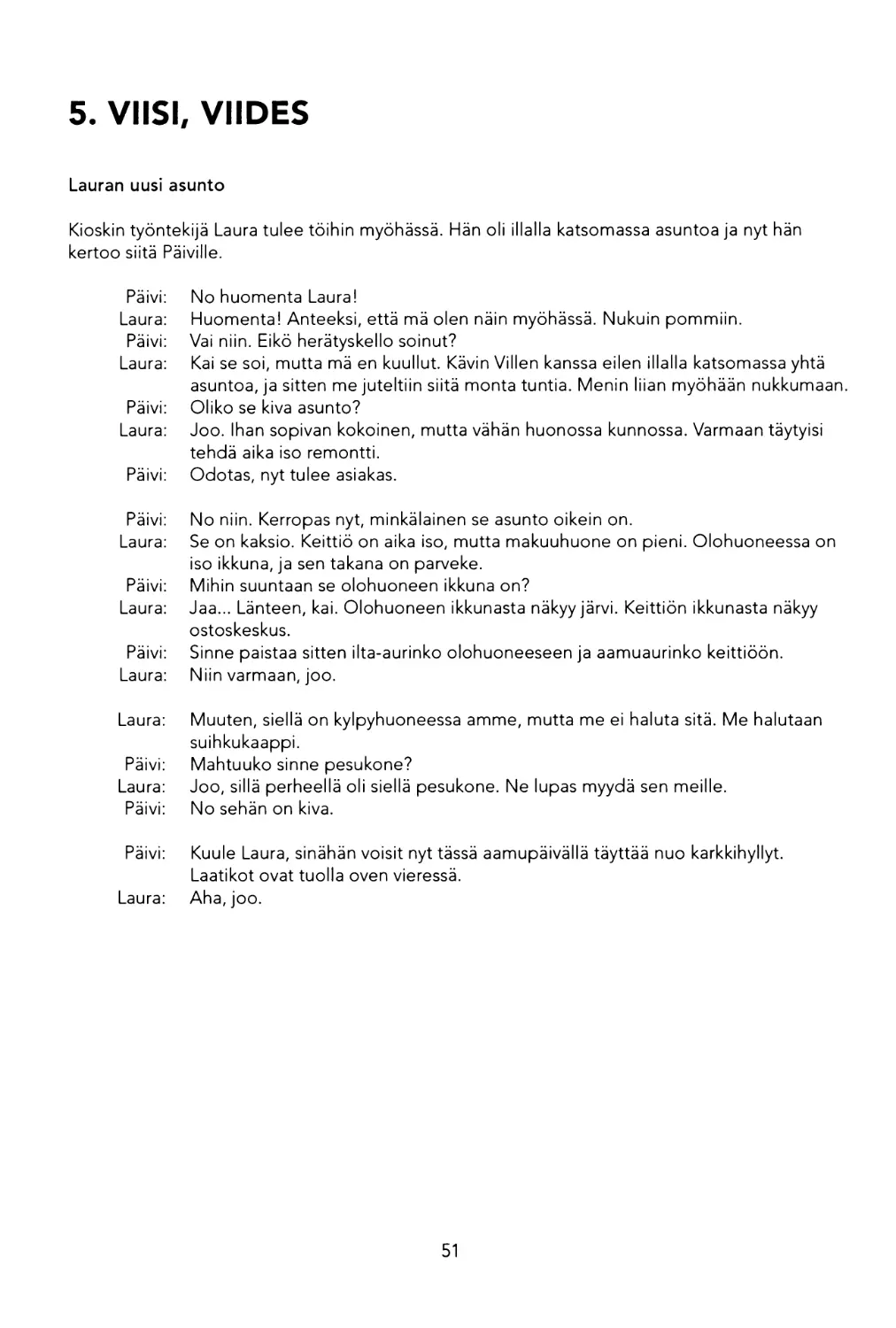

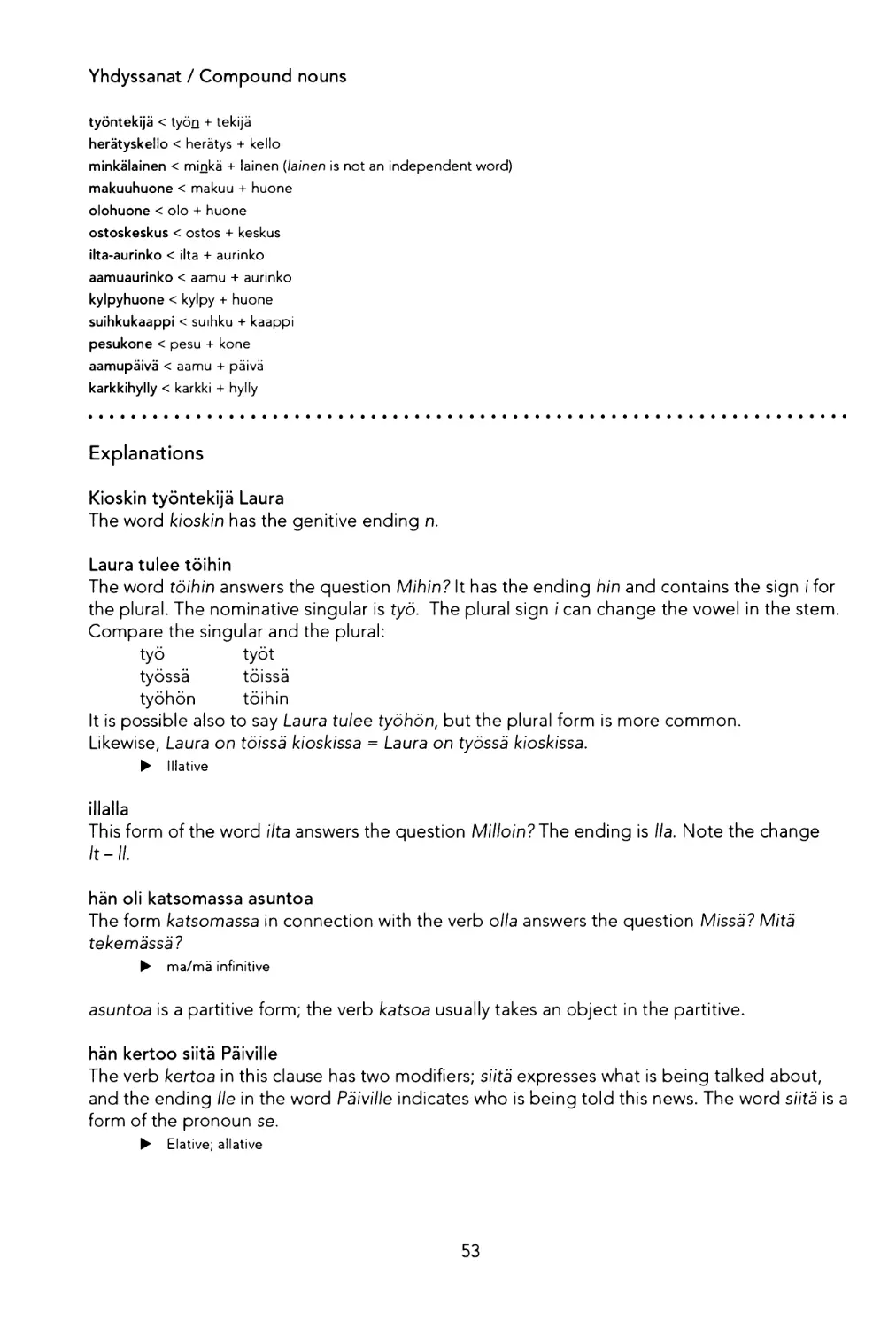


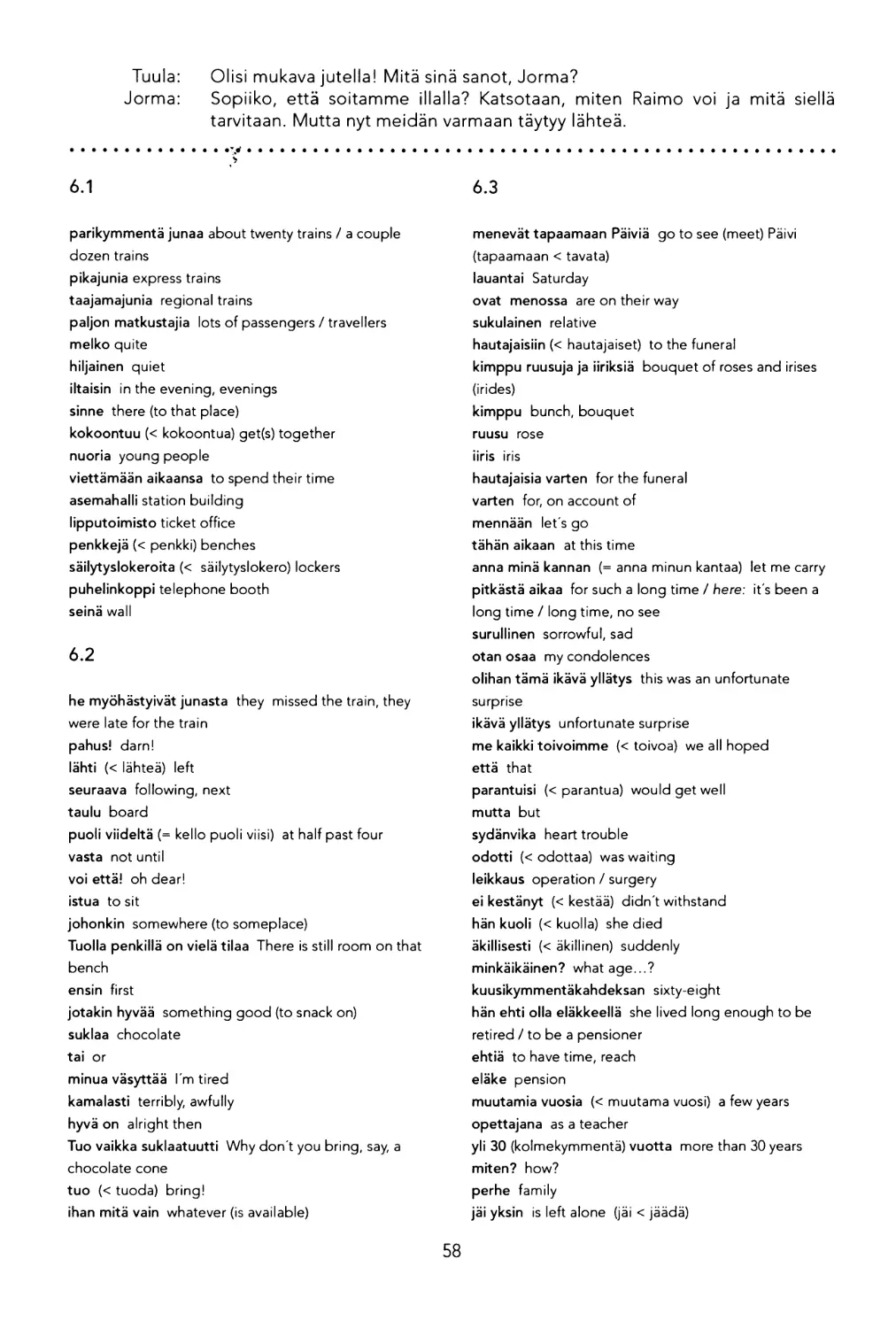
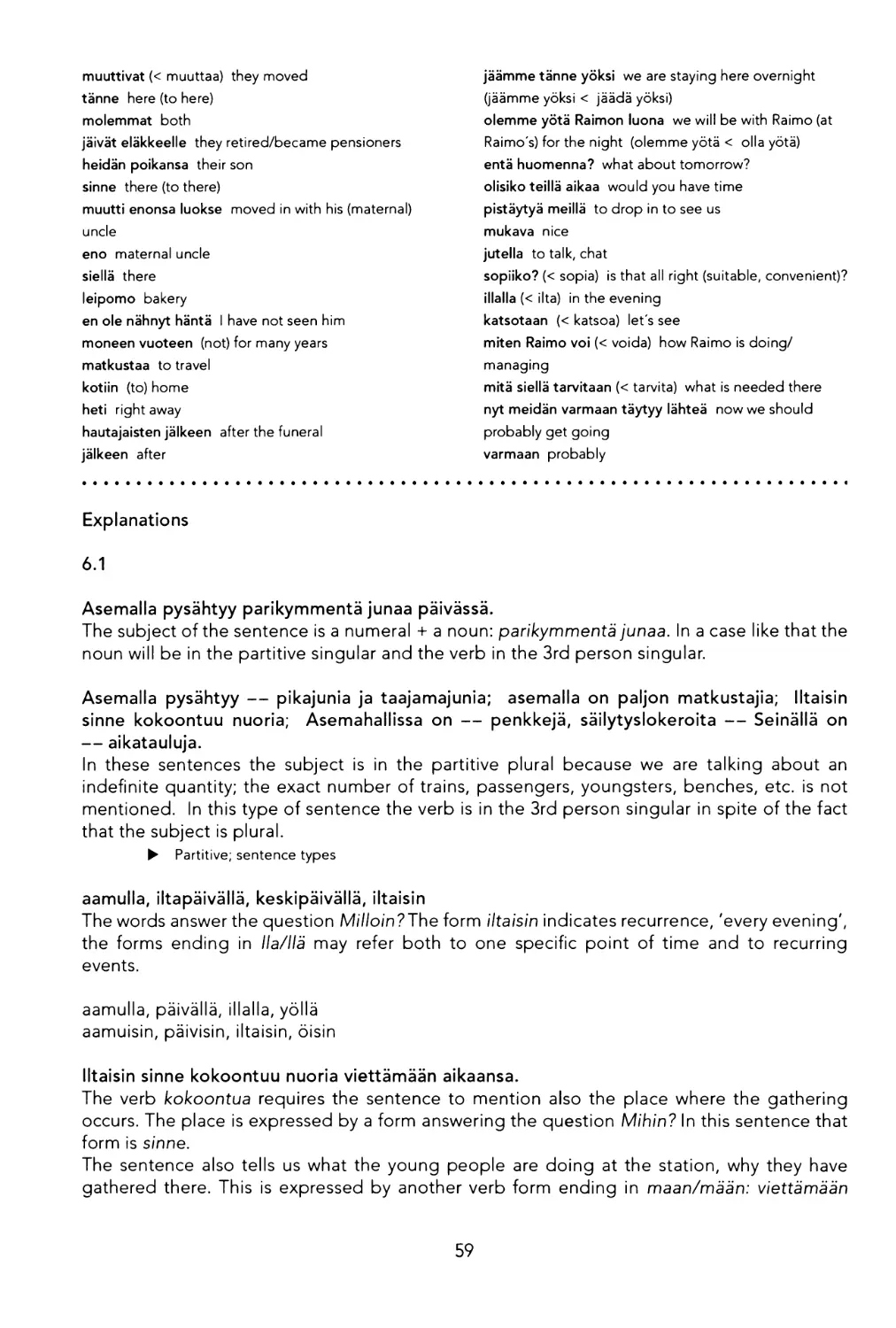


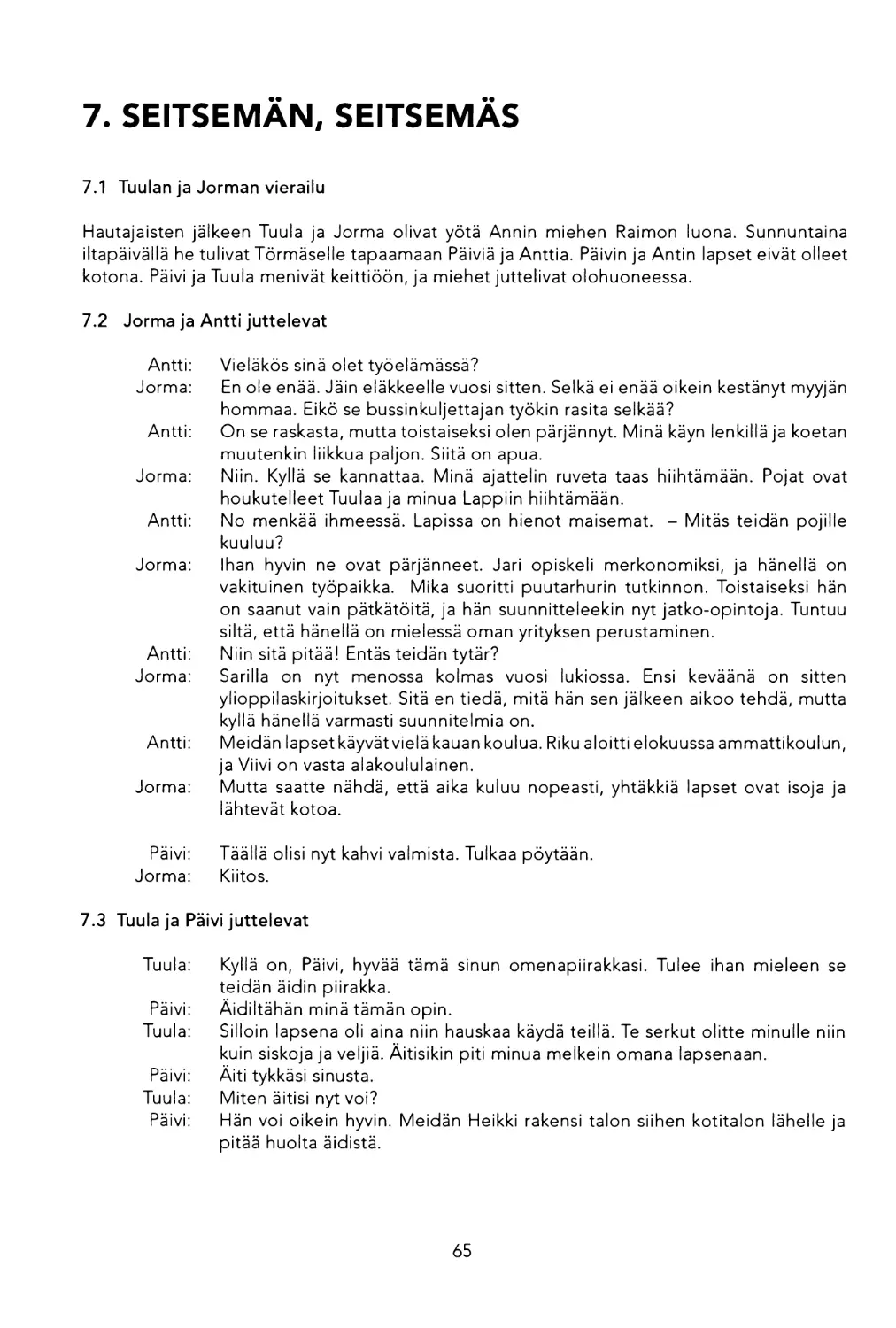

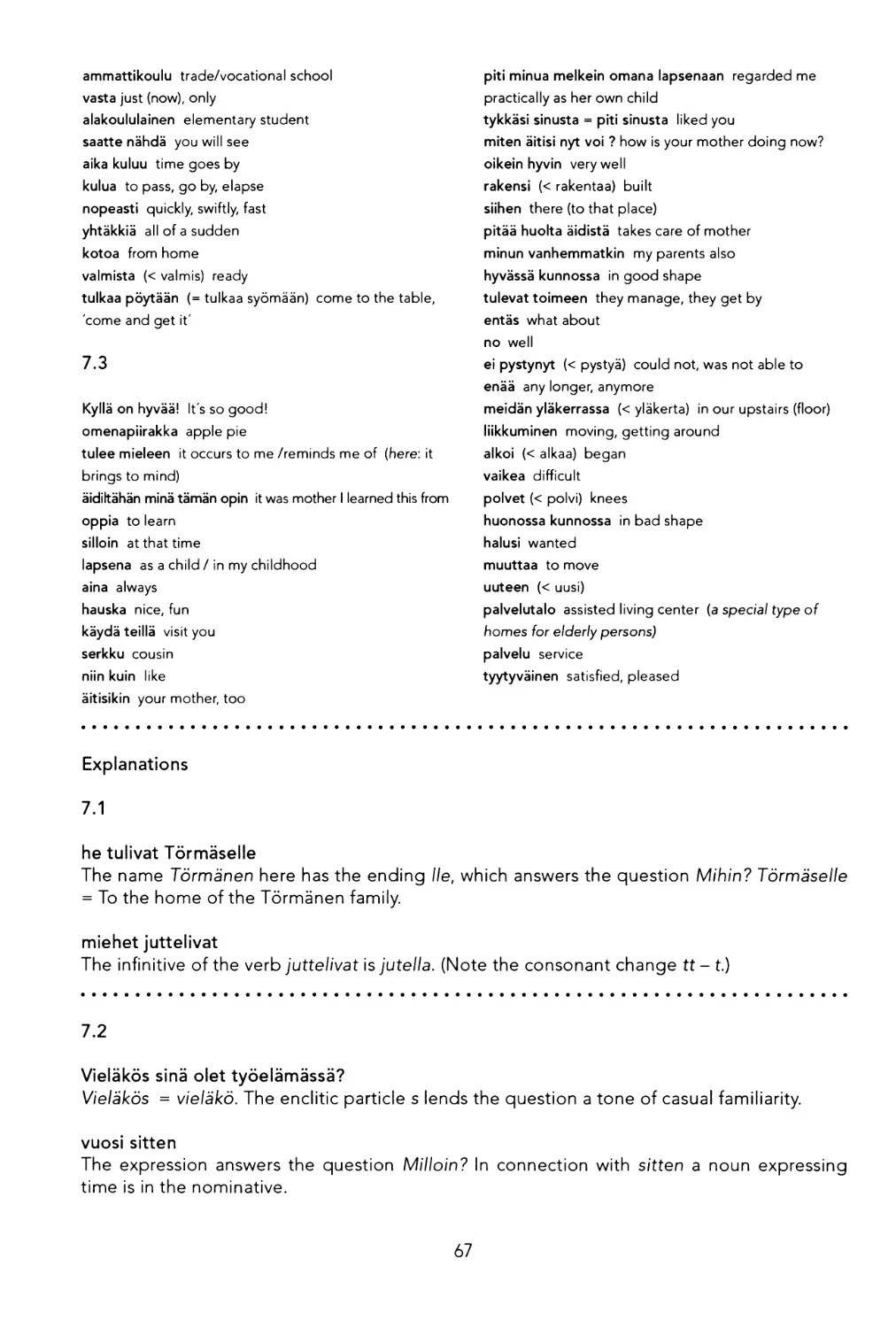


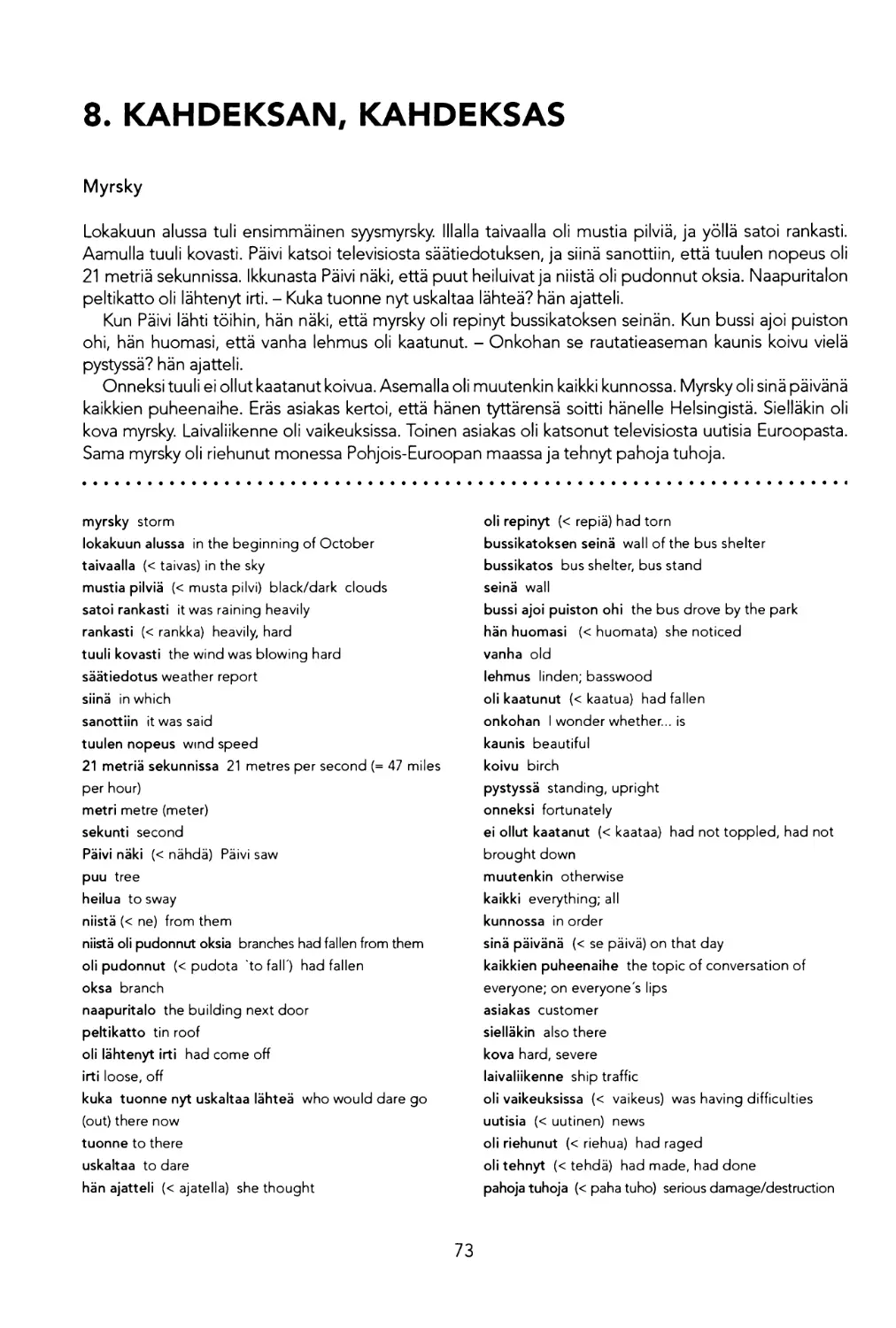



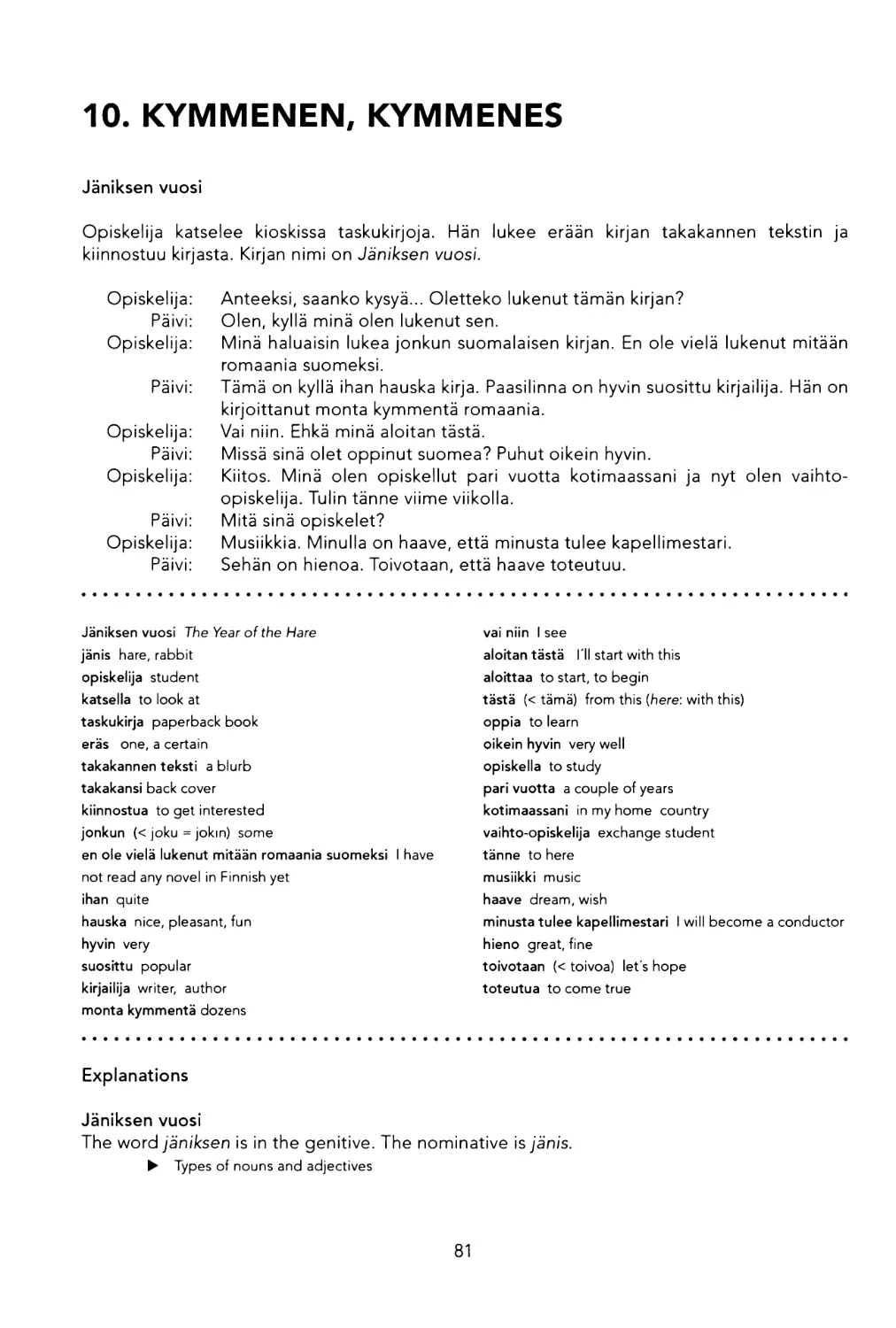
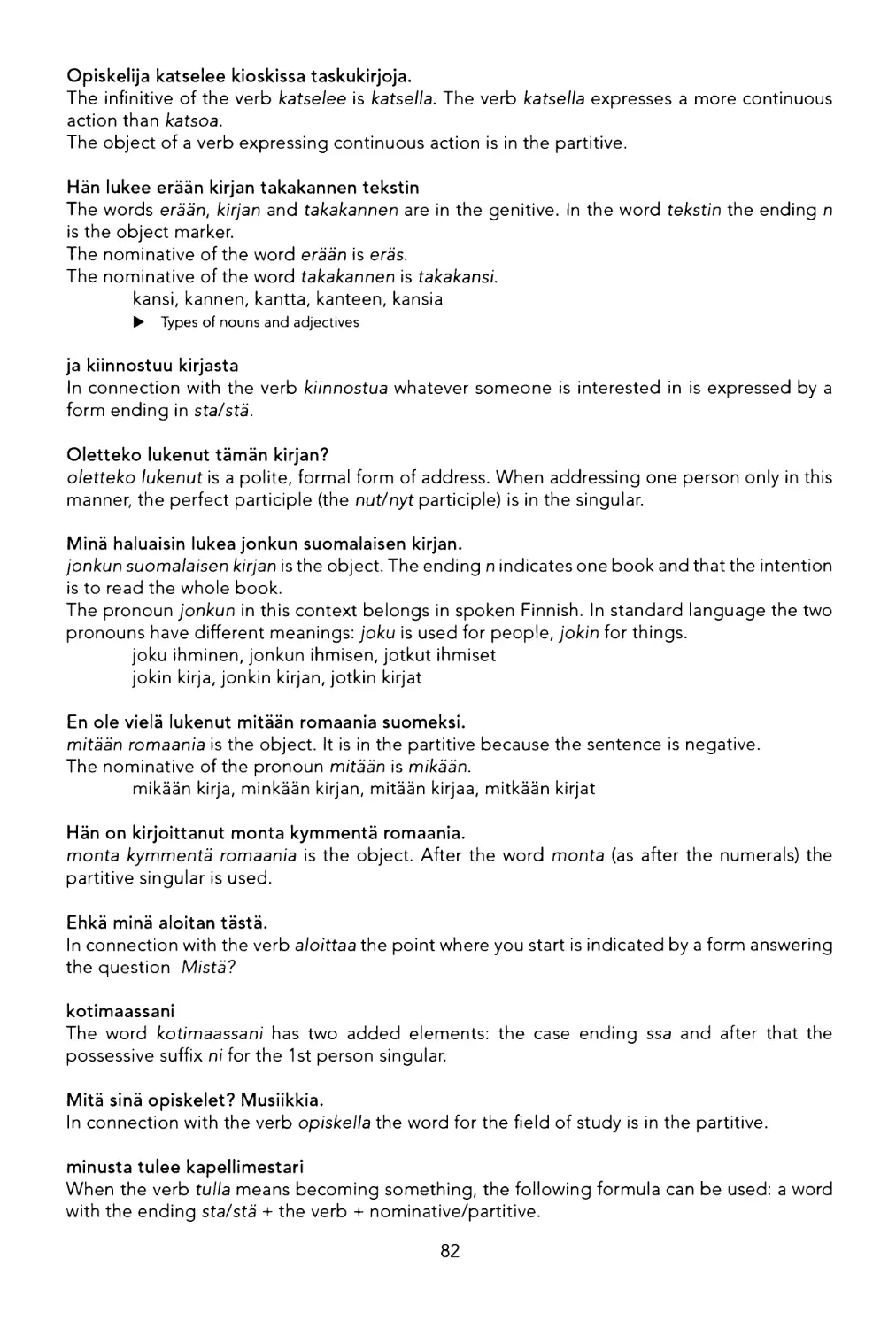

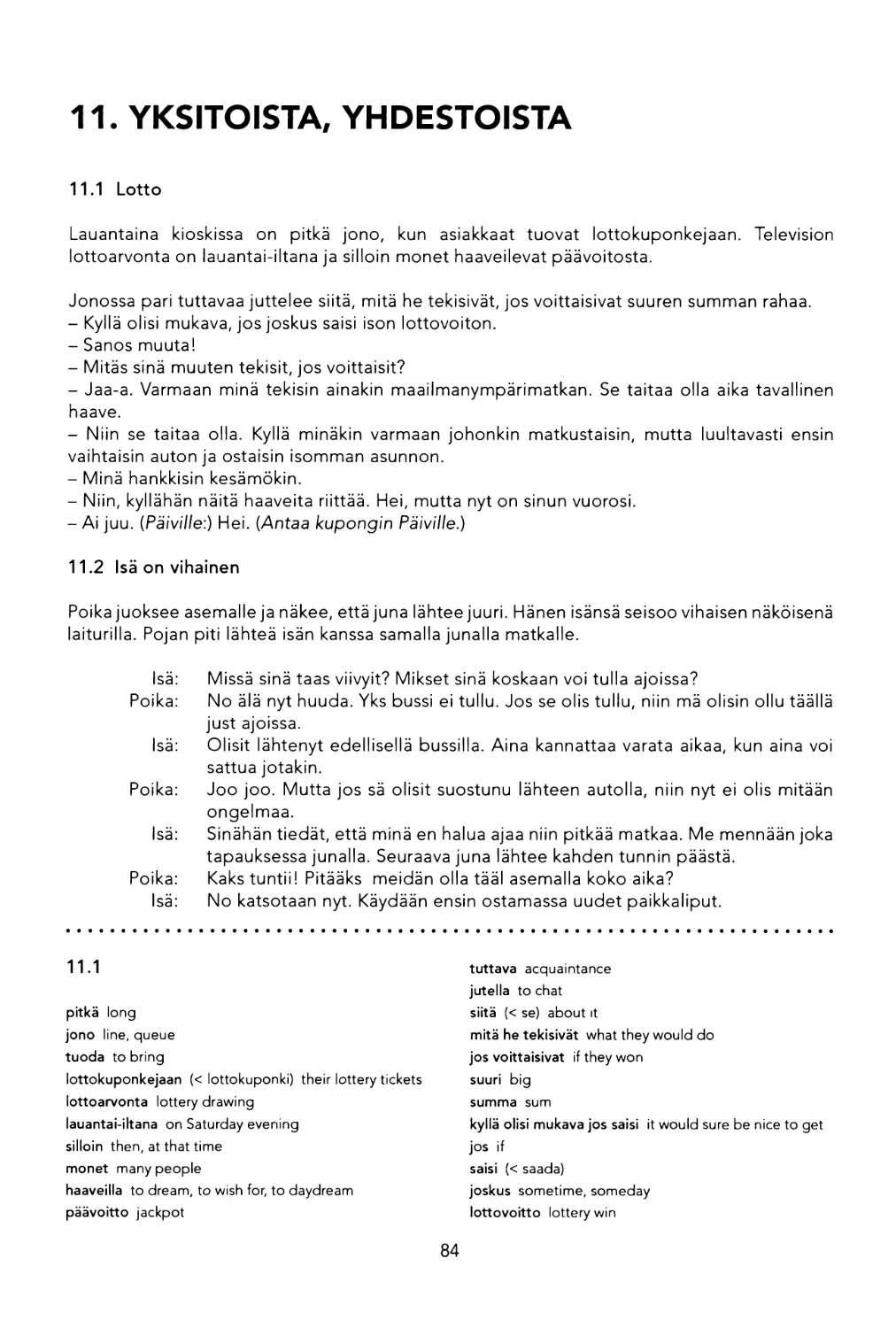
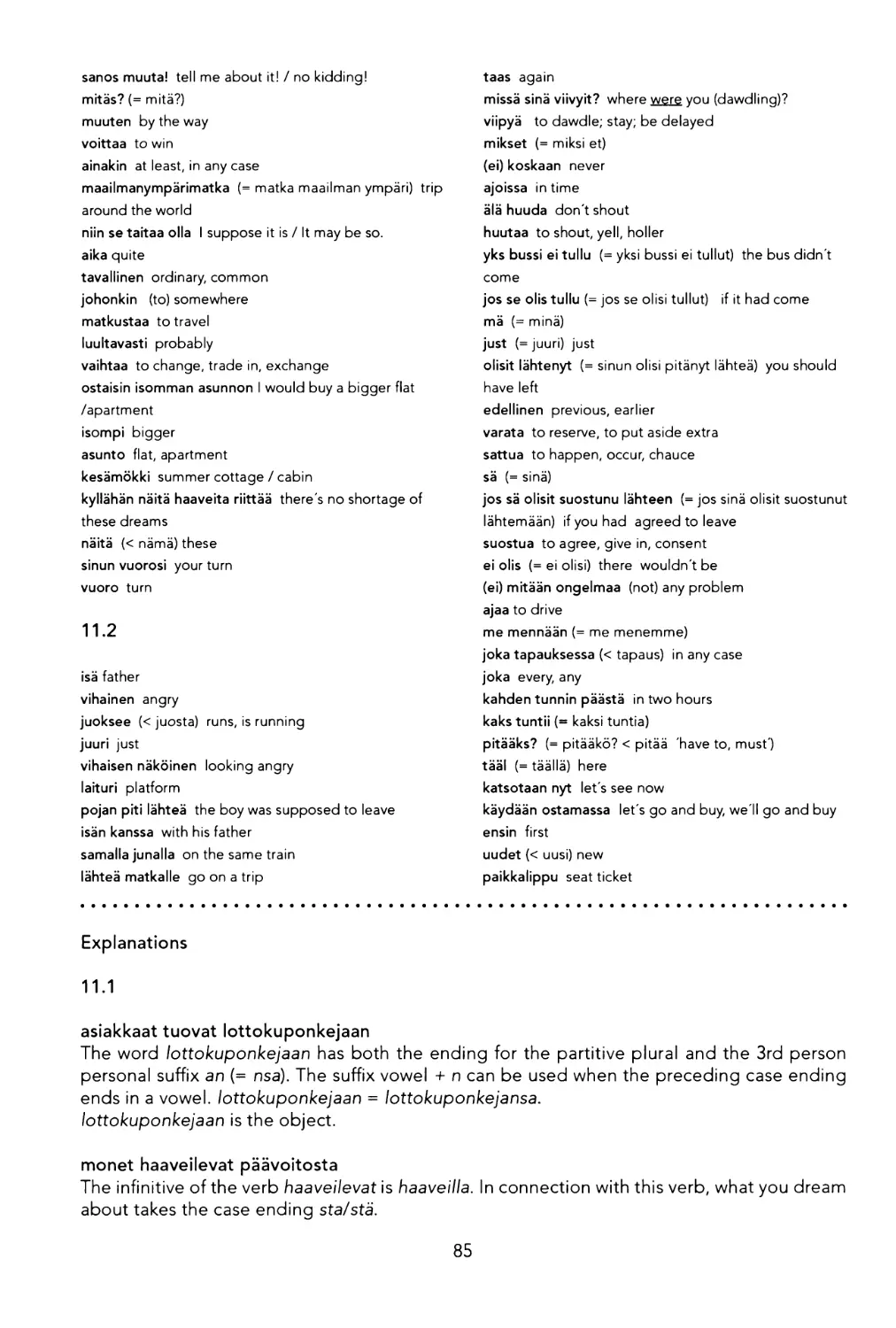















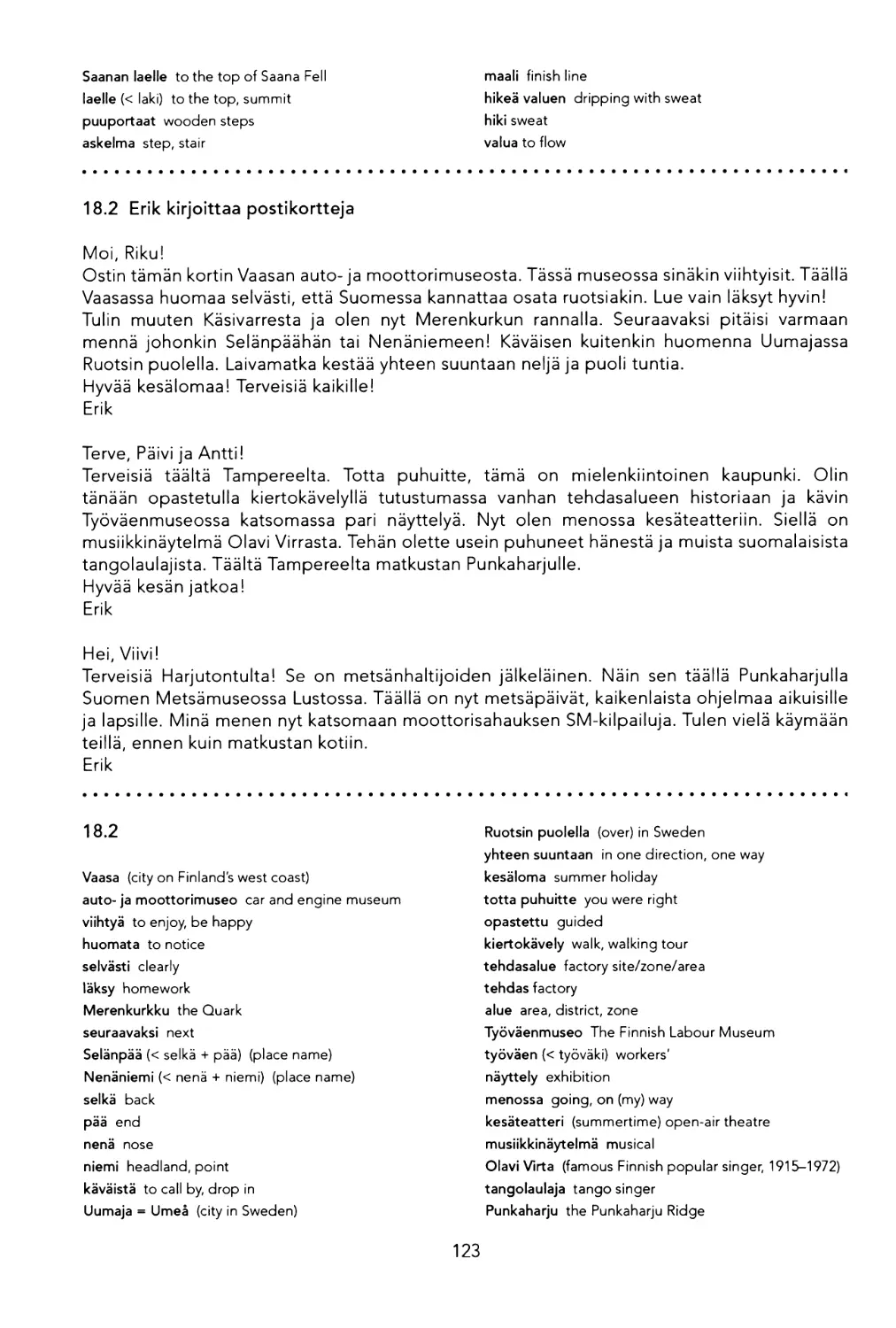
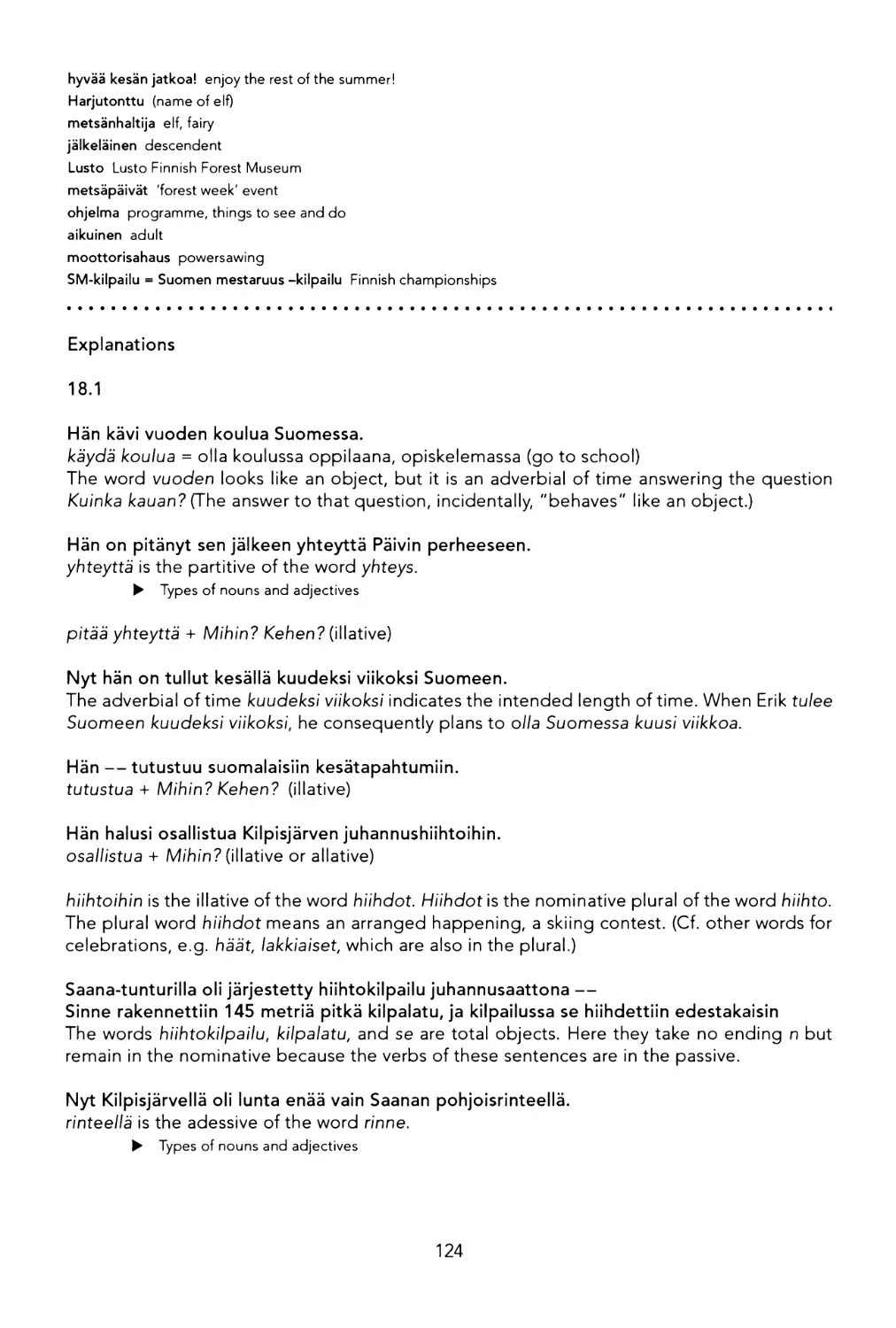


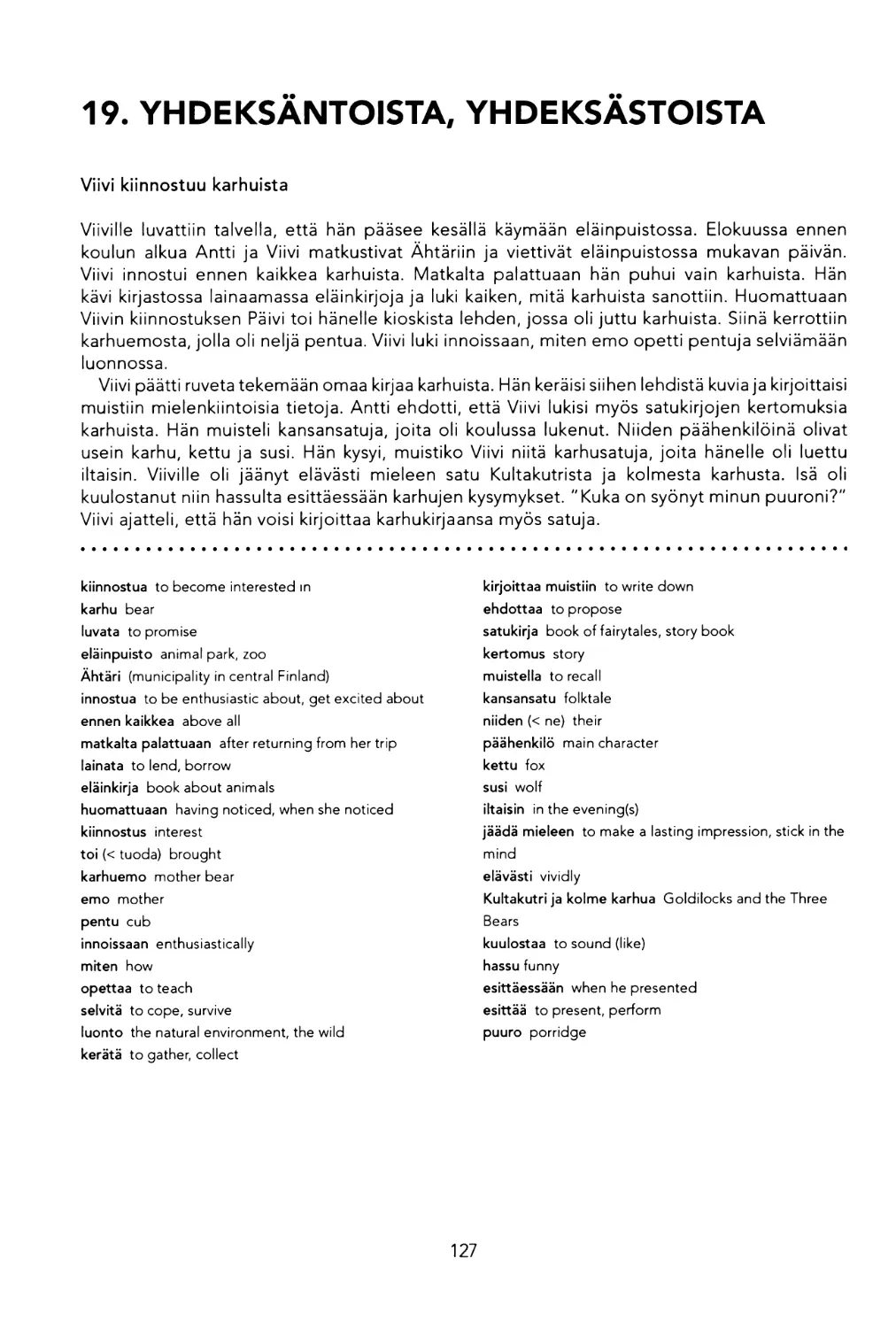
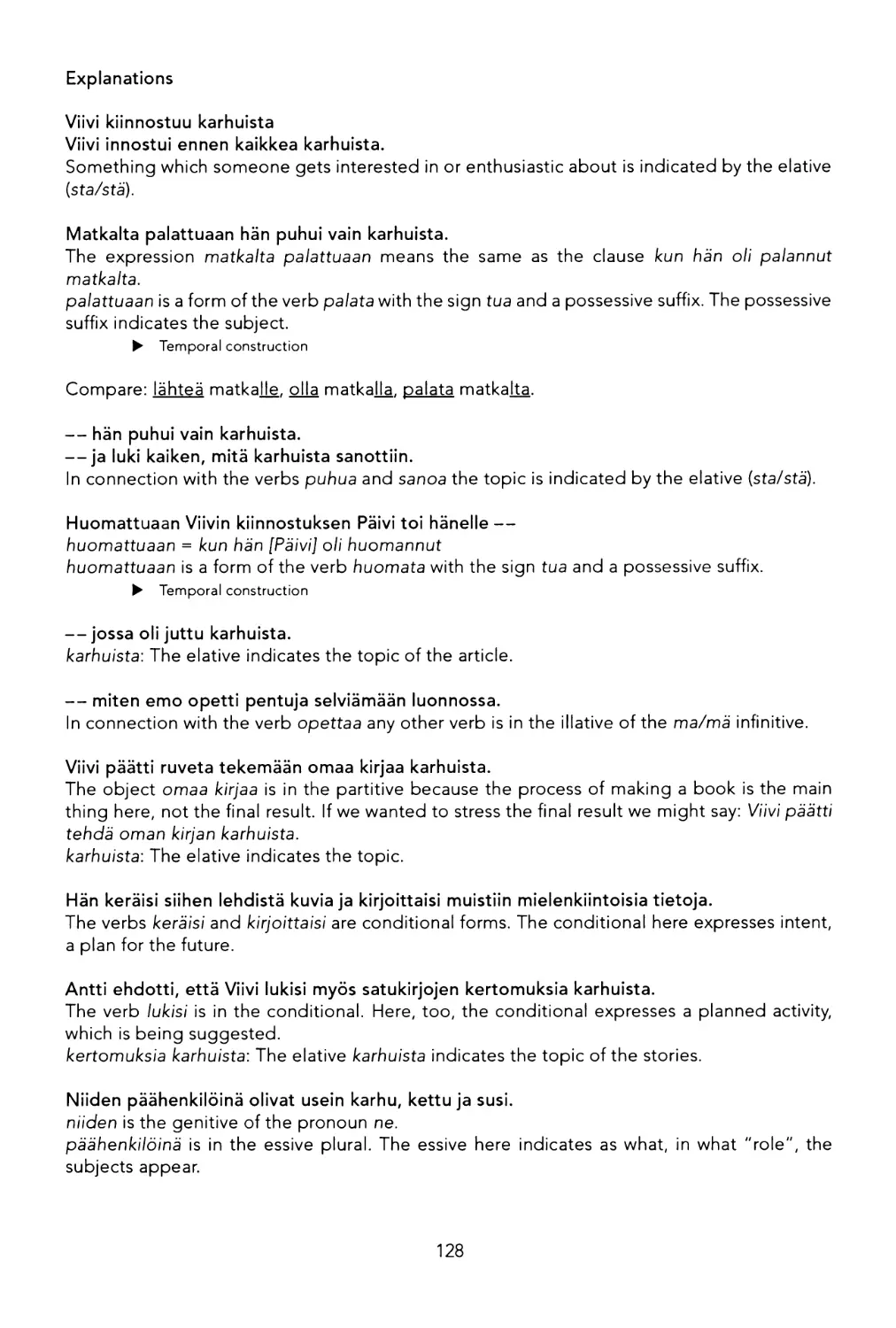

























































Автор: Bessonoff S.-M. Hamalainen E.
Теги: suomi lastenkirjallisuus
ISBN: 978-952-10-4506-6
Год: 2008
Текст
                    Salli-Marja Bessonoff • Eila Hämäläinen TILANTEESTA TOISEEN
Salli-Marja Bessonoff • Eila Hämäläinen
TILANTEESTA TOISEEN
A Finnish Course


Salli-Marja Bessonoff • Eila Hämäläinen
Tilanteesta toiseen
A Finnish Course


CONTENTS
Dear student of Finnish 7
Hyvä suomen kielen opiskelija! 8
Characteristics of the Finnish language 10
Kirjan henkilöitä / Characters appearing in the book 14
Texts, vocabularies and explanations
1. Yksi, ensimmäinen 16
1.1 Päivi Törmänen 16
1.2 Ensimmäinen asiakas 16
1.3 Ensimmäinen jono 16
Explanations 20
2. Kaksi, toinen 26
2.1 Päivi Törmäsen kioski 26
2.2 Asiakas kysyy neuvoa 26
2.3 Asiakas haluaa vaihtaa rahaa 26
2.4 Liian nuori ostaja? 26
2.5 Asiakas haluaa vuokrata DVD:n 26
2.6 Väärinkäsitys 27
2.7 Asiakas etsii korttia 27
2.8 Aurinko paistaa 27
Explanations 30
3. Kolme, kolmas 37
3.1 Kioski on kuin pieni kauppa 37
3.2 Asiakkaat katselevat matkaesitteitä 37
3.3 Asiakkaat selailevat lehtiä, etsivät matkalukemista 37
3.4 Kaurismäki-fani 38
Explanations 40
4. Neljä, neljäs 47
4.1 Alli ja Elli katselevat matkaesitteitä 47
4.2 Suunnitelmia 47
Explanations 48
5. Viisi, viides 51
Lauran uusi asunto 51
Explanations 53
6. Kuusi, kuudes 57
6.1 Rautatieasemalla 57
6.2 He myöhästyivät junasta 57
6.3 Tuula ja Jorma Virtanen tulevat asemalle ja
menevät tapaamaan Päiviä 57
Explanations 59


7. Seitsemän, seitsemäs 65
7.1 Tuulan ja Jorman vierailu 65
7.2 Jorma ja Antti juttelevat 65
7.3 Tuula ja Päivi juttelevat 65
Explanations 67
8. Kahdeksan, kahdeksas 73
Myrsky. 73
Explanations 74
9. Yhdeksän, yhdeksäs 76
9.1 Ensilumi 76
9.2 Liukas keli 76
Explanations 77
10. Kymmenen, kymmenes 81
Jäniksen vuosi 81
Explanations 81
11. Yksitoista, yhdestoista 84
11.1 Lotto 84
11.2 Isä on vihainen 84
Explanations 85
12. Kaksitoista, kahdestoista 89
12.1 Heikot jäät 89
12.2 Vaarallinen tilanne 89
Explanations 90
13. Kolmetoista, kolmastoista 92
Lauran ja Villen tupaantuliaiset 92
Explanations 95
14. Neljätoista, neljästoista 100
Talviloma 100
Explanations 102
15. Viisitoista, viidestoista 105
15.1 Kevät tulee 105
15.2 Alli ja Elli kertovat matkasta 106
Explanations 107
16. Kuusitoista, kuudestoista 111
16.1 Juhlat tulossa 111
16.2 Lakkiaisissa 112
Explanations 114
17. Seitsemäntoista, seitsemästoista 118
17.1 Sari hakee koulutukseen 118
17.2 Sari haluaa muuttaa etunimensä 119
Explanations 120


18. Kahdeksantoista, kahdeksastoista 122
18.1 Juhannus 122
18.2 Erik kirjoittaa postikortteja 123
Explanations 124
19. Yhdeksäntoista, yhdeksästoista 127
Viivi kiinnostuu karhuista 127
Explanations 128
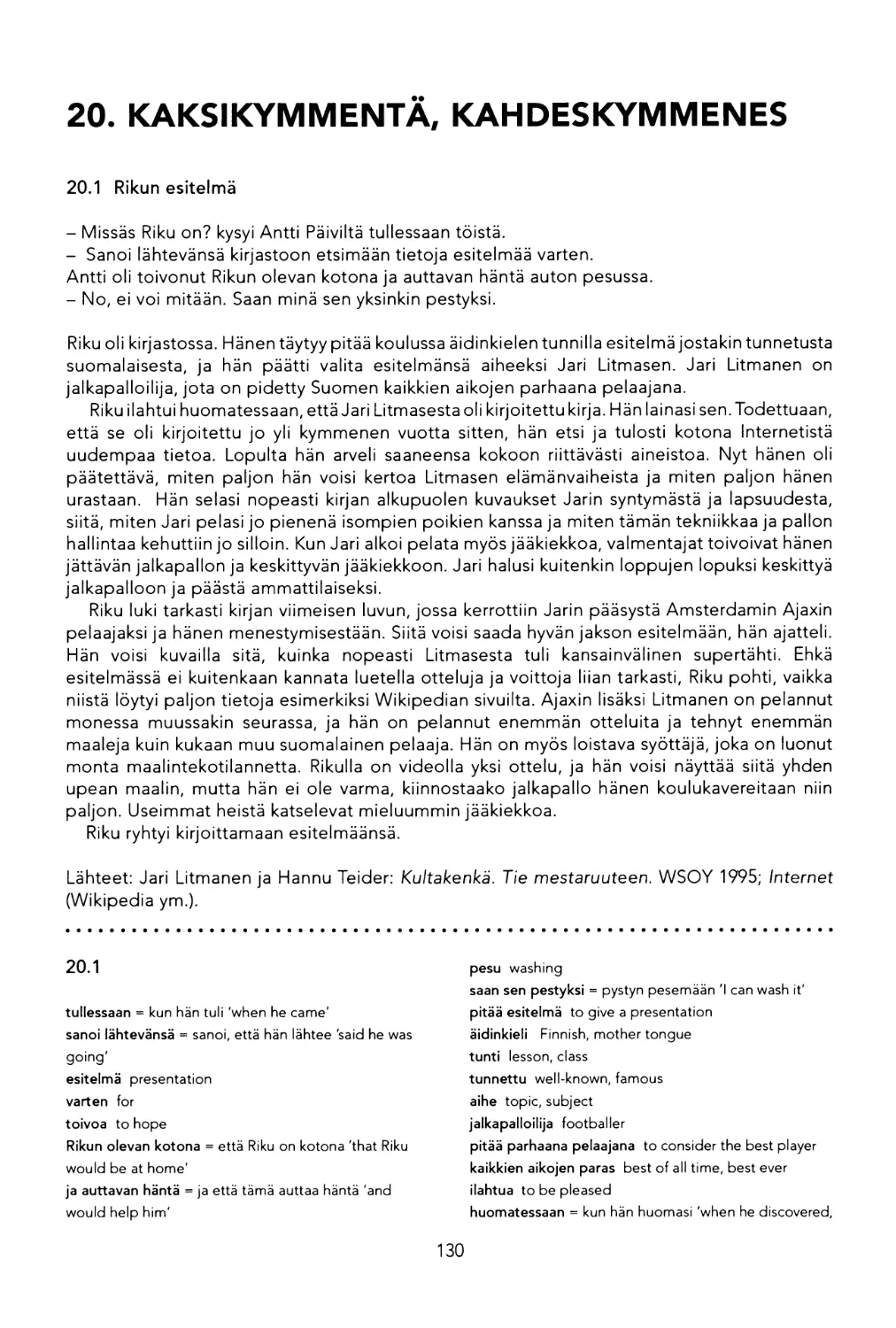
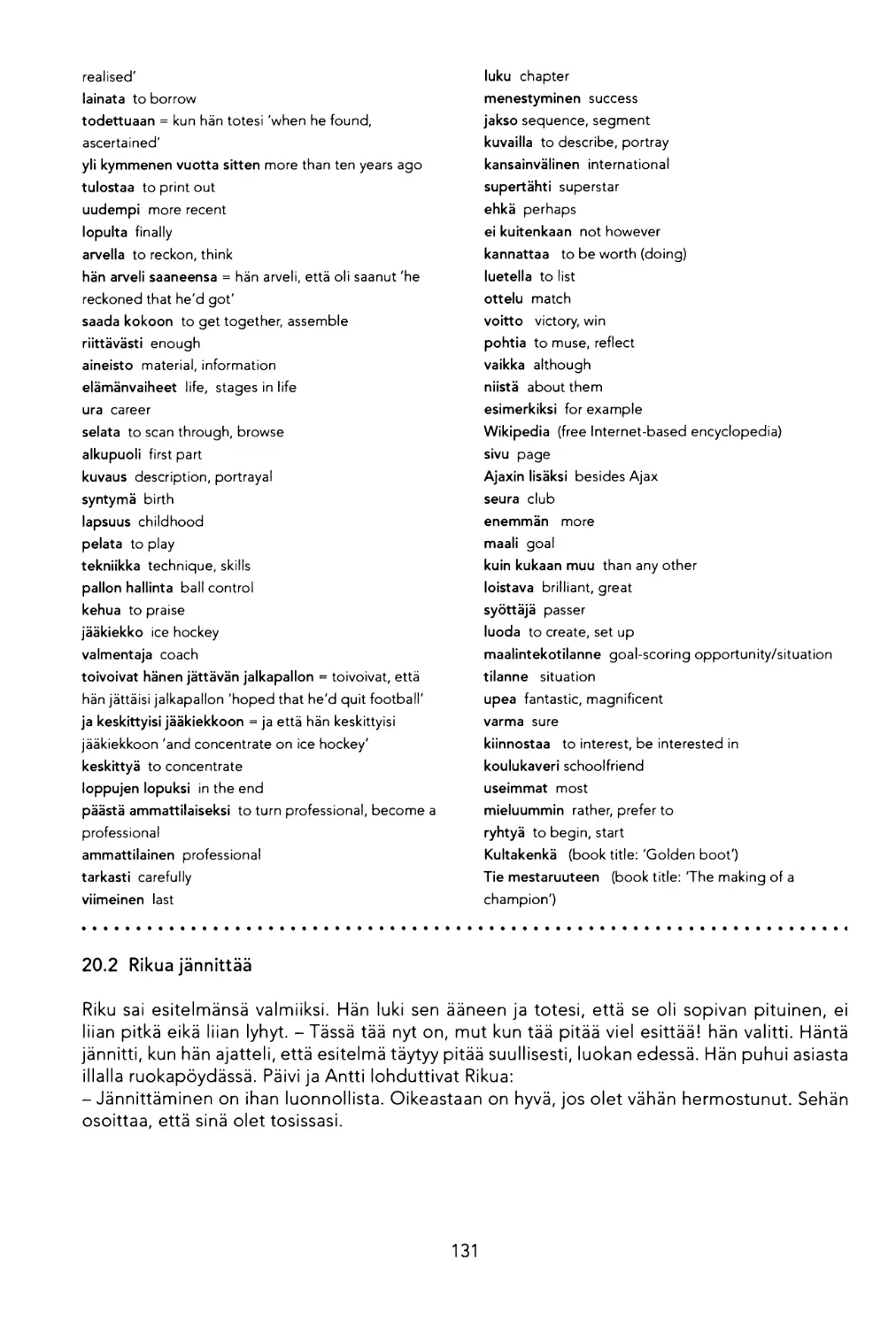
20. Kaksikymmentä, kahdeskymmenes 130
20.1 Rikun esitelmä 130
20.2 Rikua jännittää 131
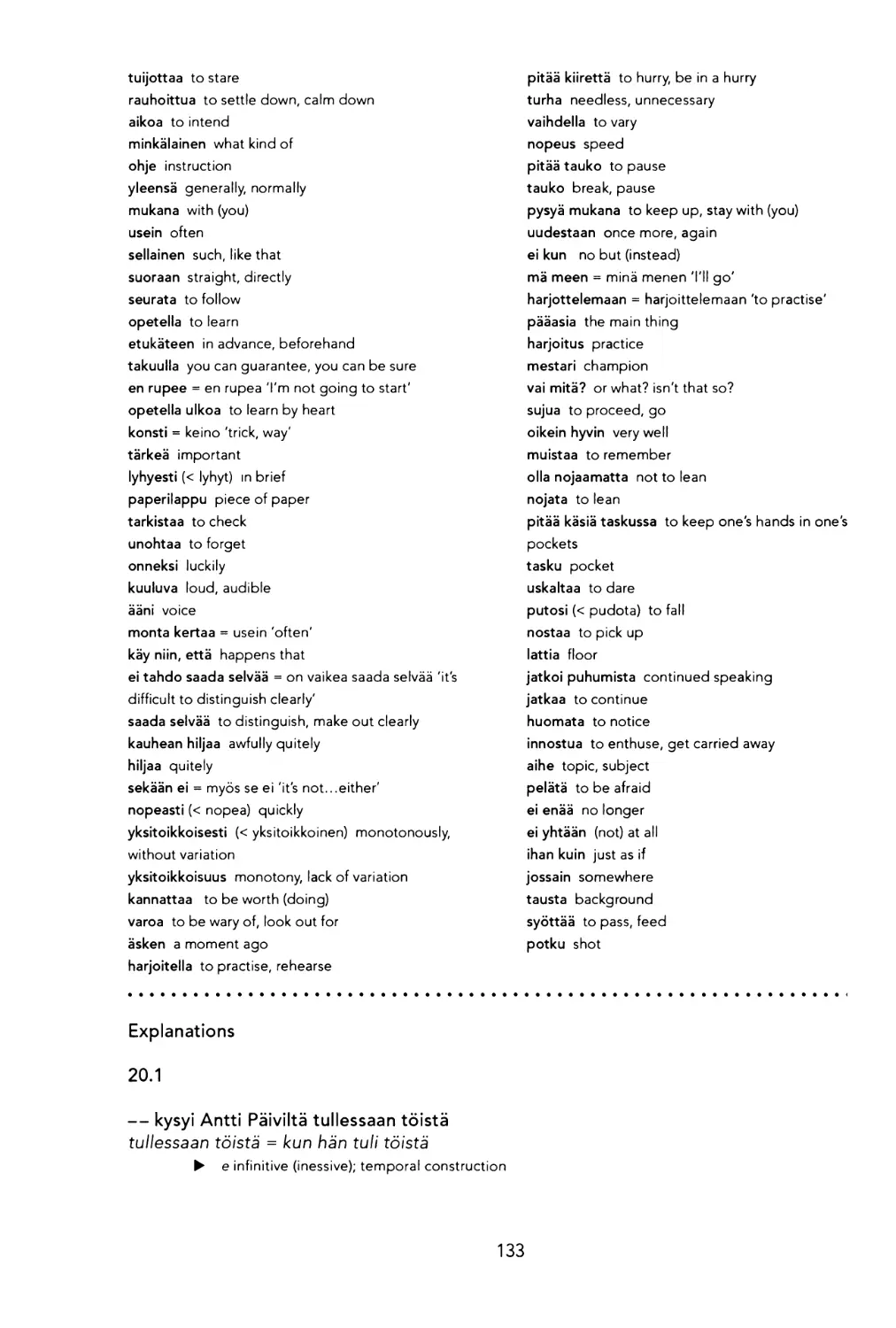
Explanations 133
21. Kaksikymmentäyksi, kahdeskymmenesensimmäinen 140
Viivin tietokilpailu 140
Explanations 144
22. Kaksikymmentäkaksi, kahdeskymmenestoinen 153
Apua! 153
Explanations 154
23. Kaksikymmentäkolme, kahdeskymmeneskolmas 158
Kesäsuunnitelmia 158
Explanations 159
Grammar summaries
Chapters 1, 2 and 3 164
Sentence types 164
Case forms for nouns and adjectives 164
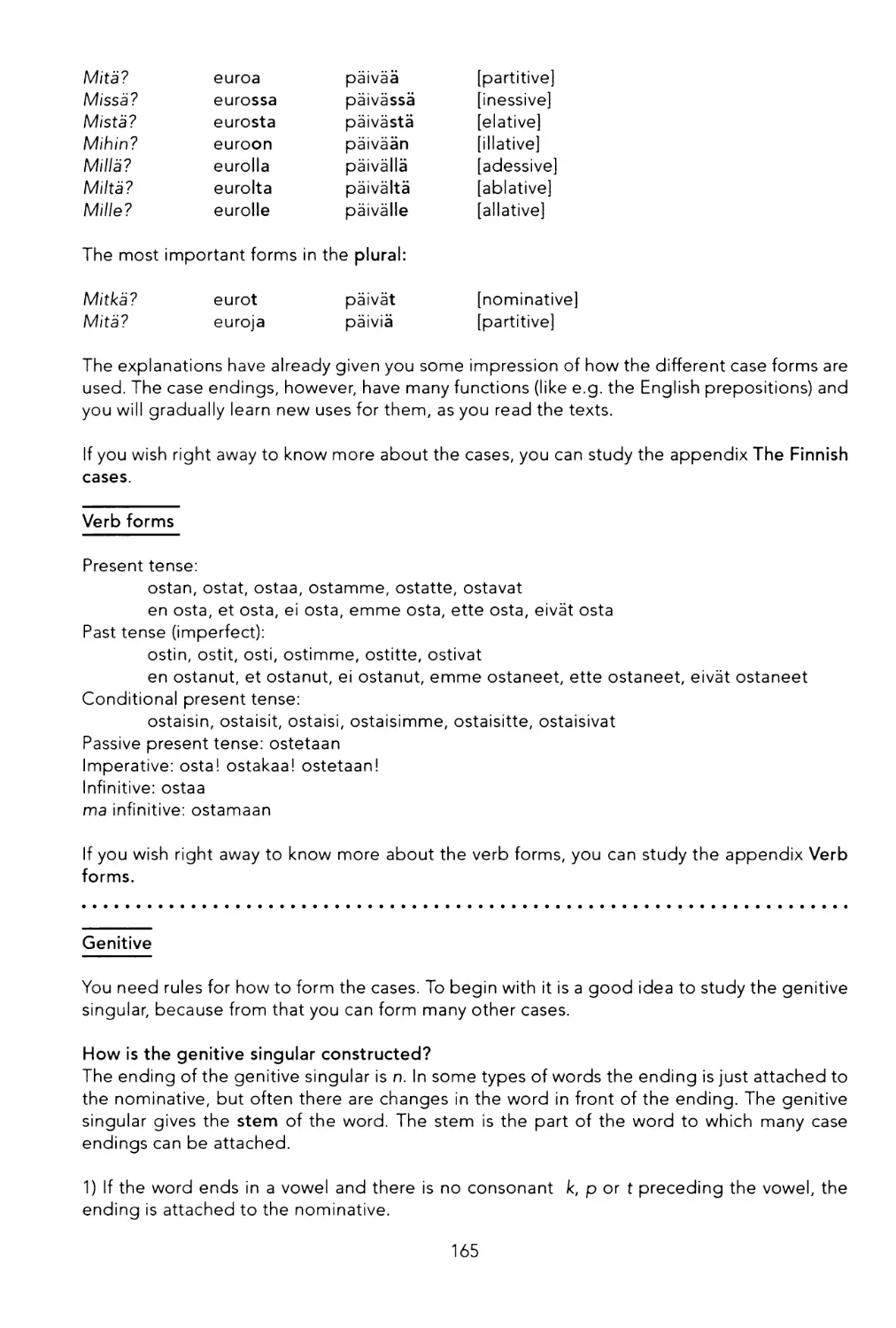
Verb forms 165
Genitive 165
The present tense of verbs 168
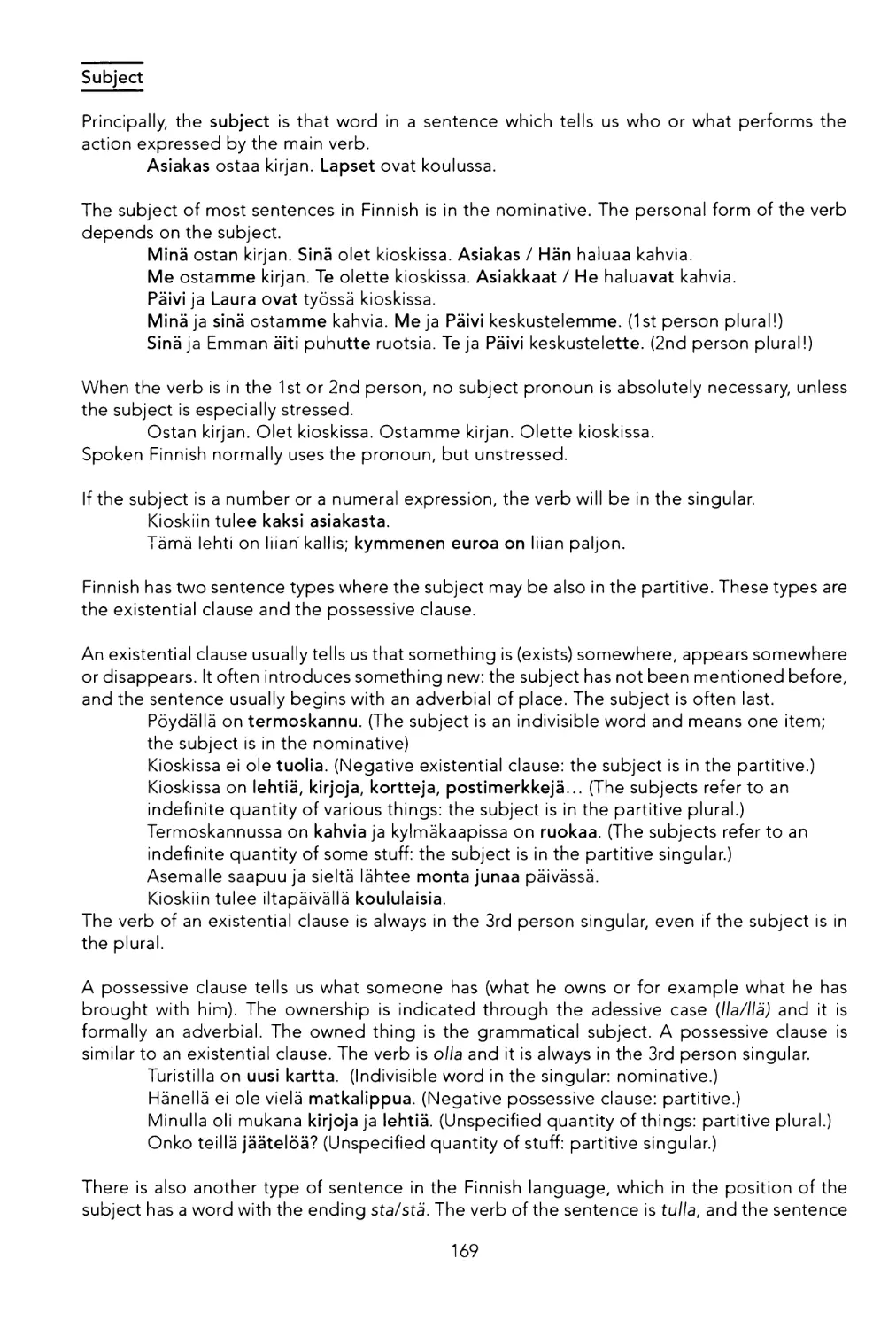
Subject 169
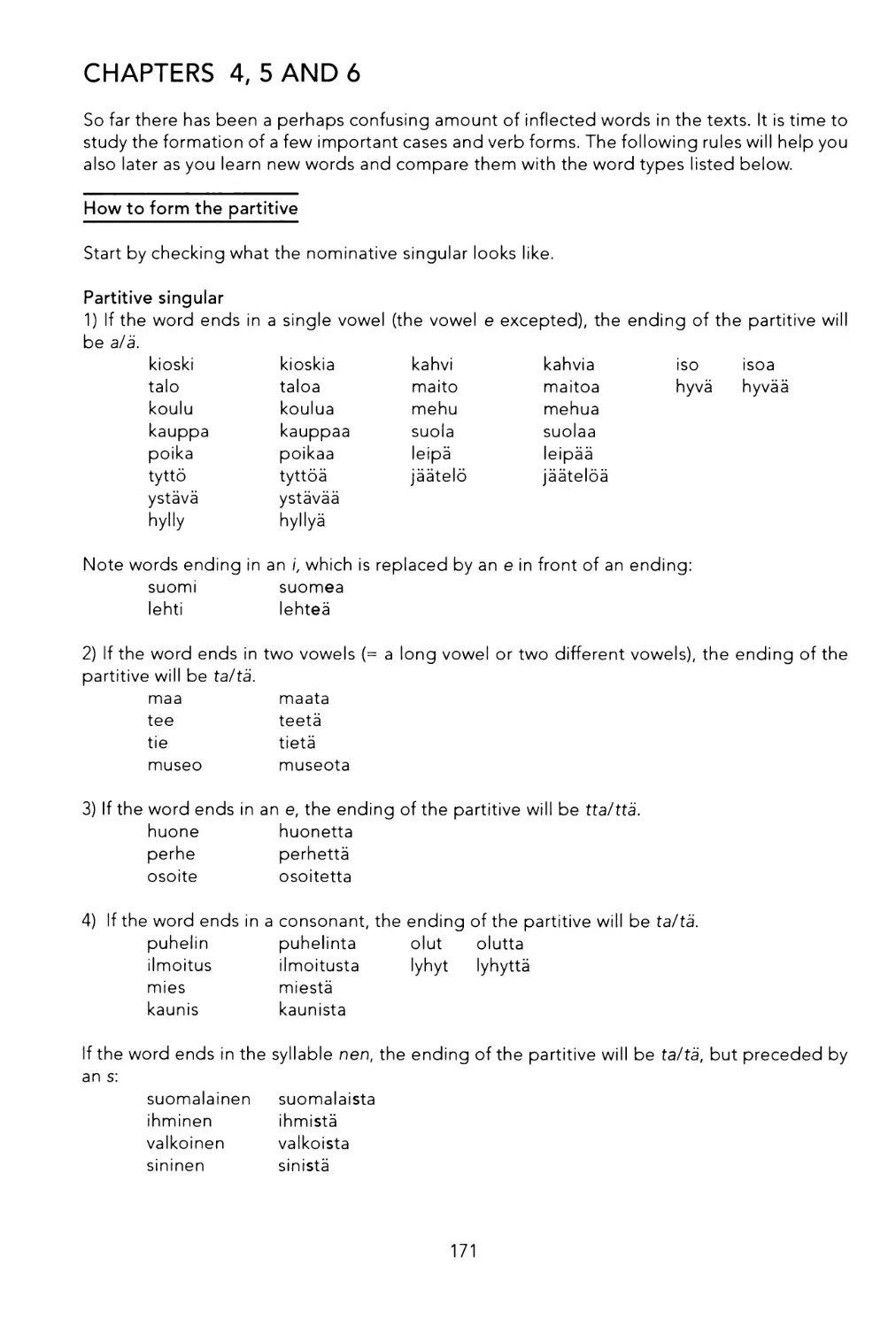
Chapters 4, 5 and 6 171
How to form the partitive 171
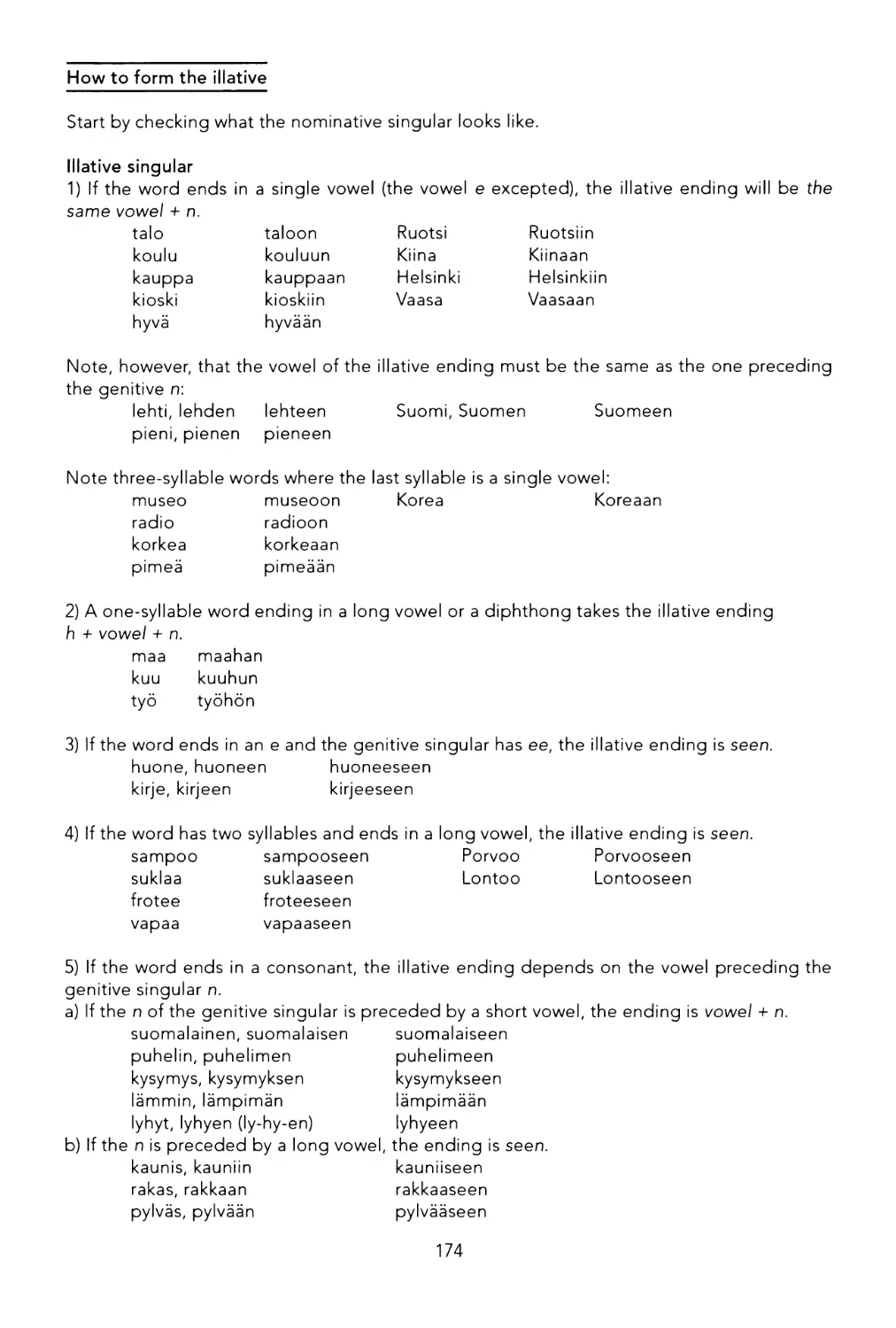
How to form the illative 174
Past tense, imperfect 176
Imperative 179
Chapters 7, 8 and 9 181
Past tense forms 181
The imperfect 181
The perfect tense 181
The pluperfect 182
The deverbal miner) noun 183


Chapters 10 and 11 184
Conditional 184
Adjectives 186
Traits in spoken Finnish 189
Chapters12 and 13 191
Verb + verb clauses 191
Object 193
Chapters 14 and 15 195
Declension of pronouns 195
On the use of the relative pronoun 198
Predicative 200
Chapters 16 and 17 203
Predicative adverbial 203
Adverbials 204
Passive 207
Chapters 18 and 19 211
Infinitives 211
Numerals 214
Chapters 20-23 219
Referative construction 219
Participles 220
Temporal construction 222
Possessive suffixes 222
Appendices
Appendix 1: Consonant change or gradation 228
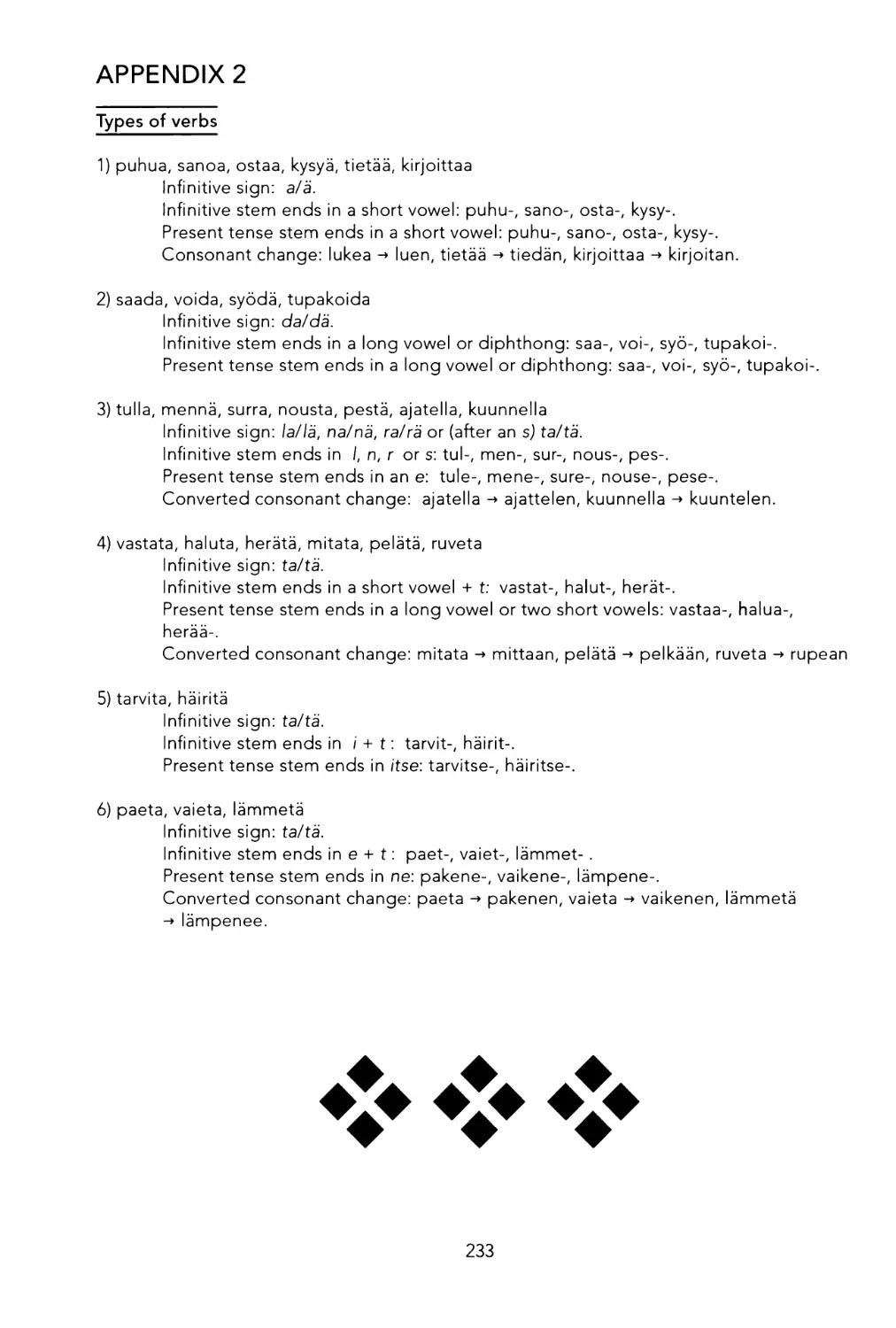
Appendix 2: Types of verbs 233
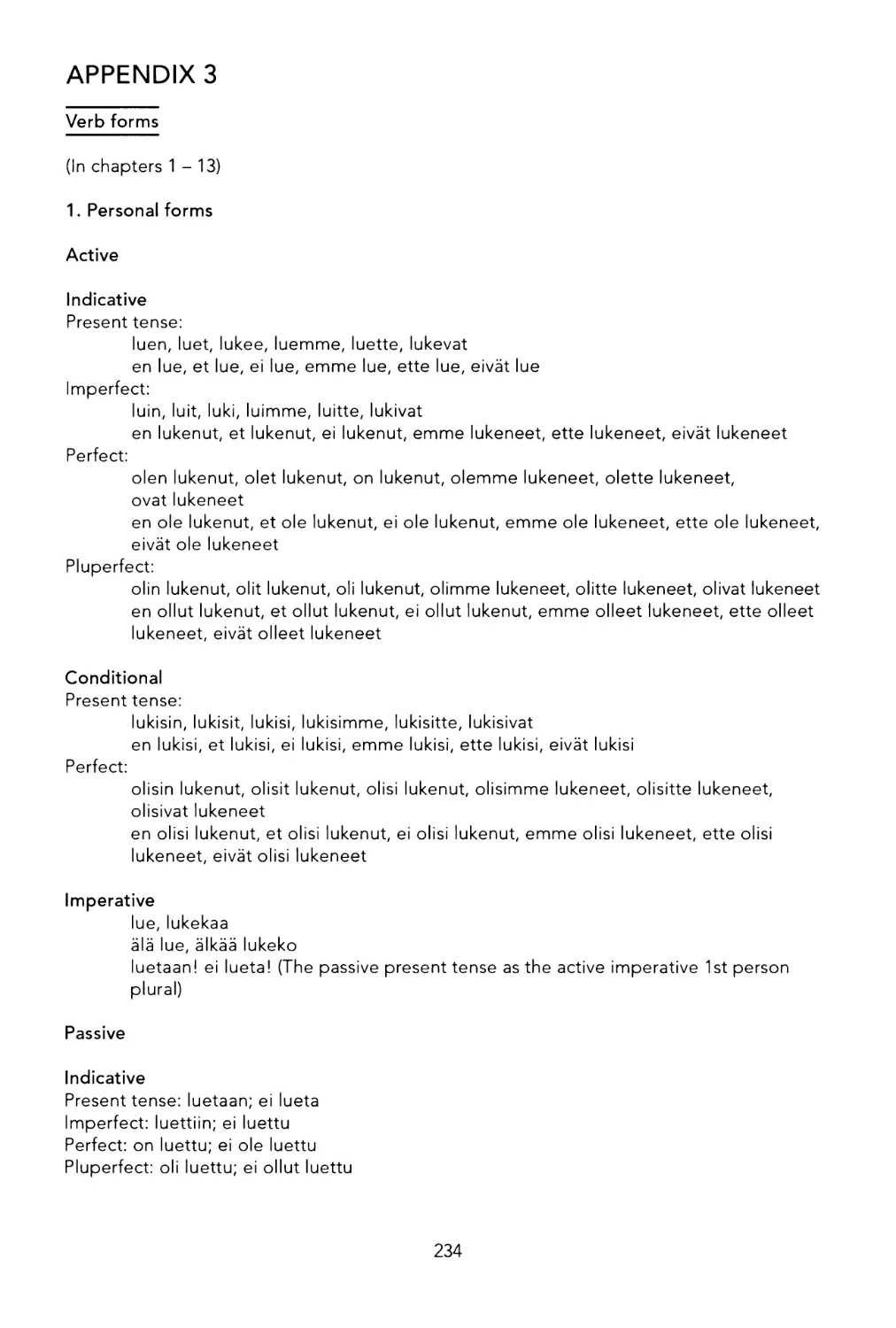
Appendix 3: Verb forms 234
Appendix 4: Types of nouns and adjectives 236
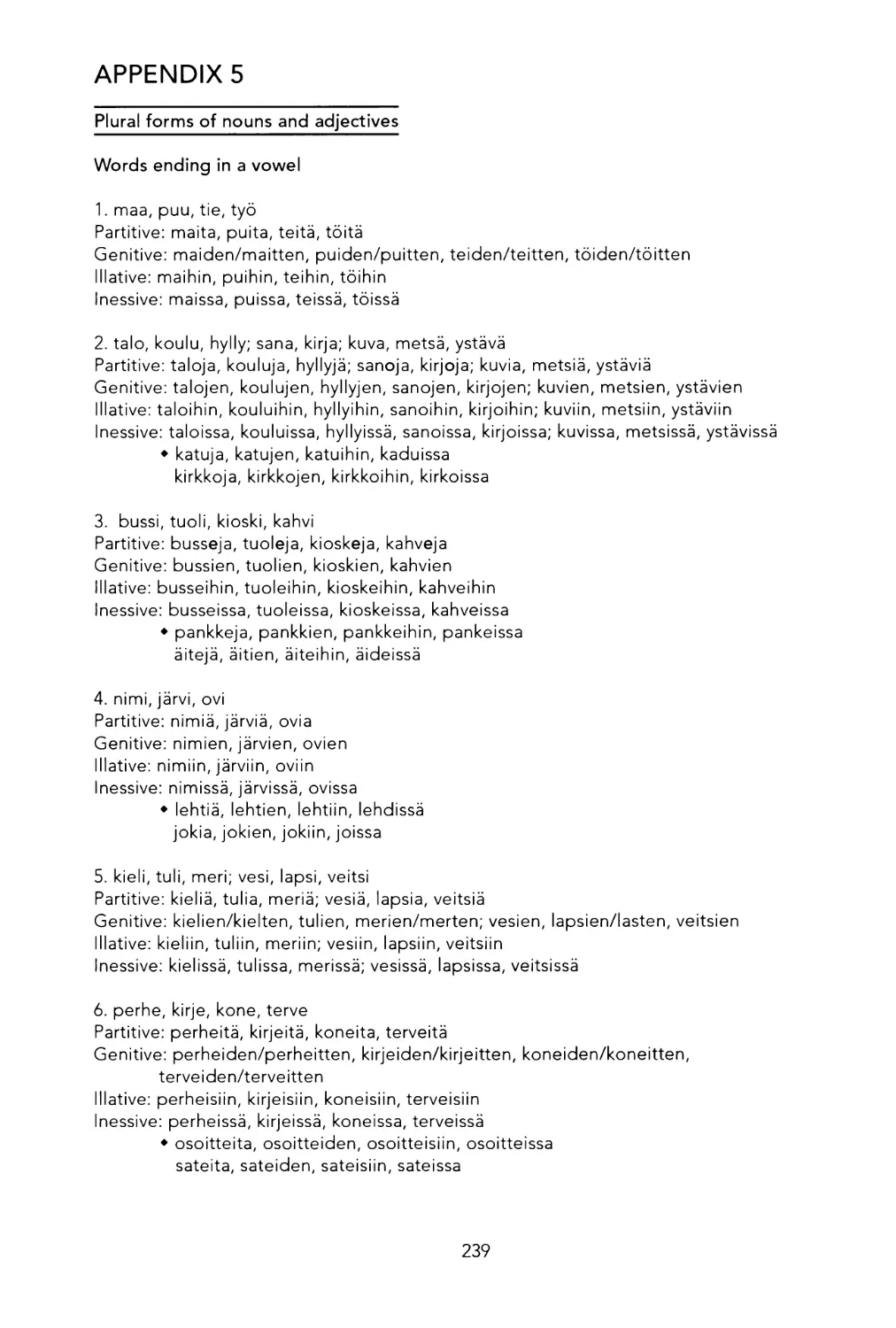
Appendix 5: Plural forms of nouns and adjectives 239
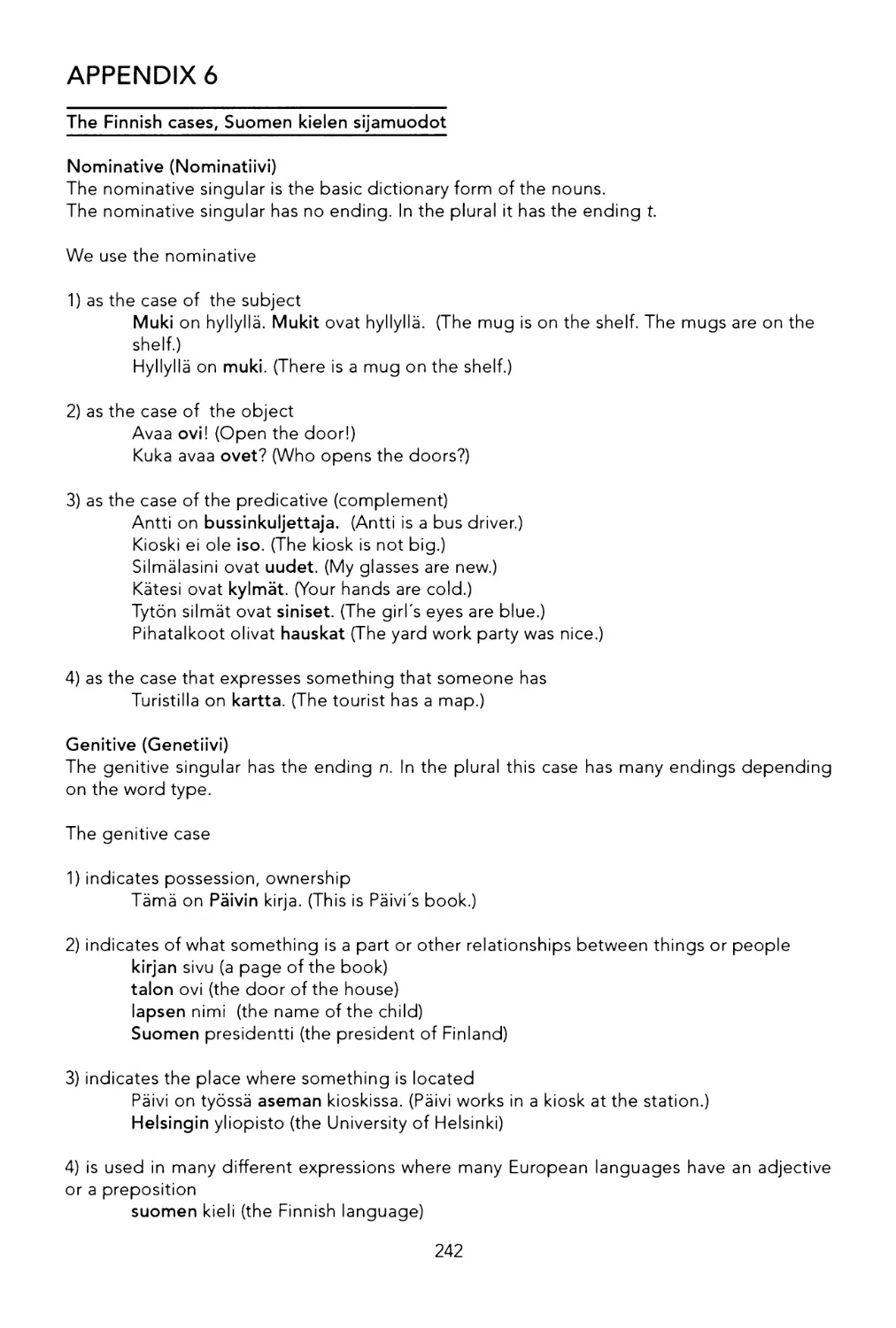
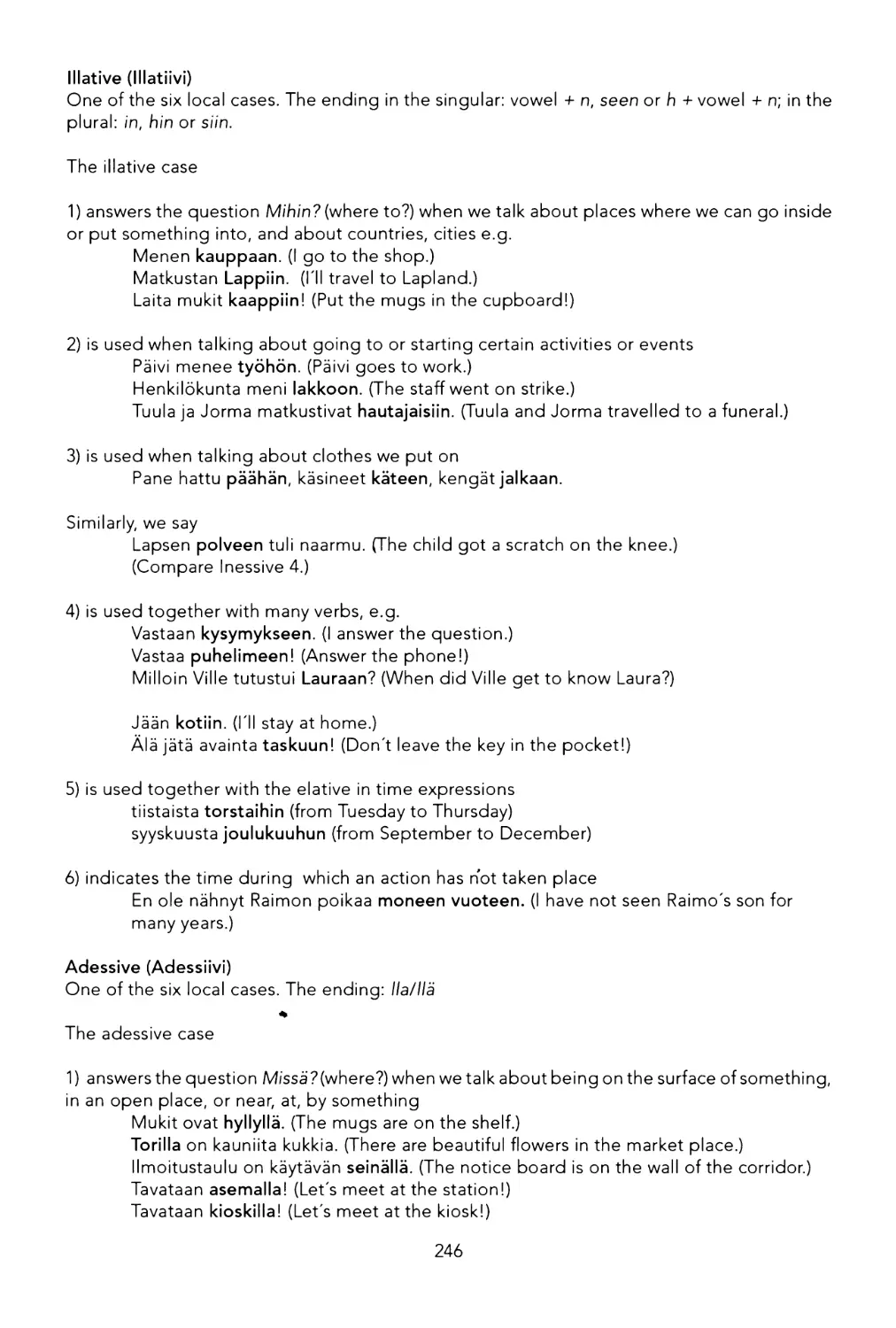
Appendix 6: The Finnish cases 242
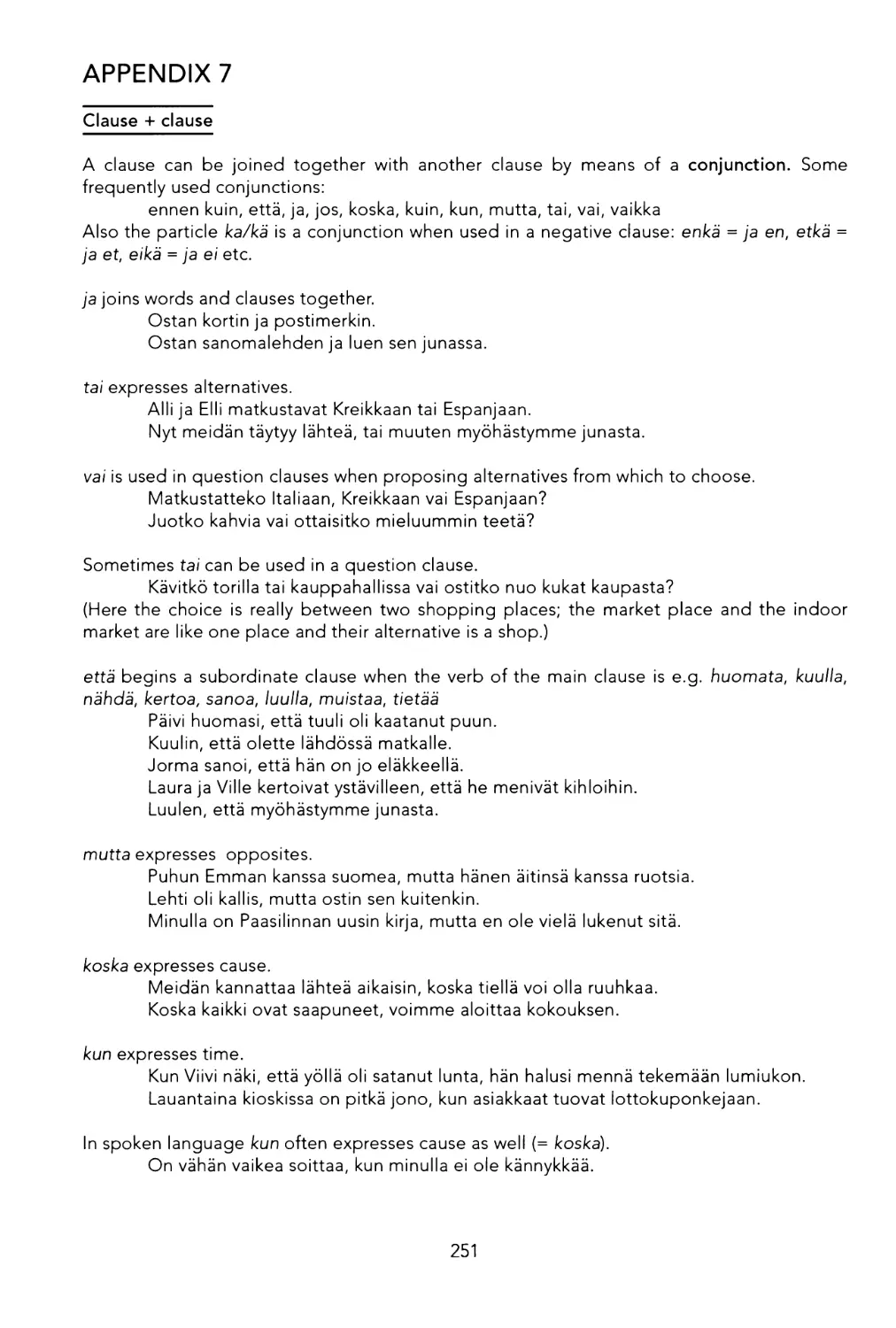
Appendix 7: Clause + clause 251
Glossary
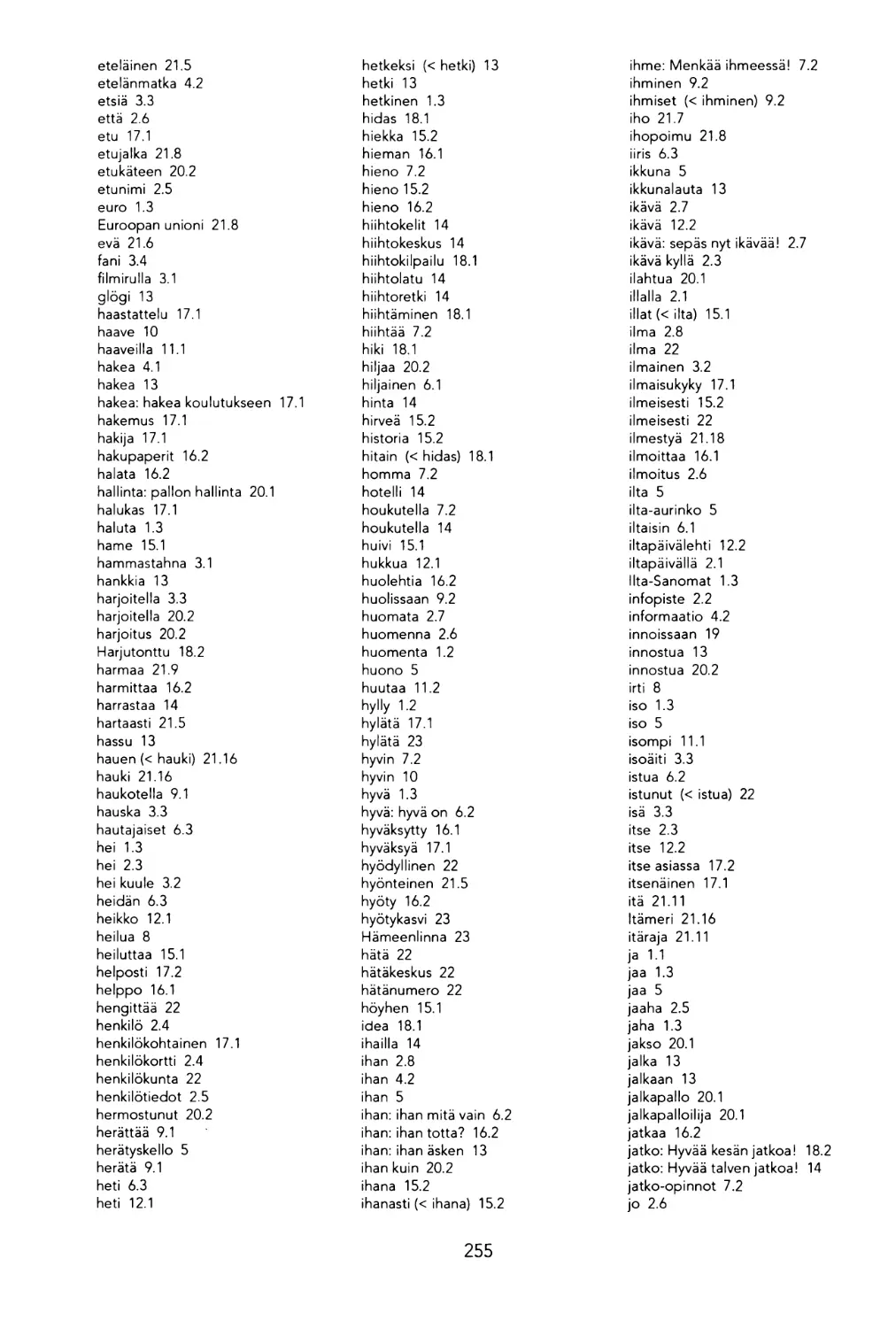
The alphabetical glossary. 254


Dear student of Finnish,
This book is intended as teaching material for the basic course in Finnish. The departure point is a kiosk at a railway station where you will follow the interaction between Päivi Törmänen and her customers. Early on you will get to know Päivi s assistant Laura, and Lauras boyfriend Ville. You will also pop into Päivis home. More people feature further on in the book, as you may have gathered from the list of characters.
The first texts are short, business-like dialogues, which will make it easier for you to practise speaking Finnish with a partner. No recordings are available so far, but the teacher will help you with the rhythm and intonation, and with the pronunciation of vowels and consonants. You might also find existing books on pronunciation useful (see page 13).
A vocabulary list is given for each lesson. This gives translations of individual words, phrases, and whole sentences, which will enable you to understand the texts even though you may not yet know the various forms of the words. When you check Finnish words in the dictionary you will notice that they do not always appear in the same form as in the text: this is because there may be various endings added to them and the stem may change as a result. The endings are underlined in the first vocabulary lists following the texts so that you will learn from the start to recognise them. The idea behind the dialogues in the first chapters is for you to learn certain stock expressions without analysing them, just as you would hear them in real-life situations. You will find the relevant grammatical explanations on the 'Explanations' pages attached to the lessons, and you will get help from the teacher in class.
As the course progresses the dialogues become longerandnarrativetextsareadded. The objective is to get you used to reading in Finnish and to give you the courage to tackle new texts. Again, the vocabulary lists and explanations will help you. You may
choose to start by going through the word list first in order to find out what the text is about and where it will lead. Then you will read it, and if you do not immediately understand something you could try to guess what it might mean. Everything you have learned so far will help you in your guesswork. The majority of the texts feature standard language that may be used in everyday situations. Towards the end of the book you will encounter constructions used mainly in written Finnish - in newspapers, for example.
There are lots of words in the texts. Learning vocabulary is a tough process, not least because Finnish words probably appear very unfamiliar to you, bearing no resemblance to the words of the languages you are familiar with (unless you speak Estonian or other languages related to Finnish). You will have to develop your own strategies for committing the words to memory. Of course, you do not need to use, or even remember, all of them! It's just that the more words you see and hear, the more you will learn without even noticing. The exercises the teacher gives you during the course will help you to internalise the most important expressions. Later on you will be able to judge for yourself what words you need to learn to suit your own needs.
The features of Finnish grammar are presented in no particular order in the dialogues and other texts: inflected forms of words are given in the everyday contexts in which they are used and needed. Sometimes it is enough that you just become aware of the new forms and how they are used, and you certainly do not need to be able to fully conjugate all the words to understand the texts. You will practise the construction and use of all the important forms during the course. The Grammar Summaries section at the end of the book is for students who are interested in the theoretical aspects of the language. It sets out the morphological and syntactical rules governing the grammar issues arising in the texts. The Appendices comprise a kind of manual explaining certain structural features of Finnish (such
7


as consonantal gradation and word types). If you would like more detailed information you could consult the English-language Finnish grammar books that are available (see page 13). We have based our grammatical explanations and rules on the most recent relevant source, "Iso suomen kielioppi" ('A Comprehensive Finnish Grammar').
We hope that Päivis kiosk will send you happily on your journey into the Finnish language. Don't forget, though, that the book is only a tool. Put yourself in real situations: Go to a real kiosk, a real station, anywhere where Finnish is spoken, and keep your ears open! Have the courage to open your mouth, too, and to use all the knowledge of the language that you have acquired: that's how you will learn more.
We have tried out this study material in three courses. We are grateful to the students for their active involvement and interest in the Finnish language, and for their useful feedback at various stages of the compilation process. We would also like to thank the Research Institute for the Languages of Finland, which gave us access to authentic interaction in everyday situations. Our biggest thanks are due to the translators: Joan and Henrik Nordlund for the preface, the overview of the characteristics of the Finnish language and the list of characters; William Hellberg (Word list, Chapters 1-13) and Peter Ovell (Word list, Chapters 14-23); and Kerstin Lindström for the Explanations attached to the chapters, the Grammar Summaries, and the Appendices.
Helsinki, March 2008
Salli-Marja Bessonoff Eila Hämäläinen
Translated by Joan and Henrik Nordlund
Hyvä suomen kielen opiskelija!
Tämä kirja on suunniteltu oppimateriaaliksi suomen kielen peruskurssille. Opiskelu lähtee liikkeelle erään rautatieaseman
kioskista, jossa saat seurata Päivi Törmäsen ja hänen asiakkaittensa keskusteluja. Aluksi tutustut myös Päivin apulaiseen Lauraan ja tämän poikaystävään Villeen. Pistäydyt myös Päivin kotona. Kirjan mittaan tulet tuntemaan lisää henkilöitä, kuten voit huomata kirjan alussa olevasta luettelosta.
Kirjan tekstit ovat aluksi lyhyitä
asiointitilanteiden dialogeja. Niiden avulla voit yhdessä toisten kurssilaisten kanssa harjoitella suomen puhumista. Toistaiseksi kirjaan ei liity äänitettä, mutta opettaja
auttaa sinua löytämään hyvän puherytmin, intonaation ja vokaalien ja konsonanttien ääntämistavan. Voit hyödyntää myös olemassa olevia ääntämisen opaskirjoja (ks. s. 13).
Kaikissa kappaleissa on sanalista. Siinä
on käännetty sanojen lisäksi fraaseja ja kokonaisia lauseitakin; käännökset auttavat sinua ymmärtämään tekstit, vaikka et alussa ymmärräkään vielä sanojen erilaisia muotoja. Kun tarkastelet suomen kielen sanoja, huomaat nimittäin, että ne eivät ole tekstissä aina samassa muodossa kuin sanakirjassa. Se johtuu siitä, että sanan lopussa voi olla jokin pääte ja että sanan alkuosassa, vartalossa, voi tapahtua muutoksia päätteen edellä. Sanalistoissa on aluksi päätteet alleviivattu, jotta totut alusta asti havaitsemaan ne. Ensimmäisten jaksojen dialogeissa on tarkoitus oppia jotkin muodot valmiina, ilman analyysia, niin kuin kuulisit ne todellisissa tilanteissa. Tarpeelliset kiel ioppisel itykset löydät kappaleisiin liittyviltä selityssivuilta ja saat tunneilla kurssin opettajalta.
Kurssin edetessä dialogit pitenevät ja mukana on myös kertovia tekstejä. Tavoitteena on totuttaa sinut lukemaan suomeksi, tarttumaan rohkeasti uuteen tekstiin. Jälleen sinua auttavat sanalistan käännökset ja selityssivut. Voit valita esimerkiksi sellaisen tavan tutustua uuteen tekstiin, että luet ensin sanalistan ja päättelet sen avulla, mitä teksti käsittelee ja
8


miten se etenee. Sitten luet tekstin, ja jos et heti ymmärrä jotakin kohtaa, yrität arvata, mitä se voi tarkoittaa. Arvaamisessa sinua auttaa kaikki se, mitä olet jo aikaisemmin oppinut. Suurin osa teksteistä on sellaista yleiskieltä, jota voi käyttää tavallisissa arkipäivän tilanteissa. Kirjan loppupuolella tutustut lisäksi sellaisiin rakenteisiin, joita tarvitaan lähinnä kirjoitetussa kielessä, kuten esimerkiksi sanomalehdissä.
Teksteissä on hyvin paljon sanoja. Sanojen oppiminen on raskas prosessi, varsinkin kun suomen sanasto todennäköisesti tuntuu sinusta kovin vieraalta, ei yhtään samanlaiselta kuin niiden kielten sanat, joita osaat (paitsi jos osaat viroa tai jotain muuta suomen sukukieltä). Sinun täytyy itse kehittää tehokkaita tapoja painaa sanoja mieleesi. Tietenkään sinun ei tarvitse heti oppia käyttämään eikä edes muistamaan kaikkia sanoja! On vain niin, että mitä enemmän sanoja näet ja kuulet, sitä enemmän niitä voit ihan huomaamatta oppia. Kurssilla opettajan harjoitukset auttavat tärkeimpien ilmausten omaksumista. Myöhemmin osaat itsekin arvioida, mitkä sanat mielestäsi ovat juuri sinulle tarpeellisia.
Suomen kieliopin piirteitä ei tämän oppimateriaalin dialogeissa ja muissa teksteissä esitellä systemaattisessa järjestyksessä, vaan esimerkiksi sijamuodot tulevatesiinsellaisissayhteyksissä, missä niitä luontevasti käytetään ja tarvitaan. Joissakin tapauksissa riittää, että toteat uuden muodon ja sen käyttöyhteyden. Voidaksesi ymmärtää tekstiä, sinun ei suinkaan tarvitse osata taivuttaa kaikkia sanoja kaikissa muodoissa. Kaikkien tärkeiden muotojen käyttöä ja muodostamista kuitenkin harjoitellaan kurssilla. Teoreettisemmasta opiskelusta kiinnostuneita varten on kirjan lopussa kielioppikoosteiden osasto. Siinä on muoto- ja lauseopin sääntöjä niistä kielioppiseikoista, joita kappaleissa esiintyy. Liiteosasto puolestaan on eräänlainen käsikirja, joka esittelee kokoavasti eräitä suomen kielen rakenteen seikkoja (esim. astevaihtelu, sanatyypit). Lisää tietoa voit hankkia suomen opiskelijoille mm. englanniksi kirjoitetuista kieliopeista (ks.
s. 13). - Itse olemme kielioppiselityksiä ja -sääntöjä kirjoittaessamme nojautuneet alan uusimpaan lähteeseen, Isoon suomen kielioppiin.
Toivomme, että Päivin kioskista aukeaa sinulle mukava reitti suomen kieleen. Mutta kirja on vain apuväline; tärkeintä on, että menet oikeisiin tilanteisiin: oikeaan kioskiin, oikealle asemalle, mihin tahansa, missä puhutaan suomea, ja pidät korvasi auki.
Muista myös avata rohkeasti suusi ja käyttää sitä suomen taitoa, joka sinulla on. Siitä se karttuu.
Olemme kokeilleet tätä oppimateriaalia
kolmella kurssilla ja haluamme kiittää opiskelijoitamme ahkerasta paneutumisesta suomen kieleen ja hyödyllisestä
palautteesta, jota saimme laatimistyön eri vaiheissa. Kiitämme myös Kotimaisten kielten tutkimuskeskusta, jossa saimme tutustua aitoihin asiointidialogeihin.
Suurin kiitos kuuluu kääntäjille. Alkusanat ja suomen kielen piirteiden kuvauksen ja henkilöluettelon ovat kääntäneet Joan ja Henrik Nordlund ja sanastot William Hellberg (kappaleet 1-13) ja Peter Ovell (kappaleet 14-23). Kappalekohtaiset selitykset, kielioppikoosteet ja liitteet on kääntänyt Kerstin Lindström.
Helsingissä maaliskuussa 2008
Salli-Marja Bessonoff Eila Hämäläinen
9


Characteristics of the Finnish Language
If you have only spoken and studied Indo-European languages, Finnish may seem tricky at first. It belongs to another group of languages, the Uralic languages. Estonian is closely related to Finnish, and Hungarian is one of its more distant relatives.
The structure of Finnish is different from that of the Indo-European languages in many respects, as you will notice when you study the grammar. You may find it useful to consider the following characteristics of Finnish before you start.
♦ Finnish has no articles and words have no grammatical gender. Therefore, you do not have to think about such matters as students of English, German or French do, for example (a or the; der; die or das; le or la).
♦ When words are arranged into sentences, various endings and enclitic particles are added to them.
- For example, the following verb form consists of four elements, each with its own function:
puhu/i/mme/ko puhu is the element expressing the meaning of the verb;
/ denotes the past tense;
mme defines the subject of the verb as the first person plural, we; ko tells us that the verb is in the interrogative.
- In a similar way, the following noun form consists of four elements, each with its own function:
talo/ssa/m m e/ki n talo expresses the meaning of the word; ssa denotes location inside; mme tells us that the house in question is ours; kin means the same as the word myös 'also, as well'.
When this noun form is translated into English, you need four words. One Finnish word may thus contain a lot of information.
♦ In the previous example, ssa is a case ending. Case endings feature in nominals (nouns, adjectives, pronouns and numerals) and indicate a certain case. There are 15 cases altogether. This may seem daunting, but let us reassure you:
One of the cases is the nominative. The nominative singular has no ending and will automatically become familiar, as it is the dictionary form.
Another case is the genitive* Its basic function (related to possession) is familiar to speakers of many languages.
For six of the case endings it is often easy to find equivalent prepositions in other languages: e.g., ta/o/ssa = in a/the house; ystävä/Ile = to a/the friend.
Three cases are used very rarely.
One case form is the object form of only seven pronouns.
Learning the use of certain cases may cause headaches, but practice and an inquiring disposition will make it easier.
10


♦ Attaching endings to a word is called inflecting. As a rule, endings are not joined to the basic form, but to a special inflectional stem. For some words, this is identical to the basic form, but often it is very different. Words are traditionally divided into types according to their inflectional stems. It is useful to learn the inflectional types with the aid of model words, as they will help you to remember how new words you need to learn are inflected. This book contains a list of verb types and the most important nominal types.
♦ Finnish words are governed by vowel harmony, which means that the vowels a, o and u cannot occur in the same word as a’, ö and y (compound words are exceptions). The vowels e and i can occur together with all vowels in the same word. As a result of the vowel harmony, many endings have two variants. For example, the ending ssa forms a pair with ssä: talossa, but metsässä; and a with a: puhua, but kysyä.
♦ Finnish has eight vowels. They are, in alphabetical order: a, e, i, o, u, y ä and ö. According to their articulation, the vowels are classified as rounded or unrounded. The rounded vowels o, u, ö and y are articulated with rounded lips, while /, e, a and ä are pronounced with more open lips. Another difference in articulation is that the vowels a, o and u (the back vowels) are produced towards the back of the mouth, and i, e, y ä and ö (the front vowels) more towards the front. The position of the tongue is more to the front and higher for the front vowels.
♦ Vowels occur in both short and long forms. A short vowel is written with one letter, a long one with two: i ii, e ee and so on. It is essential to learn to produce the difference in vowel quantity correctly right from the start, as this also affects the meaning. For example, the words tili and tiili have different meanings, likewise puro and puuro.
♦ Two different vowels can sometimes form a diphthong. In that case they are in the same syllable and are pronounced by sliding from the first vowel into the second one without pausing. Finnish has 18 diphthongs: ei öi äi oi ai; ey öy äy; eu ou au; yi ui iy iu; ie yö uo.
In other combinations, the adjoining vowels belong to different syllables and are pronounced with a short break. The word maitoa, for example, has the diphthong ai in the first syllable, but at the end there is a syllable boundary between the o and the a. Consequently, the word has three syllables: mai-to-a.
♦ Finnish has the following 13-17 consonants (those in brackets occur only in loanwords and names): k p t (g) (b) d m n f] (f) s (s) h I r vj.
r) is a phonetic symbol. In its short form it occurs before k and is written as n: Helsinki, aurinko; in its long form it is written as ng: Helsingissä, auringon. The g is not heard in the pronunciation; Helsiijqissä, auriqqon.
The following consonants can be both short and long: kpt m n r} I rs.
In writing, long consonants are indicated by two letters: kk pp it and so on.
11


As is the case with the vowels, consonant quantity differentiates the meanings of words. For example, the words kuka and kukka mean different things, so do tuli and tulli.
The consonants d h v j are always short in standard Finnish. g b f s occur only in loanwords and non-Finnish names, as well as in slang words.
The consonants k p t are articulated with weak force, and are not aspirated (as they are in English, for example).
If, in your own language, consonants can be palatalised, or "softened", before front vowels (as in Russian, for example), you must take care to learn to pronounce the Finnish consonants without palatalisation.
♦ Consonants sometimes form clusters of two or three, e.g., penkki, veitsi, vuokra, myrsky. Three-consonant clusters occur especially in loanwords, such as teksti, partneri, astma. Initial two-consonant clusters normally occur only in loanwords and slang.
♦ Systematic alternation of the consonants k, p and t (short, long and in consonant clusters) occurs in the stems of both verbs and nominals. Grammar books refer to this as consonant gradation. The rules governing consonant gradation are explained in the Appendix 1, p. 228.
♦ Words consist of syllables. The following examples show the syllabic structure of Finnish words: mu-ka-va, kyl-mät, kuu-maa, kiit-tää, is-tu, a-pu, aa-mu, yö-tä, myrs-ky, aut-taa, kor-ke-aan.
♦ In Finnish, the main stress is always on the first syllable of the word, regardless of its structure. The second and the last syllables are unstressed. In long words, there is secondary stress on every second syllable, starting from the third one.
♦ The intonation of Finnish sentences is generally falling, even in questions. If the intonation does not fall at the end of a sentence but remains at the same level, the listener knows that the speaker intends to continue. There is, however, variation in intonation, and it may reveal the speakers attitudes and reactions, for instance.
The pronunciation of Finnish cannot be explained in detail in this context. If you are into phonetics, you could avail yourself of the theoretical explanations provided in textbooks. Even without such support, you can learn to pronounce a new language by listening to and imitating teachers, friends, the radio and television... Observe people's speech habits and nuances. Pay attention to speech rhythm, sentence intonation and how words are stressed in sentences. Repeat words and especially sentences you hear. When you read the dialogues in the textbook, try to live the imaginary situation and deliver the lines as naturally as possible. You could even read the sentences of the grammar exercises aloud, and alter the nuances of your speech to add feeling.
12


Here are a couple of ideas for pronunciation practice:
Sirkku Latomaa and Eila Hämäläinen: Mitä kuuluu? Suomen kielen kuuntelu- ja ääntämisharjoituksia. (Book and CD.) Finn Lectura, Helsinki. First published in 2003.
Anneli Lieko: Suomen kielen fonetiikkaa ja fonologiaa ulkomaalaisille. Finn Lectura, Helsinki. First published in 1992.
Two practical basic grammars for foreign learners of Finnish:
Leila White: A Grammar Book of Finnish. Finn Lectura, Helsinki 2006.
Vuokko Heikura: Lessons in Finnish Grammar. Printed by Erikoispaino Oy, Helsinki 2002.
Translated by Joan and Henrik Nordlund
13


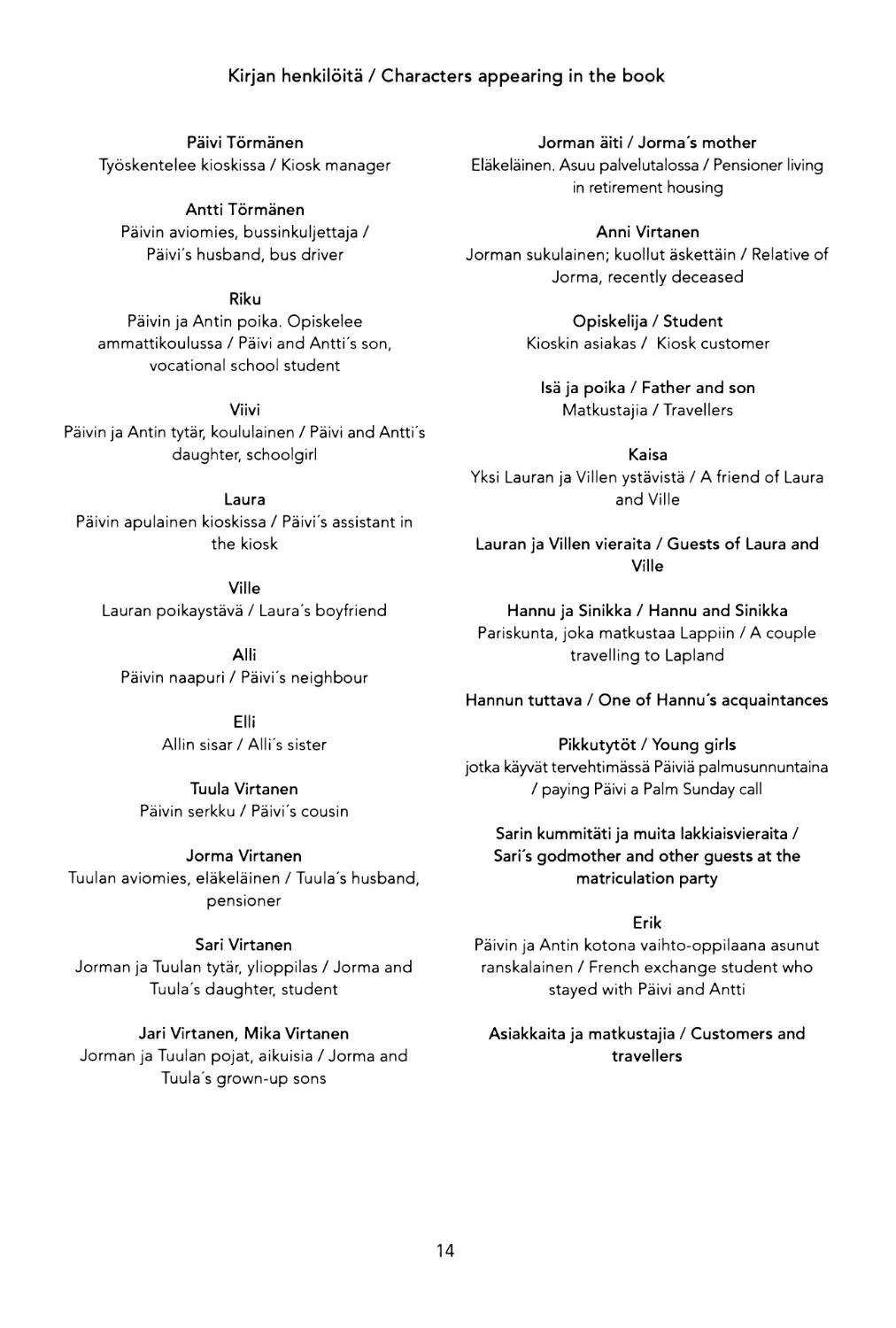
Kirjan henkilöitä / Characters appearing in the book
Päivi Törmänen
Työskentelee kioskissa / Kiosk manager
Antti Törmänen
Päivin aviomies, bussinkuljettaja /
Päivi's husband, bus driver
Riku
Päivin ja Antin poika. Opiskelee ammattikoulussa / Päivi and Antti's son, vocational school student
Viivi
Päivin ja Antin tytär, koululainen / Päivi and Antti's daughter, schoolgirl
Laura
Päivin apulainen kioskissa / Päivi's assistant in the kiosk
Ville
Lauran poikaystävä / Laura's boyfriend Alli
Päivin naapuri / Päivi s neighbour Elli
Allin sisar / Alli's sister
Tuula Virtanen
Päivin serkku / Päivi's cousin
Jorma Virtanen
Tuulan aviomies, eläkeläinen / Tuula's husband, pensioner
Sari Virtanen
Jorman ja Tuulan tytär, ylioppilas / Jorma and Tuula's daughter, student
Jorman äiti / Jorma's mother
Eläkeläinen. Asuu palvelutalossa / Pensioner living in retirement housing
Anni Virtanen
Jorman sukulainen; kuollut äskettäin / Relative of Jorma, recently deceased
Opiskelija / Student
Kioskin asiakas / Kiosk customer
Isä ja poika / Father and son
Matkustajia / Travellers
Kaisa
Yksi Lauran ja Villen ystävistä / A friend of Laura and Ville
Lauran ja Villen vieraita / Guests of Laura and Ville
Hannu ja Sinikka / Hannu and Sinikka
Pariskunta, joka matkustaa Lappiin / A couple travelling to Lapland
Hannun tuttava / One of Hannus acquaintances
Pikkutytöt / Young girls
jotka käyvät tervehtimässä Päiviä palmusunnuntaina / paying Päivi a Palm Sunday call
Sarin kummitäti ja muita lakkiaisvieraita /
Sari s godmother and other guests at the matriculation party
Erik
Päivin ja Antin kotona vaihto-oppilaana asunut ranskalainen / French exchange student who stayed with Päivi and Antti
Jari Virtanen, Mika Virtanen
Jorman ja Tuulan pojat, aikuisia / Jorma and Tuula's grown-up sons
Asiakkaita ja matkustajia / Customers and travellers
14


Texts, vocabularies and explanations
15


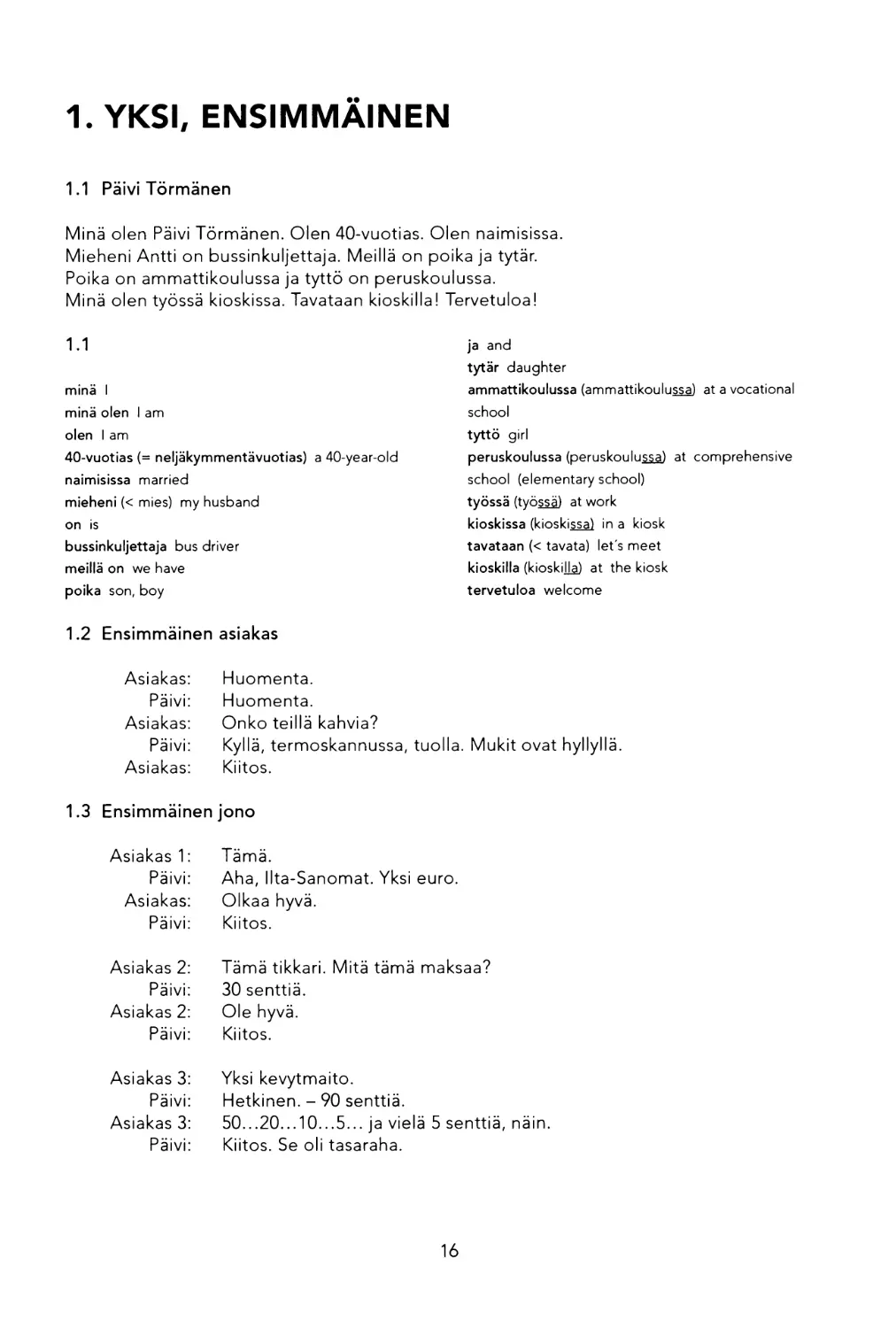
1. 	YKSI, ENSIMMÄINEN
1.1 	Päivi Törmänen
Minä olen Päivi Törmänen. Olen 40-vuotias. Olen naimisissa. Mieheni Antti on bussinkuljettaja. Meillä on poika ja tytär. Poika on ammattikoulussa ja tyttö on peruskoulussa.
Minä olen työssä kioskissa. Tavataan kioskilla! Tervetuloa!
1.1
minä I
minä olen I am olen I am
40-vuotias (= neljäkymmentävuotias) a 40-year-old naimisissa married mieheni (< mies) my husband on is
bussinkuljettaja bus driver meillä on we have poika son, boy
ja and
tytär daughter
ammattikoulussa (ammattikoulussa) at a vocational
school
tyttö girl
peruskoulussa (peruskoulussa) at comprehensive
school (elementary school)
työssä (työssä) at work
kioskissa (kioskissa) in a kiosk
tavataan (< tavata) let's meet
kioskilla (kioskiJl^) at the kiosk
tervetuloa welcome
1.2 	Ensimmäinen asiakas
Asiakas:
Huomenta.
Päivi:
Huomenta.
Asiakas:
Onko teillä kahvia?
Päivi:
Kyllä, termoskannussa, tuolla.
Asiakas:
Kiitos.
1.3 	Ensimmäinen jono
Asiakas 1: Tämä.
Päivi: Aha, Ilta-Sanomat. Yksi euro.
Asiakas: Olkaa hyvä.
Päivi: Kiitos.
Asiakas 2: Tämä tikkari. Mitä tämä maksaa?
Päivi: 30 senttiä.
Asiakas 2: Ole hyvä.
Päivi: Kiitos.
Asiakas 3: Yksi kevytmaito.
Päivi: Hetkinen. - 90 senttiä.
Asiakas 3: 50...20...10...5... ja vielä 5 senttiä, näin.
Päivi: Kiitos. Se oli tasaraha.
16


Asiakas 4: Paperinenäliinoja.
Päivi: Iso vai pieni?
Asiakas 4: Pieni, kiitos.
Päivi: Tässä. 60 senttiä.
Asiakas 4: Olkaa hyvä.
Päivi: 40 senttiä takaisin, näin.
Asiakas 4: Kiitos.
Asiakas 5: Onko teillä postimerkkejä?
Päivi: Kyllä meillä on.
Asiakas 5: Mitä tavallinen kirjemerkki nyt maksaa?
Päivi: 70 senttiä.
Asiakas 5: Saanko kolme.
Päivi: Tässä näin, olkaa hyvä. Kaksi ja kymmenen.
Asiakas 5: Minulla on nyt valitettavasti vain tällainen iso seteli.
Päivi: Ei se haittaa. - 47,90 takaisin, näin.
Asiakas 5: Kiitos.
Asiakas 6: Hei. (Antaa Päiville lottokupongin.)
Päivi: Hei. Joo, kiitos.
Asiakas 6: Sitten vielä joku arpa.
Päivi: Tästä saa valita.
Asiakas 6: Otan vaikka tämän.
Päivi: Tuleeko muuta?
Asiakas 6: Ei muuta, kiitos.
Päivi: Se on sitten yhteensä yhdeksän euroa.
Asiakas 6: Olkaa hyvä.
Päivi: Kiitos.
Asiakas 7: (Ottaa hyllyltä kahvipaketin, keksipaketin ja suklaalevyn ja laittaa ne
tiskille.) Hei.
Päivi: Jaha, nämä. (Laskee hinnan.) Haluatteko muovikassin?
Asiakas 7: Mielellään, kiitos.
Päivi: Tässä, näin.
Asiakas 7: Kiitos.
Asiakas 8: Huomenta.
Päivi: Huomenta.
Asiakas 8: Aseman lipunmyynti on vielä kiinni. Tiedättekö te, pysähtyykö tässä
illalla joku pikajuna, joka menee Helsinkiin?
Päivi: Hetkinen, minä katson. Minulla on tässä aikataulukirja...Yksi pysähtyy.
Kahdeksantoista kolmekymmentä. Puoli seitsemän.
Asiakas 8: Voi kiitos. Jaa, vielä... Tiedättekö, mistä voisi soittaa? Unohdin
kännykän kotiin.
Päivi: Täällä meidän asemalla on vielä puhelinkoppi, tuolla kukkakioskin
vieressä.
Asiakas 8: Hyvä! Puhelinkoppia on nykyään tosi vaikea löytää.
Päivi: Niin on, ja se on monta kertaa ongelma.
Asiakas 8: Juu, niin se on. No, kiitos nyt ja näkemiin.
Päivi: Näkemiin.
17


1.2
ensimmäinen first asiakas customer huomenta good morning onko teillä do you have kahvia (kahvia) (some) coffee kahvi coffee kyllä yes
termoskannussa (termoskannussa) in the thermos (bottle / flask) tuolla there
mukit (mukii) (the) muggs ovat are
hyllyllä (hyllyllä) on the shelf kiitos thank you
1.3
jono queue, line
tämä this (one)
aha aha, right, alright
llta-Sanomat (name of a newspaper)
yksi euro one euro
olkaa hyvä there you are
tämä tikkari this lollipop
mitä tämä maksaa? what does this cost?
(mitä what maksaa cost, costs)
30 (= kolmekymmentä) senttiä 30 cent ole hyvä there you are
kevytmaito low fat milk
hetkinen one moment
90 (= yhdeksänkymmentä) senttiä 90 cent
50 = viisikymmentä, 20 = kaksikymmentä, 10 =
kymmenen, 5 = viisi
ja vielä and still
näin there you are; there now
se oli tasaraha that was exact change (se it oli was tasaraha exact change)
paperinenäliinoja (< paperinenäliina) (some) kleenex,
tissues (paperi paper nenäliina handkerchief)
iso large
vai or
pieni small
tässä here
60 = kuusikymmentä, 40 = neljäkymmentä takaisin back
postimerkkejä (< postimerkki) (some) stamps kyllä meillä on yes, we have (kyllä yes, right) tavallinen ordinary
kirjemerkki stamp for a letter nyt now
70 = seitsemänkymmentä
saanko kolme three, please (saanko can I have
kolme three)
tässä näin here you are
kaksi ja kymmenen 2.10
minulla on I have
valitettavasti unfortunately
vain only
tällainen this kind, like this seteli banknote, bill ei se haittaa it's no bother (ei not, no ei haittaa < haitata)
hei hello!
antaa Päiville lottokupongin gives Päivi a lottery ticket (antaa gives, is giving
Päiville to Päivi lottokupongin < lottokuponki)
joo yes, okay
sitten then, after that
vielä still
joku some
arpa lot, scratch tab
tästä saa valita you can choose from here / from there
(tästä from here valita choose)
otan vaikka tämän I'll take, say, this one / why don't I
take (otan < ottaa vaikka say
tämän this)
tuleeko muuta? anything else? (tuleeko < tulla muuta < muu)
ei muuta nothing else yhteensä altogether, in all yhdeksän nine
ottaa (< ottaa) he/she takes hyllyltä (hyllyllä. < hylly) from a shelf kahvipaketin (kahvipaketin < kahvipaketti) packet of coffee
keksipaketin (< keksipaketti) packet of biscuits keksi cracker, cookie, biscuit
suklaalevyn (suklaalevyn < suklaalevy) chocolate bar laittaa (< laittaa) he/she puts ne them
tiskille (tiskille. < tiski) onto the counter jaha aha nämä these
laskee hinnan (laskee < laskea; hinnan < hinta) counts the price
haluatteko (haluatte+ko < haluta) do you want muovikassin (muovikassin < muovikassi) plastic bag mielellään willingly, gladly (here: yes, that would be nice)
18


aseman lipunmyynti the station ticket office (asema station lipunmyynti ticket sales) vielä still kiinni closed
tiedättekö te do you know (tiedättekö < tietää te you (polite form)
Pysähtyykö tässä illalla joku pikajuna? Is there an
express service stopping here this evening?
pysähtyykö? (< pysähtyä) will (it) stop? is (it) stopping?
tässä here
illalla in the evening
joku some, an
pikajuna express train
joka menee Helsinkiin that's going to Helsinki joka which, that
menee (< mennä) goes, is going Helsinkiin to Helsinki minä katson I'll look (katson < katsoa) aikataulukirja timetable book(let) pysähtyy stops
kahdeksantoista kolmekymmentä at 18:30
puoli seitsemän half past six
voi kiitos oh, thank you
jaa, vielä... oh, one more thing...
(Tiedättekö,) mistä voisi soittaa? (Do you know) where
you can make a call from?
mistä? from where?
voisi (< voida) could
soittaa to phone
Unohdin kännykän kotiin. I left my mobile at home, unohdin (< unohtaa) I left (it) behind kännykän (< kännykkä) mobile phone kotiin at home
Täällä meidän asemalla Here, at this station
täällä here
meidän our
asemaNa at the station
on vielä puhelinkoppi there's still a phone booth on (< olla) (there) is vielä still
puhelinkoppi phone booth, phone box
tuolla kukkakioskin vieressä over there, next to the
florist
tuolla (over) there
kukkakioskin vieressä next to the florist (kukka flower vieressä beside, next to, by) hyvä! good!
Puhelinkoppia on nykyään tosi vaikea löytää. It's really hard to find a phone booth nowadays, on (it) is
nykyään nowadays tosi vaikea really difficult tosi (= todella) really vaikea difficult löytää to find niin on yes it is ja and se on it is monta kertaa often ongelma problem juu yes niin so no well
kiitos nyt thanks now näkemiin goodbye
Yhdyssanat / Compound nouns
bussinkuljettaja < bussin + kuljettaja ammattikoulu < ammatti + koulu peruskoulu < perus + koulu termoskannu < termos + kannu kevytmaito < kevyt + maito tasaraha < tasa + raha
paperinenäliina < paperi + nenäliina < nenä + liina
postimerkki < posti + merkki
kirjemerkki < kirje + merkki
lottokuponki < lotto + kuponki
kahvipaketti < kahvi + paketti
keksipaketti < keksi + paketti
suklaalevy < suklaa + levy
muovikassi < muovi + kassi
lipunmyynti < lipun + myynti (lipun < lippu)
aikataulukirja < aikataulu + kirja; aikataulu < aika +
taulu
kukkakioski < kukka + kioski puhelinkoppi < puhelin + koppi
19


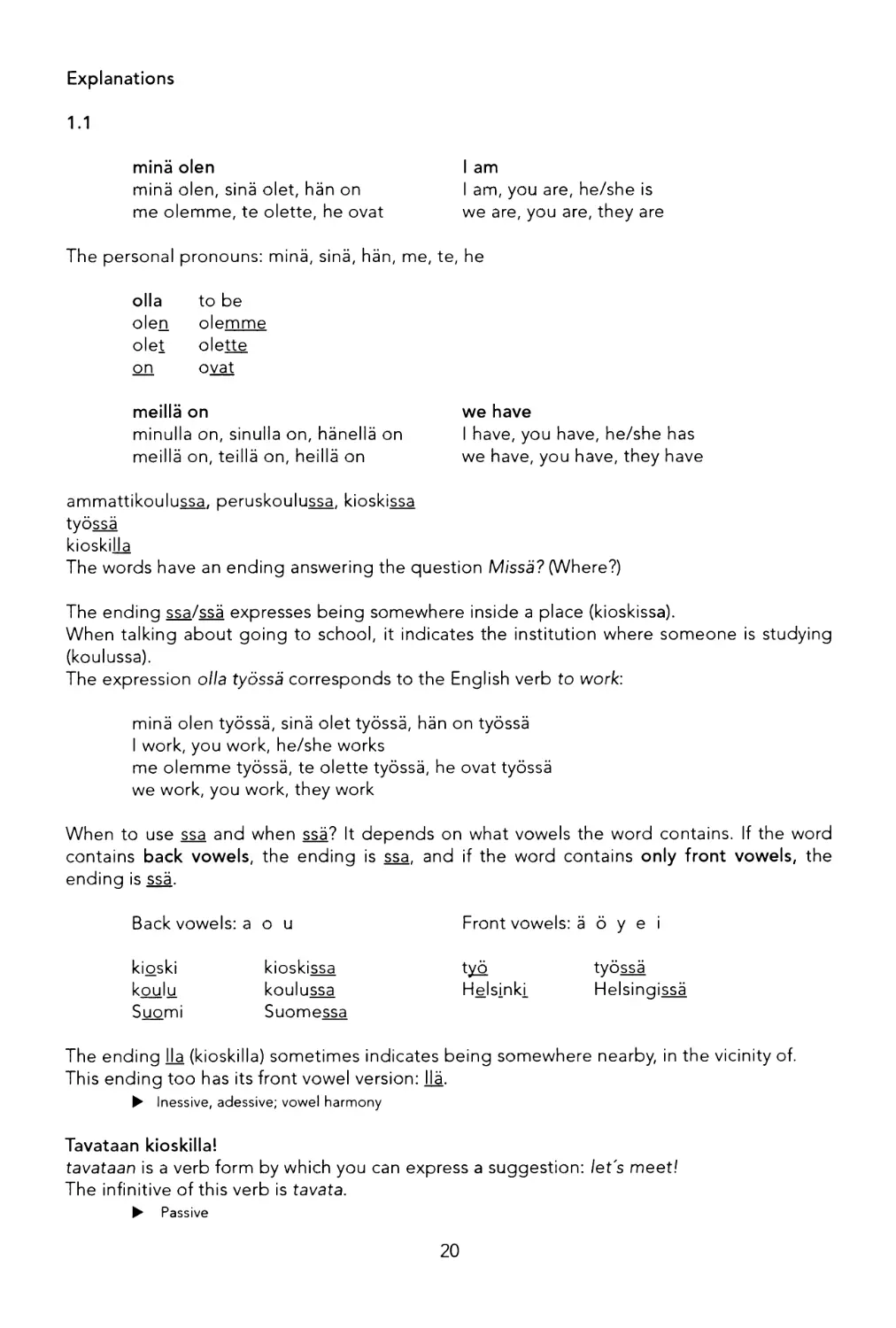
Explanations
1.1
minä olen I am
minä olen, sinä olet, hän on I am, you are, he/she is
me olemme, te olette, he ovat we are, you are, they are
The personal pronouns: minä, sinä, hän, me, te, he
olla to be
olen olemme olet olette
on ovat
meillä on we have
minulla on, sinulla on, hänellä on I have, you have, he/she has
meillä on, teillä on, heillä on we have, you have, they have
ammattikoulussa, peruskoulussa, kioskissa
työssä
kioskilla
The words have an ending answering the question Missä? (Where?)
The ending ssa/ssä expresses being somewhere inside a place (kioskissa).
When talking about going to school, it indicates the institution where someone is studying (koulussa).
The expression olla työssä corresponds to the English verb to work:
minä olen työssä, sinä olet työssä, hän on työssä I work, you work, he/she works me olemme työssä, te olette työssä, he ovat työssä we work, you work, they work
When to use ssa and when ssä? It depends on what vowels the word contains. If the word contains back vowels, the ending is ssa. and if the word contains only front vowels, the ending is ssä.
Back vowels: a o u Front vowels: ä ö y e i
kioski kioskissa tvö työssä
koulu koulussa Helsinki Helsingissä
Suomi Suomessa
The ending Ha (kioskilla) sometimes indicates being somewhere nearby, in the vicinity of.
This ending too has its front vowel version: Nä-
► Inessive, adessive; vowel harmony
Tavataan kioskilla!
tavataan is a verb form by which you can express a suggestion: let's meet!
The infinitive of this verb is tavata.
► Passive
20


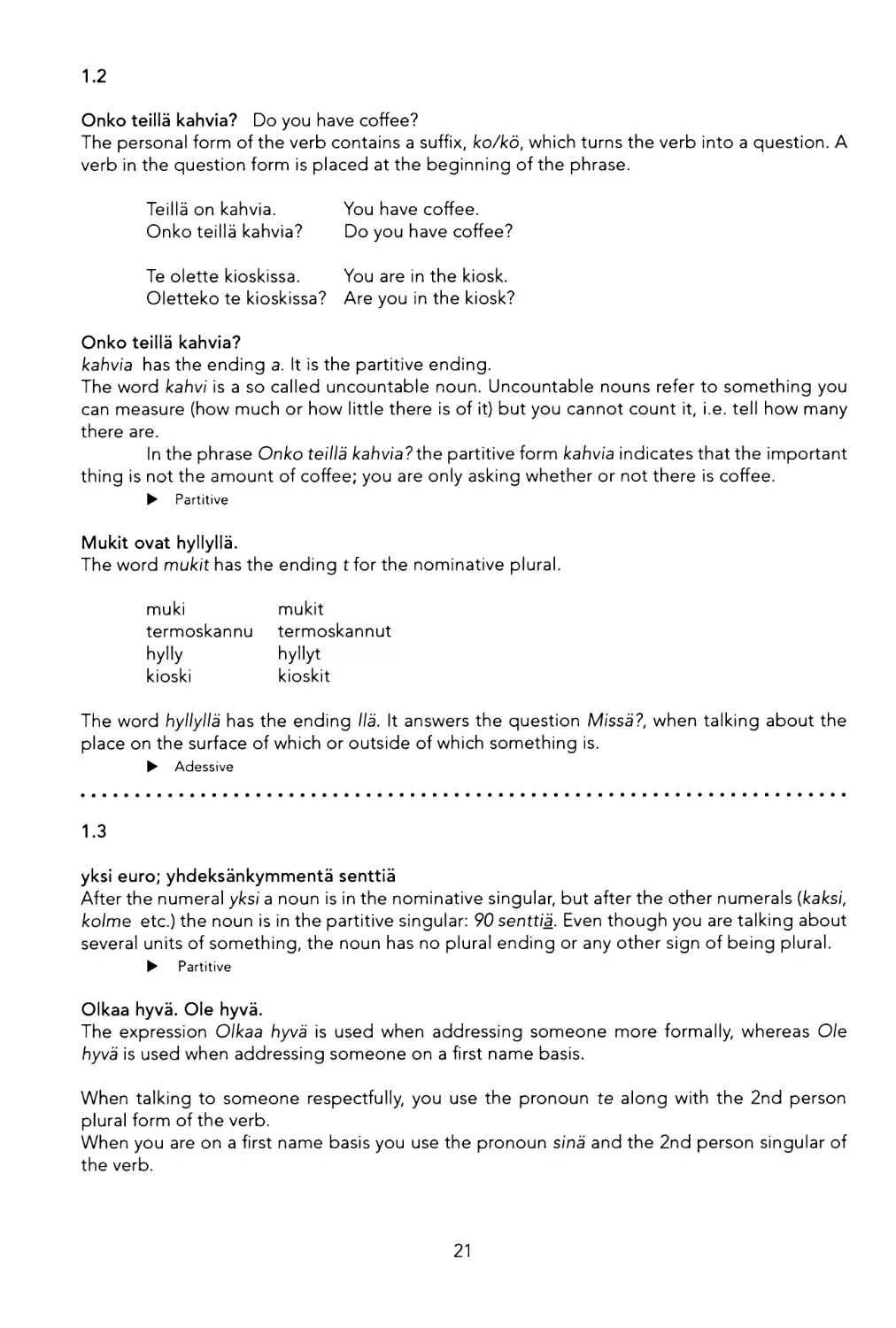
1.2
Onko teillä kahvia? Do you have coffee?
The personal form of the verb contains a suffix, ko/kö, which turns the verb into a question. A verb in the question form is placed at the beginning of the phrase.
Teillä on kahvia. You have coffee.
Onko teillä kahvia? Do you have coffee?
Te olette kioskissa. You are in the kiosk.
Oletteko te kioskissa? Are you in the kiosk?
Onko teillä kahvia?
kahvia has the ending a. It is the partitive ending.
The word kahvi is a so called uncountable noun. Uncountable nouns refer to something you can measure (how much or how little there is of it) but you cannot count it, i.e. tell how many there are.
In the phrase Onko teillä kahvia? the partitive form kahvia indicates that the important thing is not the amount of coffee; you are only asking whether or not there is coffee.
► Partitive
Mukit ovat hyllyllä.
The word mukit has the ending t for the nominative plural.
muki mukit
termoskannu termoskannut hylly hyllyt
kioski kioskit
The word hyllyllä has the ending llä. It answers the question Missä?, when talking about the place on the surface of which or outside of which something is.
► Adessive
1.3
yksi euro; yhdeksänkymmentä senttiä
After the numeral yksi a noun is in the nominative singular, but after the other numerals (kaksi, kolme etc.) the noun is in the partitive singular: 90 senttiä. Even though you are talking about several units of something, the noun has no plural ending or any other sign of being plural.
► 	Partitive
Olkaa hyvä. Ole hyvä.
The expression Olkaa hyvä is used when addressing someone more formally, whereas Ole hyvä is used when addressing someone on a first name basis.
When talking to someone respectfully, you use the pronoun te along with the 2nd person plural form of the verb.
When you are on a first name basis you use the pronoun sinä and the 2nd person singular of the verb.
21


Yksi kevytmaito.
maito is an uncountable noun, but in this context the word means a certain amount: yksi maito = yksi maitotölkki (one jar of milk) and that is why it is in the nominative.
paperinenäliinoja; postimerkkejä
Customer 4 and customer 5 don't buy one unit but several. Nenäliina and postimerkki are countable nouns. When talking about such nouns without mentioning the exact number, these words are in the partitive plural, nenäliina nenäliinoja
postimerkki postimerkkejä
The endings of the partitive plural are the same as those of the partitive singular (a/ä, ta/ta), but between the stem of the word and the ending you have to have the plural sign (j or i).
► Partitive plural
Saanko kolme.
In this context the phrase is a request, but formally it is a question: it contains the 1st person singular form saan and the question suffix ko. The verb saada here means 'to get (something you want or need)'.
Ei se haittaa.
This expression contains a negative verb form, the 3rd person singular of the verb haitata.
A negative verb form consists of two words: the negative verb and the stem of the main verb without a personal ending. The personal endings are taken over by the negative verb.
minä en ole I am not me emme ole we are not
sinä et ole you are not teette ole you are not
hän ei ole he/she is not he eivät ole they are not
When the verb olla means 'to have (something)', its negative form is ei ole regardless of person.
minulla ei ole I have not meillä ei ole we have not
sinulla ei ole you have not teillä ei ole you have not
hänellä ei ole he/she has not heillä ei ole they have not
Tästä saa valita.
saa is the 3rd person singular form. There is no subject in the refers to anybody, expresses a general possibility. The Finnish of vague reference to addressing a person directly.
► Clauses without a subject
Asiakas antaa Päiville lottokupongin.
This sentence contains the verb antaa. It is accompanied by three nouns expressing who gives what to whom. The word asiakas is the subject. The word Päiville has the ending He indicating to whom something is given. The word lottokupongin is the object - here the object marker is the ending n.
Otan vaikka tämän.
The word tämän is the object.
► Object
sentence. This type of sentence language often prefers this kind
22


Otan vaikka tämän.
Tuleeko muuta?
The verbs of these sentences are ottaa and tulla. The personal forms are:
otan, otat, ottaa tulen, tulet, tulee
otamme, otatte, ottavat tulemme, tulette, tulevat
Note the personal ending of the 3rd person singular. It is the same as the preceding vowel: ottaa, tulee.
Note also how the consonant t changes in the verb ottaa: The 1st and 2nd persons contain one t, whereas the 3rd persons have tt. (t is a short sound and tt is a long sound. They are called the weak and the strong grade. This is a systematic variation.)
► Consonant gradation / consonant change
Asiakas ottaa hyllyltä kahvipaketin, keksipaketin ja suklaalevyn ja laittaa ne tiskille.
The words kahvipaketin, keksipaketin, suklaalevyn have the ending n, which here is the object marker.
Also the pronoun ne is an object in this sentence. The pronoun has no ending.
The word hyllyltä has the ending Itä and the word tiskille has lie. The shelf and the counter are locations on the surface of which there may be things. In connection with the verb ottaa the noun has the ending Itä, which answers the question Mistä? In connection with the verb laittaa the noun has the ending lie, which answers the question Mihin?
► Ablative, allative
The verb laittaa is conjugated like ottaa. Note the consonant change tt - t. laitan, laitat, laittaa, laitamme, laitatte, laittavat
[Päivi] laskee hinnan.
The word hinnan has the ending n, which here is the object marker. The basic form (nominative) of this word is hinta. Note the consonant change nt - nn.
Haluatteko muovikassin?
The verb haluta is among a group of verbs in which the basic form (infinitive) ends in ta/tä. The personal forms are:
haluan, haluat, haluaa, haluamme, haluatte, haluavat
► Verb types
Aseman lipunmyynti on vielä kiinni.
The word aseman has the ending n. Here it is not the object marker but the genitive ending. The genitive is a case form with several functions in the Finnish language. For example it indicates the owner but also connection and belonging in many other ways. In the expression aseman lipunmyynti it indicates a place:
aseman lipunmyynti = the ticket office located at the station In the same way we can say: aseman kioski = the kiosk located at the station.
Tiedättekö te, pysähtyykö —
The infinitives of these verbs are tietää and pysähtyä.
Note the consonant changes t-d and ht-hd.
tiedän, tiedät, tietää pysähdyn, pysähdyt, pysähtyy
tiedämme, tiedätte, tietävät pysähdymme, pysähdytte, pysähtyvät
► Consonant gradation / consonant change
23


A subordinate question is the same as a straight question; there is no need for an extra word like the English if/whether.
illalla
This word is a form of the noun ilta evening'; it has the ending lla. Note the consonant change It-II.
joku pikajuna, joka menee Helsinkiin
Note the two pronouns: joku is an indefinite pronoun and joka a relative pronoun, joka menee Helsinkiin
The verb of this sentence is mennä. The personal forms are:
menen, menet, menee, menemme, menette, menevät
The word Helsinkiin has the ending in; the form answers the question Mihin? (Where to?)
► Illative
minä katson
The infinitive of the verb is katsoa. The personal forms are: katson, katsot, katsoo, katsomme, katsotte, katsovat
Tiedättekö, mistä voisi soittaa?
The sentence mistä voisi soittaa has no subject, and the verb of the sentence is in the 3rd person singular. This type of sentence refers to anybody, expresses a general possibility. The verb voisi is a form of the verb voida which gives the question a polite tone.
Unohdin kännykän kotiin.
unohdin is in the past tense, imperfect. The marker for the imperfect is /, which is inserted between the stem and the personal ending.
The infinitive is unohtaa.
The personal forms in the present tense are:
unohdan, unohdat, unohtaa, unohdamme, unohdatte, unohtavat The personal forms in the imperfect tense are:
unohdin, unohdit, unohti, unohdimme, unohditte, unohtivat Note the consonant change ht - hd.
The place where you've left something behind is expressed by a word form that answers the question Mihin? (Where to?) Here the word is kotiin.
The case ending of the word kännykän is n, which here is the object marker. The nominative is kännykkä. Note the consonant change kk - k.
► Object
► Consonant gradation / consonant change
Täällä meidän asemalla on vielä puhelinkoppi.
This sentence type (adverbial of place - verb - subject) tells us that something is (exists) somewhere. Note the word order.
► Clause types, existential clause
24


meidän asemalla
meidän is the genitive form of the personal pronoun me.
The nominative and genitive forms of the personal pronouns are: minä minun me meidän
sinä sinun te teidän
hän hänen he heidän
kukkakioskin vieressä
This expression answers the question Missä? Location in Finnish can be indicated not only by case endings but also by prepositions and postpositions. There are more postpositions than prepositions. The word vieressä is a postposition; it comes after the noun it is connected to. The word in front of the postposition is usually in the genitive form: kioskin vieressä
Puhelinkoppia on nykyään tosi vaikea löytää.
The main parts of this sentence are on vaikea löytää puhelinkoppia It's difficult to find a phone booth'. Note that the Finnish sentence doesn't have any preparatory subject like the English it; the verb olla is sufficient by itself.
The word puhelinkoppia has the ending a, which here is the object marker, this time in the partitive case. If you want to say that something is difficult, the object is usually in the partitive case.
25


2. 	KAKSI, TOINEN
2.1 Päivi Törmäsen kioski
Päivi Törmäsen kioski on pienessä kaupungissa rautatieasemalla.
Kioski on melko iso, se on kuin pieni kauppa.
Päivillä on kioskissa apulainen, nuori tyttö, Laura.
Laura on työssä joskus aamulla ja aamupäivällä, joskus iltapäivällä ja illalla.
Päivillä on kerran viikossa vapaapäivä.
2.2 Asiakas kysyy neuvoa
Asiakas: Anteeksi, osaatteko te sanoa, missä täällä on posti?
Päivi: Posti on aika kaukana, tuon puiston ja torin takana. Se on Torikadulla.
Minulla on tässä kartta ja voin näyttää, missä se on.
Asiakas: Ahaa, tuossa. Kiitos. - Voinko minä ostaa tämän kartan?
Päivi: Valitettavasti minulla on vain tämä, mutta tuolla aseman ulkopuolella on
infopiste. Sieltä saatte kartan.
Asiakas: Aha. Ai tuolla päin?
Päivi: Niin, tuosta ovesta.
Asiakas: Kiitos. Näkemiin.
Päivi: Näkemiin.
2.3 Asiakas haluaa vaihtaa rahaa
Asiakas: Anteeksi, mutta voisitteko vaihtaa tämän kympin kolikoiksi?
Päivi: Ikävä kyllä, nyt minä en voi vaihtaa. Tarvitsen kaikki kolikot itse.
Asiakas: No, ei voi mitään. Hei.
Päivi: Hei.
2.4 Liian nuori ostaja?
Asiakas: (Panee tiskille kaksi olutpulloa.) Nämä.
Päivi: Voitko näyttää henkilökortin?
Asiakas: Ai jaa. Joo. Tässä.
Päivi: Selvä. Kiitos. Otatko muuta?
Asiakas: En. Kiitti, moi.
Päivi: Moi moi.
2.5 Asiakas haluaa vuokrata DVD:n
Asiakas: Haluaisin vuokrata tämän DVD:n.
Päivi: Jaaha. Sitten tarvitaan henkilötiedot. (Antaa lomakkeen.)
Asiakas: (Täyttää lomakkeen.) Sukunimi..., etunimi..., syntymäaika..., osoite ja
puhelinnumero. Ja allekirjoitus. Näin.
Päivi: Saanko henkilökortin. Kiitos.
Asiakas: (Lähtee mutta kääntyy takaisin.) Ai niin, milloin tämä pitää palauttaa?
Päivi: Huomenna viimeistään kello 18.
Asiakas: Okei. Hei.
26


2.6 	Väärinkäsitys
Asiakas: Päivää. Minä ostaisin nämä suklaarasiat.
Päivi: Kaksi rasiaa... Yhdeksän euroa.
Asiakas: Mutta eikö se ole vain neljä ja puoli euroa? Minulla on tämä ilmoitus.
Päivi: Anteeksi, mikä ilmoitus?
Asiakas: Tässä on, että "kaksi yhden hinnalla".
Päivi: Saanko katsoa? Nyt en oikein ymmärrä... Ai jaa. Kuulkaa, tämä on kaupan
mainos. Meillä ei ole tällaista tarjousta.
Asiakas: No voi hyvänen aika! Miten minä nyt näin erehdyin?
Päivi: Sattuuhan sitä. Kauppa taitaa olla jo kiinni, mutta... Tarjous on voimassa
vielä huomenna. Ehditte vielä saada ne rasiat huomenna.
Asiakas: Juu, niin. Kiitos ja anteeksi nyt.
Päivi: Ei se mitään.
2.7 	Asiakas etsii korttia
Asiakas: Etsin jotain kivaa korttia. Eikö teillä ole ollenkaan onnittelukortteja?
Päivi: Eikös siellä telineessä ole... Vai...
Asiakas: Ei, täällä on vain maisemakortteja.
Päivi: Ohhoh, sepäs nyt ikävää. En huomannut eilen tarkistaa korttitelinettä. Ikävä
kyllä, nyt en voi auttaa.
Asiakas: No, täytyy mennä huomenna postiin. Hei!
Päivi: Hei hei.
2.8 	Aurinko paistaa
Asiakas: (Avaa kylmäkaapin.) Onko täällä kivennäisvettä?
Päivi: Siellä oikealla, takana.
Asiakas: Ai jaa, joo. Pitää ostaa vettä mukaan, kun on pitkä junamatka edessä ja on
niin lämmin ilma.
Päivi: Niin, ihan yllättävää, että näin myöhään syksyllä on näin lämmin.
2.1
Päivi Törmäsen kioski (Törmäsen < Törmänen) Päivi Törmänens kiosk
pienessä kaupungissa (pienessä kaupungissa < pieni kaupunki) in a little town
rautatieasemalla (rautatieasemalla < rautatieasema) at
the railway station
melko iso quite big
kuin pieni kauppa like a small shop
Päivillä on apulainen (Päivillä < Päivi) Päivi has a helper
/ an assistant
nuori young
joskus sometimes
aamulla in the morning
aamupäivällä in the morning, before noon
iltapäivällä in the afternoon
illalla (< ilta) in the evening
kerran viikossa (viikossa < viikko) once a week Päivillä on vapaapäivä Päivi has day off
2.2
asiakas kysyy neuvoa (neuvoa < neuvo) a customer
asks for some advice
kysyä to ask
neuvo advice
anteeksi excuse me
osaatteko te sanoa (osaatte+ko < osata 'to know
how') can you tell (me)
sanoa to say, to tell
missä where
täällä here
posti post office
aika kaukana quite far away
tuon puiston ja torin takana (puiston < puisto; torin <
27


tori) behind that park and square tuo that (one), that one over there puisto park
tori square; marketplace takana behind
Torikadulla (Torikadulla < Torikatu) in Torikatu ("Square
street")
tässä here
kartta map
voin näyttää I can show tuossa there
voinko minä ostaa tämän kartan? can I buy this map? voinko (voin+kc2 < voida can')
tämän kartan (tämän kartan < tämä kartta 'this map') valitettavasti unfortunately vain only
aseman ulkopuolella outside the station infopiste information point sieltä saatte kartan there you can get a map sieltä from there
saatte (saatte < saada 'to get, obtain, receive! ai tuolla päin? oh, that way? niin yes
tuosta ovesta (tuosta ovesta < tuo ovi 'that door') out of that door näkemiin goodbye
2.3
asiakas haluaa vaihtaa rahaa a customer wants to
change some money
haluaa (haluaa < haluta 'to want') wants
rahaa (rahaa < raha 'money') some money
mutta but
voisitteko vaihtaa tämän kympin kolikoiksi? could you
change this ten for coins?
voisitteko (vo+isi+tte+ko < voida)
tämän kympin (tämän kympin < tämä kymppi)
kolikoiksi (kolikoiksi < kolikko 'coinl
ikävä kyllä I'm afraid
nyt now
en voi vaihtaa I cannot change tarvitsen (tarvitsen < tarvita) I need kaikki kolikot (kolikoL< kolikko) all the coins itse myself no well
ei voi mitään that's OK, never mind hei bye!
2.4
liian nuori too young
ostaja buyer
panee (panee < panna) puts
tiskille (tiskille < tiski) on / onto the counter
kaksi olutpulloa (olutpulloa < olutpullo) two bottles of beer
olut beer
pullo bottle
nämä these
voitko näyttää henkilökortin? (henkilökortin <
henkilökortti) can you show your identity card?
henkilö person
kortti card
ai jaa oh, I see
selvä all right
otatko muuta? (otat+ko < ottaa 'to take'; muuta < muu
'else') do you take something else?
en no, I don't
kiitti thanks
moi (=hei)
2.5
haluaisin (halua+isi+n < haluta) I would like to
vuokrata to rent
DVD (dee-vee-dee)
jaaha aha
sitten then
tarvitaan henkilötiedot we need your ID information
tarvitaan (tarvitaan < tarvita 'to needl are needed
antaa lomakkeen (lomakkeen < lomake) gives a form
täyttää lomakkeen (täyttää < täyttää) fills in the form
täyttää to fill
sukunimi surname
etunimi first name, given name
syntymäaika birthdate
osoite address
puhelinnumero telephone number ja and
allekirjoitus signature näin so
asiakas lähtee (lähtee < lähteä) the customer leaves
kääntyy (kääntyy < kääntyä) turns
takaisin back
ai niin oh yes
milloin? when?
milloin tämä pitää palauttaa? when must this be returned?
pitää must, have to
palauttaa to return
huomenna tomorrow
viimeistään at the latest, no later than
kello 18 (kahdeksantoista) at 6 p.m.
okei okay
28


2.6
väärinkäsitys misunderstanding
minä ostaisin (osta+isi+n < ostaa) I'd like to buy
nämä these
suklaarasia box of chocolates
kaksi rasiaa two boxes
yhdeksän euroa nine euro
eikö se ole vain... (ei+kö) isn't it just...
neljä ja puoli euroa four and a half euro
ilmoitus ad, announcement
mikä ilmoitus? what ad?
tässä here
että that
kaksi yhden hinnalla (yhden < yksi; hinnaNa < hinta) two for the price of one
saanko katsoa? (saan+kQ < saada) may I have a look? nyt now
en oikein ymmärrä I don't quite understand en ymmärrä (< ymmärtää 'to understand') kuulkaa listen
kaupan mainos (kaupan < kauppa) a shop's advertisement kauppa shop, store mainos advertisement
meillä ei ole tällaista tarjousta we do not have this kind of offer
tällaista tarjousta (tällaisia < tällainen; tarjousta < tarjous) this kind of offer
no voi hyvänen aika! o my, dear me, for goodness' sake
miten minä nyt näin erehdyin? (erehdy+i+n < erehtyä)
how did I make such a mistake?
miten how
näin so, like this
erehtyä make a mistake, err
sattuuhan sitä (sattuu+han < sattua) well, that
happens / those things happen
sattua happen, occur, take place
-han (a suffix that gives a meaning like 'as is known,
as we both know')
sitä (< se 'it')
kauppa taitaa olla jo kiinni the shop is probably already closed
taitaa (a verb that is used to express probability)
jo already
kiinni closed
on voimassa is valid
vielä still
huomenna tomorrow
ehditte saada (ehdilie < ehtiä) you'll be in time for getting
ehtiä to manage to be in time, to have time
ne those
juu, niin yes, quite anteeksi nyt I'm very sorry ei se mitään it's okay
2.7
kortti card (here: postcard)
etsin jotain kivaa korttia I'm looking for a nice card
etsiä to look for
jotain (< jokin 'some, a, any')
kiva nice
Eikö teillä ole ollenkaan onnittelukortteja? Don't you have any congratulations cards at all? ollenkaan at all
kortteja (kortte+j+a < kortti) some /any cards onnittelu congratulation
eikös siellä telineessä ole? are there not any there in the stand? teline stand vai or
täällä on vain maisemakortteja there are only cards with views here siellä there vain only
maisemakortti card with view maisema view, landscape, scenery sepäs nyt ikävää how unfortunately! sepäs (se+päs) ikävä (here: unfortunate)
en huomannut tarkistaa I didn't remember to check / I didn't get around to check
huomata to notice, to realize, to become aware of
eilen yesterday
korttiteline cardstand
nyt en voi auttaa now I can't help
en voi (< voida)
auttaa to help
täytyy mennä (I) must go
postiin (postiin < posti) to the post office
2.8
aurinko paistaa the sun is shining aurinko sun paistaa to shine
asiakas avaa kylmäkaapin the customer opens the cooler
avata to open kylmäkaappi cooler
kivennäisvettä (< kivennäisvesi) mineral water oikealla on the right
29


takana in back
pitää ostaa vettä mukaan I have to buy some water (to
take) along
pitää to have to
vettä (< vesi) water
mukaan along
kun because
on pitkä junamatka edessä (it) is a long train ride
ahead
pitkä long
junamatka train trip
matka trip
edessä ahead, in front niin so
lämmin ilma warm/hot weather niin that's right; yes ihan yllättävää quite surprising ihan quite yllättävä surprising
näin myöhään syksyllä this late in the autumn näin this, in this way, to this extent myöhään late
syksyllä (< syksy) autumn; fall
Yhdyssanat / Compound nouns
rautatieasema < rautatie + asema; rautatie < rauta + tie aamupäivä < aamu + päivä iltapäivä < ilta + päivä vapaapäivä < vapaa + päivä Torikatu < tori + katu ulkopuolella < uiko + puoli infopiste cinfo (= informaatio) + piste olutpullo < olut + pullo henkilökortti < henkilö + kortti henkilötiedot < henkilö + tiedot (< tieto) sukunimi < suku + nimi etunimi < etu + nimi syntymäaika < syntymä + aika puhelinnumero < puhelin + numero allekirjoitus < alle + kirjoitus väärinkäsitys < väärin + käsitys suklaarasia < suklaa + rasia onnittelukortti < onnittelu + kortti maisemakortti < maisema + kortti korttiteline < kortti + teline kylmäkaappi < kylmä + kaappi junamatka < juna + matka
Explanations
2.1
Päivi Törmäsen kioski
Here the family name of Päivi is in the genitive case (ending n). When the first name and surname are together, only the surname is inflected.
Many Finnish family names end in the syllable nen. Many nouns and adjectives have the same final syllable. Note: When adding an ending (e.g. the genitive ending n or the plural sign t) to this type of word, the final syllable changes into the syllable se.
Nominative singular Genitive singular Nominative plural
Törmänen Törmäsen Törmäset
suomalainen suomalaisen suomalaiset
► Types of nouns and adjectives pienessä kaupungissa
The adjective in front of a noun is in the same form as the noun.
pieni kaupunki, pienessä kaupungissa, pienet kaupungit Note the vowel change: pieni, pienessä, pienet.
Note the consonant change: kaupunki, kaupungissa, kaupungit.
► Types of nouns and adjectives; consonant change
30


Kioski on rautatieasemalla
The ending lla may express the place. A station is not a closed-in locality, and that is why you say asemalla rather than use the ending ssa.
aamulla, aamupäivällä, iltapäivällä, illalla
In these words the ending lla/llä indicates the time when something happens. These forms answer the question Milloin?
The times of the day are aamu (early morning), aamupäivä (morning), keskipäivä (noon), iltapäivä (afternoon), ilta (evening) and yö (night).
kerran viikossa
The ending ssa here indicates the time within which something happens.
Note the consonant change: viikko, viikossa.
2.2
Asiakas kysyy neuvoa
The verb kysyä here is followed by a word answering the question Mitä? (Mitä asiakas kysyy?) This clause element is called an object. The verb kysyä takes an object in the partitive, the ending of which here is a.
► Object
osaatteko te sanoa?
The verb osata is of the same type as haluta.
The personal forms are: osaan, osaat, osaa, osaamme, osaatte, osaavat
► Verb types
Missä?
The dialogue contains various answers to the question Missä?
kaukana; tuon puiston ja torin takana; aseman ulkopuolella; Torikadulla; täällä; tuolla päin; tässä, tuossa, tuolla.
The words takana and ulkopuolella are postpositions: they come after the noun and the noun is in the genitive case.
For street names you use the ending lla/llä.
► Adessive
Missä täällä on posti? - Minulla on tässä kartta.
täällä '(over) here'(a larger, more vague area); tässä 'here' (smaller, closer, more exact) tuolla aseman ulkopuolella - ahaa, tuossa
tuolla '(over) there' (the speaker points further away); tuossa 'there' (the speaker points to the exact place)
tuon puiston ja torin takana
The pronoun tuo is in the same case as the noun it qualifies. Consequently it behaves in the same way as an adjective.
Another example can be found in the sentence Voinko minä ostaa tämän kartan?
Cf. pienessä kaupungissa (2.1).
31


Voinko minä ostaa tämän kartan? - Sieltä saatte kartan.
The word kartan has the ending n, which here is the object marker.
► Object
Sieltä saatte kartan.
The verb of the phrase is saada. When talking about a place from where someone gets something you use forms answering the question Mistä? Here the question is answered by the word sieltä 'from over there'.
tuosta ovesta
The ending sta here indicates the place through which the exit is. When Päivi explains to the customer: Niin, tuosta ovesta, she means: You can go through that door.
► Elative
Ai tuolla päin? - Niin, tuosta ovesta.
When the customer asks Ai tuolla päin? it is not formally a question but a statement of verification. In that case the affirmative answer is Niin.
The same answer is used whenever there is no verb in the interrogative sentence and the interrogative suffix is added to a noun:
- 	Missä Päivi on? Kioskissako? - Niin, kioskissa.
Cf. - Onko Päivi kioskissa? - On. Kyllä on.
2.3
vaihtaa rahaa
The word rahaa has the ending a, which here is the sign of an object to the verb vaihtaa. The form rahaa is in the partitive case, which means that we are talking about money in general, not a specific sum.
Voisitteko vaihtaa tämän kympin kolikoiksi?
This phrase too contains the verb vaihtaa. Now the verb has two nouns as adjuncts: kympin and kolikoiksi. The word kympin is the object (ending n). The word kolikoiksi has the ending ksi, which indicates the result of the changing.
► Object; translative
voisitteko vaihtaa?
voisitteko is a form of the verb voida which is used in polite questions and requests. The polite tone comes from the sign isi in front of the personal ending.
The form voisitteko has four parts: vo-isi-tte-ko.
► Conditional
Tarvitsen kaikki kolikot itse.
The infinitive of the verb tarvitsen is tarvita. Verbs ending in ita take a tse in front of the personal ending:
tarvitsen, tarvitset, tarvitsee, tarvitsemme, tarvitsette, tarvitsevat
► Verb types
ei voi mitään
ei voi is the 3rd person singular of the verb voida, and mitään is a pronoun used in negative sentences ('anything'). The phrase is a statement meaning that it can't be helped, nobody can do anything.
32


2.4
Asiakas panee tiskille kaksi olutpulloa.
The infinitive of panee is panna. The personal forms are:
panen, panet, panee, panemme, panette, panevat Cf. 1.2, customer 7. There we have the verb laittaa. In this context the verbs laittaa and panna are synonymous.
Voitko näyttää henkilökortin?
The word kortin has the ending n, which here again is the object marker. The nominative is kortti. Note the consonant change tt - t.
► 	Consonant change
Otatko muuta?
muuta 'anything else' is the partitive of the pronoun muu which is the object in this phrase.
2.5
Haluaisin vuokrata tämän DVD:n.
haluaisin is a form of the verb haluta which is used in polite requests. Cf. voisitteko in 2.3.
► Conditional
Sitten tarvitaan henkilötiedot.
tarvitaan is the passive form of the verb tarvita. The passive voice is used when it is not important to know who does something but rather what is done.
► Passive
Asiakas täyttää lomakkeen.
The word lomake is inflected as follows: lomake, lomakkeen, lomakkeet Note the consonant change: lomake, lomakkeen (k - kk).
Note the vowel change: lomake, lomakkeen (e - ee).
► Types of nouns and adjectives
Saanko henkilökortin? - Asiakas lähtee mutta kääntyy takaisin.
The personal forms of the verbs saada, lähteä and kääntyä are: saan, saat, saa, saamme, saatte, saavat
lähden, lähdet, lähtee, lähdemme, lähdette, lähtevät (Note consonant change t - d.) käännyn, käännyt, kääntyy, käännymme, käännytte, kääntyvät (Note change nt-nn.)
► Verb types; consonant change
Milloin tämä pitää palauttaa?
The verb pitää is used together with the infinitive of another verb to express something you must do. pitää in this sense is always in the 3rd person singular. Cf. täytyy in 2.7.
33


2.6
Minä ostaisin nämä suklaarasiat.
The verb ostaisin is a form of the verb ostaa which gives the phrase a polite tone. Cf. voisinko, haluaisin.
► Conditional
Mutta eikö se ole - -?
eikö ole is a negative interrogative form of the verb olla.
The positive and negative interrogative personal forms are: olenko, oletko, onko, olemmeko, oletteko, ovatko enkö ole, etkö ole, eikö ole, emmekö ole, ettekö ole, eivätkö ole
kaksi yhden hinnalla
kaksi yhden hinnalla means that the customer gets two boxes for the price of one.
The word hinnalla has the ending lla. The nominative is hinta.
Note the consonant change: hinta, hinnalla (nt - nn).
► Adessive; consonant change
Nyt en oikein ymmärrä.
The infinitive of the verb en ymmärrä is ymmärtää. The personal forms are:
ymmärrän, ymmärrät, ymmärtää, ymmärrämme, ymmärrätte, ymmärtävät (Note the consonant change rt - rr.)
en ymmärrä, et ymmärrä, ei ymmärrä, emme ymmärrä, ette ymmärrä, eivät ymmärrä
► Consonant change
Kuulkaa, tämä on kaupan mainos.
When Päivi has to correct the mistaken idea of the customer, she starts by saying Kuulkaa. It is the imperative form of the verb kuulla (2nd person plural, which is used in formal address). The sign of the imperative here is the ending kaa. Cf. the phrase olkaa hyvä.
► Imperative
kaupan mainos
kaupan is the genitive form of the word kauppa. Note the consonant change pp - p.
► Consonant change
Meillä ei ole tällaista tarjousta.
When talking about something that isn't there or that someone doesn't have, you use the partitive case, tällaista tarjousta is the partitive of the words tällainen tarjous. The partitive singular ending here is ta.
Note how the nen-ended word changes when the partitive ending ta is added: tällainen, tällaista.
Cf. also Päivi Törmäsen kioski in 2.1.
► Types of nouns and adjectives; partitive Miten minä nyt näin erehdyin?
The verb erehdyin is in the past tense, imperfect. The sign of the imperfect is /, which is inserted between the stem and the personal ending.
The personal forms in the present tense are:
erehdyn, erehdyt, erehtyy, erehdymme, erehdytte, erehtyvät The personal forms in the imperfect tense are:
34


erehdyin, erehdyit, erehtyi, erehdyimme, erehdyitte, erehtyivät Note the consonant change ht - hd.
► Imperfect
Sattuuhan sitä.
The phrase contains the 3rd person singular form of the verb sattua together with the enclitic particle han. The particle here gives the verb the added meaning 'we both know that such things happen'.
The word sitä is the partitive form of the pronoun se. In this phrase it means approximately 'all sorts of things'.
Kauppa taitaa olla jo kiinni.
The verb taitaa is here used to indicate likelihood. The shop is probably closed already.
Ehditte vielä saada ne rasiat huomenna.
The personal forms of the verb ehtiä are:
ehdin, ehdit, ehtii, ehdimme, ehditte, ehtivät (Note the consonant change ht - hd.)
► Consonant change
2.7
Etsin jotain kivaa korttia.
kivaa korttia is the object. It is in the partitive case because the verb etsiä usually takes an object in the partitive.
Because the noun korttia is in the partitive, its qualifiers (a pronoun and an adjective) also have to be. jotain is the partitive singular of the pronoun jokin.
Eikö teillä ole onnittelukortteja?
The word onnittelukortteja is the partitive plural of the word onnittelukortti.
A negative question:
eikö minulla ole, eikö sinulla ole, eikö hänellä ole, eikö meillä ole, eikö teillä ole, eikö heillä ole
Eikös siellä telineessä ole?
Päivi adds an s to the question eikö to soften the question.
The word teline is inflected as follows:
teline, telineen, telineessä (Note the vowel change e - ee.)
► Types of nouns and adjectives
sepäs nyt ikävää
In the word sepäs an enclitic particle päs has been added to the pronoun se. The particle adds a somewhat surprised tone to this phrase where the speaker regrets the lack of cards.
The adjective in this type of phrase is usually in the partitive: ikävää.
En huomannut eilen tarkistaa korttitelinettä.
en huomannut is the negative imperfect of the verb huomata.
► Imperfect
35


The word korttitelinettä is in the partitive case. It is the object of the verb tarkistaa. In a negative clause the object is always in the partitive case.
The partitive singular ending of the word teline is ttä.
► 	Object; types of nouns and adjectives
täytyy mennä
The verb täytyä is used together with the infinitive of another verb to express something you must do. täytyy in this type of phrase is always in the 3rd person singular. Cf. pitää in 2.5 and 2.8.
2.8
Asiakas avaa kylmäkaapin.
The infinitive of the verb avaa is avata. The personal forms in the present tense are: avaan, avaat, avaa, avaamme, avaatte, avaavat The case ending of the word kylmäkaapin is n, which here is the object marker. The nominative is kylmäkaappi. Note the consonant change pp - p.
Onko täällä kivennäisvettä? Pitää ostaa vettä mukaan
The word vettä is the object. It is in the partitive case. The partitive indicates that the customer is not talking about a specific quantity of water. The nominative of the word is vesi.
Pitää ostaa vettä mukaan
The verb pitää here means the same as täytyy (2.7). In this type of clause it is always in the 3rd person singular.
Niin, ihan yllättävää, että —.
The word yllättävää has the ending ä of the partitive. When the adjective refers in this manner to the että-clause, it is in the partitive.
► 	Predicative
36


3. 	KOLME, KOLMAS
3.1 Kioski on kuin pieni kauppa
Kioski on kuin pieni kauppa. Sieltä voi ostaa yhtä ja toista.
Sieltä saa lehtiä, kortteja, postimerkkejä, filmirullia, limsaa, olutta, maitoa, vettä... Monet ostavat tupakkaa.
Kioskissa voi juoda kahvia ja syödä pullaa. Sieltä saa myös jäätelöä ja karkkeja.
Jos nälkä yllättää, kylmäkaapissa on makkaraa ja muuta ruokaa. Jos kampa jää kotiin, hammastahna on lopussa tai tarvitset paristot radioon, apu löytyy kioskista.
3.2 Asiakkaat katselevat matkaesitteitä
Nainen:
Hei kuule, nyt täällä on jo uusia matkaesitteitä.
Mies
No. Katsotaan niitä. Maksavatko ne jotakin?
Nainen:
Ei. Ne ovat ilmaisia. Tässä on ensi talven matkoja.
Mies
Joo. Entäs tuo toinen?
Nainen:
Siinä on risteilyjä.
Mies
Otetaan nämä kotiin ja luetaan rauhassa siellä.
Nainen:
Odota vähän, minun pitää ostaa onnittelukortti. Työkaveri sai vauvan.
Mies:
Minä odotan tuolla ulkona.
3.3 	Asiakkaat selailevat lehtiä, etsivät matkalukemista
A: Hei kuule, meillä on vielä parikymmentä minuuttia aikaa, ennen kuin juna
lähtee. Mennään ostamaan jotakin matkalukemista.
B: Mennään vain. Minulla on kyllä kirja mukana, mutta ostetaan pari lehteä.
A: (Kioskissa.) Täällähän onkin paljon lehtiä. Vaikea valita. Otan vaikka
B: tämän.
Hei, tässä on ihan uusi ristikkolehti. Minä ostan sen. Minä tykkään tehdä A: ristikoita.
Hyvä. Maksetaan ja lähdetään.
Asiakkaat maksavat lehdet.
A: Ai kuule, minä ostan vielä tuon kuvakirjan. Se on hyvä tuliainen pikku
Emmalle.
B: Täällä on lelujakin. Mitä jos ostat tuon pienen nallen?
A: Jaa, se on kyllä söpö. Mutta jos kuitenkin ostan kirjan. Mitä tämä maksaa?
Päivi: Neljä euroa.
A: Olkaa hyvä. (Antaa viiden euron setelin.)
Päivi: Ja euro takaisin, näin. Olkaa hyvä.
A: Kiitos. Hei.
Päivi: Hei. Ai, tämä teidän lehti jäi!
A: Ai niin. Kiitos.
37


Asiakkaat keskustelevat junassa.
B: Ai, sinä ostit ruotsinkielisen lehden. Meinaatko puhua Emmalle ruotsia?
A: Ei, kyllä minä Emmalle puhun suomea, mutta hänen äitinsä ja isoäitinsä
kanssa yritän puhua ruotsia. He osaavat kyllä suomea, mutta minusta on hauska harjoitella ruotsia.
B: He ovat kotoisin Pohjanmaalta, eikö niin?
A: Joo, kyllä, Vaasan läheltä.
B: Mitä kieltä Emmalle puhutaan?
A: Emman äiti puhuu hänelle ruotsia ja isä suomea. Äidinäiti puhuu ruotsia ja
isän vanhemmat puhuvat suomea. Emmasta tulee kaksikielinen. Hän pärjää sitten kaikkien sukulaisten kanssa.
3.4 	Kaurismäki-fani
Asiakas: Täytyy ostaa tämä lehti, kun tässä on juttu Kaurismäen uudesta
elokuvasta.
Päivi: Joko se on elokuvateatterissa?
Asiakas: Ei vielä. Se tulee ensi kuussa.
Päivi: Oletko Kaurismäki-fani?
Asiakas: Taidan olla.
3.1
kuin like
sieltä from there
yhtä ja toista this and that
lehtiä (< lehti) newspapers, magazines
kortteja (< kortti) cards
postimerkkejä (< postimerkki) stamps
filmirullia (< filmirulla) film rolls
limsaa (< limsa = limonadi) soft drink
olutta (< olut) beer
maitoa (< maito) milk
vettä (< vesi) water
monet (< moni) many (people)
ostaa to buy
tupakkaa (< tupakka) tobacco, cigarette juoda to drink syödä to eat
pullaa (< pulla) (sweet) bun, coffee bread myös also
jäätelöä (< jäätelö) ice cream karkkeja (< karkki) candy, sweets jos if
nälkä hunger
yllättää fall upon (unexpectedly), surprise
jos nälkä yllättää if you get hungry all of a sudden / if
hunger sneaks up on you
kylmäkaapissa (< kylmäkaappi) in the cooler
makkaraa (< makkara) sausage
muuta ruokaa (< muu ruoka) other food kampa comb
jää (< jäädä) remains, gets left kotiin home
kampa jää kotiin your comb gets left at home / you forget your comb at home / you leave your comb at home hammastahna toothpaste
on lopussa is running out / is at its end (< loppu 'end') tai or
tarvitset paristot radioon you need batteries for the radio
radio radio tarvita to need paristo battery
apu löytyy kioskista help can be found from / at the
kiosk
apu help
löytyä to be found
3.2
asiakkaat (< asiakas) customers, clients
katselevat (< katsella) are looking at
matkaesitteitä (< matkaesite) travel brochures
nainen woman
mies man
hei kuule hey, listen
nyt täällä on jo uusia matkaesitteitä some of the new
38


travel brochures are here already uusi new no well
katsotaan niitä let's have a look at them niitä (< ne) them
Maksavatko ne jotakin? Do they cost something? maksaa to cost ne they
jotakin something
ilmaisia (< ilmainen) free of charge
ensi talven matkoja trips for next winter
ensi next
talvi winter
matkoja (< matka) travels, trips joo yes
entäs (< entä) what about
tuo toinen that one, that other one
siinä on risteilyjä (< risteily) there are cruises in it / it's
about cruises
siinä (in) there
risteily cruise
otetaan (< ottaa) let's take
nämä these
luetaan (< lukea) let's read
rauhassa (< rauha) in peace (here: at our leisure)
siellä there
odota vähän wait a minute odottaa to wait vähän a little
minun pitää ostaa I have to buy
onnittelukortti congratulations card
työkaveri sai vauvan (my) workmate had a baby
työkaveri workmate
sai (< saada 'to get') got
vauva baby
3.3
selailevat (< selailla) glance over, browse through etsivät (< etsiä) search, look for matkalukemista (< matkalukeminen) trip/commute reading vielä yet, still
parikymmentä minuuttia aikaa about twenty minutes
time (to do something)
parikymmentä about twenty
minuutti minute
aika time
ennen kuin before
juna train
lähtee (< lähteä) departs mennään ostamaan let's go to buy
mennään (< mennä) let's go ostamaan (< ostaa) to buy
jotakin matkalukemista something to read on the trip mennään vain OK, let's go
minulla on kyllä kirja mukana I do have along a book kirja book
mukana along, with (me)
ostetaan (< ostaa) let's buy
pari lehteä a couple of magazines
lehteä, lehtiä (< lehti 'newspaper, magazine, journal')
täällähän onkin paljon lehtiä there sure are lots of
magazines here (The sentence indicates surprise.)
paljon lehtiä many magazines, a lot of magazines
valita to choose
otan vaikka tämän I think I'll take this one / why not
take this one
otan (< ottaa 'to take')
ristikkolehti crossword magazine
minä ostan sen (< se) I'll buy it
tykkään (< tykätä) I like
tehdä ristikoita to do crosswords
tehdä to do, to make
ristikoita (< ristikko = sanaristikko)
hyvä fine, all right!
maksetaan (< maksaa) ja lähdetään (< lähteä) let's pay
up and go
maksaa to pay
vielä more
tuo that
kuvakirja picture book hyvä good
tuliainen a gift given by a visitor or returning traveler pikku Emmalle to little Emma pikku little täällä here
lelujakin (leluja+kin < lelu) also toys lelu toy
mitä jos what if
tuon pienen nallen (< tuo pieni nalle) that small teddy bear
nalle teddy bear söpö cute mutta but jos if
kuitenkin after all
Mitä tämä maksaa? What does this cost?
viiden euron seteli a five euro note/bill
tämä teidän lehti jäi you forgot your magazine (this
magazine of yours got left)
jäi (< jäädä) remained; was left behind
ai niin oh yes
keskustella to chat, to have a conversation
39


sinä ostit you bought
ruotsinkielinen Swedish (-language)
meinaatko (< meinata) puhua do you mean to speak
ruotsi Swedish
suomi Finnish
hänen äitinsä ja isoäitinsä kanssa with her mother and
grandmother
äiti mother
isoäiti grandmother
yritän (< yrittää) I try, 111 try
he osaavat kyllä suomea they do speak Finnish
suomea (< suomi)
minusta on hauska harjoitella ruotsia I enjoy practising
Swedish
hauska fun
ruotsia (< ruotsi)
He ovat kotoisin Pohjanmaalta, eikö niin? They are from Pohjanmaa, aren't they?
Pohjanmaa Ostrobothnia
Vaasan läheltä from near Vaasa
Mitä kieltä Emmalle puhutaan? What language do
they use ('is used') with Emma?
hänelle to her
isä father
äidinäiti maternal grandmother ('mother's mother') vanhemmat parents
Emmasta tulee kaksikielinen Emma will be bilingual
kaksikielinen bilingual
hän pärjää (< pärjätä) she will get by well
pärjätä to manage well
sitten then
kaikkien sukulaisten kanssa with all of the relatives (kaikkien sukulaisten < kaikki sukulaiset) sukulainen relative
3.4
fani fan
täytyy ostaa I must buy kun because tässä here
juttu Kaurismäen uudesta elokuvasta a story about
Kaurismäki's new film
juttu story, article
Kaurismäen (< Kaurismäki)
uudesta (< uusi)
uusi new
elokuva movie , film joko se on is it already jo already
elokuvateatteri movie theater, cinema
ei vielä not yet
ensi kuussa next month
taidan olla I guess I am, I probably am
taidan (< taitaa)
Yhdyssanat / Compound nouns
postimerkki < posti + merkki
filmirulla < filmi + rulla
kylmäkaappi < kylmä + kaappi
hammastahna < hammas + tahna
matkaesite < matka + esite
onnittelukortti < onnittelu (< onnitella) + kortti
työkaveri < työ + kaveri
matkalukeminen < matka + lukeminen (< lukea)
parikymmentä < pari + kymmentä (< kymmenen)
ristikkolehti < ristikko + lehti
kuvakirja < kuva + kirja
ruotsinkielinen < ruotsin + kielinen
isoäiti < iso + äiti
äidinäiti < äidin + äiti
kaksikielinen < kaksi + kielinen
Kaurismäki < kauris + mäki
elokuva < elo + kuva
elokuvateatteri < elokuva + teatteri
Explanations
3.1
Sieltä voi ostaa yhtä ja toista. Sieltä saa lehtiä.
A place where you buy something or get something is indicated by a word or a form answering the question Mistä? Here sieltä is such a word.
The same formula applies in connection with the verb löytyä: At the end of the text we have
40


the phrase apu löytyy kioskista. The ending sta indicates a place from which something comes or where you get something.
► Elative; ablative
lehtiä, kortteja, postimerkkejä, filmirullia, karkkeja
These words are in the partitive plural. In this sentence they are objects to the verb saada. The partitive plural here indicates that there are many things, but how many there are is not important.
limsaa, olutta, maitoa, vettä, tupakkaa, kahvia, pullaa, jäätelöä
These words are in the partitive singular. In this sentence they are the objects of the verbs saada, ostaa, juoda, syödä. They are material words (uncountables), and the partitive again indicates that the exact quantity is not the issue here.
Also the words in the phrase yhtä ja toista are in the partitive. Their basic forms (nominative) are yksi and toinen.
makkaraa, ruokaa
These words, too, are in the partitive. They appear in a sentence describing what there is in the kiosk. Here also the partitive indicates that the exact quantity is not known or mentioned.
► Partitive
Sieltä voi ostaa; Sieltä saa; Kioskissa voi juoda kahvia
These sentences have no subject. The 3rd person singular of the verb together with no subject means that you are talking about a general possibility, referring to "anybody".
kampa jää kotiin
When talking about a place where somebody or something is left, you use a form answering the question Mihin?
The word kotiin is an example.
► Illative
The personal forms of the verb jäädä are: jään, jäät, jää, jäämme, jäätte, jäävät
paristot radioon
radioon is a form answering the question Mihin?
► Illative
3.2
Asiakkaat katselevat matkaesitteitä
asiakkaat is the nominative plural of the word asiakas.
► Types of nouns and adjectives
The infinitive of the verb katselevat is katsella. The personal forms: katselen, katselet, katselee, katselemme, katselette, katselevat (Note the e in front of the personal ending.)
► Verb types
matkaesitteitä is the partitive plural of the word matkaesite. The word esite is inflected like
41


lomake (2.5);
esite, esitteen, esitteet
► Types of nouns and adjectives
Hei kuule; odota vähän
The expression hei kuule is used when wanting to make the other person pay attention to what you are going to say. The 2nd person singular imperative of the verb kuulla is used. It is suitable when you are on a first name basis with the person you are addressing. Cf. 2.6, where we have the 2nd person plural kuulkaa, which is more suitable in respectful speech.
The dialogue contains another imperative: odota. It is the 2nd person singular of the verb odottaa.
► Imperative
Asiakkaat katselevat matkaesitteitä; Täällä on jo uusia matkaesitteitä; Tässä on ensi talven matkoja; Siinä on risteilyjä
In these sentences the words matkaesitteitä, matkoja, and risteilyjä are in the partitive plural. As in 3.1, here too the partitive pural indicates that the exact quantity of something is not reported.
Katsotaan niitä; Otetaan nämä kotiin ja luetaan rauhassa siellä
katsotaan, otetaan, and luetaan are verb forms used as the imperative 1st person plural. Formally they are in the passive present tense.
► Passive; imperative
Katsotaan niitä.
The object niitä of the verb katsoa is the partitive of the pronoun ne. The verb katsoa usually takes an object in the partitive.
Ne ovat ilmaisia.
This sentence contains the adjective ilmaisia, which tells us what the brochures are like. In this type of clause the adjective is in the partitive plural, if the subject is in the plural.
The nominative of this adjective is ilmainen. (Note the final syllable nen.) Inflection: ilmainen, ilmaisen, ilmaista, ilmaisia
► Sentence types; predicative
Siinä on risteilyjä.
The word siinä is a form of the pronoun se answering the question Missä? minun pitää ostaa onnittelukortti
When the verb pitää together with the infinitive of another verb express a necessity, the subject of the sentence is in the genitive, in this sentence minun.
In this type of clause, where the subject is in the genitive, the object does not take the ending n. If there is no reason why the object should be in the partitive, a nominative form without ending is used in the singular. In this sentence the object is onnittelukortti.
Compare:
Minä ostan onnittelukortin. - Minun pitää ostaa onnittelukortti.
► Object
42


Työkaveri sai vauvan
sai is the past tense of the verb saada. The personal forms are: sain, sait, sai, saimme, saitte, saivat
► 	Imperfect
3.3
Asiakkaat selailevat lehtiä
The verb selailla is conjugated like katsella (3.2).
selailen, selailet, selailee, selailemme, selailette, selailevat
► Verb types
Asiakkaat selailevat lehtiä; etsivät matkalukemista; mennään ostamaan jotakin matkalukemista; minä tykkään tehdä ristikoita
In these sentences the verbs have objects in the partitive. The use of partitive has various causes: selailla and etsiä are verbs that usually require a partitive case form; jotakin matkalukemista indicates an indefinite quantity; tykkään tehdä ristikoita refers to a habitual, repeated action.
► Object
lehtiä and ristikoita are in the partitive plural and matkalukemista is the partitive singular form of matkalukeminen.
parikymmentä minuuttia; pari lehteä
After the words parikymmentä and pari a noun is in the partitive singular. Cf. 1.3. paljon lehtiä
After paljon a noun is in the partitive plural, if it is a countable noun.
Note the partitive of lehti: lehteä in the singular, lehtiä in the plural.
Mennään ostamaan
When the main verb of the clause is mennä, it can be joined by another verb expressing the purpose of the action. This other verb is in a form ending in maan/mään. This form answers the question Mihin?
► ma/mä infinitive
mennään; ostetaan; maksetaan; lähdetään
These are verb forms used as the 1st person plural imperative. Cf. 3.2.
► Passive; imperative
Mennään vain.
When customer A suggests: Mennään ostamaan jotakin matkalukemista, customer B agrees using the same verb form and just the word vain (in spoken Finnish often vaan).
Täällähän onkin paljon lehtiä.
The first word has the particle hän and the verb the particle kin. Together they give the sentence a tone of surprise. The speaker had not expected to see so many magazines in the kiosk.
Minä tykkään tehdä ristikoita.
The verb in the sentence is tykätä, which is used in spoken Finnish. By adding the infinitive of another verb the speaker can express what he or she likes to do.
43


The personal forms are:
tykkään, tykkäät, tykkää, tykkäämme, tykkäätte, tykkäävät
► Verb types
tuliainen pikku Emmalle
The ending Ile indicates the recipient of the gift. Cf. 1.3 (antaa Päiville lottokupongin).
► Allative
Täällä on lelujakin.
The phrase tells us what there is. The word leluja is in the partitive plural because the speaker is talking about several things but doesn't care about the exact quantity. The particle kin means the same thing as the word myös.
► Sentence types
Asiakas antaa viiden euron setelin.
The words viiden euron are in the genitive case. They indicate the value of the bill, five euros.
The word setelin is the object of the verb antaa; it has the object marker n.
► Genitive
tämä teidän lehti jäi
teidän is the genitive of the pronoun te and here indicates the owner, minä - minun, sinä - sinun, hän - hänen me - meidän, te - teidän, he - heidän
jäi is the past tense (imperfect) of the verb jäädä. The personal forms are: jäin, jäit, jäi, jäimme, jäitte, jäivät
► Imperfect
Asiakkaat keskustelevat junassa.
The verb keskustella is conjugated like katsella and selailla.
keskustelen, keskustelet, keskustelee, keskustelemme, keskustelette, keskustelevat
sinä ostit ruotsinkielisen lehden
ostit is the past tense of the verb ostaa. Personal forms are: ostin, ostit, osti, ostimme, ostitte, ostivat
► Imperfect
Meinaatko puhua Emmalle ruotsia?; Ei, kyllä minä Emmalle puhun suomea.
The verb meinata is used in spoken Finnish and means the same as the standard language aikoa. Personal forms are:
meinaan, meinaat, meinaa, meinaamme, meinaatte, meinaavat
► Verb types
The ending Ile in Emmalle indicates to whom one speaks.
► Allative
ruotsia is the partitive of the word ruotsi] and suomea is the partitive of the word suomi. The names of languages are in the partitive when they are the objects of the verb puhua.
hänen äitinsä ja isoäitinsä kanssa
The words äitinsä and isoäitinsä carry the suffix nsä. It is added to a noun preceded by the
44


qualifier hänen. Both the pronoun and the suffix indicate whose mother and grandmother is talked about; in this case they refer to Emma.
The word kanssa is a postposition, it comes after the noun.
yritän puhua ruotsia
The personal forms of the verb yrittää are:
yritän, yrität, yrittää, yritämme, yritätte, yrittävät (Note the consonant change tt - t)
► Verb types; consonant change (consonant gradation)
minusta on hauska harjoitella
When indicating whose opinion we are talking about, the ending sta/stä can be used, minusta, sinusta, hänestä, meistä, teistä, heistä
► Elative
Note that the phrase on hauska harjoitella does not contain any formal subject like it in English. In this type of phrase the English it is is translated simply by on.
He ovat kotoisin Pohjanmaalta.
The expression olla kotoisin has to be joined by a place name or word in a form answering the question Mistä?
The name Pohjanmaa in this context takes the ending Ita.
The same ending is used in the word läheltä. It is a postposition defined by the genitive Vaasan.
► Ablative
Pohjanmaa is a province in western Finland the center of which is the town of Vaasa. There are many Swedish-speaking inhabitants in Pohjanmaa.
Mitä kieltä Emmalle puhutaan?
mitä kieltä is the partitive of the words mikä kieli 'which language?'
puhutaan is the passive of the verb puhua.
► Passive
Emman äiti puhuu hänelle ruotsia
The word hänelle has the ending Ile. Cf. Emmalle above, minulle, sinulle, hänelle, meille, teille, heille
Emman äiti; äidinäiti; isän vanhemmat
The words Emman, äidin and isän are in the genitive case. They answer the question Kenen? Emmasta tulee kaksikielinen.
In this type of sentence, which expresses development into something, the subject has the ending sta/stä and the verb is in the 3rd person singular (tulee).
► Sentence types
kaikkien sukulaisten kanssa
kanssa is a postposition. The noun to which it is connected is in the genitive. kaikkien sukulaisten is the genitive plural. The nominative plural is kaikki sukulaiset.
► Genitive
45


3.4
täytyy ostaa tämä lehti
The object tämä lehti has no ending n, because the verb is täytyy. Cf. 3.2.
juttu Kaurismäen uudesta elokuvasta
The ending sta indicates what the article is about. uudesta is a form of the adjective uusi. Note the change si - de: uusi, uuden, uudet, uudesta
► 	Types of nouns and adjectives
Joko se on elokuvateatterissa?
This question means the same as Onko se jo elokuvateatterissa?
Se tulee ensi kuussa.
tulee is a form of the verb tulla. Personal forms are: tulen, tulet, tulee, tulemme, tulette, tulevat
ensi kuussa answers the question Milloin?
46


4. 	NELJÄ, NELJÄS
4.1 Alli ja Elli katselevat matkaesitteitä
Päivin naapuri Alli ja tämän sisar Elli tulevat kioskiin hakemaan matkaesitteitä. He suunnitelevat lomamatkaa. Kioskissa on monta paksua matkaesitettä. Niissä on paljon informaatiota ja kauniita kuvia.
4.2 Suunnitelmia
Päivi: No päivää. Suunnitteletteko te taas etelänmatkaa?
Alli: Ei meillä vielä ole ihan selvää suunnitelmaa. Viime vuonna olimme Portugalissa,
ja pari vuotta sitten kävimme Kreikassa ja Espanjassa. Nyt tekee mieli lähteä vähän kauemmas.
Päivi: Ai ihan Euroopan ulkopuolelle?
Alli: Niin.
Elli: Jonnekin tuonne Kiinaan tai Thaimaahan tai...
Alli: Mutta Afrikkakin olisi kyllä mielenkiintoinen.
Elli: Niin. - Katsos tätä. Tässä lukee# että "Uutuus!". Se näyttää
mielenkiintoiselta.
Alli: Tutkitaan sitä kotona. Otetaan tämä esite mukaan. Mennään sitten
matkatoimistoon.
Päivi: Toivottavasti löydätte mukavan lomapaikan. Ja Alli, tuletko tänä iltana
pihatalkoisiin?
Alli: Kyllä minä ajattelin tulla. Nähdään siellä. Hei.
Päivi: Hei hei.
4.1
Päivin naapuri Alli ja tämän sisar Elli Päivi s neighbor
Alli and the latter s sister Elli
tulevat kioskiin (they) come into the kiosk
tulevat hakemaan matkaesitteitä (they) come to pick
up some travel brochures
he suunnitelevat lomamatkaa (< suunnitella) they are
planning a holiday trip
lomamatka holiday trip, vacation trip
monta paksua matkaesitettä many thick travel brochures
niissä in them
paljon informaatiota a lot of information kauniita kuvia (< kaunis kuva) beautiful pictures
4.2
suunnitelmia (< suunnitelma) plans taas again
etelänmatka holiday in the sun, southern vacation trip etelä south
ei meillä vielä ole selvää suunnitelmaa we don't have any definite plans yet selvä clear
viime vuonna last year Portugali Portugal
pari vuotta sitten a couple of years ago
kävimme Kreikassa ja Espanjassa we visited Greece
and Spain
Kreikka Greece
Espanja Spain
tekee mieli lähteä we should like to go; we have the urge to go
tekee (< tehdä) to do, to make mieli desire, wish; mind, sense vähän kauemmas a bit further ai (in a question:) oh (you mean...?) ihan (here:) even ulkopuolelle beyond niin that's right jonnekin somewhere tuonne over there
47


Kiinaan (< Kiina) to China Thaimaahan (< Thaimaa) to Thailand tai or
Afrikkakin (< Afrikka) Africa, too
olisi kyllä would surely be
olisi (< olla) could be, would be
kyllä of course, why not
mielenkiintoinen interesting
katsos tätä look at this, check this out
katsos (< katso < katsoa) look!
tätä (< tämä 'this')
tässä lukee it says here
lukee (< lukea) reads
että that
uutuus! the latest! new! (ad-speak) se näyttää mielenkiintoiselta it looks interesting tutkitaan sitä let's study it closer, let's look at it more closely
tutkitaan (< tutkia) sitä (< se 'it') kotona at home
otetaan tämä esite mukaan let's take this brochure with us
otetaan (< ottaa) let's take mukaan along
matkatoimistoon (< matkatoimisto) to a travel agency toivottavasti hopefully
löydätte mukavan lomapaikan you'll find a nice place
to spend your vacation
löydätte (< löytää) you will find, you find
mukava nice
lomapaikan (< lomapaikka 'vacation spot')
tänä iltana (< tämä ilta) this evening
pihatalkoisiin (< pihatalkoot) to the yard work-party
kyllä minä ajattelin tulla sure, I've been thinking about
coming
ajattelin (< ajatella 'to think, to consider, to intend! nähdään siellä see you there!
Yhdyssanat / Compound nouns
matkaesite < matka + esite lomamatka < loma + matka etelänmatka < etelän + matka ulkopuolelle < uiko + puolelle (< puoli)
Thaimaa < thai + maa
mielenkiintoinen < mielen + kiintoinen (mielen < mieli) matkatoimisto < matka + toimisto lomapaikka < loma + paikka pihatalkoot < piha + talkoot
Explanations
4.1
tulevat kioskiin hakemaan matkaesitteitä
In connection with the verb tulla we here get information both about the place and the purpose of the visit. The place is indicated by a case form where the ending is a vowel + n (kioskiin), and the purpose is expressed using a verb form ending in maan (hakemaan).
► Illative; ma/mä infinitive
He suunnittelevat lomamatkaa.
The personal forms of the verb suunnitella are:
suunnittelen, suunnittelet, suunnittelee, suunnittelemme, suunnittelette, suunnittelevat (Note the consonant change t- tt.)
The verb suunnitella usually takes a partitive object (lomamatkaa).
► Verb types; object
monta paksua matkaestettä; paljon informaatiota
The word monta is a pronoun, but it resembles the numerals; a noun is in the partitive singular (paksua esitettä) after monta, which can be used only with a countable word.
The word paljon can be used both with countable and material words. A material word is in the partitive singular (informaatiota), a countable word is in the partitive plural (kauniita kuvia).
48


Note the partitive forms of the word esite: singular esitettä, plural esitteitä.
Inflection of the word kaunis:
kaunis, kauniin, kauniit, kaunista, kauniita
► 	Types of nouns and adjectives
4.2
viime vuonna; pari vuotta sitten
These time expressions contain the word vuosi. The form vuonna is used only in time expressions; vuotta is the partitive singular.
Inflection of the word vuosi:
vuosi, vuoden, vuodet, vuotta, vuosia
► Types of nouns and adjectives
kävimme Kreikassa ja Espanjassa
The verb käydä is like the verb olla: in connection with them the place is indicated by a form answering the question Missä?
Note the consonant change kk - k: Kreikka - Kreikassa, tekee mieli lähteä
The set expression tekee mieli means wanting something. The verb tehdä here is always in the 3rd person singular (tekee).
► Verb types
Euroopan ulkopuolelle; Kiinaan; Thaimaahan
These are forms answering the question Mihin?
The postposition ulkopuolelle has the ending lie. The word Kiinaan has the ending an (vowel + n) and the word Thaimaahan has the ending han.
► Allative; illative
jonnekin tuonne Kiinaan
The words jonnekin and tuonne answer the question Mihin?
Afrikkakin olisi kyllä mielenkiintoinen
The word olisi is a form of the verb olla, which here means that the idea of an African trip is just a dream, a hypothetical thought.
► Conditional
Katsos tätä.
katsos is the imperative (2nd person singular) of the verb katsoa to which an s has been added to give a tone of casualness and soften the expression.
Tässä lukee, että "Uutuus!"
tässä lukee is a set phrase meaning 'it is written here'. lukee is the 3rd person singular of the verb lukea.
► Verb types
49


Se näyttää mielenkiintoiselta.
When the verb näyttää indicates what impression someone or something makes, the adjective or noun describing that impression has the ending Ita/ltä.
► Ablative
tutkitaan; otetaan; mennään; nähdään
These are passive forms used here as the 1st person plural imperative. Infinitives: tutkia, ottaa, mennä, nähdä.
► Verb types; passive
Mennään sitten matkatoimistoon.
The word matkatoimistoon has the ending on (vowel + n). The form answers the question Mihin?
► Illative
Toivottavasti löydätte mukavan lomapaikan.
The basic form of the verb is löytää. Personal forms are:
löydän, löydät, löytää, löydämme, löydätte, löytävät (Note consonant change t-d.)
The words mukavan lomapaikan have the ending n. They are the object of the verb löytää.
Tuletko tänä iltana pihatalkoisiin?
The expression tänä iltana answers the question M///o/n?The words have the ending na/nä.
pihatalkoisiin answers the question Mihin? The ending is siin. The nominative of the word is pihatalkoot; the word is always in the plural.
► Illative
Kyllä minä ajattelin tulla.
The basic form of the verb is ajatella. It is conjugated like suunnitella. The personal forms are: ajattelen, ajattelet, ajattelee, ajattelemme, ajattelette, ajattelevat (Note consonant change t-tt.)
Nähdään siellä.
Nähdään is a word you can use when parting from someone you know well.
50


5. 	VIISI, VIIDES
Lauran uusi asunto
Kioskin työntekijä Laura tulee töihin myöhässä. Hän oli illalla katsomassa asuntoa ja nyt hän
kertoo siitä Päiville.
Päivi:
No huomenta Laura!
Laura:
Huomenta! Anteeksi, että mä olen näin myöhässä. Nukuin pommiin.
Päivi:
Vai niin. Eikö herätyskello soinut?
Laura:
Kai se soi, mutta mä en kuullut. Kävin Villen kanssa eilen illalla katsomassa yhtä asuntoa, ja sitten me juteltiin siitä monta tuntia. Menin liian myöhään nukkumaan.
Päivi:
Oliko se kiva asunto?
Laura:
Joo. Ihan sopivan kokoinen, mutta vähän huonossa kunnossa. Varmaan täytyisi tehdä aika iso remontti.
Päivi:
Odotas, nyt tulee asiakas.
Päivi:
No niin. Kerropas nyt, minkälainen se asunto oikein on.
Laura:
Se on kaksio. Keittiö on aika iso, mutta makuuhuone on pieni. Olohuoneessa on iso ikkuna, ja sen takana on parveke.
Päivi:
Mihin suuntaan se olohuoneen ikkuna on?
Laura:
Jaa... Länteen, kai. Olohuoneen ikkunasta näkyy järvi. Keittiön ikkunasta näkyy ostoskeskus.
Päivi:
Sinne paistaa sitten ilta-aurinko olohuoneeseen ja aamuaurinko keittiöön.
Laura:
Niin varmaan, joo.
Laura:
Muuten, siellä on kylpyhuoneessa amme, mutta me ei haluta sitä. Me halutaan suihkukaappi.
Päivi:
Mahtuuko sinne pesukone?
Laura:
Joo, sillä perheellä oli siellä pesukone. Ne lupas myydä sen meille.
Päivi:
No sehän on kiva.
Päivi:
Kuule Laura, sinähän voisit nyt tässä aamupäivällä täyttää nuo karkkihyllyt. Laatikot ovat tuolla oven vieressä.
Laura:
Aha, joo.
51


työntekijä employee tulee töihin comes to work töihin (< työ 'work') myöhässä late illalla (< ilta) in the evening oli katsomassa was looking at asunto flat (apartment) kertoa to tell siitä (< se) about it Huomenta! Morning! anteeksi sorry mä = minä näin so
nukuin pommiin I overslept nukuin (< nukkua 'to sleep') vai niin I see; is that so?
eikö herätyskello soinut? didn't the alarm clock ring?
eikö soinut? (< soida)
kai se soi I suppose it did ring
en kuullut (< kuulla) I did not hear
Villen kanssa with Ville
eilen yesterday
kävin katsomassa I went to look at yhtä asuntoa (< yksi asunto) sitten then
me juteltiin (= me juttelimme) (< jutella) we talked/ chatted
monta tuntia many hours menin nukkumaan I went to bed menin (< mennä, 'to go') liian myöhään too late kiva nice, good joo yes
ihan sopivan kokoinen just the right size sopiva suitable, fitting, appropriate huonossa kunnossa (< huono kunto) in poor shape varmaan probably täytyisi (< täytyy) ought
tehdä remontti fix up; do repair work / remodeling /
renovation
aika iso quite big
odotas (< odottaa) wait a little! / hold on! nyt now
tulee (< tulla) comes, is coming
no niin well now /now then kerropas (< kertoa) do tell minkälainen what kind oikein (here:) exactly kaksio two-room flat (apartment) keittiö kitchen makuuhuone bedroom
pieni small olohuone living room ikkuna window sen takana behind it parveke balcony
mihin suuntaan (< mikä suunta) in what direction mihin suuntaan se olohuoneen ikkuna on? what direction does the living-room window face? jaa hmm
länteen (< länsi, 'westl
olohuoneen ikkunasta näkyy järvi you can see the lake from the living-room window järvi lake
keittiön ikkunasta näkyy ostoskeskus from the kitchen window, you can see the shopping centre sinne into it
paistaa will shine / will be shining sitten then
ilta-aurinko the evening sun aamuaurinko the morning sun niin varmaan probably so
muuten by the way kylpyhuone bathroom amme bathtub
me ei haluta sitä (= emme halua sitä) we don't want it me halutaan (= me haluamme) we want suihkukaappi shower stall
mahtuuko sinne pesukone? does it have room for a washing machine?
mahtua have room/space for; hold; seat
sillä perheellä oli siellä pesukone the family had a
washing machine there
sillä perheellä (< se perhe, 'that family')
ne lupas = he lupasivat (< luvata) they promised
myydä to sell
meille to us
sehän on kiva that's nice
sinähän voisit you could, couldn't you / would you? nyt tässä aamupäivällä now in the morning täyttää to fill
nuo karkkihyllyt those candy shelves laatikot (< laatikko) the boxes oven vieressä beside the door oven (< ovi 'door')
52


Yhdyssanat / Compound nouns
työntekijä < työn + tekijä herätyskello < herätys + kello
minkälainen < minkä + lainen (lainen is not an independent word)
makuuhuone < makuu + huone
olohuone < olo + huone
ostoskeskus < ostos + keskus
ilta-aurinko < ilta + aurinko
aamuaurinko < aamu + aurinko
kylpyhuone < kylpy + huone
suihkukaappi < suihku + kaappi
pesukone < pesu + kone
aamupäivä < aamu + päivä
karkkihylly < karkki + hylly
Explanations
Kioskin työntekijä Laura
The word kioskin has the genitive ending n.
Laura tulee töihin
The word töihin answers the question Mihin? It has the ending hin and contains the sign / for the plural. The nominative singular is työ. The plural sign / can change the vowel in the stem. Compare the singular and the plural: työ työt
työssä töissä
työhön töihin
It is possible also to say Laura tulee työhön, but the plural form is more common.
Likewise, Laura on töissä kioskissa = Laura on työssä kioskissa.
► Illative
illalla
This form of the word ilta answers the question Milloin? The ending is lla. Note the change It-II.
hän oli katsomassa asuntoa
The form katsomassa in connection with the verb olla answers the question Missä? Mitä tekemässä?
► ma/mä infinitive
asuntoa is a partitive form; the verb katsoa usually takes an object in the partitive, hän kertoo siitä Päiville
The verb kertoa in this clause has two modifiers; siitä expresses what is being talked about, and the ending lie in the word Päiville indicates who is being told this news. The word siitä is a form of the pronoun se.
► Elative; allative
53


mä
Laura uses mä instead of minä. Using shorter versions of the personal pronouns is common in spoken language.
Compare:
mä sä se/hän me te ne/he
minä sinä hän me te he
nukuin pommiin
This expression means that someone is late for something because he or she didn't wake up in time.
The basic form of the verb is nukkua. Personal forms in the present and past tenses are: nukun, nukut, nukkuu, nukumme, nukutte, nukkuvat nukuin, nukuit, nukkui, nukuimme, nukuitte, nukkuivat (Note the onsonant change kk - k.)
Eikö herätyskello soinut? Kai se soi, mutta mä en kuullut.
eikö soinut? is a negative question in the past tense; soi is the positive past tense.
The basic form of the verb is soida.
Compare the positive and negative past tense:
herätyskello soi herätyskello ei soinut
soiko herätyskello? eikö herätyskello soinut? en kuullut is the negative past tense of the verb kuulla.
Compare the positive and negative past tense: kuulin en kuullut
kuulit et kuullut
kuuli ei kuullut
► Imperfect; verb types
Kävin Villen kanssa katsomassa yhtä asuntoa
kävin is the 1 st person singular past tense of the verb käydä. In connection with this verb we need a word answering the question Missä? In this sentence that word is katsomassa. Cf. hän oli katsomassa asuntoa above.
Cf. also 4.2 (Kävimme Kreikassa ja Espanjassa).
► ma/mä infinitive.
kanssa is a postposition; the noun preceding it is in the genitive. yhtä is the partitive singular of the word yksi, which is inflected as follows: yksi, yhden, yhtä, yhdessä
me juteltiin siitä
me juteltiin is used in spoken language for the 1st person plural past tense. The standard language equivalent is (me) juttelimme.
Without the subject me, the form juteltiin is the passive past tense.
► Passive
siitä is the same form as in the sentence hän kertoo siitä above.
Menin liian myöhään nukkumaan.
In connection with the verb mennä you need a word answering the question Mihin? Here it is the verb form nukkumaan. Cf. 4.1 (tulevat hakemaan).
► ma/mä infinitive
54


Oliko se kiva asunto?
oli is the past tense of the verb olla. Personal forms are: olin, olit, oli, olimme, olitte, olivat
sopivan kokoinen
The adjective kokoinen needs an additional word in the genitive to indicate what size you are talking about. Here it is the genitive of the word sopiva.
täytyisi tehdä iso remontti
The word täytyisi has the sign isi. The form here indicates hesitation.
► Conditional
Odotas
odotas is the imperative singular where an s has been added for casualness.
Kerropas nyt
kerropas also is the imperative singular to which the colloquial suffix pas has been added.
The basic form of the verb is kertoa. Personal forms are:
kerron, kerrot, kertoo, kerromme, kerrotte, kertovat (Note the change rt - rr.)
olohuoneessa on iso ikkuna
The word huone is inflected as follows: huoneen, huoneet, huoneessa, huonetta (Note the vowel change e - ee and the partitive ending tta.)
sen takana
takana is a postposition; a preceding noun is in the genitive.
Mihin suuntaan?
mihin is a form of the pronoun mikä. The endings hin and an (suuntaan) make the words answer the question Mihin?
► Illative
länteen
The form länteen answers the question M/h/n?The nominative of this word is länsi. Inflection: länsi, lännen, lännessä, länteen (Note the changes ns - nn - nt.)
Olohuoneen ikkunasta näkyy järvi.
The word ikkunasta has the ending sta. It answers the question Mistä?
The basic form of the verb näkyy is näkyä. This verb cannot take an object; whatever can be seen is the subject of the clause. The phrase Ikkunasta näkyy järvi means the same as Ikkunasta voi nähdä järven. In that sentence järven is the object which someone sees.
me ei haluta sitä; me halutaan suihkukaappi
me ei haluta and me halutaan are forms used in spoken language. The corresponding standard language forms are (me) emme halua ja (me) haluamme.
Mahtuuko sinne pesukone?
The verb mahtua needs an additional word answering the question Mihin? Here sinne is such a word.
55


sillä perheellä oli siellä pesukone
The words sillä perheellä have the ending llä. The form here indicates the owner. The nominative singular is se perhe.
Forms of the pronoun se: sen, sitä, sillä, siitä The word perhe is inflected like huone.
Ne lupas myydä sen meille.
ne lupas is used in spoken language, corresponding to he lupasivat in standard Finnish.
The basic form is luvata, and lupasivat and ne lupas are in the past tense.
The present tense personal forms in standard language are:
lupaan, lupaan, lupaa, lupaamme, lupaatte, lupaavat (Note the p and the long a.)
The past tense personal forms in standard language are:
lupasin, lupasit, lupasi, lupasimme, lupasitte, lupasivat
No sehän on kiva; sinähän voisit täyttää nuo karkkihyllyt
In everyday speech the suffix han/hän (sehän, sinähän) is often used. It gives the sentences various connotations depending on the context. For example sinähän voisit täyttää nuo karkkihyllyt is a friendly suggestion.
Laatikot ovat tuolla oven vieressä.
laatikot is the nominative plural; the nominative singular is laatikko. (Note the change kk - k.)
vieressä is a postposition. The preceding noun is in the genitive oven. The nominative is ovi. (Note the vowel change / - e.)
56


6. 	KUUSI, KUUDES
6.1 	Rautatieasemalla
Päivin kioski on rautatieasemalla. Asemalla pysähtyy parikymmentä junaa päivässä, pikajunia ja taajamajunia. Aamulla ja iltapäivällä asemalla on paljon matkustajia, mutta keskipäivällä se on melko hiljainen paikka. Iltaisin sinne kokoontuu nuoria viettämään aikaansa. Asemahallissa on lipputoimisto, penkkejä, säilytyslokeroita, puhelinkoppi, kahvila ja kukkakioski. Seinällä on kello ja aikatauluja.
6.2 	He myöhästyivät junasta
Matkustaja A Matkustaja B Matkustaja A Matkustaja B Matkustaja A Matkustaja B Matkustaja A Matkustaja B
Matkustaja A: Matkustaja B:
Pahus! Nyt se juna lähti.
Milloin seuraava lähtee?
Katsotaan tuosta taulusta. Odotas. Se lähtee puoli viideltä.
Vasta puoli viisi! Voi että!
Mennään istumaan johonkin. Tuolla penkillä on tilaa.
Joo, mutta ostetaan ensin jotakin hyvää. Suklaata tai... Minua väsyttää kamalasti. Ostetaan jäätelöt.
Joo, hyvä on. Tuolta kioskista saa varmaan jäätelöä. Minä käyn hakemassa. Mitä jäätelöä sinä haluat?
Tuo vaikka suklaatuutti. Tai tuo ihan mitä vain.
Okei.
6.3 	Tuula ja Jorma Virtanen tulevat asemalle ja menevät tapaamaan Päiviä
On lauantai. Tuula ja Jorma Virtanen ovat menossa Jorman sukulaisen Anni Virtasen hautajaisiin. Asemalla he ostavat kukkakioskista kimpun ruusuja ja iiriksiä hautajaisia varten.
Tuula: Mennään nyt tapaamaan Päiviä. Minä soitin hänelle eilen, ja hän sanoi, että
hän on tähän aikaan kioskissa.
Jorma: No, mennään. Anna minä kannan sitä kukkakimppua.
Päivi: Hei, Tuula ja Jorma, pitkästä aikaa. Teillä on nyt surullinen matka. Otan osaa.
Jorma: Kiitos. Olihan tämä ikävä yllätys.
Tuula: Kyllä me kaikki toivoimme, että Anni parantuisi, mutta... Annilla oli sydänvika.
Hän odotti leikkausta, mutta sydän ei kestänyt, ja hän kuoli äkillisesti.
Päivi: Minkäikäinen hän oli?
Jorma: Kuusikymmentäkahdeksan. Hän ehti olla eläkkeellä muutamia vuosia. Hän oli
ollut koulussa opettajana yli 30 vuotta.
Päivi: Miten Annin perhe...?
Jorma: Raimo, Annin mies, jäi nyt yksin. He muuttivat Helsingistä tänne, kun molemmat
jäivät eläkkeelle. Heidän poikansa asuu nykyään Ruotsissa. Hän muutti sinne enonsa luokse, enolla on siellä pieni leipomo. En ole nähnyt poikaa moneen vuoteen.
Päivi: Matkustatteko te kotiin heti hautajaisten jälkeen?
Tuula: Ei, kyllä me jäämme tänne yöksi. Olemme yötä Raimon luona.
Päivi: Entä huomenna, olisiko teillä aikaa pistäytyä meillä? Minulla on huomenna
iltapäivällä vapaata.
57


Tuula: Olisi mukava jutella! Mitä sinä sanot, Jorma?
Jorma: Sopiiko, että soitamme illalla? Katsotaan, miten Raimo voi ja mitä siellä
tarvitaan. Mutta nyt meidän varmaan täytyy lähteä.
6.1 6.3
parikymmentä junaa about twenty trains / a couple
dozen trains
pikajunia express trains
taajamajunia regional trains
paljon matkustajia lots of passengers / travellers
melko quite
hiljainen quiet
iltaisin in the evening, evenings
sinne there (to that place)
kokoontuu (< kokoontua) get(s) together
nuoria young people
viettämään aikaansa to spend their time
asemahalli station building
lipputoimisto ticket office
penkkejä (< penkki) benches
säilytyslokeroita (< säilytyslokero) lockers
puhelinkoppi telephone booth
seinä wall
6.2
he myöhästyivät junasta they missed the train, they
were late for the train
pahus! darn!
lähti (< lähteä) left
seuraava following, next
taulu board
puoli viideltä (= kello puoli viisi) at half past four vasta not until voi että! oh dear! istua to sit
johonkin somewhere (to someplace)
Tuolla penkillä on vielä tilaa There is still room on that
bench
ensin first
jotakin hyvää something good (to snack on) suklaa chocolate tai or
minua väsyttää I'm tired kamalasti terribly, awfully hyvä on alright then
Tuo vaikka suklaatuutti Why don't you bring, say, a
chocolate cone
tuo (< tuoda) bring!
ihan mitä vain whatever (is available)
menevät tapaamaan Päiviä go to see (meet) Päivi
(tapaamaan < tavata)
lauantai Saturday
ovat menossa are on their way
sukulainen relative
hautajaisiin (< hautajaiset) to the funeral
kimppu ruusuja ja iiriksiä bouquet of roses and irises
(irides)
kimppu bunch, bouquet ruusu rose iiris iris
hautajaisia varten for the funeral varten for, on account of mennään let's go tähän aikaan at this time
anna minä kannan (= anna minun kantaa) let me carry
pitkästä aikaa for such a long time / here: it's been a
long time / long time, no see
surullinen sorrowful, sad
otan osaa my condolences
olihan tämä ikävä yllätys this was an unfortunate
surprise
ikävä yllätys unfortunate surprise
me kaikki toivoimme (< toivoa) we all hoped
että that
parantuisi (< parantua) would get well mutta but
sydänvika heart trouble
odotti (< odottaa) was waiting
leikkaus operation / surgery
ei kestänyt (< kestää) didn't withstand
hän kuoli (< kuolla) she died
äkillisesti (< äkillinen) suddenly
minkäikäinen? what age...?
kuusikymmentäkahdeksan sixty-eight
hän ehti olla eläkkeellä she lived long enough to be
retired / to be a pensioner
ehtiä to have time, reach
eläke pension
muutamia vuosia (< muutama vuosi) a few years opettajana as a teacher
yli 30 (kolmekymmentä) vuotta more than 30 years miten? how? perhe family
jäi yksin is left alone (jäi < jäädä)
58


muuttivat (< muuttaa) they moved tänne here (to here) molemmat both
jäivät eläkkeelle they retired/became pensioners heidän poikansa their son sinne there (to there)
muutti enonsa luokse moved in with his (maternal) uncle
eno maternal uncle siellä there leipomo bakery
en ole nähnyt häntä I have not seen him moneen vuoteen (not) for many years matkustaa to travel kotiin (to) home heti right away
hautajaisten jälkeen after the funeral jälkeen after
jäämme tänne yöksi we are staying here overnight (jäämme yöksi < jäädä yöksi)
olemme yötä Raimon luona we will be with Raimo (at
Raimo's) for the night (olemme yötä < olla yötä)
entä huomenna? what about tomorrow?
olisiko teillä aikaa would you have time
pistäytyä meillä to drop in to see us
mukava nice
jutella to talk, chat
sopiiko? (< sopia) is that all right (suitable, convenient)?
illalla (< ilta) in the evening
katsotaan (< katsoa) let's see
miten Raimo voi (< voida) how Raimo is doing/
managing
mitä siellä tarvitaan (< tarvita) what is needed there nyt meidän varmaan täytyy lähteä now we should probably get going varmaan probably
Explanations
6.1
Asemalla pysähtyy parikymmentä junaa päivässä.
The subject of the sentence is a numeral + a noun: parikymmentä junaa. In a case like that the noun will be in the partitive singular and the verb in the 3rd person singular.
Asemalla pysähtyy — pikajunia ja taajamajunia; asemalla on paljon matkustajia; Iltaisin sinne kokoontuu nuoria; Asemahallissa on — penkkejä, säilytyslokeroita — Seinällä on
— 	aikatauluja.
In these sentences the subject is in the partitive plural because we are talking about an indefinite quantity; the exact number of trains, passengers, youngsters, benches, etc. is not mentioned. In this type of sentence the verb is in the 3rd person singular in spite of the fact that the subject is plural.
► 	Partitive; sentence types
aamulla, iltapäivällä, keskipäivällä, iltaisin
The words answer the question Milloin?The form iltaisin indicates recurrence, 'every evening', the forms ending in lla/llä may refer both to one specific point of time and to recurring events.
aamulla, päivällä, illalla, yöllä aamuisin, päivisin, iltaisin, öisin
Iltaisin sinne kokoontuu nuoria viettämään aikaansa.
The verb kokoontua requires the sentence to mention also the place where the gathering occurs. The place is expressed by a form answering the question Mihin? In this sentence that form is sinne.
The sentence also tells us what the young people are doing at the station, why they have gathered there. This is expressed by another verb form ending in maan/mään: viettämään
59


aikaansa.
► ma/mä infinitive
viettämään aikaansa
The word aikaansa has a suffix nsa. It refers to the subject of the sentence, nuoria, and indicates that we are talking about their time.
minä vietän aikaani, sinä vietät aikaasi, hän viettää aikaansa, me vietämme aikaamme, te vietätte aikaanne, he viettävät aikaansa
Seinällä on kelloja aikatauluja.
A word with the ending lla/llä answers the question Missä? This ending is used when talking about the surface on which something is. Examples:
pöydällä, tuolilla, sohvalla, lattialla, kadulla, tiellä In the word seinällä the ending indicates that something is hanging on the wall.
The same ending may also express being nearby, for example:
Hän seisoo ovella. = He is standing by the door, near the door.
► Adessive
6.2
He myöhästyivät junasta.
In connection with the verb myöhästyä, whatever you are late for takes the ending sta/stä or Ita/ltä.
myöhästyä junasta, bussista, lentokoneesta, laivasta, koulusta myöhästyä kurssilta, tunnilta
Katsotaan tuosta taulusta; Mennään istumaan johonkin; ostetaan ensin jotakin hyvää.
The verbs katsotaan, mennään and ostetaan are here used as the 1 st person plural imperative. They are requests and suggestions aimed both at the speaker himself and the listener or listeners.
► Passive
Odotas.
The word odotas is the 2nd person singular imperative. The s attached to the end adds a tone of casualness.
► Imperative
Katsotaan tuosta taulusta.
The word taulusta has the ending sta. It tells us where the desired information comes from.
► Elative
Se lähtee puoli viideltä; Vasta puoli viisi!
The expression puoli viideltä answers the question Milloin?The question can be answered also by the basic form puoli viisi, which otherwise is used when telling someone what time it is.
Mitä kello on? / Paljonko kello on? - Puoli viisi.
Kello on puoli viisi.
60


Mennään istumaan johonkin; Minä käyn hakemassa.
In connection with the verb mennä, another verb is in a form ending in maan/mään, and in connection with the verb käydä the other verb takes the ending massa/mässä.
► 	ma/mä infinitive
Tuolla penkillä on tilaa.
The word tilaa is in the partitive singular, because no specific quantity is intended. Tila is an uncountable word.
Other examples:
Minulla on aikaa.
Minulla on rahaa.
Joo, mutta ostetaan ensin jotakin hyvää. Suklaata tai...; Tuolta kioskista saa varmaan jäätelöä; Mitä jäätelöä sinä haluat?
In the expression jotakin hyvää the words are in the partitive singular, because the speaker is talking about uncountable stuff (suklaata and jäätelöä), and doesn't specify any quantity.
Ostetaan jäätelöt.
In this sentence the word jäätelöt is in the nominative plural (not in the partitive), because the speaker is talking about a specific quantity, one ice cream for each.
Minua väsyttää kamalasti.
väsyttää belongs to a group of verbs expressing physical or psychological feelings. Whoever is experiencing these feelings is indicated by using the partitive: minua väsyttää.
Other examples:
minua nukuttaa, janottaa, naurattaa, harmittaa
kamalasti
The ending sti turns the adjective into an adverb answering the question Miten?/ Kuinka? Tuo vaikka suklaatuutti.
The word vaikka here means the same as esimerkiksi.
6.3
Tuula ja Jorma Virtanen tulevat asemalle ja menevät tapaamaan Päiviä.
The word asemalle has the ending Ile, answering the question Mihin?
tapaamaan is a form of the verb tavata which is used in connection with the verb mennä.
In connection with the expression mennä tapaamaan the object is in the partitive (here: Päiviä).
Tuula ja Jorma Virtanen ovat menossa — hautajaisiin.
The expression olla menossa consists of a verb conjugated in personal forms, and a noun
(meno) in the ssa-form. The same pattern can be seen in olla tulossa.
ovat menossa Jorman sukulaisen Anni Virtasen hautajaisiin
The sentence contains many genitives within each other. It can be analyzed like this:
Kenen hautajaisiin he ovat menossa?(Whose funeral are they going to?) - Anni Virtasen.
Kuka Anni Virtanen oli? (Who was Anni Virtanen?) - Sukulainen. (A relative)
Kenen sukulainen hän oli? (Whose relative was she?) - Jorman.
61


The word sukulaisen is in the genitive because the name, Anni Virtanen, which it modifies, is in the genitive. Compare:
Jorman sukulainen Anni Virtanen Jorman sukulaisella Anni Virtasella Jorman sukulaisesta Anni Virtasesta Etc.
hautajaisiin
The word hautajaisiin is a form of the word hautajaiset answering the question Mihin?
The names of many festivities are always in the plural even if we are talking about a single occasion. Another example: häät.
Inflection of the word hautajaiset: Inflection of the word häät:
hautajaisiin (Mihin7) häihin (Mihin7)
hautajaisissa (Missä?) häissä (Missä?)
hautajaisista (Mistä?) häistä (Mistä?)
hautajaisia (Mitä?) häitä (Mitä?)
hautajaisten (Minkä7) häiden (Minkä?)
Asemalla he ostavat kukkakioskista kimpun ruusuja ja iiriksiä
The word kimpun has the ending n, which is the object marker when talking about a single item. The nominative of this word is kimppu. (Note the consonant change pp - p.)
The word kimppu is in a sense a measure word, here expressing a certain amount of flowers. After a measure word, whatever is measured is expressed by using the partitive (ruusuja, iiriksiä).
hautajaisia varten
varten is a postposition in connection with which a noun is in the partitive, soitin hänelle eilen
The word hänelle has the ending lie, which indicates the recipient of the call.
► 	Allative
hän on tähän aikaan kioskissa
The expression tähän aikaan refers to the time by the clock and answers the question Milloin?
Anna minä kannan sitä kukkakimppua.
The sentence contains the 2nd person singular imperative of the verb antaa and the 1st person singular present tense of the verb kantaa. The structure of the sentence is colloquial; in standard language the verb antaa is joined by an infinitive construction: anna minun kantaa.
The object of the sentence is sitä kukkakimppua. The object is in the partitive because the process is on-going; no end result is mentioned.
sitä is the partitive of the pronoun se.
Hei, Tuula ja Jorma, pitkästä aikaa.
The expression pitkästä aikaa is used when you want to say that it has been a long time e.g. since you last met.
62


Otan osaa.
Otan osaa is a common phrase in condolences when someone has died. Of course condolences can be expressed in many, more personal, even wordless ways, depending on the situation.
Olihan tämä ikävä yllätys.
The suffix han in the verb means that the speaker is not giving any new information; he just states a fact known also to his listeners.
toivoimme, että Anni parantuisi
The verb parantuisi has the sign isi, which here expresses wishful thinking.
► Conditional
Hän odotti leikkausta
An object of the verb odottaa will be in the partitive.
Hän ehti olla eläkkeellä muutamia vuosia.
The verb ehtiä can be used in many ways to express that someone has the time to do something. The sentence hän ehti olla eläkkeellä muutamia vuosia can be explained thus: she lived long enough to spend a few carefree years of retirement after her working years.
olla eläkkeellä; molemmat jäivät eläkkeelle
The word eläkkeellä has the ending llä and the word eläkkeelle has the ending Ile. The choice of ending depends on the verb. In connection with the verb olla you use forms answering the question Missä? and in connection with jäädä you use forms answering the question Mihin? The nominative of the word is eläke. (Note the changes k - kk and e - ee.)
Hän oli ollut koulussa opettajana yli 30 vuotta.
The form oli ollut is the pluperfect of the verb olla. This tense is used when talking about something that happened before the past tense expressed by the imperfect. Anni had been a teacher for 30 years before she retired.
The word opettajana has the ending na, which can be used for example when talking about being engaged in something in a professional capacity; usually the time and place are then mentioned as well.
Cf.: Anni oli opettaja. (This only tells us her profession, not where or when she worked as such.)
He muuttivat Helsingistä tänne; Hän muutti sinne enonsa luokse
The form Helsingistä answers the question Mistä? and the words tänne and sinne answer the question Mihin?
Heidän poikansa asuu nykyään Ruotsissa; Hän muutti sinne enonsa luokse
The word poikansa has the possessive suffix nsa, which is needed when the noun is preceded by heidän.
The word enonsa has the same suffix; here it refers back to the subject hän.
► Possessive suffix
The word Ruotsissa has the ending ssa answering the question Missä?
En ole nähnyt poikaa moneen vuoteen.
en ole nähnyt is the negative perfect of the verb nähdä. The negative perfect is used for example in this type of sentence where you are saying how much time has elapsed since you
63


last did something.
The time which has passed since something happened is expressed in a negative sentence by using the illative, as here: moneen vuoteen. The sentence means that many years have elapsed since the speaker last saw the boy.
► Perfect
The object poikaa is in the partitive because the sentence is negative, hautajaisten jälkeen
jälkeen is a postposition in connection with which a noun is in the genitive, jäämme tänne yöksi
In connection with the verb jäädä you need a word indicating place in a form answering the question Mihin? In this sentence that word is tänne. When expressing for how long someone remains somewhere, you use a form with the ending ksi; in this case yöksi.
► Translative
Olemme yötä Raimon luona.
The expression olla yötä means the same as yöpyä (spend the night). luona is a postposition in connection with which a noun is in the genitive
olisiko teillä aikaa pistäytyä meillä?
olisiko is a polite question form. It has the sign isi and the question particle ko.
► Conditional
In connection with the verb pistäytyä the place is indicated by a form answering the question Missä? In this case that word is meillä, which means 'meidän kotonakin our home), 'meidän perheen luona'(in our family).
Minulla on huomenna iltapäivällä vapaata.
In the expression minulla on vapaata we have a partitive form of the adjective vapaa. The phrase means that the speaker is not on duty.
Olisi mukava jutella!
In this sentence the form olisi expresses a wish.
► Conditional
mitä siellä tarvitaan
tarvitaan is the passive present tense of the verb tarvita.
► Passive
Mutta nyt meidän varmaan täytyy lähteä.
When the verb in the sentence is täytyy, the subject is in the genitive, here meidän.
64


7. 	SEITSEMÄN, SEITSEMÄS
7.1 Tuulan ja Jorman vierailu
Hautajaisten jälkeen Tuula ja Jorma olivat yötä Annin miehen Raimon luona. Sunnuntaina iltapäivällä he tulivat Törmäselle tapaamaan Päiviä ja Anttia. Päivin ja Antin lapset eivät olleet kotona. Päivi ja Tuula menivät keittiöön, ja miehet juttelivat olohuoneessa.
7.2 Jorma ja Antti juttelevat
Antti: Vieläkös sinä olet työelämässä?
Jorma: En ole enää. Jäin eläkkeelle vuosi sitten. Selkä ei enää oikein kestänyt myyjän
hommaa. Eikö se bussinkuljettajan työkin rasita selkää?
Antti: On se raskasta, mutta toistaiseksi olen pärjännyt. Minä käyn lenkillä ja koetan
muutenkin liikkua paljon. Siitä on apua.
Jorma: Niin. Kyllä se kannattaa. Minä ajattelin ruveta taas hiihtämään. Pojat ovat
houkutelleet Tuulaa ja minua Lappiin hiihtämään.
Antti: No menkää ihmeessä. Lapissa on hienot maisemat. - Mitäs teidän pojille
kuuluu?
Jorma: Ihan hyvin ne ovat pärjänneet. Jari opiskeli merkonomiksi, ja hänellä on
vakituinen työpaikka. Mika suoritti puutarhurin tutkinnon. Toistaiseksi hän on saanut vain pätkätöitä, ja hän suunnitteleekin nyt jatko-opintoja. Tuntuu siltä, että hänellä on mielessä oman yrityksen perustaminen.
Antti: Niin sitä pitää! Entäs teidän tytär?
Jorma: Sarilla on nyt menossa kolmas vuosi lukiossa. Ensi keväänä on sitten
ylioppilaskirjoitukset. Sitä en tiedä, mitä hän sen jälkeen aikoo tehdä, mutta kyllä hänellä varmasti suunnitelmia on.
Antti: Meidän lapset käyvät vielä kauan koulua. Riku aloitti elokuussa ammattikoulun,
ja Viivi on vasta alakoululainen.
Jorma: Mutta saatte nähdä, että aika kuluu nopeasti, yhtäkkiä lapset ovat isoja ja
lähtevät kotoa.
Päivi: Täällä olisi nyt kahvi valmista. Tulkaa pöytään.
Jorma: Kiitos.
7.3 Tuula ja Päivi juttelevat
Tuula: Kyllä on, Päivi, hyvää tämä sinun omenapiirakkasi. Tulee ihan mieleen se
teidän äidin piirakka.
Päivi: Äidiltähän minä tämän opin.
Tuula: Silloin lapsena oli aina niin hauskaa käydä teillä. Te serkut olitte minulle niin
kuin siskoja ja veljiä. Äitisikin piti minua melkein omana lapsenaan.
Päivi: Äiti tykkäsi sinusta.
Tuula: Miten äitisi nyt voi?
Päivi: Hän voi oikein hyvin. Meidän Heikki rakensi talon siihen kotitalon lähelle ja
pitää huolta äidistä.
65


Tuula: No sehän on hyvä. Minun vanhemmatkin ovat vielä hyvässä kunnossa. He
asuvat kotona ja tulevat ihan hyvin toimeen.
Päivi: Entäs Jorman äiti?
Tuula: No# hän ei pystynyt enää asumaan siellä meidän yläkerrassa, kun liikkuminen
alkoi olla vaikeata. Polvet ovat huonossa kunnossa. Hän halusi muuttaa uuteen palvelutaloon. Hän on ihan tyytyväinen siellä.
7.1
sunnuntaina on Sunday
tulivat Törmäselle came to the Törmänens (Törmäselle
< Törmänen)
miehet (< mies) the men
olohuone living room
7.2
vieläkös sinä olet (= oletko sinä vielä) Are you still...? vielä still
työelämä working life
työelämässä (still) working
en enää not any more
jäin eläkkeelle I retired
vuosi sitten a year ago
selkä back (part of the body)
ei kestänyt did not bear (it), couldn't take it
myyjä salesman, salesperson
homma = työ
eikö se bussinkuljettajan työkin rasita selkää? doesn't
a bus driver's job also strain the back?
rasittaa strain, be hard on
raskas heavy, hard
toistaiseksi so far, until now
olen pärjännyt (< pärjätä) I have managed
käyn lenkillä (< lenkki) I go jogging / I take a run or a
walk
koetan (< koettaa) I try
muutenkin otherwise, too
liikkua (here:) to exercise, be physically active
siitä on apua (= se auttaa) it helps
kyllä se kannattaa sure, it is worthwhile
ruveta hiihtämään to take up (begin) skiing
ruveta to begin, start, undertake
hiihtää to ski
ovat houkutelleet Tuulaa ja minua Lappiin hiihtämään
have been talking Tuula and me into going to Lapland to ski
menkää ihmeessä! by all means, go! hieno fine, great, splendid maisema scenery, landscape
Mitäs teidän pojille kuuluu? How are your boys doing?
/ What's new with your boys (sons)?
ihan pretty, quite
hyvin well
pärjätä to manage
opiskella to study
merkonomi Finnish business school graduate (~ an MBA)
vakituinen permanent työpaikka job, work, workplace, position suorittaa to complete, finish, perform puutarhuri gardener, horticulturalist tutkinto (graduate/academic) degree toistaiseksi for the time being, for now, so far saada to receive vain only
pätkätyö temporary work, job assignments, stints jatko-opintoja (< jatko-opinnot) (post-)graduate studies tuntuu siltä seems like, feels like tuntua to feel, seem
hänellä on mielessä he is planning/thinking about
oma (his) own
yritys business, enterprise
perustaminen (< perustaa) starting (up), establishing, founding
Niin sitä pitää! As he should; That's the way to do it! entäs and/how about teidän your tytär daughter
Sarilla on menossa kolmas vuosi lukiossa Sari is currently in her third year at secondary school lukio (upper) secondary school (senior high school) ensi keväänä next spring sitten then
ylioppilaskirjoitukset graduation exams for secondary
(or high) school
tietää to know
aikoa to intend
varmasti surely
suunnitelmia plans
käydä koulua go to school
vielä still
kauan a long time aloittaa to start elokuu August
66


ammattikoulu trade/vocational school vasta just (now), only alakoululainen elementary student saatte nähdä you will see aika kuluu time goes by kulua to pass, go by, elapse nopeasti quickly, swiftly, fast yhtäkkiä all of a sudden kotoa from home valmista (< valmis) ready
tulkaa pöytään (= tulkaa syömään) come to the table, 'come and get it'
7.3
Kyllä on hyvää! It's so good! omenapiirakka apple pie
tulee mieleen it occurs to me /reminds me of (here: it brings to mind)
äidiltähän minä tämän opin it was mother I learned this from
oppia to learn
silloin at that time
lapsena as a child / in my childhood
aina always
hauska nice, fun
käydä teillä visit you
serkku cousin
niin kuin like
äitisikin your mother, too
piti minua melkein omana lapsenaan regarded me
practically as her own child
tykkäsi sinusta = piti sinusta liked you
miten äitisi nyt voi ? how is your mother doing now?
oikein hyvin very well
rakensi (< rakentaa) built
siihen there (to that place)
pitää huolta äidistä takes care of mother
minun vanhemmatkin my parents also
hyvässä kunnossa in good shape
tulevat toimeen they manage, they get by
entäs what about
no well
ei pystynyt (< pystyä) could not, was not able to enää any longer, anymore
meidän yläkerrassa (< yläkerta) in our upstairs (floor)
liikkuminen moving, getting around
alkoi (< alkaa) began
vaikea difficult
polvet (< polvi) knees
huonossa kunnossa in bad shape
halusi wanted
muuttaa to move
uuteen (< uusi)
palvelutalo assisted living center (a special type of
homes for elderly persons)
palvelu service
tyytyväinen satisfied, pleased
Explanations
7.1
he tulivat Törmäselle
The name Törmänen here has the ending He, which answers the question Mihin? Törmäselle = To the home of the Törmänen family.
miehet juttelivat
The infinitive of the verb juttelivat is jutella. (Note the consonant change tt - t.)
7.2
Vieläkös sinä olet työelämässä?
Vieläkös = vieläkö. The enclitic particle s lends the question a tone of casual familiarity, vuosi sitten
The expression answers the question Milloin? In connection with sitten a noun expressing time is in the nominative.
67


Selkä ei enää oikein kestänyt myyjän hommaa; Eikö se bussinkuljettajan työkin rasita selkää?
The words hommaa and selkää are objects in these sentences. The verb kestää often and the verb rasittaa always takes a partitive object.
On se raskasta
The word se refers to the word työ in the preceding sentence. The word työ here means action; it is an abstract word similar to material words. That is why the adjective raskasta is in the partitive.
► Predicative
toistaiseksi olen pärjännyt
olen pärjännyt is the perfect tense of the verb pärjätä. The perfect is used when talking about past time in general, without referring to an exact point of time.
► Perfect
Siitä on apua.
siitä is a form of the pronoun se answering the question Mistä? Siitä on apua = Se auttaa (It helps).
Minä ajattelin ruveta taas hiihtämään; Pojat ovat houkutelleet Tuulaa ja minua Lappiin hiihtämään.
In connection with the verb ruveta any other verb is in a form ending in maan/mään. ruveta hiihtämään = alkaa hiihtää.
In connection with the verb houkutella, for instance a place is expressed by a form answering the question Mihin? Likewise, a connected verb will be in a form ending in maan/mään.
► ma/mä infinitive
ovat houkutelleet is in the perfect tense, indicating that no specific point of time in the past is referred to.
Tuulaa and minua are objects; the verb houkutella here means an on-going, repeated action, and that is why the objects are in the partitive.
No menkää ihmeessä.
menkää is the 2nd person plural imperative of the verb mennä.
ihmeessä is a form of the noun ihme, which in this expression means the same as the adverb toki. menkää ihmeessä = teidän kannattaa ilman muuta mennä ("you should go by all means").
Mitäs teidän pojille kuuluu?
mitäs = mitä; s makes the question more casual.
When adding a person or persons to your question Mitä kuuluu? the ending lie is used.
► Allative
Ihan hyvin ne ovat pärjänneet.
The pronoun ne is used in everyday spoken Finnish instead of the pronoun he. ovat pärjänneet is the perfect tense of pärjätä. Cf. explanations above.
Jari opiskeli merkonomiksi
The word merkonomiksi has the ending ksi, which expresses change or end result. After having finished his studies to obtain the title of 'merkonomi' Jari has now graduated.
► Translative
68


Mika suoritti puutarhurin tutkinnon.
The word puutarhurin is in the genitive. In the word tutkinnon the ending n is the object marker.
Toistaiseksi hän on saanut vain pätkätöitä
on saanut is the perfect tense of the verb saada. Cf. explanations above.
pätkätöitä is the partitive plural of the word pätkätyö. This object is in the partitive because the quantity is indefinite.
hän suunnitteleekin nyt jatko-opintoja
The verb suunnitteiee has the suffix kin. Here it doesn't mean the same as 'myös'; instead it gives the sentence an added meaning of 'indeed he is planning...'
The verb suunnitella here means an unfinished action, and that is why its object jatko-opintoja is in the partitive.
Tuntuu siltä
In connection with the verb tuntua we usually have a word with the ending Ita/ltä. Here it is the ablative of the pronoun se.
hänellä on mielessä oman yrityksen perustaminen
The expression means the same as Hän ajattelee oman yrityksen perustamista (He is thinking of setting up his own company) or Hän aikoo perustaa oman yrityksen (He intends to set up a company of his own).
The nominative of the word mielessä is mieli.
The words oman yrityksen are in the genitive.
The word perustaminen is a noun derived from a verb, a word for the action. All verbs can thus be turned into nouns: remove the personal ending from the 3rd person present tense and add minen.
Entäs teidän tytär?
entäs = entä; s adds a tone of casualness.
Sarilla on menossa kolmas vuosi lukiossa.
The sentence means that Sari is in her third year at secondary school.
Lukio is a school after basic school. Graduation from a lukio enables you to seek entrance to a university. Nowadays the majority of these secondary schools teach a set number of courses, some of which are compulsory and others voluntary; they are called gradeless schools. Normally you graduate from a lukio in three years.
Ensi keväänä on sitten ylioppilaskirjoitukset.
The expression ensi keväänä answers the question M/V/o/n? When a word meaning one of the seasons is preceded by ensi or viime, it takes the ending näinä. Without a defining adjunct the ending is lla/llä, for example keväällä.
Sitä en tiedä
sitä is the partitive of the pronoun se. Here it is the object in a negative sentence and therefore in the partitive.
69


kyllä hänellä varmasti suunnitelmia on
suunnitelmia is in the partitive plural. The subject of this type of sentence is in the partitive when talking about an undefined quantity.
Meidän lapset käyvät vielä kauan koulua.
In the expression käydä koulua the word koulu is always in the partitive.
Riku aloitti elokuussa ammattikoulun
The form elokuussa answers the question Milloin? The names of the months in this type of context take the ending ssa/ssä.
The word ammattikoulun is the object; an object to the verb aloittaa takes the ending n in the singular.
yhtäkkiä lapset ovat isoja
The adjective isoja is in the partitive plural because the subject of the sentence (lapset) is in the plural.
► Predicative
Täällä olisi nyt kahvi valmista.
The adjective valmista is in the partitive because the subject kahvi is a material word.
► Predicative
The verb in this sentence has the sign isi; the sentence is a polite invitation to come and have some coffee.
► Conditional
Tulkaa pöytään.
This expression is used when asking people to sit down at the table for a meal. You can also say käykää pöytään.
tulkaa is the 2nd person imperative of the verb tulla.
When talking about having a meal, having coffee etc. the word pöytä is inflected pöytään, pöydässä and pöydästä:
Tulkaa pöytään. Istumme pöydässä. Ruoka on pöydässä. Nousemme pöydästä.
When talking about a table as just a surface, you use pöydälle, pöydällä, pöydältä:
Panen pöydälle liinan. (I put a tablecloth on the table.)
Pöydällä on kaunis liina. (There is a beautiful tablecloth on the table.)
Otan liinan pöydältä. (I remove the tablecloth from the table.)
When talking about using a table for work, a postposition is common:
Menen istumaan pöydän ääreen. (I sit down in front of the table.)
Istun pöydän ääressä. (I am sitting at the table.)
Nousen pois pöydän äärestä. (I get up from the table.)
7.3
Kyllä on hyvää tämä sinun omenapiirakkasi.
The adjective hyvää is in the partitive because it refers to food and no definite quantity is mentioned.
► 	Predicative
70


Äidiltähän minä tämän opin.
When in connection with the verb oppia, the person from whom you learn something is expressed by a form with the ending Ita/ltä.
The word äidiltähän has the suffix hän; here it means that the sentence is an explanatory comment to the preceding lines.
Silloin lapsena oli aina niin hauskaa käydä teillä.
The adjective hauskaa is in the partitive because the subject is an infinitive (käydä). Note that Finnish has no formal subject like e.g. it in English.
► Predicative
Te serkut olitte minulle niin kuin siskoja ja veljiä.
The words siskoja and veljiä are in the partitive plural because they refer to the subject, which is in the plural (te serkut).
► Predicative
Äitisikin piti minua melkein omana lapsenaan.
The subject äitisikin has the suffix kin. Here it gives a tone of 'myös' to the whole sentence, not just to the word äiti, the intention being: The fact was also that your mother regarded me almost as her own child/
The verb pitää in this context has an object in the partitive (minua) and another noun with the ending na/nä (omana lapsena-an).
The word lapsenaan has both the ending na and an added suffix an, which is the same as nsa. It refers to the subject of the sentence, tells us that the subject is the "owner".
► Possessive suffix
Äiti tykkäsi sinusta.
In connection with the verb tykätä whatever it is that you like is expressed by a form with the ending sta/stä.
tykätä is spoken language; in more formal style you use the verb pitää, but the noun retains the ending sta/stä.
Miten äitisi nyt voi?
The word äitisi has the suffix si, which refers to the 2nd person singular, äitisi = sinun äitisi.
► Possessive suffix
Meidän Heikki rakensi talon siihen kotitalon lähelle
The infinitive of the verb rakensi is rakentaa.
The word talon has the ending n, which here is the object marker.
The words siihen and lähelle are both in forms answering the question Mihin? A place where you build something is expressed by a form like these.
siihen is a form (the illative) of the pronoun se, whereas lähelle is a postposition in connection with which a noun is in the genitive.
Heikki — pitää huolta äidistä.
In connection with the expression pitää huolta, whatever or whomever you are taking care of, is expressed by a form with the ending sta/stä.
71


ovat hyvässä kunnossa
The nominative of the expression hyvässä kunnossa is hyvä kunto. hän ei pystynyt enää asumaan siellä meidän yläkerrassa
In connection with the verb pystyä any other verb is in a form ending in maan/mään.
► ma/mä infinitive
Liikkuminen alkoi olla vaikeata.
The adjective vaikeata is in the partitive because the subject of the sentence is a noun derived from a verb, a word for action.
► Predicative
There is also another partitive singular of the word vaikea, with the ending a: vaikeaa.
Hän halusi muuttaa uuteen palvelutaloon.
uuteen is the illative of the adjective uusi, which is inflected: uusi, uudet, uuden, uudessa etc., uuteen, uutta
72


8. 	KAHDEKSAN, KAHDEKSAS
Myrsky
Lokakuun alussa tuli ensimmäinen syysmyrsky. Illalla taivaalla oli mustia pilviä, ja yöllä satoi rankasti. Aamulla tuuli kovasti. Päivi katsoi televisiosta säätiedotuksen, ja siinä sanottiin, että tuulen nopeus oli 21 metriä sekunnissa. Ikkunasta Päivi näki, että puut heiluivat ja niistä oli pudonnut oksia. Naapuritalon peltikatto oli lähtenyt irti. - Kuka tuonne nyt uskaltaa lähteä? hän ajatteli.
Kun Päivi lähti töihin, hän näki, että myrsky oli repinyt bussikatoksen seinän. Kun bussi ajoi puiston ohi, hän huomasi, että vanha lehmus oli kaatunut. - Onkohan se rautatieaseman kaunis koivu vielä pystyssä? hän ajatteli.
Onneksi tuuli ei ollut kaatanut koivua. Asemalla oli muutenkin kaikki kunnossa. Myrsky oli sinä päivänä kaikkien puheenaihe. Eräs asiakas kertoi, että hänen tyttärensä soitti hänelle Helsingistä. Sielläkin oli kova myrsky. Laivaliikenne oli vaikeuksissa. Toinen asiakas oli katsonut televisiosta uutisia Euroopasta. Sama myrsky oli riehunut monessa Pohjois-Euroopan maassa ja tehnyt pahoja tuhoja.
myrsky storm
lokakuun alussa in the beginning of October
taivaalla (< taivas) in the sky
mustia pilviä (< musta pilvi) black/dark clouds
satoi rankasti it was raining heavily
rankasti (< rankka) heavily, hard
tuuli kovasti the wind was blowing hard
säätiedotus weather report
siinä in which
sanottiin it was said
tuulen nopeus wind speed
21 metriä sekunnissa 21 metres per second (= 47 miles per hour)
metri metre (meter)
sekunti second
Päivi näki (< nähdä) Päivi saw
puu tree
heilua to sway
niistä (< ne) from them
niistä oli pudonnut oksia branches had fallen from them oli pudonnut (< pudota to fall ) had fallen oksa branch
naapuritalo the building next door peltikatto tin roof oli lähtenyt irti had come off irti loose, off
kuka tuonne nyt uskaltaa lähteä who would dare go (out) there now tuonne to there uskaltaa to dare
hän ajatteli (< ajatella) she thought
oli repinyt (< repiä) had torn bussikatoksen seinä wall of the bus shelter bussikatos bus shelter, bus stand seinä wall
bussi ajoi puiston ohi the bus drove by the park hän huomasi (< huomata) she noticed vanha old
lehmus linden; basswood oli kaatunut (< kaatua) had fallen onkohan I wonder whether... is kaunis beautiful koivu birch
pystyssä standing, upright onneksi fortunately
ei ollut kaatanut (< kaataa) had not toppled, had not
brought down
muutenkin otherwise
kaikki everything; all
kunnossa in order
sinä päivänä (< se päivä) on that day
kaikkien puheenaihe the topic of conversation of
everyone; on everyone's lips
asiakas customer
sielläkin also there
kova hard, severe
laivaliikenne ship traffic
oli vaikeuksissa (< vaikeus) was having difficulties
uutisia (< uutinen) news
oli riehunut (< riehua) had raged
oli tehnyt (< tehdä) had made, had done
pahoja tuhoja (< paha tuho) serious damage/destruction
73


Explanations
Lokakuun alussa tuli ensimmäinen syysmyrsky; Illalla taivaalla oli mustia pilviä; yöllä satoi rankasti; Aamulla tuuli kovasti.
The words lokakuun alussa, illalla, yöllä, and aamulla answer the question Milloin?
Taivaalla oli mustia pilviä; puut heiluivat ja piistä oli pudonnut oksia.
The subjects mustia pilviä and oksia are in the partitive plural. The partitive indicates that we are not talking about a definite quantity.
► Sentence types
yöllä satoi rankasti; aamulla tuuli kovasti
The verbs sataa and tuulla do not need a subject. Finnish doesn't have a formal subject like e.g. it in English.
Päivi katsoi televisiosta säätiedotuksen; Toinen asiakas oli katsonut televisiosta uutisia.
The source of information is indicated by a form with the ending sta/stä.
Ikkunasta Päivi näki, että puut heiluivat
In the word ikkunasta the ending sta indicates through what Päivi is looking out.
► Elative
The word säätiedotuksen has the ending n, which here is the object marker. The nominative of the word is säätiedotus.
The object uutisia is in the partitive plural. It means that the customer has watched several news programs but no definite quantity is mentioned.
siinä sanottiin
siinä is a form of the pronoun se answering the question Missä? In this sentence it refers to the
preceding noun säätiedotuksen.
sanottiin is the imperfect passive of the verb sanoa.
tuulen nopeus; naapuritalon peltikatto
tuulen is the genitive of the word tuuli. (Note the change /- e.) peltikaton is the genitive of the word peltikatto. (Note the change tt- t.)
Ikkunasta Päivi näki, että puut heiluivat ja niistä oli pudonnut oksia.
oli pudonnut is the pluperfect of the verb pudota. The branches had fallen before Päivi noticed them, but heiluivat is in the same tense as the verb näki; Päivi watched the swaying of the trees but the branches were already on the ground.
► Pluperfect
niistä is a form of the pronoun ne answering the question Mistä? In this sentence it refers back to the noun puut, and consequently it means puista oli pudonnut oksia (branches had fallen from the trees).
peltikatto oli lähtenyt irti
oli lähtenyt is the pluperfect of the verb lähteä. Cf. explanations above, hän ajatteli
ajatteli is the imperfect of the verb ajatella. (Note the change t- tt.)
74


hän näki, että myrsky oli repinyt bussikatoksen seinän; hän huomasi, että vanha lehmus oli kaatunut
oli repinyt is the pluperfect of the verb repiä, and oli kaatunut is the pluperfect of the verb kaatua.
Cf. explanations above.
bussikatoksen is the genitive of the word bussikatos. (Note the change s - ks.)
The ending n in the word seinän is the object marker.
bussi ajoi puiston ohi
ohi is a postposition in connection with which a noun is in the genitive.
Onkohan se rautatieaseman kaunis koivu vielä pystyssä?
The question contains the particle han, which indicates that the speaker only ponders the question and doesn't expect an answer.
Onneksi tuuli ei ollut kaatanut koivua.
ei ollut kaatanut is the negative pluperfect of the verb kaataa.
► Pluperfect
The object koivua is in the partitive because the sentence is negative.
Myrsky oli sinä päivänä kaikkien puheenaihe.
The expression sinä päivänä answers the question Milloin? sinä is a form of the pronoun se which has the ending nä; the noun has the same ending.
► Essive
kaikkien is the genitive plural of the word kaikki.
Myrsky oli kaikkien puheenaihe = Kaikki puhuivat myrskystä. (Everybody talked about the storm.)
Eräs asiakas kertoi, että hänen tyttärensä soitti hänelle
The word tyttärensä has the suffix nsä, because it is preceded by hänen. Without the suffix the nominative is tytär.
► Possessive suffix
Laivaliikenne oli vaikeuksissa.
vaikeuksissa is a form of the noun vaikeus which contains the plural sign / and the ending ssa. (Note the change s - ks.)
uutisia Euroopasta
The word Euroopasta has the ending sta; it indicates the topic of the news.
Sama myrsky oli riehunut monessa Pohjois-Euroopan maassa ja tehnyt pahoja tuhoja.
oli riehunut and oli tehnyt are pluperfect forms. Cf. explanations above.
Note that there is no need here to repeat the word oli, because the verbs have the same subject.
monessa Pohjois-Euroopan maassa: The pronoun moni can be used in the singular even though it means several.
Pohjois-Euroopan is a genitive form. The nominative is Pohjois-Eurooppa. (Note the change pp-p.) The object pahoja tuhoja is in the partitive plural. The use of the partitive indicates that no definite quantity is known.
75


9. 	YHDEKSÄN, YHDEKSÄS
9.1 Ensilumi
Marraskuu on alkanut. Päivi on herännyt kuudelta, keittänyt kahvia ja lukenut lehden. Nyt kello on seitsemän, ja Rikun ja Viivin täytyy herätä. Päivi kuulee, että Rikun herätyskello soi ja Riku nousee. Viivi on aamu-uninen. Päivi menee herättämään Viivin.
-Viivi, nyt pitää nousta.
Sängystä kuuluu vain mutinaa, ja Viivi kääntyy seinään päin. Päivi taputtaa Viiviä ja sanoo:
- Nousepas nyt, niin näet mitä ulkona on tapahtunut.
Viivi nousee istumaan ja haukottelee. Päivi avaa verhot. - Katsopas nyt ulos. - Ai siellä on satanut lunta! Minä haluan mennä tekemään lumiukon.
Ensin Viivin täytyy kuitenkin mennä kouluun. Kun hän tulee koulusta, talven ensilumi on jo sulanut.
9.2 Liukas keli
Kun Päivi lähtee töihin, hän huomaa kadunkulmassa, että valaisinpylväs on vääntynyt. Joku on varmaankin törmännyt siihen autolla, hän ajattelee. Samalla läheisestä kaupasta tulee vanha mies, joka on nähnyt törmäyksen.
- Huomenta, hän sanoo. - Tuossa oli aamulla pieni kolari. Pakettiauto törmäsi tuohon pylvääseen. Ihmiset eivät osaa varoa, kun tulee ensimmäinen liukas keli. Siinä pakettiautossakin oli vielä kesärenkaat. Kyllä nyt alkaa olla aika vaihtaa autoihin talvirenkaat.
- Niin on, sanoo Päivi ja ajattelee huolissaan, miten Antti pärjää liikenteessä. Onneksi isot tiet on jo aurattu aikaisin aamulla.
9.1 nousepas nyt get up now, will you
on alkanut has begun
on herännyt has woken up
kuudelta (< kuusi) at six
on keittänyt kahvia has made coffee
on lukenut lehden has read the paper
Rikun ja Viivin täytyy herätä Riku and Viivi must wake
up
Päivi kuulee Päivi hears
herätyskello alarm clock
soi (< soida) is ringing
nousee (< nousta) gets up
aamu-uninen sleepy in the morning, groggy
menee herättämään (< herättää) goes to wake
pitää nousta (you) must get up
sänky bed
kuuluu (< kuulua) is heard mutina muttering, mumbling kääntyä to turn seinään päin towards the wall taputtaa to pat
niin so /and
näet (< nähdä) you will see
mitä ulkona on tapahtunut what has happened outside nousee istumaan gets up to sit / sits up haukottelee (< haukotella) yawns avaa (< avata) opens verho curtain
katsopas nyt ulos well, look out now ai oh/wow siellä there
on satanut lunta has been snowing minä haluan (< haluta) I want mennä tekemään (< tehdä) to go make lumiukko snowman ensin first
kuitenkin however, nevertheless koulu school kun when
talven (< talvi) ensilumi the first snow of winter on sulanut (< sulaa) has melted
76


9.2
liukas slippery
keli road conditions, driving weather
huomata to notice
kadunkulma street corner
valaisinpylväs lamppost
on vääntynyt (< vääntyä) has gotten bent
joku someone
varmaankin probably
on törmännyt (< törmätä) has bumped, collided
siihen (< se) into it
ajattelee (< ajatella) thinks
samalla (just) then / at that moment
läheinen kauppa nearby shop
on nähnyt törmäyksen saw the accident
törmäys collision
tuossa there, in that place
kolari crash, accident
pakettiauto van
törmäsi tuohon pylvääseen collided with that post
pylväs post, pillar, column, pole
ihmiset (< ihminen) people
eivät osaa (< osata) can not (here: can't seem)
varoa to watch out, be careful
siinä pakettiautossakin in that van, too
siinä (< se) in that, in it
vielä still
kesärenkaat (< kesä + rengas) summer tires (tyres) alkaa olla aika it's getting to be time vaihtaa to change autoihin for cars
talvirenkaat winter/snow tires (tyres) huolissaan anxiously, worried miten how
pärjätä to manage, to get on liikenteessä (< liikenne) in traffic onneksi fortunately
isot tiet on jo aurattu (< aurata) the big roads have been ploughed (plowed) already aikaisin early
Explanations
9.1
Marraskuu on alkanut.
on alkanut is the perfect tense of the verb alkaa. November has begun before the time described by the text.
Päivi on herännyt kuudelta, keittänyt kahvia ja lukenut lehden.
The verbs of the sentence are in the perfect tense. The auxiliary verb on need not be repeated because the verbs have a subject in common.
The basic time of the text is the present tense; the main things happen "here and now". Everything which has happened before the present moment of the text is expressed in the perfect tense.
Päivi on keittänyt kahvia ja lukenut lehden.
The object kahvia is in the partitive because it is a material word and no definite quantity is
mentioned.
The object lehden has the ending n, because lehti is an indivisible word and we are meant to
understand that Päivi goes through the entire paper.
Rikun ja Viivin täytyy herätä.
When the verb of the sentence is täytyy, the subject is in the genitive. Here there are two subjects: Rikun and Viivin. Note that täytyy is always in the 3rd person singular regardless of the subject or subjects.
77


Päivi kuulee, että —
The infinitive of the verb kuulee is kuulla.
kuulen, kuulet, kuulee, kuulemme, kuulette, kuulevat
Riku nousee.
The infinitive of the verb nousee is nousta.
nousen, nouset, nousee, nousemme, nousette, nousevat
Rikun ja Viivin täytyy herätä; Päivi menee herättämään Viivin.
Note the difference between two very similar-looking verbs: herätä and herättää, herätä is one of the verbs that cannot take an object (intransitive verbs). herättää can take an object; it is a transitive verb.
These verbs are conjugated like this:
herätä (type 4): herään, heräät, herää, heräämme, heräätte, heräävät (present tense) heräsin, heräsit, heräsi, heräsimme, heräsitte, heräsivät (imperfect) olen herännyt etc., olemme heränneet etc. (perfect)
herättää (type 1): herätän, herätät, herättää, herätämme, herätätte, herättävät (present tense) herätin, herätit, herätti, herätimme, herätitte, herättivät (imperfect) olen herättänyt etc., olemme herättäneet etc. (perfect)
Viivi, nyt pitää nousta.
The verb pitää here means the same as täytyy. A connected subject will also be in the genitive, e.g. Viivi, nyt sinun pitää nousta.
Sängystä kuuluu vain mutinaa.
The word sängystä has the ending stä, which indicates the direction from which the noise is heard.
The verb kuulua is used only in the 3rd person singular and plural, for example:
Kadulta kuuluu melua. (= Noise can be heard from the street.)
Nuo äänet kuuluvat pihalta. (= Those voices can be heard from the yard.)
The word mutinaa is in the partitive because it means a continuous noise; it is like a material word.
Päivi taputtaa Viiviä
Any object to the verb taputtaa is in the partitive.
Nousepas nyt; Katsopas nyt ulos.
The verbs nouse and katso are in the imperative 2nd person singular. The suffix pas softens the command and makes it more casual.
niin näet, mitä ulkona on tapahtunut
näet is the present tense 2nd person singular of the verb nähdä. The present tense personal forms do not have the h found in the infinitive.
näen, näet, näkee, näemme, näette, näkevät Likewise, the imperfect:
näin, näit, näki, näimme, näitte, näkivät But the perfect tense again contains the h:
olen nähnyt, olet nähnyt, on nähnyt, olemme nähneet, olette nähneet, ovat nähneet
78


As do the negative imperfect forms:
en nähnyt etc., emme nähneet etc.
on tapahtunut is the perfect tense of the verb tapahtua. Cf. explanations above.
Viivi nousee istumaan ja haukottelee.
Any other verb used in connection with nousta will be in a form ending in maan/maan.
► 	ma/mä infinitive
The infinitive of the verb haukottelee is haukotella. (Note the change t- tt.)
Päivi avaa verhot.
The infinitive of the verb avaa is avata.
The object verhot is in the nominative plural, which indicates that Päivi opens all the curtains in the room (or both curtains of the window).
Ai siellä on satanut lunta!
on satanut is the perfect tense of the verb sataa. The perfect is used here because the speaker has not seen the falling of the snow; she only sees the result.
Minä haluan mennä tekemään lumiukon.
The verb tehdä is conjugated like nähdä:
teen, teet, tekee, teemme, teette, tekevät tein, teit, teki, teimme, teitte, tekivät olen tehnyt etc., olemme tehneet etc. en tehnyt etc., emme tehneet etc.
The word lumiukon has the ending n, which here is the object marker. The nominative is lumiukko. (Note the change kk - k.)
Kun hän tulee koulusta, talven ensilumi on jo sulanut.
The word koulusta has the ending sta, which answers the question Mistä?
The word talven is in the genitive. The nominative is talvi. (Note the change / - e.)
on sulanut is the perfect tense of the verb sulaa. The use of the perfect tense here indicates that the snow melted while Viivi was at school and she noticed it when she came home.
9.2
— 	hän huomaa — että valaisinpylväs on vääntynyt; Joku on varmaankin törmännyt siihen autolla; — tulee vanha mies, joka on nähnyt törmäyksen.
on vääntynyt, on törmännyt and on nähnyt are in the perfect tense.
The use of perfect in on vääntynyt, on törmännyt indicates that Päivi has not witnessed the incident herself but rather concludes from the "clues" what has happened, on nähnyt is in the perfect tense because the witnessing has happened earlier than the basic present tense of the text (tulee).
siihen is a form (illative) of the pronoun se answering the question Mihin? In connection with the verb törmätä whatever is hit by someone or something is indicated by using the illative.
79


The word autolla has the ending //a; here it indicates the instrument of the collision.
The word törmäyksen has the ending n, which here is the object marker. The nominative is törmäys. (Note the change s - ks.)
Pakettiauto törmäsi tuohon pylvääseen.
tuohon pylvääseen is the illative of tuo pylväs and it indicates what was hit by the van. pylväs, pylvään, pylvästä, pylvääseen tuo, tuon, tuota, tuohon
Ihmiset eivät osaa varoa
The infinitive of eivät osaa is osata.
Siinä pakettiautossakin oli vielä kesärenkaat.
siinä is a form of the pronoun se answering the question Missä? The form pakettiautossa answers the same question by the ending ssa.
kesärenkaat is in the nominative plural. The nominative singular is kesärengas. (Note the changes ng - nk and as - aa.) The nominative plural indicates a whole entity: the old man is talking about all four tyres.
Kyllä nyt alkaa olla aika vaihtaa autoihin talvirenkaat.
autoihin is in the illative plural. It answers the question Mihin?
The object is in the nominative plural because the speaker is referring to an entity: all four tyres.
— 	miten Antti pärjää liikenteessä.
The word liikenteessä has the ending ssä, which answers the question M/’ssa?The nominative is liikenne. (Note the changes nn - nt and e - ee.)
Onneksi isot tiet on jo aurattu aikaisin aamulla.
on aurattu is the passive perfect tense. The infinitive is aurata.
The object isot tiet is in the nominative plural because it refers to all the main roads.
► Passive
80


10. 	KYMMENEN, KYMMENES
Jäniksen vuosi
Opiskelija katselee kioskissa taskukirjoja. Hän lukee erään kirjan takakannen tekstin ja kiinnostuu kirjasta. Kirjan nimi on Jäniksen vuosi.
Opiskelija: Anteeksi, saanko kysyä... Oletteko lukenut tämän kirjan?
Päivi: Olen, kyllä minä olen lukenut sen.
Opiskelija: Minä haluaisin lukea jonkun suomalaisen kirjan. En ole vielä lukenut mitään
romaania suomeksi.
Päivi: Tämä on kyllä ihan hauska kirja. Paasilinna on hyvin suosittu kirjailija. Hän on
kirjoittanut monta kymmentä romaania.
Opiskelija: Vai niin. Ehkä minä aloitan tästä.
Päivi: Missä sinä olet oppinut suomea? Puhut oikein hyvin.
Opiskelija: Kiitos. Minä olen opiskellut pari vuotta kotimaassani ja nyt olen vaihto-
opiskelija. Tulin tänne viime viikolla.
Päivi: Mitä sinä opiskelet?
Opiskelija: Musiikkia. Minulla on haave, että minusta tulee kapellimestari.
Päivi: Sehän on hienoa. Toivotaan, että haave toteutuu.
Jäniksen vuosi The Year of the Hare
jänis hare, rabbit
opiskelija student
katsella to look at
taskukirja paperback book
eräs one, a certain
takakannen teksti a blurb
takakansi back cover
kiinnostua to get interested
jonkun (< joku = jokin) some
en ole vielä lukenut mitään romaania suomeksi I have not read any novel in Finnish yet ihan quite
hauska nice, pleasant, fun hyvin very suosittu popular kirjailija writer, author monta kymmentä dozens
vai niin I see
aloitan tästä I'll start with this
aloittaa to start, to begin
tästä (< tämä) from this (here: with this)
oppia to learn
oikein hyvin very well
opiskella to study
pari vuotta a couple of years
kotimaassani in my home country
vaihto-opiskelija exchange student
tänne to here
musiikki music
haave dream, wish
minusta tulee kapellimestari I will become a conductor
hieno great, fine
toivotaan (< toivoa) let's hope
toteutua to come true
Explanations Jäniksen vuosi
The word jäniksen is in the genitive. The nominative is jänis.
► 	Types of nouns and adjectives
81


Opiskelija katselee kioskissa taskukirjoja.
The infinitive of the verb katselee is katsella. The verb katsella expresses a more continuous action than katsoa.
The object of a verb expressing continuous action is in the partitive.
Hän lukee erään kirjan takakannen tekstin
The words erään, kirjan and takakannen are in the genitive. In the word tekstin the ending n is the object marker.
The nominative of the word erään is eräs.
The nominative of the word takakannen is takakansi. kansi, kannen, kantta, kanteen, kansia
► 	Types of nouns and adjectives
ja kiinnostuu kirjasta
In connection with the verb kiinnostua whatever someone is interested in is expressed by a form ending in sta/stä.
Oletteko lukenut tämän kirjan?
oletteko lukenut is a polite, formal form of address. When addressing one person only in this manner, the perfect participle (the nut/nyt participle) is in the singular.
Minä haluaisin lukea jonkun suomalaisen kirjan.
jonkun suomalaisen kirjan is the object. The ending n indicates one book and that the intention is to read the whole book.
The pronoun jonkun in this context belongs in spoken Finnish. In standard language the two pronouns have different meanings: joku is used for people, jokin for things, joku ihminen, jonkun ihmisen, jotkut ihmiset jokin kirja, jonkin kirjan, jotkin kirjat
En ole vielä lukenut mitään romaania suomeksi.
mitään romaania is the object. It is in the partitive because the sentence is negative.
The nominative of the pronoun mitään is mikään.
mikään kirja, minkään kirjan, mitään kirjaa, mitkään kirjat
Hän on kirjoittanut monta kymmentä romaania.
monta kymmentä romaania is the object. After the word monta (as after the numerals) the partitive singular is used.
Ehkä minä aloitan tästä.
In connection with the verb aloittaa the point where you start is indicated by a form answering the question Mistä?
kotimaassani
The word kotimaassani has two added elements: the case ending ssa and after that the possessive suffix ni for the 1st person singular.
Mitä sinä opiskelet? Musiikkia.
In connection with the verb opiskella the word for the field of study is in the partitive, minusta tulee kapellimestari
When the verb tulla means becoming something, the following formula can be used: a word with the ending sta/stä + the verb + nominative/partitive.
82


Minusta tulee kapellimestari.
Meistä tulee kapellimestareita.
Sehän on hienoa.
The word sehän has the particle hän; it is part of this idiomatic expression.
The adjective hienoa is in the partitive because the subject se refers to a fact, not to anything concrete.
► 	Predicative
83


11. 	YKSITOISTA, YHDESTOISTA
11.1 Lotto
Lauantaina kioskissa on pitkä jono; kun asiakkaat tuovat lottokuponkejaan. Television lottoarvonta on lauantai-iltana ja silloin monet haaveilevat päävoitosta.
Jonossa pari tuttavaa juttelee siitä# mitä he tekisivät, jos voittaisivat suuren summan rahaa.
- Kyllä olisi mukava, jos joskus saisi ison lottovoiton.
- Sanos muuta!
- Mitäs sinä muuten tekisit, jos voittaisit?
- Jaa-a. Varmaan minä tekisin ainakin maailmanympärimatkan. Se taitaa olla aika tavallinen haave.
- Niin se taitaa olla. Kyllä minäkin varmaan johonkin matkustaisin, mutta luultavasti ensin vaihtaisin auton ja ostaisin isomman asunnon.
- Minä hankkisin kesämökin.
- Niin, kyllähän näitä haaveita riittää. Hei, mutta nyt on sinun vuorosi.
-Ai juu. (Päiville:) Hei. (Antaa kupongin Päiville.)
11.2 Isä on vihainen
Poika juoksee asemalleja näkee, että juna lähtee juuri. Hänen isänsä seisoo vihaisen näköisenä laiturilla. Pojan piti lähteä isän kanssa samalla junalla matkalle.
Isä: Missä sinä taas viivyit? Mikset sinä koskaan voi tulla ajoissa?
Poika: No älä nyt huuda. Yks bussi ei tullu. Jos se olis tullu, niin mä olisin ollu täällä
just ajoissa.
Isä: Olisit lähtenyt edellisellä bussilla. Aina kannattaa varata aikaa, kun aina voi
sattua jotakin.
Poika: Joo joo. Mutta jos sä olisit suostunu lähteen autolla, niin nyt ei olis mitään
ongelmaa.
Isä: Sinähän tiedät, että minä en halua ajaa niin pitkää matkaa. Me mennään joka
tapauksessa junalla. Seuraava juna lähtee kahden tunnin päästä.
Poika: Kaks tuntii! Pitääks meidän olla tääl asemalla koko aika?
Isä: No katsotaan nyt. Käydään ensin ostamassa uudet paikkaliput.
11.1
pitkä long jono line, queue tuoda to bring
lottokuponkejaan (< lottokuponki) their lottery tickets
lottoarvonta lottery drawing
lauantai-iltana on Saturday evening
silloin then, at that time
monet many people
haaveilla to dream, to wish for, to daydream päävoitto jackpot
tuttava acquaintance
jutella to chat
siitä (< se) about it
mitä he tekisivät what they would do
jos voittaisivat if they won
suuri big
summa sum
kyllä olisi mukava jos saisi it would sure be nice to get jos if
saisi (< saada)
joskus sometime, someday
lottovoitto lottery win
84


sanos muuta! tell me about it! / no kidding!
mitäs? (= mitä?)
muuten by the way
voittaa to win
ainakin at least, in any case
maailmanympärimatka (= matka maailman ympäri) trip around the world
niin se taitaa olla I suppose it is / It may be so. aika quite
tavallinen ordinary, common
johonkin (to) somewhere
matkustaa to travel
luultavasti probably
vaihtaa to change, trade in, exchange
ostaisin isomman asunnon I would buy a bigger flat
/apartment
isompi bigger
asunto flat, apartment
kesämökki summer cottage / cabin
kyllähän näitä haaveita riittää there's no shortage of
these dreams
näitä (< nämä) these
sinun vuorosi your turn
vuoro turn
11.2
isä father vihainen angry
juoksee (< juosta) runs, is running juuri just
vihaisen näköinen looking angry laituri platform
pojan piti lähteä the boy was supposed to leave isän kanssa with his father samalla junalla on the same train lähteä matkalle go on a trip
taas again
missä sinä viivyit? where were you (dawdling)? viipyä to dawdle; stay; be delayed mikset (= miksi et)
(ei) koskaan never ajoissa in time älä huuda don't shout huutaa to shout, yell, holler
yks bussi ei tullu (= yksi bussi ei tullut) the bus didn't come
jos se olis tullu (= jos se olisi tullut) if it had come mä (= minä) just (= juuri) just
olisit lähtenyt (= sinun olisi pitänyt lähteä) you should have left
edellinen previous, earlier varata to reserve, to put aside extra sattua to happen, occur, chauce sä (= sinä)
jos sä olisit suostunu lähteen (= jos sinä olisit suostunut
lähtemään) if you had agreed to leave
suostua to agree, give in, consent
ei olis (= ei olisi) there wouldn't be
(ei) mitään ongelmaa (not) any problem
ajaa to drive
me mennään (= me menemme) joka tapauksessa (< tapaus) in any case joka every, any
kahden tunnin päästä in two hours
kaks tuntii (= kaksi tuntia)
pitääks? (= pitääkö? < pitää 'have to, must')
tääl (= täällä) here
katsotaan nyt let's see now
käydään ostamassa let's go and buy, we'll go and buy
ensin first
uudet (< uusi) new
paikkalippu seat ticket
Explanations
11.1
asiakkaat tuovat lottokuponkejaan
The word lottokuponkejaan has both the ending for the partitive plural and the 3rd person personal suffix an (= nsa). The suffix vowel + n can be used when the preceding case ending ends in a vowel, lottokuponkejaan = lottokuponkejansa, lottokuponkejaan is the object.
monet haaveilevat päävoitosta
The infinitive of the verb haaveilevat is haaveilla. In connection with this verb, what you dream about takes the case ending sta/stä.
85


Jonossa pari tuttavaa juttelee siitä, —
When the subject contains a numeral (kaksi etc.) or the word pari, the following noun is in the partitive singular and the verb is in the 3rd person singular.
The infinitive of juttelee is jutella. Note the change t- tt.
In connection with the verb jutella, what you chat about takes the case ending sta/stä (elative). Elative of the pronoun se is siitä.
mitä he tekisivät, jos voittaisivat; kyllä olisi mukava, jos joskus saisi ison lottovoiton; mitä sinä muuten tekisit, jos voittaisit?; Varmaan minä tekisin ainakin maailmanympärimatkan; Kyllä minäkin varmaan johonkin matkustaisin, mutta luultavasti ensin vaihtaisin auton ja ostaisin isomman asunnon; Minä hankkisin kesämökin
The verbs are in a form indicating that what is being discussed is not really happening, it is dreams and hopes. The personal ending is preceded by the sign isi in these verbs. This form is called the conditional.
jos voittaisivat suuren summan rahaa
suuren summan indicates an amount, and any following word telling us what that amount consists of, is in the partitive.
voittaisivat suuren summan rahaa; jos joskus saisi ison lottovoiton; tekisin ainakin maailmanympärimatkan; vaihtaisin auton ja ostaisin isomman asunnon; Minä hankkisin kesämökin.
In these sentences the objects have the ending n. This form indicates that the words each mean one concrete thing or happening, and the action has a definite result (or is imagined as having a result).
ostaisin isomman asunnon
The word isomman is a form of the word isompi with the ending n. isompi is the comparative of the adjective iso. The nominative of the comparative has the sign mpi, but when an ending (e.g. n) is attached, the sign is mma/mmä.
► Comparative
► Consonant change
Niin, kyllähän näitä haaveita riittää.
kyllähän näitä haaveita riittää means more or less the same as 'tällaisia haaveita on paljon'(dreams like these are common). näitä is the partitive of the pronoun nämä.
nyt on sinun vuorosi
The word vuorosi has the 2nd person singular possessive suffix si. It goes together with the pronoun sinun.
11.2
Poika juoksee asemalle
The infinitive of the verb juoksee is juosta. Conjugation:
juoksen, juokset, juoksee, juoksemme, juoksette, juoksevat (present tense) juoksin, juoksit, juoksi, juoksimme, juoksitte, juoksivat (imperfect) en juossut etc., emme juosseet etc. (negative imperfect) olen juossut etc., olemme juosseet etc. (perfect)
86


Hänen isänsä seisoo vihaisen näköisenä laiturilla.
The word isänsä has the 3rd person possessive suffix. It goes together with the pronoun hänen.
In the expression vihaisen näköisenä the first adjective is in the genitive. Together with the word näköinen the genitive indicates the expression or what someone or something looks like.
The word näköisenä has the ending nä. The ending näinä is needed when describing what someone is like, provided that the verb is other than olla.
Compare:
Isä on vihaisen näköinen.
Isä seisoo laiturilla vihaisen näköisenä.
► 	Essive
Pojan piti lähteä isän kanssa samalla junalla matkalle.
pojan piti lähteä = pojan oli tarkoitus lähteä / oli tarkoitus, että poika lähtisi (the boy was supposed to leave / was expected to leave)
The word matkalle has the ending lie answering the question Mihin?
Compare:
He lähtivät matkalle.
He ovat matkalla.
He palaavat matkalta.
The words in the expression samalla junalla have the ending lla, which in connection with a verb for movement, indicates the means of communication, matkustan junalla, autolla, lentokoneella, laivalla lähden taksilla, tulen polkupyörällä
Missä sinä taas viivyit?
The infinitive of the verb viivyit is viipyä. (Note the change p - v.)
Mikset sinä koskaan voi tulla ajoissa?
mikset = miksi et
No älä nyt huuda.
The infinitive of the verb huuda is huutaa. (Note the change t - d.)
The word nyt in this sentence is not an adverbial of time; it just emphasizes the command älä.
Jos se olis tullu, niin mä olisin ollu täällä just ajoissa; jos sä olisit suostunu lähteen autolla
The colloquial forms olis tullu, olisin ollu, and olisit suostunu are the equivalents of the standard language forms olisi tullut, olisin ollut, and olisit suostunut. They are examples of the conditional perfect tense. The conditional sign isi is attached to the verb olla and the tense is indicated by the nut/nyt-participle.
The conditional past tense is used when talking about something which never happened. Afterwards you can phantasize: if it had happened, things would now be different.
87


Olisit lähtenyt edellisellä bussilla.
In this sentence the conditional past tense form olisit lähtenyt means the same as 'sinun olisi pitänyt lähteä'/ 'miksi et lähtenyt?' (you should have left / why didn't you leave?)
Aina kannattaa varata aikaa
The object aikaa of the verb varata is in the partitive, because no specific amount of time is mentioned.
jos sä olisit suostunu lähteen autolla
The colloquial form lähteen means the same as the standard Finnish lähtemään. In connection with the verb suostua any other verb takes the ending maan/mään.
nyt ei olis mitään ongelmaa
The subject mitään ongelmaa is in the partitive because the sentence indicates something that doesn't or wouldn't exist.
► Sentence types
Sinähän tiedät
The word sinähän has the particle hän, which indicates that the listener already knows, minä en halua ajaa niin pitkää matkaa
The object pitkää matkaa is in the partitive because the sentence is negative, joka tapauksessa
The nominative of the word tapauksessa is tapaus. (Note the change s- ks.)
The word joka in this context is never inflected; it is in the nominative even if the word it qualifies has an ending.
Seuraava juna lähtee kahden tunnin päästä.
kahden is the genitive of the word kaksi and tunnin is the genitive of the word tunti. The numeral and the noun are in the same form because the postposition päästä requires the genitive. In a context like this the numeral behaves like an adjective, which is in the same form as the noun it qualifies.
Compare:
Odotamme kaksi tuntia. (Numeral + noun as object)
Kaksi tuntia ei ole pitkä aika. (Numeral + noun as subject)
No katsotaan nyt.
This sentence indicates that the speaker could still change his mind.
The verb katsotaan is the form used for the 1st person plural imperative in spoken Finnish. Käydään ensin ostamassa uudet paikkaliput.
The verb käydään is here used as the 1 st person plural imperative. It is a request and suggestion aimed both at the speaker himself and the listener.
In connection with the verb käydä, another verb is in a form ending in massa/mässä.
► ma/mä infinitive
88


12. 	KAKSITOISTA, KAHDESTOISTA
12.1 Heikot jäät
Syksyllä, kun järvet ja meri alkavat jäätyä, täytyy varoa heikkoja jäitä. Jää ei heti kestä ihmisen painoa. Täytyy tietää, milloin jää on niin vahvaa, että voi vaaratta mennä jäälle kävelemään, luistelemaan, hiihtämään tai kalastamaan. Valitettavasti joka vuosi hukkuu muutama ihminen. On hyvä tietää, mitä pitää tehdä, jos itse putoaa jäihin tai joku toinen tarvitsee apua.
12.2 Vaarallinen tilanne
1. asiakas: (ostaa iltapäivälehden) Jaa-a. Taas on joku moottorikelkkailija hukkunut. Ei
näköjään auta mitään, vaikka joka paikassa varoitetaan heikoista jäistä.
Päivi: Niin. On se ikävää, että joka vuosi saa lukea tällaisia uutisia.
2. asiakas: Minäkin putosin lapsena kerran jäihin, vaikka oli varoitettu monta kertaa.
Onneksi kuitenkin olin ihan lähellä rantaa.
1. asiakas: Pääsittekö itse ylös sieltä?
2. asiakas: En varmaan olisi päässyt omin avuin, mutta kaveri auttoi. Hän oli nähnyt
televisiosta, miten täytyy toimia, ja jotenkin hän onnistui vetämään minut jään päälle. Kotona oltiin vihaisia!
Päivi: No sen arvaa!
12.1
12.2
heikko weak jää ice
heikko jää thin ice
jäätyä to freeze
varoa to watch out for
heti right at the beginning
kestää to bear, withstand
paino the weight
tietää to know
vahva strong
vaaratta without danger
vaara danger
kävellä to walk
luistella to skate
kalastaa to fish
joka vuosi every year
hukkua to drown
muutama a few
putoaa (< pudota 'to fall') falls
apu help
vaarallinen dangerous tilanne situation iltapäivälehti evening paper taas again; once again joku some; someone moottorikelkkailija snowmobiler näköjään (it) seems
ei näköjään auta mitään it doesn't do any good / it
doesn't help at all
vaikka though, even though
joka paikassa in every place
varoittaa to warn
ikävä too bad
tällainen this kind of
uutinen news
lapsena as a child
vaikka oli varoitettu even though (I) was warned
monta kertaa many times
onneksi fortunately
kuitenkin however; nevertheless
lähellä near
ranta shore
lähellä rantaa near the shore
89


päästä itse ylös to get out (by) yourself
sieltä from there
varmaan probably, surely
en olisi päässyt I wouldn't have got out
omin avuin (< oma apu) by my own efforts
oma own
kaveri friend, mate toimia to do, to act
Explanations
12.1
täytyy varoa heikkoja jäitä
An object of the verb varoa is in the partitive.
Jää ei heti kestä ihmisen painoa.
The object painoa is in the partitive because the sentence is negative, milloin jää on niin vahvaa
The adjective vahvaa is in the partitive because the subject of the sentence is a material word.
► Predicative
että voi vaaratta mennä jäälle
The word vaaratta has the ending tta, which means the same as the word ilman. Vaaratta = ilman vaaraa (without risk).
► Abessive
Valitettavasti joka vuosi hukkuu muutama ihminen.
The meaning of the word muutama is plural, but the form is singular. That is why any connected noun and also the verb of the sentence are in the singular.
On hyvä tietää
In a sentence like this (on + adjective + infinitive) the adjective hyvä is always in the nominative.
► Predicative
12.2
joka paikassa varoitetaan heikoista jäistä
In connection with the verb varoittaa whatever it is that you should beware of, is indicated by a form with the ending sta/stä.
On se ikävää, että joka vuosi saa lukea tällaisia uutisia.
In this type of sentence (on + adjective + että clause) the adjective ikävää can be either in the partitive or the nominative.
In spoken Finnish the pronoun se is often used like this to refer to the following että clause.
jotenkin somehow onnistua to succeed
onnistui vetämään minut succeeded in pulling me out
vetää to pull
jään päälle onto the ice
vihainen angry, upset
arvata to guess, suppose, think
no sen arvaa! well I should think so!
90


vaikka oli varoitettu monta kertaa
oli varoitettu is a passive pluperfect form.
► Passive
The word monta is here used as a numeral; the noun following it is in the partitive singular, olin ihan lähellä rantaa
lähellä here is a preposition and the noun following it is in the partitive.
The word lähellä can be used also as a postposition, and then the noun preceding it is in the genitive: rannan lähellä.
En varmaan olisi päässyt omin avuin, mutta kaveri auttoi.
en olisi päässyt is the conditional past tense of the verb päästä. The idea is 'if my buddy hadn't helped, I wouldn't have made it'.
Conjugation of the verb päästä:
pääsen, pääsin, olen päässyt, olemme päässeet, olin päässyt, olimme päässeet
omin avuin 1
The words in this expression are in a form with the ending in. This form is used in some adverbs and set phrases e.g. omin avuin = itse, ilman toisten apua (on your own, without the help of others).
► Instructive
hän onnistui vetämään minut jään päälle
In connection with the verb onnistua any other verb will be in a form ending in maan/mään.
minut is the object form of the pronoun minä, which is used whenever there is no reason to use the partitive.
Likewise:
sinut, hänet, meidät, teidät, heidät Kotona oltiin vihaisia!
oltiin is the passive imperfect of the verb olla. Here it refers generally to the family, not to anybody in particular.
The adjective vihaisia is in the partitive plural because the passive voice is understood to be plural.
► Predicative No sen arvaa!
This phrase has no subject. The verb is in the 3rd person, but no particular person is referred to; the subject of the sentence could be "anyone". This type of clause are called generic clause.
sen is the object. It refers to the preceding statement.
91


13. 	KOLMETOISTA, KOLMASTOISTA
Lauran ja Villen tupaantuliaiset
Laura ja Ville muuttivat kuukausi sitten uuteen asuntoonsa. Kun kaikki oli järjestyksessä, he päättivät pitää tupaantuliaiset. He lähettivät ystävilleen kutsukortin:
Tervetuloa katsomaan Lauran ja Villen uutta kotia ja viettämään pikkujoulua joulukuun ensimmäisenä lauantaina.
Juhlat alkavat kello 18.
Ville valmisti suuren annoksen kreikkalaista salaattia ja haki kaupasta patonkeja. Hän toi myös monta pulloa glögiä. Laura leipoi kolmekymmentä joulutorttua. He laittoivat pöydille ja ikkunalaudoille kynttilöitä, ja Ville ripusti parvekkeelle jouluvalot, erivärisiä lamppuja.
He kattoivat pöydän. He olivat ostaneet kertakäyttölautasia ja pahvimukeja, koska heillä oli liian vähän astioita. Pöytäliina oli jouluisen punainen ja lautasliinat vihreät. Jokaisen lautasen viereen he laittoivat pienen joulutontun.
Puoli kuudelta puhelin soi.
- Laura.
- Hei Laura, täällä on Kaisa.
- Hei.
- Kuule, me ei päästä tulemaan vielä kuudeksi. Tero tuli ihan äsken töistä.
- Ei se mitään. Tulkaa kun ehditte.
- Kyllä me ollaan melko pian valmiita. Nähdään sitten.
- Nähdään. Tervetuloa.
- Kiitti. Moi.
- Moi moi.
Kello kuusi ovikello soi. Ensimmäiset vieraat saapuivat.
Vieras 1:
Hei! Tultiinko me liian aikaisin?
Ville:
Ette toki. Tervetuloa. Kiva kun tulitte. Ottakaa takki pois ja menkää
istumaan.
Vieras 1:
Hetkinen. Mä otan saappaat pois.
Ville:
Ai niin, mutta mitäs mä sitten antaisin sinulle jalkaan? Meillä ei ole mitään
vierastossuja.
Vieras 1:
Mulla on kengät mukana.
Vieras 2:
Meillä on tässä teille pieni lahja.
Ville:
Kiitos. Laura! Voitko tulla tänne. (Laura tulee keittiöstä ja tervehtii vieraita.)
Laura:
Voi kuinka hieno paketti! Mitäs te nyt...
Vieras 2:
No, se on vain jotakin pientä teidän uuteen kotiin.
Vähitellen kaikki vieraat saapuivat. Laura ja Ville tarjosivat glögiä. He näyttivät vieraille asuntoa ja kertoivat, miten olivat kunnostaneet keittiön ja kylpyhuoneen ja mitä olivat hankkineet olohuoneeseen. Ystävien mielestä asunto oli oikein viihtyisä.
Kun kaikki olivat tulleet, Laura sanoi: - Käykää pöytään.
92


Laura: Ville on tehnyt tämän salaatin. Ottakaa reilusti, sitä on paljon. Ja tässä on
patonkia.
Vieras 3: Oi, kun tämä on hyvää. Ville taitaa olla oikein mestarikokki.
Laura: Joo, Ville osaa kyllä tehdä hyvää ruokaa.
Laura: Ottaako joku vielä salaattia? Jos ei, mä korjaan nämä lautaset pois. Laitoin
kahvin ja teen tuonne sivupöydälle. Käykää ottamassa sieltä ja maistakaa myös joulutorttuja.
Vieras 4: Mä söin jo yhden. Ne on oikein hyviä. Oletko sä itse tehnyt ne?
Laura: Olen, mutta valmiista taikinasta.
Ilta kului mukavasti. Lauran parhaat ystävät olivat tehneet Laurasta ja VilIestä laulun ja esittivät sen. Välillä kaikki innostuivat laulamaan joululauluja. Ville oli laatinut hassun tietokilpailun. Palkintona oli tonttumyssy. Sen sai se, joka vastasi eniten väärin. Myöhemmin he kuuntelivat musiikkia ja tanssivat vähän.
Kun vieraat rupesivat tekemään lähtöä, Ville ja Laura sanoivat: "Odottakaa vähän. Istukaa vielä hetkeksi. Meillä on teille yllätys." He sanoivat: "Me mentiin tänään kihloihin."
- Onnea! huusivat kaikki.
- Kaisa jo melkein paljasti salaisuuden, kun hän huomasi tämän sormuksen, mutta pyysin, että hän ei puhu siitä mitään, sanoi Laura.
- Enkä puhunut, sanoi Kaisa.
tupaantuliaiset a house-warming party muuttaa to move
järjestyksessä (< järjestys) set up, in order, in its proper place
päättää to decide
pitää (= järjestää) to hold, to have
ystävä friend
kutsukortti invitation card
tervetuloa welcome
koti home
viettää to spend
pikkujoulu Christmas party, "Little Christmas"
juhlat (= juhla) the festivities
alkaa to begin
valmistaa to prepare
annos serving
kreikkalainen Greek
salaatti salad
hakea to get, to fetch
patonki (long) French bread
toi (< tuoda) brought
pullo bottle
glögi mulled wine, a yuletide drink leipoa to bake joulutorttu Christmas tart laittaa to set, to put ikkunalauta windowsill kynttilä candle ripustaa to hang
parveke balcony jouluvalot Christmas lights erivärinen different coloured lamppu lamp
kattaa pöytä to set the table
kertakäyttölautanen disposable plate
lautanen plate
pahvimuki paper cup
pahvi paper, cardboard
liian too
vähän little
astia dishes
pöytäliina tablecloth
jouluinen christmasy
jouluisen punainen christmas(y) red, yuletid red
lautasliina napkin, serviette
vihreä green
jokainen each, every
viereen next to, beside
joulutonttu Christmas elf
puoli kuudelta at half past five
soida to ring
me ei päästä tulemaan (= emme pääse tulemaan = emme voi tulla) we won't be able to come kuudeksi at six
ihan äsken just a moment ago
ei se mitään that's okay / it doesn't matter / it's nothing ehtiä to have time
tulkaa kun ehditte come when you have time to
93


me ollaan (= olemme) melko rather, pretty pian soon
valmiita ( < valmis) ready nähdään see you sitten then kiitti (= kiitos) thanks moi (= hei) ovikello doorbell vieraat (< vieras) guests saapua to arrive
tultiinko me (= tulimmeko me) did we come
aikaisin early
ette toki not at all
kiva kun tulitte nice that you came
hetkinen just a moment
mä (= minä)
ottaa to take
saappaat (< saapas) boots pois off
jalkaan for (your) feet
vierastossuja slippers for guests
tossu slipper
mulla (= minulla)
kenkä shoe
mukana along
lahja gift
tervehtiä to greet
hieno nice, fine
paketti package
jotakin pientä a little something
vähitellen little by little
tarjota to serve
näyttää to show
kertoa to tell
kunnostaa to fix up, to renovate hankkia to get, to acquire ystävien mielestä (their) friends thought viihtyisä pleasant
käykää pöytään come to the table / come eat ottakaa reilusti take generous (helpings, portions) / "dig in"
sitä (salaattia) on paljon there's a lot of it
oi, kun tämä on hyvää umm, is this ever good!
mestarikokki master chef
mestari master
kokki chef, cook
ruoka food
korjata lautaset pois to take away the plates sivupöytä sideboard, buffet, credenza käykää ottamassa come and take some / help yourself (to)
sieltä from there maistaa to taste ne on (= ne ovat) valmis pre-made; ready taikina dough kulua to go by, elapse mukavasti nicely, enjoyably parhaat (< paras) best laulu song
esittää to present, to perform
välillä occasionally, now and then
kaikki all, everyone
innostua to get inspired/enthused
joululaulu Christmas carol
laatia to design, to make up
hassu funny, silly
tietokilpailu quiz
kilpailu contest
palkinto prize
tonttumyssy elf cap
myssy cap
eniten the most
väärin incorrectly
myöhemmin later
kuunnella to listen
tanssia to dance
ruveta to start, to get about
tehdä lähtöä to make a departure, leave
hetkeksi (< hetki) for a moment
yllätys surprise (surprize)
me mentiin (= menimme)
mennä kihloihin to get engaged
onnea! congratulations!
melkein almost
paljastaa to reveal
salaisuus secret
sormuksen (< sormus) ring
pyytää to request
siitä (< se) about it
enkä (= ja en) and I didn't / nor did I
94


Explanations
Lauran ja Villen tupaantuliaiset
In the word tupaantuliaiset the first part, tupaan, is the illative of the word tupa, which means a house or a room. The second part, tuliaiset, is derived from the verb tulla.
kuukausi sitten
In connection with the postposition sitten a noun will be in the nominative (or, if plural, in the partitive: kuukausia sitten).
Laura ja Ville muuttivat uuteen asuntoonsa.
uuteen is the illative of the word uusi.
uusi, uutta, uuden, uuteen, uudessa etc. uudet, uusia, uusien, uusiin, uusissa etc. asuntoonsa is the illative of the word asunto, to which the 3rd person possessive suffix has been added. In front of the suffix, the n of the illative ending disappears.
Kun kaikki oli järjestyksessä
The nominative of the word järjestyksessä is järjestys. (Note the change s - ks.) he päättivät pitää tupaantuliaiset
The verb pitää is used for holding parties, making speeches, arranging meetings etc.
laulaja pitää konsertin (the singer gives a concert), he pitävät kokouksen (they hold a meeting), johtaja piti puheen (the manager gave a speech), tutkija piti kongressissa esitelmän (the scientist delivered a lecture at the congress)
He lähettivät ystävilleen kutsukortin.
The word ystävilleen has the ending lie to which the 3rd person possessive suffix vowel + n has been added. It means the same as the possessive suffix nsa/nsä. The vowel + n suffix can be used when there is a single vowel at the end of the case ending.
Tervetuloa katsomaan Lauran ja Villen uutta kotia ja viettämään pikkujoulua
In connection with the greeting Tervetuloa, the place or occasion to which someone arrives is indicated by a form answering the question Mihin? If the greeting is followed by a verb (e.g. katsomaan) a form ending in maan/mään is used.
uutta kotia and pikkujoulua are partitive objects. In connection with the verbs katsoa and viettää an object is in the partitive if the action is not thought of as being finished. (Cf.: Katson tämän elokuvan, vaikka se kestää kolme tuntia. Vietän kesäloman tänä vuonna maalla.)
joulukuun ensimmäisenä lauantaina
The words ensimmäisenä lauantaina have the ending na/nä, which here answers the question Milloin?
► 	Essive
Ville ripusti parvekkeelle jouluvalot, erivärisiä lamppuja.
The nominative of the word parvekkeelle is parveke. (Note the changes k - kk and e - ee.)
The object jouluvalot is in the nominative plural because the speaker thinks of the Christmas lights as one entity.
erivärisiä lamppuja is in the partitive plural because the exact number of bulbs is not known.
95


heillä oli liian vähän astioita
After the word vähän, a noun is in the partitive, just like after the word paljon; an indivisible word in the partitive plural and a material word in the partitive singular.
Pöytäliina oli jouluisen punainen ja lautasliinat vihreät.
The word jouluisen is in the genitive because it is an adjective defining another adjective.
The nominative form vihreät here emphasizes an entity; all the napkins on the festive table are referred to. Normally an adjective in a sentence like this would be in the partitive plural when the subject is plural.
► 	Predicative
Jokaisen lautasen viereen he laittoivat pienen joulutontun.
The word viereen is a form of a postposition answering the question Mihin? In connection with
viereen a noun is in the genitive.
Puoli kuudelta puhelin soi.
The word kuudelta has the ending Itä. When talking about time by the clock, this form answers
the question Milloin?
puoli kuudelta = kun kello on puoli kuusi
me ei päästä tulemaan vielä kuudeksi; kyllä me ollaan melko pian valmiita
me ei päästä and me ollaan are 1st person plural forms in spoken Finnish. They mean the same as standard language (me) emme pääse and (me) olemme.
Formally, ei päästä is the passive negative present tense of the verb päästä, and ollaan is the positive passive present tense of the verb olla.
The word kuudeksi has the ending ksi. In time expressions it refers to the time by which
something happens.
Tulen kuudeksi = I'll be there by six.
Nähdään sitten. - Nähdään.
nähdään is the passive present tense of the verb nähdä, which is used as a greeting when parting or to end a telephone conversation.
Tuttiinko me liian aikaisin?
tultiinko is the passive imperfect of the verb tulla. In spoken Finnish tultiinko me is used instead of the standard language 1st person plural tulimmeko (me)?
Kiva kun tulitte.
The conjunction kun (which normally expresses time) here means the same as että: Kiva että tulitte.
mitäs mä sitten antaisin sinulle jalkaan?
The word jalkaan is in the illative. When talking about dressing, the cases are used as follows:
panen kengät jalkaan ja käsineet käteen (I put my shoes and gloves on.) minulla on kengät jalassa ja käsineet kädessä (I have got my shoes and gloves on.) otan kengät jalasta ja käsineet kädestä (I remove my shoes and gloves.) panen hatun päähän ja kaulaliinan kaulaan (I put my hat and muffler on.) minulla on hattu päässä ja kaulaliina kaulassa (I have got my hat and muffler.) otan hatun päästä ja kaulaliinan kaulasta (I remove my hat and muffler.)
96


meillä ei ole mitään vierastossuja
mitään is the partitive of the pronoun mikään; here the partitive is used to refer to something that doesn't exist: ei mitään vierastossuja = no guest slippers whatsoever.
Vierastossut are slippers reserved for visitors who haven't brought their own shoes or slippers for indoor use. Boots or outdoor footwear is left by the entrance.
Laura tulee keittiöstä ja tervehtii vieraita.
An object to the verb tervehtiä is in the partitive.
se on vain jotakin pientä
jotakin pientä is the partitive of the pronoun jokin and the adjective pieni. The parcel contains a present, but as the speaker doesn't want to reveal what it is, he uses the partitive.
He näyttivät vieraille asuntoa
The verb näyttää here has the object asuntoa, which is in the partitive because the action takes some time and is not very purposeful. (Cf. He esittelivät asuntoa. Vieraat katselivat asuntoa.) The word vieraille has the ending Ile. In connection with the verb näyttää, in addition to the object, there is a form with the ending lie to indicate whom the apartment is being shown to.
► 	Allative Ystävien mielestä
The word mielestä is a postposition used in expressions of opinion. A connected noun is in the genitive (ystävien is the genitive plural).
Käykää pöytään.
This invitation means the same as Tulkaa pöytään / Tulkaa syömään. Cf. 7.2.
Ottakaa reilusti, sitä on paljon.
The word sitä refers to the word salaattia in the preceding sentence. It is in the partitive in this type of expression where the quantity (here paljon) is mentioned.
Salaattia on paljon. (There is lots of salad.)
Cf. Syön paljon salaattia. (I eat a lot of salad.)
Viiniä on vähän. (There is not much wine.)
Cf. Juon vähän viiniä. (I drink a little wine.)
Maitoa tarvitaan puoli litraa. (Half a litre of milk is needed.)
Cf. Taikinaan tarvitaan puoli litraa maitoa. (For the dough half a litre of milk is needed.)
Vieraita oli kymmenen. (There were ten guests.)
Cf. Juhliin tuli kymmenen vierasta. (Ten guests came to the party.)
Meitä on viisi: vanhemmat ja kolme lasta. (We are five: the parents and three children.)
mä korjaan nämä lautaset pois
korjata lautaset pois = viedä (käytetyt) lautaset pois (to take away the plates /clear the table) Laitoin kahvin ja teen tuonne sivupöydälle.
The objects kahvin and teen have the ending n in spite of being material words. Here they refer to a certain quantity prepared for the guests.
97


Ne on oikein hyviä.
The sentence is spoken language: the verb is in the 3rd person singular even though the subject is in the plural.
The adjective hyviä is in the partitive plural because the subject is plural.
Olen, mutta valmiista taikinasta.
The words valmiista taikinasta have the ending sta; which indicates the material from which something is made.
► 	Elative
Välillä kaikki innostuivat laulamaan joululauluja.
In connection with the verb innostua any other verb is in a form ending in maan/mään.
The object joululauluja is in the partitive plural because no specific amount is mentioned.
Sen (tonttumyssyn) sai se, joka vastasi eniten väärin.
se, joka: In connection with the relative pronoun (joka) human beings are referred to as se, not hän.
eniten is the superlative of the word paljon.
paljon enemmän eniten
vähän vähemmän vähiten
Myöhemmin he kuuntelivat musiikkia
myöhemmin is the comparative of the word myöhään.
An object to the verb kuunnella is in the partitive if a specific quantity is not intended. Kuuntelen musiikkia. Kuuntelen tämän laulun.
vieraat rupesivat tekemään lähtöä
The infinitive of the verb rupesivat is ruveta. In connection with ruveta any other verb is in a form ending in maan/mään.
tehdä lähtöä = suunnitella lähtöä, alkaa lähteä (to think of leaving)
Istukaa vielä hetkeksi.
The word hetkeksi has the ending ksi. Here it indicates for how long something is planned. The verb istua can mean two things:
a) a change of position (same as istuutua, käydä istumaan) = take a seat.
b) being in a sitting position
In case a) an adverb of place will be in a form answering the question Mihin? and adverbs of time take the ending ksi. A connected verb will be in a form ending in maan/mään.
Istukaa hetkeksi tähän tuolille lepäämään.
In case b) an adverb of place is in a form answering the question Missä? and adverbs of time take the form of an object. A connected verb will be in a form ending in massa/mässä.
Istukaa hetki tässä tuolilla lepäämässä.
Lapset istuivat tunnin lattialla katsomassa televisiota.
Meillä on teille yllätys.
teille = teitä varten (for you)
98


Me mentiin tänään kihloihin.
me mentiin = menimme
The word kihloihin is in the illative plural. The nominative plural is kihlat. mennä kihloihin, olla kihloissa Cf.: mennä naimisiin, olla naimisissa
The word naimisissa has no nominative.
Onnea!
The partitive is used for this type of greetings:
huomenta (good morning), päivää (hello), iltaa (good evening), hyvää yötä (good night) hyvää viikonloppua (have a nice weekend), hauskaa joulua (happy Christmas), hyvää uutta vuotta (happy new year), hyvää matkaa (have a good trip)
99


14. 	NELJÄTOISTA, NELJÄSTOISTA
Talviloma
Vuodenvaihteen juhlat joulu ja uusivuosi ovat takanapäin. Päivät alkavat pidentyä. On satanut paljon lunta, ja aurinkoisina pakkaspäivinä lumi kimaltelee. Hiihtoladut, luistinradat ja jääkiekkokaukalot houkuttelevat nuoria ja vanhoja. Koululaiset odottavat talvilomaa. Silloin voi harrastaa urheilua tai tehdä kotona tai kaverien kanssa jotakin hauskaa. Monet perheet matkustavat johonkin hiihtokeskukseen tai kylpylään. Loma voidaan viettää myös etelän auringossa.
Kaksi tuttavaa tapaa toisensa aseman lähellä.
Hannu:
Tuttava:
Hannu:
Tuttava:
Hannu:
Tuttava:
Hannu:
Tuttava:
Hannu:
Tuttava:
Hannu:
Tuttava:
Hannu:
Tuttava:
Hannu:
Tuttava:
Hannu:
Tuttava:
Terve!
Terve. Matkalle lähdössä vai?
No niin on tarkoitus.
Mihin meinaat mennä?
Pohjoiseen, Kilpisjärvelle asti.
Pidät talvilomaa?
Joo, otin vapaata, kun Sinikalla on pari viikkoa lomaa nyt maaliskuussa. Olemme jo kauan puhuneet, että jonakin talvena lähtisimme Lappiin hiihtämään.
Onko siellä Kilpisjärvelläkin laskettelukeskus?
Ei, ei. Meitä ei kiinnosta laskettelu eikä keskusten tungos. Kilpisjärvellä saa rauhassa hiihtää ja ihailla luontoa.
Minkälaiset majoitusmahdollisuudet siellä on?
Siellä on yksi hotelli, ja on siellä mökkimajoitustakin. Me olemme varanneet huoneen hotellista. Hintaan sisältyy joka päivä opastettu hiihtoretki.
Sehän kuulostaa hienolta. Toivottavasti sää nyt suosii teitä. Täällähän on ollut hyvät hiihtokelit jo monta viikkoa. Mekin kävimme joka päivä hiihtämässä, kun lapsilla oli urheiluloma.
Ai, teidän lapset ovat jo koulussa. Niin se aika menee.
Niin se menee. Mutta sinulla varmaan on jo kiire asemalle. Tulkaa käymään loman jälkeen, niin kerrotte Lapin-matkasta. Ehkä meidän perhekin joskus innostuu lähtemään sinne.
Joo, tullaan. Mutta nyt minun tosiaan on parasta lähteä. Sinikka odottaa asemalla. Hän meni jo hakemaan sukset säilytyksestä.
Hyvää matkaa ja hyvää lomaa teille molemmille! Sano terveisiä!
Sanotaan. Hyvää talven jatkoa teillekin! Terve!
Terve!
Hannu ja Sinikka, jotka olivat lähdössä talvilomalle Kilpisjärvelle, kävivät ennen junan lähtöä kioskissa ostamassa matkaevästä. He huomasivat, että kioskissa oli ilmaisten matkaesitteiden joukossa uusi Lapin-matkojen esite, ja ottivat sen mukaan. Siinä oli tietoja Lapin turistikohteista. Junassa he lukivat, mitä se kertoi Kilpisjärvestä. He tiesivät jo kaiken, sillä heillä oli mukana myös kirja Kilpisjärvestä, ja he olivat lukeneet sen jo kotona. He olivat lukeneet myös Enontekiön kunnan verkkosivuilta tietoja alueesta.
100


vuodenvaihde end of year
juhla festivities
uusivuosi New Year
takanapäin past, behind us
pidentyä to lengthen, become longer
sataa lunta to snow
aurinkoinen sunny
pakkaspäivä cold (subzero) day, frosty day
lumi kimaltelee (< kimallella < kimaltaa) snow glistens
hiihtolatu ski track
luistinrata skating rink
jääkiekkokaukalo ice hockey rink
jääkiekko ice hockey
kaukalo rink
houkutella to tempt, lure nuori young (person) vanha old (person) koululainen schoolchild talviloma winter holiday silloin then, at that time harrastaa to take up, engage in urheilu sports
puuhailla to be (busy) doing kaveri friend, mate
jotain hauskaa something nice/enjoyable monet perheet many families hiihtokeskus ski resort, ski centre kylpylä spa hotel, health resort viettää to spend (time)
etelän auringossa in sunnier climes, in a sunny resort
tuttava acquaintance Terve! Hello!
matkalle lähdössä off on a trip
niin on tarkoitus that's the intention
tarkoitus intention
meinata (= aikoa) to mean, intend
pohjoinen the North
Kilpisjärvelle asti as far as Kilpisjärvi
asti as far as, all the way to
Kilpisjärvi (village in Finnish Lapland)
pitää talvilomaa to take a winter holiday
ottaa vapaata to take time off
maaliskuu March
kauan (for) a long time
jonakin talvena (< jokin talvi) sometime one winter
laskettelukeskus downhill skiing centre
laskettelu downhill skiing
keskus centre
kiinnostaa to interest
tungos crowds
rauhassa in peace (and quiet)
ihailla to admire luonto nature
majoitusmahdollisuudet accommodation options majoitus accommodation mahdollisuus possibility, opportunity, option hotelli hotel
mökkimajoitus self-catering accommodation (chalet, cabin)
mökki cabin, lodge, cottage varata to reserve, book hinta price
sisältyä to be included in opastettu guided hiihtoretki skiing trip retki trip
sehän kuulostaa hienolta well that sounds great kuulostaa to sound hieno great, fine toivottavasti hopefully
sää suosii teitä the weather will be kind to you
sää weather
suosia to favour
hiihtokelit skiing conditions
urheiluloma half-term (sports) break
niin se aika menee time sure flies
varmaan definitely, certainly
sinulla on kiire asemalle you'll be in a hurry to get to the station
tulkaa käymään do call round, come and visit us
loman jälkeen after (your) holiday
ehkä maybe
innostua to get inspired
tosiaan really
minun on parasta lähteä I'd better go hakea to fetch sukset skis
säilytys luggage locker, storage room
hyvää talven jatkoa! enjoy the rest of the winter!
Terve! See you! Bye!
ennen junan lähtöä before the train's departure matkaeväs snack for the journey huomata to notice
ilmaisten matkaesitteiden joukossa among the free
travel brochures
ilmainen free
joukossa among, amidst
Lapin-matkojen esite holiday brochure for Lapland
ottaa mukaan to take along
tieto information
turistikohde tourist attraction
he tiesivät jo kaiken they knew everything already
101


heillä oli mukana they had (brought) with them he olivat lukeneet they had read Enontekiön kunta the municipality of Enontekiö verkkosivut website alue area, district
Explanations
aurinkoisina pakkaspäivinä
This expression has the ending na/nä of the essive. The expression answers the question Milloin?
The first part of the word pakkaspäivä comes from the word pakkanen. Only the stem ending in s remains of a word ending in nen when used as the first part of a word like this.
lumi kimaltelee; hiihtoladut houkuttelevat
The infinitives of these verbs are: kimallella, houkutella. In the personal forms of this type of verb the consonant is strong, in the infinitive it is weak: kimallella - kimaltelee; houkutella - houkuttelee
Hiihtoladut, luistinradat ja jääkiekkokaukalot houkuttelevat nuoria ja vanhoja; Koululaiset odottavat talvilomaa; Silloin voi harrastaa urheilua.
The verbs houkutella, odottaa, and harrastaa take an object in the partitive. These verbs
express unfinished action, do not imply any result.
Silloin voi - -tehdä kotona tai kaverien kanssa jotakin hauskaa.
The object jotakin hauskaa is in the partitive because no specific activity is mentioned, just
something fun in general.
Loma voidaan viettää myös etelän auringossa.
The object loma is in the nominative because an entire holiday is intended and the verb voidaan is in the passive voice. Cf. an active sentence: He viettivät loman etelässä.
kaksi tuttavaa tapaa toisensa
The pronoun toisensa 'each other' has the suffix nsa, because the subject and the verb are in the 3rd person.
Compare:
Me tapaamme toisemme. Te tapaatte toisenne. He tapaavat toisensa.
These sentences contain a so called reciprocal pronoun: toinen + possessive suffix.
When the subject is a numeral (kaksi, kolme etc.), the verb is in the 3rd person singular.
Mihin meinaat mennä?
meinata is a verb used in spoken Finnish. Here it means the same as aikoa.
Kilpisjärvelle asti
The place name Kilpisjärvi takes the case endings Ile, llä, and Itä, when answering the questions Mihin?, Missä? and Mistä?
Matkustan Kilpisjärvelle. (I go to Kilpisjärvi.) Vietän loman Kilpisjärvellä. (I spend my holiday in Kilpisjärvi.) Palasin Kilpisjärveltä. (I returned from Kilpisjärvi.)
102


Kilpisjärvi is a village in Western Lapland in the municipality of Enontekiö. It is situated in the "arm" of Finland, called Käsivarren Lappi, close to the border of Finland, Sweden, and Norway. The village has been named after a lake, in the vicinity of which you find the only big mountains in Finland. The most famous is Saana (1029 m). On the other side of the lake rises the mountain Malla (906 m). A little more to the north is Haiti, the highest peak in Finland, which is 1328 meters.
Pidät talvilomaa?
The object of this sentence is in the partitive, because it refers to a holiday that is not yet finished. It means the same as: Olet talvilomalla.
Cf.:
Pidän talviloman helmikuussa. (The speaker thinks of the planned holiday as an entity with a beginning and an end.)
otin vapaata
The object vapaata means 'free time'. The word is in the partitive because no specific length of time is mentioned.
jonakin talvena
The expression has the ending na, the case endinq of the essive. It answers the question Milloin?
The nominative of the pronoun is jokin. meitä ei kiinnosta laskettelu
An object to the verb kiinnostaa is in the partitive (meitä), because the verb indicates a continuous attitude, with no end result. In addition, this sentence is negative.
saa rauhassa hiihtää ja ihailla luontoa
The verb ihailla also indicates an attitude and thus takes an object in the partitive.
Me olemme varanneet huoneen hotellista.
In connection with the verb varata the place is indicated by a form answering the question Mistä?
Hintaan sisältyy joka päivä opastettu hiihtoretki.
In connection with the verb sisältyä the illative (Mihin?) is used.
joka päivä
After the word joka a noun is in the nominative singular, opastettu hiihtoretki
The word opastettu is the passive participle of the verb opastaa, which is used here as an adjective. On a guided ski tour you are accompanied by a guide (opas).
► 	Participles
Toivottavasti sää nyt suosii teitä.
The verb suosia indicates an attitude and an object is in the partitive.
Tulkaa käymään loman jälkeen.
The expression tulkaa käymään is an invitation to come and visit. It means the same as tulkaa meille.
103


Ehkä meidän perhekin joskus innostuu lähtemään sinne.
In connection with the verb innostua any other verb is in the maan/mään form.
Joo, tullaan.
This is a common use of the passive in spoken Finnish. The speaker responds to the invitation and means: Kyllä me tulemme.
A similar answer is found at the end of the conversation: Sanotaan. The speaker means 'Yes, I will'.
Hyvää matkaa ja hyvää lomaa teille molemmille! Hyvää talven jatkoa teillekin!
The partitive is used in this type of polite good wishes. The wishes are in a sense the objects of the verb toivottaa, and toivottaa indicates an attitude.
The a Native (ending lie) is used for the recipient(s) of these good wishes.
Sano terveisiä!
The word terveisiä in this phrase is usually in the partitive. Likewise at the end of a letter: Terveisiä kaikille! (Greetings to everybody!)
In a letter also the nominative plural can be used:
Sydämelliset terveiset! (Warmest greetings!)
104


15. 	VIISITOISTA, VIIDESTOISTA
15.1 	Kevät tulee
Kevät lähestyy. Illat ovat jo valoisia. Lumi alkaa sulaa. Ihmiset odottavat kevään ensimmäistä juhlaa, pääsiäistä. Kotiin haetaan pajunoksia, joissa on pieniä, pehmeitä kukkasilmuja, pajunkissoja. Maa on vielä roudassa, ja kukkia ja ruohoa saa vielä odottaa, mutta pääsiäiseksi ostetaan keltaisia pääsiäisliljoja ja valkoisia narsisseja. Lapset kasvattavat kotona lautasella vihreää ruohoa ja laittavat siihen pieniä keltaisia tipuja. He maalaavat myös kananmunia. Kaupoissa on monenlaisia suklaamunia. Lapset pitävät sellaisista munista, joissa on sisällä jokin yllätyslelu. Pääsiäiskorttien kuvissa on tipuja, pupuja, kukkia ja munia sekä lentäviä noita- akkoja.
On palmusunnuntain aamu. Ovikello soi. Päivi menee avaamaan. Oven takana on kaksi pientä tyttöä. He ovat pukeutuneet pitkiin, värikkäisiin hameisiin; päässä on huivi ja posket on maalattu punaisiksi ja kasvot koristeltu pilkuilla. Heillä on mukana kori ja kahvipannu. Korissa on pajunoksia, joihin on kiinnitetty kirjavia höyheniä. Tytöt kysyvät: "Saako virpoa?" Päivi sanoo: "Totta kai." Tytöt ottavat yhden oksan, heiluttavat sitä Päivin edessä ja sanovat: "Virvon, varvon, tuoreeks terveeks tulevaks vuodeks. Sulle vitsa, mulle palkka." Päivi menee keittiöön hakemaan pieniä suklaamunia, jotka hän on varannut tätä aamua varten, ja panee ne tyttöjen kahvipannuun. Hän saa pajunoksan ja vie sen maljakkoon. Tytöt lähtevät, ja pian Päivi kuulee, kuinka ovikello soi kerrosta alempana.
Päivin tytär herää ja kysyy, kuka kävi. Päivi näyttää pajunoksaa, ja tyttö sanoo: "Ai niin, virpojat. Minä en viitsi enää mennä virpomaan, minä olen jo liian iso."
15.1
vihreä green
laittaa to put, arrange
kevät spring
tipu chick
lähestyä to approach
maalata to paint
illat (< ilta) the evenings
kananmuna (chicken) egg
sulaa to melt
monenlaisia (< monenlainen) many kinds
juhla festival, celebration
suklaamuna chocolate egg
pääsiäinen Easter
pitää to like
hakea to fetch, get
sellainen such, of the kind
pajunoksa willow twig
sisällä inside, in, within
paju willow
jokin some, any
oksa branch, twig
yllätyslelu surprise toy
pehmeä soft
pääsiäiskortti Easter card
kukkasilmu flower bud
pupu bunny
pajunkissa willow catkin
lentävä flying
routa frozen ground
noita-akka witch
ruoho grass
keltainen yellow
palmusunnuntai Palm Sunday
pääsiäislilja Easter lily
takana behind, on the other side of
valkoinen white
pukeutua to dress
narsissi narcissus
pitkä long
kasvattaa to grow
värikäs colourful
lautanen plate
hame skirt
105


huivi scarf poski cheek kasvot face
koristella to decorate, adorn pilkku freckle kori basket kahvipannu coffeepot kiinnittää to attach, fasten kirjava multicoloured höyhen feather
virpoa to strike lightly with decorated willow twigs
while wishing good luck rhymes
tottakai of course
heiluttaa to wave
edessä in front of
tuoreeks (= tuoreeksi) fresh
terveeks (= terveeksi) healthy
tulevaks vuodeks (= tulevaksi vuodeksi) for the coming year
sulle (= sinulle) for you vitsa twig
mulle (= minulle) for me
palkka reward
varata to reserve, set aside
varten for the purpose of
viedä to take
maljakko vase
kerrosta alempana one floor down
virpoja person wishing good luck with willow twigs at
Easter
viitsiä to be bothered
15.2 	Alli ja Elli kertovat matkasta
Pääsiäisen jälkeen Alli tulee sisarensa Ellin kanssa kioskiin.
Päivi: No päivää! Tekin olette taas kotona. Ja niin ruskeita!
Alli: Joo, tulihan sitä rusketusta, kun aurinko paistoi ihanasti koko viikon.
Päivi: Te olette ilmeisesti tyytyväisiä.
Alli: Ihan hyvä matka se oli.
Elli: No, nämä rantalomat nyt ovat aina samanlaisia.
Päivi: Minkäslainen paikka tämä oli, tämä missä te olitte?
Alli: Hotelli oli aika yksinkertainen, mutta ihan hyvällä paikalla.
Elli: Sano suoraan, että se oli huono! Huone oli liian kuuma, ja koko ajan oli
melua, kun lentokenttä oli niin lähellä ja ihan vieressä oli rakennustyömaa. Ja
aamiainen oli surkea.
Alli: Älä nyt, se oli ihan normaali pikku hotellin aamiainen.
Elli: Kahvi ainakin oli pahaa.
Alli: No, hotellissa kyllä, mutta rantakahvilan kahvi oli todella hyvää. Muuten,
ranta oli upea. Hienoa hiekkaa, ja vesi oli kirkasta!
Elli: Mutta kun siellä ei voinut vuokrata tuoleja eikä aurinkovarjoja, niin oli tukala
olo.
Alli: No se oli kyllä harmi. Mutta toisaalta, eihän se rannalla makaaminen niin
terveellistä ole. Mehän tykkäämme tehdä kävelyretkiä.
Päivi: Järjestikö matkatoimisto retkiä?
Alli: Kyllä järjesti. Me olimme mukana saarikierroksella.
Elli: Ei olisi kyllä kannattanut. Bussi oli vanhanaikainen ja siellä oli hirveän kuuma.
Ja oppaan jutut olivat tylsiä.
Alli: Minusta ne olivat päinvastoin mielenkiintoisia. Hän kertoi niin paljon saaren
historiasta ja...
Elli: Ihan liian paljon.
Alli: No niin niin. Mutta Päivi, oikeastaan minä tulin ostamaan sampoota. Unohdin
sampoopulloni sinne hotelliin.
106


15.2
ruskea brown rusketus tan
ihanasti (< ihana) wonderfully ilmeisesti presumably tyytyväinen satisfied, content rantaloma beach holiday samanlainen same
minkäslainen (= minkälainen) what kind paikka place
yksinkertainen simple, plain
sano suoraan be honest
suoraan straight
huono poor, bad
liian too
kuuma hot
melu noise
lentokenttä airport
lähellä near
ihan vieressä just next to (us) ihan just
rakennustyömaa building site aamiainen breakfast surkea pitiful
älä nyt don't (be like that) now normaali normal pikku small paha bad
rantakahvila beach cafe todella really muuten otherwise upea fantastic, magnificent
hieno fine
hiekka sand
kirkas clear
vuokrata to rent, hire
aurinkovarjo sunshade
tukala uncomfortable
olo conditions
toisaalta on the other hand
rannalla makaaminen lying on the beach
terveellinen healthy
kävelyretki walking trip
retki trip, tour
järjestää to organise
olla mukana to take part
saarikierros tour of the island
saari island
kierros circuit, lap
ei olisi kannattanut wouldn't have been worth
kannattaa to be worth
vanhanaikainen antiquated
hirveän kuuma terribly hot
hirveä terrible, dreadful
opas guide
juttu story, anecdote
tylsä boring
minusta in my opinion
päinvastoin on the contrary
mielenkiintoinen interesting
historia history
oikeastaan actually
sampoo shampoo
unohtaa to forget, leave (accidentally)
Explanations
15.1
Illat ovat jo valoisia.
The adjective valoisia is in the partitive plural because the subject is in the plural.
► 	Predicative
Maa on vielä roudassa
The expression means that the ground is still frozen, nothing can grow there, kukkia ja ruohoa saa vielä odottaa
The words kukkia and ruohoa are objects of the verb odottaa. There is no subject in this sentence. The 3rd person singular form saa indicates that everybody (anybody) will have to wait; no specific person is referred to.
107


An object can be placed at the beginning of a sentence (normally the position of the subject) because the case form expresses the function of the word.
pääsiäiseksi ostetaan keltaisia pääsiäisliljoja
The word pääsiäiseksi has the ending ksi (translative). This case form indicates the time by which or for which something is done.
tipuja, pupuja
The words tipu and pupu are childrens language. Tipu means chick and pupu is a hare or a rabbit.
He ovat pukeutuneet pitkiin, värikkäisiin hameisiin
In connection with the verb pukeutua, the words for clothes you put on take the illative form, päässä on huivi
When talking about something you put on your head, hands, or feet, these parts of the body are expressed by the inessive, elative and illative:
huivi on päässä, laitan huivin päähän, otan huivin päästä käsineet ovat kädessä, laitan käsineet käteen, otan käsineet kädestä kengät ovat jalassa, laitan kengät jalkaan, otan kengät jalasta huivi on kaulassa, laitan huivin kaulaan, otan huivin kaulasta
posket on maalattu punaisiksi
The ending ksi (translative) indicates the end result of the painting: the cheeks turn red. pajunoksia, joihin on kiinnitetty kirjavia höyheniä
The word joihin is the illative plural of the relative pronoun joka. In connection with the verb kiinnittää the place where you attach something is expressed by a word in the illative.
Saako virpoa?
The verb virpoa refers to an old Eastern Finnish tradition, which has spread into other parts of Finland. In the olden days in Eastern Finland, on Palm Sunday children used to go and greet (and 'virpoa') their godparents and relatives and got their "reward" only on Easter Sunday. They were not dressed up in anything special. Nowadays the children dress up as witches and also visit unknown people. This Eastern Finnish children's tradition has fused with the ancient Western Finnish belief that witches are roaming about before Easter.
tuoreeks, terveeks tulevaks vuodeks
= tuoreeksi, terveeksi tulevaksi vuodeksi
By these words the child wishes the listener good health for the whole year, kerrosta alempana
The word alempana is the comparative of the word alhaalla. The word that expresses the measure or extent in expressions like this in the partitive: kerrosta.
Päivi näyttää pajunoksaa
An object of the verb näyttää is in the partitive when the intention is for the other person to have just a look.
108


15.2
Ja niin ruskeita!
The adjective ruskeita is in the partitive plural because the intended subject is the plural te.
► Predicative
Joo, tulihan sitä rusketusta kun aurinko paistoi
The particle hari in the word tulihan here adds a flavour of something already familiar, which is furthermore elaborated in the kun clause, which here expresses cause, not time.
Te olette ilmeisesti tyytyväisiä; nämä rantalomat nyt ovat aina samanlaisia
The adjectives tyytyväisiä and samanlaisia are in the partitive plural because the subjects are in the plural.
► Predicative
Minkäslainen paikka
minkäslainen is a casual question, used in spoken Finnish. It means the same as minkälainen? ihan normaali pikku hotellin aamiainen
The adjective pikku is never inflected; no case endings are attached to it.
Kahvi ainakin oli pahaa; rantakahvilan kahvi oli todella hyvää; vesi oli kirkasta
The adjectives pahaa, hyvää, and kirkasta are in the partitive singular because the subjects are material words.
► Predicative
Hienoa hiekkaa
This expression is a continuation of the preceding clause Ranta oli upea. We might say: Se (ranta) oli hienoa hiekkaa. The words hienoa hiekkaa are in the partitive because hiekka is a material word. It describes the quality of the beach (what "stuff" the beach was made of).
► Predicative
eihän se rannalla makaaminen niin terveellistä ole
The adjective terveellistä is in the partitive singular because the subject is a word of action, a noun derived from a verb.
► Predicative
The word eihän has the particle hän. It gives the sentence an added tone of something known by all; Alii is not coming up with any new information.
The word makaaminen is derived from the verb maata, using its stem makaa-.
Note the position of the adverbial rannalla:
Ei ole terveellistä maata rannalla, (verb + adverbial)
Rannalla makaaminen ei ole terveellistä, (adverbial + minen noun)
Mehän tykkäämme tehdä kävelyretkiä.
The word mehän has the particle hän. Here, too, Alli is referring to something well known to others - at least to Elli.
Ei olisi kyllä kannattanut (olla mukana).
The verb form is the negative perfect conditional, 3rd person singular. The sentence means that they went along for the tour of the island, but Elli doesn't think it was a good idea.
109


siellä oli hirveän kuuma
In this type of sentence (place + the verb olla), the word kuuma is normally in the nominative, but it can also be in the partitive. The same goes for the words kylmä and lämmin.
► Predicative
Oppaan jutut olivat tylsiä; Minusta ne olivat päinvastoin mielenkiintoisia.
The adjectives tylsiä and mielenkiintoisia are in the partitive plural because the subjects are in the plural.
► Predicative
Unohdin sampoopulloni sinne hotelliin.
In connection with the verb unohtaa the place where you forget something is indicated by a form answering the question Mihin?
110


16. 	KUUSITOISTA, KUUDESTOISTA
16.1 	Juhlat tulossa
Peruskoulun jälkeen Sari Virtanen opiskeli kolme vuotta lukiossa. Lukion viimeisen luokan oppilaiden, abiturienttien, koulu päättyi helmikuun puolivälissä. Silloin vietettiin penkkarit. Niiden jälkeen Sari alkoi valmistautua ylioppilaskirjoituksiin. Hän kertasi oppikirjoja ja kävi tenteissä. Kielet olivat hänelle helppoja, mutta reaalikoetta hän hieman pelkäsi. Hän oli valinnut psykologian ja toivoi, että kysymykset eivät olisi liian vaikeita.
Ylioppilaskirjoitukset menivät hyvin, ja kaikki Sarin suoritukset lähtivät koulusta hyväksyttyinä ylioppilastutkintolautakuntaan. Reaalikokeen tuloskin oli parempi, kuin Sari oli odottanut. Niinpä Sarin äiti Tuula uskalsi sanoa: "Kyllä me varmaan voimme nyt ilmoittaa sukulaisille, että toukokuun viimeisenä lauantaina pidetään lakkiaiset."
Talossa alettiin valmistautua juhlaan. Tuula ja Sari leipoivat pakastimeen pullaa ja kakkuja. Konditoriasta he tilasivat voileipäkakkuja, täytekakkuja ja pikkuleipiä. Viikkoa ennen juhlaa tehtiin suursiivous. Lattioille laitettiin puhtaat matot. Pöytäliinat silitettiin ja kukkamaljakot otettiin esiin. Isä Jorma lähetettiin kaupunkiin ostamaan uusia kahvikuppeja.
Kun lopulliset tulokset tulivat, Sari kävi ostamassa ylioppilaslakin ja juhlavaatteet.
16.1
tulossa on the way
peruskoulu comprehensive school
lukio upper secondary school
viimeinen last
luokka class
oppilas pupil, student
abiturientti final-year pupil at upper secondary school preparing for school matriculation exams viettää to celebrate
penkkarit tradition where pupils celebrate before
studying for their matriculation exams
niiden (< ne) jälkeen after these (celebrations)
valmistautua to prepare for
ylioppilaskirjoitukset school matriculation exams
kertasi (< kerrata) revised, went through
kerrata to revise, go through (again)
oppikirja textbook
tentti exam
helppo easy
reaalikoe general studies exam
hieman slightly
pelätä to be afraid of, dread
valita to choose
psykologia psychology
toivoa to hope
liian too
vaikea difficult
suoritus performance, accomplishment (here: completed exams) hyväksytty approved, passed
ylioppilastutkintolautakunta Matriculation Examination Board
tulos result parempi better niinpä and so uskaltaa to dare ilmoittaa to notify sukulainen relative pitää to hold
lakkiaiset party to celebrate passing the school
matriculation exams
leipoa to bake
pakastin freezer
pulla sweet bun
kakku cake
konditoria cake shop
voileipäkakku savoury multilayer cake
täytekakku (sweet) layer cake
pikkuleipä biscuit(s)
viikkoa ennen juhlaa a week before the party
suursiivous spring cleaning, major housecleaning
lattia floor
puhdas clean
matto carpet, rug, mat
pöytäliina tablecloth
silittää to iron
111


kukkamaljakko vase esiin out, forth kahvikuppi coffee cup lopullinen final
ylioppilaslakki matriculation student's cap juhlavaatteet party clothes vaatteet clothes
16.2 Lakkiaisissa
Jorma: Tervetuloa.
Sari: Tervetuloa. Kiva kun sinäkin pääsit tulemaan.
Kummitäti: Totta kai minä kummitytön lakkiaisiin tulin. (Halaa Saria.) Onnea nyt# oikein
paljon! Tässä on sinulle pieni lahja.
Sari: Voi kiitos!
Vieras: (katselee Sarin todistuksia) Hienot paperit!
Sari: Mm, joo. Kyllä minä olen ihan tyytyväinen. Vähän kyllä harmittaa nyt, että en
kirjoittanut myös matematiikkaa.
Vieras: Olisiko siitä ollut hyötyä? Aiotko pyrkiä jollekin semmoiselle alalle, missä
tarvitaan matematiikkaa?
Sari: Ei, en usko. Muuten vain olisi ollut hauska testata matematiikankin taidot.
Vieras: No minkälaisia suunnitelmia sinulla on? Aiotko jatkaa opiskelua?
Sari: Joo, kyllä sellainen aikomus on. Mutta et kyllä arvaa, mikä minusta tulee
- 	toivottavasti.
Vieras: No, kerro!
Sari: Konduktööri!
Vieras: Tä? Ihan totta?
Sari: Joo joo. Lähetän hakupaperit ihan kohta.
Jari: (tulee paikalle) Joo, kohta on pikkusisko tarkastamassa teidän lippuja
junassa.
Vieras: Mistä sinä tällaisen ammatin keksit?
Sari: Jarikin aikoinaan suunnitteli, että ryhtyy konduktööriksi. Meillä on suvussa
paljon rautatieläisiä. Ja kun me asumme tässä rautatieaseman vieressä, niin olen lapsesta asti katsellut junia ja aseman touhua.
Vieras: Eikö se ole liian raskas ammatti naiselle?
Sari: Ei, kyllä se sopii naisillekin. Kyllä minä uskon, että pärjäisin.
Vieras: Onnea nyt sitten! Toivottavasti onnistut.
Päivi: (Jorman äidille) Hauska nähdä Teitäkin. Kuulin, että olette muuttanut
palvelutaloon.
Jorman äiti: Juu, alkoi olla vaikea nousta noita rappusia. Polvet eivät oikein kestä.
Palvelutalossa on helppo liikkua, ja muutenkin siellä on hyvä olla.
Päivi: Sehän on mukavaa. Te näytätte niin pirteältä.
Jorman äiti: Jaa, kiitos. Kyllä minä olenkin nyt ihan hyvin voinut. Pääsin tänne Sarin juhliinkin.
Mitenkäs teillä, milloin teillä juhlitaan? Joko se Riku pian valmistuu?
Päivi: Ei vielä. Rikulla on vielä vuosi jäljellä ammattikoulussa. Riku on vuotta
nuorempi kuin Sari.
Jorman äiti: Jaa, niinhän se tosiaan oli. No, entäs se teidän Viivi?
Päivi: Viivi pääsi peruskoulun kolmannelle luokalle. Iso tyttöhän sekin jo on.
Jorman äiti: Niin ne lapset kasvavat.
112


Sari: Minä lähden nyt. Tulen sitten aika myöhään kotiin.
Jorma: Soita sitten, niin joku tulee hakemaan.
Sari: Ei tarvitse, kyllä minä saan kyydin. Menkää vain nukkumaan. Ja ottakaa
loppuilta rennosti. Siivotaan juhlan jäljet huomenna yhdessä.
Tuula: Hyvä on, mutta muistakaa, että kuskin pitää olla raitis.
Sari: Totta kai. Lissu ajaa. Se ei juo koskaan. Olkaa ihan rauhassa.
Tuula: Hyvä on. Minä vien nyt nuo ruusut yöksi kellariin. Täällä sisällä on liian
lämmin.
Sari: Kiitos kun huolehdit niistä. Ne ovat ihania. Ja kyllä niitä on paljon!
Tuula: On niitä. Ja sinä sait myös aika kivoja lahjoja.
Sari: Niin sain. Onneksi tuli rahaakin. Mutta hei nyt. Hauskaa iltaa!
Jorma ja
Tuula: Pitäkää tekin hauskaa siellä juhlissanne!
16.2
kummitäti godmother
halata to hug
onnea! congratulations!
onni happiness, luck
todistus certificate
hieno excellent
tyytyväinen pleased
harmittaa to annoy, be annoyed, regret
nyt now
kirjoittaa to take (an exam) matematiikka mathematics hyöty benefit, advantage aikoa to intend pyrkiä to aim for jollekin (< jokin) for something semmoinen the kind of, such ala field
uskoa to believe muuten vain just for fun testata to test taito skill jatkaa to continue opiskelu studies aikomus plan, intention arvata to guess
mikä minusta tulee what I will be toivottavasti hopefully kertoa to tell
konduktööri train conductor tä? (= mitä?) what? ihan totta? is that so? hakupaperit application papers ihan kohta quite soon
tulee paikalle coming over, arriving on the scene pikkusisko little sister
tarkastaa to inspect lippu ticket ammatti occupation keksiä to think of, invent aikoinaan at one time ryhtyä to become suku family
rautatieläinen railway employee lapsesta asti since childhood touhu goings on raskas heavy, hard sopia to suit
pärjätä to get along, manage onnistua to succeed kuulla to hear muuttaa to move (to)
palvelutalo sheltered housing, service flats (for the elderly)
vaikea difficult nousta to ascend, climb noita (< nuo) those rappuset stairs polvet knees
kestää to endure, manage
liikkua to get about
muutenkin in any case
mukava nice
näyttää to look, seem
pirteä cheery, spirited
voida hyvin to keep well
mitenkäs? (= miten?) and how about?
teillä (things) with you
valmistua to graduate
jäljellä left
ammattikoulu vocational school vuotta nuorempi a year younger niinhän se tosiaan oli yes that's quite true
113


entäs (= entä) and what about pääsi kolmannelle luokalle is in the third grade at school
kasvaa to grow aika myöhään quite late soittaa to call, phone kyyti ride, lift
ottakaa loppuilta rennosti take it easy the rest of the
evening
rento relaxed
siivota to clean up
juhlan jäljet the mess from the party
yhdessä together
kuski driver
raitis sober
Explanations
16.1
Silloin vietettiin penkkarit.
The book Finland, a cultural encyclopedia (Finnish Literature Society, Helsinki 1997) describes the penkkari tradition: "Candidates for the matriculation examination, or abiturients, celebrate their last day at school together before the examinations by disturbing normal teaching at school during the morning and, in the afternoon, driving through the centre of town in lorries whose sides they have decorated with funny slogans and drawings. On the lorry platforms the abiturients, or abis, shout and throw sweets to the onlookers who gather on the pavements. In the evening the celebrants go to a restaurant together, or on a boat cruise. "
Niiden jälkeen
niiden is the genitive of the pronoun ne.
Sari alkoi valmistautua ylioppilaskirjoituksiin.
In connection with the verb valmistautua a case form answering the question Mihin? is used.
For the matriculation examination a candidate has to pass a minimum of four tests. The mother tongue is compulsory, the other three subjects can be chosen from the following: second national language (Finnish or Swedish), foreign language, humanities and natural sciences, mathematics. In addition the candidate may take one or several extra tests. Among the humanities and natural sciences he or she can nowadays specialize in one or several subjects, e.g. philosophy, psychology, history, civics, Lutheran religion, Orthodox religion, philosophy of life, physics, chemistry, biology, geography, and health education.
reaalikoetta hän hieman pelkäsi
The verb pelätä takes an object in the partitive.
Inflection of the word koe:
kokeen, kokeessa, kokeeseen, koetta, kokeita, kokeissa
kaikki Sarin suoritukset lähtivät hyväksyttyinä ylioppilastutkintolautakuntaan
hyväksyttyinä is the essive plural of the participle hyväksytty In connection with other verbs
totta kai of course ajaa to drive juoda to drink ei koskaan never
olkaa ihan rauhassa don't worry now rauha peace yöksi for the night kellari cellar
huolehtia to take care of ihana wonderful
niitä on paljon there are so many of them onneksi luckily
hauskaa iltaa! have a nice evening! pitäkää hauskaa! have fun!
114


than olla, the rules governing the predicative do not apply; we need the essive. Compare: Sarin suoritukset olivat hyväksyttyjä. (A predicative in the partitive.)
Sarin suoritukset lähtivät koulusta hyväksyttyinä. (A predicative adverbial in the essive.)
The tests for the matriculation examination are first graded by the teachers of the school, and then they are sent to the Matriculation Examination Board to be graded by its neutral censors.
Tuula uskalsi sanoa
The imperfect tense of the verb uskaltaa ends in si. Conjugation: uskallan, uskallat, uskaltaa etc. uskalsin, uskalsit, uskalsi etc. olen uskaltanut etc. uskalletaan, uskallettiin, on uskallettu
toukokuun viimeisenä lauantaina
In an expression of time, the essive (na/nä) answers the question Milloin? pidetään lakkiaiset
Lakkiaiset is a celebration arranged when a person has passed the matriculation examination and received the student cap as a symbol of that. The word lakkiaiset is derived from the word lakki (cap).
Words for various celebrations are often in the plural even if they refer to a single occasion, e.g. ristiäiset, nimiäiset, häät, hautajaiset, tupaantuliaiset, synttärit (a word used in spoken Finnish for standard language syntymäpäiväkutsut = 'birthday party').
viikkoa ennen juhlaa
In connection with the word ennen the preceding length of time is indicated by the partitive case (viikkoa).
Here ennen is a preposition, and the connected word is in the partitive (juhlaa).
16.2
Kiva kun sinäkin pääsit tulemaan.
In spoken Finnish the conjunction kun often replaces the conjunction että.
(Kummitäti) halaa Saria
An object to the verb halata is in the partitive, että en kirjoittanut myös matematiikkaa
The expression en kirjoittanut matematiikkaa here means 'I didn't take the mathematics test for my matriculation examination'.
Olisiko siitä ollut hyötyä?
olisiko ollut is the interrogative perfect konditional of the verb olla.
siitä is a form of the pronoun se corresponding to the elative of nouns. In connection with the expression olla hyötyä the source of the usefulness is in the elative, e.g.:
Matematiikasta on hyötyä.
115


Hauska nähdä Teitäkin.
The capital letter in the pronoun Te indicates that the person is being addressed respectfully.
Kuulin, että olette muuttanut palvelutaloon.
When addressing someone formally in the perfect or pluperfect tense, the verb olla is in the plural (2nd person plural) but the participle is in the singular (nut/nyt form).
Juu
juu = kyllä, niin
The same word as the Swedish affirmative answer jo.
Sehän on mukavaa.
The subject se refers to the whole content of the preceding sentence. That is why the predicative mukavaa is in the partitive.
Te näytätte niin pirteältä.
näyttää + Miltä? (ablative)
Jaa, kiitos.
jaa here means more or less the same as niinkö, vai niin.
Joko se Riku pian valmistuu? No, entäs se teidän Viivi?
The pronoun se is used in spoken Finnish as a kind of definite article when referring to something well known by both speakers. Jorma's mother knows Päivis children Riku and Viivi and speaks about them with familiarity.
Niin ne lapset kasvavat.
Also the pronoun ne, which is the plural form of se, is used in spoken Finnish as a kind of article. When saying Niin ne lapset kasvavat the speaker is not referring to any particular children but to the well-known fact that children will grow.
Riku on vuotta nuorempi kuin Sari.
vuotta is the partitive of the word vuosi. When comparing things and wanting to express how much younger, older, bigger something or someone is, the partitive can be used. You can also say: vuoden nuorempi. Compare: kaksi vuotta nuorempi, where the noun is in the partitive because of the numeral and the numeral is in the nominative.
Jaa, niinhän se tosiaan oli.
Here jaa, niin means approximately the same as ai niin. The speaker realizes that she should have remembered this.
Also the fact that the verb is in the imperfect indicates that the speaker actually knew.
The subject se refers to what was said before.
Iso tyttöhän sekin jo on.
Here the pronoun se refers to Viivi, i.e. means the same as hän.
The sentence begins with a predicative and the verb comes at the end. This unusual word order stresses Viivi's age being the topic, something discussed already in the preceding sentence.
Kiitos kun huolehdit niistä.
The conjunction kun here doesn't mean time but is used rather like the conjunction että.
116


Ja kyllä niitä on paljon!
niitä on paljon represents the clause type: a noun in the partitive + a verb + a word indicating quantity. Examples:
Lapsia on yksitoista. Tyttöjä on kuusi ja poikia viisi. (There are eleven children, six girls and five boys.)
Jukolan veljeksiä on seitsemän. (There are seven brothers in Jukola.)
Tuoleja on liian vähän, kaikki eivät pääse istumaan. (There are too few chairs, everyone can't sit down.)
On niitä.
The sentence begins with a verb because it is a reaction to what the other speaker just said. Here it confirms the preceding statement.
Pitäkää tekin hauskaa siellä juhlissanne!
The word juhlissanne is in the plural but it means one single party. Cf.: penkkarit, lakkiaiset.
117


17. 	SEITSEMÄNTOISTA, SEITSEMÄSTOISTA
17.1 	Sari hakee koulutukseen
Sari tulosti VR:n verkkosivuilta ohjeet siitä, kuinka pyritään konduktöörikoulutukseen. Ohjeen mukaan hakijan täytyy lähettää kirjallinen, vapaamuotoinen hakemus. Sari oli jo aikaisemmin ottanut selvää konduktöörin työtehtävistä. Konduktööri huolehtii monenlaisista asioista: Hän opastaa ja auttaa matkustajia, tarkastaa matkalippuja ja myy niitä junassa. Hän vastaa siitä, että junassa pysyy hyvä järjestys. Häneltä vaaditaan kykyä itsenäisiin päätöksiin, sillä hän työskentelee matkustamossa usein yksin. Tietysti hänen täytyy olla palveluhenkinen ja halukas työskentelemään ihmisten parissa.
Sari tarkisti, mitä hakijalta odotetaan. Hakijan pitää olla vähintään 18-vuotias. Ehdottomia vaatimuksia ovat hyvä terveys ja hyvä näköjä kuulo. Hänellä pitää olla hyvä suullinen ilmaisukyky, hyvä suomen kielen taito, ja hänen täytyy osata englantia ja ruotsia; muu kielitaito katsotaan eduksi. Hänen pitää sopeutua epäsäännölliseen vuorotyöhön.
Sari kirjoitti hakemuksen, laati CV:n, liitti mukaan vaaditut todistukset ja postitti hakemuksensa. Nyt hän odottaa, miten hänen käy. Osa hakijoista kutsutaan henkilökohtaiseen haastatteluun. Jos siinä hyväksytään, seuraa vielä sen arviointi, kuinka hyvin hakijat soveltuvat alalle. Jonakin päivänä Sari saa kirjeen, jossa ilmoitetaan, onko hänet hyväksytty koulutukseen vai hylätty.
17.1 järjestys order
hakea koulutukseen to apply for training koulutus training tulostaa to print out
VR = Valtion Rautatiet Finnish State Railways (now VR Group)
verkkosivut website ohje instructions siitä (< se) about it kuinka how pyrkiä to apply for
ohjeen mukaan according to the instructions
hakija applicant
kirjallinen written
vapaamuotoinen free-form
hakemus application
aikaisemmin earlier
ottaa selvää to find out
työtehtävä duties
monenlaiset asiat many different things opastaa to direct, give information matkustaja traveller matkalippu ticket
hän vastaa siitä he/she is responsible for (ensuring that) vastata to be responsible for pysyä to remain
vaatia to require kyky ability
itsenäinen independent
päätös decision
sillä because
työskennellä to work
matkustamo the passenger area(s)
yksin alone
tietysti of course
palveluhenkinen service minded
halukas willing
ihmisten parissa with people
tarkistaa to check
vähintään at least
ehdoton absolute, unconditional
vaatimus requirement
terveys health
näkö eyesight
kuulo hearing
suullinen verbal, oral
ilmaisukyky ability to express oneself
osata to know (the basics of)
englanti English
ruotsi Swedish
kielitaito language skills
katsoa eduksi to be considered an advantage
118


etu advantage
sopeutua to adjust, adapt
epäsäännöllinen irregular
vuorotyö shift work
laatia to draw up
CV = curriculum vitae CV
liittää mukaan to attach, enclose
vaadittu required
postittaa to post
miten hänen käy what becomes of her, how she does
osa some, part kutsua to invite henkilökohtainen personal haastattelu interview hyväksyä to approve, accept seurata to follow arviointi evaluation, appraisal soveltua to be suitable ilmoittaa to notify hylätä to reject
17.2 	Sari haluaa muuttaa etunimensä
Sari: (täyttää lomaketta) Sukunimi... Etunimet... Äiti, kuule, tämä Sari... Tiedätkö,
että minä olen joskus halunnut muuttaa nimeni?
Tuula: Vai niin. Mitä varten?
Sari: Sari ei vain tuntunut yhtään kivalta. Miksi te minulle tällaisen nimen
annoitte?
Tuula: Meistä se oli kiva nimi, lyhyt ja... Se sopi yhteen Jarin ja Mikan nimien kanssa
ja sopi sukunimeen, eikä sitä voi väännellä. - Mikä sinusta sitten olisi ollut kiva nimi?
Sari: Vaikka Susanna. Tai Iiris. Tai Tanja.
Tuula: Vai niin. Mutta voithan sinä vielä muuttaa nimesi.
Sari: Itse asiassa minä katsoinkin, mitä laki sanoo nimen muuttamisesta. Se on
ihan helppoa. Ei tarvitse tehdä muuta kuin ilmoittaa kirjallisesti maistraatille. Miltähän se tuntuisi, jos minä tosiaan muuttaisin nimeni? Ilmoittaisin vain, että nimeni on tästä lähtien Susanna Elina Virtanen. Tai Iiris Elina Virtanen. Tai Tanja Elina...
Tuula: Niin. Mutta vaikka se kävisi noin helposti, niin joutuisihan sen uuden nimen
sitten kuitenkin ilmoittamaan kaikille tutuille ja ties mihin.
Sari: Joo. En minä sitä nyt enää tosissani ajatellutkaan. Mutta minähän voisin
ruveta käyttämään Elina-nimeä.
Tuula: No niinhän sinä voit tehdä, jos tykkäät siitä nimestä enemmän. Ota vain se
käyttöön. Alleviivaat sitten vain kaikissa lomakkeissa Elinan, jos kysytään kutsumanimeä.
Sari: (jatkaa lomakkeen täyttämistä) Joo. Minä alleviivaan tässä nyt sitten Elinan ja
allekirjoitan tämän: Elina Virtanen.
17.2
muuttaa to change täyttää to fill in lomake form vai niin is that so, really mitä varten? what for? tuntua to feel, seem (ei) yhtään (not) at all tällainen this kind lyhyt short
sopia yhteen to go with, go together
sopia to fit, be suitable väännellä to twist, misinterpret itse asiassa in fact laki law
nimen muuttaminen name changing
kirjallisesti in writing
maistraatti local register office
tosiaan really
tästä lähtien from now on
käydä helposti to be easy, go easily
noin so
joutua to have to
119


tuttu acquaintance, friend ties mihin who knows where tosissani (I'm) serious
tykätä enemmän to like more enemmän more alleviivata to underline kutsumanimi name normally used lomakkeen täyttäminen filling in the form allekirjoittaa to sign
ajatella to think ruveta to start käyttää to use
Explanations
17.1
Ohjeen mukaan hakijan täytyy lähettää kirjallinen, vapaamuotoinen hakemus.
When the verb of the sentence is täytyy (or some other expression indicating necessity), a total object doesn't take the ending n but stays in the nominative.
Sari oli — ottanut selvää konduktöörin työtehtävistä.
ottaa selvää + Mistä? (elative)
Hän vastaa siitä, että —
vastata + Mistä? (elative); siitä is the elative form of the pronoun se.
Häneltä vaaditaan kykyä itsenäisiin päätöksiin
vaatia + Mitä? (partitive) + Keneltä? (ablative)
kyky + Mihin? (illative)
Cf. the verb kyetä: Hän kykenee itsenäisiin päätöksiin. / Hän kykenee tekemään itsenäisiä päätöksiä (He is able to make independent decisions).
— 	halukas työskentelemään ihmisten parissa
In connection with the adjective halukas the illative of the ma/mä infinitive is used.
Cf.: Hän haluaa työskennellä ihmisten parissa.
Sari tarkisti, mitä hakijalta odotetaan.
odottaa + Mitä? (partitive) + Keneltä? (ablative)
Hänen pitää sopeutua epäsäännölliseen vuorotyöhön.
sopeutua + Mihin? (illative)
vaaditut todistukset
vaadittu is the passive participle of the verb vaatia.
Jos siinä hyväksytään, —
siinä is a form of the pronoun se corresponding to the inessive, in this case = haastattelussa.
kuinka hyvin hakijat soveltuvat alalle
soveltua + Mihin? (either the allative or the illative)
Hän soveltuu tähän ammattiin. (He is suitable for this profession.)
Hän soveltuu tälle alalle. (He is suitable for this line of work.)
120


onko hänet hyväksytty koulutukseen vai hylätty
hänet is the form of the total object for the pronoun hän. The same form is used with both active and passive verb forms. Compare:
Koulu hyväksyi Sarin. Koulu hyväksyi hänet.
Sari hyväksyttiin. Hänet hyväksyttiin.
17.2
Sari täyttää lomaketta.
An object in the partitive indicates that the action is not finished. Sari is talking while filling out the form.
Sari ei vain tuntunut yhtään kivalta.
tuntua + Miltä? (ablative)
Se on ihan helppoa.
The predicative helppoa is in the partitive because the subject se refers to an abstract word of action, muuttaminen.
joutuisihan sen uuden nimen sitten kuitenkin ilmoittamaan
In connection with the verb joutua any other verb will be in the illative form of the ma/mä infinitive.
Sari jatkaa lomakkeen täyttämistä.
An object of the verb jatkaa will be in the partitive (unfinished action).
121


18. 	KAHDEKSANTOISTA, KAHDEKSASTOISTA
18.1 	Juhannus
Kolme vuotta sitten Päivin ja Antin kotona asui ranskalainen vaihto-oppilas Erik. Hän kävi vuoden koulua Suomessa. Hän on pitänyt sen jälkeen yhteyttä Päivin perheeseen. Nyt hän on tullut kesällä kuudeksi viikoksi Suomeen. Hän tapaa tuttavia ja tutustuu suomalaisiin kesätapahtumiin. Hän kirjoittaa niistä pieniä juttuja erääseen lehteen.
Hän saapui Suomeen vähän ennen juhannusta. Hän vietti muutaman päivän Törmäsellä ja lähti sitten Lappiin Kilpisjärvelle. Hän halusi osallistua Kilpisjärven juhannushiihtoihin. Hän oli kuullut, että Saana-tunturilla oli järjestetty hiihtokilpailu juhannusaattona 57 kertaa aikaisemmin. Idean oli keksinyt Käsivarren kuuluisa tunturiopas Yrjö Metsälä.
Nyt Kilpisjärvellä oli lunta enää vain Saanan pohjoisrinteellä. Sinne rakennettiin 145 metriä pitkä kilpalatu, ja kilpailussa se hiihdettiin edestakaisin, eli kilpaladun pituus oli 290 metriä. Kilpailijoita oli viitisenkymmentä. Hiihtäminen oli raskasta, sillä lumi oli märkää. Kilpailun voittaja hiihti matkan 55 sekunnissa, hitain käytti aikaa kolme minuuttia.
Yöllä Erik ihaili peilityyntä Kilpisjärveä, johon kuvastuivat juhannuskokot ja keskiyön aurinko. Juhannusviikonloppuna Erik seurasi vielä suunnistuskilpailua ja Saanan vuorijuoksua. Juoksukilpailussa osanottajat nousivat juosten - tai kävellen - Saanan laelle. Sinne vievät puuportaat, joissa on 734 askelmaa. Voittaja tuli maaliin 28 minuutissa hikeä valuen.
(Lähteet: Helsingin Sanomat 25.6.2003 ja http://www.elamantapaliitto.fi/liikuntajuhannus.html
18.1
juhannus Midsummer vaihto-oppilas exchange student pitää yhteyttä to keep in touch tapaa (< tavata) is meeting tuttava friend, acquaintance tutustua to get acquainted with kesätapahtuma summer event juttu story saapua to arrive
Törmäsellä at the Törmänens' (place), with the Törmänens
osallistua to participate in juhannushiihdot Midsummer skiing event hiihtokilpailu skiing competition juhannusaatto Midsummer's Eve idea idea
lunta (< lumi) snow enää (any) longer pohjoisrinne northern slope rinne slope, hillside rakentaa to build kilpalatu competition course
latu (ski) track kilpailu competition edestakaisin there and back pituus length kilpailija competitor
viitisenkymmentä = noin viisikymmentä about 50
hiihtäminen skiing
raskas hard work, heavy going
märkä wet
voittaja winner
hitain the slowest
ihailla to admire
peilityyni completely calm, like a millpond kuvastua to be reflected in juhannuskokko Midsummer bonfire keskiyö midnight seurata to follow
suunnistuskilpailu orienteering competition suunnistus orienteering vuorijuoksu hill run juoksu run
osanottaja participant juosten running kävellen walking
122


Saanan laelle to the top of Saana Fell laelle (< laki) to the top, summit puuportaat wooden steps askelma step, stair
maali finish line
hikeä valuen dripping with sweat hiki sweat valua to flow
18.2 	Erik kirjoittaa postikortteja
Moi, Riku!
Ostin tämän kortin Vaasan auto- ja moottorimuseosta. Tässä museossa sinäkin viihtyisit. Täällä Vaasassa huomaa selvästi, että Suomessa kannattaa osata ruotsiakin. Lue vain läksyt hyvin! Tulin muuten Käsivarresta ja olen nyt Merenkurkun rannalla. Seuraavaksi pitäisi varmaan mennä johonkin Selänpäähän tai Nenäniemeen! Käväisen kuitenkin huomenna Uumajassa Ruotsin puolella. Laivamatka kestää yhteen suuntaan neljä ja puoli tuntia.
Hyvää kesälomaa! Terveisiä kaikille!
Erik
Terve, Päivi ja Antti!
Terveisiä täältä Tampereelta. Totta puhuitte, tämä on mielenkiintoinen kaupunki. Olin tänään opastetulla kiertokävelyllä tutustumassa vanhan tehdasalueen historiaan ja kävin Työväenmuseossa katsomassa pari näyttelyä. Nyt olen menossa kesäteatteriin. Siellä on musiikkinäytelmä Olavi Virrasta. Tehän olette usein puhuneet hänestä ja muista suomalaisista tangolaulajista. Täältä Tampereelta matkustan Punkaharjulle.
Hyvää kesän jatkoa!
Erik
Terveisiä Harjutontulta! Se on metsänhaltijoiden jälkeläinen. Näin sen täällä Punkaharjulla Suomen Metsämuseossa Lustossa. Täällä on nyt metsäpäivät, kaikenlaista ohjelmaa aikuisille ja lapsille. Minä menen nyt katsomaan moottorisahauksen SM-kilpailuja. Tulen vielä käymään teillä, ennen kuin matkustan kotiin.
Hei, Viivi!
Erik
18.2
Ruotsin puolella (over) in Sweden
yhteen suuntaan in one direction, one way
kesäloma summer holiday
totta puhuitte you were right
opastettu guided
kiertokävely walk, walking tour
tehdasalue factory site/zone/area
tehdas factory
alue area, district, zone
Työväenmuseo The Finnish Labour Museum
työväen (< työväki) workers'
näyttely exhibition
menossa going, on (my) way
kesäteatteri (summertime) open-air theatre
musiikkinäytelmä musical
Olavi Virta (famous Finnish popular singer, 1915-1972) tangolaulaja tango singer Punkaharju the Punkaharju Ridge
Vaasa (city on Finland's west coast)
auto- ja moottorimuseo car and engine museum
viihtyä to enjoy, be happy
huomata to notice
selvästi clearly
läksy homework
Merenkurkku the Quark
seuraavaksi next
Selänpää (< selkä + pää) (place name)
Nenäniemi (< nenä + niemi) (place name) selkä back pää end nenä nose
niemi headland, point käväistä to call by, drop in Uumaja = Umeä (city in Sweden)
123


hyvää kesän jatkoa! enjoy the rest of the summer!
Harjutonttu (name of elf)
metsänhaltija elf, fairy
jälkeläinen descendent
Lusto Lusto Finnish Forest Museum
metsäpäivät 'forest week' event
ohjelma programme, things to see and do
aikuinen adult
moottorisahaus powersawing
SM-kilpailu = Suomen mestaruus -kilpailu Finnish championships
Explanations
18.1
Hän kävi vuoden koulua Suomessa.
käydä koulua = olla koulussa oppilaana, opiskelemassa (go to school)
The word vuoden looks like an object, but it is an adverbial of time answering the question Kuinka kauan? (The answer to that question, incidentally, "behaves" like an object.)
Hän on pitänyt sen jälkeen yhteyttä Päivin perheeseen.
yhteyttä is the partitive of the word yhteys.
► Types of nouns and adjectives
pitää yhteyttä + Mihin? Kehen? (illative)
Nyt hän on tullut kesällä kuudeksi viikoksi Suomeen.
The adverbial of time kuudeksi viikoksi indicates the intended length of time. When Erik tulee Suomeen kuudeksi viikoksi, he consequently plans to olla Suomessa kuusi viikkoa.
Hän — tutustuu suomalaisiin kesätapahtumiin.
tutustua + Mihin? Kehen? (illative)
Hän halusi osallistua Kilpisjärven juhannushiihtoihin.
osallistua + Mihin? (illative or allative)
hiihtoihin is the illative of the word hiihdot. Hiihdot is the nominative plural of the word hiihto. The plural word hiihdot means an arranged happening, a skiing contest. (Cf. other words for celebrations, e.g. häät, lakkiaiset, which are also in the plural.)
Saana-tunturilla oli järjestetty hiihtokilpailu juhannusaattona —
Sinne rakennettiin 145 metriä pitkä kilpalatu, ja kilpailussa se hiihdettiin edestakaisin
The words hiihtokilpailu, kilpalatu, and se are total objects. Here they take no ending n but remain in the nominative because the verbs of these sentences are in the passive.
Nyt Kilpisjärvellä oli lunta enää vain Saanan pohjoisrinteellä.
rinteellä is the adessive of the word rinne.
► Types of nouns and adjectives
124


Kilpailijoita oli viitisenkymmentä.
Sentence type: Partitive + verb + word expressing quantity.
Cf. Explanations 16.2.
viitisenkymmentä = noin viisikymmentä (about fifty)
parikymmentä, kolmisenkymmentä, nelisenkymmentä, viitisenkymmentä, kuutisenkymmentä (After that it might be easier to use: noin seitsemänkymmentä, noin kahdeksankymmentä etc.)
Hiihtäminen oli raskasta, sillä lumi oli märkää.
The predicatives are in the partitive, raskasta because the subject is an abstract word for action (hiihtäminen) and märkää because the subject is a material word (lumi).
Kilpailun voittaja hiihti matkan 55 sekunnissa
Read: viidessäkymmenessäviidessä sekunnissa.
hitain käytti aikaa kolme minuuttia
hitain is the superlative of the adjective hidas. hidas hitaampi hitain
Yöllä Erik ihaili peilityyntä Kilpisjärveä, johon kuvastuivat juhannuskokot ja keskiyön aurinko.
An object of the verb ihailla is in the partitive.
The nominative of the word peilityyntä is peilityyni.
tyyni, tyynen, tyyntä (Like: pieni, pienen, pientä)
johon is the illative of the relative pronoun joka. In connection with the verb kuvastua, the surface from which something is reflected is indicated by the illative (or elative).
Juoksukilpailussa osanottajat nousivat juosten - tai kävellen - Saanan laelle.
juosten and kävellen are infinitive forms characterised by the sign e (the e infinitives) The
infinitives ending in en indicate the manner in which the action of the main verb is carried out.
The participants climbed the mountain running or walking.
► 	Infinitives
laelle is the allative of the word laki, answering the question Mihin? laki, laen, lakea, laella, laelta, laelle
Voittaja tuli maaliin 28 minuutissa hikeä valuen.
28 minuutissa Read: kahdessakymmenessäkahdeksassa minuutissa.
hikeä valuen = niin että hiki valui (dripping with sweat).
valuen is a form of the e infinitive ending in en. The basic infinitive is valua.
18.2
Moi, Riku!
Moi is a casual greeting for someone you know well.
Täällä Vaasassa huomaa selvästi, että kannattaa osata ruotsiakin.
These clauses have no subjects because the speaker means 'anybody'; no specific person is intended.
125


Tulin muuten Käsivarresta ja olen nyt Merenkurkun rannalla.
The place names Käsivarsi and Merenkurkku contain the words käsivarsi (arm) and kurkku (throat).
A glance at a map shows that Finland in the north has a kind of arm and that the Gulf of Bothnia has a narrow part, Merenkurkku, which separates the gulf into two parts.
Seuraavaksi pitäisi varmaan mennä johonkin Selänpäähän tai Nenäniemeen.
Selänpää and Nenäniemi are examples of other place names containing words for parts of the body (selkä = back, and nenä = nose). Selkä in place names can mean 'ridge'.
Terve, Päivi ja Antti!
Terve! is another casual greeting used among friends.
Terveisiä täältä Tampereelta.
The name of the city of Tampere is inflected in the local I cases (not the s cases): Tampereella, Tampereelta, Tampereelle.
Olin tänään opastetulla kiertokävelyllä
opastettu is the passive participle of the verb opastaa.
Siellä on musiikkinäytelmä Olavi Virrasta.
Virrasta is the elative of the name Virta. The elative indicates the topic of the play (or other work of art). E.g.: elokuva Sibeliuksesta (a film about Sibelius), romaani nuorista ihmisistä (a novel about young people), artikkeli EU:sta (an article about the European Union), kirja Tove Janssonista (a book about Tove Jansson) etc.
Tehän olette usein puhuneet hänestä ja muista suomalaisista tangolaulajista.
Likewise, the topic takes the elative ending sta/stä in connection with verbs like puhua, kertoa, kirjoittaa etc.
Täältä Tampereelta matkustan Punkaharjulle.
The place name Punkaharju is also inflected in the local I cases:
Punkaharjulla, Punkaharjulta, Punkaharjulle
Terveisiä Harjutontulta!
When talking about living creatures, the sender of something takes the ending Itä, Itä (ablative). Tonttu lähettää terveisiä, terveiset tulevat tontulta. (The elf sends greetings. The greetings come from the elf.)
126


19. 	YHDEKSÄNTOISTA, YHDEKSÄSTOISTA
Viivi kiinnostuu karhuista
Viiville luvattiin talvella, että hän pääsee kesällä käymään eläinpuistossa. Elokuussa ennen koulun alkua Antti ja Viivi matkustivat Ähtäriin ja viettivät eläinpuistossa mukavan päivän. Viivi innostui ennen kaikkea karhuista. Matkalta palattuaan hän puhui vain karhuista. Hän kävi kirjastossa lainaamassa eläinkirjoja ja luki kaiken, mitä karhuista sanottiin. Huomattuaan Viivin kiinnostuksen Päivi toi hänelle kioskista lehden, jossa oli juttu karhuista. Siinä kerrottiin karhuemosta, jolla oli neljä pentua. Viivi luki innoissaan, miten emo opetti pentuja selviämään luonnossa.
Viivi päätti ruveta tekemään omaa kirjaa karhuista. Hän keräisi siihen lehdistä kuvia ja kirjoittaisi muistiin mielenkiintoisia tietoja. Antti ehdotti, että Viivi lukisi myös satukirjojen kertomuksia karhuista. Hän muisteli kansansatuja, joita oli koulussa lukenut. Niiden päähenkilöinä olivat usein karhu, kettu ja susi. Hän kysyi, muistiko Viivi niitä karhusatuja, joita hänelle oli luettu iltaisin. Viiville oli jäänyt elävästi mieleen satu Kultakutrista ja kolmesta karhusta. Isä oli kuulostanut niin hassulta esittäessään karhujen kysymykset. "Kuka on syönyt minun puuroni?" Viivi ajatteli, että hän voisi kirjoittaa karhukirjaansa myös satuja.
kiinnostua to become interested in
karhu bear
luvata to promise
eläinpuisto animal park, zoo
Ähtäri (municipality in central Finland)
innostua to be enthusiastic about, get excited about
ennen kaikkea above all
matkalta palattuaan after returning from her trip
lainata to lend, borrow
eläinkirja book about animals
huomattuaan having noticed, when she noticed
kiinnostus interest
toi (< tuoda) brought
karhuemo mother bear
emo mother
pentu cub
innoissaan enthusiastically
miten how
opettaa to teach
selvitä to cope, survive
luonto the natural environment, the wild
kerätä to gather, collect
kirjoittaa muistiin to write down
ehdottaa to propose
satukirja book of fairytales, story book
kertomus story
muistella to recall
kansansatu folktale
niiden (< ne) their
päähenkilö main character
kettu fox
susi wolf
iltaisin in the evening(s)
jäädä mieleen to make a lasting impression, stick in the mind
elävästi vividly
Kultakutri ja kolme karhua Goldilocks and the Three Bears
kuulostaa to sound (like) hassu funny
esittäessään when he presented esittää to present, perform puuro porridge
127


Explanations
Viivi kiinnostuu karhuista
Viivi innostui ennen kaikkea karhuista.
Something which someone gets interested in or enthusiastic about is indicated by the elative (sta/stä).
Matkalta palattuaan hän puhui vain karhuista.
The expression matkalta palattuaan means the same as the clause kun hän oli palannut matkalta.
palattuaan is a form of the verb palata with the sign tua and a possessive suffix. The possessive suffix indicates the subject.
► Temporal construction
Compare: lähteä matkalle, olla matkalla, palata matkalta.
— hän puhui vain karhuista.
— ja luki kaiken, mitä karhuista sanottiin.
In connection with the verbs puhua and sanoa the topic is indicated by the elative (sta/stä).
Huomattuaan Viivin kiinnostuksen Päivi toi hänelle —
huomattuaan = kun hän [Päivi] oli huomannut
huomattuaan is a form of the verb huomata with the sign tua and a possessive suffix.
► Temporal construction
— jossa oli juttu karhuista.
karhuista: The elative indicates the topic of the article.
— miten emo opetti pentuja selviämään luonnossa.
In connection with the verb opettaa any other verb is in the illative of the ma/mä infinitive. Viivi päätti ruveta tekemään omaa kirjaa karhuista.
The object omaa kirjaa is in the partitive because the process of making a book is the main thing here, not the final result. If we wanted to stress the final result we might say: Viivi päätti tehdä oman kirjan karhuista, karhuista: The elative indicates the topic.
Hän keräisi siihen lehdistä kuvia ja kirjoittaisi muistiin mielenkiintoisia tietoja.
The verbs keräisi and kirjoittaisi are conditional forms. The conditional here expresses intent, a plan for the future.
Antti ehdotti, että Viivi lukisi myös satukirjojen kertomuksia karhuista.
The verb lukisi is in the conditional. Here, too, the conditional expresses a planned activity, which is being suggested.
kertomuksia karhuista: The elative karhuista indicates the topic of the stories.
Niiden päähenkilöinä olivat usein karhu, kettuja susi.
niiden is the genitive of the pronoun ne.
päähenkilöinä is in the essive plural. The essive here indicates as what, in what "role", the subjects appear.
128


Isä oli kuulostanut niin hassulta esittäessään karhujen kysymykset.
kuulostaa + Miltä? (ablative)
esittäessään = kun hän esitti
esittäessään is the essa form of the e infinitive of the verb esittää. This form corresponds to a kun clause where the action is simultaneous with the action of the main clause.
► 	Temporal construction
Viivi ajatteli, että hän voisi kirjoittaa karhukirjaansa myös satuja.
karhukirjaansa is an illative form (+ possessive suffix). Kirjassa on satuja; Viivi kirjoittaa kirjaan satuja.
129


20. 	KAKSIKYMMENTÄ, KAHDESKYMMENES
20.1 	Rikun esitelmä
- Missäs Riku on? kysyi Antti Päiviltä tullessaan töistä.
- Sanoi lähtevänsä kirjastoon etsimään tietoja esitelmää varten.
Antti oli toivonut Rikun olevan kotona ja auttavan häntä auton pesussa.
- No, ei voi mitään. Saan minä sen yksinkin pestyksi.
Riku oli kirjastossa. Hänen täytyy pitää koulussa äidinkielen tunnilla esitelmä jostakin tunnetusta suomalaisesta, ja hän päätti valita esitelmänsä aiheeksi Jari Litmasen. Jari Litmanen on jalkapalloilija, jota on pidetty Suomen kaikkien aikojen parhaana pelaajana.
Riku ilahtui huomatessaan, että Jari Litmasesta oli kirjoitettu kirja. Hän lainasi sen. Todettuaan, että se oli kirjoitettu jo yli kymmenen vuotta sitten, hän etsi ja tulosti kotona Internetistä uudempaa tietoa. Lopulta hän arveli saaneensa kokoon riittävästi aineistoa. Nyt hänen oli päätettävä, miten paljon hän voisi kertoa Litmasen elämänvaiheista ja miten paljon hänen urastaan. Hän selasi nopeasti kirjan alkupuolen kuvaukset Jarin syntymästä ja lapsuudesta, siitä, miten Jari pelasi jo pienenä isompien poikien kanssa ja miten tämän tekniikkaa ja pallon hallintaa kehuttiin jo silloin. Kun Jari alkoi pelata myös jääkiekkoa, valmentajat toivoivat hänen jättävän jalkapallon ja keskittyvän jääkiekkoon. Jari halusi kuitenkin loppujen lopuksi keskittyä jalkapalloon ja päästä ammattilaiseksi.
Riku luki tarkasti kirjan viimeisen luvun, jossa kerrottiin Jarin pääsystä Amsterdamin Ajaxin pelaajaksi ja hänen menestymisestään. Siitä voisi saada hyvän jakson esitelmään, hän ajatteli. Hän voisi kuvailla sitä, kuinka nopeasti Litmasesta tuli kansainvälinen supertähti. Ehkä esitelmässä ei kuitenkaan kannata luetella otteluja ja voittoja liian tarkasti, Riku pohti, vaikka niistä löytyi paljon tietoja esimerkiksi Wikipedian sivuilta. Ajaxin lisäksi Litmanen on pelannut monessa muussakin seurassa, ja hän on pelannut enemmän otteluita ja tehnyt enemmän maaleja kuin kukaan muu suomalainen pelaaja. Hän on myös loistava syöttäjä, joka on luonut monta maalintekotilannetta. Rikulla on videolla yksi ottelu, ja hän voisi näyttää siitä yhden upean maalin, mutta hän ei ole varma, kiinnostaako jalkapallo hänen koulukavereitaan niin paljon. Useimmat heistä katselevat mieluummin jääkiekkoa.
Riku ryhtyi kirjoittamaan esitelmäänsä.
Lähteet: Jari Litmanen ja Hannu Teider: Kultakenkä. Tie mestaruuteen. WSOY 1995; Internet (Wikipedia ym.).
20.1
tullessaan = kun hän tuli 'when he came'
sanoi lähtevänsä = sanoi, että hän lähtee 'said he was
going'
esitelmä presentation varten for toivoa to hope
Rikun olevan kotona = että Riku on kotona 'that Riku would be at home'
ja auttavan häntä = ja että tämä auttaa häntä 'and would help him'
pesu washing
saan sen pestyksi = pystyn pesemään 'I can wash it'
pitää esitelmä to give a presentation
äidinkieli Finnish, mother tongue
tunti lesson, class
tunnettu well-known, famous
aihe topic, subject
jalkapalloilija footballer
pitää parhaana pelaajana to consider the best player kaikkien aikojen paras best of all time, best ever ilahtua to be pleased
huomatessaan = kun hän huomasi 'when he discovered,
130


realised'
lainata to borrow
todettuaan = kun hän totesi 'when he found, ascertained'
yli kymmenen vuotta sitten more than ten years ago
tulostaa to print out
uudempi more recent
lopulta finally
arvella to reckon, think
hän arveli saaneensa = hän arveli, että oli saanut 'he
reckoned that he'd got'
saada kokoon to get together, assemble
riittävästi enough
aineisto material, information
elämänvaiheet life, stages in life
ura career
selata to scan through, browse
alkupuoli first part
kuvaus description, portrayal
syntymä birth
lapsuus childhood
pelata to play
tekniikka technique, skills
pallon hallinta ball control
kehua to praise
jääkiekko ice hockey
valmentaja coach
toivoivat hänen jättävän jalkapallon = toivoivat, että hän jättäisi jalkapallon 'hoped that he'd quit football' ja keskittyisi jääkiekkoon = ja että hän keskittyisi jääkiekkoon 'and concentrate on ice hockey' keskittyä to concentrate loppujen lopuksi in the end
päästä ammattilaiseksi to turn professional, become a professional
ammattilainen professional tarkasti carefully viimeinen last
luku chapter
menestyminen success
jakso sequence, segment
kuvailla to describe, portray
kansainvälinen international
supertähti superstar
ehkä perhaps
ei kuitenkaan not however
kannattaa to be worth (doing)
luetella to list
ottelu match
voitto victory, win
pohtia to muse, reflect
vaikka although
niistä about them
esimerkiksi for example
Wikipedia (free Internet-based encyclopedia)
sivu page
Ajaxin lisäksi besides Ajax seura club enemmän more maali goal
kuin kukaan muu than any other loistava brilliant, great syöttäjä passer luoda to create, set up
maalintekotilanne goal-scoring opportunity/situation
tilanne situation
upea fantastic, magnificent
varma sure
kiinnostaa to interest, be interested in
koulukaveri schoolfriend
useimmat most
mieluummin rather, prefer to
ryhtyä to begin, start
Kultakenkä (book title: 'Golden boot')
Tie mestaruuteen (book title: 'The making of a champion')
20.2 	Rikua jännittää
Riku sai esitelmänsä valmiiksi. Hän luki sen ääneen ja totesi, että se oli sopivan pituinen, ei liian pitkä eikä liian lyhyt. - Tässä tää nyt on, mut kun tää pitää viel esittää! hän valitti. Häntä jännitti, kun hän ajatteli, että esitelmä täytyy pitää suullisesti, luokan edessä. Hän puhui asiasta illalla ruokapöydässä. Päivi ja Antti lohduttivat Rikua:
- 	Jännittäminen on ihan luonnollista. Oikeastaan on hyvä, jos olet vähän hermostunut. Sehän osoittaa, että sinä olet tosissasi.
131


Riku sai hyviä neuvoja:
Päivi: Menet vain reippaasti luokan eteen. Siinä katsot vähän aikaa rauhallisesti
kuulijoita, ja sitten alat puhua.
Riku: Höh, silloinhan ne just näkee, että mä jännitän, jos mä siinä vaan seison ja
tuijotan.
Päivi: Ei, nekin rauhoittuvat kuuntelemaan, mitä sinä aiot sanoa.
Antti: Minkälaiset ohjeet teille on koulussa yleensä annettu, saako se esitelmä
olla mukana paperilla? Usein kun kuuntelee sellaisia esitelmiä, jotka luetaan suoraan paperista, niin niitä on vaikea seurata. Opettele sinä esitelmäsi
etukäteen niin hyvin, että voit puhua sen ilman paperia.
Riku: Takuulla en rupee opettelemaan tätä ulkoa!
Antti: Yksi konsti on, että kirjoitat etukäteen tärkeimmät asiat lyhyesti paperilapulle.
Siitä voit tarkistaa, että et unohda mitään.
Päivi: Onneksi sinulla on kuuluva ääni. Monta kertaa käy niin, että ei tahdo saada
selvää, kun joku puhuu kauhean hiljaa. Sekään ei ole kiva, jos puhutaan liian nopeasti ja yksitoikkoisesti.
Antti: Niin, sitä yksitoikkoisuutta sinunkin kannattaa varoa. Äsken, kun harjoittelit,
pidit turhaa kiirettä. Vaihtele nopeutta ja pidä joskus pieniä taukoja, niin että kuulijat pysyvät mukana.
Päivi: Mitä jos pidät sen esitelmän meille vielä uudestaan.
Riku: Ei kun mä meen omaan huoneeseen harjottelemaan.
Päivi: Pääasia, että harjoittelet. Harjoitus se Litmasestakin mestarin teki, vai mitä?
Riku: Joo joo.
Rikun esitelmä sujui sitten koulussa oikein hyvin. Hän muisti olla nojaamatta pöytään ja pitämättä käsiä taskussa. Hän uskalsi katsoa kuulijoitaan. Kun yksi paperi putosi hänen kädestään, hän
nosti sen rauhallisesti lattialta ja jatkoi puhumista. Hän huomasi innostuvansa aiheestaan niin,
että ei pelännyt enää yhtään. Ihan kuin Litmanen olisi ollut jossain taustalla ja syöttänyt hänelle hyvän potkun...
20.2 lohduttaa to comfort, console
Rikua jännittää Riku's getting nervous
jännittää to feel nervous, apprehensive
saada valmiiksi to get (something) ready
valmis ready; finished
lukea ääneen to read aloud
totesi (< todeta) found
todeta to find, discover
sopivan pituinen of appropriate length
ei ... eikä neither...nor
tää (= tämä) this (here: it)
mut (= mutta) but
viel (= vielä) still
valittaa to moan, complain
pitää esitelmä to give a presentation
suullisesti verbally, orally
luokka class
edessä in front of
ruokapöydässä at the dining table
jännittäminen feeling nervous, jittery ihan quite luonnollinen natural oikeastaan in fact, actually hermostunut nervous osoittaa to show, prove
olet tosissasi you mean business, you're fired up neuvo advice
reippaasti (< reipas) briskly, with a confident stride eteen to the front
vähän aikaa a little time, a short while rauhallisesti (< rauhallinen) calmly kuulija listener (here: pi. audience) ne (= he) they just (= juuri) just
ne näkee = he näkevät 'they'll see'
mä jännitän = minä jännitän = minua jännittää Tm
nervous'
vaan = vain just, merely
132


tuijottaa to stare
rauhoittua to settle down, calm down
aikoa to intend
minkälainen what kind of
ohje instruction
yleensä generally, normally
mukana with (you)
usein often
sellainen such, like that suoraan straight, directly seurata to follow opetella to learn
etukäteen in advance, beforehand
takuulla you can guarantee, you can be sure
en rupee = en rupea 'I'm not going to start'
opetella ulkoa to learn by heart
konsti = keino 'trick, way'
tärkeä important
lyhyesti (< lyhyt) in brief
paperilappu piece of paper
tarkistaa to check
unohtaa to forget
onneksi luckily
kuuluva loud, audible
ääni voice
monta kertaa = usein 'often' käy niin, että happens that
ei tahdo saada selvää = on vaikea saada selvää 'it's
difficult to distinguish clearly'
saada selvää to distinguish, make out clearly
kauhean hiljaa awfully quitely
hiljaa quitely
sekään ei = myös se ei 'it's not...either' nopeasti (< nopea) quickly yksitoikkoisesti (< yksitoikkoinen) monotonously, without variation
yksitoikkoisuus monotony, lack of variation kannattaa to be worth (doing) varoa to be wary of, look out for äsken a moment ago harjoitella to practise, rehearse
pitää kiirettä to hurry, be in a hurry turha needless, unnecessary vaihdella to vary nopeus speed pitää tauko to pause tauko break, pause
pysyä mukana to keep up, stay with (you)
uudestaan once more, again
ei kun no but (instead)
mä meen = minä menen 'I'll go'
harjottelemaan = harjoittelemaan 'to practise'
pääasia the main thing
harjoitus practice
mestari champion
vai mitä? or what? isn't that so?
sujua to proceed, go
oikein hyvin very well
muistaa to remember
olla nojaamatta not to lean
nojata to lean
pitää käsiä taskussa to keep one's hands in one's
pockets
tasku pocket
uskaltaa to dare
putosi (< pudota) to fall
nostaa to pick up
lattia floor
jatkoi puhumista continued speaking jatkaa to continue huomata to notice
innostua to enthuse, get carried away
aihe topic, subject
pelätä to be afraid
ei enää no longer
ei yhtään (not) at all
ihan kuin just as if
jossain somewhere
tausta background
syöttää to pass, feed
potku shot
Explanations
20.1
— 	kysyi Antti Päiviltä tullessaan töistä
tullessaan töistä = kun hän tuli töistä
► 	e infinitive (inessive); temporal construction
133


Sanoi lähtevänsä kirjastoon
The main verb of the sentence (sanoi) here takes a construction (lähtevänsä kirjastoon) as an object. The construction replaces an että clause which is an object.
Mitä Riku sanoi? Hän sanoi, että hän lähtee kirjastoon.
Mitä Riku sanoi? Hän sanoi lähtevänsä kirjastoon.
Antti oli toivonut Rikun olevan kotona ja auttavan häntä auton pesussa.
The main verb of the sentence (oli toivonut) takes the construction Rikun olevan kotona ja auttavan häntä as an object.
Also this construction replaces an että clause which is an object.
Mitä Antti oli toivonut? Hän oli toivonut, että Riku olisi kotona ja auttaisi häntä.
Mitä Antti oli toivonut? Hän oli toivonut Rikun olevan kotona ja auttavan häntä.
The verb in the construction has the ending van/vän. The subject of an että clause is replaced in two ways: in the first example by a possessive suffix (nsä) and in the second by a genitive form (Rikun). This is because in the first example the subjects of the main clause and the että clause are the same person, whereas in the second example the subjects are different persons.
► Referative construction
Saan minä sen yksinkin pestyksi.
The expression saada pestyksi has the passive participle of the verb pestä in the translative case (ksi).
It indicates that the job will be completed.
The sentence has an unusual word order: it begins with a verb. This stresses the verb, emphasizes the opinion of the speaker. The same effect could be created by starting with the word kyllä: Kyllä minä saan sen yksinkin pestyksi.
äidinkielen tunnilla
When inflecting the word tunti (meaning 'lesson' or 'class') the I case forms are used: Riku on tunnilla, menee tunnille, tulee tunnilta.
hän päätti valita esitelmänsä aiheeksi Jari Litmasen
The word esitelmänsä has the genitive ending, which has been "eaten up" by the possessive suffix.
The word aiheeksi has the translative ending ksi. The translative here is caused by the verb valita; the translative indicates the purpose for which something is chosen. Jari Litmasen is the object.
► Translative Compare:
Esitelmän aihe on Jari Litmanen.
Riku valitsi esitelmän aiheeksi Jari Litmasen.
— 	jota on pidetty Suomen kaikkien aikojen parhaana pelaajana
The verb of this sentence is pitää, and it is connected with the words jota and parhaana pelaajana, i.e. an object in the partitive and a word with the ending näinä.
► Essive; predicative adverbial
on pidetty is the passive perfect tense of the verb pitää. A passive sentence has no subject.
134


The superlative parhaana (< paras) is qualified by the genitive kaikkien aikojen.
Cf.: maailman suurin kaupunki; Suomen suurin järvi etc.
Riku ilahtui huomatessaan, että —
huomatessaan = kun hän huomasi
► Inessive of the e infinitive; temporal construction
Jari Litmasesta oli kirjoitettu kirja
oli kirjoitettu is the passive pluperfect of the verb kirjoittaa.
Todettuaan, että — todettuaan = kun hän oli todennut
The word todettuaan is a form of the word todeta ending in ttua and followed here by a possessive suffix. This form replaces a subordinate clause beginning with (sen jälkeen) kun.
► Temporal construction
uudempaa tietoa
uudempaa is the partitive of the comparative of the adjective uusi. uusi, uuden -> uudempi, uudempaa, uudemmat, uudempia
Lopulta hän arveli saaneensa kokoon riittävästi aineistoa.
The object of the main verb (arveli) is the construction saaneensa kokoon riittävästi aineistoa. It replaces an että clause which is an object: että hän oli saanut kokoon riittävästi aineistoa. The verb form saaneensa has the ending neen merged with the possessive suffix, which is used because the subject of the main clause is the same person as the subject of the subordinate clause.
► Referative construction
The word aineistoa is in the partitive because it is preceded by the word riittävästi.
Cf.: paljon aineistoa, vähän aineistoa, tarpeeksi aineistoa; paljon vettä, vähän suolaa, tarpeeksi rahaa etc.
Nyt hänen oli päätettävä, —
The verb form oli päätettävä expresses compulsion, necessity. The subject of this kind of expression is in the genitive.
Cf.: hänen täytyi päättää, hänen piti päättää.
hänen urastaan
The word urastaan has the elative ending sta and the possessive suffix an (= nsaj.
► Possessive suffixes
kuvaukset Jarin syntymästä ja lapsuudesta
kuvaukset < kuvaus; lapsuudesta < lapsuus
► Types of nouns and adjectives
Jari pelasi jo pienenä isompien poikien kanssa
pienenä = kun hän oli pieni
► Essive
isompien is the genitive plural of the comparative of the adjective iso. iso, ison -» isompi, isompaa, isompia, isompien
135


tämän tekniikkaa ja pallon hallintaa kehuttiin jo silloin.
The verb kehua takes an object in the partitive.
Jari alkoi pelata myös jääkiekkoa
The verb pelata normally takes an object in the partitive.
— valmentajat toivoivat hänen jättävän jalkapallon ja keskittyvän jääkiekkoon.
The main verb of the sentence (toivoivat) has a construction (hänen jättävän jalkapallon ja keskittyvän jalkapalloon) as an object. The construction means the same as the corresponding että clause: että hän jättäisi jalkapallon ja keskittyisi jääkiekkoon. The subject of the construction (hänen) is in the genitive because it refers to a different person from the subject of the main clause.
► Referative construction
The verb jättää in a context like this takes a total object, but the qualifier of the verb keskittyä is in the illative.
Jari halusi — päästä ammattilaiseksi.
— luvun, jossa kerrottiin Jarin pääsystä Amsterdamin Ajaxin pelaajaksi
In connection with the verb päästä and its derivative noun pääsy the position someone attains is indicated by the ending ksi.
► Translative
hänen menestymisestään
The word menestymisestään has the ending stä followed by the possessive suffix än (= nsä). The nominative of the word is menestyminen. It is derived from the verb menestyä.
► Possessive suffixes
Litmasesta tuli kansainvälinen supertähti
The sentence has no normal subject. Instead of a subject there is a form with the ending sta. This type of clause is called a result sentence.
► Sentence types
Litmanen on pelannut monessa muussakin seurassa
The meaning of the word moni is plural, but it can be used in the singular. In that case all the other words connected with it are also in the singular: monessa muussa seurassa.
— mutta hän ei ole varma, kiinnostaako jalkapallo hänen koulukavereitaan niin paljon.
A subordinate question is the same as a main clause question. There is no jos (= if, whether) at the beginning.
The verb kiinnostaa takes an object in the partitive.
The word koulukavereitaan is in the partitive plural with a possessive suffix an (= nsa) at the end.
► Possessive suffixes
katselevat mieluummin jääkiekkoa
mieluummin is the comparative of an adverb mielellään (mielelläni, mielelläsi etc.) Comparative: mieluummin Superlative: mieluimmin/mieluiten
136


Riku ryhtyi kirjoittamaan esitelmäänsä.
The object esitelmäänsä has the partitive ending ä followed by the possessive suffix nsä. The partitive is used, because ryhtyi kirjoittamaan means the beginning of a process. Compare:
Riku alkoi kirjoittaa esitelmää.
Riku rupesi kirjoittamaan esitelmää.
Riku kirjoitti esitelmää kaksi tuntia. (The process continues.)
Riku kirjoitti esitelmän nopeasti. (The process is finished. There is a result.)
Riku sai esitelmän valmiiksi.
20.2
Rikua jännittää
Häntä jännitti, kun hän ajatteli, että — mä jännitän
The verb jännittää is used in many ways:
1) The clause may lack a subject; the person who feels nervous becomes an object in the partitive: Rikua jännittää.
2) The cause of the nervousness can be the subject: Rikua jännittää esitelmän pitäminen.
3) The person who feels nervous can be the subject, and there is no object: Riku jännittää. Mä jännitän.
4) The cause of the nervousness can be expressed by an object in the partitive: Riku jännittää esitelmän pitämistä.
se oli sopivan pituinen
The adjective pituinen must be preceded by a word indicating how long something is; that word is in the genitive.
Compare:
metrin pituinen, saman pituinen Other similar adjectives:
kilon painoinen (weight: one kilo), viikon mittainen (duration: one week), viiden euron hintainen (price: five euros), hauskan näköinen (nice looking).
Hän puhui asiasta illalla, ruokapöydässä.
The word ruokapöydässä has the ending ssä because we are talking about sitting down and having a meal around a table.
Päivi ja Antti lohduttivat Rikua.
The verb lohduttaa takes an object in the partitive.
Jännittäminen on ihan luonnollista.
The word luonnollista is a predicative; it is in the partitive because the subject jännittäminen is an abstract, divisible word. It is an action noun derived from a verb.
Oikeastaan on hyvä, jos olet vähän hermostunut.
As a predicative the word hyvä in the singular is usually in the nominative. The partitive singular is used only when talking about food or drink: Lohikeitto on hyvää. (The salmon soup is good.) Vesi on hyvää. (The water is good.)
137


Menet vain reippaasti luokan eteen.
Siinä katsot vähän aikaa rauhallisesti kuulijoita
The words reippaasti and rauhallisesti are adverbials of manner. They are formed from adjectives by adding the derivative suffix sti to the genitive stem.
reipas, reippaan -> reippaasti rauhallinen, rauhallisen -> rauhallisesti nopea, nopean -» nopeasti hidas, hitaan -> hitaasti lyhyt, lyhyen -* lyhyesti
— niin niitä on vaikea seurata
The verb seurata takes an object in the partitive (niitä).
Siitä voit tarkistaa, että —
The word siitä is a form of the pronoun se answering the question Mistä? tarkistaa + Mitä? + Mistä?
— - että ei tahdo saada selvää
The verb tahtoa is used in this way to indicate that something happens only with effort, isn't easy, ei tahdo saada selvää = on vaikea saada selvää.
— kun joku puhuu kauhean hiljaa
The word kauhean strengthens the adverb hiljaa. This type of adjectives which precede other adjectives or adverbs, are in the genitive. Examples:
kauhean suuri (frightfully big), kamalan kallis (awfully expensive), hirveän vaikea (terribly difficult), uskomattoman nopeasti (incredibly fast)
Sekään ei ole kiva, jos puhutaan liian nopeasti ja yksitoikkoisesti.
The particle kääri in the word sekään is the negative equivalent of the particle kin.
Compare: sekin = myös se; ei sekään = ei myöskään se.
The word sekään together with the jos clause are the subject of this sentence, and they express what is not nice.
— sitä yksitoikkoisuutta sinunkin kannattaa varoa.
The verb varoa takes an object in the partitive.
The noun yksitoikkoisuus is derived from the adjective yksitoikkoinen. Nouns of this type
indicate qualities.
nopea -> nopeus (speed), korkea -> korkeus (height), leveä -> leveys (width), kaunis -* kauneus (beauty), ystävällinen -» ystävällisyys (kindness)
Some words for qualities are derived from nouns:
ystävä -* ystävyys (friendship), lapsi -> lapsuus (childhood), runo -> runous (poetry)
Harjoitus se Litmasestakin mestarin teki.
The word order of this sentence is unusual (an adverbial and an object before the verb) and the unstressed pronoun se in addition to the subject is not standard language either. That is because the function of this sentence is not just to present facts, but it is affective, it has an added tone of persuasion.
138


The verb tehdä has an object, mestarin. The person who is transformed into a champion is indicated by the elative (Litmasesta). Cf. a sentence using the verb tulla:
Litmasesta tuli mestari.
► Sentence types
Hän muisti olla nojaamatta pöytään ja pitämättä käsiä taskussa.
The expressions olla nojaamatta and olla pitämättä use the verb olla in connection with a matta/mättä form (the abessive of the ma/mä infinitive). This construction is used instead of a negative infinitive, which doesn't exist in Finnish. You can't say: *hän muisti ei nojata.
Hän muisti olla nojaamatta pöytään ja pitämättä käsiä taskussa. = Hän muisti, ettei saa nojata pöytään eikä pitää käsiä taskussa.
nojata -f Mihin?
Hän uskalsi katsoa kuulijoitaan.
— 	paperi putosi hänen kädestään
The words kuulijoitaan and kädestään have a possessive suffix (an= nsa, än= nsä) added after the case ending.
► Possessive suffixes
ja jatkoi puhumista
The verb jatkaa cannot take an infinitive as an object; the verb puhua has to be turned into a noun, puhuminen. It is in the partitive because jatkaa always takes an object in the partitive.
Hän huomasi innostuvansa aiheestaan
The verb huomata has a construction (innostuvansa aiheestaan) for an object. It replaces an että clause: että hän innostui aiheestaan, which is also an object. The possessive suffix nsa added to the verb form means that the subject of the construction is the same person as the hän of the main clause.
► Referative construction
innostua + Mistä?
The word aiheestaan has a possessive suffix an (= nsa) following the case ending.
► Possessive suffixes
Ihan kuin Litmanen olisi ollut jossain taustalla ja syöttänyt hänelle hyvän potkun...
olisi ollut, olisi syöttänyt are conditional perfect tenses.
139


21. 	KAKSIKYMMENTÄYKSI,
KAHDESKYMMENESENSIMMÄINEN
Viivin tietokilpailu
Saatuaan Erikiltä kortin Punkaharjulta Luston metsämuseosta Viivi kyseli isältään ja äidiltään tietoja haltijoista. Isä neuvoi Viiviä etsimään tietoja Internetistä ja tietosanakirjasta. Selaillessaan suurta tietosanakirjaa Viivi sai idean. Hän pitää tietokilpailuista ja hän päätti laatia kysymyksiä Erikille. Erik oli luvannut tulla käymään, ja Viivi halusi testata, mitä Erik tiesi. Hän pyysi apua isältä, ja yhdessä he miettivät, mitä asioita hän kysyisi. Sitten isä kirjoitti niistä selitykset tietosanakirjan mallin mukaan.
Tässä ovat selitykset. Tiedätkö sinä, mitä ne tarkoittavat?
1. Se on pieni, keväällä kukkiva kasvi. Sillä on kaksi teräväkärkistä lehteä ja valkoiset, kellomaiset, hyvältä tuoksuvat kukat. Se on myrkyllinen.
2. Se on kaunis lehtipuu. Sillä on riippuvat oksat ja sahalaitaiset, teräväkärkiset lehdet. Sen runkoa peittävää valkoista kuorta sanotaan tuoheksi. Tästä puusta saadaan parhaat saunavihdat.
3. Se on suuri, ruskea, metsässä asuva, metsän kuninkaaksi sanottu eläin. Se nukkuu talvella.
4. Se on suuri, pitkäkaulainen, valkoinen, järvien ja lampien rannoilla ja soilla pesivä lintu. Se syö kasveja.
5. Se on taitavasti lentävä, hyönteisiä syövä lintu, joka rakentaa pesänsä esimerkiksi latoon, navettaan tai muihin rakennuksiin. Se muuttaa talveksi eteläiseen Afrikkaan, ja keväällä se on hartaasti odotettu kesän merkki.
6. Se on noin kilon tai puolitoista kiloa painava, 35-40 senttimetrin pituinen kala. Väriltään se on vihreä tai kellertävä, sen kyljissä on tummia juovia ja sen evät ovat punaiset. Se on Suomen yleisin kala.
7. Se on vesielämään sopeutunut nisäkäs. Sillä on kalamainen ruumiinmuoto ja paksu, kylmältä suojaava rasvakerros ihon alla. Se synnyttää poikasen jäälle. Näitä eläimiä on Suomessa kaksi lajia, toinen Pohjanlahdessa ja Suomenlahdessa ja toinen Saimaassa.
8. Se on harmaa, suurisilmäinen jyrsijä, joka pystyy "lentämään" etu- ja takajalkojensa välissä olevan leveän ihopoimun avulla. Sitä tavataan Euroopan unionin alueella vain Suomessa, Virossa ja Latviassa.
9. Se on Suomen yleisin ja tunnetuin, monien rakennusten, siltojen ja patsaiden materiaalina käytetty kivilaji. Esimerkiksi Eduskuntatalo ja Kansallismuseo on tehty siitä. Väriltään se on punaista tai harmaata.
140


10. Se on tietyssä paikassa asuva kuviteltu olento, joka valvoo sen paikan tapahtumia. Ennen ihmiset uskoivat, että sellainen olento asuu esimerkiksi saunassa, riihessä, navetassa ja tallissa ja että sellainen on myös metsässä ja vesistöissä.
11. Se on Joulupukin asuinpaikkana tunnettu Suomen itärajalla sijaitseva tunturi.
12. Se on Suomen ja Ruotsin rajalla virtaava 510 kilometriä pitkä Pohjanlahteen laskeva joki.
13. Se on Ruotsin kuninkaan vuonna 1550 Vantaanjoen suulle perustama, myöhemmin Suomenlahden rantaan siirretty kaupunki. Sen keskustan tärkeimmät rakennukset ovat C. L. Engelin suunnittelemia ja rautatieasema on Eliel Saarisen piirtämä.
14. Se on Suomessa joulukuun kuudentena päivänä vietettävä arvokas juhla.
15. Se on linnunpesältä näyttävä, kuumassa rasvassa kypsytetty leivonnainen. Sellaisia syödään vappuna.
16. Se on Itämeren ympäristössä tunnettu, alun perin viisikielinen sitransukuinen soitin. Kalevalassa Väinämöinen teki tällaisen soittimen hauen leukaluusta ja soitti niin lumoavasti, että kaikki ihmiset, eläimet ja luonnon haltijatkin kokoontuivat kuuntelemaan soittoa.
17. Se on vuosina 1865-2002 Suomessa käytössä ollut rahayksikkö.
18. Se on Väinö Linnan kirjoittama, vuonna 1954 ilmestynyt romaani. Se on Suomen kirjallisuuden luetuimpia ja arvostetuimpia teoksia. Se on käännetty useille kielille, ja siitä on tehty kaksi elokuvaa.
19. Hän on kahdesti olympialaisissa kultamitalin voittanut kestävyysjuoksija. Vuonna 1972 hän voitti 10 000 metrin juoksun maailmanennätysajalla, vaikka kaatui matkalla.
20. Hän on vuonna 1900 syntynyt ja vuonna 1986 kuollut, vuosina 1956-1982 valtion korkeimmassa virassa toiminut henkilö.
tietokilpailu quiz
saatuaan after she had received
tieto (a piece of) information
neuvoa to advise
tietosanakirja encyclopaedia
selaillessaan when she was browsing
selailla (< selata) to browse
idea idea
päättää to decide
laatia to draw up, prepare
luvata to promise
tulla käymään to visit
testata to test
tiesi (< tietää) knew
yhdessä together
miettiä to think, consider
selitys explanation
malli model
mallin mukaan according to the model tarkoittaa to mean, signify
1.
kukkiva flowering kukkia to flower, bloom kasvi plant
teräväkärkinen (sharply) pointed terävä sharp kärki tip, point lehti leaf
kellomainen bell-like, bell-shaped tuoksuva fragrant tuoksua to smell, be fragrant myrkyllinen poisonous
2.
lehtipuu deciduous tree
141


riippuva hanging riippua to hang oksa branch
sahalaitainen with a serrated edge
saha saw
laita edge
runko trunk
peittävä covering
peittää to cover
kuorta (< kuori) bark
kuori bark
tuohi birch bark
parhaat (< paras) the best
saunavihta (sauna) birch-twig whisk
3.
asuva living
kuninkaaksi (< kuningas) (as the) king kuninkaaksi sanottu known as the king
4.
pitkäkaulainen long-necked kaula neck lampi pond
soilla (< suo) in wetlands, mires pesivä nesting lintu bird
5.
taitavasti skilfully lentävä flying hyönteinen insect syövä eating rakentaa to build pesä nest lato barn navetta cowshed rakennus building eteläinen southern Afrikka Africa hartaasti fervently, eagerly odotettu expected merkki sign
6.
painava weighing senttimetri centimetre
35-40 senttimetrin pituinen 35-40 centimetres long kala fish
väriltään in colour väri colour
kellertävä yellowish, yellow-tinged
kyljissä (< kylki) on (its) sides kylki side, flank tumma dark juova stripe evä fin
yleisin (< yleinen) most common yleinen common
7.
vesielämä aquatic life sopeutunut adapted sopeutua to adapt nisäkäs mammal kalamainen fish-like ruumiinmuoto body shape ruumis body muoto shape, form paksu thick
kylmältä suojaava protecting from the cold
suojata to protect
rasvakerros layer of fat
rasva fat
iho skin
näitä (< nämä) these laji species
Pohjanlahti Gulf of Bothnia Suomenlahti Gulf of Finland Saimaa Lake Saimaa
8.
suurisilmäinen with large eyes
jyrsijä rodent
pystyä to be able to
lentää to fly
etujalka front leg
takajalka back leg
oleva (< olla) being
leveä wide
ihopoimu fold of skin
avulla (< apu) with the aid of
sitä tavataan it is found
Euroopan unioni European Union
Viro Estonia
Latvia Latvia
9.
tunnetuin (< tunnettu) best known
silta bridge
materiaali material
kivilaji type of stone
Eduskuntatalo Parliament House
Kansallismuseo The National Museum of Finland
142


harmaa grey 10.
tietty certain, particular
kuviteltu (< kuvitella) imagined, imaginary
kuvitella to imagine
olento creature
valvoa to watch over
tapahtuma event
uskoa to believe
riihi drying barn
talli stable
vesistö watercourses
11.
Joulupukki Father Christmas, Santa Claus asuinpaikka place of residence tunnettu (< tuntea) known itäraja eastern border itä east
raja border, boundary sijaitseva (< sijaita) situated sijaita to be situated, located
12.
virtaava (< virrata) flowing virrata to flow
laskeva (< laskea) discharging, running laskea to run, discharge joki river
13.
Vantaanjoki River Vantaanjoki suu mouth
kuninkaan perustama founded by the king perustaa to found, establish siirretty (< siirtää) transferred siirtää to transfer, move keskusta centre
tärkeimmät (< tärkein < tärkeä) the most important C.L. Engel (Prussian-born architect who designed many of Helsinki's monumental buildings)
Engelin suunnittelema (< suunnitella) designed by Engel
Eliel Saarinen (famous Finnish architect, early 20th century)
Saarisen piirtämä designed by Saarinen piirtää to draw, design
14.
kuudentena (< kuudes) on the sixth vietettävä (< viettää) celebrated
viettää to celebrate arvokas solemn, cherished
15.
linnunpesä bird's nest
linnunpesältä näyttävä looking like a bird's nest kypsytetty (< kypsyttää) (here: cooked, fried) kypsyttää to mature, ripen leivonnainen pastry vappu First of May, May Day
16.
Itämeri Baltic Sea ympäristö environs, surroundings alun perin originally viisikielinen five-string kieli string
sitransukuinen related to the zither sitra zither
soitin musical instrument Kalevala The Kalevala
Väinämöinen (central character in The Kalevala)
tällainen this kind, like this
hauen (< hauki) pike's
hauki pike
leukaluu jawbone
leuka jaw, chin
luu bone
soittaa to play
lumoavasti enchantingly
kokoontua to gather, assemble
soitto playing, music
17.
vuosina in the years käytössä ollut was in use rahayksikkö currency unit
18.
Väinö Linna (famous Finnish author, post-war)
Väinö Linnan kirjoittama written by Väinö Linna
ilmestynyt published, appeared
luetuimpia (< luetuin < luettu) one of the most widely
read
arvostetuimpia (< arvostetuin < arvostettu) one of the
most highly regarded, prized, admired
arvostaa to appreciate, respect, regard highly
teoksia (< teos) (literary) works
usea many
elokuva film
143


19.
kahdesti twice
olympialaiset Olympics Games kultamitali gold medal voittanut won voittaa to win
kestävyysjuoksija long-distance runner juoksu run
maailmanennätys world record
maailmanennätysajalla (< maailmanennätysaika) with a world record time vaikka although kaatua to fall over
Viivin tietokilpailun vastaukset:
1. kielo 2. rauduskoivu 3. karhu 4. joutsen 5. pääskynen 6. ahven 7. norppa (kaksi lajia: itämerennorppa ja saimaannorppa) 8. liito-orava 9. graniitti 10. haltija 11. Korvatunturi
12. 	Tornionjoki 13. Helsinki 14. itsenäisyyspäivä 15. tippaleipä 16. kantele eli kannel
17. 	markka 18. Tuntematon sotilas 19. Lasse Viren 20. Urho Kekkonen
Explanations
Saatuaan Erikiltä kortin Punkaharjulta — Viivi kyseli isältään ja äidiltään tietoja haltijoista.
Saatuaan = Kun hän oli saanut
Note the subjects: Saatuaan kortin Viivi kyseli tietoja haltijoista. =
Kun Viivi oli saanut kortin, hän kyseli tietoja haltijoista.
► 	Temporal construction
Luston metsämuseosta
Note the use of the genitive: the name of the forestry museum is Lusto.
Cf.: Helsingin kaupunki = a city by the name of Helsinki.
Saatuaan kortin Erikiltä Viivi kyseli isältään ja äidiltään
The person from whom you get something or whom you ask something is indicated by the ablative (Ita/ltä).
The words isältään and äidiltään have the 3rd person possessive suffix (an/än = nsa/nsä).
Viivi kyseli tietoja haltijoista
tieto + Mistä? (elative)
Isä neuvoi Viiviä etsimään tietoja Internetistä ja tietosanakirjasta.
Here the elative forms Internetistä and tietosanakirjasta indicate the sources of the information.
Selaillessaan suurta tietosanakirjaa Viivi sai idean.
Selaillessaan = Kun hän selaili
matkalla during the race
20.
syntynyt born kuollut died valtio state
korkeimmassa (< korkein < korkea) in the highest
virassa (< virka) in (public) office
virka post, position, office
toiminut served
toimia to act, serve, function
henkilö person
144


Note the subjects: Selaillessaan suurta tietosanakirjaa Viivi sai idean. =
Kun Viivi selaili suurta tietosanakirjaa, hän sai idean.
► Temporal construction
The object suurta tietosanakirjaa is in the partitive because the process is not finished. Viivi had the idea while leafing through the encyclopaedia. Besides, the verb selailla normally takes an object in the partitive.
— mitä Erik tiesi.
tiesi is the imperfect tense of the verb tietää.
Present tense: tiedän, tiedät, tietää, tiedämme, tiedätte, tietävät Imperfect: tiesin, tiesit, tiesi, tiesimme, tiesitte, tiesivät
Perfect: olen tiennyt, olet tiennyt, on tiennyt, olemme tienneet, olette
tienneet, ovat tienneet
Hän pyysi apua isältä
pyytää apua + Keneltä? (ablative)
— mitä asioita hän kysyisi.
The conditional here expresses what she plans to do.
1.
kesällä kukkiva kasvi = kasvi, joka kukkii kesällä (a plant that flowers in the summer) hyvältä tuoksuvat kukat = kukat, jotka tuoksuvat hyvältä (flowers that smell nice)
► Participle phrase
2.
riippuvat oksat = oksat, jotka riippuvat (hanging branches)
Sen runkoa peittävää valkoista kuorta sanotaan tuoheksi. = Valkoista kuorta, joka peittää sen runkoa, sanotaan tuoheksi. (The white skin which covers its stem is called bark.)
► Participle phrase
The participle peittävää has an object: runkoa. The object is in the partitive, because the process is unfinished; the bark covers the stem permanently.
kuorta sanotaan tuoheksi: The expression has the verb sanoa + an object in the partitive + a word in the translative.
Tästä puusta saadaan parhaat saunavihdat.
The expression consists of the verb saada + the elative (Mistä7) + an object
parhaat is the nominative plural of the word paras, which is the superlative of the adjective
hyvä.
Comparative: parempi, paremman, paremmat Superlative: paras, parhaan, parhaat
The word vihta (saunavihta) was originally used only in western Finland. In the eastern parts the word vasta was used. On the internet you can find pictures of how to make a vihta. Give your search engine the words vihta, saunavihta or saunavasta.
3.
Se on suuri, ruskea, metsässä asuva, metsän kuninkaaksi sanottu eläin.
= Se on suuri, ruskea eläin, joka asuu metsässä ja jota on sanottu (~ sanotaan) metsän kuninkaaksi. (It is a big, brown animal, which lives in the forest and is called /has been called
145


the king of the forest.)
► Participle phrase
kuninkaaksi is the translative of the word kuningas. (Genitive kuninkaan.)
4.
— 	järvien ja lampien rannoilla ja soilla pesivä lintu
= lintu, joka pesii järvien ja lampien rannoilla ja soilla (a bird which builds its nest on the shores
of lakes and ponds and in wetlands)
► Participle phrase
5.
Se on taitavasti lentävä, hyönteisiä syövä lintu = Se on lintu, joka lentää taitavasti ja syö hyönteisiä (It is a bird which is a skilful flyer and feeds on insects.)
se on hartaasti odotettu kesän merkki = se on kesän merkki, jota odotetaan hartaasti (it is an
eagerly awaited sign of summer)
► Participle phrase
hartaasti is a modal adverb derived from the adjective harras (genitive hartaan).
6.
Se on noin kilon tai puolitoista kiloa painava — kala.
= Se on kala, joka painaa kilon tai puolitoista kiloa. (It is a fish weighing one or one and a half kilo.)
► Participle phrase
puolitoista = Vh
35-40 senttimetrin pituinen
Read: kolmenkymmenenviiden, neljänkymmenen senttimetrin pituinen In connection with the adjective pituinen the genitive is always used.
Cf.: kolmekymmentäviisi, neljäkymmentä senttimetriä pitkä.
Examples of similar adjectives:
kahden metrin levyinen = kaksi metriä leveä (two meters wide) käsivarren paksuinen = yhtä paksu kuin käsivarsi (as thick as your arm) herneen kokoinen = samankokoinen kuin herne (the size of a pea) viiden vuoden ikäinen = viisi vuotta vanha, viisivuotias (five years old) minkä ikäinen? = kuinka vanha? (what age?) minkä värinen? minkä hintainen? (what colour? what price?) samanvärinen (the same colour)
Väriltään se on vihreä tai kellertävä
The word väriltään has the ablative ending Itä and the possessive suffix än (=nsä) of the 3rd person. The ablative here indicates the part or quality of the subject which is described.
Cf.: Kalan väri on vihreä. ~ Kala on väriltään vihreä. (The colour of the fish is green.)
Sen kyljissä on tummia juovia ja sen evät ovat punaiset.
kyljissä is the inessive plural of the word kylki. kylki, kyljen, kylkeä; kyljet, kylkiä
146


The word kyljissä is in the inessive because the stripes are "inside" the skin of the fish, not on the surface.
Cf.: naarmu on poskessa (the scratch is on the cheek), kyynel on poskella (the tear is on the cheek)
The predicative punaiset is in the nominative because the subject evät refers to parts of the body of which there is a set number.
Se on Suomen yleisin kala.
yleisin is the superlative of the adjective yleinen, yleinen, genitive: yleisen
Comparative: yleisempi, yleisemmän, yleisemmät Superlative: yleisin, yleisimmän, yleisimmät
Note the use of the genitive: Suomen yleisin.
7.
Se on vesielämään sopeutunut nisäkäs. = Se on nisäkäs, joka on sopeutunut vesielämään. (It is a mammal which has adapted to an aquatic life.)
Sillä on paksu, kylmältä suojaava rasvakerros ihon alla. = Sillä on ihon alla paksu rasvakerros, joka suojaa kylmältä. (Under the skin it has a thick layer of fat which protects it from the cold.)
► 	Participle phrase
sopeutua + Mihin? (illative)
suojata + Miltä? (ablative): Rasvakerros suojaa kylmältä.
Se synnyttää poikasen jäälle.
Note the case form jäälle.
Näitä eläimiä on Suomessa kaksi lajia, toinen Pohjanlahdessa ja Suomenlahdessa ja toinen Saimaassa.
Näitä eläimiä on kaksi lajia represents a type of phrase following the pattern: a noun in the partitive + a verb + a word or words indicating quantity.
When talking about one and another, the pronoun toinen is used for both.
8.
— 	joka pystyy "lentämään" etu-ja takajalkojensa välissä olevan leveän ihopoimun avulla.
etu- ja takajalkojen välissä oleva ihopoimu = ihopoimu, joka on etu- ja takajalkojen välissä (a fold of skin which grows between the front and hind legs)
The word takajalkojensa has the possessive suffix nsa. It is in the genitive because of the postposition välissä.
Sitä tavataan Euroopan unionin alueella vain Suomessa, Virossa ja Latviassa.
sitä tavataan = sitä on
sitä here represents e.g. the expression tätä eläinlajia (of this species), which means the same as näitä eläimiä (of these animals).
147


9.
Se on Suomen yleisin ja tunnetuin — kivilaji.
tunnetuin is the superlative of the adjective tunnettu, tunnettu, genitive: tunnetun
Comparative: tunnetumpi, tunnetumman, tunnetummat Superlative: tunnetuin, tunnetuimman, tunnetuimmat
— monien rakennusten, siltojen ja patsaiden materiaalina käytetty kivilaji
= kivilaji, jota on käytetty monien rakennusten, siltojen ja patsaiden materiaalina (a type of rock which has been used as a material for several buildings, bridges, and statues)
► Participle phrase
Note the essive: käyttää materiaalina.
Esimerkiksi Eduskuntataloja Kansallismuseo on tehty siitä.
siitä is the elative of se. The elative indicates the material from which e.g.:
Talo on rakennettu kivestä. (The house is built of stone.)
Nämä kupit on tehty puusta. (These cups are made from wood.)
Mitä tästä kankaasta voi ommella? (What can be made from this
Väriltään se on punaista tai harmaata.
väriltään: Cf. explanation for item 6!
The predicatives punaista and harmaata are in the partitive because the subject se refers to a material word.
10.
Se on tietyssä paikassa asuva kuviteltu olento = Se on kuviteltu olento, joka asuu tietyssä paikassa (It is an imaginary creature living in a certain place.)
► Participle phrase
The word kuviteltu is also a participle, but here it can be regarded as a normal adjective: kuviteltu olento = mielikuvitusolento. (mielikuvitus = phantasy)
— joka valvoo sen paikan tapahtumia.
The verb valvoa takes an object in the partitive.
11.
Se on Joulupukin asuinpaikkana tunnettu Suomen itärajalla sijaitseva tunturi.
= Se on tunturi, joka tunnetaan Joulupukin asuinpaikkana ja joka sijaitsee Suomen itärajalla. (It is a mountain which is known as the home of Santa Claus and is situated near the eastern border of Finland.)
Note the use of the essive: Se tunnetaan Joulupukin asuinpaikkana. Cf.: Se on Joulupukin asuinpaikka.
The word raja is used in the local I cases (adessive, ablative, allative): rajalla, rajalta, rajalle
something is made,
piece of cloth?)
148


12.
Se on Suomen ja Ruotsin rajalla virtaava 510 kilometriä pitkä Pohjanlahteen laskeva joki.
= Se on 510 kilometriä pitkä joki, joka virtaa Suomen ja Ruotsin rajalla ja laskee Pohjanlahteen. (It is a river which measures 510 kilometres and flows by the border of Finland and Sweden and empties into the Gulf of Bothnia.)
► Participle phrase
510 kilometriä pitkä
Read: viisisataakymmenen kilometriä pitkä
Conjugation of the verb virrata: virtaa, virtasi, on virrannut
13.
Se on Ruotsin kuninkaan vuonna 1550 Vantaanjoen suulle perustama, myöhemmin Suomenlahden rantaan siirretty kaupunki.
= Se on kaupunki, jonka Ruotsin kuningas perusti vuonna 1550 Vantaanjoen suulle ja joka myöhemmin siirrettiin Suomenlahden rantaan. (It is a town which the king of Sweden founded in 1550 by the mouth of the river Vantaa and which was later moved to the shore of the Gulf of Finland.)
► Participle phrase
The construction kuninkaan perustama has the agent participle (perustama) and a genitive subject (kuninkaan).
► Agent participle
Vantaanjoen suulle
When talking about a geographical area, e.g. a village or a town which is situated near the mouth of a river, the word suu takes the endings of the local I cases: joen suulla, joen suulta, joen suulle.
The river Vantaa flows through Etelä-Häme and Uusimaa and empties in Helsinki into the Gulf of Finland.
Sen keskustan tärkeimmät rakennukset ovat C. L. Engelin suunnittelemia ja rautatieasema on Eliel Saarisen piirtämä.
= Sen keskustan tärkeimmät rakennukset on suunnitellut C. L Engel, ja rautatieaseman on piirtänyt Eliel Saarinen. (The most important buildings of its centre were planned by C.L. Engel and the railway station was designed by Eliel Saarinen.)
rakennukset ovat C. L. Engelin suunnittelemia; rautatieasema on Eliel Saarisen piirtämä These constructions have the agent participle and a genitive subject.
The participles here are predicatives, and suunnittelemia is in the partitive plural because the subject of the sentence (rakennukset) is in the plural.
► Agent participle
tärkeimmät is the superlative of the adjective tärkeä, tärkeä, genitive tärkeän
Comparative: tärkeämpi, tärkeämmän, tärkeämmät Superlative: tärkein, tärkeimmän, tärkeimmät
149


14.
Se on Suomessa joulukuun kuudentena päivänä vietettävä arvokas juhla.
= Se on arvokas juhla, jota vietetään Suomessa joulukuun kuudentena päivänä. (It is a solemn occasion, which is celebrated in Finland on the 6th of December.)
► Participle phrase
joulukuun kuudentena päivänä is an expression of time in the essive case, which answers the question Milloin?
Inflection of the ordinal number kuudes:
kuudennen, kuudetta, kuudentena, kuudennesta, kuudenteen
15.
Se on linnunpesältä näyttävä, kuumassa rasvassa kypsytetty leivonnainen.
= Se on leivonnainen, joka näyttää linnunpesältä ja joka on kypsytetty kuumassa rasvassa. (It is a piece of confectionery which looks like a birds nest and has been deep fried.)
► Participle phrase
Sellaisia syödään vappuna.
vappuna is an expression of time in the essive case, answering the question Milloin?
A description in English of the Finnish celebration of Mayday can be found in Finland. A cultural encyclopedia. Finnish Literature Society, Helsinki 1997.
16.
Se on Itämeren ympäristössä tunnettu — soitin.
Se on soitin, joka on tunnettu (-tunnetaan) Itämeren ympäristössä. (It is an instrument which is known in areas surrounding the Baltic Sea.)
► Participle phrase
— Väinämöinen teki tällaisen soittimen hauen leukaluusta
The word tällainen was originally a compound (< tämän+lainen), and that's why it can contain both an a and an ä.
Inflection of the word soitin:
soittimen, soitinta, soittimet, soittimia
The word hauen is the genitive of the noun hauki. Inflection: hauen, haukea, hauet, haukia
— ja soitti niin lumoavasti
lumoavasti is an adverb derived from the participle lumoava. It is a conjugated form of the verb lumota.
— kokoontuivat kuuntelemaan soittoa
In connection with the verb kokoontua another verb is conjugated in the maan/mään form (the illative of the ma/mä infinitive).
150


17.
Se on vuosina 1865-2002 Suomessa käytössä ollut rahayksikkö.
= Se on rahayksikkö, joka oli käytössä Suomessa vuosina 1865-2002. (It is a monetary unit which was used in Finland in the years 1865-2002.)
► Participle phrase
vuosina is the essive plural of the word vuosi, a time expression answering the question Milloin?
The years following this word are read in their basic form: tuhat kahdeksansataa kuusikymmentäviisi - kaksituhatta kaksi.
18.
Se on Väinö Linnan kirjoittama, vuonna 1954 ilmestynyt romaani.
= Se on romaani, jonka on kirjoittanut Väinö Linna ja joka ilmestyi vuonna 1954. (It is a novel which was written by Väinö Linna and published in 1954.)
► Agent participle
► Participle phrase
Se on Suomen kirjallisuuden luetuimpia ja arvostetuimpia teoksia.
luetuimpia and arvostetuimpia are the superlatives of the passive participles luettu and arvostettu. The participles are here used as adjectives.
The words luetuimpia ja arvostetuimpia teoksia are a predicative, which here indicates a group to which the subject belongs. It, i.e. the novel, is one of the most widely read and appreciated works.
Se on käännetty useille kielille, ja siitä on tehty kaksi elokuvaa.
In connection with the verb kääntää (=translate), the allative is used: kääntää useille kielille. kääntää suomen kielelle.
If the language is expressed in one word, however, the translative is used: kääntää suomeksi.
siitä is the elative of the pronoun se. In connection with the verb tehdä the elative indicates the material from which something is made (cf. item 9) and in this case the novel is the "material" from which the films were made.
19.
Hän on kahdesti olympialaisissa kultamitalin voittanut kestävyysjuoksija.
= Hän on kestävyysjuoksija, joka on voittanut kahdesti olympialaisissa kultamitalin. (He is a long distance runner who has twice won an Olympic gold medal.)
► Participle phrase
kahdesti = kaksi kertaa
Vuonna 1972 hän voitti 10 000 metrin juoksun maailmanennätysajalla
10 000 metrin juoksun Read: kymmenentuhannen metrin juoksun. maailmanennätysajalla: ajalla is the adessive of the word aika.
— 	vaikka kaatui matkalla
matkalla = matkan (= juoksun) aikana (during the run, while running)
You can read an account in English of the victories and the dramatic 10 000 metres run where this runner fell, at the internet address www.sporting-heroes.net
151


20.
Hän on vuonna 1900 syntynyt ja vuonna 1986 kuollut, vuosina 1956-1982 valtion korkeimmassa virassa toiminut henkilö.
= Hän on henkilö, joka syntyi vuonna 1900 ja kuoli vuonna 1986 ja joka toimi valtion korkeimmassa virassa. (He is a person who was born in 1900 and died in 1986 and who held the highest office in the land.)
korkeimmassa is the inessive of the superlative of the adjective korkea . korkea, genitive: korkean
Comparative: korkeampi, korkeamman, korkeammat Superlative: korkein, korkeimman, korkeimmat
virassa is the inessive of the word virka. virka, viran, virkaa, virat, virkoja
152


22. 	KAKSIKYMMENTÄYKSI, KAHDESKYMMENESTOINEN
Apua!
Eräänä päivänä asemalla kioskin lähellä penkillä istunut mies menetti yhtäkkiä tajuntansa. Ville oli Lauran kanssa töissä kioskissa. Hän juoksi miehen luokse ja huomasi, että mies ei hengittänyt. Hän kokeili miehen kaulalta sykettä. Se ei tuntunut, ja hän huusi Lauralle: "Soita apua, 112. Sano, että täällä on elvytyspotilas." Sitten Ville pyysi avukseen asemalla olleen naisen, ja he aloittivat elvytyksen. Ambulanssi tuli nopeasti, ja sen henkilökunta jatkoi elvyttämistä. Myöhemmin Ville kuuli, että mies oli nopean ensiavun ansiosta pelastunut.
Laura: Kamala, miten mä pelästyin! Miten sä osasit toimia niin nopeesti? Ilmeisesti se ensiapukurssi oli hyödyllinen.
Ville: Niin oli. Kyllä sunkin kannattais käydä se.
Laura: Niin. Se on tuntunut jotenkin niin pelottavalta. Mutta kyllä olis hyvä, jos osais auttaa. Kun ei koskaan tiedä, mitä voi sattua.
Kotona Laura selaili Villen ensiapuopasta. Hän luki siitä, miten toimitaan, jos joku äkkiä menettää tajuntansa ja näyttää elottomalta.
Ensin henkilöä puhutellaan ja ravistellaan. Jos hän ei herää, huudetaan apua. Sitten tarkistetaan, hengittääkö hän ja tuntuuko sydämen syke. Sykettä tunnustellaan kaulavaltimolta. Jos syke ei tunnu, soitetaan yleiseen hätänumeroon 112. Kun hätäkeskus vastaa, kerrotaan, mitä on tapahtunut ja missä, ja odotetaan lisäohjeita.
Jos kyseessä on sydämenpysähdys, täytyy ambulanssia odottaessaan ruveta rohkeasti antamaan ensiapua, elvyttämään potilasta. Elvyttää voi yksinkin, mutta parempi on, jos auttajia on kaksi. Elvytys tapahtuu niin, että elvyttäjä puhaltaa ilmaa potilaan keuhkoihin ja tarvittaessa painelee hänen rintalastaansa saadakseen sydämen toimimaan.
Laura luki elvytyksen yksityiskohdat tarkasti ja kyseli niistä Villeltä. Hän totesi, että ensiaputaitoa on mahdotonta oppia kirjasta katsomalla, ja päätti ottaa selvää seuraavasta kurssista.
penkillä istunut mies man sat on a bench
menettää tajuntansa to lose consciousness
tajunta consciousness
hengittää to breathe
kokeilla to try, experiment
kaula neck
syke pulse
tuntua to feel, be felt
huusi (< huutaa) shouted
elvytyspotilas patient who needs resuscitation
elvytys resuscitation
potilas patient
pyysi (< pyytää) asked
avukseen (< avuksi < apu) to help him
olleen (< ollut) was
asemalla olleen naisen a woman who was (there) at the
station
aloittaa to start ambulanssi ambulance henkilökunta staff, crew elvyttäminen resuscitation ensiapu first aid ansiosta thanks to, due to pelastua to be saved kamala terrible pelästyä to be scared toimia to act ilmeisesti obviously ensiapukurssi first aid course hyödyllinen useful tuntua to feel pelottava frightening
153


ensiapuopas first aid book äkkiä suddenly eloton lifeless puhutella to speak to ravistella (< ravistaa) to shake tunnustella to feel, probe kaulavaltimo carotid artery valtimo artery
yleinen hätänumero emergency phone number
hätä distress, emergency
hätäkeskus emergency centre
lisäohje further instruction(s)
ohje instruction
kyseessä on it is a question of
kyse question
sydämenpysähdys heart failure odottaessaan while (you are) waiting rohkeasti courageously auttaja assistant
elvyttäjä resuscitator puhaltaa to blow ilma air keuhkot lungs tarvittaessa as necessary painella (< painaa) to press rintalasta rib cage
saadakseen sydämen toimimaan (in order) to get the
heart functioning
yksityiskohta detail
tarkasti carefully
kysellä (< kysyä) to ask
totesi (< todeta) found, discovered
todeta to find, discover
mahdoton impossible
oppia to learn
kirjasta katsomalla by looking at a book ottaa selvää to inquire about seuraava next
Explanations
Apua!
Apua! is the partitive of the word apu, which is used to signal distress and cry for help.
Eräänä päivänä asemalla kioskin lähellä penkillä istunut mies menetti yhtäkkiä tajuntansa.
= Eräänä päivänä (eräs) mies, joka oli istunut asemalla kioskin lähellä, menetti yhtäkkiä tajuntansa. (One day a man, who had been sitting at the station near the kiosk, suddenly lost consciousness.)
► Participle phrase
Hän juoksi miehen luokse
juoksi is the imperfect of the verb juosta.
juosta, juoksen, juoksin, olen juossut, juostaan, on juostu
miehen is the genitive of the word mies.
mies, miehen, miestä, miehet, miehiä
Hän kokeili miehen kaulalta sykettä.
kokeilla + Mistä? + an object in the partitive
The pulse is felt kaulalla, which is why it is tried kaulalta.
Soita apua, 112.
The object apua is in the partitive because it means an indefinite quantity.
112 ( yksi yksi kaksi) is the emergency number. It is free of charge.
Sitten Ville pyysi avukseen asemalla olleen naisen
= Sitten Ville pyysi avukseen (erään) naisen, joka oli silloin asemalla. (Then Ville asked a woman, who was at the station, to help him.
► Participle phrase
154


pyysi is the imperfect of the verb pyytää.
pyytää, pyydän, pyysin, olen pyytänyt, pyydetään, on pyydetty
Note the expression: pyytää + translative.
The word avukseen is the translative of the noun apu, followed by the 3rd person possessive suffix (vowel + n = nsa).
— ja he aloittivat elvytyksen; —ja sen henkilökunta jatkoi elvyttämistä
Note the objects: aloittaa + a total object, jatkaa + a partitive object
Miten sä osasit toimia niin nopeesti?
sä = sinä
nopeesti = nopeasti
Kyllä sunkin kannattais käydä se.
sunkin = sinunkin
In connection with the verb kannattaa a genitive subject is used.
se refers to the word kurssi. The expression käydä kurssi means 'suorittaa kurssi' (take a course). The expression has a total object because it means doing the whole course. In this sentence the total object doesn't have the ending n because the subject is in the genitive.
kannattais is a conditional form used in spoken Finnish. In standard language the sign of the conditional is isi (kannattaisi).
The conditional here indicates a suggestion.
Se on tuntunut jotenkin niin pelottavalta.
tuntua + Miltä? (ablative)
pelottava is a participle of the verb pelottaa, which has turned into an adjective.
Mutta kyllä olis hyvä, jos osais auttaa. Kun ei koskaan tiedä, mitä voi sattua.
olis and osais are used in spoken Finnish instead of the standard language forms olisi, osaisi. The conditional here expresses an imaginary situation.
The clauses jos osais auttaa and kun ei koskaan tiedä do not have a subject. The subject is understood to be "anybody".
Kotona Laura selaili Villen ensiapuopasta.
The object ensiapuopasta is in the partitive because leafing through a book is an ongoing process with no specific result.
— jos joku — näyttää elottomalta.
näyttää + Miltä? (ablative)
Ensin henkilöä puhutellaan ja ravistellaan.
The verbs puhutella and ravistella take objects in the partitive.
Sitten tarkistetaan, hengittääkö hän ja tuntuuko sydämen syke.
A question as a subordinate clause is exactly similar to a main clause; there is no conjunction (like 'if' or 'whether') at the beginning.
sydämen is the genitive of the noun sydän.
sydän, sydämen, sydäntä, sydämet, sydämiä
155


Sykettä tunnustellaan kaulavaltimolta.
tunnustella + Mitä? + Mistä? (valtimolta)
— täytyy ambulanssia odottaessaan ruveta rohkeasti antamaan ensiapua, elvyttämään potilasta.
The sentence has no subject because the intention is that anybody is obliged to give first aid.
ambulanssia odottaessaan = kun odottaa ambulanssia (while waiting for the ambulance)
The word odottaessaan has the possessive suffix of the 3rd person (vowel + n = nsa).
► Temporal construction
In connection with the verb ruveta another verb will be in the maan/mään form (the illative of the ma/mä infinitive).
The objects are in the partitive (as usual in connection with ruveta) because an ongoing process is described.
— jos auttajia on kaksi.
This sentence type has a noun in the partitive + a verb + a word indicating quantity.
— elvyttäjä puhaltaa ilmaa potilaan keuhkoihin
The object ilmaa is in the partitive because it is a material word and no specific quantity is intended.
potilaan is the genitive of the word potilas.
potilas, potilaan, potilasta, potilaat, potilaita keuhkoihin is the illative plural of the word keuhko.
— ja tarvittaessa painelee hänen rintalastaansa saadakseen sydämen toimimaan.
tarvittaessa = jos (kun) tarvitaan
► Temporal construction
The verb painella takes an object in the partitive.
saadakseen is the translative of the a/a infinitive. It expresses purpose.
The pattern for the expression saadakseen sydämen toimimaan is: saada + an object + the maan/mään infinitive.
Laura — kyseli niistä Villeltä.
niistä is the elative of the pronoun ne.
Hän totesi, että ensiaputaitoa on mahdotonta oppia kirjasta katsomalla
totesi is the imperfect of the verb todeta.
todeta, totean, totesin, olen todennut, todetaan, on todettu
ensiaputaitoa on mahdotonta oppia
Note the sentence type: on mahdotonta + the infinitive + an object. The word mahdotonta is a predicative. In this type of sentence the predicative is in the partitive. The word ensiaputaitoa is the object. It is in the partitive because the meaning is negative (the adjective mahdoton gives it a negative tone).
156


kirjasta katsomalla = niin että katsoo kirjasta (by looking it up in a book)
katsomalla is the adessive of the ma/mä infinitive. It indicates the means by which something
is done.
— 	ja päätti ottaa selvää seuraavasta kurssista.
ottaa selvää + Mistä? (elative)
157


23. 	KAKSIKYMMENTÄKOLME, KAHDESKYMMENESKOLMAS
Kesäsuunnitelmia
Päivi ehdotti Antille, että he lähtisivät kesälomalla Helsinkiin. Hän luki lehdestä, että Helsingin kaupungin taidemuseossa Meilahdessa oli mielenkiintoinen näyttely "Paratiisin Puutarha".
- Kuule nyt, Päivi selosti Antille. - Taidemuseon ympäristöön ovat puutarha-alan ammattilaiset loihtineet kukkameren, ja sisällä museossa on taidenäyttely. Siellä on 300 teosta: maalauksia, keramiikkaa ja valokuvia. Museon puisto on varmasti upea. Tässä sanotaan vielä, että näyttelyssä voi tutustua myös hyötykasveihin ja puutarhatöihin.
- Sinä taidat haaveilla vähän isommasta viljelmästä kuin mitä sinulla on tuolla parvekkeella, sanoi Antti.
- No en, kyllä minulle parveke riittää. Voi siellä näyttelyssä sitä paitsi saada parvekepuutarhaankin ideoita.
Päivi jatkoi lukemista. - Siellä on lapsillekin ohjelmaa.
Viivi innostui ajatuksesta, että lähdettäisiin Helsinkiin, mutta hän halusi ehdottomasti, että he kävisivät myös Linnanmäellä.
Samaan aikaan Laura ja Ville rupesivat etsimään verkosta kesätapahtumia.
- Avaa www.lomasuomi.fi, sanoi Laura. Kioskissa on Loma-Suomi -lehtiä, ja mä huomasin, että niitten verkkopalvelusta löytyy lisätietoa.
- Eikös lähetä tänä kesänä pyöräretkelle? Ville ehdotti. - Katotaan tota reittiopasta!
- Joo, mutta ei me noin pitkiä matkoja pystytä tekemään, monta sataa kilometriä.
- Ei tietenkään, mutta näistä reiteistä voi saada hyviä vinkkejä.
- Hm. Mutta kai me mennään taas Pori Jazziin?
- Totta kai! Ja Yyteriin uimaan!
- Arvaa, missä mä haluaisin käydä?
-No?
- Hämeenlinnassa, kun siellä on löytökissojen koti. Lähtisit sä mukaan? Anna mä näytän sulle niitten kissojen kuvia... Kato nyt tätäkin! Kuinka joku on voinut hylätä sen?
- Sä suunnittelet taas kissan ottamista?
- Niin. Voitasko me nyt vihdoinkin ottaa kissa, kun mä olen toivonut sitä niin kauan?
- Voishan se olla kiva. Jos me mennään sinne kissakotiin, niin sitten sua ei kyllä enää saa mikään luopumaan ajatuksesta.
- Niin siinä voi käydä.
- Mutta hei, tuo kioskista se lehti, se Loma-Suomi, niin katellaan siitä vielä retki-ideoita. Mä en jaksa enää tuijottaa tätä ruutua.
- Joo, mä tuon sen huomenna.
Lähteet: HOK-Elanto 6- 7/2004; LomaSuomi kesä 2004; www.kissakotikattila.net
158


ehdottaa to suggest taidemuseo art museum Meilahti (district of Helsinki) näyttely exhibition paratiisi paradise puutarha garden selostaa to explain ympäristö surrounding area puutarha-ala horticulture ammattilainen professional loihtia to conjure up, create kukkameri sea of flowers taidenäyttely art exhibition teos (art) work maalaus painting keramiikka ceramics, porcelain valokuva photograph puisto grounds, park upea magnificent tässä here
vielä (= lisäksi) in addition
tutustua to find out more about
hyötykasvi useful plant
puutarhatöihin (< puutarhatyöt) gardening
haaveilla to (day)dream about
viljelmä plot, patch, garden
parveke balcony
riittää to be enough, suffice
sitä paitsi besides that idea idea
ohjelma programme, organised activities
innostua to be enthusiastic, excited
Linnanmäki Linnanmäki amusement park
verkko the Internet
kesätapahtuma summer event
lisätieto further information
pyöräretki cycle trip
reittiopas route map
reitti route
pystyä to be able to
ei tietenkään of course not
vinkki tip, idea
Pori Jazz Pori Jazz festival
totta kai of course
Yyteri (popular beach location in city of Pori) uida to swim
Hämeenlinna (town in southern Finland)
löytökissa stray cat
hylätä to abandon
vihdoinkin finally, at last
toivoa to hope
luopua ajatuksesta to give up the idea luopua to give up
niin siinä voi käydä yes that could happen tuijottaa to stare at ruutu screen
Explanations
Päivi ehdotti Antille, että he lähtisivät kesälomalla Helsinkiin.
ehdottaa + Kenelle? (allative)
The conditional lähtisivät indicates a suggestion, a pian. kesälomalla = kesäloman aikana
Taidemuseon ympäristöön ovat puutarha-alan ammattilaiset loihtineet kukkameren
loihtia expresses an action with an exceptionally beautiful or surprising result.
Note the case form: ympäristöön (illative).
— 	näyttelyssä voi tutustua myös hyötykasveihin ja puutarhatöihin.
tutustua + Mihin? (illative)
kasveihin is the illative plural of the word kasvi and puutarhatöihin is the illative plural of the word puutarhatyö.
Sinä taidat haaveilla vähän isommasta viljelmästä
taidat haaveilla = luulen, että haaveilet (I suppose that you are dreaming) haaveilla + Mistä? (elative)
159


isommasta is the elative of the comparative of the word iso. isompi, isomman, isompaa, isommat, isompia
Voi siellä näyttelyssä sitä paitsi saada parvekepuutarhaankin ideoita.
There is no subject in this sentence, the meaning being that anybody can get ideas at the exhibition.
parvekepuutarhaankin has the illative case ending + kin (= myös) ideoita parvekepuutarhaankin = ideoita myös parvekepuutarhaa varten
— että lähdettäisiin Helsinkiin
The conditional expresses a possibility, a plan.
— mutta hän halusi ehdottomasti, että he kävisivät myös Linnanmäellä.
The conditional expresses a wish.
— että niitten verkkopalvelusta löytyy lisätietoa.
niitten is the genitive of the pronoun ne.
In connection with the verb löytyä the place where something is found is indicated by a form answering the question Mistä? (elative or allative).
Eikös lähetä tänä kesänä pyöräretkelle?
eikös lähetä is spoken Finnish; the standard language equivalent being eikö lähdetä. The form is the passive negative present tense. The sentence is formally a question, but it is intended as a suggestion; the passive voice is used instead of the 1st person plural.
Katotaan tota reittiopasta!
katotaan is also spoken Finnish (standard language: katsotaan). It is in the passive present tense which is used as a 1st person plural imperative.
tota is the spoken language partitive of the pronoun tuo, the standard language equivalent being tuota.
Joo, mutta ei me noin pitkiä matkoja pystytä tekemään
ei me pystytä = emme me pysty
In spoken Finnish the passive voice is used instead of 1st person plural forms.
In connection with the verb pystyä another verb will be in the maan/mään form (the illative of the ma/mä infinitive).
— mutta näistä reiteistä voi saada hyviä vinkkejä.
Inflection of the pronoun nämä:
näiden, näitä, näissä, näistä, näihin Inflection of the noun reitti:
reitin, reittiä, reitistä; reitit, reittejä, reiteistä Inflection of the noun vinkki:
vinkin, vinkkiä, vinkistä; vinkit, vinkkejä, vinkeistä
Mutta kai me mennään taas Pori Jazziin?
me mennään = menemme
Kai me mennään? We'll go, won't we?' (Laura wants to be sure that their customary vacation
160


trip will come true.)
Ja Yyteriin uimaan!
uimaan is in the maan-form, because the underlying main verb of the sentence is mennään. (Haluaisin käydä) Hämeenlinnassa, kun siellä on löytökissojen koti.
The conjunction kun in spoken Finnish may also express cause, i.e. mean the same as the standard language conjunction koska.
Lähtisit sä mukaan?
The sentence is a question typical for spoken Finnish. The standard language question: Lähtisitkö sinä mukaan?
Anna mä näytän sulle niitten kissojen kuvia.
anna mä näytän
In spoken Finnish the demand anna is usually followed by a clause (anna + minä näytän). Written language uses a different pattern: antaa + genitive + infinitive: Anna minun näyttää. Ville antoi Lauran näyttää kissojen kuvia. (Ville let Laura show pictures of cats.)
Kato nyt tätäkin!
kato = katso!
nyt here is not an adverb of time, but an unstressed particle adding emphasis. Similar emphasis is added by the particle kin, which here doesn't mean the same as 'myös'. These particles give the request a tone expressing the feelings of the speaker.
Voitasko me nyt vihdoinkin ottaa kissa — ?
voitasko is spoken Finnish; standard language would use voitaisiinko. The form is the passive conditional present tense, which here is used instead of the 1st person plural, voitasko me (voitaisiinko me) = voisimmeko.
Because the verb of the sentence is formally in the passive voice, the total object kissa has no ending n. Compare:
Voisimmeko ottaa kissan? Voitaisiinko me ottaa kissa?
Voishan se olla kiva.
voishan again belongs in spoken Finnish; standard language uses voisi. The form is the conditional present tense + the enclitic particle han.
han here expresses concession: Ville admits that Lauras suggestion is possible.
Jos me mennään sinne kissakotiin, niin sitten sua ei kyllä enää saa mikään luopumaan ajatuksesta.
me mennään = menemme sua = sinua
luopua + Mistä? (elative)
sua ei mikään saa luopumaan ajatuksesta
The subject is mikään. The object sua is in the partitive because the sentence is negative. Note the pattern: saada + the object + a maan/mään form.
Ville sai Lauran luopumaan ajatuksesta.
Ville ei saanut Lauraa luopumaan ajatuksesta.
161


— 	niin katellaan siitä vielä retki-ideoita.
katellaan = katsellaan
The passive present tense is here used as the 1st person plural imperative.
Mä en jaksa enää tuijottaa tätä ruutua.
The verb tuijottaa takes an object in the partitive.
162


Grammar summaries
163


CHAPTERS 1, 2 AND 3
In this first part you have learned some strategies for
♦ greeting people
♦ saying thank you
♦ asking about things
♦ asking for things
♦ expressing that you don't understand
♦ suggesting and asking for something
♦ introducing yourself
You have made a first contact with
♦ some types of sentences
♦ some case forms
♦ some verb forms
You have learned that
♦ Finnish words acquire different meanings by using endings. By this means you can make them answer different questions (e.g. Missä? Mistä? Mihin? Mitä? Kenen? Kenelle?)
♦ There are various changes taking place within the words as they are used in different forms (= inflected or conjugated).
A short survey of the grammatical traits appearing in this part:
Sentence types
Some types of sentences and their normal word order [in brackets the grammatical names of the clause elements]:
1. Päivi on kioskissa. [Subject - verb - adverbial]
2. Asiakas ostaa kirjan. [Subject - verb - object]
3. Onko Päivi kioskissa? Ostaako asiakas kirjan? [Verb - subject - adverbial/object]
4. Kioskissa on lehtiä. [Adverbial - verb - subject]
5. Päivillä on kartta. [Adverbial (lla) - verb - subject]
6. Onko kioskissa lehtiä? Onko Päivillä kartta? [Verb - adverbial - subject]
7. Kioski on iso. Laura on Päivin apulainen. [Subject - verb - predicative]
8. Emmasta tulee kaksikielinen. [Adverbial (sta) - verb - predicative]
9. Kioskissa voi juoda kahvia. [Adverbial - verb - object]
10. On vaikea löytää puhelinkoppia. [Verb - predicative - infinitive of a verb - object]
11. Mitä kieltä Emmalle puhutaan? [Object - adverbial - verb (passive form)]
Cf. item Subject.
Case forms for nouns and adjectives
[In brackets the grammatical names of the cases. You may need them if you are looking for information in grammar books.]
Singular:
Mikä?
Minkä?
euron
euro
paiva
päivän
[nominative] [genitive; n-object]
164


Mitä?
euroa
päivää
[partitive]
Missä?
eurossa
päivässä
[inessive]
Mistä?
eurosta
päivästä
[elative]
Mihin?
euroon
päivään
[illative]
Millä?
eurolla
päivällä
[adessive]
Miltä?
eurolta
päivältä
[ablative]
Mille?
eurolle
päivälle
[allative]
The most important forms
in the plural:
Mitkä?
eurot
päivät
[nominativ
Mitä?
euroja
päiviä
[partitive]
The explanations have already given you some impression of how the different case forms are used. The case endings, however, have many functions (like e.g. the English prepositions) and you will gradually learn new uses for them, as you read the texts.
If you wish right away to know more about the cases, you can study the appendix The Finnish cases.
Verb forms
Present tense:
ostan, ostat, ostaa, ostamme, ostatte, ostavat en osta, et osta, ei osta, emme osta, ette osta, eivät osta Past tense (imperfect):
ostin, ostit, osti, ostimme, ostitte, ostivat
en ostanut, et ostanut, ei ostanut, emme ostaneet, ette ostaneet, eivät ostaneet Conditional present tense:
ostaisin, ostaisit, ostaisi, ostaisimme, ostaisitte, ostaisivat Passive present tense: ostetaan Imperative: osta! ostakaa! ostetaan!
Infinitive: ostaa ma infinitive: ostamaan
If you wish right away to know more about the verb forms, you can study the appendix Verb forms.
Genitive
You need rules for how to form the cases. To begin with it is a good idea to study the genitive singular, because from that you can form many other cases.
How is the genitive singular constructed?
The ending of the genitive singular is n. In some types of words the ending is just attached to the nominative, but often there are changes in the word in front of the ending. The genitive singular gives the stem of the word. The stem is the part of the word to which many case endings can be attached.
1) 	If the word ends in a vowel and there is no consonant (c, p or t preceding the vowel, the ending is attached to the nominative.
165


talo
talon Päivi Päivin
kirja
kirjan Laura Lauran
maa
maan
työ
työn
ikkuna
ikkunan
2) If the word ends in
an /, there are two possibilities:
a) In many words the
/ is replaced by an e in front of the ending. These words have usually
existed in the Finnish language for a very long time.
lapsi
lapsen Suomi Suomen
pieni
pienen
suuri
suuren
järvi
järven
kieli
kielen
lumi
lumen
veri
veren
b) In more recent words (many of them borrowed from other languages) there is often an /
preceding the ending.
kioski
kioskin
bussi
bussin
banaani
banaanin
kassi
kassin
lasi
lasin
3) If the word ends in
an e, the ending is preceded by ee.
huone
huoneen
kirje
kirjeen
perhe
perheen
Exceptions:
kolme
kolmen
nalle
nallen
nukke
nuken
4) If the word ends in
a consonant, the stem may differ quite a lot from the nominative, and it
ends in a vowel.
a) In the following word types the vowel is e:
suomalainen
suomalaisen
nainen
naisen
mies
miehen
puhelin
puhelimen
kysymys
kysymyksen
vastaus
vastauksen
lyhyt
lyhyen
b) In the following word types the ending is preceded by a long vowel:
kaunis
kauniin
lounas
lounaan
pylväs
pylvään
166


c) Foreign names ending in a consonant take the vowel / before the ending:
Tom
Tomin
Wien Wienin
Lars
Larsin
Budapest Budapestin
Elisabeth
Elisabethin
Bryssel Brysselin
Birgit
Birgitin
Washington Washingtonin
5) If the last syllable
is preceded by kk, pp or tt; or k, p or t, the consonant changes in front of the
genitive ending. The word shows a consonant change (consonant gradation). The nominative
has a strong consonant and the genitive a weak consonant (or nothing in the place of k).
kukka
kukan
suku suvun vika vian
kauppa
kaupan
lupa luvan
katto
katon
katu kadun
Helsinki
Helsingin
kampa
kamman
ilta
illan
ranta
rannan
parta
parran
Words ending in si are a special case:
vesi
veden
käsi
käden
vuosi
vuoden
kuukausi
kuukauden
6) But the consona
nt change may follow an opposite pattern in certain types of words; the
nominative has the weak consonant and the genitive the strong one:
osoite
osoitteen
asiakas
asiakkaan
lämmin
lämpimän
tytär
tyttären
Note the further use of the genitive stem
The part of the word to which the genitive ending is attached (the stem) can also be used for adding the nominative plural ending t. talo, talon, talot kauppa, kaupan, kaupat kampa, kamman, kammat ilta, illan, illat lapsi, lapsen, lapset huone, huoneen, huoneet suomalainen, suomalaisen, suomalaiset kysymys, kysymyksen, kysymykset tytär, tyttären, tyttäret etc.
The following case endings can also be attached to this stem: ssa/ssä, sta/stä, //a///ä, /ta//tä, Ile, ksi
talossa, talosta, kaupassa, kammalla, suomalaiselta, tyttärelle, illaksi etc.
167


The present tense of verbs
How are the personal forms made?
The verbs can be divided into six types according to the infinitive. In grammar books the types of verbs are usually numbered (1 -6).
When you recognize the verb type, you will know how to make the personal forms of the present tense. You remove the sign of the infinitive and attach the personal endings to what is left (the infinitive stem):
1) The infinitive ends in a short vowel a/a:
puhua puhun, puhut, puhuu, puhumme, puhutte, puhuvat
kysyä kysyn, kysyt, kysyy, kysymme, kysytte, kysyvät
2) The infinitive ends in da/dä:
saada saan, saat, saa, saamme, saatte, saavat
voida voin, voit, voi, voimme, voitte, voivat
3) The infinitive ends in lla/llä, nna/nnä, rra/rrä, s + ta/tä:
tulla tulen, tulet, tulee, tulemme, tulette, tulevat
mennä menen, menet, menee, menemme, menette, menevät
purra puren, puret, puree, puremme, purette, purevat
nousta nousen, nouset, nousee, nousemme, nousette, nousevat
Note the e preceding the personal ending.
4) The infinitive ends in ta/tä with a preceding vowel (rarely /):
vastata vastaan, vastaat, vastaa, vastaamme, vastaatte, vastaavat
haluta haluan, haluat, haluaa, haluamme, haluatte, haluavat
herätä herään, heräät, herää, heräämme, heräätte, heräävät
Note that the personal ending is preceded by a long vowel or two vowels.
5) The infinitive ends in ta/tä preceded by the vowel /.
tarvita tarvitsen, tarvitset, tarvitsee, tarvitsemme, tarvitsette, tarvitsevat
häiritä häiritsen, häiritset, häiritsee, häiritsemme, häiritsette, häiritsevät
Note that the personal ending is preceded by itse.
6) The infinitive ends in ta/tä preceded by the vowel e:
paeta pakenen, pakenet, pakenee, pakenemme, pakenette, pakenevat
vaieta vaikenen, vaikenet, vaikenee, vaikenemme, vaikenette, vaikenevat
lämmetä ilma lämpenee
pidetä päivät pitenevät
Note that the personal ending is preceded by ne.
Negative present tense
The forms of the negative present tense consist of two parts, the negative verb en, et, ei, emme, ette, eivät and a form of the main verb lacking the personal ending, en puhu, et puhu, ei puhu, emme puhu, ette puhu, eivät puhu en tule, et tule, ei tule, emme tule, ette tule, eivät tule
168


Subject
Principally, the subject is that word in a sentence which tells us who or what performs the action expressed by the main verb.
Asiakas ostaa kirjan. Lapset ovat koulussa.
The subject of most sentences in Finnish is in the nominative. The personal form of the verb depends on the subject.
Minä ostan kirjan. Sinä olet kioskissa. Asiakas / Hän haluaa kahvia.
Me ostamme kirjan. Te olette kioskissa. Asiakkaat / He haluavat kahvia.
Päivi ja Laura ovat työssä kioskissa.
Minä ja sinä ostamme kahvia. Me ja Päivi keskustelemme. (1st person plural!)
Sinä ja Emman äiti puhutte ruotsia. Te ja Päivi keskustelette. (2nd person plural!)
When the verb is in the 1st or 2nd person, no subject pronoun is absolutely necessary, unless the subject is especially stressed.
Ostan kirjan. Olet kioskissa. Ostamme kirjan. Olette kioskissa.
Spoken Finnish normally uses the pronoun, but unstressed.
If the subject is a number or a numeral expression, the verb will be in the singular.
Kioskiin tulee kaksi asiakasta.
Tämä lehti on liian'kallis; kymmenen euroa on liian paljon.
Finnish has two sentence types where the subject may be also in the partitive. These types are the existential clause and the possessive clause.
An existential clause usually tells us that something is (exists) somewhere, appears somewhere or disappears. It often introduces something new: the subject has not been mentioned before, and the sentence usually begins with an adverbial of place. The subject is often last.
Pöydällä on termoskannu. (The subject is an indivisible word and means one item; the subject is in the nominative)
Kioskissa ei ole tuolia. (Negative existential clause: the subject is in the partitive.) Kioskissa on lehtiä, kirjoja, kortteja, postimerkkejä... (The subjects refer to an indefinite quantity of various things: the subject is in the partitive plural.) Termoskannussa on kahvia ja kylmäkaapissa on ruokaa. (The subjects refer to an indefinite quantity of some stuff: the subject is in the partitive singular.)
Asemalle saapuu ja sieltä lähtee monta junaa päivässä.
Kioskiin tulee iltapäivällä koululaisia.
The verb of an existential clause is always in the 3rd person singular, even if the subject is in the plural.
A possessive clause tells us what someone has (what he owns or for example what he has brought with him). The ownership is indicated through the adessive case (lla/llä) and it is formally an adverbial. The owned thing is the grammatical subject. A possessive clause is similar to an existential clause. The verb is olla and it is always in the 3rd person singular. Turistilla on uusi kartta. (Indivisible word in the singular: nominative.)
Hänellä ei ole vielä matkalippua. (Negative possessive clause: partitive.)
Minulla oli mukana kirjoja ja lehtiä. (Unspecified quantity of things: partitive plural.) Onko teillä jäätelöä? (Unspecified quantity of stuff: partitive singular.)
There is also another type of sentence in the Finnish language, which in the position of the subject has a word with the ending sta/stä. The verb of the sentence is tulla, and the sentence
169


indicates what someone or something becomes. This type of sentence is called a result clause.
Emman äiti puhuu hänelle ruotsia ja isä suomea. Emmasta tulee kaksikielinen.
Päivi ajatteli aamulla: Työpäivästä tulee pitkä ja kiireinen.
Riku opiskelee ammattikoulussa. Mikä hänestä tulee?
In sentences expressing compulsion, necessity etc., the subject is in the genitive.
Minun pitää ostaa onnittelukortti.
Täytyykö Päivin olla töissä joka ilta?
When the speaker is talking about himself or herself, the subject can be left out if the situation is evident.
Ai niin, milloin tämä pitää palauttaa?
No, täytyy mennä huomenna postiin.
Finnish has many types of sentences where there is no subject word at all. For example when:
1. the verb of the sentence is in the passive
Sitten tarvitaan henkilötiedot.
Mitä kieltä Emmalle puhutaan?
2. the verb of the sentence is in the imperative
Tule tänne!
Kuulkaa!
Mennään ostamaan jotakin matkalukemista.
3. the verb of the sentence is in the 3rd person singular and the subject is understood to be 'anybody'. This type of sentence is called a generic clause or a 'missing person' sentence.
Kioski on kuin pieni kauppa. Sieltä voi ostaa yhtä ja toista.
Sieltä saa lehtiä, kortteja, postimerkkejä ...
4. the verb of the sentence is a 'weather report'.
Sataa. Tuulee.
5. the verb of the sentence expresses feeling or physical state; the individual feeling the sensation is indicated by a partitive object.
Pelottaako sinua?
Päiviä väsyttää pitkän työpäivän jälkeen.
Voinko saada lasin vettä? Minua janottaa.
This type of sentence can also have a subject:
Mikä sinua naurattaa?
Suolainen ruoka janottaa.
6. the sentence describes what it is/was like somewhere or sometime:
Junassa oli kuuma.
Lapissa on kesällä valoisaa yölläkin.
In some cases the grammatical subject of the sentence is an infinitive or a subordinate clause. Note that in these cases Finnish doesn't use any "auxiliary subject" like e.g. the English it
Nykyään on vaikea löytää puhelinkoppia. (Nowadays it is difficult to find a telephone booth.)
Minusta on hauska harjoitella ruotsia. (I think it is fun to practise Swedish.)
170


CHAPTERS 4, 5 AND 6
So far there has been a perhaps confusing amount of inflected words in the texts. It is time to study the formation of a few important cases and verb forms. The following rules will help you also later as you learn new words and compare them with the word types listed below.
How to form the partitive
Start by checking what the nominative singular looks like.
Partitive singular
1) 	If the word ends in a single vowel (the vowel e excepted), the ending of the partitive will be a/a.
iso isoa hyvä hyvää
kioski
kioskia
kahvi
kahvia
talo
taloa
maito
maitoa
koulu
koulua
mehu
mehua
kauppa
kauppaa
suola
suolaa
poika
poikaa
leipä
leipää
tyttö
tyttöä
jäätelö
jäätelöä
ystävä
ystävää
hylly
hyllyä
Note words ending in an /', which is replaced by an e in front of an ending: suomi suomea
lehti lehteä
2) If the word ends in two vowels (= a long vowel or two different vowels), the ending of the partitive will be ta/tä.
maa maata
tee teetä
tie tietä
museo museota
3) If the word ends in an e, the ending of the partitive will be tta/ttä.
huone huonetta
perhe perhettä
osoite osoitetta
4) If the word ends in a consonant, the ending of the partitive will be ta/tä.
puhelin puhelinta olut olutta
ilmoitus ilmoitusta lyhyt lyhyttä
mies miestä
kaunis kaunista
If the word ends in the syllable nen, the ending of the partitive will be ta/tä, but preceded by an s:
suomalainen suomalaista ihminen ihmistä
valkoinen valkoista
sininen sinistä
171


5) 	Some special partitive forms:
pieni pientä vuosi vuotta lumi lunta
suuri suurta lapsi lasta veri verta
käsi kättä veli veljeä vesi vettä
Partitive plural
A. The ending of the partitive plural is a/a. The ending is preceded by an / or a j, which is the sign of the plural.
1) If the word ends in one of the vowels o, u, y, Ö, the partitive plural will end in ja/ja.
talo taloja
koulu kouluja
hylly hyllyjä
tyttö tyttöjä
2) If a two-syllable word ends in an a, there are two different types of partitive plural:
a) If the first vowel of the word is a, /, or e, the partitive plural will end in oja.
kauppa kauppoja
kirja kirjoja
hella helloja
b) If the first vowel of the word is o or u, the partitive plural will end in /a.
poika poikia
juna junia
3) If the word ends in an a, the partitive plural will end in iä.
leipä leipiä
hyvä hyviä
4) If the word ends in an /, there are two different types of partitive plural:
a) If the genitive singular contains an e in the place of the /, the partitive plural will end in ia/ia.
lapsi, lapsen lapsia
pieni, pienen pieniä
b) If the last syllable of the genitive singular contains an /, the partitive plural will end in eja/ejä.
pankki, pankin pankkeja
kortti, kortin kortteja
merkki, merkin merkkejä
äiti, äidin äitejä
5) If the word ends in a consonant and the last syllable of the genitive singular has an e or an a, the partitive plural will end in ia/iä.
suomalainen, suomalaisen suomalaisia
nainen, naisen naisia
mies, miehen miehiä
puhelin, puhelimen puhelimia
kysymys, kysymyksen kysymyksiä
vastaus, vastauksen vastauksia
lämmin, lämpimän lämpimiä
B. The ending of the partitive plural is ta/tä. The ending is preceded by the sign / for the plural.
172


1) If the word ends in an e and the nominative plural has ee; the partitive plural will end in it a/itä.
huone, huoneet huoneita
kirje, kirjeet kirjeitä
2) If the word ends in a long vowel, the partitive plural will end in ita/itä.
maa maita
jää jäitä
Note the word type where the first vowel of a diphthong disappears in front of the plural sign:
tie teitä työ töitä suo soita
3) If the word ends in a consonant and the nominative plural has a long vowel (or two different vowels) the partitive plural will end in ita/itä.
kaunis, kauniit kauniita
rakas, rakkaat rakkaita
asiakas, asiakkaat asiakkaita
pylväs, pylväät pylväitä
lyhyt, lyhyet lyhyitä
C. 	If the word is long (if it contains more than two syllables) and it ends in an a, a, or an /, the ending of the partitive plural depends sometimes on the type of word, and sometimes on whether it is a noun or an adjective.
a) The partitive plural ends in ia
asema asemia
kuljettaja kuljettajia
b) The partitive plural ends in itä
ikkuna ikkunoita
tavara tavaroita
ravintola ravintoloita
lusikka lusikoita
mukava
seuraava
matala
nopea
korkea
mukavia
seuraavia
matalia
nopeita
korkeita
c) 	The partitive plural ends in iä ystävä ystäviä
hedelmä hedelmiä
ikävä
ikäviä
d) The partitive plural ends in itä
päärynä päärynöitä
kylpylä kylpylöitä
e) The partitive plural ends in eja /ejä
kioski kioskeja
turisti turisteja
lemmikki lemmikkejä
f) The partitive plural ends in eita/eitä
naapuri naapureita
lääkäri lääkäreitä
seteli \ seteleitä
pimeä
hirveä
pimeitä
hirveitä
173


How to form the illative
Start by checking what the nominative singular looks like. Illative singular
1) If the word ends in
a single vowel (the vowel
e excepted), the i
same vowel + n.
talo
taloon
Ruotsi
Ruotsiin
koulu
kouluun
Kiina
Kiinaan
kauppa
kauppaan
Helsinki
Helsinkiin
kioski
kioskiin
Vaasa
Vaasaan
hyvä
hyvään
Note, however, that the vowel of the illative ending must be the same as the one preceding the genitive n:
lehti, lehden lehteen Suomi, Suomen Suomeen
pieni, pienen pieneen
Note three-syllable words where the last syllable is a single vowel:
museo museoon Korea Koreaan
radio radioon
korkea korkeaan
pimeä pimeään
2) A one-syllable word ending in a long vowel or a diphthong takes the illative ending h + vowel + n.
maa maahan kuu kuuhun
työ työhön
3) If the word ends in an e and the genitive singular has ee, the illative ending is seen.
huone, huoneen huoneeseen
kirje, kirjeen kirjeeseen
4) If the word has two syllables and ends in a long vowel, the illative ending is seen.
sampoo sampooseen Porvoo Porvooseen
suklaa suklaaseen Lontoo Lontooseen
frotee froteeseen
vapaa vapaaseen
5) If the word ends in a consonant, the illative ending depends on the vowel preceding the genitive singular n.
a) If the n of the genitive singular is preceded by a short vowel, the ending is vowel + n.
suomalainen, suomalaisen suomalaiseen puhelin, puhelimen puhelimeen
kysymys, kysymyksen kysymykseen
lämmin, lämpimän lämpimään
lyhyt, lyhyen (ly-hy-en) lyhyeen
b) If the n is preceded by a long vowel, the ending is seen.
kaunis, kauniin kauniiseen
rakas, rakkaan rakkaaseen
pylväs, pylvään pylvääseen
174


6) 	If a foreign name ends in a consonant, the vowel / is added and the ending will be in. Bryssel Brysseliin
Budapest Budapestiin
Wien Wieniin
Washington Washingtoniin
Illative plural
Start by checking the partitive plural.
1) If the partitive plural ends in ia/ia, remove the partitive ending a/a and add in.
juna, junia
juniin
leipä, leipiä
leipiin
hyvä, hyviä
hyviin
pieni, pieniä
pieniin
hedelmä, hedelmiä
hedelmiin
mukava, mukavia
mukaviin
suomalainen, suomalaisia
suomalaisiin
puhelin, puhelimia
puhelimiin
kysymys, kysymyksiä
kysymyksiin
lämmin, lämpimiä
lämpimiin
2) 	If the partitive plural ends in ja/jä or ita/itä, remove the partitive ending a/a or ta/tä and add hin. (Remember to change j into an i).
talo, taloja koulu, kouluja kauppa, kauppoja kirja, kirjoja kioski, kioskeja
taloihin
kouluihin
kauppoihin
kirjoihin
kioskeihin
maa, maita työ, töitä ikkuna, ikkunoita naapuri, naapureita
maihin
töihin
ikkunoihin
naapureihin
Note words of the same type as huone, kaunis and rakas. Cf. item 3.
3) Whenever the ending of the illative singular is seen, the illative plural takes the ending s/'/n.
huone, huoneeseen huoneisiin
kirje, kirjeeseen kirjeisiin
kaunis, kauniiseen kauniisiin
rakas, rakkaaseen rakkaisiin
pylväs, pylvääseen pylväisiin
4) If the word is a three-syllable adjective of the korkea, pimeä type, the ending of the illative plural can be either hin or siin.
korkea, korkeita korkeihin / korkeisiin
pimeä, pimeitä pimeihin / pimeisiin
(In everyday spoken Finnish this type of adjective is often pronounced with a long vowel: korkee, pimee. That is why you often hear also the illative ending seen: korkeeseen, pimeeseen.)
175


Past tense, imperfect
When talking about something that happened before the present moment, we commonly use a verb form where the vowel / has been inserted in front of the personal ending.
How to form the imperfect
Verbs of type 1 (the infinitive ends in a/a)
a) If a personal ending in the present tense is preceded by a short o, ö, u or y, the imperfect / is inserted between the stem and the personal ending.
sanoa sanon sanoin
puhua puhun puhuin
kysyä kysyn kysyin
sanoin, sanoit, sanoi, sanoimme, sanoitte, sanoivat
b) If a personal ending in the present tense is preceded by a short e, ä or /, this vowel will disappear in front of the imperfect /.
lukea luen luin
etsiä etsin etsin
pitää pidän pidin
etsin, etsit, etsi, etsimme, etsitte, etsivät
c) If a personal ending in the present tense is preceded by an a and the first vowel of the word is o or u, the vowel a will disappear in front of the imperfect /. (This rule applies to verbs with two syllables in front of the personal ending.)
ostaa ostan ostin
sulaa lumi sulaa lumi suli
ostin, ostit, osti, ostimme, ostitte, ostivat
But if also the first vowel of the word is an a, the / of the imperfect will be preceded by an o instead of the a. (This rule applies to verbs with two syllables in front of the personal ending.) maksaa maksan maksoin
antaa annan annoin
maksoin, maksoit, maksoi, maksoimme, maksoitte, maksoivat
In verbs with more than two syllables in front of the personal ending, the a disappears before the i of the imperfect.
rakastaa rakastan rakastin
kirjoittaa kirjoitan kirjoitin
rakastin, rakastit, rakasti, rakastimme, rakastitte, rakastivat
Verbs of type 2 (infinitive ending in da/dä )
a) 	If a personal ending of the present tense is preceded by a long vowel, this vowel is shortened in front of the imperfect /.
saada saan sain
jäädä jään jäin
176


sain, sait, sai, saimme, saitte, saivat
b) If a personal ending of the present tense is preceded by a diphthong uo, yö or /e, this diphthong will lose its first vowel in front of the imperfect /.
juoda
juon
join
syödä
syön
söin
viedä
vien
vein
join, joit, joi, joimme, joitte, joivat
Verbs of type 3 (infinitive ending in lla/llä, nna/nnä, rra/rrä or ta/tä preceded by an s) The e preceding a personal ending disappears before the / of the imperfect.
olla
olen
olin
tulla
tulen
tulin
mennä
menen
menin
surra
suren
surin
nousta
nousen
nousin
päästä
pääsen
pääsin
tulin, tulit, tuli, tulimme, tulitte, tulivat
Verbs of type 4 (infinitive ending in ta/tä preceded by a vowel)
A personal ending of the present tense is preceded by a long vowel or two different vowels: the sign of the imperfect is si and in front of that a long vowel will be shortened or the last vowel disappears.
vastata vastaan vastasin
herätä herään heräsin
haluta haluan halusin
vastasin, vastasit, vastasi, vastasimme, vastasitte, vastasivat
Verbs of type 5 (infinitive ending in ita/itä)
A personal ending of the present tense is preceded by an e, which will disappear in front of the imperfect /.
tarvita tarvitsen tarvitsin
häiritä häiritsen häiritsin
häiritsin, häiritsit, häiritsi, häiritsimme, häiritsitte, häiritsivät
Verbs of type 6 (infinitive ending in ta/tä)
A personal ending of the present tense is preceded by ne: the e disappears in front of the imperfect i.
paeta pakenen pakenin
lämmetä lämpenee lämpeni
pakenin, pakenit, pakeni, pakenimme, pakenitte, pakenivat
Special imperfect forms
Imperfect of the verb käydä:
kävin, kävit, kävi, kävimme, kävitte, kävivät
177


If the infinitive of a verb ends in Itaa/ltää, ntaa/ntää, rtaa/rtää, the sign of the imperfect is si which is attached to the consonant stem as follows:
uskaltaa
uskallan
uskalsin
kieltää
kiellän
kielsin
rakentaa
rakennan
rakensin
kääntää
käännän
käänsin
piirtää
piirrän
piirsin
ymmärtää
ymmärrän
ymmärsin
uskalsin, uskalsit, uskalsi, uskalsimme, uskalsitte, uskalsivat The following verbs, among others, have a similar imperfect:
tietää
tiedän
tiesin
tuntea
tunnen
tunsin
lentää
lennän
lensin
huutaa
huudan
huusin
pyytää
pyydän
pyysin
tiesin, tiesit, tiesi, tiesimme, tiesitte, tiesivät Consonant change of the imperfect
The consonant changes of the imperfect are the same as in the present tense:
a) In verbs of type 1 the 1st and 2nd persons show the weak grade and the 3rd persons the strong one.
otan, otat, ottaa otin, otit, otti
otamme, otatte, ottavat otimme, otitte, ottivat
luen, luet, lukee luin, luit, luki
luemme, luette, lukevat luimme, luitte, lukivat
b) In verbs of type 3 all persons take the strong grade.
ajattelen, ajattelet, ajattelee ajattelin, ajattelit, ajatteli
ajattelemme, ajattelette, ajattelevat ajattelimme, ajattelitte, ajattelivat
The imperfect 3rd person singular
Note thatthere is no personal ending-the 3rd person singular imperfect ends in an /. Compare with the corresponding present tense form, which has a long vowel at the end: sanoo sanoi
tulee tuli
maksaa maksoi
Negative imperfect
The negative imperfect is formed in a completely different way from the positive imperfect. It consists of two parts: the negative verb en, et, ei, emme, ette, eivät and a form of the main
verb ending in nut/nyt in the singular and neet in the plural. (The grammatical name of this
form is the nut/nyt participle or past participle.)
en sanonut, et sanonut, ei sanonut, emme sanoneet, ette sanoneet, eivät sanoneet
178


The nut/nyt participle can be formed from the infinitive.
1) Infinitive ending in a/a:
sanoa sanonut, sanoneet
kysyä kysynyt, kysyneet
2) Infinitive ending in da/dä:
saada saanut, saaneet
syödä syönyt, syöneet
3) Infinitive ending in lla/llä, nna/nnä, rra/rrä, s -f- ta/tä:
olla ollut, olleet
mennä mennyt, menneet
purra purrut, purreet
nousta noussut, nousseet
4) Infinitive ending in ta/tä or ita/itä:
vastata vastannut, vastanneet
herätä herännyt, heränneet
häiritä häirinnyt, häirinneet
paeta paennut, paenneet
Note the nn!
Imperative
The imperative is a verb form which expresses command, demand, suggestions or instructions; the negative forms express negative commands.
How to form the imperative
1) 	The 2nd person singular is formed by removing the personal ending from the 1st person singular present tense.
The negative imperative uses the same form preceded by the negative verb älä.
puhun
puhu
älä puhu
luen
lue
älä lue
syön
syö
älä syö
menen
mene
älä mene
vastaan
vastaa
älä vastaa
herään
herää
älä herää
2) 	The 2nd person plural imperative is formed by removing the sign of the infinitive and attaching kaa/kää instead.
In the negative imperative the sign is ko/kö and the form is preceded by älkää.
puhua
puhukaa
älkää puhuko
lukea
lukekaa
älkää lukeko
syödä
syökää
älkää syökö
mennä
menkää
älkää menkö
vastata
vastatkaa
älkää vastatko
herätä
herätkää
älkää herätkö
179


3) 	In modern Finnish the passive present tense is used as the 1st person plural imperative. Formation:
a) If the infinitive ends in a consonant + a/ä (verb types 2-6), just add an/an.
syödä syödään
mennä mennään
vastata vastataan
herätä herätään
b) If the infinitive ends in an a/ä (verb type 1), remove the n from the 1st person singular present tense and add taan/tään.
puhua puhun puhutaan
lukea luen luetaan
kysyä kysyn kysytään
If the personal ending of such a verb is preceded by an a or an a, that vowel is replaced by an e in the passive.
ostaa ostan ostetaan
pitää pidän pidetään
The corresponding negative imperative is formed by removing the an/an at the end and adding ei before the verb.
syödään
mennään
vastataan
herätään
puhutaan
ostetaan
ei syödä ei mennä ei vastata ei herätä ei puhuta ei osteta


CHAPTERS 7, 8 AND 9
Past tense forms
In addition to the imperfect, Finnish uses two other past tense forms: the perfect and the pluperfect. (The traditional names of these tenses are a bit confusing, but they are used here because they are used in grammar books.)
The imperfect (the sign of which is an /), is used when talking about an action which took place in the past at a specific point in time.
Tuula ja Jorma tulivat Törmäselle sunnuntaina iltapäivällä.
Jorma jäi eläkkeelle vuosi sitten.
Riku aloitti elokuussa ammattikoulun.
The sentence doesn't have to contain an adverbial of time, but the speaker in his mind is referring to a specific time.
Mika suoritti puutarhurin tutkinnon.
The time can be mentioned at the beginning of the story, and after that all the connected happenings are told in the imperfect.
Lokakuun alussa tuli ensimmäinen syysmyrsky. Illalla taivaalla oli mustia pilviä, ja yöllä satoi rankasti.
Aamulla tuuli kovasti. Päivi katsoi televisiosta säätiedotuksen. Ikkunasta Päivi näki, että puut heiluivat.
The imperfect is used when describing historical happenings, and it is the tense of fairy tales and stories.
"Suomen kirjakielen isä" Mikael Agricola syntyi 1500-luvun alussa. Hän opiskeli Saksassa ja toimi myöhemmin Turussa koulun rehtorina ja piispana. Hän kuoli vuonna 1557.
Olipa kerran kuningas ja kuningatar. Heillä oli pieni tytär, ja koska hän oli kuninkaan tytär, häntä sanottiin prinsessaksi.
The perfect tense is used in the following contexts:
1) When talking about the past in general, not about a specific point in time. The perfect tense indicates what has happened before the present moment and how the happening or action is reflected in the present.
Jorma on jo jäänyt eläkkeelle. (Jorma is not working any longer.)
Jorman äiti on muuttanut palvelutaloon. (She is not living at home anymore.) Toistaiseksi Mika on saanut vain pätkätöitä. (At the moment Mika is doing intermittent work.)
Oletko käynyt Roomassa? (Are you familiar with Rome?)
En ole lukenut tätä kirjaa. (I don't know what this book is like.)
2) When talking about an action which has started before the present moment and is still going on.
Päivi ja Antti ovat olleet naimisissa parikymmentä vuotta.
Kuinka kauan olet nyt asunut Suomessa?
3) When talking about an action which the speaker has not witnessed; he or she sees only the consequences, the evidence.
Kun Päivi lähtee töihin, hän huomaa kadunkulmassa, että valaisinpylväs on vääntynyt. Joku on varmaankin törmännyt siihen autolla, hän ajattelee.
Nousepas nyt, niin näet, mitä ulkona on tapahtunut.
181


Katsopas nyt ulos. - Ai; siellä on satanut lunta!
4) 	When a story is told in the present tense, the perfect tense is used for describing what has happened before the present moment.
Marraskuu on alkanut. Päivi on herännyt kuudelta, keittänyt kahvia ja lukenut lehden. Nyt kello on seitsemän, ja Rikun ja Viivin täytyy herätä. Päivi menee herättämään Viivin.
This is a description of one morning and of what happens after 7 o'clock. Whatever happened before 7 o'clock is indicated by using the perfect tense.
The pluperfect is used when talking about an action which has taken place before an action expressed by using the imperfect. The basic tense of the story is the imperfect. The pluperfect cannot be used as the only tense of a text.
Kun Päivi lähti töihin, hän näki, että myrsky oli repinyt bussikatoksen seinän. Kun bussi ajoi puiston ohi, hän huomasi, että vanha lehmus oli kaatunut. Onneksi tuuli ei ollut kaatanut koivua.
Sama myrsky oli riehunut monessa Pohjois-Euroopan maassa ja tehnyt pahoja tuhoja.
Compare the tenses:
Ikkunasta Päivi näki, että puut heiluivat ja niistä oli pudonnut oksia.
When Päivi looked out through the window, she saw the trees swaying at that moment; that is why the verb heilua is in the imperfect, just like the verb nähdä. But the branches were already lying on the ground; they had fallen earlier; that is why the verb pudota is in the pluperfect.
Note: when talking about several actions, which occur one after the other, there is no need to use the pluperfect; the imperfect can be used throughout.
Matkustajat myöhästyivät junasta. He ostivat sitten jäätelöä ja odottivat asemalla seuraavaa junaa.
How to form the perfect and the pluperfect tenses
The perfect tense consists of two parts: the present tense forms of the auxiliary verb olla and the nut/nyt participle of the main verb (the same form which is used in the negative imperfect; cf. Summary of chapters 4-6).
olen lukenut, olet lukenut, on lukenut, olemme lukeneet, olette lukeneet, ovat lukeneet en ole lukenut, et ole lukenut, ei ole lukenut, emme ole lukeneet, ette ole lukeneet, eivät ole lukeneet
The pluperfect likewise consists of two parts: the imperfect of the auxiliary verb olla and the nut/nyt participle of the main verb.
olin lukenut, olit lukenut, oli lukenut, olimme lukeneet, olitte lukeneet, olivat lukeneet en ollut lukenut, et ollut lukenut, ei ollut lukenut, emme olleet lukeneet, ette olleet lukeneet, eivät olleet lukeneet
182


The deverbal minen noun
A verb can be turned into a noun by removing the personal ending from the 3rd person plural present tense and adding minen.
lukeminen
Type 1 Type 2 Type 3 Type 4 Type 5 Type 6
lukea, he lukevat juoda, he juovat tulla, he tulevat tavata, he tapaavat häiritä, he häiritsevät paeta, he pakenevat
juominen
tuleminen
tapaaminen
häiritseminen
pakeneminen
These minen words are inflected like any other nouns ending in nen: Mikä? lukeminen
Minkä? lukemisen
Mitä? lukemista
Mistä? lukemisesta
Mihin? lukemiseen
When to use minen words
1) 	As subjects and objects
Hänellä on mielessä oman yrityksen perustaminen. Liikkuminen alkoi olla vaikeata.
Harrastan lukemista.
2) In sentences where a form answering the question Mistä? or Mihin? is needed in connection with a verb.
Pidän lukemisesta.
Kyllästyin odottamiseen ja lähdin pois.
3) In connection with postpositions and prepositions.
Älä mene uimaan heti syömisen jälkeen.
Uimahallissa täytyy käydä suihkussa ennen altaaseen menemistä.
A minen word may be qualified by similar words and forms as the verb, but the word order is different:
a) The objects and adverbials of a verb normally come after the verb:
Odotin bussia. Kyllästyin odottamaan bussia.
Riku ei lue romaaneja. Hän ei tykkää lukea romaaneja.
Kävelen metsässä. Minusta on hauskaa kävellä metsässä.
b) The adverbials of a minen word are placed before the minen word, and a genitive form replaces the object of a verb.
Kyllästyin bussin odottamiseen.
Riku ei tykkää romaanien lukemisesta.
Pidän metsässä kävelemisestä.


CHAPTERS 10 AND 11
\
Conditional
Finnish has a verb form which is used when talking about something that doesn't really happen but is imagined or hoped for. The verb takes the sign isi and the form is called the conditional.
The conditional has two tenses: the present and past tense (perfect).
The conditional is used:
1) In jos clauses ('if') and main clauses connected with them, when the action is hypothetical, imagined:
Jos saisin ison lottovoiton, ostaisin kesämökin. (If I won the lottery, I would buy a summer cottage.)
Jos ei sataisi, lähtisin ulos. (If it didn't rain, I would go out.)
Jos eilen olisi ollut kaunis ilma, olisin lähtenyt maalle. (If the weather had been nice
yesterday, I would have gone to the country.)
The daydreaming can be continued by using the conditional:
(Mitä sinä tekisit, jos saisit ison lottovoiton?) Varmaan minä tekisin ainakin maailmanympärimatkan. (Probably I would at least make a trip around the world.)
- 	Minä hankkisin kesämökin. (I would buy a summer cottage.) etc.
2) When expressing opinions and plans which are imaginary, not yet real.
Sinusta tulisi hyvä lääkäri, olet niin rauhallinen. (You would make a good doctor, you are so calm.)
Nyt maistuisi kuppi kahvia. (I could do with a cup of coffee.)
Ehkä menisimme torille, sieltä saisimme. (Maybe we should go to the marketplace, we could get one there.)
3) In wishes and dreams:
Haluaisin asua maalla. (I would like to live in the country.)
Olisi hauskaa asua maalla. (It would be nice to live in the country.)
Voi kun voisin asua maalla! Se on haaveeni. (Oh, if I could live in the country! That is my dream.)
Voi kun en olisi soittanut hänelle! Kadun sitä, että soitin. (I wish I hadn't called her!
I regret it.)
4) In suggestions, requests and commands:
Täällä olisi nyt kahvi valmista. Tulkaa pöytään. (Coffee would be ready over here. Come and sit down.)
Mitä jos muuttaisimme maalle? (What if we should move to the country?)
Miksi istut sisällä? Menisit ulos! (Why are you sitting indoors? You should go out!) Aina te olette myöhässä. Tulisitte joskus ajoissa! (You are always late. You should be on time for once!)
5) In remarks about what should have been done and what is now too late.
Olisit lähtenyt edellisellä bussilla, niin et olisi myöhästynyt. (You should have gone by the earlier bus and then you wouldn't have been late.)
Olisitte sanoneet, että lapsella on allergia! En tiennyt sitä ja annoin hänelle kalaa. (You should have told me that the child has an allergy! I didn't know and I gave him fish.)
6) In explanations why someone didn't do something in spite of wanting to:
184


Ostitko torilta jotakin? - En. Olisin ostanut kotimaisia omenia, mutta ne olivat loppuneet. (I would have bought local apples, but they were finished.)
Laura olisi mielellään lähtenyt elokuviin, mutta hänen piti olla töissä. (Laura would have liked to go to the cinema, but she had to go to work.)
7) In hesitant and polite information and questions:
Minun pitäisi varmaan jo lähteä. (I should probably be going.)
Pitäisiköhän meidän soittaa Viivin opettajalle? (Should we perhaps call Viivi's teacher?) Voisikohan joku auttaa minua? (I wonder if someone could help me.)
8) In polite requests and questions:
Anteeksi, näyttäisittekö minulle tästä kartasta, missä Torikatu on? (Excuse me, could you show me where Torikatu is on this map?)
Voisitko avata minulle oven? (Would you open the door for me, please?)
Saisinko soittaa sinun puhelimellasi? (Could I use your phone, please?)
Tulisitko tänne. (Would you come here, please?) (More polite than Tule tänne!) Saisinko litran mansikoita. (Could I have one litre of strawberries, please.)
Ottaisin kilon omenia. (I would like one kilo of apples, please.)
Joisitteko jotakin? (Would you care for a drink?)
How to form the conditional
Conditional present
The sign isi of the conditional is attached to the stem found in the 3rd person present tense (e.g. by removing the plural vat/vät). For the positive conditional present tense, also add the personal endings, except in the 3rd person singular, which has no personal ending, ottaa: otan, otat, ottaa, otamme, otatte, ottavat otta-isi-n, ottaisit, ottaisi, ottaisimme, ottaisitte, ottaisivat haluta: haluan, haluat, haluaa, haluamme, haluatte, haluavat halua-isi-n, haluaisit, haluaisi, haluaisimme, haluaisitte, haluaisivat
If the personal ending is preceded by the vowel e or /, that vowel disappears in front of the sign isi:
tulla: tulen, tulet, tulee, tulemme, tulette, tulevat tul-isi-n, tulisit, tulisi, tulisimme, tulisitte, tulisivat
ajatella: ajattelen, ajattelet, ajattelee, ajattelemme, ajattelette, ajattelevat ajattel-isi-n, ajattelisit, ajattelisi, ajattelisimme, ajattelisitte, ajattelisivat etsiä: etsin, etsit, etsii, etsimme, etsitte, etsivät ets-isi-n, etsisit, etsisi, etsisimme, etsisitte, etsisivät
If the personal ending is preceded by a long vowel, that vowel is shortened: vastata: vastaan, vastaat, vastaa, vastaamme, vastaatte, vastaavat vasta-isi-n, vastaisit, vastaisi, vastaisimme, vastaisitte, vastaisivat herätä: herään, heräät, herää, heräämme, heräätte, heräävät herä-isi-n, heräisit, heräisi, heräisimme, heräisitte, heräisivät saada: saan, saat, saa, saamme, saatte, saavat sa-isi-n, saisit, saisi, saisimme, saisitte, saisivat
If the personal ending is preceded by a diphthong /e, uo or yö, only e, o or ö will remain in front of the sign isi:
viedä: vien, viet, vie, viemme, viette, vievät ve-isi-n, veisit, veisi, veisimme, veisitte, veisivät
185


juoda: juon, juot, juo, juomme, juotte, juovat jo-isi-n, joisit, joisi, joisimme, joisitte, joisivat syödä: syön, syöt, syö, syömme, syötte, syövät sö-isi-n, söisit, söisi, söisimme, söisitte, söisivät
The negative present tense conditional consists of the negative verb + the main verb vith the isi sign but no personal endings.
en ottaisi, et haluaisi, ei tulisi, emme vastaisi, ette veisi, eivät söisi
In spoken Finnish one / of the sign isi (or both) sometimes may disappear, leaving only the s: mä sanosin = minä sanoisin se sanos = hän sanoisi Kuka ottas kahvia? = Kuka ottaisi kahvia?
Olisko tää paikka vapaa? = Olisiko tämä paikka vapaa?
Conditional perfect
The past tense (conditional perfect) consists of the conditional present tense forms of the auxiliary verb olla followed by the nut/nyt participle.
olisin ottanut, olisit ottanut, olisi ottanut, olisimme ottaneet, olisitte ottaneet, olisivat ottaneet
en olisi ottanut, et olisi ottanut, ei olisi ottanut, emme olisi ottaneet, ette olisi ottaneet, eivät olisi ottaneet
Adjectives
1) The adjective qualifies a noun.
The adjective is placed in front of the noun and inflected in the same case and number as the noun.
Kioski on kuin pieni kauppa.
Päivi Törmäsen kioski on pienessä kaupungissa rautatieasemalla.
Ei meillä vielä ole ihan selvää suunnitelmaa.
Toivottavasti löydätte mukavan lomapaikan.
Jo illalla taivaalla oli mustia pilviä ja yöllä satoi rankasti.
Myrsky oli tehnyt pahoja tuhoja.
2) The adjective describes a noun.
The subject and the adjective are connected by the verb olla or tulla. The adjective is either in the nominative or the partitive.
Keittiö on iso, mutta makuuhuone on pieni.
Omenapiirakka on hyvää.
Matkaesitteet ovat ilmaisia.
Päivin silmälasit ovat uudet.
Päivin silmät ovat siniset.
The adjective will be in the nominative, if the subject is a countable (indivisible) word. The adjective will be in the partitive, if the subject is a material word. If the subject is in the plural, the adjective is in the partitive plural. But if the plural noun indicates one object or for instance parts of the body that come in pairs, the adjective is in the nominative plural.
If there is no subject word in the sentence, the adjective is usually in the partitive singular. Asemalla on hiljaista. (It is quiet at the station.)
On yllättävää, että syksy on näin lämmin. (It is surprising that the autumn be this
186


warm.) (The adjective refers to the whole että clause.)
Exceptions are e.g. the adjectives kylmä, lämmin, kuuma, mukava, ikävä, which in this type of sentence may be also in the nominative.
Huoneessa on kylmä.
Täällä on liian kuuma.
Oli mukava tavata. (The adjective refers to the infinitive.)
If the verb of the sentence is tulla, there is no normal subject. The subject is represented by a word with the ending sta/stä:
Maalasin taulun. Taulusta tuli kaunis. (I painted a picture. The picture turned out beautiful.)
Paistoin piirakoita. Niistä tuli hyviä. (I baked some pies. They turned out tasty.)
► Predicative
Comparison of adjectives
There are three degrees of comparison: the basic degree (positive), the comparative, and the superlative.
iso, isompi, isoin
1) The things or beings you compare are similar: the basic degree.
Laura, Ville ja Riku ovat nuoria. (Laura, Ville and Riku are young.)
Riku on yhtä pitkä kuin Ville. (Riku is as tali as Ville.)
2) You compare two things or beings, and they are different: the comparative.
Viivi on nuorempi kuin Riku. (Viivi is younger than Riku.)
Kahvi on kalliimpaa kuin tee. (Coffee is more expensive than tea.)
Kirjat ovat kalliimpia kuin lehdet. (Books are more expensive than magazines.)
3) You compare several things or beings, and they are different: the superlative.
Tuolla ovat Riku, Ville ja Laura. Kuka heistä on nuorin? (Who is the youngest of them?) Mikä on Suomen suurin järvi? (Which is the biggest lake in Finland?)
Mikä jäätelö on parasta? (Which ice cream is the best?)
How to form the comparative
Remove the ending n from the genitive and add the comparative sign mpi.
ISO
ison
isompi
pieni
pienen
pienempi
mukava
mukavan
mukavampi
vaikea
vaikean
vaikeampi
hiljainen
hiljaisen
hiljaisempi
kallis
kalliin
kalliimpi
y/e Is a or ä in front of the genitive n are chan*
vanha
vanhan
vanhempi
paha
pahan
pahempi
kylmä
kylmän
kylmempi
The sign mpi changes in front of different case endings. mpi isompi (nominative singular)
mpa/mpä isompaa, pienempää (partitive singular),
isompaan, pienempään (illative singular) isompana, pienempänä (essive singular)
187


mma/mmä isomman, pienemmän (genitive singular),
isommassa, pienemmässä; isommasta, pienemmästä isommalla, pienemmällä; isommalta, pienemmältä; isommalle, pienemmälle
isommaksi, pienemmäksi (translative singular)
Plural forms:
mpi isompia (partitive)
isompiin (illative) isompien (genitive) isompina (essive) mmi isommissa, isommista, isommilla etc., isommiksi
mma/mmä isommat, pienemmät (nominative)
How to form the superlative
Remove the ending n from the genitive and add the superlative sign in. The vowels e, a or ä disappear in front of the superlative sign.
ISO
ison
isoin
pieni
pienen
pienin
hiljainen
hiljaisen
hiljaisin
mukava
mukavan
mukavin
vanha
vanhan
vanhin
kylmä
kylmän
kylmin
In front of the superlative sign an / or // turns into an e: siisti siistin siistein
kallis kalliin kallein
In front of the superlative sign the long vowels aa or ää are shortened: rakas rakkaan rakkain
The sign in changes in front of different case endings: in isoin (nominative singular)
isointa (partitive singular) impa/impä isoimpaan, pienimpään (illative singular)
isoimp^na, pienimpänä (essive singular) imma/immä isoimman, pienimmän (genitive singular)
isoimmassa, pienimmässä; isoimmasta, pienimmästä; isoimmalla etc., isoimmaksi (translative singular)
Plural forms:
imma/immä
immi
impi
isoimmat, pienimmät (nominative)
isoimmissa, isoimmista, isoimmilla etc., isoimmiksi
isoimpia (partitive)
isoimpiin (illative)
isoimpina (essive)
Note the degrees of comparison of the adjective hyvä: hyvä parempi paras
parempaa parasta
paremmat parhaat
parempia parhaita
Note that the noun vanhemmat (parents) is a comparative. Inflection:
188


vanhemmat = isä ja äiti vanhempia = isää ja äitiä vanhempien = isän ja äidin vanhemmille = isälle ja äidille etc.
The pronoun molemmat is inflected like a plural comparative: molemmat, molempia, molempien, molemmille etc.
The word vasen (left) has similar inflected forms to the comparative: vasemman (genitive), vasemmassa, vasemmalla etc.
The partitive, however, is derived from the nominative: vasenta.
Comparison of adverbs
An adjective can be turned into an adverb by adding sti to the stem from the genitive. Most
adverbs have degrees of comparison like the adjectives: nopeasti nopeammin nopeimmin
hitaasti hitaammin hitaimmin
kauniisti kauniimmin kauneimmin
Also other types of adverbs can have a comparative and a superlative, kauan kauemmin kauimmin
usein useammin useimmin
paljon enemmän eniten
vähän vähemmän vähiten
Traits in spoken Finnish
There are various local dialects and other versions of everyday spoken Finnish. Some of the traits are common over large areas and among speakers of all ages and social groups as long as the situation is not too official. Some of the traits of this so called standard vernacular are listed below.
♦ A vowel (often the i) is dropped from the end of a word.
tulis = tulisi
sun autos = sinun autosi isoks = isoksi kaks = kaksi, viis = viisi miks? = miksi?
♦ A case ending is shortened.
tääl = täällä bussis = bussissa
♦ The consonant n is dropped from the end of a word.
kaupunkii = kaupunkiin sanotaa = sanotaan mentii = mentiin
♦ The consonant t is dropped from the nut/nyt participle.
ei tullu = ei tullut mä olisin oilu = minä olisin ollut This t may also be influenced by the first consonant of the following word (in that case the words are pronounced together).
on olluk kylmä = on ollut kylmä en sanonum mitää = en sanonut mitään
189


♦ Within a word a diphthong may drop an /.
kirjottaa = kirjoittaa punanen = punainen Valkonen = valkoinen antasin = antaisin
Likewise the imperfect 3rd person singular may drop the i if there is a diphthong in standard Finnish.
mitä Päivi sano? = mitä Päivi sanoi? kuka kysy = kuka kysyi?
♦ A d within a word may disappear.
yhessä = yhdessä
kaheksan = kahdeksan, yheksän = yhdeksän
lähetää = lähdetään
oottaa = odottaa; oota! = odota!
♦ The vowel pairs ea/eä and oa/öä, and occasionally ua/yä may turn into long vowels.
korkee = korkea, vaikee = vaikea, hirvee = hirveä maitoo = maitoa; sanoo = sanoa kouluu = koulua; hyllyy = hyllyä
♦ The question particle may be a k or a ks; sometimes there is none at all.
otak sä? = otatko sinä? saanks mä? = saanko minä? pitääks meidän? = pitääkö meidän? tuliks ne? = tulivatko ne? otat sä? = otatko sinä? kävit sä ? = kävitkö sinä?
♦ The ma of the ma infinitive may disappear.
mä menen ottaan = minä menen ottamaan
jos sä olisit suostunu lähteen autolla = jos sinä olisit suostunut lähtemään autolla
♦ Instead of an active verb form in the 1st person plural, a passive form is used, along with the personal pronoun me.
me mennään = (me) menemme me tultiin = (me) tulimme me on oltu = (me) olemme olleet me oltas = (me) olisimme
♦ The personal pronouns take on different shapes.
mä, sä, se (= hän), me, te, ne (= he)
mun, sun, sen, mei(d)än, tei(d)än, nii(d)en/niitten
mulle, sulle, sille, meille, teille, niille
etc.
♦ Some frequently used verb forms are shortened.
mä oon, mä tuun, mä meen, mä paan = minä olen, tulen, menen, panen
sä oot, sä tuut, sä meet, sä paat
te ootte, te tuutte, te meette, te paatte
oo hiljaa! = ole hiljaa!
tuuttänne! = tule tänne!
paa ovi kii! = pane ovi kiinni!
♦ A verb may be in the singular although the subject is in the plural.
mitä nää (= nämä) kirjat maksaa? = mitä nämä kirjat maksavat?
lapset osti suklaata = lapset ostivat suklaata
pojat myöhästy junasta = pojat myöhästyivät junasta
190


CHAPTERS 12 AND 13
Verb + verb clauses
A verb can be supplemented by another verb to add meaning to a sentence.
1) The second verb is in the basic form (the infinitive, ending in a/a, da/da etc.). In that case the main verb is e.g. haluta (want), voida (be able), saada (be allowed), osata (know how), alkaa (begin), ehtiä (have the time), taitaa (seem, be likely), muistaa (remember), unohtaa (forget) or pitää, täytyä (täytyy) (have to), tarvita (negative forms) (need), kannattaa (be worth your while); antaa (let, allow).
Haluaisin matkustaa johonkin. (I would like to travel somewhere.)
Voitko auttaa minua? (Can you help me?)
Saanko kysyä jotakin? (May I ask something?)
Osaatko uida? (Can you swim?)
Pian alkaa sataa. (It will start raining soon.)
Ehditkö käydä kaupassa? (Do you have time to go to the store?)
Taitaa tulla sade. (A rain seems likely.)
Muista ottaa sateenvarjo mukaan! (Remember to take an umbrella!)
Unohdin maksaa laskun. (I forgot to pay the bill.)
Minun pitää/täytyy lähteä. (I must/have to go.)'
Tähän junaan ei tarvitse ostaa paikkalippua. (You don't need to buy a seat ticket for this train.)
Kannattaa muistaa, että jää on vielä heikkoa. (You had better remember that the ice is still thin.)
Äiti ei antanut lasten luistella järven jäällä. (The mother didn't allow the children to skate on the ice of the lake.)
2) The second verb is in a form ending in maan/mään (the illative of the ma/mä infinitive). It answers the question Mihin?
a) The main verb is a dynamic verb, indicating movement towards something, e.g.
mennä (go), tulla (come), lähteä (start), istua (sit down); tuoda (bring), viedä (take)
b) The main verb may be one of the following. (There are many others!)
joutua (have to), päästä (be allowed), oppia (learn), ruveta (begin); auttaa (help), opettaa (teach), pyytää (ask for), onnistua (succeed), saada (get), panna (put)
a) Menen uimaan. (I am going swimming.)
Tulkaa syömään! (Come and eat!)
Lähdetkö hiihtämään? (Are you going skiing?)
Istukaa odottamaan. (Sit down and wait.)
Isä toi lapset tapaamaan isovanhempia.(Father brought the children to see their grandparents.)
Vien lapset kotiin syömään. (I take the children home to eat.)
b) Jouduitko odottamaan kauan? (Did you have to wait long?)
En pääse vielä lähtemään. (I can't leave yet.)
Minkä ikäinen olit, kun opit lukemaan? (What age were you when you learned to read?) Milloin rupesit opiskelemaan suomea? (When did you begin studying Finnish?) Kohteliaat nuoret auttoivat minua kantamaan laukut junaan. (Some polite youngsters helped me carry my bags to the train.)
Opettakaa lapset uimaan! (Teach the children to swim!)
Pyydän kaikkia sulkemaan puhelimensa. (I ask everybody to shut their mobile phones.)
Hän onnistui vetämään minut ylös vedestä. (He succeeded in pulling me out of the water.)
191


Saitko hänet ymmärtämään asian? (Did you succeed in getting him to understand this?) Panen perunat kiehumaan. (I start boiling the potatoes./ I put the potatoes on.)
3) The second verb is in a form ending in massa/mässä (the inessive of the ma/mä infinitive). It answers the question Missä?
a) The main verb is olla or some equivalent, e.g. istua (sit), seisoa (stand), maata (lie).
b) The main verb is käydä (jossakin) (go somewhere).
a) Lapset ovat uimahallissa uimassa. (The children are at the indoor pool swimming.)
Nämä miehet istuvat joka aamu kirjastossa lukemassa lehtiä. (Every morning these men sit in the library reading newspapers.)
Olen seisonut jo puoli tuntia pysäkillä odottamassa bussia. (I have been standing for half an hour already at the bus stop waiting for the bus.)
Makasin sohvalla lukemassa lehteä. (I was lying on the sofa reading the paper.)
b) Voisitko käydä hakemassa kahvia? (Could you go and get me some coffee?)
4) The second verb is in a form ending in masta/mästä (the elative of the ma/mä infinitive). It answers the question Mistä?
a) The main verb is a dynamic verb expressing movement away from something, e.g.
lähteä (go), tulla (come from), mennä (leave); viedä (take away)
b) The main verb is e.g. one of the following. (There are others.)
lakata (stop), varoa (beware); varoittaa (warn), kieltää (forbid), estää (prevent)
a) Lähden pois häiritsemästä. (I am leaving so as not to disturb.)
Mistä olet tulossa? - Tulen uimasta. (Where are you coming from? - I have been swimming.)
Menkää pois katsomasta tätä, tämä ei sovi lapsille. (Go away, stop looking at this, this is not suitable for children.)
Vie lapset pois katsomasta tätä. (Take the children away, they shouldn't look at this.)
b) Toivottavasti pian lakkaa satamasta. (I hope it will stop raining soon.)
Varo polttamasta ihoasi auringossa. (Beware of burning your skin in the sun.) Varoittakaa lapsia menemästä heikolle jäälle. (Warn the children not to go out on thin ice.) Lääkäri kielsi miestä tupakoimasta. (The doctor has forbidden the man to smoke.)
En voi estää sinua lähtemästä. (I can't prevent you leaving.)
How to form the ma/mä infinitive
Start from the 3rd person present tense. Remove the personal ending and attach maan/mään, massa/mässä or masta/mästä to the remaining stem (the 3rd person stem).
lukea
lukevat
luke-
lukemaan, lukemassa, lukemasta
syödä
syövät
syö-
syömään, syömässä, syömästä
kävellä
kävelevät
kävele-
kävelemään, kävelemässä,kävelemästä
tavata
tapaavat
tapaa-
tapaamaan, tapaamassa, tapaamasta
häiritä
häiritsevät
häiritse-
häiritsemään, häiritsemässä,
häiritsemästä
192


Object
A verb in a sentence may have an adjunct which expresses the object or the result of the action. That adjunct is called an object.
Haluan uuden sanakirjan. (I want a new dictionary.) (The object is a noun).
Haluan lähteä ulos. (I want to go out.) (The object is an infinitive and its adverbial.) Haluan, että tulet mukaan. (The object is an että clause.)
The case forms of the object
The noun objects can be divided into two main groups: the total object and the partitive object.
1) If the action of the verb causes a change in the object or if the action has a final result (even
just a planned one) and if the object is an entity, the object is a total object.
Asiakas osti kartan. (The customer bought a map.) (Result: the map changed owner.) Viivi halusi tehdä lumiukon. (Viivi wanted to make a snowman.) (Planned result: a snowman.)
Kaveri veti hänet jään päälle. (His chum pulled him onto the ice.) (Result: he was saved.)
Osta paikkalippu! (Buy a seat ticket!) (Result: then you will have one.)
Vaihdoin autoon talvirenkaat. (I fitted the snow tyres on my car.) (Result: the car now
has snow tyres.)
a) A total object in the singular is like the genitive (ending n) except in the following cases:
♦ the ending of the personal pronouns is t: minut, sinut, hänet, meidät, teidät, heidät
♦ the total object form of the pronoun kuka is kenet
♦ the total object form of the numerals (from 2 upwards) is like the nominative
Hän kirjoitti kaksi kirjettä.
Nuo ovat kauniita ruusuja. Ostan kolme.
♦ a total object of a verb in the passive or the imperative doesn't take the ending n, but is like the nominative.
Tavaratalo suljetaan kello 21.
Avaa ovi!
♦ a total object in a täytyy/pitää + infinitive clause doesn't take the ending n but is like the nominative.
Minun pitää ostaa onnittelukortti.
♦ a total object in an on + adjective + infinitive clause doesn't take the ending n but is like the nominative.
On hauskaa saada lahja.
b) In the plural a total object is always in the nominative.
2) A partitive object is used in the following cases:
a) 	The clause is negative.
Asiakas ei ostanut karttaa.
En tunne sinua.
Laskua ei ole vielä maksettu.
Älä unohda avainta!
193


b) The action of the verb is continuous or repetitive or as yet unfinished and no final point is mentioned; it causes no definite change in the object.
Katson televisiota ja kuuntelen radiota.
Antti ajaa bussia. (= Antti on bussinkuljettaja.)
Älä häiritse, kirjoitan juuri kirjettä.
Korjasin pihalla autoa, ja naapurin lapset juoksivat katsomaan.
c) There are several verbs that always (or almost always) take an object in the partitive, e.g. ajatella, auttaa, kiittää, odottaa, pelätä, rakastaa, vihata, jatkaa.
Ajattelen sinua.
Miten voisimme auttaa häntä?
Laura kiitti ystävää lahjasta.
Odota minua!
Pelkään ukkosta.
Ketä sinä rakastat?
Mitä sinä vihaat?
d) The object is an indefinite quantity of something. There is no indication of how much there is or how many there are. Such an object is a material word, an abstract word or a word in the plural indicating several things (not words like häät or kasvot).
Söin jäätelöä ja join kahvia.
Lapset ostivat karkkeja.
Ostakaa ruusuja!
Torilla myydään vihanneksia, hedelmiä ja kukkia.
Elämässä saa kokea iloa ja surua.


CHAPTERS 14 AND 15
Declension of pronouns Personal pronouns
Nominative, genitive, partitive: minä, minun, minua
Stem: minu-
sinä, sinun, sinua; sinu-
hän, hänen, häntä; häne-
me, meidän, meitä; mei-
te, teidän, teitä; tei-
he, heidän, heitä; hei-
Demonstrative pronouns
tämä, tämän, tätä; tä- tuo, tuon, tuota; tuo- se, sen, sitä; si- nämä, näiden, näitä; näi- nuo, noiden, noita; noine, niiden, niitä; nii-
tämän, tuon, sen, näiden, noiden, niiden tätä, tuota, sitä, näitä, noita, niitä
Interrogative pronouns
kuka, kenen, ketä; ke-/kene-
mikä, minkä, mitä; mi-
kumpi, kumman, kumpaa; kumma-/kumpa-
Relative pronouns
joka, jonka, jota; jo- mikä, minkä, mitä; mi- kuka, kenen, ketä; ke-/kene-
Indefinite pronouns and other quantifiers
joku
joku ihminen jonkun; jonkun ihmisen jotakuta; jotakin ihmistä jossakussa; jossakin ihmisessä jostakusta; jostakin ihmisestä johonkuhun; johonkin ihmiseen jollakulla; jollakin ihmisellä joltakulta; joltakin ihmiseltä jollekulle; jollekin ihmiselle joksikuksi; joksikin ihmiseksi jonakuna; jonakin ihmisenä
jotkut
jotkut ihmiset
joidenkuiden; joidenkin ihmisten joitakuita; joitakin ihmisiä joissakuissa; joissakin ihmisissä
jokin
jokin esine, jokin paikka jonkin esineen, jonkin paikan jotakin esinettä, jotakin paikkaa jossakin esineessä, jossakin paikassa jostakin esineestä, jostakin paikasta johonkin esineeseen, johonkin paikkaan jollakin esineellä, jollakin paikalla joltakin esineeltä, joltakin paikalta jollekin esineelle, jollekin paikalle joksikin esineeksi, joksikin paikaksi jonakin esineenä, jonakin paikkana
jotkin
jotkin esineet, jotkin paikat joidenkin esineiden, joidenkin paikkojen joitakin esineitä, joitakin paikkoja joissakin esineissä, joissakin paikoissa etc.
195


The long forms, e.g. jollakulla, are rare.
When the pronoun stands alone (without a noun) as a subject or an object or is in the genitive singular, the pronoun joku is used for people and jokin for inanimate things. Otherwise the pronoun jokin is used for people as well.
Joku tulee.
Jotkut ovat sitä mieltä, että tämä rakennus täytyy purkaa.
Hän näki jonkun seisomassa ovella.
Haluan puhua tästä jonkun kanssa.
Jokin on nyt hullusti!
Tässä on kolme kirjaa. Lainaan jonkin näistä.
Haluan puhua tästä jollekin.
Siellä oli paljon ihmisiä. Tutustuin joihinkin.
eräs
Nominative, genitive, partitive: eräs, erään, erästä Stem: erää-
jokainen, jokaisen, jokaista; jokaise-
kaikki (singular), kaiken, kaikkea; kaike-/kaikke- kaikki (plural), kaikkien, kaikkia; kaiki-/kaikki- Examples:
(Singular) Kaikki on hyvin. Pidän täällä kaikesta. Olen tottunut kaikkeen.
Kaikki aika menee opiskeluun.
(Plural) Kaikki ovat iloisia. Pidän täällä kaikista. Olen tutustunut kaikkiin.
Kaikki kukat ovat ihania. Pidän kaikista kukista. Olen tutustunut kaikkiin naapureihin.
kumpikin, kummankin, kumpaakin; kumma-/kumpa- molemmat, molempien, molempia; molemmi-/molempi- Examples:
Kumpikin kirja maksoi kymmenen euroa. (Noun and verb in the singular.) Molemmat kirjat maksoivat kymmenen euroa. (Noun and verb in the plural.) Pidän kummastakin kirjasta. (Noun in the singular.)
Pidän molemmista kirjoista. (Noun in the plural.)
ei kukaan, ei kenenkään, ei ketään; ke-/kene- ei mikään, ei minkään, ei mitään; mi- Examples:
(An answer to a question)
Kuka täällä osaa tanskaa? Ei kukaan.
Kenellä on kiire? Ei kenelläkään.
Mikä näistä kirjoista kiinnostaa sinua? Ei mikään.
Missä kannussa on kermaa? Ei missään, kaikissa on maitoa.
(Note how the negative word becomes part of the main verb:)
En tunne täällä ketään.
Etkö muista kenenkään nimeä?
Emme ostaneet mitään.
Asiakkaat eivät pitäneet mistään ruoasta.
196


ei kumpikaan, ei kummankaan, ei kumpaakaan; kumma-/kumpa- Examples:
(An answer to a question)
Kumpi teistä puhuu tanskaa? Ei kumpikaan.
Kummalla on auto? Ei kummallakaan.
Kummassa kannussa on kermaa? Ei kummassakaan, molemmissa on maitoa. (The negative word becomes part of the main verb:)
En tunne noita kahta poikaa, en ole nähnyt kumpaakaan aikaisemmin.
Emme tiedä kummankaan nimeä.
Kumpikaan kirja ei kiinnostanut minua.
moni, monen, monta; mone- Examples:
(Singular:) Moni on sitä mieltä, että tämä rakennus pitää säilyttää.
Pääsimme lähtemään monen päivän odottelun jälkeen.
(Plural:) Monet ovat sitä mieltä, että tämä rakennus pitää säilyttää.
Lähetin joulukortin aika monille ystävilleni.
Note especially the partitive form monta + the partitive singular:
Sain monta joulukorttia.
Olin matkoilla monta viikkoa.
Kirjastossa on monta hyvää uutta kirjaa.
Reciprocal pronoun
toinen + a possessive suffix Examples:
(The pronoun in the plural:)
Hannu ja hänen tuttavansa tapasivat toisensa aseman lähellä.
He eivät olleet nähneet toisiaan pitkään aikaan.
Me tutustuimme toisiimme kurssilla ja sinuttelemme toisiamme.
Soitatteko usein toisillenne?
(Two pronouns in the singular:)
Kurssilaiset kuulivat asiasta toinen toiseltaan.
He tulivat toinen toisensa jälkeen kysymään lisätietoja.
Reflexive pronoun
itse + a possessive suffix Examples:
Kerro minulle jotakin itsestäsi.
Oletko tyytyväinen itseesi?
Olen vihainen itselleni.
He eivät osaa huolehtia itsestään.
Note a different use of the pronoun itse:
(Supplementing a subject:)
Näyttelyssä oli taiteilija itse esittelemässä töitään.
(Supplementing another clause element:)
Katselijat olivat tyytyväisiä, ja taiteilijalle itselleen se oli tärkeä kokemus.
(As an adverb meaning 'on one's own' :)
Oletko tehnyt tämän itse?
197


On the use of the relative pronoun
A. Which pronoun to use?
1) joka
a) The relative clause defines one noun in the main clause; the noun is called the antecedent of the relative pronoun.
Asiakasta, joka äsken osti kahvinkeittimen, pyydetään palaamaan talousosastolle. Ostin itselleni kirjan, joka minun pitää lukea tenttiin.
Pihalta kaadettiin puut, jotka kasvoivat liian lähellä talon seinää.
b) The antecedent is a pronoun referring to something concrete (a person, a thing):
Voisiko joku, joka osaa italiaa, kääntää tämän tekstin?
- 	Saanko katsoa tuota kelloa? - Tätäkö? - Ei, vaan tuota, joka on tuossa vasemmalla. Even when talking about people, the antecedent pronoun is se, ne, not hän, he.
Se, joka haluaa, voi lähteä.
Pyydän niitä, jotka tulivat myöhässä, jäämään hetkeksi tänne.
2) mikä
a) The antecedent is a pronoun referring to something intangible:
Kirjoita siitä, mikä kiinnostaa sinua eniten.
b) The antecedent is the whole main clause. The relative clause makes a comment on it.
Tammikuussa oli lämmintä, mikä on harvinaista.
c) The antecedent is an expression containing a superlative.
Mikä on paras elokuva, minkä olet nähnyt?
d) There is no antecedent word in the main clause.
Tässä on ruokalista, tilaa mitä haluat, minä tarjoan.
In spoken language the pronoun mikä is used also when the antecedent indicates something
concrete.
Nämä on sellasia lehtiä, mitkä voi viedä paperinkeräykseen.
3) kuka
The main clause contains no antecedent, and the relative pronoun refers to a person.
Kuka haluaa, voi lähteä.
Kutsu kenet haluat.
B. What form should the pronoun take?
The case ending of the pronoun depends on what "role" it plays in its own clause. The
antecedent has nothing to do with that. But the antecedent determines the number of the relative pronoun, i.e. whether it should be in the singular or the plural.
The relative pronoun is a subject:
Asiakas, joka lähti äsken, unohti ostoksensa tiskille.
Asiakasta, joka äsken osti kahvinkeittimen, pyydetään palaamaan talousosastolle.
The relative pronoun is an object:
Piditkö kirjasta, jonka ostit?
Ostin kirjan, joka minun pitää lukea tenttiin.
Löysitkö sellaiset kengät, joita etsit?
Se, mitä sanoit, ei voi olla totta.
198


The relative pronoun is an adverbial:
Tässä on kirja, josta puhuin sinulle.
Ne naapurit, joille puhuin asiasta, olivat samaa mieltä kanssani.
Minulla on valokuva talosta, jossa asuin lapsena.
Hannu, jonka kanssa juttelin, oli lähdössä matkalle.
C. The place of the relative clause
The relative clause comes straight after the antecedent and after or within the main clause. Tapasin Hannun, joka oli lähdössä matkalle.
Hannu, joka oli lähdössä matkalle, kertoi suunnitelmistaan.
A postposition can be placed between the antecedent and the relative pronoun. In that case the antecedent is often preceded by a pronoun or an adjective, which defines the antecedent more closely and anticipates the relative clause:
Elli oli huonolla tuulella sen matkan jälkeen, jonka hän teki Allin kanssa.
Odota minua sen kukkakioskin luona, joka on ulko-oven vieressä.
Minun pitäisi keskustella sellaisten ihmisten kanssa, jotka tietävät asiasta jotakin.
In cases of the following type another noun can be placed between the antecedent and the relative pronoun:
Nämä ovat varmaan sen miehen silmälasit, joka äsken istui tässä.
Nämä ovat varmaan niiden miesten papereita, jotka äsken istuivat tässä.
Hän on sellaisen orkesterin jäsen, joka esiintyy vain yksityistilaisuuksissa.
Note that the genitive attribute is preceded by a pronoun or an adjective defining the antecedent more closely. Without that there might occasionally be a misunderstanding.
In sentences beginning with a question word, the verb of the question clause is placed between the antecedent and the relative pronoun:
Kuka se mies oli, jonka kanssa juttelit?
Miksi sellaista kuivaa aluetta sanotaan, jossa kasvaa vain heinää ja ruohoa?
D. The function of a relative clause
A relative clause may (a) restrict and more closely define the antecedent (a defining, restrictive relative clause) or (b) describe it and give additional information (a non-defining, non-restrictive relative clause).
(a) Nämä silmälasit ovat varmasti sen miehen, joka istui äsken tässä.
Kaikki, jotka tulivat ajoissa, saivat istumapaikan.
(b) Tuo tyttö on Päivin tytär Viivi, joka on seitsemänvuotias.
199


Predicative
The predicative is a clause element which describes, classifies and characterisesthe subject. The verb of the sentence is usually olla. The predicative is an adjective or a noun or a pronoun. Ellin mielestä hotelli oli huono.
Allin mielestä ranta oli upea ja vesi oli kirkasta.
Kevät on ihana vuodenaika.
Onko tämä kirja sinun?
The case forms of the predicative
1) 	The case form of the predicative is determined by the characteristics of the subject mainly as follows:
The subject a definite entity
Tämä kirja on
Tämä kirja on
Nämä sakset ovat
Sakset ovat
The subject a divisible word
Kahvi on
Tämä kangas on
Kukat ovat
Ruusut ovat
Tupakoiminen on
Predicative in the nominative
uusi.
romaani.
uudet.
kätevä työväline keittiössäkin.
Predicative in the partitive
kuumaa.
samettia.
kalliita.
suosituimpia kukkia, epäterveellistä.
Sometimes the same word can mean both something divisible and something indivisible. In such an instance the case form of the predicative can indicate which one is intended.
Tämä on liitu. Liitu on valkoinen. (A piece of chalk, an entity.)
Tämä on liitua. Liitu on valkoista. (Chalk, a mineral.)
Nämä ovat uudet kengät. Kengät ovat uudet. (A pair = one set.)
Nämä ovat uusia kenkiä. Kengät ovat uusia. (Several pairs of shoes e.g. in a shop.)
Keskustelu oli asiallinen. (A discussion which is finished. The entire discussion was to the point.)
Keskustelu oli asiallista. (The process of discussing, keskustelu = keskusteleminen.)
When the subject is a clause or an infinitive, the predicative is mostly in the partitive.
On harvinaista, että tammikuussa on näin lämmin sää.
Oli ajattelematonta puhua asiasta julkisesti.
But many adjectives in this type of sentence are still in the nominative, e.g. hauska, hyvä, paha, kiva, mukava, turha, helppo, vaikea, parempi, paras.
Oli hyvä, että lähdit mukaan.
On vaikea saada lippuja ensi-iltaan.
In a sentence indicating conditions there is no subject. The predicative is usually in the partitive.
Metsässä on rauhallista.
Aamulla täällä on usein sumuista.
200


But the adjectives kuuma and kylmä are in the nominative as predicative in this type of sentence.
Huoneessa on kuuma.
Täällä on kylmä.
2) In sentences of the following type the predicative doesn't describe or classify the subject, the sentences just express that the subject and the predicative mean the same thing (a=b).
Elli on Allin sisar.
Alli oli rantakahvilan ensimmäinen asiakas.
Nettopaino on tavaran paino ilman pakkausta. (Definition.)
When in the plural, the subject and the predicative refer to the same group:
Matti ja Esko ovat Juhan veljet. (Juha has no other brothers.)
Nämä miehet ovat sairaalan kirurgit. (= all the surgeons of the hospital)
Cf.:
Matti ja Esko ovat Juhan veljiä. (The sentence doesn't indicate whether Juha has other brothers. The predicative only tells us something about the subjects.)
Nämä miehet ovat sairaalan kirurgeja. (The predicative just tells us the profession of these men.)
3) A predicative indicating the material from which the subject is made is in the partitive.
Rasia on pahvia, ja sen kansi on muovia.
Nämä yöpaidat ja aamutakit ovat silkkiä.
A predicative indicating the area where the subject is situated or the group it belongs to is also in the partitive.
Suomenlahti ja Pohjanlahti ovat Itämerta.
Rauma on Suomen vanhimpia kaupunkeja.
4) Examples of noun predicatives whose form is not determined by the subject:
Pajunkissat ovat kevään merkki.
Järvimaisemat ovat tavallinen postikorttien kuva-aihe.
Vaaleat värit ovat nyt muotia.
Tuula on sukua Päiville.
Kasvien ja eläinten tieteelliset nimet ovat latinaa.
Note: A negative sentence does not influence the case form of the predicative:
Alii on Ellin sisar. / Alli ei ole Päivin sisar.
Tämä kirja on kallis. / Tämä kirja ei ole kallis.
Silmäni ovat siniset. / Silmäni eivät ole siniset.
The predicative in a result sentence
The clause elements in a result sentence: a noun in the elative + tulla + a predicative. Kahvista tuli vahvaa. (The subject is divisible - predicative in the partitive.)
Kaulaliinasta tuli liian pitkä ja käsineistä liian suuret. (The subjects are indivisible entities - predicative in the nominative.)
Unlike an ordinary predicative sentence, a negative sentence here influences the predicative and the partitive is used.
Pojasta ei tullut lääkäriä.
201


There are also result sentences which have a noun in the elative + the verb tehdä + a predicative:
Kerrostalosta tehtiin hyvin korkea.
The predicative of a negative sentence of this type is also in the partitive:
Kerrostalosta ei tehty kovin korkeaa.
Note: The predicative of an active sentence of this type takes the ending n like an object. Rakennusliike halusi tehdä kerrostalosta korkean.
Genitive predicative
A predicative in the genitive indicates the owner:
Nämä kengät ovat Rikun.
The genitive can express also other things. Examples:
Syy on minun.
Idea ei ollut meidän.
Romaanin on kirjoittanut Kjell VVestö, ja suomennos on Katriina Savolaisen.
202


CHAPTERS 16 AND 17
Predicative adverbial
Some clause elements in the essive (na/nä), the translative (ksi), the ablative (Ita/itä) or the allative (lie), resemble a predicative because they define e.g. the subject or the object of a sentence.
Examples:
Sari tuli koulusta tyytyväisenä.
Hän ei pitänyt reaalikoetta vaikeana.
Sari haluaa ryhtyä konduktööriksi.
Hän sanoo konduktöörin ammattia kiinnostavaksi.
Ruusut tuoksuvat ihanalta. ~ Ruusut tuoksuvat ihanalle.
Essive
Compare the predicatives and the predicative adverbials:
Sari oli tyytyväinen. (The verb olla.)
Sari tuli koulusta tyytyväisenä. (A verb indicating action.)
Hän on englannin opettaja. (Defines the subject.)
Hän toimii englannin opettajana suuressa lukiossa. (Describes the situation of the moment.)
Hän on ollut opettajana kaksikymmentä vuotta. (Describes the situation of a certain period.)
Kun olin lapsi, asuin maalla. = Lapsena asuin maalla.
Kun he olivat opiskelijoita, he asuivat maalla. = Opiskelijoina he asuivat maalla.
In sentences which contain an object, the essive indicates e.g. someone's opinion of the object or what it is like when being utilized:
Pidän tätä parhaana vaihtoehtona. (= Minusta tämä on paras vaihtoehto.)
Tämä keitto tarjoillaan kylmänä.
Juon kahvin mustana.
Kuorimme perunat raakoina. Keitämme ne kuorittuina.
Many abstract nouns are used as predicative adverbials. Examples:
Esitelmän aiheena ovat ilmaston muutoksen seuraukset.
Tehtävänäni on selostaa kokeen tulokset.
Hänellä on haaveena päästä ulkomaille opiskelemaan.
Translative
The translative describes a change taking place in the subject or object:
Ilma on muuttunut kylmäksi.
Toivottavasti et tule sairaaksi.
Kirjeesi teki minut onnelliseksi.
Maalasin kaapin ovet vihreiksi.
203


Sari aikoo opiskella konduktööriksi.
Milloin Tarja Halonen valittiin tasavallan presidentiksi?
For instance in connection with the verbs sanoa, kutsua and luulla a Finnish sentence often has two nouns: an object in the partitive and a predicative adverbial in the translative:
Hänen nimensä on Reijo, mutta kaikki sanovat häntä Repeksi.
Pietarin kaupunkia kutsutaan Pohjolan Venetsiaksi.
Luulin Tuulaa Päivin sisareksi, mutta he ovatkin serkukset.
The translative indicates for what purpose something is:
Mitä saamme jälkiruoaksi?
Annan hänelle joululahjaksi kirjan.
Ostin tämän lautasen matkamuistoksi.
Ablative and allative
The verbs maistua, tuoksua, haista, näyttää, kuulostaa, tuntua and vaikuttaa are used for describing impressions brought to us by our senses. The impression is indicated by a predicative adverbial in the ablative.
Ruoka maistuu hyvältä.
Ruusut tuoksuvat ihanalta.
Näytät väsyneeltä. Näytätte väsyneiltä.
Hän vaikuttaa mukavalta ihmiseltä.
Many Finns use the allative instead of the ablative:
Ruoka maistuu hyvälle.
Tuntuu mukavalle kävellä täällä kaikessa rauhassa.
Adverbials
Adverbials have many functions in sentences. They may be essential supplements of verbs, or they can just give added information.
Example of essential supplement: Alli ja Elli kertoivat Päiville matkasta.
Example of added information: Hän selitti asian minulle englanniksi.
Adverbials are usually adjuncts to verbs, but they may also be linked with an adjective, a noun or an adverb.
Verb + adverbial: Kerron matkasta. Matkustan huomenna lasten kanssa viikoksi maalle. Adjective + adverbial: Olen iloinen matkasta. Hän on ystävällinen kaikkia kohtaan.
Noun + adverbial: Luitko uutisen tulipalosta? Matka Lappiin tehtiin junalla. Lentokoneella matkustaminen on kallista.
Adverb + adverbial: Naapurini on kotoisin Virosta.
Adverbials of time
Examples:
(When?)
(How long?)
(Within what time?) (For how long?)
talvella, tammikuussa, vappuna, viime viikolla, ensi kesänä tänään, aikaisin, joskus, kun pääsen tunnin, viikon, puoli tuntia, kaksi kuukautta kauan, vähän aikaa
viikkoon, moneen vuoteen, pitkään aikaan (ei ole tapahtunut jotakin) minuutissa, tunnissa, kuukaudessa vuodeksi, hetkeksi, pariksi minuutiksi
204


Adverbials of place and situation
Examples:
(Where?) Suomessa, Tampereella, maalla, koulun lähellä, ulkona,
syömässä, kahvilla
(From where?) Venäjältä, Tukholmasta, kaupungilta, talon takaa, kotoa,
hiihtämästä, pesulta
(Whereto?) Kiinaan, Rovaniemelle, metsään, oven viereen, ikkunan luokse,
uimaan, matkalle
Adverbials of place and habitive adverbials
Compare:
Autossa on neljä ovea. (Inanimate "owner"; the doors are part of the car)
Kirjassa on 300 sivua.
Oravalla on tuuhea häntä. (A living "owner")
Kissalla on kolme poikasta.
Autosta puuttuu sivupeili. (Inanimate "owner")
Minulta puuttuu hammas. (A living "owner")
Ostin lehden kioskista. (Place)
Sain kirjeen äidiltä. (Human being)
Kuulin uutisen radiosta.
Kuulin uutisen veljeltäni.
Löysin tiedon Internetistä.
Kysyin neuvoa ystävältäni.
In these cases the elative (sta/stä) indicates an adverbial of place, but when you get, hear, ask something from a person or other living creature, the ablative (Ita/ltä) is used. This type of adverbial is called a habitive adverbial in grammar books.
In connection with verbs expressing communication, such as kertoa, puhua, sanoa, ilmoittaa, soittaa etc. the recipient of the message is indicated by a habitive adverbial in the allative (lie).
Kerroin asiasta naapurille. Puhuin siitä kaikille.
Miksi valehtelit minulle?
Adverbial in the result clause
In sentences of the following type, the elative indicates whatever it is that develops into something:
Jos harjoittelet ahkerasti, sinusta tulee vielä mestari.
Kudoin kauniit sukat, mutta niistä tuli liian pienet.
Adverbials of manner
(How?)
Isoäiti kävelee hitaasti.
Kuinka voit? - Kiitos, hyvin, paremmin kuin eilen.
Älä aja niin lujaa!
Puhu kovalla äänellä!
Hän selitti asian minulle englanniksi.
Hän katsoi minua hymyillen.
Istuin hiljaa, sanomatta sanaakaan.
Hän seisoo aina kädet taskussa.
205


(By what means?)
Kirjoitatko kirjeen koneella vai käsin?
Mennään hissillä!
Matkustan Ouluun junalla.
Avataanko tuo ovi työntämällä vai vetämällä?
Vastasin ystäväni tekstiviestiin soittamalla hänelle.
Other examples:
Laura tuli kioskille Villen kanssa.
Elli lähti sisarineen (= sisarensa kanssa) lomamatkalle.
Opiskeletko suomen lisäksi ruotsia?
Naapurini on vanha ja sairas eikä tule toimeen ilman apua.
Mikä sinusta olisi ollut kiva nimi?
Saria harmitti vähän, että hän ei kirjoittanut matematiikan koetta.
Sari toivoo kovasti, että hän pääsee opiskelemaan.
Adverbials of reason and cause
Sari kertoi sukulaisille suunnitelmistaan.
Kaikki olivat iloisia Sarin hyvästä ylioppilastodistuksesta.
Ville ihastui Lauraan jo koulussa.
Seisoin pysäkillä odottamassa bussia ja tärisin kylmästä.
Kuinka monta ihmistä on kuollut lintuinfluenssaan?
Adverbials expressing intention
Sari katsoi VR:n verkkosivuja saadakseen ohjeita koulutuksesta.
Mitä voimme tehdä energian säästämiseksi?
Kävelin postiin hakemaan paketin.
Adverbials of comment
Mutta sinulla varmaan on jo kiire asemalle.
Te olette ilmeisesti tyytyväisiä matkaan.
Totta kai minä kummitytön lakkiaisiin tulin.
Toivottavasti onnistut.
Onneksi tuli rahaakin.
Other examples: ehkä, ilman muuta, valitettavasti, ikävä kyllä, kuulemma; ensiksi, seuraavaksi, lopuksi, lisäksi; esimerkiksi, joka tapauksessa.
A subordinate clause, too, may be an adverbial. Examples:
Kun aurinko nousi, linnut alkoivat laulaa. (Adverbial of time)
Oven saa auki niin, että painaa tätä nappia. (Adverbial of manner)
Elli oli tyytymätön, koska hän ei pitänyt lomapaikasta. (Adverbial of cause)
Ostan kartan, että varmasti löydän perille. (Adverbial of intent)
Lähden hiihtämään, jos ei ole liian kova pakkanen. (Adverbial of condition) Työtoverini tuli töihin, vaikka oli sairas. (The situation of the main clause is unexpected.)
206


Passive
The verbs take either the active or passive form. An active verb has a personal ending which expresses the subject. When we don't know or it is not necessary to indicate who does something (when the important thing is the action itself) the passive forms are used, There is no subject in a passive sentence.
Compare:
Perhe teki suursiivouksen. (Verb in the active, there is a subject in the sentence.) Talossa tehtiin suursiivous. (Verb in the passive, no subject. We don't know who did the cleaning.)
Työnantaja kutsuu hakijat haastatteluun. (Active verb, a subject.)
Hakijat kutsutaan haastatteluun. (Passive form, no subject. The word hakijat is an object, just as in the active sentence.)
Jorma on kirjastossa. Tuula lähetti hänet lainaamaan keittokirjoja. (Active form, a subject.)
Jorma on kirjastossa. Hänet lähetettiin lainaamaan keittokirjoja. (Passive form, no subject. The word hänet is an object, just as in the active sentence.)
Sari on kotona. Tuula ei lähettänyt häntä kirjastoon. (Active form, a subject.)
Sari on kotona. Häntä ei lähetetty kirjastoon. (Passive form, no subject. The word häntä is an object, just as in the active sentence.)
Normally, a passive sentence doesn't begin with a verb, but there is some other clause element in front of the verb. A passive sentence usually follows one of these patterns:
Adverbial + verb + other clause elements Talossa tehtiin suursiivous.
Sarille ostetaan uusia vaatteita.
Sarin kanssa puhuttiin hänen suunnitelmistaan.
Object + verb + other clause elements Sukulaiset kutsuttiin juhliin.
Kukkamaljakot on otettu esiin.
Question word + adverbial/object + verb + other clause elements
Milloin teillä juhlitaan? (teillä = teidän kotona, teidän talossa)
Mihin aikaan kaupat avataan?
Miksi Sari kutsuttiin haastatteluun?
A question clause may begin with a verb even in the passive:
Myydäänkö kioskissa postimerkkejä?
Onko astiat pesty? (= Onko joku pessyt astiat?)
Note: When the passive present tense is used as an imperative it usually comes first: Ostetaan jäätelöä!
Puhutaan asiasta Sarin kanssa!
Even if a passive sentence has no subject, we know that there is an agent somewhere, a person, some persons, or people in general.
Suomessa syödään paljon jäätelöä. (= Suomalaiset syövät paljon jäätelöä.)
Mistä kokouksessa puhuttiin? (= Mistä kokouksen osanottajat puhuivat?)
Ikkuna on rikottu. (= Joku on rikkonut ikkunan.)
Paita on pesty, mutta sitä ei ole silitetty. (= Joku on pessyt paidan, mutta kukaan ei ole silittänyt sitä.)
207


The passive is unipersonal, which means that there is only one form for each tense. For example the passive forms of the verb tehdä:
Present tense: tehdään, ei tehdä
Imperfect: tehtiin, ei tehty
Perfect: on tehty, ei ole tehty
Pluperfect: oli tehty, ei ollut tehty
Conditional present: tehtäisiin, ei tehtäisi
Conditional perfect: olisi tehty, ei olisi tehty
Note that the auxiliary verb olla is in the 3rd person singular (an active form!).
Tämä auto on valmistettu Japanissa.
Nämä autot on valmistettu Japanissa. (Nämä autot is an object; the verb is not affected by the plural.)
Myöhästyin konsertista; ovet oli jo suljettu, enkä päässyt sisään.
How to form the passive
Present tense
In verbs of type 1 the sign of the passive is attached to the stem derived from the 1st person
singular:
puhua, puhun, puhu- puhutaan
kysyä, kysyn, kysy- kysytään
lukea, luen, lue- luetaan
ostaa, ostan, osta- ostetaan ( a -> e)
jättää, jätän, jätä- jätetään (ä -> e)
In other verb types the passive present tense can be made straight from the infinitive: juoda juodaan
syödä syödään
tulla tullaan
mennä mennään
vastata vastataan
herätä herätään
tarvita tarvitaan
häiritä häiritään
paeta paetaan
Negative passive present tense:
ei puhuta, ei kysytä, ei juoda, ei syödä, ei tulla, ei mennä etc. (Drop the an/än from the positive form!)
Imperfect
The sign of the passive imperfect is ttiin or tiin.
Cf. the present tense:
puhutaan
puhuttiin
kysytään
kysyttiin
vastataan
vastattiin
herätään
herättiin
tarvitaan
tarvittiin
häiritään
häirittiin
paetaan
paettiin
208


But:
juodaan juotiin
syödään syötiin
tullaan tultiin
mennään mentiin
Negative passive imperfect:
ei puhuttu, ei kysytty, ei vastattu etc. ei juotu, ei syöty, ei tultu etc.
Perfect and pluperfect
on/oli + the same participle as in the negative imperfect, the (t)tu/(t)ty participle: on puhuttu, oli puhuttu ei ole puhuttu, ei ollut puhuttu
on kysytty, oli kysytty ei ole kysytty, ei ollut kysytty
on juotu, oli juotu ei ole juotu, ei ollut juotu
on syöty, oli syöty ei ole syöty, ei ollut syöty
etc. etc.
Conditional present tense
The sign of the passive conditional is (t)taisiin/(t)t'aisiin. Cf. the imperfect:
puhuttiin puhuttaisiin
herättiin herättäisiin
But:
juotiin -» juotaisiin tultiin -> tultaisiin
A negative form has ei + the conditional from which the in at the end has been removed, ei puhuttaisi, ei herättäisi, ei juotaisi, ei tultaisi
Conditional perfect
olisi + the (t)tu/(t)ty participle
olisi puhuttu, olisi kysytty, olisi juotu, olisi syöty
On the use of the passive present tense instead of certain active forms
The passive present tense is used in various instructions and directions for use.
Avataan tästä.
Säilytetään kuivassa ja viileässä.
(On a package:) Kartonkia, voidaan polttaa tai toimittaa keräykseen.
(For a medicine:) Otetaan veden kera.
(Washing instructions:) Pestään samanväristen kanssa. Silitetään nurjalta puolelta.
In spoken Finnish the passive forms (together with the pronoun me) are used for indicating the 1st person plural.
Me mennään illalla juhlimaan.
Me ei tulla mukaan.
Me käytiin viime viikolla Tallinnassa.
Me ei o/olla käyty siellä koskaan.
Me on ostettu / ollaan ostettu auto.
Me oltiin just tultu kotiin, kun isä soitti.
Huomenna me voitas (= voitaisiin) mennä maalle.
209


Jos me oltas (= oltaisiin) oltu kotona, me ois (=olisi) laitettu ruokaa.
In spoken Finnish the passive present tense is used as a 1st person plural imperative. Mennään!
Kutsutaan Laura ja Ville meille!
Ei kerrota tästä kenellekään!
Soitellaan!
Compare:
Me tehdään tämä työ valmiiksi. (A statement.)
Tehdään me tämä työ valmiiksi! (A suggestion or order.)


CHAPTERS 18 AND 19
Infinitives
Finnish verbs have three infinitive forms. According to their signs they are called the a/a infinitive, the e infinitive and the ma/mä infinitive. (In some grammar books they are called the A infinitive, the E infinitive and the MA infinitive, in others the I, II, and III infinitive.)
The basic form of the a/ä infinitive
The infinitive ends in a/ä, da/dä, lla/llä, nna/nnä, rra/rrä, ta/tä: puhua, kysyä; saada, jäädä; olla, kävellä, mennä, surra; vastata, herätä; tarvita, häiritä; paeta, lämmetä.
This infinitive - or the phrase where it appears - may be:
1) a subject
2) an object
3) a qualifier to a noun
4) a qualifier to an adjective
5) one of a pair of verbs
1) The a/ä infinitive as a subject
Erikiä kiinnosti nähdä hiihtokilpailu. (Note that the total object is in the nominative.)
Viivistä oli hauskaa lukea eläinkirjoja.
2) The a/ä infinitive as an object
Erik halusi käydä juhannuksena Lapissa.
Hän lupasi kirjoittaa kortin Rikulle ja Viiville.
Note especially a construction where the infinitive has its own subject in the genitive:
Äiti ei antanut lasten katsoa jännittävää elokuvaa.
Kaikkien käskettiin poistua.
3) The a/ä infinitive as qualifier (attribute) to a noun
Onko sinulla aikaa auttaa minua?
Erik sai mahdollisuuden osallistua kilpailuun.
4) The a/ä infinitive as qualifier to an adjective
Kilpalatu oli vaikea hiihtää.
Sari ei pidä suunnitelmiaan mahdottomina toteuttaa.
5) The a/ä infinitive as one of a pair of verbs (in a verb chain)
Minun täytyy lähteä.
Mikä kieli lasten kannattaisi valita ensimmäiseksi vieraaksi kieleksi?
Kaikki voivat lähteä.
Ulkona taitaa taas sataa.
Note also this pattern:
Olin myöhästyä junasta. (= Olin vähällä myöhästyä junasta. / Melkein myöhästyin junasta.)
The a/ä infinitive being the basic form of the verb is the one used in dictionaries.
211


The translative of the a/ä infinitive
The basicform + kse + a possessive suffix: puhuakseni, puhuaksesi, puhuakseen etc., jäädäkseni etc., kävelläkseni etc., herätäkseni etc.
The translative of the a/ä infinitive expresses purpose. An expression using this infinitive is called a final construction. It is used mainly as an adverbial.
Erik matkusti Lappiin nähdäkseen keskiyön auringon.
Tarvitset paljon harjoitusta pärjätäksesi kilpailussa.
En tiedä asiasta tarpeeksi ottaakseni siihen kantaa.
The translative of the a/ä infinitive is also used in expressions where the speaker somehow comments on what he or she says or writes:
Kuuluisaa puhujaa siteeratakseni sanon, että —.
Muutaman esimerkin mainitakseni —.
Note also the adverbs luullakseni, tietääkseni, muistaakseni.
The e infinitive
The sign of the e infinitive is an e which is attached to the stem remaining when the last vowel
has been dropped from the a/ä infinitive.
puhu-e-, jääd-e-, oll-e-, menn-e-, tavat-e-, häirit-e- If the last vowel is preceded by an e, that e is replaced by an / in the e infinitive, lukea -> luki-e-
A case ending is added to the sign - either the inessive ssa/ssä or the instructive n. sanoessa, sanoen; jäädessä, jääden etc.
The instructive of the e infinitive
The instructive form of the e infinitive is an adverbial expressing manner, it indicates in what
way the action of the main verb takes place:
Juoksukilpailussa osanottajat nousivat juosten tai kävellen Saanan laelle.
Often this type of instructive replaces a ja clause:
Seisoin asemalla katsellen junia ja matkustajia. = Seisoin asemalla ja katselin junia ja matkustajia.
Mies tuli kaupasta kantaen suurta pakettia. = Mies tuli kaupasta ja kantoi suurta pakettia.
The instructive can be used also in the following type of clause, where it has its own subject: Viivi kertoi suunnitelmastaan silmät loistaen.
Avasin kirjeen kädet vapisten.
Auto pysähtyi jarrut kirskuen.
Many constructions containing the instructive have become set phrases used as adverbs: näin ollen, toisin sanoen, suoraan sanoen
The inessive of the e infinitive
The inessive of the e infinitive is used as an adverbial of time in a construction called a temporal construction. It replaces a kun clause.
Ollessaan Lapissa Erik näki keskiyön auringon. = Kun Erik oli Lapissa, hän näki —. Viiviä nauratti isän lukiessa satua. = Viiviä nauratti, kun isä luki satua. Ajatellessamme tulevaisuutta teemme monenlaisia suunnitelmia.
212


= Kun ajattelemme tulevaisuutta, teemme —.
The action of the essa/essä temporal construction takes place at the same time as the action of the main clause. The verb of the main clause can be either in the present or past tense.
The subject of the temporal construction can be indicated by a genitive form or a possessive suffix. If the construction and the main clause have the same subject, a possessive suffix is used, but when the subjects of the main clause and the construction are different persons or beings, the genitive is used.
Minä luen lehteä odottaessani bussia.
Mitä sinä ajattelit nähdessäsi hänet?
Tullessaan töistä hän oli väsynyt.
Tavatessamme puhumme aina matkoista.
Mistä te puhuitte tavatessanne?
He tulivat iloisiksi nähdessään toisensa.
Alli ja Elli olivat eri mieltä kertoessaan matkastaan.
Viivi kuunteli tarkasti isän kertoessa satua.
Juna oli jo asemalla matkustajien tullessa paikalle.
Toiset olivat jo asemalla minun tullessani. (There is a possessive suffix because of the personal pronoun.)
Tapasin Erikin ja kuulin, että hänen käydessään Lapissa siellä oli ollut paljon turisteja. (There is a possessive suffix because of the personal pronoun.)
The infinitive of the temporal construction may also be in the passive:
Perheen lomamatkaa suunniteltaessa pitää keskustella kaikkien toiveista.
(= Kun suunnitellaan —.)
The ma/mä infinitive
The sign of this infinitive is ma/mä which is attached to the 3rd person stem.
puhu- -* puhuma-, kysy- -> kysymä-, luke- -> lukema-, mene- menemä-, vastaa- -> vastaama-, häiritse- -> häiritsemä-
The sign is followed by a case ending: the inessive ssa/ssä, the elative sta/stä, the illative an/ an, the adessive lla/llä, or the abessive tta/ttä.
puhumassa, puhumasta, puhumaan, puhumalla, puhumatta
The case forms of the ma/mä infinitive in a sentence are used as:
1) adverbials
2) one of a pair of verbs
1) 	The ma/mä infinitive as an adverbial
A massa/mässä, masta/mästä, maan/mään form as adverbial
The main verb is olla, käydä or a dynamic verb like mennä, tulla etc.:
Viivi on kirjastossa lainaamassa eläinkirjoja.
Käyn kerran viikossa uimahallissa uimassa.
Tulen juuri uimasta.
Hannuja Sinikka lähtivät Lappiin hiihtämään.
Tulkaa syömään!
213


The main verb is of another, more modal type (päästä, joutua, kehottaa, jäädä, auttaa, saada; estää, kieltää etc.)
Mihin aikaan pääset lähtemään?
Juna oli myöhässä, ja jouduimme odottamaan asemalla.
Lääkäri kehotti miestä lopettamaan tupakanpolton.
En lähde vielä kotiin, jään kirjastoon lukemaan lehtiä.
Kuka auttoi sinua asentamaan digiboksin?
Saatko tämän koneen toimimaan?
Mikä estää sinua lähtemästä?
Hän kielsi minua puhumasta siitä kenellekään.
A malla/mällä, matta/mättä form as adverbial
Avataanko tuo ovi työntämällä vai vetämällä?
Voiko ajan varata verkossa vai vain soittamalla?
Hän poistui ilmoittamatta lähdöstä kenellekään.
Ennen laboratiokokeita täytyy olla syömättä ja juomatta.
2) 	The ma/mä infinitive as one in a pair of verbs
Naapurini ovat vaihtamassa asuntoa. (= aikovat vaihtaa asuntoa)
Miksi olet lakannut juomasta maitoa? (= Miksi et enää juo maitoa?)
Satutko tietämään, onko kirjasto auki lauantaina? (= Tiedätkö sattumalta —?) Matka tulee olemaan mielenkiintoinen. (Expresses future tense.)
Minulta jäi elokuva näkemättä. (= En nähnyt elokuvaa.)
Minulle tuli aamulla kiire, ja jätin sängyn petaamatta ja astiat pesemättä.
The maan/mään form is required also by certain adjectives:
Oletko valmis lähtemään?
Lapsi on hyvä piirtämään.
Kuka olisi sopiva henkilö johtamaan yritystä?
These adjectives usually express that someone is able, suitable or willing to do something.
Numerals
The numerals are cardinals (ordinary numbers) or ordinals (adjectives marking order).
Cardinals
The cardinals 0-10, sata, tuhat and miljoona
The nominative, genitive, and the partitive singular and plural nolla, nollan, nollaa, nollia yksi, yhden, yhtä, yksiä kaksi, kahden, kahta, kaksia kolme, kolmen, kolmea, kolmia neljä, neljän, neljää, neljiä viisi, viiden, viittä, viisiä kuusi, kuuden, kuutta, kuusia seitsemän, seitsemän, seitsemää, seitsemiä kahdeksan, kahdeksan, kahdeksaa, kahdeksia yhdeksän, yhdeksän, yhdeksää, yhdeksiä kymmenen, kymmenen, kymmentä, kymmeniä sata, sadan, sataa, satoja
214


tuhat, tuhannen, tuhatta, tuhansia miljoona, miljoonan, miljoonaa, miljoonia
The cardinals 11-99
yksitoista, yhdentoista, yhtätoista, yksiätoista kaksitoista, kahdentoista, kahtatoista, kaksiatoista etc. kaksikymmentä, kahdenkymmenen, kahtakymmentä, kaksiakymmeniä kolmekymmentä, kolmenkymmenen, kolmeakymmentä, kolmiakymmeniä etc.
The following words and expressions also belong among the numerals: puoli, puolen, puolta, puolia (=1/2) neljännes, neljänneksen, neljännestä, neljänneksiä (= 1/4) neljäsosa, neljäsosan, neljäsosaa, neljäsosia (= 1/4) kaksi kolmasosaa (= 2/3) etc. kolme pilkku kuusi (= 3,6) etc. pari, parin, paria kolmisen (= noin kolme) viitisentoista (= noin viisitoista) kymmenkunta (= noin kymmenen) toista sataa (= yli sata), toista tuhatta (= yli tuhat) kahdesta kolmeen (= 2-3) kaks viiva kolme (= 2-3)
In spoken language the numerals are often pronounced shorter:
yks, kaks, viis, kuus, kaheksan, yheksän, ykstoist, kakstoist, kakskyt, kakskyt(ä)viis etc.
Ordinals
The ordinals are adjectives.
The nominative, genitive, and the partitive singular and plural ensimmäinen, ensimmäisen, ensimmäistä, ensimmäisiä toinen, toisen, toista, toisia kolmas, kolmannen, kolmatta, kolmansia neljäs, neljännen, neljättä, neljänsiä viides, viidennen, viidettä, viidensiä kuudes, kuudennen, kuudetta, kuudensia seitsemäs, seitsemännen, seitsemättä, seitsemänsiä kahdeksas, kahdeksannen, kahdeksatta, kahdeksansia yhdeksäs, yhdeksännen, yhdeksättä, yhdeksänsiä kymmenes, kymmenennen, kymmenettä, kymmenensiä sadas, sadannen, sadatta, sadansia tuhannes, tuhannennen, tuhannetta, tuhannensia miljoonas, miljoonannen, miljoonatta, miljoonansia
yhdestoista, yhdennentoista, yhdettätoista, yhdensiätoista kahdestoista, kahdennentoista, kahdettatoista, kahdensiatoista etc.
kahdeskymmenes, kahdennenkymmenennen, kahdetta- kymmenettä, kahdensiakymmenensiä kolmaskymmenes, kolmannenkymmenennen, kolmatta- kymmenettä, kolmansiakymmenensiä etc.
215


Numeral + noun
When a cardinal number (from 2 upwards) is in the nominative singular, the noun will be in the partitive singular.
Kioskissa kävi kaksikymmentäkuusi asiakasta.
Päivillä on kaksi lasta.
Saanan laelle vievät portaat, joissa on seitsemänsataakolmekymmentäneljä askelmaa. Ostin kymmenen keltaista tulppaania.
Viime yönä nukuin seitsemän tuntia.
Liput maksoivat kahdeksan euroa.
Kuinka paljon pakkasta oli viime yönä? Kaksikymmentä pilkku kolme astetta. Pakkasta on 15-20 astetta (= viidestätoista kahteenkymmeneen astetta).
Note also: In cases like these, the numeral + noun is the subject or object of the sentence or answers the question Kuinka kauan? or Kuinka paljon?
Otherwise the numeral is in the same case form as the noun.
Päivi on kahden lapsen äiti.
Voittaja tuli maaliin kahdessakymmenessäkahdeksassa minuutissa.
Muistatko sadun Kultakutrista ja kolmesta karhusta?
When a cardinal number is combined with a plural only word (plurale tantum) it is in the plural. (Examples of plural only words: silmälasit, sakset, sukset, housut, kasvot; häät, lakkiaiset, penkkarit, olympialaiset Also words indicating parts of the body of which there is a set number are in the plural: silmät, korvat, kädet, jalat, keuhkot)
Ostin kahdet silmälasit.
Laatikossa on kolme veistä ja kolmet sakset.
Kävin kolmissa lakkiaisissa ja kaksissa häissä.
The ordinals are in the same form as the noun they qualify.
Olen täällä kolmatta kertaa.
He antoivat neljännelle lapselleen nimen Lumi, koska tämä syntyi talvella.
Hän syntyi tammikuun kahdeksantenatoista päivänä.
Alppihiihdon MM-kisat pidettiin 2.-18. helmikuuta (= toisesta kahdeksanteentoista helmikuuta).
Nämä ovat minun kolmannet sukseni.
Missä järjestettiin viidennettoista kesäolympialaiset?
Kuinka monta mitalia suomalaiset saivat viidensissätoista kesäolympialaisissa?
yksi
The cardinal yksi is always in the same form as the noun it is combined with.
Täällä on vain yksi vapaa paikka.
Olemme tavanneet yhden kerran.
Ostin yhdet saappaat ja kahdet sandaalit.
nolla
The word nolla behaves as a cardinal number when expressing prices, degrees, percentages, etc.
nolla astetta, kaksi pilkku nolla prosenttia
But nolla may also be a noun:
Tentissä sain yhdestä vastauksesta pyöreän nollan.
216


miljoona, miljardi
As a numeral: miljoona euroa, miljoonalla eurolla, viisi miljoonaa asukasta As a noun: Hän voitti lotossa miljoonan (= miljoona euroa).
puoli
puoli litraa, puolen vuoden ikäinen, puolessa vuodessa puolet
A plural form is used when the word is not combined with a noun, or comes with a noun in the elative.
Minulla on neljä litraa mustikoita. Annan sinulle puolet.
Saat puolet niistä.
Saat puolet mustikoista.
neljännes, neljäsosa etc.
neljännes + the elative (sta/stä): neljännes/neljäsosa suomalaisista, neljänneksellä/neljäsosalla suomalaisista etc.
kymmenet, sadat, tuhannet, miljoonat, miljardit
Plural forms of the words kymmenen, sata, tuhat, miljoona, miljardi can be used to express large numbers.
kymmenet, kymmeniä, kymmenien, kymmenissä etc. sadat, satoja, satojen, sadoissa etc. tuhannet, tuhansia, tuhansien, tuhansissa etc. miljoonat, miljoonia, miljoonien, miljoonissa etc. miljardit, miljardeja, miljardien, miljardeissa etc.
Tuhannet nuoret opiskelevat ulkomailla.
Suomea sanotaan tuhansien järvien maaksi.
The numerals in expressions of time by the clock
Kello on kahdeksan.
Lähden puoli yhdeksältä.
Tulen paikalle yhdeksäksi.
Tapaamme viisitoista yli yhdeksän.
Olen töissä kahdeksasta neljään, kuuden jälkeen, ennen kuutta
The numerals in addresses
Osoite on Koulukatu kahdeksan.
Kokous pidetään Koulukatu kahdeksassa.
Asun Rantatie kolmessa, neljännessä kerroksessa.
Kauppa on Koivutiellä, talossa numero seitsemäntoista.
Inflected noun + numeral in basic form
Hän on syntynyt vuonna 2001 (= vuonna kaksituhattayksi).
Juttu on lehden numerossa 3 sivulla 44 (= numerossa kolme sivulla neljäkymmentäneljä). Juna on raiteella 18 (= raiteella kahdeksantoista).
Kaikki muistavat hätänumeron 112 (= hätänumeron yksi yksi kaksi).
217


The numerals as names
The "names" of buses and streetcars in spoken language:
ykkönen, kakkonen, kolmonen, nelonen, viitonen, kuutonen, seiska, kasi, ysi, kymppi, viiskytkuus (56), kolmeviiskaheksan (358)
The "names" of bills and coins:
kymppi, kakskymppinen, vitonen, satanen, tonni (= tuhat euroa/markkaa/kruunua etc.)
The "names" of school grades:
Suomen kouluissa korkein arvosana on kymppi ja alin nelonen.
Joissakin maissa paras numero on viitonen.


CHAPTERS 20 - 23
Referative construction
Written Finnish especially uses several constructions which express the same as some subordinate clause but replace a personal form of a verb with a participle or an infinitive.
In chapter 20 we find examples of a construction which uses a verb form ending in van/vän or neen):
Riku sanoi lähtevänsä kirjastoon.
Antti oli toivonut Rikun olevan kotona ja auttavan häntä auton pesussa.
Valmentajat toivoivat hänen jättävän jalkapallon ja keskittyvän jääkiekkoon.
Hän huomasi innostuvansa aiheestaan.
Lopulta hän arveli saaneensa kokoon riittävästi aineistoa.
The main elements of the construction are a van/vän or neen form of a verb and either a noun (or a pronoun) in the genitive or a possessive suffix attached to the verb form, as a subject.
If the construction has a verb form in the passive, there is, of course, no subject. Example: Kuulin täällä puhuttavan ranskaa.
A construction like this is the object of the main clause. Typically the main clause has a verb such as: sanoa, toivoa, huomata, arvella, nähdä, kertoa, luulla, tietää, muistaa, haluta. As the construction is the object of this type of verb, it generally gives an account of what someone observes, tells, thinks, etc.
A referative construction means the same as its corresponding että clause, also an object.
Hän huomasi innostuvansa aiheestaan. = Hän huomasi, että hän innostui aiheestaan. Hän arveli saaneensa kokoon riittävästi aineistoa. = Hän arveli, että hän oli saanut kokoon riittävästi aineistoa.
Kuulin täällä puhuttavan ranskaa. = Kuulin, että täällä puhutaan ranskaa.
If the construction has a verb form ending in van/vän it means that the action in the construction takes place at the same time as or later than the action in the main clause. A verb form ending in neen, on the other hand, indicates that the action in the construction took place earlier than the action in the main clause. Compare:
Tulin myöhässä asemalle ja näin junan lähtevän. (Minä tulin asemalle, ja näin että juna lähti. Minä näin, kuinka se lähti.)
Tulin myöhässä asemalle ja näin junan lähteneen. (Minä tulin asemalle, ja näin, että juna oli lähtenyt. Se oli jo poissa.)
If the verb in the main clause and the verb form in the construction have different subjects, the subject of the construction is indicated by a genitive form. If they have the same subject, however, the genitive should not be used but a possessive suffix attached to the participle instead. Compare:
Luulen hänen tuntevan minut. = Minä luulen, että hän tuntee minut.
Luulen tuntevani hänet. = Minä luulen, että tunnen hänet.
Hän muistaa nähneensä minut. = Hän muistaa, että hän on nähnyt minut.
219


How to make the van/vän and neen forms
These forms are participles ending in va/vä or nut/nyt
The sign va/vä (and thus also van/vän) can be attached to the 3rd person stem: hän lukee, he lukevat -» participle: lukeva, lukevan hän tekee, he tekevät participle: tekevä, tekevän The sign nut/nyt is attached to the infinitive stem. (This form is already familiar. It is used in the negative imperfect and in the perfect and pluperfect tenses.) The neen form has the same stem.
lukea: lukenut, lukeneen; syödä: syönyt, syöneen; tulla: tullut, tulleen; purra: purrut, purreen; vastata: vastannut, vastanneen
Participles
There are six participles among the verb forms. They are declined like nouns and they are used like adjectives.
The va/vä participle
In the active voice the sign is va/vä, in the passive (t)tava/(t)tävä. lukeva, tekevä; luettava, käännettävä, tuotava, tehtävä
The nut/nyt and the (t)tu/(t)ty participle
In the active voice the sign is nut/nyt; in some verbs there is an I, ror s instead of the n.
In the passive the sign is (t)tu/(t)ty.
lukenut, tehnyt, tullut, surrut, juossut; luettu, käännetty, tuotu, tehty
The agent participle The sign is ma/mä.
lukema, tekemä
The negative participle The sign is maton/mätön.
lukematon, tekemätön
How to use the participles
1) 	As a qualifier of a noun (attribute)
lukeva poika = poika, joka lukee
luettava kirja = kirja, joka luetaan; kirja, joka täytyy lukea työn tehnyt henkilö = henkilö, joka teki/on tehnyt työn tehty työ = työ, joka tehtiin / on tehty pojan lukema kirja = kirja, jonka poika luki hänen lukemansa kirja = kirja, jonka hän luki lukematon kirja = kirja, jota ei ole luettu
Like the adjectives, when used as attributes also the participles are declined in the same form and number as the main word.
Katso tuota pientä lukevaa poikaa!
Työn tehneelle henkilölle maksettiin palkkio.
Tehdystä työstä maksettiin palkkio.
Poika piti lukemastaan kirjasta.
220


2) As a subject, object or other usages of nouns
Jonoon viimeiseksi tulleet eivät saaneet lippuja.
Nämä paikat on varattu vanhuksille ja raskaana oleville.
Onko teillä mitään kysyttävää?
3) As an adverbial (in the essive or translative)
Polkupyöräni on korjattavana.
Vein polkupyöräni korjattavaksi.
4) As a predicative
Tuo taulu on Helene Schjerfbeckin maalaama.
Nämä rakennukset ovat hyvin suunniteltuja.
5) The (t)tava/(t)tävä participle is used together with the verb olla to express necessity
Minun on luettava tämä kirja. = Minun täytyy lukea tämä kirja.
Meidän olisi pestävä ikkunat. = Meidän pitäisi pestä ikkunat.
6) As part of a verb form in the past tense
En muistanut soittaa hänelle, vaikka lupasin.
Oletko lukenut tämän kirjan?
Olin lukenut vasta puolet kirjasta, kun minun piti jo palauttaa se kirjastoon.
7) In a referative construction
Naapurini kertoi muuttavansa maalle.
Kuulin hänen ostaneen talon.
8) In a temporal construction
Saatuaan Erikiltä kortin Punkaharjulta Viivi kyseli isältään ja äidiltään tietoja haltijoista.
Viivin valittua kysymykset isä kirjoitti selitykset.
A participle phrase as qualifier of a noun
Chapter 21 contains many examples of sentences where a participle qualifies a noun. Compare sentences where a noun is qualified by a participle and sentences where the qualifier is a relative clause:
Se on pieni, keväällä kukkiva kasvi. = Se on pieni kasvi, joka kukkii keväällä.
Se on suuri, ruskea, metsässä asuva, metsän kuninkaaksi sanottu eläin.
= Se on suuri, ruskea eläin, joka asuu metsässä ja jota sanotaan metsän kuninkaaksi. Se on vesielämään sopeutunut nisäkäs. = Se on nisäkäs, joka on sopeutunut vesielämään.
When a participle qualifies a noun it is preceded by its own qualifiers. The participle and its qualifiers form a participle phrase, and the whole phrase qualifies the noun.
A relative clause contains a personal form of a verb, and its qualifiers come after the verb, kasvi, joka kukkii kesällä -* kesällä kukkiva
eläin, jota sanotaan metsän kuninkaaksi -* metsän kuninkaaksi sanottu nisäkäs, joka on sopeutunut vesielämään -> vesielämään sopeutunut
Agent participle
An agent participle always has a subject, which is either in the genitive or indicated by a possessive suffix. Compare:
Viivin laatimat kysymykset olivat vaikeita. (= Kysymykset, jotka Viivi laati, olivat vaikeita.)
221


The subject of the main clause is kysymykset, the subject of the agent participle is Viivi. The subject of the agent participle is in the genitive because the two subjects are different.
Viivi kysyi Erikiltä kaikki laatimansa kysymykset. (= Viivi kysyi Erikiltä kaikki kysymykset, jotka hän oli laatinut.)
The subject of the main clause is Viivi, who is also the subject of the agent participle. As the two subjects mean the same person, the subject of the agent participle is indicated by a possessive suffix.
Temporal construction
A form of a participle, ending in (t)tua/(t)tyä is used in a construction which replaces a (sen jälkeen) kun clause. This construction is one of the two temporal constructions. The other one uses the inessive of the e infinitive (Cf. Summary of chapters 18 -19).
The inessive of the e infinitive expresses an action which takes place at the same time as the action of the main clause.
The action of the (t)tua/(t)tyä construction takes place earlier than the action of the main clause. Cf.:
Kävellessäni kotiin työpäivän jälkeen tunsin olevani väsynyt.
Käveltyäni pari kilometriä päätin nousta bussiin.
In both temporal constructions the subject is indicated by either a genitive form or a possessive suffix. If the construction and the main clause have the same subject, the subject of the construction is indicated by a possessive suffix added to the participle, but if the subjects are different a genitive form is used.
Ollessaan Punkaharjulla Erik kirjoitti kortin Viiville.
Saatuaan Erikiltä kortin Viivi innostui haltijoista.
Päivin tullessa töihin aamujuna saapui juuri asemalle.
Junan lähdettyä liikkeelle konduktööri tarkisti matkaliput.
Possessive suffixes
Where English uses possessive pronouns (my, your, his, her, our, your, their), Finnish has the genitive of the personal pronouns:
minun, sinun, hänen, meidän, teidän, heidän When a noun is preceded by one of these pronouns, a special sign, a possessive suffix, should be added to the noun.
minun nimeni, sinun nimesi, hänen nimensä meidän nimemme, teidän nimenne, heidän nimensä
The genitive of the pronoun is not always necessary, because the possessive suffix alone is sufficient to indicate e.g. the owner. (Cf. rules in the following.)
If the word has no case ending, the possessive suffix is attached to the genitive stem. But if the word in the genitive contains a weak consonant because of consonant change, it has to be changed into a strong consonant, nimi, nimen, nime- -> nimeni lapsi, lapsen, lapse- -» lapseni mies, miehen, miehe- -» mieheni veli, veljen, velje- -> veljeni
222


sisar, sisaren, sisare- -» sisareni perhe, perheen, perhee- -> perheeni sukulainen, sukulaisen, sukulaise- -> sukulaiseni rakas, rakkaan, rakkaa- -» rakkaani äiti, äidin, äidi-, d-> t-> äitini käsi, käden, käde-, d -> t -> käteni asunto, asunnon, asunno-, nn -» nt -> asuntoni lippu, lipun, lipu-, p -> pp -* lippuni
This form with a possessive suffix serves also as the genitive singular, because the n of the genitive is dropped in front of the possessive suffix.
Nimeni ensimmäinen kirjain on P.
Mikä veljesi nimi on?
Viivi oli kaupassa äitinsä kanssa.
The same form is also used for a total object in the singular.
Tapasin eilen ystäväni.
Viemme lapsemme kouluun.
He myivät asuntonsa.
Also the ending t of the nominative plural disappears in front of the possessive suffix. Thus also the nominative plural is similar to the nominative singular:
Lapsemme ovat koulussa.
Kaikki sukulaiseni asuvat maalla.
Pesen käteni.
Sulkekaa silmänne!
If the word has a case ending (one which does not disappear) the suffix comes after the ending:
Asunnossamme on kaksi huonetta ja keittiö.
Jätkätkö työtäsi?
Mitä ostatte lapsillenne syntymäpäivälahjaksi?
The n of the illative case ending disappears in front of a possessive suffix:
Tutustuin sinun sisareesi ja veljeesi.
Oletteko te tyytyväisiä asuntoonne?
If there is a single vowel at the end of a case ending, there are two possible suffixes for the 3rd person singular. It may be either nsa/nsä or vowel + n. In these cases the vowel + n is more common than the nsa/nsä.
Riku ei ole varma, kiinnostaako jalkapallo hänen koulukavereitaan/koulukavereitansa. Hän innostui aiheestaan/aiheestansa.
Erik kirjoitti matkoiltaan/matkoiltansa postikortteja ystävilleen /ystävillensä.
In the following forms the nsa/nsä is the only possible alternative: the nominative (singular and plural), the genitive, the illative and any partitive singular that ends in a long vowel.
The nominatives: rahansa
The genitives: rahansa, rahojensa
The illatives: rahaansa, rahoihinsa
Partitive singular: rahaansa
223


The possessive suffix and the genitive of the pronoun
Often the possessive suffix alone is sufficient for indicating e.g. the owner. The genitive of the personal pronoun is not always needed. This goes for the 1st and 2nd persons.
In the following examples, the word with the possessive suffix is the subject. The genitive of the personal pronoun is not needed unless a special emphasis is intended.
Nuorin lapseni on vielä koulussa. (Cf.: Mutta minun nuorin lapseni on jo ylioppilas.) Missä äitisi ja isäsi asuvat?
Asuntomme on vanhassa talossa.
Onko sukunimenne Viitala vai Viitanen?
But the genitive of the pronoun must be used in front of a subject to which the 3rd person suffix has been attached. The suffix alone is not enough:
Hänen nuorin lapsensa on vielä koulussa.
Missä hänen äitinsä ja isänsä asuvat?
Heidän asuntonsa on vanhassa talossa.
Onko heidän sukunimensä Viitala vai Viitanen?
When a word, to which a possessive suffix has been attached, is used as something else than a subject, the genitive is not used if the suffix refers to the subject of the sentence.
Tapasin eilen ystäväni.
Sano terveisiä perheellesi!
Päivi aloittaa työpäivänsä aikaisin aamulla.
Olemme tyytyväisiä asuntoomme.
Voitteko kertoa jotakin lapsuudestanne?
He muistelivat matkaansa.
In cases like these, if the possessive suffix does not refer to the subject of the sentence, the genitive of the personal pronoun can be used or left out in the 1 st or 2nd person:
Tapasin eilen (sinun) veljesi.
Kuulin (teidän) matkastanne ystävältäni.
In the 3rd person, however, the genitive must be used:
Lapsen vanhemmat keskustelivat hänen opettajansa kanssa.
Lasten opettaja keskusteli heidän vanhempiensa kanssa.
Cf.: Päivi keskusteli Rikusta ystäviensä kanssa. (Päivi had a discussion with her friends.)
Päivi keskusteli Rikusta hänen ystäviensä kanssa. (Päivi had a discussion with Riku's friends.)
Note: Besides nouns, the possessive suffix can be attached to postpositions, if they are (or might be) preceded by a genitive of a personal pronoun.
Hän keskusteli (minun) kanssani.
Otatko lapset mukaasi?
Päivi tapasi Viivin opettajan ja puhui hänen kanssaan luokkaretkestä.
Tule meidän kanssamme ulos!
Saanko istua teidän viereenne?
Opettaja halusi tavata lapsen vanhemmat ja keskustella heidän kanssaan.
Note also:
1) 	Finnish has many adverbs which have both a case ending and a possessive suffix at the end.
Olen huolissani sinusta.
Olen pahoillani.
224


Hän katsoi minua ihmeissään.
Pojat, teittekö sen tahallanne?
In some adverbs the possessive suffix doesn't always follow the subject person, but the 3rd person suffix may take over, especially in spoken language.
Me tehtiin se tahallaan.
Many adverbs have become words in their own right, so that the case ending and the possessive suffix have become just signs of an adverb, and the possessive suffix doesn't refer to anything. Such adverbs are e.g. uudelleen, uudestaan, kahdestaan, yhteensä.
2) In spoken Finnish the possessive suffixes are not always used in the same manner as in written standard language. Often the possessive suffix is left out and only the genitive of the personal pronoun is used.
Mun nimi on Riku.
Onko tää sun kirja?
Puhutaanko nyt teidän ongelmasta?
There are many variations in the usage of possessive pronouns in spoken Finnish; the best way of familiarizing yourself with them is listening to how different people speak in different situations.
3) The possessive suffixes indicate the subject person (whenever it is the same as in the main clause) in constructions where the verb is an infinitive or a participle.
► Temporal construction, referative construction, agent participle.
225


226


Appendices
227


APPENDIX 1
Consonant change or gradation
In words which show this phenomenon, the consonant change takes place at the beginning of the last syllable of the stem. It concerns the consonants k, p, and t when they are preceded by a vowel or when they occur in certain combinations of consonants. The change means that the length or quality of the consonant varies in different forms of the word: a long consonant will alternate with a short one, or a short consonant will alternate with another consonant or will disappear. There are two degrees: the strong grade and the weak grade.
1) 	A long consonant alternates with a short one.
Strong grade Weak grade Strong grade Weak grade
kk k r]kk r]k
pp p Ikk Ik
tt t rkk rk
mpp mp
ipp ip
rpp rp
ntt nt
Itt It
rtt rt
kukka, kukkaa kukan
nukkua, hän nukkuu nukun
kuppi, kuppia kupin
oppia, hän oppii opin
tyttö, tyttöä tytön
auttaa, hän auttaa autan
pankki, pankkia pankin
hankkia, hän hankkii hankin
tulkki, tulkkia tulkin
purkki, purkkia purkin
kurkkia, hän kurkkii kurkin
lamppu, lamppua lampun
helppo, helppoa helpon
sirppi, sirppiä sirpin
tonttu, tonttua tontun
kiltti, kilttiä kiltin
torttu, torttua tortun
tarttua, hän tarttuu tartun
2) 	A short consonant alternates with another consonant.
Strong grade Weak grade
k v
P v
t d
228


luku, lukua kyky
tapa, tapaa saapua, hän saapuu katu, katua tietää, hän tietää
luvun
kyvyn
tavan
saavun
kadun
tiedän
Note! The weak partner of a k is a v only when preceded and followed by the vowel u or y.
3) 	A short k alternates with zero, i.e. nothing in the weak grade.
Weak grade
Strong grade
k
joki, jokea lukea, hän lukee
This is the most common gradation of the consonant k.
joen
luen
4) 	A combination of consonants can alternate with another combination or with a short consonant; the weak partner of !k, rk, hk sometimes is also /, r or h.
Strong grade
Weak grade
r)k
nn
Ik
i/o
rk
r/rj
hk
h/hj
mp
mm
Ip
lv
rp
rv
nt
nn
It
II
rt
rr
ht
hd
aurinko, aurinkoa
auringon
jalka, jalkaa
jalan
kulkea, hän kulkee
kuljen
korko, korkoa
koron
purkaa, hän purkaa
puran
kärki, kärkeä
kärjen
särkeä, hän särkee
särjen
vihko, vihkoa
vihon
pyyhkiä, hän pyyhkii
pyyhin
lahkeen, lahkeet
lahje !
kampa, kampaa
kamman
kömpiä, hän kömpii
kömmin
halpa, halpaa
halvan
arpa, arpaa
arvan
arpoa, hän arpoo
arvon
ranta, rantaa
rannan
antaa, hän antaa
annan
ilta, iltaa
illan
yltää, hän yltää
yllän
parta, partaa
parran
piirtää, hän piirtää
piirrän
Note! The weak partner of Ik is Ij when followed by the vowel e or /.
Note! The weak partner of rk is rj when followed by the vowel e or /.
229


lahti, lahtea tahtoa, hän tahtoo
lahden
tahdon
Consonant change Type A (Straight consonant change) Nouns
Strong grade
Nominative singular Partitive (singular and plural) Genitive plural Illative (singular and plural) -na/-nä (singular and plural)
joki
jokea, jokia jokien
jokeen, jokiin jokena, jokina
Verbs (type 1)
Strong grade
Infinitive (basic form)
3rd person (singular and plural, present tense and imperfect) 2nd person plural imperative Conditional present tense ma/mä infinitive nut/nyt participle
lukea
lukee, lukevat luki, lukivat lukekaa!
lukisin, lukisit jne.
lukemaan, lukemassa, lukemasta
lukenut, lukeneet
Weak grade
Nominative plural Genitive singular
-ssa/ssä, -sta/-stä, -lla/-llä, lta/-ltä, -Ile (singular and plural)
-ksi (singular and plural)
joet
joen
joessa, joesta, joella, joelta, joelle; joissa, joista etc. joeksi, joiksi
Weak grade
1st and 2nd person (singular and plural, present tense and imperfect)
2nd person singular imperative Passive present tense and imperfect Passive participle
luen, luet, luemme, luette luin, luit, luimme, luitte lue!
luetaan, luettiin luettu
Consonant change Type B (Converted consonant change) Nouns and adjectives (types sade, rikas, tytär, soitin, työtön)
Weak grade
Nominative singular Partitive singular
sade, sadetta rikas, rikasta tytär, tytärtä soitin, soitinta työtön
Strong grade
Other forms
sateen, sateet, sateessa, sateita, sateella etc. rikkaan, rikkaat, rikkaassa, rikkailla etc. tyttären, tyttäret, tyttärellä, tyttärillä etc. soittimen, soittimet, soittimella, soittimia etc. työttömän, työttömät, työttömiä etc.
230


Verbs (types 3, 4, and 6)
Weak grade
Infinitive
Passive
2nd person plural imperative nut/nyt participle
ajatella
ajatellaan, ajateltiin, ajateltu
ajatelkaa!
ajatellut, ajatelleet
pakata
pakataan, pakattiin, pakattu pakatkaa!
pakannut, pakanneet
paeta
paetaan, paettiin, paettu paetkaa!
paennut, paenneet
Strong grade
All persons (present tense and imperfect) 2nd person singular imperative Conditional present tense ma/mä infinitive
ajattelen, ajattelet, ajattelee, ajattelemme etc.
ajattelin, ajattelit, ajatteli, ajattelimme etc.
ajattele!
ajattelisin
ajattelemaan
pakkaan, pakkaat, pakkaa, pakkaamme etc. pakkasin, pakkasit, pakkasi, pakkasimme etc. pakkaa!
pakkaisin, pakkaisit, pakkaisi etc. pakkaamaan, pakkaamassa, pakkaamasta
pakenen, pakenet, pakenee, pakenemme etc. pakenin, pakenit, pakeni, pakenimme etc. pakene!
pakenisin, pakenisit, pakenisi etc. pakenemaan, pakenemassa, pakenemasta
Consonant change in names
Usually even names show consonant change.
Examples of first names:
Pekka
Pekan
Sirkka
Sirkan
Seppo
Sepon
Kerttu
Kertun
Matti
Matin
Hilkka
Hilkan
Antti
Antin
Satu
Sadun
Examples
of family names:
Aalto
Aallon
Lehto
Lehdon
Mäki
Mäen
Heikka
Heikan
Virtaranta
Virtarannan
Kangas
Kankaan
Examples
of place names:
Helsinki
Helsingissä
Hanko
Hangossa
Turku
Turussa
Lahti
Lahdessa
Lappeenranta Lappeenrannassa Sammatti Sammatissa Seinäjoki Seinäjoella
Loppi Lopella
231


There are, however, also first names with no consonant change. Examples:
Riku
Mika
Jyrki
Marko
Jouko
Rikun
Mikan
Jyrkin
Markon
Joukon
Ilpon
Eetun
Helka
Mirka
Sirpa
Outi
Kati
Helkan
Mirkan
Sirpan
Outin
Katin
Ilpo
Eetu
Words with no consonant change
There is no consonant change in modern loan words, new words, and colloquial words.
Examples:
laku (= lakritsi), muki, säkä (= hyvä onni), eka (=ensimmäinen), toka (= toinen) mopo, pupu (nursery language for rabbit), tipu (nursery language for chicken) auto, paraati
In spoken language: äiti, täti, setä
There is no consonant change following an s.
Examples:
koski kosken
laskea lasken
musta mustan
kastua kastun
The combination hk doesn't always obey the rules of consonant change.
Examples:
vihko vihon / vihkon
nahka nahan / nahkan
Note! Finnish also has words exhibiting v, /v, rv, mm, nn, II, rr in all forms. Even if the consonants
look like weak grade consonants, they have no strong grade partners. Examples:
tavu tavun, tavua
tulva tulvan, tulvaa
korva korvan, korvaa
amme ammeen, ammetta
linna linnan, linnaa
kello kellon, kelloa
jarru jarrun, jarrua
232


APPENDIX 2
Types of verbs
1) puhua, sanoa, ostaa, kysyä, tietää, kirjoittaa
Infinitive sign: a/ä.
Infinitive stem ends in a short vowel: puhu-, sano-, osta-, kysy-.
Present tense stem ends in a short vowel: puhu-, sano-, osta-, kysy-.
Consonant change: lukea -* luen, tietää -> tiedän, kirjoittaa -> kirjoitan.
2) saada, voida, syödä, tupakoida
Infinitive sign: dal da.
Infinitive stem ends in a long vowel or diphthong: saa-, voi-, syö-, tupakoi-.
Present tense stem ends in a long vowel or diphthong: saa-, voi-, syö-, tupakoi-.
3) tulla, mennä, surra, nousta, pestä, ajatella, kuunnella
Infinitive sign: la/lä, näinä, ra/rä or (after an s) ta/tä.
Infinitive stem ends in I, n, r or s: tul-, men-, sur-, nous-, pes-.
Present tense stem ends in an e: tule-, mene-, sure-, nouse-, pese-.
Converted consonant change: ajatella -> ajattelen, kuunnella -» kuuntelen.
4) vastata, haluta, herätä, mitata, pelätä, ruveta
Infinitive sign: ta/tä.
Infinitive stem ends in a short vowel + t: vastat-, halut-, herät-.
Present tense stem ends in a long vowel or two short vowels: vastaa-, halua-, herää-.
Converted consonant change: mitata -» mittaan, pelätä -* pelkään, ruveta -* rupean
5) tarvita, häiritä
Infinitive sign: ta/tä.
Infinitive stem ends in / + t: tarvit-, häirit-.
Present tense stem ends in itse: tarvitse-, häiritse-.
6) paeta, vaieta, lämmetä
Infinitive sign: ta/tä.
Infinitive stem ends in e + t: paet-, vaiet-, lämmet-.
Present tense stem ends in ne: pakene-, vaikene-, lämpene-.
Converted consonant change: paeta -> pakenen, vaieta -> vaikenen, lämmetä -> lämpenee.


APPENDIX 3
Verb forms
(In chapters 1-13)
1. 	Personal forms Active
Indicative
Present tense:
luen, luet, lukee, luemme, luette, lukevat en lue, et lue, ei lue, emme lue, ette lue, eivät lue Imperfect:
luin, luit, luki, luimme, luitte, lukivat
en lukenut, et lukenut, ei lukenut, emme lukeneet, ette lukeneet, eivät lukeneet
Perfect:
olen lukenut, olet lukenut, on lukenut, olemme lukeneet, olette lukeneet, ovat lukeneet
en ole lukenut, et ole lukenut, ei ole lukenut, emme ole lukeneet, ette ole lukeneet, eivät ole lukeneet Pluperfect:
olin lukenut, olit lukenut, oli lukenut, olimme lukeneet, olitte lukeneet, olivat lukeneet en ollut lukenut, et ollut lukenut, ei ollut lukenut, emme olleet lukeneet, ette olleet lukeneet, eivät olleet lukeneet
Conditional
Present tense:
lukisin, lukisit, lukisi, lukisimme, lukisitte, lukisivat
en lukisi, et lukisi, ei lukisi, emme lukisi, ette lukisi, eivät lukisi
Perfect:
olisin lukenut, olisit lukenut, olisi lukenut, olisimme lukeneet, olisitte lukeneet, olisivat lukeneet
en olisi lukenut, et olisi lukenut, ei olisi lukenut, emme olisi lukeneet, ette olisi lukeneet, eivät olisi lukeneet
Imperative
lue, lukekaa
älä lue, älkää lukeko
luetaan! ei lueta! (The passive present tense as the active imperative 1st person plural)
Passive
Indicative
Present tense: luetaan; ei lueta Imperfect: luettiin; ei luettu Perfect: on luettu; ei ole luettu Pluperfect: oli luettu; ei ollut luettu
234


Conditional
Present tense: luettaisiin; ei luettaisi Perfect: olisi luettu; ei olisi luettu
2. 	The infinitives
Basic form (a/a, da/dä la/lä, na/rä, ra/rä, ta/tä)
lukea, syödä, tulla, mennä, surra, tavata, häiritä, paeta
ma/mä infinitive
lukemaan, syömään, tulemaan, menemään, suremaan, tapaamaan, häiritsemään, pakenemaan
lukemassa, syömässä, tulemassa, menemässä, suremassa, tapaamassa, häiritsemässä, pakenemassa
lukemasta, syömästä, tulemasta, menemästä, suremasta, tapaamasta, häiritsemästä, pakenemasta
In the last chapters of the book you will learn more verb forms (the infinitives and the participles) and how to use them.
235


APPENDIX 4
Types of nouns and adjectives Words ending in a vowel
1. maa, puu, tie, työ Genitive: maan, puun, tien, työn Partitive: maata, puuta, tietä, työtä Illative: maahan, puuhun, tiehen, työhön
2. talo, koulu, hylly, sana, kirja, kuva, metsä, ystävä Genitive: talon, koulun, sanan, kirjan, kuvan, metsän, ystävän Partitive: taloa, koulua, sanaa, kirjaa, kuvaa, metsää, ystävää Illative: taloon, kouluun, sanaan, kirjaan, kuvaan, metsään, ystävään
♦ Consonant change: katu -» kadun, kirkko -> kirkon, kylpy -> kylvyn
3. bussi, tuoli, kioski, kahvi Genitive: bussin, tuolin, kioskin, kahvin Partitive: bussia, tuolia, kioskia, kahvia Illative: bussiin, tuoliin, kioskiin, kahviin
♦ Consonant change: pankki -> pankin, äiti -» äidin
4. nimi, järvi, ovi
The stem ends in the vowel e.
Genitive: nimen, järven, oven Partitive: nimeä, järveä, ovea Illative: nimeen, järveen, oveen
♦ Consonant change: lehti -» lehden, joki -> joen
5. kieli, tuli, meri
Two stems: the vowel stem ending in an e and a consonant stem.
Genitive: kielen, tulen, meren Partitive: kieltä, tulta, merta Illative: kieleen, tuleen, mereen
♦ Consonant change s - d - t: vesi - veden - vettä - veteen; uusi - uuden - uutta - uuteen
Note: lumi - lumen - lunta - lumeen
lapsi - lapsen - lasta - lapseen veitsi - veitsen - veistä - veitseen yksi - yhden - yhtä - yhteen kaksi - kahden - kahta - kahteen
6. perhe, kirje, kone, terve
Two stems: the vowel stem ending in ee and a consonant stem ending in a t.
Genitive: perheen, kirjeen, koneen, terveen Partitive: perhettä, kirjettä, konetta, tervettä Illative: perheeseen, kirjeeseen, koneeseen, terveeseen
♦ A converted consonant change: osoite -> osoitteen, sade -> sateen Exception: The words /tse, kolme, nukke and nalle belong in type 2.
236


Words ending in a consonant
7. suomalainen, ihminen
Two stems: a se stem and an s stem.
Genitive: suomalaisen, ihmisen Partitive: suomalaista, ihmistä Illative: suomalaiseen, ihmiseen
8. lounas, raskas, kallis
Two stems: one ending in a long vowel, the other in an s.
Genitive: lounaan, raskaan, kalliin Partitive: lounasta, raskasta, kallista Illative: lounaaseen, raskaaseen, kalliiseen
♦ Converted consonant change: hidas -> hitaan, rakas -> rakkaan
9. kysymys, vastaus, rakennus, yllätys, kiitos Two stems: one ending in kse, the other in an s.
Genitive: kysymyksen, vastauksen, rakennuksen, yllätyksen, kiitoksen
Partitive: kysymystä, vastausta, rakennusta, yllätystä, kiitosta
Illative: kysymykseen, vastaukseen, rakennukseen, yllätykseen, kiitokseen
10. rakkaus, lapsuus, hyvyys
Three stems: one ending in ude/yde, another in a t, and a third in ute/yte. Genitive: rakkauden, lapsuuden, hyvyyden Partitive: rakkautta, lapsuutta, hyvyyttä Illative: rakkauteen, lapsuuteen, hyvyyteen
11. sisar, kyynel, jäsen
Two stems: a vowel stem ending in an e, and a consonant stem.
Genitive: sisaren, kyynelen, jäsenen Partitive: sisarta, kyyneltä, jäsentä Illative: sisareen, kyyneleen, jäseneen
♦ Converted consonant change: tytär -> tyttären
12. avain, eläin, sydän
Two stems: a vowel stem ending in me and a consonant stem.
Genitive: avaimen, eläimen, sydämen Partitive: avainta, eläintä, sydäntä Illative: avaimeen, eläimeen, sydämeen
♦ Converted consonant change: soitin -> soittimen, kahvinkeitin -> kahvinkeittimen
13. rahaton, työtön
Two stems: ttoma/ttömä and ton/tön.
Genitive: rahattoman, työttömän Partitive: rahatonta, työtöntä Illative: rahattomaan, työttömään
14. kolmas, neljäs etc.
Three stems: one ending in nne, one in a t, and one in nte.
Genitive: kolmannen, neljännen Partitive: kolmatta, neljättä Illative: kolmanteen, neljänteen
237


The word tuhat belongs in this group.
Genitive: tuhannen Partitive: tuhatta Illative: tuhanteen
15. kiinnostunut, väsynyt
Two stems: one ending in nee and the other in nut/nyt. Genitive: kiinnostuneen, väsyneen Partitive: kiinnostunutta, väsynyttä Illative: kiinnostuneeseen, väsyneeseen
Note also the following words:
lyhyt, ohut, olut Genitive: lyhyen, ohuen, oluen Partitive: lyhyttä, ohutta, olutta Illative: lyhyeen, ohueen, olueen
kevät
Genitive: kevään Partitive: kevättä Illative: kevääseen
mies
Genitive: miehen Partitive: miestä Illative: mieheen
238


APPENDIX 5
Plural forms of nouns and adjectives Words ending in a vowel
1. maa, puu, tie, työ
Partitive: maita, puita, teitä, töitä
Genitive: maiden/maitten, puiden/puitten, teiden/teitten, töiden/töitten Illative: maihin, puihin, teihin, töihin Inessive: maissa, puissa, teissä, töissä
2. talo, koulu, hylly; sana, kirja; kuva, metsä, ystävä
Partitive: taloja, kouluja, hyllyjä; sanoja, kirjoja; kuvia, metsiä, ystäviä Genitive: talojen, koulujen, hyllyjen, sanojen, kirjojen; kuvien, metsien, ystävien Illative: taloihin, kouluihin, hyllyihin, sanoihin, kirjoihin; kuviin, metsiin, ystäviin Inessive: taloissa, kouluissa, hyllyissä, sanoissa, kirjoissa; kuvissa, metsissä, ystävissä
♦ katuja, katujen, katuihin, kaduissa kirkkoja, kirkkojen, kirkkoihin, kirkoissa
3. bussi, tuoli, kioski, kahvi
Partitive: busseja, tuoleja, kioskeja, kahveja Genitive: bussien, tuolien, kioskien, kahvien Illative: busseihin, tuoleihin, kioskeihin, kahveihin Inessive: busseissa, tuoleissa, kioskeissa, kahveissa
♦ pankkeja, pankkien, pankkeihin, pankeissa äitejä, äitien, äiteihin, äideissä
4. nimi, järvi, ovi Partitive: nimiä, järviä, ovia Genitive: nimien, järvien, ovien Illative: nimiin, järviin, oviin Inessive: nimissä, järvissä, ovissa
♦ lehtiä, lehtien, lehtiin, lehdissä jokia, jokien, jokiin, joissa
5. kieli, tuli, meri; vesi, lapsi, veitsi
Partitive: kieliä, tulia, meriä; vesiä, lapsia, veitsiä
Genitive: kielien/kielten, tulien, merien/merten; vesien, lapsien/lasten, veitsien Illative: kieliin, tuliin, meriin; vesiin, lapsiin, veitsiin Inessive: kielissä, tulissa, merissä; vesissä, lapsissa, veitsissä
6. perhe, kirje, kone, terve
Partitive: perheitä, kirjeitä, koneita, terveitä
Genitive: perheiden/perheitten, kirjeiden/kirjeitten, koneiden/koneitten, terveiden/terveitten Illative: perheisiin, kirjeisiin, koneisiin, terveisiin Inessive: perheissä, kirjeissä, koneissa, terveissä
♦ osoitteita, osoitteiden, osoitteisiin, osoitteissa sateita, sateiden, sateisiin, sateissa
239


Words ending in a consonant
7. suomalainen, ihminen Partitive: suomalaisia, ihmisiä
Genitive: suomalaisien/suomalaisten, ihmisien/ihmisten Illative: suomalaisiin, ihmisiin Inessive: suomalaisissa, ihmisissä
8. lounas, raskas, kallis Partitive: lounaita, raskaita, kalliita
Genitive: lounaiden/lounaitten, raskaiden/raskaitten, kalliiden/kalliitten Illative: lounaisiin, raskaisiin, kalliisiin Inessive: lounaissa, raskaissa, kalliissa
♦ hitaita, hitaiden/hitaitten, hitaisiin, hitaissa rakkaita, rakkaiden/rakkaitten, rakkaisiin, rakkaissa
9. kysymys, vastaus, rakennus, yllätys, kiitos
Partitive: kysymyksiä, vastauksia, rakennuksia, yllätyksiä, kiitoksia Genitive: kysymyksien/kysymysten, vastauksien/vastausten, rakennuksien/ rakennusten, yllätyksien/yllätysten, kiitoksien/kiitosten Illative: kysymyksiin, vastauksiin, rakennuksiin, yllätyksiin, kiitoksiin Inessive: kysymyksissä, vastauksissa, rakennuksissa, yllätyksissä, kiitoksissa
10. rakkaus, lapsuus, hyvyys
Words of this type are usually abstract words, and they are not used in the plural. But there are
also words which can be plural, e.g. onnettomuus
Partitive: onnettomuuksia
Genitive: onnettomuuksien
Illative: onnettomuuksiin
Inessive: onnettomuuksissa
11. sisar, kyynel, jäsen Partitive: sisaria, kyyneliä, jäseniä
Genitive: sisarien/sisarten, kyynelien/kyynelten, jäsenien/jäsenten Illative: sisariin, kyyneliin, jäseniin Inessive: sisarissa, kyynelissä, jäsenissä
♦ tyttäriä, tyttärien/tytärten, tyttäriin, tyttärissä
12. avain, eläin, sydän
Partitive: avaimia, eläimiä, sydämiä
Genitive: avaimien/avainten, eläimien/eläinten, sydämien/sydänten Illative: avaimiin, eläimiin, sydämiin Inessive: avaimissa, eläimissä, sydämissä
♦ soittimia, soittimien/soitinten, soittimiin, soittimissa kahvinkeittimiä, -keittimien/-keitinten, -keittimiin, -keittimissä
13. rahaton, työtön Partitive: rahattomia, työttömiä Genitive: rahattomien, työttömien Illative: rahattomiin, työttömiin Inessive: rahattomissa, työttömissä
240


14. kolmas, neljäs etc.
Partitive: kolmansia, neljänsiä Genitive: kolmansien, neljänsien Illative: kolmansiin, neljänsiin Inessive: kolmansissa, neljänsissä
tuhat:
tuhansia, tuhansien, tuhansiin, tuhansissa
15. kiinnostunut, väsynyt Partitive: kiinnostuneita, väsyneitä
Genitive: kiinnostuneiden/kiinnostuneitten, väsyneiden/väsyneitten Illative: kiinnostuneisiin, väsyneisiin Inessive: kiinnostuneissa, väsyneissä
lyhyt, ohut, olut
Partitive: lyhyitä, ohuita, oluita
Genitive: lyhyiden/lyhyitten, ohuiden/ohuitten, oluiden/oluitten Illative: lyhyisiin/lyhyihin, ohuisiin/ohuihin, oluisiin/oluihin Inessive: lyhyissä, ohuissa, oluissa
kevät
Partitive: keväitä Genitive: keväiden/keväitten Illative: keväisiin Inessive: keväissä
mies
Partitive: miehiä Genitive: miehien/miesten Illative: miehiin Inessive: miehissä
241


APPENDIX 6
The Finnish cases, Suomen kielen sijamuodot Nominative (Nominatiivi)
The nominative singular is the basic dictionary form of the nouns.
The nominative singular has no ending. In the plural it has the ending t.
We use the nominative
1) as the case of the subject
Muki on hyllyllä. Mukit ovat hyllyllä. (The mug is on the shelf. The mugs are on the shelf.)
Hyllyllä on muki. (There is a mug on the shelf.)
2) as the case of the object
Avaa ovi! (Open the door!)
Kuka avaa ovet? (Who opens the doors?)
3) as the case of the predicative (complement)
Antti on bussinkuljettaja. (Antti is a bus driver.)
Kioski ei ole iso. (The kiosk is not big.)
Silmälasini ovat uudet. (My glasses are new.)
Kätesi ovat kylmät. (Your hands are cold.)
Tytön silmät ovat siniset. (The girl's eyes are blue.)
Pihatalkoot olivat hauskat (The yard work party was nice.)
4) as the case that expresses something that someone has
Turistilla on kartta. (The tourist has a map.)
Genitive (Genetiivi)
The genitive singular has the ending n. In the plural this case has many endings depending on the word type.
The genitive case
1) indicates possession, ownership
Tämä on Päivin kirja. (This is Päivi's book.)
2) indicates of what something is a part or other relationships between things or people
kirjan sivu (a page of the book) talon ovi (the door of the house) lapsen nimi (the name of the child)
Suomen presidentti (the president of Finland)
3) indicates the place where something is located
Päivi on työssä aseman kioskissa. (Päivi works in a kiosk at the station.)
Helsingin yliopisto (the University of Helsinki)
4) is used in many different expressions where many European languages have an adjective or a preposition
suomen kieli (the Finnish language)
242


Törmäsen perhe (the Törmänen family) maidon hinta (the price of milk)
Espanjan-matka (a trip to Spain)
5) is used as the case of the object (Only the genitive singular.)
Haluatteko muovikassin? (Do you want a plastic bag?)
Voinko minä ostaa tämän kartan? (Can I buy this map?)
6) is used as the case of the subject in certain sentence types, e.g.
Minun pitää mennä. (I must go.)
7) is used together with most postpositions
Posti on tuon puiston ja torin takana. (The post office is behind that park and square.) Aseman ulkopuolella on infopiste. (There is an information point outside the station.)
Partitive (Partitiivi)
The ending: a/ä or ta/tä.
This case is used
1) as the case of the subject in certain sentence types
Mukissa on kahvia. (There is coffee in the mug.)
Kioskissa on lehtiä ja kirjoja. (There are magazines and books in the kiosk.)
2) indicating something that someone has (when talking about an indefinite amount)
Minulla on suklaata. (I have some chocolate.)
Lapsilla on karkkeja. (The children have sweets.)
3) indicating something that someone does not have, or something that does not exist
Meillä ei ole autoa. (We don't have a car.)
Kioskissa ei ole yleisöpuhelinta. (There is no public phone in the kiosk.)
4) as the case of the object
a) if we talk about an indefinite amount of something
Juon vettä. (I drink some water.)
Ostan kukkia. (I buy some flowers.)
b) if we talk about processes, not about any final result
Luen lehteä. (I'm reading a newspaper.)
c) in connection with certain verbs, e.g.
Rakastan ystävääni. (I love my friend.)
Ajattelen sinua. (I think of you.)
Odota minua! (Wait for me!)
d) if the verb in the sentence is in a negative form
Asiakas ei osta lehteä. (The customer does not buy a newspaper.)
5) as the case of the predicative (complement), when the subject is an uncountable word or a word referring to more than one person or thing
Vesi on kylmää. (The water is cold.)
Kukat ovat kauniita. (Flowers/The flowers are beautiful.)
243


6) after numerals (except after 1) and words like monta 'many', paljon 'much', vähän '
'a little'
Lehti maksaa kaksi euroa. (The newspaper costs two euro.)
Juon liian paljon kahvia. (I drink too much coffee.)
7) in connection with words of measurement, e.g.
litra maitoa (a litre of milk) kuppi kahvia (a cup of coffee) pala leipää (a piece of bread) joukko ihmisiä (a crowd of people)
8) together with some prepositions, e.g.
ilman sokeria (without sugar)
9) in greetings and wishes, e.g.
Huomenta! (Good morning!)
Hyvää viikonloppua! (Have a nice weekend!)
Onnellista uutta vuotta! (Happy new year!)
Accusative (Akkusatiivi)
The ending: t. Only seven words take this case ending; they are the pronouns minä, sinä, hän, me, te, he and kuka (I, you, he/she, we, you, they, who). The accusative case is used as the direct object form.
Minä näen sinut. (I see you.)
Muistatko minut? (Do you remember me?)
Kenet tapasit? (Whom did you meet?)
Inessive (Inessiivi)
One of the six local cases. The ending: ssa/ssä.
The inessive case
1) answers the question Missä? (where?) when we talk about
a) places inside of which someone or something is
Päivi on työssä kioskissa. (Päivi works in a kiosk.)
Mukit ovat kaapissa. (The mugs are in the cupboard.)
b) countries, cities etc.
Asumme Etelä-Suomessa, Helsingissä. (We live in Southern Finland, in Helsinki.)
2) is used when we talk about participation in certain activities or events
Päivi on työssä kioskissa. (Päivi works in a kiosk.)
Henkilökunta on lakossa. (The staff is on strike.)
Tuula ja Jorma kävivät hautajaisissa. (Tuula and Jorma attended a funeral.)
3) expresses the whole of which something is a part
Autossa on neljä ovea. (The car has four doors.)
Kirjassa on kaunis kansi. (The book has a beautiful cover.)
Note also:
Riku surffaa Internetissä. (Riku surfs the internet.)
244


4) indicates direct contact with the surface of something
Lapsen polvessa on naarmu. (There is a scratch on the child's knee.)
Minulla on hattu päässä, käsineet kädessä, kengät jalassa.
(I have a hat, gloves, shoes on.)
5) indicates the time during which something takes place
Luen tämän kirjan viikossa. (I'll read this book within a week.)
Kurssi päättyy joulukuussa. (The course ends in December.)
Elative (Elatiivi)
One of the six local cases. The ending: sta/stä.
The elative case
1) answers the question Mistä? (from where?) when we talk about places where someone or something has been inside and then comes out, or about countries, cities etc.
Tulen kaupasta. (I come from the shop.)
Ota muki kaapista! (Take a mug from the cupboard.)
Riccardo tulee Italiasta. (Riccardo comes from Italy.)
2) is used when we talk about where an information comes from
Kuulin uutisen radiosta. (I heard the news in the radio.)
Luin sen lehdestä. (I read it in a newspaper.)
3) is used when we talk about clothes we take off
Ota hattu päästä, käsineet kädestä, kengät jalasta! (Take off your hat, gloves, shoes!)
4) is used together with certain verbs and nouns; the elative expresses the topic
Puhumme matkoista. (We are talking about trips.)
Laura kertoo uudesta asunnosta. (Laura tells about the new apartment.)
He pitävät matkustamisesta. (They like travelling.)
Tässä on kuva Päivin lapsista. (Here is a picture of Päivi's children.)
Muistatko sadun kolmesta karhusta? (Do you remember the fairy tale about the three bears?)
5) is used in sentences that express what someone or something becomes
Minusta tulee kapellimestari. (I will become a conductor.)
Matkasta tuli mielenkiintoinen. (The journey turned out to be interesting.)
6) Examples of other usages:
Kiitos avusta. (Thank you for your help.)
Kuka teistä puhuu ranskaa? (Who of you speaks French?)
Katson ulos ikkunasta. (I look out of the window.)
Ostin tämän lehden kioskista. (I bought this magazine in the kiosk.)
Avataan tästä. (Open here.)
Minusta tämä on kaunis paikka. (In my opinion this is a beautiful place.)
Hän on työssä aamusta iltaan. (He/She works from dawn to dusk.)
245


Illative (Illatiivi)
One of the six local cases. The ending in the singular: vowel + n, seen or h + vowel + n; in the plural: in, hin or siin.
The illative case
1) answers the question Mihin? (where to?) when we talk about places where we can go inside or put something into, and about countries, cities e.g.
Menen kauppaan. (I go to the shop.)
Matkustan Lappiin. (Ill travel to Lapland.)
Laita mukit kaappiin! (Put the mugs in the cupboard!)
2) is used when talking about going to or starting certain activities or events
Päivi menee työhön. (Päivi goes to work.)
Henkilökunta meni lakkoon. (The staff went on strike.)
Tuula ja Jorma matkustivat hautajaisiin. (Tuula and Jorma travelled to a funeral.)
3) is used when talking about clothes we put on
Pane hattu päähän, käsineet käteen, kengät jalkaan.
Similarly, we say
Lapsen polveen tuli naarmu. (The child got a scratch on the knee.)
(Compare Inessive 4.)
4) is used together with many verbs, e.g.
Vastaan kysymykseen. (I answer the question.)
Vastaa puhelimeen! (Answer the phone!)
Milloin Ville tutustui Lauraan? (When did Ville get to know Laura?)
Jään kotiin. (Ill stay at home.)
Älä jätä avainta taskuun! (Don't leave the key in the pocket!)
5) is used together with the elative in time expressions
tiistaista torstaihin (from Tuesday to Thursday) syyskuusta joulukuuhun (from September to December)
6) indicates the time during which an action has not taken place
En ole nähnyt Raimon poikaa moneen vuoteen. (I have not seen Raimo's son for many years.)
Adessive (Adessiivi)
One of the six local cases. The ending: lla/llä
*
The adessive case
1) 	answers the question Missä?(where?) when we talk about being on the surface of something, in an open place, or near, at, by something
Mukit ovat hyllyllä. (The mugs are on the shelf.)
Torilla on kauniita kukkia. (There are beautiful flowers in the market place.) Ilmoitustaulu on käytävän seinällä. (The notice board is on the wall of the corridor.) Tavataan asemalla! (Let's meet at the station!)
Tavataan kioskilla! (Let's meet at the kiosk!)
246


2) answers the question Missä? (where?) in many Finnish place names (instead of the inessive)
Asun Vantaalla. (I live in Vantaa.)
Haluaisin asua Tampereella. (I would like to live in Tampere.)
Joulupukilla on toimisto Rovaniemellä. (Santa Claus has an office in Rovaniemi.)
The adessive is used in one country name:
Hänen kotinsa on Venäjällä. (His/Her home is in Russia.)
3) is used when we talk about participation in certain activities
Antti käy lenkillä. (Antti goes jogging.)
Lapset ovat iltapesulla. (The children are having their evening wash.)
Käyn suomen kielen kurssilla. (I'm attending a Finnish course.)
Laura on lomalla. (Laura is on holiday.)
Alli ja Elli ovat matkoilla. (Alli and Elli are away on a trip.)
4) indicates the owner or possessor of something
Minulla on uusi sanakirja. (I have a new dictionary.)
Onko sinulla kamera? (Do you have a camera?)
Päivillä on kaksi lasta. (Päivi has two children.)
Meillä ei ole lapsia. (We do not have children.)
5) indicates the instrument, tool, or vehicle that is used
Kirjoitan kynällä. (I write with a pen.)
Avasin oven avaimella. (I opened the door with a key.)
Tulen kaupunkiin junalla tai bussilla. (I come to the city by train or by bus.)
6) is used in some time expressions, e.g.
Alli ja Elli matkustavat sekä kesällä että talvella. (Alli and Elli travel both in summer and in winter.)
Illalla taivaalla oli mustia pilviä, ja yöllä satoi rankasti. (In the evening there were black clouds in the sky and in the night it was raining heavily.)
7) An example of other usages:
Hän on aina hyvällä tuulella. (He/She is always in a good mood.)
Ablative (Ablatiivi)
One of the six local cases. The ending: Ita/ltä.
The ablative case
1) answers the question Mistä? (from where?) when we talk about leaving or taking something from the surface of something, an open place, or a place near, at, by something
Ota mukit hyllyltä! (Take the mugs from the shelf!)
Otan ilmoituksen pois taululta. (I take the notice from the board.)
Kävelen asemalta postiin. (I walk from the station to the post office.)
Ostin torilta kukkia. (I bought some flowers in the market place.)
2) is used instead of the elative in the same place names where the adessive is used instead of the inessive (Cf. Adessive 2)
Hän muutti Vantaalta Helsinkiin. (He/She moved from Vantaa to Helsinki.)
Tulin eilen Tampereelta. (I came yesterday from Tampere.)
Hän on kotoisin Venäjältä. (He/She comes (hails) from Russia.)
247


3) is used when we talk about finishing certain activities (Cf. Adessive 3)
Laura palasi lomalta. (Laura came back from a holiday.)
4) indicates the person from whom we get something or whom we ask something.
Ville ja Laura saivat ystäviltä kivoja lahjoja. (Ville and Laura got nice presents from friends.)
Päivi kysyi Allilta ja Elliltä, minkälainen heidän matkansa oli. (Päivi asked Alli and Elli how their trip was.)
5) is used together with certain verbs; these verbs express impressions we get through our senses
Tämä jäätelö maistuu hyvältä. (This ice cream tastes good.)
Sinä näytät väsyneeltä. (You look tired.)
Other sensory verbs: tuoksua, haista, kuulostaa, tuntua.
6) is used in some time expressions
Päivi avasi kioskin seitsemältä. (Päivi opened the kiosk at seven o'clock.)
7) Examples of other usages:
Tämä elokuva on kielletty lapsilta. (This film is for adults only.)
Teiltä putosi kymppi. (You dropped a tenner.)
Allative (Allatiivi)
One of the six local cases. The ending: lie.
The allative case
1) answers the question Mihin? (where to?) when we talk about surfaces, open places and places that are near, at, by something
Kävelen asemalle. (I walk to the station.)
Menen torille ostamaan kukkia. (I'll go to the market place and buy some flowers.) Laita mukit hyllylle. (Put the mugs onto the shelf.)
Laitoitko ilmoituksen taululle? (Did you put the notice on the board?)
2) is used instead of the illative in the same place names where the adessive and ablative are used
Hän muuttaa Vantaalle. (He/She will move to Vantaa.)
Matkustan Tampereelle ja sieltä Seinäjoelle. (I'll travel to Tampere and from there to Seinäjoki.)
Matkustatko Venäjälle junalla, bussilla vai lentokoneella? (Will you travel to Russia by train, by bus or by plane?)
3) is used when we talk about starting certain activities (Cf. Adessive 3 and Ablative 3)
Laura lähti lomalle. (Laura went on holiday.)
Mennäänkö kahville? (Shall we go out for coffee?)
4) indicates the person to whom we give, send, tell etc. something
Asiakas antaa Päiville lottokupongin. (The customer gives Päivi a lottery ticket.) Lähetän työkaverille onnittelukortin. (I'll send my work mate a congratulations card.) Ostin tämän kuvakirjan Emmalle ja nallen Eetulle. (I bought this picture-book for Emma and the teddy-bear for Eetu.)
248


5) 	is used e.g. with the verbs jäädä and jättää in the same way as the illative (Cf. Illative 4) Juna jäi asemalle, ja matkustajat siirtyivät busseihin. (The train remained at the station and the passengers moved to buses.)
Asiakas jätti (unohti) käsineensä tiskille. (The customer left (forgot) her gloves on the desk.)
Essive (Essiivi)
The ending: na/na.
The essive case
1) indicates the role or condition of someone or something
Laura työskentelee Päivin apulaisena kioskissa. (Laura is working as Päivi 's assistant in the kiosk.)
Minulla on vanha tuoli yöpöytänä. (I have an old chair as a bedside table.)
Pitkän työpäivän jälkeen Antti tuli kotiin väsyneenä. (After a long workday, Antti came home tired.)
Tämä ruoka ei ole hyvää kylmänä. (This food is not good when cold.)
2) is an equivalent of certain subordinate clauses
Lapsena asuin maalla. = Kun olin lapsi, asuin maalla. (As a child (When I was a child),
I lived in the country.)
Sinuna en menisi sinne. = Jos minä olisin sinä, en menisi sinne. (If I were you, I would not go there.)
3) is used in many time expressions and answers the question Milloin? (when?)
Käymme saunassa lauantaina. (We are having a sauna on Saturday.)
Missä olet jouluna? (Where will you be on Christmas?)
Olen syntynyt toukokuun kuudentena päivänä. (I was born on the sixth of May.)
Urho Kekkonen oli Suomen presidenttinä vuosina 1956-1981. (Urho Kekkonen was President of Finland from 1956 to 1981.)
Translative (Translatiivi)
The ending: ksi.
The translative case
1) indicates the role or condition someone or something achieves or is transformed into
Mika Virtanen valmistui puutarhuriksi. (Mika Virtanen qualified as a gardener.)
Milloin Tarja Halonen valittiin tasavallan presidentiksi? (When was Tarja Halonen elected President of the Republic?)
Tämä puu kasvaa isoksi. (This tree will grow big.)
Taidan tulla sairaaksi. (I think I'm becoming ill.)
Taikuri muutti liinan linnuksi. (The magician changed a cloth into a bird.)
Sain työn valmiiksi. (I got the work finished.)
2) is used in some time expressions
Alli ja Elli matkustivat ulkomaille kahdeksi viikoksi. (Alli and Elli travelled abroad for two weeks.)
Tuletko jouluksi kotiin? (Will you come home for Christmas?)
Meidän pitää mennä kouluun kahdeksaksi. (We must get to school by eight.)
249


3) 	Examples of other usages:
Sain tämän kirjan lahjaksi. (I got this book as a present.)
Hänen nimensä on Juhani, mutta häntä sanotaan Jussiksi. (His name is Juhani but he is called Jussi.)
Hän luuli minua suomalaiseksi. (He/She thought me Finnish.)
Mitä tämä on suomeksi? (What is this in Finnish?)
Kuka voisi kääntää tämän tekstin englanniksi? (Who could translate this text into English?)
Terveydeksi! (Cheers!)
Onneksi olkoon! (Congratulations!)
Abessive (Abessiivi)
The ending: tta/ttä.
The abessive ending gives the same meaning as the word ilman (without). An expression using ilman is much more common than the abessive.
Kaupungissa pärjää autotta = Kaupungissa pärjää ilman autoa. (You get by without a car in the city.)
Poika otti luvatta isänsä auton. = Poika otti ilman lupaa isänsä auton. (The boy took his father's car without permission.)
Instructive (Instruktiivi)
The ending: n.
The instructive appears in fixed expressions in plural form. Examples: omin silmin (with ones own eyes) käsin tehty (hand made) paljain jaloin (barefoot) hädin tuskin (only just, scarcely) ilomielin (with pleasure, happily)
Many adverbs are actually old instructive forms. Examples:
harvoin (seldom, rarely), usein (often), hyvin (well, fine), samoin (likewise), toisin (otherwise), niin (so), aikaisin (early) etc.
Comitative (Komitatiivi)
The ending: ine. After the ending there is always a possessive suffix (not in an adjective). There is no difference between the singular and the plural. The comitative is very seldom used.
The meaning of the comitative is 'with, accompanied by'.
Presidentti seurueineen saapuu iltapäivällä. (The president with his/her entourage arrives in the afternoon.)
Jorma matkusti perheineen Lappiin. (Jorma travelled to Lapland together with his family.)
Mene pois likaisine kenkinesi! (Go away with your dirty shoes!)
250


APPENDIX 7
Clause + clause
A clause can be joined together with another clause by means of a conjunction. Some frequently used conjunctions:
ennen kuin, että, ja, jos, koska, kuin, kun, mutta, tai, vai, vaikka Also the particle ka/kä is a conjunction when used in a negative clause: enkä = ja en, etkä = ja et, eikä = ja ei etc.
ja joins words and clauses together.
Ostan kortin ja postimerkin.
Ostan sanomalehden ja luen sen junassa.
tai expresses alternatives.
Alli ja Elli matkustavat Kreikkaan tai Espanjaan.
Nyt meidän täytyy lähteä, tai muuten myöhästymme junasta.
vai is used in question clauses when proposing alternatives from which to choose. Matkustatteko Italiaan, Kreikkaan vai Espanjaan?
Juotko kahvia vai ottaisitko mieluummin teetä?
Sometimes tai can be used in a question clause.
Kävitkö torilla tai kauppahallissa vai ostitko nuo kukat kaupasta?
(Here the choice is really between two shopping places; the market place and the indoor market are like one place and their alternative is a shop.)
että begins a subordinate clause when the verb of the main clause is e.g. huomata, kuulla, nähdä, kertoa, sanoa, luulla, muistaa, tietää
Päivi huomasi, että tuuli oli kaatanut puun.
Kuulin, että olette lähdössä matkalle.
Jorma sanoi, että hän on jo eläkkeellä.
Laura ja Ville kertoivat ystävilleen, että he menivät kihloihin.
Luulen, että myöhästymme junasta.
mutta expresses opposites.
Puhun Emman kanssa suomea, mutta hänen äitinsä kanssa ruotsia.
Lehti oli kallis, mutta ostin sen kuitenkin.
Minulla on Paasilinnan uusin kirja, mutta en ole vielä lukenut sitä.
koska expresses cause.
Meidän kannattaa lähteä aikaisin, koska tiellä voi olla ruuhkaa.
Koska kaikki ovat saapuneet, voimme aloittaa kokouksen.
kun expresses time.
Kun Viivi näki, että yöllä oli satanut lunta, hän halusi mennä tekemään lumiukon. Lauantaina kioskissa on pitkä jono, kun asiakkaat tuovat lottokuponkejaan.
In spoken language kun often expresses cause as well (= koska).
On vähän vaikea soittaa, kun minulla ei ole kännykkää.
251


vaikka expresses the same as siitä huolimatta että'.
Vaikka lehti oli kallis, ostin sen kuitenkin.
Lähdemme ulos, vaikka sataa.
Nyt meidän pitää lähteä, vaikka emme haluaisikaan.
jos expresses condition.
Jos kukaan ei enää ota lisää eturuokaa, korjaan nämä lautaset pois. Sinun täytyy mennä ulos, jos haluat polttaa.
Mitä tekisit, jos saisit oikein ison lottovoiton?
kuin is used when comparing something to something else.
Kioski on kuin pieni kauppa.
Tämä sanakirja maksaa yhtä paljon kuin tuo toinen.
Jorma Virtanen on vanhempi kuin Antti Törmänen.
Minä ymmärrän ruotsia paremmin kuin puhun sitä.
ennen kuin expresses time.
Mennään kävelemään, ennen kuin alkaa sataa!
Clauses can be joined together also by the relative pronouns joka or mikä.
Päivi Törmänen on työssä kioskissa, joka on rautatieasemalla.
Asiakas, joka lähti äsken, unohti lehden tiskille.
Asiakkaat, jotka katselivat matkaesitteitä, suunnittelivat matkaa.
Laura ja Ville menivät kihloihin, mikä oli heidän ystävilleen iloinen yllätys (mikä = ja se)


Glossary
253


GLOSSARY
The alphabetical glossary includes the words found in the texts, but not the words in the Grammar Summaries and Appendices. The reference numbers indicate only the lesson in which the word occurs in that particular sense for the first time.
aamiainen 15.2
apu: avukseen (< avuksi) 22
ei kuitenkaan 20.1
aamuaurinko 5
apu: avulla 21.8
ei kun 20.2
aamu-uninen 9.1
apu: omin avuin (< oma apu) 12.2
ei mitään 10
aamulla 2.1
apu: siitä on apua 7.2
ei muuta 1.3
aamupäivällä 2.1
apulainen 2.1
ei se mitään 2.6
abiturientti 16.1
arpa 1.3
ei vielä 3.4
Afrikka 4.2
arvata 12.2
ei yhtään 17.2
aha 1.3
arvata: no sen arvaa! 12.2
eilen 2.7
ai 4.2
arvella 20.1
Eliel Saarinen 21.13
ai 9.1
arviointi 17.1
elokuu 7.2
ai jaa 2.4
arvokas 21.14
elokuva 3.4
ai niin 2.5
arvostaa 21.18
elokuvateatteri 3.4
aihe 20.1
arvostettu (< arvostaa) 21.18
eloton 22
aika 2.2
arvostetuin (< arvostettu) 21.18
elvyttäjä 22
aika 3.3
asema 1.3
elvyttäminen 22
aika: aika kuluu 7.2
asemahalli 6.1
elvyttää 22
aika: olla aika 9.2
asia 17.1
elvytys 22
aika: pitkästä aikaa 6.3
asia: itse asiassa 17.2
elvytyspotilas 22
aika: tähän aikaan 6.3
asiakas 1.2
eläinkirja 19
aika: viettää aikaa 6.1
asiakkaat (< asiakas) 3.2
eläinpuisto 19
aika: vähän aikaa 20.2
askelma 18.1
eläke 6.3
aikaisemmin 17.1
asti 14
eläkkeelle (< eläke): jäädä
aikaisin 9.2
asti 16.2
eläkkeelle 7.2
aikataulukirja 1.3
astia 13
elämänvaiheet 20.1
aikoa 7.2
asua 21.3
elävästi 19
aikoinaan 16.2
asuinpaikka 21.11
emo 19
aikomus 16.2
asunto 5
enemmän 17.2
aikuinen 18.2
asuva (< asua) 21.3
Engel: C.L. Engel 21.13
aina 7.3
aurata 9.2
englanti 17.1
ainakin 11.1
aurinko 2.8
eniten 13
aineisto 20.1
aurinkoinen 14
enkä (= ja en) 13
ajaa 8
aurinkovarjo 15.2
ennen kuin 3.3
ajatella 4.2
auto 9.2
ennen 14
ajatus 23
auto-ja moottorimuseo 18.2
ennen kaikkea 19
ajoissa 11.2
auttaa 2.7
ennen kuin 3.3
ala 16.2
auttaja 22
eno 6.3
alakoululainen 7.2
avata 2.8
Enontekiön kunta 14
alempana 15.1
avulla (< apu) 21.8
ensi 3.2
alkaa 7.3
bussikatos 8
ensi keväänä 7.2
alku 8
bussinkuljettaja 1.1
ensi kuussa 3.4
alku: alun perin 21.16
CV (see-vee) = curriculum vitae,
ensiapu 22
alkupuoli 20.1
CV 17.1
ensiapukurssi 22
allekirjoittaa 17.2
DVD 2.5
ensiapuopas 22
allekirjoitus 2.5
edellinen 11.2
ensimmäinen 1.2
alleviivata 17.2
edessä 2.8
ensin 6.2
aloittaa 7.2
edessä 15.1
entä 6.3
alue 14
edestakaisin 18.1
entäs (< entä) 3.2
ambulanssi 22
Eduskuntatalo 21.9
enää 7.3
ammatti 16.2
ehdoton 17.1
epäsäännöllinen 17.1
ammattikoulu 1.1
ehdottaa 19
erehtyä 2.6
ammattilainen 20.1
ehdottaa 23
erivärinen 13
amme 5
ehkä 14
eräs 10
annos 13
ehtiä 2.6
esiin 16.1
ansiosta 22
ehtiä 6.3
esimerkiksi 20.1
antaa 1.3
ei 1.3
esitelmä 20.1
antaa 6.3
ei ... eikä 20.2
esittää 13
anteeksi 2.2
ei enää 7.2
Espanja 4.2
anteeksi 5
ei enää 20.2
eteen 20.2
apu 3.1
ei koskaan 16.2
etelä 4.2
254


eteläinen 21.5
hetkeksi (< hetki) 13
ihme: Menkää ihmeessä! 7.2
etelänmatka 4.2
hetki 13
ihminen 9.2
etsiä 3.3
hetkinen 1.3
ihmiset (< ihminen) 9.2
että 2.6
hidas 18.1
iho 21.7
etu 17.1
hiekka 15.2
ihopoimu 21.8
etujalka 21.8
hieman 16.1
iiris 6.3
etukäteen 20.2
hieno 7.2
ikkuna 5
etunimi 2.5
hieno 15.2
ikkunalauta 13
euro 1.3
hieno 16.2
ikävä 2.7
Euroopan unioni 21.8
hiihtokelit 14
ikävä 12.2
evä 21.6
hiihtokeskus 14
ikävä: sepäs nyt ikävää! 2.7
fani 3.4
hiihtokilpailu 18.1
ikävä kyllä 2.3
filmirulla 3.1
hiihtolatu 14
ilahtua 20.1
glögi 13
hiihtoretki 14
illalla 2.1
haastattelu 17.1
hiihtäminen 18.1
illat (< ilta) 15.1
haave 10
hiihtää 7.2
ilma 2.8
haaveilla 11.1
hiki 18.1
ilma 22
hakea 4.1
hiljaa 20.2
ilmainen 3.2
hakea 13
hiljainen 6.1
ilmaisukyky 17.1
hakea: hakea koulutukseen 17.1
hinta 14
ilmeisesti 15.2
hakemus 17.1
hirveä 15.2
ilmeisesti 22
hakija 17.1
historia 15.2
ilmestyä 21.18
hakupaperit 16.2
hitain (< hidas) 18.1
ilmoittaa 16.1
halata 16.2
homma 7.2
ilmoitus 2.6
hallinta: pallon hallinta 20.1
hotelli 14
ilta 5
halukas 17.1
houkutella 7.2
ilta-aurinko 5
haluta 1.3
houkutella 14
iltaisin 6.1
hame 15.1
huivi 15.1
iltapäivälehti 12.2
hammastahna 3.1
hukkua 12.1
iltapäivällä 2.1
hankkia 13
huolehtia 16.2
Ilta-Sanomat 1.3
harjoitella 3.3
huolissaan 9.2
infopiste 2.2
harjoitella 20.2
huomata 2.7
informaatio 4.2
harjoitus 20.2
huomenna 2.6
innoissaan 19
Harjutonttu 18.2
huomenta 1.2
innostua 13
harmaa 21.9
huono 5
innostua 20.2
harmittaa 16.2
huutaa 11.2
irti 8
harrastaa 14
hylly 1.2
iso 1.3
hartaasti 21.5
hylätä 17.1
iso 5
hassu 13
hylätä 23
isompi 11.1
hauen (< hauki) 21.16
hyvin 7.2
isoäiti 3.3
hauki 21.16
hyvin 10
istua 6.2
haukotella 9.1
hyvä 1.3
istunut (< istua) 22
hauska 3.3
hyvä: hyvä on 6.2
isä 3.3
hautajaiset 6.3
hyväksytty 16.1
itse 2.3
hei 1.3
hyväksyä 17.1
itse 12.2
hei 2.3
hyödyllinen 22
itseasiassa 17.2
hei kuule 3.2
hyönteinen 21.5
itsenäinen 17.1
heidän 6.3
hyöty 16.2
itä 21.11
heikko 12.1
hyötykasvi 23
Itämeri 21.16
heilua 8
Hämeenlinna 23
itäraja 21.11
heiluttaa 15.1
hätä 22
ja 1.1
helposti 17.2
hätäkeskus 22
jaa 1.3
helppo 16.1
hätänumero 22
jaa 5
hengittää 22
höyhen 15.1
jaaha 2.5
henkilö 2.4
idea 18.1
jaha 1.3
henkilökohtainen 17.1
ihailla 14
jakso 20.1
henkilökortti 2.4
ihan 2.8
jalka 13
henkilökunta 22
ihan 4.2
jalkaan 13
henkilötiedot 2.5
ihan 5
jalkapallo 20.1
hermostunut 20.2
ihan: ihan mitä vain 6.2
jalkapalloilija 20.1
herättää 9.1
ihan: ihan totta? 16.2
jatkaa 16.2
herätyskello 5
ihan: ihan äsken 13
jatko: Hyvää kesän jatkoa! 18.2
herätä 9.1
ihan kuin 20.2
jatko: Hyvää talven jatkoa! 14
heti 6.3
ihana 15.2
jatko-opinnot 7.2
heti 12.1
ihanasti (< ihana) 15.2
jo 2.6
255


johonkin 6.2 joka 11.2
joka tapauksessa (< tapaus) 11.2 jokainen 13 joki 21.12 jokin 15.1
jokin: jonakin talvena 14 jokin: jotain hauskaa 14 joku 1.3 joku 9.2 joku (= jokin) 10 jollekin (< jokin) 16.2 jonakin (< jokin) 14 jonkun(<joku) 10 jonnekin 4.2 jono 1.3 joo 1.3 jos 3.1 joskus 2.1 joskus 11.1 jossain 20.2 jotain (< jokin) 2.7 jotakin (< jokin) 3.2 jotakin pientä 13 jotenkin 12.2 joukossa 14 jouluinen 13 jouluisen punainen 13 joululaulu 13 Joulupukki 21.11 joulutonttu 13 joulutorttu 13 jouluvalot 13 joutua 17.2 juhannus 18.1 juhannusaatto 18.1 juhannushiihdot 18.1 juhannuskokko 18.1 juhla 14 juhla 15.1 juhla 16.2 juhlat (= juhla) 13 juhlavaatteet 16.1 juna 3.3 junamatka 2.8 juoda 3.1
juoksee (< juosta) 11.2
juoksu 18.1
juosta 11.2
juosten (< juosta) 18.1
juova 21.6
just (= juuri) 11.2
jutella 5
juttu 3.4
juttu 15.2
juu 1.3
juu, niin 2.6
juuri 11.2
jyrsijä 21.8
jäljellä 16.12
jäljet (< jälki) 16.2
jälkeen 6.3
jälkeläinen 18.2
jälki 16.2
jälki: juhlan jäljet 16.2
Jäniksen vuosi 10 jänis 10
jännittäminen 20.2 jännittää 20.2
järjestyksessä (< järjestys) 13
järjestys 13
järjestää 15.2
järvi 5
jättää 20.1
jää 12.1
jäädä 3.1
jäädä: jäädä eläkkeelle 6.3
jäädä: jäädä mieleen 19
jäädä: jäädä yksin 6.3
jäädä: jäädä yöksi 6.3
jääkiekko 14
jääkiekkokaukalo 14
jäätelö 3.1
jäätyä 12.1
kaataa 8
kaatua 8
kaatua 21.19
kadunkulma 9.2
kahdeksan 8
kahdeksantoista 18
kahdeksas 8
kahdeksastoista 18
kahdeskymmenes 20
kahdeskymmenesensimmäinen (=
kahdeskymmenesyhdes) 21
kahdeskymmeneskolmas 23
kahdeskymmenestoinen (=
kahdeskymmeneskahdes) 22
kahdesti 21.19
kahdestoista 12
kahvi 1.2
kahvikuppi 16.1
kahvipaketti 1.3
kahvipannu 15.1
kai 5
kai 23
kaikki 2.3
kaikki 8
kaikki 13
kakku 16.1
kaksi 1.3
kaksi: kahden tunnin päästä 11.2
kaksikielinen 3.3
kaksikymmentä 20
kaksikymmentäkaksi 22
kaksikymmentäkolme 23
kaksikymmentäyksi 21
kaksio 5
kaksitoista 12
kala 21.6
kalamainen 21.7
kalastaa 12.1
Kalevala 21.16
kamala 22
kamalasti 6.2
kampa 3.1
kananmuna 15.1
kannattaa 15.2
kansainvälinen 20.1
Kansallismuseo 21.9
kansansatu 19 kanssa 5 kapellimestari 10 karhu 19 karhuemo 19 karkki 3.1 karkkihylly 5 kartta 2.2 kasvaa 16.2 kasvattaa 15.1 kasvi 21.1 kasvot 15.1 katsella 3.2 katsoa 1.3 katsoa 2.6
katsoa: katsoa eduksi (< etu) 17.1
katsotaan 6.3
kattaa: kattaa pöytä 13
katu 2.2
kauan 7.2
kauemmas 4.2
kauhea 20.2
kauhea: kauhean hiljaa 20.2
kaukalo 14
kaukana 2.2
kaula 21.4
kaulavaltimo 22
kaunis 4.1
kauppa 2.6
kaupunki 2.1
Kaurismäki 3.4
kaveri 12.2
kehua 20.1
keino 20.2
keittiö 5
keittää 9.1
keksi 1.3
keksipaketti 1.3
keksiä 16.2
keli 9.2
kellari 16.2
kellertävä 21.6
kellomainen 21.1
keltainen 15.1
kenkä 13
keramiikka 23
kerran 2.1
kerran: kerran viikossa 2.1 kerrata 16.1
kerta: monta kertaa 12.2 kertakäyttölautanen 13 kertoa 5 kertomus 19 kerätä 19 keskittyä 20.1 keskiyö 18.1 keskus 14 keskusta 21.13 keskustella 3.3 kestävyysjuoksija 21.19 kestää 7.2 kestää 16.2 kesä 9.2 kesäloma 18.2 kesämökki 11.1
256


kesärenkaat 9.2 kesätapahtuma 18.1 kesäteatteri 18.2 kettu 19 keuhkot 22 kevytmaito 1.3 kevät 7.2
keväänä (< kevät) 7.2
kieli 3.3
kieli 21.16
kielitaito 17.1
kierros 15.2
kiertokävely 18.2
kihloihin: mennä kihloihin 13
Kiina 4.2
kiinni 1.3
kiinnittää 15.1
kiinnostaa 14
kiinnostua 10
kiinnostus 19
kiire 14
kiire: pitää kiirettä 20.2
kiitos 1.2
kiitti 2.4
kilpailija 18.1
kilpailu 13
kilpailu 18.1
kilpalatu 18.1
Kilpisjärvi 14
kimallella (< kimaltaa) 14
kimaltaa 14
kimppu 6.3
kioski 1.1
kirja 3.3
kirjailija 10
kirjallinen 17.1
kirjallisesti 17.2
kirjava 15.1
kirjemerkki 1.3
kirjoittaa 16.2
kirjoittaa 19
kirkas 15.2
kiva 2.7
kivennäisvesi 2.8 kivilaji 21.9 koettaa 7.2 koivu 8 kokeilla 22 kokki 13
kokoon: saada kokoon 20.1
kokoontua 6.1
kolari 9.2
kolikko 2.3
kolmas 3
kolmastoista 13
kolme 1.3
kolmekymmentä 6.3 kolmetoista 13 konditoria 16.1 konduktööri 16.2 konsti (= keino) 20.2 kori 15.1 koristella 15.1
korjata: korjata lautaset pois 13 korkea 21.20
korkein (< korkea) 21.20
kortti: henkilökortti 2.4
kortti: postikortti 2.7
korttiteline 2.7
koti 1.3
kotiin 3.1
kotimaa 10
kotoa 7.2
kotoisin 3.3
kotona 4.2
koulu: käydä koulua 7.2 koulu 9.1 koulukaveri 20.1 koululainen 14 koulutus 17.1 kova 8 kovasti 8 Kreikka 4.2 kreikkalainen 13 kuin 3.1 kuin 20.1 kuinka 17.1 kuitenkin 3.3 kuitenkin 9.1 kuka 8
kukaan muu 20.1 kukka 1.3 kukkakioski 1.3 kukkamaljakko 16.1 kukkameri 23 kukkasilmu 15.1 kukkia 21.1
kukkiva (< kukkia) 21.1 kulta 20.1 Kultakutri 19 kultamitali 21.19 kulua 7.2 kummitäti 16.2 kun 1.3 kun 2.8
kun: kiva kun tulitte 13 kuningas 21.3 kunnossa 7.3 kunnossa (< kunto) 8 kunnostaa 13 kunta 14 kunto 5 kuolla 21.20 kuollut (< kuolla) 21.20 kuori 21.2
kuorta (< kuori) 21.2 kuski 16.2 kutsua 17.1 kutsukortti 13 kutsumanimi 17.2 kuudeksi (< kuusi) 13 kuudelta (< kuusi) 9.1 kuudes 6 kuudestoista 16 kuulija 20.2 kuulla 5
kuulla: kuulkaa 2.6 kuulo 17.1 kuulostaa 14 kuulua 7.2
kuulua 9.1 kuuluva 20.2 kuuma 15.2 kuunnella 13 kuusi 6
kuusikymmentäkahdeksan 6.3
kuusitoista 16
kuva 4.1
kuvailla 20.1
kuvakirja 3.3
kuvastua 18.1
kuvaus 20.1
kuvitella 21.10
kuviteltu (< kuvitella) 21.10
kyky 17.1
kyljissä (< kylki) 21.6 kylki 21.6 kyllä 1.2 kyllä 4.2
kyllä: Kyllä on hyvää! 7.3 kyllä: Kyllä se kannattaa. 7.2 kylmä 21.7 kylmäkaappi 2.8 kylpyhuone 5 kylpylä 14 kymmenen 1.3 kymmenes 10 kymppi 2.3 kynttilä 13
kypsytetty (< kypsyttää) 21.15 kypsyttää 21.15 kyse 22
kysellä (< kysyä) 22 kysyä 2.2 kyyti 16.2 kännykkä 1.3 kärki 21.1 käsi 20.2
kävellen (< kävellä) 18.1
kävellä 12.1
kävelyretki 15.2
käväistä 18.2
käydä 4.2
käydä 23
käydä: kävin 5
käydä: käy niin, että 20.2
käydä: käydä helposti 17.2
käydä: käydä lenkillä 7.2
käydä: käydä ostamassa 11.2
käydä: käydä ottamassa 13
käydä: käydä pöytään 13
käydä: miten hänen käy 17.1
käydä: tulla käymään 14
käydä koulua 7.2
käyttää 17.2
käyttö: käytössä 21.17
kääntyä 2.5
laatia 13
laatia 17.1
laatikko 5
laelle (< laki) 18.1
lahja 13
lainata 19
laita 21.2
laittaa 1.3
257


laituri 11.2
laivaliikenne 8
laji 21.7
laki 17.2
laki 18.1
lakkiaiset 16.1
lampi 21.4
lamppu 13
Lappi 14
lapsi: lapsena 7.3
lapsuus 20.1
laskea 21.12
laskettelu 14
laskettelukeskus 14
laskeva (< laskea) 21.12
lato 21.5
lattia 16.1
latu 14
Latvia 21.8
lauantai 6.3
lauantai-ilta 11.1
laulaja 18.2
laulu 13
lautanen 13
lautasliina 13
lehmus 8
lehti 3.1
lehti 21.1
lehtipuu 21.2
leikkaus 6.3
leipoa 13
leipomo 6.3
leivonnainen 21.15
lelu 3.3
lenkki 7.2
lentokenttä 15.2
lentävä 15.1
lentää 21.8
leuka 21.16
leukaluu 21.16
leveä 21.8
liian 2.4
liikenne 9.2
liikenteessä (< liikenne) 9.2
liikkua 7.2
liikkua 16.2
liikkuminen 7.3
liittää mukaan 17.1
limsa (= limonadi) 3.1
Linnanmäki 23
linnunpesä 21.15
lintu 21.4
lippu 16.2
lipputoimisto 6.1
lipunmyynti 1.3
lisäksi 20.1
lisäksi 23
lisäohje 22
lisätieto 23
liukas 9.2
lohduttaa 20.2
loihtia 23
loistava 20.1
lokakuu 8
loma 14
lomake 2.5 lomamatka 4.1 lomapaikka 4.2 loppu 3.1
loppu: loppujen lopuksi 20.1
loppuilta 16.2
lopullinen 16.1
lopulta 20.1
lottoarvonta 11.1
lottokuponki 1.3
lottovoitto 11.1
luetella 20.1
luettu (< lukea) 21.18
luetuin (< luettu) 21.18
luistella 12.1
luistinrata 14
lukea 3.2
lukea: tässä lukee 4.2 lukio 7.2 luku 20.1 lumi 9.1 lumiukko 9.1 lumoavasti 21.16 lunta (< lumi) 9.1 luoda 20.1 luokka 16.1 luokse 6.3 luona 6.3 luonnollinen 20.2 luonto 14 luonto 19 luopua 23 Lusto 18.2 luu 21.16 luultavasti 11.1 luvata 5
lyhyesti (< lyhyt) 20.2 lyhyt 17.2
läheinen: läheinen kauppa 9.2
lähellä 12.2
läheltä 3.3
lähestyä 15.1
lähteä 2.5
lähteä 3.3
lähteä: lähteä irti 8
lähteä: lähteä matkalle 11.2
lähtien: tästä lähtien 17.2
lähtö 13
lähtö: matkalle lähdössä 14 läksy 18.2 lämmin 2.8 länsi 5
länteen (< länsi) 5
löytyä 3.1
löytää 1.3
löytökissa 23
maailmanennätys 21.19
maailmanympärimatka 11.1
maalata 15.1
maalaus 23
maali 18.1
maali 20.1
maalintekotilanne 20.1 maaliskuu 14 mahdollisuus 14
mahdoton 22 mahtua 5 mainos 2.6 maisema 2.7 maisemakortti 2.7 maistaa 13 maistraatti 17.2 maito 3.1 majoitus 14 majoitusmahdollisuudet 14
makaaminen (< maata, makaan) 15.2 makkara 3.1 maksaa 1.3 maksaa 3.3 makuuhuone 5 maljakko 15.1 malli 21
matematiikka 16.2 materiaali 21.9 matka 2.8
matka: matkalla 21.19 matkaesite 3.2 matkaeväs 14 matkalippu 17.1 matkalukemista (< matkalukeminen) 3.3 matkatoimisto 4.2 matkustaa 6.3 matkustaja 6.1 matkustamo 17.1 matto 16.1 me 5
meidän 1.3
Meilahti 23
meille 5
meillä 6.3
meinata 3.3
melkein 13
melko 2.1
melu 15.2
menestyminen 20.1
menettää: menettää tajuntansa 22
mennä 2.7
mennä: mennä kihloihin 13 mennä: mennä nukkumaan 5 menossa 7.2 menossa 18.2 menossa: olla menossa 6.3 Merenkurkku 18.2 merkki 21.5 merkonomi 7.2 mestari 13 mestari 20.2 mestarikokki 13 mestaruus 20.1
mestaruus: Suomen mestaruus -kilpailu 18.2 metri 8
metsänhaltija 18.2 metsäpäivät 18.2 mieheni (< mies) 1.1 miehet (< mies) 7.1 mielellään 1.3
258


mielenkiintoinen 4.2 mielestä 13 mieli 4.2
mieli: hänellä on mielessä 7.2
mieli: jäädä mieleen 19
mieli: tekee mieli 4.2
mieli: tulee mieleen 7.3
mieluummin 20.1
mies 1.1
mies 3.2
miettiä 21
miksi? 11.2
mikä? 2.6
milloin? 2.5
minkäikäinen? 6.3
minkälainen 5
minkäslainen (= minkälainen) 15.2
minun 7.3
minusta 15.2
minuutti 3.3
minä 1.1
missä? 2.2
mistä? 1.3
miten? 2.6
mitenkäs? (= miten?) 16.2
mitä? 1.3
mitä jos 3.3
mitä varten? 17.2
mitäs? (= mitä?) 11.1
moi 2.4
molemmat 6.3
monenlainen 17.1
monenlaisia (< monenlainen) 15.1
monet (< moni) 3.1
moni: moneen vuoteen 6.3
moni: monet perheet 14
monta 4.1
monta: monta kertaa 1.3 monta: monta kertaa 12.2 monta: monta kymmentä 10 monta: monta tuntia 5 moottori 18.2 moottorikelkkailija 12.2 moottorisahaus 18.2 muistaa 20.2 muistella 19
muistiin: kirjoittaa muistiin 19 mukaan 2.8
mukaan: mallin mukaan 21 mukaan: ohjeen mukaan 17.1 mukana 3.3
mukana: pysyä mukana 20.2
mukava 4.2
mukavasti 13
muki 1.2
muoto 21.7
muovikassi 1.3
museo 18.2
musiikki 10
musiikkinäytelmä 18.2
musta 8
mut (= mutta) 20.2 mutina 9.1 mutta 2.3 muu 3.1
muu: tuleeko muuta? 1.3 muuta (< muu) 2.4 muutama 6.3 muuten 5 muuten 8 muuten vain 16.2 muutenkin 7.2 muutenkin 16.2 muuttaa 6.3 muuttaa 17.2 muuttaminen 17.2 myrkyllinen 21.1 myrsky 8 myssy 13 myydä 5 myyjä 7.2 myöhemmin 13 myöhässä 5
myöhästyminen (< myöhästyä)
11.2
myöhästyä 6.2 myöhään 2.8 myös 3.1 mä (= minä) 5 märkä 18.1 mökki 14 mökkimajoitus 14 naapuri 4.1 naapuritalo 8 naimisissa 1.1 nainen 3.2 nalle 3.3 narsissi 15.1 navetta 21.5 ne 1.3 ne 2.6 ne 3.2
ne (= he) 20.2 ne: niistä 8 neljä 4 neljäs 4 neljästoista 14 neljätoista 14 nenä 18.2 nenäliina 1.3 Nenäniemi 18.2 neuvo 2.2 neuvoa 21 niemi 18.2 niiden (< ne) 16.1 niin 1.3 niin 2.2 niin 2.8 niin 9.1 niin kuin 7.3 niin on 1.3 niinpä 16.1 niissä (< ne) 4.1 niistä (< ne) 8 niistä (< ne) 20.1 niitä (< ne) 3.2 niitä (< ne) 16.2 nisäkäs 21.7 no 1.3 no niin 5
noin 17.2 noita (< nuo) 16.2 noita-akka 15.1 nojata 20.2 nopea 20.2 nopeasti 7.2 nopeus 8 normaali 15.2 nostaa 20.2 nousta 9.1 nousta 16.2
nousta: nousta istumaan 9.1 nukkua 5
nukkua: nukkua pommiin 5 nuo 5
nuorempi 16.2 nuori 2.5 nykyään 1.3 nyt 1.3
näet (< nähdä) 9.1 nähdä 8 nähdään 4.2 näin 1.3 näin 2.5 näin 2.8
näitä (< nämä) 11.1 näkemiin 1.3 näki (< nähdä) 8 näkyä 5 näkö 17.1
näköinen: vihaisen näköinen 11.2
näköjään 12.2
nälkä 3.1
nämä 1.3
näyttely 18.2
näyttää 2.2
näyttää 16.2
näyttää: linnunpesältä näyttävä 21.15
näyttää: näyttää mielenkiintoiselta
4.2
odotettu (< odottaa) 21.5
odottaa 3.2
ohi 8
ohje 17.1
ohjelma 18.2
oi 13
oikealla 2.8 oikeastaan 15.2 oikein 5 oikein hyvin 7.3 okei 2.5 oksa 8
Olavi Virta 18.2 ole hyvä 1.3 olento 21.10 oleva (< olla) 21.8 oli 1.3
olisi (< olla) 4.2 olkaa hyvä 1.3 olla 4.2
olla: meillä on 1.1 olla: minulla on 1.3 olla: olla menossa 6.3 olla: olla nojaamatta 20.2
259


olla: olla yötä 6.3 olla: onko teillä 1.2 olla: onkohan 8 olleen (< ollut) 22 ollenkaan 2.7 ollut (< olla) 22 olo 15.2 olohuone 5 olut 2.4 olutpullo 2.4 olympialaiset 21.19 oma 7.2
omenapiirakka 7.3
omin avuin (< oma apu) 12.2
on 1.1
ongelma 1.3 onnea! 13 onneksi 8 onneksi 16.2 onni 16.2 onnistua 12.2 onnittelu 2.7 onnittelukortti 2.7 opas 15.2 opastaa 17.1 opastettu (< opastaa) 14 opetella 20.2
opetella: opetella ulkoa 20.2
opettaa 19
opettaja 6.3
opiskelija 10
opiskella 7.2
opiskelu 16.2
oppia 7.3
oppikirja 16.1
oppilas 16.1
osa 17.1
osallistua 18.1
osanottaja 18.1
osata 2.2
osata 17.1
osoite 2.5
osoittaa 20.2
ostaa 2.8
ostaja 2.4
ottaa 1.3
ottaa: ottaa mukaan 14
ottaa: ottaa vapaata 14
ottaa osaa 6.3
ottaa selvää 17.1
ottaa selvää 22
ottelu 20.1
ovat (< olla) 1.2
ovi 2.2
ovikello 13
paha 8
paha 15.2
pahus! 6.2
pahvi 13
pahvimuki 13
paikka 15.2
paikka: joka paikassa 12.2 paikka: tulla paikalle 16.2 paikkalippu 11.2 painaa 22
painava 21.6 painella (< painaa) 22 paino 12.1 paistaa 2.8 paju 15.1 pajunkissa 15.1 pajunoksa 15.1 pakastin 16.1 paketti 13 pakettiauto 9.2 pakkaspäivä 14 paksu 4.1 palata 19 palauttaa 2.5 paljastaa 13 paljon 3.3 palkinto 13 palkka 15.1 pallo 20.1
pallo: pallon hallinta 20.1 palmusunnuntai 15.1 palvelu 7.3 palveluhenkinen 17.1 palvelutalo 7.3 panna 2.4 paperi 1.4 paperilappu 20.2 paperinenäliina 1.4 parantua 6.3 paras 13
paras: kaikkien aikojen paras 20.1
paras: on parasta lähteä 14
paratiisi 23
parempi 16.1
parhaat (< paras) 13
pari 3.3
pari: pari vuotta 10
parikymmentä 3.3
parissa: ihmisten parissa 17.1
paristo 3.1
parveke 5
patonki 13
pehmeä 15.1
peilityyni 18.1
peittävä (< peittää) 21.2
peittää 21.2
pelaaja 20.1
pelastua 22
pelata 20.1
pelottava 22
peltikatto 8
pelästyä 22
pelätä 16.1
penkkarit 16.1
penkki 6.1
pentu 19
perhe 5
peruskoulu 1.1
perustaa 21.13
perustaminen (< perustaa) 7.2
pesivä (< pesiä) 21.4
pesiä 21.4
pestä 20.1
pesu 20.1
pesukone 5
pesä 21.5 pian 13 pidentyä 14 pieni 1.3
pieni: jotakin pientä 13 pihatalkoot 4.2 piirtää 21.13
piirtää: Saarisen piirtämä 21.13 pikajuna 6.1 pikku 3.3 pikkujoulu 13 pikkuleipä 16.1 pikkusisko 16.2 pilkku 15.1 pirteä 16.2 pistäytyä 6.3 pitkä 2.8
pitkä: pitkästä aikaa 6.3 pitkäkaulainen 21.4 pituinen: sopivan pituinen 20.2 pituus 18.1 pitää 2.5 pitää 7.3 pitää 16.1
pitää (= järjestää) 13
pitää: piti lähteä 11.2
pitää: pitää esitelmä 20.1
pitää: pitää huolta 7.3
pitää: pitää kiirettä 20.2
pitää: pitää käsiä taskussa 20.2
pitää: pitää talvilomaa 14
pitää: pitää tauko 20.2
pitää: pitää yhteyttä 18.1
pitää: Niin sitä pitää! 7.2
pitää: Pitäkää hauskaa! 16.2
Pohjanlahti 21.7
Pohjanmaa 3.3
pohjoinen 14
pohjoisrinne 18.1
pohtia 20.1
poika 1.1
pois 13
polvi 7.3
Pori Jazz 23
porras 18.1
portaat (< porras) 18.1
Portugali 4.2
poski 15.1
posti 2.2
postimerkki 1.3
postittaa 17.1
potilas 22
potku 20.2
psykologia 16.1
pudota 8
puhaltaa 22
puhdas 16.1
puheenaihe 8
puhelinkoppi 1.3
puhelinnumero 2.5
puhuminen 20.2
puhutella 22
puisto 2.2
pukeutua 15.1
pulla 3.1
260


pullo 2.4 punainen 13 Punkaharju 18.2 puoli 2.6
puoli: puoli seitsemän 1.3 puoli: puoli viideltä 6.2 puoli: Ruotsin puolella 18.2 pupu 15.1
putoaa (< pudota) 12.1 puu 8 puu 18.1 puuhailla 14 puuportaat 18.1 puuro 19 puutarha 23 puutarha-ala 23 puutarhatyöt 23 puutarhuri 7.2 pylväs 9.2 pyrkiä 16.2 pyrkiä 17.1 pystyssä 8 pystyä 7.3 pysyä 17.1
pysyä: pysyä mukana 20.2
pysähtyä 1.3
pyytää 13
pyöräretki 23
päin: seinään päin 9.1
päinvastoin 15.2
päivä 8
pärjätä 3.3
pätkätyö 7.2
pää 18.2
pääasia 20.2
päähenkilö 19
päälle: jään päälle 12.2
pääsiäinen 15.1
pääsiäiskortti 15.1
pääsiäisl ilja 15.1
päästä 12.2
päästä: päästä ammattilaiseksi 20.1
päästä: päästä tulemaan 13
päästä: kahden tunnin päästä 11.2
päättää 13
päätös 17.1
päävoitto 11.1
pöytä 13
pöytä: tulkaa pöytään 7.2 pöytäliina 13 radio 3.1 raha 2.3
rahayksikkö 21.17 raitis 16.2 raja 21.11 rakennus 21.5 rakennustyömaa 15.2 rakentaa 7.3 rankasti 8 ranta 12.2 rantakahvila 15.2 rantaloma 15.2 rappuset 16.2 rasia 2.6 rasittaa 7.2
raskas 7.2 rasva 21.7 rasvakerros 21.7 rauha 3.2
rauha: olkaa ihan rauhassa 16.2 rauha: rauhassa 14 rauhallinen 20.2
rauhallisesti (< rauhallinen) 20.2 rauhoittua 20.2 rautatieasema 2.1 rautatieläinen 16.2 ravistaa 22
ravistella (< ravistaa) 22 reaalikoe 16.1 reilusti 13 reipas 20.2
reippaasti (< reipas) 20.2 reitti 23 reittiopas 23 remontti 5
rengas (auton rengas) 9.2 rennosti (< rento): ottaa rennosti
16.2
rento 16.2
repiä 8
retki 14
riehua 8
riihi 21.10
riippua 21.2
riippuva (< riippua) 21.2
riittävästi 20.1
riittää 11.1
riittää 23
rinne 18.1
rintalasta 22
ripustaa 13
risteily 3.2
ristikko (= sanaristikko) 3.3
ristikkolehti 3.3
rohkea 22
rohkeasti 22
routa 15.1
runko 21.2
ruoho 15.1
ruoka 3.1
ruokapöytä 20.2
ruotsi 3.3
Ruotsi 18.2
ruotsinkielinen 3.3
ruskea 15.2
rusketus 15.2
ruumiinmuoto 21.7
ruumis 21.7
ruusu 6.3
ruutu 23
ruveta 7.2
ryhtyä 16.2
ryhtyä 20.1
saada 2.2
saada 2.6
saada: saada kokoon 20.1 saada: saada selvää 20.2 saada: saada toimimaan 22 saada: saada valmiiksi 20.2 saada: saanko? 1.3
saada: saatte nähdä 7.2 Saana 18.1 saapas 13
saappaat (< saapas) 13
saapua 13
saari 15.2
saarikierros 15.2
Saarinen: Eliel Saarinen 21.13
saha 21.2
sahalaitainen 21.2
Saimaa 21.7
salaatti 13
salaisuus 13
sama 11.2
samalla 9.2
samanlainen 15.2
sampoo 15.2
sanoa 2.2
sanoa: kuninkaaksi sanottu 21.3 sanoa: sano suoraan! 15.2 sanoa: sanos muuta! 11.1 sataa 8 sataa lunta 9.1 sattua 2.6
sattua: sattuuhan sitä 2.6 satukirja 19 sauna 21.3 saunavihta 21.2 se 1.3 seinä 6.1
seinä: seinään päin 9.1
seitsemän 7
seitsemäntoista 17
seitsemäs 7
seitsemästoista 17
sekunti 8
selailla 3.3
selata 20.1
selitys 21
selkä 7.2
sellainen 15.1
selostaa 23
selvitä 19
selvä 2.4
selvä 4.2
selvä: ottaa selvää 17.1 selvä: ottaa selvää 22 selvä: saada selvää 20.2 selvästi 18.2 Selänpää 18.2 semmoinen 16.2 sentti 1.3 senttimetri 21.6 serkku 7.3 seteli 1.3 seura 20.1 seuraava 6.2 seuraavaksi 18.2 seurata 17.1 siellä 2.7 sieltä 2.2 siihen 7.3 siihen (< se) 9.2 siinä 3.2 siinä (< se) 9.2
261


siirretty (< siirtää) 21.13 siirtää 21.13 siitä (< se) 5
siitä (< se): siitä on apua 7.2 siivota 16.2 sijaita 21.11
sijaitseva (< sijaita) 21.11 silittää 16.1 silloin 7.3 sillä (< se) 5 silta 21.9
siltä (< se): tuntuu siltä 7.2 sinne 5 sinun 11.1
sinä päivänä (< se päivä) 8
sinä 7.2
sisar 4.1
sisällä 15.1
sisältyä 14
sitra 21.16
sitransukuinen 21.16
sitten 1.3
sitten: pari vuotta sitten 4.2 sitä (< se) 4.2
sitä (< se ): sattuuhan sitä 2.6 sitä paitsi 23 sivu 20.1 sivupöytä 13
SM-kilpailu (= Suomen mestaruus -kilpailu) 18.2 soida 5
soilla (< suo) 21.4 soitin 21.16 soittaa 1.3 soittaa 21.16 soitto 21.16 sopeutua 17.1
sopeutunut (< sopeutua) 21.7 sopia 6.3 sopia 16.2
sopia: sopia yhteen 17.2 sopiva 5
sopiva: sopivan pituinen 20.2
sormus 13
soveltua 17.1
suihkukaappi 5
sujua 20.2
suklaa 6.2
suklaalevy 1.3
suklaamuna 15.1
suklaarasia 2.6
suklaatuutti 6.2
sukset (< suksi) 14
suku 16.2
sukulainen 3.3
sukunimi 2.5
sulaa 9.1
summa 11.1
sunnuntai 7.1
suo 21.4
suojaava (< suojata) 21.7 suojata 21.7 suomeksi 10 Suomenlahti 21.7 suomi 3.3
suoraan 15.2 suorittaa 7.2 suoritus 16.1 suosia 14 suosittu 10 suostua 11.2 supertähti 20.1 surkea 15.2 surullinen 6.3 susi 19 suu 21.13 suullinen 17.1 suullisesti 20.2 suunnistus 18.1 suunnistuskilpailu 18.1 suunnitella 4.1
suunnitella: Enqelin suunnittelem 21.13
suunnitelma 4.2 suunta 5 suuri 11.1
suurisilmäinen 21.8 suursiivous 16.1 sydämenpysähdys 22 sydän 22 sydänvika 6.3 syke 22 syksy 2.8 syntymä 20.1 syntymäaika 2.5 syntynyt (< syntyä) 21.20 syntyä 21.20 syödä 3.1 syöttäjä 20.1 syöttää 20.2 syövä (< syödä) 21.5 sä (= sinä) 11.2 säilytys 14 säilytyslokero 6.1 sänky 9.1 sää 14
säätiedotus 8 söpö 3.3 taajamajuna 6.1 taas 4.2
tahtoa: ei tahdo saada selvää 20.! tai 3.1
taidemuseo 23 taidenäyttely 23 taikina 13 taitaa 2.6
taitaa: taidan olla 3.4 taitaa: taitaa olla 11.1 taitava 21.5
taitavasti (< taitava) 21.5 taito 16.2
taivaalla (< taivas) 8 taivas 8 tajunta 22 takaisin 1.3 takajalka 21.8 takakansi 10 takana 2.2 takana 2.8 takanapäin 14
takuulla 20.2
talli 21.10
talvi 3.2
talviloma 14
talvirenkaat 9.2
tango 18.2
tangolaulaja 18.2
tanssia 13
tapaa (< tavata) 18.1
tapaamaan (< tavata) 6.3
tapahtua 9.1
tapahtuma 21.10
tapaus: joka tapauksessa 11.2
taputtaa 9.1
tarjota 13
tarjous 2.6
tarkastaa 16.2
tarkasti 20.1
tarkistaa 2.7
tarkoittaa 21
tarkoitus 14
tarvita 2.5
tarvittaessa 22
tasaraha 1.3
tasku 20.2
taskukirja 10
tauko 20.2
taulu 6.2
tausta 20.2
tavallinen 1.3
tavata 1.1
tavata: sitä tavataan 21.8 tehdas 18.2 tehdasalue 18.2 tehdä 3.3
tehdä: tehdä lähtöä 13 tehdä: tehdä remontti 5 tehdä: tekee mieli 4.2 teidän (< te) 7.2 teillä (< te) 16.2 teillä: käydä teillä 7.3 tekee mieli 4.2 tekniikka 20.1 teksti 10 teline 2.7 tentti 16.1
teoksia (< teos) 21.18 teos 21.18 termoskannu 1.2 terve 15.1 terve! 14 terveellinen 15.2 tervehtiä 13 tervetuloa 1.1 terveys 17.1 terävä 21.1 teräväkärkinen 21.1 testata 16.2 Thaimaa 4.2 tie 9.2
ties mihin 17.2 tiesi (< tietää) 21 tieto 14 tietokilpailu 13 tietosanakirja 21
262


tietty 21.10 tietysti 17.1 tietää 1.3 tikkari 1.3 tila 6.2 tilanne 12.2 tipu 15.1 tiski 1.3 todella 15.2 todeta 20.1 todistus 16.2 toi (< tuoda) 13 toimia 12.2 toimia 21.20
toiminut (< toimia) 21.20 toinen 2
toinen: tuo toinen 3.2 toisaalta 15.2 toistaiseksi 7.2 toivoa 6.3 toivottavasti 4.2 toki 13 tonttu 13 tonttumyssy 13 tori 2.2 tosi 1.3 tosiaan 14 tosiaan 16.2 tosissani 17.2 tosissasi 20.2 tossu 13 toteutua 10
totta: totta puhuitte 18.2
tottakai 15.1
touhu 16.2
tuho 8
tuijottaa 20.2
tukala 15.2
tuleva: tuleva vuosi 15.1 tuliainen 3.3 tulla 4.1 tulla 10
tulla: tuleeko muuta? 1.3 tulla: tulla käymään 21 tulla: tulla mieleen 7.3 tulla: tulla toimeen 7.3 tulos 16.1 tulossa 16.1 tulostaa 17.1 tumma 21.6 tungos 14 tunnettu 20.1
tunnetuin (< tunnettu) 21.9
tunnustella 22
tuntea 21.9
tunti 11.2
tunti 20.1
tuntua 7.2
tuo 2.2
tuoda 6.2
tuohi 21.2
tuoksua 21.1
tuoksuva (< tuoksua) 21.1 tuolla 1.2 tuonne 4.2
tuore 15.1 tuossa 2.2 tuossa 9.2 tupaantuliaiset 13 tupakka 3.1 turha 20.2 turistikohde 14 tutkia 4.2 tutkinto 7.2 tuttava 11.1 tuttu 17.2 tutustua 18.1 tutustua 23 tuuli 8 tuulla 8 tykätä 3.3 tylsä 15.2 tyttö 1.1 tytär 1.1 tyytyväinen 7.3 työ 5
työelämä 7.2 työkaveri 3.2 työntekijä 5 työpaikka 7.2 työskennellä 17.1 työssä 1.1 työtehtävä 17.1 Työväenmuseo 18.2 työväki 18.2 tä? (= mitä?) 16.2 tämä 1.3
tämä: tähän aikaan 6.3 tänne 6.3
tänä iltana (< tämä ilta) 4.2
tärkein (< tärkeä) 21.13
tärkeä 20.2
tässä 1.3
tässä näin 1.3
tästä 1.3
tästä (< tämä) 10 tästä lähtien 17.2 tätä (< tämä) 4.2 täytekakku 16.1 täyttäminen 17.2 täyttää 2.5 täytyisi (< täytyy) 5 täytyy 2.7 tää (= tämä) 20.2 tääl (= täällä) 11.2 täällä 1.3 töihin (< työ) 5 törmätä 9.2 törmäys 9.2 uida 23
ulkoa: opetella ulkoa 20.2
ulkona 9.1
ulkopuolella 2.2
ulkopuolelle 4.2
ulos 9.1
unohtaa 1.3
unohtaa 20.2
upea 15.2
ura 20.1
urheilu 14
urheiluloma 14 usea 21.18 useimmat 20.1 usein 20.2 uskaltaa 8 uskoa 16.2 uudempi (< uusi) 20.1 uudestaan 20.2 uudet (< uusi) 11.2 Uumaja (= Umeä) 18.2 uusi 3.2 uusivuosi 14 uutinen 8 uutuus 4.2 vaadittu 17.1 vaan (= vain) 20.2 vaara 12.1 vaarallinen 12.2 vaaratta 12.1 Vaasa 18.2 vaatia 17.1 vaatimus 17.1 vaatteet 16.1 vahva 12.1 vai 1.3
vai: vai mitä? 20.2 vai niin 5 vaihdella 20.2 vaihtaa 2.3 vaihtaa 11.1 vaihto-opiskelija 10 vaihto-oppilas 18.1 vaikea 1.3 vaikeus 8 vaikka 12.2
vaikka: Tuo vaikka ... 6.2 vain 1.3 vakituinen 7.2 valaisinpylväs 9.2 valita 3.3 valitettavasti 1.3 valittaa 20.2 valkoinen 15.1 valmentaja 20.1 valmiita (< valmis) 13 valmis 7.2 valmistaa 13 valmistautua 16.1 valmistua 16.2 valokuva 23 valtimo 22 valtio 21.20 valua 18.1 valvoa 21.10 vanha 8
vanhanaikainen 15.2 vanhemmat 3.3 Vantaanjoki 21.13 vapaa: ottaa vapaata 14 vapaamuotoinen 17.1 vapaapäivä 2.1 vappu 21.15 varata 11.2 varata 14 varma 20.1
263


varmaan 5 varmaan 14 varmaankin 9.2 varmasti 7.2 varoa 9.2 varoa 20.2 varoittaa 12.2 varten 6.3 vasta 6.2 vasta 7.2 vastata 17.1 vauva 3.2 verho 9.1 verkko 23 verkkosivut 14 vesi 2.8 vesielämä 21.7 vesistö 21.10 vettä (< vesi) 2.8 vetää 12.2 viedä 15.1 viel (= vielä) 20.2 vielä 1.3 vielä 3.3
vielä (= lisäksi) 23 vieraat (< vieras) 13 vierastossut 13 viereen 13 vieressä 1.3
vietettävä (< viettää) 21.14 viettää 13 viettää 14 viettää 16.1
viettää: viettää aikaa 6.1 vihainen 11.2 vihdoinkin 23 vihreä 13 viides 5 viidestoista 15 viihtyisä 13 viihtyä 18.2 viikko 2.1
viime: viime vuonna 4.2 viimeinen 16.1 viimeistään 2.5 viipyä 11.2 viisi 5
viisikielinen 21.16 viisitoista 15
viitisenkymmentä (= noin viisikymmentä) 18.1 viitsiä 15.1 viljelmä 23 vinkki 23
virassa (< virka) 21.20
virka 21.20
Viro 21.8
virpoa 15.1
virpoja 15.1
virrata 21.12
virtaava (< virrata) 21.12
vitsa 15.1
voi että! 6.2
voi hyvänen aika! 2.6
voi kiitos 1.3
voida 2.2 voida 6.3
voida: voida hyvin 16.2 voileipäkakku 16.1 voimassa 2.6 voisi (< voida) 1.3 voittaa 11.1 voittaja 18.1
voittanut (< voittaa) 21.19 voitto 20.1
VR (= Valtion Rautatiet) 17.1 vuodenvaihde 14 vuokrata 2.5 vuorijuoksu 18.1 vuoro 11.1 vuorotyö 17.1 vuosi 6.3
vuosi: moneen vuoteen (< vuosi) 6.3
vuosi: pari vuotta 10 vuosi: pari vuotta sitten 4.2 vuosi: viime vuonna 4.2 vuosi: vuosina 21.17 vuosi: vuotta nuorempi 16.2 vuoteen (< vuosi) 6.3 vähintään 17.1 vähitellen 13 vähän 1.3
vähän: vähän kauemmas 4.2 Väinämöinen 21.16 Väinö Linna 21.18 välillä 13 väri 21.6
väri: väriltään 21.6 värikäs 15.1
väsyttää: minua väsyttää 6.2 väännellä 17.2 vääntyä 9.2 väärin 13 väärinkäsitys 2.6 Wikipedia 20.1 yhdeksän 1.3 yhdeksäntoista 19 yhdeksäs 9 yhdeksästoista 19 yhdessä 16.2 yhdestoista 11 yhteen: sopia yhteen 17.2 yhteen (< yksi): yhteen suuntaan 18.2
yhteensä 1.3
yhteys: pitää yhteyttä 18.1 yhtä (< yksi) 5 yhtä ja toista 3.1 yhtäkkiä 7.2 yksi 1 yksin 17.1 yksinkertainen 15.2 yksitoikkoinen 20.2 yksitoikkoisesti (< yksitoikkoinen)
20.2
yksitoikkoisuus 20.2 yksitoista 11 yksityiskohta 22 yleensä 20.2
yleinen 21.6
yleinen hätänumero 22
yleisin (< yleinen) 21.6
yli: yli 30 vuotta 6.3
ylioppilaskirjoitukset 7.2
ylioppilaslakki 16.1
ylioppilastutkintolautakunta 16.1
yllättävä 2.8
yllättää 3.1
yllätys 6.3
yllätyslelu 15.1
yläkerta 7.3
ylös 12.2
ymmärtää 2.6
ympäristö 21.16
yrittää 3.3
yritys 7.2
ystävä 13
Yyteri 23
yö 16.2
yö: olla yötä 6.3
yö: yöksi 16.2
Ähtäri 19
äidinkieli 20.1
äiti 7.3
äkkiä 22
älä nyt 15.2
äsken 20.2
äsken: ihan äsken 13
ääneen: lukea ääneen 20.2
ääni 20.2
264


ISBN 978-952-10-4506-6
Copyright © Salli-Marja Bessonoff
© Eila Hämäläinen
© Helsingin yliopiston suomen kielen ja kotimaisen kirjallisuuden laitos
Translation William Hellberg
Kerstin Lindström Joan and Henrik Nordlund Peter Ovell
Graphic design Anna Kalso
Printing house Hakapaino Oy, Helsinki 2008
Publisher Suomen kielen ja kotimaisen kirjallisuuden laitos
PL 3
00140 Helsingin yliopisto www.helsinki.fi/hum/skl/
All rights reserved. This work may not be reproduced in whole or in part by printing, recording, photographing or any other means without the publisher's and authors' prior consent in accordance with the Copyright Law of 8 July 1961 and subsequent amendments.


This book is intended as learning material for the basic course in Finnish. The title, "Tilanteesta toiseen" means 'From one situation to another'. You may find it useful to start by reading the Introduction, which explains how you can get the most out of the book.
You will find that structure of Finnish is different from that of the Indo-Euro- pean languages in many respects. The description of the characteristics of the language early on in the book is intended to give you a firm base for your grammatical studies. The relevant grammatical explanations appear on the 'Explanations' pages attached to the lessons. After a certain number of lessons there is an overview of the grammar covered in them.
The first texts are short, business-like dialogues, which will make it easier for you to practise speaking Finnish with a partner. As the course progresses the dialogues become longer and narrative texts are added. The objective is to get you used to reading in Finnish and to give you the courage to tackle new texts.
The vocabulary lists give translations of individual words, phrases, and whole sentences, which will enable you to understand the texts even though you may not yet know the various forms of the words.
We hope that the book will open up the Finnish language to you, and will enable you to cope in situations in which you need to communicate in Finnish.
ISBN 978-952-10-4506-6