/





Текст
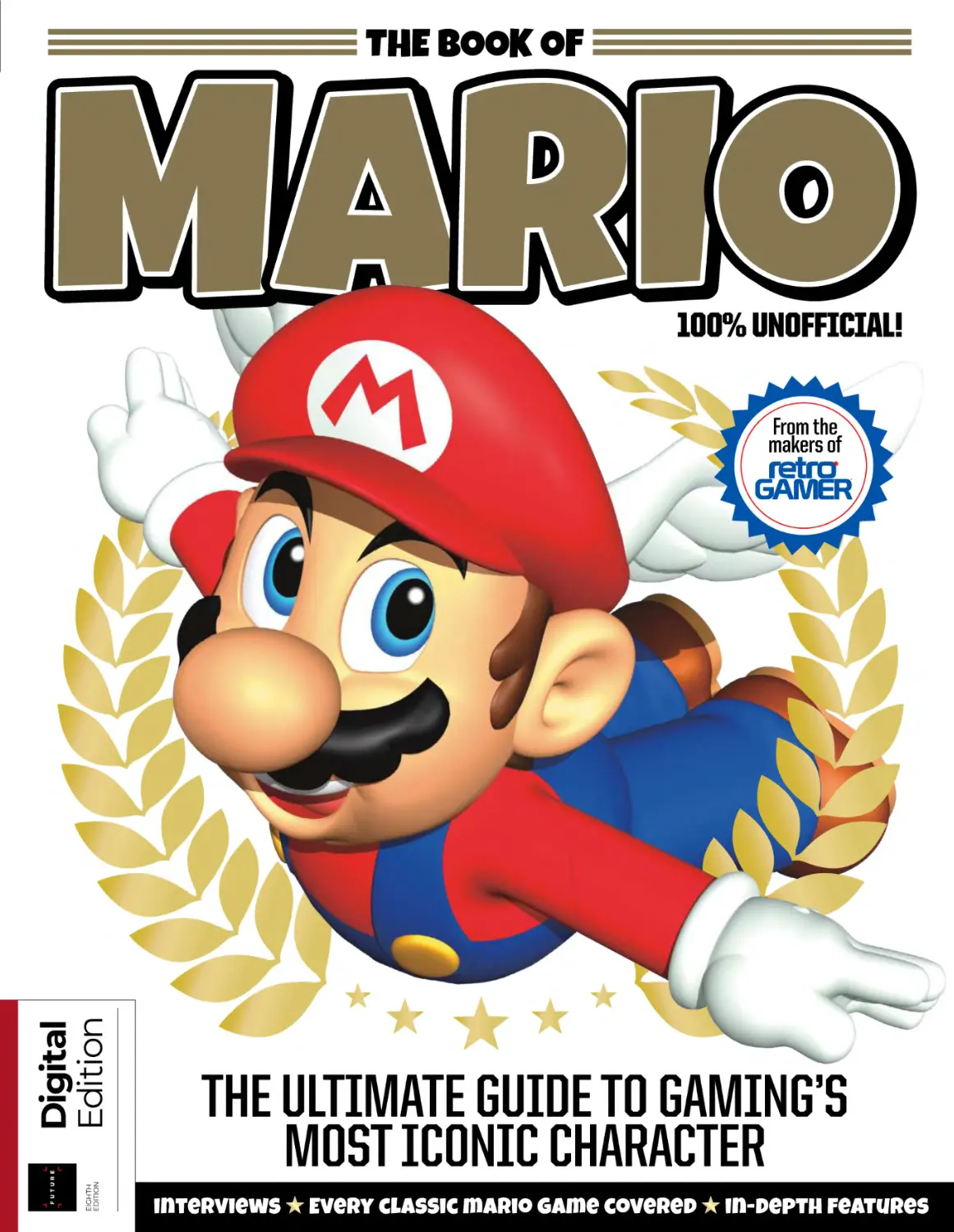
                    THE BOOK OF

100% UNOFFICIAL!

EIGHTH
EDITION

Digital
Edition

From the
makers of

THE ULTIMATE GUIDE TO GAMING’S
MOST ICONIC CHARACTER
interviews

Every classic mario game covered

in-depth features

WELCOME TO
THE BOOK OF

hen Shigeru Miyamoto created Jumpman for his new platform game,
Donkey Kong, it’s highly unlikely that he realised he was creating the
most recognisable gaming character of all time. That’s exactly what
happened though, and after a quick name change to Mario as well
as a change in job professions (he started off life as a carpenter) the
mascot to end all mascots was born. Unlike his biggest competitor, Sonic, Mario
has rarely starred in a duff platformer and while he’s not immune to the odd turkey
(Mario Is Missing, we’re looking at you) his core platforming adventures have
always been regarded as some of the best around.
Everyone remembers the first time they discovered the princess they were
rescuing was in another castle, or their first encounter with Bowser. They
remember the impact of witnessing a 3D Mario in Super Mario 64 or the time they
tore across Rainbow Road in Super Mario Kart. Even if you’re not a big fan of Mario
like us, there’s no denying the incredible impact he’s had on the games industry.
To celebrate Nintendo’s most prominent player, we’ve selected the best features
from past issues of Retro Gamer and have also added plenty of new ones that
cover every aspect of the popular character. We hope you enjoy reading it as much
as we enjoyed making it. So in the words of the big man himself: here we go!

W

THE BOOK OF

Future PLC Quay House, The Ambury, Bath, BA1 1UA

Bookazine Editorial
Editor Darran Jones
Senior Designer Adam Markiewicz
Compiled by Aiden Dalby & Madelene King
Senior Art Editor Andy Downes
Head of Art & Design Greg Whitaker
Editorial Director Jon White
Retro Gamer Editorial
Editor Darran Jones
Art Editor Andy Salter
Editorial Director Tony Mott
Group Art Director Warren Brown
Contributors
Ross Hamilton, Damien McFerran, Sam Ribbits, Drew Sleep,
Rachael Terzian, Nick Thorpe, Jon Wells
Cover images
© Nintendo
All copyrights and trademarks are recognised and respected
Advertising
Media packs are available on request
Commercial Director Clare Dove
International
Head of Print Licensing Rachel Shaw
licensing@futurenet.com
www.futurecontenthub.com
Circulation
Head of Newstrade Tim Mathers
Production
Head of Production Mark Constance
Production Project Manager Matthew Eglinton
Advertising Production Manager Joanne Crosby
Digital Editions Controller Jason Hudson
Production Managers Keely Miller, Nola Cokely,
Vivienne Calvert, Fran Twentyman
Printed in the UK
Distributed by Marketforce, 5 Churchill Place, Canary Wharf, London, E14 5HU
www.marketforce.co.uk Tel: 0203 787 9001
Book of Mario Eighth Edition (GAB4579)
© 2022 Future Publishing Limited
We are committed to only using magazine paper which is derived from
responsibly managed, certified forestry and chlorine-free manufacture. The paper in
this bookazine was sourced and produced from sustainable managed forests,
conforming to strict environmental and socioeconomic standards.
All contents © 2022 Future Publishing Limited or published under licence. All rights reserved.
No part of this magazine may be used, stored, transmitted or reproduced in any way without
the prior written permission of the publisher. Future Publishing Limited (company number
2008885) is registered in England and Wales. Registered office: Quay House, The Ambury,
Bath BA1 1UA. All information contained in this publication is for information only and is, as far
as we are aware, correct at the time of going to press. Future cannot accept any responsibility
for errors or inaccuracies in such information. You are advised to contact manufacturers and
retailers directly with regard to the price of products/services referred to in this publication. Apps
and websites mentioned in this publication are not under our control. We are not responsible for
their contents or any other changes or updates to them. This magazine is fully independent and
not affiliated in any way with the companies mentioned herein.

Future plc is a public
company quoted on the
London Stock Exchange
(symbol: FUTR)
www.futureplc.com

Chief executive Zillah Byng-Thorne
Non-executive chairman Richard Huntingford
Chief financial officer Penny Ladkin-Brand
Tel +44 (0)1225 442 244

Part of the

bookazine series

C on T e n T s
34

History of Mario
How a humble carpenter became one of
gaming’s most significant icons

FEATURES
46 The making of

Super Mario Kart

Key developers, including Shigeru
Miyamoto, reveal how an aborted sequel to
F-Zero became an international success

68 The making of

Super Mario RPG

Discover how Nintendo teamed up with
Squaresoft to make the memorable RPG

82 Nintendo’s 3D

56 Super Mario Land
Why you need to experience this amazing
Game Boy platformer

58 Mario Is Missing
Being a Mario game isn’t always a seal of
approval, as Nick Thorpe discovered…

66 Dr Mario
This puzzle game is the perfect medicine

72 The missing Marios
John Szczepaniak reveals some games
you’ve probably never heard of

80 Mario Picross

Key N64 developers reveal how Super
Mario 64 represented an exciting new era

This Game Boy puzzle game becomes very
hard to put down

Super Mario Odyssey

106 The history of

92 Super Mario Land 2:

Everything you need to know about Mario’s latest platformer, including
the best enemies to possess and the coolest moons to find

Find out how Nintendo’s paper-thin series
became a solid hit

The best bits from the classy sequel

game-changer

Paper Mario

126 The history of New
Super Mario Bros

From the DS original to the latest releases,
we chart every game in the series

MINI ARTICLES
30 Super Mario Bros

6 Golden Coins

104 Super Mario 3D Land
We revisit the 3DS’s exclusive Mario game

112 Super Mario Galaxy
Why you’ll be playing this joyous classic for
many years to come

124 Super Mario Advance
3: Yoshi’s Island

Play the incredible port of a SNES classic

All the best bits from the original NES game

132 Mario & Luigi:

32 Super Mario Bros:

The RPG that’s a match made in heaven

The Lost Levels

It might have been frustratingly hard, but it’s
still worth playing through

44 Super Mario Bros 2
How a forgotten NES game became the
newest Mario release

6 THe book of mario

8

Superstar Saga

134 Super Mario Galaxy 2
Why Nintendo’s Wii sequel is as
good as everyone says

142 Super Mario 3D World
Mario’s only Wii U adventure is unmissable

Amazing Mario moments
We ask developers to share their favourite bits from
some of the greatest Mario games of all time

CONTENTS

114

Making Mario Sunshine
Discover how Nintendo completely reinvented
Mario for his sole GameCube adventure

60

136

Super Mario Bros 3
Many consider Mario’s third NES game to be
one of his best adventures. Here’s why

74

94

Mario spin-offs
When he’s not rescuing princesses, Mario has all
sorts of other hobbies, as Nick Thorpe finds out…

Super Mario World
We speak to one of the world’s best Mario
speedrunners about Mario’s first 16-bit platformer

THe book of mario 7

TH E
T
S
E
T
A
GRE
O
I
R
A
M
R
SUPE
T
S
N
E
M
O
M

8 THE BOOK OF MARIO

THE GREATEST SUPER MARIO MOMENTS

SUPER MARIO
BROS TIMELINE
The games Nintendo considers
to be part of the series
SUPER MARIO MAKER 2

2019
SUPER MARIO ODYSSEY
2017
SUPER MARIO ODYSSEY
2017
SUPER MARIO MAKER
2015
SUPER MARIO 3D WORLD
2013
NEW SUPER MARIO BROS U
2012
NEW SUPER MARIO BROS 2
2012
SUPER MARIO 3D LAND
2011
SUPER MARIO GALAXY 2
2010
NEW SUPER MARIO
BROS WII
2009
SUPER MARIO GALAXY
2007
NEW SUPER MARIO BROS
2006
SUPER MARIO SUNSHINE
2002
SUPER MARIO 64
1996
SUPER MARIO LAND 2:
6 GOLDEN COINS
1992
SUPER MARIO WORLD
1990
SUPER MARIO LAND
1989
SUPER MARIO BROS 3
1988
SUPER MARIO BROS 2
1988
SUPER MARIO BROS:
THE LOST LEVELS
1986
SUPER MARIO BROS
1985
NINTENDO SWITCH

The Super Mario Bros series has
been defining gaming since the
Eighties. We’ve selected 30 of your
favourite moments and asked
developers to share their memories
about the evergreen franchise

NINTENDO SWITCH

NINTENDO SWITCH

NINTENDO WII U

NINTENDO WII U

NINTENDO WII U

M

ario is easily one of
gaming’s most iconic
and recognisable
figures. While he’s been
around since 1981 in the
guise of Jumpman, it wasn’t until he
became super in 1985 that gamers
really started to take notice of the
mustachioed plumber.
When Shigeru Miyamoto created
Super Mario Bros he also effectively
recreated the platformer, creating a
template that would not only shape
the later Mario games for many
years, but also platformers in general.
Nintendo would again change the
goalposts in 1996 with Super
Mario 64 and while other contenders
have come close, no current
developer is making 3D platformers
that can compete with the likes of
Super Mario Galaxy and Super Mario
3D World, in short Mario is the king
at what he does and it’s a fact that’s
unlikely to change any time soon.
But we’ve covered Mario’s history
in the past (in issue 82 no less) so for
this new book we instead wanted
to look at why the Super Mario Bros

NINTENDO 3DS

NINTENDO 3DS

NINTENDO WII

NINTENDO WII

NINTENDO WII

series is so popular with gamers.
There’s a reason why Super Mario
games have sold nearly 300 million
sales and it’s because they’re some of
the most inventive and well-designed
games of their genre. But don’t just
take our word for it, the following
moments are some of your favourites
and we’ve also persuaded a large
number of classic developers to share
their personal memories too. Here’s
to many more years of everyone’s
favourite plumber.

NINTENDO DS

GAMECUBE

NINTENDO 64

GAME BOY

SUPER NINTENDO

GAME BOY

NES

NES

NES

NES

THE BOOK OF MARIO 9

WORLD 1-1
1

Super Mario Bros

There’s nothing like your first time. As your finger jabs the rubbery
start button of the controller, the screen goes dark and you’re
presented with a title card for World 1-1. You hear those first notes
of the game’s theme – a tune that will be etched upon your memory
forever – and proceed into the first stage of Super Mario Bros.
To this day, very few first stages do as good a job of equipping the player as that
of Super Mario Bros. The game doesn’t need a wordy tutorial, because the level
design does a great job of naturally creating curiosity and teaching the player about
various game elements. All objects are placed on the right of the starting screen,
encouraging you to move forward. Blocks bearing question marks draw attention to
themselves, inviting the player to interact. The Goomba looks mean and advances
towards Mario, making a confrontation of some kind inevitable.
World 1-1 contains enough challenge to make a player feel accomplished in
victory, but is gentle enough that even a small child can finish it with a little practice.
You’ll play through it enough times to remember it by heart and learn to finish it in
under a minute, but it never gets old because this first level is Super Mario Bros.

YOUR FIRST MUSHROOM
The enticing question mark block is just begging to be
jumped at, and doing so reveals a mushroom – which
then starts moving and, when collected, makes Mario
grow into the more resilient Super Mario. It feels so
routine now, but in 1985 it was quite a surreal sight.

My favorite
is the arcade
version of [Super]
Mario Bros that I
first saw. This game
had numerous jawdropping moments
for me that nowadays
we take for granted, like a smoothly
scrolling landscape. But what really blew
me away was the moment I discovered
I could enter certain green pipes and
discover new areas. This simple feature
made the entire Mario world seem
vastly bigger and more mysterious to
me. As children we're always fascinated
by discovering caves and exploring
what's inside them, and Mario captured
that magic with the green pipes, each
of which represented the possibility of
an entirely new area to discover and
explore. After that, secret areas became
the norm in games, and I know in the
Apogee and 3D Realms games I was
involved in, we always tried to include
as many secret area as we could. All
because of Mario Bros.
SCOTT MILLER, 3D REALMS

YOUR
FIRST PIPE
JOURNEY
Speeding through World 1-1 on SMB NES and getting that first
running jump to get the full 1000 points on the flagpole, giving
the feeling that you’re off to a great start. Yeah right!
SAMHAIN81

YOUR FIRST SECRET
The best thing I've ever done is a Mario game has to be
discovering the first Warp in Super Mario Bros on the NES.
Discovering a secret vine, which then allowed me to climb outside of
the top of the level and run across the top of it was staggering. There
were five other people in the room and we were all gobsmacked to
discover the Warp Pipes. Back then, cheats and secrets felt far more
valuable than they do today.
ALEX WARD, CRITERION

10 THE BOOK OF MARIO

You might find the hidden extra life on
your first attempt at World 1-1 – it’s easy
enough to accidentally find. However, what’s
important is that you probably won’t. You can
keep discovering new things in Mario games
after you think you’ve mastered them, and
this secret is the first indication of that.

It shouldn’t come as any surprise that, as
a game creator, my reaction to a game
might be different from that of your average
game player. The early Mario games on
the NES bear this out.
My first reaction to Mario was surprise that
the game so obviously used character-mapped
background graphics. Shigeru Miyamoto made
a conscious decision to build Mario’s world
out of blocks. In doing so, he allowed for a very large world due to
memory efficiencies, but it represented a step backward in videogame
imagery. He took a big risk. As Super Mario Bros was the flagship
game franchise that everyone would associate with the NES system
itself, the risk was that gamers would consider the NES to be inferior
hardware to machines of the day providing much more realism.
As it played out, the game overcame the risks involved. Using
character-mapping the world could be much larger and the gameplay
experience more richly rewarding. Players thought of the colorful,
blocky game backgrounds as more of a fantasy art-direction than a
technical limitation, and the gameplay was the star anyway.
DAVID CRANE, ACTIVISION

YOUR FIRST FLAGPOLE
Even when your first moment of victory is in
sight, there’s one last challenge as you try to
jump to the top of the flagpole for more points.
If you’re lucky, you might even get some
fireworks after lowering the flag! It’s a smart
and iconic bit of game design.

As a plumber, it makes sense for Mario to hang
around pipes. It doesn’t make quite as much sense
for him to travel through them, but after the first
time you travel down one and find a secret cache of
coins, you’ll always check them for hidden rooms.

YOUR FIRST STAR
When a flashing star is revealed for the
first time you automatically imagine
that it’s something pretty special – and
this one doesn’t disappoint. Mario’s
temporary invincibility turns him into a
wrecking machine, capable of running
straight through his foes without fear. It’s
an amazing feeling of power.

My favourite Mario moment
comes from what I believe
was my first session playing the
game while visiting Activision when I
was working at ZZAP!64 back in late1985 or very early-1986. It had a new
imported NES and an American TV
to play it on. I'd been playing Excitebike for a while, but
then switched to Super Mario Bros, and quickly
realised that it was one of the coolest games I'd ever
played. I'd been running around for a while,
when, by sheer fluke, I discovered that if
you pulled down on the joypad while
standing on a certain pipe, Mario
was transported to a different area.
Sure, that's a standard thing these
days, but back then, the feeling of
discovery, and the realisation that
there was another world under the
one I was standing on was incredible: it
made a seriously cool game even cooler.
What more secrets were there to uncover?
My mind was blown. At a time when most
games didn't have much in the way of
hidden stuff, it really was a revelation.
What a game!
JULIAN RIGNALL, JOURNALIST

THE BOOK OF MARIO 11

GOING OUT
OF BOUNDS

AS SEEN IN: Super Mario Bros
Placing the ceiling of Super Mario Bros’ underground stages below the
HUD was a genius move on Nintendo’s part, as it makes it look like there’s
a fixed status bar. As a result, jumping out of the normal play area and running
along the top of the screen feels like you’re breaking the game – and better yet, if
you can make it past the exit pipe you’ll reach the Warp Zone.

2

FOUR WAYS TO PLAY
AS SEEN IN: Super Mario Bros. 2
Not only does Super Mario Bros 2 let you play as Mario’s friends,
it makes doing so very worthwhile as every single one has unique
characteristics. Luigi’s a bit slower and weaker than Mario, but
jumps higher. Toad has a short jump, but is fast and pulls up veggies
quickly, while Peach (or Princess Toadstool) has a unique floating jump. It
was a joy to discover which one suited you best.

3

WORKING THE SOIL

AS SEEN IN: Super Mario Bros 2

Owing to Super Mario Bros 2’s origins as a different game, the core
gameplay changes a bit from the original game. The most notable
new feature is the ability for Mario and friends to pluck items from the
dirt – usually vegetables to be thrown at enemies, but sometimes more special
items like potions that create doors into subspace or rockets that blast you to
the next part of the game. Sure, you can jump on enemies and lift them instead,
but even lobbing Shy Guys isn’t as fun as a little gardening – the little moment of
anticipation as each root is pulled makes the activity rather compulsive.

4

are all the items you can retrieve
PLUCK TALES Here
from the ground in Super Mario Bros 2

12 THE BOOK OF MARIO

In 1988,
while
working at Origin
Systems, we had a
Japanese Famicom
system and I
remember playing
Super Mario Bros 2
on it – it was really
cool to see Mario
again but with
blowing wind and leaves! It turns out this
version never made it to the US because
six months later Super Mario Bros 2 got to
the States and it was the re-skinned Doki
Doki Panic game (still awesome).
I also remember just how incredibly
difficult World 8 was in Super Mario
Bros 3. The game was incredible,
really a tour-de-force of game design,
and was perfect in almost all respects. I
finally beat it and count it as one of
the hardest games I’ve played.
JOHN ROMERO, ID SOFTWARE

THE GREATEST SUPER MARIO MOMENTS
Oh man I’m not even sure how to pick one!
I guess the first time I saw a Door Potion in
SMB2. What a supremely weird game item!
ADAM SALTSMAN, ADAM ATOMIC

My memory has to be playing Super Mario Land
on the Game Boy in 1989. This was my first Mario
game, having worked at a games shop that decided to
sell the Sega Master System – you weren’t allowed to sell
Sega AND Nintendo – I had never seen a NES. I had my
own Game Boy and this was the game I bought with it.
After my first go I became aware of how well laid out and
devious the levels were. Once I’d got used to [it] I realised
that four hours had passed. I was well and truly addicted and the various tunes
had been ingrained into my brain for all time. The game also succeeded at
getting family members, who had shown no interest in my previous machine,
the Spectrum, bopping baddies and exploring tunnels. A recent replay showed
to me that the game had lost none of its playability and still had that ‘one more
go’ factor that it had 26 years ago.
MARK R. JONES, OCEAN SOFTWARE

ACK
T
T
A
E
RIMN
A
M
B
U
S IN: Super ario Land

ra
es offe
rio gam es, staying
a
M
ld
e
ri
s handh sign of the se cing new
i Yokoi’
trodu
the de
in
Gunpe
n
o
e
op in a
il
e
h
k
ula w
ve ta
ets to h
distincti e original form -3, as Mario g
ets to
th
n. He g
d2
close to ays liked Worl ’em-up sectio s in a plane!
hoote alw
e skie
ay in a s
nics. W
ing to th
mecha
blast aw , this time tak
d
n
a
e
o
rin
subma
game to
is in the
revisit th

N
AS SEE

6

MALIGNANT MUSHROOMS
AS SEEN IN: Super Mario Bros: The Lost Levels
Some of the cleverest moments in Super Mario
Bros involve subverting the player’s expectations,
and this sequel did just that. In the original game,
every mushroom was good – in The Lost Levels, you need
to watch out for the Poison Mushrooms which damage
you like an enemy attack.

5

My favourite Mario moment is finding
the Warp Zone at the end of 1-2. You
thought you'd hacked the game! My least
favourite moment, getting to 4-1 and finding
Lakitu waiting with an inexhaustible supply
of Spiny eggs to throw at you. I doubt it's a
coincidence the two are linked.
STEVE LYCETT, SUMO DIGITAL

THE BOOK OF MARIO 13

TAKING TO THE AIR
AS SEEN IN: Super Mario Bros 3

FLIGHT
ITINERARY
After taking to the skies for the
first time, Mario decided that
the airborne life suited him…
SUPER LEAF

Super Mario Bros might have given Mario power-ups, but Super Mario
Bros 3 was the game that made us fall in love with them and the reason
was found in the very first stage. After picking up a Super Leaf, Mario gains
ears and a tail to become Raccoon Mario – not only making him cuter, but
also granting him the ability to fly! It works just as you’d expect, too. Mario
must be running at top speed before you hit jump to initiate flight, meaning that you need
a long stretch of ‘runway’ to get going. However, Raccoon Mario (and later Tanooki Mario)
can reach areas that are otherwise totally inaccessible, so you’ll try to launch whenever
possible. The ability to fly added a lot to Super Mario Bros 3, and it’s no surprise that
flight has been frequently revisited as a theme since.

7

From: Super Mario Bros 3

CAPE
From: Super Mario World

Super Mario Bros 3, the Tanooki suit. I played it for
ages thinking it was a great attacking move before
being shown by a neighbour how to fly. The rest of my
Mario 3 career was attempting to recreate this.
BITTERTOAD

WING CAP
From: Super Mario 64

F.L.U.D.D.
From: Super Mario Sunshine

BEE MUSHROOM
From: Super Mario Galaxy

COSTUME PARTY
Mario just loves to dress up – here are some of our
favourite outfits he’s donned over the years…
FIRE SUIT

HAMMER SUIT

METAL SUIT

CAPE SUIT
FROG SUIT

14 THE BOOK OF MARIO

THE GREATEST SUPER MARIO MOMENTS

MEETING
THE FAMILY
AS SEEN IN: Super Mario Bros 3
After repeatedly being bested by Mario in
the first game, Bowser learned the joys of
delegation and decided to reserve himself
as a final boss. He’s a responsible villain, though – to
ensure that Mario still had bosses to fight, he brought
in the seven Koopalings to do his dirty work for him.
We’ve got a fair amount of affection for the Koopa
kids, and we’re very pleased to see that they’ve
returned to the series in recent years.

8

When you first
fly with the
racoon tail in Super
Mario Bros 3 and
realise how much of
the game has opened
up to you.
FLYING_DELOREAN81

WHISTLE
BLOWER
AS SEEN IN: Super Mario Bros 3
Finding the warp zones in
Super Mario Bros is rewarding
but obtaining warp whistles
in Super Mario Bros 3 is even more so,
especially because so few are available
– just three in the whole game, and all
of them within the first two worlds. Our
favourite is the first. Find this white block
in World 1-3, hold down on the D-pad for
a couple of seconds, then run behind the
scenery to the end of the stage!

9

While almost impossible to pick one Mario
moment above all others, one that does hold
a very special place is my first encounter with the
Racoon (Tanooki) Suit in Super Mario Bros 3. As a
pixel pusher, the sheer joy of seeing such an iconic
character as our titular plumber suddenly in a fuzzy
onesie literally made me grin from ear to ear.
A great moment in a series of games that seldom fails to bring
back the childlike gamer in even the oldest of dinosaurs.
SIMON BUTLER, IMAGINE SOFTWARE

CAT
SUIT

TOAD HOUSE
AS SEEN IN: Super Mario Bros 3
With its new world map system, Super
opened the series up to
between-level events. While we like the
enemy encounter mini-stages, we were always much
happier to see Toad’s friendly face. Whether you were
matching cards or simply picking items from a chest,
the ability to get a quick break and stock up on items
was always most welcome.

10 Mario Bros 3

PROPELLER
SUIT

BOO SUIT

SPRING
SUIT

PROPELLER
BOX SUIT

CLOUD
SUIT

THE BOOK OF MARIO 15

THE WORLD MAP
AS SEEN IN: Super Mario World
Sure, Super Mario Bros 3 had a world map too, but
the one that guides you through Dinosaur Land in
Super Mario World is a completely different beast.
The maps in the previous game had generally
been isolated, but after you make your way off
Yoshi’s Island, you’ll get a true sense of the scale of the large,
interconnected map of Super Mario World. This is also a map that
changes and evolves as you journey through the game. Paths open
up, bridges are built, Mario ventures into caves and forests – it feels
almost alive, such is the level of activity.
The map isn’t just well-presented, though. It’s an incredibly
useful tool for making your way through the game, thanks to the
way it is set up. You can see the path you’re supposed to take, but
there’s plenty of room left spare. Luckily, you’ll soon find out that
the red and yellow dots that represent stages mean something –
the red levels have more than one exit, which gives you an idea of
how to reveal the secret levels that occupy those seemingly empty
areas of the map. But that’s all the help the map will afford you,
leaving the pleasure of discovery for the player to enjoy.

11

16 THE BOOK OF MARIO

THE GREATEST SUPER MARIO MOMENTS

SECRETS
WITHIN SECRETS
AS SEEN IN: Super Mario World
Making
it to Star
Road feels
very special – the
unusual stages and
different coloured
Yoshis certainly give
its stages a different
feel to those on the main map. However, the truly
special moment comes when you realise that the
rabbit hole goes deeper, as the Star Road stages
have their own secret exits too! If you find all
of them, you can take a trip to the super-secret
Special Stages, which will challenge Super Mario
World experts to the limit.

12

Super Mario World
and finding a secret
world within a secret world! My
poor little pre-teen brain nearly
exploded with excitement.
JOLLY

If I was to ever be stuck
on a desert island and had
one game to choose (and console,
of course) I would go with Super
Mario World and my SNES
everytime, so many memorys
attached to this game from the
first levels to the hidden secrets and even the
soundtrack to suit each stage. This could very well
be my favourite game of all time.
JON WELLS, ART EDITOR, RETRO GAMER

THE BOOK OF MARIO 17

SWITCH
PALACE
AS SEEN IN: Super Mario World
As the first game in the series to let you
revisit previously beaten stages, Super
Mario World had to have a compelling
reason to bring you back. The Switch Palaces are just
that reason – when you find one, not only do you get
to enjoy a room full of coins, you activate new blocks
in old stages. These open up previously inaccessible
paths, changing levels you thought you knew.

13

As with many others, my favourite Mario Moment is from Super Mario World. It’s the
first time you entered an underground cave, and specifically how the soundtrack and
effects went all echo-y. Don’t ask me why that should’ve stayed with me above something
as spectacular as the opening of Mario 64. I just remember it feeling really clever, that
they’d thought about using audio to provide a sense of space and place… and that the SNES
was able to pull it off. It was the moment that I knew I’d spent my money wisely, and was
the start of my love affair with Nintendo. PAUL ‘MR BIFFO’ ROSE, DIGITISER 2000

MEETING YOSHI
AS SEEN IN: Super Mario World
The first time you see Yoshi hatch from an egg, you can tell
immediately that he’s going to be one of Mario’s most popular
allies. This cute green dinosaur might not look at home with
the cast of Jurassic Park, but he’s a fearsome force, able to swallow many
enemies whole and spit them out as projectile attacks. Not only that,
but he shields you, gives you the ability to perform a double-jump, and
adds an excellent bongo track to the music.

14

KOOPA
BOWLING
AS SEEN IN: Super Mario World
We can’t help but love the
beginning of Yoshi’s Island 2.
What can you do with one red
shell and a whole row of Koopa Troopers?
Pick up the shell, bowl the baddies over
and earn a boatload of points, as well as a
bonus life. Fantastic.

15

18 THE BOOK OF MARIO

One of the first
levels in Super
Mario World where you
launch a Koopa shell through
about eight other Koopas.
That never gets old.
TIM FITCHES

GHOST BUSTING
AS SEEN IN: Super Mario World
Ghost Houses give you a break from
action platforming, instead showing the
versatility of the Mario formula by providing
players with a mental challenge. From doors hidden
behind unbreakable blocks to stages that seem to
endlessly loop, the Ghost Houses throw all kinds of
unusual challenges at you. Typically, the nature of the
brainteasers means that you’ll be more threatened
by the clock than the slow-moving, shy Boos that
populate these stages.

16

I could tell you of
the time I completed
Super Mario World on the
Super Famicom. It was
entirely in Japanese, which
meant I didn’t know you
could throw shells straight
up in the air. That resulted
in me having to go and get a cape, then make it
all the way through the last level without getting
hit. On the final screen, things got really tricky.
You had to get a Koopa to drop at one side of
the screen whilst you made it to the other. Then
there was just enough room to run and get up
to flight speed, at which point you had to jump
and, on the way up, hit the Koopa and grab his
shell at the same time. Then you could sail over
the top of Bowser and drop the shell on him
as normal. Rinse, repeat. Without getting hit otherwise you’d lose your cape and have to go
back to the previous level…
ALEX TROWERS, BULLFROG

THE BOOK OF MARIO 19

MARIO’S DARK SHADOW
AS SEEN IN: Super Mario Land 2: 6 Golden Coins
While meeting Wario is one of the franchise’s most understated
moments, it’s nevertheless an important one, even if players didn’t
really know it at the time. When you first encounter him in Super
Mario Land 2 it’s as a solid antagonist for the popular plumber, with
the portly villain effortlessly standing in for Bowser. He crops up again
in several other games, only to become the main protagonist in Super Mario Land 3.
He then goes on to completely reinvent the mini-game genre with the excellent
WarioWare series, while continually hassling Mario is numerous adventures, both
platformers and otherwise. What a cad.

17

IT’S A ME!
MARIO!
AS SEEN IN: Super Mario 64
It’s easy to forget just what
an impact Mario made when
he appeared on Nintendo’s
64-bit system. After 11 years
of 2D adventures with the
lovable plumber, here he was in full 3D and
he looked fantastic. Simply watching Mario
follow your cursor around with his eyes was
a treat enough upon loading the game, but
the real magic came when you realised that
you could use that disembodied glove to
actually pull at Mario himself, twisting him
into all sorts of hilarious positions. It’s the
first of many unforgettable moments that
would help transform Super Mario 64 into
one of the greatest platformers of all time.

18

The first time I
played Mario 64 it
just felt so revolutionary –
Nintendo did such a great
job of making the jump
to 3D. Mario’s control felt
amazing – you could have
fun just running around,
sliding and jumping. It was
just the perfect game to
launch the N64 with – it
looked, sounded and
played great.
JOHN PEGG, RARE

20 THE BOOK OF MARIO

It was late 1996, and a
couple of us had bought
Mario 64 on import for our N64
consoles and we challenged each
other to see how fast we could beat
the game. It ended up being about
three weeks for me. Anyway, I'd
been playing it for a few hours at a time and in the
early hours, one night with lights off, I was really 'in
the zone', swimming Mario through an underwater
cavern and he ran out of oxygen. He had a very
poignant death animation, where he spluttered and
then floated limp and lifelessly towards the surface
with the camera pulling away from him. It was so
sad, I almost cried. I was so emotionally connected
to him and his quest. It was a very upsetting and
emotional moment. It reminded me of the fact that
even whilst the graphics are obviously cartoony and
stylised, much like Snow White and Woody from Toy
Story, it’s possible to create fictional characters with
really empathy and whilst we've all seen that with
animated characters in films, it was the first time I'd
felt it for a game character.
ANDREW OLIVER, BLITZ GAMES

THE GREATEST SUPER MARIO MOMENTS

It’s an interesting question, and there have been so many great moments in the
Mario games that choosing one of them seems arbitrary and unfair to the others.
For me, the real high point was those first few moments of playing Super Mario 64.
Entering the third dimension, enjoying the intuitive controls. Running around
outside the castle, seeing it all in 3D for the first time, trying out the different kinds of
jumps, birds flying from trees as you climbed them. Realising that they had got so much
so right on their first attempt and that it was going to be a great game to play. I can’t think
of another moment like that.
STEVE ELLIS, RARE

The first is the
snow section on
Super Mario 64. There are
penguins around and the
atmosphere of that whole
area is top-notch. To cap it
all, there is the ice racing
section in there that is
really a fun break from
the jumping mechanic.
STEVE WETHERILL,
ODIN SOFTWARE

MISSION MARIO
19
AS SEEN IN: Super Mario 64

Super Mario 64 was a game changer. It not only redefined platformers
for years to come, but also delivered a fresh new take on Mario’s
11-year-old formula. It was magical enough to simply leap through
a painting and discover an exciting new world within it, but Super
Mario 64’s unique missions left an equally memorable impact, giving
structure to the game and a sense of place that hadn’t been in earlier games. The
core mechanics were still there, but now you were racing penguins down slides,
launching yourself into the ether in search of goodies and reuniting snowmen with
their missing heads. In short you were having the time of your life.

THE BOOK OF MARIO 21

The shock when you jump at
pictures and are transformed
into a new area the picture ripples as
BRIAN HEAPS
you leap though

BOWSER BY THE TAIL
AS SEEN IN: Super Mario 64
There are few moments in Super Mario 64 — or any Mario game for that matter
— that are as satisfying as your first encounter with Bowser. While he was always
challenging in earlier games, he was never as menacing as he was in Super
Mario 64. Being rendered in 3D not only made him imposing, but also gave a
better indication of just how big the king of Koopas actually was. A further nice
touch comes from the camera that shakes with every gigantic pound of Bowser’s feet.
Still, the bigger they are the harder they fall and in Super Mario 64, Bowser falls very hard
indeed. Initially he seems too powerful, thanks to his imposing size and the gigantic gouts of
flame that he can spew out at will, but your 3D incarnation of Mario is super agile and before long
you’re able to confound the beast and get behind him.
Grabbing hold of Bowser’s tail you slowly start swinging the surprised king, faster and faster,
until he becomes a whirling dervish of green and yellow. “So long, dear Bowser,” shouts Mario
as he sends the king hurtling towards the mines that litter the stage. Four collisions later and the
Kooper King is suitably cowed, leaving behind a gigantic key so Mario can continue his adventure.

20

Mario 64. For me this was the
first Mario game that really
drew me into Mario’s life perhaps
because it was the first time the
player actually got to feel as though
there actually was a ‘Mario World’
somewhere in that machine.
When Mario 64 was released I think there were a lot
of ‘dark’ and gloomy games that were becoming more
and more popular, utilising 3D to create shooters. But
playing Mario 64 was a refreshing change, and showed
us that games didn’t have to be all Doom and gloom
to be cool. It was such a cool game and inspired many
others, myself included. I think that the feel of Mario 64
inspired myself and a lot of the artists at Rare If you
take a look at Banjo-Kazooie and Diddy Kong Racing, it’s
clear to see what we’d all been playing!
KEVIN BAYLISS, PLAYTONIC

Playing Mario 64 for the first time
wandering around the castle grounds,
getting a feel for the analogue stick. Is there
anyone who wasn’t blown away by that?
DEATH’S HEAD

22 THE BOOK OF MARIO

THE GREATEST SUPER MARIO MOMENTS

I played
Mario 64
in Japanese, on
import before it
was released in
Europe. My most
surprising moment
was seeing someone else playing it in
English some six months or so later.
I was horrified how much description
there was on how to find each Star –
I had assumed this was some sort of
story text. I had spent ages trying to
find the last few stars!
DAVID BRABEN, FRONTIER

THE BIGGER THEY COME…
AS SEEN IN: Super Mario 64
Although Shigeru Miyamoto had already dabbled with size
distortion in Super Mario Bros 3, it made a far bigger impact with
the debut of Tiny-Huge Island. Unlike the other worlds of Super
Mario 64, Tiny-Huge Island could be approached from two start
points. One had Mario miniaturised, making the avoidance of piranha plants and
goombas even more perilous, while the other turned the tables. Amazingly,
despite the huge size difference, teeny weeny monsters would attack Mario
with ferocious tenacity, making it even more satisfying when you mashed
them underfoot with virtually no effort at all.

21

I detested Mario when it first came out, the only Mario
game I actually had any affinity with was Mario 64,
I loved it, loved the look of it, loved the controls all
of it. Running in 3D, Mario tilting ever so slightly as he ran,
something GTA IV introduced to ‘modern’ gamers back in
2008. It was brilliant, but that’s really my first and last love
of things Mario.
STEWART GILRAY, JUST ADD WATER

THE BOOK OF MARIO 23

MASTERING
FLUDD

AS SEEN IN: Super Mario Sunshine

It’s fair to say that a genre-defining game like Super Mario 64 would be a
particularly hard act to follow – just how do you make a sequel to one of
the best games of all time? If you’re Nintendo, you take the game in a
new direction with the use of a versatile gadget. Whether he’s cleaning
graffiti off the walls of Isle Delfino or blasting the plaque off the teeth of an angry eel,
Mario spends most of his time in the game using FLUDD.
The water-powered gadget initially serves Mario as an eco-friendly weapon, but
by the end of the game you’ll have encountered different nozzles which allow him to
hover, blast into the air and run at speeds that would challenge even a certain blue
hedgehog. These abilities allowed us to fling Mario around Delfino Island with the kind
of speed and style we’d never had access to before.

22

Although I’d played Super Mario World and Mario 64
to their absolute limit, Super Mario Sunshine was the
first in the series that I wanted to explore for all its worth. It had
the three-dimensional splendour of Mario 64, plus the design
intricacies of Super Mario World. Wherever I took Mario, I was
usually rewarded, constantly memorising cool routes through the
maps, practicing for coin runs at speed or to gain access to the
next secret area. I can still remember where I found my final Blue Coin; it was such a
moment of triumph. When I discovered that Yoshi was in there too, I was completely
in love. While Super Mario Galaxy showed more overtly that Nintendo could still
conceive whacky concepts that are fun for all to enjoy, in Super Mario Sunshine it
proved that it was matchless for creating impeccably produced, masterfully designed
worlds that came alive in the player’s hands. PAUL DAVIES, JOURNALIST

HOVER NOZZLE

SQUIRT NOZZLE

TURBO NOZZLE

ROCKET NOZZLE

■ With powerful twin jets of water, Mario can

■ A versatile attachment used for cleaning up

■ If you’ve ever seen someone using a fire

■ If you need to reach high places and Mario’s

sustain mid-air flight for a few seconds. Not
only does that let him cover gaps, it’s also
perfect for cleaning from above.

graffiti, shooting at enemies, putting out fires
and all manner of other tasks which require
you to squirt water at things.

extinguisher to propel themselves, you’ll
know what’s coming here – Mario uses a
jetstream to sprint at high speeds.

little legs won’t push him far enough, one
high-pressure blast of water will send you
soaring into the stratosphere.

24 THE BOOK OF MARIO

THE GREATEST SUPER MARIO MOMENTS

My moment
comes from
Mario Sunshine where
you’re going about
your merry way then
Shadow Mario comes
out from the ether
and pinches your FLUDD just before
you enter a level. I spent ages trying to
beat that hidden level which is set in a
void that exists somewhere Mario 64
and Sunshine. I did finish it in the end,
my palms were sweaty, my heart was
beating and my GameCube controller
was never the same… DREW SLEEP,
PRODUCTION EDITOR, RETRO GAMER

MEGA
MUSHROOM!
AS SEEN IN: New Super Mario Bros
Check any expectations of subtlety at the door – when
Mario gets hold of a Mega Mushroom, he becomes so
large that there’s only one reasonable course of action.
In case you hadn’t guessed, that means going on an
unstoppable rampage. Invincibility stars are great, but they just let you
take out enemies. Mega Mario can smash through everything in his
path, from enemies to scenery objects like blocks and pipes.
Of course, being Mega Mario doesn’t just
feel great. There are some great touches to
this too – for example, if you reach the end
of a stage as Mega Mario, you can knock
down the flagpole. Mario then looks back at
it sheepishly. Even better, you’re rewarded
with extra lives for smashing objects.

23

My first home
computer
encounter with Mario was
in Donkey Kong on the
Dragon 32, which was the
first game I saw on that
machine in two-colour
320x200 mode, which was hi-definition of
the day. Apart from the lack of colour it
behaved as the arcade original, which
probably persuaded me that the Dragon 32
could do the job and led us to choose it as
our second platform to code on after the
ZX Spectrum. My Dragon 32 conversions
of Steve Turner’s first three games were all
done in that graphics mode.
So you could say that Mario himself
put me on the course to programming,
without either of us knowing it.
ANDREW BRAYBROOK, GRAFTGOLD

THE BOOK OF MARIO 25

OOPS UPSIDE
YOUR HEAD
AS SEEN IN: Super Mario Galaxy
Having accidentally mastered the 3D platformer
on its first attempt, Nintendo left itself a mountain
to climb with each and every follow-up to Super
Mario 64. Initial fears that Galaxy might fall into that
oh-so-common Wii trap of abusing gimmicky controls and suffering
as a result were allayed upon finally taking the game for a spin,
where we discovered a totally different kind of gimmick – one that
actually worked. Jumping mechanics are so integral to the Mario
experience that relearning how these functioned in full 3D space
when each planetoid had its own gravitational pull made for a stellar
experience that could keep even platforming veterans on their toes.

24

Wind the clock
back to 2010 and
I’ll be totally engrossed in
Super Mario Galaxy, but
this time I’m watching in
amazement as my young
son somehow masters using the Wiimote
and Nunchuk and solving the puzzles in
double quick time, yet he’s to young to
be able to read the screen menus and
messages, so I say them out loud for
him. Real father and son bonding stuff!
He played it for months and months, and
still does occasionally.
ARCHER MACLEAN,
AWESOME STUDIOS

MULTIPLAYER MADNESS
AS SEEN IN: New Super Mario Bros Wii
Although previous Mario games had dabbled with multiplayer
shenanigans, it wasn’t until 2009 that Nintendo really
perfected the formulae, allowing four friends to work together
to complete the cleverly designed levels that Nintendo had
crafted. Despite the cooperative-based gameplay there were still time
for arguments as characters were unable to share each other’s spaces,
meaning it was all too possible to accidentally knock a friend off a ledge to
their doom. Did we say accidentally? Sorry, we meant purposely.
The inclusion of additional players does highlight the fact that later Mario
games seem to be rarely designed around them, but anyone who has
chased another player around the screen so that they can knock them into a
whole in the bottom of the screen is highly unlikely to care.

25

Early on in
Super Mario
Galaxy ’s Good Egg Galaxy,
there’s a capsule-shaped
planet with a glass
exterior. The genius of
the game’s design became clear when
I smashed my way inside to find a 2D
challenge on a rotating stage, complete
with gravity shifts. Up until that point,
I’d thought it was just another good 3D
Mario game – afterwards, I realised it
was simply revolutionary.
NICK THORPE, SENIOR STAFF
WRITER, RETRO GAMER

26 THE BOOK OF MARIO

THE GREATEST SUPER MARIO MOMENTS

They’re all great! I love them all. But
actually, the very first game is the most
important to me. I played it at a time when I
was still unemployed, before starting out
somewhere. Playing this, I realised for the
first time, ‘Oh, there is a game industry.
This is something I could realise being
creative, and actually conceive works of art.’ Super Mario
Bros. would be my favourite because it actually pushed me into
this industry. Otherwise, possibly, without this I wouldn’t even
have ended up there.
KEIJI INAFUNE, CAPCOM

MARIO
THROUGH
THE AGES

WHO NEEDS
BOWSER?
AS SEEN IN: Super Mario Galaxy 2
While it seemingly made use of a lot of the
same assets as the original and didn’t mess with
the near-perfect formula too much, Galaxy 2
still found ways to innovate and impress, to
the point where some would cite it as the better of the two
games. It clearly has spectacle on its side – returning players
wouldn’t get the same sense of freshness from another set
of relatively simple levels like those of the first game – and
this comes to the fore in some of the incredible boss fights.
Mario bosses don’t tend to be all that great but the Gobblegut
showdown is wonderful, the spherical battlefield evolving as
he chews through the planet as the fight draws on.

26

■ SUPER
MARIO BROS
■ SUPER
MARIO BROS 2
■ SUPER
MARIO BROS 3
■ SUPER
MARIO LAND
■ SUPER
MARIO WORLD
■ SUPER
MARIO LAND 2
■ SUPER
MARIO 64
■ SUPER MARIO
SUNSHINE
■ NEW SUPER
MARIO BROS.
■ SUPER MARIO
GALAXY
■ NEW SUPER
MARIO BROS. Wii
■ SUPER MARIO
GALAXY 2
■ SUPER MARIO
3D LAND
■ NEW SUPER
MARIO BROS. 2
■ NEW SUPER
MARIO BROS. U
■ SUPER MARIO
3D WORLD
■ SUPER MARIO
MAKER
■ SUPER MARIO
ODYSSEY
THE BOOK OF MARIO 27

AN ALL-NEW PERSPECTIVE
AS SEEN IN: Super Mario 3D Land
Having miraculously mastered the art of 3D level design on its
first attempt, Nintendo never had us worried about that aspect
of 3D Land. But the 3DS’ primary gimmick did, mainly because
we remember the sea of early DS releases that were ruined
by attempts to utilize novelty hardware features. To this day, though, 3D
Land remains the only game that uses the handheld’s illusion of depth on a
gameplay level, with puzzle rooms playing cunning tricks with 3D space. Even
elsewhere, though, 3D offered some great moments, really giving a sense of
height and depth to moments like this death-defying drop.

27

My favorite moment, honestly, is the fun we all had
in the arcades playing Donkey Kong, and how we
all helped the heroic little plumber outsmart the formerlyeponymous monkey and steal the brand. My second favorite
moment is every time I hear a sound effect that I know had its
origin with Mario. Mario forever!
TRIP HAWKINS, ELECTRONIC ARTS

THE CRAZY
COIN BOOST
AS SEEN IN: New Super Mario Bros U
Mario games have long been the careful,
considered other side of the coin to Sonic’s
high-speed hijinks, but a new mode would
look to address this long-standing difference in
opinion between the two rivals. Boost Rush was the result
of Mario realizing that maybe he did have to go fast after
all, auto-scrolling stages speeding up the more you lined
your pockets with gold. It felt a little like a mobile title – autorunners are everywhere these days – but with the polish and
production values you’d expect from Nintendo, proving that
the developer wasn’t nearly as out of touch with modern
gaming as its critics might claim.

28

28 THE BOOK OF MARIO

THE GREATEST SUPER MARIO MOMENTS

SO MANY COINS…
SO LITTLE TIME…
AS SEEN IN: New Super Mario Bros 2
The fact that you can make it through most classic Mario
stages without collecting more than a few coins would
suggest to us that the mascot wasn’t in it for the money,
but New Super Mario Bros 2 flipped that notion on its head,
and as a result made us look at Mario’s currency in a whole new light.
Here, the very point of the game is to rack up an insane balance and in
a single level, you could easily bag as many coins as you likely would
in an entire playthrough of one of the older games. There’s something
completely mesmerising about seeing levels awash with those dinky
yellow coins and it became even more enticing when you were playing
with a second player.
Suddenly a brand new game mechanic introduced a highly
competitive element to the series that was not only incredibly fun, but
also helped hide the fact that Nintendo’s 3DS-based sequel wasn’t quite
as impressive as the excellent handheld platformer that had proceeded
it. The novelty of collecting all those coins was somewhat short-lived,
it must by said, but the initial excitement of seeing money everywhere
was still a welcome change of pace for the series and one of the
highlights of Nintendo’s portable sequel.

29

THE HELPFUL
GHOSTS
AS SEEN IN: Super Mario 3D World
As games grow increasingly complex, their
secrets naturally get harder and harder to find.
But in its hugely entertaining ghost replay
feature, this Wii U stunner found as strong an
answer to this issue as Wonder Guide was for that of rising
difficulty. As you explore, you’ll see the routes taken by other
players happening around you. Some may lead you to hidden
items or areas, others to shortcuts that help shave precious
seconds off your best level times and, even more basic, it
allowed for oddly addictive asynchronous multiplayer as you
race against others who may not even be online.

30

I've always enjoyed the
Mario games, but it's 3D
World which has become my
favourite. My family absolutely
loves cats, and Super Mario 3D
World 's Cat Suit ensured that
both my children and wife would
participate in multiplayer games. Initially the
Cat Suit comes across as a bit of a gimmick, but
you soon realise just how versatile it is. It begs
you to explore the world as it allows you to cling
to and climb walls that you otherwise couldn't
access, opening up the seemingly linear levels
and proving just how clever Nintendo's design
still is. It might be a little chaotic playing Mario
games multiplayer, but there's no denying that
they're also a lot of fun.
DARRAN JONES, EDITOR, RETRO GAMER

WHAT
NEXT?
Who knows what magical
moments are going to
be around the corner for
Mario? Super Mario Maker
allowed you to make your
own stages, while the
ability to possess enemies
in Super Mario Odyssey
led to all sorts of crazy
shenanigans. It’s safe to
say that later games are
going to be just as much
fun as the earlier ones.

THE BOOK OF MARIO 29

CLASSIC MOMENTS

Super Mario Bros
» Platform: NES » DeveloPer: NINTENDO » releaseD: 1985

our trek through the first few stages of Super Mario
Bros has taught you the basics – there are stages
above ground and stages underground. There are
Koopas and Goombas trying to get you, and if you fall
down a hole, you’re dead. But stage 1-4 is altogether different
– the large castle is far more dangerous, filled with pits of lava
and spinning fire barriers. Even the music suggests that this
place is not to be trifled with. As you make progress through
the stage, fireballs start to shoot in from the right of the screen.
Finally, you meet your nemesis for the first time, Bowser.
He’s a formidable foe – much larger than the standard-issue
grunts, and his jumps and fireballs are harder to predict. You
try to jump on him to no avail, and the second encounter ends
with a flame-grilled Mario. But the third time you notice the
glowing axe behind the fiend and jump over him, destroying the
bridge and claiming victory. Nice work!

Y

BIO
Mario Bros had been a reasonably
popular arcade game, but Super
Mario Bros was such a thorough
evolution that it left the older game
in the dirt. Single-screen platforming
was replaced with lengthy scrolling
assault courses, taking place in a
variety of locations including above
ground, on bridges, underwater,
underground and a fiendish castle.
New enemies and end-of-level
bosses provided challenge, and a
catchy theme tune would lodge itself
in pop culture for decades to come.
This was the single best reason
to buy a NES during its overseas
launch, and remains an iconic classic
that is still enjoyable to play today.

30 THE book of mario

CLASSIC MOMENTS: SUPER MARIO BROS

MORE SUPER MARIO
BROS MOMENTS
Knock ‘Em Down
The first time you jump on a
Koopa, you’ll notice that its shell
is left behind – and if you run into
it, it’ll be kicked away. But what
is super satisfying is when you
realise that the shell has been
weaponised. If you sprint after it
you can see it taking out rows of enemies in succession, racking
up increasing points combos.

A Brief Dip
You might think you’ve seen
everything after the first world of
Super Mario Bros, but you’d be
mistaken. Instead of emerging in
the familiar underground, Mario
enters a pipe only to splash
down into the sea. Marauding
fish and squids are a danger to our portly plumber, but if he’s
got a fire flower he can still use it – yes, underwater!

Jaws Of Death
This one is a feat of pixel-perfect
platforming. When running at
full speed, Mario can jump right
over a pipe with a Piranha Plant
extending out of the top if he
leaves the ground at just the
right spot – he’ll ever so slightly
overlap with the plant’s sprite, but emerge unscathed. You’ll
probably learn this skill running from Lakitu in World 4-1.

Warp Zone
Sometimes, skipping levels
feels a bit like, well… cheating.
But Super Mario Bros brilliantly
incorporates its Warp Zone into
the game design, only letting you
go as far as the developers want
– sometimes a few levels ahead,
sometimes just one. It’s a secret and you still feel pleased
to have discovered it, but only because Miyamoto and the
Nintendo team wanted you to.

THE book of mario 31

3232| RETRO
GAMER
THE book
of mario

RETROREVIVAL

Super Mario Bros:
The Lost Levels
» RETROREVIVAL

THE DARK SOULS OF MY YOUTH
» FAMICOM DISK SYSTEM
» 1986 » NINTENDO

World 1-1 in the original
Super Mario Bros is a
masterclass in level design.
It teaches you all you need to
know about the game, from how to squash
Goombas to jumping as high as you can to
reach the end-of-level flag.
World 1-1 in Super Mario Bros: The Lost
Levels does something similar, but with a twist.
It’s an unforgiving gauntlet showcasing that the
game’s infamy is true: it’s hard as balls. The first
power-up is hidden in a brick block, and must
be dexterously bounced so Mario can grab it.
The second pick-up, the Poison Mushroom,
subverts the whole power-up concept, hurting
the little plumber rather than making him grow.
The rest of the level is a demonstration that
the developers weren’t interested in crafting
a gentle difficulty curve. Dastardly enemy
placement demands pixel-perfect jumping, and
some of the other power-ups are cruelly placed
– one Mushroom baits you to grab it midair over
a gap, killing Mario’s momentum and making
him plunge into the chasm.

Suffice to say, as a youngster I never got
far in The Lost Levels, and gave up on it pretty
instantaneously, favouring to just go back to the
original Super Mario Bros in defeat.
Today, with modern ‘difficult’ games such
as Dark Souls and Meat Boy under my belt,
I decided to return to correct my shame. I
wanted to set the record straight and prove to
myself that my skills as a gamer have grown in
the 20-odd years since I last encountered the
Level One From Hell. Of course, it still kicks my
ass. I plugged away at the Lost Levels’ World
1-1 for about two hours before I eventually
snatched that end-of-level flag, my palms
sweaty and my mouth full of words so profane
my ancestors were spinning in their tombs.
It’s a bittersweet victory though, because
soon after I had vanquished 1-1, World 1-2
reared its ugly underground head. Then 1-3
came with its awful falling platforms, yet 1-4,
despite being a Bowser level, is a surprising
cakewalk. World 2, however, made me do
something I hadn’t done in two decades – I
rage-quitted out. Well, some things never
change, eh? Maybe when I’m in my sixties, I’ll
finally rescue Peach…

RETRO
GAMER33| 33
THE book
of mario

The Complete History of Mario
To celebrate Nintendo’s most
popular mascot, Retro Gamer asks
reknowned industry legends to offer
up their memories of the character
and gives you the complete lowdown
on the plumber’s career from Popeye
replacement to cultural icon
34 THE BOOK OF MARIO

MR VIDEOGAME: THE COMPLETE HISTORY OF MARIO

T

Super Mario highlights

o fully appreciate why Mario is still
the videogame industry’s most
recognised, popular and enduring
character, you have to look back to the early
days of videogames. Mario remains the poster
child for a time where everything about them
felt fresh, innovative and new, and these
newfangled virtual worlds sought only to be
linked to ours through the computers and
consoles that projected them and the
talented visionaries who imagined them.
With realism and trends now sitting
where fun and creativity once ruled,
today’s industry is looking a much
different place to one that Nintendo
was helping to rebuild way back in
the Eighties.
With every familiar-looking sandbox
RPG-lite shooter that finds release,
it becomes ever apparent that
this industry has, in many ways,
started to fold in on itself. The
insane budgets required to build
the games of today mean that now
only a small handful of developers and
publishers have the financial means
to call the shots, game genres seem
to be melding together, and despite
now being able to utilise gazillions of
colours, games are looking a little less
colourful. Why the Wii currently stands as
the triumphant console of this generation,
and Super Mario Galaxy 2 has scooped universal
acclaim, should be obvious to anyone who enjoyed
playing videogames throughout the Eighties and
Nineties. Nintendo has proven, once again, that fun
and creativity are king.
It’s for this reason why most gamers can instantly
recall the first time they ever saw Mario in action.
He takes them back to an evergreen era for
videogames, a time with which he has now become
synonymous. For many of you reading this, we
suspect that your first experience came from playing
Donkey Kong in arcades, or on home computers
and consoles. At this inaugural point in his career,
Mario was known by the more literal-sounding
name of Jumpman, played a bit of an antihero, and
worked as a carpenter instead of the heroic plumber
we all know him as today. However, while Mario’s
personality, name and occupation would come to
change quite quickly following his gaming debut in
1981, the distinct look of the character was settled
on almost immediately by his creator, Shigeru
Miyamoto, and has only really ever been refined,
never changed, over the years.
As was the practice in the early days of game
design, Mario was borne out from the technical
limitations of his time. The character was given his
signature flat cap owing to the fact that it would save
Miyamoto the headache of animating hair, a large
nose to make him look instantly more human, bright
red coveralls to help him stand out against Donkey
Kong’s dark backgrounds, and a moustache
instead of a mouth for similar reasons. But
Mario’s creation also came about through an

1985
SUPER
MARIO
BROS

1986
SUPER
MARIO
BROS
THE LOST
LEVELS

1988
(USA)
SUPER
MARIO
BROS 2

1988
SUPER
MARIO
BROS 3

1989
SUPER
MARIO
LAND

1990
SUPER
MARIO
WORLD

1992
SUPER
MARIO
LAND 2:
6 GOLDEN
COINS

1995
SUPER MARIO
WORLD 2:
YOSHIS
ISLAND

1996
SUPER
MARIO 64

2002
SUPER
MARIO
SUNSHINE

2006
NEW
SUPER
MARIO
BROS

2007
SUPER
MARIO
GALAXY

2009
NEW
SUPER
MARIO
BROS WII

2010
SUPER
MARIO
GALAXY 2

THE BOOK OF MARIO 35

MARIO MEMORIES

Professions
of a Plumber
The versatile hero has appeared in a string of
occupational cameos for Nintendo over the years…
Carpenter
Donkey Kong 1981
■ Mario’s first ever job was as
a mallet-wielding carpenter in
Donkey Kong. It’s likely that his
profession was inspired by the
everyman-type scenarios on
which Nintendo based many
of its Game & Watch titles.

Plumber
Mario Bros 1983
■ After a two-year stint
working as a carpenter,
Mario turned his talents to
plumbing – as well as the odd
bit of pest extermination too
– for Mario Bros. He kept the
role for the subsequent Super
Mario Bros series.

Jim Bagley
Classic Spectrum coder
I first saw Mario in the
local arcade halls in New
Brighton roughly around
1981 when Donkey Kong
was released. Donkey
Kong is and always will
be a classic, and a great game to boot, but I can’t
help but admire so many other Mario games.
Super Mario Bros is another fantastic Mario game
that even to this day I like to play – even though
my nephew completed it before I did! And what
favourite Mario list would be complete without
Mario Kart? I loved the N64 version the most,
because my nephew, niece, sister and I used to
play it at the weekends with riotous laughter,
especially when zapping someone on
the jump in Wario Stadium. And I can’t
go without saying New Super Mario
John Carmack
Bros. I also loved it, again, because of the
original features, like being able to grow
Co-Founder id Software
huge and sprint through the level. Out
I have followed Mario since
of those four, those being my favourites,
the Donkey Kong days, and
if I had to choose one… I’m not sure I
id Software was pretty
can! They all have a huge place in my
much launched on the
heart. Why has Mario remained so
merits of an internal clone
enduring? Well because he’s constantly
of Super Mario Bros 3. I
re-inventing himself, changing with
was away for a while after Super Mario 64, but
the times, and because Shigeru
the last few years with my son have brought me
Miyamoto is simply a genius.
back into the fold – we just collected our 66th
star on Super Mario Galaxy 2 last night, and we
have gone back through all the old games. Still
fun after all these years. Domo arigato,
Miyamoto-san!

Kevin Toms
Umpire

Creator of
Football Manager

Tennis 1984
■ Mario earned extra cash at
weekends working as a tennis
umpire. Later in life he decided
to take up the sport himself
when he realised that more
money was to be had playing
than interfering.

Referee

I remember my first
recollection of Mario being
on the original Nintendo
cartridge machine. Squat,
cute character, red hat
comes to mind. Probably I would go for Mario
Kart on the Nintendo 64 as my Mario game. His
lasting appeal is down to the personality he puts
across: an upbeat, likable, jolly man. Most people
would get on with someone like that. So
he annoys no one!

» Hudson Soft released two peculiar variants
of Mario Bros for Japanese home computers.

Punch-Out!! 1987
■ Following a successful
spell as a tennis umpire, Mario
caught the eye of the Nintendo
Boxing Commission and was
approached to work as a
referee in the Famicom/NES
version of Punch-Out!!.

Doctor
Dr Mario 1990
■ Making a mint working as a
boxing ref, Mario left labouring
to go to medical school. It
took him just two years
to complete his doctorate
– earning him a place in
Guinness World Records.

Golfer
NES Open
Tournament Golf 1991
■ Like most doctors, Mario
found that the best way to
relax after a busy day in
surgery was to smash a ball
into a tiny hole.

36 THE BOOK OF MARIO

» The original SMB still plays
great today . We should know –
we played it yesterday.

MR VIDEOGAME: THE COMPLETE HISTORY OF MARIO

» Mario made his debut in Donkey Kong, where it was DK
hogging the limelight for Nintendo.

element of luck and good fortune – although
it probably didn’t seem that way to Nintendo
at the time.

‘I’ll save yer, lady!’
Before Donkey Kong was even considered, Shigeru
Miyamoto had aims to create a new arcade game
starring the characters from the popular King Features
Syndicate cartoon, Popeye. But when Nintendo
failed to obtain the licence, Miyamoto was forced to
come up with three central characters of his own.
And, after taking pretty obvious inspiration from the
1933 stop-motion monster classic, King Kong, he
came up with the characters Jumpman, Lady and
Donkey Kong to substitute the roles of Popeye, Olive
Oyl and Bluto, respectively.
When the time came for Donkey Kong to ship to
North America, however, it was decided that Jumpman
should be renamed during the localisation process.
Even then, Nintendo’s intention was to turn Mario into
a mascot-type character by having him appear in many
of Miyamoto’s subsequent videogames. With this
idea in mind, the first new name that Nintendo would
settle on for Jumpman was ‘Mr Video’. It was a name
clearly derived from Nintendo’s first ever gaming
mascot, Mr Game & Watch.
However, in what became one of the videogame
industry’s most bizarre anecdotes, Jumpman’s name
would change once again. The tale goes that, at the
time when Nintendo of America (NOA) was trying
to gain a foothold in North America, it was renting
a warehouse from an Italian construction tycoon
named Mario Segale. Segale was said to have looked
remarkably similar to Jumpman, and when NOA’s
president at the time, Minoru Arakawa, realised the
coincidence, Jumpman was nicknamed Mario and the
name stuck. What makes the story all the more ironic is
the fact that Mario Segale’s business was construction,
an industry that played a prominent role in the look of
Donkey Kong’s stages. We can neither confirm nor
deny whether Segale once owned a giant gorilla that
he would occasionally mistreat, though we’re guessing
that it was highly unlikely.
With the character renamed, Lady rechristened
Pauline, and the localisation process complete,

» Who can forget this trick in World 1-2? Who was it that said cheating doesn’t
Nintendo pushed Donkey Kong out onto the
pay? Someone who’d never played Super Mario Bros, clearly.
US market, where it became a huge success.
And with the millions of dollars it earned, the
company was able to fund development of its
first true videogame console, the Famicom.
But it was Donkey Kong, not Mario, who
was gaining the most celebrity for Nintendo.
Despite the fact that the big dumb ape was
assigned the role of big dumb antagonist in
Donkey Kong, his domineering presence and
cartoon qualities made him a clear standout
character in the game. And it is perhaps for this reason
why Mario was then made to play villain in the game’s
1982 sequel, Donkey Kong Jr.
That said, Nintendo, obviously not wanting to turn its
character into an out-and-out baddie, did give Mario his
very own game in the same year, plonking him back
in the saddle of hero and gifting him a green coverallwearing brother called Luigi into the bargain. The game
in question, Mario Bros, was a single-screen action
punting, all of which would become staples of the
platformer that looked and played similar to the earlier
Mario series.
Williams arcade game Joust. It saw Mario and his
Mario Bros received a lukewarm arcade reception,
brother battle through ‘phases’ of enemy attacks inside
certainly nothing in the same league as Donkey Kong,
a New York sewer, and was the first game to ever
but later proved to be a popular release for the NES
depict the brothers as plumbers – it’s believed that this
in North America. Two variants of the game were
was done simply to explain the game’s culvert setting.
also developed by Hudson Soft, under licence from
However, with its premise finding the pair trying to
Nintendo. Released exclusively on Japanese home
prevent an infestation of insect and reptilian pests
computers, the games featured all-new original stages
escaping into the city, the brothers are clearly acting
and gameplay mechanics. The first, Mario Bros Special,
more like exterminators in the game. Nevertheless, as
was an interesting update of the original game that
well as portraying the brothers
saw players having to
as plumbers, Mario Bros also
fight their way to exit
introduced a few common
points at the top of each
MARIO MEMORIES
enemy types too, such as
stage, while the second
Eugene Jarvis
Shellcreepers – a precursor
title, Punch Ball Mario
Arcade legend
to Koopa Troopas – and the
Bros, was a quirky
My first recollection of Mario
annoying spike-shelled foes,
dodgeball-inspired
was in Donkey Kong. The
character was ridiculous.
the Spinies. It also established
iteration that saw the
Why am I a carpenter trying to
the idea of having the
brothers punching balls
rescue a princess from King
brothers collect coins through
at their subterranean
Kong? Super Mario Bros is the greatest videogame of
bonus rounds, as well as the
foes and hitting
all time. It is etched in my brain like a phosphorescent
concept of brick-punching
switches. Hudson Soft
cattle brand. Mario is the video star. He has been
and unconscious-enemy toealso later released its
flogged and baked into the collective memory of
humanity for 30 years. When the last cockroach is
own version of Super
dead he will dance on
Mario Bros. Titled Super
the grave.
Mario Bros Special,
Jamie Woodhouse
this unfairly punishing
home computer version
Creator of Qwak!
I’m fairly sure my first
featured all-new levels, hair-pulling level design and
experience of Mario was Mario
maddening flick-screen scrolling. In fact, the dodgy
Bros on the NES; I remember
scrolling mars the experience so much that it shows
it not scrolling, just a static
just how important a factor scrolling actually played in
screen, with lots of turtles that
Super Mario Bros’ ultimate success.
go into pipes in the bottom
But we’re jumping ahead of ourselves a bit here,
corners of the screen, then coming out of pipes in
the top corners. Characters were all simple, yet
as Mario hadn’t quite gone ‘super’ just yet. In fact,
fun-looking, with a cutesy round feel to them. I think
while it’s debatable that Miyamoto dabbled with the
my all-time favourite Mario game is probably Super
idea of giving Mario enhanced powers in Mario Bros
Mario Land on the Game Boy: simple, fun gameplay,
by finally giving him the ability to survive a fall – he
not too complicated graphically, and of course, it
wasn’t capable of bending his knees in Donkey Kong
was portable! I think maybe Mario’s appeal is down
– it wasn’t really until the release of Super Mario
to the personality of the character; I mean, he’s not
really a violent kind of dude, is he? And he’s only
Bros in 1985 that the legendary game designer gave
there in the first place because he’s trying to sort
his creation real super powers. Before reaching this
out the big bad boss or rescue his girlfriend – or was
watershed moment, though, the character could be
that the other game, the one with the big monkey?
seen busily living up to his ‘Mr Video’ duties. The
So I guess, maybe because he’s not too violent,
multipurpose butterball could be seen popping up in a
and he’s there for a good reason, people maybe
bonus stage in the NES game Pinball that same year,
relate to that. Also, it can’t hurt having the Nintendo
guest appearing as an unshaven umpire in
marketing department on your side!
Tennis (1984), and influencing the look of Golf ’s
(1984) moustachioed golfer Ossan, a character

THE BOOK OF MARIO 37

MARIO MEMORIES
Scott Miller

MARIO
MEMORIES

Founder of Apogee Software
I first remember Mario playing
Donkey Kong, of course! When I first
discovered this game in an arcade I
knew it had something special about
it, interesting characters, unique
gameplay, variety, and it was a deeply
polished game. From the get-go I knew it was the start of a
new era, but no one could have guessed the staying power
of this squatty plumber!

Jon Hare
Co-Founder
Sensible
Software
First time I
saw Mario
was Donkey
Kong in the
arcades in about 1980. I didn’t
focus on the character much, to
be honest – nothing that special. I
thought the monkey was the best
thing in the game. My all-time
favourite Mario game has to be
Mario Golf on the N64. It just has
the most perfectly tuned learning
curve ever. I spent a whole year
trying to win every trophy and
kept missing the final one by just
one shot. Next best titles would
be Mario 64 and Mario Kart. I think
Mario endures because he is a
really good everyman character,
funny but not too irritating, and
he has an army of fellow
characters that add a lot to him.
Miyamoto is the only game
designer that I look up to.

Alex Trowers
Designer of classic
Bullfrog games
I suppose the first time
I saw Mario in action
was in Super Mario
Bros, but that’s only
because the Mario in
Donkey Kong was called Jumpman. I found
SMB a bit meh – despite the knocking-thingsover-from-underneath mechanic and
a two-player option, the whole thing

» If you think this game
looks a lot like SMB2, that’s
because 95 per cent of it is.

felt a little repetitive. I loved Donkey Kong in
the arcades, though, and the ColecoVision
version, which was the scene of some epic
high-score battles between my brother, my
mum and I. I can also remember a version of
Super Mario 3 on an old Nintendo Play Choice
10 machine in a local kebab shop. That was
entertaining. Suddenly Mario could do all
manner of interesting things and that was
quite appealing. My favourite Mario game is
a toss-up between Super Mario World on the
Super Famicom and Super Mario 64 on the

N64. Some guys from Imagineer brought a
Super Famicom over around the time of the
Japanese launch and lent it to us. It had two
games: F-Zero and Super Mario World. We
played them both pretty religiously, to the
extent that we managed to overheat and blow
up the console.
Super Mario World was one of the first
games I completed in Japanese despite there
being a whole ton of stuff that Mario could
do. Of course, I couldn’t read any of the hints,
meaning I missed the one about being able to

throw shells up in the air. This meant that to
complete the final boss, I had to get the cape
on an earlier level and make it through the last
castle without getting hit. Once at the boss
stage, I had to wait on one side of the screen
for him to drop a Koopa before running along,
jumping, hitting the thing and grabbing the
shell all in one go before using the momentum
to fly up to the top of the screen and dropping
the shell on him from above. I remember
thinking it was a bit tricky at the time but I put
it down to just being the end of the game.

John Romero
Co-Founder of id Software
The first time I saw Mario in
action, I was at an arcade in
Roseville, California, called
Supercade. It was a weekend
in 1981 and my friend Robert
was with me. At this time in
1981, new games were showing up every week.
The arcades were the most exciting places in the
world. And in this particular arcade, this particular
weekend, was a new game called Donkey Kong.
We went up to the game, dropped in our quarters,
and lost ourselves for several hours. When the
smoke cleared, we had found a new favourite game
and a favourite carpenter named Jumpman, who
would be renamed in four years to the familiar
name: Mario. We loved Mario’s pixelated figure, his
cute animations and cuter sound effects. His job
was to rescue the princess and put out fire with
a mallet. We loved the ridiculousness of it, and it
fit in perfectly with the extreme abstractness of
games of that time. For me, Super Mario 3 was the
pinnacle. It was just so epic. That game pushed the
original NES to the extreme. The cartridge was
packed to the limit with data – the game was huge
at the time. And it took a while to play through. I was
playing it in my Gamer’s Edge office next to
John Carmack as he coded.

38 THE BOOK OF MARIO

often mistaken for Mario, owing to his stark
resemblance to Nintendo’s mascot.

Super Mario… Finally
Super Mario Bros was, in many respects, the natural
next step for the main series to take. It took the
popular ‘rescue the girl’ premise of Donkey Kong,
applied it to the theme and two-player mode – albeit
not simultaneous this time – introduced in Mario Bros,
and then stretched the gameplay into a revolutionary
side-scrolling platform game. Set in the fantasy fungal
world of the Mushroom Kingdom, the ‘Super’ prefix
came from the brothers’ peculiar reaction to ingesting
magic mushrooms, which took the form of power-ups
in the game. Eating a mushroom would cause Mario
and Luigi to grow in size, this growth spurt essentially
acting like a shield but at the cost of making them
easier for enemies to hit. And while in this state the
eating of a Fire Flower power-up would make the
plumbers truly super-powered, dressing them in
lustrous white overalls and giving them the ability to
lob fireballs.
Speaking in 1991’s Mario Mania Player’s Guide,
Miyamoto revealed how the brothers’ iconic growth
spurt ability in the game came about: “We developed
programming techniques that allowed us to create a
larger character than we originally thought possible. At

first, we planned to make the game so that the player
was always ‘big’ Mario, but eventually, we came up
with the idea for the power-up mushroom to make
Mario Super.”
Super Mario Bros was praised for its innovative
gameplay, great visuals, catchy music, super-smooth
scrolling, and wealth of secrets to discover – the most
notable of which saw Mario actually breaking out of
his own videogame in World 1-2; a truly mind-bending
concept at the time, made even more impressive by
the fact that doing so rewarded the player with the
opportunity to warp to later levels in the game.
Selling over 40 million copies, Super Mario Bros’
popularity can be largely attributed to the success of
the Famicom/NES, and thus for also playing a key role
in helping to resurrect the console industry in North
America following its crash in 1983. In fact, Super
Mario Bros currently stands as the second bestselling
videogame of all time, only topped by Wii Sports
Resort last year, demonstrating the sheer impact that
this single game had on the games industry.
But Super Mario Bros wasn’t the only Mario
title released in 1985. The little-known NES game
Wrecking Crew saw Mario continue in the tradition
of his earlier arcade-style games. Rearmed with his
trusty carpenter’s hammer, and accompanied by Luigi,
the game was a fun mix of smash-’em-up and puzzle

MR VIDEOGAME: THE COMPLETE HISTORY OF MARIO

game. Capping the brothers’ ability to jump, Wrecking
Crew saw Mario and Luigi race around, smashing
bricks and pillars in an advantageous order so as to
clear each stage of everything destructible. It even
came with a level designer. But while a neat concept, it
fell into obscurity in the shadow of Super Mario Bros.

Sequel Sequel Panic
Now if there’s one thing that Nintendo was seen to
struggle with during the 8-bit era, it was sequels. While
Donkey Kong Jr was an enjoyable enough successor,
it really wasn’t a patch on the
tight, engaging and insanely
addictive gameplay of Donkey
Kong. And while Zelda II: The
Adventure Of Link had its
good moments, to this day
it’s still deemed by many fans
to be one of the weakest
entries in the series. The
Super Mario Bros series is
no different and follows this
peculiar pattern.
Owing to Super Mario
Bros’ success, Nintendo was understandably keen
to capitalise on the game’s popularity and so quickly
pushed out an expert version exclusively for the
Famicom Disk System to satiate demand. Released in
1986 as Super Mario Bros 2 in Japan, it was a singleplayer game only, with players given the choice of
picking between a ‘Mario game’ or ‘Luigi game’, and
the brothers were given different attributes: Mario
had better traction; Luigi a higher jump. On top of
this, the difficulty level was also increased, and the
game made more challenging through the inclusion
of poisonous mushrooms and more aggressive
enemies. But when the game came to ship to North
America, NOA stressed its concerns that the game
wasn’t different enough to be deemed a true sequel
and would be too challenging for Western gamers.
Consequently, Nintendo was forced to do some pretty
rapid troubleshooting, and this led it to re-skin another
platform game by Miyamoto and his team titled Yume
Kojo: Doki Doki Panic.
Released for the Famicom Disk System in Japan,
Doki Doki garnered modest sales, likely owing to its
Disk System exclusivity, and so Nintendo had the
brainwave of switching the game’s four Arabian heroes
with Mario, Luigi, Toad and Princess Toadstool (Peach)
and repackaging it as Super Mario Bros 2 in the West.
Without the aid of the internet back then, a very large
proportion of the planet would be none the wiser of
this cheeky game swap. Of course, we later got the

chance to test our skills on the Japanese sequel when
it was remade as Super Mario Bros: The Lost Levels for
the 1993 Super Mario All-Stars compilation pack on the
Super Nintendo.
To tie everything together, Doki’s story was
altered to explain away all the crazy Arabian leftovers
– something about Mario entering a dream world
called Subcon to defeat an evil frog overlord to free
some enslaved fairy kids – and the game switch also
explains why many of the enemies in the game never
reappeared in subsequent Mario games, and Mario
and pals’ peculiar new attack
method, which ditches headstomping to see them instead
pick up objects and enemies
and toss them at other
enemies.
Released in the US in
1988, the re-skinned Doki
Doki version of Super Mario
Bros 2 became a hot seller
for the NES, becoming the
third-bestselling game on the
console, trading more copies
than The Legend Of Zelda. And owing to its success,
this version was later released in Japan in 1992 under
the name Super Mario USA.

“Mario played
a key role in
resurrecting
the American
industry”

SUPER MARIO GALAXY – 2007

SUPER MARIO SUNSHINE – 2002

» If we had to pick the best game in the
series, we’d have to hand it to Super
Mario Bros 3. Way ahead of its time,
it’s Mario gaming at its very best.

SUPER MARIO 64 – 1996

SUPER MARIO WORLD – 1990

SUPER MARIO BROS 3 – 1988

Towards the end of the Eighties, Mario-mania was
starting to take effect, and its momentum was to be
fuelled even further with the release of a game that
many fans still consider to be the best game in the
series. Taking two years to create, Super Mario Bros 3
introduced more staples to the Mario series than any
sequel before or since. It introduced elements such as
an overworld map, complete with patrolling enemies
that whisked the player to battle screens; enjoyable
diversions by way of photo-fit mini-games; multiple
routes through the game’s eight massive worlds; new
power-ups in the form of abstract costumes for the
brothers; an inventory that allowed you to carry over
items obtained in one stage into another, and more
secrets than you could shake a Warp Whistle at.
To help create awareness and excitement
for the release of the game in the US, Super
Mario Bros 3 was memorably first unveiled

SUPER MARIO BROS 2 – 1988

MARIO BROS – 1983

JUMPMAN – 1981

EVOLUTION OF A CULTURAL ICON

SUPER MARIO BROS – 1985

FROM CARPENTER
TO
SPACEMAN
WE CHART THE VISUAL

Hollywood comes-a knockin’

THE BOOK OF MARIO 39

MARIO MEMORIES
I spent quite some
time in the early
Eighties playing in
the arcades, and
so my first actual
introduction to
Mario was Donkey
Kong. I recall he
was the first ‘human’ character I had
seen in games, as all others were
cartoon or abstract like Space Invaders
and Pac-Man. My next major encounter
was when Ocean obtained the rights
to convert the first Mario Bros
» The colourful Super Mario World stuck close to the
SMB3 template.

Gary Bracey Software Manager Ocean Software
platform game, which was an okay
game. However, when I discovered
Super Mario Bros on the NES I was
completely blown away and spent
many, many weeks playing it to
completion… and then playing it again!
It’s one of the few franchises that has
never suffered from compromise.
Nintendo recognises this and Zelda to
be its bar-setting titles, and also its
console-shifting games. If they released
a sub-par version then not only would
the whole perception of the franchise
suffer, but it would probably impact

Trip
Hawkins

Founder of
Mario title, going on to sell more
to Americans in the 1989
Electronic
than 14 million units. It also
feature film The Wizard.
Arts
spawned two sequels: Super
Released into theatres a few
Naturally
Mario Land 2: 6 Golden Coins,
months prior to the game’s North
my first time
seeing Mario
notable for introducing Mario’s
American release, the movie’s plot
was Donkey Kong in an arcade in
doppelgänger Wario to the
culminated in a Nintendo videogame
Silicon Valley, perhaps 30 years
series, and Wario Land: Super
tournament that ended with the
ago. Miyamoto-san is the best
Mario Land 3, in which the
finalists competing on a mysterious
game designer in the history
demented-looking villain took
‘new game’, which is revealed to be
of the industry, and Mario’s
centre stage as a controllable
Super Mario Bros 3. Probably at the
appeal is ubiquitous.
character, in another first for
request of Nintendo, the game is
the series.
hilariously unveiled in the film as if it
The arrival of the fourth
were the single most brilliant objet
generation of games consoles was an exciting time.
d’art in the history of mankind. Although in hindsight
Both the arcade and console markets were thriving,
we can let Nintendo off a little, as it actually comes
the NES had successfully brought gaming back home
pretty darn close.
in North America, and Sega was officially first off
But that wasn’t all in the way of Mario marketing that
the mark to make inroads into this new 16-bit era of
year, as 1989 also spawned an animated/live action
gaming with the Mega Drive. With Mario now a global
television show: The Super Mario Bros Super Show!
household name, gamers were eagerly anticipating the
The programme was an odd format that comprised
release of Nintendo’s next instalment, especially as it
a short ten-minute cartoon bookended by a peculiar
was to be launched alongside its new-fangled 16-bit
live-action sitcom, in which Luigi was played by
games console.
actor Danny Wells and Mario by former professional
Released in 1990, Super Mario World stuck close
WWF wrestler Captain Lou Albano. Filmed in front
to the Super Mario Bros 3 template. Miyamoto and
of a probably perplexed studio audience, the show
his team set about using the extra technical power of
saw the pair conversing with drop-in celebrity guests
the Super Nintendo to create an enhanced, but not
from inside their Bottom-style dilapidated New York
necessarily more innovative, version of the NES
apartment, and in some episodes dress up in women’s
classic. Gone were the enjoyable mini-games and
clothes to portray female versions of Mario and Luigi
inventory, and Mario received a new makeover as well
named Marianne and Luigeena. And if you think that
as an array of new power-ups, including a
sounds like a bizarre idea for a Mario Bros television
yellow cape that afforded him the power of temporary
show, during the holiday season of 1989 and 1990,
flight, and a lovable green dinosaur companion
Southern Californians witnessed King Koopa’s Kool
in the form of Yoshi – a character whose
Kartoons, a live-action Krusty the Clown-type kids’ telly
grabbing tongue
show in which a guy dressed as Bowser presented
was possibly inspired by Nintendo’s
cartoons to a room full of children, fondly referred to in
popular Ultra Hand grabbing toy, and
the show as ‘Koopa Troopas’.
whose name could have derived as
1989 also marks the release of the Game Boy and
a portmanteau of Nintendo’s thensaw Mario lose the pounds for his first proper portable
president, Hiroshi Yamauchi. This is all
adventure, Super Mario Land. A launch title for the
pure Retro Gamer speculation, of course.
Game Boy in Japan and North America, Super Mario
Following the release of Super Mario Bros, it
Land was overseen by the Donkey Kong co-designer
was Miyamoto’s intention to give Mario a dinosaur
and Metroid and Kid Icarus producer, Gunpei Yokoi, and
steed – an idea said to have been inspired by his
his solo involvement in the game resulted in a unique
motocross racing game, Excitebike. In answering a
Mario title for the handheld. Putting his own stamp on
question about how he and his team approached
the series, head-stomping Koopa Troopas now turned
Mario sequels in the Mario Mania Player’s Guide,
them into ticking time bombs, while striking some
Miyamoto explained the delay in Yoshi’s debut:
enemies in the game transformed them into a pile of
“Once the game is released, we start thinking it may
decomposing bones. And elements of Yokoi’s earlier
not be such a bad idea to add another title to the
work also found their way subtly into the game, such
series. We usually have lots of ideas that we haven’t
as a subterranean-style stage reminiscent of Metroid
been able to implement yet. A good example is Yoshi.
(Level 3-4) and the game ending with a side-scrolling
We wanted to have Mario ride a dinosaur ever since
shooter stage that saw Mario piloting a plane – a similar
we finished the original Super Mario Bros, but it was
closing stage also occurred in Kid Icarus. Likely owing
impossible technically. We were finally able to get Yoshi
to Mario’s popularity and the Game Boy’s high installed
off the drawing boards with the Super NES.”
base, Super Mario Land became a hugely successful
40 THE BOOK OF MARIO

sales of the hardware. As for the
character itself, he is as synonymous
with Nintendo as Mickey Mouse is to
Disney, yet a lot more contemporary.
Over the years they have managed to
develop his personality to keep pace
with the advances in console
technology, so from the original few
pixels there is now a ‘fleshed out’
character with personality and
charisma. From my own perspective,
Mario is a reason alone to purchase any
new Nintendo console, and I can think
of no greater compliment to pay.

Nintendo then followed up Super Mario World with
Super Mario Kart. It became the bestselling racing
game on the system, and Mario’s most successful
spin-off game series. Mario was now showing himself
as a cultural icon, and the versatile face of Nintendo.
In fact, his popularity had swelled so much that it
was almost a given that the character would pique
the interest of film studios wanting to cash in on his
celebrity. And so Mario and Luigi did the inevitable,
heading to the big screen for a live-action retelling
of their videogame antics for the 1993 movie
Super Mario Bros, plonking actors Bob Hoskins,
John Leguizamo and Dennis Hopper in the roles of
Mario, Luigi and Bowser, respectively. However, for
all its promise and hype, the movie, which decides
to throw out the colourful Mario Bros universe to
plonk the brothers inside some kind of rubbish version
of Total Recall, tanked at the box office and was
branded an unmitigated big-budget failure, and Mario
has never made a return to Tinseltown since.
Mario’s next big Super Nintendo release came in
the form of Super Mario World 2: Yoshi’s Island. In the
game, Mario and Luigi were depicted as babies, with
the player now fully assuming the role of a Yoshi and
tasked with completing a colourful relay race to get
Mario safely to his parents. Of course, given the infant
ages of the brothers in the game, SMW2 is deemed
a prequel to the entire Mario series. Its story is thus
pure retcon, as the game’s ending shows the brothers
delivered to their parents, who are seen living inside a
house in the Mushroom Kingdom. That said, when you
remember that before this point we were all accepting
of the fact that Mario was the story of a gorilla-abusing
carpenter-turned-plumber/
pest exterminator who
gets whisked away
to a mushroom land

MR VIDEOGAME: THE COMPLETE HISTORY OF MARIO

“SMB3 was unveiled
like the most
brilliant objet
d’art in history. It’s
actually close”

MARIO MEMORIES
Philip and
Andrew Oliver

Co-Founders Blitz
Software

Steve Lycett
Sumo Digital
Boringly, I’ll have to plump
for Super Mario World as my
favourite Mario game. I got a
SNES for my 18th birthday,
and lost weeks of my life
hunting down all the hidden
exits, completing Star Road and then rinsing it
twice for the second credits sequence. An amazing
game that’s clearly ageing better than I am! I think
his appeal simply boils down to quality. Bar the
odd exception, if it’s got ‘Mario’ in the title you know
you’ll be getting something that’s been built with
love, care and attention to detail, and will provide
you with hours of fun. I’ll happily buy a Mario title
without reading a single review. Nintendo will
always deliver the goods!

» Yoshi took centre
stage in the sequel to
Mario World,
Yoshi’s Island.

Ralph Baer Creator of videogames
To me, Mario is a living presence. I still have the original
NES and the Duck Hunt/Mario cart that goes with it. Over the
decades I have demonstrated interacting physically with the
Duck Hunt game in the manner of today’s Wii games. As has
been so often the case, I was 20 years too early with those
concepts. Meanwhile, who can resist playing the original Mario
game when that old TV set is turned on in my demo area and
I’m not bringing down those ducks by lobbing something physical at them?

PO: We first saw Mario
appear in the Donkey Kong
arcade game in 1981. A
few years later, in 1988,
we went to the Consumer
Electronics Show (CES)
in Las Vegas and were
stunned by the magnitude
of the games industry
and the size of Nintendo’s
presence. And at the heart
of it all was Mario. At that
time, Super Mario Bros was at its height on
the NES – I think they’d sold in the region of 20
million copies, which was incredible.
AO: I remember seeing Mario Bros on
a Japanese imported NES in about 1986. I
remember it looking clean, slick and very
playable. And best of all, it was instantly easily
accessible. The first time I saw Mario as a
character was in the arcade game Donkey
Kong. Back then he didn’t strike me as a
brilliant character, but he always starred in
brilliant games.
PO: All the Mario games are great. I guess
we played the original a fair bit, but it was Super
Mario 64 that proved to the world that character
games work better in 3D. Andrew will definitely
go for Mario Kart, as it’s his all-time favourite
game! It’s up there near the top with me too.
AO: Mario represents games of brilliant
gameplay. He’s also had a lot of work done on
his ‘personality’, as the graphical powers of
machines have been updated. Each revision has
been very skilfully managed and has served to
embellish and deepen Mario’s qualities – they’ve
been careful never to change his persona
fundamentally, so the Mario today is essentially
the same guy as the Mario of the Eighties.

Honourable Mentions
Here are some of the more unusual Mario games, which aren’t part of the Super Mario canon
FROM CARPENTER TO SPACEMAN
WE CHART THE VISUAL
EVOLUTION OF A
CULTURAL ICON.
Mario Clash

Alleyway

Mario Paint

Hotel Mario

VIRTUAL BOY
■ This red-looking 3D
redux of the original
Mario Bros coin-op was
the first of two Mario
games released for the
Virtual Boy, the other
being Mario Tennis. It’s
also the first ever 3D
Mario game, if you
discount Super Mario Kart.

GAME BOY
■ Although not really a
Mario game per se, this
decent Breakout clone
saw Mario piloting the
game’s bat. You couldn’t
actually tell this from the
in-game graphics, mind,
but he’s there on the front
of the box art, sporting
some natty overalls.

SUPER NINTENDO
■ One of the few games to
use the Super Nintendo’s
mouse peripheral, which
came as a pack-in with the
game, this artistic spin-off
allowed budding artists to
create drawings, stamps
and animations and then
set them to sounds using a
music generator.

PHILLIPS CD-I
■ Often cited as being the
worst Mario game ever.
This CD-i puzzle title was
a waste product from the
messy Super Nintendo CD
saga and tasked players
with rescuing Princess
Toadstool by closing a
whole bunch of doors, for
reasons never explained.

All Night Nippon
Super Mario Bros

Mario Education
Games

Super Mario
Excitebike

FAMICOM DISK SYSTEM
■ This game would be
considered one of the
most bizarre Mario clones
to find release, were it
not released by Nintendo.
This Super Mario Bros/Lost
Levels fusion featured DJs
from a popular Japanese
radio show.

NES, SNES, PC
■ The plumber also
appeared in a series of
educational games. These
included the geographythemed Mario Is Missing!;
the typing trainer, Mario
Teaches Typing; and Mario’s
Time Machine, a thinly
veiled history lesson.

SUPER NINTENDO
(SATELLAVIEW)
■ Mario and friends
appeared in this littleknown Excitebike title,
which meshed together
Mario Kart with motocross.
Released in four parts, it
was only available through
the Satellaview service.

THE BOOK OF MARIO 41

A Friendly Rivalry… Eventually
■ No feature on Mario would
be complete without at least
mentioning the epic 16-bit
videogame war that Mario played
a major part in. During the height
of the 16-bit generation, school
playgrounds around the globe were
divided. One side bound together
by a love for a dinosaur-riding
Italian plumber named Mario;
the other in support for a skittish,
edgy and nippy blue hedgehog

called Sonic. These two company
mascots could scarcely be more
different, but together their rivalry
spearheaded one of the most
exciting periods in gaming ever.
With each console generation that
passed their competition softened,
until Sega eventually bailed out of
the hardware market altogether
in 2001. What happened next,
no school kid back in 1993 could
ever have predicted: Sega started

releasing Sonic games on Nintendo
consoles, starting with Sonic
Adventure 2 Battle on Nintendo’s
GameCube. And then two
videogame mascots got to finally
settle their differences publicly
when they appeared together in
the game Mario & Sonic At The
Olympic Games in 2007, followed
by the long-awaited chance to beat
the crap out of each other in 2008’s
Super Smash Bros Brawl.

MARIO MEMORIES
Martyn Brown Team 17 Founder
Obviously, like many people, I first saw Mario in Donkey Kong,
but he really played second fiddle to DK. It’s amazing to think
that Nintendo took the Mario character and threw him into
the Super Mario world, as it was an anonymous character
before then. I wasn’t super sure what to make of the first true
Mario game in terms of character, other than it being brilliantly
playable – I was too busy with the Amiga around that time
anyway. I think my favourite Mario game has been Super Mario 64, the first 3D
offering, because it was so incredibly well-considered for its time. I’ve enjoyed the
past games, but they get a bit too hardcore for me. Mario’s remained so enduring
because he’s so charming and a lot of fun. The games are generally so wellbalanced to play that it’s difficult to get too frustrated and therefore swear at him,
although I’m sure it’s been done a few times – even by me.

» Mario’s back on top form following two superb Wii titles that are literally out of
this world.

through a giant pipe and must then rescue their
princess from a giant turtle king, we guess such
changes can be forgiven.
Released in 1996, Mario’s final Super Nintendo
outing saw him throw his cap into another new genre,
this time the RPG with the Square-developed Super
Mario RPG: Legend Of The Seven Stars. The game
was a mixture of isometric platform RPG and turnbased battles, and the game’s visuals utilised the
snazzy ACM graphics techniques seen in Donkey Kong
Country. But coming late in the Super Nintendo’s life,
and only released in the US and Japan, it was largely
missed by many on its release.

Mario reaches 64
Another new console saw another groundbreaking
entry in the Mario series come, this time in the form
42 THE BOOK OF MARIO

David Braben
Co-Creator of Elite
I think my first
experience of Mario
was in a pub, in the
original Donkey Kong.
To be honest I didn’t
particularly register
the character, more the way the game was
played, which seemed a little bizarre at the
time! Mario 64 on the Nintendo 64 was the
first Mario game I really enjoyed playing, as it
was, for me at least, less annoying than the
previous outings. Later games are great too,
but Mario 64 sticks in my mind the strongest,

of Super Mario 64 for the N64. Always innovating,
Nintendo once again sought to revolutionise the
platform genre, and in doing so proved undoubtedly
that the creative, fun, engaging and abundant
gameplay of previous Mario adventures could
adapt to a true 3D polygon world unscathed.
The N64’s analogue controls also worked
overtime to further enhance the experience.
With a wealth of new acrobatic moves at
Mario’s disposal, Mario 64 turned him from portly
jumpy plumber into a gaming Baryshnikov. Finally,
through a series of open-ended levels – all connected
by a castle-shaped hub – that unfurled with each
revisit, it offered players the chance to really immerse
themselves in the colourful and enchanting world
of the Mushroom Kingdom. It was truly the gaming
equivalent of chasing the rabbit down to Wonderland,
and with the inclusion of Mips the rabbit in the game,
who spouted dialogue very similar to Lewis Carroll’s
tardy White Rabbit, this notion was clearly not lost on
Miyamoto and his EAD team.
Following the release of Mario 64, Mario himself
then broke into even more game genres with the first
entry in the Hudson-developed Mario Party series. And
the N64 era also saw Mario return to his NES sporting
roots in Mario Golf and Mario Tennis, before appearing
in the first Super Smash Bros and making his final ‘so
long’ for the console with Paper Mario.
Owing to the early release of Mario 64 on the
N64, it comes as a surprise to many that a sequel
was never released on the system. Well, in actual
fact, for a time a Mario 64 sequel was in development,

as for its time it was a great trailblazer.
Interestingly, in the days of Donkey Kong and
Super Mario Bros the character image was
pretty indistinct and heavily pixelated. Later
games featured him as an image, and I think
that is when he started to be identified, but
Mario 64 was the first game, I think, that
really made a character out of him, for
example when he spoke on the title screen
of the game. If anything, especially in the
USA, I think he has become the icon of
Nintendo. Other factors – like the fact that
he seems to run like a toddler does – makes
him pretty endearing. He is a pretty nonthreatening character.

albeit for the 64DD. In 1997 Miyamoto revealed to
E3 attendees that work had started on the game.
However, following the disastrous launch of the addon in Japan, and its subsequent poor domestic sales,
Nintendo promptly stopped support for the hardware
and the game was scrapped.
During Nintendo’s Space World event in 2000,
the company showcased the power of its brand new
console, the GameCube, with a Mario tech demo
dubbed Super Mario 128. The short demonstration
showed a large 2D Mario splintering into 128 smaller
versions that ran across the surface of a globe. It
showcased, for the first time, the ‘sphere-walking’ tech
that was to be later utilised for Super Mario Galaxy.
The following year, however, and at the same show,
Super Mario Sunshine was unveiled to the crowds,
and while it shared little likeness to Super Mario 128,
it was formally announced as the official sequel to
Mario 64. Apart from a story that saw Mario partaking
in a spot of community service after the squeaky
plumber is forced to clean up the mess left by a
muck-spraying imposter, Sunshine stuck very close
to Mario 64’s template.
Set in the sun-drenched Isle Delfino, Sunshine kept
the popular hub structure of Mario 64, and progression
still relied on the collection of Stars – now named Shine
Sprites. As well as the 3D return of Yoshi, the most
novel feature in Sunshine came in the form of an odd
rucksack armament called FLUDD (Flash Liquidizing
Ultra Dousing Device) that Mario could use not only as
a cleaning weapon but also as a way to help get around
the stages. Clever aiming of the FLUDD’s spray nozzles

MARIO MEMORIES

MR VIDEOGAME: THE COMPLETE HISTORY OF MARIO

Ste Pickford
Legendary 8-bit coder
Definitely Donkey Kong in
Stockport Arcade, or maybe
on holiday in Blackpool or
Southport. Of course I never
knew that was Mario at the
time. I could never get past the
second screen, but must have spent dozens of
10ps trying. The first real introduction to Mario
was at Rare. We had a meeting there in about
1988, and they showed us Super Mario Bros on
a NES. We must have just screwed our faces up
because of how ugly it looked. We were heavily into
developing Amiga and Atari ST games at the time,
and had sort of graduated from blocky four-colour
graphics to higher-res 16-colour graphics with
large, non-repeating bitmaps. The Stampers told
us to ignore the fact that it didn’t look that good,
and insisted that we play it because it was better
than any Amiga game. We laughed, but I think they
lent us a NES with a couple of games, and sure
enough, Super Mario Bros was brilliant. The irony
is that the simple, functional graphics of SMB have
dated much better than the over-worked Amiga
graphics of the same period. Without a doubt my
favourite Mario game is Super Mario Bros 3. We
were developing NES games ourselves when it
was released, and we were just blown away by
how much better this game was than anything we
were working on. It was at that point that I first
appreciated what a great designer Mr Miyamoto
was, and what a great developer Nintendo is. They
were streets ahead of everyone else in the world
at that time. That game introduced so many new
ideas, and had so much imagination – every new
level was surprising and delightful. I don’t think
that level of consistent invention in one game has
been matched by any game since, until Super Mario
Galaxy, but Super Mario Bros 3 wins for me because
of the big impression it made on me when I was
younger.

could launch Mario up into the air and even afford
him a handy spray-powered speed boost. However,
the device quickly became a bone of contention
with many fans when they soon discovered that it
hindered the responsive control of Mario, and made
retrieving stars almost feel like Mario-endorsed GCSE
physics exercises.
With Mario Sunshine failing to capture or stir up
the same level of popularity as previous big-budget
Mario titles, and it becoming increasing likely that
the GameCube would become Nintendo’s most
unsuccessful console to date, outwardly it seemed
that the once-infallible videogame giant was finally
losing its grip on the market it formerly dominated,
and Mario seemed to echo this sense of dispassion,
appearing in a series of decent but uninspired sports

» Super Mario Sunshine marked the first playable 3D appearance of Yoshi, as well
as the first and, hopefully, last appearance of FLUDD.

MARIO MEMORIES
Greg Omi
Atari Lynx
progammer
I first saw Mario
in Donkey Kong,
but the first time I
really recognised
Mario was in
Super Mario Bros for the Nintendo. I
was working at Epyx at the time and
the testers were playing it. That year
I bought NES consoles for all of my
nieces and nephews.
Mario Kart 64 is probably my
favourite Mario game because it led
us to make Crash Team Racing, which
I consider to be the most fun game
I’ve ever worked on. I loved the slide
mechanics and the random power-ups
to rubber band the gameplay, helping
out the players in the back. Really good
level design also. I love Wario Stadium
with the unintentional short cut at the
beginning of the track where you could
jump over the wall twice to get a

really low lap time.
Right place right time and branding.
Mario came to represent Nintendo as
a mascot because of the success of
Super Mario Bros. This led Nintendo
to market based on Mario, which
increased his popularity. Popularity is
a power function, so once you have
brand recognition, you have inertia to
give you a leg up on the competition.
That’s why everyone makes sequels,
why movie companies try to make
blockbuster movies, and why indies
and original material have a hard
time breaking through. Just look at
social gaming: FarmVille, which I now
work on, is twice as popular as the
next most popular game; there are
a bunch of games around second
place, followed by the ‘long tail’ of
games after that. There can only be
one super popular game at a time, and
at some point FarmVille’s popularity
will fade and another game will rise to
fill its spot. World Of Warcraft is another
example of this.

» A landmark game for Mario, which
set an unreachable benchmark for
future 3D games to try to meet.

sequels – Mario Power
Tennis, Mario Superstar
Baseball and Mario Golf
Toadstool Tour – following
a good but equally
uninspired Mario Kart
sequel with Mario Kart:
Double Dash!!. But just as
it seemed Nintendo was
becoming crestfallen by its
fall from greatness, the Wii happened and changed its
fortunes in a way that nobody could have predicted.

costume that gave Mario the
power of temporary flight,
a spring suit to heighten his
jump, and the first 3D iteration
of the Fire Flower.
Complementing these two
interstellar Mario adventures
was another Paper Mario
game, one of the best Mario
Kart sequels to date in Mario
Kart Wii, and a real return to the character’s Famicom
roots in the four-player platformer New Super Mario
Bros, a game that brought simultaneous multiplayer
back to the series for the first time since the original
Mario Bros. And Nintendo’s love for the past looks set
to continue. Nintendo released a special Super Mario
Special Collection for the Wii to celebrate the 25th
anniversary, as well as New Super Mario Bros on DS.
Mario’s adventures continued on Nintendo’s next
hardware releases with New Super Mario Bros 2 and
Super Mario 3D Land for Nintendo 3DS and the rather
excellent Super Mario 3D World on Wii U. The Wii U
got another surprise in the form of the brilliant Super
Mario Maker, which allowed players to create their
own Mario-themed levels and share them online. It
was later released on 3DS. The eigth Mario Kart also
made its debut on Wii U and introduced F-Zero-styled
anti-gravity sections. So popular was it, Nintendo
repackaged it for the Switch and included all its
fantastic DLC tracks. Which brings us to Super
Mario Odyssey, the latest critically acclaimed
game. It appears Mario isn’t going anywhere.

“This industry
would be a far
glummer place
without Mario”

Space: the finest frontier
Both Mario Galaxy and Mario Galaxy 2 stand as nigh-on
flawless examples of expert game design, and rank
among the best games in the Mario series. By making
inspired and sensible use of the Wii’s motion-sensor
controls, Nintendo was able to recapture the keen
sense of fun, exploration and enjoyment that dazzled
gamers in Mario 64. Making use of the sphere-walking
technology first demoed in Super Mario 128, Miyamoto
and his team shot for the stars by opting to set the
games in outer space, with levels taking the form of
galaxies, all filled with individual planets and worlds to
explore. Like Mario 64 before it, the controls were also
wonderfully implemented. Players could steer Mario
in comfortable Mario 64 fashion, but also aid him using
the Wii Remote, which, through an on-screen reticule,
could be used to suck up ‘Star Bits’ and launch Mario
between planets. The Galaxy games also saw a return
of the costume-style power-ups of old, including a bee

THE BOOK OF MARIO 43

Super Mario Bros 2
» RETROREVIVAL

THE PLUMBER OF PERSIA
» NES » 1989 » NINTENDO

Yume Kojo: Doki Doki Panic is the Arabian
original of the Super Mario Bros sequel. After
Nintendo released this standalone platform game
in Japan, it was worried the game would prove just
too taxing for us Westerners and we would grow to
hate it for it. As a result, it came up with the brilliantly
cheapskate idea of toning down the difficulty a shade, switching
the characters for ones more commonly found milling around in
Mushroom Kingdom, and calling it Super Mario Bros 2.
Now to the previously uninformed this will explain a lot. This
explains the strange difference in gameplay, the somewhat
stretched look of all the characters, the Egyptian feeling levels,
the brothers’ sudden inability to stomp-kill their enemies and all
that peculiar vegetable pulling. But apart from dull box art – Mario
holding a turnip – and it being built from the lovelorn ashes of
another game, it’s always puzzled me as to why so many Mariofans look down their noses at it.
Super Mario Bros 2 marks the first and only time (not including
Super Smash Bros) that Princess Peach isn’t locked away in a
castle, the first time Mario and Luigi actually work as a team –
giving you the option to change between four characters between
each stage – and the first time Nintendo would make Mario the
fat one. It’s also brilliantly playable too, feels more layered than the
original, looks great and introduces many elements and enemies
that would become mainstays for the series. There are the warp
stalks, doorways, the backwards and vertical scrolling, and the
gameplay itself which actually shares a lot of similarities with Super
Mario World.
So it has to be said, the vitriol that’s always been projected at it
(I’ve always felt) was just a little unjust. It’s no Mario 3 beater but
on the other hand it’s no Turbo Out Run or Final Fight 2 either. Sure,
this is a different kind of adventure for Mario, but that doesn’t make
it a bad game.

44 THE book of mario

RETROREVIVAL

THE book of mario 45

FF
OGAME SPINO
E
ID
V
E
T
A
IM
T
L
G
IN 1992, THESUHED UPON UNSUSPECTIN
U
R
E
A
WAS UNLE RS. 26 YEARS ON, SHIG ADASHI
SNES OWNE, HIDEKI KONNO AND T DE. JOIN
MIYAMOTO TELL US HOW IT WAS MA …
SUGIYAMA E ON THE STARTING GRID
NICK THORP

46 THE BOOK OF MARIO

THE MAKING OF: SUPER MARIO KART

The Nintendo all-stars that we spoke to about
Super Mario Kart

SHIGERU
MIYAMOTO

HIDEKI
KONNO

TADASHI
SUGIYAMA

PRODUCER,
SUPER MARIO KART

DIRECTOR,
SUPER MARIO KART

DIRECTOR,
SUPER MARIO KART

THE BOOK OF MARIO 47

ideogame spinoffs are a tricky
thing to get right. Often, it seems
like someone in marketing has asked
the question, “Why don’t we take
[Property X] and make a [Genre Y] game out of it?”
and then left the developers to solve the problem.
Sometimes, the idea is sound but hampered by trying
to adhere too closely to the original game’s mechanics.
On other occasions, the spirit of the original property is
lost in the transition to a new genre, or the developer
has wandered too far from what it does best and
delivered a sub-par product. But the world’s most
beloved spinoff series didn’t have any of these
problems, because Nintendo EAD never started off
with the goal of making Super Mario Kart.
“Our original plan didn’t include Mario or karts.
The game’s roots lie in one of the launch titles for the
SNES: F-Zero.” director Hideki Konno and graphics
artist Tadashi Sugiyama confirm to us. The futuristic
racing game was a key technical showcase for the
SNES, displaying the scaling and rotation capabilities
of the console’s custom graphics hardware – a feature
commonly known as Mode 7. It was an influential
and popular game, but one that lacked multiplayer.
“The game was designed for single-player gameplay

» The Super Famicom
and SNES art were
marginally different from
each other.

» Hazards on the track aren’t limited to those provided by other
racers, as the Thwomp here proves.

I had absolutely no
objections with enemy
characters racing
against rivals
Shigeru Miyamoto
because of our focus on getting across the sense of
speed and the size of the courses,” explain Konno and
Sugiyama. “It was a prototype for a multiplayer version
of F-Zero that ended up being the starting point for
Super Mario Kart, and from there we went through a
period of trial and error to find what worked.”
“You could say that Mario was added to the racing
game as a result of this trial and error,” Konno and
Sugiyama continue. “F-Zero displays the layer for the
course over an area of 100 screens in order to create
a feeling of speed and scale. However, because of
hardware limitations, splitting the screen for multiplayer
required the courses be displayed within an area no
more than four TV screens wide by four screens high,
i.e. 16 screens.” Getting multiplayer working was
possible, albeit with some sacrifice – and, as it turns
out, losing a huge chunk of the map was a sacrifice
too far. “We tried creating an F-Zero-style circuit within
that limitation, but found it too difficult to race in with
an F1-type vehicle, making it impossible to create a
course that could give you a feeling of speed.”
Given that high speeds were a key characteristic
of F-Zero, it was clear that the game’s theme needed
to change. “In a last-ditch attempt, we came up with
what we felt was our only choice: kart racing. Karts
were a great fit for these compact courses,” Konno
and Sugiyama recall. The slower pace of the game
certainly suited the smaller courses, although the
development team would have to be inventive with
their 1024x1024 pixel design space. “However, with
the drivers wearing helmets and racing suits, they all

Your guide to the eight racers found in Super Mario Kart

SPECIAL ITEM:

RIVAL:

SPECIAL ITEM:

ACCELERATION
TOP SPEED
WEIGHT
HANDLING

ACCELERATION
TOP SPEED
WEIGHT
HANDLING

SPECIAL ITEM:

ACCELERATION
TOP SPEED
WEIGHT
HANDLING

48 THE BOOK OF MARIO

RIVAL:

RIVAL:

SPECIAL ITEM:

ACCELERATION
TOP SPEED
WEIGHT
HANDLING

RIVAL:

THE MAKING OF: SUPER MARIO KART

» Koopa throws caution to
precarious shortcut.

the wind and attempts the

cross this

looked the same from behind and lacked individuality.
It’s hard to tell who is who, so we ran into another
problem there.”
The resolution to this problem proved surprisingly
simple, and provided the game with some serious star
power to rely upon. “We thought about what kind of
character would be instantly recognisable when seen
from behind, and decided to try Mario. Mario certainly
is a recognisable character, even from behind, and it
was instantly clear that it’s him,” explain Konno and
Sugiyama. “For the other racers, we chose more
characters from the Mario franchise who could also
be clearly recognised from behind. This was the first
step in the creation of Super Mario Kart. Without this
hardware limitation we might have ended up with a
different racing game.”
ight characters were chosen as racers.
Mario and Luigi were obvious choices,
as were Princess Peach, Toad and Yoshi.
However, the appearance of the antagonistic
characters Donkey Kong Jr., Koopa Trooper and
Bowser in a friendly setting was a tad unexpected.
We had to ask if there was ever a concern about
that.“Well the genre of the games are different and
all the characters from the Mario series are essentially
competing individually in the races, so I didn’t find
it strange, even if they are normally opponents,”

SPECIAL ITEM:

RIVAL:

» Racers can be squashed flat if they’ve been shrunk, just like poor Toad here.

says Konno. “Here they are more like friendly rivals.”
Mario’s character designer Shigeru Miyamoto, who
served as producer on Super Mario Kart, elaborates
on this: “The setting for Mario is in any case like a
comic, where in each story the characters appear in
different roles. Mario appearing in lots of different kinds
of games is also in line with comic tradition. With this
in mind, I had absolutely no objections with enemy
characters racing against rivals or characters that you
can control yourself.” Sugiyama also chimes in on this
point to add his take: “Also, despite being villains, as
you say, it’s still hard to actually hate these characters
and I think it was a good point that users could happily
use any of the characters.”
With the characters established, the courses they
were to race on had to be created within the tight

SPECIAL ITEM:

ACCELERATION
TOP SPEED
WEIGHT
HANDLING

space restrictions. “Due to the
hardware limitations at the time,
we couldn’t place actual 3D objects,” says
Sugiyama. “So we divided the ground into different
types: asphalt, dirt, wood, stone, and water and
created differences between them by changing the
values for their resistance.” A great deal of variance
was achieved using this approach – nobody would
mistake Vanilla Lake’s ice for the mud of Choco Island,
for example. “For the backgrounds we picked things
that fit with the Mario setting,” he continues. “The
course difficulties were adjusted as we played them,
and things like the breakable barriers were added later
to make the game more thrilling.”
Had Nintendo been content to put out a simple twoplayer racing game featuring Mario characters

RIVAL:

ACCELERATION
TOP SPEED
WEIGHT
HANDLING

SPECIAL ITEM:

ACCELERATION
TOP SPEED
WEIGHT
HANDLING

RIVAL:

SPECIAL ITEM:

RIVAL:

ACCELERATION
TOP SPEED
WEIGHT
HANDLING

THE BOOK OF MARIO 49

and courses, that product might have been
considered good or even great. Once the decision was
made to move away from straight racing, though, the
team just kept going by adding more elements from
the Mario platform games. For a start, collectable coins
were placed on the course, which would speed up
your kart. “This was an idea to add depth to the game.
I remember that our boss, Mr Miyamoto, was rather
focused on this,” says Konno, and it’s a point that
Miyamoto confirms. “This is a feature that wouldn’t
be possible in a normal racing game. It seemed like it
would be fun to actually place them on the course,”
he recalls. “I remember that we also made it so you
could jump because this was a feature that couldn’t be
missing from a Mario game.

Everyone’s got a favourite track in Super Mario
Kart – here are the ones we particularly like…

DARRAN
RAINBOW ROAD
■ This track felt like
a loving homage to
the racers I used to play in my local
arcade. It’s certainly not the easiest
of tracks and I was never amazing at
it, but the feeling you get when you
complete the course without falling
off is mighty sweet.

NICK
DONUT PLAINS 3
■ With a little bit of

practice, this course will
let you unleash your inner scumbag –
which is exactly why I love it. Mastery
of mushrooms will allow you to hop
over the walls, making for huge
sneaky shortcuts that will keep you
ahead of the pack.

DREW
BOWSER’S CASTLE 2
■ I always felt a degree
of trepidation when
navigating Bowser’s Castle. Maybe
it was the Thwomps, and the fact
that this was the course that me and
my brother would always use in our
furious head-to-heads. It’s a true test
of your karting mettle.

owever, the game’s defining feature
would be the addition of power-up
items, which could not only enhance
your regular racing attributes such as
speed, but also be used to attack other players.
“When we decided that we would be making Mario
Kart as a racing game, I thought that we shouldn’t
make a normal car-racing game, but instead create
something based around the fun of competing for
position, using karts as the medium,” says Miyamoto.
“It was a natural development that we would use
items so that players who aren’t as good could still
have a chance to win, or that players who were behind
could have something to give them a helping hand.”
“The first item we made in the prototype was oil,
which became the Banana,” Konno and Sugiyama
add. “We created items making sure they would
fit with the Mario setting. In order to add offensive,
defensive and unique elements to the gameplay while
making sure these remained balanced, we added
items with a Mario-esque design, such as Shells
for attacking, Stars for invincibility and Ghosts for
stealing other items, all while still prioritising the game
processing.” Nine items were created in total, each

SAM
KOOPA BEACH 1
■ I was going to come
boldly marching in with
Battle Course 1 but unfortunately that
parade was briskly cancelled due to
rain – courtesy of Darran. I guess I’ll
go speeding through the shimmering,
shallow waters of Koopa Beach while
I throw a strop. Hmph.

» The map on the bottom half of the screen never lets you forget how close your opposition was…

50 THE BOOK OF MARIO

THE MAKING OF: SUPER MARIO KART

this
t to spot some shortcuts –
» You’ll need to be observan
afar.
gap is practically invisible from

barrier

thematically in tune with the Mario setting – a feature
that rival karting games with less well-developed
settings would seek to imitate in the future, usually to
less success.
The effect of adding items to the game was
completely transformative. “Attacking and defending
with the items in the game is probably the feature
most associated with Mario Kart,” say Konno and
Sugiyama. Our memories of hundreds of Shell attacks
and carelessly-hit Banana peels, along with the
inevitable rage brought about by such incidents, prove
that point perfectly. “Before this game was completed
we went through thousands of tests to balance the
items. It was really exciting during the test plays when
we would win or lose thanks to the effects of the
items,” he adds with a laugh.
In fact, if you’ve ever had a strong reaction to Mario
Kart, it’s likely that the development team has shared
it. “I really played the game a lot during the adjustment
and debug phases of the development. Because of
the strong competitive gameplay, once I started test
playing I would get excited and start shouting out while
I played,” Konno elaborates. “I just couldn’t help it
because of the randomness and potential for making
huge comebacks. It’s frustrating to lose even if it’s
just part of debugging, so I would keep playing… I
mean test playing over and over,” he laughs. “I may
have been a bit distracting for the development teams
working on other projects.”
That potential for huge comebacks wasn’t added
by chance, either. “I’m not very good at racing games
so, to give me a chance to win, I adjusted the item
chances so that you’d get more powerful items
the further back in the pack you were,” confirms

» Peach takes out Toad with a well-timed Red Shell, but he’s got
one of his own in stock…

» Getting hit won’t just slow you down, it’ll cause you to lose coins, lowering your top speed.

Once I started test playing I
would get excited and start shouting
out while I played
Hideki Konno
Sugiyama. “Because of this, even I could make more
sudden-comeback victories, meaning I could play
against even the skilled players.” This proved to be a
huge boost to the longevity of the game – multiplayer
gameplay was made friendly to newcomers, as
although there was a definite gap between the
performance of the best and worst players, there
was no guarantee that superior course knowledge
and racing chops would result in victory every time.
Everyone from your little brother to your grandma
could play it and have a half-decent shot at victory.
f course, if they didn’t win races, there
was also a Battle Mode to allow them
to take out their frustrations on you.
“Battle Mode was an idea that came up
while we were making the racing mode. It wasn’t part
of the original plan,” say Konno and Sugiyama. “The
competitive gameplay has strong shooter elements,
and as we were experimenting with lots of different
things, we found this fun to play, and better than we
expected, so we decided to include it,” explain the
developers. “I wanted to create it as a game that
works properly with two players. These players could
then battle each other just like in Mario Bros.,” adds
Miyamoto, referring to the original 1983 arcade game.
Everything made sense in multiplayer, but the
single-player experience exhibited a couple of oddities.
The first was that even the single-player racing
employs the same split-screen view of the action as

» Without being able to use 3D objects, Nintendo had to get
creative with jumps to pull off crossover tracks.

the multiplayer mode. “The core of this game is the
two-player multiplayer split-screen mode which we
managed to achieve,” explain Konno and Sugiyama.
“We developed the game so that it could make use
of a complete two-player competitive game system.
The full map and rear-view mirror in the bottom half of
the screen in single player were also extensions of that
system. These features were achieved using camera
angles and scaling adjustments. You could say it’s the
result of using the features efficiently.”
The other oddity was in the use of items. While your
racer would receive random items, CPU-controlled
racers would only ever use their own fixed items,
some of which were unavailable to players. “We

THE BOOK OF MARIO 51

Mario Kart, and kart
racers in general, just
wouldn’t be the same
without the ability to
attack your fellow
racers or close the gap
with a boost. We take
a look at the items that
were on offer in 1992…

STAR

BANANA PEEL

■ If you’re struggling to keep up, you

■ This defensive item is commonly

may receive this rare item. It both
temporarily boosts your speed and
enables you to attack other racers
by ramming them.

dished out to the frontrunners,
and can be thrown forwards or
backwards. If another racer hits it,
they’ll spin out immediately!

MUSHROOM

FEATHER

■ This item gives you a brief burst of

■ Using the feather will allow for a

speed, and is commonly handed out
to racers that are falling behind the
pack. Use it to cover rough terrain for
a handy shortcut!

super high jump that creates major
shortcut opportunities. These are
most commonly found in the Ghost
Valley circuits.

wanted to give each character some personality.
By giving the CPU racers some individuality it
adds something special to the single-player mode,
expanding the gameplay and making it more fun,”
explains Konno. “At the same time, with the hardware
limitations and technical abilities of the time, it was
difficult to implement the kind of logic that would allow
CPU racers to use items well,” he continues. “So we
racked our brains about how we could make the game
fun, and this was the result. In later titles we made
it so that the CPU racers could also use the normal
items properly throughout the game.”
hen Super Mario Kart was finished
in 1992, the development team was
pleased with having come up with a
creative solution to a hard technical
limitation. “Looking from the perspective of how
to create F-Zero-style gameplay within such a small
area, it seemed a huge challenge from both a planning
and technical sense,” says Konno. “We were able to
overcome the technical problem by using karts. Instead
of thinking conservatively and continuing to struggle
with the problems, we came to a positive outcome
by dramatically changing the gameplay.” Despite this,
the team had no idea of the success that it would go

52 THE BOOK OF MARIO

We were also
playing the game as
we were making it, so I
knew it was fun
Tadashi Sugiyama
on to achieve. “We were also playing the game as
we were making it, so I knew it was fun, but I didn’t
imagine that users would actually like it that much,”
says Sugiyama.
Like it they did, though – in a 92% review in
Nintendo Magazine System, Jaz Rignall noted the twoplayer racer as “fast, furious and highly addictive racing
action – the best yet seen on the SNES”. N-Force
awarded it 88%, with Nick Roberts noting that “with
a few mates the game bursts into life”, while Super
Play offered 94%, calling battle mode “simply the best
two-player game ever”. In America, reviewers were
similarly taken with the game. GamePro offered it a full
5/5 Fun Factor rating, while the four reviewers from
Electronic Gaming Monthly offered it two 9/10 and two
8/10 scores, calling it “the best driving game to come
along for some time”.
Players took notice of this praise and picked up the
game in their droves, with more players catching onto
the game through playing with friends. The game
eventually sold a massive 8.76 million copies, placing
it behind only Super Mario World and Donkey Kong
Country as the third-highest-selling SNES game as all
time, comfortably ahead of the fourth-placed Street
Fighter II by over 2 million copies. Despite being so
common, demand for Super Mario Kart is still very high
today amongst SNES collectors – you’ll be lucky to find
a loose PAL cartridge on eBay for less than £20, and
boxed copies naturally sell for more.
When asked why he thinks Super Mario Kart was so
successful, Konno is quick to point to the multiplayer
appeal of the game. “I think maybe lots of people
played it as a kind of ‘competitive communication

THE MAKING OF: SUPER MARIO KART

RED SHELL

COIN

■ Hitting a wall will stop your Red

■ Pulling the trigger on this item will

Shell, but if you fired it at the right
time it won’t do that, because Red
Shells home in on nearby racers for a
deadly strike.

give you a couple of coins, boosting
your top speed for as long as you
happen to hold on to them and giving
you an edge on your competitors.

GREEN SHELL

BOO

LIGHTNING

■ Once fired, this projectile weapon

■ Using the Boo will give you a

■ This exceptionally uncommon item

will continue in a straight path until it
hits a wall, at which point it’ll rebound
off. It’s a key item for experienced
racers with deadly aim.

ghostly countenance, turning you
invisible and allowing you to pass
through other racers – but stealing
your opponent’s item is the best bit.

causes huge commotion, shrinking
enemy racers except for the user.
From there, they’re slow and easy to
squash with your wheels.

ed victory is a trophy and a
» The reward for a well-earn
what do Koopas drink?

bottle of…

tool’ – a way to connect with others though multiplayer
– back before network multiplayer was popular, and
got really into the game, playing it over a long time,
including the parts like time trials that can be played
over and over.”
hile other companies might have
been tempted to cash in on the
success of Super Mario Kart with
a quick sequel, Nintendo exhibited
great restraint with the series – in part because
the original game was pushing the boundaries of
what was possible on the SNES. The first sequel
to the 16-bit original wasn’t created until 1996, when
Mario Kart 64 could take advantage of new technology
to radically alter track design. This sequel proved that
the original was no one-hit wonder, and many more
followed – although never more than one per hardware
generation, ensuring that the series stays special. With
eight main games having been made, the Mario Kart
series stands at over 100 million sales.
With such a history of success behind the Mario
Kart series, we’re keen to know how Nintendo tries
to maintain the legacy of the original when creating
the sequels. For Sugiyama, there’s one key ingredient.
“Mario Kart is not Mario Kart without the items. The
opportunities that come from using the items mean
that both skilled and unskilled players can play this
game together,” he says. “A key characteristic of Mario
Kart is how it’s often the case that you can’t win just
with your driving skills alone, with the races being

» Sliding around corners is a key skill for any Super Mario Kart player to master.

very close as everyone does everything they can to
get over the finish line first.” Although he hasn’t been
hands-on with the series since 2003’s Mario Kart:
Double Dash!!, it’s clear to see that the designers
of subsequent games agree with his philosophy of
bringing players of disparate skill levels together.
“We aimed to create a game that’s fun to play with
family, friends, with everyone,” concurs Konno, who
has remained involved with the series right through to
Mario Kart 8 Deluxe. “We tried to design the game so
everyone could enjoy the thrill of driving, and everyone
could have a chance to win, but playing it a lot will
still put you on top. The first Mario Kart title had splitscreen multiplayer, and with Nintendo DS it became
possible to play with eight players over wireless
communication, and with people from across the
world online. This is the most important element
that’s been carried over from the concepts of the
original Mario Kart game.”

THE BOOK OF MARIO 53

MARIO KART: DOUBLE DASH!!
Here’s how the legacy of Super Mario Kart
unfolded over the 25 years since its launch…

GAMECUBE, 2003
■ This experimental title required players to pick
two racers which could be freely swapped during
the race, and karts were also chosen separately.
Special weapons for each racer were also
included, for regular players as well as the CPU.

MARIO KART 64
N64, 1996
■ The first sequel to Super Mario Kart used the
N64’s power to move the series into full 3D,
allowing for more dynamic course designs. It
also bumped the player count from two to four
and introduced the dreaded Blue Shell.

MARIO KART SUPER CIRCUIT
GAME BOY ADVANCE, 2001
■ Like the SNES original, the first handheld Mario

Kart used Mode-7-style flat, rotating tracks. It
also included the SNES courses as unlockable
extras, combining with the game’s 20 brand-new
tracks for a mammoth roster of 40.

MARIO KART DS

MARIO KART ARCADE GP 2
ARCADE, 2007

DS, 2005

MARIO KART ARCADE GP

■ The second handheld Mario Kart game was

ARCADE, 2005

Nintendo’s big step into the world of online
gaming, offering friends the chance to play
against one another without bundling onto a sofa
together. The inclusion of retro tracks was also
made into a permanent fixture here.

■ The first coin-op instalment in the series was
developed by Namco and included Pac-Man as
a special guest racer. A ridiculous 93 items are
included, and for the first time since the original,
on-track coins make their return.

■ This is more of an update than a full-blown
sequel, featuring the original game’s content
as well as new items, racers, tracks and a
somewhat irritating colour commentator. Unlike
the original, export models allowed players to
use magnetic memory cards.

MARIO KART WII
WII, 2008

MARIO KART 7

■ Races were bumped up to 12 participants here,
with widened tracks to accommodate the added
competition. For the first time, players could
choose to use motorbikes instead of karts, and
motion controls mimicking the use of a steering
wheel were added.

3DS, 2011
■ Codeveloped by Retro Studios and Nintendo

MARIO KART ARCADE GP DX

EAD, this game returned coins to the main series
after a lengthy absence, and added underwater
and gliding sections. It was also possible to build
your kart from three main components – body,
wheels and glider.

ARCADE, 2013
■ This major overhaul of the Mario Kart
Arcade GP series adds heavy modifications to
existing track layouts, including the addition
of underwater and gliding sections. It’s also
still being updated today, and can be found in
Western arcades.

MARIO KART 8
MARIO KART 8 DELUXE
SWITCH, 2017
■ This enhanced version of Mario Kart 8 includes
all the Wii U version’s DLC, a revamped Battle
Mode with new courses including a Splatoonthemed arena, new characters and the ability
to hold two items at once. Visuals are also
upgraded to 1080p.

54 THE BOOK OF MARIO

WII U, 2014
■ The first Mario Kart of the HD era adds antigravity sections, allowing for impossible twists
and loops. Bikes make their return and ATVs
debut, while DLC adds representation for other
Nintendo properties including F-Zero, Zelda,
Animal Crossing and Excitebike.

THE MAKING OF: SUPER MARIO KART
Super Mario Kart wasn’t just critically and
commercially popular, it was influential. The kart racing
formula has been copied and cloned a hundred times
over by all manner of competitors, from originals like
Speed Freak to crossovers like Konami Krazy Racers,
as well as mascot-centric games starring Pac-Man,
Bomberman, Crash Bandicoot and inevitably Sonic.
However, very few have ever come close to the
heights of the Mario Kart series – it’s hard to replicate
the appeal of the Mushroom Kingdom, the precise
balance of items that keeps each race open, and the
refined handling model that underpins Mario Kart.
t can certainly be argued that the Mario
Kart series is just as beloved as the overall
franchise that spawned it. What’s more, it’s
perhaps even more valuable to Nintendo from a
financial perspective. The games sell in huge numbers,
and in recent years these have even eclipsed those of
the acclaimed platform games – Mario Kart Wii sold
36.83 million copies, almost three times as many as
Super Mario Galaxy (no slouch, at 12.72 million), and
Mario Kart 8 was the bestselling Wii U game, beating
the second-placed New Super Mario Bros U by over
2.5 million copies.
With all that in mind, it’s no exaggeration to say
that Super Mario Kart is the most important spinoff
game of all time, and nothing else even comes close.
How does this feel for the developers? “I’m extremely
happy, and deeply grateful that Mario Kart has become
the series it is today, and has continued to be loved by
users for so long,” says Sugiyama. “I think it’s thanks
to the efforts of the staff, who for each new instalment
work to implement new ideas and make each game
feel fresh so users don’t get tired of them. I hope you’ll
continue to look forward to new Mario Kart games.”

» All sorts of corner-cutting shenanigans are possible with use of
the feather.

“I’m extremely happy and proud that so many
people have enjoyed the game and continue to play it
for so long,” says Konno. “Mario Kart became a series
of its own, where you can glide through the sky or
race underwater, and in the latest instalment you can
even control gravity! I’m sure more unique experiences
will keep being introduced to the Mario Kart series so
users can continue playing for years to come.”
We have no doubt that players will keep coming
back – they’ve embraced Mario Kart as an evergreen
series. It has managed to transcend the changing
fashions of the last 26 years, not to mention the
varying fortunes of Nintendo’s consoles, because
stealing first place with a red shell feels bloody brilliant.
That simple truth means that Super Mario Kart and its
successors will always have an audience.
Special thanks to our interviewees for answering
our questions, and to Kalpesh Tailor and Emma
Bunce for making this article possible.

How Super Mario Kart is influencing
Mario Kart 8 Deluxe on Switch

» The DNA from the original Super Mario Kart is still clear in the
franchise’s most recent outing.

Sometimes, you don’t know what you have until it’s
gone – and that’s certainly true for many elements
of the original Super Mario Kart, which have come
and gone over the years. Character-specific items
and collectable coins were both omitted from Mario
Kart 64 but later returned to the series, and Mario
Kart 8 Deluxe is bringing back more SNES-era
features that have been missing as of late.
With the original Wii U version of Mario Kart 8, the
biggest complaint that many had was the omission
of the classic Battle Mode, a feature which originated
on the SNES. Instead of being able to roam around
specially-designed arenas that encouraged carnage
and interaction, the game featured battles on regular
racing tracks, a compromise which satisfied few.
The good news is that SNES-style battling is back in
Mario Kart 8 Deluxe, and a variety of retro arenas are
making their return along with it, including the SNES
Battle Course 1.
That’s not the only returning feature, either. While
Bandai Namco’s arcade games have featured the Boo
as an item consistently, Nintendo’s Mario Kart games
haven’t done so since Mario Kart DS, but it’s back for
Mario Kart 8 Deluxe. Also returning
is the feather, not seen since
Super Mario Kart. This battle
mode exclusive item doesn’t
just allow you to jump over
enemy shells and banana
skins – at close range it’ll
also let you steal another
racer’s balloons!

» There’s a reason Rainbow Road is the last track in the game, it’s the most challenging one you’ll face.

THE BOOK OF MARIO 55

SUPER MARIO LAND
One of the monochrome Game Boy’s earliest releases, Super Mario Land displayed
a clever understanding of the hardware’s inherent abilities. It contained bold and
ingenious design decisions which were promptly ignored by nearly all future GB
developers. Despite being a Classic Game, why didn’t more follow its example?

» Look at the use of space. The clean lines.
The almost mathematical precision of
placement. Extraordinary.

IN THE KNOW

T

he Game Boy is a curious
system. Nearly everyone owned
one, but when you look, and we
mean really look at the release
list, there are strangely few titles which
scream out as being all-time classics.
Far too many poor licences, a lot of
generic rubbish, and countless games
which, despite being mind-numbingly
astounding, few have even heard of let
alone actually had the fortune of playing
– have you ever heard of Cat Trap or Mr.
Chin’s Gourmet Paradise? Several games
haven’t even been dumped.
This leaves only a select few titles
worthy of two-page Classic Game
coverage: Tetris, Gargoyles Quest,
Pokémon, Link’s Awakening, Alien 3, and
of course Super Mario Land. Notice how
most were either released early in the
system’s life or, in the case of Pokémon,
began development very early on before
getting a late release. Why were so many
of the greatest GB games, like Super

Mario Land (a launch title), mainly forged
in those early experimental years? The
general reason is one of scope, with later
releases being overly ambitious, trying
to replicate NES and later even SNESstyle visuals, nearly always resulting
in a turgid mess (what had RARE been
thinking when releasing guff like Game
Boy Killer Instinct?).
Super Mario Land’s magnificence as
a GB game results from its minimalist
purity. Look at everything’s diminutive
pixel stature, stripped back to the bare
essentials yet still recognisable. The
minute details are exquisite in the
extreme, evoking the same feelings as
seeing delicate Japanese embroidery,
nouveau cuisine, or a puppy whose body
is too small to support a deformedly
large head. By not attempting to
shoehorn enormous sprites onto the
system’s limited 160 by 144 pixel screen,
it meant all potential dangers could be
seen in advance and there was no need

to jump blindly hoping for a platform
to appear; there was no blurring or
confusion when viewing the screen,
which is arguably the most important
thing in handheld games.
Visually everything is functional, with
an abstract symbolism for key elements.
There is the standard Power Mushroom
which increases size, but due to the

» The Egyptian themed levels even have hieroglyphs in the
background. How’s that for realism?

» version featured: nintendo
» developer: in-house
» released: 1989
» Genre: Platformer

56 THE book of mario

“THE MINUTE DETAILS ARE EXQUISITE IN THE EXTREME,
EVOKING THE SAME FEELINGS AS SEEING DELICATE
JAPANESE EMBROIDERY OR NOUVEAU CUISINE”

THE CLASSIC GAME: SUPER MARIO LAND

TAINTED
LOVE?

» A beautiful example of the simple but effective design in Super
Mario Land. Look at the structure and usage of platforms. Amazing.

limited palette the 1Up mushroom is
replaced with a heart – a different but
equally recognisable icon. It may seem
strange to say, but there is no wastage
in SML – no grotesque excess and no
superficiality to distract from the perfectly
formed core. In this way SML acutely
represents many of the things people like
about and seek in retro games: abstract
minimalism which isn’t contrived, highly
refined mechanics, and a purity of
design which gives the impression that
every block and every coin’s position has
been agonised over.
This high quality is not surprising
when you consider the all-star
development team. Along with
Hirokazu “Hip” Tanaka on sound, the
man behind Metroid’s music and highly
experienced in working with limited
audio architecture, there were other
people of significance. The producer
and man who oversaw the project was
not Shigeru Miyamoto but Gunpei Yokoi

» Hit the block and then watch as the mushroom sails through the
air. Eating one increases your size.

» Shoot a fireball through the holes and watch as it collects all
the coins for you.

» Look closely at Mario. Closer! He’s replicating Phil Collin’s body
moves in the music video to I Can’t Dance.

“SUPER MARIO LAND’S MAGNIFICENCE
RESULTS FROM ITS MINIMALIST
PURITY; EVERYTHING’S STRIPPED
BACK TO THE BARE ESSENTIALS, YET
IS STILL RECOGNISABLE”
– the mentor of Miyamoto and also the
man who designed the Game Boy. If
anyone was suited to making use of
what the Game Boy offered, it was Yokoi.
He understood the GB’s limitations and
so expertly worked within them. Others
who had a hand in design were Satoru
Okada (worked on Metroid and is head
of the division behind most of Nintendo’s
handheld systems) and Hirofumi
Matsuoka (Metroid and WarioWare).
These were some of Nintendo’s best,
and it’s unsurprising they created a
launch title for the new hardware.
There are some great moments
throughout, like the urgency after
killing turtles since their shells explode.
Fireballs bounce diagonally off every
surface and also collect coins. Because
they continue bouncing, it allows
strategic destruction of enemies from
far off, via rebound hits, and also the
ability to get distant coins. This coin
ability dramatically changes the entire
game dynamic; it was a revolution of the
traditional Mario ethic, though curiously
it was never adopted by any of the later
iterations. The magnitude of this addition
cannot be over-emphasised, refreshing

» This is Marine Pop, Mario’s own custom submarine. Super Mario Land is the only game in the series to feature controllable submarines
and aeroplanes.

the traditional formula and proving to be
incredibly fun.
All of this highlights how exaggerated
the importance and skill of Miyamoto
is, to the point where he overshadows
so many of Nintendo’s other equally
capable visionaries. The combined
efforts of Okada and Matsuoka on
SML were exceptional, being great
fun and wonderfully refreshing. It’s
shameful then that the sequel, 6 Golden
Coins, saw the original development
team replaced and also abandoned so
many of the original’s cool ideas, in a
hopeless and almost nauseating attempt
to pander to the fans of, and copy
ad-hoc, Miyamoto’s NES versions. SML
in retrospect is a bizarre and isolated
off-shoot of the main series, which could
have easily starred a new protagonist,
and has sadly been almost forgotten
over the years.
We’re not suggesting that Super
Mario Land is the best Mario game
ever (technically, it’s not even a true
Mario game), or even that it’s more than
simply very good. We’re suggesting
that it symbolises an important way of
thinking about game design, focusing
on making the best use of the resources
available. These are things forgotten by
today’s developers and, as handhelds
move closer to consoles in terms of
power (eerily reminiscent of consoles
encroaching on arcades in the past), we
can’t help but feel pangs of nostalgia for
the days when handheld games didn’t
simply mimic portable console games.
These were days when handheld games
were unique, specially created for their
format: the days when Super Mario Land
was appreciated without developers
asking “what if we made it bigger?”

Are the Mario brothers
overweight, moustachioed,
latter-day Lotharios?
Surely this is the question
parents would ask if only
they’d take a closer look
at the products peddled
by Nintendo. In Super
Mario Land there is the
introduction of a second
love interest for Mario,
namely Princess Daisy
of Sarasaland (the other
being Princess Toadstool
and Peach who are both
one and the same princess,
though are perhaps two
deranged polar-opposite
personalities contained
within one alternating being
of domineering wickedness
and submissive obedience
– depending on which
demented fan-fiction you
read). Contorting the issue
of Mario’s sordid liaisons is
that Daisy is rumoured to
be involved with Luigi (who
also seems infatuated with
Mario’s Peach). We’re not
sure if she hooked up with
Luigi after her rendezvous
with Mario, or if she already
knew Luigi and Mario was
having an affair with her
behind his brother’s back.
Or perhaps they were all
involved, like some kind
of depraved swingers
club, hooped-up on
Magic Mushrooms in the
“Mushroom Kingdom”.

DEVELOPER
HIGHLIGHTS
RADAR SCOPE
SYSTEMS: ARCADE
YEAR: 1980

SUPER MARIO LAND 2
SYSTEMS: GAME BOY
YEAR: 1992

MARIO AND WARIO
SYSTEMS: SNES
YEAR: 1993

THE book of mario 57

Mario Is Missing!
» RETROREVIVAL

CALL OFF THE SEARCH

58 THE book of mario

» NES » The Software Toolworks » 1993
I love seeing younger people getting into
retro gaming, but they do sometimes seem
to miss the context a little. It’s pretty easy to
acquire a well-known duffer and make a mocking
YouTube video, which will invariably contain the line “How could
anyone buy this?”. Well kids, let me tell you how that happens.
As the PlayStation and N64 gained popularity, my local video
shop was selling off old Mega Drive and NES stock to clear the
shelves. I had a PlayStation by this point, but I was a teenager
with little disposable income and the games were being sold
for £4 each, so I raided that place. With access to review books
from Sega Pro and Mean Machines Sega, I ended up cherrypicking a whole bunch of great games including Virtua Racing
and Street Fighter II: Special Champion Edition.
But with Nintendo, I wasn’t so prepared. My NES was a
recent arrival, a hand-me-down from a cousin, and I was ignorant
as to what was available. Worse yet, so were my friends – we’d
all grown up swapping Master System games. This made it
rather hard to evaluate the white rental box with “Mario Is
Missing!” scrawled on it. I’d just pull out my phone and look
online these days, but neither mobile phones nor internet
connections were commonplace back then, so I went with my
limited knowledge of Nintendo. Mario is always good, right?
Wrong. I’d picked up one of those dreaded ‘edutainment’
games, in which Luigi wanders around various cities, retrieves
cultural artefacts and answers trivia questions. Needless to say, it
wasn’t the experience I expected – but how was I to know?

RETROREVIVAL

THE book of mario 59

THE ULTIMATE GUIDE TO…

Super Mario
Bros 3
Many consider Mario’s third
NES adventure to be one of
his greatest. Join Ashley Day
as he makes a case for why
those fans are probably
still correct

Instant Expert
Prior to its release, Super Mario
Bros 3 was revealed to the public
through a canny piece of product
placement in Hollywood
movie The Wizard
At one stage in development
Nintendo considered a centaur suit
for Mario. This was later dropped
in favour of the raccoon suit
Although the Koopalings are
all named after celebrities, their
appearances were based upon
seven of the programmers
working under Shigeru Miyamoto
At 17 million copies sold, Super
Mario Bros 3 remains one of the
bestselling non-bundle games
ever released. The Virtual Console
version and the GBA release have
sold a further 1 million and
5 million copies respectively
The idea of Mario 3’s ingenious
overworld map was later used
again, albeit in simplified form, in
Super Mario World, and was more
accurately copied in both New
Super Mario Bros games
Super Mario Bros 3 is one of
only ten games to be preserved
in the US Library of Congress’s
Game Canon initiative. It is the
only Japanese game in the list
The idea of different ‘suits’
for Mario to wear, rather
than simple power-ups, later
resurfaced in Super Mario Galaxy’s
bee, boo and spring suits

60 THE BOOK OF MARIO

hether you were wealthy
enough to afford one
or not when it was first
released, the NES was
undeniably a landmark
turning point for videogames.
After the primacy of the Atari
2600, the clumsy DIY feel of
Spectrum and C64 games, and
the daunting inaccessibility of the
arcades, Nintendo’s unassuming
grey box came along and changed
everything with one simple rule:
make games fun. Not every game
was great, of course, but every
game that Nintendo created was
easy to pick up and play, controlled
with a confident slickness,
presented a challenge without ever
being unfair, and positioned the
videogame as a wondrous window
into another world filled with a
sense of discovery and joy. NES
games were what videogames
should have been all along – it’s
just that nobody realised until the
day they were faced with them.

W

The crown jewel of this era is
undoubtedly Super Mario Bros 3.
While the two previous Mario games
had been exceptional adventures
when compared to those games
available on other systems of the time,
Super Mario Bros 3 was exceptional
when compared to Nintendo’s own
achievements. It took the template
laid out by the original Super Mario
Bros and expanded it in every possible
direction, resulting in a bigger, longer,
deeper and even taller videogame.
Its seemingly never-ending wealth
of interactions epitomised the NES
software catalogue and established the
Mario series as something truly special
in the world of videogames.
It might not have seemed like such
a revolutionary game at first glance,
since the opening few seconds were
almost exactly the same as Super
Mario Bros. The player is put in control
of a diminutive Mario, with a paltry
two commands – run or jump – at his
disposal, the ability to eat a mushroom
to grow in size, and the same old

enemies – the Goomba and Koopa
Troopa – to take on in the same old way.
Only a fresh lick of paint indicated that
this was a different game at all.

Play Choice
But even within that first level, there
are a couple of hints of the greatness
to come. Around halfway through,
we come across the first of many
new power-ups, a leaf that illogically
transforms Mario into a raccoon,
complete with ears and stripy tail.
Even more illogically, we discover
that running at high speed for long
enough while dressed in the raccoon
suit will cause Mario to lift from
the ground and fly through the air,
eventually leading to a hidden batch of
coins high above the ground. And, with
that, the tone is set for a game that
has a new surprise around every corner
and a secret treat to discover where
most games would make do with the
rudimentary and the obvious.
Nintendo and, more accurately,
Shigeru Miyamoto, had played

THE ULTIMATE GUIDE TO: SUPER MARIO BROS 3

Pixel Perfect

The many sumptuous sprites of Super Mario Bros 3

» Mario

» Super Mario

» Luigi

» Tanooki Mario

» Fire Mario

» Frog Mario

» Hammer Mario

» Raccoon Mario

» Bob-omb

» Bullet Bill

» Buzzy Beetle

» Blooper

» Boomerang Bros

» Boo

» Chain Chomp

» Goomba

» Hammer Bros

» Cheep Cheep

» Jelectro

» Dry Bones

» Koopa Troopa (Green)

» Koopa Paratroopa (Green)

» Koopa Troopa (Red)

» Kuribo Goomba

» Lakitu

» Micro Goomba

» Paragoomba

» Piranha Plant

» Rocky Wrench

» Sledge Bros

» Spike

» Spiny

» Statue Mario

» Thwomp

» Iggy

» Larry

» Lemmy

» Ludwig

» Morton

» Roy

» Wendy

» Bowser
THE BOOK OF MARIO 61

THE ULTIMATE GUIDE TO…

Critical
Reception
What the gaming
press thought…

“Once you
start playing
you want to
keep going,
just to see what
surprises are
around the
next corner!
I ended up
playing it
all night!”
- JULIAN RIGNALL,
MEAN MACHINES, 1991

Twin Galaxies
High Scores
SPEED RUN
■ NAME: RICHARD URETA
■ TIME: 00:11:15

around with secrets before, of course.
Who could forget the warp pipes of
Super Mario Bros, accessed by running
along the top of the level of World 1-2?
Or the many secrets hidden behind
the walls and bushes of Hyrule in
The Legend Of Zelda? Miyamoto was
famous for taking a childlike curiosity
and sense of discovery and using it
as inspiration for a videogame. And
in Super Mario Bros 3, he turned that
curiosity into an art form, every inch of
the Mushroom Kingdom littered with
secret areas and random events.
Not even the menus were safe
from this playful sandbox feel. Rather
than simply progress from one stage
to another in Mario 3, the player
was presented with a map screen
somewhat akin to a board
game, allowing them to
move Mario around the
board and actually choose
which levels he would
tackle next, take in some
mini-game distractions,
and figure out how to take
a short cut or two. Take
the Hammer Bros that
wandered around the map
screen, for example: bump into one and
you’d be transported to a confrontation
with two of the deadliest enemies in
the Mario series. Most players would
do everything to avoid them, but if
you were brave enough to take them
on and win you’d be rewarded with a
random power-up
that, if you were lucky, would be a
hammer that could break certain rocks
on the map and open up new routes to
the end of the world.

Time Warp
And, of course, there was the Warp
Whistle. Like the warp pipes of the first
game, the whistle allowed experienced

Power Ups

» This sliding mini-game was one of several that could earn bonuses for the player between levels.

players to skip ahead to the
more challenging later levels.
But figuring out how to find
those whistles was a much
harder proposition. The first,
for example, required the
player
to discover that it was
possible to actually enter
the background layer of the
stage in World 1-3 by crouching on an
unassuming white block for several
seconds. Once into the background,
Mario could run all the way along the
stage, safe from enemy attack, and
beyond the goal to a secret Toad House
where he would be rewarded with a
Warp Whistle.
This trick was actually one
of the simpler secrets to be
uncovered in Super Mario
Bros 3. One that transformed
a wandering Hammer Brother
into an airship, for example,
could only be activated by
finishing a level in a time with
an even number at the end

while also holding a multiple of 11 coins.
Such formulae were cleverly used to
give the game a mysterious feeling
of randomness, while others, like the
Warp Whistle secret, were more about
engendering a sense of exploration in
the player.
Either way, these secrets and
random events made Super Mario
Bros 3 a game way ahead of its time.
It was a game that could be played
over and over again, each playthrough
offering a new surprise over the last. It
was a game that offered real choice to
the player, years before the branching
narrative RPG became popular. And
it was a game so packed with new
and exciting elements
to discover that some
of its parts took on a
near-mythical status,
allowing fellow players
to trade their discoveries
and speculate about what
might also be hidden.
20 years on, it’s a game
that still keeps surprising

Mario is famed for his power-ups, and Super Mario Bros 3
had some of the greatest ever seen in the whole series

FASTEST FULL COMPLETION
(NO WARP WHISTLES)

■ NAME: KYLE GOEWERT
■ TIME: 01:27:34

5 LIFE GAME
■ NAME: KYLE GOEWERT
■ TIME: 2,568,080

62 THE BOOK OF MARIO

»Mushroom
An old favourite.
Transforms
Mario into
the larger
Super Mario.
Effectively acts
as an extra life.

»Fire
Flower
Another classic.
This one grants
Mario the
ability to throw
fireballs for a
limited time.

»Super Star

Makes Mario
invulnerable for
a short period
of time.

»Frog Suit

Turns Mario into
a frog, granting
him exceptional
hopping and
swimming
ability.

»Kuribo

A very rare
boot that we
find a Goomba
hopping around
in. Mario can
use it like
a vehicle.

»Leaf

Turns Mario into
a raccoon and
grants him the
ability of flight.

»Hammer

Transforms
Mario into
a Hammer
Brother, with the
ability to throw
hammers.

THE ULTIMATE GUIDE TO: SUPER MARIO BROS 3

Memorable Moments

We present the best bits of the
best NES game Nintendo ever made

Curtain Call
The intro to Super
Mario Bros 3
presents the entire
game to the player
as though it were a
stage production,
complete with
spotlights and
huge curtains. It’s
a weird premise
that’s never really
explained, but it is
one of the most
memorable and
iconic openings to
any NES game.

The ending to
Super Mario
Bros 3 isn’t
without its sense
of humour, as
Princess Peach
demonstrates.
Cheeky bugger!

Hide And Seek
Crouch on any white block for a few seconds
and Mario will fall off it and into the background
layer of the stage. Sometimes it’s just for fun;
other times it can actually lead Mario to a very
cool secret.

Question Blocked

Non-Linear

Bum Rush

A Question Block sits on the ground in the first
stage, befuddling Super Mario Bros players who
are only used to hitting the blocks from below.
The solution: get a Koopa shell and throw it into
the block. Genius.

Get to a certain point in the World 1 map screen
and it suddenly dawns on you that there’s now
a significant element of choice in Super Mario
Bros 3. Four different options are available at this
first junction alone.

Pick up some speed and hold down on a slope
like this and Mario will slide all the way down
on his backside, taking out any enemies he hits
during his descent. It’s the sort of satisfying
moment that SMB3 does best.

’King Idiot

Hopping Mad

An Old Friend

Cut-scenes in a 2D Mario game? Can you
believe it? These pre-boss battle scenes were
pretty cool, though, always showing the King
of the Mushroom Kingdom transformed into
something humiliating.

Super Mario Bros 3’s Frog Suit is one of the most
iconic power-ups of all time and was the stuff
of legend back in the NES days. It felt so cool to
mess around with, exploring underwater with
fewer of the normal limitations.

Lakitu makes his return in Super Mario Bros 3,
but we wouldn’t call it a ‘long-awaited’ one.
He’s still an annoying little nuisance. His later
relegation to cameraman and traffic light holder
couldn’t come soon enough.

LittleBigMario

Statue Mario

Suited And Booted

World 4’s oversized level designs had a real
wow factor in the NES days, even though they
were really quite simple. The concept is so wellloved, though, that it was recently revived for
Super Mario Galaxy 2.

The Tanooki Suit is an enhanced form of
Raccoon Mario that gives him fur all over in
addition to the ears and the tail. Hold down and
B while wearing the suit and Mario will turn into
a statue, making him invincible.

The Kuribo Shoe is probably the rarest item in
Super Mario Bros 3, only appearing in a couple
of levels. It also has to be one of the weirdest
power-ups in a Mario game. Do you think there’s
an old woman and her family in there too?

THE BOOK OF MARIO 63

THE ULTIMATE GUIDE TO…
World Tour
The Mushroom Kingdom has
been represented in many different
ways throughout Mario history,
but Super Mario Bros 3 was the
first time it was presented in so
much detail. Here’s how it stacked
up, from interactive map screens
to the levels themselves and their
climactic boss battles.
The third world is almost entirely made up of water-based levels, always
some of the trickiest stages in Mario games, especially when there’s a
giant fish leaping out of the depths in an attempt to swallow him whole.
Thankfully, however, our hero has a new trick up his sleeve in the form of
the Frog Suit, which grants him enhanced swimming and jumping abilities.

BOSS: Wendy
Bowser’s only daughter awaits Mario at the end of World 3,
and she’s no princess, let us tell you. Like her brothers, her
weapon of choice is a wand, and this one fires what look
like life rings. Wendy is named after Wendy O Williams, lead
singer of punk outfit The Plasmatics.

World 1 eases the player in gently, the
opening level featuring zero hazards and
only a couple of fairly docile enemies, but
the threats quickly escalate. Before the
world is through you’ll have contended
with slippery ice slopes toward oblivion,
an assault from the pesky Boomerang
Bros, and a madcap dash through an
airship as cannonballs shoot at you from
all directions. Phew!

BOSS: Iggy
One of Bowser’s seven
children known as the
Koopalings, Iggy is
named after real-life
rocker Iggy Pop. But
that’s not a microphone in his hand: it’s a
deadly magic wand that he wants to shoot
at Mario. Thankfully, he’s quite easy to
dodge and, a trio of head stomps later, he’ll
be out of the game.

64 THE BOOK OF MARIO

World 2’s desert landscapes throw some
truly unexpected enemies at you, including
a teeny tiny Goomba that hides underneath
blocks of sand. One level introduces the
now-customary Boo enemy, a ghost that
will stop pursuing you as long as you look it
in the eye. And in another stage you’re even
attacked by the sun itself. Weird.

BOSS: Morton
Not that much more
troubling than his brother
Iggy, Morton also wields
a wand but is able to
throw out multiple
bouncing projectiles at once. Also named
after a real-life musician, he takes his name
from American singer and talk show host
Morton Downey Jr.

The initial stages of this world
seem to be a return to the simplicity
of World 1’s grassy plains, until
you see the enemies, who are
now several times bigger than
ever before. Thankfully, however,
lots of other things have grown in
size, including the clouds, which
are now big enough for Mario to
safely jump onto.

BOSS: Larry
Another boss,
another Koopaling,
another boring
old magic wand.
There’s not much
challenge here, but World 4 itself is
tough enough that you’ll welcome
the downtime. Larry is the only
Koopaling not to be named after a
musician. Instead, he’s named after
talk show host Larry King.

THE ULTIMATE GUIDE TO: SUPER MARIO BROS 3
World 6 is where things really
start to get tough. Icy surfaces,
spiked floors and multiple enemy
types all crowded into the screen
make it very easy for Mario to
meet his demise if you don’t keep
precise control over him at all
times. Prepare to use a fair few
continues in this world.

BOSS:
Lemmy
Riding around on
a huge rubber
ball, Lemmy
causes trouble
for Mario by launching several
other bouncy balls at him. It’s
utter chaos and pretty difficult to
get through in one piece. We’ll
forgive Lemmy, though, simply
because he’s named after the
legendary lead singer of UK
metallers Motörhead.

While the first half of the fifth world takes place in familiar grassland
territory, the second half sends Mario up into the air to explore the
clouds. Being so high up, however, means only one thing: lots and
lots of bottomless pits to fall into.

BOSS: Roy
One of the most dangerous of the Koopalings,
Roy is able to stomp on the ground, sending out
shockwaves that stun Mario into submission for
a few seconds. Best to stay in the air, then. He’s
named after Roy Orbison. Of course.

The penultimate world takes
Mario back to his roots, with
entire levels constructed
from pipes. A double-edged
sword: some pipes lead to
beneficial secret areas
while others simply house
annoying enemies. Tread
carefully, Mario.

BOSS:
Ludwig
Second in
command to
Bowser himself,
Ludwig is so
heavy that every footstep is as
powerful as Morton’s stomps.
He’s named after Ludwig
Van Beethoven, which was a
source of amusement in the
Mario cartoons as he tried and
failed to compose pleasant
classical music.

Anyone who used Warp Whistles to cheat their way to
the final world soon found that their skills were nowhere
near up to the challenge, as Bowser’s army attacks Mario
with a mile-long caravan of gigantic tanks. This level, and
the handful that followed, are some of the hardest in
Mario’s history.

BOSS: Bowser
King Koopa himself awaits Mario at the
end of World 8, and he’s suitably tough to
beat. You can’t actually hurt him, so dodge
his fireballs and try to get him to stomp
in the middle of the stage. If he does it
enough he’ll break the floor and fall into
the lava below.

THE BOOK OF MARIO 65

Dr Mario
» RETROREVIVAL

BORED OF TETRIS? WE PRESCRIBE A DOSE OF DR MARIO
» NES » NINTENDO » 1990

Drugs and Nintendo – two
words that you wouldn’t
normally expect to see in
such close proximity to
each other. Unless you’re
discussing Dr Mario, of course, which saw
Nintendo’s R&D1 department dabble with
prescription medicine when it set about
dressing up Tetris in colourful hospital
scrubs for the NES.
Throughout his prolific videogame career,
Mario has assumed many different roles. He’s
taken up golf, took a stint as a boxing referee,
and even tried his feet as a footballer, but in
1990 Nintendo’s versatile butterball decided
to ditch the world of plumbing to become a
doctor. We’re not sure whether there are many
plumbing doctors in the world, but I guess
you’d expect Mario to be an expert at solving
any health problem that concerned leaking
pipes. [Yuck. – Ed]
Dr Mario is basically a decent variant of
Tetris, which finds Mario prescribing various
coloured vitamin tablets for the player
to stack up around nasty germs that are
floating in their playfield. To kill a germ, the

66 THE BOOK OF MARIO

player must align four identical coloured
vitamin parts, either alongside or on top
of the germs, and must do this by rotating
the vitamins so that pills of similar colours
touch. The game ends once all the germs on
screen have been successfully vanquished,
so depending on the luck of the vitamin
draw, sessions can end pretty quickly,
without a long treatment.
Having the various colours to consider,
rather than just stacking shapes à la Tetris,
adds another element to Dr Mario’s gameplay,
requiring far more thinking and careful planning
to ensure success.
Thankfully, though, the game comes fitted
with a handy options screen that allows you
to set the virus level, to determine the number
of germs that you have to kill, and choose the
speed at which the vitamins cascade down
the screen, making it easy to just pick up and
get to grips with the gameplay.
Dr Mario is an under-appreciated gem. With
its pitch-perfect difficulty, status as a novel
twist on a puzzle classic, and its excellent twoplayer mode, if you’re looking for a great puzzle
game, this hypothetical doc recommends a
course of Dr Mario.

RETROREVIVAL

THE BOOK OF MARIO 67

Legend Of The Seven Stars
1996 marked the end of the road for the SNES, but
Nintendo wasn’t about to let it go down without a fight.
Sorrel Tilley caught up with director Chihiro Fujioka to
get the scoop on Super Mario’s super swansong
here’s no denying it. Life
was sweet for the SNES
owner. Within the space of
just five years, the system’s
library was swollen with classics,
and chief among them were
masterpieces crafted by Square and
Nintendo. The mere mention of the
likes of Final Fantasy VI, Chrono
Trigger and Super Mario World are
enough to send most gamers into
paroxysms of nostalgia. It is said
that all good things must come to
an end, but even as the sun was
setting on the SNES, behind closed
doors the movers and shakers were
planning something unprecedented
– a collaboration between two of
the biggest developers of the era.
The result of this partnership was
Nintendo’s moustachioed mascot’s first
foray in the role-playing genre. Square’s
own Chihiro Fujioka recalls how it went
down: “The original idea was decided
in meetings at the highest level. When
I was put in charge, it had already
been set in stone, but I heard that the
background to it was that due to the very

T
IN THE KNOW
» PUBLISHER: NINTENDO
» DEVELOPER: SQUARE
» RELEASED: 1996
» PLATFORM: SNES
» GENRE: RPG

68 THE book of mario

close relationship between Nintendo and
Square in those days, working together
on a project meant they would combine
their respective strong suits – the Mario
character and RPG development.”
The basic concept was a simple one;
its execution was not. Taking a beloved
figurehead and throwing him headlong
into a new genre without upsetting the
fans requires a lot of thought, as Fujioka
explains: “The world view and the story
changed completely. In the beginning, we
thought Mario would be fighting using
weapons and magic, but as you’d expect,
we concluded that Mario was more
suited to the hammer and jumping, so we
modified the settings and the story. Even
after development had moved on, we
were still beating our heads over whether
or not Mario should use weapons and
magic. Mr Miyamoto also seemed to be
in two minds over this. It was only when
we both took to the stage at a magazine
event that we finally decided.
“It was at the V-Jump Festival, an
event organised by Shueisha’s monthly
game and hobby magazine. Readers
were invited to the venue so that

publishers could introduce games that
were about to be released. It was here
that Super Mario RPG was revealed to the
world for the first time – I remember how
surprised the readers and the organisers
were. Right at the time of this magazine
event, we had to decide on Mario’s
fighting style – weapons and magic, or
jumping and hammers? Even while we
were backstage at the event, Mr Miyamoto
and I were still talking it over. Then,
when it became our turn to introduce
our game, I said: ‘Let’s just decide his
fighting style based on how much the

THE MAKING OF: SUPER MARIO RPG: LEGEND OF THE SEVEN STARS

» The eagle-eyed will spot plenty of Nintendo character cameos.

audience applauds.’ Mr Miyamoto replied
doubtfully, ‘Is that going to be okay?’ but
we went along with the plan anyway.”
“To tell the truth, though, there was a
feeling, among the staff too, that it would
be best if Mario fought with hammers
and jumping. Actually asking the audience
was a big gamble, but I came up with
a bit of a scheme to make sure things
went our way. First, I said suddenly, but
in a normal, businesslike voice: ‘Could
you please clap if you think that because
this time Mario is in an RPG, it would be
good if he used weapons and magic.’
Small applause. Next, in a loud voice, full
of energy and excitement: ‘But of course
this is Mario, so it’d be way better if he
fought with jumps and hammers, right?
Those people – applaud now!’ Lots of
applause. And that’s how it turned out.
Mr Miyamoto – sorry for worrying you!”
Mario’s unexpected appearance in
an RPG aside, audiences were wowed
by his new 3D look. The team had
been hard at work on the same Silicon
Graphics workstations that Nintendo
had authorised Rare to purchase for its
Donkey Kong Country series. Although
a rudimentary 2D version of the game
was created, it was used mainly as a
testing ground for Mario’s movement
and abilities before plans for the switch
to 3D were finalised.
“At that point in time, Square
was putting a lot of effort into visual
presentation, and they had really pursued
this up to the limits of what the Super
Famicom hardware could do with 2D
methods,” explains Fujioka. “The big
question was where to go from there. I
think it was natural that things would go
in the direction of 3D. When I think about
it now, the whole of Square was headed
that way. Of course, in the beginning, we
had a traditional top-down map with a
2D Mario, but at a fairly early stage we

In the beginning, we thought Mario would
fight using magic, but we concluded that he was
more suited to the hammer and jumping
revised it to a slanted 3D perspective, so
after that we also had to make the entire
graphic design follow suit. Even with the
SA-1 chip, the Super Famicom wasn’t
capable of displaying 3D in real-time, so
we went with a pre-rendering technique.”
This SA-1 chip was another weapon in
Nintendo’s arsenal of enhancements that
kept SNES games evolving over time.
While Sega was developing pricey addon systems to prevent the Mega Drive
from becoming stale, Nintendo opted
to boost its hardware with special coprocessor chips included within the game

cartridges themselves. Possibly the most
famous of these was the Super FX chip,
which handled the real-time 3D effects in
games such as Star Fox and Stunt Race
FX. The Super Accelerator 1 was less
common outside Japan, with only three
games seeing international release. “The
SA-1 chip had four times the processing
power of the Super Famicom,” Fujioka
elaborates. “Adding that to the console’s
CPU made five times the processing
power possible. Super Mario RPG didn’t
use polygons, but the whole thing utilised
a 3D field, so we used the extra oomph

MOONLIGHTING MARIO

Is there a genre that Mario hasn’t dabbled in? No…

Mario Paint

Yoshi’s Safari

MARIO WENT all arty-farty back in
’92. His music generator remains
popular on YouTube.

MARIO GOT trigger-happy in this
Super Scope rail shooter that also
featured his dinosaur sidekick.

Dr Mario

Mario No Photopi

PRESCRIPTION PADS at the ready
for this pill-poppin’ puzzler.

Mario & Wario
USE THE mouse to save a bucketheaded Mario – from himself!

ONLY THE Japanese got this N64
photo-manipulation package.

THE book of mario 69

for those calculations.
It also allowed us to
use more characters
than usual.”
The game was primarily a
Square production, but Nintendo
made sure the team was not left
floundering with Mario’s transition to
a new dimension and genre. “It was a
very close and favourable relationship.
They offered us support with various
new techniques, starting with the SA-1
chip, and ideas for presenting pseudo-3D
on the Super Famicom,” Fujioka recalls.
“From the beginning, Mr Miyamoto came
in often to meet and talk, and of course
we even took to the stage together at
V-Jump. I received advice from him

» Why does nobody respect Bowser’s authoritah?

on two main points: one was keeping
an eye on handling Mario’s entry into
the RPG world without destroying the
Mario universe; the other was the actual
concept of fun in the game – in the early
stages of development, I proposed the
gameplay that Super Mario RPG would
revolve around, explaining: ‘I want to
achieve something that everybody wants
to do, but nobody has been able to.’ Mr
Miyamoto approved.”
Fujioka remembers another time that
Miyamoto gave him advice while writing
the script for moving yellow blocks in
the game. Miyamoto noticed that it was
possible for the player to easily slip and
fall from these blocks, and suggested that
Fujioka try making them stop for a split
second when Mario landed. “I revised
the code immediately, and the gameplay
really improved. It was a great experience
to be able to see first-hand Mr Miyamoto’s
fixation on game controls.

once. However, I’ve now forgotten what
his original form looked like! I did prepare
two sketches for this boss, but I get the
feeling they were completely altered
during testing.” Unfortunately, at that
time, it was necessary to trim many
areas from the ROM capacity, and the
morphing boss became nothing more
than a phantom character.
“There were a good number of other
early ideas that didn’t make it into the final
game, but it would be more accurate to
say that they were starting points, rather
than things we couldn’t do – they changed
throughout the course of developing the

Super Mario RPG’s cast of characters
and lighthearted story and script won over
gamers and critics alike
» Square doffs its cap to Donkey Kong Country’s graphical influence here.

» As well as all-new characters and enemies, traditional series tropes were re-imagined in new roles
for Super Mario RPG.

70 THE book of mario

“This was a difficult area – how
much of the action aspect of Mario to
represent in an RPG and, further, how
to actually achieve that. With regards to
programming and scripting, almost all
the events in the game had some kind of
interactive gameplay, and customising
the code for them one by one was a
big job. 3D data was also created for
everything from the backgrounds to
the characters and items, but it was our
first experience with that, so it was an
incredibly tough job.”
Even with a 4MB cartridge and the SA-1
chip, the game was bursting at the seams:
“In terms of the game’s content, there’s
one thing that even the development
staff might have forgotten about. There
were plans to include a shape-shifting
boss character in the second half of the
game, which would morph during battle.
I persuaded the coders to put together a
morphing program, which they made at

game. For example, we wanted to have
Mario use devices in one part of the
map that would have a domino effect
on various devices in other parts of the
map, so in the early days, ‘chain reaction’
was something of a keyword that we
based our ideas around. Expanding from
that, we got all the areas with events that
focus on action.”
Super Mario RPG isn’t only known
for its technical accomplishments,
however – its cast of characters and
lighthearted story and script won over
gamers and critics alike. Even Mario’s
long-time nemesis, Bowser, was given
his first comedy role. Rather than
kidnapping Peach and menacing the
player characters, he teams up with
them and spends his time alternately
weeping over his stolen castle, reciting
haikus about being lonely, and trying to
convince everybody that Mario has joined
his gang. “Mr Miyamoto didn’t stipulate

THE MAKING OF: SUPER MARIO RPG: LEGEND OF THE SEVEN STARS

MORE MARIO RPG SPIN-OFFS
when Square got into bed with Sony, Mario’s role-playing future looked uncertain.
Fans were overjoyed, then, when they got not one but two spin-off series

Paper mario

Paper mario: the
thousand-Year Door

super Paper mario

Year: 2000 system: N64

Year: 2004 system: Gamecube

Year: 2007 system: wii

witH Square out of the
picture, a change of title was
called for, so Super Mario RPG 2 became
Paper Mario. Just like its forebear, this
game was released late in the system’s
life, and showed off some striking
visuals, albeit in a different way – Mario
was now flat as a pancake!

iNtelliGeNt SYSteMS’ second
game was also critically praised.
it had a greater emphasis on gameplay
based around the paper theme, with
Mario using curses to fold himself into
aeroplanes, boats and tubes. Sidescrolling sections featuring Bowser paved
the way for the wii sequel.

tHe SerieS’ third instalment
continued to surprise gamers by
toying with notions of 2d and 3d. Super
Paper Mario returns the plumber to his
platforming roots, but with a twist – the
ability to switch between 2d and 3d
perspectives at will. a sequel is due for
the 3dS this year.

mario & luigi: superstar saga

mario & luigi:
Partners in time

mario & luigi:
bowser’s inside story

DEVELOPER
HIGHLIGHTS
secret of mana

Year: 2003 system: Game Boy advance
created BY alphadream with the
involvement of Fujioka, this is often
regarded as the true successor to Super
Mario RPG. why? “Maybe because it has
the same battle system, musician (Yoko
Shimomura) and comical story style. it’s
for handhelds and features luigi, so i think
it can coexist with Paper Mario.”

Year: 2005 system: Nintendo dS

Year: 2009 system: Nintendo dS

aS You might expect, Mario &
Luigi: Partners In Time used the
dual screens to expand on Mario and
luigi’s interaction from the first game.
the appearance of Baby Mario and Baby
luigi allowed for puzzles requiring the
co-ordination of all four characters to
solve this time-travelling adventure.

the latest game in the series took
on an Innerspace-style dynamic,
with the italian duo being miniaturised and
inhaled by Bowser. will we see a fourth
title in the series, possibly on the 3dS?
Fujioka says: “this is still undecided. i’d be
happy if we received a lot of requests to
continue. Please root for us!”

any rules; he pretty much gave us a free
hand, although he did let us know which
series characters he wanted to appear,”
remembers Fujioka. “There were a lot of
staff members who were fans of comedy
and stand-up, so it was only natural that it
would end up that way. Bowser’s various
lines and facial expressions were created
freely by the people in charge of each
area and event. It was all fine because
Mr Miyamoto didn’t get angry!”
One of the most enduring original
characters to spring from the game was
Geno. Although legal issues between
Square and Nintendo have prevented
a full-blown comeback for the wooden
boy, he has maintained a cult following.
“I only found out about Geno’s popularity
later, so I got him to make a reappearance
in Superstar Saga [laughs]. I wish I knew
why he’s so popular! I think people are

(PictureD)
sYstems: SNeS
Year: 1993

final fantasY
sYstem: NeS
Year: 1987

XenoGears
sYstem: PlaYStatioN
Year: 1998

interested in him because he’s a doll
that’s come to life – he seems to have
something of the profound about him.”
Super Mario RPG was released just
months before the Nintendo 64 went
on sale and was an immediate success:
“It was the point at which the highest
number of gamers owned a Super
Famicom and, thanks to this, we sold
a lot of copies. On the other hand, with
the N64 out and Square defecting to
the PlayStation, we never got to make
a true sequel.”
On top of this, working on Mario’s
last game on the SNES must have been
a bittersweet experience. “We had no
idea!” admits Fujioka. Indeed, when
Miyamoto announced at the V-Jump
Festival that the game would be Mario’s
final 16-bit outing, Fujioka’s reaction was
short and comical: “What!?”
THE book of mario 71

FULL OF
EASTERN PROMISE
not one game, but three
whiCh never leFt JaPan.
the true “lost levels”

IN THE KNOW

HUDSON’S LOST
MARIO TRILOGY
When Super Mario All-Stars was released in 1993, the Western world became acutely
aware of a Mario title it was originally denied – Super Mario Bros 2 on the Famicom
Disk System. There are other games in the series that never left Japan, which few even
know exist, and some of them are rather good.

» Publisher: nintendo
» DeveloPer: Hudson
» FeatureD harDware: neC PC-8801
» eXPeCt to PaY: 3000 yen
» also available For: neC’s 6001mkii and 6601
ranges, Fujitsu miCro-7, sHarP X1
» Can’t imPort? tHen wHy not try:
suPer mario Bros tHe Lost LeveLs

If you’re looking for a reworked version
of Mario Bros, but can’t import an
ancient Japanese micro with a copy of
the game, and don’t feel like breaking
the law via emulation, then the original
Lost Levels on various compilations is
your closest option. It’s like the original
SMB, except surreally different.

Interesting fact
The PC-8801 and other Japanese micros
are home to a library of not only strange
exclusives, but also baffling console and
arcade ports, such as Pac-Man, Ice Climber,
and Front Line ; looking at Front Line’s
graphics you would think a child designed it.

72 THE book of mario

» Conveyor belts, elevators, moving platforms, enemies, bonus rings, and so on. Level three offers a complex situation to negotiate.

In a change to
our usual format,
Poychi Robo is
covering THREE Eastern Promise games
this month. All of them Mario titles, all of them
for NEC’s ancient PC-8801 home computer and
all developed by Hudson. They were released
between 1983 and 1986, though there’s never
been an official explanation as to why and how
Hudson acquired the licence to work Nintendo’s
IP – presumably Nintendo wanted to profit from
the computer market in Japan, and decided
to let a more experienced company deal with
development. Curiously, instead of porting the
original Mario Bros. and NES’ Super Mario Bros,
Hudson chose to remake them with gameplay
changes and different levels. While the PC-8801
suffers from greater technical limitations than
the NES – making the games inferior, as you’re
revisiting themes, albeit from a different angle –
it means two decades later Hudson’s forgotten
trilogy plays fantastically. These three titles will
make you look at the series in a different way.

mB PunCH BaLL
This is almost identical to the original Mario
Bros., except you can’t knock enemies upside
down by the hitting the platform they’re standing
on. The only way to defeat them is by hitting
the POW block, or by throwing the Punch Ball,
which Mario and Luigi carry around. The ball
needs to be collected after every throw, but
it gives the game an almost shooting-based
quality. There are also some interesting level
variations, such as one where all the platforms
move left and right, making movement tricky.
MBPB is awesome, making the original game
seem new and fresh; it’s baffling Nintendo has
not considered re-releasing it on compilation.

mB sPeCiaL
This is the odd one, coming across as a strange
blend of the original arcade Mario Bros. and
Donkey Kong games, featuring four levels –
Hudson really went all out to make this version
unique and exciting. Strangely it was released
at a similar time to Punch Ball, though it’s vastly

FROM POYCHI ROBO

GAMES FROM THE EAST WHICH NEVER MADE IT TO UK SOIL

» This first level is trickier than it looks. The gaps in the platforms move quite
quickly, and the switches at the top keep reverting to the off position.

superior in terms of enjoyment, making us
curious as to why Hudson felt the need to
develop two contrasting versions.
Regardless, it’s a fantastic oddity and of
such quality it should have been re-released.
The first level is a series of four screenspanning platforms, containing gap(s) that are
in constant movement. The aim is to reach
the top, repeatedly hit five switches until they
turn red, and then use the exit. It’s tricky, but
is great fun. Level two sees the platforms
replaced with ten trampolines, with enemies
appearing from pipes up above. Bouncing on a
trampoline with an enemy defeats it, resulting
in the level exit. Level three gets quite complex
(the best of the four), featuring four conveyor
belts, a central elevator platform, multiple
enemies, and later another moving platform
which must be traversed to reach the exit. The
final level is a variation of the traditional bonus
coin-stages, except the coins have been
replaced with giant dollar signs. All need to
be collected, along with a ring, for any bonus
points to be awarded.
The four levels are short but sweet,
capturing the Nintendo ethos of the time. Had
it instead been released on the NES, no one
would know any different.

» The trampolines in level two make for an unusual twist on the Mario Bros
formula. Sadly there are no guns or gunmen, that’s a different game...

this tries to be a remake of Super Mario Bros on
the NES, and as a result has a greater level of
depth and variety than the previous two titles.
Unfortunately it’s an exercise in masochism.
The designers at Hudson seem intent on
punishing you for playing it in the same way as
the original SMB, which ironically means it’s
great for retro-enthusiasts to examine now, but
would have defeated the purpose of creating
such a port back in the day. It was presumably
to appease or appeal to computer owners who
were eager to enjoy what their console-owning
friends were enjoying, so the utterly absurd and
at times surreal design changes would likely
have alienated anyone expecting true Mario.
The big difference is that the screen doesn’t
scroll, but instead flicks across. Annoyingly you
can see part of the next area, meaning the
screen flicks across before Mario reaches the
edge, totally destroying any sense of timing
regarding precise jumps. Worse still, turtle
shells bounce back off the edge threatening
to kill unsuspecting players. Then there are
pipes surrounded by structures, implying a
secret warp, but leading to absolutely nowhere!
Meanwhile invisible coin blocks are placed at
the most infuriating of places, meaning just as

» Dollar signs, lots of dollar signs. Collect them all before the time runs out, and
then grab the ring which appears, otherwise you get nothing.

you launch into what appears a clear and open
jumping area, said block appears and sends
you hurtling down a hole – such infuriating
misplacement could only have been intentional!
There are also fiendish puzzles, like in world
4-3, where you need to make both sides of an
elevator drop off the string they are on, to make
a platform appear two screens onwards. Failure
to do so makes the stage impossible to finish.
While the most fascinating to read about and
contemplate, because of its sheer strangeness,
the limitations, high difficulty, and general
glitchiness it’s the least fun to play.

CONCLUSION
We want to see this trilogy released on the Virtual
Console at 500 Wii points, explaining the origin
of such anomalies, and making them available for
everyone to play. Certainly the first two covered
are worthy, perhaps even being more enjoyable
than the original they were both based on. It’s a
pity that there are so many games like this which
become lost to the mists of time. This trilogy
of games certainly isn’t perfect, but they are of
interest to both fans of Mario and platformers in
general. Here’s hoping Nintendo sees sense and
finally makes them available.

SUPER MB SPECIAL
The most ambitious of the three games, and
as a result the one with the most problems;

» Mario Bros Punch Ball is an interesting take on an old formula,
and surprisingly great fun. Why has Nintendo forgotten about
these old games?

» YouTube user “powerfulnana” has 22 videos dedicated to PC-8801 games, with extensive SMBS coverage.

THE book of mario 73

Super
Mario World

LAKITU

Nintendo’s
magnum opus
sold over 20
million copies
and launched one
of the greatest
consoles of
all time. Nick
Thorpe takes
a look back at
Mario’s very first
16-bit platform
adventure for the
Super Nintendo

your
favourite
power-up

■

Year: 1990 ■ Platform: SNES

When Nintendo finally entered the
16-bit console race in November
1990, it was in the unfamiliar position
of having to stake its claim to market
leadership against real competition.
The company responded in typical
fashion, by launching the Super
Famicom with possibly the greatest
one-two punch in videogame history.
The turbo-charged Mode 7 racer
F-Zero offered plenty of substance,
but its appeal hinged on style and
the lure of the unfamiliar. It was
Nintendo’s way of demonstrating
technological superiority. On the
other hand, Super Mario World
definitely looked the part, but its main

» Sumo Brothers are challenging – they’ll hammer
lightning downwards, setting the ground below ablaze.

function was to provide substance
and familiarity (in fact, the game bore
the subtitle Super Mario Bros. 4 in
Japan). With it, Nintendo intended
to reaffirm its position as the world’s
leading developer of videogames –
and it succeeded.
To advance the game past its
superb predecessors, Nintendo
assigned a mixture of veteran hands
and new talent to develop Super
Mario World. Of the 15-strong team
that developed the game, nine were
returning from Super Mario Bros. 3
and one had previously worked
on Super Mario Bros. 2, while the
remaining five had no prior credits
and injected some fresh insight. The
other major change was a new lead
game director – in this case Takashi
Tezuka, who had previously served
alongside Shigeru Miyamoto as
an assistant director and later codirector. Miyamoto himself remained
on the development team, but
stepped back into the less hands-on
role of a producer.
As far as the basic game design is
concerned, the team wisely decided
not to fix what wasn’t broken. The
block-based level designs are familiar
to anyone that has played a Mario

CAPE FEATHER
SUPER MUSHROOM

9%
FIRE FLOWER

27%

74 THe book of Mario

47%

STAR

17%

FLYING
KOOPA

» This swarm of Bullet Bills is testament to the fact that
there’s a real challenge present.

game, and Mario’s skills and abilities
are largely drawn from Super Mario
Bros. 3, albeit with a few tweaks. The
variety of special forms was scaled
back to Fire Mario and Caped Mario
(a new form, but one functionally
similar to Raccoon Mario), and Mario
retained the ability to kick carried
items but could not
boot them

FLYING
GOOMBA

SUPER
KOOPA

SUPER MARIO WORLD
SuMo broTher
para-boMb
volCaNo
loTuS

PIXEL
PERFECT
MaSk
koopa
NiNji

aMaziN flyiN’
haMMer broTher

diNo rhiNo

pokey
Mega Mole
ChargiN’
ChuCk
baNzai bill

rex

yoShi

koopa
MoNTy
Mole

pirhaNa
plaNT

wiggler

diNo-TorCh
MuNCher

THe book of Mario 75

Spike Top

GAME BOY
ADVANTAGE
Super Mario world only
has one non-emulated
conversion and Super Mario
advance 2: Super Mario world is
certainly interesting…
when Nintendo chose to bring Super
Mario world to the game boy advance
back in 2001, it came across with a variety
of changes. The most notable of these is
related to luigi. as well as using his revised
sprites from the Super Mario all-Stars
edition of Super Mario world, he’s got
his high jump and slippery run back from
previous games. other characters have also
had a graphical touch-up, and the visuals
have been brightened all-round due to the
lack of a backlight in the original game boy
advance model. while the music has all
been retained, there are definite differences
in sound due to the differences in sound
hardware between the SNeS and game
boy advance. however, Mario, luigi, the
koopalings and the boos have all gained
voices. There’s also a brand new intro
sequence featuring Mario, luigi and peach.
in terms of game design, a few changes
have been made – dragon Coins have
been added to stages that didn’t previously
feature them, and your spin jump protects
you from more enemies than in the original.
once you’ve encountered a coloured yoshi,
you can find them in regular stages by
finding an egg with certain power-ups.
additionally, if you’ve got the cape or
fire powers, taking a hit won’t send you
straight back to your small form. The
game can also be saved at any time. No
matter which version you play, Super
Mario world is an amazing game, but
the changes may cause purists to
stick to the original SNeS version.

skyward. Other than that, the
Super Mario
portly plumber gained a
World is the bestnew companion in the form
selling game on the
of Yoshi, a dinosaur that
SNES. As a pack-in
will grant him a ride and eat
over 20 million copies
quite a few of the enemies
were sold, nearly
that stand in his way.
half the user
The major innovation
base.
of Super Mario World was its
structure. Super Mario Bros. had
introduced the concept of multiple
stage exits with its Warp Zones, and
Super Mario Bros. 3 had introduced a
world map to the series. What Super
Mario World did was to combine
the two concepts into a non-linear
experience. Whenever a stage had
makes excellent use of theme and
more than one exit, there was usually
variation. When you first hear the
a good reason to seek that extra
overworld music, you get your first
exit – at the very minimum it could
experience of a melody that persists
lead to a secret stage, but it might
throughout the game, forming the
also lead to a warp or even one of the
basis for almost every piece of action
game’s Switch Palace stages. When
music from the underground and
completed, each of the four Switch
underwater stages to the castles
Palaces activated appropriately
and ghost houses. Likewise, while
coloured blocks throughout the game
it's always visually enticing, Super
– you could tell where they were
Mario World 's wealth of levels means
meant to be thanks to the appearance
that it inevitably reuses backgrounds
of their coloured outlines. Often they
and objects frequently. What's
just made things a little easier by
more, the game makes sparse use
blocking off pits or providing extra
of the console's advanced graphical
platforms, but occasionally they
features – where other designers
would be crucial to making progress.
might be tempted to design in
In retrospect, Super Mario World
such a way that highlights them,
transparency and Mode 7 scaling
is surprisingly economical with
and rotation are only deployed
its resources, given its status as a
where they make sense in the
showcase game for a new console.
context of the game design.
Take the game’s music as an
That's the real genius of Super
example – Koji Kondo’s soundtrack
Mario World, though – it is a
» Mario’s new dinosaur pal stomps enemies efficiently,
textbook example of a design team
but gains far more from eating them.
managing to make a lot from a little,
because fresh ideas are never in
short supply. You can take the scenic
route through the game, taking in as
many stages as possible on the way
to the climactic fight with Bowser,
and never encounter the contempt
that repetition breeds. When you
encounter a tense section in which
you hop between moving platforms
as buzzsaws hurtle towards you,
that's the only time it'll happen. Even
late in the game, you'll find new ideas,

» Super Mario World
offers visual cues – these slopes
make the solution to this line of
enemies obvious.

ThwoMp

» Blargg is a sneaky foe, checking
that you’re approaching before it
emerges from the lava.

» Secret exits are the key to Super
Mario World ’s long-term appeal (pun
definitely intended).

buzzy beeTle
wizard
porCu-puffer
blurpS

76 THe book of Mario

rip vaN fiSh

SUPER MARIO WORLD
LIL SPARKY
want beat this classic, but are pressed for time? Worry
– with this guide, you’ll have the game finished quick
THE SHORTEST ROAD Donotyou
SWOOPERS

HOT HEAD

1

Start with Yoshi’s Island 2
and play normally until you
reach Donut Plains 1. Once you
get there, grab a cape from a
Super Koopa. Use it to fly to the
key near the end of the stage
for a secret exit.

2

In Donut Secret 1, you’ll
need to find another secret
exit – you can do this by finding
a P Switch, then using it to turn
these blocks into coins so you
can retrieve the key from the
Question Block.

3

Donut Secret House has a
hidden boss fight – you’ll
need to trigger this vine,
pictured above, then use a
P Switch to reveal a door at the
top. Beat the Big Boo and you’ll
gain access to Star Road.

Super Mario World is
surprisingly economical with
its resources
like a maze built from overlapping
layers of moving rock. Those ideas
which are re-used, such as the new
puzzle-centric Ghost House stages,
are presented in ways which leave
each encounter feeling distinct.
What's all the more surprising is
that this level of creativity is found
in the series' fourth game. Some of
it can be attributed to the power of
the SNES allowing the designers to
do things that had previously proven
impossible, and the addition of a
save battery certainly enabled the
enormous game world to be realised.
However, credit must also go to the
development team for breaking new
ground when it would have been
easy to just provide a slightly prettier

version of what had gone before.
But Super Mario World was
all the more special because it
represented the end of an era, as the
last traditional 2D Mario platformer
to hit a home console for many a
year. Yoshi's Island was a marked
departure from the traditional Mario
style, and Nintendo took its mascot
into the world of 3D for his next major
console game. By the time Mario's
side-scrolling adventures returned
in the New Super Mario Bros. series,
traditional pixel art and chiptunes had
been left behind and things never
quite felt the same.
According to your votes, Super
Mario World is the greatest game
of all time. It's not hard to see why,

4

Beat each Star World stage
by finding its secret exit. In
Star World 2, you can acquire
a blue Yoshi which gains the
ability to fly when its mouth is
full – make sure you leave the
stage with it.

5

In Star World 4, use your
Yoshi to fly beneath a
section of blocks to reach
the exit. You can now access
Bowser’s Castle and beat the
game, having seen just 12 of
the game’s 72 stages.

because it comprises all the things
about gaming that people love. It
looks nice, sounds wonderful and is
masterfully designed, offering players
an experience that can be enjoyed
in whichever way they prefer. If you
want depth and discovery, Super
Mario World can give you that. If you
want to make your way to the end
as quickly as possible through brute
force, that's allowed too. It represents
familiarity, as a sequel featuring one
of the most recognisable characters
not just in gaming, but in all of pop
culture. However, as a launch game,
it also represents the thrill of new
things – that unforgettable rush of
excitement you experienced when
you saw hardware doing things
you'd never thought possible, and
the unbounded possibilities that
presented themselves in your mind
as a result. It's a game that can be –
and has been – enjoyed by players of
all ages, from all over the world.
Shared nostalgia is what brings
us together as retro gamers, and
according to you lot, no other game
appeals quite so broadly. All hail
Mario – the King Of Games.

BOO
BUDDIES
THWIMP
» Ghost Houses typically offer simple
obstacles but tricky navigation,
requiring brainpower
over quick reflexes.

DRY BONES
BONY BEETLE

» Hanging off a dangling rope while avoiding buzzsaws is
a unique thrill – it only comes up once.

» The boss themes use the same melody as the action
stages, but they feel completely different.

URCHIN
FISHBONES

TORPEDO TED

THe book of Mario 77

Q&A: ROBERT
FENNELL
Known online as GreenDeathFlavor, this speedrunner
shares his insight on demolishing Mario’s finest game
When did you first encounter Super Mario World,
and what did you make of it?
My first encounter with Super Mario World
happened in 1992, when we got a Super Nintendo
and my siblings and I were playing in the living
room. I was a Mario kid – we had all of the Mario
games. My best Mario memory is when I was
first in our house to beat Super Mario Bros..
What’s your fastest completion time for Super Mario World, and
how did you achieve it?
My fastest completion is in 9 minutes 47 seconds (9:47.58). I
acheived that in January 2015, breaking a tie between myself and
dram55 when we both had a personal best of exactly 9:48.98.
The run was done using a glitch in the game known as the
‘cloud glitch’. When Mario collects a coin that Yoshi is about
to eat, it gets replaced by the next available sprite, in this case,
the Chargin’ Chuck. Chargin’ Chucks have the ability to give
power-ups when eaten. In 2014, it was discovered that you can
eat a Chargin’ Chuck as small Mario and the game will give you a
Lakitu cloud. The Lakitu cloud is useful because it can manipulate
Bowser in the Bowser fight, making him stop instantly when it's
moving off-screen to the left. This means you can complete the
final battle up to a minute faster.
In January I finally got a solid run with a good Bowser battle
which resulted in a new record which has stood for ten months
now, but is beatable. The record could very well come down a
full second or more with a perfect run.

BOSS RUSH
What kind of hero would Mario be if he didn’t bring down a few behemoths
on his travels? Here’s a rogue’s gallery of the miscreants he comes up
against in Super Mario World

REZNOR
This quartet of fire-breathing triceratops
stands atop a set of rotating platforms. You’ll
need to bump them from underneath, but watch
out! Once you’ve knocked a couple of them from
their platforms, the ground beneath you will start
to give way. If you can’t take out the remaining
beasts, you’ll need to hitch a ride on their
carousel in order to finish them off. Oh, and if you
were wondering, Reznor is named after the Nine
Inch Nails frontman, Trent Reznor.

1

BIG BOO
Mario spends most of his time running away from
these ghostly baddies, but the Big Boo resident in Donut
Secret House is an aggressive sort. Unlike his compatriots
elsewhere, he’s capable of disappearing at will and is
accompanied by a couple of regular Boos. You’ll need to pick
up Grab Blocks from below and throw them upwards at Big
Boo, but they’ll only hit when he turns visible. Three hits
should be enough to see him off for good.

2

Why is Super Mario World such a good game to speedrun?
I believe it's a good game to speedrun because it's a relatively
easy game to learn. A lot of levels are beatable by just flying
over them. There's also a lot of variety with this game. If you're
looking for a fast easy run you can do any level. If you're looking
for something a bit longer you can do no Star World. Of course,
there's 96-Exit where you beat every level in the game. You could
even challenge yourself with the no cape category.

IGGY KOOPA
What techniques are essential for any Super Mario World
speedrunner to succeed?
You should play through the game a bit to get used to the game
and its physics. Then practice every level and watch videos to
learn new strategies. New runners can find videos for every level
on smwwiki.com. I like to use a lot of visual and sound cues. I
think it's important to find these cues for executing moves with
tight input windows. When you have all the basics down you can
begin to study and learn glitches if your goal is to get a fast time.
If you really get into SMW speedrunning and learn everything
then it's all about the grind. You can't get record
overnight, you need to put in a lot of
attempts. When I first started I had times
of over eleven minutes. It took me about
a year and a half before I got world
record in my category, so patience is
definitely required.

After battling your way through Iggy’s castle, you’ll
encounter him atop a tilting platform, floating in a sea
of lava. What follows is a deadly sumo contest, as you try
to push him into the molten rock while he tries to toast
you with fireballs. When you jump on him, he’ll always
slide downwards – so ideally, you want to time your hits
for when he’s close to the edge and it’s tilting down. Fire
Mario makes this fight a walkover, incidentally.

3

BLARGG

78 THe book of Mario

SUPER MARIO WORLD

MORTON KOOPA

LUDWIG VON KOOPA

ROY KOOPA

Your mere presence is enough to
drive Morton up the wall – literally, as
he runs towards the wall and then runs
straight up it and onto the ceiling. Once
he’s up there, you’d better keep moving as
he’s going to try to jump down onto you.
When he lands, turn the tables on him and
jump on his head. He’s the game’s easiest
boss, and a few hits will see this him off
without much of a fuss.

Hey look, it’s a throwback to the original
Super Mario Bros.! Ludwig is much like
the Bowser of old, standing on the right of
the screen and breathing fire at you, but now
he’s got a twist – a spinning backflip which
makes getting behind him less of a brilliant
plan than it might seem. Jump on his head a
few times and you’ll see him off. Incidentally,
Ludwig Von Koopa boasts one of the game’s
few non-repeated boss templates.

7

4

Roy’s fight is much like the battle
against Morton, but harder – the walls
are closing in, making for a claustrophobic
work environment. He is defeated in
exactly the same way.

6

LEMMY KOOPA

WENDY O. KOOPA

Lemmy is quite happy to try to trick you rather than attack
you directly, momentarily emerging from pipes while
employing two decoys. The only threats here are the fireball
lazily bouncing around the screen and the time limit, although
the pipes make movement slightly tricky. Jump on Lemmy’s
head three times and you’ll defeat him.

8

5

Wendy shares her brilliant plan with the
hare-brained Lemmy, substituting the
uneven pipes for a second bouncing fireball –
so you face a greater threat, but with greater
mobility. Jump on her head.

BOWSER
One of only two completely unavoidable boss
fights in the game, Bowser has various angles
of attack. He’ll try to ram you with his flying machine,
he’ll drop fire on you from above, he’ll roll giant
metal balls at you and he’ll lob Mechakoopas at you.
The latter are important – to beat him, you need to
immobilise them, then lob them upwards and on top
of Bowser. After a couple of hits, Peach will give you
a mushroom. Then rinse and repeat!

10

LARRY KOOPA
Larry has borrowed that fancy tilting
platform from Iggy, and he’s hooked up
the lava fountain to spit up some nice deadly
fireballs too. Give him a nice hot bath.

9

THe book of Mario 79

Mario’s Picross
» RETROREVIVAL

Picture-Perfect Puzzling

80 THE book of mario

» GAME BOY » JUPITER/NINTENDO » 1995

Puzzle games are rarely as intense as
the likes of Tempest 2000, but they’re
often pretty stressful in their own
right. There’s every chance you won’t
believe me, of course – you’re doubtless
thinking of those lovely opening moments of Columns
with the soothing music and slow game speed. Don’t
think of that. Think about staring down an impenetrable
wall of blocks in Kurushi, or watching helplessly as your
Lemmings wander into a flamethrower. See? They
lull you into a false sense of security and then deliver
constant panic.
That’s why I like Mario’s Picross – it’s one of the few
puzzle games that is as relaxing as advertised. Instead of
having to deal with additional elements and moving parts,
you’re given a static game board and all of the hints you
need at the beginning of each puzzle. The only form of
pressure applied is a generous 30 minute time limit that
is reduced with each mistake you make. However, if you
take the time to think through each move correctly it’s
unlikely that you’ll make any mistakes at all. There’s also a
real sense of satisfaction to be derived from turning raw
numerical information into a little picture of some kind
(and yes, that is the nerdiest thing I’ve ever said).
So if I’m given a relaxing Sunday morning with nothing
else to do, there’s a good chance you’ll find me in bed
clutching a Game Boy and playing Mario’s Picross. Tetris
is just too much hassle, man.

RETROREVIVAL

THE book of mario 81

In an age when it was said that 3D platform games didn’t work,
Nintendo proved us all wrong. Nick Thorpe and Luke Albigés
examine the impact of the N64’s most revolutionary game…

82 THE BOOK OF MARIO

SUPER MARIO 64: NINTENDO’S 3D GAME-CHANGER

intendo has always been a company
that has set its own agenda, and that
has rarely been more apparent than it
was with the N64. Rather than following
the likes of 3DO, Sega and Sony into the CD-ROM
market, it stuck doggedly to cartridges. Instead of
simply evolving the SNES pad, it produced a radical
three-pronged controller design. Neither of those
design choices proved to be the future – it’s a tall order
to convince an entire industry to do things differently,
after all. The thing that made people take note was
Super Mario 64, though – a bold and unique design,
just like the machine it ran on. However, unlike its host
hardware, it made a profound impact on the rest of the
industry, shaping the development of future platform
games and 3D games in general for years to come.
Of course, Super Mario 64 had to be a bold
design. The one common feature of 3D platform
games released before Super Mario 64 is that they
were all distinct creations, as no two developers had
the same vision of how to adapt the genre to the

polygonal revolution. Exact gave us Jumping Flash!,
a game which offered free-roaming stages, viewed
from a first-person perspective. Realtime Associates
delivered Bug!, which featured 3D stages comprised
of interlocking straight paths, thus strictly regulating
player movement. Xing’s Floating Runner utilised freeroaming stages but employed a fixed perspective that
made it feel almost like a top-down 2D game. Even if
Nintendo had wanted to follow convention with Mario’s
3D debut, there was simply no convention to follow.
The other reason that it had to be a groundbreaking
game was the weight of expectation placed upon it at
the time. “Up until Mario 64, and probably until Mario
Galaxy, there has always been expectation surrounding
a new Nintendo console and with it a new Mario,”
says Paul Davies, who was the editor of Computer
& Video Games during the development and release
of Super Mario 64. “So, even though we had no idea
how this would shape up, the prospect of Ultra 64
Mario was enough to affect your breathing for a while.”
Even those close to Nintendo weren’t aware of
what was in the works. “I was working for Software
Creations at the time and they were part of the original
‘Dream Team’ of developers working on N64,” recalls
John Pickford. “I was lucky enough to be part of a
group to visit the Shoshinkai 1995 show in Tokyo for
the first unveiling of the Ultra 64 and its software.
When we landed at the airport I remember bumping
into several other British developers including the
Stampers from Rare and David Jones from DMA
design. David said something along the lines of, ‘I hear
Mario is looking very good.’ That was the first time I
had heard there was a Mario game in development.
There had been zero publicity or even mention
of Mario until that point.”

» John Pickford was one of the early
‘Dream Team’ developers for the N64
and had an early glimpse of Mario 64.

» Later levels typically featured
more floating islands, and
consequently greater risk of death
by plummeting.

THE BOOK OF MARIO 83

A Hat In Time director Jonas Kaerlev on how Super Mario 64
inspired and influenced his crowdfunded 3D platformer

When did you first encounter Super Mario 64,
and what impression did you get from it?
I experienced Super Mario 64 for the first time in the
late Nineties. It was the first game I played that was
fully 3D, so it was really impressive at the time.
I wasn’t great at English back then, since I’m not
a native English speaker, so a lot of the dialogue got
lost on me, but that didn’t stop me from getting all
120 Stars. The presentation made it easy to fill in the
gaps and imagine what the characters were saying.
If I didn’t know what to do because the dialogue was
the only guide, I’d just explore the level until I found
out what was going on – this sparked my interest in
games that provide an interesting world to explore.
What were your favourite parts of Super Mario 64?
There are so many good parts! I think everyone
remembers the piano in Big Boo’s Haunt, the vertical
climb up Whomp’s Fortress, and plotting vengeance
against the bird who took your hat in Shifting Sand
Land. Peach’s Castle is also one of the best parts of
Super Mario 64 – it feels so mysterious, almost like a
full level in and of itself.
Which 3D platform games do you think were
the best successors to Super Mario 64?
Super Mario Sunshine is definitely one of the best, and
it’s a literal successor to Super Mario 64. It stays true
to the formula that Mario 64 created, but adds more
flavour to the world, making it all seem like a real,
connected place. I like how the levels transform over
time. It’s so cool to watch Delfino Plaza get flooded
with water when Corona Mountain erupts.
Psychonauts by DoubleFine is also a really great
spiritual successor! It’s a bit more story-based, and
the levels are amazing, especially Whispering Rock
and The Milkman Conspiracy. Psychonauts even did
Super Mario Galaxy gravity before that was a thing!
Which elements of Super Mario 64 have you
drawn inspiration from for A Hat In Time?
Similar to Super Mario 64, every mission in A Hat In
Time is centred on a Time Piece the player has to
collect. A lot of the levels undergo massive changes

84 THE BOOK OF MARIO

for every new mission, to make the level feel fresh
on every visit.
At first, you might be defeating the Mafia Of Cooks
to collect your Time Piece, and next you’re a detective
in the mission ‘Murder On The Owl Express’. Every
new mission has a story, and you’ll get to understand
more about the levels and characters on every visit.
As a developer of 3D platform games, how do
you seek to differentiate A Hat In Time from
genre-defining games like Super Mario 64?
A Hat In Time takes a different approach to both
gameplay and story. For gameplay, the player’s
moveset is completely different, using a double-jump
and an air boost to navigate both horizontal and
vertical space. The player can also change and
upgrade the moveset by collecting badges and
putting them on their hat. This way, we reward
players for exploring with features that enrich their
experience. For story, every level in A Hat in Time is
called a Chapter. Every Chapter focuses on a single
location, be it Mafia Town, Subcon Forest, or the Owl
Express train. Additionally, every Chapter introduces
a new cast of characters, and these characters
stick with you for the entire Chapter, until you reach
the Chapter finale, where things go off the rails! In
Subcon Forest, you’ll be signing your soul away in
contracts to The Snatcher, and on the Owl Express,
you’ll have to choose whether the angry Conductor
or the smooth DJ Grooves is your friend, or your foe.
A Hat in Time also supports multiplayer, both local
and online. We took inspiration from a Mario 64 hack,
and saw a lot of potential to fully realise multiplayer
for A Hat in Time. You can defeat bosses, collect Time
Pieces and have a good time your friends.
Lastly, A Hat in Time has modding support.
Players can create their own worlds and missions.
We’ve seen the amazing things people can make in
their favourite games, so we want to embrace that
fully. The levels can be either simple to design or they
can be giant worlds with multiple missions. All these
features feel like a natural evolution of Mario 64, and
we hope everyone will be enjoying A Hat in Time
when it comes to Windows and Mac in 2017.

Placards at Shoshinkai said that the game was 50
per cent complete, and even described Super Mario 64
as a temporary title, but that wasn’t the impression
that attendees took away from the event. On a visual
level alone, Nintendo had already produced something
stunning. “The game was shown on the show floor
– looking finished and playable,” says John. “And like
nothing else I’d ever seen.” Paul was also attending
the show, and the game made a similar impression on
him. “It sounds incredibly corny, but I couldn’t believe
my eyes. I was gobsmacked, bowled over.”
hat initial showing elicited strong
emotional reactions from all who saw
it. “I was so excited, I tried to impress
the hotel staff with my bagful of press
materials and transparencies,” Paul confesses. “They
were not impressed.” According to John, other people
were feeling something closer to fear, or at the least
denial. “I don’t know if it’s true but I heard a rumour
that ‘Sony execs’ were going around telling people that
the game was running on hidden ‘workstations’,” he
recalls. “Hard to believe now but a lot of the technical
elements (MIP mapping, filtering, perspective-correct
textures, z-buffering, hardware anti-aliasing) were all
new to consoles and not present on PlayStation.”
The version of Super Mario 64 shown at Shoshinkai
in November 1995 might not look immediately
recognisable to fans – even the familiar entrance hall
of the castle is different, lacking the cloud murals and
even the central staircase seen in the final game – but
that incredible visual polish carried over to the finished
game because there was no fabrication or trickery
involved. The N64 was perfectly capable of all of
those features, and gave Super Mario 64’s worlds and
characters a feeling of solidity that immediately placed
both the game and console ahead of the competition.
“Everything just worked so incredibly slickly,”
says Andrew Oliver, then running Glover developer

and pull
o could dangle from ledges
» For the first time ever, Mari
.
himself up after a close jump

» Chris Sutherland was responsible for
Banjo-Kazooie and is now working on
Yooka-Laylee.

SUPER MARIO 64: NINTENDO’S 3D GAME-CHANGER

This set the benchmark – anyone releasing
a 3D platformer thereafter on N64 was going
to be compared with Mario by players!
Chris Sutherland

» Unlike the main stages, boss stages were
with little freedom to explore.

typically linear affairs

Interactive Studios. “In the ‘other camp’, we’d been
amazed by PlayStation’s 3D capabilities. But, whilst
Sony pushed all developers to make 3D games, many
of us struggled with certain aspects. Cameras were
shaky, 3D meshes showed cracks, textures warped
and getting a third-person character to feel really nice
and for the camera to track it well always seemed
just out of reach.” Nintendo’s game exhibited none of
those problems. “Mario 64 was so professional, no
shake, no shudder, or warping or cracking textures.
The PlayStation was 32-bit with integer maths and the
N64 was 64-bit with floating point maths, so there
was good reason it worked so much better.”
Mark R Jones, a former artist for Ocean, was
similarly taken aback by the leap in 3D quality. “The
graphics were jaw-dropping. I’d only really played a few
3D games on the PlayStation and this was a massive
improvement,” he remembers. “Round things looked
round and not like a series of joined up straight lines.
The colours were bright and vibrant and, despite many
games claiming that playing them was ‘like controlling
a cartoon’, I think that with this game it had really and
finally happened for real. I remember everyone at
school saying that Knight Lore on the Spectrum was
like a cartoon back in 1984. But really it wasn’t. Mario
was the real thing. It had actually happened.”
The press immediately set the hype train in motion.
New images would appear in magazines every month,
whipping anticipation up to fever pitch – but it wasn’t
just the public that was excited. Even developers
couldn’t wait to get their hands on the game. “Being
a fan of the 2D Mario series I was fascinated by how
they’d brought Mario into 3D, what problems they’d
encountered and the approaches they took to tackling
them,” says Chris Sutherland of Playtonic Games. At

» Level design was supremely cleve
r – Wet-Dry World required
manipulation of water levels to achie
ve your goals.

Rare, then a Nintendo subsidiary, he served as the
lead programmer on Banjo-Kazooie. “One might have
expected the transition to 3D to have been gradual,
e.g. Nintendo could have taken a traditional 2D Mario
course and given it hints of 3D (similar to the Donkey
Kong Country Returns) but instead they jumped in
head first to give the player an immersive world to
explore,” he continues. “This set the benchmark –
anyone releasing a 3D platformer thereafter on N64
was going to be compared with Mario by players!”
ord got around the Killer Instinct
barn that the new Mario game
was in the building so we all
piled into Chris Tilston’s room
for a gander,” recalls Chris Seavor, a former Rare
developer who helmed Conker’s Bad Fur Day. “I
think this was before it actually released and it was
the Japanese version, so nobody could understand
any of the text. Needless to say it was pretty mindblowing. I’d never seen anything like it before. Then
Tim [Stamper] turned up looking rather mortified that
we were all seeing this ‘super secret’ thing and took it
away… Still, I’ll never forget that moment.”
Andrew’s first experience with the game was
equally memorable. “It was the summer of 1996 at

banked curves,
» These rolling balls rolled realistically around
unwary players up.
producing lateral movement that could trip

the relatively-new E3 show in Los Angeles – Nintendo
had a huge stand with around 30 N64s set up and
dedicated to Mario 64 and people queuing three deep
to take turns. Most were running around outside the
castle – just enjoying the experience of running Mario
around a beautiful cartoon fantasy world. They nailed
the feel good controls of a character running around a
3D world. Everyone was beaming – it was a turning
point for the industry.”
The importance of solid controls to Super Mario 64
can’t be overstated. “It was the first time I had played
a game where messing around with the character’s
abilities was a lot of fun even with nothing specific

THE BOOK OF MARIO 85

T
N
E
R
E
F
F
I
D
STROKES
Mario’s 3D debut was so good it
launched the DS, too. But the DS
version was no lazy port – it was
a remake with new features…

» Rare’s Gregg Mayles
was the designer for
both Banjo-Kazooie
and Banjo-Tooie.

MULTIPLAYER & MINIGAMES
■ VS Mode lets up to four players face off in

MORE CHARACTERS
■ In addition to Mario, three extra characters –

Yoshi, Wario and Luigi – were made playable,
each with slight differences. Luigi’s jumps are
higher at the cost of handling, for instance,
while Yoshi gets a unique hybrid of his Yoshi’s
Island move set and the original Super Mario 64
one. Collecting caps mid-level lets you switch
between them.

NEW ABILITIES
■ Classic Mario 64 power-ups like the Wing Cap,

arenas in an attempt to grab as many Stars
and Coins as possible within a time limit. There
are also unlockable minigames, which can be
earned by catching rabbits in the main game.
These are largely simple distractions, all of which
are designed to showcase various uses for the
handheld’s touchscreen.

CONTROL OPTIONS
■ Given that the DS didn’t have an analogue

stick, Nintendo had to get creative with its input
methods here. One option is to use digital control
with an extra run button, although this lacks
precision. The other uses the touchscreen as a
virtual analogue stick and, while tricky to get
used to, this is the best of the two options once
you manage to adjust to it.

Vanish Cap and Metal Cap are split among each
of the characters, while new powers include
mushrooms that can boost character size and
damage (like the Mega Mushrooms seen later
in the series) and a fire breath move for Yoshi.
Several Power Stars are tied to the characterspecific abilities.

EXTRA STARS
■ There are 37 additional Power Stars in the DS

version, although several original ones were
altered or removed for a grand total of 150.
Many of the new ones are Switch Stars (which
triggered by a switch and must be collected
before they vanish). Collecting every Star still
allows access to the castle roof via the cannon in
the grounds, although Yoshi is no longer there as
he’s now playable.

86 THE BOOK OF MARIO

IMPROVED GRAPHICS
■ A combination of decent processing power

and a smaller screen means that many aspects
of the graphics see a marked improvement on
DS – Bowser’s model in particular is more in line
with his modern look, while there are plenty of
notable changes (most for the better) over the
course of the game. The second screen is also
used to display an overhead course map.

s in Snow
is just one of the challenge
» Jumping over waves of ice
.
Man’s Land

to do,” says Gregg Mayles, a Rare developer and
Banjo-Kazooie’s designer. “It has still not been beaten,
in my honest opinion,” Chris Seavor adds. “Slick, tight,
great animation and totally intuitive. The first attempt
at such a control type and they nailed it for the ages.”
In fact, he found that even the difficult aspects of
controlling the portly plumber provided satisfaction.
“There was a particular mechanic that took me ages
to get to grips with, which involved jumping off a wall,
I just couldn’t do it. Then one day all my muscles
suddenly twigged, and the sheer joy of jumping up
and up from wall to wall, in 3D, was a revelation.”
aul’s first impression of the game
centred on “using the central, solitary
analogue stick to help Mario perform
backflips and dodge and weave around
the first level of the game”. It was the stick that did
a lot of the work in making the game feel so good.
John explains the appeal well: “The self-centring
thumb stick was the first viable analogue joystick
I’d come across. Analogue sticks have been around
forever but they were always near-enough impossible
to use. Mario had effortless, expressive, intuitive
control of a character in a 3D world,” he says. “Back
then, it was more or less accepted that 3D platformers
don’t work. There had been a few noble attempts but
they were all difficult and confusing to play. Usually
the gameplay was about overcoming the controls and
camera restriction,” he continues. “Mario 64 had you
running, skipping, backflipping, climbing trees and
even flying. Nintendo had done the impossible.”
Of course, all of that excellent control would have
been for nought if the game didn’t provide adequate
space to utilise it, and challenges to overcome.
Nintendo delivered in both regards. Paul remembers
the sense of disbelief in the office at the time. “The art
designer of C&VG was asking me all these questions,
because he doubted that much of what he had heard
was true: ‘Can I just run onto that bridge and jump
into the water? And then I can swim? Under the
water?’” For Gregg, the structure was as important as
the space. “3D games up to this point felt restricted
in where you could go and what you could do,
but Mario 64 removed these restrictions,” he
explains. “The freedom made the worlds a joy
to explore, coupled with an progression system
which allowed you to tackle challenges in the
order you wanted to.”

SUPER MARIO 64: NINTENDO’S 3D GAME-CHANGER

MARIO’S
MARVELLOUS MOVES
A closer look at the portly plumber’s ama
zingly agile abilities

MOVEMENT

(Analogue Stick)

BACKFLIP

■ Full control over Mario’s movement

speed is an integral aspect of the game,
allowing for a degree of freedom and
precision that digital control simply can’t
offer in 3D space.

PUNCH

+

A

somersault, only performed from a static
crouch. Given Mario’s general mobility,
the somersault is generally considered to
be more useful.

B

■ A new addition to Mario’s arsenal, this

SWEEP KICK

allows for more ways of interacting with
the world, whether that be hitting blocks
and switches or smacking enemies
instead of jumping on them.

JUMP

Z

■ Similar to the direction-changing

Z

+

B

■ Useful for making Mario perform

extremely brief breakdancing displays,
but not a lot more, sadly. Still, variety is
never a bad thing, so bust a move from
time to time!

A

■ Perfect for when you don’t want to be

LONG JUMP

on the ground any more, Mario’s staple
move is as versatile as ever here – the
longer you hold the button, the higher
Mario will jump.

CROUCH

Z

+

Z
(Land near platform edge
or slowly walk off ledge)

CLING

on the D-pad to make Mario crouch,
here a bespoke button is needed. Rarely
required on its own, but frequently
incorporated into advanced techniques.

■ Mario no longer has to fear death from

A

(While running)

range leap – press and hold Z while
running to crouch-slide and quickly press
A to send Mario flying. Bold use of this
can skip many obstacles and hazards.

■ Where once you would just press down

DOUBLE JUMP

A

■ Timing is key to mastering this long-

slightly misjudging distance. Fall just
short of a ledge and you’ll grab the edge
and can pull yourself up, sacrificing speed
for safety.

,A

■ Time a second jump for immediately

stick away
SOMERSAULT (Analogue
from direction of running) +

after you land from the first and you’ll
launch Mario slightly higher, with an
audio cue to let you know you’ve
performed this successfully.

■ Jerk the stick away from the direction of travel and

KICK

A

jump to perform a flip that goes much higher than a
regular jump – great for quickly getting a vertical boost.

B

(While jumping)

■ There’s more to this move than it

seems – it maintains Mario’s momentum
from whatever he’s doing, making it a key
ingredient of any speedrun rather than an
offensive move.

TRIPLE JUMP

A

SLIDE KICK

Z

+

B

(While running)

■ Performed in the same manner as the

long jump, only with B instead of A. This will
earn you extra style points, but it’s far from
an essential part of Mario’s repertoire.

,A,A

■ A third timed leap is also possible, this

time giving a much more obvious and
useful height boost. With the Wing Cap
on, this move will send Mario soaring off
into the sky.

DIVE

B

at wall,
WALL JUMP (Jump
analogue stick away)+
(While moving)

■ Casual players might not like this move

on account of how often it comes out
instead of the punch while moving, but
experts swear by it for grabbing objects
without losing too much momentum.

A

■ After launching himself directly into a wall,

Mario can kick off it to change direction and
gain height. Timing and execution are tricky, but
mastery allows for some amazing shortcuts.

THE BOOK OF MARIO 87

With Super Mario 64 being the first of its
kind, that became the de facto place to look
for inspiration to solutions

» Chris Seavor
was the brains
behind Conker’s
Bad Fur Day.

Chris Sutherland

ly move to positions, likely
» The camera would intelligent
a helpful perspective.

Instead of the simple ‘reach-the-goal’ gameplay
of 2D platform games, each course in Super Mario 64
offered a selection of challenges, each of which
awarded a Star upon completion. They could range
from simply locating red coins to defeating bosses,
winning races or just difficult platform challenges.
Even Peach’s Castle, the hub through which every
other level was accessed, held Stars to find. Naturally,
every player had their favourite moments. “Cool Cool
Mountain was a favourite,” says Gregg. “The way the
slide race connected the top of the level to the bottom
was really clever and Mario getting stuck head first in
snow after a long fall was pure, indulgent charm.”
“My memory is really fuzzy, but when I try to recall
anything it’s like looking at my happier moments of
childhood,” says Paul as he recounts some personal
highlights. “Swinging Bowser by the tail. Finding that
bottle underwater somewhere and being convinced
that it held a door to a secret zone or something. We
thought there would be treats hidden everywhere,
and usually there was. Chasing the rabbit, because it
was running away so may as well, and being led to
something special.” Mark found himself astounded by
the longevity of the game. “Even later on, after
you’d been playing the game for hours, there
were new things to see,” he remembers,
“like when Mario turned into liquid metal.
You then have this completely
metal Mario, like the baddy
from Terminator 2.”

s soon as Super Mario 64 became
available in Japan on 23 June
1996, it began to receive rave
reviews from the press. The list of
accolades could run for pages, so we’ll cut it down –
97% from GamesMaster, 96% from N64 and Total 64,
95% in 64 Magazine. For the first time ever, Edge
awarded its highest score of 10. Paul Davies called it
“the best console game ever” in Computer & Video
Games and he wasn’t alone in making that claim, as
Maximum concurred in its final issue. Enormous sales
success accompanied the critical acclaim, with over 11
million copies making their way to players.
While Super Mario 64 served as a source of
boundless joy for players, it served as an enormous
kick in the rear for developers of other 3D games –
Nintendo was way out in front and everyone else was
playing catch-up. “Every developer studied that game.
Even more than ten years later it was quite common to
see programmers boot up Mario 64 to see how some
aspect of the controls or camera systems worked,”
says John. “I’d say the first result of that was Tomb
Raider which clearly benefited from that Shoshinkai 95
showing – particularly with the swimming controls.”
Mark has a similar take on the game’s influence.
“It did definitely pave the way for the next
generation of 3D platformers. Later games
like Banjo Kazooie and Donkey Kong 64, two
of my most favourite N64 titles, wouldn’t
have been as good had Mario not been as

to provide

well put together,” he remarks. “You can just see the
programmers at Rare having Super Mario set up next
to their stations looking at it and saying, ‘Right, now we
have to do that bit better.’ And in a lot of cases, they
did. But Mario showed the way forward.”
Mark is dead on the money – the developers at
Rare were definitely influenced by the work of what
was then their parent company when creating those
games. “At the time we [were] experimenting with
a ‘2.5D’ look for a platform game that felt like an
evolution of the Donkey Kong Country games we had
created, but after seeing Mario 64 we knew fully-3D
worlds were going to be the future,” Gregg confirms.
“In the past if we’ve looked to solve a problem we’d
often look to see how other games have tackled
similar issues,” Chris Sutherland says. “With Super
Mario 64 being the first of its kind, that became the de
facto place to look for inspiration to solutions when we
started building 3D platformers on N64.”
However, there were definitely areas in which the
Banjo-Kazooie team looked to improve upon the Super
Mario 64 experience, and they put a lot of effort into
distinguishing their game from Nintendo’s classic.
“We wanted to ensure Banjo-Kazooie had the Rare
feel. I wanted Banjo the bear to have a very solid
and predictable feel to his control, as opposed to the
higher level of skill required to master the inertia that
sometimes made Mario’s control challenging,” notes

» If the camera ever proved unhelpful, you could even
utilise a
Mario’s-perspective camera view.

88 THE BOOK OF MARIO

SUPER MARIO 64: NINTENDO’S 3D GAME-CHANGER

PLUMBING THE DEPTHS
Pushing Mario 64 in ways you wouldn’t believe

» Mario’s classic animations were
transferred flawlessly into 3D,
like this jumping motion.

Gregg. “I also wanted our worlds to feel a lot more
grounded, basing each one in believable realism that
was given a fantastical and humorous twist.”
“We wanted to see more visual detail,” Chris
Sutherland elaborates, “especially as we’d just been
producing very detailed prerendered visuals with
games like Donkey Kong Country. The challenge is to
not overwhelm the player with detail – it still needs
to be clear what items can be walked on, when a
floor is slippy and so on. Likewise, we wanted the
architecture/geometry of the worlds to be more
complex and interesting – but in doing so, the camera
that follows the player needs to become more
complex and clever to handle unusual situations and to
avoid confusing the player.”
etting the camera right is a task that
Gregg remembers vividly. “When I
played Mario 64 I didn’t feel the camera
was that good, but the reality of just how
hard a job this is to get right become apparent when
we created our own camera systems,” he reminisces.
“In hindsight, Mario’s camera had the right goals in
trying to be as dynamic as possible and mostly got it
right. The 3D worlds that we created were even more
complex than Mario’s and created major headaches
for us. Sadly a good camera system is invisible and
something nobody talks about, but one that has even
minor problems gets a lot of attention.”
With Rare more accustomed to 3D game
development by the time of Conker’s Bad Fur Day,

» Metal Mario:
he’s heavy, but
pretty unlikely
to try to murder
John Connor.

As one of most-played games on the
speedrun circuit, Super Mario 64 has been
pushed to the limits over the 20 years since
its release. Countless bugs, glitches and quirks
have been discovered in that time, some of which
help towards the goal of getting completion
times down, while others actively go against
that concept. On the former front, various skips
have been found that avoid triggering instances
of text or brief cutscenes, each shaving valuable
seconds off times. Far more noticeable, though,
are the effects of the more significant glitches,
most of which involve performing a backwards
long jump (or BLJ for short) or some variant
thereon. These can be used to skip the Star Doors
that would otherwise gate access to the Bowser
encounters, as well as the ‘infinite staircase’ that
leads to the final level and showdown, making
it possible to clear the game with far fewer than
the 70 Stars usually required – the minimum
was thought to be one (Board Bowser’s Sub in
Dire, Dire Docks) for a good while until an even
more complex version of the BLJ trick was found
that let that stage be skipped as well, opening
the door to 0-Star runs (and ironically doing so
without opening the door). These tricks allow
for the credits to be reached in just a little over
five minutes, while various categories exist for
players who would still chase world record pace
without having to use said tricks to do so.
At the other end of the spectrum lies the work
of YouTuber pannenkoek2012, whose channel is
filled with literally hundreds of videos in which he
does everything from collecting every possible coin
in each level to showcasing various glitches and
oddities in the game that you won’t see in a more
refined speedrun where they would literally only
cost time. More recently, however, he has found
fame for a series of videos in which he attempts to
collect many of the game’s Stars in as few presses
of the A button as is possible. These challenge
runs, while interesting, only really started to garner
attention in the last year or so, with commentated

» Super Mario 64 is the most
popular game on speedrun
.com,
with over 1,000 runners acro
ss a bunch of categories.

versions of several videos going so
deep into the science of how each run works as
to turn glitch mastery into an art form. In these
videos (which are incredible, it must be said),
you’ll see how every stage exists on a near-infinite
grid of so-called ‘parallel universes’, which have
collision but no geometry; you’ll hear terms like
‘QPU Alignment’, ‘Syncing Speed’, ‘Half A-Press’
and ‘Held Object’s Last Position’ used in explaining
feats of extreme mechanical manipulation; you’ll
discover just how long Mario needs to run on the
spot in certain locations to build up enough speed
to perform some of these crazy glitches (spoilers:
it’s 12 hours).
Many of us reflect on Super Mario 64 as an
incredible highlight of our gaming lives – an
amazing introduction to 3D gaming that set the
stage for much of what came after. But for others,
it’s an obsession. And whether that means treating
it like a race or like an in-depth science experiment,
the fact that players are still discovering new things
about this game two decades after release is
nothing short of incredible.
Further Reading:
speedrun.com/sm64 - The fastest runs of the
game – 70-Star and 120-Star runs are pure skill
exhibitions, while lower categories combine this
with glitch exhibitions.
tasvideos.org/SM64TASHistory - Tool-assisted
videos that show optimal routing and the evolution
of glitch-led runs, from the first 16-Star run back in
2005 to the effectively perfect run recorded in 2012.

» Calculating Mario’s spee
d based on terrain is an integ
ral
part of successfully visiting
parallel universes.

youtube.com/pannenkoek2012 - pannenkoek’s
YouTube channel, which goes into insane depth on
just how far Super Mario 64’s mechanics can be
twisted and broken.

THE BOOK OF MARIO 89

many of those initial technical challenges were less
of a problem. Still, it was a game which tried to top
Super Mario 64 in certain areas, and Chris Seavor pulls
no punches in pointing them out. “The visuals… let’s
be honest, Mario 64 had some ugly-looking assets in
there,” he notes, and it’s fair to say that Conker came
out ahead in this regard thanks to Rare’s knowledge of
the N64’s hardware, and particularly its texturing quirks.
The structure of the game was tweaked too. “We
also added more of a narrative to the world, driving the
player forward not so much to get the next Star, but to
see where the stories and characters lead you.”
Still, Gregg is under no illusions as to how difficult
it was to compete with such a groundbreaking game.
“Mario 64 got so many things right that it was hard for
following games to make significant improvements,”
he opines. “Other games had more impressive visuals,
used the performance of the hardware better and
created worlds that had more depth, but few got close
to matching things like Mario’s control.”
ver at Interactive Studios, the Glover
team was discovering the same
thing. “Mario set a high bar of quality
to meet,” says Andrew. “We were
prototyping Glover, first on PC and then on an N64
dev kit, and we were getting great results that we

» Challenges for Stars were rathe
r unusual
compared to previous Mario game
s – this Koopa
wants to race you.

90 THE BOOK OF MARIO

» Andrew Oliver
is well aware
of creating 3D
platformers for
the N64, having
made Glover.

Mario 64 got so many things right that
it was hard for following games to make
significant improvements
Gregg Mayles
were very happy with. But suddenly, we were playing
a huge game that had solved a few problems more
elegantly that we had. For example, it had smoothedskinned characters, unlike the hinged, segmented
3D characters that PlayStation and Glover had! We
decided we had to ensure our characters looked just
as smooth and had to work out how to make an
animated skinned character renderer.” That wasn’t the
only innovation that Andrew and the Glover team had
to compete with. “We just spent ages trying to work
out what the logic was for the camera so we could
get somewhere close,” he remarks. “Technically we
figured out most things, as Glover demonstrates, but
Mario was still obviously a better game.”
With the developers telling us how far they went to
match Nintendo’s effort, it’s clear that Super Mario 64
had a huge impact on videogames, so we asked them
to quantify it. For John, it was a game that accelerated
the pace of progress in game development. “Nintendo
solved the problems of third-person control in 3D video
games and presented the industry with a ‘how to do
it’ in the form of Mario 64,” he says. “I think the
industry would have figured it out eventually
without Nintendo’s help but Mario 64 saved us
probably five years worth of failed experiments
and clunky controls.”
For Andrew, it was nothing less than
proof that polygon technology was
actually viable. “It made everyone realise

that 3D was the future, and not just of driving games,
but all games! It looked so good, and gave some
personality to the characters,” he says. “The worlds
were big and interesting and it immersed players
in a deep and beautiful fantasy world. Over on the
PlayStation, it still felt that 3D was struggling and whilst
technically impressive, the gameplay or graphics were
generally suffering for the 3D experience. Mario 64
showed the way forward for the whole industry!”
“It was the first of its kind and a genuine ‘Wow
Moment’ in gaming that excited even the most jaded
of people. It was a combination of revolution combined
with one of the most prominent and successful series
of games,” says Gregg, summarising the legacy of the
game. However, he also adds a important point: “It’s
also stood the test of time. Play Mario 64 today and it’s
still got the ability to transform you into a playful child
where just doing things without thought is great fun.”
That’s the key thing to remember about Mario 64. It
was undoubtedly a groundbreaking and technologicallyimpressive game, as the developers we’ve spoken
to have testified. Time marches on though, and other
games have entered the conversation as points of
reference for 3D game design. If Super Mario 64 had
just been a technical achievement, we’d remember
it as an important release. But Super Mario 64 was
always a supremely enjoyable game first and foremost
– and the decades that have passed since it released
haven’t dulled that in the slightest.

SUPER MARIO 64: NINTENDO’S 3D GAME-CHANGER

LEAPS OF FAITH
Five games that made the jump
to 3D in style…

...and five that stumbled and fell
into the depths of infamy
FADE TO BLACK 1995
■ Many would argue that Flashback never

needed a sequel, and this oddity serves as
evidence for the truth of that statement. Crude
3D visuals were a far cry from the mind-blowing
original, it’s redeemed somewhat by its decent
character animation.

» Using the analogue stick gently
, Mario can tiptoe past this
sleeping enemy without waking
it.

here were years when I didn’t play
it and when I got back into retro
games I worried that it might not
have aged well and I was hesitant
to have another go at it,” Mark confesses. “But
I can happily report that even now, with the novelty
of the graphics having worn off, Mario 64 is still
one of the best and most fun games to play on any
machine ever!” He’s in no doubt as to why that is,
too. “Nintendo didn’t just rely on the graphics to wow
everyone, they also concentrated on the puzzles and
gameplay. So they still spent as much time on the
gameplay as they had done on the previous Mario
titles but had added in this huge world that seemingly
burst out of this little bit of plastic you just stuck in the
top of your machine before you turned it on.”
That’s why Super Mario 64 is still as relevant today
as it has ever been. The kids who grew up with
N64s are adults now, and their love for the game and
its successors is the reason behind the success of
crowdfunding campaigns for traditional 3D platformer
revivals, including A Hat In Time and Playtonic’s YookaLaylee. Super Mario 64’s supreme gameplay is the
reason that people are still playing today, years after
most people nabbed that last Star and had a chat with
Yoshi on top of the castle. People simply aren’t tired of
the game – and if you needed any proof of that, hop
online and look at the abundance of Super Mario 64
speedruns, challenge runs and modified versions.
But don’t take our word for it. Dig out a copy of
Super Mario 64 and start up a new file. Spend a
minute or two pottering around the castle to get a feel
for how Mario controls before leaping into Bob-Omb
Battlefield. We’d be surprised if those few minutes
don’t turn into hours – and years later, developers are
still trying to make games that are so compelling.

METROID PRIME 2002
■ Many wondered how the exploration of Metroid

could ever work in 3D, but Retro Studios came
through with the perfect answer. Encapsulating
Metroid’s sense of isolation and freedom, while
being a showcase for the GameCube, it’s one of
the greatest examples of 2D-to-3D done right.

THE LEGEND OF ZELDA:
OCARINA OF TIME 1998
■ Just as it had done with Super Mario 64,
Nintendo embraced the third dimension when
updating Zelda for a new generation. The game
was imbued with a very real sense of verticality
that helped make it absolutely jaw-dropping.

GRAND THEFT AUTO III 2001

BUBSY 3D 1996
■ Famously one of the worst games ever made,

this took the unlikable Sonic rip-off, dumped him
into an ugly 3D world that looked to be made out
of placeholder assets and left it at that. Random
deaths and horrendous pop-in abound in this
abhorrent waste of time and money.

■ Alongside Super Mario 64 and Ocarina Of

Time, GTA III was instrumental in establishing
the template for modern 3D games, especially
open world titles. Minimal prelaunch fanfare only
made its impact all the more incredible and it had
a real sense of place and personality.

EARTHWORM JIM 3D 1999
■ Handing the reins to an untested developer for

something so difficult as making the jump from
2D to full 3D doesn’t sound like the best of plans,
as this effort proves. Bland environments were
a departure from the colourful backdrops of the
original and the camera had a mind of its own.

CASTLEVANIA 64 1999
■ One of the reasons people thought Metroid

could never work in 3D was that Castlevania
struggled to transition. Camera once again
proved to be fatally flawed in early attempts at
3D vampire hunting, at odds with the pinpoint
precision for which the series was known.

FINAL FANTASY VII 1997
■ A curious case study, as the move to 3D

graphics actually had little impact on the
gameplay formula. It did, however, allow for
impressive cutscenes and a more cinematic
feel – two things that both tied in beautifully to the
greater storage capacity CDs had over cartridges.

METAL GEAR SOLID 1998
■ As with FFVII, the polygons of MGS allowed

for a then-unprecedented level of cinematic
presentation. Kojima and his team took this
concept and ran with it, too – Snake’s PlayStation
sneaking mission is widely accepted to be the
birthplace of modern cinematic gaming.

PRINCE OF PERSIA 3D 1999
■ While this 3D debut wasn’t as dreadful as some

efforts, its poor control and awkward animations
were just made to look even worse thanks to
how impressive these aspects had been in the
original game. The camera was also horrible – a
standard pitfall of 3D gaming.

er Mario 64 – Luigi
cast was absent for Sup
» Most of the extended
eo.
cam
a
has
only
i
doesn’t appear, and Yosh

THE BOOK OF MARIO 91

CLASSIC MOMENTS

Super Mario Land 2:
6 Golden Coins
» Platform: GAME BOY » released: 1992
» develoPer: NINTENDO

here was always something different about Super
Mario Land. Sure, it was inspired by the classic
Super Mario Bros games for the NES, but it had its
own identity – after all, the home console games
never had shoot-’em-up sections or worlds inspired by
ancient Egyptian culture. So when the sequel came
around, we were hoping for something that was similarly
out of the ordinary.
We shouldn’t have worried. After being swallowed by
a giant turtle on the world map, we found Mario travelling
through a boat and eventually a whale. Yes, that’s right –
through a whale. Its squishy guts aren’t a problem for our
intrepid adventurer, but he does need to stay away from the
sharp ribs while he avoids Koopas and skeletal fish. We get
the latter, but why are the former there? Then again, why
is Mario there? It’s a mystery, but thankfully it’s a mystery
that gives Super Mario Land 2 something to set itself apart
from the rest of the series.

T

BIO
“Why did the hedgehog cross the road? To get to
Super Mario Land 2.” Nintendo might not have
had the jokes, as this advertising slogan shows,
but the game design that made the previous
Mario games so appealing was present in
spades. Players could make their own way
through a map full of stages in order to recover
the six golden coins stolen by the nefarious
Wario, who made his debut in this game. This
would ultimately lead to the new Wario Land
series, with the Super Mario Land handheld
adventures being retired until Super Mario 3D
Land many years later.

MORE SUPER MARIO LAND 2 MOMENTS
Ears A Treat
Pick up a carrot – an
uncommon item in
the world of Super
Mario games – and
you’ll gain a nice
pair of rabbit ears.
Rabbit ears stop
you from performing the spin jump, but they can
help you clear long gaps as they allow you to
hover by repeatedly smashing the jump button.
This is particularly useful in Tree Zone.

Jackpot!
Instead of getting
an extra life for
every 100 coins
you earn, Super
Mario Land 2
lets you spend
your coins to play
mini-games. These can award you with items,
but the biggest jackpot is a massive 20 (yes,
twenty!) extra lives. Hitting this as we did here
just feels absolutely magical – no need to worry
about a Game Over screen.

92 THE book of mario

Offbeat The Boss
Usually, a Mario boss
is Bowser or one of
the Koopalings. Not
so in Super Mario
Land 2, where they
are in fact a series
of animal-themed
encounters. This bird guards the Tree Zone, and
other thematically sound bosses protect their
own golden coins – for example, an octopus in
the Turtle Zone.

Moonwalker
Malevolent stars
are a pretty
unusual sight in the
Mario world, but
sometimes you just
need an appropriate
hazard for a space
walk. The low-gravity action sees Mario don an
astronaut’s gear and avoid objects in a similar
manner to the swimming sections of other
games. Could this have ended up inspiring
Mario’s spacefaring in Galaxy? Who knows…

CLASSIC MOMENTS: SUPER MARIO LAND 2: 6 GOLDEN COINS

THE book of mario 93

N
I
P
S
F
O
R
MASTE

94 THE BOOK OF MARIO

E D U CATIO N A L
GAM E S
MARIO TEACHES TYPING
PC, 1991
■ This one is a pretty simple affair – the idea is

- OFFS
hat Mario sure is a talented scamp. His day job as a plumber
might be relatively unremarkable, but besides that and being a
hero to the Mushroom Kingdom, he’s a whole lot more. Over
the years, Mario has been a champion racing driver, a tennis
ace, a golf professional, a party animal, a typing tutor and much more.
He’s even been a doctor, though his habit of throwing pills at the problem
suggests that he might be single-handedly responsible for the threat of
antibiotic resistance.
What’s remarkable is that Mario’s versatility is more than a gimmick –
while other gaming stars struggle to establish one meaningful spin-off,
Mario’s many spin-offs often live up to the quality of his main platform
adventures. Some of them even spawned very successful franchises
in their own right. With that in mind, let’s take a look at Mario’s nonplatforming outings from start to finish.

that you press keys on your keyboard, and Mario
does his thing until such time as you do it wrong
or do it too slowly. Additionally, the program
shows you correct form, so you know which
finger you’re supposed to be using for any
particular key. You’ll be hopping on Koopas
in one lesson and dodging Thwomps
in the next. Bizarrely, this appears to
be the first game in which Mario is
heard to speak. Who’d have thought?

MARIO IS MISSING!
PC/SNES/NES, 1992
■ So here’s something interesting – a starring

role for Luigi, as his brother has been kidnapped.
In order to enact a rescue of his beloved sibling,
he’ll need to defeat Bowser by… learning about
the world’s great cities? This doesn’t quite make
sense. Annoyingly, this game sets a trend amongst
the educational Mario games – using Super Mario
World’s look and music, but failing to do so correctly.
Given that these were officially licensed games, you’d think Nintendo would
give the poor old developers the source assets they needed!

MARIO’S TIME MACHINE
PC/SNES/NES, 1993
■ That dastardly Bowser has gone and travelled

through time to steal a variety of historical artifacts.
Why? To create his own private museum, of course.
Unfortunately, this act will change the course of
history in untold ways, so Mario decides to go
back in time and return the exhibits to their rightful
owners. The time travel is achieved through a rather
neat Mode 7 section in which you’re tasked with
collecting mushrooms, adding a slight bit of excitement before the game
settles into Mario Is Missing!-style drudgery.

MARIO’S EARLY YEARS!
PRESCHOOL FUN
PC/SNES, 1994
■ This odd little game consists of a variety of

activities, such as comparing opposites and hearing
sounds. You point at a cow, press the button, it says
“moo” – scintillating stuff, wouldn’t you agree? In a
neat touch, the instructions are conveyed via speech
rather than text, as the designers clearly realised
that most of the game’s target audience would not
be able to read. It’s not a lot of fun for anyone above the age of five, but then
it’s not exactly meant for you anyway, is it?

TH E R EST. ..
I Am A Teacher: Super Mario Sweater (1986) | Mario’s Early Years: Fun With Letters (1993)
Mario’s Early Years: Fun With Numbers (1994) | Mario Teaches Typing 2 (1996)

THE BOOK OF MARIO 95

S
E
M
A
G
T
R
A
K
O
I
MAR
SU PER M A R IO K A R T
SNES, 1992
■ Was Super Mario Kart meant to be a Mario game? No

– originally, Nintendo was trying to make a multiplayer
F-Zero game. Still, what it came up with was nothing short
of sublime. At the time, the pseudo-3D Mode 7 tracks were
state of the art, but there was much more to the game’s
appeal than a flashy graphical technique.
So much of what makes Mario Kart games great was
established right here at the start of the series. Most of
the weapons have become mainstays, from the shells
and bananas to the invincibility star. The little hop when
you hit a shoulder button to slide is in there too, and the
traditional super-tough Rainbow Road finale is right
there. In fact, some purists will tell you that this game is
the best in the series and everything else is unnecessary
fluff – and sometimes, they can be
pretty convincing.

MARIO’S KART: SUPER CIRCUIT
GAME BOY ADVANCE, 2001
■ Nintendo’s new handheld needed something to show off its power,

and just as Mode 7 tracks had wowed console gamers a decade prior
on the SNES, they impressed Game Boy Advance players in Mario Kart
Super Circuit. Rather than simply converting the SNES classic, Nintendo
created a whole new game with improved visuals and an original set of
tracks. There were few other new features, but they would have been
surplus to requirements. The best mode here was single-cartridge link
play – with just one copy of the game, a group of players could get in
on the fun.

MARIO KART 64
N64, 1996
■ The first Mario Kart sequel was in full 3D, which enabled a design

revolution – suddenly, big hills and crazy jumps became common track
features. This gave rise to some incredibly atmospheric tracks like
Bowser’s Castle, but also allowed for some of the scummiest behaviour
in Mario Kart history. If you’ve ever used the Rainbow Road shortcut
or lightning bolted your friends during the Wario Stadium jump, you’ll
know what we mean. The N64’s four control ports made multiplayer
races even more frantic, and the new leader-seeking blue shell item
would become an iconic (and divisive) part of the series for good.

96 THE BOOK OF MARIO

MARIO: MASTER OF SPIN-OFFS

MARIO KART WII
WII, 2008
■ This entry in the series is the best-selling one

of the lot, but it can be a little bit divisive. The
tracks are wide to accommodate the expanded
field of 12 racers, lots of crazy new power-ups
have been added, and the game marks the
debut of motorbikes as a playable vehicle type.
Additionally, the emphasis on drifting for speed
boosts has been reduced. It’s still a hoot in
multiplayer, but unlocking everything can be a
bit of a chore.

MARIO KART 7
3DS, 2011
■ The third handheld Mario Kart makes some

M A R IO K A R T
D O U B LE DA SH !!

interesting changes to the formula, thanks in
part to new co-developer Retro Studios. The
racing now cuts across land, air and sea as karts
have gained the ability to glide and even drive
underwater – and even the retro courses have
been rebuilt with these abilities in mind. You’re
also expected to build your kart from a few
components, each affecting a number of key stats
including speed, acceleration, weight and grip.

MARIO KART 8
WII U, 2014

GAMECUBE, 2003

■ New anti-gravity vehicles allowed Mario Kart 8

■ This oddball entry in the series introduced a dual-driver
gimmick, which didn’t last beyond its introduction. It also
gave drivers their own signature items, and let them pick
between different karts. The track design remained of high
quality though, making this a less divisive game than it
could otherwise have been.

to include twisting, looping tracks of a kind more
closely associated with F-Zero. It was also the
first game in the series to support DLC, which
featured a range of classic Nintendo properties
including The Legend Of Zelda, Excitebike and –
yes – F-Zero. Unfortunately, the Battle Mode was
a little bit underwhelming, but that didn’t stop
it becoming the best-selling Wii U game ever,
bought by over 50 per cent of console owners.

MARIO KART 8
DELUXE
SWITCH, 2017
■ The most recent Mario Kart game

M A R IO K A R T D S
DS, 2005
■ A selection of great new 3D courses was given equal

billing with a group of retro tracks for the first time ever in
Mario Kart’s second handheld outing. Stand-out new tracks
include Tick Tock Clock, Waluigi Pinball and Airship Fortress.
This was the first Mario Kart game to introduce online play,
allowing gamers worldwide to connect with each other –
only to bemoan their status as blue shell magnets.

is an enhanced version of Mario Kart
8, featuring all of the Wii U version’s
DLC content and everything unlocked
by default. There are also new racers
including the Inklings from Splatoon, and
the classic Battle Mode returns with five
different rule sets. It’s already one of
the best-selling games for the Switch,
no doubt due to how well it fits with the
system’s pop-up multiplayer ethos.

TH E R EST. ..
Mario Kart Arcade GP (2005)
Mario Kart Arcade GP 2 (2007)
Mario Kart Arcade GP DX (2013)
Mario Kart Arcade GP VR (2017)
Mario Kart Tour (2019)
THE BOOK OF MARIO 97

S
E
M
A
G
Y
T
R
A
P
O
I
MAR
M A R IO PA R TY
N64, 1998
■ When Nintendo first unleashed this Hudson Soft-

developed spin-off upon N64 owners, nobody could have
known that it would become Mario’s most prolific spin-off
series. The game takes place on a board which characters
travel around after rolling dice. The goal is to accumulate
stars, with the player who has the most at the end of the
game declared victorious. Between turns, minigames are
played for coins to use during turns – and with 53 available,
it’ll take a while before you tire of them.
Unfortunately for Nintendo, the game design here
resulted in a class action lawsuit in the USA. Some
minigames required players to rotate the N64’s analogue
thumbstick quickly, and players took to using their palms,
ending up blistered and sore as a result. The company
was forced to provide protective gloves to anyone that had
purchased the game. Unsurprisingly, such mini-games
were dropped from future Mario Party games.

MARIO PARTY 4
GAMECUBE, 2002
■ The first ‘next-gen’ Mario Party game included a lot of new stuff,

including six new 3D boards and the Extra Room, in which Whomp and
Thwomp provide new spins on existing minigames. The trade-off is
that the game has the fewest minigames since the original, although
the power of the GameCube does allow it to look rather lovely by the
standards of the day. Despite the aggressive pushing of the series
threatening to fatigue consumers, the move to the new platform helped
considerably with sales – where Mario Party 3 only broke a million
copies, Mario Party 4 did rather better with over 2 million copies sold.

MARIO PARTY 2
N64, 1999
■ This sequel had two big ideas: firstly, remove anything that might

get Nintendo sued by its consumers. Secondly, add items for an extra
wrinkle in the gameplay. Items can be bought, won or stolen and have a
range of effects when used on the board. For example, the mushroom
and golden mushroom give you extra dice rolls per turn, while the
Bowser Suit allows you to bully some coins out of any player you pass
on the board. These were a welcome introduction to the series, and
have become as much a staple of it as the minigames.

98 THE BOOK OF MARIO

MARIO: MASTER OF SPIN-OFFS

MARIO PARTY 6

MARIO PARTY 8

GAMECUBE, 2004

WII, 2007

■ As well as being the first game in the series to

■ The Wii’s appeal to casual gamers was the perfect vehicle to

push past the 80 minigame mark, Mario Party 6
is notable for its introduction of minigames using
the bundled GameCube microphone peripheral
– a gimmick that would carry over to its sequel
the next year.

sell more copies of Mario Party – and indeed, Mario Party 8 sold
a massive 7.6 million copies. Perhaps unsurprisingly, motion
controls made their debut in the series with this entry, and would
remain a fixture of the series during the Wii era. That control
method did cause some problems with a later game, though…

MARIO PARTY ADVANCE
GAME BOY ADVANCE, 2005
■ We’re as surprised as anyone that it took Nintendo so

very long to bring such a clearly popular franchise across
to its handheld platform. Due to the power of the platform,
designers were not able to use 3D visuals, which worked to
the detriment of the minigames included. Luckily, with the
Game Boy Advance already on the way out thanks to the
DS by this point, that wouldn’t be a problem down the line.

M A R IO PA R TY: D S
DS, 2007
■ Would you be surprised to learn that quite a few of the

minigames here used a new control method, and that the
control method in question was stylus-driven touchscreen
play? We thought not – by this point, you should be used
to Nintendo trying new
gimmicks with Mario Party
games. Did it work? Well,
over 8 million copies of
the game were sold,
which is a number that
anyone would envy.

M A R IO PA R TY:
TH E TO P 100
3DS, 2017

M A R IO PA R TY 10
WII U, 2015
■ The only Wii U entry in the Mario Party series adopts

the gameplay style of its Wii predecessor, with all players
travelling the board together in a car rather than venturing
alone. However, a mode resembling earlier Mario Party
games was included for owners of Amiibo figurines, and
an interesting new one-versus-many Bowser Party mode
is also present. In this mode, four players share the TV and
a goal of escaping from Bowser with their hearts intact.
Meanwhile, your designated Bowser plays on the Wii U
GamePad and activates traps to stop them, in a fun little
wrinkle to the formula.

■ The most recent release in the Mario

Party series is a nostalgia-driven one, as
it compiles 100 favourite minigames from
Mario Party to Mario Party 10. With all the
various gimmicks employed over the years,
this required some tweaks to previous
games which purists may not love.
There’s only a single board map
here, but Minigame Island mode
provides you with another challenge
– and one that’s required to unlock
24 of the games for use in the
main mode.

TH E R EST. ..
Mario Party 3 (2000) | Mario Party 5 (2003) | Mario Party-e (2003) | Mario Party 7 (2005)
Mario Party 9 (2012) | Mario Party: Island Tour (2013) | Mario Party: Star Rush (2016)
Super Mario Party(2018) | Mario Party Superstars (2021)
THE BOOK OF MARIO 99

S PO RTS G A M E S

N ES O PEN
TO U R N A M EN T G O LF
NES, 1991
■ Unlike most Mario spin-offs, NES Open Tournament Golf doesn’t

feature our hero’s name in the title – but with the man himself
featured prominently on the box art, Luigi as the second player and
Toad and Peach making guest appearances as caddies, this is most
definitely a Mario spin-off.
Mario sports games are typically known for being outlandish,
arcade-style affairs which prioritise multiplayer fun and crazy
power-ups over realism. NES Open Tournament Golf doesn’t follow
that formula, and is actually a golf game by the book. What’s
unusual about the game is the massive content disparity between
the Japanese and export versions – the international release is
significantly easier than what Nintendo served to its domestic
audience. This wasn’t a bad start for Mario on the links, but further
games would develop on the concept of what golf might look like in
the Mushroom Kingdom, starting with 1999’s Mario Golf.

MARIO SUPERSTAR BASEBALL
GAMECUBE, 2005
■ After years of success with golf and tennis, Mario started

to move into new sports towards the end of the GameCube
era. This take on baseball sees Mario and friends bring their
Star Skills, power-up items can be bought from a shop, and
stadiums even have their own hazards such as Piranha Plants
that can send the ball in all kinds of crazy directions. The game
also has a variety of minigames to keep things spicy if you get
bored of regular baseball. Reviews were moderately positive,
with the average score falling roughly between Edge’s 6/10 and
Nintendo Power’s 9/10.

MARIO’S TENNIS

SUPER MARIO STRIKERS

VIRTUAL BOY, 1995

GAMECUBE, 2005

■ Much like NES Open Tournament Golf, Mario’s Tennis serves

■ If you’ve ever longed to see football without a referee

as an early precursor to a sub-series that would develop a
much more distinct identity of its own. Mario’s Tennis is a fairly
straightforward game featuring almost all of the characters
from Super Mario Kart, using a low camera angle that’s
only viable because of the Virtual Boy’s simulation of depth.
Unfortunately, the key appeal of Mario sports spin-offs is
often their multiplayer modes, and Mario’s Tennis doesn’t have
one because the Virtual Boy never had an official way to play
multiplayer games.

and haven’t yet discovered the joys of certain non-league
organisations, Super Mario Strikers is the game for you.
Without fouls, you can rough up the opposition a bit; without
drug testing, power-ups can give you an unfair advantage.
Of course, we haven’t even touched on the ‘super shot’ that
counts for two goals instead of one, or the fact that games
can’t end in a draw. Nintendo Power gave the game 7.5/10 when
they reviewed it, and that reflects the critical consensus on this
game well.

100 THE BOOK OF MARIO

MARIO & SONIC
AT THE OLYMPIC
WINTER GAMES
WII/DS, 2009
■ Mario and his old rival once again get

M A R IO SL A M
B A SK ETB A LL

into the Olympic spirit, only now with
considerably more sliding involved.
This time around, the additional ‘Dream
Event’ roster is much larger and covers
decidedly non-sporting events such as
snowball fighting, which makes for great
fun even if it’s not officially sanctioned.

MARIO SPORTS MIX
WII, 2010
■ This game collects four sports

that don’t have their own mainline
series – basketball, volleyball, hockey
and dodgeball. Square Enix handled
development duties, returning from its
previous basketball outing, but delivered
a game that received mediocre scores
from the critics. Most of these games
haven’t been seen in Mario form since.

DS, 2006
■ Square Enix developed this spin-off, which features a bizarre

scoring system – 20 points for a regular basket, 30 points for
what would normally be a 3-point shot, and 40 points for a
special shot from anywhere, plus points for coins. This isn’t a bad
game, but the control system is fully driven by the stylus, with no
traditional button alternative – not a decision to everyone’s tastes.

MARIO GOLF
WORLD TOUR
3DS, 2014
■ The most recent Mario Golf game fully

embraces what makes Mario sports
games fun, with a crazy power-up
enabled mode joining the more standard
(if still decidedly arcadey) main game.
We particularly like hitting a shot such
that it enters a pipe, only to be forcefully
ejected out!

MARIO TENNIS:
ULTRA SMASH

M A R IO & SO N IC AT
TH E O LY M P IC G A M ES

WII U, 2015
■ Despite the presence of ice courts,

mega mushrooms and everyone’s
favourite character Daisy, the Wii U
entry in the Mario Tennis series failed
to live up to expectations, as the solid
fundamentals were let down by a lack of
game modes.

WII/DS, 2007
■ Mario teams up with his old Sega rival in a crossover that

Nineties kids literally dreamed of, and they choose to do a
multi-sport Olympic Games tie-in? It sounds like a mad idea,
but it sold in absurd quantities. Ultimately, we can see why.
Mario and Sonic competing
at the 100 metre dash?
Bowser versus Amy
Rose in table tennis?
Eggman trampolining?
All very real possibilities.
It’s a good game within
the genre, and an example
of motion controls
complementing a game.
Sequels followed until the
Rio games in 2016.

MARIO SPORTS
SUPERSTARS
3DS, 2017
■ Co-developed by Bandai Namco

and Camelot, this game compiles the
existing tennis, golf, baseball and football
gameplay developed previously, and adds
some horse racing for good measure.
This jack of all trades mastered none and
received average reviews as a result.

TH E R EST. ..
Mario Golf (1999) | Mario Tennis (2000) | Mario Golf: Toadstool Tour (2003) | Mario Golf: Advance Tour (2004)
Mario Power Tennis (2004) | Mario Tennis: Power Tour (2005) | Mario Strikers Charged (2007)
Mario Super Sluggers (2008) | Mario & Sonic At The London 2012 Olympic Games (2011)
Mario Tennis Open (2012) | Mario & Sonic At The Sochi 2014 Olympic Winter Games (2013)
Mario & Sonic At The Rio 2016 Olympic Games (2016) | Mario Tennis Aces (2018)
Mario & Sonic At The Olympic Games Tokyo 2020 (2019) | Mario Golf: Super Rush (2021)
Mario Strikers: Battle League (2022)

THE BOOK OF MARIO 101

S
U
O
E
N
A
L
L
E
C
S
I
M
D R M A R IO
NES, 1990
■ As the Eighties came to a close, falling-block puzzle games

were all the rage – and Nintendo knew that well, making
truckloads of cash off the back of Tetris on the Game Boy.
Unsurprisingly, the company wanted more of that particular
market and designed a block puzzle of its own. Pills fall from
the top of the bottle, and you have to mix matching coloured
halves with the germs that lurk inside. Link enough of them
together and you’ll beat the bug – clear all the bugs and you win.
We remember this best for its annoyingly infectious music.

HOTEL MARIO

MARIO PAINT

CD-I, 1994

SNES, 1992

■ This puzzle game was developed as a result

■ This art package came bundled with the SNES

of the failed Nintendo/Philips SNES CD-ROM
contract, for Philips’ machine rather than
Nintendo’s. It’s not quite as bad as the internet
might have you believe, but few things are –
it’s still far from the greatness of most Mario
games, though.

mouse, and could be used to create some beautiful
animated images, which players were encouraged to
record onto VHS tape for posterity. However, while
the artistic tools were certainly impressive for their
time, this game achieved longevity with the fans for
an unexpected reason – its music composition tool.
Its simplicity and flexibility were unprecedented on
consoles, introducing many players worldwide to
music creation. As a result, you can still find Mario
Paint covers of many popular songs online today,
and fans produced a standalone unofficial version
of the composer.

MARIO & WARIO
SNES, 1993
■ A few years before hitting the big-time with the

Pokémon series, Satoshi Tajiri and the team at Game
Freak designed this rather fabulous puzzle game. It
vaguely resembles Lemmings, in that you’re charged
with protecting a character that is oblivious to all
danger (in this case because Wario has blinded him),
but instead of changing Mario’s actions, you change
the environment around him to grant him safe
passage. It’s a real shame that this game wasn’t ever
released outside of Japan, but if you get the chance
to try it we urge you to take it – it’s an overlooked
Mario gem.

102 THE BOOK OF MARIO

MARIO’S PICROSS
GAME BOY, 1995
■ This logic picture puzzle doesn’t

necessarily have a great deal to do with Mario
in practice, but it’s so good that we can’t
resist highlighting it whenever we can. Look
at the numbers, work out which squares to
fill in, make a little image. Relaxing? Only if
you make no mistakes…

MARIO: MASTER OF SPIN-OFFS

MARIO VS DONKEY KONG
GAME BOY ADVANCE, 2004
■ Spinning off from the Donkey Kong and Mario

M A R IO CL A SH
VIRTUAL BOY, 1995
■ This single-screen action game is based on Mario’s pre-super

series, this puzzle game in which you direct MiniMarios is a successor to the Game Boy Donkey Kong
game released in the mid-Nineties. It became a big
success, spinning off a number of sequels of its own
on Nintendo’s handheld platforms.

years. Enemies emerge, and your job is to take them out by any
means necessary – stomping and shell-throwing being the most
common. Unlike the older Mario Bros coin-up, there’s an element
of depth provided by the Virtual Boy’s stereoscopic display.

SUPER MARIO BALL
GAME BOY ADVANCE, 2004
■ Sonic was in a semi-decent pinball game because

he already curled up into a ball – that’s what
hedgehogs do, after all. Mario, not content to be
outdone by his rival, spent a decade learning to curl
into a ball so he could star in a semi-decent pinball
game too.

DANCE DANCE
REVOLUTION: MARIO MIX
GAMECUBE, 2005
■ Konami seems to have felt that its popular music

SU PER M A R IO
R PG : LE G EN D O F
TH E SE V EN STA R S

game series needed a bit more Nintendo love for its
GameCube incarnation, so it came up with a track
list almost entirely comprised of memorable themes
from older Mario games.

PUZZLE & DRAGONS Z
+ SUPER MARIO BROS.
EDITION

SNES, 1996

3DS, 2015

■ You’d imagine a game with Super Mario World’s characters,

■ Puzzle & Dragons was a mobile phenomenon, so it
was a natural fit to bring over to the 3DS – and while
you’re doing that, why not stick the world’s most
famous plumber in the mix too? So they did.

Final Fantasy VI’s developer and Donkey Kong Country’s signature
graphical technique would be the ultimate SNES game – and
while it isn’t (it’s not the deepest RPG), Super Mario RPG is a good
game that does a lot of things right.

MARIO & RABBIDS:
KINGDOM BATTLE
SWITCH, 2017
■ We had absolutely no idea what a crossover game

between Mario and the Rayman-derived Rabbids
would be like, and we were very surprised when
it turned out to be a strategy game. It was also a
surprise year-one gem for Switch.

M A R IO & LU IG I:
SU PER STA R SAG A
GAME BOY ADVANCE, 2003
■ After finding success with both Super Mario RPG and Paper

Mario, our hero (yes, and his brother) embarked on a third RPG
adventure in a quest to rescue Princess Peach’s voice. Fantastic
self-referential humour and a unique battle system elevate this to
the upper tier of Game Boy Advance RPGs.
THE BOOK OF MARIO 103

Super Mario 3D Land
» RETROREVIVAL

SOME THINGS NEVER CHANGE
» 3DS » NINTENDO » 2011

I’m sure many of you
reading this have a
particular friend that they
shared games with. My
gaming friend is called Josh.
We became friends because we were sat next
to each other in Maths in middle school and
were quickly crowbarred apart because we
kept talking about games.
The game we spoke about was Mario
Sunshine – we’d go into the intricacies of
where all the collectibles were and how to dig
up all the secrets, and we’d repeat the process
all over again when Mario 64 came out on
the DS. We were two parts of an incredibly
efficient game-clearing machine. If internet
game guides were as important then as they
are now – and if websites would hire pre-teens
to write them – we’d have made a killing.
I fell out of contact with Josh for a while
when we both went to separate universities.
We met up again after three or so years at a

104 THE book of mario

friend’s house party. It was 2013, and I had
just bought a 3DS and had it in my overnight
bag. After sinking a few beers I let slip I had a
3DS and Mario 3D Land nearby, and his eyes
lit up. I stumbled to my bag and we basically
squatted on the floor rinsing the hell out of
Mario 3D Land for hours, doing what we do
best. Honestly, we must’ve been there for
hours and almost fell asleep at one point.
Super Mario 3D Land is by no means
the best Mario game, it’s kind of just fine.
A perfect example of an average Mario
game. The 3D effects are pretty neat, and
the presentation is stellar as always, but the
challenge just isn’t there. But that’s fine, for
two drunk old friends, it might as well have
been the best game on Earth at that point.
They say the best of friends pick up where
they left off, no matter how long they’ve been
apart. And my experience, on a cool summer’s
night exhausting everything Super Mario 3D
Land had to offer with my best friend, is a
testament to that.

RETROREVIVAL

THE book of mario 105

ery
aMe into alMost ev
fr
ly
rt
po
s
hi
scot
ed
a
M
ez
Mario has sque the years, but nintendo’s Merry
lligent systeMs’e
te
in
in
gaMing genre over
s
a
t
ou
d
he
es
fles
has rarely felt as. ross haMilton looks back at how th
es
lded
paper Mario seriqu
irky spin-offs unfo

106 THE book of mario

THE HISTORY OF PAPER MARIO
» Mario meets plenty of characters on his
travels. Some are helpful and some will get in
the portly plumber’s way.

ario games are, almost
without exception,
filled with delightful
moments. They stem
from the charming primary colours of the
visuals, ingenious pieces of level design,
and endearing character animations.
They make you smile, through the glee
of discovering a new mechanic, or the
sense of achievement that comes from
mastering a fiendish platforming section.
They might make you cheer when you
save the princess (or grumble when it
turns out she’s in another castle), but they
may not make you laugh all too often. The
Paper Mario series does. A lot.
Across five games and more than 20 years,
Intelligent Systems has developed a spin-off
series whose only consistent traits have
been the visual style from which it gets its
name, and a seemingly never-ending supply
of irreverent humour and self-referential jokes.
Writing a funny game isn’t easy, but then
that’s the benefit of having more than 30 years
of tropes, iconography and collective nostalgia
to draw upon: everyone’s in on the joke.
All Mario RPGs share one common
ancestor: Square’s 1996 SNES title, the
aptly named Super Mario RPG: Legend
Of The Seven Stars. A stylish marriage of
traditional RPG conventions and many of the
visual trappings of Nintendo’s platformer,
it marked Mario’s first foray into the genre
and introduced a number of key elements
that have featured off and on ever since.

» There’s a large number of items you can use
in Paper Mario. Some enemies are impervious
to certain attacks, though.

» Poor old Mario has been pushing his luck, so
he’s now being advised that he’s in potential
danger. Careful you don’t get hit!

Platforming, puzzle-solving and turn-based
battles with action commands – timed
button presses that deal extra damage when
successful – were all present. So too was a
well-written story peppered with genuinely
funny jokes. This was a Mario game with an
honest-to-goodness sense of humour.
While calling Super Mario RPG a cult
favourite might be doing it a slight disservice,
it’s fair to say that it doesn’t enjoy the
widespread adoration reserved for some of
Mario’s other outings. Though reception was
positive and sales were strong, particularly in
Japan, just three months after the game hit
shelves the Nintendo 64 arrived with a bang.
For all its impressively rendered graphics and
nuanced battle and levelling systems, the RPG
was almost immediately overshadowed by the
platforming brilliance and technical splendour
of Super Mario 64.
Still, the Nintendo and Square collaboration
had been a success, and attention had
already turned to a possible N64 sequel.
But the relationship between the two
companies famously soured soon after. Lower
development costs saw Square jump ship to
Sony’s PlayStation, and Nintendo was left with
no developer for its nascent RPG series. Enter
Intelligent Systems.
A trusted development partner with credits
including Famicom Wars and the Fire Emblem
series, Intelligent Systems (IS) was a natural
candidate to take on the project that was then
known simply as Super Mario RPG 2. As
assignments go, few could be more exciting,
but the magnitude of the task ahead was also

A spin-off series with a
seemingly never-ending
supply of irreverent humour
and self-referential jokes
intimidating: just how exactly do you make a
Mario game in the wake of Super Mario 64?
At the studio’s Kyoto office, the first and
most pressing concerns were visual. IS
needed a graphical identity that would instantly
mark its game out as distinct from the
mainline Mario series. In a 2012 ‘Iwata Asks’
roundtable, project manager Kenji Nakajima
recalled the difficulties the team faced:
“We ran into trouble deciding how it should
look in order to introduce a different theme
to that of the main series… At first, we broke
into teams and worked in parallel on making
about three sample models.”
Initially, these models bore little fruit. But
that would soon change with the arrival of
a young designer named Naohiko Aoyama.
A newcomer to IS at the time, he knocked
up a rough concept image between working
on the samples and, almost on a whim,
submitted it. Soon after, he was called into a
planning meeting and told to bring his picture

THE book of mario 107

Ten of Paper Mario’s most
memorable cardboard characters

GOOMBELLA
A spunky Goomba with a heart of
gold, Goombella is Mario’s first
partner in TTYD. A student at the
University of Goom, her smarts and
Tattle ability are key for identifying
enemy weaknesses.

» It took nearly four years for people to play
Paper Mario after it was shown off at Space
World ‘97. It was worth the wait.

MADAME FLURRIE
A retired actress with an impressive
set of pipes, Flurrie’s Gale Force
ability will literally blow enemies
away, along with any paper scenery
that isn’t firmly secured.

COUNT BLECK

LADY BOW

The big nasty of Super Paper Mario
desires the total destruction of
every dimension.
He certainly looks
the part, but there’s
more to this villain
than first meets
the eye.

In Paper Mario, Bow enlists Mario to
take down the giant Clubba who’s
been terrorising her mansion. She’s
also, according to some, “the cutest
Boo of all time.”

– a vibrant combination of 2D characters and
backgrounds in a setting that brought to mind
a children’s pop-up book.
“This style simply didn’t exist on the path
everyone was on at the time, but you could
sense a great deal of feeling toward Super
Mario in the pictures,” said Nakajima.
The concept also resonated with
Mario creator Shigeru Miyamoto,
who consulted on the game as a
producer. This was the moment of
inspiration that IS had been waiting
for. And sure enough, the bold
lines, bright colours and cut-out
characters from Aoyama’s original
drawing would go on to define the

MS. MOWZ
Badge thief, retail entrepreneur and
the only optional party member
in TTYD, Ms. Mowz specialises in
seduction by wooing enemies with a
kiss… before stealing their items.

aesthetic of not just this game, but the series it
would eventually spawn.
Paper Mario, in its new form, debuted at
Nintendo’s Space World ‘97, but it would
be another four years before players outside
Japan would get to sample the game. For
fans in Europe and Australia, this was also
the first time a Mario RPG of any kind had
landed on their shores – the substantial cost
of localisation for the text-heavy Super Mario
RPG meant that it had never made it beyond
Japan and North America. Fortunately, Paper
Mario proved to have been worth the wait.
The game’s story revolved around Bowser
kidnapping Peach (stop us if you’ve heard this
one before), but its mix of knowing whimsy

and affectionate gags made it the perfect,
light-hearted complement to Mario’s tour of
the papercraft Mushroom Kingdom. There
was a real celebratory air to Paper Mario. It
paid tribute to all the little things that add up
to make the Mario games special – the minor
characters and background elements that are
never properly acknowledged, but without
which the series wouldn’t have its charm.
The fact that Mario’s partners included a
Goomba, a Koopa, a Bob-omb and a Boo was
testament to this, too.
In addition to a bigger roster of partners,
Paper Mario added more special moves and
introduced status-boosting badges to the
mix, adapting and fleshing out the battle
system from Super Mario RPG. But while
the foundations of Square’s title were still
very much present, this was a game with an
identity all its own. Though sales were once
again dampened by a release on a declining
console – it arrived in the twilight months
of the N64, shortly before the launch of
the GameCube – the critical reception was
outstanding, and Intelligent Systems quickly
got the go-ahead to begin working on a sequel
for Nintendo’s plucky purple box.
aper Mario 2 officially became
Paper Mario: The ThousandYear Door at the Game
Developer’s Conference in
2003. Intelligent Systems retained the core
of the first game’s development team for the
project, with Ryota Kawade reprising his role
of chief director, and set about building on its
initial success. Paper Mario absolutely wasn’t
broken or in need of fixing, and so IS took on
the maxim of ‘evolution, not revolution’. The
result was an RPG that cemented everything
great about its predecessor, while adding a
more compelling story, a greater variety of

» The Thousand-Year Door was a superb sequel
filled with plenty of memorable characters. It
still looks great today.

108 THE book of mario

THE HISTORY OF PAPER MARIO

KERSTI

BOMBETTE
A strong, independent Bob-omb
who don’t need no man, Bombette
is one of Paper Mario’s most
memorable characters – blowing
up enemies, blasting through walls
and refusing to get back together
with her ex-boyfriend.

We never knew sticker fairies
were a thing, but then along came
Kersti. The feisty, crown-shaped
companion and her ‘Paperize’ ability
are crucial to Mario’s success in
Sticker Star.

TIPPI

HUEY
A floating paint can is just par for
the course in Paper Mario. Huey’s
never-ending supply of paint is a
helpful tool when returning colour
to the land of Prisma. Plus he has
eyes that change colour depending
on his mood.

The first of Mario’s Pixl partners,
and his constant companion
throughout SPM, Tippi’s tattling and
nose for hidden areas and secrets
are invaluable in your journey
through Flipside and beyond.

BOWSER
Mario’s archnemesis has been
given plenty of screen time as a
villain throughout the series,
though he’s just as often been an
unlikely ally, and even at times a
playable character.

» Certain sections of The Thosuand-Year Door
allow you to play as Peach, as well as bad guy
Bowser. It all adds a nice change of pace.

Paper Mario
paid tribute to all
the little things
that add up to
make the Mario
games special
quests and a more diverse and memorable
cast of characters. Plus a lot of dialogue.
This last part wasn’t unusual by any means
– the series as a whole has always been
extremely dense with text – but while scrolling
through reams and reams of dialogue is one
of the more tiresome features of Paper Mario,
each game's wordiness does at least serve to
highlight the stellar translation work on show.
Given the often shoddy localisations received
by even the most high-profile Japanese RPGs,
the fact that these games have remained as
consistently smart and funny as they have
over the years is something of a miracle.
Thousand-Year Door, in particular, also
stood apart in the realm of JRPGs. Much like
the first Paper Mario, the opening chapters
consciously evoked role-playing conventions.
There was a quest to undertake, a village in
peril, and a castle complete with a dragon to
slay. The game grounded you in settings and
situations you had played through dozens
of times, before whipping the rug out from
underneath you. The chapters here played
out as vignettes that riffed on everything from
gangster films and pro wrestling, to 2001: A
Space Odyssey and Murder On The Orient
Express – and that’s without mentioning ‘For
Pigs the Bell Tolls’, which might just be the
best single level in any Mario RPG. That it
was one of the few Mario games set outside
the Mushroom Kingdom only added to this
sense of joyful discovery. The self-referential
streak remained, but it was supported by the

originality and imagination of a development
team really coming into its own.
Between the chapters in TTYD, Peach
and Bowser had their own short sequences.
Trapped on the Moon, the princess chatted
with a supercomputer that was slowly falling
in love with her, while Bowser stomped
through side-scrolling, Super Mario Bros-esque
versions of previous levels – only to discover
that Mario had already been and gone. Paper
Mario had never been this expansive, this
inventive or just this straight-up great. And
there’s an argument to say that it never has
been since.
f Thousand-Year Door is the most
sweeping, ‘classical’ RPG in the
series, then its sequel, Super Paper
Mario, is the weirdest and most
peculiar entry. Kawade made a
point of pitching the third Paper
Mario title as a substantially
different experience from the
two that had come before it. He
wanted to deliver something that
players hadn’t seen before – not
just in Thousand-Year Door but
in any Mario game. His eureka
moment, according to a 2007
interview, came during a train
journey. While staring along
the aisle of a carriage, Kawade
envisioned a classic 2D Super
Mario Bros level, but from a brand-new
perspective. Producer Kensuke Tanabe was
similarly enthused by the idea, and from this
observation the dimension-swapping conceit
of Super Paper Mario began to take shape.
Originally a GameCube title, SPM was
quietly delayed from its 2006 release date
and eventually arrived the following year on
the already wildly successful Wii. When the
game landed, it quickly became apparent that
Kawade had succeeded in his goal. Gone
were the turn-based battles, the perk-enabling
badges and, for the most part, the 3D
environments of Paper Marios past. In their

» The Thousand-Year Door looks exceptional in
places and is arguably one of the better-looking
GameCube releases. Give it a try.

» There are some fantastic boss encounters in
The Thousand-Year Door. Make sure you’re up
for the challenge, because they get tough.

THE book of mario 109

» Super Paper Mario has some fantastic
locations to visit and it looks absolutely glorious
in places as well.

Fasten these stat-boosting pins to your lapel with pride
PEEKABOO
If you can’t use your
ally’s Tattle ability,
then this badge displays enemy
HP. Extremely useful – especially
against bosses.

PIERCING
BLOW
A potent hammer
attack that slices through enemy
defences, disregarding armour
and shields.

BUMP
ATTACK
Weaklings begone!
Low-level enemies will be
bumped off instantly with this
equipped – no battle required.

TRIPLE DIP
Spend six FP to use
not one, not two, but
three items in a single, superpowered turn.

RETURN
POSTAGE
Tough to obtain,
but the counterattack status this
grants deals half of all incoming
damage back at enemies.

TORNADO
JUMP
Winged enemies
can be a real pain, but this special
attack targets flying foes to
knock them out of the air.

ALL OR
NOTHING
The ultimate in
risk-reward – nail your action
commands for an attack boost,
but miss them and you will do
no damage.

L EMBLEM
For those who want
to roleplay as Luigi,
this badge will colour Mario’s
overalls green and blue.

POWER
BOUNCE
Go back to Mario’s
roots by chaining jump attacks all
day (or at least until you miss an
action command).

TIMING
TUTOR
Struggling to work
out exactly when to tap during an
attack? Timing Tutor’s command
prompts are super helpful.

LAST STAND
If you’re on your
last legs, this badge
reduces damage taken by half.
The effect stacks with multiple
badges too.

ZAP TAP
Damages enemies
who make contact
with Mario, and prevents your
health from being leeched.

JUMPMAN
Commit to the
jump and power
up Mario’s signature move with
this badge – but at the cost of
disabling your hammer.

FIRE DRIVE
A blazing hammer
attack that
satisfyingly burns ground and
low-flying enemies alike to
mere ashes.

ATTACK
FX R
This novelty badge
changes Mario’s attack sounds
to… crickets. Now every hit you
land is an anticlimax!

place was a 2D platformer with streamlined
RPG elements – though one in which the
side-scrolling levels could, at a tap of the A
button, be rotated 90 degrees to reveal a 3D
space filled with new enemies, pathways and
other hidden secrets.
Combat took a more straightforward
approach than previous titles, though some
creative boss design led to several memorable
encounters. Luigi, Peach and Bowser were
all playable at various intervals too. But while
their sections added some welcome variety
to Super Paper Mario, with each character
bringing their unique platforming skills to the
table, the series hasn’t experimented with
multiple protagonists again since.
While it ditched many of the series’ RPG
conventions, Super Paper Mario did retain
the emphasis on narrative – though even
here it seemingly went out on a limb to defy
expectations. The game’s plot revolved around
an unholy marriage between Peach and
Bowser (beating out Super Mario Odyssey
by a full decade), orchestrated by the dapper
Count Bleck in an attempt to annihilate all
dimensions. The chapters ranged from having
Mario escape a forced labour camp run by a
giant spider, to Peach negotiating with a nerdy
chameleon via a dating simulator. Even by
Paper Mario standards, it was all pretty bizarre.

» It’s a little simpler com
pared to the earlier
games, but we quite
like the platform dire
ction
that Super Paper Ma
rio went in.

espite these myriad quirks
and surreal tendencies, Super
Paper Mario remains the
series' most commercially
successful release, though its 4 millionplus worldwide sales perhaps aren’t all
that surprising, given its early release on
Nintendo’s biggest-selling home platform.
Strong sales didn’t translate into an immediate
sequel, however. It would be another five
years before IS delivered the follow-up to
Super Paper Mario, and when the series
returned it would be in a very different form.
When Paper Mario did resurface, it was
revealed that the series was making its way
to handheld for the first time. Paper Mario:
Sticker Star certainly looked the part – the
visual style had made the transition to the
Nintendo 3DS intact – but it soon became
apparent ahead of its 2012 release that this
was yet another radical departure.
nsurprisingly, stickers were
the central theme here, and
Sticker Star doubled down
on this idea by working these
consumable items into every aspect of the
game. Battles, levelling, puzzles, progression

» Paper Mario: Sticker Star is a rather weak
link in the series, although the combat engine
remains decent.

110 THE book of mario

THE HISTORY OF PAPER MARIO
and bosses all required the collection and
application of stickers, with other staple Paper
Mario elements phased out to make way.
While Sticker Star did revert back to the turnbased battles of Paper Mario and TTYD, these
too relied on stickers, which were used to
carry out attacks and special moves. The 3DS
title also eschewed the other RPG elements
that had permeated the first three games.
Instead, it could most accurately be called an
action-adventure, with a world divided into
short, obstacle-filled levels, a sparse narrative
and a greater emphasis on puzzle-solving.
These changes reflected some fairly
significant moves behind the scenes at
Intelligent Systems. Naohiko Aoyama, whose
piece of concept art had sparked Paper Mario
to life in the Nineties, returned, this time to
serve as director, but all told around 90 per
cent of the team on Sticker Star were working
on the series for the first time. Kensuke
Tanabe’s involvement was also greater this
time around, as was that of Miyamoto, whose
most significant requests were that the team
use only existing Mario characters, and that
they lose the supposedly unnecessary story. A
vocal group of fans cried sacrilege, but Sticker
Star’s directors concurred, adhering to the
Miyamoto doctrine of design following from
function – story be damned.
These principles would continue to inform
the design of the most recent Paper Mario
game to date. The 2016 Wii U title, Color
Splash, might revolve around paint, and its
turn-based battles might make use of cards
rather than stickers, but its lineage is clear.
Speaking to Kotaku, producer Risa Tabata
explained the change in direction further:
“Since we already have the established
Mario & Luigi RPG series, in order to

differentiate these two series that we have
running concurrently, we’ve tried to focus
more on the non-RPG elements for the Paper
Mario games… In terms of what we focus
on for the Paper Mario series, we focus on
puzzle-solving [and] humour.”
This recalibration of the series is
understandable, even if it’s not necessarily
what fans want to hear. Visually, however,
there’s no denying that Color Splash is
dazzling – its paint-spattered characters and
chunky cardboard environments delivering
more emphatically on the series’ arts-andcrafts aesthetic than any of its predecessors.
An early location named Ruddy Road is
particularly spectacular, with one sequence
seeing the entire level roll up behind you in
evenly creased cardboard segments, as Mario
runs towards the screen to escape.

Moments like this are a reminder of how
utterly beguiling Paper Mario can be at its
best. Certain changes are bound to rankle, but
the series’ visual inventiveness and charming
humour have remained constant. Fortunately,
it doesn’t look set to be crumpling any time
soon, though whether we’ll get another
traditional RPG in the mould of Paper Mario or
Thousand-Year Door remains to be seen.
Still, as fondly as those adventures are
remembered, it’s admirable to see Miyamoto
and Intelligent Systems continue to redefine
Paper Mario after all these years. What
started out as a comic role-playing game
with a unique visual twist has now been
torn, creased, folded and scrunched into
shapes that span genres, platforms and entire
dimensions. What form it’ll take next is
anyone’s guess.

» The most recent Pap
er Mario is something
of
a disappointment. Her
e’s hoping later gam
es
retain the earlier mag
ic.

Paper Mario isn’t the only RPG spin-off series to explore
MARIO & LUIGI:
DREAM TEAM BROS

MARIO & LUIGI:
PARTNERS IN TIME

MARIO & LUIGI:
SUPERSTAR SAGA
With the two brothers given equal
billing, Superstar Saga set the
formula for AlphaDream’s series
to come – inventive platforming
puzzles and timing-focused, turnbased combat. In Cackletta and
Fawful, it also has some of the
best villains in any Mario RPG, and
2017 saw it receive an expanded
3DS remake.

The brothers partnered up with their
baby selves in the series’ second
adventure. An early DS title, PIT
made full use of the system’s key
feature, with the two pairs splitting
up to tackle challenges on the top
and bottom screens, and towering
bosses spanning both.

MARIO & LUIGI:
BOWSER’S
INSIDE STORY
A Fantastic Voyage homage with a
Nintendo-themed twist, BIS saw the
Mario brothers inadvertently inhaled
by Bowser, whose progress on the
isometric overworld required Mario
and Luigi to complete 2D challenges
within his body. The two worlds
collided in battle too – players could
fight enemies as Bowser, before
inhaling them for the brothers to
finish the job.

After a decade of adventures, the
spotlight shifted firmly to Luigi in
the series’ 3DS debut. Aside from
the regular top-down gameplay,
Dream Team Bros featured 2D
levels set inside the younger Mario
brother’s dreams, with the game’s
surreal Luiginary Works setting
the stage for some inventive
touchscreen-enabled puzzles.

MARIO & LUIGI:
PAPER JAM BROS
Finally, the two major Mario RPGs
collide. While Paper Jam Bros is
still very much a Mario & Luigi
game, it managed to incorporate
some trademark visual and battle
system elements from its sister
series. Plus, there are comic
moments aplenty as Bowser and
Peach meet their Paper doubles.

Images courtesy of Mariowiki.com

THE book of mario 111

Future
classic
Modern games you’ll still be playing in years to come
INFO
» Featured System:
Wii

» Year: 2007
» Publisher:
Nintendo

» Developer:
Nintendo EAD Tokyo

» Key People: Yoshiaki
Koizumi (director),
Shigeru Miyamoto, Takao
Shimizu (producers)

GO Deeper
» Super Mario Galaxy holds
the highest rating of all
games on GameRankings,
surpassing the previous
holder, Ocarina Of Time.

» The game had a Latin
American score, but longtime Mario composer Koji
Kondo rejected it in favour
of an orchestral style.

» Many galaxies saw Mario
hopping between a series of small planets.

Super Mario Galaxy
Mario’s adventures
are often stellar,
just take a look at
Super Mario 64,
but his Wii debut
was completely out
of this world. Nick
Thorpe looks back
at one of the best
platform games in
the universe…
112 THE book of mario

The BackGrOuND

Super Mario Sunshine was considered to be a
disappointment by some players. The GameCube’s
Mario adventure was relatively conservative, borrowing
much of its predecessor’s excellent design and
reframing it around Mario’s new F.L.U.D.D. abilities.
However, the truth is that it had an impossible act
to follow – Super Mario 64 is the kind of game that
comes along once in a generation, at most, such was
its impact on platform games and 3D game design.
To live up to the reputation that the N64 classic had
established, a new Mario game would have to offer an
experience that had never been seen before.
The newly-established Nintendo EAD Tokyo team
had only one game under its belt when it started work
on the next major Mario game. However, Donkey
Kong Jungle Beat had demonstrated the team’s ability
to innovate in a well-explored genre – the bongocontrolled 2D platformer was more than a gimmick,
offering a pleasing level of physicality. What’s more,
director Yoshiaki Koizumi already had an idea of how
to add to Mario’s 3D adventures. His Super Mario 128

tech demo for the GameCube had featured a spherical
platform, taking full advantage of 3D space. At Shigeru
Miyamoto’s suggestion, Koizumi and his team revisited
the idea for Mario’s Wii debut.

The Game
Peach has, unsurprisingly, found herself kidnapped again,
and Mario’s been flung into outer space by Kamek.
Finding himself on the Comet Observatory, a spaceship
owned by the mysterious Rosalina, Mario has to recover
stars to get the ship moving and defeat Bowser.
In gameplay terms, this means that Mario has to
take on another set of 3D platforming challenges to
collect 120 stars – a familiar set of requirements. As in
previous games, you’ll have to hunt for hidden areas,
defeat bosses and collect objects in order to earn stars.
However, the space setting means that Mario spends
much of his time on small planets with their own gravity.
For the first time, this means that Mario can run around
every side of a platform, exploring the underside and
other unseen areas. These spherical platforms are
employed in a variety of ways – some will provide a

FUTURE CLASSIC: SUPER MARIO GALAXY
» The comparatively-limited Wii was pushed hard to
make Super Mario Galaxy look positively awesome.

» New abilities like Ice Mario gave the portly plumber
access to a wide range of new moves.

Things of note
TWIN GALAXIES
Although you can complete
the game with 60 stars,
fanatics will want to get 120
to play as Luigi – his running
and jumping are different to
Mario’s, he’s a game-changer.

KAMEK’S REVENGE
Galaxy was the first
appearance of Kamek the
Magikoopa for years, and he’s
seen frequently throughout. It
clearly had an impact, as he’s
stuck around ever since.

2D OR NOT 2D?
Spurred on by the success
of New Super Mario Bros.,
Super Mario Galaxy includes
a selection of 2D-esque
platforming sections – much
like Crash Bandicoot.

STAR LINES
If you’re having trouble
navigating between planets,
take note of the lines
connecting them – they
denote routes you’ve already
travelled across.

» Enemies standing out of Mario’s range of attack can still be
shot with Star Bits, stunning or defeating them.

Small planets are a refreshing way to
bring a little linearity back to Mario
Why IT’s a FuTure classIc

wraparound arena for boss fights, others are repurposed
into cylindrical 2D platform challenges, and others are
just small parts of a larger scene. The game effortlessly
flits between strings of small planets, each offering a
challenge connected by the Star Slings that Mario uses
to travel between them, to larger and more involved
areas reminiscent of Super Mario 64 and Sunshine,
changing the structure of 3D Mario in the process.
All of this is achieved with little modification to the
controls – the main new addition is a spinning punch,
activated with a shake of the Wii remote. This might
seem odd considering that the Wii’s selling point was
its motion-sensing remote, but the game does make
some interesting use of this capability. You’ll have to use
it to steer a manta-riding Mario during races, as well as
guiding him while balanced on top of a ball by holding the
remote like a joystick. These are limited interludes, with
most of the game being controlled traditionally using the
Wii remote and its Nunchuk attachment.
Galaxy’s innovations aren’t limited to the level design,
though. Mario has a variety of abilities to help in his
adventure. Ice Mario can skate across water; Boo Mario
is able to drift through walls and float about; Spring Mario
can jump ridiculously high, and Bee Mario gains limited
flight powers and can climb sticky surfaces. As often as
you’ll be surprised by some twisted stage design or an
unusual solution to a classic problem, you’ll use these
powers to beat challenges in the traditional Mario way.

It’s a game that single-handedly justifies owning a Wii.
Super Mario Galaxy’s presentation shows off what the
console’s hardware could do in the hands of a top-class
development team, with some impressive visuals and
an amazing soundtrack, but that’s not all. The Wii is
often derided for offering gimmick-driven games, and
Super Mario Galaxy is the game that shows exactly
what it has to offer to even staunch traditionalists – it’s
a substantial and well-designed game which doesn’t
rely heavily on motion controls.
Simply changing the types of platforms that Mario
runs around on seems like it shouldn’t make much of
a difference to Nintendo’s game design, but the truth
is that it did. After the large, open stages of Super
Mario 64 and Super Mario Sunshine, small planets
are a refreshing way to bring a little linearity back to
Mario – and in limiting your space to run, Nintendo
makes once laughable enemies a little dangerous once
again. What’s more, the new level design means that
you begin to think differently about how to approach
challenges as a player. You’ll find yourself considering
strategies like exploring the underside of platforms that
would have been inconceivable in prior games. For
that reason alone, it deserves a place in the pantheon
of future classics – there aren’t many games that can
make a gamer think differently, and Super Mario Galaxy
stands alongside the likes of Portal in doing so.

» Larger planets had atmospheres, ensuring
that the regular space backdrop doesn’t become dull.

» Super Mario Galaxy’s weird gravity allowed
levels to include some truly twisted architecture.

CRATERED
Gravity can’t save you from
bottomless pits – holes in
planets often lead to a black
hole at the centre, preventing
you from falling through and
emerging on the other side.

THE book of mario 113

uper
s
h
t
i
ng w e tAsk of
i
m
A
g
ing 3D unenviAbl rpe tAlks
s
i
n
o
i
olut Do hAD the . nick tho eAm
v
e
r
r
e
or
st
i
en
s
A ft
t
h
s
e
n
i
w
c
c
n
o
,
su
th
64
mArio ng A worthymi to finD oueD sequel …
i
u
h
DeliveroshiAki koiz s sun-Drenc
to y livereD it
De
114 the book of mArio

THE MAKING OF: SUPER MARIO SUNSHINE

» This poor Chain
Chomp is very hot,
so Mario has to cool
it down with FLUDD
Isn’t he nice?
» Other areas of the
island can be seen
from a distance in
backgrounds, like
Pinna Park and
Ricco Harbour here.

“We felt that sett
ing th
e ga
me
h
w
e
e
re other t
som
ha n t
he M
ush
m
o
d
g
w
ould give u
Kin
roo
s new
m
idea
s” Yo
introduction of 3D environments, and the way in which
s
» You can clear goop from above using FLUDD’s hover nozzle – just don’t fall into it!

s

ometimes, no matter how much you
respect Nintendo, you wouldn’t want
to actually work there – thanks to its
successes, there’s an enormous weight
of expectation attached to whatever
the company does. Take Mario, for example: having
delivered one of the best games of all time in the form
of Super Mario Bros. 3, the company had to deliver a
next-gen sequel worthy of the series for the SNES. It
succeeded with Super Mario World, landing it in the
same situation again – and the company still managed
to deliver the goods. In fact, Super Mario 64 was
arguably more impressive than Super Mario World, as
Nintendo had to master 3D game design and did it first
time. So sure enough, when the GameCube made
its way to market, Nintendo found itself in a familiar
predicament once again.
How do you improve on a game that revolutionised
an industry? The thrill of Super Mario 64 was in the

Mario interacted with them. The team at Nintendo
EAD would have to tackle both of those aspects of the
game, and they chose to start with the environments.
“I wanted to create expansive stages that would be
worth exploring,” says Yoshiaki Koizumi, who worked
as the director of Super Mario Sunshine. “After Super
Mario 64, I worked on The Legend Of Zelda games
and I wanted to use the 3D game design knowledge I
picked up from them in a Mario title.”
This meant taking a different approach to stage
design, even to the point of setting aside some Mario
traditions. “When we were visualising what
kind of world we’d want to explore, we
felt that setting the game somewhere
other than the Mushroom Kingdom –
as we’d normally do – would give us
some new ideas that we could make
use of,” explains Koizumi. “Another point we aimed
for was to create a seamless space, where the stages
are linked together by terrain.” It’s here that the Zelda
influence becomes obvious – whereas Super Mario 64
featured a series of abstract stages only loosely
connected by a hub (that being Peach’s castle), Zelda’s
3D environments are interconnected in such a way
as to feel like a cohesive world. “I chose a tropical

hia

ki K

oi z
um

i

the book of mArio 115

island as the setting, making it somewhere that
was rich in variety and also could feel like somewhere
you’d want to go yourself,” explains Koizumi. “I
wanted to create a game where you could feel like you
were sightseeing on holiday.”
The result was Delfino Island, a new setting for the
Mario series, shaped like and named after a dolphin
in tribute to the development codename for the
GameCube. The usual platform game tropes didn’t
apply here as everything had to be on-theme, meaning
that there was no room for slippery ice worlds. All of the
locations on Delfino Island are themed around things
that you would expect to see at a resort – public
tourist attractions, like an amusement park, a beach
and a hotel, as well as the more functional locations
including villages and a harbour. Likewise, the
Mushroom Kingdom’s inhabitants weren’t to be
found in abundance. Instead, Mario would interact
with the inhabitants of the island, the palm
tree-headed Piantas and the shell-wearing Nokis.
Delfino Island made for a beautiful setting,
but it wasn’t one that instantly lent itself to
a particular style of game. In fact, while a
platform game seems like the most logical

» Abstract backgrounds and
floating platforms? Yup, this
can only be a secret stage and
it’s rather tough, too.

» Mario isn’t entirely relian
t on the FLUDD, he can still
jump, slide and
pound the ground.

successor to Super Mario 64, Koizumi recalls the team
looking in different directions to begin with. “When
we were making prototypes, we were exploring the
idea of a disaster recovery mission-style game. We
experimented with a lot of different things before we
switched over to making it a platform action game,”
the director explains. “It was a challenge coming
up with ways to include new elements (like having
people) without it seeming odd.”

w

ait, “people” in a Mario game?
That’s right – and you can see this
for yourself. When the game was
revealed at Nintendo’s Spaceworld
show in 2001, a trailer was shown
in which a young girl is seen in the background. The
game was also set to use a new form of coin, the Sol
Coin, which could be spent – something not usually
done with the coins of the Mushroom Kingdom. A clue
as to what they could be spent on lies in the unused
data on the game disc, which contains messages
relating to a train system that Mario could purchase
tickets for. This doesn’t appear in the final game, as
Mario instead travels via warp points, like in Mario 64.
In fact, examining this first trailer is fascinating,
because very little of what is shown in it made it to
the final game. The island setting, Mario’s moves and

s
e
n
i
h
s
t
s
e
t
h
g
i
r
b

llect in ese are
0 shines tsouco
hine – th
s
rable…
n
there arseu12
per mario five of the most memo

glooper blooper breAks out

eely-mouth’s Dentist

RICCO HARBOUR

RICCO HARBOUR

DELFINO PLAZA

■ This is a memorable and pretty early boss fight. Our big inky

■ There’s horrible pollution all over Eely-Mouth’s teeth, and

■ There’s a boat in Delfino Plaza, which passes under a bridge

friend wants to spray his goop everywhere, so Mario needs to
use FLUDD to clean it up. Then he’ll need to pull off the Blooper’s
tentacles one by one (how violent!), before tugging at its mouth in
order to deal damage.

it’s Mario’s job (now dabbling in dentistry) to give them a good
pressure clean. How? First you need to dive into the polluted
waters of Noki Bay, then use the hover nozzle to blast water
downwards. Just be sure not to drown…

before leaving for the wide open sea. Jump up into the bridge and
you’ll warp your way to this giant pachinko board. Mario himself is
the ball here, and the plucky crimson-capped hero requires some
guidance to collect the eight red coins here.

116 the book of mArio

the secret pAchinko boArD

THE MAKING OF: SUPER MARIO SUNSHINE

e were making protot
w
n
e
h
y pes
“W
, we
h
t
e
g
i
dea of a d
x plorin
isast
we r e e
er
ry mission style game” Yoshi
a ki K
recove
oi z
u mi

concept.
is a remnant of an earlier
tion-spewing enemies
» Clearing goop off of pollu

the pollution theme are all more or less correct, but
the maps and enemies on show never made it to the
final game. Reports at the time state that Shigeru
Miyamoto was opposed to the idea of having shown
Super Mario Sunshine at Spaceworld 2001, such was
the early state it was in, and had to be persuaded
heavily in order to do so. But other than the obvious
aspects of that trailer, there was one object that didn’t
go unnoticed but couldn’t be explained. It was the
presence of an odd backpack device on Mario that
raised eyebrows at that event, and Nintendo was
keeping its significance a secret at that time. The
press described it as being like a jetpack, not knowing
just how right they might be. With the benefit of
hindsight, the presence of this device was proof that
the early ideas were already giving way to something
that was much closer to the final game design.
Mario’s new tool was FLUDD – the Flash Liquidiser
Ultra Dousing Device, according to its inventor

Professor E Gadd. The device could
rapidly store and discharge water,
allowing it to perform a variety of
functions of both offensive and
defensive utility. “We thought that making playing with
water the theme of the game would make this tropical
world even more fun,” Koizumi recalls. It was certainly
a shrewd move, as Mario gained a family-friendly
weapon. What’s more, on a tropical island setting there
should have been plenty of thematically appropriate
opportunities to work water sources into stage design.
“In an early prototype, the player wasn’t searching for
Shine Sprites, and instead the story was set on an island
that was slowly being polluted by enemies,” Koizumi
reveals. “The idea was that you’d wash the pollution
away with FLUDD and also use it to defeat the boss
enemy, the source of the pollution.” Looking at the very
first trailer for the game, you can see this idea in action
– enemies spreading pollution are clearly present, and

the secret of the villAge
unDersiDe

the sAnD birD is born

PIANTA VILLAGE

■ Don’t you know about the bird? Everybody knows about the

■ This task reveals a whole different side to the village – you’ll
need to get underneath it with Yoshi to find the entrance to a secret
stage. Once you’re there, Shadow Mario will steal FLUDD, and you’ll
rely on strong Piantas to throw you between platforms.

bird. If you can make your way into the broken egg in the tower on
Gelato Beach, you’ll be transported to atop the Sand Bird. Your goal
is to collect eight red coins without falling off, which is harder than
it sounds as it occasionally decides to rotate 90 degrees.

there’s a gigantic enemy roaming about the place. But,
as familiar as this sounds, such gameplay only makes up
a portion of what’s actually in Super Mario Sunshine. “A
part of this was left in the game in the form of cleaning
off graffiti to defeat enemies, or save people,” says
Koizumi. “Ultimately we decided to switch the theme
to the platforming action you see now, and when we
did so, we removed some of the FLUDD abilities and
whittled them down to four.”
Cutting back on FLUDD’s functions might not
have been a bad idea, as the device certainly
takes a major role in Super Mario Sunshine.
In fact, in a weird way, it’s possible to
describe FLUDD as the star of the

GELATO BEACH

the book of mArio 117

n
e
v
A
e
h
o
r
D
y
h

’t be theater
st woulden
ju
e
in
h
s
n
satile w new moves
u
r
s
v
rio
D, the
D
u
fl
super mam
me
t
u
o
h
it
sa e w nnon that gave mario so
ca

squirt nozzle
■ Your standard hose or water

pistol attachment, which is
necessary in a wide variety of
situations – you’ll clean graffiti,
extinguish fires and fill containers
with this attachment. Pressing the
Y button will put your viewpoint
behind Mario’s shoulder, enabling
you to aim more accurately when
targeting tricky enemies.

hover nozzle
■ Though you can use these
twin downward jets to attack
from above, their most common
use is as a pseudo-jetpack that
can keep Mario aloft for a few
seconds after a jump. If you’re
using this to clean graffiti, make
sure you pull backwards just
before your jets cut out, or you’ll
land smack-bang in the goop.

» Delfino Plaza is a stunning location, especially as the GameCube has the power
to draw it all in one screen.

rocket nozzle
■ When triple jumps, spin

jumps and even wall jumps
can’t get you where you need
to go, build up some water
pressure and then let it off
for an almighty blast into the
sky. This will easily let you to
leap tall buildings. There are
limitations, though - you can’t
blast off while swimming.

turbo nozzle
■ Using the force of FLUDD’s
tank being discharged at high
pressure, Mario can run fast
and even jet through water
– like when people strap fire
extinguishers to wheelchairs.
It’s a surprisingly sustained
effect and Mario is pretty hard to
handle, but it does let him stick
two fingers up at old rival Sonic.

118 the book of mArio

show in Super Mario Sunshine. Many of the game’s
objectives involved using FLUDD to clean up graffiti
and pollution, and the four new moves that Mario gains
would be impossible without it. FLUDD was even
given some screen time as a character – thanks to the
artificial intelligence bestowed upon it by Professor E
Gadd, FLUDD could actually talk. But the addition of
the device didn’t come without problems.
“The difficulty of jumping onto platforms has
been an issue in 3D platforming games since Super
Mario 64. To ease the problem, users could use
FLUDD to shoot water downwards so they could
fall down as if they were experiencing low gravity,”
says Koizumi. “We put a limit on the amount of water
available, and it was actually a lot of work for us to
place water sources!” The need to incorporate water
sources is one which is usually cleverly dealt with –
you can see how the team has included fountains
and puddles and even an indoor swimming pool in
locations throughout the game. However, sometimes
even this isn’t enough, and the game rewards you with
a water bottle for defeating an enemy. It’s an inelegant
solution, but one which proves necessary given the
constraints imposed by the design.
Luckily, the level design as a whole was something
that Nintendo had a better idea of how to handle. The
biggest advantage of the GameCube hardware was
that it could render larger and more complex game
worlds, and Koizumi and his team relished the chance
to work with them. “With the extra space in the
stages, we were able to set up shortcuts by preparing
jump platforms to make it easy to get around, and

THE MAKING OF: SUPER MARIO SUNSHINE

» The scale of some enemies
at this Big Wiggler!

in Super Mario Sunshine is

terrifying – look

build the stages so users were free to choose their
own route to move through them – for example,
by running around on the roofs of buildings and
so on,” says Koizumi. This recognises one of the
fundamental joys of Super Mario 64, which was
seeing how you could get into odd places – for
example, on top of Peach’s castle in the hub
world. Nintendo rewarded that exploratory spirit in
Super Mario 64, and it would do so again in Super
Mario Sunshine – even in the hub world. While
some of the level entrances in Delfino Plaza are
nice, ground-level portals, there’s more to discover –
you’ve got to find a warp pipe on top of a building to
get to Sirena Beach, for example.

h

owever, there was a danger that
players would fail to map out the new,
larger spaces in their heads – one that
the team was fully aware of. “When
designing open stages, you have to
consider that if the player doesn’t have a way to tell
where they are in the stage, they can easily get lost,”
Koizumi tells us. “In Super Mario Sunshine, we put
large landmarks in the stages, so players could move
around using those as indicators of their position.” With
that concern dealt with, the team was free to populate
these larger stages with fun things to do. “We decided
to create multiple missions that took advantages of the
space,” Koizumi continues. “We designed the stages
so that not only did they have a main goal, but you
could also reach sub courses, and of course we also
included collectables like Blue Coins and so on.”
The courses in Super Mario Sunshine certainly
do add more in the way of additional subcourses, as
compared to Super Mario 64 – Sirena Beach has the
whole hotel interior of course, and there are one-shot
extras like the Sand Bird’s tower on Gelato Beach.
But the biggest and most prominent addition of extra
courses comes in the secret stages. Unlike the main
stages, these are exercises in pure platforming and
they’re typically pretty abstract – while all the game’s
main courses are rooted in believable tropical island
locations, the secret stages are floating in midair
with bizarre backgrounds. The most interesting thing
about them, though, is that they tend to leave you
without one of the game’s biggest distinguishing
points by taking away FLUDD. “We removed FLUDD
from the secret courses because we wanted to add
some variation to the difficulty,” recalls Koizumi. “The
advantages of FLUDD are its ability to let you make

“We designed th
e sta
ges s
ot
only did they hav
hat
eam
n ot
ain g
o
al, b
could also reach
subco
ut
urse
you
s” Y
o
low-gravity jumps. Put the other way, by removing

FLUDD it makes the jumping more challenging!”
Indeed – some of Sunshine’s most challenging stages
are those in which you haven’t got FLUDD.
With all of the attention on FLUDD, there’s actually
a returning character that people tend to forget about
when Super Mario Sunshine is discussed – good old
Yoshi, who had by this point become a star outside
of the Mario series, thanks to games like Yoshi’s
Island and Yoshi’s Story. “Yoshi appeared as a guest
character in Super Mario 64 as well, but you couldn’t
play as him. So in Super Mario Sunshine we wanted
to add Yoshi as a playable character you can ride on,”
says Koizumi. This was the first game since Yoshi was
introduced in Super Mario World where Yoshi could
be ridden by Mario as he was in that first appearance,
and he was a bit different. But as it turns out, there’s
a reason for that according to Koizumi: “Well, strictly
speaking, it’s just a graffiti version in this
game, and not the actual Yoshi!”
As always, Yoshi hatches from an egg,
but in this game he’ll only respond to the
presence of the various fruits scattered throughout
each stage. Once you tempt him out with the correct
treat, Yoshi is as faithful a companion as ever – he’ll put
the extra effort in and struggle at the end of a jump to
grab you some extra air time, he’ll whip enemies into
his awaiting mouth with his incredibly lengthy tongue,
and he even adds an extra drum track to the music,
just as he did in Super Mario World. But this

shia

ki K

oi z
um

i

the book of mArio 119

graffiti Yoshi doesn’t like water – he’ll dissolve if he
falls in – and he can shoot juice from his mouth, in a
bizarre and sticky twist. However, you don’t get a whole
lot of opportunities to use Yoshi – he’s present for the
missions he needs to be in, but he’s not found nearly
as regularly as in a game like Super Mario World.
The anticipation for Super Mario Sunshine was
palpable, and it’s not surprising that the press
dedicated huge reviews to the sequel to one of the
biggest games ever. However, Super Mario Sunshine
wasn’t a game like Super Mario 64. It was bold in a
different way – where Super Mario 64 had to strike
out a template for 3D platforming as a whole, Super
Mario Sunshine had to play with that now-established
wisdom, and, in many ways, buck Mario’s usual
trends. Structurally, this was a game much like
Super Mario 64, but with messy and experimental

innovations thrown in to keep things fresh. In
short, this was an evolutionary game rather than a
revolutionary game, and the difference still colours the
reaction to Super Mario Sunshine today.
As you might have expected, Super Mario Sunshine
launched to critical acclaim when it hit the streets of
Japan in July 2002. As the localised releases followed
over the next few months, the reviews stayed
excellent. If you look at review aggregators today, the
average score for the game is 92% – a staggering
achievement that any developer would be proud of.
NGC’s Geraint Evans awarded the game 96% and
declared that it was everything you would have wanted
it to be, and IGN’s 9.4/10 review noted it as being the
best single-player game available for the GameCube.
Even the often curmudgeonly Edge, while noting that
the game wasn’t quite as good as Super Mario 64, still
offered the game 9/10 and, preceding Kanye West
by some years, declared it “the second best platform
game of all time. Of all time”.
However, as astonishing as it might seem given the
praise this indicates, it’s clear that certain elements
of the gaming press felt a tad let down by the game.
Gamespot was probably the most outspoken – Jeff
Gerstmann’s 8/10 review found a number of points to
criticise. “On its own merits, Super Mario Sunshine
is a solid game with a really distinctive look and
some great moments, but it also has its fair share
of shortcomings,” said the reviewer. “While some

» It’s rare to see
mirrors that look
as good as this
in games today,
never mind 2002.

LU D D from the
F
d
e
v
remo
e
“W
es to add variation
s
r
u
o
tc
e
r
c
se
ulty” Yoshiaki Koizumi
c
i
f
f
i
d
the
o
t
120 the book of mArio

THE MAKING OF: SUPER MARIO SUNSHINE

y
e
s
s
y
D
o
e
h
t
let ’ s Do
design huarse
unshine’s
s
io
r
a
ent
m
r
e
p
st
how su d nintendo’s late adv
influence

» Creative thought was requ
ired to work series staples
like Boos into a
tropical island setting.

gamers will be able to look past or even embrace the
fact that Super Mario Sunshine sticks extremely close
to Super Mario 64’s formula, others will find that the
game suffers from a lack of innovation. The game’s
technical issues and often-gimmicky design are still
tougher to ignore, and they combine to make the game
seem surprisingly unpolished and somewhat rushed
at times,” he concluded, referencing his criticism of
FLUDD and the game’s often wayward camera.

t

he criticisms certainly aren’t invalid.
Super Mario Sunshine’s camera is
often wayward, depicting Mario as a
silhouette and all objects around him
as a basic question mark as it gets
stuck behind a wall. The fact that FLUDD and its
additional moves never returned could also mark it out
as a gimmick. And if it feels like the game had a short
development cycle, Gerstmann could well be right –
after all, there was just a year between the release of
the final game and the Spaceworld 2001 prototype
that it barely resembled. It’s certainly telling that a third
of the game’s 120 Shines are attributed to the hub
world of Delfino Plaza, rather than any of the main
courses that Mario explores. Yet ultimately, this didn’t
matter a great deal to the players themselves. Super
Mario Sunshine was the best GameCube platform
game available by a country mile when it released,
and sold by the bucketload, shifting 5.5 million copies
– fewer than previous main Mario games (in fact, only
half of what Mario 64 sold) but still comfortably multiplatinum, and that’s a big deal as it wasn’t a launch
game and never came bundled with the console.
When looking back at his own favourite
achievements with the game, Koizumi singles out the
visuals enabled by the GameCube. “The 3D rendering
performance was quite high for the hardware at the
time, so I feel like we succeeded with the graphics to
make the world feel real,” Koizumi recalls. “I felt

It’s fair to say that Super Mario Sunshine was
considered a bit of an odd duck at the time it
was released. The use of more realistic urban
environments was a big departure for Mario. So
too was FLUDD, the tool that helped Mario clean
up Delfino Island, thanks to the way it changed
how Mario interacted with his environment.
Skip ahead some 15 years and the recently
released Super Mario Odyssey is the first Mario
game since Super Mario Sunshine to employ open
3D environments and mission-based progression.
While you won’t see FLUDD, ice levels are most
definitely back, it’s also fair to say that Odyssey
is revisiting many of Sunshine’s eccentricities.
For a start, the game mixes more fantastical
environments with ones that draw heavily from
our real lives, such as the urban New Donk City
– and as in Sunshine’s prototype stage, it will
feature actual humans. The game is also set to
feature another sentient tool for Mario to wear,
which greatly affects how he interacts with the
environment around him.
When we remark on the similarities, Koizumi
reveals that it was a coincidence of development,
“Mario’s had companions on his adventure before,
like FLUDD and Luma, but this isn’t actually
what we were initially aiming for with Cappy,” he
explains. “In the same way that FLUDD in Super
Mario Sunshine can erase graffiti and attack
enemies, the origin for Cappy in Super Mario
Odyssey was in the game design. It was after we
gave him some personality and character that we
ended up with what we have now.”
Cappy is, much like FLUDD, a versatile
companion which fulfils a number of gameplay
functions. “Cappy plays an important role in
Mario’s moves in Super Mario Odyssey. Mario can
throw his cap to destroy things in the stage or
use it as a platform to jump long distances,” says
Koizumi. “You can also use a power that lets you
control objects or enemies in a stage by hitting
them with your cap.” With a simple flick of the
wrist, Mario flings Cappy at sentient creatures
and takes control of them – you can tell they’ve
been hit with Capture because enemies gain
Mario’s distinctive red cap and moustache. “We

are always trying to come up with new moves
for the player to do in our 3D Mario platformers,”
Koizumi continues. “We implemented this Capture
ability that lets you use the abilities of various
objects as a way to include more moves in this
game than ever before. Players can create their
own gameplay experience by looking at enemies
and objects and imaging what kind of moves
they’d be able to do.”
This new ability has caused a rethink of how
stages are designed, as compared to Super Mario
Sunshine. “In the world that Mario is exploring
in Super Mario Odyssey, there are a variety of
Kingdoms (ie stages) both large and small,” says
Koizumi. ”Kingdoms where you can use the new
Capture move to control fast-moving characters
are very wide. But for stages where you can
Capture characters that are good at moving
vertically, then we used height variations.” How
do these stages compare to Super Mario Sunshine,
we wonder? “A direct comparison isn’t possible,
but the Kingdoms are more varied and larger than
those you would have experienced in Super Mario
Sunshine.” Koizumi also confirmed that you’ll
move from stage to stage, rather than from a hub
world to stages. “There’s no central hub area like
Delfino Plaza, but instead each Kingdom you visit
plays its own role in the story.”
Super Mario Odyssey is on sale now. Give it a
try and you’ll be able to see for yourself if it lives
up to all the critical acclaim (it does).

the book of mArio 121

e
D
i
u
g
g
n
i
e
sightse

h our attractions
land wit
is
o
urist
in
f
o
l
t
e
g
on D ost excitin
e
im
t
r
u
m
o
most of y
to all the
make the handy guide

ge
piAntA vionils lA
of Piantas

■ Generat
village home.
have called this
in the trees,
up
Residents live
shrooms
mu
ld
wi
us
mo
while enor
d below.
un
gro
thrive on the

noki bAy

■ The hom

e of the Nokis
is a land of st
cliffs and abun
eep
dant waters.
Unfortunately,
since Mario ha
s arrived, pollu
tion has take
hold in the se
n
a here.

coronA mountA
in

■ Residents of the

island like the hot spr
ings
at the foot of this vol
cano, but Mario will
have
to venture into its dan
gerous lava caves to
succeed here.

ch
gelAto bwaeA
s
nt to head to thi

will
and, as it’s
uth of Delfino Isl
so
the
at
beach
tch out for the
wa
t
jus
–
d
un
the biggest aro
.
lers that pop up
marauding Wigg

■ Sun-lovers

sirenA beAch
■ As the night dra

ws in, visitors
to Delfino Island ret
reat to this
beach, famed for its
magnificent
sunset views and the
four-star
Hotel Delfino.

biAnco hills
pinnA pArk

makes up the ‘tail’ of
an amusement park,
to
t
hos
Delfino Island is
maybe even a
featuring exciting rides and
ser…
Bow
giant metal

■ The small island that

122 the book of mArio

dential community
hills, right by a
ng
rolli
the
in
ted
is loca
zes keep the
tle
magnificent lake. Gen bree
.
ning
spin
s
mill
wind
ous
fam

■ This picturesque resi

ricco hArbour
■ The biggest port on

Delfino Island is
unsurprisingly full of boats,
and is said to be
the best place on the islan
d to eat some
freshly caught seafood.

THE MAKING OF: SUPER MARIO SUNSHINE

strip
Delfino Aipir
try
serves as the en

str
island.
all air travel to the
for
int
po
it
ex
and
ybe
ma
–
r
thing bigge
We’d expect some
at?
bo
by
l
ve
most tourists tra

■ This small air

“We lived u p to the ch

» Clever use of
space gives Pianta
Village hidden
depth –
this hanging
pathway is under
the main level.

alleng
e

of m
aki
game
ng
com
par
to the visuals you’ d ex p
ed
ect ”
Y
a more realistic Mario

os h

we lived up to the challenge of making a slightly
more realistic Mario game compared to the visuals
you’d normally expect.” It’s fair to say that many of
the effects were breathtaking – the sunset lighting at
Sirena Beach and the heat haze visible in the distance
in Delfino Plaza really drove home the feeling of a
tropical island. However, the water effects stole the
show – the gentle waves of the game’s sea, with
sunlight reflecting off its surface, were amongst the
most realistic ever seen in a videogame, and still look
fantastic today.
Reflecting on Super Mario Sunshine, it seems like
it would always have been in a tough spot. Following
up a game like Super Mario 64 is hard, and while

Delfino plAzA

■ The commercia

l hub of Delfino Island
is also
the hub world of the
game. Merchant Pia
ntas
set out their stalls wit
h fruit, and boats fer
ry
goods to and fro.

» A more industrial environment, like Ricco Harbour, gives Mario
apparatus to climb.

i a ki

K oi
zum
Super Mario
i
Sunshine was criticised
for not being different enough,
we can only imagine what people would
have thought of some of the other ideas being
considered for the game. There had already been
a surprised reaction when the GameCube’s launch
was accompanied not by a Mario platform game, but
Luigi’s Mansion – a ghost-hoovering spin-off. We can
very easily see a situation in which players would have
baulked at a Mario disaster recovery game instead of
something more like Super Mario 64. If Super Mario
Sunshine disappointed some, that’s only because it
was following a game that redefined an entire genre.
Some of its experiments didn’t quite come off as well
as hoped, but that actually makes it more endearing
– it’s a sign that Nintendo is always looking for new
directions for its veteran mascot.
Still, Super Mario Sunshine is a fantastic game.
You can see that from the high review scores and
the sales, you can see it in fan attempts to remake
the game (including a fantastic Nintendo DS version),
and you can feel it when you play the game – there
are few things in gaming as fun as knocking over a
Wiggler with sand dunes, or finally catching that pesky
Shadow Mario. And that’s what matters at the end of
the day – Super Mario Sunshine might not have had
quite the same impact as its predecessor, but games
aren’t about impact, they’re about entertainment. And
years on, Sunshine is still as entertaining as ever.

the book of mArio 123

Yoshi’s Island:
Super Mario Advance 3
» RETROREVIVAL

WORLD’S BEST BABYSITTING GIG

124124| RETRO
GAMER
THE book
of mario

» GAME BOY ADVANCE » 2002 » NINTENDO

I’ve always had a soft spot for Yoshi. It’s not
because he’s an adorable green dinosaur. It’s
not because his name derives from the Japanese
interjection, meaning ‘great’. And it’s not even
because he bears a striking resemblance to
gaming’s greatest hero of all, Croc. It’s because of this game.
I never had a SNES so the original release of Yoshi’s Island
passed me by, but I fell in love with it’s Game Boy Advance reissue
almost instantly. The storybook art style, the fun levels and the
wide array of obstacles Yoshi faces add up to make one of the best
games either the SNES or GBA has to offer.
And on the back of the game’s opening cinematic, how could
you not think the world of Yoshi? A child falls from the sky quite
unexpectedly, and our knight in shining armour (well, just boots
really) is willing to risk life and limb to reunite a baby would-be
plumber with his brother – no questions asked. That tells you all you
need to know about Yoshi really.
Were it not for Yoshi and his colourful clan of Yoshies (realising
that he is a Yoshi called Yoshi blew my 11-year-old mind) babysitting
Mario all those years ago, everyone’s favourite red-capped hero
probably wouldn’t be around today to stop Bowser time and time
again. So who’s the real hero of the Super Mario saga?

RETROREVIVAL

| 125
RETRO
GAMER125
THE book
of mario

THE OF
RY
HISTO

NEW

han a
t
e
r
o
m
n
It’s bee
Intendo
n
e
c
In
s
e
decad
uper
s
d
2
s
t
I
d
e
relaunch rIes on the
marIo se e look back
ds. W
o
d
n
e
t
In
t gave
n
a
h
t
e
s
I
h
nc
at the fra s mushroomthe famou ascot a neW
m
chompIng of lIfe
lease

126 book of mario

HISTORY OF NEW SUPER MARIO BROS

» Consuming a Mega
Mushroom allows Mario to
stomp through levels.

hen Mario made
the jump into three
dimensions with 1996's
seminal Super Mario 64,
it marked a considerable step forward
not just for the world-famous character,
but for the entire platforming genre.
Shigeru Miyamoto's legendary creation had
been almost single-handedly charting the
course of 2D platformers since the Eighties,
inspiring hordes of copycat titles that cloned
Mario's unique abilities but rarely managed to
accurately capture the charm and playability
of Nintendo's sterling offerings. Sequels such
as the iconic Super Mario Bros 3 on NES and
the evolutionary Super Mario World on SNES
established the popular Italian plumber as the
genre's leading light despite pressure from
rivals such as Sonic, Bonk and Alex Kidd.
When he finally shed his 2D past and took
on his shiny new 3D mantle, it was almost
a given that the rest of the industry would
dutifully follow suit. 2D platformers became
passé almost overnight once Super Mario
64 hit store shelves, and titles like Crash
Bandicoot, Sonic Adventure, Croc: Legend
of the Gobbos and Spyro the Dragon all
subsequently attempted to tiptoe in Mario's
famous footsteps.

Fast forward to 2004, and the playing field
was a very different one. Gamers had, to a
degree, experienced their fill of 3D platformers
after a flood of Mario clones saturated the
market. A new generation of players – both
young and old – were about to hop on board
thanks to the astonishing market penetration
of the Nintendo DS and Wii, and given that
the last 2D mainline Super Mario game was
1995's Super Mario World 2: Yoshi's Island, it
stands to reason that many of the character's
new-found fans wouldn't have even played
one of his vintage 2D exploits. This made
a return to his roots a daring and exciting
prospect, and at E3 2004 Nintendo lifted the
curtain on New Super Mario Bros, a traditional
platforming adventure in which Mario was
once again restricted to just two planes of
movement – albeit one which made good use
of modern 3D character models.
Despite its steadfast 2D sensibilities, New
Super Mario Bros was not a return to the
pixel-rich hand-drawn aesthetic of old – but
this came with added benefits. Models could
now be animated more fluidly, giving them
increased personality; memorably, enemies
actually reacted to the music, jumping in the
air at specific points in each level's soundtrack.
Elsewhere, environmental features such as
rope bridges strained realistically under Mario's
weight, lending the Mushroom Kingdom a
sense of authenticity that had, up to this point,
been exclusive to Mario's 3D adventures.
However, it would be the power-ups – which
made use of the Nintendo DS's modest
3D capabilities – that had the most impact;
consuming a Mega Mushroom would cause
Mario to balloon in size, filling the screen
and demolishing scenery and enemies alike.

This transition was accomplished smoothly
because the character model was rendered
entirely in 3D.
While a small handful of critics expressed
dismay at Nintendo's perceived reliance on
past glories with New Super Mario Bros, the
overall reception was positive, and fans voted
with their wallets at launch. Almost half a million
copies were sold in Japan on launch day, and
after four days on sale 900,000 units had been
hungrily snapped up, making it – at the time –
the best debut for a Nintendo DS game in that
region. Over in North America, the news was

» With the Blue Koopa Shell, the player can
Shell Dash to defeat a row of enemies.

book of mario 127

» A typically coin-soaked scene from New
Super Mario Bros 2.

just as encouraging; 500,000 copies made their
way into the hands of eager gamers in the first
month, rising to one million after twelve weeks.
As of March 2016, New Super Mario Bros has
sold a staggering 30.8 million copies, making it
the best-selling Nintendo DS game of all time.
he commercial performance
of New Super Mario Bros
essentially turned this
interesting experiment
with the past into a valid sub-series of
the Super Mario franchise, and a sequel
was of course inevitable. Rather than just
produce a second game for the DS, Nintendo
instead chose to shift the series over to
its equally successful Wii home console.
The promise of increased graphical power
would have no doubt been a factor in this
decision, but it was reported at the time that
Miyamoto's desire to make the Super Mario
series more cooperative and social also played
a significant role; Nintendo had experimented
with multiplayer in Super Mario 64 DS and
2009's New Super Mario Bros Wii could
be seen as the next logical step. Up to four
players could participate simultaneously, a
feature which – in the Retro Gamer office,
at least – paved the way for some particularly
hilarious post-pub multiplayer sessions.
In typical Nintendo style, even this new
multiplayer option was beautifully balanced
to avoid any frustration when playing with
less-skilled companions. Those who lagged
behind would be dragged forward if they

» On Wii, the series was given a strong
multiplayer focus which saw players helping –
or hindering – one another.

128 book of mario

failed to catch up, while death didn't always
mean Game Over – if a player lost a life but
had at least one more left in reserve, they
became encased inside a bubble which
could be popped by another player, allowing
them to rejoin. However, perhaps the most
dramatic concession was the introduction of
the Super Guide feature, designed to prevent
inexperienced players from being disheartened
by the game's trickier sections. The mode was
only deployed in the single-player campaign,
and if a player died eight times in a row a
green exclamation block appeared which
permitted an AI Luigi to show the safe path
through the stage; at any point the player
could regain control and pick up where Luigi
left off. It was also possible for the player to
allow Luigi to finish the stage completely and
then either replay it from the start or progress
to the next level. Predictably, this mode was
criticised by some series veterans for taking
hand-holding to the next level, but it was only
there as an optional choice – and by including
it, Nintendo made the game more accessible
to casual players, a fact which undoubtedly
contributed to its amazing success.
ith the commercial
momentum of its DS
predecessor and the
astonishing adoption
rate of the Wii itself, New Super Mario
Bros Wii was an outstanding performer
for Nintendo. In Japan, 936,734 units were
retailed in the first four days alone, the biggest

» ABOVE Sometimes you had
to put complete trust in your
fellow players.
» BELOW: Like all good Mario
games, there are plenty of
classic fortress stages for you
to master.

debut for a Wii game on Nintendo's home
soil. The following week, total sales jumped to
1,401,558, and after seven weeks it crossed
the three million marker. North American sales
were just as striking; 1,390,000 units were
sold in November alone. As of September
30th, 2017, New Super Mario Bros Wii has
sold 30.11 million copies worldwide. Such
was the popularity of New Super Mario Bros
Wii that Capcom adapted it for arcades with
2011's New Super Mario Bros Wii Coin World;
the multiplayer focus remained in place, but
the objective was to win events to collect
keys, with five keys earning a shot at signature
bad guy Bowser. More recently, the game has
been given a new lease of life in China, where
it is available to download on the Nvidia Shield
– an Android-based micro-console made
by the same hardware manufacturer that
produces the chips for the Nintendo Switch.
By the time the new decade rolled around,
Nintendo had a new handheld challenger
on the market: the Nintendo 3DS. It would
be a 3D game which would give Mario his
debut on this new-fangled handheld, with
2011's Super Mario 3D Land superbly taking
advantage of the lessons learned from past
adventures to create a wonderfully playable
romp with excellent auto-stereoscopic visuals.
However, this didn't mean that the 'New'
series was coming to an end; in fact, the
following year saw the release of the next
entry on the 3DS in the form of New Super
Mario Bros 2. By far the biggest news with
this instalment was the fact that coins were
given more emphasis than in any other title
before, or indeed, since. Each coin acquired
would be added to a running total, and the
console's online capabilities allowed the player
to upload their coin score to a combined global
haul for all players. With this in mind, several
new items were added which allowed for
much greater coin consumption, such as the
Gold Flower which turned blocks into coins
and the famous Coin Block mask which, once
collected, would produce a stream of coinage
as the player traversed the level.

HISTORY OF NEW SUPER MARIO BROS

neW super marIo bros u:
World 5-4

neW super marIo bros
WII: World 6 – toWer

Looking like some sort of possessed, demonic
painting, this level is a dazzling visual spectacle
complete with a creepy painting of Bowser
himself which glares malevolently down at you
when you reach the end of the stage. Spooky,
but tons of fun.

This fortress stage is unique with its massive
drill that constantly appears in the middle
of the level, creating palpable moments of
tension as you judge when to make your leaps
and jumps. When playing with friends there’s
obvious scope for skulduggery here.

neW super marIo bros:
World 6-6

neW super marIo bros 2:
World 2-1

Climbing this Chain Chomp-infested mountain
is the only time the iconic enemy appears in
New Super Mario Bros, but it’s such a fun stage
to tackle that we’ll forgive Nintendo for not
making more of the spherical foe elsewhere
in the game.

Some of the best stages in Mario games are
ones where you’re introduced to a new item or
power-up, and this is a classic example. The
Gold Flower turns blocks into coins, and World
2-1 is where you get to experiment with its
power for the first time.

neW super marIo bros: World 7-3
It might not be the most exciting or challenging world in New Super Mario Bros, but the fact that
it contains a giant, rideable Wiggler makes it pretty memorable. This large creature is one of the
many ways the designers made use of the DS’s 3D capabilities.

neW super marIo bros
WII: World 7-2

neW super marIo bros 2:
gold classIcs coIn rush

This ethereal, dream-like stage is packed
with floating bubbles into which you can jump
and swim. You’ll need to use these unlikely
methods of transport to make your way safely
through a level swarming with Chain Chomps
and Bullet Bills.

This isn’t a level as such but one of New Super
Mario Bros 2’s best Coin Rush packs. It’s
paid-for DLC, but worth every penny – classic
stages from past entries are re-tooled for the
coin-collecting gameplay of this 3DS sequel. A
first step into the world of DLC for Nintendo.

neW super luIgI u:
superstar road-3

neW super marIo bros u:
World 7 – aIrshIp

One of the later levels in the game, this is set
aboard a haunted shipwreck where our hero
Luigi is stalked by a hungry Cheep Chomp.
There’s plenty of challenge on offer as a result,
but you can use your ravenous foe to deal with
other enemies if you’re savvy enough.

Airship levels have been part of the Mario
series since Super Mario Bros 3, but this one
is unique in that it takes place outside of a
floating fortress. You come under attack from
above and below, which makes for an exciting
dash to victory.

neW super marIo bros 2: World 6-2
Lava levels have a long and proud tradition in the Mario series, and this offering from New Super
Mario Bros 2 is one of the most notable. All the usual hazards are in place, but the fact you’re
riding through much of the level on a creepy Spine Coaster gives it that additional kick.

book of mario 129

BLUE KOOPA
SHELL
Introduced in New Super
Mario Bros, this turns
the player into a shellwearing warrior who
can duck for cover and
perform the Shell Dash.

MINI
MUSHROOM

MEGA
MUSHROOM

These makes the player
The Mega Mushroom
small enough to enter
makes the player
tiny warp pipes and
temporarily increase in
run across water, but a size, trashing everything
single hit from an enemy within the level – right
will be able to kill you. down to the end flagpole!

» Let’s hope that Yoshi doesn’t break wind any time soon…

PENGUIN SUIT

ICE FLOWER

STARMAN

This comes in handy
on ice levels – it gives
you increased traction,
you can throw ice balls
and you’ll swim more
gracefully underwater.

First seen in Mario &
This power-up is granted
Luigi: Partners in Time,
a new side-effect –
the Ice Flower allows the coins are dropped as you
player to freeze enemies dash through the level.
– the opposite of the
Your running speed is
iconic Fire Flower.
also increased.

SUPER LEAF

INVINCIBILITY GOLD FLOWER
LEAF
Introduced in New Super

Another fan-favourite,
the Super Leaf becomes
one of the more vital
pick-ups in New Super
Mario Bros 2. Luigi’s suit
is a kitsune-themed
outfit called Fox Luigi.

SQUIRREL SUIT
Collecting the Super
Acorn in New Super Mario
Bros U turns the player
into a Flying Squirrel, with
the ability to jump higher
and cling to vertical
surfaces. Your spin
jump is also given
extra height with
this outfit.

130 book of mario

Like the Super Leaf, but
with invincibility. You can
obtain the leaf from an
Assist Block after losing
five consecutive lives in
any level.

Mario Bros. 2, these
flowers transform you
into a gold statue that
can hurl golden fireballs
at enemies and blocks.

Contributing to a worldwide total of coins
was quite a unique move for a company as
historically reluctant to the online revolution as
Nintendo, and the game's superb Coin Rush
mode gave this new approach added appeal.
In this mode, the player had to collect as
many coins as possible on a single life through
three randomly selected levels. A pure scorechasing exercise, Coin Rush allowed players to
challenge friends or strangers by transmitting
their best scores via StreetPass connectivity, a
system which exchanges information between
consoles close enough to connect wirelessly.
Arguably the stand-out element of the entire
package, Coin Rush fever was fed by the
release of additional downloadable level packs,
a first for the company. It also represented
a wise move on Nintendo's part, especially
given the lukewarm critical reception the game
was afforded by some media outlets, who
felt that although it was clearly a good game,
it didn't evolve the concept enough when
compared to the previous two instalments. In
terms of sales, New Super Mario Bros 2 didn't
reach the same heights as it forerunners,
and as of September 2017 has sold 12.43
million copies worldwide – still a remarkable
achievement, but less than half of what both
New Super Mario Bros and New Super Mario
Bros Wii managed; the smaller install base of
the 3DS when compared to both the DS and
Wii no doubt being a factor.

eveloped alongside the 3DS
sequel was Mario's first
entry into the world of highdefinition visuals: New Super
Mario Bros U. A launch title for Nintendo's
ultimately divisive Wii U home system, it had
been unveiled at E3 2011 as a tech demo
under the moniker New Super Mario Bros
Mii. Aside from the gorgeous HD visuals, the
game's unique hook was the way it exploited
the Wii U's GamePad controller; up to five
players could join the action, but the person
using the GamePad had no control over any
of the on-screen protagonists. Instead, they
used the controller's resistive touchscreen
display to aid the other players. With the
GamePad player stunning enemies or placing
blocks to assist the others, Nintendo's dream
of asymmetrical gaming was fulfilled; a feature
which was particularly attractive to parents
who wanted to help their novice offspring get
through the game's multitude of increasingly
tricky levels, which are linked together on
a massive overworld map like in the SNES
classic Super Mario World. Another big selling
point was the fact that the game could be
played entirely using the GamePad, without
any need for a TV – a hardware feature that
was unique to Nintendo's console at the
time. Elsewhere, new character Nabbit would
appear on certain levels, forcing the player to
give chase – catching the mischievous thief
resulted in a power-up reward.

» The power of the Wii U allowed for some
incredible level design.

» The Flying Squirrel suit added yet another
wrinkle to the core Mario gameplay.

HISTORY OF NEW SUPER MARIO BROS

MULTIPLAYER
Shigeru Miyamoto always wanted to
make the Mario series a social event,
and with New Super Mario Bros Wii,
he finally got his chance. Romping
through the Mushroom Kingdom with
three like-minded mates is so much
fun that it perhaps should come with a
government health warning.

3D GAME ENGINE

SUPER GUIDE

Previous 2D Mario games used a tilebased graphics engine which limited
the imagination of the designers; by
shifting to a 3D engine – but keeping
the action 2D – New Super Mario Bros
enabled the developers to run riot with
their ideas. Environmental elements
were no longer restricted by 2D design
and could be manipulated in 3D space;
likewise, Mario could grow in size
smoothly and convincingly.

Love it or loathe it, the Super Guide
feature introduced in New Super Mario
Bros Wii will have created a whole
new generation of fans. By helping
newcomers negotiate trickier levels,
the Super Guide helped avoid novices
from becoming downhearted or
frustrated by their lack of progress.

As the first Mario title to accompany a
hardware launch in some time, New Super
Mario Bros U made quite an impression on
critics hungry to get their hands on the Wii
U and its software. The initial response was
incredibly positive, and seeing Mario enter
the world of HD was a striking moment
for everyone. However, there were some
voices of dissent who pointed out that while
it looked amazing and made good use of the
GamePad, the game hardly represented the
quantum leap many expected from a Mario
title spearheading a new hardware cycle. With
GamePad functionality stripped away, this was
essentially recycling ideas established by other
games in the sub-series. Even so, Mario's
brand power was not up for dispute, and
New Super Mario Bros U ended up shifting
5.75 million copies – that might not sound like
much when compared to its series siblings,
but when you consider that only 13.56 million
Wii U consoles have been sold as of March
2017, it represents an impressive attach rate.
The game sold around the same number of
copies as Super Mario 3D World, the Wii U's
other big Mario outing, but both are eclipsed
by Mario Kart 8, which has shifted 8.40 million
copies to date – making it the Wii U's most
successful piece of software.
2013 was declared by Nintendo as "The
Year of Luigi" because his first appearance
was 30 years previous in Mario Bros (his more
illustrious brother made his debut two years
earlier, in 1981's Donkey Kong). Alongside
Luigi's Mansion: Dark Moon and Mario &
Luigi: Dream Team on the 3DS, Nintendo
announced New Super Luigi U, an expansion
to New Super Mario Bros U in which the taller
Mario Brother is the star. The levels were
designed to accommodate Luigi's higher
jumps and floatier style, while Nabbit – one
of the original game's baddies – was elevated
to the role of playable character. The game
was notable for offering a more challenging

NEW MODES
New Super Mario Bros 2’s Coin Rush
mode was so addictive that it could
have been released as a stand-alone
game and it still would have sold by
the truckload. The genius is that it
took a straightforward element of
the franchise – coin collecting – and
turned it into a social high score
challenge using the 3DS console’s
StreetPass feature.

experience, with a tighter time limit imposed
to ratchet up the tension and keep the
player moving. Released as a paid-for DLC
expansion, a stand-alone retail release and as
part of a double-pack with the original game,
New Super Luigi U was a modest commercial
success for Nintendo, selling just over three
million copies. It is, at the time of writing, the
most recent game in the ‘New’ sub-series.
The future of this series remains unclear;
the last major Mario platformer to utilise 2D
visuals was 2015's Super Mario Maker on
the Wii U, which allowed players to create
levels based on templates from New Super
Mario Bros U. The game was later ported to
the Nintendo 3DS in 2016, but the company's
latest console – the best-selling Switch – was
blessed with a 3D Mario game in the shape
of Super Mario Odyssey last year. With its
massive open levels and strong emphasis on

» BELOW: The lush
environments in New
Super Mario Bros U make it
one of the best-looking 2D
platformers to date.

ONLINE CONNECTIVITY
The competitive element of New Super
Mario Bros 2’s Coin Rush mode is
amplified by the fact you can not only
challenge nearby players to beat your
score via StreetPass, but you’re also
contributing to a global total – which
gives you further incentive to collect
as many coins as possible.

exploration, Odyssey could be seen as a fresh
new start for the character, and it's tempting
to speculate on Nintendo's reluctance to return
to the comparatively simplistic template of the
‘New’ sub-series, despite its commercial clout.
However, the world's most famous video
game hero is not only a master of innovation
– he's also an expert at taking old ideas and
dressing them up in a way that makes them
feel unique and groundbreaking, so only a fool
would entirely write off seeing another 2D
Mario outing in the near future. In fact, we'd
be willing to bet Nintendo is already working
on something for Switch as we speak…
Special thanks to Super Mario Wiki
[www.mariowiki.com] for allowing us
to reproduce their level screenshots
throughout this feature.

book of mario 131

Future
classic
Modern games you’ll still be playing in years to come

InFo
» Featured System:
Game Boy Advance

» Year Released: 2003
» Publisher: Nintendo
» Developer: AlphaDream
» Key People:
Hiroyuki Kubota,
Yasuhiro Ohtsuka;
Nate Bihldorff, Bill
Trinen (translation)

go deeper
» The translation retains
almost all of the jokes in the
original Japanese script.
It’s very rare that material
has been scrapped.

» Superstar Saga’s composer,
Yoko Shimomura, is
renowned for her work on
the Kingdom Hearts series.

MARIO & LUIGI:
SUPERSTAR SAGA
Mario’s ventures in
the RPG space took
a handheld turn,
bringing inspiration
from the Paper
Mario series and
enchanting fans
with its sharp,
comic script
132 book of mario

The Background
Since the release of Super Mario RPG: Legend
Of The Seven Stars in 1996, Nintendo had been
experimenting with taking the Mario character and
putting him against an RPG backdrop. Even then,
the template was set for bringing the essence of
Mario platforming into a more traditional RPG-style
structure – members of AlphaDream, too, once
worked at Square on the SNES title. Superstar Saga
would build on that formula, while also lifting some
inspiration from another by-product of Seven Stars,
the acclaimed Paper Mario series.
“The most important traits of the gameplay,
namely the lighthearted combination of humour
and traditional RPG as well as the action-command
system, were pioneered in Super Mario RPG, and
every Mario & Luigi game since has refined and
improved them,” Nintendo’s Nate Bihldorff told Game

Informer in 2009. Yet the element that consistently
drew praise for Superstar Saga would be the script,
the result of AlphaDream being given relatively free
rein with the Mario licence. This would then be
meticulously translated by Nintendo Treehouse,
the publisher’s in-house localisation team. Fitting
every joke into the game’s small caption boxes and
retaining their humour was difficult, certainly, but the
end product was one of the most cheerfully bizarre
Nintendo games in years.

The game
“And this battle shall be the delicious mustard on that
bread! The mustard of your doom!” This intentionally
lame culinary metaphor, spouted by Superstar Saga
antagonist Fawful, gained deserved internet traction
upon the game’s release for its clear reference to
the ‘You spoony bard!’-esque moments of dodgy

FUTURE CLASSIC: MARIO & LUIGI: SUPERSTAR SAGA

Things of note
Bowser in charge

Mario’s RPG legacy

Nods and homages

Plumber team-up

AlphaDreaming

The third game, Bowser’s Inside
Story, lets players take on the
role of the villain as well as the
two brothers. It’s on a par with
Superstar Saga in terms of script.

Along with the handheld games,
Paper Mario and the original
Super Mario RPG are among the
most championed entries in their
competitive genre.

Superstar Saga gloriously pays
tribute to Mario’s past adventures,
whether in its dialogue or subtle
visual touches. These references are
usually easy to spot.

Another great feature of the combat
is the brothers’ combo moves, QTEdriven sequences that once again
keep these bits from descending into
a button-mashing grindfest.

Although AlphaDream has mostly
focused on Mario & Luigi, its most
notable other title was Tomato
Adventure, released in Japan only
and garnering a cult following.

What the
press
thought
games™
» Mario & Luigi remains

true to the positive reputation
of Super Mario RPG.

Score: 9/10
“It may not lean
enough in either
direction for
hardcore platform
or RPG fanatics
to find everything
they’re looking for,
but as far as genre-crossing
titles go, they don’t come much
more enjoyable than this.”

GamePro
» The brothers even have
a ‘Stache’ statistic. Nothing is free
from the game’s sense of humour.

translations past. It sums up a lot of this 2003 GBA
title’s appeal: capturing the NES and SNES era
through the lens of an up-to-date RPG.
Fundamentally, Mario & Luigi translates the rhythm
of the Mario series’ relatively simple platforming into
the turn-based combat system, meaning that battles
are fought with well-timed button presses, rather
than slowly chosen from a list of attacks. Right away,
the game taps in to what we love about regular Mario
titles, then layers its own meticulous and addictive
touches on top of that. As the title implies,
the brothers are working together, as Princess
Peach’s voice has been nabbed by Cackletta of
the Beanbean Kingdom and her aforementioned
minion Fawful. This odd premise
means you end up controlling both
Mario and Luigi, and during the
exploration separating battles you
swap between them and their special
abilities in order to solve some nifty
environmental puzzles. There’s so much
in Superstar Saga, with both the combat
and the environmental interaction
steadily increasing in sophistication as
you move through the story.

The best bit of the game, though, is that script.
Crazy, hilarious and utterly devoted to the franchise,
it’s something Nintendo should be proud of. This
is funny in a way that most scriptwriters can only
dream of replicating. Cultish and utterly suited to
the weird little world that Mario inhabits, it goes off
on narrative tangents that the relatively story-free
platformers would never dabble with. The Beanbean
Kingdom is packed with amusing inhabitants who
slide perfectly into this world of Koopas, plumbers
and cheerful fungi, further exploring the side of
the Mario universe that we usually see only as
background detail. The volley of jokes comes
with a cross-generational appeal, surprisingly
witty on occasion and silly for most
of the adventure.
Rather than dumping the grinding
we associate with Japanese roleplaying games on us, however, Mario &
Luigi keeps things light at all times; no
fights feel unnecessary and tiresome,
while the stats are kept so brisk that
no gamers, regardless of their skill and
experience, get lost in the shuffle. Even
in the most complicated battles later on,

Score: 4/5
“A collection of mighty
Mushroom moments, if not a
big fungal picture.”

you’ll never be hitting the 9999 attacks that are
synonymous with the likes of Final Fantasy. There’s
nothing in Superstar Saga that is especially in-depth,
yet it’s the blend of well-done genre ideas and the
delicate balance between them that is so consuming
in this 20-hour experience.

Why IT’s a FuTure classIc
Superstar Saga proved the Mario franchise’s ability
to fit any niche. This could be someone’s first
RPG or it could be their latest, and it wouldn’t
matter – it recaptured the humour of the first Super
Mario RPG but opened up the concept to an even
larger audience. Nintendo’s ingenuity is in developing
products that anyone can enjoy while generating a
passionate response from its own audience, and
Superstar Saga tackled a genre that is inherently built
for the core gamer. Despite that, this game manages
to retain the heart of Mario’s peerless platforming,
offering more depth than the plumber’s massive fan
base is used to from other games bearing his name.
The resulting Mario RPG series would go in highly
bizarre story directions, yet so many of the funniest
moments and best homages to the franchise’s past
came in this trailblazing first instalment.

book of mario 133

Super Mario Galaxy 2
» RETROREVIVAL

PROOF THAT DARRAN IS 100% CORRECT

134134| RETRO
BOOKGAMER
OF MARIO

» WII » 2010 » NINTENDO

The Wii completely passed
me by. At the time I was
more interested in the brown
and cloud-grey coloured
games on the PS3 starring
bulky white dudes with shaved heads. In
hindsight, I was a bit of an idiot; I missed out
on a whole library of vibrant and awesome
games, like Super Mario Galaxy 2.
I didn’t realise Super Mario Galaxy had a
full sequel on the Wii – it’s something out of
character for Nintendo, and it surprised me,
as its modus operandi is that it only produces
one 3D Mario per generation. It was when I
first started on Retro Gamer that I learned
of its existence. Darran proudly told me he
awarded the game a 100% score in his
review, because it was the best game of its
type at the time. I doubted him, of course.
I thought that there was no game on planet
Earth deserving of a 100% score, it’s just
something you don’t do as a reviewer. Again,
I was channelling Idiot Drew.

I finally got round to experiencing Super
Mario Galaxy 2 last year, just before Super
Mario Odyssey came out, and boy is it a
treat. It’s not often you experience something
that makes you grin like a goofy idiot for the
entire duration you spend time with it, but I’m
certain that Galaxy 2 left some permanent
wrinkles on my face from where I was
smiling so much.
I think this was the game where I finally
‘got’ the magic of Mario. I enjoy Mario
games, don’t get me wrong, but they’ve just
felt like good games to me. Playing Galaxy 2
kind of felt like swallowing sunshine. It’s so
infectiously upbeat that it’s simply impossible
to not enjoy.
Mario’s latest adventure, Odyssey, shows
that Nintendo is still on top of its game when
it comes to Mario, but I think I prefer Galaxy
2. I’m a sucker for anything to do with space,
for starters, and I prefer the creative upsidedown level design and bosses. Oh and Yoshi
is used a lot more in this one, and more Yoshi
is always a good idea.

RETROREVIVAL

| 135
RETRO
GAMER135
BOOK
OF MARIO

136 book of mario

THE ULTIMATE GUIDE: SUPER MARIO ODYSSEY

Mario Odyssey was the first 3D Mario game on
Switch, but how did its new mechanics make it an
entirely different kind of Mario experience? Stephen
Ashby investigates its hat-throwing creativity

i

magine the pressure that the team creating
Super Mario Odyssey must have been under.
Not only were they creating the first 3D
Mario game since Super Mario 3D World in
2013, they were also making the first Mario
game for a brand-new console. Oh, and they were
making a 3D Mario game. You know, just one of
the most critically acclaimed game series in history.
Whatever. No big deal really.
But the team had an ace up its sleeve in the form
of a new character – Cappy. The hat is at the very
core of Odyssey, and according to game director
Kenta Motokura it was part of the game from the
very first planning stages. “As far as the hat action
goes it was included in one of the prototypes the
staff had come up with. It was part of the game
right from the beginning,” he told TIME in an
interview before the game went on sale.
Of course, having a unique central gameplay
mechanic like this isn’t new to the Mario series
– just look at Sunshine’s FLUDD, or the gravity
fields found in Galaxy and its sequel. But this time
around, that hook didn’t just create a new kind
of attack or a way to interact with the world; it
changed the game entirely.
Shigeru Miyamoto famously said, “A good idea
is something that does not just solve one single
problem, but rather can solve multiple problems
at once,” and that is exactly what Cappy does. You
can use your hat to do pretty much everything in
the game, and this means that for the first time
this is a Mario game that isn’t about jumping… it’s
about hat throwing.

Yes, you can still jump, and Mario actually has
one of the most diverse and useful set of jumps
we’ve ever seen in the series. But just think about it.
You attack with a hat throw. You collect coins with
a hat throw. You control enemies, open doors and
smash boxes with a hat throw. Hell, there are even
? blocks at ground level – sure, you can butt-slam
them, but don’t they just cry out for a bash from
Mario’s bonnet?
The biggest benefit of this new interaction is
that it simplifies everything. Mario games have
always been designed to be straightforward – run
left to right, jump on the heads of enemies, reach
the flag. Things get more complicated in 3D space,
but when your primary interaction with the world
is a hat throw, every time you are unsure about
what to do the game encourages you to hurl your
headpiece. Does something look important? Throw
your hat at it and you’ll find out.
Of course, this was entirely by design. “Because
throwing the cap is a new action, we want players
to feel empowered or encouraged to go ahead and
try this action wherever they feel it might work,”
Motokura told TIME in 2017. “There are certain
topographical hints near areas where you’re going
to be looking, and you might say ‘That looks like
some place my hat might reach or might attach to.’
So there are some hidden elements like that, that
players will start to get used to.”
It also simplifies combat, something that could
have been tough for Mario in 3D space. Nintendo
knows that jumping on an enemy’s head in 3D is
a challenge, so it always gives you an alternative.

Yes, that is a skeletal version of
Mario. Some of the outfits you
can buy are pretty weird…

book of mario 137

Mario could kick enemies in Mario 64, shoot water
at them in Sunshine, and perform a spin attack
in Galaxy, making the act of defeating a simple
Goomba that much easier. This time around, a hat
throw does the job – and if it doesn’t, you’ll either
stun the enemy, or have the opportunity to take
control of it.
And at last, we reach the main reason that
Odyssey is so unique. The possession powers
that Mario has not only gives use to a massive
selection of new abilities to explore, it makes us
smile while doing it. There are no power-ups in this
game – Mario can’t throw fireballs, glide around
the level or grow taller this time around. Instead,
all of these abilities (and many more) are available
through the creatures (and sometimes items) he
encounters. In every case, this means that the
player needs to understand a new skill set instantly,
be ready to use it, and be ready to lose it almost
immediately – possibly never to see it again. Onscreen tutorials are a necessity, then, but Nintendo
has been careful to keep each power simple. This is
a Mario game, after all.
All of these new abilities (and there are a whole
bunch of them to find – see some of our favourites
in Possession Powers), and the fact that the hat
quickly becomes the primary mode of interaction
with the world, means that the levels where you’re
left without it are particularly rough. Throwing
your hat onto scarecrows will offer platforming
challenges, while end-game moons will require
you to replay particularly challenging sections,
only without Cappy. We can’t count the number of
times we tried to throw him to perform a long-jump
over a gap, grabbed empty air, and subsequently
plummeted to our death. Challenges like this
have been a hallmark of Mario games – especially
Sunshine – where your core tool is taken and you’re
forced to rely on your platforming skills alone.
There are only a few games that give you the same
sense of accomplishment as when you finish one of
those levels with a perfect run.
Perhaps the biggest diversion from the Mario
formula this time around, though, is the addition

moon Patrol
UP on the big Screen

breakdown road

(METRO KINGDOM #64)

(WOODED KINGDOM #75)

Relive the good old days in a level you can
probably beat with your eyes closed. Finding
this late on in the game is a real treat, and just
reminds us of how far Mario has come.

There are two moons here, and dropping down to
the area below will let you grab the secret one by
taking control of Banzai Bill. In the end game you
have to do it all again, but without your hat…

kooPa freerUnning
(BOWSER KINGDOM #58)

foUnd with dark Side
art 4 (DARK SIDE #18)

The Koopa races can be tough, but the race in
Bowser’s Kingdom is just great fun. Leap off the
high points and you can soar huge distances –
just don’t overdo it and plummet to your death.

One of the coolest and cleverest ideas in Mario
Odyssey is how it uses simple images as puzzles.
Try to solve them without Googling the answer
for a real sense of achievement.

Beating challenges without your
hat will test your classic Mario
platforming skills.

light from the ceiling
(MUSHROOM KINGDOM #25)
Enter Peach’s castle and you’ll get an instant hit of
nostalgia. Back in the N64 days, looking into the
sun coming through the castle roof would take
you to a secret level. Here, it gives you a moon.

138 book of mario

THE ULTIMATE GUIDE: SUPER MARIO ODYSSEY

SUPer mario
odySSey
SecretS
2d oUtfitS
If you wear a full outfit and
enter a 2D section, you’ll get to
see how 8-bit Mario could’ve
looked if he’d been a scientist,
a caveman or a samurai.
Make sure you’re wearing the hat that matches the
costume though, or it won’t work.

Sinking coloSSal rUinS
(SAND KINGDOM #87)

battle with the lord of
lightning (RUINED KINGDOM #1)

Okay, this one is really tough. Grab Rocket Flowers
and control a speeding Mario over a narrow
pathway, and then along a tilted wall. Avoid the
gaps and get to the end to grab the moon.

No Mario boss has been as big as the Lord Of
Lightning. This enormous dragon will fire beams
of electricity at you until you knock him down and
pound the weak spot on his head.

name that tUne
Bounce on the Odyssey’s
globe and you’ll hear one of
two music box tunes. If you
haven’t completed the game
yet you’ll hear the trailer
theme for the game, but if
you’ve defeated Bowser you’ll get to listen to the
catchy Jump Up, Superstar.

hidden coinS
The development team
placed coins in hard-toreach areas to reward
players that are willing to go
that extra mile to find them.
If you can see a surface, you
can probably reach it, and getting there will normally
nab you some cash.

on the noSe

Secret 2d treaSUre
(MUSHROOM KINGDOM #31)

frUit feaSt on the
Sinking iSland (DARK SIDE #12)

Prepare your best curse words, folks, because this
level will make you swear. The challenge here is
to stay within the 2D sections – pop out and you’ll
become 3D again… and fall to instant death.

Grabbing the fruit is the aim of this level, and as
the platform sinks there isn’t much time to get
it all. Fast reactions and copious use of Yoshi’s
sticky tongue are essential to succeed here.

Leave Mario standing still for
a while and he’ll sit down to
rest. Leave him longer and
he’ll drop off to sleep – and if
you’re lucky you might see a
bird land on his nose. The bird
is different in every kingdom!

yoU look
familiar
You might recognise some of
Mario’s outfits from previous
games or adverts. For
example, the scientist outfit is
from a 1995 Super Game Boy
commercial, while the Golf outfit appeared in NES
Open Tournament Golf in 1991.

high five?

a traditional feStival
(METRO KINGDOM #7)
The ultimate retro celebration, this 2D level shows
Jumpman some love, and features some of the
coolest music and platforming of the entire game.
A fantastic finale to the Metro Kingdom.

When you get a moon,
Mario will do one of
three hand-gestures,
all of which refer back
to previous games. The
‘peace’ sign appeared in Mario 64, an open palm
featured in Mario Sunshine, and a closed fist is Mario
Galaxy’s hallmark.

book of mario 139

PoSSeSSion PowerS
Pokio

wiggler

t-rex

bUllet bill

The beak of this oriental bird is
essential to scale Bowser’s Japanesethemed level. Watch out, though – that
spiky samurai hat will give Mario a
serious pain if he tries a butt-slam.

For reaching far-flung platforms, the
Wiggler’s back feet remain on the
platform, allowing Mario to stretch
out and reach distant coins, or curve
around walls to access hidden areas.

Who wouldn’t want to take control of
a T-Rex? This reptile looks resplendent
with Mario’s hat and moustache, and
is handy for destroying pretty much
anything it comes into contact with.

These guys let you access new
areas you couldn’t otherwise reach.
Take control of one and you can
zoom across the map to get to high
platforms or destroy blocks.

gUShen

chain chomP

ParaboneS

frog

If you’re sick of Mario being a
slowpoke swimmer, grab a Gushen
for a quick boost. These octopus-like
creatures can propel you into the air or
across the water’s surface.

This terrifying ball of metallic death
has long been an unstoppable force in
Mario titles. Now you can control the
barking beasts, and unleash their giant
jaws on unsuspecting rock formations.

The freedom that the Parabones offer
is fantastic. He can only fly one block
higher than the level he stands on, but
you can move him higher by landing
on higher blocks. Great for exploring.

The game’s first controllable creature,
but also one of the most useful. With
its high jump crossing large areas is
easier – especially on the Moon, where
a jump almost takes you into orbit.

the kingdomS of odySSey
caP kingdom

caScade kingdom

Sand kingdom

lake kingdom

wooded kingdom

Cappy’s home is also
the starting location for
Mario’s adventure. Bowser
has destroyed the quaint
kingdom, and now only
Mario can help…

This epic prehistoric
paradise is home to a
sleepy T-Rex, and centres
around a huge waterfall
that erupts from the
ribcage of a triceratops.

You’ll be running across
rolling dunes and exploring
ancient, inverted pyramids in
this Mexican-themed desert.
Mario will definitely get sand
in his shoes.

What better way to wash
off all that sound than in this
watery world? Explore the
underwater ruins of Lake
Lamode and drive out the
evil Broodals.

This multi-level kingdom
is much bigger than it first
seems. Climb to the top of
the structure, then leap off
the side and explore the
dark underworld.

Snow kingdom

SeaSide kingdom

lUncheon kingdom

rUined kingdom

bowSer’S kingdom

Wrap up warm in Shiveria,
the city under the frozen
lake in the Snow Kingdom.
The races are a highlight
here, but they aren’t easy
to win…

Put Mario in some comfy
swim shorts and relax on
the beach in the sunny
Seaside Kingdom – once
you’ve defeated a giant
angry squid, that is.

Foodies rejoice! Luncheon
Kingdom is full of colourful
ingredients and red-hot
soup. Reach the top of the
mountain to find yourself a
tasty dish.

A damaged Odyssey crash
lands on this dark, stormy
kingdom which mostly
serves as a stage for one of
the most epic boss fights in
Mario history.

This is the most visually
impressive of all the
kingdoms, from the
Japanese-inspired
architecture to the huge
scale of the world.

140 book of mario

THE ULTIMATE GUIDE: SUPER MARIO ODYSSEY
Luigi makes an appearance
as part of a recent DLC
pack which added
an online balloon
challenge mode.

You can buy keepsakes from
every kingdom you visit, although
they do clutter the place up a bit.

lava bUbble
Grab a Lava Bubble and you can swim
around in the hot stuff, fire yourself
out of lava cannons, and beat giant
bird bosses that are trying to eat the
Luncheon Kingdom’s special stew.

thiS gUy
Possess this dude in New Donk City
and take control of a tiny RC car. Not
only will this help you earn a few
moons, it also plays a remix of the
classic Super Mario Kart soundtrack!

of moons. Unlike stars and shines from previous
games, nabbing a moon won’t whisk you out of the
level and back to a hub world. Instead, you’re given a
brief congratulation, then you crack on with collecting.
According to Motokura, this idea was chosen with the
Switch’s handheld mode in mind: “With the addition of
the Power Moons and large number of them that you
can collect, if you have two or three minutes and you’re
on the go, you can collect Power Moons because they’re
hidden everywhere.”
Collecting all 999 is a challenge few will complete, but
it means that there is always something you can do in
the game when you pick it up. Did we get them
all? Of course we did. The last few are no
joke, let us tell you. Beating the Darker Side
challenge is pleasingly tough, and grinding
coins to grab the last 150 or so from the shop

took a few hours. Of course, then we had to get all of the
outfits as well, which meant another few runs through a
particularly coin-rich area.
And the outfits! From themed looks that fit each
kingdom, to in-jokes and references that only fans
of the series will get, the wide selection of colourful
costumes are fantastic additions to the game. Not
only is each one carefully designed to replicate other
characters or eras, they are all described in the shop by
a Nintendo with its tongue firmly in its cheek. Without
a doubt, though, our highlight was the reward you
can purchase for 20 purple coins in the Mushroom
Kingdom. We won’t spoil it, but it shows that Nintendo
recognises how far it has come, and how much it
respects its past. It’s the perfect reward for those that
complete the main story, and an incredible celebration
of the series. If you haven’t played it yet, do it now.

Not even a samurai would
fancy his chances against this
enormous beast!

cloUd kingdom

loSt kingdom

metro kingdom

There isn’t much to this
tiny kingdom – it’s mostly
the basis for an epic boss
battle – but there are
some secrets to discover
here later…

Welcome to the jungle –
Mario style. Packed with
Wigglers and surrounded
by poisonous swamp, this
kingdom isn’t exactly for
the lighthearted.

Explore the bustling
metropolis of New Donk
City and find the copious
amount of fun Easter eggs
(and moons) that are
littered throughout.

moon kingdom

mUShroom
kingdom

dark Side

darker Side

The Dark Side of the
Moon is exactly as bad as
it sounds. You’ll have to
defeat five bosses in a row
without dying… which is
quite a challenge.

Once you’ve nabbed 500
moons you can tackle the
final challenge in the game,
and it’s a doozy. Get through
it without dying and you’ll be
a true Superstar.

Mario has to stop the
wedding of Bowser and
Peach, and to do it he has
to go to the Moon. The low
gravity here makes jumping
huge fun.

Take a trip down memory
lane around (and inside)
Peach’s castle. You might
even find an old friend on
the roof…

book of mario 141

142 BOOK OF MARIO

RETROREVIVAL

Super Mario 3D World
» RETROREVIVAL

MULTIPLAYER MARIO PERFECTED
» WII U » NINTENDO » 2013

Mario and multiplayer
hasn’t had the most solid
relationship. I remember
gazing upon that ‘Two-Player
Game’ option in the original
Super Mario Bros and summoning my older
brother over so that we could run through
the Mushroom Kingdom together, only to
find to my dismay that we had to, sigh, pass
the pad and take turns.
I had some later Mario multiplayer
success with Mario 64 on the DS, which
had a dedicated multiplayer mode allowing
you to link up with four other DS-holding
friends (and you only needed one game
cart, which was a bonus), but for years I
yearned for that initial dream: I wanted to
have a full co-op mode in a classically styled
Mario game.
The obvious candidate for this would be
New Super Mario Bros, also on the DS,
but the best multiplayer Mario, I feel, is the
Wii U’s Super Mario 3D World. Its world
is practically begging to be explored with
a friend, and with its wealth of different
characters and power-ups you and your

buddy (or buddies if you are lucky to have
many friends) will be occupied for a good
long gaming session. I say ‘long’ because
you won’t really want to put it down until
you’ve all finished it.
It’s a shame, then, that the Wii U
passed so many gamers by – me included
– because they’ve missed out on a truly
great multiplayer Mario experience, and a
refreshing one at that. I reckon this could go
head to head with Smash Bros or Mario Kart
at a gaming night, you know. Super Mario
3D World ended up selling around the region
of 5.75 million, while the Switch’s Mario
Odyssey, by comparison, tickles 9 million at
the time of writing this.
Now here is when I became one of those
infamous Switch port beggars, but with
good reason. When I first experienced 3D
World I was at a game night with a couple
of friends and I couldn’t shake the thought
that I needed to show this to my brother
and have that multiplayer Mario experience
we dreamed of. However, my persistent
moaning has been answered, and you can
now play this side-scrolling superstar on the
Switch. Time to fetch my brother, I think!

BOOK OF MARIO 143

Rediscover
the greatest
games, consoles
and icons

Check out the
best movies of
all time, from
cult classics to
sci-fi greats

Take a trip
through time!
Explore retro
hardware and
celebrate the
classics

THERE’S A BOOKAZINE
FOR EVERYONE
Whether you’re a film buff, an avid gamer, or love all things sci-fi,
we’ve got you covered with our range of entertainment titles

Discover the
origins of all
your favourite
characters

Follow us on Instagram

@futurebookazines

www.magazinesdirect.com

SUBSCRIBE &
SAVE UP TO 61%
Delivered direct to your door
or straight to your device

Choose from over 80 magazines and make great savings off the store price!
Binders, books and back issues also available
Simply visit www.magazinesdirect.com
No hidden costs

Shipping included in all prices

We deliver to over 100 countries

Secure online payment

THE BOOK OF

9000

9021

Retro Gamer celebrates the legacy of Nintendo’s
greatest star, from Super Mario Bros to the
stunning Super Mario Odyssey

NEW ARTICLES

BIG INTERVIEWS

CLASSIC SPIN-OFFS

Brand-new features include the
history of Paper Mario and
New Super Mario Bros

We speak to key developers about
the series, including Mario’s
creator, Shigeru Miyamoto

Discover the many games and
genres that Mario has featured in
when he’s not out platforming