

Теги: magazine culture music news entertainment interviews reviews artists rock pop music history indie
ISBN: 1351-0193
Год: 2023

THE ACCL AIMED CONC
ERT FILM FE ATURING
THE BEST OF BRITISH S
KA
NEW 4K RESTOR ATION
ON BLU-R AY WITH
DOLBY ATMOS ® SOUND
AND ON DVD
DELUXE 3LP / 3CD OST BOX SETS ALSO
AVAIL ABLE
ORDER FROM
SHOP.BFI.ORG.UK
CON T EN T S
LONDON ✦ MEMPHIS ✦ L AHORE
MAY 2023
ISSUE 354
FEATURES
28 THE EDGE From Mount
Temple to the Sistine Chapel,
U2’s cat in the hat relives the
journey: religion, politics,
“hopeless optimism” and the
curse of the “nurdle”.
34 THE KINKS The Beat
Boom’s Most Difficult Band turn 60.
Ray, Dave and Mick recall some of
their biggest mishaps and greatest
songs: “We didn’t want to fit in.”
42 JODY STEPHENS
Big Star’s blithe spirit on his troubled
bandmates; obscurity, rediscovery
and creativity; and how he could
conceivably have joined Wings.
48 AROOJ AFTAB
An extraordinary voice reframing
Pakistan’s music traditions is blowing
minds, grabbing Grammys, and
finding the “alternative universe
version” of herself.
52 A CERTAIN RATIO
Post-punk Manchester’s influential
indie-samba-house-funk pioneers
take MOJO on a magical history tour,
from the Russell Club to the
Danceteria and beyond.
58 BURT
BACHARACH
An in-depth tribute to the
songwriter’s songwriter, with the
help of Jimmy Webb, Barry Gibb,
Elvis Costello and more. “What he
did was alchemy.”
64 ALAN HULL The late,
wry, troubled, ornery genius of
Lindisfarne and newly acclaimed
solo LPs, unravelled by friends and
bandmates: “He could be a right
pain in the arse.”
THE EDGE, U2, P28
COVER STORY
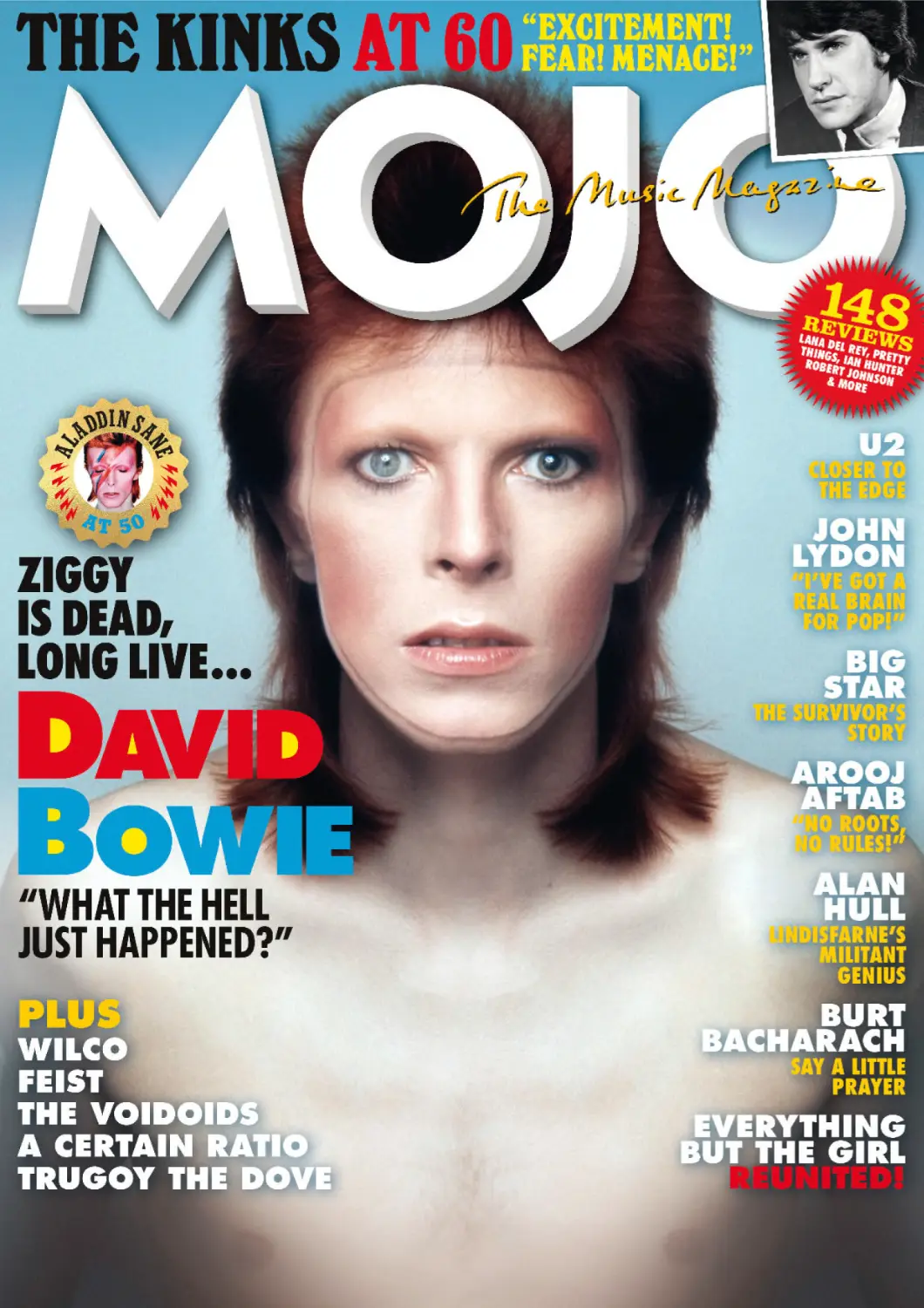
70 DAVID BOWIE
1973 dawned with Bowie ascendant,
but how could he sustain the
trajectory? With two brilliant albums,
multiple image upgrades and lots
of cocaine. “It was frequently said:
‘David, if you need to go into rehab,
go into rehab.’”
Roger Kisby
“Growing up feeling
different gave me an
outsider perspective.”
MOJO 3
Nancy Sinatra and
Lee Hazlewood ride
again, Reissues, p98.
REGULARS
11
ALL BACK TO MY PLACE
John Otway & Wild Willy Barrett, Darlene Love
and Jana Horn share their golden records.
114 REAL GONE Trugoy/Dave from De La
Soul, Huey ‘Piano’ Smith, Chuck Jackson, Victor
Brox and more, thank you and goodnight.
120 ASK MOJO Just who invented the
stage invasion?
122 HELLO GOODBYE CBGB was
burning, and they were there. Then creeping
entropy brought them down. Ivan Julian recalls
his time with Richard Hell & The Voidoids.
Feist reveals all in
Confidential, p20.
WHAT GOES ON!
14
JOHN LYDON The wistful Hawaii –
his tribute to his wife Nora – may not have been
selected as Ireland’s Eurovision entry, but PiL’s
leader is forging on with a new LP and hardwon wisdom. “If I don’t get my musical breaks,
I’ll go insane,” he says.
16
DOLLY COLLINS Best known for
her arrangements for folk sister Shirley, now
her Missa Humana mass has been resurrected.
MOJO reports from its premiere.
18
21
22
Everything But
The Girl light
the Fuse, Lead
Album, p82.
YUSUF/CAT STEVENS
He’s back with his seventeenth LP, but what
have George Harrison, Wendy Carlos and Tin
Pan Alley got to do with it?
RECORD STORE DAY
Discover the pick of the best rebooted vinyl
treats available near you this April 22.
THE BLUE AEROPLANES
They mixed beat poetry and art-rock, and
stood on the brink of fame in the ’90s. Find out
why the Bristol Cult Heroes aren’t done yet.
MOJO FILTER
82
NEW ALBUMS Everything But The
96
REISSUES The Pretty Things get boxed,
plus Nancy & Lee, James Booker and Elton John.
Girl rediscover the dancefloor, plus Lana Del
Rey, Depeche Mode and Natalie Merchant.
106 BOOKS On the mythical trail of blues
legend Robert Johnson, plus the story of
Cambodian pop and the history of Goth.
111 SCREEN Carole King and Van Der Graaf
Generator live, plus a Damo Suzuki doc.
MOJO ISSN 1351-0193 (USPS 17424) is published 12 times a year by H Bauer Publishing Ltd, Media House, Peterborough
Business Park, Lynch Wood, Peterborough PE2 6EA United Kingdom. Airfreight and mailing in the USA by agent named
World Container INC 150-15, 183rd St, Jamaica, NY 11413, USA. Periodicals Postage Paid at Brooklyn, NY 11256.
POSTMASTER: Send address changes to MOJO, Air Business Ltd, c/o World Container INC 150-15, 183rd St, Jamaica, NY
11413, USA. Subscription records are maintained at Bauer Media, Subscriptions, CDS Global, Tower House, Sovereign Park,
Lathkill Street, Market Harborough, Leicester LE16 9EF, United Kingdom. Air Business Ltd is acting as our mailing agent.
4 MOJO
Lucy O’Brien
Bill DeMain
J ustin De
Lucy has been a music writer
since the late 1980s, documenting the story of women in popular music with her book She Bop
(now in its fourth edition), and
most recently publishing Lead
Sister, a biography reframing the
life and legacy of Karen Carpenter. She talks to Everything But
The Girl on page 84.
This month, the longtime MOJO
contributor met Big Star legend
Jody Stephens in Memphis (p42),
and revisited 30 years of his interviews with Burt Bacharach (p58)
to pay tribute, along with Jimmy
Webb and Barry Gibb, to the late
great songwriter. Bill lives in
Nashville, where he runs the
Walkin’ Nashville music tour.
This month’s MOJO cover photographer Justin shot the sleeve of
Bowie’s Pin Ups – an image initially intended for Vogue. Justin
was also Pin Ups cover co-star
Twiggy’s manager. Many of his
portraits hang at the Iconic Images gallery in Piccadilly, and can be
bought at iconicimages.net.
Villeneuve
Walter Newton, Ron Joy, Mary Rozzi
THIS MONTH’S CONTRIBUTORS INCLUDE...
CARGO COLLECTIVE
JOSEPHINE FOSTER
CINDY
LAURA LORIGA
THEE HEADCOATS
DOMESTIC SPHERE
WHY NOT NOW
VEVER
IRREGULARIS (THE GREAT HIATUS)
FIRE RECORDS LP / CD
TOUGH LOVE LP / CD
GOD UNKNOWN RECORDS LP
DAMAGED GOODS LP / CD
“Psychedelic folk music...connecting to the spirit
world” NPR. Recorded with Daniel Blumberg, it bears
the stamp of Josephine’s oneiric singing, her voice
cloaked forming abstract or instrumental sounds that’s
accompanied by a series of field recordings.
Cindy’s fourth LP sees the project evolve into a
collective, consisting of multiple contributions from
various Bay Area musicians, where at its core remains
the introverted & gently profound insights of its leader,
Karina Gill.
Mesmerising organ led compositions featuring Josh
Werner (Marc Ribot, Coco Rosie), Otto Hauser (Espers,
Vashti Bunyan), Anni Rossi and Janis Brenner (Meredith
Monk & Vocal Ensemble).
The undisputed kings of garage rock are back! After
22 long years Billy, Bruce and Johnny return with a
brand-new studio album! It’s everything you’d want from
a Headcoats record!
DEATHCRASH
DEVON CHURCH
DJ BLACK LOW
TAPE RUNS OUT
STRANGE STRANGERS
IMPUMELELO
FLOODHEAD
LESS
FELTE LP
AWESOME TAPES FROM AFRICA 2LP
TRAPPED ANIMAL LP
UNTITLED (RECS) LP / CD
Devon Church (formerly of Exitmusic) returns with
tape-saturated atmosphere, combo organs, widescreen
guitars & vocals that shade towards Lee Hazelwood &
Leonard Cohen, featuring wry lyrics & a striking vocal
counterpoint with his partner, Ada Roth.
DJ Black Low shook the fast-developing world of South
African amapiano with his debut’s angular gymnastics.
Back with an array of vocalists and co-producers, a
follow up of singular heft and sonic diversity.
A magical, shoe-gazey album full of snappy alt-pop
songs and prog soundscapes. “confident enough to
carry you along....you can really tell how much work
they’ve put in” Steve Lamacq 6Music.
London slowcore bastions’ new record was recorded
in the Outer Hebrides over two weeks. Spacious, loud,
powerful, refined and tender, it’s less and more
simultaneously. FFO: Duster, Codeine, Pretend, Mogwai.
EXIT NORTH
DEERHOOF
HEATHER WOODS BRODERICK
JANA HORN
ANYWAY, STILL
MIRACLE-LEVEL
LABYRINTH
THE WINDOW IS THE DREAM
EXIT NORTH RECORDS 2LP / CD
JOYFUL NOISE RECORDINGS LP / CD
WESTERN VINYL LP / CD
NO QUARTER LP / CD
Exit North present their 2nd album ‘Anyway, Still’.
Provocative song structures weave through orchestral
arrangements, acoustic atmospheres, animated rhythms
& driving distortions. Featuring JAPAN co-founder Steve
Jansen with Swedish singer Thomas Feiner.
After 28 years, Deerhoof is finally lured into the recording
studio. Miracle-Level is an avant-garde anti-fascist
carnival about the infinite small wonders of existence,
sung entirely in Japanese.
With songs that range from intimate piano ballads to
electro-pop anthems, Labyrinth is a stunning meditation
on movement and Heather’s most confident album yet.
MOJO calls her work “exquisitely beautiful.”
A Rothko-esque color field set to music, The Window Is
The Dream ventures even deeper into Jana Horn’s inner
space than her stark, acclaimed debut Optimism.
THE NEW PORNOGRAPHERS
WILLIAM TYLER &
THE IMPOSSIBLE TRUTH
LA FÉLINE
CREDIT ELECTRIC
CONTINUE AS A GUEST
TARBES
OUT OF LOVE IN THE FACE OF A SHADOW
MERGE RECORDS LP / CD
SECRET STRATOSPHERE
A.C. Newman, Neko Case & co. have made more than
their fair share of power pop classics over the years…
Why the hell would they stop now?!
AN
AMALGAMATION
OF
MERGE RECORDS LP
William Tyler and his electric back-up band The
Impossible Truth refashion prime cuts from the
Nashville guitarist’s rich catalog.
RECORD
SHOPS
AND
KWAIDAN RECORDS LP / CD
ROYAL OAKIE CD
“After making a name for herself, La Féline has evolved
once again. The 13 songs of Tarbes reinvent the circle of
life & challenge our preconceived notions. She
welcomes us to her hometown with sweet & clear
melodies over the backdrop of an electronic hum.
The new album from Credit Electric explores the human
unconscious through impressionistic pop vignettes,
with their hazy American folk songs drawing upon dub,
post-rock, lo-fi jazz, and ambient music.
LABELS
DEDICATED
TO
BRINGING
YOU
NEW
MUSIC
IRELAND: DUBLIN - SPINDIZZY / KILKENNY - ROLLER COASTER SCOTLAND: DUNDEE - ASSAI / EDINBURGH - ASSAI / EDINBURGH - THORNE RECORDS / GLASGOW - LOVE MUSIC / GLASGOW - MONORAIL WALES: ABERYSTWYTH - ANDY’S RECORDS / CARDIFF - SPILLERS / NEWPORT DIVERSE / SWANSEA - DERRICKS NORTH- WEST: BARROW-IN-FURNESS - TNT RECORDS / LIVERPOOL - 81 RENSHAW LTD / LIVERPOOL - PROBE / MANCHESTER - PICCADILLY RECORDS / NANTWICH - APPLESTUMP RECORDS LTD / PRESTON - ACTION RECORDS NORTH-EAST: BINGLEY
- FIVE RISE / HARROGATE - P & C MUSIC / HEADINGLEY - VINYL WHISTLE / HUDDERSFIELD - VINYL TAP / LEEDS - CRASH LEEDS - JUMBO RECORDS / NEWCASTLE - J G WINDOWS / NEWCASTLE - BEATDOWN / NEWCASTLE - REFLEX / SHEFFIELD - BEAR TREE / SHEFFIELD - RECORD
COLLECTOR / SHEFFIELD - SPINNING DISCS / STOCKTON ON TEES - SOUND IT OUT MIDLANDS: BEDFORD - SLIDE RECORDS / CAMBRIDGE - LOST IN VINYL / CAMBRIDGE - RELEVANT / COVENTRY - JUST DROPPED IN / LEAMINGTON SPA - HEAD / LEAMINGTON SPA - SEISMIC / LEIGHTON
BUZZARD - BLACK CIRCLE / LETCHWORTH - DAVID’S MUSIC / LICHFIELD - STYLUS RECORDS LTD / LOUTH - OFF THE BEATEN TRACK / NOTTINGHAM - ROUGH TRADE / OXFORD - TRUCK STORE / OXON - STRUMMER ROOM RECORDS / WITNEY - RAPTURE SOUTH: BEXHILL ON SEA MUSIC’S NOT DEAD / BLANDFORD FORUM - REVOLUTION ROCKS / BRIGHTON - RESIDENT / BURY ST.EDMUNDS - VINYL HUNTER / GODALMING - RECORD CORNER / LEIGH-ON-SEA - FIVES / LONDON - BANQUET GRAVITY / LONDON - CASBAH / LONDON - FLASHBACK / LONDON - ROUGH
TRADE EAST / LONDON - ROUGH TRADE TALBOT RD / LONDON - SISTER RAY / LUTON - VINYL REVELATIONS / NORWICH - SOUNDCLASH / NORWICH / VENUS VINYL / ROMSEY - HUNDRED / SOUTHAMPTON - VINILO / SOUTHSEA - PIE & VINYL / SOUTHEND ON SEA - SOUTH RECORDS / ST
ALBANS - EMPIRE RECORDS / WATFORD - PARADE VIBES / WIMBORNE - SQUARE RECORDS / WHITSTABLE - GATEFIELD SOUNDS / WINCHESTER - ELEPHANT RECORDS SOUTH WEST: BOURNEMOUTH - VINILO / BRISTOL - ROUGH TRADE / CHELTENHAM - BADLANDS / FALMOUTH JAM FROME - RAVES FROM THE GRAVE / MARLBOROUGH - SOUND KNOWLEDGE / TOTNES - DRIFT MAILORDER AND INTERNET ONLY STORES: BLEEP.COM / BOOMKAT.COM / NORMANRECORDS.COM / PEBBLE RECORDS CO.UK / REVEALRECORDS.CO.UK / RECORDSTORE.CO.UK
17 HEATHMAN’S ROAD, LONDON SW6 4TJ - CARGORECORDS.CO.UK - INFO@CARGORECORDS.CO.UK
THE
KOMPILED
BY RAY
DAVIES,
DAVE
DAVIES
& MICK
AVORY
Dezo Hoffman/Shutterstock, David Magnus/Shutterstock
A 60TH
ANNIVERSARY
SAMPLER
1 I’M A LOVER
NOT A FIGHTER
From Kinks
2 SOMETHING
BETTER BEGINNING
From Kinda Kinks
The Kinks’ 1964 debut album might
have featured instant classic Ray
Davies songs like You Really Got Me
and Stop Your Sobbing, but nine of
the 14 tracks were actually cover
versions. Dave Davies takes raspy
lead on this version of a J.D. Miller
tune first recorded by Louisiana
bluesman Lazy Lester in 1958.
Spot the illustrious session man
on 12-string acoustic: Jimmy Page!
“Is this the start of another
heartbreaker?” The last track on The
Kinks’ second LP, Something Better
Beginning was actually recorded
at the back end of 1964, soon after
the completion of their debut.
A last-dance crooner, Ray’s song
harks back to a pre-rock era, but
his emotional intelligence is rapidly
moving forward, as he captures the
uncertainties of a new relationship.
Written by Jay Miller. Published by Campbell
Connelly & Co. Ltd. 1964 Sanctuary Records
Group Ltd., a BMG company. From Kinks
6 STARSTRUCK
From The Kinks Are
The Village Green
Preservation Society
If much of The Kinks Are The Village
Green… focused on the consolations
of rural English life, Starstruck
provides a jaunty critique of more
urban temptations. “You’re a victim
of bright city lights,” Ray counsels,
a sage escapee from Swinging
London, but one who still knows the
value of a new-fangled mellotron.
Written by Ray Davies. Published by Carlin Music
Corp. 2018 Sanctuary Records Group Ltd., a BMG
company. From The Kinks Are The Village Green
Preservation Society
8 MOJO
MOJO
3 THE WORLD KEEPS
GOING ROUND
From The Kink
Kontroversy
4 PARTY LINE
From Face To Face
“The Kinks have remained at the very
top of pop record popularity, while
others have faded and died,” wrote
Michael Aldred in his sleevenotes to
The Kink Kontroversy, marvelling at a
recording career which was almost
two whole years old. Real longevity
would come in good time, thanks to
woozy beauties like this, with its
chiming intimations of psychedelia.
Another Dave Davies lead vocal on
this garage ramalam, the opening
track to 1966’s Face To Face. The
concept of a shared telephone line,
and the intrigues of eavesdropping
on other conversations, provides
exquisite Kinks social comedy. Note
the little Englander indignation of
threatening “I’m not voting in the
next election” unless the line is
fixed. The voice at the start is Kinks
co-manager Grenville Collins.
Written by Ray Davies. Published by Edward
Kassner Music Co. Ltd. 1965 Sanctuary Records
Group Ltd., a BMG company. From Kinda Kinks
Written by Ray Davies. Published by Carlin Music
Corp. 1965 Sanctuary Records Group Ltd., a BMG
company. From The Kink Kontroversy
Written by Ray Davies. Published by Carlin Music
Corp. 1966 Sanctuary Records Group Ltd., a BMG
company. From Face To Face
7 BRAINWASHED
From Arthur Or The
Decline And Fall Of The
British Empire
8 POWERMAN
From Lola Versus
Powerman And The
Moneygoround, Pt. 1
9 HERE COME THE
PEOPLE IN GREY
From Muswell Hillbillies
The flipside of Village Green’s idylls,
1969’s Arthur was inspired by the
Davies’s brother-in-law Arthur
Anning. A complex study of post-war
suburban life, it includes this punchy,
horn-enriched indictment of a system
gamed against the “brainwashed”
ordinary man: “The aristocrats and
bureaucrats/Are dirty rats,” sings
Ray, “for making you what you are.”
Perhaps inevitably, Ray’s withering
gaze would have to be concentrated
on the music business sooner or later.
The elaborate takedown came in
1970, with Lola Versus Powerman…
and this pulsating track detailing the
iniquities of a label boss who’s “got
my money and my publishing rights”.
Ray and Dave share lead vocals,
brilliantly matched in outrage.
Written by Ray Davies. Published by Carlin Music
Corp. 2019 Sanctuary Records Group Ltd., a BMG
company. From Arthur Or The Decline And Fall Of
The British Empire
Written by Ray Davies. Published by Carlin Music
Corp. 2020 Sanctuary Records Group Ltd., a BMG
company. From Lola Versus Powerman And The
Moneygoround, Pt. 1
1971’s Muswell Hillbillies saw the
Kinks’ musical horizons expand,
embracing a sinewy, rootsy kind of
Americana akin to that of The Band.
Ray had not, however, abandoned his
duties as chronicler of the challenges
faced by the British lower classes.
Hence Here Come The People In Grey,
almost certainly rock’s finest song
about compulsory purchase orders.
Written by Ray Davies. Published by Davray Music
Ltd & BMG Rights Management (UK) Ltd. 2022
Kinks Properties Limited under exclusive license
to Sanctuary Records Group Ltd., a BMG company.
From Muswell Hillbillies
A
T SOME POINT IN 1963, THE BAND THAT HAD BEEN BRIEFLY
known as The Ravens, The Ramrods, The Bo-Weevils, The Pete
Quaife Band and The Ray Davies Quartet finally found a name
they could stick with: The Kinks. Sixty years on, The Kinks’
incendiary, poignant, witty subversion of British rock has lost none
of its charm and bite, and the depth of their catalogue continues
to amaze.
To commemorate that auspicious 60th anniversary, Ray Davies,
Dave Davies and Mick Avory have reconvened to put together a
two-part compilation entitled The Journey. “There’s never been
an officially sanctioned best-of before,” Ray tells us on page 44,
as he and his bandmates walk MOJO through the stories behind
You Really Got Me, Waterloo Sunset, Days and more.
Two collections, however, still can’t contain anything like all the
riches The Kinks have to offer. So we’re thrilled that Ray, Dave and
Mick have also compiled this 60th Anniversary Sampler especially for
MOJO: 10 lesser-known but equally extraordinary songs harvested
from the tracklistings of their first 15 studio albums. Thank you to
The Kinks, and to BMG, for this remarkable MOJO CD. As Ray puts
it so pointedly on Track 10, “Everybody needs an education…”
5 LOVE ME TILL
THE SUN SHINES
From Something
Else By The Kinks
Written by Dave Davies as well as
sung by him, Love Me Till The Sun
Shines first surfaced as the flipside
of his 1967 solo debut, Death Of A
Clown, before finding a home on
Something Else a month later. A
throbbing new heaviness is evident,
not unlike the direction in which
key Kinks contemporaries The Who
were heading simultaneously.
Written by Dave Davies. Published by Carlin Music
Corp. 1967 Sanctuary Records Group Ltd., a BMG
company. From Something Else By The Kinks
10 EDUCATION
From Schoolboys
In Disgrace
From 1975’s Schoolboys In Disgrace,
Education amps up The Kinks’
theatrical impulses and stadium
rock chops, but their and Ray’s core
values remain intact, as they have
done through 60 often tempestuous
years: characterful, satirical music,
rooted in British life and empathetic
to ordinary people, that has proved
uncannily relevant to changing times.
Written by Ray Davies. Published by Davray Music
Ltd & BMG Rights Management (UK) Ltd. 1975
Kinks Properties Limited under exclusive license
to Sanctuary Records Group Ltd., a BMG Company.
From Schoolboys In Disgrace
“IT WAS
BOTH JOY
AND MISERY
TO BE IN
THE KINKS.”
THE KINKS
ON THEIR
GREATEST
SONGS.
STARTS
PAGE 34
R U E N
AVA I L A B L E
B R O T H E R S
J U NE
2
ìThereís nobody else like these
guys making classic, timeless,
unique music at this level.î
óRick Rubin
DADDY LONG LEGS
STREET SERMONS
“…the coolest, most
authentically groovy band
you’ve never heard of.”
– No Depression
Produced by Oakley Munson (Black Lips)
and features Wreckless Eric and John
Sebastian (The Lovin’ Spoonful)
Darlene Love
SHE’S A REBEL
What music are you currently
grooving to?
Earth, Wind & Fire, doesn’t matter
which one. Also, music that keeps me
calm, what we call meditation music,
and I love Adele, she’s gorgeous.
What, if push comes to shove,
is your all-time favourite album?
Well, my music that I listened to was
mostly on 45. But one song that I can
listen to, if it’s 20 years from now or
the next minute, is Sam Cooke’s You
Send Me. I was acquainted with him
when he was singing gospel music,
but when he started singing secular
music, he brought that same spirit.
What was the first record you ever
bought? And where did you buy it?
Sings, “Darling, you send me...”
That was the first! From Sam’s
record store on Central Avenue in
Los Angeles, in a predominantly black
neighbourhood, where we hung out.
Which musician, other than yourself, have you ever wanted to be?
Barbra Streisand. I saw her one
time in Central Park and I never saw
anything like it in my life, how she
acted and how she portrayed herself,
how she performed.
What do you sing in the shower?
I don’t, I hum in the shower, melodies
from my head. It’s good for warming
the throat up.
What is your favourite Saturday
night record?
Lionel Richie, Can’t Slow Down. One
of the very few albums where I liked
every song. I still have two copies!
And your Sunday morning record?
I’m getting ready to go to church. The
gospel group of Richard Smallwood,
they are the greatest. He is un-believable. I also listen to Elvis Presley’s
gospel albums, they’re all songs that
we love to sing, the hymns of the
church. It wakes up the spirit.
Darlene Love’s Live 1982 is available
on DVD, CD and digital debut via
Liberation Hall on April 7.
A LL B AC K TO MY PL AC E
THE STARS REVEAL THE SONIC DELIGHTS GUARANTEED TO GET THEM GOING...
John Otway
& Wild Willy
Barrett
STILL REALLY FREE
What music are you currently
grooving to?
John Otway: Sound Of The Sirens.
Their song All That I Could Find is my
favourite track of the last decade.
Wild Willy Barrett: Some material
Otway passed to me, to try to make
it sound groovy.
Ebru Yildiz, Lorna Wilson, Courtesy DarleneLoveWorld
What, if push comes to shove,
is your all-time favourite album?
JO: Van Morrison, Astral Weeks
or Bob Dylan, Blood On The Tracks.
I need more shoving and pushing
to choose.
WWB: Definitely not Otway’s All
Balls & No Willy LP. I don’t mind the
title, it’s just the music.
What’s the first record you ever
bought? And where from?
JO: Rhythm Of The Rain by The
Cascades from the Record Centre
in Aylesbury in 1963.
WWB: I’ve stolen records,
borrowed them and never given
them back, but bought – never!
Which musician, other than yourself, have you ever wanted to be?
JO: Any good instrumentalist. Don’t
know if I’d want to be Willy though.
WWB: Wasn’t there a guy who
banged a tin tray on his head and
sang Mule Train? Bob Blackman,
he’ll do.
What do you sing in the shower?
JO: Whatever I’m trying to write. My
songs always sound better there and
sadly never as good in the studio, no
matter how much reverb is added.
WWB: I was discouraged from doing
this from an early age, and I’ve
always taken a dim view of those
that take the habit into adulthood.
What is your favourite Saturday
night record?
JO: Saturday April 2, 2022,
Shepherd’s Bush Empire. My 5,000th
gig – and that was a world record.
WWB: That was such a good record I
actually turned up myself.
And your Sunday morning record?
JO: Of all the versions of Sunday
Morning, I’ll have to go with Nico’s.
WWB: The Sound Of Silence.
The 50 Years Of Otway & Barrett tour
opens in Trowbridge on 16 April and
runs through to September.
Jana Horn
TEXAS IN HER SOUL
What music are you currently
grooving to?
I’ve been listening to the radio,
whatever’s on. Sometimes it’s
full-on musical theatre hour.
I don’t mind. I like not knowing what
I’ll get, what’s on next.
What, if push comes to shove,
is your all-time favourite album?
I don’t think I’ll ever tire of Solo
Piano, by Chilly Gonzales.
There’s something essential
about it that’s hard to name…
it’s like he’s playing with the piano
more than playing it.
What was the first record you
ever bought? And where did
you buy it?
The first record I can remember
buying was Nick Cave And the
Bad Seeds, by accident. It was at
a Half Price Books. It had a cover
with flowers on it [No More Shall
We Part, 2001], so I thought it might
sound like that.
“Chilly
Gonzales
sounds like he’s
playing with the
piano, more
than playing it.”
JANA HORN
Which musician, other than yourself, have you ever wanted to be?
Maybe Maggie Roche, with sisters
to sing with. Or someone who can
really play their instrument, like
Chilly, or Caetano Veloso on classical guitar.
What do you sing in the shower?
I wouldn’t call it singing per se…
but I will talk out loud to myself. Or
just say, Oh my gosh, every so often.
What is your favourite Saturday
night record?
I love this album by a three-woman
group named Travesía, Ni Un Minuto
Más De Dolor. Akin to The Roches,
but perhaps more difficult and
curious. Killer. 1983, Uruguay.
And your Sunday morning record?
The Jimmy Giuffre Clarinet by
Jimmy Giuffre.
The Window Is The Dream is out on
April 7 via No Quarter.
MOJO 11
Bauer Media Publishing
The Lantern
75 Hampstead Road
London NW1 2PL
Tel: 020 7437 9011
Reader queries: mojoreaders@
bauermedia.co.uk
Subscriber queries: bauer@
subscription.co.uk
General e-mail: mojo@
bauermedia.co.uk
Website: mojo4music.com
Editor
John Mulvey
Senior Editor
Danny Eccleston
Art Editor
Mark Wagstaff
Production Editor
Simon McEwen
Associate Editor
(Reviews)
Jenny Bulley
Associate Editor
(News)
Ian Harrison
Deputy Art Editor
Del Gentleman
Picture Editor
Matt Turner
Senior Associate Editor
Andrew Male
Contributing Editors
Phil Alexander,
Keith Cameron,
Sylvie Simmons
Thanks for their help with this
issue: Keith Cameron,
Chris Catchpole, Ian Whent.
Among this month’s
contributors:
John Aizlewood, Martin Aston,
Mike Barnes, Mark Blake,
Glyn Brown, David Buckley,
John Bungey, Keith Cameron,
Chris Catchpole, Stevie Chick,
Andy Cowan, Grayson Haver Currin,
Bill DeMain, Tom Doyle,
Alison Fensterstock, David Fricke,
Andy Fyfe, Pat Gilbert,
David Hutcheon, Chris Ingham,
Jim Irvin, David Katz, Andrew Male,
James McNair, Bob Mehr,
Lucy O’Brien, Andrew Perry,
Clive Prior, Jude Rogers, Jon Savage,
Victoria Segal, David Sheppard,
Michael Simmons, Sylvie Simmons,
Mat Snow, Ben Thompson,
Kieron Tyler, Charles Waring,
Lois Wilson, Jim Wirth.
Among this month’s
photographers:
Cover: Justin de Villeneuve
(inset: Shutterstock, Duffy),
Maude Clay, David Corio,
Kevin Cummins, Joe Dilworth,
Duffy, Monte Fresco, Bob Gruen,
Richard Imrie, Roger Kisby,
Carole Manning,
Geoff MacCormack,
Michael O’Brien, Michael Putland,
Aaron Rapoport, Blythe Thomas,
Barrie Wentzell.
MOJO SUBSCRIPTION HOTLINE
0185 8438884
For subscription or back issue queries contact
CDS Global on Bauer@subscription.co.uk
To access from outside the UK
Dial: +44 (0)185 8438884
12 MOJO
Theories,
rants, etc.
MOJO welcomes correspondence for publication.
Write to us at: MOJO, Bauer Media Publishing, The Lantern, 75 Hampstead Road,
London, NW1 2PL. E-mail to: mojoreaders@bauermedia.co.uk
IMAGINE TRYING TO KEEP UP WITH
David Bowie in 1973. We’re chronically aware of the demands on our time in
2023, but consider Bowie’s schedule for that year, starting with 84 Ziggy Stardust
dates in the UK, the USA and Japan. Another classic album, Aladdin Sane,
written and recorded between shows and released in April. The denouement of
the Ziggy era at Hammersmith Odeon in July. Then straight back into the studio
to construct Pin Ups, in the shops only six months after Aladdin Sane. “We moved
at such intensity, such speed,” Bowie told Melody Maker in May, as if it was all
over, as if a few days on the Trans-Siberian Express constituted a major retreat
from fame. There were collaborations to pursue, too, a US TV special, and a
rock opera that would soon reconfigure itself into Diamond Dogs. It all remains
dizzying to even contemplate: meticulous, high-concept masterpieces
seemingly put together on the fly; nuanced personae that most sane artists
would lean into for years, rinsed and disposed of in a matter of months.
Is half a century long enough for everyone involved to get their breath back?
This month in MOJO, Tom Doyle reconvenes the musicians, confidants and
managers who spent 1973 with Bowie, and tries to take stock of “what the
hell happened”, 50 years on. “It was pretty manic,” Bowie’s friend Geoff
MacCormack tells us, unsurprisingly. “He was in a hurry. But he had the talent
to do it. The output was unbelievable.”
JOHN MULVEY, EDITOR
But is there anyone
who’s really good?
Can I say a huge thank you to Mat Snow and
everyone involved in creating your wholly
outstanding piece on Jeff Beck [MOJO 353].
It was wonderful to be presented with so many
examples of Jeff ’s other-worldly skills as a guitarist,
how he inspired and influenced generations of
musicians, and overall how he was the guitar
heroes’ guitar hero. However, what made this
piece particularly special was how it gave readers
a glimpse into what it must have been like for Jeff
outside of the spotlight and media attention.
To learn about Jeff ’s insecurities, and how he
would on so many occasions choose to bolt rather
than place himself in the vulnerable position of
performing alongside artists whom he admired,
made for a very poignant read. Ultimately, the
article did so much to humanise, though not dilute,
the legend that Jeff was and will continue to be.
Craig Isherwood, Poulton-Le-Fylde
Wherever. Take me
wherever you want.
Great to see Pete Brown & Piblokto! featured in
Buried Treasure [MOJO 353]. In the early ’70s, my
friends and I were big fans in rock hotspot Billericay,
Essex. My schoolmate Keith’s elder brother was a
roadie for them. Think his name was Alan. We went to
Southend-on-Sea to a little club to see them and the
four of us were the entire audience. Pete was so grateful we’d turned up he bought us all a pint. Another
time at the Marquee, we helped unload their gear.
The WEM amps had ‘Cream’ stencilled on the back.
Allen Manning, via e-mail
A human life is truly
as frail and fleeting as
the morning dew
I was thrilled to see Depeche Mode on the cover of
MOJO 353. With over 40 years creating music and
a fifteenth album release, they have been a constant
companion to my joys and woes. My most recent woe
being the suicide of my dear brother, who struggled
with heroin addiction. MOJO’s excellent article captured the joys and woes of DM. Dave’s words re the
loss of Fletch: “I don’t know what the fuck you do but
it’s something. And maybe it’s really, really important,” had me thinking of a Buddhist monk meditating
on the world’s woes; is the monk doing fuck-all sitting
on his arse all day, or is he emanating crucial peaceful
vibes into a chaotic and cruel world? Just like DM’s
music being both melancholy and inspiring, I find
Gore and Gahan inspirational by embracing all that
bringing out a new album entails despite the loss of
Fletch’s really, really important presence. I hope they
find as much joy in doing so as they give their fans.
I’m sure Fletch will be with them on-stage in spirit.
Lizzy Barmak, London
In the end, you cannot
understand the things men do
About bloody time! But also thanks a lot for your
splendid Sparklehorse feature [MOJO 352]. I find it
quite bewildering to think that the vastly underrated
Mark Linkous, AKA Sparklehorse, has been so unfairly
overlooked in comparison to other artists of the same
period. Radiohead, Dave Gilmour, P.J. Harvey, Tom
Waits, Portishead and David Lynch, amongst others,
could see the potential of this gifted but ultimately lost
maverick who was out of his time in the grunge/Britpop era. Four original albums and the posthumous,
wonderful concept Dark Night Of The Soul collaboration with Danger Mouse and David Lynch only
seemed to mystify and confuse a wider audience. For
my part, it was a pleasure to have been able to photograph and go to so many shows that Sparklehorse
would frequently play on these shores, where they
were always warmly received. Like all those people
of past generations who now rave about Big Star and
other ignored cult acts, your feature may be the start
of a deserved new reawakening. Next stop has to be
the insatiable and indestructible Guided By Voices
story, MOJO. Now that would be impressive!
Tony Bartolo, via e-mail
I buried them all here
in the woods and no-one
but me knows where
Bob Dylan’s Seven Days [MOJO 352] has been
committed to tape, by Ronnie Wood on his wonderful Gimme Some Neck album. And, if I may add this,
Wood’s solo albums deserve more attention in
MOJO than they have received this far. You wonder
why they aren’t re-released?
Ludo Wiegerinck, via e-mail
Man just wants to
forget the bad stuff
I really appreciated the great piece on Jerry Lee Lewis
by Bob Mehr [MOJO 351], but I am puzzled why
Jerry Lee’s 1977 Middle Age Crazy was not mentioned. This Mercury recording of the Sonny
Throckmorton composition features what I believe
might be the most nuanced vocal performance The
Killer ever laid down on wax. It was a huge country hit
in 1977 and was the penultimate Top 5 hit that Lewis
had on any chart. I don’t believe Lewis ever sounded
so vulnerable and world-weary as on this record. It is
truly a standout effort.
Stephen Hartwell, Easthampton, Massachusetts
Whose story is believable?
John Bungey’s review of BBC Broadcasts by Genesis
[MOJO 353] has prompted me to write. I am not even
a massive Genesis fan, but his comments about the
Peter Gabriel era of the band were just old-school
anti-prog rock generalisation. The review would have
been better employed telling us more about what is
on the CD set. That first era of the band produced
some great music (eg, Foxtrot and Selling England By
The Pound) and I think a lot of people would strongly
disagree when Mr Bungey says, “It’s a bit of a relief
when Phil Collins cuts the whimsy and starts singing
hook-laden pop-rock.” Fans may prefer one or other
era of the band or like them both, but Mr Bungey’s
suggestion that the Collins-fronted band became “the
Coldplay of the 1980s” probably sums it up accurately.
John Bentley, North Yorkshire
I had never seen such
fierceness in a woman
Thrilled to see a big feature on Christine McVie
[MOJO 352]. She was a big favourite of mine, and
millions of others, of course. But I was disappointed to
not see any mention of McVie’s fantastic ’84 solo disc,
Christine McVie (produced by Russ Titelman). And, in
the list of her best Fleetwood Mac songs, I think the
underrated Heroes Are Hard To Find LP’s Come A Little
Bit Closer track was a pretty significant omission.
Marty Lange, Austin
That is why I was crying
There have been so many deaths in the celebrity space
lately, it’s hard to let go of the feeling of deep loss. But
strangely, none have affected me as much as the passing
of Low’s Mimi Parker. To think I will hear nothing new
from that incredible voice… well, it’s heartbreaking.
Ken Meyer Jr, Santa Ana
I’m tired of this farce
Another great issue of MOJO [353], packed with great
insight and insider recollections as ever – and discovering Billy Nomates is a fellow Stranglers fan. Oh, and
the second time I’ve cracked the cryptic titles on the
letters pages. A nod to your cover stars from Basildon,
they’re all from the epic Dr Strangelove. “Gentlemen,
you can’t fight in here! This is the War Room.”
Keep up the good work.
Jon Perks, Worcester
SAVE MONEY ON NEWSSTAND PRICES!
AND GET MORE FROM
BECOME A
MEMBER AND
GET EXCLUSIVE
REWARDS AND
CONTENT
MOJ
MAKEO
SEE PAGE 26
FOR DETAILS... A GRE S
GIFT!!AT
!
Head of Magazine Media
Clare Chamberlain
MD Bauer Media Advertising
Simon Kilby
Head Of Magazine Brands Anu Short
Brand Director Joel Stephan
Sales Operations Co-ordinator
Talys Andres
Regional Advertising Katie Kendall
Classified Sales Executive
Imogen Jackaman
Classified Sales Manager Ben Peck
Inserts Manager Simon Buckenham
Production Manager Carl Lawrence
Sales Operations Executive,
BMA Finance Helen Mear
CEO of Bauer Publishing UK
Chris Duncan
EA to CEO Vicky Meadows
Chief Financial Officer, Bauer
Magazine Media UK Lisa Hayden
EA to CFO Stacey Thomas
Group MD Women’s Mass & Celebrity,
Premium and Entertainment
Helen Morris
Publisher, Premium and
Entertainment Lauren Holleyoake
PA to Group MD Elisha Thomas
PA to Publisher Tayla Todd
Commercial Director - Entertainment
Gemma Dick
Commercial Marketing Director
Liz Martin
Managing Editor Elisha Thomas
Editorial Assistant Whitney Jones
MOJO CD and Honours Creative
Director Dave Henderson
Senior Events Producer
Marguerite Peck
Business Analyst Mita Parekh
Marketing Manager Susan Litawski
Direct Marketing Manager Julie Spires
Direct Marketing Executive
Raheema Rahim
Printing: William Gibbons
For subscription or back issue queries, please contact CDS
Global on Bauer@subscription.co.uk Phone from the UK on
01858 43 8884. Phone from overseas on +44 (0)1858 43
8884. For enquires on overseas newsstand sales
e-mail Paul.Maher@seymour.co.uk
No part of the magazine may be reproduced in any form
in whole or in part, without the prior permission of Bauer
Consumer Media. All material published remains the
copyright of Bauer Consumer Media and we reserve the
right to copy or edit any material submitted to the magazine
without further consent. The submission of material
(manuscripts or images etc) to Bauer Consumer Media,
whether unsolicited or requested, is taken as permission
to publish that material in the magazine, on the associated
website, any apps or social media pages affiliated to the
magazine, and any editions of the magazine published by
our licensees elsewhere in the world. By submitting any
material to us you are confirming that the material is your
own original work or that you have permission from the
copyright owner to use the material and to authorise Bauer
Consumer Media to use it as described in this paragraph.
You also promise that you have permission from anyone
featured or referred to in the submitted material to it being
used by Bauer Consumer Media. If Bauer Consumer Media
receives a claim from a copyright owner or a person featured
in any material you have sent us, we will inform that person
that you have granted us permission to use the relevant
material and you will be responsible for paying any amounts
due to the copyright owner or featured person and/or for
reimbursing Bauer Consumer Media for any losses it has
suffered as a result. Please note, we accept no responsibility
for unsolicited material which is lost or damaged in the post
and we do not promise that we will be able to return any
material. Finally, whilst we try to ensure accuracy of your
material when we publish it, we cannot promise to do so.
We do not accept any responsibility for any loss or damage,
however caused, resulting from use of the material.
For syndication enquiries go to:
syndication@bauermedia.co.uk
H Bauer Publishing is authorised and regulated by the FCA
(Ref No. 845898).
To find out more about where to buy MOJO, contact
Frontline Ltd, at 1st Floor, Stuart House, St Johns Street,
Peterborough PE1 5DD. Tel: 01733 555161.
COMPLAINTS: H Bauer Publishing is a member of the
Independent Press Standards Organisation (www.ipso.
co.uk) and endeavours to respond to and resolve your
concerns quickly. Our Editorial Complaints Policy (including
full details of how to contact us about editorial complaints
and IPSO’s contact details) can be found at
www.bauermediacomplaints.co.uk
WITH A MEMBERSHIP!
SAVEFF
O
£££ V
ER
CO ICE!
PR
MOJO 13
WH AT GOE S ON!
THE HOT NEWS AND BIZARRE STORIES FROM PLANET MOJO
This Is A
Love Song
John Lydon speaks about Hawaii, caring for his wife
Nora, and new Public Image Ltd album End Of World.
“Nora has
always been
the greatest
example
of how to
enjoy life.”
Mirrorpix, RTÉ Late Late Show/Andres Poveda, Getty
S
PEAKING FROM his Californian home, John Lydon is in defiant
mood. “With PiL, we’re capable of going in any direction. I have
no barriers and fears. We do all the emotions and are fully prepared
and committed to go deep down into a tragedy as we are committed to
going high up to the nth elevation of happiness, if that so be the subject
of the song…”
This stance has been tested of late. Released in January, latest single
Hawaii was a beauteous and touching love song written as a reaction to
On the rise again: Public Image Ltd’s
his wife Nora’s Alzheimer’s disease. After Lydon declared that he wanted to
John Lydon, with (left) Bruce Smith
sing it while representing Ireland in this year’s Eurovision Song Contest, PiL
and Scott Firth, at London’s Kentish
competed on RTE’s The Late Late Show on February 3, but lost the vote to
Town Forum, June 16, 2022; (above)
Nora and John enjoying life, 1986;
hygienic Dublin indie rockers Wild Youth and their song We Are One.
(below) Lydon performs Hawaii on
“It was a pleasure just to be invited,” says Lydon, immune to sour grapes.
The Late Late Eurosong 2023 Special.
“I was slightly off-key but then again so were half the acts! But what a wonderful offer. I mean, no one’s offered me anything quite like it my whole life –
apart from the MOJO award [in 2008] – and I got what I needed, which was
footage to be able to show Nora, and she loved it.”
Life, inevitably, has been irrevocably altered by Nora’s diagnosis. “It’s quite
the experience we’re going through,” he says. “Anything can crop up at any
time and you have to be attuned to it. We know that she’s going to slowly
deteriorate into something catastrophic, and then death. But she will enjoy
every step of it, and I’m here to make sure of that because she’d do the same
for me. It’s not all tear-jerky and sad. A lot of it is very joyful. Nora has always
been the greatest example of how to enjoy life, she’s very vivacious and very
open and very tender, and those things are not going away.”
Remarkably, as well as caring for Nora, Lydon and PiL have a new album
ready for release later this year. Begun in 2018, derailed by Covid and finished
last year, it’s entitled End Of World (he says he forgot to include ‘the’ when
painting the cover art). Produced by the band with regular foil James Towler,
it was recorded in Cheltenham and Alcester. “It’s an unusual piece of work,”
promises Lydon. “I suppose the Covid thing helped because it filled up the
energy coffers, we got into a studio and there was just this massive explosion
of ideas.”
Among its 14 songs are Northwest Passage (“a slice of proper heavy
metal”), Penge (“something like a medieval Viking epic”) and Dirty Murky
Delight, which he likens to the Bonzo Dog Doo-Dah Band. More startling
still, he compares The Do That to Tiger Feet by Mud (MOJO is treated to a
brief a cappella recital of the former song). “I’ve got a real brain for pop!” he
laughs. “But nothing is done flippantly, everything we do is really embedded
in a wholesome truth.” And the meaning of the title? “I have no idea.
Probably the end of one world, and the beginning of another.”
There have been other losses in recent years, namely the passing of PiL
guitarist Keith Levene and Lydon’s estrangement from his old Sex Pistols
bandmates, after they ended up in court over the use of the band’s music in
Danny Boyle’s 2022 Disney mini-series Pistol. Yet today, swami Lydon is unruffled. “I try my best, but you can’t always remember those kinds of people
fondly,” he says. “[But] I don’t speak ill of the dead and I hope they’re in a
better place. And of course, you know, people do hateful
things, spiteful things, and jealous things, but you’re still
gonna love them. Because underneath all that is a crying
little kitten, and that’s the part I’m fondly attached to.
(Sings) “And they called it puppy lo-ove…”
He’s eager to get PiL back on the road, he says, for his
own sake as well as the band’s devotees. “If I don’t get, like,
my musical breaks, I’ll go insane,” he says. “Nora would
be furious if I gave it up. And a wonderful side of all of this
is the Alzheimer’s societies are making contact, and I can
spread whatever it is I’m learning about all of this… let’s
bring it to the forefront, and find a reason behind getting rid
of this thing.”
JOHN LYDON
Ian Harrison
MOJO 15
Mass appeal: (left, from left)
Dolly and Shirley Collins in
1966; (right) the National
Symphony Orchestra
performing Dolly’s Missa
Humana, February 24, 2023.
W H AT G O E S O N !
REBORN! DOLLY COLLINS’
LOST SECULAR MASS MISSA
while Shirley decided she was more interested
HUMANA
in traditional song than The Internationale,
T
HE FIRST lady of English folk Shirley
Collins is understandably wistful when
she remembers her older sister and
genius musical arranger Dolly, who died in
1995 aged 62. “She always regretted that the
only output she had that was heard publicly
was her arrangements for my singing,” she
tells MOJO. “She was a classical musician
really and wanted her own work to be heard.”
A tiny piece of the universe was fixed on
February 24 when Dolly’s Missa Humana
was performed in public for the first time
at London’s Conway Hall by the National
Symphony Orchestra under the direction
of conductor John Andrews. With operatic
singing from the Minerva Consort, the
‘humanist mass’ was Dolly’s attempt to
reconcile her devoutly secular beliefs with
the power of religious classical music. A
chorus of “peace at last” was perhaps the
defining moment of an assured piece of work
which is a substantial leap from the early
music-informed arrangements Dolly deployed
on the Collins sisters’ most celebrated records,
Anthems In Eden and Love, Death And The Lady.
Dolly’s lugubrious, baroque melodies, though,
were instantly familiar.
Raised in Sussex, the sisters’ upbringing
was defined by music and leftist politics, but
accompaniment, but that sketchy version
(part of which can be heard on the 2017
documentary The Ballad Of Shirley Collins)
has none of the heft of the completed piece
performed at the Conway Hall.
To her great sadness, Shirley was not able
Dolly kept her red flag flying, and made
to attend her sister’s posthumous opening
regular trips to London to study classical
night, having spent the days before the concert
music at the Workers’ Music Association
nursing a suspected fractured hip. “I’m 87 and
under communist composer Alan Bush.
prone to things happening,” she says, ruefully.
A friend from Sussex days, esteemed poet,
However, King’s College London are archivnovelist and activist Maureen Duffy, enlisted
ing the performance, and while there are no
Dolly to write songs for her first play, 1956’s
immediate plans to release the Missa Humana
Pearson (modern folk stylist Lisa Knapp percommercially, Shirley suspects there are
formed one of them, the Bertolt Brecht-like
The Man With The Axe, at Conway Hall). One plenty more of Dolly’s compositions waiting
to be discovered.
of Duffy’s poems, meanwhile,
“I’ve got a box full of her
provided the text for the Missa
music going back to when she
Humana, which Dolly started
“She
was a late teenager,” she says.
writing in the 1960s and did not
wanted
“Because I don’t read music
complete until the 1990s.
I don’t really know what’s in
Shirley remembers hearher own
there, but now this has been
ing working versions of it for
work to
produced maybe we can find
decades, and attempted to help
something else.”
perform it when she had put
be heard.”
Whether those pieces reher career on hold in the ’80s.
SHIRLEY COLLINS
main unperformed, the superb
“I tried to sing along from time
pieces Dolly wrote for Shirley
to time but this was at the
continue to bear testament to
point when I had no confidence
a unique command of melody.
in my voice, so I couldn’t,”
“Nobody else could have
she remembers.
written those arrangements,”
In the early ’90s, Current
Shirley says with sisterly pride.
93’s David Tibet recorded
“They are so absolutely Dolly.”
Dolly singing the complete
Jim Wirth
Missa Humana with solo piano
GIMME FIVE… LOOOONG TITLES
The Supremes
A Breath Taking, First Sight Soul
Shaking, One Night Love Making,
Next Day Heart Breaking Guy
Getty, Sean Curtin
(MOTOWN, 1963)
16 MOJO
A rare, smoochy
case of all three
Supremes singing
lead. See also the
wackily titled cha-cha flip
(The Man With The) Rock
And Roll Banjo Band, where
professionalism over banality
is impressive indeed. Good to
hear banjo on a soul record.
Tyrannosaurus
Rex
My People Were Fair And Had
Sky In Their Hair… But Now
They’re Content To Wear
Stars On Their Brows
(REGAL ZONOPHONE, 1968)
Ace psychfolk whimsy,
with banged
gongs intro,
Pixiphone and a John
Peel bedtime story.
Also includes Dwarfish
Trumpet Blues.
Faces/Rod
Stewart
You Can Make Me Dance, Sing Or
Anything (Even Take The Dog For
A Walk, Mend A Fuse, Fold Away
The Ironing Board, Or Any Other
Domestic Shortcomings)
(WARNER BROS, 1974)
Rod and the
Faces say ta-ra
with a song
of domestic
bliss, scoring the longest
UK chart hit name in
the process.
Fairport
Convention
Sir B. McKenzie’s Daughter’s
Lament For The 77th Mounted
Lancers Retreat From The
Straits Of Loch Knombe, In
The Year Of Our Lord 1727,
On The Occasion Of The
Announcement Of Her Marriage
To The Laird Of Kinleakie
(ISLAND, 1970)
Reeling folk rock,
and a pub quiz
question to boot.
Test Dept.
Long Live British Democracy
Which Flourishes And Is Constantly
Perfected Under The Immaculate
Guidance Of The Great, Honourable,
Generous And Correct Margaret
Hilda Thatcher. She Is The Blue Sky
In The Hearts Of All Nations. Our
People Pay Homage And Bow In
Deep Respect And Gratitude To Her.
The Milk Of Human Kindness
(FROM A GOOD NIGHT OUT,
M.O.P, 1987)
Possibly satirical.
AEG Presents in association with UTA
2 0 2 3 U K TO U R
PLUS
SPECIAL
GUESTS
PLUS GUESTS
Cuffe & Taylor presents
FRI 31 MARCH
5 JULY
OUT
7SOLDJULY
8 JULY
9 JULY
11 JULY
12 JULY
TUE 11 APRIL
CARDIFF GREAT HALL
MANCHESTER ALBERT HALL
SAT 01 APRIL
THU 13 APRIL
SUN 02 APRIL
FRI 14 APRIL
TUE 04 APRIL
SAT 15 APRIL
WED 05 APRIL
MON 17 APRIL
FRI 07 APRIL
TUE 18 APRIL
SAT 08 APRIL
THU 20 APRIL
MON 10 APRIL
EXTRA DATE ADDED DUE TO DEMAND
SOUTHEND CLIFFS PAVILION
SCARBOROUGH * OPEN AIR THEATRE
SWANSEA SWANSEA ARENA
MANCHESTER AO ARENA
LONDON THE O2
BIRMINGHAM UTILITA ARENA
GLASGOW OVO HYDRO
AEGPRESENTS.CO.UK | AXS.COM | TICKETMASTER.CO.UK
*SPECIAL GUESTS SEETHER ONLY
BIRMINGHAM TOWN HALL
OXFORD O2 ACADEMY
BRISTOL O2 ACADEMY
NOTTINGHAM ROCK CITY
NORWICH THE NICK RAYNS
LIVERPOOL O2 ACADEMY
BRIGHTON BRIGHTON DOME
NEWCASTLE NX
SOUTHAMPTON O2 GUILDHALL
GLASGOW O2 ACADEMY
ONLY UK HEADLINE SHOW
LONDON ALEXANDRA PALACE THEATRE
LEEDS O2 ACADEMY
FRI 21 APRIL
LONDON ALEXANDRA PALACE THEATRE
AEGPRESENTS.CO.UK AXS.COM TICKETMASTER.CO.UK OFFICIALDAMNED.COM
AEG PRESENTS IN ASSOCIATION WITH UTA
THE FAREWELL TOUR
C E L E B R AT I N G 5 0 Y E A R S
SATURDAY 19 AUGUST 2023
EVENTIM APOLLO
LONDON
•
•
AEGPRESENTS.CO.UK
Thursday 29th June
AXS.COM
TICKETMASTER.CO.UK
AEG PRESENTS IN ASSOCIATION WITH 33 & WEST
London Eventim Apollo
Friday 30th June
Wolverhampton
The Civic @ the Halls
AEGPRESENTS.CO.UK / AXS.COM / ticketmaster.co.uk
20
23
AEG PRESENTS IN ASSOCIATION WITH CAA
PLUS SPECIAL GUESTS
3-JUN7LEEDS, UK7STYLUS
4-JUN7MANCHESTER, UK7GORILLA
5-JUN7BIRMINGHAM, UK7O2 INSTITUTE2
6-JUN7LONDON, UK 7ELECTRIC BALLROOM
AEGPRESENTS.CO.UK 7AXS.COM 7TICKETWEB.UK
AEG PRESENTS IN ASSOCIATION WITH CAA
MAY
MAY
MAY
MAY
MAY
MAY
23
24
26
27
29
30
OXFORD NEW THEATRE
LIVERPOOL PHILHARMONIC HALL
GLASGOW SEC ARMADILLO
MANCHESTER BRIDGEWATER HALL
LONDON ROYAL ALBERT HALL
LONDON ROYAL ALBERT HALL
SOLD OUT
SOLD OUT
EXTRA DATE ADDED
JUN 22
WOLVERHAMPTON
THE CIVIC AT THE HALLS
AEGPRESENTS.CO.UK | AXS.COM | TICKETMASTER.CO.UK | ALLSPARKS.COM
AEG PRESENTS IN ASSOCIATION WITH 13 ARTISTS
MOJO WO R K I N G
“I wanted to go a
bit Phil Spector-ish,
a bit River Deep,
Mountain High.”
YUSUF/CAT STEVENS
FACT SHEET
By royal appointment: Yusuf/
Cat Stevens in La Fabrique
Studios, Provence.
FROM DUBVILLE STUDIOS,
YUSUF/CAT STEVENS
BRINGS REDEMPTIVE LP 17
O
VER A DECADE in the making, King
Of A Land has royalty in its sights.
“The Coronation’s coming up so I’m
going to make sure King Charles gets a copy,”
smiles Yusuf/Cat Stevens, chatting to MOJO
from Dubai via Zoom. “He’s ruling over a very
damaged political scene, and I find that very
frustrating. But I believe music can help us
reclaim the narrative.”
Yusuf’s 17th studio LP often looks through
Yoriyos Adamos, Getty (2)
A L S O WO R K I N G
18 MOJO
…DJ SHADOW will release a
new LP this year. He
promises “fewer guest
vocalists,” adding,
“I hear both joy and
anguish in these songs”
…LLOYD COLE
releases On Pain in June.
Ex-Commotions Neil
Clark and Blair Cowan
appear and have co-written
four songs …STEVIE NICKS
(right) has been in the studio with
Title: King Of A Land
Due: June
Production: Paul
Samwell-Smith
Songs: Pagan Run/
Train On A Hill/
Things/Highness/
How Good It Feels
The Buzz: “This
new record is a
culmination. A very
clearly defined
outcome of where
I’ve been, and where
I am.”
Yusuf/Cat Stevens
children’s eyes while envisaging a kinder
society, hence the title track sees a small
boy dream of compassionate changes he’d
make were he king. “Every child brings a new
perception, a new possibility,” says Yusuf,
whose Watford-based grandchildren sing on
the album with their school choir. “But I was
a pretty naughty child, so I’m not advertising
any of that. Haha!”
Work began at Berlin’s Hansa studios in
Dolly Parton …GRAHAM NASH
releases Now in May. Titles include
Golden Idol, I Watched It All
Come Down and his recent
Allan Clarke co-write,
Buddy’s Back. Nash calls
it, “the most personal
[LP] I have ever made. At
this point in my life,
that’s something to say”
…JASON ISBELL & THE
400 UNIT release
Weathervanes in June.
Recorded at Nashville’s Blackbird
Studio, with titles including King Of
2011. The LP’s 12 richly orchestrated songs
emerged after further sessions in Brussels,
Provence and London’s Air Studios, as well as
at Dubville, Yusuf’s garage studio in Dubai.
“It was almost ready in 2020,” he says, “but
then the 50th anniversary of Tea For The
Tillerman came around. My son said, ‘Let’s
re-record it’; I said, ‘That’s a stupid idea – let’s
do it!’ It interrupted the flow on King… but it
also enabled Paul [Samwell-Smith] and myself
to fix certain things. Sometimes perfecting
something takes time.”
Songs include How Good It Feels, its
orchestration drawing inspiration from
Tchaikovsky’s Swan Lake, and Highness,
of which Yusuf says, “I wanted to go a bit
Phil Spector-ish, a bit River Deep, Mountain
High.” Elsewhere, out-and-out rocker Pagan
Run “refers back to a time when it seemed
to me that the universe was this series of
accidental possibilities that could force
you off the planet into a realm that really
frightened me.” The vintage Moog-sounding
synth solo on Son Of Mary, meanwhile,
was part-inspired by Wendy Carlos’s use
of the instrument on her 1968 landmark
Switched-On Bach.
King Of A Land was mixed at Friar Park,
George Harrison’s neo-Gothic mansion at
Henley-On-Thames, and will be released by
Dark Horse Records, the Harrison-founded
label that’s now run by his son Dhani. Did Yusuf and George ever meet? “We did,” he says.
“Informally at [photographer] David Bailey’s
studio. You can find out more in my forthcoming memoir! George was incredibly brave
spiritually speaking, looking East when
no one else was. In 1969, when I was bedridden with tuberculosis and looking for a way
out of my material-world predicament, he
was an immense influence. George put me
on the path, as it were.”
Yusuf admits to being “a little apprehensive” about releasing an album aged almost
75, but not too much. “This album draws
upon things I learned growing up near Tin
Pan Alley in London, things I learned from
musicals about telling stories in different
ways… I have plenty more music in me.”
James McNair
Oklahoma, Cast Iron Skillet and White
Beretta, it touches on “adult love…
cruelty, regret and redemption”
…THOM YORKE’s band
The Smile shared an
image of a tape recorder
on their Instagram
page, leading to
new-music speculation
…Motown veteran
SMOKEY ROBINSON
releases Gasms in May …
TONY IOMMI has shared
updates of a new home studio.
“I’m really looking forward to writing
another LP,” he said …LEE MAVERS
(below) of Liverpool cults The La’s
was pictured playing his guitar
in an online communication from Chesterfield’s
direct-to-disc
Groovefarm Analog
Recording Co in
February. “Lee will be
returning later in the
year,” they said. A
tantalising piece of new
Mavers music can be heard
on his brother Gary’s online car
show Classic Obsession…
PRESENTS
August 2023
Wed 30 London O2 Forum Kentish Town
September 2023
Sat 02 Edinburgh Usher Hall
Tue 05 Manchester Bridgewater Hall
myticket.co.uk • wilcoworld.net
A Kilimanjaro & Regular Music presentation
NOVEMBER 2023
TUE 14 MANCHESTER O2 RITZ
WED 15 LEEDS BECKETT S.U
THU 16 NOTTINGHAM ROCK CITY
FRI 17 BRISTOL O2 ACADEMY
SAT 18 LONDON ROUNDHOUSE
MYTICKET.CO.UK | THEYMIGHTBEGIANTS.COM
A KILIMANJARO & FRIENDS PRESENTATION BY ARRANGEMENT WITH DMF MUSIC
MYTICKET.CO.UK
A KILIMANJARO & FRIENDS PRESENTATION
BY ARRANGEMENT WITH MOTHER ARTISTS
TICKETS AVAILABLE AT
ROCK’N’ROLL
CONFIDENTIAL
TAKE FEIST
Leslie’s
golden greats.
1 Frantz Casseus
Lullaby (FROM HAITIAN
DANCES, FOLKWAYS, 1954)
quiet songs and there were no
drums until my friend, film director
Mike Mills, said, “You need to play
drums like you play guitar.” I’m not a
drummer, but there I was with two
sticks in my hands. That’s why it’s so
rudimentary. There’s no nuance in
my drumming.
Calling All The Gods is a medieval
madrigal, isn’t it?
(FROM ILLUMINATIONS,
Oh I love that, but it goes further
VANGUARD, 1969)
back. Myself, Todd Dahlhoff and
3 Daniela
Shahzad Ismaily [her bandmates]
Gesundheit
Alphabet Of
used phrases from Emily Wilson’s
Wrongdoing (FROM
translation of The Odyssey, where
ALPHABET OF WRONGDOING,
any line from any page could be a
RETURNING CURRENT, 2020)
4 La Force The Tide
song lyric, and produced 30 hours of
(FROM LA FORCE, ARTS &
improvisations. Mike Mills suggestCRAFTS, 2018)
ed one improvisation, saying “calling
5 Hand Habits
all the gods” and another saying “the
Graves (FROM FUN HOUSE,
SADDLE CREEK, 2021)
earth sustains all different kinds of
people” could make a song together.
It’s about humanity and compassion. Any
one of us can make the world a better place
every day with every decision we make. I don’t
always remember when someone is being
aggressive on the road, but as the world is on
a brand new scale of migration, there should
be a human baseline of empathy.
2 Buffy Sainte-
Marie God Is Alive,
Magic Is Afoot
The renewal of your daughter arriving and
the despair of your father dying is lifechanging. How did you deal with that?
I could only make sense of it as a songwriter.
I’m really lucky my father got to know my
daughter for the first year of her life. I saw in
his eyes that she was medicine in his arms. My
daughter knows her grandpa died and I’m
trying to teach her about seasons and cycles.
For the first time, I now have the certainty that
I will die. It’s no longer a concept.
Triple strength:
Feist – she contains
Multitudes.
Feist
Canada’s veracious original talks
war cries, the Arcade Fire
situation and calling the gods.
Sarah Melvin & Colby Richardson
L
ESLIE FEIST has been making bold,
innovative albums since the turn of the
century, evolving from the indie faux-jazz
of 2004’s Let It Die to 2017’s soul-baring
Pleasure. A star at home in Canada, she has 11
Junos (the Canadian Brits) to her name. Her
appositely titled sixth LP, Multitudes, is her first
in six years. Its gestation encompassed a period
of Covid-induced international turmoil (“all
the choices anyone had made turned to amber:
I didn’t know if I was going to go out again,
so my writing turned inwards”); personal joy
with the arrival of her adopted daughter; and
personal pain with the death of her father.
“My growth has pushed me to new Rubicons
of self-understanding,” she says.
20 MOJO
Last September you pulled out of the
Arcade Fire tour after Win Butler faced
sexual misconduct allegations. Are you
at peace with that?
Wholly. I’m grateful I made a move towards
well-being, both for myself and for the people
who came forwards. There’s no easy way to
respond to these scenarios and what happens
behind closed doors is so unknowable, but
I needed to move to a place of compassion.
It took a while to find that responsibility in
myself, but I didn’t think twice about this.
In 2021 and ’22, you introduced the new
songs via a series of residencies, where you
were more installation than pop star.
Rob Sinclair designed Peter Gabriel’s 2012
Where do you keep all your Juno awards?
tour and I’d met him when I duetted on Don’t
They’re on my mum’s piano. At Christmas, she
Give Up with Peter on one date and got to see
decorates them with hats, scarfs and ribbons.
inside a production which turned everything
on its head. Rob went on to do David Byrne’s
Tell us something you’ve never told an
American Utopia [show], but
interviewer before.
in-between we had the idea
My obsession is Alone, the reof playing to small amounts
ality programme where peoof people in huge venues.
ple face the wilderness alone.
Dreaming up this scenario, we
They have to build a shelter,
were like a couple of kids in a
find food and survive a winter.
sandbox. Doing something so
I spend my summers off-grid
uncommercial was an escapist
in a cabin with no electricity,
fantasy that we couldn’t make
hours from the nearest city.
work until the pandemic
We have a wood-stove, but
LESLIE FEIST
restricted crowds.
maybe that’s too much: when
I watch Alone it’s like they’re
The first 10 seconds of
daring me to go deeper.
Multitudes – clattering
As told to John Aizlewood
drums and chanting – are
shocking, in a good way.
Multitudes is released on April 14
It’s a war cry. These were
on Fiction Records.
“I spend my
summers
off-grid in a
cabin with no
electricity.”
W H AT G O E S O N !
L A ST N I G H T
A RECORD
CHANGED
MY L I F E
RECORD STORE DAY IS HERE
Colin Blunstone AGAIN! BUT WHAT TO BUY?
I would have been just over
10 in 1956. I lived in a block
of flats in Hatfield and the
neighbours called me ‘the
boy who sang’, because I did,
all the time. I’d sing ‘You take
the high road’ and ‘I love to go a-wandering’ and the theme to Dick Barton: Special
Agent – I didn’t have any preference!
Then I heard Heartbreak Hotel at my
friend Gill’s house. We listened to it over
and over again. Artists in this country
then were great in their own way – singers
like Frankie Vaughan, David Whitfield
and Michael Holliday – but it was like Elvis
was from a different planet entirely, with
this incredible vocal and drum sound and
a completely new, exciting kind of music.
I really loved Heartbreak Hotel. It’s only
about two minutes long but for me it was
the beginning of rock’n’roll. Was I singing
Heartbreak Hotel out loud when I left?
Absolutely! Later, when you saw him on
TV, his stage performance was incredible
too. He was a new kind of performer.
Coming out of the post-war austerity,
he signified teenage freedom and angst,
in a very stiff-upper-lip, class-ridden
social order. People said, ”He’s the Devil
incarnate!” But it was just a bit of fun,
you could see it on Elvis’s face.
Elvis made such a huge impression on
everybody. We’d go to fairgrounds and
this one transport café on the A1 just to
hear Little Richard and Chuck Berry.
Another big one for me was Ricky
Nelson’s It’s Late, because I sang it at
the first Zombies rehearsal. I thought
I was going to be rhythm guitarist and
Rod [Argent, Zombies keyboardist] was
going to be the lead singer.
I went to Sun Studio in Memphis in
2012 and stood in the spot where Elvis
sang Heartbreak Hotel. It was quite a
moment, I have to say.
As told to Ian Harrison
T
RY AND PICK up David Bowie’s
earliest 45s and the money’s scandalous. But with new release Laughing
recordings in a three-LP set. Albums getting
their first ever vinyl pressings include Wilco’s
Crosseyed Strangers: An Alternate Yankee Hotel
Foxtrot (Nonesuch), Bert Jansch’s ’90s LPs Toy
With Liza – The Vocalian And Deram Singles
Balloon and When The Circus Comes To Town
1964-1967+ (Decca) you get box-fresh
facsimiles of his first four singles, plus a bonus (Earth), and Cesária Évora’s Radio Mindelo
(Early Recordings) (Music On Vinyl).
7-inch of the Love You Till Tuesday version
Elsewhere, other trends emerge: with Blur’s
of Space Oddity and an unheard take of
Japan-only 1994 flipsides comp The Special Colnotorious Bowie cupboard-skeleton The
lector’s Edition (Parlophone) getting its first vinyl
Laughing Gnome.
pressing, there are also newly-curated B-side
Welcome to Record Store Day 2023,
LPs from Madness, The Pogues and Tori Amos.
coming to a vinyl outlet near you on April 22.
Foals, Leftfield and Hugh Cornwell all present
A global celebration of physical formats now
dub versions of recent releases, while demo
in its 16th year, there are more than 400
collections include Mike Oldfield’s Tubular Bells
limited-edition releases, with much to tempt
prelims Opus One: The 1971 Demos (UMR/
the music connoisseur. Consider the Stones’
EMI), Carole King’s The Legendary Demos (LegaBeggars Banquet (UMR/ABKCO) on Salt Of
cy) and Suede’s The Suede Demos (Demon).
The Earth-inspired coloured vinyl, for
The allure of coloured wax is, as ever, repexample, or 2020 Lennon best-of Gimme Some
resented. The Fall’s Live 1977 (Cherry Red)
Truth as a box of nine 10-inch EPs (Apple), or
is ‘Blood Red’, Ali Farka Touré’s Green (BMG)
on 7-inch from Bob Marley, non-LP rarity Mr.
gets its first vinyl pressing since 1988 on, of
Chatterbox (Gorgon) and a 50th anniversary
unreleased version of Stir It Up (UMC/Island). course, green vinyl, and Jonathan Richman’s
Jonathan Goes Country (Craft) is on a ‘Red
New takes on familiar records are also
Cowboy Boots’ coloured LP. Picture discs
plentiful. The five-LP Nuggets 50th Anniverinclude albums by The Cure, ELP, Sea Power,
sary Box (Rhino), for example, adds an LP of
Ol’ Dirty Bastard and Simple Minds, and sinsongs that didn’t make Lenny Kaye’s original
gles including Suggs & Weller’s Oo Do U Fink
cut and, intriguingly, the never-released
U R (BMG) and selections from cult horror
double-disc Nuggets Vol. 2. Brian Eno’s 2022
movie The Devil Rides Out (Silva Screen), the
LP FOREVERANDEVERNOMORE gets an
instrumental release as FOREVER VOICELESS latter on pentagram-shaped 7-inch.
We could go on – how about that covetable
(UMR), while Marc Almond has curated a
red vinyl 12-inch of M’s classic Pop Muzik
new 2-LP Artist’s Cut of his 1996 solo album
(BMG) with unreleased song Baby Close The
Fantastic Star (UMR/Mercury).
Window, or edition-of-666 demonic country
Other albums expanded with bonus
comp Hillbillies In Hell (LITA), or Suicide
material include Elton John’s Don’t Shoot Me
playing Born In The USA live in Paris in 1988
I’m Only The Piano Player (Mercury/UME),
on A Way Of Life – The Rarities
Pearls Before Swine’s One
EP (BMG)? Or those live
Nation Underground and
albums from Stevie Nicks,
“Suicide
Balaklava (Earth), and Björk
The Black Keys and Tangeand Dirty Projectors’ Mount
playing Born
rine Dream? Good hunting,
Wittenberg Orca (Domino).
record junkies.
In The USA
Bill Evans’ Treasures – Solo,
Ian Harrison
Trio & Orchestral Records
live in Paris
From Denmark (1965-69)
Record Store Day 2023 is on April
in 1988?”
(Elemental), meanwhile,
22. See recordstoreday.co.uk for
presents unreleased
participating shops and releases.
Alex Lake
The Zombies’ singer remembers
the hurricane that was Elvis
Presley’s Heartbreak Hotel
(RCA Victor, 1956).
The Zombies’ A Different Game is released on
Cooking Vinyl on March 31. The band tour the
UK in April.
Let’s get physical (formats):
a pick of releases out on
Record Store Day 2023.
C U LT H E R O E S
The Swagger-era
Blue Aeroplanes – with
Gerard Langley at front
– West Germany, 1990.
Taking aim: The Blue
Aeroplanes (Gerard Langley
centre, Wojtek Dmochowski
far right) in 2023.
BLUE HEAVEN
BRISTOL ART-ROCKERS
THE BLUE AEROPLANES
vocalising. Pre-Bez
SOAR AGAIN cryptic
interpretive dancer Wojtek
“W
E’RE NEVER included in
round-ups of ‘speaking’
singers,” says Gerard
Langley, captain of The Blue Aeroplanes and
august exponent of rock band sprechgesang.
“But there’s one advantage,” he adds,
referring no doubt to the front-talkers of Dry
Cleaning, Yard Act and others. “So many are
doing it now that we don’t sound weird to
people, whereas in the ’80s and ’90s it was all,
‘What the fuck’s he doing?’”
The timing, then, is right for the return
of long-time Bristol resident Langley and his
shifting cohort (the band is currently a septet,
having had almost 50 full or part-time
members passing through the ranks).
Since playing their first gig in 1981, they’ve
specialised in thrilling art-rock pileups of
guitars, typically three in each line-up, adroitly
weaving Velvets, Television and Richard
Thompson influences beneath Langley’s
“In the ’80s and
’90s it was all,
‘What the fuck’s
he doing?’”
GERARD LANGLEY
22 MOJO
The Blue Aeroplanes in
2000, circa Cavaliers.
Three
Aeroplane trips.
It’s only their fifth in 23 years:
mitigating circumstances
(FIRE, 1986)
surround several prolonged
Wiry, punchy and
absences, most recently
gloriously arty
Langley’s stage three cancer
during the
and two heart operations,
dressed-down
which kiboshed 2017’s
C86 boom, their
Dmochowski, meanwhile,
Welcome, Stranger!’s subsesecond record is the fulcrum of
added frenetic on-stage
the first great line-up, including
quent tour and a more
energy and spectacle.
Angelo Bruschini (who later
immediate follow-up. “We
Having built a following
joined Massive Attack) and
were just getting popular
– and a reputation for a
trad folk maverick Ian Kearey
again,” says a rueful Langley.
tearaway live encore of Tom
(Oyster Band).
On top, members’ day jobs
Verlaine’s Breakin’ In My
Swagger
– including Langley’s 12 years
Heart featuring 10 guitarists
(ENSIGN, 1990)
at the Bristol Institute Of
Major label and
or more – a 1989 tour with
Modern Music, mostly as
major producer
Aeroplane fans R.E.M. led
Gil Norton (Pixies,
Head Of Songwriting
to signing to major label
Bunnymen)
(George Ezra is his most
Chrysalis/Ensign and a
inspired the
lauded student) – and
shot at success. With new
Aeroplanes to modernise and
distant geographical locations
guitarists Rodney Allen and
expand; Jacket Hangs is the
complicated matters further.
closest they got to R.E.M., whilst
Alex Lee injecting youth and
…And Stones had a whiff of
Yet still they endure.
more concise songwriting,
Talking Heads’ Remain In Light.
Amazingly, Dmochowski
the albums Swagger (1990)
– now in his mid-sixties – still
and UK Top 40 entry
Welcome,
dances with them. “He’s still
Stranger!
Beatsongs (1991) upped the
(ART STAR, 2017)
massively fit, still does 300
ante further. But as airplay
Thirty-five years
daily sit-ups,” says Langley,
reports strongly suggested
into the fray, their
who continues to have health
Beatsongs’ lead single Yr Own
first album in six
issues. “I have these sudden
World would go Top 20 in
years crackles
drops in energy levels. My
with urgency and
America, Chrysalis was sold
choruses to burn, starting with
partner is very against me
to EMI, and everything shut
acrid showbiz/identity crisis
doing more than two shows in
down. EMI eventually
pounder Elvis Festival.
a row. But we’re happy being a
released the Aeroplanes after
cottage industry. And younger
two years. “After that it was
all about Britpop, and we were old news,” says people are coming to our gigs. If I get properly
fit, we may expand again.”
Langley. “So we stayed away for five years.”
Martin Aston
They returned to contention in 2000, and
Culture Gun is out April 28 on Last Night From Glasgow.
twelfth album Culture Gun arrives this April.
Tolerance
PRESENTS
MAY 2023
SAT 20 OXFORD NEW THEATRE
THU 25 GATESHEAD SAGE
SUN 21 BIRMINGHAM SYMPHONY HALL
FRI 26 MANCHESTER BRIDGEWATER HALL
TUE 23 GLASGOW ROYAL CONCERT HALL SAT 27 LONDON INDIGO AT THE O2
MYTICKET.CO.UK • CELEBRATINGMEATLOAF.COM
ent pre
Flying Entertainm
60TH
sent
ANNIVERSARY
O
PAUL JONES • MIKE D’AB IFFE
CUS CL
TOM MCGUINNESS • MAR CURRIE
ROB TOWNSEND • SIMON
21 Sep
22 Sep
24 Sep
29 Sep
30 Sep
01 Oct
04 Oct
05 Oct
06 Oct
11 Oct
12 Oct
13 Oct
14 Oct
19 Oct
20 Oct
21 Oct
25 Oct
26 Oct
27 Oct
28 Oct
02 Nov
03 Nov
04 Nov
05 Nov
08 Nov
09 Nov
10 Nov
11 Nov
23 Nov
24 Nov
25 Nov
26 Nov
BASINGSTOKE Anvil
WORTHING Assembly Hall Theatre
SOUTHEND Cliffs Pavilion
YORK Grand Opera House
BIRMINGHAM Town Hall
LIVERPOOL Philharmonic Hall
HULL City Hall
KING’S LYNN Corn Exchange
HIGH WYCOMBE Swan Theatre
ST ALBANS Alban Arena
PETERBOROUGH New Theatre
FOLKESTONE Leas Cliff Hall
GUILDFORD G Live
GLASGOW Royal Concert Hall
HALIFAX Victoria Theatre
GATESHEAD Sage
SWANSEA Grand Theatre
WESTON SUPER MARE Playhouse Theatre
TRURO Hall For Cornwall
BARNSTAPLE Queens Theatre
READING Hexagon
LONDON Cadogan Hall
NORTHAMPTON Derngate
BUXTON Opera House
BLACKPOOL Grand Theatre
LEICESTER De Montfort Hall
CHATHAM Central Theatre
CAMBRIDGE Corn Exchange
TUNBRIDGE WELLS Assembly Hall Theatre
EASTBOURNE Congress Hall
BOURNEMOUTH Pavilion Theatre
TORQUAY Princess Theatre
myticket.co.uk
Apr 28 Colchester
Arts Centre
May 14 Tavistock
wharf
Waterfront
Apr 29 Norwich
May 19 Barnard Castle the witham
May 4 Brighton
komedia
the Garage
May 20 Glasgow
May 6 London
lafayette
May 21 Newcastle
University
fleece
May 11 Bristol
May 25 Nottingham Rescue Rooms
May 12 Birmingham asylum
May 26 Bradford
nightrain
May 13 Southampton 1865
May 27 Manchester academy 3
myticket.co.uk | whenriversmeet.co.uk
A KILIMANJARO & TKO PRESENTATION
TICKETS AVAILABLE AT
MOJO R I S I N G
“If anything
has a story in
it and mirrors
society, it’s
folk music.”
LISA O’NEILL
Lisa O’Neill: letting
it flow and seeing
where it goes.
FACT SHEET
IRISH FOLK SEER LISA
O’NEILL TAKES THE
UNLIKELY WALK OF LIFE
C
AVAN METAPHYSICIST Lisa O’Neill is
telling MOJO how Dire Straits’ Brothers
In Arms qualifies as a great modern
folk song. “’There’s so many different worlds,
so many different suns, and we have just one
world, but we live in different ones,’” she
recites lovingly, sipping green tea on a couch
in her record label’s London office. “I think
that’s still reflected today. I found that music
when I was in my teens and that song could
still inspire a whole album for me.”
A broad-minded take on what constitutes
folk continues to bring results for O’Neill,
whose eerie version of Bob Dylan’s All The
Tired Horses featured in TV’s Peaky Blinders.
Her dizzying fifth LP, All Of This Is Chance,
fuses poetic magic realism and down-home
traditional sounds as it scrabbles to reconcile
a sense of Incredible String Band-style cosmic
wonder with the slate-grey realities of the
iPhone age. “I’ve been very reluctant to let
myself be pigeonholed,” she explains. “But
I think all music is folk, and if anything has a
24 MOJO
● For fans of:
Joanna Newsom,
Bill Callahan, Kate
Bush, Nick Cave.
● A methodical
worker, O’Neill might
play a song alone
500 times before her
accompanists are
invited to “let their
imagination in”. “It’s
like they come and
dance with me,”
she explains.
● It is no accident
that the lyrics of All Of
This Is Chance feature
lots of birds. “They
are so impressive in
ways that maybe we
fall short,” O’Neill
says. “We’re so
concerned about
ourselves – they’ve
seen more and they
need less. And they
can sing.”
● O’Neill’s pet hates
include fans videoing
her shows on their
phones. “You’re
creating an energy
wall between you
and I,” she says. “I
hold the live gig
so high and I think
it’s really worth
protecting.”
songwriting at Dublin’s Ballyfermot College, and found herself
drawn into a revival of traditional
music, eventually linking up with
the members of Lankum, who she
credits with introducing her to her
new label, Rough Trade. “I was quite
overwhelmed about leaving home
story in it and mirrors society, then
but before I knew it I was surroundit’s folk music.”
ed by other musicians who were
O’Neill’s free-flowing songs are
as excited by making new music
rooted in very modern issues of
as me,” she says. “I always thought
advancing technology and retreatI would come back home because
ing nature, but the mirror they hold
to the world is a uniquely distorted
I’m a very family person, but Dublin
one. Crass by way of Astral Weeks, All
held me and it’s been 23 years.”
Of This Is Chance (the sleeve featurBusy schedules mean she
KEY TRACKS
ing dandelion seeds scattered by
no longer runs into the Lankum
● Old Note
a dog’s sneeze) presents a dense
crowd quite so often at the kind of
● If I Was A Painter
● All Of This Is
sound world which is daunting,
informal pub sessions where they
Chance
bewitching and powerfully strange.
first honed their craft. Everyone is
“I’m abstract in my thinking,”
moving on to bigger things, and a
O’Neill says apologetically as she tries to
March 23 date at London’s Barbican is further
explain her creative process. “It’s like painting
evidence of O’Neill’s willingness to put herself
and I often feel like the instruments are like
out there and invite larger audiences to spark
colours. I play just for relaxation with wateroff her rapturous visions. “I feel a lot – there’s
colours. I love it when one spills into the other a vibration, a hum in everything that inspires
and makes another colour. It’s a good way to
me,” she says. “Songs are amazing vehicles.
describe the making of music. You let go a
Just a line or a word can pull you into a whole
little bit and let it flow and see what it does.”
rabbit hole.”
Jim Wirth
At 18, O’Neill left Ballyhaise to study
MOJO PLAYLIST
INTRODUCING
SAM BURTON, THE LA
SCENE’S TAROT-READING
RHINESTONE COWBOY
B
ACKSTAGE AT London’s Roundhouse,
genre movie, you can make it about yourself.”
Sam Burton is preparing for the latest
Burton’s own story began in a small
show on a European tour as main supconservative town outside of Salt Lake City.
port to Weyes Blood. How, MOJO wonders,
Snooping around in his stepfather’s closet
did the low-profile 32-year-old singer-songone day, he came across a guitar and was
writer land such a prestigious gig?
promptly forbidden to touch it. “So I snuck it
“I read tarot cards for people and I did
out when he was at work and taught myself
hers,” Burton says. “I’ve been doing it for myto play a few chords,” Burton recalls. “As a kid,
self for a while, I find it really
I was a rebellious little asshole.
therapeutic, and during the
When I showed him, I think
pandemic I started doing it for
he was impressed that I was
other people. Honestly, I feel
actually interested in somethat every tour I’ve gotten on
thing and had shown some
was because of that. It always
application, so he bought
ends up being like, ‘Hey, do
me my own.”
you want to go on tour?’”
Burton’s first band,
SAM BURTON
Not to cast aspersions
The Circulars, produced a
on Burton’s tarot-reading
decent enough, Mazzy Starabilities, but those breaks also
influenced debut, 2016’s Are
might be down to the calibre of his music.
You Waiting For The Setting Sun. But it wasn’t
Coming out later this year, Burton’s second
until he relocated to LA that Burton really hit
album, Dear Departed, presents him as a
his stride as a songwriter and released his
classic LA country troubadour, and one who
debut solo LP, 2020’s I Can Go With You, via a
can harness a melancholic beauty redolent of
one-album deal with Tompkins Square. Now
Glen Campbell. It’s a comparison helped no
signed to Partisan, the
end by producer [and Roger Waters’ touring
shimmering Nashville
FACT SHEET
● For fans of: Glen
guitarist] Jonathan Wilson wrapping up
skylines of Dear Departed
Campbell, Scott
Burton’s tales of lost love and hitting life’s
feel like the perfect setWalker, Jackson C.
lonely highway in lush orchestrations.
ting for Burton’s songs, so
Frank
● While he was
Burton maintains he didn’t set out to
it’s surprising to hear he’s
writing Dear
make a retro-sounding record. But he was
not sure how his future
Departed, Burton
drawn to some well-worn songwriting tropes, musical endeavours will
spent his days fixing
reframing them to fit his own circumstances
manifest. “I want to keep it
the roof of an old
friend’s house in
as he found himself after a break-up, without
open. The shit I’m writing
Utah (“The more
a job, apartment or record deal, working on
is so simple you could
boring the work was,
a farm to make ends meet. “I definitely tried
dress it up a lot of ways,”
the more meditative
to play with some cliché. I didn’t shy away
he shrugs. “For me, songI found it”), before
moving to a farm
from it,” he says. “To me, it feels like holding
writing is kind of mystical.
owned by another
hands with the past and acknowledging it.
You have to create music
friend’s grandmother
We’re not reinventing the wheel. It’s about
that is just there. It’s like
in upstate California.
having a kinship with these things but also
chasing something in
“I’d work in the fields
to earn my keep,”
trying to make it personal. The analogy I
the dark.”
he says.
would use would be like a director making a
Chris Catchpole
● Burton was one
“I read
tarot cards
for Weyes
Blood.”
Playing his cards
right: Sam Burton
chases something
in the dark.
of the musicians
who contributed to
Ben Schwab’s 2022
project, Sylvie, an
album that had a
similar approach
to connecting with
the past as Burton,
having been inspired
by demos found
by Schwab that his
father had recorded
in the ’70s. “We
influenced each
other a lot.”
KEY TRACKS
Maria
I Don’t Blame You
Looking Back
Again
Jacob Boll, Avalon.red
●
●
●
Attention! It’s the month’s best
grooves, riffs and jazz-drone.
PULP LIKE A FRIEND
1
As MOJO went to press, the passing of
Pulp bassist Steve Mackey (above, centre)
was announced. Until next issue’s tribute, a
poignant 1998 reflection on closeness which
gear-changes into a celebratory rock-out.
Find it: streaming services
TINARIWEN KEK ALGHALM
2
With producer Daniel Lanois on pedal
steel, the Tuareg Dinosaur Jr explore the
shared roots of desert blues and country.
Find it: streaming services
LORDS
3 HORSE
BENDING TO THE LASH
Pulverising quadratic mathfunk, plus circular breathing
rituals and a drum solo, from
the Baltimore noiseniks, live in Leipzig.
Find it: Bandcamp
SUEDE BECAUSE THE NIGHT
4
From Radio 2’s Piano Room with the BBC
concert orchestra, a full-bore cover of Patti/
Bruce’s epic of ecstatic foolishness.
Find it: YouTube
NATURAL INFORMATION SOCIETY
5
STIGMERGY
Josh Abrams expands his Chicago jazz-drone
collective into a stately big band. As if
Mingus’s 1964 Town Hall Concert setlist
included Terry Riley’s In C, roughly.
Find it: Bandcamp
6 OLIVIA JEAN TROUBLE
If you’re looking for trouble,
former Black Belle and Jack
White’s better half is in exactly
the right place on strident
garage-glam nugget, a foretelling of May’s
Raving Ghost LP.
Find it: streaming services
DURAND JONES LORD HAVE MERCY
7
Jones parks the soul ballads for this invigorating, Springsteen-goes-to-church solo
track. Grace and groove in equal measure.
Find it: streaming services
DRAAG MIDNIGHT PARADISE
8
Los Angeles shoegazers plunge into
the electric smog and find transcendence
and release.
Find it: Dark Fire Heresy album, streaming
services
ORCUTT
9 BILL
SOME HIDDEN PURPOSE
Orcutt’s solo guitar sound can
be thorny and dissonant. But
here’s a gorgeous entry point
into an astonishing soundworld; tender
acoustic improv, radical kin of John Fahey.
Find it: Bandcamp
CASINO BURNING LOVE
10
Neo-Northern soul reanimators
take on Elvis’s song of exploding passion.
Stomping!
Find it: streaming services
MOJO 25
DIGITAL EDITION
MEMBERSHIP
£4.99/month
Includes:
Digital Edition access via
Members-only app and website
Past Editions archive
Members-only
rewards, discounts,
and prizes
Weekly New Music
Email
Selected audio
articles
As MOJO approaches its 30th birthday this year,
we’ve found a bunch of new ways to make our
community even bigger and stronger. MOJO
readers have long been united by a love of
great music and an understanding that the best
place to discover it is via MOJO. Now, though,
we’re pleased to offer you all that and more.
Our three new MOJO Membership deals are,
in essence, radically enhanced subscriptions.
You can choose a print and digital membership,
with a monthly copy of the magazine and
CD at its heart; a digital-only membership;
or a V.I.P. membership, which will bring you
the magazine and CD, the digital access and
a load of other very special benefits.
Choose which MOJO
Membership suits you best.
SCAN HERE
ORDER NOW
members.mojo4music.com/membership
‡
Or call 01858 438884 and quote EIBB
PRINT + DIGITAL
EDITION
MEMBERSHIP
£6.00/month
Includes:
12 Print Editions delivered
free to your door plus the
accompanying CD!
Digital Edition access via Membersonly app and website
Past Editions archive
Members-only rewards,
discounts, and prizes
Weekly New Music Email
Selected audio articles
MEMBERSHIP
£8.99/month
Includes:
12 Print Editions delivered
free to your door plus the
accompanying CD!
MOJO Record Club Podcast*;
12-months access to listen to
artist interviews and a bagful of
new record recommendations
The Best of MOJO **; Unearthed
features from the MOJO
archive on the world’s
greatest artists and bands
MOJO Collectors’ Series**;
Four digital editions delivering
the finest in-depth writing on
music icons past and present
Digital Edition access via
Members-only app and website
Past Editions archive
Members-only rewards,
discounts, and prizes
Weekly New Music Email
Selected audio articles
GET
MORE
FROM
MOJO
Terms & Conditions: Offers end 19.06.23. *Details of how to access the MOJO Record Club Podcast, will be included in your Order Confirmation. Please note this can take up
to 24 hours to be received. **You will receive an in-App notification when your 4 x Editions of the Collectors Series and monthly ‘The best of MOJO’ archive content is available.
Please ensure you download the App to ensure you receive your notifications. ‡For 01 numbers, calls from landlines are typically charged up to 16p per minute (approximately).
Call costs from mobiles vary according to the calling plan chosen. If you call an 01/02 number outside of any inclusive minutes, they can cost between 3p and 65p per minute
(approximately). Please refer to Ofcom.org.uk for updated pricing. Operating hours are Mon – Fri 8am to 9.30pm and Sat 8am to 4pm.
THE MOJO INTERVIEW
U2’s sonic scientist has
just reanimated 40 of their
classic songs: the latest
experiment in six decades
of tinkering, questioning,
taking it all quite seriously.
“Being in a band, we didn’t
want it to be a trivial
thing,” says The Edge.
Roger Kisby, Ward Robinson
Interview by KEITH CAMERON • Portrait by ROGER KISBY
recent memoir, Surrender, the album emphasises the co-dependent
AVE EVANS STILL REMEMBERS HIS FIRST
relationship between guitarist and singer. The Edge’s experimental
electric guitar, the one he watched his older
urges, meanwhile, re-activate the band’s best art-rock instincts.
brother Dick build in their family’s north
“It was a liberating experience,” he says. “Pure playfulness,
Dublin garden shed. Two years later, Dave, by
and no expectation. Instead of designing the songs to work on a
then known as Edge, along with the other three
rock’n’roll stage, to connect with a large audience, we’re replacing
members of U2 spent the summer of 1978 in
that intensity with an intimacy.”
that same shed, rehearsing songs for their breakthrough demo tape.
Our interview is four days before the official announcement of
“It was this gaudy yellow, Flying V kind of guitar, but it worked,”
U2’s return to the rock’n’roll stage in a brand new Las Vegas venue.
says The Edge. “I think there was a competition at school, so
Predictably, then, Edge is guarded about details of ‘U2: UV Achtung
Dick took it as a sort of science project. I was in charge of helpful
Baby Live At The Sphere’, and its most contentious aspect: the absuggestions and encouragement. We both played it a lot.”
sence of Larry Mullen Jr (“an amazing drummer and an integral part
The last time Edge saw Dick’s science project it was flying
of what we do,” Edge says) to undergo and recuperate from surgery,
through the air at Dublin’s Project Arts Centre, tossed from the
and his replacement by the relatively unknown Bram van den Berg.
stage during a show by the Virgin Prunes, the yin to U2’s yang on the
But if some fans can’t bear the idea of U2 without their founding
city’s post-punk scene. Plenty more guitars have passed through his
heartbeat, how inconceivable would it be without its creative engine
hands since. The Edge is as synonymous with the instrument as anyone from the rock era, thanks to his signature
and, arguably, most distinctive component?
contributions to U2’s 45-year career, a bulging
The Edge hopes we’ll never have to find out.
WE’RE NOT WORTHY
inventory of questing, minimalist flash.
“The thought that I can wake up one day, go
Daniel Lanois on his pal’s
MOJO catches up with The Edge in New
to the piano or the guitar and write a song that’s
all-surface prowess.
York, roughly midway between Dublin and Los
gonna be around for hundreds of years – I’m
“His attention to detail is
Angeles, the cities the 61-year-old calls home.
inspired by that idea. The song is still such a
incredible. He’s like a
He’s shouldering promotional duties for Songs
powerful thing.”
scientist – always in search
Of Surrender, U2’s 15th studio album, one that
of the unknown. And the
Did making Songs Of Surrender cast any of your
way he supports the top
owes its existence more than most to Edge’s
songs in a new light?
line in a song – he’s the
musical curiosity, as 40 U2 songs are deconQuite a few. The lyrics particularly took on this
master. On top of that, as a
structed and re-cast into often striking, lowrhythm guitarist, he could have played
completely different quality, because they’re the
with James Brown, he’s that good. Just
key contexts. Released to accompany Bono’s
centrepiece of these arrangements. We started ➢
listen to Mysterious Ways. And he’s an
amazing downhill skier.”
MOJO 29
➣
bumping into new lyric ideas. With Bad,
Bono started writing it again, from the
first-person this time. Sunday Bloody Sunday,
the same – we got to the final verse and Bono
says, “I think we can improve on that.” And with
Stories For Boys, we took the scissors and
completely rewrote that lyric from the
perspective of now. Because Stories For Boys
was written by a bunch of boys. We were 17 or
18. So now, we’re looking at those young guys,
from this distance of time and experience, to
give another light to what that song was about.
You were born in England, to Welsh parents,
then grew up in Ireland. Did that patchwork
cultural identity leave a lasting impact?
I think it did. I found out years later that I was
born in the same hospital as Billy Bragg. So it
would be funny to think, if my parents had not
moved, would I be in music, and if so what band
would I be in? We moved to Ireland when I was
one. My parents being Welsh, they gravitated to,
I suppose, a mix of local friends and ex-pats
they’d met through various social opportunities.
But we were growing up on the streets, hanging
out with local kids. Growing up feeling different
is significant when you’re a kid, and that
definitely gave me from early on a slightly
outsider perspective. Which is useful, if you’re
writing songs.
You went to Mount Temple School, as did all
the other future members of U2. A lucky
coincidence?
I think it was attractive to my parents because
it had a good reputation but wasn’t a strongly
religious-based education. My elder brother
went there earlier and it was already an
amalgamation of various different schools.
The year I went, it turned comprehensive –
which basically meant it was twice the size and
accepted all-comers. So it was a mixture of
different people, from different traditions. Boys
and girls, all religious persuasions and socioeconomic backgrounds. A fascinating place,
because you got to rub shoulders with the kids of
bankrobbers and the kids of chartered accountants. The ethos was they wanted to try and be as
progressive as possible. Religious classes were
more about spirituality than any particular
persuasion. I think it was an important part of the
U2 story. Not only did it offer us the opportunity
to meet, but we were allowed, for instance,
to use school property on the weekends to
rehearse. That would never have happened
in the more conservative religious schools –
rock’n’roll would have been seen as something
dangerous, something negative. Talking to Bob
Geldof about his school experience, it couldn’t
be more different. And that was in the space of
10 years, maybe less. So Ireland was changing
quickly. And we were the beneficiaries.
Was your brother Dick a musical mentor
to you?
We’re very close, and we hung out a lot as kids.
Our local friends were all into music. So we
would always make a point of being in
somebody’s house for the Old Grey Whistle
Test or Top Of The Pops. During the summer
evenings, we’d meet at the end of the road –
there was a kind of local substation, with an area
of concrete in front of it. People would bring
guitars. So the first time listening to live music
not played in the church or at school was this
little group, and that encouraged me to learn
guitar. I would have been about 12 or 13. My
mother bought a guitar for my brother, it cost
one pound in the jumble sale. That’s what we
both learned chords on. The first song I learned
to play was T.Rex – (sings Hot Love) “She’s my
woman of gold and she’s not very old, a-a-ah.”
Then that became my entire focus. I used to
drive everyone crazy because we lived in a
fairly small house, the living room was where
everybody was. So we might be watching
television and I’d be just playing guitar along to
whatever the movie was or the TV show, joining
in. My mother threw cushions at me on many
occasions! But that playing along was useful.
Dick played in The Hype, a prototype version
of U2 – was there any awkwardness between
you when he was eased out?
I’m very confrontation averse. So I don’t think
we ever had a fight about it, or even a particular
discussion about it. We basically made it be
known, because Dick was no longer in school –
he had gone to college – that the four of us had
taken a new direction. But literally in the same
week that we had made the decision to move
on and look for a new name and start working
as a four-piece, our pals the Virgin Prunes
decided they were gonna form a band. Dick
moved into the Virgin Prunes. So I’d say it was a
pretty easy transition.
What was the first U2 song that you thought
was good?
Within the space of a few weeks, Bono had the
beginnings of Out Of Control. I had a song
called… God, what did we call it? It’s so long
ago. One of our live songs – it never made the
album. And Cartoon World, another one I came
up with. It seemed there was this kind of spark.
Really, if I’m being honest, when we saw The
Jam and the Sex Pistols on Top Of The Pops, that
was lighting the touchpaper for us. Like, “Wow,
if they can do it, we can do it.” We took a lot of
encouragement from seeing basically garage
bands appearing on Top Of The Pops. Up to
then it seemed an impenetrable world, the
music business, particularly when you’re
watching it all from Dublin.
The reworked I Will Follow and 11 O’Clock
Tick Tock on Songs Of Surrender prove how
sturdy those early songs were.
I think there was an inventiveness to that
first album, which looking back I find pretty
astonishing. And it was that moment in music
culture. A lot of bands were discarding previous
influences, looking to find sounds and tonalities
and chords that were fresh and different. The
influence of German music was much bigger
than I realised at that time. Stockhausen had
A
PICTURES
ALIFE
LIFE IN PICTURES
3
The Edge of glory: Dave down the days.
1
2
3
4
Stories for boys: the infant
Dave Evans with older
brother Dick.
Don’t believe the hype: U2
emerge at Mount Temple
School, Dublin, 1978.
Close to The Edge: up on
the roof, Cork Country
Club Hotel, March 2, 1980.
Another time, another
place: U2 backstage at the
Old Waldorf, San Francisco,
March 20, 1981, (from
left) Larry Mullen Jr,
Bono, The Edge, Adam
Clayton.
8
Two hearts beat as one:
The Edge with William W.
Li, president and medical director of the Angiogenesis
Foundation, Washington DC,
June 19, 2017.
9
The Edge in December
1984, still trying to find
what he’s looking for: “I
don’t want to jinx ourselves,
but there’s a lot of great
material waiting.”
Courtesy of The Edge, Ivan Erskine, Getty (7)
5
4
Bite the bullets: The
Edge and Bono
on-stage at Wembley
Stadium on the Joshua
Tree tour, June 12, 1987.
6
“An example of
hopeless optimism
on our part”: The Edge
for sale on PopMart,
June 18, 1997.
7
No fly zone: The
Edge and Bono,
MCI Arena, Washington
DC, June 14, 2001.
30 MOJO
2
1
been teaching a lot of young kids who went into
contemporary music, the guys from Can and
Kraftwerk and Neu!, and they were influencing
a lot of UK acts, like Siouxsie And The Banshees.
We were lapping it all up. So I Will Follow has
nothing to do with the blues, nothing to do with
the music that had preceded it. Same with 11
O’Clock Tick Tock – it’s much more like Kurt
Weill, or something from a classical music
context. I’m thinking about Television, who
were a big influence early on, and of course,
we just lost Tom Verlaine. That was so striking
to me – these guys are playing guitars, the same
instruments all these rock bands from
five years earlier were using, but they
sound completely different. So I took
that as a real throwdown – what can
we do that sounds like no one else?
Bono said, “Why don’t you plug in and see what
that sounds like?” Soon enough, we had the
early version of A Day Without Me. Then I went,
I like this, I’m gonna see what’s available. I don’t
think the Electro-Harmonix Memory Man had
been out for very long, but I got to play one in
the guitar shop. It had rotary controls, so there
was no way of knowing the precise millisecond
delay you were getting, but it had wonderful
modulation controls, which gives the sound a
kind of subtle shift, like a tremolo vibrato. So I
invested a considerable amount of my available
funds and bought the pedal. It was such a
I’ve no idea what I ultimately would have done
but I would have been a very frustrated person
(laughs). Because it would have been so wrong.
I just said, “We can sit here and second guess
the existence of our band and this route we’ve
taken with our lives. Or we could go the other
way, and see what that feels like, see what
opportunities open up. For the next few weeks,
I’m not going to be in the band.” Bono says, “OK,
I’ll do it with you.” We actually left U2 for that
period. Just to force the issue, to see what
would emerge from that. Within a week or two,
all confirmation was in the opposite direction –
“This is BS, there’s no real reason why
music shouldn’t be what I do with my
life.” As Bono says in his book, writing
Sunday Bloody Sunday answered the
question, because it brought the two
aspirations together. Being in a band,
up to that point, we didn’t want it to
be a trivial thing, we didn’t want it to
be about girls and late nights in
smoky venues and having a great
time, not contributing in any way.
Writing that song, I suppose, gave us
a vision for what it might be for us if
we continued but used our music to
attempt to make some positive
difference. We answered the question
with a song.
“We didn’t have
drum machines
or synthesizers, but
we had the echo –
this different sonic
place to go.”
You were in good company – your
post-punk guitar contemporaries
were the likes of Keith Levene,
Robert Smith, John McGeoch,
Will Sergeant…
Stuart Adamson from the Skids as
well. Great, innovative stuff. As you
rightly point out, those guitar players
are people I looked up to and got a
lot of encouragement from. John
McGeoch in Magazine had an
incredible use of sound. It was a great time to
be a guitarist. There was this ideological shift.
Certain things you could not do. Bending guitar
notes was outlawed. Funnily enough, talking
to [U2 producer] Steve Lillywhite about this
afterwards, he would say – because we called
them “nurdles” – he said, “That’s funny, XTC
call them ‘Ernies’, and they’re not doing any
of those either.” I guess these things come in
cycles. And at that moment, all that kind of
guitar hero stuff was just so uncool.
Nurdles were out, but you made good use
of a certain game-changing delay pedal.
We had an echo machine down in rehearsal and
catalyst for ideas and guitar parts. If you’re a
rock’n’roll three-piece – bass, drums, and one
guitar – it’s hard to make it sound different. But
with echo, you’re introducing something of the
machine age, a completely different aesthetic.
We didn’t have drum machines, we didn’t have
synthesizers, but we had the echo – this
different sonic place to go. It became such
a big part of the first album particularly.
Around October (1981), you had a wobble
when you wondered if your membership
of the Shalom religious community was
incompatible with being in U2. What would
you have done if you had left the band?
5
What’s the state of your faith today?
Uh, mature (laughs). I’m still questioning. I’ve
been having great conversations with Brian Cox,
the particle physicist. Brian doesn’t believe in
God. I think he’d call himself agnostic more than
an atheist, but I think he’s good friends with
the Bishop of Durham, or another religious
establishment figure. And in conversations with
his friend, they came to the conclusion that they
pretty much agree on everything, with the one
caveat that the bishop believes there is a God.
So my faith now would be much more
open-minded, I guess. I totally believe in
science, have no issues with evolution or
➢
9
7
Credit in here
8
6
“Music can’t be work – if music sounds like work,
forget it. It has to come from a place of freedom.”
➣
Roger Kisby
anything like that. It’s self-evident that’s
how our world arrived. But at the same time,
I wouldn’t poo-poo intuition and a way to
connect with what you might call ‘big c
consciousness’. As opposed to ‘small c
consciousness’, which is our own individual
consciousness. I still feel like a student on
so many levels.
kill this cat – it got him into the Sistine Chapel.
In 2016 you played your guitar in the Sistine
Chapel – surely as close to God as any
member of U2 has been.
(Laughs) I made sure I thanked the priest for the
loan of the hall! That was quite an experience.
But I was there not because I was a member of
U2, but because of my curiosity in medical
science. I’m on the board of a foundation called
the Angiogenesis Foundation, which is looking
at innovations in medicine, particularly around
this system called angiogenesis or blood vessel
development. I am insatiably curious about the
world and science. So in the end, curiosity didn’t
Bono has said he wove the breakdown
of your first marriage into the lyrical
themes of Achtung Baby. Did you appreciate
that exposure?
I definitely was paying attention. But I quickly
came to the conclusion there were references
to other friends who’d gone through similar
things. So it was nicely obscure and great fuel
for lyrics. So I was fine with it. And I think he
would have naturally understood when to pull
back if it was getting too personal. It was a really
difficult time for me, but… (laughs) there’s one
great anecdote and I think it explains the
difference between music and emotional
intensity. I was doing the guitar solo for Love
Is Blindness, this cathartic moment to let it all
happen through my guitar. I played what I
thought was this crazy, emotionally driven solo.
Afterwards, Danny [Lanois, co-producer] came
on the intercom and said, “Yeah, Edge, that was
32 MOJO
good, but I think you could do it better. Could
you try again?” The solo I ended up playing
expressed way better what I was wanting to say.
But it had to be done in a cold, dispassionate
frame of mind. If you let your emotions
absolutely take over, it’s not gonna work.
Have U2’s music and extra-curricular
campaigning ever impeded each other?
That’s a hard question. Because they’re so
intermingled, it’d be very hard to imagine one
without the other. There’s obviously been
challenging moments, particularly when Bono
was making great strides in America and
realised his superpower was being able to work
both sides of the aisle and persuade politicians
from different parts of the spectrum to work
together. But that meant he was having
meetings with people like [right-wing US
Senator] Jesse Helms, who famously dismantled
the National Endowment for the Arts because of
Robert Mapplethorpe’s photographs and made
he compromised his principles. He didn’t at all.
What he did compromise was his PR profile and
his standing with the sort of fundamentalists
who would never be open to receiving help
from people they didn’t agree with. In the end,
I think facts bear out his approach.
Bono’s book makes clear the announcement
of 2017’s Joshua Tree tour was made just
weeks after he underwent heart surgery.
Was that a little foolhardy?
Bono sees his physical self as an inconvenience,
something he needs to get around – he’s not
necessarily prone to thinking about his physical
well-being. But in that case, I think we all had
the advice of his medical team about what was
realistic. There was no way we would have done
anything that would have put him at risk.
There were slight echoes of Pop there,
when you booked a tour before finishing
the album it was meant to promote.
Yeah, that was an example of hopeless
optimism on our behalf. Our critical powers
were not as good. Had we had another bit of
time, Pop would have been… who knows? We
might have written a few more songs, because
that often happens in U2. Towards the end of a
EVANS ABOVE
The pick of U2’s Edge-centricity. By Keith Cameron.
THE POST-PUNK PARVENU
Boy
★★★★
(ISLAND, 1980)
Curiosity corner: The Edge at
Shangri-La Studio, Malibu,
California, February 22, 2023.
The Edge considers U2’s debut
the album he’d be most
interested in completely
re-recording – “because it’s full
of so many amazing ideas, and
we had so little time” – but it’s
impossible to imagine hindsight’s wisdom
fashioning anything to better the original’s
ecstatic angst. The gauche collective energy
was stiffened by Edge’s spartan guitar
impressionism, as outsider anthems I Will
Follow and Out Of Control heralded a new
breed of guitar anti-heroism.
THE FUNKY FUTURE SHOCK
Achtung Baby
★★★★★
(ISLAND, 1991)
some terrible early comments about the AIDS
pandemic. So, that was hard. But we understood
the logic. And if you judge activism based on
results, rather than it being some kind of
attempted virtue signalling, then Bono was
absolutely right. Bobby Shriver [Kennedy scion,
co-founder of Bono’s AIDS charity] says – and I
don’t remember, but I’m sure he’s right – that I
said, “Look, if you get this thing through, I’ll
meet Jesse Helms, I’ll shake his hand, backstage.” And that is exactly what happened. They
got the bill through [US Congress], got this huge
amount of money through for AIDS in Africa.
And sure enough, Jesse Helms came to a U2
show and I shook him by the hand.
So it’s a question of being clear-eyed about
the ends and the means?
Yeah. If you can persuade a politician that
they’re not going to sacrifice their existing
support but they will potentially add, that’s hard
to turn down. And Bono became very good, I
think, at advocating on that basis. “Look, this
will mean political Brownie points for you.” But
often that meant him being in the photograph
(laughs). So that took a lot of courage on his
behalf. Some people miss that – they just think
An act of artistic reinvention
driven by The Edge’s zeal to
drag U2 into the future (or at
least the present), achieved by
rekindling their post-punk
grounding in German machine
music, via a foray to Berlin and reuniting with
Brian Eno. The Fly and Zoo Station were new
model variants on original-era U2 sturm und
drang, while One saw Edge’s ear for a chord
sequence pull his band out of the deepest hole.
THE ODD ODYSSEY
No Line On The Horizon
★★★
(ISLAND, 2009)
This messy compromise
between several different U2s
began with shelved Rick Rubin
recordings before stumbling
through subsequent sessions
that not even the combined
production brains of Eno, Lanois and Lillywhite
could magic into coherence. But No Line’s best
bits belong to the quiet man on guitar:
ratcheting up the torque on Magnificent; the
hymnal, un-Edgey solo on Moment Of
Surrender; and his ear-popping shred-out on
Unknown Caller. More of that please, maestro.
record you have all this creative energy. Anyway,
we did learn. And we’ll never do that again.
Speaking to MOJO recently about your
abortive recording session in 2006, Rick
Rubin reckoned U2 “make tracks and hope
they eventually turn into a song”.
To be fair, we had a limited amount of time and
a limited amount of material. But some of it, I
thought was really promising. And Rick is not
wrong, in that it’s one of our techniques. We’ve
many, many ways to come up with material and
one of them is just finish some music, and then
see what the melodic opportunities are. The
caveat is, you can fool yourself. Sometimes you
have a piece of music you think is on the way to
becoming a powerful song. And, you can miss.
But particularly these days, I’ll work up really
quite well-defined demos before we even
attempt to do something as a collective.
There’s no rules. You’ve just got to be available.
In 2005 you told me: “We’re not a studio
band that tours. We’re a live band that
makes albums.” Does that still hold true?
Mmm. That’s who we are. We thrive on that
communication with our audience. At the
beginning of the composition of Where The
Streets Have No Name, I was literally trying to
place myself in the crowd. I’m a fan, I know what
I would want to hear – so let me write that. But
we have this love-hate relationship with the
studio. Particularly Bono will avoid going into
a regular studio at all costs, because he finds
them very uninspiring places. So we will
generally work in somebody’s house, we’ll find
somewhere to work that really does not feel like
you’re in a place of work. And I get it. Music can’t
be work – if music sounds like work, forget
about it. It has to come from a place of freedom
and play and discovery and invention. One of
the great things about working with Brian Eno is
he completely gets this. So although we didn’t
use Oblique Strategies directly, Brian would
have a real sensitivity to the degree of creativity
going on in the room and if it felt workmanlike,
he’d try and change things around.
So what’s the next U2 album? I like the sound
of “the unreasonable guitar record” Bono
recently aspired to make.
(Laughs) Well, I would love that to be the next
U2 record! The lockdown was a very creative
period for me, just in composing music. I don’t
want to jinx ourselves… but there’s a lot of
great material waiting. I think the guitar is
coming back. I really feel it. And I would like
to be part of that.
Headline: “U2 guitarist would like to be the
man holding the guitar”!
I’d like to be the vanguard of this resurgence of
guitars! Don’t get me wrong – talking to people
I know who work at Fender, they’re selling more
guitars now than they’ve ever sold. But in terms
of popular culture, there’s been a drift away
from the instrument, it would be fair to say.
And I think that pendulum is going to start
swinging the other direction. Because it’s such
an incredibly expressive instrument. The few
bands that are using it well, it’s still fresh.
Doesn’t necessarily have to feel like you’ve
heard it all before.
Do U2 really have to care about the
pendulum of popular culture? Can’t you
just do whatever the hell you want?
We do that as well (laughs). I dunno… To not
have any ear for what’s relevant within the
culture is just being out of touch. You can do
stuff that’s completely against the grain, but
you still want to know where the grain is. I think
about it in terms of the flow of a river – if you’re
not in the flow, you’re part of an oxbow lake.
And I want to be part of the flow.
M
MOJO 33
Shutterstock
THIN, DISEMBODIED VOICE UTTERS A SINGLE
beguiling word: “Rashomon”. It’s a dark afternoon
in the last week of an endless January and Ray Davies,
calling from his headquarters in north London’s Konk
Studios, on a ‘Hide Self ’ Zoom setting, is trying to
explain the forthcoming 60th anniversar y Kinks
compilation, The Journey, the first to be selected by the
three surviving members of the group.
Rashomon – Akira Kurosawa’s 1950 samurai
thriller in which a crime is recounted by four different
characters, none of whom are telling the whole truth – is rarely cited as a
model for curating a pop group’s catalogue. But this is The Kinks and The
Kinks do things differently.
“There’s never been an officially sanctioned best-of before,” explains Ray,
“and the history of The Kinks is like Rashomon, so I also asked the others
for their choices and reminiscences. I wanted this compilation to be something that had more interest to it than just the hits.” Combining selections
from Ray, brother Dave and Mick Avory, the group’s drummer from 1964
to 1984, The Journey, or, to use its full title, The Journey Part 1, encompasses a
decade-plus of Kinks songs, from their breakthrough 1964 single You Really
Got Me to 1975’s Schoolboys In Disgrace LP, where Ray shook off the shackles
of theatrical rock and reconnected with the group’s raw, rebellious roots. The
tracks have also been divided by Ray into four thematic sections: a) ‘Songs
about becoming a man, the search for adventure, finding an identity and a
girl’; b) ‘Songs of ambition achieved, bitter taste of success, loss of friends,
the past comes back and bites you in the back-side’; c) ‘Days and nights of a
lost soul, songs of regret and reflection of happier times’; and d) ‘A new start, a
new love, but have you really changed? Still haunted by the quest and the girl.’
“There has always been a narrative running through this,” says Ray of the
themes of his writing, “and when I write, well… I don’t waste a song, really.”
Born in Britain’s R&B boom, The Kinks morphed from hit machine to
psychodrama, with songs that were sad, satirical, sometimes inscrutable. Today, the trio have picked 10 of them to discuss in depth with MOJO, all from
the first decade of their existence, all from The Journey Part 1, and all explored
with remarkable honesty and openness. Or at least, as their enigmatic leader
concedes, for the most part.
“Like the songs, it’s best not to be too specific,” says Ray Davies. “If you
have a message, send it by Western Union.
➢
34 MOJO
Face to face: The Kinks
(from left) Mick Avory,
Dave Davies, Pete
Quaife, Ray Davies.
Not like everybody else: (clockwise
from left) The Kinks in 1966; Ray and
Dave Davies keep their guards up in
the studio; dandy Dave in 1967; Ray;
Pete (left) and Mick.
(Pye single, 1964)
Shutterstock (4), Avalon
(Pye single, 1965)
RELEASED A YEAR apart, yet
both written in 1964, these two
songs perfectly illustrate the twin
aspects of The Kinks and Ray
Davies’s songwriting character.
You Really Got Me is forceful, almost threatening. Ray’s sneering lyrics, somewhere between lust and disdain, and Dave’s
distorted two-note riff (created by slashing the
speaker cone of his guitar amplifier) hit the
edge of what was acceptable in pop. Whilst
Tired Of Waiting For You is anxious, half gentle, half petulant, Ray’s diction residing somewhere between lullaby and admonition. Both
songs also demonstrate the actorly flexibility
of Ray’s voice, his ability to create characters,
put on masks and move between identities.
36 MOJO
RAY: Do those songs reveal
two versions of me? I
agree. You Really Got Me
was all about discovery. We
hadn’t been in the studio
very much, we weren’t very
experienced so it was
all about exploration.
We were so passionate about the sound
we wanted. It’s
common knowledge
that we made a
version at Pye that
sounded like Tom
Jones so we went into
another studio called
IBC at Portland Place
and I got my way, got
the sound I wanted.
But it was a team
effort. Tired Of
Waiting… we
recorded for the first album but held it back
because we wanted it to be a single.
Nobody taught me to write songs, so they
became an emotional outlet for me. I internalised things. That was the natural thing for me. In
Tired Of Waiting… you hear excitement, fear, a
bit of menace too with Dave’s guitar underneath. Is that the same person who is singing
You Really Got Me? It sounds like someone
having an identity crisis, doesn’t it? But it took a
while for me to acknowledge that. Because I
never wanted to be the front man. I wanted
Dave to be the front man. And maybe that’s
what you hear. But they liked my diction,
my voice.
DAVE: We should mention [late Kinks bassist]
Pete Quaife at this stage. In the beginning it was
very much me, Ray and Pete. He was the bit of
glue that held me and Ray together. We weren’t
very alike. I was like, “Fuck it, let’s get it done!
Right, we’ve done it!”, but gradually I learned to
appreciate the creativity.
MICK: I didn’t really know what to make of You
Really Got Me at first. It was quite different from
what we’d been doing but it was also quite
different from what everybody had been doing.
The riff and the words were quite straightforward so it was all about getting the sound and
the feel of it right. I never saw myself as a
rock’n’roll drummer, but luckily Ray was not
writing what I would call rock’n’roll songs. It
wasn’t played straight through with a loud
offbeat. It was a little bit more involved, a bit
more subtle.
(B-side of Till The End Of The Day, Pye, 1965)
A COMPLEX song disguised as a simple one
in which the narrator, deep in depression,
longs for vanished yesterdays whilst admon-
Federation of Television and Radio Artists
would prevent The Kinks from touring America
for the next four years]. Everything went wrong.
Our manager Larry Page went home, we upset
the unions, we were blacklisted. That’s what we
had to go home with. Pete Quaife and I stayed
on for a few weeks after the tour, a nice place in
Los Angeles. I enjoyed that bit. My first time out
there. Sunshine and lovely cars. So different
from England. Then we got back home and we
sort of went underground.
(B-side of Sunny Afternoon, Pye, 1966)
ON THE FLIP SIDE of Sunny Afternoon – a
song that captured the country’s cloudless
Swinging London lassitude whilst hinting at
darker times ahead – was a more overt example of how The Kinks were distancing
themselves from the mid-’60s pop culture
mainstream. A snarling pre-punk cry of
nonconformity that undercuts itself lyrically (“But darling… [I’ll] do anything that
you want me to”), made more complex by
Ray’s decision to give this deep expression
of autobiographical individualism to his
brother to sing.
ishing those who do the same. Beautifully
constructed, in the way it flips back on itself,
it was, as Ray has explained, a song written
from the perspective of an older generation. But, coming in the wake of the group’s
disastrous 1965 US tour – which Ray was
forced out on mere weeks after the birth of
his daughter, Louisa – the song is steeped in
dark autobiography, Ray’s own depression,
and his record label’s demands for a hit. “Let
it be like yesterday” could easily be Ray asking for a Beatles-sized flash of inspiration,
while his vocal drawl definitely sounds like
‘on trend’ Dylan mimicry.
RAY: Am I doing a Bob Dylan impersonation?
(laughs) Well, I hadn’t thought about that. It
might appear so, yes. I’m actually just singing it
through my teeth the way my dad sang. I was
still learning the craft, still challenging myself.
There are elements of self-doubt, self-criticism
in there. It’s an impressionistic thing. A word, a
sound that changes the image in your mind but
it’s partly me saying, “You’re in a band. You got
what you deserved,” really.
DAVE: It was both joy and misery to be in The
Kinks at that time. Joy and misery, all wrapped
up in denial. Yeah. I couldn’t really think of
anything more profound to say. That song has
its own voice. Its meaning shifts depending on
who’s listening. Ray had a miserable task, having
to draw songs out of all that. It can’t always be
fun but it’s got to
be done. Yeah, I
think Ray had a
breakdown
around that time
but the thing is,
life’s full of breakdowns, isn’t it? It’s
full of shit.
MICK: Well, there’s a
lot of truth in that
song. Before we went to
America in 1965, Dave
and I had a massive fight
[on May 19, 1965 at
Cardiff’s Capitol Theatre,
following a huge scrap in
Taunton the night before,
Dave kicked over Avory’s
drum kit so Avory
retaliated by whacking
Dave across the head
with his cymbal]. That
didn’t really help the
spirit of the band, so
everything was up in
the air and we were
confirmed to do the US tour
and we couldn’t step away
from it. We went over and
everything went wrong while
we’re on tour [no-shows,
disputes over billings and
payments, and a scuffle with a
representative of the American
RAY: I’m Not Like Everybody Else was cast for
Dave. He was the rebellious one. I suppressed
my rebellion. But you’re right. I listen to it
now and I realise it was written for
me, for my more internal
anger and my sadness as
well. The second verse:
“And I won’t say that
I feel fine like
everybody else.”
In 1966 there was
a big party going
on in the UK
and we weren’t
invited. We’d
stay at home
and watch
Match Of The
Day.
DAVE: I’m sure a
psychoanalyst
would know why Ray
gave me that song to
sing. On the one hand it
says a lot about his love for me
but it also says something
about the way he accesses and
uses the information he gets
from people. It’s quite
frightening, really. I actually
think it’s a song about Christ,
and religion versus faith:
“Confess all my sins like you
want me to…” I’m a very
emotional person and Ray
is more reticent about his
feelings but he was
working it all out, all the
time. We did boxing and
boxing was good training
for The Kinks: keep your
guard up, a carefully
placed right jab.
Unfortunately I wish it had
been more about flower
power loveliness.
➢
MOJO 37
The light that shines:
The Kinks in 1968
(from left) Ray Davies,
Mick Avory, John
Dalton, Dave Davies.
(Pye single, 1966)
LIKE CHARLES DICKENS, Ray Davies
suffered from insomnia and, like Dickens, he
would use his nights of sleeplessness to walk
the streets of London and observe people.
There is a Dickensian quality to Dead End
Street and its tale of “strictly second-class”
citizens going hungry in the midst of profligate Swinging London. Musically, it echoes
Sunny Afternoon – that insistent two-beatsper-note descending bass line intro turned
funereal and sombre with the addition of a
colliery band trombone – but also devours
it, whilst lyrically and in Davies’s lamenting
vocal it seems to chide the arch, playful Ray
of the earlier song: artistic advancement as
an act of self-loathing and encroaching isolationism. Ray was just 22 and, unlike his peers, was writing about
debt, poverty, hunger and
death.
Shutterstock (3), Avalon, Getty
RAY: We didn’t want
to fit in. Like Groucho
Marx, I didn’t want to
be part of a club that
would let me in as a
member. Dead End
Street was pop
music in a minor
key. No one else was
writing about those
things, but you find
your muse and the
people who are
interested can see the
link running between
them. It makes it easier
to inhabit my songs.
We recorded Dead End Street
once with Shel Talmy and he said, “That’s it,
done. Stick some French horns on it, boom.”
Then Shel went home and
I said, “Let’s try it another way.” With the
trombone we were trying for something more
like Cab Calloway than a brass band. We were
recording for my parents’ generation but also
generations that hadn’t arrived yet. Putting
this world in context for future generations.
It’s a topic that was close to my heart,
people struggling financially. We grew up in a
very middle-class suburb but from working-class
origins, and if you looked close enough it was
there, people were living in fear, much the
same as today. Britain was broke and I saw it
around me. Mortgages, rent collectors… it’s not
sexy. The Rolling Stones weren’t writing songs
about mortgages.
MICK: Ray was always on Shel Talmy’s shoulder,
guiding him into what he wanted and he
wouldn’t let it go until he was pleased with it.
But gradually songs needed different treatments, a different production and I don’t think
Shel was the best man to do it. With Dead End
Street, Shel thought it should be played as more
of a march, beaten out in time on the drum.
Ray was going for a stranger mood. I’m playing
a tom-tom, off-beat on the snare, whereas Shel
wanted it played more “boom-boom” like the
Dave Clark Five. Maybe it would have been
Number 1 if we’d listened to Shel but it didn’t
suit the mood of the song. Ray was writing
38 MOJO
modern blues songs in a way
and he didn’t want a simple
George Martin production but something
more loose and subtle. When you listen to it you
realise it’s more than meets the eye.
(Pye single, 1967)
BY 1967, RAY DAVIES had become even
more of an outsider within the English pop
landscape, longing to withdraw from the
limelight and become a producer and songwriter. Simultaneously, his songs became a
safe haven for the writer. Nowhere is this
more explicit than on Waterloo Sunset. Beyond the lyrics, it’s a curious song of hope
narrated by a lonely, lazy, friendless agoraphobic. Those “la-la-laaa” backing vocals
seem to mock and comfort our shut-in narrator, and Ray’s vocals are delivered almost
too quietly, as if the lyrics are too precious,
too private and singing any louder might
shatter them. It’s now the defining sound of
Ray Davies as a songwriter: removed from
the action he’s observing, lonely, alone, but
content in his secret kingdom of song.
RAY: By 1967 the songs defined me. They gave
me a personality. I don’t talk very much to
people. I never did. But I’d discovered songwriting. That was my only communication with the
world. So my songs defined me. Was I creating
a secret kingdom? Yeah. That’s a very fair way
of putting it. Ray’s Kingdom. He’s a cult.
It’s funny you should mention the softness
of my singing because when I first played them
that song I didn’t let them hear the lyrics
because I thought the backing track should
convey the atmosphere by itself. That’s why
Dave’s guitar part works so well. It’s around the
vocal. Then you have the backing vocals, the
different layers of sound then this quiet voice
peeping over the top. I did have a cold as well.
The production is part of the identity of the
song. The meaning of that song is bound up in
the atmosphere it creates. It’s a love song. It’s
about people I’ve met, people I know. It’s also
about people in the future, the people crossing
over the river for a better world. What about the
people that don’t cross over? Well, that’s my
perspective. I’m the person singing, I’m the
person staying behind.
DAVE: He’s singing it as if he doesn’t want to
sing it, trying to solve lots of mysteries. That
rhythmical guitar style on Waterloo Sunset
was learned from a lot of the old ’50s records.
Sometimes these things emerge when you
don’t know what you’re doing, when you’re
searching and you don’t know what you’re
searching for.
For the good times: (clockwise from
bottom right) The Kinks, plus baggage, about to depart Heathrow
Airport for their ill-fated 1965 US tour;
Pete Quaife; on TV’s Ready Steady Go!,
July 31, 1964; Ray Davies in 1967.
MICK: It all fits
into place on
that song, everything we were trying to do,
everything Ray was trying to do. Things peek
through in the right places and it flows. You
don’t want any hard dynamics. I didn’t try to do
anything funny or flash. It doesn’t call for that.
Ray once said about my playing it never gets in
the way. It’s a bit of a backhanded compliment,
isn’t it? But he means it adds something to the
song. John Bonham was a miles better drummer
than me but maybe he wouldn’t have suited
Waterloo Sunset.
(Pye single, 1967)
ENCOURAGED TO start writing his own
songs, Dave Davies tapped into a deep wellspring of life-melancholy for this treatise
on exhaustion, excess, self-deception, and
the shallowness of the music industry. “I’d
been walking around with a big stupid smile
painted on my face for years,” Dave wrote in
recent autobiography, Living On A Thin
Line, “[but] on the inside I was cracking
up.” The forlorn, out-of-tune piano in-
tro perfectly establishes a mood of vulnerability, before the rousing chorus barges in
with false, faltering bonhomie. Sadly, the
success of the song just brought more terror and uncertainty for Dave and changed
the dynamic within the band, as Ray saw his
younger brother being fêted as the group’s
new breakout star.
DAVE: I never tried to analyse it. I could only
write from how I felt. Death Of A Clown was a
mix of four or five versions of myself, because I
was always apprehensive at the idea of clowns
– not sure if I should trust them. But on the
other hand a clown can be a joyous thing. It’s
both, basically. I wrote Death Of A Clown on the
same old upright piano Ray had demonstrated
You Really Got Me on all those years earlier.
I couldn’t play piano then, I wasn’t very good.
It has that broken quality because life is broken.
The older you get the more you realise how
fucking broken everything is. But we need to
show our emotions. You use whatever tools you
have to understand the world around us and
put it into some sort of shape.
MICK: At this stage [of The Kinks’ career] I was
more of a follower than anything, because the
people involved in The Kinks were difficult people.
Other bands were making real money in America.
It didn’t happen like that in Europe. It was more of
a treadmill, even though we’re popular in Europe.
We were the number one band in Holland, you
know. But it’s not quite the same.
(Pye single, 1968)
(US Reprise B-side, 1969)
BOTH SONGS, BOTH originally written
for the 1968 LP, The Kinks Are The Village
Green Preservation Society, are narrated by sorrowful characters and are about the goingawayness of things, a realisation that memory
is the only thing we have, and do we really
have that? Within the anthemic, valedictory
verses of Days (“I won’t forget a single day,
believe me”) sits a curious troubling aside,
a moment of deep, insomniac fear: “I wish
today could be tomorrow/The night is dark,
it just brings sorrow, let it wait.” Similarly,
Do You Remember Walter, a song about old
faded friendships and the deceptive haze of
nostalgia, possesses a darkness both in the
cruelty of the lyrics (“I bet you’re fat and
married and… always home in bed by halfpast eight”) and in the way the drums and
piano mimic the sense of time racing away.
Neither are easy songs to figure out.
➢
MOJO 39
And all of the night:
post-gig comedown,
September 1964.
I FIRST met The Kinks when they
were The Ravens. I was visiting
Denmark Street and [the band’s
then manager] Robert Wace
said, “Would anybody here
like to listen to a demo?” I said,
“OK, I’ll listen.” I liked it a lot.
The songs were not nearly as
sophisticated as what Ray would
eventually write, but I could hear
things. I thought, I can work with
these guys.
I know you’ve read a lot of
stuff about how we disagreed
over the production of You
Really Got Me but that’s not
how I remember it. We agreed
on stuff right from the get-go.
The first production we did was
kind of bluesy, which I thought
was great and would still have
been Number 1 if we’d released
it like that. But after Ray heard
it he wanted to do a speededup version. The story is that I
went to [Pye chairman] Louis
Benjamin and he refused to pay
for it so I said, “Screw you, I’ll pay
for it.” So we went to IBC Studios
on Portland Place and did it
there. [NB:
Keeping
with the
Rashomon
theme,
some Kinks
histories state
that it was The
Kinks’ management
who confronted Louis
Benjamin and paid for the rerecording.] From that point on
I realised what a great group I
had on my hands.
The first couple of singles
we did [Long Tall Sally and You
Still Want Me] were what Pye
wanted us to do. I think we all
knew they were not going to go
anywhere. I know you’ve read
that The Kinks had a volatile
reputation but I never had a
problem with them. Ray could
be difficult at times, but bottom
line, we got on fine. The way
we’d work is Ray would come
in with about a dozen songs,
we would choose the best ones
and I’d do the arrangements.
Sunny Afternoon – I read about
five or six bars of that and said,
“That’s the single!” That Eastern
arrangement on See My Friends
came about because I was
recording with Jon Mark of the
Mark-Almond Band, who’d just
written a raga-influenced song,
Baby I Got A Long Way To Go.
I played it for Ray and the next
day he came back with See My
Friends. We couldn’t find a sitar
so we tuned Dave’s guitar like
a sitar and that’s how that
came about.
The problem was never
with The Kinks but with Pye.
Louis Benjamin had no idea
about music. With a better
label, one with more of
an understanding of
music, The Kinks
would have been
even bigger.
The other
problem
is they got
banned
for four
years from
playing in
America, which
absolutely
killed them. The
good news is that Ray
could write on virtually any
subject, so he starts writing
these sardonic songs about
English society.
In terms of Ray taking more
control of production, getting
more precious, he was always
like that from the get-go. He
wanted to be the producer and I
understood that. Did we have a
dispute over the production on
Dead End Street? My memory
has faded a little on that. I’ll just
say that I wanted the absolute
best for everyone and that’s
what I did. I probably didn’t
make any new friends because
of it. My primary motive was
always to make the best record I
could make.
As told to Andrew Male
➣
Strictly on the record:
Shel Talmy tunes in for
another hit single.
RAY: With either song [the listener] is not
sure what they’re dealing with. I was trying to
find the balance between oversimplification
and overcomplication. Like a cryptic crossword.
I’m taking the listener on a journey but the
journey is inside themselves. The great thing
I noticed about records when I was a kid was,
that guy singing could be me.
The “I wish today could be tomorrow” bit
in Days is called the pre-chorus. It’s a four-bar
phrase that takes the focus away from what the
song seems to be about. It’s a relief from the
song, from “Thank you for the days,” but it’s also
the ‘because’ part of the song. My favourite
part. It’s the reason the rest of the song exists.
Walter is a hymn to friendship based on a
few real people. It’s got that tough edge to it:
“If you saw me now you wouldn’t know my
name.” Tough songs played in a very gentle way.
Credit to the band on that one for putting up
with me while I was showing it to them. I guess
you could say I was a bit of a pain but it was a
very important subject and the crux of that
album, Village Green, that preoccupation with
things fading, with memories. I think that theme
was there long before I wrote Sunny Afternoon.
It comes from my family, from seeing things fall
away. My sister Rose emigrating to Australia,
how fleeting things are. Self-preservation. I’m
not very good at that, at preserving humour,
integrity, self. Also, when I wrote those songs I
was seeing the world pass me by. I had pulled
myself out of the world to write songs. I’m not
complaining about the loss. The songs are about
loss. And how to deal with it.
DAVE: What can you say about Days? I don’t
want to say suicidal but those lines are difficult.
Life is about pain. It’s lovely to see people
happy, have a piss-up and a lot of fun, but you
wake up with a hangover and all your mates
have got problems and you’ve got a shit job
and you can’t get away from misery, sadly.
That’s why we need to be strong. In essence,
Ray and I were strong but vulnerable. As the kid,
I had to be up. I felt like I had to make people
happy. I liked that feeling I had when I first got
on-stage and the joy you feel when you see
people happy because of something you’re
doing. That’s key.
All about the journey: Dave (left) and
Ray Davies in the dressing room at
BBC Television Centre, prior to performing Sunny Afternoon on TV show
A Whole Scene Going, June 8, 1966;
(far left) all ruffed up in 1964.
(Pye single, 1969)
Getty (3), Courtesy Shel Talmy (www.sheltalmy.me)
INSPIRED BY RAY’s memories of his brother-in-law Arthur Anning, who emigrated
to Australia with sister Rose, and recorded
following the departure of original bassist Pete Quaife, the Arthur LP is both a ‘pop
opera’ concept album about that emigration
and a laying to waste of the alluring pastoral utopia of The Kinks Are The Village Green
Preservation Society. The first single off the
album, Shangri-La was inspired by seeing
his own class move from tenement streets
to “their own owned houses [that] all look
the same.” But whilst the song initially
sounds snobbish in its mocking of the conformist suburban life (“Too scared to think
about how insecure you are”), it’s also a song
of envy, sung by someone who has been
denied the comforts and security of that
boring family life with no worries and
no cares.
RAY: Yeah. Maybe for “boring” read “loving”.
That’s very important. It’s a song written by
someone who was finding it difficult to function
within a rock band. The breadth of the material
[on Arthur] was interesting, the freedom to
express what you feel. Don’t be afraid to show
your feelings. Expose your weaknesses as well
as your strengths. I was writing songs about
the frailty of men at a time when men were
afraid to show their frailty.
DAVE: You can view Shangri-La as a piss-take
if you want, but a lot of empathy went into that
song, a lot of empathy for the characters. It was
about an out-of-reach world where you could
steal away moments of happiness with your
kids. You forget how good a defence family
can be.
IKE WALTER’S
piano and drums,
our time with
The Kinks has raced
away. There’s just
enough left to touch on
a couple of favourites:
1972’s complex rumination on stardom, Celluloid
Heroes, and the mournful
calypso of Supersonic Rocket Ship, their last UK Top
30 hit of the 1970s, lonely
records about retreating to
fantasy worlds of no pain,
written at a time of deep exhaustion. “I probably hadn’t
gone to bed for a week,”
explains Ray. “Emotionally
drained. With Celluloid Heroes I had the
feeling that something
impending, something
big was going to happen. You don’t know
whether it’s positive or
negative. Supersonic
Rocket Ship is similar:
exactly where is this
ship going?”
The Kinks’ 60th
birthday celebrations
include some quirky components. Music Heritage
London are offering a sightseeing tour of Kinks-related
locations. Rockin’ 1000, the
Italy-based collective who
draw hundreds of singers and
musicians together for ad hoc
mega-shows,
are adding a
Kinks medley
to their sets.
In September,
we’re told to
expect The Journey Part 2. Ray says
that will “be more
about interiors” but
adds no further clues.
I ask Dave how it’s
been to look back over
these songs – part of a
dream setlist for the
perfect Kinks concert.
“That concert can
never happen,” he says,
“the emotions are so
powerful. So varied.
Excitement and depression and everything
in between. I was saying to
Ray the other week that with
this and the other projects we
have coming up, if it gets too
emotional for me I will just
have to leave. It’s too much.”
At least The Kinks story
is less stressful to recount in 2023 than it
was, at many points,
to live.
“It’s easier to look
back because it has a
kind of completion,”
Dave says. “You don’t
have to worry where
you’re going. Just
enjoy it.”
M
MOJO 41
Maude Schuyler Clay, Getty
ODY STEPHENS IS TELLING
trendy Cooper-Young neighbourhood, on an unseasonably
MOJO about the time he could conwarm January day. Discarded Christmas trees line the kerb
ceivably have joined Wings.
and a few lingering inflatables bob in front yards. Our plan
It was 1978, four years after the
to meet at Ardent Studio, where Stephens has risen through
break-up of Big Star, and the drummer
the ranks from an assistant to executive over the last 35 years,
was on a visit to England, home of the
was upended by renovations. So we’re doing our interview at
pop music inspirations that had fuelled
MOJO’s Airbnb rental. Stephens, with his still Wings-worthy
his now famously luckless band. Browsing
hair, cuffed jeans and Ardent T-shirt, looks remarkably like he
in an antique shop in Rye, East Sussex, he
did in the ’70s. A bit more grey, a few extra crow’s feet. But it’s
found himself suddenly face to face with one of them: Beatle
difficult to believe he’s just turned 70.
Paul McCartney, resident of nearby
Just weeks before, he celebrated the
Peasmarsh, out shopping with wife and
50th anniversary of Big Star’s #1 Record
with a sold-out, seven-city tour, leading a
bandmate Linda.
starry band of believers – Jon Auer, Mike
As Stephens’s shock and awe subMills, Chris Stamey and Patrick Sansone
sided, he told the couple he was looking
– through note-perfect renditions of its
for work. Later, he dropped off a Big Star
powerpop classics. “The reason I keep gorecord at the McCartneys’ MPL offices in
ing is because of this community,” Stephens
London, along with the phone number
says, with a slight Southern lilt. “Not only
of his local friend, NME scribe Andrew
the fans, but the players. When we’re
Tyler. The next day, Tyler’s phone was
on-stage, we’re all standing on each
disconnected.
other’s shoulders.”
“So, we’ll never know if Paul called!”
Wilco multi-instrumentalist Sansone
Stephens says. “But I hadn’t really
says, “Being on-stage with Jody, hearing
played much drums for two years at
those drum parts and doing those songs is
that point, so I could’ve never passed
like playing Beatles tunes with Ringo. And
anybody’s audition.”
the audience just want to celebrate this muWe’re standing on the front porch of
sic and Jody.”
a Craftsman-era bungalow, in Memphis’s
➢
The Big Star in
our eyes: Jody
Stephens in 2012.
42 MOJO
Hair apparent: Jody Stephens
(left) shows Big Star bandmates
Alex Chilton (middle) and Andy
Hummel who’s boss, 1974.
Stephens is the last living member of the original Big Star. Chris Bell
died in a car crash in 1978, Andy Hummel and Alex Chilton both passed in
2010. We’re lucky to have him.
“It’s good that we made #1 Record
when I was a teenager,” says Stephens,
“or I might not have been around to
celebrate its 50th anniversary.”
➣
ACK IN 1970, STEPHENS
had a few years in cover
bands plus a run in a college
production of Hair under his belt when
he and fellow Anglophile bassist Andy Hummel
formed a trio called Icewater – then Rock City
– with precocious guitarist Chris Bell. “I was 17
and they were a year older, so I was just grateful to be included,” Stephens recalls. “I admired
them both tremendously, so I kept my mouth
shut, and opened my eyes and ears to learn.”
At the same time, Stephens remembers Bell
“actively courting” Alex Chilton to join the
band. Chilton, who’d already been through the pop
stardom mill as a teen with The Box Tops, had recently returned to Memphis after trying on the first
of what would be a career’s worth of quick-change
identities, as a Greenwich Village folkie. He caught
Bell’s trio at a local VFW Hall and liked what he
heard.
“The first song we worked on as a
four-piece was Ballad Of El Goodo,”
Stephens says. “That was a spiritual experience. Chris and Alex’s voices together. And my part just seemed to
materialise the first time we played it.”
Up to that point, Stephens had played no
originals. “But all the listening to The Beatles, The Who and Stax – it kind of combined and poured out.”
Unlike most young bands, Stephens
says Big Star did not bond socially. “I was
going to school, I worked a part-time job
and I had a girlfriend. So there wasn’t much
time to hang out. Chris and Alex were the real pros
who were dedicated to the music. Writing songs.
Orchestrating guitar parts. That was their life in
1971.”
In the outside world, the Pentagon Papers scandalised Washington, radio and TV ads for cigarettes were banned and Jim Morrison died. But
in the soundproofed interior of Ardent, it was a
full-time song-making operation. Thanks to John Fry, the avuncular
engineer-cum-teacher who founded the studio, Bell and Chilton
Southern harmony musical companions:
Big Star in 1971 (from left) Andy
Hummel, Jody Stephens, Alex Chilton,
Chris Bell; (left, from top) The Box Tops
in 1969, with Chilton (front centre);
Big Star’s #1 Record, Radio City and Third;
Chris Bell’s I Am The Cosmos.
were handed the keys for unlimited after-hours sessions.
The meticulous, detail-oriented Fry made sure his apprentices (and later, Stephens and Hummel) were au fait
with mixing boards, mikes and multi-tracks. Fry believed
in the band’s songs, and mixed them, adding what
Stephens calls the “sparkle and shine”.
“John was like our George Martin and Geoff
Emerick rolled into one,” he says. “And having
that ongoing access to Ardent created more opportunity for magic moments to occur.”
Bell was tireless, working from dusk ’til dawn,
layering parts, sprinkling in ear candy. “For me,
I could lay a drum part down, then go back and
see how it was working within the context of
everything else – it was a luxury,” Stephens says.
“Big Star sounded the way it did because of John
Fry, and because we could evolve in the studio as
opposed to just a rehearsal room.”
Or nightclubs, for that matter.
“We never had a proper manager, nor did we have a
booking agent,” Stephens says. “So we only ever did a
handful of live dates as a four-piece.” Imagine if The Beatles had
skipped the 10,000 hours of Hamburg and Beatlemania, and
started at Revolver. That’s Big Star’s #1 Record.
As an album, it was a love letter to the past and a roadmap for
many bands’ futures. But its mix of heavy riffs, burrowing hooks,
yearning and quiet desperation, didn’t chime with the dominant
glam and macho rock sound of the early ’70s. There were rhapsodic
reviews, some radio play, but ultimately poor sales thanks to nonexistent distribution. In November 1972, Bell quit the band.
“I was disappointed, and wondering what was going to happen,”
Stephens recalls. “My take is that Chris left not because of any personality conflict with Alex. He just didn’t want to live in the shadow
of Alex’s fame from The Box Tops. Writers would say, ‘You don’t
know Big Star, but you know Alex, because he sang The Letter.’”
John King. “It was a paid vacation with free
drink and food and music,” Stephens says
with a laugh. “But it was the only real Big
Star audience we ever played to. They knew
every lyric, every song. You might think,
‘Wow, that’s intimidating to play for rock
writers.’ But they were rooting for us, and
that was a catalyst for the band to keep going
on a second record.”
For Stephens, Radio City marks the point
where he locked into his style, as what Jim
Keltner calls a “song drummer”. While
there are quotes from his favourites – a
Ringo swing with bursts of Moon-like enProducer John Fry
FTER BELL’S DEPARTURE,
ergy and Al Jackson finesse – it’s a language
and (top) Stephens
Bell and Stephens stayed in
of his own. Patrick Sansone calls him “the
at Ardent Studio,
Memphis, 1971.
intermittent touch while
most underappreciated part of the Big Star
the former was in Europe, recording what eventually besound,” while singer-songwriter Matthew Sweet, who’s
came the posthumously released I Am The Cosmos. Stephens says he
guested with recent incarnations of Big Star and employed Stewasn’t surprised when, in 1975, Bell went to work for his dad, who
phens on his 1993 Altered Beast album, says, “He is one of the few
drummers who really has his own personality, a unique feel. When
owned the Danver’s restaurant chain. “Chris managed one of the
he was playing on my record, after five seconds, it was like, Wow,
restaurants, but he wasn’t a kid that sat on his butt and said, ‘Well,
that’s the Jody sound!”
my father owns the business.’ He wanted to excel. If Chris had a
Stephens says, “I’d gone to this percussion class at Memphis
mind to do something, he wanted to do it better than anyone else.
State, which was wild experimental stuff like putting a straw
And with music, he had his heart and soul in it. I think his conflict
through the lid of a drink, or blowing on a blade of grass. But they
and emotional challenges are right there.”
Stephens pauses, then adds: “It’s funny, after he left the group,
also taught rudiments.” On Radio City, Stephens recalls he got a new
kit, a Ludwig Superphonic, that had a voice of its own. “That shaped
Chris got into tennis and we played together. Not well, though
Chris, true to form, had designs on doing something really serious
the way I played. Not to mention Alex’s guitar playing. Think of the
and professional with it.”
intro of O My Soul. The energy of it just launches like a rocket ship
With the band’s future uncertain and Chilton already inching
and clarion call. And as a drummer, you just answer the call.”
towards his own project, Big Star was saved by their performance at
Despite invisible hits like What’s Goin’ Ahn? and September
1973’s Rock Writers’ Convention in Memphis. The rowdy consorGurls (Stephens clarifies a mystery – the “Butch” in Chilton’s lyric
tium, including Lester Bangs, Bud Scoppa and a teenage Cameron
refers to a DC comics puppy dog), there were more distribution
snafus, and record buyers failed to answer the call. Shortly af- ➢
Crowe, was organised by the band’s enthusiastic promotion man
© Michael O'Brien (3), Getty
But even Chilton would later admit
he “joined Chris’s band”. Stephens:
“Although Alex had a tremendous
amount of input, Chris was still the captain of the ship.”
The captain would spend his few
remaining years chasing an elusive
musical white whale, while fending off
sometimes suicidal depression. “I think
Chris’s struggle was with his artistry
and living up to his own expectations,”
Stephens says. “That’s where his unhappiness came from, primarily.”
MOJO 45
Shining on: (clockwise) Big Star in 1974
(from left) John Lightman, Stephens,
Chilton; the reunion band meet an excited
fan backstage at San Francisco’s Fillmore,
2002 (from left) Stephens, Jon Auer,
R.E.M.’s Mike Mills, Ken Stringfellow,
Chilton; Stephens at Ardent Studio C, with
the kit he used on Radio City and Third.
ter, Hummel left the band and the
“Well, no one ever came looking for me,”
music business altogether. And then there
says Stephens with a laugh. “But I get it.
were two, for what became Big Star’s exThese guys were profoundly touched by what
perimental Third, a fractured, downtempo
Chris and Alex created. They wanted to have
a conversation. And Big Star always came
treatise on Chilton’s dissonant relationacross as approachable. I mean, it’s not like
ship with his girlfriend. “That album is like
we had anything to be unapproachable about.”
reconciling Meet The Beatles with RevoluIn the early ’80s, The Replacements,
tion 9,” says Sansone. “How can these
The dB’s, Matthew Sweet, The Bangles and
things exist in the same world?”
R.E.M. all built their retro sounds on Big
Stephens, present on a third of the
Star DNA. “Hearing #1 Record was like
tracks, offers an analysis of Chilton’s workStars collide: Jody
hearing an American Beatles,” says Sweet. “It
and Andy Hummel,
ing methods at the time. “Alex was into
March 20, 2010.
blew my mind.” “Some of loving Big Star was
recreational drugs and drink, so it was a
about geography,” adds Sansone, who’s bonded with feldark period. His intent was to juggle things from beauty to
low Big Star fan and Southerner John Stirratt both in Wilco and
kind of raucous and chaotic. On one of the really melodic songs, the
their side-project Autumn Defense. “Being a sensitive Southern
upright bassist played this beautiful part, then Alex said ‘that’s too
boy who loved British pop, to stumble across these records made by
good’ and went about trying to throw the notes off pitch. He wasn’t
people who lived a few hours away was powerful.”
being destructive. It was to guide the song towards what Alex was
As these discoveries were unfolding, Stephens was looking for
feeling emotionally.”
his next act. Estranged from Chilton after a falling out during Third,
Producer Jim Dickinson and John Fry shopped the album
he band-hopped for years, but nothing stuck. Some of the music
around in vain. By the time it came out, three years later, in 1978,
is worth seeking out, especially his collaborations with Memphis
Stephens and Chilton were off on separate paths.
piano popster Van Duren, who sounds like Gilbert O’Sullivan
minus the cardigan.
HAT COULD EASILY HAVE BEEN THE END OF
Finally, he went back to college, getting a marketing degree in
the story. But, like its astronomical namesake, Big Star
1984. For two years, he sold home burglar alarms. Then, hoping to
emitted ghost light across time and space, long after its
break into radio ad sales, he asked his old friend John Fry for a letter
collapse. The light reached new generations of artists, inspiring
of recommendation. The next day, Fry hired him at Ardent as a talyoung fans like Chris Stamey, Mitch Easter and Peter Buck to make
cross-country pilgrimages seeking Bell and Chilton.
ent developer. “John was the father of my professional career,” Ste-
Carole Manning, Getty (2), Courtesy Jody Stephens
➣
46 MOJO
phens says. “For music, of course, and then on January 12, 1987,
I started on the business side of things.”
Meanwhile, Chilton, whose career path had veered from
under-done originals to oddball covers of Dean Martin’s Volare,
to a period as a restaurant dishwasher in New Orleans, seemed to
relish trashing Big Star to journalists. He said he didn’t understand
the fuss, calling the group’s rabid fans “freaks and confused college
kids… lonely and misunderstood, learning to play the guitar.”
Stephens shrugs at it now. “Who knows what Alex really thought?
He was sort of predictably unpredictable. He could be contradictory just for the sake of being contradictory. There was one interview
with him in the ’80s, where they mentioned Big Star, and he goes,
‘You should really listen to those records, because our band turned
some heads.’ That’s a pretty favourable statement.”
S NEXT-GENERATION CRUSADERS INCLUDING
Teenage Fanclub, Elliott Smith and Brendan Benson
continued to pledge their allegiance to Chilton and Big
Star, Stephens stayed busy nurturing young bands at Ardent. “John
set me free to go about the job as I wanted,” he says. “It was all
about creating relationships and friendships. And we had a lot of
success in developing local talent and placing them with major labels, especially [Memphis Christian rock band] Skillet.”
Then in 1993, two students at University Of Missouri rolled the
dice on an impossible bet – a Big Star reunion. Chilton surprised
Stephens by saying yes. Jon Auer and Ken Stringfellow from The
Posies rounded out the line-up, and Big Star v.2.0 was born.
That one-off gig led to nearly 20 years of occasional shows, plus
two albums, Columbia: Live At Missouri University (1993) and the
now out-of-print studio project In Space (1995). The records
helped foster a steady relationship between Stephens and Chilton, without exactly enriching the band’s legacy. “People had been
living with our first three records a long time, so it wasn’t easy introducing a fourth,” says Stephens.
When both Chilton and Hummel passed in 2010, it left
Stephens to carry on Big Star v.3.0 as a movable feast of friends and
fans. “When we got together in the early ’70s, we were all kids,”
he says. “And not really sure of ourselves. There were all these
emotions and hormones raging. It’s a different feeling now, because
we can just enjoy the music for what it is, without carrying that
teenage angst. For me, it’s all part of the same thing, which is needing to belong, to be part of a musical community.”
“Jody hung in there, carrying the Big Star torch,” says Sweet.
“And it was great to see the band finally get their due.”
At the same time, Those Pretty Wrongs, his sunny-side-up duo
with Luther Russell, has given Stephens three albums’ worth of
fresh creative energy. “It means the world to be able to make new
music, and still be a contemporary creator,” he says. “Luther is a
great collaborator. Warm, accepting, a real cheerleader.”
Stephens – often called the “nicest guy in rock” – is surrounded
by cheerleaders. “I can’t say it enough, he is one of my heroes,” says
Sweet. “I adore Jody,” says Sansone. “And Big Star still checks all the
boxes for pop music as art.”
I ask Stephens if he ever dreams about his late bandmates. “It
can be just kind of quick appearances, but yes, definitely,” he says.
Pausing, he then puts a characteristically positive spin on the story.
“At the end of the day, it all worked out. Of course, Chris died in
an automobile accident in ’78, but Alex wound up making a living
off Big Star. He had that income from That ’70s Show [a cover of
Big Star’s In The Street was its theme song], then I’m In Love With
A Girl got placed in a Heineken commercial. That allowed Alex to
be Alex, as free and independent as he wanted. Andy went on to
create a family and have a great job at Lockheed-Martin. And I got
to work with John Fry at Ardent and play with fantastic musicians.”
Writers often call Big Star one of rock’s great injustices, even
tragedies, but that’s not Jody Stephens’s take. “I’m a cup-half-full
guy,” he smiles.
M
Pat Sansone tours the world with Wilco in 2023. Matthew Sweet is currently
recording a new solo album.
All right now: Those
Pretty Wrongs’
Jody Stephens and
Luther Russell.
“MY FIRST impression of Jody was,
This guy is too nice, and, Who the
hell am I to be hanging out with
the drummer from Big Star?” says
Luther Russell, LA-based multiinstrumentalist and the other half of
Those Pretty Wrongs.
They met in 1991, and kept
in touch over the years. Then in
2012, Stephens tapped Russell to
accompany him on a few shows
to help promote the Big Star
documentary Nothing Can Hurt Me.
“It was a tall order,” Russell recalls.
“But when we rehearsed, it was
immediately noticeable that we had
this vocal blend. Then it was a hop,
skip and a jump to collaborating on
a project.”
The duo’s third album, Holiday
Camp, is an inviting blend of
jewelled guitars, fragile optimism
and wraparound harmonies. In other
words, Big Star fans will approve.
“We’re definitely toiling in the same
vineyard,” says Russell. “But now
that we’ve made a couple of records,
I think we may have forged our own
identity. But not one that Big Star
followers would be put off from – it
scratches the same itch.”
The songwriting itch runs
deep in Russell’s background.
His grandfather Bob, a lyricist,
collaborated with Duke Ellington
and Quincy Jones, and wrote
standards across the decades like
Don’t Get Around Much Anymore
and He Ain’t Heavy, He’s My Brother.
Russell’s great uncle Bud Green,
a Tin Pan Alley tunesmith, wrote
Flat Foot Floogie and Sentimental
Journey. Russell says, “The first thing
I knew was Ringo doing Sentimental
Journey, and it was like, Wow, there’s
a connection between my family and
a Beatle! Later, Paul did Don’t Get
Around Much Anymore. That’s a lot
of legacy.”
As a teen in the late ’80s, Russell
briefly had a band with Jakob Dylan,
The Bootheels (Omnivore released
their demos in 2021). There followed
a stretch fronting roots-rock outfit
The Freewheelers, on to a varied
menu of solo albums, production
work and co-writing with Weezer
and Black Crowe Marc Ford.
While Russell considers Those
Pretty Wrongs to be “a beautiful
totem of our friendship and
collaboration,” what’s even more
meaningful to him is watching
Stephens blossom creatively. “It's
a lot different than just someone
saying, ‘Hey, will you play drums on
this track?’ or being seen as an elder
statesman for something you did in
your youth,” Russell says. “It’s just
great to see Jody in his latter-day
period have a renaissance.”
MOJO PRESENTS
Seems you can’t have
a Grammys these days
without AROOJ AFTAB, the
transportational Pakistani
singer melding jazz and
Qawwali with spice of her
own. But, with her star
ascendant and a new trio
album due, she’s wary
of pressure on her to
‘represent’. “I’m not a
pawn,” she assures
VICTORIA SEGAL.
Blythe Thomas
Photography by BLYTHE THOMAS
T’S A SIGN OF HOW MUCH AROOJ AFTAB’S LIFE HAS CHANGED IN THE TWO
years since her beautiful third album, 2021’s Vulture Prince, was released, that she now has
the dubious luxury of a stylist.
“Some days he wants to put me in, like, a giant leather flower or something,” she says.
“At this point I’m just like, OK, fine, I’ll wear whatever you want me to. So long as I can
move around and sit, we’re good.”
Aftab speaks to MOJO from her Brooklyn apartment, with another opportunity for
directional stagewear on the horizon: it’s just days until the 2023 Grammy Awards, where the Pakistani
singer and composer has been nominated in the Best Global Music Performance category for her song Udhero Na.
She wrote the track as a heartbroken teenager in Lahore and she’s pleased with its glittering second life; if somebody
had told her younger self where it would take her, she says, “I would not have believed the time-traveller.”
It’s not her first Grammys, however. Last year, in an experience that oscillated “between excitement and so
much anxiety”, she was nominated both for Best New Artist and Best Global Music Performance, triumphing in the
latter category with Mohabbat – in English: “Love” – a track Barack Obama placed on his Summer 2021 playlist.
She became the first Pakistani woman to win a Grammy.
A synthesis of antique Urdu ghazals – poems of love, longing and loss that tremble between the spiritual and the
secular – devotional Sufi song Qawwali and Aftab’s work on New York’s experimental jazz scene, Vulture Prince was a
powerful recontextualising of ancient and modern, of new emotion and old scars. Aftab dedicated the record to her
brother Maher, who died during its recording, but you don’t need to know that to feel how this music makes space
to sit with grief and absence, how Aftab holds pain and yearning close in her voice. It’s an approach that endures on
Love In Exile, Aftab’s new trio project with “incredible” composers Vijay Iyer and Shahzad Ismaily.
➢
48 MOJO
“I made this music. It’s
coming out of me”: Arooj
Aftab, Brooklyn, 2022;
(left) Aftab, Vijay Iyer
and Shahzad Ismaily’s
forthcoming debut LP.
Stepping up: ascendant
star Aftab in Brooklyn;
(right) first two LPs Bird
Under Water (2014) and
Siren Islands (2018).
“A YOUNG PAKISTANI
WOMAN PLAYING THE
GUITAR AND SINGING THE
WAY BOYS ARE ALLOWED
TO – THAT JUST BROKE
EVERYBODY’S BRAIN.”
Arooj Aftab
For British DJ Bobby Friction – the man who brought
Aftab and billion-streamed Indian rapper Badshah together
for a music-filled night out last summer – Aftab’s music runs
deep. “As someone who is of South Asian heritage, I hear
Sufi music, I hear Brian Eno in the ’70s, Hindustani classical music.
Her instrumentation is definitely Western, it comes from that jazz
tradition; it’s her voice, the longing in her voice, which is massively
South Asian. If you’re listening to Qawwali music or listening to
ghazals, you know that to be North Indian or Pakistani is basically to
be drenched in melancholy.”
“I’m not surprised that her music has reached a wider audience
at all,” says Judd Greenstein, co-artistic director of New York-based
New Amsterdam records, who released Aftab’s second LP, 2018’s
electronically abstracted Siren Islands, and Vulture Prince. (Aftab
signed to Verve at the end of 2021.) “Listeners gravitate toward
artists who have that kind of vocal magnetism and strength. She
presents that – but in a soundworld that’s all her own.”
➣
Blythe Thomas, Ebru Yildiz, Reuters, Getty (4)
W
HEN AFTAB WAS 11, HER PARENTS – TALENTED
amateur singers and “proper liberals from the ’70s, you
know… the cool kids in their generation” – moved
their family from Aftab’s birthplace, Riyadh, back to Pakistan. In
the ’90s, she explains, their native Lahore was “a very authentic and
gentle city of gardens, with all these beautiful blooming flowers and
a very poetic energy”, as yet unchanged by the freeway-building
construction boom just over the horizon.
“It was just old families and friends, an old city that’s very interconnected,” says the singer. “It’s a sensitive, beautiful place where
people took a lot of pride and joy in who they are as a people and as
a culture. And we didn’t fit in.”
Starting again, says Aftab, was like being “told to join a school of
fish, and just do what they do.” She made life-long friends, but the
experience of displacement still affects her. “I think it translates into
having this sense of not belonging anywhere, really,” she says. “Even
50 MOJO
Aftab performing on-stage at
Primavera Sound, Barcelona,
June 11, 2022; (left) third
LP Vulture Prince (2021).
who I am today – having the ‘no roots, no
rules’ type of attitude, being able to create a crossover music – I’m not really a
purist or attached to traditions from any
particular place. It’s music that’s coming
out of a very personal experience.”
Her distinctive career trajectory bears this out. In New York,
Aftab’s circles overlap with Meredith Monk and Angela Davis: she
would have played at Terry Riley’s 80th birthday celebrations if
Covid hadn’t interfered (Riley’s son, Gyan, plays guitar on Vulture
Prince). Yet Aftab also retains a fanbase who remember her as the
self-taught teenage guitarist who kickstarted a new kind of Pakistani
underground when her Jeff Buckley-indebted cover of Hallelujah
went viral. Buckley, who was obsessed with Qawwali singer Nusrat
Fateh Ali Khan, would have appreciated the compliment.
“I was just throwing those recordings on the internet, sending
them to my friends who would send them to their friends,” she
says. “Now, there’s millions of Pakistani female musicians. But at
the time, just to see a young woman very casually putting out music,
playing the guitar and singing the way boys are allowed to – that just
kind of broke everybody’s brain.”
Existing as a woman in the music industry is a topic she returns to
later. “We still live in a strong patriarchy,” she says. “People just don’t
really understand when a woman is doing something. They just want
so badly for it to not be true. They’re like, ‘Who produced Björk’s record?’ Man, she did. She’s a fucking genius. She should be the President of Iceland. She should be on their currency, for fuck’s sake.”
W
HILE INTERNET FAME VEERED BETWEEN
“exciting and scary,” Aftab wanted more from music.
“It really needed to be at the core of my being, you
know? I wanted to study what goes on in the studio – the microphones, the wires, the cables. I was kind of a nerd as well.”
Aged 19, she left Lahore to study production and engineering
at Boston’s Berklee College of Music, switching from the guitar
curriculum to focus on voice. (“These are all just tools to get your
On-stage at this year’s
Grammys with (far left)
Anoushka Shankar; (below)
Aftab with US President Joe
Biden at a reception in the
White House, May 2, 2022.
Going global: (from left) Aftab, Tyler Darryl
and Ambrose Akinmusire performing in
the Vijay Iyer Band, NYC, August 14, 2021;
(below) Aftab with her Grammy, 2022.
GROUP
THERAPY
Inside Love In Exile’s
“DIY punk egalitarian
style” jazz free-for-all.
point across, right? Just to get the language
out.”) It was another entirely new fishpond.
“It was like I had gone to another plane and
connected with an alternative universe version of me.”
On graduating in 2010, Aftab surveyed
the traditional career pathways for a young
musician. “Will you go to LA and be part of
the film-scoring world? Will you go to New
York and be a broke jazz musician and do
wedding gigs? Will you go on cruise ships?
Or will you go to Nashville and be a songwriter? And I was just like, What the fuck!? These
are all terrible options.”
The singer settled for the least terrible:
broke New York jazz musician. Aware she
“didn’t have the range at that time to be belting out Whitney” she made ends meet with
audio engineering and sound editing gigs, at
one point working at MTV.
Uneasy in US office culture – “you could
be sitting next to the same person for five
years and you’re not really supposed to know
them” – she would find her own work-life
balance, and self-released her first album,
Bird Under Water, in 2014.
“I was like, Oh my God, I have money
and I am in my twenties and I never need to
sleep,” she recalls. “Running into Esperanza
Spalding or Meshell Ndegeocello or Robert
Glasper, just being super-immersed in the
music industry at night, then getting the subway at four in the morning and coming home.
Just being free, just being able to be free.”
Yet Aftab knows how a certain level of
success can change that. “You’re not just an
THE FIRST TIME Arooj Aftab, Shahzad
Ismaily and Vijay Iyer performed together
was in June 2018 at New York venue
The Kitchen.
“I remember when we came off stage,”
says Iyer. “Shahzad put his arms around
the two of us and we all just sort of huddled
for a while, initially just in silence. Then he
said, ‘I’m not sure what just happened, but
I’d like to do more of that.’”
His wish was granted. Following more
live performances comes Love In Exile, a
record which features Aftab on vocals,
Ismaily – who has worked with everyone
from Yoko Ono to Bonnie ‘Prince’ Billy – on
bass and Moog, and Harvard professor Iyer
on piano and electronics.
“We booked a studio in Manhattan with
an engineer that Arooj had worked with for
Vulture Prince, split the cost three ways in a
kind of DIY punk egalitarian style and went
in that day,” recalls Ismaily. “It was like a
classic old jazz style record, where it [took]
like maybe four or five hours.”
The title, says Ismaily, “is a very
beautiful phrase that speaks not only to
the movement of people in and out of their
countries of birth but also the exile we can
feel within ourselves. That’s how I end up
experiencing it, because around the time
of recording, I was going through a very
painful separation.”
For Aftab, it was about her “self-exile”
from Pakistan “to find the right environment for my work to thrive” while Iyer
speaks of the experience of diaspora.
“You know that literally means ‘being
scattered’, right? But the other thing about
it is finding each other.”
In Exile: trio (from
left) Aftab, Vijay Iyer
and Shahzad Ismaily
find each other.
individual any more – suddenly you represent things. Like, ‘Please make a short video talking about how great the relationship
that you have with America is, being from
Pakistan,’ and I’m like, ‘Why do I have to do
this?’ I’m not a pawn. You can’t just make
me do and say things because I am from a
certain place.”
D
ESPITE A STELLAR PERFORMance of Udhero Na at the Grammys
(Aftab wearing a glorious architectural cape), the song is pipped by South African trio Wouter Kellerman, Zakes Bantwini
and Nomcebo Zikode. Yet there’s no taking
away Aftab’s greater victory. She has become the musician she always wanted to be
and, an occasional indulgence of her stylist
aside, her success has been achieved without
compromise.
“It has taken me a long time to put out
just three records,” she admits, but even
if she had been able to quit her day job
sooner, she might not have wanted to move
any faster.
“There’s this school of thought that people have where it’s like, ‘The Earth is so old
and music has travelled around and around
for so long, that all of this music is mine to
appropriate,’” she says. “And then there’s the
other school – where I end up – where it’s
like none of this music is mine. I have no right
over any of it. I need to sit with it for as long
as I possibly can and really, really wait until
I feel that I made it. You know, I made this
M
music. It’s coming out of me.”
MOJO 51
A CERTAIN RATIO’s frosty Factory
funk (and shorts) split the tribes of
UK post-punk. But history and LCD
Soundsystem were on their side.
It’s over 40 years since their first
single came in a “special limited
edition of 1,000 on poor quality vinyl,”
but some things haven’t changed.
“We’re all crazy bastards, obviously,”
they assure ANDREW PERRY.
Kevin Cummins/Getty
Portrait by KEVIN CUMMINS.
ONALD JOHNSON HAD JUST FINISHED HIS SHIFT
as a baggage handler at Manchester Airport when the
man off the televison came knocking on his door.
He’d had a cup of tea watching Granada Reports on
ITV, and here, 40 minutes later, was its anchorman,
Tony Wilson, on his doorstep in Wythenshawe.
The garrulous presenter duly sat in Johnson’s
kitchen and explained how a band on his Factory
record label needed a drummer, and he’d been
advised by Toby Tomanov from Manc alt-popsters Ludus that Donald
was the man for the job.
It was summer 1979, and one of Wilson’s acts, Joy Division, currently ruled the indie charts with a debut LP, Unknown
Pleasures, already lionised as a post-punk milestone. This other lot, A
Certain Ratio, were embryonic. In May, he’d released the drummerless group’s debut single, All Night Party, its sleeve stickered with the declaration, “Special limited edition of 1,000 on poor quality vinyl,” and perhaps
unsurprisingly he couldn’t give them away.
“At that point,” concedes guitarist Martin Moscrop, 42 years later, “we
couldn’t play our instruments. We were just making a racket, really. Punk
had happened very fast, and quickly became commercialised and rubbish,
so we wanted to do something the opposite of punk, which was why we were
listening to Brian Eno, Kraftwerk and The Velvet Underground. Because ➢
52 MOJO
All night party people:
A Certain Ratio in 1983
(from left) Donald Johnson,
Jeremy Kerr, Martin
Moscrop and Andy Connell;
(left) 1979’s debut single.
Northern souls: (clockwise
from above) Factory Records’
(from left) Peter Saville, Tony
Wilson and Alan Erasmus
outside the Russell Club,
Manchester, 1979; producer
Martin Hannett; ACR’s Martin
Moscrop (left) and Simon
Topping at the Rock Garden,
London, February 21, 1980;
William Kent Crescent
in Hulme, 1979, home to
ACR; on-stage at London’s
Heaven, 1981, with (far right)
singer Martha Tilson.
we weren’t musicians, we couldn’t really
copy those people, but that meant we didn’t
sound like anyone else. Then we started getting into funk, so we asked Tony to find us a
funk drummer.”
Unlike them, Johnson had grown up in a
seriously musical household: in the ’60s one
of his elder brothers, Keith, played bass in
Manchester soul combo, Sweet Sensation, and
by the early ’70s he’d passed that role onto
middle sibling Barry, who lucked out when,
in 1974, the band topped the UK singles chart
with the Philly-inspired Sad Sweet Dreamer.
While weaned on Tower Of Power and Stanley
Clarke, young Donald was very much on the Manc
post-punk scene. As he and Wilson talked, they realised he’d jammed at a youth club with one of Wilson’s
first signatories, The Durutti Column’s Vini Reilly. He
also knew Joy Division’s manager, Rob Gretton, who’d
first spotted the four-man ACR grinding away
at Band On The Wall.
So, Johnson “agreed to Tony’s vibe,” and
soon found himself at a rehearsal space in Underbanks, Stockport, trying to break into the
churning noise that A Certain Ratio had been
creating hitherto without percussive input.
“They were all super shoegazers,” he remembers, “and wouldn’t even make eye contact with
me – although, they said they were into P-Funk. Like, really? As I
tried to play along, I realised they were playing chords and rhythms
which sat in the drum space, like ching-ching-chacca-cha-chingching-chacca… And they didn’t even know it! I told them, ‘Just
keep playing, and I’ll somehow shoehorn myself into this stereo
wall of echoness around me.’”
In the ensuing minutes, ACR found their sweet spot. Laughs
bassist Jez Kerr, “We were all looking at each other, going, ‘Fuckin’
’ell!’ because Donald was technically really brilliant compared to
where we were at, and suddenly everything just clicked. It was like,
in that moment, ‘Eureka! Punk-funk is born!’”
In the decades that followed, A Certain Ratio’s staunchly Lancastrian tilt at funk – not to mention other pan-global musical
strains, including samba, house, jazz and dub reggae – has never
Kevin Cummins/Getty (3), Getty, Justin Thomas
➣
54 MOJO
landed them a hit to rank alongside Sad Sweet
Dreamer, but much like the Velvets and Eno
(their name was lifted from The True Wheel on
1974’s Taking Tiger Mountain (By Strategy)), their influence would extend to both sides of the Atlantic and
stretch from the ’70s to the 2000s, touching Talking
Heads (ACR would hip David Byrne to ParliamentFunkadelic) and LCD Soundsystem (mainman James
Murphy would insist potential bandmates dig ACR’s
1981 single Do The Du (Casse)).
Rarely absent since 1979 and still preposterously ungarlanded, Johnson, Kerr and Moscrop are currently in another purple patch,
with an album, ACR Loco, released by Mute in
2020, and another upcoming. Entitled, with
characteristic perversity, 1982, it sums them
up: unpredictable, hard to pinpoint, but ever
forward-thinking.
l
OITERING OUTSIDE A THREEstorey Victorian pile at 86 Palatine Road
in leafy West Didsbury, Moscrop and
Kerr are reminiscing about the days when
Factory’s office was located in the first-floor
flat, which belonged to Wilson’s junior partner, Alan Erasmus.
Kerr earned a small fee here circa January
’79 for assembling a thousand copies of the
label’s introductory double seven-inch compilation, A Factory Sample. Each one took 10 minutes to glue together and bag up, he says,
not least because “we’d write messages inside the folds, like ‘Joy
Division are shit – ACR are great’” – even though A Certain Ratio
weren’t actually featured on it. Moscrop, meanwhile, would routinely raid the stock room at the back: one time, he stole a hundred
Christmas flexi-discs and sold them in London for £5 each. “You’d
get a lot more for ’em nowadays, of course,” he grimaces.
The homespun creative teamwork and unmonitored draining of
resources are all part of Factory’s legend, and ACR were in the thick
of it almost from the beginning. The group was initiated in 1978
by two long-since departed members, Simon Topping (vocals) and
Pete Terrell (guitar), whom teenage Manchester United trainee
Kerr witnessed making ghastly Throbbing Gristle-esque noises
“They
were all
super
shoegazers.
Although
they said
they were
into
P-Funk.
Like,
really ?”
DONALD
JOHNSON
To each their own: A Certain Ratio, 1980
(from left) Donald Johnson, Simon Topping,
Martin Moscrop, Jez Kerr, Peter Turrell;
(right) 1981’s To Each... and ’82’s Sextet.
tric Ballroom and in early 1980 released seven
live tracks, coupled with seven studio demos, on
a fancy cassette sheathed in a see-through pouch
of varying colours, all designed by in-house art guru
Peter Saville.
Saville’s next 12-inch single sleeves for ACR –
stark, featuring expanses of white and microscopic
credits – left the same impression as the band themselves: cool and aloof. While their “post-modernist
funk” was favourably reviewed, their interviews were
prickly, even NME’s Paul Morley, a Factory acolyte,
frustratedly noting that they were “not chatterers”.
“We were very insular, as a band,” says Kerr, their
most outgoing survivor. “We never even talked to each other. We
were on a direction that nobody else was going down, and it wasn’t
discussed at all. That was the beauty of it: it just happened.”
Meanwhile their dour vibe and bleak sound were memorably
satirised in Manchester fanzine City Fun, with the conclusion, “A
Certain Ratio make Joy Division look like Monty Python.”
t
HE DRIVE-THRU McDONALD’S IN SALFORD’S HIGHER
Broughton neighbourhood is another site rich in ACR lore.
Here stood the Rialto cinema, whose adjoining rooms were
let out as rehearsal spaces, one of which they shared through winter
’79-’80 with Factory’s flagship band.
They’d known Joy Division since their pre-Factory days as Warsaw, when both groups would get their gigs through Frank The Hippie at the Manchester Musicians Collective. Then, once Ian Curtis’s
crew started taking off locally, ACR would often open for them.
Moscrop pulls into the McDonald’s car park to show MOJO a Kevin
Cummins photo taken in the Rialto space, noting, “If you look at
the floor, it’s pretty dingy, like a dirty dungeon.”
“Joy Division always shared their gear with us,” adds Johnson.
“On-stage, Ian was kind of laid-back one second, frenetic the next,
and at the time I could never understand it – how do you go from
nought to 60 in no time, then suddenly have that cool voice again?
He got persecuted sometimes. There were often people shouting,
‘You can’t sing!’ and our singer, Simon, got it the same.”
With Curtis and Topping’s moody, uncomfortable baritones to
the fore, Factory’s two main bands seemed umbilically linked. But
in early 1980, as Joy Division’s star rose higher, they moved out of
the Rialto.
➢
Daniel Meadows (www.caferoyalbooks.com/england/daniel-meadows-factory-records-19791980)
with an oscillator at Pips Discotheque. He duly
insinuated himself, joining the band and moving into their flat in Hulme. Moscrop, poached
from glam-punks Alien Tint, lived nearby.
Hulme, before heroin swept through its
notorious Ballardian council blocks – the
Crescents – in the early ’80s, was a low-rent,
multi-cultural area, crawling with students and
creatives. Wilson cannily established his night,
The Factory, right there on Royce Road, at the
Caribbean-run Russell Club. On Rob Gretton’s recommendation, the four-piece ACR
‘auditioned’ for Wilson at the Russell, and after
Johnson’s induction would stumble across the street to catch every
Factory gig, or to open shows themselves, as they did for Magazine
and Public Image Ltd.
While inspired by other post-punk acts they saw there, including
Wire, Pere Ubu and – making the strongest impression – funk-anddub-adjacent Bristol agitators The Pop Group, ACR were discovering a far wider spectrum of music.
“The whole of Hulme was tripping,” says Moscrop. “We used
to drop a tab and walk into the city centre to this black music club,
Legends, and hear really hot jazz, funk and electro. The clientele
was predominantly black males and white females, with us as the
token white guys – on acid! We’d get quite a bit of attitude, because
we looked so out of place.”
ACR were also voracious vinyl junkies. Says Moscrop, “Yanks
Records [a bargain basement briefly staffed by young Steven
Morrissey] sold cut-outs and deletions, and you could get Brazilian
records, and American jazz and funk records, all brand new for 99p.
Once a week we’d buy 10 albums, go home and soak it all up, then
try and make our own interpretations.”
By November, the newly minted quintet were starting to assimilate these unusual influences, when Wilson, also their manager,
landed them six last-minute dates supporting Talking Heads.
“After the first gig, their front-of-house sound engineer described us as ‘like a fire in a pet shop,’” smirks Moscrop. “We used
to tune up by ear, so we were all slightly out of tune with each other.
Tina Weymouth [Heads bassist] got us backstage, and said, ‘Right,
we need to sort you guys out!’ They had this electronic tuner, which
we’d never even seen before. They really looked after us.”
Later that month, Factory recorded ACR’s set at London’s Elec-
MOJO 55
“We were
trying to
play like
Flora
Purim
and Airto,
with a
dole-ridden
Mancunian
industrial
edge.”
➣
JEZ
KERR
Endless flight: (clockwise from above) ACR shacking up on
Channel 4’s The Tube, 1986; passing the acid test in 1989
(from left) Tony Quigley, Johnson, Kerr, Moscrop; (below) in
2019 with Denise Johnson at The Voodoo Rooms, Edinburgh.
“They’d get pissed off with us because their
gear had moved, or the snare-drum skin might
be broken,” Moscrop recalls. “There was a
butcher’s on the corner, and Hooky went over
and bought a pig’s head. He came back and put
it right in the corner where it was dark, took the fuse
out from the lights, and stuck it in the pig’s mouth, so
when we next arrived, the lights were all off, and we
had to scratch around until we found the fuse.”
Moscrop pauses. “They were all piss-takers, and
Ian was possibly the biggest japer of all, before his
epilepsy and depression really set in.”
Curtis’s May 1980 suicide sent Factory’s world
into shock. One of the worst affected was Simon
Topping, who, says Kerr, “knew Ian best”. But ACR
were already on a divergent path, and when Wilson
sent them to New York for three weeks that autumn
to record their debut album proper it was a visionary move. “Tony could see where our listening was
going,” says Moscrop, “and he knew it was blowing
up there with every type of music imaginable, so he
put us in this loft in Tribeca, hoping it would all rub
off on us, and it really did.”
The NYC aural delights they savoured would include
Afrika Bambaataa, Puerto Rican flautist Dave Valentin, Latin drum circles in Central Park and, Kerr recalls, a Brazilian samba school. “The band came through the audience from the back, all hammering away on their
drums, and we were like, ‘What the fucking hell is
this?’ We’d hear all this early hip-hop, too, from DJs
like Frankie Crocker on WBLS. Mind-blowing!”
ACR played their own East Coast shows, one
at Manhattan’s super-hip Hurrah club supported by funk sisters ESG. By day, they were holed
up in New Jersey’s Eastern Artists Recording
Studios with Wilson’s wayward production favourite, Martin Hannett, who’d neared genius with
the Flight 12-inch’s cavernous dub-funk, but who
struggled to match it without the gadgetry he relied
on back at Stockport’s Strawberry Studios.
By the time To Each… came out in May 1981, it felt
flat and, to the band themselves, obsolete – the influ-
Tom Sheehan, Paul Husband, Shutterstock, Alamy
➣
56 MOJO
ences they’d absorbed in New York had already shaped
an abundance of new material. At the same time,
ACR appeared to be lightening up: they’d
replaced their early demob look, first with
camo gear, then shorts. “That one came from
me,” clarifies Johnson, “because early on we’d
be in these tiny clubs, and sitting at the back
I’d have lights right next to my head, frying
my face. I needed to cool down, so my trousers got shorter, and eventually the other guys
followed suit.”
Internally, however, Topping continued to
agonise over persistent vocal comparisons with
Ian Curtis. On Sextet, released in January 1982,
a singer Kerr had befriended in New York,
Martha Tilson, voiced most tracks. The band
was collectively firing on crisp beats, slap bass
and blasts of trumpet, but when Tilson
returned home, they were properly stuck
for a singer.
“We were falling out,” reflects Kerr,
“and it was breaking up with Simon. He
didn’t like the pressure of being the singer
and moved to New York to get into percussion.” Kerr dutifully replaced Topping
on vocals. His style was smoother, more
natural, but, he admits, “I soon totally understood where Simon was coming from.”
ACR’s fusions were breaking new
ground. They were thrilled when Legends
DJ Greg Wilson aired samba romp Skipscada
off a Sextet white label. “The punters were doing
jazz-dancing to it,” Moscrop mistily enthuses,
“and to us that was an amazing barrier we’d
just got through, going from the indie market
into funk, jazz-funk and soul.”
Returning to New York in late 1982, ACR
played the Danceteria, supported by rising
Madonna Ciccone, whom Johnson barked at
for trying to commandeer the whole dressing
room. In the UK, however, there was pushback from their early adherents. “All the rain-
coat brigade who liked the darkness at the beginning were like,
‘What the fuck are they doing?’” says Kerr. “We were trying to play
like Flora Purim and Airto, with a dole-ridden Mancunian industrial edge, but they just thought we were shit now because we’d gone
all jazzy and multi-cultural. We lost a lot of those people.”
r
ELATIONS WITH FACTORY, EVER FRACTIOUS,
soured over distribution and royalties, and when Wilson
relinquished his management duties, ACR received a letter
from the Inland Revenue saying their accounts were under investigation, because they hadn’t paid any tax going back to 1980 – a
common problem amongst the label’s acts, who famously had no
contracts, and dealt with Wilson on a handshake.
Recalls Moscrop, “I said to the investigator, ‘Listen, we were told
that all our tax was being paid.’ He said, ‘What’s this bank account
called The Movement Of The 24th January then?’ I said, ‘Oh, that’s
Tony Wilson’s bank account for all his management business.’ I’m
not sure if that got Tony in deep water or not, but it got us off a massive tax bill.”
Four albums in and now without a deal, they were rescued by
Madchester. When acid house hit, Factory’s modernist nightclub
folly, The Haçienda (“our local”), went overnight from “empty and
rather chilly to a sweatbox”, and ACR embraced the new sound
as heartily as any, with Moscrop collaborating on a track for Deconstruction’s 1988 compilation, North – The Sound Of The Dance
Underground. In that favourable climate, they secured a major deal
with A&M, who promptly blew £750,000 on posh studio time and
producer Julian Mendelsohn, hot off Pet Shop Boys’ Actually.
“We went into it thinking, ‘We’ll have a hit!’” says Moscrop,
“and we wrote some good songs, but everything took ages and the
label were on a downward trajectory, making cuts. We used to call
them Ah & Um. With our advance, we bought a mountain bike
each, while all the other bands signing major deals were buying cars.
We sank the rest into building a studio in Ancoats, and then charged
A&M for studio time whenever we used it.”
When even 1990’s excellent, electronically charged acr:mcr
stiffed, they were dropped. Returning to the Factory fold, ACR
joined Rob Gretton’s stable, Robs Records.
“It was a happy period,” says Moscrop. “We could do whatever
we wanted, and Rob kept us alive. Every time we had the bailiffs
round, he used to give us money. He was a real friend and mentor,
so when Rob died [in 1999], we called it a day. We felt a bit lost.”
At that point, ACR’s legacy was anything but secure, but transatlantic interest was growing in post-punk’s more danceable excursions, piqued by a compilation selected by DJ Andrew Weatherall,
called Nine O’Clock Drop, which featured saturnine Sextet-era cut
Waterline. The Soul Jazz label duly put together an ACR retrospective, Early, and asked them to play a London gig to promote it.
“Donald, Martin and I were all that was left,” says Kerr, “so the
three of us had a rehearsal. Before that, we’d been going out with
Akai samplers and all this gear, but instead we tried playing Do The
Du, just us three, and it was like we were 17 again. We looked at
each other and said, ‘Fucking hell, what were we doing with all that
gear? Just us doing it is the shit!’”
Thereafter the ACR trio, still minus an out-and-out frontman
but augmented by saxman Tony Quigley and ex-Primal Scream covocalist Denise Johnson, gigged a few times a year, says Kerr, “when
we were invited, and it was good money,” until 2018 when Mute
intervened to unleash vinyl reissues of their back catalogue.
MOJO’s guided tour to ACR’s Manchester ends emotionally at
a Hulme memorial mural for Denise, who passed unexpectedly in
2020. After that year’s comeback proper with ACR Loco, the first of
three EPs showcased Denise ad-libbing over valedictory lockdown
jams, and they say “the floodgates of creativity opened from there,”
to the point where 1982 – that title celebrating the pivotal year of
Sextet – is but the first of three long-players fully mapped out.
“We’ve still got the vibe that we had 40 years ago,” concludes
Kerr, “but we’re a lot older now, so hopefully there’s a bit more
common sense. Well,” he corrects himself, with a cackle, “we’re all
crazy bastards, obviously, but we are really loving it again.”
M
the golden ratio
Ten stone classics from ACR’s
illustrious history. By ANDREW PERRY.
Shack Up
Funk Off
(Factory Benelux/Les Disques
du Créspuscule 7-inch, 1980)
After Topping
found Banbarra’s
1975 deep-funk
nugget on import,
he and Moscrop,
who’d both learnt
trumpet at school, realised its horn
part was just two notes. Thus arose
ACR’s otherworldly early-signature
parp, on this pioneering altfloorfiller released by Factory’s
Belgian associates.
(from Change The Station,
Robs Records, 1997)
After almost
20 years in the
game, ACR felt
less pressure to
be dark or edgy,
settling into their
own classy groove. Here, they
bust out a flat-out funk jam, topped
with sassy brass and infectious
flute riff. An alternative future
as the post-baggy Booker T &
The M.G.’s nearly beckoned.
Flight
Mind Made Up
(Factory 12-inch, 1980)
Like Isaac Hayes’s Theme From
Shaft beamed from Alien’s lostin-spaceship, here’s a Martin
Hannett production masterpiece
to rank alongside Joy Division’s
Atmosphere, its crackling snare
and Jah Wobble-esque bass rumble
leaving an audio chasm for awed
listener contemplation.
Lucinda
(from Sextet, Factory, 1982)
Possibly self-recorded as early as
late 1980, this second-LP opener
unveiled a newly feminised Ratio,
with Martha Tilson’s ethereal
‘demons and angels’ keening as
the wispy icing on a delectable
pop-funk gâteau. The whole album,
with flavours of samba, jazz-funk,
disco and Manc weirdness, is a joy.
Wild Party
(Factory 12-inch, 1985)
One of three
non-album
12-inches unleashed
after Topping’s 1983
departure, while
Jez Kerr bedded in
as an airier vocal presence. Here,
his melancholy mid-shindig
wonderings exquisitely drift
over a juddering electro beat,
like a post-industrial Northern
cousin of Kraftwerk’s Ralf Hütter.
Won’t Stop Loving
You (Bernard
Sumner Mix)
(from acr:mcr, A&M, 1990)
This solid-gold torch song,
originally entitled The Big E
(short for ‘elbow’, honest), failed
to register first time around,
as its boat-party video had to
be withdrawn following the
Marchioness disaster. Enter
Sumner, ladling on Italo-house
pianos à la New Order’s Technique.
(from Mind Made Up, Soul Jazz, 2008)
Ratio’s first album
in 11 years dialled
down the
technology to
explore rawer funky
avenues. Over a
simmering Papa Was A Rolling Stone
pulse, the title track overlays Kerr’s
musings on open-mindedness with
Moscrop’s spaced wah wah and
Denise Johnson’s starsailing
vocal improvisations.
Taxi Guy
(from ACR Loco, Mute, 2020)
ACR’s ’20s comeback record
climaxed with a Brazilian-style
percussion workout which even
puts 1981’s Winter Hill and 1986’s
Si Firmir O Grido in the shade,
careering from smouldering jazz,
through samba party madness,
into 303-bashing ‘acieeed’ like
no other band on earth.
Big Boy Pants
(from ACR:EPR 12-inch, Mute, 2021)
Creatively firing
after ACR Loco,
Kerr, Johnson and
Moscrop kept the
ball rolling to deliver
more than another
album’s worth of excellent and
mindbogglingly diverse music
across three EPs, here evoking On-U
Sound and Sabres-era Andrew
Weatherall with a dub rib-rattler.
Afro Dizzy
(from 1982, Mute, 2023)
While packing wry Factory-era
references (A Trip In Hulme:
“Have you had dinner? Yeah,
from a skip”), this latest waxing
points avowedly forward, with Afro
Dizzy’s delirious breakbeating
ingeniously constructed around
samples of Afrobeat drum legend
Tony Allen, amid celestial cooing
from 25-year-old Ellen Beth Abdi.
The 1982 revival: ACR
today (from left) Kerr,
Johnson, Moscrop.
Getty
HE FIRST TIME I INTERVIEWED
Burt Bacharach, in 1995, his opening
words to me were, “You realise our
backs are up against the wall, right?
Let’s do this.”
Whether he had a studio date or
writing session that day, I don’t know,
but it was clear, as it would be each of
the eight times we spoke over the years, that Bacharach, who died
on February 8 at the age of 94 from natural causes, didn’t enjoy
revisiting his musical legacy. In conversation, he could seem preoccupied, like he was working out some melodic puzzle in his head.
Ask him about the inspiration for A House Is Not A Home or The
Look Of Love, and he might come across as impatient or frustratingly brief. Of the latter, he told me, “I watched the scene of Ursula
Andress dancing in Casino Royale and the melody came to me.”
What mattered most for Bacharach was the now, the next, the
new. “I like the present and the future,” he said.
That restless, forward-looking energy was at the heart of his
world-conquering melody writing. That several of his songs had
cities in the titles – Do You Know The Way To San Jose, Twenty
Four Hours From Tulsa among them – makes poetic sense, because
his tunes often felt like living skylines. With elegantly constructed
architecture that yearned upwards, their dynamic push and kinetic
leaps always seemed in quest of sky-scraping emotion.
➢
58 MOJO
Blue on blue:
Burt Bacharach
in London, 1966.
Bacharach visualised it in a
similar way. When I asked how he
composed, he said, “I like to get
away from the piano. I can hear a
long line that way, peaks and valleys. I can hear the whole song
without worrying about what my
hands are playing. I get a sense of
balance that I wouldn’t get by just
sitting at the piano.”
Through the 1960s and early
’70s, Bacharach found an ideal
three-way balance with Hal David
and Dionne Warwick. David’s everyman eloquence as a lyricist and Warwick’s nimble voice,
with its cool ache, helped propel dozens of Bacharach’s tunes into the charts and the fabric of our
times, beginning with Don’t Make Me Over in
1962, Make It Easy On Yourself (from 1963’s Presenting Dionne Warwick) and 1964 US Top 10
smash Walk On By.
“When I heard Walk On By the first time,
it was probably an 8.5 or 9 on the tectonic
scale,” recalls Jimmy Webb, who, aged 18 in
1964, was two years away from his own success. “In the songwriting world, everybody’s
ears perked up at the same time. It was like,
‘Holy moly, who and what are we dealing with
here?!’ And then, it was song after song.”
“Burt had all these sophisticated melodies,
but then he’d insert these chord changes with
a rootsy, gospel feel,” says Jackie DeShannon,
who would debut several Bacharach-David hits in the ’60s. “Think
of Message To Martha or Reach Out For Me. Burt was in touch with
the soul, and that brought listeners in.”
Of those earliest hits, Warwick’s Anyone Who Had A Heart
(both Cilla Black and Dusty Springfield charted with covers in the
UK) best epitomises the lavish emotional fireworks that became
a hallmark of the Bacharach-David style. In our conversations,
Bacharach said several times that he thought of songwriting and
making records “in terms of miniature three-minute movies.” And
there’s something Hitchcockian in those clock-like piano chord
triplets with staccato bursts of melody riding nervously above.
“Anyone could look at me…” It conjures a close-up of a spurned
lover in a kind of fugue state, staring both desire and daggers at their
once-significant other, before the plea of the chorus and its rush of
beautiful anguish.
Webb says, “That song was unlike anything on the radio. It
has classical cadences in the chord structure, and a full orchestra
score and polyrhythms – in other words, changing time signatures
– which you just didn’t hear in pop music back then. Burt just
brought all his classical training right into the pop milieu. It was
Kreusch/AP/Shutterstock, Getty (3), ITV/Shutterstock, Percy Hatchman/Shutterstock
➣
60 MOJO
The story of his life: (clockwise from
top left) Burt Bacharach with Marlene
Dietrich, 1960; recording with Dionne
Warwick, Pye Studios, London, 1964;
with wife Angie Dickinson; (opposite)
with Hal David and Oscars, 1970; on
the Bacharach 1970 TV special with
Dusty Springfield; Bacharach in 1960.
alchemy. It was off the map. And he
wasn’t just mildly successful with
it. He made it into a dynasty.”
URT BACHARACH’S PRE-DYNASTIC
apprenticeship was unlike any of his Brill
Building contemporaries. An only child,
he was born in Kansas City on May 12, 1928, and
started piano lessons while in elementary school.
His father’s journalism job took the family to New
York, and Bacharach told me about long Sunday
drives out of the city, listening to the classical music station from the back seat. “The first piece of music that
attracted me was Ravel’s Daphnis Et Chloe Suite,” he
said. “It was lyrical and beautiful, and kind of turned my
head around.”
In high school, too small to play sports, he pivoted
towards playing in bands, and fell under the spell of jazz,
especially the angular sounds of bebop. “I used to sneak
into the clubs on 52nd Street,” he told me. “I heard
Dizzy Gillespie’s big band one night, and Jesus, it was
like a window opening.”
After serving in the army, he studied theory and composition
with neo-classical composers Henry Cowell and Darius Milhaud.
It was the latter who recognised his student’s true gift and gently
dissuaded him away from writing fringe avant-garde pieces. Bacharach recalled, “Milhaud said, ‘Don’t ever be afraid to write a tuneful
melody.’ And that changed everything for me.”
For six years from 1956, Bacharach toured the world as Marlene
Dietrich’s conductor and arranger. “He went everywhere with her,
and that really influenced his musical education,” DeShannon says.
“He soaked up all these musical flavours and styles – cabaret, folk,
everything – and it came out in one big wonderful melodic trip.”
Sometimes that trip happened within one three-minute song.
DeShannon’s What The World Needs Now (in a rare lapse of judgment, Dionne Warwick had passed on it) was a colourful example.
“It’s a pretty waltz, a country song, with gospel changes, put together with Michelangelo-level craftsmanship,” DeShannon says. “Burt
would combine different genres in such a way where you didn’t
even know it. There’d be something for everybody in each song. His
melodic sense was universal and inclusive.”
It was Dietrich who finally nudged Bacharach towards full-time
songwriting. “She called Sinatra once to tell him he’d be sorry if he
didn’t record my songs,” Bacharach said. In 1958, he traded the
glamorous international life for the cramped, smoke-filled cubicles
of midtown Manhattan’s song marketplace, the Brill Building.
Though he was grouped in with the teen generation of writers
– Goffin & King, Mann & Weil among them – who elbowed
the established Tin Pan Alley guard aside, Bacharach had
10 years, not to mention worldlier experience, on them.
He told me that he preferred hanging with old-timers like
Haven Gillespie, who wrote That Lucky Old Sun: “We’d
have lunch then go to the race track together.”
Hal David was following the footsteps of his
lyricist brother, Mack David. The elder David had
written I’m Just A Lucky So-And-So for Duke Ellington, and early on, even two songs with Bacharach –
The Blob (the kitschy theme to the 1958 sci-fi flick)
and Baby, It’s You (covered by The Beatles, among
others). Hal, who’d co-written a few minor hits in the
’50s (American Beauty Rose, Bell Bottom Blues), was
introduced to Bacharach at Famous Music Publishing in 1957. Though one of their first collaborations,
Magic Moments, was a hit for Perry Como (eight
weeks at Number 1 in the UK), they didn’t become
exclusive partners until three years later.
In the meantime, Bacharach would often be shadowing two of his slightly younger Brill comrades, Jerry Leiber and Mike Stoller. In 2010, Leiber told me Bacharach
would come to The Drifters sessions “practically begging
us to teach him how to produce an R&B hit.”
You can certainly hear elements of On Broadway and
Under The Boardwalk – the slinky Brazilian ‘baion’
rhythm, raked guitars, dramatic stabs of strings and
horns, but mostly, the welcoming open space and air left
around the lead vocal – tucked in many Warwick records, including I Say A Little Prayer, another of Burt’s “miniature movies”.
In Warwick’s version, she deftly articulates a split-level script –
Walter Mitty-like daydreams flickering inside, then eclipsing,
routine workday moments.
“That song is a film and Burt was very much the director,” says
DeShannon. “He had his vision of the picture and the story and
how the performance should match that.
It’s fun hearing how heavily involved Burt is in
her performance too. You feel it in the arrangement. It’s how he was with me. He liked to be
in the room when you were doing a vocal.”
“It’s very deep,” adds Webb. “Just the
way the opening melodic phrases conjure
up the morning ritual of a young working
woman. It’s remarkable.”
Which points to something else unique
about the Bacharach-David songbook.
While the other era-defining sounds –
Motown, The Beach Boys, The Beatles
– spoke mostly to youth, via boy-girl romance, dancing, surfing, and later, psychedelic adventure, these songs unfolded in
what felt like the realistic terrain of young
adulthood. Bright and optimistic on the
surface, the dabs of melodic dissonance coupled with David’s frank
explorations of co-dependent relationships, infidelity and deadend jobs – the songs could also feel stealthily existential.
“The expected output of the ’60s was aimed at sex and drugs
and rock’n’roll,” says Jimmy Webb. “Then imagine, right in the
middle, there’s this island where there’s an orchestra being led
by Burt, and there’s this warrior poet Hal turning out these ➢
MOJO 61
fantastic lyrics and there’s this kind of almost girl-next-door
prodigy Dionne translating these older, adult concepts into language that kids could understand.”
➣
ACHARACH’S STAR POWER WAS AT FULL
intensity at the dawn of the 1970s. Back-to-back
television specials (guests included Barbra Streisand and
Tom Jones), Oscars in 1970 for Best Score and Best Song (Butch
Cassidy And The Sundance Kid’s Raindrops Keep Fallin’ On My
Head), a 1971 Grammy for the Carpenters’ Number 1 cover of
(They Long To Be) Close To You, the front cover of Newsweek,
bountiful royalties (I’ll Never Fall In Love Again was covered 25
times in 1970 alone, by artists including Johnny Mathis and Ella
Fitzgerald), and a celebrity marriage to Angie Dickinson (the couple
BEFORE THE BEATLES, and before
we all popped up and stuck
our heads out there, it was Burt
Bacharach. He was the reason I
started writing songs. The Story Of
My Life, which he wrote for Marty
Robbins, shocked me to my roots.
How simple yet sophisticated. I’ve
sung that song a million times.
I realised early on that Burt
had a rare genius. He had so much
knowledge, but he understood
the heart. He would change keys
without you knowing it, slip in
extra bars, change time – it was
all subliminal and brilliant. He
dominated what you thought as
you went through a song. And I just
couldn’t help but be inspired.
For me, if I have an idea for a
song, it has to ferment. If you wait
long enough, the song will be
completed in your head or your
heart. And that sounds like what
Burt and Hal were doing. They
would take their time. I understand
Burt’s preference for getting away
from the instrument. I do it too. It
gives you total freedom. Emotional
freedom, mental freedom, the
freedom to bring the melody
wherever you want it to go in your
head without having a guitar or
a piano to establish chords. You
want to go somewhere you’d never
imagine you would go melodically,
and that was Burt’s gift.
One day in 1979, there’s a knock
on my front door. We were going
through the Saturday Night Fever
thing at the time. I open the door,
and there’s Burt Bacharach. I nearly
fainted. I was ranting about his
songs. He said, “Will you call my
Only love can break a heart: (above)
Bee Gees’ Barry, Maurice and Robin
Gibb get down to work in 1970.
daughter for me?
She’s a fan and
would like to speak
to you.” And so I
did that. But what a
thrill. Later on, he asked
me to collaborate on a song,
but I was in a session with Maurice
and Robin, and they wouldn’t have
liked that (laughs).
In 1982, we made an album,
Heartbreaker, with Dionne Warwick.
She was a very strong-minded
woman, so you have to let her fly,
and come up with the ideas that
might inspire her to fly. What an
honour to work with the instrument
of Bacharach & David.
After Burt passed, and I read he
was still writing into his nineties, I
thought, Incredible. I don’t think I
could do it. I’m 76, and pretty well
retired now. I’ll quote Bob Dylan:
“If you want to be a performer,
you’ve got to have a purpose.”
That has always stuck with me.
Once my brothers were gone,
those moments and those feelings
weren’t around me any more.
So I’m happy to be retired.
My songwriting became what
it did because of Burt Bacharach.
There was only one of him, only
one Hal David, and what they
did together was timeless and
beautiful. We will never stop
hearing their songs.
As told to Bill DeMain
shilled in soft-focus TV spots for Martini & Rossi vermouth).
All of which made his first commercial misstep feel all the
more deflating. 1973’s Lost Horizon, a movie musical about the
utopian paradise Shangri-La, was, Burt told me, “A picture whose
very premise should never have been made – just a lumpen
disaster.” Bacharach had poured more than a year of his time into
the failed project, painstakingly coaching the cast of non-singing
actors, including Peter Finch and Sally Kellerman. By the end, he
and Hal David were not speaking, and consequently refused to
collaborate on Dionne Warwick’s next album. Contracted by
Warner Bros to deliver another Bacharach-David team-up, she
was forced to file a $6 million suit against the songwriters. David
then sued Bacharach over a publishing dispute. Bacharach filed a
countersuit. The three wouldn’t speak for years.
For the rest of the decade, Bacharach wandered in the wilderness. Though commercial fortunes rallied when marriage to lyricist
Carole Bayer Sager in 1982 (his third of four wives) began a decade
of smooth MOR hit-making, typified by Arthur’s Theme (another
Oscar winner, in 1981) and That’s What Friends Are For (a version
by Warwick, Elton John, Gladys Knight and Stevie Wonder, benefiting AIDS charities, was the Grammys’ Song Of The Year in 1987).
The mid-1990s brought the lounge revival and the Austin
Powers franchise, with Bacharach a focal point for the groovy bachelor pad imagery and a provider of cameos in all three films. “His
songs could be sung by a lounge singer, but they were anything but
lounge music,” says DeShannon. “The lazy label of ‘Easy Listening’
with Burt has always bewildered me,” writes Elvis Costello in the
linernotes to the current box set, The Songs Of Bacharach & Costello.
“Intimate, elegant, passionate, even torrid or erotic are words that I
have arrived at when thinking of just the music.”
After co-writing the kitchen sink ballad God Give Me Strength
for the soundtrack to Alison Anders’ 1996 movie Grace Of My
Heart, Costello and Bacharach continued on to make 1998’s Painted From Memory, a suite of melancholy songs that rivals Sinatra’s Only
The Lonely or In The Wee Small Hours albums for sustained mood.
Writing with Bacharach was a challenge for the lyrically
expansive Costello, as the composer’s melodies required “tightly compressed images”, and the composer refused to add even a
single grace note or pick-up to accommodate an extra word.
Costello writes, “It increased my appreciation of what a techni-
Getty (2), Rankin, Allstar, Columbia/Kobal/Shutterstock
cal master Hal David had been in expressing the
most heartbreaking sentiments in relatively
colloquial language.”
It must be said that Bacharach’s charisma and
camera-ready looks (Sammy Cahn once said,
“Burt’s the only songwriter who doesn’t look like
a dentist”) had always made it easy to overlook Hal
David. Even Bacharach did. But as Jimmy Webb
says, “Hal was one of the finest lyricists of all time,
because Burt’s melodies weren’t that easy to cop onto.
Think of the tune to Do You Know The Way To San Jose:
it’s almost impossible to imagine what those words would
be, or where they would come from.”
One of the best examples of David’s sensitivity to mood
and nuance is This Guy’s In Love With You. A
song lit from the inside by candlelight, its prolonged moment of sensual contemplation is
matched by a lyric consisting almost entirely of
one-syllable words. “Who looks at you the way I
do…” It’s elemental, primal poetry.
“Burt’s melodies could be frisky and they’d
sound funny with three- or four-syllable words,”
says Nashville-based songwriter-producer Daniel
Tashian, the son of country aces Barry and Holly
Tashian, who was Bacharach’s main collaborator over the last five years. “More conversational
constructions was the way to go for lyrics. And
let’s face it, the height of emotion is often expressed in one-syllable
words. Just like in This Guy’s In Love.”
In 2019, Bacharach, who’d been working tirelessly, but unsuccessfully, for years to bring three separate original musicals
to Broadway – Snow White, Some Lovers (based on O. Henry’s
1905 short story, The Gift Of The Magi) and a Painted From Memory adaptation with Costello – was so taken with Tashian’s work
on Kacey Musgraves’ Grammy-winning 2018 album Golden Hour
that he invited him to his house. Within 20 minutes, they were at
the piano, writing what became the first song of their understated
2020 EP, Blue Umbrella. Through the pandemic, they continued
remotely. “His work ethic and energy level was incredible,” says
Tashian. “Everybody should take a page from that playbook. We’d
Make it easy: (clockwise from top left) Burt Bacharach
and Elvis Costello, 1998; Bacharach recording in 1973;
Bacharach with Paul McCartney at a Grammy salute to
Clive Davis, 2009; Burt cameos with What The World
Needs Now Is Love for Elizabeth Hurley and Mike Myers
in 1997’s Austin Powers: International Man Of Mystery.
be FaceTiming in the middle of the night,
perfecting two bars of a song. Burt would
call it ‘inching along.’”
Tashian says they were finishing two
new songs in the weeks before Bacharach
passed. “One is called Starlight Motel, and
the way Burt wrote the music is almost like
he’s signing off. It’s beautiful. I can’t wait
for people to hear it.”
N A YEAR ALREADY MARKED BY
much grieving for music legends,
there’s something specific within
the songwriting community in the regard and reverence for Bacharach. Behind the acknowledgement
of songs that will surely endure another 50 years,
there’s a sadness at the passing of the old world craft
and level of melodic mastery that’s much rarer now.
Bacharach’s singular skylines have become today’s
‘toplines’, the arena of ‘song doctors’ employed to
punch up repetitive tunes with more movement
and variation.
When I spoke with Bacharach in 2006 about what was already
an ascendance of groove-oriented songwriting (he’d even written
a few tracks to Dr Dre’s beats), he countered, “Is there still a need
for melody these days? I think so. For melody, for romance, for love
songs. I have no idea where music is going or what radio will become, but I have to believe there’ll always be room for a good song.”
“Burt was a true believer in the music,” DeShannon says. “He
was one of a kind. There won’t be another. He was a musical educator too, because of how he exposed different genres within the same
melody. That required pure genius.”
“It’s the end of an era,” says Webb. “He was something stable
and important that I held onto, and I still hold onto. What a mark
M
he left on the world.”
MOJO 63
OF ROCK AND
TOOLS
FOL
S
N
K
U
D
C
E
T
EE
S
I
,
V
Y
E
R
,
W
PALP AND
T
–W
L
E
L
P
B
HU
RS LINDISFARNE ABLY N OP,
G
E
K
N
A
N
A
M
AN
I
T
T
LL AL
E HI
ED BY STING AN D ON ORTH HE
C
FA S OF ORDI AMPION
D AL UL
E
G GE S CH
EX T-S RN
N
N
TU TA –
SO NE I BUM
R N TU
L
O
A
ER S
H
O
S L
…
O
S
MR
I
N
EE
ETW
B
N
WORDS
PORTRAIT
MICHAEL
PUTLAND
O
SM NH
SK
U
Y, A ITIO YO
WH
N
D
… SO ECOG OUL
R
C
T HE H OW
BUT
ID
MP H E
M
E
SO L E X … I S S O
UT O
BR
D
N
ILL IFF IC
U LT,
IAN
TLY
?”
JAMES
McNAIR
JO
D
OF
S, O
E
HI
D
C
AT
NO E SE S B A N D M W A S OT
T L R V E D? “ H ULLY
WR
OV E
O
S OM E B O D Y W H
Getty/Michael Putland
E
T’S 1967 IN GOSFORTH, NEWCASTLE AND ONE PSYCHIATRIC NURSE
employed by St Nicholas Hospital has gone off-piste. Alan Hull is taking his patients
down the pub, and it’s rumoured that he will only dispense mind-altering drugs he has
already tried himself. Working nights, Hull reads Edgar Allan Poe, Blake and Herman
Hesse’s Steppenwolf, literature to expand his consciousness with or without lysergics.
If his patients need soothing, he plays them piano.
Part-inspired by Poe’s The Fall Of The House Of Usher, Hull has already penned
Lady Eleanor, a mystical, mandolin-imbued augury of death which, in 1972, will
become a huge hit for his as yet un-formed folk rock band, Lindisfarne. Like the
searching, spiritually-charged Clear White Light and sparkling beacon for the homeless,
Winter Song, Lady Eleanor evinces a poetic and pointed gift, and is one of some 300 tunes
Hull will quickly amass during what Lindisfarne bassist Rod Clements today calls his “purple
patch”. Nursing, Clements believes, took Hull deeper.
➢
64 MOJO
The unlikely
lad: Alan Hull,
May 1974.
One more bottle
of wine: Alan Hull
toasts his good
fortune in Warner
Bros’ London
offices, 1974.
“Alan came away from St Nick’s
with his eyes opened to the workings of the mind and more universes
than most of us get to see,” Clements tells MOJO today. “He didn’t
regard his patients as having something
wrong with them; he just thought they
had a different outlook.”
For Sting, who grew up near Impulse
Studios in Wallsend, where Hull demoed early material, Lindisfarne’s chief
songwriter was “our Bob Dylan”, a potent local voice with a seer’s articulacy.
But Lindisfarne drummer Ray Laidlaw
holds that, for all his talent, Hull was
also “a lazy fucker who could never have
been a Ray Davies or Frank Zappa type,
because he wanted it all on a plate.”
“Humanist, songwriter and poet”,
reads the blue plaque dedicated to Hull
outside Newcastle City Hall. Local hero? Certainly.
But what made this bibulous, vehemently antiestablishment figure tick, and why are some of his
greatest songs still relatively unknown?
➣
Getty (3)
H
ULL’S STINT AT ST NICK’S EARNED HIM
a wage after his sharp exit from The Chosen
Few. Big on Beatles-esque originals and Motown covers when Hull joined on guitar and vocals
in 1965, the Few had signed to Pye and played
Hamburg. But in an early instance of Hull’s
wilfulness, he was fired from the band for
refusing to bowdlerise his left-wing protest
song, This Land Is Called, as demanded by
Pye’s head of A&R Cyril Stapleton.
Future Lindisfarne players Clements,
Laidlaw, Ray ‘Jacka’ Jackson and Simon Cowe
had already clocked The Chosen Few around
Newcastle and been impressed. “It was his
whole demeanour,” says Clements of Hull.
“He had a confidence and a sort of arrogance
that was very fashionable at that time.”
Meanwhile Clements, Laidlaw and Cowe’s Chicago blues band The Downtown Faction grappled with
a downturn in the Brit-blues boom, and, struggling
to retain singers, had one eye on Hull. After leaving St
Nick’s, Hull was running a folk club at The Rex Hotel
in Whitley Bay, playing solo sets alongside visitors including Ralph McTell and Al Stewart, and it was there,
having won a copy of Bert Jansch’s Birthday Blues in the
66 MOJO
raffle, that Clements finally spoke to him.
Asked separately how Hull rolled back
then, Clements and Laidlaw both alight on
the phrase, “He didn’t suffer fools gladly”.
“Once Hully got the measure of you
he’d be best of pals,” expands Laidlaw,
“but he could be ver y acerbic. He’d
see how far he could push you, but
people were still drawn to him; he
had something.”
Hull and The Downtown Faction
joined forces, first as Alan Hull & Brethren, then Lindisfarne.
Ray ‘Jacka’ Jackson, a mandolin and harmonica ace whom
Laidlaw had met at art college – and a playful stage presence
to offset Hull’s edgier one – was last in and shared lead vocals.
Today, Laidlaw describes Lindisfarne as “five unlikely lads”.
For while Hull, Jackson and himself were proudly working
class, Clements and Cowe were privately educated; Cowe
– who died in 2015 – at the prestigious Fettes
College in Edinburgh.
“That didn’t mean we weren’t united politically,” says Clements. “Si came away from public
school with the same anti-establishment feeling I did.” Fully plugged in to their North East
heritage, Lindisfarne boasted four multi-instrumentalists, and had striking three-part vocal
harmonies mostly arranged by Cowe. “Si was a
great British eccentric,” Jacka says. “He came up
with these incredible parts you wouldn’t expect.”
When Lindisfarne filed debut LP Nicely Out Of
Tune in November 1970, its title seemed to celebrate their otherness. Signed to Charisma alongside
such unlikely bedfellows as Genesis and Van der Graaf
Generator, their contract stipulated a move to London.
“We were perceived as wild men of the North,” says
Clements. “Which we played up to no end.”
Jacka recalls early Charisma-roster tours and three
distinct, if amicable factions on the bus: “Van der Graaf
were at the back smoking jazz tabs, us in the middle
with a crate of brown ale, and Genesis down the front
doing crosswords.”
Hull, particularly, was at best ambivalent
about London. Last to relocate, he missed
his young family, and he chafed at the disruption to his long-established domestic routine.
Typically, breakfast back North had been
followed by ‘Alan’s rest’, then a mini Brill
Building existence writing through the day
and into the night over beers, maybe some
brandy. London, by contrast, often brought
Happy daze: (left) Lindisfarne on-stage at the Crystal
Palace Garden Party, September 2, 1972 (from left)
Ray ‘Jacka’ Jackson, Rod Clements, Ray Laidlaw,
Alan Hull, Simon Cowe; (right) Lindisfarne Mk. 2,
1974 (from left) Paul Nichols, Kenny Craddock,
Hull, Charlie Harcourt, Jackson, Tommy Duffy.
“HE WAS
A MILITANT
GEORDIE IN
MANY WAYS.
BUT IT WENT
BEYOND PRIDE –
IT WAS ALMOST
AGGRESSION.”
writer’s block, but did inspire
City Song. “City lights don’t
shine/They glare/And your
music doesn’t speak/It swears,”
Hull wrote, un-seduced.
Working on Nicely Out Of
Tune, Charisma’s in-house producer John Anthony thought
he’d discovered “England’s answer to The Band”. The album
was a critical if not commercial
Rod
success, but it was Meet Me On
Clements
The Corner, a skifflish, Clementspenned UK Number 5 from the 1971
follow-up Fog On The Tyne, which put
Lindisfarne on the map. Clements had tried
various permutations including “a rocked-up
Vanilla Fudge version” before he and Jacka nailed
the hit arrangement. The group’s visibility was
further tweaked when Jackson, sleeve-credited
only as “the mandolin player in Lindisfarne”,
added his iconic part to Rod Stewart’s Maggie May, session earnings £15. “At least people
thought, ‘Who are Lindisfarne?’” he says.
If his colleagues’ contributions briefly
eclipsed Hull’s star – and Clements scoring
Lindisfarne’s first hit did irk him – he needn’t
have worried. Fog On The Tyne’s platinumselling success shone light back on Nicely Out
Of Tune, and when that LP’s Lady Eleanor was
re-released as a single it reached Number 3.
Meanwhile, purchasers of FOTT discovered
Hull’s January Song and Passing Ghosts, while
the title track glowed with parochial pride.
Featuring Hull lyrics penned while waiting
for a bus, Fog On The Tyne was ostensibly an
alliterative nonsense song. But it was also a love letter to home, and
to cultural identity as shield and anchor.
When MOJO plays devil’s advocate and asks Clements if there
was an element of inverted snob to Hull’s parsing of the North/
South divide, he speaks carefully but honestly:
“Yes, there may well have been, but the inequality issues Alan
highlighted were totally valid, of course. He was a militant Geordie
in many ways, and proud of it. But it went beyond pride – it was
almost aggression.”
N
OVEMBER, 2022. AT THE EMPIRE THEATRE IN
Consett, County Durham, Ray Laidlaw and long-term
Lindisfarne associate Billy Mitchell are airing their twoman show 50 Years Of Fog. It blends live music, archive footage
and anecdote, hence we hear of Hull and Si Cowe’s
tour-bus recorder duets riling their bandmates, and of
how fabled Bob Dylan producer Bob Johnston’s swift
exit from a band meet-and-greet dinner had Lindisfarne concerned he’d backtrack on producing Fog On
The Tyne. (“Don’t worry,” Charisma’s Tony StrattonSmith soothed. “It was only because he couldn’t
understand a word you were saying.”)
Pre-soundcheck, MOJO’s chat with Laidlaw and
Mitchell veers elsewhere. “What politicised Alan?”
ponders Laidlaw. “He was born in Sutton’s Dwellings, a
rough, poverty-stricken area in Benwell. His dad worked
at Vickers armament factory and his mam was a charlady
for a doctor, so he’d seen the haves and have-nots.
He also knew about the long history of money made
in Newcastle being siphoned off to London.”
Laidlaw says Bob Johnston distilled Lindisfarne’s
sound to its essence on Fog On The Tyne. The problem, though, was how to follow the biggest-selling
UK album of 1972. “Charisma wanted the golden
goose to keep laying and the onus was on Hully. But
the tour offers never stopped and he couldn’t write
on the road, and he took a lot of flak for that.”
More generally, Hull was tiring of road life
anyway. “That second US tour we did, Alan was miserable,” says Laidlaw. “He was an internationalist
but he hated going anywhere he couldn’t get a decent
bacon sandwich. I’ve got a great photo taken in Ohio at
Thanksgiving. We’re all tucking in and Alan’s got a face
like shite on him. He wasn’t much of an eater, really,
more of a drinker…”
Lindisfarne’s third album, Dingly Dell, still went
Top 10, but was deemed disappointing. There were
far fewer Hull songs and a cock-up in the mastering
process left Clements’s bass audibly under-amped. On
tour in Europe, meanwhile, band relations deteriorated. “Alan was unhappy and became unbearable,” says Clements.
“He barely spoke to the rest of us for months.”
Early in 1973, everything imploded. After Lindisfarne decoupled from a joint Australian jaunt with Slade and Status Quo, then
headed to Japan, Hull wanted to sack Cowe, supposedly because of
the time he spent tuning up on-stage. “Alan had been an utter toerag and now he wanted to change our band,” says Clements. “The
band that we’d brought him into.”
Concerned, Tony Stratton-Smith hatched a plan. Perhaps Hull
could do a Brian Wilson and stay home writing while the rest of
Lindisfarne continued to tour? North-east pal Billy Mitchell was
duly summoned back from Vancouver to fulfil Hull’s role at gigs,
but it wasn’t to be. Hull and Jackson opted to peel away and form a
new six-piece Lindisfarne, and Mitchell ended up joining Clem- ➢
MOJO 67
Home boy: Hull rehearsing
with Lindisfarne, April 28, 1995,
six months before his death.
To the manor born: Hull
in full Squire regalia,
May 1975; (right) at
home with wife Pat and
daughters Berenice
and Francesca, 1987.
ents, Laidlaw and Cowe in their
new band, Jack The Lad.
➣
Getty (2), Alamy (2)
W
“ALAN
WAS AN
INTERNATIONALIST BUT HE
HATED GOING
ANYWHERE HE
COULDN’T GET A
DECENT BACON
SANDWICH.”
HILE LINDISFARNE MARK
II’s Roll On, Ruby (1974) and
Happy Daze (1975) would fail
to chart, Hull had already laid the cornerstone of his future cult status. Pipedream, his 1973 solo debut, remains arguably his finest moment. Was it inevitable
he’d strike out on his own? “I think so,” says
Clements. “It suited Alan’s mentality better,
plus he was getting more ambitious.”
Calling the shots, Hull targeted avarice on
Money Game and hymned domesticity on For
The Bairns and Badfinger-esque love song
Breakfast (“Weetabix! Jam!”). Part protest,
part homelovin’ man, Pipedream often evoked
John Lennon, long a key Hull touchstone, in
solo mode. Especially as Blue Murder, a dig at
Clements, seemed analogous to Lennon’s Paul
McCartney-baiting How Do You Sleep?.
“Yes, I was persona non grata then,” smiles
Clements, who – unlike Laidlaw and Jackson –
was not invited to play on Pipedream. “I’d taken
to wearing a bit of eye-liner and that line in Blue
Murder ‘…take off your make-up/Or don’t you
dare?’ references that. More generally, it’s about
me supposedly only wanting to play blues. But I
didn’t want to be The Rolling Stones; I just
wanted us to be Lindisfarne and be rootsy and
funky as we always had been.”
Elsewhere on Pipedream, at least one song
dated from Hull’s ’60s purple patch. Country
Gentleman’s Wife, a ribald tale of cuckoldry
across the class divide, reputedly derived from
Hull being propositioned while briefly working as a window cleaner. “That’s true!” avers
Jackson. “He was a fit young lad leaping up and
down the ladders and he had a round somewhere posh on the other side of the Tyne.”
By now, Hull was spreading his wings. Encouraged by Stratton-Smith, he published a poetry collection, The Mocking Horse, in 1973. Then in 1974,
Hull starred in Squire, a one-off TV drama that poet
and playwright Tom Pickard had written for BBC2’s
Second City Firsts series. Hull played jobless Alfy, a
man who, struggling with mental and marital breakdown, fantasises about joining the idle rich.
68 MOJO
Ray
Laidlaw
“I didn’t know if Alan could act,” says Pickard, “but he had this wonderful, sulky insolence
that was perfect for the part and he pretty much
played himself. Alan had a powerful commitment
to our region and our class, and he knew about
the tradition of injustice that wipes out talent. He
felt all of that deeply, even if he was a tight-fisted
bastard who would never get a round in (laughs).”
Hull’s second solo album was readied as Captain
Benwell, after the Newcastle district of his birth. But
after writing the title song for Pickard’s drama, he opted for Squire instead. This time out, players included
Albert Lee and keyboardist Jean Roussel, previously
a foil for Sandy Denny and Cat Stevens. Hull namechecked Lennon and Dylan on Golden Oldies, and
was chuffed when, upon encountering George Harrison in London one day post-recording, George ventured a “Hello, Squire!”
For US experimental rock stalwart Jim
O’Rourke, seeing Pickard’s drama was the
conduit to Squire, the album, which he purchased
in Japan in the early 1990s. “One More Bottle Of
Wine!” he exclaims. “That’s superior songwriting, and the way Alan’s voice breaks is amazing.”
O’Rourke recounts befriending a dentist/studio
owner in the Yamanashi/Nagano border region of
Japan, and tells how Hull’s sublime evocation of alcohol-fuelled bonhomie became the “theme song”
for he and his pal’s late-night parties. “I adore
Squire,” he gushes. “It will be with me for ever.”
Extraordinary as they were, Pipedream and
Squire went largely unnoticed. Further, Hull and Jackson’s attempts to build a permanent live band from
the albums’ players ran aground. With drummer Ray
Laidlaw still pledging allegiance to Clements, Cowe
and Billy Mitchell, they tried poaching a former labelmate instead. “We took Phil Collins out for dinner and
got him pissed,” laughs Jackson. “He was all for leaving
Genesis until he sobered up the next morning.”
Somewhat inevitably, in time, this would all
lead to the original Lindisfarne re-forming. “If
Pipedream had been a hit we would never have
seen Hully again,” reckons Laidlaw. “But by his
third solo album [1979’s Phantoms], Alan knew
Lindisfarne was where his bread was buttered –
we all did.”
It was local promoter Barry McKay, Clements
says, who in 1976 convinced Lindisfarne to play
the first of the Newcastle City Hall Christmas
shows that quickly became a much-loved institution. The promise
of “a big pile of cash” helped, and when Christmas Eve 1977 came
around, McKay hired the Rolling Stones Mobile for the recording
of live album Magic In The Air. Lindisfarne, too, had felt the cold
wind of punk, but their live triumphs helped score a new deal with
Phonogram. Back And Fourth, their 1978, Gus Dudgeon-produced
comeback, brought Hull’s Run For Home, an anthem for homesick
exiles everywhere. “Alan wrote it after a scathing review of one of
his London solo gigs and actually did move back North shortly after
that,” says Jackson.
Lindisfarne’s 1990s adventures, meanwhile, included a release
some fans thought their nadir, namely a new version of Fog On
The Tyne recorded with roisterous Geordie footballer Paul ‘Gazza’
Gascoigne. The single peaked at Number 2 in the UK, denied
Number 1 status by a re-release of The Righteous Brothers’
Unchained Melody. For Hull, Clements, Cowe and Laidlaw, Gazzagate was great fun and an earner to boot, but Jackson refused to
show for the filming of the accompanying promo video and was
sacked by Hull for his defiance. “I thought it was such a retrograde step,” he says of the re-make that proved to be the classic
Lindisfarne line-up’s swan-song. “Everything we’d achieved up in
flames for the sake of a novelty hit.”
I
N 1994, AGED 49, ALAN HULL BEGAN WORK ON WHAT
was to be his final solo LP, Statues & Liberties. It was co-produced
by Dave Denholm, who later became Dave Hull-Denholm after marrying Hull’s youngest daughter Francesca in 1998. “When
Alan asked me to make an album with him I thought he was taking
the piss,” says Denholm, who today sings Hull’s songs in a Rod
Clements-led incarnation of Lindisfarne. “I’d been his guitar tech.”
Hull requested Denholm didn’t listen to his back catalogue. “I
think he felt adrift and a bit anxious about the future. He wasn’t
getting a big return on [royalties], and he was also concerned about
the state of his beloved Labour Party under Tony Blair.”
Statues & Liberties’ title track was frank about what Hull thought
was wrong with Britain: “Aristocrats own your life”.
“At that point, Alan was probably much more ready to go solo
than he’d been in the early ’70s,” says Rod Clements. “He’d been
through the miners’ strike and written a song, Heroes, about that,
and his political sense was coalescing into something more.”
Sadly, Hull never got to hear the string arrangements Denholm
added to Statues & Liberties mindful of Hull’s admiration for Randy
Newman’s use of such colours. Nor did Hull hear the final versions
of his almost entirely one-take vocals. On November 17, 1995, he
died of a coronary thrombosis aged 50. Denholm had been working
with him earlier that day.
“My only regret is that we didn’t film the recording process,” he
says. “Not for the music or for the music business – for the family.
Alan was so happy making that record.”
Hull died on Rod Clements’s 48th birthday. The bassist was celebrating at home with singer-guitarist Michael Chapman when a
shell-shocked Ray Laidlaw called with the awful news. Like Jackson,
Clements and Laidlaw, Tom Pickard, too, was devastated. “It was
like losing a brother,” he says. “Alan was complex… difficult…
awkward, but I just loved him. How could you not love somebody
who wrote so brilliantly?”
Some 27 years on, Hull’s star is flickering again. The Arctic
Monkeys’ Alex Turner is a fan, while a recent BBC TV documentary on Lindisfarne’s absent hero prompted Blur’s Graham Coxon
to e-mail words of praise to the Clements camp. Hull’s distinctly
North-eastern social realism, meanwhile, echoes through the work
of young songwriters such as Sam Fender and Hector Gannet’s
Aaron Duff, both of whom have covered his material.
“You know, everybody has an Alan Hull story, but not all of them
are true,” counsels Dave Hull-Denholm. “There’s a scene in Squire
that’s a bit A Clockwork Orange where he comes up the escalator
with this mad expression on his face. People go, ‘That was Alan!’,
but I’m not sure. He was more layered and complex than that.”
“Did anybody know the real Hully?” ponders Ray Laidlaw.
“Probably only [his wife] Pat did. Alan could be a right pain in
the arse, but he could also be very loving. All that piss-taking and
bravado was just his shield.”
M
An 8-CD box set, Lindisfarne – Radio Times: Live At The BBC, is released on
March 31 by Repertoire Records.
Working-class hero:
Hull reveals his
favourite Beatle,
Newcastle City Hall,
September 30, 1972.
OLD TYNE MUSIC
Ten key ALAN HULL songs. Selected by JAMES McNAIR.
LADY ELEANOR
(Nicely Out Of Tune, 1970)
Spectral organ, spidery mandolin
and a lithe, loping bass line star in
an unlikely UK Number 3 hit. “I
wrote it almost in a trance,” Hull
recalled. “It’s a very mystical song,
but I know it’s about death.”
CLEAR WHITE LIGHT
(PT. 2)
(Nicely Out Of Tune, 1970)
“Kind of metaphysical,” declared
producer John Anthony. With its
stunning a cappella opening, the
spiritually-charged Clear White
Light was sung at Hull’s funeral.
“Alan was definitely anti-organised
religion, but I think he felt there
was something out there,” notes
Rod Clements.
WINTER SONG
(Nicely Out Of Tune, 1970)
“Do you spare a thought for the
homeless tramp/Who wishes he was
dead?” sings Hull of winter’s bite
in a song of palpable, frosty magic.
Hull fan Sam Fender’s November
2020 cover version raised money for
homelessness charity People Of
The Streets.
JANUARY SONG
(Fog On The Tyne, 1971)
Codified, certainly, but a deeply
personal song as Hull explores
themes of community and mutual
support while eyeing himself in
the mirror: “I see that he is trying
to cry/But the tears they will not
fall.” The simple arrangement is
all the song’s fine melody needs.
ALL FALL DOWN
(Dingly Dell, 1972)
A diatribe with a sing-along
chorus, this early Green-leaning
anthem skewered corrupt town
planners (“We can have a motorway/
With motorway dough”). Hull fan
Elvis Costello cites it as a melodic
influence on his own Tramp
The Dirt Down.
MONEY GAME
(Pipedream, 1973)
Clever chord modulations drive a
melodically adventurous waltz
lampooning fat cats who accrue
moolah in search of status. “What
does money mean, anyway?/I’ve
got more than all that,” Hull tells
Anna, the daughter of one such
bread-head.
I HATE TO SEE YOU CRY
(Pipedream, 1973)
“Was it written for [Hull’s wife]
Pat?” says Ray Laidlaw. “I’ve
always assumed so.” Another
sublime piano ballad, deliberately
placed in a key that stretched
Hull’s vocal range, so his voice
cracked with emotion. Heartrending and fully lived-in.
COUNTRY
GENTLEMAN’S WIFE
(Pipedream, 1973)
Recorded live in the studio, just
vocal and acoustic guitar, CGW’s
ribaldry deepens as Hull lays stress
on the first syllable of ‘Country’.
“Alan loved doing that,” says Ray
Laidlaw. “He really laid it on thick.”
ONE MORE
BOTTLE OF WINE
(Squire, 1975)
Exquisitely arranged for piano,
strings and brass, this strangely
moving plea for unity celebrates
booze as social grease; as healer,
even. “Let’s have another drink
for God’s sake,” implores Hull.
Heady stuff.
GOLDEN OLDIES
(Squire, 1975)
“John Lennon was a huge
influence on Alan,” says Rod
Clements. “The edginess of his
writing, his social conscience.”
Hull paid homage here,
name-checking John Winston
and a certain Robert Allen
Zimmerman. He was already
pining for a lost golden age.
Camera Press/Richard Imrie
HE DOCTOR WHO EXTRAS WERE A TAD CONFUSED. IT WAS JANUARY 3,
1973, and in a break from filming at BBC Television Centre in west London, they were
mooching around in the bar and sizing up some fellow aliens whose sci-fi get-ups didn’t
seem to quite fit with the episode they were shooting. A couple of them decided to
enquire further and wandered up to what appeared to be the interlopers’ spiky redhaired leader.
“Bowie said, ‘Yeah, we’re on the next episode,’” remembers Spiders From Mars
drummer Woody Woodmansey with a wry laugh. “These guys were saying, ‘But
we’ve seen all the scripts and there’s nothing like what you are…’ He went, ‘Well, you
obviously haven’t read the script properly.’ We all just played along with it, and they went away baffled.”
So freakish-looking in their glittering gold and black outfits that they appeared ready to do battle with
Jon Pertwee’s space-travelling Time Lord, Bowie and The Spiders From Mars were in fact at the Beeb to
record a stomping, live-in-the-studio performance of The Jean Genie, the first single to be released from
their forthcoming album, Aladdin Sane.
70 MOJO
HE JEAN GENIE HAD
come to Bowie in a flash
of inspiration on the
band’s tour bus the previous
September. Bowie’s childhood pal, King Bees bandmate and Hunky Dory sleeve
artist George Under wood
was along for the ride and
sitting at the front of the
coach when, somewhere
between Cleveland and Memphis,
he started messing around with an
electric guitar plugged into a small
Pignose amp.
Legend has it that Underwood
began playing Bo Diddley’s 1955
single, I’m A Man, as covered by
The Yardbirds in souped-up live
and studio versions in ’64/5. Not
so, he tells MOJO today.
“One of the songs we
used to do back in the
day was I’m Going Upstairs… ‘bring down all
my clothes’… a John Lee
Hooker number,” he says. “Anyway,
I started playing the riff from that
song for a bit, then David called
out from the back of the bus, ‘Hey
George, can you pass the guitar
over here?’ David proceeded to do
a similar riff, which ended up as the
one on The Jean Genie.”
At RCA Studios in New York
on October 6, 1972, The
Jean Genie was cut with such
haste that Bowie chose to
keep the take that included
bassist Trevor Bolder fluffing the bass line when he
moved too quickly from E to
B into the first chorus. “Trevor said to Bowie, ‘What?
Do I play it wrong on-stage
every night?’” Woodmansey
recalls. “And he did.”
Amid the whirlwind of
activity that had arrived with the success
of The Rise And Fall Of Ziggy Stardust And
The Spiders From Mars in the summer of
’72, Bowie was forced to write ➢
Shock of the new:
David Bowie revelling
in his 1973 splendour.
➣
Getty (4), Bob Gruen, Barrie Wentzell, MainMan Archives
the songs for its follow-up while on the road in the US. “He still
had to get that next album together,” Woodmansey says. “Writing
on the road was different for him, but probably in a good way. He
was picking up the influence of being in America on tour.”
In his attempt to process the sensory overload of his first proper
US jaunt, Bowie began to piece together the songs for Aladdin Sane,
a travelogue characterised by thrills and fears and the feelings of
dissociation reflected in the album’s punning title. The record was
to examine what he viewed as both the alluring strangeness and
dangerous enticements he had experienced in America.
“We’d been approached while we were out there: ‘Anything you
want, man. Sex, drugs, whatever it is… we’ll get it for you,’” says
Woodmansey. “Because of the nature of the band, we attracted all
the beautiful people and all the fucking weirdos.”
But, having achieved fame by inhabiting the weirdo-magnet
character of Ziggy Stardust, Bowie was having trouble coming to
terms with him. As he admitted to MOJO’s Paul Du Noyer in 2002,
“I guess what I was doing on Aladdin Sane, I was trying to move
into the next area – but using a rather pale imitation of Ziggy as a
secondary device.”
More than a pale imitation, Aladdin Sane was a character with
a fractured personality created at a time when, as Bowie later
confessed, “I didn’t like myself.” Success was to conspire with an
identity crisis and inflating ego (pumped up by cocaine) throughout 1973: the year that the Ziggy
mask began to eat into David Bowie’s face.
FTER HIS YEARS OF STRUGGLE,
Aladdin Sane was the first album that
David Bowie wrote and recorded safe
in the knowledge that there was a huge UK
audience eagerly awaiting his next move. At the
same time, his manager, Tony Defries, was set
on pushing Bowie in America. To this end, he
initially approached Phil Spector to produce
Aladdin Sane.
“He either declined or never answered,”
Defries tells MOJO today. “I loved what he’d
done with that Wall Of Sound effect. I thought
it would make for a very American feel to the
album. But it wouldn’t have been the album
we got.”
Instead, aside from The Jean Genie
and the synthesised doo-wop of DriveIn Saturday (similarly recorded at RCA
in Manhattan, on December 9, ’72), this
most American-minded of records was
made back in London at Bowie’s regular haunt, Trident Studios in Soho, and
co-produced, like Hunky Dory and Ziggy
Stardust, by himself and Ken Scott.
One significant change to the set-up
was the addition of Mike Garson. The
Brooklyn pianist had been drafted in for
the Ziggy Stardust Tour the previous autumn after Bowie and guitarist Mick Ronson’s
first choice for keyboard player, Annette Peacock
– whose outré 1972 jazz rock album, I’m The One,
they both adored – had turned down the gig.
Sat at the piano today, on a Zoom call to MOJO,
Garson plays the intro to Changes,
chops: (from top)
augmented with his trademark Keystone
Aladdin Sane pianist Mike Garson;
72 MOJO
I’m The One by Annette Peacock,
who turned Bowie down; Let’s
Spend The Night Together 45.
flowing arpeggios, to illustrate how
he sailed through an audition for the
Spiders that lasted mere seconds. “Mick
Ronson said, ‘You’ve got the gig.’ I said, ‘I didn’t even start playing,
Mick,’” he grins. “He said, ‘No, I can tell.’”
At Trident, Garson took up his position at the studio’s Bechstein
grand, famously played by Paul McCartney on Hey Jude, Elton John
on Your Song and, of course, Rick Wakeman on Life On Mars?.
“The notes found you…” Garson says. “You didn’t find the notes.”
The headspinning freestyle solo that Garson played over the
vamping two-chord middle section of the title track of Aladdin Sane
was to make his name. Given free rein by Bowie, the piano player first tried a bluesy take, then a Latin-flavoured one, before the
singer encouraged him to go full-on avant-jazz.
“When I played it, the ceiling lifted,” Garson says. “I played
that solo as if… ‘If David could play as well as me, what would he
play?’ I think what we had in common was the free-flowing, spontaneous unfolding of creation in the moment. And he gave me space
beyond space.”
“Here comes Garson,” Defries notes, “who in a way, complementing Mick, has much the same impact on David: somebody
who can take his musical ideas, and express them in a whole range
of other music.”
Elsewhere, on Time, Garson infused New
Orleans jazz with European classical stylings.
“David knew that I played old-style jazz, and he
asked me to twist it. And he knew I loved Liszt
and Chopin.”
Woodmansey’s main memory of Time involves Bowie’s vocal take. “We were all stood
there listening and then he went, ‘Falls wanking
to the floor…’ We went, ‘What the fuck? Did
he just say “wanking”?’ ‘I think so.’ ‘Did he say
wanking, Ken?’ (assumes ‘posh’ tone of Ken Scott)
‘I believe so… I believe it was wanking.’ ‘Oh,
right.’ Yeah, that was definitely a shock.”
ESS CLEAR WAS WHICH OF BOWIE’S
then-current paramours was the inspiration for the entrancing female figure of
Lady Grinning Soul, with its ornate Garsonplayed figures and Bond theme air. Various theories had her as US soul singer Claudia Lennear,
music publicist Cyrinda Foxe or rumoured
transgender model Amanda Lear. “The reason I
think it was Amanda Lear,” says Tony Defries, “is
because Amanda, for David, was very much approachable,
unapproachable, and enormously fascinating.”
“There was a lot of names going around,” Woodmansey
says. “It was a great track… I mean, it meant a lot to him.
It’s the only track he ever went to the mix through those
albums. So, he obviously wanted to take care of it and make
sure it did what he wanted it to do.”
In other parts of the record, the influence of
The Rolling Stones was strong: the Exile On Main
St. sashay of Watch That Man (inspired by the peacocking scenes at a New York party); the glammedup makeover of Let’s Spend The Night Together.
“There was a certain fascination with Mick
[Jagger],” says Defries, “that led to them becoming acquaintances then quite close friends for a
while. In fact, David moved to Oakley Street ➢
Smiles like reptiles: Bowie
and Mick Ronson catch a
breath before performing
The Jean Genie on Top Of
The Pops, January 3, 1973 .
Let yourself go: (clockwise from above
left) Bowie and Woody Woodmansey
at New York’s Radio City Music Hall,
February 14, 1973; arriving in Tokyo,
April 5; on the train from Paris to
Boulogne, May 4; Ziggy on-stage with
Garson (left) and Trevor Bolder (right).
Credit in here
➢
M
MOJO 73
The Mad Lads: Bowie plus (opposite, from top)
Ronson, Woodmansey and Bolder bare their
souls at the Aladdin Sane cover shoot.
Duffy (7)
T CAN’T BE common for an album artwork
brief to begin with a demand for the most
expensive treatment available. But these
were Tony Defries’s exact instructions to
Aladdin Sane cover photographer Brian
‘Duffy’ Duffy.
“The key was to make something that was
different and astonishing and important,”
Defries tells MOJO today. “Which we managed
to do with Hunky Dory and Ziggy. But this needed
to, in a sense, go up a step.”
Defries’s logic, explains Duffy’s son Chris – the
man behind a new book containing the full story
and shoot – was cunning. “He wanted to commit
RCA, to make them spend as much as possible on
Bowie, on the basis that they couldn’t then drop
him. There was too much to write off.”
Duffy brought the luxe production values
he’d already applied to the 1973 Pirelli calendar,
where he’d collaborated with airbrush artist
Philip Castle.
“For the reproduction, Duffy opted for this
Kodak process called dye transfer, which
produced a fantastic depth of colour,” the
photographer’s son continues. “It also gave the
right kind of surface for airbrushing. Then he had
the plates made up in Switzerland. These were all
the most expensive options you could choose.”
Bowie’s end of the brief was simple – he
wanted a flash: something like the Taking Care
Of Business logo used by Elvis since his return to
gigging in 1969. And the record was to be called
A Lad Insane (Chris Duffy claims the re-spelling
was his father’s idea).
Preparing for the January 13 shoot at Duffy’s
studio in London’s Primrose Hill, make-up artist
Pierre Laroche started drawing a small flash
on Bowie’s cheek. Duffy stopped him and
sketched another across half of Bowie’s face:
“Now fill that in.”
Chris Duffy has had 50 years to ponder
its power.
“A flash by its nature makes you jump – so it’s
got the drama,” he says. “The image is androgynous – it works for men and women – and it kind
of poses more questions than answers. It left a lot
for conjecture and speculation.”
One of the most fertile sources of speculation
is the blob of reflective liquid that collects in the
hollow of Bowie’s collarbone. Inspired by John
Pasche’s ‘lips’ logo for The Rolling Stones, Duffy
saw it as a merchandising opportunity. “He had a
half a mind that the droplet could be a piece of
jewellery,” says Chris Duffy. “That didn’t go
anywhere in the end.”
For nearly 40 years after the April ’73 release
of the album, Aladdin Sane’s eyes-closed image
was pretty much the only frame from the shoot
the public would see. Then, in 2010, Bowie
[in Chelsea] so he could be closer to Cheyne Walk where Mick
already had a living space.”
Panic In Detroit, meanwhile, featured an edgy lyric sketching
a loose-cannon left-wing revolutionary (written after a conversation with Iggy Pop about the city’s 1967 riots) and had something
of the polyrhythmic percussive groove of Sympathy For The Devil,
with congas played by another of Bowie’s old school friends, Geoff
MacCormack, to support Woodmansey’s tom-tom tattoo.
“Woody and David had a bit of a disagreement about the angle of
it,” MacCormack remembers. “And so I was asked to do percussion
in the rhythm that David wanted.”
“I’d had an idea for this John Bonham-esque type thing and
went into this beat and Bowie said, ‘What are you doing?’” Woodmansey remembers. “‘Just play a Bo Diddley beat.’ I felt so deflated. So, I tried it and about 30 seconds into playing it, I was like,
‘Fucking hell, he’s right… This feels like the exact thing to play.’”
The intense, soulful vocal improvisations on Panic In Detroit
were performed by Juanita Franklin and Linda Lewis, the latter
having first encountered Bowie in 1970 when he’d visit the
Hampstead commune she shared with Roundhouse DJ Jeff Dexter.
Then, in 1971, when Lewis performed with Terry Reid at the Glastonbury Fair on the same bill as Bowie, the three had, as she recalls,
“been a bit naughty… we stayed over at the cottage, and we took a
lot of mushrooms.”
Almost two years on, to Lewis’s eyes, Bowie had clearly transformed into a star. “He came in from a photo shoot,” she says,
“with all this make-up and sparkly stuff on. I had a little joke with
him and said, ‘Oh, you’re still wearing the make-up, then?’ Then I
said, ‘What do you want on this particular track?’ He said, ‘Well, I
just want you to sound like you’re panicking. Just do what you feel.’
It was great having all that freedom.”
As, one by one, the tracks on Aladdin Sane were completed
through January ’73, the band were treated to rib-rattlingly loud
playbacks in the Trident control room. “Blasting,” Garson says.
“I was scared for my ears. It did sound good though.”
For Defries, Garson was key to the album, helping to point
the way forward for Bowie. “One of the big impacts was having someone like Garson. It became a looking glass, if you like,
into, ‘What could I do if I didn’t do Ziggy again?’ Because the
real problem always was not to do Ziggy again.”
“I think Ziggy was starting to be more important than he
was,” reckons George Underwood. “I knew he would discard
it at some point.”
➣
approved the use of the colour, eyes-open
alternate for the cover of Kevin Cann’s book,
Any Day Now – the same shot subsequently employed by the V&A to publicise their
blockbuster 2013 exhibition, David Bowie
Is… Then, in mid-2020, the Duffy archive
authorised the use of another outtake for
the cover of MOJO. At last, Duffy’s new book
delivers the shoot in its entirety, along with
essays by Kevin Cann, Paul Morley,
Charles Shaar Murray and others.
The images also play a part in an
Aladdin Sane: 50 Years exhibition
at London’s South Bank Centre in
April-May and a wider-ranging
show, covering all five of Duffy’s
Bowie shoots, debuting in Madrid
this month. “I thought it was time
fans saw all of it,” says Chris Duffy.
Bowie’s Aladdin Sane cover
brought the values of adland to a
cultural product, and delivered
everything its clients had hoped
for. RCA had paid through the
nose, but weren’t complaining.
“Defries had a master plan to
make David a world superstar,”
says Chris Duffy. “But it’s funny:
Bowie only ever had the flash on
his face once, that one day.”
In Duffy’s book, Geoffrey Marsh
describes the Aladdin Sane flash
as exemplifying “all of David’s
remarkable artistry but also the impact
his career had on social values, freedom of
expression and the potential for everybody
to choose who they want to be.”
Chris Duffy puts it more succinctly:
“It’s the Mona Lisa of pop.”
Aladdin Sane: 50 Years by Chris Duffy is published on March 31 by Welbeck, £40. Aladdin
Sane: 50 Years is also an exhibition at London’s
South Bank, April 6-May 28. Bowie Taken By
Duffy is now showing at COAM, Madrid.
LADDIN SANE WAS RELEASED ON APRIL 20, 1973,
and went straight to UK Number 1 on its 100,000 presales alone – an advance orders tally not seen since Abbey
Road. But, from Tony Defries’s perspective, it was in this first
half of 1973 that Bowie first began to feel uneasy with stardom.
“Basically, I think success wasn’t the ideal situation for
David,” he says now. “When Aladdin Sane was selling enormous
quantities and crowds were shutting down railway stations, just
to get a glance of him, I think that’s when it all began to sink in,
that he was no longer an ordinary person. The Ziggy effect was
taking hold and he couldn’t cope with it, really.”
Geoff MacCormack, who had joined the Ziggy tour as backing vocalist/percussionist and become Bowie’s closest friend and
travelling companion, disagrees.
“I think he was ready for fame,” he says. “I don’t think it
fazed him that much. He very cleverly kind of ducked away
from it. He kept himself at arm’s length, and he slowed his pace
down. Y’know, not travelling by plane and travelling very sedately by
boat and whatever.”
When the nine-date Japanese leg of the tour finished in Tokyo
at the end of April, the increasingly aviophobic Bowie elected to
travel back to Europe with MacCormack, first via ship (the Felix
Dzerzhinsky, sailing from Yokohama to Nadhodka) and then train:
the Trans-Siberian Express to Moscow, and onwards to Paris. “I
think that downtime gave him time to draw breath and take his
mind off what was happening,” MacCormack says.
➢
MOJO 75
En route, on the Trans-Siberian Express,
Bowie picked up his acoustic guitar and gave an
impromptu performance in his and MacCormack’s twin cabin for a handful of their fellow
travellers. “Maybe seven people, but that’s a lot
in this small room,” MacCormack remembers.
“There’s David with his guitar doing the smallest
concert in the world.”
Back in the UK, and in secret, Defries and
Bowie began to formulate a retirement plan for
Ziggy. The former now says that the inspiration
for the scheme came from Frank Sinatra’s 1971
announcement of his retirement. By 1973, anticipation
was building for his dramatic comeback with Ol’ Blue
Eyes Is Back.
“David was a big Sinatra fan,” says Defries. “Making the comeback is the key
thing. We tried and failed to get promoters in America to book David into large
arenas as a headliner. So, that was a real
reason for retiring Ziggy, to be honest
with you… nothing to do with music or
style or anything else.”
“A lot of it was based around finance,”
MacCormack says. “How much the management could get out of the record companies to pay for even bigger and better
plans. But the whole thing about managing David in David’s situation… he
was kind of a moving target. This was
the plan this day, then this was the plan
the other day.”
Alpha, Getty (5), Geoff MacCormack
➣
ac CORMACK WAS ONE OF
the few people close to Bowie who
knew that he planned to announce
Ziggy and The Spiders’ retirement at the last
Hammersmith Odeon show in London on
July 3. “Because I hung with David, I would have
been in earshot of meetings. I wasn’t a paid
musician as such. So, it wasn’t, ‘Oh where’s
my next gig?’ It was more, ‘Well, this is
fun, for as long as it lasts.’”
“Mick [Ronson] knew that we
were doing our last Ziggy,” Defries
says, “whereas Woody and Trevor
didn’t. I didn’t want too many people to
know. Where’s the publicity value if you
tell too many people? So, tell as few people
as possible.
“But,” he adds, “I said, ‘If we’re gonna retire,
then we’ve got to retire in style and have a huge
party and invite everybody.’ It was a celebration.”
The ostentatious aftershow bash thrown at
the Café Royal in Piccadilly on the night of the
Hammersmith show was a public statement
of Bowie’s status and pulling pow’em if you
er. Along with the usual rock star Smoke
got ’em: Lulu and
Bowie, 1973.
76 MOJO
suspects – Jagger, Ringo, the McCartneys – there
was a Hollywood aura lent to the proceedings by
Barbra Streisand, Tony Curtis, Janet Leigh, Britt
Ekland and Ryan O’Neal.
“Someone managed to put Barbra Streisand and
Elliott Gould, her ex-husband, at the same table,”
Defries recalls. “We had to shuffle them around to
avoid an embarrassing incident.”
A wide-eyed Linda Lewis was in attendance and gobsmacked to spot Angie Bowie
and Bianca Jagger kissing. “Everyone was
being so outrageous, and I was walking
around a little bit prudish, actually,” she
laughs. “Back then, the way I saw it through
my sort of naïve eyes, it was like, ‘Wow, oh
my God… two ladies together.’”
Not everyone was digging the wild and
starry party vibes. Woody Woodmansey
and Trevor Bolder had been left traumatised by Bowie’s announcement. “We were
like… ‘What the hell just happened?’” says
Woodmansey. “And we didn’t get an answer.”
Within days, the drummer received a call from Defries to tell him he wasn’t being invited to France for the
making of what was to become Pin Ups. “It was a case of,
‘Are they going to fit the songs that we’re going to record on
Pin Ups?’” Defries says now. “‘Are they the right musicians
for those songs?’”
“There’d been no kind of musical upsets or anything
like that,” Woodmansey insists. “There’d been financial
upsets, but I thought we’d come through that. We’d got a
raise halfway through the tour.”
“I think I knew it wasn’t over for me,” Mike
Garson admits. “I was very close with Woody. So, I
was uncomfortable.”
N THE PLANNING STAGE OF COVERS ALBUM
Pin Ups , one other musician’s name was floated.
Jack Bruce, five years after the break-up of Cream, was
approached to replace Trevor Bolder as bassist, but declined
the offer. Bolder was then invited back into the band,
causing some tension during sessions at the Château
d’Hérouville that ran through July-August ’73.
The residential recording facility, housed in a decaying 18th century mansion 24 miles northwest of
Paris, had been recommended to Bowie by his
friend Marc Bolan, who’d just recorded The Slider there – hipped in turn to the studio by Elton
John, who’d nicknamed it his ‘Honky Château’.
There, for the making of Pin Ups, replacing Woodmansey on drums, was Liverpool-born
Aynsley Dunbar, who’d spent time in America
playing with Frank Zappa and Lou Reed. “It was a
little bittersweet because Woody wasn’t there,”
says Garson. “But Aynsley was also a very
good jazz drummer. We would jam a lot
when we were recording, me and him,
and we had a ball.”
➢
Shimmy and stroll: Bowie on-stage at the
Hollywood Palladium, March 12, 1973;
(below, from left) signing autographs at
Union Station, Los Angeles; Aladdin Sane
vocalist Linda Lewis; Pin Ups drummer
Aynsley Dunbar; Ziggy backstage
with make-up artist Pierre Laroche.
Strung out: Mick Ronson at
Château d’Hérouville during the
recording of Pin Ups, summer
1973, by Geoff MacCormack.
MOJO 77
Geoff MacCormack (4)
EOFF MacCORMACK HAD BEEN
friends with David Jones since
they’d met as 8-year-olds at Burnt
Ash primary school in Bromley, and
became the singer’s near-constant
travelling companion between 1973 and ’75,
performing backing vocal and percussion
duties – latterly billed as ‘Warren Peace’ – on
Aladdin Sane, Pin Ups, Station To Station and
Bowie’s Diamond Dogs/Soul tour of 1974. To
that list of roles he declines to add aspiring
professional photographer. Nevertheless, his
striking images of Bowie during the period
now feature in his photo book-cum-memoir,
David Bowie: Rock ‘N’ Roll With Me.
“I call them holiday snaps,” he laughs.
“But I took enough of them.”
Along with pictures from Bowie and
MacCormack’s Trans-Siberian Express journey
through Russia in a break from the Ziggy
Stardust Tour, and documentary shots of
the singer at work on Station To Station at
Cherokee Studios in LA in ’75, MacCormack
also snapped away when he joined Bowie
on the set of Nicolas Roeg’s The Man Who
Fell To Earth in New Mexico that same year.
78 MOJO
History records that the singerturned-film star was losing his grip
on reality as his cocaine use
rocketed. But MacCormack
insists making the film was
a happy and productive
time for Bowie.
“He’d landed the gig of
all gigs,” MacCormack reflects. “He’d been in a film
as an extra [The Virgin Soldiers, 1969]. But this whole
thing was on his shoulders.
It’s one thing standing in a
vocal booth in a recording
studio and fucking up, but
with a whole film crew…
“So, he knew he had to
be disciplined, and he was
very disciplined, David.
He was clean. Towards the
end of the film, when he
had nailed it, I think a bit of
charlie came back (laughs).
But basically, we lived a really
nice, healthy life. And he got
his head down. Because there would have
been no other way to pull that off.”
Bowie was certainly committed to his role
as the Earth-crashed extra-terrestrial Thomas
Jerome Newton, which for some scenes
required him to wear enormous,
painful contact lenses to lend his
eyes a cat-like, alien appearance. “My God, they were
huge, those fucking things,”
MacCormack splutters.
“Just having those put in
and kept in… because
shooting a film, it’s a long
process… he deserved all
the plaudits, just for that.”
MacCormack’s shots
also capture how downtime
on the set was spent playfully – particularly a series of
images where he and Bowie
are messing around with air
pistols. “Nic must have been
shooting something else,” he
explains, “and we’re having
a polystyrene cup shooting
match. We were just having
a laugh. That was my most
important job, I think. Just
moral support.”
Bowie and MacCormack’s
Tony Defries says that the decision for Bowie to record an album of other people’s songs was, once again, rooted in business.
The manager was in dispute with Bowie’s publishers Chrysalis
Music over their failure to register the copyrights of his songs in
America. Defries wanted to change the terms of their deal and take
over the administration of the US publishing himself. As a result, he
told the songwriter to go on strike.
“If somebody is reluctant to cooperate with you, or would rather
litigate, the best thing is to show them an example of why they will
lose,” Defries argues. “And the best way to do that, frankly, was to
make a hit record out of cover songs, that in effect said to Chrysalis,
‘Look, if you don’t come to terms with us, we’ll go on doing this for
the next two or three albums.’ So, it only needed one lesson, and
that was Pin Ups.”
Luckily, Bowie had always wanted to record an album of covers.
Conceptually, Pin Ups was to return him to “the ’64-67 period of
London” (as he scribbled in explanation on the LP’s back cover).
Notably, it was a time when he’d felt like an outsider, observing the
happening club scene involving The Yardbirds, The Pretty Things
and Pink Floyd, but failing to make an impression himself.
Recorded quickly and intensively, Pin Ups found Bowie taking
some of his favourite 45s from the ’60s and lending them a heavier
1970s treatment. Some tracks worked better than others: Them’s
Here Comes The Night became more anguished and desperate;
The Who’s I Can’t Explain was sleazier and druggier. In other parts
– see the bar band takes on The Mojos’ Everything’s Alright and the
album’s other Who number, Anyway, Anyhow, Anywhere – it was
the sound of Bowie treading water.
Best were the moments when the experimental spirit of
Aladdin Sane visited the sessions, such as on the energised remake of
Pink Floyd’s See Emily Play. Garson’s unhinged piano made its own
comeback on the extended outro, while Mick Ronson’s string score
toyed with dissonance before ending with a snatch of Bach’s Partita
for Violin No. 3. During the sessions, the guitarist conducted the
French players himself.
“I remember Mick being quite nervous,” says Geoff MacCormack. “He was a natural musician, but not only were these professional classical musicians, there was a language barrier as well.”
Elsewhere, Ronson’s strings were to bring magic to Bowie’s
aching rendition of Sorrow: closer in tone to The McCoys’ reflective 1965 original than the thumping version The Merseys took
to UK Number 4 in 1966. Again, Garson added a touch of the
strange, his metallic-sounding part achieved by channelling the
piano through a Leslie revolving speaker. It was the zenith of Pin Ups
and set to provide Bowie with a UK Number 3 hit.
➣
friendship was an enduring one, lasting 60
years. “You’re at school with hundreds of people, but then only a few of you really have the
same outlook,” he offers. “You get where the
other one’s at, and what they mean. You don’t
have to explain stuff. The humour was really
important… and trust… all those things that
you need from a friendship.”
Rock ‘N’ Roll With Me ends with revealing
e-mail correspondence between the two in
the last month of Bowie’s life: light exchanges
that only seemed heavy in retrospect. “I am
so glad you’ve been my friend all these years,”
Bowie wrote. “I miss you lots – now fuck off!!”
MacCormack had asked Bowie to sign
some of the photographs he’d taken of him
down the years. He had a sense that his friend
was feeling nostalgic.
“I think he was doing a certain amount of
reminiscing,” he says. “Maybe adding his life
up pictorially. He sent me one of me and Coco
[Schwab, Bowie’s personal assistant] together.
And another of me and Freddie [Burretti,
clothes designer]. I think he was
looking back fondly at the cast.”
David Bowie: Rock ‘N’ Roll With Me
is published by ACC Art Books, £30.
Alien invasion:
(clockwise from
main) Bowie sleeps
through his journey
to Moscow on the
Trans-Siberian
Express, April 1973;
being fitted with
extra-terrestrial eyes
during The Man Who
Fell To Earth, 1975;
this polystyrene cup
has seconds to live –
film-shoot fun, New
Mexico, 1975; Geoff
MacCormack (left)
and Bowie get
reflective on-set
of The Man Who
Fell To Earth.
REAKING UP THE PIN UPS SESSIONS PARTWAY
through was a visit from Lulu. Bowie had first bumped into
the Glaswegian singer and prime-time BBC TV star (her
Saturday evening show was watched by 15-20 million viewers) at
Western Sound Recorders studio in Los Angeles in the October of
’72, on the day he rush-mixed The Stooges’ Raw Power.
“Iggy Pop was scary,” Lulu told this writer in 2015. “But David
was like, ‘Hey!’ David was very warm.”
The next time the two met was in the lobby of a Sheffield hotel
during the Ziggy tour. “In walks an apparition, let me tell you,” Lulu
remembered. “Absolutely white-skinned, with not a great colour
of orange hair. It was so dyed. And [he was] emaciated, y’know. He
catches my eye and he comes straight over.”
Not long after, the two briefly became an item, and Bowie suggested they work together. At the Château, Bowie and Ronson
produced two tracks for Lulu, backed by the Pin Ups band: a rockier
The Man Who Sold The World that reached UK Number 3 (b/w
a gutsy Watch That Man) in January ’74. In between takes, Bowie
encouraged Lulu to smoke heavily to make her voice huskier.
“He used to smoke either Gitanes or Disque Bleu,” she recalled.
“He was hardcore. I used [to say], ‘Oh, I better not smoke ’cos I’ve
got to sing.’ He said, ‘On the contrary, get the fags out.’”
Watching on, Geoff MacCormack saw Lulu’s long-term manager Marion Massey begin to fret about the bad influence Bowie ➢
MOJO 79
➣
En vogue: Twiggy
and Bowie strike a
Pin Ups pose, Paris,
1973; (below) a Pin Ups
promo photo-bomb
billboard on Sunset
Blvd, Los Angeles.
TWIGGY AND I were staying in the Bel Air Hotel in LA when Peter Frampton
visited us and brought along a copy of Aladdin Sane. One of Bowie’s lyrics
[from Drive-In Saturday] mentioned “Twig the Wonder Kid”. Apparently,
he was a fan. When we arrived back in London, we met up with David and he
mentioned he’d love to be on the cover of Vogue. I then spent a few weeks
persuading the editor, Bea Miller, that it would be great to have David and
Twiggy on a Vogue cover. Eventually she agreed. Twiggy and I flew to Paris
where David was recording Pin Ups and I booked a studio to take the portrait.
When Twiggy and Bowie sat in front of me I realised we had a problem.
Twiggy and myself had just returned from the Bahamas and she had a
dark tan. David was as white as a ghost. They looked weird. The problem
was resolved when the make-up artist Pierre Laroche and myself decided
to draw masks on their faces of the same colours. When I showed David
the Polaroid of the portrait he loved it and asked if he could have it as
the cover of his new album. I replied, “But this is a special commission
for Vogue!” I then asked him how many albums he thought he would
sell. “A million,” he replied. I realised Vogue would sell about 80,000
copies, which would soon be forgotten. I agreed David could use it.
Vogue never spoke to me again!
solo album, Slaughter On 10th Avenue. Engineer
Dennis MacKay felt that the guitarist was reluctant
to step into the spotlight. “I think he was being
pushed into it,” he says. “Bowie and he worked
perfectly together. But there was animosity at the
latter end of that… like, jealousy. Bowie was getting all the credit.”
Bowie contributed lyrics to three tracks on
Slaughter…, including the distinctly Hunky
Dory-ish Growing Up And I’m Fine. MacKay
remembers the singer arrived at the Château
and recorded a stunning guide vocal for the
track. But before the engineer could run off
a cassette mix for himself, Ronson moved in.
“He walked over to the tape machine, and
wiped Bowie’s vocal.”
HE PROMOTION OF PIN UPS
involved no touring, but instead a US
TV special filmed over October 18-20,
in London. The 1980 Floor Show – its title a dig at George Orwell’s
widow Sonia rejecting Bowie’s proposal to turn 1984 into a musical – was a multi-scene theatrical live performance staged at the
Marquee on Wardour Street.
“The Marquee was ideal for that show,” says George Underwood. “Very nostalgic for him. Lots of memories.”
Defries thinks there was another motive for Bowie wanting to
take over the legendary club. “It was also the place where David had
famously failed to be successful,” he laughs. “So, there was a certain
amount of, ‘I’m gonna get you back. I’m not only going to play the
Marquee, I’m going to take over the whole venue. It’s going to be all
Bowie, and then it’s going to be shown on national US TV.’ So it’s
very much David saying, ‘OK, you didn’t like me at the Marquee.
Look at me now.’”
Highlights included Bowie serenading a coquettish Amanda
Lear with Sorrow and duetting with Marianne Faithfull (dressed
as a nun) on Sonny & Cher’s I Got You Babe. Geoff MacCormack,
who appeared on-stage as a backing vocalist, wasn’t entirely convinced by the whole affair. “But he was able to cobble things together really, really well,” he chuckles.
Conspicuously, the footage reveals Bowie as cocaine gaunt. In
2002, he admitted to MOJO, “My drug addiction really started…
I suppose you could pin it down to the very last months of the Ziggy
Stardust period.”
This in turn created problems between him and Tony Defries.
“It was frequently said: ‘David, if you need to go into rehab, go into
rehab,’” Defries states. “He wasn’t willing to step back. He wanted
to carry on working, but to carry on working in a way where he was
unduly stressed by addiction.”
But, for now, Bowie was on an almighty creative and commercial
roll. Pin Ups was a huge success, equalling Aladdin Sane’s five weeks
at UK Number 1. Looking back, Geoff MacCormack recognises
that 1973 was a hugely transitional time in his friend’s career.
“It was pretty manic,” he says. “He was in a hurry. But I mean,
he had the talent to do it. The output was unbelievable.”
Before the year was out, Bowie (sans Ronson) was back in the
studio, this time Olympic in Barnes, for the making of Diamond
Dogs, the Guy Peellaert-illustrated cover of which
would see him cut a Ziggy-esque figure for the final
time. Rebel Rebel was mostly in the can and 1984,
with Garson’s harpsichord mimicking Stevie Wonder’s Superstition Clavinet, lit up a funkier route
ahead. In the same building, another Bowie collaborator-to-be, Brian Eno, was mixing his pioneering
art rock solo debut, Here Come The Warm Jets. New
sounds were in the air. The future was calling.
M
Aladdin Sane 50th Anniversary half-speed mastered LP and
picture disc LP are released on April 14 by Parlophone.
80 MOJO
Justin De Villeneuve, Getty
was having on her famous client. “Bless her, she
was this kind of fur-coated, middle-aged woman,”
he says. “So not rock’n’roll. I think Lulu wanted to
be a bit messier, and more rock’n’roll. I’m not sure
if her manager understood it. But I’m sure that was
an interesting episode for Lulu, coming out of the
mainstream into the Honky Château.”
The French studio was also the setting in autumn ’73 for the making of Mick Ronson’s first
MOJO F ILT E R
YOUR GUIDE TO THE MONTH'S BEST MUSIC
EDITED BY JENNY BULLEY jenny.bulley@bauermedia.co.uk
CONTENTS
82 ALBUMS
• Staying up late with Everything But The Girl
• Lana Del Rey in the tunnel of love
• Ian Hunter remains defiant
• Sunset soul man: Eddie Chacon
• Plus, Depeche Mode, Mudhoney, Neil Young,
The Zombies, Jana Horn, John Foxx and more.
96 REISSUES
• A career-spanning box of The Pretty Things
• Pianist James Booker’s Cold War tour
• Fonky cat, Elton John
• Plus, The Stranglers, Nancy & Lee, Pharoah
Sanders, sounds from the Batcave and more.
100 FILE UNDER
• Cult Spanish label Guerssen
106 BOOKS
• One man’s search for the ghost of Robert
Johnson
• Plus, goths, garage punk, the golden age of
Cambodian pop and more.
111 SCREEN
• Carole King, Damo Suzuki, the Chelsea Hotel,
Lee ‘Scratch’ Perry and more.
“May was hauled
off stage by
eager girls in
High Wycombe.”
JIM WIRTH RECOUNTS
CHAOS IN THE WAKE
OF THE PRETTY
THINGS. REISSUES P96.
INDEX
Aftab, Arooj,
Iyer & Ismaily
84
Altin Gün
93
Bangalter, Thomas 86
Bhajan Bhoy
93
Blondshell
94
Booker, James
99
Bowie, David
99
Case, Peter
87
Cash Box Kings, The 89
Chacon, Eddie
91
Childish, Billy
92
Clarke, Allan
92
Clarke, Josienne
91
Cullum, Spencer
88
Da Rosa, Gabriel
92
Del Rey, Lana
85
Depeche Mode
86
Dur-Dur Band Int. 94
Easy Star All-Stars 94
Everything But
The Girl
82
Feist
88
Flemons, Dom
92
Foxx, John
92
Free Music, The
98
Gillespie, Dizzy
101
Good Samaritans, The 101
Hack-Poets Guild
89
Hanakiv
94
Horn, Jana
92
Hunter, Ian
90
Inspiral Carpets
98
Jethro Tull
89
John, Elton
101
Kinks, The
99
Laurel Canyon
94
Lightburn, Murray A. 87
London Brew
84
Long Ryders, The
84
McLorin Savant, Cecile 86
McNeal & Niles
98
Merchant, Natalie 87
Morris, Kendra
91
Moskowitz, Dorothy 93
Mudhoney
88
Natural Lines, The 91
New Pornographers,
The
88
Nickel Creek
91
No Ones, The
86
Okumu, Dave
92
Pretty Things, The 96
Rohrer, Samuel
93
Rose, Caroline
84
Rubinho E Mauro
Assumpção
101
Sanders, Pharoah 98
Selecter, The
94
Silver Moth
88
Sinatra, Nancy &
Hazlewood, Lee
98
Sissoko Segal
Parisien Peirani
89
Smith, Brix
93
Stranglers, The
101
Talbot, Molina,
Lofgren & Young
86
Taylor, Chip
88
Those Pretty Wrongs 88
Tippett, Julie & Keith 87
Trible, Dwight
93
Tricca, Emma
89
VA: Cherry Stars
Collide
98
VA: Mainstream
Disco Funk
99
VA: Stoned Cold
Country
86
VA: The Birth Of Bop 98
VA: Young Limbs Rise
Again
99
Valentine, Billy
84
Vibert, Luke
94
Wakeman, Rick
87
Xylouris White
89
Zombies, The
86
MO
MOJJO
O 83
81
F I LT E R A L B UM S
Lost in music
The distinctive pop duo release their first album in 24 years, a homage to love
and the dancefloor. By Lucy O’Brien. Illustration by Walter Newton.
Everything But
The Girl
of Turntable Orchestra. And the elemental dancefloor
chug of Forever reverberates with a Mirwais-style
mixture of French house groove and lyrics laced with
existential ache. “Who’ll be around/When everything
burns down?” Thorn sings. “Give me something I can
hold onto forever.” These tracks are propelled by a
sense of urgency and resistance to over-complication,
simplifying music to its essence.
BUZZIN’ FLY/VIRGIN. CD/DL/LP
There is also an acceptance of life’s chaos. The song
FTER A LONG HIATUS during which Tracey
When You Mess Up, delivered in the form of advice
Thorn wrote four non-fiction books, Ben Watt
to wayward offspring (the couple have three children,
focused on DJ-production work, and both
now in their early twenties), disintegrates towards the
released six solo albums between them, UK pop’s
end into a glitchy drift of piano loops, distortion and
“It sounds
enduring pair have re-formed to create an album that
fluff. “Christ, we all mess up,” Thorn reassures. From
like they
fuses emotional strength with their musical obsessions.
there, a natural segue into Time And Time Again,
They have certainly benefited from time apart.
where trap beats and warped vocals tell the stories of
are enjoying
Thorn has said that singing on their last album, 1999’s
people caught in repetitive love scenarios of loneliness
each other’s
trip-hop-infused Temperamental, felt like guesting on
and self-isolation, always hoping but never achieving
someone else’s record, but
what they yearn for.
company,
with Fuse her voice is front,
EBTG often bring a keen social observation to
capturing
central and confidently clear in
their lyrics, and Fuse is populated with characters
the euphoria
the mix. So too is their cleverly
seeking escape, abandonment, and self-release. Like
sculpted sonic overload, weavthe guy in No One Knows We’re Dancing, whose
of the club
ing in and out of evocative lyri“parking tickets litter his Fiat Cinquecento”, or the
experience.”
cal imagery and rhythmic flow.
girl who “works weekdays in a pet shop”, or Peter
It sounds like they are enjoying
behind the bar with a lawyer father working (in a nod
each other’s company. No
to M’s Pop Muzik) “London, Paris, Rome.” While
more the quieter introspection and reflection
Thorn sings about these weekend clubbers “trapped in a feeling” on
of solo tracks like Hormones or Fever Dream
the dancefloor, enveloping synth chords create a majestic sense of
BACK STORY:
space and freedom.
– here Thorn and Watt are a combined force,
KARAOKE
In one way, this album could be heard as a trip through the night,
capturing the giddy euphoria and release of
POWER
● Standout song
from stepping out early evening to messy abandonment in the club,
the club experience.
Karaoke was inspired by
to rebuilding and rediscovering the self at the end of the night. The
Opener Nothing Left To Lose articulates
a work trip to San
track Lost captures a mid-rave moment of emotional falling apart at
this concept beautifully, with Thorn’s voice
Francisco when, trying
the seams, as compulsive thoughts intrude; Thorn itemises each thing
to stay up and break his
deep and disembodied within the sub-bass
jetlag, Ben Watt went
that has been lost – “I lost my mind last week… my bags… my bigand
fractured
beats,
importuning
a
lover
to
with an American friend
gest client… the perfect job… the plot.” Heightened by chiming
“kiss me while the world decays.” There is an
to a late-night karaoke
cyclical synth notes, the lyrics are delivered with a Zen shrug. Until
bar. “Some old guys got
end-of-days feel to the song, where wordup and tried singing
we hear about a deeper, underlying and more significant loss,
play
and
repetition
are
used
like
mantras,
a
Jackson Browne [above]
repeated three times in the final phrase: “I lost my mother.”
hypnotic approach that is echoed throughout
and Dylan and the place
EBTG often make deft work of the personal and political, or the
was unmoved,” Watt
the album. Run A Red Light explores the club
remembers. “But then
linking
of one’s internal monologue with a broader context. With the
world from a different angle, the resident DJ
around midnight the
track Interior Space, they take the mood off the dancefloor and into a
who likes to, “Keep it simple/Keep it the same
regulars started to
wild seascape, incorporating field recordings by their engineer Bruno
arrive, and I realised
crowd”, but who is longing for something
that it was a little scene
Ellingham of Druidstone Beach, a secluded spot in Pembrokeshire
bigger
and
better.
Watt
adds
to
the
sense
of
on its own. And the
enclosed on three sides by steep cliffs. This is a high point of the alcontainment with iPhone piano loops that
place just took off. I
bum, a spectral piece of sonic architecture that melds, with Arca-like
loved this microcosmic
morph into a looped bank of choral sound à
environment. I showed
precision, Thorn and Watt’s voices into one elemental flow.
la 10cc’s I’m Not In Love, only much more
the lyrics to Tracey but it
That vocal interplay between them continues into the final track
wasn’t complete, just
compressed than the lush melancholy of
Karaoke, only here it separates into call and response – hers deep and
three descriptive verses.
the 1970s hit. “When we listened back in
Then she thought, ‘That
soulful, his light and harmonising – like a charged conversation. This
the studio, we did think, Oh that sounds
makes me think about
is their ‘lost in music’ moment, a summation of why they do what
why I sing’, and wrote
quite 10cc,” says Watt. “But it wasn’t
they do, and how Thorn, terrified of performing live for several years,
the hooklines. It was a
intentional. I wanted the song to end with
rediscovers what she loves about singing. There is wry observation
real collaborative lyric.”
a dreamlike ether.”
For Thorn, it’s a song
of a slow karaoke night, when “I was in the groove/Someone tried
just about music. “What
From debut Eden’s bossa nova jazz to the
some Dylan/But the place remained unmoved”, and how this can be
do we sing for? What
American pop soul of the Tommy LiPumachanged with the right songs, good pitch, a communal mood and an
does it mean to people?
produced The Language Of Life, to the liquid
Is there a difference
invitation: “If you want you can own it/Why not take a shot?” As the
between karaoke and
drum’n’bass of 1996’s Walking Wounded, Everecord concludes, bathed in low-slung beats and shimmering sound,
other kinds of
rything But The Girl have always experimentthere is a sense that the dancefloor and the karaoke bar offer safety,
performance? Well no,
ed with different influences. Caution To The
there isn’t. Really
places where nagging fears and anxiety can be banished.
everything’s karaoke,
Wind, for example, with its clapping synth
we’re all trying to
beats and celestial lyrics, summons up lateAND BEN ON FEELING FREE, GOING
express something.”
EBTG SPEAK! TRACEY
DEEP, AND BEING ON THE SAME PAGE AGAIN.
’80s New York garage and the joyful defiance
★★★★
Fuse
Getty
A
82 MOJO
F I LT E R A L B UM S
★★★★
Love In Exile
VERVE. CD/DL/LP
Brooklyn-based Pakistani
singer and electronic-tinged
jazzers achieve intoxicating
synergy.
World of exteriors/
interiors: EBTG’s Ben
Watt and Tracey Thorn
are really clicking again.
“Wandering in
the reverbs…”
Tracey Thorn and Ben Watt
speak to Lucy O’Brien.
Why did you decide to record an album after a 24-year break?
Tracey Thorn: “We thought, Let’s make some music for the sheer
fun of it. And if it doesn't work, no one ever needs to hear it. We
had the freedom of not being under any pressure to deliver an
album. No one was waiting for us, or breathing down our neck,
so we could literally follow our own moments of excitement.”
How has your musical relationship evolved?
TT: “We’d both done a lot of solo work in that gap in-between, so
we each got used to being the boss and making all the decisions.
When we came back together, we had a certain amount of
trepidation, thinking, OK, how’s that going to work? Actually, we
really clicked into a liberating collaborative thing, being a lot freer
with each other than we used to be in the old days. When the kids
were younger, we felt, We’re already a couple, we’re being parents,
and to work together would be so intense. Something had to be
taken out of the equation.”
Ben Watt: “If we were going to get back together, it had to be
with a common good idea. For a long time we were moving in
different orbits. I was very involved in DJing, running a label and
remixing, and Tracey was making Christmas albums, and I went
back to my songwriter roots for five years, experimenting with
guitars, working with Bernard Butler.”
TT: “Then Ben had some experimental music he started working
on which was more electronic, and the album emerged from that.
It caught fire and took off. We got so excited, realising we were on
the same page.”
Is Fuse about abandonment, literally getting lost in the
music?
BW: “Often you can’t really work out what a record is until you
have some distance on it, so we don’t want to be too prescriptive.
Everyone is coming to it fresh with some unique interpretations.
We try to make it emotionally direct, to invite people in. Because
of the production that we use, which is more minimalist, it leaves a
lot of room in the song for people to place themselves. We don’t
have a Phil Spector Wall Of Sound, where we’re saying, ‘This is it,
take it from us.’ We’re welcoming people into this experience, and
you can almost feel yourself wandering around in the reverbs.”
TT: “The record has a strong exterior/interior thing going on. There
are really extrovert euphoric moments on the up-tempo tracks,
like the song No One Knows We’re Dancing, which is a kind of
hymn to Lazy Dog, a club Ben used to run at Notting Hill Arts Club
on a Sunday afternoon. When I sing that song, I think of ghostly
characters who are still down in the basement, even though the
club’s long finished. There is definitely a vibe of that celebratory
club experience, but the lyrics also go very deep internally.”
84 MOJO
developments in
contemporary American
life. Valentine’s weathered,
plaintive voice breathes new
life into old tunes by War,
Curtis Mayfield, Eddie
Kendricks and Stevie Wonder,
but the standout is a bleakly
eerie version of Prince’s ’80s
lament, Sign O’ The Times.
Charles Waring
Like Vulture
Prince, Arooj
Aftab’s
critically
lauded 2021
third solo
album, Love In Exile is indebted
to the Urdu ghazal tradition of
sorrowful song, albeit
effectively unshackled from
cultural convention. While
keyboardist Vijay Iyer and
bassist/Moog player Shahzad
Ismaily summon a succession
of iridescent, jazz-ambient
drones and stimulating
pianistic inventions, the
compelling centre here is
always Aftab’s extraordinary
voice, a thing of languorously
modulating beauty which
seems to sweep in from a
different, more elevated
human plane, draping the
album’s seven minimalist
essays in dreamy, ineffably
moving Urdu opulence.
Gorgeous opener To Remain/
To Return is typical, her drowsy
ululations drifting like incense
across glimmering piano
arpeggios and burbling bass,
while standout Haseen Thi’s
shimmering Fender Rhodes
frames further aching vocal
extemporisations that sound
like a heavenly conjoining of
Cocteau Twin Liz Fraser and
Abida Parveen, Pakistan’s
‘Queen of Sufi Music’.
David Sheppard
The Long Ryders
Billy Valentine
And The
Universal Truth
London Brew
Billy Valentine And
The Universal Truth
Bitches Brew tribute album
sees London’s finest jazzers
run the voodoo down.
FLYING DUTCHMAN/ACID JAZZ.
CD/DL/LP
Rescued from
a planned
live, 50th
anniversary
salute to Miles
Davis’s gnarly
electro-jazz landmark, but
in no sense a ‘cover version’,
these studio recordings from
2020 cleave to its spirit.
★★★★
Veteran soul singer’s
powerful protest album.
This LP is a
tale of two
resurrections.
Firstly, it marks
the resurgence
of Billy
Valentine, best remembered
as one-half of The Valentine
Brothers, an Ohio duo whose
Reaganomics critique Money’s
Too Tight (To Mention) was
repurposed for a hit by Simply
Red in 1985. Secondly, the
album is released on the
revived Flying Dutchman
imprint, the indie jazz label
founded by Coltrane producer
Bob Thiele which is now
brought back to life by his son,
Bob Thiele Jr. Together, Thiele
and Valentine serve up an
exquisite collection of R&B
message songs that have
subtly been reframed with a
jazz twist to reflect dystopian
★★★★
September November
CHERRY RED. CD/DL
Emotive follow-up to 2019’s
Psychedelic Country Soul.
This is the first
Long Ryders
album since
the death of
their bassist
Tom Stevens
in 2021 and his memory looms
large over a terrific set that
explores the themes of loss,
friendship, aging and legacy,
in 12 songs that are both
familiar sounding and
something new. Flying Down
is typical Long Ryders, with its
12-string guitar jangle and rich
harmonies uniting as they sing
of the possibilities life affords
us that are only glimpsed in
dreams. That’s What They Say
About Love introduces a jazz
verve, the group stretching
into Hot Club De Paris territory
with Django-esque guitar and
Grappelli-like violin, while
album closer Flying Out Of
London In The Rain, a
fractured cover of a Stevens
solo song, features his
daughter’s multi-tracked
vocals and poignantly marks
the end of one era and the
start of another.
Lois Wilson
★★★★
London Brew
CONCORD. CD/LP
Billy Valentine:
still telling it
like it is.
A 12-piece band make a big,
billowing sound; two
drummers collude funkily;
electric guitars and saxes clash
and wail; and the collage
element of the original LP is
echoed by DJ Benji B’s live
sampling. While it lacks the
hostility of its role model or its
strident central voice, there’s
intrigue aplenty. On the
Can-tastic title track, Shabaka
Hutchings channels BB’s
Bennie Maupin on bass
clarinet. Mor Ning Prayers, with
Theon Cross’s stalking tuba
stabs and guitarist Dave
Okumu’s spooked shredding, is
another highlight. Syd Arthur’s
violin virtuoso Raven Bush
takes the lead on closer, Raven
Flies Low. It’s a kind of jazz – on
an ambitious scale, drawing
dark beauty from chaos – it
would be nice to hear more
than twice a century.
Danny Eccleston
Caroline Rose
★★★★
The Art Of Forgetting
NEW WEST. CD/DL/LP
Loss and heartache foment
country-pop auteur’s return.
“It was like
therapy,” says
Caroline Rose,
of these songs
that arrived
in a torrent
following “a series of
heartbreaking events”. But
while Rose’s fifth album is
undeniably cathartic, the
ever-inventive singer/
songwriter raises her agonies
to high art, and compelling
entertainment. Rose’s grief and
longing are set to a diverse
soundtrack: minimal
electro-pop (The Kiss), keening
chanson (Jill Says, dedicated to
her titular therapist),
symphonic Gregorian choruses
(beautifully overwrought
opener Love/Lover/Friend). Her
wit remains intact throughout,
lending these confessionals a
crucial lightness without
deadening their impact; Miami
sees Rose struggle to balance
her broken heart with the
weight her sadness puts on her
parents, drolly musing, “Just
because I wanna kill everything
moving/Doesn’t mean I’m
losing my marbles”. Never
self-indulgent, The Art Of
Forgetting swings between joy
and darkness with a boldness
and coherence that is a marvel.
Stevie Chick
Edward Bishop
Arooj Aftab,
Vijay Iyer &
Shahzad Ismaily
Tunnel of love:
Lana Del Rey moves
outside her habitual
emotional twilight to
seek a new dawn.
Subterranean
heartsick blues
Queen of drama’s ninth album
digs deep. By Victoria Segal.
Lana Del Rey
★★★★
Did You Know That There’s
A Tunnel Under Ocean Blvd
INTERSCOPE. CD/DL/LP
“ASK ME WHY I’m like this,” sings Lana Del
Rey on A&W, as if anyone who has come near
her music in the past decade needs a prompt.
Since the 2011 release
of Video Games, Del Rey
has been a one-woman think-piece, making
everything about her yet retaining her mystery,
the just-out-of-focus centre of attention.
Did You Know That There’s A Tunnel Under
Ocean Blvd offers another chance to discover
what lies beneath, a state-of-the-artist address
that doubles down on previous preoccupations
– bad men, bad drugs, bad choices – but also
tries hard to grasp a world that exists beyond
a fly-smeared Mustang windscreen or a dirty
motel door. It’s beautiful, unveiled, audacious –
at times to the point of recklessness – a record
that moves outside her habitual emotional
twilight to seek a new dawn. It deals with family,
grief and (dangerous though it is for a woman
like her) hope, finding shades of sadness beyond
the traditional and-it-felt-like-a-kiss misery.
If it wasn’t for a couple of unfortunate lulls
and longueurs, the odd dubious creative choice,
it could easily look Norman Fucking Rockwell in
the eye.
One of those blips is an excerpt of a sermon
about fidelity by her pastor, controversial Los
Angeles superchurch leader Judah Smith; the
background laughs and rustles suggest Del Rey
was recording from a pew. Yet from gospeltinged opener The Grants, a song that immediately sets up the theme of family by mentioning
her sister’s newborn baby and her grandmother’s last smile, it seems Del Rey’s spiritual
engagement stems from harsh experience. She
sings of bereavement, of deathbed goodbyes,
while the piano evokes Kate Bush’s Aerial
mourning songs. One song is called Grandfather Please Stand On The Shoulders Of My
Father While He’s Deep-Sea Fishing, a gauzy
hymn yearning for protection, for continuity.
While Kintsugi relies on a slightly overworked metaphor and a nod to Leonard
Cohen’s Anthem to explore grief, the remarkable Fingertips triggers a true jolt of sadness as
Del Rey addresses her siblings: “Charlie, stop
smoking/Caroline will you be with me?/Will the
baby be all right?/Will I have one of my own?”
There’s a lot going on here, anxieties just
pouring from her. She worries about genetics,
about the little landmines lurking in DNA;
it is so heartfelt, her description of crying in
the shower before performing for the Prince
of Monaco doesn’t land that awkwardly.
“They say there’s irony in the music/It’s a
tragedy,” she sings, utterly believably. “I see
nothing Greek in it.”
Moments of old-school romance and almost
manic levity remain. Let The Light In, a duet
with Father John Misty, has an oleaginous
vintage charm, all Spanish guitar, candle-waxy
keyboard and listening to The Beatles in bed;
Peppers, boosted by a fabulous hook from
rapper Tommy Genesis, has Del Rey crazy in
love: “I take off all my clothes/Dance naked
for the neighbours.”
Yet that display isn’t more
revealing than Fishtail’s Southern gothic – “you wanted me
sadder” – or the astonishing
A&W, Del Rey taking herself
apart until she’s “invisible, a
ghost now”, erased by the rape
culture around her. Starting
like downbeat Fleetwood Mac,
it topples into nightmarish
trip-hop, her own dial-spinning I Am The Walrus, ending
in a dysfunctional playground
chant. As ever with Del Rey,
you could lose weeks cross-referencing every
allusion – hair-plaiting, Forensic Files, The
Roadrunner Café – not least when she closes
the record by merging Covid-era romance
Taco Truck with 2019’s Venice Bitch. It’s a
dangerous game, evoking past glories, but it’s
proof she’s on the kind of form that can reckon
with her past rather than just being doomed to
repeat it. “Maybe I’m just like this,” she says on
A&W, answering her own question. She leaves
no doubt that might sometimes be a curse, but
on this evidence, what a gift, too.
MOJO 85
F I LT E R A L B UM S
Depeche Mode
★★★★
Memento Mori
COLUMBIA. CD/DL/LP
Electro-veterans rage hard on
grief-stricken fifteenth album.
AS THE first record that Depeche Mode have made since the
death of Andrew Fletcher in May
2022, Memento Mori is inevitably
infused with a deep melancholy,
Anton Corbijn’s video for bittersweet single Ghosts Again showing Martin Gore and Dave Gahan
embroiled in a Seventh Seal-style
game of chess. Crashing so hard
into mortality seems to have
energised them, however, the
duo facing down the inescapable
strife and sadness of the human
condition by pulling themselves
up to their full electro-rock
height. From forbidding opener
My Cosmos Is Mine, these songs
have an impressive vehemency,
whether showcasing uncanny
AI balladry on Soul With Me,
industrial wall-of-sound on
Speak To Me and People Are
Good (“keep fooling yourself ”),
electro-pop dissociation on My
Favourite Stranger (one
of four Richard Butler
co-writes), or hydraulically pumped Brel-drama
on Don’t Say You Love
Me. The dying of the light
has taken a hell
of a beating.
Everything counts:
Depeche Mode’s Martin
Gore and Dave Gahan
crash hard into mortality.
Talbot, Molina,
Lofgren & Young
Thomas
Bangalter
All Roads Lead Home
Mythologies
★★★
Anton Corbijn
Victoria Segal
★★★
NYA. CD/DL/LP
ERATO/WARNER CLASSICS. CD/DL/LP
Crazy Horse members make
non-Crazy Horse album.
Ex-Daft Punk man’s classical
ballet score.
When is Neil
Young & Crazy
Horse not Neil
Young & Young
& Crazy? When
they’re Talbot,
Molina, Lofgren & Young,
releasing an album of their
own tracks without playing
together. Confused? Well, as a
marketing idea it might sound
cynical, especially as Young
contributes just one song – a
live solo version of Song Of
The Seasons from 2021’s Barn
LP – while the others offer
three apiece. Ralph Molina’s
Just For You is a beautiful
piano ballad that might be
better without the cheesy sax,
while Go With Me is classic
slow and heavy Nils Lofgren.
Best, though, is Billy Talbot’s
opening Rain, a testament to
carrying on regardless of the
crap you’re facing. OK, so it’s
hardly Crosby, Stills, Nash &
Young, and not even a group,
but such is the longevity and
depth of these men’s
association that All Roads
Lead Home holds together
surprisingly well.
Andy Fyfe
It’s 26 years
since Thomas
Bangalter, with
his Daft Punk
partner
Guy-Manuel de
Homem-Christo, released
Homework. That debut and
its 2001 successor, Discovery,
secured the Parisians their
status as enigmatic dance
music auteurs. You may not
have pinned Bangalter to
compose a classical ballet a
quarter of a century later, but
then unconventionality has
long been a character trait.
A collaboration with Ballet
Preljocaj and the Ballet de
l’Opéra de Bordeaux,
Mythologies premiered in July
2022 and contains no trace of
electronics. Instead, in the
gathering string storm of
L’Accouchment you’ll find
Góreckian emotional heft. The
influence of post-war American
minimalism, from Glass to
Hermann, is evident
throughout, from the staccato
phrases that stud Icare to the
tense orchestration of Les
Gorgones. That progenitor of
modern movie soundtracks,
Gustav Mahler, perhaps looms
86 MOJO
most distinctively over
Mythologies and its emotive
passages. Devoid of da funk it
may be, but the scale and
scope here are impressive.
Stephen Worthy
is a still-hungry group flexing
their creative muscles.
Lois Wilson
The Zombies
★★★★
★★★
Different Game
COOKING VINYL. CD/DL/LP
Seventh LP and follow-up to
2015’s Still Got That Hunger.
Up to now,
Odessey And
Oracle has
been the
touchstone
for any new
material from the re-formed
Zombies. Here, though, they’ve
moved away from their
trademark ’60s Brit psych-pop,
with co-founders Colin
Blunstone and Rod Argent
exploring rockier terrain. It’s
likely a result of the material
being written on the road
while touring the US then
recorded mostly live, each
song put down in three to four
hours in Argent’s Hampshire
home studio. But whether it’s
the title track (think A Whiter
Shade Of Pale in a yacht rock
setting), Dropped, Reeling
& Stupid which veers into
jazz fusion with Oblivion
Express-styled piano soloing,
or I Want To Fly, a chamber
ballad with ornate strings, this
backdrops draw on jazz, blues,
folk and vaudeville, double
daring her audience to follow
her next flight of fancy.
Andy Cowan
Various
★★★★
Stoned Cold Country
BROKEN BOW. CD/DL/LP
Country stars doff a Stetson
to 60 years of the Stones.
There’s always
been a country
element to The
Rolling Stones
since Gram
turned Keith
onto the possibilities of being
a cosmic cowboy. And here,
in case there was any doubt,
14 country acts – from
stadium-fillers Brooks & Dunn
to vocalists Little Big Town to
up-and-coming firebrand
Marcus King – bring the twang
to the Glimmer Twins. The
Brothers Osborne team up
with The War And Treaty for a
testifying version of It’s Only
Rock’n’Roll (But I Like It) with
Stax-like horns; Jimmie Allen
gives a typically slick reading
of Miss You; Elle King’s
Tumbling Dice turns down
the blues and ramps up the
country; The Zac Brown Band
brilliantly switch Brian Jones’s
sitar out for a fiddle on Paint It
Black; and Steve Earle simply
owns Angie. The tracklisting
may be a bit route one, but the
music is far from it.
Andy Fyfe
The No Ones
★★★
My Best Evil Friend
YEP ROC. CD/DL/LP
Cecile McLorin
Salvant
Mélusine
NONESUCH. CD/DL/LP
US singer shows full range
on mostly French set, with
detours into Occitan and
Haitian Kreyol.
Loosely based
on the folkloric
legend of a
woman who
turns into a
half-snake as a
result of a childhood curse,
Mélusine retains the intellectual
curiosity of Salvant’s jittery,
questing catalogue. Her
instinct for experimentation
defines playful takes on Léo
Ferré’s Est-ce Ainsi Que Les
Hommes Vivent? and Charles
Trenet’s La Route Enchantée
(the latter dipping into lower
vocal registers) that prove apt
vehicles for Salvant’s intimate,
storytelling style. Elsewhere,
the balladry of originals
Fenestra and the madrigal-like
title track flex against wilder
a cappella and hand-drums
duets that feel like a
pared-down Crazy Horse.
As with 2022’s Ghost Song,
Salvant’s imaginative
Second LP from R.E.M.assisted powerpop love-in.
The No Ones
are former
R.E.M. stunt
guitarist Scott
McCaughey
and friends,
including Norwegian
multi-instrumentalist Arne
Kjelsrud Mathisen. The
follow-up to 2020’s The Great
Lost No Ones Album finds them
accessorised by R.E.M.’s Peter
Buck and the Bangles’ Debbi
Petersen, and celebrating their
idols (Phil Ochs, Nick Lowe, the
quiet Beatle) with songs that
sound a bit like them. Available
as an 18-track double or a
snappier, better single, it’s
witty and fun but sometimes a
bit too self-referential. Set List
reveals the dark art (“One – big
opening number, two – a song
that’s not too hard to mess
up…”), KLIV tips a trucker’s cap
to their favourite Santa Clara
radio station, and Song For
George is a song for who else
but George Harrison. Think: Big
Star, then, with zesty top notes
of The Replacements and
Document-era R.E.M., while
Throwdown In Whispertown
contains the great tongue-incheek lyric: “Sugar pie, so high,
she sings like a trampoline…”
Mark Blake
Brave
heart
Mother Courage returns:
Sylvie Simmons hails
her new album.
Natalie Merchant
★★★★
Keep Your Courage
NONESUCH. CD/DL/LP
IT’S BEEN 30 years since Merchant announced
on MTV that she was quitting 10,000 Maniacs
to go it alone. She’d had it, she said, with “art
by committee. I didn’t want to have to consult
with all these other people.” She kept her word.
Since Tigerlily (1995), her five-times platinum
solo debut, she’s led one of the most individualistic careers of any artist of her standing. Her
subsequent work has encompassed Shakespearean sonnets, children’s stories, politics,
the poems of Robert Graves, indie pop and
folk music, traditional, original and alternative,
while her record releases seem unrelated to
anyone’s schedule but her own. Keep Your Courage, Merchant’s ninth studio LP, is her first of
all-new material in nine years. It’s also her most
beautiful in decades.
Recorded in a studio in Vermont with
Merchant as producer and Joan Of Arc as patron
saint/cover girl, it has 10 songs, several five, six
or seven minutes long but beguiling enough you
wouldn’t complain if they were longer still. It’s
densely musical. For the most part it’s a textured
and nuanced blend of folk instrumentation and
classical orchestration. There was orchestration
on her last LP, Butterfly (2017) – new arrangements of largely old songs – but not as complex
and layered as here. Literally layered: the result
of making an album with two dozen musicians
and seven classical string arrangers when pandemic protocols dictated a maximum of five in
the studio at a time. Along with her core band are
members of Lankum and another Irish group,
Lúnasa, a horn section, woodwind, backing
vocalists and singer Abena Koomson-Davis, with
whom Merchant duets on Come On, Aphrodite.
Overall, it sounds cohesive, but varied too. And,
given the epic cast, remarkably uncluttered, with
its focus on the voice and the song.
Lyrically, the word “‘love’ recurs in these
songs no less than 26 times if you listen start to
finish,” Merchant writes in her linernotes. Like
the arrangements, love appears in a variety of
★★★★
shedding all trace of The
Dears’ very British-sounding
indie, Lightburn channels
his grief into classy, soulful
arrangements wholly tailored
to his late father’s tastes
beyond bebop. What
transpires is special, Lightburn
junior digging deep. Witness
Dumpster Gold, a wistful,
shimmering thing named for
some salvaged/treasured
possessions of his dad’s, or
the punchy, Isaac Hayes-like
Oh But My Heart Has Never
Been Dark.
James McNair
DANGERBIRD. DL/LP
Rick Wakeman
Murray A.
Lightburn
Once Upon A
Time In Montréal
The Dears’ frontman
salutes his late jazzsaxophonist dad.
Claire Rosen
Natalie Merchant:
keeping the faith,
spreading the love.
Murray A. Lightburn’s John
Coltrane-infatuated father was
a present but uncommunicative
figure; a Belize-born talent
who made a new life for his
wife and kids in Canada.
Packing elegant strings and
able, Montreal-based jazz
musicians, his son’s third solo
LP comes on like a tender
elegy, habit and his father’s
late-onset Alzheimer’s having
precluded such intimacy
between them until now.
Tapping influences such as Bill
Withers and Al Green and
nursery rhyme of a tune
inspired by genteel
Southwold, Suffolk. There’s
nothing unpleasant here,
not much that rises above
pleasant, although Hayley
Sanderson’s warm,
characterful vocals add lustre
to all she touches. Oddly, the
best moments are kept to the
end: Visitation, with Sanderson
adding some high-altitude
Kate Bush-like drama, and The
Eyes Of A Child, all pensive
loveliness, with gentle Gypsy
guitar and Wakeman’s most
affecting piano solo. The old
boy can still raise his game
when he chooses.
John Bungey
★★★
A Gallery Of
The Imagination
Peter Case
MADFISH. CD/DL
Doctor Moan
The Caped Crusader
celebrates his cuddly side.
Here’s Rick the
showman at
his least showy
– a dozen
self-composed
tracks, mostly
with his band, some solo, that
veer from classical lite through
pop to prog lite. The former
journeyer to the centre of the
Earth is happy now with A Day
Spent On The Pier, a jaunty
★★★★
SUNSET BLVD. CD/DL/LP
Case follows The Midnight
Broadcast (2021) with a
sixteenth solo album.
One of the
great US
songwriters,
Case took a
side turn on his
last album of
mostly covers. Here, there are
11 new originals – one a solo
instrumental – and several of
moods: there’s the childlike, reminiscing Sister
Tilly, with its Chelsea girls and Beatles-y strings;
the soulful gospel Tower Of Babel with horns
and backing singers; and at its most heartbreakingly lovely, Narcissus, which ends with the repeated plea, “Will you let me take you home?”
Home was where Merchant wrote all 10
songs during a period of personal and global
fear and isolation, her liners explain: “But this
is not an album about the Coronavirus. [It’s]
a song cycle that maps the journey of a courageous heart”, through the toughest and most
solitary of times. As she sings over a slowly
picked acoustic guitar in bleak-midwintry
closer The Feast Of Saint Valentine, “Keep your
courage, keep your faith. Love will set you free.”
them are among his best:
Downtown Nowhere’s Blues;
The Flying Crow; Girl In Love
With A Shadow; Ancient
Sunrise; Brand New Book Of
Rules. Case plays acoustic
guitar on just one song,
Wandering Days. For the rest
he’s on piano – old-school,
left hand, blues-piano-style.
Gospel too: Eyes Of Love and
Give Me Five Minutes More
might have something to do
with the time Case has spent
at the St John Coltrane African
Orthodox Church since
moving back to San Francisco.
There’s a B3 organ (Chris
Joyner) and bass (Jonny
Flaugher) hovering nearby,
but mostly it’s lean and all the
better for it. Case knows that
his songs don’t need perfume
and a clean suit.
Sylvie Simmons
Keith & Julie
Tippett
put together by Julie Tippett
and Martin Archer using
previously unissued solo
concert performances by Keith
Tippett, some from 1979 in the
Netherlands, which also
produced 1980’s The Lonely
Raindancer, others from the
’90s in Bologna and Wales.
Tippett’s piano playing is
remarkable as befits his
virtuoso status, his epic, elegiac
runs to full improv abandon
with jarring chords and
dissonant ringing, taking on
added intensity since his death
in 2020. Julie Tippett’s newly
recorded multi-tracked vocals,
meanwhile, begin resolute,
controlled, then suddenly
high-pitched, unfettered and
escalating to full-on banshee
wail: “Our hearts are heavy,”
she intones on A Song. “In
darkened places we falter. Sing
high the song that purifies.”
The sound of healing.
Lois Wilson
★★★★
Couple In Spirit:
Sound On Stone
DISCUS. CD/DL
Emotional return to 1987’s
Couple In Spirit project.
A meditation on grief.
Couple In Spirit: Sound On Stone
is a truly extraordinary piece
MOJO 87
F I LT E R A L B UM S
Silver Moth
★★★★
Black Bay
BELLA UNION. CD/DL/LP
Mogwai’s Stuart Braithwaite
joins seven-way blind date
in the Outer Hebrides.
Mudhoney: now
they wanna walk
your dogs.
Mudhoney
★★★★
Plastic Eternity
SUB POP. CD/DL/LP/MC
Thirteen sustainable hits from
Seattle’s super-fuzz perennials.
LIKE GROUNDLING rock Cassandras, Mudhoney provide our age of absurdity with the anthems it deserves.
Flush The Fascists rhymes “Jean
Genet” with “Japanese bidet” over an
uncanny evocation of
Suicide infiltrating The
Magic Band. Cry Me An
Atmospheric River is
climate crisis satire from the weather’s
POV: “You make me stronger ’cos
you just can’t stop pollutin’.” No one
does righteous indignation better than
Mark Arm, yet Plastic Eternity – their
eleventh full album in 35 years – has
much nuance to gild its inimitable
energy. There’s an ode to Pere Ubu’s
guitarist (Tom Herman’s Hermits),
outro screams are a surprise,
more often Feist sounds as
if she’s singing entirely for
herself alone, and we’re all
just listening in.
Tom Doyle
Chip Taylor
★★★★
Feist
★★★★
Multitudes
FICTION. CD/DL/LP
Emily Rieman
First in six years from Leslie
Feist might just be her best.
In contrast to its 2017
predecessor, Pleasure, wherein
Feist employed stark,
live-in-the-room recordings
to emphasise painful feelings,
Multitudes – its songs
woodshedded or even written
during in-the-round shows of
the same name over the past
two years – is much warmer
and more inviting, while still
foregrounding the intimacy
that is her forte. The hushed
folk of The Redwing is a thing
of great melodic beauty, while
the eerie, recorder-supported
Martyr Moves finds her
affectingly addressing
emotions long-suppressed
(“Three months… three
years… 20 years… 80 years”).
Beats are few and far between,
making their appearances all
the more dramatic: opener In
Lightning utilises stop-start
rhythms and Borrow Trouble’s
loping groove and drones
pay homage to The Velvet
Underground. If the latter’s
88 MOJO
The Cradle Of All
Living Things
TRAIN WRECK. CD/DL/LP
Songwriting legend ties up
his philosophical loose ends.
You can’t keep
a good man
down, and
veteran singer,
gambling
addict, brother
of Jon Voight and writer of
Wild Thing Chip Taylor is a
good man. Currently being
treated for throat cancer,
he’s nevertheless recorded
a double album; an intimate
trawl through the wisdom he
has won the hard way during
his 82 years. Apologies,
confessions, testaments to
love and friendship, and no
little amount of sound life
advice tumble from these 24
songs, sung in a voice now
starting to fade and croak. It
resonates with age, however,
his sagacity on the title track
alone – finding beauty and
nobility in everyday drudgery
– worthy of any scripture. At
nearly 90 minutes, Cradle… is
hard to digest in one siting,
but whenever you need a lift
in life, dive right on in.
Andy Fyfe
a thumping ’60s psych
jam with bonus bongos
(Almost Everything),
a spectral echo of Pink
Floyd’s Fearless written by drummer
Dan Peters (One Or Two), and the
droll Farfisa’d finale Little Dog, where
Arm channels his inner Iggy to honour
man’s best friend: “In these times
of trouble, I love a little dog”. The
world’s gone wrong, but Mudhoney
have never made more sense.
The New
Pornographers
★★★
Continue As A Guest
MERGE. CD/DL/LP
The Ol’ Pornographers
learn some new tricks,
but it costs ’em.
For a
quartercentury, the
magnetism of
Carl Newman’s
confederation
of Canadian ringers has
seemed simple but been
daunting: backfill power-pop
anthems with lyrical and
melodic sophistication, so that
the smarts are deep but not
distracting. At their best, the
Pornographers have perfected
a kind of ornate effervescence.
Largely self-recorded at
various studios in upstate New
York, their ninth album
embeds several expectedly
expert hooks – Neko Case’s
taunts near the end of
Angelcover, the ascendant
melodies of Last And Beautiful
– within multiple new-toNewman contexts. The
sax-laced prismatic beauty of
Cat And Mouse With The Light
is the sort of gem Broken
Social Scene might have
uncovered in its early days,
while the Dan Bejar co-write
Really Really Light churns with
post-punk insistence. As such,
there are ravishing moments
and startling lines, but these
10 tracks collectively plod,
the band’s early sugar-rush
sophistication never returning
Keith Cameron
to grace this deliberate
growth.
Grayson Haver Currin
Those Pretty
Wrongs
★★★★
Holiday Camp
CURATION. CD/DL/LP
Irresistible follow-up to
2019’s Zed For Zulu from Big
Star man and accomplice.
This third
album of
positivist
powerpop
from Jody
Stephens and
Luther Russell was recorded at
Memphis’ Ardent Studios in
2020-21. Stephens drums and
sings as he did in Big Star;
Russell, formerly of The
Freewheelers, takes care of the
rest, besides Moog by Wilco’s
Pat Sansone, glockenspiel by
Mitch Easter, and swooping
string arrangements by The
dB’s’ Chris Stamey. For the
most part Holiday Camp
follows the Big Star blueprint,
its 10 songs enveloped in
guitar jangle and celestial
harmonies, dealing with
wrangled emotions. “My heart
is a paper cup/Fill it up/Don’t
tear it up,” Stephens sings on
the typically bruised but
endearing Paper Cup. Brother,
My Brother, about finding
common ground, is more
folky, with gentle fingerpicked guitar circled by
graceful flute and stately cello.
Lois Wilson
After a Twitter
chat between
Abrasive Trees
guitarist
Matthew
Rochford and
multi-disciplinary singer
Elisabeth Elektra, Silver Moth
convened at remote Black Bay
Studios on the Isle Of Lewis,
with a line-up completed by
Elektra’s husband Braithwaite,
vocalist Evi Vine, Prosthetic
Head cellist Ben Roberts,
guitarist/utility man Steven Hill
and drummer Ash Babb. The
collective mostly first met on
the ferry from Ullapool, and in
just a few days spirited up this
fabulously elemental LP,
inspired by the epic location.
Two pungent long-form pieces
will stir Mogwai fans: opener
Henry builds to a tumultuous
roar amid Vine’s whisperings,
while 15-minute Hello Doom
is post-rock’s Tubular Bells,
patiently acquiring layers
before achieving cementmixer intensity, then blissful
release. Elektra’s fallen-friend
elegy (The Eternal), Rochford’s
paternal poetry (Gaelic Psalms)
and a Sandy Denny-esque
hymn of female empowerment
(Mother Tongue) further
bolster an in-the-moment
super-session of substance.
Andrew Perry
Spencer Cullum
★★★★
Spencer Cullum’s Coin
Collection 2
FULL TIME HOBBY. CD/DL/LP
East Londoner brings psych
folk-jazz to Nashville.
A pedal
steel-player
(taught by the
masterful BJ
Cole) hired by
everyone from
Deer Tick to Dolly Parton,
Spencer Cullum has spent
his downtime well with his
amorphous band, which here
features contributions from
Caitlin Rose and Dana
Gavanski. On his second
album, while it’s impossible
not to compare Cullum’s voice
to Robert Wyatt, there’s
enough passion and
individuality to mark it out as
way beyond mimicry. For a
start, his songs are frequently
brilliant: the pastoral imagery
and gently delivered
confessions of the gorgeous
Green Trees; the bewitching
John Barleycorn…-era Traffic
mood of Betwixt And
Between. Along the way, there
are surprising stylistic twists
and turns (Harmonia on The
Three Magnets, Nilsson on
Cold Damp Valley). Overall, it’s
the sound of a major talent
rapidly developing on this
often magical record.
Tom Doyle
FOLK
BY JIM WIRTH
Xylouris White
★★★
The Forest In Me
DRAG CITY. CD/DL/LP
Crete/Melbourne lute/drums
improv duo branch out.
During a MOJO
Record Club
podcast last
year, Warren
Ellis let slip that
a new Dirty
Three record was likely to be
released in 2023. In the 11
years since their last album,
one of the multitudinous ways
drummer Jim White has
occupied himself is in a duo
with the Cretan lute player,
Giorgos Xylouris. It’s a
friendship that predates The
Dirty Three and, over four
previous albums, has drawn
on Cretan folk to create
something with comparably
glowering romantic intensity.
Fifth time out, though, Xylouris
White have taken a thornier
path, with the emphasis more
on fractured, abstract improv
rather than frenetic carousing.
Interesting stuff, for sure:
Xylouris’s drift from fluency
towards scratchiness
occasionally suggests Derek
Bailey with a lute; the stark
vibes of, say, Missing Heart
weirdly recall Slint’s Spiderland.
But while the title track has a
sombre beauty, newcomers
are best advised to start with
2014’s often uproarious Goats.
John Mulvey
Sissoko Segal
Parisien Peirani
★★★
Les Égarés
NØ FØRMAT. CD/DL/LP
Give yourself up to the
pleasure of being lost.
The chic
Parisian label’s
most reliable
pairing
– Vincent Segal
(cello) and
Ballaké Sissoko (kora) – are
joined by Émile Parisien
(saxophones) and Vincent
Peirani (accordion) for an
excursion into invention,
forsaking preparation for
nuggets of inspiration and a
degree of rootless wander.
Sissoko Segal Parisien
Peirani go for a
rootless wander.
There’s an elegant Gypsy
flavour to the results, both in
sound and ambition, as the
quartet roam through familiar
territory on unexpected
instruments. Opener Ta Nyé is
West African, yet the strings
take a backseat to accordion
and sax solos; Izao has a Balkan
feel, so naturally it opens with
Malian flourishes before
Peirani takes over. Covers
include Ramón Cabrera
Argotes’ Cuban classic
Esperanza (you’ll know the
Aznavour version) and Joe
Zawinul’s Orient Express,
which gives you an idea of the
scope here: jazz, Latin, folk,
prog – all the things the album
could be but somehow very
definitely isn’t.
David Hutcheon
Emma Tricca
★★★★
Aspirin Sun
BELLA UNION. CD/DL/LP
After a slow burn, pensive
singer-songwriter’s fourth
album erupts.
Although Aspirin Sun’s
opening track, Devotion, is
folk-slanted, with a cracked
voice bringing to mind Karen
Dalton, this is a prelude. By the
time Italy-born, London-based
Tricca’s fourth album reaches
its eighth and final track, such
allusions have evaporated.
This is an album as such; a
suite of songs progressing
towards a climax, its
conclusion hovering between
spaciness and a full-on
guitar-led freak-out – similar
to the culmination of Judy
Henske and Jerry Yester’s 1969
Farewell Aldebaran album.
And Aspirin Sun actually is a
farewell, as it contemplates
memories of her father, who
died in 2018. Then, she had
just issued her last album, St
Peter, where her collaborators
included Sonic Youth’s Steve
Shelley and The Dream
Syndicate’s guitarist Jason
Victor. Both are here too.
Aspirin Sun, then, is a coherent
entity which should be heard
as a whole.
Kieron Tyler
The Cash Box
Kings
★★★★
Oscar’s Motel
ALLIGATOR. CD/DL
New takes on old styles from
Chicago blues band.
I once
described The
Cash Box Kings
in these pages
as playing
“mostly
unreconstructed downhome
and early-Chicago blues”. A
decade on, singer/harmonicaplayer Joe Nosek and singer
Oscar Wilson, now partnered
by guitarist Billy Flynn, have
mostly unleashed themselves
from received repertoire, but
they apply the same aesthetic
to newly constructed songs;
Oscar’s Motel is built on a
Howlin’ Wolf riff, while Trying
So Hard throbs with echoes of
Muddy Waters and Little
Walter. As on their last album
for Alligator, Hail To The Kings!
(2019), The Cash Box Kings mix
the coinage of classic Chicago
blues with newer currency,
such as Wilson’s mock-caustic
duet with Deitra Farr, I Can’t
Stand You, or the inheritance
song Nobody Called It
The Blues. They bring to
everything they write or
perform expertise, enthusiasm
and sheer style.
Tony Russell
Jethro Tull
★★★
RökFlöte
INSIDE OUT. CD/DL
Venerable proggers go
Viking.
For those who
haven’t been
paying
attention, it’s
worth noting
that, far from
the spotlight, the Tull remain a
chart band, their last album,
The Zealot Gene, notching up
success across continents. Ian
Anderson is a worthy elder
statesman of rock who’s been
there, done that and sold the
T-shirts – so you perhaps can’t
complain when the 23rd
studio album doesn’t scale the
progtastic heights of yore. All
the familiar Tull-isms are
present: trilling flute battling
1970s hard-rock guitar, arcane
lyrics, folkie flourishes, on an
album inspired by Norse myth
(well it worked for Wagner).
These 12 carefully crafted
productions never quite bring
to life the fearsome grassless
void of Ginnungagap or the
flaming majesty of the
rainbow bridge. Odin probably
wasn’t much of a flautist. It’s
polished, professional, but one
for the faithful.
John Bungey
Hack-Poets Guild
★★★★
Blackletter Garland
ONE LITTLE INDEPENDENT. CD/DL/LP
Fright phoebus: folkie power trio
sex up ancient scandal sheets.
“I cut a man’s throat and to a stake the judge chained me,” sings
Marry Waterson on the gory-locks shaking Ten Tongues, the
opening track on her collaboration with Lisa Knapp and
experimental composer Nathaniel Mann seemingly narrated
by a murderer’s rotting corpse. Reanimating songs and stories
taken from broadsides (the penny dreadfuls of the 16th to 19th
centuries), Blackletter Garland delights in gothic oddness and is
pleasingly playful too; Knapp’s Daring Highwayman transports
the Fun Boy Three to Regency Britain, while her startling, Dagmar
Krause-ish take on workers’ lament Troubles Of This World is
accompanied by knowing Venus In Furs string slashes. The
Hack-Poets Guild’s vision of modernity can skew a bit trip-hoppy,
but there’s no disputing their feel for the grand drama of their
material. In all its sticky deadness, it lives.
ALSO RELEASED
Alasdair Roberts
★★★
Grief In The Kitchen And
Mirth In The Hall
DRAG CITY. CD/DL/LP
Better known
outside this column
as the frontman of
1990s post-rock
band Appendix Out,
Ali Roberts returns to hedgerow
basics for his fifth album of
(sparsely accompanied,
predominantly Scottish)
traditional songs, focusing this
time on class, gender and
political conflict. Roberts’
dying-Jacobite vocals remain
thrillingly feeble, and Nic
Jones-ly fingerpicking on
Wonderful Grey Horse
and Young Airly may draw
in waverers.
Amy Thatcher/
Francesca Knowles
★★★★
Emergency Of The
Female Kind
ATFK. CD/DL
Sometime foil to
Northumbrian pipes
maven Kathryn
Tickell, Amy
Thatcher tests the
limits of her accordion on this
folkie White Stripes collaboration
with drummer Fran Knowles. It’s
the theme from Bergerac in dub
on This Town Is Big Enough For
Both Of Us, Soft Machine aggro
psychedelia on Start Giving A
Fuck, and reels wilder still on
Wear It And Share It. Perverse,
and, like 1970s outliers Mr Fox,
often fantastic.
The Young’uns
★★★
Tiny Notes
HUDSON. DL
The no-longer-soyouthful Teesside
harmonists’ sixth
album is a quest for
redeeming light in
cynical times. Phil Ochs held
against his will aboard The
Housemartins’ Caravan Of Love,
Tiny Notes finds hope in the
stories of Fishmonger’s Hall
victim Jack Merritt, war zone
surgeon David Nott, and the
Three Dads walking to raise
awareness of teenage suicide.
Four-sugars sweet but on the
side of the angels.
Cinder Well
★★★★
Cadence
FREE DIRT. CD/DL/LP
Late of County
Clare, folk-adjacent
songwriter Amelia
Baker returned to
her native California
to make her follow-up to 2020’s
No Summer, but the windswept
Cadence carries a trunk of
old-world baggage – not least
arrangements from Lankum’s
Cormac MacDiarmada. The title
track and Two Heads, Grey Mare
epitomise its moody essence:
like Natalie Merchant doing early
Sandy Denny. Listen, listen. JW
MOJO 89
F I LT E R A L B UM S
Leader of the
pack
Mott’s irrepressible old dude
sounds in fine fettle on a starstudded set of collaborations.
By James McNair.
Ian Hunter
★★★★
Defiance Part 1
SUN. CD/DL/LP
“I AIN’T THRU/When I’m thru I’ll notify
you,” sings Ian Hunter. As obits of our beloved
rock luminaries accrue exponentially, this is
cheering news. Eighty-four in June, Mott The
Hoople’s sunglasses-clad Peter Pan had to cancel his 2019 US solo tour due to severe tinnitus,
but as Defiance Part 1 makes abundantly clear,
he won’t be going gently – or depressedly – into
that good night. The first of two new LPs giving
the middle-finger to ageism and retirement
90 MOJO
(we’re told Defiance Part 2
may also arrive in 2023),
this is a buoyant, celebratory affair. Or as Hunter puts
it: “This is what I’m here
for/Might as well enjoy it.”
His enthusiasms are
shared by a diverse supporting cast including
Ringo Starr, Slash, Jeff Tweedy and Todd Rundgren. ZZ Top’s Billy Gibbons and Hunter’s
since-departed pals Jeff Beck and Taylor
Hawkins also appear on this lockdown labour of
love/homage, the guvnor’s unflashy-but-neverpedestrian songwriting and playful, glass-halffull lyrics still quite the draw. Bed Of Roses
sets the mood, Ringo’s drumming and former
Heartbreaker Mike Campbell’s slide-guitar
driving a song nostalgic for rock’s glory days –
and seemingly some of the trimmings.
As he breezes through his ninth decade,
Hunter’s husky rasp – ever the acceptable-face
of blokey bonhomie – is also in fine fettle. Agile
and playfully pulling against the beat on the
Rundgren-appointed pop-soul of Don’t Tread
On Me, robust and punchy on the Jeff Tweedyaided ear-worm I Hate Hate, it also conjures
the much-missed spirit of
Mott on piano-led street
symphony, Angel, wherein
we’re told “It’s hard to kiss
an angel/They got halos and
the harp is always getting in
the way.”
Though the flurry of
file-sharing and diversity
of recording environments
that projects like this one
tend to involve may have robbed Defiance Part
1 of a certain cohesion, even a weaker song like
No Hard Feelings has the consolation of two
show-stopping Jeff Beck solos. Elsewhere, too,
Slash, Stone Temple Pilots’ Dean DeLeo and
Aerosmith’s Brad Whitford bring their best
game. Perhaps knowing that Hunter shared
so many stages with Mick Ronson will do that
to a guitarist.
“People say people my age shouldn’t be making records,” Hunter has said. With his mind
still agile, his piano playing still on top form
and his voice still strong, Defiance Part 1 makes
a nonsense of that. At 83, Hunter also sounds
much more starry-eyed about rock’n’roll
than he did in Diary Of A Rock’N’Roll Star,
his lauded, famously candid account of Mott’s
1972 US tour. Now ain’t that refreshing?
Ross Halfin
Ian Hunter: buoyant,
celebratory and defiant.
Eddie Chacon:
embracing the
beauty of the
present.
Nothing
is forever
Neo-soul star’s ‘quiet storm’
comeback continues.
By Andrew Male.
Eddie Chacon
★★★★
Sundown
STONES THROW. CD/DL/LP
“I ALWAYS said if I got my head
screwed on straight I could make one
great record where I was honest with
myself,” Eddie Chacon told me in 2020.
We were talking just prior to the release
of his debut solo LP, Pleasure, Joy And
Happiness, released some 28 years after
his brief shot at fame with neo-soul
duo Charles And Eddie, and following
a good decade in which he’d turned his
back on music completely. “I’d wanted
to make this album my whole life,” he said,
“but it’s taken my whole life to get there.”
That album, an ethereal, stripped-down
collection of haunting confessionals, recorded
with Solange and Frank Ocean collaborator
John Carroll Kirby, in which Chacon revisited
past failures and regrets, his haunted falsetto
floating on Kirby’s vaporous synth lines, all
underpinned by skeletal drum patterns, was
Krapp’s Last Tape via Channel Orange. It was,
in Chacon’s words, his “one great record”. So
where do you go after you’ve made the album
you’ve been waiting your whole life to make?
How do you follow up on a swan song?
First you go back to working with the man
who made it all happen. Recorded in Ibiza with
Kirby, utilising the island’s
sole Fender Rhodes, and
then bolstered at 64 Sound Studios in northeast Los Angeles, with Logan Hone on flutes
and saxophone, Elizabeth Lea on trombone,
Will Logan on drums and David Leach on
percussion, Sundown is both a bigger sounding
LP than Pleasure, Joy And Happiness but also
a deeper one. Ushered in by the deceptively
simple opening track, Step By Step, a reeling
‘quiet storm’ appeal to “listen to your heart”,
reminiscent in its seductive slink of peak-era
Sade or Robert Palmer, here is an enticing soul
record about barely hanging on (Far Away),
losing everything (Comes And Goes), the difficulty of long-term relationships (Holy Hell),
blaming the world for your own failures (Same
Old Song), and, on the title track, age and loss.
jaunty, full of soulful brass and
ultimately resilient. Anyone
But Me is fabulously satisfying,
a paranoid punk rock-out;
Done becomes a moving,
piano-led blues Randy
Newman could have written.
Some purer folk tracks feel too
earnestly homogenous – still,
on this radical flight path,
anything could happen.
Glyn Brown
Josienne Clarke
★★★
Onliness
Pat Martin
CORDUROY PUNK RECORDS.
CD/DL/LP
The Natural
Lines
★★★★
Re-imagined favourites
from Isle of Bute folkie.
The Natural Lines
In 2018, Josienne Clarke
stepped away from a
decade-long partnership with
guitarist Ben Walker and from
the restrictions of her record
label – to launch her own. She
handled every aspect of her
next release; now, invigorated,
she’s returned to old tracks
once neglected and given
them the attention they
deserve. It’s quite an insight.
With swipes of fuzzy electric
guitar, The Tangled Tree
moves from its victim
mentality almost into upbeat,
scatting jazz. Chicago, a tale of
struggle (“It’s not Chicago’s
fault/That no one came to see
me play...”) is now ironically
All change for Philadelphia’s
Matt Pond, but the gorgeous
song-writing remains
the same.
BELLA UNION. CD/DL/LP
Over 25 years
and 14 albums,
the outfit
known as Matt
Pond PA has
featured 25
contributors. Its founder has
made a break with tradition,
recognising his cohorts (for
starters, multi-instrumentalist
Chris Hansen has been
involved since 2007) with a
new name to match a new
outlook (more therapy, less
drinking and “shouting at cars”
he says) and a gentler, baroque
slant to Pond’s meticulous
indie-pop, with cello and
background harmonies
playing key roles. The opening
track, Monotony, shifts the
sound even closer to the
dextrous Shins and New
Pornographer models; Alex
Bell references the inventor
of the telephone but given
the dreamy #1 Record vibe,
arguably Big Star’s twin
legends too. Pond
acknowledges the influence of
Blue Öyster Cult’s (Don’t Fear)
The Reaper on My Answer, yet
the motorik groove creates a
dead ringer for Midlake’s
wood-smoked charm.
Martin Aston
Kendra Morris
★★★★
Babble
KARMA CHIEF. CD/LP
A 2016 neo-soul mini-album
expanded and given a
full release.
After the
critical success
of last year’s
Nine Lives,
Karma Chief
are making
Babble, Kendra Morris’s third
album, widely available.
Originally released in 2016,
Tellingly, Chacon and Kirby say Sundown was
inspired by repeat listens to Pharoah Sanders’
cyclical 1975 live track, Greeting To Saud,
vibing on its meditative power. That mood is
certainly present but so is that seductive atmosphere of ’80s/’90s soul; ruminations on mortality, failure and experience dressed up in a livery
of pointillist seduction. The resultant combination is incredibly powerful, an emotionally rich
and often lyrically dark album underpinned by
both the “be here now” spirituality of Sanders
and the “in the moment” seduction of Sade and
Palmer. At its heart is a powerful message: if
you’ve lost everything you can still embrace the
beauty of the present instant or, as Chacon sings
on the deceptively light Every Kinda People
groove of the final track, The Morning Sun,
“The morning sun/Touches everyone.”
as a private press CD and
300-only LP with 50 copies
hand-designed by Morris
herself, Babble – as in the
relentless pouring out of
thoughts and the cascade of
water over rocks in a brook
– broadly explores the arc of
a relationship. As with all her
work, Morris makes bold, bald
personal statements against
the purest modern-retro R&B.
From the original album, the
Amy Winehouse-like Le Snitch
addresses bullying; Twist &
Burn the vibrancy of new love.
Of the three new tracks, the
pulsing ambience of Ride On
is a sweet-yet-gritty tribute to
her late brother. The crescendo
on Cry Sometimes underlines
why Kendra Morris is one of
the great soul voices of the
early 21st century.
Daryl Easlea
Nickel Creek
of classical and jazz flavours.
Which made the more
straightforward, traditional
bluegrass of their 25th
anniversary comeback album,
2014’s A Dotted Line, all the
more surprising. Another nine
years on, another reunion, and
Celebrants returns to the trio’s
progressive past, all but
throwing out the bluegrass
completely. Unfortunately,
they’ve also thrown out all the
tunes, too, making Celebrants
a strangely bloodless album
heavy on technical perfection
rather than the visceral
emotion at the core of the
best roots music. Lead track
Strangers is a case in point.
Chris Thile’s lyrics about the
awkwardness of meeting old
friends after a long break are
made shallow and dry by dull
harmonies and musicianship
searching for soloing
applause. A frustrating return.
Andy Fyfe
★★
Celebrants
THIRTY TIGERS. CD/DL/LP
Progressive bluegrass
pioneers reunited. Again.
Before announcing a hiatus in
2005 that lasted for nine years,
Nickel Creek were very much
the vanguard of ‘progressive’
bluegrass, expanding the
genre’s horizons with sprinkles
MOJO 91
F I LT E R A L B UM S
Unbecoming Me. Like the
man said, there’s no success
like failure.
Max Décharné
Dave Okumu
& The Seven
Generations
★★★★
★★★★
Failure Not Success
DAMAGED GOODS. CD/DL/LP
Stirring new dispatches
from the Medway Delta.
“Move over Jimi/Let Rover take
over,” sings Billy Childish on
this LP’s ferocious version of
Hendrix’s Fire. He also delivers
an excellent, full-blooded take
on The Voidoids’ Love Comes
In Spurts, hoisting a flag for
his perennial touchstones,
’60s beat music and
first-generation ’70s punk.
Jimi crops up again in the
lyrics to Childish’s own nicely
judged polemic, Bob Dylan’s
Got A Lot To Answer For,
which helpfully offers some
retrospective advice to various
suspects including the Stones,
Allen Ginsberg, Van Morrison
and the Nobel Prize
Committee. One of the great
pleasures of CTMF records is
the visceral quality of the
sound recording itself,
beautifully achieved with a
minimum of adornments, but
the key to it all is Childish’s
ability to keep writing new
songs as powerful and
affecting as Becoming
TRANSGRESSIVE. CD/DL/LP
Multi-genre trailblazer’s
dissertation on black
existence, featuring
Grace Jones.
The phrase
that recurs
throughout
Dave Okumu’s
second solo
album defines
its mission: “The struggle to
articulate what we’re going
through.” It explores black
history both on the macro and
personal scale, channelling the
voices of refugees (Scenes) and
survivors of the 1981 New
Cross fire (Blood Ah Go Run)
and the disenfranchised
(Streets). It’s unabashedly
weighty stuff, fiery and
possessed of a powerful
melancholy. But as one might
expect from Okumu – one of
the UK’s most plugged-in
musicians, former leader of
questing experimental group
The Invisible and a sideman
who has worked with Amy
Winehouse, Joan As
Policewoman and King Sunny
Adé – the soundtrack is
gripping and inspired. From
the simmering funk blues of
Prison to the smudgy D’Angelo
soul of Get Out, I Came From
Jana Horn
★★★★
★★★★
Traveling Wildfire
SMITHSONIAN FOLKWAYS. CD/DL/LP
“The American songster”
confronts life’s challenges.
Allan Clarke
★★★
I’ll Never Forget
BMG. CD/DL/LP
Former Hollies singer back
on the solo trail.
Allan Clarke
left The Hollies
at the turn of
the century to
care for both
his ill wife
Jennifer and his ravaged voice,
which could no longer hit the
higher notes. That seemed to
be that, but in 2019 he
reappeared with Resurgence
and now comes I’ll Never
Forget. Schoolfriends Clarke
and Graham Nash began The
Hollies in 1962, and here Nash
contributes backing vocals
and, nestling alongside 10
Clarke originals, the Holly
homage, Buddy’s Back.
Naturally, perhaps, it’s
nostalgia-tinged, hence the
string-laden title track, a rare
moment when the Hollies
ghost re-surfaces. Meanwhile,
the countrified Let’s Take This
Back To Bed is a rare paean to
long-term marriage and while
Clarke’s vocals may no longer
be Hollies-friendly, his newly
deep, resonant tones enhance
a collection which, as might be
expected from an 80-year-old,
doesn’t always sizzle, but
does exude warmth and no
little quality.
John Aizlewood
John Foxx
★★★★
The Arcades Project
METAMATIC. CD/DL
Delicate evocation of the
ambience of a city’s
galleried passages.
The Arcades Project has had a
long gestation. At art school in
the ’60s, the German thinker
Walter Benjamin’s book of the
same name tantalised John
Foxx. He knew the writings
drew on Baudelaire’s idea of
the flâneur, drifting through
the city. Written between 1927
and 1940 – the year Benjamin
took his own life – it concerned
the covered passages of Paris
titled Das Passagen-Werk.
Finally published in 1982 and
translated into English in 1999
as The Arcades Project. Now,
the album: entirely solo and
instrumental. Minimal,
shimmering piano figures
echoing Foxx’s work with
Harold Budd weave through
a sonic wash nodding to his
ambient Cathedral Oceans
albums. The atmosphere is of
rumination and tranquillity,
rather than that of the hubbub
of shoppers and strollers. This
musical flâneur navigates the
passages like vapour.
Kieron Tyler
In the frame:
Jana Horn enjoys
the view.
Gabriel Da Rosa
★★★★
The Window Is
The Dream
É O Que A Casa
Oferece
STONES THROW. DL/LP
NO QUARTER. CD/DL/LP
Timeless recreation of
peak-era Brazilian samba
and bossa nova.
If you’re feeling fenestra: clearsighted second album from Texan
singer-songwriter.
“I live in between ‘is’ and ‘isn’t’,”
sings Jana Horn on The Window Is
The Dream, the follow-up to her
2022 debut Optimism. While there is
something necessarily elusive in her
songs about memory, the subconscious and delicate interpersonal
connections, it would be a mistake to
see Horn as in any way ethereal. She
compresses a great deal
of hard meaning into
a small space, guitars
and synths adding a
touch of prog steel,
Love-like flourishes
bringing light paranoia,
while biblical miniature Song For Eve is
tethered by a drum
machine. Lines can be traced through
to Tanya Donelly’s magic realism,
92 MOJO
As songwriter,
instrumentalist
and historian,
Dom Flemons
is one of
the most
accomplished contemporary
American folk artists. From his
Carolina Chocolate Drops days
to his solo work, few have
pumped as much lifeblood
into tradition as he has.
While he’s made a career of
resurrecting older songs, here
he highlights his own material
written during the pandemic,
focusing on loss and rebirth,
and influenced by the roots
music that informs his work.
(He also covers Dylan, Eric
Andersen and Reverend Gary
Davis.) In the process, Flemons
reminds us that struggle and
tragedy – and survival – are
perennial subjects of song. He
plays 15 instruments with a
small combo, including fiddler
Sam Bush and Pogues
accordionist/pianist James
Fearnley. Particularly
compelling are the stark
country love odes wrapped
in haunting pedal steel.
Michael Simmons
Bill Callahan’s downbeat
philosophising or Nina
Nastasia’s surgical precision; the heartbroken The Way It Is
could be Lana Del Rey after a desert
creative writing retreat. The Window Is
The Dream initially seems opaque, but
keep looking through and all becomes
beautifully clear.
Victoria Segal
Growing up in rural southern
Brazil, Gabriel Da Rosa became
fascinated by classic MPB.
His father, a radio DJ, brought
home records by Jobim,
Veloso et al, and his poet
mother taught him about
music and art. A spell in a punk
band led to travels in the US
where he met Stones Throw’s
Peanut Butter Wolf, and they
bonded over bossa nova. Da
Rosa started writing his own
bossas with collaborator Pedro
Dom and the resulting, brief
LP is a sheer delight, conjuring
classic samba-pop from a
modern perspective with the
passion of an artist in exile
recalling the pleasures and
rhythms of home. Highlights
include the two-part Jasmim’s
super-smooth reverie, and
the sole song sung in English,
the lovely So You Can See Me,
where an orchestra appears
to guide us deep into a
watery cave.
Jim Irvin
Ebru Yildiz
Wild Billy
Childish & CTMF
I Came From Love
Dom Flemons
Love is an often challenging,
always thrilling triumph that
rewards deep listening and
re-listening.
Stevie Chick
UNDERGROUND
B Y J O H N M U LV E Y
Altın Gün
★★★★
Aşk
GLITTERBEAT. CD/DL/LP
The feted Turkish sextet’s
return to Anatolian
psychedelia.
During
2020-2021,
Amsterdambased Altın
Gün decamped
to a bunker
beneath the Vondelpark to
issue two albums heavily
weighted towards electro-pop,
a by-product of their inability
to interact with live audiences.
Aşk, whose title alludes to
love’s deeper feelings, faces in
the opposite direction: its 10
traditional Turkish folk songs
were recorded on vintage gear
in a semi-live setting,
heralding a return to the
overriding psychedelic folk
rock sound of the 1970s, but
filtered in places through
synth-pop, disco, and space
rock. Thus, Rakiya Su Katamam
amps up the psych element,
Su Siziyor melds saz and trippy
slide guitar atop a bouncing
reggae groove, and Doktor
Civanim craves the disco
glitterball. Lead singer Merve
Daşdemir is on commanding
form throughout and Erdinç
Ecevit sounds equally at home
on Canim Oy, delivering its
words between shimmering
fuzzbox guitar passages.
David Katz
Dwight Trible
★★★★
Ancient Future
GEARBOX. CD/DL/LP
Wailing surrealism and
funky looseness abound on
Los Angeles spiritual jazz
shaman’s latest.
Camille Blake
A Los Angeles
institution
known for his
work with
Pharoah
Sanders,
Horace Tapscott and Kamasi
Washington, Trible is enjoying
a real purple patch. Ancient
Future feels much looser than
recent excursions with Cosmic
Vibrations and Kahil El’Zabar’s
Ethnic Heritage Ensemble,
predicated on Trible’s
chemistry with a quartet
propelled by André Gouché’s
Altın Gün:
psych-ing
themselves up
on LP number 5.
funky electric bass. Trible lets
the strangeness in slowly,
taking listeners on a
lip-smacking travelogue of LA
soul food spots (My Stomping
Ground) before unveiling Derf
Recklaw and Black Dance,
10-minute centrepieces of
wailing jazzy impressionism,
the latter a from-the-gut duet
with Georgia Anne Muldrow.
It’s reined back in on African
Drum, alongside Washington’s
wonderfully laid-back guest
turn, but Trible’s twangy,
rich baritone – part Leon
Thomas, part Barry White –
sounds more authoritative
here than ever.
Andy Cowan
Bhajan Bhoy
★★★
To Love Is To Love
Vols 1 & 2
CARDINAL FUZZ/FEEDING TUBE.
DL/LP
Third and fourth instalments
of avant-raga from
Anglo-Dutch head.
Ajay Saggar
has lived many
lives: bassist
with ’80s indie
group
Dandelion
Adventure, sound engineer for
My Bloody Valentine and
Dinosaur Jr, and anchor of
projects including cult ’90s
mischief-makers Donkey,
noise-pop duo Deutsche
Ashram and ambient-dub
excursionists Universally
Challenged. On these sibling
LPs, those lives collapse in on
each other, with often thrilling,
occasionally cacophonic
results. Backed by his
amorphous Raga Arkestra,
Saggar constructs a unique
soundworld broad enough to
encompass wild psych-noise
guitar, dream-pop lullabies,
and futuristic drones. The first
volume is restless, eclectic,
from the questing acid-rock of
The Guiding Light to Lovely
Day For Cricket’s ambitious
patchwork of avant guitar
techniques and ancient radio
transmissions. The second
volume is a more meditative
proposition: four epic
soundscapes doused in
mysticism, their ambient hums
crackling with invention and,
on the closing Eliane’s Conch,
menace.
Stevie Chick
Dorothy
Moskowitz & The
United States Of
Alchemy
★★★★
Under An Endless Sky
TOMPKINS SQUARE. CD/DL/LP
Singer from legendary
electronic-rock band returns
to deep space.
On the solitary
1968 LP by the
Los Angeles
acid-andoscillators
combo The
United States Of America,
Dorothy Moskowitz was the
magnetic, vocal soul in the
science, a spectral-fire
counterpart to the group’s
ring-modulator riffing and
circuit-board impressionism.
Aside from a spell singing with
Country Joe McDonald, Under
An Endless Sky is Moskowitz’s
first album since that
prophetic landmark, born after
composer Francesco Paolo
Paladino (half of The United
States Of Alchemy with lyricist
Luca Chino Ferrari) asked her
to sing on his work. It’s a
seduction in halves. Moskowitz
breaks the celestial-ocean
surface in the 22-minute title
piece with warm, melodic
logic, in corkscrew-lullaby arcs.
Six shorter pieces evoke her
haunted carolling and
moonwalk balladry in the
original USA – and make you
hope she has phone messages
waiting from Mercury Rev and
The Flaming Lips.
David Fricke
Brix Smith
★★★
Valley Of The Dolls
GRIT OVER GLAMOUR. CD/DL/LP
Post-punk polymath rises up
with solo debut.
After a stint
with fellow Fall
members in
The Extricated,
Brix Smith has
struck out
alone for Valley Of The Dolls, the
kind of record it’s handy to
have around the house during
power cuts. Produced by
Youth, these songs spark and
crackle like little pop-punk
generators, the lyrics a short
sharp slosh of battery acid.
There’s a fuzzy ’90s energy to
Fast Net and Aphrodite that’s
reminiscent of L7, Hole, Veruca
Salt and – thanks to Smith’s
smiling-assassin voice – The
Breeders. Yet despite their
exuberance (and guest
appearances from Susanna
Hoffs and Siobhan Fahey),
these songs are shot through
with rage and darkness.
Living Through My Despair
revisits Manchester haunts
(“Stockhausen and the football
scores”), while Black Butterfly
is edged with psychedelic
unease, Smith singing “take me
out of this reality.” With Valley
Of The Dolls, she’s once again
carved out a space of her own.
Victoria Segal
Samuel Rohrer
★★★★
Codes Of Nature
ARJUNA. DL/LP
The improv/techno/post-rock
boom continues apace!
If you fell for the elaborately interlocking grooves of Oren
Ambarchi’s Shebang last year, this latest album by Swiss-born,
Berlin-based drummer Samuel Rohrer operates in a similar space.
Rohrer’s actually worked in the past with Ambarchi, Norwegian
trumpeter Nils Petter Molvær and techno don Ricardo Villalobos
– useful contextualising reference points that are complicated
somewhat by another previous collaborator, the photographer
Nan Goldin. The six tracks on Codes Of Nature have the propulsive
forward motion of electronic dance music, and its crispness,
but they also feel more organic; as if a bunch of improvising
jazz musicians have ruthlessly pared down their practices into
a streamlined groupthink (note: Rohrer played everything
himself). Try the algorhythmically funky beat science of
Scapegoat Principle for starters, which sounds very roughly
like Jaki Liebezeit constructing a track for the Basic Channel
techno imprint.
ALSO RELEASED
Magic Tuber
Stringband
Jeremiah Chiu &
Marta Sofia Honer
Tarantism
Leaving Grass Mountain
★★★★
★★★★
FEEDING TUBE. DL/LP
LONGFORM EDITIONS. DL
Tarantism is the
urge to dance,
codified as a
psychological
illness – not
something often provoked
by this column. Nevertheless,
this Durham, North Carolina
stringband intersperse shruti
box drones with fervid
Appalachian banjo and fiddle
freakouts. Like fellow travellers
Pelt, a band alive to the
experimental possibilities of
American roots music, both in
its traditional forms and in
where it can be stretched.
The Australian label
Longform Editions
favours phrases like
“absorptive
listening
experiences” over “ambient”. But
this highlight of their latest
tranche of releases (also
recommended: Matt Valentine;
Amby Downs & Steve Gunn)
certainly edges into the latter
zone: a bucolic synth/viola jam
with aspects of Harmonia, and a
beatific sequel to the LA duo’s
outstanding 2022 LP, Recordings
From The Åland Islands.
Ozmotic | Fennesz
★★★★
Senzatempo
Elijah McLaughlin
Ensemble
★★★
III
TOUCH. DL/LP
ASTRAL SPIRITS. DL/LP
An obsessive
collaborator (you
might know him
from his work
with Ryuichi
Sakamoto and David Sylvian),
it sometimes feels like the
Austrian guitarist Christian
Fennesz might be better
focusing on his superb solo
work. That said, his third set
with Italian duo Ozmotic is a
beauty; great slow-motion
waves of processed symphonic
noise that land somewhere
between Henryk Górecki and
My Bloody Valentine.
Another frenzy of
strings, from the
Chicago trio of
McLaughlin on
12-string acoustic,
Jason Toth on double bass and,
especially, Joel Styzens on
hammered dulcimer. Field
recordings and synths add more
depth and shade than was
evident on their first two albums,
but the prevailing mood is
rapturous, a baroque
accumulation of strums and
harp-like resonances that
conjure the spirits of both
Robbie Basho and Laraaji. JM
MOJO 93
F I LT E R A L B UM S
sophistication of Laurel
Canyon’s songwriting suggests
a Nirvana-esque crossover
would be well deserved.
Stevie Chick
Easy Star
All-Stars
★★★
Laurel Canyon
★★★★
Laurel Canyon
AGITATED. CD/LP
Grungy thrills and sick pop
hooks abound on Philly
trio’s debut.
The energy of the early-’90s
Pacific Northwest scene
is alive and thriving in
21st-century Philadelphia,
going by this pedal-stomping,
amps-to-11 debut. Laurel
Canyon have the loser-vibe of
prime Sub Pop nailed on the
likes of Steve Albini-produced
opener Drop Out and the
marvellously propulsive
Madame Hit The Wire, which
imagines Mudhoney jamming
on Sister Ray. There’s more
than just flagrant Big Muff
abuse at play here, however.
Alongside their scruffy riffage,
Laurel Canyon boast a neat
line in hooky garage rock
nuggets to rival Ty Segall’s
early output, not to mention
– on the addictive Take Your
Cut and Victim – a Cobainesque feel for unlikely-butcaptivating chord
progressions that often turn
the sludge into glorious
melody. The moody power
of this debut is something
to savour; the primal
Ziggy Stardub
EASY STAR. CD/DL/LP
The Selecter
Rock’n’Roll Suicide – possibly
Goldwasser’s finest moment
so far.
Andrew Perry
★★★★
Human Algebra
DMF MUSIC. CD/DL/LP
Pauline Black targets
militarism, knife crime,
alcohol, social media
and more.
Dur-Dur
Band Int.
★★★★
The Berlin Session
OUTTHERE. CD/DL/LP
Bowie’s 1972 glam masterpiece, in a reggae style.
First new material from
Somali funk outfit in
three decades.
Kicking off 20
years ago with
Dub Side Of The
Moon, Michael
Goldwasser’s
NYC-hatched
series of reggaefied
classic-album makeovers may
never be the hipster’s choice.
They are, however,
entertaining, and with success
has come higher levels of
finesse, ambition, and
collaborative pulling power.
More than ever, Ziggy Stardub
presents a mixed bag of styles
beneath Jah’s own musical
umbrella: Maxi Priest’s ‘flying
cymbal’ tilt at Starman; Star
and particularly Suffragette
City tackled at a breathless ska
gallop; Moonage Daydream’s
cosmic lovers rock, beautifully
voiced by Naomi Cowan; and
most radically of all, Hang On
To Yourself given a bootyshaking early dancehall
bass-synth riff à la Johnny
Osbourne’s Buddy Bye.
Mortimer’s Soul Love,
meanwhile, is faithful enough
to be almost devoid of reggae,
but at the last, R&B diva Macy
Gray steals the show with a
charismatic skank through
When civil war
devastated
Somalia at the
start of the
1980s, the
artists in a
country renowned for its
poetry were given a stark
choice: flight or fight.
Unsurprisingly, many chose
to emigrate, bringing to a
close the golden age of the
Mogadishu club scene and
leaving former colleagues
spread across the globe,
unable to work together.
Until, that is, 2019, when a gig
was organised in Berlin to
celebrate what had been lost;
supplementing the show,
studio dates were booked to
let the musicians reacquaint
themselves with the material.
The Dhaanto rhythm (one
which pre-dates reggae but
is very similar) is to the fore,
and there’s a curious
reworking of Fela Kuti’s Lady
(Jija Love). From the moment
vocalist Faadumiina Hilowle
orders “Inta ka hurgot” (“Let’s
shake the dust off, boys”) on
the ultra-funky Wan Ka Helaa,
you know it’s going to be fun.
David Hutcheon
Hanakiv
★★★★
Goodbyes
GONDWANA. CD/DL/LP
Estonian sound artist’s
debut straddles jazz, neoclassical and ambient.
Hanakiv had just moved to
London when the pandemic
hit. With no network or family
nearby, the Estonian Academy
of Music graduate lost herself
in music, penning much of this
debut. Realised alongside
sound engineer Fi Roberts, its
simultaneously soothing and
edgy arrangements are more
involved than they first appear,
subtle electronic undertones
simmering below the surface.
Layers of typically breathy sax,
courtesy of jazz don Alabaster
DePlume, add a dreamy
texture to the scaling melodics
of And It Felt So Nice and
slippery quick-fire motifs of
No Words Left, while the
gathering storm of Rebekah
Reid’s violins and Hanakiv’s
Glass-like repetitions
distinguish two movements of
grandmother homage Home.
She’s in the same broad church
as Hauschka or Poppy Ackroyd,
but Hanakiv sings from a
different hymn sheet.
Andy Cowan
With both
Terry Hall and
Ranking Roger
recently passed
on, Black
remains strong
as one of 2-Tone’s surviving
voices on this sixteenth
recorded outing. Though she
and trusty co-vocalist Arthur
‘Gaps’ Hendrickson are newly
rejoined by turn-of-the-’80s
drummer Charley ‘Aitch’
Bembridge, The Selecter’s
sonic attack has certainly
mellowed in the four decades
since the battering ska-punk
performances of Three Minute
Hero and Too Much Pressure
captured in the newly restored
Dance Crazy movie; here they
move at a mid-’70s roots lilt.
The lyrical messaging’s as
sharp as ever, however:
mendacious politicians (Big
Little Lies; Scandalous) and
crap romantic partners (Boxing
Clever; Not In Love With Love)
cop lethal verbiage from
Black’s pen, while Star Fell
Out Of The Blue vehemently
espouses reversing Brexit.
Such is the pervasive
biliousness that the openness
of Black’s elegy for The Beat’s
late MC Roger (“we made the
same mistakes,” etc) strikes
home as all the more heartfelt.
Andrew Perry
Luke Vibert
Blondshell
★★★★
Blondshell
Paean to the humble 303,
the little box that made
music history.
Machine Funk
★★★★
PARTISAN. CD/DL/LP
Manhattan-raised, Los Angeles-forged
songwriter makes her debut.
STUDYING ON the University Of
Southern California’s Pop Program, Sabrina Teitelbaum, AKA Blondshell, was the
proverbial square peg in a round hole. Now
25 and treading Nirvana/Hole-influenced
terrain better suited to the bleed and bluster
of these uncensored songs of self-empowerment, she has found her perfect skin. An
agile-voiced drawler big on shoe-gazey guitars, one-word song titles, and confessions
of dysfunction, Teitelbaum sings of both she
and her therapist knowing her boyfriend’s “a
dick” (Sepsis), a friend damaged by watching too much HBO too young (Joiner), and
of cleaning up her own act (Sober Together).
Crucially, not everything she learned at USC
has been ditched, hence her
frankly-articulated fears and
travails – “I was running away
from loneliness and self-esteem
stuff,” she has said – are sugared
with heaps of indelible melody.
James McNair
94 MOJO
Blondshell, AKA Sabrina
Teitelbaum: franklyarticulated fears and
heaps of melody.
The Roland
TB-303 bass
synth was a
commercial
failure on its
launch more
than 40 years ago, shunned by
many as a pale imitation of the
real thing. Yet within a few
years it had been adopted by
musicians in Chicago who,
taking advantage of
plummeting prices and ease
of use, deployed it to kickstart
the acid house phenomenon.
Luke Vibert, a contemporary
of fellow Cornishman Aphex
Twin, has spent the past three
decades ably utilising the raw,
emotive power generated by
this little silvery box. Machine
Funk tours the faultlines
created by the doughty groove
machine, from house to
techno, electro to robo-funk.
Whether it’s Major Miner – a
breakdancer-style stomp with
hints of ’80s BBC TV kids show
theme – or the retro title track
that nods to Phuture and
Kraftwerk, Vibert proves that
the 303 still has an uncanny
ability to make a body move.
Stephen Worthy
Daniel Topete
DE:TUNED. DL/LP
F I LT E R A L B UM S E X T R A
Andrew Gabbard
Danny Goffey
Mammal Hands
Cedar City Sweetheart
Bryan Moone’s
DiscoPunk
Gift From The Trees
★★★
COLEMAN RECORDS. CD/DL/LP
★★★
★★★★
MultiTraction
Orchestra
GONDWANA. DL/LP
Reactor One
Thandii
The Tubs
Nick Waterhouse
A Beat To Make It Better
Dead Meat
The Fooler
Stella Kola
Raw Lessons
Stella Kola
FOUNTAIN FLIGHT. DL/LP
★★★★
RUCKSACK. DL/LP
Chicago hip-hop producer builds
on recent work with Penpals and
Kid Acne. His clockmaker’s skill at
layering samples and dusty
moon-bap meets its match on
tracks with new rocks (PremRock
& Fatboi Sharif) and ’90s originals
(Juice Aleem, Mike Ladd). AC
Surprisingly genteel acid-folk
from some wilder denizens of
the New England underground,
corralled by Sunburned Hand
Of The Man’s Rob Thomas.
Nice baroque arrangements,
though Beverly Ketch’s vocals
may be a little indie-twee for
some tastes. JM
NEW WEST. CD/DL/LP
With members of GoGo Penguin,
Supersilent, Kraków and Hen
Ogledd, this debut finds Alex
Roth’s fluid ensemble roaming
disparate worlds: laptop pulses,
classical meditation, curvy
ambience topped by Arve
Henriksen’s trumpets. An
experimental post-jazz trove. AC
Spectacular
Diagnostics
★★★
Rides On
Strong Stones in the ’70s vibes
set the tone for the New
York-based group’s third LP,
replacing in-the-garage
rawness with dirt, sweat and
blood country rock on Hard
Times (All Around). Other
highlights: Spectorish Cherry
Red Boots, tremulous Sold Out
Of Love. JB
A QOTSA-like chug powers
saucer-eyed Everybody’s On
Drugs, driving the point home
that Supergrass’s drummer was
always the fun one. Other
stimulants include Ian Dury (All
Dressed Up), The Only Ones (Flea
Market Woman), punk-funk and
glam rock for thug rumbles. CP
DISTILLER MUSIC. CD/DL
★★★★
★★★★
There’s a real depth charge to the
Norwich trio’s fifth LP. A partly
improvised reach for their live
energy, the atmospheric
undertow of The Spinner’s
minimalist Nyman-like piano
repetitions or Dimu’s drones and
Reich-ish hand drums come
laden with darting, diverting sax
melodies. Their best yet. AC
The touring guitarist for The
Black Keys cloaks himself in
psychedelic cowboy classicism.
Songs of smoky mountains,
shining pedal steel, and “a
handmade quilt for a shield”
(Take Me Away From You) wear
the most threadbare of country
tropes with aplomb. JB
The Nude Party
★★★
SUPERPANG. DL
★★★★
★★★★
THANDII. DL
TROUBLE IN MIND. CD/DL/LP
INNOVATIVE LEISURE/PRES. CD/DL/LP
Lockdown enabled session
musicians Jess Barry (Ghostpoet)
and Graham Godfrey (Michael
Kiwanuka) to develop this
collage of lounge, trip-hop and
Filipino kulintang. While the
instrumental glee often belies
darker themes, it’s held intact by
sharp pop sensibilities and
Barry’s cool, jazzy voice. AC
A bracing idea, brilliantly
executed by these Welshmen in
London: Richard Thompson’s
withering precision meets The
Feelies’ overdriven jangle. Bob
Mould’s been hereabouts before,
of course, but The Tubs’
tightly-wound songs are good
enough to transcend the
concept. JM
Though recorded in Georgia, the
latest from vintage soul hub
Waterhouse is rooted in San
Francisco. Set against a seductive
red velvet backdrop of sound
(’60s girl groups, soul, R&B, jazz)
atmospheric songs romanticise
“Dream figures and city past”
(Was It You) like a Californian
Coles Corner. JB
EXTENDED PLAY
Gina Birch: happy
to be in the club.
Yamäya
★★★★
Senegal
FUNKIWALA. DL
This tight, funky London/
Brighton near-dozen interweave
originality into a solid Afrobeat
base. The friction is palpable on
standouts Senegal and African
Politician – symphonic brass riffs,
wild card soloing and shifting
polyrhythms nailed by Khadim
Sarr’s charismatic, Wolof-sung
pronouncements. AC
Hans Zimmer
★★★★
Live
Eva Vermandel
SONY CLASSICAL. CD/DL/LP
From the soundtrack composer’s
2022 tour, 31 tracks arranged
into suites, bookended by two
sections from his reputationmaking score for Christopher
Nolan’s Inception. A supporting
cast (including Lisa Gerrard on
vocals) help realise his versatility
(from The Dark Knight to Dune)
and epic, rock instincts. JB
The MOJO
Record Club
WHO DEMANDED uncooked
haggis on their rider? Who had a
musical epiphany with chronic food
poisoning? Who can pronounce the
word “Bajascillators”? The MOJO
Record Club has tackled some
esoteric subjects in the nine months
since it launched, but fundamentally
it’s a place where our favourite musicians can talk about the records that
changed their world.
Hosted by Andrew Male, recent
guests have included Jody Stephens,
Yo La Tengo, Peter Buck, Gina Birch,
Mick Head and Robert Forster, discussing cratedigger gems like Willis
Alan Ramsey’s self-titled 1972 debut
and I Came To Visit; But Decided To
Stay by Armand Schaubroeck, as well
as more familiar classics by Roberta
Flack, Laura Nyro and Bob Marley.
The show also keeps you up to date
with the latest releases picked by
Andrew and the MOJO team. If
you’re a MOJO VIP member, you’ll
already be receiving the MOJO
Record Club as part of your package.
Otherwise, sign up here:
https://mojo.supportingcast.fm
MOJO 95
F I LT E R R E I S SU E S
Unlucky 13
This 13-LP box of their complete studio recordings offers a full-length portrait
of Sidcup’s underappreciated thrash R&B outfit. By Jim Wirth.
The Pretty Things
Picture? (Jimmy Page gets a co-write on opener You
Don’t Believe Me), but were still a little off the pace.
Tellingly, while peers were invading America, The
Pretty Things were sent off to break Australia and New
Zealand. It didn’t end well.
The Complete Studio Albums:
Reading the room better, the leather-lunged May
1965-2020
softened his delivery for 1967’s largely self-penned
MADFISH. LP
Emotions. The orchestration imposed on their final
album for Fontana horrified the band, but the West
ORK YOUR asses off for ever,
Coast guitar on One Long Glance, the wigged-out
midnight highways really bring you
Growing In My Mind and the knowing Tripping
down,” sang Phil May on Rip Off
nodded hopefully towards the boot-boy psychedelia
Train, summing up The Pretty Things’ hard-scrabble
of the Small Faces.
“This box
existence on 1972’s Freeway Madness. After nearly a
A switch to Parlophone brought more studio
decade of chasing the dream, the enfants terribles of
shows what
time and the services of The Piper At The Gates Of
British R&B were tiring of motel sheets, transport
determined
Dawn producer Norman Smith, and The Pretty
café breakfasts and dubious management calls, but
Things stretched to their furthest extent for
had come too far to quit. “You’re there and you’re
men with
S.F. Sorrow. Slathered in backward guitar, sitar
working so don’t complain,” May shrugs. “So many
a basic
and mellotron, May’s gloomy extended piece
miss the train.”
As this sweep of their 13 albums shows, The Pretty
knowledge of about a disillusioned Great War soldier has a heft
that fey Brit-psych contemporaries could not match.
Things clung on in pop’s
the
Bo
Diddley
May’s molten-Wilfred Owen lyrics on Private
standard
class
for
nearly
60
BACK STORY:
Sorrow, the Greek chorus wails and Taylor’s sheet
TOMBSTONE
years, three modest ’60s hits,
songbook
could
BLUES
metal guitars on Old Man Going and Balloon
some library music work and
achieve.”
● The Pretty Things
Burning signposted a bad trip tour de force.
a
great
live
reputation
enabling
received a modest
However, it was impossible to reproduce on-stage
them to remain more or less
£2,500 signing-on fee
from Parlophone and
and did not come out until December 1968,
active until May’s death in
the promise of extended
by which time Sebastian Sorrow’s World War 1 helmet seemed
2020, from complications following hip
studio time at Abbey
a very old hat indeed.
surgery. They peaked with martial 1968
Road as they set about
making S.F. Sorrow.
Taylor left in 1969, but The Pretty Things pressed on with 1970’s
concept album S.F. Sorrow and its sunUnfortunately, they
Parachute
, a jumble of excitable fragments strung together like a hairstreaked
follow-up
Parachute
(1970),
but
were £3,000 in debt at
ier Abbey Road. With swooping harmonies – The Good Mr Square;
if The Complete Studio Albums 1965-2020
the time, and were
forced to make the
She Was Tall, She Was High; Grass – plus sub-Hendrix racket for
stands testament to some questionable
album in fits and starts
artistic decisions, it also shows what
the burgeoning metal contingent, it offered an array of possibilities.
since they could not
determined men with a basic knowledge
Had he built on the avant-Sweet foundations laid on Miss Fay Regrets,
afford to spend long
periods off the road. To
of the Bo Diddley songbook could achieve.
the bisexual May might have been a glam pacesetter (honouring a
make matters worse,
A
Dartford
Grammar
schoolmate
of
Mick
musical debt, David Bowie covered two Pretty Things hits on
the label then refused to
Jagger, Dick Taylor quit the larval Rolling
1973’s Pin-Ups).
pay for a gatefold sleeve
for the record unless The
Stones when he was relegated from guitar
As it was, the band spent the ’70s joylessly pursuing a soft rock
Pretty Things paid for it
to bass. At Sidcup Art College, he teamed up
career. Good bits are dotted through Freeway Madness (the heavy Fabs
out of their royalties.
with pioneering long-hair May to form the
of Over The Moon), 1974’s Silk Torpedo (Maybe You Tried’s elfin booThey reluctantly
conceded. Released in
sardonically named The Pretty Things. Their
gie and lava-lamplit opener Dream) and 1976’s Savage Eye (the 10cc
late 1968, it was over
nasty,
brutish
1964
debut
single
Rosalyn
fell
schlock of My Song) but even with Led Zeppelin manager Peter Grant
12 months late for the
just short of the Top 40, but Don’t Bring Me
in their corner, they could not catch a break.
Summer of Love, and
did not come out until
Down (Number 10), Honey I Need (Number
Having briefly powered down, May had a punky reboot with
1970 in the States, with
13) and Cry To Me (Number 28) scored
Taylor for 1980’s Boomtown Rats-ish Cross Talk (fan Dave Gilmour
Motown’s Rare Earth
higher as the band left chaos in their wake.
helped them record demos), but their reliable money came on the
rock imprint making the
eccentric decision to
Their road manager was apparently fined
Auf Wiedersehen, Pet Sounds European revival circuit. Later releases
package S.F. Sorrow in a
for
pulling
a
shotgun
to
fend
off
toughs
in
–
1999’s …Rage Before Beauty, 2007’s Balboa Island, 2015’s The Sweet
sombre ‘tombstone’
Trowbridge, May was hauled off-stage by
Pretty Things (Are In Bed Now, Of Course…) – tapped into S.F. Sorrow’s
sleeve. The Pretty
Things’ greatest work
eager girls in High Wycombe, while a riotous
posthumous cachet, but May and Taylor’s tastes skewed more rudiwas subsequently
televised appearance at a 1965 festival in
mentary, as evidenced by the death watch blues of their final record,
bulldozed by Rolling
the Netherlands was taken off air due to
2020’s Bare As Bone, Bright As Blood – recorded after ill health had
Stone’s Lester Bangs as
a “grossly puerile cross
viewer complaints.
forced May off-stage.
between the Bee Gees,
Like fellow travellers Them and The
“We shall never change,” the singer told Disc vaingloriously in
Tommy, and the
Animals, The Pretty Things burned bright
1965. “I’d rather give up the business than conform.” However,
Moody Blues”.
on 7-inch (hear 1966’s Midnight To Six
if The Pretty Things were compelled to move (slowly) with the
Man and tremble), but found albums
times, what shines through The Complete Studio Albums is their grim
harder to fill. May’s lusty Road Runner
determination to keep the show on the road. Their output reflects
was a calling card, but the remainder of
the reality of a career spent toiling to make ends meet and staring
their self-titled 1965 debut lacks sizzle.
out at those midnight freeways. It can be ugly, occasionally a real slog,
They added primitive folk rock to the
but the long dreary gaps are mitigated by moments of inspiration.
Hard work, but it pays off.
mix for quickie follow-up Get The
★★★★
“W
96 MOJO
Keeping the show on the
road: The Pretty Things
circa Parachute, 1970 (from
left) Skip Alan, Phil May,
Jon Povey, Wally Waller,
Victor Unitt.
F I LT E R R E I S SU E S
On the beach:
Nancy & Lee reunite
with baroque pop
for adults.
Nancy Sinatra &
Lee Hazlewood
★★★★
Nancy & Lee Again
LIGHT IN THE ATTIC. CD/DL/LP
The unlikely duo’s kiss-andmake-up second LP. Formats
include 8-track cartridge.
WHEN LEE Hazlewood suddenly left LA to live in Sweden
after the release of 1968’s hit
album Nancy & Lee, it surprised
no one more than Nancy Sinatra.
After waiting four years for
Hazlewood to return and record
a follow-up, Nancy & Lee Again
doesn’t have the carefree joy
of the debut’s tracks like Some
Velvet Morning and Jackson, but
is all the deeper for it. With more
grandiose orchestral arrangements and the boldest of opening
statements – the six-minute
Arkansas Coal (Suite) – the
sequel is baroque pop for grownups. This reissue tacks outtakes
Machine Gun Kelly and Think
I’m Coming Down on the end of
highlights such as Paris Summer,
Down From Dover, the antiVietnam Congratulations and Big Red
Balloon, one of the
weirdest ever breakup songs, but it’s a
hard ask to make
what was already a
near perfect album
any better.
Andy Fyfe
Idris before an off-the-scale
20-minute take on Dr Pitt
steals the show. It distils the
essence of Sanders’ emotional
grasp of multiphonics –
delicacy and restraint ceding
to wild screeching volleys as
his instrument blares and cries.
Andy Cowan
Pharoah Sanders
Quartet
★★★★
Live At Fabrik
Hamburg 1980
JAZZLINE CLASSICS. CD/LP
Ron Joy
Late tenor saxophonist at
his relaxed, mercurial best.
John Coltrane’s mirror on
Ascension and Meditations,
Sanders continued his search
for meaning in the ’70s,
exploring worldly rhythms and
shamanistic free playing often
at odds with the prevailing
mood. Recorded at Wolfgang
Kunert’s New Jazz Festival,
Curtis Lundy’s bass and Idris
Muhammad’s drums provide a
hypnotic platform for Sanders’
harmonically bold extensions
on four tracks from Journey
To The One, intersected by
two-chord parable The Creator
Has A Master Plan. Both
Sanders and pianist John
Hicks frequently break their
moorings, trading compelling
long solos on Greetings To
98 MOJO
The Free Music
★★★★
Free Music (Part 1)
HABIBI FUNK. CD/DL/LP
Rare funk from Najib
Alhoush’s Libyan sextet.
One of Libya’s
biggest funk
outfits of the
’70s, The Free
Music, led by
singer/
producer Najib Alhoush, were
unheard outside of their home
country, a result of the Gaddafi
regime. But on the strength of
this fabulous sampler they
could easily have made it on
the international stage. The
nine tracks are taken from
their two 1976 LPs – they made
10 in total – and are full of
pulsating disco funk that’s
tough and tantalising, and
created by a group akin to
James Brown and Fela Kuti
in their intuitive feel for
rhythm. Highlights include
Mathasebnish and Ana Qalbi
Ehtar; both relentless grooves
with choppy guitars,
screaming solos and
rapture-inducing brass. Every
track, though, hurtles towards
peak intensity.
Lois Wilson
Various
★★★★
The Birth Of Bop
CRAFT RECORDINGS. CD/DL/LP
The Savoy label’s early-’50s
10-inch compilation series
recreated and remastered.
Rebellious by
nature, bebop
was a direct
reaction to the
big band swing
of wartime
America. Savoy A&R man
Teddy Reig came quick to
its speedy call, signing and
producing most of the cats on
this breezy ’50s compilation
series, a boon for hemmed-in
freestylers and frustrated
sidemen. And while efforts
by Stan Getz (Stan’s Mood)
or Charlie Parker (Romance
Without Finance) are hardly
explicit evocations of chains
breaking, that revolution
arrives via peak Fats Navarro
(Hollerin’ And Screamin’),
JJ Johnson’s fired-up riff on
Coleman Hawkins’ Spotlite
(Mad Be Bop), and in Dexter
Gordon’s sharp lines and
heavy vibrato (Dexter’s Minor
Mad) as he applies Parker’s alto
conception to his tenor sax.
Beautifully packaged, the vinyl
version comes in a 10-inch box
with linernotes by Neil Tesser.
Andy Cowan
Various
★★★
Cherry Stars Collide:
Dream Pop, Shoegaze
& Ethereal Rock
1986-1995
CHERRY RED. CD
Sequel to the label’s Still
In A Dream shoegaze box.
The unique
alchemies of
Cocteau Twins
and My Bloody
Valentine were
the core
building blocks of both the
dream pop and shoegaze
scenes that followed; worlds in
which effects pedals worked
overtime in the service of sonic
pearly-dewdrops and opaque
visions. Label-wise, Creation
were important but 4AD is
especially integral here; Cherry
Stars Collide is a Swallow song
title, and nine more of their
signings are present, including
Lush, This Mortal Coil, the
Cocteaus and AR Kane, who
were first to coin the term
‘dream pop’ when selflabelling this compilation’s
opening track, Lolita. Adding
‘ethereal rock’ to the mix
widens the goalposts, allowing
Talk Talk, The Chameleons
and David Sylvian to swell the
ranks of recognisable names,
and the odd mystifying entry
too – on which planet is The
Wake’s English Rain ethereal,
dream pop or shoegaze?
Martin Aston
McNeal & Niles
★★★
Thrust
WE ARE BUSY BODIES. DL/LP
An unfinished quality
dominates 1979 lo-fi Ohio
funk treasure.
Mostly
recorded at
night in Devo’s
Man-Ray
studio, Thrust
allowed lovers
Wilbur Niles and Machelle
McNeal to temporarily escape
their day jobs in carpentry and
the post office. Rough around
the edges, whooshing wind
noises only add to the charm
of opener Ja Ja, whose
descending bass lines and
tight guitars all lead back to its
more-ish organ motif. Summer
Fun and Punk Funk ride fatter
if less trenchant grooves, the
duo saving the best for last
with textured instrumental
One Slave, One Gun. A cut
above the standard Sly
Stone-inspired funk of the
time, thanks to McNeal’s deep
mix of Hammond, piano and
synths, Niles’s sequel the
following year – Thrust Too,
also re-released – forsook its
naïve charms for greater
technical accomplishment.
Andy Cowan
Inspiral Carpets
★★★★
The Complete Singles
MUTE/BMG. CD/DL/LP
Three discs of Madchester
pop titans’ singles, plus
remixes, 1988 to 2015.
From Oldham,
Inspiral
Carpets – the
classic line-up:
guitarist
Graham
Lambert, singer Tom Hingley,
bassist Martyn Walsh,
drummer Craig Gill, organist
Clint Boon – mixed The Seeds’
Farfisa-led garage sounds with
a free-spirited groove and hit
with their early run of singles
(Joe; Find Out Why; Move; This
Is How It Feels) that for all their
‘baggy’ danceability often had
kitchen sink lyrics. From 1994,
I Want You, voiced by Mark E
Smith, provided their last hit,
by which time their former
roadie Noel Gallagher was
making waves with Oasis; the
Inspirals split the following
year. Re-forming in 2003 with
the hopeful Come Back
Tomorrow, after Hingley’s 2011
departure they reunited with
their first singer Stephen Holt,
that line-up bookending this
enjoyable compilation with
1988’s Keep The Circle Around
and 2015’s Let You Down.
Lois Wilson
James Booker:
the missing link
between Chopin
and Professor
Longhair.
Curtain
razer
When the ‘Bayou Maharajah’s’
piano pyrotechnics warmed up
audiences in Cold War Europe.
By Charles Waring.
James Booker
★★★★
Behind The Iron
Curtain Plus…
RWA. CD/DL
MEMORABLY DESCRIBED by
Dr. John as “the best black, gay, oneeyed junkie piano genius New Orleans
has ever produced,” James Carroll
Booker III was a spectacular oneoff; a flamboyant, eyepatch-wearing
maverick with a permanent limp who
dubbed himself the “Bronze Liberace”. His
jaw-dropping virtuosity allowed him to mash
up classical music, jazz, blues, ragtime and
gospel with a blend of consummate ease and
outrageous flair. For a man of such prodigious
talent, Booker’s studio output was surprisingly meagre, though thankfully live recordings
abound. Perhaps none are quite as potent or
compelling as the three concerts featured in this
superbly annotated 5-CD retrospective capturing him alone on-stage in 1976-1977, taking
the rambunctious free spirit of decadent New
Orleans into the totalitarian heart of communist East Germany.
At the time of his ’70s European sojourn,
Booker, who scored a Top 3 US R&B hit with
Various
★★★
Young Limbs Rise Again
the soul-jazz instrumental
Gonzo in 1962, seemed to
be getting a career back on
track that had been derailed
for many years by heroin
addiction. His resurrection
began in 1973 when he appeared on Ringo Starr’s Ringo album, and then
in quick succession contributed to LPs by the
Doobie Brothers, Maria Muldaur and LaBelle.
Confirming Booker’s rebirth, in 1976, Island
Records released Booker’s Joe Boyd-produced
studio album Junco Partner, which resulted in
the pianist being invited to tour Europe by
promoter Norbert Hess, a blues fan from West
Berlin who had met Booker in New Orleans in
1975. It’s thanks to Hess that 47 years later, we
can now hear what Booker sounded like at what
was arguably the apex of his talent.
Just a few minutes into the first CD, you
can appreciate why Booker has been hailed as
a genius. His bluesy, anguished singing voice is
hauntingly distinctive but it’s his percussive piano playing, defined by a flamboyant, untamed
with three CDs of dancefloor
faves stretching to The B-52’s,
Associates, Meteors, even
Shriekback, while another
anthologises the (obvious)
“glam-rock roots”. As such,
Young Limbs… isn’t quite such
a deep dive as Cherry Red’s
2017 comp Silhouettes &
Statues: only on CD4 are
intriguingly forgotten Batcave
live attractions like Furyo, Zero
LeCrêche and Let’s Wreck
Mother unearthed. It’s
nonetheless a lurid trawl
through that netherworld.
Andrew Perry
DEMON/EDSEL. CD/DL/LP
Floor-fillers from ’80s goth
nightspot the Batcave.
In its three-year tenure in
Soho, the Batcave was the
missing link between the New
Romantics and that black-clad
strand of punk, originated by
Siouxsie Sioux and Dave
Vanian, known as goth. The
club was started in July 1982
by dressy Bristolian loons
Specimen, and initially enjoyed
high-fashion patronage, until
The Face deemed it “Dracula
meets The Muppets”, thereby
consigning its kohl-eyed
clientele to scab-picking
cultishness. While the Batcave
obviously aired Siouxsie, Cure,
Sisters Of Mercy etc, this
retro-playlisting exercise posits
proto-goth as a broad church,
The Kinks
★★★★
The Journey: Part 1
so to another anthology,
agreed with brother Dave
and grouped under thematic
headings that refresh the
songs by defamiliarising their
settings. This first instalment
is front-loaded with nothing
later than 1975’s No More
Looking Back and, along with
their latter years, several hits
are presumably saved for Part
2. Though we kick off with
1964’s lusty You Really Got
Me, The Kinks’ flaming youth
lasted mere months before
Ray’s vision locked onto the
rose-tinted rear-view mirror,
only looking ahead through
a glass darkly. That he so
moves those who don’t share
his pessimism is a mark of
his genius.
Mat Snow
BMG. CD/DL/LP
Marking their 60th, 36
remastered songs in the
key of sepia.
Swinging
onwards and
upwards would
never suit
Ray Davies’s
saturnine
temperament. Where The
Beatles dabbled in nostalgia as
pit stops in their race into the
future, The Kinks wallowed so
deeply that retrospection –
wistfully, fretfully, ironically
– became who they were. And
David Bowie
★★★★★
Aladdin Sane 50th
Anniversary
PARLOPHONE. LP
Half-speed mastered vinyl
brings out the detail in an LP
that’s all about the detail.
1972’s Ziggy Stardust had the
pop tunes, dressing-up box
brio and breakthrough energy,
but it was ’73’s Aladdin Sane
that announced David Bowie
can do anything. Musically
romanticism, that astounds. Drawing on influences as varied as Beethoven and Jelly Roll Morton, Booker creates pocket piano symphonies
using a unique cross-cultural sonic language
characterised by pulsating polyrhythms and
lushly sculpted filigrees. The way he seamlessly
switches styles is mesmerising; at one point, he
plays a brief snippet of Beethoven’s delicate Für
Elise which then morphs into an original New
Orleans-style blues stomp called One Helluva Nerve. Another shapeshifting gem is Blue
Minute Waltz, a jazzed-up classical piece that
suggests Booker was the missing link between
Chopin and Professor Longhair.
Booker once stated that his musical aim was
“bridging the gap between classical music and
the blues and ragtime and every other form of
music” – and here, with these spectacular performances, he certainly achieves that goal. “I
think I’m going to light up the curtain tonight,”
he tells the audience at East Berlin’s Haus Der
Junger Talente, patently underestimating his
power as he proceeds to tear down the cultural
wall separating the East from the West.
mischievous in its mix of
warped jazz, intense rock,
uncanny balladry, Brecht &
Weill; lyrically frank and
subversive in its hot mess
of sex and madness: “Ziggy
in America” always sold it
short. It’s Ziggy grown-up,
debauched and disillusioned,
looking in weirder places for
his kicks. It’s also a collection
of amazing sounds lent extra
dimensions by this remaster
from original Trident Studio
tapes. That means sturdier
bottoms to Watch That Man
and Cracked Actor – songs that
already rock harder than any
Bowie songs before or since,
and more richness to its
subtleties: the sci-fi synth
warbles of Drive-In Saturday,
or Trevor Bolder’s fretless bass
on the title track. That song
would come to define Bowie’s
vocation – the man who sold
experimental pop to the
masses.
Danny Eccleston
Various
★★★★
Mainstream Disco Funk
WE WANT SOUNDS. DL/LP
Flared trousered grooves
from Bob Shad’s New York
label.
Between 1974
and ’76,
Mainstream
put out a series
of disco singles
that captured
the dancefloor state of
euphoria and got played on
the New York underground.
Only one included on this label
cherry-pick was a commercial
hit – the swooning No Rebate
On Love by The Dramatics, not
the line-up that recorded for
Stax, but a short-lived
reconfigured faction instead.
Equally effective, though, are
the flops: Three Ounces Of
Love’s Disco Man, a bright,
enthusiastic burst of pop that
sounds a lot like The Three
Degrees; the Detroit trio of
sisters later had an album
released on Motown. Also
compelling are Chocolate
Syrup’s We’ve Got To Get
Together (Brotherly Love),
a bubbly, Sly Stone-inspired
gospel’n’rhythm number,
and Crystal Image’s overdriven
Gonna Have A Good Time.
Lois Wilson
MOJO 99
F I L E U N D E R ...
Rare earth: Hokus Poke
rock Ealing Tech; (left)
Oliver; (top left) Hokus
Poke’s Roger Clarke.
Reign in Spain
From an unexpected corner of
the world, comes a psych-pop
psuccess pstory. By Jim Irvin.
Guerssen Records (3)
L
LEIDA, THE SMALLEST of Catalonia’s
four provincial capital cities, doesn’t
spring to mind as the place to base a hub
for cultish psych, garage, folk and rock. But in
1995, that’s where Antoni Gorgues launched
the wonderful Guerssen label, simply because
that’s where he happened to be, staring at a
future in a well-paid but boring office job,
dreaming of doing something in music. “I was
deep into the ’90s garage-Mod scene that was
going on all through Europe, and I started releasing music by some of those acts,” he says.
“The first album was by my Barcelona pals
The Flashback Five, a very cool garage-psych
band. I had no plan at all other than to follow
the dream.”
Several years in, he diversified into reissuing hard-to-find titles from the ’60s and
’70s – mostly garage, psychedelia and folk. In
2007, label manager Alex Carretero arrived
with his own deep knowledge of those scenes.
Those releases are now the label’s prime
focus. “The idea is to bring to life albums that
went unnoticed at the time but are great,” says
Carretero. “We try to avoid reissuing albums
just because they’re very rare or expensive.
They have to say something to us.”
This has led to unexpected success stories
like Wicked Lady, an unknown British power
trio operating between 1968-72, who never
managed to release an album in their lifetime.
But their demos, collected onto two double
albums, are among Guerssen’s best-sellers,
as are other ’70s hard rock rarities, Farm,
100 MOJO
Orang-Utan and Irish Coffee.
Private pressings are a
fertile area – like Oliver’s acid
folk super-rarity Standing
Stone (a sequel is coming
too). And then, of course,
there are major-label releases
that vanished without trace.
A nice recent example is
Hokus Poke’s Earth Harmony,
an appealing amalgam of late
psych, early prog and timeless
boogie issued on Vertigo in
1972 – and worth £700 if you
can find one in good condition. It’s been reissued on CD
a few times but is now back
on vinyl in a smart facsimile
of its original die-cut sleeve.
Guerssen also distributes LPs
from other boutique labels
around the world. There are
currently over 1,700 titles on
their website.
“We’re very strict with
quality control for our vinyl
releases,” says Carretero.
“We take a lot of care over
audio transfer and mastering.
And we’ve checked entire
pressings, record by record,
to avoid warped copies,
which is today’s pressing pandemic.” With pressing delays
affecting all vinyl releases,
Guerssen have adopted a
strict rule not to announce
an album’s release until they
have it in their warehouse.
“An appealing
amalgam of
late psych,
early prog
and timeless
boogie –
worth £700 if
you can find
one in good
condition.”
Twenty-eight titles are in
stock ready to be marketed
throughout the year. Among
them are: the 1972 self-titled
LP by forgotten Fillmore
West regulars Filipino-American funk troupe Dakila;
’90s UK psych-pop wizards
Bronco Bullfrog’s delightful, sprawling self-titled set,
which feels like Oasis colliding with XTC, now on double
vinyl; Pop Music, a cute piece
of French library music
issued under the name Structure in 1970 to cash in on
the vogue for flutes in rock;
Women And Children First, lost
psych by brilliantly named
Welsh band Ancient Grease;
and a gold vinyl repressing of
The Action’s legendary lost
album, Rolled Gold.
“It’s pretty hard to do all
that work in advance, and a
huge economic investment,”
says Gorgues. “But we’re
able to do it because we’ve
been established for so long.
It’s tough for newer, smaller
labels.” And though Lleida
is hardly the centre of the
musical universe, being based
there gives Guerssen, as a big
fish in a niche market, what
Gorgues calls “the power
of periphery”.
“How did following the
dream turn out?” I ask him.
“At this stage, I suppose
you could say that it worked
out fine!”
F I LT E R R E I S SU E S
King of
the castle
The album that began Elton’s
staggering run of success turns 50.
By John Aizlewood.
Elton John
Zooming up
the charts:
Elton John was
searching for
songwriterly
authenticity.
★★★★
Honky Château
UMR/EMI. CD/LP
IT SEEMS almost too much to take
in now. When Honky Château swept
to the top of the American charts
in the summer of 1972 – the first
Elton John album to reach Number
1 anywhere – it heralded a
staggering run of global success.
His subsequent six albums,
including Greatest Hits, followed it.
More staggering still, this was the
beginning, not the peak, and over
half a century later, he’s enjoying
Farewell Yellow Brick Road, the highestgrossing tour of all time.
And yet Honky Château doesn’t sound like
a massive album. It’s a pared down, more intimate version of its predecessor, Madman Across
The Water. Restless after Madman flopped in
the UK, John retained producer Gus Dudgeon,
who overcame his reluctance to use John’s
touring band in the studio, decamped to the
“honky” Château d’ Hérouville just north of
Paris and hired Jean-Luc Ponty to add electric
violin to Mellow and Amy.
This time around, there are no undiscovered
songs, but the album is re-mastered, there
are Château demos of everything bar Amy
and Mona Lisas And Mad Hatters, and eight
Rubinho E Mauro
Assumpção
★★★★
Perfeitamente,
Justamente Quando
Cheguei
MR BONGO. CD/LP
Barrie Wentzell
Reissue of unjustly obscure
Brazilian folk-psych LP.
Inspired by
West Coast
psychedelia
as well as
their MPB
contemporaries, the keyboardist and
arranger Ruban Barra and the
singer/producer Mauro
Assumpção formed a shortlived group in Rio in the early
1970s which yielded the sole LP
Perfeitamente, Justamente
Quando Cheguei (Perfectly, Just
When I Arrived). This beautiful
LP is sensitively rendered and
arranged with skill by the pair;
as Assumpção sings
convincingly of natural
wonders, human tunnel vision,
and the many twists and turns
we face on the road of life,
guitarist Rick Ferreira provides
expressive lead lines
somewhere between Jorma
Kaukonen and David Gilmour,
and Barra bolsters proceedings
with communicative organ and
piano melodies. The result is an
live versions (no Slave or I
Think I’m Going To Kill
Myself) culled from a Royal
Festival Hall show in London three months
before release.
John’s piano at the Festival Hall brought a
stentorian new dimension to a sped-up Rocket
Man (I Think It’s Going To Be A Long Long
Time) and the demos offer the sense of a band
working out how to get the best from John’s
freewheeling melodies. In the end, they turned
out to be just what was required.
Unquestionably, John was searching for
songwriterly authenticity. The sepia sleeve
saw an unshaven John pitching himself
midway between Stephen Stills and a
Surf ’s Up Beach Boy, but Mellow and Susie
(Dramas) foreshadowed his work with
Leon Russell, while Salvation takes a
country detour as the band add what
appealing blend of pysch-folk
and Brazilian popular forms,
with Bloco Da Visão a driving
dance groove, Os Olhos a slow
bossa nova, and Tá Tudo Aí a
foot-tapping samba.
David Katz
The Good
Samaritans
★★★★
No Food Without
Taste If By Hunger
by a band he dubbed The
Good Samaritans. On No Food
Without Taste If By Hunger,
Ohenhen delivers his
philosophical messages in
Hausa and Bini atop The Good
Samaritans’ tight and energetic
grooves; opener Onughara is
highlife set to a funk backbeat,
peppered by bright horns and
a funky drummer break,
Ughamwen-Rhienenemwen
veers towards disco, while
Ekhueghamunu has a spongy
reggae undercurrent.
David Katz
ANALOG AFRICA. LP
Limited orange vinyl reissue
of rare Edo funk oddity.
Fusing James
Brown-style
bass lines and
4/4 drumbeats
with traditional
Edo musical
elements from southern
Nigeria, Edo funk emerged in
Benin City in the early 1970s
as a cosmopolitan nightclub
hybrid, Victor Uwaifo swiftly
becoming its leading star.
The composer and multiinstrumentalist Osakpamwan
Ohenhen subsequently helped
the form to develop as rhythm
guitarist in Idemudia Cole’s
Talents Of Benin before
producing his own work
under the alias Brother Angel
Philosopher Okundaye, backed
Dizzy Gillespie
★★★
Portrait Of Jenny
would become their trademark harmonies.
Lyrically, Bernie Taupin was as wry and
off-kilter as the emerging Randy Newman,
examining suicide on I Think I’m Going To Kill
Myself and being, by turns, oblique, lascivious
and sentimental. Slave – another Taupin excursion into American history – was actually about
slavery, while Mona Lisas And Mad Hatters saw
a wide-eyed suburban English boy experiencing
New York for the first time.
The slight Honky Cat was (and remains) the
runt of the Elton John singles litter, but Rocket
Man was arguably the moment Taupin began
writing about John as well as for him, albeit with
added, very much of its time, space imagery.
Honky Château might not be Elton John’s best
album (it’s up there, but the catalogue is too
big and too varied for such simplicities), but,
setting the stage for global conquest, it’s surely
his most pivotal.
label, showed that as his
twilight years approached,
Gillespie’s creative fire still
burned brightly. The LP revisits
the Afro-Cuban musical
landscape that the South
Carolina hornblower had first
discovered in 1947 via his
innovative fusion of bebop
with Latin rhythms. It consists
of four excellent self-written
numbers, the best of which is
Me ’N’ Them, an epic piece
that marries searing jazz
improv with percolating Latin
percussion. The legendary
Havana-born conga player,
Carlos ‘Patato’ Valdes, is
among Gillespie’s sidemen,
infusing the music with an
authentic Cuban flavour.
Charles Waring
BBE. DL/LP
Trumpet maestro’s Latin
jazz gem resurfaces.
Famous for
his enormous
puffed-out
cheeks, bent
trumpet, and
dazzling
virtuosity, the large-lunged
Gillespie led the bebop charge
in the late 1940s but by 1970,
when he joined the New York
indie Perception at the age
of 53, his days as a music
revolutionary were waning.
Even so, Portrait Of Jenny, his
second and best LP for the
The Stranglers
★★★
Feline
guitars conjoined with
waveform synths and Jet Black
playing the dreaded electronic
Simmons drum kit. Despite an
intriguing conceptual basis –
marrying cold north European
textures with Mediterranean
warmth – the shortage of
consistently strong material
rendered Feline’s somnolent,
disconnected production aura
unsustainable over an entire
record (B-side Savage Breast,
included on the extras disc,
was easily worthy of making
the final cut). The experiment
was vindicated in spectacular
fashion, however, by The
European Female, written and
sung by JJ Burnel, his hallmark
bass awoken from slumber
to prowl edgily around Hugh
Cornwell’s playful acoustic
picking. In 2023, this
declaration of love for a
continent (“we’ll be together
for a thousand years”) feels
especially bittersweet.
Keith Cameron
BMG. CD/DL/LP
1983’s Top 5 set now on pink
and red double vinyl/2-CD,
with nine bonus tracks.
Even by The Stranglers’
quixotic standards, Feline is
a curious beast. Lucratively
signed to Epic after Golden
Brown’s unanticipated success,
this seventh studio album
counter-intuitively muted the
band’s hallmark bite: Spanish
MOJO 101
B U R I E D T R E A SU R E
Top ranking: The Fabulous Counts
(clockwise from top left) Jim White,
Mose Davis, Demetrius Cates, Raoul
Keith Mangrum, Leroy Emmanuel,
Andrew Gibson.
CREDITS
Tracks: It’s A Man’s
Man’s Man’s World/
Simple Song/Hey
Jude/The Bite/
Soulful Strut/Dirty
Red/Who’s Making
Love/Scrambled
Eggs/The Other
Thing/Girl From
Kenya/Jan Jan
Personnel: Mose
Davis (organ)/Leroy
Emmanuel (guitar)/
Demetrius ‘Demo’
Cates (alto
saxophone)/Jim
White (tenor
saxophone)/Andrew
Gibson (drums)/
Raoul Keith
Mangrum
(percussion)
Producer: Richard
‘Popcorn’ Wylie; Russ
Terrana (engineer)
Released: 1969
Recorded: Tera
Shirma Studios,
Detroit
Current
availability:
Spotify
band’s debut LP. “He was a smart guy,”
recalls Emmanuel. “He could play piano,
had a great ear for music. It helped a lot.”
The band supplemented five pulsating,
horn-heavy originals with covers of recent
pop and R&B hits; front-loading the LP
with gutsy versions of James Brown’s It’s
A Man’s Man’s Man’s World, Sly Stone’s
Simple Song and The Beatles’ Hey Jude,
all humming with the kind of tight-butloose funkiness neo-soul acts worldwide
would sell their grandmothers for. “We did
all these songs just trying to make up the
numbers,” says Emmanuel, self-effacingly.
“We recorded the album in a day, and
mixed it the next.”
Their own material included driving
horns work-out Dirty Red, the quizzical Scrambled Eggs and cyclical groover
The Other Thing. Another band original,
The Bite, stands out for Emmanuel. “All
I played was one note through the whole
song,” he laughs. “When we did it live, we
just stretched it out no end – we were the type
of band that would play a song for 15 minutes,
’cos everybody would solo – and it drove the
audience nuts. As soon as I started hitting that
note, people would pack the dancefloor. We
just played like maniacs.”
Jan Jan came in an eye-catching cover,
depicting the sharp-suited group standing in
a field still smoking from crop burning. “In
Detroit for a while, they were calling us ‘The
Black Beatles’ because we wore these Nehrutype suits,” says Emmanuel. “We went out
and bought these green suits and had black felt
collars put on them.”
discovered them jamming in a Detroit music
Though their debut single sold an estistore. Though just 18, the guitarist was already
mated 80,000 copies, the parent album didn’t
a seasoned R&B veteran. “I played the Apollo
when I was 17, back in ’64,” he reveals. “I was make the charts. Next single Get Down People
– their first to feature vocals – just dented
still in high school at the time and backed up
the US Hot 100 (in 1990 it was sampled by
Dionne Warwick!”
Brit-hoppers Outlaw Posse, whose Bello B
After impressing the group with his fretwork, Emmanuel was invited to join them; not rapped on The KLF’s hit What Time Is Love).
Reverting to The Counts, the group joined
long after, Davis relinquished control of the
Funkadelic at Armen Boladian’s Westbound
band to the guitarist, who recalls: “Because I
label in 1971 and recorded the LP What’s Up
had so much experience – putting together
Front That – Counts. After that, they cut Love
sets and shows – he called a meeting with the
others and said, ‘He knows a lot more about
Sign and Funk Pump for Atlanta’s Aware label
before splitting in 1976. Emdoing this than I do.’”
manuel then played in disco
Melding jazz with blues and
king Hamilton Bohannon’s
funk into an earthy R&B recipe
band, worked for Motown
of their own, The Counts
and, in 1996, played on Jayrapidly became an attraction
Z’s Reasonable Doubt. Between
on Detroit’s club circuit. The
1992 and 2007 he also led an
group’s popularity brought
Ontario-based band called
them to the attention of local
LMT Connection, and, in
promoter Fred McClure,
2009, briefly revived The
who became their manager
Counts with original members
and persuaded McLaughlin
Mose Davis and Demo Cates.
to record them. They played
Reflecting on Jan Jan, Emhim Jan Jan, and McLaughlin,
“It drove
manuel admits it was hastily
whose previous discoveries inthe audience assembled – “It was a rush job
cluded Del Shannon, was sufficiently impressed to release
because the single was selling
nuts…
the track as a single. By then,
like wildfire” – but nonethewe just
at the urging of their manager,
less is proud of what the group
The Counts had become
achieved. “We never became
played
like
The Fabulous Counts.
big stars,” he says, “but people
maniacs.”
After Jan Jan hit the charts,
remember us and are still
talking about The Counts. I’m
Detroit singer-songwriter/
LEROY EMMANUEL
really happy about that.”
producer Richard ‘Popcorn’
Wylie took the helm for the
Charles Waring
Noblesse Funk
This month’s scorching
rediscovery: a forgotten Detroit
gem from the R&B cut-out bins.
The Fabulous Counts
Jan Jan
COTILLION, 1969
Photography by Panorama Studios
I
N JANUARY 1969, young Detroit six-piece
The Fabulous Counts gawped in disbelief
when their maddeningly funky debut 45
Jan Jan crashed into the US R&B Top 50.
“It just took off like a rocket,” laughs the
band’s former guitarist Leroy Emmanuel, now
76, recalling how the hypnotic instrumental,
with its stabbing horns, blues guitar licks and
jazzy organ, opened their account for producer Ollie McLaughlin’s indie label Moira.
Sounding like Booker T & The M.G.’s cranked
up on steroids, Jan Jan enjoyed a chart run
that caught both group and label by surprise.
It also attracted the attention of Atlantic
Records, who signed the band to its Cotillion
subsidiary and sent them back to the studio
to record an album post-haste.
The group began in 1965 as The Counts,
founded by organist Mose Davis with saxophonists James White (tenor) and Demetrius
‘Demo’ Cates (alto), drummer Andrew
Gibson and percussionist (and occasional sax
player) Raoul Keith Mangrum. The group
didn’t have a bassist and relied, like the organled jazz combos of the late ’50s and early ’60s,
on foot-pedalled bass notes from Davis’s
Hammond B3.
Emmanuel joined the group after he
102 MOJO
S.J.M. CONCERTS PRESENTS
ECHO &
THE BUNNYMEN
&
THE ROYAL LIVERPOOL PHILHARMONIC ORCHESTRA
Performing the classic album
OCEAN RAIN
SEPTEMBER 2023
e
h
t
o
12
14
16
18
Nottingham Royal Concert Hall
Edinburgh Usher Hall
Liver pool M&S Bank Arena
London Royal Albert Hall
1 9 O C T - M A N C H E S T E R , A L B E RT H A L L
20 OCT - LEEDS, O2 ACADEMY
21 OCT - BIRMINGHAM, TOWN HALL
2 3 O C T - L O N D O N , PA L L A D I U M
GIGSANDTOURS.COM
TICKETMASTER.CO.UK
RODGAB.COM
AN SJM CONCERTS PRESENTATION BY
ARRANGEMENT WITH UNITED TALENT
Warehouse party band:
Wilco, 2005 (from left) Glenn
Kotche, Nels Cline, Mikael
Jorgenson, Jeff Tweedy,
Pat Sansone, John Stirratt.
Wilco
10
Kicking
Television
(Live In Chicago)
NONESUCH, 2005
You say: “As YHF and Ghost
are the pinnacle, I’d say
Kicking Television – a
storming mix of both.”
Ruskus, via Twitter
CAST YOUR
VOTES…
Wilco
of avoiding cliché and expectations.
To some, they are a cornerstone of
the Americana movement, however
uncomfortable they’ve sometimes
The progress of a great American
been with the tag. To others, they
band – via Chicago. By John Mulvey.
are the much-vaunted “American
Radiohead”, worrying away at rock convention with a
HE LAST TIME this writer met up with Jeff
restless desire to stretch the form. A natural successor to
Tweedy, at a 2019 show in Brussels, the immiR.E.M., or to the Grateful Dead? Wilco accommodate
nent release of his band’s eleventh album was
it all, taking their place in a great tradition of American
giving Tweedy cause to ponder where Wilco fitted in.
rock bands while playfully subverting that tradition as
“One of the things I think is strange about my [current]
they go.
antipathy towards rock music,” he considered, “is that
Success has not always felt guaranteed, however.
it’s happening at the same time as I’m becoming more
When Tweedy formed the band in 1994, it was his old
confident Wilco is a rock band unlike any other still
partner in Son Volt, Jay Farrar, who was widely expected
walking the earth. Does that make us a dinosaur?
to have the more significant career. Wilco’s progress for
No, I think it’s definitely valid.”
a decade was one of incremental triumphs achieved in
It’s a curious, self-reflexive way of praising your
the face of daunting challenges, both personal and proband, especially when that band
fessional. Their second two decades
have been routinely lauded as one of
have been less tempestuous, with a
America’s best for the last 25 years.
long-stabilised line-up, but no less
“Wilco
is
a
But perhaps Tweedy’s questioning of
creatively rewarding. Hence the chalrock band
what it means to be a rock band, and
lenges of this How To Buy: a band nowhat a rock band can be, has been
table for their consistent excellence, in
unlike
any
crucial to Wilco’s brilliance for a
perpetual musical flux. “[The Beatles]
other still
quarter of a century.
were pushing to express themselves
Over 12 studio albums, multiple
in ways they’d never heard anybody
walking the
side projects, hefty box sets and a busy
express themselves,” said Tweedy in
planet.”
live schedule, Wilco’s ubiquity has
2020. “That’s basically art. I want to
JEFF TWEEDY
been rooted in their deft, subtle way
try and find that.”
T
Getty (2)
This month you
chose your Top 10
Wilco LPs. Next
month we want
your Wayne Shorter
Top 10. Send
selections via
Twitter, Facebook,
Instagram or
e-mail to mojo@
bauermedia.co.uk
with the subject
‘How To Buy Wayne
Shorter’ and we’ll
print the best
comments.
104 MOJO
If Wilco’s first 10 years were
marked by interpersonal
volatility – Jay Bennett’s tenure
being especially frictional – the
ensuing 19 have been strikingly
solid: the line-up that came
together just before these 2005
live recordings a constant ever
since. Those gigging years
have only seen Wilco’s flexible
virtuosity increase. But Kicking
Television is a band also starting at the top of their game,
with Nels Cline establishing a
Verlaine/Lloyd-style rapport
with Jeff Tweedy. Yankee Hotel
Foxtrot songs beefed up, and
there was a plaintive version
of Charles Wright’s 1969 peace
anthem, Comment: “If all men
are truly brothers…”
4Wilco
Sky Blue Sky
NONESUCH, 2007
You say: “The warmest and
most democratic document
of Wilco’s nimblest line-up.
Detractors claim it lacks
experimentation – it’s just
hiding in the arrangements.”
Christopher Bruno,
via Twitter
The first studio effort by
Wilco’s most enduring line-up –
Tweedy, Stirratt, Cline, Kotche,
Mikael Jorgensen (keys) and
Pat Sansone (keys/guitars) –
initially seemed surprisingly
safe; mellow craftsmanship
that could almost pass as AOR,
where many expected radical
fireworks. The songs, though,
were some of Wilco’s most gorgeous, often co-compositions
that were gradually revealed as
nuanced gems. The fireworks
were there, smuggled into
the great tunes, Side With
The Seeds and especially
Impossible Germany opening
into showcases for elevated
groupthink, with Nels Cline’s
jazz-rock soloing to the fore.
H OW T O B U Y
Wilco
9Wilco
Cruel Country
8Wilco
Wilco (The Album) 7Ode To Joy
DBPM, 2022
NONESUCH, 2009
DBPM, 2019
6Wilco
Star Wars
5Wilco
Being There
You say: “Wilco at their most
accessible and playful. One
great song after another.”
Keith Bell, via Twitter
You say: “Perfectly balanced
between folk rock, Beatlesesque pop, straight-up rock
and prog. Like a sample map
of a great record collection.”
Kai-Anders Nilsson,
via Twitter
You say: “A bleached-out
classic. The songs could’ve
been on YHF in a different
form… a record that sounds
punctured and punch
drunk.” Graeme, via Twitter
You say: “My introduction to
them. Star Wars still stands
out as distinct from their
usual sound. Concise and
less serious.” Daniel
Slocombe, via Twitter
You say: “The same menace
and energy you got with
The Replacements – roots
Americana uncomfortable in
its own skin.” John Allison,
via Twitter
A political concept album of
sorts, though way subtler and
more artful than the norm, Ode
To Joy initially sounded like
groggier kin to 2016’s mostly
acoustic Schmilco. But beneath
Glenn Kotche’s martial drums,
a lot more was going on. “The
idea of making a rock record
is distasteful to me at this
moment,” Tweedy told me.
“We wanted to make really,
really small music gigantic.”
Hence “monolithic folk” songs
that were both sombre and
humane, anthemic by stealth,
and packed with micro-detail
and invention deep in the mix.
Moving, too: “Remember when
wars would end?” Tweedy
sings in Before Us. “Now when
something’s dead/We try to kill
it again.”
A surprise release, given away
online, and the band’s shortest
album at only 33 minutes, Star
Wars could easily be misconstrued as marginalia: even the
sleeve’s kitschy cat painting
from their studio kitchen wall
signalled irreverence. But while
the songs often veered towards
sparky garage art-rock, they
were terrific sparky garage
art-rock. Cranked-up experimentation came compressed
into three-minute gobbets
and cut with nagging hooks;
eg, Random Name Generator,
their catchiest tune since YHF’s
Heavy Metal Drummer. And
alongside frenetic post-punk
(Pickled Ginger) there were
more conventional Wilco triumphs, notably the cumulative
intensity of You Satellite.
1995’s Wilco debut, AM, had
at least established Tweedy’s
bona fides as a bandleader,
away from Jay Farrar in Uncle
Tupelo. But it was sprawling
follow-up Being There that
vigorously asserted his rapidly
evolving band’s range and
ambition. Alt-country still figured (Forget The Flowers was
a pitch-perfect Gram Parsons
homage), alongside raggedassed Stones boogies and
questing, less generic pieces
like Misunderstood that would
bedrock the Wilco canon. Plus,
an auspicious newcomer in the
ranks alongside Tweedy and
bass-playing lifer John Stirratt,
in the shape of multi-instrumentalist and powerpop classicist Jay Bennett. His moment
would come, soon enough.
Tweedy’s longtime exasperation with the Americana tag
has led him to some musically
extreme places, and in 2005
he told me, “[Alt-country] has
become a very conservative
movement that’s not really a
movement. It’s stagnant.” The
twelfth and most recent Wilco
studio album, however, archly
leaned into concepts of American roots music – and ideas
about the state of their nation.
An opportunity, then, to showcase the band’s casual mastery
of classic folk songwriting, but
also to be slyly subversive, as
they slipped an understated
avant-jam into Bird Without A Tail/Base Of My Skull.
Cruel Country was a strategic
double bluff: a self-proclaimed
‘country’ record that was often
as far as ever from being a
conventional one.
Another pet gripe of Tweedy –
that his fans required him to be
tormented as a default – was
challenged head on by the
bright, liberated, sometimes
rather goofy seventh Wilco
album: “A sonic shoulder for
you to cry on,” he promised
in the self-referential power
pop of theme tune, Wilco (The
Song). While a fraught motorik
workout (Bull Black Nova) did
make the cut, Cline afire, other
songs on Wilco (The Album)
were Tweedy’s most Beatlesadjacent efforts since Summerteeth. The twist this time being
that the sentiments of, say,
You Never Know (a vibrational
All Things Must Pass stomper)
were ruefully optimistic rather
than spiked.
DBPM, 2015
REPRISE, 1996
NOW DIG THIS
3Wilco
Summerteeth
REPRISE, 1999
You say: “The peak of the
collaboration between Jeff
and Jay. Every melody, every
guitar lick is catchy without
being naive.” Oscar García,
via Twitter
While Wilco’s 21st century excellence has proved yet again
how great art isn’t inextricably
bound up with suffering, that
myth fixed onto Tweedy circa
Summerteeth. Wilco’s third was
an elaborate chamber pop confection, bathed in the sunshine
possibilities of The Beatles and
Beach Boys, but earthed in
Tweedy’s personal problems:
his relationship issues, drugs
and, fundamentally, depression. Tweedy and Jay Bennett
obsessively piled on the mellotrons to mask the trauma, but
the record’s brilliance lies in its
light and shade. “I was trying to
figure out what I was feeling,”
Tweedy told me in 2020. “But
it was much easier for me to
tolerate when I’d layered a
disclaimer of ornamentation.”
Wilco
2
Yankee Hotel
Foxtrot
NONESUCH, 2001
You say: “Stark, bleak,
gorgeous, Tweedy’s Plastic
Ono Band put through
O’Rourke’s washing cycle.”
Matthew Horton, via Twitter
Another drama on multiple
fronts, with record label grief
and a power struggle between
the traditionalist Bennett and
the increasingly adventurous
Tweedy that only ended with
the former leaving Wilco. Now,
though, with a mammoth 2022
box set mapping its evolution,
YHF’s brilliance seems ever
more distinct from its backstory. New drummer Glenn Kotche
brought unorthodox rhythms,
while mixer Jim O’Rourke used
process, texture and noise to
facilitate Tweedy’s escape from
what he later described as the
“pastiche” of Summerteeth. But
the radio static and conceptual
dislocation complemented
Tweedy and Bennett’s songs:
poignant, fragile; a lot more
resilient than first appeared.
1Wilco
A Ghost Is Born
NONESUCH, 2004
You say: “Not only my favourite Wilco album but my favourite
mixing and production on an album. That all-reverb-suckedaway method of Jim O’Rourke’s reveals hidden playfulness.”
Riggings, via Twitter
YHF is often tagged Wilco’s masterpiece, but its follow-up might
be even better. Record label support, Jay Bennett’s departure,
and embedding Jim O’Rourke as producer ensured avant-garde
principles were baked into AGIB. The sound, less processed than
YHF, could accommodate Band-like country soul (Theologians) and
Krautrock supergrooves (Spiders (Kidsmoke)) as well as fractured
guitar improv. But Tweedy was addicted to painkillers to combat his
migraines: Less Than You Think, 15 minutes of minimalist drone, was
designed to mirror a debilitating headache. A moving document of
pain, improved by the knowledge Tweedy recovered. Plus, it’s his
own great guitar album: those spraying solos, between Neil Young
and Derek Bailey, were Tweedy, not the as-yet-to-join Nels Cline.
There are genuinely no bad
albums in the Wilco catalogue, but you’re especially
encouraged towards 2011’s
The Whole Love (One Sunday
Morning is an all-timer) and
2014 rarities box Alpha Mike
Foxtrot. Ditto Jeff Tweedy’s
solo albums (try 2018’s Warm
first), and the two albums he
made as a third of Loose Fur
alongside Jim O’Rourke and
Glenn Kotche, critical
adjuncts to Yankee Hotel
Foxtrot and A Ghost Is Born.
Tweedy’s books are good,
too – start with 2018 memoir
Let’s Go (So We Can Get
Back) – while Greg Kot’s 2004
biog, Wilco: Learning How To
Die, is a useful primer on the
band’s eventful early years.
To experience the full stress
of the YHF sessions, Sam
Jones’s 2002 documentary
I Am Trying To Break Your
Heart is a fly-on-the-wall
revelation.
MOJO 105
F I LT E R B O O K S
The story of the blues: (clockwise
from left) one of the rare photos
of enigmatic trailblazer Robert
Johnson; a plaque marking Johnson’s
possible resting place; …Phantom
author Robert ‘Mack’ McCormick.
WHAT WE’VE
LEARNT
Mystery train
The problematic masterpiece
by the blues fiend who chased
Robert Johnson’s ghost finally
arrives. By Grayson Haver Currin.
Biography Of A
Phantom: A Robert
Johnson Blues Odyssey
★★★★
Robert ‘Mack’ McCormick;
Edited by John W. Troutman
SMITHSONIAN BOOKS. £24
Alamy (2)
S
HOOT SOUTH along Highway 61 from
the lobby of Memphis’s Peabody Hotel,
the legendary spot where folk wisdom
holds that the Mississippi Delta truly begins.
Not far beyond the state line, a constellation
of sturdy roadside plaques marking the
Mississippi Blues Trail will begin to limn
the state’s complicated and earth-quaking
musical heritage, an inheritance shaped by
slavery and Jim Crow that forever altered
the way the world sounded. “The boyhood
home of blues icon Robert Johnson,” one
will soon read near a stately curve in the
country’s Great River, not long before you
reach towering modern casinos. “Johnson
lived here with his family in a tenant shack
by the levees during the 1920s.”
Oh, if only spotting the little white shack
had been that easy for Mack McCormick. In
1969, the professional blues sleuth began
heading repeatedly west to the Delta, doggedly
chasing mere whispers of Johnson, whose
106 MOJO
● Johnson bought
his guitar via
mail-order by
tending to the
horses of wealthy
white men playing
polo where he lived
just below
Mississippi’s
northern border.
● Johnson was an
enthusiastic
childhood
harmonica player,
quickly buying
three in different
keys after someone
swiped his first.
● After Johnson’s
death, his proud
brother and former
musical mentor,
Leroy, kept his
guitar and
continued playing,
hoping to keep up
this new family
business.
● Johnson’s son
and eventual sole
heir, Claud, lived
beside bluesman
Houston
Stackhouse, who
had often played
with his father but
apparently did not
know about the
relation.
● Before finding
Johnson’s death
certificate and
witnesses to that
final night in
Greenwood, Miss.,
McCormick
investigated 23
possible places
he’d died.
by bouts of mania and
depression, he cracked
after Johnson’s sisters
began working with
another scribe. Uninfluence was rivalled only by his enigma.
published until now, his
Johnson would have been just 57 then, but
problematic masterpiece
he’d already been dead from unknown causes
– gunshot? Poison? Knife fight? – for 30 years, languished in a series of
all traces of a brief life presumably washed into conspiratorial rewrites
and paranoid contract
the Gulf Of Mexico long ago. (McCormick
disputes. His book had
believed, briefly, he might actually be alive.)
presented a thoughtful
McCormick became a relentless gumapproach to being the
shoe, using every bit of biographical flotsam
white tourist in historically
to create grids of where Johnson might have
benighted Black America;
lived, where his relatives might remain. He
knocked on doors, rode on a decommissioned his subsequent actions,
school bus that had been turned into a mobile however, served as a grim
grocery store, haunted pool halls long after his testament to the avarice
and entitlement endemic to the worst branchwelcome was worn thin, and sat dejectedly in
his car until old-timers slowly began to eke out es of the music industry and academia alike.
But the United States’ powerhouse musememories of an always itinerant and introum, the Smithsonian, has finally made good on
verted cad who had been far more interested
the book. After McCormick’s death in 2015,
in steel strings than iron ploughshares.
his daughter donated his monolithic archive
McCormick found not only the boyhood
to the institution, and this first-at-last edition
home where that marker now stands just
south of Memphis, but also the precise setting represents a massive step forward in grappling
with his complicated legacy. Expertly edited
and circumstances of Johnson’s painful poiand introduced by archivist and curator John
soning, plus an incomplete death certificate.
Troutman, the finished Phantom unapologetiOver the next half-decade, McCormick
cally pulls McCormick’s manuscript into this
shaped those findings into this incisive,
empathetic, and insightful musical spy tale.
moment. Troutman raises incumbent issues
Biography Of A Phantom is as much about his of race, privilege, and cultural plunder with
dizzying pursuit of Johnson
critical force, then stands
than the fragmented portrait
back to let McCormick sort
“…Phantom
he found at its end. Beautithrough this tangled tale himfully rendered and unabashAlmost a century after
is folklore as self.
edly probing, …Phantom
they were recorded, Johnson’s
both fable
is folklore as both fable and
acoustic blues still sparkle with
action-adventure novel.
wonder and mystery; more
and
actionMcCormick’s real worries,
than a half-century after it was
adventure
though, began after the sleuthwritten, McCormick’s book
ing ended: long hamstrung
only amplifies the intrigue.
novel.”
New Music from
The Collected Works of
VINYL BOX SET
More from Neutral Milk Hotel
On Avery Island
Expanded 2LP Reissue
In the Aeroplane
Over the Sea
FUCKED UP
One Day
Out Now
H.C. McENTIRE
Every Acre
Out Now
THE NEW
PORNOGRAPHERS
Continue as a Guest
Out March 31
FRUIT BATS
A River Running
to Your Heart
Out April 14
WILLIAM TYLER & THE IMPOSSIBLE TRUTH Secret Stratosphere | Out March 31
TANLINES The Big Mess | Out May 19
Independent music since 1989
Available at record shops + mergerecords.com
F I LT E R B O O K S
Away From
Beloved Lover:
A Musical
Journey Through
Cambodia
★★★★
Dee Peyok
songs were crap,” he said.
Instead, Lisberg perfected the
art of enabling artists to be
artistic while he took care of
everything else. His account of
the Hermits’ 1967 US tour with
The Who is delivered with
humour and an air of
world-weariness, especially
when Keith Moon blows up a
hotel toilet in Montgomery,
Alabama: “To me, he was an
insane maniac.” But managing
four brilliant artists in one
band, 10cc, almost does for
him. Lisberg takes on snooker’s
enfant terribles Jimmy White
and Alex ‘Hurricane’ Higgins
instead, and finds himself
driving down a closed
snowbound M62 with Higgins
in desperate search of a
nightcap. “I never thought I
would live past 70,” admits the
82-year-old. But Lisberg’s is a
life well lived.
Mark Blake
GRANTA. £16.99
First they came for the pop
stars… exemplary
archaeological dig into a
scene the world forgot.
Obsessed, 40 years after
the event, by singer Sinn
Sisamouth’s interpretation of
A Whiter Shade Of Pale, Peyok
spent a decade hunting for the
golden age of Cambodian pop,
which began with The Twist
and ended with the Killing
Fields. As most of the country’s
artists were murdered
between 1975 and 1979, and
their music lost, the author
could hardly have chosen a
harder subject, yet her book
adds to the visuals provided
by the film Don’t Think I’ve
Forgotten. Peyok’s knowledge
of music is impressive – you
have to admire someone who
can argue that Thavary My
Love is worthy of Sketches Of
Spain; or that Baksey Cham
Krong have “a Ronny & The
Daytonas ballad vibe”.
Hopefully there will be an
ever-growing Spotify playlist,
because now I want to
hear Sisamouth’s Khmer
Republic-era hit The King Sold
The Land To The Viet Cong.
David Hutcheon
I’m Into
Something Good:
My Life Managing
10cc, Herman’s
Hermits & Many
More!
★★★★
Harvey Lisberg with
Charlie Thomas
OMNIBUS PRESS. £20
Argot Pictures
Rock manager’s memoir
with added tales of
snooker-player excess.
Mancunian
entrepreneur
Harvey Lisberg
wrote the B-side
to Herman’s
Hermits’ 1964
hit I’m Into
Something Good, made
£15,000 and bought his
parents a nice house. “But my
On The Street
I Met A Dog: An
Autobiography
And The
Definitive
History Of The
Chesterfield
Kings
★★★★
Greg Prevost
MISTY LANE BOOKS. £26
Engaging tales from the ’80s
underground and beyond.
Greg Prevost wrote Future
fanzine and currently makes
solo records, but he is best
known for being the founder
and lead singer of The
Chesterfield Kings, the
Rochester, New York outfit
that kickstarted the ’80s
garage punk revival and put
out the cult favourite Here Are
The Chesterfield Kings in 1982.
Much of Prevost’s memoir
is given over to the 33 years
he put into the band, and
his meticulously detailed
reminiscences are often lifted
straight from his spiral bound
notebook diaries. Reprints of
posters, tickets, handbills and
numerous previously unseen
photos provide a lucid
evocation of the US
children-of-Nuggets scene. An
avid record collector, Prevost
writes with a fan’s love and
conviction, his stories of
tour-van life come peppered
with cameos including Ray
Davies, Johnny Thunders
and Gene Clark.
Lois Wilson
Sisters Of Mercy. At times, it
would be easier to catalogue
things not goth-adjacent –
“mainstream pop loves a
goth dabble,” says Robb – but
this history deftly shows why
the dark side is never dead
and buried.
Victoria Segal
The Art Of
Darkness – The
History Of Goth
★★★★
John Robb
LOUDER THAN WAR BOOKS. £25
Book Of The Undead:
inappropriately lively
overview of the Batcave
and beyond.
Few music books begin in
410AD, but John Robb’s
exhaustive survey of goth goes
right back to its dyed black
roots with Alaric and the
Visigoths’ attack on Rome.
Goth has become such an
adaptable something-foreveryone aesthetic, you can
feel similarly over-run – this
is a book that includes both
Whitehouse’s nasty
transgressions and All About
Eve’s “patchouli whiff” – but
Robb does an excellent job of
stuffing so many dark entries
into his gloomy encyclopaedia.
Hitting the main roosts –
London, Leeds, Berlin – he also
detours into Slovenian mining
town Trbovlje (home of
Laibach) and Los Angeles
(Christian Death). Extensive
interviews re-animate the
story, Sex Gang Children and
Fields Of The Nephilim getting
a moment in the slimelight
along with Bauhaus and The
Khmer feel the noise:
Baksey Cham Krong,
Cambodia’s first rock band.
Happy Trails:
Andrew Lauder’s
Charmed Life
And High Times
In The Record
Business
★★★★
Andrew Lauder
and Mick Houghton
WHITE RABBIT. £22
Music biz memoir from
one of the good guys.
Like Hollywood,
the record
industry is now
but a shadow of
its old self, and
though we focus
on its monsters,
far more common are the
nerds. No mere music lovers,
they (and maybe we) obsess
about the records themselves,
labels, chart positions, back
office personnel and
relationships – the entire
ecology that supports the
spectacular songbirds and big
beasts. Blues and San
Francisco acid-rock fan
Andrew Lauder is one such,
co-founder of the labels Radar,
F-Beat, Demon and Silvertone
after over a decade in United
Artists’ corporate trenches
backing such unlikely nags as
Can, Hawkwind, Dr. Feelgood
and The Stranglers, as well as
fading memories like The
Groundhogs and Man. Though
characteristically over-discreet,
his fascinating inside track on
what went wrong with The
Stone Roses exemplifies
the collision of enthusiasm,
licensed creativity, sharp
practice and turf wars that
made the music biz so much
more than another office job.
Mat Snow
Dance Your Way
Home: A Journey
Through The
Dancefloor
★★★★
Emma Warren
FABER. £16.99
Swirling survey of how
dancing shapes culture and
community, from the rock
gig to the rave.
“If you dance,
you’re a dancer.
This is where we
begin.” Instantly
ripping away
our selfconsciousness,
journalist Emma Warren is an
energetic, thoughtful guide to
how dance shapes personal
and collective experiences of
music. Her book is both a
personal odyssey (skipping
from a childhood twirling in
front of Top Of The Pops to
acid house and dubstep clubs
shuddering with sub-bass) and
a fascinating historical survey
of dance as rebellion and
resistance (from Irish bishops
trying to close dances in the
1930s to the rise of reggae and
lovers rock clubs against
National Front-fuelled racism
in the 1970s and 1980s). Filling
her book with nuanced
research, Warren also writes
purposefully about the
liberating energy of the
dancefloor, and how it can
create new communities.
“Dance is about release,” she
notes, “but it is also about
solidarity with others, and
within ourselves.”
Jude Rogers
FRIDAY 7th JULY 2023
O2 SHEPHERD’S BUSH EMPIRE
LONDON
AN ACADEMY EVENTS PRESENTATION BY ARRANGEMENT WITH THE MAIN THING
PHOTO BY DANNY CLINCH
plus special guest
PLUS SPECIAL GUESTS
ACADEMY EVENTS & LIVE NATION BY ARRANGEMENT WITH ITB PRESENT
SUN 2 JULY
LONDON
O2 S H E P H E R D ’ S B U S H E M P I R E
UK TOUR JULY 2023
14 LONDON O2 Shepherd’s Bush Empire
15 BRISTOL O2 Academy
16 MANCHESTER O2 Ritz
18 GLASGOW O2 Academy
19 NOTTINGHAM Rescue Rooms
MON 3 JULY
BIRMINGHAM
O2 I N S T I T U T E
TUE 11 JULY
BOURNEMOUTH
O2 A C A D E M Y
thewhitebuffalo.com
BILLYGIBBONS.COM
An Academy Events & friends presentation by arrangement with ITB
BURNHAM
KING
LEE
PAJO
2023
UK TOUR
PLUS
SPECIAL
GUESTS
77 - 83
FRIDAY 28TH APRIL
O2 FORUM KENTISH TOWN
LONDON
BLUEOCTOBER.COM
AN ACADEMY EVENTS PRESENTATION BY ARRANGEMENT WITH X-RAY
WEDS 12 APRIL 2023
O2 ACADEMY ISLINGTON, LONDON
OF
GANG
FOUR
New album
‘Year Of The
Dark Horse’
out now
30TH SEP
LEEDS
O2 ACADEMY
1ST OCT
EDINBURGH
O2 ACADEMY
2ND OCT
NEWCASTLE
BOILER SHOP
4TH OCT
MANCHESTER
O2 RITZ
5TH OCT
BIRMINGHAM
O2 INSTITUTE
6TH OCT
LONDON
O2 SHEPHERD’S
BUSH EMPIRE
7 TH OCT
BRISTOL
O2 ACADEMY
AN ACADEMY EVENTS
AND CLUB.THE.MAMMOTH.
PRESENTATION
BY ARRANGEMENT WITH 33 & WEST
JOSHUARADIN.COM
A DMP & ACADEMY EVENTS PRESENTATION BY ARRANGEMENT WITH ATC
CO-HEADLINE
TOUR 2023
Vs
OCTOBER
28 MANCHESTER Bread Shed
29 LIVERPOOL O2 Academy2
30 SHEFFIELD O2 Academy2
31 BIRMINGHAM O2 Institute2
NOVEMBER
02 BRISTOL The Fleece
03 OXFORD O2 Academy2
04 LONDON
O2 Academy Islington
An Academy Events, CLUB.THE.MAMMOTH.
& Star Shaped presentation
by arrangement with Runway
F I LT E R S C R E E N
– but no less knotted and
careering – likes of
Interference Patterns, Go and
Alfa Berlina. There’s also room
for two “rediscovered” (says
Peter Hammill) live tracks, both
absolute classics: House With
No Door and, from Hammill’s
solo CV, the labyrinthine A
Louse Is Not A Home. If this
turns out to be VdGG’s last
stand – two months after this
March 2022 show, Hammill had
emergency surgery – it’s a
triumphant epitaph.
Martin Aston
Carole King
★★★★
Home Again: Live
In Central Park
THE CODA COLLECTION. DL/ST
King at her live peak in May
1973. Also available as a
digital live album.
This multi-format set begins
with a highly watchable
mini-doc that, through archive
footage and new interviews,
maps Carole King’s genius
from Brill Building-era
songwriter who created such
classics as Will You Love Me
Tomorrow to chart-topping
singer-songwriter. The rest is
given over to her May ’73
concert, which filmed by her
producer Lou Adler, captures
her at the piano and
accompanied by an 11-piece
group in New York’s Central
Park. Despite the estimated
100,000-strong crowd,
including Jack Nicholson and
Joni Mitchell, her performance
feels remarkably intimate,
more like a club show, with a
completely natural King
dispelling her butterflies
quickly, delivering songs from
Tapestry and her then
soon-to-be released Fantasy
with magnetism and
unnerving emotion. It was
forecast to rain, she tells us,
but the sun shines bright. As
does King throughout.
Lois Wilson
Van Der Graaf
Generator
★★★
The Bath Forum
Concert
CHERRY RED. CD/BR/DVD
Image courtesy of Mol Kamach
Live in 2022, 150 minutes of
the prog warriors.
Over The Hill,
the peak of
VdGG’s third
coming, says
it all: “We’re
strapped in
and we’re
gunning for the roller-coaster
ride….” Fifty five years after
forming, their first selfdirected live film is shot largely
in severe, almost masochistic
close-up, and leaves in
occasional mistakes. But fans
will know every hairpin bend,
stentorian mood swing and
metaphorical utterance of
Man-Erg, La Rossa and
Childlike Faith In Childhood’s
End from the earlier ‘quartet’
years; perhaps less so the later
Energy: A
Documentary
About Damo
Suzuki
★★★
Dir: Michelle Heighway
I4 VISUALS/INDEPENDENT 2022. ST
Inspirational story of the
ex-Can vocalist’s survival
and creative drive.
In 2014 Damo
Suzuki was
diagnosed with his
second bout of
cancer – he had
been seriously ill
in the 1980s – with
only a 10 per cent chance of
survival, and Energy… follows
him through five years of
surgery and recovery. He says,
“music is healing” and “energy
is the source of a human
being”, and although still in
pain he tentatively resumed
his ‘Never Ending Tour’ – of
improvisational shows, each
with a different line-up at each
venue – which had been
temporarily halted after 20
years, partly to tap into that
energy. His partner Elke says
it’s a “miracle” he survived, and
Suzuki talks candidly about
being an “outsider” as a youth
in Japan, his time with Can and
his faith in God. It’s a
fascinating, moving film for
the aficionado, but would
need more detailed
contextualisation to give it
wider appeal. “There is only
one way, always forward,” says
Suzuki, and his extraordinary
journey continues.
Mike Barnes
If These Walls
Could Sing
★★★
Dir: Mary McCartney
DISNEY+. ST
The toddler who lived round
the corner celebrates the
Rolls-Royce of recording
studios, Abbey Road.
When this
handsome
converted London
townhouse
opened in 1931 it
was the biggest
recording studio
in the world, owned by the
newly conglomerated biggest
record company in the world,
EMI. From Elgar recording
Pomp And Circumstance,
documentary-maker Mary
McCartney skips nearly three
decades of unprofitable
classical to alight at the
moment George Martin is
hired to make some money
with pop. Cliff Richard’s terrific
Move It is the aperitif for the
main event, Dad and his old
mucker Ringo in Fab mode. For
many of us this story never
gets old, and Paul remains an
illuminating raconteur. We also
get valuable insights and yarns
from superstar talking heads
Elton, Jimmy Page, Shirley
Bassey, all three surviving
Floyds, both Gallaghers, Nile
Rodgers, and, saving the
studio when even EMI acts
decamped to cheaper rival
facilities, Hollywood’s John
Williams and George Lucas.
Mat Snow
The Upsetter:
The Life & Music
Of Lee ‘Scratch’
Perry
★★★
Dir: Ethan Higbee &
Adam Bhala Lough
CRITERION. BR/DVD
Previously thought
destroyed in a house fire,
this long-lost curio sees the
light of day again.
Centred around a 2004
interview in Switzerland with
the late Jamaican producer,
secured after Perry was
presented with $5,000 in a
paper bag, and further
financed by an Argentinian
Dreaming Walls:
Inside The
Chelsea Hotel
★★★
Dir: Amélie van Elmbt
& Maya Duverdier
DOGWOOF. C/ST
As Manhattan’s fabled
vertical bohemia
renovates upmarket, its
ghosts haunt on.
trucking company, this 2011
documentary is as bizarre,
abstract and fitfully brilliant as
the man himself. Narrated by a
dreamy Benicio Del Toro and
utilising a bricolage of
historical footage seemingly
sourced from water-damaged
VHS cassettes, this fuzzy,
frustrating and meandering
film still gets closer to the
heart of Perry’s uniquely
eccentric vision than other
more orthodox films. In fact,
by eschewing talking heads,
and focusing solely on Perry’s
own almost metaphysical
version of autobiography, the
film gradually evolves from
art-punk curio to an essential
document of reggae history,
telling Perry’s tale of creative
rise and fall and spiritual
rebirth with dizzying
psychedelic accuracy. As Perry
himself puts it, “This is my
movie and this is the truth.”
Just be sure to take your
migraine pills before watching.
Andrew Male
Kicking off this
documentary on
the Chelsea Hotel,
a young Patti
Smith, who went
to live there in
imitation of Dylan
Thomas, put her finger on this
shabby chic bolthole’s appeal:
“I’ve always liked to be where
the big guys were.” What
follows delivers big guys –
Marilyn, Burroughs, Warhol,
Nico and the Factory crowd, Sid
and Nancy, but no Leonard and
Janis – in only ghostly
glimpses. None perhaps
remain, so instead we have the
little guys: construction
workers ripping out the old
towards a chi-chi future, the
resident managers (by no
means corporate slickers) who
buy into that future, and
elderly ‘holdouts’ like
choreographer Merle Lister
fighting rearguard so they may
commune a little longer with
the spirit – and spirits – of the
place. Moody rather than
meaty, this almost Tarkovskyian
elegy is suggestive but slight.
Mat Snow
Future days:
Damo Suzuki
keeps the energy
moving forward in
Can, circa 1973.
RECORD STORE DAY
SATURDAY
APRIL 22, 2023
BLACK CIRCLE RECORDS
2 ROEBUCK MEWS, 2a HOCKLIFFE STREET,
LEIGHTON BUZZARD
BEDFORDSHIRE LU7 1HJ
01525 839917
CDs - VINYL - TICKETS
Visit us for Record Store Day
for exclusive releases
INFO@DERRICKSMUSIC.CO.UK
www.derricksmusic.co.uk
Independent record shop selling
new and used Vinyl, CDs, Turntables
and Music accessories.
Open 7 days a week.
Follow us on Facebook,
Instagram and Twitter!!
01792 654 226
221 Oxford Street, Swansea, SA1 3BQ
EUROPA MUSIC
SCOTLAND’S LARGEST
VINYL RECORD SHOP
All
Al
n
k: CD T-Sh
M
W b , ll n x h ng
V n l Bl -R
DVD
10 F
bl
S , S l ng 01786 448 623
@b n n .
RECOMMENDED RETAILERS
57 Gold St.
Northampton
NN1 1RA
Tel: 01604 230064
Email: sales@spunout.net
Vinyl & CD specialist
across all genres
of music
New stock daily,
record collections
purchased
We will be stocking
most of the RSD
releases
www.spunout.net
LOVEmusic
34 Dundas Street
Glasgow, G1 2AQ
tel: 0141 332 2099
New / Second-hand CDs, Vinyl & DVDs
WANTED: We buy second-hand CDs,
vinyl LPs and music collections
CONTACT: lovemusicglasgow@gmail.com
www.lovemusicglasgow.com [@LoveMusicGlasgo]
For the best selection of Soul, Funk,
Jazz, Reggae, Blues and Classic Rock
on RSD 22 April come to
1 Keswick Road Putney London SW15 2HL
Open on RSD 8am to 6pm
www.soulbrother.com
Est. 2014
FRIENDLY
79 St John’s Road
Tunbridge Wells
Kent TN4 9TU
CREEKSIDE
VINYL
We are a family-run record store / coffee shop in
Tunbridge Wells selling NEW & 2nd hand records!!
Records and Good Vibes
creeksidevinyl.co.uk
Market Street
Faversham
The best in
Brand New
Records.
Classic albums,
obscure gems
and brand new
releases.
07951 357702
info@creeksidevinyl.co.uk
01892 739 991 hello@evenflowuk.com
www.evenflowuk.com
3 Market Street
Faversham, Kent ME13 7AH
THE RECORD SHOP
We are taking part in
37 HILL AVE. AMERSHAM, BUCKS, HP6 5BX
RECORD
STORE DAY
BIG STOCK OF RSD RELEASES
ALL TYPES OF
MUSIC INCL:
Rock/Blues/Jazz/
Folk/Country
CDs/Vinyl/DVDs/
Instruments
PHONE: 01494 433311
www.therecordshopltd.com
Email: therecordshop@btconnect.com
Make a day of it we are opening at 8am
to fill your wish lists.
Drinks being
served from 10am,
LIVE MUSIC from 12pm,
store open until 8pm.
Check online
www.winyl.co.uk
for more details.
RE AL GONE
What he did ain’t
make-believe:
De La Soul’s David
Jolicoeur, AKA
hip-hop revolutionary
Trugoy The Dove.
The Chosen One
To Speak
creative long-players: tackling
gardening, ecology and male sexual
anxiety on 1993’s Buhloone
THE LEGACY
Mindstate and casting a withering
The Album:
Stetsasonic DJ Prince Paul.
De La Soul – 3 Feet
eye over their rap counterparts on
Paul’s anything-goes production
High And Rising
1996’s Stakes Is High. Jolicoeur’s solo
(Tommy Boy, 1989)
style was critical as De La Soul
turn on Itzsoweezee (Hot) featured
The
Sound:
The
first
laid down their debut 3 Feet High
truly psychedelic
some of his most incisive lines, as
De La Soul rapper David Jude
And Rising for a shoestring $25,000,
hip-hop album
he took shots at the rising tide of
was an hour-plus
Jolicoeur , AKA Trugoy The Dove, filled with samples liberated from
Mafioso rap via a popular soda
of unlikely yet
their
parents’
record
collections.
left us on February 12.
irresistible hooks. As
brand: “The only Italians you knew
A high-concept, cerebral
the group revealed
was Icees.”
coming-of-age turn, the album
N 1989, DAVID JOLICOEUR took the
their oddball rhyme
Away from solo turns for Adam F
personas and
exploded rap’s stylistic vocabulary
opening lines of De La Soul’s first hit, Me
and Handsome Boy Modeling
offbeat obsessions,
in an instant and broke through to
Myself And I: “Mirror mirror on the wall/Tell
its freewheeling
School, Jolicoeur rarely strayed from
a vast student audience. While its
me mirror, what is wrong?” he rapped coolly,
sample-fest expertly
the fold, but was instrumental in
posse cut Buddy helped launch
riffing on a fairy tale over a body-moving
corralled everything
writing Gorillaz’ 2005 hit Feel Good
from Hall & Oates
like-minded collective Native
Parliament sample. Hip-hop had never heard
and Steely Dan
Inc. with Damon Albarn, who shared
Tongues (with The Jungle Brothers,
anything like it.
to The Monkees
a piano loop and a tribute on Twitter
A Tribe Called Quest, Monie Love),
Born in Brooklyn to Haitian-American
and Liberace.
on February 13. The long-running
Jolicoeur was unprepared for the
parents, the rapper known variously as
Still sublime.
legal issues that prevented his
scale of their success, telling NME
Trugoy the Dove, Plug Two and Dave grew
group releasing its music digitally were
he intended to resume his architecture
up in suburban Long Island, from where
finally resolved when De La Soul played the
studies. “I know this ain’t
he monitored the New York
Grammys on February 5, albeit without him.
going to last forever, so I want
hip-hop scene alongside
Jolicoeur lost his long battle with congestive
to have something to fall back
partners Posdnuos (Kelvin
on.” That never happened, but heart failure the following week.
Mercer) and DJ Maseo
De La worked hard to debunk
A big man with a gentle soul, his
(Vincent Mason). The three
their perception as hip-hop
bandmates paid tribute to their friend on
Amityville Memorial High
hippies, with salty responses
social media. Posdnuos described him as “the
School students revelled in
to fame’s dark side on 3 Feet
heart of our group”, while Maseo revealed
subverting norms as they
High’s sequel, 1991’s De La Soul they had “thoroughly discussed” mortality
developed their eclectic
POSDNUOS
sound at the local Dugout
Is Dead.
before he passed: “I remember your mom
club, picking up steam when
One of the few hip-hop
calling you Dove, so you’ve always had wings,
their 4-track demo of Plug
groups to age gracefully, they
so go on and fly into the light.”
Tunin’ caught the ear of
eschewed hits for consistently
Andy Cowan
I
114 MOJO
Joe Dilworth
“Dave, you
were the
heart of our
group.”
by arrangement with CIRCLE SKY
presents
NOVEMBER 2023
FRI 17th
OXFORD O2 ACADEMY
SAT 18th
LONDON O2 FORUM
KENTISH TOWN
by arrangement with circle sky presents
FRI 30 JUNE
MANCHESTER BAND ON THE WALL
SAT 01 JULY
LIVERPOOL O2 ACADEMY
SUN 02 JULY
+ CRAZY WORLD OF ARTHUR BROWN
FRUIT
FRUIT SALAD
SALAD LIGHTS
LIGHTS
YORK THE CRESCENT
SUN 19th
MANCHESTER O2 RITZ
MON 20th
SHEFFIELD O2 ACADEMY2
TUE 21st
COLCHESTER ARTS CENTRE
THU 23rd
NORTHAMPTON ROADMENDERS
FRI 24th
BRISTOL O2 ACADEMY
SAT 25th
GLOUCESTER GUILDHALL
SUN 26th
BIRMINGHAM O2 ACADEMY2
TUE 28th
BRIGHTON CHALK
WED 29th
NORWICH EPIC STUDIOS
THU 30th
BOURNEMOUTH O2 ACADEMY
DECEMBER 2023
FRI 1st
FROME CHEESE & GRAIN
SAT 2nd
LIVERPOOL O2 ACADEMY
FRI 07 JULY
BIRMINGHAM O2 ACADEMY2
SAT 08 JULY
OXFORD O2 ACADEMY2
SUN 09 JULY
BRISTOL O2 ACADEMY
MON 10 JULY
EXETER THE PHOENIX
WED 12 JULY
BOURNEMOUTH O2 ACADEMY
THU 13 JULY
BRIGHTON CONCORDE 2
FRI 14 JULY
BEDFORD ESQUIRES
SAT 15 JULY
LONDON THE GARAGE
BY ARRANGEMENT WITH RAN TOURING PRESENTS
FIRE 20TH ANNIVERSARY TOUR
by arrangement with Spider Touring presents
The Wedding
Present
PLAYING THE ALBUM IN ITS ENTIRETY
+ FAN FAVES
DECEMBER 2023
04 BOURNEMOUTH O2 ACADEMY
05 BRISTOL O2 ACADEMY
06 BIRMINGHAM O2 ACADEMY2
07 SHEFFIELD O2 ACADEMY2
08 LIVERPOOL O2 ACADEMY2
09 LONDON O2 ACADEMY ISLINGTON
24 Songs Tour
+ Very Special Guests
(London & Manchester)
FRI 19TH MAY 2023
LONDON O2 SHEPHERD’S BUSH EMPIRE
SAT 20TH MAY 2023
MANCHESTER O2 RITZ
SUN 21ST MAY 2023
BIRMINGHAM O2 INSTITUTE2
THE UK’s No.1 TRIBUTE TO THE ARCTIC MONKEYS
FRI 23RD JUNE 2023
LEICESTER O2 ACADEMY2
20th Anniversary Tour
ìTHE BEST TRIBUTE BAND
I HAVE SEENî
Clint Boon
OCTOBER 2023
FRI 06 LONDON O2 ACADEMY ISLINGTON
SAT 07 BIRMINGHAM O2 ACADEMY2
FRI 13 SHEFFIELD O2 ACADEMY2
FRI 20 LIVERPOOL O2 ACADEMY
2023
Fri 05 May
SHEFFIELD O2 ACADEMY2
Sat 06 May
BIRMINGHAM O2 ACADEMY2
Fri 26 May
GLASGOW GARAGE
Sat 21 Oct
LEICESTER O2 ACADEMY2
Fri 03 Nov
BRISTOL O2 ACADEMY
Sat 04 Nov
OXFORD O2 ACADEMY2
Fri 24 Nov
LIVERPOOL O2 ACADEMY2
Sat 09 Dec
MANCHESTER O2 RITZ
Fri 22 Dec
BOURNEMOUTH O2 ACADEMY
2024
Fri 05 Jan
NEWCASTLE O2 CITY HALL
*816526(6
SAT 25 MAR LEICESTER O2 ACADEMY2
SAT 08 APR OXFORD O2 ACADEMY2
+ MOTLEY CRUDE
FRI 28 JUL MANCHESTER O2 RITZ
+ WRONG JOVI
SAT 29 JUL BIRMINGHAM O2 ACADEMY3
+ MOTLEY CRUDE
FRI 25 AUG BRISTOL O2 ACADEMY
+ WRONG JOVI
PLUS SPECIAL GUESTS
TICKETMASTER.CO.UK I ANTARCTICMONKEYS.COM
THE DEFINITIVE TRIBUTE TO QUEEN
AS
ìSOUNDS JUST
LIKE FREDDIE î
SE EN
ADAM LAMBERT
QUEEN FRONTMAN
ìAUTHENTIC
& ENTERTAININGî
ì THEY WILL
ROCK YOU! î
D O N T S T O P Q U E E N N OW. C O M
ON
2023
SAT 01 JUL
MANCHESTER O2 RITZ
SAT 09 SEP
LEICESTER O 2 ACADEMY
SAT 23 SEP
SHEFFIELD O 2 ACADEMY
SAT 07 OCT
OXFORD O 2 ACADEMY
SAT 14 OCT
BIRMINGHAM O2 ACADEMY
SAT 18 NOV
LONDON
O 2 ACADEMY ISLINGTON
SAT 25 NOV
LIVERPOOL O2 ACADEMY
2024
FRI 05 JAN
EDINBURGH O2 ACADEMY
SAT 06 JAN
NEWCASTLE O 2 CITY HALL
SAT 13 JAN
BOURNEMOUTH O 2 ACADEMY
SAT 27 JAN
LEEDS O 2 ACADEMY
2023
SAT 15 APR LEICESTER
O2 ACADEMY
FRI 30 JUN BRISTOL
O2 ACADEMY
SAT 01 JUL BOURNEMOUTH
O2 ACADEMY
FRI 21 JUL BIRMINGHAM
O2 ACADEMY2
SAT 22 JUL SHEFFIELD
O2 ACADEMY
SAT 29 JUL LIVERPOOL
O2 ACADEMY
SAT 18 NOV MANCHESTER
O2 RITZ
SAT 25 NOV OXFORD
O2 ACADEMY
SAT 23 DEC LEEDS
O2 ACADEMY
SAT 18 MAR 2023 OXFORD O2 ACADEMY2
SAT 01 APR 2023 SHEFFIELD O2 ACADEMY2
SAT 08 APR 2023 LEICESTER O2 ACADEMY2
SAT 18 NOV 2023 LIVERPOOL O2 ACADEMY2
SAT 27 JAN 2024 LONDON O2 ACADEMY2 ISLINGTON
RE AL GONE
Huey ‘Piano’
Smith
Crescent City legend
BORN 1934
Boogie in his bones:
Huey ‘Piano’ Smith,
soundtracking the
Mardi Gras.
FROM JELLY ROLL Morton to Jon
Batiste, New Orleans is a city that’s
never gone begging when it comes
to keyboard talent. There just
happens to be one – the reclusive
and retiring Huey ‘Piano’ Smith –
that the aforementioned players
will routinely cite as their North
Star of boogie-woogie, protorock’n’roll and Gulf Coast rhythm &
blues weirdness. “Huey is a major
part of the whole thing,” Dr. John
told Smith’s biographer, Louisiana
newspaperman John Wirt. Dr. John
played on many of the same
sessions at Cosimo Matassa’s J&M
Studio as legendary drummer Earl
Palmer, who said, “Huey was the
personification of New Orleans
piano players.”
Born in New Orleans, Smith,
like his contemporary Fats Domino,
watched R&B and boogie as it
became rock’n’roll. More than that,
he helped that happen, as a
member of the pantheon who
honed their talent at the Dew
Drop Inn in Uptown New Orleans.
His band, the Clowns, brought
together the most wild and
flamboyant members of that
influential gang: Bobby Marchan,
the young James Booker, Guitar
Slim, Earl King, and singer Gerri Hall
all fronted or filled in for the raw
boogie pianist who preferred to
hang back, pounding out the notes
with a heavy left hand. Rockin’
Pneumonia And The Boogie
Woogie Flu and Sea Cruise, which
hit the Top 20 sung by white New
Orleanian vocalist Frankie Ford in
1959, are probably Smith’s most
famous cuts; more eccentric songs,
like Don’t You Just Know It and
Don’t You Know Yockomo, with
raucous call-and-response group
vocals that sound like some wild
South Louisiana party, still
soundtrack the Mardi Gras season.
A Jehovah’s Witness who had
forgone secular music for 40 years,
Smith left this earth aged 89 on
February 13. New Orleans sang
along with him, and always will.
Alison Fensterstock
THEY ALSO SERVED
Courtesy Kyla Brox, Dalle/Iconicpix, Getty (2)
SINGER LILLIAN
WALKER-MOSS (below,
b.1945) was co-founder of
Leiber & Stoller hitmakers
The Exciters, best known
for their January ‘63 US
Number 4 single Tell
Him, whose
street-smart
style paved the
way for the
likes of The
Ronettes
and The
Shangri-Las.
The band
opened for The
Beatles on their 1964 US
tour, but had no more hits.
BASSIST BRUCE
BARTHOL (b.1947) was a
member of Country Joe &
The Fish from 1965 to 1968,
and played on their
anti-Vietnam broadside
I-Feel-Like-I’m-Fixin’-To-Die
Rag. He later played with
Formerly Fat Harry and
Energy Crisis, was musical
director for the San
Francisco Mime Troupe,
and took part in reunions.
GAINSBOURG ARRANGER
ALAIN GORAGUER
(b.1931) first came to notice as
a jazz pianist, working with
writer-musician Boris Vian.
He later wrote and arranged
music for the likes of Nana
Mouskouri, Jean Ferrat
and Serge Gainsbourg, and
conducted the latter’s 1965
France Gall-sung Eurovision
winner Poupée De Cire,
Poupée De Son. His other
credits include novelty single
Sexy Dracula, blue movie
116 MOJO
soundtracks, and the
much-sampled score for the
1973 film La Planète Sauvage.
MEMPHIS SOUL SINGER
SPENCER WIGGINS
(b.1945) cut deep soul for
the Goldwax and
FAME labels,
including I
Never Loved A
Woman (The
Way I Love
You) with
Duane
Allman on
guitar. In 1973 he
left secular music to
sing gospel in Miami. In
2013 he and his singing
brother Percy joined The
Bo-Keys for a cover of Chips
Moman and Dan Penn’s Dark
End Of The Street.
SONGWRITER RON
ALTBACH (b.1946) was a
member of Franco-American
rockers King Harvest, and
played organ on Dancing In
The Moonlight, the 1972 hit
later covered by Toploader
which was inspired by a
near-fatal mugging in the
US Virgin Islands. He later
contributed to The Beach
Boys’ M.I.U and L.A. (Light
Album) LPs, Dennis Wilson’s
Pacific Ocean Blue and Mike
Love’s Celebration.
BASSIST CONNIE
‘GUYBO’ SMITH (b.1939)
met Eddie Cochran
in junior high
school in
California,
playing on
rock’n’roll
classics C’mon
Everybody, Twenty Flight
Rock and Summertime Blues,
and Cochran’s sole LP
released in his lifetime, Singin’
To My Baby (Eddie paid tribute
with The Kelly Four’s 1959
instrumental Guybo, on
which the bassist appeared).
Smith also played with
rockabilly talents Lee
Denson and Glen Glenn.
MANCHESTER BLUESMAN
VICTOR BROX (below,
b.1941) played with the
Aynsley Dunbar
Retaliation from 1968 to
1970, the year he portrayed
the high priest Caiaphas on
the original recording of
Jesus Christ Superstar and
his co-write Warning was
covered by Black Sabbath. He
also worked with Graham
Bond, Dr. John, Alexis
Korner, Dick HeckstallSmith and many more,
played with his own Blues
Train band, and recorded
with wife Annette and
daughter Kyla.
R&B SINGER CHUCK
JACKSON (b.1937) sang
with Pittsburgh doo-woppers
The Del-Vikings before
going solo in 1957.
His signature song was his
1962 US hit version of Burt
Bacharach co-write Any Day
Now; the same year’s minor hit
I Keep Forgettin’ was later
covered by David Bowie
in 1984. Jackson
also sang with
Dionne
Warwick,
Cissy
Houston and
Tammi Terrell.
GUITARIST STEFFEN
BASHO-JUNGHANS
(b.1953) consciously aligned
himself with his heroes when
he adopted the name Basho
in tribute to the Japanese
poet and, more significantly,
the avant-folk guitarist
Robbie Basho. The East
German released a series of
low-key, engrossing albums
from 1989 on, becoming
prominent among a new
generation of fingerpickers
who built on the questing
legacy of Basho and John
Fahey – a virtuoso guitarist
from behind the Berlin Wall,
expanding the American
Primitive tradition while
making explicit the
inadequacies of its name.
CARDIACS KEYBOARDIST/
PERCUSSIONIST TIM QUY
(b.1961) played punk-prog in
Surrey’s unquantifiable,
myth-making cult
eccentrics from
1980 to 1990. He
appeared on
releases
including
1988’s indie
chart entry LP
A Little Man And
A House And The
Whole World Window
and the single Is This The
Life, a UK Number 80 hit in
1988. Quy left in June 1990
after a filmed gig in Salisbury;
released on VHS, a dedication
to him was mistaken as the
announcement of his death.
ORGANIST DON SHINN
(b.1945) played with West
Ham’s The Soul Agents,
who were produced by Tony
Hatch and regularly played
with a young Rod Stewart.
Later he backed Dusty
Springfield with The
Echoes, played sessions for
James Taylor and
Renaissance, recorded solo,
and formed bluesy jazzers
Dada, who would evolve
into Vinegar Joe.
BASSIST PHIL
SPALDING (b.1957)
played with Bernie Tormé,
Original Mirrors and
Toyah before joining Steve
Hackett and Steve Howe in
supergroup GTR. His other
credits included The Who,
Ray Charles and Mick
Jagger; he also played on
Mike Oldfield’s Moonlight
Shadow and Right Said
Fred’s I’m Too Sexy.
IMPOSING PARISIEN ROCK
notable FRANÇOIS
HADJI-LAZARO
(left, b.1956)
mixed punk, ska,
folk, country,
chanson and
more in Les
Garçons
Bouchers, Los
Carayos and
Pigalle, while his
Boucherie
Productions label
released early recordings by
Manu Chao’s band Mano
Negra. He also acted, with
credits including The City Of
Lost Children, and made
albums for young listeners.
Chris Catchpole, John Mulvey
and Ian Harrison
INTRODUCING
PODCAST
CRATEDIGGERS ASSEMBLE!
Join ANDREW MALE and the extended MOJO family
of record obsessives, musicians, writers and fans, as we
hunt down unheralded gems, reconsider classic albums,
bring you the very best new music – and much more.
AVAILABLE ON APPLE, SPOTIFY,
PLANET RADIO, AND ALL YOUR
REGULAR PODCAST PLACES.
www.mojo4music.com/podcast
Music and Entertainment Auction
Featuring rare Progressive and
Psychedelic Rock Records,
a large Elvis Presley Collection,
Beatles and Sixties Collections
of Vinyl and Memorabilia,
Posters, Instruments,
Hi-Fi and more
Please contact David Martin
on + 44 (0)1635 580595
music@specialauctionservices.com
Special Auction Services
Nexus Park
Plenty Close
Newbury RG14 5RL
SCAN ME
TO LISTEN
28 March
T IM E M AC HIN E
On the anti-war path:
(clockwise) Dixie Chicks’
Natalie Maines criticises
President Bush; War Child’s
Hope comp; Radiohead’s
Hail To The Thief LP; Thom
Yorke points the finger; a
statue of Saddam Hussein
is toppled over in Baghdad.
Faccus exceatu reperibusa qui
cumquati nis reptias est que dolum
faces iscipid quaes dellor minctiur
amus, omniminci untectasint
paruntis ut fugit mincil invel enest re
dem exero cumquia esequiat.
APRIL 2003
…rock reacts to the Iraq War
War had come to Iraq. After
long-simmering allegations
that the Arab republic ruled by Saddam
Hussein had illegally amassed weapons of
mass destruction, and were assisting Osama
bin Laden’s international terror group
Al-Qaeda, a coalition which included
America, the UK, Australia and Poland
mounted a ground invasion on March 20.
Today, the Iraqi capital Baghdad fell, the
regime collapsed and a huge city centre
statue of the dictator was toppled.
After huge anti-war demonstrations
across the world in February, much global
opinion was against the invasion. Inevitably,
musicians took their stances. One of the most
conspicuous was when Texan country trio
Dixie Chicks – now The Chicks – played
London’s Shepherd’s Bush Empire on March
10, and criticised bellicose US President
George W. Bush. Said singer Natalie Maines,
reported The Guardian, “We do not want this
war, this violence, and we’re ashamed the
President of the United States is from Texas.”
Coming from a band that played country
music – a form often associated with God,
homeland and other traditional values – this
was potent stuff. The reaction was telling. The
group’s sales dropped off, country stations
stopped playing them and in one Louisiana
town, a 33,000-pound tractor was used to
Getty (7), Alamy
APRIL 9
118 MOJO
crush their CDs. On March 12, Maines released
a statement saying, “I apologise to President
Bush because my remark was disrespectful…
I love my country. I am a proud American.”
But the damage was done. Instead, the
patriotic country faithful turned to songs like
Darryl Worley’s Have You Forgotten?, The
Warren Brothers’ Hey Mr President and, a
song inspired by the 9/11 attacks, Toby Keith’s
Courtesy Of The Red, White And Blue (The
Angry American). Keith called the Dixie Chicks
“big-mouthed celebrities” and used, in
concert, a Photoshopped image of the group
with Saddam Hussein.
Elsewhere, reactions were more cautious.
Acts including Tenacious D, Tom Petty and
Matchbox 20 cancelled European shows and
returned to the US. Madonna announced that
she was withdrawing a graphic video
“We do not want
this war, this
violence.”
NATALIE MAINES
juxtaposing high-fashion and warfare for her
single American Life, and Detroit’s Electric Six
postponed their single Gay Bar to remove
references to nuclear war. James Brown,
meanwhile, donated 400 tickets for military
personnel at a show in Houston.
Other voices had registered fiercer
disquiet. Speaking at the Rock and Roll Hall of
Fame in Cleveland on March 10, Neil Young
observed, “We’re having fun tonight, but
we’re gonna start killing people next week…
I feel like I’m in a great gas-guzzling SUV,
driven by someone who’s drunk as fuck.”
On March 15, the One Big No gig – again at
Shepherd’s Bush Empire – featured
performances from Ian McCulloch, Chris
Martin and Paul Weller, plus recorded
messages from Yoko Ono, Cat Stevens and
Elton John. The title of Radiohead’s next LP
Hail To The Thief – released in June but
partially leaked at the end of March – was
interpreted as a judgement on President
Bush: on March 22 Thom Yorke had joined in
a demonstration outside RAF Fairford where,
reported NME, he said, “America is being run
by a bunch of religious maniac bigots who
stole their election and their only way of
regaining power is to wage a war.”
Other songs of the moment continued to
pose urgent questions, such as R.E.M.’s Final
Straw, Beastie Boys’ In A World Gone Mad, DJ
ALSO ON!
Shadow and Zack de la Rocha’s March Of
Death, OutKast’s re-popularised 2000 track
B.O.B (Bombs Over Baghdad) and System Of
A Down’s Boom!, whose Michael Mooredirected video depicted Bush, UK PM Tony
Blair, Saddam Hussein and Osama bin Laden
riding cartoon missiles. There was, of
course, music in the combat zone too.
Jonathan Pieslak’s 2009 book Sound
Targets: American Soldiers And Music In
The Iraq War (Indiana University Press)
considered the listening tastes of American
forces. Specialist Colby Buzzell, a machine
gunner and blogger, told Pieslak, “Right
about when we’re about to go on a raid…
I’d listen to Slayer to get all into it.” Other
music listened to by troops steeling their
nerves included the themes to Rocky and
The Good, The Bad And The Ugly, Go To
Sleep by DMX, Eminem and Obie Trice,
Metallica’s Seek & Destroy and, oddly, an
Alvin And The Chipmunks Christmas album.
There were also concrete attempts to
assist. On April 29, the War Child charity
released the Hope compilation to raise
funds for the children of Iraq. Artists
included David Bowie, George Michael and
Paul McCartney, who commented, “I am
delighted to be able to make this small
contribution to a magnificent project.”
On May 1 President Bush prematurely
declared ‘Mission Accomplished’ from an
aircraft carrier off the coast of California.
In January 2004, the Bush administration
admitted its pre-war justifications regarding
chemical, biological and nuclear weapons
were incorrect. US troops finally left Iraq in
December 2011.
Ian Harrison
TOP TEN
AUSTRALIA
SINGLES
APRIL 12
ALL THE
1SAID
THINGS SHE
T.A.T.U.
INTERSCOPE
LUV STORY
Make Luv by Room 5 ft.
Oliver Cheatham (above)
5is Number
1 in the UK. The
Trunk rockers: The
White Stripes
climb the charts.
Elephant Roars
The White Stripes’ fourth
album Elephant enters
the UK charts at Number 1. It peaks at
Number 6 in the US. The group begin a
short UK tour with a sold-out show at the
Wolverhampton Civic Hall on April 7
before returning to the US. On April 19,
country veteran Loretta Lynn joins the
group on-stage at the Hammerstein
Ballroom in New York. “When Jack and
Meg walked out on the stage,” Lynn tells
the Detroit Metro-Times, ”it sounded like
they had a big band up there. I just went
into shock.” “She’s like a 21-year-old!”
replies an admiring Jack White. “We are
talking about working together.” The
White Stripes’ next single, 7 Nation Army,
charts at UK Number 7 on May 3.
APRIL 12
No spinning!: a Graham
Coxon-less Blur (from
left, Dave Rowntree,
Damon Albarn and
Alex James) have a
re-think in 2003.
vocal is adapted from Detroit
singer Cheatham’s 1983
classic Get Down Saturday
Night. In 2004, Cheatham’s
biggest hit is adapted for
Michael Gray’s Number 7 hit
The Weekend.
AT LAST, FUNK
9
Motown session alumni
The Funk Brothers begin
a headline tour at Boston’s
Avalon Ballroom, in time
for the DVD release of the
Standing In The Shadows Of
Motown film. Guest vocalists
include Joan Osborne, Darlene
Love and Bootsy Collins.
WIND POWER
The film A Mighty Wind
is released. Made by the
16
same team behind 1984 metal
mockumentary This Is Spinal
Tap, it gives the same comic
treatment to reuniting ’60s
folk singers.
LOST
2
WITHOUT
YOU DELTA
GOODREM EPIC
NU FLOW BIG
BROVAZ EPIC
IN DA CLUB 50
CENT INTERSCOPE
ALL I HAVE
JENNIFER LOPEZ
FT. LL COOL J EPIC
BUMP, BUMP,
BUMP B2K FT.
P. DIDDY EPIC
BIG YELLOW
TAXI COUNTING
CROWS FT. VANESSA
CARLTON GEFFEN
YOU PROMISED
ME (TU ES
FOUTU) IN-GRID
3
4
5
6
7
8
TNS
SING FOR
9EMINEM
THE MOMENT
BEAUTIFUL
10
CHRISTINA
AGUILERA
INTERSCOPE
RCA
GOODNIGHT NINA
Musical titan Nina Simone
dies aged 70 at her home
21
in southern France. This month
we also lose soul singer Edwin
Starr (April 2), songwriter
Felice Bryant (April 22) and
Motown choreographer Cholly
Atkins (April 19).
IGGY BANKS
The Stooges – Iggy Pop,
the Asheton brothers
27
and bassist Mike Watt –
re-form after 29 years and
play the Coachella festival
in southern California.
“It fucking felt great,” Pop
later tells MOJO. “There’s
something about guys who
went to the same
high school.”
Taking Things
further: t.A.T.u.
reach the top.
AD ARCHIVE 2003
BLUR IN THE THINK THANK
Blur play a secret gig at the
Fritz Studios in Potsdam,
Germany. The month also sees shows in Paris,
Madrid, London, Mexico City, Los Angeles
and the Coachella festival, building up to the
release of their seventh LP, Think Tank, on May
5. Absent is guitarist Graham Coxon, who
departed the group in 2002 and appears on
APRIL 7
just one Think Tank track, Battery In Your Leg.
He plays his first major solo gig at the Stephen
Malkmus-curated Down The Dustpipe night
at the Royal Festival Hall on April 18. Asked by
the Teletext news service about the LP, he
calls it, “underdeveloped and tech-y” ,and
says he’ll go and see his old band, “if I don’t
have anything I’d rather do instead.”
What, I have to bin my Discman? Apple unveils
its third generation iPod. Talk about elegant,
stylish and effortless up the wazoo.
MOJO 119
A S K MOJO
Who invaded the stage?
Getty (2), Alamy, Urbanimage.tv
Let us answer those tricky rock
queries and illuminate the dusty
corners of musical enquiry.
Re: MOJO 352. Reading Michael Portnoy (Bob
Dylan’s stage-sabotaging ‘Soy Bomb’ guy) and
Jerry Dammers’ thoughts on fans piling onto the
stage in the glory days of The Specials begs the
question – how long have fans been jumping
on-stage and what are other good examples of
the artform?
David Norris,via e-mail
MOJO says: The best people have hosted mass
on-stage gatherings since rock’n’roll began,
and despite MOJO office verdicts of “a weekly
occurrence during grunge” and strange scenes at
Flowered Up gigs, we’ll keep these answers to
spectacles you can actually watch online. There’s
1966 footage of the Stones in Charlie Is My
Darling and at London’s Royal Albert Hall of
marauding civilians getting too close to the
band, with Brian Jones cackling with glee at
the chaos. The Beatles played semi-live
on Dutch VARA-TV in 1964 and
enjoyed
a full-on crowd surge for Can’t
Buy Me Love that left temporary
drummer Jimmie Nicol alone
on-stage at the end. There’s
also amateur footage of Elvis in
’76 where he signs memorabilia
and gives out scarves to some
very good-natured trespassers
as his band appear to play Green
Onions. The Smiths at The Derby
Assembly Rooms in 1983 shows
another prime-quality stage
encroachment, where the sheer weight
of numbers makes it impossible for Morrissey
to sing. A golden example has to be The Stooges at
Glastonbury 2007, when serial crowd-inciter Iggy
commands the mob to come
on for Real Cool Time and salutes them as,
“the world champion Glastonbury dancers.”
So, which stages did you invade?
MORE BOOTS
Re: the legality of bootlegs bought online (Ask
MOJO 352). On the issue of bootlegs, to my
120 MOJO
knowledge there are several
levels of permission required to
legally record and distribute
recordings. These are: to be
allowed to make a recording in
the first instance; permission
to make any copies; agreement
to distribute such copies;
permission to adapt a recording
for further use. To secure the appropriate rights,
contact should be made with the artist, the
writers, producer, publishers or any other
rightsholders involved. Owning an illegal
recording is a violation regardless of how and
where you obtained it. Musicians with concerns
should contact the MU for specific advice. And
join us!
Keith Ames, the Musicians’ Union, theMU.org
MOJO says: Thanks Keith. Wonder how those
online retailers would react? (Good job we don’t
own any illegal recordings…) And thanks also to
Greg Burge, who sent us a fascinating list of
bootlegs offered for sale by the Notting Hill
Virgin record shop in the ’70s. “There
were posters that we could pick up,”
he writes. “These usually
advertised Virgin acts such as
Kevin Coyne. Sometimes they
just had a photo of Sumo
wrestlers. On the other side of
the poster was a list of LPs that
were for sale.” The list included
such venerable boots as Great
White Wonder, The Beatles Live
At Shea and the Stones’ Dark
Horses, with the instruction
“when you’ve read this, eat it.”
WERE JACKO AND
PRINCE RIVALS?
Michael Jackson collaborated with Diana Ross
and Stevie Wonder, and Prince made records with
Madonna and Kate Bush: why didn’t they work
together?
Kevin Lloyd, via e-mail
MOJO says: The two did share a stage in
Hollywood in 1983 when a moonwalking Jackson
was a guest of James Brown, and he suggested
the Godfather Of Soul invite coming young talent
OK, intruders:
(clockwise from above
left) Specials fans enjoy
themselves on-stage in
1980; Prince and Michael
Jackson: rivals on the
stage and on the
ping-pong table; ’69
Dylan boot Great White
Wonder; Gizzard Puke.
Prince on stage. Prince was
apparently displeased,
feeling he had been ambushed and outperformed.
On Quincy Jones’ advice, Jackson wanted Prince to
duet on 1987 single Bad, but was turned down
(Prince later remarked to VH1 that he had
reservations over who would sing the song’s
opening line, “Your butt is mine”). Though Prince
was apparently deeply saddened by Jackson’s
death, the sense of rivalry is well illustrated by an
anecdote shared by producer and engineer David
Z. Imagine, if you can, these two musical giants
playing ping-pong at Paisley Park: Prince was
exultant that he not only beat Jackson but whacked
the ball firmly into his groin area. Oww!
HELP MOJO
There was lots of incidental music used in the
Not The 9 O’Clock News BBC comedy sketch show
and for various Kenny Everett characters’ intro
music– eg, Gizzard Puke. I cannot find who these
artists were anywhere. Can you help please?
Karl Scott, via e-mail
MOJO says: The ’79-82 show’s music was mainly
by Peter Brewis and Howard Goodall, regular UK TV
comedy songwriters in the ’80s and ’90s whose
other credits, respectively, include recording The
Wicker Man soundtrack with the group Magnet,
and composing cues for Blackadder, Red Dwarf
and more. Richard ‘Four Weddings And A Funeral’
Curtis was also involved in the writing. The theme
tune was written by Nic Rowley, who contributed
to albums by Kevin Ayers, Lindisfarne and RD Laing,
while former Van der Graaf Generator man Chris
Judge Smith wrote punk parody Gob On You.
CONTACT MOJO
Have you got a challenging musical question for the MOJO
Brains Trust? E-mail askmojo@bauermedia.co.uk and
we’ll help untangle your trickiest puzzles.
MOJO C OM PE T I T I O N
ANSWERS
MOJO 352
Across: 1 John
Denver, 6 Feist, 10
Night Boat To Cairo,
12 Ecstasy, 13 Metal
Magic, 16 God, 19
Chiaroscuro, 20 I.C.U.,
21 Bovril, 22 Go, 24
Rock Power, 26 Trio,
27 Dolby, 28 Abyss,
31 Solo, 32 BBM, 33
Voom, 34 Hal, 36 Ogre,
38 Rez, 40 Nan, 42
Such A Small Love,
44 El Pea, 45 Large,
49 Ink, 50 As Right, 52
Rehearsal, 54 Plone,
55 Ital Dub, 56 Ti
Amo, 58 So, 59 Orb,
60 Oriole, 62 Hag,
64 Guru, 66 Radar,
67 Cappadonna, 68
Andy Gill, 69 Edwin
Hawkins.
Down: 1 Janet
Jackson, 2 Higgs
Boson Blues, 3 Dots,
4 Noose, 5 Extra, 7
Isi, 8 Tool, 9 Cosmic
Traveler, 11 Argo, 12
Encores In Hi-Fi, 14
Troggs, 15 Clouds, 16
Gorillaz, 17 Delays, 18
Scream, 23 Tokoloshe,
25 RB, 29 YT, 30 Sugar,
34 He, 35 Maggot
Brain, 36 Om, 37 RL, 38
Relapse, 39 Adele, 41
Nektar, 42 Spandau,
43 Caribou, 46 Arlo,
47 RSO, 48 Ganja, 51
Teasdale, 53 Poor
Cow, 57 Pigpen, 61
Lhasa, 62 Hanoi, 63
Glass, 64 Goat, 65
Ride.
Winners: Robert
Lindley of
Doncaster and
Sabine Tuck of
Portsmouth win an
EVO Start Recording
bundle from Audient.
Decks to you
Win! A Lenco LS-600WA
record-player and speaker
system with built-in amplifier
and Bluetooth.
sound, while the two external speakers
provide 2 x 30W RMS of rich, immersive
audio. Additional features include a
high-quality AT-VM95E carbon fibre
tonearm and removable dust cover.
Retailing at £389, we have one for this
month’s prize! So complete the crossword
and send a scan of it to mojo@bauermedia.
co.uk, making sure to type CROSSWORD 354
in the subject line. Entries without that
subject line will not be considered. Please
include your home address, e-mail and
phone number. The closing date for entries
is May 2. For the rules of the quiz, see www.
mojo4music.com.
T
HE LENCO LS-600WA record-player
is a superbly designed turntable and
speaker set that combines classic
style with modern functionality. With an
attractive wood finish and vintage-inspired
design, it features built-in Bluetooth®
connectivity, enabling easy wireless
streaming from your smartphone or other
Bluetooth-enabled devices. The built-in
amplifier delivers clear and powerful
1A
2
1
2
For more info, visit: lenco.uk
3
4
5
11
6
8
7
7
8
B
10
9
13
10
13
11
13
12
18
19
17
18
22
19
30
21
22
23
26
25
24
27
29
30
31
36
28
31
33
32
34
33
35
48
41
Getty (3)
64
37
49
59
51
62
44
45
60
52
54
57
56
46
47
56
52
59
58
63
38
43
41
50
46
40
42
53
61
36
39
56
55
15
14
16
20
48
14
66
60
69
56
68
65
C
ACROSS
1 See photoclue A (6,7)
9 The Chemical Brothers take it back to the
Motherland (2,5,2,6)
10 Jon Spencer Blues Explosion’s roomy
legwear (11)
13 Marillion do murder? (9)
18 A Holland-Dozier-Holland imprint (8)
19 The Dynamics express regret in ’73 (4,1,5)
20 New York ‘no wave’ record label (2)
21 Happy Mondays’ perpetually mobile
maraca player (3)
22 Justice, Pigeon or Lady (4)
23 Master And --------, Bonnie ‘Prince’ Billy (8)
26 Who do right, Can? (3)
27 Madrugada, in granular mood in 2002 (4)
28 The Killer Queen’s weapon of choice (5)
29 Paul, Claypool or Baxter (3)
30 Stevie Nicks’ wandering song (5)
31 A bit of bother for Ray LaMontagne in
’04 (7)
32 Histoire De Filles go French house in ’90 (2)
33 John Barry’s Bond motif 007 – what was
JB flying when it played over a volcano? (10)
36 Willie Nelson was tougher than this (7)
38 Kanye West’s 2018 LP (2)
39 They owned Harvest, Capitol and
Parlophone (1,1,1)
40 Not on your life, said House Of Love (5)
41 “The ------ ----/Vulturous in the
aftermath” (The Fall) (6,4)
43 Film music great Nino (4)
44 GWAR, Albert Collins and Manuel
Göttsching all recorded live albums here (4)
47 Radiohead’s wind (3)
48 Ivy, Arrow or Idea (6)
51 B.A.D. sang about this label in ’85 (4)
52 David Gedge’s other band (8)
53 Foxy Brown’s was Ill (2,2)
55 Eminent label of the Basque country (2)
57 Bury St Edmunds reissue imprint (1,1,1)
58 Wally Tax’s Amsterdam garage band (9)
61 Hype Williams’ couture EP (4)
63 In short, the Velvets (2)
64 See photoclue B (5,6)
65 The Sonics, unstable in ’65 (6)
DOWN
1 One half of The Caravelles, she did
spoken-word LPs for Disney (4,4)
2 Sade’s was the sweetest (5)
3 African rappers Zimbabwe ----- (5)
4 Groundhogs’ Master of Ceremonies on
Hogwash? (10)
5 AKA headphones (4)
6 Louis Jordan’s speed advice in Run Joe
(2,4,2,3,3)
7 The Beach Boys ’68 UK Number 1 (2,2,5)
8 The Mood Mosaic’s A Touch Of Velvet, A
Sting Of ----- (5)
11 Label which leased out Roxy, ELP,
Crimson (1,1)
12 AKA Kraftwerk’s Electric Café (6,3)
14 Doris Duke’s sorry self-assessment
(3,1,5)
15 CCR’s viridescent stretch of water (5,5)
16 All-star benefit for Victoria Williams (5,6)
17 Mark Lanegan chews it over in ’04 (9)
18 See photoclue C (4,8)
22 Supertramp’s rational hit, The ------- ---(7,4)
24 Well-travelled blues guitarist Rick ---- (4)
25 Wah Wah Watson’s trip to Baker St? (10)
27 The Utopia Strong, live in ’21 (4)
34 Pugwash’s was flavoured with almonds (3)
35 Tony Levin’s reverberating 2006 LP (9)
37 Chris ---, driver on The Road To Hell (3)
38 N.W.A rapper (5)
42 Sandie Shaw gets personal in ’65 (2)
43 Bis’s Manda (3)
45 -- YMO, Sakamoto’s 2003 comp (2)
46 Dandy Livingstone’s dancing sideproject (6)
47 Cedric Brooks’s nickname (2)
48 Robert Palmer in ’83, before a fall? (5)
49 Dance done by Love Sculpture, UK Subs
and Winifred Atwell (5)
50 Her 2018 LP Saturn was a Mercury
contender (3)
51 Tears For Fears’ first US Number 1 (5)
54 The Virgin Suicides soundtrackers (3)
56 Skids’ song in need of Clearasil (3)
59 AKA Saïan Supa Crew
60 Studios where Richie Havens recorded
Stonehenge (3)
63 Who’s on the compilation LP? (1,1)
MOJO 121
H E L L O G O O D BY E
A question of Spurt: Richard
Hell & The Voidoids (from right)
Hell, Robert Quine, Ivan Julian
and Marc Bell, 1977.
Ivan Julian and Richard
Hell & The Voidoids
The Blank Generation was declared
at CBGB in NY, but all crumbled
when the lustre wore off.
Getty (2), Sam Chen
HELLO EARLY 1976
I’d been in Yugoslavia, touring with The
Foundations opening for this band The YU
Group. Our gigs were pretty cookie-cutter,
do-the-hits. I was 20 years old and I wanted to
write some songs. I did my last gig with them
in Skopje [now capital of North Macedonia]
and went to New York. I put an ad in Musicians
Classified, which was kind of like a Village
Voice for musicians. When it came out Richard
[Hell] was on the cover.
Robert Quine [Voidoids guitarist]
contacted me and I went to the audition at
Daily Planet studios on West 30th Street,
which was a premier place for bands to
rehearse. I didn’t really know who Richard
was, I’d heard about CBGB, vaguely, this place
where people were playing their original
music. Quine was the one that pretty much
conducted the audition while Richard just
kind of sat and watched on. I thought that
Quine was Richard because
I’d only seen a picture of
Richard once. They were
both wearing dark-pink
shaded glasses.
I liked what I heard. They
had, like, two and a half
songs at the time. You Gotta
Lose was basically a Chuck
Berry-type song, but when
I heard Richard’s bass line,
I went, “There’s something
going on here! Not sure if I
understand it, but there is.”
Blank Generation was
another song Richard had.
122 MOJO
That’s how it started. We rehearsed three or
four songs for the next two or three months,
getting ready for an EP. Maybe being new to
New York, I was a bit naïve. I thought, Maybe
that’s just how they do it here.
Quine and I were both huge music fans,
and we were friends right up until the end
for him [Quine died in 2004]. I thought it was
amazing that Richard would leap around and
play bass and sing at the same time. Then
again, there were moments when he would
do really crazy, counterproductive things, like
throwing his bass at this giant bouncer when
we played in Derby [supporting The Clash in
winter ’77]. The guy came backstage and I
had to calm him down.
GOODBYE SPRING 1979
The Clash tour was much more tumultuous
than when we were opening for Elvis Costello
[Dec ’78- Jan ’79]. [Costello manager] Jake
Riviera put us up on this houseboat on
Cheyne Walk. At low tide, it would tilt over
45 degrees. Richard and Bob could not get
along in this boat. It was like being in a
dysfunctional family where you try to go to
sleep and your mother and
father are fighting violently
in the other room. I tried to
tell the guys, “You don’t
know how well you have it
here, try to behave.” But
they couldn’t.
It was still good, but
Richard had problems at the
time, drug problems, and
didn’t really enjoy anything
about the music industry.
By the end we were playing
once every month and a
half, we’d been dropped
from Sire, CBGB had lost
“At low tide,
our houseboat
would tilt over
45 degrees.”
IVAN JULIAN
its lustre, if that’s how you can describe it.
The whole thing just kind of crumbled.
I think I talked to Robert first, then I called
Richard on the phone and went over to the
East Village and talked to him. I said, “Richard,
I can’t do this any more.” He was fine with it,
totally resigned with the situation. He realised
his state and he wasn’t excited about keeping
the band going anyway. Leaving, I felt
relieved. It was a bit frightening as well –
I remember walking up Second Avenue,
thinking, Now what are you going to do?
I formed a band called The Outsets. I was an
impatient 23-year-old, it was pretty quick.
The popular music group is a very intense,
emotional, intimate relationship that you
know probably won’t last for more than five
years. When we did Oh [2000 reunion track]
we hadn’t been in the same room in 20 years,
but it was actually fun. Me and Bob remained
close friends, as Richard and I do. Richard was
very much responsible for the benefit they
had for me when I was really ill [Hell headed
an all-star bill to raise funds for Julian’s cancer
treatment in 2016]. I tell people, rather than a
friend, he’s more like a brother to me, with all
the pros and cons.
As told to Ian Harrison
Ivan Julian’s Swing Your Lanterns is out now via
Pravda Records.
The Voidoids (from left,
Julian, Jerry Antonius,
Quine, Hell) back Elvis
Costello, CBGB, October
18, 1978; (left) Ivan today.
yl records and CDs
ity collections of vin
al
qu
L
AL
g
in
w
vie
in
vel to you.
We are interested
and Ireland. We’ll tra
UK
e
th
ut
ho
ug
ro
ts
ANYWHERE th
one of our specialis
ld like to talk with
ou
w
u
yo
if
e
in
ch
Ma
Contact The Sound
ing appointment.
w
vie
or to arrange a
ndent Record Shop
pe
de
In
d
he
is
bl
ta
Es
Reading’s Longest
nd-h
lling new and seco
ts in buying and se
Specialis
across all genres.
hine.uk.com
info@thesoundmac
07786 078 361
0118 957 5075
and vinyl records
and CDs
ading,
24 Harris Arcade, Re
Berkshire RG1 1DN
om
.c
k
.u
e
in
h
c
a
m
d
n
u
o
thes
DAUGHTER
STEREO MIND GAME
NEW ALBUM OUT 7TH APRIL