/


Текст
                    Begin Reading
Table of Contents
About the Author
Copyright Page

The author and publisher have provided this e-book to you without Digital
Rights Management software (DRM) applied so that you can enjoy reading
it on your personal devices. This e-book is for your personal use only. You
may not print or post this e-book, or make this e-book publicly available in
any way. You may not copy, reproduce or upload this e-book, other than to
read it on one of your personal devices.
Copyright infringement is against the law. If you believe the copy
of this e-book you are reading infringes on the author’s
copyright, please notify the publisher at:
http://us.macmillanusa.com/piracy.

Table of Contents
Cover
Title Page
Copyright Notice
Bridge of the Ancients
The Road to Charleston
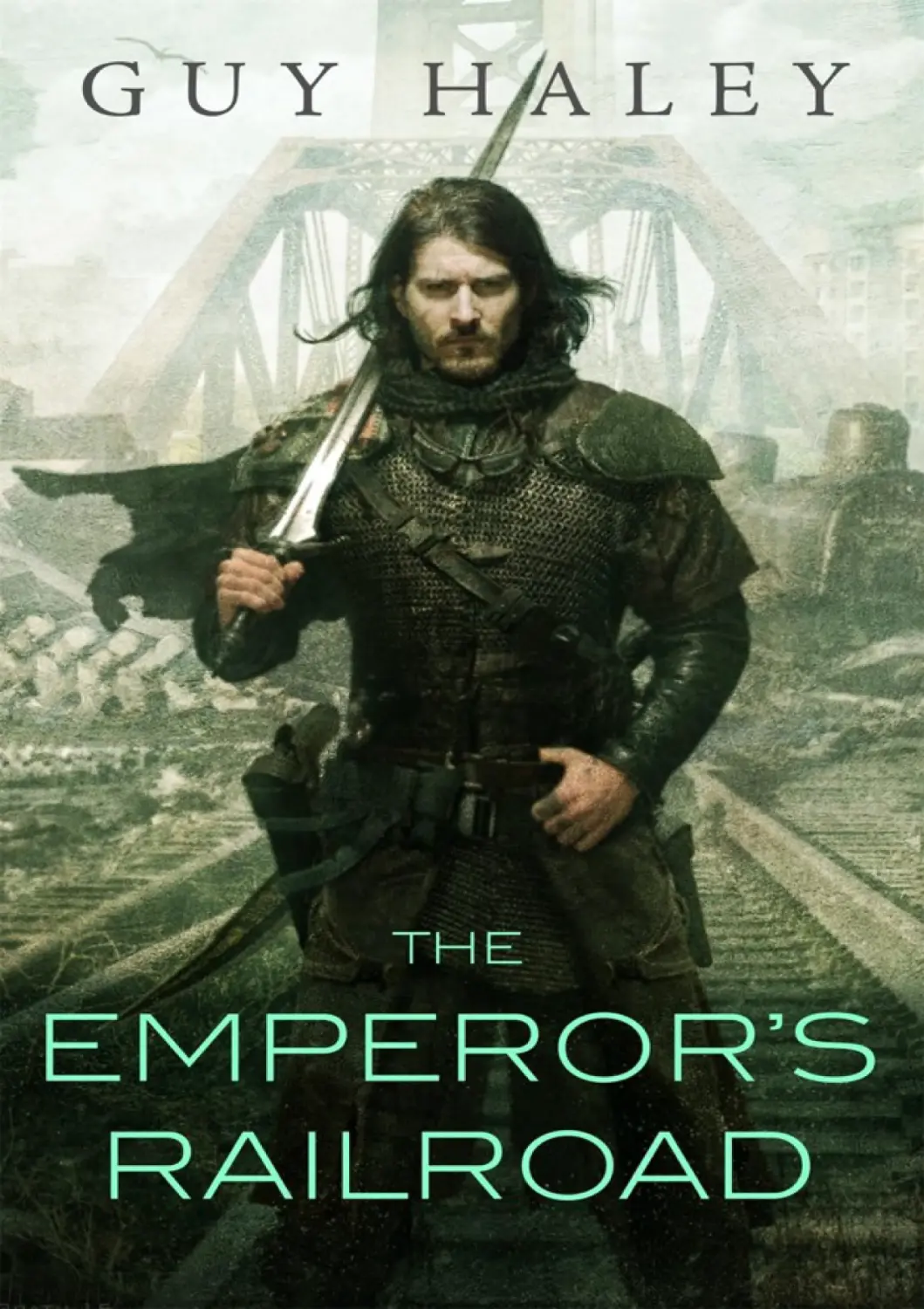
The Emperor’s Railroad
Charleston
The Road to Winfort
New Karlsville
A Knight of Atlantis
Quinn’s Gun
Blood Sacrifice
Quinn Departs
About the Author
Also by Guy Haley
Newsletter Sign-up
Copyright Page

Bridge of the Ancients
QUINN HAD TWO SWORDS .

One for killing the living, and

one for killing the dead.
He wore them on top of each other on his left hip. On
his right he had a six-gun.
A knight’s weapons.
You’ve probably not seen a knight. There’s not been
one through these parts for a long time, not since just
after Quinn, and that was fifty years back. Back then I’d
never seen one neither. Truth be told, when we first saw
him we weren’t right sure if he was what he said he was.
There weren’t many knights left in those days; most had
fallen in the war. Times like these we live in, you wonder
at people. A knight’s weapons are hard to get hold of if
you ain’t sanctioned by the Dreaming Cities, but not
impossible.
My mom, she had her suspicions. But I knew from
the start that he was a good man, I swear.
So this here’s the story of how I met Quinn, a knight
of the angels. As it happens, it’s also the story of how I
ended up here in the Winfort, and got involved with a
dragon along the way.
First I got to say this. Time goes, it rubs away at your
memory sure as the Kanawha River rubs at its banks.
Memory moves. The river is still there, but the course is
different, do you understand? I’m telling you this story,
and I’ve told it before. Maybe it changes a bit every time I

tell it, even when I’m sure that’s exactly what happened
and it couldn’t be no other way. This is a wise thing, pay
attention.
It’s the way people are. You never been in a heated
argument that your recollection is right and that of your
friend or brother is wrong? That’s how bad people are at
remembering truly. The words my mom said to me on
our journey that I’m going to tell you, they sure as hell
ain’t the exact same words she used. Things happened
that I forget, things happened that I remember a bit
different every time I bring them to mind. Bits get
dreamed up to join up the parts I do remember. And I’m
getting older. Real old. My mind ain’t what it was. I open
my eyes and everything is colored gray. I close them and
it looks like the past is drenched in gold. The future is
ashes, the past is treasure, seems to me, but do you think
that’s really how it is? I’m not far from dead, is all. When
you get where I am, I’m sure the past’ll look brighter to
you as well.
Memory. Biggest traitor there is.
You get others involved, telling their memories of my
memories, well, when I’m gone and you tell this story to
someone else, then it’ll change some more. That’s how
memories become stories, and everyone with a lick of
sense knows stories ain’t the truth.
Saying that, there are some few things that never
change, no matter how many times you think on them.
Jewels in a box, you take them out from time to time to
look at them and they never change. Some things stick in

the mind unchanged forever. There were a lot of times
like that on our journey.
One of them was seeing Quinn fight the first time on
the edge of the Kanawha River, at the Emperor’s
Railroad bridge. If I close my eyes, I see it clearer than I
can see now, like I’m there again and seeing it for the
first time.
This is how it is: my mom’s got her arms around my
neck, like that’d protect me from the dead and they’d not
just rip me from her. The sun is warm, but the morning
cold, like they get to be in fall. The trees are got up in
their finery, yellows, reds, and oranges. A Virginian
morning, a late October morning. My mom’s heart’s
beating so hard behind my head. I’m twelve, not long
that age and afraid I’ll not see thirteen. She is scared. I’m
scared. But there’s no shame in fear, not at a time like
this.
That’s what it’s like. It’s happening in my mind right
now.
There was the roar of the rapids downriver, water
pouring over the leavings of the Gone Before. The moans
of the dead. Quinn’s weapons hacking into flesh, meaty
and workmanlike, not like I imagined a knight’s blade
craft should be. Sight, sound; but the smells are the most
important. That’s when you can tell it’s a true memory. I
can smell the soap and the light tang of sweat on my
mother, the road dirt and the leaf mold from camping in
the woods. The weedy smell of the river, heavy and
round. The smell at our backs of Quinn’s horses. Quinn

himself, strong sweat, but clean and sharp, almost like
lemons. Leather and iron.
And the stink of the dead. That ripe, rank stink, the
shit on their hindquarters, old blood, vomit. All the
hidden nastiness of the human body worn on the
outside. They’re the devil’s affront to God.
The railroad bridge wasn’t like it is now, with the
trains coming over four times a week. This here is still
wild country, but it was wilder then. The new bridge is
big, but you got to imagine what it was in the Gone
Before. In those days it didn’t have a deck of wood for the
trains, but a wide road of concrete for their miraculous
carriages, tens of feet wide, and a road on that so smooth
you could roll a marble clear from one end to the other
with a little flick of your finger. That had mostly gone
into the river by the time I saw it. But the piers stayed
sound. That’s why the old emperor had chosen it for his
railroad, laying a new bridge over the old piers. Back
then it was the only way across the Kanawha north of
Charleston. Still is.
The dead came out of the trees as we’d come up to it.
Eight of them, hop-scrambling towards us, arms out,
hands grasping. They don’t have no sense; they started
moaning as soon as they smelled us, and Quinn had his
heavy sword out before they were up the bank. If they’d
waited, showed a bit of cunning, we’d have come off a lot
worse. But the dead aren’t people no more. One lunged
up out of the brush, ripping a nasty gash down the
shoulder of Quinn’s big white horse. Quinn chopped

down, spilling its rotten brains on the grass. The others
were a ways off, staggering up from the nearer the water.
“Watch the horses,” he said. He never shouted, and
he was never scared. He slid off his horse—Parsifal it was
called—and walked into the dead. He didn’t charge, or
yell. He walked down to them calmly, then set to cutting
them down like he was reaping wheat.
We didn’t have no weapons. Simple folks like us are
forbidden the likes of what Quinn had, sharp steel and
gunpowder. The dead lunged at him, clacking their teeth,
raking at him with their fingernails.
These dead ones were hungry. There’d not been many
folk up this way since the emperor’s fall, what few there
were were right here in the Winfort and did not venture
as far south as the river.
With nothing to eat, the dead had chewed their own
lips off. Their teeth were long and brown. Clotted blood
was thick round their chins and on their chests. I hate
the teeth the worst, I seen too much ill come from teeth
like that. You watch me next mealtime, you’ll see I can’t
be looking at anyone’s face, in case they forget their
manners and chew with their mouths open. Makes me
sick because it makes me think on the unliving.
The dead were naked. When they’re long gone over
like that the clothes rot off or get torn away. Not a stitch
on them. The nakedness makes them worse, somehow,
makes them seem more human rather than less. I’ve
seen men that reckon themselves brave turn and run at

the sight of a pack like that. Not Quinn. I knew for sure
he was a knight then, right at that moment, badge or not.
One of them got a hold of him, made my mom gasp
out over and over, “Oh God, oh sweet dear Jesus.” Mom
wasn’t one for blaspheming. That made it twice in one
week, the other time being when Walter died. It never
was a habit with her.
Fingers thin as twigs but strong as roots wrapped
themselves round the top of Quinn’s off arm. An
unliving’s head lunged for his bicep. It couldn’t bite
through Quinn’s mail, but it didn’t let up, gnawing on his
arm like a hungry man on a cob of corn, blood pouring
out of its gums. Quinn let it break its teeth on his armor,
and buried his sword in the head of another.
His heavy sword, the dead-killing sword, he called
that a falchion. Quinn had lots of fancy words for things;
for bits of his armor, for the past, for what he’d done, but
he did it in that sort of way that made me think he was
laughing at himself. This is a tasset, he’d say, this a
pauldron, this is a falchion. The falchion was like the
machetes we use to cut back the brush and clear a field,
but heavier and longer, because his falchion was for the
kind of weed that bites back.
The man-killing sword was lighter, four feet long.
Straight where the falchion was curved, a fancy basket
round the hilt that shone so bright I was sure it was
silver, not steel.
That longsword stayed in its sheath most of the time.
He wore his swords atop each other, and the hilts

knocked together sometimes when he walked. When that
happened, his hand went down, did this little motion to
reset them so they wouldn’t tangle when he drew. He did
it without thinking. It was a movement he must’ve done
a million times before. His gun he wore on his right hip,
because it’s different pulling a gun to a sword. Gun goes
up, swords across. I only saw him use his gun the once.
We’ll get to that.
Quinn cut the dead man diagonally between the eyes.
The skull made hollow noise, like a gourd split with a big
knife. The dead man’s eyes rolled up in his head, and he
died a second time. Quinn wrenched his falchion free.
The other unliving was still at his arm, stumps of his
teeth grinding themselves away on the mail. Quinn caved
in its skull with three blows from his pommel. This was
mighty big; a falchion’s got a heavy blade, and needs
balancing.
That left five of the unliving, shambling in that way
they have. Two were pawing at him, the other three still
coming on, slowly. Their ribs were all showing in their
skin, arms like sticks. They didn’t have it in them to run.
They were starved.
Quinn cut down both by him. One lost its head, the
other the use of its legs. Then he marched up to the
others, bold as you like. The first one lost its hand to his
sword, then its brains. Quinn was away to slam the
second down with his left arm. The thing drops, and he
steps over it, killing the last one with a single chop that
took his blade clean down through its shoulder, most of

the way to the heart. Then he pivoted on the spot,
smooth as a cat, and cut the head right from the neck of
the one he’d slammed down as it tried to get up.
He pulled off his helmet as he walked back to us, then
the leather breathing mask under it. “Curse on the air,
you ain’t got a care, curse in the mouth, you’re headed
south.” You know the rhyme. You got to get bit, or get a
lot of blood in you, to turn. Quinn wasn’t taking any
chances. He said he always wore his mask under his
helmet when he was fighting the dead. He pulled out raw
cotton pads from pouches in the breathing mask and
threw them away. He was sweating, but he wasn’t
panting. He wasn’t even out of breath.
He checked around the dead. The one that he’d cut
the legs out from moaned and scraped at the floor, the
bones shiny white in the wounds. Thick blood pumped
from the cuts, each spurt showing less vigor.
“You okay?” Quinn said. He didn’t say much, and
what he did say was quiet.
My mom nodded. “Yes, yes. Thank you.” Her voice
was breathy. She hugged me closer.
I looked at him. I was awestruck. “You are a knight,”
I said. I was raised on stories of his kind. He was a hero
to me.
He looked down at me, his expression unreadable. He
had leathery skin, eyes narrowed by looking into the sun
too much, a thick brown beard shot with gray. What I
thought of as an old man’s face, and by that I meant he
looked forty, forty-five maybe. He wasn’t like any man

I’d seen. He was pale, really pale, and when he opened
his eyes up, they were round. Not narrow like with other
folks. Knights are all funny looking, you ask me. Not long
after Quinn I saw two more knights coming through
here, one with skin so dark it was near black, another
one like Quinn, only paler yet, and with bright red hair.
That’s a story for another day. The point I’m driving at
here is that knights are surely people, but they look
different than you or me.
I asked him once how old he was. “Older than you,”
he said. That was that.
My mom tugged me in her arms, a hug with a rebuke
in it. “Forgive my son, sir.” I was pretty sure she doubted
he was a knight still.
“He’s a boy,” said Quinn, as if that explained
something. He went to his horses. He had two. Parsifal
was a tall, powerful stallion. He warned us against
surprising it, but he let Mom and me ride it while he
walked. The other horse was a round little pony that
carried his gear. Clemente, he called it. Clemente took
two strides for every one of the stallion’s, but it never
tired. Both of them were cropping grass, neither
bothered by the blood and stink. Quinn went to his
charger and checked its wound. Shallow scratches, it
turned out.
“Is he going to die?” I said.
“It looks worse than it is,” said Quinn. It did look bad,
three parallel grooves, deep and bright with blood. He
pulled out a fingernail from the bottom of one and threw

it aside. That’s how strong the dead can be, strong
enough to tear through horse hide. They rip their own
fingernails out, and they don’t feel a damn thing.
He cleaned out the wound with a rag and something
that smelled like moonshine.
“Why’s he doing that, Mom?” I asked.
“Infection, got to clean it,” said Quinn. “The animals
don’t get the sickness, but they incubate it. And those
things can give you a bad case of blood poisoning even if
you don’t get what they’ve got.”
There was a moan from the dead on the ground. I
started and clutched at my mom’s sleeve.
“Mr. Quinn …” my mom began.
“That dead ain’t dead! You gotta kill it, mister.”
Quinn glanced at the dead man, slowly bleeding his
way to his second death. Quinn went back to cleaning out
the scratch on his horse’s shoulder.
“They aren’t dead, kid, they just seem that way. That
one won’t last long. He’ll die soon enough. Takes longer
for them to die than a healthy man, but a wound that will
kill you will kill them. Eventually.”
Half the time Quinn spoke like regular folks. But the
other half he spoke strangely, old-fashioned like; you
might say educated. My mother wasn’t a poor woman,
not to start with. She had some learning, and she passed
it on to me. Some of the children at New Karlsville used
to tease me for it. Mom said they were afraid of what I
knew and they didn’t. They had to slap me down to make

themselves feel better, that they were stronger in their
ignorance. I still know a few things that some don’t, and
that ain’t all down to the teachings of the Lord. But
Quinn, the way he spoke made me sound like the worst
kind of wildman from the deepest woods, the ones that
think giants built the world Gone Before, and sacrifice
their kids to the angels. And the things he knew …
“How can you be sure, sir?”
“Are you afraid of blood, kid?”
“No, sir!” I shook my head hard.
“Then go see for yourself. It won’t have the strength
to hurt you. It will bleed out in a few minutes.”
“Why don’t you just kill it?” I didn’t like the moaning,
but I wasn’t going to say that.
“I won’t risk the edge on my blade. Hacking down at
the ground’ll blunt it.”
“Show some pity, Mr. Quinn!” said my mom. She had
a way about her, she was used to people doing what she
said.
“Why?” he said, not looking at her. “It can’t feel
anything. The mind’s all gone from that one. There’s no
man in there. There’s nothing but animal left.”
She took in a deep breath, and tried again. “Could you
show a little mercy, please, for the sake of my son? You
say you are a knight, you should behave like one in front
of him.” I pulled away from my mom then. She was
angry and didn’t notice. “That poor man was once like

you or I. He deserves a little dignity. Is there not
something in your code of honor, sir?”
Quinn shrugged, and carried on cleaning out his
horse’s cut.
By that point, I was over by the dead man.
Mom noticed where I’d gotten to and cried out.
“Abney! Stay away!” Sometimes she could get a bit shrill,
overprotective, I felt. I was that age where I always knew
better. I didn’t pay her no attention.
The dead man was on the floor, his head rolling back
and forth. I was fascinated and repulsed. I couldn’t look
away from it. Quinn’s cut had smashed the bones in both
thighs as well as cutting them deep. That’s how heavy a
weapon a falchion is. It couldn’t move. It looked at me
hungrily with those pale blue eyes they all have. Its
mouth and nose were bloody holes. A black tongue, sore
with self-inflicted bites, ran over its teeth. I hate the
teeth.
Quinn shoved me back. His leather glove was rough
on my chest, even through my shirt. He had his falchion
in his hand.
“Not that close,” he said.
Although it’s a heavy sword meant for chopping, a
falchion does have a point. Carefully, Quinn put this
against the dead man’s left eye. The dead man groped at
Quinn’s legs, but Quinn paid it no mind. He leaned on
his sword pommel with both hands, pushing the point
down through the skull. There was a scraping noise and a

crack of bone. A slow breath escaped the dead man’s lips,
the sigh of a man sinking into exhaustion after a hard
day in the fields, and he was still.
“Dead now,” Quinn said.
Another rag came out. He wiped his sword with it.
The rag went into a different pouch to the one it had
come out of. Then he held the weapon up in line with his
eyes, sighted down the blade for nicks, then slid the
sword back into its scabbard. Then he checked his
shoulder and his hands, not so much for bites to his
flesh, I think, but for damage to his armor. The leather
and steel were filthy with the blood of the unliving, but
otherwise unmarked. “Going to take a while to clean this
off,” he said.
“We do not have the luxury—” began my mother.
“I didn’t mean now.” He looked down at the rushes
between the bank and the first pier. The old road
approaching the bridge had been raised up on some sort
of causeway; where it had sagged it’d been filled in with
rubble and spoil by the emperor’s men for their railroad,
but that had been twenty years back. The repairs were
beginning to fail. The emperor’s engineers did not have
the skill of the Gone Before. Trees were growing up
between the sleepers. In one place the bank had been
washed out, leaving rusty iron rails hanging over
nothing.
From the embankment to the bridge’s first pier was a
wide gap in the old road, it having fallen in the Good
Lord alone knows when. Being close to the river like that

kept the rubble free of dirt, so we could see the worn
slabs of it draped broke-backed over the bank and
stretch of water. Thick ivy clogged the pier’s upper part.
A gust of wind made the leaves rattle, passing on to
ripple the brown river with silver waves. Any sound in a
place like that can make you startle, and I did.
The old bridge had been made out of concrete, the
molding stone of the Gone Before, the new bridge from
wood and iron. The emperor’s bridge had been made on
a grand scale by the standards of this diminished era. It
was wide enough for a train, with good, broad walkways
for the draft horses on both sides.
All this was carried up on a big old latticework of
huge wooden beams. These were arranged in squares ten
feet by ten feet, with a diagonal brace across each, all tied
up with iron. It looked real impressive, but twenty cold
Virginian winters and twenty humid Virginian summers
do a lot of damage. The beams were the kind of wet that
don’t dry easy, the wood splintery, rotted right through
in places. Moss clung to every surface not directly in the
wind. It being that time of year there were about ten
kinds of fungus on it. Vines and briars trailed off into the
water. The iron of the rails and the ties was bright
orange, and streaked the wood. We looked nervously at
it, but this was the only way to get to Cousin Matthew up
at the Winfort, so we were crossing it, happily or not.
“Wait here,” Quinn said. He went down the bank,
picking his way through the wooden supports of the
emperor’s bridge, right down to where the water was
pale with fallen rubble and the river foamed over the

weirs they made. There were concrete caves with flat
roofs there, and he checked them for more dead. A duck
burst from the water’s edge twenty yards downriver.
Wings clattering, it blared an angry alarm. An uneasy
silence followed. Quinn came back. He breathed out one
long, thoughtful exhalation, and scanned the banks with
those wrinkled-in eyes of his. I don’t know what he saw. I
couldn’t see anything but woods and reeds and the
Emperor’s Railroad.
“We’ll not cross all the way tonight,” he said.
“You have changed your mind?” my mother said.
“Dead slowed us down. There’s an hour of daylight
left, not enough to find us a good campground,” he said.
He was so sure of everything he said. When he said there
was an hour of daylight, well, that’s what there would be,
pretty much exactly. “It’s twenty miles further to
Winfort. We have to cross slowly, the wood’s rotted all to
hell and the emperor never did build as good as he
boasted. By the time we’re over, it’ll be dark. We’ll camp
on the middle section, where the road from the Gone
Before stands.” He pointed to the middle, one of two
points where concrete deck still stood. The other being
just across from us between the first and second piers.
The railroad had been laid directly onto the old deck in
those parts. “We’ll finish the crossing tomorrow. We’d be
better trying to get all the way to Winfort in one day
anyhow.”
“What about the bandits?” my mom said. “You’ve had
us near running through these woods, Mr. Quinn, for

fear of them. Are you not worried by them any longer?”
Quinn shrugged. “Not as worried as I am by the
dead,” he said. “These are old, long turned, and near
starved. But where there is one pack, there’re always
more. In the middle we can see anyone coming, living or
dead.”
“And they, Mr. Quinn, will be able to see us!”
Quinn’s jaw set. “Truth is, ma’am, we are not going
much further tonight. Last thing I’m wanting to do is
come down on the far side of the river when night’s
drawing in. The dragon’ll be most active then. I took on
your employment on the understanding you’d do what I
said. These are dangerous lands.”
“You said they weren’t dead, mister,” I blurted. I felt
the tension rising between the adults. I had to say
something on my mother’s side. I was the man of the
family, at least for a day or so more until we got to
Winfort. There was a contradiction in what Quinn said,
one I could understand. I seized on it.
Quinn gave me a quirk-mouthed look, the kind that
tells you you’re being dumb.
“How can you be sure?” my mother asked. She was a
pretty woman, even when she was stern. She
commanded a high bride price for it. I didn’t understand
all the business of matrimony back when I was a boy.
Not until I got older did I look back and understand what
I’d seen. When she and my stepfather Gern were going
through the endless step and counterstep of the marriage
dance with each other, I wondered if he’d been blinded

by her prettiness, thinking she had no brains to match.
He found alright that she had plenty. My mom was not a
woman to take orders from anyone, least of all a man.
Still, that was all done. Gern was dead, along with
everyone else in New Karlsville. All we had of Gern was
the bride price she’d saved all them years, and she’d
promised a deal of that to Quinn.
“I’m sure, ma’am,” said Quinn. He never looked at my
mother when he spoke to her. There was that reserve to
him, more than him simply being formal. “If you don’t
like what I say, stay here.”
“That is not our agreement.”
“Well then,” said Quinn, as if that settled it. He went
for his horses. “You first. This bridge’ll bear you better
than my horses.”
By way of comment on his judgment, the emperor’s
bridge creaked.
“Wind’s picking up.” He sniffed the air. “We best be
on our way.”
I didn’t like the look of the bridge. My mother didn’t like
the look of it either, although she hid it better than me.
She took a breath to steady her nerves, sort of a high
sound that was too long for a gasp, too short for a sigh.
Mom went first, up by the left-hand edge where she
could grab the vertical beams for support. Someone had
tacked up a rope there for a handrail sometime, but
whenever it was it was long ago, and the rope was rotten
gray where it wasn’t green. Mom told me not to touch it.

“Put your feet here, at the edges,” she said, placing
her own where the beams were fixed into the side. She
crept forward, putting her feet carefully one directly in
front of the other. “Not this one, Abney,” she’d say. “Go
careful here,” and so on. All while she moved forward
resolutely. She had her mouth set in that thin line that
said she was taking no nonsense, not from old Garrett
down the store or from the sheriffs, or from any damn
bridge. I don’t reckon I’ve met any man as brave as my
mother.
“Now you,” said Quinn quietly, when Mom was
halfway.
I stepped up to the brink. The first beam was missing,
the second a worrying dark brown and slick with it.
Through the gap I could see the ground, only a few feet
below me where the bridge rose up, but the bank
dropped away frighteningly fast. I took a deep breath and
stepped forward. I did just what my mom had done, one
foot in front of the other, right at the place where the
beams joined into the sides of the bridge. It wasn’t so bad
to begin with, but as the bridge got higher and higher my
breath came a little harder, a little sharper. My eyes
shifted from my hands to my feet the whole time.
Frightened I’d grab at a rotten piece of wood or rope,
then frightened I’d put my foot through a hole I didn’t
see coming because I was so busy looking at where I
should put my hands. I got scared, and went quicker.
“Slow down, Abney!” my mother warned.

I wanted to be brave, for my mom, but I didn’t slow
down. I stopped.
My mom was standing on the old road on the first
pier. Jagged gums of concrete with rusty holes showing
where iron teeth had been. She gave me that wide-eyed
stare mothers do when they’re mad at you but don’t want
to shout because they’re scared for you too.
My eyes skated down, between my feet. Between the
gaps in the wood I saw rushes, the black blood of the
dead, green lazy waters. I imagined falling right through
that rotten old wood and plunging under the surface,
never to be seen again.
I froze. Mr. Quinn cleared his throat. I turned my
head. There he was, waiting patient as you like, holding
the reins of that big horse and little pony of his.
There was no fear in him, like he wasn’t going to take
a ton of horseflesh out over a rotten-wood bridge. His
armor was dirty, the leather of his belts and scabbards
and holsters were dusty and cracked. His beard and hair
were wild. But he was still a knight, and I looked like a
fool in front of him.
That embarrassment was enough to send me over to
the far side. I scampered across the last part. My mom
put her hand on my shoulder. She searched my eyes for a
moment, one hand under my chin to tilt my face up.
Then her face wrinkled with concern for Quinn.
Quinn led his stallion over, all nonchalant like. One
hand on the reins, the other lightly on the supports at the
side. The horse kept its head down, hooves picking out

the good wood. Quinn joined us, passed one rein to my
mother without a word. The horse bent his big white
head and started crunching on the grass growing on the
ancient deck. Rip, crunch crunch, that way horses do. I
ain’t never heard anything make so big a meal out of
grass as a horse. You ever notice that?
That horse was so clean and white and Quinn so dirty
you’d think Quinn had stolen it from a better man. Its
harness was well-oiled and its coat shone. Every night,
after we set camp, before he ate, he fed his beasts and he
oiled the leather. Every night. He curried the pair of
them for a half hour before the last light went, then
worked their coats with soft brushes. When we first saw
him, a vagabond on a knight’s horse … Well, you can’t
blame us for getting the wrong idea. I ain’t ashamed to
admit it. But we had to trust him. We had no choice.
Good luck for us he was what he said, and not what he
seemed.
Quinn ran back down the bridge. His pony came less
surely than his riding horse, but it came anyways.
Halfway across that time a beam snapped, not loud; a
soft wet crack, like a bone going. My mom’s hand was up
to her mouth, her other gripped the front of my jacket.
She pulled me in so close she knocked my hat forward
and I wriggled to get some space. I had to see what would
happen.
Nothing did happen to Quinn, not ever. The beam
bent, but did not give, and he got across.

The bridge was a large reminder of the works of the Gone
Before, a strong, massive thing that no man for a
hundred miles of this place has any idea how to build,
and no man a thousand miles past that has the things he
needs to get it done. Long and straight, the bridge had
lasted out the years since the Fall when so many others
had collapsed entirely. But there ain’t no thing in this
world so mighty as time, and so the bridge was going the
way of all things: finally, slowly sinking into ruinous
grandeur. Great girders of steel had held it high. This
part of the country had been empty for a long time, and
there was so much metal in easier spots that no one had
gotten round to scavenging it. Most of the iron that had
been there come the Fall was still there come our
journey, rusted paper thin by years of rain, twisted by the
sagging of the road they held, but still there, shaggy in
coats of ivy. In sheltered spots the rust was worst, often
rotted right through. But sometimes—around rivets big
as your fist, in the corners where the metal had been
joined by the Gone Before—you could see spots of
ancient paint.
We are iron, the girders said to me. You cannot bring
us low. They were wrong about that. They were warped
and fallen as the men who’d made them, broken as a
spiderweb poked with a stick, but they were going down
fighting. You got to respect that.
There were four piers all told. The road had been
wide, big enough for four wagons, I reckon. At the
southern and northern parts, between the first and
second pier and the third and the fourth, the deck still

stood over the water. The emperor had shored up the
original structure there so that his railroad could run
over it. The section in the middle was soon to give up the
ghost. The road hung from piers at one side only, the
other half sloping almost into the water. But it was safe
to cross if you stuck to the high upstream side; the rest
was a treacherous slope of cracked concrete full of
bushes, trees, and poison ivy that ran all the way into the
water. That part went in years back, way before King
Jonas rebuilt the bridge properly, but when we crossed it
was still hanging in there.
Between the bank and the first pier, between the
fourth pier and the bank, all the old deck was in the
water. The emperor’s flimsy wooden parasite crossed the
gaps. Down in the river, trailing weed, were the works of
mightier men.
What concrete was left was full of holes, cracked by
the weather and roots. Trees grew all over it. The bridge
wasn’t a bridge anymore, but an island floating in the
sky. Quinn brought his horses along, nice and slow,
always looking for broken iron or holes that might catch
their feet and break their legs.
“Why’d they need such big roads?” I said. The
Emperor’s Railroad looked pathetic on the bridge.
“There were a lot more people than there are now,”
Quinn said.
“God took it away, Abney,” Mom said.
Quinn shook his head. “They threw it away, is what
happened.”

My mother was a god-fearing woman. She frowned at
me, her way of telling me Quinn was wrong.
Downriver were the rapids. A bunch of low,
crumbling islands stuck up out of the water, too regular
to be natural. More work from the Gone Before. Those
islands stop the river up good there. All those bridges
down the rivers foul up the water for us. You can’t take
anything down that stretch with a draft of more than a
yard or so, the trash in there’d tear the bottom right out
of it. That hundred-foot length of rapids are the reason
you can’t take a boat to the Ohio River, and all the trade
from Charleston has to get from the Kanawha to the
Ohio by way of the railroad out to Huntingdon docks.
There was some talk about the emperor digging a
canal, opening up the way from Charlotte to the Ohio
once his war was over. But he offended the Lord, the
sickness came back, the dragon came, and that was that.
These days the king is talking on it. Things never change.
You only got an idea of what the Gone Before might
have been like from up high. I could see the lines of the
streets and the roads in the patterns of the trees, those
marshes and forests that had been the homes of men.
Now they’re only irregularities in the patterns of God’s
world. I wondered then, and I’ve wondered many times
since, how long before those traces are eaten up, broken
down by the plants, pulled to pieces and digested by the
Earth, so that there’s nothing left at all.
We reached the last stretch of sound concrete. Here a
section of wooden bridge stretched out down to the

northern bank, as rotten as and streaked with rust off the
railroad as the southern section. In the dark it looked
pathetic compared to the structure it sat atop of—a
phantom of a bridge. There was an overgrown clearing at
the end studded with tumbledown walls, swampy land
beyond.
“We’ll stop here,” Quinn said.
So we camped on the flying island. Did they have real
floating islands, back then in the Gone Before? I’ve heard
it said they could do most anything.
We were in a tight spot. Dead men in the woods,
something worse beyond, and we had to go through to
get to a cousin Mom wasn’t even sure was still alive. I
must have looked scared, because my mom pulled me
close and murmured, “No one can get up here, not
without Quinn seeing, don’t you worry.”
I couldn’t help but think that whatever might happen
there, it couldn’t be as bad as what had happened to New
Karlsville.

The Road to Charleston
I HAVEN’T TOLD YOU

how we met Quinn yet.

Here’s how it went. Three days before we crossed the
bridge, the axle on Walter’s mail wagon broke, and he
fell. And because he fell, he died. Walter’s end was a
stupid, pointless one, brought on by a pothole. One
moment he was laughing—that moustache of his
bristling like a catfish’s whiskers—then there was a bang,
a crack, a lurch, his hand went out for support, found
none. My mom swiped for his fingers but missed, and he
toppled off the seat. A wet bang as his skull connected
with a rock, placed just right to catch him on the head.
Almost malicious, like it was done on purpose. We were
sad for his loss; of all the people that could have helped
us after New Karlsville fell, only he did.
When we scrambled off the mail wagon into the road
he wasn’t moving. My mother turned him over. His eyes
were staring at nothing. There was a perfect round dent
in his head big enough for half a cup of flour. But he was
still breathing. We did what we could, which wasn’t
much, and he died.
Mom made sure he didn’t come back. She was never
squeamish about that.
For the second time in a month we were waiting to
see what God had in store for us. The road was one from
the Gone Before. I’ll tell you how you can tell their roads.
The surface they used is gone. But earthworks, they stay
put until shifted. You see a long, long dip, like a big ditch

or a dry river, with embankments that don’t seem to
serve no useful purpose? Chances are it’s an old road.
This one had been broad enough to build a house across,
a big house at that, now it was barely more than a track.
Trees and scrub had encroached on its width from the
sides and from the middle. Sometimes you’d catch sight
of broken things from the time before. Most often
bridges, where one of their roads crossed another. In
New Karlsville we used to call them from the Gone
Before “Bridge Builders,” they made so many.
The state of the road tells you a lot about how
important New Karlsville was. But sorry though it was,
the road was a main way to Charleston from the south, so
we were hopeful someone would be along, and that they
wouldn’t be a man with a black heart.
“The Good Lord provides,” my mom said. She said
that a lot.
I couldn’t keep my eyes off the trees. Dense forest
round there, where we was, and not a sign of civilized
human life.
We were four hours there before Quinn rode up. We
heard his horses’ hooves thumping hollowly on the
mulch first, and his gear jangling. We looked down the
road. He appeared round a corner, his horses’ feet
ringing louder as he crossed onto the small patch of bare
concrete we were sitting on. My mother drew up her
knees, stared resolutely at him. She was afraid of this
man with his gun and his swords.

Quinn—we didn’t know his name then—Quinn
glanced at our wagon sagging on its broken axle, then he
looked not at us exactly, more over our heads. He rarely
looked you in the eye. Often when he did look a man in
the eye, it meant trouble.
I’m not a liar, so I’m not going to say when he came
riding up to us that first day that we didn’t think he
might be a thief. The suspicion lingered, days after he
took us on, until that time when I saw Quinn fight. Then
I knew for sure he was what he said he was.
“Dangerous country this,” said the man who might
have been a knight, or might have been a murderer.
My mother did not reply.
“Where are you headed?” he said.
“North,” said my mother. Her voice was unusually
clipped, dismissive. She wanted him to pass on by.
“Charleston?” he said.
My mother said nothing.
“Further?” he said.
My mother nodded, just slightly.
“Where?”
No reply.
“I don’t mean any harm.”
She looked at him, openly hostile.
“I can help you, ma’am.”

“It is not your concern where we are headed, sir,” my
mother said.
Quinn shifted on his saddle. “Okay.” He said nothing
for a minute. His horse snorted and paced from foot to
foot, impatient to be on. His pack pony was already
cropping grass. Quinn looked at the wagon. “Not safe, a
boy and a woman alone. I’m headed north. I’ll take you
to Charleston.”
“Your weapons, your armor. They are those of a
knight,” my mother said.
“They are,” he said.
“How did you come by them?” Her eyes strayed to the
bare patch on his left shoulder, the place he should have
been wearing his badge. If he was a knight, good for us,
because they got codes. If he weren’t … well, I don’t need
to spell it out for you.
He leaned down, and he did look directly at us for a
second.
“How do you think?”
He swung his leg off his horse and slid to the ground.
He stretched in a way that suggested he’d been riding for
hours. My mother did not take her eyes off him. He lifted
his arms high in the air and bent his back. He smelled of
the road and of danger. His sword hilts knocked
together, and I saw him do that little motion that I was to
see him do so many times, a hitch and a push at the hilt
of his falchion to keep his swords clear of each other. He
looked at us for a long time.

“How about I find you a fresh axle for that wagon?”
he said eventually.
“That would be kind, thank you,” Mom said. A touch
of hope entered her voice. The knight had made no move
against us.
He looked at the wagon. “You’ll need to turn this in to
the postmaster in Charleston.”
“I cannot pay you if you ride with us,” she said. She
was lying; she could pay, but she’d have been a fool to
tell him about the bride price hidden under the mailbags.
My mother was no fool.
“We’ll figure something out.”
“I will not pay you in that manner.” Her grip on my
hand became fierce.
Quinn gave a half shrug that made his mail jingle. “I
don’t mean anything of that nature.” He went to the pony
and pulled out an oilcloth bundle and unrolled it on the
ground. There were a number of tools inside, all in
pockets sewn perfectly to fit them. Worn wooden handles
and iron heads poked out of each. They looked like bald
orphans tucked up in rows of beds in an orphanage,
hopeful to be picked. He pulled out a small saw and a
hatchet.
“There’ll be a reward for the recovery of this mail
wagon. If you’ll see your way to letting me keep the
money, I’ll get you as far as Charleston.”
“What about afterwards?” I blurted.

“I don’t know about further north. It’s bad country
past the city, and out of my way.”
“Please, mister,” I said.
Quinn gave me a smile, tight, but friendly. “Maybe
we’ll work something out. What happened to the
mailman? Was he on his own? No gunner?”
My mother nodded. “His gunner left him a while
back. He always said he preferred to travel alone, and
wouldn’t take another partner.” She nodded backward
off the road, to where his corpse lay stitched into sacking
behind a bush. “Such a stupid accident. The pothole
there broke our axle. He fell. One moment he was
talking, and the next …” she trailed off. Her eyes had
gone a little pink. “He was a good man. A kind man.”
“That’s bad luck,” said Quinn.
“Yes.” She had more than her share of bad luck, my
mother. God did love to test her.
“You took care of him?”
“Of course. He took a blow to the head, but I was not
about to take chances with my son.”
“Wise,” he said. He had this way of lading a whole
sentence worth of meaning onto one word. “Let’s see
about that axle.”
He went away for a while. We heard him chopping a
tree. I made to go watch but my mother pulled me back
and shook her head.

Fifteen minutes later he returned dragging a sapling.
He threw it down on the floor, and went to his tool roll
for a curved draw knife and worked it at the sapling’s
twigs.
“This will do, till we get to Charleston. It won’t take
us any further than that.”
“It’s got a kink in it, mister,” I said. My mother
shushed me.
“That’s why it won’t take us any further.” He hitched
up his belt, adjusting his swords again. “It’ll break soon
enough too. It’s not seasoned. And bad timber round
here, none of it grows straight.” He looked into the dense
stands of young trees crowding into the road as he said
this, telling them more than us. “I could do with a hand,
ma’am,” he said.
“There’s no need for that.”
“What do I call you then?” He looked up from under
his eyebrows, amused, but maybe—and this is the oddest
thing—shy.
“Mrs. Hollister,” she said. Her first name was Sarah,
although she didn’t tell him that until later. I always
intended to call my daughter Sarah, after my mom. But
the Good Lord didn’t see fit to bless me that way. “This is
Abney.”
He nodded at me. I stared back.
“Then help me, Mrs. Hollister, and we’ll be on our
way.”

They had to take the mail out of the back to lighten
the wagon. I tried my best to help, but the sacks were
bulky even if they weren’t heavy, and most of them were
heavy. Not once did Quinn look like he’d break the wire
seals. Neither the king’s law or the Dreaming Cities take
kindly to mail pilfering, but I figured he could do just
what he liked. Who’d stop a man armed like that taking
what he wanted? He didn’t so much as squeeze the bags
to see what might be in them.
My mom was strong and capable. They worked hard,
not a word between them, as they levered up the wagon
with a pole cut from another tree. Quinn propped up the
wagon base on logs and a couple of rocks. Then he fit the
new axle, quick and clean. We took away the prop, and
loaded up the mail again. That was that.
Last in was Walter. A good man, well liked in our
village. He didn’t have to take us. But he did. If his death
had ought to do with us, I can’t say. Maybe you think I’m
some kind of draw for bad luck, like a few of the elders
say still from time to time. You think that, think on this—
without us, who would have been there to make sure he
didn’t go the way of the dead? He slept easy, Walter.
That’s more than some of us will get.
I was tired and Mom said I should ride in the back. I was
ready for sleep, but I couldn’t take my eyes from Walter.
Mom had sewn him up tight, the proper way, one stitch
through the nose to make sure he wasn’t still with us.
Stains spread from his head where the rock had done
him, another from the back of the neck where my mom

had severed his spine. Bump bump, the wagon went,
sending old Walter rocking to and fro. What if Mom had
missed? What if it didn’t work on him? I couldn’t stop
watching, sure as sure that at any moment he’d make the
moan of the returning dead, start thrashing about, trying
to get out of the bag and tear at me. It was hot and stuffy
in the wagon, fall heat that sets you up for a chill when
night’s in. The light shining through the canvas turned
blue and dingy, and I tried to go to sleep. But every time
I shut my eyes, I thought of Walter coming back and
creeping up to gnaw on me and my eyes flew open.
Walter’s corpse was a horrible shape in the dark. The
canvas flapped on the wagon hoops, mailbags rolling,
and Walter going bump, bump, bump.
I caught a few words up front. The wagon stopped.
Walter rolled in his sack one last time. I swallowed. My
throat was dry and my skin clammy.
Quinn rode up round the back. I didn’t see him
coming, being a mite occupied, so I near died myself
when he lifted the flap.
“Not healthy, son, staring on the dead like that,” he
said. “Get out and ride up front with your mother.”
I scrambled out fast as if ghouls had got a scent of me
and were baying for my blood. My mom gave me a little
squeeze. I was shaking something, and I needed it. It’s a
hard time of life for a boy, being halfway a man. Damn
fool I felt like, staring wide-eyed like a kid the whole time
at the knight. I shoved my mother’s arm off, my cheeks

burning, even though I wanted her to hold me close more
than anything.
Quinn trotted up level to the driver’s side, that big
white horse of his glowing in the twilight.
“Thank you, sir, for looking out for my boy,” my
mother said. “You never told us your name.” She hadn’t
said much to the knight. She was still wary, but he hadn’t
tried anything. Maybe she’d not asked his name to
forestall any unpleasantness. Ask some men their name,
and they think you’re asking for a whole lot more.
“Quinn,” he said.
“That’s all?”
He nodded, looking down the road. “It’ll serve,” he
said.
“And you are a knight?” she asked this cautiously. I
could tell she was weighing up in her mind the need to
know, against the need to not provoke him.
He gave his quick, crook-mouthed smile. There and
gone. “For my sins,” he said.
“But you wear no badge? Which city is your lord?”
“My choice, ma’am,” he said, answering the first
question but not the second. “We best stop for the night,”
he said.
“Here?” said my mother. The forest was thick still,
the sky that utter black blazing with stars that you find
yourself under out in the wild.
“Can you suggest anywhere better?” he asked.

We stopped.
He got off his horse. Conversation over.
Quinn tended to his horses. He had a way with them that
was kind and careful, and I lost some of my suspicion of
him.
He caught me watching.
“You gonna help, son?”
I didn’t move.
He shrugged. “This here’s Parsifal,” he said, slapping
his horse’s neck. “The little one is Clemente. Clem, if you
prefer. He don’t mind.”
“Strange names,” I blurted.
“The angels named Parsifal, son, they like to allude to
old stories. They think it’s fitting, funny. Clem though, I
named him myself.”
The pony shook out his mane at the mention of his
name. Quinn strapped on his nosebag. They had an
understanding between them, those three.
Several hours later, I twitched awake. I was lying on
my back, the lumps of the ground pressing into my back.
Half asleep like that, for a moment I thought I was lying
on bones, all the bones of the dead past reaching up
hungrily through the ground to devour the present. That
woke me up for real.
The moon had gone. It was damn cold, not yet frosty,
but that was only a few weeks away. I think the chill was
what woke me.

Mom and Quinn were talking, the low, sibilant
rumblings of adults being quiet. The voices they use
when they’re engaged in love, or arguing. Rarely any
other time else.
Mom and Quinn were close to argument.
He and my mom talked hard, her trying not to shout,
all hisses and bitten words, him slow and reasonable,
voice mumbling like water. If they’d have known I was
awake they would’ve shut up, so I kept still and listened,
me being endlessly fascinated by the dealings of adults.
Adults think kids don’t understand. My mom thought
I didn’t. She loved me, my mom, she would do anything
for me. That’s why she sold herself on to Gern after I
turned eight. Keep me fed, keep me strong. I understood
that, she never spoke with me about it, but I knew what
she did. She didn’t want to remarry, and even though
Gern was good in his way, he’d still demand his rights.
That must have been hard on her. I don’t think she ever
loved anyone after my father died. Same with all that
travel to get me here. You might think about leaving this
place, going somewhere else, but leaving’s harder than
just picking up your pack and walking down the road.
There’s the angels for one, they’re not always happy with
folks with itchy feet. Sometimes they are, sometimes they
ain’t. You can’t ever tell. Then there’s finding
somewhere. You want to make it in the city, fine, but you
want a new village? Good luck to you. They won’t let you
in unless you got something to give. My mom, she had
something—she was fertile, but she wanted better than
to just sell herself again. All her life she’d struggled to

keep a bit of freedom and had never quite managed. But
she didn’t go halfway across Virginia for her. You might
think otherwise, but I know she did it for me.
This is what Quinn and my mom were saying.
“I’ll take you to Charleston. Make a new life for
yourself there. I can’t take you to Winfort.”
“And what is there for me in Charleston, Mr. Quinn?
How long until a man stakes a claim on me, and paid my
bride price to the magistrate? Then what? If I go to my
cousin, then he will vouch for me, take me in, and I will
be free of marriage difficulties.”
“You don’t want another husband? Taking a man will
ease your way some.”
“Maybe. In time. But the choice will be mine.”
“The boy needs a father.” I could feel his eyes on me. I
lay dead still. “This is a rough world, ma’am. Rougher
still if you’re on your own. You’ll be the first to get
thrown out if there’s a bad harvest, or the dead come, or
there’s disease. You get your pick. You’re pretty, still
young, fertile too, and that’s a rarity.”
“If you are suggesting that my boy’s interests are not
my highest priority, Mr. Quinn, you are incorrect. I have
to be careful. I don’t want some dirt poor farmer working
him to death, or him apprenticed in a filthy trade.”
Quinn sighed. I heard him poke the fire, it burning
harder after he did. “My point is, ma’am, why go all that
way? Set the price high, that’s your prerogative, and drop

it for the right man. The road north of Charleston is
dangerous.”
My mother’s voice hardened, an ugliness crept into it.
She was stubborn, so stubborn it might have poisoned
her if she’d lived longer. “All it takes, Mr. Quinn, is for
some man to bribe the justice to judge my price too high
and lower it by legal fiat. Then what? The power I have
over my own body is tenuous at best. I need a man to
shelter me so that I might freely choose. Under the
vouchsafe of my cousin, we’ll both be free.” She was
angry about this, she always was angry when she spoke
on this subject. “Men with money are rarely kind.”
“You chasing kindness might just get you killed.”
“I’d rather chance the angels’ wrath than have my boy
watch his mother die miserable, and then him die
miserable because of it.”
Quinn grunted in agreement. They were silent a
space. “It wasn’t always like this,” he said. “It won’t be
like this forever.”
“It does not matter how it was,” my mother said, “and
I do not share your optimism, Mr. Quinn. God has
reduced us to the level we deserve.”
“Maybe,” he said. “Why did you leave, Mrs.
Hollister?”
“After New Karlsville fell, there was nothing left
there. It is as simple as that.”
“Things rarely are simple, ma’am. Let me see your
letters.”

Clothes rustled. She kept Cousin Matthew’s letters
close by her chest.
Quinn breathed out. I imagine he was reading.
“This the last?”
“Yes.”
“And you got this five years ago?”
“Yes. His letters became less frequent, on account of
the increasing depredations of the Emperor’s
Punishment, but he was still alive then, and he says life
away from the river was good, ’cause the Emperor’s
Punishment didn’t go that far north.”
“Things change. The angels are unpredictable, their
creatures more so.” This from a man who was one
himself. “The Lord of Winfort holds his lands at the
angels’ command, but that don’t make him immune to
the dragon. How old will your cousin be now?”
“Forty-one, he’s eight years my senior, but we were
very close when we were young.”
“How close?”
“Friend close, Mr. Quinn! He was like my brother,”
she said.
“Alright, alright. Closer than that, things get tangled.”
He was weighing up the journey. The danger. What
was in it for him? Knights have honor and nobility and
all the things they should have, but these great virtues
weren’t intended by the angels to be wasted on little folk.
They are the levers and fulcrums of kingdoms. And no

matter how well disposed to you a knight might be, they
ain’t hell-bent on suicide.
“You will be paid,” she prompted.
“You’re offering a lot of money,” he said.
Mom must’ve told him about her silver. That scared
me.
“It is.”
I tensed.
“I’ll try harder then to be accommodating,” he said
without rancor. “Alright. I’ll do it,” he said. “But from
now on, you and the boy do what I say, when, and how.
Your lives will depend on it. Are we clear?”
“I understand, Mr. Quinn.” My mother’s voice was
light with relief. “Now that our business is concluded, I
will retire. Wake me when it is my turn to take watch.
And … Thank you, Mr. Quinn.”
Quinn said nothing, but I imagined him nodding, and
staring into the fire lost in thought. My mother bedded
down next to me, letting in a draft of cold air as she lifted
our blanket. Under her pillow of rolled clothes she’d have
a knife in her hand. What she thought she could do to a
man in full armor with a knife like hers, I don’t know.
But she’d have died finding out if she had to. A wolf
howled out in the woods, and I shivered, wishing the fire
were higher. My mother snuggled into me, bringing me
her body heat.
“Hush,” she said. “Hush.”

It was a while before I could sleep again. My ears
strained for sounds. More than that, I wondered how
much of her money Mom had promised the knight, and if
he’d kill us and take it all.
Fact of the matter is, it turned out she’d promised
him half. We got a good deal, because the Emperor’s
Punishment, the dragon, roamed the woods between
Winfort and Charleston, and our road went right through
its territory.
My mother woke me in the morning with a gentle shake
and a gentler kiss. “Get up, Abney, it’s time to go,” she
said softly, breathing the words onto my face along with
her love. For a second I felt safer than I had in a long
time.
Gray cloud clotted the sky, thicker toward the east
and the mountains I’d never seen. I smelled rain. It
wasn’t properly light, but dawn was close.
“Sun’ll be up soon, we best be going,” said Quinn. He
threw a bit of wood onto the embers of the fire; bright
flame leapt up out of the white ashes. “Son, your mom
and me made a deal. I’m taking you all the way to
Winfort. Make us some breakfast, and make it quick. I
want us over the Winfield bridge within five days. The
way should be easy going until we get there. Once we get
over, that’s when things will get hard.”
“Do as Mr. Quinn says, Abney.”
“Yes, Mom,” I said. As if I wouldn’t.

The Emperor’s Railroad
AFTER TWO DAYS

we came upon the Emperor of

Virginia’s railroad.
We heard the railroad before we saw it; the creak of
wood and leather, iron wheels grinding on iron rails, the
shouts of men, the clop of horses’ hooves. Quinn took us
a sharp left, down a long, gentle slope onto one of the
great roads of the Gone Before. Roads are like rivers,
they always join together to make a bigger road, then a
bigger road, until you get onto one so wide you don’t see
what they was half the time, until you suddenly notice
that this wide flat was made by people. There must have
been a whole lot of people back in the Gone Before, to
move all that soil and rock.
It was on the remains of one of these highways that
the emperor had built his railroad.
The old road had been cleared right back to the
bottom of the embankment. The amount of trees they’d
felled was staggering, and the road again cut a broad scar
through the forest that had hidden it for hundreds of
years. With the full scope of the road revealed, it made
me think what marvels they made in that age, before the
angels came.
This hadn’t all been done to awe folks like me. In the
middle the emperor had made two new roads of graded
stone either side of a rail line. There was a train going on
by, forty horses dragging a line of three flatbed trucks
piled high with lumber. Twenty men went with it, some

to manage the horses and the flatbeds, the rest to stop
either being stolen. Most of them were armed with
crossbows and armored in mail, and prowled up and
down the walking boards of the flatbeds.
The rails gleamed in the sun, stretching out in a long,
lazy curve. The road on the far side of the railroad was
reserved as a towpath for the rail horses. The nearside
was free for the traffic of citizens such as ourselves.
Our wagon settled onto the paved road, and I was
amazed at how smooth the ride was. After the emperor
fell, the road hadn’t been so well kept up, but compared
to what I was used to it was like gliding over ice, even
with the potholes and such, and that knotty bit of wood
for a rear axle.
The rail horses plodded, the flatbeds moved slow. Our
wagon was faster, and we outpaced them soon enough. I
was glad, because I didn’t like the way the guards were
looking at my mom.
Civilization cut harder into the woods the closer we
got to Charleston. At first there were stockaded
homesteads isolated in the trees. Brave people living that
far out of Charleston, or those who like to keep to their
own. The two go hand in hand sometimes. Maybe when
you don’t like other people much, the forest doesn’t seem
so bad. I sometimes get the notion that living in a town
ain’t what God intended for us, all rammed up close
cheek by jowl, nosing into each other’s affairs, all that
sinfulness. The Garden of Eden sure weren’t like that.
Towns is God’s punishment.

More traffic came onto the road. We passed another
lumber train. Charcoal ovens and wood cookers stood in
clearings. The number of farms grew, until the forest lost
so much ground there was more farmland than trees,
and stepped fields marched up low, naked hills. The
walls round the farms got lower, became stout fences.
A view opened up, wider than any I’d seen before. In
the distance I saw a city, the biggest place I ever saw. I
stood on the seat to get a better look.
Quinn looked at me, the gawking farm boy. He
nodded ahead.
“That there is Charleston,” he said. “Second city of
the Kingdom of Virginia.”
“I never thought I’d see the railroad, now I’m seeing
Charleston,” I said. I think standing up high on the
wagon and looking down on Quinn helped me keep my
wits.
“This is just a spur, son. We’re coming up to the main
line soon.”
Not long after, the railroad split in two and curved off
to the left and to the right to join up with a double line.
This was differently made, and I knew it instantly as
work of the Gone Before. Sure enough the rails and all
must have been new, but the ballast and the carved
terrain it ran through were the handiwork of the
ancients.
The road went over a bridge over the railroad, and
merged with another road, this one also built on

centuries-old groundworks, and very busy. On the far
side of that was a broad river; the Kanawha, green and
sluggish as a snake in winter.
The road crossed the Kanawha on a huge bridge. This
was another of the works of the Gone Before, much
patched and fortified, the first and last piers crowned by
twinned stone gatehouses. We went up onto it. The gates
were open, but every person was required to stop and
pay a toll, and the traffic ground to a halt high over the
water.
Another wagon drew up by ours. “You’ll be here a
while, kid! You’ll have plenty of time to enjoy the view,”
said its driver. He was dirty, but honest dirty. His wagon
bed was crammed with barrels. “I got a cargo of good
cider here. Whenever I’m coming into town I’m thinking
I’ll be here long enough for it to turn. But you know
what?” he said with a conspiratorial smile. “I always says
to the old lady, well then, I’ll sell them vinegar!” he
laughed at his own joke. Quinn gave him a dark look.
“Mom?” I said.
The bridge was crammed with people. More people
than I’ve ever seen. Fifty or so wagons, all types, wanting
to get through, more coming from behind. People on
foot, carrying baskets full of goods. All kinds of folks, all
kinds of wares. Such a thing to be going to the city, and
we weren’t even in it yet.
“Alright, Abney, but to the side of the bridge, no
further, don’t go where I can’t see you, and make sure
you keep pace with the wagon when we get moving, it

might appear like we’ll be here a while, but you get lost in
your daydreaming and we’ll be through without you.”
“Yes, ma’am,” I said. Then I was off the side of that
wagon fast, I had to see!
I went to the edge of the bridge. Walls of crumbling
concrete bounded it. A cold breeze came off the water,
but it was refreshing, and I laughed into it. It brought
tears from my eyes. Fall is my most beloved time of year,
that feeling you get from the mixing of all kinds of
weather. You can feel the sun hot on your skin, hot
enough to burn you should you take your hat off. But the
air is often cold, and the wind colder still. It’s four
seasons all of a time.
Beneath me was a goods yard for the trains, a docks
beside. The main line of the Emperor’s Railroad comes
up on the south bank of the river. Trains take goods off
the river, back overland to Huntingdon on the Ohio
where they can be loaded up on boats again. The
Kanawha joins the Ohio, but it was thoroughly blocked
before the confluence, and there was the dragon up that
way besides.
There were three big cargo ferries coming and going
dragging themselves over on ropes, sail barges coming
down the river from the east, but none coming upstream
from the north.
On the other side was Charleston. The town’s there
on a spur of land caught between the Kanawha and the
Elk. The rivers give good protection from the dead, but
there’s a wall fronting the river just the same on account

of Virginia’s frequent warring with Ohio. Broken blocks
quarried from the buildings of the Gone Before made up
its footings, stone on top of that, taller than anything I’d
ever seen. It fair took my breath away, but Charleston
was a mean old town. Five thousand souls cut off from
the wild lands of the north by no more than ten feet of
rock. It was more a fort than a home. South of the river is
softer lands, Charleston’s where Charleston is more for
reasons of history than sense.
There was another, smaller bridge on the other side
of the Kanawha, going over the river Elk into the city.
Another gatehouse had been built across that. There
were the remains of several other bridges on both rivers.
They’d all fallen in, leaving their piers behind as vertical
islands and their decks in the water as ragged weirs
where they’d not been cleared. Charleston looked bigger
than it actually was. An arm of the wall came out from
the main part, running a few hundred yards along the
river to shelter the northern docks. I found out that
behind that wall, on the landward side, was nothing but
ruins and pumpkin patches.
Outside the precincts of the present town were the
foundations of the Gone Before. Around the town as
much as could be had been torn down, the past scraped
away to give an eyeline to the perils of the present. But
even on the northern hills there were fortified farms
overlooking the city, their terraced fields full of dead
maize stalks and apple trees, and a couple of little
villages too, thready smoke rising from their forges and
fireplaces.

If I could have climbed those hills right then, I’d have
seen nothing but forest on the far side. There were no
men there, excepting Winfort. To the northeast it was
even wilder. The further you went away from Charleston
toward the southeast, the more evidence of people and
their works you can see on both sides of the river. The
Kingdom of Virginia’s a patch of godliness either side of
the mountains, but Charleston’s a frontier city. To the
west is Ohio. North is deadly country, a kingdom of
monsters whose lords are the angels. Somewhere far
north was the Dreaming City of Pittsburgh. But there
wasn’t any way through to get to it.
And we were heading into the very edge of the
wildlands to the Winfort. It’s still wild north of here, but
back then it was wilder.
Nine tall chimneys came up out of the city, all of them
pumping out smoke. There were more, if the columns of
steam were to be trusted, lower than the walls. A harsh
smell blew on the wind when it turned to the north;
tanneries, chemical works, wood cookers. In the river
were three dozen or so paddle-wheel platforms, moored
to the bridge by thick chain rising up to the deck. These
turned night and day in the flow of the river, making
electricity. Charleston is a free town, they got a charter
there and so some leeway for the science of the Gone
Before. There are lights that burn all night. The angels
don’t mind it there. It is permitted. They were mighty
proud of their lights in Charleston, kept pointing them
out to me. Quinn thought they mattered not a horse’s
shit.

There were seven towers set into the circuit of the city
walls. All were big, blocky, stone and scavenged concrete
halfway up their height, timber the rest. All except one,
bigger than most, made of new concrete and so being all
smooth and of a piece. Stories back home had it that the
Emperor of Virginia had the knack for making such, and
that he had built that tower with old knowledge for his
wars, and that was why they called it the Emperor’s
Tower. But that was before I was born, and stories is all I
had.
Stories filled my sight that day. The works of the
Gone Before were everywhere around the city and the
river: concrete and moved earth, the greened mounds of
ruins. Far out in the woods, the leaning skeletons of tall
towers, and one topped with a dome like a cracked
eggshell. They must have been such buildings, but these
were a ways from the new town.
Truth is, all that’s left of the world before is just hints
for those who know what to see. If the river was a snake,
then the old world was its sloughed skin, discarded and
dead on either bank. The wooden houses and farms of
today’s people looked mean and small by the wreck of
the past.
I took my hat off, let the purity of that wind draw out
my joy, and a little sorrow besides. I’d not had time to
mourn for my friends and kin in New Karlsville, I was
trying so hard to be brave for my mom, and I did not
want to trouble her with my tears. You got to remember
most everyone I knew was dead, dragged down by the
unliving. All my friends, my teachers—hell, even my

enemies, such petty and terrible ones as a youth can
have. Confronted with all the ruin around Charleston,
the corpse of the past alive with the work of men like
maggots, something broke in my heart, and the tears
coming out of my eyes suddenly weren’t all down to the
wind.
“Quite the view, ain’t she?”
A man came up on me unawares. I blinked my tears
away hurriedly, wiping them away on the back of my
hand. I felt such a fool, snotting and blubbing like a baby.
“Yeah, uh, yeah. I guess so.”
“Say, my boy, are you alright? You appear to be a
trifle discommoded, if you don’t mind me speaking so
baldly.”
I shook my head, but I minded. Boy my age then
doesn’t like it when his weaknesses are there for all to
see. The shame a boy that age can feel is mighty
powerful.
“What’s your name, boy?”
“Abney,” I said.
The man made a funny expression. Of course that’s
his name, he seemed to be saying, why are you telling
me? Everyone knows Abney!
“Pleased to meet you, young man. The name’s Theo
Germaine, an introduction that is as germane as the
name.” He chortled, then skipped over my lack of
comprehension, waving it away with his hand. His other
went to my shoulder and squeezed me companionably.

He was a funny looking fella, with a dirty red jacket with
feathers of all kinds hung along the seam of the sleeves
like buckskin tassels. He wore a wide-brimmed hat with
a kind of bowl-shaped crown I’d never seen before. His
hatband had beads all around it, and more feathers,
wrapped and dressed the Indian way, lying flat along the
left side. A pair of goggles with smoked glass were about
his neck, on top of a shirt as dirty as his jacket. He
smelled of woodsmoke, liquor, and engine grease.
“What brings you to the fine city of Charleston, jewel
of the Kanawha!” He said this in a way that could have
been ironical or not. Like he was leaving it up to me to
decide what he really meant, to see if I’d laugh. Men like
that are dangerous, I had a sense of that even then.
“Passing through,” I said.
“And where might a fine young man like you be
headed?”
I didn’t care for the way he was examining me. I tried
to pull back, but he gripped my coat hard, wrinkling up
my shirt and vest underneath.
“Just passing through,” I repeated.
“A smart boy! Very wise to keep your doings close to
heart.” He released me and cupped his chin, patting his
cheek with his fingers. “How’s about I show you around?
I know a good hotel, a better bar, and the best
whorehouse. Good rates all, but I can get you a finer
deal. My name’s known about these parts, and the
ladies’ll part their legs for a fine-looking boy like you for

less. You’ll secure yourself a fine discount. What do you
say, lad?”
I blushed a raging red at this talk of sex. He was
hoping I’d hop along with him, a happy little frog right
until the moment I jumped into the pot. I shook my
head.
“No thank you, sir,” I mumbled.
“Sir, is it? Sir?” The man’s good humor was turning,
becoming hard as a cobble. “I told you, boy, the name’s
Theo, Theo Germaine! Call me Theo, go on.”
“Theo,” I said.
“There, that wasn’t so hard! Come, have a drink with
me.”
“I gotta be getting on, sir.”
I made to step around him, get between a pair of
horses and the wagon in front of them, but he blocked
the way. I looked to the driver for help. He made no
move, but kept on watching.
“Reconsider; you won’t get a better offer.”
I tried to shove past, but Theo was stronger than me.
“Let me by!” I said.
There was something sharp at my ribs. Germaine
looked me in the eye, said nothing, as he panted his
strong liquor breath in my face.
“Leave the boy be.”

Quinn stepped out from behind the wagon. The
driver stared at him too.
“What are you so interested in, friend?” asked Quinn.
The driver decided his interest was best directed
elsewhere.
“You,” said Quinn to Germaine. “This boy is with me.
Are you detaining him?”
“Why, sir, I am only seeking to …” blustered
Germaine. He held up one hand, drawing attention with
it while he hid his dagger away. Quinn wasn’t drawn by
the ruse, eyeballing the knife, then staring at the man
hard.
“Go seek somewhere else,” said Quinn. “He isn’t
interested. You stick around, you might find that I am.”
Germaine backed off, slipping through the traffic
backward.
Quinn watched him go, then put a hand on my
shoulder. “Be careful in a place like this, son, listen to the
patter of a man like that, you’ll find yourself on a
Mississippi slave ship heading for the Gulf.”
“I weren’t falling for his uncle act,” I said.
Quinn looked all around the crowd, alive to danger.
Theo had wormed his way fifty yards down the bridge,
and was talking to three men even dirtier looking than
him. He glanced back at me. All the warmth was gone
from him. He broke eye contact, and then he was
directing his ruffians elsewhere into the crowd.

“Don’t matter none if you were or you weren’t. Men
like that aren’t above getting rough if the soft soap don’t
work. Be careful.”

Charleston
WE PASSED THROUGH THE

toll gates before noon. The

guards there didn’t ask no questions and gave us a chit
for the Elk River gate once we’d paid up. Quinn had his
horses hitched to the tailgate of the wagon and rode up
front with me and Mom. She paid from the hoarded
coins of her bride price.
Traffic moved slowly between the two gates of the
Kanawha bridge, us touching down on dry land opposite
the city walls for maybe ten minutes before we were off
and over the second bridge.
It was by now early afternoon, and warm. The smell
of the place was intense. So many people all together, the
reek of the machines and works inside the city. Towers of
white steam and black smoke poured upward. There was
a banging and clamor from inside the walls so loud I
thought I was about to pass into hell, and my heart beat
to match.
From the Elk we got a better view of the city. The
walls went sheer into the water, forty yards tall at least.
But it was the Emperor’s Tower held my eyes, so much
grander than the patchwork masonry of the others. That
tower was the most impressive thing I ever saw. It was all
fresh made, not a bit of it picked off the carcass of
another civilization, but something we built. That gave
me a little hope for the future. There was another, tall
tower, a little lower and a lot thinner than the Emperor’s
Tower. This was capped by a roofed belfry housing a

massive bronze bell, and permanently manned. I
recognized this alarm bell for what it was. We’d had one
ourselves, back in New Karlsville. That so large and
fortified a city needed one brought on a shiver of
disquiet.
Hard men with wary eyes patrolled the wall, walking
with the deliberate, slow-stepping swagger of soldiery.
They were armed with muskets. I’d not seen so many
guns in one place. I glanced at Quinn’s six-shooter. His
was a far more potent weapon, made with old knowledge
from the Gone Before. That reassured me, somehow.
Quinn leaned in to me as we drew up to the gates.
“Stay close. Charleston’s not big, but you don’t know it.
There’s more than one Theo Germaine in a place like
this.”
Fronting the Elk was a gatehouse, bigger than those
on the bridges, its arch enclosing a massive pair of gates.
They were tall, made of heavy wood faced top to bottom
with steel plates. The gates and the portcullis behind
were open, it being daytime, but heavily guarded.
The wagon in front of us went into the town, and a
soldier liveried in blue and a dirty yellow that might have
been gold if you squinted hard waved us forward. He
wore a steel helmet with a sloping neck piece, and
carried a slender sword and a heavy flintlock pistol. He
was outclassed in every way by Quinn, but he was
pompous enough not to notice.
“State your business in the city of Charleston,” he
said.

“Salvaged mail wagon, coming up from the south,”
said Quinn.
“You aren’t the mail driver,” said the guard.
“Salvaged, like I said.”
“Where is he?”
“Dead. In the back. I came across the wagon and
these two on the way here. I’m seeing them safe. They
were traveling with the mailman.”
“How did it happen?” said the soldier. He was looking
over the wagon suspiciously.
My mother spoke up. “The wagon broke its axle. Mr.
Quinn here replaced it for us. The driver fell, bashed his
head in on a rock. It was an accident.”
The guard wasn’t entirely convinced. There’s a
problem with putting a reward on mail that gets lost—
sometimes folks can get a little preemptive, trying to
scoop up rewards for solving misfortunes they made
themselves. It’s a stupid thing to do, mail robbers get
hung no matter which city or kingdom you’re in, but it
don’t stop people trying. The guard looked at Quinn’s
armor, his swords, his gun and his snowy white horse
tied to the back of the mail wagon. Outside the walls it
was very still. The noise of the town was louder than
ever, the people, horses, smith’s hammers, clatter of
workshops. There were a crowd of people at our backs,
all yammering away, but it felt quiet. The rivers cast a
spell on the place.
“You are a knight,” said the guard.

“Yes,” said Quinn.
“I thought your kind were all dead.”
“Most. Not all.”
“We haven’t seen any knights in Charleston for a long
time.” The guard looked for Quinn’s badge on his
shoulder. “You’ve no heraldry. Which city are you
sanctioned by?”
“Doesn’t matter,” said Quinn.
The guard’s eyes narrowed. “It’s my business to ask
your business, knight or not. Who is your mortal lord?
To which of the angels’ cities do you owe your fealty?”
“That doesn’t matter either.”
Quinn and the guard stared each other down a
moment. My mother was getting anxious. Quinn
radiated unfriendliness.
“You sure you’re a knight?”
“I’d be dead if I weren’t,” said Quinn. “Dreaming
Cities don’t take kindly to imposters.”
“Depends how long you’ve been imposing,” said the
guard. “You might last a week or two.”
“I might, but I’ve been a knight a sight longer than
that,” said Quinn.
“The two you found. Where are they headed?”
“That’s their business.”
“Where are you headed?”
“That’s mine.”

“You are not helping your case, sir,” said the guard.
“I’m a knight, servant of the angels. I don’t have to
say what I’m doing. Most times, it’s better if I don’t. For
all concerned.”
This exasperated the guard. “I need something. I have
my own duties. Writing down what your business is in
our city is one of them.”
“North,” Quinn said. “I’m taking them to Winfort.
They have kin there. We’re here to rest and resupply.”
Now the guard snorted. “You’re suicidal if you want
to head to Winfort. Nothing but bandits and the living
dead, that’s if the dragon doesn’t get you. The Angels of
Pittsburgh don’t want anyone heading that way.”
“That’s the way we’re going.”
The guard stepped aside. “That’s your choice. Good
luck to you. Go to the post office, off Clendenin Street.
You’ll have to make a report. If your story checks out,
you’ll get your reward.”
Quinn nodded. “It’ll check out.”
The guard waved us on. He was already losing
interest, scrutinizing the next would-be entrant.
Mom geed up the horses, and we went into
Charleston.
Through a cool tunnel of vaulted stone, and out the gates
the other side. A burst of sunlight and noise welcomed
us. There were people everywhere. Shops and stalls lined
both sides of the roads. So much color, so many voices all

talking at once. All kinds of people, some of them as
weird looking as Quinn. There were workshops there at
the base of the tall chimneys, the stink of Charleston’s
industry. Hammers ringing on forges, arguments, music,
so much noise! The main street kept to the boundaries of
the Gone Before, and was wide. The shattered concrete of
it was patched with square-cut stone, and more recently,
concrete again.
“Post office is this way,” said Quinn. He steered the
horse off up an intersection. This road narrowed sharply,
the margins of it built over with the constructions of our
own era. The main road I could handle, it being broad
and open to the sky. But there timber buildings crowded
in, chunks and scraps of ancient structures incorporated
into their fabric. Crowded though it was, the street
preserved the uncanny straightness of the towns of the
Gone Before, and we came out onto another wide road.
On the far side was a squat stone building, solid as a fort,
roof topped with wooden turrets in the Virginian style.
We crossed the street, and went into the post yard
through a double gate. A couple of mail workers in
uniforms took the horses’ bridles and looked at Quinn
with grave suspicion. The older of the two said
something, and the second ran off. The first hitched up
his belt, and stood his ground.
“I’ve brought this wagon in. Found it on the road,”
Quinn said.
The mail worker patted the horse’s neck. “This is
Lincoln. He went out with old Walter.”

“That’s right.”
“Where’s Walter at?”
The other post worker had come back with a couple
of friends. All of them had drawn swords, short slashing
blades. One carried a stubby shotgun.
“In the back.”
The older mailman’s nod sent two of them round the
tailgate of the wagon.
“He’s dead,” said Quinn before they got there.
“He’s right, sir.”
“Get him out,” said the mailman. “Is this your doing?”
“No.”
The mailman pursed his lips doubtfully.
“I am a knight, not a bandit,” said Quinn.
“And where is your proof? You have no badge.”
“I have my seal.” Quinn reached for the fastenings of
his mail vest.
“No! No, leave it. I won’t be thanked for bringing the
attention of the angels down on us.”
“Suit yourself,” said Quinn, and let his hand drop. “I’ll
be needing to speak with your postmaster.”
“Yes, you will.” The man didn’t look pleased. “I’m
Hanneger. Come with me.”
Quinn followed the man out of the yard through a
side door. I slipped down off the wagon seat and

followed. My mom called my name, but no one made to
stop me.
The backways of the post office were narrow, and
crammed with sacks and boxes. There were several doors
opening on rooms full of people sorting the mail into
racks. Electric lights buzzed feebly over them; the
windows were real narrow, good for guns, not sunlight.
There were a lot of men clutching paper, moving between
the rooms in that purposeful way that men with
important jobs have, forcing me to dodge or be knocked
down. The first four ignored me, but the fifth barred my
path and clapped his hands on me.
“And where do you think you are going?”
“Mr. Quinn! Mr. Quinn!” I shouted.
Quinn had reached the far end of the corridor. He
turned back.
“He’s with me,” he said.
If the mailman was surprised to find a knight in his
domain, he did not show it. “He shouldn’t be back here.
This is royal territory. He could be hanged for this.”
“I said, he’s with me,” said Quinn. He took my arm
hard and pulled me past the man.
“Got quite the talent for trouble, haven’t you, kid?”
“Sorry, sir.”
He let go. “No harm. You stay close by me. And don’t
say a word, you got that?”

I nodded mutely. Hanneger was waiting impatiently
at a door down the end.
“Postmaster Friend is within. You sort this out with
him, or you won’t be leaving this place.”
“If you say,” said Quinn.
“Well then.” Hanneger opened the door, and ushered
us in.
Postmaster Friend’s office was well proportioned.
With four of them gun-loop windows in the wall it had a
fair amount of sunlight. He had electric light too, but this
was weak and supplemented by a handsome spirit lamp
on the desk that whooshed pleasantly. Friend was a fatfaced man with spectacles. He had a visor on his head, to
shade his eyes from what, I ain’t got a clue to this day. It
was dingy in that office. His clothes were fine, his belly
round, and his hands soft. To me he looked ridiculous,
but then I hadn’t ever seen a rich man before.
His attitude was a world away from Hanneger’s.
“A knight!” he said with a bright, wide smile. “I hear
we owe you a debt of gratitude.”
“I’d settle for the reward,” said Quinn. “Man’s got to
eat.”
There wasn’t a hint of animosity from this little fat
man. He laughed and clapped his hands, delighted by
Quinn. “Of course! We’ll see you straight. Please, come
in, sit down. Can I offer you a whisky?”
Quinn nodded for the drink, but did not sit down. I
did.

I’d never sat in a chair like it, padded all round, and
on some kind of swivel. When I discovered that, I swung
myself back and forward until Quinn clapped his hand
on the back to stop me.
“It is very fine to see one of your sort here again,” said
the postmaster, handing over his glass. “We haven’t seen
a knight for years.”
Quinn knocked back his whisky in one and hissed
through his teeth. “Not that many of us left,” he said.
“Yes, yes,” said the postmaster. “A lot of war and
trouble these last decades.”
“That’s about it,” said Quinn.
“I would have thought your numbers would be
replenished.”
“Since Columbus fell, there have been no more
knights made, by the will of the angels.”
“The Lord does move in mysterious ways,” said the
little postmaster. He refilled Quinn’s glass.
“Don’t he just.”
“Well,” said the postmaster. “A knight! The city will
be abuzz for weeks. Can you perhaps relate to me your
purpose here in Charleston?”
I thought Quinn would not say no, but I was
surprised.
“I’m on my way west, as it happens. Plan to skirt
Columbus. Business of the angels. I’ve agreed to take this
boy and his mother on to Winfort before I do.”

This surprised the postmaster. “Columbus? There’s
nothing but plains of glass there, sir! Fair took the wrath
of the Lord on itself in the war, that city of the fallen
angels! Gone the way of the Gone Before and all the
other wickedness of the world, and that is no bad thing.
We remember it only as a byword for evil.” His eyes
widened, face open as the pothole that had killed Walter,
begging for an explanation to fill it. “And Winfort first?
The curse of the angels still lies on the land between here
and there, worse further north. This whole region is yet
to recover from the war. What with the wrath of the Lord
coming in hard on Columbus, and the dragon keeping
Ohio and Virginia from tangling afresh in the marches, I
don’t know if it ever will.”
Quinn ignored the man’s concerns. He ignored his
fishing for an explanation harder. “I’ll not be stopping
long. What are the roads like to Winfort?”
“You know the area, sir?”
“Some. I’ve not been out this way since the war.”
The postmaster scratched under his visor. He had
bad news written across his face.
“Not a whole load of trade coming this way from out
of Ohio. The princes prefer to deal with the north, up the
Ohio under the watch of Pittsburgh. We’re losing trade.
Lord Corn at Winfort’s the only one in the wild. People
are just heading straight on out to Huntingdon. Between
you and me, it’s getting worse every year. This town ain’t
what it was. We’ve had no contact with the Winfort. Ohio
ain’t that keen on us. Columbus destroyed by Pittsburgh

at the Lord’s command, Jackson burned off the world by
the emperor’s armies, they’ve not forgiven Virginia yet.
It’s a sorry state, sir, that’s all I can say. I hope I never
see another war with men and angels on both sides. It’s
always we little folk that lose out. This boy and his
mother are lucky to have a knight to hold their hands,
yes, sir. These are challenging times.”
“What about the railroad?”
“Oh that’s fine right the way through to Huntingdon.
Get you there in a day or so, then you can get yourself a
riverboat up the Ohio.”
“I mean the way north, the spur over through
Winfield on to Point Pleasant.”
“Well, we used to get a lot of folks coming down that
way.” He frowned. “Only, it ain’t seen any traffic for five
years or more. The dragon’s all riled up. It started
swimming the river and coming into the Bend about, oh,
about twenty years back now. There’s no one there now
at all, those as weren’t burned out left of their own
accord. We shut the tollbooth some time back, and the
bridge hasn’t seen much work on it for eighteen years or
more, none since the dragon began its marauding. It’s
hard to believe that when I was a boy not much older
than you”—the postmaster spared me a smile at this
point—“there was talk of resettling the Bend, blasting
through the Winfield rapids to open the way direct to the
Ohio, but it came to nothing. If you’re intent on braving
the dragon, then you go careful on that bridge. Wood’s
getting rotten so I hear. We’d patch it up ourselves but

…” He shrugged and smiled, an adult gesture that I
couldn’t decipher, but which I suspected meant they just
didn’t care. “I figure once you get out into Pleasant Valley
you’ll be right as rain, yes, sir. But that was in the old
days, and rumor has it the dragon has started to intrude
on Lord Corn’s lands.” He frowned. “No, no on second
thoughts, I really can’t recommend it.” The man
swallowed, and blinked again. His eyes were froggy
behind his glasses. He thought he was being foolish and
presumptuous, but he was brave enough and kind
enough to warn us anyway.
“Winfort’s still there?” asked Quinn.
“Yes, yes, I believe so. The dragon lets that be, for the
time being at least. But the land around it? None can say.
Communications between here and there are cut, have
been for, oh, getting on for seven years. I won’t risk my
mail wagons that way. Might I suggest another way? I
wouldn’t cross the Kanawha, sir. Get a boat out of
Huntingdon like I said, take you all the way to New
Virtue. There are post roads in Ohio, good and straight.
The boy and his mother can get a boat north, and come
down on Winfort from above.”
“That’d be worse,” said Quinn. “No man wants to go
into the forests up that away.”
“I know it’s out of the way, sir, and risky like you say.
But there is no dragon that direction. Only the dead.” He
gave a short, apologetic laugh. “If ‘only’ is an apposite
term.”

Quinn huffed; the New Virtue route was a hundred
miles out of the way. More.
The postmaster’s voice dropped. “The dragon kills
most folk who try to go through its territory.”
“Anyone seen it?”
“One boy. Hunter. Stumbled onto the railroad tracks
of the main line, raving and half dead. He said he saw it,
well into Pleasant Bend. It’s getting closer ever year.”
“Where is this hunter now?”
The postmaster bared his teeth, an odd expression.
I’d have said aggression but he was too good-natured.
Postmasters have to be diplomats. I decided the
conversation was shaking him. He had yellow teeth,
crooked and poorly spaced. He nipped the tip of his
upper lip between them. “He died not long after coming
into town. That was four months gone. Nobody has been
that way since, and nobody wants to try.”
“I’m not interested in Huntingdon. I’m headed north.
Tell me about Winfield. Say I get a boat like you say, can
I get there if I come in from Point Pleasant?”
“Well, that town’s gone! Burned out twelve years
back. You see, sir, I meant it sincerely when I said about
the dragon. The people are dead or fled. It’s getting so
dangerous we reckon that it won’t be long until the
dragon turns its attention on the shipping going up and
down the Ohio.” He smiled sadly, inviting Quinn to join
him, to share the misfortune. Quinn did not smile. The
man blinked, taken aback.

“There’s no ferry at Point Pleasant anymore?”
“No, sir! And no bridge neither. The emperor’s bridge
there got burned up not long after the dragon came. And
you won’t get a riverboat captain worth his salt stopping
in that vicinity at all. No, sir, they’re all afraid of the
dragon, they power on through like the wrath of God is
on them, which it would be, sir, if they were to stop. No
expense in charcoal or coal spared. You want to go to
Winfort, you go via the river and head further north,
come down through the forests. That’s my advice.”
Quinn was displeased by this news.
“We’re worried here it won’t be long before the
Emperor’s Punishment comes upon us. We got men
watching the northeast every day, but we worry it ain’t
enough. What can we do? We can’t move the city. We can
only pray that the dragon moves on, or the angels take it
away. Time was we blessed the name of the emperor, but
we won’t speak it now, no sir. A curse on him, that’s what
we all say, for what he brought down on us all here.”
“The emperor did a lot for this country.”
“The emperor,” said the postmaster, stiffening. “His
pride. We all suffer for it still, praise the Lord for his
mercy in punishing us gently for our sins.” The man
dropped his head. He looked up at that moment Quinn
was supposed to say “amen,” but did not.
“Will that be all, sir?”
“How about that reward.”

“Yes, yes, of course.” The postmaster poured himself
another drink. He drank it with unsteady hands. This
talk of the dragon had shaken him up.
Quinn looked at me. I looked at him. The dead terrify
me, but I wasn’t scared of a dragon. No danger of losing
your immortal soul if you die by one of them.
The postmaster went to a tube set into the wall, and
shouted into it. “Are the seals still on the bags?”
A tinny voice replied. “Yes, Mr. Friend. Still sealed,
and all the right dates and codes.”
Friend smiled apologetically at us. “Some of the
bandits have become inventive, stealing the mail and
resealing the bags with copied cramps. All of them have
got their own codes stamped into the leads now. I am
sorry if it appears if I doubt you. It’s all standard
procedure.”
“No concern of mine,” said Quinn. “It’s a good
procedure.”
“It helps,” said the postmaster, a little mollified.
“Anyway, as I am sure you heard …” He went to a small
iron safe and unlocked it with a tiny key, all alone on a
ring at the end of a chain. He withdrew a double-skinned
cotton bag and passed it to Quinn.
Quinn hefted it, reached into his pocket, and tossed
Friend a big silver dollar. Not one from his reward purse,
but one from a kingdom I don’t know. It was an odd
shape.

“I shouldn’t really,” Friend said, in a way that
suggested he really wanted to.
“Not for the reward. For your being accommodating
and giving us the information you have. Keep it.”
The man clutched the coin to his chest and bowed his
head, a little salute. Rich men stay rich taking whatever
money comes their way. He paused, wanting to say more,
not sure if he should.
“Thank you. Do be careful, sir. There aren’t enough of
your kind left.”
“Maybe. There are stories growing around the
knights, and they aren’t all true,” said Quinn. “I ain’t no
hero, but we’ll be careful.” He put his hand on my
shoulder, and steered me out of the postmaster’s office.
We left by the front, and back in through the big
doors to the post yard. The mail wagon was being
unloaded; the horse had gone. Quinn took his own
animals back, checking their packs quickly. The mailmen
paid us no attention, and we left.
We spent the next few hours buying supplies with my
mother’s money. Every street corner showed me another
marvel, and I was dragged away from them all. Quinn
did not want to stay within the city walls longer than he
needed to, and by late afternoon we were out of
Charleston and heading north.

The Road to Winfort
WE KEPT TO THE HILLS

on the west side of the Kanawha,

avoiding the old towns to the north of Charleston.
It’s best to steer clear of the towns of the Gone Before.
If you don’t got business going in there, then don’t. But
in the valley there wasn’t much left to avoid. Charleston
had once stretched well up the river, occupying all the
flat lands on the banks. Not that you’d not know it. The
modern town looked huge to me, but in truth it had
become tiny.
Sometime after the Fall the Kanawha had heaved
itself out of its bed, moving in when the people had
moved out. Some of the old streets were a maze of pools
that you’d only know for being streets once by their
shape, and that was the kind of place bad things wait for
you to happen by. Bandits—they’re the worst to my
mind, the living preying on the living. And if there
weren’t many dead men lingering in the valley, there
were enough.
Me and Mom and Quinn passed from Charlotte and
followed the railroad west toward Huntingdon and the
docks there on the Ohio, but before long we turned
north, following the emperor’s overgrown northern line
for two or three miles. We left the railroad and went up
into the low hills to the west, wary of what we might
meet on the flatlands, even that close to the city.
On the ridgeline we felt safe. The valley had been full
of buildings, now it was thick with woods. Real dense,

the sort of thickets that’d trouble a wild pig. On the
opposite side of the river to us were many of the dead
places, sunk in the river or swallowed by the forest.
Dunbar, St. Albans, Jefferson. These are places that are
no longer places, names for stretches of woodland only a
learned man can tease out from old books. I only know
their names because that’s what I did.
The ridges were clearer than the flat. The road of the
Gone Before that ran on the west side of the river had
been cleared by the emperor’s armies for his railroad and
his war. But after the emperor had overreached himself
and fallen foul of the angels of Pittsburgh it’d been
abandoned again. I can’t tell you how that railroad
brought it home to me, how puny the works of man are
compared to those of the Lord. Thirty years old that
railroad was. The main east-west run was fine and
shining, but the north was a wreck. Sleepers rotted in
their bed. The rails of the first five miles had been picked
off and taken away. Trees and bushes erupted through
the road and towpath.
The emperor clearing the old roadway for the railroad
made the woods down by the river even worse to travel
than they were before. His men had piled up everything
they’d no use for alongside. There’s all manner of junk
hidden under the poison ivy for long stretches, making it
a really good place to get ambushed.
Where we had to go through the villages of the Gone
Before we crossed them quietly and as quick as we could,
us on Quinn’s big white horse, him alongside jogging
silently but for the jingle of his armor. Most of these

places were nothing but grouped platforms of concrete
hidden in the woods, or lonely shaped stones poking
through turf and litter. I was hoping to see some of the
carriages of the Gone Before, the marvelous carts
without horses they rode, once upon a time. When I was
a kid I was told they was all the colors you can think of,
gold and blue and red, all as glittery as a beetle’s wings
and smoother than polished gold. But there weren’t
none. I asked Quinn where they were and he said they’d
gone to rust long, long ago. He showed me some black
crumbly stuff one night that he pulled out of the soil.
“They thought their world would last forever. This is
all that is left of the things they thought eternal,” he said.
“This was plastic, stuff made in the Gone Before. You
won’t see much of it around no more. It’s a fine lesson in
hubris.”
“Amen,” said my mother.
I was real disappointed.
Sometimes the horses’ hooves crunched on broken
glass hidden by the vegetation. But if there’d been houses
there, they too had rotted to nothing. Mostly we knew we
were in a place of the Gone Before when Quinn pointed
out a lot of mounds that told tales on the remains hiding
underneath. There was one fine sight, a fat-bellied tower
half in the water, taller than the hills around it. Looked
like an unfinished clay chimney pot, still on the potter’s
wheel. Solid enough to last the ages, covered in a web of
green crawling plants like a vertical forest. It amazed me,
then chilled me.

From up high in the hills traces of the old world were
easier to see—a patchwork of squares in the woods; areas
where the trees are tall, ones where the trees are short.
It’s funny. In places where there are men, the Gone
Before might never have been, them little signs of what
was scoured away by what is. But in that place, where
people had never widely settled again, you could see a
time of wonders picked out in shades of timber. It makes
you understand why some folks think the Gone Before
were giants. I came to the opinion that we’re best off
away from all that out here, where there never was much
and still ain’t. It makes a man feel peculiar to see it all
laid low, those works, makes you look at your lifetime’s
effort and see it as nothing. We have the promise of
heaven, sure enough, but folks like to make their mark
on the world. You look at the likes of that tower and you
start wondering what the point is.
Take my advice, don’t ever go into the old places. The
ghosts there call tears that can’t be stopped, and you’re
not ever sure why you’re crying them.
We had to come down off the hills to get to the
bridge. We skirted a rank old lake full of reeds. The edges
of it were lined with stone or concrete, and you could see
it had been much bigger once. Now there was a pathetic
puddle of open water in the middle, home to a few ducks.
From there we went into a place that had been the
southern part of a place called Winfield, and now was a
boggy wood.
There was one building standing, all made of stone.
The mortar between the blocks was delicate as sand,

looked like one gust would blow it down, but it stood.
Quinn didn’t so much as look at the building as we
went on to rejoin the railroad, him being used to such
things and all, but it sure took my attention. Beneath the
choking vines I saw a flash of something bright. We were
all going on foot then, so I walked over to get a look.
There was a big window in there behind the leaves,
glass so pretty and smooth even under the dirt and
grime. It was all colored to look like a picture. Stained
glass like what we have in the church, but much bigger,
and cleaner cast, no imperfections in it. Old work. You
could just make out the picture under the dirt. I saw a
cross, a cross of Christ the Lord, radiating out the rays of
God’s love. Like us, them before had their churches.
Quinn joined me. “Church of God.” He pointed out a
bunch of letters to the right of the window, hidden by
creepers. They were carved into the stone but real soft
edged, almost rubbed out by time.
“Ain’t no other kind, mister,” I’d said. After that
business with Germaine, I was trying to show him how
much of a man I was—twelve years old, and not scared
by no knight with his two swords and his gun! Of course
I was scared. He shrugged at what I said.
“Is it the same?” I said. “Did the Gone Before follow
Jesus?”
“Some,” he said. “Maybe not enough.”
“Is that why God struck them down?” I asked.

Quinn didn’t answer me. Instead, he said, “It’s a
miracle that glass is still in there. That’s a rare sight.”
I was uneasy. I could see the clouds through the
clearer bits of the window, like someone had put it there
as a message, just for me. “Is that why he sent the angels,
because they were ungodly?”
Quinn led his big white horse away.
I saw something else there in the leaves. Gray bones,
very old. A skull in the angle between the church wall
and the ground. I’ve seen plenty of dead, and them dead
that come back, but that skull there on its own affected
me more than any. It couldn’t possibly have been there
since the Fall, but I thought it had. I made a little noise.
Quinn’s horse flicked its ears at me.
“Be quiet now, kid,” he said. He patted my back
absentmindedly, the same way he adjusted his swords.
Something he did without thinking. A little further on
there were signs of more recent dead about, their
stinking scat and the gnawed bones of a wild pig. So we
went quick and quiet through the wood that had once
been a town. We saw none of the returned, not until we
got to the foot of the bridge where that pack surprised us
and Quinn had to kill them again.
I had nightmares about that church for years, that
window in a forest clearing all on its own, all other traces
of men gone from its vicinity. In my dream I’d call out to
God but he didn’t hear. There’d be nothing but animals
and the dead men, eating and pissing around the wall
and its glass cross still gleaming a thousand years old, a

mound of skulls piled on the ground before it as an
offering.
So, that’s how we got to the Winfield bridge, most of the
way to Winfort. From there, our troubles were about to
begin.
By the time we had set up camp on the bridge, it was
getting dark. After a week together my mom and Quinn
had fallen into an easy routine. He’d set the fire, she’d
find spots for the bedrolls and go about fixing dinner.
First we all scavenged about the bridge, gathering sticks
from the feet of trees growing out the concrete. He
stacked them close to hand, in the spot where the smoke
was most like to go, wet wood closest in to the heat. That
all took time. When he figured we had enough, Quinn
pulled a bundle of kindling sticks off of his pony, built a
teepee out of it, lit it with a big-headed match, and
coaxed a little fire into life.
A thread of blue smoke rose upwards. There was no
wind at all. Past the churn of the weirs made by the
broken bridge and the dam further down, the river was
as smooth as glass.
“We need more wood. Come on, son,” Quinn said,
beckoning at me.
We worked quickly gathering sticks. Night was
coming in fast. You could hear the smallest sound,
loudest seemed the crack of the fire as the wood took.
The sky was getting so dark and deep that I stopped and
stared up at it. After near two weeks of traveling I still
couldn’t get used to the stars. We kept the lamps burning

all night long in New Karlsville, just like we do here, it
kills the depth of the night and makes the monsters seem
further away. The sky was a deep purple, so full of lights,
the wide band of the Milky Way cutting across it.
“It’s something to see,” said Quinn.
“Up on this bridge, floating in the sky, I feel like I
could fall into them.”
“Now that is not a comfortable notion,” said Quinn.
“No, sir.”
“Time was, you couldn’t see them. The world Gone
Before was too full of light, lights in the houses, in the
highways. Like in Charleston, but more of them, and
brighter.”
“How’d you know, mister?” I said.
“I know, is all. I read. I’ve been places, and I’ve heard
things. Once you get as old as me, you’ll understand.”
I shivered. I wanted the tiny tongues of flame to
hurry up, eat the wood and make me warm. Quinn jerked
his head back toward the fire. He dropped his pile of
wood by its side, took my sticks and put them atop his,
then went to Clemente. He yanked a blanket from a pack
and threw it at me. It was musty, smelled of leather,
saddle soap, and horse. My mother wrapped it around
my shoulders with a worried nod at Quinn.
Something crashed through the brush on the far
shore. I started at it. My mom shushed me. Neither she
nor Quinn spoke.

We ate of the food we’d got in Charleston. It occurred
to me then that although Quinn was well equipped, he
was poorly supplied. He wolfed down his meal like he
didn’t know when he’d next eat. There never is enough,
even for a knight, no matter how many fields you plant
or crops you sow. You might get a couple of good years
until the damn dead rise up, tear it down. It’s worse
when you’re on the road. Hard tack and jerky, a cup of
beef broth made from paste. Go hunting in the wrong
place, sin enough to bring the angels down on you, scare
up the dead, come across someone meaner and more
desperate than you are … And no matter how mean and
desperate you think you are, there’s always someone who
is meaner and more desperate. It’s a wonder there’s
anybody alive at all.
An hour after the moon came up my mother made me
turn in. She sat up a while, opposite the fire. Quinn
stared into the flames, his thumb pressed into his lips
like he was silencing himself. My behind was cold, but
the fire was warm on my face and chest and I was tired. I
tried not to fall asleep, thinking my mom and Quinn
might talk again. But they didn’t say a word and soon
enough I’d gone.

New Karlsville
THAT NIGHT I DREAMED

about New Karlsville. I still do,

from time to time. I wish I didn’t.
If there’d been a Karlsville before New Karlsville, I do
not know. There might have been, and a Karlsville before
the Karlsville before. Meeting Quinn made me want to
learn whatever I could. I read a lot, most anything people
can find me. One thing I learned is that a lot of the
towns, a lot of the cities, they got names from people who
lived in these lands before the Gone Before even came
here. Names from the Indians that used to live all in this
country, or names from countries far out on the other
side of the ocean, places that give us our way of speaking,
places that no one from these parts has been to for a long
time.
When the anniversary of my father’s death came
around every year, I got sad. Still do, as a matter of fact.
My stepfather Gern had words to say about that. He used
to say that people never die. Not in the meaning of the
churchmen and our eternal place at the Lord’s side. He
meant right here on Earth. Gern said the dead leave a
part of themselves in things like names. He said that if
we failed God’s second chance and that the dead were to
rise up tomorrow in so great a number so as to wipe
every last one of us from the Earth finally and forever,
then after every last farm and town was torn down
there’d be lumps and bumps in the forest to remember
us by, telling the story that we were, even if there’s no

one left to see it. Maybe, just maybe, God will make
something new that might do better in his creation, this
next thinking creature will come along and dig up what
we left, and wonder at who we were. I don’t know what I
believe about that, as I said, I wonder how long those
traces will remain afore they’re all gone.
So I had no idea if New Karlsville was the first or the
second or the fifteenth place of the name. It was the last,
that’s for sure, and it was my home.
In purpose and size Karlsville wasn’t much difference
from Winfort. Somewhere to live, small—three hundred
souls maybe, mostly farming. We kept to ourselves. I was
born there in the year of the Dominion of the Angels
1097. My father died when I was six, taken by a poison
fever after he trod on a copperhead out in the fields.
Mom married Gern when I was eight, and although he
was always good to me, I never saw him as a father.
We had schooling, a church, smiths, store, wood
ovens, mill, all the rest. Two hundred and fifty acres
under the plow, a little more for pasture. The country
was less wild than here, even now with the King’s Peace
on the land. It was a kind, gentle place, right until the
end, when it wasn’t.
I was woken at night by the alarm bell clanging. Men
were rushing to the walls, bows and long pikes in their
hands. We drilled for this over and over.
There was pounding on the door. “Abney, Abney
Hollister!”

Mom came into the front room where I slept by the
fire. She was scared looking. There was a lot of shouting
outside.
“Get your clothes on, Kaley Josson is here for you.”
“Abney! Come on! You’re needed on the walls!”
shouted Josson from outside.
We didn’t let the women fight in Karlsville, like most
places down our way. The women were too valuable,
they’re the only ones who can make new life, after all.
The front door banged open. Josson, a rangy man in
his late thirties, pushed into my room. There was a
gaggle of other boys with him. He was our youth
marshal, leader of us boys. “Get a move on, Abney! The
bell is going, the bell!”
I struggled into my pants and boots. I hadn’t time to
do my laces, and was still hooking my suspenders over
my shoulders when I ran out after them. Josson was riled
up, scared mostly, I think. I don’t blame him. He shoved
my leathers at me.
“Get these on!”
I shucked them on. They were too big for me still.
Willy Keevors tied up the back for me. We stopped for a
second so he could do that while I knotted my laces. That
got us another holler from Josson.
The bells were all ringing, on the wall, in the church,
and in the schoolhouse. Bells everywhere. Men were up
on the platform round the walls. The walls were split
wood planks, reinforced and cross braced, but just wood,

not the stone as we have here. The first of the oil flasks
went off, tossed off the wall by a hothead. A tall cloud of
fire burst up, spitting down on over the outside. In the
gaps between the planks I could see flickers of
movement. The swaying shamble of the returned dead.
Josson shouted us up the ladders. Willy went up
before me, and he stopped dead at the top.
Willy looked back down at me, his eyes wide with
horror.
“There’n thousands of ’em!” he said.
“Get your ass up there, Willy Keevors!” bellowed
Josson, and Willy stumbled onto the wall walk.
All us men and boys wore thick hide coveralls. The
style we had down our way was like an apron with arms.
You stepped into it, did it up at the back. The front had a
long bib that covered the front down to your boots, but
was open over the legs at the back so you could move.
Thick gloves protected our hands. We boys didn’t get the
masks the men wore; close-fitting leather that covered
their heads, faces, and necks. First time I saw my father
dressed up in his dead fighting gear, I screamed the
house down.
Pity is, that’s one of the few memories I have of him.
Karlsville didn’t have no metal armor like the men
here, cowhide is thick enough to stop the teeth of the
dead, for a while, anyway. There was no war as deep into
Virginia as we were.

Boys helped, they didn’t fight. We pushed on past the
men over to our station, a platform coming off the main
walk stacked high with clay pots. We were the firemen,
you see. The turpentine and pitch bombs the men used
to burn out the dead sometimes caught the walls. It was
our job to douse the flames that got into the wood.
Josson clambered up a viewing pole where he could look
up and down. He had a white stick to point with. We
were supposed to watch him all the time, but I was
standing up on my tiptoes, trying to see out over the wall.
I’d got a glimpse of the dead out there. New Karlsville
was used to bands of the dead, ten, twenty strong,
sometimes as many as fifty. But this time there were
hundreds of them, maybe more—a great rising, all
staring at the fort walls with them dead eyes of theirs.
Now I couldn’t see nothing but the laced-up backs of the
men in their leathers, no matter how much I bounced on
my feet to see.
A couple of the men stopped in front of us—Josson’s
brother, who was a lieutenant of our militia, and William
Mason, who was a mason on nights other than such as
that. Mason was taller than Josson. With their gear on,
that and their voices was the only way of telling them
apart.
“They’re all around the walls.”
“This thickly?” said Mason.
“And more to the north. Take one in three men off
here, get up to Toscin’s position, and reinforce him.”
“There’s not enough here as it is!”

“Keep your voice low, Mason!” Josson glanced at we
boys, shivering there next to our pots of water.
Thunder rumbled. Unusual, I remember thinking.
Thunderstorms are a day thing. You rarely get them after
midnight down there, and this was two, three in the
morning.
Mason went off at a jog, tapping men on the shoulder
and pulling them away.
The line that was left after Mason took his
reinforcements looked mighty thin. The men worked in
threes, an archer next to a man with a pile of rocks—good
sharp ones the size of three fists. The rockman had two
or three turpentine bombs. The rockman and archer
were protected by a man with a long pike, but often as
not the pikemen were taken away in groups. Their role in
that kind of situation was to push off the dead if they
began to climb atop each other, or to stab them in the
head if they were pressing too hard against the wall. On
the ground a good wall of pikes is fine proof against the
dead, but it’s a thankless weapon. In a formation, you got
to hold the damn thing over your head if you’re in the
third row. On the wall, you’re hanging over the side.
Fifteen feet long, that was our standard length in
Karlsville, heavy with it.
Rain fizzed in the wall torches. A quick wind blew out
flags of fire from each. The sky lighted up, and the
pikemen looked up nervously. We had lightning poles on
the wall every thirty feet, but they dipped their pike
heads just the same.

Thunder boomed. The skies opened, and the rain
pounded on us.
“We’re not going to have much to do,” I said to Willy.
“Yeah, yeah.” His words were shaky. That boy was flat
out petrified.
“They’re coming! They’re coming!” shouted someone.
The dead moaned, loud like, like a herd of cows
lowing. Their feet squelched in the mud. A scrabbling
came at the wall.
“Bombs, ready!” shouted the captain. He was a
farmer. The man next to him was the smith. Another guy
the town weigh master. What a man was in the day did
not matter. That night we were all warriors.
The rock casters lifted up their clay pots. These were
fired nice and brittle. They swore something terrible as
they tried to get their oil rags to light in the rain,
dangling them into torches held by their comrades.
“Throw!”
All around the fort, guttering flames arced up
through the air and fell down. They shattered on the
ground and on the dead. A mix of turpentine and pitch
burst outwards in sheets of fire. The dead moaned loudly
at the pain. They hammered on the stockade. The gates
creaked in their frame. The fires burned in the
downpour, but they weren’t as effective as they should be
with all that rain.
“Archers, loose!” cried the lieutenants. Arrows
whistled out from bows. The archers held five arrows in

the hands gripping the bows, flicking them into position
when each shaft was shot. This way they could send
down a storm of arrows. They emptied their hands
quickly, pulled up more from the quivers hanging off the
wall, and did it again.
“Second bombs, throw!”
Another rain of fire whooshed out, tall mushrooms
painting us all in orange and red. With that moaning and
that fire, it was a scene right out of hell. I have no doubt
what to expect if I’m judged wanting at the gates of
heaven. Whatever Satan has in store can’t be any worse
than that night.
The third round of bombs went. Then the rockmen
began casting out their stones. The thwack of arrow into
flesh and the wet smack of rocks on bone jostled in my
ears with the moans and the crack of thunder. Lightning
speared down, some ways off.
“Boys!” Josson was pointing his stick some fifteen
yards down the wall to the left.
“Come on, Willy,” I said. He and I hefted up two
heavy pots a piece and ran from the platform. The other
boys waited on eventuality.
We ducked and weaved our way through men
shooting and throwing and stabbing. Where we were
going was obvious; orange light burned constant there.
“Here! Here, Willy, come on!” I shouted. A pikeman
leaning over the edge fell with a scream, yanked over by
the dead pulling on his weapon. He was alive when he

fell into them, and conscious when they ate him. I can’t
shut those screams out, not ever.
There was a sheet of flame licking up the wall, a bomb
had bounced into the stockade, most of the pitch had
gone on the wood rather than the dead, and the lower
quarter was afire. The dead scratched at the burning
wall, pushing each other into the blaze, heedless of their
flesh cooking as they did. There were more burning in
the crowds, lighting up a sea of rain-wet heads and
outstretched arms. Lightning flash picked them out in
hard white. There was a big group round the gates,
pushing rhythmically against them. Men leaned out over
the parapet there, jabbing with pikes and tossing rock
after rock into them, but it didn’t do any good. More of
the unliving were heading that way. They’ve an instinct
for weakness, the dead, same as wolves picking on the
sick and old.
Willy froze, mouth hanging at the number of them at
the gate. I poured our water down the side. But even with
the rain, it weren’t enough to douse the fire.
“Willy! The fire, get the fire!” I tugged at his sleeve;
he woke up enough to upend his pot down the wall. It
spattered and hissed, but did a whole lot of nothing in
putting it out.
“We need more water! Come on!”
We ran back to the platform, snatched up more pots.
My arms were going to burn in the morning, I was
thinking.

There was a deafening crack. I thought the storm was
coming right overhead, but there was a splintering
sound, and the moan of falling wood.
People started shouting all at once. It took me time to
catch a clear indication of what was happening. “The
gate! The gate’s fallen!”
The dead were pouring through the gateway into the
village. The men on top were working both sides of the
walkway. The town reserve formed up in the middle of
the square. The ground was kept clear for twenty yards
inside the walls for just this eventuality. Their formation
of pikes moved down the street, trying to push the dead
back out of the gate, but there were so many our men
were surrounded, and the dead ran in without hindrance,
coming up the stairs to the walls, heading off into town.
The church rang its bells faster, the signal to retreat.
“Boys! Get off the walls now, get to the church before
it’s locked up. Get to your mothers, there’s not much you
can do here,” shouted Josson. He came down from his
perch to join the others.
Willy and I ran. The dead were coming up onto the
wallwalk the other way from us. My God, these ones were
fast. They must have fed recently, and they were vicious.
The men dropped their pikes and bows and drew
machetes. Their hide armor gave the men some
protection, but the first rows were knocked over by the
ferocity of the dead’s attack, and more than a few
plummeted from the walkway into the mass of the

unliving surging around the pike porcupine behind the
gates.
In the square there were dead everywhere. Men were
screaming, screams like that pikeman pulled off the wall
had made. I’d taken my part in repelling attacks before,
but nothing like this. I’d never heard screams like that,
the sounds men make when they are torn apart by
ragged nails and blunt teeth while they’re still breathing.
If it hadn’t been for Willy, I might have frozen up and
gotten myself killed, but he was more frightened than
me; keeping him safe kept me thinking.
Lightning flared. Men were coming in from the north
wall, shouting and running, hacking into the outside of
the mob swarming round the pikemen. Maybe they
should have waited, formed up and attacked at once,
that’s what good sense would suggest, but everyone was
in a panic. The horde of the dead was still pushing
through the gate, scattering into the village and putting
the pressure on the pikemen badly. There were men
there watching their brothers and sons pulled down and
killed. There’s only so far discipline goes in a situation of
that gravity.
The pikes managed to keep the dead back for a while,
but one or two of the dead ducked under, then three or
four, and then ten or more, until there were too many to
be cut down by the machete men tasked with dealing
with those that came through. The pikemen of New
Karlsville must’ve sent two hundred of them zombies to
their second death, five for every living man, but the
dead were near limitless. Once a formation like that

collapses, it goes all at once. Order broke down, and the
dead fell on them.
“Come on, Willy!” I shouted, gathering my wits. Both
of us had been staring at this carnage for a good few
moments. “We got to get to the church!”
That was enough to get his legs moving. We ran on,
dodging stragglers from the horde. There were figures up
on the north wall. Lightning showed me that they weren’t
no living men.
The church was ahead, a couple of oldsters and
women beckoning at us. Three other kids fair flew
through the door ahead of us. They were going to shut
the doors.
Half a dozen dead or so came at a shambling run
from behind the town smokery. They were on us. We
only had ten yards to go.
The rain was merciless, soaking us all, making that
leather so heavy and wet. We were slowed by it
something awful. You ever have those dreams where
something bad’s coming and you can’t run away, like
your legs are made of gelatin? That was what it was like
for real. Maybe that’s what made Willy stumble.
He fell, and they leapt on him.
The worst thing you could do in those leather aprons
was roll over and show your unprotected legs, and that’s
what Willy did. They aren’t stupid, the dead, and they
were on those legs so fast, teeth biting hard through
Willy’s pants and Willy’s skin. He was screaming my

name, holding his hand up for me, screaming “Abney!
Abney!” over and over.
I wish I could say I went to help him, but I couldn’t. I
looked at the doors. One more boy made it before me,
then the elders on either side looked one another in the
eye.
I couldn’t move. A moan made me turn. There was a
dead man coming for me. My mind screamed at me to
run, but my legs weren’t listening. The stench of him
made my head swim. I can still see him reaching for me,
them terrible teeth clacking.
Then my mom was there, burying a knife in the head
of that dead man up to the hilt. She grabbed my arm,
yanked me backward with uncommon strength, and I fell
through the church doors.
The elders swung the doors shut.
There was pounding on the other side, then the most
god-awful screaming that went on and on. Then nothing
but the booming of thunder and the moans of the dead.
The church had no windows. The walls were made of
dressed logs and earth. It was our fortress of the Lord.
There was no way the dead were getting in there. There
was me, my mom, and a hundred and twenty or so
villagers. The very old, the very young, and most of the
women. There was no room in that place. There were two
that got bit and needed a merciful end, and the smell of
their blood filled every corner of the church. It was hot,
and after a few days it stank. We came mighty close to
running out of water, but then the dead moved on.

We came out to find our homes destroyed and most
of our men dead.
There weren’t enough of us left to make a go of New
Karlsville, though some stayed to try. A couple of dozen
of us headed out to other places, seeking their fortune in
bigger towns or with their kin. That’s what my mom
decided to do, taking us north here to Cousin Matthew.
“They got stone walls, and armed men to keep the
armies of the dead away, and the dragon in the woods
keeps the armies of the living away too,” she said. “The
lord there was granted the land by the angels themselves,
for his services against the traitor-emperor. We’ll be safe
there.” Truth be told, I don’t really know why we left.
Sometimes a person gets desperate enough, or is scared
enough, to grasp at any straw. After losing two husbands
I don’t think my mom could stand to stay in New
Karlsville any longer.
A few days later old Walter passed us on the road.
He’d been through the village, seen what happened. He
offered us a ride to Charleston. But you saw what
happened to him.
Willy’s screams haunt me to this day. If you think
that I was brave in that battle, but scared and jumpy
afterward in this story, you’d be right. Now you know
why.
I came up out of my dreams screaming, arms flailing,
trying to push a dead man away that wasn’t there. My
mom had her arms around me, but I was so scared I was
slapping at her face.

“Shhh, shhh! Abney! It’s Mom, shh, it’s your mother.”
She was always there for me, my mom. She came out
of that church and buried a knife in the head of that man
trying to eat me. She was there for me again. She held me
a long time. Me, who only a few weeks gone thought
himself well past the need of his mother’s comforting.
After a long while, my mom got me to lie back down
and I quit my bawling. She was asleep quick. I couldn’t.
Some time later, my eyes were drawn by a movement in
the sky.
A group of the stars moved, swiftly coming in from
the east, bright white. Not stars, I thought sleepily.
Angels’ Eyes, keeping watch over us all, just like Preacher
Relnik used to say.
I felt better. I fell asleep again, knowing that God
could see me.

A Knight of Atlantis
MORNING BROUGHT CLOUDS OF

mosquitoes that bit and

worried at us while we packed up. Not much was said;
Mom and me were quiet and scared of what lay ahead,
and Quinn didn’t speak without being spoken to. The sun
showed us hills over the river a couple of hundred feet
high. I wanted to get up there, away from the river and
the swamp on the plain. After coming off the bridge, the
railroad followed the river, running on the north shore
toward Point Pleasant. The emperor had wanted to open
up the port there as a rival to Huntingdon. It didn’t
happen that way. Once the war was won, the angels of
Pittsburgh turned on him for his sins, and Huntingdon
kept its hold on all the trade. The whole north section of
the line had fallen into ruin.
There’d been a small town at the far end of the
bridge. The whole thing had been burned down to black
stumps. Charcoal don’t rot. If it weren’t for the fireweed
growing thick in each building shell you’d think it all
happened yesterday.
Winfield has a name that suggests a town back in the
Gone Before. You couldn’t tell. Past the sorry remains of
the recent town, swampy woodland came right to the
water’s edge, old trees overhanging the water as hoary
and broad-girthed as if they’d been there forever.
The bridge that end was scaly black, scorched by fires
hotter than I can imagine. The rails had a heat bloom on
them where they weren’t rusty.

“The dragon did this,” said Mom. “The emperor made
his war on Ohio with the angels’ blessing, and built his
railroad to do it. But then he turned from their light, so
they cast him down and set the dragon on the land and
forbade anyone from settling here.”
There was a sort of breathy exultation to her, like she
was carried away by the righteousness of it. Looking back
on it now, I think my mom was looking for certainty in
our lives, and you don’t get much more certain than the
judgment of the angels.
“It’s more complicated than that,” said Quinn.
“How do you mean, Mr. Quinn? The emperor
overstepped his earthly authority, and he was punished
for it. Amen to that.”
“I mean there were two cities involved in that fight,
Columbus versus Pittsburgh, angel versus angel. The
emperor played a dangerous game getting between them.
That’s what I mean.”
“The angels of Columbus were corrupted by the
foulness of the Earth, the emperor started with noble
intentions but was tainted by his war against them. What
you say is blasphemy!”
Quinn clucked his tongue. “That it may be, but it’s
also the truth.”
I looked at my mom. Walter had said that the army of
the dead that killed my kin were part of the angels’ wrath
on Virginia. We’d had nothing to do with the war, and it
was inconceivably long ago to a twelve-year-old boy, so

that troubled me. I was brought up to believe in the
infallibility of angels, that they came down to Earth to set
mankind back on the path God intended. But I was
getting older, and stories of the war didn’t sit right with
me. I didn’t know what to believe.
And Mom, she was acting weird that day, jumpy and
argumentative. We were all nervous. Even Quinn; there
was a tension to him. He rode his horse, so we were
walking by the pony. Quinn said he needed to be ready
and that he’d stand a better chance mounted. He didn’t
say against what, but we knew he meant the dragon. He
put all his armor on, and had assembled a long lance
from sections he pulled out of a leather tube on
Clemente. The things that poor beast had to bear.
There was no sound of life near the shore. The rumble
of the river rushing over the mess of concrete from the
Gone Before stopped being peaceful and became a
menacing growl. Every time a fish flipped itself out of the
water we jumped. Rumor held that the dragon was often
seen near the water.
We went quiet as we could, Mom and me holding the
pony’s reins. More for our comfort than his need to be
led, quick breathing as we jogged to the hills over the
river plain. The swamp made us keep to the raised
causeway of the Emperor’s Railroad. Weeds and brush
grew up out of the ballast between the sleepers. With no
trees over our heads, we were exposed. It wasn’t far from
bank to hillside, but it seemed miles.

Quinn raised his hand. We stopped dead in our
tracks. My mom’s hand found mine. Quinn rode onto the
railroad’s edge, and I saw why we’d halted.
The way was blocked by a dead engine made all of
metal. Its upper part was melted to bubbled slag, the
cylinder to the front was bashed in and ripped wide
open. The entire machine was scabbed a uniform red by
rust. But even completely wrecked, the engine remained
seated on the rails. All eight wheels sat immovably atop
their metal path, defiant as an animal caught in its den.
“This is one reason why the dragon came,” said
Quinn quietly.
“A steam engine!” I said. I’d seen one or two. Several
in Charleston. “I’ve never seen one with wheels.”
Mom shushed me. She went pale looking on that
slaughtered machine. “It is against God,” she said. “This
is not a wholesome place.”
“This kind pulls trains instead of horses,” said Quinn.
“The ones you see in the chartered towns are fixed. Those
pump, make electricity, heat, drive workshops. But in the
times before, they used them to pull trains.”
“Why’d he make it?” I asked.
Quinn shrugged. “The war.” He left it at that, didn’t
explain any more.
I imagined the dragon unleashed by the angels, all
scales and fire and wings. In my mind’s eye I saw it
ripping into the engine, breaking it to pieces like that,
melting the steel with its breath.

“If the angels sent the dragon to destroy this, and
they overthrew their friend,” I said, “why do they allow
engines in places like Charleston?”
Quinn looked back over his shoulder at me.
“Sometimes the angels change their minds, you’d be well
to remember that.”
A bird croaked off in the brush. The forest was
unusually silent.
“We should be on our way. Dragons lair close to
where they are set. They’re made that way.” Quinn
kicked his horse on, passing by the wrecked engine on
the slope of the railroad’s bed. The brush was thick there,
and it was tough getting past. I slipped on something,
and I looked down to see my foot on a grayed bone.
Noticing one, suddenly I saw lots of them, like they were
leaping out of the earth all around the wreck. My eyes
slid to the swamp, I knew what I was going to see there,
skeletons half-visible in the murky water, plates of rusty
armor all around them.
I fixed my eyes on Quinn’s horse, and didn’t look
down again.
The railroad curved round to follow the Kanawha and
we left it. The hillside rose up in front of us. Quinn
clicked at his horse, urging it off the railbed and through
a pool of black water. Parsifal surged through, snorting
as he came up on the slope of the hill. Black muck caked
him up to the haunches. Quinn turned him round and he
waited as me and my mom crossed, dragging Clemente
behind us. He didn’t like that water. Mosquitoes bit at us

relentlessly, the day was thick and damp and we were
sweating miserably.
The hills beckoned. There was no road there, we were
cutting directly through the woods. It was hot, hard
walking. All the while we were straining for sounds of the
dragon, but there wasn’t any sign of it.
There’s a certain irony in life, all our days is shot right
through with it. Turns out we were worrying about the
dragon, when we should have been worrying about the
dead.
At the top of the hill the air lost its humidity. A fresh
wind dried our sweat. I was ripped by thorns and stung
by plants. I itched from a dozen mosquito bites, but I was
still alive, and for that I was thankful.
“We’ll stop here for a little while, get our breath.”
“Is that wise, Mr. Quinn?” said my mom.
“No sign of the dragon,” he said. “If it was coming,
then it’d be here by now. We need to eat. Drink some
water. We need our strength up, we don’t want to linger
here.”
We sat on a rock. There was a break in the trees that
afforded us a view back down the river. In the distance
you could see the smokes of Charleston rising up into the
sky. So much effort to travel such a short distance.
Quinn moved his swords so that he could sit, and
fished a piece of jerky out of a pouch, then offered the
bag to us. I was hungry, and stuffed some into my
mouth.

“Chew it, Abney!” my mom scolded. She passed me a
water flask.
“We crest this ridge, then down the other side.
There’s a valley on the north that leads down into a
bigger one. We follow that. Winfort’s ten miles north of
here. If we’re lucky, we’ll be there by the time it gets
dark,” He took another piece of jerky and chewed it
slowly.
“I do hope so, Mr. Quinn,” said my mother. “I do not
wish to expose Abney to another night camping rough,
especially in an area such as this.” She stood up. “Now if
you excuse me, I must relieve myself.”
She left the clearing. I wish I’d stopped her. I’ve
wished that every single day since.
Quinn looked at me. “How are you bearing up?”
I shrugged. “I’m okay,” I said.
“Your mom tells me you’re brave. That you helped
defend your town.”
I shrugged again. I couldn’t hold his eye. I didn’t feel
very brave. I hadn’t ever since I’d watched Willy being
torn to pieces in front of me.
“How old are you, boy?”
“Twelve.” I felt about six, small and impotent.
“Well, that sounds brave to me.”
“Why are you always so down on the angels?” I asked.
“You are their servant. Don’t they get mad at you?”

He swallowed his jerky. “Yeah, they get mad with me.
But I don’t lie about them. Some things are too serious to
lie about. And I swore an oath to be truthful, as much as
I can.”
“An oath to the angels?”
He nodded.
“But you’re still down on them. They are the right
hand of God upon the Earth. You’re gonna burn in hell
for what you say about them, mister. The angels know
everything, and they speak your sins into the ear of the
Lord.”
“Your preacher tell you that?”
“Yes.”
“You believe him?”
“Yes.”
Quinn sighed and shifted his position on the rock.
“Son, the angels aren’t all they’re said to be. When I was
made a knight by them, I felt like you do. All the word of
the Lord and the will of the Lord. I was proud. I was glad
to be their instrument. But I found that their promises
aren’t good. I’ve been through a lot, all because of the
angels.” He paused. “I fought in the wars of the emperor.
On the Virginia-Pittsburgh side. I saw things in that war
no man should see.”
“I’ve seen bad things.”
“Yeah, well. You have. Truth is, when you see so
much death and suffering, you begin to question why it’s

done, and in whose name. When I saw angels fighting
angels, what the hell was I supposed to think?”
He was deadly serious.
“If they’re both of God, why are they fighting? If both
sides are good? The emperor asked these questions too.
Pittsburgh used him to fight their war, and when they
were done with him, they cast him down. They call it the
emperor’s war, truth is, the emperor’s war was a war
between the angels of Columbus and the angels of
Pittsburgh. You hear what your momma says about the
Columbus angels, that they were tainted by their time on
Earth.”
“Everyone knows that!”
Quinn inclined his head. “Maybe they do. But do you
think the men who fought for Ohio believed their angels
to be fallen, or did they think those of Pittsburgh were
the ones turned to evil?”
I stayed silent.
“Same with the emperor. All of Virginia and more
besides allied to the Pittsburgh angels, he was on the side
of good, so far as the story gets told now.”
“He was evil. He betrayed the angels after they helped
him win.”
“He was a man,” said Quinn. “He was vainglorious
and ambitious and wanted power, but I believe he
wanted it to make the lot of people better. The more he
learnt, the more he questioned. What we’re told has it
the wrong way about. He helped the Pittsburgh angels,

and they supported him for it at first. Then he pushed
too far. Things like that steam locomotive down in the
valley. He went too far in using the old knowledge. So
they killed him, set a plague of unliving loose on Virginia,
and put the dragon here. Some say the dragon’s here to
keep the peace between the east and west. But the
Emperor’s Punishment is a weapon of terror, a thing
meant to keep us scared.”
Quinn was angry about this, there wasn’t a flicker of
it on his face, but his eyes, usually so cool, they were
burning.
“But, why? Why did he do it?”
Quinn kicked his leg out in front of himself. “You go
into any group of people, you’ll see them complaining
about this and that, how such a thing could be done
another way. Every man ever born thinks he knows how
to save the world, but most of them sit on their hands.
The emperor tried to do something about it.”
We sat a while, listened to the wind sighing in the
trees, the surprisingly hard clatter of dead leaves falling
to the forest floor.
“Did you meet the emperor?”
“Yeah, yeah I did. He was a man like any other,
clearer sighted, maybe. Clever. Too clever.” He looked
me deep in the eye. “And I met angels too.”
I had a sudden and fearful apprehension. I stood up
and backed away.
“This is a test. You’re not a knight.”

Quinn watched me with his eyebrows raised, curious
as to what I’d do next.
“I am a knight. And I did meet the angels.”
“Then why don’t you wear a badge?”
He looked at the floor. Another pause. “That’s my
choice. Way I see it, no matter what the angels intended
for us knights or how they used us, I took oaths that I
believed in, and I failed one of those oaths. The way I see
it, I don’t deserve to wear the badge of my mortal lord,
not until I put things right.”
“I don’t believe you.”
Without looking at me, he undid a clasp on his
hauberk and pulled out a smooth rectangle of metal,
about an eighth of an inch thick and big as Quinn’s palm.
“This is my seal,” he said. “I don’t show it, because
when I do the eyes of the Dreaming Cities are drawn to
me. Here,” he shrugged. “It don’t matter none.”
“I saw the lights in the sky.”
“Did you, now? Well, you know they’re watching
already, see what I’m going to do, so it makes no
difference if I show you this or not.”
I couldn’t tear my eyes away from the metal. Quinn
was battered and filthy, but the seal was made of
adamant, the angels’ metal, and had no flaw. I thought
for a moment it was a forgery, a clever mockery made of
silver, then the sun caught it just so.

An image leapt from the seal, tiny but perfect and
solid looking as you or I. A cowled angel with a bowed
head standing over a city of spires set in a sapphire sea.
Four miniature tall ships appeared. They were perfect in
every detail, with flea-sized men clambering in their
rigging. The sails snapped open and the ships sailed the
air around the angel. The angel spread its wings out
behind ships and city. I gaped at it, this perfect picture
swimming on thin air. The mark of a knight, the mark of
the angels.
Quinn spoke with a clear voice. “I am a knight of the
Dreaming City of Atlantis, sanctioned by the angels
there. This is their seal, and my authority.”
The angel looked up, its face lost in blue shadow. Its
hands rose slowly to the cowl, and made to pull it back. A
sense of foreboding took me. I was afraid to see its face.
Quinn closed his fingers over the badge and the
picture froze and faded away. I looked from the seal to
his face and back again.
“An angel,” I said. “A real angel.”
“Son,” he said. “The angels. They’re not—”
He never got the chance to finish. A shrill scream cut
the air.
“Mom!” I took off in the direction of the cry.
“Wait!” Quinn was after me, his mail jangling. His
falchion rasped from its scabbard.
My mom wasn’t far away, in a hollow bordered by
young oaks. A lone dead man grappled with her. She had

her arms crossed, braced against its neck to keep away
the teeth snapping at her face. Its hands groped at her
forearms, trying to tug them apart.
Her overdress was off, but her undergarments and
petticoat were in place. It must’ve caught her just as she
was finishing up.
The thing was wearing armor, not much different to
Quinn’s but so rusty as to be brown from head to foot.
Incredibly, it still had a helmet on. Such details you
notice at a time like that. How long had it been
wandering around the woods, a dead man armored for a
war two decades over? In places the leather was rotted
through, and some of the plates hung off it, clacking
dully as the zombie thrust itself against my mother. A
foul smell came off it. Stepping into that hollow was to
immerse yourself in its stench, it filled the space as
surely as water.
The thing had sallow skin, blue-tinged around the
lips, and those icy eyes common to all the dead.
“Mom!” I screamed.
Her head whipped round with dismay. The unliving
growled at me.
“Abney, no! Get out of here!”
She was distracted by my appearance. There’s no
doubt in my mind that what happened is my fault. The
dead man sank its rotten brown teeth into the blade of
her upturned left hand. The soft flesh there parted like
plum skin.

“Mom!” I screamed. She screamed louder.
Seeing my mom in danger like that robbed me of
thought, and I flew at the unliving. Literally flew, I
couldn’t feel my feet touch the floor, I’ve never moved so
fast.
Quinn was faster. He grabbed my shirt, yanked me
back hard. I went down heavy, cracking my elbow on a
rock. My arm exploded with pain, and I cried out.
Quinn barged at the dead man, sending him
staggering. His rush knocked Mom down, but the dead
man kept to his feet. Quinn shoved the zombie back with
a kick to the stomach. Some distance gained, he swung
his falchion viciously at the dead man’s head. The blade
bit deep into rusted steel, and it gave with a crunch, but
the metal protected it and the dead man did not die
again. It lunged for Quinn as he tried to pull his sword
free, and the knight danced back, his weapon still lodged
in the zombie’s skull.
The dead man tottered in place, its head swinging
back and forth between my mom on the ground and the
knight. Quinn crouched, circled the dead man.
“Come here! You! Hey!” He clapped his hands
together. This drew the monster’s attention away from
Mom. Quinn tackled it, mailed arm up in front of his
unprotected face. This time the unliving toppled
backward. Quinn scrambled up onto its chest, pinning its
arms with his knees and holding the mouth shut with the
heel of his hand. The thing had some power left to it, and
it bucked under the knight. Quinn knocked his falchion

clear of the dead man’s skull with his forearm, snatched
it up and sprang backwards. The zombie sat upright,
bringing its head toward Quinn’s next swing.
The falchion cut clean through the neck, rusted mail,
moldy old leather and all. The zombie’s head bounced to
a standstill by the side of the hollow.
Black blood welled up from the neck stump and the
body fell over. Quinn spat, then spat again. He was
covered in rotting blood, and was not wearing his mask.
“Wait there!” he said. “Stay alert, that one’s well fed,
been living its death a long while from the look of its
gear. There might be more of them.”
He ran from the clearing, leaving me by my mom’s
side. She had her bitten hand cradled up against her
chest. She was sobbing silently, keeping the pain in
check. She was strong that way.
Quinn came back. He had a bottle of spirit and a
leather case with him. He uncorked the bottle, swilled his
mouth out with it, spitting the spirit away from him, then
did it again. He quickly wiped down his sword with a rag,
then again with a second soaked in the spirit.
He grabbed my mom, made her look up at him. “You
know what I have to do,” said Quinn.
My mom bit her lip. She unbent her wounded arm
from her breast, and laid her hand out on a log. The
other gripped mine tight. We both closed our eyes.
“I’m sorry, Mrs. Hollister,” Quinn said.

His falchion blurred down. It made a cleaver’s thwack
as it hit my mom’s arm.
She screamed. When I opened my eyes, she had her
arm up again, blood pumping from it in such amounts I
thought she’d die there and then. Quinn had his little
case open displaying needles ready to close the artery
and the skin. He tied off her wrist with a tourniquet, then
set to work.
On the log her hand remained. The pale brown skin
was robbed of life, the red meat at the end a sickening
contrast to the moss it lay upon.

Quinn’s Gun
QUINN WAS QUICK,

and skilled. He stemmed the

bleeding, but Mom lost a lot of blood. She was gray,
moaning. Swooning from shock. Quinn picked her up,
and hustled me along in front of himself.
“What’s going to happen?” I said, though I full well
knew the answer to that.
“If we can get her to Winfort, she might have a
chance.” He laid her down, and rearranged the packs on
his pony. “You, get up here on Clemente. We’re all going
to have to ride. It’s not far, so the horses should take it,
but it’s not going to be comfortable.”
I scrambled up, trying to find somewhere on
Clemente’s back where I wasn’t going to fall off. Quinn
half helped, half hoisted Mom up onto Parsifal. He
mounted up behind her, and wrapped an arm about her
waist.
“Okay, son, I’m going to have to go at a fair lick. Hang
on! If you fall off, get back on. Clemente will wait for you,
and he’ll find me again.”
He spurred his horse into a run. The woods were
thick and the slopes uneven. We couldn’t go at a full
gallop, but Quinn and the horse wove their way in and
out of those trees faster than could have been safe.
Clemente followed with no guidance from me. It was all I
could do to keep my head down as branches whipped
past me, tearing at my clothes and my face.

Parsifal came down off the slope. We were into a
shallow valley, heavily forested. Another low hill rose up
on the far side. There was a little creek, and a flat shelf
cut into the hill above it spoke of a road of the Gone
Before. Parsifal went faster, leaving me and Clem a little
behind for all that the stallion was carrying two people.
The valley went round a couple of turns, then Quinn
drove Parsifal up the other slope, not so high this time.
The horse bounded up with its back legs pumping.
Quickly we were up and onto the summit, a hundred feet
or so, then down the other side.
A wild roaring shook the forest. A tree cracked and
fell down with a crash deep in the woods.
The dragon was awake.
Quinn’s horse picked up speed.
We came down into a bigger valley. Thick woods,
another flattened space that suggested another road
from the Gone Before. They made so many roads. We
followed this, and after a time we came out into an area
cleared of forest and scattered with sun-bleached
stumps. The bed of the road became a road for real,
rutted and potholed but clear of vegetation. Parsifal
broke into a gallop.
The cleared area became farmland. Farmsteads
appeared, all walled with earthen banks topped with
palisades and set far back from the wood’s edges close in
to the road. The road surface became smoother. Ditches
lined either side. Quinn was far ahead of me with my
mother, Clemente labored after, each breath a snort.

The valley widened. The cleared area crept up the
hillsides, until the forest edge had been pushed back over
the summits. Watchtowers, spindly, open things of
wooden scaffold with a platform atop each, crowned
three of the hills. Pumpkin patches, cornfields, cabbages,
and pasture jostled them against one another on the
valley floor, each one small and hard by its neighbor.
We were in the lands of Winfort, a tiny strip of
habitation on the edge of the great northern Wildlands.
A flash of sun on white stone, and there was the castle
itself, with a high keep and long sweeping walls of ashlar.
A lower earth wall topped by wicker gabions followed the
stone wall about one hundred feet out in front of it, and
this was studded with large stakes angled at forty-five
degrees. You couldn’t see it from where we were, but
there was a deep ditch between the earth wall and the
stone.
Furious bellows chased us along the road, faint as
distant thunder drawing nearer. We sped toward the
castle. People were working the fields. They looked at us
with open hostility. A tongue of forest intruded near to
the walls from a nearby hill. There was a large rock there,
stained black, the ground around it bare. Chains dangled
from its front. I did not like the look of that.
They call themselves kings, these men in their high
castles who rule countries like Virginia. Men like the
emperor, or our current King Jonas, but they can’t
control such wide lands themselves. That’s why they

need the lords, and why the lords are mostly left to their
own business.
I had a mighty bad foreboding what manner of
business this particular lord was about.
The passage to the fort was wide open. No man rode
out to stop us, no shot was fired nor arrow loosed. The
road was clear of traps, passing through the protective
berm via a simple gap. There was no bridge, but an earth
causeway lined with logs broke the ditch. This we also
crossed, coming nigh to the walls.
Two men pushed the gates closed as we approached.
A man leaned over the parapet.
“I am Jebediah Coppergather of the Winfort,
castellan and gatekeeper of the fortress of Lord Corn.
State your business!” he shouted.
“I am a knight of the Dreaming City of Atlantis! I
request sanctuary here as is my right and the order of the
angels,” replied Quinn.
“Then where is the badge of your master?”
“I choose not to wear it.”
“You have shamed yourself?”
“I have failed in a duty important to me. I do not
display it as a mark of my shame.”
“And the boy, and the woman?”
“They are under my protection. This woman, Mrs.
Hollister, has kin here, a cousin.”

Words were exchanged. My mom’s head lolled on a
weak neck.
“The name of this cousin?”
I spoke up, my voice sounded reedy compared to
those of the men. “He’s Matthew. Matthew Scout. Please
let us in!”
More words. Precious minutes trickled by, carrying
my mom’s life on with them. The bandages on her wrist
stump were wet with blood.
A man came to the parapet, peering down. He had
prematurely white hair and wore the smock of a smith.
He looked at my mother, then said something
inaudible to the armored man.
“Mr. Scout cannot see the woman’s face,” said
Coppergather.
Quinn delicately lifted up my mom’s head by her
chin. She moaned.
“Could be her,” I heard Matthew say.
“She got a letter from you, sir, a letter from you to
her.” I got off Clemente, and walked up to the wall.
Crossbows took a bead on me.
The man, my cousin, looked down from that
distancing height. I might have well been appealing
direct to the angels themselves. I was about as afraid.
“What’s your name, boy?” asked Matthew.
“Abney Gleaner.”

“And where are you from?”
“New Karlsville. Or we were. It’s gone now, overrun
by a plague of the dead. That’s why we come here. You’re
our only surviving kin, Mr. Scout,” I was gabbling, trying
to get my words to outpace my tears.
“Your father?”
“Robart Gleaner.”
“Stepfather?”
“Old Gern Hollister.”
The man drew back. He spoke hurriedly, we could
only hear some of what was said. “It is my cousin … her
boy … can we … there’s …”
From the forest came a faraway roar.
By now a crowd of people from the fields had
gathered around our back. Half of them were curious,
the other half looking back over their shoulders at the
woods.
“What happened to my cousin?” said Matthew.
“They roused the dragon!” shouted one. Murmurs
went through this meager crowd, their hands tightened
on their tools.
“Leave them be!” shouted Coppergather. “Let the boy
answer!”
Quinn gritted his teeth and spoke for me. “She was
bit in the hand. I took it off. She could be okay, if you
open the gates. She needs help.”

Coppergather shook his head regretfully. “We cannot
let her in. The boy, yes, and you yourself knight may
enter, but the woman cannot come within. Neither can
she stay outside. She has the sickness, and must die.”
My mom moaned again, shook her head jerkily. “No,”
she said. “No.”
Painfully, she lifted her face up. Her chin was wet
with thick saliva, her eyes crusted at the corners. The
guards on the gate shouted at these signs of the sickness.
The crowd behind us backed away.
“That you, Matthew?” she said. Her voice was a
croak, every word cracked.
“I’m here.”
“It’s good to hear your voice again. Your letters have
been a comfort.”
“I am sorry I have not been able to write you for so
long, but we have become cut off.”
My mother laughed weakly. “So we see.”
Matthew laughed with her, quietly though, appalled
at what was occurring. “She’s my kin alright,” he said,
more loudly this time. “For the love of Jesus, let her in!”
“We cannot let her in. She cannot stay. She is
afflicted,” said Coppergather. “Sir knight, my prior offer
stands. Decide quickly, the dragon may come here.”
Mom slipped from the horse. She’d already made her
mind up then, I think, that she wasn’t going inside. I
don’t know where she was trying to get to. Wherever it

was, she didn’t make it. She kneeled down, straight from
standing. It must’ve hurt, falling on her knees like that,
but her body was all knotted up and she couldn’t get
down no other way.
I ran to her side. She reached into her bodice with
shaking hands and pulled out a neatly folded letter, then
her purse, heavy with her bride price.
“T-t-take these. You … Safe here,” she said. “Matthew
is a good man.”
Her face was puffy and pale, drenched with sweat.
Gluey saliva had collected at the corners of her mouth.
The people of the wall looked on.
“Mrs. Hollister,” said Quinn softly.
“You got us here. You’ll get your money.” She spoke
through her teeth, pained and angry.
“It ain’t about the money.”
“I didn’t mean …” she swallowed painfully. Her teeth
ground. “The fever. The fury rising in me. The devil …
He’s taking me places I don’t want to go.”
“Mom! No.”
“Look into my eyes.”
She held up her face. The irises of her eyes, once a
pretty hazel, were shot through with veins of clear blue.
She was turning, my own mother becoming a monster.
“It won’t be long until she’s gone,” said Quinn.

“Finish me. There isn’t anything they can do. Before
it’s too late.”
Quinn looked at me.
“Boy,” he said steadily. “Go back to the horses and
look away.”
“Mom?” I said.
“Do as he says, Abney!” she roared at me, hardly
coherent. It was the sickness talking. It always makes
them rage before it takes their voices away forever.
“Mom!”
She tried to smile but it came out a snarl. Her teeth
clacked, but she fought back the thing rising up in her
and looked right at me. “You’re a man now, Abney. You’ll
do fine, just fine, my baby, my son.”
“Get to the horses,” said Quinn.
I hesitated.
“Go, boy, now!”
“Abney, go! Can’t … I can’t …” Her head jerked.
I took a step back, but couldn’t look away.
My mother’s arms snapped hard to her sides. She
lifted her head up and let out a long, screaming shout at
the sky. It was the worst sound in the world, the sound of
someone’s soul dying. She tried to speak, but her mouth
got stuck on the words, one particle of speech clicking in
her throat over and over. “Ng, ng, ng, ng …”

“I have to do it now.” Quinn’s hand went to his gun.
He looked at me, but I wasn’t going anywhere. That
made him sorry, I think. He couldn’t do nothing but
what he did next.
He drew his gun and pointed it at my mother’s head.
Her eyes were running with tears, mouth with spit. She
was already losing what made her her. Her eyes rolled.
She was panting, sharp, animal noises.
Quinn cocked his gun with his thumb.
“God keep you, Mrs. Hollister.”
“My name,” she grunted, “is Sarah.”
The gun boomed out the end of my childhood.
That was the one time I saw Quinn use his gun.
My mother fell sideways into the dirt, blood pooling
around her. Red shot through with gray and sticky black.
When I saw her dead like that, my mother, who had
bore me and raised me and sacrificed everything in the
end, then I knew what she said was true.
I was a man.

Blood Sacrifice
QUINN LEFT ME STARING

at my mother’s side. I couldn’t

take me eyes off her. Her face was locked in a savage
grimace. The bullet hole in her forehead was neat as a
stitch, the back of her head hollowed out by its exit. Pale
brains spread over the dirt. I felt sick, my knees shook so
hard I should have toppled over there and then. But I
didn’t, nor did I throw up. I just stood there. I couldn’t
take my eyes away. Such terrible power in the hand of
one man. I became afraid of Quinn then. The boy that I
was had been carried up by the stories I’d heard, the fact
that he was a warrior of the angels. But though I never
stopped liking or respecting him, the man I was
becoming knew to fear him.
I heard Quinn shouting up to the castellan through a
fog of grief, distant but clear.
“I have done as you asked.”
“Show your seal, then we will let you within.”
I didn’t see the marvelous and awful angel trapped in
the seal. All I saw was my mom’s dead face, the mouth
open, eyes halfway to unliving blue. I hoped it hadn’t
been too late, that her soul would find its way to heaven,
and God would permit her bliss.
Quinn was calling me.
“Son!”
I lifted my head. It was heavy as lead.

“Come on.”
“My mom …”
Coppergather shouted down. “We shall deal with the
body. We have the correct rites, and a place of resting for
all good Christian souls.”
“She was a good soul,” said Quinn. “See you treat her
with respect.”
The gates groaned outwards, and we were permitted
inside. Five men in matching livery held us in the gate
until Coppergather came down from the tower.
Coppergather had the same, hard way of looking at
things that Quinn had. He shook Quinn’s hand. “I am
sorry about the woman.” He looked at me. “There was no
choice, boy.”
I nodded, unable to speak. If I’d opened up my
mouth, only tears would have come.
“These parts are not lightly traveled,” said
Coppergather to Quinn. “The dragon is a constant threat
to us, and strange things dwell in the northern woods.
We are few in number, and have barely enough land to
feed ourselves. Some years ago, the dragon became more
aggressive, taking our livestock from the edges of our
fields, and our people from the woods. We do not look
kindly upon strangers. Nevertheless, Matthew has agreed
to take the boy in.”
“Thank—” began Quinn. But Coppergather held up
his hands.

“Delay your thanks, knight. Matthew’s adoption of his
kin is conditional.”
“What are the conditions?” said Quinn.
“They are not for me to decide. You have roused the
dragon. When this happens, there is always a price.”
Coppergather was deeply troubled. “We must see what
Brother Amos has to say about it.”
Two rows of armored men marched us across the
courtyard of the fort. This was a true castle, entirely
military in nature, another new sight for me. It was not
like it is now, with many houses and workshops outside
the walls and gardens in the ward. Then all of Winfort’s
industry was hidden inside, and nervous men kept
constant watch from the battlement. The central square
was much bigger back then. Where the hall and church
are now were open spaces, marked out for sparring.
Otherwise, you might recognize it. The granary is the
same, the houses, weaver’s row. But what was really
different in my memory was the atmosphere. There was
a sadness on the place, a resignation. There were few old
people there, and hardly any children.
The keep was like it is now, tall and imposing, the
great doors set high up the steps behind a drawbridge.
The stone ditch was full of spikes then, not water. No fish
swam there.
For the first time I entered the Winfort keep.
The main hall was a cool space all of stone. There was
a dampness to it—there is, still. Huge fireplaces on two

walls burned up six-foot logs, but they did little to drive
off the chill. In that man-made cave, winter had come
early.
Back then there was a wooden dais at the far side of
the room; that’s gone now. Upon that Lord Corn had his
throne. More armed men flanked him, six to a side. Each
was decked in mail reaching down to their knees, coats of
metal lamellae over the tops, and padded leather
underneath. They had shoulder guards and thick steel
helmets with white horsehair plumes on their heads.
They gripped the hilts of their swords with their right
hands, ready to draw. They looked at Quinn through
narrowed eyes. Until then, I had no idea that knights
were not always welcome. Quinn was a hero to me.
Lord Corn was sickly when I came here, and soon to
die. He had been a great warrior, until weapons born
from the old knowledge took his breath in the war. His
skin was gray, his lips pale. I’ve been told he was
powerfully muscled in his youth, but had become
emaciated. He was swathed in wolf and smilodon furs,
and yet still he seemed cold.
“A knight champion?” said Lord Corn. “I have not
seen your kind in these parts since the war.” He smiled.
There was nothing but derision and pain in his
expression. His teeth were too long in pale, shrunken
gums. “And come up from the southwest. There is a
dragon in these parts, surely you are aware?” Every word
dripped with bitterness. “Or do you simply not care for
yourself, or for the others that your passing through the
dragon’s lands jeopardizes?” Corn’s anger brought on a

hacking cough. A servant hurried to his side bearing a
silver spittoon held in a cloth. Corn leant over the side of
his throne and hawked and spat for a good half minute;
stringy yellow mucous from deep in the lung, streaked
with dark blood clots.
He groaned and leaned back into his throne. Corn’s
man fussed and dabbed at his lips. The lord waved him
away angrily. The servant’s cloth came away red.
“Gas,” said Quinn.
Corn nodded. “I got a lungful of it in the war, not long
before Columbus fell. I’ve been dying ever since. Twenty
years of pain.”
“You’re still alive.”
Corn’s yellow eyes swiveled down. “I don’t call this
living. Many gifts I’ve been given by the angels. Land no
one can farm. A dragon set on my doorstep to punish a
dead emperor. A dragon that grows more wicked with
every passing summer. And this weakness. So heavily I
am blessed. Amos!” Corn attempted a shout. It came out
wheezy, feeble.
Brother Amos wore the rough homespun of the
mendicant order, the same robes I wear now. He was old,
sinewy and dry as the corpse of a rat found mummified
in a wainscot. He held his head forward of his body, like
he was always trying to catch something someone was
saying just out of earshot. He was blind, see, in both
eyes. He told me, months later, that he had been all his
life.

His blank white eyes stared at us both. When they fell
on me, they bored through flesh and bone to look in on
my soul, and I shriveled inside surely as a sinner shrivels
in the fires of hell.
“A boy and a knight,” he said. “And a dragon at our
gates. What conundrums the lord sets us for our
troubles.”
The blind eyes fixed themselves on Quinn. He never
failed to find the man he wished to address. Some say he
was possessed of angel-given second sight, and he was
feared for it.
“Did you fight in the war?” asked Amos. His voice was
surprisingly strong from one so old and frail.
“I’ve fought in a lot of wars.”
“Do not test me, knight, I ask in amity. Did you fight
in the war of the emperor and the angels?”
“I did.”
“You fought on the side of Pittsburgh.”
“Against the angels of Columbus.”
“We do our best to stay on good terms with those
west of the river,” said Corn. “Ohio has still not healed its
hurts. Your arrival here is unwelcome.”
“Don’t see how my coming makes any odds to your
situation.”
“The angels see clearly and far,” snapped Corn. “Their
eyes are forever on their agents.”

Quinn was not fazed. “Atlantis is a free city,
unaffiliated with the league. The angels there do as they
see fit, and I did what the angels asked. That business is
all passed.”
“You serve them no longer?” asked Amos.
“Pittsburgh’s problem with Columbus is not my
quarrel anymore.”
“You speak as if the destruction of Columbus was not
the end of it,” said Amos.
“Affairs like that never end. They weren’t the end of it
for the Emperor of Virginia. And you, living here under
dragon-threat on the edge of the Wildlands? I reckon you
know that too.”
Lord Corn sneered. “These lands were gifted me for
my part in the war. I am warden of the marches,
beholden to neither kingdom. Our hold on the land is
tenuous. We are dependent on the goodwill of Virginia
and Ohio both. I will not risk my holdings here by
antagonizing those west of the river. You must leave.”
“Your name, sir?” asked Amos.
“I am Quinn.”
Brother Amos cocked his head on one side. He
remained so for a moment, then spoke rapidly. The effect
was somewhat birdlike. “Jacob Quinn, sanctioned by the
Angels of Atlantis as their warrior and their agent.
Champion of the South, onetime general of the emperor.
Hero of the Battle of Four Rivers.”

Corn smiled. His pale lips gleamed with residual
sputum. “Brother Amos has memorized the names and
deeds of all the angels’ knights recorded in the
chronicle.”
“You’re a long way from home, sea knight,” said
Amos.
“I’ve a long way yet to go.”
“You are the last knight of your city?”
“Far as I know. Not many knights left from anywhere
these days.”
Amos nodded. “A pity.”
“We’re not in fashion anymore,” said Quinn. “Angels
made us, used us, found us wanting. I’m a leftover, just
trying to get by.”
“You are not in fashion any longer,” agreed Corn
harshly. “Dragons and revenants and slithering things
are the preferred tools of heaven upon the Earth in these
times. The emperor has a lot to answer for. We are all
punished for one man’s ambition. I was rewarded for my
service against him. See the bounty of the angels!” his
dry voice whispered round the chilly hall.
Quinn shrugged. He unhitched his falchion’s
quillions from his longsword. The lord’s men tensed as
his hand touched the hilts.
“Treachery is poorly rewarded, even by those it
serves,” said Quinn.

Lord Corn’s face set in a mask, all hard angles of hate.
He leaned forward on his throne, grunting with the
effort. He raised a shaking hand and pointed at Quinn.
“And we are now to be punished for another’s
thoughtlessness.” Corn’s jaundiced eyes came to rest on
me. They were as cold and inimical as the eyes of the
unliving.
Men stepped into the hall behind us. They carried
crossbows, and they were all pointed at us.
“Remove the knight’s weapons.”
Quinn looked behind him questioningly. Castellan
Coppergather shook his head slightly.
The lord’s guard came down from the steps, circling
Quinn warily. Quinn took the measure of each, then
raised his hands.
“I don’t want any trouble with you here.”
“By rights, I should slaughter you like a dog, Sir
Quinn,” spat Corn. “You and yours were on the side of
the emperor, and his name is reviled here.”
“I served the emperor at the behest of the angels.
They are my masters.”
Corn coughed once, hard. “And that is why I am
forced to set you free.” A jerk of Corn’s chin, and Quinn’s
weapons belts were unbuckled.
“Your weapons will be returned at the gates. You will
ride from here immediately.”

“It ain’t going to happen that way,” said Quinn. He
looked upward. “As God is my witness, I demand trial by
combat, as is my right.”
“Ha! Your conditions?”
“Should I win, this boy is to go free with no taint upon
his character, that he be allowed to freely live within this
community, the goods and monies he carries to remain
with him, and that I be released with all my trappings
and possessions, and allowed to proceed upon my
journey unmolested. Those are my conditions.”
Lord Corn snorted. “Petty concerns! There is a
dragon at the gate. You are free to go already. I deny your
request.”
“You cannot. Deny a trial and you defy the angels. My
authority as their agent stands.”
“When other matters are more pressing, I can do as I
will. Let the angels judge me harshly if I am wrong.
Remove him!”
Quinn shrugged off the men when they reached for
his shoulders. “What about the boy?”
“The dragon has been roused. Only blood offering
will send it back to sleep,” said Amos. “You woke it.” He
was apologetic.
“You’re going to give the boy to the dragon?”
Men closed in on me, blocking my way out.
“Do you propose that I sacrifice one of my own to
save this stranger? Is that it, one of my people should

offer themselves up in his place? You think so, very well!”
Lord Corn looked around the room. “Does anyone of you
volunteer to take the place of this boy?”
Cousin Matthew stepped forward, but he was grabbed
and pulled back into position. He looked at me in
dismay.
“So be it,” said brother Amos sorrowfully. “Sound the
horns. Let the beast know we have an offering, and we
shall pray that it is enough to spare us from its wrath.
Take the boy to the stone.”
“Quinn!” I cried.
Quinn tensed.
“Make a move to aid him and I will have you shot
down,” Corn warned.
Quinn relaxed. This time, he accepted the hands of
Corn’s warriors on his shoulders.
Corn smiled. “Sensible. Go. Do not return.”
“Quinn!” I kicked and struggled as the men dragged
me away, but I couldn’t get free of them.
“I’m sorry, son,” said Quinn. “I’m sorry.”
They kept me prisoner overnight while horns blew over
and over again, inviting the dragon to dinner. The sound
of people coming into the castle went on late into the
night as the valley was emptied. A pair of women
attended me. They were not unkind, they fed me and
helped me wash, but did not speak much. I heard my
cousin arguing with the guards after dark, but he was

sent away and I did not see him again until it was all
over.
Morning came. I had not slept. You might think I
cried, but I didn’t. I spent the night staring at the
roughness of my cell wall.
They took me out into a chilly morning awash with
pale sunlight.
Quinn had gone. There was no sign of him or his
horses as the gates opened and I was taken out into the
fields and to that terrible stone. The betrayal hit me more
than the notion that I was about to die.
My guards held my unresisting hands in place and
screwed the manacles shut. The metal was cold with the
night, and hurt my flesh. They fit just fine. They favored
women and children for their sacrifices in those times, or
I could’ve just slipped my hand right out. That made me
hate them for a long while afterwards. One of the guards
wouldn’t look at me. The other gave me a grim look. Not
hateful or anything of that kind, but sympathetic.
“Keep your eyes closed, boy,” he said. “Don’t look at
it. It’ll be over quickly.”
They withdrew fast, the castle gates creaking shut
behind them. People lined the battlement, looking down
on me, all solemn. For hours there was no sign of the
dragon. The sun grew hot, the stone stayed cool at my
back. Those hours are burned so deep into my memory
they’ve become a part of me in a way most memories
don’t. But they’re outside of me at the same time, a little
eternity of suffering separate and complete in its right.

The flags hung limp on the castle towers. There was a
hush over the vale, not a human word was spoken, no
bird sang in the forest crowding the fields.
Finally a roar came forth from the west, and the
priest came up onto the tallest tower in answer. Amos
mounted a platform there. It rose over the crenellations
on the wall, with a lectern at the front. Damn thing was a
pulpit, and he was going to preach. His apologetic nature
had bled away in the dark. That morning he was all
righteousness. Strangely, I never hated him for that. He
was doing the Lord God’s work, and the bidding of his
prince. He and I became friends, eventually.
“These strangers have come into our rightful lands!”
he said. “These territories granted to our Lord Corn by
God’s own angels. They have roused the guardian of the
river against us, and his wrath is hot and dire. We call
upon you, dragon of the angels, take this interloper so
that we might live with you in peace. Let the Lord’s will
be done!”
The priest stepped down from his platform,
retreating with the rest to the safety of stone. The
inhabitants of the Winfort peeked out at me between the
teeth of the walls.
They didn’t have long to wait.
A terrifying smashing sound came through the brush
behind me. The worst of it was that I couldn’t see behind
me on account of that tall stone. I twisted in the chains,
the manacles biting the skin round my wrists, but the
stone at my back kept me from seeing. Branches broke.

The dragon came out of the woods. I heard its heavy
tread in the field, the grind of rocks pressed into one
another by great weight, and a reptilian slithering.
I looked up at the cloudless sky and prayed harder
than I’ve ever prayed in my life, before or since.
The dragon’s footfalls came closer, a slow prowl. If
you could hear a cat walk, I imagine it would sound like
that. A vibrating, throaty breathing came with it, deep
and gusty as a forge bellows. A sense of malice gripped
me, and I pissed myself with the fear of it. The prayer
died on my lips, and I started to moan. You think I’m a
coward, and that you would do better? I know that ain’t
so.
The dragon spoke, a wash of heat rolling from it with
every word.
“I hear thy call, priest,” rumbled the dragon. “Thou
hast angered me. My territory has been subject to vile
trespass. This insult I shall not brook.”
“We are contrite, servant of the servants of the Lord.
Do you accept our offering?”
The dragon breathed in.
A movement at the corner of my eye. A silver tentacle
made of metal segments and tipped with a glowing, red
glass eye slid around the rock. The eye glowed dimly,
flaring when it fixed upon me. It looked at my face,
dipped down to survey the rest of my body. The tentacle
reared up, as some snakes are wont to do before a strike,
then it slipped away behind the rock.

“A petty morsel, and not of your own. This stranger
has little value to you, and therefore none to me. Where
are your daughters, where are your maidens?”
“Do you accept our offering and our contrition?”
shouted out Brother Amos.
The dragon roared, my ears rang with it, and I
screamed. I was crying now, sobbing great wet tears.
“I’m sorry God, I’m sorry Jesus,” over and over in my
mind. I tried to say it, but nothing but moaning would
come.
“This thy morsel I accept, priest, but I bring you
people of the castle warning—trouble ye my lands again,
and a greater tithe in blood and flesh shall I demand!
Offer one from outside thy flock again and thy priestly
skin I will devour!”
None said ought to the creature, but watched in
abject terror from the castle. Such was the sense of evil I
had of this thing behind me that I reckoned the castle
walls to be no defense against it at all. This was the wrath
of the Lord clothed in flesh. I could feel that without
seeing it.
It paced around rock, that rumbling breath growing
loud. I screwed my eyes tight shut. I didn’t want to see it.
The heat coming off the thing hit me hard, furnace heat,
not quite enough to burn but not far off.
“Look upon me, child,” it said.
I turned my head to the side.
“Look upon my majesty and fear me!”

There must’ve been some spark of defiance in me
under all that terror, because I refused.
It roared again. I cried out at the pain in my ears. It
backed up, because the heat got less. There was a sound
like the wind, a sucking in of air, and a tremendous
whining noise.
I was going to die, burned up by a dragon’s flame.
Another sound came to me, penetrating the ringing in
my ears. The galloping of hooves, the skid of a horse
coming to a rapid halt.
“Hold! Hold!” came a voice.
“Quinn?” I said. My voice was real weak, barely a
whisper.
“I am Quinn, Knight of Atlantis. Begone from this
place! Leave the boy! I command you by the authority of
the angels!”
The whining stopped. The dragon retreated from me.
I opened my eyes.
I’ve never seen anything like it, not even in my
nightmares. Think you know what a dragon looks like?
Think again. Think you’d see scales, and claws, and a
snout like an alligator? Wings and frills and all that?
None of it.
Part of it was animal, thick legs dense with muscle,
heavy feet tipped with three silver claws. But at God’s
command the devil had given it a thick suit of armor of
shining metal, moonbright and glorious. The plates of it
were cleverly made, sliding over each other without a

sound. This harness sat on its hips and shoulders, clad
the lower parts of all four legs, covered its belly and its
spine. There were anchoring plates to which the rest
attached, and they grew right from its body, knurling the
skin where it grew over the metal. What flesh I could see
was leathery and dark, gray-brown, thick as a
mastodon’s, free of scales and furless.
A long scorpion’s tail tipped with a scimitar blade
arched over its back. There were wings, flexing bat things
like in the stories. Dense and leathery skin webbed silver
fingers sharp as needles, but I don’t think it could fly. Six
limbs, just like a dragon. In every other respect it was
nothing like any picture I have ever seen.
Where its neck and head should have been was a crop
of thrashing tendrils, twenty of them, forged of banded
steel in the workshops of hell. A red eye of glass tipped
each one. There was an opening beneath that, a mouth of
sorts, lined with hooked teeth. From this vented spurts of
blue and green infernal fire that burned everything it lit
upon, be it rock or flesh.
How it ate, how it lived or bred, I could not say. This
was a creature of Satan himself, coughed up from the pits
of hell to ruin the lands of men. God’s judgment on the
sons of Adam for his perfidy and pride. Heed the good
book, listen to your pastor. God watches us always, and
he has no mercy for sinners in this life.
“A knight? A knight! One servant seeks to command
the other. See thou that I am mightier. Begone or burn in
my fires,” the dragon laughed; a harsh, diabolical racket.

“Release him. I command you!” shouted Quinn.
Quinn’s horse reared and whinnied and Quinn raised
his arm. In his upheld hand light flashed pure and silver.
The image of the seal leapt up and out, magnified many
times over but just as perfect as before. The angel with a
bowed, cowled head, wings spread wide. The four ships,
sails billowing, began their track around it.
“I do not answer to the angels of the ocean. Thy
kind’s day is done. Go back to wherever thou hast hidden
thyself these last and sorry years, and leave me to my
meal.”
“I have the right of passage through all the angel’s
lands. Your fury is unjust.”
“And the twain that rode with thee, sir knight? Who
are these trespassers? Where is their token of passage?”
“They rode under my protection.”
“None might pass these lands. They are under the
view of the angels. I am their eyes and the might of their
arm. Their punishment is upon this land. I am the curse
of pride.”
“The boy is innocent of any crime. He has no pride.”
“He is a son of Adam. All are tainted by sin. He will
suffer for the emperor’s misdeeds, as all should suffer.”
“I will not quit the field.”
“Then thou art doomed.”
The dragon’s whining roar began again, and it took
into itself a great draft of breath. It leaned backward,

bunching up the chest and the mouth set there.
The dragon lunged forward, and a jet of brilliant
flame roared from its slotlike mouth.
Quinn spurred Parsifal, and the great white horse
leapt off the road. The dragon turned, chasing the knight
and his steed with his fire. Straw and grass and
everything the fire touched on burst into flame. The
ground steamed. Stone shattered under its caress.
Quinn flashed by me, and I saw there was something
attached to his belt, a crushed mass of gray metal strips.
The dragon’s fire ceased. Quinn galloped around the
back of the judging stone. Parsifal’s hooves thundered on
stripped fields, drawing away, but I couldn’t credit that
he’d abandon me for real.
The dragon’s eye stalks swayed, and turned as one to
glare at me.
“If thou art the one he would release, then thou shalt
die immediately,” said the dragon. “Let that settle our
contest.”
It came toward me. The eye stalks parted, and I saw
in their midst a second mouth set within a fold of flesh. It
thrust forward, like the head of a turtle but eyeless and
bald. Cruel, interlocking teeth parted, exposing a
cavernous throat.
Hooves drummed again. Quinn came in fast from the
right, his lance now in his hand. The dragon, intent upon
me, turned too late to avoid the knight. The tip of
Quinn’s lance pierced the creature’s flank, sliding neatly

between plates of armor. The tip penetrated a good arm’s
length before the lance shivered into pieces. The creature
bellowed in anger and pain, and turned swiftly. It swiped
with a heavy forelimb. Parsifal reared, and was knocked
over. Quinn fell from the saddle and rolled free. Parsifal
staggered up to his feet and ran, his eyes rolling with
terror. Quinn was unhorsed, and at the dragon’s mercy.
I could do nothing as I watched these two agents of
the angels battle one another. Why would God release
evil upon us, you might ask. The answer is that all
punishment is by nature evil, and the greater the
punishment required, the greater the evil inflicted. And
the dragon, well, he was a great punishment indeed.
Quinn took out his longsword. The dragon swiped at
him with a crushing paw. Quinn dodged. If he were to
block such a blow it would achieve nothing, his sword
would break or be driven back onto him, and he would
surely die. He danced backwards in a low crouch as the
dragon’s stabbing tail slammed into the ground twice.
The dragon howled in anger.
“Thou defiest me in my own land. For that you will
die, agent of the Dreaming Cities or not.”
The dragon drew in its breath once more, preparing
to incinerate the knight. Quinn stood his ground as the
whining of the inhalation built, lifting the crumpled mass
of metal from his belt. He passed his longsword to his
left hand, and held the ball ready in his right.
I found my voice. “Quinn! Look out!” I could not
understand why he did not move!

The dragon released its fires. A cone of white heat
blasted out toward the knight. Quinn leapt to the side,
and ran directly toward the dragon, right alongside the
borders of the creature’s flame. He stood the heat, but
not without injury. The dragon lumbered round, trying
to catch Quinn in its breath. Quinn stayed always outside
it.
I screamed. The dragon’s fire was sweeping
inexorably toward me as Quinn dashed at the beast.
In four strides Quinn came within a spear’s length of
the dragon’s mouth. He drew back his arm, and threw
the ball of metal into the heart of the inferno, then dived
aside.
The dragon screamed. A hideous noise, loud and
potent with misery. The fires shut off. The dragon curled
in on itself and writhed upon the floor. Sparks and fire
shot from the joints of its armor. Several of its eye stalks
fell limp, the lights in the red eyes dying. It screamed and
screamed, a weird crackling and popping coming from
within its gut.
Quinn walked toward it. The dragon’s eyes danced,
and the beast tried to rise, but it flopped back down with
a rattling moan of agony. Quinn sidestepped the flailing
tail, kicked aside an enfeebled paw and drew back his
sword. With a turn of his hand he thrust the blade deep
into the nest of tentacles above the creature’s upper
mouth. With another smooth motion, he twisted and
withdrew his blade. Thick vapors boiled off black blood
that coated the sword end to end.

The dragon let out a hiccupping sob. The eye
tentacles rattled against one another, and fell limp. The
lights went out in all of them. The dragon drew in two
slow breaths and lay still. The glow in its lower mouth
flickered out. Its fires died, and its heat began to
diminish.
Quinn turned to me. His threw down his longsword
onto the smoking grass, and drew out his falchion as he
strode toward me.
“Close your eyes,” he said.
In my terror, I thought he meant to kill me.
“I ain’t gonna hurt you! Turn your head! Close your
eyes!”
He struck through one chain, a blow no normal man
could make. In a shower of yellow sparks the chain
parted.
“Your edge,” I said stupidly.
Quinn gave me that quirk-mouthed look. The side of
his face was raw and blistered. The secondhand heat of
the dragon radiated off him. I’m pretty sure none but a
knight could have withstood that temperature. A normal
man would have cooked in his armor. “Damn the edge,
son. I’m making a point.”
He pushed my head to one side. “Close your eyes
again.”
Another chop and the second chain parted. I was free,
and the dragon was dead.

Quinn Departs
FROM THE EAST,

the south, the north and northwest, the

eyes of the angels gathered thickly, twenty or more of
them, all in different heraldry and form. Miniature
angels flew alongside strange machines and eagles with
mechanical heads. Whatever their shape, they were of
the same purpose, spies of the Dreaming Cities, and they
gathered over the dragon like buzzards.
“They’ve come to mourn the dragon,” I said.
Quinn nodded. He rode Parsifal, Clemente clopping
along behind. I walked with him, jogging a little to keep
up.
“Will they punish us for its death?”
“I killed it. Angels won’t risk another war among
themselves over that. Their rules mean something,
leastaways where their own affairs are concerned.”
Quinn’s face had healed unnaturally fast. But for a faint
reddening on his right side, his hurts had all
disappeared.
We fell quiet. We didn’t have much to say to one
another. I was safe, he was leaving.
“How did you kill it?” I asked at last.
“Lead strips,” he said. “Those in the Gone Before used
them on their houses. I was gone awhile because I had to
find them. Bundle them up, toss them in. The dragon’s
fire melted it.” He smiled in a small and private way.

“Lead is a real good conductor of electricity. Once it got
into the innards that’s that. No more dragon.”
“I don’t understand.”
Quinn shrugged. “Dragon runs off electricity. Most
things do, even you and I in part.”
I still didn’t understand. Even now, I don’t.
“Thank you, Mr. Quinn.”
“You ain’t got nothing to thank me for, boy,” he said.
“I’m sorry about your mother. I tried my best.” He tossed
my mother’s purse down at me. It was much heavier
than it should have been.
I opened it. “You’ve returned too much!” I said. “Half
of this was for you,” I said. I held it up to him.
“I didn’t hold up my end of the bargain, so there’s no
need for you to. I took half of what we agreed, that leaves
you three-quarters of your mother’s bride price. The fee
for one person delivered safely. I’d give you it all, but
even a knight needs money. Keep it close by you, don’t be
tempted to spend it. You might need it one day.”
“Where are you going?”
“Like I said, I’m headed for Columbus.”
“But there ain’t nothing but plains of glass there,” I
said, echoing the postmaster’s words.
“There’s always more to something than what’s on
the surface.”
The road broadened out. It disappeared into the
forest at the far end of the valley, the beginning of the

Northern Wildlands.
“Quinn?”
“Yes?”
“Why are you going all the way out there?”
“I got business there. Unfinished business. I’m
looking for someone, son.”
“Who? Is it your oath, your badge? What happened,
Quinn?”
He reined Parsifal in, bringing the horse to a sharp
stop. He frowned down on me. Dust curled around us.
“You gotta learn when a man’s done giving answers.”
“But …” I stopped. I didn’t know what I was saying.
Knowing what he was doing wasn’t the important thing.
What was important was that I didn’t want him to go. A
dozen overlapping notions made up my yearning. He was
the last connection to my mother; he’d saved me from a
dragon. I was safe with him, and now he was abandoning
me for real.
I felt sorry for him, yeah, that too. He didn’t have
anybody. I could’ve been somebody to keep him
company.
I couldn’t say any of that, and if he sensed even a part
of it, I couldn’t see it in his face.
“Son,” he said more kindly. “I don’t like no one
knowing my business. I prefer to keep it that way. I’ve
told you more than I tell most, be content with that.”

He clicked his tongue and urged Parsifal into a quick
walk, leaving me behind. But then he stopped and turned
back to look at me one last time, this knight. He was the
closest thing I’ll ever get to meeting an angel. Closest
thing I’ll ever get to God, in this life anyways. He smiled
but his eyes were sad, and I wondered if God smiled like
that—sorry for the creation he had made. “Stay safe,
Abney. The world’s a terrible place, it needs more people
in it with good hearts.”
“Quinn!” I shouted.
The knight wheeled his horse around.
“Hyah!” he said, digging in his heels. Parsifal set up a
gentle canter, not too fast for his smaller companion to
keep pace, but fast enough. Within a few minutes Quinn
had reached the end of the valley, and then he was gone
into the trees. I watched the empty road for minutes.
Dust hung on the morning, flour white.
That time, when he left, that was the only time he
ever used my name.
I never saw him again.
Reluctantly, I turned my back on Quinn’s road, and
made for the castle, Winfort, this place. After the dragon
was killed, they let me stay, and it became my home.
Matthew raised me, as good as he could. He was a kind
man. Amos taught me. I tried to get a wife, but none
would have me, so I became a priest. Not long after that,
Amos died.
And I’m still here, aren’t I?

The sun treated us to a crisp fall evening as it fell by
degree toward the west. In that clear light, the angels’
eyes flocking around the dragon’s corpse danced round
one final time. They were speaking. “Quinn, Quinn,
Quinn,” they said, a sad music. Blue light played from
them across the dragon’s corpse, and the thing just faded
out of existence, vanished like mist under a strong sun.
The eyes of the angels soared away, each in a different
direction.
So what’s the point of all this, you young ones might
think. The mumblings of an old man whose time has run
out, you’ll be thinking. Well they ain’t.
The point of this goes so: you think you can find a
place to mind your own business, to raise your crops and
your family. That if you choose your spot well, and the
Lord smiles on you, then you can live your life free of the
meddling of mighty men like the emperor.
That just ain’t the case. Minding your own business is
not a choice open to us. No matter how you try, no
matter where you hide, what great men does affects you.
Twenty years after the emperor roused the wrath of the
Pittsburgh angels, the plague of dead they unleashed
wiped New Karlsville off the face of the Earth. Twenty
years on! What our fault was in that, I cannot say. Think
on this too—the angels gave land to Lord Corn, and then
put a dragon on his doorstep. They said they were
punishing another man, the emperor. It never looked
that way to Corn, and it don’t look that way to me.

Angels aren’t to be trusted. But that don’t mean that
they are evil. I’ll tell you why. Remember this. If the Lord
moves mysteriously against you, and at times his doings
seem unfair, then remember that no man is without sin.
Not you, nor I, nor the highest lord or the lowliest
farmer.
Not the knights either.
And that includes Quinn.
Time’s getting on for me now. I reckon this here will
be one of the last times I tell of how I came to Winfort,
met a knight, and survived a dragon. The story of my life
is nearly done. I got a winter left in me, maybe two. Here
I bow out. I can’t say I’m sorry. Pain’s a terrible good
friend to a man my age. He’s outstayed his welcome, and
I’d dearly like to see the back of him. I’ve watched things
get better for folks. No man can ask for more than to see
his people prosper, and so I’ll go to the good Lord with a
light heart.
The likes of Quinn though, their stories never end.
Heroes don’t ever die. I know that, out there, Quinn
carried on his search. Who was he looking for, I don’t
know. It bothered me for years that I never found out,
but I guess I’ve made my peace with that. Maybe he
found him, maybe he didn’t. Whatever fortune did to
Quinn, wherever he went, and why, I’m sure as the good
Lord is enthroned in heaven that someone, somewhere
knows what happened to Quinn next. And if one of you
young ones grows up, and goes out from Winfort, up
toward where Columbus was and now there’s only glass,

someone, somewhere might tell you. I sure hope they do.
If you find out, stop by my grave and whisper it to the
earth when you come home, it’d be much appreciated.
The story of Quinn ain’t over yet, not by a long chalk.

About the Author
GUY HALEY

is the former deputy editor of SFX magazine

and the former editor of Death Ray and Games
Workshop’s White Dwarf. He lives in Yorkshire with his
wife and son, where he now spends his time writing
novels full time.
guyhaley.wordpress.com

Also by Guy Haley
THE RICHARDS AND KLEIN BOOKS

Reality 36
Omega Point
Champion of Mars
Crash
WARHAMMER NOVELS

Baneblade
Skarsnik
The Death of Integrity
Valedor
The End Times: The Rise of the Horned Rat
Horus Heresy: Pharos
NONFICTION

Sci-Fi Chronicles

Thank you for buying this Tor.com ebook.
To receive special offers, bonus content, and info on new
releases and other great reads, sign up for our
newsletters.

For email updates on the author, click here.

TOR •C OM
S c i e n c e f i c t i o n . F a n t a s y. T h e u n iv e rs e . A n d
re la t e d s u b j e c t s .

*
More than just a publisher’s website, Tor.com is a venue for original
fiction, comics, and discussion of the entire field of SF and fantasy, in all
media and from all sources. Visit our site today—and join the conversation
yourself.

This is a work of fiction. All of the characters, organization, and events
portrayed in this novella are either products of the author’s imagination or
are used fictitiously.
THE EMPEROR’S RAILROAD

Copyright © 2016 by Guy Haley
Cover art by Chris McGrath
Cover designed by Christine Foltzer
Edited by Lee Harris
All rights reserved.
A Tor.com Book
Published by Tom Doherty Associates, LLC
175 Fifth Avenue
New York, NY 10010
www.tor.com
Tor® is a registered trademark of Tom Doherty Associates, LLC.
ISBN 978-1-4668-9197-5 (ebook)
ISBN 978-0-7653-8984-8 (trade paperback)
First Edition: April 2016