/


ISBN: 978-1-107

Текст
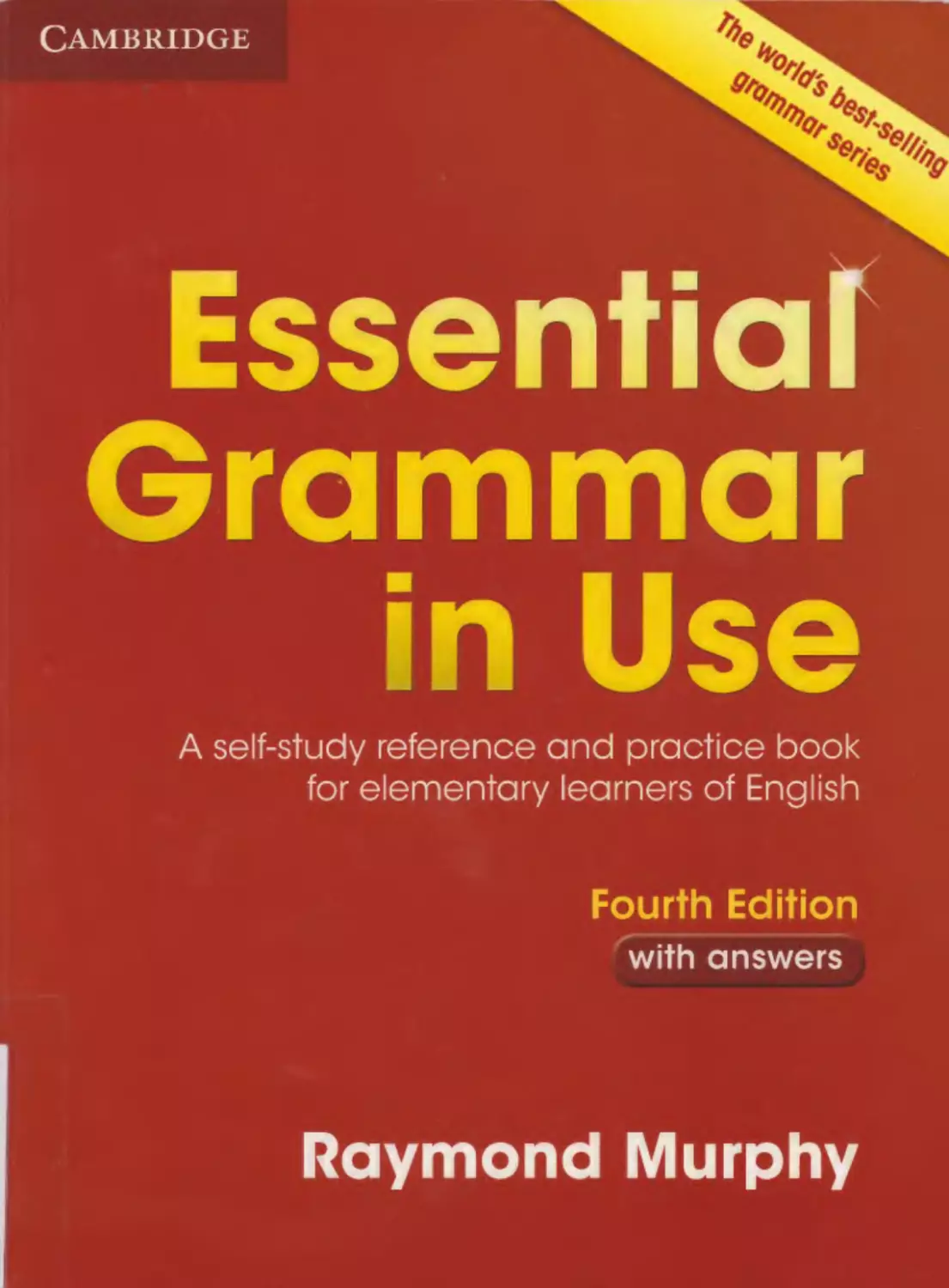
                    Cambridge
Essentiat
Grammar
in Use
A self-study reference and practice book
for elementary learners of English
Fourth Edition
with answers
Raymond Murphy

Essential
Grammar
in Use
A self-study reference and practice book
for elem entary learners of English
Fourth Edition
with answers
Raymond Murphy
HiCambridge
UNIVERSITY PRESS

Cambridge
UNIVERSITY PRESS
University Printing House, Cambridge CB2 8BS, United Kingdom
Cambridge University Press is part of the University of Cambridge.
It furthers the University's mission by disseminating knowledge in the pursuit of
education, learning and research at the highest international levels of excellence.
www.cambridge.org
Information on this title: www.cam bridge. org/essentialg ra m m arinu se
Fourth Edition © Cambridge University Press 2015
This publication is in copyright. Subject to statutory exception
and to the provisions of relevant collective licensing agreements,
no reproduction of any part may tak e place without the written
permission of Cambridge University Press.
Essential Grammar in Use first published 1990
O
r
Fourth edition 2015
-
^
^
Printed in Dubai by Ori ental Press
A catalogue re c ord for this publication is available from the British Library
ISBN 978-1-107 -48055 -1 Edition with answers
ISBN 978-1 -107 -48053 -7 Edition with answers andInteractive eBook
ISBN 978-1 -107 -48056 -8Edition without answers
ISBN 978-1 -107 -48061 -2 Edition with Supplementary Exercises
ISBN 978-1 -107 -48060 -5 Interactive eBook
Cambridge University Press has no responsibility for the persistence or accur acy
of URLs for external or third-party inter net websites referred to in this publication,
and does not guarantee that any content on such websites is, or will remain,
accura te or appr opriate. Information regarding prices, travel timetables, and other
factual inf ormation given in this work is correct at the time of fir st printing but
Cambridge University Press does not guarantee the accuracy of such information
thereafter.

Contents
Acknowledgements vii
To the student viii
To the teacher x
Present
1 am/is/are
2 am/is/are (questions)
3 I am doing (present continuous)
4 are you doing? (present continuous questions)
5 I do/work/like etc. (present simple)
6 Idon't .. . (present simple negative)
7 Do y o u ...? (present simple questions)
8 I am doing (present continuous) and I do (present simple)
9 Ihave ... and I'vegot...
Past
10 was/were
11 worked/got/went etc (past simple)
12 Ididn't ... Did you...? (past simple negative and questions)
13 I was doing (past continuous)
14 I was doing (past continuous) and I did (past simple)
Present perfect
15 I have done (present perfect 1)
16 I've ju st ... I've already... I haven't ... yet (present perfect 2)
17 Have you ever... ? (present perfect 3)
18 How long have you .. . ? (present perfect 4)
19 for since ago
20 I have done (present perfect) and I did (past)
Passive
21 is done was done (passive 1)
22 is being done has been done (passive 2)
Verbforms
23 be/have/do in present and past tenses
24 Regular and irregular verbs
Future
25 What are you doing tomorrow?
26 I'm going to ...
27 will/shall 1
28 will/shall 2
IF YOU ARE NOT SURE WHICH UNITS TO STUDY, USE THE STUDY GUIDE ON PAGE 271
iii

Modals, imperative etc.
29 might
30 can and co uld
31 must mustn't don't need to
32 should
33 Ihaveto...
34 Would you like ... ? I'd like ...
35 Do this! Don't do that! Let's do this!
36 Iusedto...
There and it
37 there is there are
38 there was/were there has/have been there will be
39 It...
Auxiliary verbs
40 Iam, Idon'tetc
41 Have you? Are you? Don't you? etc
42 too/either so am I / neither do I etc
43 isn't, haven't, don't etc (negatives)
Questions
44 isit... ? haveyou ... ? do they ... ? etc (questions 1)
45 Who saw you? Who did you see? (questions 2)
46 Who is she talking to? What is it like? (questions 3)
47 What... ? Which ... ? How ... ? (questions 4)
48 How long does it take ... ?
49 Do you know where ... ? Idon't know what... etc
Reported speech
50 Shesaid that... Hetold methat...
-mg and to...
51 work/working go/going do/doing
52 to ... (I want to do) and -ing (I enjoy doing)
53 Iwantyouto ... Itoldyouto ...
54 Iwenttotheshopto ...
Co, get, do, make and have
55 goto... goon... gofor... go-ing
56 get
57 do and make
58 have
Pronouns and possessives
59 I/me he/him they/them etc
60 my/his/their etc
61 Whose is this? It's mine/yours/hers etc
62 l/me/my/mine
63 myself/yourself/themselves etc.
64 -'s (Kate's camera / my brother's car etc.)
iv
IF YOU ARE NOT SURE WHICH UNITS TO STUDY, USE TH E STUDY GU\DE OH PAGE 273

A and the
65 a/an ...
66 train(s) bus(es) (singular and plural)
67 a bottle / some water (countable/uncountable 1)
68 a cake / some cake / some cakes (countable/uncountable 2)
69 a/an and the
70 the...
71 go to work go home go to the cinema
72 I like music I hate exams
73 the ... (names of places)
Determiners and pronouns
74 this/that/these/those
75 one/ones
76 some and any
77 not+any no none
78 not + anybody/anyone/anything
nobody/no-one/nothing
79 somebody/anything/nowhere etc
80 every and all
81 all most some any no/none
82 both either neither
83 alot
much
m any
84 (a) little (a) few
Adjectives and adverbs
85 old/nice/interesting etc (adjectives)
86 quickly/badly/suddenly etc (adverbs)
87 old/older expensive / more expensive
88 older than ... more expensive than ...
89notas...as
90 the oldest the most expensive
91 enough
92 too
Word order
93 He speaks English very well, (word order 1)
94 always/usually/often etc (w ord order 2)
95 still yet already
96 Give me that book! Give it to me!
Conjunctions and clauses
97 and but or so because
98 When ...
99 Ifwego... Ifyousee... etc
100 IfIhad... Ifwewent... etc
101 a person who ... a thing that/which ... (relative clauses 1)
102 the people we met the hotel you stayed at (relative clauses 2)
IF YOU ARE NOT SURE WHICH UNITS TO STUDY, USE THE STUDY GUIDE ON PAGE 271
V

Prepositions
103 at 8 o'clock on Monday in April
104 from ... to
until since for
105 before after during while
106 in at on (places 1)
107 in at on (places 2)
108 to in at (places 3)
109 under behind, opposite etc
110 up, over, through etc
111 on at by with about
112 afraid of..., good at... etc
of/at/for e tc (prepositions) + -ing
113 listen to ... , look at... etc (verb + preposition)
Phrasal verbs
114 go in, fall off, run away etc (phrasal verbs 1)
115 put on your shoes put your shoes on (phrasal verbs 2)
Appendices
Appendix 1 Active and passive 243
Appendix 2 List of irregular verbs 244
Appendix 3 Irregular verbs in groups 245
Appendix 4 Short forms (he's / I'd / don't etc) 246
Appendix 5 Spelling 248
Appendix 6 Phrasal verbs (take off / give up etc) 250
Appendix 7 Phrasal verbs + object (put out a fire / give up your job etc) 251
Additional exercises 252
Study guide 271
Key to Exercises 283
Key to Additional exercises 310
Key to Study guide 313
Ind ex 315
vi
IF YOU ARE NOT SURE WHICH UNITS TO STUDY, USE THE STUDY GUIDE ON PAGE 271

To the student (working without a teacher)
Contents
This is a grammar book for elementary
stud ents o f English. There are 115 units
in the book and each unit is about a
different point of English grammar.
There is a list of units at the beginning
of the book (Contents).
Do not study all the units in order from
beginning to end. It is better to choose
the units that you need to do. For
example ifyou have a problem with the
present perfect (/ have been, he has done
etc.), study Units 15-20 .
Use the Contents or the Index (at the
back of the book) to find the unit
(or units) that you need.
If you are not sure
w hich units you
need to study, use
the Study guide
at the back of the
book.
Study guide (pages 271-282)
VIII

Each unit is two pages.
The information is on
the left-hand page and
the exercises are on the
right:
Information
I am doing (present continuous)
|ii
Exercises
Study the left-hand page (inform ation); and then
do the exercises on the right-hand page.
Use the Key to check your answers. The Key is on
pages 283-309 .
Study the left-hand page again if necessary.
Appendix 3
Irregular verbs in groups
Don't forget the seven Appendices at
the back of the book (pages 243-251).
These will give you information about
active and passive forms; irregular
verbs, short forms; spelling and
phrasal verbs.
There are also Additional
exercises at the back of the book
(pages 252-270).
There is a list o f these exercises
on page 252.

To the teacher
The most important features of this book are:
O It is a grammar book. It does not deal with other aspects of the language.
O It is for elementary learners. It does not cover areas of grammar which are not normally taught at
elementary level.
O It is a reference book with exercises. It is not a course book and is not organised progressively.
O It is addressed to learners and intend ed for self-study.
Organisation of the book
There are 115 units in the book, each one focusing on a particular area of grammar. The material is organised
in grammatical categories, such as tenses, questions and articles. Units are not ordered according to difficulty,
and should therefore be selected and used in the order appropriate for the learner(s). The book should not
be worked through from beginning to end. The units are listed in the Contents and there is a comprehensive
Index at the end of the book.
Each unit has the same format consisting of two facing pages. TTie grammar point is presented and explained
on the left-hand page and the corresp onding exercises are on the right. There are seven Appendices (pages
243-251) dealing with active and passive forms, irregular verbs, short forms (contractions), spelling and phrasal
verbs. It might be useful for teachers to draw students' attention to these.
At the back of the book there is a set of Additional exercises (pages 252-270). These exercises provide 'mixed'
practice bringing together grammar points from a number of different units (especially those concerning verb
forms). There are 35 exercises in this section and there is a full list on page 252.
Also at the back of the book there is a Study guide to help students decide which units to study - see page 271.
Finally, there is a Key (pages 283-309) for students to check their answers to all the exercises in the book. An
edition without the Study guide and Key is available for teachers who w ould prefer it for their students.
Level
The book is for elementary learners, i.e. learners with very little English, but not for complete beginners. It is
intended mainly for elementary students who are beyond the early stages of a beginners' course. It could also
be used by low-intermediate learners whose grammar is weaker than other aspects of their English or who
have problems with particular areas of basic grammar.
The explanations are addressed to the elementary learner and are therefore as simple and as short as possible.
The vocabulary used in the examples and exercises has also been restricted so that the book can be used at
this level.
Using the book
The book can be used by students working alone (see To the student) or as supplementary course material.
In either case the book can serve as an elementary grammar book.
When used as course material, the book can be used for immediate consolidation or for later revision or
remedial work. It might be used by the whole class or by individual students needing extra help and practice.
In some cases it may be desirable to use the left-hand pages (presentation and explanation) in class, but it
should be noted that these have been written for individual study and reference. In most cases, it would
probably be better for teachers to present the grammar point in their preferred way with the exercises being
done for hom ework. The left-hand page is then available for later reference by the student.
Some teachers may prefer to keep the book for revision and remedial work. In this case, individual students or
groups of students can be directed to the appropriate units for self-study and practice.
x

Unit
1 am/is/are
(M y name is Lisa.
(rm American. I'm from Chicag ^
.
^
U ’m a student. j
If
My father is a doctor and
my mother is a journalist.
/*■
0\Ay favourite colour is blue.^
My favourite sports are
football and swim ming.
J’m interested in art.")
(j^ T n o t interested in politics.^
LISA
positive
negative
I am (I'm)
he
(he's)
she is
(she's)
it
(it's)
we
(we're)
you are (you're)
they
(they're)
1 am not (I'm not)
he
she
it
is not
(he's not
o r he isn't)
(she's not
o r she isn't)
(it's no t
or it isn't)
we
you
they
are not
(we're not
or we aren't)
(you're no t o r you aren't)
(they're no t or they aren't)
shortform
shortforms
I'm cold. Can you close the window, please?
I'm 32 years old. M y sister is 29.
Steve is ill. He's in bed.
My brother is scared of dogs.
It's ten o'clock. You're late again.
Ann and I are good friends.
Your keys are on the table.
I'm tired, but I'm not hungry.
Lisa isn't interested in politics. She's interested in art.
James isn't a teacher. He's a student.
Those people aren't English. They're Australian.
It's sunny today, but it isn't warm.
that's = that is there's = there is here's = here is
O Thank you. That's very kind of you.
O Look! There's Chris.
'Here's your key.'
'Thank you.'
your key/
( am/is/are (questions) - » Unit 2 there is/are -» Unit 37 a/an -» Unit 65 short forms - » Appendix 4 }

Exercises
Write the short form (she's / we aren't etc.).
1sheis
she's
3 itisnot
5 Iamnot
.........................
2 they a r e .......................................
4 that is
6 yo u are n o t ...........................
Write am, is or are.
1 The weather is
nice today. 5 Look! There
Helen.
2I
no t rich.
6 My brother and I
good tennis players.
3 This b a g .................. heavy.
7 Emily
at home. Her children
at school.
4 These bags
heavy.
8I
a taxi driver. M y sister
a nurse.
f B Complete the sentences.
1 Steve is ill
Has inbed.
2 I'm not hungry, b u t ............................... thirsty.
3 M r T ho m as is a v ery old m an..................................... 98.
4 These chairs aren't beautiful, b u t .................................com fortab le.
5 The w eather is nice today........... ........................ warm and sunny.
6.....'............................. late.'
'No, I'm not. I'm early!'
7 C atherine isn't at ho m e....................................at w o rk.
8..... '............................. your coat.' 'Oh, thank you verymuch.'
<9 Look at Lisa's sentences in 1A. Now write sentences about yourself.
1 (name?) M y
5 (favourite colour or colours?)
2 (age?) I .................................................................................
M y .................................................................................
3 (from ?) I ................................................................................. 6 (interested in .. . ?)
4 (job?) I ..................................................................................
I .......................................................................................
Write sentences for the pictures. Use:
angry
cold
hot
hung ry
scared
th irsty
2 They
Write true sentences, positive or negative. Use is/isn't or are/aren't .
1 (it / hot today).............................j.tjsn’t hot to d ay ,
or
It’s. hpt.tpday,
2 (it / windy today)
I t ..............................................................................
3 (my hands / cold)
M y ..........................................................................
4 (Brazil / a very big country) .................................................................................
5 (diamonds / cheap)................. .................................................................................
6 (Toronto / in the US)................... ........................................................................................................
Write true sentences, positive or negative. Use I'm / I'm not.
7 (tired)......................................... ... t a .T jr e d ,
or
Im .n o ttlred , ....................
8 (hungry)
I ...............................................................................
9 (a good swimmer)................... .................................................................................
10 (interested in football)
.................................................................................
Additiona l exercise 1 (page 252)

Unit
2 am/is/are (questions)
positive
question
am
is
are
am I?
is
he?
she?
it?
are
we?
you?
they?
^ ^What's your name?^
^^Are you married?^
^ ^How old are youT)
^^Are you a student?^
( no, I'm not.^^
dy
^Yes,Iam .^
'Am I late?' 'No, you're on time.'
Is your mother at home?' No, she's out.'
Are your parents at home?' No, they're out.'
'Is it cold in your room?' 'Yes, a little.'
Your shoes are nice. A re they new?
We say:
O Is she at home? / Is your mother at home? (not Is at home your mother?)
O Are they new? / Are your shoes new?(not Are new your shoes?)
Where... ?/What...?/Who ... ?/How ... ?/Why ... ?
O Where is your mother? Is she at home?
,O
'Where are you from?' 'Canada.'
O 'What colour is your car?' 'It's red.'
O 'How old is Joe?' 'He's 24.'
O How are your parents? Are they well?
O These shoes are nice. How much are they?
O This hotel isn't very good. Why is it so expensive?
what's = what is who's = who is how's = how is where's = where is
O What's the time?
O Who's that man?
O Where's Lucy?
O How's your father?
Short answers
I am.
he
she is.
Yes,
it
we
you are.
they
I'm
No,
he's
she's
it's
not.
w e're
you're
they're
or
he
she isn't .
No,
it
we
you
they
aren't .
O Are you tired?' Yes, I am.'
O 'Are you hungry?' 'No, I'm not, but I'm thirsty.'
O Is your friend English?' Yes, he is.'
O 'Are these your keys?' Yes, they are.'
O That's my seat.'
No, it isn't .'
f am/is/are Unit 1 qu estions Unit 44 what/which/how Unit 47

Exercises
Find the right answers for the questions.
Where's the camera?
A London.
1
Is your car blue?
B No, I'm not.
2
Is Kate from London?
C Yes, you are.
3
Am I late?
D M y sister.
4
Where's A m y from?
E Black.
5
What colour is your bag?
F No, it's black.
6
Are yo u hungry?
G In your bag.
7
How is George?
H No, she's American.
8
Who's that woman?
I Very well.
9
G
Make questions with these words.
1 (is / at home / your mother)
!.s your mother.at home..
(your parents / are / well)
Aroypur.
par.o nt5.w o ...........
(interesting / is / your job)
.............................................................
(the shops / are / open tod ay) .............................................................
(from / where / you / are)
..............................................................
(interested in sp ort / yo u / are) ..............................................................
(is / near here / the station)
...............................................
..........
(at school / are / yo ur child ren) ..............................................................
(you/are/late/why)
..............................................................
Complete the questions. Use What... /Who ... /Where ... / How ....
Write the questions.
rG\
/I
PAUL
1
/
.....
-
. -i.
(name7) What’s your name?
Gr\ .
A
Paul.
2 (A m erican? ) ............................................................................................................
No, I'm A ustralian.
3 (h o w old?) ...............................................................................................................
I'm 30.
4 (a teacher?) ..............................................................................................................
No, I'm a lawyer.
5 (m arried? ) ................................................................................................................
Yes, 1am.
6 (w ife a lawyer?) .....................................................................................................
No, she's a designer.
7 (from ?) .......................................................................................................................
She's Italian.
8 (her name?) ............................................................................................................
Anna.
9 (h o w old?) ...............................................................................................................
She's 27.
v
J
Write short answers (Yes, I am . / No, he isn't , etc.).
1 Are you married? NoJ’m not,
4 Are your hands cold?
2 A re yo u thirsty? ................................................................ 5 Is it dark now? ...............
3 Is it cold today? ................................................................. 6 A re yo u a teacher? ...
►Additional exercises 1-2 (pages 252-53)

She's eating.
It's raining.
She isn't reading.
The sun isn't shining.
The present continuous is:
am/is/are + doing/eating/running/writing etc.
I am (not)
o I'm working. I'm not watching TV.
he
o Maria is reading a newspaper.
she is (not)
o She isn't eating, (o r She's n ot eating.)
it
- ing o The bus is coming.
we
o We're having dinner.
you are (not)
o You're not listening to me. (or You aren't listening
they
o The children are doing their homework.
am/is/are + -ing = something is happening now:
I'm working
she's wearing a hat
they're playing football
I'm not watching TV
past
now
future
O Please be quiet. I'm working. (= I'm working now)
O Look, there's Sarah. She's wearing a brown coat. (= she is wearing it now)
O The weather is nice. It's not raining.
O 'Where are the children?' 'They're playing in the park.'
O (on the phone) We're having dinner now. Can I call you later?
O You can turn off the television. I'm not watching it.
Spelling (—>Appendix 5):
come —>coming
write —» writing dance —>dancing
run —» running
sit —» sittingswim —>swimming
lie —» lying
They're running.
They aren't walking.
am/is/are ^ Unit 1 are you doing? (questions) ^ Unit 4 I am doing and I do Unit 8
What are you doing tomorrow? Unit 25____________________________________________________

G> What are these people doing? Use these verbs to complete the sentences:
-eat
have lie play
sit wait
Exercises
BUS
STOP
1 Sheseatlng
an apple.
4 ............................................................................on the floor.
2 H e .............................................................................for a bus.
5 .................................................................................. breakfast.
3 They
football. 6
on the table.
g g i Complete the sentences. Use these verbs:
build
cook
go have
stand
stay
swim
work
1 Please be quiet. I
’m w o rking.......
2 'W h ere’s John?' 'He's in the kitchen. H e ................................................................ .'
3 'Y o u .............................................................. on my foot. '
'Oh, I'm sorry. '
4 Look! S o m e b o d y ................................................................ in the river.
5 We're here on holiday. W e ................................................................ at the C entral Hotel.
6 ‘Where's Sue?' 'S h e .............................................................. a shower. ’
7 T h e y ............................................................. a new hotel in the city centre at the m o m e nt.
8 I ................................................................ now . Go od b ye .
Jane
W hat’s happening now? Write true sentences.
1 (I/wash/myhair)
Im n o t w ashin g m y hair...................................
2 (it / snow)
It’s snowing,
or
Itjsn ’t snowing,
3 (I/sit/onachair)
..............................................................................................
4 (I/eat)
..............................................................................................
5 ( i t / r a i n ) ....................................................................................................................................
6 (I / learn / English)
..............................................................................................
7 (I / listen / to music)
..............................................................................................
8 (the sun / shine)
..............................................................................................
9 (I/wear/shoes)
..............................................................................................
10 (I / read / a new sp ape r) ..............................................................................................
Look at the picture. Write sentences about Jane. Use She’s -ing or She isn't -ing.
1 (have dinner) Jane isn 't having dinner.....
2 (watch TV ) S h e s watching TV,.....................
3 (sit on the flo o r) S h e ................................................
4 (read a b o ok ) ................................................................
5 (p lay the piano) ...........................................................
n1
6 (laug h)...................................................................................
7 (w ear a hat) ....................................................................
8 (d rink coffee) ................................................................
17

Unit are you doing?
4
(present continuous questions)
positive question
1am
he
doing
she is
working
it
going
we
staying
you
they
are
etc.
am1
he
doing
is she
working
it
going
we
staying
are you
they
etc.
O 'Are yo u feeling OK?' 'Yes, I'm fine, thanks.'
O 'Is it raining?' 'Yes, take an umbrella. '
O Why are you wearing a coat? It's not cold.
O 'What's Paul doing?' 'He's studying for his exams. '
O 'What are the children doing?' 'They're watching TV.'
O Look, there's Emily! Where's she going?
O Who are you waiting for? Are you waiting for Sue?
Study the word order:
is/are + subject + -ing
Is
he
working today?
Is
Ben
working today? (not Is working Ben today?)
Where are they
going?
Where are those people going? (not Where are going those people?)
Short answers
I'm
No,
he's
she's
it's
not.
we're
you're
they're
1 am.
he
she is.
Yes,
it
we
you are.
they
he
she isn't .
No,
it
we
you
they
aren't .
O 'Are you going now?'
'Yes, I am. '
O 'Is Ben working today?' 'Yes, he is.'
O Is it raining?' No, it isn't .'
O 'Are your friends staying at a hotel?' 'No, they aren't. They're staying with me.'
f I am doing Unit 3 What are you doing tomorrow? -fr Unit 25 questions -fr Units 44-47

Exercises
Make questions from these words. Put the words in the right order.
1 (is / working / Ben / today)
..................................
2 (what/thechildren/are/doing) WhataretM.QhMrm.Mm
3 (you / are / listening / to me) ....................................................................................
4 (w h e re / y o u r fr ie n d s / a r e / g o in g ) .......................................................................
5 (are / w atching / yo ur parents / T V ) ....................................................................
6 (w hat / Jessica / is / coo king ) .....................................................................................
7 (w h y / you / are / lo oking / at m e) ........................................................................
8 (is / co m ing / the bus) ...................................................................................................
Write short answers (Yes, I am . / No, he isn't, etc.).
1 Are you watching TV? NoJ.’m n ot,
4 Is it raining? ....................................
2 A re yo u wearing a watch? ........................................ 5 A re you sitting on the floor?
3 A re you eating something? ...................................... 6 A re you feeling well? ...............
-♦ Additional exercise 3 (page 253)
19

Unit
5 I do/work/like etc. (present simple)
They have a lot of books.
They read a lot.
They read / he likes / 1work etc. = the present simple:
He’s eating an ice cream.
He likes ice cream.
l/we/you/they read like
work
live watch
do
have
he/she/it
reads likes works lives watches does has
Remember:
he works / she lives / it rains etc.
O Iwork in a shop. My brother works in a bank.
My brother work)
O Lucy lives in London. Her parents live in Scotland.
O It rains a lot in winter.
I have —> he/she/it has:
O Joe has a shower every day.
Spelling (—» Appendix 5):
-es
after -s / -sh / -ch: pass —» passes
-y
—
>-ies: stud y
also:
studies
do -» does
finish —>finishes
try —>tries
go -> goes
watch - » watches
We use the present simple for things that are true in general, or for things that happen sometimes or all
the time:
O I like big cities.
Your English is good. You speak very well.
Tom works very hard. He starts at 7.30 and finishes at 8 o'clock in the evening.
The earth goes round the sun.
We do a lot of different things in our free time.
It costs a lot of money to build a hospital.
O
O
O
o.
o
always/never/often/usually/sometimes + present simple
O Sue always gets to w ork early, (not Sue gets always)
O I never eat breakfast, (not I eat never)
□
We often go away at weekends.
O Mark usually plays football on Sundays.
O I sometimes walk to work, but not very often.
20 Idon’t ... (negative) ^ Unit 6 Do you ... ?(questions) ■
always/usually/often etc. (w o rd o rde r) Unit 94
Unit7 Iamdoingand Ido Unit8

Exercises
Write these verbs with -s or -es.
1 (read) she reads
3 (fly) it
5 (have) she.
2 (th ink ) h e ........................................ 4 (d ance) h e ....................................... 6 (finish ) i t
Complete the sentences about the people in the pictures. Use:
eat go live play play
sleep
'CC
^ IGD,
SEVEN HOURS
ANIGHT r
Z
1
He p la y s ......................the piano.
2 They
in a very big house.
3 ...............................................a lot o f fruit.
4 ...............................................tennis.
5 ............................................... to the cinem a a lot.
6 ...............................................seven hours a night.
Complete the sentences. Use:
boil
close
cost
co st
like like
meet
open
speak
teach
wash
1 Maria sp eaks four languages.
2 The shop s in the city centre u su ally .......................................at 9 o'clock in the morning .
3 The City Museum
at 5 o'clock in the evening.
4 Tina is a teacher. S h e ........................................ m athem atics to yo ung children.
5 Myjob is very interesting. I ........................................a lot of people.
6 Peter's car is always dirty. He n e v e r ....................................... it.
7 Food is expensiv e. I t ........................................ a lo t o f money.
8 Shoes are expensive. They
a lot of money.
9 W a te r ........................................ at 100 degrees Celsius.
10 Laura and I are good friends. I
her and s h e .........................................me .
Write sentences from these words. Use the right form of the verb (arrive or arrives etc.).
(always / early / Sue / arrive) S u e a l w a y s .a r ri y e s early.........................................................................
(to the cinem a / never / 1/ go) I ..............................................................................................................................
(w o rk / M artina / hard / always) .................................. ...........................................................................................
(like / cho colate / children / usually) ....................................................................................................................
(Jackie / parties / enjoy / always) .............................................................................................................................
(often / people's names / 1/ forget) .......................................................................................................................
(T V / Sam / w atch / nev er) .............................................................................. ..........................................................
8 (usually / d inner / w e / have / at 7.30) .................................................................................................................
9 (K ate / always / nice clothes / w e ar) .....................................................................................................................
m
Write sentences about yourself. Use always/never/often/usually/sometimes.
1 (watch TV in the evening) I usually w atch TV in the evening,................................
2 (read in bed) I .............................................................................................................................................
3 (get up before 7 o'clo ck) .......................................................................................................................
4 (go to w o rk/scho ol by bus) ................................................................................................................
5 (d rin k coffee in the m o rning ) ...........................................................................................................

6 I don't. . . (present simple negative)
The present simple negative is don't/doesn't + verb:
No, thanks. I
don’t drink coffee.
She doesn't drink coffee.
He doesn't like his job.
positive
negative
1
we
you
they
work
like
do
have
he
she
it
works
likes
does
has
i
we don't
you (do not)
work
they
like
he
doesn't
do
have
she
(does not)
it
I drink coffee, but I don't drink tea.
Sue drinks tea, but she doesn't drink coffee.
You don't work very hard.
We don't watch TV very often.
The weather is usually nice. It doesn't rain very often.
Sam and Chris don't know many people.
Remember:
l/we/you/they don't...
he/she/it
doesn't ...
O I don't like football.
O He doesn't like football.
O I don't like Fred and Fred doesn't like me. (not Fred don't like)
O My car doesn't use much petrol. (not My car don't use)
O Sometimes he is late, but it doesn't happen very often.
We use don't/doesn't + infinitive (don't like / doesn't speak / doesn't do etc.):
O I don't like washing the car. I don't do it very often.
O Sarah speaks Spanish, but she doesn't speak Italian. (not doesn't speaks)
O David doesn't do his job very well, (not David doesn't his job)
O Paula doesn't usually have breakfast, (not doesn't.. . has)
f I do/work/like etc. (present simple) Unit 5 Do you ... ? (present simple questions) Unit 7
3

Exercises
Write the negative.
1 I play the piano very well.
2 Anna plays the piano very well.
3 They know my phone number.
4 We work very hard.
5 He has a bath every day.
6 You do the same thing every day.
I don't play t.ha.pian.p v e ry well,..
A n n a ....................... ........................................
T h e y .................................................................
g Q Q p Study the information and write sentences with like.
1
Ben.and Sophie like claesicMwu&iC:.
Benand
Sophie
Kate
You
1 classical music?
yes
no
2 boxing?
no
yes
?
3 horror movies?
yes
no
•
I ..................................... ...........classical music.
Ben and Sophie
K a te ....................................
I
Write ab out yourself. Use:
I never...
or
I often ...
or
Idon't ... very often.
1 (watch TV)
[don't ^tchT)(.y^ty.often,....
or
Lnever watch TV.
or
Ioften watch TV.
2 (go to the theatre)
3 (ride a bike)
4 (eat in restaurants)
5 (travel by train)
g g § Complete the sentences. All of them are negative. Use don't/doesn't + these verbs:
cost go know
rain
see
use
wear
1 The weather here is usually nice. It doesn’t rain much.
2 Paul has a car, but h e ................................................................ it v ery often.
3 Paul and his friends like films, but they
to the cinem a very often.
4 Amanda is married but she
a ring.
5I
much about politics. I'm not interested in it.
6 The Regent Hotel isn't expensive. I t ................................................................ m uch to stay there.
7 Ed lives very near us, b ut w e ............................................................... him v ery often.
* 3 3 1 Put the verb into the correct form, positive or negative.
1 Marg aret sp e ak s four languages - English, French, Germ an and Spanish, (speak)
2 I don t Jikc my job. It's very boring, (like)
3 'Where's Steve?' 'I'm sorry. I ............................................................... .'
(know)
4 Sue is a very quiet person. S h e ...............................................
very
much, (talk)
5 A n d y ................................................................ a lot o f tea. It's his favo urite drink, (d rink )
6 It's not true! I ................................................................ it! (believe)
7 That's a very beautiful picture. I ................................................................it very much, (like)
8 M ark is a vegetarian. H e ................................................................ meat, (eat)

Unit
7 Do you ... ? (present simple questions)
A We use do/does in present simple questions:
positive
question
1
we
you
they
work
like
do
have
he
she
it
works
likes
does
has
do
1
we
you work?
they like?
do?
he
have?
does she
it
]T(po you play the guitar? J j
1"1"i
i
^
Study the word order:
do/does + subject + infinitive
Do you
play
the guitar?
Do your friends live
near here?
Does Chris
work
on Sundays?
Does it
rain
a lot here?
Where do your parents live?
How often
do you
wash
yo ur hair?
What does this word
mean?
How much does it
co st
to fly to Rome?
Questions with always and usually:
Does Chris always
work on Sundays?
What
do you
usually do
at weekends?
What do you do? = What's your job?
O 'What do you do?' 'I work in a bank.'
Remember:
do l/we/you/they...
does he/she/it...
O Do they like music?
O Does he like music?
Short answers
Yes,
l/we/you/they do.
No,
l/we/you/they don't.
he/she/it does.
he/she/it doesn't.
O 'Do you play the guitar?' 'No, I don't.'
O Do your parents speak English?' Yes, they do.'
O Does James work hard?' Yes, he does.'
O Does your sister live in London?' No, she doesn't. '
( I do/work/like etc (present simple) Unit 5 I d o n't ... (negative) -» Unit 6 questions 4 Units 44-47 )

Exercises
Write questions with Do ... ? and Does ... ?
1 I like chocolate. How about you?
2 I play tennis. How about you?
3 You live near here. How about Lucy?
4 Tom plays tennis. How about his friends?
5 You speak English. How about your brother?
6 I do yoga every morning. How about you?
7 Sue goes away a lot. How about Paul?
8 I want to be famous. How about you?
9 You work hard. How about Anna?
...P .oyouJfe
. .. .. .. .. .. .. .. .. .. . y o u ......................
.. .. .. .. .. .. .. .. .. .. L u c y .....................
Make questions from these words + do/does. Put the words in the right order.
1 (where / live / your parents)
2 (you / early / always / get up)
3 (howoften/TV/you/watch)
4 (you / want / what / for dinner)
5 (like / you / football)
6 (your brother / like / football)
7 (what/you/do/inyourfreetime)
8 (your sister / work / where)
9 (breakfast / always / you / have)
10 (what / mean / this word)
11 (in winter / snow / it / here)
12 (go/usually/tobed/whattime/you)
..Where, do your pa rente Jive..
...P.oyou. alw ays.g<st.u.p.ear|y..
13 (how much / to phone New York / it / cost)
14 (you / for breakfast / have / usually / what)
e
Complete the questions. Use these verbs:
do enjoy go like
start teach
w ork
What doyoudo ?
.............................................................................................. it?
W h at t im e .............................................................................................. in the morning?
on Saturdays?
H o w .............................................................................................. to work?
A n d yo ur husband. W h a t .............................................................................................. ?
W h a t ..............................................................................................?
.............................................................................................. hisjob?
Write short answers (Yes, he does. / No, I don't , etc.).
1 DoyouwatchTValot?
2 Doyouliveinabigcity?
3 Do you often ride a bike?
4 Does it rain a lot where you live?
5 Do you play the piano?
NoAdorit,
or
YesJ.da.
*
work in a bookshop.
It's OK.
At 9 o'clock.
Sometimes.
Usually by bus.
He's a teacher.
Science.
Yes, he loves it.
Additional exercises 4 -7 (pages 253-54)

Unit | am doing (present continuous) and
8 I do (present simple)
Jack is watching television.
He is no t playing the guitar.
But Jack has a guitar.
He often plays it and he plays very well.
Jack plays the guitar,
but he is not playing the guitar now.
Is he playing the guitar? No, he isn't .
Does he play the guitar? Yes, he does.
(present continuous)
(present simple)
Present continuous (I am doing) = now, at the time of speaking:
I'm d oing
past
now
O Please be quiet. I'm working. (not I work)
O Tom is having a shower at the moment. (not Tom has)
O Take an umbrella with you. It's raining.
O You can turn off the television. I'm not watching it.
O Why are you under the table? What are you doing?
Present simple (I do) = in general, all the time or sometimes:
Ido
future
past
now
future
O I work every day from 9 o'clock to 5.30.
O Tom has a shower every morning.
O It rains a lot in winter.
O I don't watch TV very often.
O What do you usually do at weekends?
We do not use these verbs in the present continuous (I am -ing):
like
w ant
know
understand
remember
prefer
need
m ean
believe
forget
Use only the present simple with these verbs (I want / do you like? etc.):
O I'm tired. I want to go home, (not I'm wanting)
O 'Do you know that girl?' 'Yes, but I don't rem ember her name.'
O Idon't understand What do you mean?
26
( present continuous Units 3-4 present simple Units 5-7 present for the future Unit 25

Exercises
Does he take photographs? Yes^.hedg e s ..
Is she driving a bus? .
Is he taking a photograph? N&.he isn’t .
Does she drive a bus?
What is he doing?
W hat is she doing?
He’sMyinfl.a .bath..................................................
Does he clean w ind ow s? ...................................
Are they teaching?
Is he cleaning a w ind o w ? ...................................
Do they teach? ....
What is he doing?
What do they do?
Complete the sentences with am/is/are or do/don't/does/doesn't .
1 Excuse m e , do you speak English?
2 'Where's Kate?' 'I .........................................know.'
3 W hat's funny? W h y ........................................ yo u laughing?
4 'What
yo ur sister do?' 'She's a dentist.'
5 I t .......................................raining. I
want to go out in the rain.
6 'W h e r e ........................................ you co m e from?' 'Canada. '
7 H o w m u c h ..................................... it cost to stay at this hotel? Is it expensiv e?
8 Steve is a good tennis player, but h e ........................................ play very often.
Put the verb in the present continuous (I am doing) or the present simple (I do).
1 Excuse me,
.
do you speak (you/speak) English?
2 'Where's Tom?' ' H es.haying (he/have) a shower.'
3 (.don’t .w atch (I/not/watch) TV very often.
4 Listen! S o m e b o d y........................................................................ (sing).
5 Sarah is tired
(she/want) to go home now.
6 Ho w o fte n ........................................................................ (you/use) yo ur car? Every day?
7 'Excuse me, b u t ....................................................................... (yo u/sit) in my seat. '
'Oh, I'm sorry. '
8 I'm so rry,...................................................................................... (I/not/understand). Can you speak more slowly?
9 It's late.............................................................................(I/go) hom e now...........................................................................
(you/come) with me?
10 W ha t t i m e ......................................................................................................(yo ur father / finish) w o rk every day?
11 Yo u can turn o ff the radio............................................................................
(I/not/listen)toit.
12 'Where's Paul?' 'In the kitchen............................................................................ (he/ co o k ) something. '
13 M a r k ......................................................................................................................(no t/usually/driv e) to w o rk. He
........................................................................ (usually/walk).
14 S u e .................................................................... (no t/lik e) coffee......................................................................... (she/prefer) tea.
Additional exercises 8 -9 (page 255)

Unit
9
28
I have ... and I've got
You can say I have or I've got, he has or he's got:
I
we
you
they
have or
I
we
you
they
have got
(I've got)
(we'v e got)
(you've got)
(they'v e got)
he
she
it
has or
he
she
it
has got
(he's got)
(she's got)
(it's got)
shortform
O I have blue eyes, or I've got blue eyes.
O Tom has tw o sisters, or Tom has got tw o sisters.
O Our car has four doors, or Our car has got four doors.
O Sarah isn't feeling well. She has a headache, or She's got a headache.
O They like animals. They have a horse, three dogs and six cats, or They've got a horse .
I don't have / 1haven't got etc. (negative)
You can say:
I/you
we/they
don't
he/she
it
doesn't
have or
I/you
we/they
haven't
got
he/she
it
hasn't
O Idon't have a car. or I haven't got a car.
O They don't have any children, or They haven't got any children.
O It's a nice house, but it doesn't have a garden, or
...
it hasn't got a garden.
O Amy doesn't have ajob at the moment, or Amy hasn't got ajob ...
do you have? / have you got? etc. (questions)
You can say:
do
I/you
we/they
does
he/she
it
have or
have
I/you
w e/they
has
he/she
it
got
O 'Do you have a camera?' 'No, I don't.'
or
'Have you got a camera?' 'No, I haven't.'
O 'Does Helen have a car?'
'Yes, she does. '
or
' Has Helen got a car?' 'Yes, she has.'
O What kind of car does she have? or ... has she got?
O How many children do they have? or ... have they got?
had / didn't have (past) Units 11-12 have breakfast / have a shower etc.
Unit 58
some and any Unit 76

Exercises
Write these sentences with got. The meaning is the same.
1 They have two children.
2 She doesn't have a key.
3 Hehasanewjob.
4 Do you have an umbrella?
5 Wehavealotofworktodo.
6 I don't have your phone number.
7 Does your father have a car?
8 How much money do we have?
.Theyye.gpttwp.c .h
.. She haon’t .g o t a. key.........
He
Write these sentences with do/does/don't/doesn't. The meaning is the same.
1 Have you got any money?
2 I haven't got many clothes.
3 Has Tom got a brother?
4 How many children have they got?
5 Have yo u got any questions?
6 Sam hasn't got a job.
..P.oyou.have any money?.
m m Read the questions and answers. Then write sentences about Mark.
f
-
TP* \
1
Have you got a car?
No.
2
Have you got a bike?
Yes.
3
Have you got a dog?
M ark
4
Have you got a mobile phone?
Yes.
5
Have you got a watch?
No.
6
Have you got any brothers or
Yes, tw o brothers
sisters?
and a sister.
------------ -- -- -- -- ---------------- -- -- -- J
v-------------------- y
Hehasn’t,got,a car.
He.
What about you? Write sentences with I’ve got or I haven’t got.
7 (a dog)
.....................................................................................................
8 (a bike)
.....................................................................................................
9 (brothers/sisters) .....................................................................................................
3
4
5
6
7
£ Q | Complete the sentences. Use have, has, don’t have or doesn’t have.
1 Sarah doesn’t .have a car. She goes everywhere by bike.
2 They like animals. They have three dogs and two cats.
C harles isn't happy. H e .................................... a lot o f problems.
T he y are always busy. T h e y ................................... m uch free time.
'What’s wrong?’
' I ................................... something in my eye.’
'Where's my pen?’
'I don't know. I ....................................it.’
Am y wants to go to the concert, but sh e .................................... a ticket.
e»
Complete the sentences. Use have/has got or haven't/hasn't got with:
six legs
a key
a headache
a lot of friends a job
much time
1 I'm not feeling very well. I ye.QQt a h ead ach e,..............................................................
2 Everyb ody likes Tom . H e ..................................................................................................................
3 She can't open the door. S h e ............................... ........................................................................
4 Q uick!. W e ........................ .......................................................................................................................
5 A n in s e c t....................................................................................................................................................
6 I'm unemployed. I ...................................... .........................................................................................
Additional exercises 5-7 (page 254)

t was/were
Unit
Now Robert is at work.
At midnight last night
he wasn't at work.
He was in bed.
He was asleep.
am/is (present) —>w as (past):
O I am tired, (now)
O Where is Kate? (now)
O The weather is good today.
are (present) —» w ere (past):
O You are late, (now)
O They aren't here, (now)
I was tired last night.
Where was Kate yesterday?
The weather was good last week.
You were late yesterday.
They weren't here last Sunday.
positive
negative
question
1
he
she
it
was
we
you
they
were
1
he
she
it
was not
(wasn't)
we
you
they
were not
(weren't)
was
1?
he?
she?
it?
were
we?
you?
they?
O Last year Rachel was 22, so she is 23 now.
O When I was a child, I was scared of dogs.
O We were hungry after the journey, but we weren't tired.
O The hotel was comfortable, but it wasn't expensive.
O Was the weather nice when you were on holiday?
O Your shoes are nice. Were they expensive?
O Why were you late this morning?
Short answers
Yes,
l/he/she/it was.
No,
l/he/she/it wasn't .
we/you/they were.
we/you/they weren't.
O 'Were you late?' 'No, I wasn't .'
O 'Was Tom at work yesterday?' 'Yes, he was.'
O 'Were Sue and Steve at the party?' No, they weren't. '
30
( am/is/are ■» Units 1-2 I was doing Unit 13

Exercises
Where were these people at 3 o'clock yesterday afternoon?
1
J o e w as.in.b e d .................................................................. 4
2 Jack and K a t e .........................................................................
5.. .............................
3 S u e ...............................................................................................
6 And you? I.
Write am/is/are (present) or was/w ere (past).
1 Lastyearshe was 22, so she is 23 now.
2 To day the w e at h e r....................... nice, but yesterday i t .......................... very cold.
3 I ....................... hungry. Can I have som ething to eat?
4 I feel fine this m orning , but I ....................... very tired last night.
5 W he re ....................... yo u at 11 o'clock last Friday morning?
6 Don't buy those shoes. T h e y ....................... v ery expensive.
7 I like your new jacke t............................it expensive?
8 This tim e last year I ....................... in Paris.
9 'Where
Sam and Joe?' 'I don't know. They
here a few minutes ago.'
gjg| Write was/were or wasn't/weren't .
1 We weren't happy with the hotel. Our room was very small and it wasn’t
clean.
2 Mark
at work last week becauseh e .......................... ill. He's better now.
3 Y esterd ay.........................a pub lic holiday, so the b a n k s .......................... closed. They're open today.
4 '......................... Kate and Ben at the party?' 'K ate
there, butB e n .......................... .'
5 Where are my keys? They
on the table, but they're not there now.
6 You
at hom e last nig ht..W h e re .........................you?
Write questions from these words + was/were. Put the words in the right order.
\ \ ___________________________________
/7
(late / you / this morning / why?)
Why ware.you.jate. th is mprni.ng?..
(difficult / your exam?)
(last week / where / Sue and Chris?)
(your new camera / how much?)
(angry / you / yesterday / why?)
(nice / the weather / last week?)
► The traffic was bad.
► No, it was easy.
► They were on holiday.
► A hundred pounds.
31

Unit
11 worked/got/went e tc (past simple)
They
watch TV every evening.
(present simple)
They watched TV yesterday evening.
(past simple)
watched is the past simple:
l/we/you/they
he/she/it
watched
The past simple is often -ed (regular verbs). For example:
work —>worked
dance —>danced
clean —>cleaned
stay —>stayed
start —» started
need —>needed
O I clean my teeth every morning. This morning I cleaned my teeth.
O Terry worked in a bank from 2005 to 2011.
O Yesterday it rained all morning. It stopped at lunchtime.
O We enjoyed the party last night. We danced a lot and talked to a lot of people.
The party finished at midnight.
Spelling (—» Appendix 5):
try —>tried
study —>studied
stop —» stopped
plan —» p lanned
copy —» copied
Some verbs are irregular (= not regular). The past simple is not -ed. Here are some important irregular
verbs (see also Appendix 2-3):
begin —» began
fall
fell
leave —> left
sell —»
so ld
break
broke
find
found lose
lost
sit
sat
bring
brought fly
flew
make
made
sleep
slept
build
built
forget
forgot meet
met
speak
spoke
buy
bought get
got
pay
paid
stand
stood
catch
caught give
gave
put
put
take
took
come
cam e
go
went
read
read (red)* tell
to ld
do
did
have
had
ring
rang
think
thought
drink
drank
hear
heard
say
said
win
won
eat
ate
know
knew see
saw
w rite
wrote
* pronounced 'red'
I usually get up early, but this morning I got up at 9 o'clock.
We did a lot of work yesterday.
Caroline went to the cinema three times last week.
James came into the room, took off his coat and sat down.
32
( was/were Unit 10 I didn't / Did you ... ? (negative and questions) 4 Unit 12 ago 4 Unit 19

Exercises
Complet e the sentences. Use a verb from the box.
clean die
enjoy finish happen
open
rain
start
stay
want
1 I cleaned my teeth three times yesterday.
2 It was ho t in the room, so I ....................................... the w indo w .
3 The film was very long. I t .......................................at 7.15 a n d .......................................... at 10 o'clock.
4 When I was a child, I ........................................ to be a doctor.
5 The a c c id e n t ........................................ last Sunday afternoon.
6 The w eather is nice today, but yesterday i t .......................................all day.
7 W e ........................................ our holiday last year. W e ........................................ at a ve ry nice place.
8 Anna's g ran d fa th er........................................ when he was 90 years old.
Write the past simple of these verbs.
1 gee ....
g
.
.......
4 pay ................. ................ 7 go ..................... .............. 10 kno w ....
2 see .......................... ....... 5 visit ................. ................ 8 thin k .............................. 11 put .......
3 play ......................... ....... 6 buy ................. ............... 9 cop y ................ .............. 12 speak ...
Last Tuesday Lisa (1) few from London to Madrid. She (2)
up
fty get
at 6 o'clock in the m orning and (3) ................................ a cup o f coffee. A t 6.30 she
have
(4) ............................... hom e and (5) .................................to the airp ort. W he n she
leave, drive
(6)............................... there, she (7) .................................the car, (8)
to the airport
get, park, walk
building, and (9) .................................in. T hen she (10)
breakfast at a cafe
check, have
and (11) ................................ for her flight. T he plane (12) .................................. on tim e and
wait, depart
(13) ............................... in M ad rid tw o hours later. Finally she (14)
a taxi
arrive, take
from the airport to her hotel in the centre of Madrid.
Write sentences about the past (yesterday / last week etc.) .
1 James always goes to w o rk by car. Ye ste rd a y he w a n t.to w ork b y c a r ................................................................
2 Rachel often loses her keys. S h e ...............................................................................................................................last week.
3 Kate meets her friends every evening. S h e ......................................................................................yesterday evening.
4 I buy a newspaper every day. Yesterday I ...................................................................................................................................
5 W e often go to the cinem a at weekends. Last Sund ay w e .............................................................................................
6 I eat an orange every day. Yesterday I ..........................................................................................................................................
7 To m always has a sho w er in the morning. This mo rning h e .........................................................................................
8 O ur friends often co m e to see us. T h e y .............................................................................................................last Friday.
Write sentences about what you did yesterday.
1 1we nt to the theatre,.....................................
2 ................................................................................................
3 ........................................................................................................
Read about Lisa's journey to Madrid. Put the verbs in the correct form.
CHECK-IN
\
Y Madrid airport
Additional exercise 10 (page 256)

Unit
12
I didn't... Did you ... ?
(past simple negative and questions)
We use did in past simple negatives and questions:
infinitive positive
negative
question
play
start
watch
have
see
do
go
1 played
we started
you watched
they had
he saw
she did
it went
1
play
we
start
you
they
he
did not
(did n't)
watch
have
see
she
do
it
go
1
play?
we
start?
you watch?
did they have?
he
see?
she do?
it
go?
do/does (present) —» did (past):
O Idon't watch TV very often.
I didn't watch TV yesterday.
O Does she often go away?
Did she go away last week?
We use did/didn't + infinitive (watch/play/go etc.):
I watched but I didn't watch (not I didn't watched)
they went
did they go?
(not did they went?)
he had
he didn't have
you did
did you do?
O I played tennis yesterday, but I didn't win.
O 'Did you do the shopping?' 'No, I didn't have time.'
O We went to the cinema, but we didn't enjoy the film.
Study the word order in questions:
did + subject
+
infinitive
Did your sister
call
you?
What did you
do
last night?
How did the accident happen?
Where did your parents go
for their holiday?
Short answers
l/we/you/chey d id
he/she/it
l/we/you/they ^
he/she/it
O 'Did you see Joe yesterday?' 'No, I didn't .'
O 'Did it rain on Sunday?' 'Yes, it did. '
O Did Helen come to the party?' No, she didn't.'
O Did your parents have a good holiday?' Yes, they did.'
f worked/got/went etc. (past simple) Unit 11

- xeroses
m
Complete these sentences with the verb in the negative.
1 I saw Barbara, but I didn’t se e jane.
2 They w o rke d on Mo nday, but t h e y ........................................................................on Tuesday.
3 W e w e nt to the post office, but w e ........................................................................to the bank.
4 She had a pen, but s h e ........................................................................any paper.
5 Jack did French at school, but h e ........................................................................ Germ an.
o
Write questions with Did ... ?
Iwatched TV last night. How about you?
Did you watch ..TV.la st night...
I enjoyed the party. How about you?
........................................................................
I had a good holiday. How about you?
........................................................................
Ifinished work early. How about you?
........................................................................
I slept well last night. How about you?
........................................................................
CD W hat did you do yesterday? Write positive or negative sentences.
(watch TV)
!.watched.TV . ...
or
!.didn’t w atch TV. .........
(get up before 7 o 'clock) I ............................................................................................................
(have a shower)
...............................................................................................................
(buy a magazine)
...............................................................................................................
(eat meat)
......................................................................................... .....................
(go to bed before 10.30) ...............................................................................................................
1
2
3
4
5
6
t Z l Write B's questions. Use:
arrive
cost go go to bed late
happen have a nice time
stay
win
1 a: We went to New York last month.
b: W h e re .... did .you s t a y ......................................... ?
a : With some friends.
5 a: We camehomebytaxi.
b: H o w m u c h ................................................................. ?
a : Ten pounds.
2 a : 1was late for the meeting.
B: W hat t i m e .................................................................. ?
a : Half past nine.
6 a : I'm tired this morning.
b: ...................................................................................?
a : No, but 1didn't sleep very well.
3 a : 1played tennis this afternoon.
B: .................................................................................. ?
a : No, 1lost.
7 a : We went to the beach yesterday.
b: ...................................................................................?
a : Yes, it was great.
^ a : 1had a nice holiday.
B. Go o d . W h e r e ...........................................................?
a : To the mountains.
8 a: The window isbroken.
b: H o w ................................................................................?
a : 1don't know.
"ut the verb in the correct form - positive, negative or question.
We went to the cinema, but the film wasn't very good. W e didn’t enjoy it. (enjoy)
1 T o m ................................................. som e new clothes yesterday - tw o shirts, a jack et and a pullover, (buy)
............ yesterday?' 'No, it w as a nice day. '
(rain)
-
.Ve were tired, so w e ................................................................ long at the party, (stay)
: : was ve ry w arm in the room, so I ................................................................ a w ind o w , (o p en)
r Did you phone Chris this morning?' 'No, I ................................................................time.'
(have)
I cut my hand this morning.'
' H o w ................................................................. that?' (d o )
•
.Vhy weren't you at the meeting yesterday?' 'I ................................................................about it.'
(know)
I exercises 10-13 (page 256)
35

Unit
1 3 I was doing (past continuous)
m
It is 6 o'clock now.
Paul is at home.
He is watching TV.
At 4 o'clock he wasn't at home.
He was at the sports club.
He was swimming in the pool.
He wasn't watching TV.
was/were + -ing is the past continuous:
positive
negative
1
he
she
it
was
we
you
they
were
doing
w atching
playing
swimming
living
etc.
1
he
she
it
was not
(wasn't)
we
you
they
were not
(weren't)
question
doing
watching
playing
swimming
living
etc.
was
1
he
she
it
were
we
you
they
doing?
watching?
playing?
swimming?
living?
etc.
O What were you doing at 11.30 yesterday? Were you working?
O 'What did he say?' 'I don't know. I wasn't listening.'
O It was raining so we didn't go out.
O In 2009 we were living in Canada.
O Today she's wearing a skirt, but yesterday she was wearing trousers.
O I woke up early yesterday. It was a beautiful morning. The sun was shining and the birds
were singing
Spelling (live - » living / run —>running / lie - » lying etc.)
—
» Appendix 5
am/is/are + -ing (present) —>was/were + -ing (past):
I'm working (now).
It isn't raining (now).
What are you doing (now)?
past
O I was working at 10.30 last night.
O It wasn't raining when we went out.
O What were you doing at 3 o'clock?
36
( was/were Unit 10 I was doing and I did (past continuous and simple) Unit 14

Look at the pictures. Where were these people at 3 o'clock yesterday afternoon? A nd what were
they doing? Write two sentences for each picture.
Exercises
L;,
fM'V
PLATFC5R' ^ ^ S
1
II
r/V 111
i
^
RACHEL
JACK KATE
TOM
at home
at the cinema
in his car
watch TV
watch a film
drive
TRACEY
at the station
wait for a train
MR AND MRS HALL
in the park
walk
1 Rachel, was a t home. She was watching TV...............................................................................................
2 Jack and K at e........................................................................ T h e y .......................................................................................................
3 T o m ................................................................................................................................................................................................................
4 ...........................................................................................................................................................................................................................
5 ...........................................................................................................................................................................................................................
6 A n d you? I ................................................................................................................................................................................................
Sarah did a lot of things yesterday morning. Look at the pictures and complete the sentences.
1 At 8.45 she was washing her car.
7.10 -7 .25
7.30 -8 .10
8.30 - 9.00
breakfast
9.20 -10 .00
2 At 10.45 she
3 At8o'clock
4 At 12.10 .........
5 At 7.15 ............
6 At 9.30 ............
Complete the questions. Use was/were -ing. Use what/where/why if necessary.
Look at the picture. You saw Joe in the street yesterday afternoon. W hat was he doing? Write
positive or negative sentences.
1 (wear / a jacket) He wasnY wearing a ja ck e t, ........................
2 (carry / a bag) ..................................................................................................
3 (go / to the d entist) .....................................................................................
4 (eat / an ice cream ) ......................................................................................
5 (carry / an um b rella) ...................................................................................
6 (go / ho m e ) ......................................................................................................
7 (w e ar / a hat) ...................................................................................................
8 (ride / a bicycle) .............................................................................................
37

His phone rang.
What happened? His phone rang, (past simple)
What was Jack doing when his phone rang?
He was reading a book.
He stopped reading.
He answered his
phone.
What did he do when his phone rang?
He stopped reading and answered his phone.
(past continuous)
(past simple)
Jack began reading before his phone rang.
So when his p hone rang, he was reading.
he started
reading
his phone
rang
he stopped
reading
he was reading
he answered
his phone
______
i
pastsimple
past continuous
O a: What did you do yesterday morning?
O a: What were you doing at 10.30?
b: W e played tennis, (from 10 to 11.30)
b : W e were playing tennis.
start
finish
start
10 o'clock
11.30
1
1
10 o'clock
i
|
1................ .......
1
\
\t/
/
w e played
w e were playing
complete action
unfinished action
O Jack read a book yesterday. (= from
O Jack was reading a book when his
beginning to end)
phone rang.
O Did you watch the game on TV last
Were you watching T V when I phoned
night?
you?
O It didn't rain while we were on holiday.
It wasn't raining when I got up.
O I started work at 9 o'clock and finished at 4.30. At 2.30 I was working.
O It was raining when we went out. (= it started raining before we went out)
O I saw Lucy and Steve this morning. They were waiting at the bus stop.
O Kelly fell asleep w hile she was reading.
38
( I did (past simple) 4 Units 11-12 I was doing (past continuous) ■» Unit 13 while Unit 105
)

Exercises
The t r a in ................................................................(arriv e)
at the station and P au la .................................................
(get) off. Two friends of hers, Jon and Rachel,
..........................................................................(wait) to
meet her.
3
Yesterday S ue ...............................................
(walk)
along the road when sh e ............................. (meet)
James. H e ................................................................ (go)
to the station to catch a train and he
....... ....... ......... ....... .. ....... ...... ... ....... ... (carry) a bag.
T h e y ........................................................... (stop) to
talk for a few minutes.
Put the verb into the past continuous or past simple.
1 a: What was the weather like when yo u g o t (get) up this morning?
b: I t was raining (rain).
2 a : Was Jane busy when you went to see her?
b: Yes, s h e ........................................................... (study).
3 a : ........................................................... (Paul/call) you this morning?
b: Yes, h e ........................................................... (call) while
.
I .............................................................(have) breakfast.
4 a: Was Tracey at work today?
b: No, s h e ........................................................... (not/go) to work. She was ill.
5 a : How fa s t ........................................................................ (you/drive) when the police
... ......... ....... .. ....... ...... .. ....... ......... ....... (stop) you?
b: I'm not sure, but I ........................................................................ (not/drive) very fast.
6 a : ..........................................................................(your team / win) the football match yesterday?
b: The weather was very bad, so w e ........................................................... (not/play).
7 a : H o w ........................................................................ (you/break) the window?
b: We
(play) football... I ....... .. ....... ...... .. ....... ......... ....... .. ...... .... (kick) the ball and
i t ........................................................... (hit) the window.
8 a : ..........................................................................(you/see) Jessica last night?
b: Yes, s h e ..........................................................................(wear) a very nice jacket.
9 a : W h a t ..........................................................................(you/do) at 2 o'clock this morning?
b: I was asleep.
10 a : I ..........................................................(lose) my key last night.
b: H o w ........................................................... (you/get) into your room?
a : I ..........................................................(climb) in through a window.
in the correct form, past continuous or past simple.
Lucy broke (break) her arm last week.
I t ................................................................ (hap p en) w hen
s h e ................................................................ (p aint) her
room. S h e .............................................................. (fall)
o ff the ladder.
Look at the pictures. Put the verbs
Additional exercises 14-15 (pages 257-58)

Unit
15 I have done (present perfect 1)
His shoes are dirty.
3
They are at home.
They are going out.
jcleaned my shoee^
He has cleaned his shoes.
(= his shoes are clean now)
They have gone out.
(= they are not at home now)
has cleaned / have gone etc. is the present perfect (have + past participle):
cleaned
finished
have we finished? [ regular verbs
started
lost
done
he
done?
I irregular
been
hac
been?
\ verbs
gone
I
we
you
they
have ('ve)
have not (haven't)
he
she
it
has ('s)
has not (hasn't)
I
cleaned?
have
we
finished?
you
started?
they lost?
he
done?
has
she been?
it
gone?
past participle
Regular verbs The past participle is -ed (the same as the past simple):
clean —>I have cleaned finish —» we have finished
start —>she has started
Irregular verbs The past participle is not -ed.
Sometimes the past simple and past participle are the same:
buy —> I bought / 1have bought have —> he had / he has had
Sometimes the past simple and past participle are different:
break —> I broke / 1have broken
see -» you saw /you have seen
fall —> it fell / it has fallen
go —>they went / they have gone
We use the present perfect for an action in the past with a result now:
O I've lost my passport. (= I can't find my passport now)
O 'Where's Rebecca?' 'She's gone to bed. '
(= she is in bed now)
O We've bought a new car. (= we have a new car now)
O It's Rachel's birthday tomorrow and I haven't bought her a present. (= I don't have a present
for her now)
O 'Bob is away on holiday.'
'Oh, where has he gone?' (= where is he now?)
O Can I take this newspaper? Have you finished with it? (= do you need it now?)
present perfect Units 16-19 present perfect and past simple Unit 20
irregularverbs Unit24,Appendix2-3 ______________________________________

Exercises
f O Look at the pictures. What has happened? Choose from the box.
go to bed
clean his shoes
stop raining
close the door fall down
have a shower
—
>
M
They.
Hi 1MM He.
—
>
The.
H g | Complete the sentences with a verb from the box.
break buy decide finish
forget
go go
invite
lose see
not/see take
tell
not/tell
1 I yejost mykeys. Idon't knowwhere they are.
2 I ........................................................................ some new shoes. Do you w an t to see them?
3 'W here is Helen?' 'She's no t here. S h e ...................................................................... out. '
4 I'm lo oking for Paula................................... y o u ................................................. her?
5 Look! S o m e b o d y ........................................................................ that w indo w.
6 'Does Lisa know that you're going away?' 'Yes, I ........................................................................her.'
7 I can't find my umbrella. S o m e b o d y ........................................................................ it.
8 'Where are my glasses?' 'I don't know. I ......................................................................them.'
9 I'm looking for Sarah. W h e r e ............................... s h e ..................................................?
10 I k now that w om an, but I ........................................................................ her name.
11 Sue is having a party tonight. She
a lot of people.
12 W h at are you going to do? ............................... y o u ..................................................?
13 a : Does Ben know about the meeting tomorrow?
B: Idon't think so. I ........................................................................him.
14I
with this magazine. Do you want it?

I've ju s t ... I’ve already...
16 I haven't... yet (present perfect 2)
I'vejust...
just =ashort timeago
O a: Are Laura and Paul here?
b: Yes, they've ju s t arrived.
O a: Are you hungry?
b: No, I'vejust haddinner.
O a: IsTomhere?
b: No, I'm afraid he's just gone.
(= he has justgone)
I've already...
already = before you expected / before I expected
O a: What time are Laura and Paul coming?
b: They've already arrived.
(= before you expected)
O It's only 9 o'clock and Anna has already
gone to bed. (= before I expected)
O a: Jon, thisisEmma.
b: Yes, I know. We've already met.
%mk
They have ju st arrived.
Yes, I know. We’ve
already met.
I haven't ... yet / Have you ... yet?
yet = until now
We use yet in negative sentences and questions. Yet is usually at the end.
yet in negative sentences (I haven't ... yet)
O a: A re Laura and Paul here?
b . No, they haven't arrived yet.
(but B expects Laura and Paul to arrive soon)
O a: Does James know that you're going away?
b: No, Ihaven't told himyet.
(but B is going to tell him soon)
O Silvia has bought a new dress, but she hasn't worn it yet.
yet in questions (Have you ... yet?)
O a: Have Laura and Paul arrived yet?
b: N o , not yet. We're still waiting for them.
O a: Has Nicola started her new job yet?
b: No, she starts next week.
O a: Thisismynewdress.
b: Oh, it's nice. Have you worn it yet?
The film hasn't started yet.
42
( present perfect Units 15,17-20 word order 4 Unit 94 still, yet and already 4 Unit 95
)

Exercises
3 They......
4 The race
Write a sentence with just for each picture.
1 Theyyeju st arrived
2 H e ............................................
Complete the sentences. Use already + present perfect.
| g g } Write a sentence with just (They've ju s t ... / She's ju s t ... etc.) or a negative sentence with yet
(They haven't... yet /She hasn't... yet etc.).
CD afew minutes
go uM<
(OUT
•
*
(she/go/out)
Sha hasn’t.gpne out yet...
now {2} afew minutes
«
.
r
HlV-
now
o/ew minutes
ago
(the bus / go)
The b u s ............
(the train / leave)
© o/ew minutes
ago
now | GD o/ew minutes
ago
now © o/ew minutes
ago
(they / finish / their dinner)
(it / stop / raining) u
Write questions with yet.
1 Your friend has a new job. Perhaps she has started it. You ask her:
Have you s.ta.rtad.your naw
.......... .....................................................................
2 Your friend has some new neighbours. Perhaps he has met them. You ask him:
. .. .. .. .. .. .. .. .. .. .. .. y o u ..................................................................................................................................................
3 Your friend has to pay her electricity bill. Perhaps she has paid it. You ask her:
4 Tom was trying to sell his car. Perhaps he has sold it. You ask a friend about Tom:

Unit
17 Have you ever... ? (present perfect 3)
Have you been
to Rome?
Have you ever
been to Japan?
Yes, I have.
Many times.
No, I've never
been to Japan.
We use the present perfect (have been / have had / have played etc.) when we talk about a time from
the past until now - for example, a persons life:
Have you ever been to Japan?
— timefrom the past until now -
past
now
O 'Have you been to France?' 'No, I haven't. '
O I've been to Canada, but I haven't been to the United States.
O M ary is an interesting person. She has had many different jobs and has lived in m any places.
O I've seen that woman before, but I can't remember where.
O How many times has Brazil won the World Cup?
O 'Have yo u read this book?' 'Yes, I've read it twice. '
(twice = two times)
present perfect + ever (in questions) and never:
O 'Has Ann ever been to Australia?'
'Yes, once.' (once = one time)
O 'Have you ever played golf?' 'Yes, I play a lot.'
O My sister has never travelled by plane.
O I've never ridden a horse.
O 'Who is that man?'
'I don't know. I've never seen him before.'
gone and been
tw o weeks later
,Ben.^
Ben has gone to Spain.
(= he is in Spain now)
Hi. I've been
on holiday. I've
been to Spain.
BEN
Ben has been to Spain.
(= he went to Spain, but now he is back)
Compare:
O I can't find Susan. Where has she gone? (= where is she now?)
O Oh, hello Susan! I was looking for you. Where have you been?
44
( present perfect 4 Units 15-16 ,18 present perfect and past simple 4 Unit 20

You are asking Helen questions beginning Have you e v e r... ? Write the questions.
Helen
Exercises
1 (be / London?)
2 (play/golf?)
3 (be / Australia?)
4 (lose / your passport?)
5 (fly / in a helicopter?)
6 (win / a race?)
7 (be / New York?)
8 (drive / a bus?)
9 (break / your leg?)
Have you ever ^
Have you.ever playedjo lf? ...........
H a v e ..................................................................
No, never.
Yes, many times.
Yes, once.
No, never.
Yes, a few times.
No, never.
Yes, twice.
No, never.
Yes, once.
Write sentences about Helen. (Look at her answers in Exercise 17.1.)
1 (be / New York) S te 's bean, to Naw York tw ic e ........................................
2 (be / A ustralia) S h e ...........................................................................................................
3 (w in / a race) ........................................................................................................................
4 (fly / in a helicop ter) ........................................................................................................
Now write ab out yourself. How often have you done these things?
5 (be / Ne w Y o rk) I ...........................................................................................................
6 (p lay / tennis) ...................................................................................................................
7 (d rive / a lo rry) ................................................................................................................
8 (b e / late for w o rk or scho o l) .................................................................................
M ary is 65 years old. She has had an interesting life. W hat has she done?
Mary
1
She has. had. manydifferentj'pbs..
2 S he ...................................................................
3 ..................................................................................
4
...........................................................................
5 .....................................................................
6 ........................................................................
Jvum
11aV v
be
all over the world
a lot of interesting things
do
w rite
many different jobs
a lot of interesting people
travel
meet
ten books
m arried three times
| Write gone or been.
1 Ben is on holiday at the moment. He's gone to Spain.
2 'Have you e v e r ..................................... to Mexico?' 'No, never.'
3 My parents aren't at home at the moment. They've ..................................... out.
4 There's a new re staurant in tow n. Have y o u ........................................ to it?
5 Rebecca loves Paris. She's........................................ there many times.
6 Helen was here earlier, but I think she's.........................................now.
7 'Where's Jessica?' 'She's not in the office. I think she's .........................................home.'
8 Hello, Sue. I was looking for you. Where have y o u ....................................... ?
-> Additional exercises 16,18 (pages 258-60)

Unit
18 How long have you ... ? (present perfect 4)
Helen is on holiday in Ireland.
She is there now.
She arrived in Ireland on M ond ay.
Tod ay is Thursday.
How long has she been in Ireland?
since Monday.
She has been in Ireland
Compare is and has been:
for three days.
She is in Ireland
is = present
now.
She has been in Ireland
since Monday,
for three days.
has been = present perfect
Monday
Compare:
present simple
Dan and Kate are married.
A re you married?
Do you know Lisa?
I know Lisa.
Vicky lives in London.
I have a car.
now
Thursday
present perfect simple (have been / have lived / have known etc.)
They have been married for five years.
(not They are married for five years.)
How long have you been married?
(not How long are you married?)
How long have you known her?
(not How long do you know her?)
I've known her for a long time.
(not Iknow her for...)
How long has she lived in London?
She has lived there all her life.
How long have you had your car?
I've had it since April.
present continuous
I'm learning German.
David is watching TV.
It's raining.
present perfect continuous (have been + -ing)
How long have you been learning German?
(not How long are you learning German?)
I've been learning German for two years.
How long has he been watching TV?
He's been (= He has been) watching TV since 5 o'clock.
It's been (= It has been) raining all day.
( for and since 4 Units 19,104

Exercises
I Q ) Complete these sentences.
1 Helen is in Ireland She has been in Ireland since Monday.
2 I know Lisa. I have known her for a long time.
3 Sarah and A nd y are married. T h e y ................................................................ married since 2005.
4 Ben is ill. H e ................................................................ ill for the last few days.
5 We live in S co tt Road. W e ................................................................ there for a long tim e.
6 Catherine w orks in a bank. S h e ................................................................ there for five years.
7 Alan has a headache. H e
a headache since he got up this morning.
8 I'm learning English. I ................................................................English for six months.
< fg j Make questions with How long.
lo o k at the pictures and complete the sentences with:
for ten minutes
all day
all her life
for ten years
since he was 20
since Sunday
1 Thay have.been marrjed.for.i^nyears...............................................................................................
2 S h e ....................................................................................................................................................................................................
3 T h e y .................................................................................................................................................................................................
4 T he s u n ..........................................................................................................................................................................................
5 S h e ....................................................................................................................................................................................................
6 H e ......................................................................................................................................................................................................
which is right?
1 Mark lives / has lived in Canada since April, (has lived is right)
2 Jane and I are friends. I know / I've known her very well.
3 Jane and I are friends. I know / I've known her for a long time.
4 a: Sorry I'm late. How long are you waiting/ have you been waiting?
b: Not long. O nly five minutes.
5 Luke works / has worked in a hotel now. He likes his job a lot.
6 Ruth is reading a newspaper. She is reading / She has been reading it for tw o hours.
7 'How long do you live / have you lived in this house?' About ten years.'
8 'Is that a new coat?' 'No, I have / I've had this coat for a long time.'
9 Tom is / has been in Spain at the moment. He is / He has been there for the last three days.

Unit
19 for since ago
for and since
We use for and since to say how long:
Helen is in Ireland. She has been there
We use for + a period of time
(three days / two years etc.):
for three days
for three days,
since Monday.
We use since + the start of the period
(Monday / 9 o'clock etc.):
start of the
period
past
now
for
three days
ten minutes
an hour
two hours
a week
four weeks
a month
six months
five years
a long time
O Richard has been in Canada for six
months. (not since six m onths)
We've been waiting for two hours.
(not since tw o hours)
O I've lived in London for a long time.
Monday
since Monday
past
now
since
Monday Wednesday
9 o'clock
12.30
24 July
Christmas
January
I was ten years old
1985
we arrived
O Richard has been in Canada since
January. (= from January to now)
O We've been w aiting sin ce 9 o'clock.
(= from 9 o'clock to now)
O I've lived in London since I was ten
years old.
ago
ago = before now:
O Susan started her new job three weeks ago.(= three weeks before now)
O 'When did Tom go out?' Ten minutes ago.'
(=ten minutes before now)
O I had dinner an hour ago.
O Life was very different a hundred years ago.
We use ago with the past (started/did/had/was etc.).
Compare ago and for:
O When did Helen arrive in Ireland?
She arrived in Ireland three days ago.
O How long has she been in Ireland?
She has been in Ireland for three days.
SitlllSfl
48
( present perfect + for/since -> Unit 18 from/until/since/for ^ Unit 104 for and d u rin g ^ Unit 105 )

Exercises
| Write for or since.
1 Helen has been in Ireland sin ce Monday.
2 Helen has been in Ireland fo r three days.
3 M y aunt has lived in A u s tralia ................................ 15 years.
4 T ina is in her office. She has been th e r e ............................... 7 o'clock.
5 India has been an indep end ent c o u n try ...............................1947.
6 T he bus is late. W e've been w ai tin g ............................... 20 minutes.
7 N o bo d y lives in those houses. T he y have been e m p ty .................................m any years.
8 M ichael has been i l l ................................ a long tim e. He has been in h o s p ita l.................................O ctob er.
Answer these questions. Use ago.
1 When was your last meal?
T h r c c .h c u r s ago...............................................................
2 W hen w as the last tim e yo u w ere ill?........................... ..........................................................................................................
3 W he n d id you last go to the cinem a?.......................... ..........................................................................................................
4 When was the last time you were in a car?
..........................................................................................................
5 W he n w as the last time you w ent on holiday? ..........................................................................................................
Complete the sentences. Use for or ago with these words.
i
^
1 Helen arriv ed in Ire la n d T h ra a d a y s ago............................................................................................ (three days)
2 Helen has been in Ire lan d f o r t h r e e d a y s ......................................................................................... (three days)
3 Lynn and M ark have been m a rr ie d ........................................................................................................... (20 years)
4 Lynn and M ark got m ar rie d ........................................................................................................................... (20 years)
5 Dan a r riv e d .............................................................................................................................................................. (anho ur)
6 I bought these s h o e s.......................................................................................................................................... (a few days)
7 Silvia has been learning E ng lish.................................................................................................................... (sixm o nths)
8 Have yo u know n L isa ........................................................................................................................................ ? (a long tim e )
Complete the sentences with for or since.
1 (Helen is in Ireland - she arrived there three days ago)
Hejen has boon j.n.lrcland.fo^
........................................... ............................
L ............
2 (Jack is here - he arrived on Tuesday)
Jack h a s............................................................................................................................................................................................................
3 (It's raining - it started an hour ago)
It's b e e n ...........................................................................................................................................................................................................
4 (IknowSue- Ifirstmetherin2008)
I've ............................................................................................................................................................... ................................. .....................
5 (Claire and Matt are married - they got married six monthsago)
Claire and M att h a v e ..............................................................................................................................................................................
6 (Laura is studying m edicine at university - she started threeyears ago)
Laura h a s ................................................................................................................................................. ’.. .. .. .. .. .. .. .. .. .. .. .. .. .. .. .. .. .. .. .. .. .. .. .. .. .. ..
7 (David plays the piano - he started when he was sevenyears old)
David h a s ........................................................................................................................................................................................................
cm
Write sentences about yourself. Begin your sentences with:
I've lived ... I've been ...
I've been learning ... I've known ...
I've had ...
1
IVeJivcdjn this town .fp.rthree^aars.
...............................
2
............. .... ..
3 ...............................................................................................................................................................................................................................
4 ...............................................................................................................................................................................................................................
5 ...........................................................................................................................................................................................................................................................
-*• Additional exercises 16-18 (pages 258-60)

Unit
2 0 I have done (present perfect) and I did (past)
With afinished time (yesterday / last week etc.), we use the past (arrived/saw/was etc.):
past
+ finished time
yesterday.
last week.
We arrived at 3 o'clock.
in 2002.
six months ago.
yesterday
last week
six months ago
finished time
past
now
Do not use the present perfect (have arrived / have done / have been etc.) with a finished time:
O I saw Paula yesterday.
(not I have seen)
O Where were you on Sunday afternoon?
(not Where have you been)
O We didn't have a holiday last year
(not We haven't had)
O 'What did you do last night?' 'I stayed at home.'
O William Shakespeare lived from 1564 to 1616. He was a writer. He w rote many plays
and poems.
Use the past to ask When ... ? or What time ... ?:
O When did you buy your computer? (not When have you bought)
O What time did Andy go out? (not What time has Andy gone out)
Compare:
present perfect
O I have lost my key.
(= I can't find it now)
O Ben has gone home.
(= he isn't here now)
O Have you seen Kate?
(= where is she now?)
time until now
past
now
O Have you ever been to Spain?
(= in your life, until now)
O My friend is a writer. He has written
many books.
O Sam hasn't phoned me yet.
O We've lived in Singapore for six years.
(= we live there now)
past
O I lost my key last week.
O Ben went home ten minutes ago.
O Did you see Kate on Saturday?
fin is h ed time ....................
past
now
O Did you go to Spain last year?
O Shakespeare wrote many plays and
poems.
O Sam didn't phone me yesterday.
O We lived in Glasgow for six years, but
now we live in Singapore.
( past simple ^ Units 11-12 present perfect ^ Units 15-18

Exercises
Q ) Complete the answers to the questions.
Are these sentences OK? Correct the verbs that are wrong. (The verbs are underlined.)
1 JVeJost my key. I can't find it.
2 Have you seen Kate yesterday?
3 I've finished my w ork at 2 o'clock.
4 I'm ready now. I've finished my work.
5 What time have you finished your work?
6 Sue isn't here. She's gone out.
7 Steve's grandmother has died two years ago.
8 Where have you been last night?
O K ................
..Qidyousee..
£ £ } Put the verb in the present perfect or past.
1 My friend is a writer. H e has written (write) many books.
2 W e didn’t have (not/have) a holiday last year.
3 I .............................................................. (p lay) tennis yesterday afternoo n.
4 W h at t im e .............................................................. (you/g o) to bed last night?
5 ................................................................ (you ever m ee t) a fam ous person?
6 The w e at h e r.............................................................. (no t/b e ) ve ry good yesterday.
7 Kathy travels a lot. She
(visit) many countries.
8 I .............................................................. (sw itch) o ff the light before going o ut this mo rning.
9 IliveinNewYorknow,butI
(live) in Mexico for many years.
10 'What's Canada like? Isit beautiful?' 'I don't know. I ................................................................(not/be) there.'
^ut t ^ie verk *n t ^ie Present perfect or past.
1 a : ttayeym .eyer been, (you/ever/be) to Florida?
b: Yes, we went (go) there on holiday two years ago.
a:
(you/have) a good time?
b: Yes, it
(be) great.
2 a : Where's Alan? .............................................................. (you/see) him?
b: Yes, h e ................................................................ (go) o ut a few m inutes ago.
a: And Rachel?
b: Idon't know. I ..............................................................(not/see) her.
3 Rose w o rks in a factory. S h e ................................................................ (w o rk) there for six m onths.
Before that sh e
(be) a waitress in a restaurant. She
(w ork ) there for tw o years, b ut s h e ...................................................
(not/enjoy) it very much.
4 a : Do you know Mark's sister?
b: I ........................................................... (see) her a few times, but.I ... ......... ....... .. ....... ...... .. ....... ......... .......
(never/speak) to her. ........................................................................................ (you/ever/speak) to her?
a: Yes. I
(meet) her at a party last week. She's very nice.
Additional exercises 19-23, 29-31 (pages 260-62 , 265-67)

Unit
21 is done was done (passive 1)
The office is cleaned every day.
The office was cleaned yesterday.
Compare active and passive:
Somebody cleans the office everyday.
I
"The office is cleaned every day.
Somebody cleaned the office yesterday.
The office was cleaned yesterday.
(active)
(passive)
(active)
(passive)
The passive is:
present simple
past simple
past participle
am/is/are
was/were
(not)
cleaned
done
invented built
inju red
taken etc.
The past participle of regular verbs is -ed (cleaned/damaged etc.).
For a list of irregular past participles (done/built/taken etc.), see Appendix 2-3 .
□
Butter is made from milk.
O Oranges are imported into Britain.
O How often are these rooms cleaned?
O I am never invited to parties.
O This house was built 100 years ago.
O These houses were built 100 years ago.
O When was the telephone invented?
O We weren’t invited to the party last week.
O 'Was anybody injured in the accident?' 'Yes, two people were taken to hospital.’
was/were born
O Iwas born in Berlin in 1993.
(notIam b o rn)
O 'Where were you born?' 'In Cairo.'
passive + by ...
O The telephone was invented by Alexander Bell in 1876. (= Alexander Bell invented it)
O Iwasbitten byadog afewdays ago.
O Do you like these paintings? They were painted by a friend of mine.
52
is being done / has been done Unit 22
active and passive ^ Appendix 1
irregular verbs *♦ Unit 24, Appendix 2 -3 by Unit 111

j a m Write sentences from these words. Some of the sentences are questions.
Sentences 1 -7 are present.
1 (the office / clean / every day).............................. ....T h eo jfice je clean ed e v e ryd ay ,.................
2 (how often / these rooms / clean?)........................How o ften .are th e s e .room s c\eaned?.
3 (glass / make / from sand)
G la s s ..................................................................................
4 (the w ind o w s / clean / every tw o w eeks) .............................................................................................
5 (this ro om / not / use / ve ry m uch ).................. .............................................................................................
Exercises
6 (w e / allo w / to park here?)..................................... .....................................................................................
7 (h o w / this w o rd / p ro nounce?)................................................................................................................
Sentences 8 -15 are past.
8 (the office / clean / yesterday)
Theoffice
9 (the house / paint / last month)
The h o u s e ............................................................
10 (my phone / steal / a few days ago)
.....................................................................................
11 (three people / injure / in the accident)
.....................................................................................
12 (when / this bridge / build?)
.....................................................................................
13 (I/not/wakeup/bythenoise)
.....................................................................................
14 (how / these windows / break?)
.....................................................................................
15 (you / invite / to Jon's party last week?)
.....................................................................................
g n t i These sentences are not correct. Correct them.
1 T h is h o u s e ^ b ^ 100 years ago.............................................................. T h is.h o u sa w as. b uilt
2 Football plays in m ost c ountries o f the w orld........................ ..........................................................
3 W h y did the letter send to the w ro ng address?.................... ..........................................................
4 A film studio is a place where films make................................. ..........................................................
5 W here are you born?........................................................................................................................................
6 How many languages are speaking in Switzerland?
..........................................................
7 So m eb o d y broke into o ur house, but nothing stolen.................................................................
8 W he n was invented the bicycle?.................................................... ..........................................................
I T K l Complete the sentences. Use the passive (present or past) of these verbs:
-dearh damage find give invite make
make
show
steal
take
1 The room te.deaned every day.
2 I saw an accident yesterday. Two p e ople Wjsre.tak.an to hospital.
3 P a p e r.............................................................. from w o od .
4 There was a fire at the hotel last w eek. T w o o f the r o o m s ................................................................
5 'W here did you get this picture?' ' I t ................................................................ to me by a friend o f mine. '
6 M any A m e ric an p ro g ram m es...............................................................on British TV .
7 'D id James and Sue go to the wedding?' 'No. T h e y ............................................................ , but they didn't go.'
8 'How old is this film?' 'It
in 1985.'
9 M y c a r ............................................................last week, b ut the next day i t .....................................................................by
the police.
| I K | Where were they born?
1 (Ian / Edinburgh)
......................................................................................................
2 (Sarah / M anche ste r) S a r ah ...........................................................................................................................................................
3 (he r parents / Ireland) H e r ...............................................................................................................................................................
4 (you / ???)
I ......................................................................................................................................................................
5 (your mother / ???)
........................................................................................................................................................................
53

Unit
is being done has been done (passive 2)
j | is/are being ... (present continuous passive)
■i mmmmm ■■
■i
ii
Somebody is painting the door . (active)
The door is being painted.
(passiv e)
■I
O My car is at the garage. It is being repaired. (= somebody is repairing it)
O Some new houses are being built opposite the park. (= somebody is building them)
Compare the present continuous and present simple:
O The office is being cleaned at the moment, (continuous)
The office is cleaned every day. (simple)
O Football matches are often played at the weekend, but no matches are being played next
weekend.
For the present continuous and present simple, see Units 8 and 25.
has/have been ... (present perfect passive)
before
now
mSomebody has painted the door . (active)
The d o or has been painted.
(passiv e)
I WET
II
I imm
O My key has been stolen. (= somebody has stolen it)
O My keys have been stolen. (= somebody has stolen them)
O I'm not going to the party. I haven't been invited. (= nobody has invited me)
O Has this shirt been washed? (= has somebody washed it?)
Compare the present perfect and past simple:
O The room isn't dirty any more. It has been cleaned, (present perfect)
The room was cleaned yesterday, (past simple)
O I can't find my keys. I think they've been stolen, (present perfect)
My keys were stolen last week, (past simple)
For the present perfect and past simple, see Unit 20.
54
( is done / was done Unit 21 active and passive Appendix 1
)

Exercises
| What's happening?
0
^
4
f
(2)
a
Ti1
r
v _______
~
r
V'VjJ*11.,.«
1 The car isbeiH3repaired,
3 The windows.
2 A bridge.............................................................................. 4 The grass.........
£|jp
1 (the office / clean) The office .is being, cleaned,................................................................................................................
2 (the shirts / iron) The.shirty
..............................................................................................................
3 (the w ind o w / break) T he w i n d o w .............................................................................................................................................
4 (the ro of / repair) The r o o f ...............................................................................................................................................................
5 (the car / dam age) .................................................................................................................................................................................
6 (the houses / knock / d o w n ) ..........................................................................................................................................................
7 (the trees / c ut / d o w n ) ......................................................................................................................................................................
8 (th ey / invite / to a party) ..................................................................................................................................................................
Com p lete the sentences. (Study Unit 21 before you do this exercise.)
1 Ican't use my office at the moment. It feM ng.p .inted (paint).
2 We didn't go to the party. W e wargn’t inyiTad (not/invite).
3 The w ashing m achine was broken, but it's O K now. I t ................................................................................(rep air).
4 T he w ashing m a c h in e .............................................................................. (repair) yesterday afternoon.
5 A facto ry is a place where th in g s .............................................................................. (m ak e).
6 H o w old are these houses? W h e n ................................................................................(they/b uild )?
7 a : ................................................................................
(the photocopier / use) at the moment?
b: No, you cango ahead and useit.
8 I've never seen these flo wers before. W h a t ................................................................................(they/ call)?
9 M y sunglasses................................................................................(steal) at the beach yesterday.
10 T he bridge is closed at the m o m ent. I t ................................................................................(d amage) last w eek and
i t ..............................................................................................................(no t/rep air) yet.
Look at the pictures. What is happening or what has happened? Use the present continuous
(is/are b eing ...) or the present perfect (has/have been ...).
Additional exercises 24-27 (pages 263-64)
55

O I'm never invited to parties.
O Butter is made from milk.
O These offices aren't cleaned every day.
O The office was clean ed yesterday.
O These houses w ere b uilt 100 years ago.
O How was the window broken?
O Where were you born?
have/has + past participle (cleaned/lost/eaten/been etc.)
have/has + past participle
(present perfect)
—
> Units 15-18
O I've cleaned my room.
O Tom has lost his passport.
O Kate hasn't been to Canada.
O Where have Paul and Emma gone?
do/does/did + infinitive (clean/like/eat/go etc.)
do/does + infinitive
(present simple negative
and questions)
—
» Units 6-7
did + infinitive
(past simple negative and
questions)
- » Unit12
O I like coffee, but I don't like tea.
O Chris doesn't go out very often.
O What do you usually do at weekends?
O Does Sam live alone?
O I didn't watch TV yesterday.
O It didn't rain last week.
O What time did Paul and Emma go out?
56
( irregular verbs ^ Unit 24, Appendix 2-3
)

Exercises
Write is/are or do/does.
1 ...... ... .. you w ork in the evenings?
2 Where are they going?
3 Why
you lo oking at me?
4
Ben live near you?
5
you like cooking?
6
the sun shining?
7 What time
the shops close?
8
Maria working today?
9 What
this word mean?
10
you feeling all right?
Write am not/isn't/aren't or don't/doesn't . All these sentences are negative.
1 Tom doesn't
w ork at weekends.
2 I'm very tired. I
w ant to go out this evening.
3 I'm very tired. I ........................................going out this evening.
4 G a r y ........................................ wo rking this week. He's on holiday.
5 M y parents are usually at hom e. T h e y ........................................ go out very often.
6 Nicola has travelled a lot, but sh e
speak any foreign languages.
7 You can turn off the television. I
watching it.
8 Lisa has invited us to her party next week, but w e ........................................ going.
{ £ £ ) Write was/were/did/have/has.
1 Where were your shoes made?
2 ............................... you go out last night?
3 W h a t ................................ you doing at 10.30?
4 W h e r e ................................ your m o the r born?
5 ............................... Laura gone home?
What time.
W h e n ...........
.......................... she go?
these houses built?
. Steve arrived yet?
you go home early?
9 W h y ....................
10 H o w lo n g .................................they been married?
| Write is/are/was/were/have/has.
1
2
3
4
5
6 I ....................... ju st made som e coffee. W o uld you like some?
7 G la s s....................... mad e from sand.
8 This is a very old photograph. It
taken a long time ago.
9 D a vid ....................... bought a new car.
Complete the sentences. Choose from the box and put the verb into the correct form.
Joe h a s lost his passport.
This b rid g e ......................... built ten years ago.
.........................you finished your work yet?
This town is always clean. The streets.........................cleaned every day.
W h e r e .........................you born?
damage
listen
rain
use
enjoy
open
-ge-
go
pronounce
understand
eat
1 I'm going to take an umbrella with me. It's raining ......
2 Why are you so tired? Did you QQ to bed late last night?
3 W here are the chocolates? Have y o u ................................................ them all?
4 Ho w is your new job? Are y o u ................................................ it?
5 M y car was b ad ly ................................................ in the accid ent, but I was O K .
6 Kate has got a car, but she doesn't
it very often.
7 Lisa isn't at home. She has
away for a few days.
8 I don't...............................................the problem. Can you explain it again?
9 Mark is in his room. He's................................................ to music.
10 I don't know ho w to say this word . H ow is i t ................................................?
11 H o w do y o u ...............................................this w indo w ? Can you sho w me?

Unit
24 Regular and irregular verbs
Regular verbs
The past simple and past participle of regular verbs is -ed:
clean —>cleaned live —» lived paint —> paintedstudy —>studied
Past simple (—>Unit 11)
I cleaned my ro om yesterday.
Chris studied engineering at university.
Past participle
have/has + past participle (present perfect —» Units 15-18):
O I have cleaned my room.
O Tina has lived in London for ten years.
be (is/are/were/has been etc.) + past participle (passive —» Units 21-22):
O These rooms are cleaned every day.
O My car has been repaired.
Irregular verbs
The past simple and past participle of irregular verbs do not end in -ed:
make
break
cut
past simple
made
broke
cut
past participle
made
broken
cut
make
find
buy
cut
made
found
bought
cut
Sometimes the past simple and past participle are the same. For example:
past simple
past participle
O I made a cake yesterday, (past simple)
O I have made some coffee, (past participle - present perfect)
O Butter is made from milk, (past participle - passive present)
Sometimes the past simple and past participle are different. For example:
break
know
begin
go
past simple broke
knew
began
went
past participle broken known
begun
gone
O Somebody broke this window last night, (past simple)
O Somebody has broken this window, (past participle - present perfect)
O This wind ow was broken last night, (past participle - passive past)
u—r
1W
58
( irregular verbs Appendix 2-3 spelling (regular verbs) Appendix 5
D

Exercises
cm
Write the past simple / past participle of these verbs. (The past simple and past participle are the
same for all the verbs in this exercise.)
1 make
m ad e.....................
6 enjoy
...................................
2 cut
c u t .......................... 7 buy
...................................
3 get
......................................
8 sit
....................................
4 bring ...................................... 9 leave
.....................................
5 pay
......................................
10 happen ......................................... 15
Write the past simple and past participle of these verbs.
11 hear
12 put
13 catch
14 watch
15 understand
1 break
broke
broken
8 come
2 begin
eat
9 know
3
10 take
4 drink
11 go
give
throw
5 drive
12
6 speak
write
13
7
14 forget
Put the verb in the right form.
1 I washed my hands because they were dirty, (wash)
2 Somebody has broken this window, (break)
3 Ifeel good. I ..........................................very well last night, (sleep)
4 W e ....................................... a really good film yesterday, (see)
5It
a lot while we were on holiday, (rain)
6 I've .......................................my bag. Have y o u
it? (lose / see)
7 Rosa's bicycle w a s ........................................ last w eek, (steal)
8I
to bed early because I was tired, (go)
9 Haveyou
your work yet? (finish)
10 T he shopp ing centre w a s ........................................ab out 20 years ago. (b uild )
11 A n n a ....................................... to drive w hen she was 18. (learn)
12 I've never ......................................a horse, (ride)
13 Jessica is a good friend of mine. I've
her for a long time, (know)
14 Yesterday I ....................................... a n d .........................................my leg. (fall / hurt)
15 My brother
in the Londo n M arathonlast year. Have you e v e r ..................................
in a marathon? (run / run)
g g Complete these sentences. Choose from the box and put the verb into the correct form.
co st
drive fly
m ake
m eet
sell
speak
swim
tell
think
wake up
win
1 I have fliad e some coffee. Would you like some?
2 Have y o u ........................................ John ab o ut yo ur new job?
3 W e played basketball on Sunday. W e did n't play ve ry well, but w e ........................................the game.
4 I know Gary, but I've never........................................ his wife.
5 W e w e r e ....................................... by lo ud m usic in the midd le o f the night.
6 Stephanie jumped into the river and
to the other side.
7 'Did you like the film?' 'Yes, I
it was very good.'
8 M any different languages a r e
in the Philippines.
9 Our holiday
a lot of money because we stayed in an expensive hotel.
10 Have yo u e v e r........................................ a v ery fast car?
11 All the tickets for the concert w e re
very quickly.
12 A b ird .........................................in through the open wind o w while we were having o ur dinner.

2 5 What are you doing tomorrow?
Unit
today is Sunday
Q ’m playing tennis tomorrow.^
They are playing tennis (now).
He is playing tennis tomorrow.
I’m going to a
concert tomorrow.
We use am/is/are + -ing (present continuous) for something happening now:
O 'Where are Tina and Helen?'
'They're playing tennis in the park. '
O Please be quiet. I'm working.
We also use am/is/are + -ing for thefuture (tomorrow / next week etc.):
O Andrew is playing tennis tomorrow.
O I'm not working next week.
I am doing something tomorrow = I have arranged to do it, I have a plan to do it:
O Sophie is going to the dentist on Friday.
(= she has an appointment with the dentist)
O We're having a party next weekend.
O Are you meeting your friends tonight?
O What are you doing tomorrow evening?
O I'm not going out tonight. I'm staying at home.
You can also say Tm going to do something' ( —>Unit 26).
We use the present continuous (I'm staying / are you coming etc.) to say what somebody has arranged
to do:
O I'm staying at home this evening. (not I stay)
O Are you going out tonight? (not Do you go)
O Lisa isn't coming to the party next week, (not Lisa doesn't come)
But we use the present simple (start, arrives etc.) for timetables, programmes, trains, buses etc .:
O The train arrives at 7.30.
O What time does the film finish?
WmmmwA
Compare:
present continuous (usually for people)
O I'm going to a concert tomorrow.
O What time are you leaving?
present simple (for timetables, programmes etc.)
O The concert starts at 7.30.
O What time does your train leave?
60
( present continuous Units 3 -4 present simple Units 5-7 Tm going to .
Unit 26

Exercises
ANDREW
RICHARD
RACHEL
KAREN
SUE AND TOM
1 Andrew is................................................ ....
2 R ich ar d ........................................................ to the cinema.
3 R a c h e l..................................................................................................................................
4 ............................................................................................................... lunch w ith W ill.
5 ........................................ ........ .................................................................................................
Write questions. All the sentences are future.
1 (you / go / out / tonight?)
Areyou.goin^
2 (you / work / next week?)
......................................................................
3 ( w h a t / y o u / d o / t o m o r r o w evening?) ......................................................................
4 (what time / your friends / come?)
......................................................................
5 (when / Lisa / go / on holiday?)
......................................................................
| Write sentences about yourself. What are you doing in the next few days?
1
I’m s ta y i n . g .a th o m a to n i g h t........................................................................................................................................................
2 1’m . g p jn a t o ^ ........................................................................................................................................................................................
3 .........................................................
.........
4 ...............................................................................................................................................................................................................................
5 ............................................................................................................................................... ...............................................................................
6
,........................................................................................................................................................................
| Put the verb in the present continuous (he is leaving etc.) or present simple (the train leaves etc.).
1 ' Araypu.gping, (you/go) out tonight?' 'No, I'm too tired.'
2 WeVejojng (we/go) to a concert tonight I.t st a rt s (it/start) at 7.30.
3 Do you kno w abo ut Sarah? .............................................................................. (she/get) married next m onth!
4 a: My parents
(go) on holiday next week.
b: O h, that's nice. W h e r e ................................................................................ (they/g o)?
5 Silvia is d oing an English co urse at the m om ent. The c o u rs e ..............................................................................
(finish) on Friday.
6 There's a p arty to m o rro w night, b u t .............................................................................. (I/no t/g o).
7 ................................................................................(I/go) out w ith so me friends tonight. W h y don't you com e
too? ................................................................................(w e/m e et) at the Royal Hotel at 8 o'clock.
8a:How
(you/get) home after the party tomorrow? By taxi?
b: N o, I can go by bus. Th e last b u s .............................................................................. (leave) at m idnight.
9 a : .............................................................................. (you/ co m e) with us to the cinem a tonight?
b: Yes, w hat t i m e ................................................................................(the film / begin)?
10 a : W h a t ................................................................................(y ou /d o ) to m o rro w afternoon?
b: .............................................................................. (I/w ork ).

I'm going to do something
Qm going to watch TV this evening
morning
this evening
She is going to watch TV this evening.
We use am/is/are going to ... for thefuture:
1am
do ...
he/she/it is
(not) going to d rink...
w e/you/they are
watch ...
am1
buy... ?
is he/she/it
going to eat... ?
are w e/you/they
wear... ?
I am going to do something = I have decided to do it, my intention is to do it:
I decided to do i t ------------------ ►
I'm going to do it
past
now
future
O I'm going to buy some books tomorrow.
O Sarah is going to sell her car.
O I'm not going to have breakfast this morning. I'm not hungry.
O What are you going to wear to the wedding next week?
'Your hands are dirty.'
'Yes, I know. I'm going to wash them.'
O Are you going to invite M ark to your party?
We also use the present continuous (I am doing) for the future, usually for arrangements ( —> Unit 25):
I am playing tennis with Julia tom orrow.
Something is going to happen
Something is going to happen = we can see now
that it is sure to happen:
O Look at the sky! It's going to rain.
(black clouds now —> rain)
O Oh dear! It's 9 o'clock and I'm not ready.
I'm going to be late.
(9 o'clock now and not ready —» late)
( present for the future 4 Unit 25 will Units 27-28
D

Exercises
Complete the sentences. Use going to + these verbs:
do eat give lie down
stay
walk
wash
watch
wear
with some friends.
1 My hands are dirty. iM.goi.ng_ to w ash them.
2 What amyou.goinato wear to the party tonight?
3 Its a nice day. Idon't want to take the bus. I ...........................................................
4 Steve is going to Lond on next w eek. H e .....................................................................
5 I'm hungry. I ................................................................................this sandwich.
6 Its Sarah's birthday next w eek. W e ................................................................................ her a present.
7 Sue says she's feeling very tired. S h e ................................................................................for an hour.
8 Y o ur favourite prog ram me is on T V ton ig ht............................. y o u ..........................................................
9 W h a t ............................. R a c h e l................................................................................. when she leaves school?
it?
Look at the pictures. What is going to happen?
Q ••M
u*
©
^
m
©
il
1
HH
/
7
«■
1 |t,5..going.tp.rain,
2 T he s h e lf......................
3 T he c a r ..........................
4 H e ....................................
What are you going to do today or tomorrow? Write three sentences.
1 I'm .....................................................................................................................................................
3

Unit
2 7 will/shall 1
Sarah goes to work every day. She is always
there from 8.30 until 4.30.
It is 11 o'clock now. Sarah is at work.
At 11 o'clock yesterday, she was at work.
At 11 o'clock tomorrow, she will be at work.
SARAH
will + infinitive (will be / will win / will come etc.):
be
l/we/you/they will ('II)
win
he/she/it
will not (won't) eat
com e etc.
be?
will
l/we/you/they win?
he/she/it
eat?
come? etc.
II = will: 111(I w ill)/you'll/shell etc.
won't = will not: I won't (= I will not) / you won't / she won't etc.
We use will for thefuture (tomorrow / next week etc.):
O Sue travels a lot. Today she is in Madrid. Tomorrow she'll be in Rome. Next week she'll be
in Tokyo.
O You can call me this evening. I'll be at home.
O Leave the old bread in the garden. The birds will eat it.
O We'll probably go out this evening.
Will you be at home this evening?
O
o Iwon't be here tomorrow. (= I will not be here)
O Don't drink coffee before you go to bed. You won't sleep.
We often say I think ... w ill...
O I think Kelly will pass the exam.
O I don't think it will rain this afternoon.
O Do you think the exam will be difficult?
We do not use will for things we have already arranged or decided to do (—»Units 25-26):
O We're going to the cinema on Saturday. Do you want to comewith us? (not We will go)
O I'm not working tomorrow. (not Iwon't work)
O Are you going to do the exam? (not Will you do)
shall
You can say I shall (= I will) and we shall (= we will):
O I shall be late tomorrow, or I will (I'll) be late tomorrow.
O I think we shall win.
or I think we will (we'll) win
But do not use shall with you/they/he/she/it:
O Tom will be late. (not Tom shall be)
64
( What are you doing tomorrow? - » Unit 25 I'm going to ... ^ Unit 26 will/shall 2 ^ Unit 28

Exercises
Helen is travelling in Europe. Com plete the sentences
1 Yesterday..she w as.......jn Paris.
2 T o m o r ro w ....................................... in A m sterd am .
3 Last w e e k ........................................ in Barcelona.
4 N e xt w e e k ....................................... in Lond on.
5 A t the m o m e n t........................................ in Brussels.
6 Three days a g o ....................................... in M unic h.
7 A t the end o f her t r ip ........................................ v ery tired.
Helen
| Where will you be? Write sentences about yourself. Use:
I'llbe...
or
I'll probably be ...
or
I don't know where I'll be.
1 (at 10 o'clock tomorrow) llLpCQbably.be on the .b each,......................................................................................
2 (one ho ur from no w) .....................................................................................................................................................................
3 (at midnight tonight) ............................................................................................................. ,.. .. .. .. .. .. .. .. .. .. .. .. .. .. .. .. .. .. .. .. .. .. .. .. .. .. .. .
4 (at 3 o'clo ck to m o rro w afterno on) .........................................................................................................................................
5 (tw o years from no w) .....................................................................................................................................................................
f g ) Put in will ('II) orwon't.
1 Don't drink coffee before you go to bed. Y o u won’t
sleep.
2 Are you readyyet?' 'Not yet. I .....................................be ready in five minutes.'
3 I'm going away for a few days. I'm leaving tonight, so I
be at home tomorrow.
4 I t ..................................... rain, so yo u don't need to take an umbrella.
5 a : I don't feel very well this evening.
b: Well, go to bed early and y o u ........................................ feel better in the morning.
6 It's Ben's b irthd ay next M ond ay. H e ....................................... be 25.
7 I'm sorry I was late this morning. It
happen again.
Write sentences with Ithink... or Idon'tthink....
1 (Kelly will pass the exam)
(t h in k K elly .w lll.p as........................... ........................................................................
2 (Kelly won't pass the exam)
!.d on’t think K elly wil| p a ss th e exam,...........................................................
3 (we'll win the game)
I ...................................................................................................................................................
4 (I w o n't be here to m o rro w ) .............................................................................. ......................................................
5 (Sue will like her present)
....................................................................................................................................
6 (they won't get married)
....................................................................................................................................
7 (you won't enjoy the film)
....................................................................................................................................
W hich is right? (Study Unit 25 before you do this exercise.)
1 We'll go / We're going to the theatre tonight. We've got tickets. (We're going is right)
2 'What will you do / are you doing tomorrow evening?' 'Nothing. I'm free.'
3 They'll go / They're going away tomorrow morning. Their train is at 8.40.
4 I'm sure your aunt will lend / is lending us some money. She's very rich.
5 'Why are you putting on your coat?' 'I'll go / I'm going out.'
6 Do you think Clare will phone / is phoning us tonight?
7 Steve can't meet us on Saturday. He'll w ork / He's w orking.
8 Will you / Shall you be at home tomorrow evening?
9 a : What are your plans for the weekend?
b: Some friends will come / are coming to stay with us.
with she was, she's or she'll be.
PARIS (yesterday)
AMSTERDAM
LONDON
(tomorrow)
(next week)
• BRUSSELS (now)
M UNICH
(3 days ago)
B AR CELO NA*
(last week)
65

Unit
28 will/shall 2
You can use I'll ... (I will) when you offer something or decide to do something:
G 'My bag is very heavy.'
Til carry it for you.'
O Til phone you tomorrow, OK?'
'O K, bye.'
We often say I think 111... 1 1don't think 111... when we decide to do something:
O I'm tired. I think I'll go to bed early tonight.
O It's a nice day. I think I'll sit outside.
Q It's raining. I don't think I'll go out.
Do not use the present simple (I go / 1phone etc.) in sentences like these:
Q I'll phone you tomorrow, OK? (not I phone you)
O Ithink I'llgo to bed early, (not Igo to bed)
Do not use I'll . .. for something you decided before (-» Units 25-26):
O I'm working tomorrow. (not I'll work)
O I don't want my car any more. I'm going to sell it. (not I'll sell)
O What are you doing at the weekend? (not What will you do)
Shall I...?Shall we ... ?
(T hat's the doorbell. Shall I go? J
—
—
^
Shall I / Shall we ... ? = Do you chink this is a good thing to do? Do you think this is a good idea?
O It’s very warm in this room. Shall I open the window?
'Shall I phone yo u this evening?’
'Yes, please. ’
I’m going to a party tonight. What shall I wear?
It's a nice day. Shall we go for a walk?
Where shall we go for our holidays this year?
'Let's go out this evening.'
'O K, what time shall we meet?’
□
o
o
o
o
66
What are you doing tomorrow? ■
Let’s -► Units 35,53
Unit 25 I’m going to . ^ Unit 26 will/shall 1 ^ Unit 27

Exercises
on
Complete the sentences. Use I'll (I will) + these verbs:
carry
do eat
show
sit stay
Complete the sentences. Use I think I'll ... or I don’t think I'll ... + these verbs:
buy buy
-go-
have play
1 It’s cold today.
.
. Ido n’t t h i n k J IL g p ..........................................................................................................................................out.
2 I'm hungry. I .........................................................................................................................................................something to eat.
3 I feel ve ry tired.............................................................................................................................................................................. tennis.
4 I like this hat.................................. ................................................................................ .........................................................................it.
5 This cam era is too expensive......................................................................................................................................................... it.
W hich is right?
1 I phone / I'll phone you tomorrow, OK? (I'll phone right)
2 I haven't done the shopping yet. I do / I'll do it later.
3 I like sport. I watch / I'll watch a lot of sport on TV.
4 I need some exercise. I think I go / I'll go for a walk.
5 Carl is going to buy /will buy a new car. He told me last week.
6 'This book belongs to Tina.'
'OK. Igive/I’llgive/I’m goingtogiveittoher.’
7 a: A re you doing / Will you do anything this evening?
b: Yes, I'm going / I’ll go out with some friends.
8 Ican't go out with you tomorrow night. Iwork / I'm working / I'll work.
Write sentences with Shall I .
make
t>pen
? Choose from the two boxes.
turn off
turn on
some sandwiches
the light
the TV
the window
SL
It's very warm in this room.
This programme isn't very good.
I'm hungry.
It's dark in this room.
. . ShajJJ opan
Write sentences with Shall we ... ? Choose from the two boxes.
Let's go out tonight.
Let's have a holiday.
Let's spend some money.
Let's have a party.
Additional exercises 28-31 (pages 264-67)

Unit
2 9 might
WMUkm
He might go to New York.
(= it is possible that he will go to New York)
It might rain.
(= it is possible that it will rain)
might + infinitive (might go / might be / might rain etc.):
l/we/you/they
he/she/it
might (not)
be
go
play
come etc.
O
O
o
o
I might = it is possible that I will:
I might go to the cinema this evening, but I'm not sure. (= it is possible that I will go)
a : When is Rebecca going to phone you?
b: I don't know. She might phone this afternoon.
Take an umbrella with you. It might rain.
Buy a lottery ticket. You might be lucky. (= perhaps you will be lucky)
a : Are you going out tonight?
b: I might. (= I might go out)
Study the difference:
O I'm playing tennis tomorrow, (sure)
I might play tennis tomorrow, (possible)
O Rebecca is going to phone later, (sure)
Rebecca might phone later, (possible)
I might not = it is possible that I will not:
O I might not go to work tomorrow.
(= it is possible that I will not go)
O Sue might not come to the party.
(= it is possible that she will not come)
may
You can use may in the same way. I may = I might:
O I may go to the cinema this evening. (= I might go)
O Sue may not come to the party. (= Sue might not come)
MayI...? =IsitOKto... ?/CanI...?:
O MayIaskaquestion? (=isitOKtoask/canIask?)
O 'May I sit here?' 'Yes, o f course.'
68
( will Units 27-28 can -► Unit 30

Exercises
Write sentences with might.
1 (it's possible that I'll go to the cinema)
2 (it's possible that I'll see you tom orrow)
3 (it's possible that Sarah will forget to phone)
4 (it's possible that it will snow today)
5 (it's possible that I'll be late tonight)
Lmiaht.go.&thacinama,.
Write sentences with might not.
6 (it's possible that Mark will not be here next week)
7 (it's possible that I won't have time to go out) .........
Somebody is asking you about your plans. You have some ideas, but you are not sure. Choose
from the list and write sentences with I might.
fish go away 4taJy^ M onday
a new car
taxi
You ask Ben questions about his plans for tomorrow. Sometimes he is sure, but usually he is not
sure.
Are you playing tennis tomorrow?
Are you going out tomorrow evening?
Are you going to get up early?
Are you working tomorrow?
Will you be at home tomorrow morning?
Are you going to watch TV?
Are you going out in the afternoon?
Are you going shopping?
Yes, in the afternoon,
Possibly.
Perhaps.
No, I'm not.
Maybe.
I might.
Yes, I am.
Perhaps.
Ben
Now write about Ben. Use might where necessary.
...H
.is’s.playing. tennis, tpmprrpw.afternppn,
..H6.mia.ht..gg outtpmprrpweyan ..........
He,
| vVrite three things that you might do tomorrow.
3

Unit
30 can and could
I can play
He can play the piano,
can + infinitive (can do / can play / can come etc):
do
l/we/you/they can
play
he/she/it
can't (cannot) see
come etc.
do?
ran
l/we/you/they play?
Cdl 1
he/she/it
see?
come? etc.
Icandosomething =Iknowhowtodoit,oritispossibleformetodoit:
O I can play the piano. My brother can play the piano too.
O Sarah can speak Italian, but she can't speak Spanish.
O a: Can you swim?
b: Yes, but I'm not a very good swimmer.
O a: Can you change twenty pounds?
b: I'm sorry, I can't.
O I'm having a party next week, but Paul and Rachel can't come.
For the past (yesterday / last week etc.), we use could/couldn't:
O When I was young, I could run very fast.
O Before Maria came to Britain, she couldn't understand much English. Now she can
understand everything.
O I was tired last night, but I couldn't sleep.
O I had a party last week, but Paul and Rachel couldn't come.
Canyou ... ?Couldyou ... ?CanI...?CouldI...?
We use Can you ... ? or Could you ... ? when we ask people to do things:
O Can you open the door, please? or Could you open the door, please?
O Can you wait a moment, please? or Could you wait... ?
We use Can I have ... ? or Can Iget... ? to ask for something:
O Can I have a glass of water, please? or Can I get...?
CanI ?orCouldI...? =isitOKtodosomething?:
O Can I sit here?
O Tom, could I borrow your umbrella?
70
(MayI...? -» Unit29

Exercises
^jQQ|
31
Ask Steve if he can do these things:
Steve
Can you swim?
10 kilometres
Can you do these things? Write sentences about yourself. Use I can or I can 't
7 1..................................................................................................... 10
..........................................................
Complete these sentences. Use can or can't + one of these verbs:
come
find hear
see
speak
1 I'm sorry, but w e can t come to your party next Saturday.
2 I like this hotel room. Y o u ................................................................ the m o untains from the w ind o w .
3 You are speaking very quietly. I ................................................................you.
4 Have you seen my bag? I ................................................................ it.
5 C atherine got the jo b because s h e ................................................................ five languages.
Complete these sentences. Use can't or couldn't + one of these verbs:
decid e
eat find go go
sleep
1 I was tired, but I QOu\dnte\eep
2 Iwasn't hungry yesterday. I ................................................................................my dinner.
3 Kate doesn't k now w h at to do. S h e ................................................................................
4 I wanted to speak to M ark yesterday, but I ................................................................................ him.
5 J a m e s.............................................................................. to the c oncert next Saturday. He has to w ork.
6 P au la.............................................................................. to the meeting last w eek. She w as ill.
What do you say in these situations? Use can or could.
\ CD (open/door)
Cpuldypuopan
. th edoor,p\eaeeZ
) (turn off/radio)
© (use/pen)

Unit
31 must mustn't don't need to
must + infinitive (must do / must work etc.):
It’s a fantastic film.
You must see it.
l/we/you/they
he/she/it
do
must go
see
eat etc.
.;
............. ....
.........
....
I must (do something) = I need to do it:
O I'm very hungry. I m ust eat something.
O It's a fantastic film. You m ust see it.
O The windows are very dirty. We must clean them.
For the past (yesterday / last week etc.), we use had to ... (not m ust):
O Iwas very hungry. I had to eat something.(not I must eat)
O We had to walk home last night. There wereno buses. (not We must walk)
mustn't (= must not)
I mustn't (do something) = it is necessary not to do it,
it is the wrong thing to do:
O I must go. I mustn't be late.
O I mustn't forget to phone Chris.
(= I must remember to phone her)
O Be happy! You mustn't be sad. (= don't be sad)
O You mustn't touch the pictures.
(= don't touch the pictures)
You mu stn’t touch
the pictures.
don't need to
I don't need (to do something) = it is not necessary:
O I don't need to go yet. I can stay a little longer.
O You don't need to shout. I can hear you OK.
You can also say don't have to ...
O I don't have to go yet. I can stay a little longer.
Compare don't need to and mustn't:
O You don't need to go. You can stay here if you want.
O You mustn't go. You must stay here.
72
(Ihaveto...
Unit 33

Exercises
Complete the sentences. Use m u st + these verbs:
be
go learn
meet
wash
win
. her.
1 I'm very hungry. I must eat something.
2 M arilyn is a very interesting person. Y o u ....................................................
3 My hands are dirty. I ................................................................them.
4 You
to drive. It will be very useful.
5I
shopping. I need to buy some food.
6 The game tom o rro w is ve ry im p o rtan t for us. W e ................................................................
7 You can't always have things im mediately. Y o u ................................................................ patient.
S B WriteImustorIhadto.
1 1had to walk home last night. There were no buses.
2 It's late............................................. go now.
3 I don't usually w o rk on Saturd ays, but last S a tu rd ay .......................................w ork.
4 ........................................ get up early tom orrow . I have a lot to do.
5 I cam e here by train. The train was full a n d ....................................... stand all the way.
6 I was nearly late for my app ointm e nt this morning .........................................run to get there on time.
7 I forgot to phone David yesterday. .........................................phone him later today.
Complete the sentences. Use mustn't or don't need to + these verbs:
forget
^o-
lose phone
rush
wait
1 I don’t needtogo, homeyet. Ican stay alittle longer.
2 W e have a lot o f tim e. W e ................................................................................
3 Keep these papers in a safe place. Y o u ................................................................................ them .
4 I'm no t ready yet, but y o u ..............................................................................for me. You can go no w and I'll
come later.
5 W e ................................................................................to turn o ff the lights before w e leave.
6 I m ust co n tact David, but I .............................................................................. him - I can send him an email.
Find the sentences with the same meaning.
1 We can leave the meeting early.
2 We must leave the meeting early.
3 We mustn't leave the meeting early.
4 We had to leave the meeting early.
5 We don't need to leave the meeting early.
A We must stay until the end.
B W e couldn't stay until the end.
C W e can't stay until the end.
D W e can stay until the end.
E We don't need to stay until the end.
Write must / mustn't / had to / don't need to.
1 You don’t need to go. You can stay here ifyou want.
2 It's a fantastic film. Y o u JT.ust....see it.
3 The restaurant w on't be busy tonight. W e ........................................................ reserve a table.
4 Iwas very busy last week. I .......................................................work
every evening.
5 I w ant to know w hat happened. Y o u ........................................................ tell me.
6 I don't w an t Sue to kno w w hat happened. Y o u ........................................................ tell her.
7 I ...................................................... go no w or I'll be late for my ap p o intm ent.
8 'Why were you so late?' 'I .......................................................wait half an hour for a bus.'
9 W e ........................................................ decid e now. W e can decide later.
10 It's Lisa's birthday next week. I
forget to buy her a present.

Unit
32 should
r You shouldn’t watch TV so much, j
should + infinitive
(should do / should watch etc.):
do
l/we/you/they
should
stop
he/she/it
shouldn't go
watch etc.
(D o you think I should buy
You should do something = it is a good thing to do, it is the right thing to do:
Tom doesn't study enough. He should study harder.
It's a good film. You should go and see it.
When you play tennis, you should always watch the ball.
You shouldn't do something = it is not a good thing to do.
Shouldn't = should not:
Tom shouldn't go to bed so late.
You watch TV all the time. You shouldn't watch TV so much.
We often say I think ... should
I think ... should ...
I think Lisa should buy some new clothes.
(= I think it is a good idea.)
It's late. I think I should go home now.
O a: ShallIbuythiscoat?
b. Yes, I think you should.
I don't think ... should ...
O I don't think you should work so hard.
(= I don't think it is a good idea.)
I don't think we should go yet. It's too early.
Do you think ... should ... ?:
O Do you think I should buy this hat?
O What time do you think we should go home?
Must is stronger than should:
It's a good film. You should go and see it.
O It's a fantastic film. You must go and see it.
this hat?
Another way to say should is ought to:
It’s a good film. You ought to go and see it. (= you should go)
O I think Lisa ought to buy some new clothes. (= Lisa should buy)
( shall ^ Units 27-28 must ^ Unit 31

Exercises
1 She shouldn’t wat^h W s o much...................... 3
hard
2 H e .................................................................................................... 4. .. .. .. ... . .. .. .. .. .. .. ... .. . .. .. ... . .. .. .. .. .. .. .. .. .. .. .. .. .. ... .. .. . .. .. ... .. .. .. . .. ... . .. .. .. .. .. .. .. .
You are not sure what to do, so you ask a friend. Write questions with Do you think I should ... ?
1 You are in a shop. You are trying on a jacket, (buy?)
You ask your friend: P.p.you. think J. should b.uy.thie
.................................................................................
2 You can't drive, (learn?)
You ask yo ur friend: D o you th i n k ...............................................................................................................................................
3 You don't like your job. (get another job?)
You ask yo ur friend: ...............................................................................................................................................................................
4 You are going to have a party, (invite Gary?)
You ask yo ur friend: ...............................................................................................................................................................................
Write sentences with Ithink... should ... and Idon't think... should ....
1 We have to get up early tomorrow, (go home now) !..t.h|nk we sh o uld qo home now,.........................
2 That coat is too big for you. (buy it) i.don’t th[nk you.should
.............................................................
3 You don't need your car. (sell i t ) ...................................................................................................................................................
4 Karen needs a rest, (hav e a h o lid a y) ............................................................................................................................................
5 Sarah and Dan are too young, (get m a rr ie d ).........................................................................................................................
6 You're no t well this morning, (go to w o r k ) ............................................................................................................................
7 James isn't well today, (go to the d o c t o r ) ................................................................................................................................
8 Th e hotel is too expensive for us. (stay th e r e ) ......................................................................................................................
What do you think? Write sentences with sho uld
1 11hink e v e r y b o d y s h o u l d .......................................................................................
2 I think e v e ry b o d y ......................................................................................................................................................................................
3 I t h in k ...............................................................................................................................................................................................................
4 I don't th i n k ..................................................................................................................................................................................................
5 I think I sh o u ld ............................................................................................................................................................................................
Complete the sentences. Use you should + these verbs:
eat go take
visit
watch
wear
1 When you play tennis, you should watch the ball.
2 It's late and you're v ery tired...................................................................................................to bed.
3 .............................................................................................. plenty o f fruit and vegetables.
4 If you have tim e ,........................................................................................... the Science M useum .
5 When you're d riving ,............................................................................................... a seat belt.
6 It's too far to w alk from here to the statio n..................................................................................
Write about the people in the pictures. Use He/She shouldn't... so . . . .
It's ve ry interesting.
a taxi.

Unit
33 Ihaveto
Thi5 is my medicine. I have
to take it three times a day.
I have to do something = it is necessary
formetodoit,Iamobligedtodoit
l/we/you/they have
to do
to work
he/she/it has
to go
to wear etc.
O I'll be late for work tomorrow. I have to go to the dentist.
O Jane starts work at 7 o'clock, so she has to get up at 6.
O You have to pass a test before you can get a driving licence.
The past (yesterday / last week etc.) is had to ...
O I was late for w ork yesterday. I had to go to the dentist.
O We had to walk home last night. There were no buses.
In questions and negatives we use do/does (present) and did (past): ^
present
do l/we/you/they
have to ... ?
does he/she/it
past
did
l/we/you/they
he/she/it
have to ... ?
l/we/you/they
he/she/it
don't
doesn't
have to
l/we/you/they
he/she/it
didn't have to ...
O What time do you have to go to the dentist tomorrow?
O Does jane have to work on Sundays?
O Why did they have to leave the party early?
I don't have to (do something) = it is not necessary to do it:
O I'm not working tomorrow, so I don't have to get up early.
O Ian doesn't have to work very hard. He's got an easy job.
O We didn't have to wait very long for the bus - it came in a few minutes.
m ust and have to
You can use must or have to when you say what you think is necessary, when you give your opinion:
O It's a fantastic film. You m ust see it. or You have to see it.
When you are not giving your personal opinion, use have to (not must). Compare:
O Jane won't be at work this afternoon. She has to go to the doctor.
(this is not my personal opinion - it is a fact)
O Jane isn't well. She doesn't w ant to go to the doctor, but I told her she m ust go.
(this is my personal opinion)
76
( must / mustn't / don't need to Unit 31

Exercises
Complete the sentences. Use have to or has to + these verbs:
do hit read
sp eak travel
wear
My eyes are not very good. I have to wear glasses.
A t the end o f the course all the s tu d e n ts................................................................ a test.
Sarah is studying literature. S h e ................................................................ a lot o f books.
Albert doesn't understand much English. Y o u
very slowly to him.
Kate is often away from home. S h e ................................................................ a lot in her job.
In tennis y o u ................................................................ the ball over the net.
fgg} Complete the sentences. Use have to or had to + these verbs:
buy
change go
w alk
answer
W e had to walk home last night. There were no buses.
It's late. I ................................................................................now. I'll see you tomorrow.
Iwent to the supermarket after work yesterday. I ..............................................................................some food.
This train doesn't go all the way to Londo n. Y o u .............................................................................. at Bristol.
W e did an exam yesterday. W e ................................................................................six questio ns o ut o f ten.
Complet e the questions. Some are present and some are past.
/L
1 I have to get up early tomorrow.
What time doyou haveto get up
2 George had to wait a long time.
H o w lo n g .........................................................................................................
3
Lisa has to go somewhere.
W h e r e ................................................................................................................
4
We had to pay a lot of money.
H o w m u c h ......................................................................................................
5
I haye to do some work.
W h at e x a c tly ..................................................................................................
£ 3 ) Write sentences with don't/doesn't/didn't have tQ
Why are you going out? You don’t .have to.go out,..
W h y is Sue waiting? S h e ............................
W hy did you get up early? Y o u .............
Why is Paul working so hard? H e .........
Why doyou want to leave now? We.
€3 31 Which is correct? Sometimes must and have to are both correct. Sometimes only one is correct.
1 It's a fantastic film. You must see / have to see it. (both are correct)
2 Jessica won't be at work this afternoon. She must-ge- / has to go to the doctor.
(has to go is correct)
You can't park your car here for nothing. You must pay / have to pay.
I didn't have any money with me last night, so I must borrow / had to borrow some.
I eat too much chocolate. I really must stop / have to stop.
Paul is in a hurry. He must meet / has to meet somebody in five minutes.
What's wrong? You must tell / have to tell me. I w ant to help you.
f f i Write some things that you (or your friends or family) have to do or had to do.
1 (every day)
[Myet o
tra
^
..........................................................
2 (eve ry day) ..................................................................................................................................................
3 (yesterday) ..................................................................................................................................................
4 (to m o rro w ) ..................................................................................................................................................
77

Unit
3 4 Would you like ... ? I'd like ...
Would you like ... ? = Do you want... ?
We use W ould you like ... ? to offer things:
O A: Would you like some coffee?
b: No, thank you.
O a : Would you like a chocolate?
b: Yes, please.
O a : What would you like, tea or coffee?
b: Tea, please.
Wouldyou like
a chocolate?
If
ffi'ee, please.^
We use Would you like to ... ? to invite somebody:
O Would you like to go for a walk?
O a : Would you like to eat with us on Sunday?
b: Yes, I'd love to. (= I would love to eat with you)
O What would you like to do this evening?
I'd like ... is a polite way to say 'I want'. I'd like = I would like:
O I'm thirsty. I'd like a drink.
O (in a tourist office) I'd like some information about hotels, please.
O I'm feeling tired. I'd like to stay at home this evening.
Would you like ... ? and Do you like ... ?
Would you like ... ? / Td like ...
Would you
like some tea?
Would you like some tea? = Do you want
some tea?
O a: Wouldyouliketogotothecinema
tonight?
(= do you want to go tonight?)
b: Yes, I'd love to.
O I'd like an orange, please.
(= can I have an orange?)
O What would you like to do next
weekend?
Do you like ... ? / 1like ...
Yes, I do.
Would you
i some now?
No, thank you.
Not now.
Do you like tea? = Do you think tea is nice?
O a : Do you like going to the cinema?
(in general)
b: Yes, Igo to the cinema a lot.
O Mike oranges, (in general)
O What do you like to do at weekends?
78
( like to do and like -ing Unit 52 I would do something if .
Unit 100

Exercises
What are the people in the pictures saying? Use Would you like
. WoujdyouJike
a chocolate?
sandwiches
What do you say to Sue in these situations? Use Would you like to ... ?
1 You want to go to the cinema tonight. Perhaps Sue will go with you. (go)
You say: Would.yow.like to .g o t o t h e . cin em a t o n ig h t ? ..............................................................................
You want to play tennis tomorrow. Perhaps Sue will play too. (play)
You say: .........................................................................................................................................................................................
You have an extra ticket for a concert next week. Perhaps Sue will come, (com e)
You say: .........................................................................................................................................................................................
It's raining and Sue is going out. She doesn't have an umbrella, but you have one. (borrow)
You say: .........................................................................................................................................................................................
W hich is right?
1 'Do you like / Would you like a chocolate?' 'Yes, please.'
(Would you like is right)
2 'Do you like / Would you like bananas?'
'Yes, I love them. '
3 'Do you like / Would you like an ice cream?'
'No, thank you.'
4 'What do you like / would you like to drink?' 'A glass of water, please.'
5 'Do you like / Would you like to go out for a walk?' 'Not now. Perhaps later.'
6 I like / I'd like tomatoes, but I don't eat them very often.
7 What time do you like / would you like to have dinner this evening?
8 'Do you like / Would you like something to eat?' 'No, thanks. I'm not hungry.'
9 'Do you like / Would you like your new job?' 'Yes, I'm enjoying it.'
10 I'm tired. I like / I'd like to go to sleep now.
11 'I like / I'd like a sandwich, please.'
'Sure. What kind of sandwich?'
12 'What kind of music do you like / would you like?'
'All kinds. '

Unit
3 5 Do this! Don't do that! Let's do this!
We use come/look/go/wait/be etc when we tell somebody to do something:
O 'Come here and look at this!' 'What is it?'
O Idon't want to talk to you. Go away!
O I'm not ready yet. Please wait for me.
O Please be quiet. I'm working.
also
O Bye! Have a good holiday! / Have a nice time! / Have a good flight! / Have fun!
(= I hope you have a good holiday etc.)
'Have a chocolate.'
'Oh, thanks. '
(= would you like a chocolate?)
We use don't... when we tell somebody not to do something:
O Be careful! Don't fall.
O Please don't go. Stay here with me.
Be here on time. Don't be late.
You can say Let's .. . when you want people to do things with you. Let's = Let us.
O It's a nice day. Let's go out.
(=you andIcangoout)
) Come on! Let's dance.
(=you and /can dance)
Are you ready? Let's go.
Let's have fish for dinner tonight.
C3 a: Shall we go out tonight?
b: No, I'm tired. Let's stay at home.
re you ready? Let’s go.^|
The negative is Let's not...
It's cold. Let's not go out. Let's stay at home.
O Let's not have fish for dinner tonight. Let's have chicken.
80 (shallwe.
Unit 28

Exercises
Look at the pictures. W hat are the people saying? Some sentences are positive (buy/come etc.)
and some are negative (don't buy / don't come etc.). Use these verbs:
be buy
com e
-drink- drop forget have sit sleep
smile
Don't drink
the water!
It's too expensive.
---
-
careful with that
m going to
bed now
Don't worry. I won't.
Com plete the sentences. Use let's with:
go to a restaurant take a taxi
wait a little watch TV
Answerwith No, don't... or No, let's not.
1
2
3
4
5
6
7

Unit
36 Iusedto
dave afew years ago
dave today
\g£/
i
}
m*r
iiittl
Dave used to work in afactory. Now he works in asupermarket.
he used to work
w
he works
past
now
Dave used to w ork in a factory = he worked in a factory before, but he doesn't work there now.
YoucansayIused to work ... /she used to have ... /they used to be ... etc.:
be
l/you/we/they
used to
work
he/she/it
have
play etc.
When I was a child, I used to like chocolate.
Iused to read a lot of books, but Idon't read
much these days.
Lisa has got short hair now, but it used to be
very long.
They used to live in the same street as us, so
we used to see them alot. But we don't see
them much these days.
Helen used to have a piano, but she sold ita
few years ago.
The negative is I didn't use to ...
When I was a child, I didn't use to like tomatoes.
The question isdid you use to ... ?:
Where did you use to live before you came here?
We use u sed to ... only for the past. You cannot say 'I use to ...' for the present:
I used to play tennis. These days I play golf. (not I use to play golf)
We usually get up early. (not We use to get up early)
I ueed to have
very long hair.
82

Exercises
Look at the pictures. Complete the sentences with used to ....
Thisismea
few years ago.
. She.used to have...
Jong.hair,...............
®
r We live in London now. ^
in the country.
H e ...........
football.
This is me 2 0 years ago.
I never wear glasses now.
a taxi driver.
This building
Karen works very hard and has very little free time. A few years ago, things were different.
Karen a few years ago
__ ___ ___ ____ ___ _
f)
Do you do any sport?
Do you go out much?-
Do you play a musical-
instrum ent?
Do you like reading?-
Do you travel much?-
►Yes, I swim every day and
I play volleyball.
►Yes, m ost evenings.
►Yes, the guitar.
►Yes, I read a lot.
►Yes, I go away two or three
times a year.
Karen now
work very hard in
myjob. I don’t have
any free time.
Write sentences about Karen with used to....
1 Sheused tpswi.m everyday.
4
2 S h e ...............................................................................................
5
Complete these sentences. Use used to or the present simple (I play / he lives etc.).
I ysed to pjay tennis. I stopped playing a few years ago.
'Do you do any sport?’
'Yes, I p lay basketball.’
'Do you have a car?' 'No, I
.................................................... one, but Isold it.’
G e o rg e ................................................................ a waiter. N o w he's the manager o f a hotel.
' Do you go to w o rk by car?' 'S ometimes, but m ost days I .............................................................. by train. '
W he n I w as a child, I n e v e r................................................................ meat, but I eat it now.
M ary loves w atch ing T V . S h e ................................................................T V eve ry evening.
8We
near the airport, but we moved to the city centre a few years ago.
9 No rm ally I start w o rk at 7 o'clock, so I ................................................................ up very early.
10 W h at g am e s................................y o u ............................................................... w hen you were a child?
1
2
3
4
5
6
7

Unit
3 7 there is there are
There's a man on the roof.
singular
plural
there is and it is
there is
,0
A.
There's a train at 10.30.
SUNDAY
MONDAY
TUESDAY
WEDNESDAY
THURSDAY
FRIDAY
SATURDAY
There are seven days in a week.
there is ...
(there's)
is there...?
there is not...
(there isn’t
or there's not)
there are ...
are there...?
there are not... (there aren't)
There’s a big tree in the garden.
There’s nothing on TV tonight.
a: Do you have any money?
b: Yes, there's some in my bag.
a : Excuse me, is there a hotel near here?
b: Yes, there is. / No, there isn’t.
We can’t go skiing. There isn't any snow.
There are some big trees in the garden.
There are a lot of accidents on this road.
a : A re there any restaurants near here?
b: Yes, there are. / No, there aren't.
This restaurant is very quiet. There aren't many
people here.
How many players are there in a football team?
There are 11 players in a football team.
it is
a
&
There's a book on the table.
(not It's a book on the table.)
I like this book . It’s interesting.
(It = this book)
Compare:
'What's that noise?' 'It's a train.'
(It = that noise)
There's a train at 10.30. It’s a fast train. (It = the 10.30 train)
There's a lot of salt in this soup.
(ii's soup. Its too salty. (It = this soup)
(therewas/were/hasbeenetc. -» Unit38 itandthere-» Unit39 someandany-» Unit76

Exercises
Kentham is a small town. Look at the information in the box and write sentences about Kentham
with There is/are or There isn't/aren't.
a castle?
No
any restaurants?
Yes (a lot)
a hospital?
Yes
a swimming pool? No
any cinemas?
Yes (two)
a university?
No
any big hotels?
No
1 Thensjen% acae^e. ........................
2 There are a.jot of restaurants,.
3 .............................................................................
4 .............................................................................
5 .............................................................................
6 ....................................................
7 .............................................................................
Write sentences about your town (or a town that you know). Use There is/are or There isn't/
aren't .
1
... .... .................... .... ..................... .... .................... ...................... .... ................
2 Theresa.bj.g..park,............................................................................................................................................
3 .......................................................................................................................................... ...........................................................................
4 ......................................................................................................................................................................................................................
5 ............................................................................................................................. .........................................................................................
6
....................................................................
Write there is / there isn't / is there or there are / there aren't / are there.
1 Kentham isn't an old town
There aren 't any old buildings.
2 Look! ................................................ a p icture o f yo ur bro ther in the newspaper!
3 'Excuse m e , ................................................ a bank near here?' 'Yes, at the end of the street.'
4 ................................................ five people in m y family: my parents, my tw o sisters and me.
5 'How many students
in the class?' 'Twenty.'
6 The road is usually very q uiet..................................................... m uch traffic.
7.... '............................................. a bus from the city centre to the airport?' 'Yes, every 20 minutes.'
8.... '............................................. any problems?' 'No, everything isOK.'
9.... ..............................................now here to sit d o w n.......................................................any chairs.
IB
Write sentences with There are .... Choose from the boxes.
r r\\
jCVC!i
twenty-six
letters
days
September
the solar system
eight
thirty
players days
the USA
a week
fifteen fifty
planets
states
a rugby team
the English alphabet
1
Thereare^eyendaye\na^
2 .....................................................................
3 ...............................................................................
4 ...............................................................................
5 ...............................................................................
6 .....................................................
Write there's / is there or it's / is it.
1 ' There’s a train at 10.30.'
'
I.sjt a fast train?'
2 I'm not going to buy this shirt.................................................... too expensive.
3 'What's wrong?' '..............................................som ething in my eye.'
4 ...............................................a red car outside yo ur ho use.............................................
5 '............................................... anything good on TV tonight?' 'Yes,......................
want to see at 8.15.'
6 'What's that building?' '................................................ a school.'
7 '............................................... a restaurant in this hotel?' 'No, I'm afraid not.'
. yours?
a programme I

there was/were there has/have been
38 there will be
there was / there were (past)
There is a train every hour.
The time now is 11.15.
There was a train at 11 o'clock.
Compare:
there is/are (present)
there was/were (past)
O There is nothing on TV tonight.
o There was nothing on TV last night.
O We are staying at a very big hotel.
o We stayed at a very big hotel.
There are 550 rooms.
There were 550 rooms.
O Is everything OK? Are there any
o Was everything O K yesterday? Were
problems?
there any problems?
O I'm hungry, but there isn't anything
o I was hungry when I got home, but
to eat.
J _________
there wasn't anything to eat.
there has been / there have been (present perfect)
_
_
l
O Look! There's been an accid ent.
(there's been = there has been)
O This road is very dangerous. There have
been many accidents.
Compare there was (past):
O There was an accident last night.
(not There has been an accident last night.)
For past simple and present perfect, see Unit 20.
O Do you think there will be a lot of people at
the p arty on Saturday?
O The manager of the company is leaving, so
there will be a new manager soon.
O I'm going away tomorrow. I'll do my
packing today because there won't be time
tomorrow.
(there won't be = there will not be)
was/were ^ Unit 10 has/have been Units 15-18 will Unit 27 there is/are ^ Unit 37
there and it Units 37, 39 some and any ^ Unit 76

Exercises
£ J H Look at the two pictures. Now the room is empty, but what was in the room last week? Choose
from the box and write sentences with There w as... or There were . . . .
an arm chair
some books
a carpet
u vlv/LI\
so me flowers
three pictures
a sofa
a small table
1
T ham w as a.c lo c k ................................................................. on the wall near the w ind ow .
2 ............................................................................................................. on the floor.
3 ..............................................................................................................on the wall near the door.
4 ..............................................................................................................in the midd le o f the room .
5 ..............................................................................................................on the table.
6 ..............................................................................................................on the shelves.
7 ............................................................................................................. in the corne r near the door.
8 ..............................................................................................................op posite the armchair.
^ 2 9 1 Write there was / there wasn't / was there or there were / there weren't / were there.
1 I was hungry, but there waen’t
anything to eat.
2 Was everything O K yesterday? Were there any problems?
3 I op ened the envelope, but it w as em pty. .............................................................. no thing in it.
4 'We stayed at a very nice hotel.'
' R e a lly ? ...............................................................a sw im m ing pool?'
5 'Did you buy any bananas?' 'N o , ................................................................ any in the shop.'
6 The w allet was empty. ................................................................ any m o ney in it.
7 '............................................................
many people at the meeting?' 'No, very few.'
8 W e didn't visit the m use um .....................................................................enough time.
9 I'm sorry I'm late................................................................... a lo t o f traffic.
10 Tw e nty years ag o .............................................................. m any tourists here. N o w there are a lot.
£31 Writethere+is/are/was/were/hasbeen/havebeen/willbe.
1 There.was a good film on TV last night.
2 .............................................................. 24 hours in a day.
3 .............................................................. a p arty at the club last Friday, but I did n't go.
4 'Where can I get something to eat?' '
a cafe at the end o f the street.'
5 'Why are the police outside the bank?' '.............................................................. a robbery.'
6 When we arrived at the theatre,
a long queue outside.
7 When you arrive to m o rro w ,..................................... * ....................... so m ebody at the station to meet you.
8 Ten years a g o ................................................................ 500 children at the school. N ow
.............................................................. more than a thousand.
9 Last week I went back to the town where I was born. It's very different now.
................................................................a lot of changes.
10 I th in k everything will be O K . I don't t h in k ................................................................any problems.

Unit
39 ,t
We use it for time/day/distance/weather:
time
What time is it?
It's half past ten.
It's late.
It's time to go home.
What day isit?
It's Thursday.
It's 16 March.
It was my birthday yesterday.
distance
fourhouse
. 3 kilometres
city centre
It's three kilometres from our house to the city centre.
□ How far is it from New York to Los Angeles?
It's a long way from here to the station.
We can walk home. It isn't far
We use far in questions (is it far?) and negatives (it isn’t far).
In positive sentences, we use a long way (it’s a long way).
weather
it "it///"it/////////it
/11 / 111111 / 1111 /1111
tttttttttttttttttttt
////////////////////
/111111 / /1i11 / /1111 /
111111111 / /1111 / / /11
It's raining. It isn't raining. Is it snowing?
It rains a lot here.
It didn't rain yesterday. Does it snow very often?
It's w arm /hot/cold/fine/cloudy/windy/sunny/foggy/dark etc.
It's a nice day today.
Compare it and there:
It rains a lot in winter.
There is a lot of rain in winter.
O it was very windy.
There was a strong wind yesterday.
It’s nice to ... etc.
easy / difficult / impossible / dangerous / safe /
expensive / interesting / nice / wonderful / terrible etc.
O It's nice to see you again.
O It’s impossible to understand her.
O It wasn't easy to find your house.
i
Don’t forget it:
O It's raining again.
(notIs raining again)
O Is it true that you’re going away?
Is true that...)
to
88
(thereis^ Unit37
3

Exercises
Write about the weather in the pictures. Use It's ,
1
Its raining,..........................................................................
4
2 ......................................................................................................... 5
3 ......................................................................................................... 6
Write it is (it's) or is it.
1 Whattime isit ?
2Wehavetogonow.
very late.
3 ............................... true that Ben can fly a helicopter?
4 'What day .................................today? Tuesday?'..... ' N o ,.................................. Wednesday.'
5 ............................... ten kilometres from the airp ort tothe city centre.
6 ............................... O K to call you at yo ur office?
7 'Do yo u w ant to w alk to the hotel?' 'I don't know. H ow f a r .................................?'
8 ............................... Lisa's birthday today. She's 27.
9 I don't believe it! .................................impossible.
m
Write questions with How f a r ... ?
1 (here / the statio n)..................... .... H o w f a r j 5 . i t f r o m h e r e t o . ............................... ..........................................................
2 (the hotel / the beach)
H o w ...............................................................................................................................................
3 (N e w York / W ash ing to n) ...........................................................................................................................................................
4 (yo ur house / the airp o rt) ...........................................................................................................................................................
Write it or there.
1 The weather isn't so nice today. i t 's cloudy.
2
Ib .s re was a strong wind yesterday.
3 ....................... 's hot in this room. Open a window.
4 ....................... was a nice day yesterday............................... was w arm and sunny.
5 ....................... was a storm last night. D id you hear it?
6 I was afraid b ecause.........................was very dark.
7 ....................... 's often cold here, b u t .......................... isn't m uch rain.
8 ....................... 's a long way from here to the nearest shop.
cm
Complete the sentences. Choose from the boxes.
easy
dangero us
work here
get up early
it's
difficult
nice
to
visit different places
go out alone
impossible interesting
see you again
make friends
1 Ifyou go to bed late, i.T’s difficult tp.g .at .up. aarly in the morning.
2 Hello, Jane.................................................................................................................................................... H o w are you?
3 ............................................................................................................................................... TTiere is too m uch noise.
4 E verybo dy is very nice at w o rk ....................................................................................................................................................
5 I like travelling....................................................................................................................................................
6 Some cities are not safe
at night.

mm
.
■I
She isn't tired, but he is.
(he is = he is tired)
He likes tea, but she doesn't .
(she doesn't = she doesn't like tea)
In these examples, it is not necessary to repeat some words ('he is tired', 'she doesn't like tea’).
You can use these verbs in the same way:
am/is/are
was/were
have/has
do/does/did
can
will
might
must
O I haven't got a car; but my sister has. (= my sister has got a car)
O a: Please help me.
b: I'm sorry. I can't . (= I can't help you)
O a: Are you tired?
b: Iwas, but I'm not now. (= I was tired, but I'm not tired now)
O a: D o you think Laura will come and see us?
b: She might. (= she might come)
CD a: Are you going now?
b: Yes, I'm afraid I must. (= I must go)
We don't use 'm/'s/'ve etc. (shortforms) in this way. You must use am/is/have etc.:
O She isn't tired, but he is. (not but he's)
But you can use isn't / haven't / won't etc. (negative short forms):
O My sister has got a car, but I haven't.
O Are you and Jane working tomorrow?' 'I am, but Jane isn't.'
You can use I am / I'm not etc. after Yes and No:
O 'Are you tired?' 'Yes, I am. / No, I'm not.'
O 'Will Alan be here tomorrow?' 'Yes, he will. / No, he won't.'
O 'Is there a bus to the airport?' 'Yes, there is. / No, there isn't.'
We use do/does for the present simple (—>Units 6-7):
O I don't like hot weather, but Sue does. (= Sue likes hot weather)
O Sue works hard, but I don't. (= I don't work hard)
'Do you enjoy your work?' 'Yes, I do.'
We use did for the past simple (—>Unit 12):
O a: Did you and Chris enjoy the film?
b: I did, but Chris didn't. (= I enjoyed it, but Chris didn't enjoy it)
O 'I had a good time.'
'I did too.'
(= I enjoyed it too)
'Did it rain yesterday?' 'No, it didn't.'
90
f have you? / don't you? etc.
Unit41 soamI/neitheramIetc.■»Unit42

Exercises
Complete these sentences. Use only one verb (is/have/can etc.) each time.
1 Kate wasn't hungry, but w e w e re ............................ 4
I haven't seen the film, but Tom
2 I’m not married, but my brother.................... 5
Karen won't be here, but Ch ris....
3 Ben can't help you, but 1................................................... 6
You weren't late, but I ......
C D Complete these sentences with a negative verb (isn’t/haven’t/can’t etc.).
1 My sister can play the piano, butI can ’t
4 Mark has been to China, but I
2 Sam is wo rking today, but 1.......................................... 5 I'm ready to go, but T o m ..........
3 I was working , b ut my frie nd s....................................
6 I've got a key, but Sarah.............
CD Complete these sentences with do/does/did or don't/doesn't/didn't .
1 Idon't like hot weather, but Sue does......
2 Sue likes hot weather, but I d.on t ......
3 M y m o ther wears glasses, b ut m y fa th e r .....................................
4 You d on't kno w Paul ve ry well, b ut I .....................................
5 I didn't enjoy the party, but my frie nd s.....................................
6 I don't w atch T V much, but Pete r.....................................
7 Kate lives in Lo ndon, but her p a re nts.....................................
8 You had breakfast this morning, but I .....................................
C D Complete the sentences. W rite ab out yourself and other people.
1 Ididn't Qooutlast night,.Mt.lTiy.Msnds.dld .............................................................................
2 I li k e ....................................................................................... ,.b u t ...........................................................................
3 I d o n 't . .. .. .. .. .. .. .. .. .. .. .. .. .. .. .. .. .. .. .. .. .. .. .. .. .. .. .. .. .. .. .. .. .. .. .. .. .. .. .. .. .. ,.b u t ...........................................................................
4 I'm .................................................................................................................................................................................
5 I haven't.....................................................................................................................................................................
o
Put in a verb, positive or negative.
1 Are you tired?' 'I w as earlier, but I'm not now.'
2 Steve is happy today, but h e ........................................ yesterday.
3 T he bank isn't open yet, but the sh o p s.........................................
4 I haven't got a telescope, but I know som eb ody w h o .........................................
5 I w o uld like to help you, but I'm afraid I .........................................
6 I don't usually go to w o rk by car, b ut I ........................................ yesterday.
7 a: Have you ever been to the United States?
b: N o, but S a n d ra ......................................... She w e nt there on holiday last year.
8 'Do you and Chris watch TV a lot?' 'I ........................................ , but Chris doesn't.'
9 I've been invited to Sam's wedd ing , but K a te .........................................
10 'Do you th ink Sarah will pass her driving test?' 'Yes, I'm sure s h e .........................
11 'Are you going out tonight?' 'I ......................................... I don't know for sure.'
Answer these questions about yourself. Use Yes, I have. / No, I'm no t. etc.
1 Are you Am erican?........................................ .NoJ.’m n o t,...............................................................
2 Have you got a car?
3 Do you feel O K ?........................................................................................................................................
4 Is it snowing?................................................. ..............................................................................................
5 A re you hungry?......................................... ..............................................................................................
6 Do you like classical music?
..............................................................................................
7 Will you be in Paris tomorrow?
..............................................................................................
8 Have you ever broken yo ur arm? ..............................................................................................
9 Did you buy anything yesterday? ..............................................................................................
10 Were you asleep at 3 a.m.?..................................................................................................................

Unit
41 Have you? Are you? Don't you? etc.
I'm writing a book.^
Oh; haveyou? ) \(
^
^Don'tyou? W hy
You can say have you? / is it? / can't he? etc. to show that you are interested or surprised:
O 'You're late.'
'Oh, am I? I'm sorry.'
'I was ill last week.'
'Were you? I didn't know that.'
'It's raining again. '
'Is it? It was sunny ten minutes ago.'
'There's a problem with the car.'
'Is there? What's wrong with it?'
O 'Bill can't drive.'
'Can't he? I didn't know that.'
O 'I'm not hungry.'
'Aren't you? I am.'
O 'Sue isn't at w ork today.'
'Isn't she? Is she ill?'
Use do/does for the present simple, and did for the past simple:
'I speak four languages.'
'Do you? Which ones?'
O 'Ben doesn't eat meat.'
'Doesn't he? Does he eat fish?'
O 'Nicola got married last week. '
'Did she? Really?'
Question tags
You can use have you? / is it? / can't she? etc.
at the end of a sentence.
These 'm ini-questions' are question tags.
Q t’e a beautiful day, lent it?^
positive sentence —>negative question tag
negative sentence —>positive question tag
92
(Iam/Idon'tetc.■»Unit40

Exercises
U Q Answer with Do you? / Doesn't she? / Did they? etc.
| Answer with Have you? / Haven't you? / Did she? / Didn't she? etc.
1
2
3
4
5
6
7
8
9
10
11
12
Complete these sentences with a question tag (isn't it? / haven't you? etc.).
J5\
/L
1
It's a beautiful d ay,.... jsn t it .........
a
?
r
\
Yes, its perfect.
2 These flowers are nice ,..............................
?
Yes, what are they?
3 Jane was at the p arty,..............................
?
Yes, but I didn't speak to her.
4
You've been to Paris,..............................
?
Yes, many times.
5
You speak German,..............................
?
Yes, but not very well.
6
Martin looks tired ,..............................
?
Yes, he works very hard.
7^
You'll help m e ,..............................
?
y
Yes, o f course I will,
v ----------------- ------------------J
| Complete these sentences with a question tag, positive (is it? / do you? etc.) or negative (isn't it? /
don't you? etc.).

too/either so am I / neither do I etc.
Unit
too and either
(jm happy too.^
(7m not I
a
Vmnot happy eitherj
We use too and either at the end of a sentence.
We use too after a positive verb:
We use either after a negative verb:
O a: I'm happy.
O a: I'm not happy.
b: I'm happy too.
b: I'm not happy either
O a : 1enjoyed the film.
O a : 1can't cook.
b: 1enjoyed it too.
b: 1can't either
O Jane is a doctor. Her husband is a
O Ben doesn't watch TV. He doesn't
doctor too.
read newspapers either.
soam I/neitherdoIetc.
)am l
am /is/are ...
was/were...
so do/does
did..
have/has...
neither can ...
will
would ...
soam1=1amtoo
neither am 1= I'm not either
so have 1==1 have too (etc.):
neither can 1= 1can't either (etc.):
O a : I'm working.
o a : 1haven't got a key.
b: So am 1. (= I'm working too)
b: Neither have 1. (= 1haven't either)
O a : 1was late for work today.
o a: Kate can't cook.
b: So was Sam.
b: N either can Tom.
O a: 1workinabank.
o a: 1won't (= will not) be here
b: Sodo1.
tomorrow.
O a : We went to the cinema last night.
b: Neither will 1.
b: Did you? So did we.
o a: 1never go to the cinema.
O a : I'd like to go to Australia.
b: Neither do 1.
b: So would 1.
You can also use Nor (= Neither):
o a: I'm not married.
b: Nor am 1. or Neither ami.
Remember: So am I (not So I am), Neither have I (not Neither I have).
94
[Iam/1don'tetc. -» Unit40
3

Exercises
^ 201 AnswerwithSo...I(SoamI/SodoI/SocanIetc.).
Answer with N either... I.
____ ____ __
9
10
11
I can't go to the party.
I didn't phone Alex last night.
I haven't got any money
I'm not going out tomorrow.
I don't know what to do.
You are talking to Maria. Write sentences about yourself. Where possible, use So ...1 or
N either... i. Look at these examples carefully:
tired today. ^
don’t work hard)
You can answer: So am I,
or
\MQQt-.
You can answer: Neither doj.
or
I.do........
Maria
I'm learning English.
I can ride a bike.
I'm not American.
I like cooking.
I don't like cold weather.
I slept well last night.
I've never run a marathon,
don't use my phone much.
I'm going out tom orrow evening.
I haven't been to Scotland.
I didn't watch TV last night.
I go to the cinema a lot.
SL You
95

Unit
4 3 Aisn't, haven't, don't etc. (negatives)
We use not (n't) in negative sentences:
positive —>negative
am am not ('m not)
O I'm not tired.
is is not(isn't or'snot)
o It isn't (or It's not) raining.
are are not (aren't or 're not) o They aren't (or They're not) here.
was was not (wasn't)
o Julian wasn't hungry.
were were not (weren't)
o The shops weren't open.
have have not (haven't)
o I haven't finished my work.
has has not (hasn't)
o Sue hasn't got a car.
will will not (won't)
o We won't be here tomorrow.
can canno t (can't)
o George can't drive.
could could not (couldn't)
o I couldn't sleep last night.
must must not (mustn't)
o I mustn't forget to phone Jane.
should should not (shouldn't)
o You shouldn't work so hard.
would would not (wouldn't)
o I wouldn't like to be an actor.
don't/doesn't/didn't
present simple negative
l/we/you/they do not (don't)
he/she/it does not (doesn't) work/live/go etc.
past simple negative l/they/he/she etc. did not (didn't)
positive ->
negative
Iwant to go out.
-»
Idon't want to go out.
They w ork hard.
-»
They don't work hard.
Lisa plays the guitar.
->
Lisa doesn't play the guitar.
My father likes his job.
—
> My father doesn't like his job.
I got up early this morning.
->
I didn't get up early this morning.
They w o rked hard yesterday.
->
They didn't w ork hard yesterday.
W e played tennis.
—
> We didn't play tennis.
Emily had dinner with us.
->
Emily didn't have dinner with us.
Don't
Look! —> Don't look!
Wait for me.
—
> Don't wait for me.
Sometimes do is the main verb (don't do / doesn't do / didn't do):
Do something! ->
Don't do anything!
Sue does a lot at weekends.
—
> Sue doesn't do much at weekends.
I did what you said.
—
> I didn't do what you said.
present simple (negative) -fr U n it 6 past simple (negative) ^ U n it 12
don't look / don't wait etc. 4 Unit 35 Why isn't/don't ...?-» Unit 44

Exercises
Make these sentences negative.
1 He's gone away. He ha;5n*t.gone
aw ay.
4
It's cold today.
2 They're m arried .................................................................... 5 We'll be late. ...
3 I've had dinner. .................................................................. 6 Yo u sho uld go.
Make these sentences negative. Use don't/doesn't/didn't.
1 She saw me She didn’t see me......................... 4
2 I like cheese............................................................................
5
3 The y und erstoo d ................................................................ 6
^ 2 3 1 Make these sentences negative.
1 She can swim She can’t .s w im ........................... 6
2 They'v e arriv ed..................................................................... 7
3 I w e nt to the bank............................................................. 8
4 He speaks G e rm an............................................................. 9
5 W e were angry..................................................................... 10
He lives here...............
G o away! ....................
I did the shopping.
He'll be pleased........
Call me tonight........
It rained yesterday.
I could hear them.
I believe yo u..............
Complete these sentences with a negative verb (isn't/haven't/don't etc.).
. hungry. '
Steve ........................................ go to the cinema much. He prefers to watch DVDs at home.
W e can w alk to the station from here. I t ........................................ ve ry far.
'Where's Jane?' 'I .........................................know...I ......................................... seen her today.'
Be careful! ........................................ fall!
We went to a restaurant last night. I
like the food very much.
I've been to Japan many tim es, but I .........................................been to Korea.
Ju lia ....................................... be here tom orro w. She's going away.
'Who broke that window?' 'Not me. I ........................................do it.'
W e didn't see what happened. W e ........................................ looking at the time.
Lisa bought a new coat a few days ago, but s h e ........................................ w o rn it yet.
Y o u ....................................... drive so fast. It's dangerous.
You ask Gary some questions. He answers 'Yes' or 'No'. Write sentences ab out Gary, positive
or negative.
Gary
You
Tv
Are you married?
Do you live in London?
Were you born in London?
Do you like London?
Would you like to live in the country?
Can you drive?
Have you got a car?
Do yo u read newspapers?
Are you interested in politics?
Do you w atch TV most evenings?
Did you watch T V last night?
Did you go o ut last night?
/k
No.j1
Yes.
2
No.
3
No.
4
Yes.
5
Yes.
6
No.
7
No.
8
No.
9
Yes.
10
No.
11
Yes.
Y
12
.Hejsnt.mamed,...
He lives in London.

Unit is it...? have you...?
4 4 a (questions 1)
do they... ? etc.
You are eating.
A re you eating?
What are you eating?
In questions, the first verb (is/are/have e t c) is before the subject:
positive
you
are
X
question
are
you
positive
subject + verb
question
verb + subject
1 am late.
->
Am 1 late?
That seat is free.
Is that seat free?
She was angry.
W hy was she angry?
David has gone.
Where has David gone?
You have got a car.
Have you got a car?
They will be here soon.
W hen will they be here?
Paula can swim .
Can Paula swim?
Rememb er: the subject is after the first verb.
O Where has David gone? (not Where has gone David?)
O Are those people waiting for something? (not Are waiting ... ?)
O When was the telephone invented? (not When was invented ... ?)
B do...?/does...?/did...?
present simple questions
do
does
l/we/you/they
he/she/it
work/live/go e tc .... ?
past simple questions
did l/they/he/she etc.
positive
question
They work hard.
Do they work hard?
You watch television.
How often do you watch television?
Chris works hard.
Does Chris w ork hard?
She gets up early.
- > What time does she get up?
They worked hard.
Did they work hard?
You had dinner.
—
>
What did you have for dinner?
She got up early.
What time did she get up?
Sometimes do is the main verb (do you do / did he do etc):
0 What do you usually do at weekends?
a: What does your brother do?
b: He works in a bank.
a: I broke my finger last week.
b: How did you do that? (not How did you that?)
O
O
98
Why isn't... ?/Why don't... ? etc (Why + negative):
O Where's John? Why isn't he here? (not Why he isn't here?)
O Why can't Paula come to the meeting tomorrow? (not Why Paula can't . .. ?)
O Why didn't you phone me last night?
present simple questions -fr Unit 7 past simple questions ^ Unit 12 questions 2-3 ^ Units 45-46
what/which/how Units 47-48

Exercises
Write questions.
1 I can swim.
2 Iwork hard.
3 I was late this morning.
4 I’ve got a key.
5 I'll be here tomorrow.
6 I'm going out this evening.
7 Ilikemyjob.
8 I live near here.
9 I enjoyed the film.
10 I had a good holiday.
(and yo u?)
(and Jack?)
(and you?)
(and Kate?)
(and you?)
(and Paul?)
(and you?)
(and Nicola?)
(and you?)
(and you?)
Can you. sw im? ..................
DoesJack work hard?..
You are talking to a friend about driving. Write the full questions.
You
sl
(have / a car?) .Have you..g.ot..a c a r ? ...........
(u s e / a lot?) ..............................................................it.
(use / yesterd ay?) .......................................................
(enjo y driv ing?) ............................................................
(a good driver?) ...........................................................
(ever / have / an accident?) .................................
Yes, I have.
Yes, nearly every day.
Yes, to go to work.
Not very much.
I think I am.
No, never.
g f l Make questions with these words. Put the words in the right order.
1 (has / gone / where / David?) Where .has..D avid ..g o ne?.......................
2 (working / Rachel / is / today?) Is.Rachel working to d ay?...............
3 (the children / w h at / are / doing?) W h a t ........................................................
4 (m ade / is / ho w / cheese?) ........................................................................................
5 (to the party / com ing / is / yo ur sister?) ..........................................................
6 (yo u / the truth / tell / don't / w hy?) ...................................................................
7 (yo ur guests / have / yet / arriv ed?) ......................................................................
8 (leave / w h at tim e / yo ur train / does?) .............................................................
9 (to w o rk / Em ily / w hy / go / didn't?) ..................................................................
10 (yo ur car / in the accide nt / w as / damaged?) ...............................................
G
Complete the questions.
1
2
3
4
5
6
7
8
9
10
11
12
99

Who saw you? Who did you see?
4 5 (questions 2)
, SILVIA
su bject
Somebody saw Paul.
W ho saw Paul?
Silvia. (Silvia saw him.)
who is the subject
Paul is the object
PAUL !
Silvia saw Paul
Silvia saw Paul.
W ho saw Paul?
Silvia. (Silvia saw him .)
W ho did Silvia see?
Paul. (She saw Paul.)
object
i
Silvia saw somebody .
!
W ho did Silvia see?
Paul. (S he saw Paul.)
who is the object
Silvia is the subject
In these questions, who/what is the subject:
O Who lives in this house? (= somebody lives in it - who?)
(not Who does live?)
O What happened? (= something happened - what?)
(not What did happen?)
O What's happening? (What's = What is)
O Who's got my key? (Who's = Who has)
In these questions, who/what is the object:
O Who did you meet yesterday? (= you met somebody - who?)
O What did Paul say? (= Paul said something - what?)
O Who are you phoning?
O What was Silvia wearing?
Compare:
O George likes oranges.
O Jane won a new car.
Who likes oranges? - George.
What does George like? - Oranges.
Who won a new car? - Jane.
What did Jane win? - A new car.
Use who for people (somebody). Use what for things, ideas etc. (something):
O Who is your favourite singer?
What is your favourite song?
100
( questions -> Units 44,46 what/which/how -> Unit 47

Exercises
Make questions with who or what. In these questions, who/what is the subject.
Make questions with who or what (subject or object).
1
2
3
4
5
6
7
8
9
10
11
12
You want the missing information (XXXXX). Write questions with who or what.
V s____________________________________ .
/£.
I lost XXXXX yesterday, but fortunately
XXXXX found it and gave it back to me.
..What djd you Jose?..
Who found it?
XXXXX phoned me last night. She wanted
XXXXX.
Who...
What.
I needed some advice, so I asked XXXXX.
He said XXXXX.
I hear that XXXXX got married last week.
XXXXX told me.
I met XXXXX on my way home this
evening. She told me XXXXX.
Steve and I played tennis yesterday.
XXXXX won. After the game we XXXXX.
It was my birthday last week and I had
some presents. XXXXX gave me a book
and Catherine gave me XXXXX.
101

Unit Who is she talking to? What is it like?
46 a (questions 3)
Jessica is talking to somebody.
Who is she talking to?
In questions beginning Who ...II W h at ... ? / Where ... ? / Which ... ?, prepositions (to/from/with
etc.) usually go at the end:
O 'Where are you from?' 'I'm from Thailand. '
O 'Jack was afraid.'
'What was he afraid of?'
O 'Who do these books belong to?'
' They're mine.'
O 'Tom's father is in hospital.'
' Which hospital is he in?'
O 'Kate is going on holiday.'
'Who with?' / 'Who is she going with?'
O 'Can we talk?' 'Sure. What do you want to talk about?'
What's it like? / W hat are they like? etc.
What's it like? = What is it like?
What's it like? = tell me something
aboutit- isitgoodorbadbigor
sm all old or new (etc.)?
very big. ^
When we say 'What is it like?' like is a preposition. It is not the verb like ('Do you like your new
house?' etc.) .
O a: There's a new restaurant in our street.
b: What's it like? Is it good?
I don't know. I haven't eaten there yet.
a:
o a : What's your new teacher like?
b: She's very good. We learn a lot.
O a : I m et Nicola's parents yesterday.
b: Did you? What are they like?
a : They're very nice.
O a : Did you have a good holiday? What was the weather like?
b: It was lovely. It was sunny every day.
( questions 1 -2 Units 44-45 what/which/how Unit 47 prepositions 4 Units 103-113

Exercises
You want the missing information (XXXXX). Write questions with who or what.
1(
T^e leccer is from X X X X X .) ....( .... W h o j s t h e l e f f i e r f r o m ? ................................................................... ^
2(
I'm looking for a X X X X X . ) ( w h a t ......................... y o u .......................................................................... I)
3 f l w ent co che cinem a wich X X X X X .) f ................................................................................................)
4(
The fiIm was about XXXXX.) ( ..............................................................................................I)
5(
Igave the money to XXXXX.) ( ..............................................................................................
6 f The book was written by XXXXX.~)
(* ............................................................................................... J l
1 ^ 3 1 Write questions about the people in the pictures. Use these verbs + a preposition:
go listen
look
talk
talk
w ait
1
Whojs.sheMlklna.to?
4 W h a t ............
2 W h a t ................... t h e y ............................................................ 5 W h a t .............
3 W h ic h re sta u ran t................................................................ 6 W hich bus.
Write questions beginning Which ... ?
^ 2 2 0 1 Y ° u want some information about another country. You ask somebody who has been there. Ask
questions with W hat is/are ... like?
1 (the roads)
............................................................................................................................
2 (the food)
..........................................................................................................................................................................................
3 (the people)
...........................................................................................................................................................................................
4 (the w eather) ...........................................................................................................................................................................................
Ask questions with What was/were ... like?
1 Your friend has just come back from holiday. Ask about the weather.
What was tha.waathar.lika?............................
2 Your friend has just come back from the cinema. Ask about the film.
3 Your friend has just finished an English course. A sk about the lessons.
It was
vary good
4 Your friend has just come back from holiday. A sk about the hotel.
..................................................................................................................................................................................
103

Unit What...? Which...? How...?
4 7 (questions 4)
What +
noun(What colour ... ? / What kind ... ? etc.)
What colour is your car?
What colour are your eyes?
What size is this shirt?
O What make is your TV?
What time is it?
O What day is it today?
What kind of job do you want?
(orWhat type ofjob ... ?/ What sort ofjob ... ?)
What without a noun:
What's your favourite colour?
What do you w ant to do tonight?
Which + noun (things or people):
Which train did you catch - the 9.50 or the 10.30?
Which doctor did you see - Doctor Ellis, Doctor Gray or Doctor Hill?
We use which without a noun for things, not people:
Which is bigger - Canada or Australia?
We use who for people (without a noun):
Who is taller - Joe or Gary? (not Which is taller?)
What or which?
We use which when we are thinking about a small number of possibilities (perhaps 2, 3 or 4):
O We can go this way or that way.
Which way shall we go?
There are four umbrellas here.
W hich is yours?
?or7
or
7or7
•
•
•
•
WHICH?
W hat is more general:
What's the capital of Argentina? (o f all the cities in Argentina)
What sort of music do you like? (of all kinds of music)
Compare:
What colour are his eyes? (not Which colour?)
Which colour do you prefer, pink or yellow?
O What is the longest river in the world?
Which is the longest river - the Mississippi, the Amazon or the Nile?
How... ?
O 'How was the party last night?' 'It was great.'
O 'How do you usually go to work?' 'By bus.'
You can use how + adjective/adverb (how tall / how old / how often etc.):
How
tall are you?'
'I'm 1 metre 70.'
big is the house?'
'Not very big.'
old is your mother?'
'She's 45.'
far is it from here to the airport?' 'Five kilometres.'
often do you use your car?'
'Every day.'
long have they been married?' 'Ten years.'
much was the meal?' 'Thirty pounds. '
104
( questions 4 Units 44-46 How long does it take? ->• Unit 48 which one(s) Unit 75
3

Write questions with what.
\ N___________
Exercises
1
r
a
I've got a new TV.
(make?)
2
1want ajob.
(kind?)
3
1 bought a new sweater.
(colour?)
4 1got up early this morning.
(time?)
5
1 like music.
(type?)
6
1want to buy a car.
V
7
J
Jkind?)
Complete the questions. Use Which ... ?
C B 9 Write what/which/who.
1
W hat..... is that man's name?
2
Which..... way shall w e go? Left or right?
3 You can have tea or coffee............................
do you prefer?
4 '....................... day is it today?' 'Friday.'
5 This is a nice o ffice............................. desk is yours?
6 ....................... is yo ur favourite sport?
G 9 Complete the questions with How + adjective or adverb (high/long etc.).
7 ....................... is more expensive, meat or fish?
8 ....................... is older, Liz o r Steve?
9 ....................... kind o f cam era have you got?
10 a : I have three cameras.
b: .........................c am e ra do you use most?
11 ....................... natio nality are you?
C O Write questions with How... ?
1 Are you 1 metre 70? 1.75? 1.80?
2 Is this box one kilogram? Two? Three? .......................
3 A re yo u 20 years old? 2 2 ? 25?......................... .......................
4 Did you spend £20? £30? £50?
.......................
5 Do you watch TV every day? Once a week? Never?
How tail are you?
6 Is it 1000 miles from Paris to Moscow? 1500? 2000?
105

Unit
48 How longdoes it take ... ?
How longdoes ittakefrom ... to
How long does it take by plane from New York to
New'I'W
Washington?
/k
It takes an hour.
",
>?
€
o
*
O How long does it take by train from London to Manchester?
It takes two hours by train from London to Manchester.
O How long does it take by car from your house to the station?
O It takes ten minutes by car from my house to the station.
How long does it take to do something?
does
How long did it take to ... ?
will
takes
took
will take
a week
a long time
three hours
doesn't
didn 't
won't
take long
to
How long does it take to cross the Atlantic by ship?
'I came by train.'
'Did you? How long did it take (to get here)?'
How long will it take to get from here to the hotel?
It takes a long time to learn a language.
It doesn't take long to cook an omelette.
It won't take long to fix the computer.
How long does it take you to do something?
does
you
How long did
ittake Tom to... ?
will
them
takes
me
a week
It took
Tom alongtime to...
will take them three hours
I started reading the book on Monday.
I finished it on W ednesday evening.
It took me three days to read it.
How long will it take me to learn to drive?
It takes Tom 20 minutes to get to work in the morning.
It took us an hour to do the shopping.
Did it take you a long time to find a job?
It will take me an hour to cook dinner.
106

Exercises
Look at the pictures and write questions with How lo ng ... ?
FRANCE
Rome
SWITZERLAND
1 Howjon0dpe5.it.fake by.plane fro
i
v
AIRPORT
CITY
CENTRE
3 ............................................................................................................................................
4 ............................................................................................................................................
How long does it take to do these things? Write full sentences.
1 fly from your city/country to London
Ittpkpstwp.hpurotp.flyfm
................
2 fly from your city/country to New York
3 study to be a doctor in your country
4 walk from your home to the nearest shop
5 get from your home to the nearest airport
3 I learnt to drive last year. I had my first driving lesson in January. I passed my d riving test six
months later.
4 Mark drove to London yesterday. He left home at 7 o'clock and got to London at 10.
5 Lisa began looking for a job a long time ago. She got a job last week.
6 Write a sentence about yourself.
Write questions with How long did it take ... ?
1 (Jane found a job.)
H.pw.|pn0 d .id .it.ta
.......................
2 (I walked to the station.)
..................................................................... you....................................
3 (Tom painted the bathroom.)
...................................................................................................................
4 (I learnt to ski.)
...................................................................................................................
5 (They repaired the car.).................... ...................................................................................................................
Read the situations and write sentences with It to o k . . . .
1 I read a book last week. I started reading it on Monday. I finished it three days later.
Ittppkmp.thrpp.daystp
...........................................................................................
2 We walked home last night. We left at 10 o'clock and we arrived home at 10.20.

Unit Do you know where ... ?
I don't know what... etc
wm
Do you know
where Paula \e
We say:
Where is Paula?
but Do you know where Paula is ?
(not Do you know where is Paula?)
In the same way we say:
I know
I don't know where Paula is.
Can you tell me
Compare:
Who are those people?
How old is Nicola?
What time is it?
Where can I go?
How much is this camera?
When are you going away?
Where have they gone?
What was Kate wearing?
but
Do you know
Can you tell me
I know
I don't know
I don't remember
who those people are
how old Nicola is
what time it is
where I can go
how much this camera is
when you're going away
where they have gone
what Kate was wearing
Do you know
I don't know
Idon't remember
I know
How do airplanes fly?
What does Jane want?
Why did she go home?
Where did I put the key?
Questions beginning Is .. . ? / Do .
Comp are:
Is Jack at home?
but
Have they got a car?
Can Ben swim?
Do they live near here?
Did anyb ody see you?
You can use if or whether in these sentences:
O Do you know if they've got a car? or
Do you know whether they've got a car?
O I don't know if anybody saw me. or
I don't know whether anybody saw me.
how airplanes fly
what Jane wants
why she went home
where I put the key
*/ Can ... ? etc. (yes/no questions)
Questions with do/does/did (present simple and past simple)
Where does he live ?
I
but Do you know where he lives ? (not Do you know where does he live?)
Compare:
but
Jack is at home
Do you know
if
they've got a car
?
or
Ben can swim
I don't know
w hether they live near here
anybody saw you
108

Exercises
( 2 1 Complete the sentences.
1 (How do airplanes fly?)
2 (Where does Susan work?)
3 (W hat did Peter say?)
4 (Why did he go home early?)
5 (What time does the meeting begin?)
6 (How did the accident happen?)
Do you know hpwairplaneo.fly...
I d on't k n o w ...............................................
D o yo u re m e m b e r...................................
I don't k n o w ...............................................
Do you k n o w ..............................................
I don't re m em b e r.....................................
W hich is right?
1 Do you know what time 4s4t-/ it is? (Do you know what time it is?is right)
2 Why are you / you are going away?
3 I don't know where are they / they are going.
4 Can you tell me where is the museum / the museum is?
5 Where do you want / you want to go for your holidays?
6 Do you know what do elephants eat / elephants eat?
7 I don't know how far is it / it is from the hotel to the station.
^ 2 2 1 Write questions with Do you know if.
1 (Have they got a car?)
2 (Are they married?)
3 (Does Sue know Bill?)
4 (Will Gary be here tomorrow?)
5 (Did he pass his exam?)
I Write questions beginning Do you k n o w ..
Doyou know.if^ayya.gpt.a .car?.
Do you k n o w ...................................................
1 (What does Laura want?)
2 (Where is Paula?)
3 (Is she working today?)
4 (What time does she start work?)
5 (Are the shops open tomorrow?)
6 (Where do Sarah and Jack live?)
7 (Did they go to Jane's party?)
.. Poyouknw
Do.
^ j|Q | Use your own ideas to complete these sentences.
1 Doyouknow why t.b.a.buswasjate.
2 Do you know what tim e ................................
3 Excuse me; can you tell me wh e re ...........
4 I don't k now w h a t ..............................................
5 Do yo u k now i f ....................................................
6 Do you know how m u ch ..............................

Unit
50 She said that... He told me that.,
Last week you went to a party. A lot of your friends
were there. Here are some things they said to you:
CLARE
m enjoyingmynewjobj
father isn't w e lQ
am|
isJ
—
>was
Today you meet Paul. You tell him about the
party. You tell Paul what your friends said:
O Clare said that she was enjoying
her new job.
O She said that her father wasn't
well.
SARAH
I We're going to
^'
buy a house.
BEN
I have to leave early. ^
KATE
My sister has
gone to Australia.
f I can't find a job^J
STEVE
phone you.}
*
RACHEL J I don't like my job. )
*
f son doesn't
like school.
M,KE ( You look tired ")
I feel fine.
YOU
are —>were
have 1
has !
will —>would
did
look —>looked
feel —>felt
etc.
etc.
(present) (past)
O Sarah and Ben said that they
were going to buy a house.
O Peter said that he had to leave
•had
ear|y-
O He said that his sister had gone
to Australia.
can
could
O ^ate sa^ t^iat s^e couldn't find
a job.
O Steve said that he would phone
me.
O Rachel said that she didn't like
her job.
O She said that her son didn't like
school.
O Mike said that I looked tired.
O I said that I felt fine.
say (—> said)
tell (-> told)
O He said that he was tired.
O He told me that he was tired.
(not He said me)
(not He told that)
O What did she say to you?
O What did she tell you?
(not say you)
(not tell to you)
Wesayhesaidtome,IsaidtoAnnetc.
We say he told me, I told Ann etc.
(not 'he said me' 'I said Ann').
(not 'he told to me', 'I told to Ann').
You can say:
O He said that he was tired, or He said he was tired, (without that)
O Kate told me that she couldn't find a job. or Kate told me she couldn't find a job.
110
(Itoldyouto...^ UnitS3

Exercises
6 D Read what these people say and write sentences with He/She/They said (th at). ...
| ^J've lostmywatch?^
...He said
ve>7 b usy.}
^ f \ can't go to the party.^
if\have togo out^
<*1
J S ^ ,/j'v e just come back from holiday.^
^ J j'n n learning Russian.^
10
g°'ng tQ buV a guitar.^
^
^/^We haven't got a key)
g g | y se the pictures to complete the sentences.
1 I met Clare last week. She said she was.enjoying.her newjpb.
2 Em m a did n't w ant anything to eat. She s a i d ...........................................
3 I w anted to borrow M ike's ladder, but he sa id ........................................
4 Hannah w as invited to the party, but she s a id ........................................
5 Susan told me she didn't w ant the picture. She said .........................
6 M artin has just gone away on holiday. He s a id .....................................
7 I was looking for Robert. Nicola s a id ............................................................
8 'W hy did David stay at home?' 'He sa id ..................................................
9 'Has M ary gone out?' 'I think so. She s a id .............................................
C T i Write say/said or tell/told.
1 H e said. he was tired.
2 What did she
you?
3 Anna
she didn't like Peter.
4 Jack
me that you were ill.
5 Please don't
Dan what happened.
6 Did Lucy
she would be late?
7 The woman
she was a reporter.
8 The woman
us she was a reporter.
9 They asked me a lot of questions, but I
d id n 't ............... them anything.
10 They asked me a lot of questions, but I
d id n 't ............... anything.

Unit
51 work/working go/going do/doing
work/go/be ecc. (infinitive)
w ill/can/m u st etc. + infinitive:
O Anna will be here soon.
O Shall Iopen the window?
O I might phone you later.
O May Isit here?
O Ican't meet you tomorrow.
□
Could you pass the salt, please?.
O It's late. I must go now.
O You shouldn't work so hard.
O Would you like some coffee?
Units 27-28
—
>Unit 29
Unit 30
- » Unit31
—
>Unit 32
—
» Unit 34
do/does/did + infinitive:
o
do/does
(present simple)
did
(past simple)
O
O
o
Do you work?
They don't work very hard.
Helen doesn’t know many people.
How much does it cost?
Units 6-7
O What time did the train leave?
O We didn’t sleep well.
Unit 12
to work / to go / to be etc. (to + infinitive)
(I'm) going to ...
o I'm going to play tennis tom orrow.
-4
Unit 26
o What are you going to do?
(I) have to ...
□
I have to go now.
->Unit33
o Everybody has to eat.
(I) want to ...
o Doyouwanttogoout?
- » Unit52
o They don't want to come with us.
(I) would like to ...
□
I'd like to talk to you.
—
>Unit 34
o Would you like to go out?
(I)usedto...
o Dave used to work in a factory.
—
¥ Unit 36
working/going/playing etc.
am/is/are + -ing
O Please be quiet. I'm working.
—
>Units 3 -4 ,8,25
(present continuous)
O Tom isn’t working today.
O What time are you going out?
was/were + -ing
O It was raining, so we didn't go out.
- > Units 13-14
(past continuous)
O What were you doing at 11.30 yesterday?
f verbs7to~and -ing(Iwanttodo/1enjoydoing) -» Unit52 goand-ing-» Unit55

Exercises
Complete the sentences. W rite:... phone Paul o r... to phone Paul.
1 I'll phone P aul..................................................................... 6 Do yo u h a v e
2 I'm g oing to .p h o n eP a ul.............................................. 7 You sh o uld ........
3 Canyou
Paul? 8 I w a n t .....................
4 Shall I .......................................................................................... ? 9 I m ig h t...................
5 I'd lik e .......................................................................................... 10 You m u s t ............
Complete the sentences with a verb from the box. Sometimes you need the infinitive (work/go
etc.) and sometimes you need -mg (working/going etc.).
do/doing
get/getting
sleep/sleeping
watch/watching
eat/eating go/going
stay/staying
wear/wearing
fly/flying
listen/listening
wait/waiting
work/working
1 Please be quiet. I 'm working......
2 I feel tired today. I didn't sloop very well last night.
3 W h at tim e do you u su ally.........................................up in the morning?
4 'Where are you
?' 'To the office.'
5 Did y o u ....................................... T V last night?
6 Look at that plane! It's........................................ very low.
7 You can turn o ff the radio. I'm n o t ........................................ to it.
8 They did n't....................................... anything because they weren't hungry.
9 My friends were
for me when I arrived.
10 'Do es Susan a lw ay s....................................... glasses?' 'No, only for reading. '
11 'What are y o u ........................................ tonight?' 'I 'm .......................................... at home.'
g f i Put the verb in the correct form. Choose from:
the infinitive (work/go etc.) or
to... (towork/togo etc.) or
- ing (working/going etc.)
1 Shall I op en ............................. the windo w? (op e n)
2 It's late. I h a v e .........................%Q.QQ. now . (go)
3 Amanda isn't...................................working this week. She's on holiday, (work)
4 I'm tired. I don't w a n t ........................................ o ut. (go)
5 It m ig h t......................................................... , so take an um brella w ith you. (rain)
6 What time do you have
tomorrow morning? (leave)
7 I'm sorry I can't........................................ you. (help)
8 My brother is a student. He's........................................physics, (study)
9 W o uld you lik e ........................................ on a trip ro und the w orld? (go)
10 W hen yo u saw M aria, w h at w as sh e ......................................... ? (w ear)
11 When you go to London, where are you going
? (stay)
12 I'm hungry. I m u s t ........................................ so m ething to eat. (hav e)
13 'Where's Gary?' 'H e 's
a bath. '
(have)
14 I u se d .................................................................. a car, but I sold it last year, (hav e)
15 He spoke very quietly. I couldn't....................................... him. (hear)
16 You don't look well. I don't think you sh o uld ........................................ to w o rk today, (go)
17 I don't know what he said. I wasn't........................................ to him. (listen)
18 Imissed the bus and had
home, (walk)
19 I w a n t .............................................w hat
happened, (know) You m u st.........................me . (tell)
20 M ay I ........................................ this book? (b o rro w )

Unit
5 2 to ... (I want to do) and -ing (I enjoy doing)
verbs +to ... (I want to do)
want plan
decide try
hope expect offer
forget
need promise refuse learn
+to ... (todo/towork/tobeetc.)
O What do you want to do this evening?
O Its not very late. We don't needtogo home yet.
O Tina has decided to sell her car.
O You forgot to switch off the light when you went out.
O M y brother is learning to drive.
O Itried to read my book, but I was too tired.
verbs +-ing (I enjoy doing)
enjoy
mind
stop
finish
suggest +-ing (doing / working / being e tc )
Ienjoy dancing. ( not enjoy to dance)
I don't mind getting up early.
Has it stopped raining?
Sonia suggested going to the cinema.
^1 enjoy dancing
■H verbs +-ing o r to ...
like love start
prefer hate begin
continue +-ing(doing etc) or to ... (to do etc.)
Do you like getting up early? or Do you like to get up early?
I prefer travelling by car. o r I prefer to travel by car.
Anna loves dancing, or A nna loves to dance.
I hate being late, or I hate to be late.
It started raining, o r It started to rain.
would like to ... etc.
would like
would love
would prefer would hate
+to ... (todo/towork/tobeetc.)
A m y would like to meet you.
I'd love to go to A ustralia. (I'd = I would)
'Would you like to sit down?' 'No, I'd prefer to stand, thank you.'
I like this apartment. I wouldn't like to move.
I live in a small village. I'd hate to live in a big city.
114
( would like -» Unit 34 I want you to ... ■» Unit 53 go + -ing ^ Unit 55 preposition + -ing ■» Unit 11J"*)

Exercises
Put the verb in the right form, to ... or -ing.
I enjoy....dan cing....... (dance)
8 The weather was nice, so I suggested
What do you w ant....Todo.....
............................... for a walk by the river, (go)
tonight? (do)
9 Where's Ben? He p ro m ise d ...............................
Bye! I h o p e ............................... you again
here on time, (be)
soon, (see)
10 I'm not in a hurry. Idon't mind
I le a rn t............................... w hen I was
.................................
(wait)
five years old. (swim)
11 What have you d e cid ed ...............................? (do)
Have yo u fin ish e d ............................... the
12 Dan was angry and refu sed ...............................
kitchen? (clean)
to me. (speak)
Where's A nna? I n e e d ...............................
13 I'm tired. I w a n t ............................... to bed. (go)
her something, (ask)
14 I was very upset and st arte d ................................. (c ry)
Do you e n jo y ............................... o ther
15 I'm tr y in g ................................. (w o rk ) Please
countries? (v isit)
s t o p ................................. (talk )
Complete the sentences using to ... or ■
go help lose
rain
ing. Use these verbs:
read
see
send
wait watch
1 'Have you ever been to Australia?' 'No, but I'd lo v e to .g o .....
2 A m y had a lo t to do, so I o ffe re d ....................................... her.
3 I'm surprised that you're here. I didn't e x p e c t........................................ you.
4 Kate has a lot o f books. She e n jo y s .........................................
5 This ring w as my grandmother's . Id hate......................................... it.
6 Don't forget
us a postcard when you're on holiday.
7 I'm no t going o ut until it sto p s.........................................
8 W hat shall w e do this afternoon? W o uld you lik e ........................................ to the beach?
9 W he n I'm tired in the evenings, I lik e ........................................ TV .
10 'Shall w e go now?' 'No, Id p re fe r........................................ a few minutes. '
£ £ ) Complete the answers to the questions.
*
/7
Do you usually get up early?
Do you ever go to museums?
Would you like to go to a
museum now?
Do you drive a lot?
Have you ever been to New York?
Do you often travel by train?
Shall we walk home or take a taxi?
Yes, I lik e t o g e t . u p .e arly................................................................
Yes, I e n jo y ...................................................................................................
No, I'm hungry. I'd p re fe r....................................................................
to a restaurant.
No, I don't lik e ...........................................................................................
No, but I'd l o v e ........................................................................one day.
Yes, I e n jo y ...................................................................................................
I don't m in d ......................................................................... , but a taxi
would be quicker.
Complet e these sentences. Write ab out yourself. Use to ... o r -ing.
I e n jo y ....................................................................................................................
I don't lik e ............................................................. ...............................................
If it's a nice day tom orrow , I'd lik e .........................................................
W he n I'm on holiday, I lik e .......................................................................
I don't m i n d ........................................................................................... , b u t.
I w ouldn't lik e ....................................................................................................
-► Additional exercise 32 (page 268)
115

Unit
53 Iwantyouto ... Itoldyouto
I want you to ...
The woman wants to go.
The man doesn't want the woman to go.
He wants her to stay.
We say:
you
I want somebody to do something
Sarah
I want you to be happy. (not I want that you are happy)
They didn't want anybody to know their secret.
Do you want me to lend you some money?
We use would like in the same way:
Would you like me to lend you some money?
We also use this structure with:
verb
+
somebody + to ...
ask
Sue asked
a friend
to lend her some money.
tell
I told
you
to be
careful.
advise
What do you advise
me
to do?
expect
I didn't expect
them
to be
here.
persuad e
We persuaded
Gary
to come with us.
teach
I am teaching my brother to swim.
Itoldyouto ... /1toldyou notto ...
JANE
ME
—
>Jane told me to wait for her.
(Pon’t waitfor me.^
PAUL
SUE
■»Paul told Sue not to wait for him.
116
1
make and let
After make and let, we do not use to:
He's very funny. He makes me laugh. ( not makes me to laugh)
At school our teacher made us work very hard.
I didn't have my phone with me, so Sue let me use hers. (not let me to use)
You can say Let's ... (= Let us) when you want people to do things with you:
Come on! Let's dance.
'Do you w ant to go out tonight?' 'No, I'm tired. Let's stay at home.'
( Let's ...
Unit35 Hetold methat... ^ Unit 50

Exercises
Write sentences beginning I want you ... / 1don't want you ... / Do you want me .
1 (you must come with me)
..................................................
2 (listen carefully)
3 (please don't be angry)
4 (shall I wait for you?)
5 (don't call me tonight)
6 (you must meet Sarah)
Iwant...
Idon't....
Doyou.
Look at the pictures and com plete the sentences.
® r Comeonl Lets ^ ® ( Where’s the station?^ ®
■
.....
Comeonl Le t’s
go to the cinema!
It’s a good film.
® (Can youhelp m e?):
TOM
■YOU
PAUL
YOU
SUE
YOU
AMY
Dan persuad ed .^ .^.So.gp .tp.the cinem a........
Iwanted to get to the station. A woman told.
Ben w asn't well. I ad v ise d .............................................
Laura had a lot o f luggage. She a s k e d ...................
I was too busy to talk to Tom. I told .....................
I wanted to make a phone call. Paul let ..............
Sue is going to call me later. I t o ld ..........................
A my's m o ther ta u g h t......................................................
Complete these sentences with the verbs in the list. Sometimes to is necessary (to go / to wait
etc.); sometimes to is not necessary (go/wait etc.).
arrive borrow get
go make
repeat tell think
wait
1 Please stay here. Idon't want you To go yet.
2 I d idn't hear w hat she said, so I asked h e r ................................................ it.
3 'Shall we begin?' 'No, let's................................................ a few minutes.'
4 A re they already here? I exp ected t h e m ................................................ m uch later.
5 Kevin's parents d id n't w ant h i m ................................................ married.
6 I w an t to stay here. You can't make m e ................................................ w ith you.
7 'Is that yo ur bike?' 'No, it's John's. He let m e ............................................... it.'
8 Rachel can't co m e to the party. She told m e ...............................................you.
9 W ou ld you like a drink? W ou ld you like m e ...............................................so me coffee?
10 'Kate doesn't like me.'
'W hat makes y o u ................................................ that?'
117

Unit
54 Iwent totheshopto ...
Paula wanted a newspaper, so she
w ent to the shop.
Why did she go to the shop?
To get a newspaper.
She went to the shop to get a
newspaper.
to ... (to get / to see etc.) tells us why a person does something:
O 'Why are you going out?' To buy some food.'
O Catherine went to the station to meet her friend.
O Sue turned on the television to watch the news.
O I'd like to go to Spain to learn Spanish.
money/time to (do something):
O We need some money to buy food.
O I haven't got time to watch television.
to ... and for ...
to + verb
(to get / to see etc.)
O I went to the shop to get a newspaper.
(not for get)
O They're going to Brazil to see their
friends.
O We need some money to buy food.
for + noun
(for a newspaper / for food etc.)
O I went to the shop for a newspaper.
O They're going to Brazil for a holiday.
O We need some money for food.
wait for...
O Please wait for me.
O Are you waiting for the bus?
wait to (do something):
O Hurry up! I'm waiting to go.
O Are you waiting to see the doctor?
wait for (somebody/something) to ...
O The lights are red. You have to wait for them
to change.
O Are you waiting for the doctor to come?
They're waiting for the lights to
change.
118 go to ... and go for ... -♦ Unit 55 something to eat / nothing to do etc. ^ Unit 79
enough + to/for ... -4 Unit 91 too + to/for 4 Unit 92

Write sentences beginning I went t o . . . . C hoose from the boxes.
a coffee shop the station
buy some vegetables
get some medicine
the chemist
the market
+
meet a friend
get a train ticket
1
[ went t o the statio n t o g et a train tick et , ..............................................................................................
2 I w e n t .......................................................................................................................................................................................
3 ....................................................................................................................................................................................................
4 .......................................................................................................................................................................................................
Complete the sentences. Choose from the box.
to get some fresh air to read the newspaper
to wake him up
to open this door
to see who it was
to watch the news
1 I turned on the T V t o w a t c h th e n ew s..........................................................................................................
2 A lice sat do w n in an a rm c h a ir..................................................................................................................................
3 Do I need a k e y ...................................................................................................................................................................
4 I w e nt for a w alk by the r iv e r ......................................................................................................................................
5 I knocked on the door of David's ro o m ..............................................................................................................
6 TTie doorbell rang, so I looked o ut o f the w in d o w .......................................................................................
Use your own ideas to finish these sentences. Use t o . . . .
1 I w e n t to the s h o p t o . Q e t A D .§ w s p a p e r .........................................................................................................
2 I'm v ery busy. I don't have t im e ................................................................................................................................
3 I called A m y ...........................................................................................................................................................................
4 I'm going o u t .........................................................................................................................................................................
5 I b orrowed som e m o n e y ...............................................................................................................................................
Write to or for.
1 Iwentout to getsomebread.
2 We went to a restaurant.................have dinner.
3 Robert wants to go to university
study economics.
4 I'm going to London
an interview next week.
5 I'm going to London
visit some friends of mine.
6 Doyouhavetime
a cup of coffee?
7 I got up late this morning. I didn't have tim e .................wash.
8 Everybody needs m oney
live.
9 We didn't haveany money
a taxi, so we walked home.
10 TTie office is ve ry small. There's space o n ly
a desk and chair.
11 a : Excuse me, are you waiting
be served?
b: No, I'm already being served, thanks.
Complete these sentences. Choose from:
it/to arrive you/tell me
them / change
the film / begin
1 W e stopped at the lights and w a i te d f o r t h e m t o . ch a n g e .....................................................................
2 I sat d o wn in the cinem a and w a ite d ........................................................................................................................
3 We called an am b ulance and w a i te d .........................................................................................................................
4 'Do you kno w w hat to do?' 'No, I'm w ai tin g ....................................................................................................
Exercises
Q)
ggj

goto ... (goto work/goto London/goto aconcert etc)
What time do you usually go to work?
I'm going to China next week.
Sophie didn't want to go to the concert
'Where's Tom?' 'He's gone to bed.'
I went to the dentist yesterday.
go to sleep = start to sleep:
I was very tired and went to sleep quickly.
go home (without to)
I'm going home now. (not going to home)
go to
go on
go on
holiday
a trip
a tour
a cruise
strike
We re going on holiday next week.
Children often go on school trips.
Workers at the airport have gone on strike.
(= they are refusing to work)
go for
a walk
O 'Where's Emma?' 'She's gone for a walk.'
a run
O Do you go for a run every morning?
go (somewhere) for a swim
O The water looks nice. I'm going for a swim.
a drink O 1met Chris in town, so we went for coffee.
a meal
O Shall we go out for a meal? 1 know a good restaurant.
go + -ing
We use go + -ing for many sports (swimming / skiing etc.) and also shopping.
Igo
he is going
we went
they have gone
she wants to go
shopping
swimming
fishing
sailing
skiing
jogging etc.
Are you going shopping this afternoon?
It's a nice day. Let's go swimming .
(or Let's go for a swim.)
Richard has a small boat and he often goes sailing.
I went jogging before breakfast this morning.

Exercises
Write to/o n/for where necessary.
1 I'm going..to. ..... China next week.
2 Richard oftengo es... z sailing, (no preposition)
3 Sue w ent............. M exico last year.
4 Jack g oe s............. jogging every morning.
5 I'm going o u t ............. a walk. Do you want to come?
6 I'm tired because Iwent
bed very late last night.
7 Mark is going .............holiday................... Italy next week.
8 The weather was warm and the river was clean, so we w e nt
a swim.
9 The taxi drivers w e nt................. strike when I was in New York.
10 Let's go
the cinem a this evening.
11 It's late. I have to g o ................. home now.
12 Would you like to go
a tour of the city?
13 Shall we go o u t ............... d inner this evening?
14 My parents are going
a cruise this summer.
m
i Use the pictures to complete the sentences. Use g o/goes/going/went + -ing.
CD often
RICHARD
every day
EMILY
@ next month
JESSICA
PETER
(D yeste rday
SARAH
Richard has a boat. He often AQessafiing
Last Saturday Emily w e n t ................................................................................
Dan
every day.
Jessica is going on holiday next m onth. She i s .....................................
Peter is going o ut later. He has t o ................................................................
S a ra h ................................................................................after w o rk yesterday.
Complet e the sentences. Use the words in the box. Use to/o n/for if necessary.
a swim
holiday Portugal
shopping
sleep
a walk
home
rid ing
skiing
university
The water looks nice. Let's go for a swim......
After leaving school, Tina w ent
where she studied psychology.
I'm g o in g ...................................................................... now . I have to buy a few things.
I w as very tired last night. I sat d ow n in an arm chair and w e n t ........................................................................
I wasn't enjoying the party, so I w e n t........................................................................ early.
W e live near the m ountains. In w in te r w e g o ........................................................................ mo st w eekends.
Robert has got a horse. He g o e s...................................................................... a lot.
The w e ather is nice. Shall we g o ........................................................................along the river?
a : A re you g o ing ........................................................................soon?
b: Yes, next month. We're going
We've never been there before.

Unit
56 get
get + noun = receive, buy, find etc
you don't have something
you get it
you have it
O I got an email from Sam this morning. (= receive)
O I like your sweater. Where did you get it? (= buy)
O It's hard to get a job at the moment? (= find)
O 'Is Lisa here?' 'Yes, I'll get her for you.'
also get a bus / a train / a taxi (= take abus/train etc.):
O 'Did you walk here?' 'No, I got the bus.'
get hungry / get cold / get tired etc. (get + adjective) - become:
you get hungry
you're not hungry
^ you are hungry
O Ifyou don't eat, you get hungry.
O Drink your coffee. It's getting cold.
I'm sorry your mother is ill. Ihope she gets better soon.
O It was raining very hard. We didn't have an umbrella, so we got very wet.
also get married
get dressed (= put your clothes on)
get lost (= lose your way)
O Nicola and Frank are getting m arried soon.
O Igot up and got dressed quickly.
O We didn't have a map, so we got lost.
get to a place = arrive:
O Iusually get to w ork before 8.30. (= arrive at work)
O We leftLondon at 10o'clock andgotto Manchester
at 12.45.
get here/there (without to):
O How did you get here? By bus?
get home (without to):
O What time did you get home last night?
get in/out/on/off
get to
get in (a car)
get out (ofacar)
get on
get off
(abus/atrain/aplane)
O Kate got in the car and drove away. (You can also say: Kate got into the car and ...)
O A car stopped and a man got out. (butA man got out of the car.)
O We got on the bus outside the hotel and got off inChurch Street.
122
( get to -» Unit 108 in/out/on/off -» Units 110,114 get up -» Unit 114 get o n -» Appendix 6

Complet e these sentences. Use get/gets and choose from the box.
a doctor
a lot of rain
a taxi
my email
the job
a good salary
a new laptop
a ticket
some milk
your boots
1 Did you Qetmyema\\ ? |sent itaweek ago.
2 Wheredidyou
? They're very nice.
3 Q uick! This man is ill. W e need t o ................................................................................................
4 I don't want to walk home. Let's................................................................................................
5 Tom has an interview tom orrow . I hope h e ................................................................................................
6 W h en yo u go to the shop, can y o u ............................................................................................... ?
7 'Are you going to the concert?' 'Yes, if I c a n ................................................................................................ '
8 Helen has got a well-paid job. S h e ................................................................................................
9 The we ather is horrible here in winter. W e ................................................................................................
10 I'm going t o ................................................................................................. T he one I have is too slow.
Complete these sentences. Use getting + these words:
co ld
dark late
married
ready
1 Drink your coffee. It's g^tt|ng.cpjd......
2 Turn on the light. It's ................................................................................................
3 'I'm ............................................................................................... next week.'
'Really? Congratulatio ns!'
4 'Where's Karen?' 'She's............................................................................................... to go out.'
5 It's
It's time to go home.
Complete the sentences. Use get/gets/got + these words:
angry better
hung ry
lost
married
old
wet
1 Ifyou don't eat, you get hungry......
2 Don't go out in the rain. You'll................................................................................................
3 M y b ro th e r................................................................................................last year. His wife's name is Sarah.
4 M ark is always very calm . He n e v e r................................................................................................
5 W e tried to find the hotel, but w e ................................................................................................
6 Everybo dy w ants to stay young, but w e a l l................................................................................................
7 Yesterday the w eathe r wasn't so good at first, but i t .................................................................................
during the day.
Write sentences with I left... and got to ....
1 home / 7.30 —>work / 8.15
Ikft.hpm^
................. ..... ........................ ........................ ...
2 London /10.15
—
> Bristol /11.45
I left Lo nd on at 10.15 a n d ...........................................................................................................................................
3 the party /11.15
—
>home / midnight
Exercises
4 Write a sentence about yourself.
I le ft ............................................................
g g Writegotin/gotoutof/goton/gotoff.
1 Kate got.in the car and drove away.
2 I ................................................................ the bus and w alked to my ho use from the bus stop.
3 Isab e l.............................................................. the car, shut the do o r and w e nt into a shop.
4 I made a stupid mistake. I ..............................................................the wrong train.

Unit
57 do and make
Do is a general w ord for actions:
O What are you doing this evening? (not What are you making?)
O 'Shall I open the window?' 'No, it's O K. I'll do it.'
O Rachel's job is very boring. She does the same thing every day.
I did a lot o f things yesterday.
What do you do? = What's your job?:
O 'What do you do?' 'I work in a bank.'
Make = produce/create. For example:
rs
inti
She's making coffee.
He has made a cake.
They make umbrellas.
It was made in China.
I Compare do and make:
I did a lot yesterday. I cleaned my room, I wrote some letters and I made a cake.
a : What do you do in your free time? Sport? Reading? Hobbies?
b: I make clothes. I make dresses and jackets. I also make toys for my children.
Expressions with do
do
anexam/atest
O
a course
o
homework
o
housework
o
somebody a favour o
an exercise
o
I'm doing my driving test next week.
John has just done a training course.
Our children have to do a lot of homework.
I hate doing housework, especially cleaning.
Sue, could you do me a favour?
I go for a run and do exercises every morning.
also do the shopping / do the washing / do the washing-up / do the ironing / do the cooking etc.
O I did the washing but I didn't do the shopping.
Expressions with make
a mistake
O I'm sorry, I made a mistake.
an appointment
O I need to make an appointment to see the doctor.
m ake
a phone call
O Excuse me, I have to make a phone call.
a list
o Have you made a shopping list?
a noise
o It's late. Don't make a noise.
a bed
o Sometimes I forget to make my bed in the morning.
We say make a film but take a photo / take a picture:
When was this film made?
but O When was this photo taken?
124
( do/does/did (negatives and questions) ■» Units 43-44 make somebody do something Unit 53
)

Exercises
Write make/making/made or do/doing/did/done.
1 'Shall I open the window?' 'No, it's OK. I'll d o it.'
2 W h at did y o u ........................................ at the w eekend? Did you go away?
3 Do you k no w ho w t o ........................................ bread?
4 Paper i s .........................................from w oo d .
5 Richard didn 't help me. He sac in an armchair a n d ........................................ nothing.
6 'Whatdoyou
?' 'I’m a doctor.'
7 I asked you to clean th e bathro om . Have y o u ....................................... it?
8 'W hat do t h e y ........................................ in that facto ry?’
'Shoes. '
9 I'm
some coffee. Would you like some?
10 Why are you angry with me? I didn’t ........................................ anything wrong.
1 1 ‘W h at are y o u ........................................ to m o rro w afternoon?' 'I'm working. '
G9 What are these people doing?
1
He'smakings, cake.
6
2 T h e y ........................................................................................... 7
3 H e ............................................................................................... 8
4 ....................................................................................................... 9
5
10
Write make or do in the correct form.
1 I hate doing housework, especially cleaning.
2 W h y do yo u a lw ay s........................................ the same mistake?
3 ‘C an y o u ........................................ me a favour?’ ‘It depend s w hat it is.’
4 'Have y o u ........................................ your ho m ew o rk? ’
'Not yet.'
5 I need to see the dentist, but I haven't........................................ an appointment.
6 I'm ........................................ a course in photography at the moment. It’s very good.
7 T he last tim e I ........................................ an exam w as ten years ago.
8 H ow m any phone calls did y o u ....................................... yesterday?
9 W hen you'v e finished Exercise 1, yo u c a n .........................................Exercise 2.
10 There's something wrong with the car. The engine is
a strange noise.
11 It was a bad mistake. It was the worst mistake I've ever .........................................
12 Let's ........................................ a list of all the things we have t o ........................................today.

Unit
58 have
have and have got
I have (something) or I've got (something) = it is mine:
O Ihaveanewcar. or I'vegotanewcar.
O Sue has long hair, or Sue has got long hair.
O Do they have any children? or Have they got any children?
O Tom doesn't have a job. or Tom hasn't got a job.
O How much time do you have? or How much time have you got?
also
I have
I've got
a headache / (a) toothache / a pain (in my leg etc.)
a cold / a cough / a sore throat / a temperature / flu etc.
O I have a headache, or I've got a headache.
O Do you have a cold? or Have you got a cold?
The past is I had (without got) / 1didn't have / Did you have? etc.:
O When I first met Sue, she had short hair.
O He didn't have any money because he didn't have a job.
O Did you have enough time to do everything you wanted?
have breakfast / have a shower etc.
In these expressions have = eat/drink/take etc. You can't use 'have got'.
O
have
breakfast / lunch / dinner
a meal / a sandwich / a pizza etc.
a cup of coffee / a glass of milk etc.
something to eat/drink
'Where's Lisa?' 'She's having lunch.'
O I don't usually have breakfast.
O I had three cups of coffee this morning.
O 'Have a biscuit!' 'Oh, thank you.'
We also use have (not have got) in these expressions:
a bath / a shower
arest/aholiday/aparty
anicetime/agoodtrip/funetc.
have a walk / a swim / a game (of tennis etc.)
a dream / an accident
a baby
a look (at something)
O I had a shower this morning.
O We're having a party next week. You must come.
O Enjoy your holiday. Have a nice time!
O Did you have a good time in Tokyo?
O Sandra has just had a baby.
O Can I have a look at your magazine?
Compare:
Have or have got
O I have / I've got a new shower. It's very good.
Have (not have got)
O I have a shower every morning.
(not I've got a shower every m orning)
O a : Where's Paul?
b: He's having a shower.
(= he's washing now)
126 [ I have / I've got -» Unit 9 I've (done) (present perfect) 4 Units 15-18 I have to ... ■» Unit 33
)

Exercises
Write the correct form of have or have got.
1
1.didn’t hava time to do the shopping yesterday.
(I/not/have)
2 ' Has Lis^..gQtXQKQQesXi^.h^y^Ji a car?' 'No, she can't
drive. '
(Lisa / have?)
3 He can't open the door. .....................................................a key.
(he / not / have)
4
...................................................... a cold last week. He's better now.
(G ary / have)
5 What's wrong? ................................................................ a headache?
(you / have?)
6 We w anted to go by taxi, b u t ................................................................ enough money. (w e / no t / have)
7 Laura is very busy
much free time.
(she / not / have)
8 .............................................................. any problems when you were on holiday?
(you / have?)
m
i What are these people doing? Choose from the list:
a bath
breakfast
a cup of tea dinner
a good time a rest
1
They’re haying .b raakfaot,.........................................
4 They
2 S h e ................................................................................................ 5
.............
3 H e ................................................................................................. 6... .. ... .. .. .. . .. ... .. .. . .. ... .. .. .. . .. .. .. .. ... . .. .. .. .. ... .. .. .. . .. ... .. .. . .. ... .. .. .. . .. .. .. .. ... . .. .. .. .
What do you say in these situations? Use have.
1 Emily is going on holiday. What do you say to her before she goes?
Have a nj.ce.holid ay!...............................................................................................................................................................
2 You meet Clare at the airport. She has just got off her plane. Ask her about the flight.
D j d y o u h a ^ ^ .................................................................................................................................
3 Tom is going on a long trip. What do you say to him before he leaves?
4 It's Monday morning. You are at work. Ask Paula about her weekend.
5 Paul has just come home after playing tennis with a friend. A sk him about the game.
6 Rachel is going out this evening. What do you say to her before she goes?
7 Mark has just returned from holiday. A sk him about his holiday.
g g g g p Complete the sentences. Use have/had and choose from the list.
an accident
a glass of water
a look
a walk
a party something to eat
1 We had a.party afew weeks ago. We invited 50people.
2 'Shall w e .............................................................................................. ?'
'No, I'm not hungry.'
3 I was thirsty, so I ................................................................................................
4 I like to get up early a n d ..............................................................................................before breakfast.
5 Tina is a very good driver. She has n e v e r................................................................................................
6 There's so m ething w ro ng w ith the engine o f m y car. Can y o u ......................................................................... at it?

Unit
5 9 |/me he/him they/them etc.
People
subject
o bject
I
we
me
us
you
you
he
him
she
her
they
them
su bject
object
I I know Tom.
Tom knows me.
me
we We know Tom.
Tom knows us.
us
you You know Tom.
Tom knows you.
you
he He knows Tom.
Tom knows him.
him
she She knows Tom.
Tom knows her.
her
they They know Tom.
Tom knows them. them
Things
(k's nice. Ilike^ t)
subject
it
object
it
O I don't want this book. You can have it.
O I don't want these books. You can have them.
O Kate never drinks milk. She doesn't like it
O I never go to parties. I don't like them.
We use me/her/them etc. (object) after a preposition (for/to/with etc):
O Tinis letter isn't for me. It's for you.
O Who is that woman? Why are you looking at her?
O We're going to the cinema. Do you want to come with us?
O Sue and Kevin are going to the cinema. Do you want to go with them?
O 'Where's the newspaper?' 'You're sitting on it.'
give it/them to ...
O I want that book. Please give it to me.
O Robert needs these books. Can you give them to him, please?
1
128
( my/his/their etc.
Unit 60 Give me that book / Give it to me Unit 96

Complete the sentences with him/her/them.
1 Idon't know thosegirls. Do you know them ?
2 I don't kno w that man. Do you k n o w ........................................ ?
3 I don't know those people. Do yo u k n o w ...................................
4 I don't kno w David's wife. Do you k n o w ......................................
5 I don't know M r Stevens. Do you k n o w .......................................
6 I don't k now Sarah's parents. Do yo u k n o w ...............................
7 I don't know the woman in the black coat. Do you know
Complete the sentences. Use l/me/you/she/her etc.
Exercises
Iwantto seeher, but
she doesn't want to see tne....
I_________________1
I
They w ant to see me, b u t ....................................... don't w ant to see
She w ants to see him, b u t ...................................... doesn’t w an t to see
We want to see them, b u t ......................................don't w ant to s e e .......
He w an ts to see us, b u t ....................................... d o n’t w ant to see
They w an t to see her, b u t .......................................doesn't w an t to see
I want to see them, b u t ...................................... d o n’t w ant to see
You w an t to see her, b u t .......................................do esn’t w ant to s e e ....
Write sentences beginning I like ..., I don’t like ... or Do you lik e ... ?
don’t eat tomatoes
[don't like them
George is a very nice man. I like
This jacket isn’t very nice. I don’t
This is my new car. Do..................
Mrs Clark is not very friendly. I .....
These are m y new shoes....................
Complete the sentences. Use l/me/he/him etc.
1 Who is that woman? Why are you looking at her.....
2 'Do you know that man?' Yes, I work with
3 W he re are the tickets? I can't f i n d .........................................
4 I can't find m y keys. W he re a r e ........................................ ?
5 We're going out. You can com e w i t h ....................................
6 I've got a new motorbike. Do you want to see...............
7 M aria likes m usic............................................. plays the piano.
8 I d o n’t like dogs. I’m afraid o f .........................................
9 I'm talking to you. Please listen t o .........................................
10 W here is A nna? I w an t to talk t o .........................................
1 1 You can have these C D s. I don't w a n t .........................................
12 My brother has a newjob, but
doesn't like
very much.
Complete the sentences.
1 Ineed that book. Can you giveit.to.me .
2 He wants the key. Can you giv e ........................
3 She w ants the keys. C an y o u ...............................
4 I need my bag. Can y o u .........................................
5 They want the money. Can y o u ........................
6 W e w an t the pictures. C an y o u ..........................
129

Unit
6 0 my/his/their etc.
7
my umbrella)(our umbrella) (your umbrella^ (his umbrella) (her umbrella
1
my
we
our
you
your
he
his
she —»
her
they —> their
1 like my
house.
We like
our
house.
You like your house.
He likes his
house.
She likes her house.
They like their house.
it —»
its
Oxford (= it) is famous for its university.
We use my/your/his etc. + noun:
my hands his new car
her parents
our clothes your best friend their room
th e ir umbrella
his/her/their
AMY
her car
(= Amy's car)
%
ANDY
his bike
his sister
his parents
her husband
0k
(= Amy's
husband)
her children
(= Amy's
children)
its and it's
its
Oxford is famous for its university.
it's (= it is) I like Oxford. It's a nice place. (= It is a nice place.)
-
MR AND
MRS LEE
their son
^B|
their daughter
their children
A
130
[ mine/yours etc. - » Unit 61 l/me/my/mine ■» U nit 62
D

Exercises
Complete the sentences in the same way.
1 I'm going to wash !T!y hands......
2 She's going to w a s h ..............................................hands.
4 He's going to w ash.......
5 They're going to wash.
3 We're going to w a s h ......................................................... 6 Are you going to wash .
Complete the sentences in the same way.
1 He lives w|th.hjs.parents......
2 They live w i t h ...................................................... parents.
3 W e .............................................................................. parents.
5 I .....................
6 J o h n ................
7 Do you live.
. parents.
4 M artina liv e s..........................................................................
8 Most children .
Look at the family tree, and complete the sentences with his/her/their.
"UK
SARAH = PHILIP
'TfltfVtr
BEN
&
t i tWILL
1 I saw Sarah w ith her husband, Philip.
2 I saw Laura and Steve w i t h .........................children.
3 I saw Steve w i t h .........................wife, Laura.
4 I saw Ben w i t h .........................brother, W ill.
5 I saw Laura w i t h ......................... brother, Will.
6 I saw Sarah and Philip w it h ........................son, W ill.
7 I saw Laura w i t h ......................... parents.
8 I saw Beth and Rob ert w i t h .......................parents.
STEVE
ROBERT
m
mm
BETH
Write my/our/your/his/her/their/its.
1 Doyou like
your job?
2 I know M r W atso n, b ut I don't k n o w .........................wife.
3 Alice and Tom live in Lo nd o n............................son lives in A ustralia.
4 We're going to have a party. W e ’re going to invite a l l .........................friends.
5 Anna isgoing out w ith
friends this evening.
6 I like tennis. It's
favourite sport.
7 'Is t h a t ....................... car?' 'No, I don't have a car. ’
8 I want to contact Maria. Do you kno w .........................number?
9 Do yo u think mo st people are happy i n .......................jobs?
10 I'm going to w a s h ......................... hair before I go out.
11 This is a beautiful tree
leaves are a beautiful colour.
12 John has a brother and a sister. ....................... bro ther is 25, a n d
sister is 21.
Complete the sentences. Use my/his/their etc. with these words:
co at
homework house husband
- job key
name
1 James doesn't enjoy hisjob it's not very interesting.
2 I can't get in. I don't h a v e ........................................................................
3 Sally is m arried............................................................................ w orks in a bank.
4 Please take o f f ................................................ .'...................... a nd sit d ow n.
5 'W hat are the children doing?' 'They're d o in g ....................................................................... .'
6 'Do yo u kno w that man?' 'Yes, but I don't k n o w .........................................................................'
7 W e live in Barton Street.............................................................................is at the end on the left.

Unit
Whose is this? It s mine/yours/hers etc.
(ours)
1
my
mine
we —> our
—
> ours
you
your ->
yours
he —> his
—
> his
she —> her
—
> hers
they —> their —> theirs
It's my money.
It's mine.
It's our money.
It's ours.
It's your money. It's yours.
It's his money.
It's his.
It's her money.
It's hers.
It's their money. It's theirs.
We use my/your etc. + noun (my hands / your book etc.):
My hands are cold.
O Is this your book?
O Helen gave me her umbrella.
O It s their problem, not our problem.
We use mine/yours etc. without a noun:
Q Is this book mine or yours? (= my book or your book)
I didn't have an umbrella, so Sarah gave me hers. (= her umbrella)
O It's their problem, not ours. (= not our problem)
O We went in our car, and they went in theirs. (= their car)
You can use his with or without a noun:
Is this his cam era or hers?' It's his.'
a friend of mine / a friend of his / some friends of yours etc.
O I went out to meet a friend of mine. (not a friend of me)
O Tom was in the restaurant with a friend of his. (not a friend of him)
O Are those people friends of yours? (not friends of you)
Whose ..?
Whose phone is this? (= Is it your phone? his phone? my phone? etc.)
You can use whose with or without a noun:
Whose money is this?
1
IK
7
\ Its mine.
Wrf
Whose is this?
J
Whose shoes are these? 1 ^
,
.
,
\ Theyre Johns.
W hose are these?
J
[ my/his/their etc. - » Unit 60 l/me/my/mine ■» Unit 62 Kate's camera / my brother's car
Unit 64 J

Exercises
Complete the sentences with mine/yours etc.
1 It's yo ur money. It's y o u rs .......................................
2 It's my bag. It's....................................................................
3 It's our car. It's.....................................................................
4 They're her shoes. They're ..........................................
5 It's their house. It's......................
6 They're yo ur books. They're
7 They're my glasses. They're ....
8 It's his coat. It's..............................
Choose the right word.
1 It's their/ theirs problem, not -eu^/ours. (theirand ours are right)
2 This is a nice camera. Is it vour/yours?
3 That's not mv/mine umbrella. My/Mine is black.
4 Whose books are these? Your/Yours or mv/mine?
5 Catherine is going out with her/hers friends this evening.
6 M y/M ine room is bigger than her/hers.
7 They have tw o children, but I don't know their/theirs names.
8 Can we use your washing machine? O ur/Ours isn't working.
^ Q Q I C ° m plete these sentences. Use friend(s) of mine/yours etc.
Iwent to the cinema with a friend of mjne
They went on holiday with som e friends of theirs...
She's going o ut w ith a frie n d ........................................................
We had d inner w ith s o m e ............................................................
I played tennis w ith a .......................................................................
Tom is going to m eet a ...................................................................
Do you k now those people? A re t h e y ..................................
Look at the pictures. What are the people saying?
m ...
133

l/me/my/mine
Unit
i see him, but he can't see me.
I etc.
(-> Unit 59)
me etc
(-> Unit 59)
my etc.
(—>Unit 60)
i give me your
number, and I'll
give you mine.
mine etc.
(—>Unit 61)
AI know Tom.
Tom knows me.
It's my car.
It's mine.
J
We know Tom.
Tom knows us.
It's our car.
It's ours .
m You know Tom.
Tom knows you.
It's your car.
It's yours.
He knows Tom.
Tom knows him.
It's his car.
It's his.
She knows Tom.
Tom knows her.
It's her car.
It's hers.
90 They know Tom.
Tom knows them. It's their car.
It's theirs.
Study these examples:
O 'Do you know that man?' 'Yes, I know him, but I can't remember his name.'
O She was very pleased because we invited her to stay with us at our house.
O a: Where are the children? Have you seen them?
b: Yes, they are playing with their friends in the park.
That's my pen. Can you give it to me, please?
O Is this you r umbrella?' No, it's yours.'
He didn't have an umbrella, so she gave him hers. (= she gave her umbrella to him)
O I'm going out with a friend of mine this evening. (not a friend of me)
C myself/yourself etc. 4 Unit 63 Give me that book / Give it to me Unit 96
3

Exercises
^jj | | Answer the questions in the same way.
Yes, I know him,.but] can’t...
remember his name
7
Yes, Iknow
but I can't
re m e m b e r.................................................
®
(D o you know me?^
Yes, I
., but
Yes,I.
., but
. names.
Complete the sentences in the same way.
1 We invited her to stay with us.at our house......
2 He invited us to stay w i t h ................................................ at his house.
3 The y invited me to stay w i t h ....................................................................................................... house.
4 I invited them to s t a y ....................................................................................................... house.
5 She invited us to s t a y ....................................................................................................... house.
6 Did yo u invite h i m ....................................................................................................... house?
^ 2 9 1 Complete the sentences in the same way.
1 Igave him MY phone number, and hegave me his
2 I gave h e r w y phone number, and she gave m e ................................................................
3 He gave m e h is phone number, and I g av e ................................................................
4 W e gave t h e m ....................... p hone number, and they g av e ...........................................................
5 She gave h i m ....................... phone number, and he g av e ..................................................................
6 You gave u s .........................pho ne number, and w e g a v e .................................................................
7 The y gave y o u ....................... pho ne number, and you g a v e .............................................................
m
Write him/her/yours etc.
1 Where's Amanda? Have you seen her ?
2 Where are my keys? Where did I p u t ....................... ?
3 This book belongs to Ben. Can you give it to ....................... ?
4 We don't se e .........................neighbours much. They're not at home very often.
5 'I can't find my phone. C an I u s e ....................... ?'
'Yes, o f course. '
6 We're going to the cinema. W hy don't you come w ith ........................ ?
7 D id your sister p as s.........................exams?
8 Some people talk ab o ut....................... work all the time.
9 Last night I went out for a meal with a friend o f .........................

Unit
6 3 myself/yourself/themselves etc.
•
i
Wm-
i
vm
ji
He's looking at himself
^Help yourself!
wmjg
They're enjoying themselves.
I—>me
—
> myself
o I looked at myself in the mirror.
he -*
him
—
> himself
o He cut himself with a knife.
she ->
her
->
herself
o She fell off her bike, but she didn't hurt herself.
you _^
you
_ ^>[ yourself
o Please help yourself, (one person)
7
7<
[ yourselves
o Please help yourselves, (two or more people)
we ->
us
ourselves
o We had a good holiday. We enjoyed ourselves.
they —> them
themselves o They had a nice time. They enjoyed themselves.
Compare:
me/him/them etc
myself/himself/themselves etc.
n
vs
She is looking at him
I_____________________ I
differen t people
He is looking at himself
I_______________________ I
the same person
r--«ssjgg
O You never talk to me.
I didn't pay for them.
I'm sorry. Did I hurt you?
) Sometimes I talk to myself
i They paid for themselves.
Be careful. Don't hurt yourself.
by myself / by yourself etc = alone:
Iwent on holiday by myself. (= I went alone)
) 'Was she with friends?' 'No, she was by herself'
each other
Kate and Helen are good friends. They know each other well. (= Kate knows Helen / Helen
knows Kate)
Paul and I live near each other. (= he lives near me / 1live near him)
Compare each other and -selves:
JAMES
SUE
JAMES
O James and Sue looked at each other.
(= he looked at her, she looked at him)
James and Sue looked at themselves.
(= he looked at himself, she looked at
herself)
136
( me/him/them etc. 4 Unit 59

Exercises
t f s w i Complete the sentences with myself/yourself etc.
1 He looked at Myself jn the mirror.
2 I'm not angry w ith you. I'm angry w i t h .................................................
3 Karen had a good time in Australia. She e n jo ye d .................................................
4 M y friends had a good tim e in A ustralia. They e n jo y e d .................................................
5 I picked up a very ho t plate and b u r n t .................................................
6 He never thinks ab out other people. He only thinks ab o u t .................................................
7 I want to know more about you. Tell me ab o ut................................................. (one person)
8 Goo dbye! Have a good trip and take care o f ................................................ ! (tw o peo ple)
^ 2 5 1 Write sentences with by myself / by yourself etc.
1 I went on holiday alone.
2 When I saw him, he was alone.
3 Don't go out alone.
4 Iwent to the cinema alone.
5 M y sister lives alone.
6 Many people live alone.
Write sentences with each other.
CD
I wenton hoJU^
W hen I saw him , h e ........................
D on't.......................................................
I........................................................
M y siste r...........
Many people.
1
2
3
4
5
6
7
8
9
10
Complete the sentences. Use:
each other or ourselves/yourselves/themselves or us/you/them
Paul and I live near each other......
Who are those people? Do you know them ?
You can help Tom, and Tom can help you. So you and Tom can h elp .....................................
There's fo od in the kitchen. If you and Chris are hungry, you can h e lp .....................................
W e d idn't go to Emily's party. She didn't in v i te .................................................
W hen we go on holiday, we always e n jo y .................................................
Helen and Jane were at school together, but they never s e e ................................................ now .
Karen and Iare very good friends. We've know n
for a long time.
'D id you see Sam and Laura at the party?' 'Yes, but I did n't speak t o .....................................
M any people talk t o ................................................ w hen they're alone.

Unit
6 4 - ’s (Kate’s camera / my brother's car etc.)
KATE
MY BROTHER
Kate's camera
(her camera)
my brother's car
(his car)
the manager's o ffice
(his or her offce)
j
We normally use -'s for people:
O I stayed at my sister's house. (not the house of my sister)
O Have you met Mr Black's wife? (not the wife of Mr Black)
O Are you going to James's party?
O Paul is a man's name. Paula is a woman's name.
You can use -'s w ithout a noun after it:
O Sophie's hair is longer than Kate's. (= Kates hair)
O 'Whose umb rella is this?' 'It's my mother's.'
(= my mother's umbrella)
O 'Where were you last night?' 'I w as at Paul's.'
(= Paul's ho use)
friend's and friends'
my friends' house = two or morefriends
(= their house)
We write ' after
friends/stude nts/parents etc. (plural):
my parents' car (two parents)
138
!
my friend's house = one friend
(= his house or her house)
We write's after
friend/student/mother etc. (singular):
my mother's car (one mother)
my father's car (onefather)
We use o f ... for things, places etc.:
O Look at the roof of that building. (not that building's roof)
O We didn't see the beginning of the film. (not the film's beginning)
O What's the name of this village?
O Do you know the cause of the problem?
O You can sit in the back of the car.
O Madrid is the capital of Spain.
( mine/yours etc.
Unit 61 whose ...?-» Unit 61 -;s (he's / Kate's etc.) Appendix 4^5

Exercises
Look at the family tree. Complete the sentences about the people in the family.
HELEN*•*
=
«
OkI
JAMES
BRIAN
010?
SARAH
PAUL
DANIEL
Helen and Brian are married.
They have a son, James, and a daughter, Sarah.
Sarah is married to Paul.
Sarah and Paul have a son, Daniel.
1 Brian is ....Hajan’s ................husband.
2 Sarah is Daniels m othar
3 Helen i s .................... .............. wife.
4 James is Sarahs
5 James is ................................... uncle.
6 Sarah i s ..................... ............. wife.
7 Helen is Daniels
8 Sarah is James's
9 Paul i s ........................
husband.
10 Paul is Daniel's
11 Daniel i s ................... ............... nephew.
Look at the pictures and answer the questions. Use one word only.
JANE
ANDY
Whose is this?
Alices...........
Whose is this?
ALICE
And this?
RACHEL
DAVE
JU
And these?
5*0
And this?
6 66 Andthese?
Are these sentences O K ? Change them where necessary.
1 I stayed at the house of my sister.
2 What is the name of this village?
3 Do you like the colour of this coat?
4 Do you have the phone number of Simon?
5 The job of my brother is very interesting.
6 Write your name at the top of the page.
7 For me, the morning is the best part of the day.
8 The favourite colour of Paula is blue.
9 When is the birthday of your mother?
10 The house of my parents isn't very big.
11 The walls of this house are very thin.
12 The car stopped at the end of the street.
13 Are you Roing to the party of Silvia next week?
14 The manager of the hotel is not here at the moment
thy.sistar’s. housa
OK

65 a/an...
..
±
Unit
He's got a camera.
She's w aiting for a taxi.
It's a beautiful day.
a ... = one thing or person:
Rachel works in a bank. (not in bank)
Can I ask a question? (not ask question)
I don't have a job at the moment.
) There's a woman at the bus stop.
an (no t a) before a/e/i/o/u:
Do you want an apple or a banana?
I'm going to buy a hat and an umbrella.
There was an interesting programme on TV last night.
also an hour (h is not pronounced: an Xour)
but
a university (pronounced yuniversity)
a European country (pronounced yuropean)
another (= an + other) is one word:
Can I have another cup of coffee?
We use a/an ... when we say what a thing or a person is. For example:
The sun is a star.
O Football is a game.
C Dallas is a city in Texas.
A mouse is an animal. It's a small animal.
O Joe is a very nice person.
We use a/an ... forjobs etc.:
(J a: What'syourjob?
b: I'm a dentist. (not I'm dentist)
'What does M ark do?' 'He's an engineer.'
Would you like to be a teacher?
Beethoven was a composer.
Picasso was a famous painter.
Are you a student?
140
ca car / some money (countable/uncountable) Units 67-68 a and the Unit 69

Exercises
Write a or an.
1
an old book
2
window
3
horse
4
airport
5
new airport
6
organisation
. u niversity
. hour
economic problem
What are these things? Choose from the box.
Kjyfj
UII u
flower
fruit
game
mountain
planet
river
tool
1 Aduckis abird.
2 A carro t i s .................
3 Tennis i s .....................
4 A hammer is...........
musical instrument
vegetable
6 Saturn i s ...............
7 A banana i s ........
8 The Amazon is.
9 A rose i s ...............
5 Everest i s ......................................................................................
10A trumpet is .......
What are their jobs? Choose from the list and complete the sentences,
architect
-
dentist-
shop assistant photographer
electrician
nurse
taxi driver
CD
help you?
1 S he ’s a d e n t is t ........................................................
5
2 He's.
3 She...
4 ...........
And you? I'm .
Write sentences. Choose from the two boxes. Use a/an where necessary.
Iwant to ask you Rebecca works in
old house
artist
Tom never wears
Jane wants to learn
party
question-
I can't ride
Mike lives in
bookshop
foreign language
My brother is
This evening I'm going to
hat
bike
1
2
3
4
5
6
7
want to ask you a..quastion.,..
141

The plural of a noun is usually -s:
singular (= one) —> plural (= two or more)
a flower —> some flowers
a train —» two trains
one week —> a few weeks
a nice place —» so m e nice places
this student —> these students
Spelling (—>Appendix 5):
%i
a flower
som e flowers
-s /-sh/-ch/-x
->
-es
also
bus —> buses dish —>dishes
church —>churches box boxes
potato —>potatoes tomato —>tomatoes
-y
but -ay/-ey/-oy
->
- ies
-ys
baby —» babies dictionary —>dictionaries party —> parties
day—>days
monkey —>monkeys boy —>boys
-f/-fe —>
-ves
shelf —> shelves knife -> knives
wife —>wives
These things are plural
scissors
glasses
trousers
jeans
shorts
tights
pyjamas
O Do you wear glasses?
O Where are the scissors? I need them.
You can also say a pair of scissors / a pair of trousers / a pair of pyjamas etc.:
O I need a new pair ofjeans, or I need some new jeans, (not a new jeans)
Some plurals do not end in -s:
this man —>these men
a woman —>some women
a child —>many children
one foot —>two feet
a tooth —>all my teeth
a mouse
some mice
that sheep —>those sheep
afish —»alot offish
also a person two people / some people / a lot of people etc.:
O She's a nice person.
but O They are nice people, (not nice persons)
People is plural (= they), so we say people are / people have etc.:
O A lot of people speak English, (not speaks)
O I like the people here. They are very friendly.
Police is plural:
O The police want to talk to anybody who saw the accident, (not The police wants)

Exercises
m
W rite the plural.
1 flower
flowers
5 umbrella
.......
9 family
foot
2 boat
6 address
10
3 woman
7 knife
11 holiday
potato
4 city
.....
8 sand w ich .................... .................... 12
Look at the pictures and comp lete the sentences.
©
© LUCY
1 Therearealotof sheep
in the field.
2 G ary is cleaning h is .................................
3 There are th r e e ................................ at the bus stop.
4 Lucy has t w o .................................
5 Therearealotof
in the river.
6 T h e ................................ are falling from the tree.
j?P Are these sentences O K ? Change the sentences where necessary.
OK
1 I'm going to buy some flowers.
2 I need ajiewjeans.
3 It's a lovely park with a lot of beautiful tree.
....................
4 There was a woman in the car with two mens..............................
5 Sheep eat grass...................................................................................................
6 D avid is married and has three childs............................. .....................
7 M o st o f my friend are student..................................................................
8 He put on his p yjama and w e nt to bed..............................................
9 We w en t fishing, but w e didn't catch m any fish...........................
10 Do you know many persons in this town?
.....................
11 I like your trouser. Where did you get it?
.....................
12 The town centre is usually full of tourist.
.....................
13 I don't like mice. I'm afraid of them.
.....................
14 This scissor isn't very sharp.
.....................
Which is right? Complete the sentences.
1 It's a nice place. Many people QQ there on holiday.
2 Some people
always late.
3 The new city hall is not a beautiful building. M ost
p e o p le ............................... like it.
4 A lot o f p e o p le ................................ T V every day.
5 Three p e o p le ...............................injured in the accident.
6 H ow m any p e o p le ............................... in that house?
7 ................................ the police know the cause o f the explosion?
8 The p o lic e ............................... looking for the stolen car.
9 I need my glasses, b ut I can't fi n d .................................
10 I'm going to b u y ............................... new jeans today.
..l.naed a.newpajir ofjeans. OR...
................
go or goes?
is or are?
don't or doesn't?
watch or watches?
was or were?
live or lives?
Do or Does?
is or are?
it or them?
a or some?

Unit a bottle / some water
6 7 (countable/uncountable 1)
A noun can be countable or uncountable.
Countable nouns
For example: (a) car (a) man (a) bottle (a) house (a) key (an) idea (an) accid ent
You can use one/two/three (etc.) + countable nouns (you can count them):
A
AA
MMM
one bottle
two bottles
three men
lli
tf'i
‘
-
i■■
<
*
four houses
Countable nouns can be singular (= one) or plural (= two or more):
singular
a car the car
p/ura/
cars
two cars
my car etc.
the cars some cars many cars etc
O I've got a car.
O New cars are very expensive.
O There aren't many cars in the car park.
You can't use the singular (car/bottle/key etc.) alone. You need a/an:
O We can't get into the house without a key. (not without key)
Uncountable nouns
For example: water
water
air
rice
salt plastic money
music tennis
salt
'nJ$ 9
m usic
one-water-
two musics
water
salt
m<
You can't say one/two/three (etc.) + these things:
Uncountable nouns have only one form:
money the money
my money
some money
much m oney etc.
O I've got some money.
O There isn't much money in the box.
O 'M oney isn't everything.
You can't use a/an + uncountable nouns: X money X music X water
But you can say a piece of... / a bottle of... etc. + uncountable noun:
a bottle of water
a carton of milk
a bar of chocolate
a piece of cheese
a bottle of perfume
a piece of music
a bowl of rice
a cup of coffee
a game of tennis
144
f a/an 4 Unit 65 countable/uncountable 2 4 Unit 68

What are these things? Some are countable and some are uncountable. Write a/an if necessary.
The names of these things are:
bucket
envelope
money
sand
toothbrush
wallet
eSS
Jug
spoon
toothpaste
water
Exercises
It's salt...
It's.
m
It's a spoon..
It's .
©
L
I//
It's
©
It's.
0
It's.
0
O
It's.
It’s .
It's.
It's.
■J
ran Some of these sentences are OK, but some need a/an. Write a/an where necessary.
9 Jamaica is island................
10 I don't need key. ............
Everybody needs food.
I've got good idea............
1 \J don't have watch
a w a t c h ...............
2 D o you like cheese? Q E ...........................
3 I never wear hat.......................................
11
4 A re you looking for job? ..................................
12
5 Kate doesn't eat m eat.......................................
13 Can you drive car? ....................................
6 Kate eats apple every day. ................................... 14 D o yo u w an t cup o f coffee? ..............
7 I'm going to party tonig ht........................................ 15 I don't like coffee w ith o u t m ilk ...........
8 M usic is wo nde rful thing ........................................ 16 Don't go o ut without um brella..........
What are these things? Write a .. . o f ... for each picture. Use the words in the boxes.
©
©
©
bar
cup
loaf
bread
m ilk
tea
bowl
glass p iece
+
chocolate
paper
water
Ccii Iv/ii jar
p iece
honey
soup
wood
a carton of milk
4
7
..
5..
8
3
6
9
145

Unit a cake / some cake / some cakes
6 8 a (countable/uncountable 2)
a/an and some
a/an + singular countable nouns (car/apple/shoe etc):
O Ineedanewcar.
O Would you like an apple?
some + plural countable nouns (cars/apples/shoes etc):
O I need some new shoes.
O Would you like some apples?
some + uncountable nouns (water/money/music etc):
O I need some water.
O Would you like some cheese?
(or Would you like a piece of cheese?)
an apple
some apples
some cheese or
a piece of cheese
Compare a and some:
O Nicola b ought a hat, some shoes and some perfume.
O I read a newspaper, made some phone calls, and listened to some music.
Many nouns are sometimes countable and sometimes uncountable. For example:
a cake
a chicken
0
some cake or a piece of cake
some chickens
some chicken or a piece of chicken
Compare a paper (= a newspaper) and some paper:
I want something to read. I'm going to buy a paper.
but
I want to make a shopping list. I need some paper / a piece of paper, (not a paper)
Be careful with:
advice bread furniture hair information news weather work
These nouns are usually uncountable. So you can't say a/an ...
plural ( ad vic es, furnitures etc.) .
O Can I talk to you? I need some advice, (not an advice)
I'm going to buy some bread, (not a bread)
O They've got some nice furniture in their house, (not furnitures)
O Silvia has very long hair, (not hairs)
Where can I get some information about hotels here? (not informations)
Listen! I've just had some good news, (not a good news)
It's nice weather today, (not a nice weather)
'Do you like your job?' 'Yes, but it's hard work.'
(not a hard work)
We say ajob (but not a work):
) I've got a new job. (not a new work)
( countable/uncountable 1 4 Unit 67 some and any Unit 76
i, and the y can't be

Exercises
What can you see in these pictures? Use a or some.
_
Write sentences with Would you like a ... ? or W ould you like some ... ?
(m
I©
a
1Wpu.id.youJike s o m e ^
... .... ...... .... .... .. .... ...
4
?
2 W o u ld yo u lik e ................................................................... ?
5
?
3 Would
?6
?
Write a/an or some.
1 Iread a book and listened to pome.....music.
2 Ineed
money. I want to b uy ................food.
3Wemet
interesting people at the party.
4 I'm going to open
w in d o w to g e t .............. fresh air.
5 Rachel didn't eat much for lunch - o n ly ............... apple a nd
bread.
6 Welivein
big house. There's
nice garden w ith
beautiful trees.
7 I'm going to make a table. First I need
wood.
8 Listen to me carefully. I'm going to give y o u ...............advice.
9 Iwant to make a list of things to do. I need
paper and
pen.
W hich is right?
1 I'm going to buy some new shoe/shoes, ( shoes is right)
2 Mark has brown eve/eves.
3 Paula has sho rt black hair/hairs.
4 The tour guide gave us some information/informations about the city.
5 We're going to buy some new chair/chairs.
6 We're going to buy some new furniture/furnitures.
7 It's hard to find a work/job at the moment.
8 We had wonderful weather / a wonderful weather when we were on holiday.

Unit
69 a/an and the
a/an
the
Can you open
a window?
There are three windo ws here,
awindow- window1or2or3
,
Can you op
the window?
O I've got a car.
(there are many cars and I've got one)
O Can I ask a question? (there are many
questions - can I ask one?)
O Is there a hotel near here? (there are
many hotels - is there one near here?)
O Paris is an interesting city, (there are
many interesting cities and Paris is o ne)
O Lisa is a student.
(there are many students and Lisa
is one)
There is only one window here -
the window.
O I'm going to clean the car tomorrow.
(= my car)
Can you repeat the question, please?
(= the question that you asked)
J We enjoyed our holiday. The hotel
was very nice. (= our hotei)
Paris is the capital of France.
(there is only one capital of France)
Lisa is the youngest student in her
class, (there is only one youngest
student in her class)
Compare a and the:
O I bought a jacket and a shirt . The jacket was cheap, but the shirt was expensive.
(= the jacket and the shirt that I bought)
We say the ... when it is clear which thing or person we mean. For example:
the door / the ceiling / the floor / the carpet / the light etc. (of a room)
the roof / the garden / the kitchen / the bathroom etc. (of a house)
the centre / the station / the airport / the town hall etc. (of a town)
'Where's Tom? 'In the kitchen.'
(= the kitchen of this house or flat)
Turn off the light and close the door.
(- the light and the door of the room)
Do you live far from the centre?
the centre of your town)
I'd like to speak to the manager, please.
(= the manager of this shop etc.)
148
( a/an Unit 65 the Units 70-73

Exercises
Write a/an or the.
1 We enjoyed our trip
hotel was very nice.
2 'Can I ask a question?' 'Sure. What do you want to know?'
3 You look very tired.- You need
holiday.
4 'Where's Tom?' 'He's i n ............... garden. '
5 Eveis
interesting person. You should meet her.
6 a: Excuse me, can you tell me how to getto
city centre?
b: Yes, go straight on and then tak e
next turning left.
7 a:Shallwegooutfor
meal this evening?
b: Yes, that's .................good idea.
8 It's
nice morning. Let's go fo r
walk.
9 Amanda is ..................student. When she finishes her studies, she wants to b e
journalist. She
lives with two friends in
apartment near
college where she is studying ....................
apartment is small, but she likes it.
10 Peter and Mary have two children,
boy and
girl......................boy is seven years old, and
girl is three. Peter works i n
factory. M ary doesn't have
job at the moment.
These sentences are not correct. Put in a/an or the where necessary.
1 Don't forget to tujm^offlight when you go out...................... ....Turn off the.li^ht.
2 Enjoy yo ur trip, and don't forget to send me po stcard ...................................................
3 W h at is name o f this village?.............................................................. .............................................
4 C anad a is very big country.................................................................. .............................................
5 W h at is largest city in Canada?......................................................... .............................................
6 I like this ro om, but I don't like co lo ur o f carp et.................................................................
7 'Are you OK?' 'No, I've got headache.'...................................................................................
8 W e live in old house near statio n.................................................................................................
9 What is name of director of film we saw last night?
.............................................
Complete the sentences. Use a or the + these words:
airport
cup
dictionary
door floor picture

the...
Unit
We use the when it is clear which thing or person we mean:
O What is the name of this street? (there is only one name)
O Who is the best player in your team? (there is only one best player)
O Can you tell me the time, please? (= the time now)
O My office is on the first floor. (= the first floor of the building)
Don't forget the:
O Do you live near the city centre? (not near city centre)
O Excuse me, where is the nearest bank? (not where is nearest...)
the same...
O We live in the same street. (not in same street)
O Are these two books different?' 'No, they're the same.'
(not they're same)
We say:
thesun/themoon /theworld /thesky/thesea/thecountry
O The sky is blue and the sun is shining.
O Do you live in a town or in the country?
the police / the fire brigade / the army (of a city, country etc)
O My brother is a soldier. He's in the army.
O What do you think of the police? Do they do a good job?
the top / the end / the middle / the left etc.
O Write your name at the top of the page.
O My house is at the end of the street.
O The table is in the middle of the room.
O Do you drive on the right or on the left in your country?
(play) the piano / the guitar / the trumpet etc. (musical instruments)
O Paula is learning to play th e piano.
the left
the right
the bottom
the radio
O I listen to the radio a lot.
%
the internet
O What do you use the internet for?
We do not use the with:
television / TV
O IwatchTValot.
O What's on television tonight?
but
Can you turn off the TV? (= the TV set)
breakfast / lunch / dinner
O What did you have for breakfast? (not the breakfast)
O Dinner is ready!
next / last + week/month/year/sum mer/Monday etc.
O I'm not working next week, (not the next week)
O Did you have a holiday last summer? (not the last summer)
150
( a/an and the ■» Unit 69 the Units 71-73 the oldest / the most expensive etc. 4 Unit 90

Exercises
^ Put in the where necessary. Write 'OK' if the sentence is already correct.
1 W hat is nam e o f this street?.................................................................. .... The. nam e . .. .. .. .. .. .. .. .. .. .. .. .
2 What's on T V tonight?
O K ........................................
3 O u r ap artm e nt is on second floor.........................................................................................................
4 W ou ld you like to go to moo n?......................................................... ....................................................
5 W h ich is best hotel in this town?...................................................... ....................................................
6 W h at time is lunch?................................................................................... ....................................................
7 How far is it to city centre?
8 We're going away at end o f May........................................................ ....................................................
9 W h at are yo u doing ne xt w eekend?................................................ ....................................................
10 I didn't like her first tim e I met her.................................................... ....................................................
11 I'm going o ut after dinner....................................................................... ....................................................
12 It's easy to get info rm ation from internet..................................... ....................................................
13 M y sister got married last m o nth...................................................... ....................................................
14 M y d ictio nary is on top shelf on right............................................ ....................................................
15 W e live in co un try ab out ten miles from nearest to w n ...........................................................
Complete the sentences. Use the same + these words:
age
colour problem
street
time
1 Ilive in North Street and you live in North Street. We live in Tha.same .straet.
2 I arrived at 8.30 and yo u arrived at 8.30. W e arrived a t ...........................................................
3 James is 25 and Sue is 25. James and Sue a r e .................................................................................
4 M y shirt is dark blue and so is my jacket. M y shirt and jacket a re ...................................
5 I have no m o ney and yo u have no money. W e h a v e ..............................................................
1 The sun
is shining.
4 He's w a tc h in g ......................................
2 She's playing
5They'reswim ming
in ....
3 They're having
6Tom'snam eisa t ......................... o f the list.
Complete these sentences. Choose from the list. Use the if necessary,
capital
d inner police lunch
middle
name
sky TV
1 We h ad djnner at a restaurant last night.
2 W e stayed at a ve ry nice hotel, b ut I don't re m e m b e r.................................................................
3 ................................................................ is ve ry clear tonight. You can see all the stars.
4 S o m etim es there are som e good films o n ................................................................ late at night.
5 So m eb o d y w as trying to break into the shop, so I c a ll e d ................................................................
6 To kyo i s .............................................................. o f Japan.
7 'W hat d id you have f o r ................................................................ ?'
'A salad. '
8 I w ok e up i n ................................................................ o f the night.
Look at the pictures and complete the sentences. Use the if necessary.
I®
®
ILisa Black
IPaul Roberts
Ckrls Stone
Rebecca Watson mlm
Sarah Kelly
m
TomHowards

Unit
71 go to work go home go to the cinema
She's at work.
T hey're going to school.
We say:
(go) to work (be) at work start work finish work
O Bye! I'm going to work now. (not to the work)
O I finish work at 5 o'clock every day.
(g o) to school, (b e) at school, start school, leave school etc.
O What did you learn at school today? (not at the school)
O Some children don't like school.
(go) to university/college, (be ) at university/college
Helen wants to go to university when she leaves school.
O What did you study at college?
(go) to hospital, (be) in hospital
O Jack had an accident. He had to go to hospital.
(go) to prison, (be) in prison
O Why is he in prison? What did he do?
(go) to church, (be) in/at church
O David usually goes to church on Sundays.
(go) to bed, (be) in bed
O I'm tired. I'm going to bed. (not to the bed)
O 'Where's Alice?' 'She's in bed.'
(go) home, (be) at home etc.
I'm tired. I'm going home. (not to home)
O Are you going out tonight, or are you staying at home?
He's in bed.
We say:
(go to) the cinema / the theatre / the bank / the post office / the station /
the airpo rt / the city centre
O I never go to the theatre, but I go to the cinema a lot.
O 'Are you going to the bank?'
'No, to the post office.'
O The number 5 bus goes to the airport; the number 8 goes to
the city centre.
(go to) the doctor, the dentist
O You're not well. Why don't you go to the doctor?
O I have to go to the dentist tomorrow.
152
( the 4 Units 69-70, 72-73 in/at Units 106-107 to/in/at Unit 108 (at) home Unit 108
)

Exercises
vm Where are these people? Complete the sentences. Sometimes you need the.
1 He's in bad
3 She'si n
5 They're at.
2 They're a t .......................................... 4 She'sa t
6 He's i n .......
£ £ 2 3 ) Complete the sentences. Choose from the list. Use the if necessary.
bank
bed
church- home post office school
station
1 I need to change some money.I have to go t o f he bank........
2 David usually goes t o church..... on Sundays.
3 In Britain, children go t o ............................................................. from the age o f five.
4 There were a lot o f people a t .............................................................. waiting for the train.
5 W e w e nt to their house, b ut they weren't a t ................................................................
6 I'm going t o ...............................................................now . Goo dnig ht!
7 I'm going t o ...............................................................to get som e stamps.
Complete the sentences. Sometimes you need the.
1 If you want to catch a plane, y o u Q Q tothe airpo rt,........................................................
2 If you w an t to see a film, you go t o .................................................................................................
3 If you are tired and you w ant to sleep, y o u ................................................................................
4 If you rob a b ank and the police catch you, y o u .....................................................................
5 If you have a problem w ith your teeth, y o u ...............................................................................
6 If yo u w an t to study after you leave school, y o u .....................................................................
7 If yo u are badly injured in an accid ent, y o u ................................................................................
Are these sentences O K ? Correct the sentences where necessary.
1 We went tocinema last night.
To
the cinema,,
2 I finish work at 5 o'clock every day.
Q K ........................
3 Lisa wasn't feeling well yesterday, so she w e nt to doctor. .......................................
4 I wasn't feeling well this morning , so I stayed in bed.
.......................................
5 W h y is Angela always late for w ork?..........................................................................................
6 'Where areyour children?' 'They're at school.'........................ .......................................
7 W e have no m o ney in bank.................................................................... .......................................
8 When I was younger, I went to church every Sunday.
.......................................
9 W ha t tim e do yo u usually get hom e from work?...................... .......................................
10 Do you live far from city centre?
.......................................
11 'Where shall we meet?' 'At station.'
.......................................
12 James is ill. He's in hospital.
.......................................
13 Kate takes her children to school every day.
14 Would you like to go to university?
.......................................
15 Would you like to go to theatre this evening?
.......................................

We do not use the for games and sports:
O My favourite sports are football and skiing. (not the fo otball... the skiing)
We do not use the for languages or school subjects (history/geography/physics/biology etc.):
O Do you think English is difficult? (not the English)
O Tom's brother is studying physics and chemistry.
flowers or the flowers?
Compare:
O Flowers are beautiful.
(= flowers in general)
O I don't like cold weather.
(= cold weather in general)
O We don't eat fish very often.
(= fish in general)
O Are you interested in
history?
(= history in general)
I love this garden.
The flowers are beautiful.
(= the flowers in this
garden)
The weather isn't very
good today.
(= the weather today)
W e had a great meal last
night. The fish w as
excellent.
(= the fish we ate last
night)
Do you know much
about the history of
your country?
The flowers
are beautiful.
V-M
154
( the -» Units 69-71, 73
D

Exercises
What do you think about these things?
big cities comp uter games
exams
jaz z
parties
chocolate dogs
housework
museums
tennis
Choose seven of these things and w rite sentences with:
Ilike... Idon't like ... Ilove ...
Ihate ... or
...
is/are all right
1
Ihate axam s, o r J.Jika exams. o r Exam s are all.nght.{etc}................................................
2 ....................................................................................................................................................................................
3 .............................................................................................................................................................................................................
4 ........................................................................................................................ ....................................................................................
5 .............................................................................................................................................................................................................
6 ............................................................................................................................................................................
7 .............................................................................................................................................................................................................
8 .............................................................................................................................................................................................................
g g j Are you interested in these things? W rite sentences with:
I'm (very) interested in ...
Iknowalot about...
Idon't know much about...
I'm not interested in ...
Iknow a little about... Idon't know anything about.
1 (histo ry)
to .v a ry .j n t ^ r a s l^ d jn .h ist o j^ . ................................................................................................
2 (politics)
I .......................................................................................................................................................................
3 (sp o rt)................... ..........................................................................................................................................................................
4 (art)
..........................................................................................................................................................................
5 (astro nom y) ..........................................................................................................................................................................
6 (eco n o m ics) ..........................................................................................................................................................................
Which is right?
1 My favourite sport is football / the foot-balk (football is right)
2 I like this hotel. Rooms-- / The rooms are very nice. (Therooms is right)
3 Everybody needs friends / the friends.
4 Jane doesn't go to parties / the parties very often.
5 I went shopping this morning. Shops / The shops were very busy.
6 'Where's milk / the milk?' 'It's in the fridge.'
7 I don't like milk / the milk. I never drink it.
8 'Do you do any sports?' 'Yes, I play basketball / the basketball.'
9 An architect is a person who designs buildings / the buildings.
10 We went for a swim in the river. Water / The water was very cold.
11 I don't like swimming in cold water / the cold water.
12 Excuse me, can you pass salt / the salt, please?
13 I like this town. I like people / the people here.
14 Vegetables / The vegetables are good for you.
15 Houses / The houses in this street are all the same.
16 I can't sing this song. I don't know words / the words.
17 I enjoy taking pictures / the pictures. It's my hobby.
18 Do you want to see pictures / the pictures that I took when I was on holiday?
19 English / The English is used a lot in international business / the international business.
20 Money / TTie money doesn't always bring happiness / the happiness.

Unit
73 the ... (names of places)
Places (continents, countries, states, islands, towns etc.)
In general we do not use the with names of places:
O France is a very large country. (not the France)
O Cairo is the capital of Egypt.
O Corsica is an island in the Mediterranean.
O Peru is in South America.
But we use the in names with 'republic'/'states'/ 'kingdom':
the Czech Republic
the United States of America (the USA)
the United Kingdom (the UK)
the -s (plural names)
We use the with plural names of countries/islands/mountains:
the Netherlands
the Canary Islands
the Philippines
the Alps
©
Seas, rivers etc.
We use the with names of oceans/seas/rivers/canals:
the Atlantic (Ocean)
the Mediterranean (Sea)
the (River) Nile
the Suez Canal
the Amazon
the Black Sea
Places in to w ns (streets, buildings etc.)
In general we do not use the with names of streets, squares etc.:
O Kevin lives in Newton Street.
O Where is Highfield Road, please?
O Times Square is in New York.
We do not use the with names of airports, stations and many other imp ortant buildings:
Kennedy Airport
Westminster Abbey London Zoo
Victoria Station
Edinburgh Castle
also
Cambridge University, Harvard University etc.
But we use the with names of most hotels, museums, theatres and cinemas:
the Regent Hotel
the National Theatre
the Science Museum the Odeon (cinema)
the ...of...
Weusethe +names with ... of...:
the Museum of Modern Art
the Great Wall of China
the University of California
the Tower of London
We saythe north /the south /the east /the west (of...):
O I've been to the north of Italy, but not to the south.
the
156
( the ■ Units 69-72

Exercises
1
Cairo
... .. .. .. .. is the capital of Egypt.
Alps
2 TheAtlantic
............. is between Africa and America.
Amazon
3 ................................................ ............. is a co u ntry in northern Europe.
Andes
4 ................................................ ............. is a river in South A m e rica.
A sia
5 ................................................ ............. is the largest co ntine nt in the w orld .
Atlantic
6 ................................................ ........... is the largest ocean.
Bahamas
7 ........................................ ........... is a river in Europe.
Bangkok
8 ........................................ ........... is a co un try in East A frica.
Cairo
9 ................................................ ........... is b etw een C anad a and M exico .
Jamaica
10 ........................................ ........... are m ountains in South A m e rica.
Kenya
11 ........................................ ............. is the capital o f Thailand .
Pacific
12 ................................................ ............. are m o untains in central Europe.
Red Sea
13 ................................................ ............. is between Saudi A rab ia and A frica.
Rhine
14 ................................................ ............. is an island in the Caribbean.
Sweden
15 ................................................. ........... are a group o f islands near Florida.
United States
I Write the where necessary. If the sentence is already correct, write OK.
1 Kevin lives in Newton Street.
O K ...............................................
2 We went to see a play atJNJation^
at tha NationalTheatre
3 Have you ever been to C hina?........................................ .............................................................
4 Have you ever been to Philippines?
..............................................................
5 Have you ever been to so uth o f France?.................. .............................................................
6 Can you tell me where Regal Cinema is?
.............................................................
7 Can you tell me where Merrion Street is?
.............................................................
8 Can you tell me where Museum ofArt is?
.............................................................
9 Europe is bigger than A ustralia.
.............................................................
10 Belgium is sm aller than Netherlands.
.............................................................
I I Which river is longer - Mississippi or Nile?
.............................................................
12 Did you go to National Gallery when you
.............................................................
were in London?
13 We stayed at Park Hotel in Hudson Road.
.............................................................
14 H o w far is it from Trafalgar Square to V icto ria .............................................................
Station (in London)?
15 Rocky Mountains are in North America.
.............................................................
16 Texas is famous for oil and cowboys.
..............................................................
17 I hope to go to United States next year.
.............................................................
18 Mary comes from west of Ireland.
.............................................................
19 Alan is a student at Manchester University.
.............................................................
20 Panama Canal joins Atlantic Ocean and
..............................................................
Pacific Ocean.
Answer these geography questions. Choose from the box. Use The if necessary.
Additional exercises 33-34 (pages 269-70)

Unit
74 ; this/that/these/those
this (singular)
these (plural)
that (singular)
this picture
(= this picture here)
these flowers
(= these flowers h ere)
those (plural)
that
those
that picture
(= that picture there)
those people
(= those people there)
We use this/that/these/those with a noun (this picture / those girls etc) or without a noun:
O This hotel is expensive, but it's very nice.
O 'Who's that girl?' 'I don't know.'
O Do you like these shoes? I bought them last week.
O Those apples look nice. Can I have one?
with a noun
O
o
o
o
This is a nice hotel, but it's very expensive.
'Excuse me, is this your bag?' 'Oh yes, thank you.'
Who's that? (= W ho is that person?)
Which shoes do you prefer - these or those?
without a noun
Bfc that = something that has happened:
O Tm sorry I forgot to phone you.'
'That's all right. '
O That was a really nice meal. Thank you very much.
that = what somebody hasjust said:
O 'You're a teacher, aren't you?' 'Yes, that's right. '
O 'Martin has a new job.'
'Really? I didn't know that.'
G Tm going on holiday next week. '
' Oh, that's nice. '
We usethis is ... and isthat... ? on the phone:
O Hi Sarah, this is David.
(this = the speaker)
O Is that Sarah?
(that = the other person)
We use this is ... to introduce people:
O a: Ben, this is Chris.
b: Hello, Chris - nice to meet you.
c: Hi.
DAVID
AMANDA
BEN
CHRIS
158
f this one / that one Unit 75~

Complete the sentences. Use this/that/these/those + these words:
birds house plates
postcards
seat
shoes
Exercises
Complete the sentences with this is or that's or that.
1 a: I'm so rry I'm late.
b:
.That’s
all right.
2 a: I can't come to the party tomorrow.
b: O h , ........................................ a pity. Why not?
3 on the phone
sue: Hello, Jane............................................. Sue.
jane: Oh, hi Sue. How are you?
4 a: You're lazy.
b:
no t true!
5 a: Beth plays the piano very well.
b: Do es she? I didn't k n o w .........................................
6 M ark meets Paul's sister, Helen.
paul: M a rk ,.......................................... my sister, Helen.
mark: Hi, Helen.
7 a: I'm so rry I was angry yesterday.
b: .......................................O K . Forget it!
8 a: You're a friend of Tom's, aren't you?
b: Ye s,....................................... right.

one (= a ...)
These chocolates are good
Would you like one
Would you like one ?
I
= Would you like a chocolate ?
one = a/an ... (a chocolate / an apple etc.)
O Ineedapen. Doyouhaveone? (one=apen)
O a: Is there a bank near here?
b: Yes, there's one at the end of this street, (one = a bank)
ones (plural)
one and ones
one (singular)
Which one? = Which hat?
one = hat/car/girl etc.
this one / that one
O Which car is yours? This one or that
one? (= this car or that car)
|
theone...
O a: Which hotel did you stay at?
b: The one opposite the station.
i
I found this key. Is it the one you lost?
the ... one
O I don't like the black coat, but I like the
brown one.
Don't buy that camera. Buy the other
one.
a/an ... one
This cup is dirty. Can I have a clean
one?
That biscuit was nice. I'm going to
have another one.
ff1c
J
l'
Which ones ]
I____
^do you want? J
(The white ones.J
Which ones? = Which flowers?
ones = flowers/cars/girls etc.
these/those or these ones / those ones
) Which flowers do you want? These
or those? or
These ones or those ones?
the ones...
a: Which books are yours?
b: The ones on the table.
) I found these keys. Are they the ones
you lost?
the... ones
I don't like the red shoes, but I like the
green ones.
Don't buy those apples. Buy the
other ones.
some... ones
These cups are dirty. Can we have
some clean ones?
) My shoes are very old. I'm going to
buy some new ones.
s
;---------
Which one
^do you want?
( which ... ? ^ Unit 47 another Unit 65 this/that Unit 74

Exercises
{ g g A asks B some questions. Use the information in the box to write B's answers. Use one
(not a/an ...) in the answers.
B doesn't need a car
there's a chemist in Mill Road
B doesn't have a pen
B has just had a cup of coffee
Bisgoingtogetabike
B doesn't have an umbrella
1 a:Canyoulendmeapen?
b:
2
a: Would you like to have a car? b:
3 a:Doyouhaveabike?
b:
4 a: Can you lend me an umbrella? b:
5 a: Would you like a cup of coffee? b:
6 a: Is there a chemist near here?
b:
I'm sorry, ! don’t haya.ona..
No, I don't .......................................
No, b u t .............................................
I'm sorry, b u t .................................
No, thank yo u................................
Yes,.......................................................
G 31Complete the sentences. Use a/an ... one. Use the words in the list,
better big
c lean
different
new
old
1 This cup is dirty. Can I have a clean one...
I'm going to sell my car and buy.
That's no t a very g ood photo, but this i s .......................................
I w an t today's newspaper. This i s .......................................................
This box is too small. I n e e d .................................................................
Why do we always go to the same restaurant? Let's go to .
A is talking to B. Use the information to complete the conversations. Use one/ones.
1 A stayed at a hotel. It was opposite the
station.
a: We stayed at a hotel.
b-
Which one
?
6 A is looking at a picture. It's on the wall.
a: That's an interesting picture.
b: ................................................................. ?
A : .................................................................
a* Thaoneopposite the station.
2 A sees some shoes in a shop window. They're
green.
a: I like those shoes.
b: W h i c h ...........................................................................?
a: T h e .................................................................................
7 A sees a girl in a group ofpeople. She's tall
with long hair.
a : Do you know that girl?
b : .............................................................................................................. ?
A : .................................................................
3 A is looking at a house. It has a red door.
a: That's a nice house.
b: ................................................................... ?
A : ....................................... w i t h .........................................
8 A is looking at someflowers in the garden.
They're yellow.
a : Those flowers are beautiful.
b: ................................................................. ?
a : .................................................................
4 A is looking at some CDs. They're on the top
shelf.
a: Are those your CDs?
b: ................................................................ . ?
A'
9 A is looking at a man in a restaurant. He
has a moustache and glasses.
a: Who's that man?
b: ................................................................. ?
A : .................................................................
5 A is looking at ajacket in a shop. It's black.
a: Do you like that jacket?
b: ................................................................... ?
A'
10 A took some photos at the party last week.
a: Did I show you my photos?
b: ................................................................. ?
A: ................................................................

Use some in positive sentences:
O I'm going to buy some clothes.
O There's some milk in the fridge.
O We made some mistakes.
Use any in negative sentences:
O I'm not going to buy any clothes.
O There isn't any milk in the fridge.
We didn't make any mistakes.
any and some in questions
In most questions (but not all) we use any (not some):
O Is there any milk in the fridge?
Does he have any friends?
Do you need any help?
We normally use some (not any) when we offer things
(Would you lik e ...?):
a: Would you like some coffee?
b: Yes, please.
or when we askfor things (Can I have ... ? etc.):
a: Can I have some soup, please?
b: Yes. Help yourself.
O a: Can you lend me some money?
b: Sure. How much do you need?
some and any without a noun
I didn't take any pictures, but Jessica took some. (= some pictures)
[Doyouhave |
I any money? J
m
Hr
o
o
o
o
You can have some coffee, but I don't w ant any. (= any coffee)
I've just made some coffee. W ould you like some? (= some coffee)
'Where's your luggage?' 'I don't have any.'
(= any luggage)
'Are there any biscuits?' 'Yes, there are some in the kitchen.'
(= some biscuits)
something / somebody (or someone)
She said something.
I saw somebody (or someone).
Would you like something to eat?
Somebody's at the door.
anything / anybody (or anyone)
She did n't say anything.
O I didn't see anybody (or anyone).
Are you doing anything tonight?
Where's Sue? Has anyb ody seen her?
( a and some 4 U nit 68 somebody/anything etc. 4 U nit 79

Write some or any.
1 I bought
.
som e cheese, but I didn't buy any. bread.
2 In the middle of the room there was a table a n d .................chairs.
3 There aren't.................shops in this part of town.
4 Gary and Alice don't have
children.
5 Do you have
brothers or sisters?
6 There are
beautiful flo wers in the garden.
7 Do you k n o w ....................good hotels in London?
8 'Would you like
tea?' 'Yes, please.'
9 When we were on holiday, we visited
interesting places.
10 Don't buy
rice. W e don't n e e d .................
11 Iwent outtobuy
bananas, but they didn't have
in the shop.
12 I'm thirsty. Can I have
water, please?
Complete the sentences. Use some or any + the words in the box.
air
cheese
help m ilk
questions
batteries friends languages pictures
shampoo
1 Iwant to wash my hair. Is there anyshamppp ?
2 The police w ant to talk to you. T hey w an t to ask y o u ..............................................................................................
3 I had m y cam era, b ut I didn't t a k e ................................................................................................
4 Do yo u sp e a k ....................................... fo re ig n......................................................... ?
5 Yesterday evening I w e nt to a restaurant w i t h ............................................................................................... o f mine.
6 C an I h a v e ............................................................................................... in my coffee, please?
7 The radio isn't working. There aren't............................................................................................... in it.
8 It's hot in this office. I'm going out fo r .......................................fre s h ..........................................................
9 a : W o uld you lik e ............................................................................................... ?
b: No, thank you. I've had enough to eat.
/T u I can do this jo b alone. I don't n e e d ................................................................................................
€31Complete the sentences. Use some or any.
1 Kate didn't take any pictures, b ut ...\.%Qokegme
(I/tak e)
2 'Where's your luggage?' ' Ldon’t hava any ; (l/not/have)
3 'D o you need any money?' 'No, thank yo u...................................................................................
4 'Can yo u lend me som e money?' 'I'm sorry, b u t ........................................................................
5 The tomatoes in the shop didn't look very good, s o ..................................................................
6 There were some nice oranges in the shop, s o ................................................................................
7 'How much coffee did you drink yesterday?' '.............................................................................
j g j Write something/somebody or anything/anybody.
1 A woman stopped me and said...something ( but I didn't understand.
2 'What's wrong?’
'There's................................... ............in my eye.'
3 D o yo u k n o w ............................................... abo ut politics?
4 I w en t to the shop, but I didn't b u y .................................................
5 ................................................ has broken the w ind o w . I do n ’t kn o w who.
6 There isn't................................................ in the bag. It's empty.
7 I'm looking for my keys. H a s ................................................ seen them?
8 W o u ld you lik e ................................................ to drink?
9 Ididn't eat
because I wasn’t hungry.
10 T his is a secret. Please don't t e ll .................................................
Exercises
(I/have)
(l/not/have)
(l/not/buy)
(I/buy)
(l/no t/drink)
163

Unit
77 Anot +any no none
/
The car park is empty.
There aren't any cars
There are no cars
in the car park.
How many cars are there in the car park?
None.
not (-n't) + any
O There aren't any cars in the car park.
O Tracey and Jack don't have any children,
j You can have some coffee, but I don't want any.
no + noun (no cars / no garden etc.)
no...=notanyornota
J There are no cars in the car park. (= there aren't any cars)
() We have no coffee. (= we don't have any coffee)
( ) It's a nice house, but there's no garden. (= there isn't a garden)
We use no ... especially after have and there is/are.
negative verb + any = positive verb + no
They don't have any children, or They have no children.
(not They don't have no children)
There isn't any sugar in your coffee, or There's no sugar in your coffee.
no and none
Use no + noun (no money / no children etc.):
We have no money.
) Everything was O K. There were no problems.
Use none alone (without a noun):
'How much money do you have?'
'None.'
(= no m oney)
'Were there any problems?' 'No, none.'
(= no problems)
none and no-one
none = 0 (zero)
no-one = nobody
None is an answer for How much? / How many? (things or people):
a: How m uch money do you have?
B: None. (= no money)
O a: How many people did you meet?
b: None. (= no people)
No-one is an answer for Who?:
a: Who did you meet?
b: No-one. (o r Nobody.)
164
( negatives -» Unit 43 some and any 4 Unit 76 anybody/nobody/nothing etc.
Units 78-79
)

Write these sentences again with no.
1 We don't have any money.
We have no money
2 There aren't any shops near here. There a r e .........................
3 C arla doesn't have any free tim e .......................................................
4 There isn't a light in this ro o m ............................................................
Write these sentences again with any.
5 We have no money.
W e Jo n;t.ha ye a n y.m Q .n e y ;..............................................................................
6 There's no milk in the fridge.
...............................................................................................................................................
7 There are no buses today.
...............................................................................................................................................
8 Tom has no brothers or sisters..........................................................................................................................................................
Write no or any.
1 There's no sugar in your coffee.
2 My brother is married, but he doesn't have................ children.
3 Sue doesn't speak
foreign languages.
4 I'm afraid there's
coffee. Would you like some tea?
5 'Look at those birds!' 'Birds? Where? I can't se e
birds. '
6 'Do you know where Jessica is?' 'No, I have ................ idea.'
Write no, any or none.
7 There aren't
pictures on the wall.
8 The weather was cold, but there w a s .................wind.
9 I wanted to buy some oranges, but they didn't have
in the shop.
10 Everything was correct. There were
mistakes.
11 'How much luggage do you have?' '............... '
12 'How much luggage do you have?' 'I don't have ................'
Complete the sentences. Use any or no+ the words in the box.
difference friends
furniture
heating idea
money
problems questions queue
1 Everythingwas OK. There w ere no.problems.......
2 Jack and Emily w o uld like to go on holiday,b ut they h a v e .................................................................................
3 I'm no t going to an sw e r................................................................................
4 He's always alone. He h a s ................................................................................
5 There i s ............................................................................. between these tw o m achines. They're e xactly the same.
6 There wasn't................................................................................in the room. It was completely empty.
7 'Do you know ho w the accid ent happened?' 'No, I h a v e .................................................................................'
8 The house is cold because there isn't................................................................................
9 W e did n't have to w ait to get our train tickets. There w a s ................................................................................
Write short answers (one or two words) to these questions. Use none where necessary.
1 How many letters did you w rite yesterday?
Two.
or
A lot.
or
No na......
2 H o w m any sisters do you have?................................ ........................................................................................................................
3 H o w m uch coffee did you d rin k yesterday? ........................................................................................................................
4 H o w m any p hotos have you taken today? ........................................................................................................................
5 H o w m any legs does a snake have?........................ ........................................................................................................................
Exercises
165

not + anybody/anyone/anything
8 nobody/no-one/nothing
not + anybody/anyone
nobody/no-one
(for people)
O There isn’t J
!• in the room.
I anyone
anybody
anyone
O Thereisjnobodylinthe
[ no-one J
O a: Who isinthe room?
b: Nobody / No-one.
room.
not + anything
nothing
(for things)
O There isn't anything in the bag.
O There is nothing in the bag.
O a: What's in the bag?
b: Nothing.
-body and -one are the same:
anybody = anyone nobody = no-one
not + anybody/anyone
not + anything
O Idon't know anybody (or anyone)
O I can't remember anything.
here.
nobody = not + anybody
nothing = not + anything
no-one = not + anyone
O I'm lonely. I have nobody to talk to.
O She said nothing
(= I don't have anybody)
(= She didn't say anything.)
O The house is empty. There is no-one in
O There's nothing to eat.
it. (= There isn't anyone in it.)
(= There isn't anything to eat.)
You can use nobody/no-one/nothing at the beginning of a sentence or alone (to answer a question):
o The house is empty. Nobody lives
O Nothing happened.
there.
o 'Who did you speak to?' 'No-one.'
o ‘What did you say?' 'Nothing'
Remember: negative verb + anybody/anyone/anything
positive verb + nobody/no-one/nothing
166
O He doesn't know anything. (not He doesn't know nothing)
Don't tell anybody, (not Don't tell nobody)
There is nothing to do in this town, (not There isn't nothing)
( some and any 4 Unit 76 any and no 4 Unit 77 somebody/anything/nowhere etc. 4 Unit 79
)

Exercises
* 7 * 1 Write these sentences again with nobody/no-one or nothing.
1 There isn't anything in the bag
...........
2 There isn't anybody in the office. There's.............................................................
3 I don't have anything to do.
I ........................................
|.....
4 There isn't anything on TV.
.............................................................................
5 There wasn't anyo ne at h o m e ..........................................................................................
6 We didn't find anything.
.............................................................................
Write these sentences again with anybody/anyone or anything.
1 There's nothing in the bag.
Jherajsn’t
2 There was nobody on the bus.
There wasn't..................... ..........................
3 I have nothing to read.
................................... ..........................................
4 I have no-one to help me.
*................... ............ ................
5 She heard nothing.
............................................,.................................
6 We have nothing for dinner.
........................................... ..................................
* 7 * 1 Answer these questions with nobody/no-one or nothing.
1a What did you say? Nothing....;.-
5a w h o knows the answer? ..................................
2a W ho saw you? Nobody,
6a W hat did you buy?
:......................
3a What do you want?
7a What happened? ..............................................
4a Who did you meet?
8a W ho was late? ..................... ..............................
Now answer the same questions with full sentences.
Use nobody/no-one/nothing or anybody/anyone/anything:
1b !.didn’t say anything............................ ;......................................................................................................
2b Nobody s aw me,................. ’
............. ..... ..................... .... ...................... . ... .. .. .................. .. .. ..... .. . . .. .. .. .. .. . . .. .. .
3b I don't............................................................................................................ ....................................................
4b I.................:........................... ......................................................... :....................................................................
5b ...............................
: ................................................................................................. ...... the answer.
6b ...................................................................................... ......... ....................................................... ......................
7b ......................
8b ................. .....
Complete the sentences. Use:
nobody / no-one / nothing or anybody / anyone / anything
1 That house is empty. Nobody lives there.
2 Jack has a bad memory. He can't remember anything......
3 Be quiet! Do n't s a y .................................................
4 I d id n't k now ab o ut the m eeting ..................................................... told me.
5 'What did you have to eat?' '
I wasn't hungry. '
6 Ididn't eat
I wasn't hungry.
7 Helen was sitting alone. She wasn't w i t h .................................................
8 I'm afraid I can't help you. There's
I can do.
9 I d on't k n o w ...............................................abo ut car engines.
10 T he m useum is free. It doesn't c o s t................................................ to go in.
11 I heard a knock on the door, b ut when I op ened it, there w a s ................................................ there.
12 The hotel receptionist spoke very fast. I didn't und e rsta nd .................................................
13 'What are you doing tonight?' '..................................................
Why?'
14 So phie has gone away. ................................................ knows w here she is. She didn't tell
................................................ where she was going.
16:

Unit
7 9 somebody/anything/nowhere etc.
Somebody (or Someone)
has broken the window.
people (-body or -one)
somebody o r someone
anybody or anyone
nobody o r no-one
s
She has got something in
her mouth.
LONDON
Tom lives somewhere near
London.
somebody/someone
something = a thing,
somewhere = in/to
= a person, but we
but we don't know what
a place, but we don't
don't know who
know where
O There is somebody (or someone) at the door.
Is there anybody (or anyone) at the door?
There isn't anybody (or anyone) at the door.
There is nobody (or no-one) at the door.
- body and -one are the same: somebody = someone, nobody = no-one etc.
things (-thing)
something
anything
nothing
places (-where)
somewhere
anywhere
nowhere
O Lucy said something but I didn't understand what she said.
O Are you doing anything at the weekend?
O I was angry, but I didn't say anything.
O 'What did you say?'
'Nothing.'
O Ruth's parents live somewhere in the south of England.
O Did you go anywhere interesting for yo ur holidays?
O I'm staying here. I'm not going anywhere.
O I don't like this town. There is nowhere to go.
something/anybody etc. + adjective (big/cheap/interesting etc.)
O Did you meet anybody interesting at the party?
O We always go to the same place. Let's go somewhere different.
O 'What's that letter?' 'It's nothing important.'
something/anybody etc. + to ...
O I'm hungry. I want something to eat. (= something that I can eat)
Tony doesn't have anybody to talk to. (= anybody that he can talk to)
There is nowhere to go in this town. (= nowhere where people can go)
168 some and any ^ Unit 76 any and no ^ Unit 77 anybody/nothing etc. ^ Unit 78
everything/-body/-where ^ Unit 80

Exercises
Write somebody (or someone) / something / somewhere.
Write nobody (or no-one) / nothing / nowhere.
1a
2a
3a
4a
Now answer the same questions with full sentences.
Use not + an yb ody/anything/anywhere.
1 b (.didn’t say anything.,................................................
3b
2b I'm n o t ..................................................................................... 4b
Write somebody/anything/nowhere etc.
about computers?
1 It's dark. I can't see anything.......
2 Tom lives somewhere near London.
3 D o you k n o w ...........................................................
4 'Listen!' 'What? I can't h e a r ................................................................ .'
5 'W h at are yo u doing here?' 'I 'm waiting f o r .................................................................'
6 We need to talk. There's.............................................................. I want to tell you.
7 'D id ................................................................ see the accid ent?' 'N o , ................................................
8 W e weren't hungry, so w e did n't e a t ................................................................
9 'What's going to happen?' 'I d on't know. ................................................................ knows. '
10 'Do you know
in Paris?' 'Yes, a few people.'
11 'What's in that cupboard?' '
It's empty. '
12 I'm lo oking for m y glasses. I can't find t h e m ................................................................
13 I don't like cold weather. I w ant to liv e ................................................................ warm .
14 Is t h e r e ................................................................ interesting on T V tonight?
15 Have you ever m e t ................................................................ famous?
Complete the sentences. Choose from the boxes.
something
an ything
nothing
something
anywhere
nowhere
som ewhere
nowhere
do
drink
eat
park
read
sit
stay
We don't go out very much because there's nowhere, to.go......
There isn't any food in the house. W e don't h a v e ................................................................................................
I'm bored. I've g o t ................................................................................................
'Why are you standing?' 'Because there isn't............................................................................................... .'
' W o uld yo u li k e ............................................................................................... ?'
'Yes, please - a glass of water.'
If you're going to the city centre, take the bus. Don't drive because there's
7 I w a n t ................................................................................................ I'm going to buy a magazine.
8 I n e e d .............................................................................................. in Lo ndo n. C an you reco m m end a hotel?

every
Every house in the street is the same.
every house in the street =
all the houses in the street
We use every + singular noun (every house / every country etc.):
O Sarah has been to every country in Europe.
O Every summer we have a holiday by the sea.
O She looks different every time I see her.
Use a singular verb after every
:
O Every house in the street is the same. ( not are the same)
O Every country has a national flag. (not have)
Compare every and all:
o Every student in the class passed the
o All the students in the class passed
exam.
the exam.
o Every co untry has a national flag.
o All countries have a national flag.
every day and all day
all day = the complete day:
how long?
beginning
end of
of the day
the day
< .................
—
ALL DAY----------------►
It rained all day yesterday.
O On Monday, I watched TV all evening.
(= the complete evening)
also all morning/night/summer etc.
everybody (or everyone) / everything / everywhere
everybody or everyone O Everybody (or Everyone) needs friends.
(people)
(= all people need friends)
everything
Do you have everything you need?
(things)
(= all the things you need)
everywhere
O I lost my watch. I've looked everywhere for it.
(places)
(= I've looked in all places)
Use a singular verb after everybody/everyone/everything:
Everybody has problems. ( not Everybody have)
every day = on all days:
how often?
EVERY DAY
O It rained every day last week.
O Ben watches TV for about two hours
every evening. (= on all evenings)
also every morning/night/summer etc.
( all Unit 81

Exercises
| Complete the sentences. Use every + these words:
day
room
student
tim e
word
1 Every.student in the class passed the exam.
2 M y jo b is very b oring .....................................................................is the same.
3 Kate is a very good tennis player. W hen w e play, she w in s .................................................................
4 ................................................................ in the hotel has free internet access and a minibar.
5 'Did yo u und erstand w hat she said?' 'M o st o f it, b ut n o t ................................................................ .'
U P Complete the sentences with every day or all day.
1 Yesterday it rained M .day.
2 I buy a ne w sp ap e r................................................ , but som etimes I don't read it.
3 I'm no t going o ut tom o rro w . I'll be at h o m e .................................................
4 I usually d rink ab o ut four cups o f co ffe e .................................................
5 Paula w as ill yesterday, so she stayed in b e d .................................................
6 I'm tired no w because I've been w orking h a r d .................................................
7 Last year we w en t to the seaside for a w eek, and it ra in e d .................................................
Write every or all.
1 Bill watches TV for about two hours every evening.
2 Julia gets up at 6.30 .......................morning.
3 The weather was nice yesterday, so we sat o utsid e ....................... afternoon.
4 I'm going away on Monday. I'll be aw ay.........................week.
5 a: How often do you go skiing?
b: .........................year. Usually in M arch.
6 a : Were you at home at 10 o'clock yesterday?
b: Yes, I was at hom e .........................morning. I went out after lunch.
7 M y sister loves new cars. She buys o n e .........................year.
8 I saw Sam at the party, but he didn't speak to m e ....................... evening.
9 We go away on holiday for tw o or three week s....................... summer.
Write everybody/everything/everywhere.
1 Everybody needs friends.
2 C hris k n o w s................................................................ ab o ut com puters.
3 I like the people here.....................................................................is very friendly.
4 This is a nice hotel. It's comfortable and
is very clean.
5 Kevin never uses his car. He g o e s................................................................ by m o torcycle.
6 Let's get so m ething to eat.....................................................................is hungry.
7 Sue's house is full o f books. There are b o o k s .................................................................
8 You are right
you say is true.
Complete the sentences. Use one word only each time.
1 Everybody has problems.
2 Are yo u ready yet? Ev eryb ody ..................... ..........w aiting for you.
3 The house is empty. E v e ry o n e ............................... gone o ut.
4 Gary is very popular. Ev eryb ody...............................him.
5 This town is completely different now. Ev erything ............................... changed.
6 I got home very late last night. I came in quietly because everyo ne................................ asleep.
7 E v e ry b o d y .................................mistakes!
8 a : ................................ ev erything clear?... ............................... ev eryb ody kno w what to do?
b: Yes, we all understand.

all
Unit
most some any no/none
Compare:
children/money/books etc. (in general):
the children / the money / these books e t c :
o Children like playing.
O Where are the children?
(= children in general)
(= our children)
o Money isn't everything.
OIwantto buy acar, butIdon't have
(= money in general)
the money. (= the money for a car)
o I enjoy reading books.
O Have you read these books?
o Everyb ody needs friends.
O I often go out with my friends.
most/most of..., some /some of... etc
all
most
most/some etc + noun
some
any
no/none/not+any
most of/some of etc + the/this/my ... etc
all
m ost
some
any
no
cities
children
books
money
all (of)
the ...
most
this/that...
some
of
these/those ...
any
my/your... etc.
none
O Most children like playing.
(= children in general)
O I don't want any money.
O Some books are better than others.
O He has no friends.
O All cities have the same problems.
(= cities in general)
Do not use of in these sentences:
O Most people drive too fast.
(not Most of people)
O Some birds can't fly.
(not Some of birds)
O Most of the children at this school
are under 11 years old.
O I don't want any of this money.
O Some of these books are very old.
O None of my friends live near me.
Youcansayallthe ... orallofthe ... (withor
without of):
O All the students in our class passed
the exam, (or All of the students ...)
O Amy has lived in London all her life,
(or... all of her life.)
allofit/mostofthem/noneofusetc.
O You can have some of this cake, but not all of it.
O a: Do you know those people?
b: Most of them, but not all of them.
O Some of us are going out tonight. Why don't you come with us?
O I have a lot of books, but I haven't read any of them.
O 'How many of these books have you read?' 'None of them.'
the ... (children / the children etc.) Unit 72 some and any ^ Unit 76 no/none/any ^ Unit 77
all and every Unit 80______________________________________________________________________________________
all
it
most
them
of
some
us
any
you
none

Exercises
^ Q Q | Complete the sentences. Use the word in brackets (so m e/ m o st etc.). Sometimes you need of
(some of / most of etc.).
1 M ost children like playing, (m ost)
2 Some of this money isyours, (some)
3 ....................................... people never stop talking, (so m e)
4 ....................................... the shops in the city centre close at 6.30. ( m o s t)
5 ....................................... people have m obile phones these days, ( m o s t)
6 I don't lik e ........................................ the pictures in the living room, (any)
7 He's lo s t ........................................ his money, (a ll)
8 .......................................my friends are married, ( n o n e)
9 Do yo u k n o w ....................................... the p eople in this picture? (a n y )
10 ....................................... birds can fly. ( m o s t)
11 I enjoyed
the film, but I didn't like the ending, (m o st)
12 ....................................... sp orts are ve ry dangerous, (so m e)
13 W e can't find anyw here to stay. .......................................the hotels are full, ( a ll)
14 Yo u m ust h a v e ....................................... this cheese. It's delicious, (so m e)
15 The weather was bad when we were on holiday. It rained ........................................ the time, (m o st)
Look at the pictures and answer the questions. Use:
all/most/some/none h
ofthem/ofit
"0
©
(3)i•*
•
Itfi
IP
.iitit*
af«ft«aa
Itltlll’
im
*
m
i
lit*
mmmm
litiitf I y 1fif
An*©
V
nit
(5) *A*
ftBB
s
I\B
ill n
Hi)
How many of the people are women?
How many of the boxes are on the table?
How many of the men are wearing hats?
How many of the windows are open?
How many of the people are standing?
How much of the money is Ben's?
Moot ofthem.
Are these sentences OK? Correct the sentences that are wrong.
1
I'ke playing.
2 All the students failed the exam.
3 Some of people work too hard.
4 Some of questions in the exam were very easy.
5 I haven't seen any of those people before.
6 All of insects have six legs.
7 Have you read all these books?
8 Most of students in our class are very nice.
9 Most of my friends are going to the party.
10 I'm very tired this morning - I was awake most of night.
M o s t children..
OK

Unit
8 2 both either neither
We use both/either/neither to talk about two things or people:
or
both
either
neither (not + either)
O Rebecca has two children. Both are married. (both = the tw o children)
O Would you like tea or coffee? You can have either, (either = tea or coffee)
O a: Do you want to go to the cinema or the theatre?
b: Neither. I want to stay at home, (neither = not the cinema or the theatre)
Compare either and neither:
O 'W ould you like tea or cofFee?'
both/either/neither + noun
both + plural
either
'Either. I don't mind. '
(= tea or coffee)
'I don't w ant either.'
(not I don't w ant neither)
' Neither. '
(= not tea or coffee)
neither
■+ singular
both windows/books/children etc.
either
neither
window/book/child etc.
O Last year I w ent to Paris and Rome. I liked both cities very much.
O First I worked in an office, and later in a shop. N either job was very interesting.
O There are two ways from here to the station. You can go either way.
both of.../eitherof.../neitherof..
both (Of) the...
either
neither
of
these/those...
my/your/Paul's. .. etc.
O Neither of my parents is British.
O I haven't read either of these books.
You can say both of the/those/my ... or both the/those/my ... (with or without of):
O I like both of those pictures, or
I like both those pictures.
O Both of Paul's sisters are married, o r
Both Paul's sisters are married.
but O Neither of Paul's sisters is married. (not Neither Paul's sisters)
both of them / neither of us
both
them
either of us
neither
you
O Paul has tw o sisters. Both of them are married.
O Sue and I didn't eat anything. Neither of us was hungry.
Who are those two people? I don't know either of them.
174
( I can't either / neither can I -4 Unit 42

Exercises
g g g Write both/either/neither. Use of where necessary.
9
10
11
12
13
14
Last year I went to Paris and Rome. I liked both cities very much.
There were two pictures on the wall. I didn't like either.gf them.
It was a good football match
teams played well.
It wasn't a good football m atch ............................................. team played well.
'Is your friend English or American?' '......................................... She's Australian.'
We went away for two days, but the weather wasn't good. It rained ........................................ days.
a : I bought two newspapers. Which one do you want?
b : ......................................... It doesn't m atter w h i c h one.
I invited Sam and Chris to the party, b u t ...................................... them cam e.
'Doyougotoworkbycarorbybus?' '
I
always walk.'
' W h ic h jack et do you prefer, this one or that one?' 'I don't lik e ........................................ them. '
'Do you work or are you a student?' '.................
I work and I'm a student too.'
M y friend and I w ent to the cinem a, b u t ...........................................usliked the film. It was really bad.
Helen has tw o sisters and a brother. ........................................ sisters are married.
Helen has tw o sisters and a brother. I've met her brother, but I haven't m e t .......................................
her sisters.
Complete the sentences for the pictures. Use Both ... and N either. . . .
d)
fj if
©
T
m
1
Answek^
27+18-47
VH&77
1
Both cups.are ..................................................empty. 4
2 .................................................................................... are open. 5
3 ......................................................................... wearing a hat. 6
beards.
. to the airport.
correct.
A man and a woman answered some questions. Their answers were the same. Write sentences
with Both/Neither of them ....
\\0*%
’'USM'iT|
Si
j'-r ,,,
1 Are you married?
No
N o ------
2 How old are you?
21
21 ------
3 Are you a student?
Yes
Yes------►
4 Doyouhaveacar?
No
No
5 Where do you live?
London London
6 Do you like cooking?
Yes
Yes
7 Can you play the piano? No
No
8 Do you eat seafood?
Yes
Yes
9 Are you interested in
No
No
sport?
. . Nejtherof
doth ofthem are 21.
. stud ents.
a car.

Unit
83 a lot much many
it at
a lot of money
not much money
a lot of books
not many books
We use much +uncountable noun
We use many +plural noun
(much food / much money etc.):
(many books / many people etc.):
o Did you buy much food?
0 Did you buy many books?
o We don't have much luggage.
0 We don't know many people.
o How much money do you want?
0 How many photos did you take?
0 a: Do you have any money?
O a: Did you take any photos?
b: I have some, but not much.
b: I took some, but not many.
We use a lot of +both types of noun:
o We bought a lot of food.
0 We bought a lot of books.
o Paula doesn't have a lot of free time.
O Did they ask a lot of questions?
We say:
O There is a lot of food/money/water ...
0 There are a lot of trees/shops/
(singular verb)
people ... (plural verb)
0 A lot of people speak English.
(not speaks)
......................
We use much in questions and negative sentences:
O Do you drink m uch coffee?
O I don't drink much coffee.
But we do not often use much in positive sentences:
O I drink a lot of coffee, (not I drink much coffee)
'Do you drink much coffee?' 'Yes, a lot.'
(not Yes, much)
We use many and a lot of in all types of sentences (positive/negative/question):
O We have many friends / a lot of friends.
O We don't have many friends / a lot of friends.
0 Do you have many friends / a lot of friends?
You can use much and a lot without a noun:
0 Amy spoke to me, but she didn't say much.
'Do you watch TV much?' 'No, not much.'
(= not often)
) We like films, so we go to the cinema a lot. (not go to the cinema much)
I don't like him very much.
176
I ( countable/uncountable Units 67-68

Exercises
Write much or many.
1 Did you buy much food?
2 There aren't.........................hotelsin this town.
3 We don't have ....................... petrol. W e need to stop and get some.
4 Were th e re ........................ people on the train?
5 D i d ................ stud ents failthe exam?
6 Paula doesn't h a v e ....................... money.
7 I wasn't hung ry so I didn't e a t ..........................
8 I don't kno w whe re G ary lives.these days. I haven't seen him f o r .........................years.
Write How much or How many.
9..........................................................................people are co m ing to the party?
10..........................................................................milk do you w an t in yo ur coffee?
11 .....................................................................bread did yo u buy?
12..........................................................................players are there in a football team?
{ g g Complete the sentences. Use much or many with these words:
books
countries luggage people time
times
1 I don't read very much. Idon't have many.books
2 Hurry up! W e don't h a v e ................................................................................................................
3 Do yo u travel a lot? Have you been t o ..........................................................................................................
4 Tina hasn't lived here very long, so she doesn't k n o w ...........................................................................
5 'Do you h a v e ............................................................................................................... ?'
'No, only this bag.'
6 I kno w To kyo well. I've been th e re ................................................................................................................
Complete the sentences. Use a lot of + these words:
accidents
books fun interesting things
traffic
1 I like reading. I h a v e a J o t o f b ooks...............................................................................................................
2 We enjo yed o ur visit to the m useum. W e s a w .........................................................................................
3 This road is ve ry dangerous. There a r e ...........................................................................................................
4 We enjoyed o ur holiday. W e h a d ......................................................................................................................
5 It to o k me a long tim e to drive here. There w a s ......................................................................................
^ 2 2 1 In some of these sentences much is not natural. Change the sentences or write OK.
1 Do you drink much coffee?
O K..................................................................
2 I drink much tea.
a J o t o f t e a ...............................................
3 It was a co ld winter. W e had m uch sno w ....................... ........................................................................
4 There wasn't much snow last winter.
.........................................................................
5 It costs much m oney to travel around the w o rld ................................................................................
6 We had a cheap holiday. It didn't cost much.
.........................................................................
7 Do you know much about computers?
.........................................................................
8 'Do you have any luggage?' 'Yes, m uch.'
.........................................................................
m g Write sentences about these people. Use much and a lot.
1 James loves films, (go to the cinem a)
He.goes.to the cmema a lot,..
2 Nicola thinks TV is boring, (watch TV)
doesn't wateh.Ty.much,..
3 Tina is a good tennis player, (play tennis)
S h e ...............................................................
4 Mark doesn't like driving, (use his car)
H e ................................................................
5 Paul spends m ost o f the tim e at home, (go o u t) .........................................................................
6 Sue has been all over the world, (travel)
.........................................................................

Unit
8 4 (a) little (a) few
(a) little + uncountable noun:
(a) little water
(a) little tim e
(a) little money
(a) little soup
(a) few + plural noun:
(a) few books
(a) few questions
(a) few people
(a) few days
a little water
a few books
a little =- some but not much
a few = some but not many
O She didn't eat anything, but she drank
°
Excuse me, 1have to make a few
a little water.
phone calls.
o 1speak a little Spanish.
o We're going away for a few days.
(= some Spanish but not much)
o 1speak a few words of Spanish.
o a : Can you speak Spanish?
o a : Are there any shops near here?
b: A little.
b: Yes, a few.
X little (without a) = nearly no or nearly
Xfew (without a) = nearly no
nothing
O There was little food in the fridge.
O There were few people in the theatre.
It was nearly empty.
It was nearly empty.
You can say very little:
You can say very few:
O Dan is very thin because he eats very
O Your English is very good. You make
little. ( = nearly nothing)
very few mistakes.
Compare little and a little:
They have a little money, so they're
not poor. (= they have some money)
They have little money. They are very
poor. (= nearly no m oney)
Compare few and a few:
I have a few friends, so I'm not lonely.
(= I have some friends)
I'm sad and I'm lonely. I have few
friends. (= nearly no friends)
[ 1have little |
f 1haveafew |
1 money. J
1 friends. J
mm
mm
mm
178
^ countable/uncountable ^ Units 67-68
)

Exercises
CD Answer the questions with a little or a few.
1 'Do you have any money?' 'Yes, a jittle ;
2 'Do you have any envelopes?' 'Y es,........................................ .'
3 'Do you w ant sugar in your coffee?' 'Yes,........................................ , please.'
4 'Did you take any photos when you were on holiday?' 'Y es,..................
5 'Does your friend speak English?' 'Yes,.......................................
6 'Are there any good restaurants in this town?' 'Y es,.....................................
Write a little or a few + these words:
chairs days fresh air friends
m ilk
Russian times years
1 Mark speaks Italian well. He lived in Italy for a few .years......
2 Can I h a v e .............................................................................................. in my coffee, please?
3 'When did Amy go away?' '............................................................................................... ago.'
4 'Do you speak any foreign languages?' 'I can sp e a k ...........................................................................................
5 'Are you going o ut alone?' 'No, I'm going w i t h ............................................................................................... .'
6 'Have you ever been to Mexico?' 'Yes,............................................................................................... .'
7 There wasn't much furniture in the room - just a table a n d ...........................................................................
8 I'm going o ut for a w alk. I n e e d ................................................................................................
Complete the sentences. Use very little or very few + these words:
coffee hotels
-mistakes^
people
rain
time work
1 Your English is very good. You make yen/few.m istakes......
2 I d r in k ................................................................................................. Iprefer tea.
3 The w eathe r here is v ery dry in summer. There i s ................................................................................................
4 It's d ifficu lt to find a place to stay in this tow n. There a r e ................................................................................
5 H urry up. W e h a v e ................................................................................................
6 T he tow n is very quiet at nig ht................................................................................................. go out.
7 Som e p eople in the office are very lazy. The y d o ................................................................................................
Write little / a little or few / a few.
1 There was
food in the fridge. It was nearly empty.
2 'When did Sarah go out?' '
minutes ago.'
3 I can't decide now. I n e e d ........................................ time to think ab o ut it.
4 There w a s ........................................ traffic, so w e arrived earlier than w e expected.
5 The bus service isn't very good at night - there are
buses after 9 o'clock.
6 'Would you like some soup?' 'Yes,
, please.'
7 I'd like to practise m y English more, but I h a v e ....................................... op po rtunity.
Right or wrong? Change the sentences where necessary. Write O K if the sentence is correct.
1 We're going away fo^fewjdays next week.
fQ _La .few .d ay e...................................
2 Everyb ody needs little luck........................................................................... .........................................................................
3 I can't talk to you n ow - I have few things to do.....................................................................................................
4 I eat ve ry little m eat - I don't like it ve ry m uch................................ .........................................................................
5 Excuse me, can I ask you few questio ns?.............................................. .........................................................................
6 There were little people on the bus - it w as nearly em pty. .........................................................................
7 M ark is a ve ry private person. Few people kno w him w ell................................................................................

Unit
8 5 old/nice/interesting e tc (adjectives)
adjective + noun (nice day / blue eyes etc.)
adjective + noun
It's a nice day today.
Laura has brown eyes.
There's a very old bridge in this village.
Do you like Italian food?
1don't speak any foreign languages.
There are some b eautiful yellow flowers in the garden.
H ie adjective is before the noun:
Tliey live in a modern house. (not a house modern)
O Have you met any famous people? (not people famous)
The ending of an adjective is always the same:
a different place
different places (not differents)
be (am/is/was etc.) + adjective
O The weather is nice today.
O These flowers are very beautiful.
O Are you cold? Shall I close the window?
I'm hungry. Can I have something to eat?
The film wasn't very good. It was boring.
O Please be quiet. I'm reading.
Qmhungry)
look/feel/smell/taste/sound + adjective
You look tired7^ (Y o u sound happy7
I tired.
It smells good.')
It tastes good.
O a: You look tired.
b: Yes, I feel tired.
Joe told me about his new job. It sounds very interesting.
I'm not going to eat this fish. It doesn't smell good.
Compare:
is
He feels tired.
looks
are
They look
happy.
sound
It
is
sm ells good.
tastes
( get + adjective (get hungry/tired etc.) Unit 56 something/anybody + adjective Unit 79

Exercises
Put the words in the right order.
1 (new/livein/house/they/a)
2 (like / jacket / 1/ that / green)
3 (music / like / do / classical / you?)
4 (had / wonderful / a / 1/ holiday)
5 (went to / restaurant / a / Japanese / we)
i.
Do.
The words in the box are adjectives (black/foreign etc.) or nouns (air/job etc.). Use an adjective
and a noun to complete each sentence.
clouds
foreig n
holiday job
languag es
sharp
air
black dangerous
fresh
hot
knife
long
water
1 Do you speak any fprai^n languages ?
2 Loo k at th o s e ......................................................................................... It's going to rain.
3 Sue w o rk s v ery hard, and she's v ery tired. She needs a ........................................................
4 I would like to have a shower, but there's n o ..............................................................................
5 Can you open the w ind o w ? W e need s o m e .............................................................................
6 I need a .......................................................................................to cut these o nions.
7 Fire-fighting is a .........................................................................................
Write sentences for the pictures. Choose from the boxes.
feel(s)
look(s)
sound(s)
happy
ill
nice
look(s)
smell(s)
taste(s)
horrible
new
surprised
0
h)
ra
(y o u ....sound happy......)
o ..................................................... )
0 .......................................................)
y
/sk
*
•
5•
m
GD
(TT)
@ ( y o u ............................................... )
T i t ..................................................... )
,0
"*
;
VI
M
.
O
C
f
A and B don't agree. Complete B's sentences. Use feel/look etc.
Aw
__ ___ ____ ___ ___ ____ ___ ____ ___ ___ ___
SLB
You lo ok tired.
This is a new coat.
I'm American.
You look cold.
These bags are heavy.
That soup looks good.
Do I? I don’t feel tired.
Is it? It doesn't.......................
A re you? Y o u .........................
Do I? I .........................................
A re they? T h e y .....................
Maybe, but i t ..........................
(feel)
(look)
(sound)
(feel)
(look)
(taste)

Unit
8 6 quickly/badly/suddenly etc. (adverbs)
He ate his dinner very quickly.
Suddenly the shelf fell down.
Quickly and suddenly are adverbs.
adjective + -ly
—
>adverb:
adjective q uick
bad
sudden
careful
heavy
adverb quickly badly
suddenly
carefully
heavily
etc.
Spelling (-> Appendix 5): easy —>easily
heavy —> heavily
Adverbs tell you how something happens or how somebody does something:
The train stopped suddenly.
O I opened the door slowly.
Please listen carefully.
\|
I understand you perfectly.
Compare:
It's raining heavily
adjective
adverb
O Sue is very quiet.
Sue speaks very quietly. (not speaks very quiet)
O Be careful!
O Listen carefully! (n ot listen careful)
O Itwasabadgame.
O Our team played badly. (not played bad)
O I felt nervous.
I waited nervously.
(= I was nervous)
J
_
^
hard fast late
early
These words are adjectives and adverbs:
O Sue's job is very hard.
O Sue works very hard, (not hardly)
O Ben is a fast runner.
O Ben can run fast.
O The bus was late/early.
O I went to bed late/early.
'"V ;
J
D good (adjective) —>well (adverb)
Your English is ve ry good.
O You speak English very well, (not very good)
) It was a good game.
O ur team played well.
But well is also an adjective (= not ill, in good health):
'How are you?' 'I'm very well, thank you. A nd you?'
182 ( adjectives Unit 85
3

H H Look at the pictures and com plete the sentences with these adverbs:
angrily badly dangerously fast
heavily q uietly
Exercises
1 It's ra inin g hea vily.......................................................... 4 She shouted at m e .
2 He sings v e r y ........................................................................ 5 She can run v e r y .....
3 The y cam e i n .......................................................................
6 He was driving.........
Complete the sentences. Choose from the boxes.
come
know
sleep win
carefully
clearly hard
well
explain listen
think work
carefully
easily
quickly
well
1 I'm going to tell you something very important, so please li.stan.canefujjy
2 T h e y ................................................................................ A t the end o f the day they're always tired.
3 I'm tired this morning. I didn't................................................................................last night.
4 You play tennis much better than me. When we play, you always
5 ................................................................................ before you answ er the question.
6 I've met Alice afew times, but Idon't
herv e r y .......................................
7 Our teacher d o esn't ........................................ things v e ry ......................................... W e never understand him.
8 Helen! I need yo ur help ......................................................................................!
Which is right?
1 Don't eat so quick-/quickly. It's not good for you. (quickly is right)
2 Why are you angry/angrily? I haven't done anything.
3 Can you speak slow/slowly, please?
4 Come on, Dave! Why are you always so slow/slowly?
5 Sam is a very careful/carefully driver.
6 Amy is studying hard/hardly for her examinations.
7 'Where's Anna?' 'She was here, but she left sudden/suddenly.'
8 Please be q uiet/quietly. I'm studying.
9 Some companies pay their workers very bad/badly.
10 Those oranges look nice/nicely. Can I have one?
11 I don't remember much about the accident. Everything happened quick/quickly.
C 9 Write good or well.
1 Your English is very good
You speak it ve ry wajj.......
2 Jackie did v e r y ......................... in her exams.
3 The party was v e ry ........................... Ienjoyed it very much.
4 M ark has a difficult job, but he does i t .........................
5 H o w are yo ur parents? A re t h e y .........................?
6 Did you have a ......................... holiday? W as the w e a th e r.........................?

older/heavier etc
Short words (1 syllable) —> -er:
old —» older
slow —>slower
nice —>nicer late —>later
cheap —>cheaper
big - » bigger
Spelling (—>Appendix 5): big —> bigger hot —>hotter
Words ending in -y
—
>-ier:
easy —>easier heavy —> heavier
early —>earlier
thin —>thinner
far
Rome is old, but Athens is older. (not more old)
O Is it cheaper to go by car or by train? (not more cheap)
O Helen w ants a bigger car.
O This coat is OK, but I think the other one is nicer.
O Don't take the bus. It's easier to take a taxi. (not more easy)
- » further:
O a: How farisittothestation? A mile?
b: No, it's further. About two miles.
more
Long w ord s (2/3/4 syllables) —» m o re ...
careful —>more careful
expensive —>more expensive
polite —>more polite
interesting —» more interesting
C You must be more careful.
O I don't like my job. I want to do something more interesting.
O Is it more expensive to go by car or by train?
good/well —>better bad —>worse
O The weather wasn't very good yesterday, but it's better today.
O 'Do you feel better today?' 'No, I feel worse.'
Which is worse - a headache or a toothache?
184
[ older than ... / more expensive than ...
Unit 88 the oldest / the most expensive Unit 90

Exercises
m m Look at the pictures and write the comparative (older / more interesting etc.).
Write the comparative.
older
9
10
good
large
serious
pretty
crowded
better
nearer
easier
old
strong
happy
modern
important
W rite the opposite.
1 younger
older
4
2 colder
..................................................................................
5
3 cheaper .................................................................................. 6
Complete the sentences. Use a comparative.
1 Helen's car isn't very big. She wants a bigger one.
2 My job isn't very interesting. I want to do something fflorejntereeting......
3 You're not ve ry tall. Y our brother i s ................................................................................
4 David doesn't w o rk very hard. I w o r k ................................................................................
5 M y chair isn't very com fo rtable. Yours i s ................................................................................
6 Y o ur idea isn't v ery good. M y idea i s ................................................................................
7 T hese flowers aren't very nice. T he blue ones a r e .............................................................................
8 M y bag isn't very heavy. Yo ur bag i s ................................................................................
9 I'm not very interested in art. I 'm
in history.
10 It isn't very w arm today. It w a s ................................................................................yesterday.
11 These tomatoes don't taste very good. The other ones tasted
12 Britain isn't very big. France i s ................................................................................
13 Londo n isn't v ery beautiful. Paris i s ................................................................................
14 This knife isn't v ery sharp. Have you got a ................................................................................one?
15 People tod ay aren't v ery polite. In the past they w e r e ..................................................................
16 T he w e ather isn't too bad today. O ften it is m u c h .........................................................................

Unit
88 older than ... more expensive than
^ /j ’mtaller than you/)
£150
£130
£120
£H5
She's taller than him.
The Europa Hotel is more expensive than the G rand
We use than after comparatives (older than ... / more expensive than ... etc.):
O Athens is older than Rome.
O Are oranges more expensive than bananas?
O It's easier to take a taxi than to take the bus.
O 'How are you today?' 'Not bad. Better than yesterday.'
O The restaurant is more crowded than usual.
We usually say: than me / than him / than her / than us / than them.
Yo u can say:
O I can run faster than him. or I can run faster than he can.
O You are a better singer than me. or You are a better singer than I am.
O I got up earlier than her. or I got up earlier than she did.
more/less than ...
O a: H ow much did your shoes cost? £60?
b: No, m ore than that. (= more than £60)
O The film was very short - less than an hour.
O They have more money than they need.
O You go out more than me.
60-
■50-
40-
MORETHAN 50
LESS THAN 50
a bit older / much older etc.
Box A is a bit bigger than Box B.
Box C is m uch bigger than Box D.
a bit
m uch
bigger
older
better
more difficult
more expensive
than
O
Canada is m uch bigger than France.
Sue is a bit older than Joe - she's 25 and he's 24.
The hotel was much more expensive than I
expected.
You go out much more than me.
186 ( old —» older, expensive —>more expensive -» Unit 87 not as... as -» Unit 89

Exercises
g y Write sentences about Kate and Ben. Use than.
jKate
1 I'm 26.
ite sentences a
Ben
■\r
2 I'm not a very good swimmer.
3 I'm 1 metre 68 tall.
4 Istart work at 8 o'clock.
5 Idon't work very hard.
6 I don't have much money.
7 I'm a very good driver.
8 I'm not very patient.
9 I'm not a very good dancer.
10 I'm v ery intelligent.
11 I speak French very well.
12 Idon't go to the cinema very much.
1 I'm 24.
2 I'm a very good swimmer.
3 I'm 1 metre 63 tall.
4 Istart work at 8.30.
5 I work very hard.
6 Ihavealotofmoney.
7 I'm not a very good driver.
8 I'm very patient.
9 I'm a good dancer.
10 I'm not very intelligent.
11 I don't speak French very well.
12 Igotothecinema alot.
Kate [solder than.J3.en................................................
Benjs.a
.
beltar.^
..................
Kate i s ........................................................................................
Kate s ta rt s ....................................................................... Ben.
B e n ...............................................................................................
Ben h a s ......................................................................................
Kateisa.
B e n ..........
B e n ..........
10 Kate.
11 Kate
12 Ben ...
Complete the sentences. Use than.
He isn't very tall. You're Miter, than him.(OR taller than.ha.js}..
She isn't very old. You're ..........................................................................................
I do n't w o rk very hard. You w o r k ......................................................................
He doesn't w atch T V very m uch. Y o u ...........................................................
I'm no t a v ery good cook. Y o u ............................................................................
W e don't kno w many people. Y o u ...................................................................
T he y don't have much money. Y o u .................................................................
I can't run ve ry fast. You c a n ................................................................................
She hasn't been here ve ry long. Y o u ................................................................
T he y didn't get up very early. Y o u .....................................................................
He wasn't v ery surprised. Y o u .............................................................................
1
2
3
4
5
6
7
8
9
10
11
^ 2 3 1 Complete the sentences with a bit or much + comparative (older/better etc.).
1 Emma is 25. Joe is 24^.
E m m a i.s .a .b it o ld er th a n J o e ..........................................................................................................
2 Jack's mother is 52. His father is 69.
Jack's m o th e r ...................................................................................................................................................
3 My camera cost £120. Yours cost £112.
M y c a m e ra ........................................................................................................................................................
4 Yesterday I felt terrible. Today I feel OK.
I f e e l .......................................................................................................................................................................
5 Today the temperature is 12 degrees. Yesterday it was 10 degrees.
It's...........................................................................................................................................................................
6 Sarah is an excellent tennis player. I'm not a very good player.
S a ra h .....................................................................................................................................................................

She's old, but she's not as old as he is.
BoxAisn'tasbigasBoxB.
O Rome is not as old as Athens.
(= Athens is older)
O The Grand Hotel isn't as expensive as the Europa.
(= the Europa is more expensive)
O I don't play tennis as often as you.
(= you play more often)
O The weather is better than it was yesterday. It isn't as cold.
(= as cold as it was yesterday)
B notasmuchas.../notasmanyas..
O I don't have as much money as you. (= you've got more money)
O I don't know as many people as you. (= you know more people)
O Idon'tgooutasmuch asyou. (=yougo out more)
J
c ' Compare not as ... as and than:
O Rome is not as old as Athens.
Athens is older than Rome. (not older as Rome)
O Tennis isn't as popular as football.
Football is more popular than tennis.
J
O Idon'tgoout asmuch asyou.
You go out more than me.
D Weusuallysay: asme/ashim/asheretc.
You can say:
O She'snotasoldashim. or She'snotasoldasheis.
O You don't work as hard as me. or You don't work as hard as Ido.
J
We say the same as ...
O The weather today is the same as yesterday.
O My hair is the same colour as yours.
O I arrived at the same time as Tom.
■Ik
not as
not
188 [ much/many 4 Unit 83 older than ... / more expensive than ^ Unit 88

Exercises
j a m Look at the pictures and write sentences about A, B and C.
1 A is biggerthan C,. but.not as.bjg. a .5 .B ...........................
2 A i s ................................................................................ B, but n o t ........
3 C i s ............................................................................................... A , b u t .
4Ais
,but.....
5 B has g o t ...................................................................................................
6 C w o r k s ....................................................................................................
,.C
jppwnr
Write sentences with as . . . as
....
1 Athens is older than Rome.
2 M y room is bigger than yours.
3 You got up earlier than me.
4 We played better than them.
5 I've been here longer than you.
6 She's more nervous than him.
Rome....
Your room isn't....................................
I didn't........................................................
T h e y ............................................................
Y o u ..............................................................
H e .................................................................
Write as or than.
1 Athens is older than Rome.
5 Joe isn't as inte llig e nt......................... he thinks.
2 I don't watch T V as m u c h ........................ you.
6 Belgium is sm a lle r.........................Switzerland.
3 You eat more
me.
7 Brazil isn’t as b ig .........................C anada.
4 I'm mo re tire d -to d ay......................... I w as yesterday. 8 I can't w ait lo ng er .........................an hour.
jggi Complete the sentences about Julia, Andy and Laura. Use the same age /the same street etc.
I'm 22.
I live in Hill Street.
I got up at 7.15.
I don't have a car.
iWI
f:i• '
>
I'm 24.
I live in Baker Street,
got up at 7.15.
My car is dark blue.
I'm 24.
I live in Hill Street,
got up at 7.45.
have a car. It's dark blue.
2 (street)
3 (time)
4 (colour)
Andy
Andyjsthe.somea .gaas..yura..
Julia liv e s .........................................................
Julia got u p ....................................................
Andy's..............................................................
Laura

Unit
9 0 the oldest the most expensive
HOTEL PRICES IN KINTON
(Per room per night)
Europa Hotel
£150
Grosvenor £110
Grand Hotel
£130
Bennets
£100
Royal
£120
Carlton
£98
Astoria
£115
Star
£85
Palace
£115
Station
£75
Box A is bigger than Box B.
Box A is bigger than all the
other boxes.
Box A is the biggest box.
The Europa Hotel is more expensive than the Grand.
The Europa Hotel is more expensive than all the other
hotels in the city.
The Europa Hotel is the most expensive hotel in the
city.
Bigger and more expensive etc. are comparative forms (—> Unit 87).
Biggest and most expensive etc. are superlative forms.
The superlative form is -est (oldest) or m o st ... (most expensive).
Short words (old/cheap/nice etc.)
—
» the -est:
old —>the oldest
cheap —» the cheap est
but
good —>the best bad —» the worst
nice —>the nicest
Spelling (—>Appendix 5): big —>the biggest
hot —>the hottest
Word s ending in -y (easy/heavy etc.)
—
>the -iest:
easy —>the easiest heavy —>the heaviest pretty —» the prettiest
Long words (careful/expensive/interesting etc.)
—
>the most...
careful —>the most careful interesting - » the most interesting
Rm We say the oldest... / the most expensive ... etc. (with the):
O The church is very old. It's the oldest building in the town.
(= it is older than all the other buildings)
O What is the longest river in the world?
O Money is important, but it isn't the most important thing in life.
O Excuse me, where is the nearest bank?
You can use the oldest / the best / the most expensive etc. without a noun:
O Luke is a good player, but he isn't the best in the team.
(the best = the best player)
You can use superlative + I've ever ... /you've ever ... etc.:
O The film was very bad. I think it's the worst film I've ever seen.
What is the most unusual thing you've ever done?
190
( present perfect + ever -fr Unit 17 older / more expensive 4 Units 87-88
3

Exercises
m
Write sentences with comparatives (old er etc.) and superlatives (the oldest etc.).
C3 tulala
RtilaumBA,Bycelled
big/small
(A/D)
A is bigger than P.
(A)
A is the biggest,
(B)
13is the smallest.
long/short
(C / A ) C i s ................................................................................A .
(D)
D i s ......................................................................................
(B)
B ...........................................................................................
young/old
(D/C) D
(B)
(C)
......
expensive/cheap
(D / A ) ....................
(C)
....................
(A)
....................
good/bad
(A/C) .....
(A )........... .....
(D ) ........... .....
| Complete the sentences. Use a superlative (the oldest etc.).
1 This building is very old. It’s the old est building jn the town.
2 It was a v ery happy day. It w a s .............................................................................................. o f m y life.
3 It's a very good film. It's................................................................................................I've ever seen.
4 She’s a very popular singer. She's..............................................................................................in the country.
5 It was a v ery bad mistake. It w a s .............................................................................................. I 've ever made.
6 It's a very pretty village. It's................................................................................................I’ve ever seen.
7 It was a ve ry cold day. It w a s ............................................................................................... o f the year.
8 He's a very boring person. He's..............................................................................................I've ever met.
m m Write sentences with a superlative (the longest etc.). Choose from the boxes.
Ctirl I
jyuiicy
Alaska
high
country
river
Africa
South America
Everest
the Nile
large
-eity-
state
Australia
the world
Brazil
Jupiter
long
mountain planet
the USA
the solar system
1
Sydney is the largest crtyjn Australia....
2 E v e re st.................................................................................
3 ..................................................................................................
4 ..................................................................................................
5 ..................................................................................
6 ..................................................................
191

Unit
91 enough
itiihiikife
She isn't going to take a taxi.
She hasn't got enough money.
've only got five pounds -
not enough for a taxi.
He can't reach the shelf.
He isn't tall enough.
enough + noun (enough money / enough people etc.)
O a: Is there enough milk in your coffee?
b: Yes, thank you.
O We wanted to play football, but we didn't have enough players.
O Why don't you buy a car? You've got enough money. (not money enough)
enough without a noun
I've got some money but not enough to buy a car
(= I need more money to buy a car)
O a : Would you like some more to eat?
b: No, thanks. I've had enough.
O You're always at home. You don't go out enough.
adjective + enough (good enough / tall enough etc.)
O a: Shall we sit outside?
b: No, it isn't warm enough. (not enough warm)
Can you hear the radio? Is it loud enough for you?
O Don't buy that coat. It's nice, but it isn't long enough. (= it's too short)
Remember:
enough + noun
enough money
enough time
enough people
but adjective + enough
tall enough
good enough
old enough
We say:
enough for somebody/something
enough to do something
enough for somebody/something
to do something
O This pullover isn't big enough for me.
O I haven't got enough money for a new car.
O I haven't got enough money to buy a new car.
(not for buy)
Is your English good enough to have a conversation?
(not for have)
There aren't enough chairs for everybody to sit
down.
192
(to...andfor...
Unit 54 too -fr Unit 92

Exercises
f g | Look at the pictures and complete the sentences. Use enough + these words:
chairs
money
paint
wind
1 She hasn't g o t enough money
3 She hasn't got.
2 There aren't............................................................................. 4 There isn't.........
Look at the pictures and complete the sentences. Use these adjectives + enough:
big long
strong
- taR
1 H e isn ’t .talJ. enough
3 His legs aren't.
2 T he c a r ......................................................................................
4 H e .........................
C E 9 Complete the sentences. Use enough with these words:
big eat
loud
mifk old practise space time tired
1 'Is there enough mjjk in your coffee?' 'Yes, thank you.'
2 Can you hear the radio? Is it \oud enough for you?
3 He can leave school if he wants - he's................................................................................
4 W he n I visited N ew Yo rk last year, I d idn't h a v e ................................................................................to see all the
things I wanted to see.
5 This house isn't............................................................................... fo ra large family.
6 Tina is very thin. She doesn't................................................................................
7 My office is very small. There isn't................................................................................
8 It's late, but I don't w an t to go to bed now. I'm n o t ................................................................................
9 Lisa isn't a very good tennis player because she doesn't................................................................................
CD Complete the sentences. Use enough with these words:
We haven't g ot enough moneyto buy a new car.
(money/buy)
This knife isn’t
tomatoes, (sharp/cut)
The water wasn't
swimming, (warm/go)
Havewegot
sandwiches? (bread/make)
W e played well, but n o t ............................................................................................................ the game, (w e ll/w in )
I don’t have
newspapers, (time/read)

too
Unit
Uggghhhlj^ / /
His shoes are too big for him.
There is too much sugar in it.
too + adjective / adverb (too big / too hard etc.)
Can you turn the radio down?
Its too loud. (= louder than I w ant)
I can't work. I'm too tired.
Q I think you work too hard.
too much / too many = more than you want, more than is good:
O I don't like the weather here. There is too much rain. (= more rain than is good)
Let's go to another restaurant. There are too many people here.
O Emily studies all the time. I think she studies too much.
Traffic is a problem in this town. There are too many cars.
Compare too and not enough:
/I~tX
‘1I41V
too big
■i
1it
not big enough
o
o
The hat is too big for him.
The music is too loud. Can you turn it down, please?
There's too m uch sugar in my coffee.
(= more sugar than I want)
I don't feel very well. I ate too much.
The hat isn't big enough for him. (= it's too small)
The music isn't loud enough. C an you turn it up, please?
There's not enough sugar in my coffee.
(= I need more sugar)
You're very thin. You don't eat enough.
We say:
to o ... for somebody/something
too ... to do something
These shoes are too big for me.
O It's a small house - too small for a large
family.
O I'm too tired to go out. (not forgo out)
It's too cold to sit outside.
too ... for somebody to do something
She speaks too fast for me to understand.
194
[to ... and for ... ^ Unit 54 much/many Unit 83 enough ^ Unit 91

Exercises
^jjg|jp Look at the pictures and complete the sentences. Use too + these words:
big crowded fast heavy
loud
low
1 The music is top.lpud
4 She's d riving.......
2 Theboxis
5 His jacket is .........
3 Thenetis
6 The museum is.
Write too / too much / too many or enough.
1
2
3
4
5
6
7
8
9
10
11
You're always at home. You don't go o ut enough.......
I don't like the weather here. There's too much rain.
I can't w ait for them . I don't h a v e ........................................ tim e.
There was nowhere to sit on the beach. There w e re ..............................
You're always tired. I think you w o r k .........................................hard.
'Did you have
to eat?' 'Yes, thank you.'
Yo u d r in k ........................................ coffee. It's not good for you.
Yo u don't e a t ........................................ vegetables. Yo u should eat more.
I don't like the weather here. It's ........................................ cold.
O u r team did n't play well. W e m a d e .........................................mistakes.
'Would you like some milk in your tea?' 'Yes, but n o t.......................
. people.
Complete the sentences. Use too or enough with these words:
I co uldn't w ork. I w a s t o p ti r e d .....................................................
Can yo u turn the radio up, please? I t I.sn’t jpud.enpugh..
I don't want to walk home. It's............................................................
Do n't buy anything in that shop. I t ..................................................
You can't p ut all yo ur things in this bag. I t ..................................
I couldn't do the exercise. I t ..................................................................
Yo ur w o rk needs to be better. I t ........................................................
Ican't talk to you now. I ..........................................................................
I tho ught the film was boring. I t ........................................................
(tired)
(loud)
(far)
(expensive)
(big)
(difficult)
(good)
(busy)
(long)
g g | Complete the sentences. Use too (+ adjective) + to .
1 (I'm not going out / cold)
2 (I'm not going to bed / early)
3 (they're not getting married / young)
4 (nobody goes out at night / dangerous)
It's...................................................................................
5 (don't phone Sue now / late)
It's...................................................................................
6 (I didn't say anything/surprised)
I w a s ..............................................................................
It's
. top.cpy.to.gp out...
It's.................................................
They're ......................................

He speaks English very well.
93 a(word order 1)
A verb + object
1
bought
some new shoes yesterday.
verb
object
The verb (bought) and the object (some new shoes)
are usually together. W e say:
O Sue bought some new shoes yesterday.
(not Sue bought yesterday some new shoes)
sue (subject)
som e nemlshoes (object)
verb + object
He speaks English very well. (not He speaks very well English)
Ilike Italian food very much. (not Ilike very much ...)
Did you watch TV all evening? (no t... watch all evening TV)
Paul often wears a black hat. (not Paul wears often ...)
We invited a lot of people to the party.
Iopened the door slowly.
Why do you always make the same mistake?
I'm going to borrow some money from a friend.
where and when
We went to a party
last night
I
where?
I
when?
Place (where?) is usually before time (when?). W e say:
We went to a party last night. (not We went last night to a party)
place
(where?)
tim e
(when? how long? how often?)
Lisa walks to w ork
every day.
(not ... every day to work)
Will you be at home
this evening? (not ... this evening at home)
I usually go to bed
early.
(not,... early to bed)
We arrived at the airport
at 7 o'clock.
They've lived in the same house for 20 years.
Joe's father has been in hospital
since June.
196
( word order in questions Units 44-46 always/usually/often etc. 4 Unit 94

Exercises
j j f g i Right or wrong? Correct the sentences that are wrong.
1 Did you watch al|eyeningJ3/*
2 Sue bought some new shoes yesterday.
3 I like very much this picture.
4 Tom started last week his new job.
5 I want to speak English fluently.
6 Jessica bought for her friend a present.
7 I drink every day three cups of coffee.
8 Don't eat your dinner too quickly!
9 I borrowed from my brother fifty pounds.
. . Pidypu.watch.TVajl evening?.,
OK
Put the words in order.
1 (the door / opened / 1/ slowly)
2 (anewphone/1/lastweek/got)
3 (finished / Paul / quickly / his work)
4 (Emily / very well / French / doesn't speak)
5 (a lot of shopping / did / 1/ yesterday)
6 (London / do you know / well?)
7 (we / enjoyed / very much / the party)
8 (the problem / carefully / 1/ explained)
9 (we / at the airport / some friends / met)
10 (did you buy / in England / that jacket?)
11 (every day / do / the same thing / we)
12 (football / don't like / very much / 1)
opened, th e door, sjowjy...
m
i Put the words in order.
1 (to work / every day / walks / Lisa)
2 (at the hotel / 1/ early / arrived)
3 (goes / every year / to Italy / Julia)
4 (we / since 1998 / here / have lived)
5 (inLondon/Sue/in1990/wasborn)
S u e ...............................................................................................
6 (didn't go / yesterday / Paul / to work)
Pau J.............................................................................................
7"tfo a wedding / last weekend / went / Helen)
H e le n ..........................................................................................
8 (I / in bed / this morning / my breakfast / had)
I .......................................... .................................................
. Lisa wajks tp.work.pyei^.day,..
Julia.
We...
9 (in September / Amy / to university / is going)
A m y ...............................................................................................................................
10 (I / a beautiful bird / this morning / in the garden / saw)
I ..................................................................................................................
11 (many times / have been / my parents / to the United States)
M y ..................................................................................................................................
12 (my umbrella / 1/ last night / left / in the restaurant)
I ................................................................................................................................ ........
13 (to the cinema / tomorrow evening / are you going?)
A r e ..................................................................................................................................
14 (the children / 1/ took / this morning / to school)

Unit
Lalways/usually/often etc. (word order 2)
These words (always/never etc.) go with the verb in the middle of a sentence:
always
often
ever
rarely
also
alread y
all
usually
som etimes
never
seldom just
still
both
My brother never speaks to me.
She's always late.
Do you often go to restaurants?
I sometimes eat too much, (or Sometimes I eat too much.)
a : Don't forget to phone Laura.
b: I've already phoned her.
I've got three sisters. They're all married.
Always/never etc. go before the verb:
verb
always go
often play
never have
etc.
etc.
O
O
I always drink coffee in the morning.
(not I drink always coffee)
Helen often goes to London.
(not Helen goes often)
You sometimes look unhappy.
They usually have dinner at 7 o'clock.
We rarely watch TV. or
We seldom watch TV.
Richard is a good footballer. He also plays tennis and volleyball.
(not He plays also tennis)
I've got three sisters. They all live in London.
But always/never etc. go after am/is/are/was/were:
I am always tired.
(not I always am tired)
They are never at home during the day.
It is usually very cold here in winter.
When I was a child, I was often late for school.
a : Where's Laura?
b: She's still in bed.
I've got two brothers. They're both doctors.
O
o
o
o
o
am
always
IS
often
are
never
was
etc.
were
o
o
o
o
o
Always/never etc. go between two verbs (have ... been / can ... find etc.):
verb 7
verb 2
will
can
do
etc.
always
often
never
etc.
go
find
remember
etc.
have
gone
has
been
etc.
Iwill always remember you.
It doesn't often rain here.
O Do you usually go to work by car?
I can never find my keys.
Have you ever been to Egypt?
O a : Where's Laura?
b: She's ju st gone out. (She's = She has)
My friends have all gone to the cinema.
198
always/never + present simple -♦ Unit 5 just/already + present perfect •
both-♦Unit 82 stills Unit 95
>Unit 16 all ^ Units 80-81

Exercises
Read Paul's answers to the questions. Write sentences about Paul with often/never etc.
rDo you ever play tennis?
Do you get up early?
Are you ever late for work?
Do you ever get angry?
Do you ever go swimming?
Are you at home in the evenings?
Yes, often.
Yes, always.
No, never.
Sometimes.
Rarely.
Yes, usually.
Paul
Pau.l often.pjaysMh.n .i. ^:. ..
He.
He.
Write these sentences with never/always/usually etc.
1 My brother speaks to me. (never)
2 Susan is polite, (alw ays) S u s a n ......................
3 I finish work at 5 o'clock, (usually) I ...........
4 Sarah has started a new job. (just) Sarah .
5 I go to bed before midnight, (rarely) .........
6 T he bus isn't late, (usually) ...............................
7 I don't eat fish, (often) .........................................
8 I will forget what you said, (never) .............
9 Have you lost your passport? (ever) ..........
10 Do you w ork in the same place? (still) .....
11 They stay in the same hotel, (always) .......
12 Jane doesn't w ork on Saturdays, (usually)
13 Is Tina here? (alread y) .........................................
14 What do you have for breakfast? (usually)
15 I can remember his name, (never) .............
My. brother neve
Write sentences with also.
1 Do you play football? (tennis)
2 Do you speak Italian? (French)
3 Are you tired? (hungry)
4 Have you been to England? (Ireland)
5 Did you buy any clothes? (some books)
am
Write sentences with both and all.
Yes,.and.!. .^Isp.play tennis..
Yes, and I .............................................
Yes, a n d ...............................................
Yes,.........................................................
§iiiiir
I liv/oin I
M
live in London.
I play football.
I'm a student.
I've got a car.
I live in London.
I play football.
I'm a student.
I've got a car.
1
Th ey.b p th.ljya jn Lo nd o n............................................
T h e y .......................................................................... football.
.................................................................................... students.
-----------------------
I'm married. I was born in England.
. I live in New York.
. married.
. England.
cars.

Unit
9 5 still yet already
M'M
Imm
wMI
still
anhour ago
#t
\*$
now
'M
/i
■
An hour ago it was raining.
The rain
hasn't stopped
It is still raining now.
still = something is the same as before:
O I had a lot to eat, but I'm still hungry. (= I was hungry before, and I'm hungry now)
O 'Did you sell your car?' 'No, I've still got it.'
O 'Do you still live in Barcelona?' 'No, I live in M adrid now.'
yet
20 minutes ago A
w.||^
eoon^)
.-
-
-
-
-
-
-
-
—
-
-
-
-
-
-
-
s
Mm
now
(Where’s [3en? He’s very late. J
—
\ f,JMM-I •::
:S
»
P
mmmsma
mmmWM
,' :■■1
Twenty minutes ago they were
w aiting for Ben.
They are still waiting for Ben.
Ben hasn't com e yet.
yet = until now
We use yet in negative sentences (He hasn't come yet.) and in questions (Has he come yet?).
Yet is usually at the end of a sentence:
O a:Where's Emma?
b: She isn't here yet. (= she will be here, but untilnow she hasn't com e)
O a : What are you doing this evening?
b: I don't know yet. ( - I will know later,but I don't knowat the moment)
O a: Are you ready to go yet?
b: Not yet. In a minute. (= I will be ready, but I'm not ready at the moment)
O a : Have you finished with the newspaper yet?
b: No, I'm still reading it.
Compare yet and still:
O She hasn't gone yet.
=
She's still here, (not she is yet here)
O I haven't finished eating yet.
=
I'm still eating.
alread y = earlier than expected:
'What time is Joe coming?' 'He's already here.'
(= earlier than we expected)
'I'm going to tell you what happened.'
'That's no t necessary. I alread y know. '
Sarah isn't coming to the cinema with us. She has already seen the film.
200
( already/yet + present perfect Unit 16 word order (still/already) Unit 94

Exercises
You meet Tina. The last time you saw her was two years ago. You ask her some questions with still.
Tina - two years ago
1 Doy o u stjHpJay thap janp ?................................
^
play the piano.
want to be a teacher. J
Write three sentences for each situation. Look at the example carefully.
before
now
(before) Ib.^y wara.y^
(still) Ih a y jr e st.ijl waiting.....................
(yet) Ib.e bus hasn’t.com eyet,...........
(before) He was.
(still) H e ..........
(yet) ..................
(before) She.
(still) ..........
(yet) ..........
yet.
. asleep.
dinner
(before) They.
(still) ............
(yet) ............
dinner
Write questions with yet.
1 You and Sue are going out together. You are waiting forher to get ready.Perhaps sheis ready now.
You ask her: A r a y p u . r a a d y .y a t ? ...................................................................................................................................
2 You are waiting for Helen to arrive. She wasn'there ten minutes ago.Perhaps she is here now.
You ask som ebo dy: ................................ H e le n ......................................................................................................................
3 Anna did an exam and is waiting for the results. Perhaps she has her results now.
You ask her: ............................... y o u ..................................................................... .................................................................................
4 A few days ago you spoke to Tom. He wasn't sure where to go on holiday. Perhaps he has decided
now.
You ask him: ..............................................................................................................................................................................................
Complete the sentences. Use already.

Unit
9 6 Give me that book! Give it to me!
give lend pass send show
After these verbs (give/lend etc.); there are
tw o possible structures:
give something to somebody
O I gave the keys to Sarah.
give somebody something
O I gave Sarah the keys.
SARAH
give something to somebody
something
to somebody
That's my book. Give
it
to me.
These are Sue's keys. Can you give
them
to her?
Can you give
these flowers to your mother?
1 lent
my car
to a friend of mine.
Did you send
the money
to Kate?
We've seen these photos. You showed them
to us.
give somebody something
somebody something
Give
me
that book. It's mine.
Tom gave
his mother some flowers.
1 lent
Joe
some money.
How much money did you lend
him?
1 sent
you
an email. Did you get it?
Nicola showed us
her holiday photos.
Can you pass
me
the salt, please?
You can also say buy/get somebody something':
O I bought my mother some flowers. (= I bought some flowers for my mother.)
O I'm going to the shop. Can I get you anything? (= get anything for you)
You can say:
O I gave the keys to Sarah.
and I gave Sarah the keys.
(but not I gave to Sarah the keys)
O That's my book. Can you give it to me?
and Can you give me that book?
(but not Can you give to me that book?)
We prefer the first structure (give something to somebody) with it or them:
O Igaveittoher. (not Igaveherit)
O Here are the keys. Give them to your father, (not Give your father them)
202
( it/him /them ecc.
Unit 59
3

Exercises
{ g p Mark had some things that he didn't want. He gave them to different people.
GARY
Write sentences beginning He gave ....
What did Mark do with the armchair?
Hegavejt to his brother..
W h at d id he do w ith the tennis racket? He g av e .............................................
What happened to the books?
H e .........................................................
W h at ab out the lamp?............................................................................................................
What did he do with the pictures?
.................................................................
A n d the ladder?...........................................................................................................................
You gave presents to your friends. You decided to give them the things in the pictures. Write a
sentence for each person.
(C D PAUL
© JOANNA
© RICHARD
©
EMMA © RACHEL
© KEVIN
Jv
fa
wTM
tf
*
^
'j
1 1.gava.Paul a.book,.
2 I g a v e ................................
3 I ............................................
4
5
6
Write questions beginning Can you give me ... ? / Can you pass me ... ? etc.
1 (you want the salt)
2 (you need an umbrella)
3 (you want my address)
4 (you need twenty pounds)
5 (you want more information)
6 (you want to see the letter)
(p ass)
Canyoupaeem^
(le nd ) Can y o u .........................................................
(give) C a n ..................................................... y o u r .
(len d) .............................................................................
(send ) .............................................................................
(sh o w ) .............................................................................
g up Which is right?
1
2
3
4
5
6
7
I gave to Sarah the keysr- / 1gave Sarah the keys. ( I gave Sarah the keys is right)
I'll lend to you some money if you want. / I'll lend you some money if you want.
Did you send the bill me? / Did you send the bill to me?
Iwant to buy for you a present. / 1want to buy you a present.
Can you pass to me the sugar, please? / Can you pass me the sugar, please?
This is Lisas bag. Can you give it to her? / Can you give her it?
I showed to the policeman my identity card. / 1showed the policeman my identity card.
203

Unit
9 7 and but or so because
and
but
or
so
because
We use these words (conjunctions) to join two sentences. They make one longer sentence from two
shorter sentences:
sentence A The car stopped.
—
—
The driver got out. sentence B
The car stopped and the driver got out.
and/but/or
sentence A
sentence B
We stayed at home and (we)* watched television.
My sister is married and (she)* lives in London.
He doesn't like her, and she doesn't like him.
1bought a sandwich, but 1didn't eat it.
It's a nice house, but it doesn't have a garden.
Do you want to go out, or
are you too tired?
* It is not necessary to
repeat we' and she'.
In lists, we use commas (,). We use and before the last thing:
O I got home, had something to eat, sat down in an armchair and fell asleep.
Karen is at work, Sue has gone shopping and Chris is playing football.
so (the result of something)
sentence A
It was very hot,
Joe does a lot of sport,
They don't like travelling,
sentence B
I opened the window,
he's very fit.
they haven't been to many places.
because (the reason for something)
sentence A
sentence B
1opened the windo w because it was very hot.
Joe can't come to the party because he's going away.
Lisa is hungry because she didn't have breakfast.
Because is also possible at the beginning:
O Because it was very hot, I opened the window.
In these examples there is more than one conjunction:
O Itwaslate and Iwastired, so Iwentto bed.
I always enjoy visiting London, but I wouldn't like to live there because it's too big.
204
( when/while/before etc. 4 Unit 98
3

Exercises
Write sentences. Choose from the boxes and use and/but/or.
I stayed at home.
i bought a sandwich.
Iwent to the window.
I wanted to phone you.
I jumped into the river.
I usually drive to work.
Do you want me to come with you?
I didn't have your number.
Shall I wait here?
I d idn't eat it.
I went by bus this morning.
4watched-T -V -
I swam to the other side.
I looked out.
1 1stayed at.home and watchedJV;.......
2 1bought a.sandyvi.ch .but l.didn’t . a a t jt ..
3 I ..............................................................................
4 ...............................................................................................
5 ...............................................................................................
6 ................................................................................
7 ................................................................ ...............................
<9
1 Itwas very hot, soM opanad
2 Th ey could n't play te n n is ...........................................
3 They went to the museum ,......................................
4 Ben wasn't hungry,.........................................................
5 Helen w as la te ..................................................................
6 Sue s a id .................................................................................
Write sentences about what you did yesterday. Use and/but etc.
1 (and)
In.thaavaning.l stayed
......
2 (because)
l.MHt.tp.bad.yary e
a
r
ly
..........
3 (but)
.....................................................................................................................
4 (and)
.....................................................................................................................
5 (so)
.....................................................................................................................
6 (because) .....................................................................................................................
lEnmiiaal
Look at the pictures and complete the sentences. Use and/but/so/because.
!0 minutes
later
HELEN
Good bye.
205

Unit
98 When
When I went out, it was raining.
This sentence has tw o parts:
when I went out
+ it was raining
Yo u can say:
O When I went out, it was raining, or
It was raining when I w ent out.
We write a comma (,) if When ... is at the beginning:
When you're tired, don't drive.
Don't drive when you're tired.
O
o
Helen was 25 when she got married.
When Helen got married, she was 25.
We do the same in sentences with before/while/after:
O
Always look both ways before you cross the road.
Before you cross the road, always look both ways.
O
o
While I was waiting for the bus, it began to rain.
It began to rain while I was waiting for the bus.
He never played football again after he broke his leg.
After he broke his leg, he never played football again.
When Iam ... /When Igo ... etc.
Next week Sarah is going to New York.
She has a friend, Lisa, w ho lives in New York,
but Lisa is also going away - to M exico.
So they won't see each other in New York.
Lisa will be in M exico when Sarah is in New York.
The time isfuture (next week) but we say:
... when Sarah is in New York.
(not when Sarah will be)
SARAH
USA
We use the present (I am / 1go etc.) with afuture meaning after when:
O When Iget home this evening, I'm going to have a shower.
(not When I will get home)
O I can't talk to you now. I'll talk to you later when I have more time.
We do the same after before/while/after/until:
O Please close the window before you go out.
(not before you will go)
O Rachel is going to stay in our flat while we are away.
(not while we will be)
O I'll wait here until you come back.
(not until you will com e back)
-
206 ( if and when Unit 99 until Unit 104 before/while/after Unit 105

Exercises
g l l Write sentences beginning with when. Choose from the boxes.
When +
Iwent out
Iturned offthe TV
I'm tired
I always go to the same place
I knocked on the door
there were no rooms
I go on holiday
+
it w as raining
the programme ended
there was no answer
I got to the hotel
I like to watch TV
1 Wheni.want
2 ....................................................................
m
i
3 .............................................................................................................................................
4 .............................................................................................................................................
5 ......................................................................................................................
6 ......................................................................................................................
Complete the sentences. Choose from the box.
somebody broke into the house before they cam e here
before they crossed the road
they went to live in New Zealand
while they were away
when they heard the news
they didn't believe me
They looked both ways before they w
T he y were ve ry surp rise d ........................................................................
A fte r they got m a r r ie d ............................................................................
T heir house w as damaged in a s t o rm ..............................................
W here did they liv e ....................................................................................
While we were asleep ,...............................................................................
When I told them what happened,..................................................
which is right?
1 Istay-/ 111stay here until you come / voull come- back. (Ill stay and you come are right)
2 I'm going to bed when I finish / HI finish my work.
3 We must do something before ids / it will be too late.
4 Helen is going away soon. I'm / 111 be very sad when she leaves / shellleave.
5 Don't go out yet. Wait until the rain stops /w ill stop.
6 We come / We'll com e and visit you when we're / we'll be inEngland again.
7 When I come to see you tomorrow, I bring / I'll bring our holiday photos.
8 I'm going to Paris next week. I hope to see some friends of mine while I'm / I'll be there.
9 Let's go out for a walk before it gets / it will get dark.
10 I'm not ready yet. I tell / I'll tell you when I'm / I'll be ready.
| Use your own ideas to complete these sentences.
1 Can you close the w in d o w b efo re yo u .q o o u t ....................................................................................................
2 W h at are you going to do w h e n .....................................................................................................................................
3 When I have enough m o ney,.................................. ..........................................................................................................
4 I'll w ait fo r you w h il e ...............................................................................................................................................................
5 When I start my new jo b , ....................................................................................................................................................
6 W ill you be here w h e n ..........................................................................................................................................................

Ifwego... Ifyou see... etc.
Unit
If can be at the beginning of a sentence or in the middle:
If at the beginning
Ifwegobybus,
If you d on't hurry,
If you're hungry,
If the phone rings,
it will be cheaper,
you'll miss the train,
have something to eat.
can you answ er it, please?
if in the middle
It will be cheaper
You'll miss the train
I'm going to the concert
IsitOK
ifwegobybus.
if you don't hurry,
if I can get a ticket,
if I use your phone?
In conversation, we often use the if-p art of the sentence alone:
'Are you going to the concert?' 'Yes, if I can get a ticket.'
Ifyou see Ann tomorrow ... etc.
After if, we use the present (not will). We say 'if you see ...' (not if you will see):
If you see Ann tomorrow, can you ask her to call me?
O If I'm late this evening, don't wait for me. (not if I will be)
What shall we do if it rains? (not if it will rain)
If I don't feel well tomorrow, I'll stay at home.
if and when
If I go out = it is possible that I will go out, but I'm not sure:
a: Are you going out later?
b: Maybe. If I go out, I'll close the windows.
When I go out = I'm going out (for sure):
a: Are you going out later?
b: Yes, I am. When I go out, I'll close the windows.
Compare when and if:
When I get home this evening, I'm going to have a shower.
If I'm late this evening, don't wait for me. ( not When I'm late)
We're going to play tennis if it doesn't rain. (not when it doesn't rain)
208 (when ^ Unit98 ifIhad/ifwewent... etc. 4Unit100
We'll get there more
quickly if we go by taxi

Exercises
Write sentences beginning with if. Choose from the boxes.
If+
-you don't hurry
we can have lunch now
you pass the exam
you can have them
you fail the exam
1can lend you some
you don't want this magazine
_
i_ you'll get a certificate
you want those pictures
T
you'll be late
you're busy now
I'll throw it away
you're hungry
w e can talk later
you need money
you can do it again
[fypu don't hur^
If you p a ss ....................................................
I f .........................................................................
W hich is right?
1 If I'm / 4'll be late this evening, don't w ait for me. (fm is right)
2 Will you call me if I give / I'll give you my phone number?
3 If there is / will be a fire, the alarm will ring.
4 If I don't see you tomorrow morning, I call / I'll call you in the evening.
5 I'm / I'll be surprised if Michael and Jane get /will get married.
6 Do you go / Will you go to the party if they invite / they'll invite you?
j g g j Use your own ideas to complete these sentences.
1 I'm going to the concert if iQ^n.setaticket. .....................................................
2 If you don't h u rry , yp .ull.m i55 t h e tra in ...................................................................
3 I d on't w ant to disturb you i f .............................................................................................
4 If you go to bed early tonight,...........................................................................................
5 Turn the T V o ff i f ......................................................................................................................
6 T ina w on't pass her exams i f ...............................................................................................
7 If I have time tom o rro w ,.......................................................................................................
8 W e can go to the beach to m o rro w i f ...........................................................................
9 I'll be surprised i f ........................................................................................................................
g jj Writeiforwhen.
1 !.f I'm late this evening, don't wait for me.
2 I'm going to do som e shopping now. ....................... I com e back, we can have lunch.
3 I'm thinking of going to see Tom ............................I go, will you come with me?
4 ........................ you don't want to go out tonight, we can stay at home.
5 Is it O K .........................I clo se the wind ow?
6 John is still at scho o l............................. he leaves school, he w ants to go to college.
7 Shall w e have a picnic to m o rro w ....................... the weather is good?
8 We're going to M adrid next week. We don't have anywhere to stay - we hope to find a hotel
we get there. I don't know what we'll d o .........................we don't find a room.

Unit
100 IfIhad
Ifwe went... etc.
Dan likes fast cars, but he doesn't have one.
He doesn't have enough money.
If he had the money, he would buy a fast car.
Usually had is past, but in this sentence had is
not past. If he had the money = if he had the
money now (but he doesn't have it).
DAN
If
I
you
had / knew / lived (etc.)
didn't have / didn't know (etc.)
I
you
would ...
wouldn't...
it
were...,
it
could...
they could ... ,
they couldn't...
You can say:
O Ifhe had the money, he would buy a car.
or
He would buy a car if he had the money.
I'd/she'd /they'd etc. = Iwould /she would / they would etc.:
O I don't know the answer. If I knew the answer, I'd tell you.
O It's raining, so we're not going out. We'd get wet if we went out.
O Jane lives in a city. She likes cities. She wouldn't be happy if she lived in the country.
O If you didn't have ajob, what would you do? (but you have ajob)
O I'm sorry I can't help you. I'd help you if I could, (but I can't)
O if we had a car, we could travel more, (but we don't have a car, so we can't travel much)
If (I) was/were ...
You can say: if l/he/she/it was or
if l/he/she/it were
O It's not a very nice place. I wouldn't go there
ifIwereyou. (or ... ifIwasyou)
Q It would be nice if the weather was better.
(or ... if the weather were better)
O What would Tom do if he were here?
(or ... if he was here)
wouldn’t go out if Iwere you.J
Compare:
ifIhave/ifitisetc.
O I must go and see Helen.
If I have time, I will go today.
(= maybe I'll have time, so maybe
I'll go)
O I like that jacket.
I'll buy it if it isn't too expensive.
(= maybe it will not be too expensive)
O I'll help you if I can. (= maybe I can)
ifIhad/ifitwasetc.
O I must go and see Helen.
If I had time, I would go today.
(= I don't have time today, so I will
not go)
I like this jacket, but it's very expensive.
I'd buy it if it wasn't so expensive.
(= it is expensive, so I'm not going to
buy it)
O I'd help you if I could, but I can't.
O
210
f ifwego/ifIhave/ifIcanetc.
Unit 99
------------------------------------------

Exercises
Complete the sentences.
1 I don't know the answer. If I
.
knew the answer, I'd tell you.
2 I have a car. I couldn't travel very much if I
.
didn’t have a car.
3 Idon'twanttogoout. IfI
to go out, I'd go.
4 W e don't have a key. If w e .............................................................. a key, we could get into the house.
5 I'm not hungry. I w ou ld have so m ething to eat if I ................................................................ hungry.
6 Sue enjo ys her w o rk. She w ouldn't do it if s h e ..................................................................it.
7 He can't speak any foreign languages. If h e ...................................................................... speakaforeign
language,
perhaps he w ould get a better job.
8 You don't try hard enough. If yo u
harder, you would have more success.
9 I have a lot to do today. If I ................................................................ so m uch to do, w e could go out.
m p Put the verb in the correct form.
1 If he had the money, he would buy a fast car. (he/have)
2 Jane likes living in a city. She wouldn’t ba..happy if she lived in the country, (she/not/be)
3 If I wanted to learn Italian,
to Italy. (I go)
4 I haven't told Helen w hat happened. She'd be angry i f ....................................................................... (she /kno w )
5 I f ...............................................................................a map, I co uld sh ow you where I live, (w e/hav e)
6 W ha t w o uld you do i f ................................................................................a lot o f money? (yo u/ w in )
7 It's not a very good hotel
there if I were you. (I/not/stay)
8 I f ...............................................................................nearer Londo n, w e w o u ld go there more often, (w e/liv e)
9 It's a sham e you have to go now. .................................................................... nice if you had more time, (it/b e)
10 I'm not going to take the job. I'd take it i f .............................................................................. better, (the salary/be)
11 I don't know anything about cars. If the car broke d o w n ,................................................................................w hat
to do. (I/not/know)
12 If you could change one thing in the world, w h a t ............................................................................ ? (you/change)
Complete the sentences. Choose from the box and put the verb in the correct form.
we (have) a bigger house
it (be) a bit cheaper
we (buy) a bigger house
the air (be) cleaner
we (have) some pictures on the wall
I (watch) it
every day (be) the same
I (be) bored
1 I'd buy that jacket i f if. w a s a b it c h e a p e r ........................................................................................................................
2 If there was a good film on TV tonight,................................................................................................................................
3 This room w o uld be nicer i f .........................................................................................................................................................
4 If there wasn't so much traffic ,....................................................................................................................................................
5 Life w o uld be boring i f .....................................................................................................................................................................
6 If I had nothing to d o ,......................................................................................................................................................................
7 W e could invite all o ur friends to stay i f ................................................................................................................................
8 If we had more m o ney,....................................................................................................................................................................
Complete the sentences. Use your own ideas.
1 I'd be happier i f ! c o u ld g e t a, b a t te r j o b ...........................................................................................................................
2 If I could go anywhere in the w orld ,........................................................................................................................................
3 I w o uld n't be v ery happy i f ............................................................................................................................................................
4 I'd b u y ............................................................... i f ......................................................................................................................................
5 If I saw an accident in the street,................................................................................................................................................
6 The w orld w ou ld be a better place i f ......................................................................................................................................

Unit a person w h o ... a thing that/which ...
101 (relative clauses 1)
iiiiii
■HH
XZL
&
JACK
who is for people (not things):
A thief is a person
Do you know anybody
The man
The people
w ho steals things,
who can play the piano?
who phoned
who work in the office
didn't give his name,
are very friendly.
that is for things or people:
An airplane is a machine
Emma lives in a house
The people
that flies.
that is 400 years old.
that work in the office are very friendly.
You can use that for people, but who is more usual.
which is for things (not peopie):
An airplane is a machine
Emma lives in a house
which flies. (not a machine who ...)
which is 400 years old.
Do not use which for people:
Do you remember the woman who was playing the piano at the party?
(not the woman which ...)
212
( who and which in questions Units 45,47 the people we met (relative clauses 2) 4Unit 102
Mean speak six languages.

Exercises
Choose from the boxes and write sentences: A ... is a person who .... Use a dictionary if
necessary.
doesn't tell the truth
is ill in hospital
takes care of your teeth
steals things
is very intelligent
does stupid things
plays a musical instrument
sells meat
a thief
a dentist
a butcher
a fool
a musician
a genius
a patient
a liar
1 A thief is a ,person.who.st^ajs thing.5,
2 A butche r is a p e rso n ..........................................
3 A m u sic ia n .................................................................
5 ..........................................................................................................................................................................................
6 ...............................................................................................................................................................................................................................
7 ...............................................................................................................................................................................................................................
8
.......................................................................................................
Make one sentence from two.
1 (A man phoned. He didn't give his name.)
The man who phonad didn’t giva his nama.
2 (A woman opened the door. She was wearing a yellow dress.)
T he w o m a n ........................................................................................................................................ ........................ a yellow dress.
3 (Some students took the exam. Most of them passed.)
M ost o f the stu d e n ts....................................................................................................................
4 (A policeman stopped our car. He wasn't very friendly.)
T h e ...........................................................................................................................................................
^ 2 ^ Write who or which.
1 Imet awoman who can speak sixlanguages.
2 What's the name of the m an ............................... has just started w ork in your office?
3 What's the name of the riv e r ............................... flows through the tow n?
4 W here is the p ic tu r e ................................ was hanging on the wall?
5 Do you know anyb ody................................ wants to buy a car?
6 You always ask questions
are d ifficult to answer.
7 I have a frie n d .................................is v ery good at repairing cars.
8 I think everybody
went to the party enjoyed it very much.
9 W hy does he always w ear clo th e s ................................ are too small for him?
2 2 E ) Right or wrong? Correct the mistakes.
1 A thief is a p erso n which steals things............................................. .... p arson .w ho a t a a l s
2 An airplane is a machine that flies.
Q K ........................................
3 A coffee maker is a m achine w h o makes coffee........................ ....................................................
4 W hat's happened to the m oney that was on the table? ....................................................
5 I don't like people w hich never stop talking................................ ....................................................
6 I k now som eb o d y that can help you................................................ ....................................................
7 I k now so m eb od y w ho w orks in that shop.................................. ....................................................
8 C o rre ct the sentences w ho are wrong.................................................................................................
9 My neighbour bought a car who cost £40,000...............................................................................

Unit the people we met the hotel you stayed at
1 0 2 (relative clauses 2)
The man is carrying a bag.
It's very heavy.
2 sentences
The bag (that) he is carrying is very heavy.
....................
1sentence................:......]
Kate won some money.
What is she going to do with it?
2 sentences
KATE
What is Kate going to do with the money
(that) she won?
....................
1sente n ce ...................
You can say:
O The bag that he is carrying ... or The bag he is carrying ... (with or without that)
O ... the money that Kate won? or ... the money Kate won?
You do not need that/who/which when it is the object:
subject verb
object
The man was carrying a bag
—
>the bag (that) the man was carrying
Kate won
some money —>the money (that) Kate won
You wanted
some books
—
>the books (that) you wanted
We met
some people —>the people (who) we met
O Did you find the books you wanted? (or ... the books that you wanted?)
O The people we met were very friendly, (or The people who we m et...)
O Everything I said was true, (o r Everything that I said . ..)
We say:
O Thefilm wesaw wasverygood, (notThe film we saw itwas...)
Sometimes there is a preposition (to/in/at etc.) after the verb:
Eve is talking to a man.
—
»
We stayed at a hotel.
—
>
Itold you about some books.
—
>
Do you know the man Eve is talking to?
The hotel we stayed at was near the station.
These are the books I told you about.
We say:
...
the books I told you about (not the books I told you about them)
You can say '(a place) where ...;:
O The hotel where we stayed was near the station. (= The hotel we stayed a t ...)
You must use who/that/which when it is the subject (—> Unit 101):
O I met a woman who can speak six languages, (who is the subject)
O Jack was wearing a hat that was too big for him. (that is the subject)
214
[ a person who ..., a thing that/which ... (relative clauses 1) 4 Unit 101

Exercises
Make one sentence from two.
1 (Helen took some pictures. Have you seen them?)
.Hayp.ypu.5een the p j c t u ^
...........
2 (You gave me a pen. I've lost it.)
I've lost t h e ........................................................................................
3 (Sue is wearing a jacket. I like it.)
I like t h e ...............................................................................................
4 (I gave you some flowers. Where are they?)
W here are t h e .................................................................................
5 (He told us a story. I didn't believe it.)
6 (You bought some oranges. How much were they?)
H o w ..........................................................................................................
I T C H Make one sentence from two.
1 (I was carrying a bag. It was very heavy.)
The bag Iwas.carrying w asv e ry heavy..........................
2 (You cooked a meal. It was excellent.)
T h e ..................................................................................................................................
3 (I'm wearing shoes. They aren't very comfortable.)
The sh o e s....................................................................................................................
4 (We invited some people to dinner. They didn’t come.)
T h e ..................................................................................................................................
m w t You ask your friend some questions. Complete the sentences.
1 Your friend stayed at a hotel. You ask:
What's the name o f the.hp talyp u.5taypd .a t................................
2 Your friend was talking to some people. You ask:
W h o are the p e o p le ............................................................................................
3 Your friend was looking for some keys. You ask:
D id yo u find t h e ....................................................................................................
4 Your friend is going to a party. You ask:
W here is t h e ..............................................................................................................
5 Your friend was talking about a film. You ask:
W hat's the name o f ..............................................................................................
6 Your friend is listening to some music. You ask:
W hat's t h a t ................................................................................................................
7 Your friend applied for a job. You ask:
D id yo u g e t ...............................................................................................................
Complete the questions. Use where.
1 John stayed at a hotel. You ask him:
Did you like 5.hp,hptel whera.ypu.stayp.d ........................................
2 Sue had dinner in a restaurant. You ask her:
What's the nam e o f the re stau ran t.............................................................
3 Sarah lives in a village. Yo u ask her:
H o w big is t h e .........................................................................................................
4 Richard works in a factory. You ask him:
W here exactly i s .....................................................................................................

Unit
103 at 8 o'clock on Monday in April
at
on
8 o'clock
O Istart work at 8 o'clock.
at 10.30
O TTie shops close at 5.30.
midnight etc.
on
Sunday(s) / Monday(s) etc.
25 April / 6 June etc
New Year's Day etc
O Bye! I'll see you on Friday.
O What do you usually do on
Sundays?
O The concert is on 22 November.
in
in
April/June e tc
2013/1988 e tc
summer/spring etc.
I'm going on holiday in October.
Emma was born in 1995.
The park is beautiful in spring.
We say:
at the weekend
at night
at Christmas
at the end of ...
at the moment
Are you going away at the weekend?
I can't sleep at night.
Where will you be at Christmas? (but on Christmas Day)
I'm going on holiday at the end of October.
Are you busy at the moment?
in the morning / in the afternoon / in the evening
O I always feel good in the morning.
□
Do you often go out in the evening?
but
on Monday morning / on Tuesday afternoon / on Friday evening / on Saturday night etc
O I'm meeting Jackie on M onday morning.
O Are you doing anything on Saturday night?
We do not use at/on/in before:
this ... (this morning / this week etc)
last ... (last August / last week etc)
next... (next Monday / next week etc.)
every ... (every day / every week etc.)
O Are you going out this evening?
O We go on holiday every summer. Last summer we
w ent to Canada.
O I'm leaving next Monday.
(not on next Monday)
in five minutes / in a few days / in six weeks / in two years etc.
O Hurry! The train leaves in five minutes.
(= it leaves five minutes from now)
j Bye! I'll see you in a few days.
(= a few days from now)
now
in five minutes
216 ( in/on/at (places) -» Units 106-107

Exercises
m m Write at/on/in.
.on..
in
.6 June
. the evening
. halfpast two
. Wednesday
.2007
6
September
.24
September
Thursd ay
.11.45
. Christmas Day
Christmas
9 ......
10 .....
11 ......
12
the morning
13
Friday morning
14
Saturday night
15
night
16
the end of the day
17 .................the w eekend
18
winter
H Q P Write at/on/in.
1 Bye! Seeyou on Friday.
11
2 Where were you
28 February?
12
3 Igot up
8 o'clock this morning.
13
4 I like getting up early
the morning.
14
5 My sister got married
May.
15
6 Jessica and I first m e t ................... 2006 .
16
7 Did you go o u t ...............Tuesday?
17
8 Did you go o u t ...............Tuesday evening?
18
9 Doyouoftengoout
the evening?
19
10 Let's meet
7.30 tomorrow evening.
Ioftengo away
the weekend.
I'm starting my new j o b .................3 July.
We often go to the beach
summer.
George isn't he re ................ the moment.
Jane's b irthd ay i s ................. D ecember.
Doyouwork
Saturdays?
The company started
1999.
I like to look at the sta r s................ night.
I'll send you the m oney................. the end of
the month.
Look at Lisa's diary for next week and complete the sentences.
Lisa isgoing to the cinema on.Wadnasday eyenjng..
She has to p ho ne C h r is ..................................................................
She isn't doing anything sp e c ial.................................................
She's got a driving le ss o n ...............................................................
She's going to a p a r ty .......................................................................
She's meeting S a m .............................................................................
Write sentences with in ....
1 It's 8.25 now. T he train leaves at 8.30.
2 It's M ond ay today. I'll call you on Thursday.
3 Today is 14June. My exam is on 28 June.
4 It's 3 o'clock now. Tom will be here at 3.30.
The train laavas in fiva minutes.
. days.
My...
Tom.
Write at/on/in if necessary. Som etimes the sentence is already complete, and no word is
necessary.
1 I'm going o n......Friday.
2 I'm g oing z........next Friday, (already complete)
3 I always feel tired
.
the evening.
4 Willyoubeathome
this evening?
5 We went to France
last summer.
6 Laura was b o rn ................. 1997.
7 What are you d oing .............. the weekend?
8 Iphone Robert
every Sunday.
9 Shall we play tennis
next Sunday?
10 Ican't goto the party
Sunday.
11 I'm going out. I'll be back
an hour.
12 I don't often go o u t ................ night.

Unit
1 0 4 from ... to until since for
from ... to ...
O We lived in Japan from 2003 to 2010.
O Iwork from Monday to Friday.
You can also say from ... until
O We lived in Japan from 2003 until 2010.
from Monday to Friday
Monday
Friday
un til...
Friday
December
until
3 o'clock
I come back
They're going away tomorrow.
They'll be away until Friday.
I went to bed early, but I wasn't tired.
I read a book until 3 o'clock.
Wait here until I come back.
until Friday
Friday
You can also say till (= until):
O Wait here till I come back.
Compare:
O 'How long will you be away?'
O 'When are you coming back?'
'Until Monday.'
'On Monday.'
since + a time in the past (to now)
We use since after the present perfect (have been / have done etc.):
O Joe is in hospital. He has been
in hospital since M onday.
(= from Monday to now)
Sue and Dave have been
m arried since 1998.
(= from 1998 to now)
It has been raining sin ce I arrived.
since Monday
o
Monday
now
O
Compare:
O We lived in Japan from 2003 to 2010.
We lived in Japan until 2010.
O Now we live in Canada. We came to Canada in 2010.
We have lived in Canada since 2010. (= from 2010 until now)
We use for (not since) + a period of time (three days / ten years etc.):
O Joe has been in hospital for three days. ( not since three days)
for + a period of time
three days
for
ten years
five minutes
a long time
O
Gary stayed with us for
three days.
I'm going away for
a few weeks.
I'm going away for the weekend.
Sunday
for three days
Monday
Tuesday
O They've been married for ten years.
218 ( present perfect + for/since Units 18 -19 present perfect (I have lived) and past simple (I lived) Unit 20 j

Exercises
P T i f Read the information and complete the sentences. Use from ... to / until / since.
ALEX
KAREN
CLARE
ADAM
now.
I was a teacher
before.
I started work as a
journalist in 2008.
V
J
now.
I lived in Canada
before.
I came to England in
2009.
J
now.
I lived in France before
I came to Switzerland
in 2011.
I work in a hotel now.
I worked in a restaurant
before.
I started work in the
hotel in 2012.
V___________
j
1 (Alex / Canada / 2001 2009)
2 (Alex / Canada / —>2009)
3 (Alex / England / 2009 —>)
4 (Karen / France / —>2011)
5 (Karen / Switzerland / 2011 —>)
6 (Clare / a restaurant / 2010 —>2012)
7 (Clare / a hotel / 2012 —>)
8 (Adam / a teacher / 2002 —>2008)
9 (Adam / a journalist / 2008 —>)
Now write sentences with for.
Alex lived !HCanada from 2 0 0 1 .to 2 0 0 9 ..............................
A le x lived in C a n a d a ............................................................................ 2009
A le x has lived in E n g lan d ............................................................................
Karen lived i n .....................................................................................................
Karen has lived i n ............................................................................................
Clare w o r k e d .........................................................2 0 1 0 .. .. .. ... .. .. .. . .. .. .. ... .. .. . .. .
Clare has w o rk e d .............................................................................................
A d am was a ........................................................................................................
A d am has b e e n ................................................................................................
Alaxjiyedjn Canada fpr.ejghtyaars...
A le x has lived in E n g lan d ...............................
Karen h a s.................................................................
Clare w o r k e d .........................................................
Clare ............................................................................
A d a m .........................................................................
A d a m .........................................................................
10 (Alex / Canada)
11 (Alex / England)
12 (Karen / Switzerland)
13 (Clare / a restaurant)
14 (Clare / a hotel)
15 (Adam / a teacher)
16 (Adam / a journalist)
Write until/since/for.
1 Sue and Dave have been married since..1998.
2 I w as tired this mo rning. I stayed inb e d ................................10 o'clock.
3 We waited for S u e ............................. half an hour, but she didn't com e.
4 'Have yo u just arrived?' 'No, I've been h e r e .................................half past seven.'
5 'How long did you stay at the partylast night?'.........'........................... midnight.'
6 Dan and I are good friends. We have known each other
ten years.
7 I'm tired. I'm going to lie d o w n ................................ afew minutes.
8 Don't open the door of the tra in ...............................the train stops.
9 This is my house. I've lived here
I was seven years old.
10 Jack has gone away. He'll be a w a y .................................Wednesday.
11 N ext w eek I'm going to P aris.............................. three days.
12 I usually finish work at 5.30, but sometimes
I w o r k ................... six.
13 'How long have you known Anna?' '................................ w e were at school together.'
14 W he re have yo u been? I've been w aiting for y o u ................................ tw e n ty minutes.

mggm
MMHIh
-
:
:mI : 1111
before, while and after
before we played
while we were playing
after we played
O Don't forget to close the windo w before you go out.
O I often fall asleep while I'm reading.
O They went home after they did the shopping.
during while and for
We use during + noun (during the film). We use while + verb (while I'm reading):
O We didn't speak during the meal.
but
We didn't speak while we were eating (not during we were eating)
Use for (not during) + a period of time (three days / two hours / a year etc.):
O We played tennis for two hours, (not during two hours)
O I lived in London for a year. (not during a year)
You can use before/after + -ing (before going / after eating etc.):
O I always have breakfast before going to work. (= before I go to work)
After doing the shopping, they w ent home. (= after they did)
We say before going (not before to go), after doing (not after to do) etc.:
O Before eating the apple, I washed it carefully. ( not before to eat)
G I started work after reading the newspaper. (not after to read)
past co ntinuous (I was -ing) Units 13-14 before/after/while/when -fr Unit 98 for Unit 104
prepositions + -ing ^ Unit 112
1 0 5 Abefore after during while
before, during and after
after the film
before the film
during the film
O Everybody feels nervous before exams.
O I fell asleep d uring the film.
O We were tired after our visit to the museum.

Complete the sentences. Choose from the boxes.
lunch
the end
they went to Australia
after
during
+
the concert
the exam you're w aiting
^ before
while
the course
the night
1 Ev eryb od y was n e rv o u s b e fo re t h e e xa m .............................................................................................................................
2 I usually w o rk fo ur ho urs in the morning, and ano ther three h o u rs.........................................................................
3 The film was really boring. W e le f t....................................................................................................................................... ........
4 A n na w e n t to evening classes to learn Germ an. She learnt a l o t ...............................................................................
5 M y aunt and uncle lived in L o n d o n ............................................... ..............................................................................................
6 a : Som eb o dy broke a w in d o w .................................................................................................. D id yo u hear anything?
b: No, I was asleep all the time.
7 W o uld you like to sit d o w n ............................................................................................................................................................... ?
8 a : A re yo u going h o m e .................................................................................. ?
b: Yes, I have to get up early tomorrow.
Write during/while/for.
1 We didn't speak while we were eating.
2 We didn't speak during the meal.
3 Gary c alled ................................ you were out.
4 A m y w e nt to Italy and stayed in R o m e ................................ fiv e days.
5 I didn't check my e m ail...............................I was away.
6 The students looked very b o red .................................the lesson.
7 Ifell out ofbed
I was asleep.
8 Last night I w atche d T V ............................... three hours.
9 I d on't usually w atch T V ............................... the day.
10 Do yo u ever w atch T V ................................yo u are having dinner?
Complete the sentences. Use -ing (doing, having etc.) .
1 A fter doing the shopping, they went home.
2 I felt sick a fte r....................................... too m uch chocolate.
3 I'm going to ask you a question. T hin k carefully b e fo re .........................................it.
4 I felt awful when I got up this morning . I felt better a fte r ........................................ a shower.
5 After
my work, I left the office and went home.
6 B e fo re ........................................ to a foreign co untry, it's good to try and learn a little o f the language.
Write sentences with before + -ing and after + -ing.
1 They did the shopping. Then they went home.
Afterdoing,thashp
^
......................................................................................................................
2 John left school. Then he worked in a bookshop for two years.
John w o rk e d .............................................................. ..................................................................................................................................
3 I read for a few minutes. Then I went to sleep.
B e fo re ...............................................................................................................................................................................................................
4 We walked for three hours. We were very tired.
A f t e r ..................................................................................................................................................................................................................
5 Let's have a cup of coffee. Then we'll go out.
Let's
............................................. ...............................................................................................................................................................
Exercises
221

Unit
106 in at on (places 1)
in
at
in a room
in a shop
inacar
in the water
in a garden
in a town
in the city centre
in Brazil
'Where's David?' In the kitchen. / In the garden. / In London.'
What's in that box / in that bag / in that cupboard?
Rachel works in a shop / in a bank / in a factory.
Iwentforaswim intheriver/inthepool/inthesea.
Milan is in the north of Italy. Naples is in the south.
I live in a big city, but I'd like to live in the country.
at the bus stop
at the door
at the traffic lights
at her desk
O There's somebody at the bus stop / at the door.
O The car is waiting at the traffic lights.
0 Vicky is working at her desk.
at the top /at the bottom /at the end (of...):
O Write your name at the top of the page.
O My house is at the end of the street.
at the top (of the page)
n*=
at the bottom (of the page)
on
on a shelf
on a plate
on a balcony
on the floor
etc.
O There are some books on the shelf and some pictures on the wall
O There are a lot of apples on those trees.
O Don't sit on the grass. It's wet.
O There is a stamp on the envelope.
on a horse / on a bicycle / on a motorbike:
O Who is that man on the motorbike?
on a wall
on a door
on the ceiling
etc.
- stamp
envelope
222
( the top / the bottom Unit 70 at/on/in (time) Unit 103 in/at/on (places) Unit 107

Exercises
01m Look at the pictures and answer the questions. Use in/at/on.
CD (the kitchen)
(D (the box)
© (the wall)
(D (the box)
(the bus stop)
© (the field)
GD (the pool)
(Z) (the balcony)
© (the window)
© (the table)
W here is he? I.HTho k jTchan...................................
7
W here are the shoes? ..................................................... 8
W here is the pen? ............................................................ 9
W he re is the clock? ......................................................... 10
W he re is the bus? ............................................................. 11
W he re are the horses? ................................................... 12
Where are they standing?
Where is she swimming?
Where is he standing? ......
Where is the spider? ..........
W here is he sitting? ...........
W here is she sitting? .........
Write in/at/on.
Don't sit on the grass. It's wet.
What do you have
your bag?
Look! There's a m a n
the roof. W hat's he doing?
There are a lot of fish .................this river.
Our house is number 45 - the number is
the door.
'Is the hospital near here?'
'Yes, turn left
the traffic lights.'
It's difficult to p ark ................. the centre of town. It's better to take the bus.
M y sister liv e s................. Brussels.
There's a small p a rk
the top of the hill.
I think I heard the doorbell. There's somebody
the door.
Munich is a large c ity.................the south of Germany.
There are a few sho p s.................the end of the street.
It's difficult to carry a lot of things
a bike.
I looked at the list of names. My name w as.................the bottom.
02) (the table)

Unit
107
on (places 2)
in
inbed
inhospital
inthe sky
inthe world
ina newspaper / ina book
ina photo(graph) / ina picture
ina car / ina taxi
inthe middle (of...)
O 'Where's Kate?' 'She's inbed.'
O David's father is ill. He's inhospital.
O I like to look at the stars intheskyat night.
O What's the largest city inthe world?
O I read about the accident inthe newspaper.
O You look sad inthispicture.
O Did you come here inyourcar?
O There's a big tree inthe middle o f the garden.
at
at home
atwork / atschool
at university / at college
at the station / at the airport
at Lisa's (house) / at my sister's (house) /
at the doctor's / at the hairdresser's
etc.
ata concert / ata party / at a football
m atch etc.
O Will you be at home this evening?
O 'Where's Kate?' 'She's at work.'
O Helen is studying law at university.
O I'll meet you at thestation, OK?
O a: Where were you yesterday?
b : At mysister's.
O I saw To m at thedoctor's.
O There weren't many people at theparty.
Often it is possible to use inor at for buildings (hotels, restaurants etc.):
O We stayed at a nice hotel, or We stayed ina nice hotel.
on
ona bus
ona bus / ona train / ona plane /
ona ship
onthe ground floor / onthe first floor
etc.
onthe way (to ...) / onthe way home
onthe first floor
O Did you come here onthebus?
O The office is onthefirstfloor.
O I met Anna onthewayto work / onthewayhome.
224
( in/at/on (places) 4 Unit 106 to/in/at Unit 108 on the left/right Unit 109

Exercises
Look at the pictures and
CD (hospital)
GD (the sky)
answer the questions. Use in/at/on.
CD (the airport)
(D (bed)
© (a ship)
© (a party)
© (the doctor's)
GD (the second floor)
@5 (a taxi)
(a wedding)
1 W here is she? .... I .H .hospital................... ................. 7 W here is Steve? ................................................................
2 W here are they? ................................................................ 8 W here is the restaurant? .............................................
3 W here is he? ........................................................................ 9 W here is she? .....................................................................
4 W here are they? ....................................... .............. 10 W here are they? ...............................................................
5 W here are the stars? ............................... .............. 11 W here are they? ....................................................
6 W here are they? ............................................... ................. 12 W here are they? ...............................................................
W rite in/at/on.
1 Helen is studying law at
university.
2 There was a big table
the middle of the room.
3 What is the longest riv e r................the world?
4 Were there many p eople............... the concert last night?
5 Will you b e ................. home tom orrow afternoon?
6 Whoistheman
this photo? Do you know him?
7 Where are your children? Are they
school?
8 Gary is coming by train. I'm going to meet him
the station.
9 C harlie i s ................. hospital. He had an o peration yesterday.
10 How many pages are there
this book?
11 Are you hungry after your journey?' 'No, I had something to eat
the train. '
12 I'm sorryI'm late. Mycarbrokedown
the way here.
13 'Is Tom here?' 'No, he's
his friend's house. '
14 Don't believe everything you se e
the newspaper!
15 Iwalked to work, but Icame home
the bus.
225

Unit
108 to in at (places 3)
to
go/come/return/walk (etc) to
in/at (-» Units 106-107)
be/stay/do something (etc) in
TO
LONDON
LONDON f
IN
LONDON
O
We're going to London on Sunday.
I want to go to Italy next year.
We walked from my house to the
centre of town.
What time do you go to bed?
AIRPORT!
4km
AKPOItr
O The bus is going to the airport.
O Karen didn't go to work yesterday.
O Iwent to a party last night.
O You must come to our house.
home
go/come/walk (etc) home (without to):
O I'm tired. I'm going home.
(not to home)
O Did you walk home?
arrive and get
O
Piccadilly Circus is in London.
M y brother lives in Italy.
The main shops are in the centre of
town.
I like reading in bed.
be/stay/do something (etc.) a t ...
I
O The bus is at the airport.
O Sarah wasn't at work yesterday.
O I met a lot of people at the party.
O Helen stayed at her brother's house
be/stay/do something (etc.) at home:
I'm staying at home tonight.
Dan doesn't w ork in an office.
He works at home.
arrive in a country or town (arrive in Italy / arrive in Paris etc.):
They arrived in this country last week. (not arrived to this country)
arrive at other places (arrive at the station / arrive at work etc.):
What time did you arrive at the hotel? (not arrive to the hotel)
get to (a place):
What time did you get to the hotel?
O What time did you get to Paris?
get home / arrive home (no preposition).
I was tired when I got home, or I was tired when I arrived home.
226 ( been to -» Unit 17 get (to ...) ^ Unit 56 in/at -» Units 106-107

Exercises
Write to or in.
1 I like reading in bed.
2 We're g oing............... Italy next m onth.
3 Sue is on holiday
Italy at the moment.
4 I have to g o ................the hospital tomorrow.
5 Iwas tired so I stayed
bed late.
6 What time do you usually go
bed?
7 Does this bus g o ................... the centre?
8 Would you like to live
another country?
Write to or at if necessary. One sentence is already complete, and no word is necessary.
1 Paula didn't go t o ........w ork yesterday.
2 I'm tired. I'm going r.
home, (already complete)
3 Tina is not very well. She has g o n e ............. the doctor.
4 Would you like to c o m e ................. a party on Saturday?
5 'Is Lisa
home?' 'No, she's g o n e
work.'
6 There were 20,000 people
the football match.
7 W hy did you g o ............. ho me early last night?
8 A boyjumped into the river and swam
the other side.
9 There were a lot of people w aiting ............... the bus stop.
10 W e had a good m e a l........a restaurant,and then w e w e nt b a c k .................................. the hotel.
Write to, at or in if necessary. One sentence is already complete,and no word is necessary.
1 I'm not going out this afternoon. I'm staying a t home.
2 We're going .................a concert tom orro w evening.
3 I w ent...............New York last year.
4 How long did you stay
New York?
5 Next yearwe hope to go
Canada to visit some friends.
6 Do you want to g o ............... the cinema this evening?
7 Did you park your c a r ............... the station?
8 After the accident three people were taken
hospital.
9 Howoftendoyougo
the dentist?
10 'Is Sarah here?' 'No, she's
Helen's. '
11 My house is
the end of the street on the left.
12 I w ent...............Maria's house, but she w asn't...................home.
13 There were no taxis, so wehad to w alk
home.
14 'Who did you m e e t...............the party?' 'I didn't g o
the party.'
Write to, at or in if necessary. Sometimes the sentence is already complete, and no word is
necessary.
1 What time do you usually get
work?
4 When did you arrive
London?
2 What time do you usually get
home?
5 What time does the train get
Paris?
3 What time did you arrive
the party?
6 We arrived
home very late.
Complete these sentences about yourself. Use to/in/at.
1 A t 3 o'clock this m orning I w a s i.Qbed...........................................................................................................................
2 Yesterday I w e n t ..........................................................................................................................................................................
3 A t 11 o'clock yesterday m o rning I w a s ......................................................................................................................
4 O ne day I'd like to g o ......................................................................................................................................................
5 I d on't like g o in g ..............................................................................................................................................................
6 A t 9 o'clo ck yesterday evening I w a s ..............................................................................................................

Unit
1 0 9 Aunder, behind, opposite etc
next to / beside / between / in front of / behind
A!b!•n
AisnexttoB. or AisbesideB.
B is between A and C.
DisinfrontofB.
E is behind B.
also
A is on the left.
C is on the right.
B is in the middle (of the group).
opposite / in front of
A is sitting in front of E
A is sitting opposite C.
C is sitting opposite A.
by (= next to / beside)
228
by the window
under
rtfunder the table
ab ove and below
A
O Our house is by the sea. (= beside the sea)
O Who is that man standing by the window?
O If you feel cold, why don't you sit by the fire?
B
A is above the line.
(= higher than the line)
B is below the line.
(= lower than the line)
O The cat is under the table.
O The girl is standing under a tree.
O I'm wearing a jacket under my coat.
ggjjjgr. :
The pictures are
above the shelves.
The shelves are
m
iMR
below the pictures.
( up/over/through etc.
- » Unit110 by■»Unit111

Exercises
Where are the people in the picture? Complete the sentences.
ALAN
BECKY
CARL
DANIELA
FRANK
1 Carl is standing ....behind.... Frank.
2 Frank is sittin g ......................... Em m a.
3 E m m a is sittin g ....................... Becky.
4 Emm a is sitting ....................... Daniela and Frank.
5 D aniela is sittin g .....................
Emma.
6 Frank is s ittin g ......................... Carl.
7 A lan is sta nd in g ......................
Daniela.
8 A lan is s ta n d in g ......................
left.
9 Becky is sta nd ing ................... ...........m iddle.
Look at the pictures and complete the sentences.
ij-
_
FIONA
PAUL
1 The cat is under the table.
2 There is a big t re e ............................... the house.
3 The plane is fly in g ...............................the clouds.
4 She is stan d in g ................................ the piano.
5 The cinem a i s ............................... the right.
6 She's stan d in g ...............................the fridge.
7 The sw itch i s ...............................the w indo w.
8 The cupb oard i s .................................the sink.
9 There are some sh o e s .................................the bed.
10 The p lant i s ............................... the piano.
11 Paul is sittin g ............................... Fiona.
12 In Britain people d ri v e .................................the left.
Write sentences about the picture.
PAUL S OFFICE
SUPERMARKET
THEATRE
1 (next to) Ihe.bank js.nexttotha.bppkshop,...............
2 (in fro nt o f) T h e .......................................................... in front o f
BOOKSHOP,
BANK
3 (opposite)
4 (next to) ..
5 (above)
6 (between)
FOUNTAIN

Unit
1 1 0 up, over, through etc.
to
Iinto (in)
on
\up|
over
along
past
O Jane is going to France next week.
O We walked from the hotel to the station.
O A lot of English words come from Latin.
O We jumped into the water.
O A man came out of the house and got
into a car.
O Why are you looking out of the window?
O I took the old batteries out of the radio.
We say put something in ... (not usually into):
O I put new batteries in the radio.
O Don't put your feet on the table.
O Please take your feet off the table.
O I'm going to hang some pictures on the wall.
O Be careful! Don't fall off your bike.
O We got on the bus in Princes Street.
O We walked up the hill to the house.
O Be careful! Don't fall down the stairs.
O The plane flew over the mountains.
O Ijumped over the wall into the garden.
O Some people say it is unlucky to walk under
a ladder.
O A bird flew into the room through a
window.
O The old road goes through the village.
O The new road goes round the village.
O The bus stop is just round the corner.
O Iwalked round the town and took
some photographs.
You can also use around (= round):
O We walked around the town.
from
out of
cv
off
^own|
round
round the town
O I was walking along the road with my dog.
O Let's go for a w alk along the river.
O The dog swam across the river.
O They walked past me without speaking.
O a: Excuse me, how do Iget to the hospital?
b: Go along this road, p ast the cinema,
under the bridge and the hospital is on
the left.
hospital
cinema
bridge
( get in/on etc.
Unit 56 in/on Units 106-107 to Unit 108 fall off / run away etc.
Unit 114 )

-
.. . G O 'paet...
the church.
this street
the bridge.
the
the steps.
Exercises
Somebody asks you how to get to a place.
You say which way to go. Look at the pictures
and write sentences beginning G o ....
Look at the pictures and complete the sentences.
The dog swam ...acro ss ....the river.
6 Suddenly a car came
A book fell
..................... the shelf.
7 They d r o v e ....................
A plane flew
........................ the village.
8 The y g o t .........................
A w om an got ........................... the car.
9 The moon travels
A girl r a n ............. .................the road.
10 The y g o t ....................... t
Complete the sentences. Use over/from/into etc.
1 I lo oked .................................the wind ow and watched the people in the street.
2 My house is very near here. It's just
the corner.
3 'Where's my phone?' 'You put it
your bag.'
4 Ho w far is i t ............................... h e re
the airport?
5 We w alk ed ...............................the museum for an hour and saw a lot of interesting things.
6 You can p ut yo ur c o a t .................................the back o f the chair.
7 In tennis, you have to hit the b a l l.................................the net.
8 Silvia to o k a k e y ................................. her bag and op ened the door.

Unit
111
at by with about
on
on holiday
on television
on the radio
on the phone
on fire
on time (= not late)
Jane isn't at w ork this week. She's on holiday.
We watched the news on TV.
We listened to the news on the radio.
I spoke to Rachel on the phone last night.
The house is on fire! Call the fire brigade.
'Was the train late?' 'No, it was on time.'
at
at (the age of) 21 /at 50 kilometres an hour / at 100 degrees etc.:
O Lisa got married at 21. (or... at the age of 21.)
O A car uses more petrol at 120 kilometres an hour than at 90.
O Water boils at 100 degrees Celsius.
by
bycar/bybus/byplane/bybikeetc.:
O Do you like travelling by train?
O Jane usually goes to w ork by bike.
but on foot:
O You can't get there by car. You have to
go on foot. (= you have to walk)
abookby.../apaintingby.../apieceofmusic
by... etc.:
O Have you read any books by Charles
Dickens?
O Who is that painting by? Picasso?
by after the passive ( —» U nit 21):
O Iwasbitten byadog.
with/without
O Did you stay at a hotel or with friends?
O Wait for me. Please don't go without me.
O Do you like your coffee with or without milk?
O I cut the paper with a pair of scissors.
a man with a beard /awoman with glasses etc.:
O Do you know that man with the beard?
O I'd like to have a house with a big garden.
by bus
on foot
-
thetitle
by
the writer
a man
w ith a beard
a woman
w ith glasses
Wm
about
talk/speak/think/hear/know ab o u t ...
O Some people talk about their work all the time.
O I don't know much about cars.
a book / a question / a programme / information (etc.) ab out...
O There was a programme about volcanoes on TV last night. Did you see it?
232
( by Units 21, 63,109 at/on Units 103,106-107 preposition + -ing ^ Unit 112

Exercises
Complete the sentences. Use on + these words:
holiday the phone
the radio
TV time
1 We heard the news Qnthe radlo.....
2 Please don't be late. Try to be h e re ........................................................................
3 I w on't be here next week. I'm g o in g ........................................................................
4 'Did you see Linda?' 'No, but I talked to h e r ........................................................................ .'
5 'What's ........................................................................this evening?' 'Nothing that I want to watch.'
Look at the pictures. Complete the sentences with at/by/with etc.
1 Icut the paper..with.....a pair of
6
scissors.
7
2 Sheusuallygoesto work
car.
8
3 Who isthewoman
sho rt hair?
9
4 They are talking ..............the weather.
10
5Thecaris
fire.
Complete the sentences. Use at/by/with etc.
She's listening to some m usic
Mozart.
The plane is flying
600 miles an hour.
They're
holiday.
Doyou know the man
sunglasses?
He's reading a b o o k .................g ramm ar
Vera P. Bull.
1 In tennis, you hit the b a l l................. a racket.
2 It's cold today. Don't go o u t .................a coat.
3 Hamlet, Othello and Macbeth are plays
W illiam Shakespeare.
4 Do you know anything
computers?
5 My grandmother died .................the age of 98.
6 How long does it take from New York to Los Angeles
plane?
7 I didn't go to the football match, but I watched it .................TV .
8 My house is the one
the red door on the right.
9 These trains are very fast. They can travel
very high speeds.
10 I don't use my car very often. I prefer to go
bike.
11 Can you give me some inform ation............... hotels in this town?
12 I was arrested
two policemen and taken to the police station.
13 TTie buses here are very good. ITiey're nearly alw ays
tim e.
14 What would you like to drink
your meal?
15 W e travelled from Paris to M o s c o w ................train.
16 The museum has some paintings
Remb randt.

Unit afraid of..., good at... etc.
112 of/at/for etc. (prepositions) + -ing
A afraidof... /goodat... etc. (adjective + prepo sition)
WM
mm
Itfl
I
ppp.
■
■ jj|
MMi
■MMI
*
ini
jggaMBgffi
'i
i|H P
■
afraidof... /scaredof...
angrywithsomebody
angry about som ething
different from...
or different to ...
fed upwith ...
full of
good at...
interestedin...
marriedto ...
nice/kindofsomebody to ...
be nice/kindtosomebody
sorryabout a situation
sorryfor/about doing som ething
be/feel sorryforsomebody
O A re you afraidof dogs?
O Why are you angrywithme? What have I done?
O Are you angryabout last night? (= something that
happened last night)
O Lisa is very different from(o r to) her sister.
O I'm fedupwithmy job. I want to do something different.
(= I've had enough of my job)
O The room was full ofpeople.
O Are you goodat maths?
O I'm no t interestedinspo rt.
O Sue is marriedtoa dentist. (= her husband is a dentist)
O It was kindofyou to help us. Thank you very much.
O David is ve ry friendly. He's always v ery niceto me.
O I'm afraid I can't help you. I 'm sorryabout that.
O I'm sorryfor/about no t phoning you yesterday.
(or I'm sorry I didn't phone you)
O I feel sorryforthem. They are in a very difficult situation.
of/at/for (etc.) + -ing
After a preposition (of/at/foretc.), a verb ends in -ing:
I'm not very good at telling
stories.
Are you fed up with doing
the same thing every day?
I'm so rry for not phoning you yesterday.
Thank you for helping
me.
M ark is thinking of buying
a new car.
T om left without saying
goodbye. (= he didn't say goodbye)
After doing
the shopping, they went home.
234
( before/after -ing ^ Unit 105 think about/of-» Unit 113
3

Exercises
Look at the pictures and complete the sentences with of/with/in etc.
1 He's afraid o f dogs.
2 She's interested
science.
3 She's m arried
a footballer.
Complete the sentences with in/of/with etc.
I speak German,
Russian,
Spanish .. .
4 She's very good
languages.
5 He's fed up
the weather.
6 a: CanIhelpyou?
b: Thanks, that's very kind
you.
1 I'm not interested in sport.
2 I'm not very g o od ....................... sport.
3 I like Sarah. She's always very k in d .........................me .
4 I'm so rry.......................your broken window. It was an accident.
5 He's ve ry brave. He isn't s c are d .........................anything .
6 It was very nic e ....................... Jane to let us stay in her apartment.
7 Life today is v ery different.........................life 50 years ago.
8 A re you intere ste d ......................... politics?
9 I feel s o r ry .........................her, but I can't help her.
10 Chris was a ng ry .........................w hat happened.
11 These boxes are very heavy. They are f u ll .........................books.
12 I'm s o r r y ....................... getting a n g ry .......................... yo u yesterday.
Complete the sentences.
1 I'm not very QQodat teKng stories, (good/tell)
2 I wanted to go to the cinema, but Paula w asn't ............................................................................... (interested/go)
3 Sue isn't very
up in the morning, (good/get)
4 Let's go! I'm ................................................................................................ (fed up / wait)
5 I'm ............................................................................................... you up in the middle of the night, (sorry/wake)
6 S orry I'm late! .................................................................................................. (tha nk you / w ait)
Complete the sentences. Use without -ing.
1 (Tom left / he didn't say goodbye)
2 (Sue walked past me / she didn't speak)
Sue w a lk e d .......................................................................
3 (Don't do anything / ask me first)
Don't...................................................................................
Tom laft. without saying goodbye.
4 (I went out / 1didn't lock the door)
I .............................................................,....
Write sentences about yourself.
(interested)
(scared)
(not very good)
(not interested)
(fed up )
I’mj
I'm ...................................................
I'm n o t ..........................................

Unit
1 1 3 listen to ..., look at ,. etc. (verb + preposition)
ask (somebody) fo r ...
belong to ...
happen to ...
listen to ...
talk to somebody (about...)
speak to somebody (ab out...)
thank somebody for...
think about... or think of
wait for...
O Don't ask me for money. I don't have any.
O This house doesn't belong to me. (= it's not mine)
O I can't find my phone. What's happened to it?
O Listen to this music. It's great.
O Did you talk to Paul about the problem?
O Id like to sp eak to the manager, please.
O Thank you very much for your help.
O He never thinks about (or of) other people.
O Mark is thinking of (or about) buying a car.
O Wait for me. I'm nearly ready.
Note that we say call/phone/text/email somebody (no preposition):
O I have to phone my parents today.
(not phone to my parents)
O Shall I text you or email you?
look at / look for / look after
lookat...
look for...
(= try to find)
O He's looking at his watch.
O Look at these flowers! They're beautiful.
O Why are you looking at me like that?
O She's lost her key. She's looking for it.
O I'm looking for Sarah. Have you seen her?
look after...
(= take care of, keep safe)
O When Emily is at work, a friend of hers
looks after her children.
O Don't lose this book. Look after it.
(= Keep it safe.)
depend
We say depend on ...
O a: Do you like eating in restaurants?
b: Sometimes. It depends on the restaurant, (not it depends of)
You can say it depends what/where/how (etc.) with or without on:
O a: Do you want to come out with us?
b: It depends where you're going, or It depends on where you're going.
236
( wait -» Unit 54 preposition + -ing ^ Unit 112
)

Exercises
Look at the pictures and complete the sentences with to/for/at etc.
1 She's looking & her watch.
4 Paul is t alk in g ...................Jane.
2 He's listening
the radio.
5 They're lo oking ...................a picture.
3 They're w a iting ............... a taxi.
6 Sue is lo oking ...................Tom.
Complete the sentences with to/for/about etc. Two sentences are already complete, and no word
is necessary.
1 Thank you very much for your help.
2 This isn't my umbrella. It belongs
a friend of mine.
3 Isaw Steve, but Ididn't speak
him .
4 Don't forget to phone
your mother tonight.
5 Thankyou
the present. It was lovely.
6 What happened..................Ella last night? Why didn't she come to the party?
7 We're thinking .................going to Australia next year.
8 We asked the waiter
coffee, but he brought us tea.
9 'Do you like reading books?' 'It depends
the book.'
10 John was talking, but nobody was listening
what he was saying.
11 We waited
Karen until 2 o'clock, but she didn't come.
12 Itexted
Lisa to tell her I would be late.
13 He's alone all day. He never talks
anybody.
14 'How much does it cost to stay at this hotel?' 'It depends............... the type of room.'
15 Catherine is thinking
changing her job.
Complete these sentences. Use at/for/after.
1 I lo o k e d .........................the letter, but I did n't read it carefully.
2 When you are ill, you need somebody to lo ok .......................you.
3 Excuse me, I'm lo o k in g ......................... Hill Street. Is it near here?
4 Bye! Have a great holiday and l o o k ....................... yourself.
5 I want to take a picture of you. Please lo o k .........................the camera and smile.
6 Ben is looking
ajob. He wants to work in a hotel.
Answer these questions with It depends . . . .
\\
.__ ___ ____ ____ __ ____ ____ ___ ___ ____ __
yL
Do you want to go out with us?
Do you like eating in restaurants?
Do you enjoy watching TV?
Can you do something for me?
Are you going away this weekend?
Can you lend me some money?
!t depends ^
jt.dapend5 .pn tha.nestaurant....
It d e p e n d s...................................................
I t ........................................................................

go in, fall off, run away etc.
1 1 4 (phrasal verbs 1)
A phrasal verb is a verb (go/look/be etc.) + in/out/up/down etc
O I waited outside the shop. I didn't go in.
O Sarah opened the door of the car and
got in. (= into the car)
on
GETONi
O The bus came, and Igot on.
up
t
STAND UP
O He stood up and left the room.
O I usually get up early. (= get out of
bed)
O We looked up at the stars in the sky.
away or off
RUN AWAY
O The thief ran away, (or ... ran off)
O Emma got into the car and drove away.
(or... drove off)
be/go away (= in/to another place)
O Tom has gone away for a few days.
over
CLIMB OVER
TURN OVER
O ITie wall wasn't very high, so we
climb ed over.
Turn over and look at the next page.
out
O I went to the window and looked out.
O The car stopped and a woman got out.
(= out of the car)
off
FALL OFF
O Be careful! Don't fall off.
down
IOThe picture fell down.
O Would you like to sit down?
O Lie down on the floor.
back
co
COME BACK
O Go away and don't come back!
O We went out for dinner and then went
back to our hotel.
be back
O Tom is away. He'll be back on Monday.
round (or around)
c*.
OO Somebody shouted my name, so I
looked round (or around).
O We went for a long walk. After an hour
we turned round (or around) and
went back.
238
( get Unit 56 put on / take off etc. (phrasal verbs 2) Unit 115 more phrasal verbs Appendix 6 )

Exercises
itm Look at the pictures and complete the sentences. Use these verbs + in/out/up etc.
got got
looked
looked
rode
sat
turned
went
1 Iwent to the window and looked out
5 | said hello, and h e .........................
2 The door was open, so w e ........................................... 6 The bus stopped, and sh e ........
3 He heard a plane, so h e .................................................
7 There was afree seat, so she...
4 She got on her bike a n d ................................................ 8 A car stop ped , and tw o men .
^
Completethe sentences. Use out/away/back etc.
1 'What happened to the picture on the wall?' 'Itfell...do w n........ ;
2 Wait a minute. Don't g o .............................. I want toask yousomething.
3 Lisa heard a noise b ehind her, so she lo o k e d ............................... to see w hat it was.
4 I'm g oing .................................no w to do som e shopping. I'll b e
at 5 o'clock.
5 I'm feeling v ery tired. I 'm going to li e ................................ on the sofa.
6 W he n yo u have read this page, t u r n ................................and read the o ther side.
7 Mark is from Canada. He lives in London now, but he wants to g o
to Canada.
8 W e haven't got a key to the house, so we can't g e t .................................
9 I was very tired this morning .I could n't g e t ...............................
10 a : W he n are you g o ing .................................?
b: On the 5th. And I'm coming
on the 24th.
Before you do this exercise, study the verbs in Appendix 6 (page 250). Complete the sentences.
Choose a verb from the box + on/off/up etc. If necessary, put the verb into the correct form.
break
carry
fall
get
give
go
hold
slow
speak
take
wake
+ on/off/up/down/over
1 Iwent to sleep at 10 o'clock and woke .up at 8 o'clock the next morning.
2 'It's tim e to go.'
'................................................................................a minute. I'm not ready yet.'
3 The t r a in ................................................................................and finally stopped .
4 I like flying, b ut I'm always nerv ous w hen the p la n e ................................................................................
5 H o w are yo ur children? H o w are t h e y ................................................................................at school?
6 It's difficult to hear you. Can yo u
.....................................................................a little?
7 This car isn't ve ry good. It h a s ................................................................................ many times.
8 W hen babies try to w alk, the y so m e tim e s................................................................................
9 Th e hotel isn't far from here. If y o u ................................................................................along this road, you'll see it
on the left.
10 I tried to find a job, but I ................................................................................ It was im possible.
11 T he fire a la r m .............................................................................. and e veryo ne had to leave the building.

Unit put on your shoes
1 1 5 (phrasal verbs 2)
put your shoes on
240
Sometimes a phrasal verb (put on / take off etc) has an object For example:
verb
o bject
put on your coat
verb
object
takeoff your shoes
Yo u can say:
You can say:
put on your coat
or
put your coat on
or
But it/them (pronouns) always go before on/off e t c :
put it on (not put on it)
O Itwascold, so Iputon mycoat.
or ... Iput mycoaton.
O Here's your coat. Put it on.
take off your shoes
take your shoes off
take them off (not take off them)
O I'm going to take off my shoes.
or ... take my shoes off.
O Your shoes are dirty. Take them off.
Some more phrasal verbs + object:
turn on / turn off (lights, machines, taps etc.):
O It was dark, so I turned on the light.
or ... I turned the light on.
O I don't want to watch this programme.
You can turn it off.
also switch on / switch off (lights, machines etc.):
O I switched on the light and switched off the television,
pick up / put down:
O Those are my keys on the floor.
Can you pick them up for me?
O I stopped reading and put my book
down.
or ... put down my book.
PICK UP
bring back / take back / give back / put back:
O You can take my umbrella, but please
bring it back.
O I took my new sweater back to the
shop. It was too small for me.
O I've got Rachel's keys. I have to give them
b ack to her.
O I read the letter and then put it back in
the envelope.
BRING BACK
[ go in / fall off etc. (phrasal verbs 1) 4 Unit 114 more phrasal verbs + object Appendix 7

1 H e turned on the light
4 She.
2 S h e ...............................................................................................
5He
Exercises
Look at the pictures. What did these people do?
3 H e ................................................................................................. 6 S h e .........................................
You can write these sentences in three different ways. Com plete the table.
I turned on the radio.
He put on his jacket.
She..
picked up the phone.
They gave back the key.
I turned the radio on.
He.
She to ok her glasses off.
We turned the lights off.
I turned it on.
He.
Complete the sentences. Use these verbs with it or them,
bring back pick up
switch off take back
turn orr
1 I wanted to watch something on TV, so I Turned jt on
2 M y new lamp doesn't w o rk. I 'm going t o ...............................................................................to the shop.
3 There were som e gloves on the floor, so I .............................................................................. and put them on
the table.
4 The heating w as on b ut it w as too w arm , so I ................................................................................
5 Th ank you fo r lending me these books. I wo n't forget t o ................................................................................
Before you do this exercise, study the verbs in Appendix 7(page 251).Complete the sentences.
Use a verb from the box. Sometimes you will also need touse it/them/me.
fill in
knock down
look up show round
turn down
give up knock over
put out throw away
try on
1 They knocked a lot of houses down when they built the new road.
2 That musicisveryloud. Can you Turnjt down ?
3 I ..................................................................... a glass and broke it.
4 'W h at does this wo rd mean?' 'W h y don't y o u ........................................................................ ?'
5 I want to keep these magazines. Please d o n't.......................................................................
6 I ..................................................................... a pair o f shoes inthe shop, b ut I didn't buy them.
7 I visited a scho ol last week. O ne o f the te ac h e rs........................................................................
8 'D o you play the piano?' 'No, I started to learn, but I ................................................................... after a mo nth.
9 So m eb od y gave me a form and told me t o ........................................................................
10 Sm oking isn't allow ed here. P le ase ........................................ your cig arette ..........................................
2-

Appendix 1
Active and passive
active
passive
present
simple
O We make butter from milk.
Somebody cleans these rooms
every day.
People never invite me to parties.
O How do they make butter?
O Butter is made from milk.
These rooms are cleaned every day.
I am never invited to parties.
O How is butter made?
past
sim ple
O Somebody stole my car last week.
O Somebody stole my keys yesterday.
O They didn't invite me to the party.
O When did they build these houses?
Q My car was stolen last week.
O My keys were stolen yesterday.
O I wasn't invited to the party.
O When were these houses built?
present
continuous
G ITiey are building a new airport at
the moment. (= it isn't finished)
3 They are building some new houses
near the river.
Q A new airport is being built at the
moment.
O Some new houses are being built
near the river.
past
continuous
O When I was here a few years ago,
they were building a new airport.
(= it wasn't finished at that time)
O WhenIwashereafewyearsago,a
new airport was being built
present
perfect
O Look! They have painted the door.
O These shirts are clean. Somebody
has washed them.
O Somebody has stolen my cat
O Look! The door has been painted.
O These shirts are clean. They have
been washed.
O My car has been stolen.
past
perfect
Tina said that somebody had stolen
her car.
O Tina said that her car had been
stolen.
will/can/must/haveto etc.
active
passive
o Somebody will clean the office tomorrow.
O TTie office will be cleaned tomorrow.
o Somebody must clean the office.
o The office must be cleaned.
o I think they'll invite you to the party.
o I think yo u'll be invited to the party.
o They can't repair my watch.
o My watch can't be repaired.
o You should wash this sweater by hand.
o This sweater should be washed by hand.
o They are going to build a new airport.
o A new airport is going to be built.
o Somebody has to wash these clothes.
o These clothes have to be washed.
o They had to take the injured man to
o The injured man had to be taken to
hospital.
hospital.
243

Appendix 2
List of irregular verbs (—>Unit 24)
infinitive
past simple
past participle
be
was/were
been
beat
beat
beaten
become
became
become
begin
began
begun
bite
bit
bitten
blow
blew
blown
break
broke
broken
bring
brought
brought
build
built
built
buy
bought
bought
catch
caught
caught
choose
chose
chosen
come
cam e
com e
cost
cost
cost
cut
cut
cut
do
did
done
draw
drew
drawn
drink
drank
drunk
drive
drove
driven
eat
ate
eaten
fall
fell
fallen
feel
felt
felt
fight
fought
fought
find
found
found
fly
flew
flown
forget
forgot
forgotten
get
got
got
give
gave
given
go
w ent
gone
grow
grew
grown
hang
hung
hung
have
had
had
hear
heard
heard
hide
hid
hidden
hit
hit
hit
hold
held
held
hurt
hurt
hurt
keep
kept
kept
know
knew
known
leave
left
left
lend
lent
lent
Some verbs can be regular (-ed) or irregular (-t):
infinitive
past simple / past participle
burn
burned or burnt
dream
dreamed or dreamt
infinitive
past simple
past participle
let
let
let
lie
lay
lain
light
lit
lit
lose
lost
lost
make
made
made
mean
meant
meant
meet
met
met
pay
paid
paid
put
put
put
read (reed)*
read (red)*
read (red)*
ride
rode
ridden
ring
rang
rung
rise
rose
risen
run
ran
run
say
said
said
see
saw
seen
sell
so ld
sold
send
sent
sent
shine
shone
shone
shoot
shot
shot
show
showed
shown
shut
shut
shut
sing
sang
sung
sit
sat
sat
sleep
slept
slept
speak
spoke
spoken
spend
spent
spent
stand
stood
stood
steal
stole
stolen
swim
swam
swum
take
took
taken
teach
taught
taught
tear
tore
torn
tell
to ld
told
think
thought
thought
throw
threw
thrown
understand
understood
understood
wake
woke
woken
wear
wore
worn
win
won
won
write
wrote
written
* pronunciation
infinitive
past simple / past participle
learn
learned or learnt
smell
smelled or smelt
244

Appendix 3
Irregular verbs in groups
The past simple and past participle are the same:
The past simple and past participle are different:
cost
-> cost
cut
—
> cut
hit
hit
hurt
-> hurt
let
—
> let
put
—
> put
shut
—
» shut
lend
—
> lent
send
->
sent
spend -> spent
build
—
> built
burn
-> burnt
learn
—
> learnt
smell
—
> smelt
lose
shoot
get
light
sit
—
>
lost
shot
-> got
-> lit
—
» sat
keep
sleep
kept
slept
feel
—
> felt
leave
—
> left
meet
met
dream —> dreamt (dremt)*
mean
meant (ment)*
bring
—
> brought (brort)*
buy
-»
bought (bort)*
fight —> fought (fort)*
think
—
> thought (thort)*
catch
—
» caught (kort)*
teach
taught (tort)*
sell
—
> sold
tell
—
> told
find
found
have
-> had
hear
- > heard
hold
-> held
read
->
read (red)*
say
->
said (sed )*
pay
—
> paid
make
—
> made
stand
—
> stood
understand —> understood
break
broke
broken
choose
chose
chosen
speak
—
> spoke
spoken
steal
stole
stolen
wake
->
woke
woken
driv e
—
> drove
driven
ride
-»
rode
ridden
rise
->
rose
risen
w rite
wrote
written
beat
—
> beat
beaten
bite
—
> bit
bitten
hide
—
> hid
hidden
eat
—
> ate
eaten
fall
fell
fallen
forget
forgot
forgotten
give
-> gave
given
see
saw
seen
take
took
taken
blow
—
> blew
blown
grow
-> grew
grown
know
-> knew
known
throw
- > threw
thrown
fly
—
> flew
flown
draw
drew
drawn
show
- > showed shown
begin
—
> began
begun
drink
—
> drank
drunk
swim
—
> swam
swum
ring
-> rang
rung
sing
-> sang
sung
run
-> ran
run
come
cam e
come
become —> became become
* pronunciation

Appendix 4
Short forms (he's / I'd / don't etc.)
In spoken English we usually pronounce 'I am' as one word. The short form (I'm) is a way of writing
this:
Iam —> I'm
o
it is —> it's
o
they have - 4 they've
o
etc.
When we write short forms, we use ' (an apostrophe):
IXm—H'm
he^-^he's
you Mve —» you've she Mil -4 she'll
am
->
'm
I'm
is
->
's
he's
she's
it's
are
—
> 're
we're you're
they're
have
—
> 've I've
we've you've they've
has
->
's
he's
she's
it's
had
'd I'd he'd she'd
we'd
you'd
they'd
will
-»
'II
I'll he'll she'll
we'll
you'll
they'll
would
->
'd I'd he'd she'd
we'd
you'd
they'd
O I've got some new shoes.
O We'll probably go out this evening.
O It's 10 o'clock. You're late again.
's=isorhas:
O She's going out this evening, (she's going = she is going)
O She's gone out. (she's gone = she has gone)
'd = would or had:
O a: What would you like to eat?
b: I'd like a salad please. (I'd like = I would like)
O I told the police that I'd lost my passport. (I'd lost = I had lost)
Do not use 'm/'s/'d etc. at the end of a sentence (—» Unit 40):
O 'Are you tired?' 'Yes, I am.'
(not Yes, I'm.)
O She isn't tired, but he is. (not he's)
c>
We use short forms with l/you/he/she etc., but you can use short forms (esp ecially's) with other
words too:
O Who's your favourite singer? (= who is)
O What's the time? (= w hat is)
O There's a big tree in the garden. (= there is)
O My sister's working in London. (= my sister is working)
O Paul's gone out. (= Paul has gone out)
O What colour's your car? (= What colour is your car?)
246

Negative short forms (—>Unit 43):
isn't
(= is not)
don't (= do not)
can't (= cannot)
aren't
(= are not)
doesn't (= does not) couldn't (= could not)
wasn't (= was not) didn't (= did not)
won't (= will not)
weren't (= were not)
wouldn't (= would not)
hasn't
(= has not)
shouldn't (= should not)
haven't (= have not)
mustn't (= must not)
hadn't (= had not)
O We went to her house, but she wasn't at home.
O 'Where's David?' 'I don't know. I haven't seen him.'
O You work all the time. You shouldn't work so hard.
O Iwon't be here tomorrow. (= I will not)
's (apostrophe + s)
's can mean different things:
(1) 's = is or has (—>section 4.2 of this appendix)
O It's raining. (= It is raining)
O It's stopped raining. (= It has stopped)
(2) let's = let us ( —>Units 35, 53)
O It's a lovely day. Let's go out. (= Let us go out.)
(3) Kate's camera = her camera
my brother's car = his car
the manager's office = his/her office etc.
(—>Unit 64)
Compare:
O Kate's camera was very expensive. (Kate's camera = her camera)
□
Kate's a very good photographer. (Kate's = Kate is)
O Kate's got a new camera. (Kate's got = Kate has got)

Appendix 5
Spelling
Words + -s and -es (birds/watches etc)
noun + s (plural) (—>Unit 66)
bird —>birds
mistake —>mistakes
hotel —» hotels
verb + s (he/she/it -s) (- » Unit 5)
think —» thinks
live —>lives
remember —>remembers
but
+esafter-s/-sh/-ch/-x
bus —> buses
pass —> passes
dish —>dishes
wash —>washes
watch —>watches
teach —>teaches
box —>boxes
also
potato —» potatoes tomato —>tom atoes
do —>does
go —>goes
-f/-fe—» -ves
shelf —» shelves
knife —>knives
but roof —>roofs
Words ending in -y (baby —> babies / study —» studied etc.)
-y
—
>-ies
study —» studies (not studys)
family —>families (not familys)
story —>stories
city —» cities
baby —> babies
try —>tries
marry —> marries
fly —>flies
-y
—
>-ied (—>Unit 11)
study —>studied (not studyed)
try —> tried
marry —» married
copy —>copied
-y
- ier/-iest (-> Units 87, 90)
easy —» easier/easiest (not easyer/easyest)
happy —>happier/happiest
lucky —> luckier/luckiest
heavy —>heavier/heaviest
funny —> fun nie r/funnie st
-y
—
>-ily (—>Unit 86)
easy>easily (not easyly)
happy —» happily
heavy —> heavily
lucky —> luckily
y does not change to i if the ending is -ay/-ey/-o y/-uy:
holiday —>holidays (not holidaies)
enjoy —>enjoys/enjoyed
stay —>stays/stayed
buy —» buys key —>keys
but
say
said
pay —>paid
(irregular verbs)
address —>addresses
finish —> finishes
sandwich —>sandwiches
248

Appendix 5
- ing
Verbs that end in -e (m ake/w rite/drive etc.)
—
>-Xing:
make —>m aking
write —>w riting
come —» coming
dance —>dancing
Verbs that end in -ie —> -ying:
lie —>lying
die —>dying
tie —>tying
stop —>stopped big —>bigger etc
Vowels and consonants:
Vowel letters: a
e
i
o
u
Consonant letters: bcdfgkl
mnprstwy
Sometimes a word ends in a vowel + a consonant. For example: stop, big get.
Before -ing/-ed/-er/-est, p/g/t etc. becom e pp/gg/tt etc.
V = vowel
C = consonant
This does not happen
(1) if the word ends in two consonant letters (C + C):
C+C
help
HE L P helping helped
work
WO R K working, worked
fast
FA S T faster
fastest
(2) if the word ends in two vowel letters + a consonant letter (V + V + C):
V+V+C
need
NEED needing needed
wait
WAIT w aiting
waited
cheap CH E A P cheaper cheapest
(3) in longer words (two syllables or more) if the last part of the word is not stressed:
stress
happen
HAP-pen —> happening/happened (not happenned)
visit
VIS-it —> visiting/visited
remember re-MEM -ber —> remembering/remembered
but
prefer pre-FER
(stress at the end) —>preferring/preferred
begin be-GIN
(stress at the end) —>beginning
(4) if the word ends in -y or -w. (At the end of words, y and w are not consonants.)
enjoy —>enjoying/enjoyed
snow —» sno wing/snowed
few fewer/fewest
For example:
stop
ST
V+C
OP P->PP
stopping
stopped
run
RUNn—>nn
running
get
GETt-»tt
getting
swim
SW1M m—»mm
swimming
big
B1G g^gg
bigger
biggest
hot
HOT t
tt
hotter
hottest
thin
TH1Nn—>nn
thinner
thinnest

Appendix 6
Phrasal verbs (take off / give up etc.)
This is a list of some important phrasal verbs (—» Unit 114).
on
carry on = continue
O Don't stop working. Carry on. (= continue working)
O a : Excuse me, where is the station?
b: Carry on along this road and turn right at the lights. (=
also go on / walk on / drive on etc. = continue going!waM ngldriving
O Don't stop here. Drive on.
come on = be quick
O Come on! Everybody is waiting for you.
get on = manage (in ajob, at school, in an exam etc.)
O How was your exam? How did you get on?
(= how did you do?)
hold on = wait
O Can you hold on a minute? (= can you wait?)
off
take off = leave the ground (for planes)
O The plane took off 20 minutes late, but
arrived on time.
go off = explode (a bomb etc.) or ring (an alarm,
an alarm clock etc.)
O A bomb went off and caused a lot of damage.
O A car alarm goes off if somebody tries to break into the car.
up
give up = stop trying
O I know it's difficult, but don't give up.
(= don't stop trying)
grow up = become an adult
O What does your son want to do when he grows up?
hurry up = do something more quickly
O Hurry up! We haven't got much time.
speak up = speak more loudly
O I can't hear you. Can you speak up, please?
wake up = stop sleeping
O I often wake up in the middle of the night.
wash up = wash the plates etc. after a meal
O Doyouwantmetowashup?
(or... to do the washing-up?)
down slow down = go more slowly
O You're driving too fast. Slowdown!
break down = stop working (for cars, machines etc.)
O Sue was very late because her car broke down.
over
fall over = lose you r balance
O I fell over because my shoes were too big for me.
Continue along...)
etc.
TAKE OFF
GO OFF
GROW UP
WAKE UP
FALL OVER
WASH UP
BREAK DOWN

Appendix 7 Phrasal verbs + object
(put out a fire / give up your job etc.)
This is a list of some important phrasal verbs + object (—>Unit 115).
in/out fill in /fill out a form = complete aform
O Can you fill in this form , please? or
Can you fill out this form, please?
out
on
up
over
away
down
put out a fire, a cigarette etc.
put out
O The fire brigade arrived and put the fire out
cross out a mistake, a word etc.
O Ifyou make a mistake, cross it out.
try on clothes = put on clothes to see if theyfit you
O (in a shop) This is a nice jacket. Shall Itry it on?
give up something = stop doing it
O Sue gave up her job when her baby was born. (= she stopped working)
O 'Are you still learning Italian?' 'No, I gave it up.'
look up a word in a dictionary etc.
O Ididn't know the meaning of the word, so I looked it up in a dictionary.
turn up the TV, radio, music, heating etc. = make it louder or warmer
O Can you turn the radio up? Ican't hearit.
w ake up somebody who is sleeping
O Ihavetoget up earlytomorrow. Canyou wake me up at6.30?
knock down a building =demolish it
O They aregoingto knockdown theschool
and build a new one.
turn dow n the TV, radio, music, heating etc.
= make it more quiet or less warm
O The music istoo loud. Can you turn itdown?
knock over a cup, a glass, a person etc.
O Becareful. Don't knock your cup over.
O There was an accident at the end of the road.
A manwasknocked over byacar.
(orA man wasknocked down byacar.)
CROSS OUT
‘r># >
TT
KNOCK OVER
KNOCK OVER Or
KNOCK DOWN
back
round/
around
throw away rubbish, things you don't want
O These apples are bad. Shall Ithrow them away?
O Don't throw away that picture. Iwant it.
put something away = put it in the place where you usually keep it
O After they finished playing, the children put their toys away.
pay somebody back =give back money that you borrowed
O Thank you for lending me the money. I'll pay you back next week.
show somebody round/around = take somebody on a tour ofa place
O We visited afactory last week. The manager showed us round.
2

Additional exercises
List o f exercises:
1-2
am /is/are
Un ts 1-2
3
present continuous
Un ts 3-4
4
present simple
Un ts 5-7
5-7
present simple, am /is/are and have (got)
Unts1-2,5-7,9
8-9
present continuous and present simple
Un ts 3-8
10-13
was/were and past simple
Un ts 10-12
14
past simple and past continuous
Un ts 11-14
15
present and past
Un ts 3-14
16-18
present perfect
Un ts 15-19
19-22
present perfect and past simple
Un ts 18-20
23
present, past and present perfect
Un ts 3-20
24-27
passive
Un ts 21-22
28
future
Un ts 25-28
29
past, present and future
Un ts 3-20, 25-28
30-31
past, present and future
Un ts 3-22, 25-28, 52, 54,98,105
32
-ing and to...
Un ts 51-55,105 ,112
33-34
a and the
Un ts 65,69-73
35
prepositions
Un ts 103-108 ,111
Write sentences for the pictures. Use the words in the boxes + is/isn't/are/aren't.
Cmm
Units 1-2
The windows
- Usa-
Kate
The children
Gary
The books
The hotel
The bus
on the table
hungry
asleep
open
full
near the station
a doctor
happy
1
The. windows, are , open.,
2 Usajsjrt.happy.............
3 K a te .................................................
4 ...................................................
5 ............................................................
6 .....................................................
7 ............................................................
8 ........................................................
252

Additional exercises
Complete the sentences.
1 'Are you hungry?' 'No, b u t ...t o thirsty. '
2 ' How are ......your parents?' 'They're fine.'
3 'Is A nna at home?'...... 'N o , ............................................... at work.'
4 '................................................................ my keys?' 'On your desk.'
5 W here is Paul from? ................................................ A m e ric an o r British?
6 .............................................ve ry hot today. T he tem perature is 38 degrees.
7 'Are you a teacher?'.... 'N o , .................................................a student.'
8 '............................................................................... your umbrella?' 'Green.'
9 Where's yo ur car? ...............................................in the car park?
10 '................................................ tired?' 'No, I'm fine.'
11 'These shoes are nice. H o w .............................................................................. ?'
'Sixty pounds.'
present continuous (I'm working / are you working? etc.)
Units 3-4
Use
1A
B
4A
B
5A
B
6A
B
7A
the words in brackets to write sentences.
Where are your parents?
Theyre watching.TV.......................................................................... (they /watch /TV)
Paula is going out.
W her&s s h e g o in g ? ........................................................................... (w here / she / go?)
Where's David?
(he / have / a shower)
(the children / play?)
?
No, they're asleep.
?
No, not at the moment.
Where are Sue and Steve?
?
(it / rain?)
(they / come / now)
(why / you / stand / here?)
(I / wait / for somebody)
present simple (I work / she doesn't work / do you work? etc.)
Units 5-7
Complete the sentences. Use the present simple.
1 Sueajw aysgats to work early.
2 Wedon’t watch t v very often.
3 How often doypu wash your hair?
4 I w an t to go to the cinem a, b u t ................................................................................ to go.
5 .............................................................................................. to go o ut tonight?
6 .............................................................................................. near here?
7 .............................................................................................. a lot o f people.
8 I enjoy travelling, b u t ................................................................................ ve ry m uch.
9 W h at t i m e ................................................................................................ in the morning?
10 My parents are usually at home in the evening.
very often.
11 ............................................................................................. w o rk at five o'clock.
12 a : W h a t ................................................................................................?
b:
in a hotel.
(Sue / always / get)
(we / not / watch)
(you / wash)
(Sam / not / want)
(you / want)
(Helen / live)
(Sarah / know)
(I / not / travel)
(you / usually / get up)
(they / not / go out)
(Tom / always / finish)
(Jessica / do)
(she / work)
253

Additional exercises
present simple, am/is/are and have (got)
Units 1-2, 5 -7 ,9
Read the questions and Clare's answers . Then write sentences about Clare.
1
r
\
Are you married?
1
2
Do you live in London?
Yes.
Clare
2
3
Are you a student?
Yes.
3
4
Have you got a car?
No.
t
4
5
Doyougooutalot?
Yes.
5
6 Have you got a lot of friends?
Yes.
6
7
Do you like London?
No. (
7
8
Do you like dancing?
Yes.
8
9
Are yo u interested in sport?
v ----------------------------------- y
JMo.J
9
.She isn’t .married.
She lives in London.
Complete the questions.
________
. Whats.your name..
Where.
How.
?
married?
?
any children?
Ben.
Yes, I am.
In Barton Road.
Yes, a daughter.
She's three.
_
S\
1
1
..................... yo ur job?
..............................a car?
. to work by car?
I'm 29.
I work in a supermarket.
No, I hate it.
Yes, I have.
No, I usually go by bus.
Write sentences from these words. All the sentences are present.
1 Sarah often / tennis
2 myparents/anewcar
3 my shoes / dirty
4 Sonia / 32 years old
5 I / two sisters
6 we often / TV in the evening
7 Amynever/ahat
8 a bicycle / two wheels
9 these flowers / beautiful
10 Emma/German very well
Sarah .pf^n .pjays tannic,............
My parents have.got a new can.
My.shoes a re dirty.........................
S o n ia .................................................................
s ----------------------
Whojo this man
That's my brother.
Michael.
He's a travel agent.
No, in M anchester.
in London?
254

Additional exercises
Complete the sentences.
Doyou. often go....
(you/often/go) to the
cinema?
Please be quiet.
.I’m working. (|/work).
(you/cook)?
..................................... (it/rain).
Can I take this umbrella?
now. Goodbye!
What's this word? How
(we/look) for
(l/not/watch) T V very much.
(you/pronounce) it?
the museum.
present continuous (I'm working) and present simple (I work)
Units 3-8
Which is right?
1 ' A rc you speaking / Do you speak English?' 'Yes, a little.'
(Do you speak right)
2 Sometimes we're going / we go away at weekends.
3 It's a nice day today. The sun is shining/shines.
4 (You meet Kate in the street.) Hello, Kate. Where are you going / do you go?
5 How often are you going / do you go on holiday?
6 Emily is a writer. She's writing / She writes books for children.
7 I'm never reading / 1never read newspapers.
8 ‘Where are M ark and Laura?' 'They're watching / They watch TV in the living room.'
9 Helen is in her office. She's talking / She talks to someb ody.
10 What time are you usually having / do you usually have dinner?
11 Joe isn’t at home at the moment. He's visiting / He visits some friends.
12 'Would you like some tea?' 'No. thank you. I'm not drinking / 1don't drink tea.'
255

Additional exercises
was/were and past simple (I worked / did you work? etc.)
Units 10-12
Complete the sentences. Use one word only.
1 Igot up early and had a shower.
2 Tom was tired last night, so h e
to bed early.
3 I ...............................................this key on the floor. Is it yours?
4 Kate got married when s h e ................................................ 23.
5 Helen is learning to drive. S h e ................................................ her first lesson yesterday.
6 Tve got a new job.'
'Yes, I know. D a v id ...............................................me. '
7 'W here did yo u buy that book?' 'It was a present. A m y ................................................ it to me. '
8 W e ...............................................hungry, so w e had som ething to eat.
9 'Did you enjoy the film?' 'Yes, I ................................................ it was very good.'
10 'Did Andy com e to your party?' 'No, w e ...............................................him, but he didn't come.'
Look at the questions and Joe's answers. Write sentences about Joe when he was a child.
JS\
Joe
r
When you were a child ...
Were you tall?
No.
Did you like school?
Yes.
Were you good at sport?
Yes.
Did you play football?
Yes.
Did you work hard at school?
No.
Did you have a lot of friends?
Yes.
Did you have a bike?
No.
^
Were you a quiet child?^
No.
\jewaentta\l...
He.liked.schopL.
H e .................................
Complete the questions.
. Djdyou.have a nice holiday?
Wheredid.youjp ?
........................................................ there?
......................................... Amsterdam?
?
........................................................ good?
........................................................ back?
Yes, it was great, thanks.
To Amsterdam.
Five days.
Yes, very much.
I have friends in Amsterdam , so I stayed with them.
Yes, it was warm and sunny.
Yesterday.
Put the verb in the right form (positive, negative or question).
It was a good party. L&njpyed it. (I / enjoy)
'
Pidypudp the shopping?' (you / do) 'No, [didn't.have...... time.'
(I / have)
' D id you p hone A dam ?' 'No, I'm a fra id ......................................................................................... .'
(I / forget)
I like your new watch. Where
it? (you / get)
I saw Lucy at the party, b u t ......................................................................................... to her. (I / speak)
a : ........................................................................................a nice weekend? (you / have)
b: Yes, I went to stay with some friends of mine.
Paul wasn't well yesterday, s o ........................................................................................to work, (he / go)
'Is M ary here?' 'Y es,......................................................................................... five minutes ago.'
(she / arrive)
W h e r e ......................................................................................... before he mo ved here? (R o b ert / live)
T he restaurant wasn't expensive.................................................................................. very m uch, (the meal / cost)
9
10
256

Additional exercises
past simple (I worked) and past continuous (I was working)
Complete the sentences. Use the past simple or past continuous.
Units 11-14
I ................................................ (o p en) the w ind o w
because it was hot.
The d o o rb e ll................................................ (ring) w hen
S u e ................................................ (co o k ).
TOM
. (hear) a noise outsid e,
Tom .
so I ................................................ (lo o k ) o ut o f the
window.
out of the window when the accident
. (happen).
RICHARD
CATHERINE
Richard had a book in his hand, but he
Catherine bought a magazine, but she
.. .. .. .. .. .. .. .. .. .. .. .. .. .. .. .. .. .. .. .. .. .. .. .. .. .. .. .. .. .. .. .. .. .. .. (no t/read ) it. He ............................................................................. (no t/read ) it.
................................................................................. (watch) TV. She didn't have time.
.... (finish) my meal,
I ................................................ (see) Kate this m orning .
. (pay) the bill and
I ................................................ (w alk) along the street
. (leave) the restaurant.
and s h e ................................................ (w a it) for the bus.
It was raining. (rain) when we
went (go) out.
When I arrived at the office, Lisa and Paul
........................................................... (work) at their desks.
257

Additional exercises
present and past
Units 3-14
Complete the sentences. Use one of these forms:
present simple (I work/drive etc)
present continuous (I am working/driving etc)
past simple (I worked/drove etc)
past continuous (I was working/driving etc)
1 You can turn off the television. I [WMOtwatchlnq....(not/watch) it.
2 Last night Jenny M l (fall) asleep while she was reading (read).
3 Listen! S o m e b o d y ........................................................................ (p lay) the piano.
4 'Have you got my key?' 'No, I ...................................................................... (give) it back to you.'
5 David is ve ry lazy. H e ..................................................................... (n ot/like ) hard w o rk.
6 W h e r e ...................................................................... (yo ur parents / go) for their holidays last year?
7 I ........................................................................ (see) Laura yesterday. S h e ........................................................................ (drive)
her new car.
8 a : ........................................................................ (yo u/ w atch) T V much?
b: No, I haven't got a TV.
9 a: What
(you/do) at 6 o'clock last Sunday morning?
b: I was in bed asleep.
10 A n d y isn't at ho m e v ery m uch. H e ........................................................................ (go) away a lot.
11 I ........................................................................ (try) to find a jo b at the m o m ent. It's not easy.
12 I'm tired this morning. I ........................................................................(not/sleep) very well last night.
present perfect (I have done / she has been etc.)
Units 15-19
Look at the pictures and complete the sentences. Use the present perfect.
TlT
(Goodbve. Tom^
5 TMtes^ | (Who's that man?
I
^
£\s Tom at home?^
(A re you still watching the film?')
—
------------------------------
258

Additional exercises
More coffee?
Bookshop
her?jf^
I m looking for Jessica
this good book? Id
don know,
she here
Yes was
few minutes ago
to Sweden?J
(11)
PAUL
Paul was asleep in the armchair.
H e ...................................................... up
Since 2010
...... ...... ....... ....... ... ...... ...... here? I
■1111iTfm ini
ALAN
The weather is horrible here
Yes, w e ......................................
each other for a long time.
thanks
No
enough
W
later
We
the cinema
there
Yes went
few years ago
STEVE
Where are
Steve and Jane?
Enjoy the party!
259

Additional exercises
O
Complete the sentences (1, 2 or 3 words).
1 Mark and Sarah are married. They ..haye been....... married for five years.
2 David has been watching T V since 5 o'clock.
3 Joe is at wo rk. H e .................................................................... at w o rk since 8.30.
4 'Have you just arrived in London?' 'No, I've been h e re ...................................................
5 I've know n H e le n ........................................................................w e were at school together.
6 'My brother lives in Los Angeles.'
'Really? H o w lo n g .....................................................
7 George has had the same j o b ........................................................................20 years.
8 Some friends of ours are staying with us at the moment. T h e y .................................
since Monday.
Com p lete the sentences. Write ab out yourself.
1 I've never nddenahgree. ......
2 I've been, to London many times.
3 I've j u s t .............................................................................................................................................................................................................
4 I've
(once / twice / a few times / many times)
5 I haven't...................................................................................................................................................................................................yet.
6 I've never........................................................................................................................................................................................................
7 I'v e .. .. .. ... . .. ... . .. ... . .. .. .. .. .. .. .. .. .. .. .. .. .. .. .. .. .. .. .. .. .. .. .. .. ... . .. ... . .. ... . .. .. .. .. s in c e ...........................................................................................................
8 I'v e .. .. .. ... . .. ... . .. ... . .. .. .. .. .. .. .. .. .. .. .. .. .. .. .. .. .. .. .. .. .. .. .. .. ... . .. ... . .. ... . .. .. .. .. f o r ................................................................................................................
.... five days. '
there?'
.................... here
present perfect (I have done etc.) and past simple (I did etc.)
Units 18-20
Present perfect or past simple? Complete the sentences (positive or negative).
1 a: Do you like London?
b: I don't know. I haven't been there.
2 a : Have you seen Kate?
b: Yes, I s a w her five minutes ago.
3 a : That's a nice sweater. Is it new?
b: Yes, I ........................................................... it last week.
4 a : Are you tired this morning?
b: Yes, I ..........................................................to bed late last night.
5 a : Do you want this newspaper, or can I have it?
b: You can have it. I .. ....... .. ....... ......... ...... ... ...... ....... .. ....... . it.
6 a : Are you enjoying your new job?
b: I ......................................................... yet. M y first day is next Monday.
7 a : The weather isn't very nice today, is it?
b: No, but i t ........................................................... nice yesterday.
8 a : Was Helen at the party on Saturday?
b: I don't think s o . I .. .. ...... ......... ....... .. ....... ...... .. ....... ......... her there.
9 a : Is your son still at school?
b: No, h e ........................................................... school two years ago.
10 a : Is Silvia married?
b: Yes, s h e ........................................................... married for five years.
11 a : Have you heard of George Washington?
b: O f course. H e ..........................................................the first President of the United States.
12 a : How long does it take to make a pizza?
b: I don't know. I ...... .......... ........ ....... ....... ... ....... ....... ...a pizza.
260

Additional exercises
n
Write sentences with the present perfect or past simple.
1 a: Have you been to Thailand?
b: Yes, Iwentthereiastyear (I/go/there/lastyear)
2 a: Do you like London?
b: I don't know.
I.Ve never been there,
(| / never / there)
3 a: What time is Paul going out?
b: ............................................................................................................................................................................... (he / already / go)
4 a: Has Catherine gone home?
b: Yes,
(she / leave / at 4 o'clock)
5 a: New York is my favourite city.
b: Is it? ............................................................................................................................ ? (h o w many tim es / you / there?)
6 a: What are you doing this weekend?
b: I don't know. ................................................................................................................................... (I / no t / d ecide / yet)
7 a: I can't find my address book. Have you seen it?
b:
(it / on the table / last night)
8 a: D o you know the Japanese restaurant in Leeson Street?
b: Y e s,...............................................................................................................................................
(I / eat / there a few times)
9 a : Paula and Sue are here.
b: A re they? ..............................................................................................................................? (w hat tim e / they / arrive?)
Present perfect or past simple? Complete the sentences.
1 a : ....Hayeyou.been.....to France?
m
b: Yes, many times.
a : W h e n ...............................................the last time?
^B
b: Two years ago.
IB
FRANCE ^
riv h
Hfll
z a: Isthisyour can
r |gth|g
b: Yes, it is.
I your car? T
a : H o w lo n g .............................................................. it?
------
b: It’s new. I ..............................................................ityesterday.
3 a: Where do you live?
b: In Harold Street.
£
a : H o w lo n g .............................................................................. there?
b: Five years. Before t h a t ..............................................................
Ml
in Mill Road.
j^LJj
a : H o w lo n g .............................................................. in M ill Road?
| Tji
b: About three years.
•
(
f
—
Where do
B
1you live?
4 a:Whatdoyoudo?
^
B: Iworkinashop.
ft,
a : H o w lo n g .............................................................................. there?
Q t/Jfc
b: Nearly two years.
11 ^j.
a : W h a t .............................................................. before that?
■ Iyoudo?J
b: I .............................................................. a taxi driver.
BB
Bf^
^
261

Additional exercises
W rite sentences ab out yourself.
1 (yesterday morning)
1was.iata.fo.r workye^
2 (last night)
...............................................................................................
3 (yesterday afternoo n) ...............................................................................................
4 (...daysago)
...............................................................................................
5 (last w eek).............................. ...............................................................................................
6 (last year)
...............................................................................................
present, past and present perfect
Units 3-20
Which is right?
1 ' Is Sue working? (C) ' 'No, she's on holiday.'
A Does Sue work?
B Is working Sue?
C Is Sue working?
D Does work Sue?
2 'W h e r e ................................................................................?'
'In a village near London. '
A lives your uncle
B does your uncle live
C your uncle lives
D does live your uncle
3 I speak Italian, b u t ................................................................................ French.
A I speak not
B I'm not speaking
C I doesn't speak
D I don't speak
4 'Where's Tom?' '.............................................................................. a shower at the moment.'
A He's having
B He have
CHehas
DHehashad
5 W h y ................................................................................angry w ith me yesterday?
A were you
B was you
C you were
D have you been
6 M y favo urite film is Cleo's Dream .................................................................................... it four tim es.
A I'm seeing
BIsee
C l was seeing
D I've seen
7 I .............................
out last night. I was too tired.
A don't go
B didn't went
C didn't go
D haven't gone
8 T ina is from Chicago. S h e ................................................................................there all her life.
A is living
B has lived
C lives
D lived
9 My friend
forme when I arrived.
A waited
B has waited
C was waiting
D has been waiting
10 'H o w lo n g ................................................................................ English?' 'Six months. '
A do you learn
B are you learning
C you are learning
D have you been learning
11 Paul is C anad ian, b ut he lives in France. He has been th e r e ................................................................................
A for three years
B since three years
C three years ago
D during three years
12 'W ha t t im e ................................................................................?'
'About an hour ago.'
A has Lisa phoned
B Lisa has phoned
C did Lisa phone
D is Lisa phoning
13 What
when you saw her?
A did Sue wear
B was Sue wearing
C has Sue worn
D was wearing Sue
14 'Can you drive?' 'N o ,................................................................................a car, but I want to learn.'
A I never drive
B I'm never driving
C I've never driven
D I was never driving
15 I saw Helen at the station when I was going to work this morning, but she
................................................................................ me.
A didn't see
B don't see
C hasn't seen
D didn't saw
262

Additional exercises
Units 21-22, Appendix 1
Complete the sentences.
f2TlM^
These houses wens.built (build) 20 years ago.
Before that there was a cinem a here, but the
building
(damage) in a fire
and had t o ..................................................(k no ck do w n).
This b rid g e ............................................... (b uild ) in 1955.
I t ..............................................................(use) by hund reds
of people every day. At the moment the bridge
........................................................................... (paint).
T his s tre e t.....................................
Street. It used t o ......................
James Street, but the name.
^(change) a few years ago.
. (call) Wilton
(call)
This is a bicycle factory. B ic y cle s..................................
....................................................... (make) here since 1971.
It's the largest bicycle factory in the country.
Thousand s o f b ic y c le s.........................................................
(produce) here every year.
Com plete the sentences.
W e werajnyjte d (invite) to the party, but we didn't go.
The m useum is very popular. Every year i t .......................................................... (v isit) by thousand s o f people.
M any b u ild ing s................................................................................(d am age) in the storm last w eek.
A new road is going t o ................................................................................(bu ild ) next year.
'Where's your jacket?' 'It
(clean). It will be ready tomorrow.'
She's fam ous now, but in a few years her name w i l l ................................................................................(forget).
'Shall I do the w ashing-up?' 'No, i t ................................................................................(already/do). '
8 M ilk s h o u ld ................................................................................(k eep) in a fridge.
9 ............................................................................................................ (you/eve r/b ite) by a snake?
My bag
(steal) from my car yesterday afternoon.
10
&
Write a new sentence with the same meaning.
1 Somebody has stolen my keys.
2 Somebody stole my car last week.
3 Somebody has eaten all the bananas.
4 Somebody will repair the machine.
5 Somebody is watching us.
6 Somebody has to do the housework.
.. Mykeys.haya.been stolen,.
M y c a r .................................................
All t h e ..................................................
T h e ........................................................
W e .........................................................
T h e ........................................................
263

Additional exercises
Active or passive? Complete the sentences.
1 They are buildjng (build) a new airport at the moment.
2 These shirts are clean now. They
(wash).
3 'H o w did yo u fall?' 'S o m e b o d y ................................................................................(p u sh) me. '
4 'How did you fall?' 'I .................................. *........................................... (push).'
5 I can't find m y bag. S o m e b o d y .............................................................................. (take) it!
6 M y w atch is broken. I t ................................................................................(repair) at the m o m ent.
7 W h o ................................................................................(inv en t) the camera?
8 When
(the camera/invent)?
9 These shirts are clean now. T h e y ................................................................................(w ash).
10 These shirts are clean now. I ..............................................................................(wash) them.
11 T he letter was for me, so w h y ................................................................................(they/se nd ) it to you?
12 The information w ill
(send) to you as soon as possible.
Units 25-28
W hich is the best alternative?
1 WaV e.haying.(B) a party next Sunday. I hope you can come.
A We have
B We're having
C We'll have
2 Do you k now ab o ut K a r e n ? ................................................................................her job. She told me last week.
A She leaves
B She's going to leave
C She'll leave
3 There's a prog ram me on T V that I w ant to w atch ................................................................................... in
five minutes.
A It starts
B It's starting
C It will start
4 T he w e ather is nice now, but I th in k ................................................................................ later.
A it rains
Bit's raining
C it will rain
5 'W h a t ................................................................................ next weekend?' 'N othing . I've got no plans. '
Adoyoudo
Bare you doing
C will you do
6 'When you see Tina, can you ask her to phone me?' 'O K , ................................................................................ her.'
A Iask
B I'm going to ask
C I'll ask
7 'What would you like to drink, tea or coffee?' '............................................................................tea, please.'
AIhave
B I'm going to have
C I'll have
8 Do n't take that magazine away. ................................................................................ it.
A Iread
B I'm going to read
C I'll read
9 Rachel isill, so
to the party tomorrow night.
A she doesn't come
B she isn't coming
C she won't come
10 I w ant to meet Sarah at the station. W h at t i m e .............................................................................?
A does her train arrive
B is her train going to arrive
C is her train arriv ing
11 'Will you be at hom e to m o rro w evening?' 'N o ..................................................................................... '
A Igoout
B I'm going out
CI'll go out
12 '................................................................................you tomorrow?' 'Yes, OK.'
A DoIphone
B Am Igoing to phone
C Shall I phone
264

Additional exercises
past, present and future
Complete the sentences.
Units 3-20, 25-28
1 a : Ql.dy .QUQQ, (you/go) out last night?
b: N o, ........................................................................ (I/stay) at home.
a : W h a t ........................................................................ (yo u/ do )?
b: ........................................................................ (I/ w atch) T V.
a : ........................................................................ (you/go) o ut to m o rro w night?
b: Y e s,........................................................................ (I/go) to the cinema.
a : W hic h f i l m ........................................................................ (you/see)?
b: .................................................................... (I/ n o t/k n o w ).............................................................................(I/no t/d ecid e) yet.
b:
a:
b:
a:
b:
a:
b:
3 a : ...................................................................... (I/go) o ut with Chris and Steve this evening.
...................................................................... (you/want) to come with us?
b: Yes, w h e r e ........................................................................ (you/go)?
a : T o the Italian restaurant in N orth Street........................................................................... (yo u/eve r/eat) there?
b: Y e s,........................................................................ (I/be) there two or three times. In fact I
...................................................................... (go) there last night, but I'd love to go again!
a : ...................................................................... (I/lose) my glasses again.
........................................................................ (you/see) them?
b: ...................................................................... (yo u/ we ar) them
w h e n ........................................................................ (I/co m e) in.
a : W ell,........................................................................ (l/not/wear)
them now, so where are they?
b: ...................................................................... (yo u/lo o k) in the kitchen?
a : N o, ........................................................................ (I/go) and look now.
Are you on holiday here?
Yes, we are.
Ho w lo n g .................................
A nd ho w l o n g ...........................
Until the end of next week.
A n d ..................................................
Yes,....................................................
........................(you/be) here?
(we/arriv e) yesterday.
..................................(you/stay)?
(you/like) it here?
(we/have) a wonderful time.
265

Additional exercises
past, present and future
Units 3-22, 25-28, 52, 54, 98,105
Rachel is talking about her best friend, Carolyn. Put the verbs in the correct form.
Carolyn
Rachel
Carolyn is my best friend I remember very well the first time
0 ) .............................................................. (w e/m ee t). It was our first day at second ary
school, and (2)................................................................ (w e/sit) next to each other for
the first lesson. (3)................................................................ (w e/n o t/k no w ) any o ther
stud ents in our class, and so (4)................................................................ (w e/b eco m e)
friends. We fo und that (5)................................................................ (w e/like ) the same
things, especially m usic and sp ort, and so (6)..............................................................
(we/spend) a lot of time together.
(7) .............................................................. (w e/leave) school five years ago, but
(s)...............................................................(w e/m e et) as often as w e can. For the last
six m o nths C arolyn (9) .............................................................. (b e) in M e xico - at
the moment (10)................................................................ (she/w o rk) in a school as a
teaching assistant. ( 1 1) ................................................................ (she/co m e) back to
England next m onth, and when (12) ................................................................ (she/co m e)
back, (13)
(we/have) lots of things to talk about.
(14).............................................................. (it/b e ) really nice to see her again.
Nick and his friend Jon are travelling round the world. Read the emails between Nick and his
parents, and put the verbs in the correct form.
&
c
Reply Reply All Forward
Prim To Do
Dear Mum and Dad
We're in Los Angeles, the first stop on our round-the-w orld
trip! (1) We arrived. (we/arrive) here yesterday, and now
(2) .............................................................. (w e/stay) at a hotel near the airport.
Th e flight w as twelve hours, but (3) ..............................................................
(w e/e njo y) it. (4)................................................................ (w e/w atch ) some
films and (5) .............................................................. (sleep) a few hours,
w hich is unusual for me - usually (6)..............................................................
(I/not/sleep) well on planes.
Tod ay is a rest day for us and (7 )................................................................
(we/not/do) anything special, but tomorrow
(8) ...............................................................(w e/g o ) to H ollyw o o d
(9)...............................................................(see) the film studios.
(10) .............................................................................. (w e/no t/d ecid e ) yet w h at
to do after Los Angeles. Jon (11) ................................................................ (w an t)
to drive up the coast to San Francisco, but I'd prefer
(12) .............................................................. (go) south to San Diego.
I hope all is well w ith you - (13) ..............................................................
(I/send) you another email next week.
Love
Nick
Nick
I
PACIFIC
OCEAN
LOS ANGELES
SAN DIEGO
v.
MEXIG
266

Additional exercises
®a
Delete
Junk
Reply Reply All Forward
Print
To Do
Dear Nick
Thanks for your mail. It's good to hear that (14)
(you/have) a good time.
We're fine - Ellie and jo (15)
(work) hard for their exams next month.
D ad has been busy at w o rk and last w eek (16 )................................................................ (he /have) a lot o f im p o rtant
meetings. He's a little tired - I think (1 7 ) .............................................................. (h e/need ) a g ood holiday.
Keep in touch!
Love
Mum
A month later...
.
_
,
...
Delete
Junk
Reply Reply All Forward
Print
To Do
Hi Mum and Dad
(is)
(we/be) in California for a m o nth now. (19 )............................................... (w e/get)
back to Los Angeles yesterday after (20)................................................................ (see) many w o nderful places.
I think the place ( 2 1) ...............................................................(I/like) m ost was Yosemite National Park -
it's beautiful there and (22)
(we/go) cycling a lot. The day before
(2 3).............................................................. (we/leave), jo n (24)
(have) an accident on
his bike. Luckily (2 5).............................................................. (h e/no t/ injure), but the bike
(26).............................................................. (damage).
. (we/change) our travel plans since my last message: now
(27) .................................................................
(28) ...............................................................(w e/leave) for Hawaii on M o nd ay (n o t Tuesday).
(29) ...............................................................(w e/stay) there for a w eek before (30).............................
(fly)
to Ne w Zealand. (3 1) ................................................................ (that/be) different, I'm sure!
All the best to Ellie and Jo for their exams.
Love
Nick
jo
f*rsa
...
Delete
Junk
Reply Reply All Forward
Print
To Do
O 8J|^Nr»-
Vw
1- ____
Hi Nick
Have a good time in Hawaii! Ellie and Jo (32 )................................................................ (finish) their exam s yesterday -
(33)...............................................................(I/let) you know w hen (34 )................................................................(w e/g et) the
results.
We're all OK. Dad and I (35)
(look) forward to our holiday
next m o nth. (3 6) ................................................................ (w e/g o ) to Italy for tw o weeks -
(3 7)...............................................................(w e/send ) yo u an email from there.
Take care!
Love
Mum
Jb
267

Additional exercises
Units 51-55 ,105 ,112
Which is correct?
1 Don't forget to .sw itch.(B) off the light before you go out.
A switch
B to switch
C switching
2 It's late. I m u s t .............................................................. now .
Ago
Btogo
C going
3 I'm sorry, but I don't have t im e ................................................................ to you now.
A for talking
B to talk
C talking
4 G ary is always in the kitchen. He e n jo y s................................................................
A cook
B to cook
C cooking
5 We'v e d e c id e d .............................................................. away for a few days.
Ago
Btogo
C going
6 You're making too m uch noise. Can you please s to p ................................................................ ?
A shout
B to shout
C sho uting
7 W o uld you lik e ............................................................. and eat w ith us on Sunday?
Acome Btocome
C coming
8 Th at bag is too heavy for you. Let m e ................................................................ you.
A help
B to help
C helping
9 There's a sw im m ing pool near my house. I g o ................................................................ ev eryd ay.
A to swim
B to swimming
C swimming
10 I need to go sh o p p in g .............................................................. some food.
Atobuy
B for buy
C for buying
11 I'd lo v e ................................................................ a car like yours.
A have
B to have
C having
12 C o uld y o u ................................................................ me w ith this bag, please?
A help
B to help
C helping
13 I don't m i n d .............................................................. here, but I'd prefer to sit by the windo w .
A sit
Btosit
C sitting
14 Do you w a n t .............................................................. you?
A that I help
Bmetohelp
C me helping
15 You should think carefully before
an important decision.
A make
B to make
C making
16 I wasn't feeling v ery well, but the m ed icine made m e ................................................................ better.
A feel
B to feel C feeling
17 Shall I phone the re stau ran t................................................................. a table?
A for reserve
B for reserving
C to reserve
18 Tom looked at me w it h o u t ................................................................ anything.
A say
B saying C to say
268

Additional exercises
Yes, but not
very well.
Can you play
Complete the sentences.
B
V°u Pass
—
3— -pleaseTjjl^p © C avey°ugQt
Units 65,69 -73
r*
/r
No, I can't drive.
1
mt
What do you do?
Do you have any milk?
Yes, theres some in
©
■(
What did you do last night?
I [ I don't feel very well.
Y Idon'twanttogoto
THE END
I went to
;
Shall we walk home?
(shall
No, lets get
What's the difference between those cars?
I'm interested in
Nothing, they're
269

Additional exercises
Write a/an or the if necessary. If a/an/the are not necessary, leave an empty space (-) .
1 Who is the best player in your team?
2 Idon't watch z TV very often.
3 'Is there
bank near here?' 'Yes, a t The end of this street.'
4 Ican't ride
horse.
5
sky is very clear tonight.
6 Do you live here, or are y o u ................ tourist?
7 Whatdidyouhavefor
lunch?
8 Who was
first President o f
United States?
9 I'm not feeling very good. I've got
headache.
10 I'm sorry, but I've forgotten your name. I can never remember
names.
11 What time is
next train to London?
12 Kate doesn't often send
emails. She prefers to call people.
13 'Where's Sue?' 'She's i n
garden. '
14 Excuse me, I'm looking fo r ................M ajestic Hotel. Is it near here?
15 Gary was ill
last week, so he didn't go t o ................work.
16 Everest i s
highest m ountain i n
world.
17 I usually listen t o
radio while I'm having
breakfast.
18 I like
sport. My favourite sport is
basketball.
19 Emily is
doctor. Her husband is
art teacher.
20 My apartment ison
second floor. Turn left a t .................top o f
stairs, and it's on
right.
21 After
dinner, we watched
TV.
22 Last yearwe had
wonderful holiday in
south o f
France.
Units 103-108 ,111
Write a preposition (in/for/by etc.).
1 Helen is studying
law at
.
university.
2 What is the longest river
Europe?
3 Is there anything
T V this evening?
4 We arrived
the hotel after midnight.
5 'Where's Mark?' 'He's....................holiday.'
6 Tom hasn't got up yet. He's still
bed.
7 Lisa is away. She's been a w a y .................M ond ay.
8 The next meeting is
15 April.
9 Iusuallygotowork
car.
10 There's too much sugar
my coffee.
11 Joe lived in London
six months. He didn't like it very much.
12 Were there a lot of people
the party?
13 What are you doing
the moment? Are you working?
14 I don't know any of the p e ople.................this photo.
15 The train was very slow. It stopped
every station.
16 I like this room. Ilike the pictures..................the walls.
17 'Did you buy that
picture?''No, it was given to m e
a friend of mine.'
18 I'm going away
a few days. I'll be b a c k .................Thursday.
19 Silvia has g o n e ............... Italy. S he's
Milan at the moment.
20 Emma left school
sixteen and got a j o b ................a shop.
270

Study guide
If you are not sure which units you need to study use this study guide.
You have to decide which alternative (A, B, C etc.) is right. SOMETIMES MORE THAN ONE ALTERNATIVE IS
CORRECT.
If you don't know (or if you are not sure) which alternatives are correct, study the unit (or units) on the right.
You will find the correct sentence in the unit.
The key to this study guide is on page 313.
1.12
1.13
.?'
'No, she's out. '
A Isat home your mother B Does your mother at home
C Is your mother at home D Are your mother at home
These shoes are nice.
A How much are they?
B How many are they?
C How much they are?
D How much is they?
Look, there's Sarah.....................................................a brow n coat.
A She wearing
B She has wearing
C She is wearing
D She's wearing
You can turn o ff the television..................................................... it.
A I'm not watch
B I'm not watching
C I not w atching
D I don't watching
'...............................................today?' 'No,he's
at home.'
A Is working Ben
B Is work Ben
C IsBen work
D Is Ben working
Look, there's Emily!
A Where she is going?
D Where she going?
The e a r th ...............................................round the sun.
Agoing
Bgo
Cgoes
D does go
W e ...............................................away at weekends.
A often go
Bgo often
C often going
W e ...............................................T V very often.
A not watch
B doesn't w atch
C don't watch
D don't watching E watch not
'...............................................play the guitar?''Yes, but I'm not very good.'
A Do you play
B Are you play
C Does you play
D Do you playing E Play you
I don't understand this sentence. W h a t ................................................ ?
A mean this word
B means this word
C does mean this word
D does this word mean
E this word means
271

Study guide
IF YOU ARE NOT SURE WHICH IS RIGHT
Please be q uie t...................................................
A I working .
B I work.
C I'm working.
D I'm work.
Tom
a shower every morning.
A has
B having
C is having
D have
W h a t ................................................ at weekends?
A do you usually
B are you usually doing
C are you usually do
D do you usually do
E yo u do usually
Sarah isn't feeling w ell.....................................................a headache.
A She have
B She have got
C She has
D She's got
STUDY
UNIT
1.17
1.18
Past
2.1
2.2
2.3
2.4
2.5
2.6
T h e y ................................................ any children.
A don't have
B doesn't have
C no have
D haven't got
E hasn't got
T he w e at h e r................................................ last week.
A is good
B was good
C were good
D good
E had good
W h y ............................................... late this morning?
A you was
B did you
C was you
D you were
E were you
T e r r y ...............................................in a bank from 2005 to 2011.
A work
B working
C works
D worked
E was work
C a r o l in e ...............................................to the cinem a three times last w eek.
Ago
B went
C goes
D got
E was
C wasn't watched
2.7
2.8
2.9
Present
3.1
3.2
I .............................................. T V yesterday.
A didn't watch
B didn't watched
D don't watch
E didn't watching
' H o w ...............................................?'
'I don't know. I didn't see it.'
A happened the accident
B did happen the accident
C does the accident happen
D did the accident happen
E the accident happened
W h a t ...............................................at 11.30 yesterday?
A were you doing B was you doing
C you were doing
D were you do
E you was doing
Jack was reading a boo k when his p h o n e .................................................
A ringing
Bring
C rang
D was ringing
E was ring
I saw Lucy and Steve this m orning . T h e y ................................................ at the bus stop.
Awaiting
B waited
C were waiting
D was waiting
E were waited
perfect
'Where's Rebecca?' '................................................ to bed.'
A She is gone
B She has gone
C She goes
D She have gone
E She's gone
'Are Laura and Paul here?' 'No, th e y ................................................ .'
A don't arrive yet
B have already arrived
C haven't already arrived
D haven't arrived yet
272

Study guide
IF YOU ARE NOT SURE WHICH IS RIGHT
3.3
M y siste r................................................ by plane.
A has never travel
B has never travelled
C is never travelled
D has never been travelled
E have never travelled
3.4
thatw om anbefore,butIcan't remember where.
AIsee
BIseen
C I've saw
D I've seen
E I've seeing
3.5
' Ho w lo n g ................................................ married?' 'Since 2007.'
A you are
B you have been
C has you been
D are you
E have you been
3.6
'Do you know Lisa?' 'Yes,................................................ her for a long time.'
AIknew
B I've known
CIknow
D I am knowing
3.7
Richard has been in C a n a d a .................................................
A for six months
B since six m onths
C six m onths ago
D in six months
3.8
'When did Tom go out?' '............................................... '
A For ten minutes.
B Since ten minutes.
C Ten minutes ago.
D In ten minutes.
3.9
W e ................................................a holiday last year.
A don't have
B haven't had
C hasn't had
D didn't have
E didn't had
3.10
W h e re ................................................ on Sund ay afternoo n? I couldn't find you.
A you were
B you have been
C was you
D have you been
E were you
Passive
4.1
This house
100 years ago.
A is built
Bis building
C was building
D was built
E built
4.2
W e ................................................to the party last w eek.
A didn't invite
B didn't invited
C weren't invited
D wasn't invited
E haven't been invited
4.3
' W h e re ................................................ born?' 'In Cairo. '
A you are
B you were
C was you
D are you
E were you
4.4
M y car is at the garage. I t .................................................
A is being repaired
B is repairing
C have been repaired
D repaired
E repairs
4.5
I can't find my keys. I t h in k ..................................................
A they'v e been stolen
B they are stolen
C they've stolen
D they're being stolen
Verb forms
5.1
It
, so we didn't need an umbrella.
A wasn't rained
B wasn't rain
C didn't raining
D wasn't raining
5.2
S o m e b o d y ................................................ this w indo w.
A has broke
B has broken
C has breaked
D has break
STUDY
UNIT
273

Study guide
6.5
6.6
6.7
6.8
6.9
DGoyou
. at 7.30.'
E starting
W h a t ...............................................to the wed d ing next week?
A are you wearing
B are you going to wear
C do you wear
D you are going to wear
I think K e lly ................................................ the exam.
A passes
B will pass
C will be pass
D will passing
................................................ to the cinema on Saturday. Do you want to come with us?
AWego
B We'll go
C We're going
D We will going
A I phone
AIwork
. you tomorrow, OK?'
'OK,bye.'
B I phoning
C I'm phoning
D I'll phone
. tom orrow, so I can't meet you.
B I'll work
C I'm working
D I'll working
It's a nice day. ................................................ for a walk?
ADowego
B Shall we go
CArewego
DWego
Modals,
7.1
7.2
7.3
7.4
7.5
7.6
7.7
7.8
7.9
imperative etc.
................................................ to the cinema this evening, but I'm not sure.
B I'm going
CImaygo
DImightgo
.......................here?' 'Yes, of course.'
BDoIsit
CMayIsit
DCanItosit
A I'll go
ACanIsit
I'm having a party next week, but Paul and Rachel.
A can't come
B can't to come
C can't coming
D couldn't come
Before M aria came to Britain, s h e ................................................ understand much English.
A can B can't
C not
D couldn't
E doesn't
W e ............
A have to
A must
............................... w alk home last night. There were no buses.
Bhadto
C must
D must to
E must have
.........................go yet. I can stay a little longer.
B mustn't
C must not
D don't need
E don't need to
It's a good film. Y o u ................................................ go and see it.
A should to
B ought to
C ought
D should
E need
What tim e .........
A you must
W e ..........................
A don't have to
E mustn't
...................................... go to the dentist tomorrow?
B you have to
C have you to
Ddoyouhaveto
..................... w ait long for the bus - it came in afew minutes.
B hadn't to
C didn't have to
D didn't had to
274

Study guide
IF YOU ARE NOT SURE WHICH IS RIGHT
7.10
'................................................ so me coffee?' 'No, thank you.'
A Are you liking
B You like
C Would you like
D Do you like
7.11
P le ase.................................................. Stay here w ith me.
A don't go
Byounogo
Cgonot
D you don't go
7.12
D a v e ................................................ in a factory. N o w he w o rks in a supermarket.
A working
B works
C worked
Duse to work
E used to work
There and it
3.1
8.2
Excuse m e , ................................................ a hotel near here?
A has there
B is there
Cthereis Disit
A Have
...................... a lot of accidents on this road. It's very dangerous.
BIthas
C There have
D They are
E There are
I w as hung ry w hen I got home, b u t ...............................................anything to eat.
A there wasn't
B there weren't
C it wasn't
D there hasn't been
8.4
A It's
BIthas
. three kilometres from our house to the city centre.
C There is
D There are
A Is there
A uxilia ry verbs
true that you're going away?
BIsit CIs
D Are you
I haven't got a car, but my siste r ...............................................
A have
Bis Chas
D hasn't
E has got
I don't like hot weather, but Sue.
A does
B doesn't
Cdo
D does like
E likes
9.3
9.4
9.5
9.6
9.7
'Nicola got married last week. '
'................................................
Really?'
A Is she?
B Got she?
C Did she?
D Has she?
You haven't met my m other,................................................ ?
A haven't you
B have you
C did you
D you have
E you haven't
Ben doesn't w atch TV . He doesn't read n ew sp ap e rs.................................................
A too
B either
C neither
D never
'I'd like to go to Australia. '
ASodoI.
BSoamI.
C So would I.
D Neither do I
S u e ................................................ m uch at weekends.
A don't
B doesn't
C don't do
D doesn't do
E So I would.
Questions
10.1
'When
10.2
....................................... ?'
'I'm not sure. More than 100 years ago.'
A did the telephone invent
B has the telephone invented
C was invented the telephone
D was the telephone invented
E the telephone was invented
'I broke my finger last week.'
' H o w ................................................ that?'
A did you
B you did
Cyoudiddo
Ddidyoudo
STUDY
UNIT
275

Study guide
W h a t ................................................ when you told him the story?
A said Paul
B did Paul say C Paul said
D did Paul said
'Toms father is in hospital.'
A In which hospital he is?
C Which hospital he is in?
Did you have a good holiday?
A How was the weather like?
C What the weather was like?
AWhois
. taller - Joe or Gary?
BWhatis CWhichis DWhohas
There are fo ur umbrellas here..................................................... is yours?
A What
BWho
C Which
D How
E Which one
H o w lo n g ................................................ to cross the A tlan tic by ship?
Aisit
B does it need
C does it take
D does it want
I don't rem em ber w h a t ................................................ at the party.
A Kate was wearing
B was wearing Kate
C was Kate wearing
'D o you k n o w ................................................ ?'
'Yes, I think so.'
A ifJack isat home
B is Jack at home
C whether Jack is at home
D that Jack is at home
Reported speech
I saw Steve a week ago. He said t h a t ................................................ me, but he didn't .
A he phone
B he phones
C he'll phone
D he's going to phone
E he would phone
' W hy did T im go to bed so early?' 'H e ................................................ .'
A said he was tired
B said that he was tired
C said me he was tired
D told me he was tired
E told that he was tired
-ingandto
..................... so hard.
C to work
D worked
. now.
C have to going
Dhavetogo
You shouldn't...................
A working
Bwork
It's late. I ..........................................
Amusttogo
B have go
Tina has d e c id e d ...............................................her car.
A sell
B to sell
C selling
D to selling
I don't m in d ................................................ early.
Agetup
Btogetup
C getting up
D to getting up
276

Study guide
I'm sorry I
Adid Bmade
A Have you
Pronouns and possessives
I don't want this book. You can have
Ait
B them
C her
D him
Sue and Kevin are going to the cinema. Do you want to go with
?
know Amy but Idon't know
A their
B his
Cshe
D her
Oxford is famous for
A his
B its
C it's
I didn't have an umbrella, so Sarah gave m e .
A her
B hers
C her umbrella
D she's
Iwent out to meet a friend of
A mine
Bmy
Cme DI
We had a good holiday. We enjoyed
Aus Bour Cours Dourself
Kate and Helen are good friends. They know
A each other
B them
C themselves
D theirselves
277

Study guide
Determiners and pronouns
16.2
16.3
16.4
16.5
16.6
16.7
16.8
16.9
16.10
16.11
16.12
This cup is dirty. Can I h a v e ................................................ ?
A clean one
B a clean one
C clean
D a clean
I'm going sho pping. I'm going to b u y ................................................ clothes.
A any
B some
'Where's yo ur luggage?' 'I don't have
A one
Bsome Cany
Tracey and J a c k .................................................
A have no children
B don't have no children
C don't have any children
D have any children
'How much money do you have?'
A No.
B No-one .
C Any.
D None.
There i s ................................................ in the room. It's empty.
A anybody
B nobody
C anyone
D no-one
'What did you say?' '............................................... '
A Nothing.
B Nobody.
C Anything.
D Not anything.
I'm hungry. I w a n t .................................................
A something for eat
B something to eat
C something for eating
Ben w atches T V for ab out tw o h o u r s .................................................
A all evening
B all evenings
C all the evenings
D every evenings
E every evening
................................................ friends.
A Everybody need
B Everybody needs
C Everyone need
D Everyo ne needs
16.13
children like playing.
A Most
B The most
CMostof DThemostof
16.14
16.15
16.16
16.17
16.18
16.19
like ......
A both
B both of
... those pictures.
C either
D either of
E many of
haven't re ad ..............................................these books.
A neither
B neither of C either
D either of
Do you h a v e ...............................................friends?
Aalotof
Bmuch Cmany Dmuchof
W e like films, so w e go to the c in e m a .................................................
Aalotof
Bmuch Cmany Dalot
There w e r e ................................................ people in the theatre. It was nearly emp ty.
A a little
Bfew
C little
Da few of
The y h a v e ................................................ money, so they're not poor.
A a little
Bafew Cfew
D little
E little of
279

Study guide
He ate his dinner very
A quick B quicker
You speak English very
A good B fluent
C well
Helen wants
Aamorebigcar
'Do you feel better today?' 'No, I feel
A good B worse
C more bad
A the ns is o ld e r ................................................ Rome.
Aas Bthan
Cthat Dof
I can run fa ste r .................................................
A than him
B that he can
C than he can
Das he can
Eashe
Tennis isn't...............................................football.
A popular as
B popular than
C as popular than
Eas popular as
T he we ather tod ay is the s a m e ................................................ yesterday.
Aas Bthat
C than D like
The Europa Hotel i s ................................................. in the city.
A the more expensive hotel
B the most expensive hotel
C the hotel most expensive
D the hotel the more expensive
E the hotel more expensive
The film was v ery bad. I th in k it's t h e ................................................ film I've ever seen.
A worse B baddest
C most bad
D worst
E more worse
W h y don't you buy a car? You'v e g o t .................................................
A enough money
B money enough
C enough of money
Is yo ur E n g lish...............................................a conversatio n?
A enough good to have
B good enough for have
D good enough to have
............................................. out.
A too tired for go
B too much tired for going
D too much tired to go
C enough good for
C too tired to go
Word order
18.1
S u e ................................................. They're v ery nice.
A bought yesterday some new shoes
B bought some new shoes yesterday
C yesterday bought some new shoes
18.2
coffeein the morning.
I drink always
B Always I drink
C I always drink
280

Study guide
18.3
18.4
18.5
I locked the door and Igave
A Sarah the keys
B to Sarah the keys
C the keys Sarah
D the keys to Sarah
Conjunctions and clauses
19.1
19.2
19.3
19.4
19.5
I can't talk to you now. I'll talk to you later w h e n ................................................ m ore time.
A I'll have
BIhad
CIhave
D I'm going to have
A IfI'm
. late this evening, don't wait for me.
BIfI'llbe
C When I'm
D When I'll be
I don't kno w the answer. If I ................................................ the answer, I'd tell you.
A know
B would know
C have known
D knew
like this jack e t................................................... it if it wasn't so expensive.
AIbuy
B I'll buy
C I bought
D I'd bought
E I'd buy
Em m a lives in a h o u s e ...............................................is 400 years old.
A who
B that
C which
Dit
Ewhat
19.6
19.7
19.8
T h e p e o p le ...............................................w o rk in the office are ve ry friendly.
A who
B that
C they
D which
Ewhat
Did you find the b o o k s ...............................................?
A who you wanted
B that you wanted
C what you wanted
D you wanted
E you wanted it
I m e t ................................................ can speak six languages.
A a woman who
B a woman which
C a woman
Da woman she
Prepositions
20.1
Bye! I'll see y o u ............................
A until Friday
B at Friday
C in Friday
D on Friday
20.2
20.3
20.4
20.5
20.6
Hurry! The train le av es................................................ five minutes.
Aat Bon
Cfrom
D after
Ein
'How long will you be away?' '................................................ Monday.'
AOn
BTo C Until
D Till
E Since
We played tennis yesterday. W e p la y e d ................................................ tw o hours.
Ain
B for
C since
D during
I always have breakfast b e fo re................................................ to w o rk.
Algo
Bgo Ctogo
D going
W rite yo ur n a m e ................................................ the top o f the page.
Aat
Bon
Cin
Dto
281

Study guide
20.7
20.8
20.9
20.10
20.11
20.12
20.13
20.14
20.15
20.16
20.17
20.18
20.19
20.20
Th e office i s ...............................................the first floor.
Aat Bon
Cin
Dto
I m et a lot o f p e o p le ................................................ the party.
Aon
Bto
Cin
Dat
I w an t to g o ...............................................Italy next year.
Aat Bon
Cin
Dto
What time did you arrive
Aat Bon
Cin
Dto
'Where is David in this picture?' 'He's...............................................Laura.'
A at front of
B in the front of
Cin front of
D in front from
I ju m p e d ................................................ the wall into the garden.
Aon
B through
Cacross
Dover
Eabove
Jane isn't at work this week. She's...............................................holiday.
Aon
Bin
Cfor
Dto
Eat
D o you like trav ellin g ................................................ ?
A with train
B w ith the train
C in train
Don train
I'm no t v ery g o o d ................................................ telling stories.
Aon
Bwith
Cat
Din
Efor
Tom left without.
A say
B saying
Ctosay
. goodbye.
D that he said
have to p h o n e ................................................ today.
A with my parents
B to my parents
C at my parents
'D o you like eating in restaurants?' 'It depends
the restaurant. '
Ain
Bat
Cof
Don
Eover
Phrasal verbs
21.1
21.2
21.3
The car stopped and a woman got
A off
B down
C out
Doutof
It was cold, so I .................................................
Aputonmycoat
Bputmycoaton
Dputmethecoaton
Cputthecoatonme
I've got Rachel's keys. I have t o ................................................ to her.
A give back
B give them back
C give back them
D give it back
282

Key to Exercises
UNIT 1
1.1
2 they're
3 it isn't / it's not
4 that's
5 I'm not
6 you aren't / you're not
1.2
2 'm/am
6 are
3is
7 is... are
4 are
8 'm/am ... is
5 's/is
1.3
2 I'm/1am
3 He's/Heis
4 they're / they are
5 It's /It is
6 You're / You are
7 She's/Sheis
8 Here's / Here is
1.4
Example answers:
1 My name is Robert.
2 I'm 25.
3 I'm from Australia.
4 I'm a gardener.
5 My favourite colours are
black and white.
6 I'm interested in plants.
1.5
2 They're / They are cold.
3 He's/Heishot.
4 He's / He is scared.
5 They're / They are hungry.
6 She's / She is angry.
1.6
2 It's/It is windy today, or It
isn't/it's no t windy today.
3 My hands are cold, or My
hands aren't/are not cold.
4 Brazil is a very big country.
5 Diamonds aren't/are not
cheap.
6 Toronto isn't/is not in the US.
8 I'm/I am hungry, or I'm
not/l am not hungry.
9 l'm/l am a good swimmer.
or I'm not/l am not a good
swimmer.
10 l'm/l am interested in
football, or I'm not/l am
not interested in football.
UNIT 2
2.1
2F
6E
3H
7B
4C
8I
5A
9D
2.2
3 Is your job interesting?
4 Are the shops open today?
5 Where are you from?
6 Are you interested in sport?
7 Is the statio n near here?
8 Are your children at school?
9 Why are you late?
2.3
2 Where's / Where is
3 How old are
4 How much are
5 What's / What is
6 Who's/Whois
7 What colour are
2.4
2 Are you American?
3 How old are you?
4 Are you a teacher?
5 Are you married?
6 Is your wife a lawyer?
7 Where's/Where is she from?
8 What's/What is her name?
9 How old is she?
2.5
2 Yes,Iam. or No,I'mnot.
3 Yes,itis. or No,itisn't./No,
it's not.
4 Yes, they are. or No, they
aren't. / No, they're not.
5 Yes,itis. or No,itisn't./No,
it's not.
6 Yes,Iam. or No,I'mnot.
UNIT 3
3.1
2 's/is w aiting
3 're/are playing
4 He's/He is lying
5 They're/They are having
6 She's/She is sitting
3.2
2 's/is cooking
3 're/are standing
4 's/is swimming
5 're/are staying
6 's/is having
7 're/are building
8 'm /am going
3.3
3 She's/She is sitting on the
floor.
4 She isn't/She's no t reading a
book.
5 She isn't/She's not playing
the piano.
6 She's/She is laughing.
7 She's/She is wearing a hat.
8 She isn't/She's no t drinking
coffee.
3.4
3 I'm sitting on a chair, or I'm
not sitting on a chair.
4 I'm eating, or I'm not
eating.
5 It's raining, or It isn't raining. /
It's not raining.
6 I'm learning English.
7 I'm listening to music, or
I'm not listening to music.
8 The sun is shining, or The
sun isn't shining.
9 I'm wearing shoes, or I'm
no t w earing shoes.
10 I'm not reading a newspaper.
UNIT 4
4.1
2 Are you going now?
3 Is it raining?
4 Are you enjoying the film?
5 Is that clock working?
6 Are you waiting for a bus?
4.2
2 W here is she going?
3 What are you eating?
4 Why are you crying?
5 What are they looking at?
6 Why is he laughing?
4.3
3 Are you listening to me?
4 Where are your friends going?
5 Are your parents w atching TV?
6 What is Jessica cooking?
7 Why are you looking at me?
8 Is the bus coming?
283

Key to Exercises
4.4
2 Yes,Iam. or No, I'm not.
3 Yes, Iam. or No, I'm not.
4 Yes,itis. or No,itisn't./
No, it's not.
5 Yes,Iam. or No, I'm not.
6 Yes, Iam. or No, I'm not.
UNIT 5
6.2
2 Kate doesn't like classical
music.
I like (o r I don't like) classical
music.
3 Ben and Sophie don't like
boxing.
Kate likes boxing.
I like (o r I don't like) boxing.
4 Ben and Sophie like horror
movies.
Kate doesn't like horror
movies.
I like (or I don't like) horror
movies.
5.1
2 thinks
5
3 flies
6
4 dances
5.2
2 live
5
3 She eats
6
4 He plays
5.3
2 open
7
3 closes
8
4 teaches
9
5 meet
10
6 washes
5.4
2 I never go to the cinema.
3 Martina always works hard.
4 Children usually like chocolate.
5 Jackie always enjoys parties.
6 I often forget people's names.
7 Sam never watches TV.
8 We usually have dinner at
7.30.
9 Kate always wears nice
clothes.
5.5
Example answers:
2 I sometimes read in bed.
3 I often get up before 7
o'clock.
4 Inevergotoworkbybus.
5 I usually drink two cups of
coffee in the morning.
UNIT 6
6.1
2 Anna doesn't play the piano
very well.
3 They don't know my phone
number.
4 We don't work very hard.
5 He doesn't have a bath every
day.
6 You don't do the same thing
every day.
6.3
Example answers:
2 I never go to the theatre.
3 I don't ride a bike very often.
4 I never eat in restaurants.
5 I often travel by train.
6.4
2 doesn't use
3 don't go
4 doesn't wear
5 don't know
6 doesn't cost
7 don't see
6.5
3 don't know
4 doesn't talk
5 drinks
6 don't believe
7 like
8 doesn't eat
UNIT 7
7.1
2 Do you play tennis?
3 Does Lucy live near here?
4 Do Tom's friends play tennis?/
Do his friends play tennis? /
Do they play tennis?
5 Does your brother speak
English? / Does he speak
English?
6 Do you do yoga every
morning?
7 DoesPaulgoawayalot?/
Does he go away a lot? or
Does Paul go away much? /
Does he go away much?
8 Do you want to be famous?
9 Does Anna work hard? / Does
she w ork hard?
has
finishes
They go
He sleeps
costs
cost
boils
like ... likes
7.2
3 How often do you watch TV?
4 What do you want for
dinner?
5 Do you like football?
6 Does your brother like
football?
7 What do you do in your free
time?
8 Where does your sister work?
9 Do you always have
breakfast?
10 W hat does this word mean?
11 Does it snow here in winter?
12 What time do you usually go
to bed?
13 How much does it cost to
phone New York?
14 What do you usually have for
breakfast?
7.3
2 Doyouenjoy/Doyoulike
3 do you start
4 Do you work
5 doyougo
6 doeshedo
7 does he teach
8 Does he enjoy / Does he like
7.4
2 Yes, Ido. or No, Idon't.
3 Yes, Ido. or No, Idon't.
4 Yes, it does, or No, it
doesn't.
5 Yes, Ido. or No, Idon't.
UNIT 8
8.1
2 No, she isn't.
Yes, she does.
She's playing the piano.
3 Yes, he does.
Yes, he is.
He's cleaning a window.
4 No, the y aren't.
Yes, they do.
They teach.
8.2
2 don't
6do
3 are
7 does
4 does
8 doesn't
5 's/is... don't
284

Key to Exercises
8.3
4 is singing
5 She wants
6 doyouuse
7 you're sitting
8 I don't understand
9 I'm going ... Are you coming
10 does your father finish
11 I'm not listening
12 He's/He is cooking
13 doesn't usually drive ...
usually walks
14 doesn't like .. . She prefers
UNIT 9
9.1
3 He's got a new job.
4 Have you got an umbrella?
5We'vegotalotofworktodo.
6 I haven't got your phone
number.
7 Has your father got a car?
8 How much money have we
got?
9.2
2 I don't have many clothes.
3 Does Tom have a brother?
4 How many children do they
have?
5 Do you have any questions?
6 Sam doesn't have a job.
9.3
2 He'sgotabike, or Hehasa
bike.
3 Hehasn'tgotadog. or He
doesn't have a dog.
4 He's got a mobile phone, or
He has a mobile phone.
5 He hasn't got a watch, or
He doesn't have a watch.
6 He's got two brothers and
a sister, or He has two
brothers and a sister.
7 I'vegotadog./1haveadog.
or Ihaven'tgotadog./1
don't have a dog.
8 I've got a bike. / 1have a bike.
or Ihaven'tgotabike./1
don't have a bike.
9 (Example answer) I've got
a brother and a sister, or I
have a brother and a sister.
9.4
3 has
6 don't have
4 don't have 7 doesn't
5 have
have
9.5
2 'sgot/hasgot alotoffriends
3 hasn't got a key
4 haven't got much time
5 has got six legs
6 haven't got a job
UNIT 10
10.1
2 Jack and Kate were at/in the
cinema.
3 Sue was at the station.
4 Mr and Mrs Hall were in/at a
restaurant.
5 Benwasonthebeach/ona
beach / at the beach / at the
seaside.
6 (Example answer) I was at
work.
10.2
2 is... was
3 'm/am
4 was
5 were
10.3
2 wasn't... was
3 was... were
4 'Were Kate and Ben at the
party?' 'Kate was there, but
Ben wasn't. '
or 'Kate wasn't
there, but Ben was.'
5 were
6 weren't... were
10.4
2 Was your exam difficult?
3 Where were Sue and Chris
last week?
4 How much was your new
camera?
5 Why were you angry
yesterday?
6 Was the weather nice last
week?
UNIT 11
11.1
2 opened
3 started .. . finished
4 wanted
5 happened
6 rained
7 enjoyed... stayed
8 died
11.2
2 saw
3 played
4 paid
5 visited
6 bought
7 went
11.3
2 got
3 had
4 left
5 drove
6 got
7 parked
8 walked
11.4
2 lost her
3 met her
4 bought a newspaper
5 went to the cinema
6 ate an orange
7 had a shower
8 came (to see us)
11.5
2-6 Example answers
I got up late yesterday.
I met some friends at lunchtime.
I went to the supermarket.
I phoned a lot o f people.
1lost my keys.
UNIT 12
12.1
2 didn't work
3 didn't go
4 didn't have
5 didn't do
12.2
2 Did you enjoy the party?
3 Did you have a good holiday?
4 Did you finish work early?
5 Did you sleep well last night?
6 're/are
7 Was
8 was
9 are... were
8 thought
9 copied
10 knew
11 put
12 spoke
9 checked
10 had
11 waited
12 departed
13 arrived
14 took
keys
friends
285

Key to Exercises
12.3
2 I got up before 7 o'clock, or
I didn't get up before
7 o'clock.
3 I had a shower, or Ididn't
have a shower.
4 I bought a magazine, or I
didn't buy a magazine.
5 I ate meat, or I didn't eat
meat.
6 I went to bed before 10.30.
or I didn't go to bed before
10.30.
12.4
2 did you arrive
3 Did you win
4 didyougo
5 did it cost
6 Didyougotobedlate
7 Did you have a nice time
8 did it happen / did that
happen
12.5
2 bought
6 didn't have
3 Did it rain
7didyoudo
4 didn't stay
8 didn't know
5 opened
UNIT 13
13.1
2 Jack and Kate were at the
cinema. They were watching
a film.
3 Tomwasinhiscar. Hewas
driving.
4 Tracey was at the station. She
was waiting for a train.
5 Mr and Mrs Hall were in the
park. They were walking.
6 (Example answer) I was in
a cafe. I was having a drink
with some friends.
13.2
2 she was playing tennis
3 she was reading a/the
paper/newspaper
4 she was cooking (lunch)
5 she was having breakfast
6 she was cleaning the kitchen
13.3
2 What were you doing
3 Was it raining
4 Why was Sue driving
5 Was Tom wearing
13.4
2 He was carrying a bag.
3 He wasn't going to the dentist.
4 He was eating an ice cream.
5 He wasn't carrying an umbrella.
6 He wasn't going home.
7 He was wearing a hat.
8 He wasn't riding a bicycle.
UNIT 14
14.1
1 happened ... was painting ...
fell
2 arrived ... g o t... were waiting
3 was walking ... m et... was
going ... was carrying ...
stopped
14.2
2 was studying
3 Did Paul call... called ... was
having
4 didn't go
5 were you driving ... stopped
...
wasn't driving
6 Did your team win ... didn't
play
7 did you break ... were playing
...
kicked... hit
8 Did you see ... was wearing
9 were you doing
10 lost... did you g et... climbed
UNIT 15
15.1
2 She has/She's closed the door.
3 They have/They've gone to
bed.
4 It has/it's stop ped raining.
5 He has/He's had a shower.
6 The picture has fallen down.
15.2
2 've bought / have bought
3 'sgone/hasgone
4 Have you seen
5 has broken
6 Ve told / have told
7 has taken
8 haven't seen
9 has she gone
10 've forgotten / have forgotten
11 's invited / has invited
12 Have you decided
13 haven't told
14 've finished / have finished
UNIT 16
16.1
2 He's/He has just got up.
3 They've/They have just
bought a car.
4 The race has just started.
16.2
2 they've/they have already
seen it.
3 l've/l have already phoned
him.
4 He's/He has already gone
(away).
5 l've/l have already read it.
6 She's/She has already started
(it).
16.3
2 The bus has just gone.
3 The train hasn't left yet.
4 He hasn't opened it yet.
5 They've/They have just
finished their dinner.
6 It's / It has just stopped
raining.
16.4
2 Have you met your new
neighbours yet?
3 Have you paid your electricity
bill yet?
4 Has Tom/he sold his car yet?
UNIT 17
17.1
3 Have you ever been to
Australia?
4 Have you ever lost your
passport?
5 Have you ever flown in a
helicopter?
6 Have you ever won a race?
7 Have you ever been to New
York?
8 Have you ever driven a bus?
9 Have you ever broken your
leg?
286

Key to Exercises
17.2
Helen:
2 She's/She has been to
Australia once.
3 She's/She has never won a
race.
4 She's/She has flown in a
helicopter a few times.
You (example answers):
5 I've/I have never been to
New York.
6 I've/I have played tennis
many times.
7 I've/I have never driven a lorry.
8 I've/I have been late for work
a few times.
17.3
2-6
She's/She has done a lot of
interesting things.
She's/She has travelled all over
the world, or She's/She has
been all over the world.
She's/She has been married
three times.
She's/She has written ten books.
She's/She has met a lot of
interesting people.
17.4
2 been
6 gone
3 gone
7 gone
4 been
8 been
5 been
UNIT 18
18.1
3 have been
4 has been
5 have lived / have been living
6 has worked / has been working
7 has had
8 have been learning
18.2
2 How long have they been
there? o r ... been in Brazil?
3 How long have you known
her? or ...known Amy?
4 How long has she been
learning Italian?
5 How long has he lived in
Canada? / How long has he
been living... ?
6 How long have you been a
teacher?
7 How long has it been raining?
18.3
2 She has lived in Wales all her
life.
3 They have been on holiday
since Sunday.
4 The sun has been shining all
day.
5 She has been waiting for ten
minutes.
6 He has had a beard since he
was 20.
18.4
2 Iknow
3 I've known
4 have you been waiting
5 works
6 She has been reading
7 have you lived
8 I've had
9 is... Hehasbeen
UNIT 19
19.1
3 for
4 since
5 since
19.2
Example answers:
2 A year ago.
3 A few weeks ago.
4 Two hours ago.
5 Six months ago.
19.3
3 for 20 years
4 20 years ago
5 an hour ago
6 afewdaysago
7 for six months
8 for a long time
19.4
2 Jack has been here since
Tuesday.
3 It's been raining for an hour.
4 I've known Sue since 2008.
5 Claire and M att have been
married for six months.
6 Laura has been studying
medicine (at university) for
three years.
7 David has played / David has
been playing the piano since
he was seven years old.
19.5
Example answers
2 I've been in the same job for
ten years.
3 I've been learning English for
six months.
4 I've known Chris for a long
time.
5 I've had a headache since I
got up this morning.
UNIT 20
20.1
2 I started (it)
3 they arrived
4 she went (away)
5 Iworeit
20.2
3 I finished
4OK
5 did you finish
6OK
7 (Steve's grandmother) died
8 Where were you / Where did
you go
20.3
3 played
4 didyougo
5 Have you ever met
6 wasn't
7 's/has visited
8 switched
9 lived
10 haven't been
20.4
1 Did you have ... was
2 Haveyou seen ... went...
haven't seen
3 has worked / has been
working ... was ... worked ...
didn't enjoy
4 've/have seen . . . 've/have
never spoken ... Have you
ever spoken ... met
6 for
7 for
8 for ...since
287

Key to Exercises
UNIT 21
21.1
3 Glass is made from sand.
4 The windows are cleaned
every two weeks.
5 This room isn't used very
much.
6 Are we allowed to park here?
7 How is this word
pronounced?
9 The house was painted last
month.
10 My phone was stolen a few
days ago.
11 Three people were injured in
the accident.
12 When was this bridge built?
13 I wasn't woken up by the
noise.
14 How were these windows
broken?
15 Were you invited to Jon's
party last week?
21.2
2 Football is played in most...
3 Why was the letter sent
to...?
4 ... where films are made.
5 Where were you born?
6 How many languages are
spoken ... ?
7 ... but nothing was stolen.
8 When was the bicycle
invented?
21.3
3 is made
4 were damaged
5 was given
6 are shown
7 were invited
8 was made
9 was stolen ... was found
21.4
2 Sarah was born in
Manchester.
3 Her parents were born in
Ireland.
4 Iwasbornin ...
5 My mother was born in ...
UNIT 22
22.1
2 A bridge is being built.
3 The windows are being
cleaned.
4 The grass is being cut.
22.2
3 The window has been broken.
4 The roof is being repaired.
5 The car has been damaged.
6 The houses are being
knocked down.
7 The trees have been cut
down.
8 They have been invited to a
party.
22.3
3 has been repaired
4 was repaired
5 are made
6 were they built
7 Is the photocopier being used
o r Is anybody using the
photocopier
8 are they called
9 were stolen
10 was damaged ... hasn't been
repaired
UNIT 23
23.1
3 are
4 Does
5Do
6Is
23.2
2 don't
3 'm/am not
4 isn't
5 don't
6 doesn't
7 'm/am not
8 aren't / 're not
23.3
2 Did
3 were
4 was
5 Has
6 did
23.4
2 was
3 Have
4 are
5 were
7 were
8 Has
9 did
10 have
6 've/have
7is
8 was
9 has
7do
8Is
9 does
10 Are
23.5
3 eaten
4 enjoying
5 damaged
6 use
7 gone
8 understand
9 listening
10 pronounced
11 open
UNIT 24
24.1
3 got
4 brought
5 paid
6 enjoyed
7 bought
8 sat
9 left
10 happened
11 heard
12 put
13 caught
14 watched
15 understood
24.2
2 began
begun
3 ate
eaten
4 drank
drunk
5 drove
driven
6 spoke
spoken
7 wrote
written
8 came
come
9 knew
known
10 took
taken
11 went
gone
12 gave
given
13 threw
thrown
14 forgot
forgotten
24.3
3 slept
4 saw
5 rained
6 lost... seen
7 stolen
8 went
9 finished
10 built
11 learnt/learned
12 ridden
13 known
14 fell... hurt
15 ran ... run
288

Key to Exercises
24.4
2 told
8 spoken
3 won
9 cost
4 met
10 driven
5 woken up 11 sold
6 swam
12 flew
7 thought
UNIT 25
25.1
2 Richard is going to the
cinema.
3 Rachel is meeting Dave.
4 Karen is having lunch with
Will.
5 SueandTomaregoingtoa
party.
25.2
2 Are you working next week?
3 What are you doing
tomorrow evening?
4 What time are your friends
coming?
5 When is Lisa going on holiday?
25.3
3-6 Example answers
I'm going away at the weekend.
I'm playing basketball tomorrow.
I'm meeting a friend this
evening.
I'm going to the cinema on
Thursday evening.
25.4
3 She's getting
4 are going ... are they going
5 finishes
6 I'm not going
7 I'm going ... We're meeting
8 are you getting ... leaves
9 Are you coming ... does the
film begin
10 are you doing ... I'm working
UNIT 26
26.1
2 I'm going to have a bath.
3 I'm going to buy a car.
4 We're going to play football.
26.2
3 'm/am going to walk
4 's/is going to stay
5 'm/am going to eat
6 're/are going to give
7 's/is going to lie down
8 Are you going to watch
9 is Rachel going to do
26.3
2 The shelf is going to fall
(down).
3 The car is going to turn (right).
4 He's/Heisgoingtokickthe
ball.
26.4
1-3 Example answers
I'm going to phone Maria this
evening.
I'm going to get up early
tomorrow.
I'm going to buy some shoes
tomorrow.
UNIT 27
27.1
2 she'll be
5 she's
3 she was
6 she was
4 she'll be
7 she'll be
27.2
Example answers:
2 I'll be at home.
3 I'll probably be in bed.
4 I'll be at work.
5 I don't know where I'll be.
27.3
2 'll/will
5 'll/will
3 won't
6 'll/will
4 won't
7 won't
27.4
3 I think we'll win the game.
4 I don't think I'll be here
tomorrow.
5 I think Sue will like her
present.
6 I don't think they'll get married.
7 I don't think you'll enjoy the
film.
27.5
2 are you doing
3 They're going
4 will lend
5 I'm going
6 will phone
7 He's working
8 Will you
9 are coming
UNIT 28
28.1
2 I'll eat
5 I'll stay
3 I'll sit
6 I'll show
4 I'll do
28.2
2 I think I'll have
3 I don't think I'll play
4 I think I'll buy
5 I don't think I'll buy
28.3
2 I'll do
3 I watch
4 I'll go
5 is going to buy
6 I'll give
7 Are you doing ... I'm going
8 I'm working
28.4
2 Shall I turn off the TV?
3 Shall I make some
sandwiches?
4 Shall I turn on the light?
28.5
2 where shall we go?
3 what shall we buy?
4 who shall we invite?
UNIT 29
29.1
2 I might see you tomorrow.
3 Sarah might forget to phone.
4 It might snow today.
5 I might be late tonight.
6 M ark might not be here next
week.
7 I might not have time to go
out.
29.2
2 I might go away.
3 I might see her on Monday.
4 I might have fish.
5 I might get/take a taxi, or
..
go by taxi.
6 I might buy/get a new car.
289

Key to Exercises
29.3
3 He might get up early.
4 He isn't/He's not working
tomorrow.
5 He might be at home
tomorrow morning.
6 He might watch TV.
7 He's going out in the
afternoon.
8 He might go shopping.
29.4
1-3 Example answers
I might buy some new clothes.
I might go out with some
friends.
I might have an egg for
breakfast.
UNIT 30
30.1
2 Can you ski?
3 Can you play chess?
4 Can you run ten kilometres?
5 Can you drive (a car)?
6 Can you ride (a horse)?
7 I can/can't swim.
8 I can/can't ski.
9 I can/can't play chess.
10 I can/can't run ten kilometres.
11 I can/can't drive (a car).
12 I can/can't ride (a horse).
30.2
2 can see
3 can't hear
4 can't find
5 can speak
30.3
2 couldn't eat
3 can't decide
4 couldn't find
5 can't go
6 couldn't go
30.4
2 Can/Could you pass the salt
(please)?
3 Can/Could I have these
postcards (please)?
4 Can/Could you turn off the
radio (please)?
5 Can/Could I borrow your
newspaper (please)?
6 Can/Could I use your pen
(please)?
UNIT 31
31.1
2 must meet 5 must go
3 must wash 6 must win
4 must learn 7 must be
31.2
2 Imust
5 Ihadto
3 Ihadto
6 Ihadto
4 Imust
7 Imust
31.3
2 don't need to rush
3 mustn't lose
4 don't need to wait
5 mustn't forget
6 don't need to phone
31.4
2C
4B
3A
5D
31.5
3 don't need
4hadto
5 must
6 mustn't
7 must
8 hadto
9 don't need
10 mustn't
UNIT 32
32.1
2 You should go
3 You should eat
4 you should visit
5 you should wear
6 You should take
32.2
2 He shouldn't eat so much.
3 She shouldn't work so hard.
4 He shouldn't drive so fast.
32.3
2 Do you think I should learn
(to drive)?
3 Do you think I should get
another job?
4 Do you think I should invite
Gary (to the party)?
32.4
3 I think you should sell it.
4 I think she should have a
holiday.
5 I don't think they should get
married.
6 I don't think you should go to
work.
7 I think he should go to the
doctor.
8 I don't think we should stay
there.
32.5
Example answers:
2 I think everybody should
have enough food.
3 I think people should drive
more carefully.
4 I don't think the police
should carry guns.
5 I think I should take more
exercise.
UNIT 33
33.1
2 havetodo
3 has to read
4 have to speak
5 has to travel
6 have to hit
33.2
2 havetogo
3hadtobuy
4 have to change
5 had to answer
33.3
2 did he have to wait
3 does she have to go
4 did you have to pay
5 doyouhavetodo
33.4
2 doesn't have to wait.
3 didn't have to get up early.
4 doesn't have to work (so) hard.
5 don't have to leave now.
33.5
3 have to pay
4 had to borrow
5 must stop or have to stop
(both are correct)
6 has to meet
7 must tell or have to tell
(both are correct)
33.6
Example answers:
2 I have to go to work every day.
3 Ihadtogotothedentist
yesterday.
4 I have to go shopping
tomorrow.
290

Key to Exercises
34.1
2 Would you like an apple?
3 Would you like some coffee? /
...
a cup of coffee?
4 Would you like some cheese? /
...
a piece of cheese?
5 Would you like a sandwich?
6 Would you like some cake? /
...
a piece of cake?
34.2
2 Would you like to play tennis
tomorrow?
3 Would you like to come to a
concert next week?
4 Would you like to borrow my
umbrella?
34.3
2 Do you like
3 Would you like
4 would you like
5 Would you like
6 Ilike
7 would you like
8 Would you like
9 Do you like
10 I'd like
11 I'd like
12 do you like
UNIT 35
35.1
3 Don't buy
4 Smile
5 Don't sit
6 Have
7 Don't forget
8 Sleep
9 Be ... Don't drop
35.2
2 let's take a taxi
3 let's watch T V
4 let's go to a restaurant
5 let's wait a little
35.3
3 No, let's not go out.
4 No, don't close the window.
5 No, don't phone me
(tonight).
6 No, let's not wait for Andy.
7 No, don't turn on the light.
8 No, let's not go by bus.
UNIT 34
36.1
2 He used to play football.
3 She used to be a taxi driver.
4 They used to live in the
country.
5 He used to wear glasses.
6 This building used to be a
hotel.
36.2
2-6
She used to play volleyball.
She used to go out most
evenings. / She used to go
out a lot.
She used to play the guitar.
She used to read a lot. / She
used to like reading.
She used to go away two or
three times a year. / She used
to travel a lot.
36.3
3 used to have
4 usedtobe
5 go / travel
6 used to eat
7 watches
8 used to live
9 get
10 did you use to play
UNIT 37
37.1
3 There's/There is a hospital.
4 There isn't a swimming pool.
5 There are two cinemas.
6 There isn't a university.
7 There aren't any big hotels.
37.2
3-6 Example answers
There is a university in ...
There are a lot o f big shops.
There isn't an airport.
There aren't many factories.
UNIT 36
37.3
2 There's/There is
3 is there
4 There are
5 are there
6 There isn't
7 Is there
8 Are there
9 There's / There is
There aren't
37.4
2-6
There are eight planets in the
solar system.
There are fifteen players in a
rugby team.
There are twenty-six letters in
the English alphabet.
There are thirty days in
September.
There are fifty states in the USA.
37.5
2 It's
3 There's
4 There's ... Is it
5 Is there ... there's
6 It's
7 Is there
UNIT 38
38.1
2 There was a carpet
3 There were three pictures
4 There was a small table
5 There were some flowers
6 There were some books
7 There was an armchair
8 There was a sofa
38.2
3 There was
4 Was there
5 there weren't
6 There wasn't
7 Were there
8 There wasn't
9 There was
10 there weren't
38.3
2 There are
3 There was
4 There's/There is
5 There's been/There has been
o r There was
6 there was
7 there will be
8 there were ... there are
9 There have been
10 there will be o r there are
291

Key to Exercises
UNIT 39
39.1
2 It's cold
3 It's windy.
4 It's sunny/fine, o r It's a nice
day.
5 It's snowing.
6 It's cloudy.
39.2
2 It's/It is
3 Isit
4 isit...it's/itis
5 It's/Itis
6 Isit
7 isit
8 It's/Itis
9 It's/Itis
39.3
2 How far is it from the hotel to
the beach?
3 How far is it from New York
to Washington?
4 How far is it from your house
to the airport?
39.4
3It
6it
4 It ...It
7 It... there
5 There
8It
39.5
2 It's nice to see you again.
3 It's impossible to wo rk here.
4 It's easy tomake friends.
5 It's interesting to visit different
places.
6 It's dangerous to go out alone
UNIT 40
40.1
2is
3 can
4 has
40.2
2'mnot
3 weren't
4 haven't
40.3
3 doesn't
4do
5 did
40.4
Example ai
2 I like sport, but my sister
doesn't.
3 I don't eat meat, but Jessica
does.
4 I'm American,, but my
husband isn't.
5 I haven't beeri to Japan, but
Jessica has.
40.5
2 wasn't
7 has
3 are
8do
4 has
9 hasn't
5 can't
10 will
6 did
11 might
40.6
2 Yes, I have, or No, I haven't.
3 Yes,Ido. or No,Idon't.
4 Yes, it is. or No, it isn't.
5 Yes,Iam. or No,I'mnot.
6 Yes,Ido. or No, Idon't.
7 Yes, I will, or No, I won't.
8 Yes, I have, or No, I haven't.
9 Yes, I did. or No, I didn't.
10 Yes, I was. or No, I wasn't.
UNIT 41
41.1
2 Do you?
3 Didn't you?
4 Doesn't she?
5DoI?
6 Did she?
41.2
3 Have you?
4 Can't she?
5 Were you?
6 Didn't you?
7 Is there?
41.3
2 aren't they
3 wasn't she
4 haven't you
41.4
2 are you
3 isn't she
4 can't you
5 doyou
UNIT 42
42.1
2 either
3 too
4 too
42.2
2 SoamI.
3 SohaveI.
4 SodoI.
5 SowillI.
6 SowasI.
7 Neither can I.
8 Neither did I.
9 Neither have I.
10 Neither am I.
11 Neither do I.
42.3
1 SoamI.
2 SocanI. or Ican't.
3 NeitheramI. or Iam.
4 SodoI. or Idon't.
5 NeitherdoI. or Ido.
6 SodidI. or Ididn't.
7 Neither have I. o r I have.
8 NeitherdoI. or Ido.
9 SoamI. or I'mnot.
10 Neither have I. o r I have.
11 Neither did I. or I did.
12 SodoI. or Idon't.
UNIT 43
43.1
2 They aren't / They're not
married.
3 I haven't had dinner.
4 It isn't cold today.
5 We won't be late.
6 You shouldn't go.
43.2
2 I don't like cheese.
3 They didn't understand.
4 He doesn't live here.
5 Don't go away!
6 I didn't do the shopping.
43.3
2 They haven't arrived.
3 I didn't go to the bank.
4 He doesn't speak German.
5 We weren't angry.
6 He won't be pleased.
7 Don't call me tonight.
8 It didn't rain yesterday.
9 I couldn't hear them.
10 I don't believe you.
43.4
2'mnot/amnot
3 can't
4 doesn't
5 isn't/'snot
5 will
6 was
5 isn't
6 hasn't
6 does
7 don't
8 didn't
nswers:
8 Aren't you?
9 Did you?
10 Does she?
11 Won't you?
12 Isn't it?
5 don't you
6 doesn't he
7 won't you
6 didn't she
7wasit
8 doesn't she
9 will you
5 either
6 either
7 too
292

Key to Exercises
6 don't ... haven't
7 Don't
8 didn't
9 haven't
10 won't
11 didn't
12 weren't
13 hasn't
14 shouldn't / mustn't
43.5
3 He wasn't born in London.
4 He doesn't like London.
5 He'd like to live in the
country.
6 He can drive.
7 Hehasn'tgotacar. or He
doesn't have a car.
8 He doesn't read newspapers.
9 He isn't interested in politics.
10 He watches TV most
evenings.
11 He didn't watch T V last night.
12 He went out last night.
UNIT 44
44.1
3 Were you late this morning?
4 Has Kate got a key? or Does
Kate have a key?
5 Will you be here tomorrow?
6 Is Paul going out this evening?
7 Do you like your job?
8 Does Nicola live near here?
9 Did you enjoy the film?
10 Did you have a good holiday?
44.2
2 Doyouuseitalot?
3 Did you use it yesterday?
4 Do you enjoy driving?
5 Are you a good driver?
6 Have you ever had an
accident?
44.3
3 What are the children doing?
4 How is cheese made?
5 Is your sister coming to the
party?
6 Why don't you tell the truth?
7 Have your guests arrived yet?
8 What time does your train
leave?
9 Why didn't Emily go to work?
10 Was your car damaged in the
accident?
44.4
3 What are you reading?
4 What time did she go (to
bed)?
5 When are they going (on
holiday)?
6 Where did you see him?
7 Why can't you come (to the
party)?
8 Where has she gone?
9 How much (money) do you
need?
10 Why doesn't she like you?
11 How often does it rain?
12 When did you do it?/... the
shopping?
UNIT 45
45.1
2 What fell off the shelf?
3 Who wants to see me?
4 Who took your umbrella? /
Who took it?
5 What made you ill?
6 Who is / Who's coming?
45.2
3 Who did you phone?
4 W hat happened last night?
5 Who knows the answer?
6 Who did the washing-up?
7 What did Jane do? / What did
she do?
8 What woke you up?
9 Who saw the accident?
10 Who did you see?
11 Who has got your pen? /
Who's got your pen? /
Who has your pen?
12 What does this word mean? /
What does it mean?
45.3
2 Who phoned you ?
What did she want?
3 Who did you ask?
What did he say?
4 Who got married?
Who told you?
5 Who did you meet?
What did she tell you?
6 Who won?
What did you do (after the
game)?
7 W ho gave you a/the book?
W hat did Catherine give you?
UNIT 46
46.1
2 What are you looking for?
3 Whodidyougotothe
cinema with?
4 What/Who was the film
about?
5 Who did you give the money
to?
6 Who was the book written
by?
46.2
2 What are they looking at?
3 Which restaurant is he going
to?
4 W hat are they talking about?
5 W hat is she listening to?
6 Which bus are they waiting
for?
46.3
2 Which hotel did you stay at?
3 Which (football) team does
he play for?
4 Which school did you go to?
46.4
2 What is the food like?
3 What are the people like?
4 W hat is the weather like?
46.5
2 What was the film like?
3 What were the lessons like?
4 What was the hotel like?
UNIT 47
47.1
3 What colour is it?
4 What time did you get up?
5 What type of music do you
like?
6 What kind of car do you
want (to buy)?
47.2
2 Which coat
3 Which film/movie
4 Which bus
47.3
3 Which
8 Who
4 What
9 What
5 Which
10 Which
6 What
11 What
7 Which
293

Key to Exercises
47.4
2 How far
5 How deep
3 How old
6 How long
4 How often
47.5
2 How heavy is this box?
3 How old are you?
4 How much did you spend?
5 How often do you watch TV?
6 How far is it from Paris to
Moscow?
UNIT 48
48.1
2 How long does it take by car
from Milan to Rome?
3 How long does it take by
train from Paris to Geneva?
4 How long does it take by bus
from the city centre to the
airport?
48.2
2 It takes... hours to fly from ...
to New York.
3 It takes... years to study to
beadoctor in ....
4 It takes... to walk from my
home to the nearest shop.
5 It takes... to get from my
home to the nearest airport.
48.3
2 How long did it take you to
walk to the station?
3 How long did it take him to
paint the bathroom?
4 How long did it take you to
learn to ski?
5 How long did it take them to
repair the car?
48.4
2 It took us 20 minutes to walk
home./ ...togethome.
3 It took me six months to
learn to drive.
4 It took Mark/him three hours
todrivetoLondon./ ...toget
to London.
5 It took Lisa/her a long time to
findajob./ ...togetajob.
6 Ittookme...to...
UNIT 49
49.1
2 I don't know where she is.
3 I don't know how old it is.
4 I don't know when he'll be
here.
5 I don't know why he was
angry.
6 I don't know how long she
has lived here.
49.2
2 where Susan works
3 what Peter said
4 why he went home early
5 what time the meeting
begins
6 how the accident happened
49.3
2 are you
3 they are
4 the museum is
5 do you want
6 elephants eat
7 itis
49.4
2 Do you know if/whether they
are married?
3 Do you know if/whether Sue
knows Bill?
4 Do you know if/whether
Gary will be here tomorrow?
5 Do you know if/whether he
passed his exam?
49.5
2 Do you know where Paula is?
3 Do you know if/whether she
is working today? / ... she's
working today?
4 Do you know what time she
starts work?
5 Do you know if/whether the
shops are open tomorrow?
6 Do you know where Sarah
and Jack live?
7 Do you know if/whether they
went to Jane's party?
49.6
Example answers:
2 Do you know what time the
bus leaves?
3 Excuse me, can you tell me
where the station is?
4 I don't know what I'm going
to do this evening.
5 Do you know if there's a
restaurant near here?
6 Do you know how much it
costs to rent a car?
UNIT 50
50.1
2 She said (that) she was very
busy.
3 She said (that) she couldn't
go to the party.
4 He said (that) he had to go
out.
5 He said (that) he was learning
Russian.
6 She said (that) she didn't feel
very well.
7 They said (that) they would
behomelate./ ...they'dbe
8 She said (that) she had just
come back from holiday. / . . .
she'd just come back ...
9 She said (that) she was going
to buy a guitar.
10 They said (that) they hadn't
got a key. / They said (that)
they didn't have a key.
50.2
2 She said (that) she wasn't
hungry.
3 he said (that) he needed it.
4 she said (that) she didn't
want to go.
5 She said (that) I could have it.
6 He said (that) he would send
meapostcard./ ...he'd
send...
7 Nicola said (that) he had
gonehome./ ...he'dgone
home.
8 He said (that) he wanted to
watch TV.
9 She said (that) she was
to the cinema.
50.3
3 said
7 said
4 told
8 told
5 tell
9 tell
6 say
10 say
UNIT 51
51.1
3 phone
4 phone Paul
294

Key to Exercises
5 to phone Paul
6 to phone Paul
7 phone Paul
8 to phone Paul
9 phone Paul
10 phone Paul
51 .2
3 get
4 going
5 watch
6 flying
7 listening
8 eat
9 waiting
10 wear
11 doing... staying
51.3
4 togo
13 having
5 rain
14 to have
6 to leave
15 hear
7 help
16 go
8 studying
17 listening
9togo
18 to walk
10 wearing
19 to know
11 to stay
tell
12 have
20 borrow
UNIT 52
52.1
3 tosee
4 to swim
5 cleaning
6 toask
7 visiting
8 going
9tobe
10 waiting
11 todo
12 to speak
13 togo
14 crying / to cry
15 towork... talking
52.2
2 to help
3tosee
4 reading
5 to lose
6 to send
7 raining
8togo
9 watching / to watch
10 to wait
52.3
2 going to museums
3togo
4 driving / to drive
5 to go (there)
6 travelling by train
7 walking
52.4
Example answers:
1 I enjoy cooking.
2 I don't like studying.
3 If it's a nice day tomorrow, I'd
like to go to the beach.
4 When I'm on holiday, I like to
do very little.
5 I don't mind travelling alone,
but I prefer to travel with
somebody.
6 I wouldn't like to live in a big
city.
UNIT 53
53.1
2 I want you to listen carefully.
3 I don't want you to be angry.
4 Doyouwantmetowaitfor
you?
5 I don't want you to call me
tonight.
6 I want you to meet Sarah.
53.2
2 A woman told me to turn left
after the bridge.
3 Iadvisedhimtogotothe
doctor.
4 She asked me to help her. /
...
asked me if I could help her.
5 Itoldhimtocomebackin
ten minutes.
6 Paul let me use his phone.
7 I told her not to phone
before8o'clock./ .. . notto
call (me) before 8 o'clock.
8 Amy's mother taught her to
play the piano.
53.3
2 to repeat
3 wait
4 to arrive
5 toget
6go
7 borrow
8 to tell
9 to make (or to get)
10 think
UNIT 54
54.1
2-4
I went to a coffee shop to meet
a friend.
I went to the chemist to get
some medicine.
1went to the market to buy
some vegetables.
54.2
2 to read the newspaper
3 to open this door
4 to get some fresh air
5 towakehimup
6 toseewhoitwas
54.3
Example answers:
2 totalktoyounow
3 to tell her about the party
4 to do some shopping
5 to buy a motorbike
54.4
2to
7to
3to
8to
4 for
9 for
5to
10 for
6 for
11 to
54.5
2 for the film to begin
3 for it to arrive
4 foryoutotell me
UNIT 55
55.1
3to
4 - (no preposition)
5 for
6to
7on...to
8 for
9on
10 to
11 - (no preposition)
12 on
13 for
14 on
55.2
2 went fishing
3 goes swimming
4 going skiing
5 go shopping
6 went jogging
295

Key to Exercises
55.3
2 to university
3 shopping
4 to sleep
5 home
6 skiing
7 riding
8 forawalk
9 on holiday ... to Portugal
UNIT 56
56.1
2 get your boots
3 get a doctor
4 getataxi
5 gets the job
6 get some milk
7 get a ticket
8 gets a good salary
9 getalotofrain
10 get a new laptop
56.2
2 getting dark
3 getting married
4 getting ready
5 getting late
56.3
2 get wet
5 got lost
3 got married 6 get old
4 gets angry
7 got better
56.4
2 got to Bristol at 11.45.
3 I left the party at 11.15 and
got home at midnight.
4 (Example answer) Ileft
home at 8.30 and got to the
airport at 10 o'clock.
56.5
2 got off
4goton
3gotoutof
UNIT 57
57.1
2do
7 done
3 make
8 make
4 made
9 making
5 did
10 do
6do
11 doing
57.2
2 They're/They are doing
(their) homework.
3 He's/He is doing the
shopping, or He is shopping.
4 She's/She is making a jacket.
5 They're/They are doing
an exam, (or ... taking an
exam.)
6 He's/He is making the/his
bed.
7 She's/She is doing the
washing-up. o r She is
washing up. / She is doing the
dishes. / She is washing the
dishes.
8 He's/He is making a
(shopping) list.
9 They're/They are making a
film.
10 He's/He is taking a picture/
photo/photograph.
57.3
2 make
8 make
3do
9do
4 done
10 making
5 made
11 made
6 doing
12 make... do
7 did
UNIT 58
58.1
3 He doesn't have / He hasn't
got
4 Gary had
5 Doyouhave/Haveyougot
6 we didn't have
7 She doesn't have / She hasn't
got
8 Did you have
58.2
2 She's/She is having a cup of
tea.
3 He's/He is having a rest.
4 They're/They are having a
good time.
5 They're/They are having
dinner.
6 He's/He is having a bath.
58.3
3 Have a nice/good trip!
4 Did you have a nice/good
weekend?
5 Did you have a nice/good
game (of tennis)?
6 Have a nice/good time! or
Have a nice/good evening!
or Have fun!
7 Did you have a nice/good
holiday?
58.4
2 have something to eat
3 had a glass of water
4 have a walk
5 had an accident
6 have a look
UNIT 59
59.1
2 him
5
3 them
6
4 her
7
59.2
2 I...them
6
3he...her
7
4 they ... us
8
5 we... him
59.3
2 I like him.
3 I don't like it.
4 Do you like it?
5 I don't like her.
6 Do you like them?
59.4
2 him
3 them
4 they
5us
6it
7 She
59.5
2 Can you give
3 Can you give
4 Can you give
5 Can you give
6 Can you give
UNIT 60
60.1
2 her hands
3 our hands
4 his hands
60.2
2 They live with their parents.
3 We live with our parents.
4 Martina lives with her
parents.
5 I live with my parents.
6 John lives with his parents.
7 Do you live with your
parents?
8 M ost children live with their
parents.
him
them
her
she... them
they... me
she... you
8 them
9me
10 her
11 them
12 he... it
it to him?
them to her?
it to me?
it to them?
them to us?
5 their hands
6 your hands
296

Key to Exercises
60.3
2 their
6 their
3 his
7 her
4 his
8 their
5 her
60.4
2 his
8 her
3 Their
9 their
4 our
10 my
5 her
11 Its
6my
12 His... his
7 your
60.5
2 mykey
3 Her husband
4 your coat
5 their homework
6 his name
7 Our house
UNIT 61
61.1
2 mine
6 yours
3 ours
7 mine
4 hers
8 his
5 theirs
61.2
2 yours
3 my ...M ine
4 Yours... mine
5 her
6 My... hers
7 their
8 Ours
61.3
3 of hers
4 friends of ours
5 friend of mine
6 friend of his
7 friends of yours
61.4
2 Whose camera is this?
It's hers.
3 Whose gloves are these?
They're mine.
4 Whose hat is this? It's his.
5 Whose money is this?
It's yours.
6 Whose bags are these?
They're ours .
UNIT 62
62.1
2 Yes, I know her, but I can't
remember her name.
3 Yes, I know them, but I can't
rem ember their names.
4 Yes, I know you, but I can't
remember your name.
62.2
2 He invited us to stay with
him at his house.
3 They invited me to stay with
them at their house.
4 I invited them to stay with
me at my house.
5 She invited us to stay with
her at her house.
6 Did you invite him to stay
with you at your house?
62.3
2 I gave her my phone number,
and she gave me hers.
3 He gave me his phone
number, and I gave him mine.
4 We gave them our phone
number, and they gave us
theirs.
5 She gave him her phone
number, and he gave her his.
6 You gave us your phone
number, and we gave you
ours.
7 They gave you their phone
number, and you gave them
yours.
62.4
2 them
6us
3 him
7 her
4 our
8 their
5 yours
9 mine
UNIT 63
63.1
2 myself
6 himself
3 herself
7 yourself
4 themselves 8 yourselves
5 myself
63.2
2 WhenIsawhim,hewasby
himself.
3 Don't go out by yourself
4 Iwent to the cinema by
m yself.
5 M y sister lives by herself.
6 M any people live by
them selves.
63.3
2 They can't see each other.
3 They call each other a lot.
4 They don't know each other.
5 They're/They are sitting next
to each other.
6 They gave each other
presents / a present.
63.4
3 each other
4 yourselves
5us
6 ourselves
7 each other
8 each other
9 them
10 themselves
UNIT 64
64.1
3 Helen is Brian's wife.
4 James is Sarah's brother.
5 James is Daniel's uncle.
6 Sarah is Paul's wife.
7 Helen is Daniel's
grandmother.
8 Sarah is James's sister.
9 Paul is Sarah's husband.
10 Paul is Daniel's father.
11 Daniel is James's nephew.
64.2
2 Andy's
5 Rachel's
3 Dave's
6 Alice's
4 Jane's
64.3
3OK
4 Simon's phone number
5 My brother's job
6OK
7OK
8 Paula's favourite colour
9 your mother's birthday
10 My parents' house
11 OK
12 OK
13 Silvia's party
14 OK
297

Key to Exercises
UNIT 65
65.1
2a
6an
3a
7a
4an
8an
5a
9an
65.2
2 a vegetable
3 agame
4 atool
5 a mountain
6 a planet
7 a fruit
8 a river
9 a flower
10 a musical instrument
65.3
2 He's a shop assistant.
3 She's an architect.
4 He's a taxi driver.
5 He's an electrician.
6 She's a photographer.
7 She's a nurse.
8 I'm a/an...
65.4
2-8
Tom never wears a hat.
I can't ride a bike.
My brother is an artist.
Rebecca works in a bookshop.
Jane wants to learn a foreign
language.
Mike lives in an old house.
This evening I'm going to a
party.
UNIT 66
66.1
2 boats
8 sandwiches
3 women
9 families
4 cities
10 feet
5 umbrellas 11 holidays
6 addresses 12 potatoes
7 knives
66.2
2 teeth
5 fish
3 people
6 leaves
4 children
66.3
3 ... with a lot of beautiful
trees.
4 ... with two men.
5OK
6 ... three children.
7 Most of my friends are
students.
8 He put on his pyjamas ...
9OK
10 Do you know many people
11 I like your trousers. Where
did you get them?
12 ... full of tourists.
13 OK
14 These scissors aren't ...
66.4
2 are
7Do
3 don't
8 are
4 watch
9 them
5 were
10 some
6 live
UNIT 67
67.1
3 ajug
4 water
5 toothpaste
6 a toothbrush
7anegg
8 money
9 a wallet
10 sand
11 a bucket
12 an envelope
67.2
3...ahat.
4 ...ajob?
5OK
6 ... an apple...
7 ... a party...
8 ... a wonderful thing.
9 ... an island.
10 ... a key.
11 OK
12 ... a good idea.
13 ... a car?
14 ... a cup of coffee?
15 OK
16 ... an umbrella.
67.3
2 a piece of wood
3 a glass of water
4 a bar of chocolate
5 acupoftea
6 a piece of paper
7 abowlofsoup
8 a loaf of bread
9 ajar of honey
68.1
2 a newspaper (o r a paper),
some flowers ( o r a bunch of
flowers) and a pen
3 some bananas, some eggs
and some bread (or a loaf of
bread)
4 some toothpaste, some soap
(or a bar of soap) and a comb
68.2
2 Would you like some coffee?
(or... a cup of coffee?)
3 Would you like a biscuit?
4 Would you like some bread?
(or ... a piece of bread? / a
slice of bread?)
5 Would you like a chocolate?
6 Would you like some cake?
(or ... a piece of cake?)
68.3
2 some... some
3 some
4a...some
5 an ... some
6a...a ...some
7 some
8 some
9 some... a
68.4
2 eyes
3 hair
4 information
5 chairs
6 furniture
7 job
8 wonderful weather
UNIT 69
69.1
3a
4 the
5an
6 the... the
7a...a
8a...a
9 ... a student... a journalist
... an apartment near the
college ... The apartment is ...
10 ... two children, a boy and
a girl. The boy is seven years
old, and the girl is three ... in
a factory ... doesn't have a
job...
UNIT 68
298

Key to Exercises
69.2
2 the airport
3acup
4 a nice picture
5 the dictionary
6 the floor
69.3
2 ... send me a postcard.
3 What isthe name of...
4 ... a very big country.
5 What is the largest...
6 ... the colour of the carpet.
7 ... a headache.
8 ... an old house near the
station.
9 ... the name of the director
of the film ...
UNIT 70
70.1
3 ... th e second floor.
4 ... the moon?
5 ... the best hotel in this
town?
6OK
7 ... the city centre?
8 ... the end of May.
9OK
10 ... the first time I met her.
11 OK
12 It's easy to get information
from the internet.
13 OK
14 ... on the top shelf on the
right.
15 ... in the country about ten
miles from the nearest town.
70.2
2 the same time
3 the same age
4 the same colour
5 the same problem
70.3
2 the guitar
3 breakfast
4 television/TV
5 the sea
6 the bottom
70.4
2 the name
3 The sky
4TV
5 the police
6 the capital
7 lunch
8 the middle
UNIT 71
71.1
2 the cinema
3 hospital
4 th e airport
5 home
6 prison
71.2
3 school
4 the station
5 home
6 bed
7 the post office
71 .3
2 th e cinema
3gotobed
4 go to prison
5 go to the dentist
6 go to university/college
7 go to hospital / are taken to
hospital
(American speakers say go to
the hospital' 'are taken to the
hospital' .)
711.4
3 the doctor
4OK
5OK
6OK
7 the bank
8OK
9OK
10 the city centre
11 the station
12 OK
(American speakers say 'in
the hospital' .)
13 OK
14 OK
15 th e theatre
UNIT 72
72.1
2-8 Example answers:
I don't like dogs.
I hate museums.
I love big cities.
Tennis is all right.
I love chocolate.
I don't like computer games.
I hate parties.
72.2
Example answers:
2 I'm not interested in politics.
3 I'm interested in sport.
4 I don't know much about art.
5 I don't know anything about
astronomy.
6 I know a little about
economics.
72.3
3 friends
4 parties
5 The shops
6 the milk
7 milk
8 basketball
9 buildings
10 The water
11 cold water
12 the salt
13 the people
14 Vegetables
15 T he houses
16 the words
17 pictures
18 the pictures
19 English ... international
business
20 Money... happiness
UNIT 73
73.1
3 Sweden
4 The Amazon
5 Asia
6 The Pacific
7 The Rhine
8 Kenya
9 T he United States
10 The Andes
11 Bangkok
12 The Alps
13 The Red Sea
14 Jamaica
15 The Bahamas
299

Key to Exercises
73.2
3OK
4 the Philippines
5 the south of France
6 the Regal Cinema
7OK
8 the Museum of Art
9OK
10 Belgium is smaller than th e
Netherlands.
11 the Mississippi... the Nile
12 the National Gallery
13 the Park Hotel in Hudson
Road
14 OK
15 The Rocky Mountains are in
North America.
16 OK
17 th e United States
18 the west of Ireland
19 OK
20 The Panama Canal joins
the Atlantic Ocean and the
Pacific Ocean.
UNIT 74
74.1
2 that house
3 these postcards
4 those birds
5 this seat
6 These plates
74.2
2 Is that your umbrella?
3 Is this your book?
4 Are those your books?
5 Is that your bicycle/bike?
6 Are these your keys?
7 Are those your keys?
8 Is this your watch?
9 Are those your glasses?
10 Are these your gloves?
74.3
2 that's
6 this is
3 This is
7 That's
4 That's
8 that's
5 that
UNIT 75
75.1
2 I don't need one
3 I'm going to get one
4 I don't have one / 1haven't
got one
5 I've just had one
6 there's one in Mill Road
75.2
2 anewone
3 a better one
4 anoldone
5 abigone
6 a different one
75.3
2 Which ones?
The green ones.
3 Which one?
The one with a/the red door.
4 Which ones?
The ones on the top shelf.
5 Which one?
The black one.
6 Which one?
The one on the wall.
7 Which one?
The tall one with long hair.
8 Which ones?
The yellow ones.
9 Which one?
The one with a/the
moustache and glasses.
10 Which ones?
The ones I took at the party
last week.
UNIT 76
76.1
2 some
8
3 any
9
4 any
10
5 any
11
6 some
12
7 any
76.2
2 some questions
3 any pictures
4 any foreign languages
5 some friends
6 some milk
7 any batteries
8 some fresh air
9 some cheese
10 any help
76.3
3 I have some / I've got some
4 I don't have any / 1haven't
got any / 1haven't any
5 I didn't buy any
6 I bought some
7 I didn't drink any
76.4
2 something
3 anything
4 anything
5 Somebody/Someone
6 anything
7 anybody/anyone
8 something
9 anything
10 anybody/anyone
UNIT 77
77.1
2 There are no shops near here.
3 Carla has no free time. / Carla
has got no free time.
4 There's no light in this room.
6 There isn't any milk in the
fridge.
7 There aren't any buses today.
8 Tom doesn't have any
brothers or sisters. / Tom
hasn't got any brothers or
sisters.
77.2
2 any
8
3 any
9
4no
10
5 any
11
6no
12
7 any
77.3
2 no money
3 any questions
4 no friends
5 no difference
6 any furniture
7 no idea
8 any heating
9 no queue
77.4
Example answers:
2 Three.
4
3 Two cups.
5
UNIT 78
78.1
2 There's nobody in the office.
3 I have nothing to do. / I've
got nothing to do.
4 There's nothing on TV.
5 There was no-one at home.
6 We found nothing.
some
some
any... any
some... any
some
no
any
no
None
any
None.
None.
300

Key to Exercises
78.2
2 There wasn't anybody on the
bus.
3 I don't have anything to read. /
I haven't got anything to read.
4 I don't have anyone to help
me. / 1haven't got anyone to
help me.
5 She didn't hear anything.
6 We don't have anything for
dinner. / We haven't got
anything for dinner.
78.3
3 a Nothing.
4 a Nobody./No-one .
5 a Nobody./No-one .
6 a Nothing.
7 a Nothing.
8 a Nobody./No-one.
3 b I don't want anything.
4 b I didn't meet anybody/
anyone.
5 b Nobody/No-one knows
the answer.
6 b I didn't buy anything.
7 b Nothing happened.
8 b Nobody/No-one was late.
78.4
3
4
5
6
7
8
9
10
11
12
13
14
anything
Nobody/No-one
Nothing
anything
anybody/anyone
nothing
anything
anything
nobody/no-one
anything
Nothing
Nobody/No-one .. .
anybody/anyone
UNIT 79
79.1
2 something
3 somewhere
4 somebody/someone
79.2
2a Nowhere.
3a Nothing.
4a Nobody./No-one.
2b I'm not going anywhere.
3b I don't want anything.
4b I'm not looking for anybody/
anyone.
79.3
3 anything
4 anything
5 somebody/someone
6 something
7 anybody/anyo ne... nobody/
no-one
8 anything
9 Nobody/No-one
10 anybody/anyone
11 Nothing
12 anywhere
13 somewhere
14 anything
15 anybody/anyone
79.4
2 anything to eat
3 nothing to do
4 anywhere to sit
5 something to drink
6 nowhere to park
7 something to read
8 somewhere to stay
UNIT 80
80.1
2 Every day
4 Every room
3 every time 5 every word
80.2
2 everyday
3 all day
4 everyday
5 all day
6 all day
7 everyday
80.3
2 every
6 all
3 all
7 every
4 all
8 all
5 Every
9 every
80.4
2 everything
3 Everybody/Everyone
4 everything
5 everywhere
6 Everybody/Everyone
7 everywhere
8 Everything
80.5
2is
7 makes
3 has
8 Is ... Does
4 likes
5 has
6 was
UNIT 81
81.1
3
4
5
6
7
9
10
11
12
13
14
15
Some
Most of
Most
any of
all or all of
None of
any of
Most
most of
Some
All or All of
some of
most of
81.2
2 All of them.
3 Some of them.
4 None of them.
5 Most of them.
6 Noneofit.
81.3
3 Some people...
4 Some of the questions...
or Some questions...
5OK
6 All insects...
7 OK (or... all of these books)
8 Most of the students...
or Most students...
9OK
10 ... most of the night.
UNIT 82
82.1
Both
Neither
Neither
both
Either
9 Neither
10 either of
11 Both
12 neither of
13 Both
8 neither of 14 either of
82.2
2 Both windows are open.
3 Neither man is wearing a
hat. or Neither of them is
wearing...
4 Both men have (got) beards.
or Both of them have ...
5 Both buses go to the airport.
or ... are going to the
airport.
6 Neither answer is correct.
301

Key to Exercises
82.3
3 Both of them are students.
4 Neither of them has a car. /
...
has got a car.
5 Both of them live in London.
6 Both of them like cooking.
7 Neither of them can play the
piano.
8 Both of them eat seafood.
9 Neither of them is interested
in sport.
UNIT 83
83.1
2 many
3 much
4 many
5 many
6 much
7 much
83.2
2 much
3 many
4 many
5 much
6 many
83.3
2 a lot of interesting things
3 a lot of accidents
4 alotoffun
5 a lot of traffic
83.4
3 alotofsnow
4OK
5 alotofmoney
6OK
7OK
8 alot
83.5
3 She plays tennis a lot.
4 He doesn't use his car much.
(or... a lot.)
5 He doesn't go out much, (o r
...
a lot.)
6 She travels a lot.
UNIT 84
84.1
2 afew
5 a little
3 a little
6 afew
4 afew
84.2
2 a little milk
3 Afewdays
4 a little Russian
5 a few friends
6 a few times
7 a few chairs
8 a little fresh air
84.3
2 very little coffee
3 very little rain
4 very few hotels
5 very little time
6 Very few people
7 very little wo rk
84.4
2 Afew
5 few
3 a little
6 a little
4 little
7 little
84.5
2 ... a little luck
3 ... a few things
4OK
5 ... a few questions
6 ...fe w people
7OK
UNIT 85
85.1
2 I like that green jacket.
3 Do you like classical music?
4 I had a wonderful holiday.
5 We went to a Japanese
restaurant.
85.2
2 black clouds
3 long holiday
4 hot water
5 fresh air
6 sharp knife
7 dangerous job
85.3
2 It looks new.
3 I feel ill.
4 You look surprised.
5 They smell nice.
6 It tastes horrible.
85.4
2 It doesn't look new.
3 You don't sound American.
4 I don't feel cold.
5 They don't look heavy.
6 Maybe, but it doesn't taste
good.
UNIT 86
86.1
2 badly
3 quietly
4 angrily
5 fast
6 dangerously
86.2
2 work hard
3 sleep well
4 win easily
5 Think carefully
6 know her very well
7 explain things very clearly/well
8 Come quickly
86.3
2 angry
3 slowly
4 slow
5 careful
6 hard
7 suddenly
8 quiet
9 badly
10 nice (See Unit 8SC.)
11 quickly
86.4
2 well
3 good
4 well
5 well
6 good ... good
UNIT 87
87.1
2 bigger
3 slower
4 more expensive
5 higher
6 more dangerous
87.2
2 stronger
3 happier
4 more modern
5 more important
6 better
7 larger
8 more serious
9 prettier
10 more crowded
87.3
2 hotter/warm er
3 more expensive
8 many
9 How many
10 How much
11 How much
12 How many
me
juntries
?ople
ggage
nes
302

Key to Exercises
4 worse
5 further
6 more difficult or harder
87.4
3 taller
4 harder
5 more comfortable
6 better
7 nicer
8 heavier
9 more interested
10 warmer
11 better
12 bigger
13 more beautiful
14 sharper
15 more polite
16 worse
UNIT 88
88.1
3 Kate is taller than Ben.
4 Kate starts wo rk earlier than
Ben.
5 Ben works harder than Kate.
6 Ben has more money than
Kate. / Ben has got more
money...
7 Kate is a better driver than
Ben.
8 Ben is more patient than Kate.
9 Ben is a better dancer than
Kate. / Ben dances better
than Kate.
10 Kate is more intelligent than
Ben.
11 Kate speaks French better
than Ben. / Kate speaks better
French than Ben. / Kate's
French is better than Ben's.
12 Ben goes to the cinema more
than Kate. / .. . more often
than Kate.
88.2
2 You're older than her. / ...
than she is.
3 You work harder than me. /
...
than I do.
4 You watch T V more than
him. / ... than he does.
5 You're a better cook than me. /
...
than I am. or You cook
better than me. / ... than I do.
6 You know more people than
us. /... than we do.
7 You have more money than
them. / . .. than they have.
8 You can run faster than me. /
...
than I can.
9 You've been here longer than
her. /. .. than she has.
10 You got up earlier than them. /
...
than they did.
11 You were more surprised
than him. / ... than he was.
88.3
2 Jack's mother is much
younger than his father.
3 My camera cost a bit more
than yours. / .. . than your
camera, or My camera was
a bit more expensive than ...
4 I feel much better today
than yesterday. / ... than I
did yesterday. /... than I felt
yesterday.
5 It's a bit warmer today than
yesterday. / ... than it was
yesterday.
6 Sarah is a much better tennis
player than me. /... than I am.
or Sarah is much better at
tennis than me. / ... than I am.
or Sarah plays tennis much
better than me. / ... than I do.
UNIT 89
89.1
2 AislongerthanB,butnotas
long as C.
3 C is heavier than A, but not
as heavy as B.
4 AisolderthanC,but notas
old as B.
5 B has got more money than
C;butnotasmuchasA. or
...
but less (money) than A.
6 C works harder than A, but
not as hard as B.
89.2
2 Your room isn't as big as
mine. /. .. as my room.
3 Ididn'tget upasearlyasyou./
...
as you did.
4 They didn't play as well as us. /
...
as we did.
5 You haven't been here as long
as me. /... as Ihave.
6 He isn't as nervous as her. /...
as she is.
89.3
2as
6 than
3 than
7as
4 than
8 than
5as
89.4
2 Julia lives in the same street as
Laura.
3 Julia got up at the same time
as Andy.
4 Andy's car is the same colour
as Laura's.
UNIT 90
90.1
2 C is longer than A.
D is the longest.
B is the shortest.
3 D is younger than C.
B is the youngest.
C is the oldest.
4 D is more expensive than A.
C is the most expensive.
A is the cheapest.
5 A is better than C.
A is the best.
D is the worst.
90.2
2 the happiest day
3 the best film
4 the most popular singer
5 the worst mistake
6 the prettiest village
7 the coldest day
8 the most boring person
90.3
2 Everest is the highest
mountain in the world.
3-6
Brazil is the largest country in
South America.
Alaska is the largest state in the
USA.
The Nile is the longest river in
Africa. /. .. in the world.
Jupiter is the largest planet in the
solar system.
UNIT 91
91.1
2 enough chairs
3 enough paint
4 enough wind
303

Key to Exercises
91.2
2 The car isn't big enough.
3 His legs aren't long enough.
4 He isn't strong enough.
91.3
3 old enough
4 enough time
5 big enough
6 eat enough
7 enough space
8 tired enough
9 practise enough
91.4
2 sharp enough to cut
3 warm enough to go
4 enough bread to make
5 well enough to win
6 enough time to read
UNIT 92
92.1
2 too heavy
3 too low
4 too fast
5 too big
6 too crowded
92.2
3 enough
8 enough
4 too many
9 too
5 too
10 too many
6 enough
11 too much
7 too much
92.3
3 It's too far.
4 It's too expensive.
5 It isn't/it's not big enough.
6 It was too difficult.
7 It isn't good enough.
8 I'm too busy.
9 It was too long.
92.4
2 tooearlytogotobed
3 too young to get married
4 too dangerous to go out at
night
5 too late to phone Sue (no w)
6 too surprised to say anything
UNIT 93
93.1
3 I like this picture very much.
4 Tom started his new job last
week.
5OK
6 Jessica bought a present for
her friend, or Jessica bought
her friend a present.
7 I drink three cups of coffee
every day.
8OK
9 I borrowed fifty pounds from
my brother.
93.2
2 I got a new phone last week.
3 Paul finished his work quickly.
4 Emily doesn't speak French
very well.
5 I did a lot of shopping
yesterday.
6 Do you know London well?
7 We enjoyed the party very
much.
8 I explained the problem
carefully.
9 We met some friends at the
airport.
10 Did you buy that jacket in
England?
11 We do the same thing every
day.
12 I don't like football very
much.
93.3
2 I arrived at the hotel early.
3 Julia goes to Italy every year.
4 We have lived here since 1998.
5 Sue was born in London in
1990.
6 Paul didn't go to work
yesterday.
7 Helen went to a wedding last
weekend.
8 I had my breakfast in bed this
morning.
9 Amy is going to university in
September.
10 I saw a beautiful bird in the
garden this morning.
11 My parents have been to the
United States many times.
12 I left my umbrella in the
restaurant last night.
13 Are you going to the cinema
tomorrow evening?
14 I took the children to school
this morning.
94.1
2 He always gets up early.
3 He's/He is never late for
work.
4 He sometimes gets angry.
5 He rarely goes swimming.
6 He's/He is usually at home in
the evenings.
94.2
2 Susan is always polite.
3 I usually finish work at 5
o'clock.
4 Sarah has just started a new
job.
5 I rarely go to bed before
midnight.
6 The bus isn't usually late.
7 I don't often eat fish.
8 I will never forget what you
said.
9 Have you ever lost your
passport?
10 Do you still work in the same
place?
11 They always stay in the same
hotel.
12 Jane doesn't usually work on
Saturdays.
13 Is Tina already here?
14 What do you usually have for
breakfast?
15 I can never remember his
name.
94.3
2 Yes, and I also speak French.
3 Yes, and I'm also hungry.
4 Yes, and I've also been to
Ireland.
5 Yes, and I also bought some
books.
94.4
1 They both play football.
They're/They are both
students.
TTiey've both got cars. / They
both have cars.
2 They're/They are all married.
They were all born in England.
They all live in New York.
UNIT 94
304

Key to Exercises
95.1
2 Do you still live in Clare
Street?
3 Are you still a student?
4 Have you still got a
motorbike? / Do you still have
a motorbike?
5 Do you still go to the cinema
a lot?
6 Doyoustillwanttobea
teacher?
95.2
2 He was looking for a job.
He's/He is still looking (for a
job).
He hasn't found a job yet.
3 She was asleep.
She's/She is still asleep.
She hasn't woken up yet. /
She isn't awake yet. or She
hasn't got up yet. / She isn't
up yet.
4 They were having dinner. /
They were eating.
They're/They are still having
dinner. / ... still eating.
They haven't finished (dinner)
yet. / They haven't finished
eating yet.
95.3
2 Is Helen here yet? or Has
Helen arrived/come yet?
3 Have you got your (exam)
results yet? / Have you had
your... / Have you received
your...
4 Have you decided where to
go yet? / Do you know where
you're going yet?
95.4
3 She's/She has already gone/
left.
4 I've already got one. / 1already
have one.
5 I've/I have already paid (it).
6 he already knows.
UNIT 96
96.1
2 He gave it to Gary.
3 He gave them to Sarah.
4 He gave it to his sister.
UNIT 95
5 He gave them to Robert.
6 He gave it to a neighbour.
96.2
2 I gave Joanna a plant.
3 I gave Richard a tie.
4 I gave Emma some chocolates /
a box of chocolates.
5 I gave Rachel some flowers /
a bunch of flowers.
6 I gave Kevin a wallet.
96.3
2 Can you lend me an umbrella?
3 Can you give me your address?
4 Can you lend me twenty
pounds?
5 Can you send me more
information?
6 Can you show me the letter?
96.4
2 lend you some money
3 send the bill to me
4 buy you a present
5 pass me the sugar
6 giveittoher
7 showed the policeman my
identity card
UNIT 97
97.1
3 I went to the window and (I)
looked out.
4 I wanted to phone you, but I
didn't have your number.
5 I jumped into the river and (I)
swam to the other side.
6 I usually drive to work, but I
went by bus this morning.
7 Doyouwantmetocome
with you, or shall I wait here?
97.2
Example answers:
2 because it was raining. /
because the weather was bad.
3 but it was closed.
4 so he didn't eat anything. / so
he didn't want anything to
eat.
5 because there was a lot of
traffic. / because the traffic
was bad.
6 Sue said goodbye, got into
her car and drove off/away.
97.3
Example answers:
3 I went to the cinema, but the
film wasn't very good.
4 I went to a cafe andmet
some friends of mine.
5 There was a film on television,
so I watched it.
6 Igot upinthemiddleofthe
night because I couldn't
sleep.
UNIT 98
98.1
2 When I'm tired, I like to watch
TV.
3 When I knocked on the door,
there was no answer.
4 When I go on holiday, I
always go to the same place.
5 When the programme ended,
I turned off the TV.
6 When I got to the hotel, there
were no rooms.
98.2
2 when they heard the news
3 they went to live in New
Zealand
4 while they were away
5 before they came here
6 somebody broke into the
house
7 they didn't believe me
98.3
2 I finish
3 it's
4 I'll be ... she leaves
5 stops
6 We'll come... we're
7 I'll bring
8 I'm
9 it gets
10 I'll tell ...I'm
98.4
Example answers:
2 you finish your work
3 I'm going to buy a motorbike
4 you get ready
5 I won't have much free time
6 I come back
305

Key to Exercises
UNIT 99
99.1
2 If you pass the exam, you'll
get a certificate.
3 If you fail the exam, you can
do it again.
4 If you don't want this
magazine, I'll throw it away.
5 If you want those pictures,
you can have them.
6 If you're busy now, we can
talk later.
7 If you're hungry, we can have
lunch now.
8 If you need money, I can lend
you some.
99.2
2 Igive
3is
4 I'll call
5 I'll be... get
6 Will you go ... they invite
99.3
Example answers:
3 ... you're busy.
4 ... you'll feel better in the
morning.
5 ... you're not watching it.
6 ... she doesn't study.
7 ... I'll go and see Chris.
8 ... the weather is good.
9 ... it rains today.
99.4
2 When
3If
4If
5if
6 When
7if
8 when ... if
UNIT 100
100.1
3 wanted
4 had
5 were/was
6 didn't enjoy
7 could
8 tried
9 didn't have
100.2
3 I'dgo/1wouldgo
4 she knew
5wehad
6 you won
7 I wouldn't stay
8 we lived
9 It would be
10 the salary was/were
11 I wouldn't know
12 would you change
100.3
2 I'd watch it / 1would watch it
3 we had some pictures on the
wall
4 the air would be cleaner
5 every day was/were the same
6 I'd be bored / 1would be
bored
7 wehadabiggerhouse/we
bought a bigger house
8 we would/could buy a bigger
house o r
we would/could have a
bigger house
100.4
Example answers:
2 I'd go to Antarctica
3 I didn't have any friends
4 I'dbuyahouseifIhad
enough money.
5 I'd try and help
6 there were no guns
UNIT 101
101.1
2 A butcher is a person who
sells meat.
3 A musician is a person who
plays a musical instrument.
4 A patient is a person who is ill
in hospital.
5 A dentist is a person who
takes care of your teeth.
6 A fool is a person who does
stupid things.
7 A genius is a person who is
very intelligent.
8 A liar is a person who doesn't
tell the truth.
101.2
2 The woman who opened the
door was wearing a yellow
dress.
3 Most of the students who
took the exam passed (it).
4 The policeman who stopped
our car wasn't very friendly.
101.3
2 who
3 which
4 which
5 who
6 which
7 who
8 who
9 which
that is also correct in all these
sentences.
101.4
3 ... a machine that/which
makes coffee.
4 OK (which is also correct)
5 ... people who/that never
stop talking.
6 OK (who is also correct)
7 OK (that is also correct)
8 ... the sentences that/which
are wrong.
9 ... a car that/which cost
£40,000.
UNIT 102
102.1
2 I've lost the pen you gave me.
3 I like the jacket Sue is wearing.
4 Where are the flowers I gave
you?
5 I didn't believe the story he
told us.
6 How much were the oranges
you bought?
102.2
2 The meal you cooked was
excellent.
3 The shoes I'm wearing aren't
very comfortable.
4 The people we invited to
dinner didn't come.
102.3
2 Who are the people you were
talking to?
3 Did you find the keys you
were looking for?
4 Where is the party you're
going to?
5 What's the name of the film
you were talking about?
6 What's that music you're
listening to?
7 Did you get the job you
applied for?
306

Key to Exercises
102.4
2 What's the name of the
restaurant where you had
dinner?
3 How big is the village where
you live?
4 Where exactly is the factory
where you work?
UNIT 103
103.1
3at
11 at
4on
12 in
5in
13 on
6in
14 on
7on
15 at
8on
16 at
9at
17 at*
10 on
18 in
* American speakers say 'on the
weekend'
103.2
2on
11 at*
3at
12 on
4in
13 in
5in
14 at
6in
15 in
7on
16 on
8on
17 in
9in
18 at
10 at
19 at
* American speakers say 'on the
weekend'
103.3
2 on Friday
3 on Monday
4 at 4 o'clock on Thursday
(afternoon) / on Thursday
(afternoon) at 4 o'clock
5 on Saturday evening
6 at 2.30 on Tuesday
(afternoon) / on Tuesday
(afternoon) at 2.30
103.4
2 I'll call you in three days.
3 My exam is intwo weeks.
4 Tom will be herein half an
hour. / ... in 30 minutes.
103.5
3in
4 - (already complete)
5 - (already complete)
6in
7 at*
8 - (already complete)
9 - (already complete)
10 on
11 in
12 at
* American speakers say 'on the
weekend'
UNIT 104
104.1
2 Alex lived in Canada un til
2009.
3 Alex has lived in England
sin ce 2009.
4 Karen lived in France un til
2011.
5 Karen has lived in Switzerland
s in ce 2011.
6 Clare worked in a restaurant
from 2010 to 2012.
7 Clare has worked in a hotel
sin ce 2012.
8 Adam was a teacher from
2002 to 2008.
9 Adam has been a journalist
sin ce 2008.
11 Alex has lived in England for
...
years.
12 Karen has lived in Switzerland
for... years.
13 Clare worked in a restaurant
for two years.
14 Clare has worked in a hotel
for... years.
15 Adam was a teacher for six
years.
16 Adam has been a journalist
for... years.
104.2
2 until
9 since
3 for
10 until
4 since
11 for
5 Until
12 until
6 for
13 Since
7 for
14 for
8 until
UNIT 105
105.1
2 after lunch
3 before the end
4 during the course
5 before they went to Australia
6 during the night
7 while you're waiting
8 after the concert
105.2
3 while
4 for
5 while
6 during
7 while
8 for
9 during
10 while
105.3
2 eating
3 answering
4 having/taking
5 finishing/doing
6 going/travelling
105.4
2 John worked in a bookshop
for two years after leaving
school.
3 Before going to sleep, I read
for a few minutes.
4 After walking for three hours,
we were very tired.
5 Let's have a cup of coffee
before going out.
UN IT 106
106.1
2 In the box.
3 On the box.
4 On the wall.
5 At the bus stop.
6 In the field.
7 O n the balcony.
8 In the pool.
9 At the window.
10 O n the ceiling.
11 O n the table.
12 A t the table.
106.2
2in
3on
4in
5on
6at
7in
8in
9at
10 at
11 in
12 at
13 on
14 at
15 on the wall in the living room
307

Key to Exercises
UNIT 107
107.1
2 A t the airport.
3Inbed
4Onaship.
5 In the sky.
6 At a party.
7 A t the doctor's.
8 O n the second floor.
9 At work.
10 On a plane.
11 In a taxi.
12 A t a wedding.
107.2
2in
9in
3in
10 in
4at
11 on
5at
12 on
6in
13 at
7at
14 in
8at
15 on
UNIT 108
108.1
2to
6to
3in
7to
4to
8in
5in
108.2
3to
4to
5 at home ... to work
6at
7 - (already complete)
8to
9at
10 at a restaurant... to the hotel
108.3
2to
3to
4in
5to
6to
7at
8to
9to
10 at
11 at
12 to Maria's house ... at home
13 - (already complete)
14 meet at the party... go to the
party
108.4
1to
2 - (already complete)
3at
4in
5to
6 - (already complete)
108.5
Example answers:
2 to work
3 at work
4 to Canada
5 to parties
6 at a friend's house
UNIT 109
109.1
2 nextto/beside/by
3 in front of
4 between
5 nextto/beside/by
6 in front of
7 behind
8 on the left
9 in the middle
109.2
2 behind
3 above
4 in front of
5on
6 by/nextto/beside
7 below / under
8 above
9 under
10 by/nextto/beside
11 opposite
12 on
109.3
2 The fountain is in front of the
theatre.
3 The bank/bookshop is
opposite the theatre, o r
Paul's office is opposite the
theatre, o r The theatre is
opposite...
4 The bank/bookshop/
supermarket is next to ...
5 Paul's office is above the
bookshop.
6 The bookshop is between the
bank and the supermarket.
UNIT 110
110.1
2 Go under the bridge.
3 Go up the hill.
4 Go down the steps.
5 Go along this street.
6 Go into the hotel.
7 Go past the hotel.
8 Go out of the hotel.
9 Go over the bridge.
10 Go through the park.
110.2
2 off
3 over
4outof
5 across
6 round/around
7 through
8on
9 round/around
10 into the house through a
window
110.3
1outof
2 round/around
3in
4 from here to the airport
5 round/around
6 on/over
7 over
8 out of/from
UNIT 111
111.1
2 on time
3 on holiday
4 on the phone
5onTV
111.2
2by
3 with
4 about
5on
6by
7at
8on
9 with
10 about grammar by Vera P. Bull
111.3
1 with
6by
2 without
7on
3by
8 with
4 about
9at
5at
10 by
308

Key to Exercises
11 about
12 by
13 on
UNIT 112
112.1
2in
3to
4at
14 with
15 by
16 by
5 with
6of
112.2
2at
3to
4 about
5of
6of
7 from/to ( You can also say
different than ...)
8in
9 for
10 about
11 of
12 for/about getting angry with
you
112.3
2 interested in going
3 good at getting
4 fed up with waiting
5 sorry for/about waking
6 Thank you for waiting.
112.4
2 Sue walked past me without
speaking.
3 Don't do anything without
asking me first.
4 I went out without locking
the door.
112.5
Example answers:
2 I'm scared of the dark.
3 I'm not very good at drawing.
4 I'm not interested in cars.
5 I'm fed up with living here.
UNIT 113
113.1
2to
3 for
4to
5at
6 for
113.2
2to
3to
4 - (already complete)
5 for
6to
7 of/about
8 for
9on
10 to
11 for
12 - (already complete)
13 to
14 on
15 of/about
113.3
1at
4 after
2 after
5at
3 for
6 for
113.4
Example answers:
3 It depends on the
programme.
4 It depends (on) what it is.
5 It depends on the weather.
6 It depends (on) how much
you want.
UNIT 114
114.1
2 went in
3 looked up
4 rode off/away
5 turned round/around
6 got off
7 sat down
8 got out
114.2
2 away
3 round/around
4 goingout... beback
5 down
6 over
7 back
8in
9up
10 going away ... coming back
114.3
2 Hold on
3 slowed down
4 takes off
5 getting on
6 speak up
7 broken down
8 fall over / fall down
9 carry on
10 gave up
11 went off
UN IT 115
115.1
2 She took off her hat. or She
took her hat off.
3 Heputdownhisbag. or He
put his bag down.
4 She picked up the magazine.
o r She picked the magazine
up.
5 He put on his sunglasses, or
He put his sunglasses on.
6 She turned off the tap. or
She turned the tap off.
115.2
2 He put his jacket on.
He put it on.
3 She took off her glasses.
She took them off.
4 I picked the phone up.
I picked it up.
5 They gave the key back.
They gave it back.
6 We turned off the lights.
We turned them off.
115.3
2 take it back
3 picked them up
4 switched it off
5 bring them back
115.4
3 knocked over
4 lookitup
5 throw them away
6 tried on
7 showed me round
8 gave it up or gave up (without
it)
9 fillitin
10 put your cigarette out
309

Key to Additional exercises
1
3 Kate is a doctor.
4 The children are asleep.
5 Gary isn't hungry.
6 The books aren't on the table.
7 The hotel is near the station.
8 The bus isn't full.
2
3 she's/sheis
4 Where are
5 Ishe
6 It's/Itis
7 I'm/1am or No,I'mnot.
I'm a student.
8 What colour is
9 Isit
10 Are you
11 How much are they?
3
3 He's/He is having a shower.
4 Are the children playing?
5 Is it raining?
6 They're/They are coming
now.
7 Why are you standing here?
I'm/I am waiting for
somebody.
4
4 Sam doesn't want
5 Do you want
6 Does Helen live
7 Sarah knows
8 I don't travel
9 do you usually get up
10 They don't go out
11 Tom always finishes
12 does Jessica do ... She works
5
3 She's/She is a student.
4 She hasn't got a car. or She
doesn't have a car.
5 She goes out a lot.
6 She's got/She has got a lot o f
friends, or She has a lot of
friends.
7 She doesn't like London.
8 She likes dancing.
9 She isn't/She's not interested
in sport.
1 Are you married?
Where do you live?
Have you got any children?
or Do you have any
children?
How old is she?
2 How old are you?
What do you do? / Where do
you work? / What's your job?
Do you like/enjoy your job?
Have you got a car? or Do
you have a car?
Do you (usually) go to work
by car?
3 What's his name? / What's he
called?
What does he do? / What's
his job?
Does he live/work in London?
7
4 Sonia is 32 years old.
5 I've got two sisters, or I
have two sisters.
6 We often watch TV in the
evening.
7 Amy never wears a hat.
8 A bicycle has got two wheels.
or ... has two wheels.
9 These flowers are beautiful.
10 Emma speaks German very
well.
8
3 are you cooking
4 plays
5 I'm going
6 It's raining
7 I don't watch
8 we're looking
9 do you pronounce
9
2 wego
3 is shining
4 are you going
5 doyougo
6 She writes
7 I never read
8 They're watching
9 She's talking
10 do you usually have
11 He's visiting
12 I don't drink
10
2 went
3 found
4 was
5 had
6 told
7 gave
8 were
9 thought
10 invited/asked
11
3 He was good at sport.
4 He played football.
5 He didn't work hard at
school.
6 He had a lot of friends.
7 He didn't have a bike.
8 He wasn't a quiet child.
12
3 How long were you there? /
How long did you stay there?
4 Did you like/enjoy
Amsterdam?
5 Where did you stay?
6 Was the weather good?
7 When did you get/come
back?
13
3 I forgot
4 did you get
5 I didn't speak
6 Did you have
7 he didn't go
8 she arrived
9 did Robert live
10 The meal didn't cost
14
2 were working
3 opened
4 rang ... was cooking
5 heard... looked
6 was looking ... happened
7 wasn't reading ... was
watching
8 didn't read
9 finished ... paid ... left
10 saw ... was walking ... was
waiting
15
3 is playing
4 gave
5 doesn't like
310

Key to Additional exercises
6 did your parents go
7 saw ... was driving
8 Do you watch
9 were you doing
10 goes
11 m/am trying
12 didn't sleep
16
3 it's/it has just finished/ended.
4 l've/l have found them, o r
I've got them.
5 I haven't read it.
6 Have you seen her?
7 I've/I have had enough.
8 Have you (ever) been to
Sweden?
9 We've/We have (just) been
to the cinema.
10 They've/They have gone to a
party.
11 He's/He has (just) woken up.
12 How long have you lived
here? or ... have you been
living here?
13 we've/we have known each
other for a long time.
14 It's/It has been raining all day.
or It has rained all day. or
It has been horrible/bad all
day.
17
3 's/has been
4 for
5 since
6 hashelived/hashebeen/
has he been living
7 for
8 've/have been
18
Example answers:
3 I've just started this exercise.
4 I've met Sarah a few times.
5 I haven't had lunch yet.
6 I've never been to Australia.
7 I've lived here since I was
born.
8 I've lived here for three years.
19
3 bought/got
4 went
5 've/have read or read or
' v e/have finished with
6 haven't started (it) or
haven't begun (it)
7 was
8 didn't see
9 left
10 's/has been
11 was
12 've/have never i
20
3 He's/He has already gone.
4 she left at 4 o'clock.
5 How many times have you
been there?
6 I haven't decided yet.
7 It was on the table last night.
8 I've eaten there a few times.
9 What time did they arrive?
21
1 When was the last time? o r
When did you go the last
time?
2 How long have you had it?
I bought/got it yesterday.
3 How long have you lived
there / have you been there /
have you been living there?
Before that we lived in Mill
Road.
How long did you live in Mill
Road?
4 How long have you worked
there / have you been
working there?
What did you do before that?
I was a taxi driver, or I
worked as a taxi driver.
22
Example answers:
2 I didn't go out last night.
3 I was at wo rk yesterday
afternoon.
4 Iwentto apartyafewdays
ago.
5 It was my birthday last week.
6 I went to America last year.
23
2B
9C
3D
10D
4A
11A
5A
12C
6D
13B
7C
14C
8B
15A
24
1 was damaged ... be knocked
down
2 was built... is used ... is being
painted
3 is called ... be called ... was
changed
4 have been made ... are
produced
25
2 is visited
3 were damaged
4 be built
5 is being cleaned
6 be forgotten
7 has already been done
8 be kept
9 Have you ever been bitten
10 was stolen
26
2 My car was stolen last week.
3 All the bananas have been
eaten.
4 The machine will be repaired.
5 We're/We are being watched.
6 The housework has to be
done.
27
3 pushed
4 was pushed
5 has taken
6 is being repaired
7 invented
8 was the camera invented
9 have been washed or were
washed
10 I've/I have washed them, o r
I washed them.
11 did they send or have they
sent
12 be sent
28
2B
8B
3A
9B
4C
10A
5B
11B
6C
12C
7C
311

Key to Exercises
1 I stayed
did you do
I watched
Are you going
I'm going
are you going to see
I don't know. I haven't
decided
2 have you been
We arrived
are you staying / are you
going to stay
do you like
we're having
3 I'm going ... Do you want
are you going
Have you ever eaten
I've been ... I went
4 I've lost... Have you seen
You were wearing ... I came
I'm not wearing
Have you looked / Did
you look
I’ll go
30
1wemet
2 we sat / we were sitting
3 We didn't know
4 we became
5 we liked
6 we spent
7 We left
8 we meet
9 has been
10 she's working
11 She's coming
12 she comes
13 we'll have / we're going to
have
14 It will be
31
2 we're staying
3 we enjoyed
4 We watched
5 slept
6 I don't sleep
7 we're not doing / we're not
going to do o r we aren't
doing / we aren't going to do
8 we're going
9 tosee
10 We haven't decided
11 wants
12 togo
13 I'll send
14 you're having
15 are working / have been
working
16 he had
17 he needs
18 We've been
19 We got
20 seeing
21 I liked
22 we went
23 we left
24 had
25 he wasn't injured
26 was damaged
27 We've changed / We changed
28 we're leaving
29 We're staying / We're going
to stay / We'll stay
30 flying
31 That will be / That's going to
be
32 finished
33 I'll let
34 we get
35 are looking
36 We're going
37 we'll send
32
2A
11B
3B
12A
4C
13C
5B
14B
6C
15C
7B
16A
8A
17C
9C
18B
10A
33
2 acar
3 the fridge
4 a teacher
5 school
6 the cinema
7 ataxi
8 the piano
9 cars
10 the same
34
4 a horse
5 The sky
6 a tourist
7 for lunch (-)
8 the first President of the
United States
9 a headache
10 remember names ( - )
11 the next train
12 send emails (-)
13 the garden
14 the Majestic Hotel
15 ill last week (-)... to work (-)
16 the highest mountain in the
world
17 to the radio ... having
breakfast ( - )
18 like sport (-) . . . is basketball
(-)
19 a doctor... an art teacher
20 the second floor... the top
of the stairs... on the right
21 After dinner
watched TV (-)
22 a wonderful holiday in the
south of France (-)
35
2in
12 at
3on
13 at
4at
14 in
5on
15 at
6in
16 on
7 since
17 by
8on
18 for.. . on
9by
19 to... in
10 in
20 at... in
11 for
312

Key to Study guide
Present
Verb forms
Questions
1.1
B
5.1
D
10.1 D
1.2
A
5.2
B
10.2 D
1.3 C
Future
10.3 A
1.4
A
10.4 A
1.5
C,D
6.1
A
10.5 B
1.6
B
6.2
A
10.6 D
1.7
D
6.3
C
10.7 B
1.8 C
6.4
A,B
10.8 A
1.9 C
6.5
B
10.9 CE
1.10 A
6.6
C
10.10 C
1.11 C
6.7
D
10.11 A
1.12 A
6.8
C
10.12 A, C
1.13 D
6.9
B
1.14
1.15
1.16
C
A
D
Reported speech
Modals, imperative etc.
7.1
C,D
11.1
11.2
E
A,B,D
C,D
A,D
7.2
A,C
1.17
1.18
7.3
A
-ing andto...
7.4
D
12.1 B
Past
7.5
B
12.2 D
2.1
B
7.6
E
12.3 B
2.2
E
7.7
B,D
12.4 C
2.3
D
7.8
D
12.5 B, C
2.4
B
7.9
C
12.6 C
2.5
A
7.10 C
12.7 A
2.6
D
7.11 A
12.8 D
2.7
A
7.12 E
Go, get, do, make and have
2.8
C
There and it
13.1 A, D
2.9
C
8.1
B
13.2 C
Present perfect
8.2
E
13.3 C ,D
3.1
B,E
8.3
A
13.4 A, D
3.2
D
8.4
A
13.5 B
3.3
B
8.5
B
13.6 D
3.4
D
A uxiliary verbs
Pronouns and possessives
3.5
E
9.1
C
14.1 A
3.6
B
C
9.2
A
14.2
3.7
A
C
c
9.3
14.3 D
3.8
D
9.4
B
14.4 B
3.9
9.5
B
14.5 B, C
3.10 E
9.6
C
14.6 A
Passive
9.7
D
14.7 E
4.1
D
14.8 A
4.2
C
14.9 D
4.3
E
14.10 C
4.4
A
4.5
A
313

Key to Study Guide
A and the
15.1 C
15.2 B
15.3
15.4
15.5
15.6
15.7
15.8
15.9
15.10
15.11
15.12
15.13
15.14
A,C
A
D
C
B
B
E
D
B
A
Determiners and pronouns
16.1 C
18.1 B
16.2 C
18.2 C
16.3 B
18.3 B
16.4 B
18.4 A
16.5 C
18.5 A, D
16.6 A, C
16.7 D
Conjunctior
16.8 B, D
19.1 C
16.9 A
19.2 A
16.10 B
19.3 D
16.11 E
19.4 E
16.12 B, D
19.5 B ,C
16.13 A
19.6 A, B
16.14 A, B
19.7 B, D
16.15 D
19.8 A
16.16 A, C
16.17 D
16.18 B
16.19 A
Adjectives and adverbs
17.1 A
17.2 C
17.3 C
17.4 D
17.5 B
17.6 B
17.7 A, C
17.8 E
17.9 A
17.10 B
17.11 D
17.12 A
17.13 D
17.14 C
Word order
Prepositions
20.1 D
20.2 E
20.3 C ,D
20.4 B
20.5 A, D
20.6 A
20.7 B
20.8 C
20.9 B
20.10 D
20.11 D
20.12 A
20.13 C
20.14 D
20.15 A
20.16 E
20.17 C
20.18 B
20.19 D
20.20 D
Phrasal verbs
21.1 C
21.2 A, B
21.3 B
314

Index
The numbers are unit numbers (not
page numbers).
a/an 65
a and some 67-68
a/an and the 69
about 111E
above 109E
active and passive Appendix 1
across 110
adjectives 85
adjectives and adverbs (quick/
quickly) 86
comparatives (older / more
expensive) 87-89
superlatives (the oldest / the most
expensive) 90
get + adjective (get tired etc.) 56B
possessive adjectives (my/your/her
etc.) 60,62
something!anybody etc. + adjective
79C
adjectives + preposition (afraid of
etc.) 112A
adverbs 86
word order (always I usuallyI often
etc.) 94
advise (advise somebody to .. .) 53B
afraid (of) 112A
after 98,105
ago 19B
all
all and every etc. 80
all (of) 81
word order 94
along 110
already 95C
already + present perfect 16B
word order 94
also (word order) 94
always
always + present simple 5C
word order 94
am/is/are 1-2
am/is/are -ing (present continuous)
3-4, 23A, 25, 51C
there is / there are 37
an seea
and 97
angry (with/about) 112A
another 65B
any
any and some 76
not+any 77
any and no 77
any (of) 81
anybody/anyone/anything 76D,
78-79
anywhere 79
apostrophe (I'm, it's etc.)
Appendix 4
apostrophe's (my brother's car) 64
are see am/is/are
around 110,114-115, Appendix 7
arrive 108C
articles (a/an/the) 65-73
a/an 65,67 -68
a/an and the 69
the 70-73
as (not as ... as) 89
ask
as/c somebody to ... 53B
tfs/c somebody fo r ... 113A
at
at 8 o'clock / at night etc. 103
at the bus stop / at work etc.
106-107
at and to 108
at theage of... 111B
auxiliary verbs 23, 40-42
away
run away / throw away etc. (phrasal
verbs) 114-115, Appendix 7
back
come back/give back etc. (phrasal
verbs) 114-115, Appendix 7
be (infinitive of am/is/are)
am/is/are 1-2
am/is/are + -ing (present
continuous) 3-4, 23A, 25, 51C
was/were 10
was/were + -ing (past continuous)
13, 23A, 51C
have/has been (present perfect)
15-18
passive 21-22, Appendix 1
will be 27
because 97
been
have/has been (present perfect)
15-18
been and gone 17C
there has/have been 38B
before 98,105
begin (begin to ... or begin -ing) 52C
behind 109A
belong (to) 113A
below 109E
beside 109A
best 90B
better 87D
between 109A
bit (a bit older/bigger etc.) 88D
born 21C
both 82
word order 94
but 97
by 111C
by after the passive (I was bitten by
a dog.) 21D
by myself / by yourself etc. 63C
by (= beside) 109C
can/can't 30
comparative (older / more expensive
etc.) 87-89
conditional (if...)
ifIdo... 99
ifIdid... 100
conjunctions 97-100
and/but/or/so/because 97
when,/before,/while/after/until 98
if 99-100
continue (continue to ... or continue
-ing) 52C
contractions (short forms - I'm, it's,
you've etc.) Appendix 4
could/couldn't 30C-D
countable and uncountable nouns
67-68
depend (on) 113C
did
didn't in negatives 12, 23D, 40C,
43B, 51A
did in questions 12, 23D, 40C, 44B,
51A
different (from) 112A
direct speech and reported speech
50
do and make 57
don't/doesn't in negatives 6, 23D,
40C, 43B, 51A
do/does in questions 7 ,23D, 40C,
44B, 51A
don't go / don'tfall etc.
(imperative) 35B
down 110
sit down / put down etc. (phrasal
verbs) 114-115, Appendix 6-7
during 105
315

Index
each other 63D
either
either and too 42A
either (of) 82
embedded questions (Do you know
what... ?etc.) 49
end (at the end of) 103B, 106B
enjoy
enjoy-ing 52B
enjoy myself/yourself etc. 63A
enough 91
enough and too 92D
ever
Haveyou ever... ? 17
superlative + ever 90E
word order 94
every 80
everybody/everyone/
everything/everywhere 80C
expect 52A ; 53B
far
Howfar is it? 39A, 47D
far -^further 87B
fast 86C
fed up (with) 112A
few/a few 84
finish (finish -ing) 52B
for
fo r ten minutes I fo r three years etc.
19,104D
for and to ... 54B
gofor a walk etc. 55C
fo r and during 105C
from 104A, 110
front (infront of) 109A-B
full (of) 112A
further 87B
future 25-28
I'm working tomorrow, (present
continuous) 25
The concert starts at 7.30. (present
simple) 25C
(I'm) going to (do something) 26
will 27-28
shall 27D, 28C
future after when/before/while etc.
98B
future after if 99B
geographical names with and
without the 73
gerund se e-ing
get 56
get to (a place) 56C, 108C
get on /get up etc. (phrasal verbs)
114, Appendix 6
give
give something to somebody / give
somebody something 96
give up / give back etc. (phrasal
verbs) 115, Appendix 6-7
go 55
go -ing (go swimming etc.) 55D
gohome/go to work/go to the
cinema 71
go in I go back etc. (phrasal verbs)
114
going to (I'm going to do something)
26
gone and been 17C
good
good and well 86D
good at 112A
got
past of get 11C, 56
have/has got 9, 58A
had
pastoftoai/e 11C
had to 33B
He said he had (done something)
50, Appendix 1.1
happen (to) 113A
hard 86C
has see have
hate 52C-D
have 9,58
have got / has got 9, 58A
have done / have been etc. (present
perfect) 15-18, 23C
have to 33
have a nice time / havefun etc.
35A
there has/have been 38B
have breakfast / have a shower etc.
58B
her 59-60,62
hers 61-62
herself 63
him 59, 62
himself 63
his 60-62
holiday (on holiday) 55B, 111A
home 55A, 71A, 108B
get home 56C, 108C
how 47
How long have you ... ? (present
perfect) 18
how big?/ how old?/ howfar? etc.
47D
How long does it take? 48
how much? / how many? 83A
l/you/he/she etc. (personal
pronouns) 59,62
if 99-100
ifwego/ifyouseeetc. 99
if and when 99C
ifIhad/ifwewent 100
Doyou know if... ? 49C
imperative (do this / don't do that
etc.) 35
in
in April / in summer etc. 103
in a room / in hospital etc. 106—
107
in five minutes / in three years etc.
103E
/Viand to 108
put something in 110
go in/fill in etc. (phrasal verbs)
114-115, Appendix 7
infinitive (do/see/play etc.)
infinitive (do/see etc.) and to +
infinitive (to do /to see etc.) 51,
53
can/will/should etc. + infinitive
51A
verbs + to + infinitive (I want to go
etc.) 51B, 52-53
infinitive and -ing (do/doing etc.)
51-52
I went to the shop to buy ...
(infinitive for purpose) 54
infinitive andfo r... 54B
adjective + infinitive (it's easy to
...) 39B
something to eat / nowhere to go
etc. 79D
-ing (doing/playing/going etc.)
am/is/are + -ing (present
continuous) 3 - 4 , 23A, 25, 51C
was/were + -ing (past continuous)
13, 23A, 51C
-ing and infinitive (do/doing etc.)
51-52
verbs + -ing (enjoy -ing etc.)
52B-C
go -ing (go swimming etc.) 55D
prepositions + -ing 105D, 112B
interested (in) 112A
into 110
irregular verbs 11C, 24B, Appendix
2-3
is see am/is/are
it 39, 59B
it is and there is 37B, 39A
it's and its 60C
its 60
just
just + present perfect 16A
word order 94
316

Index
kind (kind to somebody / kind of
somebody) 112A
know (Do you know where...?) 49
learn (learn to...) 52A
left (on the left) 109A
lend (lend something to somebody)
96
less 88C
let 53D
let's (let's go / let's dance e tc) 35C,
53D
like (What is it like?) 46B
like (verb)
would like 34, 52D, 53A
do you like? and would you like?
34C
like t o ... or like -ing 52C
listen (to) 113A
little / a little 84
look
look + adjective (look tired etc.)
85C
look at/for/after 113B
lot (a lot of...) 83
love 52C-D
make 57
make somebody do something 53D
make and do 57
many
many and much 83
not as many (as) 89B
too many 92C
married
married to 112A
get married 56B
may 29D
me/you/him etc (personal
pronouns) 59,62
middle (in the middle of) 107A,
109A
might 29
mind (I don't mind -ing) 52B
mine/yours/hers e tc (possessive
pronouns) 61-62
modal verbs (will/can/might etc.)
27-34, 51A
more 87C, 88
most
most (of) 81
the most expensive / the most
difficult etc. 90
much
much and many 83
much bigger / much more expensive
88D
not as much (as) 89B
too much 92C
must 31
mustn't 31C
must and should 32E
must and have to 33D
my/your/his etc. (possessive
adjectives) 60,62
myself/yourself etc. (reflexive
pronouns) 63
need
don't need to ... 31D
need to ... 52A
negatives 43
negative questions 44C
no and none 77
not + any 77-78
neither
Neither am I / Neither do I etc. 42 B
neither (of) 82
never
never + present simple 5C
never + present perfect 17B
word order 94
next to 109A
nice (nice to somebody / nice of
somebody) 112A
no (no money / no friends etc.)
77A-B, 81B
nobody/no-one/nothing 78-79
no-one and none 77C
none 77B-C ,81B -C
nor (NoramI/NordoI etc.) 42B
nouns (countable and uncountable)
67-68
nowhere 79
of
the roof of the building etc. 64C
the... of... 73E
off 110
get o ff/ turn off etc. (phrasal verbs)
114-115, Appendix 6
offer (to do something) 52A
often
often + present simple 5C
word order 94
on
on Monday / on 25 April etc. 103
on the table / on the wall 106-107
on the left/right 109A
on holiday / on television etc. 111A
go on (holiday/ a trip etc.) 55B
get on / put on etc. (phrasal verbs)
114-115, Appendix 6 -7
one/ones 75
opposite 109B
or 97A-B
ought to 32F
our 60,62
ours 61-62
ourselves 63
out
out of 110
go out / put out etc. (phrasal verbs)
114-115, Appendix 6-7
over 110
climb over / knock over (phrasal
verbs) 114-115, Appendix 6-7
pair (a pair of...) 66B
passive 21-22, 23B, Appendix 1
present simple (is done) and past
simple (was done) 21
present continuous (is being done)
and present perfect (has been
done) 22
will/can/must (etc.) be done
Appendix 1.2
past (Co past the cinema ...) 110
past continuous (was/were + -ing)
13-14, 23A ,51C
past continuous (I was doing) and
past simple (I did) 14
past continuous passive Appendix
1.1
past participle (cleaned,/done,/seen
etc.) 24A
present perfect (I have cleaned) 15,
23C
passive (the room was cleaned)
21-22, 23B, Appendix 1
regular (cleaned) and irregular
(seen) 24B, Appendix 2-3
past perfect
He said he had (done something) 50
active and passive Appendix 1.1
past simple (did/cleaned/saw etc.)
11-12
negative (didn't. . .) 12,43B
questions (did... ?) 12,44B
was/were 10
regular (cleaned) and irregular verbs
(saw) 11B-C , Appendix 2-3
past simple + ago 19B
past simple (I did) and present
perfect (I have done) 20
past simple (I did) and past
continuous (I was doing) 14
past simple passive (the room was
cleaned) 21,23B, Appendix 1.1
if+ past simple (if I had /if we
went) 100
people 66C-D
personal pronouns (l/me/you etc.)
59,62
persuade (persuade somebody to
...) 53B
317

Index
phrasal verbs (get up / put on etc.)
114-115, Appendix 6-7
plural (cup —>cups / man —>men
etc.) 66
police (plural) 66D
possessive adjectives
(my/your/his etc.) 60,62
possessive pronouns
(mine/yours/his etc.) 61-62
prefer 52C-D
prepositions 103-113
at/on/in (time) 103
for/since 19,104
until 104A-B
before,/after/'during/while 105
in/at/on (places) 106-107
to/in/at (places) 108
on 103,106-107,109A, 111A
at 103,106-108,111B
under/behind/opposite etc.
(position) 109
up/over/through etc. (movement)
110
by 109C, 111C
with/without 111D, 112B
about 111E
prepositions + -ing (in -ing /without
-ing etc.) 105D, 112B
adjective + prepositions (afraid o f
etc.) 112A
verb + preposition (listen to / wait
fo r etc.) 113
prepositions at the end (Who is she
talking to?) 46
prepositions in relative clauses (the
man she is talking to) 102B
present continuous (am/is/are +
-ing) 3-4, 23A , 51C
negative (I'm not -ing) 3
questions (are you -ing?) 4
present continuous (I am doing)
and present simple (I do) 8
present continuous passive 22A,
Appendix 1.1
present continuous for the future
(What are you doing tomorrow?)
25
present perfect (I have done)
15-20, 23C
present perfect +just 16A
present perfect + already 16B
present perfect + yet 16C, 95B
Haveyou ever... ? 17
gone and been 17C
How long have you ... ? 18
present perfect +for/since 18-19
present perfect continuous (I have
been -ing) 18B
present perfect (I have done) and
past simple (I did) 20
present perfect passive 22B,
Appendix 1.1
regular and irregular verbs 15B, 24,
Appendix 2-3
present simple (I work / she works
etc.) 5-7, 23D
negative (don’t/doesn't) 6, 43B
questions (do/does ... ?) 7, 44B
present simple + always/usually/
never etc. 5C
present simple (I do) and present
continuous (I am doing) 8
present simple passive (the room is
cleaned) 21 ,23B, Appendix 1.1
present simple for the future (1he
concert starts at 7.30.) 25C
present simple after when/while
etc. 98B
present simple after if 99B
promise (promise to ... ) 52A
pronouns
personal pronouns (l/me/you etc.)
59,62
possessive pronouns (mine/yours
etc.) 61-62
reflexive pronouns (myself/yourself
etc.) 63
one/ones 75
relative pronouns (who/which/that)
101-102
put
put something in ... 110
put on / put out etc. (phrasal verbs)
115, Appendix 7
questions 44-47
am /is/are...? 2
do/does ... ? (present simple) 7,
44B
d id ... ? (past simple) 12, 44B
Whydon’t ... ?/Whyisn’t ... ?etc.
44C
Who saw you? / Who did you see?
45
preposition at the end (Who is she
talking to?) 46
What /Which /How... ? 47
How long does it take? 48
Do you know where... ? (embedded
questions) 49
reply questions (Have you? / Are
you? etc.) 41A
question tags (... do you? I ... isn’t it?
etc.) 41B
reflexive pronouns (myself/yourself
etc.) 63
regular and irregular verbs 11, 24,
Appendix 2-3
relative clauses 101-102
relative pronouns (who/which/that)
101-102
reply questions (Have you? / Are
you?) 41A
reported speech
Hesaid that... / He told me that
...
50
Hetoldmeto... 53B-C
right (on the right) 109A
round 110
turn round / show round (phrasal
verbs) 114-115, Appendix 7
's (apostrophe's) 64, Appendix 4.5
same 70B, 89E
say/said
He said t h a t ... (reported speech)
50
say and tell 50B
scared (of) 112A
shall 27D, 28C
short forms (I’m / it’s /you've etc.)
Appendix 4
should 32
simple past see past simple
simple present see present simple
since 19A, 104C
singular and plural (flower —>
flowers) 66
so
soamI/sodoIetc. 42B
I was tired, so I went to bed. 97
some
some and a/an 67-68
some and any 76
some (of) 81
somebody/someone/
something/somewhere 76, 79
sometimes
sometimes + present simple 5C
word order 94
sorry (sorry about and sorryfo r)
112A
speak (to) 113A
spelling Appendix 5
start (start t o ... and start -ing) 52C
still 95
word order 94
stop (stop -ing) 52B
suggest (suggest -ing) 52B
superlative (the biggest / the most
expensive etc.) 90
318

Index
tags (question tags) 41B
take (How long does it take?) 48
talk (to) 113A
tell/told
He told me that... 50
tell and say 50B
Can you tell me where... ? 49A
Hetoldmeto... 53B-C
tenses
active and passive Appendix 1.1
present continuous (I am doing)
3-4, 23A, 25, 51C
present simple (I do) 5-7, 23D, 25C
past simple (I did) 11-12,14, 20,
23D
past continuous (I was doing)
13-14, 23A , 51C
present perfect (I have done)
15-20, 23C
be/have/do in present and past
tenses 23
than 88-89
that 74
He said th a t... (reported speech)
50C
that and this 74
a thing th a t ... (relative clauses)
101
the 69-73
the and a/an 69
the same 70B
the sun / the sky etc. 70C
the cinema / the theatre / the bank
etc. 71B
flowers / theflowers 72
the in names of places 73
the biggest / the most expensive
etc. 90
their 60,62
theirs 61,62
them 59,62
themselves 63
there
there is/are 37
there was/were 38A
there has/have been 38B
there will be 38C
there is and it is 37B
these 74
think (think about / think of) 113A
this 74
those 74
through 110
till (= until) 104B
to
time 104A
places 108,110
goto... 55A, 108A
get to ... 56C, 108C
to + infinitive (to go / to be etc.)
see infinitive
too 92
too and either 42A
turn (turn round / turn on etc.)
(phrasal verbs) 114-115, Appendix
7
uncountable nouns
(salt/water/music etc.) 67-68
under 109D, 110
until 98B, 104A -B
up 110
get up / pick up etc. (phrasal verbs)
114-115, Appendix 6-7
us 59,62
used (I used to ...) 36
usually
usually + present simple 5C
word order 94
verbs
present tenses 1-9 , 23, 25
past tenses 10-14, 20, 23
present perfect 15-20,23
passive 21-22, Appendix 1
regular and irregular verbs 24,
Appendix 2-3
future 25-28
modal verbs (will,/can,/should etc.)
27-34, 51A
negatives 43
questions 44-47
reported speech 50
verbs + -ing 51-52
verbs + to ... (infinitive) 51-53
verbs + preposition (look at / speak
to etc.) 113
phrasal verbs (get up / put on etc.)
114-115, Appendix 6-7
wait (for) 54C, 113A
want
want to... 52A
want somebody to ... 53A
was/were 10
was/were + -ing (past continuous)
13, 23A, 51C
was/were done (passive) 21,23B
there was/were 38A
if I was/were... 100B
well 86D
were see was
what
What... ?and Who ... ? 45C
What... like? 46B
What...? 47
What... ?and Which ... ? 47C
when 98
when and if 99C
whether 49C
which
Which...? 47
Which ... ?and What... ? 47C
Which one/ones? 75B
a thing which ... (relative clauses)
101
while 98,105
who
Who... ? 45
a person who ... (relative clauses)
101
whose (Whose is this?) 61D
will 27-28
will and shall 27D, 28C
won't 27A
there will be 38C
with/without 111D
with/without + -ing 112B
won't (= will not) 27A
word order
questions 44-46
present continuous questions 4B
present simple questions 7B
past simple questions 12D
passive 21-22
Do you know where . . . ? (embedded
questions) 49
verb + object 93A
place and time 93B
always/usually/often etc. 94
after give/lend/send etc 96
worse 87D
worst 90B
would
I’d like / would you like? 34
would like/love etc. 52D
Hewouldbuy a carifhehadthe
money. 100
yet 95B
yet + present perfect 16C
you 59,62
your 60,62
yours 61-62
yourself/yourselves 63
319

N11<
41273832
109
Zentral- und Landesbibliothek Berlin
III IIIIIIIII
Essential Grammar in Use
With answers • Fourth Edition
A self-study reference and practice book for elementary learners of English
Clear examples and easy-to-follow exercises make Essential Grammar in Use
perfect for independent study. Used by millions of learners around the
world, it covers all the grammaryou will need at this level.
• Easy-to-use format of two-page units with clear explanations on the left
and exercises on the right
• A study guide to help you find the units you need to study
• Additional exercises for extra practice
Want more grammar practice? The Essential Grammar in Use Extra
Activities app and Essential Grammar in Use Supplem entary Exercises
book are also available.
CEFR Levels A1,A2, B1
Also available: Essential Grammar in Use Fourth Edition eBook
English Grammar in Use Fourth Edition with answers
Essential Grammar in Use Extra Activities app
Cambridge
Essential
Grammar
Download on the
•
AppStore
GET IT ON
^ Google play
Essential
Grammar
in Use
eBook
English
Grammar
in Use
Raymond Murphy
Raymond Murphy
ISBN 978 1 107 48060 5
ISBN 978 0 521 18939 2
1