/


































Текст
                    The Story of the
Vine
By
Edward R. Emerson
G. P. Putnam's Sons
New York and London
Gbe IRnfcfcerbocfcer press
1902

COPYRIGHT, 1901
By EDWARD R. EMERSON
Published, April, 1902
GENERAL
Ube ftnicfcerbocfcer press, Hew tforft

PREFACE
A FEW years ago I made an extended tour
abroad, so timed that I could visit the impor-
tant wine-producing centres of Europe at their
vintage seasons. My object in so doing was to in-
crease my knowledge of the wine industry with the
intention of using such information for the better-
ment of conditions as they existed in America at
that time. The practical experience thus acquired
has proven of much benefit both to myself and
others. What I saw and what I heard I have tried
to the best of my ability to tell in the succeeding
pages.
In reference to technics this little book will, I am
sure, be found totally deficient, for I have always
contended that the reading of technical phrases and
scientific tables is, to say the least, tiresome. The
use, therefore, of technical language is tabooed in
these pages.
iii
101601

iv Preface
It is hardly necessary to say that I am a sincere
advocate of the use of pure wines. I honestly be-
lieve that their use would do more towards the
solving of the temperance question than all other
efforts combined. Pure food is one of the all-im-
portant problems before the country, and wine,
though its general social use has been often over-
looked, still enters into the universal good health
of the community in the same ratio as flour,
and no laws with penalties attached can be too
severe to deter adulteration. In this respect does
wine differ from the usual goods of commerce in
that it is vital for health when health is low and
waning, and therefore adulteration cannot be too
severely condemned.
If what I have written serves in any degree to
open the eyes of my fellow-citizens I will feel that
I am amply repaid.
E. R. E.
NEW YORK, January, 1902.

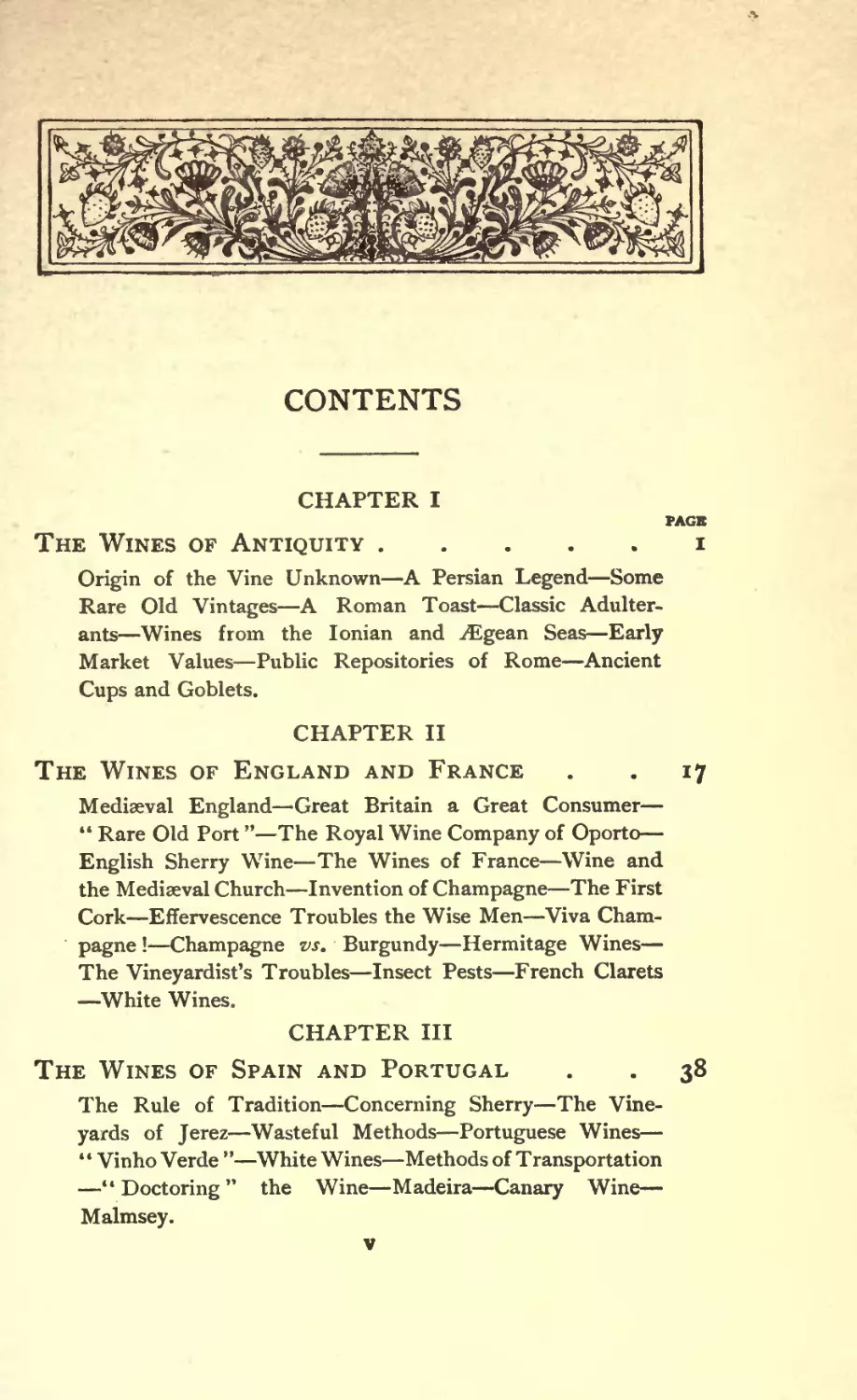
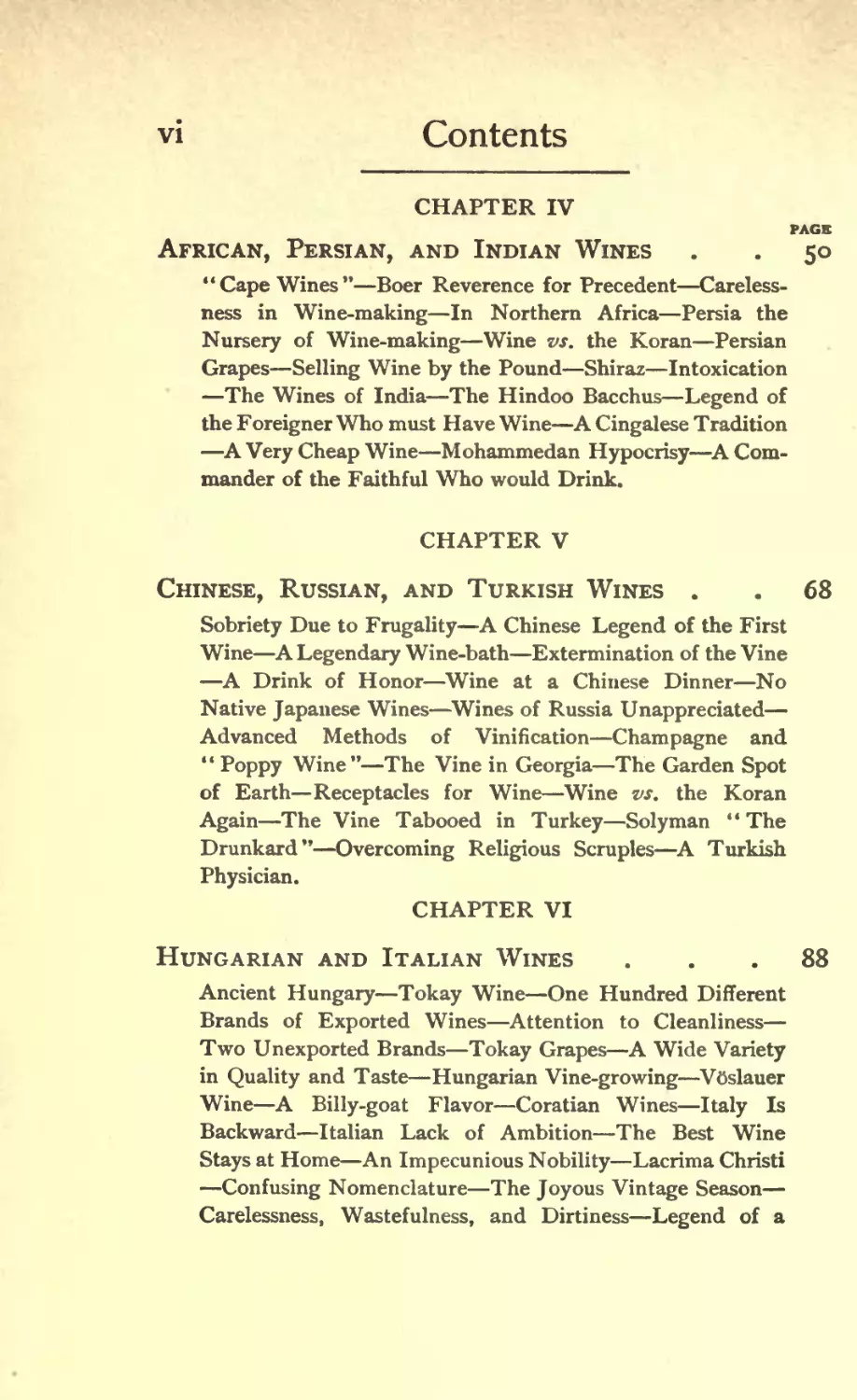
CONTENTS
CHAPTER I
PACK
THE WINES OF ANTIQUITY i
Origin of the Vine Unknown A Persian Legend Some
Rare Old Vintages A Roman Toast Classic Adulter-
ants Wines from the Ionian and ^Egean Seas Early
Market Values Public Repositories of Rome Ancient
Cups and Goblets.
CHAPTER II
THE WINES OF ENGLAND AND FRANCE . . 17
Mediaeval England Great Britain a Great Consumer
" Rare Old Port " The Royal Wine Company of Oporto
English Sherry Wine The Wines of France Wine and
the Mediaeval Church Invention of Champagne The First
Cork Effervescence Troubles the Wise Men Viva Cham-
pagne ! Champagne vs. Burgundy Hermitage Wines
The Vineyardist's Troubles Insect Pests French Clarets
White Wines.
CHAPTER III
THE WINES OF SPAIN AND PORTUGAL . . 38
The Rule of Tradition Concerning Sherry The Vine-
yards of Jerez Wasteful Methods Portuguese Wines
1 * Vinho Verde " White Wines Methods of Transportation
"Doctoring" the Wine Madeira Canary Wine
Malmsey.

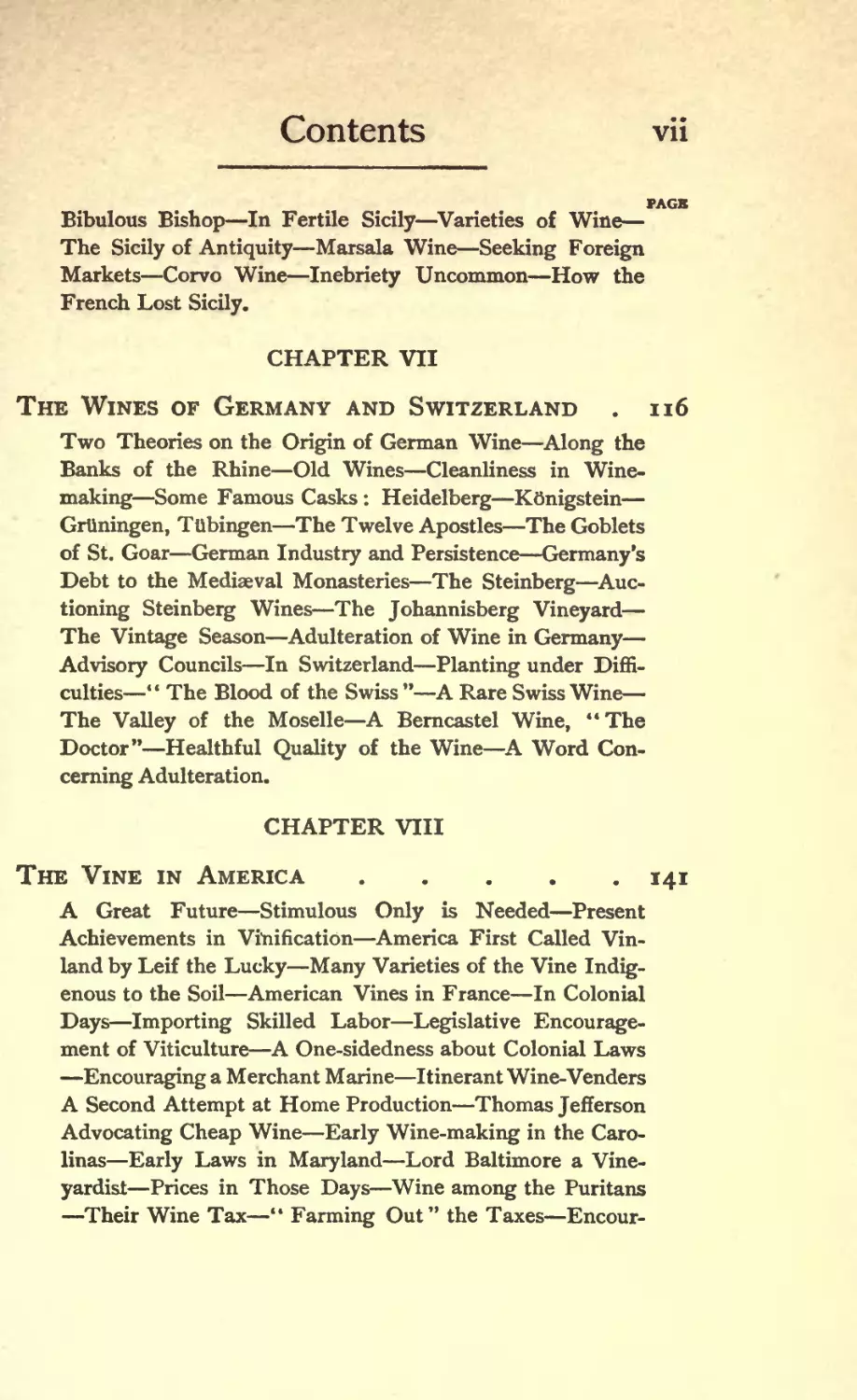
vi Contents
CHAPTER IV
PACK
AFRICAN, PERSIAN, AND INDIAN WINES , . 50
"Cape Wines" Boer Reverence for Precedent Careless-
ness in Wine-making In Northern Africa Persia the
Nursery of Wine-making Wine vs. the Koran Persian
Grapes Selling Wine by the Pound Shiraz Intoxication
The Wines of India The Hindoo Bacchus Legend of
the Foreigner Who must Have Wine A Cingalese Tradition
A Very Cheap Wine Mohammedan Hypocrisy A Com-
mander of the Faithful Who would Drink.
CHAPTER V
CHINESE, RUSSIAN, AND TURKISH WINES . . 68
Sobriety Due to Frugality A Chinese Legend of the First
Wine A Legendary Wine-bath Extermination of the Vine
A Drink of Honor Wine at a Chinese Dinner No
Native Japanese Wines Wines of Russia Unappreciated
Advanced Methods of Vinification Champagne and
" Poppy Wine" The Vine in Georgia The Garden Spot
of Earth Receptacles for Wine Wine vs. the Koran
Again The Vine Tabooed in Turkey Solyman "The
Drunkard" Overcoming Religious Scruples A Turkish
Physician.
CHAPTER VI
HUNGARIAN AND ITALIAN WINES ... 88
Ancient Hungary Tokay Wine One Hundred Different
Brands of Exported Wines Attention to Cleanliness
Two Unexported Brands Tokay Grapes A Wide Variety
in Quality and Taste Hungarian Vine-growing Vttslauer
Wine A Billy-goat Flavor Coratian Wines Italy Is
Backward Italian Lack of Ambition The Best Wine
Stays at Home An Impecunious Nobility Lacrima Christi
Confusing Nomenclature The Joyous Vintage Season
Carelessness, Wastefulness, and Dirtiness Legend of a

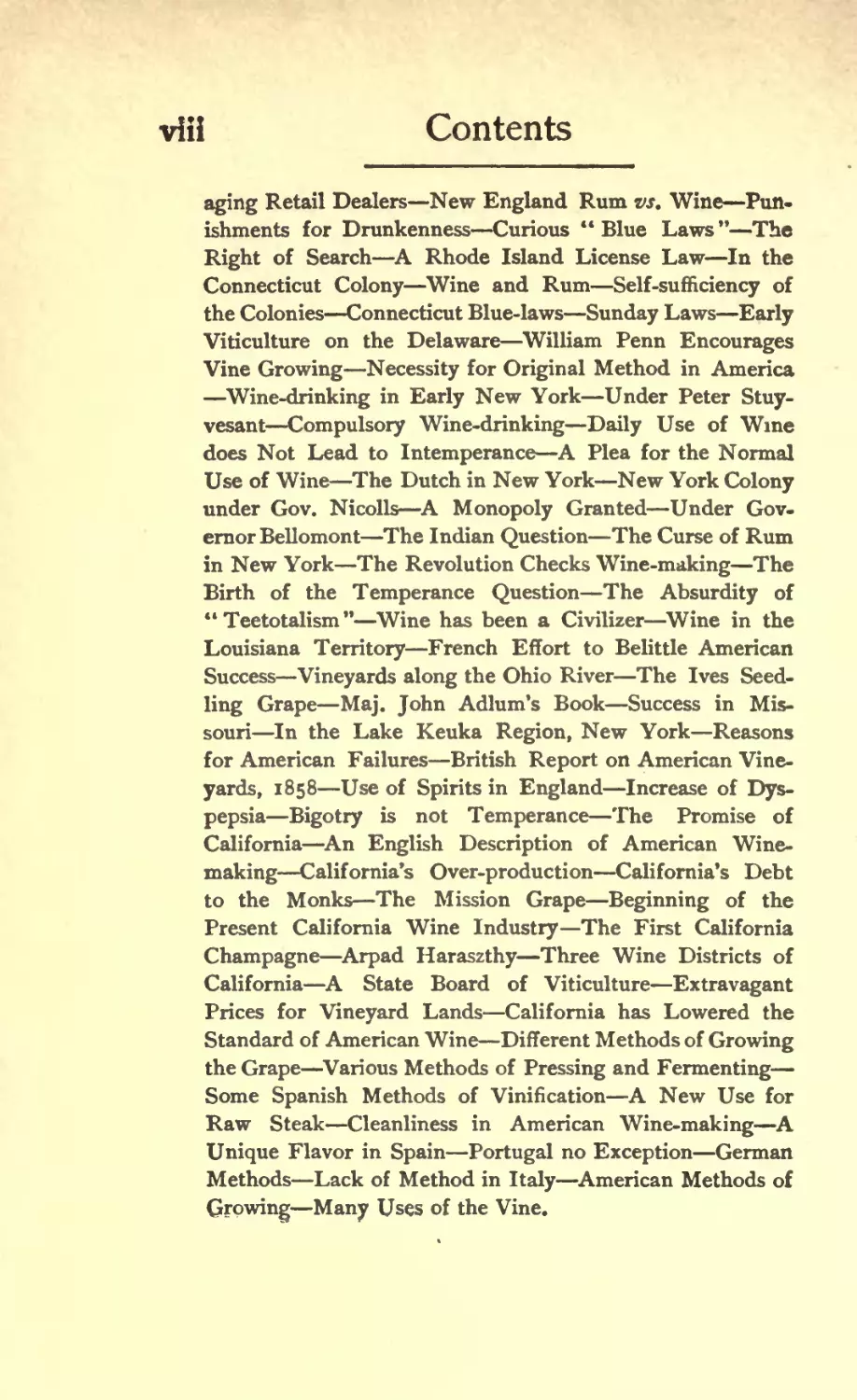
Contents vii
PAGE
Bibulous Bishop In Fertile Sicily Varieties of Wine
The Sicily of Antiquity Marsala Wine Seeking Foreign
Markets Corvo Wine Inebriety Uncommon How the
French Lost Sicily.
CHAPTER VII
THE WINES OF GERMANY AND SWITZERLAND . 116
Two Theories on the Origin of German Wine Along the
Banks of the Rhine Old Wines Cleanliness in Wine-
making Some Famous Casks : Heidelberg KSnigstein
GrUningen, Tubingen The Twelve Apostles The Goblets
of St. Goar German Industry and Persistence Germany's
Debt to the Mediaeval Monasteries The Steinberg Auc-
tioning Steinberg Wines The Johannisberg Vineyard
The Vintage Season Adulteration of Wine in Germany
Advisory Councils In Switzerland Planting under Diffi-
culties" The Blood of the Swiss "A Rare Swiss Wine
The Valley of the Moselle A Berncastel Wine, "The
Doctor" Healthful Quality of the Wine A Word Con-
cerning Adulteration.
CHAPTER VIII
THE VINE IN AMERICA 141
A Great Future Stimulous Only is Needed Present
Achievements in Verification America First Called Vin-
land by Leif the Lucky Many Varieties of the Vine Indig-
enous to the Soil American Vines in France In Colonial
Days Importing Skilled Labor Legislative Encourage-
ment of Viticulture A One-sidedness about Colonial Laws
Encouraging a Merchant Marine Itinerant Wine- Venders
A Second Attempt at Home Production Thomas Jefferson
Advocating Cheap Wine Early Wine-making in the Caro-
linas Early Laws in Maryland Lord Baltimore a Vine-
yardist Prices in Those Days Wine among the Puritans
Their Wine Tax" Farming Out" the Taxes Encour-

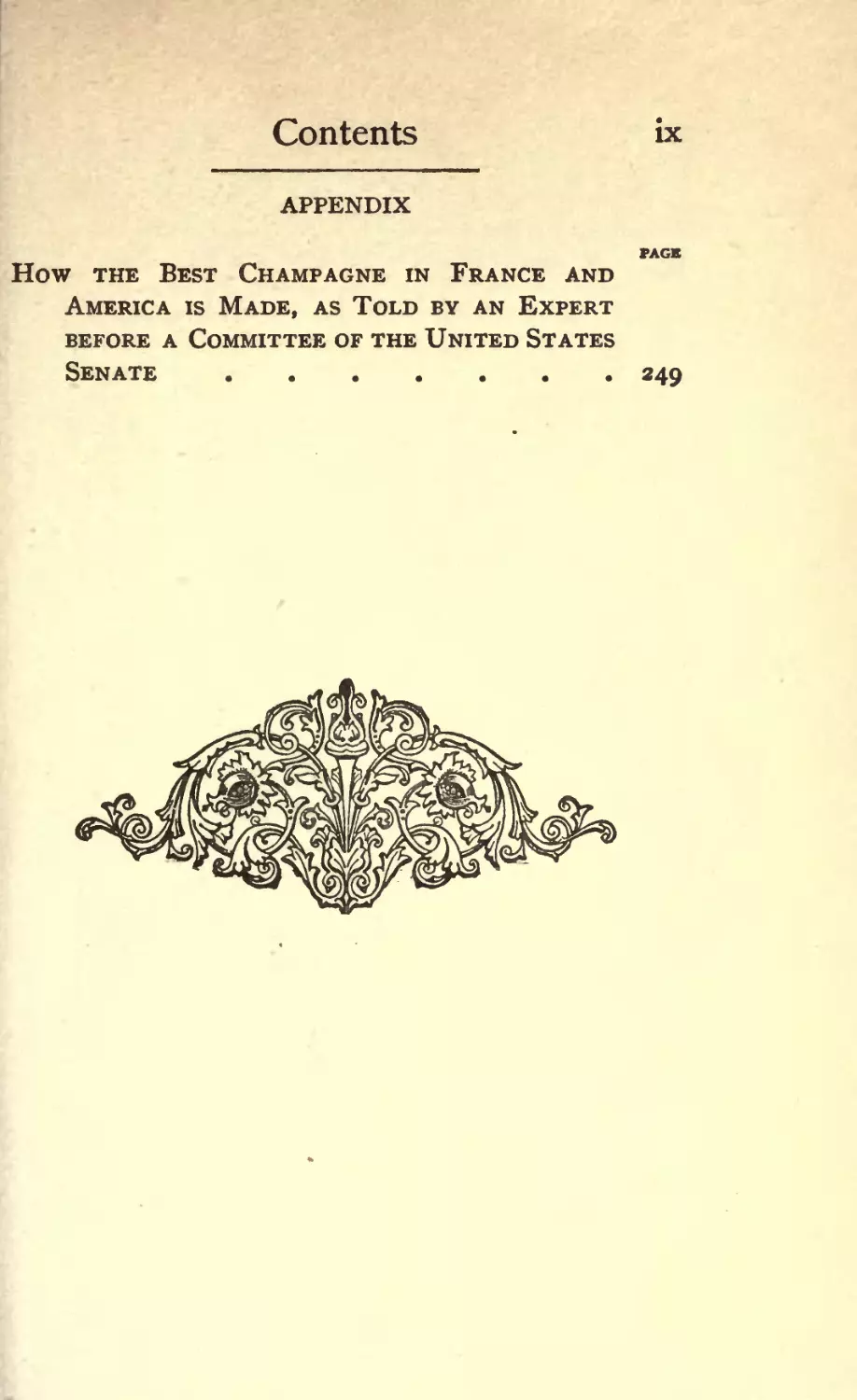
vlii Contents
aging Retail Dealers New England Rum vs. Wine Pun-
ishments for Drunkenness Curious "Blue Laws" The
Right of Search A Rhode Island License Law In the
Connecticut Colony Wine and Rum Self-sufficiency of
the Colonies Connecticut Blue-laws Sunday Laws Early
Viticulture on the Delaware William Penn Encourages
Vine Growing Necessity for Original Method in America
Wine-drinking in Early New York Under Peter Stuy-
vesant Compulsory Wine-drinking Daily Use of Wine
does Not Lead to Intemperance A Plea for the Normal
Use of Wine The Dutch in New York New York Colony
under Gov. Nicolls A Monopoly Granted Under Gov-
ernor Bellomont The Indian Question The Curse of Rum
in New York The Revolution Checks Wine-making The
Birth of the Temperance Question The Absurdity of
" Teetotalism " Wine has been a Civilizer Wine in the
Louisiana Territory French Effort to Belittle American
Success Vineyards along the Ohio River The Ives Seed-
ling Grape Maj. John Adlum's Book Success in Mis-
souri In the Lake Keuka Region, New York Reasons
for American Failures British Report on American Vine-
yards, 1858 Use of Spirits in England Increase of Dys-
pepsia Bigotry is not Temperance The Promise of
California An English Description of American Wine-
making California's Over-production California's Debt
to the Monks The Mission Grape Beginning of the
Present California Wine Industry The First California
Champagne Arpad Haraszthy Three Wine Districts of
California A State Board of Viticulture Extravagant
Prices for Vineyard Lands California has Lowered the
Standard of American Wine Different Methods of Growing
the Grape Various Methods of Pressing and Fermenting
Some Spanish Methods of Vinification A New Use for
Raw Steak Cleanliness in American Wine-making A
Unique Flavor in Spain Portugal no Exception German
Methods Lack of Method in Italy American Methods of
Growing Many Uses of the Vine.

Contents
IX
APPENDIX
How THE BEST CHAMPAGNE IN FRANCE AND
AMERICA is MADE, AS TOLD BY AN EXPERT
BEFORE A COMMITTEE OF THE UNITED STATES
SENATE .<'.. , . . . 249

THE STORY OF THE VINE
SJTY I CHAPTER I
HE WINES OF ANTIQUITY
SO vague and remote is the genesis of the vine
and so hidden in antiquity is its early history,
that to advance any theory as to its origin or place
of birth must of necessity be conjecture Qrf
pure and simple. The various works of of the vine
unknown.
our most ancient writers prove conclu-
sively that the vine was not indigenous to the soil
of their own countries, as mention is too often made
of its introduction in their locality ; unfortunately for
the historian, however, the original source of sup-
ply is never given. In all probability the vine origi-
nated in the far East, though there are no records
nor writings to substantiate this theory. We of the
twentieth century can only speculate and condemn

2 The Story of the Vine
the want of thought on the part of our ancient
historians in their utter disregard of detail. Before
that period, which the geologists have called tertiary,
or the era of time during which this round world
was being prepared for man's future, and whatever
in ages to come he should require was being stored
away by the beneficent hand of kindly nature, the
grape was in existence. In the deposit of lignite,
a soft brown coal mined in Germany, there are often
found impressions of the grape leaf, and sometimes
a small pile of the seeds is seen, closely resembling
a cake of murk as it comes from the wine-press of
to-day. Through all the great upheavals of nature
the vine has survived spared that it might be of
use to man.
Atavism, however, may enable us to obtain an
insight into the original state of the vine and
also help us to form an idea regarding the con-
ditions with which our far-distant ancestors had to
contend. A vine, if nurtured and cared for by
skilled hands, pruned and trained in season, prop-
erly fertilized and cultivated, brings forth fruit that
is at once a profit and pleasure to its owner. On
the other hand, if it is neglected, if weeds and
shrubbery are allowed to grow about its roots, if
pruning ceases and no fertilization of any kind is

The Wines of Antiquity 3
given to it, retrogradation soon follows and we
catch a fleeting glimpse of primeval nature. There
will be hundreds of feet of vine, large dark green
leaves, and small, imperfect clusters of fruit, harshly
acid and vicious to the taste. Unquestionably this
was the condition of affairs that confronted our first
vineyardists. Food, of course, was their first
thought and the betterment of what nature had fur-
nished was a natural sequence. With the grape im-
provement was easily and naturally accomplished.
Accident, such as the breaking off of a large portion
of the wood in the spring, can readily account for the
practice of pruning, and the selection of the best
vines to be found would also account for the en-
largement of the clusters.
Strangely enough the first authentic record that
we have of the grape speaks at once of its cultiva-
tion, its products, and the use to which they were
put. " And Noah began to be a husbandman and
he planted a vineyard. . . . And he drank of
the wine and was drunken " (Gen. ix. 20, 21). This
to a degree proves the great antiquity of the grape,
and its uses, while it further demonstrates how
futile it is to try to name its birthplace, or where
and when its fruit was first turned into wine. If
Noah knew how to cultivate it and understood the

4 The Story of the Vine
art of making wine, undoubtedly he had acquired
his knowledge before the time of the flood ; and ac-
cordingly the ancestors of Noah knew, too, how to
grow grapes for the purpose of making and preserv-
ing wine. But this method of reasoning only leads
us further and further into the realms of specula-
tion, and the best deduction that can be made is to
say that the flood must have destroyed many a rare
old vintage.
The Persians have a legend of the origin of wine
which has a large proportion of probability about it,
A Persian cven ^ on t ^ ie w ^l e ^ ' ls legendary,
legend. Abul Kasin Mansur, in his Shahnamah,
tells how Jemsheed, being very fond of grapes, had
stored up for himself a number of jars of grape
juice. After a time he went to seek for a refreshing
draught, but fermentation was in progress and he
found his juice foul and nauseous. This condition
did not deter him from drinking of it, and in con-
sequence his Highness experienced a very severe
stomach ache; such a result proved conclusively
that the liquor had become dangerous to use, and
to prevent further accident he labelled each jar
" Poison." A short time later one of his wives, in
trouble of soul and weary of life because she had
lost her lord's favor, determined to put an end to

The Wines of Antiquity 5
her existence. The " Poison " he had labelled and
set aside was easily procured, but a large drink of it
only transformed her sorrow into joy ; a still larger
drink stupefied, but did not kill her. What was
better, it revived her beauty to such an extent that
she easily regained her place. She kept her secret
and in time exhausted the entire supply. One day
Jemsheed discovered that the jars were empty, and
on demanding an explanation the woman confessed
and described its effect in such glowing terms that
Jemsheed was induced to try the experiment again,
and wine was discovered. How neatly this illus-
trates the power of accident, which is often the
great factor in the advancement of mankind in its
search for knowledge !
The ancients were well acquainted with wine, as
their literature attests. Homer, " the father of
poets," in his Odyssey, lauds the wine of Maronea.
Alexander the Great, when he overthrew the Per-
sian Empire at Arbela, B.C. 331, found the vine in a
high state of cultivation and the wine of such an
excellent quality that he called it " The blood of
the earth." And, if history is to be at all relied
upon, Alexander, aside from his ability to win bat-
tles, had a certain penchant for the good things
" the gods " supplied that entitled him to be ranked

6 The Story of the Vine
as a connoisseur of no mean ability. Virgil, Hor-
ace, Lucretius, and hosts of others, great and small,
have much to say of wine. At times they approve,
at others they deplore, its effects and the abuse to
which it was subjected both in use and adulteration.
Many of the present day think that the art of adul-
teration is of recent origin, and sigh for the pure
things our ancestors were in the habit of eating and
drinking. History, however, shows that long be-
fore the Christian era the adulteration of wine was
a fine and deceptive art. The ancient Greeks were
especially adept in this nefarious practice and were
noted throughout the then known world for their
ability in this direction.
Ancient Egypt, history tells us, had several kinds
of wine, of more or less good repute, though the
some rare preference seems to have been given to
old vintages. t h e Taeniotic and Mareotic brands or
species; the latter was a rich, heavy white wine and
very intoxicating. The Phoenicians had their wines,
which were grown in and around Byblos. Lydia,
also, made its own wines, but, like those of Phoe-
nicia, they were known as wines of a place or town.
The Greeks and Romans had many different brands,
which were more or less famous. In fact, Pliny
states that in his day there were eighty different

The Wines of Antiquity 7
wines, of good reputation, of which Italy made
fifty-four.
The wine par excellence of this period was the
Falernian, commanding the highest price. While
young it was dark colored, rough and strong to the
taste, but when it was matured, which took from
ten to fifteen years to accomplish, it was soft and
mellow with a slight bitter taste. It was grown on
a hillside in Campania, a region noted for the re-
markable fertility of its soil.
Chian was also a noted wine of that time and was
often mixed, by the drinker, with Falernian for the
purpose of softening, when the latter was used be-
fore being fully ripe.
One practice of the ancient Romans, part of which
is worthy of emulation to-day, was the use of very
small glasses when drinking a toast ; but A Roman
as a story is never told until it is all told, toast -
it is perhaps better to add that it was also the cus-
tom for guests or friends to drink a full glass for
every letter in the toasted person's name. The
effect can better be imagined than described, if the
name should happen to contain twenty-five or
thirty letters. Two or three persons with long
names would go far towards lightening the duties
of the toast-master, but how about the guests ?

8 The Story of the Vine
The ancient Romans also believed in cooling their
wine, preferably with snow, which was brought from
the tops of the mountains many miles by slaves.
They also practised the freezing of wine during the
winter, and would draw from the bottom of the
cask, so that the frozen portion, which was mainly
water, remained, while the residue was greatly
strengthened, both in alcohol and flavor. To a
great extent it was thought that this procedure im-
proved the keeping qualities, and thereby materially
added to its value. Flasks instead of bottles were
used, and the stopper was generally olive oil of
good quality, poured on the top to exclude the air.
Boiled sea water was thought to improve the wine,
but there is no accounting for taste, and possibly it
did improve it, considering that in those days it was
also the custom to infuse asafoetida in the wine by
steeping.
Beside asafoetida and sea water in the wine, the
aristocracy used to use, according to their personal
classic taste, tar, pitch, bitumen, aloes, chalk,
adulterants, different gums, pepper, spikenard, cy-
press, wormwood, myrrh, and poppies. Verily it
might be said with much truth of such wine, " For
it biteth like a serpent and stingeth like an adder,"
or the palate and stomach of man have undergone

The Wines of Antiquity 9
a wonderful change. This must be the case, for
in describing the drinking bouts, Pliny tells how
the contestants would drink powdered pumice-
stone before beginning the bout; and that the
drinking of a gallon of wine at a breath was a very
common feat indeed. It is no wonder that the
Romans were a hardy race, and conquered every
people that came before them, for their ability to
retain pumice-stone, sea water, and tar, mixed
with wine and then consumed by the gallon or
more at a draught, speaks for itself, and makes
comment entirely unnecessary. They had, how-
ever, one redeeming feature that is worthy of com-
mendation, namely, the estimation in which they
held rare old vintages. Money would not induce
them to part with what they knew to be of a certain
age, and their practice of marking their amphorae
with red letters is closely akin to our phrase " a red
letter day."
The amphorae of the Romans were made of baked
clay so glazed as to exclude the air and make them
water-tight. They varied in size according to their
requirements. Some only held five or six gallons,
while others held as many barrels. The larger ones
were invariably imbedded in the earth, and sealed
after being marked to show the date of vintage;

io The Story of the Vine
the prevailing practice was to mark on the outside
of the amphorae, before burying, the name of the
consul then in office; this method gave rise to the
naming of the various vintages after the consuls,
and was therefore very fair evidence of their authen-
ticity. The burying, however, did not take place
until after the wine had been subjected to the fuma-
rium, which, as its name indicates, was a hot
smokehouse. This heating not only mellowed the
wine, but it thickened it and imparted a smoky
taste.
In the main the Romans followed the Greeks in
many of their practices, but being of a more robust
nature they soon made alterations to suit them-
selves. The Greeks made wine long before the
Romans, but when the Romans found that they
could make wine, they did it, and they used it with
a gusto that to-day would be considered decided
over-indulgence. The Greeks at all their public
functions mingled water with their wines, so that
they might return to their homes sober; this was in
accordance with a decree of Amphitryon's revived
by Solon. Even to-day the modern Greek follows
this practice to a limited extent, though it is more
from necessity than otherwise, for the wines of
Greece are still made as in the Augustan age, and

The Wines of Antiquity 1 1
though not so apt to intoxicate, do affect the head
greatly, making it ache " ready to split."
The finest wines of the ancients, as judged by
our standard of to-day, came from the islands of
the Ionian and ^Egean seas. On these wines from
islands viticulture had reached a stage of *
perfection that was far in advance of that seas -
attained on the mainlands. As to climate their
situation was, and is, ideal; the soil too at that
period was, as one might say, in its primitive state
teeming with fertility, and responsive to the slight-
est touch. Competition and rivalry too aided to
make the growers more anxious to produce the best
wines they could, in order to give their own particu-
lar island an honored name among the nations.
Chios, Lesbos, and Thasos seem by all accounts to
have had the preference, but Crete, Cyprus, Cor-
cyra, Cuidos, and Rhodes produced excellent vint-
ages, that were much sought for, and highly prized.
Time during the Augustan period was very little
considered ; years played but a small part, and if it
was necessary to take ten, fifteen, or twenty years
to ripen a wine, it was done, and that was the end
of it, as far as the vineyardist was concerned.
The marketing of the wine was of a very uncertain
nature ; it generally depended upon the preference

1 2 The Story of the Vine
shown by some notable person with whom the
vineyardist was fortunate enough to be acquainted.
Early market If he COuld be l ndu C ed to P raise the
values. vintage, there would be instant de-
mand for it, and the price would advance accord-
ingly ; thus the future of the vineyardist would be
made. The chief method, however, of disposing
of the wine was through the agency of the wine
fairs, and many and various were the tricks to
which they resorted to deceive the likely purchaser.
One trick that was much in vogue was to put strong
cheese and spicy nuts where the buyer could get at
them easily, and by eating of them blunt his palate.
This practice seems to have survived the centuries;
and although we have enlarged upon it somewhat,
and have elevated it a little by naming it and by
having laws passed suppressing it, the free lunch is,
in the main, used for the same purpose originally
planned by its classic originators. Another trick
was to use old, well seasoned vessels, that had con-
tained fine wine, and thereby age the new contents.
These tricks, after all, were greatly condemned, and
were only resorted to by the unscrupulous.
On the other hand, where the vineyardist was
known to be honest, and his goods were as repre-
sented, price seems to have played only a small

The Wines of Antiquity 13
part. Pliny tells where the price of a certain wine,
that was in existence at his time, but was made one
hundred and sixty years previous, was about ten
dollars per bottle, of the present value of our
money. The wine was the consistency of honey,
and had to be mixed with water to be drunk; it
was chiefly used for mixing with other wines, to im-
part its flavor to the whole. This mixing was done
by the purchaser and at the time of serving. The
quantity used was an indication of the esteem in
which the host held his guest ; or how lavish he felt
at the time, and what impression he desired to make
upon the company present.
The peculiar social conditions of the ancient
Romans, and the cramped quarters in which they
lived, unless they were very wealthy,
Public repos-
made it necessary for them to purchase itoriesof
Rome.
their wines in very small quantities, yet as
wine was used constantly, these conditions also ne-
cessitated storage ; so, to overcome these conditions
of affairs, Rome established public repositories,
where wines of all ages and kinds could be stored or
bought according to the desire or wealth of the pat-
rons. This governmental control imparted an air
of respectability to the drinking of wine, and un-
questionably had a great deal to do in extending its

14 The Story of the Vine
use, indicating governmental consent and approval ;
it also kept the prices within reach of the masses,
and thus by catering at once to their appetites and
avarice, the people were made stronger advocates of
the government, and were more ready to lend their
aid and consent to any scheme that the politician
thought fit to advance.
But if the officers and government were anxious
to palliate and coddle the masses with good wine
at small cost, the well-born and wealthy class made
wine their excuse for extravagance and display.
Their cellars were loaded with thousands of bottles
of the rarest vintages. Amphorae after amphorae
were either buried or braced against the walls of the
cellars, and the more exaggerated the scheme that
could in any way make the wine different and more
costly, the better it was appreciated. Expensive
perfumes and rare spices were added with a prod-
igality that would astonish even those who were
accustomed to lavishness. Athens as well as Rome
witnessed this preposterous waste of wealth and
substance, and while in a few cases it was deplored,
as a general rule the practice was applauded and
commended. This excess did not confine itself to
the wine alone, but was extended to the cups and
glasses. They demanded not only the best ma-

The Wines of Antiquity 15
terials but the finest workmanship of the sculptors,
lapidaries, and jewellers. Many of the goblets
were bedecked with precious stones, Ancientcups
while those of solid silver were heavily and K blets -
studded with gold. Size was also desired, and
goblets of solid silver were often made so heavy
that when they were full of wine it required a strong
man to lift them. Ofttimes the host would present
his guests with these cups of silver and gold in
which they had drank their wine as souvenirs of the
feast. Glass it seems did not appeal to the really
great, although it was very expensive, and was far
beyond the reach of even the moderately wealthy.
The poor also affected great display in the serving
of their wine, and apologized for their cheap ma-
terial by having their cups curiously and beautifully
carved. Some of the poorer cups were formed of
beechen, some of ivory, and still others of clay,
and distinguished for their extraordinary lightness.
Many of these clay cups were so imbued with per-
fume that they imparted an aromatic flavor to the
wine when they were used.
The cup that was most prized by these luxurious
people, though, was the murrhine. Inestimable in
value it was also said to impart a perfume that no
art or artifice could make, or even approach ; in fact

1 6 The Story of the Vine
it was beyond counterfeiting. Another rare quality
that it is said to have possessed, was immediate de-
tection of any poisonous substance that might have
been placed in the wine, either by accident or de-
sign. Combined with these qualities it is no wonder
that it was so highly prized and closely guarded.
It was also beautiful to look upon ; Pliny in describ-
ing it says that it had a certain lustre, without the
brilliancy of the precious stones. Its great beauty,
however, was its variegated colors, its zones of
purple and white and yellowish red passing into
each other and refracting the light. Broadness
and closeness of the veins was the guide to value ;
paleness of color or transparency was considered a
defect. At first these cups were dedicated to the
service of the gods, but later they were more or less
common among the wealthy and luxurious.
The custom among the ancients of serving wines
at their dinners and banquets varies but little from
the custom of to-day; in fact it can almost be said
that we have borrowed directly from the Romans.
In one respect we have improved upon their
method in not using such enormous quantities;
otherwise, we differ very little, except perhaps in
the use of champagne, a product of which they were
ignorant.

CHAPTER II
THE WINES OF ENGLAND AND FRANCE
THERE is very little doubt but that the western
part of Europe is indebted to the ancient
Romans for the increased cultivation of the vine,
and its subsequent greater use for the purpose of
wine-making. Their desire for conquest, and their
strenuous efforts to introduce their manners and
customs wherever they went, could have but one
result. Being excessively fond of wine at home, it
is only natural to suppose that when they had suc-
ceeded in subduing their new-found territory, and
were at peace with the conquered, they should pur-
sue their homelike ways, and endeavor to secure
the things to which they were accustomed. Ac-
cordingly the cultivation of the vine soon followed
upon the declaration of peace; but, unfortunately
for us, no very authentic records have been kept,
and for a considerable period surmise must take the
17

1 8 The Story of the Vine
place of history. The Dark Ages are sorely and
sadly deficient in statistics of any sort, and especially
so on the subject of viticulture. The fall of the Ro-
man Empire seems to have started the whole world
backward, and we have to begin all over again.
In England the Doomsday Book gives us a faint
insight into the methods pursued by vineyardists,
Mediaeval or more accurately speaking, the number
England. Q acres devoted to the cultivation of the
vine, and the amount they produced. One account
tells of a vineyard in Essex of six acres, producing
one hundred and sixty gallons of wine, of excellent
quality. The Vale of Gloucester was noted for its
good vineyards and the quality of their wines.
William of Malmesbury claims in his book, De
Pontificibus, that the wines of this vale rivalled the
wines of France, and some of them he thought
were, if anything, superior; however this was in the
twelfth century, and conditions were somewhat dif-
ferent from the present time, for wine is not made in
England to-day at all. If, however, Eng-
Great Britain
a great land does not make her wine she uses it
consumer.
in immense quantities; in fact it may be
said that England leads the world in her consump-
tion of the juice of the grape. Among the vine-
yardists of Europe there is a saying, " London

The Wines of England and France 19
first, the rest of the world afterwards." The finest
products of the finest vineyards of Europe go to
London. English taste and judgment is accepted
everywhere as final ; and every foible she may see
fit to adopt is soon taken up and practised the
world over. For many years, and to a limited ex-
tent now, the drinking of port wine at any and
every function was considered to be the proper
thing, and every one who tried to be somebody was
a port wine drinker. Later on England demanded
a very dry champagne, with the result that only on
very rare occasions can sweet champagne be found
at any banquet, unless it is specially provided for
the ladies.
Port wine was introduced into England in the
year 1689, and from that time until recently it may
be said to have been the leading wine of England.
Much has been said for and against the wine, but
whatever has been said, it must be admitted that the
port wine of to-day very slightly resembles the wine
of the seventeenth century. For a period of about
three years after the first importation of "Rare old
port, the English were satisfied to drink a port."
pure wholesome wine; then they demanded that it
be made stronger, and began dashing it with brandy.
The vineyardists objected to this practice, and

20 The Story of the Vine
claimed that it injured the flavor and bouquet; but
when they found that their wine was unsalable
unless heavily fortified with brandy, they added the
brandy and sold the goods. Soon brandy was not
strong enough ; the demand was for a sort that, as
one author puts it, " when drank it should feel like
liquid fire in the stomach, burn like gunpowder,
bear the tint of ink, be like the sugar of Brazil in
sweetness, and like the spices of India in aromatic
flavor. The importers and consumers still com-
plaining of want of strength and color in the article
supplied, it was found necessary to dash it with
brandy during fermentation, to give it strength and
sweetness ; and with the extract of elderberries or
the rind of the grape, to increase the color; the
recipe was thus propagated till the wines became a
mere confusion of mixtures." Almost a return to
sea water and asafcetida, and good evidence that
the spirit of the old Roman still exists in the Al-
bion. Since that time England has striven very
hard indeed to return to first principles, but, com-
paratively speaking, very little has been accom-
plished. Laws have been passed and enforced, but
still the wine is adulterated and unlike the wine
they began first to use. Of course they have no
one to blame but themselves ; their abnormal tastes

The Wines of England and France 21
and requirements made them pollute the fountain-
head to such an extent that after the lapse of
nearly three centuries port wine as it is made in
Portugal is a mixture only.
As early as 1756 a monopoly was granted to the
Chartered Royal Wine Company of Oporto, for the
purpose of protecting the consumer and The R yai
to check adulteration. But the company win p a ^
was the first to violate its promise; they oporto,
had everything their own way and proceeded im-
mediately to make money as rapidly as they could ;
and where before they had manipulated only a part
now all the wine was manipulated and adulterated.
Their power was unlimited, and to aid them they
had the help of the authorities. They restricted
the acreage, and having monopolized the wine and
brandy trade, they purchased inferior wines, which
were in turn doctored and sent into England as port
wine. Every mischief that could be committed in
the wine trade this company seems to have done ;
and even to have invented new ones, so rapacious
and insatiable were they for money. In 1823 the
charter was considerably modified ; yet England still
suffers from the company's pernicious practices.
It is such methods as these that make England's
efforts to return to first principles the more difficult

22 The Story of the Vine
and hard to achieve. It was only within the last
decade or so that Parliament appointed a commis-
sion of four or five very expert gentlemen to inves-
tigate this question, and after a thorough course of
inspection, which took three or four years to accom-
plish, the commission reported that " not a drop of
pure port wine entered England."
The late Mr. Gladstone deplored the drinking of
port wine, and used his wonderful ability assiduously
against its use whenever opportunity gave him the
chance. Claret wine was his favorite, and he did a
great deal towards popularizing it with his fellow-
countrymen. Mr. Gladstone's efforts were not
without results, for comparatively very little port
wine is drunk in England to-day and it is rarely
seen on well appointed tables; except, perhaps,
where gentlemen of the " old school " happen to
be present, who are so addicted to its use that, no
matter what " comes or goes," they still must and
will have their port wine. So much has been said
and written about the rare old port wine stored in
the cellars of the English gentlemen ; their fine and
delicate taste; their ability to distinguish it at a
glance; even to smell the exact age of the wine,
and in rare cases to tell even the vineyard from
which it comes, that it almost amounts to sacrilege

The Wines of England and France 23
to say that the opposite is the true condition of
affairs. Each and every authority that can be
found, and there are many, revile the company and
deplore its methods. They are a unit in stating
that pure port wine cannot be had in Portugal, and
statistics bear them out in their assertions. We
frequently read that a certain nobleman has wine of
the vintage of '47, but that it has not ripened yet ;
and no wonder, for if only one half is true, the wine
is more brandy than anything else.
The second wine of England, and one which still
retains a semblance of its old prestige, is the sherry ;
English but this too, like the port wine, is sub-
sherry wine. j ec t e< -| to sophistication and is more or
less difficult to get in its purity. Unlike port wine,
sherry has never been controlled by a monopoly,
but, on the other hand, the love of gain and the
desire to become rich quickly is as firmly planted in
the Spaniard's mind as it is in the British; and as
adulterations add to the strength and increase the
bulk, sherry suffered accordingly. English litera-
ture fairly teems with sherry ; all classes and all kinds
of writers have had more or less to say about sherry
wine. A traveller returning from Spain always
writes about sherry wine; while poet and prose
writer, historian and dramatist, have written volume

24 The Story of the Vine
upon volume extolling or condemning sherry. To
quote a very able authority on wine, '* Were I to
enter fully into the number of treatises upon the sub-
ject of sherry. . . I should give myself an enormous
amount of labor, with very little satisfaction to my
readers "; and as sherry belongs to Spain it will be
treated under that head. England, especially in
the wine trade, is the mart of the world ; everything,
good, bad, or indifferent, goes to that market first,
and then if there is too much for England's con-
sumption, the balance of the universe may have it.
Almost every wine made can be found, to a greater
or lesser extent, in London; and Englishmen are as
a rule more or less acquainted with their different
qualities and bouquet, their uses and effects.
Across the English Channel, in France, conditions
are somewhat changed, for to France all eyes must
The wines * urn *^at are m anv wav interested in the
of France. v j ne an( j fts products. The finest wines
that ever touched the lips of man are raised here,
as well as the worst, and such is France's reputation
that in some small minds it is thought that her
worst is superior to the best that is produced else-
where.
That France raises and makes the finest wines in
the world cannot be denied, but that she exports

The Wines of England and France 25
them is an entirely different story. It was only as
recently as 1897 that one of our consuls in France,
in making his report to Washington, said that " all
wines leaving Marseilles for America were adulter-
ated, and a great many to a poisonous extent/'
France herself recognizes that of late years there
has appeared a powerful rival to her supremacy,
and she is taking precautions to maintain her high
standing abroad. Societies are being formed by
which the vineyardist can get his wines into foreign
ports without the intercession of the native wine-
merchant, by whom, they claim, the damage is
done. If this can be accomplished, and the wine-
makers will be satisfied with a fair profit, much good
will accrue ; but it is to be doubted greatly whether
they will be satisfied with small dividends, where
much larger ones could be had so easily.
The introduction of the vine into France is said
to have been made by the Phoceans six or seven
hundred years before the Christian era; though
very little, if any, headway had been made until the
arrival of the Romans. Through the Middle Ages,
as in England, we have but meagre records of the
growth of the vine, and to a great extent what does
exist is invention, with a grain of tradition running
through the story, thus making it more difficult to

26 The Story of the Vine
arrive at a proper solution. There is one feature,
* however, that can be proven very easily, and that
is that the Church was a powerful advo-
Wine and the
Medieval cate and agent in the preservation and
maintenance of the science of vinification.
The best vineyards of a province were always in the
possession of some monastery, and among the
monks were to be found some of the best judges.
Much credit is to be given the " jolly old monks " ;
for though they drank the finest, they worked for
it, and we of to-day are indebted to them for the
greater part of our knowledge in viticulture and
vinification. With their own hands they planted
and cared for the vines, and when the harvest came,
they gathered it and pressed the grapes. They
carried on experiments and endeavored in every
way to perfect themselves in the art of wine-mak-
ing. From their wines they derived a large rev-
enue, and when they no longer found it necessary
to toil for themselves, they had others do it for
them, and thus were the results of their experience
and knowledge disseminated.
Tradition ascribes the discovery of champagne to
invention of Father Perigon, a Benedictine, who died
champagne. in j^ . h j s knowledge was such that he
was given the entire care of the vineyards, and this

The Wines of England and France 27
was no small charge when it is remembered that the
monastery possessed the largest and most favorably
situated vineyard in all of France. Added to this
duty was also the collection from the neighboring
vineyards of tithes of the wine they made ; he further
attended to the pressing of his own grapes, and the
blending of the tithes with his monastic wines. " In
the decline of life," says an old chronicler, " Father
Perigon being blind, ordered the grapes of the dif-
ferent vineyards to be brought to him, recognized
each kind by the taste, and said, 'You must marry
the wine of this grape with that of another.' ' He
had long before this brought the reputation of
his wines to the highest possible standard, and
it was during the process of blending that he dis-
covered how to make wine effervescent. To retain
the wine in bottles, however, was a very difficult
problem, as up to this time bottle stoppers were
made by a bit of flax or wool steeped in oil and
packed as tightly as possible into the mouth of the
bottle. But " Jolly old Dom Perigon " bethought
himself of cork, from which he made The firgt
stoppers, and these he secured with a cork<
string; thus one discovery led to another, and both
are of inestimable value to mankind.
There is another story regarding Champagne, but

28 The Story of the Vine
it undoubtedly alludes to the still wines of that dis-
trict. In 1357 Vincesilaus, King of Bohemia, on
coming to France to negotiate a treaty with Charles
VI., stopped at Rheims. There for the first time he
tasted the wine of Champagne, and so palatable did
it prove to be that he prolonged his stay in order
to become intoxicated every day before dinner. He
probably would have stayed in the old cathedral city
for the balance of his life and enjoyed the vintages
of the province had it not been for a premature pres-
entation of a bill for the wine he had consumed ;
this so affected him that he sobered up at once and
abruptly left the town. It is to be regretted that
the story fails to state whether he paid his bill or not.
Not being satisfied with the discovery of efferves-
cent wine and the use of cork wood as a bottle stop-
per, it is also claimed that the old Dom invented the
long, tapering glass from which champagne should
be drunk. There was much about champagne that
even its makers did not understand ; the sparkle and
foaming of the wine was a mystery that they could
not explain or fathom. Many were the ideas, the
most of them absurd, that were advanced
troubles the * n reference to these conditions. Some
wise men. contended that it was due to the time of
year when it was bottled, and that the rising of the

The Wines of England and France 29
sap had everything to do with the effervescence;
others that the time of bottling, if performed at a
certain age of the moon, controlled the whole action
of the wine and made it effervesce, while still others
contended that alum and other nasty substances
mixed with the wine were what caused it to overflow
the glass. To such an extent had these various con-
tentions been discussed, both orally and in writing,
that when the pious monk died, champagne was in
very bad repute. Superstition and slander, however,
could not affect it for long ; calumny had to submit
to merit, and soon champagne came to the front to
stay until, if such a thing is possible, something bet-
ter can be made, to take its place in comforting the
sick and cheering the strong; in brightening the
star of hope so that the eyes of the sad may look
upon its glory and forget for aye that man is mor-
tal; in adding a lustre to the charms of beauty, and
in imparting to the pale cheek a blush that rivals
the eastern sky heralding to the waking west the
arrival of the solar god ; in giving to passionless eyes
its own very life and sparkle so that they too may
see the joyous world and revel in its splendor; in
tingling the torpid blood of the coward and Viva
making him anxious for deeds of valor, champagne!
while it stirs like martial music the souls of the

30 The Story of the Vine
brave and heroic; in making old age forget its
weary years and take it back to days when life, like
the wine, was full of sparkle and sunshine.
Wherever the white man's foot has trod, cham-
pagne has sooner or later followed. No place is so
far but that champagne can travel the distance and
no place is too remote to keep champagne from it.
It is the first thought of the poor man who suddenly
becomes rich, and it is almost as necessary to the
wealthy man as water, in fact more so for drinking
purposes. It is known as a gentleman's wine, and
such is its reputation in large cities both here and
abroad that when wine is called for champagne is
always served. Many names have been bestowed
upon it, some good and some bad, but the two that
are more apt to be retained are " fizz " and " boy."
"Fizz," of course, is the phonetic name for the
sound emitted when champagne is first poured into
the glass; " boy " is the result of the ready wit of
Edward VII., the present King of England, though
at the time of the incident he was Prince of Wales.
It was at a picnic where a boy was serving cham-
pagne as rapidly as he could. The Prince noticed a
young lady with an empty glass, and asked her what
she was waiting for. " I am waiting for the boy,"
she replied. " Pray take this," said the Prince,

The Wines of England and France 31
handing her his own filled glass. " Now I will have
some ' boy* too." The rest of the afternoon the
Prince kept up the joke by saying when any one's
glass was empty, " Have some boy." The joke
was good, and the name was apt, and all classes of
society use " boy*' to designate champagne.
Less than two hundred and twenty years of age,
champagne is the leading wine of the world to-day,
and by far the greater part of all of France's tre-
mendous wine business is devoted to champagne.
Rheims and Epernay are known the world over
from the labels on the millions of bottles that leave
their confines every year. The business of Rheims
is almost entirely champagne, especially when the
total amount of the various transactions are con-
sidered. Both within and on the outskirts of the
city are cellars whose size and capacity are, to say
the least, astonishing; and especially is this true of
the suburbs, where there are immense caves or cata-
combs that it is alleged the Romans dug, but for
what purpose is unknown. One fact is assured,
the digging was very easy, and little or no masonry
is required to keep them from collapsing, as the soil,
if it can be so termed, is almost pure chalk, easily
worked, but withal of a very firm nature.
Champagne, however, is not the only wine that

32 The Story of the Vine
France produces ; in fact, it is only one of many, of
which the district of Champagne produces several.
Burgundy, too, has given its name to wine
Champagne * '
vs. that is known and appreciated everywhere,
but not to the extent of former years.
Between Burgundy and Champagne (the districts)
there existed for years an intense jealousy over the
excellence of their respective wines. It started some
time in the latter part of the seventeenth century, and
though officially decided at Paris in 1778, an emulous
feeling still exists in these provinces. It was caused
by a candidate for medical honors advocating the use
of Burgundy wines in his inaugural thesis, and de-
crying the wines of Champagne. Of course such an
assertion could not be overlooked by the people of
Champagne. The faculty of Rheims also entered
into the controversy, extolling the wines of Cham-
pagne and unhesitatingly claiming for them a
superiority far above those of Burgundy. One
word brought on another and a regular paper fight
ensued, both in prose and verse. All classes and
conditions of men were brought into the debate, but
during the whole time Rheims seems to have had a
little the better of the argument, and finally won
the decision.
That the vine will prosper almost anywhere in

The Wines of England and France 33
France and requires very little soil for sustenance
is fully illustrated in a tradition regarding the hermi-
tage wine, a wine so highly valued in Hermitage
France that very little, if any, is exported ; wines.
or, to be more exact, none of the first growth is
ever exported. The second growth though is often
palmed off on the foreigner as being of the first
but to the story. An inhabitant of the town of Con-
drieu, becoming tired of the pomp and folly of his
fellow-townsmen, determined to seek seclusion and
become a hermit. He selected for his home, or
cell, a barren, rocky hill near Tain, where hardly a
blade of grass could be found, but where large
granite rocks abounded. To occupy his leisure
time he broke all of the rocks and stones to pieces
that surrounded his dwelling-place, and planted vine
slips among them. They grew almost from the first
day of planting, and were such a success that the
recluse's example was followed by others, and what
formerly was barren, sterile land soon became
profitable vineyards.
The lot of the vineyardist in France is often any-
thing but pleasant, burdened with the
" octroi " or internal duty, which some vineyardist-s
troubles.
years is as high as twenty per cent, (enrich-
ing the government to the extent of nearly twenty

34 The Story of the Vine
millions of dollars), and also with the high cost of
cultivation, caused by the situation of many of the
vineyards on steep hillsides and slopes where nothing
but hand-work, and that of the most tiresome and
tedious description, is possible. In addition to these
troubles there is frequently the vexatious want of
capital, which greatly hinders and lessens the chances
of the farmer to make a fair living, this being espe-
cially the case when it is necessary to keep the wine
in bulk. The larger the cask the smaller the per-
centage of " outage," or evaporation, and so great
is the difference that it is often the deciding point
beween profit and loss. A fifty-gallon cask will
evaporate, in the course of a season, nearly fifteen
per cent, of its contents, while a cask holding one
thousand gallons or more will lose only about three
quarters of one per cent. The larger the cask, the
more room it will require permanently, and with the
small vineyardist room is out of the question ; large
casks are also costly and demand a vast amount of
attention. It is not very difficult to see how a poor
farmer making as much and as good wine as his
more fortunately situated neighbor receives decid-
edly less money when it becomes necessary for him
to store his wines for any length of time.
France can be said to be one vast vineyard, for

The Wines of England and France 35
in all of her territory there are only six provinces
that are not exactly suited to the cultivation of the
grape. Thousands of men, women, and children
are employed the year round and millions of dollars
are invested. Statistics are dry things, but a few
here may be of interest. At the beginning of the
nineteenth century it was estimated that there were
1,674,489 hectares, or about 4,142,600 acres, de-
voted to the vine. In 1900 the acreage was
4,275,944, seemingly an increase of only 133,344
acres in a century ; but this is not the fact, for dur-
ing the interim thousands of acres were destroyed
by disease and insects, and it is only Insect
recently that science has enabled the P est8 -
vineyardist successfully to contend with these
pests, and to be assured of the vintage to a
reasonable certainty. To give a faint idea of
the extent to which France alone has suffered
from the ravages of the Oidium and Phylloxera
vastatrix (two of the worst insect pests), it is only
necessary to call the attention to the figures of 1899
and compare them with those of 1900. Statistics
for 1900 show an increase acreage over the preced-
ing year of 80,843 acres, considerably over half of
the seeming increase of 133,344 acres in a century.
So great was the damage and so intense was the

36 The Story of the Vine
suffering caused by the ravages of the Phylloxera
that the government offered a prize of $60,000 for a
remedy that would destoy the pest. The different
chambers of commerce also offered rewards of large
amounts, so as to stimulate science in discovering
an agent that would enable the great peasantry pop-
ulation to subsist ; for, as shown elsewhere, the vine
will thrive and prosper where no other member of
the vegetable kingdom could even exist, and to
the vine, in consequence, the peasantry look for
sustenance.
To her clarets France owes a great deal of her
reputation, for when pure no healthier or finer wine
Can ^ C ^ Ounc ^ to ^ a ^ e *^ S ^CC. It is
French
clarets. ^fa drink of the nation, and it is almost
indispensable throughout civilization. Low in al-
cohol, yet pleasant to the taste, and', moreover, be-
ing very moderate in price, it is equally adapted to
the poor and the rich. In Europe among the peas-
antry it takes the place of tea and coffee. To a cer-
tain extent it decreases the appetite for alcoholic
drinks, and thus has a tendency to maintain sobriety
wherever used ; for it is acknowledged by physicians
that the use of claret as a steady drink will soon re-
form the most confirmed user of brandy or whiskey.
To enumerate the vineyards that devote their pro-

The Wines of England and France 37
ducts to the making of this wine, and which have
grown famous in consequence, would be of no use,
as their names are legion. Of one fact, however,
the reader may rest assured : there is from five to
twenty times as much wine sold under the labels of
the various famous vineyards per year as they pro-
duce. The really fine white wines of France have
always commanded high prices, and very little is
ever exported, being bought at the vineyards by
the consumer for his own table. They white
must of necessity command good prices, wine.
for they are difficult to make, and they require a
long time to ripen. The late Grand Duke Constan-
tine was very fond of Chateau d'Yquem, and it is
recorded that he paid at the rate of nearly sixteen
dollars per gallon for a tun (252 gallons) at the
chateau, and even then was compelled to take all
they had on hand to get it at that price. Of course
white wines are exported, but the conditions are
identical with those that govern the exportation of
the other wines of France, the best wines remain
at home, for obvious reasons.

CHAPTER III
THE WINES OF SPAIN AND PORTUGAL
ALMOST equalling France in reputation, but not
in diversity, is her neighbor Spain. Situated
southward of France, Spain is far more favorable
for the vineyardist, but conditions are not the same.
France is ever ready to apply and test any new
feature that may improve her circumstances. Spain,
on the other hand, lacks anything like progress.
Theruieof "The rule of the thumb "-doing a
tradition. thing the same way that one's great-
grandsire did is in strong favor in Spain, and
where she should excel and lead, she is perfectly
contented to follow, no matter how far behind
she may be in the procession. The antiquity
of the vine in Spain is, indeed, great. Research,
of course, cannot give anything approaching an
exact date, but Mariana, in his history of Spain,
very plausibly ascribes it to Tubal, the son of
38

The Wines of Spain and Portugal 39
Japheth, who, he claims, was the first man to settle
in that country after the flood. If this is true
the art of wine-making as practised by Noah is
known to the Spaniard.
The Moors too were not insensible to the pleasures
to be derived from the drinking of wine, and en-
couraged the cultivation of the grape assiduously.
Though they were forbidden to drink wine, there is
plenty of evidence to prove that they did so, and
were good judges of it in the bargain. Like their
brethren in religion, the Turks, who as a nation are
very fond of champagne, they excuse themselves for
drinking it by saying, " Of a truth such a delightful
drink cannot be wine."
To this day the peasantry store the products of
the vineyard in skins, which are coated with pitch
to keep out the air. Bottles, casks, and under-
ground wine cellars are very seldom met with, out-
side of the larger cities. What progress Spain has
made of late years in viticulture and vinifaction can
be truthfully attributed to both the British and
French, for many of the finest vineyards are owned
by them, and operated by skilled resident managers
of foreign birth.
So many of the wines of Spain are of exceedingly
fine quality that it is a matter of deep regret that

40 The Story of the Vine
more attention is not given to them. Quite a num-
ber cannot stand fortification at all without greatly
concerning damaging their bouquet and flavor, and
herry. are so delicate that they must be bottled
for shipment abroad. Sherry is, as we all know,
the leading Spanish wine, but Spain exports other
wines that are almost, if not quite, as well known.
And although the reputation of sherry is universal
and is acknowledged by all to be the grandest wine
that Spain produces, it is, comparatively speaking,
a modern wine; for sherry, as we know it to-day,
was first made sometime during the sixteenth
century.
Prior to that period the wines from the province
of Jerez were red in color and ranked very high in
the estimation of the people. The installation, it
is claimed by good authorities, of the vine in that
province was as recent as the thirteenth century;
there is no record or mention of it being grown
there previous to this time and even tradition
ascribes to it a very recent birth. On the other
hand, the wines of Catalonia and Valencia are often
mentioned by the early Roman writers, and un-
doubtedly were in high repute; in all cases they
were greatly praised for their delicacy of flavor and
strength. An early history of Jerez tells of how

The Wines of Spain and Portugal 41
Alonzo el Sabio presented to forty of his knights
vineyards, and lands upon which to plant vineyards,
as a reward for their valor in fighting and defeating
the Moors in the year 1268. This seems to be fully
substantiated by an Arabic document, a diary of
the field operations of the Moorish armies, which
recited that " in 1285 when General Jesuf laid siege
to Jerez he encamped the body of his
The vine-
army between the river Guadalate and yard, of
the town, in vineyards and gardens." It
is here where the finest vineyards are found to-day.
So extensive were they then that it took the whole
army three days to cut down the vines and clear
the land for the encampment.
During the fourteenth century the vineyards of
Jerez, owing to pestilence and epidemics, were al-
most destroyed, and so great was the destruction
that the vineyardists were thoroughly discouraged,
and acre after acre was uprooted and the soil put to
other purposes. Enrique III., in 1402, issued a
proclamation forbidding the destruction of vine-
yards by their proprietors, which was very salutary
in its results as it gave a stimulus that was greatly
needed at that time. That the best wine of Jerez
during the fifteenth century was red is amply
proven in the records of the town ; for in Septem-

42 The Story of the Vine
her, 1410, the town council of Jerez passed a reso-
lution to the effect that it was the wish of the
citizens that the Alcade (mayor) of Jerez, Alonzo
Nunes de Villavicencio, then assisting at the siege
of Antequera, should receive an important present
(un present e grande), and it was further resolved
that the present should consist of ten arrobas (about
thirty-five gallons) of the best red wine. No red
wine is made in Jerez nowadays, and has not been
for several centuries ; in fact, it is claimed that the
secret is lost, and whenever red wine is required
they buy it from the neighboring provinces. The
climate of Jerez is such that cellars are not, as a
general rule, necessary, and they are therefore dis-
pensed with.
What we term wine vaults, the Spaniards call bo-
degas, and are nothing more or less than large
wasteful buildings for the storage of wine. With
methods. a perversity that would be called down-
right foolishness were it not Spanish, the Spaniard
still adheres to this wasteful method of storage ; and
in consequence thousands upon thousands of gallons
of wine are spoiled every year. Val de Penas, a red
wine resembling burgundy, is considered by many
connoisseurs to be the finest red wine in the world.
But, like everything else in Spain, you must be on

The Wines of Spain and Portugal 43
the spot to get it in its perfection, and to keep it
out of those detestable odres or skins. The tineyas
are another feature that is met with in Spain, though
entirely obsolete in other modern wine-making
countries. They are made of clay, and hold eight
hundred gallons each. There are steps to mount
up to them, and faucets are inserted into their sides.
France is about the best customer the Spaniards
have for their wines ; especially for those made by
the native vineyardists. Once these enter France
they soon lose their identity, for they are quickly
blended with a little French wine and as such they
are sold.
In giving the history of port wine in England, the
story of wine in Portugal has almost been told.
Adjoining Spain, the practice of viti- Portugue . e
culture in that country is almost identi- wines.
cal, except that perhaps in the case of Portugal it is
more laborious and consequently more uncertain.
Like Spain, Portugal has few cellars and accord-
ingly the loss in wine is also great. In primitive
machinery and methods Portugal is fully the equal
of Spain, and her dogged tenacity is just as remark-
able. While port wine is the leading wine of
Portugal, she is by no means confined solely to its
manufacture. In this case there is no word that

44 The Story of the Vine
expresses the art of port wine making so well as
manufacture, for it is of a reality manufactured wine
when it is ready to leave Portugal. The genuine
article would never receive recognition as port wine,
therefore is never sold as such. One peculiar wine
that is made in Portugal is the Vinho Verde or
"Vinho " green wine," so called from the fact
Verde." that it is made from unripe black grapes,
a variety which can almost be called indigenous to
the soil. The wine resembles in taste a strong acid
vinegar in which a goodly amount of alum has
been dissolved. It is said to be very pleasant when
one gets used to it, but it is seldom that any one
but a native takes the second taste. It is never
exported.
The white wines of Portugal are almost unknown
in America and England, but in Ireland and Russia
they have a large sale. Their taste and
White wines.
bouquet are entirely foreign to any con-
ceived idea of white wine, and their tendency to
spoil, which one authority states" seems to im-
prove them," is a great factor in retarding their use.
The transportation of wine in Portugal is indeed
a serious matter. Owing to the horrible condition
of the roads, a team of oxen can only draw a pipe
of about 116 gallons. At first sight this seems

The Wines of Spain and Portugal 45
like a small load, but when the conditions that exist
are taken into consideration, the accomplishment
is almost herculean. The carts are
Methods of
exceedingly heavy, and very hard of transporta-
draught. The wheels are fastened to the
axle-tree, which revolves, with the wheels, between
two forks, an arrangement which causes great
friction and an immense amount of noise that can
be heard a full mile on a still night. This, instead
of being a detriment, is thought to be a very de-
sirable quality, and the cart that produces the most
ear-splitting squeaks and squawks is said to be the
best, and commands the highest price.
The climate is such that wine spoils very rapidly,
and the method used by the Portuguese in doctor-
ing or repairing their wine is simplicity .. Doctoring
itself. Brandy, and brandy alone, is the wine -
sufficient for every ill that wine is heir to. If a
little brandy does n't do good, give it more; if not
well then, give it more brandy, and if ten or twenty
doses of brandy do not cure it, distil it. The
finest wines and those which command the highest
prices wines of which the dealers are proudest
are those only that are mixed with brandy. They
are called vintage wines, and are kept entirely by
themselves. Great care and every precaution is

46 The Story of the Vine
taken to preserve the date of the vintage, of the
brandy, would be the truest, but then the Portu-
guese are very perverse, and they still say that the
wine is of such a vintage.
Very few of the present generation can form any
idea of the important r61e madeira wine played on
the American gentleman's table a hun-
dred years ago; still less do they know
that Americans first discovered the beauty of this
noble product of the vine, and that to their fond-
ness for it was due its subsequent reputation.
History is somewhat tangled in reference to the
introduction of the vine on the island of Madeira.
Some writers contend that the vine was of very
ancient origin, while others are very precise in
ascribing its introduction to Prince Henry of
Portugal, who discovered the island and quickly
colonized it; but they all agree on one point, viz.,
that the first colonists of North America were no
sooner settled than they carried barrel staves, corn,
and other produce and bartered with the Madeirans
for their wine. The introduction of the wine into
England was made by a naval officer who, while
cruising in American waters, and occasionally par-
taking of American hospitality, had drunk so often
of the wine and had acquired such a liking for it

The Wines of Spain and Portugal 47
that on his return voyage to England he stopped at
Madeira and purchased a large quantity of it, both
for himself and for his friends. So favorable was
the soil for the vine, and so agreeable the climate
that, if any credence can be given to the ancient
travellers and their narratives, the vines produced
more grapes than leaves, and the clusters were of
enormous size. As to the first part of the story, we
will leave it to the reader's judgment for disposal ;
but the second part, relating to the size of the clus-
ters, must have been true, for within fifty years
mention is made of clusters of dessert grapes weigh-
ing twenty pounds.
The finest wines of Madeira are all reserved for
the royal table in Portugal ; the rest of the world
comes after. Madeira wine retained its original
character longer than any of the popular wines on
the market. Sophistication was for almost three
centuries an utter stranger to it. The only thing
done was to give it a long sea voyage in the hold of
some vessel ; this softened it to a great degree, and
naturally added to its value. Another character-
istic of madeira was its superb keeping qualities,
and its noticeable improvement from year to year.
The demand for cheaper wine affected its sale,
and to supply the demand, manipulation had to be

48 The Story of the Vine
resorted to, and to-day madeira is no more free from
adulteration than its cousins.
A wine that was very popular in England during
the seventeenth and eighteenth centuries, but of
canar which very little is heard nowadays, came
wine. from the Canary Islands. Although in-
ferior to madeira, it was very popular. There still
exists in England a great uncertainty as to whether
or not this wine was the much noted " sack" of
which jolly old Falstaff was so fond ; some say that
that wine was sherry. There is no use in taking
sides upon the question, as every authority proves
his assertions, to his own satisfaction at least. The
most likely solution is that "sack " or "sacke " was
more or less a generic term, applied to wines of a
certain flavor. The popularity that Canary wine
had can best be illustrated by quoting from an early
writer who, when speaking of this wine, said: " It
is accounted the richest, the most firm, the best
bodied and lastingest wine, and the most defecated
from all earthy grossness of any other whatso-
ever. French wines may be said to pickle meat in
the stomach, but this is the wine that digests, and
doth not only breed good, but it nutrisseth also, be-
ing a glutinous substantial liquor; of this wine, if of
any other, may be verified that merry induction,
that good wine makes good blood, good blood

The Wines of Spain and Portugal 49
causeth good humours, good humours causeth good
thoughts, good thoughts bring forth good works,
good works carry a man to heaven ; ergo good wine
causeth a man to heaven. If this be true, surely
more English go to heaven this way, than any
other ; for I think there is more Canary brought into
England than to all the world besides." There is a
slight difference between the above and the com-
bination of ingredients that was thought necessary
to make port wine suitable for the stomach of the
old English gentlemen.
The vines that were first planted in these islands
came from the Rhine, and the change in climate
and soil produced an entirely different
Malmsey.
wine. Later on, vines were transported
from Candia, from which the much noted malmsey,
or as some call it malvasia, wine was made. In
flavor this wine resembled madeira slightly, but
differed in every other respect, being more of a
liqueur wine and very sweet to the taste. When the
demand for it became so small that the production
ceased to be profitable, a great deal of it was sent
to Madeira, and blended with cheaper wines. At
the present time it is sold as sherry, but as very little
is produced it is more or less difficult to obtain, and
being of an inferior quality it is very often a disap-
pointment to its possessor.

CHAPTER IV
AFRICAN, PERSIAN, AND INDIAN WINES
A REGION that was thought at one time likely
to be a strong rival to France's supremacy in
viticulture, but which, largely on account of the
stubbornness of the people most interested, has
ca e proven only a moderate success, is the
wines." region in the south of Africa known as
the Cape of Good Hope. Its wines are known and
spoken of as " Cape wines," and at one time im-
mense quantities of them were sold in England.
Since the Cape belonged to England, England of
course made the laws, and through mistaken notions
made the duty into England very low. This had
its natural effect, and made quantity and not qual-
ity the object of every vineyardist. It also acted
against the wines, for they were mainly used in
England for blending purposes, and although very
cheap, yet the people as a whole seldom had a
50

African, Persian, and Indian Wines 51
chance to purchase them in their original state.
The vine was first brought to the Cape in 1650 by
the Dutch, at least so the Dutch say; there are
others, however, who ascribe its introduction and
cultivation to the French, when, after the revoca-
tion of the Edict of Nantes, the Dutch settled
a colony of French emigrants at a place called
Franschehoek. It is true that the French did settle
there, but when one observes the utter carelessness
and the absolute disregard for situation and facilities
shown in the selection of sites for the location of
the vineyards, there can be little doubt but that the
assertions made by the Dutch that they were the
first to plant vineyards is true ; for no Frenchman
with the least knowledge of viticulture would be
guilty of such foolhardiness. Soil that would prove
of great value to the cultivator is neglected, and
other soil that is difficult of manipulation, hard of
access, and in every way inferior is chosen and
cultivated ; and no amount of argument or persua-
sion could induce the Boer to change, after he had
once made up his mind that his selection was the
best. Precedent in the Dutch mind is
Boer
something to be revered, and " the wis- reverence for
r ,1 > 1 L precedent.
dom of their ancestors is almost in-
fallible. It differs from the precedent of the Latin

52 The Story of the Vine
races in this respect : while the Latin has a great re-
gard for it, it is more from downright laziness, but
to the Dutch precedent is pure veneration, to be
followed from generation to generation.
The casks used for the storage of wine in the
cellars of the Cape merchants were not only things
of use but were, and are, things of beauty. Made
to contain seven or eight hundred gallons, their
outer surfaces are so finely polished that they almost
reflect one's face. Brass instead of iron is used
for hoops, and the chimes or ends are also covered
with the same material. The heads of the casks
are very often handsomely carved in allegorical and
historical figures. The bungholes are covered with
heavy plates of brass, so fastened that they can be
securely locked ; the faucets are made of brass, and
were meant to be opened with a key. Every
day these casks had to receive attention, for to
keep them in their proper condition required that
dirt of no kind should come in contact with them.
So large were the cellars, and so wealthy were the
merchants, that the possession of a hundred or more
of these casks was very common indeed.
But if care and attention is bestowed upon the
casks, it is the reverse with the wine. The culti-
vation is thoroughly haphazard and careless; wines

African, Persian, and Indian Wines 53
that nature intended should be excellent and bene-
ficial to mankind are horrible and a detriment to the
users of them. Ofttimes the grapes are allowed
to ripen lying on the ground, no atten-
Carelessness
tion whatever being given to them ; taken in wine.
making.
when they are ready for the press, ripe
grapes, green grapes, decayed grapes, vine leaves,
soil, twigs, and anything whatever, all are treated
alike, and all are pressed together. A large quan-
tity of bad wine is all that is required or desired.
To ameliorate this condition is almost an impossi-
bility ; it has been tried time and again, but without
enough success to warrant its continuance. No
care is given even to the training of the vine, and
the materials used for its fertilization are of the
commonest and worst possible kind. The pressing
season is never -given a thought, so far as the con-
dition of the grape at the time is concerned. When
the month or week arrives that the grandsire first
pressed his grapes, then grapes must be pressed, be
they ready or not. Fermentation is allowed to
have its own way, and nothing is ever done to inter-
fere with it ; in fact, the art of cider-making is elab-
orate when compared to the methods used by the
Cape people when making their wine. They have
one practice that to an outsider may seem strange,

54 The Story of the Vine
and it might also influence, adversely, the mind of
a prospective purchaser if he should happen to be
nigh when it is done. While the wine is ferment-
ing, large pieces of freshly killed meat are sus-
pended in it for several days at a time. It is
said to greatly improve the meat : the wine is to be
sold. They also add great quantities of Cape-
smoke, a species of brandy that is made from the
refuse of the winepress, and anything else that will
ferment, and is so execrable that even the Boers
refuse to drink it. The Hottentots and Kaffirs are
said to be very fond of it, and the innocent Boer
sells them large quantities. There are good wines
produced at the Cape, but such is the reputation of
the wine as a whole, that the good suffers in conse-
quence, and the standard is placed very low.
The prohibition of the Koran has done very much
toward the abolishment of viticulture in the north-
in Northern ern P art of Africa. Years ago Egypt was
Africa. celebrated for her Mareotic wine, but when
the followers of Mohammed took possession and
overran the whole of North Africa, interest in vine-
yards for the purpose of wine-making soon ceased.
The Mohammedan religion is very explicit in its con-
demnation of this species of cultivation, and the
necessity of having the vineyards in the hands of

African, Persian, and Indian Wines 55
one of a different faith opened fields for blackmail
that the follower of Allah had no desire to submit
to. So he quietly purchased his wine, and very
quietly drank it. One trick attributed to the Mo-
hammedan is the boiling of his wine; this removes
the objections made in the Koran, as it is the fer-
mented juice of the grape which is forbidden.
Elephantiasis, or the swelling of the legs, is a good
excuse for the use of wines ; it is claimed that wine
drinkers are never affected with it, and it is a fact
that the Mohammedans are common subjects, while
the Jew is exempt.
In Algiers grapes are grown of very superior
quality, from which wine is made that is said to be
superior to the best Hermitage of France. Around
Tunis is made a variety of white wine that is re-
markable for its keeping qualities and small per-
centage of alcohol. To improve this defect, for it
must be so considered in their estimation, the na-
tives add quicklime to it! Morocco produces a
wine that greatly resembles sherry, and by some
experts it is pronounced better. But the great
drawback to viticulture in these North African
countries is the frequent visits of the locust, which,
in a few hours may entirely destroy the labor of
years, and as there has been no known remedy, the

56 The Story of the Vine
raising of grapes is considered too hazardous and
risky an undertaking, except in a very small way.
If to Persia we cannot ascribe the birthplace of
the vine, we must at least call it the nursery, for
to Persia the ancients with one accord
Persia the
nursery of ascribe their first knowledge of the vine
wine-making. . . . _, . ,
and wine-making. The wines that are
made in this country to-day rank very high in the fa-
vor of experts, and could the Persians be induced to
use more modern methods in their vinification it is
thought by many that her wines would lead the
world. His religion, however, is an obstacle that
will keep him back, and while the Persian makes
fine wine, he cannot or will not make it in sufficient
quantities to materially affect the market. The
Persians in many respects are more liberal in their
belief, and refuse in numerous ways to obey the
wine v precepts of the Koran ; perhaps it would
the Koran. b e better to say that they are more adept
in dodging the question, for they openly use wine
whenever they think it is necessary. Some, of
course, are more strict than others, but there are
many incidents that show how even these faithful
followers of the Faithful will occasionally yield to
temptation, and even let others see their fall from
grace. An instance of this kind is told of an old

African, Persian, and Indian Wines 57
Mussulman who had been employed for a great
number of years by an English gentleman. Being
on the point of death he was ordered a glass of wine
by a European physician, which he at first refused,
observing, " I cannot take it, it is forbidden in the
Koran." After a few minutes' pause he turned to
the doctor, saying, as he raised himself on his bed,
" Although it is forbidden, give the wine; for it is
written in the same volume, that all you unbelievers
will be excluded from paradise ; and the experience
of many years has taught me to prefer your society
in the other world, to any place to which I could be
advanced with my own countrymen."
Many of the Shahs were openly addicted to the
use of wine, and not a few of them were very fas-
tidious in their taste. Golden goblets and golden
flagons were very often used at their feasts. " It is
written that Shah Husseyn, son and successor of
Soliman, published an edict prohibiting the use of
wine, as forbidden by the Koran, and ordered all
wine vessels in his own cellars to be publicly staved
in, and forbade the Armenians to bring any more
under a heavy penalty. This gave great alarm to
the grandees and eunuchs of the palace, in conse-
quence of which they applied to the King's grand-
mother, who was herself a lover of wine. Resolved

58 The Story of the Vine
to conquer the monarch's scruples, she feigned sick-
ness. The physicians prescribed wine, but this she
refused to take unless the Shah himself, who had
presented it to her, should first drink of it. This
he was unwilling to do, through religious motives,
but these she overcame by quoting the Persian
maxim that kings are subject to no law, and what-
ever they do, they commit no sin. By this artifice
the prince was ensnared ; he drank a large cup of
the wine, which he liked so well that he was scarcely
ever sober afterwards."
It frequently happens, even in this land of cheap
labor, that it does not pay to gather the fruit, the
Persian vines bear to such an extent, and it is left
grapes. to rot U p On the vine. The clusters, too,
are exceedingly large and perfect, but the grape
itself is what causes wonder to those who see it for
the first time. It is seldom smaller than a good-
size damson plum, and is ofttimes larger; one in
fact is a fair mouthful. The taste and flavor far
surpass anything in the grape line in any other
country on the globe.
When the outlook is good for an increase in
prices, the Persian vineyardist has a simple method
of keeping his grapes in perfect condition ; it con-
sists of putting a linen bag over each cluster, and

African, Persian, and Indian Wines 59
allowing it to remain on the vine until the next
spring, or until such a time as he thinks advisable.
Wine is never sold by the measure in Persia,
weight being the method used in determining the
quantity desired. The prices differ, Selling ^
however, and in the end it amounts bythepound -
to the same thing, only it does seem a little odd
to think of buying twenty-five pounds of sherry,
ten pounds of port, and a hundred pounds of
claret. The Persian vineyardist is very par-
ticular in storing his wine, and pays great at-
tention to the construction of his cellars, and to
their cleanliness. Coolness is the one object sought,
and to acquire this a stream is often so deflected
that a part of it, at least, will flow through the cel-
lars and cool the air. Many of the cellars are pro-
vided with seats, so that the wine can better be
enjoyed. Instead of barrels, jars of clay and large
flasks made of glass are used for storing purposes.
Another feature of the wine business as carried on
in Persia one that causes the traveller to wonder-
is the custom of putting only ten bottles in a case,
instead of twelve, as we do. It is only fair to say
that ten bottles are enough ; each bottle, or carabas
as they call it, holds about thirty quarts. Ten such
cases as these, even if there be only ten bottles to

6o The Story of the Vine
the case, should be a year's supply for any man who
considers himself a moderate drinker.
The principal wine-growing district of Persia is
Shiraz, and the wines from this region are thought
to be essential to happiness, according
to an old proverb which says, " Who will
live merrily should take his wine from Shiraz, his
bread from Yesdecast, and a rosy wife from Vest."
Although the greater part of the wine which Persia
produces is consumed at home, large quantities of
it are exported to Hindostan, China, and Japan;
some to England. The vineyards of course are
never tilled by the Persians themselves, on account
of their religion, but by Armenians, Guebers, or
Jews, who are licensed and taxed very heavily for
the privilege. When intoxication is de-
intoxication.
sired, the Persian very often mixes with
his wine an extract of hemp, which has the faculty
of making a little wine exceedingly inebriating;
seemingly the effect is the same as produced by
brandy or whiskey, the difference lying in its action.
The user or drinker, though intoxicated, is seldom if
ever quarrelsome. The Persians have a saying that
"if Mohammed had been sensible of the pleasures
of Shiraz, he would have begged God to make him
immortal there," and although the faithful often

African, Persian, and Indian Wines 61
boil their wine, they manage in many ways to enjoy
it in its natural state, and still be faithful.
It is not generally known that India produces
wine, nevertheless she does, and many of her wines,
both white and red, are of excellent Thewines
quality, commanding fair prices. A ofindia.
variety made in the northern part of India is re-
markable for its alcoholic strength ; so strong is it
that two small glasses, it is said, will intoxicate the
average man. Like the Persian, the East Indian is
hampered a great deal in his liking for wine by his
religion, but, like his fellow-religionist, he seems to
indulge his appetite or craving whenever he is so
inclined. Before the advent of Mohammedanism,
the Hindoo was of a very convivial nature, and
wine-drinking and wine-making were practised on a
large scale. Bacchus, in fact, was said to have been
born in India ; the story of Bala Rama compares so
closely to the Roman and Grecian myth The Hindoo
of the God of Wine that the story of Bacchus.
Bacchus could easily have been woven from it.
The Goddess of Wine among the Hindoos is Sura-
dvi, and she still holds her position, and is revered
by all. The Indians claim that it was Bacchus who
taught them the art of pressing grapes and making
wine, and that he resided in his capital of Nysa, in

62 The Story of the Vine
the modern Punjaub. He ruled India so well that
after his death he was adored as a god.
In Golconda upon the hills the vine flourished
luxuriantly, and wine was made in plenty, but for a
long time its cultivation was forbidden, and what
wine was used was drunk in secret. The story of
how at last foreigners were allowed to plant vine-
yards and make wine is very neat, and shows a little
piece of duplicity on both sides. It is related that
the great Akbar was in much need of good gunners,
Legend of anc * by offers of large salary and rewards
the foreigner j n d UC ed a number of sailors from various
who must
have wine. English vessels that were trading in his
dominion to enlist in his service. One of these, a
man who must have had an eye to the future more
than to the present, was selected and told to fire at a
carpet which Akbar had had suspended for a target.
The test was a very easy one, but the fellow de-
liberately missed it. He was reproved and among
the other names that were hurled at him was
impostor. In no wise disconcerted, yet with an air
of pretended humility, the fellow answered that
his sight was bad, from having been debarred from
the use of wine for such a long period, and he added
that if he could but have one good drink of wine,
he would hit a much smaller carpet at a greater dis-

African, Persian, and Indian Wines 63
tance. After considerable discussion as to where
the wine was to be procured, King Akbar, in order
to discover whether the man could do as he claimed,
gave the order for some wine to be brought, and in
some mysterious way a cupful, a little more than a
quart, was found and given him. This he drank,
and then, seemingly without taking aim, fired at the
smaller carpet and hit it square in the centre.
Every one present applauded him, and Akbar
ordered it to be recorded that " wine was as neces-
sary to Europeans as water to a fish, and to deprive
them of it was to rob them of the greatest comfort
of their lives," and he then and there gave permis-
sion for foreigners to plant and cultivate vineyards
in his dominion.
From the island of Ceylon comes another story of
the same nature, and so alike are the two in sub-
stance that they are doubtless sprung ACingalese
from some common source ; but the tale is tradition,
good and will bear repeating in conjunction with
the above. At the time the island was first visited
by the Dutch, the Cingalese were a very temperate
people, and although wine was used it was con-
sidered a heinous offence, and great was the aston-
ishment of the natives at the fondness shown for
wine by the Christians. The quantity used was to

64 The Story of the Vine
their minds appalling, even cause for resentment,
until they considered it almost an insult for a Chris-
tian to drink in their presence. The King of Candy
had become greatly attached to a certain Dutch
merchant, who settled on the island and had in
more ways than one been of great benefit to him.
Aside from the mercenary side to the acquaintance,
there was a feeling of strong friendship, on the part
of the King at least, and he was often in the habit
of chiding the Dutchman for his wine-drinking pro-
pensity. On one occasion having called his friend
to his presence, he exclaimed, " Why do you thus
disorder yourself so that when I send for you on
business, you are not in a capacity to serve me ? "
But Hans was not altogether overpowered by his
libations, and what is more to the point, he had by
this time become somewhat tired of this constant
chiding, and he resolved that now was the time to
put a stop to it once for all. So without further
excuse he told the King "that as soon as his mother
had deprived him of her milk, she supplied the want
of it with wine, and that ever after he had accustom-
ed himself to it." Hans had struck aright, and ever
afterwards he was allowed to enjoy his wine without
complaint, but his reply gave rise to the adage,
"Wine is as natural to white men as milk to children."

African, Persian, and Indian Wines 65
The East Indian viniculturist very often employs
a method of stretching out his wine that in this
country would be an utter failure; but Aver chea
there, owing to the difference in climate, wine -
the use of boiling water and a little yeast poured on
the lees, or refuse of the press after the first press-
ing, makes a very agreeable and pleasant tasting
drink, and one that can be sold very cheaply ; this,
in a land so thickly populated, and so subject to
famine as India, must indeed be a boon to the
masses.
There is a certain something about pure wine that
is almost indispensable in such a climate, and medi-
cal research proves that he who will use Mohammedan
it judiciously is benefited above those hypocrisy,
who refrain from its use. The Hindoos realize this
fact, but religious scruples make hypocrites of them,
and debar them from the open enjoyment of wine
to a great extent. From the earliest installation of
Mohammedanism, however, revolt against this pre-
cept of Mohammed was quickly instituted, both by
the powers and the people. The clergy itself often
connived at its use, and in many respects aided the
"power that be" to conceal from his intimates
the fact of his drinking the forbidden juice of the
grape.

66 The Story of the Vine
The following incident will impart a faint idea as
to the extent of this duplicity. A certain King
A commander of Oude, known and admired for his
ffithfui who i ust i ce as we ^ as f r the fatherly care he
would drink, manifested for his people, showed a fond-
ness for wine. How he acquired this fondness his-
tory fails to tell, whether from a sly drink now and
then, or just by hearsay, we are left to judge for
ourselves; but after acquiring the taste, he was
anxious, as an upright son of the church, to main-
tain the appearance of being a good and true be-
liever. For a long time he was in a quandary ; he
valued his wine and he also valued the reputation
he had established for holiness, and he found it very
difficult to make the two harmonize. The idea that
he could dispense with one and retain the other was
absurd : he wanted both and both he determined to
have. There was but one person he could trust,
yet he did not know how to accomplish his desire
even should he confide in this man, an old trusted
servant whose only duty was to attend to the
hookah-burdar. At length he consulted a pious
and learned mufti whose regard for monarchical
favor was as strong as the odor of sanctity
with which he gratified the spiritual longings of
the faithful. The mufti understood the case

African, Persian, and Indian Wines 67
in all its bearings, as any true believer would
not fail to do, but what puzzled him was how to
advise in order to keep the matter secret. Many
plans were thought of and discussed, only to be re-
jected on one score or another. Some because they
were too elaborate and difficult of accomplishment,
and others because they were too easily detected.
Suddenly the King bethought himself to call his old
servant into the conference, and listen to what he
had to suggest. The old fellow, after hearing the
case, thought for a little while, and proposed that
the wine should be placed in lieu of water in his
hookah bottom. "Excellent! excellent " said the
mufti, " that can bring no scandal on our faith."
He took his leave of the King, but he soon found
occasion to return and ask a favor, which, as he was
in the secret of the hookah, the King could not do
otherwise than grant. In the meanwhile, the King
enjoyed his wine in perfect security, and was con-
sidered one of the most faithful of the prophet's
disciples. Thus was the church benefited, and at
the same time the King had at his command a ready
and handy means of supplying himself with wine
whenever he desired it.

CHAPTER V
CHINESE, RUSSIAN, AND TURKISH WINES
THE followers of Confucius have not the same
religious scruples against the use of wine as
their more southern neighbors, the Hindoos. Fru-
gality has more to do with the sobriety of the
sobriety due C nmese than laws, although in a large
to frugality. part o f china it is thought to be a sin to
cultivate fruit for its juice alone, whilst the ground
that its growth would occupy could produce susten-
ance for many individuals, who might otherwise per-
ish from hunger. The vine, however, is cultivated
extensively in many parts of China, and wine is
often made, that according to the tales of different
travellers is of excellent quality. To be able to
drink of it one must be where it is grown, for none
of it ever leaves the country. In China the outside
world, as we all know, is never considered, and for
this reason many are not aware that the Chinese are
68

Chinese, Russian, and Turkish Wines 69
rare judges of wine. Wine-making, as with gun-
powder and other inventions, according to the
Chinese, was first discovered in China, and their
account of the discovery and its effect is very
plausible.
The story goes that wine was first made by an
ingenious agriculturist named I-tye during the reign
of the Emperor Yu, or Ta-Yu, in the year
3 A Chinese
2207 before Christ, and that as the con- legend of the
sumption of it was likely to be attended
with evil consequences, the Emperor explicitly for-
bade its use, and expressly interdicted its manufac-
ture. He even went so far as to renounce it himself,
and dismissed his cup-bearers, lest, as he said, the
princes his successors might suffer their hearts to
be effeminated with so delicious a beverage. But
even in 2207 B.C. the framing of laws was one
thing, and their enforcement decidedly another.
The people had tasted of wine and, law or no law,
were going to taste of it again.
Doctor Hales in his Analysis of Chronology sup-
ports the conjecture that I-tye was a near descend-
ant of Noah's and it was from Shem's family he
acquired his knowledge of viticulture and vinifica-
tion. The writers of the Universal History allege
4 'that Noah himself, being discontented with the

70 The Story of the Vine
party that had been formed to build the tower of
Babel, separated from the main body, and with
some followers, travelling eastward, at last entered
China and laid the foundation of the empire." If
either of the above be correct, the contention of the
Chinese that they first discovered wine is remark-
ably well founded.
In 1836 B.C. we have another account of how the
Emperor Kya, by some called the Nero of China,
A legendary * n orc ^ er * gratify a whim and also to
wine-bath, make a spectacular appeal to his people,
had prepared an immense reservoir which he had
filled with wine of the choicest kind, and ordered
some three thousand of his subjects to jump into it
and disport themselves as they pleased. Undoubt-
edly this is the first mention of a wine-bath in his-
tory, and the credit must be given to the Chinese
for its discovery. The Chinese, like the ancient
Romans, carried the use of wine to an excess, and
spent thousands of dollars to gratify their vanity.
It is told of trie Emperor Kee that, in order to in-
dulge his propensities for drinking, and also to please
a favorite mistress, he built a room coated with
jasper, had the furniture adorned with precious
stones, and constructed ponds of wine in his
palace.

Chinese, Russian, and Turkish Wines 71
The vine has undergone many revolutions in
China. Every new emperor had something to say
about its use. While many of them up-
Extermina-
held its cultivation, and encouraged the tionofthe
people in partaking of its juice, some few
of them were opposed to it, and did what they could
to suppress it. When orders were issued for root-
ing up all trees that encumbered the grounds
destined for agriculture, the vine suffered in com-
mon with the others, and so complete was its extir-
pation during certain reigns that even its memory
was forgotten in some provinces. This practice of
extermination has led several historians into the
error of ascribing the use and making of wines to a
very modern date, for when the edict was cancelled
against the cultivation of the vine, the people had
to look to an outside source for their plants, and
virtually had to begin again from the starting-point.
Wine has always been a drink of honor, and was
used by cities and municipalities as presents to their
viceroys and governors. In 1373 A.D. the Adrinkof
Emperor Tay-Tsu, who had ascended the honor -
throne several years before, accepted some wine
from the city of Tai-yuen for the last time with
this remark: " I drink little wine, and I am unwill-
ing that what I do drink should occasion any burden

72 The Story of the Vine
to my people." From 140 B.C. to the fifteenth
century the vine can be traced without a break, but
after that time there are several intermissions, which
confuse the historian in his researches. There are
numerous records of vines being brought from for-
eign countries, but no record of their subsequent
cultivation or use. The use of wine in China at
various feasts and celebrations is very important,
and all invitations mention the fact. The following
copy of a wedding invitation will give the reader an
idea of its importance. " To the great head of
study : On the 8th day of the present moon, your
youngest brother is to be married. On the Qth
having cleansed the cups, on the loth he will pour
out wine, on which day he will presume to draw to
his lonely abode the carriage of his friend. With
him he will enjoy the pleasures of conversation,
and receive from him instructions for the well regu-
lation of the feast. To this he solicits the brilliant
presence of his elder brother; and the elevation to
which the influence of his glory will assist him to
rise, who can conceive ? " On the face of it a flat-
tering and kind invitation, but woe betide the re-
ceiver if he attends the feast upon the strength of
receiving it. The guests that are expected to attend
receive at least three, more often four or five, of

Chinese, Russian, and Turkish Wines 73
these missives, all couched in the same flowery
style. On the day previous to the feast, another
style of solicitation is sent on rose-colored paper,
and on the day appointed an invitation is sent notify-
ing the guest that all is ready, and nothing lacking
except himself. When all are assembled and have
partaken of some light refreshment, the dinner com-
mences; the wine cups are filled, the host
Wine at a
arises, and every guest follows his ex- Chinese
ample, each holding a cup in both hands ;
after saluting each other they drink the contents,
and then sit down to the repast. Wine is drunk on
the serving of every course, and often on the ap-
pearance of every new dish.
The practice of pledging each other at a banquet
is as common in China as in America, but the cere-
mony is slightly different. With the cups held in
both hands the guests move to the centre of the
room, raising and lowering their cups the polite
way is to touch the ground three, six, or nine
times, watching each other strictly till their cups are
brought to their lips at the same instant, when they
drink the contents and, turning them downwards,
show that not a drop has been left. The retreat is
in the same ceremonious manner, all bowing and
saluting before taking their seats. The arrangement

74 The Story of the Vine
of the guests at the tables is more comfortable
than after our method, and the serving of the viands
is unique and in the minds of some preferable to
Occidental methods. Each guest has a table to
himself, and is served by his own servants, whom
he brought with him for the purpose. The Chinese
never say grace before beginning a repast, but in-
stead they have a rule which is rigidly adhered to
on every occasion. The master of the house, when
his guests are all assembled, takes a cup of wine
and, after bowing to the company, solemnly ad-
vances to the courtyard, and raising his eyes and
the cup to heaven pours the wine upon the ground,
as an offering of respect and thankfulness unto the
deity. On the day following the feast the host
sends a large red paper to each of the guests apolo-
gizing for the inferiority of the dinner, especially
the wine; an immediate reply is returned on the
same kind of paper, and in the same flowery lan-
guage, decrying the host for his belittlement of the
feast, and praising it to the skies.
In Japan the climatic conditions are such that the
vine is only grown as a curiosity, rather
No native J
Japanese than for profit. The fruit is never made
wines*
into wine, but is salted, and a kind of
salad is made that is quite pleasant to the taste.

Chinese, Russian, and Turkish Wines 75
The Japanese are great wine drinkers, but they are
compelled to import all they use.
Only the southern part of Russia is agreeable to
the vine, and although considerable territory is
given over to its cultivation, and a large
Wines of
quantity of wine is made, it is not appre- Russia unap-
. ' , '. preciated.
ciated at home or abroad. For some un-
explained reason the Russians as a rule dislike their
own wines, and will sooner pay a high price for im-
ported wines that are decidedly inferior, than pay
a less price and get something better of their own
countrymen. The same condition exists in Amer-
ica, and no one can tell why. The average Ameri-
can is a person of more than ordinary ability and
discernment in other walks of life, but his love for
the bottle and the label is only equalled by his
ignorance of the contents of said bottle. Impartial
analysis by experts have shown the wines of Russia
to be in many cases of superior quality, and noted
wine connoisseurs have given them a high rating for
their exquisite flavor and bouquet. Their keeping
qualities are good, and were it not for the un-
seemly prejudice of the Russians themselves, more
wines could and would be made. There are, it may
be said, only four districts in which wine is pro-
duced in Russia,namely Besasrabia,with the adjacent

76 The Story of the Vine
provinces of Cherson and Podolia, the government
of Taurida, including the Crimea, the valley of the
Don, and the Caucasus. The vine is also grown to
a limited extent on the banks of the Volga, near
Astrakhan and Kisjlar, and somewhat in Turkestan.
The most advanced methods are used both in
cultivation and vinification. The government main-
tains several schools where viticulture in
Advanced
methods of all its branches is taught, and experiments
vinification. . ,
of every kind, be they costly or not, are
carried on. An Austrian monk who had been doing
missionary duty in Persia in the early part of the
seventeenth century was the first person to try to
cultivate the grape in Russia for the purpose of wine-
making. His efforts were so successful that the at-
tention of the Czar Ivan Vassilievitsh was attracted,
and in the year 1613 he issued an ukase telling his
people to plant vineyards. The crown itself had
planted and maintained at its own expense one
hundred and thirty-five different vineyards of vari-
ous sizes, and twenty-one of these are still owned
by the state. The balance are now principally in
the possession of private individuals. Peter the
Great was exceedingly fond of good wine, and he
did everything he could to advance its cultivation
within his domain. His fondness for the grapes

Chinese, Russian, and Turkish Wines 77
was such that he had them sent to St. Petersburg,
and the nobility following his lead, made the in-
dustry an important one, but the price to the
consumer was necessarily high, since about thirty-
six pounds, after being packed in red millet so
as to stand transportation, would cost at the
vineyard between three and four dollars. What
they cost when delivered in St. Petersburg cannot
be told, for there are no records mentioning the
fact. The grapes were unusually large and sweet,
and the clusters were noted for their size, of which
it is said some were nearly two feet in length.
There is a kind of champagne made in Russia that
is to some extent popular, and commands a ready
sale and a fair price, but it is never heard
Champagne
of outside of that country, for the simple and"pop py
reason that no one but a Russian could
stand its intolerable sweetness and biting taste, which
is caused by potash being used in the dosage. A cer-
tain class of the Czar's subjects require a wine that
is very intoxicating, and to accomplish this a wine
is made in which is placed, at the time of fermenta-
tion, unripe heads of the poppy. It is highly in-
toxicating and extremely injurious, but nevertheless
great quantities are made and sold every year.
Almost every variety of grape known is grown

78 The Story of the Vine
and cultivated in the vineyards of this region, and
such are the conditions that the majority are fruit-
ful to a profitable extent. Vines from America, and
there are thousands of them, grow side by side with
those from remote Asia and Africa.
A great deal of the wine that is used in Russia
comes from Georgia, the land which Russia absorbed
The vine in * n l % 2 - The Iberians, however, are not
Georgia. so much advanced in their methods as are
the Russians, and although they make wine in large
quantities, it is due more to the fact that the grapes
are thrust upon them, as it were, than to any exer-
tion or desire on their part. The vine is almost in-
digenous to the soil, and is seldom cultivated. It
flourishes in all its native luxuriance, and although
wild it seems to revel in its existence, and year by
year to yield more and more. All theories as to
cultivation and attention are knocked on the head
when the vine is studied in Georgia, or, as it is per-
haps better known, Russia Transcaucasia, the land
fancied by many to be the home of Adam and Eve ;
and for a truth, no more favored spot can be found
on this round world of ours for the garden of Eden.
The hand of man is never needed here to till the
soil. The rank growth of the tropics is not to be
found, nor yet the dwarfed and shrivelled specimens

Chinese, Russian, and Turkish Wines 79
of vegetation so common in the farther north.
Here the vine is allowed to seek its own pleasure, and
instead of retrogradation advancement is Thegarden
the result. So prolific is it that millions spot of earth,
of clusters are left to decay or to feed the birds every
year, since they are not converted to any profitable
use.
The wine that is made from these grapes ranks
with the wines of France, and surpasses some of
them. Could conditions and circumstances be
altered, Georgia wines would find a ready market
at any time, but private methods are in vogue, and
there seems no way in which they can be changed.
The people themselves are great drinkers of their
own products, seven or eight bottles a day being
thought little of, yet so pure is the wine that intoxi-
cation is rarely the result. The price at which it is
made and sold, two or three cents a gallon, is a
great inducement, and it is not surprising that the
people refuse to drink water.
The boordook, the skin of a goat or buffalo,
coated with naphtha on the hairy side, and then
reversed, is the favored receptacle for Receptacles
holding wine in any large quantity. Like for wine -
the Spanish odore, it has its disadvantages, and one
must acquire by long and disagreeable practice a

8o The Story of the Vine
taste for wine that has once been in a boordook.
The old method of putting wine in earthen jars and
then burying them is also in vogue. A story is
told of a recent traveller who, after attending an
entertainment given by one of the princes of
Georgia, was requested to step to an outhouse
which he was informed was a wine cellar; but to
his surprise there was nothing visible except the
four walls and roof. There was not the slightest
indication of a cellar of any sort, let alone a wine
cellar. Not even a cup or glass could be seen
everything was as bare as an empty box. After an
interval of several minutes, four men appeared with
spades and began to dig up a portion of the cellar
bottom ; when about two feet of earth had been re-
moved, there were brought to sight two immense
earthen jars, each fully as large as a hogshead. The
wine was served in long-handled solid silver ladles,
and each guest was expected to drink at least one
ladleful. Even the peasants who attended as spec-
tators were given copious libations, but instead of
silver ladles, earthen jars holding about two quarts
were filled and handed to each individual, and in nu-
merous cases the jars were returned entirely emptied
of their contents. The sight of seeing a hundred
or more boor docks standing on pieces of wood like

Chinese, Russian, and Turkish Wines 81
living animals is one that strikes the stranger with
surprise ; then to see the dealer draw the rich, dark
red wine from them is, to say the least, sinister and
inauspicious. But familiarity soon breeds contempt,
the stranger's repugnance soon disappears, and
such sights are taken as a matter of course.
The Iberians, though of the Mohammedan faith,
never, as a rule, resort to subterfuge in order to
excuse the drinking of wine. In fact it is
Wine vs.
the reverse, for wine is sold and drunk in the Koran
again.
the open market at all times during the
day. It is told of the Sardar of Erivan that he de-
fended his partiality for wine by saying that " the
Koran affirms that the faithful shall have wine in
paradise, a wine delicious to the taste, but not in-
toxicating, from which he inferred that the Prophet
only intended that wine should not be drunk to ex-
cess, since it is sinful to suppose that what is lawful
in heaven, is unlawful on earth " ; and as all his fol-
lowers have the same belief, the precepts of the
Prophet have but little effect.
In Turkey wine has very little chance of success,
and although the Turks are great drinkers,
few vineyards are to be seen. Some tabooed in
Turkey.
wine is made in the Ottoman Empire
by Armenians and Jews, but its disposal is fraught
6

82 The Story of the Vine
with so much difficulty, and the vineyardist is
so hampered by the religious views of the commu-
nity, that it proves very often a source of loss in-
stead of profit.
Some of the Sultans have been very strict in their
observation of religious rules, and have often used
very harsh methods to suppress and restrict the use
of wine. The Sultan Solyman I. was a vigorous
enemy to wine, and some of his mandates to check
the progress of this irregularity were rigorous in the
extreme. His favorite practice was to have molten
lead poured down the throats of those of his sub-
jects who were unfortunate enough to be caught
using wine. Solyman II., his son and successor,
went to the other extreme, and allowed
"'the"* 1 his people to pursue their own pleasure
drunkard." ^ Q suc ] 1 an ex t e nt that his reign is noted
in history for being one of unparalleled debauchery.
He himself was even nicknamed Mest, or drunkard.
It was he who said, " Let others put their trust in
man, I throw myself into the arms of the Almighty,
and resign myself to His immutable decrees. I
think only of the pleasures of the day, and have no
care for futurity."
The following story is told of one of the Sultans,
who, being one day on a hunting excursion, strayed

Chinese, Russian, and Turkish Wines 83
from his attendants. Being pressed by hunger and
thirst, he was obliged to repair to a peasant's hut to
procure some refreshment. The poor man imme-
diately brought to the Sultan some brown bread and
a pot of milk. The Sultan asked him if he had
nothing else to give him, upon which the peasant
presented him with a jug of wine. After drinking
a good draught, the Sultan inquired, " Do you
know who I am ? " The man answered that he did
not.
"I would have you know, then," said the Sultan,
"that I am one of the principal lords of the Sultan's
court."
After he had taken another draught he put the
same question as before to the man, who an-
swered, " Have not I already told you that I
know you not?" The Sultan returned, "I am
a much greater person than I have made you be-
lieve."
Then he drank again and asked his host for the
third time whether he did not know him, to which
the other replied, " You may depend upon the truth
of the answer I have already given you."
" I am, then," said he, " no less a personage than
the Sultan, before whom all the world prostrate
themselves."

84 The Story of the Vine
The peasant no sooner heard the words than he
tremblingly carried away the pitcher, and would
not suffer his guest to drink any more. The Sultan,
surprised at such behavior, asked him why he re-
moved the wine. The peasant replied, "Because I
am afraid that if you take a fourth draught you
will tell me that you are the Prophet Moham-
med, and if by chance a fifth, the Almighty
himself/'
This gentle rebuke so pleased the Sultan that he
could not forbear laughing, and being soon rejoined
by his people, he ordered a purse of silver and a
fine vest to be given to the poor man who had
entertained him so hospitably. The peasant, in a
transport of joy for the good fortune he had ex-
perienced, exclaimed, " I shall henceforth take you
for what you pretend to be, even though you should
make yourself three times more considerable than
in this instance."
Herbelot, the well-known French writer, tells in
his Bibliotheque Orientale that there were some
Mussulmen who were so religious and strict in their
moral code that they would never call wine by its
proper name, for fear of giving offence to the
Prophet, and travellers were often cautioned not to
use wine in their rooms, lest the carpets or mats on

Chinese, Russian, and Turkish Wines 85
which the Mussulman said his prayers should be
polluted.
Busbequis tells of an old man at Constantinople
who, whenever he drank wine, summoned his own
soul to take refuge in some corner of his
Overcoming
body, or to leave it altogether, to avoid religious
scruples.
participating in the crime or being pol-
luted by such indulgence. Covering the mustaches
so that they may not be defiled is a very common
practice ; while the wrong labelling of the bottles or
jars is a daily occurrence. Every trivial excuse that
can be invented so as to circumvent the mandates
of the Koran is used time and time again, so fond
is the average Mussulman of his wine.
When the desire for wine has once seized a Mus-
sulman, expense and trouble is of no consideration,
but in all cases secrecy must be maintained. Small
leather bottles are much used for this purpose;
sometimes leather tubes, after being filled with
wine, are twisted around the body, and in that way
the wine is smuggled into the home, where, when
the servants have departed, it is enjoyed. Even
the seraglio is not free from wine, for the women
themselves are as great lovers of the juice of the
grape as the men ; but extraordinary precautions
must be observed by them, for death is the penalty

86 The Story of the Vine
if they are caught drinking. Bottles that have
contained Rosolio, an Italian cordial, whose labels
are intact, are much used for the purpose of smug-
gling wine to the ladies. The sale of wine, how-
ever, is open, and the government derives from it a
large portion of its revenue. This is especially true
of the " restricted cities " and has given rise to the
Turkish saying, ' ' The cities forbidden to infidels
abound with forbidden things."
Dr. Madden, an eminent authority on Turkish
affairs, tells a story of a fellow who was very suc-
A Turkish cessful as a doctor, though in this country
physician. he wou id ran k as a quack. When asked
by an old acquaintance how he could presume to
become a physician, and expose his life should one
of the faithful die because of his ignorance, he re-
plied that he had sufficiently learned the art from
observing a regular practitioner at his late master's
house, and he had acquired a comprehensive knowl-
edge of prescriptions by testing the one that had
been given to his master. It was a simple wine
punch, of which the doctor himself partook. This
gave him a very high opinion of its efficacy, and in-
duced him to try it on himself. The results were
gratifying, and, moreover, it was pleasant to the
taste. He learned the secret of its manufacture,

Chinese, Russian, and Turkish Wines 87
and having a desire to work for himself he set out as
a doctor. In all cases he used this one prescription,
and so salutary was it that he soon acquired a very
large practice, and was greatly honored as a man of
vast knowledge and wonderful ability.

CHAPTER VI
HUNGARIAN AND ITALIAN WINES
IN the minds of the early Romans, that part of the
country now known as Hungary was so inferior
and unworthy that it would not bear development.
It was left to the Emperor Probus, in the third
Ancient century, to inaugurate the cultivation of
Hungary. t h e vine in this region. There is abun-
dant evidence that the vine did not exist in Hun-
gary while under the dominion of the Huns, nor
did the people care for its products. A poem writ-
ten by a Chinese princess, who had married a Tan-
jou or Hungarian chieftain, gives a comprehensive
insight into the domestic economy of the day;
among her other misfortunes she laments, very
pathetically, the fact that sour milk was her only
drink, raw flesh her only food, and a tent her only
palace: a sad state of affairs indeed to endure for
one supposedly raised in luxury. But two hundred
88

Hungarian and Italian Wines 89
years later, when Attila, surnamed the " Scourge
of God," was entertained by his countrymen, wine
was in evidence everywhere, and mention is often
made of the quantities that were presented to him
as a token of his people's love and adoration.
From its installation to the present time, the vine
has prospered and succeeded in a manner that has
now the respect and approval of the whole Toka
universe. No other country can boast of wine -
finer wines or more costly ones. Tokay, as made in
the royal vineyards of Hungary, is one of the finest
wines of the world, and only the very wealthy and
influential can afford to use it, for, as a matter of
fact, the genuine is seldom if ever offered for sale,
even in the smallest of quantities.
A story that went the " rounds of the press " a
few years ago will give an idea of the restriction that
is placed on its sale. One of the Rothschilds was
very ill, and when he became convalescent his re-
covery was so slow that in consequence he was
greatly discouraged and down-hearted. His phy-
sician advised him to drink a bottle of Tokay.
" But," said the Baron, " what is the use ? I can-
not get a bottle. " * ' Oh, yes, you can, " replied the
doctor; " I will give you a note to the Emperor,
and I think he will send you one, if you will have

90 The Story of the Vine
the note delivered." The note was despatched,
and the Emperor sent the bottle. Its effect was so
salutary that the Baron soon recovered, and one of
the first things he did was to give to a hospital in
the town thirty-seven hundred dollars in payment
for the wine. This is said to be the highest price
ever paid for a single bottle, and it undoubtedly
was, if the story is true. Of course there are many
inferior wines foisted upon the public as genuine
Tokay, and the people, with childlike simplicity,
believe that they are getting what they call for, and
in many cases have to pay exorbitant prices for an
imitation.
Tokay first came to notice in the early part of the
thirteenth century, and everything possible has been
done to maintain its reputation. The people are
very patriotic, and they have a full sense of the
value of their own products, and will always use
them in preference to those of other countries. The
nobility, and even the Emperor, as a rule taboo the
use of foreign wines at their table, being perfectly
satisfied with those of their own country's raising.
The people of both America and Russia would fare
better if they adopted the Hungarian practice in
some degree. A great deal of the value of Tokay
lies in its age, for from its peculiar manufacture it

Hungarian and Italian Wines 91
is essentially a wine that requires long years to reach
perfection. It differs, however, from other wines
in that it is exceedingly palatable when very young.
It is told of the late Emperor of Austria that when
he desired to make a present of some wine to the
ex-King of Holland, in return for a certain breed of
horses which the ex-King had sent him, he thought
that the stock in the imperial cellars was not suffi-
ciently old for the purpose, and he sent to Cracow,
where he procured two thousand bottles at the neat
price of seven ducats each.
Besides Tokay, Hungary produces in the neigh-
borhood of one hundred different brands of wines
that are exported. The general opinion
One hundred
as to their quality is favorable, yet some different
brands of
authorities disagree decidedly with this exported
idea. The following quotation from a
very eminent English authority speaks to the point,
and, what is more desirable, speaks from experience :
"I regret that I am unable to give a more favorable
report upon the much-vaunted wines of Hungary
than I recorded sixteen years ago. I did not then
speak without practical knowledge. I had, for
seven years previous, direct importation from the
best houses at Pesth and kept up a supply of every
description ; but I know these wines are inferior to

92 The Story of the Vine
the wines of France and Germany, which cost one
third less. Many Hungarian wines are foisted upon
the public by puffing advertisements, and question-
able medical opinions, as to their hygienic proper-
ties."
It is an acknowledged fact that the bulk of Hun-
garian wine is made by the peasantry, and that their
Attention to acquaintance with oenology is sadly de-
deaniiness. fi c i en t. To a great extent their methods
are crude and simple, both in cultivation and manu-
facture. One feature that they pursue in their
making of wines, however, is worthy of emulation
by all viniculturists, both at home and abroad ; it is
the attention they give to cleanliness. An old or
new cask or barrel is never used for wine unless it
has been thoroughly cleansed with boiling water,
and sometimes with boiling wine, or a decoction of
the vine leaf made by steeping the leaves in boiling
water.
Fully one thirtieth part of the tillable land in
Hungary is given over to vineyards, and the greater
portion of the population exist directly and indirectly
on the profits derived therefrom. The government
receives a large revenue by taxing the peasantry
vineyardists one tenth of the wine they make; since
one hundred million gallons a year is considered by

Hungarian and Italian Wines 93
them a small yield, the amount realized by this
mode of taxation is very considerable, and enters
largely into affairs of state.
The Hungarians have two wines that are rarely
exported, although large quantities are made every
year; such is the home demand, that
Palunia and Tropfwermuth seldom leave
their native soil. They are peculiarly
made, and their concoction is more or less a se-
cret; that they are old wines treated with spices
and herbs there is little doubt. In some particulars
they resemble vermouth, and some authorities have
confounded these wines with this bitter.
The grapes from which Tokay is made are remark-
able for their sweetness and peculiar, strong flavor.
They ripen very early in the season, but Tokay
mature very unevenly; the first to ripen grapes.
in a cluster burst open and discharge a portion of
their juice, which evaporates and forms with the
balance of the berry a shapeless mass full of sugar.
The Hungarians call these " dry berries," and from
this term many think they are dry raisins; their
likeness to a raisin, however, is about as great as
the likeness of the leaves of the vine to its tendrils.
These berries are separated from the perfect ones at
the time of the vintage, and are used to grade the

94 The Story of the Vine
must ; the more of them that are used the more costly
and richer the wine. When used entirely the genuine
Tokay is made, which is known as essence, contain-
ing only a small per cent, of alcohol, and is very
sweet and peculiarly agreeable to the palate. Its
vinification is difficult owing to the great length of
time it takes to ferment, not being considered per-
fect until it is fifty or sixty years old. It sells for
from ten to twenty dollars per bottle of about ten
ounces. The best that is made, Mezes-Male, or
Imperial Tokay, grows at Tarczal, and is never
under any consideration sold to the trade. The
genuine Ausbruch, which also commands fancy
prices, has alcohol added to it, and rarely deposits
sugar in crystals as does the essence.
In all the territory known to the civilized world
as the Austro-Hungarian monarchy the vine flour-
A wide ishes, and wine of every description, kind,
quality and anc * quality * s made. In the most south-
taste. ern districts the wines are so rich that,
when mixed with an equal quantity of water, they
are as deep in color and fully as spirituous as those
from Bordeaux. In other districts the wines are so
sour and poor that they cut the mouth like ordinary
cider vinegar. Many are as luscious as the finest
wines of Spain and France ; others are disagreeably

Hungarian and Italian Wines 95
bitter, and so astringent as to almost strangle a
person who tastes them for the first time. It is of
some of these wines that a celebrated American
humorist made the remark that the only way to dis-
tinguish them from vinegar was by the label on the
bottle. If the label was pretty and neatly printed,
it was wine, but for his own use he preferred good
hard-cider vinegar; it did n't cut as much.
In many parts of the Empire the so-called
colonial style is still in practice, or, in other words,
"farming on shares." The cultivator has the stipu-
lating of the amount to be given to the proprietor
of the vineyards, as the amount depends upon the
labor performed. In many cases the owner receives
as little as one fifth, while in others, when the work
is not so laborious, he may receive as much as one
half.
Although land is not as a general rule very valu-
able, in the southern districts or countries of Austria
vineyards are usually planted with, or be- Hungarian
tween, rows of other crops, greatly to the vine-growing,
detriment of the wine. Where mulberry and other
fruit trees grow, there will be found the vine, each
seeking supremacy and neither getting it, although
both exist in a half-hearted way, taking from each
other what they can, but neither getting enough to

96 The Story of the Vine
be at its best. Where vineyards are planted, the
rows are so irregular and the vines so unevenly set
that it is an impossibility to work them except by
hand. Until quite recently the practice was to
gather the grapes, throw them into a pile in the
open field, and let them stay there for three or four
days, and in some cases a week. Lately, however,
more attention has been given to all branches of
grape cultivation, and both the quality and quantity
have been improved thereby. Schools of viticulture
and cellar management have been started in many
districts, and Austria in a few years bids fair to rival
any of her neighbors.
In the northern part of Austria they make a wine
that is almost historical for its travelling qualities,
vbsiauer anc ^ a ^ so ^ or ^ s natura l fineness. It is
wine. made in Voslauer, and is known by that
name. Very little of it is exported, as the Aus-
trians believe thoroughly in keeping and using their
best wines themselves. Several years ago a number
of hogsheads were put aboard the frigate Novara y
which was to sail around the world. After a voy-
age of over ten years in all sorts of climes, hot,
cold, and temperate, the ship returned, and the
wine was opened. On tasting it, it was not only
found to have kept well, but to have materially im-

Hungarian and Italian Wines 97
proved in bouquet and flavor. It was a severe test
for a light wine, and one that proved its more than
usual quality, for the majority of wines must be
fortified by the addition of more or less spirits to
enable them to survive a long journey.
In Dalmatia and on some of the islands belonging
to the Austrian Empire, the skin of the he-goat,
with the hair turned inside, is used to
A billy-goat
carry the grapes from the vineyard to the flavor,
press, and in consequence the wine tastes like our
old friend, the " billy goat." Another reason why
their wine has a disagreeable taste is that they use
new pine-wood barrels. Between the two flavors,
Dalmatian wines can be said to be somewhat unique.
The vintage is very large, and the price very small,
it selling from six to fifty cents per gallon.
In Croatia, another possession of Austria, con-
ditions are, if anything, worse than they are in Dal-
matia. There, owing to the scarcity of Croatian
labor, the vineyard is surely a child of wines -
fortune ; from a perverse idea the natives adhere to
the Giinhainer and Heunisch grapes, which have
been shown time and again to be unsuitable to the
soil, and at their best inferior for the purpose of
vinification, so that what little is accomplished is
very mediocre, to say the least. These grapes are
7

98 The Story of the Vine
difficult of cultivation, and, besides, require fully
eight or nine years to be in full bearing. It is ne-
cessary that they should be sunk once or twice in
the meantime, so as to give them a larger footing.
In the spring when the ground is worked the vines
are pruned, and then left to grow as best they can,
until the vintage time arrives, when the vineyard is
more of a jungle than anything else. In order to
make the vines accessible it is necessary that the
way be cut to them through shrubbery and high
weeds. The men who perform this labor are fol-
lowed by women with sickles who cut the smaller
weeds and thick grass. Holes dug in the earth and
covered by thatch are the wine cellars of this region,
but this method is to be approved rather than de-
rided, owing to the intense heat of the summer;
cellars dug beneath a building of any kind are
found to be too hot for storing wine. The Croats
as a whole are very poor in this world's goods, but
at weddings, funerals, and christenings, and anni-
versaries of saints they devote several weeks to the
entertainments, and spend enough on wine to pro-
vide a family for a year.
Despite the fact that to the efforts and enterprise
of Italy the majority of the civilized portion of the
world is indebted for its primal knowledge of the

Hungarian and Italian Wines 99
grape and its use, Italy itself is at the present
day very backward in viticulture and vinification.
There always have been, and there are Ital . g
to-day, large quantities of wine made in backward.
Italy, but when the wines are tested, in comparison
with wines from France, Austria, Germany, and
other countries, the best that can be said of them is
that they are indifferent. CEnology has not as yet
received very much attention in Italy, and as long as
the present state of affairs exists, the outlook for im-
provement is very poor indeed. The climate and soil
are almost perfection, and if the vineyardist could be
influenced by a little touch of progress, the story of
the vine in Italy would be written in far different
language.
But, like Spain, Italy has little if any ambition,
and the spirit of emulation is an unknown quantity.
Perhaps the ease with which the vine Italianlack
grows has much to do with this indiffer- of ambition,
ence on the part of those who are expected to culti-
vate it and from it derive a goodly portion of their
living, for, as said above, the climate and soil are
as near perfection as it is possible to conceive. A
cutting placed in the ground at almost any season
of the year takes root, and though neglected almost
entirely will in a very short space of time bear fruit

TOO The Story of the Vine
that under a proper mode of vinification would make
perfect wine.
The southern portion of the peninsula produces
several very fine wines, but by no means as many
or as much as if proper care and attention were be-
stowed upon their cultivation. As in Dalmatia,
the vineyards are often planted with other crops,
much to the detriment of the grapes. The vine is
often grown on the edge of fields where large trees
are growing, upon which it climbs and twines in
unrestricted luxuriance of leaf and wood, but, com-
paratively speaking, very little fruit. In many
places pruning is only done when the vines become
so large that they prove to be a nuisance, and then
only that part is curtailed which has protruded
itself upon an object thought to be of more value.
The possibilities and advantages of Italy have
long been known and recognized, and of late years
many vineyards have been planted and owned by
people from other lands, especially from England ;
and the wines they make are rapidly growing in
favor, both in Italy and abroad. The
The best
wine stays Italians have one habit that our American
at home.
farmers would do well to follow, and
which rightly they should do. Instead of selling
the best wine that he produces, the Italian keeps it

Hungarian and Italian Wines 101
for his own family, and disposes of that for which
he does not care. The difference between the
wines that are for sale and those that are given to
guests, be they friends or even travellers sojourning
in the neighborhood, is very great indeed and is
often a subject of comment by those who are for-
tunate enough to receive the hospitality of some
person who makes his own wine.
The nobility of Italy has never been loth to sell
wine in order to raise even a little money. Many
of the old palaces are fitted with a small A
* An impecuni-
window or wicket, only large enough for oun>wiity.
a flask or bottle to pass through, and no matter how
insignificant may be the amount wanted, it is readily
given in return for " spot cash," so anxious are they
to derive from their estate something that will en-
able them to live in a manner more or less befitting
their station.
Many of the wines made in Italy are so light in
character that they will not bear transportation,
and it is necessary for one to be in the land to form
any idea as to their quality and standard. But
this absence need not be greatly deplored, for the
majority of the wines are so indifferent that they are
not worth the testing, unless you are really desirous
of knowing how poor a wine can be. In many

102 The Story of the Vine
instances what were supposed to be the vineyards of
the ancient Romans are in use to-day, a mute testi-
monial of the fertility of the soil, and a living
acknowledgment of the life-giving qualities of the
climate; for from the air as much as from the soil
the grape derives its being. Both air and soil must
be conducive to life, or the vine will wither and
die, or if not dying, its fruit will be useless, if
perchance it should fruit at all. A vine once
planted and started in Italy, especially in the
southern part, lives far beyond the allotted life of
man, and ofttimes beyond his memory.
A wine that by some is thought to be the Faler-
nian wine of the ancients is the Lacrima Christi;
Lacrima kut *k* s can be taken cum grano salts, for
christi. what little we do know of Falernian is
just the opposite of Lacrima. In the first place,
Falernian was a harsh, astringent wine, and re-
quiring long cellarage to perfect it, while Lacrima
is a rich, sweet, luscious wine, ripening very quickly ;
no country can produce a finer or more delicate wine
than this, when it is made properly and cared for
attentively. Very little of the genuine is made,
even in the most favorable years, and as a rule that
is all taken by the powers that be for their own use.
For many years a notion prevailed that it was dan-

Hungarian and Italian Wines 103
gerous for any one to drink of this wine, unless ac-
climated to the country. The proximity of the
volcano Vesuvius to the vineyards in which it is
made gave rise to this opinion ; it was thought that
the mountain's influence on the grapes was of such
a nature that, unless a person had lived in the lo-
cality for some time and had become used to it,
or in other words had been inoculated, the wine
would be dangerous to drink. This idea has been
long exploded, and the only real danger now to be
apprehended lurks in the fact that one seldom gets
the genuine to drink, even when it is sold as such
by respectable people and at a price that seems al-
most a sufficient guaranty; for many gallons of
Lacrima are sold that are no more Lacrima than
Madeira is sherry.
Either from design or accident nomenclature in
wine is very limited in Italy. A wine that is made
in the south will bear the same name as confusing
one made in the north, or vice versa, and nomenclature,
what is more remarkable, the two wines will not re-
semble each other any more than claret resembles
port wine.
For many centuries vineyards thrived and grew
in the lava that flowed down the sides of Vesuvius,
hiding from view the city of Pompeii ; it was only

104 The Story of the Vine
in the middle of the eighteenth century that it be-
came known that beneath the roots of these vines
lay the ruins of a city, where the Falernian once
flowed to the song of the bard and the music of
the lyre.
The season of the vintage is still observed in
Italy with much pomp and ceremony, and great
rejoicing. Bacchus is still revered, and
The joyous
vintage many offerings are made to him. The
season.
vintage generally occurs in the later part
of September, and the festival savors of the old Dio-
nysia, purged to a great degree of its ancient licen-
tiousness, but retaining many of its important and
salient features. Masks are worn in the procession,
and song and dancing still retain their hold upon the
people. In many places, and especially near Naples,
the oscilla or masks of Bacchus are still hung in the
vineyards upon the growing vines, so that the sea-
son may prove propitious and prosperity be the
lot of the vineyardist. Great quantities of wine are
drunk on these occasions, but drunkenness or in-
toxication is seldom met with, for as a rule the peo-
ple of Italy are sober, though miserably poor.
The methods of the vintage, if such they may be
called, are reprehensible to a degree that could only
be tolerated in a land where the thoughts of the

Hungarian and Italian Wines 105
morrow never enter the mind, and the idea of pro-
viding for old age is a fancy vague and dim. Care-
lessness, wastefulness, and dirtiness are carelessness,
the three primal factors of an Italian vint- wastefuln ^
age; careless in the way the grapes are dirtiness,
gathered and taken to the press ; wasteful as regards
the picking, many of the best clusters being allowed
to remain on the vine to rot, while cluster after clus-
ter is spilled upon the ground to be trampled upon
by man and beast ; dirty as to the condition of the
presses, which are never cleaned, and also as to the
vessels which are to hold the must after it is ex-
pressed from the grapes. In fact, this filthiness is
carried so far that the wine is often spoiled before it
has ceased fermenting. And this exists in a coun-
try that can raise such wine as to induce a man to
tarry and drink of it until death ensues inconse-
quence.
As the story goes, the man was a German bishop
named Defoucris, who travelled a great deal, and
had acquired in his many journeys a dis-
criminating fondness for wine. His valet bibulous
bishop.
was also an excellent judge, and the
bishop, in order to ascertain the quality of the wine
at the places where he was to stop, would send the
valet on ahead that he might test it and write

io6 The Story of the Vine
under the bush the word " est " if it was good, and
" est est " if it was fine. On the other hand, if it
was poor the valet was to leave a blank under the
bush; at such places the bishop refused to drink.
The bush is a bunch of evergreen hung over the
doorway to tell travellers " here wine is sold." It
has been used from time immemorial, and it is from
its use that the saying " Good wine needs no bush "
has arisen, several of our noted authorities not-
withstanding. At last the valet, arriving at Monte
Fiascone, found there a place where he could write
" est est." In due time the bishop arrived, and was
so pleased with the wine that he immediately pro-
ceeded to get drunk on it, and remained in that
condition until he died.
It was Cicero who said that in Sicily the sun was
visible every day in the year, however bad the
infertile weather. To the ancients Sicily was
Sicily. known as " the granary of Rome." With
soil so fertile that two crops could be raised in a
year without impairing its substance, it is no won-
der that Rome looked to this triangular island for
wine and grain. Ceres, the Goddess of Plenty, ac-
cording to the poets, had her residence here, and
from here dispensed her favors so freely to man-
kind. Tradition ascribes to Sicily the honor of be-

Hungarian and Italian Wines 107
ing the first place in Europe where wine was made.
Homer, among his many lines of praise of this
wonderful island, says, " Spontaneous wines from
weighty clusters pour." In the Bibliotheca of Dio-
dorus Siculus the remarkable fertility of the Sicilian
vineyards is often commented upon, and even in
those early times the variety of the wines made
upon the island was a subject of wonder and ad-
miration.
The mountainous configuration of the island im-
parts to it a diversity of climate that makes variety
of the vine an easy possibility, and its people have
ever been ready to take advantage of the opportu-
nities so bountifully bestowed upon them by the
hand of nature. Near the seashore, amid the
groves of date palms, oranges, and lemons, close to
the cactus and the papyrus, the grape vine spreads
its friendly branches, borne down with mighty clus-
ters that soon will transmit to man the life they
gathered from the bright rays of the tropic sun.
The wines made from grapes grown near the shore
are generally very strong and heavy, but farther in-
land and up the mountainsides they are varieties
much lighter. Altitude in this climate of wine,
has no restraining influence, and vines are readily
grown as high up the mountains as four thousand

io8 The Story of the Vine
feet above the sea level. The wine, of course, is
light, being only about one half the strength of that
grown on the plain, but its keeping qualities are
good, improving perceptibly with age.
The ancient Sicilians were noted for their prod-
igality, and their extravagance and dissipations were
so flagrant and notorious that they soon ceased to pro-
voke comment and were taken as a matter of course.
Their hospitality and the liberal and generous way
in which they dispensed their grand old vigorous
wines often caused remarks that were scarcely com-
plimentary. Plato, in speaking of these people,
says " they built as if they were always to live, and
supped as if they were never to sup again." How
true were his words can readily be realized, for in
Sicily to-day, almost twenty-five hundred years
later, are to be seen the buildings of Plato's time,
grand specimens of the taste and industry of these
olden people.
Back from the sea and far away from the town of
Girgenti, which the Greeks called Acragas, and
The siciiy of ^ R ornans Agrigentum, stands the
antiquity. Temple of Concord, one of the fin-
est and best preserved of all the masterpieces
of the Greek architects, a glorious example of
the Doric art. Long years ago it had for com-

Hungarian and Italian Wines 109
panions temples of Juno and Jupiter, of Her-
cules, Castor and Pollux, and Vulcan, but the
destroying hand of man, aided by time and nature,
has demolished them all, leaving only the Temple
of Concord to stand a silent witness of man's handi-
work, a spirit of an age that is past. Some noble
columns of the Temple of Juno still remain, one
column only of the Temple of Hercules still stands
erect, while the gigantic fragments of the columns
of Jupiter's temple lie prone in the dust. Farther
along and on the eastern shore lies the city of Syra-
cuse, and here, side by side, structures of these two
wonderful peoples, the Greeks and the Romans, are
still standing. The Greek theatre and the Roman
amphitheatre are close to each other. There are
Roman baths adjoining the Greek theatre, and
Greek marbles and inscriptions are everywhere seen
among the Roman buildings. Only two theatres
that the Greeks ever built exceed this one in size.
Hollowed out of the stone hillside in a semicircular
form, it is nearly one hundred and sixty-five yards
in diameter. Forty-six tiers of seats can be seen
and counted, but formerly there were more, for
forty thousand people could be easily accommo-
dated as spectators. Not far away is the altar of
Hiero II., before which every year was sacrificed

no The Story of the Vine
four hundred and fifty oxen in celebration of the
expulsion of the tyrant Thrasybulus.
Marsala is the best known of the modern wines of
Sicily, and by some is considered to be the equal of
Marsala Madeira, which it greatly resembles. It
wine. was fi rs t ma( Je on an estate which be-
longed to Lord Nelson, the hero of Trafalgar. It
was originally called Bronte, after the estate, but
subsequently received the name Marsala-Bronte,
then Marsala. It has always sold remarkably well
in England, but very little of it ever reaches
America. Until quite recently the vintage was very
carelessly conducted, and the Sicilian rivalled his
brother the Italian in his wanton wastefulness, but
of late years, through the intercession of the no-
bility and others high in rank, viticulture has re-
ceived more attention and in consequence better
wines are being made.
The Sicilians have never, as a whole, earnestly
sought for foreign markets for their wines, being
satisfied to make only enough for home
foreign consumption. Some few merchants have,
however, sold their products abroad, but
at rare intervals. Now they are seeking for foreign
marts, and with every promise of success. Some
twenty-five years ago the Duke of Salaparuta began

Hungarian and Italian Wines m
the making of Corvo wine with a view for foreign
trade, and also to improve and advance the condi-
tion of the people in his district. His success has
been signally satisfying, and Corvo wine is fast
making a place for itself in almost every large city
in the world. It is a light table wine, re- Corvo
sembling in many respects the Sauternes wine -
of France, though perhaps a shade dryer. It is am-
ber in color and while warming to the system it is
not heady. Its one great recommendation is that
it is a pure wine in every respect, and is therefore
worthy of all the praise that can be bestowed upon it.
The Duke did not receive very much encourage-
ment at the beginning of his venture, as it was
thought to be an impossibility to make a pure
article that the people would appreciate, and the
enormous outlay of capital that was necessary for an
enterprise such as he had planned was condemned
on every hand. But this opposition had very little
weight with him, and he proceeded to put his ideas
to practical use with but little ceremony. He
showed his wisdom by improving, instead of dis-
carding, the local methods which were best adapted
to the region. Science was brought to the aid of
nature, and the result has been all that man could
wish. Don Enrico has made a thorough study of

1 1 2 The Story of the Vine
cenology, and his knowledge of the science is com-
prehensive. Minutiae of detail are carefully observed
both in practice and theory, and every possible ad-
vantage is taken of the smallest item that in any
way promises a betterment of existing conditions.
Every modern appliance that is used in vinification
is to be found at Casteldaccia and the Villa Val-
guarnera. The vineyards produce nearly a quarter
of a million gallons yearly of wine of the first order,
every drop of which is aged by time alone, taking
several years before it reaches that degree of per-
fection for which the wine is celebrated. European
royalty has taken a decided fancy for the wine, and
the greater part of it goes to them. Even the pres-
ent Emperor of Germany, with the fine wine of the
Rheingau at his disposal, is very fond of Corvo,
and has praised it on many occasions. Freiherr von
Babo, the director of the celebrated wine school of
Klosterneuburg, near Vienna, who is considered to
be the best authority of Europe, and in fact of the
world, on wines, has indorsed Corvo wine unquali-
fiedly. Unfortunately for us, the demand for it in
Europe is so great that very little of it reaches
America at present.
In Sicily and in other wine countries drunkenness
and intoxication are seldom met with, and although

Hungarian and Italian Wines 113
immense quantities of wine are consumed by every
individual, over-indulgence is thought to be very
degrading and by some almost a crime. Inebriety
Should a man show an ungovernable uncommon,
fondness for wine every art and device that can be
thought of is used to correct this tendency, so that
he may appear among his neighbors in his proper
light and not be an object of scorn and abhorrence.
Among the people there is a story of a woman who
had resorted to every expedient known in the com-
munity in order to reform an intemperate husband,
but her efforts had been without result; the man
was confirmed in his habits, and redemption
seemed an impossibility. One evening when he
was brought home in his usual state of inebriety she
had him carried to the graveyard and placed him on
one of the graves to sleep off the effects of the over-
indulgence. While he was sleeping she prepared
him his supper and then donning a white, flowing
robe and covering her face with a mask, she sat be-
side him awaiting his return to consciousness.
When at last he opened his eyes she arose and in
sepulchral tones said, " Arise and eat, it is my or-
ders to feed the dead." "Ah," said he, " if you
had known me better you would have brought me
something to drink instead."

ii4 The Story of the Vine
Wine has always played a part in the events of
the island ; sometimes it has been a minor, but on
several occasions it has been a very im-
How the
French lost portant factor. Charles of Anjou owes
to wine his loss of Sicily, and also the
lives of more than eight thousand of his soldiers.
The Sicilian Vespers is the name given to this mas-
sacre, but very few know how it came about or why
this time, Easter Monday, of all times, should be
chosen for the uprising. The truth is that although
the blow had been planned it was for a later
period, and had it not been for wine it would have
been deferred, and aged Giovanne da Procida, who
was at the head of the conspiracy to drive the
French from the island, would have had to look for
another cause to begin the revolt.
It was the day after Easter, 1282; the people of
Palermo were at a picnic on the meadows enjoying
themselves as only the Sicilian knows how, and all
thought of the morrow had been cast to the winds.
Singing and dancing were everywhere heard and
seen, when suddenly a company of soldiers that
garrisoned the city came upon the scene. For a
while all went pleasantly and the people, although
somewhat constrained in the presence of the sol-
diers, kept up their merrymaking. But the soldiers

Hungarian and Italian Wines 115
soon tired of the decency and began to be insolent
and abusive. To quote from Crawford, " they
drank from cups of wine that no man had offered
them, grossly jesting with the women and girls, who
turned from them in angry silence." The men were
angered almost to fighting pitch, but with remark-
able control restrained their passions and tried to
overlook the almost unbearable rudeness. Intoxi-
cated with wine, and every minute growing bolder,
the captain of the company gave orders to search
the men and also the women for concealed weapons ;
he himself began the search, but it was the last act
of his life, for as he was about to lay hands upon
one of the women her husband cried out, " Now,
let these rascals die at last,'* and he had no sooner
spoken than the captain lay dead at his feet. Every
one of his soldiers were killed, not one escaped to
tell the story ; and that evening, when the vespers
were rung on the bells of the church of the Holy
Ghost, they also pealed the death knell to the reign
of Charles of Anjou in Sicily. The insurrection
spread and in a surprisingly short space of time
more than eight thousand soldiers were massacred,
and the island was free from the hated French.

CHAPTER VII
THE WINES OF GERMANY AND SWITZERLAND
THE Germans have made considerable research
in order to establish authentically the instal-
lation of the vine in their country, but with very
definite result. There are two fac-
TWO theorie.
on the origin tj ons that have endeavored to solve this
of German
wine. problem, but to the unbiassed outsider
neither one has accomplished the task. One party
ascribes to Probus and his legions the honor, and
sets the time between 280 and 290 A.D. The other
gives the credit to Bacchus, and cites the many rites
that are followed to this day by the people which
are more or less similar to those followed by the
first worshippers of the purple god, as described in
mythology. They contend that Bacharach, where
are found to-day many fine vineyards, is in truth the
spot where Bacchus was worshipped. That the Ro-
mans called the place Bacchi ara (the altar of Bac-
116

Wines of Germany and Switzerland 117
chus) and that its wines were in good repute at that
time there is plenty of evidence. The wine has al-
ways been popular in Rome, and the Holy See has
used it for centuries. Pope Pius II. speaks of it,
and imported a tun of it every year.
Aside from Bacharach there are four other places
that the Germans say belong to the deity : Steeg-
bach, situated on a small hill, they call the ladder of
Bacchus ; Diebach, the finger ; Handbach, or Maners-
bach, the hand ; and Lorch or Laurea, the laurel or
bay. During Charlemagne's reign, it is narrated
that that monarch observed from his palace at Ing-
elheim how the snow melted and disappeared earlier
from the Rudesheim hills than from the surrounding
country, and his mind being at the time occupied
with the thoughts of wine, he selected this site for
a vineyard ; and to-day the Rudesheim-Berg pro-
duces wine that is a standard by which to judge
others. This is thought to be the period in which
vines were first cultivated on the banks of the
Rhine, but be the surmise right or wrong, the fact
remains that the Germans have for centuries en-
joyed wine that any country would be proud to
produce.
Along the banks of the Rhine, wherever the eye
can penetrate, vineyards abound. In places that

1 1 8 The Story of the Vine
are almost inaccessible, to the beholder actually
so, luxuriant vines are to be seen. Every town
and village is surrounded by vineyards,
Along the
banks of the and on every wall, against every house,
Rhine.
vines are growing. Every little garden
has a fence formed by vines, and everything is
utilized for their support. With the vine held in
such high esteem, it is only natural that many prov-
erbs and sayings relating to it should be found and
used, and in the conversation of every-day life it
finds constant place.
"Lend me your walking-stick to support my vine,
for the vine will support you when the stick can-
not," and also, "Loan me your umbrella to support
my vine ; the vine will some day shelter you from
wet much better than frail silk," are specimens of
maxims in use every day.
Old wine in Germany has always commanded
high prices, and many of the people are very ex-
travagant in this particular. These wines
Old wines. .
are seldom sold at private sale, as the
prices realized would not please either the purchaser
or seller. The auction is the favorite method, and
of these many records are to be had. Markobrun-
ner, sold some sixty or seventy years ago, and said
to be of the vintage of 1719, brought $2950 for fif-

Wines of Germany and Switzerland 119
teen dozen, or, to put it at the bottle price, $15 per
bottle; at the same sale Schloss Johannisberg
brought nearly $23 per bottle. In 1873 Consul
Bauer, of Moscow, bought fifteen hundred bottles
at the cellars, taking the whole cask, and paid at the
rate of $8 per bottle in bulk, he to assume all risk
and expense in bottling and delivery.
With the Germans cleanliness in wine-making is
the paramount issue, and everything that wine enters
into must be scrupulously clean. The
Cleanliness
cellars are models of neatness and size, inwine-
for the business is large and immense
space is required for storage. Cellars built to hold
a thousand hogsheads are common, indeed, and
there are many that will hold three and four times
that number.
The Hungarians were the first to use large casks,
but the Germans, when they discovered their value,
soon made larger ones, and many towns
Some famous
and places have tuns of such immense size casks:
Heidelberg.
and historical association that travellers
often go miles to see them. At Heidelberg there
is a great tun, concerning which Baedeker has the
following to say : "This tun was built by the cooper
John Jacob Engler, the younger, in the year
1751. It is said to have cost the enormous sum of

120 The Story of the Vine
80,000 florins, and was often filled with costly
wine of the Palatinate. It is thirty-two feet long,
twenty-two feet in diameter at the ends, and
twenty-three feet in the centre. Its one hundred
and twenty-seven staves are nine and three quarter
inches thick, and its circular bunghole from three
to four inches in diameter; eighteen wooden hoops
gird it, eight inches thick and fifteen inches broad
the different rafters of which are bound together
with iron hoops and screws; the hoops at the two
extremities, however, are eighteen inches in breadth.
Of the hoops that now remain there are only eight,
and it is not known at the present day how the rest
have disappeared. From the front as well as the
back ends of the tun, bent in towards the interior to
meet the pressure of the liquid, it is each time held
in towards the centre in its concave form by four
strong rafters, the ends of which are fastened at the
bottom and to the staves by iron hoops and screws.
The tun reposes upon eight very strong wooden
supports, beautifully carved and raised several feet
from the ground. The height of the whole work
is, from the floor of the cellar to its highest point,
twenty-six feet five inches, and on the top in front
there is a shield surmounted with the electorial cap,
on an azure field in gold, of Charles Theodore.

Wines of Germany and Switzerland 121
"This mighty tun surpasses in size all its prede-
cessors, for it can contain 236 fuders, or 283,000
large bottles of liquid in its colossal space. It has
been three times filled with wine 1755, 1760, 1766.
There are still to be seen in the cellar the compas-
ses, plane, gouge, and timber mark which were
used in its construction. The compasses are eight
feet six inches long some verses are carved upon
them. The plane is seven feet long, ten and
three quarter inches broad, and four and one half
inches thick, with the name of the head workman
carved upon it. On the top of this tun, above the
floor of the cellar, is constructed a flooring twenty-
seven feet seven inches long, where a numerous
company may assemble to enjoy the pleasures of
the dance. The vat is filled by a vertical opening
in the top of the vault. There is a small iron pump
over the cellar, by which the tun may be emptied.
"In the cooperage is another tun, which holds
forty-seven fuders. In its time of splendor this
cellar is said to have contained twelve such
barrels."
Unless some attention in the way of repairs is
given, the great tun will soon be a wreck, as it is
fast falling apart. The guide-book does not give the
surroundings as it should, and fails to mention the

122 The Story of the Vine
little stout dwarf figure of Perkeo that stands to
the right of the clock that is suspended on the wall.
There is a notice, in German, which says, "If you
wish to see Perkeo drink pull the ring under the
clock." The uninitiated will always stand in front
of the clock when the ring is pulled, and he gets for
his curiosity a good brushing in the face by a fox's
tail, which is put there to raise a laugh.
General Kyaw built a tun in 1725 at Fort Konig-
stein that would hold 3709 eimers of wine; on it
was the following inscription in Latin :
"Welcome, traveller, admire this monu-
ment, dedicated to festivity (in order to exhilarate
the mind with a glass in the year 1725) by Frederick
Augustus, King of Poland, Elector of Saxony, the
father of his country, the Titus of the age, the de-
light of mankind. Therefore drink to the health of
the sovereign, the country, the electoral family, and
Baron Kyaw, governor of Konigstein, and if thou
art able, according to the capacity of this tun, the
most capacious of casks, drink to the prosperity of
the whole universe and so farewell! " The top is
railed round and affords ample space for twenty
people to regale themselves at a time. Cups and
glasses are always on hand, and visitors are urged to
drink of the wine. Within the larger tun a smaller

Wines of Germany and Switzerland 123
one is suspended that measures thirty-four feet deep
and twenty-four feet wide.
At Griiningen is a tun thirty feet long by eighteen
feet deep, and at Tubingen there is one twenty-four
feet long by sixteen feet deep. At the Qroningen,
Rosenkeller in Bremen they have twelve Tabin e en -
casks, each said to hold one hundred and twenty
hogsheads of wine; these have been known for years
as the Twelve Apostles, and of course one The Twelve
of them is called Judas. This cask is re- Apostles,
ported to contain the best wine, as if from its age
and strength it is better qualified to betray. The
very finest masonry has been used in the construc-
tion of the vaults, and they are finely arched in the
Gothic style. One peculiarity to which a visitor's
attention is often called is the acoustic quality of
the vaults. A person speaking just above a whisper
can be heard at the other end of the place simply
by placing an ear against the wall.
Innocent practical jokes are often indulged in by
the Germans, and they dislike greatly to miss the
chance of playing one on unsuspecting Thegoblets
strangers. At a hotel named ' ' Green Man of st - Goar -
Inn," in the town of St. Goar, are preserved two
large silver goblets of curious shape and great an-
tiquity, but of beautiful workmanship, the sides

124 The Story of the Vine
being embossed with various figures and inscriptions.
One was presented to the city by Christiana, Queen
of Sweden, the other by one of the Princes of
Hesse. The stranger desiring to drink out of one
of these cups must first undergo an initiation cere-
mony, from which no part of the rite is ever omit-
ted. First the tyro is seated in a chair placed in
the centre of a large room. A heavy silver chain is
then placed around his neck, and on his head a
gilded crown. He is then told to commune with
himself for a few minutes' reviewing his past career,
nothing of which he need reveal if he wishes to re-
tain his own secrets. After he has signified his wil-
lingness to proceed, he is asked with which he
prefers to be baptized, water or wine. Should his
answer be water, a large pailful is poured over his
head; but should he choose wine, which, by the
way, is usually the case, he must drink a certain
number of toasts out of each goblet, and from this
ceremony there is no deviating, even if it takes
hours for the candidate to accomplish his task.
When at last the toasts are drunk, the newly initi-
ated and baptized stranger registers his name in the
record book, kept for the purpose, and the jollity
commences.
Labor, be it ever so arduous, is never considered

Wines of Germany and Switzerland 125
if there seems a remote possibility of making vines
grow. The Germans as a class are slow and stolid,
but their very slowness proves often to
German
be the proper pace. Land which we in industry and
America would say was useless for any-
thing but weeds the Germans make bloom with beau-
teous vineyards. A vineyard of at least two hundred
acres is seen near the village of Remagen ; it is situ-
ated on a hill called Erpeler Ley and is singularly
picturesque, especially in midsummer. The low-
growing vines, carefully pruned and trained, with
their silvery green leaves reflecting the light of the
sun, make a sight long to be remembered. Erpeler
Ley was formerly a barren, basaltic hill, bare and
useless. There was not enough soil on the whole
hill to raise a scrub-oak, and for a long time it re-
mained an eyesore to the thrifty people in the
neighborhood. They were worried to think so
much space should lie idle, when possibly some
method might be found which would enable them
to derive a profit from it. Years went by and no-
thing was done, until one day an enterprising fellow
bethought him of using stout wicker baskets, filling
them with rich earth and grass in which a young
vine could be planted, and then placing baskets and
all in the cavities and interstices of the rock. It

i26 The Story of the Vine
proved to be a success and thousands of baskets
were made and prepared and placed wherever room
was found for them. It took years to accomplish
this, but it redeemed the land and made of it a
source of livelihood for many families for generations
to come.
Germany, like France, owes more than it can ever
repay to the mediaeval monasteries. GEnology was
Germany's to them a serious subject, fraught with
media-vta 6 man y trials and numerous failures, before
monasteries. they arr i ve( j a t that degree of perfection
which made of vinification an almost exact science.
They also had an eye for the beautiful in nature,
and the sites that they selected for their vineyards
were often surpassingly grand and imposing. Of
course it may be said that in a country abounding
with lovely scenery this could not well be avoided.
But, on the other hand, uproot and destroy these
vineyards along the Rhine and on its banks, and
you will quickly discern and admire the judgment
and taste of the old-time monks who toiled so as-
siduously so many years ago. Very few of the
larger and finer vineyards belong to their original
owners or to their successors. War and strife and
political intrigue have all been factors in the change
of ownership ; but it must be said to the credit of

Wines of Germany and Switzerland 127
the present owners that they have maintained the
high standard of the monks, and have in many in-
stances improved upon it.
A vineyard that once belonged to the Kloster
Eberbach, but which now is the public property of
Prussia, is the Steinberg. By many it is The
thought to be the most famous in all Steinberg.
Germany, if not the very best, though in this there
is some disagreement. The Steinberg is a hill about
three miles from the Rhine and the distance of a
short drive from the town of Biberich. As the name
indicates, the soil is rocky and composed of a bluish
clay, though the substrata is gravel. Only the
Riesling vines are grown, but several grades of
wines are made. The vineyard is in oval shape,
and comprises about eighty morgen a morgen is
three quarters of an acre more or less entirely en-
closed by a thick wall twelve feet high. This is
pierced on the eastern side, towards the convent, by
numerous doors through which the products can be
taken to the Kloster. The vines are planted three
feet apart, in rows that are four feet between. The
vineyard is of necessity divided into parts, which
produce the different grades or qualities of wine.
The best comes from the part called "the golden
beaker," the second quality from "the garden of

128 The Story of the Vine
roses," and the third from the newest part, called
"the plain."
Owing to the peculiar formation of the soil, the
life of the vine at Steinberg is only thirty years, and
for three years the soil is allowed to remain idle,
except that perhaps some clover may be grown
upon it and then ploughed under. The vineyard is
provided with a number of roadways, so that all
parts may be reached easily by horse and cart. The
whole vineyard is drained by an elaborate system of
drains sunk below the sphere of the roots. The
work of dressing the vines is performed by "Wein-
bergs Hofleute," and is done entirely by contract,
under a special code of instructions; this code is
nothing more or less than a very comprehensive
guide to viticulture, adapted to the Rheingau. At
the foot of the vineyard is a farm, which is main-
tained for the sole purpose of supplying manure for
the vineyards. About one hundred and twenty
cattle are kept there, besides the working animals.
The cattle are never allowed to leave the stable,
even for watering. Nearly twenty-five thousand
cubic feet of manure are made every year, all of
which is used on the vineyard, every sixty-four
plants receiving a double cartload once in three
years.

Wines of Germany and Switzerland 129
The annual product of this vineyard will average
ten thousand gallons, and nearly all of it is sold by
public auction at Erbach. Sometimes
Auctioning
the reserved wine is sold in small quanti- Steinberg
wines.
ties by private arrangement, especially if
the prices at the auction were below the upset price.
The poorest wine, which is often exported, sells at
the vineyard for a dollar a gallon, while the finest
often reaches ten or fifteen dollars for the same
quantity, and is bought by the nobility for their
own consumption. Auction day is always a day of
festivity, and every stranger receives a dinner and a
goodly allowance of the finest wine. The sale itself
is one scene of jollification and merriment. Jokes
are played upon the buyers, and by the buyers, but
in spite of fun and frolic business is attended to and
thousands of gallons of wine are sold in one after-
noon.
The strongest rival of the Steinberg is the Johan-
nisberg, although it is thought by many to be the
reverse, Steinberg being the rival of Jo-
The
hannisberg. Formerly the entire product johannisberg
vineyard.
of this vineyard was retained by the noble
families of the district, but of late years the inferior
grades have been sold at public auction to whom-
ever wishes to purchase. The fine wines, however,

130 The Story of the Vine
still command such high prices that exporting them
is out of the question, even if one should be able to
purchase them, which is exceedingly doubtful. It
is almost needless to say that thousands upon thou-
sands of gallons of wine claiming to have been made
at these vineyards are sold and exported every week
in the year. There are many fine wines made in
Germany, but there are many far more inferior ones,
and it is these that foreigners are most apt to get.
Many of the really grand wines, though good keep-
ers, are poor travellers, and as fortification spoils
them they must stay at home. This state of affairs,
however, is no hardship to the vineyardist, for his
own countrymen will pay better prices for .his wares
than he can, as a rule, obtain from foreigners.
The time of the vintage in Germany is always a
period of great rejoicing, when all the inhabitants
Thevinta e gather and contribute to the festivities. On
season. such occasions the people dress in holiday
attire, and abandon themselves to the pleasures of
the hour. Beneath an umbrageous bower a table is
ornamented with flowers, and a kind of throne is
erected in the centre, and the first bunch of grapes
gathered is laid upon it, in imitation of an altar to
Bacchus. Then the master makes a speech, to which
all listen attentively, provided it is not too long.

Wines of Germany and Switzerland 131
When the speech is ended old and young, men and
women, boys and girls, join hands and dance round
the altar, singing some vintage song, of which there
are ten or twelve for each separate district. The
dancing finished, they regale themselves with the
comforts of the season. Year after year this cere-
mony is repeated and looked forward to with anx-
ious eyes by the whole population.
The practice of adulteration is much pursued in
Germany. Although severely condemned by the
authorities, it is greatly on the increase, as is shown
by the following extract from a Cologne newspaper:
"In the district of Neuwied things have come to
a sorry pass, indeed. The evil has been imported
by wine dealers from abroad, who come
Adulteration
in numbers every autumn, and, whether of wine in
Germany.
the vintage promises well or ill, buy up
the growing grapes and make from them five or six
times the quantity of wine which the press of an
honest vintner would produce. The reader will ask,
4 How is that possible?' Here is the explanation:
During the vintage, at night, when the moon has
gone down, boats glide over the Rhine freighted
with a soapy substance manufactured from potatoes,
and called by its owners sugar. This stuff is thrown
into the vats containing the must, water is introduced

132 The Story of the Vine
from pumps and wells, or, in case of need, from
Father Rhine himself. When the brewage has fer-
mented sufficiently, it is strained and laid away. The
lees are similarly treated three, four, or five times
over. When the dregs are so exhausted that further
natural fermentation has become impossible, chemi-
cal ferments and artificial heat are applied. This
cooking, or stewing is continued often until mid-
winter, producing wines of every description for the
consumption of every class. The ' noble fluid' is sent
away by land and water to its places of destination ;
and the dealers are seen no more until the next vint-
age season. Their business lies in the most distant
parts to which the beverage can be carried, where,
of course, there is no end to their praises of its
purity, its sources, and of the rustic simplicity of its
producers. The example thus set by strangers has
been only too closely followed at home. The nuis-
ance is largely on the increase, and the honest vint-
ner is the greatest sufferer. He rarely succeeds in
selling his entire vintage at once, partly because the
quantity of grapes required by these manufacturers
is constantly diminishing, and partly because the
practices described have driven away desirable pur-
chasers from the localities. The 'Gallization' of
wine benefits none but the professional adulterators

Wines of Germany and Switzerland 133
and the poorest class of small growers, who are in-
debted to it for a sure market for their small and
inferior crops. Some grapes are still required for
the fabrication of wine, although an infinitely small
quantity is sufficient."
In some districts the authorities are so jealous of
the reputation and good name of their wine that
councils are formed for the purpose of Advisory
governing the conduct of the whole
vicinity. These councils are formed of the expert
and experienced men of the neighborhood, and
whatever they do or say must be believed and
obeyed. As a general rule they have little pam-
phlets printed, telling in concise and direct terms
what should be done in most cases. They also have
a method of informing the people when it is time to
gather the grapes, for grapes picked with the dew
on them makes inferior wine. Usually the largest
bell in the town is used for the purpose of notifica-
tion, and no man is allowed to pick grapes until it
is rung in the morning. It is also rung again in the
evening, when all must stop gathering. The council
also regulates the distance apart that certain species
of vines must be planted, as well as the mode of
pressing and fermentation. If those in authority
could only govern the entire process, Germany

134 The Story of the Vine
would to-day be supplying the world and itself with
pure wine, and the following remark made a few
years ago by one of the best wine judges in Eng-
land while talking of the practice of adulteration in
Germany would be uncalled for. "In face of all
these facts," said he, "a tourist with no more ex-
perience of Rhine wines than that gained from Ger-
man hotels, where, with occasional exceptions, the
qualities are ordinarily of the lowest and the labels
on the bottles rarely indicate the real name of the
wine he is drinking, may make up his mind that he
knows nothing whatever of the finer vinous growths,
which have procured for the Rheingau its well-
merited renown."
In a country where within the radius of a few
miles is the beginning and the ending of a season ;
In where on one side of the mountain a crop
Switzerland. mav b e j ust pi an t e d, and on the other
side the harvest be taking place, one would naturally
suppose that the raising of the vine would be more
or less hazardous. But this is not the case; in
every canton of Switzerland, with the possible ex-
ception of two, the vine grows and wine is made.
History tells us that the Helvetians paid peculiar
veneration to the God of Wine, and that at a very
early period their wine was thought to rival the

Wines of Germany and Switzerland 135
celebrated Falernian. They had given much study
and care to their vineyards and in every way had
tried to improve their conditions. One important
innovation may be ascribed to the Swiss, the first
use of casks for the purpose of keeping and preserv-
ing wine.
In several parts of Switzerland the vine is almost
the only means of support for its owners, and very
little of any other crop is raised. Much
Planting
labor and care is given to redeeming the under
. . . difficulties.
mountains for vineyards, and it is a com-
mon sight to see solid stone walls built in a line and
manner that will keep the soil in place for the pur-
pose of growing the vine. Some of the vineyards
are very old, especially those around the lake of
Zurich, many of them, it is claimed, having been
under cultivation for more than five hundred years.
Although there is a great deal of wine made in
Switzerland, yet what is made never suffices, and
accordingly little is exported. The people look to
Germany, Italy, and France for a goodly portion of
their wants in this respect.
As to quality the wines as a rule are excellent,
and their keeping qualities are good. The The blood
reputation that they acquired before the of the Swiss."
Christian era is sustained to-day, but the supply is

136 The Story of the Vine
far too limited for Switzerland to rank among the
large wine-producing countries. One wine in par-
ticular has a history that shows the bravery and en-
durance of the people. By some it is called "the
blood of the Swiss," by others "the wine of blood,"
as it is grown in the field of St. James, in the can-
ton of Basle. It was on this field that sixteen hun-
dred Swiss met thirty thousand French commanded
by the Dauphin, afterwards Louis XI. So terrific
was the conflict that the French lost six thousand
men, and the Swiss all but sixteen.
In the Valtelline is made a remarkably fine wine
from the red grape, but one must be well acquainted
A rare Swiss w ^h the owners or makers to get even a
wine. glass of it. It will easily keep a century,
and grows better as it grows older. The grapes
from which it is made are allowed to stay on the
vine until November, by which time the fruit has
become very mature. It is then gathered very
carefully and taken to a large barn where each
separate cluster is hung up by the stem and allowed
to stay there for two or three months, when, after
the most careful inspection, it is pressed. The
must is placed in open vessels to ferment, and twice
a day it is carefully skimmed. Fermentation is ac-
cording to the weather, and varies from a week to a

Wines of Germany and Switzerland 137
fortnight, but no matter how long it takes to accom-
plish, the skimming is kept up just the same until
fermentation ceases ; after which it is put into close
vessels for a year before it is disturbed.
North of Switzerland and along the river Moselle
in the valley of the same name, extending through
Alsace-Lorraine, is a region made famous The valle of
throughout the entire world by its splen- the Mosell -
did wines, but suffering greatly of late years by
the growth of sophistication and manipulation.
The topography of the country is ideal, and the
climate is exactly suited to every requirement of
the vine ; in fact it is claimed by some authorities
that at least one species of the vine is indigenous.
For a long time an impression existed in England
that Moselle wines were conducive to gout ; this has
been dispelled, however, and they find a ready
market in London to-day. We in America also
use large quantities, but not as much as we did a
few years ago.
At a place called Berncastel there is grown a wine
so famed for its curative qualities that it is known
at home and abroad as "The Doctor."
A Berncastel
How it received its name is told in the wine, "The
Doctor* 9>
following legend. "The Lord of the
Chateau of Berncastel sat with his chaplain drinking
J

138 The Story of the Vine
his wine not sipping it, but pouring down huge
bumpers as was the custom then. Seeing his chap-
lain did not drink, the Baron pressed him to do so,
assuring 'him that the fine Muscatel-Berncasteler
would be good for his health. The chaplain, sigh-
ing, refused, saying it was not meet that he should
be drinking while his Bishop lay sick in the town at
their feet. ' Sayest thou so ! ' cried the Baron ; ' I
know a doctor that will cure him ' ; and quaffing
down another mighty flagon he set off to the
Bishop, carrying a cask of the precious fluid upon
his strong shoulders. Arrived at the palace, he in-
duced the invalid Bishop to consult the doctor he
had brought with him. The invalid tasted and
sipped, then, finding the liquor was good, he took a
vast gulp, and soon a fresh life was glowing within
him. 'That wine restores me,' quoth the Bishop.
'In truth, Sir Baron, thou saidst well, it is the
best doctor/ From that time the Bishop's health
mended ; and returning again and again to the great
phial for he was in no wise afraid of its size he
soon was quite cured, and ever after he consulted
the doctor when feeling unwell, keeping him always
within easy reach. Since this wonderful cure, many
patients have imitated the example of the venerable
Bishop, and a single barrel of Berncastel-Mus-

Wines of Germany and Switzerland 139
cateler is considered sufficient to cure an ordinary
patient. More must, however, be taken by those
who require it; in all cases it has been observed
that the patient so loves his good doctor that he
never is willing to be separated from him for long."
Another chronicler, in speaking of the habits and
customs of the people along the Moselle, says that
the average daily consumption of Moselle
* Healthful
per individual was equal to sixteen Eng- quality of the
lish quart bottles, and cites the fact that
sickness was very rarely met with. He also men-
tions the remarkable longevity of these people, and
asserts that there must be an unknown virtue in the
wine to produce these very pleasant results.
If this were true a few years ago, why should it
not be true to-day? A simple answer to that ques-
tion is, "Adulteration." Few, looking
at the question honestly, will deny that concerning
adulteration.
the merchant differs little from a criminal
if, for the sake of a few extra paltry dollars, he ma-
liciously adds substances that even if they are not
definitely poisonous, yet rob from the wine that
peculiar virtue which makes for health. In what
respect is such a man morally better than a mur-
derer? in fact, he is, if anything, lower in the scale ;
for the murderer in the heat of passion will strike

i4' The Story of the Vine
the deadly blow and withal may be an honest man ;
but the adulterator who sends out this poisonous
mixture may be guilty of murdering by inches his
unknown victim who drinks of his "wines," which
he knowingly and wilfully misrepresents. Legisla-
tion has never been able to cope with this question
and it never will until the people themselves refuse
to purchase or use any wine that has been manipu-
lated. Of necessity, the public as a whole are more
or less ignorant as to what constitutes pure wine ;
they are, in consequence, at the mercy of the dealer,
who is often just as ignorant, and is only in the
business to make a quick fortune. There are, how-
ever, many reputable houses that are conducted
honestly and by men that understand their trade,
men who would scorn to sell anything but an honest
wine and one that they knew to be pure. Strange
as it may seem to the uninitiated there are no mil-
lionaires to be found among this part of the trade
although instances can be cited where they have
been in business for nearly three quarters of a
century.

CHAPTER VIII
THE VINE IN AMERICA
A M ERICA with her many climes and her differ-
*V ent soils, her growing population, and her
liberal mode of government is sure to be the land
of destiny for the vine. Her progress in this branch
of industry has already created a feeling A reat
of apprehension in the breasts of the future,
thinking people of Europe and the rapid strides she
has made in the last twenty-five years would have
been called simply marvellous had they occurred in
any other land but America. '. This is not written
in the spirit of boastfulness, neither do I wish to be
taken as a prophet. What one person discerns
another can see if he will but take the trouble to
look, and after all time alone can prove the assertion
that America will in time be the leading wine-pro-
ducing country of the world.
The only factor lacking to aid in achieving this
141

142 The Story of the Vine
end is stimulus; given that, and it is sure to come,
for everything of the best is at America's disposal.
Every degree of climate is to be found
Stimulus only *
is needed. within her borders, and land that can be
had almost for "a song" is waiting on every hand:
lands, too, that require no expensive preparations,
no heart-breaking toil, nor a costly system of irri-
gation to make them ready for the vine. Our many
thousands of miles of railroad give an assurance of
quick and cheap transportation ; if need demands it
California is less than five days from New York City.
The noisy, squeaking bull-cart of the Spaniard,
with its load of a thousand pounds, travelling at the
rate of two miles per hour, will never find a place
within our confines to bear the precious liquid to
market. The freight car, holding forty or fifty
barrels and making, night and day, twenty-five or
thirty miles an hour, is at the command of our
vineyardist, be he east, west, north, or south. Our
vast forests with their millions of trees make cooper-
age a very cheap accessory, and remove at once all
the many troublesome fears that often beset the
European viniculturist.
A leading viticulturist of Europe after a year's
study of conditions, etc., in America, made this re-
mark in one of our leading papers, less than a year

The Vine in America 143
ago: "America has every facility to lead the world
in wine-making, and she will do it in a very short
time." See how a few short years evince progress.
Formerly it was the custom of our people to visit
Europe for the purpose of acquiring an insight into
oenology ; now Europeans who have an ambition to
be at the head in their chosen profession find it
necessary to visit America, and study conditions
and methods here, before they feel qualified to take
control in their own country.
How remarkable has been the change of senti-
ment, and how forcibly it has been im- present
pressed upon the minds of our cousins achievenien ^
across the "big pond," can best be illus- vinification -
trated by the following extracts taken from a work
on wines published in 1876 by a very able and
learned authority. " In America wine is made in
many places. . . . The wild vines on the Ohio
attain an immense growth, and wine has been fre-
quently made from the grapes they produce. Some
species of wild vines are of prodigious size, their
trunks being from seven to ten inches in diameter,
and their branches hanging down sixty or seventy
feet from the tops of the tallest trees. . . .
Of these and wines grown near Philadelphia the
author has no means of ascertaining the quality. "

H4 The Story of the Vine
In all, there are sixteen lines devoted to America,
and this in a book of nearly five hundred pages.
North and South America, including Mexico and
the West Indies, take only three pages of this book,
and this in the face of the Vienna Universal Exhi-
bition of 1873, where nearly a hundred specimens
were exhibited, and several medals were awarded
to the exhibitors. It is such ignorance as this, on
the part of men who should make it their business
to know better, that is deceiving in the extreme and
very often proves costly to the deceived. In 1840
the estimated yield of wine was one hundred and
twenty five thousand gallons, to-day 1901 the
yield will not be far from sixty millions of gallons,
almost a steady increase of one million gallons a
year, maintained for sixty years; but this is mis-
leading, as in 1875 the yield was only fourteen
millions of gallons, the greatest producing era
being after that date.
How seldom people think that the first name ever
given to the continent now known as North America
America first was Vinland, bestowed upon it on ac-
count of its luxuriant growth of vines.
land by Leif
the Lucky. The honor of discovering America has
been given to Columbus, but the real discoverers
were the Norwegians, nearly five hundred years be-

The Vine in America 145
fore Columbus first planted his foot on the western
continent. Bjame Heyulfsen, in A.D. 986, was the
first white man to land on our soil, but it was his
grandson, Leif the Lucky, a son of Eric the Red,
that named the land. It happened in A.D. 1000,
and somewhere on the coast between New Jersey
and Maine. Some historians go so far as to specify
the coast of Massachusetts as the spot where he
landed, and which he subsequently tried to colonize;
but the exact spot is immaterial. That he did land
there can be very little doubt, and that he had with
him a German by the name of Tyrker is an estab-
lished fact. This man on landing noticed that the
vine grew here as it did in his own country, and
called Leif the Lucky's attention to the fact; Leif,
in order to please his friend, and also to have a
name for the place, called it Vinland. Columbus's
visit to Iceland sixteen years before he sailed for
America undoubtedly was the cause of his desire to
sail westward, for it is very reasonable to suppose
that while there he heard much of Vinland, and
for such a nature as his it must have been "great
talk" stirring his soul to its very depths, making
him more and more desirous of finding this lost
land of which he had heard.
There can be no doubt whatever regarding the

146 The Story of the Vine
introduction of the vine into America, as we under-
stand the term ; it is indigenous to the soil and
is to be found in almost every nook and
Many
varieties of corner. More than eighty varieties have
indigenous to been found and classified, and the prob-
abilities are that the list is by no
means complete, for there still remain large tracts
of land for the naturalist to explore. How im-
portant these hardy members of the Vitis family are
to the wine-growers of the old country can hardly
be realized by those who are only users of the pre-
cious juice, but not growers or makers of it. To
America the vineyardists of France looked for re-
lief, and with splendid results. Had it not been
for American resistant vines, that fear-
American
vines in ful enemy to viticulture, the Phylloxera
vastatrix, would have devastated the
whole land and wine would have been as costly as
jewels. From 1874 to 1877, millions of cuttings of
our Bourquiniana were sent to France, where they
were rooted and afterwards grafted with most grati-
fying returns.
During our colonial days the question of the vine
in colonial an( * * ts cultivation often absorbed the
days. attention of our ancestors, and many
efforts were made by them to improve its condition.

The Vine in America 147
Where they relied solely upon their own efforts and
took for their vineyards the native grape they were
very often successful, but on the other hand, where
cuttings and labor were imported, failure was almost
the invariable result. In Virginia the early settlers
were very anxious to improve themselves in viti-
culture, and were ready to incur any reasonable
amount of expense to further their knowledge.
Under date of July 7, 1616, Lord Delaware wrote
to the London Company: "In every boske and
hedge, and not farr from our pallisade gates we have
thousands of goodly vines running along and leaving
to every tree, which yealds a plentiful grape in their
kinde. Let me appeale, then, to knowledge if these
naturall vines were planted, dressed and ordered by
skilfull vinearoons, whether we might not make
a perfect grape and fruitfull vintage in short time?"
The London Company, ever on the alert to increase
their dividends, sent over a large force i mport ing
of French vignerons and also a large col- 8killed labor -
lection of vine plants of the best kind. Unfor-
tunately the terms upon which these men, then
called vignerons, emigrated, were more favorable
to them than to the colonists, and to make mat-
ters worse they were fully cognizant of their ad-
vantage, and proceeded immediately to profit by

148 The Story of the Vine
it. They retained this advantage for ten or more
years, when the people realized that they were
being fooled and hoodwinked in a most unscru-
pulous manner, and passed the following resolu-
tion: "that the frenchmen transported into this
country for the plantinge and dressinge of vynes
and to instruct others in the same, have willinglie
concealed the skill, and not only neglected to plant
any vynes themselves, but have spoyled and ruinated
that vyniard which was, with great cost, planted by
the charge of the late company, and yet receaved all
favour and encouragement thereunto, which has dis-
hartened all the inhabitants." They did not how-
ever stop at this resolution, for they added a penalty
as a punishment for their neglect to comply with
their the Frenchmen's part of the contract, re-
straining them from planting tobacco "upon pen-
altie to forfeit their leases and imprisonment until
they depart out of this Colony."
Not satisfied with importing labor and vines for
the purpose of advancement in viticulture the
Legislative Assembly passed an act awarding very
substantial premiums to successful vint-
ment of
viticulture.
ners. Later on, they passed a law
forbidding the buying of imported wines, but
this was more reactive than active, and in 1639 it

The Vine in America 149
was repealed. In the same act punishing the
Frenchmen was another clause which read "that
all workers upon corne and tobacco shall this spring
plant five vyne plants per pol, and the next year,
before the first day of March, 20 per pol, upon
penaltie to forfeite one barrell of corne for every
one that shall make default." It is easily seen how
very anxious our forefathers were to make a success
of viticulture, and to what measures they resorted.
But laws good or bad could not compel the unwill-
ing farmer to plant or raise something he did not
know much about, so viticulture in the early days of
Virginia was not the success that a great many
wished it to be. Tobacco in those days was the
one crop that was thought to be worthy of atten-
tion, and all care and labor was given to it by the
general farmer.
The first mention of "American wines seeking
a foreign market" is traced to Virginia, which sent,
in 1622, a small quantity to England, but in conse-
quence of musty casks and an exceedingly long
voyage, the wine was in anything but a good con-
dition when it was landed. In 1658 the premium
awarded for wine was ten thousand pounds of to-
bacco for "two tunne of wine" raised in any
colonial vineyard. The old Virginians believed in

150 The Story of the Vine
having everything their own way, and had not the
faintest idea of letting any one else have anything
to say about it. They arbitrarily set the price they
would pay for goods, and especially wine. In 1645
they fixed the prices as follows : Thirty pounds of
tobacco per gallon for Spanish wines, and fifty
pounds of tobacco per gallon for all French wines.
They further enacted that should the wine be other-
wise than pure, they would confiscate it ; for what
purpose they omitted to state. Thirteen years
later, 1658, the prices were changed again, this time
reading sixty pounds of tobacco for a gallon of
Spanish wine, and thirty pounds of the same article
for a gallon of French wine. The tavern-keepers
must have had some means of procuring their wines
at which the F. F. V's quietly winked. For the
tavern-keepers of Jamestown were allowed to charge
only thirty pounds of tobacco for their Spanish
wines.
The prices were revised again in 1667 and this act
is certainly a fine specimen of lawmaking, for after
raising the prices of two certain kinds of drinks, viz.,
Virginia "drams" and "syder," an explanatory
clause is inserted as follows: "The two last drinks
having the greater rates to encourage any thing that
is the produce of the country." This was enhanc-

The Vine in America 151
ing the price to increase the consumption, but they
did queer things in those days. Wine debts were
also a puzzling source of legislation and the many
laws passed and repealed regarding them would fill
a volume. One act that was passed in 1666 ended
with a characteristic proviso, to the effect that wine-
debts could not be recovered unless the debtor knew,
while drinking, what he was expected to pay for his
drinks.
There was a certain one-sidedness about all
these early laws that the most casual reader could
not fail to discern. They favored the
A one-sided-
Wealthy and oppressed the poor. The ness about
colonial laws.
rich man was not to be restrained by
laws, in fact, such a thing was not to be thought
of; only the poor needed laws, and accordingly they
were given to them in plenty. Even a man's credit
was fixed by law, for in 1691 a law was passed to
the effect that a person, who was not master of two
servants nor worth fifty pounds sterling, was not to
be given credit for more than the value of three
hundred pounds of tobacco. Internal taxes also
received a great deal of attention and wine was the
object thought worthy of lessening them, so in 1691
the following act was passed: "Forasmuch as a
more suitable expedient cannot be found to lessen

i5 2 The Story of the Vine
the levy by the pole on the inhabitants of this their
Majesties dominion of Virginia, and to defray other
contingent charges of the government, than to lay
an imposition on all wines imported into this
country, Bee it therefore enacted by their majesties
lieutenant govenor, councell and burgesses of this
present Generall Assembly and the authority thereof,
and it is hereby enacted. That . . . for every
gallon of wine of all sorts whatsoever, brandy, rum,
syder or any other spirits or liquors imported into
this dominion, except alwaise what shall come directly
f rom ^ n ^ an ^y the SUD1 of foure pence,
Encoura in
a merchant being imported in forreign built ships
marine.
and not belonging to the inhabitants of
this countrey, and that for all and every the afore
specified liquors imported in ships or other vessells
wholely and solely belonging to the inhabitants of
this dominion, and in which the importer hath an
interest or part, ther shall be paid and satisfyed in
full satisfaction of all rates, duties and imposts
ariseing by virtue of this act two pence for every
gallon only, and that all liquors imported into this
dominion in ships and other vessells really and bona
fide built within this dominion, and wholely and
solely belonging to the inhabitants thereof, and in
which the importer hath an interest and part shall

The Vine in America 153
be fully and cleerly exempeted and freed from the
rates, duties and imposts upon all forreign or im-
ported liquors." The merchant marine of Virginia
at that time was not so very strong or numerous
and the above was held out to shipowners as an in-
ducement to live and do business there.
Wine is often used in queer ways and the above
enactment is only one of the many and various uses
to which it has been put. Here it is used to build
up a country. Quite likely there are some who
think that it has the contrary effect, but there is no
going back of the foresight and enterprise of these
"good old Virginia gentlemen." They knew its in-
trinsic value and worth in every particular and they
never hesitated to make it have as many edges as
possible and to make every edge cut both broad and
deep. First it was to lower the internal taxes, then
it was to induce a very desirable class of people to
settle within their dominion who would naturally
have to pay taxes and would in other ways add to
the wealth of the land.
For many years the "strong drink" of the Vir-
ginians was Madeira, which Roger Beverly describes
as "a noble strong wine." It was certainly strong
enough for any gentleman, besides being perfectly
healthy and also a drink that the ladies could

154 The Story of the Vine
indulge in without fear of any evil effects if not
taken in too great a quantity.
The many conflicting laws of the times had an
unlocked for result, inasmuch as they produced a
sort of an excrescence on the wine trade
Itinerant
wine- of the period in the shape of itinerant
venders.
venders who almost overran the country
and in a great many instances did actually defy the
authorities. Moreover, their wine was often better
than that bought from the taverns or licensed dealers
and this of course had a great deal to do towards
their increase. The tavern-keepers aided these
venders, as their trade as patrons of the inns was
not to be despised owing to the fact that all their
transactions were in cash, instead of tobacco, and
they were paid when the debt was incurred. An-
other reason why the tavern-keeper was willing "to
lend a helping hand" and aid the vender lay in the
fact that the people who traded with the vender,
with a few exceptions, were undesirable to the inn-
keeper, their presence in his establishment acting
only as a detriment to his trade, and it was to his
benefit that the vender should supply as many of
them as he could. In those days only the very
wealthy were expected to enjoy the privilege of
drinking wine outside of their own home, and in

The Vine in America 155
consequence the taverns or ordinaries were run for
their pleasure. On the other hand the prices that
could be charged for wines and meals were fixed by
law, and any one, no matter how objectionable he
might prove to be, was at liberty to buy, provided
he had a sufficient amount of tobacco to pay for his
purchase.
Though the early experience of the people in try-
ing to make wine had proven disastrous and profit-
less, its effects soon wore away, and after A sec ond
a lapse of one hundred and fifty years it attem ** e
was tried again. This time one hundred production,
acres of land were purchased, a dwelling was built,
three slaves were bought and three apprentices were
hired, and the whole outfit was given to a French-
man by the name of Andrew Estave, with the
understanding that should he in six years from
November 10, 1769, succeed in making ten hogs-
heads of good merchantable wine the vineyards,
houses, and slaves were to be given to him "as a
reward for so useful an improvement"; so reads the
act. Estave was very willing to accept of these
conditions and terms, and proceeded at once to put
them into effect, but his efforts were without any
tangible results. He succeeded, it must be ad-
mitted, in making wine, but it was of such an inferior

The Story of the Vine
quality that its sale was an impossibility. At
first it was thought that Estave had played the
same trick as his predecessors and compatriots, and
the old case was thoroughly threshed over again,
but Estave was made in a different mould. He
considered his honor and ability both at stake, so
he took his case to the Assembly, who fully exoner-
ated him from all blame, and admitted that the land
purchased for the vineyard was unfit for the purpose.
The sentiment of the landowners and people of
Virginia is very aptly defined by the following quo-
Thomas tation from the Memoirs of Thomas
idvoc S at?ng Jefferson, although they were written
cheap wine. SO me years after the failure of Estave, of
which undoubtedly he was fully cognizant. He
says, "I rejoice, as a moralist, at a prospect of a re-
duction of the duties on wine by our national legis-
lature. It is an error to view a tax on that liquor
as merely a tax on the rich. It is prohibition of its
use to the middling classes of our citizens, and a
condemnation of them to the poisons of spirits,
which is desolating their homes. No nation is
drunken where wine is cheap; and none sober
where the dearness of wine substitutes ardent spirits
as its common beverage." President Jefferson had
the honesty of his convictions, and he further had a

The Vine in America 157
discernment which enabled him to see affairs as they
really were, and to draw his own conclusions. His
life abroad broadened him, and at the time when
his Memoirs were written he was fully qualified to
advocate the cheapness of wine and to believe in its
efficiency. His personal judgment and taste re-
garding wines were remarkably fine, and "whenever
in the course of human events it became necessary"
for him to serve wine, the recipients were always
certain of getting something good and rare. Like
the rest of his countrymen his taste ran to Madeira,
and his cellars at Monticello were always full of it,
the greater part of which he purchased himself on
the island of Madeira, direct from the viniculturist.
It is claimed that some of the wine that Mr. Jeffer-
son bought is still in existence, but not for sale, as
a value is set upon it of one hundred and twenty-
five dollars per bottle.
Viticulture has not been at a standstill in Vir-
ginia, and to-day there are thousands of acres in
vineyards that are making wine of a superior class,
and in a few years when circumstances are somewhat
changed, Virginian wines will be almost as common
as those from other more fortunate States.
North and South Carolina, or as they were known
then, the Carolinas, were as desirous of improving

158 The Story of the Vine
their viticultural advantages as were the Virgin-
ians. Several shipments of native wines were made
to England, where it was said, "the best
Early wine-
making in the palates well approved of it." So elated
Carolinas.
were they with these successes that the
impression got abroad that "if the planteres con-
tinued the propagation of vineyards as industriously
as they had begun it, Carolina would in a short
time prove a magazine and staple for wines to the
whole West Indies." Ignorance of the art of culti-
vation and subsequent manufacture was, however, a
distressing factor in the scheme. It was thought
that the French refugees would in a great degree re-
move this evil, and later on when the first colony of
Switzers were settled in the province the feeling was
again revived ; France and Germany were doomed,
in the minds of the Carolinians, to almost certain
oblivion, so strong was their faith in their own land
and their own facilities. The main causes of the
failures that followed are given in the quotation be-
low taken from the historian Alexander Hewitt,
who wrote in 1779, "European grapes have been
transplanted, and several attempts made to raise
wine; but so overshaded are the vines planted in
the woods, and so foggy is the season of the year
when they ripen, that they seldom come to maturity,

The Vine in America v 159
but as excellent grapes have been raised in gardens
where they are exposed to the sun, we are apt to
believe that proper methods have not been taken
for encouraging that branch of agriculture, consider-
ing its great importance in a national view."
One would hardly think it would be necessary for
laws against the use of wine and liquors to be passed
where there were no hotels or saloons, yet Early laws m
such was the condition in Maryland in Maf y land -
1638, when the first act which defined intoxication
was passed, containing the phrase, "drinking with
excess to the noticeable perturbation of any organ
of sense or motion." Twenty years after, the laws
were made more severe, and their application
broadened, and although taverns were to be found
they were few and far between. In the session of
1658 the Assembly enacted the following: "Be it
enacted by the Lord Proprietary by and with the
consent of the General Assembly, that he that shall
be lawfully convicted of drunkenness by two suffi-
cient witnesses, shall for the first offence be sett in
the stocks six hours, or pay one hundred pounds of
tobacco, half to the informer and the other half to
the Lord Proprietary ; for the second offence to be
publickly whipt or to pay three hundred pounds of
tobacco as aforesaid. Being the third time convicted

160 The Story of the Vine
as aforesaid, the offender shall be adjudged a
person infamous and thereby made uncapable of
giving vote or bearing office during the space of
three years next after such conviction." The cause
of drunkenness was laid at the doors of "New
England men who traded into this province in
ketches and barkes, brought Mederia wines, sugar,
salt, chairs and candlesticks, and dispersed them-
selves into several small creeks to sell and dispose
of their commodities."
Four years later the Assembly offered an induce-
ment to tavern-keepers to open establishments by
repealing the debt-clause and making the collection
of debts a very easy and simple matter. The new
law stated, in substance, that all wine-debts of which
proper account had been made and had been ren-
dered by the creditor and payment refused by the
debtor should be "allowed due and paid by way
of execution without further trouble att lawe."
The preamble of this act is certainly a fine effort of
the statesmen of the times. In addition to being a
law it also gave a promise of patronage that no
enterprising man understanding his business should
have failed to take advantage of. The pith of the
introduction is as follows: " Whereas, in all coun-
tryes itt is found that there is a necesity of allowing

The Vine in America 161
and keeping victualling howses for the entertayn-
ment of all persons, as well of strangers as others,
and more especially in theis pts in respect to the
distance of our habitacions, being many times con-
strayned to appear for the adminastration of justice
for houlding and attending courts. . . . And
for want of such victualling howses, divers persons
are either exposed to greate hazards to their healths
or much burthensome to some perticular adjacent
neighbors, where such administracon of justice is
usually to be had."
Remark how considerate they were in those days
about being "much burthensome to perticular adja-
cent neighbors," and then to the "greate hazards to
their healths for the want of such howses"; of a
truth, the more one reads the colonial laws the more
readily will one appreciate them, and admire their
beautiful directness.
The Marylanders were ardent vineyardists and
were very anxious to make and grow their own
wines, although previous to 1662 they had made
no effort except in a desultory way. Lord Charles
Baltimore, the eldest son of the pro-
Lord Balti-
prietary, was the first one to attempt more a
vineyardist.
it as a business venture with the expec-
tation of deriving anything like a living profit from

1 62 The Story of the Vine
it. In the year 1662 he instructed the surveyor-
general to lay out three hundred acres of land
in St. Mary's which at the usual quit-rent was to be
reserved for the sole purpose of planting vines. His
venture was, in the main, successful, for in a very
few years they made and sold large quantities of
wine that was said closely to resemble a very fair
Burgundy.
Money in the colonial days "was very scarce and
hard to come by" and tobacco, in a great degree,
prices in had to take its place ; it was almost a
days ' legal tender and people in business had,
as a rule, a hard time bargaining. In 1666 the price
of wine per gallon was from sixty pounds of tobacco
for Madeira and port wine to one hundred pounds
of the same commodity for Malaga and Canary
wines. These prices were established, as in Vir-
ginia, by the Assembly, but the price per pound of
tobacco was an unsettled question, hence an almost
endless cause of disagreement and haggling over
prices. The patriotic feeling, too, in those days
ran deeper than it does now; at that time, and in
the Southern colonies especially, it was only neces-
sary to stamp a thing or article "imported" to have
it despised and cheapened. Home production was
encouraged in every possible way, even to the ex-

The Vine in America 163
tent of paying higher prices on the theory that the
money so expended remained in the community
and in the end the goods were cheaper than those
from abroad. As to the soundness of their theory
we will leave it to our political economists to decide.
The fixing of prices for "dyett and drinke" was not
satisfactory even to the lawmakers and it is recorded
that the Assembly itself discussed the prices charged
it by a certain "tavener" in open session. On this
occasion it was "liminade" which contained no
" strong drinke" that called forth the objections and
which they settled by allowing the inn-keeper twenty-
five pounds of tobacco.
At present there is very little attention given to
the cultivation of the grape in a viticultural sense in
Maryland and for no sufficient reason except the
utter indifference of the inhabitants. The soil in
many places is almost ideal for the purpose and the
climate is all that can be required, and if a good wine
could be grown there two hundred years ago there
is no excuse for not making it there now. What
with our advanced knowledge and improved ma-
chinery Maryland opens up a field for the vineyard-
ist that is nearly perfect.
One would hardly expect to find our old Puritan
Fathers upholding the making of wine, yet we find

1 64 The Story of the Vine
in the various records that they termed it "one
of the good creatures of God " and they deemed
wine among * fc necessarv f r a person to drink of it, but
the Puritans. no j. |- o " wa ste any of the good creatures
of God." They were great advocates of its use in
a sensible way, and all were more or less expert in
making it. Although no concerted action was taken
to raise large vineyards under government control
or assistance, yet wine was made in plenty, and the
people of Massachusetts were greatly addicted to its
use, as the many "hoalsome laws" indicate. They
even upheld and encouraged the sale of good wines
to the Indians, but the laws against selling them
"Stronge waters" were severe in their penalty.
At one time in her early history the people of
Massachusetts used wine almost as the people in the
Their South used tobacco, though it must be
wine tax. sa jj th a t w ine in this particular did not
reach the dignity of tobacco as a legal tender. In
fact laws were passed in order to suppress its use in
this fashion, as it had a strong tendency to make
people use more of it than was good for them.
Although advocates of its use, the Puritans never
hesitated to tax wine for all it could bear. The
accompanying copy of an act is the repeal of a
former law, taxing all wines one twentieth part.

The Vine in America 165
"Its ordered, every person yt shall receive any
wines from any vessell a shore on any part of ys
iurisdiction shall pay, to ye officer appointed to re-
ceive it, for every butt of sack los & so portionably
for lesser vessels & for every hogshead of French
wines 2^s and so portionable for lesser vessels
within 6 days after his receite there of, either in
mony, good merchantable beaver or in ye best of
ye same wine at ye merchants price ; & if ye be any
pson that shall not within four dayes after ye receite
of any wine a shore enter ye same into ye booke of
ye said officer so much as shall be found or pved to
be received & not entred into ye said officers booke
shal be forfeite to ye sole use & benefit of ye country
& officer halfe to ye country & halfe to ye officer,
or ye worth thereof in like good pay as before ; & ye
former order for ye 2Oth part is hereby repealed also
& yt ye officer be appointed to have alwayes a
deputy, where himselfe cannot be psent." Aside
from this repeal there was also an internal duty
that made the taxes amount to nearly one half, and
also a license fee of fifteen pounds in Boston, Charles-
town, and Salem ; altogether one can scarcely blame
the Puritans for upholding the use of wine, when
for every dollar's worth sold they received about
fifty-two or -three cents. The thing to wonder at

1 66 The Story of the Vine
is the fact that they punished over-indulgence. To
look at the case in a cold-blooded way one would
think that all excess should be rewarded, and the
tippler held up for admiration, as a whole-souled,
patriotic subject, whose example should be followed
by all in the community. There is little doubt, how-
ever, but what the old fellows knew their business,
and they stimulated the trade by just enough oppo-
sition to make it attractive to their hard-headed
fellow-neighbors, and yet make it possible for them-
selves to retain that air of ultra-respectability of
which they were so fond.
The evil of farming out their taxes was often in-
dulged in, the authorities preferring a lump sum and
no work, to a much larger sum with some
"Farming
out" the labor attached to it. The whole import
taxes.
duties of the colony on wine were sold to
Major Sedgwick in 1648 for one hundred and twenty
pounds annually. The act authorizing this trans-
action reads in part as follows: "One hundred and
twenty pounds annually shal be paid to the capt and
garrison at the castle as pt of that wch the country
is engaged to pay unto them." The lawmakers of
Massachusetts were very careful of their own well-
being, as the following license granted to one John
Barnes of Plymouth will testify: "John Barnes of

The Vine in America 167
Plimouth is allowed by the court to make & to sell
wines, brew & sell beere unto goers and comers,
untill the court shall see reason to the contrary in
regard to his intent to bake biscake, and for yt other
wise it would bee prejiditall unto him."
Six years after farming out the import duties on
wine, etc., there was considerable competition for the
privilege for the coming term, for it was seen that
Major Sedgwick had accumulated a very fair sized
fortune from his investment. The privilege was
granted to five different parties, but the law was so
vague that before the expiration of their term the
five asked to be released from their contract with
the country, being unable to collect the duties.
The court discharged them, and thereafter the
officials attended to the collections themselves. In
1658 the General Court thought to give the wine-
makers another incentive, and thereby increase their
business, so the following was passed: " Whereas,
There is much inconvenjence to divers Encouraging
sorts of people by the lawe that pro- retail dealers -
hibitts any to sell wine under a quarter caske,
excepting only such as had license thereto, as
also to retayle strong waters, or cydar, it being
the mjnde of the court only to prevent abuses, and
not to debarre the lawfull sale and use there of,

1 68 The Story of the Vine
either for payments of debts or supply of persons
necessitjes, itt is there fore ordered by this court
and the authoritje thereof that hence forth it shall
be lawfull for any wholesale merchants of wines, or
the present stillers of strong waters, being masters
of familjes, or such as receive the same from for-
raigne parts in cases, botles, &c or makers of
cydars, to sell by retayle, provided the quantije of
wine and cydar be not lesse than three gallons at a
tjme to one person nor strong waters lesse than one
quart and that it be only to masters of familjes of
good and honest report, or persons going to sea,
and that they suffer not any person to drinke the
same in their houses cellars or yards."
Of course there could not be much progress
looked for where the laws were so often changed,
and farmers were very loath to plant vineyards of
any size, not knowing how they would be affected
by law when they came into bearing. Orchards,
too, suffered accordingly, as it only required a very
few trees to supply their wants, and it was in 1657
that cider was first mentioned as a drink to be taxed
by the lawmakers. Dishonesty on the part of offi-
cials was almost a daily occurrence, and altogether
the times must have been somewhat hard. In
1680 there were in Boston six wine taverns, four inn-

The Vine in America 169
keepers, and four retailers of wine and ardent spirits ;
in Charlestown there were three public-houses,
and one retailer of wine and spirits. Four years
later the inhabitants of Boston complained that the
facilities were altogether too limited, and the Gen-
eral Court granted five more retailers' licenses. The
introduction of rum into the colonies had
New Eng-
more to do with the killing of viticulture land rum
vs. wine.
than any other agent. It was easily and
cheaply procured, and it soon became the staple
drink of the people. In New England and particu-
larly in Massachusetts the method of manufacture
was soon discovered, and as according to the law of
the commonwealth, each and every man had a per-
fect right to distil or brew whatever and whenever
he chose, and as the manufacture of New England
rum is simplicity itself, it was only a matter of time
for it to push wine-making and grape-growing to
one side, much to the detriment of the morals and
health of the community.
The modes of punishment adopted in Massa-
chusetts for " distempering them selves with drink"
were in many cases unique. Robert
Punish-
Coles was condemned in 1633 to wear a mentsfor
drunkenness.
large letter D on his outer garment for a
whole year. The severity of this punishment was

1 7 The Story of the Vine
owing to the fact that Coles was a member of the
church and therefore should be dealt with as
harshly as possible, as an evidence that no partiality
was shown to church-members; in those times, by
the way, one had to be a church-member in order to
vote. The carrying of " forty turfes to the fort"
which was being built at Boston was another favorite
method of punishment; the stock or "bill bows"
was the most common mode of correction, while
the wearing of a sheet of white paper with the word
"drunkard" printed on it in large letters was also a
conspicuous method of informing the neighbors that
Father Puritan had been indulging himself more
than was deemed good. Fines and the lash were
also inflicted, and disfranchisement was the result
that was sure to follow if one continued in his "evil
waste of the good creatures of God."
Laws were also passed and enforced as to the
length of time a man should spend in a tavern,
curious The i nn -keeper was not to allow any per-
" blue laws." son t continue "tippling above ye space
of halfe an hour " ; he was also instructed to restrain
his patrons from idling or drinking excessively.
The law as regards the quantity was "excessive
drinking of wine when above halfe a pint was al-
lowed at one time to one person to drinke. " Treat-

The Vine in America 171
ing and health drinking were evils not to be tolerated
by "such as are bound by soleme covenant to walk
by the rule of God's word." Tavern-keepers were
compelled to clear their houses on lecture days of
every person that was able to go to meetings, on
penalty of five shillings for every offence. At
"nyne of the clock" all inns and taverns were to
close. At New Plymouth inn-keepers were fined
five shillings if they allowed any " townsman to stay
drinking in their houses above an hower at one
tyme." Drunkenness was defined by law as fol-
lows: "And by Drunkenness is understood a pson
that lisps or faulters in his speech, by reason of
drinke, or that staggers in his going, or that vomitts,
or that can not follow his calling." The Auditor-
General was authorized by the General Court to
sell the wine that he had received in payment
for duties to elders, deacons, and other good per-
sons. Inn-keepers were also compelled to post a
list of those to whom wine or liquor was not to
be sold. The lists were furnished by the selectmen,
and a penalty of twenty shillings was incurred if
the inn-keeper refused to post them in a conspicuous
place.
The glowing terms in which returning travellers
from America spoke of the vine and its great natural

1 72 The Story of the Vine
possibilities how in a few years the American
colonies would be able to make wine enough to
supply the world had a great effect in England.
Even King Charles II. was influenced by these
wonderful predictions, and Parliament too was led
into believing them, and so when the second charter
was granted to Rhode Island in 1663 there were
engrafted in it very liberal inducements to any one
who would pursue the art of viticulture in that
province. Except in a rather desultory way these
inducements were not taken advantage of by
the people most interested, for they realized that
the long cold, hard winters were not favorable to the
cultivation of the grape on a large scale, and besides
their time was fully occupied in other branches of
agriculture, which they considered more important
towards the maintenance of life and happiness.
They had no idea, however, of not knowing what
was going on, as they were a prying set, and the
power to search a person's house for anything what-
soever was embodied in almost every law.
The following act plainly shows that at no time
was a householder free from this pernicious privilege,
The right granted to some person who might or
of search. might not be an honest man: "That in
each town, or other part or parts of this colonie

The Vine in America 173
wheresoever any wine or liquors or other sorts of
stronge drinke is either at present beinge in ye pos-
session of any person or persons in this colonie ; or
shall at any time there after be brought from else-
where into this colonie; that person or persons who
so ever he or they bee within this colonie, that hath
in possession any such commoditie as is premised,
shall within one week immediately after ye publica-
tion of this order, cause it all to be recorded in ye
Towne's records, in which town he dwells, or is
other wise beinge, or belonginge therein, or there
to, and further, any such drinke that shall after-
wards be any wayes brought into ye precincques of
any Towne in this colonie from time to time shall
be recorded as aforesaid, in ye said respective Towne
booke or bookes; and if any person uppon search
shall be found to have concealed any such drinke,
and not recorded ye same within two days after ye
bringing ye same as afore prescribed, that person
or persons what ever he or they bee, shall forfeit all
such liquors, or other such afore saide concealed
drinke ; and ye one halfe of it soe forfeited shall re-
maine in ye Treasurie of ye Towne ; and ye other
halfe to ye men apoynted to search out and seize on
such concealed drinke ; or, if any other person doe
informe those, or either of those searchers, &c, he

1 74 The Story of the Vine
shall have an equal share for his part of ye saide
halfe forfeiture, equivalent to either one of them ;
and ye Towne Clarke shall have after ye rate of
three pence an anker for recordinge of all such
drinke." There is a smack of Blackstone about
this law that an entered apprentice will understand
at once.
The collection of customs duties was anything
but a sinecure, as the following extract taken from
a letter written September 7, 1719, by Caleb
Heathcote shows: ". . . and 't is very wonder-
ful to me, who am thoroughly acquainted with the
temper of the people, that none of his Majesty's
officers of the customs have been mobbed, and torn
to pieces by the rabble, and of which some of them
have very narrowly escaped ; an instance where of
happened in this town to the present collector who
having made seizure of several hogsheads of claret,
illegally imported, and notwithstanding he had the
governor's warrant, and the high sheriff besides his
own officers to assist, and took the claret in the day
time, yet the town's people had the insolence to
rise upon them and insult both them and the civil
officers ; and having by violence, after a riotous and
tumultuous manner, rescued and possessed them-
selves of the seizures, set the hogsheads, and stove

The Vine in America 175
them open and with pails drank out and carried
away most of the wine, and then threw the remain-
der into the streets." And then, in order to add
insult to injury, the letter goes on to tell how "This
tumult was no sooner over, but one Mr. John Wan-
ton, who uses the sea, and is master of a sloop, a
magistrate, of the people's choice (as may be reason-
ably supposed), for keeping up the rage and humor
of the mob, did immediately issue out his warrant
for the apprehending Mr. Kay, the collector, under
pretence of his taking other and greater fees for
clearing vessels than the laws of this colony allowed
of, and which amounted to only two shillings
sterling."
It was not so much the amount involved as it was
the principle, and events were even then shaping
themselves slowly but surely whereby one people
were to dissolve their political relations with another.
The theocratic form of government that the Puritans
and Pilgrims instituted for themselves must have
been, in the main, a hard and difficult mode to fol-
low. Taken as a whole it is easily discerned that
the Rhode Islanders were more liberal in their views
than their neighbors in Massachusetts or Connecti-
cut, yet their self-sufficiency would occasionally crop
out and the lawmakers would bestow upon them-

176 The Story of the Vine
selves, or upon some favorites, powers and authority
that must have been galling to the people. The
following is an instance of this: "And be
A Rhode
island license it further enacted by the authority afore-
said, that it shall and may be lawful for
any assistant, justice of the peace or warden, to
summon and convent before him any person or
persons he shall think fit, to give evidence against
any person or persons that shall sell by retail as
aforesaid any strong liquors, without license, and to
cause such person or persons to give their solemn
oath or engagement thereto, and such persons who
shall refuse so to do, when thereunto required, to
commit to his Majesty's goal in Newport, until he
or they purge themselves by oath or engagement.
And be it further enacted by the authority afore-
said, that if any person shall think himself aggreived
at the sentence or judgement of any assistant, jus-
tice of the peace or warden, in any matter or thing
founded upon this law, it shall and may be lawful
for such person to appeal to the next General Court
of Tryals, he or she paying cost, and giving in bind
to prosecute such appeal to such court, and comply-
ing with the rules prescribed in appeals had from
justices' courts to the General Court of Tryals in
civil causes." It is hardly believable that such an

The Vine in America 177
infamous law could be put upon the books of any
country.
In Connecticut, the Land of steady Habits, con-
ditions and affairs were very similar, only, if such a
thing could be possible, the severity of
the moral code was somewhat more rigid, Connecticut
colony.
and life from our present standpoint
more unendurable. The early settlers were very
emphatic regarding wine, and their idea " abusus
non tollit usum " was carefully considered before any
methods were adopted restricting its use. They
rather encouraged its use, for they recognized its effi-
cacy and considered it necessary to man's well-being.
When they declared war against the Pequods the use
of wine by the troops was embodied inthedeclaration,
acertain amount being allotted to each man every day.
For many years " strong waters " were not sold in
taverns, wine and beer being the staple articles.
They knew the use of "strong waters," but con-
fined them to sickness alone, as they were thought
to be very curative in their actions upon the invalid.
Wine was an everyday affair, and its use was seldom
abused; but when the "Rum Kill Devil" was in-
stalled, the drinking habit took a decided change
for the worse, and the lawmakers had their hands
full legislating against it.

1 78 The Story of the Vine
Unfortunately these people were confronted by
two questions of great moment, and, owing to their
wine and peculiar financial conditions, their solu-
rum< tion was very difficult. Wines, according
to their early teachings, were always fit subjects of
taxation, and as money was necessary to enable the
government to exist, wines must be taxed, and ac-
cordingly their use restricted. This was one ques-
tion, the other was the abolishment of the "Rum
Kill Devil" habit. Here was a substance that was
not alone intoxicating, but very dangerous, particu-
larly as it was then made, to health. In plain lan-
guage, it was poisonous. Wine on the other hand
was recognized as being beneficial, and was thought
to be a necessity. It could be made and sold as
cheap as rum, but money had to be procured, and
in consequence wine was taxed to its full value ; of
course rum was also taxed, but the conditions were
very much in favor of rum. Morals and health
never have cut much of a figure in excise and im-
port laws, and why should they then? If wine had
remained free of duty, and a person could have
procured cheaply what he or she required, there
would not have been the temptation to use stronger
drinks, and intoxication would seldom have been
witnessed.

The Vine in America 179
A wine-drinking country is a sober country ; this
fact was known and recognized by our first settlers,
especially by those who settled in New England,
but their descendants lost sight of this fact, and
they soon made it otherwise by their avariciousness.
And so, instead of lowering the duties on wine and
placing it within the reach of all, and by so doing
have a sober, industrious community, they raised the
duties and thereby encouraged the use of "Rum Kill
Devil. " Ostensibly the laws were made against rum
and its manufacture, but their very enactment en-
couraged it and increased its use. Massachusetts,
Rhode Island, and Connecticut all passed laws
against the use of malt and corn for distillation pur-
poses, thus virtually compelling distillers to use
molasses and make rum. Very many lamentations
were indulged in by the legislatures over the ob-
duracy of those who drank and who in spite of
"hoalsome lawes refused to be reclaimed from their
excessive drinking and expenses of precious time."
In 1727 the import duties on wines were appropri-
ated as a contribution to Yale College, thereby add-
ing to the already long list of the uses of wine.
The colonies were then separate governments,
and of course what applied then has no application
to-day. Each colony thought itself superior to

i8o The Story of the Vine
its neighbor, and often enacted laws to guide its
neighbor in the field of jurisprudence. Connecticut
in this respect was particularly self-im-
sufficiencyof portant, and often took the initiative in a
the colonies.
manner to indicate superior knowledge
and statesmanship. The economic needs of the other
colonies were not considered, for was it not suffi-
cient that Connecticut required these laws? Her
neighbors should willingly and cheerfully, without
consultation, accept them and enroll them upon
their statute books. In 1727 the Connecticut Legis-
lature enacted a law prohibiting the distillation of
molasses into rum, but New York and Massachusetts
paid no attention to it, and in the fall of the same
year the law was repealed. The preamble to this
act is as neat a piece of legislative ingenuousness as
one will be able to find in many a day's hunt through
the "dry readings of the law." It reads as follows:
"Where as, this assembly in passing the act afor-
said, observing a growing mischief likely to accrue
to the government, not only by distilling of mo-
lasses in this colony, and vending the spirit to the
hurt of the colony and rendering molasses scarse,
but the practiseing the same in the neighboring
governments, great quantities said liquor being im-
ported into this colony, and rendering the molasses

The Vine in America 181
more scarse, hoping the said governments would
come into the same measures with this colony for
prohibiting the distilling of molasses; yet neverthe-
less the said neighboring governments still allowing
the distilling of molasses, while prohibited here in
this colony, draws, or is likely to draw the whole
trade of molasses from the West Indies, whereby
the act aforesaid is eluded, and the good ends pro-
posed therein prevented."
It was soon manifest to them that the immoderate
use of rum "was a growing evil, beyond the redress
of all good and wholesome laws," but the law-mak-
ing habit was as strong as the "rhum" habit, and
they were both indulged in to their own detriment.
As in Massachusetts, the native grapes were often
pressed into wine by the people of Connecticut, but
vineyards were an unknown quantity. Some ex-
periments had been made by private individuals,
with European cuttings, but with so little success
as to discourage every one from pursuing them
further. The Draconic severity of their Connec ticut
various laws and their drastic modes of *iue-iaws.
punishment were maintained until almost the last
minute of their existence as a colony, and in fact
many of them are on the statute-books to-day, al-
though but seldom observed. Young persons were

1 82 The Story of the Vine
not allowed to meet upon the streets or elsewhere
except for worship and pious meditations. Men
convicted as drunkards were branded as "tavern
haunters " and their names were posted in every
tavern in the colony. "Ten stripes " for intoxica-
tion was a moderate punishment. Indians, if they
should be found "walking up and down in any town
after the day light shutting in, except he could give
sufficient reasons, should forfeit twenty shillings or
else be severely whipt." They were not allowed to
be furnished with more cider than they could con-
sume "before the eyes and in the presence " of the
party selling them the liquid. It was ordered in
1675 that every Indian found drunk should "as a
penalty for his offense, work twelve days for the
person that complained of and proved his drunken-
ness." The poor Indian had a very nice time of it,
indeed, when he came in contact with these advo-
cates of freedom of thought and worship.
The Sunday laws were so stringent that it is a
wonder the people did not rise in their wrath and
Sunday annihilate the General Court and forever
laws. k e d one w ith them. Here are a few ex-
amples : For neglecting the public worship of God
in some lawful congregation, ten shillings. For
playing or working on the Lord's Day, ten shillings.

The Vine in America 183
For using rude or profane language, forty shillings.
For travelling on Sunday, unless belated and forced
to lodge in the wilderness, or on highways the night
before, twenty shillings. For going to or from
home, except from or to worship, five shillings.
For drinking in taverns, five shillings. For tarrying
outside of a church at the time of worship, three
shillings. For loitering or congregating in the
streets or elsewhere on the evening before and after
the Lord's Day, five shillings. Oh! ye who sigh
for the "good old days," how do you like these
laws and regulations of your sires?
Long before William Penn had received the grant
to Pennsylvania, a colony of Swedes had settled on
the west bank of the Delaware River, Early
and on Tinnicum Island. They could
not have been fairly fixed in their new
home before they began the manufacture of wine
from grapes they found growing so plentifully about
their abode. That they practised viticulture on an
extended scale, there can be little doubt, and that
their wines were good several historians testify.
Queen Christina, in her instructions to John Printz,
the then governor of New Sweden, pointed to the
" culture of the vine" as one of the branches that
should be fostered and encouraged in her colony,

1 84 The Story of the Vine
and especially instructed the governor to give his
personal attention to this industry.
Jacob Alrich, who succeeded John Paul Jacquet
as vice-director on the Delaware, was a great lover
of beer and wine, and also an advocate of low prices,
especially for wine. He also wanted to brew his own
beer, and his letters show that he repeatedly urged
his employers to send him a brew-kettle. He regu-
lated the prices of both beer and wine, as was the
custom. A can of beer sold for nine stivers and
"the can of wine in proportion." He gives his
reasons for so doing in a letter dated August 13,
1657: "And whereas considerable provisions and
liquors are being forced here at excessive prices by
private indiveduals, as well retailers as tavern-
keepers and tapsters, and as there is neither baker
or brewer here and their drink makes hungry bellies
which recoil on the store, and as working people
must sometimes take a drink of beer or wine to com-
forts their heart, I resolved with the advice of the
municipal government and on the representation of
those authorized by the commonalty that the tap-
sters and tavern-keepers should not retail, etc."
Very few ordinances had been passed up to this
time by the colonists, as drunkenness had not be-
come a ruling passion. There is one, however, that

The Vine in America 185
was passed about 1673 that is worthy of reading. It
was enacted in "Achter Call lately called New
Jarsey," and reads as follows: "It is ordered that
whosoever shall be overtaken with strong antoxicat-
ing drink, whereby to deprive himself of common
sense and reason, each one shall pay for the first de-
fault, two shillings six pence, and all those who shall
incouragebly persist in this vice shall for the comen
time pay a fine or penalty of five shillings, and the
thieren time ten shillings and accordingly for every
time after."
A few years later William Penn, through the for-
tune of war, was granted the territory of Pennsyl-
vania, and New Sweden had passed away
* William Penn
forever. Penn was greatly impressed with encourages
. vine growing.
the wines that he saw and drank in his
new possession, and tried in every way possible to
give a lasting impetus to the industry. He had
many cuttings of French and Spanish vines sent to
the colony, and elaborate experiments were made,
in and around Philadelphia, to grow vineyards.
The soil, however, was not adapted to foreign
grape-roots, and the experiments in the main were
failures. Some time previous to his experiments
Penn's attention had been called to a wine made in
the vicinity of Germantown, from a native red grape

1 86 The Story of the Vine
probably the Delaware and it convinced him of
the great possibilities that were only waiting to be
developed. The mistake that he made was that he
tried to install new conditions, rather than develop
those that were already in existence. Had his
efforts been devoted to the advancement, by im-
proved viticultural methods, of the native grapes,
and had he instructed his people to perfect them-
selves in vinification so that they could turn into a
proper wine the grapes that were indigenous, the
story of the vine in the eastern part of America
would be far different reading.
There exists to-day, and has always existed, a
feeling of depreciation on the part of American vine-
Necessity yardists in their own native productions.
The s P irit of belittlement seems to per-
vade the whole fraternity, and an uncon-
scious worshipping of European ideas and methods
is apparent to the most casual observer. Our na-
tive grapes only require intelligent handling to pro-
duce better wine than is made anywhere else in this
wide world, but we have got to give American grapes
American treatment. The French or German or
Spanish methods will not avail here ; we must adapt
ourselves to the conditions as we find them, and
not try to adapt our conditions to the ideas of some

The Vine in America 187
imported man, who knew his business in his native
country, but has not the sense to realize the impor-
tance of differing conditions, and that what was suc-
cessful in his own land might prove a failure here.
This note of warning was sounded many years ago by
W. J. Flagg, in his Three Seasons in European Vine-
yards, when he said: "I was more than ever con-
vinced, by what I saw, that if we would make wine
in America, we must first make the makers of it,
and not import them ready made from abroad."
Farther along in his book he says that the vintner
would have his secrets that he would carefully
conceal from his employer, and in the end the
employer would be as ignorant as he was at the
beginning.
It has been an expensive lesson to us, but we are
gradually overcoming the evil and learning to place
a little value upon our own abilities. The follow-
ing remarks of Robert Proud, in his history of
Pennsylvania, although written of the times be-
tween 1760 and 1770, are strongly applicable to the
conditions which exist to-day: "Besides, though
grapes grow spontaneously in great variety and
abundance almost everywhere in the woods, etc.,
being natural to the country, and laudable attempts
have been made in making wine from them, yet

1 88 The Story of the Vine
not much has hitherto been done in it to any con-
siderable advantage." A few firms in the East have
taken matters into their own hands, with the result
that to-day they are known, not only in New York
and vicinity, but in the South and West as well.
The seal of Germantown has on it the motto," Vinum,
Linum et textrinum, ' ' placed there by Pastorius, a
friend of Penn's, who took this very pretty way of
showing his appreciation of the ideas of his friend
a compliment that will live forever. Under the
government of Pennsylvania, as instituted by Will-
iam Penn, the wine and liquor laws were more in
accordance with right and justice. The Indian was
treated more humanely there than in New England.
Twenty-five years after the first settlement of the
Dutch in what is now New York, and some ten or
twelve years after Manhattan Island had been pur-
chased from the Indians for twenty dollars, the law-
makers of that settlement came into strong view and
lasting prominence. If ever a land needed laws and
regulations on this question it must be admitted that
New York in those days required them badly. The
old Dutch were hard drinkers long before they left
Holland, and when they left their native land they
brought their appetites with them and, what is more
to the purpose, they brought the means to satisfy,

The Vine in America 189
or perhaps it would be better to say gratify, their
desires.
It was during the term of Director William Kieft
that laws were enacted towards the suppression of
liquor traffic and such habits, but every- wine .
one knows that they should have been en- ****
forced long before. Van Twiller, Kieft's New York '
immediate predecessor, was a modern Tiberius, and
the example that he set his subjects was anything but
elevating. He built a brewery for himself with the
funds of the West India Company, and he also took
much delight in getting men, both young and old,
intoxicated upon wine, so that when Kieft took
office it was wine that he had to interdict, and one
of the first laws reads as follows: "Whereas, The
honorable Director, William Kieft and council of
New Netherland have observed that much mischeif,
and perversity is daily occasioned by immoderate
drinking, therefore, the said Director, etc. ; wishing
to provide against the same, do hereby interdict and
from now hence forth selling any wine on pain of
forfeiting five and twenty guilders, and the wines
which shall be found in their houses; excepting
only the store, [i. e., the company's store] where
wine can be procured at fair price and where it will
be issued in moderate quantities." It was Kieft

190 The Story of the Vine
who introduced the curfew into New Amsterdam,
and it was he who ordered that no one should give
a stranger more than one meal. It was during his
reign that the first public house or tavern was
opened, in 1642. And it was he who said, when he
was about to impose a duty upon wine: "No better
nor more suitable means can be found in the prem-
ises, than to impose some duties on those articles
from which the good inhabitants will experience
least inconvenience." He afterwards dropped wine
excise, but he went for beer with hammer and tongs,
and accordingly made himself very unpopular.
In many respects his successor, Peter Stuyvesant,
was more severe and autocratic. According to the
under Peter Vertoogh van Neiuw Nederlandt, the people
mt * had been promised a much easier time
and a material decrease in taxes when Stuyvesant
arrived, but they were doomed to disappointment,
and also to an increase in excise and import duties.
He compelled the inhabitants to notify the excise
officers of every purchase of wine they made for
their own private consumption, and made them pay
a duty of six stivers for every anker of French
wine, and twelve stivers for every anker of Spanish
wine. Tavern-keepers could not purchase wine or
liquors without a permit.

The Vine in America 191
Matters kept growing worse until the 5th of
June, 1651, when Stuyvesant issued an ordinance as
follows : "Whereas complaints are made of extortion
in the price of bread, wine, etc., and respecting the
extortion, exaction and usurious profits imposed by
some, both in the matter of white bread, and in retail-
ing of wine, brandy and strong liquors by the small
measure, by certain tapsters and tavern-keepers, and
practised for a long time, to the great damage and
loss of the commonalty and many private inhabi-
tants . . . so that more than one hundred per
cent, on the first cost is advanced on the one and
the other, etc. ... In regard to the wines,
and strong liquors, which for a long time past have
been sold by some tapsters, at 10 & 12, yea, 41
stivers the quartern or gill, to the great wrong of
the commonalty, the Director and council there-
upon ordain that in taverns the can of French wine
shall be sold at eighteen or twenty stivers, the
Spanish wine forty or forty-four stivers, the gill of
brandy seven stivers, and no higher; and all this un-
til further order and occurrence of the rise or fall of
the price of the wine by the great measure. And
in order to accommodate and oblige the good in-
habitants and arriving traders still further, with re-
spect to the payment in wampum, and as it is not

i9 2 The Story of the Vine
convenient for the former to lay in wine, brandy and
strong liquors, all arriving traders and merchants,
are hereby permitted, until our further orders, to
furnish the commonalty, free of excise, for stringed
wampum, but at a reasonable and moderate advance,
to wit : the French wine at twelve stivers per pot,
the Spanish wine at one dollar (thirty stivers), the
brandy and strong liquors at thirty-two stivers the
can, for the accommodation of the inhabitants only
who are not tavern-keepers; but with this under-
standing, that with such wines drawn from the mer-
chants by the can, must not be retailed by any
inhabitants, of what quality or nation soever they
may be, by the smaller or larger measure, on pain of
forfeiting the wine, and twenty-five guilders fine."
Stuyvesant and his people were faithful advocates
of the proper use of wine, and endeavored in many
ways to increase its use. They even went
Compulsory
wine- so far as to pass an ordinance compelling
drinking. . .
sailors to use wine on the high seas, so
that their health would be better. In part, the ordi-
nance reads: " Inasmuch as it is necessary on a long
voyage to maintain regularity in eating and drink-
ing for the preservation of health, every one on board
ship should be bound to drink his ration of wine
every day, without being permitted to save or sell it."

\
The Vine in America 193
The true principle regarding the use of wine is
shown in this ordinance, for wine when properly
used is a great aid toward the maintenance of good
health. Few, however, know the proper use of
good wine. Some think that it consists in modera-
tion, and to a certain extent this idea is correct.
Moderation, of course, is essential, but it wants to
be combined with every-day use. A glass of wine
now and then can only be temporary in effect, but
if, on the other hand, two or three glasses of a
good, pure, wholesome, light wine is used every
day, it means immunity from many a disease for
the user thereof. There seems to be, and un-
doubtedly there is, in the minds of Americans a
feeling that if a person uses wine every day he will
become an habitual drinker, and will soon carry it
to excess. This feeling, however, is not Daily use of
borne out by the facts, for where pure
wine is used there very seldom exists a
craving for stronger drinks, and excessive use of it
is seldom seen. The experience of our first settlers
is as good an example as can be given in support of
this contention. When they first came here they
brought with them a goodly supply of pure wine,
and for a number of years after maintained the sup-
ply by importation. It was not until foolish laws

194 The Story of the Vine
were enacted, making rum a cheaper article of
drink, that intemperance prevailed everywhere
throughout the colonies.
To-day we are rapidly proving the assertion that
wine drinkers are a sober, healthy, industrious peo-
ple. Statistics show that we are using
A plea for the V
normal use more and more wine every year, and yet
of wine.
drunkenness is decreasing ; when the day
comes wherein every family in the land uses pure
wine sensibly, accustoming their children to a
healthful, temperate use of it, then we as a nation
will hardly know what drunkenness is. There will,
of course, ever be those who will be intemperate in
the use of wine, as in the use of other things; but
if it is a fact that in wine-drinking countries the
quantity of spirits consumed is proportionately low,
surely a distinct advantage will be gained. The
differing effects of wine and spirits on the system
may be very simply described. The mild, gentle
heat of fermentation is as nothing compared to the
heat of distillation. The maxim that "like pro-
duces like " needs no more apt simile than the
effects of wine and liquor on the human system
when indulged in to excess. One, wine, is made
by simple fermentation, and does not, if pure, pro-
duce any feeling or condition that is above exhil-

The Vine in America 195
aration, its own condition when it becomes wine.
The other, liquor, is made by distillation, and in
its intoxicating qualities boils and seethes and
wastes the body's energy.
The Dutch were fully cognizant of the uncommon
natural advantages that were to be found every-
where in New York for the raising of The Dutch in
grapes for wine-making purposes, and on New York -
several occasions had vintners sent over from Heid-
elberg; but wars and laws interfered to such an ex-
tent that their efforts were virtually failures.
After the English had taken possession of the
colony, and Nicolls had been appointed Governor,
viticulture once more came to the front,
New York
and many efforts were made to revive it. colony under
__. ,, . , Gov. Nicolls.
Nicolls was very anxious that good wine
should be made in his territory, but his enthusiasm
led him into a mistake that was almost a death-knell
to the industry. An old authority, describing the
grapes at this time, says: "Almost the whole land
is full of vines. . . . The grapes comprise many
varieties, some white, some blue, some very fleshy,
and only fit to make raisins of, others, on the
contrary, juicy; some are large and others small.
The juice is pleasant in some as French or Rhen-
ish wine, in others it is a very red-like tint, and

196 The Story of the Vine
in some paler. The vines run much on the trees,
and are shaded by their leaves, so that the grapes
ripen late and are a little sour ; but, when the people
shall have a little more experience, as fine wines will
undoubtedly be made here as in any other country."
Wherever Governor Nicolls went he saw vines
growing in profusion, and it is only natural to sup-
pose that he should desire to take advantage of
these conditions, and make his adopted country a
recognized producer of wine for the world. His early
teachings had shown him the value of that article in
commerce, and the country that could produce
wines that would please the fancy and taste of peo-
ple abroad had a natural resource that was to be
envied. He made the mistake, however, of giving
to Paulus Richards a monopoly of the enterprise, and
instead of promoting the industry he held it in
bounds that prevented others from entering upon
the same venture.
Richards at the time was a citizen of Manhattan,
but he owned property on Long Island, and having
acquired a knowledge of viticulture he
A
monopoly made known to Nicolls his idea of plant-
granted.
ing a vineyard on the island, so that he
could make wine for the community. Nicolls
granted him the privilege, and also bestowed upon

The Vine in America 197
him the right to tax any persons five shillings per
acre should they plant vines in the province. This,
of course, deterred Richards's neighbors, and it also
kept outsiders from planting. Not satisfied with
this very generous offer, Nicolls also gave Richards
the privilege of shipping his wines free forever, and
also exempted for thirty years any house or tavern
from taxation that sold his (Richards's) wines. No
more effective way of killing a promising industry
could be found, and none better was needed.
When Bellomont became Governor he also was
struck with the wealth of the grape crop, especially
along the Hudson River, and in a letter
Under
to the Lords of Trade he expressed his Governor
Bellomont.
belief that sufficient wine could be made
in New York alone to supply all the "dominions of
the crown." The valleys along the river were of
great interest to him, and he readily saw their pos-
sibilities as sites for vineyards, but, like his prede-
cessors, he failed in doing any permanent good to
viticulture. Years afterwards there were vineyards
planted on the banks and in the valleys, and many
tons of grapes were raised for the market, but very
few of them were planted for wine-making. A little
back from the river on the west side, and in a spur
of the Hudson River Valley, at a place called

198 The Story of the Vine
Washingtonville, Orange County, there was planted
in 1837 a vineyard that is in existence to-day. It was
planted with the express purpose of making wine
from its fruit, and from its third year to the present
time, wine has been made there that has reached
almost every town and hamlet in the United States,
and is to day being sold in Europe and Africa.
Wine made in the early "forties" is still in exist-
ence, showing that not only can we make a good
wine here, but we can make wine that is unexcelled
in keeping qualities. Some of the vines in this
vineyard are as vigorous to-day as they were sixty
years ago, when they first came into bearing, a liv-
ing proof of the suitability of our soil for the grape,
and a strong argument for farmers to turn their
attention to the vine for a permanent, profitable
crop.
New York State abounds with land that is
adapted to the grape, almost every part of it suita-
ble, and many large vineyards are to be found
within its borders ; but there is room for more, and
farmers, could they but be brought to think so,
would find an ever-profitable return fcr the labor
and time invested in their cultivation.
The Indian question was as troublesome to the
early New Yorkers as it was to the New England-

The Vine in America 199
ers. The laws were violated in every way by all
parties concerned, and no better explanation can be
given than that of the speech of a chief of Thelndian
the Six Nations, to be found in Furman's question.
Antiquities of Long Island. He said : "The avidity
of the white people for land, and the thirst of the
Indians for spirituous liquors were equally insatiable ;
that the white men had seen and fixed their eyes
upon the Indian's good land, and the Indian had
seen and fixed his eyes upon the white men's keg of
rum, and nothing could divert either of them from
their desired object; and therefore, there was no
remedy, but the white men must have the land and
the Indian the keg of rum." The case is set forth
here in plain and simple language and there is no
use in trying to dodge the issue on either side.
Sentiment, of course, may help the Indian and con-
demn the white man, but it was in the main six of
one and half a dozen of the other.
The ravages created by the rum habit in New
York were of much concern to the Duke of York, as
the following letter to Andros shows. He writes:
" Whereas I am credibly informed yt the
The curse of
excessive use of rumme in your gover- rum in New
York.
ment hath many permtious consequences
and particularly is fatal to ye health of many of his

200 The Story of the Vine
ma'ts good subjects there, one reason of which ex-
cesse is supposed to be from ye smallnesse of the
duty on importacon of the same (which the Bosten-
ers have already in some measure prevented by
rayseing the s'd duty considerably within their
colony), These are there fore to authorise and re-
quire you, with ye advice of your councelle, as sone
as you shall arrive in New Yorke to increase ye said
duty on ye importacon of rumme from time to time
as you shall judge fitting, provided that ye said duty
be not greater within your government than in any
other of your neighborn colonnyes."
In 1673 it was necessary to condemn a number of
houses and grounds, gardens, and orchards in order
that the fort William Hendrick would be more
effective in case of war ; to recompense the property
owners an added duty upon wines, etc., was levied,
but for once in its history avine failed to accomplish
the task set upon it. Accordingly a force loan was
resorted to by which the wealthier citizens were
taxed upon their capital, with a promise to pay back
when wine would kindly come to the rescue.
Several small vineyards had been planted on
Manhattan Island, and domestic wine-making had
become quite a feature when the Revolutionary
War broke out. The war, of course, put a stop to

The Vine in America 201
all kinds of farming that was not absolutely neces-
sary. Moreover, rum had a strong hold upon the
people, and wine was thought only to be The Revoiu-
good for the weak and sick ; so what little tion c ^*
advance it had made was effectually making,
stopped. Spasmodic attempts were made to revive
its use after the close of the war, but the unsettled
state of the people and the uncertainty as to what
action the new government would take in the mat-
ter made investors very careful about branching out
into fields that they knew little about.
The beginning of the nineteenth century brought
small relief to the vine ; apparently all interest in its
growth was dead, and nothing could be done to re-
vive it. A new generation was taking the place of
the old, and wine to them was almost unknown. It
is very doubtful whether the people in the rural dis-
tricts had at this time ever tasted wine. Rum, hard
cider, and apple-jack, or, properly speaking, apple
brandy, were the beverages in use, and that they were
greatly abused there can be no doubt. Away up in
the northwest corner of Saratoga County, in a little
town called Moreau, was started, in the year 1808,
a movement that was destined in its importance to
disturb the earth. Moreau is the home of the Tem-
perance question ; here it was resolved to fight the

202 The Story of the Vine
"demon rum" and its abuse. The movement grew
slowly at first, but soon it became stronger, and
with strength it became bolder. There is
The birth o*
the temper- no denying the fact that it has done a vast
ance question.
amount of good, especially when it has
confined its efforts to temperance in the strict sense
of the term. As is the case with other good causes,
it has suffered as much from fanatics within as from
enemies without. But the good it has accomplished
in this country, especially in the earlier years of the
last century, make it worthy of every man's respect.
Teetotalism and prohibition are off-shoots of the
temperance question that are as far from being right
as day is from night. They should never
The absurd.
ityof "tee- be confounded with the question of tem-
totalism." . . f
perance. Dispute it who may, wine is
essential to mankind. Farther back than any his-
torical research, more remote than any idea of an-
tiquity that we can form, wine was made. How little
ancient Greeks amounted to before wine was intro-
duced into their country, and how rapidly they ad-
vanced in the arts and sciences after this occurred !
To quote from G. Thoman's Real and Imaginary
Effects of Intemperance: "Intoxicants have been
civilizers of nations. Wine civilized Ancient Greece,
and no intelligent man need be told of the beneficial

The Vine in America 203
effects of the cult of Dionysos, the rapture-bringer,
on the intellectual development of the Greeks ; nor
on the grand works of art and poesy we owe to that
epoch of Greek culture, in which the Dithyrambos
was originated. Tragedy and Comedy, says Stoll,
in Gods and Heroes, date their origin from the fes-
tivals of the God of Wine.
"The justly celebrated historian Gervinus saw an
intimate connection between human progress and
the development of vine-culture. Wine created
social bonds and social forms, and in so much as the
intellectual development of man depended on these
social forms, in just so much wine must be accounted
a civilizer. The use of intoxicants assumed the
form of religious usages with many ancient nations.
The Egyptians venerated their god Osiris as the in-
ventor of beer and their libations had an ethical sig-
nificance. The beer of the Old Germans played a
prominent part in the religion and the ethics of the
people. The German drank to his god ; he proffered
the cup to the friend as a pledge of his loyalty, to
the stranger as a guaranty of the inviolability of
hospitality. All his actions were given a
Wine has
deeper significance, a moral meaning, and been a
civilizer.
a binding force through the agency of
drink. In more recent times the drinking customs

204 The Story of the Vine
lost some of their meaning, but their influence re-
mained the same. All the festivals which grew out
of the use of wine had an elevating, a refining, and
ennobling effect on the community. In the many
ale festivals of Old England the social development
of the islanders is reflected. The Lamb-ales, Mid-
summer-ales, Whitsun-ales, Scotch-ales, etc., all had
great influence on social life. For the celebration
of Whitsun-ale it was necessary to elect a lord and
lady of the ale, who dressed as fantastically as pos-
sible for their office. The locality for celebrating
the festivity was generally a long barn, where seats
were arranged for the company. Then arrived the
lads and lassies of the village for feasting and dan-
cing, and the young men offered ribbons and other
finery to their sweethearts. A clown and music en-
livened the company. . . . On the day of the
Lamb-ale celebration a fattened lamb was let loose
and the girls of the village, with their hands tied to-
gether, had to run after it and she who caught it
with her teeth was called Lady of the Lamb. The
lamb was served on the village green and the day
was given over to pleasure and merriment."
When we as a nation acquired the Louisiana terri-
tory, we overlooked the fact that at one time
Louisiana was making wine in such quantities, and

The Vine in America 205
of such a fine character, that France was worried,
and in consequence an order was issued by the
French monarch forbidding the manufac-
Wine in the
ture of wine in the colony. It is strange Louisiana
territory.
that President Jefferson was not aware of
the fact, and that he did not try to revive the in-
dustry, for he was, as shown elsewhere, a great be-
liever in the importance of wine as a product and
had spent considerable money in fostering the in-
dustry in his own State. France was not like Eng-
land in this particular, and she had no idea of letting
any of her possessions supersede her in any of her
industries.
The Jesuits who had settled in Louisiana were
the ones who made viticulture a success, but France,
ever watchful and jealous, soon put a stop to it.
Then she had the power to do it ; now, when unable
to stop American advancement in vinifaction, she
tries to depreciate our achievements. It was an
effort to belittle American products when the jurors
of the Exposition of 1900 issued the edict that no
prizes would be awarded to wines bearing names of
wines made elsewhere, especially names of French
origin.
This action threw out of competition many wines,
and not one of them had a foreign label on the

2o6 The Story of the Vine
bottle ; each one stated plainly where the wine was
made, and from what part of America it came. At
French effort the time our papers discussed the question
American editorially and otherwise. A few upheld
success. France in the stand she had taken, but
the vast majority condemned her for her pettiness
and equivocation. There was one most important
point, however, that was overlooked by every one :
The greater part of the growing vines in France to-
day are growing on American roots, and these roots
must of necessity affect the wine. How narrow it
was on the part of the Frenchmen to say that Sau-
terne wine made from grapes grown on Sauterne cut-
tings could not be Sauterne if said grapes were grown
in America, but it could be Sauterne if grafted on
roots that were grown in America and transplanted
to France!
About the year 1820 Nicholas Longworth began
the planting of vines along the Ohio River in the
vicinity of Cincinnati. In time the banks
Vineyards
along the of the river were lined with luxuriant
Ohio River. . ,
vineyards that were the pride of every
American who saw them. His success induced
others to follow his example, and in a few years the
Ohio River was spoken of as the Rhine of America ;
great results were predicted for the enterprise, for

The Vine in America 207
Longworth had given viticulture a stimulus that was
thought to be of a permanent character. Ohio
wines were on sale everywhere, and the supply was
not equal to the demand. They had invaded sev-
eral cities in Europe and were well received. The
native grapes were the ones that Longworth advo-
cated, as they were more suitable to the soil and
climate ; but he insisted that they could be crossed
and hybridized to advantage, and he succeeded in
producing a number of varieties that have proven
very popular and profitable.
Apropos of this feature of viticulture is the story
of the Ives Seedling grape, which is to-day the
leading variety in its own State and else-
The Ives
where. Henry Ives was a tailor residing seedling
on Seventh Street, near Main, Cincinnati.
He was inordinately fond of grapes; in the winter,
spring, and early summer he would consume raisins
by the box, but in late summer and during autumn
he almost existed upon grapes. It is said of him
that he did not use tobacco in any form, but that he
made up for this virtue by using grapes. Adjoining
his work-table was a window through which he was
in the habit of throwing the seeds of the grapes, and
one day in the spring he noticed a vine growing. It
had just started when he saw it, but he at once left

208 The Story of the Vine
his work and inspected at close range this tiny in-
fant. He carefully prepared the ground around it
and nursed it all through the following summer, and
when winter came he protected it from the cold and
frost. In a few years the vine bore fruit in such a
quantity that he was able to make some wine.
Luckily, the wine fell into experienced hands, and
what mistakes Ives had made, through ignorance,
were rectified the next year, with the result that the
Ives Seedling is almost a standard grape in Ohio
and vicinity.
Longworth's efforts, however, were doomed; the
blight came and the banks of the Ohio River had to
be abandoned for other regions, principally the Erie
islands and the northern shore.
In 1828 Major John Adlum came before the
American people with his book, A Memoir on the
Cultivation of the Grape in America and
Maj. John
the Best Mode of Making Wine. His pre-
book.
dictions for the future of viticulture in
America were roseate in the extreme. The United
States were soon to lead the world in wine-making.
Our soil, he claimed, would make more wine, area for
area, than any other soil known, and he saw no
reason why our farmers should not have vineyards
as well as orchards, and he thought it would be only

The Vine in America 209
a matter of a few years before the grape crop would
lead all of our agricultural products. He petitioned
Congress for a lease of the public grounds of Wash-
ington for the purpose of planting a vineyard solely
with native specimens of the grape. Previous to
the publication of his book he had sent to Ex-Presi-
dent Jefferson two bottles of wine which he had
made from the native fox grape. Some time after
Mr. Jefferson acknowledged the receipt of the wine
by a letter, in which he said "the wine could not be
distinguished by company at his table from the
far-famed Burgundy named Chambertin." Major
Adlum thought that he was doing more for his
country in calling the attention of the people to
viticulture and vinifaction than if he had liquidated
its national debt, and had his advice been followed
i. e., that every farmer should plant a vine at
every panel of his fence there is no doubt but what
to-day wine would be a large factor in our agricul-
tural wealth.
A few years later Missouri, also, began the plant-
ing of vineyards, with remarkable success; in fact, so
great was her achievement in this line Successin
that other States, according to an English Missouri,
authority, were anxious to emulate her prosperity,
and they also branched out into viticulture. Perhaps
14

2io The Story of the Vine
it would be better to quote the predictions and con-
ditions regarding Missouri. The wines known as
Norton's Virginia-Seedling, Concord, and Clinton
form to-day the basis of the Missouri vineyards,
which promise to become not merely the most pro-
lific vineyards in the States, but also those yielding
the best wines. Hermann is the centre of viticul-
ture in Missouri, but grapes are also grown and
much wine is made around Booneville, in Cooper
County, and Augusta, in St. Charles County, also
at Hannibal on the Mississippi, and in the vicinity
of St. Joseph on the Missouri, there being scarcely
one county in this State, which enjoys the advan-
tages of longer seasons, a warmer climate, and more
suitable soil than other regions, that has not some
flourishing vineyard.
Inspired by the rapid success realized by Missouri,
both in viticulture and vinifaction, Indiana and Illi-
nois have, since 1848, greatly extended
Reasons for
American the area of their plantation; Kentucky,
Tennessee, Arkansas, Iowa, and the
southeast of Michigan following somewhat less
swifty in the same direction. Unfortunately, in
the case of wine-making, "a little learning is a
dangerous thing." The vine requires and demands
particular treatment that farmers are very apt to

The Vine in America 211
overlook. It is of no earthly use for a farmer to
plant a vineyard unless he is willing to study thor-
oughly the methods of those who have gone this
way before. Unlike the apple-tree, the vine will not
stand neglect, and the details of vineyard manage-
ment are so numerous and complicated that it is
always best to acquire the greater part of one's ed-
ucation through ''book laming," and then trust to
experience for further light. In many instances the
ventures spoken of above proved very disastrous
to the farmers, owing to their ignorance of the
requirements of the vines they planted, and in con-
sequence every failure was magnified to such an ex-
tent that viticulture was greatly injured in the minds
of the very people who should have been favorably
impressed.
In the western portion of New York State, in the
part known as the Lake Keuka region, the experi-
ence was of a different nature. Strangely
In the Lake
enough, too, the success of the venture is Keuka region,
New York.
due to the Church. In this instance it was
an Episcopal clergyman who brought the vine to the
district and, like many other members of his pro-
fession his knowledge of viticulture was of a thorough
kind. Moreover, his mind was receptive, and he
was willing to ascribe to Nature a leading role in the

212 The Story of the Vine
task of growing grapes. He was anxious in his
small way to aid nature, but he did not think it
necessary, like so many of his predecessors, to try
to turn nature upside down. The clergyman was re-
markably successful in his enterprise, and every 3/ear
his vineyards increased in size, and his grapes in-
creased in quality, and his prosperity began to at-
tract attention.
The first to follow the dominie's lead was a Ger-
man, who also had a knowledge of viticulture com-
bined with sense. He, too, gave Nature credit for
knowing just a little bit more on the subject than he
did, and was willing to follow her lead. It may be
possible that, as he was growing grapes on his
own land at his own expense, he was loath to
try any experiments which did not warrant im-
mediate success; but be that as it may, the fact
remains that he, as well as the clergyman, were emi-
nently successful in their ventures, and also that
their methods of growing the grape were copied and
studied by others to such an extent that those who
followed in their footsteps were also successful, and
the region to-day is known and celebrated for its
fine fruit.
In 1858, according to a Mr. Erskine, who pre-
pared for the British government a report on the

The Vine in America 213
condition and extent of viticulture in the United
States, the area in vineyards in the different States
was as follows : Ohio had a little more than British report
three thousand acres under cultivation; m S
Kentucky, five hundred acres; Indiana, l858 '
one thousand acres; Missouri and Illinois, each five
hundred; Georgia, one hundred; South Carolina,
three hundred ; and North Carolina, two hundred.
No mention is made of New York State or Virginia,
and yet both States were making wine in saleable
quantities at the time.
The latter part of the first half of the nineteenth
century was, in America, a period in which the sub-
ject of grape cultivation was widely discussed.
Many books were issued giving explicit instruc-
tions regarding the different modes adapted to rais-
ing the vine, and also how to make wine, both for
personal and commercial use. Many of the writers
took the same view of wine-drinking as did our
former President, Mr. Jefferson, and they strenu-
ously maintained their position. Possibly one of
the best articles on the question can be found in P. H.
Phelps's work, The Vine, its Culture in the United
States : Wine -making from Grapes and other Fruits ,
etc. The book, however, is very rare, and for the edi-
fication of the reader the article referred to is quoted :

214 The Story of the Vine
"Reliable statistics convince us that the impor-
tation of wine has fallen far behind the rate of in-
use of spirits crease of population in England and
in England. America, while the production and con-
sumption of alcoholic liquor have increased in a
most astounding proportion. A writer well posted
on the subject remarks: 'In our wine-growing
countries, where the use of wine is interdicted by
extravagant duties, the consumption of spirits in-
creases to an alarming degree. England, with a
population of 24,000,000, consumes 28,000,000 gal-
lons of spirits, exclusive of porter, ale, and beer,
while France, with a population of 33,000,000, con-
sumes but 15,000,000 gallons of her own brandies,
and of these a larger proportion is used in manufac-
tures, in fortifying wines for shipment, and in the
preparation of fruits and confections made only in
her own territories. The manufacture of spirits,
whiskey, and ale for home consumption in the
United States amounts to 86,000,000 of gallons
annually ; this is exclusive of exports! ' '
In regard to the high duties on wine in England,
Redding says: " The enormity of the duty is the
cause of the diminished consumption of wine. In
1700 the population of England was 5,475,000, and
the wine consumed a little less than 6,000,000 gal-

The Vine in America 215
Ions per annum. In 1851 the population was 17,-
922,000, while the consumption of wine was only
6,448,517. It is clear that the people of England
one hundred and fifty years ago drank three times
as much wine, in proportion, as they do now. The
natural consequence has been the increased con-
sumption of spirits. From 1730 to 1830 the con-
sumption of British-made spirits increased from
873,000 gallons to 7,730,101, keeping pace with the
increase of crime, as if not only the temperature of
the atmosphere but the amount of misery, pauper-
ism, and crime were to be gauged by alcohol. Ire-
land, in 1821, paid duty only on 2,649,170 gallons
of home-made spirits, but in 1828 not less than
9,004,539; i. e., in seven years the amount of spirits
made had quadrupled ! There was made in Eng-
land, Ireland, and Scotland in the year ending Jan-
uary 5, 1850, 22,962,000 gallons. It is a fact,
therefore, however much of an anomaly it may ap-
pear, that inebriety in that country has increased
with the diminution of wine consumption, and
morals as well as health have suffered by the same
decrease and the augmented use of ardent spirits."
Nearly fifty years have passed away since these
words were first printed, and time has further de-
monstrated their correctness. One fact in this

2i6 The Story of the Vine
connection, which the writer failed to mention, is the
fearful increase of dyspepsia. As the use of wine has
increase of decreased, dyspepsia has increased, and
dyspepsia, naturally enough the best remedies for
this malady are those which contain wine. If man
was so constituted that he could exist upon one food,
as the cow or horse can, then there would be no call
for wine ; but diversity of food requires, from the
stomach, entirely different treatment; and soon, if
the variety is enlarged, the stomach of itself is un-
able to perform the duty of assimilation, and dys-
pepsia ensues. No person who makes a practice of
drinking wine regularly at his meals is ever so
afflicted. This may seem a broad statement, but
remember that the person must drink wine regularly
and not spasmodically. It is a statement of equal
truth that pure, wholesome claret will, if used regu-
larly and continuously, cure the most aggravated
case. And it is also a fact that in wine-drinking
countries this disease is unknown.
If our people could only be convinced that pure
wine is wholesome and beneficial they would be a
Bigotry is not g reat deal better citizens in every re-
temperance. S pect, but for years they have listened to
stories that are so absurd, and so utterly filled with
the rankest nonsense, regarding wine and its use,

The Vine in America 217
that it is now almost an impossibility for many even
to talk rationally upon the subject. Wine, they
seem to think, is all alcohol, and is the fruit of the
devil's imagination, when the truth is that the aver-
age wine, say claret, is very seldom over ten per
cent, in alcoholic strength, the balance being vari-
ous acids, etc., so skilfully intermingled by the
powerful hand of Nature that no chemist, be he ever
so expert, can hope to compound anything like it.
The London Lancet some time ago made an inter-
esting exposure in this connection. We all know
that in a case of sun-stroke, or any sudden injury,
there is nothing better than brandy; but many were
thoroughly opposed to its use. Something else just
as efficacious must be found, and so they tried to
discover something that would take its place. They
found it after a time, and they had many thousand
copies of the prescription printed and distributed.
Full directions were given as to its use, and every
reader was advised to "pass it on." A copy some-
how or other found its way into the Lancet 's office,
and from a spirit of curiosity the ingredients that
composed the compound were analyzed, with the
result that they found it to contain nearly ninety-
five per centum of pure alcohol. The Lancet re-
marked that it should bring almost anything to life,

218 The Story of the Vine
for it was nearly twice as strong as the strongest
brandy. To the bigot, however, there is much in a
name.
An Englishman's description of wine-making in
the United States some thirty years ago is well
An English worth reading. He says : ' ' Vinification in
" the United States is still susceptible
wine-making. o f many improvements. In some cases
the vine-growers make their own wine, in others the
grapes are bought up by the numerous wine-com-
panies established in almost every State, whose oper-
ations are conducted on a vast scale, in accordance
with prevailing transatlantic notions. Their cuveries
are immense galleries, a couple of hundred feet in
length by eighty broad, divided into three stories,
the ground floor containing the presses, six or more
in number. The grapes on arriving from the coun-
try, brought by the different growers, are thrown
into a basket running along rails, whence they are
emptied into the weighing-machine, weighed, paid
for, and thrown into a vast cuve whence, by means of
a mechanical apparatus, they are transferred into a
machine which slightly presses them and removes
the stalks. The juice is conducted by pipes to
the fermenting cuves, and the mash descends to the
ground floor to be placed beneath the presses. The

The Vine in America 219
latter are ordinarily worked by a steam-engine of fif-
teen-horse-power, but if necessary can be worked by
hand. Only six hours are occupied in pressing three
tons of mash, and such is the rapidity with which
the operations generally are accomplished that in
six minutes a ton of grapes can be received, weighed,
crushed, the juice transferred to the fermenting
cuves, and the mash made ready for pressing. The
smallest cellars of these establishments can store
50,000 gallons of wine, and frequently as many as
350,000 gallons; some of the tuns, which are re-
markably well made, holding no less than 2,200
gallons each."
No sooner had the excitement of rinding gold in
California subsided, than the thoughts of the people
who had travelled to this State, not to Thepromise
hunt for the glittering metal, but to make of California,
a living otherwise, were turned toward the grape.
On every hand they could see evidence that war-
ranted the outlay of capital and labor. The vines
that were growing wild bespoke of future wealth,
and those that were already under cultivation
mutely showed the possibilities that could be ex-
pected from them were they but given proper and
kindly treatment. The climate and soil told the ex-
perienced man that they too would give him friendly

220 The Story of the Vine
aid, should he desire to put them to the test. 'T is
the favored spot of America, they told him, for his
efforts, and he would reap many fold of what he
had sown. Here, too, could be raised vines from
cuttings brought from other lands; no more need
we be at the mercy of our cousins across the ocean,
we could be independent, and in time we could
make the world recognize our supremacy.
Nothing is ever done half way in California. The
fever of wine-making broke out, and almost every
person owning any land went into the
California's
over- business of growing grapes. Quality was
production. . r .
sacrificed to quantity, and wine, such as
it was, was soon a drug on the market. The people
were wild over the excitement, and would not listen
to reason. A few cool-headed men saw the danger
ahead and tried their best to avert it, but without
avail. Wine had to be made in vast quantities, for
there was nothing else to do with the thousands of
tons of grapes that were raised every year. The
vines bore beyond the wildest imagination of the
most optimistic, and owing to this prodigious kind-
ness of mother earth her children were extremely
neglectful and careless. Wine was made hurriedly
and with but little care. Of course it had to be
sold, no matter what the result. The wines were

The Vine in America 221
disposed of, and to-day California is paying the
penalty of her rashness. Instead of holding and
aging her wines, and thereby making them stand-
ard articles of commerce, something that people
would be anxious to buy and for which people
would be willing to pay a fair price, something that
the dealer would be proud to sell and to tell the vin-
tage of, something that would appeal at once to the
verve of both purchaser and seller, and make the lat-
ter loath to part with his goods, the people of Cali-
fornia have set themselves a double task. They have
now to live down the reputation for inferior wines
which they should never have had, and they have
to overcome an established tendency. For the
practice of selling immature wine is unfortunately
still in vogue, and those who are honestly striving
to make pure, wholesome, well-aged wine have to
suffer in consequence from the actions of others.
The whole story can be best told by the following
paragraph, taken only this summer from one of our
leading wine journals: "A subscriber writes: 'I
have about twelve hundred gallons of spoilt wine,
and should like to know how to fix it so that it can
be made to sell! ' Our advice is, " the editor re-
plies, "not to try to fix it, but if it is not good for
vinegar or brandy, the next best thing is to try to

222 The Story of the Vine
sell the wine for any old price." This is the con-
dition of affairs in a nutshell ; dispose of your goods,
no matter what they are. What does the health of
the people who are fraudulently induced to drink
the stuff you sell amount to, if you can by lies and
deception get their money? And your reputation?
what do you care for that? A few paltry dollars,
in your judgment, far outweighs reputation. Do
you think that the monks of France and Germany
could have given their countries the reputations they
have to-day, if they had resorted to any such practice
as is advised above? In the first place, they would
not have had any spoiled wine to deal with, for they
never undertook anything on a large scale until they
had mastered the rudimentary details, and had ac-
quired sufficient knowledge of the enterprise or busi-
ness to warrant them in extending their industry.
Had this method been pursued in the early days of
the vine in California, her good people would not
to-day be carrying the load they are burdened with.,
It can almost be said that wherever a monk will
tread, a vine is sure to grow. The requirements of
the Church demand wine that is pure in
California's
debt to the every respect. Of course, when these
monks.
holy fathers first open a new country they
try, if possible, to bring what wine is necessary for

The Vine in America 223
a year or two ; then they must procure it as best
they can. If the country is remote and far from
the borders of civilization, and generally it is, the
cheapest and best way is for them to raise their own
grapes, and make their own wine. Accordingly,
they always carried cuttings of vines from their own
country to the lands which they in their goodness
were to reclaim from the worship of strange gods,
and by their example teach the people to believe in
Christ and His Word. It was in 1770 that the
Franciscans planted cuttings of a so-called Malaga
grape at San Diego. Four years later, just when
the people who dwelt upon the shores of the other
ocean which lapped the land they had chosen for
their abode, were entering upon that crisis that was
to place their children and their children's children
among the leading nations of the world, these zeal-
ous fathers had wine of their own making in their
own cellars.
California must have been, in those days, a very
desirable land for the different orders of the Church,
a haven, as it were, that all were anxious to arrive
at for the records show that it was only a short
time after the planting of the vineyard at San
Diego that vineyards were also planted at Santa
Margarita, San Luis Rey, San Gabrill, Los Angeles,

224 The Story of the Vine
San Fernando, San Buenaventura, Santa Barbara,
Monterey, San Louis Obispo, Santa Ynez, and San
Miguel. They named the vine "Missios," and as
long as there exists one specimen of this variety it
will always be known as the Mission vine, and its
wine as Mission wine. Some of these old vines and
vineyards, planted more than a hundred years ago,
are still under cultivation, and yielding fruit and
wine, better, if anything, than they did for their
first care-takers.
Up to 1855 wine was not made from any other
grape; for seventy years and more the Mission
The Mission g ra P e ru ^d the land, and no other kind
gpe. was thought worthy even of a trial, and
right worthily did it rule. Its fruit, round as a
marble and about the same size, is most delicious;
it is a wonderful bearer and its wine, when properly
made and cared for is everything that man can
want. So prolific is the Mission vine and so ten-
acious is it of life that, strange as it may seem, Cali-
fornia lays claim to having the smallest successful
vineyard in the world. The vine was planted in
Santa Barbara County by a Mexican woman named
Maria Marcilina Felix, in 1820. Seventy years after
it had a diameter of twelve inches one foot above the
ground. Its spread of branches was estimated at

The Vine in America 225
twelve thousand feet or nearly three elevenths of
an acre a space of ground twenty feet wide by
sixty feet long. It often bore twelve thousand
pounds of fruit in a season, and many of the clusters
would weigh six and even seven pounds apiece. Its
first owner and planter died beneath its shade in
I 865, aged one hundred and seven years.
To Colonel Agaston Haraszthy must be given the
honor of being the father of the wine industry as it
is in California to-day. It was he who first tried to
raise European vines in the soil of his adopted
State. Prior to 1850 it was thought that only the
Mission vine would succeed, and the fact that this
vine was also of European ancestry seems to have
been lost sight of. Haraszthy was an adept vine-
yardist, and was always willing to try experiments.
In Hungary, his native country, he had owned and
cultivated a fair-sized vineyard, and he was anxious
to repeat his successes here, in this new country. In
1852 he received his first importations, consisting of
six varieties from Hungary. He planted Beginningof
his cuttings at Crystal Springs, in San
Mateo County, but fog, and cold, damp wine
industry.
winds prevented the proper ripening of
the fruit, and he was compelled to look for a new
and more suitable place for a vineyard. The valley
15

226 The Story of the Vine
of Sonoma was where he finally determined to plant
his vineyard, and putting his son Attila in charge he
began the transferring of the vines from San Mateo.
In two years he had planted altogether eighty-five
thousand five hundred and fifty-six vines, and had a
nursery of four hundred and sixty thousand rooted
cuttings. Twelve thousand of the vines were from
imported stock, and fourteen thousand of the nurs-
ery stock were imported. He was a very energetic
man, and whatever he believed in, he believed in
thoroughly ; and he tried to persuade others to fol-
low in his footsteps. He induced many to plant
vineyards, and as his own success was so very great
and apparent he found it an easy matter to convince
them that they, too , could do as well as he.
(In 1861 Haraszthy was appointed by Governor
Downey on the commission to report upon the ways
and means of improving the culture of the vine and
wine-making in California. He went to Europe and
visited the most important viticultural districts; he
also brought home with him two hundred thousand
rooted vines and cuttings from every attainable
variety to be found in Europe, Asia Minor, Persia,
and Egypt. These roots and cuttings were distribu-
ted in small lots to different parts of the State, for
the purpose of ascertaining which was the best

The Vine in America 227
variety for the location. His children also followed
his precepts, and were thorough vineyardists. His
youngest son Arpad, who died only a few months
ago, studied oenology in Europe. Arpad was the
first President of the Viticultural Commis-
The first
sion ; he also was the first to attempt the California
, . - , . ~ , champagne.
making of champagne in California, and
for years he worked as few other men would work to
give his countrymen a wine fit to drink. Like others,
he pinned his faith upon the Mission grape, just as
many in the western part of New York State believe
in the Catawba grape for champagne, but after
long, hard years of experience he found that the
Mission grape was not suitable for champagne pur-
poses. He finally succeeded in his efforts, and has
made champagne which has taken many awards
at different world's fairs and expositions. Arpad
He, like his father, was also untiring Haraszth y-
in his endeavors to advance viticulture in his own
State, and was ever a willing and ready helper
to those who came to him in search of know-
ledge. What he knew he was perfectly willing that
others should know, too, and he spared neither time
nor expense in his struggle to educate the people
of California in the science of wine-making, and had
they taken and acted upon his advice the reputation

228 The Story of the Vine
of our California wines would be a far different
matter to-day. He saw plainly what they were do-
ing, and he repeatedly cautioned them to "make
haste slowly." Quality not quantity was what he
preached and what he himself tried to attain. He
wrote a great deal on the subject of viticulture and
vinification, and also delivered lectures ; his whole
life was given over to the advancement of the indus-
try in California, and when he dropped dead in the
street in the early part of 1901, California and
America lost a son that they had every reason to
be proud of.
As a matter of convenience, California can be said
to have three distinct wine districts. The first is the
Coast Range district, which includes So-
Three
wine districts noma, Lake, Napa, Alameda, Santa Cruz,
of California.
and Santa Clara counties. On the whole,
these counties excel in their, dry wines, such as
claret, Sauterne, Burgundy, hock, and othersT) The
Sierra Nevada Foothill and Sacramento Valley dis-
trict, including Placer, El Dorado, Tuolumme,
Yuba, Yolo, Sacramento, and Tehama counties,
produces wines resembling those of Hungary,
Greece, and Cape Constantia. The southern dis-
trict, comprising San Bernardino, Los Angeles, San
Diego and Fresno counties, is where the finer

The Vine in America 229
port wines, sherry, Malaga, angelica, Madeira, and
other heavy sweet wines are made. The grape is
grown in every county in the State, but seven of
these counties do not make wine, and of the other
forty-five, twenty-four make wine in greater or
lesser quantities for home use and exportation, the
other twenty-one counties only making it for home
consumption.
California is the one favored spot on the Ameri-
can continent for the growing of almost every kind
of grape known to man. Moreover, it has almost
.
every degree of climate necessary to the perfect
manipulation of the grape into wine, and in years to
come, when the people have fully realized that it
will pay them a great deal better to age their wines,
she undoubtedly will lead the world in the produc-
tion of fine vintages ; but at present her own people
are her worst enemies.
In the year 1880, after a great deal of agitation
by the people and in the different newspapers of
the State, the Legislature of California
A State
created the State Board of Viticulture,and Board of
Viticulture.
a fund was set aside to meet its necessary
expenditures. The State was divided into seven
viticultural districts, each having a representative
on the Board, appointed by the Governor, and

230 The Story of the Vine
chosen from among men practically conversant with
viticulture in their section, and recognized in their
districts as suitable for the position. There were
also two extra commissioners appointed to repre-
sent the State at large. Their duties were many
and arduous. It would be easier to define what
they did not do than to enumerate what they were
expected to do. They were a body of hard-work-
ing, honest men, carefully trained in their chosen
line, and with the interest of the vineyardists in
their hearts. They wanted pure wine made and
sold, and they tried every way they knew how to
induce Congress at Washington to pass a pure wine
bill, but without avail. They found that un-
scrupulous dealers would take their pure articles,
and adulterate them to suit themselves ; and they
found also many things to complain of in their own
districts. It was one of these men who said in his
speech before one of their annual conventions:
"Indiscriminate throwing on markets any kind of
wine, consigned and distributed at haphazard, is
blamable. Quality is what ought to be looked to,
and quality ought to be the common aim of all
producers. The grower whose efforts are directed
to raise the standard of his products, is the sufferer."
He also said : ' ' Unreasonable cheapness may involve

The Vine in America 231
abasement of quality. It lowers the standard of
wines. Agoodvrine can defend its value."
It was also at this meeting that Arpad Haraszthy
said : "Let us see to the making of better wine, and
more of it, and we can safely leave the Extravagant
market to future consideration. How- ^yard
ever, I must caution our over-sanguine lands -
producers not to expect too great a return for their
products until the market has been firmly estab-
lished, and to those who are about entering upon
the seductive pursuit of raising grapes, I must
caution against paying an extravagant price for
vineyard land. That is an important factor in your
profit. The time has not arrived when you can pay
an exorbitant price for vineyard land, in spite of
what land-agents may say to you, and the possible
conclusion drawn from the newspapers. They
never hold, they are flighty, and you certainly will
be misled if you follow their advice. I warn every
person and I lay great stress upon this who
would not be satisfied with a return of thirty-five
dollars to fifty dollars per acre, that he had better
carefully stay out of the business for at least a num-
ber of years. You have all of you noticed, very
likely, in newspapers, of from one hundred and fifty
dollars to four hundred dollars profit per acre, and

232 The Story of the Vine
that is given to you as an inducement to go into the
business. The amateur wine-growers who have had
experience do not listen to such stones, except to
smile at them, but I am afraid that a great many
other people think that they can put out their
money, and then go to sleep afterwards. They will
be sadly disappointed."
Another speaker, also a member of the com-
mission, said at the same meeting: "I have just
learned that on account of these low freights, a good
deal of bad wine has gone East wine that could
not be sold here at all has gone there. What will
be the result ? It is easy to see that somebody will
buy it over there, and sell it as a pure wine. It may
be pure, but it is bad. The sending of such wine by
our vine-growers is a bad practice. It ought to
have been turned over to the distillers. With
the new law, it is admitted that though the wine is
poor, still, if it is pure, it can be sold. But what will
be the result of pursuing such a course ? It will
simply prevent the man from selling good wine at
the price he would like to get for it."
Wine that is suitable for a man to drink can not
be made in a day or even a year; therefore it must
bring a fair price to enable the people in the business
to continue. By the testimony of her own people,

The Vine in America 233
California has done more to lower the standard of
American wines than any other state in the Union.
Naturally endowed with every requisite
California
necessary for the making of the finest has lowered
the standard
wines on this earth, she has abused and of American
betrayed the gifts bestowed upon her,
and now, instead of having the confidence of the
world at large, she has only reaped, as she has
sown, suspicion and derision, and the worst part of
it all is the fact that the honest, upright men in the
business, and there are many, have to suffer for the
misdeeds of their neighbors.
In a literal sense, wine-making is the art of press-
ing the grape until all the juice is extracted; then
when the juice is fully expressed, it is put into vats
and allowed to ferment. Before fermentation it is
called must, but after fermentation ceases it is wine
and must be cared for as such. Climate and loca-
tion exert a powerful influence over the grape and
its juice, and every land must adapt itself to the
elements as they are found to exist. The methods
pursued in France are different from those followed
in Germany, not only because the people are dif-
ferent, but because conditions demand it. What
proves to be a success in New York State is a failure
in California, and vice versa.

234 The Story of the Vine
The manner of growing and training the grape is
different in every country, owing to a difference in
Different soil as well as climate. In France, almost
"rowfng 8 th f e Gver Y department has a different way of
grape. training the vine and the making of wine.
In the Champagne district, the method known as
rejuvenescence is followed rigidly. The vines are
pruned so as to leave to each plant two or three
branches with from two to four eyes each. Every
three years the vines are sunk into the ground, only
allowing one year's growth to appear above the
surface. This imparts a very youthful look to the
vineyard, hence the name. The soil is always
worked by hand and it is never ploughed, but is
manured as heavily as possible. The vines are
trained very low, and the clusters of grapes almost
touch the ground. On the Loire they have three
methods of growing, or training, the vine : the first
is to form arches of the bearing canes from stake to
stake; the second method is to plant four vines in a
group and unite them in the middle. The third
method is something that astonishes every beholder,
but, as it is found to be profitable and therefore
suitable to the region, comment on the practice is
hardly necessary. The vines are allowed to lie
upon the ground exactly as a sweet-potato vine,

The Vine in America 235
and no stake or training is ever given to them at all ;
from a distance the vineyards look like a meadow,
so closely do they cover the earth; and how one
owner can distinguish his property from his neigh-
bor's is a mystery that they only can solve. The
Germans call this principle Hecken Wingert or hedge
method, and they practise it to quite an extent on
the Moselle.
In the Medoc they follow an altogether different
principle : when the vines are three years old they
are trained in an exact V shape to stakes or posts,
that are connected to each other on the top by laths
nailed to them. The vines are repeatedly pruned,
and under no circumstance are they allowed to
have more than two branches ; this, of course, limits
the fruit to eighteen or twenty-four clusters to the
vine, but it also adds materially to its longevity,
and makes a vineyard a matter of generations.
Different methods have been experimented with in
this region, but almost without an exception they
have proven utter failures.
In the department of the Haute Garonne, the vine
is trained upon small stakes and trees in the shape
of a goblet, making a very attractive picture to the
onlooker, especially if he is a little above the vine-
yard. Thus it is all through France : every location

236 The Story of the Vine
has its own particular mode of cultivation and train-
ing of the vine, and each mode has been found to
be the best for the location, not through fancy or
any liking for the method, but by actual experience,
which has lasted in some cases nearly a hundred
years.
The methods, too, of pressing the grapes are as
diversified as the cultivation, and the subsequent
various care given to the wines varies in the same
"rVu'nrud ratio. Foot-power is still in vogue in
fermenting. man y parts of France, that is, the grapes
are put into the press and men in their bare feet
tread upon them until the juice is extracted. As to
the ways used in stimulating fermentation no better
description can be given than that of W. J. Flagg,
in his Three Seasons in European Vineyards. "I
had never tasted a drop of authentic Burgundy wine
in my life. Few people have who live across the
seas, for it does not bear transportation, notwith-
standing its alcoholic strength, which exceeds that
of Bordeaux wine. Its market being, from the
cause just given, a limited one, it is sold cheaper
than Bordeaux of equal quality. Being a stranger, I
made no useless attempt to obtain a very choice
sample, but called for a bottle of such as bore a
moderate price, and, being fatigued, went so far as

The Vine in America 237
to drink a tumbler full of it. It was very palatable
and refreshing. I had never drunk any before. I
have never drunk any since. I shall never drink
any more. Presently I will tell you why. . . .
So long as things work well in the vats, nothing of
the kind is needed. But there is another mode of
rousing up the slackening process, and at the same
time bringing the skins and seeds, which have
settled to the bottom into contact with the new-
made alcohol, so that the latter may combine well
with the coloring matter they contain. This con-
sists of stirring up the whole mass from bottom to
top. It is done twice during the process of fer-
mentation. It needs a good one-hour's work each
time. It is done by men. It takes four men to
do it well. They all strip naked naked as Adam
when he was good and they go in into the wine-
vat chin deep they go in, and there with feet and
hands, fingers and toes, turn over, stir about, and
mix the liquid that was getting clear with the
pomace that was depositing itself ' and make the
gruel thick and slab, and like a hell-broth boil and
bubble.' The nice, sweet Bordelais man only puts
his foot in it, but the Burgundian goes the whole
figure. It is done to give the wine a full body.
They call it fermenting on the skin. He who

238 The Story of the Vine
explained all this to my astonished mind avowed it
with the simple frankness of a Feejee cannibal, who
admits his fondness for what he calls ' long pork. '
But the Feejee people are only heathens . . .
Stirring up with poles they tried, but the warmth
of the human body was wanting, and the result,
they say, was not good. Besides it was hard work.
Nor is the custom confined to Burgundy alone."
Chambers s Encyclopedia says, in commenting upon
this feature, that fatal results often follow.
In Spain, when it is necessary to have more than
one vine grow from an old one, they build a pyra-
mid of earth over the old vine, and from
Some Spanish
methods of each of the four sides of this voga or
vinification.
pyramid a branch is allowed to protrude.
In time, every branch has taken root, and in the fol-
lowing winter these are detached from the mother-
stock and planted elsewhere, at the discretion of the
vineyardist. After the last branch has been de-
tached, the vine is disinterred. It soon puts out
new branches and, if anything, its fruit is improved
by the rest it has had. As a rule, the vines are not
allowed to grow very high, and what few branches
they have are grown in a horizontal position.
When the fruit begins to be heavy, they use little
forks, made of canes or wood, to support the vine.

The Vine in America 239
They call this operation Lenantar varas, it being
a very necessary and important feature in their
method of cultivation. In fact, almost every detail
connected with the growing of grapes has a specific
name in the land of the Dons.
The fertilizing of the ground by manure is never
resorted to in Spain. They have an idea that it is
injurious to the fruit, and although outsiders may
criticise the method or lack of method, the fact that
vineyards have been in bearing for three hundred
or more years, and during all of this time have never
had manure put on them, is in itself a very strong
argument in favor of the Spaniard's judgment.
The plough is also an instrument that can be said
to be an utter stranger to vineyards in Spain, all
the labor being performed by hand, especially in
the neighborhood of Jerez. In the matter of press-
ing the grapes, the Spaniards, like their brethren in
other foreign countries, also use their feet, but the
men who tread the grapes have on their feet very
heavy leather shoes, the soles of which are entirely
covered with large iron nails. Before the grapes
are trod upon*, they are heavily sprinkled with
burned plaster of Paris (yeso) ; after a sufficient
quantity of grapes have been pressed, the murk is
built up in a heap around a screw, and when it

240 The Story of the Vine
reaches the height of three feet it is bandaged by
a band of cloth, made of Esparto grass. It is
securely fastened around the edge of the crushed
grapes or cheese. When the operation is com-
pleted, an iron plate, with a hole in the centre to
allow for the screw, is put on the top, and then the
nut of the screw is put in place and the hardest
part of wine-making begins.
Two of the strongest men on the plantation are
selected to do this work, for it requires an immense
amount of well-hardened muscles to get the screw
down as far as it will go. Their hands are tied
securely to the lever bar, for they have to jerk their
bodies violently, and as they might loose their grasp
they would be very apt to receive a serious fall.
At the beginning the work is easy, but every turn
of the screw makes it harder, until towards the last
every muscle and sinew upon the arms and backs of
the men stands out like corrugated iron, showing
plainly the amount of strength they are putting into
the operation. If the wine should turn bad and
a great deal of it does they have a way of using
A new use for warm animal blood to improve it ; if warm
raw steak, blood is not sufficient, a raw steak or two
merely hung in the wine is used. What becomes
of the steak after it has been pickled is not told us,

The Vine in America 241
but we do know how the wine is disposed of, for it
is exported to England and America.
The English we cannot blame for being imposed
upon, but with the American it is entirely different.
England cannot make her own wines, and is there-
fore at the mercy of other countries for her supply.
America can make her own products, and, there-
fore, if our people will insist upon having something
that they know almost less than nothing about, it
is their own fault, and they can blame no one but
themselves.
In a few minor details the American vinifactor
may be behind his European competitors, but in
the aggregate he is as fully advanced as
they are, and in one particular he excels in American
wine-making.
them. Cleanliness is always to be found
in our press-rooms, our vineyards, and wine-cellars
during the whole operation of wine-making and
development. Our instinctive sense of the pro-
prieties demands that we must be clean at all times
and in all places. No business calls for cleanliness
more acutely than does that of vinifaction in Amer-
ica, and the open way in which our vineyards are
conducted, allowing inspection at any time by visit-
ors and strangers is particularly conducive towards
this principle. The vineyards in the Lake regions
16

242 The Story of the Vine
are remarkable for their cleanliness. In the vine-
yards and wine-cellars near the Hudson River, only
sixty miles from New York City, a stranger can
visit every part at any time of the day, and such is
their condition that of the dozens of rooms there can
not be found any that the most fastidious would
hesitate to eat in. Even the press-room in the
height of the busy season is always sweet and
clean ; no decaying vegetation is to be found any-
where. The vaults of the cellars are remarkable
for their sweet, winey smell, not that damp, musty
odor so commonly found in subterranean passages.
Situated so close to New York City, it is of course
the Mecca of many people interested in wines, and
thousands of visitors are entertained every year.
A story taken from A Treatise on Wines by J. L.
W. Thudicum, M.D., will give the reader an insight
into the ways of the Spanish, and also
A unique
flavor in may suggest the reason why imported
wines have such a superior (?) flavor.
The Doctor had been describing the tinajas, a large
earthenware vessel buried in the ground. " The
danger of these vessels," said the Doctor, "are well
represented in the legend about Don 's sheep.
Don was a celebrated producer or extractor of
wine at Montilla. His reputation grew, it is said,

The Vine in America 243
out of one particular tinaja, and the beginning of
the rise was marked by the disappearance of a
family sheep, a merino ram. After a lapse of years
the celebrated tinaja which had made the fortune
of the house had at last to be cleared out, and in
its muddy deposit were found the fleece and skeleton
of the unlucky carmero. It is said that, in imita-
tion of this remarkable event (a discovery without
intention), the Montillanos to this day are in the
habit of putting the entrails of sheep into their wine. ' '
' The rare bouquet of imported wine, so far
superior to anything domestic"; "That peculiar
flavor, too, which our people can never seem to
give to their wines"; "Oh! I know a fine wine
when I taste it, and I want imported every time " ;
"NOT made in America, is what I want stamped on
my bottles, and any vile compound, so long as it is
called wine, will suit my palate, for I have educated
it." How many of our people feel and even talk
this way ! Imported wine is all they will drink, and
yet if they could but spend a year or two in the
different cellars abroad, and closely inspect the
methods used, they would be utterly astonished
and disgusted with what they saw, and would be
very apt to scrutinize closely any imported wine
that was offered to them in future.

244 The Story of the Vine
In Portugal, where many of the vineyards are
surrounded by walls, the grape may be seen growing
Portugal out * these walls. Holes are dug in
no exception, them and vines are planted, thus the land
that is taken up by the structure is utilized, in many
cases threefold. This is a good feature, but it has
its drawback, for when the season is dry the vine is
apt to die. The height of the fruit from the soil is
very important also, for fruit grown three feet away
from or above the soil makes very acid wine, some-
thing that is not at all desired. As in France and
Spain, the grapes are crushed with the feet. Dr.
Thudicum very succinctly disposes of the subject
in the following language: " The mode of making
port wine is extremely unclean, and the proceed-
ings are very crude and elementary."
It may be safely said that the rule for training
the vine in Germany is the low principle. The
German vines rarely exceed four feet in height,
methods. an( j are trained to stakes, and, being at
the time of tying pressed down a little, they form a
sort of basket-shape. In many parts of the country
they still practise the enrichment of the ground by
burning it. Of course where wood is plentiful and
cheap, the practice is to be commended, but on the
other hand it may easily prove altogether too ex-

The Vine in America 245
pensive. The mode is simplicity itself: the land is
first ploughed deeply in furrows, about twenty feet
apart ; little piles of wood are made here and there,
which are covered with dust and then lighted like
charcoal, and kept burning slowly, occasionally air-
holes being made to prevent the fire from going
out. The people who do this kind of work have
become so expert that they manage not to lose the
wood, but make it into charcoal, killing, as it were,
"two birds with one stone," for the ground has
been enriched and they also have a good supply of
fuel to help carry them through the winter. There
are other methods of training the vine in Germany,
but the above mentioned is the prevailing one. As
a rule it can be said that the vinification of grapes is
conducted in a very cleanly manner in Germany.
In this respect, Germany excels any other country
in Europe, yet in a few details there may be found
some things to which an American viniculturist
might take exception.
In Italy and the other countries of Europe, with
the possible exception of Hungary and Switzerland,
whose practices so closely resemble those
Lack of
followed in Germany that it would almost method
in Italy.
amount to repetition to cite them, the
training of the vine can be said to be more a matter

246 The Story of the Vine
of chance than otherwise. As a general thing, they
are allowed to pursue their own pleasure in grow-
ing, the only thing being required is that when the
vintage time arrives they should have plenty of
fruit upon their branches.
It can hardly be said that we in the United States
have any standard method of training the vine. A
method that is fast approaching a stand-
American
methods of ard in the East is to train them on wire
growing.
strung between posts set eight or ten feet
apart, using three wires about a foot and a half
from each other, the first wire being about two feet
above the ground. This has proven to be, so far,
the most satisfactory of any mode tried, but it has
many features that are far from being pleasant.
The difference in the weather, the cold in winter
and the heat of summer, affect the wire, and the
cold wire is apt to damage the vines. In the win-
ter the wires contract, and if the posts are not firmly
and deeply planted in the soil they are apt to be
pulled out of the ground. During the summer the
wires become too loose, and their sagging helps to
draw the branches together, so that the leaves ex-
clude the sunlight from the fruit, and greatly delay
its ripening.
In California, all methods known to Europe and

The Vine in America 247
Asia are used, the great variety of grapes grown
there precluding any one principle being established
as a standard. Of one thing they are quite certain,
and that is, that they can not prune too closely, in
fact, the closer the better, as the vines under the
influence of the wonderful climate are prodigious
bearers, and therefore it is dangerous to let them
have too much wood. On this theory, they also
practise summer pruning; that is, as soon as the
vine has blossomed and the fruit is set, the ends
of the vines are cut and all superfluous wood is
removed.
There is no member of the vegetable kingdom
that is so useful as the vine, aside from its frujt,
which of itself is a desirable adjunct to Manyuseso{
the table in its natural state, and is also the vine -
exceedingly valuable when dried as raisins. The
juice, when expressed and fermented, is made into
wine of various degrees of taste and quality, as our
preceding pages show. From the seeds of the
grape a fine oil is made. The skins, after all the
juice is pressed out of the pulp, make valuable food
for cattle, especially hogs. The leaves, too, are used
for fodder in some countries, while in others they
are gathered by the people and pickled so as to
make a kind of dessert. In Switzerland they are

248 The Story of the Vine
used for medicinal or surgical cures ; they can also
be brewed and made into tea which is agreeable to
the palate. Even the prunings are of value, for
when bruised and pressed they make an excellent
vinegar. If the leaves and tendrils are bruised to-
gether and the juice fermented, a light drink of a
vinous character is made. The sap that comes
from the vine is thought to be a great preventive
of certain disorders, and in many countries it is
drawn and saved every summer. The bark is used
for bands, and the prunings are often made into
baskets. When burned, vine branches furnish pot-
ash and salts in a very large percentage. From the
refuse of the press, the lees, a cheap brandy is
made ; this refuse is also useful as a fertilizer, and
in France the pips or seeds are often fed to the
pigeons, for they are exceedingly fond of them.
From an economic standpoint, there is no plant
that can compare with the vine for its all-round use-
fulness to man. It will grow and bear fruit where
no other plant can exist, its fruit is for man and
beast, but its juice is reserved for man alone.
Abusus non tollit usum.

APPENDIX
HOW THE BEST CHAMPAGNE IN FRANCE AND AMERICA
IS MADE, AS TOLD BY AN EXPERT BEFORE A
COMMITTEE OF THE UNITED STATES
SENATE.
OF all the wines, champagne is essentially the
one that depends upon the grape. In fact,
so great is the dependency that it begins almost at
the cutting that is destined to become a fruit-bear-
ing vine. The proper selection of the kinds and
variety of grapes that enter into champagne wine
can be properly termed the foundation. When the
grapes are matured the elemental part ceases and
the true artistic work of champagne-making begins.
Every cluster is carefully inspected and each imper-
fect berry is discarded. Cleanliness, too, enters into
the details, for soiled grapes make soiled wine.
When a sufficient quantity of the grapes have been
gathered and inspected, they are put into the press,
249

250 The Story of the Vine
and their juice is extracted and put into barrels, in
order that it may reach the proper degree of fer-
mentation. In the spring this wine is taken and
put into a large tank which we call a bottling-tank
holding from two to three thousand gallons. It
is then bottled, after the addition of some older
wine. Champagne always contains more or less old
wine.
The perfection of champagne is derived from the
quality of the wine used, and in the careful and
judicious selection of the grapes to make the
original blend, and also in the care and skill that is
taken in regard to developing the wine in reference
to temperature. Then it is bottled and allowed to
remain in a moderately warm place until fermenta-
tion commences in the bottle. As the fermentation
proceeds, the bottles break more or less, and that
is the only way to tell how fermentation is pro-
ceeding. After it gets to a certain point, and the
bottles are breaking too fast, they are moved into a
colder apartment, so as not entirely to chill the fer-
mentation, but so as to lessen it and lessen the
pressure slightly on the bottles.
They are gradually moved from one apartment
into another until, at the end of perhaps three, four,
or six months, they arrive in the coldest cellar,

Appendix 251
which is called the storage cellar. There they lie
in tierage, on their side, to keep the gas from
escaping, and also to economize space. They lie
there from three to four years, in properly made
champagne. Then they are taken and put on tables
which have holes made through them plank
tables, set in the form of an A, with holes intended
to hold the bottles. When they are first put in,
the sediment which has been formed by fermenta-
tion falls directly to the side of the bottle in a little
streak. They are shaken every day by a dexterous
twist of the wrist and gradually raised until, in
the course of some weeks, sometimes two weeks,
but more often three months, according to the
obduracy of the sediment to leave the bottle,
they arrive at a vertical position.
When the sediment is directly on top of the cork
we take the champagne to the finishing-room, care-
fully keeping the bottle with the cork down, so as
not to disturb the sediment. In the finishing-room
it is disgorged ; that is, the cork is skilfully with-
drawn, allowing the sediment and a small portion
of the wine to be removed. A minute quantity of
gas is allowed to blow out with the sediment. It
is then put on a finishing-table, and a small dosage
is added to it, to sweeten it slightly.

252 The Story of the Vine
The dosage is generally made from rock-candy
crystals, dissolved in the finest of old dry wine. The
amount used determines the sweetness of the cham-
pagne. The bottles are shaken, to thoroughly mix
the dosage with the wine. After being corked,
then comes the wiring, capping, labelling, and
casing, when the champagne is ready for the
market.
FINIS

RETURN TO the circulation desk of any
University of California Library
or to the
NORTHERN REGIONAL LIBRARY FACILITY
Bldg. 400, Richmond Field Station
University of California
Richmond, CA 94804-4698
ALL BOOKS MAY BE RECALLED AFTER 7 DAYS
2-month loans may be renewed by calling
(415)642-6233
1-year loans may be recharged by bringing books
to NRLF
Renewals and recharges may be made 4 days
prior to due date
DUE AS STAMPED BELOW
FEB171989
JUL 2 1 1990
Berkeley

HSHMnm
rf^*!?ffni