/








Автор: Sison Julieta de Lima José María
Теги: politics economics history of the philippines
Год: 1998


Текст
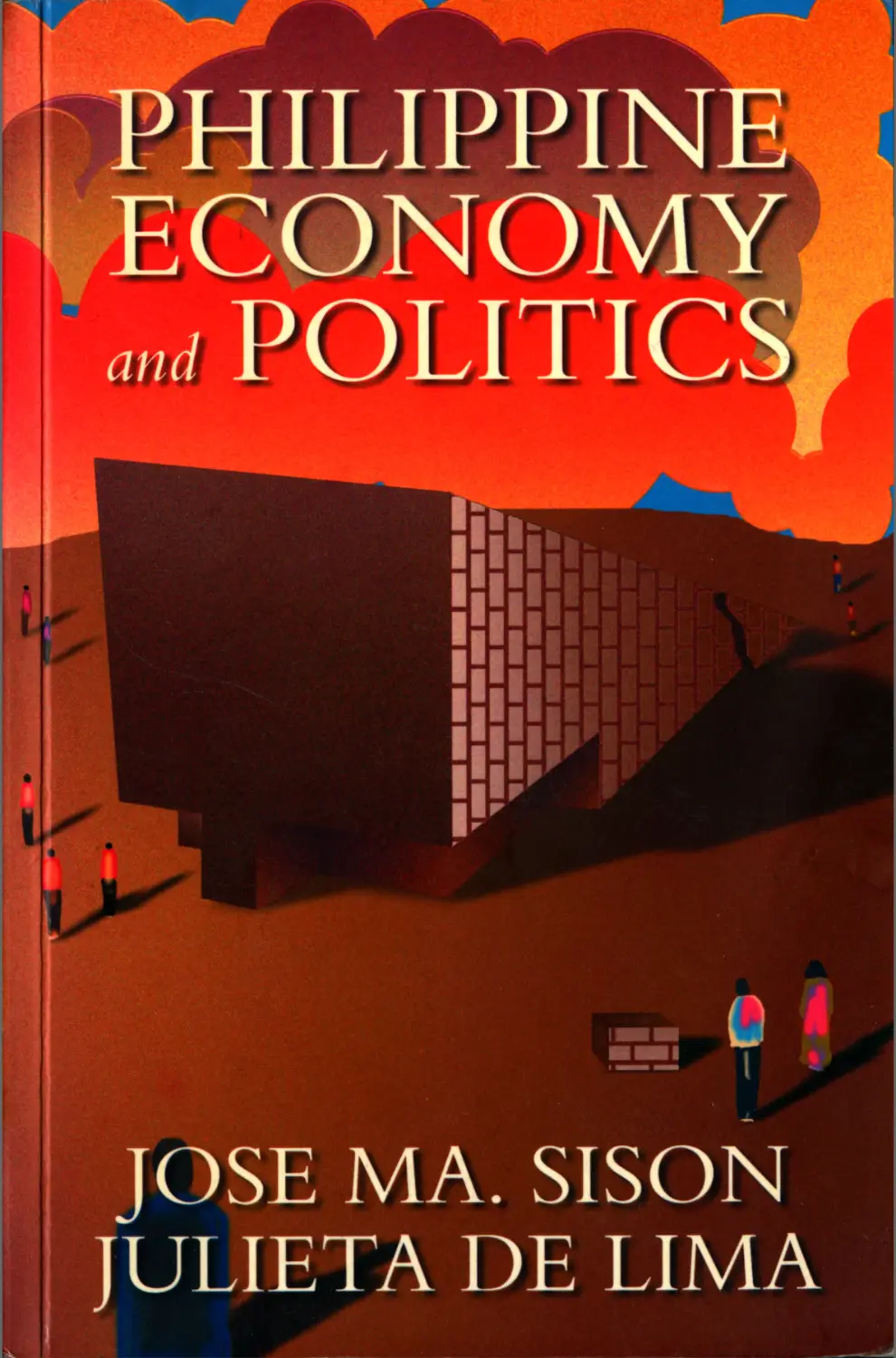
                    Philippine Economy
and Politics
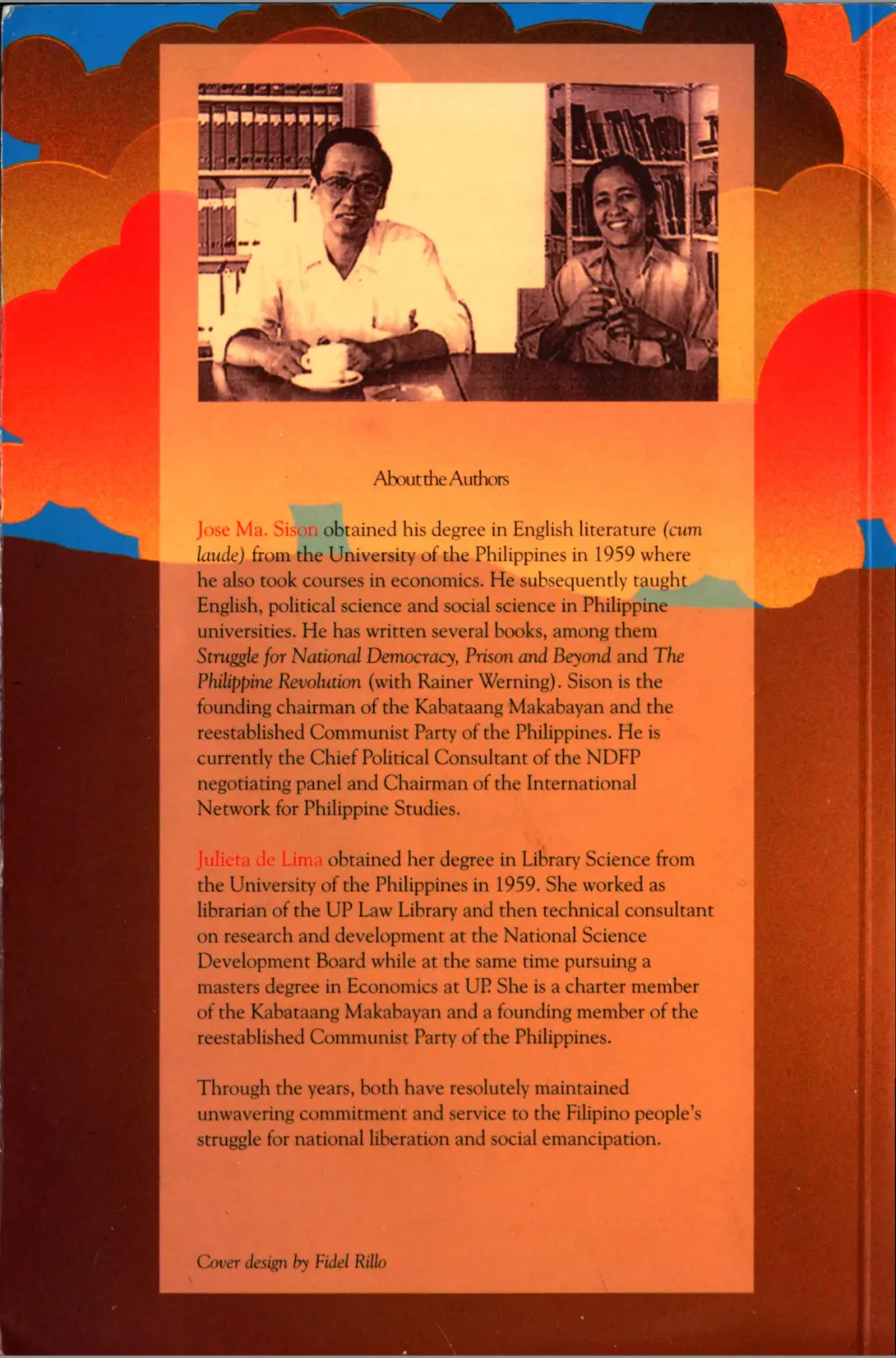
Jose Ma. Sison
Julieta de Lima
Aklat ng Bayan Publishing House
October 1998

F irst Edition 1998
All Rights Reserved
By Aklat ng Bayan Publishing House
PUBLISHER'S NOTE
The articles included in this book were first published in the 19803: "Jose
Maria Sison On the Mode of Production" in 1983, in Midweek Magazine and
The New Philippine Review; and the lecture series, "Philippine Crisis and
Revolution", in 1986 in various publications in the Philippines and abroad. Both
works have been widely reproduced, translated and reprinted since.
The introduction, "An Update: Qualitatively Unchanged Conditions",
emphasizes the continuing validity of the characterization of Philippine society
as semicolonial and semifeudal against certain wrong trends of thought aimed at
undermining the new-democratic revolution.
The idea of publishing this book came about in the course of the Second
Great Rectification Movement, which has involved serious study and review of
the basic principles of the Philippine revolutionary movement.
Revolutionary education, propaganda and agitation against the continuing
onslaught of imperialist and pro-imperialist petty-bourgeois propaganda require
the reading and study of the articles in this book.
The widespread and deepening crisis brought about by the neoliberal
policies of deregulation, liberalization and privatization —notably the current
financial and economic crisis— and the resurgent people's struggles to oppose
these make the analysis of Philippine society and revolution presented in the
articles in this book even more interesting and enlightening.
The current grave crisis of the world capitalist system and domestic ruling
system underscores the significance and relevance of the content of this book.
October 1998
Printed in the Philippines

PREFACE
This book presents the historical background and continuing fundamentals
of the economy and politics in the Philippines.
It is timely as it clarifies the essential factors at work in the making of the
present grave socioeconomic crisis and the scandalous return of the Marcoses
and the worst of their cronies to power and privilege.
There has been no social revolution since the fall of Marcos in 1986. There
have only been variations on the same theme of imperialist domination and
reactionary puppet rule, from Marcos through Aquino and Ramos to Estrada.
The fundamentals of the semicolonial and semifeudal society persist, for so
long as the progress of the new-democratic revolution has not reached the goal
of overthrowing the rule of the comprador big bourgeoisie and landlord class
that serve foreign monopoly capitalism.
In the first half of the 803, the chronic crisis of the mling system worsened
to the point of splitting the reactionary classes and enraging the broad masses of
the people against the consequences of imperialist-directed Keynesian
“development” of the 705.
In the last half of the 90s, the same chronic crisis once more plunges into an
exceedingly intolerable level. The broad masses of the people are made to suffer
unprecedented oppression and exploitation and cry out in pain against the
consequences of neoliberal “free market” globalization, embraced by the
successors of Marcos.
Whatever are the policy dictates of IMF, World Bank and WTO. the
consistent objective of foreign monopoly capitalism is to fimher exploit and
oppress the toiling masses of workers and peasants.
The imperialists and the local exploiting classes, together with their
ideological and political agents, are shamed by the bankruptcy of their position
and are worried to death by the rising wave of the new-democratic revolution.
Jose Ma. Sison
Julieta de Lima
October 10, 1998

Table of Contents
INTRODUCTION 3
ON THE MODE OF PRODUCTION 19
Forces of Production 20
Relations of Productions 24
Semifeudalism 25
Development Scheme of the U.S.-Marcos Regime 31
“Land Reform” 35
Export-oriented Manufacturing 39
Neocolonial Industrialization? 42
World Capitalist System 45
Rural Development 48
Capitalism in the Philippines? 52
Feudalism As Social Base of Imperialism 55
The Marcos Ruling Clique 58
Crisis and Revolution 61
LECTURES ON PHILIPPINE CRISIS AND REVOLUTION 65
I. HISTORICAL ROOTS OF THE PHILIPPINE CRISIS 67
Precolonial Societies 67
Colonial and F eudal Society 69
Philippine Revolution 70
Colonial and Semifeudal Society 72
Semicolonial and Semifeudal Society 74
The Marcos Fascist Dictatorship ' 76
The Current Situation 78
II. CRISIS OF THE SEMIFEUDAL ECONOMY 81
The Productive Forces 81
The People in Production 82
Productive Relations 83
Ever Worsening Economic Crisis 85
III. CRISIS OF THE NEOCOLONIAL STATE 89
Continuance of US. Domination 89
Big Comprador-Landlord Dictatorship 91
Further Crisis of the Neocolonial State 93
The Marcos Fascist Dictatorship 95
The Post-Marcos Situation 98

2 Table of C ontents
IV. CRISIS OF PHILIPPINE CULTURE
The Dominant Cultural Forces
The Antinational Role
The Antiscientific Role
The Antipeople Role
V. CRISIS 1N INTERNATIONAL RELATIONS
Foundation of U.S.-R.P. Relations
The Crisis of U.S.-R.P. Relations
Worsening Crisis in Philippine F oreign Relations
VI. THE NEW DEMOCRATIC MOVEMENT
New Democratic Program
The People's War
The Legal Struggle
VII. ECONOMIC DEVELOPMENT
Nationalization of the Economy
National Industrialization
Genuine Land Reform
Economic Planning
Foreign Economic Relations
VIII. A NATIONAL, SCIENTIFIC AND MASS CULTURE
The New Democratic Cultural Revolution
The National Aspect
The Scientific Aspect
The Mass Aspect
IX. INDEPENDENT FOREIGN POLICY
An Independent Foreign Policy
Relations with the U.S.
Relations with Asia, Afiica and Latin America
Relations with Socialist Countries
Relations with Other Capitalist Countries
X. PROSPECTS OF THE PHILIPPINE REVOLUTION
The Ever Worsening Crisis
The Growing Revolutionary Forces
Index
101
101
103
106
107
109
109
111
115
117
118
120
122
125
125
126
128
129
129
131
131
133
134
136
139
139
140
142
143
144
147
147
151
155

INTRODUCTION
An Update: Qualitatively Unchanged Conditionsl
am deeply pleased and grateful that my long interview with Julie, “On the
Mode of Production in the Philippines” in 1983, while I was still detained by
the Marcos fascist dictatorship, and my series of lectures as research fellow
of the Center for Asian Studies of the University of the Philippines,
“Philippine Crisis and Revolution”, in April-May 1986 are published together in
this volume, Philippine Economy and Politics.
Since its congress of reestablishment on December 26, 1968, the
Communist Party of the Philippines (CPP) has described Philippine
society as semicolonial and semifeudal. The Philippine political system
has been semicolonial since 1946, under the indirect rule of U.S. imperialism
through the parties and politicians of the local exploiting classes. The
Philippine economic system has been semifeudal since the first decade of the
20th century, exploited by the homegrown comprador big bourgeoisie and
landlord class in the service of foreign monopoly capitalism.
Correspondent to the semicolonial and semifeudal character of Philippine
society, the CPP has put forward the general line of national democratic
revolution through protracted people's war under the leadership of the
proletariat. The strategic line of encircling the cities from the countryside and
accumulating strength in the countryside until it becomes possible to seize the
cities realizes and activates the basic class alliance of the working class and
the peasantry.
In this regard, the CPP has deployed its cadres in the countryside in order to
build the people's army and the peasant movement, solve the land problem as the
main problem of the democratic revolution and build the people's
democratic power even while reactionary state power is still entrenched in the
cities. Responding to the demand of the peasant majority of the people for an
agrarian revolution, the antifeudal line is the main component of the general line
of national democratic revolution.
' Written in April 1995 and slightly revised in November 1996.

4 Philippine Economy and Politics
0n the Question of Semifeudalism
Some opponents of the general line of national democratic revolution
pretend to be anti-imperialist and progressive and therefore avoid questioning
the description ‘of the Philippine ruling system as semicolonial or
neocolonial. But they concentrate on attacking the description of the
Philippine economy as semifeudal in order to do away with its precision,
confuse the situation and exaggerate "development" or prospects of it under
the auspices of the imperialists and the local reactionaries and attack the
general line of the national democratic revolution, especially the strategic line
of protracted people's war.
The Philippine economy has been called many names—"fi'ee enterprise",
"market", "mixed", "developing", "dependent-capitalist" and so on. But none
of these is more precise than "semifeudal" in denoting the level of
development of the productive forces and the relations of production,
particularly the shift from the feudal economy of the 19th century under
Spanish colonialism to the semifeudal economy of the 20th century under U.S.
imperialism. Bourgeois economists adopt their own terminology to stress
private ownership of the means of production, the commodity system or the
primacy of the market and the promise of development under capitalism. And
political counterrevolutionaries wish to get rid of the term semifeudal to
impugn the general line of national democratic revolution through protracted
people's war.
In its entire 20-year period of rule from 1966, especially during its
imposition of fascist dictatorship on the Filipino people from 1972 to 1986, the
U.S.-Marcos ruling clique aggravated and deepened the agrarian,
preindustn'al and semifeudal character of the Philippine social economy. It did
not undertake national industrialization and land reform but exacerbated the
socioeconomic problems inflicted by foreign monopoly capitalism, domestic
feudalism and bureaucrat capitalism.
Under the policy dictates of the U.S. and such multilateral agencies as the
IMF and the World Bank, the Marcos regime poured domestic as well as
borrowed foreign resources into big comprador operations, bureaucratic
corruption and into a military buildup. It made a big portion of agricultural
production of staples dependent on imported inputs under the "green
revolution", expanded mineral and agricultural raw-material production for
export, maintained the infiastructure for the exchange of raw-material
exports and manufactured imports and deepened the dependence on imported
machinery and inputs.

Introduction 5
However, in the late 19703, a handful of subjectivist elements within the
CPP started to question and undermine the description of the Philippine
economy as semifeudal, agrarian and without basic industries. They cited data
on the commodity system, wage relations, the increase of rural and urban
oddjobbers and distribution of gross output values. They came to the
conclusion that‘the Philippine economy was no longer semifeudal, implying that
it was already industrial capitalist without analyzing the kind of industry that
existed and the socioeconomic relations.
In effect they credited the Marcos regime for "industrializing" the
Philippines. They also exaggerated the extent of the urban population as 40
percent and implied that the purported percentage increase in urban population
was due to industrialization and not merely due to the exhaustion of the land
frontier in the 1960s and the increase of the unemployed and oddjobbers in both
rural and urban areas throughout the 19703.
The subjectivists falsely claimed that the Philippines had been
industrialized and urbanized to an extent that it was necessary to "modify,
adjust and refine" the general line of the national democratic revolution
through protracted people's war. In fact, they were undercutting and
assailing this general line. They were rationalizing the urban-basing of the CPP
central leadership and the concentration of cadres in the cities. They were
promoting revisionism by pushing subjectivist and opportunist lines of
thinking.
In 1980, the subjectivists pushed distinguishably "Left" and Right
opportunist lines of policy. They blamed the founders of the CPP for the
supposed inaccuracy of describing the Philippine economy as semifeudal and for
the supposed neglect of revolutionary work in the urban areas. They obscured
the fact that the proletarian revolutionary cadres of the CPP had been
ceaselessly developing the legal democratic movement in the urban areas since
the entire decade of the 19603 and that it was the open rule of terror of the
Marcos regime rather than the antifeudal line of the Party that had required the
urban-based legal democratic movement to go underground in the 19703.
Throughout the 19803, the worst of the Left opportunists pushed the line of
accelerating the advance of the armed revolution through urban—based armed
insurrections, incited by armed city partisans, and through premature
enlargement and "regularization" of units of the people's army. They had
contempt for the legal and defensive character of the struggle in the urban
areas and for the constant necessity of ever expanding and consolidating the
mass base in the urban and rural areas through painstaking mass work.

6 Philippine Economy and Politics
"Lefi" opportunism was pushed either under the premature notion of
"strategic counterofi‘ensive" or making urban-based insurrections the leading
factor in the process of armed revolution. They kept on wishing for an
exceptional conjuncture of domestic and international factors that would
invalidate the strategic line of protracted people's war. They considered as more
important the external rather than the internal factors of the revolutionary
process and confused the principal and secondary aspects of this process. They
took the victorious uprisings in Vietnam in 1945 and in Nicaragua in 1979
out of historical context and cited these as the best models of the Philippine
revolution.
At the same time, the Right opportunists pushed, the erroneous line that the
urban-based legal mass movement was of higher importance than the rural-
based armed struggle, and that more people would be attracted to the united
front and to the revolution if ,the leadership would be entrusted to the anti-
Marcos section of the reactionaries under the concept of a bourgeois-nationalist
"New Katipunan" and that the leadership of the working class and the CPP
would have to be cut down or even liquidated. Under the stimulus of funding
from Western Europe, the urban-based Right opportunists produced a
considerable amount of bourgeois reformist propaganda and drew as well as
withheld CPP cadres from the countryside.
In any communist party, even at its best, there is always an internal basis for
the emergence and development of subjectivism and opportunism because of the
inflow of petty-bourgeois elements who fail to remould themselves to become
genuine proletarian revolutionaries and because there is the constant impact of
influences fiom outside the Party, either from the social environment in
general or fiom deliberate attempts of the enemy to penetrate and influence the
CPP. The dangers of subjectivism and opportunism rise when ideological,
political and organizational standards for Party membership are lowered as in
certain urban-based units of the CPP and when the antifascist aspect of the
revolutionary struggle is cut off from the anti-imperialist and antifeudal aspects.
The communists are always bombarded with the oficial development
theory of foreign monopoly capitalism and the local reactionaries. In the
absence of or due to the weakening of Marxist-Leninist study, the
unremoulded petty—bourgeois elements in the CPP can become impressed
with the glossy presentation of "development" programs and projects of the
reactionaries, the heavy importation of consumer goods and rapid infi'astructure-
building financed through deficit-spending and foreign borrowing. Whenever a
communist party is ideologically and politically lax, the class enemy can even
introduce or recruit in place agents to sow political confusion. In addition,
there are those outside the Party who pretend to be Left and progressive,
deliberately address themselves to the communists and spread wrong notions

Introduction 7
about the Philippine economy which in fact assist the counterrevolutionary line
of the barefaced enemies of the Philippine revolution.
After the imposition of martial rule on the Philippines, the so-called
social-democrats, who are in fact Christian democrats trained for
anticommunist work but who deck themselves out as progressive competitors of
and alternatives to the communists, circulated the notion that the Marcos
regime even if repressive had adopted an excellent economic policy of
development under the auspices of the IMF and World Bank. The Lava
revisionist group openly capitulated to the Marcos regime and misrepresented it
as representative of the national bourgeoisie, as one interested in
"noncapitalist developmen " and as one trying hard to free itself from a
U.S.-dictated policy of "neocolonial industrialization". The flunkeys of Soviet
social-imperialism presumed that industrialization was a foregone conclusion
and that the struggle was only about whether it is foreign-owned or Filipino-
owned with Soviet aid.
Those who presumed that the Philippines had become "dependent
capitalist" also tried to sow confusion in petty-bourgeois circles about the
character of the Philippine economy. They preached that it had become useless
to distinguish the Philippine mode of production from the globalization of
production in which the effective terms are only the metropolis and the
peripheny. Among the preachers of “dependent capitalism” were neo-
Kautskyites who recycled the theory of ultra-imperialism (unilinear spread of
the capitalist mode of production to all countries) and/or the Trotskyites . They
babbled that the Philippine economy was no longer semifeudal and that it was
no longer valid and important to take into account the distinct Philippine
mode of production in the face of the globalization of capital and the
meu'opolis-periphery schema. It was implied that the ground had been taken
away fi'om the strategic line of people's war.
A highly placed "development" technocrat of the Marcos regime (now the
head of the CIA-instituted Philippine Rural Reconstruction Movement [PRRMD
who had "defected" to the NDF in December 1977 drummed up the line of
"reexamining" the Party's analysis that the Philippine economy is semifeudal
and found resonance among some members of the CPP Central Committee.
The push for a reexamination was based on superficial observations of the
commodity system in agriculture involving types of cash crop such as onions in
Bongabon, Nueva Ecij a.
In 1978, the CPP wavered in its criticism and repudiation of modern
revisionism. No Marxist-Leninist criticism and repudiation was made of the
already clear ascendance of the Chinese revisionists headed by Deng in China.
Marxism-Leninism-Mao Zedong Thought became depreciated. Some members

8 Philippine Economy and Politics
of the CPP Central Committee started to float the notion that the Soviet Union
and China were similarly socialist and that their socialist economies were
being strengthened by capitalist-oriented reforms.
In 1979 Philippine military intelligence omcers were telling several
prisoners, suspected as high cadres of the CPP, that they could be releasedTfirom
prison immediately if they pledged to push the line that the Philippines was no
longer semifeudal and that the Marcos regime had made substantial economic
progress under the auspices of the IMF and the World Bank.
In the late 1970s, the Filipino assets of US. intelligence agencies (CIA
and DIA) inserted themselves into and used the U.S.-based Katipunan ng
Demokratikong Pilipino (KDP) to question the description of the Philippine
economy as semifeudal and push the twisted line of "support the Philippine
armed struggle, drop Mao Zedong's theory of people's war and seek the decisive
support of the Soviet Union". Soon, the KDP openly attacked the CPP. Some of
the KDP activists pretended to remain loyal to the CPP but in fact continued to
push such notions as that "export-oriented manufacturing" could be the cutting
edge of U.S.-inspired industrialization and that democratization was simply a
matter of overthrowing Marcos, without the need for people's war.
By the early 1980s, there was already a loud debate in narrow petty-
bourgeois circles whether the Philippine economy was semifeudal or not. I
responded to the attempts of the opportunist elements within the CPP and
pseudo-Lefi elements outside the CPP to sow confusion regarding the character
of the Philippine economy. It so happened that Julie was already out of
prison and could relate to me developments in the current debate and bring to
me reference materials every weekend. We agreed on the format of an
interview by her with me on the Philippine mode of production in order to
clarify the essential character of the Philippine economy and counter the
wrong notions about it.
It is of vital importance to publish this interview in this volume in order to
bridge the economic analysis in the founding documents of the CPP in 1968 and
Amado Guerrero's Philippine Society and Revolution in 1970 on the one hand
and the current reality and information about the Philippine economy on the
other hand and in order to counter the persistent attempts of anti-CPP
elements to discredit the Marxist-Leninist analysis of the Philippine economy as
semifeudal and undermine the general line of the national democratic
revolution through protracted pe0ple's war.

Introduction 9
The Semifeudal Economy, 1960-90
The Philippine economy continues to have no industries producing basic
metals, basic chemicals and capital goods from the local primary production of
raw materials. It remains basically agrarian even as it has some kind of
floating industry dependent on imported capital goods. The socioeconomic
relations are dominated by the cOmprador big bourgeoisie and the landlord
class in the service of foreign monopoly capitalism.
The semifeudal economy is a commodity system that has departed from
the feudal economy of self-subsistence but it is one dominated by the
comprador big bourgeoisie rather than by a homegrown industrial bourgeoisie.
The urban-based comprador big bourgeoisie is in close partnership with the
rural-based landlord class. At the same time, the whole semifeudal economy is
a neocolonial preindustrial or an agrarian adjunct of the world capitalist system.
Whatever are the current proportions of gross output values and
employment in the agriculture, industry and service sectors of the economy, all
these are dependent on imported equipment, fuel, other raw materials and
manufactured components from abroad. The latest high-tech tools may be used
in any sector but the Philippine economy until now does not produce these tools.
Production for local consumption as well as for export has become more
import-dependent than ever under the policy of trade liberalization. Agn'cultural
and mineral production for export and low value-added production of
semiconductors, garments and toys for reexport have consigned the
Philippine economy to chronic foreign trade deficit and ever mounting foreign
debt.
In all sectors of the economy, the imported producer and consumer goods
count high in the gross output values. Subtracting the value of the import
content will reveal the following: the highest net value is still contributed by
agricultural and mineral ore production and the rising high payments for the
imports. In essence, the imports are paid for in part by export income (mainly
from raw-material exports) and in another part by an increasing amount of
foreign borrowings.
The export of cheap labor for unskilled work has become a bigger earner of
:breign exchange than any of the agricultural, mineral or manufactured exports.
EIowever, the income of the overseas contract workers is not large enough to
:lose the foreign trade gap. The export of cheap labor is a manifestation of
he inability of the economy to employ the huge number of college-educated
iilipinos who are driven to take menial jobs abroad.

10 Philippine Economy and Politics
Under the Aquino and Ramos regimes, like their predecessor Marcos
regime, the Philippine reactionary government has rabidly followed the same
policies dictated by foreign monopoly capitalism. These have run counter to
national industrialization and land reform, aggravated and deepened the
agrarian and semifeudal character of the economy and, in the face of
international credit difficulties, compelled the state to resort more and more to
local public borrowing, privatization of state assets, increasing the tax
burden and attracting short-term speculative foreign capital.
It is instructive to go over some important data fiom 1960 to 1990 in order
to see how much the Philippine economy has undergone degradation.
According to official statistics, some 15.4 percent of the labor force was in
industry in 1960. This dropped to 15.0 percent in 1990. Within the
industrial sector, manufacturing plunged from 12.1 percent share of
employment in 1960 to only 9.7 percent in 1990. In 1979, it was supposed to
have gone down to 14 percent. The upward fluctuation to 15 percent in 1990 is
not believable but is still indicative of retrogression. This is evidence of
de-industrialization rather than industrialization. The proportion of
employment in manufacturing has become smaller in the period of "export-
oriented" manufacturing since the 1970s than in the earlier period of "import-
substitution" manufacturing in the 19503 and 19605.
The share of industry in the gross national product (GNP) is supposed to
have risen from 28.5 percent in 1960 to 32.9 percent in 1990. Most of this
share of industry (34.3 percent in 1991) is contributed by manufacturing (25.4
percent), construction (5 percent) and utilities (2.5 percent), all of which are
import-dependent for equipment, fuel, other raw materials or component parts.
Manufacturing of consumer goods accounts for an average of 55 percent in
1985-91, petroleum and coal processing 32.6 percent and local fabrication of
imported basic metals, reassembly or fi'inge-processing of manufactured
components and repairs, 10.7 percent.
Eighty percent out of the 76,288 manufacturing firms surveyed recently
employ on the average onelto nine people and 800 large firms employing more
than 200 people and above comprise only one percent and account for half of
the total manufacturing labor force. Of the total value in manufacturing, 71.4
percent is overconcentrated in Metro Manila, Southern Tagalog and Central
Luzon.
Employment in agriculture is supposed to have fallen from 61.2 percent in
1960 to only 45.2 percent in 1990 and the share of agriculture in the GNP is
supposed to have decreased from 31.1 percent in 1960 to 23.2 percent in 1990.
The service sector is supposed to have absorbed mainly the labor force
shifiing from agriculture, especially in the form of rural and urban

Introduction 1 1
oddjobbers who are in fact unemployed or grossly underemployed. Anyhow,
"employment" in the service sector is supposed to have risen from 23.5 percent
in 1960 to 43 percent in 1993 and the share of the service sector in the GNP
from 40.4 percent in 1960 to 43.9 percent in 1990.
The former "Left" and Right opportunists in the CPP who have become
outright traitors to the Philippine revolution and the Filipino people have made
so much out of their continuing false claim that the Philippines has become far
more urbanized than Russia during the Bolshevik revolution or China during the
protracted people's war of liberation in order to rationalize the erroneous line of
shifting the focus of the revolutionary movement from the rural to the urban
areas and basing themselves in the latter even while the people's war is still at
the stage of the strategic defensive.
They produce the high figure of at least 40 percent urban population by
adding up the population of Metro Manila, the provincial cities, provincial
capitals and town centers. By the same measure, the proportion of the urban
population in Russia in 1917 and China in 1949 should be far bigger than that in
the Philippines. Russia and China have far longer histories of urbanization
under feudalism and the development of handicrafts and manufacturing.
Moreover, Russia was also radically different from semifeudal China by
having basic industries and an industrial bourgeoisie which was strategically
dominant in the economy but politically subordinated to the czarist autocracy.
Out of the total Philippine population of 27,088,000 in 1960, the
pepulation of Metro Manila and all provincial cities was 5,370,000 or
19.8 percent, with Metro Manila accounting for 2,460,000 or 9 percent. Out of
the total Philippine population of 60,703,000 in 1990, the population of Metro
Manila and all the provincial cities was 13,012,000 or 21 percent, with Metro
Manila accounting for 7,928,000 or 13 percent.
The increase in city population from 19.8 percent of the total national
population in 1960 to 21 percent in 1990 is not really big and does not
necessan'ly mean either real urbanization or industrialization. Only a small
portion of the urban population enjoys such amenities as piped-in water and
electricity. In fact, the conditions of rural backwardness and poverty are
brought into the cities by the huge reserve army of labor (unemployed) coming
fiom the countryside.
Philippine cities are basically centers of operations of the comprador big
bourgeoisie and not of an industrial bourgeoisie. The prevalent kind of
economic activity in Metro Manila is commercial rather than industrial and in
provincial cities there is generally a small area as center of commercial
activity. The population outside the small commercial centers in so-called

12 Philippine Economy and Politics
provincial cities is actually rural. The provincial capitals and town centers which
are not classified as cities have generally less commerce and less urban amenities
than those classified as cities.
The same incorrigible opportunist elements who have unduly credited the
Marcos regime for "indusu'ializing" and "urbanizing" the Philippines and who
have faulted the CPP for refusing to accept this wrong view are still the same
elements who have praised the Aquino regime for "economic recovery" and
who have self-contradictorily declared that the Ramos regime is still in the
process of making the agrarian Philippine economy a "newly-industrializing
country" by the year 2000. Consistently, they wish the big comprador-landlord
regiine to industrialize the Philippines in the vain hope of liquidating soon the
protracted people's war. Thus, they have shamelessly pushed the line of
"seeking convergences" with the "development" program of the Ramos
regime, pretending to criticize it up to a certain point but on the whole
supporting it.
On the Question of Dictatorship and Democratization
In the upsurge of the broad popular struggle against the Marcos fascist
dictatorship fi'om 1983 to 1986, after the outrageous assassination of Benigno
Aquino and when the anti-Marcos reactionaries became emboldened to oppose
the dictatorship, the "Left" opportunists exaggerated the possibility of winning
total victory or taking a major share of political power in the ofling through
urban insurrections and premature regularization of the NPA and became
unmindful of the conspicuous grave loss and weakening of the mass base in the
rural areas, starting fi'om 1984, and the occurrence of Kampanyang Ahos in
Mindanao, starting fi‘om 1985, due to the putschist line.
At the same time, the Right opportunists exaggerated the possibility of
winning a major share of political power upon the condition that they
prevailed with their bourgeois reformist line. They wished the revolutionary
forces to tail after the leadership of the anti-Marcos reactionaries, engage solely
or mainly in legal struggle and become mere footstool for the anti-Marcos
reactionaries in their rise to power.
The most corrosive line that the Right opportunist elements (under the
influence of the Filipino assets of US. imperialism) pushed within the CPP
was the one presuming that there would be "democratization" and a simple case
of expanding the "democratic space" through legal struggle if the Marcos
fascist dictatorship had been replaced by another big comprador-landlord
clique, especially one headed by the widow of Aquino.

Introduction 13
They claimed that with the end of the personal dictatorship or autocracy of
Marcos, the ensuing "elite democracy" would still constitute "democratization"
open to reform and to conversion into "popular democracy" through reformist
legal struggle. The series of dichotomies between dictatorship and
democratization and between "elite" and "popular" democracy was meant to
obfuscate the persistence of the joint class dictatorship of the big
compradors and landlords even alter the fall of Marcos in the absence of a
successful people's war.
After the fall of Marcos in the manner foretold by the earlier fall of Baby
"Doc" Duvalier in Haiti and military juntas in Latin America, through the
combination of a big split in the reactionary armed forces and a popular
uprising, the Filipino assets of U.S. imperialism and the "Lefi" and Right
opportunists in the CPP combined to declare that the CPP had nothing to do with
the downfall of Marcos, had become marginalized and had suffered a strategic
defeat because of its boycott policy in the 1986 snap presidential elections.
They misconstrued democracy as merely the "democratic space" for
them within the ruling system in terms of civil and political liberties, claimed
that there was no more ground for people's war and deliberately obfuscated the
fact that the joint class dictatorship of the comprador big bourgeoisie and the
landlord, class and the open rule of terror was persistent, despite the
temporary liberal facade of the Aquino regime. In fact, the Aquino regime
retained or made worse the antiworker and antipeasant decrees of Marcos and
General Ramos intensified the military campaigns of suppression against the
revolutionary forces and the people.
The "Left" opportunist exponents of urban insurrectionism and military
adventurism who had been responsible for the consequent grave damage to the
rural mass base and for Kampanyang Ahos in Mindanao as early as 1985 also
joined the Filipino assets of US. imperialism and the Right opportunists in
recriminations against the Party_ for the boycott policy error and in making
misrepresentations about the character, implications, magnitude and
consequences of this error. Both "Left" and Right opportunists in effect
asserted that the banned revolutionary forces should have participated in the
Marcos-staged elections and considered the boycott policy as the Pany's
biggest error in its entire history.
The most blatant assets of US. imperialism compared the Aquino regime
to the Magsaysay regime as one effectively undercutting the revolutionary
movement by restoring "democratic institutions and processes" and seriously
carrying out "land reform" under a U.S.- and World Bank-supported
mini-Marshall plan. They boasted that the post-Marcos period was one of
democratization through legal institutions and processes, rendering useless and

l4 Philippine Economy and Politics
outdated the armed revolution. Since then, they have ceaselessly prated about
alternatives (including foreign-funded NGOism, job placements in the
reactionary government, electoral politics and the like) to the armed
revolution rather than to the oppressive and exploitative ruling system. They
conveniently forget the fact that the CPP was reestablished in 1968 and built the
NPA in 1969 when Marcos was the big display in Washington's "show window
of democracy" in Asia and he too was threatening to carry out land reform.
The popdems, socdems, Bisig and the like were all happy to take a ride on
the Aquino bandwagon. Even the old line pro-Soviet revisionists wanted to
take the ride with them immediately after serving the Marcos regime for a long
time. The Right opportunist line within the CPP described the Aquino regime
as a "liberal democratic" regime worthy of critical support. The "Left"
opportunists responsible for unprecedented damage to the revolutionary
movement and for Kampanyang Ahos in Mindanao ceaselessly overstated
the boycott policy error as the biggest error ever in the history of the CPP in
order to cover up their far graver culpability in Mindanao and elsewhere in the
country.
Amidst all the attempts at confusing the revolutionary forces, I delivered
the series of lectures on Philippine crisis and revolution at the Asian Studies
Center of the University of the Philippines from April to May 1986 in order to
clarify the new situation and the big comprador-landlord class character of
the U.S.-Aquino regime and update Amado Guerrero's Philippine Society and
Revolution. The Political Bureau of the Central Committee of the CPP
subsequently adopted this series of lectures as basic study material for the Party
in 1987 and was able to circulate and promote it in 1988, much to the chagrin
of the incorrigible Right opportunists and the "Left" opportunists who were
then on the path of turning into blatant Right opportunists, revisionists and
even criminal gangsters from year to year.
It is of vital importance to publish again this series of lectures on the
Philippine crisis and revoltItion to demonstrate that all along there has been a
timely response to attempts of the agents of US. imperialism and the
incorrigible opportunists at confusing the ranks of the revolutionaries and the
people about the post-Marcos period and to heighten the fighting
consciousness of communists and all revolutionary militants.
This series of lectures has upheld the continuing validity and vitality of the
national democratic revolution against foreign monopoly capitalism, domestic
feudalism and bureaucrat capitalism. It has helped carry over the revolutionary
cadres and the masses from the Marcos to the post-Marcos period along the
general line of national democratic revolution and to foil the US. imperialists,

Introduction 15
the local exploiting classes and their special agents to destroy or derail the armed
revolution.
The Second Great Rectification Movement
The incorrigible "Left" and Right opportunists within the CPP have fully
exposed themselves as counterrevolutionary opponents of Marxism-Leninism,
the CPP and the national democratic revolution. They are now shameless
bootlickers of the U.S.-Rarnos regime and barefaced traitors to the
revolutionary cause. Irony of all ironies, they have chosen to expose
themselves and act viciously as counterrevolutionaries during the presidency of
General Ramos, the continuity man in the open rule of terror under the joint
class dictatorship of the comprador big bourgeoisie and the landlord class.
After failing in their vicious attempt to liquidate the CPP from the
inside, they continue to specialize in slandering the CPP and the entire
revolutionary mass movement. In so many devious ways, they deny the
persistence of the joint class dictatorship of the comprador big bourgeoisie and
landlord class. They obscure the continuing rule of open terror under the Aquino
and the Ramos regimes and claim that human rights violations have been on the
decline, despite the brutalities of Lambat Bitag I, II and III and other military
campaigns under the "total war" policy or "low—intensity conflict" directed
by US. imperialism. Having fully exposed themselves as special agents of
psychological warfare, they have become more and more ineffective in their
attempts to sow confusion.
The conjuncture and convergence of the three sectors of neocolonialism
(government, big business and foreign-funded NGOs), the false promises of
"Philippines 2000" and the escalation of the "total war" policy, the brutal
military campaigns and intrigues of "low intensity conflict", the opportunist
errors and crimes, the open betrayal by the incorrigible opportunists and
revisionists and the anticommunist ideological and political offensive of the
imperialists and their local lackeys in connection with the disintegration of the
revisionist parties and regimes abroad have failed to break or demoralize the
forces of the national democratic revolution.
Instead, the revolutionary forces have reaffirmed basic revolutionary
principles, have drawn strength from their reservoir of ideological, political and
organizational accomplishments, have repudiated the errors and crimes of the
"Left" and Right opportunists and have raised the fighting will and
capabilities of the people. The victory of the Second Great Rectification
Movement cannot be fully understood without reading and studying the

l6 Philippine Economy and Politics
interview on the Philippine mode of production and the series of lectures on
the Philippine crisis and revolution.
These countered the most devious and vicious attacks on the general line of
the national democratic revolution in the 19805 and laid the ground for the
Second Great Rectification Movement. F rom year to year since 1988, the
proletarian revolutionaries in the Central Committee of the CPP increasingly
combated the "Left" and Right opportunist currents until the Second Great
Rectification Movement was carried out in a comprehensive and deepgoing
way, starting in 1992.
Jose Ma. Sison

Jose Maria Sison
On the Mode of Production
By Julieta de Lima-Sison

l9
JOSE MARIA SISON
ON THE MODE OF PRODUCTION
Julieta de Lima
1982, many fiiends and acquaintances in the academe asked me for the
views of my husband on many questions being debated by them concerning
the dominant character of the mode of production in the Philippines.
8 con after I was out on temporary release fiom detention on March 30,
The main issue raised may be expressed in the following manner: Has the
U.S.-Marcos regime pursued a policy of industrialization and thereby changed
the backward semifeudal character of the economy?
I propounded this and other related questions to my husband. We engaged in
lengthy discussions during my weekly visits to him. I also provided him with the
latest available economic data as well as analyses and articles fiom various
viewpoints.
I took mental notes of his answers. Every time I got home from his prison
cell, I would commit these to writing. He gave me the leeway to write freely on
condition that I would be faithful to his ideas.
Due to our many years of intellectual intercourse and research partnership
(since 1959), I felt confident in putting this question-and-answer article into
shape. However, due to so many absorbing obligations, including childcare and
puine engagements on behalf of political prisoners, I was able to finish the final
draft only last July 1983.
The typescript of the final drafi became a discussion paper of several
fi'iends, most of whom are brilliant economists and political scientists. They
subsequently gave comments and suggestions which my husband and I further
discussed and took into account in finalizing the article in its present form.
This article is an efi‘ort to make a comprehensive and deep going study of
the mode of production in the country and shed light on the current ruinous
economic crisis.

20 Philippine Economy and Politics
Forces of Production
Q1: Will you describe the forces of production in the Philippines? As much
as you can, present the level of development of the means of production and
the mass of actual producers.
A: The forces of production in the Philippines are still mainly and essentially
agrarian and non-industn'al. They are backward or underdeveloped.
The means of production generally lacks a backbone in capital goods
industries. There are no heavy and basic industries, no machine—tool industry, no
basic metal and chemical industries, no engineering industries beyond the
superficial handling or slight processing of components that have already been
basically processed abroad. Even hand tools are imported to the extent of
85 percent, according to the economist Alejandro Lichauco. The rest of our hand
tools are fabricated locally from imported metals. Whatever modern industrial
equipment the country has is imported and paid for by earning from the export of
raw materials (mainly agricultural: sugar, coconut, logs, etc.) plus an increasing
amount of foreign loans.
The U.S. imperialists and their big comprador agents have so far been quite
successful in preventing the country from acquiring the kind of equipment that
would industrialize it in a profound and comprehensive way. They have allowed
only some light manufacturing, heavily dependent on imported equipment, semi
manufactures and raw materials. The situation is tragic because we have a
comprehensive and abundant natural resource base for heavy and basic
industries to work on.
Under the present regime, even the light manufacturing that serves the
domestic market has been virtually crushed. The so-called import-substitution
industries of the fifties and the sixties are being displaced by the straight
importation of finished products. An embellishment on this scheme is the
promotion of the so-called export-oriented industries which are even more
import-dependent and which are actually involved in mere fi'inge processing and
packaging for local market penetration, tariff circumvention and reexport.
The promise of Marcos in 1979 to put up eleven major industrial projects
has not materialized. Since the beginning, however, it has been clear that these
projects were mere tokens of industrialization which, even as such, are strongly
opposed by the very foreign monopoly interests whose investments Marcos
wants for these projects. Afier four years, the result is one overpriced copper
smelter with a capacity limited to 30 percent of ore production in the country. It
is under the control and manipulation of Japanese interests which have their own
copper smelters to protect in J apan.

0n the Mode of Production 21
Despite its slogan of "economic developmen ", the fascist dictatorship has
not put the economy into extensive processing of the raw materials that it has
long been producing for export. The bulk of Philippine exports continues to be
raw sugar, copra, coconut oil, logs, metal ores and concentrates, and so on.
Primary products account for practically all actual earnings on exported goods,
with agricultural exports accounting for at least 80 percent.
It is claimed by government technocrats that we cant a lot fiom reexport of
garments, electronics and the like. This is not true. We lose a lot on these so-
called manufactured exports because of the high cost of imported equipment and
"raw" materials, tariff circumvention, transfer-pricing, profit remittances, capital
repatriation, debt services, royalties, and the infrastructure and special facilities
put up for them.
Agricultural land totalling 12 million hectares in 1980 is still the principal
means of production in the country. It produces the food staples for the people
and some amount of raw materials for local light manufacturing and handicrafts;
and the overwhelming bulk of surplus products for export.
There is negligible use of modern technology (primarily imported) beyond
peasant brawn, hand tools, plow and draft animals on land devoted to food crops
(chiefly rice and corn) which comprises 64.6 percent of total agricultural land;
and coconut land which comprises another 25.8 percent. The promotion of costly
imported farm inputs (chemicals, equipment and irrigation facilities) during the
seventies affected only a few hundreds of thousands of hectares.
Even on land devoted to sugarcane, banana, pineapple and other new crops
for export, which comprises no more than seven percent of total agricultural land
and where there is a relatively more impressive use of tractors and chemicals,
reliance on sheer brawn and traditional peasant tools is still widespread. Sugar
lands, which comprise only 3.5 percent of total agricultural land are still worked
mainly by peasants and farm workers using hand tools rather than by workers
operating harvester combines and other farm machinery.
No more than four percent (480,000 hectares) of total agricultural land is
worked by tractors. Harvester combines are still a rarity and are a socially
explosive proposition amidst the abundance of cheap farm labor that cannot 'be
absorbed elsewhere. As of this year (1983), only a few landlords on a few
thousands of hectares have turned to harvester combines. In this decade, the
steeply rising costs of imported inputs and the falling price of agn'cultural
exports hold back the adoption of modern technology even by export-crop
landlords.

22 Philippine Economy and Politics
According to NEDA figures, there were supposed to be nine million
peasants and farm workers accounting for 52 percent of employment; 2.5 million
industrial workers, 14 percent; and 6 million service workers, 34 percent in
1979. Let us accept these figures on face value and reinterpret them. Note,
however, that 1979 was a far better year for nonagricultural employment than
any of the succeeding years of the 1980s.
Of the direct producers of goods, peasants and farm workers comprise 78
percent and industrial workers 22 percent. There are four peasants and farm
workers for every industrial worker. If the category of service workers is
disaggregated, the great majority would be found to be direct adjunct and
immediate spillovers of agriculture and the peasantry. Even in construction,
mining and provincial "manufacturing", many non- regular workers are
sidelining peasants.
Most peasants (poor and middle peasants) have the following means of
supplementary livelihood: farm work for others, fishing, forestry and animal
husbandry, handicrafts, construction or carpentry, hauling and petty peddling.
Seasonal farm work for others though is the premier sideline occupation and is
the main recourse for surplus labor in the countryside.
The proportion of industrial workers (in manufacturing, mining and
quarrying, construction and utilities) is even more unimpressive. Only 74 percent
of these are in so-called manufacturing; and in turn, 70 percent of workers in
manufacturing are employed in small fabricating and repair shops, each
employing less than ten workers and therefore hardly qualifying as truly
manufacturing enterprises.
Only a minority of so-called service workers (in transport, communication
and storage, trading and banking, and other services, including government,
entertainment, etc.) possibly not more than 30 percent - are regular wage earners.
In the main, these regular wage earners are employed by the government (some
one million are civilian and military employees) and by the multinational, big
comprador and middle bourgeois firms. Most so-called service workers are
actually underemployed or have no regular employment or are even unemployed
but are misrepresented as fully employed by NEDA statistics. Many are
superfluous helpers of their own families, house servants, street peddlers, shop
attendants, porters, scavengers, prostitutes and the like who do not receive
regular wages.
During the 1970s, the proportion of both industrial and agricultural
employment shrank. Industrial employment stood at 17.6 percent in 1970 and
went down to 14 percent in 1979. Agricultural employment stood at 59 percent
in 1970 and went down to 52 percent in 1979. Employment in the service sector,

0n the Mode of Production 23
meanwhile, is made to appear as having risen from 23.5 percent in 1970 to 34
percent in 1979, supposedly absorbing the decrease of employment in both
industry and agriculture.
Since 1980, unemployment has been increasing by leaps and bounds,
especially in the industrial and service sectors. The unemployment rate is now
running at more than 50 percent, at least 25 percent above the chronic rate of 25
percent (established fiom the Bell Mission Report up to the Ranis Report),
especially if we take into account all out-of-school youth ten years old and above
and women. A worsening state of depression and unemployment afflicts the
entire economy.
Some people say that the Philippine economy is already industrial rather
than agrarian because, for instance, the 1979 GNP figures show that agriculture
accounts for only 27.3 percent of gross national product and is outstripped by
industry at 33.1 percent and services at 39.7 percent.
These figures are misleading. We must take into account the high imported
content of the product of both industry and service sectors and the consumption
orientation of such imports, and the lack of industrial development. The gross
output value of the service sector is bloated; this sector is also the most import-
dependent sector of the economy although it does not produce goods. The gross
output value of agriculture tends to be undervalued because most of the
agricultm'al product remains with the peasants for their subsistence and needs
and does not reach the market.
In their attempt to sustain the illusion of industrial development, the
technocrats of the fascist dictatorship constantly overestimate the entire GNP,
overvaluing the gross output of both industrial and the service sectors. Even the
IMF was scandalized by the NEDA claim of a 4.9 percent grth rate for 1982
and ordered it to scale down the figure to something less incredible. The figure
was finally lowered to 2.6 percent. Even this is highly questionable in many
respects.
The Philippine GNP is supposed to be dependent on foreign exchange to the
extent of 40 percent. So it must shrink as primary export receipts, foreign loans
and other foreign exchange receipts decrease. Whether the GNP grows bigger or
smaller, its content is nonetheless non-industrial. To a great extent, it reflects
rising expenditures for imported manufactures, decreasing primary exporter
income and a rising debt burden.

24 Philippine Economy and Politics
Relations of Productions
Q2: Will you describe the relations of production? As much as you can,
present the socio-economic classes as determined by the ownership of the
means of production, position in the organization of production, and the
methods of expropriating the product. Will you point out the single most
dominant class that dictates on the entire relations of production?
I assume that you can apply on the entire mode of production the term
that you used in the document to refer to the character of the relations of
production. It is feudal, semifeudal, semi-capitalist, in transition to
capitalism or already capitalist? Explain why you do not use the terms
other than your choice.
A: Under the auspices of U.S. imperialism, the comprador big bourgeoisie has
become the single most dominant class in the Philippines. It is the stande
bearer of dominant semifeudal production relations. In collaboration with the
foreign monopolies, it is in command of a commodity system that consists
mainly and essentially of raw-material exports and manufactured imports; and
that gives the most strategic importance to the production of raw materials for
export. '
The comprador big bourgeoisie has replaced the landlord class as the No. l
exploiting class in 20th century Philippines. And certainly, the dominant
production relations can no longer be called feudal although feudalism is still a
large and widespread fact. In a certain sense, we can speak of foreign and feudal
domination. But we use the term semifeudal both to describe the general and
basic character of the relations of production and focus on the strategic role of
the comprador big bourgeoisie.
We caxmot call the dominant production relations capitalist because it is a
comprador big bourgeoisie rather than a national industrial bourgeoisie that has
hegemony over them. As a matter of fact, the semifeudal trading big bourgeoisie
in combination with U.S. imperialism and feudalism prevents industrial capitalist
development under the national bourgeoisie.

0n the Mode of Production 25
Semifeudalism
Q3: But why choose the term semifeudalism, instead of semi- capitalist or in
transition to capitalism?
A: The term semifeudal stresses the fact that as far as the local productive
system is concerned, the comprador big bourgeoisie is linked more to feudalism
historically and currently than to industrial capitalist development, which is
blocked so long as the economy is an appendage of US. imperialism and
remains within the orbit of the world capitalist system.
Semifeudalism can be used in two senses:
(1) To sum up the economy that is shackled by two moribund forces»-
imperialism and feudalism; and
(2) to refer to the dominance of the comprador big bourgeoisie and the
kind of production it promotes (primarily raw material production-
for-export).
Such terms as "serni-capitalist" or "in transition to capitalism" obscure the
persistence of feudalism and the commanding position of semifeudalism, as well
as the fimdamental anti-imperialist and anti-feudal tasks of the national
democratic revolution in the era of modern imperialism and proletarian
revolution. The Philippines is not at all on the way to becoming fully capitalist.
No wrong impression should be created about this. The national bourgeoisie is
shackled by US. imperialism and by the comprador big bourgeoisie and
landlord class—it can be liberated only together with the basic masses of the
people.
Let us look more closely at the comprador big bourgeoisie. It is the principal
u'ading and financial agent of the US. and other transnational corporations.
Among the local exploiting classes, it owns and controls the largest and most
important trading, financial and other facilities in the so-called service sector
which are not direct subsidiaries of foreign corporations. According to a study
made by Doherty, about sixty big comprador families control the majority of big
banks and the so-called investment houses. All these are essentially merchant
banks.
Through import-export transactions and lending operations, the comprador
big bourgeoisie amasses wealth in the form of commercial profit and interest,
and draws to itself the highest concentration of capital from the surplus product
of the country. Together with the multinational firms, the big comprador firms

26 Philippine Economy and Politics
give the highest salaries to their white collar employees. But the profits are very
high and the rate of exploitation actually the highest. The profits are drawn not
only from the productivity of the employees but fi'om the entire production and
distribution system in the country.
The export-import operations of the comprador big bourgeoisie, including
the sale of imported inputs to small merchants, is a semifeudal rather than a
capitalist phenomenon: it is a mercantile rather than an industrial phenomenon.
The comprador big bourgeoisie and the landlord class are close allies. Many
big compradors are also big landlords. Thus, it is apt to speak alternately of the
big comprador-landlord class. This class owns big plantations. These are after all
the main source of raw-material exports. The big compradors thus assure
themselves of a reliable supply base and a source of foreign exchange. They
have been responsible for the semifeudal practice of hiring farm workers at peon
wages in sugar and coconut plantations. But they also have some lands wherein
they exploit a large number of tenants by collecting land rent.
Of course, the big compradors have large interests in sugar centrals and
coconut mills, and in such other major sources of exports as mining and logging.
They also own certain light manufacturing enterprises which are the largest and
most profitable. But most characteristically, they follow the foreign monopolies
in opposing national industrialization and the development of a well balanced
economy.
Only as a result of the strong popular and national bourgeois demand for
national industrialization do they grudgingly concede at certain times to the
establishment of more light manufacturing industries which are import
dependent. And they control the imported inputs and the most profitable
enterprises. They give a semifeudal character even to the industrial sector of the
economy by preventing the establishment of heavy and basic industries in a
comprehensive manner.
Because of their advantageous position, they can give higher wages to their
workers than the national bourgeoisie. But the rate of exploitation is far higher in
their firms because the profits are so high in relation to the wages. But in relation
to workers in capitalist countries, their workers' wages are much lower. The
surrounding feudal backwardness breeds a large reserve army of labor, the
source of cheap manpower for the big comprador firms.
More than any other exploiting class, the big compradors control and use the
state as a source of economic privilege, and as a large client. High government
officials also use their public office to cut into big comprador operations. These
big bureaucrat capitalists are essentially big compradors. With the protection of
the fascist state, they tend to monopolize the big contracts and accumulate land

0n the Mode of Production 27
rapidly. But they stay within the bounds of the big comprador class and the
semifeudal system.
It is right to concentrate fire on the U.S. multinationals but wrong to
overlook the big compradors, especially the fascist compradors. Most import and
export transactions pass through the big compradors. Even Westinghouse has to
pass through the mediation of Disini and Marcos for it to sell a nuclear plant to
the Philippine government. It is standard practice for U.S. multinational firms to
use local big comprador firms. Filipino exporters and importers of whatever size
make use of the big comprador banks.
The landlord class is still the dominant class in the Philippine countryside. It
is the standard-bearer of the persistent feudal relations of production. In the most
obvious manner, it owns vast tracts of land and collects rent from the great mass
of tenants on assigned plots. To further enlarge the surplus product it extracts, it
uses other methods of exploitation, such as the hiring of farm workers, usury,
merchant operations, renting out of farm equipment and draft animals and the
like which may be called semifeudal forms of exploitation.
The scope of landlord exploitation includes not only the tenants but also the
poor and middle owner-cultivators and the farm workers. Thus, the economic
conu'adiction is not simply one between landlords and tenants but between
landlords (both old- Style and new-style) on one side and the peasants (i.e., poor
and middle) and farm workers on the other. Semifeudal methods of exploitation
proceed from and augment feudal ownership and methods of exploitation. There
is a circular relation between the feudal and the semifeudal, in the absence of
capitalist or socialist industrial development. Old-style landlords who collect
rent from tenants are far more numerous and own far more land than the new-
style landlords who hire farm workers. Feudalism is an indubitable fact even if
we conservatively estimate that 40 percent of all Philippine farms are tenanted.
In the absence of genuine land reform, apart from the current rent reduction
and anti-usury campaign of the revolutionary movement, claims that the tenancy
rate went down from 39 percent of all farms in 1960 to only 29 percent in 1971
is completely unbelievable. There has been no deve10pment whatsoever to
reduce the estimated 52 percent in 1964. This should be much higher now,
because the few token sales of land to the tenants since then are far outstripped
by the accumulation of land by the landlords, especially under the fascist
dictatorship — notwithstanding its bigger claims of land reform. A study by
Ernesto M. Valencia points out that estimates of the tenancy rate by researchers
range from 40 percent of all farms in 1975 (Aguirre) to 90 percent on the basis
of a sample of 14 provinces in 1972 (Fergusson).

30 Philippine Economy and Politics
among them want full- scale national industrialization. But it takes more than
entrepreneurship to protect local products and advance industrialization. Doing
away with the entire semifeudal production relations involves the nationalization
of political power.
The national bourgeoisie draws its profits fi‘om extracting surplus value
from the mass of its workers. There is a contradiction between the two classes.
But they can unite to oppose foreign monopoly capitalism. The national
bourgeoisie can be in alliance with workers, peasants and urban petty
bourgeoisie to end foreign and feudal domination and achieve a national
democratic revolution.
The fact that peasants together with the farm workers continue to be the
maj ority of producers and that the industrial workers have been a shrinking
minority goes to show that the Philippine economy is far from being capitalist. If
the national bourgeoisie rather than the comprador big bourgeoisie were the
ruling class, the modern industrial proletariat would be growing and become the
maj ority of direct producers. It should then be aiming for a socialist revolution
rather than a national democratic revolution. At any rate, the modern industrial
proletariat IS the most advanced productive force and canies the ideology that IS
correctly guiding the Philippine revolution.
Only in a broad or loose sense can we speak of a large working class by
lumping together all wage-earners, like the industrial, service and fatm workers.
In trade union work, for instance, we do not limit ourselves to the industrial
workers. But they are certainly the core of the entire trade union movement. In
the analysis of the mode of production, we should distinguish the modem
industrial proletariat from the rest of the wage-earners if we are to con'ectly
measure the extent of capitalist development.
So far, it is only the urban petty bourgeoisie that we have not discussed. The
urban petty bourgeoisie includes the small entrepreneurs, the small merchants
and the general run of independent or salaried professionals and technicians.
Most of them are employed by the reactionary government and by the
imperialist, big comprador and middle bourgeois firms.
The urban petty bourgeoisie is the lowest stratum of the bourgeoisie. In
general, it receives a higher income and enjoys a more comfortable life than the
toiling masses. It can send its children to school to receive professional and
technical training under a pro-imperialist and big comprador ideology. But in the
worsening crisis of the semifeudal economy, it finds itself increasingly exploited
and becomes drawn to the revolutionary movement of the toiling masses.
Among the reactionary economists, it is standard practice to divide the GNP
by the population and speak of per capita income. This is a mere abstraction that

0n the Mode of Production 31
obscures the fact that only a few grab the surplus product of society and the rest
receive subsistence incomes. The GNP includes the super-profits of the
multinational firms, the profits and interest income of the comprador big
bourgeoisie and the rest of the collection of the landlord class. Normally, only
some eight percent of the local population receive salaries and fees large enough
to make them enjoy a comfortable life. What is left for some 90 percent of the
people to divide in the form of wages and crop share is so small that they must
sufl‘er a life of want and misery
Development Scheme of the U.S.-Marcos Regime
Q4: What is the so-called development scheme of the U.S.-Marcos regime?
Does it have anything to do with industrialization? Some individuals insist
that the US. has been industrializing the Philippines since 1970 or even
earlier. Please comment.
A: Development is a term much abused by the imperialists and local
reactionaries. It needs clarification. Economic development properly means
industrial development for a country that is underdeveloped, agrarian and
semifeudal.
Industrialization is the engine and leading factor of economic development.
It must be accompanied by genuine land reform or agrarian revolution to clear
the ground of feudal and semifeudal obstacles, to release the surplus product
appropriated by the landlords and big compradors, develop agriculture as the
source of food and raw materials and create a large domestic market mainly
among the peasants and the growing working class. There has to be a
comprehensive and balanced development of heavy industries, light industries
and agriculture.
In this light, the US. imperialists do not have a development scheme for the
Philippines. What it has is a pseudo-development scheme which opposes
industrialization and genuine land reform and aggravates the underdevelopment
of the Philippine economy. The main thrust of US. policy has been to overload
the country with foreign loans and to directly invest in it so as to facilitate sale
by the US. of its finished products at increasing prices and its purchase of raw
materials at decreasing prices.
If we review US. economic policy as transmitted through the International
Monetary Fund (IMF) and World Bank reports and recommendations since the
early 19603 (when the United States decided to put the US. Agency for
International Development, the US. Export-Import Bank and US. economic

32 Philippine Economy and Politics
missions in low profile as channels of economic policy dictation), we will
discover that the main line imposed on the Philippine government has always
been "export-oriented development" and countering the demand for national
industrialization.
"Export-oriented developmen " has meant, first of all, promoting raw-
material production-for-export and providing this with infrastructures, more
milling equipment, transport, storage and other facilities. To supplement this,
food production has also been promoted. And raising agricultural productivity is
deemed far more important than any pretense at land reform. The United States,
J apan and other capitalist countries provide supplies for production and
manufactured goods for consumption.
The early 19605 was a time for the United States to turn back the Filipino-
owned light manufacturing industries and the demand of the national bourgeoisie
and the people for industrialization. The import and foreign exchange controls
that had favored and stimulated the growth of light manufacturing industries
during the 19503 were dismantled. Decontrol was the key move to cut down
what the US. imperialists considered over presurnptuousness of Filipino Firsts-
era.
The early 1960s was also a time for the United States to make some
accommodations for Japan and other capitalist countries in the Philippine and
other Asian markets. Thus, the World Bank became more active in this part of
the world and the Asian Development Bank was established to oversee the
sharing of the market. The capitalist countries devastated in World War II had
started to overbrim with their industrial production. It was thought that the
Philippine market for foreign manufactures would expand as the country would
go on programs of infrastructure-building and of expanding capacity for raw-
material production.
It was expected that the irnport-dependent industries established would
wither on the vine and that tariff protection would be gradume reduced and then
removed. The imported manufactures would sweep away the so-called import-
substitution industries or these industries would be absorbed by joint ventures
controlled by the multinational firms. However, the national bourgeoisie through
its nationalist spokesmen in Congress and the press proved for some time to be
resilient not only in resisting complete economic annihilation but also in
preventing the enactment of a foreign investment law satisfactory to the United
States.
Although President Macapagal had done the United States a good turn by
giving way to fiill decontrol in 1962, he would subsequently be junked for failing
to produce a foreign investment law. At that time, the United States was anxious

0n the Mode of Production 33
to head off by a full decade the termination of the Parity Amendment and the
Laurel-Langley Agreement in 1974. Thus, Marcos would be anointed as the new
replacement. And in the latter half of the 19608 he was able to deliver the laws
on investment incentives and export processing zones. A review of the type of
investments made by the US. and other foreign firms since any point in the
19603 up to the present would show that these have been in trading, banking,
import-dependent manufacturing, mining, oil exploration and agriculture. There
have been no heavy and basic indusu'ies established to significantly advance
local industrialization. Even the Iligan Integrated Steel Mill project of
Macapagal has been sabotaged by J apanese foreign creditors, especially the steel
interests, and by the present administration.
"Export-oriented industries" were projected in the late 19603 with the plan
to put up the Bataan Export Processing Zone (BEPZ) and the Philippine Car
Manufacturing Program (PCMP) or the car assembly program. The PCMP was
the centerpiece of this supposed industrialization thrust.
With the glaring failure of the car assembly program in the late 19703, it
became the turn of garment-and-electronic end-processing to be pushed into
prominence.
Since the late 1960s, the so-called export-oriented manufacturing has been
ballyhooed as the spearhead of industrialization. Export-oriented manufacturing
is a tricky term. It suggests that the Philippines is manufacturing surpluses for
export. And Marcos and his technocrats dare claim that manufactured exports
are becoming the main export-earners. But, in fact, as earlier pointed out, these
are actually reexports that actually yield no dollar earnings for the country if the
high cost of imported raw materials and equipment, transfer pricing, profit
remittances, tariff exemptions and the high cost of building the infrastructures
for the export processing zones are taken into account.
The "car manufacturing" program is about the worst of "export-oriented
manufacturing". This has simply been a scheme to import knockdowns and
completely built cars to circumvent the tariff walls, sell cars entirely to the
country mainly to government offices and private firms to which foreign loans
have flowed as well as to the military which has been getting the lion's share of
government appropriations and siphon off a large part of the foreign loans
pumped into the country.
"Export-oriented industries" are extremely dependent on imported
equipment, finished components, semi-manufactures and raw materials and are
merely a part of the perpetuated basic pattern of exchanging Philippine raw
materials with foreign manufactures. A huge portion of the products of these

34 Philippine Economy and Politics
pseudo-manufacturing enterprises are actually sold in the Philippine market far
beyond limits set by official regulation.
The Philippines has been consistently dependent on raw-material exports
whose prices have been increasingly depressed while the prices of imported
manufactures have been soaring. It has gone into heavy borrowing (from $2.0
billion in 1972 to $18 billion in the first quarter of 1983) in order to be able to
continue importing consumption goods and some equipment for light
manufacturing and to support a program of wanton public spending for non-
industrial purposes: roads, bridges, ports and dams, military build-up, nuclear,
geothermal and hydroelectric plants, the cultural center complex, five-star hotels
and other tourist facilities, etc.
It was the neo-Keynesian notion of the World Bank under McNamara that
loans to the developing and underdeveloped countries like the Philippines would
pump prime the recessive capitalist countries.
Indeed, these countries have been able to sell a lot of construction
equipment and structural steel; energy plants; cars, ships and planes; computers
and other office equipment; home appliances; farm equipment and chemicals;
armaments; etc. And the multinational firms, the bureaucrat capitalists and the
rest of the big compradors have made a killing. But the Philippines is reeling
from inflation and the depression of its exports. It cannot pay its foreign debts
except by incurring more debts.
What has happened to "export-oriented development"? The country has
become ever more dependent on imported manufactures. The foreign trade
deficits of the Philippines have kept on growing. The trade deficit for 1982 was
$2.8 billion, the balance of payments deficit, $1.135 billion. The
underdevelopment of the Philippine economy has only been aggravated.
In 197 9, Marcos threatened to launch eleven major industrial projects and
acknowledged the lack of industrialization under his rule. After four years, he
has put up only one — the copper smelter - which is of limited capacity,
overpriced through the usual corrupt mediation of bureaucrat capitalism and,
worst of all, controlled by Japanese interests that have their own copper smelters
back home to protect. The copper smelter is a token industrial proj ect that cannot
change the character of the economy and will most likely sufl‘er the same fate as
that of Macapagal's Iligan steel mill project in the 19603.
At any rate, the IMF-World Bank combine has already told Marcos to stop
talking about major industrial projects and to stick to "rural development"
gimmicks like the Kilusang Kabuhayan at Kaunlaran (KKK). There have always
been funds for capital-intensive infrastructure and energy projects but no funds
for industrial projects. Lack of capital is the argument against industrialization

0n the Mode of Production 35
and at the same time for letting foreign investors into high and quick-profit areas
of the economy.
The reactionaries do not carry out genuine land reform that could expand
the domestic market but they use the limited domestic market as an argument
against industrialization. They deliver speeches about the need for technology
transfer but only to justify the foreign investors' privilege of owning enterprises
in the c0tmtry on the ground that they own the technology (including the most
commonplace technology and even mere packaging or trademark).
There is also a lot of speechifying against protectionism in accordance with
U.S. textbooks. But the purpose is to make import liberalization acceptable even
while Philippine exports are subjected to protectionist measures in the U.S. and
other capitalist countries. Marcos and the technocrats are capable of saying
anything in forums or negotiations, short of asserting the economic sovereignty
and determination of the Filipino people to achieve industrial development.
After so much talk about "universal banking" being geared to
industrialization, it turns out that this is merely a device for crony corporations to
further raid state and private banks and then for them to turn themselves in for
receivership. The National Development Corporation which is supposed to be in
charge of industrial proj ects is overloaded with many crony corporations.
“Land Reform”
Q5: What is the score on land reform? To what extent has it touched the
land problem?
A: [ban Facts and Figures (No. 75) states that only 1,684 tenants on 1,538
hectares of rice and corn lands have fully paid for their land and gained land
titles under the Marcos "land reform" as of the end of 1980. The number of
tenants becoming owner-cultivators is only 0.04 percent of the estimated total
number of tenants of all crop lands and 0.02 percent of all tenants within the
scope of the so-called Operation Land Transfer (0LT). This insignificant
number of successful amortizing owners consists mainly of those who are not
even full-time tenants or have sources of income other than their tenancy, such as
foreign or urban employment of some members of the family.
The joke is that it will take four millennia for Marcos to emancipate all the
intended 0LT beneficiaries in rice and corn lands. And yet the land problem in
the rest of the country will have become bigger. Of course, the joke overlooks

36 Philippine Economy and Politics
the fact that there is a growing revolutionary peasant movement all over the
country.
As of 1980, there were 113,704 tenants of 184,189 hectares of rice and corn
lands that were supposed to have become "amortizing owners"; i.e., they have
started to pay for the land according to a 15-year installment plan. These tenants
are a measly two percent of all tenants of all crop lands; and 28 percent of all
tenants slated for conversion into "amortizing owners". The land being
amortized is 1.5 percent of all crop lands, 2.7 percent of all rice and corn lands
and 25 percent of tenanted rice and corn lands slated for expropriation by the
Land Bank.
As of 1980, also, more than 80 percent of "amortizing owners" defaulted on
80 percent of total payments due. Defaults are due to the high price of land
(which is not any lesser than the going market price or is often based on inflated
production figures), past and current debts, various exactions such as those under
the Samahang Nayon and Masagana 99, crop failures, the rising costs of
production and subsistence; and the government policy of pressing down the
price of farm products. Tenants, including "amortizing owners", are now selling
their tenancy rights because of indebtedness to usurers.
One way of weighing how colossal is the "achievemen " of Marcos in land
reform is to compare the 1,684 tenants of 1,538 hectares (0.9 hectare per tenant,
a far cry from 3 hectares if irrigated and 5 hectares if unirrigated as promised by
PD. 27) to the 267 corporations and 95 corporate farms or agroservice
corporations which have acquired 86,017 hectares within the same period under
General Order 47.
The number of hectares acquired by the successful "amortizing owners" is
even smaller in comparison to the amount of land transferred to the fascists fiom
landlords out of power, owner-cultivators, settlers and minorities. The
"infiastructure" program, the threat of expropriation under the "land reform"
program, and control of the banks have enabled the fascists to amass land. The
fascists buy land cheaply from landlords out of power and grab land from settlers
and minorities on untitled lands.
The illusion of land reform is also conjured by the formal conversion of a
few hundreds of thousands of rice and corn tenants into so-called leaseholders
who remain tenants in areas where there is yet no armed peasant movement.
These leaseholders are obliged to pay a fixed rent of 25 percent of the annual
average crop of three "normal" (best) crop years prior to the leasehold
agreement. The tenants are simply obliged to deliver the fixed rent, irrespective
of actual crop. The system has been devised as a counterinsurgency measure. But
this has been defeated in a number of ways by revolutionary peasants. In the old

0n the Mode of Production 37
tenancy system, the commonplace 50-50 sharing was based on the actual crop
certified to by overseers or by the resident landlord himself.
The landlords ensure the expectation of a higher rent from the tenant under
the fixed rent system by dictating falsified high production figures as the basis
for the leasehold agreement. They are driven to do so for fear that their land
would come under expropriation and the average crop year would be used as the
basis of the land price.
The fixed rent system is so biased against the tenants that when crop failure
occurs (which does occur at least once every three years) they ask the landlords
to revert to the old sharecropping system. The fixed-rent system has been
devised as a countermeasure to the tenants' harvesting part of the crop without
the knowledge of the landlord. The tenants are simply obliged to deliver the
fixed rent.
All rice and corn peasants of poor and middle status are severely victimized
by the policy of the fascist dictatorship to press down the prices of their products
while the costs of production and subsistence are made to rise rapidly. There has
been an increase in rice production but the income of the peasants has been cut
down by the rising cost of imported inputs. Small and medium owner-cultivators
have been forced deeper into indebtedness and bankruptcy. They are preyed on
by the state no less and by the big compradors, the landlords, the rich peasants
and merchant usurers.
Some peasants seemed to have benefited from Masagana 99 in the 19703
only because they avoided paying back the loans. The loans were actually
usurious, despite its supposed below—market rate of interest. Aside from interest
and service charges there were also the large overprice of supplies, Samahang
Nayon fees, grease money for follow-up expenses, etc. When these were
withdrawn or when payments were demanded, the peasant borrowers who tried
to pay their loans found themselves in financial trouble.
Under the shadow of the imperialist banks and multinational suppliers, the
fascist compradors have been the biggest local predators. They have overpriced
the construction of irrigation facilities and other infrastructures to enlarge their
cut. And so, irrigation fees and taxes have risen fast. They have hooked the
peasants to the miracle rice varieties and imported chemicals, the local trading of
which they monopolize. The prices of these inputs have been jacked up without
letup. And yet the buying price of rice and corn is pressed down by fascist
decree.
Agricorporations have inveigled some rice and corn peasants to go into
corporate farming with them. These peasants have been reduced to the status of

38 Philippine Economy and Politics
farm workers and cheated in the accounting of income and expenses. Excessive
charges are made for loans, management, machines, chemicals, irrigation, etc.
The peasants find themselves falling more and more into debt and losing tenancy
and ownership rights to the agricorporations.
The peasants and farm workers in export-oriented agriculture have suffered
terribly from the depressed prices of their crops. The tenants here are outside the
scope of the official pretense of land reform and are often prevented from
planting rice or corn. The farm workers are the most victimized by conditions of
unemployment and underemployment. Owner—cultivators go bankrupt. Even the
landlords who are out of power and who have difficulties in getting crop loans or
paying them back are compelled to sell their land to the landlords in power at
various levels of the fascist hierarchy.
In frontier areas, old style and new style landlords (Filipino and foreign) are
forcing settlers and national minorities to become either contract growers,
tenants or farm workers or to simply leave their land at gunpoint. Pasture lease,
"palayang bayan", corporate farming, compact farming, "agro-industrial
development" and counterinsurgency campaigns are the pretexts and devices for
landlord acquisition of tilled and untilled land in the fi'ontier areas. Spontaneous
resettlement and swidden agriculture are already being blocked by landlordism
as major alternative means of livelihood for the landless tillers.
The land problem has become worse under the fascist dictatorship. From
1970 to 1980, agricultural land still expanded fiom 8.9 million to 12 million
hectares. The 3.5 percent annual rate of agricultural land expansion outstrips the
2.6 percent population growth rate from 1975 to 1980. But the rate of land
accumulated by the landlords continues to outpace the rate of agricultural land
expansion.
It can be expected, however, that the regime will drastically reduce the
tenancy rate on paper. If it could do so for the period 1960-1970, there is no
reason why it will not do it again for the period 1970-1980, because its claims on
the success of the entire land reform program have been far more preposterous.
At any rate, the aggravation of the land problem has made the ground far more
fertile for revolution in the countryside. Bogus land reform has only exacerbated
rather than reduced the land problem.

0n the Mode of Production 39
port-oriented Manufacturing
: Is "export-oriented manufacturing" industrializing the country and
king it depart from the colonial exchange of raw materials and foreign
nufactures? There are those who hold the notion that it has done so.
:Tow does the so-called export-oriented industries compare with the import-
Tgnbstitution industries of the 19503?
?jgliiflgffa ,»;:.';;'.9«' . r
A: If the country is to industrialize, it will have to establish heavy and basic
industries. Export-oriented manufacturing"—e. g. "car manufacturing", garments
and electronics—involves the slight and fringe processing or mere assembly of
imported components.
You can call this pseudo-manufactm'ing. The workers are limited to doing
handicraft, not even manufacturing. Sewing and embroidery, screwing finished
components together, making upholstery, shoemaking and the like are old
handicraft skills in the country.
Only a few tens of thousands of workers are factory employed. More jobs
are farmed out to and spread thinly among urban and rural poor women who
work in their individual homes. The factory workers are paid extremely low
wages. Those who work in their own villages are paid by the piece at an even
lower rate. The peasant women use their spare time from farm work to do their
"manufacturing". They receive small amounts of cash and make no accounting of
how much in rent, plant facilities, light, insurance, interest, etc. they save the
multinational firms and the big compradors from paying in addition to the
expenditure of labor power that is too cheaply paid.
There is a misconception that the "export-oriented industries" are a medium
of technology transfer and therefore promote industrialization. But, precisely,
basic and core processes are kept away from the country. It is not "export-
oriented industries" that prompt the World Bank to call such places as Taiwan,
South Korea and Brazil "newly industrializing countries" but it is some tokens of
heavy and basic industries.
The United States through the IMF-World Bank combine has repeatedly
made it clear that the Philippines has to concentrate on "rural development" and
not on "major industrial projects" even if these are mere tokens of
indusuialization and controlled by the multinationals as proposed by Marcos.
The crisis of the world capitalist system is such that no funds can be had for
these. Why should the US. and other major capitalist countries industrialize the
Philippines while they all want to sell industrial products abroad, revive their
idle capacity and reemploy their unemployed?

4O Philippine Economy and Politics
Marcos will not go far beyond his Japanese-controlled copper smelter of
limited capacity. Even the "export-oriented industries" are in a tight squeeze by
protectionist measures in capitalist countries. And the "import-substitution
industries" are in an even worse situation.
The "export-oriented industries" cannot industrialize the Philippines nor
make it depart fi'om the colonial exchange of domestic raw materials and foreign
manufactures. These industries facilitate the entry of manufactures into the
Philippines and help perpetuate the country's over dependence on raw-material
production-for-export.
The "export-oriented industries" are a device not only for exploiting cheap
Filipino labor-intensive processes but also for circumventing tariff walls and
penetrating the local market. A great portion of the "manufactures" is sold in the
local market. The so-called car manufacturing program is simply an excuse to
avoid paying high tafifi duties on cars by importing certain proportions of
knockdowns and completely assembled cars. Assembly of the knockdowns is
passed off as manufacturing. All the cars are sold in the local market at higher
prices than those abroad on the ground that local "manufacturing" is more costly.
Now let us compare the "import-substitution industries" to the "export-
oriented industries". Both are dependent on importation of equipment,
manufactured components and raw materials, and cannot lead to
industn'alization. "Export-oriented industries" are far more import-dependent and
therefore cannot possibly promote local industrialization. These also involve a
smaller range of product lines whereas the "import- substitution industries" have
involved a wider range of product lines and more processing, and could easily be
integrated with heavy and basic industries were these to be established.
The "export-oriented industries" only appear to provide a lot of
employment. Actually, they provide regular factory employment only to a few.
In comparison, the "import-substitution industries", which cover a wide span of
light manufacturing for the domestic market, have generated a lot of regular
employment and have been responsible for the Philippines being rated as No. 1
in degree of development in Southeast Asia in the 19503 and 19603. With the
official bias against light manufacturing for the domestic market taking its toll,
the Philippines together with Indonesia is now at the bottom of the list of
economic sluggards in Southeast Asia.
"Export-oriented industries" are a far bigger drain on foreign exchange. The
import costs of equipment and raw materials range from 60 to 92 percent of the
value of garment and electronics for reexport. There is a lot of transfer-pricing
aside from the open remittance of profits, capital repatriation, debt payments,
management fees, royalties, etc. The government has been obliged to give tariff

0n the Mode ofProduction 41
exemption and has spent a great amount of borrowed funds to build the export
processing zones.
The Philippines makes no foreign exchange earnings but incurs huge losses
on the reexport of garments and electronics, contrary to the claims of Marcos
and his technocrats that these are maj or export earners. They are merely looking
one-sidedly and uncritically at the income side of the foreign trade sheet with
regard to these reexports. By far, the traditional raw-material exports are still the
main export earners.
In 1981, electronic reexports was $313 million but import cost of materials
and accessories was $287.7 million. Thus, only $25 million was gained The
import cost was 92 percent of export value. This, however, is not yet the net
fOIeign exchange gained because out of this will have to be taken the profit to be
remitted, interest for loans, capital to be repatriated, etc. by the foreign
multinationals.
In 1982, the garments manufacturers are said to have exported $450 million
worth of garments but the import cost of raw materials alone that have been
converted into garments is $350 million. Hence, only some $100 million or 22
percent constitute the foreign exchange earnings without yet discounting the
depreciation cost of imported equipment, repatriated profit of foreign owners of
garment factories, etc.
The "export-oriented industries" or reexport enterprises are now shrinking in
the face of decreasing quotas and other protectionist measures imposed by the
capitalist countries. They easily fold up without much loss. Their plants and
equipment are flimsy and overvalued for purposes of transfer-pricing. The world
over, they are notoriously known as "gypsy industries" because they can come
and go very easily without being held back by any real substantial capital
investment.
However, light manufacturing industries for the domestic market are in even
more serious trouble. These are being cut down by import liberalization,
devaluation, outright deprivation of foreign loans, etc. Since 1979, the front for
the imperialist trade offensive has widened rapidly.
In the 1970s, many of the import-substitution industries managed to survive
while a lot of foreign loans flowed in and the multinational corporations
concentrated on selling construction equipment, structural steel, motor vehicles,
energy plants, computers, appliances and the like. But in the 19805, the
economic and financial crisis of the world capitalist system is such that the
foreign creditors and the multinational corporations have become even more
intolerant of the so-called "import-substitution industries".

42 Philippine Economy and Politics
Neocolonial Industrialization?
Q7: Is there any truth to the insistence of certain quarters that the U.S. and
the Marcos regime are seriously carrying out neocolonial industrialization
and land reform in order to make the country a modern industrial
neocolony and to dissipate social unrest? It is claimed that "export-oriented
manufacturing" is turning the country into a manufacturing base of the
U.S. and other multinational firms. Some say that the Philippines is already
a "newly industrializing country". Others say that it is already capitalist.
What are the implications of such claims as far as the revolutionary
movement is concerned?
A: The U.S. and the Marcos regime are carrying out a policy of anti-
industrialization as borne out by facts already cited. What has been going on is
not neocolonial industrialization but neocolonial anti-industrialization.
One cannot ignore the main fact that the imperialist creditors (IMF, World
Bank, Asian Development Bank and private banks) and the U.S. and other
multinational firms have been pushing the importation of manufactures into the
country and for export. Thus, the Philippines finds itself extremely overburdened
with foreign loans wasted on consumption-oriented and non-industrial projects.
The wastage of huge financial resources has drawn the country further away
from establishing heavy and basic industries and aggravated its
underdevelopment. The funds that have been poured into overpriced and
substandard roads; bridges and ports; the five-star hotels, private palaces and
offices and oflice buildings; fancy office equipment and fleets of vehicles for
government offices; the enlargement of the parasitic central bureaucracy and the
military; etc. could have profoundly and comprehensively industrialized the
country. But instead, these are burdens on the back of the people within the
framework of underdevelopment.
The imperialist export of surplus capital (direct investments and loans) has
revolved around the export of surplus manufactures of so many sorts, except the
equipment that would enable us to produce our own industrial equipment (i.e.
capital goods). The so-called export-‘oriented manufacturing is nothing but sham
manufacturing of limited scope and as already said cannot industrialize the
country. Aside from taking advantage of cheap local labor to some limited extent
for minor but labor-intensive processes, the purpose of the transnational
corporations in establishing these types of enterprises is to go around tariff
barriers and exploit the local market.
The so-called export-oriented manufacturing has also been used for some
time as a propaganda device to create the illusion of industrialization. Until

0n the Mode of Production 43
recent years, "export-oriented manufacturing" together with construction-related
manufacturing (cement, metal, fabrication, wood processing, etc.) used to bloat
the figures for manufacturing in the GNP. With the tightening of foreign credit,
the share of manufacturing and the whole of industry has shrunk.
Under the regime, manufacturing and the whole of industry have actually
shrunk in terms of real net output and employment.
As research industrial projects which have been proposed by Marcos
seriously or not since 1979 and by the ASEAN since 1975, the World Bank and
the U.S. and J apanese transnational corporations have consistently resisted them.
Despite the come- on for foreign monopolies to invest in these projects and to
control them, they have consistently insisted that the local market is too small
and that they can more than adequately supply it from their existing plants
elsewhere, mainly in their home countries.
Even if all the proposed eleven industrial projects had been put up, these
would have been no more than mere tokens of industrialization to deviously
qualify the Philippines as a "newly industrializing cOuntry". But the most
forceful argument used against these now by the creditors and the transnational
corporations (TNCs) is that the Philippines cannot afford them and cannot get
foreign investments and loans for them.
Regarding land reform, the U.S.-Marcos regime itself admits that it has not
solved the land problem although it boasts that it has accomplished more than
any previous regime. It should be pointed out that this current regime has
aggravated the land problem. Certainly, it has made bigger promises and claims
and relatively bigger tokens of land reform than any previous regime. But all
these are overshadowed by the most unbridled and most massive transfer of land
to a new set of landlords in power.
The nationwide expansion and intensification of people's war based mainly
on the peasant masses is the clear-cut proof of the intolerable aggravation of the
land problem. If genuine land reform had been undertaken by the regime, the
Communist Party of the Philippines and the New People's Army would not have
found the ground so fertile for armed revolution.
There is no industrialization and land reform going on to dissipate social
unrest as claimed by certain pseudo-revolutionaries. There is in fact the
intensification of fascist, foreign and feudal exploitation and oppression. The
national democratic revolution of the broad masses of the people is moving
forward.

44 Philippine Economy and Politics
It was in the late 1960s when Lavaite patriarchs actively espoused the line
that US. imperialism had been seriously taking steps to effect industrialization
and land reform since the 1950s. They adopted this line to explain that "US.-
inspired economic reforms" rather than Lavaite misleadership had caused the
defeat of the armed revolutionary movement in the 19503; and to oppose the
revolutionary line which was being drawn up in the late 19605.
Subsequently, the patriarchs found a gullible mouthpiece that proceeded to
publicize the line that armed struggle would be even more futile in the late 1960s
and onward because the US. and the Marcos regime were supposedly even more
determined to industrialize the Philippines and carry out land reform. Since then,
this mouthpiece has never tired of harping on the line and muddleheadedly
mixing the pseudo-Marxist premises with the absurd claims of the World Bank,
the TNCs and the technocrats about "economic restructuring" in the Philippines.
Since their open surrender to the U.S.-Marcos regime in 1974, the Lavaites
have become so immersed in their collaboration with the fascists that they have
become even more blind to such obvious facts as the U.S.-Marcos opposition to
local industrialization and land reform and the nationwide cumulative growth of
the revolutionary mass movement.
The Lavaites pretend that the Philippines is already industrializing and at the
same time protest that the MNCs are the owners or controllers of the enterprises
and employers of an increasing mass of Filipino workers. And then the Lavaites
console each other that the growing proletariat would eventually fall on their lap
and that they would one day put one over the US. and Marcos by suddenly
turning the proletariat against them in the fashion of an urban uprising as in the
Russian revolution in 1917. They forget that in the experience of the Bolsheviks
and the Russian people, the fighting proceeded to the countryside for an
extended period.
The same Lavaite quarters overrate "export-oriented manufacturing" and the
bogus land reform as having advanced and increased the magnitude of the
modern industrial proletariat. Thus, even without the token heavy and basic
industries as in Taiwan and South Korea, a Lavaite mouthpiece has gone on to
claim even ahead of the World Bank that the Philippines is a "newly
industrializing country".
There are those who assert that the Philippines is already capitalist because
the working class is supposed to be in the majority already. They lump together
all those categorized as industrial, service and farm workers and obscure the
important distinctions among them. They do see that even the industrial workers
in the Philippines are attached mainly to import-dependent light manufacturing,
there being no heavy and basic industries.

0n the Mode of Production 45
The consistent line of the Lavaites is that a protracted people's war based
mainly on the peasantry is out of the question. They thus pretend to pin their
hopes on a working class that is supposed to be expanding fast in an imaginary
process of industrialization. But unfortunately for them, the Lavaites are shunned
by the masses of workers for collaborating with the regime.
All attempts of the Lavaites to justify their continuing failures and, worse,
their collaboration has proven to be utterly fiJtile. Even the Soviet theorists have
been uneasy and disturbed about the Lavaites' conceding that the US. and the
Marcos regime are carrying out industrialization in the counn'y as this preempts a
Soviet ofl‘er of "noncapitalist development" to the regime.
World Capitalist System
Q8: It is supposed that "neocolonial industrialization" is unstoppable and
that it is supposed to have been determined by a "new international division
of labor (NIDL)" and "internationalization of capital" under which the
capitalist countries concentrate on capital-intensive high-technology
industries and shift labor—intensive industries to developing countries such
that these countries can become industrialized and depart from the colonial
exchange of raw-material exports and manufactured imports. How does
this relate to Lenin's theory of modern imperialism and the going facts in
the world capitalist system now?
A: There is a limit to the transfer of labor-intensive processes to the developing
countries. The capitalist countries do not on their own initiative transfer labor-
intensive processes or industries to the developing countries to the point of
industrializing these countries and depriving themselves of captive markets for
their surplus manufactures as well as sources of cheap raw materials.
In the United States and other capitalist countries, there is the objective
process of rapid constant capital build-up. The labor-intensive processes are
being automated. At the same time, it is the subjective wish of the political and
economic leadership of the capitalist countries to cope with their unemployment.
Thus the transfer of labor-intensive processes to the developing or
underdeveloped countries is extremely limited and cannot by any stretch of the
imagination lead to the industrial development of these countries.
Were the capitalist countries to allow developing countries to industrialize,
the capitalist crisis of overproduction would worsen at a far more accelerated
pace. The usual practice of the monopoly capitalists in the face of losses or a
rapidly decreasing rate of profit is to cut down production or discard their
inferior plants in favor of more efficient ones rather than allow the
underdeveloped or developing countries to acquire their own industrial capacity.

46 Philippine Economy and Politics
The foreign monopoly capitalists constantly fear and oppose any permanent
reduction of their overseas market, especially because their high-technology
industries employ a very limited number of people.
Let us take, as an example, the steel industry which is so important in the
process of industrialization. The United States would rather keep idle or melt
down so many of its steel plants than have these transferred to developing or
underdeveloped countries. The steel plants conceded to a few entities like
Taiwan, South Korea and Brazil are mere tokens of limited capacity, and their
economies are hog-tied by the continuing need to be supplied with so many types
of basic and special steel products from the capitalist countries in a wide range
of construction proj ects.
A few token industrial proj ects have been conceded by the United States and
other capitalist countries to a very few developing countries only because of the
strong demand of the latter and not because of voluntariness on the part of the
former. As much as they can, the capitalist countries maneuver to limit the
industrial projects and tie them down for the purpose of extracting more
advantages for their home industries.
The Philippines is a good example of an underdeveloped country that is held
down to having no more than import-dependent light manufacturing. And it has
even been obliged to retreat fi'om a wide range of light manufactm'ing that serves
local needs and to opt for the flimsier processing of a few items for reexport. In
brief, the dominant TNC want to supply entirely finished products to the
Philippine market. This point seems not to be grasped by those who claim
neocolonial industrialization for the country.
Modern imperialism would cease to be what it is if it were bent on
industrializing the developing countries. The main and essential scheme of the
imperialists is still to supply the underdeveloped and developing countries with
manufactured products in exchange for cheap raw materials. The export of
surplus capital in the form of direct and indirect investments serve the unequal
exchange of manufactured surpluses of the capitalist countries and raw materials
of the developing countries.
The imperialists draw their superprofits from unequal trade and from the
investments and loans attendant to this trade. If this trade is called colonial, it is
because it originates from colonial times; it does not mean that its importance is
dissolved under modern imperialism. On the contrary, its importance has grown
in the era of imperialism. One who uses the term neocolonialism as a synonym
for imperialism should not be misled that the colonial pattern of trade has to be
replaced by something like "neocolonial industrialization".

0n the Mode of Production 47
The facts in their entirety and decisive detail do not show that the capitalist
Commies have taken the initiative to form a "new international division of labor"
and allowed the developing countries to industrialize and depart from their
dependence on raw material production for export and importation of finished
products. One simply has to look into the facts behind the struggle of the third
World for a new international economic order. North-South dialogues and
cOnfrontations are becoming more and more bitter.
And here come the Lavaites claiming that everything has been settled on the
initiative of the imperialists who through the TNCs have supposedly decided to
indUStrialize developing countries with a small number of run-away shops fi'om
the capitalist countries. The book Development Debacle by Walden Bello, et a1,
exposes completely the falsity and failure of the promised industrialization of the
Philippines through "export-oriented manufacturing".
, As the capitalist crisis of overproduction worsens, the capitalist countries
and their TNCs, directly and through their banks, dictate on developing countries
to desist from proposing industrial projects, bring down tariff barriers, borrow at
more onerous terms, devalue their currencies, etc. The capitalist countries push
their respective trade ofl‘ensives at the expense chiefly of the underdeveloped or
developing countries. At the same time, the former impose quotas and other
protectionist measures against export and reexports of underdeveloped or
developing countries.
The Lavaites eclectically pick up all sorts of false ideas and give credence
even to false claims of the World Bank and the TNCs to support their line that
the us. imperialists and the Marcos regime are industrializing the country. In
the process, they unwittingly cast away the Soviet theory of noncapitalist
development in favor of a theory of industrialization by the TNCs. In this regard,
the only thing that the Soviet Union can be happy about the Lavaites is their
trying to obscure the third world demand for a new international economic order.
The Lavaites are so opposed to the national democratic revolution and so
attached to the regime that they have degenerated to the point of crediting U.S.
imperialism with an imagined industrialization of the country. Industrialization
will take place when the country and the people are fi‘eed from foreign and
feudal domination.
The notion that the developing countries can be industrialized by the
transfer of labor intensive industries from the capitalist countries is supposed to
have originated from the work entitled The New International Division of Labor
by West German scholars Folker Froebel, Jergen Heinrich and Otto Kreyer, of
the Max Planck Institute. Since then, some apologists for the TNCs have used
this notion to overrate the TNC role in the so-called industrialization of the

48 Philippine Economy and Politics
developing economies. Then, the Lavaites adopted the notion, called it
neocolonial industrialization and flaunted it as if it were an improvement on
Lenin's theory on modern imperialism.
The notion is not really new. Kautsky and his disciples in the Second
International hailed the domination of the imperialists over the colonies and
semicolonies on the ground that this would achieve a civilizing mission and the
peaceful development of the dominated countries into capitalism. In exchange
for their raw materials, they were supposed to acquire industrial productive
capacity and become capitalist. But, then as now, the imperialists with the
collaboration of the local reactionaries have persistently tried with all their might
to keep the dominated countries as a cheap source of raw materials and a
lucrative market for their manufactures.
We are still in the era of modern imperialism and proletarian revolution. The
essentials of Lenin's theory on'modern imperialism are still valid today. The
basic conditions from which he drew basic principles have continued. He has
correctly presented imperialism as the highest and final stage of capitalism. It is
moribund capitalism, the eve of social revolution in both capitalist and
underdeveloped and developing countries. The term neocolonialism is a mere
variant of the term imperialism and it does not mean industrialization of
underdeveloped countries by foreign monopolies or TNCs because in fact no
such industrialization is taking place.
Rural Development
Q9: What can one say about the notion that together with the "land
reform" program of the U.S.-Marcos regime such measures of rural
development as the miracle rice program, increased use of imported farm
inputs, the fixed rent systems, the rapid increase of farm workers, corporate
farming and compact farming, crop diversification, animal breeding
programs, putting—out jobs to villages and the Kilusang Kabuhayan at
Kaunlaran (KKK) have resulted in a significant advance from feudalism
towards capitalism?
A: In the absence of genuine land reform which breaks up feudal and semifeudal
social relations, these measures of "rural development" can only benefit the big
compradors and big landlords at the expense of the peasants and fann workers.
Some crumbs fall to the rich peasants and merchant usurers. These measures
cannot by themselves effect any significant advance from feudalism and
semifeudalism or from the overall semifeudal character of the economy.

0n the Mode of Production 49
The miracle rice program has increased the productivity of peasants over a
few hundreds of thousands of hectares of land and expanded the market for US.
agricultural chemicals. But the peasants have had to suffer the higher costs of
production, especially the imported inputs (fertilizers, pesticides, irrigation
facilities, etc.). These have cut down their share of the crop and forced them into
debt. and further penury. The semifeudal big compradors headed by the fascist
ruling clique have collected the biggest commercial profits on the importation of
the inputs. The peasants have been further squeezed by the fixed rent
arrangement and by the price control on their products.
The peasants in Central Luzon and elsewhere who did not pay or made only
token payments for the Masagana 99 loans, which were in fact extremely
usurious, appeared to have gained much fiom the miracle rice program. But
when Masagana 99 was terminated, they found themselves in deep u'ouble. Since
then, owner-cultivators have been selling away their lands; and tenants, their
tenancy rights because of increasing debts they cannot pay. Both poor peasants
and farm workers have been bogged down more deeply in the mire of feudalism
and semifeudalism.
The fixed-rent arrangement between the landlord and the so-called
leaseholder is still very much within the embrace of feudalism. Generally, the
fixed rent is paid in grain because the landlords want to take advantage of the
higher prices during the lean months, thus, there is the quedan system. At any
rate, land rent paid in the form of labor, crop share or cash (in this historical
sequence) by tenants is feudal.
The rapid increase of farm workers is a semifeudal phenomenon rather than
a full capitalist phenomenon; precisely because there is no industrial capitalist
development to absorb dispossessed peasants as the rate of land accumulation by
file landlords is running faster than the expansion of tillable land. The increase of
farm workers in Central Luzon and other old settlements is dramatic because the
fi'ontier area for resettlement all over the country has closed.
It is said that farm workers are now 55 percent of the farm population and
are bigger in number than the peasants with definite plots to till. We are not sure
of the accuracy of this figure. It is difficult to make a national survey
distinguishing the farm workers who depend mainly or wholly on their wages
and the poor and middle peasants who augment their income as farm workers.
But assuming that the figure is correct, it does not mean any significant advance
into capitalism away from semifeudalism. On the other hand, it means that the
semifeudal economy is bursting at the seams with surplus labor that it cannot
employ. The direction is more towards a new type of democratic revolution than
towards capitalism.

50 Philippine Economy and Politics
Land concentration mainly by landlords and semifeudal rich peasants
continues. Foreign and local farm capitalists still have to deal with local owners
of land. However, the new-type landlords take the initiative of employing
capitalist processes such as getting crop loans, using imported agricultural
inputs, hiring farm workers, etc.
On its own track, modern corporate farming is expanding rapidly and has
had a violent impact on the poor peasants, settlers and national minorities, who
continue to be displaced, especially in Mindanao. But it still covers only an
insignificant part of the total agricultural land. It is far more productive and
profitable though than farming that uses only the cheap labor of farm workers
and does not use modem machinery and equipment. Compact falming so-called
is still negligible: it covers only a few showpiece areas of the Ministry of
Agrarian Reform.
The foreign agricorporations are expanding the land they control by going
into "growers' agreements" with the National Development Corporation,
landlords and owner-cultivators. These corporations take the initiative of
promoting new crops for export, like banana, pineapple, rubber, palm oil,
soybeans in Mindanao. The cultivation of more types of crops for the benefit of
foreign agricorporations and local landlords reinforces feudalism and
semifeudalism. So many owner-cultivators, for example, have been dispossessed
of their land and turned into tenants and farm workers as a result of rapid land
accumulation by the fascists, landlords and the foreign agricorporations.
The sale of imported agricultural inputs by big compradors to small
merchants is a semifeudal rather than a capitalist phenomenon. It is a mercantile
rather than an industrial phenomenon because the inputs, which come from
outside the economy, are not produced by local industries.
The animal breeding programs of the reactionary government are also big
comprador operations. Foreign breeds are imported at great overprice and at
public expense. These are farmed out mainly to the landlords. However, these
are still a mere drop in the sea of backyard animal breeding. But even if big
animal farms do arise, the big compradors and landlords will still own them.
Incidentally, there is now a back-to-the-carabao campaign together with a
back-to-organic fertilizers (especially composting and azolla) campaign as a
result of dwindling foreign exchange for importing farm equipment and
fertilizers.
Farm-out jobs in the garments and electronic enterprises are decreasing.
Contrary to the claims of the Lavaites, these have not caused a bit of
industrialization in the barrios. In general, these have been sidelines for peasant
women during their slack periods, the compensation per piece being small. It is

0n the Mode of Production 51
.not true that entire farming villages have given up farming in order to rely
entirely or mainly on these farm-out jobs. It is also an exaggeration to say that
the garments enterprises at their peak in the seventies created 500,000 jobs in the
barrios compared to only 15,000 in factories.
Like the assembly of cars, trucks and motorcycles and the garments and
"electronic enterprises, the KKK has also been overrated by the Lavaites as a
major component of what they call neocolonial industrialization, especially
because there is so much Marcos propaganda about tie-ups with US. chain
department stores. Some KKK products (especially handicrafts) may indeed be
exported. But these do not mean any degree of industrialization.
The KKK is essentially a propaganda gimmick in the face of the worsening
economic crisis. It has been used to deflect attention from the rapacity of the
fascist dictator and his cronies; and the bankruptcy of the regirne—all of which
are being mercilessly exposed by soaring inflation and massive unemployment.
The KKK was cooked up when the crony corporations were making a raid
on so-called rehabilitation fimds. An extremely high proportion of KK fimds is
spent on propaganda and superfluous administrative personnel and consultants
superimposed on the pre-established projects of "rural developmen " under
ministries and other ofiices other than the Ministry of Human Settlements.
The project headings of the KKK are: agro-forestry, marine culture, waste
utilization, cottage and "light industries" (quotes are ours); shelter and shelter
components, and services. Old projects are simply being given the KKK
signboard. Worse, the bureaucrats and the military are cutting more and more
into KKK funds for themselves. But they get only chicken shit in comparison to
what the fascist dictator gets.

52 Philippine Economy and Politics
Capitalism in the Philippines?
Q10: What is your view of the following notions:
a) that Spanish colonialism being mercantile capitalist and applying
bourgeois jurisprudence converted Philippine agriculture into
capitalist property by overruling clan communalism as early as the
16th century;
b) that capitalist countries in trading heavily with the Philippine
colony developed capitalist agriculture and turned the entire colony
capitalist as early as the 19th century; and
c) that the Philippines is capitalist because the surplus products go
through the market but is a dependent one because the surplus
products end up with the imperialists?
Each of these notions comes from different quarters.
A: I understand why you have put all three notions together in one question.
They have one thing in common. They fly away from a primary consideration of
the forces and relations of production in the Philippines. The fundamental
difference between Marxist and bourgeois economics is that the former is not
carried away by the appearances of the market but starts with and focuses on the
productive system.
Let us take up the first notion and review both European and Philippine
economic history as well as the interaction of Europe and the Philippine colony
as well as the result of such interaction.
Indeed, manufacturing and mercantile capitalism were the driving forces
behind Spanish colonialism. But this colonialism did not have to apply any
bourgeois jurisprudence to put Philippine agriculture under its control. The
Philippines was taken by force and conquest; the conquerors subsequently
imposed the encomienda system for administrative and tribute-collecting
purposes. This system is a military-feudal device with historical roots reaching
down to the time of slavery. This talk of bourgeois jurisprudence being applied
on Philippine agriculture in the 16th century to make it capitalist property is utter
nonsense.
It should be pointed out that to this day, bourgeois jurisprudence in the
Philippines affirms and protects feudal rights, especially in land. The ownership
of land by landlords is a bane that continues in the Philippine economy. But the

0n the Made of Production 53
feudal property rights of landlords are upheld by the bourgeoisie for fear that an
attack on it might impugn the entire concept of private property.
In the 16th century, clan communalism was not pervasive in the Philippines.
The overwhelming majority of the natives had already developed a certain
degree of civilization far beyond the savage condition of clan communalism and
basically advanced from the barbaric condition of tribalism. Tribal features were
merely vestigial. Among the elements of civilization were literacy, use of metals
and existence of classes.
To the extent of at least 80 percent, the natives lived in local communities
with populations ranging fi'om 300 to 20,000 along the seacoasts, big rivers and
lakes. They had wet rice agriculture and dry rice agriculture. They had well
developed handicrafts that included'metal crafi, cotton and hemp weaving and
the making of large boats capable of carrying fifty (caracoa) to 300 persons
(joanga). The caracoa was a commonplace craft for trade and war.
The ruling families and sections of the freemen privately owned most of the
metal tools, wet rice land and slaves; appropriated the entire product of the
slaves; received rent from serfs or partial slaves; and controlled the use of
communal lands. The surplus product of society was large enough to stimulate
intercommunity and inter-island trade as well as trade with neighboring lands,
China and those of Southeast Asia.
Trade with China is most revealing. The natives traded rice, cotton,
beeswax, hardwood, tortoise shell, pearl and gold in exchange for iron, lead,
bronze, fishing nets, silk and porcelain.
The self-contained barangay paradigm of previous historians is extremely
misleading. We have been disabused of this by a careful reading of the Spanish
chronicles and evaluation of archeological, anthropological and prehistoric
evidences. We should not confuse the civilized natives with those who had not
gone beyond clan communalism (Aetas) and tribal communalism (most upland
communities). These were in the minority even in the 16th century.
In the 16th, 17th and 18th centuries, military-feudal methods of exploitation,
like tribute collection, requisition, labor and military conscription were applied
in the main to extract surplus product for the colonizers. It was sheer plunder.
Even as the him, some lay conquistadores and the native Chieftains all
together steadily developed such feudal practices as private land accumulation,
collection of rent, trade monopolies, levies on merchants, religious fees, etc.,
slavery also persisted and grew until it really went down. It must be stated

54 ' Philippine Economy and Politics
thoughfithat slavery never reached the proportions that it did in America. There,
Africans were traded to be turned into slaves for the plantations.
Slaves in the Philippines during the first two centuries of Spanish colonial
rule included those who were taken captive in military expeditions against the
Moros and upland tribes, and those imprisoned for running away from labor and
military conscription. The slaves were used as rowers of galleons and military
boats or even as permanent workers in public works, as well as house and field
servants.
In the entirety of Spanish colonial rule, feudalism provided the great bulk of
the surplus product that went to the colonizers and their native taskmasters. In
the 19th century, feudalism became fully developed and matured under the
stimulus of foreign trade with the capitalist countries that needed an increasing
amount of commercial-industrial crops.
We can proceed to the second notion. It is wrong to say that Philippine
agriculture became capitalist and that the whole Philippine economy likewise
became capitalist in the 19th century simply because of the external stimulus
provided by commerce with capitalist countries. Feudalism, on the contrary,
flourished as never before in the whole country.
The increasing sale of agricultural crops to the capitalist countries pushed
the total production of these crops as well as crop specialization and domestic
trade. The general efi'ect was to drive the friar landlords and the widespread
native and mestizo landlords to accumulate land and collect higher rent from the
tenants. In the whole country, the maturing feudal relations were still dominant
over such semifeudal elements as the commodity system and the big compradors.
Whether they leased lands to native sublandlords or hired foreign managers
as they later did, the friars went on a rampage of arbitrarily grabbing land and
increasing land rent. The encouragement given by foreign trade to feudal
exploitation pushed the people to revolution. It is obvious why the revolution
most frequently burst out in the areas where the fn'ar estates existed.
Let us turn to the third notion. In presenting the mode of production, one
does not start with the market. Otherwise, one is liable to get misled and insist
that there never has been any mode of production other than capitalism.
For instance, even in a slave mode of production the product of the slaves as
well as the slaves themselves are traded, i.e., go through the market. In a feudal
society, the landlords also deal with the merchants. The key question is not how
the surplus product is distributed but how it is produced and exacted from the
real producers. The mode of production called slavery is called slavery because

0n the Mode of Production 55
the main portion of the surplus product is produced by slaves rather than by serfs
or other classes in society.
Not all the surplus product of the present semifeudal economy goes to the
imperialists. The landlords, big compradors and the imperialists get their
respective shares. The imperialists derive their superprofits through unequal
trade, direct investments and loans; and hold the levers to suit the pattern of
production and trade to their advantage.
The Philippine mode of production is in the orbit of world capitalism and is
dependent on it. But in its distinct or particular mode of existence, it is
semifeudal and not capitalist. The term “dependent capitalism” can lead to more
confusion than clarity.
Feudalism As Social Base of Imperialism
Qll: In what sense is feudalism the social base of imperialism?
A: There are those who insist that feudalism is not and has never been the social
base of imperialism in the country. They say that imperialism is so strong that it
does not need feudalism. They confuse the destruction of feudalism by
capitalism in the development of the capitalist countries and the use of feudalism
by modern imperialism to the latter's advantage in the colonies and semicolonies.
In the Philippines, U.S. imperialism has relied on feudalism historically and
currently in various social spheres: economic, political and cultural. It is not out
of weakness that U.S. imperialism uses feudalism but out of cleverness and
strength. The main interest of U.S. imperialism is not to develop and
industrialize the Philippines and turn it into one more capitalist competitor but to
retain it as a supplier of raw materials and as a market for U.S. manufactures
through the instrumentality of the landlords and the big compradors who in the
main are also big landlords.
In the economy, the landlords are in charge of the production of crops
needed by the imperialists and which form the bulk of exports. All landlords in
the production of staples and export crops grab the biggest amount of surplus
value and use this to get the U.S. manufactured goods for consumption. They
waste what would have been investible resources and prevent Philippine
industrialization. They hog the land and assure Philippine backwardness and
vulnerability to imperialist domination.

56 Philippine Economy and Politics
In politics, the reactionary political leaders, from the level of municipal
mayors to that of the president, are generally landlords. It would certainly be
foolish for American politicians to come and take over the functions of their
local taskmasters. There certainly is no danger of that happening in the
Philippines.
This is also true in the economy. It would be foolish for Americans to
supplant the landlords from old establishments in feudal and semifeudal areas.
US. agricorporations have always preferred moving into fi'ontier areas at the
expense of settlers and national minorities. Now, they also prefer to go into
"growers' agreements" with the state, the landlords, and owner-cultivators. So
far, the landlord class in the Philippines has held its ground all over the country,
and has certainly not given way to local capitalists.
In culture, U.S. bourgeois and imperialist culture is an overlay on the feudal
culture spawned by Spanish colonialism and the Catholic Church. U.S.
imperialism does not dare eradicate and replace the feudal culture that still
persists in a big way. It would rather ride on it and use it just as it does with the
landlord economy.
It was Lenin who pointed out that modern imperialism allies itself with
feudalism in the colonies and semi-colonies. The modern industrial bourgeoisie
which destroyed the feudal economy in capitalist countries is not to be confused
with foreign monopoly capitalism impinging on the backward economies of
colonies and semicolonies. U.S. imperialism has pushed the growth of
semifeudalism and the comprador big bourgeoisie but not to the point of making
the Philippines a modern industrialized neocolony or an individual capitalist
country.
It is also inappropriate to quote from Marx and Lenin regarding the modern
industrial bourgeoisie in 19th century England and early 20th century Russia and
suggest that such a bourgeoisie is already directly in command of the Philippine
economy. The ruling bourgeoisie is the comprador big bourgeoisie, an element
of modern industrial bourgeoisie in the Philippines and the landlord class; and
does not yet have a local base in heavy and basic industries for the light
manufacturing it is engaged in.
The Lavaites are a source of confusion. Sometimes they admit the obvious
imperialist domination in the country. At other times, they assert that a modern
industrial bourgeoisie is already ruling the country when they wish to call the
country capitalist.
The first to publicly attack the formulation, "Feudalism is the social base of
imperialism in the Philippines," was Dr. Jesus Lava, Sr. in 1970. He enumerated

0n the Mode of Production 57
a series of U.S.-directed and U.S.-financed activities and called these the social
base of US. imperialism in the Philippines.
Even enlightened neoclassical economists understand that foreign monopoly
and the feudal bottleneck in the economy are the obstacles to the growth of
capitalism in the country. Proletarian revolutionaries know that if they defeat the
landlord class in the countryside, imperialism and the big compradors would
have nothing to stand on in the country except a few city enclaves where they
would not be able to stand for long.
There are those who join the Lavaites in saying that the formulation,
"feudalism is the social base of imperialism," is inapplicable to the Philippines
simply because it is drawn (or "derived", a pejorative term of original geniuses)
from Mao. They do not know that even Mao cannot claim originality for the
basic principle involved.
Modern imperialism has been experienced and observed in Common by so
many people in colonies and semi-colonies. Why should not entire peoples or
their thinkers and leaders arrive at certain common formulations? What would be
sad is if these formulations are not supported by facts and analysis.
Will Marxists now stop being Marxist because they draw basic guiding
principles from Marx, Lenin, Stalin, Mao and Ho? No theoretical advance can be
made without the illumination and further testing of priorly proven ideas as one
engages in the concrete analysis of concrete conditions. The formulation in
question amrms a general similarity of semicolonial and semifeudal conditions
between presocialist China and the Philippines today. The Philippines, of course,
has so many particularities different fiom those of old China.

58 Philippine Economy and Politics
The Marcos Ruling Clique
012: Will you discuss further the class character of the Marcos ruling
clique?. Some Lavaites claim it represents "the ascendancy of the reformist
national bourgeoisie over the feudal lords and the compradors". Some
other people say that this clique has pushed capitalism and industrial
development by using the state to pool unprecedentedly large financial
resources to reinvest. Are these claims true? What more can we expect from
this clique? Is there any chance that it would take the nationalist bourgeois
alternative?
A: The claim that the Marcos ruling clique is representative of a national
bourgeoisie ascendant over the big compradors and big landlords does not
accord with the facts. The Marcos ruling clique is the extreme section of the big
compradors and big landlords and grabs the lion's share of the wealth of these
classes by virtue of its autocratic power.
Marcos conspired with U.S. imperialism to set up the fascist dictatorship in
1972 precisely to attack with unbridled force the rising anti-imperialist
movement of the people and to reverse the patriotic decisions of the Supreme
Court then on the Quasha and Luzteveco cases. Even before the declaration of
Martial Law in 1972, the Marcos ruling clique had pushed investment laws to
enable the U.S. to head off the termination of the Parity Agreement and the
Laurel-Langley Agreement so as to perpetuate "parity rights" through "national
treatment" of foreign investors.
From the time that he assumed power, Marcos led his clique in utilizing his
autocratic powers to take over entire lines of big comprador businesses and
maj or enterprises and become the ascendant section of the comprador big
bourgeoisie. Within the fiamework of subservience to U.S. imperialism, this
ruling section has become the wealthiest and most reactionary section of the
comprador big bourgeoisie.
By controlling and manipulating state and private banks and trading
corporations, this clique has gained a private monopoly of the sugar, copra,
coconut oil and logging businesses. It has made large cuts into mining
enterprises and in the banana business. It casts a shadow over the entire raw-
material production for export of the country.
By engaging in heavy foreign borrowing for nonproductive and non-
industrial purposes and thus having a large amount of fimds to manipulate, this
fascist elite has rapidly become the Number One financial and trading agent of
the U.S. and other transnational corporations. Among the big compradors, the

0n the Mode of Production 59
crony corporations have benefited the most from the state loans and loan
guarantees for the importation of goods for immediate consumption and
consumption-oriented infi'astructure, energy, tourism and similar programs.
The crony corporations or groups of companies headed by the Benedictos,
Disinis, Silverios, Cuencas, Cojuangcos, Romualdezes, Tans, Dees, and other
Filipino and Kuomintang dummies are essentially big comprador entities acting
as agents of the US. and other multinational firms. They engage in a dizzying
variety of businesses, but none of these are in heavy and basic industries.
Their businesses include banks, investment houses, insurance, trading,
agricultural mills, construction, real estate, hotels, mining, logging, plantations,
import-dependent light manufacturing, garments, electronics, car assembly,
fertilizers, shipping, electricity, telephone, mass media, gambling joints (jai-alai
and casinos), and so on. The edge of the cronies over their big comprador
competitors is provided by the power of the autocratic overlord.
All kinds of tricks of bureaucrat capitalism at its worst have been used in
favor of the new oligarchy. Loans and loan guarantees have been made with little
or no loan collateral. Secret decrees and informal orders have been made to grant
special privileges. Special levies are imposed on the people only to be treated as
private funds. Customers of utility firms are required to buy shares and pay ever-
increasing special charges. Permanent toll gates are allowed. Goods are
monopolized and overpriced and then the people are told that they enj oy
”subsidized" or "socialized" prices.
Such belated token industrial projects as the copper smelter and the coco-
chemical plant (after seventeen years of Marcos rule) do not change the anti-
industrial character of the fascist compradors. These projects are mere tokens
and have been undermined from the beginning by bureaucratic corruption and by
the control exercised by foreign lenders and investors. The tokenism involved in
these projects is no different from that in the bogus land reform.
Economic and financial policies and activities in the country are more than
ever dictated by the imperialist banks and the US. multinational corporations.
Marcos is now prohibited from even pretending to be for industrialization. He is
told to concentrate on "rural development" and to further press down the national
bourgeoisie and the entire people through increased taxation, devaluation, import
liberalization, inflation, and so on.
Aside from having become the biggest compradors in the country, the top
fascists have become the biggest landlords. They have accumulated huge estates
and mills for sugarcane, coconut, bananas, rice, corn and other major agricultural
products for export. They have used the banks to take over the land of the

60 Philippine Economy and Politics
landlords out of power and even that of owner- cultivators. They have used
various pretexts—agro-industrial estates, export processing zones, tree farming,
counter- insurgency, pasture leases—to grab lands from poor settlers and
minority communities.
As the economic crisis is worsening at home and abroad and getting foreign
loans is becoming more dificult and onerous, many of the crony corporations
have collapsed and state and financial institutions are made to answer for the
huge unpaid loans of these bankrupt firms. Have the fascists made profit losses
in the process? No! To make their pyramids or bubbles, they have gotten loans
with little or no collateral, have overpriced goods and services paid for by these
firms and have engaged in sheer "creative accounting".
The fascists have contributed nothing to Philippine industrialization.
Instead, they have aggravated the underdevelopment of the economy. They have
mortgaged the country away and auctioned it ofl‘. Together with the imperialists,
they have plundered it and brought out a tremendous amount of social wealth.
The top fascists stash away their loot abroad in the form of secret bank accounts,
choice real estate, blue-chip stocks, trust funds, gold bullions, jewelry and art
collections.
Is there any chance that the fascist gang of big comprador- landlords would
take the bourgeois nationalist alternative? There is no indication that they will
change their character. Sometimes Marcos pretends to complain of "politically
unpalatable" economic dictates from his imperialist master. But he does so only
to raise his standing as a puppet. He has been consistent in assuring U.S.
interests and repressing the people.
There have been instances in semifeudal countries when some bureaucrat
capitalists have swung from a big comprador to a bourgeois nationalist posture.
But so far, Marcos has not shown any desire or ability to do so. Time is running
fast against him. The political and economic crisis is worsening so fast that he
will soon be consigned to the place where he is awaited by Chiang Kai-shek,
Ngo Dinh Diem, Lon Nol, the Shah of Iran and Somoza.
The Lavaites have become so degenerate in their collaboration with the
fascists that they arbitrarily separate Marcos from U.S. imperialism and
misrepresent him as a national bourgeois. They therefore get entangled in the
most confused and self-contradictory statements and claims.
In a vain attempt to further confuse the people, the Lavaites claim that the
revolutionaries are attacking Marcos exclusively. They have been saying this
since the late 19603. They must be literally deaf, dumb and blind; or they must
be so self-deluded that they can ignore the identification of the U.S.-Marcos

0n the Mode of Production 61
combine as the enemy as well as the promotion of the national democratic line
against U.S. imperialism, feudalism and bureaucrat capitalism.
Crisis and Revolution
Q13: Will you discuss the economic crisis in the Philippines? Are the forces
of production outgrowing the semifeudal relations? How is the class
struggle developing in the mode of production as well as in the
superstructure? Bring the discussion to the prospects of revolutionary
change.
A: The semifeudal mode of production in the Philippines is in constant or
chronic crisis. It carries over from the nineteenth century the crisis of an overripe
feudalism, which was not solved by the old democratic revolution because of
U.S. imperialist intervention and conquest.
U.S. imperialism seemed to break up feudalism during the first decade on
the century as the friar estates were purchased, public lands were opened for
settlement and the 1903 census showed that the tenancy rate plummeted from its
19th century peak to only 18 percent. But the fi-iar estates eventually came under
the ownership of landlords and not of peasants. Also, the settlers were always
overtaken by the landlords. From decade to decade, the tenancy rate rose.
U.S. monopoly capitalism has retained and superimposed itself on
feudalism, smashing local handicrafts and hindering the development of
comprehensive local manufacturing. It has subordinated feudalism to the unequal
exchange of manufactured imports and raw-material exports which had made the
comprador big bourgeoisie more dominant than the landlord class in the resultant
semifeudal economy.
This mode of production is afllicted protractedly not only with the old
unresolved crisis of feudalism but also with that of the world capitalist system,
particularly imperialism which is moribund capitalism and which is ever in
crisis. The Filipino people, especially the workers and the peasants, constantly
strain under the yoke of foreign and feudal exploitation.
The chronic economic crisis has been plunging fi‘om one level to another
due to internal and external factors. The forces of production have been growing
in a lopsided manner. And the foreign monopoly firms together with the local
exploiting classes have been robbing the toiling masses of the surplus product
and keeping them at worsening levels of subsistence and impoverishment.

62 Philippine Economy and Politics
The rate of agricultural land expansion has exceeded the rate of population
growth from decade to decade, mainly because of spontaneous peasant
resettlement and opening of new Jand. But the rate of land accumulation by
landlords runs faster. Now, the frontier areas have practically become closed to
further resettlement. Peasant settlers and even minority nationalities are being
deprived of their homesteads and ancestral lands.
In old and new settlements, the peasants are being
proletarianized—dispossessed of land and tools—and yet there is no
industrialization to absorb this growing surplus labor. Too many people are
competing for seasonal farm work and they are spilling over into the cities to
compete for odd jobs. Unemployment is rampant.
The land problem has become more acute than ever before. Thus, the
agrarian revolution of the peasants and faxm workers against the landlord class is
breaking out on a national scale. Going along with the growth in strength of the
armed peasant army and other people's organizations, the current general
campaign for rent reduction and elimination of usury is bound to rise to the level
of land confiscation from the landlords and free distribution of land to the tillers.
Feudalism is still the main socio-economic problem. It involves the vast
peasant majority of the people. The largest amount of surplus product is drawn
from this class and is divided among the exploiters. Together with foreign
monopoly capitalism, feudalism must be done away with in order to liberate the
forces of production in the county.
By way of "industrial development", U.S. imperialism has promoted
agricultural milling, extractive enterprises, slight processing of local raw
materials, the "import-dependent import-substitution" manufacturing for
domestic consumption of the fifties and more recently the far more import-
dependent "export-oriented manufacturing" for reexport and domestic market
penetration.
Actually, financial resources have flowed most and in a rapid manner into
construction, utilities, transport and communications, tourist facilities, the
military, the least useful parts of the bureaucracy and so on. All these have high
import requirements and have drawn away resources from the genuine
deveIOpment of the country’s productive capacity.
As the US. imperialists and the regime prate abou "export-oriented
development", the Philippine economy has moved further away from
industrialization and has become more dependent on the unequal exchange of
raw-material exports and manufactured imports. The proportion of industrial
employment, especially manufacturing, to total employment has gone down.

0n the Mode of Production 63
The problem of unemployment and underemployment has become so severe
in both rural and urban areas. Unemployment has kept on rising above the
chronic rate of 25 percent. The export of cheap skilled and unskilled labor and
the emigration of professionals and highly trained technicians are a manifestation
of the inability of the economy to absorb the growing manpower.
The foreign debt has increased by leaps and bounds to support
nonproductive projects and activities, to cover the rapidly widening trade debt
and servicing of accumulated foreign debt. This debt is being used to tighten the
stranglehold of the imperialist banks and firms on the Philippine economy.
The Philippines is now being required to extend more privileges to foreign
investors against long-standing nationality requirements, fiirther liberalize
imports, make drastic devaluation of the peso, increase the tax burden of the
people, etc. For the multinational firms to expand their ownership of enterprises,
they do not have to make new investments. They can choose to simply convert
the foreign loans and supplies into takeover equity.
The imperialist scheme of things is however, self-contradictory and self-
defeating. The US. and other transnational corporations want to perpetuate the
Philippines as a source of cheap raw materials, a market for their manufactures
and a field of direct and indirect investments for non-industrial purposes. They
keep on extracting superprofits. Their plunder goads the people to rebel.
The worsening of foreign and feudal exploitation is such that it now tightly
squeezes not only the toiling masses of workers and peasants but also, the urban
petty bourgeoisie and the national bourgeoisie and goads them all to rise up.
Even among the big compradors and landlords, there is a sharpening conflict as
the clique in power seeks to grab all economic and financial advantages.
The struggle between the exploiting and exploited classes within the mode
of production is reflected and concentrated in the superstructure. The state is
used by the ruling class, or specifically the ruling clique, to oppress the people
and make possible the continuance of their economic exploitation. In turn, the
people have stood up to fight the law for their rights and interests.
As the most progressive force, the working class builds its revolutionary
party, a people's army based among the peasants and a united fi'ont that embraces
all patriotic and progressive classes, including the urban petty bourgeoisie and
the national bourgeoisie.
The revolutionary party of the proletariat applies the universal theory of
Marxism-Leninism on concrete Philippine conditions and seeks to lead and unite

64 Philippine Economy and Politics
with the entire people. The program of national democratic revolution is laid
down and carried out to rid the country of foreign and feudal domination.
The class struggle is undertaken not only in the economic sphere of the
Philippine semifeudal society but also in the political and cultural spheres on the
superstructure. It is in the political sphere that the most decisive battles are
fought. As the ruling class employs armed counterrevolution to preserve the
relations of production, the working class, the peasants and the rest of the people
wage armed revolution to destroy the existing relations of production and
liberate the forces of production.
It is when U.S. imperialism escalates intervention and launches aggression
that the national character of the struggle appears to submerge the class character
of the struggle. But the two are inseparable. Even when the national struggle is
more prominent, the class struggle underlies it.
In the national democratic revolution, the aspect of national liberation is
waged against U.S. imperialism; and the aspect of democracy is waged against
the fascist dictatorship and feudalism. Agrarian revolution is the most effective
means of achieving democracy and mobilizing the strongest popular force to
defeat U.S. imperialism and fascist dictatorship.

Philippine Crisis
And Revolution
Ten lectures delivered at the Asian Center
University of the Philippines
April-May 1986
By Jose Maria Sison

67
I. HISTORICAL ROOTS OF THE PHILIPPINE CRISIS
15 April 1986
chronic and current crisis that afflicts semicolonial and semifeudal
Philippine society. Causing this crisis are U.S. imperialism, feudalism
and bureaucrat capitalism. These must be seen in the historical flux in order to
explicate them in general yet sufficiently concrete terms.
The main thrust of this discussion is to trace the historical roots of the
For a background in depth, we need to discuss first the precolonial societies
in the archipelago that has come to be known as the Philippines as well as the
colonial and feudal society that was brought about by Spanish colonialism. Then
we can discuss the semifeudal society that was brought about by U.S.
imperialism through its colonial (1902-1946) and semicolonial (1946 onwards)
periods in Philippine history.
In dealing with such distinct social formation, we will present the mode of
production and superstructure and seek to account for the shift from one social
formation to another. The main objective is to devote the most attention to the
present semicolonial and semifeudal society, the outgrowth of fascist
dictatorship and the new situation after the overthrow of the Marcos despotism.
Precolonlal Societies
In the strict disciplinary sense of history based on ample written records,
Philippine history started in the 16th century with the Spanish chronicles. From
these, assisted by archeological, ethnolinguistic, anthropological and
protohistoric data, we can have a fairly good idea of precolonial societies in the
Philippines.
The dominant social formation in the 16th century Philippines upon the
advent of Spanish colonialism was to be found in riverine and maritime areas
peopled by the current major ethnolinguistic groups like the Ilocanos, Ibanags,
Kapampangans, Tagalogs, Bicolanos, Cebuanos, Warays, Hiligaynons, Tausogs,
Maranaws and the like. Out of a total population of one million, probably 80
percent were in these communities.

68 Philippine Crisis and Revolution
There were socioeconomically integral communities with populations
ranging up to 20,000 like those of Jolo and Manila. The mode of production had
elements of slavery and serfdom.
Wet rice agriculture was supplemented by dry rice agriculture. Handicrafts,
such as earthen pottery, weaving, blacksmithing and boat building were well
developed. There were no megalithic structures but the wooden houses of the
uppermost class were large and boats as large as the caracoa (capable of carrying
50 to 100 passengers for trade and war) were commonplace.
As ruling class, the datu families owned the slaves, the metal tools, animals,
the boats and wet rice lands. The slaves did not have a share of their produce but
the serfs had a share of paid tribute in kind to datus and freemen. There was also
an intermediate class of freemen who owned their tools and wet rice land, and
had a share of dry rice land and kept their produce.
There was trading with the hill tribes. There was wide-ranging inter-island
trade going beyond the ethnolinguistic boundaries. There was trade within
Southeast Asia and with China and Japan. The most important commodities
traded were porcelain, silk, and metal products from China, and beeswax,
hardwood, rice, cotton, tortoise shells and other tropical products from the
country.
The highest sociopolitical formation was the $qu sultanate. Under the
Sultan, a mling comcil whose omcers had well defined functions assisted him in
his autocratic rule. There was a well-developed structure of political and
religious leaders.
In other areas, the rajah or the leading dam in a conglomerate of barangays
ruled either autocratically or was reliant on a comcil of datus in varying degrees.
Barangays (basic social unit of the time) often cohered on the basis of tribute
making, trade or war.
In addition to the existence of social classes and the use of metallurgy,
literacy was widespread enough to make the precolonial societies civilized.
Islam had taken root since the 14th century in the 8qu archipelago and portions
of mainland Mindanao, and was being proselytized up to Manila. But animism
and polytheism held sway in most areas of the country. Among the art forms
flourishing were the song, instrumental music, poetry, ritualistic drama, carvings,
tattooing, jewelry making, earthen pottery, weaving.

Historical Roots of the Philippine Crisis 69
Colonial and Feudal Society
Capitalism at its manufacturing stage was burgeoning in Spain in the 15th
century. It became the driving force behind Spanish mercantilism and
colonialism which came to the Philippines in the 16th century. Through her
colonial expeditions and plunder, Spain contributed much to the primitive
accumulation of capital in Europe but economic development in Spain itself
would stagnate.
In the more than 300 years of colonial rule in the Philippines up to the
closing years of the 19th century Spanish colonialism effected the formation of a
colonial and feudal society over most of the northern Malay archipelago—the
Philippines.
In the first 100 years of Spanish colonial rule, the encomienda system was
used to integrate the small, disparate precolonial societies; collect tributes,
spread the Catholic faith; and organize labor and military conscription. This
military-feudal device was transitional to the formation of a colonial and feudal
society.
Since the onset of their rule, Spanish colonial authorities undertook sheer
colonial plunder to serve the Manila-Acapulco trade and sustain themselves in
administering the country, pacifying the recalcitrant natives and living in
comfort. The Manila-Acapulco trade was so profitable because the galleons were
made out of timber cut and hauled by conscripted labor, constructed also by
conscripted labor and rowed by penal slaves. Moreover, there was the
unrecorded sale of cheap rice and cotton to the Chinese merchant fleets.
In the latter part of the 18th century when feudalism had greatly developed,
the Spanish colonial authorities decided to promote large scale cultivation of
export crops due to the increasing demand for such crops from the industrial
capitalist countries of Europe (especially Britain) and also due to the waning of
the Manila-Acapulco trade.
In the 19th century, foreign trade involving Philippine agricultural exports
and foreign manufactured imports pushed the maturation of feudalism and
resulted in the emergence of the commodity system within the natural economy.
Certain areas specialized in export crops and other areas in staple crops for
domestic consumption. Agricultural specialization pushed the accumulation of
land by him and native landlords as well as domestic trade.
Eventually, the Spanish colonial system, dependent on plunder through
taxation and trading monopolies was clearly seen as an obstruction to the

70 Philippine Crisis and Revolution
development of export-oriented agriculture and to foreign trade with industrial
countries.
By arbitrarily expanding their landed estates and raising land rent, the
Spanish friars were clearly seen by the people as the chief feudal exploiters in
the country. Of course, having been the main all-round administrative support at
the local level for the colonial rulers, the friars were hated by the people for
accumulated sins of racial discrimination, oppression and exploitation.
In fact, a theocratic state prevailed in the Philippines. There was unity of
church and state. The friars were under royal patronage and were an instrument
of colonial policy. They had widespread presence and dominated the local native
oficials who were restricted to the municipal level of administrative authority.
The political and moral prestige of the trials was first impugned on a wide
scale by the rise of the secularization movement which demanded the
replacement of the friars by secular priests who were natives. But it was the
social unrest among native leaseholders and tenants in fi'iar estates which led to
the most dramatic repressive colonial measures and in turn incited peasant
resistance.
The Catholic Church was the principal cultural institution in the country. It
exercised ideological-theological monopoly. The type of education it promoted
on the widest possible scale was catechetical. It tried to wipe out what it
considered works of paganism or it adapted native cultural forms in order to
infuse them with colonial and clericalist content.
Up to the middle of the 19th centm'y, the natives in significant number who
reached the level of higher education were the secular priests. It would only be
subsequently that a significant number of the children of the native landlords and
merchants would reach the college level and take on non-religious professional
courses.
Philippine Revolution
The Philippine Revolution of 1896 was the first national and democratic
response of the Filipino people to colonial and feudal domination. The leading
class of this revolution was the ilustrado class. It consisted essentially of the
educated children of landlord, bureaucratic and merchant families who adopted
the ideology of the liberal bourgeoisie.

Historical Roots of the Philippine Cn'sis 71
At first, in the 1880s, the ilustrados like Jose Rizal took the reformist line of
seeking liberal reforms within the framework of Spanish colonialism. They
carried out the propaganda movement in Spain because of the intolerable
intellectual, political, and socioeconomic conditions in the Philippine colony.
The best of the reformists, like Jose Rizal and Marcelo H. del Pilar, were able to
expose and criticize the worst features of colonialism and feudalism.
Upon the total fi'ustration of the reformist movement, culminating in the
arrest of Jose Rizal and the suppression of La Liga Filipina (the most ambitious
organizational project of the liberal reformists), the Katipunan was established
and emerged as the political organization of the revolutionary liberal bourgeoisie
to lead the Filipino nation in fighting for national independence against Spanish
colonialism.
The principal leader and founder, Andres Bonifacio, was himself an
enlightened worker. Membership was drawn fi'om the enlightened urban petty
bourgeoisie, workers and other urban poor, peasants, and the rest of the people.
The exposure of the Katipunan to the fi'iars and the subsequent craékdown led to
the outbreak of the Revolution of 1896.
This revolution may be described as a national and bourgeois liberal
revolution. But unlike the bourgeois liberal revolutions of Europe, this was not
motivated by an existent manufacturing or industrial capitalism. The Filipino
revolutionary leaders were bourgeois liberal by enlightenment outside fi'iar
schools, and by aspiration for a thriving industry and commerce, something they
had observed in Europe.
Manufacturing in the Philippines was still negligible. The best of this was
cigar manufacturing which had started in an earlier century. The development of
manufacturing in general was stifled by the importation of manufactured goods.
While the Filipino nation was disadvantaged in the unequal exchange of
manufactured goods and agricultural export crops, the ever rising exactions of
the colonial authorities and fi'iars made the colonial and feudal society
intolerable to the Filipino people. The native landlords, merchants, bureaucrats,
workers and peasants were incensed by the colonial oppression.
The most numerous class of the peasantry was the most exploited. As in the
liberal democratic revolutions in Europe, the peasantry became the main force of
the Philippine revolution. But with regard to the land question, the Filipino
liberal revolutionaries centered their antifeudal attack on the fi'iar landlords.
As far as extirpating Spanish colonialism was concerned, the old democratic
revolution of 1896 was successful. The Philippine Revolutionary Government

72 Philippine Crisis and Revolution
and Army under Emilio Aguinaldo were able to win victory on a nationwide
scale. A revolutionary congress in early 1899 framed the Malolos Constitution as
the fimdamental law of the Filipino nation.
This constitution upheld the national sovereignty and independence of the
F ilipino people; the principles of a republican and democratic government; a bill
of rights; the separation of church and state; and the nationalization of the friar
estates.
The Filipino revolutionary movement pushed forward a national and
democratic culture. It was inspired by a progressive ideology. It issued
publications, and promoted cultural works. It set up the prototype of a university,
and put together Filipino professionals in the social and natural sciences.
U.S. imperialism intervened to interrupt the Filipino revolution. It employed
superior military force and the language of conservative liberalism in order to
defeat the revolution and conquer the nation. The Filipino revolutionaries were
not ideologically, politically and organizationally prepared to fi'ustrate and carry
out protracted revolutionary war against an industrial capitalist power.
When the revolution spread to the provinces away from those with fi'iar
estates, the native landlord class which adopted a patriotic stand increased their
part and influence in the Philippine government. This government, therefore, was
in no position to inspire the peasantry to engage in a protracted people's war on
the basis of struggling against both US. imperialism and feudalism.
Colonial and Semifeudal Society
The defeat of the Philippine revolution resulted in the direct colonial rule of
modern imperialism or monopoly capitalism, the highest stage of capitalism,
over the Philippines. Capitalism in the US. had advanced from the stage of free
competition in the 19th century to that of monopoly capitalism in the 20th
century.
Monopolies had become dominant in the American economy. Bank capital,
traditionally merchant, had merged with industrial capital. US. capitalism was
impelled to export not only its surplus commodities but also its surplus capital.
In the competition among capitalist powers, the United States was looking after
its own monopoly interests. Through monopolies, trusts, syndicates, cartels and
the like, the United States had moved into an world epoch of intense struggle for
colonial and semicolonial domination. The struggle for a redivision of the world
among the colonial powers led to war.

Historical Roots of the Philippine Crisis 73
The defeat of the Philippine Revolution also resulted in the nonsolution and
the retention of feudalism. U.S. monopoly capitalism immediately adopted
feudalism as its all-round social base. However, within the first decade of the
20th century, it expropriated most of the friar estates for redistribution and
opened the public land for resettlement by the landless peasants.
The token land reform undertaken by the U.S. colonial rule remains, to this
day, the largest of its kind. But the landlord class would continue to accumulate
land and would take over even the redistributed land fi'om the friar estates as
well as the resettled land of the public domain.
Under the aegis of U.S. dominated "free trade," the unequal exchange of
agricultural exports and manufactured imports which started under Spanish
colonial rule expanded, especially because the mediation by Spanish colonialists
through outright plunder had been removed. The U.S. brought in investments for
the establishment of sugar mills and the slight processing of some agricultural
products. It also developed mining and the production of mineral ores for export.
In the interaction of U.S. monopoly capitalism and domestic feudalism,
what may be termed as a semifeudal economy prevailed in the country. A
F ilipinized comprador big bourgeoisie became the dominant class on top of the
landlord class under Spanish colonial rule. This import-export elite had been
entirely foreign in the 19th centmy.
The comprador big bourgeoisie had dominated the essentially commercial
cities of the Philippines. It acted as the trading and financial agent of the foreign
monopoly firms. It was a matter of course that the big compradors also
accumulated land as their reliable supply base for export crops. Thus we often
speak of the big comprador-landlord class. But the landlord class remained a
distinct class dominating the countryside and accumulating land for the
production of export crops and staple crops for domestic consumption.
Direct U.S. colonial rule lasted up to the outbreak of World War II. The
United States immediately conceded local administration up to the provincial
level to elective and appointive native officials. It also gradually appointed
F ilipinos to positions in the national bureaucracy and to legislative assemblies.
These assemblies went through stages of development—from the purely
appointive Filipino-American Philippine Assembly under the Organic Law of
1902 through the elective Bicameral Assembly under the Jones Law of 1916 to
the National Assembly under the Tydings-McDuflie Law and the 1935
Constitution. Also, under the Philippine Commonwealth government, the
president of the Philippines was elected, but at the same time subject to the
authority of the United States.

74 Philippine Crisis and Revolution
For the first time in Philippine history, political parties were allowed to exist
and operate openly and legally. But of course, the puppet party called the
Federalista Party was sponsored by the U.S. colonial authorities even while they
suppressed patriotic parties and organizations. Eventually the Nacionalista Party,
which adopted the slogan of "immediate, complete and absolute independence,"
became dominant within the parameters of U.S. colonial rule.
As soon as U.S. colonial rule started, it coopted the ilustrado leadership of
the revolution and the entire range of professionally and technically qualified
men. They were immediately absorbed into the bureaucracy and businesses. And
the United States rapidly expanded the educational system in order to produce
more professionals and technicians for the rapidly expanding bureaucracy and
businesses. The pensionado system was adopted to put the most brilliant
Filipinos through American indoctrination mills in the U.S. itself.
The official ideology imposed by the United States on the Philippine
educational and cultural system was supposed to be liberal democracy. But this
was mere sugar-coating for the colonial rule of a monopoly capitalist power.
This conservative liberalism ran counter to the anticolonial progressive
liberalism of the old democratic revolution.
Semicolonial and Semifeudal Society
After World War II, the United States gave up direct colonial rule in
conformity with the Tydings-McDuffie Law and the Philippine Constitution. But
before nominally granting independence to the Philippines, the United States
made sure that it would continue to dominate the Philippines economically,
politically, militarily, culturally and diplomatically.
The U.S. took advantage of the devastation caused by the war. War damage
payments were granted only in exchange for the maintenance of fi'ee trade and
U.S. ownership of public utilities and natural resources-based enterprises under
the Parity Amendment and the Bell Trade Act. Subsequently, this privilege
would be prolonged under the Laurel-Langley Agreement.
At any rate, most of the war damage payments went to U.S. firms, high
bureaucrats, big compradors and landlords. The U.S. reconquest resulted in the
reconstruction and rehabilitation of the sernifeudal economy. The foreign trade
enterprises, public utilities, plantations and agricultural mills, mining enterprises
and agricultural-based processing plants, were restored.

Historical Roots of the Philippine Crisis 75
Due to the rapid expansion of the lopsided exchange of undervalued raw
material exports and overvalued manufactured imports, the Philippines suffered
a severe foreign exchange crisis in 1949. Export and foreign exchange controls
had to be imposed. The allocation of limited foreign exchange favored the
importation of capital goods and other essential imports.
At the beginning, the US. Bell Mission recommended this policy of
controls. Eventually this would be rejected by the US. in the late 19508. The
growth of so-called import-substitution industries or import-dependent light
manufacturing industries owned by the Filipino national bourgeoisie spawned
the "Filipino First" policy. The Macapagal and the Marcos regimes would
subsequently be used by the US. to counter the growing demand for national
industrialization.
The International Monetary Fund and the World Bank would emerge
prominently from the early 19603 onwards to dictate economic, monetary and
fiscal policies, encouraging high foreign borrowing and high spending for the
infi'astructures and mills of an export-oriented raw-material producing
semifeudal economy.
The United States retained its military bases in the Philippines and thus
continued to violate the national sovereignty and territorial integrity of the
Philippines. It also controlled the Armed Forces of the Philippines by the latter's
dependence on US. indoctrination, strategic planning, higher officer training and
logistical support. U.S. control of the main component of state power makes it
extremely subservient to US. imperialism.
With Filipino puppet oflicials assuming all positions in national
adminisu'ation, the phenomenon of bureaucrat capitalism became pronounced as
never before. Increasingly, government oficials made use of their public offices
to raid the national treasury, cut into loan contracts and public projects, and
amass assets in capital and land.
The United States continued to control the Philippine educational system
through education officials and cultural leaders who had been soaked in the US.
educational system. These propagated pro-imperialist and anticommunist ideas
as did U.S. textbooks and other cultural materials. The continued dominance of
English over the national language facilitated the persistence of colonial
mentality.
In the same way the US. monopoly capitalism had superimposed itself on
feudalism to produce a semifeudal economy, the modern factors of US. cultural
aggression overlaid and coordinated with the most reactionary local cultural
factors, including the institutional Catholic church, in order to produce a

76 Philippine Crisis and Revolution
semifeudal and semicolonial culture. The mixture of medieval and pro-
imperialist values is often considered a split personality complex of the formally
educated Filipino.
The Marcos Fascist Dictatorship
The semicolonial and semifeudal system is a social system in constant crisis.
It is afflicted by two moribund forces: foreign monopoly capitalism and domestic
feudalism. For these forces to persist and maintain their dominance, they restrict
the growth of productive forces and use political repression.
There is not a single decade in the 20th century that has not been marked by
peasant social unrest and uprisings since the utter failure of the token land
reform undertaken by the U.S. coldnial regime. By the 19503, there were militant
peasant movements and peasant uprisings in Central Luzon and Southern Luzon.
Dun'ng the Japanese occupation, the peasant movement in Central Luzon
was able to build a people's army against the fascist invader and weaken landlord
power. After World War II, the first serious peasant war under the leadership of
a proletarian party broke out. This was defeated through the Lavaite
misleadership and the military superiority of the United States and the local
reactionary classes.
It appeared that the land problem was relieved by the token land reform
undertaken by the puppet regimes fi'om Magsaysay to Marcos. But in fact, the
peasants themselves tried spontaneously to relieve their land hunger by resettling
on public land. But the land frontier available for spontaneous resettlement was
exhausted towards the end of the 19603. Thus the entire country would be
confronted by the problem of landless peasants and the proliferation of farm
workers competing for fewer farm jobs in old settlements.
The worst of U.S. monopoly capitalism as a moribund force was of course
felt during the Great Depression in the 19305 and the explosion of World War II,
which destroyed the productive forces of most capitalist countries and many of
the colonies and semicolonies. As a result of World War II, more socialist
countries arose and the national liberation movements spread widely to constrict
the imperialist spheres of influence, areas of invesunents and markets.
After the reconstruction of the devastated countries, including Western
Europe and J apan, there was the problem of the U.S. accommodating them in the
world capitalist market, including the colonies and semi-colonies. In the 19605,
the U.S. decided to undertake the policy of pouring in loan capital into

Historical Roots of the Philippine Crisis 77
underdeveloped countries like the Philippines for purposes of building up their
infrastructures, covering deficits 1n foreign trade and balance of payments, and
thus allowing the sale of manufactured supplies from capitalist countries which
were already troubled by recurrent and prolonged bouts of recession and
inflation.
This U.S. policy was touted as one of development for the Philippine
economy. But in fact this aggravated the agrarian, preindusu'ial and semifeudal
character of the Philippine economy and put it into the quagmire of foreign
indebtedness. The fact that foreign loan capital for nonindustrial purposes was
far outrunning foreign direct investments for any productive enterprise, exposed
the complete anti-indusuial and counterproductive thrust of foreign monopoly
capital. The Philippines was compelled to incur tremendous amounts of foreign
debt, but could never pay these back on the basis of its perpetuated agrarian
economy. Also, those import-dependent enterprises described as export-oriented
manufacturing enterprises like those in garments and semi-conductors were in
fact more of dollaran devices, worse than the so-called import substitution
enterprises of the 19503.
Under the conditions in which U.S. imperialism and domestic feudalism
became more and more exploitative and counterproductive, the fascist
dictatorship of Marcos arose in 1972 upon the instigation of the U.S. to suppress
the resurgent anti-imperialist and antifeudal movement. The United States and
the ruling puppet clique of Marcos were no longer capable of ruling in the old
way with trappings of bourgeois liberal institutions and processes.
It can also be stated that the entire ruling system of big compradors and big
landlords could no longer rule in the old way and settle their differences
amicably. At the same time, the revolutionary forces of the proletarian party, the
peasant-based people's army and the national united fi'ont, had started to grow.
The legal forces of the national democratic movement were also demanding the
'end of the semicolonial and semifeudal system in favor of a national and
democratic system.
The fascist dictatorial regime of the U.S.-Marcos clique could prolong its
rule for so long as foreign loans (which could never be paid back) and U.S.
bilateral assistance came in to assist the regime in undertaking infrastructure
projects, coping with the first oil shock, beefing up the military and covering
deficits in foreign trade and the balance of payments. In the entire span of the life
of the fascist dictatorship, the raw materials exports of the Philippines were
depressed and could not yield any surplus in foreign trade.
Possessed with autocratic power, Marcos and his fascist clique undertook
the most gigantic and worst bureaucrat capitalist plunder ever seen in Philippine

78 Philippine Crisis and Revolution
history. Bureaucratic corruption augmented monopoly capitalist and feudal
exploitation in plundering the country and sucking dry the blood of the Filipino
people.
When foreign loans could be had only at extremely onerous terms starting in
1979 and subsequently foreign loans at whatever terms dwindled in the early
19805, the fascist dictatorship of Marcos shook from its foundation to its rafters,
and eventually collapsed in 1986 under the blows of the toiling masses, the
middle social strata and the antifascist sections of the reactionary classes.
The Current Situation
The inciting moment for the broadest possible range of antifascist forces to
rise up against the Marcos despotism was the assassination of Benigno Aquino,
Jr., in 1983. Since then the anti-Marcos and antifascist faction of the reactionary
classes had moved to discredit the Marcos dictatorship.
It became possible to finally overthrow the Marcos fascist clique in 1986
because the revolutionary masses had conducted struggle since 1972 and even
before that, because the United States and the Catholic Church came to fear that
the prolonged stay of Marcos in power would hasten the victory of the armed
revolution and because all patriotic and progressive forces participated in the
people's uprising that protected and supported the military forces breaking away
from the regime.
But the toppling of the Marcos regime does not mean the end of the chronic
and current crisis of the semicolonial and semifeudal ruling system. Greater
efl‘orts are needed even only to dismantle the remaining structure of fascist
dictatorship and to flee the people once and for all from oppression and
exploitation.
There has been no social revolution yet. The ruling system persists, The
ruling classes of big comprador and big landlords continue to ride roughshod
over the people. The oppressive state remains. The Armed Forces of the
Philippines as the main component of the reactionary state remains intact and
completely carried over from the Marcos regime to the Aquino regime.
On the scale of one, two or three years, the Aquino regime is threatened by
the comeback forces of the fallen regime and the rising ambitions of military
groups. The new regime is faced with grave problems left by the Marcos regime
and with the ever worsening crisis of the dying ruling system. The rising anti-
imperialist and antifeudal demands of the people must be satisfied.

Historical Roots of the Philippine Cn'sis 79
The national democratic revolution continues. The Filipino people continue
to struggle for national sovereignty and democracy; land reform and national
industrialization; a scientific, national and mass culture; and an independent
foreign policy.

81
II. CRISIS OF THE SEMIFEUDAL ECONOMY
18 April 1986
shape it into a semifeudal one, and put it firmly within the orbit of the
world capitalist system. The commodity system has prevailed over the
natural economy of self-sufliciency. But domestic feudalism has merely
subordinated itself to an external industrial power.
I l .S. monopoly capitalism has impacted on the Philippine economy to
The distinctness of the Philippine mode of production is due mainly to its
deepseated prior feudal character in the 19th century, the persistence of
feudalism and the evolvement of semifeudal relations that mediate U.S.
monopoly capitalism and domestic feudalism.
Let us describe first the current forces and relations of production that
comprise the semifeudal mode of production in the Philippines. Then we can
discuss the ever worsening economic crisis due to foreign monopoly capitalism,
domestic feudalism, and bureaucratic corruption.
The Productive Forces
The forces of production are mainly agrarian and nonindusu'ial. They are
generally of a low level of technology. They are backward or underdeveloped.
Agricultural land totaling 12 million hectares in 1980 is the principal means
of production. It produces the food staples for domestic consumption; the
overwhelming bulk of surplus products for export and some amount of raw
materials for local processing.
There is negligible use of modern farm technology beyond peasant brawn,
hand tools, plow and work animals on lands devoted to rice, corn and coconut,
all of which comprise 90.4 percent of total agricultural land. The promotion of
costly imported farm inputs and equipment during the 19703 affected only a few
hundred thousands of hectares. Estimates range from 500,000 to 800,000
hectares.
Even on land devoted to sugarcane, banana, pineapple and other new crops
for export, which comprises no more that 7 percent of total agricultural land, and

82 Philippine Crisis and Revolution
where there is relatively more impressive use of tractors and chemicals, reliance
on sheer brawn and traditional peasant tools is still widespread. No more than 4
percent of total agricultural land is worked by tractors and other farm machinery.
Every piece of modern equipment in the agricultural, industrial and service
sectors of the economy is imported. It is paid for with foreign exchange earned
on raw material exports, mostly agricultural. Deficits incurred in foreign trade
are covered by foreign loans and earnings on the export of labor.
Even hand tools are imported to the extent of 85 percent. And of course, the
remaining 15 percent are fabricated locally fi'om imported metals. There are no
well-established industries which produce fi'om the available local raw material
basic metals, basic chemicals, capital goods and the like.
What is passed off as the industrial sector consists of mining and quarrying,
construction, utilities and light manufacturing which are all dependent on
imported equipment, basically processed materials, semi-processed materials and
raw materials, especially fuel.
And of course, the service sector which consists .of transport,
communications and storage, trading and banking and other services, including
government, entertainment and the like, is also dependent on imported
equipment.
The People in Production
According to NEDA figures, there were nine million peasants and farm
workers, accounting for 52 percent of employment; 2.5 million industrial
workers, 14 percent; and six million service workers, 34 percent, in 1979, which
was a year of economic growth still bloated by excessive foreign borrowing.
These figures indicate, therefore, that peasants and farm workers comprise
78 percent of the direct producers of goods and industrial workers 22 percent.
There are four peasants for every industrial worker.
Most peasants (poor and middle peasants) have the following means of
supplementary livelihood: farm work for others, fishing, forestry and animal
husbandry, handicrafts, consu'uction or carpentry, hauling and petty peddling.
Seasonal farm work is the most common sideline occupation, and is the main
recourse for surplus labor in the countryside.
Only 74 percent of indusm'al workers are in manufacturing; and in turn 70
percent of workers in manufacturing are employed in small fabricating and repair

Crisis of the Semifeudal Economy 83
shops, each employing less than ten workers and therefore hardly qualifying as
truly manufacturing enterprises.
The figure for employment in the service sector is bloated by decreases of
employment in the agricultural and industrial sectors during the 19703.
Agricultural employment went down from 59 percent in 1970 to 52 percent in
1979; and industrial employment from 17.6 percent in 1970 to 14 percent in
1979. The employment rate of the real producers of goods has decreased from
year to year since 1979.
Only a minority of service workers—possibly not more than 30 percent-are
regular wage earners. In the main, these regular wage earners are employed by
the government and by the multinational, big comprador and middle bourgeois
firms. Most of the so-called service workers are actually underemployed or have
no regular employment or are even unemployed but are misrepresented by
government statistics as fully employed.
Productive Relations
The comprador big bourgeoisie is the dominant class in the relations of
production. It determines the semifeudal character of the economy. As the chief
trading and financial agent of US. monopoly capitalism, it lords over the
commodity system and decides the system of production and distribution.
The big compradors own the highest concentration of capital (merchant
capital) involved in the unequal exchange of raw-material exports and
manufactured imports. They amass commercial profits through import-export
Operations and domestic wholesale; and interest through banks and quasi-banks.
In most or many cases, they are big landlords because their landed estates
are their reliable sources of export crops. They also invest heavily in mining and
other extractive enterprises; service enterprises other than banking and trading
‘and import-dependent enterprises.
Upon the behest of US. monopoly capitalism and in accordance with their
own class interest, the comprador big bourgeoisie opposes and prevents the
comprehensive indusu‘ialization of the Philippines and shares with the landlord
class the fear of land reform.
The landlord class remains a distinct class. It now runs second to the
comprador big bourgeoisie as the exploiting class. It owns the largest tracts of
land and amasses land rent from the tenants. It also engages in other forms of

84 Philippine Crisis and Revolution
exploitation such as the hiring of farm workers, usury, unfair trading of crops
and farm inputs, renting out of farm equipment and animals at excessive rates,
and so on.
The landlord class is far more widespread than the comprador big
bourgeoisie based in the cities. At the first instance, it collects the largest amount
of surplus products in the country, not only from the tenants and farm workers,
but fi-om all the peasant masses.
From this surplus product, the landlord class yields to the comprador big
bourgeoisie payments for imported goods for high consumption, as well as for
the productive needs of agriculture. The foreign monopolies extract their
superprofits through the big compradors or through direct subsidiaries.
The landlords own most of the best agricultural land and continue to
accumulate land. They take away the surplus product not only fiom the greatest
number of real producers, but also fi'om the course of national industrialization.
The big bureaucrat capitalists are big compradors and big landlords who
have stood out as such by using their public offices, privileges issued by the
state, state banks and state enterprises to amass private capital and land. In
Philippine history, the most outstanding example of bureaucrat capitalism would
be that of the fallen Marcos regime.
Using his autocratic power, Marcos was able to manipulate government
firms and projects, foreign loans, export earnings, state funds and privileges to
make his family and his cronies the wealthiest and most exploitative clique of
big comprador and landlords, surpassing the long-established super-rich like the
Roxases, Ayalas, Zobels and Sorianos. The problem now of the fallen Marcos
clique is how to retain most of its assets in the face of the Commission of Good
Government.
National entrepreneurs who are mainly in light manufacturing and own the
means of production, belong to the middle bourgeoisie. They use local and
imported components in varying degrees. They have a desire to push national
industrialization forward and assume the prime position in the economy, but are
pressed down by the foreign monopolies, the big compradors and the landlords.
The entrepreneurial middle bourgeoisie is directly engaged in the
management of its productive enterprises. It engages in the exploitation of
workers through the extraction of surplus value, and often gives wages that are
lower than those given by foreign and big comprador firms. But these firms
actually reap a higher rate of profit; and worse, they take out their superprofits
from the country or divert these from the course of national industrialization.

Crisis of the Semifeudal Economy 85
The urban petty bourgeoisie in general undergoes increasing exploitation in
times of ever worsening crisis, tends to side with the working class and
peasantry, and influences the national bourgeoisie to oppose modem
imperialism, domestic feudalism, and bureaucratic corruption. ‘
The industrial proletariat is the most progressive productive force in the
country today. It sells its labor power to the owners of capital. It sufl‘ers from
low wages that are further eroded by the ever-soaring prices of prime
commodities. Mass layoffs and lack of new job opportunities are always
threatening the workers in the current crisis.
The industrial proletariat comprises some 15 percent of the people. It is
desirous of national industrialization so as to enlarge its number and strength,
and thus is exceedingly eager to struggle against foreign and feudal domination.
The peasantry is the most numerous and exploited class in the semifeudal
economy. It consists of some 75 percent of the people. It suffers from feudal and
semifeudal exactions, and struggles for land reform.
The peasantry is vehemently opposed to the rapid accumulation of land by
Filipino landlords and foreign agricorporations. The displacement of peasants
from the land is rapidly increasing the ranks of farm workers and peasant
revolutionaries.
Ever Worsening Economic Crisis
Being an appendage of US. monopoly capitalism, the Philippine agrarian
semifeudal economy suffers from US. trade and investment policies, which are
dictated to Philippine authorities directly by US. authorities, multinational firms
and banks; and through multilateral agencies like the IMF and the World Bank.
The US. does not wish the Philippines to undertake national
industrialization and genuine land reform because it wants to perpetuate the
unequal exchange of its surplus manufactured goods and cheap Philippine raw
materials. It also wants to dump its surplus agricultural products on the
Philippines.
The US. is pushing import liberalization hard because it wants to pursue a
trade offensive to reduce its huge trade deficits. Import liberalization will
certainly smash the small number of Filipino industries, which are dependent on
imported equipment, basically processed components, semi-processed
components, and raw materials, especially fuel.

86 Philippine Crisis and Revolution
The U.S. is always demanding the free flow of foreign direct investments
into the country and the most excessive privileges for these, including the most
blatant violation of economic sovereignty, tax exemption, accelerated
depreciation allowances, unrestricted capital repatriation and profit remittances,
and so on.
But in fact U.S. direct investments have moved into the country unevenly
and into quick profit areas. A small amount of investment fetches huge amounts
of superprofits. The U.S. has always made sure that it controls strategic lines of
business but makes its investments in such a way that these do not result in the
fimdamental and comprehensive industrialization of the country and in a
balanced economy.
The Philippine economy is now required to concentrate on agriculture after
a period of being overloaded with foreign loans for infi-astructure projects,
agricultural and mining mills, five-star hotels and other grandiose tourism
facilities, and other unproductive or remotely productive projects.
With agricultural exports as the mainstay for earning foreign exchange, the
Philippines suffered an accumulated total trade deficit of $16 billion from 1972
to 1983. There is not any number of agricultural products which can earn enough
foreign exchange, even only to reduce the foreign trade deficits. The method
being used lately to reduce foreign trade deficits is to reduce imports, including
the most essential goods for local industries. Thus, the entire economy is
depressed both by a failure to sell Philippine raw-material exports in sufficient
volume and at a good price and by the idling of Philippine industries.
The Philippines is overloaded with foreign loans that it can never really pay
back fi'om its agrarian economy. The accumulated foreign debt is now $20
billion. The Philippines will continue to sink deeper into the debt trap. Even only
to keep up with debt service payments, now about $3 billion a year, the
Philippines will have to incur new foreign debts. The Philippine foreign debt
crisis will be further aggravated by the reduction of foreign exchange earnings
from labor export.
The U.S. wants to press down wages and increase the tax burden even as
local industries and agriculture are depressed. And yet the inflation rate is high
because of both demand-pull due to the scarcity of goods and cost-push due to
the heavier tax burden, budgetary deficits, high interest rates and debt service
payments.
U.S. monopoly capitalism is objectively and unwittingly killing the
Philippine economic system. This phenomenon of murder emerged clearly when
the U.S. pushed its pseudo-development and anti-industrialization program
through the Marcos fascist dictatorship which was supported by an avalanche of

Crisis of the Semifeudal Economy 87
foreign loans, encouraged to aggravate and deepen the agrarian and semifeudal
character of the economy, and which was given all the leeway to undertake the
most unbridled bureaucratic corruption and build up the coercive apparatuses of
the state.
The political downfall of Marcos and his cronies does not necessarily solve
the ever worsening economic crisis. A major portion of their assets in capital and
land, which includes at least $10 billion stashed away abroad, may be
successfully confiscated by the state. But this will eventually fall into the hands
of another faction of the same big comprador and landlord class.
What is an obvious fact is that the economy has been bled white. And what
is developing is a more violent struggle for economic and political power among
factions of the exploiting classes. At least two factions, the Aquino and Marcos
factions, are girding and maneuvering for a battle royale under conditions of an
ever worsening socioeconomic crisis.
The national bourgeoisie is agitated by the threat of being wiped out
economically by import liberalization and other antinational and anti-industrial
policies, and tends to make stronger demands for protection.
The urban petty bourgeoisie continues to suffer a worsening life of misery
and want. It does not cease to swing towards the direction of revolutionary
politics and conjoin with the toiling masses in a common struggle. The
intelligentsia is most revolted by the fact that its professional and technical skills
are ill-remunerated or are being wasted in a depressed semifeudal economy.
The working class is incensed by rampant unemployment, low wages and
ceaseless inflation. This class is continuously turning the trade union movement
into a school of revolution. Many of the disemployed workers have given up job-
hunting and are turning in the direction of social revolution.
The continued thrust of the US. and reactionary economic policy to
promote plantation projects is absurd in the face of a depressed world market for
agricultural commodities, and yet if it succeeds it is bound to exacerbate the land
problem and incite further peasant unrest and armed revolution in the
countryside.
It is the rapid accumulation of land by old and new-style landlords,
sweeping over old settlements and overtaking new settlements in the frontier
areas, which has made fertile the ground for a peasant-based and proletarian-led
armed revolution in a semicolonial and semifeudal country berefi of an
industrialization program to absorb displaced peasants.

88 Philippine Crisis and Revolution
Every major policy and course of action being undertaken within the
parameters of the semifeudal economy is coming to a dead end. The
contradictions within the mode of production are leading to social revolution.

89
III. CRISIS OF THE NEOCOLONIAL STATE
22 April 1986
1946. This latter rule may be called semicolonial or neocolonial. Due to
the ceaseless demand of the Filipino people for national independence,
U.S. imperialism fomd it necessary to rule the country through such exploiting
classes as the comprador big bourgeoisie and the landlord class and their
political representatives up to the national level of the state.
The U.S. shifted from direct to indirect colonial rule over the Philippines in
This state is the highest and largest political and social organization in the
country. It encompasses the entire Philippine society-each and every Filipino
citizen. It claims to carry and enforce the sovereign will of the Filipino people;
transcend and mediate the differences and conflicts of individuals, groups and
classes; and requires obedience from the people in the name of law and order
within Philippine territory.
The illusion is fostered a priori that the state is above classes and for the
national interest and general welfare. But in fact, it is the coercive instrument of
exploiting classes against the exploited and, in the case of a semicolonial state, it
is the instrument of an imperialist power.
The formal availability of civil liberties and the existence of suasive entities
like a representative assembly, competing political parties, mass organizations,
mass media and the like tend to obscure the class character of the state.
But in time of crisis and revolution, the character of the state as an
instrument of class coercion becomes conspicuous. The state comes out naked as
a set of coercive apparatuses like the army, the police, the courts and prisons in
the service of U.S. imperialism and the local ruling classes.
Continuance of U.S. Domination
Before yielding nominal independence to the Philippines, the U.S. made
sure as early as 1945 in an agreement with President Osmefla and in the 1946
Treaty of General Relations that it would retain U.S. military bases in the

9O Philippine Crisis and Revolution
Philippines in violation of the 'Tydings-McDufiie Law and the 1935
Constitution, which permitted only naval fueling stations.
Then the U.S.-R.P. Military Bases Agreement was extracted from the
Philippine neocolonial state in 1947. This agreement was ratified by the
Philippine Senate but never by the U.S. Senate.
And it has remained as an executive agreement between the U.S. and
Philippine presidents despite prolonged misrepresentation in the press as a u'eaty
until a few years ago.
The U.S. military bases have continued to violate the national sovereignty
and territorial integrity of the Philippines; to exercise a coercive influence on
every puppet regime in the country; to exact heavy social costs from the people;
to tie the country to the imperialist schemes of the U.S. in Asia and beyond; and
to put the people under the threat of annihilation in case of a nuclear war.
The U.S. military bases are a constant reminder of the U.S. intervention and
aggression starting in 1898, the humiliating and bloody conquest of the people,
and several decades of direct U.S. colonial rule. These bases are the landmark of
perpetuated U.S. aggression and domination.
The U.S. military bases are tied in with U.S. military assistance and the
economic support fund to the Philippine government. Dependent on foreign
exchange which is constantly being drained by trade payments, superprofit
remittances and debt servicing, this government falls easily for a compensation
package in connection with the U.S. military bases.
The U.S. has not only military bases of its own in the Philippines but also
tight control of the main component of the Philippine neocolonial state, the
Armed Forces of the Philippines. As early as 1935, through Commonwealth Act
No. 1, called the National Defense Act, the U.S. secured full control of the AF P
in preparation for the conversion of the Philippine colony to a semicolony.
The U.S. controls the AFP because the latter is dependent on it for
antipeople and anticommunist indoctrination, strategic planning, strategic
intelligence, omcer training and military supplies. The Joint U.S. Military
Assistance Group exercises a far greater influence on the AFP omcers than the
top ofiicialdom of the Philippine civil government does.
By their training and mentality, AFP officers are subservient to the U.S. But
the U.S. always recruits from among them intelligence assets of the Cenual
Intelligence Agency and the Defense Intelligence Agency. Thus, the fascist
dictator Marcos could not do anything to reverse his downfall, despite his

Crisis of the Neocolom'al State 91
carefully built system of patronage within the AFP, when the U.S. finally
decided to withdraw support from him.
The tradition of hewing to the U.S. line, which started with the first Filipino
mercenaries used by the U.S. to attack the Filipino revolutionaries in the
Filipino-American War, is well entrenched in the AFP. The U.S. has been
responsible for building the AFP, fi'om its original units to its current ones.
The AP P is the most dependable puppet organization of the U.S. in the
Philippines and the most antagonistic to the national and democratic aspirations
of the Filipino people. These aspirations are always misconstrued as
"communism" by the AFP. And "democracy" is made to mean pro-imperialism,
anticommunism and service to the exploiting classes.
Big Comprador-Landlord Dictatorship
Distinct from being a coercive instrument of U.S. imperialism, the
Philippine neocolonial state is a joint class dictatorship of the comprador big
bourgeoisie and the landlord class. So long as this state conforms to the demands
of the U.S., the exploiting classes use it to protect and promote their interests in
the mode of production and superstructure of the semicolonial and semifeudal
society.
So long as the exploited classes of workers and peasants do not raise
demands which openly conflict with the interests of the exploiting classes, the
neocolonial state appears as a benign institution acting in the interest of the
people.
But whenever the interest of the exploiting and exploited classes clash, even
only in particular situations involving a workers' strike or a peasant
demonstration, the fact easily emerges that the coercive apparatuses of the state
are in the service of the exploiting classes. Under conditions of a crisis of a
general character, the coercive class character of the state becomes far more
conspicuous.
In coordination with or after failure of suasive means to deceive and calm
down the aggrieved toiling masses, the exploiting classes can escalate the show
and use of brute force fi'om the level of private army and civilian armed gangs
through the local police to any of the major services of the Armed Forces of the
Philippines: first the constabulary and then the Army and other additional forces,
like the navy and air force.

92 Philippine Crisis and Revolution
Because of builtein U.S. control of the Armed F orces of the Philippines and
conformity to US. interests, the exploiting classes through their political
representatives make sure that the Armed Forces of the Philippines is their
instrument by adopting their own policies and ensuring that appointments and
promotions of oflicers are consonant with such policies.
There is, however, no indivisible unity among the reactionary classes of big
compradors and landlords. There are bitter struggles for political supremacy and
control of the state between factionsof the same reactionary classes.
In any exploitative society, the state is not only a general protector of the
exploiting classes, but is a specific shortcut of the ascendant clique or faction of
exploiters to self-aggrandizement in the economy and entire society at the
expense of other factions and the entire people.
Under relatively normal conditions, the contending factions of the ruling
classes of big comprador-landlord politicians have peaceably competed for
political power through a two-party system. The Nacionalista and Liberal parties
were the two dominant parties up to 1972.
Under conditions of a much-worsened economic crisis, the political crisis of
the ruling system also worsens to the point of armed conflict among factions of
the ruling classes. The lessening of economic loot for the factions intensifies
their political struggle.
The economic crisis results in widespread social unrest and in the rise of an
armed revolutionary movement. The pressures of the armed revolution tend to
crack up the neocolonial state and encourage the factions of the ruling classes to
wage bitter struggles against each other.
The first grave test for the neocolonial state came in 1949 when amidst the
serious economic crisis due to the depletion of foreign exchange, the Quirino and
Laurel factions of the ruling Liberal Party and opposition Nacionalista Party
intensified their political struggle almost to the point of a civil war.
At the same time, the revolutionary movement of the toiling masses led by
the Communist Party of the Philippines was already waging armed struggle
against the neocolonial state. Soon after the 1949 elections, characterized by
fraud and terrorism, which kept Quirino in the presidency, the Laurel faction was
so enraged that it agreed to ally itself in armed struggle with the people's army.
This faction, however, subsequently backed out.
To shore up the ruling system, the US. deliberately strengthened the armed
forces to fight the revolutionary forces, and built up the political image of
Magsaysay to override the Quirino and Laurel factions. The newly beefed-up

Crisis of the NeocoIom'aI State 93
Armed Forces of the Philippines, with 36 new battalions, was directed by U.S.
agents to give support to Magsaysay in his drive for the presidency in 1953, even
as he transferred fi-om the Liberal Party to the Nacionalista Party.
It was not the gimmickry of Magsaysay and his CIA adviser Col. Lansdale
that beat the armed revolutionary movement; it was mainly the self-defeating
errors in ideology, politics, organization and military strategy of the Lavaite
leadership of the revolutionary movement—errors "which were taken advantage of
by the newly beefed-up Armed Forces of the Philippines.
Further Crisis of the Neocolonial State
After the backbone of the Hukbong Mapagpalaya ng Bayan was broken
from 1950 to 1952, the neocolonial state was able to revitalize and refurbish
itself through a program of controlling imports and foreign exchange and
favoring foreign-owned enterprises; and through a program of rapidly expanding
the public school system.
The revolutionary movement could have preserved its strength and
persevered in struggle. But the Lavaite leadership adopted one policy after
another leading to the almost complete annihilation of the Communist Party of
the Philippines and the revolutionary movement throughout the 19503. By 1960,
the remnants of the Hukbong Mapagpalaya were no longer in any fruitful contact
with the Communist Party of the Philippines.
The establishment of F ilipino-owned industries encouraged a wave of
economic nationalism and there was increasing demand for comprehensive
indusu'ialization. The U.S. decided to hit back by demanding full decontrol and
also tried to extract a foreign investments law from then President Macapagal, to
perpetuate parity rights under the new euphemism of "national treatmen " in
anticipation of the 1974 termination of the Laurel-Langley Agreement.
The moves of the U.S. to counter the anti-imperialist trend in politics and
the economy and the deleterious effects of full decontrol generated a much
stronger anti-imperialist mass movement in the 19608. This movement included
the workers, peasants, the urban petty bourgeoisie and the national bourgeoisie.
Both the working class and the national bourgeoisie were agitated by the
negative impact of full decontrol on local industries. The peasantry began to stir
because of their increasing misery and demanded land reform, especially
because the land frontier had been exhausted for spontaneous resettlement by the
landless tillers towards the end of the 19603.

94 Philippine Crisis and Revolution
The abrupt constriction of job opportunities for educated youth turned into a
maj or problem for the ruling system in the early 1960s. The educational system
continued to produce more and more professionals and technicians with no
assurance of employment.
Throughout the 1960s, organizations and alliances of the working class,
peasantry, youth, teachers, other professionals and businessmen, arose and grew
in strength. They sought to arouse, organize and mobilize the people along the
line of the national democratic revolution. The militant actions of the mass
movement were often physically attacked by the forces of the State.
On December 26, 1968, the Communist Party of the Philippines was
reestablished on the theoretical foundation of Marxism-Leninism, adopted the
general line of the people's democratic revolution and declared armed struggle
and the united front as its two main weapons. On March 29, 1969, the New
People's Army was established under the CPP leadership to carry out armed
struggle, agrarian reform, and mass base-building in the countryside.
The CPP declared that the crisis of the ruling system was already so gave
that the ruling class could no longer rule in the old way, that the people were
desirous of a revolutionary change of government and that the revolutionary
party of the proletariat was being established in order to lead the people.
In the 1969 presidential elections, Marcos expended huge amounts of funds
and perpetrated fraud and terrorism to get himself reelected. When he made his
state-of-the-nation address before the Philippine Congress on January 25, 1970,
a huge crowd of youth and workers and other urban poor massed in fi'ont of
Congress to condemn his antinational and antidemocratic policies and his sham
reelection.
The demonstration was physically attacked and dispersed by the police and
the military. The demonstrators fought back. Thus started the First Quarter
Storm of 1970. Malacaflang was besieged by protesters on January 30, 1970 and
the military minions again attacked them, killing six students in the process.
More demonstrations and marches followed. The forces of the state assaulted the
demonstrators and marchers whenever they approached the U.S. Embassy and
Malacafiang Palace.
The economic and financial crisis was admitted by the U.S.-Marcos ruling
clique as it undertook the devaluation of the peso and adOpted the floating rate
system in F ebruary 1970. The political crisis was dramatized by the ever-
growing militant mass actions from 1970 to 1972; the armed struggle initiated by
the CPP and NPA in Tarlac; anti-imperialist decisions of the Supreme Court on
the Quasha and Luzteveco cases; and the articulate anti-imperialist voices in the
Philippine Congress and Constitutional Convention.

Crisis of the Neocolonial State 95
The Constitutional Convention was ofl‘ered by the regime as a way of
allaying the violent contradictions in society. But in fact Marcos had intended to
bribe and capture it; and use it for legitimizing a fascist dictatorship and
prolonging his rule.
It is relevant to recall that when he assumed the presidency in 1966, Marcos
appointed himself as secretary of national defense and started to have a tight
hold on the Armed Forces of the Philippines by favoring, promoting and putting
in command his relatives, friends, and confieres from his region. When he
yielded the position as secretary of national defense to someone fi'om his region,
a system of personal loyalty to him ran through the entire Armed Forces of the
Philippines.
In August 1971‘, he masterminded the bombing of Plaza Miranda, which
almost wiped out the entire national leadership of the opposition Liberal Party.
He blamed this on the CPP and NPA, and proclaimed the suspension of the writ
of habeas corpus.
He would restore the writ of habeas corpus in January 1972, due to
overwhelming public pressure and the landslide victory of the Liberal Party in
the local and senatorial elections. But he had had his dress rehearsal for the
declaration of martial law and the establishment of a full-blown fascist
dictatorship under the banner of anticommunism.
The Marcos Fascist Dictatorship
To lay the basis for his power grab, Marcos had continued disrupting the
legal democratic mass actions of the people and had engineered a series of petty
bombing incidents. He and his closest military agents created all the trouble in
order‘ to blame the Communists and make them the pretext for declaring martial
law.
The autocratic ambitions of Marcos and the rapacity of his bureaucrat
capitalist clique coincided with the U.S. schemes of hardening the Philippine
neocolonial state in the face of U.S. defeat in its war of aggression in Indochina
and with the worsening of the political and economic crisis of the ruling system.
The full emergence of the fascist dictatorial regime of the U.S.-Marcos
clique through the declaration of martial law and the coup against the
neocolonial republic on September 21, 1972 manifests beyond doubt that the
semicolonial and semifeudal system was dying and that the ruling class of big
comprador and landlords could no longer rule in the old way.

96 Philippine Crisis and Revolution
The bourgeois—democratic trappings of the joint class dictatorship of the big
compradors and landlords were scrapped. An open rule of terror by a fascist
autocracy was sprung on the people by the ruling big comprador-landlord clique.
Supreme executive, legislative and judicial authority was grabbed by
Marcos. He interpreted the commander-in-chief provision in the 1935
Constitution as a license for limitless authority and autocratic law-making. He
placed all elected local oficials at his mercy, padlocked Congress, assumed all
judicial authority over cases involving national security and public safety,
dictated on the constitutional convention, dissolved all the legal political parties,
took over the mass media, and did so many other things in order to monopolize
political power.
He efl‘ected the mass arrest of all his opponents and critics in Congress, the
constitutional convention, political parties, mass organizations, mass media,
universities, and so on. He expanded and intensified bloody campaigns of
suppression against the Moro peoples and other Filipinos in the comtryside.
The most important instrument of the fascist dictatorship was, of course, the
Armed Forces of the Philippines. It was rapidly beefed-up and was given the
lion's share in government expenditures. The police was integrated with the
Philippine Constabulary, and paramilitary forces were organized at top speed all
over the country.
Marcos was able to tighten his control over the Armed F orces of the
Philippines by expanding the Presidential Secm'ity Command and the National
Intelligence and Security Authority under his top hatchetman Gen. Fabian C.
Ver, and by putting his close relations, fi'iends and provincemates or regionmates
in command of the Armed Forces of the Philippines.
The U.S. encouraged Marcos to beef up, control and use the AFP for so
long as he served the interests of U.S. imperialism. He rationalized U.S.
domination by using the Red scare. He assured the U.S. of perpetual and
unhampered use of U.S. military bases. He gave in to every demand of the U.S.
multinational firms and banks and the U.S.-controlled multilateral agencies like
the IMF and the World Bank.
In exchange, the U.S. increased bilateral military and economic assistance
and allowed the fascist regime to draw colossal amonmts of foreign loans. These
foreign loans were directly for pseudo-development projects like infiastructures,
tourism facilities and others, but were also indirectly for allowing the release of
more peso funds in the government budget for the rapid military buildup.
As if to provide a solution to the armed revolution and to defeat the people's
army in the countryside, Marcos pretended to have a land reform program as the

Crisis of the Neocolom‘al State 97
cornerstone of a new society. But in fact this did not mean the transfer of any
significant amount of land to the landless tillers, but rather to his close relatives,
business cronies, political associates, military oflicers, and to foreign
agricorporations. There was a massive land dispossession of peasants, national
minorities and even landlords who were his political opponents.
The direct social base of fascism is bureaucrat capitalism. The Marcos drive
for absolute power vis-a-vis the Filipino people had always been motivated by
the desire to acquire private assets in capital and land through the use of political
power. And when his autoeracy reigned, his pillage and phmder of the country
knew no bounds.
Even as he did away with bourgeois-democratic rights, institutions and
processes under the 1935 Constitution, Marcos held such rigged voting exercises
as citizens' assemblies, referenda, plebiscites and elections. In each exercise, he
sought to - filrther entrench himself in power, legitimize his fascist regime, and
deceive the people.
The tmdoing of the" Marcos fascist dictatorship was due to the increasing
deterioration of the economy, characterized by the aggravation of its agrarian
and semifeudal character, depression of raw material exports, excessive foreign
borrowing and tmbridled bureaucratic corruption; the advance and growth in
strength of the armed revolutionary movement and the broad legal democratic
mass movement; the outrageous perpetration of countless military atrocities and
abuses, including the assassination of Benigno Aquino, which revolted the
people and most of the reactionaries; and finally the junking done by the us.
and Catholic Church, the split in the ranks of the AFP, the dramatic breakaway
of Enrile and Ramos, and the people's uprising from February 22 to 25, 1986.
The cost of the U.S.-inspired fascist dictatorship to the Filipino people is
extremely high. More than six million were displaced fi'om their homes and land.
Some 150,000 people were killed, and another 100,000 were injured in the
course of AF P military operations. Many were subjected to torture and summary
execution. At least 70,000 were arbitrarily detained for at least one month.
Htmdreds of thousands Were subjected to the humiliation of taking an oath of
allegiance to the regime and being misrepresented as NPA and MNLF
sm‘renderees.
And the cost to the ruling system is extremely high The political and
economic crisis of the mling system has become deeper, more diffith to
relieve, and more fatal. The contradictions among the reactionaries are bound to
become more violent and disintegrative of the system. The revolutionary
movement has grown in strength and continues to advance. There is no way out

98 Philippine Crisis and Revolution
of the deterioration of the agrarian and semifeudal economy and the foreign debt
trap except through social revolution.
The Post-Marcos Situation
There is the illusion among the reactionaries that the ascendance of the
Aquino regime has preempted the rise of the revolutionary movement.
What is being obscured is the fact that the Aquino regime has assumed the
burden of responsibility in coping with the grave problems left by Marcos and
with the ever-worsening political and economic crisis of the ruling system due to
foreign and feudal domination.
Even the task of dismantling the structures of fascist dictatorship and
reestablishing the formal democratic rights is not yet over.
Moreover, the Marcos forces are not yet completely out of contention for
power. These are far stronger than those who are now in power. These have
large assets inside and outside of the country, armed followers inside and outside
of the AFP, and political agents and followers at every level.
In a relatively short time, upon the failure of the Aquino regime to solve the
problems besetting the country, the Marcos forces are bound to expand and
intensify their opposition to the Aquino regime. The conflict between the Marcos
and Aquino forces is now more two-sided than when Marcos used to monopolize
political power and one-sidedly inflicted violence on his political rivals and the
revolutionary forces.
A battle royale is in the offing between the Aquino and Marcos forces. This
promises to be more violent and more disintegrative of the ruling system, and
this provides conditions for the accelerated advance of the revolutionary
movement.
We assume that Aquino as president can build her own bloc within the AFP,
and put it on top of the Enrile-Ramos-RAM bloc and the Marcos bloc.
The Marcos forces can utilize to their own advantage their own bloc within
the AF P for maneuvering against the Aquino bloc and the Enrile-Ramos-RAM
bloc, and playing off one bloc against the other. The three blocks are in for a
dangerous game under conditions of an ever—worsening economic crisis.
Insofar as it remains within the parameters of foreign and feudal domination,
the Aquino regime is incapable of solving the economic crisis. The nonsolution

Crisis of the Neocolom'al State 99
of this crisis, the growing challenge of the Marcos forces, and the resistance of
the Enrile-Ramos-RAM bloc to the rise of the Aquino bloc within the AFP, are
likely to destabilize the Aquino regime.
The people's power that has been able to topple Marcos and install Aquino
as president is of an antifascist quality. To be able to keep itself in power, the
Aquino regime has to follow the development of a people's power that is
comprehensively anti-imperialist, antifeudal, and antifascist. and link up with
people's power which is in constant development whether the Aquino regime
likes it or not.
Despite the fluctuation from an unabashed fascist tyranny to a new
reactionary regime with a liberal-democratic tendency, the ruling system
continues to be in the process of decline and disintegration. and the
revolutionary movement continues to build and develop the people's democratic
power.

101
IV. CRISIS OF PHILIPPINE CULTURE
(1946 to the Present)
25 April 1986
and the newly emerging forces in the economy and politics are also those
in culture. These contradictory forces and their essential contradictions
take ideological forms and involve definite apparatuses in the sphere of culture.
Culture is the reflection of the economy and politics. The dominant forces
Culture encompasses the modes of existence and trends of thought in
philosophy, politics, economics, the natural and social sciences, art and
literature, jurisprudence and morality. The apparatuses of culture include
institutions, various types of organizations and personnel that concentrate or
specialize in cultural work.
However, culture is not simply the ideological reflection of current forces
and contradictions in the economy and politics. It is also the accumulation of
notions, customs, habits and the like which date as far back as prehistory, and
which persist in current circumstances for so long as there are carriers and they
are part of the social psychology of the people.
The main concern of this discussion is to present the crisis of Philippine
culture in relation to the crisis of the semicolonial and semifeudal society. We
focus on the dominant cultural forces as they seek not only to reflect but also to
react to politico-economic realities and trends, and in the process contradict
newly emerging cultural forces and play their reactionary role in the crisis of
Philippine culture and society.
Let us focus on the dominant forces as they play their antinational,
antiscientific and antipeople roles against the newly emerging forces .of a
national, scientific, and mass culture.
The Dominant Cultural Forces
The two dominant cultural forces in the Philippines are US. imperialism
and the Roman Catholic Church. The first is the more dominant force. In the

102 Philippine Crisis and Revolution
semicolonial and semifeudal culture of the Philippines, these forces purvey the
dominant ideas and control the dominant cultural apparatuses.
In defeating the old democratic revolution and imposing its power on the
Filipino people, the U.S. employed not only its superior military prowess and its
readiness to promote the rise of a resident or Filipino comprador big bourgeoisie
but also the ideology of a pro-imperialist liberal democracy to coopt the
revolutionary nationalism and progressive liberal democracy of the old
democratic revolution.
The U.S. built and expanded the public educational system and established
the University of the Philippines in order to purvey the propaganda of modern
imperialism (couched in the terms of conservative liberal democracy) and
produce literate workers and more native professionals and technicians than the
colonial and feudal system could accommodate.
To produce the cream of U.S.-educated Filipinos, the U.S. undertook the
pensionado system in the U.S. colonial period. In the semicolonial period, the
U.S. has instituted scholarship grants lmder official agencies and private
American foundations to produce a new cr0p of pro-U.S. academicians,
government technocrats, and private managers. It has systematically provided
training for Filipino military officers in the U.S. forts.
At every level of the Philippine educational system, pro-imperialist concepts
and methods hold sway through U.S.-trained educators and U.S.-oriented
programs of study and study materials. These make up the latest colonial
mentality of the educated Filipinos who come mostly from the urban petty
bourgeoisie and exceptionally from the toiling masses; and who pursue careers
as high bureaucrats, professionals in private practice, business executives and
military officers.
The mass media comprise one more cultural field dominated by U.S.
imperialism and its cultural agents. The print and electronic media have grown
as vehicles of pro-imperialist and reactionary propaganda and advertisers of U.S.
products and shapers of Filipino consumer taste. U.S.-made movies and TV
programs and U.S.-oriented radio programs are the most efl‘ective purveyors of
pro-imperialist concepts and style, including the most vulgar and decadent
notions.
The Catholic Church adjusted itself to U.S. domination as soon as this
started at the beginning of the century. The Church had big comprador agencies
during the Spanish colonial period, and could sell its fi'iar estates to expand its
big comprador interests in banking and new commercial firms.

Crisis of Philippine Culture 103
Since then. the Church has maintained its essentially feudal ideology
together with the ascendant ideology of modern imperialism and reluctantly
accepted the principle of separation of church and state. The superimposition of
modern imperialist ideology on feudal ideology has reflected the semifeudal
"economy and politics.
As an institution, the Chugch has been a strong ideological defender and
‘sanctifier of the comprador big bourgeoisie and landlord class. Its cultural
influence is widespread among the people through catechetical work, rituals,
sermons, prayer campaigns, publications and Christianized native customs or
what is called folk Christianity.
The pontifical University of Sto. Tomas is no longer as prestigious as it used
to be when it was at the apex of the educational system in the Spanish colonial
period. But the church has developed its own extensive educational system. It
accounts for most of the private schools at every level, rivals the public
Educational system at the primary and elementary levels, and surpasses it at the
Secondary and tertiary levels.
The "best" Catholic schools are well known as schools for the children of
the exploiting classes. And even if the social encyclicals of the Pope denounce
both capitalism and liberalism on the one hand, and socialism and Marxism on
the other, in order to uphold the spiritual mission of the Church and feudal
'Values as being transcendent over social classes, the Catholic universities and
{Eolleges are in fact efficient propagators of bourgeois economic theories,
inethods of business management and the most rabid anticommunist, antipeople
find counterrevolutionary ideas.
The Catholic traditional facilities, schools, mass media and other modern
facilities augment the maj or nonsectarian facilities in spreading pro-irnperialist
find reactionary ideas and in producing men and women with mixed-up values of
feudal idealism and bourgeois subjectivism.
The Antinational Role
In laying the foundation of semicolonialism through unequal economic and
military agreements in the latter half of the 19403, the US. used the Cold War to
equate anti-imperialism with communism as malapropism and cussword.
Cleverly, the US. and its Filipino cultural agents counterposed the abstract
liberal concept of individual rights against the concept of national sovereignty
and against that of the Philippines as an independent nation-state.

104 Philippine Crisis and Revolution
U.S. imperialism has been playing the most forceful role in opposing the
national sovereignty and independence of the Filipino people. For F ilipino
patriots to stand for national sovereignty and independence is to meet the
indifference or disdain of the U.S.-leaning intellectuals and incur the loss of
opportunities within the cultural and educational system, if not gain the dreaded
classification of "subversive."
An effective subaltern of U.S. imperialism in fostering colonial mentality
and discrediting the anti-imperialist movement as a communist ploy is the
institutional Catholic Church. It has played the special role of counterposing
religious sentiments against the anti-imperialist movement in the same manner
that it did during the Spanish colonial period against the anticolonialist
movement.
In the 19505, the Church vociferously opposed in quick succession the anti-
imperialist revolutionary movement, the propagation of such national liberal
treasures as the Noli and Fili, the Recto nationalist crusade, the progressive
liberal works in the University of the Philippines and President Garcia's "Filipino
First" policy. As intellectual commandos of the Church, American Jesuits and
their F ilipino disciples stood out in seeking to suppress anti-imperialist and
anticolonialist ideas and in pushing the Antisubversion Law.
In the 1960s, however, the anti-imperialist initiative of proletarian
revolutionaries and their united front with progressive liberals moved to
counterattack the pro-imperialists and cold Warriors, and won great victories for
the anti-imperialist movement in the political and cultural fields. A new
democratic culture with a strong content of anti-imperialism sprang up despite
continued U.S. cultural aggression through American foundations. Marxism-
Leninism took the lead in the great intellectual and cultural movement.
F ilipino intellectuals became increasingly proud of their own national
language and used it in defiance of the longstanding supremacy of English in
classrooms, official communications and high literature. Pride in the
revolutionary tradition and folk achievements in the national cultural heritage
was also strong.
In 1970-72, a new democratic cultural revolution burst out arid flowered.
Large numbers of the educated began to question, criticize and reject the
imperialist features of American culture and education. They were agitated by
the crisis of the ruling system and inspired by the growing mass movement.
Special mention should be made of the First Quarter Storm of 1970. The
educated were disgusted with the U.S. war of aggression in Vietnam, and were
encouraged by the example of an increasing number of American intellectuals
rej ecting the reality and ideological presumptions of U.S. imperialism.

Crisis of Philippine Culture 105
The imposition of the fascist dictatorship in 1972 was the desperate answer
of the U.S. and local reactionaries to the rising anti-imperialist movement. Like
all other revolutionary forces, the forces of the cultural revolution continued to
grow in the urban underground and guerrilla zones.
The fascist dictatorship carried out the U.S.-dictated PCSPE (Presidential
Committee to Study Philippine Education) recommendations to "streamline" the
Philippine educational system for the supposed purpose of turning out more
technically skilled graduates for the foreign multinational firms. But jobs were
never significantly increased by the foreign monopolies in the increasingly
depressed economy.
The fascist regime also carried out the U.S.-dictated policy to produce more
textbooks funded by World Bank loans. The textbooks became vehicles of pro-
imperialist and fascist propaganda to augment the daily propaganda churned out
by the controlled mass media.
Public education was starved of government funds. And the teachers were
deprived of decent pay as the students also suffered higher costs of living and
study.
Leaders of the Catholic Church endorsed or condoned the fascist
dictatorship of the U.S.-Marcos clique because it presented itself as an
anticommunist force. But in most of the 1970s and onward, progressive religious
leaders and church people rose in increasing numbers to side with the people in
defense of their human rights in the face of outrageous atrocities and abuses by
U.S.-instigated fascists, as well as in defense of their national rights in the face of
imperialist plunder through multinational firms and banks, and the violation of
national sovereignty and territorial integrity through U.S. military bases.
The defection of the educated from the antinational cultural control and
influence of U.S. imperialism as well as the increase of religious progressives
who take a patriotic stand within the Catholic Church are a manifestation of the
crisis of a cultural system which is pro-imperialist and reactionary.
Serious breaches in the dominant cultural forces are bound to widen and be
taken advantage of by the forces of the new democratic cultural revolution.

106 Philippine Crisis and Revolution
The Antiscientific Role
It is easy to be impressed with the scientific and technological advances of
the U.S., and to fall into thinking that the U.S. can help in the scientific and
technological progress of the Philippines.
However, if we consider that the U.S. opposes national industrialization of
the Philippines and wants our country to remain agrarian and to hope for nothing
more than some labor-intensive enterprises, then the U.S. cannot be expected to
be the wellspring of scientific and technological progress for the country while it
remains semicolonial and semifeudal in character.
The Philippine educational system is deliberately berefi of programs to
promote studies in the basic social sciences. However, it produces a considerable
number of engineers and technologists whose number is quite excessive relative
to the job opportunities in the preindustrial economy. So they take on jobs as
sales personnel of the multinational firms. And those who cannot get jobs
locally, emigrate.
The relative excess of engineers and technologists was the result of a rapidly
expanding educational system in the 19508 and 19605 and a slowly expanding
educational system falling behind the increase of children and youth of school
age in most of the 19703. The general deterioration of the educational system
that has become obvious in the 19803 will produce less engineers and
technologists even for emigration.
There has also been a lessening of demand from the U.S. and elsewhere
abroad for health professionals, engineers, technologists and skilled workers.
While some people like to flatter themselves that the export of professionals
and skilled labor is a manifestation of the progressive status of the Philippines, it
is actually a manifestation of stagnance and crisis—the inability of the national
economy to absorb that which has to be exported at a cheap price despite the
high costs of education that Philippine society has to shoulder.
There is also one phenomenon that is being missed. While some
professionals choose to seek jobs abroad, others join the revolutionary
movement. This is one phenomenon that manifests a grave crisis in the system.
As a matter of fact, an increasing number of students and college graduates are
predisposed to join the revolutionary movement. The entire urban petty
bourgeoisie is swinging to the side of the toiling masses in a common struggle
against oppression and exploitation.
Philosophy, the social sciences, arts and letters, law, education, economics
and business courses are fields of explicit and extended theorizing and

Crisis of Philippine Culture 107
propagandizing by the cultural and educational agents of U.S. imperialism and
the Catholic Church.
The overwhelming majority of college students and graduates are in these
fields. In less critical times, they are the carriers of the most unscientific,
obscurantist, pro-imperialist and reactionary ideas. But in more critical times,
they are assailed by basic ills of society which their formal education cannot
explain and they are drawn to the scientific theory and practical struggle of the
proletarian revolution and the broad national democratic movement.
Some can reject both the bourgeois subjectivism of imperialist ideology and
the medieval metaphysics of the most numerous church and find their way clear
to proletarian revolutionary theory and practice. Others learn to keep whatever is
scientific and useful in their formal education and even their religious
convictions and at the same time understand and accept the general program of
the new democratic revolution.
The conspicuous swing of college students and graduates to the national
democratic movement is a manifestation of the crisis of Philippine culture and
society. They are calling for relevant education and the radical transformation of
society.
The Antipeople Role
U.S. imperialism and the Catholic Church have produced together a
semicolonial and semifeudal culture that suits the comprador big bourgeoisie and
the landlord class as ruling classes.
This culture serves to rationalize, sanctify, legitimize and prettify the system
of oppression and exploitation. It seeks to disarm and lull the oppressed and
exploited people mentally, emotionally and morally and make them accept their
condition.
At the highest level of the cultural system, the ruling classes reign supreme
as the policymakers, owners and controllers of the main cultural institutions, the
educational system, the mass media and all other major means of influencing the
thinking, feeling and morality of the people.
The intelligentsia is the recruiting ground for the most efficient cultural
personnel of the ruling classes. But the overwhelming majority of the
intelligentsia cannot climb the social ladder from the level of the salaried to that
of the ruling classes. In times of crisis, the intelligentsia tends to link up with the

108 Philippine Crisis and Revolution
toiling masses of workers and peasants and increasingly criticizes and denounces
the system of oppression and exploitation.
The semicolonial and semifeudal culture does not only assert in explicit and
subtle ways the prerogatives of the big compradors and landlords, but also
deprives millions of children of educational opportunities and limits most of the
school children to the level of Grade IV, a level which does not guaxantee
literacy. It further churns out a vulgar and degrading cultural fare to distract the
toiling masses of workers and peasants from their own class interests and from
the class struggle.
But the crisis of the economic system breaks out into a crisis of the political
system. The social unrest and the inability of the ruling classes to rule in the old
way result in the most bitter economic and political struggles within the ruling
classes and between the ruling and the ruled classes. The class struggle extends
to the cultural field.
In seeking to win political power, the most advanced productive and
political force-the working class—is represented by its party which has a theory
and a practical program which encompasses not only economic and political
objectives but also a cultural objective—the new democratic culture—to arouse
and muster the basic alliance of the working class and peasantry as the main
force, and to win over the middle social strata in a national united fi‘ont.
This new democratic culture serves the people and combats the antipeople
culture of the semicolonial and semifeudal society.

109
v. CRISIS IN INTERNATIONAL RELATIONS
29 April 1986
hilippine foreign policy is a captive of U.S. foreign policy. It reflects the
Psemicolonial or neocolonial status and domestic policy of the Philippines.
U.S.-R.P. relations are the most important of Philippine international
relations. However, let us first discuss the foundation of these relations and
point to the unequal and conflicting interests of a client-state and the master
state. These spell the chronic and current crisis of Philippine foreign policy.
Then we can also see the crisis of this policy in relation to other capitalist
countn'es, the newly liberated countries, the national liberation movements and
the socialist countries.
Foundation of U.S.-R.P. Relations
The foundation of US-R.P. relations is defined by a series of unequal
treaties, agreements and laws. These have been called special relations, so
special that they spell U.S. control of both the domestic and foreign policies of
the Philippines.
On the day that the U.S. granted bogus independence to the Philippines in
1946, the U.S.-R.P. Treaty of General Relations was signed by the president of
the semicolonial republic. This treaty recognized the perpetuation of U.S.
property rights and the U.S. military bases and required the formulation of
Philippine foreign policy under the wings of U.S. foreign policy.
The U.S. Bell Trade Act of 1947 extended the period of free trade, spelled
out the subordination of the Philippine peso to the U.S. dollar and required the
Parity Amendment in the Philippine constitution. The Parity Amendment
allowed U.S. investors up to 100% equity in corporations exploiting natural
resources and operating public utilities.
The Laurel-Langley Agreement of 1954 did not only reaffirm the Parity
Amendment, but also unconstitutionally extended its coverage to all kinds of
businesses, including the holding and utilization of private agricultural lands.
The revised tariff schedule and the quota system still encouraged the exportation

1 10 Philippine Crisis and Revolution
of raw materials and the importation of finished products fi'om the United States.
The agreement formally relinquished control over the Philippine monetary
system, but in fact the economy had become dependent on the U.S. dollar
through trade with the U.S., U.S. investments, and loans.
The U.S.-R.P. Military Bases Agreement of 1947 puts in detail U.S.
violation of Philippine sovereignty and territorial integrity through U.S. military
bases sitting on extensive tracts of land. The agreement practically allows U.S.
military forces to control the entire country by exempting them from Philippine
jurisdiction even outside of the bases, and by allowing them to be expanded or
increased upon the decision of the U.S..
The U.S.-R.P. Military Assistance Pact of 1947 ensures U.S. control over
the Armed Forces of the Philippines. Through the Joint U.S. Military Advisory
Group (JUSMAG), the U.S. extends strategic and staff direction, logistics,
training and intelligence coordination to the AFP. U.S. military advisors have
been participating in the military operations of the AFP.
The Economic and Technical Cooperation Agreement of 1951 allows the
U.S. to plant U.S. economic and technical advisers in every strategic branch of
the Philippine government. These advisers direct and influence policies, conduct
imperialist propaganda, gather economic and political intelligence, and see to it
the "aid" results in quick profits for U.S. firms on foreign loans, grants and peso
counterpart ftmds through purchases of U.S. commodities and excessive
payments for U.S. contractors and experts.
Agents of U.S.-AID (and its predecessor agencies) have not only been
economic and technical agents of U.S. monopolies, but have also doubled as
cultural aggressors, CIA agents and advisors and trainers of the Philippine
Constabulary and local police agencies in crowd dispersal and
counterinsurgency.
The U.S.-R.P. Mutual Defense Pact of 1951 allows the U.S. to use aggressor
troops to intervene in the internal afi‘airs of the Philippines under the pretext of
securing "peace" and ”mutual security." It is practically an extension of the
U.S.-RP. Military Bases Agreement.
The Manila Pact of 1954 created the Southeast Asia Treaty Organization
(SEATO) for the "regional defense of Southeast Asia.” It could be invoked to
involve the Philippines in U.S. adventures in other comtries in the region, and
also to involve SEATO member-eounn'ies, mostly non-Southeast Asian
countries, in Philippine affairs. But the SEATO was paralyzed by contradictions
between the U.S. and other member-countries.

Crisis in International Relations 1 l 1
The agricultural commodities agreements are governed by U.S. Public Law
480, otherwise known as the Agricultmal Trade Development and Assistance
Act. Through these agreements, the U.S. disposes of its surplus agricultural
products by dumping them on the Philippines. These are used to keep certain
"intermediate" industries (flour, textile, cigarettes, animal feeds and the like)
under control. These are used to manipulate local agricultm'al production. The
proceeds from the sale of U.S. agricultm'al products are used to support
propaganda campaigns and educational exchange programs.
U.S. governmental agencies like the AID, USIS, the Educational Board, and
the Peace Corps, and foundations like the Asia Foundation, Rockefeller
Foundation, and Ford Foundation play an important role in the Philippine
cultural and educational system. Exchange programmes for various sectors and
travel, study and research grants are used to glorify the "American way of life"
and propagate antinational and antidemocratic ideas.
The Crisis of U.S.-R.P. Relations
In the entire semicolonial period, U.S.-R.P. relations have always been in
crisis and have fallen deeper in crisis from decade to decade. This crisis in U.S.-
RP. relations as well as in the entire range of Philippine external relations
springs fi'om contradictions in a U.S.-dominated Philippine society.
The U.S. was able to impose unequal treaties and agreements as the
foundation of its continued domination of Philippine and foreign policy because
the U.S. presented itself as the liberator of the country from Japanese occupation
and the giver of Philippine independence, took advantage of the devastation of
the country and the hardship of the people, and unleashed the rabid
anticommunist propaganda of the Cold War.
But the revolutionary forces that had grown out of the crisis of the world
capitalist system and World War II eventually waged an armed struggle against
the harsh policies and campaigns of the U.S. and the local reactionaries to
suppress them. The countenevolutionary policies and campaigns emerged from
the rapidly deteriorating socioeconomic conditions.
The defeat of the armed revolution and the foreign exchange and import
controls paved the way for the further rehabilitation and recovery of agriculture
and mining and the build-up of industries dependent on imported equipment,
Spare parts, fIJCl and raw materials during the 19503.

1 12 Philippine Crisis and Revolution
The U.S. was able to use Philippine expeditionary troops in the Korean war
in the early 19505 and use Philippine foreign policy and Filipino agents in
counterrevolutionary activities in Southeast Asia, especially in Indonesia and
Indochina, during the 19505 and 19605.
At the Afio-Asian people's conference in Bandung in 1956, the delegation
of the Philippine government headed by Carlos P. Romulo stood as an apologist
of U.S. foreign policy rather than as a defender of Philippine sovereign interests
and a supporter of the newly liberated countries and national liberation
movements in Asia and Afi'ica.
From the latter half of the 19405 to the entire 19605, the U.S.-directed Cold
War raged in the Philippines and pushed foreign policy to take the same
antagonistic position of the U.S. towards the socialist countries and the anti-
imperialist countries and movements in Asia, Africa, and Latin America.
But in the 19605, the national democratic movement in the Philippines was
resurgent, and strongly opposed U.S. armed intervention and aggression in
Vietnam. The use of Philippine mercenary troops in Vietnam always faced
strong opposition from the people and in the Philippine Congress and the press.
These troops had to be dispatched under the signboard of civic action and then
as medical group rather than as a military contingent.
Another strong demand of the national democratic movement was the
broadening of Philippine foreign relations and the establishment of diplomatic
and trade relations with socialist countries in view of the worsening economic
and foreign trade crisis, especially in the late 19605.
Throughout the 19505, the Western European capitalist countries and Japan,
devastated during World War II, had successfully rebuilt their industrial
economies. In the 19605, the U.S. had to accommodate these other capitalist
countries in the Philippines and elsewhere.
The constriction of the world market for the industrial products of the
capitalist countries first as a result of the emergence of several socialist countries
in the aftermath of World War II, and then as a result of the reconstruction of the
devastated capitalist economies, meant the cheapening of raw materials and the
price of labor in the colonies and semicolonies, including the Philippines.
The International Monetary Fund took a more prominent role than the
Import-Export Bank in promoting the free flow of foreign exchange and foreign
investments; and attending to the foreign exchange crisis of the Philippines
through stabilization loans for covering balance of payments deficits. The
World Bank also became prominent in pushing economic policies in favor of

Crisis in International Relations ‘1 13
infrastructure projects, the expansion of agricultural and mining mills and all
other proj ects that would draw away funds from genuine industrial development.
The Asian Development Bank was established. The proportioning of shares
in the bank indicated accommodation by the U.S. to Japan and other Western
European countries. The ADB would augment the efi‘orts of the World Bank in
promoting infrastructure and agricultural proj ects.
In the latter half of the 1960s, the U.S. was able to enlarge its special
economic privileges in the Philippines through the Foreign Investments Law, the
Export Processing Law, and other laws. These laws were made in anticipation
of the termination of the Laurel-Langley Agreement and the Parity Amendment.
The term "national treatmen " was coined to preserve parity rights for the U.S.
multinational firms.
Also in the late 19605, the U.S. pushed the formation of the Association of
Southeast Asian Nations (ASEAN) as a bloc of regional economic cooperation
and free trade and as a political bulwark against the impending revolutionary
victories of the Indochinese peoples. But the ASEAN would also advocate a
zone of peace, freedom, and neutrality in Southeast Asia.
From 1970, anticipating its withdrawal fi‘om or defeat in Indochina, and
recognizing the worsening economic and financial crisis of the world capitalist
system, the U.S. decided to explore the opening of diplomatic and trade relations
with the People's Republic of China.
In 1970 onwards, the economic and financial crisis in the Philippines had
worsened due to huge deficits in foreign trade and balance of payments. These
deficits could be covered only by large doses of foreign loans. The export crop
and mining facilities had been overexpanded in the Philippines and elsewhere.
And export income for the country was going down.
The imposition of the fascist dictatorship in 1972 would result in the
aggravation of the agrarian and semifeudal character of the economy, the
wastage of resources in infrastructure and other show-ofl projects, military
buildup, and the unlimited remittance of superprofits by the multinational
corporations and unbridled graft and corruption; and the rapid rise of foreign
debt to a level that it cannot be paid back and serviced.
Marcos reversed the patriotic decisions of the Supreme Court on the Quasha
and Luzteveco cases, which decisions curtailed U.S. ownership of land and
holding of maj ority seats by foreigners in Philippine corporations.
Through his 1973 constitution and decrees, Marcos expanded the
extraordinary privileges of U.S. multinational corporations. At certain junctures

1 14 Philippine Crisis and Revolution
during the Marcos fascist dictatorship, there had been steps taken by the regime
to relieve itself of grave problems, and to widen diplomatic relations.
With U.S. consent and with the purpose of being stricken ofl‘ the blacklist
during the oil embargo in 1973, the Philippines improved its relations with the
Arab countries to the point of voting in favor of Arab and Palestinian countries
in the United Nations and elsewhere.
Other motives of the Philippine government in improving its relations with
the Arab and Islamic countries were to strengthen its position against the Moro
National Liberation Front in the Islamic Conference, and to get a share of the
construction boom in the Middle East.
In 1975, Sino-Philippine relations were established. The purposes of the
U.S.-Marcos regime included easing the way for future Sino-U.S. relations;
eroding the relations between the CPP and the CPC and widening the foreign
market for the depressed Philippine exports. Subsequently, the Philippines also
established relations with more Eastern European comtries, including the Soviet
Union.
But under constraint of U.S. imperialist control, the Philippines was never
able to avail itself fully of trade and other economic relations with the socialist
countries. Occasionally, Marcos would threaten to engage in counter-trade or
barter trade with them in order to dispose of its surplus commodities and to get
productive and essential goods in return. Also, at rarer times, he would threaten
to secure productive equipment fiom socialist countries on a deferred payment
plan, with a part of the annual product of the new enterprises as payment. But he
was merely making boasts to embellish his singleminded policy of serving the
interests of the U.S. and Japanese multinational firms and falling deeper into the
debt trap.
At certain times, he would also threaten to join the conference of nonaligned
countries. But he was well satisfied with being a conference observer. He had
absolutely no interest in dismantling the U.S. military bases in the country.
In 197 8, Marcos entered into a five-year protocol agreement on the U.S.
military bases, which pretended to recognize Philippine sovereignty over the said
bases but assured the U.S. military forces of tmhampered use of base facilities
and the prerogative of participating in counterinsurgency operations under the
pretext of securing the bases.
The illusion of the U.S. paying rent or compensating for the use of the bases
has been created by adding military grants, foreign military credit sales, and
training under the Military Assistance Program; and grants and credits under the
AID. The annual compensation for the continuing violation of Philippine

Crisis in Inlemational Relations 1 15
sovereignty and territorial integrity was a measly $100 million for the years
1979-84 and $180 million for the years 1984-88. The AFP troops have'merely
taken oVer the perimeter jobs of Filipino private security guards to create the
illusion of Philippine control over the U.S. military bases.
In ASEAN, the Philippines had serious conflicts with Malaysia over the
issues of the Philippine claim on Sabah, the oppression of the Moro and Muslim
people in Mindanao and the hundreds of thousands of Moro refiJgees in Sabah.
The ASEAN has been stymied by the Philippine-Malaysian conflict. And, of
course, the dictum in the ASEAN Accord for a zone of peace and neutralization
without foreign military bases and nuclear weapons have remained unheeded by
the Philippines.
Worsening Crisis In Philippine Foreign Relations
So far, the Aquino government has not issued any foreign policy declaration
departing from the well-entrenched foreign policy dictated by the U.S.. On the
other hand, there are indications articulated by the current regime that the same
basic foreign policy will remain. After all, fundamental changes in foreign
policy can occur only upon a determination to change the semicolonial and
semifeudal society.
The Aquino government is determined to conform to the dictates of the
IMF, World Bank, Asian Development Bank, the foreign private creditors and
the U.S. and other multinational firms. This government is eager to attract the
multinational firms, receive U.S. bilateral assistance tied to special privileges for
U.S. firms and to the U.S. military bases, beg for better terms on the
accumulated foreign debt and get the country deeper into foreign indebtedness.
The policy thrust is to concentrate on agriculture and shun industrialization,
liberalize imports, freeze wages, broaden the domestic tax base, and so on.
There is no indication that the new regime will resort to countertrade with
socialist countries so as to dispose of its mainstay export commodities and get
productive and other essential goods in return or to build industrial plants
payable on installment by a portion of its annual product or income. The regime,
however, has decentralized and de-monopolized trading with socialist countries.
(The monopoly used to be operated by Marcos and his cronies through the
Philippine International Trade Council.)
The regime has consistently declared that it is for respecting the U.S.-R.P.
Military Bases Agreement until 1991, and is keeping its options open. But as

l 16 Philippine Crisis and Revolution
early as 1988, the regime will be negotiating a new five-year protocol agreement
which will cover the period 1989-94 beyond the 1991 lapse of the entire U.S.
Military Bases Agreement.
The regime continues to be dependent on U.S. military supplies and
economic support funds that are tied to the U.S. military bases. Considering the
economic and political crisis of the ruling system and the inevitable desperation
of those who fix themselves within this system, the regime is bound to extend the
life of the U.S. military bases, unless political and diplomatic preparations are
made for the opposite possibility.
There is no clear way for the Philippines to resolve its impasse with
Malaysia over the Sabah claim, the Moro refiJgees in Sabah and so on. The
Philippine government continues to pay lip service to peace and neutrality in
Southeast Asia, but has not acted decisively to gain membership in the
conference of nonaligned countries by abrogating the U.S. Military Bases
Agreement and banning nuclear weapons in U.S. bases in the country.
The Philippine government cannot perform a creditable role in the Third
World struggle for a new international economic order, and for fi'eedom, justice,
progress and peace as long as U.S. imperialism and the local reactionary classes
continue to ride roughshod over the Filipino people and determine Philippine
foreign policy.

117
VI. THE NEW DEMOCRATIC MOVEMENT
4 May 1986
continuation of the old democratic revolution of 1896 for national
liberation and democracy. But it is a new type of national democratic
revolution because it is now led by the working class and it is being conducted in
a semicolonial and semifeudal countty in the era of modern imperialism and
world proletarian-socialist revolution.
The new democratic revolution of the Filipino people is underway. It is a
The old type of democratic revolution was led by the liberal bourgeoisie and
was guided by bourgeois-liberal theory which was the revolutionary ideology
most applicable to the Philippine colonial and feudal society in the late
nineteenth century. That revolution won nationwide victory against Spanish
colonialism. But U.S. imperialism, a new type of colonial power, conquered the
country; and it was beyond the comprehension of the liberal bourgeois
leadership of the revolution.
The world went into transition fi‘om the era of bourgeois capitalist
revolution to that of the proletarian-socialist revolution. It would take the great
Lenin to extend the Marxist critique of capitalism to a critique of modern
imperialism and explain the requirements of social revolution in the East.
In semicolonial and semifeudal Philippines, the working class has grown
significantly from its rudiments in the late nineteenth century, and has become
the most advanced productive and political force. It has formed not only trade
unions for economic struggle but also a party for revolutionary political struggle
as early as 1930 when the CPP was originally founded. This party is guided by
the revolutionary theory of the working class, which is Marxism-Leninism, and
applies this theory on the concrete conditions of the Philippine revolution in
order to make a practical program of new democratic revolution.

1 18 Philippine Crisis and Revolution
New Democratic Program
The new democratic program seeks the liberation not only of the working
class, but of the entire Filipino people from oppression and exploitation by U.S.
imperialism and by such local ruling classes as the comprador big bourgeoisie
and the landlord class.
The classes composing the Filipino people are the working class, the
peasantry, the urban petty bourgeoisie, and the national bourgeoisie. All of them
have a common interest in the new democratic program, which is essentially the
revolutionary struggle for national liberation and democracy against U.S.
imperialism, feudalism and bureaucrat capitalism.
The new democratic program covers comprehensively such fields as
politics, economics, culture and international relations.
In politics, the main demand is for the assertion of national sovereignty and
the free exercise of civil liberties; in economics, for development through
national industrialization and land reform; in culture, for a national, scientific
and mass-oriented culture; and in intemational relations, for an independent
foreign policy.
The ultimate political objective of the new democratic revolution is the
establishment of a people's democratic state which is led by the working class
through its party, and is based on the broad alliance of the working class,
peasantry, urban petty bourgeoisie and the national bourgeoisie.
The people's democratic state replaces the neocolonial state and realizes
fully the new democratic program. U.S. imperialism and the local ruling classes
cease to oppress and exploit the people, especially the toiling masses of workers
and peasants. Upon the victory of the new democratic revolution a constitution is
instituted.
The people's democratic state is republican in character and is truly
representative of the various patriotic and progressive forces. The people enjoy
civil liberties and elect their leaders. No longer are the exploiting classes allowed
to take cover under the classless abstraction of individual liberties in order to
monopolize and manipulate political parties and the electoral processes.
The most respected political organizations and leaders are those who shall
have proven to have been the most resolute, the most efl‘ective and the most loyal
to the people in the course of the new democratic revolution. The civil
bureaucracy shall have been reoriented and reorganized. And the main
component of the state, the Armed Forces of the Philippines, shall have been
replaced by the people's armed forces.

The New Democratic Movement 1 19
But, of course, there is no straight road to the total victory of the new
democratic revolution and the full accomplishment of the new democratic
program.
The neocolonial state is used by the ruling classes and their foreign master
to attack the organized forces of the new democratic movement and the entire
F ilipino people and squelch the new democratic demands.
The neocolonial state has been used to render illegal and suppress the most
resolute and effective organizations and leaders of the new democratic
movement and has therefore justified the people's war waged by the Communist
Party of the Philippines, the New People's Army, and the National Democratic
F ront.
Notwithstanding the brutal essence of the reactionary state, there are those
political organizations and leaders persevering in a legal struggle for basic
reforms towards the attainment of national liberation and democracy.
The national democratic movement is not, after all, the monopoly of the
armed revolutionaries. It is a broad movement of the toiling masses of workers
and peasants and the middle social strata, the political Lefl and Middle forces,
and the armed and unarmed revolutionaries. They are waging various forms of
revolutionary struggle—legal and illegal.
The class leadership in the new democratic movement belongs to the
working class. But this is not enough. This would be isolated and futile if not
buttressed by a series of supports: the basic alliance of the working class and
peasantry; the combination of the working class, peasantry and urban petty
bourgeoisie as the basic forces of the revolution; and the broad national united
front of these basic forces with the national bourgeoisie.
The neocolonial state is not really awesome and unbeatable. It is rotten to
the core. The political and economic crisis of the ruling system has already
resulted in a fourteen-year fascist dictatorship and continued to worsen and
provide the basis for the possible reemergence of fascist dictatorship despite the
current “democratic” tendency of the new regime.
The destruction of the neocolonial state is not only due to the growth in
strength and advance of the annihilative forces of the new democratic revolution,
but also due to the self-disintegration of the ruling system through increasingly
violent contradictions of factions within the ruling class.
Thus, in addition to building the broad national united front of all patriotic
and progressive forces, the revolutionary forces take advantage of the increasing

120 Philippine Crisis and Revolution
violent conflicts within the ruling classes in order to isolate and destroy the
enemy.
The People's War
The Communist Party of the Philippines was reestablished on December 26,
1968 on the theoretical foundation of Marxism-Leninism. Its congress of
reestablishment repudiated and rectified the errors of the Lava and Taruc-
Sumulong cliques in the old merger party of the Communist and Socialist parties
of the Philippines; and made a correct analysis of Philippine history and current
conditions in order to set forth revolutionary tasks.
The CPP proceeded to rebuild itself ideologically, politically and
organizationally; and to create and employ its two weapons, which are the armed
struggle and the united front. On March 29, 1969, it established the New
People's Army and discreetly paved the way for a united front organization, the
National Democratic Front, whose Preparatory Commission was established on
April 23, 1973 in the wake of the imposition of martial law and fascist
dictatorship in 1972.
Within the range of the national united front, the rural united front was
formulated by the CPP. The rural class line was for the working class through its
revolutionary party to rely mainly on the poor peasants and farm workers, win
over the middle peasants and neutralize the rich peasants and enlightened gentry
in order to isolate and destroy the power of the despotic landlords.
Since the begiming, the CPP has been detennined to conduct armed
struggle, agrarian revolution and mass-base building as integral components of
the protracted strategy of people's war—encircling the cities from the countryside
and eventually advancing on the cities.
The NPA had only 35 firearms and was located in the second district of
Tarlac in 1969. It had only 350 high-powered rifles and was concentrated in
Isabela but was present in small areas of twelve provinces in six regions of the
country at the onset of the fascist dictatorship in 1972.
In 1986, according to press reports, the high-powered rifles of the NPA nm
up to so many thousands in several scores of guerrilla fronts in the overwhelming
majority of the Philippine provinces. The CPP is now in 63 provinces.
The fascist dictatorship did not only fail to crush the CPP and the NPA but
served to fan the flames of the revolutionary armed struggle. Furthermore the

The New Democratig Movement 121
tyranny provoked the Moro National Liberation Front and the Moro people to
wage an armed struggle for national self-determination.
The NPA has been on the strategic defensive but has been waging tactical
offensives in order to accumulate strength. The AF P has been on the strategic
offensive and has been hit at precise moments and places that only the NPA
knows beforehand. The firll-time fighters of the NPA, in varying unit strengths,
have been able to seek and create opportunities for ambushes, raids and other
forms of ofl‘ensives. The strategic stalemate is now foreseeable and is based on
cumulative victories.
Wherever it is, the NPA is deeply loved and enthusiastically supported by
the peasant masses because it has been able to carry out land rent reduction, push
out landgrabbers and punish despotic landlords and bad elements, eliminate
usury; arrange fair farm wages and fair prices for farm products, and help raise
agricultural production.
The NPA is not yet redistributing land at no cost to the landless tillers,
except in areas where it succeeds in driving out the despotic landlords and
landgrabbers or in persuading landlords to let peasants and farm workers use idle
land. The agrarian revolution depends on the armed strength of the NPA. The
peasant masses appreciate this principle.
The NPA also gives priority to demanding higher wages for workers in
capitalist enterprises in the countrysides. Never are the interests of workers
prejudiced by the tax obligations of capitalists who are also allowed to operate at
a reasonable or tolerable rate of profit.
While the neocolonial state still exists, the CPP, NPA and NDF are already
creating a people's democratic government in the rural areas. The relatively most
stable organs of democratic power are the revolutionary barrio committees, with
supporting committees for organization, education, defense, land reform,
finance, livelihood, health, arbitration, cultural affairs, and others.
Also supporting the organs of democratic power are the mass organizations
for workers, peasants, youth, women, children, cultural activists and so on.
These mass organizations have general and specific fimctions. The able-bodied
members are organized and trained as the people's militia, the deep reserve and
support of the guerrilla fighters of the NPA.
The backward villages are being turned into advanced political, economic
and cultural bulwarks of the new democratic revolution. Upon the multiplication
of guerrilla zones, guerrilla fronts have increased and have already expanded to
cover town centers and portions of provincial cities.

122 Philippine Crisis and Revolution
The big problem for the ruling classes is that they cannot solve the political
and economic crisis of their own system and the armed revolutionary movement
is ceaselessly growing in strength and advancing.
The Legal Struggle
The cause of the new democratic revolution is just. It is the cause of the
entire F ilipino people. It can be legally espoused and acted upon by any patriotic
and progressive entity-a party, organization or individual-without having to be a
communist.
The reactionaries characteristically commit the error of reacting violently to
the espousal of the new democratic cause. It is against their class character as big
compradors and landlords to preempt the communists by taking up the new
democratic cause or responding to the basic demands of the new democratic
movement. And their big problem is how to separate the proletarian
revolutionaries and progressive liberal democrats. Both are bound by the just
cause of the new democratic revolution.
Thus, the reactionaries have been unable to suppress the legal forces of the
new democratic movement. Not even the fascist dictatorship could. The legal
struggle of the new democratic movement advanced precisely because of the
repressive regime, even if in the first two years of martial rule it appeared that
the movement had been successfully repressed.
One of the big failures of the Lavaite leadership in the revolutionary
movement after World War II was its failure to invigorate the legal urban mass
movement beyond 1950. Even after opting for parliamentary struggle as the
main form of struggle and ordering the remaining units of the Hukbong
Mapagpalaya ng Bayan in the mid-l950s to convert themselves into
organizational brigades, which did not materialize, the Lavaites failed miserably
to launch militant forms of legal struggle in the urban areas.
It would only be on March 15, 1-961 that the first anti-imperialist and civil
libertarian mass action could be held. Five thousand UP students together with
some faculty members organized by the Student Cultural Association of the UP
and the Inter-Fraternity and Sorority Council, stormed the Philippine Congress to
protest the Committee on Anti-Filipino Activities (CAFA) witchhunt against
certain constituents of the UP for certain writings and other activities allegedly in
violation of the “Anti-Subversion” Law.

The New Democratic Movement 123
There were smaller rallies along the new democratic line fi'om 1962 to 1964.
These were capped by a militant rally of 3,000 workers and students at
Malacaflang Palace against the Parity Amendment and the Laurel-Langley
Agreement.
But after the formation of progressive study groups in the trade union
movement and several universities and colleges, .and the founding of the
Kabataang Makabayan on November 30, 1964, the militant legal struggle of the
new democratic movement advanced at an accelerated rate to make the 1960s a
decade in sharp contrast to the 19508 in terms of carrying forward the anti-
imperialist and antifeudal movement.
Demonstrations, each exceeding 10,000 participants, were initiated by KM,
and participated in by a peasant association, the Socialist Party of the
Philippines, and the Movement for the Advancement of Nationalism.
The marches and rallies were the dramatic manifestations of the steady
ideological, political and organizational work conducted by proletarian
revolutionaries who eventually repudiated the Lavaites in 1967.
The Imprecedentedly militant and large mass actions of the First Quarter
Storm of 1970 Were the outcome of the worsening crisis of the ruling system and
the resurgence of the new “democratic movement since the 19603. The legal
struggle of the new democratic movement surged forward until the imposition of
martial law on the country in 1972. However, in late 1974 there were already
steps taken to put up new legal organizations in various sectors to uphold the
people's interests and denounce human rights violations.
The spell of the fascist dictatorship in the cities was broken when in 1975
the workers' strike movement broke out at La Tondefia and spread to 300
factories and other work places all over the country. Other workers, urban poor
and students would take the one and participate in demonstrations defying the
fascist dictatorship.
The noise barrage which swept Metro Manila after the 1978 Interim
Batasang Pambansa election should have been taken as a signal for the new
democratic movement to take the remaining years of the 1970s by storm. But the
Opportunities for advancing the legal struggle of the new democratic movement
were not fully availed of.
At any rate, new democratic organizations and coalitions in various sectors
emerged in the early 19805. Denunciations and demonstrations against the fascist
dictatorial regime of the U.S.-Marcos clique became stronger and more frequent.
The people's war in the countryside also made dramatic advances.

124 Philippine Crisis and Revolution
The outrageous assassination of Benigno Aquino, Jr. would ignite the
colossal mass actions that raged from 1983 to 1986, up to the military revolt and
people's uprising from February 22 to 25, 1986, which sealed the fate of the
U.S.-propped Marcos fascist dictatorship. The scandalous electoral fraud and
terrorism in the 1986 "snap election" pushed all forces to the left of Marcos to
converge on him and bring him down.
The long-term struggle of the national democratic movement had discredited
and weakened the fascist dictatorial regime of the U,S.-Marcos clique“ And the
U.S. and the local reactionaries outside of the Marcos clique were mortally
afraid of the swift advance of the revolutionary movement if Marcos stayed in
power any longer. So they decided to let him fall even as the forces of the new
democratic movement participated in the February events.
From 1980 to the downfall of Marcos, the economic and political crisis of
the ruling system resulted in acute social discontent and turbulence. Although
Marcos is already overthrown, the crisis of the ruling system continues, and the
people's democratic struggle goes on to complete the dismantling of the
structures of the fascist dictatorship, and to pursue the anti-imperialist and
antifeudal line.

125
VII. ECONOMIC DEVELOPMENT
9May 1986
and rich natural resource base, including fertile land, forests, waters, and
most minerals essential to industrialization. There is no question that a
modern industrial economy can be built on the basis of the raw materials
available in the country.
The Philippines has a rapidly growing labor force and a comprehensive
The forces of production are already straining against the semifeudal
relations of production. But, aside from using economic means to restrain the
growth of the productive forces, U.S. monopoly capitalism and the local
reactionary classes of big compradors and landlords are employing the power of
the neocolonial state to keep the people at the direst level of subsistence.
The economic development of the Philippines is impossible without the
assertion and exercise of the sovereign will of the Filipino people against the
US. and local exploiting classes. Every crucial measure to remove the
semicolonial and semifeudal fetters on the forces of production involves the
exertion of that sovereign will.
By economic development, we mean the planned and well balanced
development of industry and agriculture—with national industrialization as the
leading factor and an agriculture benefited by genuine land reform as the basis of
development.
Nationalization of the Economy
The optimum condition for economic development is the nationalization of
the economy. This involves the exercise of the political and economic
sovereignty of the Filipino nation, and the liberation of the economy from the
clutches of US. monopoly capitalism.
Economic policy must no longer be dictated by the US. agencies,
transnational firms and banks, or through such U.S.-controlled multilateral
agencies as the IMF and the World Bank; but must be decided by the Filipino

126 Philippine Crisis and Revolution
people themselves through their patriotic leaders and economic policymakers
and planners.
Unequal agreements and laws extending extraordinary privileges to U.S.
investors must be abrogated. The national patrimony must be protected. The
strategic industries, the major sources of raw materials and the major channels of
distribution must be controlled by the people's democratic state.
Filipino entrepreneurs must be given the necessary incentives and support in
economic areas where privat’e initiative is productive—through sole
proprietorship, partnerships, cmperatives, private corporations and joint
ventures with the state.
Free rein must be given to the economic effort of the state and Filipino
entrepreneurs, instead of allowing foreign investors and their agents to control
the domestic patterns of production and consumption and to take superprofits out
of the country.
The dominance of U.S. and other transnational firms and banks and the
U.S.-controlled multilateral financial agencies must be ended. In case of
aggression or economic blockade by these, the assets of unfi-iendly corporations
belonging to the aggressor country can be summarily nationalized or flow.
Otherwise, the terms of expropriation can be amicably settled through
negotiations.
The assets of the bureaucrat capitalists and other traitors must be
nationalized. However, big compradors who have no record of treason may be
allowed to convert their merchant capital into industrial capital, but without
allowing them to control the economic and financial system. The agricultural
land of the landlord class is subject to land reform.
Nationalizing the assets of foreign and local exploiters means releasing the
forces of production and developing both industry and agriculture. It must be
recognized that the productive assets in a semifeudal economy are still backward
and the people's democratic state must lead in laying the foundation of modern
industry.
National Industrialization
National industrialization is the main engine in genuine economic
development. There can be no way out of the mire of agrarian backwardness and

Economic Development 127
no way for absorbing the ever increasing surpius labor without national
industrialization.
Raw material production must be expanded mainly for local processing in
the country. Industries must be established to produce basic metals, basic
chemicals, capital goods, precision instruments and the like.
Comprehensively, the primary, secondary and tertiary stages of industrial
production must be carried out in the country. To limit production to primary
commodities for emort, like agricultural and mineral products, is to prevent the
country from freeing itself fiom the status of a backward, agrarian and
semifeudal economy.
Heavy industry is necessary. But overconcentration of investments in heavy
industry must be avoided. Light industry or manufactm-ing for immediate
consumption needs of the people must be expanded as rapidly as possible. This
bridges the gap between heavy industry and agriculture.
The present import-dependent manufacturing enterprises, whether of import-
substitution or export-oriented variety, can be made reliant on Philippine
industries for capital equipment, semiprocessed components and raw materials as
far as possible, and can be expanded as part of the development of light industry.
After taking into account the needs of the people and the economy,
surpluses in agriculture, mineral and industrial production can be exported in
exchange for capital goods and essential consumer goods that are not as yet
produced or cannot be produced in the country. The main thrust is to acquire
capital goods that enhance national industrialization.
To supplement domestic savings for industrial investments, loans for
industrialization must be sought. New industrial plants can be paid for on a
deferred payment plan, with a portion of the annual product or income as the
payment.
All Filipinos with managerial, scientific and technical skills must be
encouraged to participate in national industrialization, Their ranks can be
increased by expanding admission to scientific, engineering and vocational-
technical schools.
Foreign experts can be admitted on an exchange basis, or hired in
connection with the inflow of new equipment and technology. But Filipino
experts must take over within the shortest possible time.

128 Philippine Crisis and Revolution
Genuine Land Reform
Genuine land reform ends feudal ownership of land and all feudal and
semifeudal forms of exploitation. This emancipates the peasant majority of the
people not only economically but also politically. This brings about the
substance of democracy.
The key measure in genuine land reform is the free distribution of land to
the landless tillers, including the poor and lower middle peasants. There is
enough land to distribute and make every peasant household self-suficient.
Tenanted land, land illegally acquired, land foreclosed by state banks, idle
and excess portions of export-cropland, public land held under false pretenses
(pasture lease, tree farming, etc.), and logged-over land suitable for agriculture
can be distributed free to landless tillers.
F ragmentation of land ownership in land reform does not detract from large-
scale production. There should be cooperativization in stages for the purpose of
raising efficiency in production, marketing and the like.
Integral to the program of land distribution should be provisions for low-
interest credit, technical assistance, irrigation and other agricultural facilities;
organic and chemical fertilizers; low-priced farm equipment, feeder roads and
the like. Peasant associations and cooperatives can help themselves and at the
same time receive appropriate assistance fi'om the state.
Land reform releases the surplus product fi'om the clutches of the landlord
class. With the peasant masses acquiring more purchasing power, the domestic
market for national industry is greatly expanded. As national indusu'ialization
advances, the peasant masses raise agricultural production of the food and raw-
material requirements of indusu'y.
Genuine land reform and national industrialization are complementary and
interactive. One is impossible without the other. Land reform without national
industrialization cannot break out of the semifeudal economy. National
industrialization without land reform is tmattainable because it cannot
accumulate capital and is deprived of a wide domestic market.
Genuine land reform ends the flow of the surplus products fi‘om the peasants
and farm workers through the parasitic landlord class to comprador big
bourgeoisie and finally to the us. transnational corporations; and begins the
flow of the surplus product fi'om the peasants to national industry.

Economic Development 129
In return, the national industry provides the peasants with goods . for
production and consumption; and absorbs the surplus labor in the countryside
arising fi'om the mechanization of agriculture and fi'om population growth.
Economic Planning
Economic planning is needed to achieve rapid but well proportioned and
balanced development from the backward economic and technological level of a
semifeudal economy. To depend on the blind forces of the market is not only to
stunt and allow the lopsided growth of the economy, but also to remain
vulnerable to the dictates of the US. transnational corporations and the local
exploiters.
Heavy industry is necessary to lay the foundation of national
industrialization. But to make excessively rapid investments in heavy industry to
the point of neglecting light industry is to fail in the simultaneous accumulation
of capital and satisfaction of the immediate needs of the entire people, especially
the peasant masses.
There has to be a well-proportioned development of heavy industry, light
industry and agricultm’e. Only with economic planning can the proportions be
properly determined.
There also has to be a planned development of the economy in the various
regions. No single region should continue to monopolize the bounty of industrial
development.
There has to be a fair economic correlation of industrial sites, sources of raw
materials and market. The export bias must be replaced by an orientation to
process and market the final products mainly in the country.
Certain areas of the economy are best designated for management and
investments by the state, joint state-private ventures, private corporations,
cooperatives and individual petty commodity producers.
Foreign Economic Relations
The accumulated foreign debt of the Philippines has become so large that it
can never be paid back nor even serviced, except by incurring new debts. It is

130 Philippine Crisis and Revolution
probable that the heavy debtors in the Third World like the Philippines would
someday cancel their foreign debts or simply fail to make interest payments.
In preparation for the debtors' voluntary strike of involuntary default, the
Philippines should expand and develop its economic relations with socialist
countries, within the Third World and with the lesser capitalist countries so that
the US. cannot effectively cut 03‘ supplies from the country and use other
retaliatory measures.
Barter trade can be pursued so that the Philippines can dispose of its raw
material exports and get in return capital goods and essential consumer goods.
Also, the Philippines can seek foreign loans for industrial development,
especially from the socialist countries. The new. industrial plants can be paid for
with a portion of their annual product or income;
By the time that there shall be a people's democratic state resolutely carrying
out a policy of national industrialization, the socialist countries and the relatively
advanced Third World countries shall have achieved higher levels of
development and shall be in a position to extend more accommodations in trade
and industrial loans to the Philippines. But these of course shall merely
supplement the Filipino people' self-reliant efl'orts at economic development.

131
VIII. A NATIONAL, SCIENTIFIC AND MAss CULTURE
13 May 1986
comprehensive social revolution, it is necessary to make revolution not
To accomplish the Filipino people's new democratic revolution, which is a
only in the economic and political fields but also in the cultural field.
Otherwise the U.S. and the local reactionary classes could use their cultural
institutions and influence to control without cease the hearts and minds of the
people and facilitate counterrevolution in every field.
Up to the end of the 1950s, the attempt to resume the national democratic
revolution was a dismal failure,and among the essential causes was the failure of
the revolutionary party to undertake a new democratic cultural revolution.
The vigorous ideological and other cultural work of proletarian
revolutionaries in the 1960s ushered in the new democratic cultural revolution
which broke out in the 1970-72 period starting with the First Quarter Storm of
1970. This cultural revolution would help carry forward the new democratic
revolution in a big way.
The New Democratic Cultural Revolution
Pursuant to the dictum that there can be no revolutionary movement without
a revolutionary theory, the proletarian revolutionaries engaged in ideological
work despite the dangers posed by the Anti-Subversion Law.
Ideological work involved the study of the classical works of Marxism-
Leninism, the contemporary works of successful proletarian revolutionaries in
other countries and the writings of Filipino revolutionaries. It necessarily
involved the study of Philippine history and circumstances with close attention to
the basic social problems of the F ilipino people and the Philippine revolutionary
movement fiom 1896 to the 19503.
The point was to integrate the revolutionary theory of the vanguard class
and party with the concrete practice of the Philippine revolution. The ideological
work resulted in the reestablishment of the Communist Party of the Philippines

132 Philippine Crisis and Revolution
under the theoretical guidance of Marxism-Leninism—Mao Zedong Thought, and
on the basis of the program of people's democratic revolution.
What the proletarian revolutionaries did was no different from what the
principal leaders of the Katipunan and the Philippine revolution had done in
applying the principles of revolutionary liberal democracy on the concrete
conditions of the Philippines.
The dominant pro-imperialist and feudal culture was challenged by the
proletarian revolutionaries in three ways: the adoption of Marxism-Leninism as
their theoretical guide; the application Of this on Philippine conditions through
the program of people's democratic revolution; and the promotion of a national,
scientific and mass culture.
Soon enough, the new democratic cultural revolution broke out. This took
the form of massive rallies and marches, widespread teach-ins and discussion
groups, the vigorous promotion of the national language, the .efllorescence of
protest art and literature, the reorientation of social research and science teaching
among many teachers and students. All these were undertaken along the new
democratic line.
The popular call for a national, scientific and mass culture was resounding.
The students, labor leaders, teachers and other professionals were in the
forefront of the new democratic cultural revolution. They formed organizations
in the Manila-Rizal region and other urban areas to pursue the new democratic
revolution and create a new democratic culture.
At the same time, proletarian revolutionaries who were in the countryside
intensified their ideological work and promoted a new democratic culture. As a
matter of course, they were engaged in theoretical and political education but
they also conscientiously established cultural organizations in the mral areas.
It can be assumed that the proletarian revolutionaries have advanced in their
ideological and other cultural work as they have advanced in other aspects of
their revolutionary work despite the rigors of the life-and-death struggle between
revolution and counterrevolution.
To speak of a new democratic cultural revolution espousing and creating a
national, scientific and mass culture is necessarily to affirm the fruitful activism
of proletarian revolutionaries in ideological and other cultural work.
But the progressive liberal democrats have also made significant
contributions to the preparations and conduct of the new democratic cultural
revolution. They have done well in recalling the revolutionary spirit of 1896,

A National, Scientific and Mass Culture 133
joining the anti-imperialist and antifeudal struggle, combating the reactionary
character of the dominant church and defending civil liberties.
The progressive liberal democrats can make bigger contributions to every
maj or aspect of the new democratic revolution only in combination with the
proletarian revolutionaries. Both proletarian revolutionaries and progressive
liberal democrats recognize that together they can win the new democratic
revolution and create a national, scientific and mass culture.
Under the impact of the new democratic cultural revolution, which has
militated large numbers of educated youth, quite a number of professors and
other professionals who have taken higher studies in American and local
reactionary schools, and even priests and nuns of the dominant church, have
recognized the need for a national, scientific and mass culture.
The new democratic revolution is creating its own organizations and means
and at the same time penetrating and taking portions of cultural institutions and
processes which have been used to dominate the people.
The National Aspect
The new democratic culture has a national character. It upholds, defends and
promotes the national sovereignty and independence of the Filipino people. It
celebrates the revolutionary struggle and achievements of the Filipino nation. It
inspires this nation to realize its aspirations and attain greater achievements.
It does away with colonial mentality and opposes every cultural aggression
of the us. It enhances patriotism, the self-respect and the self-reliance of the
nation. But it is ever ready to learn and accept foreign things that benefit the
nation.
It preserves and cherishes the national cultural heritage from as far back in
time as can be brought to light. It seeks to learn from the past in order to serve
the present without prejudice to the future.
It promotes the use of the national language as the principal medium of
official communication, education and information. The point is to facilitate the
common understanding of the entire nation. The dominance of English must be
ended although this language may remain the principal language for foreign
intercourse.

134 Philippine Crisis and Revolution
While it is concerned with maintaining and developing a modern nation-
state, the new democratic culture embraces, respects and promotes the local
languages and cultures, especially those of national minorities which have
rebelled because of F ilipino chauvinism and discrimination. The plurality of
these makes Philippine culture rich.
U.S. control of Philippine educational and cultural policies through direct
official and unofficial instruments and indirect ones like the World Bank must be
terminated. F oreign assistance for education must not result in foreign control of
educational policies, staffing, scholarship and research grants, construction of
facilities, acquisition of materials and textbook content and production.
Educational policies, courses of study and textbooks (especially in the social
sciences and humanities) must be made by F ilipino educators imbued with the
national spirit and patriotic ideas of the new democratic culture. Textbook
writers must be encouraged and well remunerated.
All imported cultural materials like movies, TV programs, books,
periodicals and the like as well as cultural performances which do not help in the
cultural progress of the Philippines should either be highly taxed or banned, if
corrupting.
F ilipino writers and artists and cultural productions must be provided with
grants and other incentives through their organizations and must not be taxed.
They must be enabled to live on their cultural work rather than depend on other
means of livelihood.
No foreign entity whatsoever should own any major medium of
communications, education or information. Political propaganda by any foreign
entity would be prohibited. Commercial advertising. by" US. and other
transnational corporations shall be under strict supervision and control.
The Scientific Aspect
The new democratic culture has a scientific aspect. It adopts a scientific
outlook and methodology. It combats the pro-imperialist and reactionary ideas of
feudal metaphysics and bourgeois subjectivism.
But it does not waste its time in public on theological and philosophical
debates. It respects the fi'eedom of thought and belief. And it seeks the united
fi'ont and practical cooperation of all scientists, engineers and technologists for

A National, Scientific and Mass C ulture 135
the industrial and all-round development of the motherland whether they be
dialectical materialists, bourgeois empiricists or believers in a deity.
Science and technology is promoted with the clear purpose of developing
the country industrially and economically. The ranks of scientists, engineers and
other technologists will be rapidly expanded.
Their scientific and technical expertise shall be used creatively and
productively. No longer shall their priorities be limited to seeking positions as
sales executives or minor technicians in foreign transnational corporations here
and abroad. They shall be in charge of basic processes and full-scale
construction.
Programs of study in the basic sciences, engineering, and modern
agriculture shall be rapidly expanded. Teachers and students in these fields shall
be given top priority and all-out support in remuneration and facilities. They
shall be given opportunities to learn the most adaptable and latest advances in
science and technology abroad through exchange programs and the acquisition
of new equipment from abroad.
The scientific outlook and methodology shall prevail in the social sciences.
Social Science studies and research shall concentrate on the processes of
oppression and exploitation through the ages and in recent or current
circumstances and on the struggles of the oppressed and exploited to liberate
themselves. The point is not only to understand or interpret the laws of social
change, but to change oppressive and exploitative social conditions.
The social scientists should be encouraged to do their social research among
the people and not to limit themselves to library research. The point is to learn
how the people themselves can change their own conditions for their own benefit
without the stresses of dogmatism and bourgeois scientism and the unreasonable
trend of thought and belief among the people.
In the humanities, it is part of the scientific outlook and methodology to
know and respect all the cultural accomplishments of the past, preserve them for
appreciation or criticism, and adopt traditional cultural forms for the promotion
of revolutionary ideas and sentiments.
Social realism, revolutionary romanticism, social criticism and other healthy
schools of thought and trends of style must be encouraged in new artistic and
cultural creations and in critical work. Large numbers of artists must be able to
live on their artistic professions through their own organizations and cultural
production units.

136 Philippine Crisis and Revolution
Health, sports, entertainment and all other cultural programs must be geared
towards the mental and physical well-being and fitness of the people for social
revolution and construction.
Within and outside definite programs in the natural sciences, social sciences
and humanities, in direct relation to definite programs of the social revolution
and construction, full play must be given to the initiative and creativity of
individuals and collectives.
The professionals and technicians of the country would not go abroad if
opportunities for their gainful employment and creativity were assured and
expanded by the industrial and all-round progress of the country.
The Mass Aspect
The new democratic culture has a mass aspect. It serves the people,
especially the toiling masses of workers and peasants, in their all-round
revolutionary struggle and productive work.
To raise their own consciousness and effectiveness in revolution and
production, the people must become literate. The public school system must be
expanded and high school education for the youth must become universal.
Campaigns must be waged to wipe out illiteracy, and must be effective because
they are related to revolution and production.
The higher the level of formal education that certain persons attain, the
greater is their tendency to be divorced from the toiling masses. To close the
widening gap between those who have higher education and those who have
lower education, there must be no let-up in promoting the revolutionary spirit
that binds the two and there must be practical programs of bringing to the people
the direct service of the educated as well as programs to raise the educational
level of the people who have had no opportunities to enroll in formal schools.
The print and electronic media must be used to bring complete courses of
study to the unschooled as well as to popularize scientific and technical
knowledge on current problems in social revolution and production.
Artistic and other cultural creations which are of high aesthetic standards
and which reflect the sufl‘erings, struggles and achievements of the working
people must be promoted. At the same time, a great mass of artists and cultural
activists must be developed to create what they can, using traditional and modern
forms.

A National, Scientific and Mass Culture 137
There must be cultural cadres who live with the people and lead the
educational and cultural work among them through educational and cultural
organizations.
There must be cultural cadres deployable fi'om centers ranging from the
national to the municipal. And there must be cadres who come from local
communities which sponsor their higher education and training for the purpose
of serving them for a definite period of time.
The revolutionary orientation of education and culture and the spirit of
service to the people are the motivation that will keep the professionally and
technically trained in the country. So long as these motivations are instilled in
them, and they get decent remuneration, the educated will not leave the country
only to get higher remuneration but suffer the pain of exile.
1n the course of the new democratic revolution, cultural cadres arise in the
urban centers and in the local rural communities. The new democratic revolution
will .win because these cultural cadres do their work well, increase their ranks,
and serve the people well. -

139
Ix. INDEPENDENT FOREIGN POLICY
16 May 1986
(parties, mass organizations, movements and alliances) develop fi'aternal and
friendly relations with their counterparts in as many countries as possible in
order to counteract U.S. domination and intervention. Thus, by the time that the
revolution wins, the development of people-to-people relations shall have
prepared well the establishment of relations between the people's democratic
state and other states.
In the course of the new democratic revolution, the revolutionary forces
Just as they encourage a certain government, which is not yet led by the
revolutionary class and party, but has a patriotic and progressive tendency, to
adopt significant reforms in domestic policy, the revolutionary forces push the
adoption of an independent foreign policy by that government. The legal
democratic forces expose and oppose the foreign policy that is subservient to
that of the U.S. and propose an active independent foreign policy.
It is upon the victory of the new democratic revolution that the Philippines
can fully adopt and implement this policy. That is because the revolutionary
forces are in power and the domestic basis for a subservient foreign policy has
been removed. The people's democratic state has to make the most out of
diplomatic relations in order to uphold, defend and promote Philippine
sovereignty and all other national rights and interests.
An Independent Forelgn Pollcy
An independent foreign policy is one based on national sovereignty and
territorial integrity. It is he fiom foreign domination and looks after all the
national rights and interests of the Filipino people and the Philippine state.
Independence is but the external dimension of sovereignty and should be
exercised to aflirm and enhance the latter.
An independent foreign policy puts the Philippines on an equal footing with
every other state of whatever size and strength. Under the principle of
independence and equality, the Philippines can develop relations of mutual

140 Philippine Crisis and Revolution
respect, mutual benefit and mutual support with every other state; and shunts off
foreign domination and interference of any kind.
An independent foreign policy of 'the Philippines should adhere to the time-
honored five principles of peaceful coexistence, which are mutual respect for
sovereignty and territorial integrity, mutual nonaggression, noninterference in
each other's internal affairs, equality and mutual benefit and peaceful coexistence
in developing diplomatic relations and economic and cultural exchanges with
other countries.
Under these principles, the Philippines can have relations with all countries
irrespective of ideology and social system. These relations can be of a bilateral
character as well as through multilateral organizations and agencies such as the
United Nations and others which do not have any aggressive character.
The people's democratic state opposes imperialism, hegemonism, and
colonialism. Just as it abhors being under the sway of these evil forces, it unites
with the people of other countries in fighting these. It supports the oppressed
nations and the underdeveloped countries in their just struggle for national
independence and economic development. It stands firmly against foreign
interference and wars of aggression, helps safeguard world peace and promotes
the cause of human progress.
The Philippines can employ its diplomatic relations not only to help ensure a
peaceful environment for its self-reliant all-round development and for mutually
beneficial economic, cultural, scientific and technological exchanges. F oreign
support and assistance to the Philippines can supplement the self-reliant efforts
of the people and the Philippines can strive to give support and assistance to any
country or people in need.
Relations with the U.S.
To realize a truly independent foreign policy, the Philippines and the
Filipino people must first of all abrogate the unequal treaties and agreements
with the U.S. as well as repeal the laws according national treatment and other
extraordinary privileges to the U.S. transnational corporations.
The U.S.-R.P. Military Bases Agreement must be abrogated as soon as
possible or allowed to lapse in 1991. The U.S. military bases must be dismantled
because they violate Philippine sovereignty and territorial integrity and are the
launching pad of aggression and a magnet for nuclear attack.

Independent F oreign Policy 141
The Philippines stands to gain more by acquiring the permanent
improvements on the land, converting the ports into international civilian ones
and using the extensive land area for agriculture, mining and industrial purposes
rather than by receiving some measly amount of "compensation."
The U.S.-R.P. Military Assistance Agreement must be abrogated because it
puts the Armed Forces of the Philippines under U.S. control. The Philippine
state remains a neocolonial one. so long as its main component, the AFP, remains
dependent on U.S. planning, advice, military grants, military sales credit, officer
training and so on.
The U.S.-R.P. Mutual Defense Pact must be abrogated because it allows
U.S. troops to intervene in the internal affairs of the Philippines. So must the
Manila Pact be abrogated as well, even if it has become practically a useless
scrap of paper, especially after the dismantling of the SEATO machinery.
The Central Intelligence Agency and the Defense Intelligence Agency must
be stopped from subverting the Philippines and manipulating intelligence
"assets" in the AFP, the civil bureaucracy and the private sector.
The dictates of U.S. economic policy through the IMF, World Bank and
other multilateral agencies must come to an end. The Economic and Technical
Cooperation Agreement must be scrapped because it allows U.S. economic and
technical advisers, under the pretext of aid, to subvert the Philippines.
Also, Public Law 480 I and 11 must not be used for influencing Philippine
economic policy and supporting propaganda campaigns, educational exchange
programs and other schemes which subvert the Philippines.
Such U.S. governmental agencies as AID, USIS, the U.S. Educational
Board, the Peace' Corps, the National Endowment for Democracy; foundations
like the Asia Foundation, Rockefeller Foundation, F ord Foundation, and the
Asian-American Free Labor Institute; and other oflicial and private U.S.
agencies must be stopped from subverting the Philippines.
There are those who say that if U.S. domination is ended by the sovereign
Filipino people, the Philippines would fall into the hands of another foreign
power. The answer to this is that if the Filipino people can end U.S. domination
they can as well prevent domination by any other foreign power.
While the Filipino people rely on themselves in liberating themselves from
U.S. domination, they can win the support of the American proletariat and
people in frustrating U.S. domination, interference, intervention or aggression.
The Filipino people have a wide range of international support from progressive

142 Philippine Crisis and Revolution
countries, peoples, parties, movements and organizations in combating U.S.
imperialism.
The people's democratic state in the Philippines can have normal diplomatic
and trade relations with the United States as soon as this superpower ceases its
domination of and aggressive schemes against the Philippines and the Filipino
people.
Relations with Asia, Africa and Latin America
Before and afier winning the new democratic revolution, the Filipino people
can draw abundant support fiom the countries, peoples, movements and
organizations in Asia, Africa and Latin America; and they can also make
significant contributions through revolutionary efforts to the advance of anti-
imperialist forces in these regions which have been the victims of imperialism,
colonialism and hegemonism.
The Philippine revolutionary forces can seek and develop relations of
solidarity and cooperation with their counterparts in the other countries of these
regions. Upon the establishment of a new democratic state in the Philippines, it
shall become possible to develop both state-to-state and people-to-people
relations.
It is understandable that while still out of power, the Philippine
revolutionary forces lay stress on seeking and developing solidarity and
cooperation with their counterparts abroad. But even then they welcome the
movement of countries to expand and consolidate the non-aligned bloc and to
demand a new international economic order.
The people's democratic state shall join the nonaligned bloc and help push
further the demand for a new international economic order. It shall join the
nonaligned and underdeveloped countries in every move against the imperialist
schemes of the US. within pnd outside the United Nations and other forums.
The demand of an increasing number of countries in Asia, Africa and Latin
America for freedom fi'om imperialist dictates and for economic sovereignty,
development and extrication from the debt trap, is encouraging to the Philippine
revolutionary forces. Political and economic cooperation among countries of
Asia, Afi'ica and Latin America can be developed for their individual and
collective benefit.

Independent F oreign Policy 143
The Philippine revolutionary forces wish the Philippines to further develop
friendly relations with all neighboring countries in Southeast Asia and Northeast
Asia. They also wish the countries of ASEAN to realize their dream of a zone of
peace and neutrality free from foreign military bases and nuclear weapons.
The Philippine revolutionary forces look forward to the establishment of a
people's democratic state with an independent, neutral and nonaligned foreign
policy, co-existing peacefully with all neighboring countries and developing with
them relations of mutual benefit.
Relations with Socialist Countries
Socialist countries can engage in diplomatic relations with countries
irrespective of their ideology and social system. But they must see to it that their
diplomacy does not help the U.S. imperialists and local reactionaries in their
campaigns of suppression against the F ilipino people and the revolutionary
forces.
Socialist countries are bound by the principle of proletarian internationalism
and must allow their revolutionary forces to have the best of fraternal relations
with the Philippine revolutionary forces and extend moral and material support
to them. The amount of support extended is a measure of proletarian
internationalism.
The Philippine revolutionary forces, a coalition government in which they
participate or a people's democratic state in the Philippines can expect from
socialist countries and their peOples some amount of support in the making of an
independent foreign policy and in ccping with retaliatory measures undertaken
by the U.S.
A coalition government in which the revolutionary forces participate or at
best a people's democratic state can get political support for its independent
foreign policy and larger than usual economic and trade accommodations from
socialist countries.
The socialist countries are sympathetic to commtries wanting to become
economically self-reliant and to develop a national industry among others. The
Philippines can exchange its commodities with capital goods as well as with
essential consumer goods from socialist countries.
The Philippines can also negotiate for capital goods on a loan basis, with
repayments to be made with an annual portion of the prospective product or

144 Philippine Crisis and Revolution
income from the new industries. Soft loans for industrial development from
socialist countries are in sharp contrast to the loans for infi'astructure projects
and high consumerism which have sunk the Philippines deep into the debt trap.
As the U.S. squeezes it because of its colossal accumulated debt and hunger
for foreign funds, the Philippines will be pressed to seek a way out of its
financial and economic problems, will conjoin with other underdeveloped debtor
countries in resistance and will further develop relations with socialist countries.
Relations with Other Capitalist Countries
Among capitalist countries other than the U.S., there are those who follow
more the baton of the U.S. and there are those who follow it less or are assertive
of their independence.
The Philippines can make use of contradictions among the capitalist
countries in order to get more room for maneuver in looking after its own
interests and making an independent foreign policy.
Some capitalist countries can be less demanding than the U.S. because they
wish to gain further concessions for their own firms in the dog-eat-dog world of
capitalism. The Philippines can skillfiilly remove the extraordinary privileges of
the U.S. by encouraging other capitalist countries to expand and improve trade
and other economic relations with the Philippines without the necessity of
unequal treaties and agreements and imperialist privileges.
As time passes and the crisis of the world capitalist system worsens, the
trend of independence fi'om U.S. dictates will gain ground in the capitalist
countries of Western Europe, Oceania, Japan and Canada. These capitalist
countries other than the U.S. can supply capital goods and essential consumer
goods to the Philippines.
At any rate, for the Philippines and the F ilipino people to make their
independent foreign policy in order to enhance national sovereignty and internal
socioeconomic and cultural development, they must rely mainly on self-reliant
revolutionary efforts; must unite most firmly with the nonaligned and other
progressive countries of Asia, Africa and Latin America, with the socialist
countries and peoples the world over, and with the proletariat and peoples of
capitalist countries; and must take advantage of the contradictions among and
within capitalist countries in order to frustrate the most aggressive and
exploitative forces of U.S. imperialism.

Independent F oreign Policy 145
All revolutionary and other positive forces abroad who are willing to help
the Philippines and the F ilipino people in the struggle for national independence
and democracy are welcome.

147
x. PROSPECTS OF THE PHILIPPINE REVOLUTION
20 May 1986
revolution of the middle class" the combined military revolt and people's
uprising which overthrew the Marcos fascist dictatorship and brought
about the Aquino government.
The U.S. and anti-Marcos reactionaries describe as a "preemptive
The description seeks to obscure the long-term struggle of the revolutionary
forces and the broad masses of the people against the U.S.-Marc.os regime as
well as deny completely the direct and indirect participation of legal forces of the
national democratic movement in the events of F ebruary 22-25.
But the description clearly implies that the U.S. and the local reactionaries
(including the dominant church) finally decided to completely junk Marcos afier
supporting him for a long time in order to preempt what they mortally feared as
the far more rapid advance of the revolutionary mass movement if the fascist
dictatorship would be prolonged in the wake of the rigged snap presidential
election.
It is as if the change of president and the retreat from outright fascist
dictatorship could conjure away the ever worsening crisis of ~the ruling system,
the grth of the revolutionary forces and the possibilities of a coalition
government (including the revolutionary forces) and the people's democratic
state.
The Ever Worsening Crisis
There is no end in sight to the ever worsening economic and political crisis
of the semicolonial and semifeudal system, except a revolutionary upheaval. So
far, the Aquino government has not offered any set of radical measures to bring
about any prolonged relief from or lasting solution to the grave social problems.
Not all the structures of the fascist dictatorship have been dismantled. The
most important of these—the Armed Forces of the Philippines—has not been
reoriented and reorganized in accordance with the national and democratic
interests of the people. Militarization of extensive rural areas continues. Military

148 Philippine Crisis and Revolution
campaigns of suppression against the people and the revolutionary forces have
been intensified in accordance with the dictates of U.S. imperialism and the
worst reactionary interests carried over from the U.S.-Marcos regime.
The major questions of national sovereignty and democracy remain
unanswered by the new regime. There is no comprehensive program of economic
development covering land reform and national industrialization to solve
poverty, unemployment, hunger and other glaring socioeconomic problems and
to bring about social justice as the lasting basis of national reconciliation and
peace.
The U.S. continues to compel the Philippines to remain agrarian, import
finished products liberally, wait on foreign investors to invest in non-industrial
and quick profit areas, beg for international financial aid, cover deficits, service
old debts with new debts and press down the incomes of the toiling masses and
the middle social strata through disemployment, heavy taxation, high interest
rates, inflation and devaluation.
With the continuing crisis of the world capitalist system, the depressed state
of the raw-material exports of the Philippines, the inflated prices of imports and
the increased difficulties of borrowing, even the upper classes of big compradors
and landlords are finding the Philippine economy ever fighter than before as they
have less foreign exchange for their own purposes.
Because of the tighter economic situation, the conflicts among the factions
of big compradors and landlords are bound to further intensify. What the
U.S.-Marcos clique initiated as the flagrant use of state power to gain political
and economic advantages is the same thing required to take back and eventually
shift such advantages to other private entities.
The so-called snap revolution of February has not ended violence but has
paved the way for a spiral of violence among factions of the ruling classes no
matter how strident they may be in spreading anticommunist bias and
misrepresenting the revolutionary forces as the original, sole and chief source of
violence.
The situation of the factions of the ruling classes is now more complicated
and more fraught with violence than ever before. The confrontation between the
Marcos faction and the Aquino faction is likely to break out in violent incidents
inside and outside the Armed Forces of the Philippines.
The Marcos faction has large financial, military and political advantage
which the opposition parties of the past did not have. And the Aquino faction is
still in the process of deriving advantages from a presidency over a bankrupt
government and economy and from the position of commander-in-chief over a

Prospects of the Philippine Revolution 149
military that is now under the control of former trustees of the fallen dictator
who are taking’direct orders fi'om the U.S.
The AFP is definitely more fi'actiousvthan ever before. There are now three
blocs of officers within the AFP. These are the Enrile-Ramos-RAM bloc, the
Marcos bloc and the Aquino bloc. These are stated in their order of strength
The Enrile-Ramos RAM bloc is dominant and is practically autonomous
from the authority of Mrs. Aquino as president and commander-in-chief. It is
based mainly in the oversized security force of the defense minister, the
Philippine Constabulary and the beneficiaries of recent promotions. It is wary of
both the Marcos and Aquino blocs in the AF P although it sides with the Aquino
presidency against Marcos.
Despite the fall of Marcos and Ver and the ouster of notorious top-level
Marcos loyalists, the Marcos bloc persists in the AF P not only because the lower
Marcos loyalists officers have managed to stay on in the AFP but also because a
considerable number of integree officers tend to join them in reaction to the
arrogance, discrimination and bullying by PMA graduates in the RAM. The Ver-
Ramas faction in the AF P deliberately cultivated in the past a following among
integree officers in the Philippine Army and all intelligence services.
The Aquino block is still in the process of developing. Its next problem is
how to superimpose itself on the two other blocs. This bloc includes not only the
much-reduced military guards and intelligence coordinating agency directly
under the President, but also the following of the deputy defense minister
General Ileto in the Philippine Army and a significant number of officers in the
Philippine Air Force.
Aside from the aforementioned three major blocs of politicized officers,
there are the IROG and fraternities of integree officers who are proud of their
numerical superiority in the overexpanded AF P and are wary or resentful of the
PMA graduates in the elite of the RAM; groups of officers engaged in corruption
and other criminal activities; groups of omcers who talk of making a coup d'etat
but who do not know how to keep power if they seize it; and groups of oflicers
and men who are secret sympathizers of the revolutionary movement.
As manifested by the intensifying conflict between the Aquino and Marcos
forces and the fractiousness of the Armed Forces of the Philippines, the process
of disintegration is at work within the mling social system. Under the
annihilative blows of the armed revolutionary movement, the AFP is bound to
crack up fin'ther.

150 Philippine Crisis and Revolution
Within the Aquino government particularly, there is the tension between the
civilian and military authority as well as among the political parties supporting
the government. But of course, the relations of these parties are by and large still
amicable and these parties tend to cohere against the comeback threat of the
Marcos forces and are alert to the voracity of the AF P for public ftmds and US.
assistance as well as to the ambitions of the military.
The already high and still rising expenditures for the military, contrasting
sharply with austerity measures on the civilian side of the government, is
outrageous to the people. Every increase in military expenditures will further
enrage the people and isolate the Armed Forces of the Philippines.
But of course the continuing atrocities and abuses being perpetrated by the
AF P in the service of foreign and feudal interests are the most outrageous to the
people and are fanning the flames of armed resistance. The Aquino government
has to rein in the AF P in order to pave the way for national reconciliation or to
let it loose without let-up until the armed revolution smashes it completely.
Letting the AFP loose on the people is not without its risks to the Aquino
government. The intensification of armed struggle can in so short a time exact a
heavy financial and political cost on the government, encourage the direct line of
the US. to the AF P and whip up militarist political ambitions.
If sincerely interested in a lasting truce and national reconciliation, the
Aquino government has to call back the military to the barracks and reduce the
force level and expenditures, dissolve the CHDF and paramilitary units and
return the police to the local civilian oficials even before there is any formal
ceasefire between the AF P and the NPA.
Savings as a result of the reduction of military expenditures can be used
immediately for economic development and essential public services. The
reduction of AF P strength will put into full play the political initiative of the civil
government and cut down militarist ambitions.
Even without any formal ceasefire yet, the Aquino government can put the
AF P into a standstill with the NPA and thereby at least reduce the armed conflict
drastically. It is merely a matter of shifting the AFP from its strategic offensive
to the strategic defensive in the same manner that the NPA has always been on
the strategic defensive.
The Aquino government should cast away the illusion that the so-called new
AF P has already won the hearts and minds of the people and turned these against
the revolutionary movement. The so-called snap revolution has at best brought
political relief to the urban middle class from the rigors of fascist dictatorship

Prospects of the Philippine Revolution 151
but the basic problems of modern imperialism and domestic feudalism continue
to afi'lict the people, especially those in the countryside.
Although the U.S. is apparently desirous of maintaining it for a while, the
Aquino government itself is now increasingly pressed by the people to complete
the dismantling of the structures of the fascist dictatorship and to solve the basic
problems that in the first place brought about the fascist dictatorship. These are
the problems of U.S. imperialism and domestic feudalism.
The Growing Revolutionary Forces
The ever worsening crisis of the ruling system provides the fertile ground
for the growth of the revolutionary forces. These organized forces include
mainly the Communist Party of the Philippines, the New People's Army and the
National Democratic F ront. Somehow, whether they like it or not, the legal
democratic forces also contribute to the advance of the Philippine revolution.
To the extent that the revolutionary organizations of the Moro people fight
for national self-determination, they support the entire Filipino people's struggle
for national liberation and democracy. And they in turn derive support from
victories of this struggle.
The CPP has a wealth of experience for summing up and analysis under the
theoretical guidance of Marxism-Leninism. The enhancement of achievements
and rectification of shortcomings allow the setting forth of tasks to hasten the
victory of the new democratic revolution within the foreseeable future.
Some people may say that the CPP was not able to avail itself fully of the
political opportunities fi'om 197 8 to 1986 in order to advance the armed struggle
and united fiont and play a far greater role in the overthrow of the Marcos fascist
dictatorship and take a far greater share of victory.
But great advances were still made by the CPP. Although certain
opportunities passed without maximum availment by the CPP, the ever
worsening crisis of the ruling system continues to provide these for rapid
revolutionary advance.
In areas where there is yet no intense armed conflict, the U.S. and local
reactionaries appear to afford the niceties of civil liberties. These are conditions
for developing the legal democratic forces and building the united front on a
nationwide scale.

152 Philippine Crisis and Revolution
There is no guarantee as to how far and how long civil liberties are
respected. But all legal democratic forces can assure themselves with the fact
that even while the Marcos fascist dictatorship rode roughshod over the people,
the antifascist, anti-imperialist and antifeudal organizations and alliances could
exist and wage militant mass struggles.
In comparable situation where the revolutionary armed struggle continued to
advance, legal democratic forces could as well advance even as they waged
militant struggles against the regime that launched the most vicious assaults
against the people, especially in the countryside.
The military campaigns of suppression now being intensified in certain areas
in the countryside against the people and the revolutionary armed forces cannot
be successful.
The people's army has the capability of launching tactical ofl‘ensives and
counterofl‘ensives not only in the guerrilla front under enemy attack but in so
many other guerrilla fronts all over the country. The AF P cannot destroy the
NPA in any single region by concentrating superior forces on it and reducing
forces in urban areas and other regions if the forces of the NPA in these later
areas conduct counter ofi'ensives to relieve the region under attack.
The sequence of the three strategic stages of people's war (defensive,
stalemate and ofl‘ensive) is clearly the probable course of development. Some
more time is needed to develop revolutionary armed forces in the countryside
and advance in waves on urban areas. Eventually, the people's almy can make
assaults on the last strongholds of its enemy.
Insurrection can be undertaken only when the ruling system is in a rapid
state of disintegration without any prompt and suflicient intervention of the U.S.
and the revolutionary forces can be at the core of the spontaneously rising
masses and have suficient strength not only to seize power but also to keep it.
On the basis of its current strength, the NPA can use its rural-based guerrilla
forces and armed city partisans to seize arms at will on a wide scale and
frequently from inferior AF P units, municipal police forces, paramilitary units
and private security forces.
In a matter of a few years, the NPA can fully develop the strategic defensive
and reach the strategic stalemate by actively seeking and creating the
opporttmities for wiping out or disarming adversary units. The strategic
stalemate and ofl‘ensive are relatively brief stages if the revolutionary armed
forces have the antitank and anti-aircraft weapons, avail themselves of the
weapon of popular insurrection and the U.S. does not come promptly to the
succor of its puppet forces in a big way as in Vietnam.

Prospects of the Philippine Revolution 153
To make sure that they can seize and keep power, the CPP will certainly
increase the quantity and quality of its cadres and members; the NPA will
develop a series of fighting formations at the zone, fi'ont, regional and
interregional levels; and the NDF will have to build organs of political power
upwards fi'om the village level.
Upon the smashing of the military machinery of the reactionary state, the
people's democratic state can be established. Before then, a lot of hard struggle
has to be waged by the revolutionary forces and the people.
However, if the Aquino government is serious about national reconciliation
and lasting peace, it must be ready to transform itself soon into a coalition
government which pursues the anti-imperialist and antifeudal line and includes
the revolutionary forces.
The crisis of the ruling system is so grave that the Aquino government will
have to decide soon whether to form this coalition government or not. President
Aquino herself has acknowledged that after six months of the regime it will
begin to have serious dificulties if it cannot offer efl‘ective solutions to the basic
problems of the people.
It is mutually advantageous for the Aquino government and the
revolutionary forces to establish a line of communication regarding national
reconciliation, ceasefire and a possible coalition government as soon as possible.
This line of communication is necessary if only to forestall the threat of the
Marcos forces or any other threat from within the AF P in the meantime.
Eventually, a coalition government can be worked out.
Monopoly of political power by a new clique 'of big compradors and
landlords subservient to US. imperialism and attended to by a retinue of fresh
recruits from the middle class; and the use of the same military machinery that
had been used by the fallen fascist dictator to oppress the people will only serve
to hasten the possible return of fascist dictatorship and the consequent victory of
the armed revolutionary movement.
Notwithstanding all the imperialist and clericalist celebration of the so-
called snap revolution as a preemption of armed revolution, the root causes of
the Marcos fascist dictatorship and the rise of the armed revolution can make the
Aquino government very desperate soon.
To improve its position in time to come, the Aquino government has to
come to terms with the revolutionary movement on questions of national
sovereignty and the realization of genuine land reform and national
industrialization.

154 Philippine Crisis and Revolution
In a coalition government, the revolutionary forces keep their integrity, have
a share of political power and retain the people's army. If a coalition government
is not possible, the revolutionary forces can as always aim for the establishment
of a people's democratic state.

Index 155
A
AFP
Aquino bloc, 98, 99, 149
agrarian, 9, 106
backwardness, 126
character, 10, 77, 97, 113
development, 31
economy, 4, 5, 12, 23, 77, 85, 86,
87, 98, 127
forces of production, 20, 81
reform, 94
remain, 148
revolution, 3, 31, 62, 120, 121
agricorporations, 38, 50, 56, 85, 97
agricultural
chemicals, 49
commodities, 87, l 11
crops, 54
employment, 22
exports, 9, 21, 69, 71, 73, 86
facilities, 128
inputs, 50
land, 21, 28, 38, 50, 62, 81, 84,109,
126
milling, 62
mills, 59, 74, 86, 113
product, 23
production, 4, 9, 121, 128
productivity, 32
products, 59, 85, 113, 127
raw materials, 20
sector, 82, 83
agriculture
accounts, 23
and economy, 86
balance with industry, 125
capitalist, 52, 54
commodity system, 7
developing, 126
development, 129
employment, 9, 10
expon-oriented, 38, 70
Index
gross output value, 23
investment, 33
investments, 127
land, 141
land distribution, 12.8
mechanization, 129
policy, 1 15
productive needs, 84
programs of study, 135
recovery, 11 1
rice, 53, 68
service sector, 22, 23
slash and burn, 38
source of food, 31
Spanish colonialism, 52
surpluses, 127
Amado Guerrero, 8
anticommunist, 7, 15, 75, 90, 103, 105,
111, 148
antifascist, 6, 78, 99, 152
antifeudal, 3, 5, 6, 71, 77, 78, 99, 123,
124, 133, 152, 153
anti-imperialist, 93
anti-indusu-ialization, 42, 86
anti-Maroos, 6, 12
antipeople, 90, 101, 103, 108
Aquino forces, 98
Aquino regime, 12, 13, 14, 78, 98, 99
aricultural
land, 21, 81
Armed Pom of the Philippines, 75,
78, 90, 91, 92, 93, 95, 96, 110, 118,
141, 147, 148, 149, 150
armed revolution, 96
armed revolutionary movement, 44, 92,
93, 97, 122, 149, 153
armed struggle, 8, 44, 92, 94, 111,120,
150, 151, 152
an forms, 68

156 Index
banks, 25, 27, 35, 36, 37, 42, 47, 58,
59, 63, 83, 84, 85, 96, 105, 125,
126, 128
Bell Trade Act, 74, 109
Bisig, l4
Bonifacio, 71
bourgeois, 6, 8, 12, 22, 30, 52, 56, 58,
60, 71, 77, 83, 96, 103, 107, 117,
134, 135
bourgeois democratic rights, 97
broad popular struggle, 12
bureaucrat capitalism, 4, 14, 34, 59, 61,
67, 75, 84, 97, 118
C
Capitalism, 52, 69, 72
car assembly, 33, 59
Catholic Church, 56, 70, 78, 97, 102,
104, 105, 107
Catholic faith, 69
Christian democrats, 7
class struggle, 61, 64, 108
coalition government, 143, 147, 153,
154
colonial oppression, 71
colonial rule, 54, 69, 72, 73, 74, 89, 90
commodity system, 7, 9, 24, 28, 54, 69,
81, 83
Communist Party of the Philippines, 3,
43, 92, 93, 94,119,120,131,151
comprador big bourgeoisie, 3, 9, 13,
15, 24, 25, 26, 28, 29, 30, 31, 56,
58, 61, 73, 83, 84, 89, 91, 102, 103,
107, 118, 128
compradors, 34, 37, 39, 48, 50, 54, 55,
58, 84
accumulation of land, 73
and imports, 49, 50
bitter struggles, 92
bureaucrat capitalists, 84
class dictatorship, 13
conflict, 63
control and use of the state, 26
crony corporations, 58
culture, 108
defeat, 57
economic crisis, 148
fascist, 27, 29, 37, 58, 59, 96
fascist and landlords, 59
industrial capital, 126
landlords, 26, 55
merchant capital, 83
mills, 26
reactionary character, 122
ruling system, 77
state, 125
state power, 153
superprofits, 84
surplus product, 31
war damage payments, 74
CPP, 3, 5, 6, 7, 8, 11, 12,13,14,15,
16, 94, 95,114,117,120,121,151,
153
crisis of ovetproduction, 45, 47
Culture, 101, 131
D
data, 68
de-industrialization, 10
Democratization, 12
dependent capitalist, 7
devaluation, 29, 41, 59, 63, 94, 148
development, 4, 118
agroindusu'ial, 38
balanced, 129
capitalist, 29, 30, 49, 55
capitalist course, 28
cultural, 144
economic, 125, 140, 142, 148
economy, 26, 129
export-oriented, 32, 34, 62, 70
genuine, 62
handicrafis, 1 1
heavy industry, 129
industrial, 23, 24, 25, 27, 29, 58,
144
level of, 4, 20, 40, 130
light industry, 127
local manufacturing, 61
manufacturing, 71
noncapitalist, 45, 47
people's power, 99

Index 157
people's war, 152
people-to-people relations, 139
policy, 77
program, 12
pseudo, 29, 31
rural, 34, 39, 48, 51
self-reliant, 140
semicolonies, 48
theory of foreign monopoly
capitalism, 6
U.S.-Marcos regime, 31
Dictatorship, 12, 76, 91
fascist, 95
domestic feudalism, 4, 14, 73, 76, 77,
81,85,151
E
economic
activity in Metro Manila, 11
advisers, 110
agents, 110
agreements, 103
analysis, 8
annihilation, 32
assistance, 96
backward, 129
blockade, 126
bourgeois theories, 103
colaition government, 143
contradiction, 27
control, 126
cooperation, 113, 142
crisis, 19, 41, 51, 60, 61, 81, 87, 92,
94, 98,108, 112,113, 122,124
crisis no end, 147
crisis of the ruling system, 95, 97,
98, 119
crisis of the world capitalist system,
113
development, 21, 31, 69, 125, 130,
140, 150
exploitation, 63
genuine development, 126
growth, 82
history, 52
international order, 47
international order, 116, 142
nationalism, 93
objectives, 108
planning, 1’29
policy, 31, 75, 87, 112, 125, 141
policy of development, 7
private initiative, 126
privilege, 26
privileges, 1 13
problems, 144
program, 148
progress, 8
recovery, 12
reforms, 44
relations, 114, 130, 140, 144
restrain, 125
restructuring, 44
sovereignty, 86, 125, 142
soverignty, 35
struggle, 117
struggles, 108
support fund, 90
support funds, 116
system, 3, 86
violent struggle, 87
economy, 21, 23, 25, 30, 35, 50, 55,
56, 63, 69, 86, 87, 92, 97, 110, 127,
129, 148
American, 72
balanced, 86
character of, 7, 10, 19, 34, 87, 113
depressed, 105
export of cheap labor, 9
feudal, 56, 57
foreign debt, 63
industrial, 23, 26, 125
landlord, 56
nationalization of, 125
no heavy industry, 9
ownership of land, 52
Philippine, 10, 12, 54, 56, 62, 77,
81, 148
reality, 8
sectors of, 9, 23, 82
sectors of the, 9
semifeudal, 5, 7, 8, 29, 30, 48, 49,
55, 61, 73, 74, 75, 83
semifeudalism, 25

158 Index
underdevelopment, 31, 34, 60
well-balanced, 26
wrong notions, 7
Employment, 10, 22
encircling the cities, 3, 120
encomienda system, 52, 69
exploitation, 27, 43, 53, 54, 61, 63, 70,
78, 84, 85, 106, 107, 108, 118, 128,
135
export of cheap labor, 9
export of professionals, 106
Export Processing Zone, 33
F
farm mechanization, 28
farm workers, 21, 22, 26, 27, 28, 29,
30, 38, 44, 48, 49, 50, 62, 76, 82,
84, 85, 120, 121, 128
fascist dictatorship, 4, 12, 21, 23, 27,
37, 38, 58, 64, 67, 77, 78, 95, 96,
97, 98, 105, 113, 119, 120, 122,
123,124,147,150,151,153
feudal society, 54, 67, 69, 71, 117
feudalism, 11, 24, 25, 48, 49, 50, 54,
55, 56, 57, 61, 62, 64, 67, 69, 71,
72, 73, 75, 81,118
financial crisis, 41, 94, 113
First Quarter Storm, 94, 104, 123, 131
floating rate system, 94
forces of production, 20, 61, 62, 64, 81,
125, 126
foreign debt, 9, 63, 77, 86, 98, 113,
115, 129
foreign exchange, 9, 23, 26, 32, 40, 41,
50, 75, 82, 86, 90, 92, 93, 111, 112,
148
foreign investment law, 32
foreign investments law, 93
foreign loan, 78
foreign loan capital, 77
foreign loans, 86
foreign monopoly capitalism, 14
foreign trade, 9, 34, 41, 54, 69, 70, 74,
77, 82, 86,112,113
foreign trade deficit, 9
free trade, 73, 74, 109, 113
G
genuine economic development, 126
genuine industrial development, 113
genuine land reform, 27, 31, 43, 48, 85,
125, 128, 153
globalization, 7
GNP, 10, 23, 30, 43
gross national product, 10, 23
H
high-technology, 45, 46
human rights, 15, 105, 123
ilustrado class, 70
IMF, 4, 7, 8, 23, 31, 34, 39, 42, 85, 96,
115, 125, 141
imperialism, 3, 4, 7, 12, l3, 14, 15, 24,
25, 44, 45, 46, 47, 48, 55, 56, 57,
58, 60, 61, 62, 64, 67, 72, 75, 77,
85, 89, 91, 96, 101, 102, 103, 104,
105,107,116,117,118,140,l42,
144,148,151,153
import liberalization, 29, 35, 41, 59,
85, 87
import-dependent, 9, 10, 20, 32, 33, 40,
46, 59, 62, 75, 77, 83, 127
import-substitution, 20, 32, 39, 40, 41,
75, 127
industrial, 5, 9, 10, 11, 20, 22, 23, 24,
25, 26, 27,29, 30, 31, 32, 34, 39,
42, 43, 44, 45, 46, 47, 48, 49, 50,
54, 56, 58, 59, 60, 62, 63, 69, 70,
71, 72, 77, 81, 82, 83, 85, 87, 112,
115, 125, 126, 127, 129, 130, 135,
136, 141, 144, 148
industrial development, 35
industrial development, 45, 62, 130
industrial projects, 35
industrial sector, 82
Indusu'ialization, 31, 45, 47, 126
industrialized, 5, 42, 45, 47, 56
industry, 5, 9, 10, 20, 23, 43, 46, 71,
125, 126, 127, 128, 129, 143

Index 159
heavy, 127
insurrectionism, 13
international economic order, 47
investments, 20, 28, 33, 42, 43, 46, 55,
63, 73, 76, 77, 86, 110, 112, 127,
129
industry, 127
Islam, 68
K
Kampanyang Ahos, 13, 14
Katipunan, 6, 8, 71, 132
Katipunan ng Demokratikong
Filipino, 8
L
labor force, 10, 125
land reform, 4, 10, 14, 27, 32, 35, 36,
38, 42, 43, 44, 48, 59, 73, 76, 79,
83, 85, 93, 96, 118, 121, 126, 128,
148
land rent, 70
landlord, 3, 9, 12, 13, 14, 15, 24, 25,
26, 27, 28, 29, 31, 37, 38, 49, 56,
57, 61, 62, 70, 72, 73, 76, 83, 84,
87, 89, 91, 92, 96, 103, 107, 118,
126, 128
landlords, 31
Laurel-Langley Agreement, 33, 58, 74,
93,109,113,123
Lava revisionist, 7
Lavaites, 44, 45, 47, 48, 50, 51, 56, 57,
58, 60, 122, 123
Left opportunism, 6
Left opportunists, 12, 14
Lenin, 45, 48, 56, 57, 117
liberal bourgeoisie, 70, 71, 117
liberal democracy, 74, 102, 132
light manufacturing, 84
loans, 20, 23, 31, 33, 34, 37, 38, 41,
42, 43, 46, 49, 50, 55, 59, 60, 63,
77, 82, 84, 86, 87, 96, 105, 110,
112, 113, 127,130,144
low intensity conflict, 15
major industrial projects, 34
Malolos Constitution, 72
Manila-Acapulco trade, 69
manufacturing, 8, 10, 11, 20, 21, 22,
26, 29, 32, 33, 34, 39, 40, 41, 42,
43, 44, 46, 52, 56, 59, 61, 62, 69,
71, 75, 77, 82, 127
expon-oriented, 47
investment, 33
peasant women, 39
manufacturing enterprises, 26
Mao Zedong, 7, 8
Marcos
antipeasant decrees, 13
Marcos and US military bases, 114
Marcos block in the AFP, 149
Marcos clique, 123, 124, 148
Marcos constitution, 113
Marcos cronies, 115
Marcos despotism, 67
Marcos faction, 148
Marcos fall, 149
Marcos fascist dictatorship, 12
Marcos fascist dictatorship, 3, 12, 76,
86, 95, 97, 114, 124, 147, 151, 152,
153
Marcos forms, 98, 99, 149
Marcos land reform, 35, 36
Marcos overthrow, 78
Marcos peso devaluation, 94
Marcos regime, 7, 12, 14, 31, 42, 47,
48, 147, 148
Marcos mling clique, 58
martial rule, 7, 122
Marx, 56, 57
Marxism-Leninism, 7, 15, 63, 94, 104,
117,120,131,132,151
Mnndst-Lminist, 6, 7, 8
mass armt, 96
mass culture, 79, 101, 132, 133
mass movement, 6, 44, 93, 94, 97, 104,
122, 147
mass work, 5
means of production, 4, 20, 21, 24, 81,
34
mercantile capitalism, 52

160 Index
mercantilism, 69
metallurgy, 68
military adventurism, 13
military campaigns, 13, 15, 152
mineral
export, 4
exports, 9, 73
ore production, 9
production, 9, 127
products, 127
mining
investment, 33
mode of production, 7, 8, 19, 24, 30,
54, 55, 61, 63, 67, 68, 81, 88, 91
monopoly capitalism, 3, 4, 6, 9, 10, 30,
56, 61, 62, 72, 73, 75, 76, 81, 83,
85, 86, 125
Nacionalista Party, 74, 92, 93
national and democratic culture, 72
national bourgeois, 26
national bourgeoisie, 7, 24, 25, 26, 29,
30, 32, 58, 59, 63, 75, 85, 87, 93,
118, 119
national democratic revolution, 4, 5,
14, 79
national entrepreneurs, 84
national industrialization, 4, 10, 26, 30,
32, 75, 79, 84, 85, 106, 118, 125,
126, 127, 128, 129, 130, 148, 153
national sovereignty, 72, 75, 79, 90,
103,104,105, 118,133,139,l44,
148, 153
neocolonial industrialization, 7, 42, 45,
46, 48, 51
neocolonial state, 90, 91, 92, 93, 95,
118, 119, 121,125
new democratic cultural revolution,
104, 131
New People's Army, 43, 94, 119, 120,
151
nonindustrial, 77, 81
NPA, 12, 14, 94, 95, 97, 120, 121, 150,
152, 153
O
oddjobbers, 1 1
oil exploration
inthment, 33
old democratic revolution, 102
old democratic revolution of 1896, 71
oppommism, 6
p
Parity Amendment, 33, 74, 109, 113,
123
peasant movement, 3, 36, 76
peasantry, 3, 22, 45, 71, 72, 85, 93, 94,
108, 118, 119
peasants, 21, 22, 23, 27, 28, 29, 30, 31,
36, 37, 38, 48, 49, 50, 61, 62, 63,
64, 71, 73, 76, 82, 85, 87, 91, 93,
97, 108, 118, 119, 120, 121, 128,
129, 136
people's army, 5
people's democratic revolution, 94
people's war, 7, 8, 11, 13, 43, 119, 120,
123, 152
petty bourgeoisie, 30, 63, 71, 85, 87,
93,102,106,118,119
peny-bourgeois, 6, 7
Philippine Consfitution, 74
Philippine crisis, 14
Philippine Revolution of 1896, 70
Philippine Society and Revolution, 8,
l4
plunder, 53, 63, 69, 73, 77, 97, 105
popdems, 14
popular democracy, 13
population, 5, 11, 30, 38, 49, 62, 67,
129
post-Maroos, 13, 14, 98
precolonial societiw, 67, 68, 69
preindustrial, 106
prices, 31, 34, 37, 38, 40, 49, 59, 85,
121, 148
productive forces, 76, 125
proletariat, 3, 30, 44, 63, 85, 94, 141,
144
propaganda movement, 71

Index 161
protracted people's war, 3, 4, 5, 6, 8,
11, 12, 45, 72
pseudo-development, 96
putschist, 12
R
rajah, 68
Ramos regime, 10, 12, 15
rate of exploitation, 26
recession, 77
reexport, 9, 21, 46, 62
reformist movement, 71
relations of production, 24, 27, 52, 64,
81, 83, 125
rent, 26, 27, 28, 36, 37, 39, 48, 49, 53,
54, 62, 83, 114, 121
revisionism, 5, 7
revolution, 3, 4, 5, 6, 7, 8, 11, 14, 15,
16, 25, 29, 30, 38, 43, 44, 47, 48,
49, 54, 61, 64, 70, 71, 72, 74, 78,
87, 88, 89, 92, 94, 98, 105, 107,
111,117,118,119,120,121,122,
131,132,133,136,137,139,142,
147, 148, 150, 151, 153
agrarian, 62, 64
democratic, 3, 30, 102, 117, 131,
132, 133, 137
Right opportunists, 6, 11, 12, 13, 14,
15
Rizal, 71, 132
Roman Catholic Church, 101
ma] development, 48, 59
8
Second Great Rectification Movement,
15
secularization movement, 70
semi-capitalist, 24, 25
semicolonial, 3, 4, 57, 67, 72, 76, 77,
78, 87, 89, 91, 95,101, 102, 106,
107,108,109,111,115,117,125,
147
semifeudal, 3, 4, 5, 7, 8, 9, 10, 11, 19,
24, 25, 26, 27, 28, 29, 30, 31, 48,
49, 50, 54, 55, 56, 57, 60, 61, 64,
67, 73, 74, 75, 76, 77, 78, 81, 83,
85, 87, 88, 91, 95, 97, 98, 101, 102,
103, 106, 107, 108, 113, 115, 117,
125, 126, 127, 128, 129, 147
semifeudalism, 25, 48, 49, 50, 56
Semifeudalism, 4, 25
separation of church and state, 72, 103
serfdom, 68
service, 3, 9, 10, 22, 2'3, 25, 30, 37, 44,
82, 83, 86, 89, 91, 116, 136, 137,
148, 150
service sector, 82
slavery, 52, 53, 54, 68
socdems, 14
social revolution, 78
social unrest, 42, 43, 70, 76, 92, 108
social-democrats, 7
strategic counter ofl‘ensive, 6
strategic defensive, 11, 121, 150, 152
subjectivism, 6, 103, 107, 134
development, 6
sultanate, 68
superprofits, 46, 55, 63, 84, 86, 113,
126
surplus capital, 42, 46, 72
surplus labor, 22, 29, 49, 62, 82, 127,
129
T
tenancy rate, 27, 38, 61
tenants, 26, 27, 28, 35, 36, 37, 38, 49,
50, 54, 70, 83, 84
theocratic state, 70
trade liberalization, 9
trading monopolies, 69
Tydings-McDufie Law, 73, 74, 90
U
U.S. imperialism, 72
U.S.-R.P. Military Bases Agreement,
90, 140
unemployment, 23, 29, 38, 45, 51, 63,
87, 148
mequal trade, 46, 55

162 Index
united front, 63, 77, 94, 104, 108, 119,
120, 134, 151
University of the Philippines, 14, 102,
104
urbanized, 5, 11
V
violent contradictions, 95, 119
W
workers, 9, 21, 22, 26, 27, 28, 29, 30,
38, 39, 44, 45, 49, 54, 61, 63, 71,
82, 83, 84, 85, 87, 91, 93, 94, 102,
106, 108, 118, 119, 121, 123, 136
working class, 3, 6, 30, 31, 44, 45, 63,
64, 85, 87, 93, 94, 108, 117, 118,
119, 120
World Bank, 4, 7, 8, 13, 31, 32, 34, 39,
42, 43, 44, 47, 75, 85, 96, 105, 112,
113, 115, 125, 134, 141
writ of habeas'corpus, 95