/






























































































Текст
DOLCIANI
MATHE',.' ATiCAL
EXPOSITIONS
No.3
Mathematica
. I S .Is
":' :,[;..... ' :'. . ....; . '.: :!\. ":,: l' . }';":.;;: .::-
The Dolciani Mathematical Expositions
NUMBER THREE
MATHEMATICAL MORSELS
By
ROSS HONSBERGER
University of Water/oo
Published and Distributed by
THE MATHEMATICAL ASSOCIATION OF AMERICA
11) 1978 by
The Mathematical Association of America (Incorporated)
Library of Congress Catalog Card Number 78-60731
Complete Set ISBN 0-88385-300-0
Vol. 3 ISBN 0-88385-303-5
Printed in the United States of America
Current pnnting (last digit):
10 9 8 7 6 5 4 3 2
The DOLCIANI MATHEMATICAL EXPOSITIONS senes of the Mathematical
Association of Amenca was established through a generous gift to the Association
from Mary P. Dolciaru, Professor of Mathematics at Hunter College of the City
Uruversity of New York. In makmg the gift, Professor Do1ciani, herself an excep-
tionally talented and successful expositor of mathematics, had the purpose of
furthenng the ideal of excellence in mathematical exposition.
The Association, for its part, was delighted to accept the gracious gesture
irutiating the revolving fund for this senes from one who has served the Association
WIth distinction, both as a member of the Comrruttee on Publications and as a
member of the Board of Governors It was with genuine pleasure that the Board
chose to name the senes in her honor
The books m the senes are selected for their lucid expository style and stimulat-
ing mathematical content. Typically, they contain an ample supply of exercises,
many with accompanying solutions. They are intended to be sufficiently elemen-
tary for the undergraduate and even the mathematically inclined high-school
student to understand and enjoy, but also to be interesting and sometimes challeng-
ing to the more advanced mathematician.
The following DOLCIANI MATHEMATICAL EXPOSITIONS have been pub-
lished,
Volume I: MATHEMATICAl GEMS, by Ross Honsberger
Volume 2: MATlILMAII(AL GE\fS II, by Ross Honsberger
Volume 3 MATHE\fAII( AI. \IORSLI . by Ross Honsberger
Volumc 4 \1AI HI MAIICAI Plli\1 oy R'M Hon,oe' e'
Volumc 'i (;R AI MOMI N I IN MA1H MATICS HIJ OR I. IMO, oy Howd,d Ew'
Volumc f> MAXIMA AND MINIMA WI I'HOUT CAIC1IIlJS. oy IVdn Niwn
Volumc 7 (;R .AI MOMI N I IN MAlHI MAIICS An I.R IMO. oy Howd,d love'
Volumc X MAPCOI1JRIN(i. POLYHIDRA. AND IHI: I.OUR COI1JR PROBLEM.
oy David H.lmene
Volumc <} \1AI'HLMAIICAL (;LM III oJ Ro" Hon'''''' e'
PREFACE
Mathematics abounds in bright ideas. No matter how long and
hard one pursues her, mathematics never seems to run out of
exciting surprises. And by no means are these gems to be found
only in difficult work at an advanced level. All kinds of simple
notions are full of ingenuity. The present volume discusses scores
of elementary problems which have been culled primarily from the
American Mathematical Monthly, 1894-1975. They contain
dozens of marvellous ideas, and some twenty or so are just
beautiful.
Paul Erdos has the theory that God has a book contairung all
the theorems of mathematics with their absolutely most beautiful
proofs, and when he wants to express particular appreciation of a
proof he exclaims, "This is one from the book!" Perhaps it would
not be unfitting, at this point, to declare that this book is written
from the viewpoint that all the riches of life are gifts from God
and that we should receive them with gladness and thanksgiving
and share them to His praise and glory.
A knowledge of freshman mathematics more than suffices for
most of the book. Occasionally other topics are assumed. Even
then it is almost always a standard elementary item which, for lack
of space in today's crowded curricula, has had to be placed later in
our programs. I refer to such things as Pick's Theorem and the
rudiments of circular inversion. There is no cause for alarm if
these things are not in your background, for they can readily be
picked up when the need arises. References to such items are given
in the text.
Vll
V11l
PREF ACE
Most of the problems discussed here have appeared in the
problems sections of well-known mathematics journals. At the
beginning of each problem, reference is made to its Source,
Proposer, and Solver. Accurate credits are often obscured or lost
as a problem gets around. Consequently, there is some risk in-
volved in assuming that a problem actually originates with the
Proposer and in supposing that the given solution belongs exclu-
sively to the Solver. The references are included mainly to indicate
where I happened upon the topic. In fairness to everyone con-
cerned, it should be noted that I have often taken only a part of a
problem or solution and I have generally rewritten and em-
bellished all presentations very substantially. The statements of
many problems have been revised in the hope of giving them more
striking form. This is not a book of problems which are posed for
you to solve (although you will undoubtedly have more fun if you
try them a little first), but as a showcase for some of mathematics'
minor miracles. However, a couple of dozen exercises have been
included at the end.
In order to help the reader to locate a particular problem or to
pursue a topic of interest, the book concludes with a list of the
problems under the three major headings
(i) Algebra, Arithmetic, Number Theory, Sequences, Probabil-
ity
(ii) Combinatorics, Combinatorial Geometry (Maxima and
Minima)
(iii) Geometry (Maxima and Minima).
In the references, the following abbreviations have been used:
AMM-American Mathematical Monthly;
MM-Mathematics Magazine;
NMM-National Mathematics Magazine (forerunner of MM).
I am very grateful to Professor Ivan Niven for a careful review
of the manuscript which led to many corrections and other im-
provements in the final revision. I would also like to thank my
colleague Leroy Dickey, and Professors E. F. Beckenbach, Henry
Alder, Ralph Boas, Donald Albers, and G. L. Alexanderson for
their constructive criticism.
Ross HONSBERGER
CONTENTS
PROBLEM
I. The Chess Tournament.
PAGE
. I
2, The Ordered Partitions of n, , , , , , , . . . , , , , . , , , , . , . , . . " .3
3. Regions in a Circle. . . . . . , , , , , , , , , , , , , . . . . . . . , . . . " .4
4. The Ferry Boats, . . , , , , , , , , , , , , . . . . . . . . . . . . . . . . . . . . .7
5. The Bulging Semicircle, , , . , . . . . . , , , , , . . , , , , , , , . , , , , . . .8
6. The Chauffeur Problem, , , . , . , , . , . . . . . . . , . . . . . , . , , . . . . 10
7, The Screens in the Corner, , , , , , , , , . . , , , , , , , , , , , . , , , , , . .13
8, Coloring the Plane, , , , , , , , , , , . , , , , , , . ' , , , , , , , . , , , . . . 15
9. An Obvious Maximum. . . . . , , , , , , , , , , , . , , . . , , , , . . . ., . 16
10, cosI7x=f(cosx), , , , . , , , , , , , , , , . , , , , . , . , . . . . . , . " ,18
II. A Square in a Lattice, , . , , , , , , , , , , , , , , , . . . . . . , , . . ., .. 19
12. An Opaque Square, , , . . . , , . , , , . . . , , , , , , , , . . . . . . . . .. .22
13. X's and O's, , . . , , , , . . . . , . , . . , , . , . . , , , , , , . . . . . . " .26
14. A Surprising Property of Right-Angled
Triangles, , , , . . , . , , , , , , . , , , , , . . . . . , , , , , , , , , , , . , . 27
15. The Digits of 4444 4444 ,
16. o(n)+q:>(n)=n'd(n). .
.. 30
.. 32
17, On k-Clouds. , , , , , , , , , , . , . , , . , , , , , . . , . . . . , , . . . , , .35
18. A Minimal Sum, , . . , , , , . , ,
19, The Last Three Digits of 7 9999 , , ,
,37
.40
20, Rolling a Die. , , , , , , , , , , , , . , , , , , . . . . . . . . . . , . . . .. , 42
21. Piercing a Cube, , , , , , , . . . . , , , . , . . , . . . . . , . . , , . . . . , .43
22, Double Sequences, , . . . , , . . , , , , , , , , . . . , , . . , , , . , , , , , ,45
23, Point-Splitting Circles, , , , , , , ,
, , , , , , . . . . , . . , . . . . , , .48
IX
x
CONTENTS
24. On the Lengths of the Sides of a Triangle. . . . . . . . . . . . . . . . . . . . 52
25. No Calculus Please. . . . . . . . . . . . . . . . . . . . . . . . . . . . . . . . .53
26. a b and b a . . . . . . . . . . . . . . . . . . . . . . . . . . . . . . . . . . . . . . 59
27. A MathematicalJoke. . . . . . . . . . . . . . . . . . . . . . . . . . . . . . . .61
28. Maps on a Sphere. . . . . . . . . . . . . . . . . . . . . . . . . . . . . . . . . .63
29. Convex Regions in the Plane. . . . . . . . . . . . . . . . . . . . . . . . . .. 66
30. Simultaneous Diophantine Equations. . . . . . . . . . . . . . . . . . . . . . .71
31. A Reflected Tangent. . . . . . . . . . . . . . . . . . . . . . . . . . . . . . . . 72
32. The Elegantly Destroyed Checkerboard. . . . . . . . . . . . . . . . . . . . . 74
33. The Snowballs. . . . . . . . . . . . . . . . . . . . . . . . . . . . . . . . . . . .79
34. Wnting the Numbers from One to a Billion. . . . . . . . . . . . . . . . . . . 81
35. Abutting, Nonoverlapping Unit Squares. . . . . . . . . . . . . . . . . . . . .82
36. A Diophantine Equation. . . . . . . . . . . . . . . . . . . . . . . . . . . . . .90
37. The Fibonacci Sequence. . . . . . . . . . . . . . . . . . . . . . . . . . . . . .92
38. An Erdos Inequality, . . . . . . . . . . . . . . . . . . . . . . . . . . . . . . . 96
39. Shanng Lattice Points. . . . . . . . . . . . . . . . . . . . . . . . . . . . . . . 99
40. Perfect Numbers. . . . . . . . . . . . . . . . . . . . . . . . . . . . . . . . . .102
41. The Sides of a Quadnlateral. . . . . . . . . . . . . . . . . . . . . . . . . . . 105
42. Primes in Anthmetic Progression. . . . . , . . . . . . . . . . . . . . . . .. 107
43. On Cevians. . . . . . . . . . . . . . . . . . . . . . . . . . . . . . . . . . . . . 109
44. The Cows and the Sheep. . . . . . . . . . . . . . . . . . . . . . . . . . . . . 112
45. A Sequence of Squares. . . . . . . . . . . . . . . . . . . . . . . . . . . . . . 114
46. The Inscnbed Decagon. . . . . . . . . . . . . . . . . . . . . . . . . . . . . . 115
47. Red and Blue Dots. . . . . . . . . . . . . . . . . . . . . . . . . . . . . . .. II8
48. Swale's Method. . . . . . . . . . . . . . . . . . . . . . . . . . . . . . . . . . 121
49. On w(n). . . . . . . , . . . . . . . . . . . . . . . . . . . . . . . . . . . . . . .123
50. A Constant Chord. . . . . . . . . . . . . . . . . . . . . . . . . . . . . . . . . 126
51. The Number of Inner Diagonals. . . . . . . , . . . . . . . . . . . . . . . . .128
CONTENTS
Xl
52. Loading the Dice. . , , , . . , , . , . . , , , . . , , . , , , , . . . . . . . . . 130
53, A Curious Sequence, . , , , , . . . . . . . . . . . . . . . . . . . , . , , , . . 132
54. Long Strings of Consecutive Natural Numbers, , , . . , . . . . . . . . . . . 136
55, A Minimal Inscribed Quadrilateral. . , . . . . . . . . . . . . . , . , , , . . .138
56. Triangular Numbers, . , , , , , , . , . . . . , , , . . . . . . . . . . . . . . . 142
57. On a Regular n-gon. . . . . . . . . . . . . . . . . . . . . . . . . . . 150
58. The Fermat Numbers. . . . , . . , . , , , , , . . . . . . . . . . . . 152
59. An Inequality of Reciprocals. . . . . . 155
60, A Perfect 4th Power, . , , , , 156
61. Packing Squares, , , , , . . , . . , , , , , , . . . . . . . . . . . . . . . . . . 157
62. Red and Green Balls. , , . , , , , , . . . . . . . . . . . . . . . . . , . . , . ,163
63. Composite Terms in Arithmetic Progression, , , , , . . . . . . . . . . . . . 165
64. Abutting Equilateral Triangles. 167
65. The Tests. . . , , . , , . . . . . . . . 170
66, An Application of Ptolemy's Theorem. , . . , . . . , , , , . . . . . .172
67. Another Diophantine Equation, , , , . . . . . , , . . . . . . . . . . .176
68. An Unusual Property of Complex Numbers, . . . . . . . . , , , . , , . . , 178
69. A Chain of Circles. , . , , , , , , . , . . . . . . . . . . . . . . . . . . . . , .180
70. Repeated Digits at the End of a Square. , 184
71. An Angle Bisector. ..., , , ., " ,. ,186
72. A System of Inequalities. . . . . . , . , , , . . . . . . , . . , , , , . , , . . .188
73, An Unexpected Property of a Regular 26-gon , , , , , , . . , . . . . . . . . 189
74. More on Perfect Squares. , , , , , , , , . , , , , , , . . . . . . . . . . . . . 192
75, An Unusual Polynomial. , , , , , . . . . . . . . . . . . . . . . . , . . . , , ,196
76. Cyclic Centroids, , , , , , . . , . , . . . . . . . . . , . . . . , , . . , , , . . 198
77. An Easy Remainder. , , , , , , , , . , , . , , , , , , , . . . . . . . . . . . . 202
78, A Curious Property of 3. . . . . . . . . . . . . . . . . . . . . . , , , . . . . ,203
79, A Square Within a Square, , , , , . , . . . . , , , . . . . . . . . . . . . , . .204
Xli
CONTENTS
80. Always a Square. . . . . . . . . . . . . . . . . . . . . , , , , . , , , . , . , . 206
81. Grouping the Natural Numbers, . . . . . , . , , . . . . . . . . . . , . . . . 207
82. Triangles with Sides in Arithmetic Progression, , , , , , . . . . . . . . , . . 209
83. Fractions by Permutation, , , , , , , , , , . ,', , , , , , . . . . . . . . , . .211
84. On Binomial Coefficients. . . . . . . . . . . . . . , , , , , . . , , . . . , . . 212
85. The Fermat Number F7J. . . , . , , , , , , . . . , , , , . . . . . . . . , , , 214
86. A Cyclic Quadrilateral. . . . . . . . . . . . . . , , , , . , . . , , , . . , . , ,218
87, Special Triples of Natural Numbers, , , , , , , , , , , , , , , . , , , . , . , 220
88, The Sums of the Primes. . . . . , , , . . , . , , , , , , . . , , , . . . . .. 221
89. Another Curious Sequence, , , , , , , , , , , , , , . , , , , . . , , , , . . . 223
90. The Ellipse and the Lattice, . 228
91. Archimedes Triangles, , , , . 236
Exercises. . . . . . . . . . . . . , . , , , , . . . . . . . . . . , , , . . , , , , , . ,243
List of the Problems by Topic. . . . . , , , , , , . , , , . , , , , , , , , , . , . . 247
PROBLEM 1
THE CHESS TOURNAMENT*
There are more chess masters in New York City than in the rest
of the U.S. combined. A chess tournament is planned to which all
American masters are expected to come. It is agreed that the
tournament should be held at the site which minimizes the total
intercity traveling done by the contestants. The New York masters
claim that, by this criterion, the site chosen should be their city.
The West Coast masters argue that a city at or near the center of
gravity of the players would be better. Where should the tourna-
ment be held?
Solution:
The New Yorkers are right! Suppose the New York masters are
denoted N I ,N 2 ,...,N k , and the other players, in any order,
° 1 ,° 2 ,...,°1" Since New York has more than half the players, we
have k>t. In pairing them up (N I ,01),(N 2 ,02),...,(N t ,Ot), the
New York masters Nt+I,Nt+2,...,Nk are not involved.
Consider now the pair (NJ,OI)' Wherever the tournament is
held the masters N I and 01' between them, must travel a total
distance of at least "NIO I ", the straight-line distance between
their cities. Altogether, then, the total distance travelled by all the
players is at least
s= NIO I + N 2 0 2 +... + Nt 01"
If the site is New York, S gives the exact amount. However, if the
.Pi Mu Epsilon, Vol. I, 1949-54, p. 328, Problem 41, proposed and solved by
Chester McMaster, New York City.
2
MATHEMATICAL MORSELS
tournament is held anywhere else, the t pairs of players must
travel at least a distance S and the no-longer-zero travel of
N'+I,N'+2,...,N k increases the total. Hence New York is the best
site.
A similar problem is considered by J. H. Butchart and Leo
Moser in their superb article No Calculus Please, Scripta Mathe-
matica, 1952, pp. 221-236:
n points, X I 'X 2 '...,x n ' are given in order along a line; find the
point x on the line at which the sum S of the distances from the
given points is a minimum (FIG. I).
Clearly, the distances XIX and xnx must add up to at least x1x n .
Now the points go together in pairs "from the outside in" to form
a set of nested intervals (xl,xn),(x2,xn_I)' and so on. If n is odd,
the point x(n+ 1)/2 remains unpaired. Since the sum of the distances
of the points of a pair is minimized by any point X in between
them, a point x in the innermost interval simultaneously minimizes
all the pairs of distances. Thus, for n even, we have
S ;> X1X n + X 2 X n _ 1 + . . . ,
with equality for x anywhere in the innermost interval. If n is odd,
the same minimum is achieved by taking x at the given point
x(n+ 1)/2 (which occurs in the innermost interval), making the extra
distance in this case, namely xX(n+ 1)/2' equal to zero.
x
x,
x,
x,
X,,_I
x.
FIG. I.
PROBLEM 2
THE ORDERED PARTITIONS OF n*
The number 3 can be expressed as the sum of one or more
natural numbers in 4 ways, taking into account the order of the
terms:
3, 1+2, 2+1, 1+1+1.
How many such expressions are there for the number n?
Solution:
Consider a string of n I's in a row. Any arrangement of n - I or
fewer dividers inserted in the n - I interior spaces between the l's
corresponds to an expression for n, and conversely.
I II I I' III I ......I
n=2+3+1+ n-6
Since we have the choice of inserting or not inserting a divider into
each of the n - I spaces, there are 2 n - I ways to place the dividers
and the same number of expressions for n.
.Pi Mu Epsilon, Vol. I, 1949-54, p. 186, Problem 27, proposed by Arthur B.
Brown, Queen's College, solved by William Moser, Uruversity of Toronto.
3
REGIONS IN A CIRCLE*
Place n points around a circle and draw the chords which join
them in pairs. Suppose that no three of the chords are concurrent
inside the circle. Into how many regions is the interior of the circle
divided?
Solution:
Suppose the chords are added to the figure one at a time. A new
chord slices through various regions, increasing the number of
sections (FIG. 2). The number of extra regions is the number of
segments into which the new chord is divided by the chords it
crosses. It is therefore one more than the number of points of
intersection which occur along the new chord. From this observa-
tion we can easily prove the remarkable formula that the number
of regions determined by L lines, no three concurrent inside the
circle, which produce P points of intersection in the circle is
P+L+1.
For L= I, we have P+ L+ I =0+ I + I =2 (FIG. 3). An addi-
tionalline which crosses the first gives
P + L + I = I + 2 + I = 4,
and one which does not cross the first yields
P+ L+ I =0+2+ I =3.
Suppose that P + L + I is valid for L lines, L;;;. 2. Let an addi-
tionalline provide k new points of intersection. In crossing k other
.AMM, 1973, p. 561, E2359, proposed by T C. Brown. Simon Fraser University.
Burnaby, Bntish Columbia, solved by Norman Bauman, Nanuet. New York
4
REGIONS IN A CIRCLE
5
Flo.2.
FIo.3.
lines it goes through k + I regions, increasing the count by k + l.
Thus, for the L + I lines and P + k points the total number of
regions is
(P+L+ l)+(k+ 1)=(P+k)+(L+ 1)+ l,
establishing the formula by induction.
Clearly there is a I-I correspondence between the points of
intersection X and the quadruples (A,B,C,D) of the n given
points around the circle (FIG. 4). Therefore the number of points
of intersection is ( ), the number of quadruples. Since there are
( ) chords, the number of regions produced by joining the n
6
MATHEMATICAL MORSELS
c
FIG. 4.
points in pairs is
P+L+l=( )+( )+1.
(We observe that our result applies to any convex region of the
plane and that the approach generalizes to higher dimensions. A
set S of points is convex if, for every pair of points A and B in S,
the entire segment AB belongs to S. For a detailed account of
convex sets, see Russell V. Benson: Euclidean Geometry and
Convexity, McGraw-Hill, 1966.)
Observe also that the number of regions can be derived very
nicely by keeping track of the number of regions which are lost
when the lines are deleted one at a time. Each section of a line
separates two regions which unite into a single part when the line
is removed. The number of regions lost, then, is one more than the
number of points of intersection on the line. Now each point of
intersection lies on two lines, and upon the deletion of either of
them it vanishes from the other as well. Therefore each point of
intersection figures exactly once in the total dismantling operation,
and for each line the number of regions lost is
(the number of points of intersection left on the line) + I.
Summing over the deletion of all L lines, we see that our total will
contain all P points of intersection plus a I for each line, implying
that a total of P + L regions are lost. Since the interior still remains
at the end of all this, there must have been P + L + I regions in the
first place.
PROBLEM 4
THE FERRY BOATS*
Two ferry boats ply back and forth across a river with constant
speeds, turning at the banks without loss of time. They leave
opposite shores at the same instant, meet for the first time 700 feet
from one shore, continue on their way to the banks, return and
meet for the second time 400 feet from the opposite shore. As an
oral exercise, determine the width of the river.
Solution:
By the time of their first meeting, the total distance that the two
boats have traveled is just the width of the river (FIG. 5). It may
take one mildly by surprise, however, to realize that, by the time
they meet again, the total distance they have traveled is three times
the width of the river. Since the speeds are constant, the second
meeting occurs after a total time that is three times as long as the
time for the first meeting. In getting to the first meeting, ferry A
(say) traveled 700 feet. In three times as long, it would go 2100
feet. But, in making the second meeting, A goes all the way across
the river and then back 400 feet. Thus the river must be 2100- 400
= 1700 feet wide.
- oo 1 A -
n_8 l
400
1)- - - --
A B
FIG. 5.
.AMM, 1940, p. I I I, Problem E366, proposed by C. O. Oakley, Haverford
College, solved by W. C. Rufus, Observatory, Uruversity of Michigan.
7
PROBLEM 5
THE BULGING SEMICIRCLE*
A semicircle is drawn outwardly on chord A B of the circle with
center 0 and unit radius. Clearly, the point C on this semicircle
which sticks out of the given circle the farthest is on the radius
ODC which is perpendicular to AB (FIG. 6). (For any other point
C' on the semicircle, we have OC' < 0 D + DC' = 0 D + DC = OC.)
Of course, the size of OC depends on the choice of the chord A B.
Determine AB so that OC has maximum length.
o
c
B
FIG. 6.
.Pi Mu Epsilon, Vol. 4, 1964, p. 355, Problem 187, proposed by R. C. Gebhardt,
Parsippany, New Jersey, solved by Murray Klamk1n, Ford Scientific Laboratory.
8
THE BULGING SEMICIRCLE
9
Solution:
Let OD = va . Then the radius of the semicircle is
AD= = DC.
Thus OC 2 = (OD + DC)2 = (va + )2 = a + 2 ya (I -a)
+ 1- a, giving OC 2 = I +2 ya (l- a) . For a maximum, the value
of a(l- a) must be a maximum. Since
af) - a ) = a - a 2 =.!. - ( a _ .!. ) 2
\ 4 2'
this occurs for a=4-, making OD=va =Y2j2.
We observe that, for maximu m OC,
AD= '\/ I-OD 2 = = Y2
v V1-'i 2'
making AB=2AD=Y2. Thus 6,AOB has sides I, I, and Y2,
implying that AB subtends a right angle at the center O.
The following clever approach provides an alternative solution.
The triangle A DC is right-angled and isosceles, making L DCA =
45° (FIG. 7). Now, unless CA is tangent to the given circle, there is
a chord which locates the point C farther along the line OD. Thus
the chord which maximizes OC must make CA a tangent, in which
case CA is a leg of the right-angled isosceles triangle OAC. This
makes CA = OA = I and, from right-angled isosceles triangle DAC,
we obtain
AD= Y2 and AB=Y2 .
2 '
B
o
B
FIG. 7.
PROBLEM 6
THECHAUFFEURPROBLEM*
Mr. Smith, a commuter, is picked up each day at the train
station at exactly 5 o'clock. One day he arrived unannounced on
the 4 o'clock train and began to walk home. Eventually he met the
chauffeur driving to the station to get him. The chauffeur drove
him the rest of the way home, getting him there 20 minutes earlier
than usual.
On another day, Mr. Smith arrived unexpectedly on the 4:30
train, and again began walking home. Again he met the chauffeur
and rode the rest of the way with him. How much ahead of usual
were they this time? (Assume constant speeds of walking and
driving and that no time is lost in turning the car around and
picking up Mr. Smith.)
Solution I:
The usual method of solving this problem is the following:
On the first day, the chauffeur was spared a 20-minute drive.
Thus Mr. Smith must have been picked up at a point which is a
IO-minute drive (one way) from the station. Had the chauffeur
proceeded as usual, he would have arrived at the station at exactly
5 o'clock. The IO-minute saving means that he must have picked
up Smith at 4:50. Thus Smith took 50 minutes to walk what the
chauffeur would take 10 minutes to drive. From this we see that
the chauffeur goes 5 times as quickly as Smith.
.This is an old problem with a new twist. In 1974, it appeared on the Uruversity
of Waterloo's Freshman Mathematics Contest, which was conducted by Murray
Klamkin.
10
THE CHAUFFEUR PROBLEM
II
Now, on the second day, suppose that Smith walks for 5t
minutes. The distance he covers, then, would take the chauffeur
only t minutes to drive. Accordingly, Smith was picked up this
time at t minutes before 5 o'clock, that is, at 60- t minutes after 4
o'clock. However, starting at 4:30 and walking for 5t minutes,
Smith must have been picked up at 30+5t minutes after 4 o'clock.
Hence 30+5t=60- t, and t=5. Therefore the chauffeur was
spared a 5-minute drive (each way), providing a saving of 10
minutes this time.
This is a very nice solution to the problem. However, one
Richard Cameron (Peterborough, Ontario), a contestant in our
freshman competition, worked out the following solution on the
spot during the contest.
Solution II:
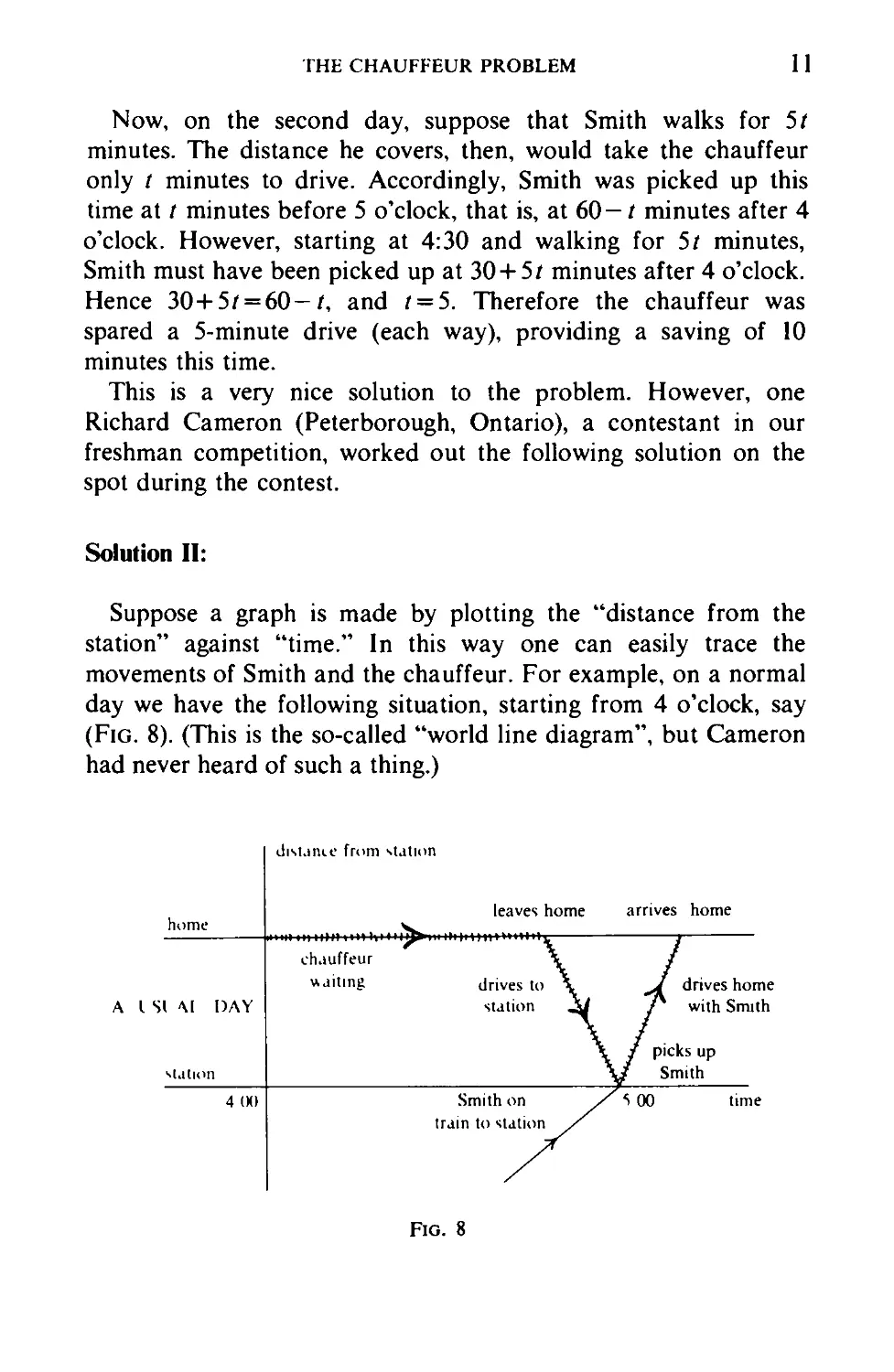
Suppose a graph is made by plotting the "distance from the
station" against "time." In this way one can easily trace the
movements of Smith and the chauffeur. For example, on a normal
day we have the following situation, starting from 4 o'clock, say
(FIG. 8). (This is the so-called "world line diagram", but Cameron
had never heard of such a thing.)
JI'..t.lnU' from '1.l.tHm
home
lea ve' home
ar,ives home
eh.luffeur
\\ditlng
drives to
o;tJ.tion
drives home
with Snulh
A I l "I DAY
\(.1(100
4 (MI
Smith on
time
FIG. 8
12
MATHEMATICAL MORSELS
dIStance f,om 'tatlOn
station
lIme
home chauffeu, waits
FIG. 9.
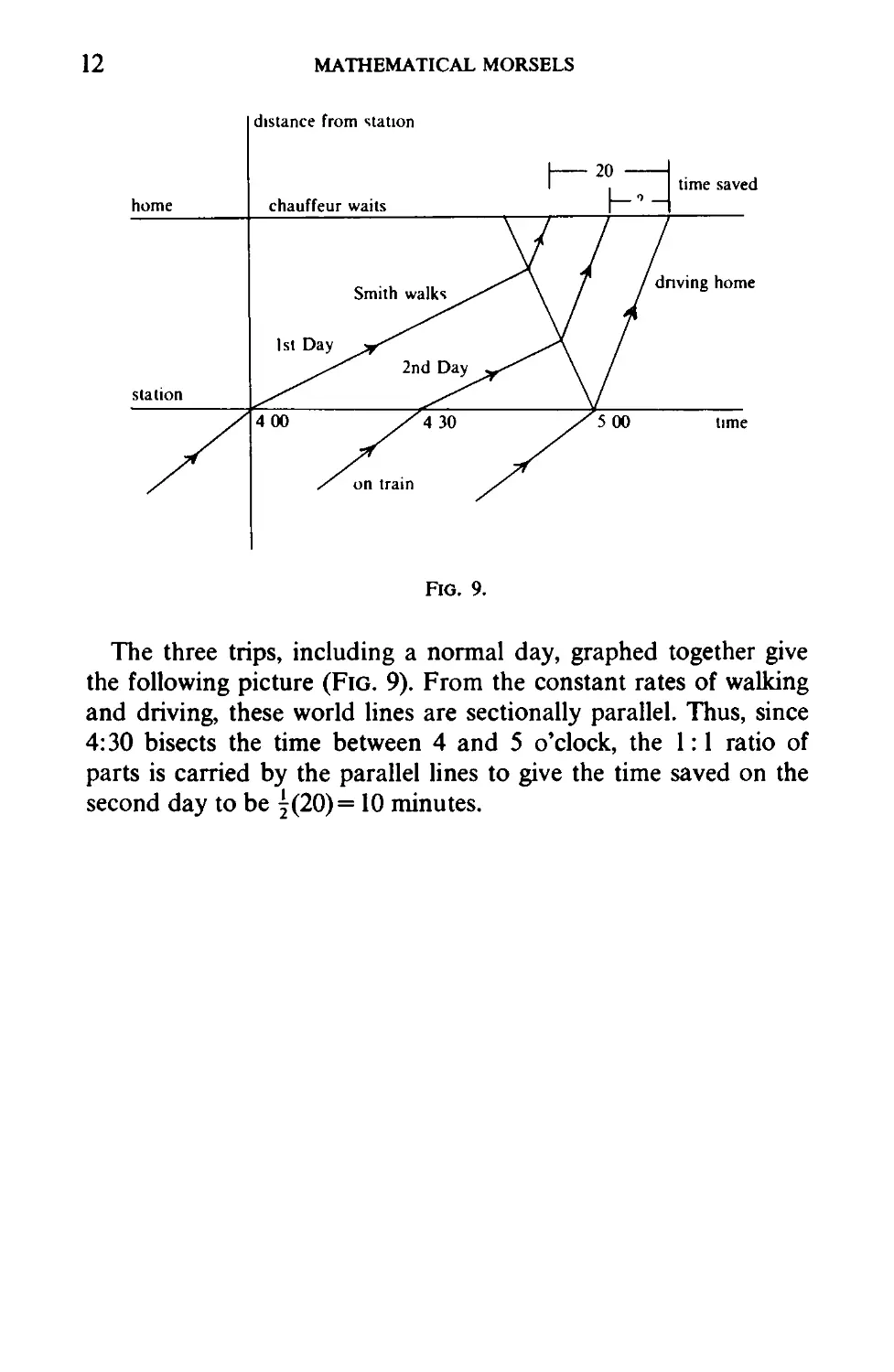
The three trips, including a normal day, graphed together give
the following picture (FIG. 9). From the constant rates of walking
and driving, these world lines are sectionally parallel. Thus, since
4:30 bisects the time between 4 and 5 o'clock, the I: I ratio of
parts is carried by the parallel lines to give the time saved on the
second day to be t(20) = 10 minutes.
PROBLEM 7
THE SCREENS IN THE CORNER*
Across one corner of a rectangular room are placed two 4-foot
screens in such a manner as to enclose the maximum floor space.
Determine their positions.
Solution:
The solution is based on the repeated application of the follow-
ing well-known result:
LEMMA. The triangle of greatest area in a family of triangles
which have a fixed base b and the same angle 0 opposite the base is
the one which is isosceles. (Clearly, the family fits into a segment of
a circle, and the isosceles triangle possesses the greatest altitude to
their common base (FIG. 10).)
Let 0 denote the corner of the room and suppose the screens
are placed to touch the walls at A and B. Then the floor area
enclosed is ,6.AOB+ ,6.ABP, where P denotes the point where the
screens meet. (Clearly, the screens must abut for maximum en-
closure, making P a common endpoint.)
Now, if ,6. OAB is not isosceles with OA = OB, the screens can
be moved to positions A' P' and B' P', where OA'= OB' and A' B'
remains equal to AB. Then triangles A' B' P' and ABP are equal
(in fact, congruent) and, by the lemma, ,6. OA' B' exceeds ,6. OAB.
The new position, then, encloses a greater area. Thus, in the
maximum arrangement, we must have OA = OB.
.Pi Mu Epsilon, 1944-45, p. 321, Problem 577, proposed and solved by E. P.
Starke, Rutgers Urnversity.
13
14
MATHEMATICAL MORSELS
A
P P'
FIG. 10.
Since the screens are of equal length, the point P must always
lie on the perpendicular bisector of AB. When OA = OB, the
perpendicular bisector of AB bisects the right angle in the corner
O. Thus, for the greatest area, OP must bisect L 0 (FIG. II).
Hence each screen must maximize the triangle that it cuts from the
45° angle that it subtends at 0 (lest a better arrangement exist).
Since A P is constant, we see, by the lemma, that .6. OA P is a
maximum when it is isosceles and has OA = OP. In this case,
L OAP=67t degrees, and the solution is evident. The simple
problem of constructing A P with straightedge and compass is left
as an exercise.
A very neat solution to this problem is also given in the later
section No Calculus Please, page 56.
o
FIG. I J.
PROBLEM 8
COLORING THE PLANE*
Suppose each point of the plane is colored red or blue. Show
that some rectangle has its vertices all the same color.
Solution:
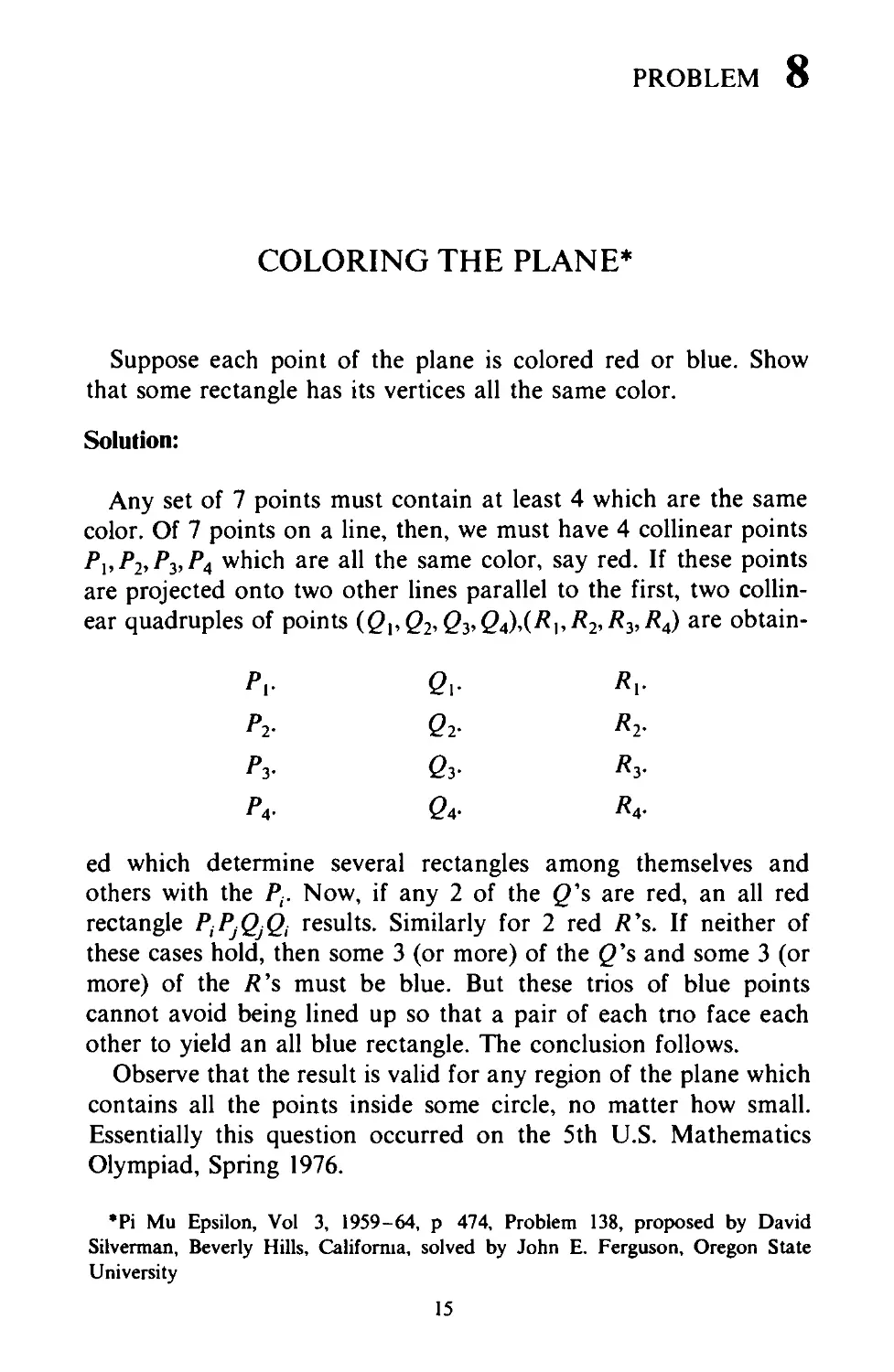
Any set of 7 points must contain at least 4 which are the same
color. Of 7 points on a line, then, we must have 4 collinear points
PI' P 2 , P 3 , P 4 which are all the same color, say red. If these points
are projected onto two other lines parallel to the first, two collin-
ear quadruples of points (QI,Q2,Q3,Q4),(R I ,R 2 ,R 3 ,R 4 ) are obtain-
PI'
P 2 .
P 3 .
P 4 .
QI'
Q2'
Q3'
Q4'
RI'
R 2 .
R3'
R4'
ed which determine several rectangles among themselves and
others with the Pi' Now, if any 2 of the Q's are red, an all red
rectangle P;ljQjQi results. Similarly for 2 red R's. If neither of
these cases hold, then some 3 (or more) of the Q's and some 3 (or
more) of the R's must be blue. But these trios of blue points
cannot avoid being lined up so that a pair of each too face each
other to yield an all blue rectangle. The conclusion follows.
Observe that the result is valid for any region of the plane which
contains all the points inside some circle, no matter how small.
Essentially this question occurred on the 5th U.S. Mathematics
Olympiad, Spring 1976.
.Pi Mu Epsilon, Vol 3, 1959-64, P 474. Problem 138, proposed by David
Silverman, Beverly Hills, Califorrua, solved by John E. Ferguson, Oregon State
University
15
PROBLEM 9
AN OBVIOUS MAXIMUM*
P is a variable point on the arc of a circle cut off by the chord
AB. Prove the intuitively obvious property that the sum of the
chords AP and PB is a maximum when P is at the midpoint of the
arc A B.
Solution:
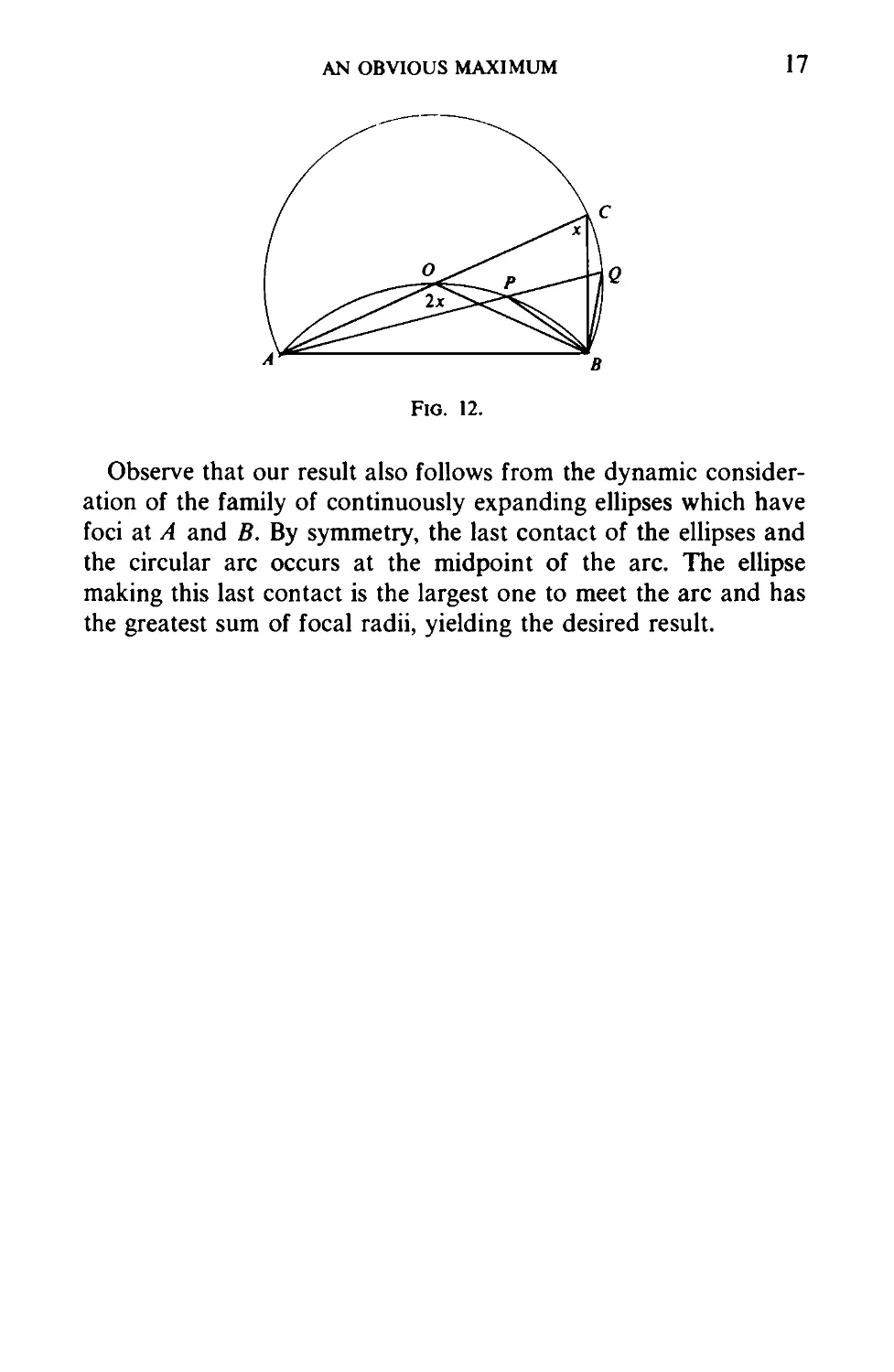
With center 0, the midpoint of arc AB, draw a second arc
through A and B. Let AP and AO meet this arc, respectively, at Q
and C (FIG. 12).
Now AB subtends at the center 0 an angle which is double the
angle it subtends at C on the circumference. But AB sub tends the
same angle at P as it does at 0 and the same angle at Q as it does
at C. Thus
LAPB=2L Q.
But, for .6. PQB, exterior angle APB is equal to the sum of the
interior angles at Q and B. Therefore
2 L Q = L Q + L QBP,
and
LQ= L QBP.
Thus .6.PQB is isosceles and AP+PB=AP+PQ=AQ, a chord
of the outer arc. Clearly this chord is a maximum when it is a
diameter, that is, when P is at O.
.Pi Mu Epsilon, Vol. 3. 1959-64, p. 296, Problem 130, proposed by H. Kaye,
Brooklyn, New York, solved by C. M. Ingleby in the 1860's
16
AN OBVIOUS MAXIMUM
17
------
c
Q
FIG. 12.
Observe that our result also follows from the dynamic consider-
ation of the family of continuously expanding ellipses which have
foci at A and B. By symmetry, the last contact of the ellipses and
the circular arc occurs at the midpoint of the arc. The ellipse
making this last contact is the largest one to meet the arc and has
the greatest sum of focal radii, yielding the desired result.
PROBLEM 10
cos 17x= j(cosx)*
If f denotes the function which gives cos 17 x in terms of cos x,
that is,
cos 17 x = f( cosx),
then show that it is the same function f which gives sin 17 x in
terms of sinx:
sin 17x=f(sinx).
Solution:
Let x=7T/2-y. Then sinx=cosy C'nd
sin 17 x = sin [ 17( - y ) ]
=sin( 87T+ -17y)
=sin( -17y)
=cos 17y
= f(cosy)
= f(sinx).
We observe that the 17 here may be replaced with any integer of
the form 4k + I.
*MM, 1954, Problem Q103, submitted by Norman Anning,
18
PROBLEM 11
A SQUARE IN A LATTICE*
An n X n square S in a coordinate plane covers (n + 1)2 lattice
points (that is, points whose coordinates (x,y) are both integers)
when it is placed so that each corner is on a lattice point and its
sides are parallel to the lattice lines (the axes). Prove the highly
intuitive result that, no matter how S may be tossed onto the
plane, it can never cover more than (n + 1)2 lattice points.
Solution:
Consider S in arbitrary position in the plane. Now suppose that
the boundary of S is a rubber band and that there is a nail at each
lattice point of the plane. Let the rubber band contract, if it can,
to fit around the outside of the nails at the lattice points which are
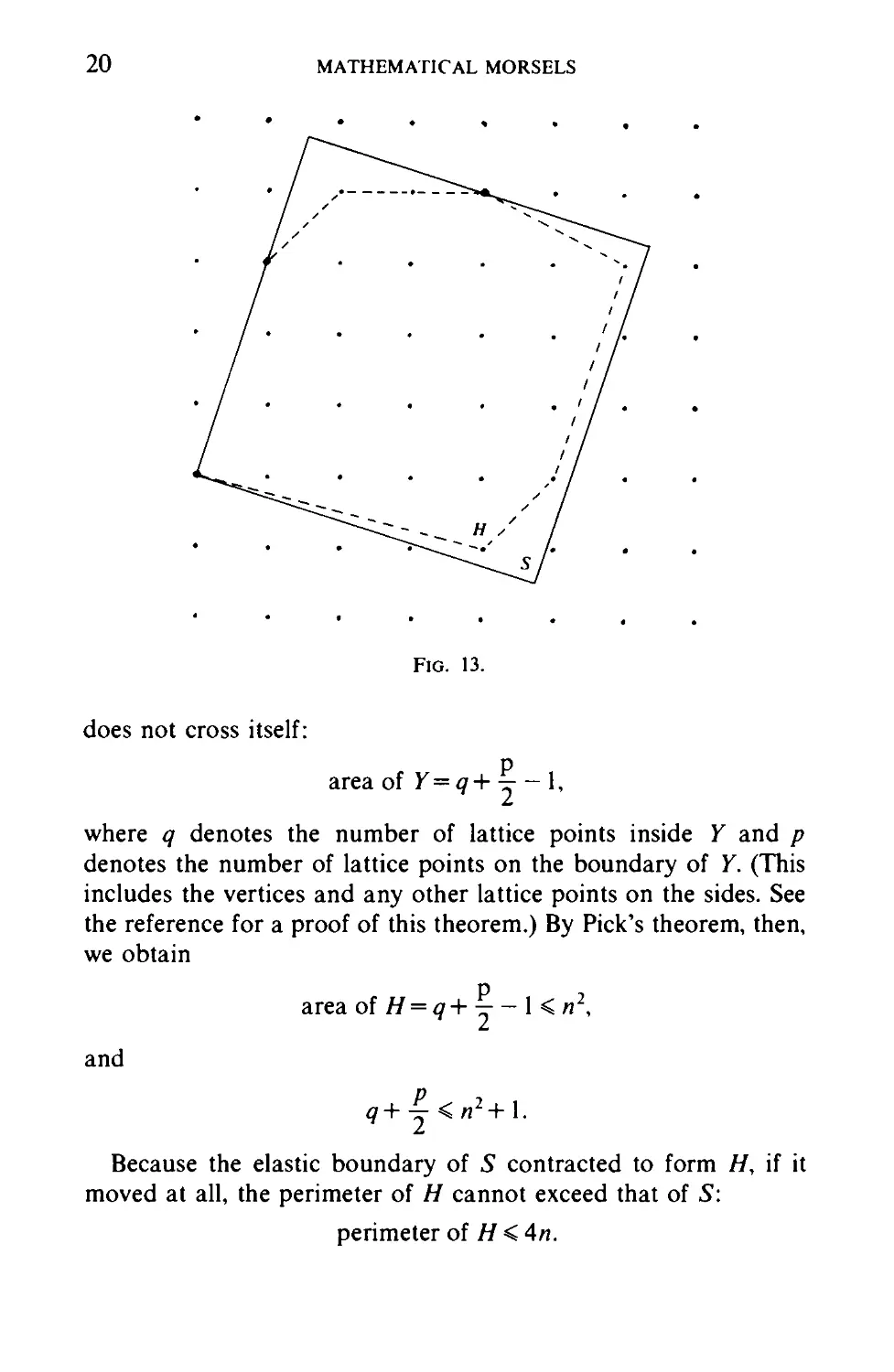
covered by S. The polygon H determined by the rubber band is
called the "convex hull" of the lattice points of S, and is a concept
of greatest importance in many geometric investigations (FIG. 13).
If a lattice point occurs at each vertex of S, then H is just S, itself.
(See the note at the end of this section for additional comments on
the definition of convex hull.)
Because H is contained in S, its area cannot exceed that of S:
area of H" n 2 .
Now, in 1899, George Pick discovered a remarkable formula for
the area of a polygon Y whose vertices are lattice points and which
"AMM, 1968, p. 545. Problem E1954, proposed and solved by D J. Newman,
Yeshiva University
19
20
MATHEMATICAL MORSELS
FIG. 13.
does not cross itself:
p
area of Y = q + '2 - I,
where q denotes the number of lattice points inside Y and p
denotes the number of lattice points on the boundary of Y. (This
includes the vertices and any other lattice points on the sides. See
the reference for a proof of this theorem.) By Pick's theorem, then,
we obtain
p
area of H=q+ '2 -I < n 2 ,
and
P 2 I
q+'2<n+.
Because the elastic boundary of S contracted to form H, if it
moved at all, the perimeter of H cannot exceed that of S:
perimeter of H < 4n.
A SQUARE IN A LATIICE
21
Clearly, no two lattice points are closer together than I unit. Thus,
around the boundary of H there isn't room for a total of more
than 4n lattice points, giving
p
p <4n and '2 <2n.
Combining this with the earlier result q + p /2 < n 2 + I, we get
the number of lattice points covered by S
=q+p < n 2 + I +2n=(n+ 1)2.
Note: The convex hull H of a plane set of points S is the intersection of all the
plane convex sets which contain S. H is therefore rrunimal in the sense that if a
convex set contains S it also contains H. H has no superfluous points-it extends
only so far as to contain S and to be convex, If S is itself convex, of course Hand
S are identical.
Reference
Ross Honsberger, Ingenuity in Mathematics, vol. 23, New Mathematical
Library, Math, Assoc, of Amenca, 27-31.
PROBLEM 12
AN OPAQUE SQUARE*
A collection of line segments inside or on the boundary of a
square of side I is said to be "opaque" if every straight line which
crosses the square makes contact with at least one of the segments.
For example, the two diagonals constitute an opaque set (FIG. 14).
Another opaque set is given in (b). The total length of the
diagonals is 2V2 =2.82 approximately, and it is a nice exercise in
elementary calculus to prove that the opaque set of minimum total
length which has the symmetric pattern illustrated in (b) has
length 1+ V3 = 2.73 approXImately. Find an opaque set whose
length is even less than I + V3 .
(d)
(hi
FIG. 14.
.AMM, 1966, Mathematical Notes, p. 405, Problem 5.
22
AN OPAQUE SQUARE
23
Solution:
The opaque set consisting of two adjacent sides and the remote
half of the diagonal between them (FIG. 15) has length
2+ V; <2+ l.i 2 =2.71 < I + V3 .
The edges AB and BC make contact with any line that touches
L,.ABC and, with L,.ABC completely taken care of, the semi-
diagonal OD suffices to make the other half of the square opaque.
Now, there is a much more efficient way of looking after
L,.ABC. The point P inside L,.ABC at which each side subtends an
angle of 120° is called the Fermat point of the triangle and is the
point of the tnangle which minimizes the sum of the distances to
the vertices (FIG. 16):
XA +XB+XC is a minimum for X=.P.
For a thorough treatment of this famous result, see my book
Mathematical Gems, Vol. I, Dolciani Mathematical Expositions,
Mathematical Association of America, 24-34. It is proved there
that the minimum sum P A + P B + PC is given by the segment
A
o
B
c
FIG, 15.
24
MATHEMATICAL MORSELS
A
c
FIG. 16
A
B'
FIG. 17.
AN OPAQUE SQUARE
25
BB', where B' is the vertex of the equilateral triangle constructed
outwardly on the side AC (FIG. 17). Clearly, in the case at hand,
BB' is the perpendicular bisector of AC and L,.ABE is isosceles.
Thus
I V2
BE=AE= -AC=-
2 2
and
BB'=BE+EB'= V; +V3 ( V; )= V; (l+V3).
Including the semidiagonal OD = V2 /2, we obtain an opaque set
of total length
V; (2+ V3 )=2.64 approximately.
This splendid solution was pointed out by Maurice Poirier, a
secondary school teacher in Orleans, Ontario.
PROBLEM 13
x'S AND O'S.
Suppose a game of X's and O's, "tick-tack-toe," is played on an
8 X 8 X 8 cube in 3-dimensional space. How many lines of "8-in-a-
row" are there through the cube by which the game might be won?
Solution:
This is not a difficult problem and it yields to a straightforward
count. However, a brilliant solution (one of Leo Moser's many) is
to consider a 10 X 10 X 10 cube which encases the given 8 X 8 X 8
cube with a shell of unit thickness. The two-way extension of a
winning line in the inner 8 X 8 X 8 cube pierces two of the unit
cubes in the shell. And each unit cube in the shell is pierced by
only one winning line. Thus each winning line corresponds to a
unique pair of unit cubes in the outer shell, and the number of
winning lines is simply one-half the number of unit cubes in the
shell, namely
10 3 - 8 3
2
1000;512 =244.
This approach is perfectly general. The number of winning lines
for a cube of edge k in n-dimensional space is
(k+2t-k n
2
"AMM, 1948. p, 99, Problem E773, proposed by A, L. Rubinoff. University of
Toronto, solved by Leo Moser, University of Manitoba,
26
PROBLEM 14
A SURPRISING PROPERTY OF
RIGHT-ANGLED TRIANGLES.
Prove that if each leg of a right-angled triangle is rotated about
its vertex on the hypotenuse so as to lie along the hypotenuse, then
the legs overlap in a segment whose length is the diameter of the
circle inscribed in the triangle (FIG. IS).
FIG. 18.
Solution:
In general, the size of the circle inscribed in a triangle is not a
simple function of the lengths of the sides. For a right-angled
triangle, however, we have the remarkable relation
the diameter = (the sum of the legs) - (the hypotenuse).
.AMM, 1956, p. 493, Problem EI 197, proposed by Huseyin Derrur, Zonguldak,
Turkey. solved by Leon Bankoff, Los Angeles, California.
27
28
MATHEMATICAL MORSELS
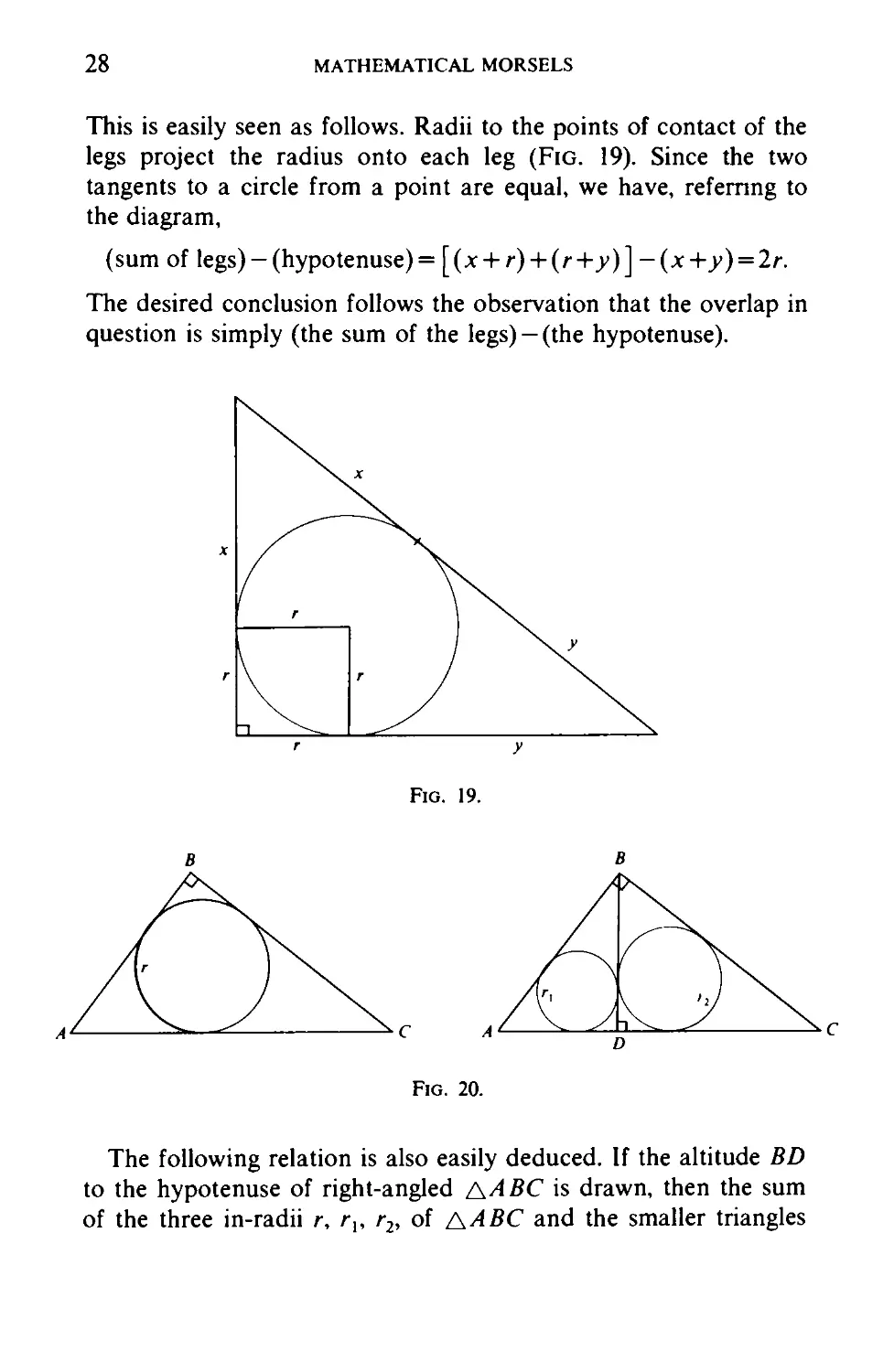
This is easily seen as follows. Radii to the points of contact of the
legs project the radius onto each leg (FIG. 19). Since the two
tangents to a circle from a point are equal, we have, refemng to
the diagram,
(sum of legs) - (hypotenuse) = [(x + r) + (r+ y)] - (x + y) =2r.
The desired conclusion follows the observation that the overlap in
question is simply (the sum of the legs) - (the hypotenuse).
x
FIG. 19.
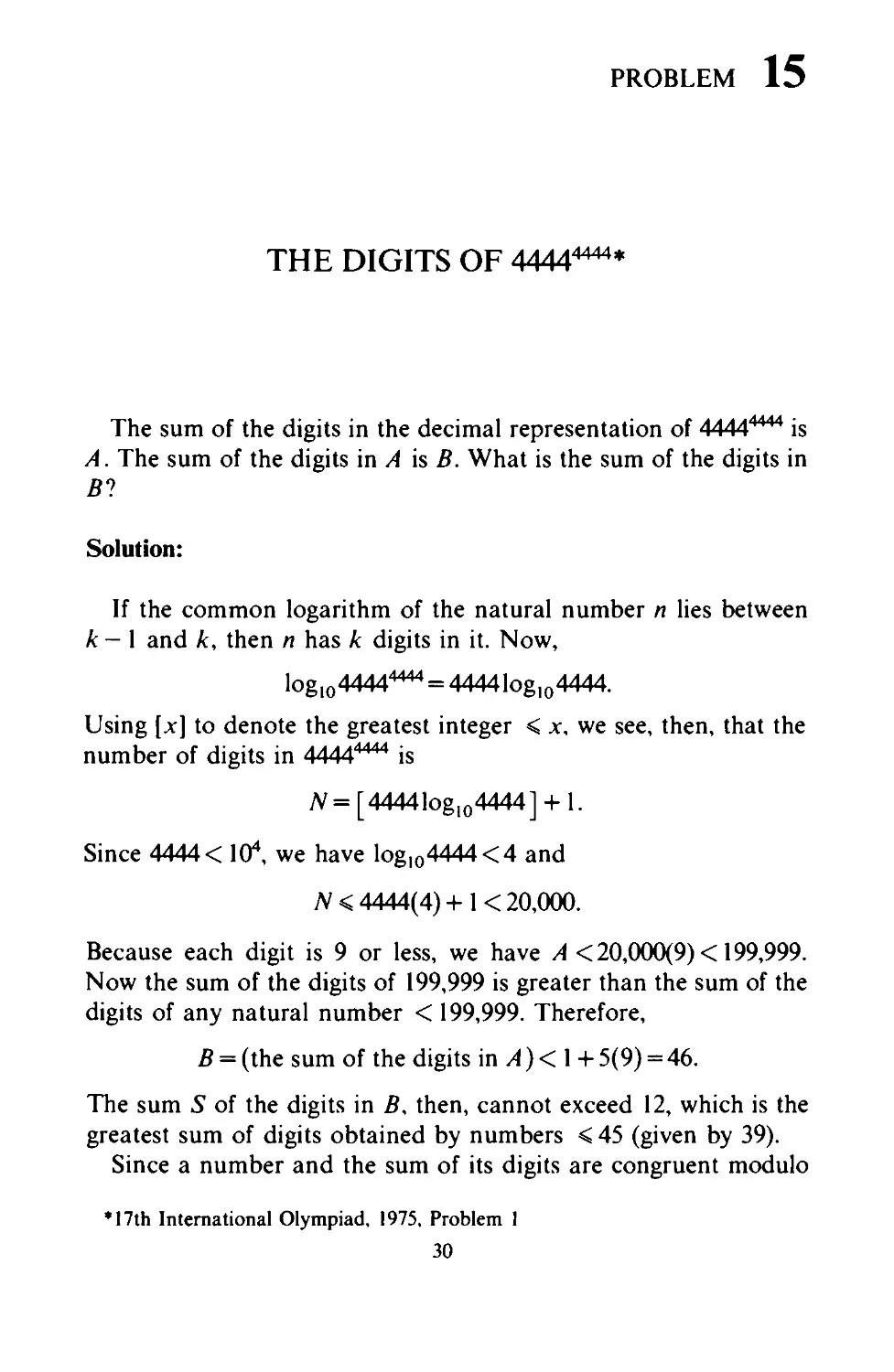
B
B
c
A
c
A
FIG. 20,
The following relation is also easily deduced. If the altitude BD
to the hypotenuse of right-angled L,.A BC is drawn, then the sum
of the three in-radii r, r l , r 2 , of L,.ABC and the smaller triangles
A SURPRISING PROPERTY OF RIGHT-ANGLED TRIANGLES 29
into which it is divided by BD, is simply the altitude BD, itself
(FIG. 20). We have
2r+2rl +2r2=(AB+ BC-AC)+(AD+ BD-AB)
+(BD+ DC- BC)
=(AD+ DC)-AC+2BD=2BD,
hence r+ r l + r 2 = BD.
PROBLEM 15
THE DIGITS OF 44444444*
The sum of the digits in the decimal representation of 4444 4444 is
A. The sum of the digits in A is B. What is the sum of the digits in
B?
Solution:
If the common logarithm of the natural number n lies between
k - I and k, then n has k digits in it. Now,
log 10 4444 4444 = 4444log lO 4444.
Using [x] to denote the greatest integer"; x, we see, then, that the
number of digits in 4444 4444 is
N = [4444log lO 4444] + I.
Since 4444< l(f, we have log 10 4444 <4 and
N..; 4444(4) + I < 20,000.
Because each digit is 9 or less, we have A <20,000(9) < 199,999.
Now the sum of the digits of 199,999 is greater than the sum of the
digits of any natural number < 199,999. Therefore,
B = (the sum of the digits in A) < I + 5(9) = 46.
The sum S of the digits in B, then, cannot exceed 12, which is the
greatest sum of digits obtained by numbers ..; 45 (given by 39).
Since a number and the sum of its digits are congruent modulo
.17th International Olympiad. 1975. Problem I
30
THE DIGITS OF 4444 4444
31
9. we have
4444 4444 = A = B = S (mod9).
Now, modulo 9,
4444 4444 =( _ 2)4444=(2)4444 =2(2 3 )1481
=2( _1)1481= -2=7.
Thus S=7, and this implies S=7 because 7 is the only number up
to 12, inclusive, which is congruent to 7 modulo 9.
PROBLEM 16
a(n)+ cp(n) = n.d(n)*
It has often been noted that the remarkable equation e'1Ti = - I
connects four of the most important numbers in all of mathemat-
ics. In a lesser vein, the equation
a(n) + cp(n) = n.d(n)
relates three of the most prominent functions of elementary num-
ber theory:
a(n)-the sum of the positive divisors of n,
d(n)-the number of positive divisors of n,
cp(n)-Euler's cp-function, that is, the number of
natural numbers m"; n which are relatively
prime to n, i.e., for which (m,n)= I.
Of course, one can throw together whatever functions he will in
order to concoct a mathematical condition. Prove, however, the
surprising fact that the equation a(n) + cp(n)= n'd(n) is a neces-
sary and sufficient condition for n to be a prime number.
Solution:
(i) Suppose n is a prime number. Then the divisors of n are I
and n. and we have a(n)=n+ 1. cp(n)=n-1. and d(n)=2. In this
case
a(n) + cp(n) = 2n = n'd(n),
.AMM. 1965. p. 186, Problem E1674, proposed by C A, Nicol. University of
South Carolina; solution by Ivan Niven, University of Oregon (unpublished)
32
a(n) + cp(n) = n'd(n)
33
implying the condition is necessary.
(ii) Suppose that a(n)+cp(n)=n'd(n) and also that n is not a
prime number. The equation is not satisfied by n = I (l + I =1= 1,1),
implying n ;;;. 2.
For n> I, cp(n) does not count the number n, itself, and we have
cp(n)<n.
Because n is a composite number it must have at least 3 divisors.
Let d(n) be denoted by k, and let the positive divisors of n be
denoted by
d l = I < d 2 < . . . < d k = n.
Since k = d(n);;;' 3, the divisor d 2 is not the greatest divisor, yield-
ing
d 2 <n
Consequently, we have
and
n - d 2 ;;;' l.
n.d(n)-a(n)=kn-(d l +d 2 +... +dd
=(n-d l )+(n-d 2 )+'" +(n-d k )
;;;'(n- dd +(n -d 2 )+(n- d k )
;;;'(n-l)+I+O
=n
> cp(n),
showing the impossibility of n.d(n)-a(n)=cp(n). This contradic-
tion proves that n must be a prime number.
Probably the most famous primality condition of all is Wilson's
theorem:
n divides (n -I)! + I if and only if n is a prime number.
In 1965, the AMM carried the following problem as E1702,
proposed by Douglas Lind, Falls Church, Virginia, and solved by
Kenneth Kramer, Columbia College, and Steven Minsker, Brook-
lyn College:
Prove that n divides N=L :?r(r!) if and only if n is a prime
number.
34
MATHEMATICAL MORSELS
Solution:
We have N= 1(l!)+2(2!)+'" +(n-3)[(n-3)!]. Since r(r!)=
(r+ I)r! - r! =(r+ I)! - r!, we have
N = (2! - l!) + (3! - 2!) + (4! - 3!) + . . . + [(n - 2)! - (n - 3)!]
=(n-2)!-l.
Multiplying through by n - I, and adding n to each side, we obtain
(n-I)N+n=(n-l)! + l.
By Wilson's theorem, n is a prime if and only if n is a divisor of
(n - I)! + I, and the last equation reveals that this is true if and
only if n is a divisor of N, since nand n - I are always relatively
pnme.
PROBLEM 17
ON k-CLOUDS*
Circles of unit radius are packed, without overlapping of interior
points, in a strip S of the plane whose parallel edges are a distance
w apart. We say that the circles form a k-c/oud if every straight
line which cuts across S makes contact with at least k circles.
Prove that for a 2-cloud, w 2+ v'3 (FIG. 21).
0001
FIG. 21.
Solution:
Through the center 0 of any circle C in a 2-cloud construct the
straight line m which crosses S at right angles (FIG. 22). Now m
must make contact with a second circle A. Let Q denote the foot
of the perpendicular from the center P of A to the line m. Since m
makes contact with A, the length of PQ cannot exceed the radius,
that is, PQ < l. And since C and A do not overlap, OP 2. The
.AMM, 1966, Mathematical Notes, p. 404, Problem 5.
35
36
MATHEMATICAL MORSELS
s
A
m
FIG. 22.
pythagorean theorem then yields
OQ= yO p 2 _PQ2 "J22=J2 =Y3.
Since S must extend at least a distance equal to the radius on each
side of OQ in order to contain the circles C and A, its width
w 2 + OQ 2 + V3 .
PROBLEM 18
A MINIMAL SUM*
There are n k different k-tuples (a l ,a2>...,a k ) which can be
constructed by taking a; from the set (l,2,3,...,n), repeated values
of the a; permitted. For each of these k-tuples, the minimum a; is
noted. Prove the surprising result that the sum of all these mini-
mum a; is simply
I k + 2 k + 3 k + . . . + n k,
the sum of the kth powers of the first n natural numbers,
. '" . ( ) ....'n k
I.e., £.. mln a"a2"" ,a k = £..m= 1 m
Solution:
This splendid solution is based on a very primitive notion which
is usually too simple to be of much help. In adding up a series of
natural numbers r;, one may distnbute his counting by determin-
ing the number of terms ;;;. I, the number of terms ;;;. 2, and so on.
Lr;=(number of terms;;;' I) + (number of terms;;;' 2)+." .
In this way, a number r is counted in r terms, thus contributing
the correct amount to the total. For example, the number r = 3 is
"AMM, 1976, P 61, Problem E2507, proposed by R, L. Graham, Bell Telephone
Laboratones, Murray Hill, New Jersey, solved by Peter G. de Buda, under-
graduate, University of Toronto.
37
38
MATHEMATICAL MORSELS
counted in
(number of terms I), (number of terms 2),
(number of terms 3),
but not in any later term. This procedure is equivalent to passing
over the series, picking up I from each term (so long as a term has
anything left to give), and adding up the totals obtained on the
various passes. (It is like considering the term r to be a pile of r
matchsticks.)
It turns out to be very easy to calculate the number of terms of
the sum in question which are at least equal to the positive integer
t. Clearly we have
min(a l ,a2'" .,a*) t
if and only if every a i in the k-tuple t. The number of k-tuples
which have this property is simply the number of k-tuples which
can be constructed by taking the a; from the range (t, t + l, ..., n).
Accordingly, there are n - t + I choices for each ai' and the num-
ber of such k-tuples is (n - t + 1)*. Therefore
(the number of terms t)=(n- t+ 1)*,
and the sum in question is
L min(a l ,a 2 ,... ,a*) = L7= I (the number of terms t)
= L7 = I (n - t + 1)*
=n*+(n-I)*+(n-2)*+'" +1*.
Professor Ivan Niven pointed out the following nice completion
of the above argument, carrying on from the point of having
established that the number of k-tuples with minimum t is
(n - t + l)*. This formula gives the number of k-tuples with mini-
mum t + I to be (n - t)*. Therefore the number of k-tuples with
minimum exactly t is (n-t+l)*-(n-t)*, and these contnbute
t[(n - t + l)* - (n - t)*] to the total in question. Adding for t =
A MINIMAL SUM
39
1,2,...,n, the total is seen to be
I [(n)k - (n - I)k] + 2 [ (n - l)k - (n - 2)k] + 3 [ (n - 2)k - (n - 3)k]
+... +n[lk-0"]=n k +(n-l)k+(n-2)k+... +lk.
As an exercise, the reader might enjoy determining the value of
Lmax(a!,a 2 ,... ,an)'
PROBLEM 19
THE LAST THREE DIGITS OF 79999*
What are the last three digits of 7 9999 ?
Solution:
Observe that 7 4 =2401. Therefore
7 4n = (240 I r = (I + 240<W = I + n. 2400 + ( ; ). 24O<Y + . . . ,
where all the terms in this binomial expansion, beyond the second,
end in at least 4 zeros and do not affect the last 3 digits of the
result. The last 3 digits are determined by
1+ n. 2400= 24n.100+ I.
If m is the last digit of 24n, we have
24n.100+ I =(...m)IOO+ I = ...mOI, ending in mOl.
For n = 2499, 24n ends in 6, and we see that
7 4n = 7 9996 ends in 601.
Since 7 3 = 343, we obtain
7 9999 = 79996. 7 3
= (...601 )(343) = ...143,
giving the last 3 digits to be 143 (by direct multiplication).
Alternatively, we might have proceeded as follows. For n = 2500,
°NMM, 1937-38. p, 415, Problem 216. proposed by Victor Thebault. Le Mans.
France, solved by D, p, Richardson, University of Arkansas
40
THE LAST THREE DIGITS OF 7 9999
41
24n ends in 0 and we see that 7 4n = 7 1fXXYJ ends in 001. Thus
71 ססoo = ...001 = ...000+ I = 1000k+ I
for <;ome integer k. This yields 7) ססoo = 10000k -1)+ 1001. Dividing
by 7, we get
9999 1000(k - I)
7 = 7 + 143.
Since the right-hand side must be an integer, 7 must divide
IOOO(k - I). But 7 does not divide 1000. Thus it must divide k-l
and, for some integer q, we have 7 9999 = 1000q+ 143. Since 1000q
ends in 000, we see that 7 9999 ends in 143.
PROBLEM 20
ROLLING A DIE*
A normal die bearing the numbers I, 2, 3, 4, 5, 6 on its faces is
thrown repeatedly until the running total first exceeds 12. What is
the most likely total that will be obtained?
Solution:
Consider the throw before the last one. After this throw the total
must be either 12, II, 10,9, 8, or 7. If it is 12, then the final result
will be either 13, 14, 15, 16, 17, or 18, with an equal chance for
each. Similarly, if the next to last total is II, the final result is
either 13, 14, 15, 16, or 17, with an equal chance for each; and so
on. The 13 appears as an equal candidate in every case, and is the
only number to do so. Thus the most likely total is 13.
In general, the same argument shows the most likely total that
first exceeds the number n (n > 6) is n + 1.
· AMM, 1948. P 98. Problem E77I. proposed by C. C. Carter, Bluffs. II1inois.
solved by N, J Fine, University of Pennsylvania.
42
PROBLEM 21
PIERCING A CUBE*
A solid cube C of dimensions 20 X 20 X 20 is built out of 2000
bricks of dimensions 2 X 2 X I. Prove that the cube can be pierced
by a straight Jine perpendicular to a face, passing through the
interior of the cube, which does not pierce any of the bricks.
Solution:
Consider the 8000 unit cubes in C. On each face of C, the edges
of the unit cubes outline a 20 X 20 grid. In the interior of a face
there are 19(19) = 361 points in this grid. The 361 lines through
these points, perpendicular to the face, run along the edges of the
rows of unit cubes to the corresponding grid points in the opposite
face. Altogether there are 3(361)= 1083 such lines piercing the
interior of C. Let L denote an arbitrary member of this set of
Jines.
The two planes through L, parallel to faces of C, divide C into
four rectangular sections, each of which has L as an edge. Let A
denote any of these sections (FIG. 23). Since one of the dimensions
of A is 20 (a whole edge of C), A must contain an even number of
unit cubes. Now, a 2 X 2 X I brick may have I, 2, or 4 of its unit
cubes in A, but no brick can contribute exactly 3 unit cubes to A.
The total contribution to A of the bricks providing 2 or 4 unit
cubes is an even number of unit cubes. Therefore there must be an
even number of bricks which give exactly I unit cube to A. Now a
brick which has exactly I unit cube in A must have L run right
.AMM. 1971, p, 801. Problem 5744. proposed by Jan Mycielski, University of
Colorado, solved by Bill Sands. University of Manitoba.
43
44
MATHEMATICAL MORSELS
A
in A
c
a2x2xl
bnck with
I unit cube
in A
FIG. 23.
through the middle of it, along the edge which is common to its
four unit cubes. Consequently, L must pierce an even number of
bricks.
But a given brick can be pierced by only one line L. In fact,
each brick is pierced by one and only one line L, providing a total
of 2000 such piercings. Since there are 1083 lines L, each of which
pierces an even number of bricks, not all of the lines L can pierce
as many as 2 bricks. At least 83 of the lines L must pierce no bnck
at all.
PROBLEM 22
DOUBLE SEQUENCES.
For certain natural numbers n it is possible to construct a
sequence in which each number 1,2,3,...,n occurs twice, the
second occurrence of each number r being r places beyond its first
occurrence. For example, for n = 4,
4,2,3,2,4,3, I, l.
For n = 5, we have
3,5,2,3,2,4,5, I, 1,4.
Such arrangements do not exist for n = 6 or 7. For n = 8 we have
8,6,4,2,7,2,4,6,8,3,5,7,3, I, 1,5.
Prove that such a sequence cannot exist unless n =0 or I (mod 4).
Solution:
Let the positions in such a sequence be numbered 1,2,3,...,2n.
Suppose that the first occurrence of the number I is in position PI'
the first occurrence of 2 is in position Pz, and so on. Then the
second occurrence of I is in position PI + I, and the second
appearance of 2 is in position pz + 2, etc. The sum of the numbers
denoting the positions is then both
I + 2 + 3 + . . . + 2n
and (PI + PI + l)+(pz + pz + 2)+ . . . + (P n + Pn + n). Therefore
2n(2n+l) n(n+l)
2 = 2(PI + Pz + .. . + Pn) + 2 .
*AMM, 1%7, p, 591, Problem EI845. proposed by R. S. Nickerson, Hanscom
Field, Bedford, Massachusetts, solved by D. C. B. Marsh, Colorado School of
Mines,
45
46
MATHEMATICAL MORSELS
Letting PI + P2 + . . . + Pn = P, we get
2n(2n+l) n(n+I}
2 =2P+ 2 '
gIVIng
2n(2n+l)-n(n+l) 3n 2 +n n(3n+l)
P - --
- 4 - 4 - 4'
Since P is an integer, n(3n + I) must be divisible by 4. However,
for n=.2 or 3 (mod4), we have n(3n + 1)=.2 (mod4), a contradic-
tion. Therefore there can be no sequence unless n=.O or I (mod4).
In his solution (see reference), D. C. B. Marsh proves that a
sequence does exist for every n=.O or I (mod4).
Consider now the companion problem of determining the num-
ber of ways of arranging the numbers 1,2,..., n in a row so that,
except for an arbitrary choice of first number, the number k can
be placed in the row only if it is preceded either by k - I or k + I
(not necessarily immediately). For example, for n=6, among the
acceptable arrangements are
4 3 526
and
342
5 6.
Solution:
Suppose the first number is r. This splits the numbers 1,2,..., n
into two groups
A =(1,2,...,r-l) and B=(r+ l,r+2,...,n).
The rule requiring either k - I or k + I ahead of k implies that the
numbers in A must occur in the row in their natural descending
order and that the numbers in B occur in ascending order. It is
clear that the first number from B, for example, which can appear
after the initial value r, is not r + 2 because it would not be
preceded by either r + I or r + 3. Similarly, none of r + 3, r + 4, .. ., n
can be the first member of B to follow r. Repeated application of
this argument shows that the members of B must occur in the
order r+ I,r+2,...,n. Similarly for A.
DOUBLE SEQUENCES
47
So long as the elements of A and B keep their natural order
within their own group, it doesn't matter how the groups may be
interlaced. For example, since r is first, the r+ I can go in right
away or later, say after the r - I and r - 2 have been inserted.
Consequently, the number of rows which begin with r is the
number of ways of choosing r-l places from the remaining n-l
places for the r-I members of A, namely (;=: ). The ordered
members of B automatically go in the vacant places. Since r may
take the values 1,2,...,n, the total number of ways of arranging
the row is
( n (; I ) + ( n I ) + ( n ; I ) + . . . + ( : = ) = (I + I) n - I = 2n - I.
PROBLEM 23
POINT-SPLITTING CIRCLES*
2n + 3 points are given in the plane, no 3 on a line and no 4 on a
circle. Prove that it is always possible to find a circle which goes
through 3 of the given points and splits the others in half, that is,
has n on the inside and n on the outside.
Solution I: By Murray Klamkin, University of Waterloo.
Let A and B denote two consecutive vertices of the convex hull
H of the given set of points T (FIG. 24). (See Problem II, pp.
19-21 for the definition of convex hull.) Since no three of the
points of T lie on a line, there are no points of T on the segment
AB between A and B. Let a large circle C, through A and B, have
its center 0 outside H. Now, the segment AX B of C, which lies
inside H, may contain some of the points of T. However, by
increasing the size of C, the arc AXB can be made to approach
A B as closely as desired. In such an expansion, the arc AX B, in
approaching AB, would pass over all the (finite number of) points
of T which were in the original segment AX B. Thus there exists
any number of circles through A and B for which the segment
AX B, including its arc, is devoid of points of T. Let C denote such
a circle and let its center be O.
To begin with, then, we have a circle C which passes through
exactly two points of T, namely A and B, and has no points of T
inside it. Let C be transformed by moving its center 0 toward AB
along the perpendicular bisector L of AB, adjusting the radius all
.This problem comes from a 1962 mathematics competition held in Cluna; see
AMM, 1972, P 899, The Chinese Mathematical Olympiads, Frank Swetz, Penn-
sylvania State College.
48
POINT-SPLITTING CIRCLES
49
FIG. 24.
the while so as to keep C passing through A and B. As 0
approaches AB, the segment AX B enlarges to take in more and
more of H. When 0 crosses AB, the segment AXB becomes the
major segment of C (determined by AB) and eventually grows to
cover the entire hull H, and therefore the entire set T. Since no 4
points of T lie on a circle, the segment AXB must assimIlate the
points of T one at a time. When the (n + l)th point K is picked up
by the circumference, the circle C will contain precisely the
preceding n points inside it and will pass through the three points
A, B, and K. The other n points of T are still beyond the confines
of C, and the conclusion follows.
Solution II: By L. J. Dickey, University of Waterloo.
Let 0 denote any of the given points and consider any circle R
which has center O. Let the given points be subjected to a circular
inversion in R. (See the reference for an account of circular
inversion.) The center 0 is thus carried to the point at infinity,
yielding a set S of 2n + 2 finite image points (FIG. 25).
Beginning with a line t which has all of S on one side, move t
toward S until it first makes contact with S, say at a point A'.
(Alternatively: let A' denote a vertex of the convex hull of Sand
let t be a line through A I which meets the hull only at A I.) Now let
either ray of t, determined by A', sweep across S by being pivoted
about A'. We will prove shortly that this sweeping ray of twill
meet the points of S one at a time. Consequently, it eventually
50
MATHEMATICAL MORSELS
o
o
B'
invert in R
o
S
2n+2
images
..
o (n) 0
o
o 0
o
o
o
..
o
A'
o
FIG. 25.
reaches an image point B' such that A' B' splits the other 2n points
of S in half.
Let A and B of the given set denote the antecedents of A' and
B'. We observe that A' B' cannot pass through the center of
inversion 0, for this would mean that A, B, and 0 of the given set
would lie on a line (a contradiction). Therefore the antecedent of
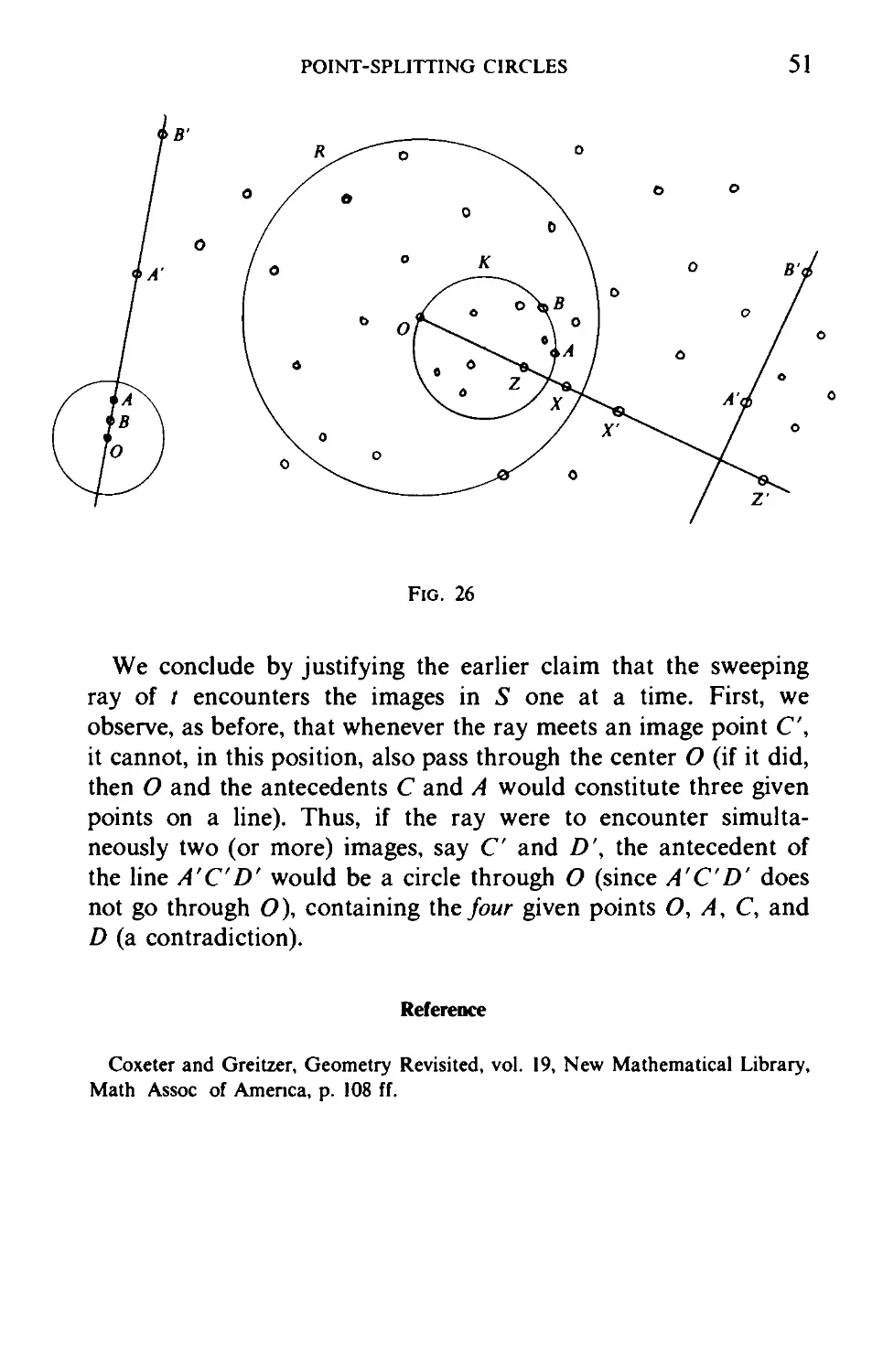
the line A' B' must be a circle K through 0 (FIG. 26). K, then,
passes through the three points A, B, and 0 of the given set. And
because, when inverting back the images of S to the points of the
given set, all the images on one side of A' B' are taken inside K
and all those on the other side of A' B' are carried outside K, we
see that K splits the given set in half. (The tangent to K at 0 is
parallel to A' B'.)
Not only have we solved the problem, but we see that through
each point 0 of the given set a solution circle can be found. Of
2n + 3 circles thus obtained, there may be only (2n + 3)/3 different
circles, for the one through 0, A, and B may be counted 3 times.
(Since no 4 points of the gIven set lie on a circle, no solution circle
can be counted more than 3 times in these 2n + 3 solutions.) It is
not impossible for a given point to have more than one solution
circle pass through it.
POINT-SPLITTING CIRCLES
51
B'
o
o
o
o
o
FIG. 26
We conclude by justifying the earlier claim that the sweeping
ray of t encounters the images in S one at a time. First, we
observe, as before, that whenever the ray meets an image point C',
it cannot, in this position, also pass through the center 0 (if it did,
then 0 and the antecedents C and A would constitute three given
points on a line). Thus, if the ray were to encounter simulta-
neously two (or more) images, say C' and D', the antecedent of
the line A'C'D' would be a circle through 0 (since A'C'D' does
not go through 0), containing the four given points 0, A, C, and
D (a contradiction).
Reference
Coxeter and Greitzer, Geometry Revisited, vol. 19, New Mathematical Library,
Math Assoc of Amenca, p, 108 ff.
PROBLEM 24
ON THE LENGTHS OF THE SIDES OF A
TRIANGLE*
If a,b,c form a triangle, prove that, for all n=2,3,4,...,
va , -\Ib , \Ie also form a triangle.
Solution:
If a,b,c form a triangle, the triangle inequality yields
a+b>c,
and so on. Therefore we have
(va +-\lbf>a+b>c=(\lef,
glVlng
va +-\Ib >VC.
The other parts of the triangle inequality for va, -\Ib , \Ie are
similarly established, and the conclusion follows.
"AMM, 1960. P 82, Problem EI366. proposed by V. E. Hoggatt, Jr., solved by
R. T. Hood, Ohio Uruversity.
52
PROBLEM 25
NO CALCULUS PLEASE
In ]952, J. H. Butchart and Leo Moser published an exceptional
article No Calculus Please in the popular journal Scripta Mathe-
matica, pages 221-236. We consider here a few of the ingenious
alternatives they present to the usual calculus approach.
(i) Our first problem is to determine the volume common to two
right circular cylinders of radius "a" which intersect at right
angles (that is, their central axes intersect at right angles). It gives
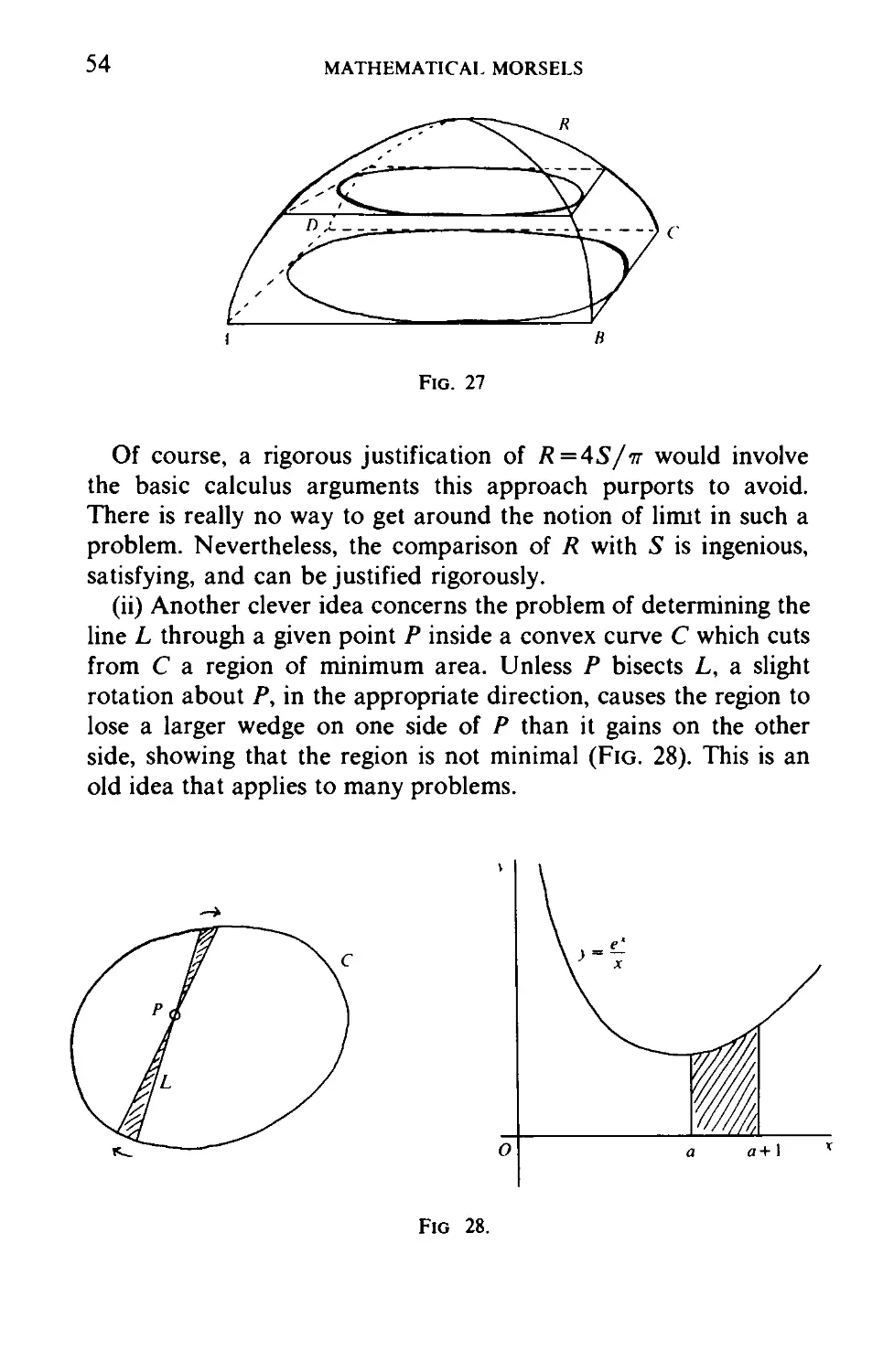
one a moment's pause to picture the intersection R just described.
In the direction of one of the cylinders, R appears circular, being
rounded as the cylinder from which it is cut. The top half of R is
sketched below (FIG. 27). Its volume is found very easily by a
comparison with its inscribed sphere. Clearly, a sphere of radius a
could roll down either cylinder and is the inscribed sphere of their
intersection.
Because of its 4-fold symmetry, any slice of R, parallel to the
base ABCD, would have a square base. Such a slice of the
inscribed sphere S would have a circular base which would fit
tangentially inside the square base of the corresponding slice of R.
The ratio of the area of a square to that of its inscribed circle is
(2r)2 4
'TTr 2 'TT
Summing over all levels, we obtain the volume of R to be 4/'TT
times that of S. Thus
4 ( 4 ) 16
the volume of R=; )'TTa 3 = )a 3 .
53
54
MATHEMATICAL MORSELS
FIG,27
Of course, a rigorous justification of R=4S/'TT would involve
the basic calculus arguments this approach purports to avoid.
There is really no way to get around the notion of linut in such a
problem. Nevertheless, the comparison of R with S is ingenious,
satisfying, and can be justified rigorously.
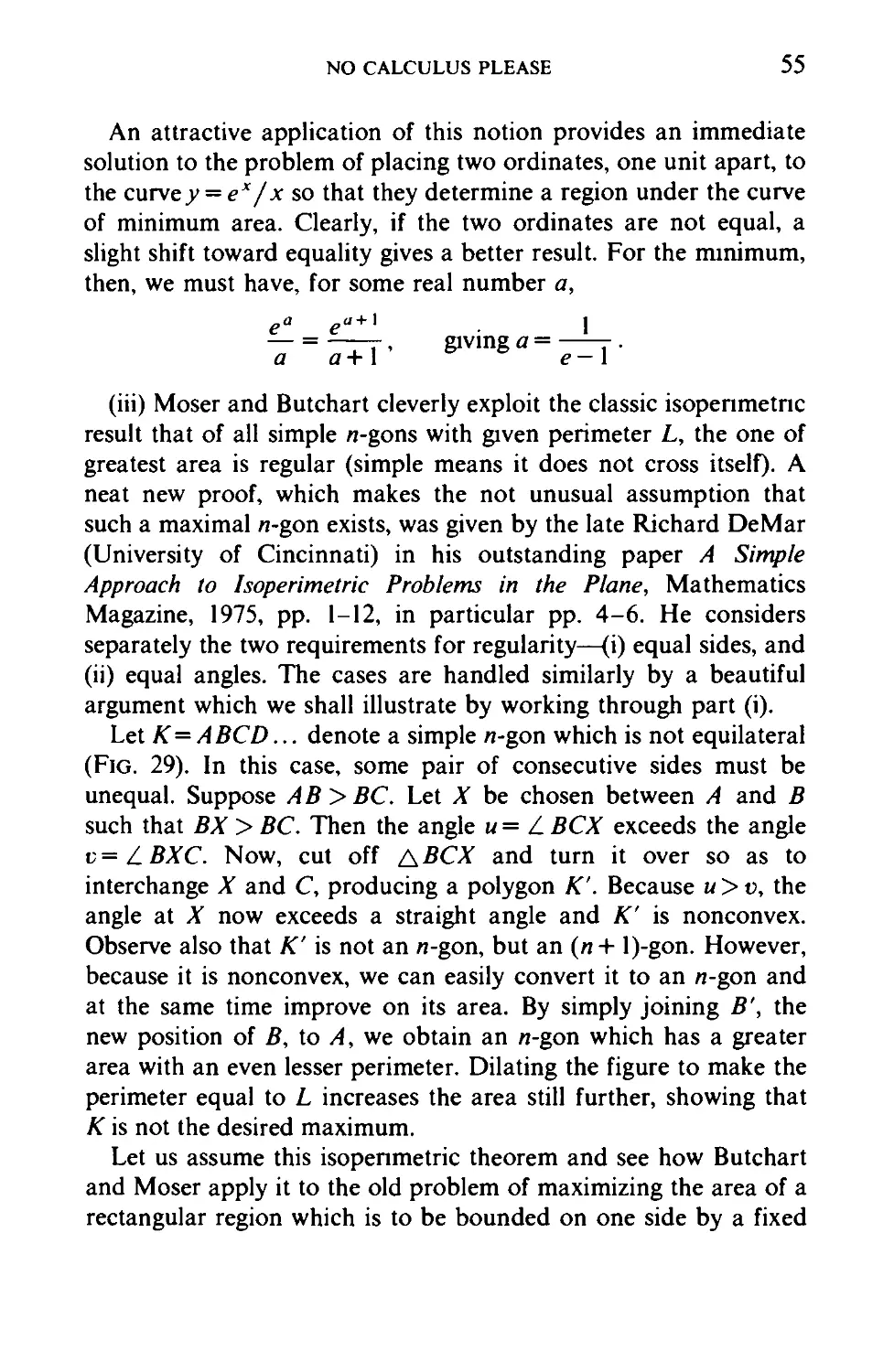
(ii) Another clever idea concerns the problem of determining the
line L through a given point P inside a convex curve C which cuts
from C a region of minimum area. Unless P bisects L, a slight
rotation about P, in the appropriate direction, causes the region to
lose a larger wedge on one side of P than it gains on the other
side, showing that the region is not minimal (FIG. 28). This is an
old idea that applies to many problems.
o
a
a+1
FIG 28.
NO CALCULUS PLEASE
55
An attractive application of this notion provides an immediate
solution to the problem of placing two ordinates, one unit apart, to
the curve y = eX / x so that they determine a region under the curve
of minimum area. Clearly, if the two ordinates are not equal, a
slight shift toward equality gives a better result. For the nunimum,
then, we must have, for some real number a,
e U eU+ I
-;;- a+l '
, I
gIVmga=-.
e-I
(iii) Moser and Butchart cleverly exploit the classic isopenmetnc
result that of all simple n-gons with gIven perimeter L, the one of
greatest area is regular (simple means it does not cross itself). A
neat new proof, which makes the not unusual assumption that
such a maximal n-gon exists, was given by the late Richard DeMar
(University of Cincinnati) in his outstanding paper A Simple
Approach to lsoperimetric Problems in the Plane, Mathematics
Magazine, 1975, pp. 1-12, in particular pp. 4-6. He considers
separately the two requirements for regularity-(i) equal sides, and
(ii) equal angles. The cases are handled similarly by a beautiful
argument which we shall illustrate by working through part (i).
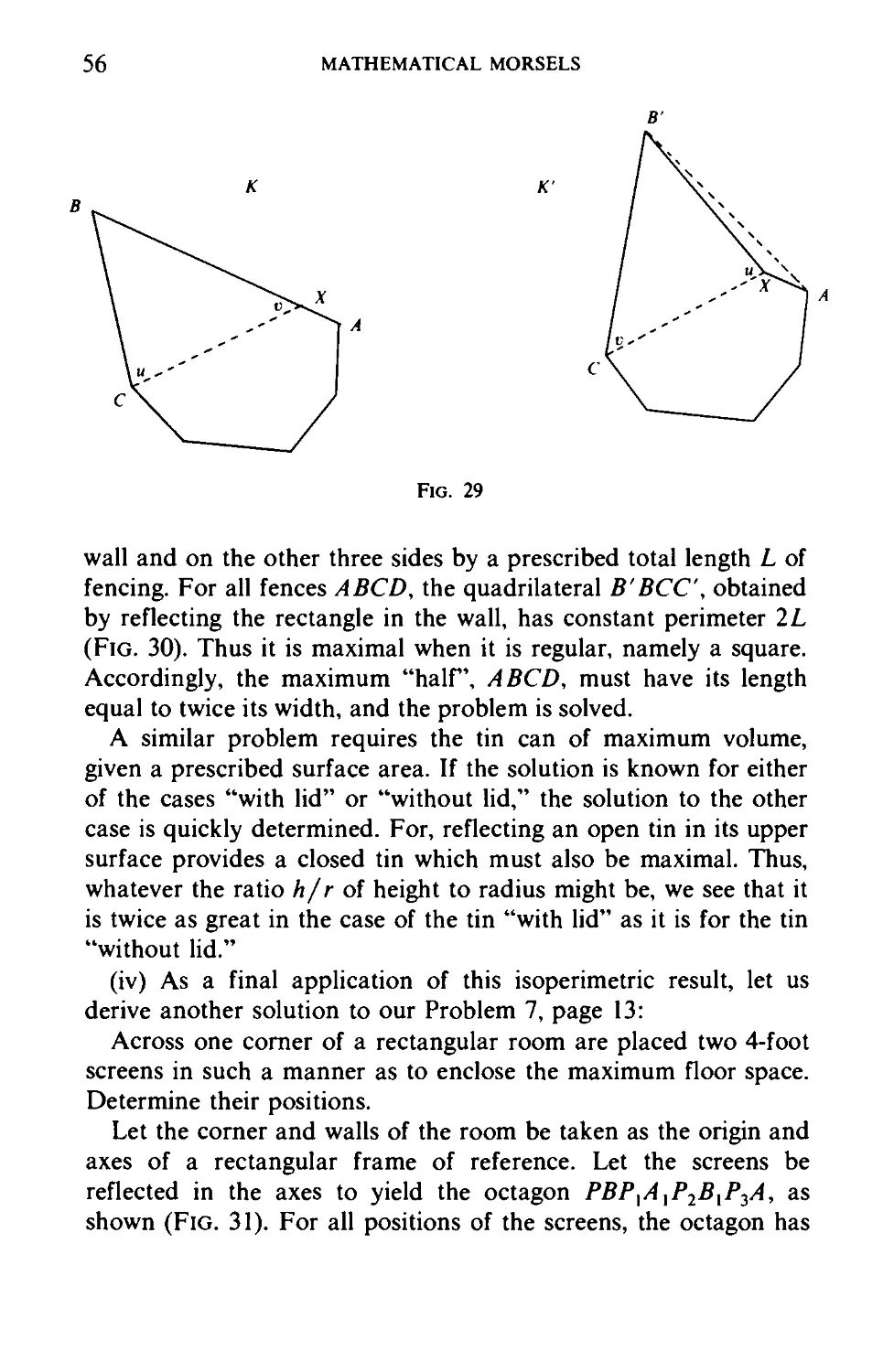
Let K = A BCD. .. denote a simple n-gon which is not equilateral
(FIG. 29). In this case, some pair of consecutive sides must be
unequal. Suppose A B > Be. Let X be chosen between A and B
such that BX > Be. Then the angle u = L BCX exceeds the angle
v= L BXe. Now, cut off 6,BCX and turn it over so as to
interchange X and C, producing a polygon K'. Because u> v, the
angle at X now exceeds a straight angle and K' is nonconvex.
Observe also that K' is not an n-gon, but an (n+ I)-gon. However,
because it is non convex, we can easily convert it to an n-gon and
at the same time improve on its area. By simply joining B', the
new position of B, to A, we obtain an n-gon which has a greater
area with an even lesser perimeter. Dilating the figure to make the
perimeter equal to L increases the area still further, showing that
K is not the desired maximum.
Let us assume this isopenmetric theorem and see how Butchart
and Moser apply it to the old problem of maximizing the area of a
rectangular region which is to be bounded on one side by a fixed
56
MATHEMATICAL MORSELS
B'
c
,
,
,
,
,
,
"
,
,
K
K'
B
A
A
FIG, 29
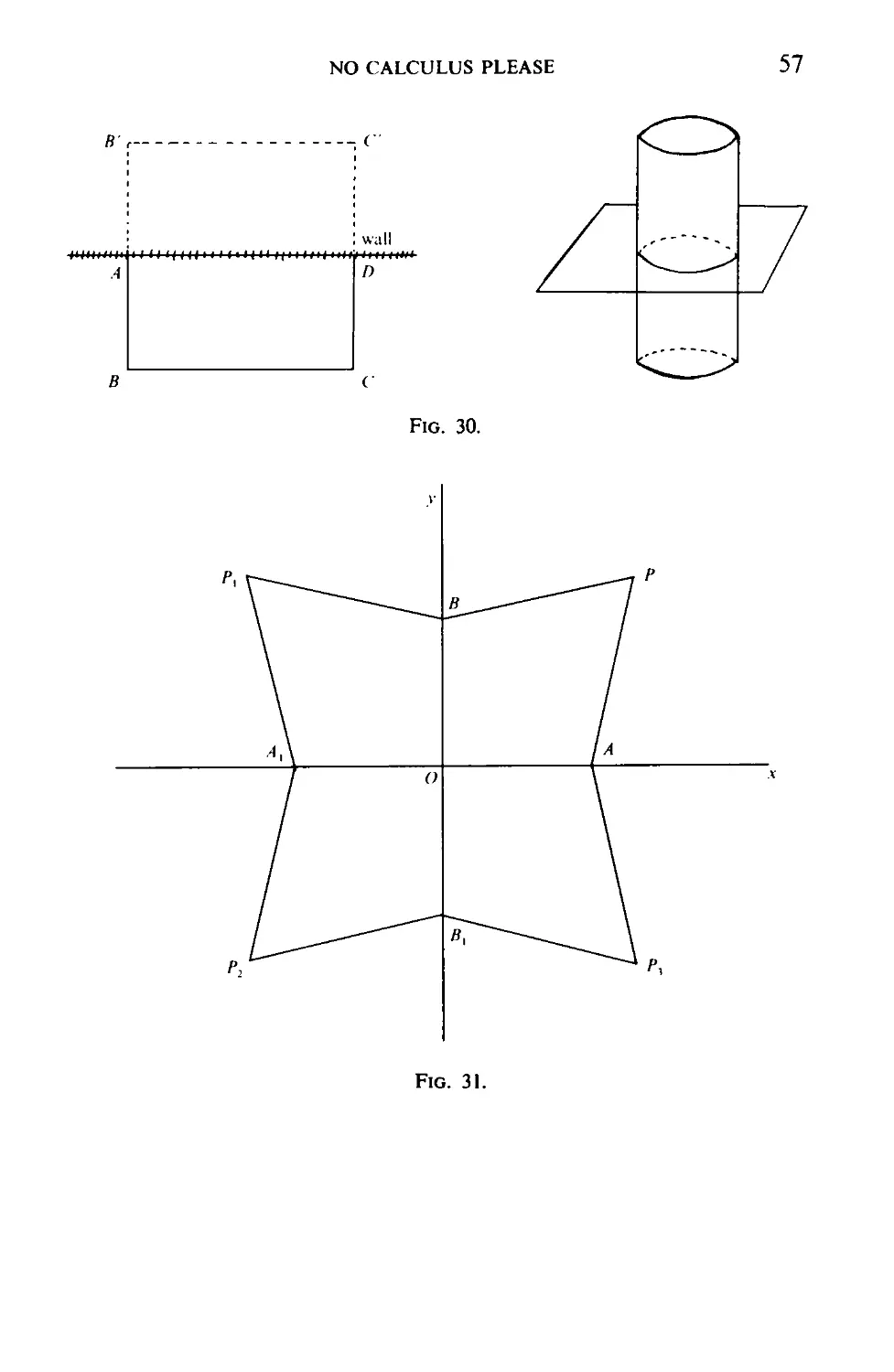
wall and on the other three sides by a prescribed total length L of
fencing. For all fences ABCD, the quadrilateral B' BCe, obtained
by reflecting the rectangle in the wall, has constant perimeter 2L
(FIG. 30). Thus it is maximal when it is regular, namely a square.
Accordingly, the maximum "half', ABCD, must have its length
equal to twice its width, and the problem is solved.
A similar problem requires the tin can of maximum volume,
given a prescribed surface area. If the solution is known for either
of the cases "with lid" or "without lid," the solution to the other
case is quickly determined. For, reflecting an open tin in its upper
surface provides a closed tin which must also be maximal. Thus,
whatever the ratio hi r of height to radius might be, we see that it
is twice as great in the case of the tin "with lid" as it is for the tin
"without lid."
(iv) As a final application of this isoperimetric result, let us
derive another solution to our Problem 7, page 13:
Across one corner of a rectangular room are placed two 4-foot
screens in such a manner as to enclose the maximum floor space.
Determine their positions.
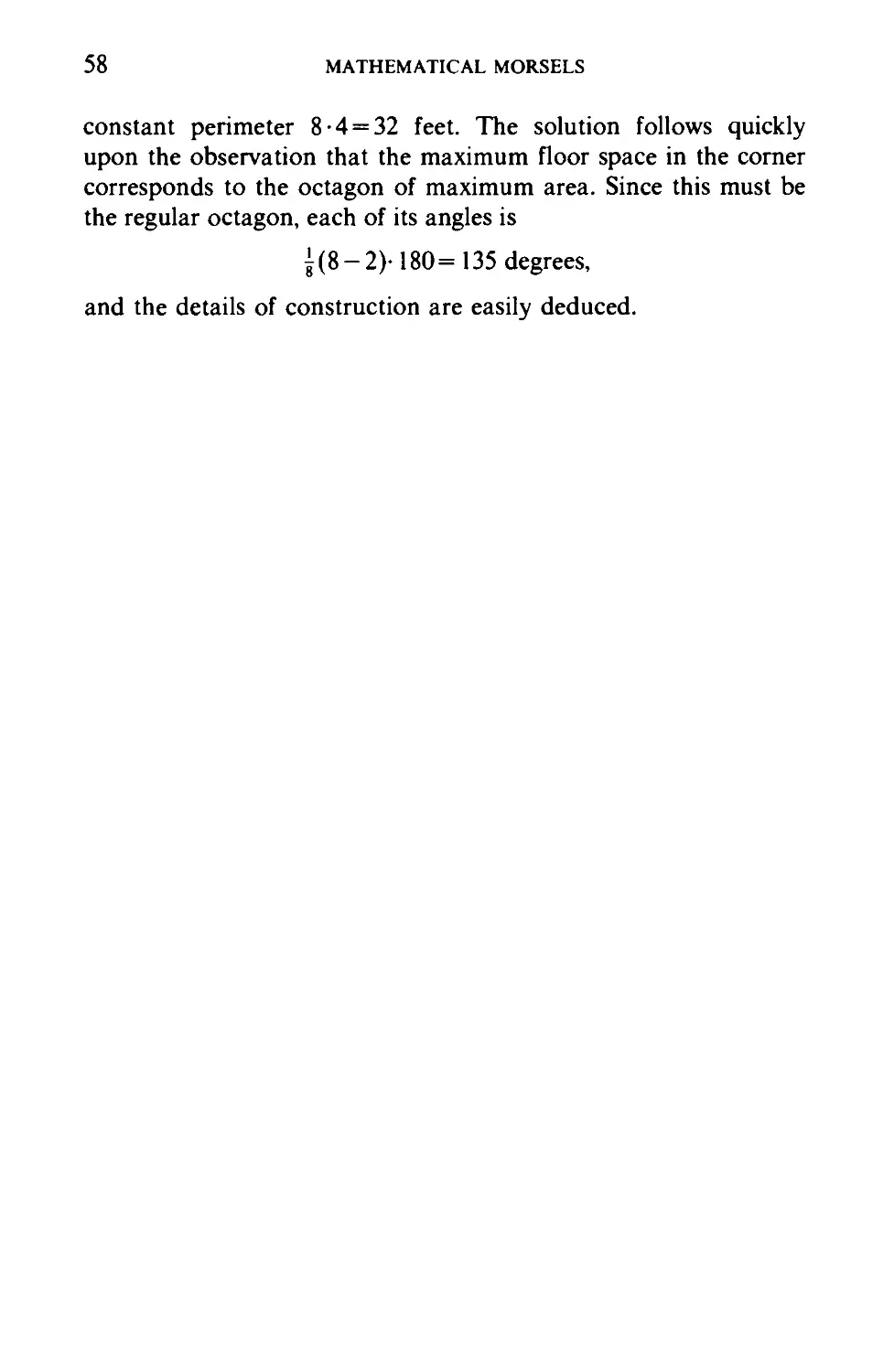
Let the corner and walls of the room be taken as the origin and
axes of a rectangular frame of reference. Let the screens be
reflected in the axes to yield the octagon PBPIAIP2BIP3A, as
shown (FIG. 31). For all positions of the screens, the octagon has
NO CALCULUS PLEASE
57
B' ,-- - - - - - - - - - - - - - - -; ("
lP""""
.4
IIIIU /' II
: wall
'r
8
('
P,
P,
FIG,30.
.\'
8
P
o
x
8,
P 1
FIG. 31.
58
MATHEMATICAL MORSELS
constant perimeter 8.4 = 32 feet. The solution follows quickly
upon the observation that the maximum floor space in the corner
corresponds to the octagon of maximum area. Since this must be
the regular octagon, each of its angles is
-k(8 - 2)'180= 135 degrees,
and the details of construction are easily deduced.
PROBLEM 26
a h AND b a *
There is often no difficulty in determining which of a h and b Q is
greater. I t is obvious that
2 3 <3 2 and 3 4 >4 3 .
However, coupling a number between 2 and 3 with one between 3
and 4 presents a problem. Which is greater
e'IT or 'TT e ?
Solution:
For positive x, we have
x 2
e<=I+x+-+'"
2!
>I+x.
Since 'TT>e, we have 'TT/e> I, and x='TT/e-1 >0. Thus
e('IT/e) '> I + ( -I)
e('IT/e) 'TT
->-
e e
e('IT/e»'TT
e'IT>'TT e .
It is an easy exercise in calculus to show that the function
eX -1- x has a single minimum value of zero (at x =0). Thus for
.Two-Year College Mathematics Journal. Vol. 6, May 1975, p. 45, "Two More
Proofs of a Familiar Inequality". by Erwin Just and Norman Schaumberger, Bronx
Community College.
59
60
MATHEMATICAL MORSELS
all real values of x we have
eX;;;'I+x.
With this relation, George Polya constructed the following beauti-
ful proof of the famous arithmetic-geometric mean inequality. Let
a l ,a2>...,a n denote positive real numbers and let A and G, respec-
tively, denote their arithmetic and geometnc means, that is,
A = (al + a 2 +'" + an)' G=(a l a 2 '" an)l/n.
Giving x in turn the values (aJ A) - I, i = 1,2, .. ., n, we obtain the
n relations
a
(a.!A)-1
e oP A ,
a
e(a,jA)-1 ;;;.
A'
a
(a / A)-I, n
e n "'-:4'
Multiplying all these together we get
QI+a2+ +a"
e -------::f-- - n a l a 2 '" an
;;;. An
which is simply
en-n G n or
oP A"'
G n
I -
oP An'
from which it follows that A ;;;. G.
Observe that A = G only if equality holds in all n relations. This
requires aJ A - I = 0 in all cases, showing that A = G only when all
the a; are equal (to A).
PROBLEM 27
A MATHEMATICAL JOKE*
A man purchased at a post office some one-cent stamps, three-
quarters as many two's as one's, three-quarters as many five's as
two's, and five eight-cent stamps. He paid for them with a single
bill, and there was no change. How many stamps of each kind did
he buy?
Solution:
Suppose the man bought y one-cent stamps. Then he bought
3yj4 two-cent stamps and 9yjl6 five-cent stamps. Since 9yjl6 is
an integer, 16 must divide y. For some integer x, then, we have
y = 16x and the purchase consisted of 16x I's, 12x 2's, 9x 5's, and
S 8's. Suppose he paid for the stamps with a k-dollar bill. Then the
cost of the stamps is
16x+2(12x)+S(9x)+8(S)= lOOk,
giVIng
8Sx+40= lOOk,
17x=20k -8,
and
20k-8 3k-8
x= 17 =k+ .
.AMM, 1936. P 48. Problem E163. proposed by W. A. Carver, Lakewood, Ohio,
solved by C. C. Rlchtmeyer, Mt. Pleasant. Michigan
61
62
MATHEMATICAL MORSELS
Since x and k are integers, it follows that
3k-8
----u- must also be a whole number.
But k must be one of the numbers 1,2, 5, 10, 20, 50, 100, 1000, or
1 ססoo . The only value of k which makes (3k - 8)/17 a whole
number is k = 1000, implying that the man bought
18,816 one's, 14,112 two's, 10,584 five's, and 5 eight's.
PROBLEM 28
MAPS ON A SPHERE*
Consider a map M on a sphere. Suppose that there are exactly 3
countries at each vertex of M and that none of its boundaries are
loops (that is, each boundary contains at least 2 vertices). The map
is colored with colors A. B, C. D so that different colors are used
for countries which share a length of common border. We use the
term "country" for all the regions in the map; we don't care which
are really countries and which are bodies of water.
A country is said to be odd or even as the number of arcs in its
boundary is odd or even. Prove that the total number of odd
countries which are colored either one or the other of two speci-
fied colors, say A and B, is always an even number.
Solution:
The question appears to be very difficult because, even if we
know that a country is colored A. we don't know if it should be
included in our count until we find out whether it is odd or even.
The following brilliant notion comes to our rescue. Each vertex V
is enclosed in a little triangle as shown (FIG. 32) (the vertex V and
a short piece of each arc at V are rubbed out and the loose ends
are joined to form a triangle). Of course, this adds an extra
triangular country at each vertex to give us a new map M'.
Although three of the four colors occur at V, there is still the
fourth color left for the new triangle. Thus these tnangles may be
.AMM. 1966. P 204. Problem E1756. proposed by J. P. Ballantine, University of
Washington, solved by Agnis Kaugars, Kalamazoo College
63
64
MATHEMATICAL MORSELS
M
M'
B
c
B
c
v
D
FIG. 32.
colored in keeping with the rule of having adjacent countries
different colors. Observe also that there are still exactly three
countries at each vertex in M'.
The effect of constructing M' is two-fold. An edge of a new
triangle is also a new edge of an existing country, thereby chang-
ing it from an odd country to an even one, or vice-versa. Thus,
when the new triangle is drawn at a vertex V, the number of odd
regions of each of the three colors occurring at V changes by one
(either up or down). But since the new triangle, itself, becomes an
odd country of the fourth color, we see that the number of odd
countries changes by one for each of the four colors. For any pair
of colors, then, the total change in the number of odd countries
having those colors is either 2, 0, or - 2, depending upon whether
the individual changes are increases or decreases. In all cases, the
total change for any two colors is an even number. Therefore the
new and old numbers of odd countries colored A or B have the
same parity. This persists through the changes at every vertex.
Thus, after constructing M', the total number of odd regions
colored A or B is odd or even as it was in M to begin with. Hence
we can obtain the desired information by considering the map M'.
Secondly, in making M', the number of edges around each
country of M is doubled. Thus, in M', all the former countries are
even. Only the new triangles are odd. We wish to show, then, that
the number of new triangles in M' which are colored A or B is
even.
MAPS ON A SPHERE
65
Now, we really don't need to draw the little triangles. Since they
are colored with the color that does not occur at V, we obtain an
equivalent situation simply by labeling each vertex of M with the
color not occurring there. Let this be done instead. We will show
that the total number of vertices which are thus labeled A or B is
even.
To this end, consider an arc which separates countries that are
colored C and D. The vertices at the ends of such a "divider"
cannot be labeled C or D since these colors occur at each of them
(FIG. 33). Therefore the ends of a divider must be labeled A or B,
accounting for two such vertices. On the other hand, if a vertex is
labeled A or B, then C and D must be included among the other
three colors which are used on the countries at the vertex. Conse-
quently, one of the edges at such a vertex must be a divider. We
have, then, that both ends of a divider are either A or B, and that
the dividers account for all the vertices labeled A or B.
Our argument concludes with the proof that no two dividers
share a common endpoint. But this is immediate. Suppose two
dividers meet at a vertex labeled A (say). The three countnes at
this vertex must be colored B, C, and D. But the edge between the
countries colored Band C is not a divider; neither is the one
between the countries colored Band D. Thus not more than one
of the edges at a vertex labeled A can be a divider.
This means that the dividers are separate. The vertices labeled A
or B, then, go together in pairs, implying that their total number is
even.
c
n
divIde,
FIG 33
PROBLEM 29
CONVEX REGIONS IN THE PLANE*
Prove that every closed convex regIOn in the plane of area." (or
more) has two points which are two units apart (FIG. 34).
Solution:
Let polar coordinates be assigned so that the region is tangent
to the polar axis at the origin. Suppose the equation of the
boundary of the region is r= f(O). Then, by the usual formula for
area, we have
A= 1 '"lr 2 dO=l ('"P(O)dO
o 2 2 )0
= 1 (,"/2 f2(0)dO+ 1 ('" f2(0)dO.
2)0 2),"/2
Changing from 0 to 0 + ." /2 in the second integral, we see that it is
equal to
i l,"/2 f2( 0+ i )d(O+ i)= i l,"/2 f2(0+ i)dO.
Hence the area is
A = i i'" /2 [ f2 ( 0 ) + f2 ( 0 + i) ] dO.
The integrand here is the square of a chord of the regIon in
.Pi Mu Epsilon, 1956, p. 185, Problem 74, proposed and solved by H HeIfen-
stein, Uruversity of Alberta.
66
CONVEX REGIONS IN THE PLANE
67
r= {(8)
(r,8)
pola, axi,
FIG. 34.
question. If no two of its points are as far apart as two units, then
all of its chords will be less than two units, with squares less than
4, and we have
I i 'IT / 2 i 'IT/2
A <- 4dO=2 dO='IT,
2 0 0
a contradiction. The conclusion follows.
We observe that, if no chord exceeds 2, then the area cannot
exceed 'IT. Therefore, if the area is known to exceed 'IT, we conclude
that some chord must exceed 2.
This work leads to some nice results in the modern subject of
combinatorial geometry. In 1911, a posthumous paper of Her-
mann Minkowski touched off a series of striking results concern-
ing closed convex regions in the plane with the now famous
theorem:
If a centrally-symmetric closed convex region of area > 4 has its
center on a lattice point, then it covers at least 2 additional lattice
points.
(A centrally-symmetric figure is one which contains a point 0
about which a half-turn carries the figure into itself.)
Having discussed this theorem in Mathematical Gems, Vol. 1, p.
68
MATHEMATICAL MORSELS
47, I will not repeat its proof here. However, a theorem which we
are in a position to handle easily is the followmg, due to Joseph
Hammer, University of Sydney (AMM, 1968, p. 157, Mathemati-
cal Notes):
If a centrally-symmetric closed convex region R of area > 'IT has
its center 0 at a lattice point, then it can be rotated about its center
to a position where it covers at least 2 additional lattice points.
Proof Since 0 is the center of R, it bisects every chord of R
that goes through it. Therefore, if there is a chord A B through 0
of length ;) 2, the chord will extend at least I unit on either side of
o and, upon being rotated about 0, will be carried into a position
to cover the two adjacent lattice points (C and D, or E and F) on
a lattice line through 0 (FIG. 35).
Since R has area > 'IT, we know that some chord A B of R must
exceed 2. Thus, if AB goes through 0, the conclusion follows. If
AB does not go through 0, then 0 is even farther than AB/2 from
one end or the other, say A. Because R is centrally symmetric, in
this case the chord A OA' is even longer than A B, and the proof is
complete.
o
E
.
c
D
o
F
e
FIG. 35.
CONVEX RbGIONS IN THE PLANE
69
It is precisely the same idea which establishes a second theorem
in Hammer's article:
If a closed convex region R of area > 'TT /2 is rotated about an
arbitrary point P of the region, then in some position it covers at least
one lattice point.
Proof If R is subjected to the geometric dilatation P (Y2 )
(that is, center P, magnification factor Y2 ), its linear dimensions
increase by a factor of Y2 and its area doubles. Since the new
area would therefore exceed 'TT, we see that the new region would
contain a chord > 2. This means that the corresponding chord A B
in R has length >2/Y2 = Y2. Now, as before, either the point P
is the midpoint of this chord A B or it is even farther than A B /2
from one of A or B. In any case, one of PA or PB exceeds Y2 /2,
say PA. But every point of the plane is at most Y2 /2 from a
lattice point (the center C of a lattice square is exactly Y2 /2
from each of the four lattice-point vertices) (FIG. 36). Thus,
rotating about P carnes the spoke P A to cover the lattice point
which is nearest P.
The regions involved in Minkowski's theorem and Hammer's
first theorem are required to be centrally symmetric. For a centr-
o
Q-------------Q
I
I
I
C I
. I
I
I
I I
I I
G-----------
o
A
o
o
o
FIG. 36.
70
MATHEMATICAL MORSELS
ally-symmetnc figure, the center of symmetry and the center of
gravity coincide. Thus these theorems could be stated equivalently
in terms of regions having their centers of gravity placed on a
lattice point. If now the requirement of central symmetry be
dropped, these theorems make sense but they are untrue. How-
ever, to our surprise, they can be salvaged by increasing the area
requirement by a factor of 1/8:
A closed convex region of area >4 , with its center of gravity at a
lattice point, covers at least 2 additional lattice points (due to E.
Ehrhart, [l));
A closed convex region of area > 917 / 8, with its center of gravity
at a lattice point, can be rotated about its center of gravity to a
position where it covers at least 2 additional lattice points (due to
Hammer, in the afore-mentioned article in the AMM, 1968).
The reader might enJoy the very brief article [2].
References
I. E. Ehrhart, Une generalisation du theoreme de MinkowskI, Comptes Rendus,
240 (1955), 483-485.
2. p, R. Scott, Lattice Points in Convex Sets. Math Mag. May 1976, 145-146
PROBLEM 30
SIMULTANEOUS DIOPHANTINE
EQUATIONS.
Solve the following system of equations in natural numbers:
a 3 - b 3 - c 3 =3abc,
a 2 =2(b + c).
Solution:
Since 3abc is positive, a 3 must be greater than either b 3 or c 3 ,
glvmg
b<a and c<a.
Adding gives b+c<2a, and therefore 2(b+c)<4a. From the
second equation, then, we have
a 2 <4a, and a<4.
But the second equation also shows that a is an even number.
Thus a must be 2, and the lesser band c must each be I.
°AMM, 1958, Problem EI266, proposed by D. C. B. Marsh, Colorado School of
Mines, solved by Raymond Huck, Manetta College.
71
PROBLEM 31
A REFLECfED TANGENT*
A and B are two circles on the same side of a line m. Construct
a tangent to A which, upon reflection by m, is also a tangent to B
(FIG. 37.)
FIG. 37.
*AMM, 1901, p. 144, Problem 152, proposed by Elmer Schuyler, ReadIng,
Pennsylvania, solved by Marcus Baker, Waslungton D.C.
72
A REFLECTED TANGENT
73
Solution:
Reflect B in the line m to get B'. Then the common tangents of
A and B' yield the four possible solutions. (Tangents to B' reflect
in m into tangents to B.) (FIG. 38)
FIG. 38.
PROBLEM 32
THE ELEGANTLY DESTROYED
CHECKERBOARD*
If all the black squares are removed from an ordinary 8 X 8
checkerboard, the board loses the ability to hold even a single
2 X I domino. However, no matter which black square is returned
to the board, it regains this ability. Such a reduced checkerboard is
said to be "elegantly destroyed."
Now it is not necessary to take away all the black squares (or all
the white ones) in order to destroy the board. Various mixtures of
black and white squares suffice. Thirty-two dominos cover a
checkerboard in an obvious way (FIG. 39) and, unless each of
FIG. 39.
.This problem and solution are due to Sidney Penner. Bronx Community
College, City Uruversity of New York
74
THE ELEGANTLY DES [RaYED CHECKERBOARD 75
these 32 pairs of adjacent squares is ruptured, the board will retain
its ability to hold a domino. Therefore, in order to destroy a
board, a minimum of 32 squares must be deleted.
On the other hand, it turns out to be possible to remove more
than 32 squares in making an elegantly destroyed board. Of
course, many wholesale reductions will destroy a board. The trick
is to arrange things so that the return of any deleted square again
renders the board capable of accommodating a domino. In view of
this rather stringent constraint, the maximum number of squares
that can be deleted in making such a board is surprisingly large.
Determine this maximum.
Solution:
The board consisting of the shaded squares in FIG. 40 demon-
strates that it is possible for an elegantly destroyed board to retain
only 16 squares. We shall show that fewer than 16 squares is
impossible by proving that, in every reduction of more than 48
squares, there is at least one square, which we denote X, whose
return to the board fails to restore its capability of holding a
domino.
If as many as 4 squares were to be left in each quarter of the
board, a total of at least 16 squares would remain. In a board with
FIG,4O.
76
MATHEMATICAL MORSELS
fewer than 16 squares, then, there must be some quarter, say the
upper left one, which retains no more than 3 of its squares.
Consequently, some quarter of this quarter of the board must have
been completely demolished. We consider, in turn, the four possi-
ble positions A, B, C, D for this vacant quarter of the quarter-
board (FIG. 41).
(a) If the vacant quarter is A, then the return of the very corner
square X still does not permit the board to accept a domino (FIG.
42).
A D
B C
FIG. 41.
A
x
FIG. 42.
(b) Suppose the four squares E, F, G, H of section Bare
deleted, and suppose the squares around B are labeled as shown in
THE ELEGANTLY DESTROYED CHECKERBOARD 77
B___
p Q
E F R
H G S
U T
FIG. 43.
FIG. 43. Now, unless the square P is retained, the return of E will
not restore the board's capability of accepting a domino, and our
search for an impotent square X will be at an end. Suppose,
therefore, that P is retained. In this case, the adjacent square Q
must have been deleted in order to "destroy" the board.
Around F, then, we have empty squares Q, E, and G, implying
that either R is retained or X == F ends our search. Suppose that R
is kept. Then the adjacent S must have been removed. Considering
G, we achieve a desired impotent square X == G unless T is
retained, which necessitates U being deleted. In all this, then, we
have either found a suitable X or deduced that the square U is
deleted, implying that all three squares which are adjacent to H
are missing, giving X == H. Therefore an X can be found in any
case.
The equivalent quarter D is handled identically.
(c) It remains only to consider the vacant quarter in position C.
Let the labeling of FIG. 43 be extended as shown in FIG. 44. The
section C consists of the squares R, S, W, V.
Consider first the square R. Since V and S are deleted, either F
or Y must be retained or we have X == R. Since F and Yare
similarly positioned relative to the quarter C, the cases are equiv-
alent. Suppose, for definiteness, that Y is retained. In this case, we
78
MATHEMATICAL MORSELS
0 I
P Q y Z
E F R V J
If G S W K
N M
FIG. 44.
can work our way around C, as we did above around B, to
discover an impotent square X (V, W, or S) or to find that Y, J,
M, and G must be retained and Z, K, N, and F must be deleted.
Thus either we obtain X or the two squares Y and G must be
retained in the upper left-hand quarter of the board. But recall
that, in this quarter-board, at most 3 squares are retained alto-
gether.
If two of these are Y and G, there can be at most one additional
square which is retained in this entire quarter of the board.
If the outer comer 0 is also kept, then P, E, H, and F must be
removed, yielding X == E. And if 0 is not retained, we easily
complete the argument as follows. If P is kept, then X == I.
Suppose, then, that P is deleted. Because Y is kept, Q must be
deleted. In the event that E is also deleted, we have X == P (since 0
is gone). If E is retained, making the three retained squares Y, G,
and E, then X == I.
PROBLEM 33
THE SNOWBALLS.
A boy makes two snowballs, one having twice the diameter of
the other. He brings them into a warm room and lets them melt.
Since only the surface of a snowball is exposed to the warm air,
assume that the rate of melting is proportional to the surface area.
When half the volume of the larger one has melted away, how
much is left of the smaller one?
Solution:
We shall prove that the assumption that a snowball melts at a
rate which is proportional to its surface area leads to the striking
result that the radius decreases at a constant rate regardless of its
size. As a consequence, both radii will shrink by the same amount.
The volume and surface area, respectively, are V = 4'ITr 3 /3 and
S=4'ITr 2 . Letting t denote time, the rate of melting is
dV = i'IT'3r 2 . dr =4'ITr 2 . dr .
dt 3 dt dt
Since this is proportional to S=4'ITr 2 , we have
4'ITr2. dr = k ( 4'ITr2 )
dt '
where k is a constant, gIving
dr =k
dt '
as claimed.
*MM, 1944-45, p. 96, Problem 557, proposed by E. p, Starke, Rutgers Univer-
sity, solved by Frank Hawthorne, New Rochelle, New York.
79
80
MATHEMATICAL MORSELS
Suppose the radii at the beginning are 2r and r. The larger ball,
then, has volume
v= 1 7T (2r)3= 3} 7Tr 3 .
When half melted, it has volume
v= 13 6 7Tr 3 = 17T( .r)3,
implying a radius of 'r. Accordingly, each radius has shrunk
by an amount (2 - )r. The smaller, then, still has radius
r-(2- )r=r( -I).
The amount left in the smaller ball is therefore
v= j7Tr3( _1)3,
which is very nearly 1/5 of its onginal volume « -1)3=.2027
approximately).
PROBLEM 34
WRITING THE NUMBERS FROM ONE TO
A BILLION*
What is the sum of all the digits used III writing down the
numbers from one to a billion?
Solution:
Throwing III zero, we can form one-half a billion pam of
numbers
(0; 999,999,999), (I; 999,999,998), (2; 999,999,997),...,
(499,999,998; 500,000,(01), (499,999,999; 500,000,(00),
the sum of the digits in each pair being 9.9 = 81. Including I for
the sum of the digIts in the neglected 1,000,000,000, the required
sum is simply
500,000,000(81) + I = 40,500,000,00 I.
.Scnpta Mathematica, 1950, p 126, Cunosa 224, by Leo Moser.
81
PROBLEM 35
ABUTTING, NONOVERLAPPING UNIT
SQUARES*
Let a unit square S in the plane be fixed in position. What is the
maximum number of nonoverlapping unit squares which can be
placed up against S so as to touch S but not overlap it? (FIG. 45.)
FIG. 45,
.AMM, 1939, p, 20, article "A Lemma on Squares" by J W. T, Youngs, Ohio
State U ruversity.
82
ABUTIING, NONOVERLAPPING UNIT SQUARES 83
Solution:
A 3 X 3 checkerboard pattern provides 8 abutting squares and
certainly seems to be an arrangement in which the squares are
packed as tightly as possible (FIG. 46). Having felt this to be the
case for a long time, but utterly unable to prove it, I was surprised
and delighted one day to run across J. W. T. Youngs' marvellous
proof while browsing through the 1939 volume of the American
Mathematical Monthly.
1///////
/sA
1/1/ I/:i
FIG. 46.
From the diagrams (FIG. 47), it is clear that
(i) the distance between the centers of two nonoverlapping unit
squares is ;> I, and
(ii) the distance between the centers of two abutting unit
squares cannot exceed V2 .
Let A and B denote the centers of two of the squares which abut
the fixed square S, with center 0 (FIG. 48). Let OA = x, OB = y,
and AB= t. Then by (i) and (ii) above, we have
x,y,t;> I and x,y;;;;;V2 .
There could possibly be a gap separating the squares with centers
A and B, thus allowing t to range > V2. Since none of the
squares overlap, however, we do have t ;> I.
84
MATHEMATICAL MORSELS
(i)
Iii)
(There is at least one
point of contact R)
P
Q
P
PV;. . WR ;. .
giving PR ;. I
PQ<;. PR+RQ<;. 4- +4--y'2
(4- is one-half the diagonal).
FIG. 47.
Now, if 0, A, and B were to be collinear, say in that order, the
distance OB = y would have to be at least 2 units, exceeding its
limit of V2 . Hence OA and OB are distinct lines radiating from 0
(FIG. 48). Consequently, joining 0 to all the centers of the squares
which abut S provides a fan of distinct lines through 0, containing
a line for each square.
Suppose, now, that OA and OB are consecutive lines in the fan
and that the angle they make at 0 is denoted 0, as shown. The law
of cosines applied to D. OA B yields
t Z = XZ + yZ - 2xy cosO,
from which
XZ+ y2_ t 2
cos 0 = 2xy
Since t;> I, we have
x2+yZ-l
cosO <:; 2
xy
which we denote f(x,y). Recalling that 1<:; x,y <:; V2 , we see that
o
ABUTIING, NONOVERLAPPING UNIT SQUARES 85
B
FIG. 48.
f(x,y) is positive. We now proceed to show that, for the x and y
under consideration, f (x,y) never exceeds 3/4.
For the reader who is not familiar with partial differentiation, a
detailed elementary derivation is given in the Appendix. We have
Similarly,
2xy(2x)-(x 2 + y2-1)(2y)
1,=
x (2xy)2
x(2x) -(x 2 + y2-1)
2xy
x2-y2+1
2xy
_X 2 +y2+ I
1;,= 2 2
xy
For I x,y Vi , it is clear that both fx and 1;, are nonnegative.
Therefore the value of f is nondecreasing as x increases and as y
increases, implying that f(Vi , Vi) is as great as any f(x,y)
86
MATHEMATICAL MORSELS
under consideration. That is to say
f (x,y ) <;, f (-...[i , -...[i ) = 2 + 2 - I = % .
2.-...[i .-...[i
We see, therefore, that the angle () between OA and OB is such
that
cos()<;, .
However, from a set of tables we learn that cos 40° = .76604... .
Thus
cos () < cos 40° .
This means that () > 40°, implying that, in the 360°-sweep of the
fan of lines radiating to the centers of the abutting squares from
0, there is not enough room for as many as 9 such angles (), each
>40°, giving the maximum number of abutting squares to be 8.
A similar, much easier problem was asked in the American
Mathematical Monthly (1962, p. 808) by D. J. Newman and W. E.
Weissblum, Yeshiva University:
Six closed circles in the plane are such that none contains the
center of another. Prove that they cannot have a point in common.
Solution:
Suppose that some point 0 is common to all the circles. Let 0
be joined to the 6 centers to form a fan of lines at O. If two
centers A and B were to lie on the same ray through 0, then,
because each circle contains 0, it is evident that one circle must
contain the center of another (a contradiction). Thus 6 different
lines occur in the fan (FIG. 49).
Let A and B denote two centers such that OA and OB are
consecutive lines in the fan. Let r denote the greater of the radii of
the circles with centers A and B (their common value if they are
equal). Then, because no circle contains the center of another, A B
must exceed r. But, since both the circles, centers A and B, contain
0, neither of OA and OB can exceed r. Thus, in D.OAB, AB is
definitely the longest side, making the angle AOB greater then
ABUTIING, NONOVERLAPPING UNIl SQUARES 87
8
A
o
FIG 49.
either of the other angles. Consequently,
angle AOB >60°,
which means that the fan of 6 lines contains a total of more than
6(60) = 360 degrees, which is impossible.
Appendix:
The graph of the function z=f(x,y)=(x 2 +yl-l)/(2xy) is a
3-dimensional surface (FIG. 50). We are interested only in the part
G which lies directly above the square I x, y Vi in the
xy-plane. Let K(a,b) denote any point in this square and let
P(a,b,z) denote the point on G directly above K. Consider the
line L of points in the square which have the same y-coordinate as
K. The plane 7T through L which is perpendicular to the xy-plane
intersects G in some curve C. Being on G, all the points of C have
coordinates which are related by
Xl+ y2_1
z=
2xy
However, lying in the plane 7T, they all have y = b. Hence, for the
curve C, we have
Xl + b l - I
z = 2bx
This is a function of the single variable x and the slope of the
88
MATHEMATICAL MORSELS
z
T
x
FIG. 50.
tangent T to the curve C at the point P on it is simply the value of
dz / dx at the point P. We have, after simplification,
dz_ x2-b 2 +1
dx - 2bx 2
Since x;> I, then x 2 + I ;> 2, and since b Vi, the numerator
x 2 - b 2 + 1 ;> O. Because the denominator is positive, we conclude
that the slope of the tangent at each point of C is nonnegative.
That is to say, as one moves along C in the direction of increasing
x, the value of z does not decrease. Hence the endpoint M of L
provides a point on G which is at least as far above the xy-plane as
any point on G which is directly above L.
By running the line L and the plane 7T parallel to the y-axis, we
similarly obtain a curve C', given by
a 2 +y2-1
z=
2ay
For points on C' we have
dz = _a 2 +y2+ I
dy 2 ay 2
ABUTIING, NONOVERLAPPING UNIT SQUARES 89
which is also seen to be nonnegative for the y and a in question.
Thus, one remains at least as far above the xy-plane by moving on
G so as to increase y while keeping x constant. We conclude that,
beginning at any point K (a, b) in the square, one at no time lies
under a part of G which is closer to the xy-plane if one moves
along L to M and then along the edge of the square to the corner
N. Consequently, no point of G is farther from the xy-plane than
the point H which is directly above N. Thus the point N(x,y),
which is N (Vi, Vi ), provides the maximum value of f(x,y) for
(x,y) in the square in question. And this maximum value is
2+2-1 _ 3
2.Vi.Vi -4'
PROBLEM 36
A DIOPHANTINE EQUA TION*
Let a,b,e,d be integers, with a*O. Prove that, so long as
be - ad*O, the equation
axy + bx+ ey + d=O
has only a finite number of solutions (x,y) in integers.
Solution:
Multiplying by a, we get
a 2 xy + abx + aey + ad = 0,
and
(ax + e)( ay + b) = be - ad.
This means that each of ax + e and ay + b is a divisor of be - ad.
Since be - ad*O, it has only a finite number of divisors, implying
a finite number of possible values for ax + e and ay + b, and a like
number of x and y.
We observe that the graph ofaxy + bx + ey + d = ° is a hyper-
bola. If be - ad = 0, the equation reduces to
(ax + e)( ay + b) = 0,
and the hyperbola degenerates into a pair of straight lines parallel
to the axes. Clearly the integral solutions (x,y) of the equation
correspond to the lattice points on the graph. Thus, even for
be-ad=O, there is only a finite number of integral solutions
°AMM, 1964, p. 794, Problem E1631, proposed by Roy Feinman, Rutgers
Uruversity, solved by Richmond G. Albert, West Newton, Massachusetts.
90
A DIOPHANTINE EQUATION
91
unless, in addition, a divides either c or b, which places a line of
the degenerate curve in coincidence with a lattice line (parallel to a
coordinate axis).
The following neat solution to this problem was pointed out by
my colleague Leroy Dickey. The hyperbola given by a + bx + cy
+ d = 0 happens to have asymptotes which are parallel to the axes
of coordinates. This may be seen to be the case by observing that
the translation
x=X-
a'
b
y=Y--
a
transforms the equation into
a ( X - ) ( Y - ) + b ( X - ) + c ( Y - ) + d = 0,
aXY + k =0, where k is a constant,
yielding XY = (a constant), the standard equation of a hyperbola
referred to its asymptotes as axes. Because of this, as the curve
approaches its asymptote, there comes a time when it crosses a
lattice line for the last time, thereafter to remain in a channel
between a pair of adjacent lattice lines. This is true even when an
asymptote coincides with a lattice line, for a hyperbola does not
cross its own asymptote. Once in such a channel, the infinite tail
of the curve encounters no more lattice points (FIG. 51). Conse-
quently, the lattice points which the hyperbola does encounter all
lie in a finite part of the plane and therefore must be finite in
number.
1//////1/
Id,t lattiee
" a'}ffiptote
ehannel wntaining
no lattice point"
FIG. 51
PROBLEM 37
THE FIBONACCI SEQUENCE*
The sequence of natural numbers
Un}: 1,1,2,3,5,8,13,21,34,55,...,
where
fl=f2=1 andfn=fn-l+fn-2 for n>2,
is called the Fibonacci sequence and is one of the most popular
sequences in mathematics. In fact, it is so rich in properties and
generalizations that an entire journal, The Fibonacci Quarterly, is
dedicated to the investigation of this sequence and topics related
to it.
Our problem is simply how many terms of the Fibonacci
sequence are less than or equal to a given natural number N?
Solution:
It has been known for well over a century that the nth term of
the Fibonacci sequence is
fn= Js [( 1+;S r -( l-;S r]-
(For a very neat proof of this formula see Ross Honsberger:
Mathematical Gems, Vol. I, Dolciani Mathematical Expositions,
Mathematical Association of America, pp. 171-2.) Now, v'5 is
.AMM, 1964, p. 798, Problem E1636, proposed by J. D. Cloud, North Amencan
Aviation, Inc., solved by William D. Jackson, State University CoUege, Oswego,
New York
92
THE FIBONACCI SEQUENCE
93
approximately 2.2, making
1-v'5 '
2 = -.6 approxImately.
Thus «(1- v'5 )/2t is positive or negative as n is even or odd and,
for all n= 1,2,..., the quantity
--L ( I-v'5 ) n
v'5 2
has magnitude < 1/2. But j" is a whole number. Since
1- Js ( l-;S rI<i,
the formula shows that j" must be the natural number which is
nearest to
--L ( 1+ v'5 ) n.
v'5 2
It is also clear that
--L ( 1+ v'5 ) n
v'5 2
is closer than 1/2 to the integer which is nearest to it. Therefore it
can never be true that
--L ( 1+ v'5 ) n = N +!.
v'5 2 2
For a Fibonacci number fn < N, then, we must have
--L ( 1+v'5 ) n <N+!
v'5 2 2
(lest the nearest integer, fn' exceed N). Conversely, it is clear that,
if
--L ( 1+ v'5 ) n < N + !
v'5 2 2'
the nearest integer must be < N. Therefore we have fn < N if and
94
MATHEMATICAL MORSELS
only if
-.L ( 1 + v'5 ) n < N + 1
v'5 2 2'
C+:S r «N+1)v'5,
no log ( I + 2v'5 ) < log { ( N + 1) v'5 },
log { ( N + 1 ) v'5 }
n<
log ( I +:S )
Now, it is easy to see that this ratio of logarithms is never an
integer. Suppose, to the contrary, that
log { ( N + 1 ) v'5 }
log ( I +:S )
= k, an integer.
Then
{ ( I ) , rr } ( I + v'5 ) ( I + v'5 ) k
log N + 2. v 5 = k. log 2 = log 2 '
( N + 1) v'5 = ( I +:S ) k, and Js ( I + 2v'5 ) k = N + 1,
contradicting the result above.
Since n is an integer, we see that the greatest Fibonacci number
..; N, corresponding to the greatest permissible value of n, is the
THE FIBONACCI SEQUENCE
95
term for which
log { ( N + i ) V5 }
n=
10g C +:S )
where [x] denotes the greatest integer ..; x. Since the first two
terms are the same, we see that the number of different values
among these Fibonacci numbers is I less than this number n.
Consider now the problem of determining the number of ways
of making a selection from the numbers 1,2,3,..., n without taking
a pair of consecutive numbers (counting the empty set as a
selection).
Solution:
Suppose we let an _ I denote the number of selections for the
numbers 1,2,3,..., n - I. Consider, then, the an selections from
1,2,3,...,n. Such a selection either contains the number n or it
doesn't. If it doesn't, then it is one of the an-I selections from
1,2,3,...,n-1. If it does, then the number n-l must be avoided
(since n - I and n are consecutive), implying the remaining part of
the selection is one of the an _ 2 from 1,2,3,..., n - 2. Of course, it is
not necessary to select more than just the number n, itself. This
corresponds to the selection of the empty set from 1,2,3,..., n - 2
(this is why the empty set is included in the count). Thus, alto-
gether, we have
an=an-l+an-2°
Since a l = 2 and a 2 = 3 are easily calculated, we see that the
sequence proceeds 2,3,5,8,..., and a n =f,,+2> the (n+2)th term of
the Fibonacci sequence.
PROBLEM 38
AN ERDOS INEQUALITY*
ON is the radius which is perpendicular to chord AB in a circle,
center 0, meeting AB at M. P is any point on the major arc AB
which is not diametrically opposite N. PM and PN determine,
respectively, Q and R on the circle and AB (FIG. 52). Prove that
RN is always longer than MQ. (Surprisingly, many people, on a
quick guess, choose MQ to be the longer.)
A
B
N
FIG. 52.
Solution I (Paul Erdos):
Let the reflection of PN in the diameter NON' be P' N (FIG.
53). Because AB is perpendicular to ON, this reflection carries R
into the intersection R' of P' Nand AB. Hence RN= R' N.
· A geometnc mequality of Paul Erdos, received by personal commurucation,
1975.
96
AN ERDOS INEQUALITY
97
N'
B
FIG. 53.
Now PP' and AB are both perpendicular to diameter NON'.
Hence they are parallel, giving equal corresponding angles N R' M
and NP' P. But, in the same segment we have L NP' P= L NQP.
Thus LNR'M= LNQM, implying QNMR', is cyclic.
Since R' N subtends a right angle at the circumference of this
circle (at M), it is a diameter. However, the angle subtended at the
circumference by the chord QM, namely L MNQ, is seen not to be
a right angle (since NN' is a diameter of the given circle, L NQN'
is a right angle, implying, in QNN', that L QNM is not).
Consequently, the chord QM is less than the diameter R' N = RN.
Solution II (Peter Crippen, Scarborough, Ontario):
Let x and y, respectively, denote L P and L PMR (FIG. 54).
Then the angle QON at the center is 2x, the base angles in
isosceles triangle OQN are each 90° - x, and the other angles are
easily calculated to have the sizes shown in the figure. Applying
the law of sines to MQN we have
QM
sin (90- x)
MN
sin (x + y) ,
98
MATHEMATICAL MORSELS
A
B
FIG. 54.
and applying it to M N R we get
MN
sin(x + y)
_ RN
- sin 90 .
Thus
QM _ RN
sin (90 - x) - I .
Since sin(90-x)<l, it follows that QM<RN.
A splendid solution was published by the promising high school
student Mark Kleiman, New York City, in Math. Mag., 49 (1976),
217-218.
PROBLEM 39
SHARING LATTICE POINTS.
The segment which joins A(p,O) to B(O,p) passes through the
p-I lattice points (l,p-l),(2,p-2),...,(p-l, I). The p-l lines
from these points to the origin 0 divide OA B into p little
triangles. Clearly, the two outer little triangles, each having a side
along an axis, contain no lattice points of the plane in their
interiors. If p is a prime number, it is also true that none of the
partitioning segments from the origin contain any lattice points
(FIG. 55). Prove that, for p a prime, all the lattice points inside
OAB are in the interiors of the p - 2 inner little triangles and
that they are shared equally by them.
Solution:
Let C(a,b) denote a lattice point inside OAB. The slope of
the line OC is b / a. If C were to lie on a dividing segment, say the
one to (i,p - i) (l"; i..; p - I), the slope of OC would also be
(p-i)/i. Then b/a=(p-i)/i. But, since i<p andp is a prime, i
and p - i are relatively prime. However, C is closer to 0 than
(i,p - i). Thus a and b are less, respectively, than i and p - i. The
equation b/a=(p-i)/i, then, indicates that the fraction (p-i)/i
is not in its lowest terms, but bears reduction to b / a. This
contradicts the fact that i and p - i are relatively prime, and we
conclude that all the lattice points inside OAB occur in the
interiors of the p - 2 inner triangles.
.AMM, 1%1, p, 806, Problem EI455, proposed by M. T. L. Blzley, London,
England, solved by C. M, Superko, Michigan College of Mmmg and Technology.
99
100
MA THEMA TICAL MORSELS
y
B (O.p)
(p-I.I)
A(p.O)
FIG. 55.
Observe that AB is divided into equal parts by the lattice points
(i,p - i). This implies that all the little triangles have the same
area. Since each vertex is a lattice point, we may use Pick's
theorem to determine their area.
PICK'S THEOREM. The area of a polygon whose vertices are
lattice points (and which does not cross itselj) is given by
p
Q+'2- I ,
where q denotes the number of lattice points inside the polygon and p
denotes the number of lattice points on the boundary (this includes
the vertices and any other lattice points on the sides).(See the
reference for a beautiful proof of Pick's theorem.)
SHARING LATfICE POINTS
WI
Because there is no lattice point between (i,p - i) and (i + l,p - i-
I), we find the area of each inner little triangle to be
3
q+ '2-1.
Since this is the same for all inner triangles, q must be the same for
them all, showing that they share the interior lattice points of
L:-.OAB equally.
It is easy to compute the value of q. Each little triangle has area
(I/p)(L:-.OAB), which is
(i.p.p) = .
Thus
3 p
q+'2- 1 =2'
, p-I
gIVIng q = --y- .
Reference
Ross Honsberger, Ingenuity in Mathematics, vol. 23, New Mathematical
Library, Math. Assoc. of Amenca, 27-31.
PROBLEM 40
PERFECT NUMBERS.
The ancient Greeks discovered that some natural numbers n
have the remarkable property that the sum of the proper divisors
of n is just the number n, itself. For example, n = 28 yields
1+2+4+7+ 14=28.
Such numbers they called "perfect." In terms of the arithmetic
function G(n), which denotes the sum of all the positive divisors of
n (including n, itself), n is perfect if G(n)=2n. Perfect numbers
seem to be very rare. The first five are 6, 28, 496, 8128, 33550336,
and in 1976 a total of only 24 perfect numbers are known, the
greatest being 2 19936 (219937 - I), containing over 6000 digits.
In the eighteenth century, Euler proved that every even perfect
number m can be expressed in the form
m =2n-I(2n - I),
where 2 n - I is a prime number.
(For Leonard Eugene Dickson's marvellous proof of this result
(1911), see my book Ingenuity in Mathematics, vol. 23, in the New
Mathematical Library Series, Mathematical Association of
America, page 113 ff. The following two easy results (needed
below) are also derived there:
(i) G(n) is multiplicative, i.e., G(ab)= G(a)'G(b), provided a and
b are relatively prime.
(ii) If 2 n - I is a prime number, then so is the exponent n (page
124). )
°AMM, 1975, page 1015. Problem E2500, proposed by RIchard Herr, Uruversity
Park, Pa, solved by M G, Greening, University of New South Wales, Australia
102
PERFECT NUMBERS
103
In the light of this background, the present problem challenges
us to find all the perfect numbers n for which G[G(n)] is also a
perfect number.
Solution:
First of all, suppose that n is an odd perfect number. Then
G(n)=2n, where 2 and n are relatively prime, giving
G[ G(n) ] = G(2n) = G(2)'G( n) = 3 'G(n) = 3(2n) = 6n.
Clearly 6n is even, and if it is also a perfect number, then, for
some prime p, we must have
6n=2 p - I (2 P -l)
(p must be a prime because 2 P - I is a prime). However, because n
is odd, 6n contains merely a single factor 2 (in the 6). This implies
that
2 P - I =2 1 , makingp=2.
Accordingly,
6n = 2(2 2 - I) = 6, implying n = l.
But I is not an odd perfect number, and we have a contradiction.
Thus there are no odd perfect numbers n such that G[G(n)] is also
a perfect number.
Suppose, then, that n is an even perfect number. As such, for
some prime p, it can be written
n = 2 P - I (2 P - I), where 2 P - I is a prime number.
In this case, 2 and 2 P - I are relatively pnme, and we have
G[ G(n)] =G(2n)=G[2 P (2 P -l)] =G(2 P )'G(2 P -l)
=(2 P + 1 -l)[(2 P -I)+ I] (since 2 P -l is a prime)
=2 P (2 P + I -l).
This is clearly even, and if it is also a perfect number, it is already
in the Eulerian form for such a number, implying that the expo-
nentp+ I must be a prime number. Thusp andp+ I must both be
104
MATHEMATICAL MORSELS
prime numbers and, since they are consecutive, they can only be 2
and 3. Accordingly,
n=2 P - I (2 P -I)=2(2 2 -1)=6
and
11[ l1(n)] = 11[ 11( 6)] = 11( 12) = 28.
Therefore n = 6 is the only solution.
PROBLEM 41
THE SIDES OF A QUADRILATERAL*
Prove that if the lengths of the sides of a quadrilateral are
integers (relative to some unit of length), and if the length of each
side divides the sum of the lengths of the other three sides, then
some two of the sides are equal.
Solution:
Suppose that no two of the sides are equal. Then let the lengths
of the sides be denoted SI > S2 > s) > S4 and let p denote the
perimeter. We are given that sjlp-sj for i= 1.2,3,4. In this case,
we have also that Sjlp. But how often can Sj divide into p?
Consider the case of SI' the length of the longest side. The sum
of any three sides of a quadrilateral always exceeds the fourth side
(the three sides constitute the "long way" around the quadrilateral
from one end of the fourth side to the other). Thus SI cannot be as
great as one-half the perimeter: SI <p /2. However, SI must exceed
one-quarter of the perimeter since it is the length of the longest
side (otherwise all four sides would not add up to p). Hence
p p
4"<SI<'I'
This implies that SI divides into p more often than twice but not as
many as four times. Consequently, it must divide into p three
times, and we have SI = P /3.
°MM, Problem Q315. proposed by D. L Silverman,
105
106
MATHEMATICAL MORSELS
Because S2 < SI' S2 must divide into p more often than SI does,
implying that pi S2;;' 4, and S2 < pi 4. Again, since S) < S2' we have
pis);;' 5, and s) < p15. Similarly, S4 < p16. Therefore
p = SI + S2 + s) + S4
p p p P 57
< 3" + 4" + "5 + '6 = 60 P <p,
a contradiction. Hence some two sides of the quadrilateral must be
equal.
PROBLEM 42
PRIMES IN ARITHMETIC PROGRESSION*
Show that, in any arithmetic progression of natural numbers
with common difference less than 2000, it is impossible for as
many as 12 consecutive terms all to be prime numbers.
Solution:
Suppose that the n consecutive terms of an arithmetic progres-
sIOn
a, a+d, a+2d....,a+(n-l)d
are all prime numbers, n ;;. 3. If a < n, one of these terms would be
a + ad = a(l + d), which is not a prime since each of a and I + d
exceeds I. Therefore we must have a;;' n ;;. 3.
Let p denote a prime number < n. and suppose that p does not
divide d. Consider, then. the first p terms
a. a+d,.a+2d,...,a+(p-l)d.
Let rOJl,...Jp-1 denote the p remainders obtained by dividing
these terms by p. Since each term is prime, and p < n < a (the least
term). we see that p does not divide any of these terms and that no
remainder is O. Because these p remainders are drawn only from
the p - I nonzero remainders 1,2,...,p - I. the Pigeon-hole Princi-
ple shows that some two of them are equal, say r j = 'j (i =t= j). This
implies
a+ id===a+ jd (modp),
°AMM, 1934, p, 519. Problem E83. proposed by Morgan Ward. California
Institute of Technology, solved by E P Starke. Rutgers University
107
108
MATIIEMATICAL MORSELS
and
(i - j)d =0 (mod p).
That is to say, p divides (i - j)d. But p is a prime and it does not
divide d. Therefore we must have pli - j. However, since i and j
are both positive integers less than p, the only way for pli - j to be
possible is for i - j = 0, leading to the contradiction i = j. Thus a
prime p < n must divide d.
A string of n = 12 consecutive prime terms, then, would require
d to be divisible by every prime less than 12, namely 2,3,5, 7, and
II. Accordingly, d would have to be a multiple of 2.3.5.7. II =
2310, which exceeds 2000, and the conclusion follows.
W. Sierplnski's marvellous book Theory of Numbers (1964) con-
tains much interesting material on this topic (pp. 121-125). For
example, the 10 consecutive terms in the arithmetic progression
199,409,619,...,199 + 9(210)
are all prime numbers; also the 13 terms
4943 + k(60060), k=O, I...., 12 are all primes.
In order to have n = 5 consecutive terms of an arithmetic progres-
sion prime numbers, it is necessary that 2 and 3 divide the
common difference d. Therefore d must be a multiple of 6. For
d= 6, we have the example
5, II, 17, 23, 29.
However, this is the one and only time that 5 consecutive terms
are primes in any arithmetic progression with d = 6. The reason for
this is that any 5 consecutive terms in such a progression
a, a+6, a+2.6, a+3.6, a+4.6
must contain a multiple of 5. We have a+i.6=a+i (mod 5). No
matter what a is congruent to modulo 5, one of the values
i=O, 1,2,3,4 makes a+i=O (mod 5). For prime terms, then, one
must be 5, itself. In fact, 5 must be the very first term (since
5 - 6 = - I could not precede 5) and 5, II. 17,23,29 results.
PROBLEM 43
ON CEVIANS*
Suppose BC is the longest side of 1:-.ABe. Let a point 0 be
chosen anywhere inside the triangle and let AO, BO, CO cut the
opposite sides in A', B', C', respectively. Prove that
OA' + OB' + OC' < Be.
Solution:
A segment which runs through a triangle from a vertex to the
opposite side is called a "cevian". Clearly, a cevian is shorter in
length than the longer of the two sides which meet at the vertex
from which it is drawn. Accordingly, the longest side of a triangle
exceeds all its cevians. Hence BC is longer than each of AA', BB',
CC'.
Let OX and OY be parallel, respectively, to AB and AC to give
1:-.0XY similar to 1:-.ABC (FIG. 56). Since BC is the longest side of
1:-. A BC, the corresponding .side X Y is the longest side of 1:-.0 X Y.
Thus XY>cevian OA'.
Let XS and YT be parallel, respectively, to CC' and BB'. Then
1:-. BXS is similar to 1:-. BCC'. Clearly BC is the longest side of
1:-.BCC', and the corresponding BX is the longest side of 1:-. BXS.
Hence
BX > SX = OC' (in parallelogram C'SXO).
Similarly,
YC> YT= OB'.
*AMM, 1937, p. 400, Problem 3746, and 1940, p, 575, Problem 3848, both
proposed and solved by Paul Erdos,
109
110
MATHEMATICAL MORSELS
A
B
x
A'
y
c
FIG. 56.
Adding, we have
OA'+OB'+OC'<XY+ YC+BX=Be.
It has just been shown that OA' + OB' + OC' < the longest side
Be. Suppose that AA' is maximal among the three cevians AA',
BB', CC'. Prove, then, the stronger result
OA' + OB' + OC' < AA'.
Solution:
Suppose
OA' OB' OC'
AA' =x, BB' =y,and CC' =z.
Let AD and OE be drawn perpendicular to BC (FIG. 57). Then
L:,.ADA' and L:,.OEA' are similar, and we have
OE OA'
AD = AA' =x.
Now
I
-.BC.OE
L:,.OBC _ 2 _ OE _
- ---x
L:,.ABC .!.BC'AD AD '
2
ON CEVIANS
III
A
B
D
E
A'
c
FIG. 57.
glvmg f::,.OBC= x(f::,.ABC). In a similar way, f::,.OCA =
y(f::,.ABC), and f::,.OAB=z(f::,.ABC). Because f::,.ABC= f::,.OBC+
f::,.OCA+f::,.OAB=(x+y+z)(f::,.ABC), we obtain x+y+z=l.
Then we have
OA' + OB' + OC'=x.AA' + y.BB'+z'CC'
< x.AA' + y.AA' + z.AA'
=(x+y+z).AA'
=AA'.
We observe that the equality holds only if
AA'=BB'=CC'.
PROBLEM 44
THE COWS AND THE SHEEP*
Two men jointly own x cows which they sell for x dollars per
head, and with the returns they buy sheep at 12 dollars per head.
As their income from the cows is not divisible by 12, they
purchase a lamb with the remainder. Later they divided the flock
so that each man had the same number of animals. The man with
the lamb was therefore somewhat short-changed. To even things
up, the other man gave him his harmonica. How much was the
harmonica worth?
Solution:
The income from the sale is x 2 dollars. If x were divisible by 6,
then x 2 would be divisible by 36, and hence by 12. Since this is not
so, x cannot be a multiple of 6. In this case, x = 12k + r, where
Irl = I, 2, 3, 4 or 5. Accordingly,
x 2
12
(12k+r)2 l44k 2 +24k+r 2 2 r 2
12 = 12 =12k +2kr+TI'
Now, since each man has the same number of animals, the total
number of animals must be even, implying an odd number of
sheep and one lamb. Therefore the quotient provided by x 2 / 12,
which is the number of sheep they could buy with x 2 dollars, must
be an odd number. But 12k 2 +2kr is an even number. Therefore
*AMM, 1930, p. 162, Problem 3379, proposed by J. H. NeeIley, and T. L. Srruth,
Carnegie Institute of Technology, solved by P. S. Ganesa Sastn, Tnchmopoly, S.
India,
112
THE COWS AND THE SHEEP
113
r2/12 must provide an odd contribution toward this quotient. In
order to do so, r 2 must exceed 12, implying Irl=4 or 5. For Irl=5,
we have
r 2 25 I
12 = 12 =2+ 12'
providing an even contribution to the quotient. Hence Irl must be
4, and r 2 = 16. Thus
r 2 16 4
12=12=1+ 12 ,
and the remainder is 4 (not - 4). Therefore a lamb cost 4 dollars.
Consequently, one man got a 4-dollar lamb and the other a
12-dollar sheep. A 4-dollar harmonica would bnng each to the
8-dollar level.
PROBLEM 45
A SEQUENCE OF SQUARES*
Show that each term of the sequence
49,4489,444889,44448889, . .. , 44...4 88... 8 9, .. .,
'----' '------'
n n
is a perfect square.
Solution:
The general term is
T= 44...4 88...89=9+8.JO+8'1<Y+'" +8.10"
'----' '------'
n n
+ 4. 10"+ I + 4. 10" + 2 + . . . + 4. J02n + I.
Splitting the 9 into I +4+4 and each 8 into 4+4, we have
T= I +4(1 + 10+ 1<Y+..' + 10")+4(1 + 10+." + J02n+l)
JOn+l-l l<yn+2-1
= I +4. 9 +4' 9
= 4.1<yn+2 +4,10"+ I + I = ( 2.10"+ I + I ) 2
9 3'
This is always the square of an integer because 2. 10"+ I + I can be
seen to be divisible by 3 from the fact that the sum of its digIts is
2 + 1=3.
.Stanford Competitive Mathematics Exarrunation; AMM, 1973, p. 369-solution
not pubhshed; solution given here is by Ivan Niven, Uruversity of Oregon, and,
independently, by Bnan Lapcevic, Toronto, Ontano.
114
PROBLEM 46
THE INSCRIBED DECAGON*
The problem of inscribing regular polygons in a circle has been
of keen interest to mathematicians from the time of the Greeks.
Euclid wrote on the subject and, in particular, gave a very nice
method for inscribing a decagon. We begin by showing that the
side x of the regular decagon inscribed in a circle of radius r is
x=-&(V5 -I).
Observe that the angle subtended at the center 0 by the side
AB = x is 36° (FIG. 58). The triangle OAB is therefore isosceles
with base angles of 72°. Let BC bisect LB. Then triangles ABC
and OBC are both isosceles and x = A B = BC = Oc. Accordingly,
AC= r- x.
Consider the circle which circumscribes f::,.OBC. Since LABC
is the same as that sub tended by the chord BC at 0 on the
circumference, AB is tangent to the circle. Consequently, from
tangent A B and secant A CO we obtain
x 2 = AO'AC= r(r- x)= r 2 - rx,
x 2 + rx - r 2 =O,
- r -vs;'i
x=
2
Since x is positive, we have
x= -&(V5 -I),
as claimed.
°MM, 1953, p. 52, Problem 155. proposed by Leon Bankoff, Los Angeles,
California, solved by Daniel Weiner, Wright Junior College, Chicago, I1Imois.
115
116 MATHEMATICAL MORSELS
o A
FIG. 58.
Now let us turn to Dr. Bankoff's remarkable problem. We begin
with an equilateral triangle KAB. Six equal circles are placed
around the triangle, three to touch the sides at their midpoints and
three to pass through the vertices, the centers lying on extensions
of the angle bisectors. The circles are enlarged continuously at the
same rate until they grow large enough to touch each other and
form a ring of six equal circles of radius r around the fixed triangle
(FIG. 59). Then, to our astonishment, the radius x of the circle
which is inscribed in the triangle KA B is the side of the regular
FIG. 59.
THE INSCRIBED DECAGON
II?
decagon in each of the circles in the ring. (Isn't it amazing that
anyone would ever make such a discovery!)
Solution:
It is not difficult to see that the inradius x of an equilateral
triangle is one-third an altitude (which is also a median and an
angle bisector). Referring to the diagram, we have
OB= i(an altitude)=2x.
Clearly AB and CD are parallel. Therefore
EF DB EF r ,. r
OF = BO ' --:;- = 2x ' gIVIng EF= '2 .
Then 0' E= r /2, the other half of radius 0' F.
Now, from right-triangle OED, we have
ED 2 = OD 2 - OE 2
2 ( r ) 2
=(2x+r) - x+ '2
3r 2
=3x 2 +3rx+ 4 .
Then right triangle 0' ED gives
0' D 2 = ED 2 + 0' E 2 ,
( 3r2 ) r2
4r 2 = 3x 2 +3rx+ 4 +4'
r 2 =x 2 +rx,
x 2 +rx-r 2 =O,
yielding, as above,
x= (V5 -I).
PROBLEM 47
RED AND BLUE DOTS*
Consider a square array of dots, colored red or blue, with 20
rows and 20 columns. Whenever two dots of the same color are
adjacent in the same row or column, they are joined by a segment
of their common color; adjacent dots of unlike colors are joined
by a black segment. There are 219 red dots, 39 of them on the
border of the array, none at the corners. There are 237 black
segments. How many blue segments are there?
Solution:
There are 19 segments in each of 20 rows, giving 19. 20 = 380
horizontal segments. There is the same number of vertical seg-
ments, giving a total of 760 altogether. Since 237 are black, the
other 523 are either red or blue.
Let r denote the number of red segments and let us count up the
number of times a red dot is the endpoint of a segment. Each
black segment has one red end, and each red segment has both
ends red, giving a total of
237 + 2r red ends.
But, the 39 red dots on the border are each the end of 3 segments,
and each of the remaining 180 red dots in the interior of the array
is the end of 4 segments. Thus the total number of times a red dot
is the end of a segment is
39(3)+ 180(4)=837.
"AMM, 1972, p. 303, Problem E2344, proposed by Jordi Dou. Barcelona, Spain,
118
RED AND BLUE DOTS
119
Therefore
237 + 2r = 837, and r = 300.
The number of blue segments, then, is 523 - 300= 223.
A similar problem was given in the AMM, 1971, p. 796, Prob-
lem E2251, by T. C. Brown, Simon Fraser University, and was
solved by Stephen B. Maurer, Phillips Exeter Academy:
Consider a rectangular array of red dots and blue dots with an
even number of rows and an even number of columns. In each
row, half the dots are red and half blue; similarly for the columns.
Whenever two dots of the same color are adjacent in a row or
column, they are connected with a segment of their common color.
Show that, altogether, the number of red segments and the number
of blue segments are the same.
Solution:
row i: r b r b r r
[
row i + I :
r b b r r b
Consider two adjacent rows of dots, say row i and row i + I. If
two dots of the same color face each other, they are paired with a
connecting segment. Let us say that such dots are "matched", and
that unlike pairs are "mismatched." Now, every row has half its
dots red and the other half blue. Thus every row has the same
number of red dots. Clearly, adjacent rows have the same number
of matched red dots. Therefore they must also have the same
number of mismatched red dots.
Since a mismatched red dot in row i faces a mismatched blue
dot in row i + I, we have
the number of mismatched blue dots in row i + I
= the number of mismatched red dots in row i
= the number of mismatched red dots in row i + I.
120
MATHEMATICAL MORSELS
In row i + I, then, we have the same number of mismatched red
dots as mismatched blue dots. Since row i + I has the same total
number of red dots as blue dots, it follows that row i + I must have
the same number of matched red dots as matched blue dots,
implying the same number of red segments as blue segments
bridging the two rows. The same is true for adjacent columns, and
the conclusion follows.
PROBLEM 48
SW ALE'S METHOD*
Given just the circumference C of a circle, it is an easy matter to
construct the center and determine the radius. It is customary to
draw the perpendicular bisectors of two chords in order to get the
center, from which the radius is immediate. Whereas it takes a pair
of arcs to determine a perpendicular bisector, the perpendicular
bisectors of two abutting chords can be accomplished with three
arcs (by letting the same arc serve double duty in both pairs). The
total use of instruments, then, is at least 3 arcs and two applica-
tions of the straightedge. Establish the following method of con-
structing the radius, known as Swale's method, which employs
only 2 arcs and one use of the straightedge:
L
FIG. 60.
.Pi Mu Epsilon, Vol. I, 1951, p. 146, Problem I, proposed by Leo Moser, solved
by Ding Hwang, Uruversity of California.
121
122
MATHEMATICAL MORSELS
With any point 0 on the circumference C construct a circle D
to intersect Cat P and Q. With center Q and the same radius, cut
off the point R on D inside C. Let PR meet C at L. Then QL is
the radius of C (so is LR).
Solution:
Clearly all three sides of ,0,. QOR are the radius of D, making it
equilateral and L ROQ = 60° (FIG. 60). Thus L RPQ = 30° at the
circumference (of both circles) and the angle LXQ at the center X
of C is also 60°. Therefore ,0,.XQL is also equilateral, and QL=r.
(It is not difficult to prove that triangles RQL and XOQ are
congruent, from which we obtain RL = OX = r.)
PROBLEM 49
ON 71'(n)
The prime numbers have long been of special interest to
mathematicians. For an outstanding elementary discussion of this
fascinating subject, see chapter III of W. Sierpinski's Theory of
Numbers, pp. 110-155. One of the interesting functions concerning
primes is '1T(n), the number of primes not exceeding the natural
number n.
Problem:
logn
Prove that '1T(n) log 4 .
Solution:
The eminent Hungarian mathematician Paul Erdos found the
following elementary proof of this result (see page 130 of Sier-
pinski's book, cited above).
Let m denote a natural number. Suppose that e is the greatest
square which divides m, and that m = ev. Then v can have no
repeated factors lest a square greater than e divide m. (v is called
the "square-free" part of m.)
Now, let a natural number n be specified and consider the
natural numbers m';;;n. Let each of the numbers m=I,2,...,n be
expressed in the form m = k 2 v, where v has no repeated factors.
Since, in each case, we have e.;;; m .;;; n, k must be one of the
numbers 1,2,3,...,[Yn], where [Yn] denotes the greatest integer
not exceeding Yn . Also, since v .;;; m .;;; n, all the prime divisors of
v must come from primes which are .;;; n, namely PI,P2"" 'P'IT(n)'
Being the product of prime numbers from this set, v must be one
123
124
MATHEMATICAL MORSELS
of the numbers
p'l'Pf" . . Pw(n)a.,."
where each exponent a j is either 0 or I (v has no repeated factors).
Since each a j may be 0 or I, there are r(n) different numbers of
this form. In summary, then, for each m = ev ,;;;; n, where v has no
repeated factors, k must belong to the set of [Yn ] numbers
X=(1,2,3,..., [Yn J)
and v must belong to the set of 2 w (n) numbers
Y= (p Q 'P Q2.. . p a.,.)
I 2 w(n),
aj=O or I).
Now each of the numbers m= 1,2,...,n gives rise to a k in X
and a v in Y such that m = ev. Conversely, then, by appropriately
selecting k's from X and v's from Y, it is possible to construct each
of the numbers 1,2,...,n in the form k 2 v. Consequently, the
procedure of selecting a k from X, a v from Y, and constructing
k 2 v, when performed in all possible ways, must generate a set of
numbers which includes the n numbers 1,2,...,n. But this con-
struction generates a total of
[Yn l2 w (n) numbers.
Accordingly, we have
[Yn l2 w (n);;;. n.
But, Yn ;;;. [Yn ], by definition, and therefore
Yn . 2 w (n) ;;;. n,
2 w (n);;;.Yn ,
I logn logn
'1T(n).log2;;;'I.logn, '1T(n);;;' 2.10g2 = log4 '
In the nineteenth century, the Russian mathematician P. Tche-
bycheff proved the much stronger theorem:
'1T(n) > 12 7 .
. ogn
(This is proved on page 149 of Sierpinski's Theory of Numbers.)
ON'1T(n)
125
A short problem concerning '1T(n) was given by Paul Erdos in
the AMM, 1944, p. 479, Problem 4083, and solved by Whitney
Scobert, University of Oregon:
If a l < a 2 < . . . < a k ,;;;; n is an arbitrary sequence of natural
numbers such that no a i divides the product of the others, prove
that k ,;;;; '1T(n).
Solution:
Each of the a i is ,;;;; n and therefore has a pnme decomposition
a i = Pc'P!" . . P.,,(n)q.,n,.
In order for a i not to divide the product of the others, it must
contain some primepiE(PI,P2,...,P.,,(n» to a degree which exceeds
the sum of the degrees of Pi in all the other a's. Thus a i must
contain this Pi to a degree which exceeds its degree in every other
individual a. Each a i has such a Pi' and clearly no two a's can be
associated in this way with the same Pi- Therefore you can't have
more a's than there are primes in (PI,P2,'" ,P.,,(n», and accordingly
k ,;;;; '1T(n).
PROBLEM 50
A CONSTANT CHORD*
Suppose two circles Q and R intersect in A and B (FIG. 61). A
point P on the arc of Q which lies outside R is projected through
A and B to determine chord CD of R. Prove that no matter where
P is chosen on its arc, the length of the chord CD is always the
same.
FIG. 61.
*AMM, 1933, p. 265, "On Two Intersecting Spheres" by N. A. Court, Uruversity
of Oklahoma.
126
A CONSTANT CHORD
127
Solution:
Let P and P' denote positions of P corresponding to chords CD
and C'D' (FIG. 62). We have
L PAP' = L PBP',
LPAP'=LCAC',
LPBP'= LDBD',
giving L CAC'= L DBD'. This means arc CC'=arc DD'. Adding
arc CD' to each gives
arc C' D'=arc CD,
from which we have
C'D'=CD.
c
po
D'
R
FIG. 62.
PROBLEM 51
THE NUMBER OF INNER DIAGONALS.
A simple polygon is one which does not intersect itself. How-
ever, a simple n-gon may be far from convex and have many
diagonals lying outside or partly outside of it. Prove that, neverthe-
less, every simple n-gon has at least n - 3 diagonals which lie
completely inside it.
Solution:
Clearly the claim is valid for quadrilaterals (FIG. 63). Suppose
the claim is valid for k-gons, k = 4, 5,..., n. Consider the simple
(n + l)-gon P. Now it is impossible for a polygon to have none of
its diagonals completely inside it. For a proof of this result see
Ross Honsberger: Ingenuity in Mathematics, Vol. 23, New
Mathematical Library, Mathematical Association of America,
page 35. Let d denote a diagonal lying wholly inside P. Suppose d
divides P into an rl-gon and an r 2 -gon. The induction hypothesis,
then, gives at least r 1 - 3 and r 2 - 3 interior diagonals of P in these
two subpolygons. Counting d, itself, there must be at least r l + r 2 -
5 interior diagonals in P.
Now, the total number of sides in the two subpolygons is r l + r 2 .
This includes all n + I sides of P and it counts the diagonal d twice
as well. Thus we have r l + r 2 = n + 3. Therefore P has at least
r l +r 2 -5=n+3-5=n-2=(n+ 1)-3
interior diagonals, and the conclusion follows by induction.
Since we can exhibit, for each natural number n, an n-gon
which has exactly n - 3 interior diagonals, we see that n - 3 is the
most such diagonals we can always count on. Let tangents to a
*AMM, 1970, p. I I I I, Problem E2214. proposed by Murray Klamkin, Ford
Scientific Laboratory, and B Ross Taylor, York High School
128
THE NUMBER OF INNER DIAGONALS
129
p
,
,
,
,
,
" d
,
,
,
,
,
,
,
'I-g(m
'2-g on
FIG. 63.
circle C at A and B meet at P (FIG. 64). Choosing N I ,N 2 ,...,N n - 3
along the arc AB which is nearer P, we obtain an n-gon
PANIN.. .N n - 3 B which has precisely n - 3 interior diagonals
PN j , all emanating from P.
R. B. Eggleton of Australia has established that a simple n-gon
has exactly n - 3 inner diagonals if and only if no two of its inner
diagonals intersect.
p
A
FIG. 64.
PROBLEM 52
LOADING THE DICE*
Prove that it is impossible to load a pair of dice so that every
sum 2, 3,...,12 is equally likely. As customary, assume that the
dice are distinguishable (e.g., a 2 on the first die with a 4 on the
second is different from a 4 on the first and a 2 on the second,
even though the same total 6 is obtained).
Solution:
Let Pi denote the probability of i coming up on the first die and
qj the probability of i on the second die. The probability of getting
the sum 2, then, is Ptql' while that of getting the sum 12 is P6q6' If
all eleven of the probabilities are the same, each would be 1/11.
The probability of getting 7 is
I
IT =Plq6+P2qS+'" +P6ql
> Plq6 +P6QI =PIQ6( :: ) +P6QI ( :: )
( Q6 ) ( Ql ) I ( Q6 ) I ( Ql )
=PlQI q; +P6Q6 Q6 = IT q; + IT Q6
1 ( Q6 Ql )
= IT q; + Q6 .
.AMM, 1951, p. 191, Problem E925, proposed by J. B Kelly. University of
Wisconsin, solved by Leo Moser and J H, Wahab. University of North Carolina.
130
LOADING THE DICE
131
Therefore we obtain
q6 ql
-+-<1.
ql q6
But the sum of a positive real number and its reciprocal x + 1/ x is
always at least 2. Therefore the proposed loading is impossible.
PROBLEM 53
A CURIOUS SEQUENCE*
Suppose we pass over the natural numbers 1,2,3,...,
out a sequence U by taking
the first odd number,
the next two even numbers,
the next three odd numbers,
the next four even numbers,
the next five odd numbers,
and so on.
and pick
(namely I)
(2 and 4)
(5,7,9)
(10,12,14,16)
(17,19,21,23,25)
U: 1,2,4,5,7,9,10,12,14,16,17,19,....
Prove that the nth term, Un' is given by the formula
= 2 _ [ l+ ]
Un n 2 '
where [x] denotes the greatest integer not exceeding x.
Solution:
Let us compare U with the sequence E of even numbers, and let
the sequence of differences between corresponding terms be D ==
{ d n }. We shall see that D consists of one I, two 2's, three 3's,...,
E =={2n} 2, 4,6, 8,10,12, 14,16,18,20, 22,.. .,
U == { Un } I, 2,4, 5,7,9, 10,12,14,16, 17,... ,
D == { d n } I 2,2, 3,3,3, 4,4,4,4, 5,... ,
.AMM, 1960, p, 380, Problem E1382, proposed by Ian Connell, University of
Manitoba, solved by Andrew Korsak, University of Toronto,
132
A CURIOUS SEQUENCE
133
n n's,... . The terms of U are defined in groups of one term, two
terms, three terms, etc. Within a group, the terms, whether odd or
even, increase by 2's, as do the even numbers. Thus the difference
sequence D remains constant throughout a group. In passing to
the next group, however, the even numbers continue to increase by
2 while the given sequence U, in shifting from odd to even, or
vice-versa, increases by only I. Accordingly, the difference which
persists through the next group grows by I, and the terms of Dare
as claimed above. By determining a formula for d n , we obtain the
required formula for Un from the relation
u n =2n-d n .
For a specified n, then, let us try to determine d n . As we have
observed, the terms of D occur in groups of repeated values:
(1),(2,2), (3,3,3),..., (k - I,k -1,...), (k,k,...),... .
, '
k - I < times k times
We need to find out the group into which our particular d n falls. If
it falls into the kth group, then its value is k. We observe that,
preceding the kth group, we have
one I, tw02's, three3's,...,k-l (k-I)'s,
a total of
(k-I)k
I + 2 + 3 + . . . + (k - I) = 2 terms.
If d n falls into the kth group, then, being the nth term in D, we
must have
(k-I)k [(k+I)-I](k+l)
2 +I,n< 2 +1.
For example, if d n is in the 10th group, then
(10-1)10 (11-1)11
2 +I,n< 2 +1.
Of course, in this case, we also have (9 - 1)9/2 + I , n, (8 - 1)8/2
+ I, n,...,(l-I)I/2+ I, n. Of all the integers (m-l)m/2+ I, it
is m = k which provides the greatest value ,n. Thus we have
134
MATHEMATICAL MORSELS
k = d n to be the greatest integer m satisfying (m - l)m/2 + I <;;; n, or
m 2 - m + 2( I - n) <;;; O.
Now, m 2 -m+2(l-n) is nonnegative for all values of m lying in
the closed interval between the roots of the corresponding equa-
tion m 2 -m+2(l-n)=O, which are
m=
l:tyl-8(I-n)
2
l:t
2
(FIG. 65).
Thus k is the greatest integer in the range
I- v'8n-7 1+ v'8n-7
2 <;;;m<;;; 2
Since k is an integer, we have
d =k= [ l+ ]
n 2'
and the required formula is
U n =2n-[ l+ ].
y
y=m 2 -m+2(I-n)
k is the greatest
integer in this
range
FIG. 65.
A CURIOUS SEQUENCE
135
Nathan Mendelsohn (University of Manitoba) directed atten-
tion to the complementary sequence V = { v n } of natural numbers
which are not in U:
V={ v n }: 3,6,8, II, 13, 15, 18,20,22,24,27,....
He pointed out that the terms of V also go together in groups of
one odd term, two even terms, three odd, etc., and that a formula
for V n is obtained, not by subtracting d n from 2n, as in the case of
un' but by adding:
[ 1+ V8n -7 ]
v n =2n+d n =2n+ 2 .
This follows immediately from the fact that Un + V n =4n. It is not
very difficult to prove this result, and it is left as an exercise.
PROBLEM 54
LONG STRINGS OF CONSECUTIVE
NATURAL NUMBERS*
Although there exists an infinity of prime numbers, the gaps in
the natural sequence between consecutive primes grow arbitrarily
large. This is easily seen to be so by observing that, for all natural
numbers n, the numbers
(n + I)! + 2, (n + I)! + 3, . . ., (n + I)! + (n + I)
constitute a set of n consecutive composite numbers.
Prove that there also exist arbitrarily long stretches of consecu-
tive natural numbers each of which is divisible by a perfect square
exceeding I.
Solution:
We shall show by induction that, for all natural numbers n,
there exists a set of n consecutive natural numbers each of which
is divisible by a perfect square > I.
(i) For n= I, any square> I satisfies our requirement.
(ii) Suppose, for n;> I, the n consecutive natural numbers
a"a 2 ,a 3 ,...,a n
are each divisible by a perfect square > I. Now we look for n + I
consecutive numbers with the same property.
Let Sj denote a perfect square> I which divides aj' i= 1,2,...,n,
and let L denote the product of the Sj' Because the a j are consecu-
"MM. 1952, p. 221, Problem 106, proposed by E. P. Starke. Rutgers Uruversity,
solved by S. BAkers, Jr, U. S. Coast Guard Headquarters, Washington D C
136
LONG STRINGS OF CONSECUTIVE NATURAL NUMBERS 137
tive, we have a 2 = a l + I, and so on. In keeping with this notation,
let a n + I be denoted a n + l , giving al,a2,...,an,an+1 to be a stnng of
n+ I consecutive numbers. Let a n + I (L+2)L be denoted by A.
Containing the factor L, A is divisible by each s;. Now consider the
n + I consecutive natural numbers
A +al,A +a2,...,A +a n + l .
For i = 1,2,..., n we have s; dividing both A and a;, showing that
the first n of these numbers are each divisible by a square > I.
And the last number is
A + an + I = an + I (L + 2)L + an + I
=a n + I (L 2 +2L+ 1)=an+I(L+ If
Since s; > I, then L> I, and (L + 1)2 is a square> l. Thus all n + I
of the numbers are divisible by a square > I and the conclusion
follows by induction.
It can be shown in the same way that, for all natural numbers n,
there exist n consecutive natural numbers each of which is divisi-
ble by a perfect mth power > I, where m > 2. We need only take
the s; to be mth powers > I and alter A to
A = an + I [ (L + I)m - I].
Observe that our argument not only establishes the existence of
any desired sequence of the types discussed but shows how to
construct the sequence by iteration. Since the only property of L
that is needed is that it be divisible by each S;, instead of taking L
to be the product of all the s; we may use their least common
multiple. This may be a lesser number and reduce the calculations.
It strikes me as truly remarkable that somewhere along the
sequence of natural numbers there are a tnllion numbers (or
however many you like) in a row each of which is divisible by a
perfect trillionth power> I, and that, given enough time, I could
actually produce such a string for you!
PROBLEM 55
A MINIMAL INSCRIBED
QUADRILATERAL*
ABCD is a cyclic quadrilateral whose diagonals meet at X.
P, Q, R, S are the feet of the perpendiculars from X upon the sides
of ABCD. Prove that, of all quadrilaterals having a point on each
side of A BCD, PQRS has minimum perimeter.
Solution:
We begin by proving that PS and PQ make equal angles with
AB (FIG. 66):
LAPS= L BPQ.
We do this by showing that they have equal complements:
L SPX= L QPX.
The right angles clearly make PBQX cyclic, giving L QPX =
L QBX. Similarly, APXS cyclic and L SPX = L SAX. However,
in the given circle, L CBD = L CAD. Hence L QPX = L SPX, and
the conclusion follows. Similarly, at every vertex of PQRS, the
sides make equal angles with the corresponding side of A BCD.
The consequence of this is that, reflecting PQRS in a side of
A BCD, the image of either of the sides which meet on the mirror is
just the extension of the other such side (FIG. 67).
Accordingly, we can straighten out the perimeter of PQRS in a
senes of three reflections I, II, and III, as illustrated (FIG. 68). We
.AMM, 1926, p. 161, Problem 2728. proposed by G. y, Sosnow, Newark, New
Jersey, solved by Michael Goldberg.
138
A MINIMAL INSCRIBED QUADRILATERAL
139
FIG. 66.
(Since A PB is straight.
2y+LSPQ-180' But
the reflection makes
D,
L BPQ,- L BPQ=y
Thus
(',
Q ('
L Q,PS-2y+ L SPQ-180')
FIG. 67.
140
MATHEMATICAL MORSELS
D,
P,
FIG. 68,
have here, of course, just four abutting congruent pictures of
PQRS inside ABCD. Thus A 2 S 3 =AS. But the alternate angles
D 2 S 3 R 2 and ASP are equal (each equals L DSR), implying that
they are parallel as well. Therefore A 2 ASS 3 is a parallelogram,
making the straightened out perimeter SS3 of PQRS equal to AA 2 .
Now these same reflections unfold the perimeter of any quadri-
lateral having a vertex on each side of ABCD. If Y is the vertex on
AD and Y 3 its image on A 2 D 2 , then, because A 2 Y 3 and AY are
equal and parallel, we see again that A 2 A YY 3 is a parallelogram
(FIG. 69). Thus YY 3 = AA 2 . However, the unfolded perimeter ex-
/
/
A
/
/
/
/
/
y
D
/
/
/
/
/
/
/
-<
/ f
/
/
/
/
,"f
/
/
/
/
/)o..(j
/
/
/
/
/
/
/
A,
y)
D,
FIG. 69.
A MINIMAL INSCRIBED QUADRILATERAL
141
tends between Y and Y 3 . If it forms a crooked arc, then it is longer
than YY 3 . At its shortest, it could only coincide with YY 3 , which
equals AA 2 , the pen meter of PQRS. Thus PQRS has minimum
perimeter.
Observe that if E, F, and G are the points on YY 3 where it
crosses AB, BC" and C 1 D2> respectively, then E, F, and G
correspond to points on the other three sides of ABCD, determin-
ing an inscribed quadrilateral T. Unfolding T simply yields YY 3 as
its straightened perimeter. Thus from any point Y on A D there
exists a quadrilateral inscribed in A BCD which has mInimum
perimeter.
PROBLEM 56
TRIANGULAR NUMBERS
The numbers of disks in the triangular arrays below determine
the sequence of triangular numbers (FIG. 70). They begin
1,3,6, 10, 15,21,28,36,45, .. . , the nth one being
n(n+ I)
t n =I+2+3+'" +n= 2 .
Since t n = tn_I + n, the first couple of dozen terms are easily
determined mentally:
I, (add 2) 3, (add 3) 6, (add 4) 10, (add 5) 15, (add 6)
21,28,36,45,55,66,78,91, 105, 120, 136, 153, ... .
In this section we consider 7 little problems about triangular
numbers.
(i) (MM, 1935-36, p. 313, Problem 115, proposed and solved by
G. W. Wishard, Norwood, Ohio.)
Prove that every odd square in the octonary system (scale of 8)
ends in I, and if this I be cut off, the remaining part is always a
triangular number.
Solution:
Observing that one of the consecutive numbers nand n + I IS
even, we have
(2n+ 1)2=4n 2 +4n+ I =4n(n+ 1)+ I =8k + I,
142
143
o
() 00
o 00 000
6
FIG. 70.
for some integer k. In the octonary system, then, an odd square
ends in I.
Cutting off the last digit I from a number m in the scale of 8
leaves the number (m - 1)/8. Thus the proposed deletion yields
(2n+I)2-1 4n(n+l) n(n+l)
8 8 2 = In'
the nth triangular number.
(ii) (AMM, 1932, p. 179, Problem 3480, proposed by G. W.
Wishard, Norwood, Ohio, solved by Helen A. Merrill, Wellesley
College.)
Prove that, in base 9, every number consisting entirely of l's is a
triangular number:
I, II, Ill, III I,... .
Solution:
Clearly the first number, I, is triangular. Now, if I is appended
at the end of a number k expressed in base 9, the result is the
number 9k + l. If k happens to be a triangular number, n(n +
1)/2, then this procedure produces
n(n+ I) 9n 2 +9n+2 (3n+ 1)(3n+2)
9. 2 + I = 2 = 2 '
144
MATHEMATICAL MORSELS
another triangular number. The conclusion follows by induction.
We observe that appending 01 to a number k in base 3 also
yields 9k + l. Thus, attaching 01 to a tnangular number in base 3
also generates another tnangular number.
In base 25, the annexation of the digit 3 to a tnangular number
n(n+ 1)/2 gives
n(n+ I) 25n 2 +25n+6 (5n+2)(5n+3)
25 . 2 + 3 = 2 = 2 '
a triangular number. Hence, appending 3 in base 25, or the
equivalent 03 in base 5, to a tnangular number produces another
triangular number.
In general, if a triangular number in base (2k + 1)2 has the digit
k(k+ I) annexed; or, in base 2k+ I, k ,3, has the digits 0 and
k(k+l) annexed; or, in base 2k+1. k>3, has the two digits
representing the number k(k+ I) annexed; then the resulting
number is triangular.
(iii) (AMM, 1963, p. 211, Problem E 1516, proposed by R. J.
Oberg, University of California, solved by J. E. Yeager, Temple
University.)
Let N = 0.1360518........ be formed from the last digits of the
triangular numbers. Is N rational or irrational?
Solution:
The triangular numbers proceed
1,3,6,10,15,21,28,36,45,55,66,78,91,105,120,136, 153, 171,
190,210,231,253,276,300,325,351, ... .
Thus we see that N proceeds
N = .13605186556815063100 136051 .. .
suggesting a period of 20 digits. Continuing to denote the nth
TRIANGULAR NUMBERS
145
triangular number by tn' we have in general that
(n+20)(n+21) n(n+ I)
2 2
I
= '2 (n 2 + 41 n + 420 - n 2 - n)
= 1O(2n+21), which ends in O.
Thus t n + 20 and t n must have the same last digit, confirmIng the
suspicion that N is periodic. Hence N is rational.
We observe that the penod of N is almost a palindrome (the
same backwards as forwards). In fact,
=.013605186556815063100136051...
t n + 20 -t n =
has a palindromic period.
We note that it can be proved that a rational number N is
obtained from the last k digits of the triangular numbers for
k = 1,2,3, ... . The triangular numbers are the partial sums of the
arithmetic progression 1,2,3,... . It is not difficult to show that the
number N, constructed from the last k digits of the partial sums of
any arithmetic progression of natural numbers, is a rational num-
ber.
(iv) (AMM, 1962, p. 168, Problem E 1473, proposed by J. L.
Pietenpol, Columbia University, solved by A. V. Sylwester, U. S.
Naval Ordnance Laboratory, Corona, California.)
We can see that the triangular numbers I and 36 are also perfect
squares. Prove that an infinity of the triangular numbers are also
perfect squares.
Solution:
This follows the penetrating observation that t 4n (n+ I) is a perfect
square whenever t n is:
. n(n+l) 2
Ift n = 2 =k, then 4n(n+I)=8k 2 ,
146
MATHEMATICAL MORSELS
and
8k 2 (8k 2 +1) 22
t 4n (n+l)=t Sk 2= 2 =4k (8k +1)
=4k 2 [ 4n(n+ 1)+ I] =4k 2 (4n 2 +4n+ I)
=4k2(2n+ 1)2, a square.
(v) (AMM, 1933, p. 362, Problem E21, proposed by V. F.
Ivanoff, San Francisco, solved by L. S. Johnston, University of
Detroit.)
Prove that the difference between the squares of two consecu-
tive triangular numbers is always a perfect cube:
{In}:
{t;} :
{ differences} :
I, 3, 6, 10, 15, 21,...,
I, 9, 36, 100, 225, 441,...,
8, 27, 64, 125, 216,....
Solution:
It is well known that the sum of the cubes of the first n natural
numbers is
[ n(n+ I) ] 2
1 3 + 2 3 + . . . + n 3 = 2 = t;.
Thus t;+ 1- t; = (n + 1)3, as required.
(vi) (Pi Mu Epsilon, Vol. 2, 1954-59, p. 378, Problem 92, pro-
posed by Leon Bankoff, Los Angeles, solved by Thomas Porsching,
Carnegie Institute of Technology.)
Prove that the sum of the reciprocals of the triangular numbers
is 2:
I I I I
-+-+-+-+... =2
I 3 6 10 .
TRIANGULAR NUMBERS
147
Solution:
A lovely geometric solution is obtained from the two hyperbolas
I I
YI(X)= and yix)= x-I (FIG. 71).
For x an integer n 2, the difference an between the ordinates to
these curves is
a n = n l - = n(nl_l) =i. n(n 2 _1) - i Ln J .
Thus l/t n _ I =2a n , and the sum in question is
1- + 1- + .. . = 2( a + a +...).
t l t 2 2 3
Now the value of yix) at x= n is the same as the value of YI(X)
at x = n - I. Hence the projections of the an onto the y-axis fit
together end-to-end to build up a continuous segment from (0, I)
down toward the origin. Since both hyperbolas are asymptotic to
the positive x-axis, these projections completely fill the unit seg-
y
(0,1)
o
2
3
4
5
6
x
FIG. 71.
148
MATHEMATICAL MORSELS
ment to the origtn, implying that
a 2 +a 3 +a 4 +',' = I,
from which the desired conclusion follows immediately.
In addition to this geometric solution there is the following
elegant algebraic approach:
I I I I 2 2 2 2
-+-+-+-+... =-+-+-+-+...
13610 1.22.33.44.5
( I I I I )
=2 D+ 2.3 + 3.4 + 4.5 +...
=2[(1-!)+(!-t)+(t- )+... ]
=2.
(vii) (AMM, 1968, p. 410, Problem £1943, proposed by J. M.
Khatri, Baroda, India, solved by Bernard Jacobson, Franklin and
Marshall College.)
Our last problem inquires whether it is possible to pick out an
infinite sequence of triangular numbers with the property that the
sum of any number of terms from the beginning of the sequence
is, itself, a triangular number.
Solution:
Suppose that we have built up part of such a sequence and that,
in addition to the required property, our start enjoys the special
property that the sum up to any term t k in this part is t k + I' In this
case, the annexation of the term t ( _ I extends the sequence while
H'
preserving its essential properties. Because t n +(n + 1)= t n + I' it
follows that, for n = t k + I - I,
thenewsum=t( -1+tk+l=t( .
,I, + I ,I, + I
Such a sequence is seeded by t3,ts,t20,t230' which has partial sums
(t 3 ),t 6 ,t 2l , and t 231 . In fact, beginning with any triangular number
beyond the second, this rule of annexation generates an infinite
sequence with the required property.
TRIANGULAR NUMBERS
149
We note in closing that it is also possible to select an infinite
sequence of triangular numbers with the property that all of its
partial sums are perfect squares. An example is given by
tl,t2,t6,tI8'"'' t 23 , ,...,for which
( 3k + I + I ) 2
t l +t 2 +t 6 +...+t 23 ,= 2 .
PROBLEM 57
ON A REGULARn-GON*
Let AJA1'" An denote a regular n-gon. Prove that, no matter
where a point 0 is chosen inside the polygon, at least one of the
angles A;OA} is as close to a straight angle as (I/n)th of a straight
angle:
'TT
'TT--' l...A;OA},'TT.
n
Solution:
Let A I denote a vertex for which the distance OA; is a mini-
mum, that is, OA I , OA; for i=2,3,...,n (FIG. 72). Join AI to each
of the other vertices. Now if 0 were to lie on one of the diagonals
AlA;, we see immediately that l...AIOA;='TT. Suppose, then, that 0
lies between the consecutive diagonals A IA; and A IA;+ I' Let the
angles in triangles AIOA; and A10A;+1 be denoted x,y,z,t,m,n as
shown. Because A 10, OA;, we have z, m. Similarly, A p ,
OA;+ I gives t, n. Hence z + t, m + n. But a regular n-gon is
cyclic. Let C denote the center of the circumcircle of the polygon.
Then the arc A;A;+ I' joining consecutive vertices, subtends at the
center C an angle of 2'TT / n. Consequently, at the circumference,
the angle is one-half as big, and we have m + n = 'TT / n. Thus
z + t, 'TT / n.
.AMM, 1947, p, 117, Problem 4086, proposed by Paul Erdos, University of
Michigan, solved by C. R. Phelps, Rutgers University.
150
ON A REGULAR n-GON
151
---............
/
c ..----- - -- '
---- r A
- -; .+1
/
J
//
----
---
FIG. 72.
However, in the two triangles, the six angles sum to 2'IT:
(m+ n)+(z+ t)+x + y=2'IT,
'lI-+(z+t)+x+y=2?T.
n
Since z + t .;;;; 'IT / n, we have that
'IT 'IT 2
-+-+x+y;;;' 'IT,
n n
or
x + Y ;;;. 2( 'IT - ).
Thus, not both of x and y can be less than 'IT - ('IT / n) (lest their
sum be too small), and the conclusion follows.
PROBLEM 58
THE FERMAT NUMBERS
The numbers
F n =2(2")+ l,n=O, 1,2,...,
are called the Fermat numbers after the great French mathemati-
cian Pierre de Fermat (1601-1665). The sequence of Fermat num-
bers begins
3,5,17,257,65537,... .
They satisfy the recursive relation Fn = FoFI' . . Fn_ I + 2. This is
easily established by induction. However, the following neat way
is given in AMM, 1935, p. 569, Problem E152, proposed by J.
Rosenbaum, Hartford Federal College, Connecticut, and solved
by Daniel Finkel, Brooklyn, New York.
Observe that 2(2"> - I is simply the number l. Then
I'FoF,'" Fn_1 =[2(2">-1][2(2">+ 1][2(2 1 )+ 1]'" [2(2" 1)+ I]
= [2(2 1 ) - 1][2(2 1 ) + 1][2(2') + I]. . . [2(2" ') + I]
=[2(2')-1][2(2')+ I]' .. [2(2" ') + I]
=[2(2" 1)_1][2(2" 1)+1]
=2(2")- 1= Fn -2.
From this relation it is a simple matter to show that each pair of
Fermat numbers are relatively prime. If m < n, then
Fn = FoFI . . . F m . . . Fn _ I + 2.
Consequently, any common divisor of Fm and Fn must also divide
152
THE FERMAT NUMBERS
153
2. Such a common divisor, then, must be either I or 2. But it
cannot be 2 since all the Fermat numbers are odd. Hence it must
be I, making Fm and Fn relatively prime.
Thus, since each Fn> I, each Fermat number has a prime
divisor which does not divide any other Fermat number. Since
there is an infinity of Fermat numbers, we have another proof of
the infinity of the primes.
Our result also provides an immediate solution to the following
problem:
Show that 2(2") - I is divisible by at least n different prime
divisors.
(AMM, 1968, p. 1016, Problem E2014, proposed by Erwin Just
and Norman Schaum berger, Bronx Community College, New York
City.)
Solution:
2(2") - I = [2(2") + I ] - 2 = Fn - 2
= FoFI . . . Fn _ I'
Since this is the product of n different Fermat numbers, it has at
least n different prime divisors since the Fermat numbers are
relatively prime.
While we are on the subject of the Fermat numbers, let us
establish the easy results that, among the Fermat numbers, there
are no squares, no cubes and, except for Fo = 3, no triangular
numbers.
(i) Fn is never a square.
Clearly
( F _1 ) 2= [ 2(2") ] 2=2(2"+1)= F -I
n n+ I .
Therefore
Fn+1 = I +(Fn-I)2.
154
MATHEMATICAL MORSELS
Consequently, if Fn=2 (mod 3), then so is Fn+I=2 (mod 3). But
FI=5=2 (mod 3), implying that, for n>O, all Fn=2 (mod 3).
However, no square is ever congruent to 2 (mod 3) (for n =0, 1, or
-I (mod 3), we have n 2 =0, I, or I (mod 3». Since Fo=3 is not a
square, it follows that no Fn is a square.
(ii) Fn is never a cube.
It is easily seen that a cube is congruent to 0, I, or -I (mod 7):
n=0,1,2,3,4,5,6,
n 2 =0, 1,4,2,2,4, I,
n 3 = 0, I, I, - I, I, - I, - l.
For the Fermat numbers, we have Fo=3 and Ft =5. From
Fn+I=I+(Fn-lf
we see that,
if Fn=3 (mod 7), then Fn+I=5 (mod 7),
and
if Fn=5 (mod 7), then F n + 1 =3 (mod 7).
Consequently, modulo 7 the Fermat numbers alternate between
the residues 3 and 5, and are never congruent to 0, I, or - l. Thus
there are no cubes among the Fermat numbers.
(iii) No Fn > 3 is a triangular number.
The nth triangular number is tn=n(n+ 1)/2, giving 2t n =n(n+
I). Now, n=O, I, or 2 (mod 3). If n=O or 2 (mod 3), then one of n
and n + I is divisible by 3, making t n =0 (mod 3). On the other
hand, if n= I (mod 3), we have 2t n =n(n+ 1)=2 (mod 3). Now,
unless t n = I, this would not be so. In all cases, then, we have t n =0
or I (mod 3), which, as we have seen above, is never true of a
Fermat number > 3. The conclusion follows.
PROBLEM 59
AN INEQUALITY OF RECIPROCALS*
For n a natural number> I, show that
I I I I
-+-+-+... +->1.
n n + I n + 2 n 2
Solution:
l+-L+-L+... +1- >1+ ( 1-+1-+... +1- )
n n + I n + 2 n 2 n n 2 n 2 n 2
= 1 + 1- (n 2 - n)
n n 2
=1+1_1
n n
=1.
°MM, 1960, P 244, Problem Q279, proposed by Barney Bissinger.
155
PROBLEM 60
A PERFECT 4TH POWER *
Prove that the product of 8 consecutive natural numbers IS
never a perfect fourth power.
Solution:
Let x denote the least of 8 consecutive natural numbers. Then
their product P may be written
P= [x(x + 7)] [(x + l)(x +6)] [(x +2)(x + 5)][ (x +3)(x+4)]
=(x 2 +7x)(x 2 +7x+6)(x 2 +7x+ 1O)(x 2 +7x+ 12).
Letting x 2 + 7 x + 6 = a, we have
P= (a - 6)( a)(a +4)( a + 6)
=(a 2 - 36)(a 2 +4a) = a 4 +4a 3 -36a 2 - l44a
= a 4 +4a(a 2 -9a - 36) = a 4 +4a(a +3)(a - 12).
Since a= x 2 + 7 x +6 and x;;;' L we have a;;;' 14 and a-12 is positive.
Hence
P>a 4 .
However, P=a 4 +4a 3 -36a 2 -144a reveals that P is less than
(a+ 1)4=a 4 +4a 3 +6a 2 +4a+ I. Hence
a 4 < P«a+ 1)4,
showing that P always falls between consecutive fourth powers and
never coincides with one.
.AMM, 1936, p. 310, Problem 3703, proposed by Victor Thebault, Le Mans,
France, solved by the Mathematics Club of the New Jersey College for Women,
New Brunswick, New Jersey.
156
PROBLEM 61
PACKING SQUARES*
Because the harmonic senes diverges, a set of squares of sides
I, 1/2, 1/3,..., 1/ n,..., placed side-by-side, extend indefinitely far
along their common base-line L (FIG. 73). Prove, however, that all
the squares beyond the first can be packed into the first one
without overlapping.
L
FIG. 73.
Solution:
Along L, divide the squares into groups at the denominators
which are powers of 2: (1/2,1/3), (1/4,1/5,1/6,1/7),.... The
sum of the sides of the squares in the nth group is
I I I I I I
2 n + 2 n + I +... + 2 n + I-I < ,Yi + Yi . . . + Yi, = l.
2 n times
.Pi Mu Epsilon, 1959-64, Vol. 3. p, 473, Problem 137, proposed by Leo Moser,
solved by Michael Goldberg,
157
158
MATHEMATICAL MORSELS
I
8"
I
8"
I
4
I
4
I
"5
I
"7
I
"2
I
"2
I
3"
FIG. 74.
Therefore the squares of the nth group fit into a rectangle of
height 1/2n and width I. Piling the rectangles containing the
groups of squares on top of each other, a rectangular stack is
obtained which has width I and total height
I I I
_ 2 + - + - + .. . = I, (FIG. 74).
2 2 2 3
Thus arranged in a unit square, then, the required packing IS
accomplished.
Our main interest in this section is the following problem:
Consider a set of squares, finite or infinite in number, whose
total area is I. Prove that, whatever their sides, they can all be
packed into a square S of side V2 .
(AMM, 1969,p. 88, Problem £2041, proposed and solved by D. J.
Newman, Yeshiva University.)
Solution:
Since a square of area 1/2 has side V2 /2, no square of side less
than V2 is capable of accommodating the acceptable set
PACKING SQUARES
159
?
s
fl.
2
II
II
FIG. 75.
consisting of two squares of area 1/2 (FIG. 75). Consequently, a
"universal" square container for the prescnbed sets must have side
at least Y2 .
Let the squares of a given set be arranged in order of nonin-
creasing magnitude. Let the lengths of their sides be denoted
SI ;;;. S2;;;' S3;;;' . . . ,
and let us refer to the square of side Sj simply as the square Sj' Let
the sides of the proposed container S be placed horizontally and
vertically. Starting in the bottom left corner, pack in the squares
SI' S2'"'' in that order, until no more will fit along the bottom. Let
the upper edge of the first and largest square (St) be extended
across S to provide the top of a layer for the row just packed (see
FIG. 76). Now start a second row on top of the first one, beginning
again at the left, continuing to take the squares as they come in
their non increasing order. Pack as many as will fit along this
second row and again extend the upper edge of the first one in the
row to close a layer over them. We shall see that, continuing row
on row like this, the entire set can be packed into the square S.
160
MATHEMATICAL MORSELS
s
t....,
H
SII,.,,!
s,
S"'."J+'"
S2
{I
FIG. 76.
Suppose the number of squares in the rth row is n,. Then the
breakdown of the rows is as follows:
row I has squares SI,S2"" ,sn,;
row 2 has squares sn, + I' Sn, +2"'" Sn, +n2;
row 3 has squares Sn,+n2+ I' Sn,+n2+2>"" Sn, +n2+ n ,;
We show that the packing, carried out in this manner, never goes
out the top of S, implying that S is able to accommodate all the
squares. We do this by proving that the total height H of the stack
of rows, measured up the left edge of S, never exceeds Y2 :
H=s, +Sn,+1 +sn,+n2+ 1 +... <Y2 .
Since the total area of the squares is I, we have
I S) S2 . . . ,
showing that S can certainly accommodate the first row. If one
row suffices, then there is no problem. Consider therefore the
PACKING SQUARES
161
general case in which more than one row is required. Of course,
we need to use the fact that the total area is I. We begin, then, by
deriving some rela tions involving the sl.
Since the first square of the second row is placed there because
it is too large to go at the end of the first row, we have
SI+ S 2+'" +sn,+ Sn ,+I>Y2,
and
S2+'" +Sn,+I>Y2 -SI'
Multiplying this by Sn + I' we get
,
S2' S n,+I+ S J' S n,+I+'" +Sn,+I' S n,+I>(Y2 -SI)'Sn,+I'
Since S2 SJ S4 . . . sn, + I' we have
2 2 2
S2+ S J+'" +sn,+,
=S2'S2+SJ'SJ+'" +Sn,+I'Sn,+1
s2' s n,+1 +sJ,snt+ 1 +... +sn,+I'Sn,+1
>(V2 -s,)'Sn,+I'
tha tis,
S +S +... +S,7,+I>(Y2 -SI)-Sn,+1
Similarly for the second row, we have
sn,+I+ S n,+2+'" +sn,+n,+sn,+n,+I>Y2,
and
Sn,+2+'" +snt+n,+snt+n,+I>Y2 -sn,+I'
Multiplying by sn, +n,+ I' and noting that sn, +2 . .. Sn, +n,+ I' we
obtain in precisely the same way as for the first row,
S,7,+2+ S ,7,+J+'" +S,7,+n2+ 1 >(Y2 -Snt+I)'sn,+n,+I'
Because s, sn, + I' from this we obtain that
S,7,+2+ S ,7,+J+'" +s,7,+n2+1>(Y2 -s,)'snt+n,+1
162
MATHEMATICAL MORSELS
In a similar way, for the third row we get that
S n 2 + n + 2 +'" +S n 2 +n +n +1> ( V2 -SI ) 'Sn + n +n +1 '
I 2 I 2 3 1 2 l
and so on for all roWS.... Adding these inequalities, we have
altogether that
S +S +... >(V2 -SI)(Sn,+I+Sn,+n,+I+"')'
Since the total area is I and the second factor on the right is
merely H - SI' we obtain
l-sf>(V2 -sJ)(H-s l ),
I-sf
H-s 1 < ,
V2 -s
I
and
I-sf
H< +SI'
Vi -s
I
Now, an easy simplification shows that
( 1-V2.s ) 2
V2- I
V2 -s
I
I-sf
+Sl'
V2 -SI
Hence we see that
H<V2
(1- V2 'SJ)2 _
,-,;;V2,
Vi. -s
I
giving H < V2 , as desired.
PROBLEM 62
RED AND GREEN BALLS.
There are 6 red balls and 8 green balls in a bag. Five balls are
drawn out at random and placed in a red box; the remaining 9
balls are put in a green box. What is the probability that the
number of red balls in the green box plus the number of green
balls in the red box is not a prime number?
Solution:
Let g denote the number of green balls in the red box. Since
there are a total of 6 red balls and 8 green ones, the colors must be
distributed over the boxes as illustrated (FIG. 77). Therefore the
number of red balls in the green box plus the number of green
balls in the red box =(g+ 1)+ g=the odd number 2g+ 1. Now g
cannot exceed 5, the total number of balls in the red box. Thus
I < 2g + I " 11.
'\ Ball,
9 Ball,
II g,een
5 - II ,ed
8 - R green
R+ I ,ed
REO BOX
GREEN BOX
FIG. 77.
*AMM, 1960, p. 698, Problem EI400, proposed by S. D. Pratico, Iona College,
New Rochelle, New York, solved by C. W. Trigg, Los Angeles City College.
163
164
MATHEMATICAL MORSELS
The only odd composite number in this range is 9. However, we
must also include the number I, which is neither pnme nor
composite. In order to obtain a nonprime value, then, 2g+ I must
be either I or 9, making g either 0 or 4. The probability of making
a draw with g=O or 4 is
(# of ways of taking all 5 red) + (# of ways of 4 green and I red)
total number of draws
( )+( )( )
(1; )
6 + 420
2002
213
1001 .
PROBLEM 63
COMPOSITE TERMS IN ARITHMETIC
PROGRESSION *
In problem #54, page 136, we saw that, in the sequence of
natural numbers, there occur arbitrarily long intervals of consecu-
tive numbers all of which are composite. In this section we prove
that there exist arbitrarily long arithmetic progressions whose
terms are relatively prime in pairs and which consist entirely of
composite numbers.
Solution:
We show that, for all natural numbers n> I, there exist n
composite numbers in arithmetic progression which are relatively
prime in pairs.
Choose any prime number p which exceeds the specified num-
ber n. Next, form the possibly large number p +(n -l)n! and
select an integer N such that
N > p + (n - I)n!.
We claim, then, that the n (very likely large) numbers
N! +p,N! +p+ n!,N! +p+2'n!,...,N! +p+(n-l)n!
satisfy the required conditions. Clearly they are in arithmetic
progression with common difference n!. Now, we chose N such
that N>p+(n-I)n!. Therefore, for i=O,I,2,...,n-l, we have
°AMM, 1969, p. 199, Problem E2062, proposed by Dale Peterson, Student, Mira
Loma High School, Sacramento, California, solved by Arne Garness, Charles
Heuer, and Gerald Heuer, Concordia College.
165
166
MATHEMATICAL MORSELS
p + i'n! < N, implying that the number (p + i.n!) is one of the
factors of N!. Thus N! +p+i'n!, i=O, l,...,n-l, is divisible by
the lesser (p + ion!) (which exceeds I), and is therefore composite.
Also, suppose that some pair of terms
N!+p+i'n! and N!+p+j-n!,i»,
possess a common prime divisor q. Then q divides their difference
(i - )n!. Now Ii -)1 < n. Therefore every prime divisor of (i - )n!
is < n. Accordingly, q < n. Thus qln!. But N > n, and q therefore
divides the large N!. Dividing N! + P + i'n!, then, q must also
divide p. But this is impossible since p and q are both primes and
q < n <po The conclusion follows.
PROBLEM 64
ABUTTING EQUILATERAL TRIANGLES.
Equilateral triangles of sides I, 3, 5,...,2n-l,..., are placed
end-to-end along a straight line (FIG. 78). Show that the vertices
which do not lie on the line all lie on a parabola and that their
focal radii are all integers.
A,
FIG. 78,
*AMM, 1922, p. 92, Problem 2866, proposed by Norman Anrung, University of
Michigan, solved by G. W. Smith, Uruversity of Kansas.
167
168
MATHEMATICAL MORSELS
Solution:
Let the vertices in question be denoted, in order, A I' A 2' .. ., and
let the coordinate axes be placed so that the given line is the x-axis
and the y-axis passes through A I' Then A I is the point (0, V3 /2).
Now the base of the nth triangle is 2n - I. Therefore the x-coordi-
nate of An is
x= +3+5+'" +(2n-3)+ (2n-I),
which reduces easily to x=n(n-I). The y-coordinate of An IS
simply 2n - I times that of A I:
V3
y=(2n-I)' 2'
From this we obtain
n= ( +1)' WhiChYieldsn-I= ( -I).
Therefore
x=! ( + I ) .! ( _1 ) =! ( 4y2 _I ) ,
2 V3 2 \13 4 3
12x=4y2-3, or 4y2= 12x+3,
the equation of the parabola with axis along the x-axis and vertex
at (-1/4,0).
The translation of the axes 1/4 of a unit in the negative
direction, given by
X=x+ . Y=y,
changes the equation of the parabola to
4y2=12(X- )+3=12X, or Y2=3X.
With the parabola in this position, we see that the vertex is at the
origin and that the focus occurs at (3/4,0). Consequently, in the
original position, the parabola must have had its focus at (1/2,0)
ABUTTING EQUILATERAL TRIANGLES
169
(a vertex of the first triangle). We observe, then, that the focal
radius of An is given by
2 [ V3 ] 2
[n(n-I)-1] + (2n-I)'2
= n 2 - n + I, an integer.
PROBLEM 65
THE TESTS.
Three students, A, B, C, compete in a series of tests. For coming
first in a test, one is awarded x points; for coming second, y
points; for coming third, z points. Here x, y, and z are natural
numbers and x> y > z. There were no ties in any of the tests.
Altogether A accumulated 20 points, B 10 points, and C 9 points.
Student A came in second in the algebra test. Who came in second
in the geometry test?
Solution:
Altogether a total of 20+ 10+9=39 points were scored. Since x,
y, and z are different natural numbers, at least I + 2 + 3 = 6 points
must be awarded for each test. And x + y + z must divide the
grand total 39. Because two different tests are noted in the
problem, we have x + y + z =1= 39. Since the only other divisors of 39
are l, 3, and 13, and the divisor x + y + z ;;. 6, we must have
x+y+z= 13,
implying that 3 tests were held.
Since A came second in the algebra test, one part of his score is
a y. If A were also to have a z in his score, then the best he could
do is have the remaining part an x, giving him a total of y + z + x
= 13. Since A's total is 20, there can be no z in his score.
Consequently, A's score of 20 is either 3y, x+2y, or 2x+y. Since
3,(20, it cannot be 3y. Now, if his score were x+2y, then we
*Denved from Problem I on the 16th International Olympiad, 1974
170
THE TESTS
171
would have
x+2y=x+ y+ y=20,
while
x+y+z=13.
Subtraction yields y - z = 7. Since x> y > z, this means y ;;. 8 and
x;;' 9. Then x + y ;;. 17, contradicting x + y + z = 13. Thus A's score
must be 2x+ y =20.
Because of this, y must be an even number. Since y ;;. 6 implies
x;;' 7, and makes x + y;;' 13, leaving nothing for z in x + y + z = 13,
the value of y must be either 2 or 4.
For y = 2, we must have the lesser z = I, implying x = 10 in order
to make x + y + z = 13. In this case, however, A's score of 2x + y =
22, not 20. Therefore y = 4, and from 2x + y = 20, we get x = 8.
From x + y + z = 13 we have z = l.
There is only one way these values can go together to yield
accumulated scores of 20, 10 and 9:
A
B
C
(i)
8
I
4
(ii)
8
I
4
(iii)
4
8
I
total
20
10
9
Since C is second whenever A isn't, C must have been second in
the geometry test.
PROBLEM 66
AN APPLICATION OF PTOLEMY'S
THEOREM
Ptolemy's theorem states that, for a cyclic quadrilateral, the
product of the lengths of the diagonals is equal to the sum of the
products of the lengths of the pairs of opposite sides (for a proof,
see almost any text in synthetic geometry). This provides an
immediate proof of the following result:
Let AIAlA3 denote an equilateral triangle inscribed in a circle.
For any point P on the circle. show that the two shorter segments
among PAl' PAl' PA 3 add up to the third one.
Proof Let s denote the length of the side of the given triangle.
Referring to FIG. 79, by Ptolemy's theorem we have
S'PAl=S'PA I +s.PA 3 ,
and
PAl = PAl + P A 3'
In this section we consider two generalizations of this proposi-
tion.
(i) (AMM, 1933, p. 501. Problem 3583, proposed by H. Gross-
man, New York, solved by Laurence Hadley, Purdue University.)
Let AoA I' . . A 3n - 1 denote a regular 3n-gon inscribed in a circle.
From any point P on the circle, chords are drawn to the 3n
vertices (FIG. 80). Prove that the sum of the n longest chords is the
same as the sum of the 2n shortest ones.
172
AN APPLICATION OF PTOLEMY'S THEOREM
A,
FIG. 79.
A, Ao
p
A211+1
FIG. 80.
173
174
MATHEMATICAL MORSELS
Solution:
The vertices of a regular 3n-gon go together in 3's to determine
n equilateral triangles inscribed in the circle. For the three chords
associated with each of these triangles, the lengths of the shorter
two add up to the length of the third. We observe that the lengths
of the shorter two chords of such a set are each "S (the length of
the side of the equilateral triangle), while the length of the longest
chord is ;;. s. Taking the longest chord from each three, then, we
obtain the n longest chords of the entire set, and the remaining
chords constitute the 2n shortest ones. By the fundamental result
above, the sum of the lengths of the n longest chords is the same
as that of the other 2n.
(ii) (The following result was established for n = 3 and 5 by
William Wernich, City College, New York; the general case was
stated and established by Leroy Dickey, University of Waterloo.)
Suppose AI' AZ,...,An is a regular n-gon, where n is odd, and P
is an arbitrary point on its circumcircle. Let the labels be assigned
so that P occurs on the closed arc AnA I' Let P Ai = a i . Then, if we
alternately add and subtract the segments radiating from P,
a l - a z + a3 - a4 + . . . - . . . + an'
we invariably obtain the value 0 (FIG. 81).
A,,_,
A,
Q.
Q.
FIG. 81.
AN APPLICATION OF PTOLEMY'S THEOREM
175
Solution:
For n = 3, this is precisely our fundamental result, above.
Whereas one application of Ptolemy's theorem was sufficient in
that case, we use it repeatedly in proving this generahzation.
Let d; denote the length of a diagonal of the n-gon which cuts
off i edges on one side and n - i edges on the other. Then d; = d n -;
for all i. Note that d l is merely a side of the n-gon. Thus the sides
and diagonals of quadrilateral AnPA lA; are as shown in the
diagram. By Ptolemy's theorem, we have
dla; = d;a l + d;_,a n .
Putting i = 2, 3,..., n - I, we obtain n-2 results which, preceded by
the identity dial = dial and followed by dla n = dn-1a n , yield the set
of n equations
dlal=dla l
d l a 2 = d 2 a l + dla n
d l a 3 = d 3 a l + d 2 a n
d l a 4 = d 4 a, + d 3 a n
dla n _ 1 = dn_la l + d n - 2 a n
d) an = dn-Ia n .
Alternately adding and subtracting from the top, we obtain
d ( a - a +... - .. . + a )
1 1 2 n
= ( a - a )( d - d + d - d + .. . - .. . + d - d )
I n I 2 3 4 n-2 n-I
(it is - d n - I because n - I is even). But d l = d n - 1 , d 2 = d n - 2 , and so
on, making d 1 -d 2 +d 3 -d 4 +... -... +d n _ 2 -d n _ I =O. There-
fore
a l -a 2 +a 3 -a 4 +'" -... +an=O.
PROBLEM 67
ANOTHER DIOPHANTINE EQUA TION*
If y and z are natural numbers satisfying
y3+4Y=Z2,
prove that y is twice a square.
Solution:
Let e denote the greatest square which divides y and suppose
that y = nk 2 . Then n cannot have any repeated factors, lest a
square greater than k 2 divide y. Then
y3+4y = Z2
gives
y(y2+4)=Z2,
nk2(y2+4)=z2,
implying that
k 2 1z2 and thus klz.
Let z=mk. Then ne(y2+4)=m 2 k 2 and n(y2+4)=m 2 . That is to
say, n(y2 + 4) is a perfect square. But n has no repeated factors.
Thus all the factors of n must occur again in y2 + 4. This means
that
nJy2+4.
*AMM, 1973, p. 77, Problem E2332, proposed by R S. Luthar, Uruversityof
Wisconsm at JanesviIle, solved by G. B. Robinson, SUNY at New Paltz.
176
ANOTHER DIOPHANTINE EQUATION
177
Since y = nk 2 , we have
nln 2 k 4 +4, and n14.
Thus n = I, 2, or 4. Since n has no repeated factors, n "cA. If n were
to be l, then, from n(y2+4)= m 2 , we get
y2+4= m 2 .
But no two squares differ by 4. Hence n must be 2, if there are any
solutions at all, making y twice a square.
We note thaty=2(=2.1 2 ), z=4 is a solution. Indeed it can be
shown that this is the only solution in natural numbers.
PROBLEM 68
AN UNUSUAL PROPERTY
OF COMPLEX NUMBERS.
It is true that, for x = I + i V3 , Y = I - i V3 , and z = 2, where
i= v=T ,
X 5 +y5=Z5,X 7 +y7=Z7, and XIl+yll=ZII.
Prove the surprising generalization that, for this particular choice
of x, y, and z, the equation
xP+yP=zP
holds for every prime p > 3.
Solution:
An easy calculation shows that both x 6 and y6 are equal to 2 6 .
Since 6n, 6n + 2, 6n + 3, and 6n + 4 are never pnmes, a prime
number > 3 must have the form 6n + I or 6n - I.
For p=6n+ I, we have
x P + yP = x6n+ I + y6n+ I
= (x 6 t.x + (y 6 t.y
= 2 6n . X + 2 6n .y
=2 6n (x+y).
*AMM, 1943, p. 63, Problem E518. proposed and solved by J. Rosenbaum,
Bloomfield, Connecticut
178
AN UNUSUAL PROPERTY OF COMPLEX NUMBERS 179
But x+y=2, and we get
xP + yP = 2 6n . 2= 2 6n + 1= zp.
Observing that
I I _ I _ I
-+-----
x y 2 z'
we can similarly show that the equation holds for p = 6n - I.
PROBLEM 69
A CHAIN OF CIRCLES.
A circle Co of radius I km is tangent to a line L at Z (FIG. 82).
A circle C. of radius I mm is drawn tangent to both Co and L, on
the right-hand side of Co. A family of circles C; is constructed
outwardly to the right side so that each C; is tangent to Co, L, and
to the previous circle C;_I' Eventually the members become so
large that it is impossible to enlarge the family any further. How
many circles can be drawn before this happens?
/
/
/
,/
L
c,
FIG. 82.
-This problem comes from the book Mathematical Games and Pastunes, by A.
P. Domoryad, Pergamon Press, 1964, problem 19, p. 242; the solution was received
from C. Stanley Ogi1vy in pnvate communication, 1974.
180
A CHAIN OF CIRCLES
181
Solution:
Let distances be expressed in mm, making the radius of C I = I
and that of C o = l<f. Let the chain of circles be inverted in the
circle I which has center Z and radius 2. I <f (FIG. 83). (For an
account of circular inversion, see the reference.) Since L goes
through the center of inversion Z, it inverts into itself. Now I and
Co are tangent internally, say at X. Since Co goes through Z, its
image Co is a straight line, namely the common tangent to I and
Co (at X). Then L and Co are the tangents to Co at opposite ends
of a diameter. Therefore they are parallel and determine a strip S
in the plane.
Since each C; in the chain is tangent to Co and L, each image C/
is tangent to the edges of S. Since none of these circles, except Co,
goes through Z, the images C/ are circles. Consequently, the
images of the pairwise tangent circles in the chain constitute a row
of equal touching circles bounded by the edges of S. All the image
circles are the same sIZe as Co. Since C I is inside the circle of
inversion I near the center Z, its image is outside I far along the
strip from I. As i runs through 1,2,3,..., the row of image circles
works its way back along S toward Co.
Suppose C I and C; touch L at Yand Y', respectively. It is an
easy application of the theorem of Pythagoras to determine that
s
L-L'
1000 diameters
MN-ZY'
FIG. 83.
182
MATHEMATICAL MORSELS
L
Z
PR-IO'+I. PQ-IO'-I.
giving ZY- QR - ..j( 10'+ 1)'-(10'-1)' - -2.10'
FIG. 84.
ZY=2.1<P (FIG. 84). The inversion relation, then, yields
ZY'ZY' =(2'1<f)2
2. 1<P(ZY')=4' 10 12
ZY'=2.10 9 = 1000(2.10 6 ),
which is 1000 diameters of the C/o
Consequently, there is room for exactly 1000 circles in the row
of image circles from C; to Co' That is to say, C;ooo just touches
Co.
Now it is not difficult to see that C;ooo is its own image under
inversion in I. Since I has twice the radius of each of Co and C;ooo>
which are tangent at T, the image T' on Co' being in line with Z
and T, is directly above W, the point of contact of C;ooo and L,
which is also the point where I crosses L. Thus the inversion takes
the three points T, T', and Wof C;ooo respectively into T', T, and,
W, implying that C;ooo is carried into itself. As a result, the circle
C 1OOO = C;ooo is the same size as Co. In constructing the chain of
circles, then, the circles have grown to be the same size as the
original Co by the time one reaches C IOOO . Therefore it is impossi-
ble to extend the chain beyond this point, and C 1000 is the last
circle.
A CHAIN OF CIRCLES
183
(We observe that our family of circles constitutes part of a
Steiner chain, relative to Co and L, considering L to be a circle of
infinite radius.)
Reference
Coxeter and Greitzer, Geometry Revisited, vol. 19, New Mathematical Library,
Math Assoc. of Amenca, p. 108 ff.
PROBLEM 70
REPEATED DIGITS AT THE END
OF A SQUARE*
Determine the number of digits in the longest string of repeated
nonzero digits in which a perfect square can end and find the least
square which ends in such a maximum sequence.
Solution:
For every natural number n, we have
n:= 0, ::t I, ::t 2, ::t 3, ::t 4, or 5 (mod 10),
glvmg
n 2 :=0, 1,4,9,6, or 5 (mod 10).
Therefore no square ends in 2,3,7, or 8. We need deal, then, only
with the digits 1,4,5,6, and 9. Now n is either even or odd. Hence
n 2 =(2a?=4a 2 , or n 2 =(2a+ 1)2=4(a 2 +a)+ t,
showing n 2 :=0 or I (mod 4). Since the number
ab... cxy=ab'" cOO+.xy:=xy (mod 4),
we see that it is impossible for a square to end in II, 55, 66, or 99
because each of these is :=2 or 3 (mod 4). Thus the only possibility
for a repeated nonzero digit at the end of a square is 4.
If a square ends in as many as four 4's, we have
n 2 = ab.. .c4444= ab.. . cOOOO +4400 +44.
· A problem from the 1970 Putnam Exarrunation.
184
REPEATED DIGITS AT THE END OF A SQUARE 185
Since 1611 ססoo and 1614400, this gives n 2 = 12 (mod 16). But,
modulo 16, we have n=O, ::t I, ::t2, ::t3, ::t4, ::t5, ::t6, ::t7, or 8,
and
n 2 =0, 1,4,9,0,9,4, I, or 0, but never 12.
Hence a square can end in no more than 3 repeated nonzero
digits. Since 444 is not a square, the discovery that
1444=38 2
shows that it is possible for a square to end in 34's and exhibits
the least such square.
PROBLEM 71
AN ANGLE BISECTOR *
In ,6,ABC, AC=BC. A circle K is drawn with center C and
radius < AC (FIG. 85). Find a point P on K at which the tangent
bisects angle APB.
B
A
FIG. 85.
Solution:
The surprise here is that, for all circles K, the point P lies on the
circumcircle S of ,6,ABC (FIG. 86).
.AMM, 1927, p. 102, Problem 3170, proposed by A. A. Bennett, Lehigh
University, solved by Velma Maness, Oklahoma UD.1versity.
186
AN ANGLE BISECTOR
187
s
FIG. 86.
Let CD be the diameter of S through C. Then L CPD is a right
angle, making PD the tangent to Kat P. But, since AC= BC, CD
bisects L C and therefore D bisects arc AB. Thus L APD =
LDPB.
PROBLEM 72
A SYSTEM OF INEQUALITIES.
What is the greatest integer n for which there exists a simulta-
neous solution x to the inequalities
k<xk<k+l, k=I,2,3,...,n:
l<x<2
2<x 2 <3
3 < x 3 < 4
4<x 4 <5
. . . . . . ?
Solution:
The greatest possible n is 4. If some x were to satisfy as many as
the first five of these inequalities, then, from the third one we
would have
3<x 3 ,
and from the fifth one, x 5 < 6. These yield
3 5 <X I5 <6 3 ,
which claims that 243 < 216. Thus n .;;; 4.
Since V'4 = V2 , any x between -ij) and vrs satisfies the first
four inequalities.
.AMM, 1960, p. 476, Problem EI388, proposed by H. W. Gould, West VIrglrua
University, solved by N. J Fine, Institute for Advanced Study.
188
PROBLEM 73
AN UNEXPECTED PROPERTY OF A
REGULAR 26-GON*
In a circle, center 0, a regular 26-gon A.Az....Az6 is inscribed
(FIG. 87). The center 0 is reflected in chords A Z5 A I and AzA6 to
give images 0) and Oz, respectively. Prove the remarkable prop-
erty that O I OZ is the side of an equilateral triangle inscribed in the
circle.
8
.'1'=1+1-200.120°=,
0,
FIG. 87.
*AMM, 1958, p. 716, Problem 4768, proposed by Victor Thebault, Tenrue,
Sarthe, France, solved by W. J. Blundon, Uruversity of Newfoundland.
189
190
MATHEMATICAL MORSELS
Solution:
Let the radius of the circle be taken as the unit of length. We
observe that an equilateral tnangle is inscribed in a circle by
joining alternate vertices of an inscribed regular hexagon, which is
obtained by stepping the radius around the circumference. From
the law of cosines, we find that the side of an equilateral triangle
in a unit circle is V3 . We show, then, that 0 1 0 2 = V3 .
Because 00 1 is the perpendicular bisector of A 25 A I' it passes
through A 26 . Similarly, 00 2 goes through A4' Let the angle sub-
tended at the center by a side of the 26-gon be denoted O. Then
0=2.,,/26=.,,/13. Thus l.A I OA 2 =O; and if the midpoints of
A 25 A I and A2A6 are X and Y, respectively, we have l. A lOX = 0
and l.A 2 0Y=20. Since radiiA , 0,A 2 0 are I, we have OX=cosO,
OY=cos20, and their doubles 00 1 =2cosO, 002=2cos20.
The law of cosines applied to l::::. 00 1 O 2 gives
0 1 of = OO? + 00] - 2( 00 1 )( 002)cos40
= 4cos2t/ + 4cos 2 20 - 2(2 cosO )(2cos 20)( cos40).
The argument finishes with the use of only well-known trigono-
metric formulas. From cos2x=2cos 2 x-l, we get 4cos 2 x=2+
2 cos 2x, and then
0 1 0] = (2 + 2cos20) + (2+ 2cos40) - 8 cosO'cos20. cos40
=4 + 2cos20 + 2cos40 - 8cosO. cos20. cos40.
Surprisingly, we now multiply through by sinO:
0 1 O]sin 0 = 4 sin 0 + 2 sin O. cos 20 + 2 sin O. cos 40
- 8 sinO. cosO. cos 20. cos40.
But
8 sin O. cos O. cos 20. cos 40 = 4 sin 20. cos 20. cos 40
= 2sin40. cos40 = sin 80.
And, for all natural numbers n.
2 sinO. cosnO = sine n + 1)0 - sine n - 1)0.
AN UNEXPECTED PROPERTY OF A REGULAR 26-GON 191
Therefore
0 1 OfsinO=4sinO + (sin30- sinO)
+(sin50- sin30) -sin80.
However, 0=?T/13, implying 130=?T, or 50+80=?T, making
sin 50 = sin 80. Therefore
010fsinO=3sinO, and 0 1 0 2 = V3 .
PROBLEM 74
MORE ON PERFECT SQUARES*
Prove that the only integers x which make
x 4 + X l + x 2 + x + I
a perfect square are x = - I, 0, and 3.
Solution:
(This problem went unsolved for 7 years until Professor Bennett
came up with the following clever attack based on the familiar
notion of "completing the square".)
We seek integral solutions of the equation
y2= x 4 + x 3 + x 2 + x + I.
Let us try to determine y in terms of x. We see that
( X ) 2 X2
x 2 + '2 =X 4 +X 3 + 4'
providing the correct first two terms. The value of x 2 + + I IS
pretty close; we have 2
(X2 + 1 + If = x 4 + x 3 + % x 2 + x + I = y2 + % x 2 ,
which is too great unless x = O. On the other hand,
( 2 + + V5-1 ) 2= 4 + 3 + 2V5-1 2 + V5-1 + 3-V5
x 24 xx 4 x 4 x 8
= 2 _ 5 - 2 V5 ( + 3 + V5 ) 2 < 2
y 4 x 2 Y
.AMM. 1926, p. 281, Problem 2784. proposed by T. H Gronwall, New York
City, solved by A A. Bennett, Lehigh University,
192
MORE ON PERFECT SQUARES
193
because (5-2Y5 )/4 is positive and x =1= -(3+ Y5 )/2, an irra-
tional number. Thus we have estimates which are too large and
too small. The magnitude of y, then, must lie somewhere in the
range determined by these approximations:
x 2 +I+ Y5 4 -1 <IYI..;;;x 2 +I+1.
that is,
( Y5-I )
x+ 2
2 2 x+2
x + 2 <Iyl..;;;x +--y-.
For some real number k in the range (Y5 -1)/2 < k..;;; 2, the
magnitude of y must be given exactly by
1 1 _ 2 + x+k
y-x --y-.
But x and yare whole numbers. Thus (x+ k)/2 must be an
integer, making x + k an even integer. Then k, also, must be an
integer. But the only integers in the range for k are I and 2 (since
the value of (Y5 -1)/2 lies between 0 and I). Thus k = I or 2.
For k = 2, we have
IYI=x 2 +I+1.
and from
( X ) 2 5
x2+1+1 =y2+'4x2,
obtained earlier, we get y2 = y2 + x 2 , giving x = O.
For k = I, we have
1 1 - 2 + x+1
y-x --y-.
However, it is easily verified that
2_ ( 2 x+ I ) 2 (x-3)(x+ I)
y-x+--y- - 4 .
For k = I, then, we have
2 2 (x-3)(x+ I)
y =y - 4 '
194
MATHEMATICAL MORSELS
implying that (x-3)(x+ 1)=0. giving x=3. or -I. The conclu-
sion follows the routine verification that x = - I, 0, and 3 actually
yield integral values of y.
Having felt for a long time that this nice argument constituted a
rather noteworthy achievement, I was very surprised and delighted
to discover a similar, but much more elegant, solution in Mathe-
matical Digest, a humble, mimeographed publication for the high
school students in the neighborhood of Cape Town, South Africa.
The editor is Professor John H. Webb, University of Cape Town.
The July 1973 issue carried the following solution.
Observe that
( X ) 2 X2
x 2 +1 =X 4 +x 3 + 4
( 3X2 )
= x 4 + x 3 + x 2 + x + I - 4 + x + I
I
=y2_ 4'(3x2+4x+4).
Because the discriminant of 3x 2 +4x+4 (namely 4 2 -4.3.4=-
32) is negative, the value of 3x 2 + 4x + 4 is positive for all real
numbers x. Thus
(x 2 +1f<y2.
This gives
Ix 2 +11<IYI.
Since x 2 +x/2=x(x+4) is non-np.gative for all integers x, we
have
I x 2 + I = X2+
2 2'
gIVIng
x 2 +1<IYI.
Now, if x is an even integer, x 2 + (x /2) is a whole number, and
the larger integer Iyl must exceed it by at least I. If x is odd, then
MORE ON PERFECT SQUARES
195
x 2 +(x/2) lies halfway between two consecutive whole numbers,
and Iyl may possibly exceed it by as little as 4. In any case, we
have
IYI>(x 2 +I)+}:'
gIVIng
2,- 4 + 3 + 5x2 + x + I
y",-x x - - -
4 2 4
4 3 2 I ( X2 X 3 )
=x +x +x +x+ + 4-2-'4
=y2+ t(x2-2x-3).
This implies
x 2 - 2x - 3 ..;;; 0,
(x+I)(x-3)";;;0,
which restncts x to the values (-1,0,1,2,3). The solution con-
cludes with the elimination of x = I and 2 by the direct trial of
these values.
PROBLEM 75
AN UNUSUAL POLYNOMIAL*
If P(x) is a polynomial of degree n such that
P(x)=2x for x= 1,2,3,...,n+ I, find P(n+2).
Solution:
The binomial theorem gives
2 m =(1 + l)m=( ) +( 7)+'" +(:) for m= 1,2,...,n+ I,....
Now, n is an arbitrary but definite number. Consider the poly-
nomial
f(x) =2[ ( x I ) + ( x I ) + . .. + ( x I ) J.
The term of greatest degree in f(x) is
2 ( x-l ) =2 (x-l)(x-2)'" (x-n)
n n!'
of degree n in x. Thus f(x) is of degree n. Now, for x= I,
2,...,n+ I, we have
f(x)=2[(l+lr- I ]=2 x (form<n,(':)=O).
That is,f(x) and the required P(x) are both of degree n and they
agree for the n+ I values x= 1,2,...,n+ l. Thusf(x) is identically
*P\ Mu Epsilon, Vol. 4, 1964, p. 77, Problem 158, proposed and solved by
Murray K1amkin, University of Minnesota,
1%
AN UNUSUAL POLYNOMIAL
197
equal to P(x), and we have
p(n+2)=2[ (n I )+( n 1)+... +( n I)]
= 2 [ 2 n + I - ( :: : ) ] = 2 n + 2 - 2.
Similarly, we obtain
P ( n + 3) = 2 [ 2 n + 2 - ( : : 7 ) - ( : : ;) ]
=2[2n+2-(n+2)-I] =2 n + 3 -2n-6.
PROBLEM 76
CYCLIC CENTROIDS*
A,B,C,D are 4 points on a circle. Let GA,GB,GC,G D , respec-
tively, denote the centroids of the triangles BCD,ACD,ABD,ABC
(FIG. 88). Prove that GA,GB,GC,G D also lie on a circle.
FIG. 88.
Solution:
Let a unit mass be suspended at each of A,B,C,D, and let G
denote the center of gravity of this system. Unit masses at A, B,
and C are equivalent to a mass of 3 units at G D . Thus the system is
*AMM, 1%5, p. 1026, Problem EI740, proposed by D. P. Ambrose, University
of Colorado, solved by Michael Goldberg, Washington D. C.
198
CYCLIC CENTROIDS
199
A
B
D
c
FIG. 89.
equivalent to masses of 3 at G D and I at D. Hence G must lie on
GDD and divide it in the ratio I: 3 (FIG. 89).
Similarly, G must lie on each of GAA, GBB, and GeC and divide
each in the ratio I: 3. Consequently, the dilatation G (- 1/3)
would carry A,B,C,D, respectively, into GA,GB,Ge,G D . But di-
latations take circles into circles. Since A, B, C, D lie on a circle, so
do GA,GB,Ge,G D .
We observe that, for the n vertices of any polygon, a similar
polygon is determined by the n centroids of the sets of (n - I)
vertices. Also, a similar condition holds in 3-space.
The "mechanics" approach often provides a smooth solution to
geometry problems of considerable difficulty. It is a simple matter
to establish the existence of such points in a triangle as the
centroid, the incenter, the Gergonne and Nagel points, and to
prove such theorems as Ceva's and Menelaus'.
Consider the following problem, which is taken from an elemen-
tary contest held in Rumania:
A,B,C are fixed points in a plane and A',B',C' are van able
points in another plane 'TT. The midpoints of AA',BB',CC' are
L,M,N. What is the locus of the centroid S of l::::.LMN?
Let a unit mass be suspended at each of A,B,C,A',B',C'. The
masses at A and A' are equivalent to a mass of 2 at the mIdpoint
L. Similarly, we see that the entire system is equivalent to masses
200
MATHEMATICAL MORSELS
of 2 at each of L, M, and N. Consequently, the centroid S of
/:::;. LM N is the center of gravity of the entire system.
Now, the masses at A,B,C are equivalent to a mass of 3 at G,
the centroid of /:::;.ABC. Similarly, the masses at A',B',C' are
equivalent to a mass of 3 at G', the centroid of /:::;.A' B'C'. As a
result, the center of gravity S must bisect the segment GG'. As
A',B',C' vary in their plane 'fT, G' takes all positions in 'fT.
However, G is fixed in its plane. Thus the locus of S is the plane
into which the plane 'fT is carried by the dilatation G (1/2).
Our final problem in this section is due to Murray Klamkin,
University of Waterloo:
Prove that the points of contact P, Q, R, S of a skew quadn-
lateral A BCD which circumscribes a given sphere lie on a circle.
The tangents to a sphere from a point are all the same length.
Let AP=AS=a, BP=BQ=b, CQ=CR=c, DR=DS=d (FIG.
90). At A, B, C, D, respectively, suspend masses of
1/ a, 1/ b, 1/ c, 1/ d. The masses at A and B have moments about P
(
D I
d
FIG. 90.
CYCLIC CENTROIDS
201
which are equal and opposite. Thus they are equivalent to a mass
at P of (1/ a) + (I / b). Similarly, the masses at C and Dare
equivalent to some mass at R. Consequently, the center of gravity
G of the entire system must occur somewhere on PRo Similarly,
pairing the masses at Band C, and also at A and D, we see that G
must also lie on QS. The significance of this is that the segments
PR and QS must intersect (at G). Consequently, they determine
some plane 'TT'. Clearly, the points of contact P, Q, R, S belong to
the circle of intersection of 'TT' and the sphere.
PROBLEM 77
AN EASY REMAINDER *
What is the remainder when x + X 9 + X 25 + X 49 + X 81 is divided
by x 3 -x?
Solution:
We have
X81+X49+X25+X9+X X80+X48+X24+x8+ I
x 3 -x x 2 -1
(x80_1)+(x48_1)+(x24_1)+(x8_1)+5
x 2 -1
Since x 2 - I divides x 2n - I, the remainder appears to be 5. Recall-
ing that x was cancelled in the numerator and denominator, the
remainder really is 5x, since
= .
x 2 -1 x 3 -x
.AMM, 1973, p. 640, from a Stanford Competitive Mathematics Exarrunation
202
PROBLEM 78
A CURIOUS PROPERTY OF 3*
Prove that if m and n are two natural numbers, then one of
,n fOe ,3r;;;
v m , v n is always less than or equal to v 3 .
Solution:
Suppose m = n. We wish to show, then, that vn ..;; , that is,
nl/n..;; 31/3, or n 3 ..;; 3 n . This follows easily by induction, as we shall
see. Clearly, the proposition is valid for n = I, 2, and 3. Suppose,
then, that we have
n 3 ..;; 3 n for some value of n, n ;;;. 3.
Then
3 n + I = 3. 3 n ;;;. 3n 3 = n 3 +3n 2 +3n + (n - 3)n 2 + (n 2 - 3)n
>n 3 +3n 2 +3n+l
=(n+ 1)3.
Thus the assertion holds for m = n.
This would seem to be only the special case, with m =F n the
general situation. However, things are just the reverse. For, if
m < n say, then
\1m <vn ..;; .
We observe that the equality holds in the single case of m = n =
3.
°AMM, 1970, p. 768, Problem E2 I 90, proposed by Harry Pollard, Purdue
University, solved by Charles Wexler, Anzona State Uruversity, and 118 others.
203
PROBLEM 79
A SQUARE WITHIN A SQUARE*
Lines from the vertices of a square to the midpoints of the sides
are drawn, as shown (FIG. 91). Prove the surpnsing result that the
area of the smaller square this produces is 1/5 the given square.
FIG,91
Solution:
In a "cross" consisting of 5 equal squares, as shown (FIG. 92) it
is evident that the line A D crosses PQ at its midpoint X, and that
triangles APX and XQD are congruent. Thus, let L:,APX be cut
off and placed in the position of L:,XQD. By performing this same
.Scnpta Mathematica, 1953, p 270, Cunosa 348, by Nev. R Mind,
204
A SQUARE WITHIN A SQUARE
205
rearrangement at each of A, B, C, and D, it is not difficult to see
that we obtain a square.
However, the area is unchanged, implying that the central
square still has 1/5 of the area.
p
FIG. 92.
PROBLEM 80
ALWAYS A SQUARE*
Write down an even number of )'S to form a number A, and
half as many 4's to make a number B. Prove that A + B + I is
always a perfect square.
Solution:
Suppose A has 2m digits and B m digits. Then
e: r = [ % ( ) ] 2 = (3U) (38)
m m m
= (II... I) (99...9) = (II... 1)( 10'" - I)
'--..--' '--..--' '--..--'
m m m
= 11...100...0-11...1.
'--..--' '--..--'
m m m
Adding t B, which is 22...2 = 2 (I I ... I), we obtain
'--..--' '--..--'
m m
( 3B ) 2 I
_ 4 + "2 B = II... I 00...0 + II... I = 11........1 = A.
'"---" "--....--' "--....--' '-...--'
m m m 2m
Therefore A + B+ I =[ e: y+ t B] + B+ I
= e: r+ B+l
=( 3: + l r
2
= (33...34) .
m
.AMM, 1895, p. 367, Problem 30, proposed by Cooper D Schmitt, University of
Tennessee, solved by George Zerr, Texarkansas College, Arkansas-Texas, and by
H. C. Wilkes, Skull Run, West Virginia
206
PROBLEM 81
GROUPING THE NATURAL NUMBERS*
Suppose the natural numbers are divided into groups as shown:
(I), (2,3), (4,5,6), (7,8,9, 10), (11,12,13,14,15),...,
and that every second group is then deleted. Prove that the sum of
the first k groups which remain is always k 4 . For example, for
k=3. we have
1+(4+5+6)+(11 + 12+ 13+ 14+ 15)=81 =3 4 .
Solution:
There are n - I groups preceding the nth one, and they contain
the first
(n-l)n
1+2+3+... +(n-I)= 2 numbers.
Therefore the first number in the nth group is (n-l)n/2+ l.
Similarly, the last number in the nth group is n(n + I )/2. Conse-
quently, the sum S (n) of the numbers in the nth group is
_ n [ (n-I)n n(n+ I) ] _ n(n 2 + I)
S(n)- 2' 2 + I + 2 - 2 .
Now, the kth group that remains after the deletions is the (2k-
l)th group in the original sequence. We want to prove, then, that
S(I) + S(3) +... + S(2k -1)= k 4 ,
and we use induction, noting that S (I) = I.
.Scnpta Mathematica, 1939. p. 218. Cunosa 56, by Dov Juzuk.
207
208
MATHEMATICAl MORSELS
If S(I)+S(3)+... +S(2k-I)=k 4 , then
S (I) + S (3) + . .. + S (2k + I) = k 4 + S (2k + I)
(2k+I)[(2k+I)2+IJ
=k 4 +
2 '
which reduces to (k+ 1)4.
PROBLEM 82
TRIANGLES WITH SIDES IN ARITHMETIC
PROGRESSION*
Prove that if the lengths of the sides of a triangle are in
arithmetic progression, then the line joining the centroid to the
incenter is parallel to one of the sides.
Solution:
Suppose the triangle is ABC, with sides c < b < a (a is the side
opposite vertex A, and so on). Then, because the sides are in
arithmetic progression, we have a + c = 2b.
II
II
II
c
('
('
A
FIG. 93.
Let I denote the incenter and r the inradius (FIG. 93). Then the
area IS
,6.ABC= ,6.IAC + ,6.IBC+ ,6. lAB
= !br+ !ar+!cr
2 2 2
= r(a+ b+ c).
°AMM, 1940, p, 708, proposed by J. H, Butchart, Phillips Urnversity, solved by
D. L. MacKay, Evander Hills High School, New York.
209
210
MATHEMATICAL MORSELS
But the area of 6.ABC is i BD.b, where BD is the altitude from B.
Hence BD.b = rea + b + c), and we have
-I-= b _ _.!
BD a+b+c-3b-3'
That is to say, I lies on a line L which is parallel to AC and which
is one-third the way from A C to B. But the centroid G divides
median BE in the ratio 2: I, implying (by similar triangles) that G,
too, lies on L. Thus GI determines L and therefore constitutes a
line parallel to side A C.
PROBLEM 83
FRACTIONS BY PERMUT A TION*
Let b l , b 2 ,..., b n be any rearrangement of the positive real num-
bers a l ,a 2 ,...,a n . Prove that
a l a 2 an
- + - + . . . + - ;;> n.
b l b 2 b n
Solution:
Since the arithmetic mean of n positive numbers is at least as
great as their geometric mean, we have
I
1 [ al a 2 an ] [ al a 2 an ] -;;
;; + b 2 +... + b n ;;;. . b 2 ... b n = l,
from which the conclusion follows immediately.
°AMM, 1962, p. 59, Problem EI468, proposed by B. H. Bissinger, Lebanon
Valley College. solved by Julius Vogel, Prudential Insurance Company,
211
PROBLEM 84
ON BINOMIAL COEFFICIENTS.
What is the greatest common divisor g of the numbers
( 2n ) ( 2n ) ( 2n ) ( 2n ) ?
I . 3 . 5 . . . . . 2n - I .
Solution:
Any common divisor of a set of numbers divides their sum. The
key here is to note that
( 2t ) + ( 23 n ) + . .. + C: I ) = 2 2n I.
We may deduce this as follows. The binomial theorem gives
( I + x )2n = ( 2; ) + ( 2t )x + ( 2; )X2 + .. . + ( ; )x2n.
For x= I, we see that the sum of all the coefficients is 2 2n . For
x = - I, we see that the sum of these coefficients (2n) for which r
r
is odd is the same as the sum of those for which r is even. Thus the
sum of the set of given numbers is one-half the grand total,
namely 2 2n - I. The consequence of this is that the required greatest
common divisor g must divide 2 2n - I. and therefore must be a
power of 2.
Suppose that 2 A is the greatest power of 2 which divides n. Then
n = 2 k q. where q is an odd number. and we have (2t) = 2n = 2*+ I q .
.AMM, 1971. p, 201. Problem E2227. proposed by N S Mendelsohn. University
of Manitoba. solved by St. Olaf College Students.
212
ON BINOMIAL COEFFICIENTS
213
Since g divides (2t) and g is a power of 2, g cannot exceed 2 k + I.
We shall show that g = 2 k + I by deducing that 2 k + I does divide all
the coefficients (2n). r = 1,3.5..... 2n - l.
r
Observe that
( 2n ) _ (2n)! _2n [ (2n-I)! ] _2n ( 2n-l )
r (2n-r)!r! r (2n-r)!(r-I)! r r-I
= 2k+IQ ( 2n_I ) .
r r-I
Since r is odd and (2n) is an integer. the factor 2 k + I in the
r
numerator must survive the simplification of this expression and
the conclusion follows.
PROBLEM 85
THE FERMAT NUMBER F7J *
The numbers F n =2(2")+ l, n=O, 1,2,..., are called the Fermat
numbers after the outstanding French mathematician Pierre de
Fermat (1601-1665). The first five of these numbers are
3,5,17,257,65537,4294967297.
You can imagine the tremendous size of F73 = 2(2") + I. This prob-
lem raises the question of whether all the books in all the libranes
in the whole world would contain enough room to record the
ordinary decimal expression for this giant number F73' In answer-
ing this question, we may use the very generous estimates concern-
ing our books and libraries:
I million libraries, each with I million books,
each of 1000 pages, each containing 100 lines
which will hold 100 digits apiece.
As a second part of the problem, we are asked for the last 3
digits that would be written down in recording F73'
Solution:
1. For the gIven figures, the total capacity of the world's
libraries would be
(100)( 1(0)( 10(0)( 1 0ססoo 0)( 1000ooo) = 10 19 digits.
That's a lot of digits. Clearly, our problem is to get a line on the
.AMM, 1968, page I I 19, Problem E2024, proposed by R. B. Eggleton, Avondale
College, Cooranbong, Australia. solved by Harry Ploss, Cooper Union, New York
City
214
THE FERMAT NUMBER F73
215
number of digits in F73' Since
2 10 = 1024> I<P,
we have
2 73 = 8.2 70 > 8. 10 21 ,
and
2(2 73 ) > 28 10" = (280) 10'° = [ (210)8 fO'O > 1<y4 10'°.
Therefore F73 contains more than 24.1<y0=240(10 19 ) digits, requir-
ing more than 240 library systems like ours in order to be re-
corded.
2. In order to find the last 3 digits of F73 we shall use, without
proof, the following two remarkable discoveries:
(i) the square of a natural number and its 22nd power always end
in the same two digits:
n 22 =n 2 (mod 1(0);
(ii) the cube of a natural number and its 103rd power always end
in the same three digits:
n 103 = n 3 (mod 10(0).
For nonnegative k, property (i) implies (mod 1(0) that
n k +22 = nk.n22 = nk.n2 = nk +2.
Thus 20 may be subtracted from an exponent ;;;. 22 without
altering the power's remainder (mod 1(0). Repeated applications
permit the reduction by a multiple of 20 so long as the resulting
exponent remains ;;;. 2. Similarly, property (ii) permits (mod 10(0)
the reduction of an exponent by a multiple of 100, so long as the
resulting exponent remains ;;;. 3.
Accordingly, we have
273=260+13=213(mod 1(0).
Thus (mod 1(0) we have
2 73 =2 13 = 23. 2 10 = 8( 1024) = 8(24) = 192=92.
216
MATHEMATICAL MORSELS
Hence, for some integer q, we have
2 73 = 100q+92.
Using property (ii), we obtain
2(271)=2IOOq+92=292(mod 10(0).
Only simple arithmetic remains in calculating 2 92 =896 (mod
1(00). Thus
F73 = 2(2 73 ) + I ends in 897.
It was noted by St. Germain anG Steen, who programmed a
computer for the purpose, that the last 40 digits of F73 are
8947301518995672165296243935786246864897.
One of the most remarkable achievements of modern anthmetic
is the classification as a composite number of the stupendously
large
F - 2 (2 '94 ') I
1945- + .
F73 is microscopic beside this colossus. With the above approach,
however, it is even easier to determine the last 3 digIts of F I945
than of F73' Perhaps the reader would enjoy showing that F I945
ends in 297.
3. We conclude this section with a fully-supported alternative
derivation of the last 3 digits of F73'
Clearly
2 10 = 1024=25t-l (for t=41)= -I (mod 25).
The binomial theorem then gIves
2 100 = (210)10 = (25t - 1)10 = (25t) 10 - 10. (25t)9 + . . .
- 10. (25t) + l.
Since each term, except the last, in this expansion is divisible by
125, we obtain
2 100 = I (mod 125).
Now
2 73 =(2 10 )7_2 3 =( -If'2 3 (mod 25)= -8(mod 25),
THE FERMAT NUMBER F73
217
giving 2 73 =25k-8 for some integer k. Also, it is obvious that
412 73 , giving
2 73 =0= -8 (mod 4), and 2 73 =4r-8,
for some integer r. Then
25k-8=4r-8, 25k=4r, implying4lk.
Letting k =4k l , we get
2 73 = lOOk 1- 8 = - 8 =92 (mod 1(0),
and, for some integer q, we have
2 73 = 100q+92.
Thus
2(2 73 ) = 2 IOOq + 92 = 2 92 (2 100 )q = 292( I)q (mod 125)
and
2(2") = 292( mod 125).
Let 2 92 = x (mod 125). Then
2 8 x=2'oo= I (mod 125),
and we h&ve
2 8 x=256x=6x (mod 125), and 6x= I (mod 125).
This gives
6x= 126 (mod 125) and x=21 = -104 (mod 125).
Consequently,
2(2 73 )=X= -104 (mod 125).
However, it is obvious that 812(2 73 ), implying
2(2 73 )=0= - 104 (mod 8).
Thus
2(2")= 125s-104=8w-l04,
leading to 81s, lOOOlI25s and
2(2 73 )= 1000v-l04= -104 (mod 1(00)=896 (mod 1(00).
Thus F73 ends in 897.
PROBLEM 86
A CYCLIC QUADRILATERAL *
ABCD is a cyclic quadrilateral with opposite sides extended to
meet at P and Q (FIG. 94). Prove that the quadrilateral EFGH
determined on ABCD by the bisectors of the angles P and Q is
always a rhombus.
p
Q
FIG. 94.
Solution:
Because ABCD is cyclic, the exterior angle DCQ is equal to the
interior angle at the opposite vertex, A. Since QE bisects L Q, the
.AMM, 1898, p. 143, Problem 90, proposed by George Zerr, Russell College,
Lebanon, VlfgJrua.
218
A CYCLIC QUADRILATERAL
219
angles of 6.AQE are equal respectively to the angles of 6CQG.
Hence
L CGQ= LAEQ.
But
L CGQ = L PGE (vertically opposite).
Therefore
L PEG = L PGE, and 6. PEG is isosceles.
Accordingly, the bisector of L P is the perpendicular bisector of
the base EG. Thus Hand F, on this perpendicular bisector, are
equidistant from E and G. Similarly E and G are equidistant from
Hand F, and EFGH is a rhombus.
PROBLEM 87
SPECIAL TRIPLES OF NATURAL
NUMBERS*
Find all triples of 3 different natural numbers x,y,z, relatively
prime in pairs, such that the sum of any two is divisible by the
third.
Solution:
Suppose the numbers of such a triple are labeled so that
x<y < z. Then
x + Y < z + z = 2z ,
implying that z cannot divide into the sum x + y even as often as
twice. Therefore it must go in once and we have x + y = z.
I n this case, the sum x + z = 2x + y. Since this is divisible by y,
we have 2x divisible by y. But 2x < 2y, implying that y cannot
divide into 2x as often as 2 times. Thus, as before, y must equal
2x, and we have
x = x,y =2x,z = x + y =3x.
Since the numbers are to be relatively prime in pairs, x must be I
and we obtain the unique answer (1,2,3).
.AMM. 1957. p, 275, Problem E1234. proposed by Leo Moser and J, R
Pounder, Uruversity of Alberta, solved by E. p, Starke, Rutgers University,
220
PROBLEM 88
THE SUMS OF THE PRIMES*
Let Sn denote the sum of the first n prime numbers:
sn=2+3+5+'" +Pn'
Prove that between Sn and Sn+ I there is always a perfect square.
Solution:
The claim is easily verified for n = l, 2, 3, and 4. Consider n > 5.
Now, if the square roots of two positive real numbers x and y
(x<y) straddle an integer m, the perfect square m 2 will lie
between x and y:
If VX <m<vY , then x<m 2 <y.
If vy - VX > I, the interval between VX and vy is too large
to avoid containing an integer, no matter where it might occur on
the number scale. This is equivalent to
vy >I+VX,
y>I+2VX +x,
y-x> I +2VX .
Thus we obtain the desired conclusion by showing that, for all n,
Sn + I - Sn > I + 2 V Sn
°AMM, 1969, P 1151. Problem E2164, proposed by R. S. Luthar, University of
Wisconsin at Waukesha, solved by Ivan Niven, University of Oregon (unpublished
solution),
221
222
MATHEMATICAL MORSELS
We have
Sn = 2 + 3 + 5 + 7 + II + . . . + Pn'
For n > 5, this takes in at least 2 + 3 + 5 + 7 + II, from which the
number 9 is missing. If we drop the 2 and include all the mIssing
odd numbers, we gain at least 1+ 9 - 2 = 8, and we obtain
Sn < I + 3 + 5 + . . . + Pn'
the sum of all odd numbers from I to Pn'
Now, the sum of all the odd numbers up to 2k - I is
1+3+... +(2k-l)= [I +(2k- I)] =k 2 .
For Pn = 2k - I, we get k = (1 + Pn)' Therefore the sum of all the
odd numbers up to Pn is (1 + Pnf Accordingly,
Sn <HI +Pn)2
and
yS" <HI +Pn),
or
2yS" < I +Pn'
Observing that Pn+1 must be at least Pn+2 (since Pn and Pn+1
cannot be consecutive), we have
Sn + I - Sn = Pn + I
> Pn + 2
= I +(1 +P n )
>1+2yS" ,
as we set out to prove.
PROBLEM 89
ANOTHER CURIOUS SEQUENCE*
This problem concerns a curious way of generating a sequence
of natural numbers. Beginning with 2520 say, we obtain
2520, 25, II, 12, 8, 7, 8,....
The terms are determined by adding I to the sum of the prime
divisors of the previous term, each prime being taken as often as is
indicated by its exponent in the prime decomposition of the term.
We have
2520= 2 3 . 3 2 . 5.7,
giving the second term to be
1+3.2+2.3 +5+7=25;
then 25 = 52 leads to the third term I + 2. 5 = II, and so on.
If n has the prime decomposition n = pf'P;2. . . p;:.. then the term
following n, denotedf(n), isf(n)= I +alPI +a 2 P2+'" +akPk.
Since f(7) = 8 and f(8) = 7, we see that an endless oscillation 8,
7, 8, 7,..., sets in as soon as an 8 or a 7 is encountered. Our
problem is to show that sequences with initial terms n > 6 always
contain a 7 or an 8 and thus, from some point onward, indefinitely
repeat 8, 7, 8, 7,... .
Solution:
In the example given in the statement of the problem, the
sequence drops from 2520 to a mere 25 in the first step, and then
.AMM. 1973, p. 810, Problem E2356, proposed by J. B. Roberts, Reed College,
solved by Hans Kappus, Switzerland,
223
224
MATHEMATICAL MORSELS
down to the still lesser II in the next step. I t is tempting to think
that fen) is always less than n. However, 12 follows the II,
showing that this is not the case. In fact, for a pnme p we have
f(p)=p+ I. Nevertheless, we are right in thinking that fen) is
generally less than n. We shall see that the sequence increases only
after terms which are primes, and then only by an amount I, and
that the rest of the time, except for n = 8, the sequence drops at
each step by at least 2:
For n composite,f(n) « n - 2, except for n = 8,
in which case the drop is only I.
The conclusion follows readily from this central result.
At some point in the argument we must show that, for n > 6, we
always have f(n) > 6. This follows from the examination of a few
simple cases.
(i) If n has a prime divisor as great as 7, thenf(n), being greater
than any prime divisor of n, exceeds 6. Thus we need consider
only numbers whose prime divisors are 2, 3, and 5:
n = 2 a . 3 b . Y.
(ii) If c>2, thenf(n) > 1+2.5>6.
If c= I, then, in order to have n >6, at least one of a or b
must be nonzero, implying fen) > 1+ 5 + 2 > 6. This leaves
only numbers of the form
n = 2 a . 3 b , corresponding to c = O.
(iii) If b > 2, thenf(n) > 1+ 2. 3> 6. If b = I, then n > 6 necessitates
a>2, and we have f(n» 1+2.2+3>6. It remains, then,
only to consider numbers of the form n = 2 a .
(iv) For n>6, we must have a>3, and we getf(n» 1+3.2>6.
At this point, we are able to see how the overall argument goes.
For n in the range of numbers> 6, fen) remains in this range. A
prime p in this range is odd, makingf(p)=p+ I an even number
and therefore composite. Consequently, pairs of consecutive terms
in the sequence can only be of the following three types (we
ANOTHER CURIOUS SEQUENCE
225
cannot have a prime followed by another prime):
, prime, composite, ...
, composite, prime, .. .
, composite, composite, ...
If either term of a pair is 8, then the oscillation is already in
progress and the sequence accords with our hypothesis. On the
basis that f(n) drops by at least 2 for n a composite number 8,
we see from the three types of pairs that, over two consecutive
steps, every other situation leads to a net drop of at least I:
For example,
composi pri ...
drop of,/' gain /'
atleast2
net drop of at least I
Thus the alternate terms of the sequence give us a subsequence
which, except for the appearance of an 8, is strictly decreasing. Yet
all of these terms remain > 6. Consequently, they eventually must
hit bottom. Generally this means that the number 7 is reached and
the oscillation takes over in the full sequence. The only way to
avoid this is to suspend the necessity for a drop of at least lover a
pair of terms by the occurrence of a term equal to the exceptional
value 8. However, this, too, provides the oscillation and the proof
is complete. It remains for us to establish the fundamental result:
For n composite, n>6,n 8,J(n) « n-2,
that is, for composite n > 9,J(n) « n - 2.
We proceed by induction. Since f(9) = 7, the property holds for
the number 9. Let n denote a composite natural number greater
than 9, and let us take as induction hypothesis that the property
holds for all lesser composite natural numbers which are also > 9.
We show that the property is then inherited by the number n,
itself.
226
MATHEMATICAL MORSELS
Since n is composite, it has at least one nontrivial factonzation
n=k l k 2 , where l<k"k2<n.
If either of these factors k j is a prime number, thenf(k j ) = k j + l. If
k j is composite and at least 9, then it falls under the scope of the
induction hypothesis, and we have f(k j )";; k j - 2. Otherwise, k j is
either 4, 6, or 8, and f(k;) is, respectively, 5, 6, or 7. Whatever be
the case, we see that f(k) is never greater than k j + l. Thus
f(k J )";;k l +l and f(k 2 )..;;k 2 +l.
Suppose that
n = pf'Pf" . . pt k .
The factorization n= k l k 2 is effected by partitioning the pnme
divisors of n into two nonempty groups:
n= (pf'Pf 2 ... pt k ) (pf,-b'Pf2-b2... Pkk -b k ).
.
/( 1 k' 2
In general we have
f(t)= I + (the sum of the prime divisors of t, each taken
appropriately often).
Accordingly, the sum of the prime divisors of k l , with the ap-
propriate repetitions, isf(kl)-l. Similarly, for k 2 and n, we have,
respectively,f(k 2 )-1 andf(n)-l. However, because n=k l k 2 , we
have that
(the sum of the prime divisors of n, taken appropriately often)
=(the sum of the prime divisors of k J , taken appropriately often)
+(the sum of the prime divisors of k 2 , taken appropriately often).
This gives
f(n)-I = f(k1)-1 + f(k 2 )-I,
and
f(n)= f(k J )+ f(k 2 )-l.
Becausef(kl)";;kl+l, and f(k 2 )";;k 2 +I,weobtain
f(n)";;k l +l+k 2 +1-1,
ANOTHER CURIOUS SEQUENCE
227
and
I f(n)<k l +k 2 +11 .
Now, we know that each of k) and k 2 is at least 2 and that their
product n is at least 9. Consequently, we are able to deduce easily
that the product
(k l -l)(k 2 -1) is at least 4:
(i) If one of k l , k 2 is the minimum value 2, making its kj-l = I,
then, because n = k)k 2 > 9, the other k j > 5. In this case, (k 1- 1)(k 2
-I» 1'4=4.
(ii) Otherwise, each k; > 3, making each k j - I > 2, and their
product > 4.
The proof concludes with the clever observation that k 1+ k 2 + I
and (k l -I)(k 2 -1) are nicely related. We have
(k l -l)(k 2 -1)= k l k 2 - k l - k 2 + I
=k l k 2 -(k)+k 2 + 1)+2.
Thus
k) + k 2 + I = k l k 2 +2- (k l -l)(k 2 -1)
=n+2-(k t -l)(k 2 -1).
By the inequality above, then, we have
f (n) < n + 2 - (k I - 1)( k 2 - I).
Since (k) -1)(k 2 - I) > 4, we obtain
f(n)<n+2-4
and
f(n)<n-2.
PROBLEM 90
THE ELLIPSE AND THE LA TTICE*
No matter how a circle of radius 5 is tossed onto a (unit, square)
lattice, it is far too big to avoid covering some lattice point. (We
consider our figures to contain their boundaries, that is, to be
closed.) Of course, a very small circle might well miss all the lattice
points. Since every point of the plane is at most Y2 /2 from a
lattice point (Y2 /2 is one-half the diagonal of the fundamental
unit-square cell of the lattice), no matter where the center of a
circle of radius> Y2 /2 happens to land, the circle will extend far
enough to cover at least one lattice point. It is more of a challenge
to prove that an a X b rectangle, tossed at random onto a lattice,
can be guaranteed to cover at least one lattice point if and only if
a> I and b> Y2 . And it is a complicated matter to show that a
triangle can always be counted on to cover at least one lattice
point if and only if its area> c 2 /2(c - I), where c is the length of
its longest side. However, the case of an ellipse is a most interest-
ing topic.
Ellipses come in an infinity of shapes. Nevertheless, the condi-
tion governing whether or not an ellipse always covers a lattice
point is simply that. when in standard position (that is, center at
the origin, axes along the coordinate axes), it covers the point
(1/2, 1/2). Prove this theorem.
*AMM, 1967. pp, 353-362. "Lattice Point Covenngs by Plane Figures", by Ivan
Niven, University of Oregon, and H. S. Zuckerman, University of Washington,
corrections p, 952.
228
rHl: l:LLlPSE AND THE LATIICE
229
Solution:
Let the equation of the given ellipse be b1xl + ayl = a1b 1 . The
condition that it cover (1/2, 1/2) is given by
b2 + a2..;; a 2 b 2 . or a 1 + b 1 <;, 4a 1 b 2 .
The theorem claims, then. that the ellipse will always cover at least
one lattice point if and only if a 2 + b 2 <;, 4a 1 b 1 .
(a) Sufficiency:
Suppose that a 2 +b 2 <;'4a 2 b 2 . Consider now a (unit, square)
lattice L of points (u, v) determined by given u and v axes. Let our
ellipse E be tossed on L to land where it will (FIG. 95). It is our
desire to work analytically with reference to the axes of E as the x
and y axes of coordinates. Relative to the xy-reference frame, E is
in standard position and has equation b1xl + ayl = a1b 1 . The
lattice lines of L may cut across our xy-plane at any angle. Since
the perpendicular axes u and v point in all four directions of the
compass. one of the axes must have a slope m, relative to the
xy-system, in the range - I < m <;, I. Suppose the u-axis has such a
slope m, The lattice lines v = n in L. n an integer, constitute a set
of equally spaced parallel lines of slope m in the xy-system, and
they intersect the y-axis in a set of equally-spaced points Bn' The
first thing we determine is the distance Bn Bn + I between consecu-
tive intersections on the y-axis.
On the line T, of slope m, through the origin 0, let a point P be
taken to have x-coordinate I (FIG. 96). Let the ordinate to P be
PN. Since the slope PN / ON = m, we have PN = m, and
OP= . Now. drop the perpendicular Bn+IS to v=n.
Since corresponding angles B n + I BnS and BnOP are equal, we have
equal complements in angles SBn+IBn and PON. Consequently,
the triangles Bn+IBnS and PON are congruent (Bn+IS=ON=I),
and the required
Bn+IBn=OP= .
230
MATHEMATICAL MORSELS
'<
\
,. \
\
\ \
\ \
\ \ N
'" = <OQ
\ \ \ \
\ \ \ \
, \ \ \
\
\ \ \ \ \
vi
\ \ \ \ \ 0\
\ \ \ \ 0
\ \ Ii:
\ \ \
\ \ \
\ \ .... \
\ \ ....\ \\
\ \ \ \ \ \ ... \
\ ,...\ '... \ \
\ \ \ \
\ \ ....' '.,;,\ \ \
"'\ \,\ \ \
\ '...\ \ \ \
\ \ \
\ \ \
\
\
\
"
THE ELLIPSE AND THE LATIICE
231
v
('
T
x
FIG. %.
The points Bn' then, march down the y-axis with a step of size
. Therefore some Bn=(O,y) must occur with y in the
range - t <y":: t , obtained by centering a step
at the origin (it is too big a range for the Bn to step over
completely) (FIG. 97). If Bn has coordinates (O,k), the equation of
the line Ln of lattice points (v = n in L) which it yields is
y=mx+k, where -t <k..::t Yl+m 2 .
Now, at this point, there is no guarantee that Ln will intersect
our ellipse E. However, solving their equations, we find
y=mx+k,
b 2 x 2 + a.y2 = a 2 b 2 ,
b 2 x 2 + a 2 (mx + k)2= a 2 b 2 ,
232
MATHEMATICAL MORSELS
y
v
L.
x
o
-;
FIG. 97.
which reduces to
- mka 2 :tab Y b 2 +a 2 m 2 - k 2
x=
b 2 + a 2 m 2
Since E covers the point (l/2, 1/2), we have a 2 + b 2 " 4a 2 b 2 , and
therefore (1/ b 2 ) + (1/ a 2 ) " 4, giving 1/ b 2 < 4 and 1/ a 2 < 4, since a
and b are nonzero. Thus we have b 2 > and a 2 > . As a result, we
have
k2 " ( 1. ) 2 = 1.(1 + m2)= 1. + m 2 < b2+a 2
2 4 4 4 .
Thus the quantity under the root sign, namely b 2 + a 2 m 2 - k 2 , is
positive, implying that Ln does indeed cross our ellipse E.
Now we pursue the length d of the intercept that E cuts from
Ln' If we are able to show that d is at least I, then the lattice points
of Ln' marching along at unit intervals, must have at least one fall
in E.
Let XI and X 2 denote the x-coordinates of the points of intersec-
tion of E and Ln' Since Ln has xy-equationy=mx+k, the points
IHI I:II.IP I- A'JD THE I.AITICI-
233
of intersection are (xl,mxl+k) and (x2,mx 2 +k). Thus
d 2 = (x 2 - "I )2+ (mx 2 - mX I )2= (X 2 - X I )\ 1+ m 2 ).
Having solved earlier for the points of intersection, we see that the
values of XI and X 2 are
- mka 2 ::t ab V b 2 + a 2 m 2 k i
b 2 + a 2 m 2
The square of their difference, then, is
[ 2ab W + a2m2' k 2 ] 2 = 4a 2 b 2 ( b 2 + a 2 m 2 - k 2 ) .
b 2 + a 2 m 2 (b 2 + a 2 m 2 )2
Thus
4a 2 b 2 ( b 2 + a 2 m 2 - k 2 )( 1+ m 2 )
d 2 = ,
(b 2 + a 2 m 2 )2
and
d 2 (b 2 + a 2 m 2 )2 =4a 2 b 2 ( b 2 + a 2 m 2 - k 2 )( 1+ m 2 ).
Subtracting (b 2 + a 2 m 2 )2 from each side gives
(d 2 - 1)( b 2 + a 2 m 2 )2 =4a 2 b 2 (b 2 + a 2 m 2 - k 2 )( 1+ m 2 ) - (b 2 + a 2 m 2 )2.
Upon showing that the right side of this equation is nonnegative,
we conclude that d 2 - I 0, and d I, as desired.
Now, 0" (a - b)2 gives 2ab" a 2 + b 2 . S ince we have
I a 2 + b 2 " 4a2b21 '
it follows that 2ab "4a 2 b 2 , and we get I" 2ab. Thus I " 2ab < a 2
+ b 2 , and
I a 2 + b 2 - I 0 I .
Since we also have k 2 " (I + m 2 )/4, we get
4a 2 b 2 ( b 2 + a 2 m 2 - k 2 )( 1+ m 2 ) - (b 2 + a 2 m 2 )2
4a 2 b 2 ( b 2 + a 2 m 2 - 1 +4 m 2 )( 1 + m 2 ) - (b 2 + a 2 m 2 )2
= (m 4 a 2 + b 2 )( 4a 2 b 2 - a 2 - b 2 ) + 4m 2 a 2 b 2 ( a 2 + b 2 - I).
234
MATHEMATICAL MORSELS
This last step is seen to be correct by multiplying out all the
expressions. From the inequalities above, we have
4a 2 b 2 - a 2 - b 2 0 and a 2 + b 2 - I O.
Thus the result is nonnegative, and the sufficiency is established.
(b) Necessity:
Suppose, on the other hand, that E always covers a lattice point.
I t is a simple matter to see that it must cover the point (l/2, 1/2)
when in standard position.
Suppose, to the contrary, that it does not. Then translate the
axes by shifting the origin to the point (I/2, 1/2). The effect of
this is to interchange the lattice points and the centers of the
fundamental unit-square cells of the lattice (FIG. 98). If a region
covers a lattice point (x,y), then, after the translation, it is moved
1
1
--,-- -
1
I
I
1
I
---r--
I
I
I
I
I
--------
I
I
I
y
I
- - -1- _ _
I
I
I
I
I
I
I
I
---1""--
I
I
I
I
- - - - -
I
I
- - _1- _ _
,.,-- --........,
I
I
- --1---
I
I
,
\ I
t-- r - --
I I
I
1
1 I
__.1..______1____
I I
I I
1
FIG. 98.
fill. 1:1 LIPSf: AND THE LATTICE
235
to cover a center, and vice-versa. If E fails to cover the center
(1/2, 1/2), then, because of its symmetry, it fails to cover the
center of any lattice square. Accordingly, when shifted, it will fail
to cover any lattice point, contradicting the gIven property that E
always covers at least one lattice point in a (unit, square) lattice (in
this case, the equal lattice of the centers). Thus E must cover the
point (1/2, 1/2) and the theorem follows.
PROBLEM 91
ARCHIMEDES TRIANGLES.
One of the remarkable achievements of the great Archimedes is
the determination of the area of a segment of a parabola (that is,
the part cut off by a chord). He found that the segment on chord
AB is 2/3 the area of f:::"PAB which is determined by the tangents
at A and B. Such a triangle PAB is called an "Archimedes"
triangle (FIG. 99).
It can be shown that the median PT to the chord of an
Archimedes triangle is parallel to the axis of the parabola and that
p
FIG. 99.
*AMM, 1935, p. 606, "Properties of Parabolas Inscnbed in a TnangIe", by J. A.
Bullard, University of Vermont; see also AMM, 1937, p, 368,
236
ARCHIMEDES TRIANGLES
237
it crosses the parabola at a point C at which the tangent MCN is
parallel to the chord AB. It also turns out that M and N are the
midpoints of PA and PB. Therefore the triangle CAB has the same
base as 6.PAB but only one-half its altitude, making 6.CAB= '
L,PAB. Consequently,
the parabolic segment = 6. P A B = 16. CA B.
Now, a given triangle is an Archimedes triangle for three
parabolas, each touching two of the sides at vertices. An Archi-
medes triangle with its three parabolas is a configuration which is
rich in interesting properties (FIG. 1(0).
(i) The parabolas always cross each other on the medians of
the triangle (e.g., NTM is a median).
(ii) These points of intersection always occur 1/9 the way
down a median (from the midpoint of the side)(e.g., MT=(l/9)
MN, or MT: TN= I: 8).
(iii) The parabolas and the medians between them divide the
triangle into 18 sections, 12 of which are bounded by two line
segments and an arc, and 6 of which are bounded by two arcs and
one segment. These 12 sections all have the same area (5/162 of
N
I
G
FIG. 100.
238
MATHEMATICAL MORSELS
the area of the triangle), and the 6 sections also have the same area
(17/162 of the triangle).
(iv) The tangents to the parabolas at a point of intersection
(e.g., T) trisect the adjacent side (i.e., P, Q trisect GI) (FIG. 101).
(v) The nine-point circle (through the midpoints of the sides)
intersects the median and altitude from a vertex (e.g., GF and GK)
in two points (X and Y) which determine a line that is perpendicu-
lar to the median; this makes it perpendicular also to the axis of
the (appropriate) parabola, and therefore parallel to the directrix.
In fact this line (XY) is the directrix.
(vi) A line through the focus f parallel to the nontangential
side of the triangle cuts from the median (GF) to that side a
segment (ZF) which is equal to the distance along the median
from the vertex (G) to the directrix (i.e., GX = ZF).
In this section we conclude our collection of stories WIth the
consideration of properties (i), (ii), and half of (iii).
(i) and (ii). These properties are established together by showing
that the point W which divides median MN in the ratio I : 8 lies on
each of the parabolas which are tangent to side GI (FIG. 102).
N
I
FIG. 101.
ARCHIMEDES TRIANGLES
239
y
G(k/. k;/ )
1(1'./)
FIG. 102.
Since these parabolas give equivalent cases, we consider only the
one through N and I. Suppose that its equation is y2 = x and that
the coordinates of N and I, respectively, are (k 2 ,k) and (t 2 ,t).
Then the tangents GN and GI have equations
x-2ky+ k 2 =O and x-2ty + t 2 =O.
Solving gives G to be (kt,(k+t)/2). (In passing, we note that the
ordinate (k+ t)/2 of G is the same as that of the midpoint of NI,
showing the median to the chord N I is parallel to the aXIS of the
parabola.)
The midpoint M of GI is (t(k+ t)/2,k+3t)/4. The point
which divides MN in the ratio I : 8 is
( t(k+t» ) )
[ k' + 8 9 2 . k+8(: ] . or
( [k2+4t(k+t)], [k+2(k+3t)]).
240
MATHEMATICAL MORSELS
For this point we have
y2= 8\ [k+2(k+3t)]2= 8\ (3k+6t)2
= (k + 2t)2= Hk 2 +4kt +4t 2 ) = H k 2 +4t(k + t)] = x,
showing it to lie on the parabola.
(iii). The centroid H trisects medians EI and FG. Since EA
= EI, we have EA= EH. Similarly FB= FH. Thus AB is
parallel to EF. As noted above, EF is tangent to the parabola
through G and 1 at the point C where median N M crosses it.
Recall now the property of a "diameter" of a parabola (FIG.
103):
The locus of the midpoints of a set of parallel chords is a
straight line called a diameter, and all diameters of a parabola are
parallel to the axis of the parabola; a!so, the tangent at the "end"
x
FIG. 103,
ARCHIMEDES TRIANGLES
241
of a diameter is parallel to the set of chords it bisects. Therefore, a
straight line PQ drawn from a point P on a parabola, parallel to
the axis, bisects every chord which is parallel to the tangent at P.
Now, we have just seen that chord AB is parallel to tangent
ECF, where CO, being part of median NM, is parallel to the axis
of the parabola (FIG. 104). Accordingly, CO is a diameter, and CO
bisects all the chords parallel to EF (and AB). We conclude, then,
that CO bisects the area of segment A Be. A B is one of the chords
that is bisected by CO. Therefore OH bisects t:::,ABH, and we see
that CH bisects AHBe. Thus the area of AHC= AHBC
= (segment ABC+ t:::,ABH). We turn, then, to the calculation of
segment ABC and t:::,ABH.
Because EF and AB are parallel, triangles EFH and ABH are
similar. Therefore
t:::,ABH = ( AH ) 2= ( I ) 2=
t:::,EFH EH 3 9'
and t:::,ABH= t:::,EFH.
Now, EF is parallel to GI, making triangles EFH and HGI
N
G
FIG. 104.
242
MATHEMATICAL MORSELS
similar. Since the ratio of corresponding sides is 1/2.
l::,.EFH= l::,.HGI.
However, the centroid H trisects median M N, implying (by similar
triangles) that the corresponding altitudes to GI in triangles HGI
and NGI are also in the ratio of I: 3. Hence l::,.HGI is one-third
6NGI and
I ( I ) I
l::,.EFH= - - l::,.NGI = - l::,.NGI
4 3 12'
Accordingly,
4 4 ( 1 ) I
l::,.ABH= '9 l::,.EFH= '9 12 l::,.NGI = 27 l::,.NGI.
Finally, segment ABC= j l::,.ABC. Because A and B divide EH
and FH in the ratio of I : 2, the distance between the parallel lines
EF and A B, that is, the altitude to base A B of l::,.A BC, is one-half
the altitude from H to AB in l::,.ABH. Therefore l::,.ABC is
one-half l::,.A BH and we have
I I ( I ) I
l::,.ABC=-l::,.ABH=- -l::,.NGI =-l::,.NGI
2 2 27 54'
Hence
4 4 ( I ) 2
segment ABC= '3 l::,.ABC= '3 54 l::,.NGI = 8T l::,.NGI.
Finally, then,
region ACH= ( 8 2 1 l::,.NGI+ 2 1 7 l::,.NG/)
= ( 8\ + 5 )l::,.NGI
5
= 162 l::,.NGI.
EXERCISES
A reference for the problem and its solution is given at the end of
its statement.
1. In overtaking a freight, a passenger train, which is x times as
fast, takes x times as long to pass as it takes the two trains to pass
when going in opposite directions. Find x. (AMM, 1960, p. 475,
problem E1386.)
2. From each of the centers of two gIven circles tangents are
drawn to the other circle (FIG. 105). Prove that equal chords are
intercepted on the circumferences. (AMM, 1933, p. 456.)
FIG. 105.
3. Find the least natural number having the property that the
sum of its digIts does not divide the sum of the cubes of its digits.
(AMM, 1948, p. 579, problem E802.)
243
244
MATHEMATICAL MORSELS
4. Let A, B, C denote any three points on a parabola which has
vertical axis (i.e., parallel to the y-axis). Let m A denote the slope of
the tangent at A. and let m A R denote the slope of the chord A B.
etc. Prove the surprising property that
m A = mAR + m AC - m RC '
(AMM, 1965, p. 667, problem E1701.)
5. Prove that the "magic constant" of a 3 X 3 magic square is
always a multiple of 3. (AMM, 1897, p. 189.)
6. Somebody received a check, calling for a certain amount in
dollars and cents. When he cashed the check the teller made a
mistake, paying him in dollars the amount written in cents, and
vice-versa. Later, after spending $3.50, he suddenly realized that
he had twice the amount called for by the check. What was the
amount on the check? (AMM. 1941, p. 212. problem E430.)
7. Show that in every tetrahedron there must be at least one
vertex at which each of the face angles is acute. (AMM, 1935, p.
453, problem E141.)
8. Given the polynomial f(x) with integral coefficients and an
odd number a and an even number b such that f(a) and f(b) are
both odd. Prove that f(x)=O has no integral roots. (AMM, 1960,
p. 760, no solution.)
9. At no vertex of the simple polyhedron P do exactly 3 edges
meet. Prove that at least 8 of the faces of P are triangles. (AMM,
1951, p. 421, problem E945.)
10. Prove that every power an, a and n natural numbers, n> I,
is the sum of a consecutive odd numbers. (AMM, 1947, p. 165,
problem E726.)
11. A chord of constant length slides around in a given circle.
The endpoints of the chord are projected (orthogonally) upon a
fixed diameter of the circle. The feet of the projections and the
midpoint of the chord determine a triangle. Prove that this triangle
is isosceles and never changes shape as the chord slides around.
(AMM, 1936, p. 186, problem E171.)
12. A announces a two-digit number from 01 to 99. B reverses
the digits of this number and adds to it the sum of its digits and
then announces his result to A. A repeats this pattern and they
continue taking turns doing so. All the numbers which result are
EXERCISES
245
reduced modulo 100, so that only two-digit numbers are
announced. What choices has A for his initial call in order to
insure that B will at some time announce OO? (AMM, 1949, p. 105,
problem E816.)
13. Prove that no arrangement of the five even digits and also
no arrangement of the five odd digits ever yields a perfect square.
(AMM, 1937, p. 248, problem E232.)
14. A variable circle is drawn through two fixed points to cut a
fixed circle in two points. Prove that all the common chords of the
fixed circle and the variable circles are concurrent. (AMM, 1895,
p. 17, problem 32.)
15. Find the maximum and minimum number of "Friday the
13th's" that can occur in a year. (AMM, 1963, p. 759, problem
E1541.)
16. Find two natural numbers such that their sum will be a
factor of their product. (AMM, 1961, p. 804, problem EI452.)
17. Given a circle, center 0, and a point P not on the circle. A
line is drawn through P cutting the circle in two points at which
the tangents are drawn. These tangents meet the line through P
which is perpendicular to OP at C and D. Prove P is the midpoint
of CD. (Mathematics News Letter (forerunner of the Mathematics
Magazine), 1933-34, p. 170, problem 52.)
18. Prove, for all n = 1,2,3,. .., that
(15+25+... +n 5 )+(17+27+... +n 7 )=2(1+2+'" +n)4.
(AMM, 1915, p. 99, problem 419.)
19. Prove that if perpendiculars are drawn from the feet of the
altitudes of a triangle to each of the other two sides, the six feet of
these perpendiculars lie on a circle. (This is known as the Taylor
circle of the triangle.) (NMM, 1943-44, p. 40, problem 485.)
20. Show that a natural number is determined uniquely by a
knowledge of the product of all its divisors. (MM, 1964, p. 57,
problem 518.)
21. Prove that if, in a triangle, two medians are perpendicular,
then the three medians are the sides of a right-angled tnangle
which has the third median as hypotenuse. (AMM, 1902, p. 164,
problem 177.)
246
MATHEMATICAL MORSELS
22. Let fn be the nth term of the sequence defined by
fn= - fn-,- 2 fn-2,J1 = 1,J2=-1.
Prove that 2n+'_7f;_, is always a perfect square. (AMM, 1973, p.
696, problem E2367.)
23. Farmer Jones has a cart with square wheels. However, it
suits his needs since he is able to use it to travel the washboard
road without any bumping. Assuming no slipping of the wheels,
describe the shape of the washboard road. (AMM, 1965, p. 82,
problem EI668.)
24. Find all values of r such that no value of n! ends in exactly r
zeros. (MM, 1953, p. 54, problem 158.)
25. If a circle has its center on an equilateral hyperbola and
passes through the point on the hyperbola which is diametrically
opposite that point, then the remaining three points of intersection
of the circle and the hyperbola always determine an equilateral
triangle (FIG. 106). (NMM, 1943-44, p. 247, problem 531.)
FIG. 106.
LIST OF THE PROBLEMS BY TOPIC
I. ALGEBRA, ARITHMETIC, NUMBER THEORY, SEQUENCES,
PROBABILITY
PROBLEM
NUMBER
TITLE
PAGE
4
6
10
15
16
18
19
20
22
26
27
30
33
34
36
37
40
41
42
44
45
49
52
53
54
56
58
59
60
62
63
65
67
68
70
72
74
The Ferry Boats
The Chauffeur Problem
cos 17x= f(cosx)
The DIgits of 4444 4444
o(n) + <f>(n) = n.d(n)
A Mirumal Sum
The Last Three DIgits of 'fJ999
Rolling a Die
Double Sequences
a b and b a
A Mathematical Joke
Simultaneous Diophantine Equations
The Snowballs
Wnting the Numbers from One to a Billion
A Diophantine Equation
The Fibonacci Sequence
Perfect Numbers
The Sides of a Quadnlateral
Pnmes in Anthmetic Progression
The Cows and the Sheep
A Sequence of Squares
On w(n)
Loadmg the Dice
A Cunous Sequence
Long Stnngs of Consecutive Natural Numbers
Tnangular Numbers
The Fermat Numbers
An Inequality in Reciprocals
A Perfect 4th Power
Red and Green Balls
Composite Terms in Anthmetic Progression
The Tests
Another Diophantine Equation
An Unusual Property of Complex Numbers
Repeated Digits at the End of a Square
A System of Inequalities
More on Perfect Squares
7
10
18
30
32
37
40
42
45
59
61
71
79
81
90
92
102
105
107
112
114
123
130
132
136
142
152
155
156
163
165
170
176
178
184
188
192
247
248
MATHEMATICAL MORSELS
PROBLEM
NUMBER
TITLE
75
77
78
80
81
83
84
85
87
88
89
An Unusual Polynomial
An Easy Remainder
A Cunous Property of 3
Always a Square
Grouping the Natural Numbers
Fractions by Permutation
On Binorrual Coefficients
The Fermat Number F7J
Special Tnples of Natural Numbers
The Sums of the Pnmes
Another Cunous Sequence
II. COMBINATORICS, COMBINATORIAL GEOMETRY
(MAXIMA AND MINIMA)
I
2
3
8
II
13
21
23
28
29
32
35
39
47
51
61
69
90
The Chess Tournament
The Ordered Partitions of n
Regions in a Circle
Colonng the Plane
A Square in a Lattice
x's and O's
PIercing a Cube
Point-Splitting Circles
Maps on a Sphere
Convex Regions in the Plane
The Elegantly Destroyed Checkerboard
Abutting, NonoverIapping Unit Squares
Shanng Lattice Points
Red and Blue Dots
The Number of Inner Diagonals
Packmg Squares
A Chain of Circles
The Ellipse and the Lattice
III. GEOMETRY (MAXIMA AND MINIMA)
5
7
9
12
14
The Bulging Semicircle
The Screens in the Corner
An Obvious MaXimum
An Opaque Square
A Surprising Property of R.Jght-Angied Tnangies
PAGE
1%
202
203
206
207
211
212
214
220
221
223
I
3
4
15
19
26
43
48
63
66
74
82
99
118
128
157
180
228
8
13
16
22
27
PROBLEM
NUMBER
17
24
25
31
38
43
46
48
50
55
57
64
66
71
73
76
79
82
86
91
LIST OF THE PROBLEMS BY TOPIC
249
TITLE
PAGE
On k-Clouds
On the Lengths of the Sides of a Tnangle
No Calculus Please
A Reflected Tangent
An Erdos Inequality
On Cevians
The Inscnbed Decagon
Swale's Method
A Constant Chord
A Minimal Inscnbed Quadnlateral
On a Regular n-gon
Abutting Equilateral Tnangies
An Application of Ptolemy's Theorem
An Angle Bisector
An Unexpected Property of a Regular 26-gon
Cyclic Centroids
A Square Within a Square
Tnangies with Sides in Anthmetic Progression
A Cyclic Quadnlateral
Archimedes Tnangies
35
52
53
72
96
109
115
121
126
138
150
167
172
186
189
198
204
209
218
236