/


Автор: Smart Jack Altorfer Frances
Теги: self-study guide arabic language
ISBN: 10 9 8 7 6 5 4
Год: 2003


Текст
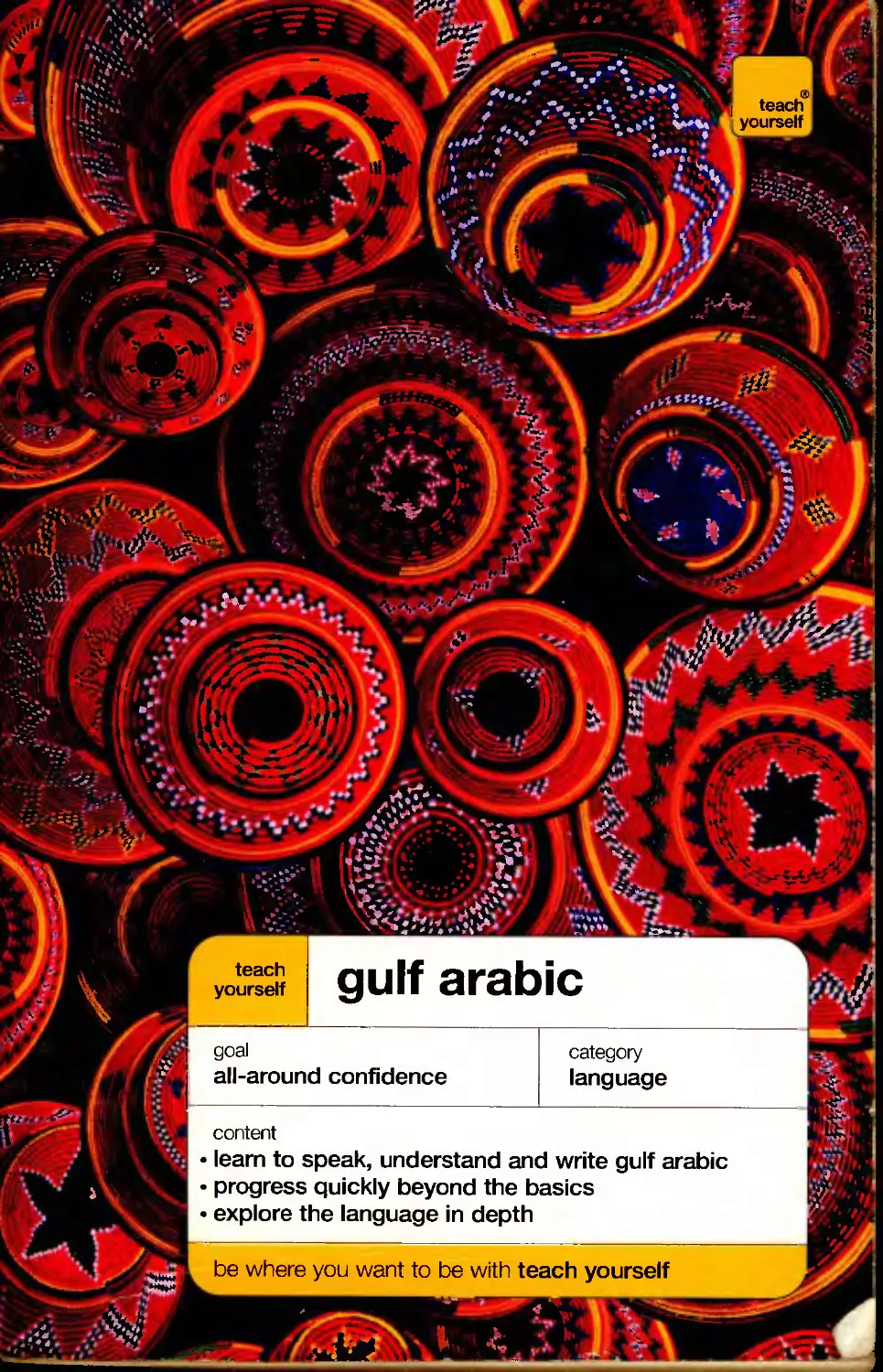
                    gulf arabic
all-around confidence
be where you want to be with teach yourself
teach
yourself
teach
yourself
category
language
content
learn to speak, understand and write gulf arabic
progress quickly beyond the basics
explore the language in depth

teach
yourself
gulf arabic
jack smart
and
trances altorfer
For over sixty years, more than
40 million people have learnt over
750 subjects the teach yourself
way, with impressive results.
be where you want to be
with teach yourself
For UK order enquiries: please contact Bookpoint Ltd, 130 Milton Park, Abingdon, Oxon
0X14 4SB. Telephone: +44 (0) 1235 827720. Fax: +44 (0) 1235 400454. Lines are open
09.00-18.00, Monday to Saturday, with a 24-hour message answering service. Details
about our titles and how to order are available at www.teachyourset1.co.uk
For USA order enquiries: please contact McGraw-Hill Customer Services, PO Box 545,
Blacklick, OH 43004-0545, USA. Telephone: 1-800-722-4726. Fax: 1-614-755-5645.
For Canada order enquiries: please contact McGraw-Hill Ryerson Ltd, 300 Water St,
Whitby, Ontario L1N 9B6, Canada. Telephone: 905 430 5000. Fax: 905 430 5020.
Long renowned as the authoritative source for self-guided learning - with more than 40
million copies sold worldwide - the teach yourself series includes over 300 titles in the
fields of languages, crafts, hobbies, business, computing and education.
British Library Cataloguing in Publication Data: a catalogue record for this title is avaiable
from the British Library.
Library of Congress Catalog Card Number on file.
First published in UK 2001 by Hodder Arnold, 338 Euston Road, London, NW1 3BH.
First published in US 2001 by Contemporary Books, a Division of the McGraw-Hill
Companies, 1 Prudential Plaza, 130 East Randolph Street, Chicago, IL 60601 USA
This edition published 2003.
The teach yourself name is a registered trade mark of Hodder Headline Ltd.
Copyright © 1999,2003 Jack Smart and Frances Altorfer
In UK All rights reserved. Apart from any permitted use under UK copyright law, no part of
this publication may be reproduced or transmitted in any form or by any means, electronic
or mechanical, including photocopy, recording, or any information, storage and retrieval
system, without permission in writing from the publisher or under licence from the
Copyright Licensing Agency Limited. Further details of such licences (for reprographic
reproduction) may be obtained from the Copyright Licensing Agency Limited, of 90
Tottenham Court Road, London W1T 4LP.
In US: All rights reserved. Except as permitted under the United States Copyright Act of
1976, no part of this publication may be reproduced or distributed in any form or by any
means, or stored in a database or retrieval system, without the prior written permission of
Contemporary Books.
Typeset by Outhouse Design, Exeter.
Printed in Great Britain for Hodder Arnold, a division of Hodder Headline, 338 Euston Road,
London NW1 3BH, by Cox & Wyman Ltd, Reading, Berkshire.
Hodder Headline’s policy is to use papers that are natural, renewable and recyclable
products and made from wood grown in sustainable forests. The logging and
manufacturing processes are expected to conform to the environmental regulations of the
country of origin.
Impression number 10 9 8 7 6 5 4
Year	2007 2006 2005
Contents
Introduction—----------------------------------- 8
How to use this book----------------------------- 10
Pronunciation and transliteration---------------- 12
The Arabic alphabet------------------------------ 17
1 as-salaamu :aiai-kum	Hello!------------------ 22
Saying hello and goodbye, using simple greetings, giving
your name and asking for someone else’s, saying where
you are from and asking someone where they are from.
2 wain ....? Where is-------------------------------35
Asking for places in a town, asking where things are,
asking for and giving directions.
3 ragam at-tilifoon....
The telephone number is 52
Numbers, asking for someone on the telephone,
asking for and giving telephone numbers.
4 as-saa:ah kam? What time is it?------------------- 63
Asking and telling the time, asking when places open
and close, the days of the week, the times of day.
5 bi-kam haadha? How much is this? 75
Asking whether things are available, asking what
things are and how much they cost, doing some
simple bargaining, describing things.
6 fnta joozaan? Are you hungry?--------------------- 93
Buying snacks and soft drinks, expressing your wants
and preferences, saying what you like and dislike.
7 al-:aa*ilah The family---------------------------- 110
Talking about your family, talking about more than
one person or thing, talking about people’s occupa-
tions, saying what you do every day.
8 fi l-fundug In the hotel-------------------------- 126
Asking for and reserving a room, asking about the
services, asking about mealtimes, making a complaint.
9 al-hawaayaat wa l-ijaazaat
Interests and holidays-------------------- 140
Talking about your interests and what you do in your
spare time, your plans for the future, the weather,
what you did on holiday.
10 taariikh al-:arab
The history of the Arabs------------------ 157
Saying what you were doing or used to do in the past,
more ways of describing things, saying how and when
you do things.
11 aS-SiHHah Health 172
Saying you don’t feel well, asking for a chemist or
doctor, buying remedies.
12 al-ijraa’aat ar-rasmiyyah
Official procedures_______________________ 185
Finding a bank cashpoint, cashing travellers’ cheques
and changing money, buying stamps, sending mail,
dealing with government departments and embassies
13 li-wain? Where to? 197
Telling people to do things, taking a taxi, booking and
buying bus tickets, hiring a car, buying petrol and
dealing with car problems.
14 fi 1-bait In the house 212
Talking about where you live, describing people and
places, talking about renting a flat or house
Key to the exercises___________________________ 224
Transcripts____________________________________ 256
Arabic verbs 261
Glossary of language terms 267
Arabic-English glossary 273
English-Arabic glossary 297
Index 319
Dedication
For Mairi and Kirsty
Acknowledgements
Many people and organisations helped us in various ways in the
preparation of this book, and we should like to express our sincere
gratitude to them.
We would especially like to thank the al-Battashi family for their
generous hospitality and for help with the text; Joan Crabbe, Jim and
Margaret Fraser, Marijcke Jongbloed and the Shaijah National History
Museum and Desert Park, Mike Pinder, Brian Pridham, Adrian Gully
and Mairi Smart who helped us with realia; Bobby Coles, Ruth Butler
and Jennifer Davies at the Centre for Arab Gulf Studies and Sheila
Westcott in the Department of Arabic at the University of Exeter who
were endlessly helpful and resourceful, and the embassies of the United
Arab Emirates, Bahrain, and Yemen who kindly gave us information
and materials.
We are also very grateful to the Coca-Cola Company, McDonalds
Corporation, Penguin Trading Est. and National Mineral Water Co.
Ltd. of Oman, and Virnto for giving us permission to use copyright
material.
Thanks are also due to our editors Sarah Mitchell, Sue Hart and Helen
Green for their encouragement and patience, to Fred and Dorothea
Altorfer for putting up with us, and to Lynne Noble for her generous
help behind the scenes.
INTRODUCTION
The purpose of this book is to teach you how to speak and understand the
spoken Arabic of the Gulf region. This is a group of closely related dia-
lects, concentrated on the nations of the Arab Gulf from Kuwait down
through Qatar, Bahrain, the United Arab Emirates and the Sultanate of Oman.
Many of the dialects of the Kingdom of Saudi Arabia are closely related, as
is that of (especially southern) Iraq.
It is not a manual of standard, or literary, Arabic, which is not a spoken
language; for that use Teach Yourself Arabic. However, so that you may
have the added pleasure of being able to read road signs, shop names and
other visual features of the Gulf environment, a simple account of the Ara-
bic alphabet is given.
This book contains everything you need to know about basic Gulf Arabic.
Work steadily at your own pace, and finish the course: don’t hurry things
or become disheartened after the first couple of chapters. This book
introduces the language you really need: vocabulary and grammatical
information have been limited to the necessities.
Of course, if you are living in the Gulf, you should seek help from native
speakers at every opportunity. Here a slight word of warning: there exists
in the Gulf a ‘pidgin’ variety of Arabic, used mainly between the Arabs and
the huge numbers of expatriate workers, mostly from the Indian sub-conti-
nent. If your informants come up with something differing radically from
what is given in this book (ignoring regional differences in pronunciation),
check that you are not hearing ‘pidgin’.
Arabs very much appreciate any attempt by a foreigner to learn their lan-
guage, and your every effort will be greeted with amazement, then enthusi-
asm and offers of help. It is the key to a society of very friendly people
which is often thought difficult to penetrate. Speaking even a little Arabic
will enhance your social life, and, in the business world, can open doors
which would otherwise remain closed.
PRODUCTION
9
TEACH YOURSELF GULF ARARig
H^rr^USE THIS BOOK
HOW TO USE THIS BOOK
The book is divided into units, with all the important information that you
need for good communication in Gulf Arabic given in the first ten units.
The last four units refer to specific situations in which you might find
yourself if you are visiting or resident in the region, and build on the words
and grammar that you have already learned.
At the beginning of each unit there is a summary of the contents, which
lists what you will be able to do after working through the unit.
Each unit contains several dialogues 21 (Hiwaar), which introduce the
new language in a realistic context. In some instances you may find slight
variants between the book and the recording. This is due to the regional
differences in pronunciation, and will help broaden your listening skills in
Gulf Arabic.
There are two or three questions to help you check your comprehension,
and the answers to them and a translation of the dialogues are in the Key
to the Exercises at the end of the book.
Key words are given after each dialogue in the order in which they appear
Then there are notes (mulaaHaDHaat), which explain how the language
works in the dialogue.
There are some cultural tips (ma:luumaat thaqaafiyyah), which highlight
some of the cultural aspects of life in the Arabian Gulf.
If you have the cassette, listen to it several times alone and while reading
the dialogue, and practise repeating the dialogue to yourself to improve
your pronunciation. Listening is the first step to learning a language; don’t
be disheartened if you don’t always understand every word - picking out
the gist of what is said is the key.
To sum up what you have learned in the dialogues, Key phrases J
(ta:biiraat haammah) will provide a valuable reference after you have
worked through all the dialogues in the unit. These contain the main lan-
guage elements of the unit, and help you with the exercises.
^,g is followed by Grammar points (nuqaT naHwiyyah) where the
nstructions contained in the unit are explained and illustrated in
Centences. Main grammatical concepts have often been grouped together
for ease of reference, and they gradually build up to provide you with all
foe structures you need to understand and speak Gulf Arabic. These need
not all be absorbed at once, but should be used for reference.
The next section, Exercises (tamriinaat)PJ], provides a variety of
activities so that you can practise using the new words and structures. The
answers are to be found at the end of the book, in the Key to the exercises.
Some exercises are on the cassette, and you may find it helps you to read
the transcript of the cassette, at the back of the book. If you don’t have the
cassette, you can use the transcript as reading material.
The final section of each unit contains the Arabic script (al-khaTT al-
:arabi), which gradually takes you through the Arabic alphabet so that
by the end you will easily be able to recognise simple words and notices,
road signs and so on. There is a short exercise at the end of most of the
units for you to practise reading Arabic, and again the answers are in the
Key to the exercises. If you do not wish to learn to read Arabic, you can
ignore these sections.
After the Key to the exercises and the Transcript of the cassette, you will
find a reference section for the Arabic verbs. Every verb you come across
in the book can be matched in the verb tables with a verb which works in
the same way. Arabic—English and English—Arabic glossaries are provided
so that you can look up words alphabetically.
Remember that the first step in learning a language is listening and under-
standing. Concentrate on that, and then work on your speaking skills, using
the information in the units and, if possible, listening to native speakers.
12
TEACH YOURSELF GULF ARABIC
PRONUNCIATION
AND TRANSLITERATION
Transliteration means expressing a language which uses a different
writing system (such as Arabic) in terms of symbols based on the Roman
alphabet. There is no generally accepted system for doing this, and
you will find that the English versions of, say, road signs, differ from
what is given in this book.
The essential feature of a transliteration system is that it has an equivalent
for every sound used in the target language. Instead of using a complicated
system of accents and special symbols, this book is more or less
restricted to the English alphabet, making use of capital letters to distin-
guish between Arabic sounds which seem related to us. For instance, Ara-
bic has two sorts of t which are distinguished in this way: ‘tiin’ means/ig5,
and ‘Tiin’ means mud. There is a full explanation of how to pronounce these
sounds in the next section.
Consequently you will not find capital letters used in the book as they are
conventionally used in English. An exception has, however, been made in
the case of ‘Allaah’ Allah, God.
The Arabic Sounds
Arabic has some sounds which are difficult for foreigners to pronounce.
The following table is therefore divided into three parts:
1	Sounds that are more or less as in English.
2	Sounds which do not occur in English, but are found in other European
languages.
3	Sounds which are peculiar to Arabic.
PRONUNCIATION AND TRANSLITERATION
13
Group 1:
b as in bed
d as in dot
dhas in this, mother. It is important not to mix this up with the sound
written ‘th’ (see below), as they convey different meanings
in Arabic (dhiyaab = wolves, thiyaab = garments)
f as in fifty
g as in gag
h as in help, but never omitted in speech as it very often is in English
(e.g. Brahms). An exception is the common feminine end
ing -ah, and the word fiih there is/are. The final -h in these is there
for a special reason and is not normally pronounced.
j as in jump
к as in kick
1 mostly as in limp, but sometimes has a more hollow sound, roughly
as in alter. This distinction is not meaningful in Arabic but depends
on the surrounding consonants.
m as in mum
n as in nun
s as in sun, drops (not when it is pronounced z as in things:
see z below)
sh as in splash
t as in tart
th as in thank (not as in this, that, father, etc.; see dh above)
w as in will
у as in yell
г as in freeze
Group 2
r The Arabic r sound does not really occur in standard English, but
is familiar in dialect pronunciation. It is the trilled r of Scottish
very, and common in Italian and Spanish (Parma, Barcelona)
gh is near - but not quite the r of Parisian French. It is actually a more guttural
scraping sound, and occurs in Dutch, e.g. negen. The Parisian r will do.
kh is roughly sound of ch in Scottish loch and och aye. Also familiar
in German Bach and (written j) in Spanish Jose.
14 TEACH YOURSELF GUI
Group 3
S,T and With the exception of H (see below), the capitalised conso-
DH	nants are pronounced in a roughly similar way to their small
letter versions s, t, and dh, except that the tongue is depressed
into a spoon shape, and the pressure of air from the lungs
increased. This gives a forceful and hollow sound, often
referred to as emphatic. These sounds have a marked effect
on surrounding vowels, making them sound more hollow.
H and : go together. Ib pronounce these sounds requires practice -
and it is best to listen to native speakers - but they can Lt
mastered.
:	We have a muscle in our throat which is never used except in
vomiting. Think about that and pretend you are about to be
sick. You will find that what is normally called in English
gagging is actually a restriction in the deep part of the throat. If
you begin to gag, and then release the airstream from the lungs,
you will have produced a perfect: (called :ain in Arabic).
H is pronounced in exactly the same way, except that, instead
of completely closing the muscles, they are merely constricted
and the air allowed to escape. The only time English
speakers come near to a (weakish) H is when they breathe
on their spectacle lenses prior to cleaning them.
Both of these letters should always be pronounced with the
mouth fairly wide open (say ah).
This sound is fairly infrequent in Gulf Arabic. It occurs
in English between words pronounced deliberately and
emphatically (e.g. ‘He [slight pause] is an idiot, isn’t he’),
but is probably more familiar as the Cockney or Glaswegian
pronunciation of t or tt as in bottle.
q and ch see next section.
Unstable sounds in Gulf Arabic
Gulf Arabic is a collection of related but distinct dialects and is no
governed by any strict pronunciation rules. Remember that, whatever an)
Arab tells you, the written or literary Arabic language is never spoken ii
everyday life. It exists only in the written form, and in formal speeches ant
religious language. What every Arab speaks at home, and what you wil
hear, is dialect or vernacular Arabic.
^gril lNCIATION AND TRANSLITERATION
15
^ere are local words for different local things, but these do not cause
roblems and will generally be mentioned. As a rule, where a literary word
P use(j in parts of the Gulf, this is given, as every educated Arab knows the
literary language from school. If you are living in the Gulf, however, you
should note and use local expressions.
Nevertheless, the regional pronunciations of some of the consonants can
be confusing. These are explained below, as it is foolish to pretend that you
will not encounter them. The overall policy of this book, however, has been
to use the most common pronunciation throughout the area, and, where
reasonable, to adopt the version closest to the literary language. Again, if a
word is pronounced differently where you live or are visiting, use that pro-
nunciation.
Common local variants
j The official Arabic sound is identical to English j as in jump, but
this letter is also pronounced as a у as in yes or, more rarely as a g
as in gone.
DH Not a problem with Gulf nationals, but many expatriates from the
northern Arab world (e.g. Egypt, Palestine) pronounce this like an
emphatic z, i.e. z pronounced with the same tongue position as S
and T (see above). Northern Arabs also have an emphatic D. This
is not used in Gulf Arabic, where it is replaced by DH.
g This is officially pronounced in Standard Arabic as a к produced
far back in the throat. You hear this in parts of Oman and Iraq, and
in some words borrowed from the literary language. In such cases,
it has been transcribed as q. The overall common Gulf pronuncia-
tion is hard g, as in get, but it is also occasionally j as in jet.
к This is often heard as ch as in church. This pronunciation is
obligatory in some contexts, where it is transcribed ch.
Vowels
There are only 5 common vowels, 3 of which occur both long and short.
These have been transcribed as follows:
a roughly as in Aar
aa an elongated emphatic a as in the word and in: ‘Did he really eat a
whole chicken?’ ‘Yes... .and he had a steak as well.’
* as in if
16
TEACH YOURSELF GULF ARABI
ii the long equivalent, as in Eve, French livre	J
u as in put (never as in cup)
uuas in rude, French vous, German Schule.
oo as in rose as pronounced in Scotland, or more like French beau
ai the sound in wait
The following dipthong also occurs occasionally :
ay as in aye. The place name Dubai is transcribed dubay.
Doubled Consonants
г
Doubled consonants (here written bb, nn, ss etc.) are important in Arabic,
as they can change the meanings of words radically. They are only
pronounced in English when they span two words, e.g. But Tom, my
brother.... In Arabic, however, they must always be pronounced carefully,
wherever they occur, with a slight hesitation between them. E.g. gaTar is
the place-name Qatar, gaTTar means dripped, distilled.
Stress
The stressed syllables of words have been marked with an acute accent: A,
aa, etc. in the glossaries and the first six units so that you become used to
where they occur. One simple rule, however, is that if a word contains a
long vowel (aa, uu, etc.) the stress falls on this; and if there is more than
one, the stress falls on the one nearest the end of the word.
THE ARABIC ALPHABET
There are several general points to be noted:
	Arabic is written from right to left - the opposite of English.
	Arabic script is always joined or cursive, i.e. there is no equivalent of
the English text you are now reading, where all the letters have separate
forms with spaces between them. There are no capital letters.
I In cursive writing letters are joined together by means of joining strokes
(called ligatures). As a result, Arabic letters have slightly different forms,
depending on whether they come at the beginning, middle, or end of a word.
 Afew letters do not join to the following letter, but all Arabic letters join
to the preceding one.
В Arabic writing looks complicated just because it is so different, but in
fact it is not. Spelling in Arabic is easy, because, with a very few excep-
tions, all sounds are written as they are pronounced. There are no diph-
thongs, i.e. combinations of two letters to give a distinct sound, like th, sh,
etc. in English.
	One thing you must get used to in the Arabic script is that short vowels,
i.e. a, i or u, for instance (as opposed to the long vowels aa, uu and ii), are
not shown in the script. For the moment, get used to the fact that the word
bank (which Arabic has borrowed from English), is written b-n-k.
Because of the cursive nature of Arabic, it is necessary to give the Initial,
Medial and Final forms of each letter. Since some letters do not join to the
one after them, a separate form has also been included. Although four forms
of the non-joiners have been given, if you look carefully you will see that
there are really only two shapes.
ГЬе Arabic alphabet is given below in its traditional order. Letters which
do not join to the following one are marked with an asterisk.
Final is to be interpreted as final after a joining letter. If the preceding letter
ls a non-joiner, the separate form will be used. If you look closely, you can
18 TEACH YOURSELF GULF ARAB
see that final and separate letters are usually elongated in form, or have
‘flourish’ after them.
Also, in most cases, the initial form of the letter can be regarded а» И
basic or nucleus form. For example, if you look at baa’ (the second letter
the following list), you will see that its basic (initial) form is a small lei
facing hook with a single dot below it. The medial form is more or less tl
same, with a ligature coming in from the right (remember you are writin
from right to left). The final form is the same as the medial, with a littl
flourish or elongation to the left (i.e. at the end of the word), and the sep
rate form is the same as the initial, but again with the flourish to the le
Study the letters bearing these features in mind, as many of them follow t
same principle. The f denotes a ‘glottal stop’ sound which is explained <
page 14.
Fuller descriptions and other hints on deciphering will be given in the uni
THEARABICALPHABET
Маше alif*	Initial 1	Medial L	Final L	Separate 1	Pronunciation see below
	—J		k.	k—u-		b
baa’
	-J	_X	A** t-		t
taa’ thaa’	-5	-1		dj	th
jiim		-Л.	e-	G	j
Haa’		-X.	c-	C	H
khaa’			c-	t	kh
daal*	J	X	X	a	d
dhaal*	j	X	X	j	dh
raa’*	J	>	J-	j	r
zaay*	j	5-	j-	j	z
siin	—MJ				s
shim		MIL		lA	sh
Saad	-Jk^	mA.	tz®-		S
Daad1	Хэ	-mA		<_>“	D
Taa’	L	u	L_	b	T
DHaa’	к	к		dk	DH
:ain		—я—	C“
ghain	-X	Ju	C“	I	gh
faa’		-_ft_	i—я»	kJ	f
qaaf2		JL	<3"	5	g
kaaf		<	pl	d	к
laam	J	1	J	J	1
miim	—Л	—A-	r	f	m
nuun	A	—X		d	n
haa’	-A	“4“	<L_	0	h
waaw	J	>	Э-	J	w
Уаа’	-U			L5	У
20
TEACH YOURSELF GULF
1	Daad:- This letter in Gulf Arabic is pronounced in exactly the same wa
as DHaaf.
2	gaaf - This is normally pronounced like an English hard g (as in gold) ц
the Gulf. (See the section on transliteration.)
In addition to the above, there is one combination consonant laam-alif.
This must be used when this series of letters occurs, and it is a non-joinei
Name I Initial	Medial Final Separate]
laam-alif I	I M Im
There is a letter which the Arabs call taa’ marbuuTah and which is referred to i
this book as the ‘hidden f. This is the Arabic feminine ending which only occur
at the end of words, so therefore it has only two forms, final (after joiners); n
separate (after non-joiners). It is always preceded by a short ‘a’ vowel:
Final
Separate
If you look carefully at this letter, you will see that it looks like a haa’ with tire
two dots above of the taa’ added, and this is exactly what it is. It is normally
rendered in speech as a very weak h, but in certain combinations of words it is
pronounced as t. It has therefore been transcribed as h and t accordingly.
There is one final item called the hamza. This is not regarded by the Arabi
as a letter of the alphabet, but as a supplementary sign. Its official pronun-
ciation is a glottal stop (as in cockney bottle) and it has been transLterater,
by means of an apostrophe (’). It is frequently omitted in speech, but it ii
common in written Arabic, where it occurs either on its own, or writte
over an alif, waaw or yaa’. (In the last case, the two dots under the yaa’ ai
omitted.) It can also occur written below an alif, but this is less commoi
The actual hamza never joins to anything, but its ‘supporting’ letters tai
the form required by their position in the word:
Initial	Medial	Final	Separate
independent on alif	i	₽ in all cases. L	1 L		t
under alif 1	does not occur		i c
on waaw —	j-	J-	J
on yaa’	—	JL		15
Note that, at the beginning of a word, ’ is always written above or below
THE ARABIC ALPHABET 21
Vowels
AS ^eady mentioned, in Arabic writing the short vowels are not usu-
ally marked except in children’s school text books, the Holy Koran
and ancient classical poetry.
The long vowels are expressed by the three letters alif, waaw and yaa’.
Alif almost always expresses the vowel aa, but waaw and yaa’ can also be
consonantal w and у (as in English wish and yes).
However, waaw and yaa’ can also express the (only) two Arabic diph-
thongs, usually pronounced oo (with waaw) and ai (with yaa’). The offi-
cial pronunciation of these diphthongs is ow as in down and ay as in aye
respectively, but these are heard in informal speech only in a few words.
AH this is not as difficult as it sounds, as the real key to Arabic words is the long
vowels. It will not make much difference in most cases whether you pronounce a
word with a, и or i (short vowels), but it is important to get the long vowels right
One further note: the letter yaa’ often occurs at the end of words. It is
usually pronounced -i, or -ii, but sometimes also -a. In the former case, it is
usually written with two dots under it Q) and in the latter without them Q),
but this rule is not, unfortunately, always adhered to.
General
Since this book is intended to teach you to recognise the Arabic script, rather
than to learn to write it, the above remarks should be sufficient for the purpose.
As already mentioned, further information and tips will be given in the units.
Finally, it is better to think of the Arabic script as basically handwriting
(since it is always cursive, no matter how produced, by hand, on a type-
writer or computer). For this reason - and by dint of what the Arabs regard
as the artistic nature of the script, calligraphy being a highly developed art
in the Arab world - there occur probably more variations of the form of the
letters than happen in English.
The most important of these is that, very frequently, two dots above or
below a letter, are frequently combined into one dash, and three dots (which
only occur above) into an inverted v like the French circumflex л. Here is
an example showing taa’ and thaa’: cL> c_2j
piere are many other variations, but the most important is the writing of
CJ-* siin and shiin as simply long lines, ironing out their spikes,
and often with a small hook below at the beginning: Arabic writing is fun.
Look at it as an art form!
as-salaamu :alai-kum
Hello!
In this unit you will learn how to
Ц say hello and goodbye
 greet someone
Ц give your name and ask for someone else’s
| say where you are from and ask someone where they are from
Hiwaar 1 (Dialogue 1) '
3] Jim and Eleanor McDonald have arrived at the home of their friend Khal
in Muscat. Jim goes in to greet Khaled.
Jim Khaled Jim Khaled Jim Khaled	as-salaamu :alai-kum wa :aldi-kum as-saldam kaif Haal-ak? al-Hdmdu li-l-ldah bi-khair, wa Inta kaif Haal-ak? bi-khair, al-Hdmdu li-l-laah. aish akhbaar-ak? al-Hamdu li-l-laah
Eleanor comes into the room.
Eleanor	as-saldamu :alai-kum
Khaled	wa :al£i-kum as-saldam
Eleanor	kaif Haal-ak?
Khaled	al-Hamdu li-l-ldah, wa inti kaif Haal-ich?
Eleanor	al-Hamdu li-l-ldah
23
UNJTJ-----
aS-salaamu :alai-kum wa :a]ai-kum as-salaam kaif Haal-ak/Haal-ich abHamdu li-l-laah bi-khair fnta/inti aish akhbaar-ak/akhbaar-ich	Hello (lit. the peace [be] upon you) and Hello (reply to above) how your condition (to a man/woman) praise (be) to God well you (man/woman) what [is] your news (to a man/woman)
mulaaHaDHaat (Notes) oUb-4*
1.	as-salaamu :alai-kum
This set religious greeting is always addressed by the incomer to a group,
and it and its reply always takes the same form regardless of whom they
are addressed to. The same expression can also be used for goodbye
when taking one’s leave. The as- at the beginning is a variant of al-
(the). This is explained in the Arabic script section at the end of this unit.
2.	kaif Haal-ak / Haal-ich
No verb to be is necessary, so How your condition means How (is) your
condition, i.e. ‘How are you?’ Similarly aish akhbaar-ak/akhbaar-ich
means What (is) your news?
3.	Addressing people
In Arabic you must distinguish between a man and a woman and more
than one person when addressing people. The first part of the above
dialogue is between two men, so you say -ak meaning your (to a man)
in Haal-ak and akhbaar-ak.
When you are speaking to a woman, you must say kaif Haal-ich and
aish akhbaar-ich. This is the most common pronunciation in the Gulf,
but you may also hear -ish or even -ik. It makes no difference whether
you yourself are male or female, only who you are speaking to.
To speak to more than one person, called the plural form, say kaif Haal-
kum and aish akhbaar-kum (see 1 above).
24
TEACH YOURSELF GULF
4.	al-Hamdu li-l-laah (thanks be to God)
li-l-laah is a contraction of li- + Al-laah meaning to God. It is дЛ
etiquette to reply to any enquiry about your health with this phrase cyJ
if you have just broken both of your legs.
5.	bi-khair
This means literally in well-being, i.e. good health.
4
X Hiwaar 2 (Dialogue 2) т Jj»-	I
Khaled’s brother Muhammad comes into the room and shakes hands wM
everyone.
		Muhammad	SabaaH al-khair Khaled	SabAaH an-nuur Muhammad	Ahlan wa sahlan	J Khaled	Ahlan bii-k Muhammad	kaif HAal-kum Khaled & Jim	al-HAmdu li-I-lAah Muhammad	(on leaving the room) mA:a s-salAamah Khaled	fii amaan Al-lAah
		SabaaH	morning SabaaH al-khair	good morning	.1 SabaaH an-nuur	reply to above ahlan wa sahlan	welcome, hello ahlan bii-k/bii-ch	reply to above (to a man/woman) ma:a s-salaamah	goodbye	,4 fii amaan Al-lAah:	reply to above (to a man or woman)
mulaaHaDHaat (Notes) oUb-M*
1.	SabaaH al-khair
This literally means morning (of the) well-being. (See note 5 above..
As mas&a’ means afternoon, evening, to say good evening you use maw
al-khair, and the reply is masAa’ an-nuur.
2.	ahlan wa sahlan is an age-old set phrase.
It can be translated in many ways into English (welcome, hello, etc.);
25
yNJI1 —------
bii-k is a shortened form of bi-ak, literally with/to you.
gay bii-k to a man, and bii-ch to a woman. The plural form, for both
fflen and women is bfi-kum.
4 ща:а s-salaamah and its reply fii amaan Al-laah
These remain the same whoever is addressed, man, woman or more than
one person.
Hiwaar 3 (Dialogue 3) r
At a cultural evening at the university in Al Ain, Jack meets some of the
1й> students. First he meets Muhammad.
Jack	as-saldamu :aldi-kum
Muhammad	wa :aldi-kum as-saldam
Jack	aish fsm-ak?
Muhammad	fsm-i muHdmmad. wa inta?
Jack	dna fsm-i jaak
Muhammad	inta min wain?
Jack	ana min ingilterra. wa inta?
Muhammad	ana min dubay
Jack	ahlan wa sdhlan
Muhammad	йЫап bii-k
Then he meets Faridah with some of her friends.
Jack	masda’ al-khdir
Faridah	masda’ an-nuur
Jack	aish fsm-ich?
Faridah	fsm-i farfidah. wa inta?
Jack	ana fsm-i jaak. inti min wain?
Faridah	ana min abu	DHabi.	inta min amrfika?
Jack	laa, dna min ingilterra
Faridah	ahlan wa sahlan
Ja°h	ahlan bii-ch
a) Where is Muhammad from?
) Where is Faridah from?
c) Where does Faridah think Jack is from?
26	TEACH YOURSELF GULF Ar>A(J
ism (or is(i)m) ism-ak/-ich ism-i min wain mta/mti ana ana min... ingilterra dubay abu DHabi amruka laa	name	Л your name (man/woman)	- Л my name from	4 where you (man/woman) I [am] from...	* England Dubai Abu Dhabi America	Л no
mulaaHaDHaat (Notes)
1.	jaak is of course the English name Jack,
muHammad is the common Arab name. In English it is spelled many
different ways {Mohamed, Mohammad, etc.), the transliteration reflect
how it should be pronounced in Arabic, ingilterra is England (from the
French angleterre). Most names of Western countries in Arabic are simi-
lar to the originals. The names of the Arab countries given here are in
their familiar forms, stripped of ‘Kingdom of...’, ‘State of...’ and so on
which feature in some of their official titles.	»Д
2.	ism/is(i)m name.
The first form is the ‘correct’ one, but most Gulf dialects have an aver-
sion to certain combinations of two consonants at the end of certain wotds,
and tend to add a ‘helping’ vowel to ease pronunciation. These vowet
have generally been inserted in this book (in brackets) to aid your listen-
ing comprehension, or when they are optional. When something is adds»
to the word, they are generally left out:
ism-ak your name (to a male)
fsm-ich your name (to a female)
3.	The Gulf States
Here is a list of the rest of the Gulf states and the names of some
countries. Notice the al- {the) in front of some of them.
27
jandan
iskutlanda
uSTraalya
al-baHrain
aI-iniaaraat
al-kuwait
al-yaman
ar-riyaaDH
as-samdfyyah
ash-shaarjah
gaTar
ininaan
London
Scotland
Australia
Bahrain
The Emirates
Kuwait
Yemen
Riyadh
Saudi Arabia
Sharjah
Qatar
Oman
Hiwaar 4 (Dialogue 4) t
Jack joins another group of students with his American colleague, Ken.
Jack Yasin Jack Yasin Jack	as-saldamu :alai-kum wa :aldi-kum as-salaam. td:raf :drabi? nd:am, d:raf :arabi. into min wain? niHna min al-baHrain. intu min amrfika? laa, dna min ingilterra. huwwa min amrfika (introducing Keri)
Yasin Ken	ahlan wa sahlan ahlan bii-k
ta:raf/ta:rafiin :arabi a:raf na:am intu niHna huwwa	you know (to a man/woman) Arabic (language) I know yes you (plural, both masc. and fem.) we he
з) What is the first question Yasin asks Jack?
) Where are Yasin and his friends from?
C ^here does he think Jack and Ken are from?
28
TEACH YOURSELF GULF Ar*
mulaaHaDHaaf (Notes) oUx>-*)L*
1. Your first Arabic verb (or ‘doing word’), ta:raf (you know) and 6:r»fq
know). The forms differ according to who is doing the action. To addre '
a woman, use the form ta:rafiin. Notice that with Arabic veibs уоц
not have to use a pronoun, or word for 1, you etc.
2. ta:raf :arabi? do you know Arabic?
When you ask someone a question like this in Arabic, you simply use the
normal verb you know...? without the ‘do you.The question is rnartaj
by a raising of the pitch of the voice at the end of the sentence.
ta:biiraat haammah (Key phrases) olj
H how to say hello
as-salaamu :alaikum
:alai-kum as-salaam
hello
hello (in reply)
 how to say goodbye
ma:a s-salaamah
fii amaan Al-laah
1
goodbye
reply to above
how to greet someone
SabaaH al-khair
Sabaah an-nuur
masaa’ al-khair
masaa’ an-nuur
ahlan wa sahlan
ahlan bii-k / bii-ch
Where are you from? (man/woman)
Where is he from?
She is from Qatar.
I am from America.
We are from England
good morning
good morning (in reply)
good afternoon, evening Д
good afternoon, evening (in reply)
welcome, hello
reply to above (man/woman)
 how to say your name and ask someone else’s
aish ism-ak / ism-ich?	What is your name? (man/woman)
ana ismi jaak smart	My name is Jack Smart.
H how to ask where someone is from, and say where you are from Я
Inta / inti min wain?
huwwa min wain?
hiyya min gaTar
ana min amriika
niHna min ingilterra
1
V)
(jNITl----
n^qaT naHwiyyah (Grammar points) .ki
1 is/are
There L -
fem-imuHammad
£ta min amriika?
is no word for is/are in Arabic:
My name is Mohammed.
Are you from America?
2 SabaaH al-khair
Certain short words in Arabic are regarded as part of the word which
follows them. As this often affects pronunciation, this book uses hyphens
to mark it. The commonest example is al- (the) and its variants, but you
also have bi- (in) as in bi-khair and li- (to) as in al-Hamdu li-l-laah, (lit.
the praise to God).
3 Gender
Gender refers to whether a word is regarded as masculine (male) or femi-
nine (female). In Arabic, words for human beings are masculine for men
and feminine for women. However, as in French, there is no neuter gender,
and the things we refer to in English as it are either he or she in Arabic.
You must always be conscious of gender in Arabic as it affects other words
such as pronouns (see below). Fortunately, the vast majority of feminine
words in Arabic are marked by the ending -ah.
4 Pronouns
A pronoun is a kind of short-hand word which refers to a person or a thing,
such as he, him, his; it, me, my.
ken min amriika huwwa min amriika al-bait kabiir huwwa kabiir as-sayyaarah ghaalyah hfyya ghaalyah	Ken is from America. He is from America. The house is big. (house is masculine) It (he) is big. The car is expensive, (car is feminine) It (she) is expensive.
30
TEACH YOURSELF GULF
The Arabic pronouns
Singular:	Plural:	Я
ana I mta	you (to a man) inti	you (to a woman) huwwa йе (it) hiyya she (it)	niHna we intu	you (both genders) hiimina /й<у (both genders)
5 Possessives	Jl
Possessing or owning something, or something belonging, pertaining, Ol
applying to you is expressed in Arabic by a series of endings, or suffice
These will be dealt with in a later unit, but note for the moment those used
in the dialogues	in this unit:
ism-i	my name
Hdai-ak	your condition (to a man)
akhbaar-ak	your news (to a man)
Haal-ich	your condition (to a woman)	1
akhbaar-ich	your news (woman)	fl
tamriinaat (Exercises) oLу
1. Read each dialogue several times, listening to the cassette if you havd
it, until you can remember both sides without looking.
2. Complete the sentences below using the words listed on the right Uli
each word once only.
al as-saldamu		fsm-i
b)			li-l-laah bi-khdir	sahlan
c)			akhbaar-ak	mas da’
d)	saarah	Hdal-ak
e)			al-khair	aish
f) kaif_	—	:alai-kum
g) ahlan	wa		min
h) ana_		amriika	al-Hamdu
31
UNIT I
Eleanor goes to greet Samirah, Khaled’s wife. Complete the dialogue
below, using Dialogue 1 to help you. Check your answers with the key
at the back of the book.
Eleanor
Samirah
Eleanor
Samirah
Eleanor
Samirah
wa :al£i-kum as-saldam
__________?
al-Hdmdu li-l-laah bi-khair, wa inti kaif Haal-ich?
__________?
al-H&mdu li-l-laah
4. Now complete the dialogue below where Eleanor greets and then takes
her leave of Khaled’s two sisters. Notice that it is later in the day. This
time her side of the conversation is done for you. Use Dialogue 2 as an
example.
Eleanor
Maryam
Eleanor
Maryam
Eleanor
masda’ al-khair
ahlan wa sahlan
kaif Hdal-kum
Maryam & Aishah
Eleanor	(leaving the room) ma:a s-saldamah
Maryam & Aishah
5. Make up brief dialogues for the groups of people below, the person on
the left speaking first. Remember the time of day and the number and
gender of people being addressed. Suggested dialogues are given in the
Key to the exercises at the back of the book
a) 5.00pm	b) 8.00pm	c) 11.00am
Imagine you are talking to Nasir, and complete your side of the conver-
sation.
Nasir
inta
Nasir
as-salaamu :aldi-kum
(say hello)
aish fsm-ak?
32
TEACH YOURSELF GULF
inta
Nasir
fnta
Nasir
fnta
Nasir
(say your name, and ask his)
ana fsm-i naaSir. fnta min wain?
(say where you are from, and ask where he is from)
dna min :umaan
(reply appropriately)
ahlan bii-k
I
1
7.	How would you translate the following sentences in Arabic?
a)	(to two men) Are you from Saudi Arabia?
b)	We are from Sharjah.
c)	Are they from London?
d)	No, he is from England. She is from Kuwait.
e)	(to a woman) Are you from the Emirates?
f)	. Yes, I am from Abu Dhabi.
8.	Here is an interview with a woman student. If you have the cassette,
listen to it several times until you feel that you understand what is being
said, or read the transcript at the end of the book. Then listen again and
answer the questions below. First look at these new words:
titkallam / titkallanuin...?	Do you speak (man/woman)...?
ingluzi	English
atkallam ingluzi	I speak English
a)	What is the first question the student is asked?
b)	Where does the interviewer guess she is from?
c)	What country is she from?
d)	What phrase is used to ask: What is your name?
e)	What phrase is used to ask: Where are you from?
f)	What is the last question which Jack asks?
1
al-khaTT al-:arabi (Arabic script)
Look at the dialogues in this unit, and you will notice that al- occui
frequently at the beginning of words. This is the Arabic word for the, wbW
is always written the same, although it varies sometimes in pronunciatw
(see below). It is always attached to the following word and is written
two letters, alif I and laam J For obvious reasons it is a very conWW
word m the language and a good one to start off with. It is easy to recoga1*
as it always comes at the beginning of a word: JI
33
yNjU—---
is a special combination laam-alif, which is conventionally written
When preceded by the initial alif of the al- it looks like this:
^is combination is found in one place name on the map on page 34:
| al-imaaraat The (United Arab) Emirates
You will find the other forms (middle, final etc.) of these letters in the
habet table at the beginning of the book. Note that alif, like another few
letters does not, by convention, join to the letter following it. (All letters
join to the ones preceding them.)
Although it never changes in writing, al- has one peculiarity. If the word it
is joined to begins with one of the following letters:
t th, d, dh, r, z, s, sh, S, D, T, DH, 1, n
the ‘1’ of al- is dropped in speech, and the first letter of the word clearly
doubled. This is reflected in the transcription system used in this book, e.g.
al-kuwait, but ar-riyaaDH and ash-shaarjah. This is an important con-
vention of pronunciation and you must pronounce the double versions of
the letters listed above clearly.
If it helps, to begin with, leave a slight pause between them. It is much
better to say as-...salaamu :alai-kum than a-salaamu :alai-kum (or, for
that matter, al-salaam :alai-kum or salaam :alai-kum, the last very often
heard from Europeans).
This photograph illustrates
the unsystematic translit-
eration of Arabic found on
public signs. Whateveryou
encounter, the official cor-
rect pronunciation is as-
suuq (heard in some parts
of Oman and Iraq), but
elsewhere in the Gulf you
usually hear as-suug.
34
TEACH YOURSELF GULF Am
Tip An easy way to remember which letters this phenomenon occur;
with is to pronounce them all from the above list and think what yonJ
tongue is doing as you say them. You will find that its tip always com
into contact with somewhere in the region bounded by the space be-
tween the top and bottom teeth (e.g. th, dh) and the inside front upper
gum (t, d). Only sh is a slight exception, but none of the other lette »
get anywhere near this point of articulation (b, f, к etc.).
Emirates
(Sultanate of ) Oman
Yemen
Riyadh
Abu Dhabi
Dubai
Shaijah
Bahrain

>oJI
«jUJi
Practice
As in English (e.g. Belgium, but the Netherlands) some countries in Arab
have al- before them, though this the is not usually preserved in the Eng1 stl
versions of their names. Look at the map and make a list of those wh’cl I
practise saying the names as you go.
Now look through the unit again and look for all the Arabic words which
have al- or its altered forms before them, e.g. al-Haal, as-salaam(u). j
V..
wain ...?
Where is... ?
^ote: the written form of this word differs slightly from the spoken.)
jp this unit you will learn how to
Л ask for places in a town
Л ask where places are
< ask for and give directions
gjtfiwaar 1 (Dialogue 1) \
Bill Stewart has arrived on business in Dubai and he asks the taxi-driver to
take him to his hotel.
Bill	SabaaH al-khair
sawwaag at-taksi	SabaaH an-nuur
Bill	fundug ash-shairaTun min faDHl-ak
sawwaag at-taksi	zain, in shaa’ Al-ldah
Bill	al-fundug ba:fid :an al-maTaar?
sawwaag at-taksi	laa, huwwa garfib. :dshar dagdayig bass,
	muu akthar
Bill	shukran
sawwaag at-taksi a	.	:afwan
5
sawwaag	driver
sawwaag at-taksi	taxi driver
fundug	hotel
fundug ash-shairaTun	the Sheraton Hotel
min faDHl-ak	please
zain	OK, good
in shaa’ Al-laah	if God wills
bariid :an	far from
maTaar	airport
36
TEACH YOURSELF GUI f
garfib min
:ashar
dagaayig
bass
muu akthar
shukran
:afwan
near to (lit. near from)
ten
minutes
that’s all, enough; only, just
not more
thanks, thank you
you’re welcome, don’t mention it
ч
a)	Is the hotel far from the airport?
b)	How long will it take to get there?
I
'1
mulaaHaDHaat (Notes)
1. sawwaag at-taksi
The word taxi has the the prefix, so literally it means driver (of)thi -tax’
fundug ash-shairalbn The English name here has been Arabi,-dd and
given the the prefix, so literally it says hotel (of) the-Sheraton.
2. al-fundug ba:iid :an al-maTaar.
Just a reminder that there is no word in Arabic for is or are in
such sentences.
ma:luumaat thaqaafiyyah Cultural tips)
in shaa’ Al-laah This phrase is usually the first Arabic that Europe
ans pick up. Contrary to popular belief, it does not indicate an elemtt
of vague hope or possibility, but has (by the devout Muslim) ti
prefixed to any reference to an action which has not yet taken place
:afwan In Arabic, as in most languages, one is expected to say so№
thing in reply to thank you. In the Gulf it can also be used for excui
me when asking someone politely to move out of the way.
r
О Hiwaar 2 (Dialogue 2) т
Bill needs to find a bank. He asks Mahmoud, the receptionist in the
Bill
Mahmoud
Bill
SabaaH al-khair
SabaaH an-nuur. kaif Haal-ak?
bi-khair, al-Hamdu li-lldah. wa inta?
UNIT2^-				37
Mahmoud Bill Mahmoud Bill Mahmoud	al-Hamdu li-llaah law samaHt, fiih bank garfib min hfna? dywa fiih, al-bank al-wdTani. ta:raf shaari: raashid? laa:, maa d:raf zain. ГПа: min al-baab wa liff yisaar, bardain ruuH sfidah wa khudh dwwal shaari: ;ala l-yamfin. al-bank :ala 1- yisdar.
Bill Mahmoud	shukran jazfilan :afwan
iaw samaHt	if you please
fiih	there is /is there?
bank	bank
hina	here
dywa	X-s
wdTani	national
shaari:	street
shaari: raashid	Rashid Street
maa a:raf	I don’t know
iTla:	go out!
baab	door
liff	turn!
yisaar	left
ba:dain	then, after, afterwards, after that
ruuH	go!
sfidah	straight on, straight ahead
khudh	take!
awwal	(the) first
:ala	on
yamfin	right (direction)
:ala l-yamfin	on the right
:ala 1-yisaar	on the left
jazfilan	copious, very much
a) What does Bill ask about a bank?
. waY should he turn on leaving the hotel?
c Which street should he turn into?
38_________________________________TEACH YOURffl GULF ARAE
mulaaHaDHaat (Notes) . -
1.	fiih bank... is there a bank...
There is no word for a, an (called the indefinite article) in Arabic.
2.	aywa
This is the most usual form of the word for yes. Hoover, you have
already encountered na:am which is slightly more formal
3.	awwal shaari: :ala 1-yanuin
To help you find your way, here
is a simple diagram:
si'idah
4.	shukran jaziilan
The word jaziilan (copious, abundant) is rarely used in colloquial
Arabic except with shukran (thanks).
X Hiwaar 3 (Dialogue 3) T jly-
Bill takes a walk along the creek and asks a man the way.
BUI rajjaal Bill rajjaal	law samaHt, as-suug min wain? as-suug min hinaak, :a 1-yisaar wa 1-matHaf min wain? al-matHaf fii dubdy muu hma. hina daiiiruuH sfidah, liff yamiin, wa 1-matHaf ba.d al-ji'sir
BUI rajjaal	shukran :afwan
rajjaal	man
suug	market
hinaak	there
min hinaak	over there, that way
matHaf	museum
UNJU
39
muu	not
hina or him	here
fii	in
dubay	Dubai (the old town)
dairah	Deira (the commercial quarter of
	Dubai)
ba:(a)d	after (past)
jfs(i)r	bridge
a)	On which side is the market?
b)	What is the second place Bill asks about?
c)	Where is the museum?
mulaaHaDHaat (Notes) oUb-M*
1.	min wain, min hinaak
It is better, though not essential, to put min before where, here and there
when asking or giving directions. It implies which way..., that way.... It
is, however, quite acceptable to say wain as-suug? (where is the
market?)
2.	:a 1-yisaar.
‘Elision’ means missing out or gliding over a vowel or letter, and it oc-
curs a lot in Arabic, especially with (a)l- (the). Here :ala + al- has been
reduced to :a 1-. This is not a rule, but it is better to get used to hearing it.
3.	wa 1-matHaf.
This time the wa has elided with the al-. Sometimes wa sounds like a
short English ‘oo’, usually when it comes before a consonant. In such
cases it has been written w:
hlna dairah w hinaak dubay Here is Deira and there is Dubai.
1 J] Hiwaar 4 (Dialogue 4) t
Bill has hired a car and wants to get out of town to do some sightseeing. He
stops to ask the way at a small shop.
Bill	masaa’ al-khair
SaaHib ad-dukkaan	masaa’ an-nuur
Bill	haadha Tarfig raas al khaimah?
40
TEACH YOURSELF GULF
SaaHib ad-dukkaan
nd:am. ruuH sfida min hfna, fdwwit al- ТЯ
mustashfa, w bazdain liff yarnfin :ind ad- I
duwwdar ath-thaani - laa, ad-duwwdar ath-
thdalith, gdbil al madrasah. bazdain liff
w bazdain ruuH sfidah
hfyya ba:fidah :an dubdy?
Bill
SaaHib ad-dukkaan Bill SaaHib ad-dukkaan	wa-l-ldahi.... tiszfin kiilo min hma tagriibau 1 n-zdin. shukran jazfilan. as-salaamu zal4i,uj
	mdza s-salaama
SaaHib	master, owner
dukkaan	(small) shop
SaaHib ad-dukkaan	shopkeeper	я
haadha	this
Tariig	way, road	мИ
raas al-khaimah	Ras al-Khaimah
fawwit mustashfa	pass, go past! hospital
rind	at, with	сж
duwwaar	roundabout
thaani	second	, * и
thaalith	third
gab(i)l	before
madrasah	school
hiyya	she, it
wa-l-laahi	by God	'Я
tisriin kiilo, kiilomit(i)r	ninety kilometrefs) (same for singular J
tagrnban	and plural) approximately	;|Д
a)	What time of day is it?
b)	In which direction is Bill told to go first?
c)	At which roundabout did the shopkeeper say Bill should turn rigf
41
—
gjaaHaDHaa* (Notes)
^ficiin kiilo
!• t* 0,orrowed) word kfilo(mft(i)r) is often shortened to kiilo as here,
fact that it then coincides with kiilo (ghraam), the measure of weight,
doesn’t seem to worry anybody.
n ivzihn
The word zain means good, OK, fine. It is common to prefix an n- to it
when it stands on its own. The meaning is unchanged.
3 Map of Dubai
Look at the map and identify the following places:
1 maktab al-bariid (post office)
2al-miina (the port, harbour)
3al-bank(feanfc)
4 akbustaan (garden, park)
Sal-gal(a):ah(/brt)
® al-jaamitah (university)
^jaami: (mosque)
»maHaTTatal-baaS (bus station)
^^аагкаг ash-shurTah (police station)
ц ^‘Otarkaz at-tijaari (shopping centre)
12 'OtaTiam (restaurant)
as-saazah (clock (tower), watch)
13	aS-Saydaliyyah (chemist)
14	ash-shfishah (petrol station)
15	at-tilifoon (telephone)
16	al-khoor (creek)
17	al-maTaar (airport)
18	al-fundug (hotel)
19	as-suug (market, souk)
20	al-matHaf (museum)
21	al-jisir (bridge)
22	al-mustashfa (hospital)
23	al-madrasah (school)
42
TEACH YOURSELF GULF
The word jaami: {mosque) refers to a large central mosque, used for i
Friday prayers. A small mosque, such as can be seen at almost ew
comer, is called a masjid.
ma:luumaat thaqaafiyyah (Cultural tips)
Most of the cities of the Gulf were laid out during the 70s and 80g,
mainly as a result of the rocketing price of oil, and apart from the old-
est parts or what remains of them, you find that they are very spre “
out, because space is generally not at a premium.	r
The exceptions are where cities have grown up around natural feature
like the creeks of Dubai and Sharjah, and where the mountains агоши
the Capital Area in Oman, for example, have forced development withi]
a comparatively limited space.
A grid pattern of streets is usually linked by a number of rc undabouts
which have such decorative features as fountains, clocks or even giaq
coffee-pots, and impressive flowerbeds and carefully tended law№
The roundabouts themselves have become landmarks.


ta:biiraat haammah (Key phrases) ol
 How to ask where a place is
fundug ash-shairaTun law samaHt
fiih bank gariib min bina?
law samaHt, as-suug min wain?
The Sheraton Hotel, pl
Is there a bank near here"
Excuse me, where is
the market?
haadha Tarfig raas al-khaimah min faDHl-ak?
Is this the way to Ras al-
Khaimah, please?
Is the hotel far from/
near (to) here?
al-fundug ba:ud :an/garub min hina?
H How to tell someone where a place is
ruuH sfidah
liff yis£ar / yamfin
khudh awwal I thaani / thaalith
shaari: :ala l-yisdar / 1-yamiin
go straight ahead
turn left/right
take the first/second/ ’
third street on the left/
the right
43
fawwit al-mustashfa	go past the hospital
al-matHaf :ala 1-yisaar / 1-yamfin / sfidah The museum is on the left/
right/straight ahead
huwwa garfib min / ba:iid :an hina it (the hotel) is near
to/ far from here
huwwa :ashar dagaayig min hina
hiyya ganibah min dubay
fiih bank min hinaak
gabil al-madrasa
ba:d al-mustashfa
:ind al-mfina
It is ten minutes from here
It (Sharjah) is near to Dubai
There is a bank over there,
that way
before the school
after (past) the hospital
at the harbour
g nuqaT naHwiyyah (Grammar points) y-j JoH
1	How to say please
The most common way is to use the phrase min faDHl-ak which means
something like ‘by your favour’. Like kaif Haal-ak (How are you?) in
Unit 1, the ending must change according to whom you are directing
the request to:
min faDHl-ak	to a man
min faDHl-ich	to a woman
min faDHl-kum	to more than one person.
law samaHt (if you permit) is slightly more formal or polite. The
endings again change, this time according to a different pattern. You
must say:
law samaHt	to a man
law samaHti	to a woman
law samaHtu	to more than one person
2	There is and there are
These are expressed in Arabic by the word fiih. The h is silent, but it is
convenient to write the word this way to distinguish it from fii meaning in.
Remember there is no word for a, an.
fiih fundug	There is a hotel
fiih fundug fii dubay	There is a hotel in Dubai
TEACH YOURSELF GUif
To make a question, just raise your voice at the end of the sentence
fiih fundug?	Is there a hotel?
The negative {there isn’t/is no... there aren’t/are no...,) is maa fiih: W
maa fiih bank	There isn’t a bank, there is no ba^
Note: (mainly) in Bahrain you will hear the Persian borrowing hast
instead of fiih. In Kuwait and Iraq they say aku.)
3	Telling people to do something.
These forms of the verb (technically known as imperatives) are fr
used in giving directions. Those encountered in this unit are:
iTla:	go out
ruuH	go
liff	turn
fawwit	pass,	go	past
khudh	take
These also have to be altered according to the person spoken to, and. thej
take the same endings as samaHt (see above), so you have to say iTb:i,
ruuHi, liffi, fawwiti and khudhi to a woman, and iTla:u, ruuHu, liffu
etc. to more than one person.
4	Numbers - first, second, third etc.
These are known as ordinal numbers, because they tell us the order thing
come in, and they are obviously common in giving directions.
awwal	first	;.Я
thaani	second
thaalith	third
raabi:	fourth	Ж
aakhir	last
Unlike normal adjectives (see Note 5) these can sometimes come before
the noun they describe, especially when giving directions:
khudh awwal shaari: :ala l-yamfin	Take the first street on Л*
right.
There is no need here for a word for the.
45
liN'1
refer to people, things and ideas; adjectives describe nouns. The
ct use of noun/adjective phrases is fundamental to speaking
C° hie (If you f*nd you can’t take all this in at once, leave it and
comeback*011-)
With the sole exception of the ordinal numbers in the previous section the
njles are as follows:
I The adjective comes after the noun: noun + adjective.
2 It agrees with the noun in gender (masculine/feminine):
masc. noun + masc. adjective
fem. noun + fem. adjective
Nearly all Arabic adjectives form the feminine by adding the suffix
(ending) -ah.
3 The use or omission of al- {the) has a powerful effect on the meaning of
such phrases.
The absence of al- in the following is, for emphasis, marked with a tri-
angle A. There are three basic phrase types:
a): no al- on either word: A noun + A adjective
This produces an indefinite phrase:
maTaar kabiir	a big airport (masc.)
sayyaarah Saghiirah	a small car (fem.).
(Remember that Arabic does not have a word for a or an.)
b) al- on both words: al- noun + al- adjective
This produces a definite phrase:
al-maTaar al-kabiir	the big airport
as-sayyaarah aS-Saghurah	the small car
c) al- on the noun, but not the adjective: al- noun + A adjective
This produces a sentence which, in English, would have the verb is or
are> which as you already know is not used in Arabic:
al-maTaar kabiir	The airport is big.
as-sayyaarah Saghiirah	The car is small.
46
TEACH YOURSELF GULF ARABIC si
These three phrase types are fundamental to Arabic. Learn the examples
above by heart and, as you progress, constantly construct similar phrases
and sentences with the new words you learn. Here are some examples from
this unit:
Type 1:
fiih bank garnb min hfna?

Is there a bank near hen
(lit. a near bank)?
the National Bank
the commercial centre
Type 2:
al-bank al-waTani
al-mdrkaz at-tij aari
Type 3:
al-fundug ba:iid :an al-maTaar The hotel is far from theairport.
In Type 3, a pronoun can substitute for the first noun, as in:
laa, huwwa garnb	No, it’s near.
6 How to say this is, these are
In Arabic, the word haadha (this) is also a pronoun. It makes averb-less
sentence if it is followed by a word without al-.
If the noun it refers to is feminine, use haadhi, and if it is plural, use
haadhdol or haadheel.
masc.
fem.
plural haadhool maSriyynn
haadha muHammad
haadhi shfishah
This is Mohammad.
This (is) a petrol station.
These (are) Egyptians.
И tamriinaat (Exercises) oLу
1	Match up the Arabic sentences below with the correct diagrams
on the opposite page.
a)	ftiwwit ash-shfishah
b)	liff yisaar
c)	khudh thaani shaari: :ala 1-yamfin
d)	al-bustaan :dla 1-yamfin
e)	al-markaz at-tijdari min wain?
.1
t
UNIT 2
47
2	Which would you use here: haadha, haadhi or haadhool? Fit the
correct word into the sentence.
a)	... nuina
b)	... kuwaitiyyfin
c)	... maTaar kabfir
d)	... mdtHaf?
e)	laa,... jaami:ah
3	Five people are asking the way round town. Listen to the cassette, or read
the transcript, and work out which place is being asked for and how they
have to get there.
a	kaif aruuh	how do I go to...?
	fundug sii fyuu	Sea View Hotel
	aakhir ash-shaari:	at the end of the road (lit. the last of the road)
4 Pick the correct verb from the box to put in the following sentences. You
can only use each word once!
(a)... dwwal shaari: :ala 1-yisaar		fdwwit
(b)... minhfna		ГПа
(c)... al-fundug		liff
(d)... :alal-yamnn		ruuH
(e)... sfidah		khudh
TEACH YOURSELF GULF А
5	You need to get to the following places: how would you ask somedH
way? You can use kaif aruuh (how do I go to... ?) for a change Пе*^
the Key to the exercises for suggested ways to ask.
a)	the al-Bourj roundabout
b)	the harbour
c)	Abu Dhabi
d)	the Al-Khaleej restaurant
6	...and how would you give someone directions to get to the follow
places?
7	Using the map of Dubai on page 41, and the directions below, work out
where you are being sent. Your position is marked X on the map, near
the airport.
a)	muH sfida, fdwwit ad-duwwaar wa khudh dwwal shdari: :ala I
yamfin, ba:d maHdTTat al-bdaS:ala 1-yamfin.
b)	dwwal ruuH sfidah, barddin liff yisaar rind ad-duwwdar, w-bdrd
jfsir, rind ad-duwwdar, liff yamfin, wa__ rdlal-yisdar.bardal-jaa®1’;
c)	ruuH sfida, wa :ind ad-duwwdar, liff rala 1-yamfin, w-khudh thiaD*
shdari: rala 1-yisaar, wa rala 1-yisaar.
d)	ruuH sfidah w-:ind ad-duwwdar liff rdla 1-yisdar, w-bK®®
ruuH sfidah.
49
. see how much new vocabulary you have learned! Find the Arabic
8 places below and fit them into the puzzle.
would you go if you wanted:
Acres®
1
6
8
10
13
15
16
17
t0 go to the Friday prayers
t0 watch the container ships
unload
public transport
to catch a plane
to do all your shopping under
one roof
a place where traffic
circulates
somewhere to stay
to know the time
Down
2
3
4
5
7
9
11
12
14
a children’s learning centre
to get medical treatment
a centre for higher learning
to see an exhibition of old remains
something to eat
to buy a cold remedy
to cross the creek
to visit an ancient military
building
to go to a traditional Arab
shopping area
50
TEACH YOURSELF
al-khaTT al-:arabi (Arabic script)
Since your main purpose in learning the script is to recognise Araht^H
are the next two most common letters.	' e
m miim in Arabic. This letter occurs frequently because, apart frotn ^J
ring internally and finally in words, it is a common prefix in ArabicT?"
most Arabic letters, it has three forms, depending on whether it осэдЯ
the beginning of a word, or in the middle or at the end.
Name	Initial	Medial	Final	Separate	Pronunciatj
miim When it	follows к	tam - frequ	ently afte	f r al- (the) •_!	m (al-m...). Я
Here, you will see that the alif has been moved to the left of the letter and
the little circle has been filled in.	' ‘в
TIP Remember that all Arabic letters join to the one before them (read-
ing right to left). However some, by convention, do not join to theone
after them (alif in the previous chapter was one of them). ‘Beginning’
(or ‘initial’), ‘middle’ and ‘final letters should be interpreted in this
context.
Practice
Try to distinguish the miims in the following words from this lesson and
find out their meanings. The first word is the only one which begins and
ends with miim. Can you work out which it is? The others are trans-
literated for you:
madrasah
rnfina
al-markaz al-tijaari
maHdTTat al-baaS
51
Answer: the first word is maT:am (restaurant).
The other very common letter which you should learn to recognise is *
This letter is easy to spot as it only occurs at the end of words, and actually
marks the feminine ending -ah. Watch out for it on signs, place-names etc.
Refer back to the place-names and map in Unit 1 and see how often it
occurs.
Now look for it in some of the words you have learned in this unit:
madrasah
shurTah
Saydaliyyah
saa:ah
raas al-khaimah
jaami:ah
ragam at-tilifoon...
The telephone number is.
In this unit you will learn
И the numbers
И how to ask for someone on the telephone
И how to ask for and give telephone numbers
CE Hiwaar 1 (Dialogue 1)
Bill is in his hotel room and needs to telephone a business contact. First he
rings Directory Enquiries.
al-baddaalah
Bill
al-baddaalah
Bill
al-baddaalah
ayy ragam tirfid?
kam rdgam tilifoon sharikat al-khaliij li t-tijdarah
min fdDHl-ak?
ar-ragam ithnain sittah arbarah khamsah Sffir
waaHid.
shukran
afwan.
baddaalah	(telephone) exchange
ayy	which
rag(a)m	number
tirfid	you want/do you want?
kam	what (lit. how many)
ragam tilifoon	telephone number
sharikat al-khaliij li t-tijaarah	Gulf Trading Company
sharikah	company
al-khaliij	the (Arab) Gulf
li	to, for
tijaarah	trade, trading
ithnain	two
UNIT3
53
sittah	six
arbazah	four
khamsah	five
Sif(i)r	zero
waaHid	one
a) How does the operator ask which number is required?
b) What number does the operator give Bill?
mulaaHaDHaat (Notes)
1.	kam (in many parts of the Gulf pronounced chain).
This means how many?, but it is also used when asking for phone num-
bers, where you would say what? (aish = what? is also used),
kam/aish ragam tilifoon... what (is) the telephone number (of)... ?
No word for of is necessary. See next section.
2.	sharikat al-khaliij li t-tijaarah (Gulf Trading Company)
This literally means ‘The Company [of] the Gulf for the Trading’. This
type of phrase is dealt with in Grammar point 1 later in this unit.
Д Hiwaar 2 (Dialogue 2) Y
Bill rings the number he has been given.
as-sikritairah Bill as-sikritairah Bill as-sikritairah	SabaaH al-khair, hfna sharikat al-khaliij li t-tijdarah. SabaaH an-nuur, :abd al-:aziiz mawjuud min fdDHl-ich? min ism-ak, min fdDHl-ak? ism-i biil styuart. laHDHah law samaHt
(after a few moments.)
Abdel Aziz
Bill
Abdel Aziz
Bill
Abdel Aziz
Bill
Abdel Aziz
SabaaH al-khair, yaa biil. ahlan fii dubay. kaif Haal-ak?
al-Hamdu li 1-laah. aish akhbdar-ak?
al-Hamdu li 1-laah. kaif al-:&a’ilah?
bi-khair, al-Hamdu li 1-laah. wa inta, kaif al-:aa’ilah?
bi-khair, shukran. kaif mumkin asaa.id-ak?
mumkin ajfi-k fi 1-maktab?
Tdb:an. a:Tii-ni ragam tilifoon al-fundug w attaSSil fii-k
ba:d khams dagaayig
TEACH YOURSELF GULF AR/im
54
Bill
Abdel Aziz
Bill
Abdel Aziz
Bill
ragam al-fundug ithnain thamdaniyah waaHid khdnisah
sab: a thalaathah
w rdgam al-ghurfah?
sdbrah mi'yyah sittah wa :ishnin
n-zain, attaSil fii-k ba:d shwayyah. Hayyaa-k Al-lfiah *
fii am£an Allaah
sikritairah	secretary (female)
mawjuud	there, present
laHDHah	moment, a moment
ahlan fii dubay	welcome to Dubai
min or man	who?
yaa	used before names when addressing people
:aa’ilah or :aayilah	family
asaa:id-ak	I help you /can I help you?
ajii-k	I come to you
maktab	office	*
Tab:an	of course, naturally
a:Tfi-ni	give me	F
attaSil fii-k	I’ll ring you
thamaaniyah	eight
sab:ah	seven
thalaathah	three
ghurfah	room
miyyah	hundred	1
:ishriin	twenty
shwayyah	a little, some	K-
ba:d shwayyah	in a little while, later
Hayyaa-k Al-laah	goodbye	К
fl
a) What is the telephone number of Bill’s hotel?
b) What is Bill’s hotel room number?
c) When is Abdel Aziz going to ring back?
4
(JNIT3_---------------------------------------------------------55
miilaaHaDHaat (Notes)
j min {who?) is exactly like the word for from.
The context will always make it clear which is meant. You also some-
times hear it pronounced man.
2.yaa...
It is obligatory when addressing someone to place this word before their
name. It has no translation in English.
3.	fi 1-maktab (in the office)
This is short for fii al-maktab. This obligatory elision is pronounced fii-.
4.	a:Tii-ni {give (to) me)
In certain parts of the Gulf you hear :aT-ni or even nTfi-ni.
5.	khams dagaayig (five minutes)
The Gulf Arabic numerals are given later in this unit.
6.	attaSil fii-k (I’ll phone you)
You can also use the phrase asawwfi 1-ak tilifoon.
ma:luumaat thaqaafiyyah (Cultural tips) IjUi ol*jLv
kaif al-:aa’ilah (how is the family?)
It is considered impolite to enquire too closely about an Arab family,
especially the female element, unless you know that family very well.
This phrase or the alternative kaif al-ah(a)l is the accepted way to do
it. ah(a)l is another word for family, kinsfolk.
Hayyaa-k Al-laah, (lit. God give you life) is another well-wishing
phrase. It can mean goodbye as here, or even thank you depending on
context.
Al-laah (God, Allah) has been spelled with a capital A in this book out
of respect. It is actually composed of al- (the) plus laah which is a
contraction of ilaah (a god), i.e. the God. Like all words beginning
with al- the (in this case capital) a can be elided, as you have already
seen in al-Hamdu li 1-laah (praise(be) to God).
56
TEACH YOURSELF GULF
g| nuqaT naHwiyyah (Grammar points)
1 Possessives
Possessive constructions express the idea of belonging.
For example, in Unit 1 the endings or suffixes, applied to the words Ня^
(condition) and akhbaar (news) denote your:
kaif Haal-ak	how (is) your condition (to a man)
aish akhbaar-ich	what (is) your news (to a woman)
The same meaning of belonging can be expressed by placing two noun
together, the second one usually having al- (the) before it:
sawwaag at-taksi
SaaHib ad-dukkaan
ragam at-tilifoon
taxi driver (lit. driver of the taxi)
shopkeeper (lit. owner of the shop)
phone number (lit. number of
the telephone)
sharikat al-khaliij li t-tijaarah Gulf Trading Company (lit. companj
of the Gulf for the trading)
The last example illustrates the important rule that feminine nouns endin
in -ah change this to -at when they are used as the first part of such con
structions.
Note that the first word must never have al- placed before it Instead it i
placed before the second word. The indefinite equivalent of such phrases:
sawwaag taksi and SaaHib dukkaan (a taxi driver, a shopkeeper).
2 Numbers
Here are all the basic Arabic numbers. You should not try to learn them a
at once, but use this list as a reference.
Using numbers to count things (e.g. six houses, three cars) will be dea
with in Unit 5. Here you’ll find mainly telephone numbers, and ‘abstraci
numbers (e.g. in arithmetical calculations). Both of these use the indepen
dent form.
UNJI3
57
Г—“	Masculine/lndependent	Feminine
1	waaHid	waaHidah
2	ithnain	th in tain
3	thalaathah	thalaath
4	arba:ah	ar ba:
5	khamsah	kham(a)s
6	sittah	sitt
7	sab:ah	sab:
8	thamaan(i)yah	thamaan
9	tfs(a):ah	tisa:
10	zasharah	:ashar
Common gender (i.e. no distinction as above)
11	iHda:shar
12	ithna:shar
13	thalaathtazshar
14	arba:ata:shar
15	khamastazshar
16	sittazshar
17	sab:ata:shar
18	thamanta:shar
19	tis:ata:shar
Note: Many speakers habitually leave out the final -ar on 11-19.
20	zishriin
21	waaHid w-:ishriin
22	ithnain w-:ishriin
23	thalaathah w-:ishriin
.. .and so on, using the masc. form of the unit
30	thalaathiin
40	arbaziin
50	khamsiin
60	sittfin
70	sabziin
80	thamaaniin
90	tisziin
58____________________________________TEACH YOURSELF GULF ARABh
IJNIT3
59
100	mfyyah
200	miitain
300	thalaath mfyyah
400	arba: mfyyah
1000	alf (plural, aalaaf)
2000	alfain
1000000	milydon (plural, malaayfin)
Note: Some speakers say imyah for 100.
Making compound numbers:
a)	When you say any number above 20, you are making a compound num-
ber, and the last two numbers always have wa (and) between them.
b)	The words are in the same order as in English, except that the units come
before the tens.
c)	When you are talking about 200, you must use the special ‘dual’ form,
miitain, but for 300 or more use mfyyah.
d)	When you are talking about 2000 you must also use the ‘dual’ plural;
alfain, but for three thousand or more use the normal plural, aalaaf. 4
e)	If the following word begins with a vowel, the ‘h’ at the end of the
masculine/independent number changes to a‘t’.
inazluumaat thaqaafiyyah (Cultural tips) aJIa? ol*jLv
Here are two well-known Arabic story titles which include numbers:
alf lailah wa lailah (a) thousand nights and (a) night, (i.e.The
Thousand and One Nights, or The Arabian Nights)
:ali baaba wa l-arba:iin Haraami Ali Baba and the Forty Thieves
.. .and a proverb from Abu Dhabi!
al-bild sab:ah wa 1-baHar sab:ah (lit. ‘the line is seven and the sea is
seven’, used to express just making ends meet)
(al-bild is the plumbline used to test the depth of the sea in fathoms)
3 Telephone numbers
Telephone numbers in spoken Arabic are given in a straight series of digits
-just like English, e.g. 123 456 (one two three, four five six).
Sifir zero, is the origin of our English word cipher. The Arabs were respon-
sible for getting Europe off the Roman numbering system (XVII etc.) in
the Middle Ages, and introduced the zero into our numbering system.
We speak of Arabic (as opposed to Roman) numerals, but the Arabs actu-
ally borrowed them from the Indians. Hence the different forms.
36
120
279
sittah w-thalaathfin
miyyah w-:ishriin
miitain tfs:ah w-sab:fin
1945
2488
3075
six and thirty
hundred and twenty
two hundred, nine
and seventy
one thousand, nine *
hundred, five and
forty
alfain arba: mfyyah thamaaniyah w-thamaamin
two thousand, four ’
hundred, eight and
eighty
three thousand, five
and seventy
alf tfs:ah mfyyah khamsah w-arba:nn
thalaathat aalaaf khamsah w-sab:iin
4 Asking for people on the telephone
You simply say... (name of person) mawjuud?. This is the standard phrase
for asking if someone is there or present, mawjuud is an adjective, de-
scribing a thing or person, so it has to agree in gender. If the person in
question is a female, it becomes mawjuudah:
:abd al-:azfiz mawjuud?
faaTimah mawjuudah?
aywa, :abd al-:azfiz mawjuud
laa, faaTimah muu mawjuudah
Is Abdel Aziz there?
Is Fatimah there?
Yes, Abdel Aziz is here
No, Fatimah is not here.
El tamriinaat (Exercises) ohу
Listen to the cassette and note down the football scores. If you don’t
—, have the cassette, look in the transcript at the back.
Я'	2 Here is a list of four hotel room numbers, and four telephone numbers.
60
TEACH YOURSELF GULF ARARIi
Listen to the cassette or read the transcript and jot down Йе numbers уоц •
hear. Some of them don’t correspond with the ones below - which ones are
wrong? Check your answers in the Key to the exercises at the back
a) 10
b)36
c)208
d) 911
e) 321-450
f) 347-806
g) 798-125
h) 892-660
3 A visitor has come to see a hotel guest
zaayir	aish ragam ghurfat aHmad bin sa:ad min faDHl- ak?
kaatib	aHmad bin sa:ad fii ghurfah ragam khanis miyyah w :ashnin fi d-door al-khaamis.
zaayir	shukran
zaa’ir or zaayir	visitor
kaatib	clerk, receptionist
door	floor, storey
al-khaamis	the fifth
ad-door al-khaamis	the fifth floor
Make up similar dialogues, using the information below and referring if
necessary to the ordinal numbers in Unit 2.	Л
Name	Room Number	Floor
a) Husain :fisa	15	1
b) muuna abu Haidar	235	2
c) ad-doktoor muHammad al-wardaani	480	4
4 Hisaab (Arithmetic): The Arabs are proud of the fact that they invented л
modem arithmetic. Try the following sums in Arabic. Write the number.'
and the answers in words. The main arithmetical expressions are as follows
wa (and) (more formally zaayid increasing)
naagiS (lacking)
fii (lit. in, more formally DHarb multiplication)
:ala (lit. on magsuumah :ala divided by)
yisaawi (it equals, makes.)
X
иИ!£3
а) 2 + 5 —...
Ь)И + 3 =...
с) 46-19=...
d)1389- 1260 =
е)9х5=...
f) 122x3=...
g)1000 -50=...
h) 96-5-12 =...
al-khaTT al-:arabi (Arabic script)
In this Unit you’ll take a rest from the Arabic alphabet and deal insteaS
with the numbers.
Although the Arabic script is written from right to left, the numerals are
written from left to right as in the West. This may seem bizarre, but it is a
fact. As your eye scans a piece of Arabic, it has to reverse direction when
numerals appear.
This problem is compounded in dates of day + month + year where the
order of these elements is right to left, but the numbers expressing them
go in the opposite direction. So where in English the 17th of December
1999 would be 17/12/1999, in an Arabic context it would be written
1999/12/17- \ЯЯЯ\\У\\У.
Some bilingual English/Arabic computer word processing packages even
have a special way to accommodate this, so that you can keep typing in the
same direction!
Nevertheless the numerals are fairly easy to learn. If you look at them closely
and use a bit of imagination, you can often see a connection to the Euro-
pean version. Try turning them sideways; for instance, Arabic turned 90
degrees to the left and with the tail deleted is similar to our 3. The same
applies to 7 and some others.
Since the computational system and direction of writing are the same as in
the West, you have nothing more to learn.
1	\	6	T 2	Y	7	V 3	Г	8	A 4	i	9	Я 5	о	0	•
TEACH YOURSELF GULF
as-saa:ah kam?
What time is it?
In this unit you will learn
0 how to ask and tell the time
g how to ask when things open and close
0 the days of the week
f the times of day
Hiwaar 1 (Dialogue 1) )
Bill’s watch is still on London time, so he asks Mahmoud in reception what
the time is.
Bill	as-saa:ah kam law samaHt?
Mahmoud	al-Hfin as-saa:ah thamaanyah
Bill	as-saa:ah thamaanyah bi DH-DHabT?
Mahmoud	na:am, bi DH-DHabT
Bill	shdkran
Mahmoud	:afwan
Another guest asks about the swimming pool.
In handwriting, 5 is written like a printed 2
(i.e. with one concave curve at the top instead
of two) and in such cases 2 is written with a
convex (upward facing curve) at the top:
DHaif	wain al-masbaH min fdDHl-ak?
Mahmoud hinaak :dla 1-yisaar, laakin magfuul al-Hiin
DHaif	as-saa:ah kam yfftaH?
Mahmoud	yfftaH as-saa:ah tis:ah. ba:d nuSS saa:ah
DHaif	ashkur-ak
Mahmoud	ahlan wa sahlan
Later that evening a guest asks when the hotel restaurant closes.
DHaif	al-maT:am yibannid as-saa:ah kam?
Mahmoud	as-saa:ah iHda:shar w nuSS
DHaif	shukran
Mahmoud	:afwan
64
TEACH YOURSELF GULF
a)	Bill’s watch says 4.00am. What is the time difference between Lon „
and Dubai?
b)	When does the swimming-pool open?
c)	What phrase is used to ask when something opens?
d)	When does the restaurant close in the evening?
saarah	hour (also clock, watch)
as-saarah kam?	What’s the time/At what time...?
al-Hun	now
as-saarah thamaanyah	(the time is) eight o’clock
biDH-DHabT	exactly	Д
DHaif	guest	Я
masbaH	swimming pool
laakin	but
magfuul	closed, shut	<
yiftaH/tiftaH	it (masc./fem.) opens
bard nuSS saarah	in half an hour
nuSS	half
nuSS saarah	half an hour
ashkur-ak	thank you [lit. I thank you]
yibannid/tibannid	it (masc./fem.) closes
as-saarah iHdarshar w nuSS	(at) half past 11
Ж
mulaaHaDHaat (Notes) оЦь-%.
1.	as-saarah kam? (What’s the time/at what time... ?)
This is the normal way to ask the time, but you may also hear кап. as-
saarah? with the word order reversed.
2.	bard nuSS saarah in (lit. after) half an hour.
Where English says in half an hour, Arabic has bard (after).
3.	ashkur-ak A slightly more formal variant of shukran (thank you). Mr |
Because this is a verb, meaning literally I thank you, the ending mu®*
change according to whom you are speaking to. So to a woman you МЙ
ashkur-ich, and to several people, ashkur-kum (the same endings }
are familiar with from kaif Haal-ak etc.), shukran never changes. '
65
jjiwaar 2 (Dialogue 2) v J.
дЬйе! Aziz rings Bill in his hotel room.
Abdel Aziz Bill Abdel Aziz Bill Abdel Aziz Bill Abdel Aziz Bill	biil? aywa rmd-ak. :abd al-azfiz? naram. kaif al-Haal? bi-khair, al-Hamdu li-llaah. wa Haal-ak mta? al-Hamdu li-llaah. as-saarah kam tnji 1-maktab? as-saarah iHdarshar zain?	♦ zain, laakin as-saarah iHdarshar w nuSS aHsan zain. fdhan ashuuf-ak as-saarah iHdarshar w nuSS in shaa’ Al-laah.
Abdel Aziz	in shaa’ Al-laah
:ind-ak	with you (i.e. it’s me speaking)
tfiji	you come, will come
aHsan	better
fdhan	so, therefore
ashuuf-ak	J see you, I will see you
a)	What does Bill wish to do?
b)	When does he suggest they meet?
c)	When do they agree to meet?
ma:luumaat thaqaafiyyah (Cultural tips)
Arabs expect to go through a whole gamut of greetings each time they
meet and it is considered rude to rush straight into your business, even
if you were speaking only a few minutes ago. This goes slightly against
the grain with us more taciturn Westerners, but don’t worry, just keep
talking, even if your replies don’t all exactly fit the questions. It is
doubtful whether anyone actually listens.
66
TEACH YOURSELF GULF
ta:biiraat haammah (Key phrases) ol
 Asking the time
kam as-saa:ah min fdDHl-ak/ich?	What’s the time please?
 Saying what time it is
as-saa:ah khamsah	It is five o’clock.
as-saa:ah arba:ah wa-ruba:	Quarter past four.
as-saa:ah sittah wa-nuSS	It is half past six.
as-saa:ah thalaathah ilia ruba:	It is a quarter to three.
as-saa:ah thintain ilia khams	It is five to two.
 Saying whether something is open or closed
ad-dukkaan maftuuH	the shop is open
aS-Saydaliyyah magfuulah	the pharmacy is closed
 Talking about opening and closing times
ad-dukkaan yfftaH as-saa:ah tisa:ah	The shop (masc.) opens [at] nine о ’ch
aS-Saydaliyyah tiftaH as-saa:ah tis:ah4	The pharmacy (fem.) opens at nine о ’clock
ad-dukkaan yibannid as-saa:ah sab:ah	The shop (masc.) closes [at] seven o’clock.
aS-Saydaliyyah tibannid as-saa:ah sab:ah	The pharmacy (fem.) closes at seven о 'clock.
•. f

E3 nuqaT naHwfyyah (Grammar points) Ъуъй
1 Asking the time.
The word saa:ah means in English hour, clock, or watch. As the
ending tells us, it is feminine in gender. To ask the time, say:
kam as-saa:ah? or as-saa:ah kam? What [is] the time?
kam as-saa:ah min faDHl-ak/ich? What’s the time, please?
According to context, as-saa:ah kam (but not kam as-saa:ah) can a
mean at what time:
as-saa:ah kam tiiji?
(at) what time will you coC
ljNIL*--------
67
2 Telling the time
as-saarah iHdarshar 11 о 'clock
as-saarah ithnarshar 12 о 'clock
Note from the above that:
a)	One and two o’clock use the feminine form of the numeral
b)	Three o’clock to ten o’clock inclusive use the independent form
c) For 11 and 12 о' clock there is only one possible form.
rubar	quarter
thilth	(third of an hour), 20 minutes
nuSS	half
Where in English you say ’past’, in Arabic you say wa:
as-saarah (current hour) wa... the hour is x plus...
For the English to, in Arabic use ilia (except for, less)
as-saarah (next hour) ilia... the hour is x + 1 less...
^saarah iHdarshar wa-rubar quarter past 11
^'Saarah thalaathah ilia rubar quarter to three
68
TEACH YOURSELF GULI
Twenty five past and twenty five to the hour are expressed in Arabic as
hour plus a half less five and the hour plus a half plus five respectively
as-saa;ah khamsah wa-nuSS Ala khams	25 past five -yt
as-saa:ah khamsah wa-nuSS wa khams	25 to six
Note that in time expressions which end in five or ten (minutes) the щь
meral is in the feminine form.
More formally (and less commonly) all times can be stated using the pi-
ceding hour plus the number of minutes:	1
as-saa:ah :asharah wa khamsah w arbanin dagugah 10.45 J
This is the method used by speaking clocks and other automats, and als
sometimes on official radio and television announcements. These, how-
ever, Use the literary Arabic forms of the numbers, which differ a lot (a№
are bast avoided!).	t
f
unit£___________________________________________________
3	Saying at a particular time
дгаЫс requires no additional word, so as-saa:ah khamsah can mean
(it is) five ° ’elock or at five о ’ clock:
mumkin tfiji s-saa:ah thalaathah ffla ruba: Can you come at
quarter to three?
waSal as-saa:ah iHdd:shar 1-lail	He arrived at
Il о ’clock at night
waSal
al-lail, bi 1-lail
he arrived
night, at night
4	Times of day
If it is not clear from the context whether the hour referred to is before noon
(am.) or afternoon (p.m.), the Arabs have a set of words indicating parts of
the day which may be placed after stating the time:
aS-Sub(a)H	morning, forenoon
aDH-Dhuh(u)r	around noon
ba:d aDH-Dhuh(u)r	afternoon
al-:aS(i)r	late afternoon (about four pm)
al-misa	evening
al-lail	night
as-saa:ah sab:ah aS-SubaH	seven о ’clock (in) the morning
as-saa:ah tis:ah bi 1-lail nine о ’clock at (lit. in the) night
This is by no means a complete list but will get you through the main sec-
tors of the Muslim day. Some of these words refer to prayer times.
5	Asking about opening and closing times
To say whether somewhere is open or closed in Arabic, use the adjectives:
maftuuH	open
magfuul	closed, shut
Other local words are mbannad for closed and mbaTTal for open, but these
cannot be used in all contexts so it is better to stick to the first two given. In
"ritten Arabic you will see mughlaq (JjJjco) but this is not used in speech.
71
70
TEACH YOURSELF GULF
ad-dukkaan maftuuH ? Is the shop open?
al-masbaH magfuul	The swimming pool is closed.
To speak about the time a place opens, use the verb yiftaH/tiftaH it (masc./ j
fem.) opens'.
maktab al-bariid yiftaH as-saa:ah thamaanyah
The post office (masc) opens
at eight o’clock.
al-madrasah tiftaH as-saa:ah thamaanyah
The school (fem.) opens at
eight o’clock.
iftaH yaa simsim!	Open Sesame! (imperative form)
And to say when it closes, use the verb yibannid/tibannid or yigfil/
tigfil it (masc./fem.) closes:	•
maktab al-bariid yigfil as-saa:ah arbatah
The post office closes at
four o’ clock.
al-madrasah tibannid as-saa:ah arba:ah
The school closes at
four о 'clock.
6	The days of the week
yoom al-aHad	Sunday
yoom al-ithnain	Monday
yoom ath-thalaathah	Tuesday
yoom al-arba:ah	Wednesday
yoom al-khamiis	Thursday
yoom al-juma:ah	Friday
yoom as-sabt	Saturday
UNIT 4
you can see that five of these day names are related to the numbers (aHad
iS another form of waaHid). The two exceptions are yoom al-juma:ah
Friday, literally the day of congregation (i.e. for communal prayers in the
mosque) and as-sabt which is the same word as our sabbath. The word
yoom is sometimes omitted.
To say on Monday, Tuesday, etc., Arabic requires no extra word, as with
the hours of the clock:
waSal yoom al-khamiis	He arrived on Thursday.
aji yoom al-ithnain	I’ll come on Monday.
7	Other expressions of time
s	al-yoom	today
	baakir or bukrah	tomorrow
	batd bukrah	the day after tomorrow
	ams, am(i)s	yesterday
	awwal ams	the day before yesterday
al-yoom yoom al-juma:ah w bukrah yoom as-sabt
Today is Friday and tomorrow is Saturday.
sa:iid waSal awwal ams Said arrived the day before yesterday.
aji ba:d bukrah	I’ll come the day after tomorrow.
:ugub is an alternative word for ba:(a)d after used in some parts of the Gulf.
ma:luiunaat thaqaafiyyah (Cultural tips) iLilii
The working day in the Gulf starts between seven and eight in the morn-
ing, and finishes between one and two in the afternoon. Most ministries
and other government departments are then closed for the day, but the
souk and most shopping centres open again at about four in the after-
noon and stay open until eight or nine in the evening, when the tempera-
ture has cooled down. This is the time for families to go out shopping
together, and you see groups of women choosing dress materials, fami-
lies buying their food for the week, and everybody just enjoying the
chance to get out for a walk. Some families even take picnics to eat on
the grass verges, while the children play around them. •
Friday is the Muslim day of prayer, and in the Gulf all offices and some
large shops are closed on Thursday afternoon and all day Friday. For the
souk and other small establishments, however, it is a seven day week.
72 TEACH YOURSELF GULF ARABIC
tamriinaat (Exercises) oLJ
1 Listen to the times of day on the cassette or read the transcript, and look
at the times below. Decide in each case what the correct time is.
a) 1.15, 1.20 or 1.30?
b)6.25,6.35 or 6.55?
c)	10.15,10.30 or 10.45?
d)	4.55, 5.00 or 5.05?
e)	9.00 a.m. or 9.00 p.m.?
2	Ask what time it is, and say the time shown on the clock.
Example:
as-saa:ah kam? as-saa:ah thamaanyah
What time is it? It is eight о ’ clock.
3	Put the weekdays into the correct order:
al-arba:ah, as-sabt, al-khamus, ath-thalaathah, al-jum:ah, al-il
al-aHad
4	Fill in the right days of the week:
al-yoom yoom al-juma:ah
a) :ams__________
b)yoom as-sabt
c) bd:d bukrah-------
d)yoom al-drba:ah
UNIT4.
73
5	Look at the working hours of the post office in Nizwa in Oman in the
picture above. Are the following statements true or false?
a)	maktab al-bariid magfuul as-sda:ah ithnarshar yoom al-khannis
b)	huwwa maftuuH yoom al-jumarah
c)	hiiwwa mbannad yoom al-drba.ah
d)	yfgfil as-saa:h thintain yoom as-sabt
e)	yfftaH as-saarah thamaaniyah yoom al-ithnain
6 Read the following dialogue between a hotel guest and the receptionist,
and answer the questions below.
DHaif	as-saa:ah kam minfaDHl-ak?
kaatib	as-saa:ah thamaaniyah ilia гйЬа:
DHaif	fiih Saydaliyyah gariibah min hina?
kaatib	na.am, fi l-markaz at-tijaari :a l-yisaar
DHaif	tiftaH as-saa:ah kam ?
kaatib	as-saa:ah thamaaniyah, ba:d riba: saa:ah
DHaif	shukran jazfilan
kaatib	:afivan
a)	What is the time?
b)	Where is the chemist’s shop?
c)	When does it open?
d)	How long is it until it opens?
74
TEACH YOURSELF GULF ARARI(-
7 Today is your first day in Dubai, and you have some shopping to do, Ьщ
you need to get cash, and you know that the banks will be closed. The
receptionist tells you that the time is 3.30pm, that the nearest inonej'
changer is in the souk on the right, and that it opens at 4pm. Write *
dialogue based on the one above.
(Sarraaf = money changer)
al-khaTT al-:arabi (Arabic script)
More practice in reading Arabic numerals
1. Write out the following dates in English in numerical fashion,
e.g. 10/6/1989 (day/month/year). Watch the direction of writing!
к I
\VY\V\Y-1
Y...\\\\-r
>‘\‘\.\Y\YA-i
\AA.\£\\V-j
2.Write out the following times in words, using the 24 hour clock
f
Si
format, e.g.
I
о о о о
(as-saa:ah) iHdatshar wa arba:iin dagiigah
(dagiigah = minute; here also the plural minutes)
a)
b)
c)
d)
e)
f)

‘X: X a
Y •
. 1 : to
XT: Y •
g) Y •: И
h) X i:Yt
i) . Y : И
j) YY“:°O
bi-kam haadha?
How much is this?
In this unit you will learn how to
0 ask whether things are available
f ask what things are
f ask how much they cost
f do some simple bargaining
j| describe things
J jHiwaar 1 (Dialogue 1) >
c S Matthew Baker works in Qatar. He needs i
walkman, and goes to the small local shop.

new batteries for his son’s
:md-ak bayaatri, min faDHl-ak?
na:am, fiih
bi-kam haadha?
haadha bi-riyaalain
wa hdadha?
haadha bi-riyaal wa nuSS
azTu-ni arba: ah min haadha sh-shakil
zain. tirfid shay thaani?
laa, shukran
Matthew
SaaHib ad-dukkaan
Matthew
SaaHib ad-dukkaan
Matthew
SaaHib ad-dukkaan
| Matthew
•> SaaHib ad-dukkaan
Matthew
I Note: From this unit onwards, the plural of nouns and some adjectives will
be given in the vocabulary in brackets after the singular.
:ind-ak	you have, do you have
baitri (bayaatri)	battery/batteries
bi-kam	how much
bi-riyaalain	for two riyals, costs two riyals
a:Tfl-ni	give me
shak(i)l (ashkaal)	kind, sort
TEACH YOURSELF GULF
UHTTL----------------------------------------------------”
haadha sh-shakil
tiriid
shay
thaani
this kind (often shortened to ha sh-shakil)
you (masc.) want
thing, anything
second, other, more
a)	How much did the first battery cost?
b)	Since he bought the second batteries, how much did Matthew have
to pay in total?
mulaaHaDHaat (Notes) cUb-M*
1	Gulf currency
Bahrain and Kuwait both have diinaars (BD and KD), and they
divided into 1000 fils.
The Omani riyaal (RO) is divided into 1000 baizah (written bais
The Qatari riyaal (QR) is divided intc^lOO dirhams, and Saudi
(SR) into 100 halala.
The United Arab Emirates has dirhams (Dh), divided into 100 fils.
2	riyaalain
When you talk about two of anything in Arabic, you use a special dual
form which adds -ain to the end of the word. You then don’t need to use
the word ithnain/thintain (two).
The words for all the units of currency change when you talk about them	E Hiwaar 2 (Dialogue 2) т J
in the plural:
baizah (baizaat)
diinaar (danaamir)
dirham (daraahim)
fils (filuus)
riyaal (riyaalaat)
There is a complete explanation of the use of numbers with money in
grammar notes at the end of the unit.	л
E Peter and Sally are on holiday in the Emirates. They spend a morning in the
souk in Sharjah looking for souvenirs. They have found a shop selling local
crafts and antiques, and go in to have a look around.
Peter & SaUy
SaaHib ad-dukkaan
Peter
SaaHib ad-dukkaan
Peter
as-saldamu :alai-kum
wa :alai-kum as-salaam. kaif Haal-kum?
Tayyibiin, al-Hamdu li-llah
aish tiriiduun?
nanid nashuuf bass
78	TEACH YOURSELF GULF ARAflir
They look around the shop for a while. Sally	(pointing to a dagger) haadha aish ism-uh bi-1- .Arabi min fADHl-ak? SaaHib ad-dukkaan	haadha ism-uh khanjar Peter	haadha min faDHDHah? SaaHib ad-dukkaan	na:am faDHDHah, faDHDHah	gadiimah. Sally	(pointing to an incense burner)	wa haadha aish ism-uh? SaaHib ad-dukkaan	haadha ism-uh mijmar. Sally	haadha aS-Saghiir bi-kAm? SaaHib ad-dukkaan	sab:a daraahim Sally	w al-kabiir? SaaHib ad-dukkaan	iHda:shar dirham, tiriidiin al-kabiir? Sally	na:am... laakin ghaali. SaaHib ad-dukkaan	laa, muu ghaali! rakhiiS! ...n-zain, tis:ah daraahim Sally	zain, Aakhudh haadha bi-tis:ah darAahim.
s		Tayyib	good, well, fine, OK tiriiduun	you (plural) want nariid	we want nashuuf	we look, are looking nariid nashuuf	we want to look aish ism-uh bi-l-:arabi	What is this called in Arabic? (lit. what [is] its name in Arabic?) khanjar (khanaajir)	dagger min	of, made from faDHDHah	silver gadiim	old mijmar (majaamir)	incense burner aS-Saghiir	the small one al-kabiir	the big one tiriidiin	you (fem.) want ghaali	expensive rakhiiS	cheap aakhudh	1 [will] take
UNIT 5
79
a)	What does Peter tell the shopkeeper they want to do?
b)	What is the first thing Sally asks about?
c)	What is the price of the small incense burner?
HiulaaHaDHaat (notes)
1 Tayyibiin Note the plural, implying we are well.
2 nariid nashiiiif (lit. we-want we-look).
Arabic has no way to say to look, and instead puts two verbs together.
This will be explained in more detail in a later unit.
3 bass This useful word means that is all in this context.
It means enough when you are being offered food or drink.
4 haadha aish ism-uh bi-l-:arabi (what is this called in Arabic?)
5 haadha ism-uh khanjar This is called a dagger (lit. this-one his-name
[is] khanjar)
If the item you are asking about is feminine, the answer will be:
haadhi ism-ha zooliyyah This is called a carpet (Lit. this-one her-name
[is] carpet)
6 Saying what things are made of
In Arabic you use min (of):
huwwa min dhahab	It (masc.) [A] gold.
hiyya min guTun	It (fem.) [is] cotton.
80
TEACH YOURSELF GUL! МЦщ
ma:luumaat thaqaafiyyah (Cultural tips) iJUj
The Gulf Arabs (both male and
female) are fond of perfumes. Ev-
ery home in the Gulf has at least
one mijmar (incense burner), and
these take many forms, depending
on fashion and location. They are
usually made of earthenware, al-
though nowadays people often
have electric ones.
A few live coals are put into the
burner, and a sweet-smelling sub-
stance is dropped on the coals.
This could be sandalwood (the
most expensive if it is of good
quality), frankincense (a dried
resin from Oman or Yemen), or a
homemade mixture of resins and
woods mixed with sugar, all of
which are sold in the souk either
loose or in small metal tins.
Clouds of perfumed smoke then rise into the room for half an hour of
so. The mijmar is placed in the sitting room for guests, or brought out
at the end of a visit and passed around the company, so that the smoke
can be wafted into their clothes before they depart.


it
X Hiwaar 3 (Dialogue 3) r
Sally wants to buy a gold chain, and she has been looking in the shop
windows of the gold souk in Dubai. She sees one she likes, and goes 1* to
the shop to enquire.
Sally	bi-kam haadhi s-sflsilah?
SaaHib ad-dukkaan	haadhi hfna?
Sally	laa, haadhiik hinaak.
The shopkeeper takes the chain out of the window but Sally sees that it #
too short.
r

UNTT_5
81
.Sally SaaHib ad-dukkaan	haadhi gaSurah. fiih :md-ak waaHidah aTwal? (selecting a different chain) na:am. haadhi aTwal shwayyah.
Sally	haadhi aHsan. bi-kam?
SaaHib ad-dukkaan	laHDHah min fdDHl-ich....(/ie weighs it) haadhi bi-miitain wa-thalaathfin dirham
Sally SaaHib ad-dukkaan	kathiir! haadha dhahab ithnain wa-:ishriin karat. miitain dirham zain?
Sally	laa, kathiir. khallii-ha bi-mfyyah wa thamaaniin.
SaaHib ad-dukkaan	laa, ma:a 1-asaf, muu mumkin. a:Tii-ni miyyah wa tis:fin.
Sally	zain. miyyah wa tisziin dirham, (handing him the money) tfdDHDHal
silsilah (salaasil)	chain
haadhfik	that one
gaSiir	short
aTwal	longer
aHsan	better
laHDHah (laHaDHaat)	moment
kathiir	a lot, too much
dhahab	gold
karat	carat
khallii-ha	leave it, let it be
ma:a 1-asaf	I am sorry
muu	not
mumkin	possible
t(a)faDHDHaI	welcome, here you are
a) What is the price the shopkeeper first gives Sally?
b) What reason does he give her for the high price?
c) What price do they agree on?
mulaaHaDHaat (Notes) oUb-M*
1 t(a)faDHDHal
This is a very common expression. It is used when politely offering some-
one something, to take a seat, accept food or (as here) money, enter a
room, car etc. It is actually an imperative verb, so it takes the ending -i
82
TEACH YOURSELF GULF
when addressed to a woman, and -u when addressed to more than or
person. The first a is often omitted in normal speech.
2 khallii-ha (leave it)
This is another imperative verb. You also hear the shortened form kh»q
for the masculine in many places, shuuf (-i) (look), and khudh (-|)
(take) are two more imperative verbs which are very common.
3 ma:a I-asaf (sorry)
This literally means with (the) regret, and does not change no matter
who it refers to.
ma:luumaat thaqaafiyyah (Cultural tips)	ol*jLm
One of the most amazing sights in any town in the Gulf is that of the
gold souk, where dozens of small shops blaze with light and the glitter
of gold. Generally the gold is either 18 or 22ct., anu'it looks yellower
than the 9ct. gold usually sold in the West.
Jewellery is always sold by weight, and craftsmanship doesn’t much
affect the price. Arab ladies often sell back their older pieces of jewellery
to be melted down and made into new pieces, so that they can keep
abreast of fashion. Nobody is interested in second-hand jewellery, al-
though old silver is collected by tourists. The shopkeeper will always
expect to bargain with you, and you should never accept his first price.
ta:biiraat haammah (Key phrases)
 Asking for something in a shop
ariid ashtari zooliyyah
fiih :md-ak khanjar
И Asking how much things cost
huwwa/hiyya bi-kam?
bi-kam haadha I-khanjar?
bi-kam haadhii d-dallah?
bi-kam haadhool
kam tiriid?
 Saying what things cost
huwwa bi-riyaal/...-aat
hfyya bi-diinaar/...danaanfir
haadhool bi-dfrham/._daraahim
I want to huy a carpet.
Do you have a dagger?
How much is it?
How much is this dagger? (masc.) -
How much is this coffee pot? (fem.)
How much are these? (plural)
How much do you want?, What do I
owe you?
It (masc.) costs a riyal /...riyals.
It (fem.) costs a dinar/...dinars.
These cost a dirham/..dirhams.
jblT 5 83
al-film bi-kam? huwwa bi-riyaal
How much is the film? It costs one riyal.
bi-kam al-mijmar? huwwa bi-saba:ah daraahim
How much is the incense burner?
It is seven dirhams.
az-zooliyyah bi-kam? hfyya bi-sittah miiyyat dirham
How much is the carpet? It costs 600 dirhams.
bi-kam ash-shanTah? hfyya bi-khamsah danaanfir
how much is the suitcase? It is 5 dinars.
Ц Talking about what things are called
haadha aish ism-uh bi-I-:arabi min faDHl-ak?
What is this called in Arabic please?
ism-uh khanjar It (masc.) is called a dagger.
ism-ha sflsilah It (fem.) is called a chain.
f Describing things
huwwa gadfim/jadfid hfyya gadfimah/jadfidah? faDHDHah? dhahab? Suuf? gulim? min :umaan? min iiraan? min bakistaan? huwwa/hiyya (waajid) zain muu zain ghaali/ghaalyah rakhiiS/-ah kabiir/-ah Saghiir/-ah haadha muu ghaali haadha waajid ghaali haadha kathiir Comparing things haadha akbar min haadhaak :ind-ak waaHid arkhaS? Saying you will take something aakhudh haadha	It is old /new (masc.) Is it old /new? (fem.) silver? gold? wool? cotton? from Oman? from Persia? from Pakistan? It is (very) good, nice, not good. expensive. cheap, big. small. That’s not expensive. That’s very expensive. That’s a lot. This is bigger than that one. Do you have a cheaper one? I will take this (one).
84
TEACH YOURSELF GULF
LlNjU-
nuqaT naHwfyyah (Grammar points) 1
1 How to say have
There is no verb to have in Arabic. Instead Arabs use a preposition, :0ц
meaning something like with, in the possession of and a pronoun suffix
It is common but not essential to state the subject or the person before
ana rind-i sayyaarah I have a car (lit. with me [is] a car).
muHammad rind-uh marsaidis? Does Mohammad have a Mercedes?
laa, rind-uh toyoota No, he has a Toyota.

(ana) rind-i	I have
(inta) rind-ak	you have (masc.)
(inti) rind-ich	you have (fem.) л
(huwwa) :ind-uh	he (it) has	v
(hfyya) rind-haa	she (it) has	Ц
(niHna) rind-na	we have
(intu) rind-kum	you have
(hdnuna) rind-hum	they have
Note: You sometimes hear rind shortened to rid, especially before suffixes
beginning with a consonant, e.g. :id-na (we have).
2 That, those
These are not used so frequently as in English, and are usually restricted' I
emphatic or contrastive situations. The three forms are:
haadhaak (masc. sing.),
haadhuk (fem. sing.)
haadhoolaak (plural)
haadha maHall kabiir
wa haadhaak Saghur
haadhi zooliyya iraaniyya
wa haadhuk zooliyya baakistaaiuyya
This [is] a big shop (masc.].
And that [one] is small.
This is a Persian rug (fem./
And that [one] is a
Pakistani rug.
3 How to say prices and numbers of things
This may seem confusing at first. Use this section for reference, and y°*
will find that with practice it becomes second nature to you!
a)	To say one of anything in Arabic use the singular noun followed W
A-aaHid (masc.) or waaH(i)dah (fem.)
riyaal waaHid	one riyal (masc.)
sayyaarah waaHidah one car (fem.)
b)	To say two of anything, Arabic uses a special form called the dual. To
f0On this, add -ain to the singular.
riyaalain	two riyals (masc.)
sayyaar(a)tain two cars (fem.) (the a in brackets is often
omitted in pronunciation)
The word two is only used for special emphasis, after the noun:
waladain ithnain	two boys
bintain thintain	two girls
Note:
The stress moves to the end of the word.
If the word has the feminine ending -ah, this changes to -at.
c)	Between 3-10 of anything, use the number (agreeing in gender with the
noun) followed by the noun in its plural form:
thalaathah daraahim three dirhams
thalaath sayyaaraat three cars
d)	For 11 and above, use the independent gender (i.e. unchanging) number
and singular noun:
iHda:shar dirham 11 dirhams
iHda:shar sayyaarah 11 cars
For quick reference, use the table below:
1	2	3-10	11+	English
dirham	dirhamain	daraahim	dirham	dirham
riyaal	riyaalain	riyaalaat	riyaal	riyal
diinaar	diinaarain	danaanfir	diinaar	dinar
walad	waladain	awlaad	walad	boy
sayyaarah	sayyaaratain	sayyaaraat	sayyaarah	car
86
TEACH YOURSELF GULF
a big incense burner (masc. noun)
a cheap chain (fem. noun)
small batteries (plural of things)	|
4 Describing things
In Arabic a describing word, or adjective, comes after a noun and has I
agree with it. Nearly all adjectives form their feminine by adding
The same feminine ending is also used when describing plural thin~s
(as opposed to people).
mijmar kabiir
sflsilah rakhfiSah
bayaatri Saghiirah
A few adjectives, mostly referring to the main colours, have irre;
feminine forms, e.g.
abyaDH/baiDHa
aswad/sdoda
akhDHar/khaDHra
aHmar/Hamra
aSfar/Safra
azrag/zarga
white (masc./fem.)
black
green
red
yellow
blue
Light mountain water from
springs of Jabai Akhdar
| ElJabal
kAkhda
И?
Natural Mineral Water
W sfcw сдаЫ cavern® th® ЛМ*йг< tH
®й	et tawte «жй©гт ts topos
Ш mtsol m&waf
Sawo &s: W«r«$	£* i.4$ Ж«Х:й
_____________
al-jabal al-akhDHar
sayyaarah Hamra
the green mountain
a red car
UNIT 5
87
5 Comparing things
\Vhen you say that something is bigger or taller than something else, you
are using a comparative adjective. English usually forms this comparative
by adding -er, but Arabic makes changes in the word, and the forms will be
given as they occur.
These adjectives are the same for both masculine and feminine, and the
word for than is min.
zain	good;	aHsan	better
rakhfis	cheap;	arkhaS	cheaper
kabiir	big;	akbar	bigger
Saghur	small;	aSghar	smaller
waaHid aHsan
dallah arkhaS
saalim akbar min raashid
faaTimah aSghar min maryam
a better one
a cheaper coffee pot
Salim is older than Rashid.
Fatimah is younger
than Mariam.
(When applied to people, kabiir and Saghfir mean old and young.)
The same formation is used for the superlative (ending in -est in English),
a) al- noun followed by al- comparative:
al-fundug al-akbar the biggest hotel
aT-Tayyaarah al-asra: the fastest aeroplane
Note that there is no change for gender.
b) comparative without -al followed by noun without -al:
akbar fundug
asra: Tayyaarah
aTwal walad
aSghar sayyaarah
The second construction (b) is more common in practice.
the biggest hotel
the fastest aeroplane
the tallest boy
the smallest car
6 The words for not
muu or muub is used with nouns and adjectives, and maa with verbs and
all other words.
aDH-DHahraan muu banidah :an al-baHrain
Dhahran is not far from Bahrain.
haadha muub zain	This is not good.
ana maa min ingilterra	I [am] not from England.
maa :md-na dallah rakhfiSah We do not have a cheap coffee pot.
ana maa ariid ashtari dhahab I don’t want to buy gold.
(jNjL?-
89
88.TEACH YOURSELF GULFAp-^^Mr1
Щ tamriinaat (Exercises) oLу	I
1 It takes a little practice to get used to understanding numbers in Arabj^
Listen to the cassette or read the transcript and note down the five priceg
you hear.
2 How would you say the following prices in Arabic?
(a)	60 dirhams (Dh)
(b)	750 baiza
(c)	10 riyals
(d)	2 dinars
fata
SaaHib ad-dukkaan
fata
SaaHib ad-dukkaan
fata
SaaHib ad-dukkaan
fata
SaaHib ad-dukkaan
Say you want a film.
maal arbazah w zishriin aw sittah w thalaathfin
Suurah?
Say 36.
shay thaani?
Ask how much the sunglasses over there are.
khamsah w khamsiin dirham
Say no, that’s too much and ask how much you.
owe him
khamsah wa zishriin dirham
(e)	1 dinar 50 fils	।
(f)	half a riyal	.	Ш
(g)	18 dinars
(h)	5 Dh
3 You are looking for souvenirs but you are not sure what these objects 'ffe
called. How would you ask what they are, using the correct form< F
haadha, haadhi, haadhool and ism-ha, ism-uh?
(carpet)
(coffeepot)
(earrings)
(bracelet)
Ask if he has any pens
nazam hina. ayy loon tiriid?
Say you ’ll have a black one and a red one.
tiriid shay thaani?
(a) zoolfyyah
(b) dallah
(c)Halag
(d) banjari
(e) makHalah (pronounced mak-Halah) (kohl pot)
Now ask how much each one costs, using the correct pronoun
hiyya.
4 You are working in Abu Dhabi and need to do some shopping,
at the new words below then play your part in the conversation,
inta
SaaHib ad-dukkaan
inta
SdaHib ad-dukkaan
maal	belonging to, pertaining to, applying to, for, etc. (placed between two nouns, it implies any kind of connection between them)
galam (aglaam)	pen
loon (alwaan)	colour
ffl(i)m (aflaam)	film
Suurah (Suwar)	picture, photograph
filim maal sittah wa thalaathfin Suurah	film with 36 exposures
aw	or
naDHDHaarah (naDHDHaaraat)
	(pair of) glasses
shams	sun
naDHDHaarah maal shams pair of sun-glasses (lit. glasses for sun)
5	Write out these sentences using the correct form of the adjective given in
bracketsz
(a)	Faridah is hungry, (joozaan)
(b)	I (male) am thirsty. (zaTshaan)
(c)	Are you (female) tired? (tazbaan)
(d)	Arabic is not difficult. (Sazb)
(e)	The Mercedes is a good car. (jayyid)
(f)	Aisha is a beautiful girl, (Jamul)
al-lughah al-zarabiyyah	Arabic, the Arabic language
jayyid	good (quality)
90
TEACH YOURSELF GULF
6	You are staying with friends in Jeddah
and you want to buy a silver dagger as
a souvenir of your holiday. Play your
part in the following conversation:
inta
SaaHib ad-dukkaan
inta
Ask how much this dagger is.
haadha hfna?
Say no, that one there. •
He shows it to you but you don’t like it.
inta
SaaHib ad-dukkaan
inta
SaaHib ad-dukkaan
inta
SaaHib ad-dukkaan
inta
SaaHib ad-dukkaan
inta
SaaHib ad-dukkaan
inta
SaaHib ad-dukkaan
Say it’s not a good one, and ask if he has got
a better one.
na:am. haadha aHsan.
Say yes, it is a better one, and ask where it
comes from.
haadha min :umaan	.-О
Ask him if it is old.
na:am, waajid gadfim.
Ask how much it costs.	.riffi
sfttah miyyat riydal
Tell him that’s very expensive. Tell him to take
four hundred riyals.
laa, wa l-ldahi, muu mumkin. arba: miiyab va
tisiiin.
Say you ’re sorry but you have only got
450 riyals.	J®
maa :aldish. a:Tfi-ni arba: miyyah w kh<
al-khaTT al-:arabi (Arabic script)
In this unit you will learn to read banknotes. There are several new left18
involved, but they will be repeated and explained more fully in future unit5-
At least, if you are solvent, you will have a ready-made crib in English .. s
the back of the note!
The values are generally printed in the middle of the Arabic side of the Я
at the bottom, and the writing is usually quite clear, although some coun-
ts use decorative calligraphy which is more difficult to read. The num-
ber of units is written before the currency name, except for waaHid ac-
cording to the rules given in this lesson, so look carefully to see where the
currency name begins.
Wherever you are in the Arabian peninsula, your local currency will be
either riyals, dirhams or dinars. Here is the full set of these currencies,
phonetically-transcribed and in Arabic:
riyaal	JL>j	riyaalaat	oNLj
dirham	jO	daraahim	pjsl jo
diinaar	jLjo	danaamir	о
These forms reflect the Arabic spelling more accurately than the English equiva-
lents printed on the notes. Remember again that, in Arabic, the short vowels
are not usually written, so for instance, dirham is written simply d-r-h-m.
The long vowels (doubled in our transcription: aa, ii, uu) are, however,
represented in the script (so riyaal is r-y-aa-1).
92
TEACH YOURSELF GULF
The consonants involved in the money words are:
Name	Initial	Medial	Final	Separate	Pronunciation
alif	1	L	L	1	(see below)
taa	-J			4	)	t
daal		Jc.			d
raa’	J	J-	J-	J	r
miim		-Л-		г	m
nuun	-J			J	n
haa’	-ft	—g—	4_	0	h
yaa’			C5"		У •w
You met the letter alif in Unit 1 as the first letter of the word al- (JI) the. In
that word it represents a short ‘a’, but in the middle of words it usually
represents a long a (aa) in the transcription. There is a long a in riyaal and
in diinaar. The singular dirham does not have one, but its plural dardahfo
does. (Remember that the plural in Arabic is only used after the numeral
3-10, so expect it only on 5 and 10 unit notes.)
S:
r Look for the initial form in riyaal JL j and dirham and the final
in (plural) danaaniir^jCb.
у is used to mark the long ii vowels in diinaar jEp and its plural
danaaniir^jljo.
1 occurs at the end of riyaal JLj *	' Я
t occurs at the end of riyaalaat сЛ? L j where it has its independent fart 1
after the non-joiner alif (here in its combination form laam-alif, se
alphabet table).
d in its initial form occurs at the beginning of dirham anddiinfiaf
jLui and their respective plurals.
h occurs in dirham j j and its plural (in both cases in its initial for"i
after the non-joiners r and alif repectively).
m It occurs here as the final letter of dirham * and its plurtl
daraahim	1
Practise recognising these words on your own bank notes or the photograp c
in this unit and make note of the individual letters for future use.
* On the 20 and 50 unit notes, an alif is added to the singular of Л»
currency name. This is a rule of written Arabic, and does not alter tW
inta joo:aan?
Are you hungry?
In this unit you will learn how to
I buy snacks and drinks
I express your wants and preferences
a say what you like and dislike
QQHiwaar 1 (Dialogue 1) )
In Mattrah Jim and Eleanor are shopping with Khaled. He suggests that
,	they stop at one of the drink stalls in the souk.
Khaled	tiHibb ti'shrab aish?
Jim
Khaled
SaaHib ad-dukkaan
Jim
Khaled
Eleanor
SaaHib ad-dukkaan
Eleanor
Khaled
SaaHib ad-dukkaan
fiih aish :md-hum?
(asking the shopkeeper) aish :md-kum min
mashruubaat?
:md-na shaay, gahwah wa :aSfir burtugaal
w-laimoon
ana aakhudh gahwah bi-duun Haliib idha kaan
murnkin
wa Inti, aish tiriidiin tishrabfin?
ana afaDHDHal :aSfir laimoon
laimoon bi-shfkar?
na:am
wa-ana aakhudh shaay
zain. waaHid shaay, waaHid gahwah w-waaHid
:aSfir laimoon.
pronunciation.
94
TEACH YOURSELF GULF
U<6
95
tiHfbbZ-nn	you like, would you like?
tfshrabZ-nn	you drink
fiih aish...?	what is there... ?
mashruubaat	drinks
shaay, chaay	tea
gahwah	coffee
:aSiir	juice
burtugaal	orange
laimdon	lemon, lime
aakhudh	I take, I’ll have
bi-duun	without	*
Haliib	milk
idha kaan	if
tirfidZ-nn	you want, wish
afaDHDHal	I prefer
bi	with
shikar	sugar
galun
Mike
wa 1-laaHi, ana jooraan!
ana karnaan. khallu-na noogaf fii haadhi sh-
shfishah w- nashtari shwayyat akiL mumkin fiih
:fnd-hum sandwiichaat.
True or false?
(a)	The stall sells two kinds of fruit juice.
(b)	Eleanor chooses lime juice without sugar.
(c)	Jim and Khaled both have tea.
mulaaHaDHaat (Notes) oUb-4*
1	fiih aish :ind-hum (What do they have?, lit. there is what with them!]
and aish :ind-kuin min mashruubaat (What do they have (in the
of drinks.)
The use of fiih in this kind of sentence is optional.
2	waaHid shaay
When you are buying drinks or dishes in a restaurant, use the singul u
form of the drink and the masculine (independent) number. In this kind
of context, waaHid and ithnain usually come before the noun, for er
phasis.
3] Hiwaar 2 (Dialogue 2) y
«J Mike Smith is a surveyor working in Abu Dhabi. He and Salim ar-Rumaib*-
an associate in his firm, are driving to Al-Ain, having made an early stad*
phey stop at a petrol station which has a small shop selling drinks and snacks.
Salim	fiih aish :i'nd-kum min akil min faDHl-ak?
SaaHib ad-dukkaan	:md-na sandwiichaat w-baiDH w-kaik w-shibs
Salim	fiih aish min sandwiichaat :fnd-kum?
SaaHib ad-dukkaan	:ind-na dajaaj w-laHam w-baiDH jna:a SalaTah
Salim	aish tirfid taakul yaa maayk?
Mike	ana aakhudh sandwiich maal dajaaj. mumkin tisawwii-li sandwiich baiDH bi-duun SalaTah min fdDHl-ak?
SaaHib ad-dukkaan	Tdb:an. wa 1-akh?
Salim	ana aakhudh sandwiichain maal laHam
SaaHib ad-dukkaan	shay ghair?
Salim	na:am a:Tu-ni shwayyat kaik katndan.
SaaHib ad-dukkaan	zain. wdaHid sandwiich maal dajaaj, ithndin maal IdHam wa wdaHid baiDH bi-duun SdlaTah, w kaik wdaHid. nasawwn-ha 1-Hiin.
joo:aan	hungry
karnaan	also, as well
khallii-na	leave us, let us
noogaf	we stop
nashtari	we buy
£k(i)l	food
shwayyat akil	a little food, something to eat
sand(a)wuch (-aat)	sandwich
baiDHah (baiDH)	egg
kaik	pastry, cake
shibs	crisps, chips
dajaajah (dajdaj)	chicken
sandwiich maal dajaaj	chicken sandwich
laH(a)m	meat (excluding poultry)
ma:a	with, along with, together with
96
TEACH YOURSELF GULF
SalaTah	salad
taakul/nn	you eat (masc./fem.)
tisawwi	you make, do
tisawwii-li	lit. you make for me
Tab:an	of course, naturally
al-akh	lit. the brother, here a polite
	reference to the other person
ghair	other than, else
nasawwi	we do, make; will do, will make
al-Hiin	now, right away	3
(a)	What words mean we ’ll buy
a little food?
(b)	What kind of food is avail-
able apart from sandwiches?
(c)	What extra thing does Salim
order?
“Coca Cola” is a registered trademark
of The Coca Cola Company
inulaaHaDHaat (Notes)
1 kamaan (also)
This a popular borrowed word from northern (i.e. Egyptian, Jordan
etc.) Arabic. The true Gulf Arabic is ba:d, or the more formal ayDB*B-
1 JNIT6—__________________________________________________________
2 sandwuch maal dajaaj (chicken sandwich.)
An example of the word maal associating two things with each other.
The simple possessive sandwiich dajdaj can also be used.
j ma:a, bi-
Both mean with, but ma:a always means along with, together with, while
bi- also means by means of, as in bi-sikkun with a knife.
Hiwaar 3 (Dialogue 3) r jly-
{dike and Salim have been waiting for the food to be prepared.
SaaHib ad-dukkaan	as-sandawiichaat jaahizah. tiriiduun tishrabuun shay?
Salim SaaHib ad-dukkaan	fiih aish rmd-kum bdarid? fiih Halfib, raSfir, sdodah, kdola, sdvan-aap w maay masaafi.	4-7
Salim Mike	aish tirfid tishrab ya maayk? ayy shay - laakin maa aHibb al-Halfib. fiih aish :md-kum min :aSfir?
SaaHib ad-dukkaan	:md-na burtugaal, laimoon, ambah, anandas, mooz.	>
Salim	mumkin ta:Tii-na tashkul bi :dsharah daraahim?
SaaHib ad-dukkaan Salim SaaHib ad-dukkaan	na:am, zain. haadha kull-uh kam? haadha yisaawi idsharah zaayid sittah zaayid ti's:ah wa nuSS. ya:ni khdmsah wa-rashriin wa nuSS
Salim	(handing him the money) tfaDHDHal
jaahiz	ready
baarid	cold (of things)
maay	water
maay masaafi	Masafi water (mineral water of the UAE)
ayy shay	anything
maa	not (before verbs)
maa aHibb	I don’t like
ambah, hambah	mango
ananaas	pineapple
99
98
TEACH YOURSELF GULF i

mooz
ta:Tfi-na
tashkfil (tashkiilaat)
kull-uh
yisaawi
ya:ni
bananas
you give us
selection, variety
altogether, lit. all of it
equals, makes (of money)
I mean, that is to say
(a)	What drink does Mike not like?
(b)	What does Salim suggest they have to drink?
(c)	How much were they charged for the food?
mulaaHaDHaat (Notes) oUkOU
1 fiih aish :md-kum baarid?
Where we would say in English What do you have that is cold, in Arab;
it is sufficient to say What do you have cold.
2 ayy shay (anything.)	Й
ayy can mean any or which? according to the context and tone of vrici.
3 ya:ni lit. it means.
This is perhaps the most over-used word in Arabic (all dialects). De*
pending on the tone of voice, it has a thousand meanings, the most vor.
mon being 7 am having a pause to think’ (Eng. ‘um, er’)- Start listerin
for it and practise using it right away!
ma:Iuumaat thaqaafiyyah (Cultural tips) aJL23
Everywhere in the Gulf you see little stalls set up in the markets where
fresh fruits are squeezed for juice. The most common are orange i ad
lime or lemon. Restaurants often have a colourful row of containe f
fruit juices in the window.
Fresh fruit is widely available, as orange and lemon trees fruit in
Gulf in the winter, and mangoes and papayas and other exotic fin ®
ripen during the summer. Small shops selling snacks and dri ”
may just have a fridge full of cartons and cans of drinks costing otH}
a few fils or baiza each. People drink a lot more mineral water that
we do in the West, and all the Gulf countries have ‘branded’ arf
bottled spring water.
ia:biiraat haammah (Key phrases)
Л How to ask someone what they’d like to eat or drink
aish tiHibb tfshrab?	What would you like to drink?
aish tiriid taakul?	What do you want to eat?
How to ask about food and drink
aish :ind-kum min mashruubaat? What (sort) of drinks do
you have?
aish :fnd-kum min akil?	What (sort) of food do
you have?
fifli aish min sandwiichaat :ind-kum? What (kinds) of sandwiches
do you have?
fiih aish :md-kum baarid?	What do you have that is
cold? (lit. What is with you of
cold (drinks)?
I How to order food and drink
(ana) aakhudh :aSfir laimoon bi-shikar
I’ll take lemon juice with sugar
(ana) aakhudh sandwiich maal dajaaj bi-duun SalSat filfil aHmar
I’ll take a chicken sandwich
without red pepper sauce.
a:Tii-ni shwayyat kaik	Give me some cake.
H How to express your likes and dislikes
ana aHibb ash-shaay	I like tea.
maa aHibb al-Halfib.	I don’t like milk.
How to express your wants and preferences
(inta) tiriid gahwah?
laa, maa ariid gahwah
tifaDHDHal shaay?
na:am, afaDHDHal shaay
Do you want coffee?
No, I don’t want coffee.
Do you prefer tea?
Yes, I prefer tea.
M How to ask someone to do something for you
murnkin tisawwfi-li sandwiich baiDH min faDHl-ak?
Could you make [for] me an
egg sandwich, please?
murnkin ta:Tii-na tashkfil bi :asharah daraahim?
Could you give us a selection
forlODh?
Ж
Ж,
100
TEACH YOURSELF
В How to ask what it all comes to
haadha kull-uh katn?
How much is all of that?
nuqaT naHwiyyah (Grammar points) <
1	Verbs in the present tense
There are only two tenses in Arabic, the present tense and the past tense
The present tense is used for all actions which are not yet complete, and
past for all actions which have been completed.
All Arabic verbs are formed from a basic stem; both tenses are formed by
adding prefixes and/or suffixes to the stem.
The present tense stem for the word to drink is -shrab, so here is the vetb
with its prefixes and suffixes, separated by hyphens for clarity:
Singular
a-shrab	I drink, am drinking
ti-shrab	you (masc.) drink, are drinking
ti-shrab-iin	you (fem.) drink, etc.
yi-shrab	he drinks
ti-shrab	she drinks
Plural
na-shrab	we drink
ti-shrab-uun	you (plural) drink
yi-shrab-uun	they drink
The same prefixes and suffixes are used for virtually all verbs in the present
tense, although the stem may change in certain verbs. However, the vowels
of the prefixes are often modified to help pronunciation. In this unit, ft*
example, you have aakul (Ieat,) (yaakul (he eats), taakul (she eats), and
noogaf (we stop), yoogaf, toogaf. See the appendix for both of these type-'
of verbs, and for present or past stems.
Note: The pronouns are not used unless necessary for clarity, tishrai nd
inta tishrab equally mean you drink, you are drinking (masc.).
2	Saying what you want or don’t want
yirfid = he wants: The present tense stem is -riid, so you need to add th®
prefix (and suffix if required):
101
(inta) tiriid gdhwah?	Do you want coffee?
laa, maa ariid gdhwah No, I don’t want coffee.
Often you can use this verb with a second one as in I want to drink... and
where you would use the word to in English, Arabic uses a second present
tense verb. This kind of construction is called a verb string.
aish tiriidiin tishrabiin What do you (fem.) want to drink?
(lit. what [do] you-want you-drink ?)
tiriiduun tishrabuun shay? Do you (plural) want to
drink anything?
nariid nashuuf bass	We just want to look.
ariid ashtari khanjar	/ want to buy a dagger.
3	Saying that you prefer something
yifaDHDHal (to prefer): The present tense stem is faDHDHal.
tifaDHDHal shaay aw gahwah?	Do you prefer tea or coffee?
afaDHDHal shaay	I prefer tea.
Note: Do not confuse this with tfaDHDHal used when offering something
to someone, where the ‘t’ is part of the stem.
4	Saying that you like or dislike things
If you are talking of something your feelings don’t change about, use the
verb yiHibb (to like, love).
Note that what you are talking about must be definite; that is, it must have
al- (the) before it, as in French ‘j’aime le chocolat’:
(inta) tiHibb ar-riyaaDHah?
laa, maa aHibb ar-riyaaDHah
(inti) maa tiHibbiin al-laHam?
ana aHibb al-mooz
Do you like sport?
No, I don’t like sport.
Don’t you (fem.) like meat?
I like bananas.
5	Saying you might be able to do something
hi Arabic you put the word mumkin before the verb to express the possi-
bility of doing something:
mumkin tisawwii-li sandwiich baiDH bi-duun SalaTah?
Could you make [for] me an
egg sandwich without salad ?
Note that the verb must agree with the person (potentially) doing the ac-
bon, but mumkin never changes.
102
TEACH YOURSELF GULI ARABIC
UNIT6
103
6	Me/my, you/your, him/his, etc.
These words belong to the class of pronouns. The independent pronouns
(ana, inta, etc.) introduced in Unit 1 are used when the person referred to is
doing something.
However, there is another set of pronouns, in the form of suffixes, in such
phrases as:
aish akhbaar-ak	What is your news ?
ism-i saalim	My name is Salim.
When used with nouns they express possession (my, his, our, etc.), but in
Arabic they are also used after verbs and other words to express the equiva-
lent of English me, him, it, us, etc:
nasawwii-ha	we will make her (i.e. it)
You have already seen these pronouns at work with :ind- the Arabic equiva-
lent of to have, but literally meaning with me, with you, etc. (see Unit 5).
In this book they are separated from the words they join on to by hyphens
for the sake of clarity.
Singular
-i (-ni with verbs)
-ak
-ich
-uh
-ha
Plural
-na
-kum
-hum
me, my (This is the only one which has
two distinct forms.)
you (masc.), your
you (fem.), your
him, his, it, its
her, it, its
us, our
you, your
them, their
ashkur-ak
ashuuf-ak
khallii-na noogaf
c) with a preposition:
aish :md-kum min akil?
tisawwii-li
Note the following points:
I thank you
1 [will] see you
let us stop (lit. let-us we-stop)
What kind of food do you have?
(lit. What with у ou from food?)
[yon] make for me (li for’ + -i ‘me’)
f When a noun ends in -ah, the ‘hidden t’ appears and the -ah changes to
-at before the suffix:
as-sayyaarah	the car
sayyaarat-ak	your (masc.) car
sayyaarat muHammad	Muhammad’s car
f No word for the is used when a pronoun suffix is added.
| To say me, use -i with nouns or prepositions, and -ni with verbs. All the
other suffixes are the same whatever type of word they are used with:
Sadng-i	my friend
jamb-uh	next to him
mumkin asaa:id-ak	can I help you ?
a:Tii-ni	give [to] me
 If a word ends in a vowel, this becomes long and stressed, and if the
suffix begins with a vowel, it is omitted:
ma:aa-ha (ma:a+-ha)
khallii-na (khalli+-na)
aish fii-k? (fii+-ak)
nashtarii-h (nashtari+-uh)
with her
let us
what’s the matter with you? (lit. what
[is] in you?)
we buy it (him)
Most prepositions take a suffix without difficulty, but some have to be
modified, and we will point them out to you as you meet them.
Here are a few examples:
a)	with a noun to show possession of a thing:
ism-i	my name
akh-i	my brother
A popular saying demonstrating traditional Arab hospitality:
al-bait bait-kum (the house [is] your house, or as we would say, make
yourself at home!).
ism-ak	your name
ism-uh	his name, its name	-4/w w tamriinaat (Exercises) oLу
b)	with a verb, where the pronoun is the object of the verb (i.e. the action^	j Pive Kuwaitis buying drinks. Listen to the cassette or read the tran-
done to it):	script and write down what they are ordering.
104
TEACH YOURSELF GULF APAgg~? (JNIT6
105
chaklait
laban
chocolate
yoghurt drink
2	Which of the following words is the odd one out?
(a)	shaay, Haliib, laHam, gahwah
(b)	burtugaal, laimoon, ambah, shikar
(c)	ariid, ashrab, aakul
(d)	bdiDHah, akh, dajaaj, salaTah
3	Match the questions below with their correct answers
(a)	aish tiriid tishrab?	1 :ind-na baiDH w-kaik w-shibs
(b)	aish zind-kum min mashruubdat?
(c)	haadha kull-uh kdm?
(d)	aish zind-kum min akil ?
(e)	tiHibb al-Halnb?
2 laa, maa aHibb al-Haliib
3	haadha :ishriin dirham
4	:ind-na shaay, gahwah w-:aSfir
burtugaal
5	ayy shay!
4 Look at the juice menu below and answer the questions in Arabic.
(a)	:aSiir al-dmbah huwwa al-aghla aw al-arkhaS?
(b)	bi-kam zaSiir at-tuffdaH?
(c)	aish fiih bi thalaath miyyat baizah?
(d)	wdaHid mooz wa wdaHid jazar yisdawi kam?
(e)	aish arkhaS shay?
tuffaaH	apples
jazar	carrots
aghla	more/most expensive
(The word for mango is written maanju	on	the menu. However in
spoken Gulf Arabic it is always ambah or hambah.)
ми 5 Listen to these five people in a fast food restaurant in Kuwait choosing
* И something to eat and drink, or read the transcript. First look at the new
words on page 106, then listen to the cassette and write down the orders.
106
TEACH YOURSELF GULF
l)Nl£6
107

ayskriim baTaaTas dajaaj ma:a baTaaTas samak bargar samak haambargar jib(i)n bargar bi 1-jibin	ice cream chips, potatoes chicken and chips fish fishburger hamburger cheese cheeseburger	1
6 You and your friend Julie are in the Al- Khaleej Cafe in Doha. This tune
you want to buy something to eat. Play your own part and help out yo<
friend Julie who doesn’t know any Arabic.
inta	Ask what they have to eat.
SaaHib ad-dukkaan :md-na baiDH, dajaaj, shawfrmah,
sandwiichaat, kaik w shibs
inta	Ask Julie what she would like
juuli	Help her to ask what kind of sandwiches
they have
SaaHib ad-dukkaan :fnd-na liHam, jfbin, faldafil w baiDH
juuli	She says she doesn’t like meat. She ’ll have
a falafel sandwich
inta	Say you prefer meat. Order one falafel and
one meat sandwich
SaaHib ad-dukkaan tiniduun Salsat fflfil dHmar?
inta	Ask Julie if she likes it. She says no, so say
no thank you, you don’t want it
juuli	Asks the shopkeeper to give you cake and
crisps as well
SaaHib ad-dukkaan	zain.
inta	Ask how much that costs altogether
SaaHib ad-dukkaan	haadha....sittawadrba:aw-ithnain.....yi®
inta
....ithn&shar riyaal
Offer him the money

shawarmah	thin slices of roast lamb cut from a
	rotating spit
falaafil	fried bean patties
Salsah	sauce
fflfil	pepper
Salsat fflfil aHmar	red pepper sauce
shawarmah is called doner kebab in the West, and slices are carved off the
spit and served with pitta bread and salad, falaafil is also known as
Ta:amiyya. Both of these snacks are originally Lebanese, and, like much
other food from Lebanon and Syria, have been adopted in the Gulf as Arab
food.
(a)	What food could you eat if you were a vegetarian?
(b)	What does the man offer you that you don’t want?
(c)	You gave the shopkeeper a 20 riyal note. How much change does he
give you?
7	You are talking about coffee with some friends from Abu Dhabi.
(a)	Tell them you like it.
(b)	Tell them you prefer it with milk.
(c)	Say you don’t like coffee with sugar.
(d)	Thank them and say you don’t want one now.
8	Your friend Ahmed is visiting you.
(a)	Ask him if he wants anything to eat.
(b)	Ask him if he’d like chicken or meat.
(c)	Say you’ll make a chicken sandwich for him.
(d)	Ask him if he wants red pepper sauce.
al-khaTT al-:arabi (Arabic script) JajM
Vowels in Arabic
As you know, short vowels are not normally represented in everyday Ara-
bic script, but only in children’s text books, the Holy Koran and classical
texts used by scholars, where they are indicated by small marks above and
below the consonants like this:
This defective way of writing is possible in Arabic is because the language
uses a restricted number of word patterns. For example, if C represents any
108
TEACH YOURSELF GULF Al
consonant, there is no native (written) Arabic wor3 which can look lib.
CiCuC, while CuCiC (and CaCaC, CaCiC and others) are common.
This is of little help to the beginner and, frankly, much is left to guesswo^
Hamad (a man’s name) and the word Hamd praise as in al-Hamdu Ц.
llaah are written identically in the Arabic script. It was once said “In othej
languages one has to read to be able to understand: in Arabic one has to
understand in order to read”. This, as far as reading aloud is concerned, ц
not far from the truth.
As your knowledge of the language grows, ‘providing’ the short voweb
becomes much easier, as the context usually makes it clear which possible
combination is meant. At this stage, reading road signs and notices and so
on, you will learn what to expect as your vocabulary increases, and this.j,
the only way to tackle the problem.
However, long vowels are much more important than short ones, and ae
consistently shown except in a very few common words. To identify word
structures you should look for these long vowels.	«
There are only three long vowels recognised in Arabic. These are aa, un,
and ii. The other two used in this book, oo and ai. are regarded as variants
of uu and ii respectively, and are written identically to them.
aa is always written with an alif (except in one or two common excep-
tions), and this letter has no other sound in the language.
Note that at the beginning of a word alif usually represents a short a, as in
J' al- the (see Unit 1).
ii The word jU-p dinar illustrates the use of the Arabic letter yaa’ to
mark the long ii in the first syllable. It is easily recognised as it is the only
Arabic letter with two dots under it. This same letter can mark the vowelai.
uu The third long vowel marker is the letter waaw. It has only two form*
J and j- as it does not join to the following letter. It is easy to recognise, Я*
it looks like a large comma with a hollow top. It also marks the vowel de-
Pick out the long vowels in this well-known name.
ж
UNIT 6 ____
109
jsiote that alif almost always represents aa, except at the beginning of a
word, but waaw and yaa’ in any position can also have the consonantal
values of w as in ‘went’ and у as in ‘yes’. In practice, though, they are more
often long vowels.
Long vowels in Arabic are also important to pronunciation. A lot of ‘pairs’
of Arabic first names differ only in the distribution of their vowels - but to
the Arabs they are as different as Jules and Jim.
In the following exercise, try to spot which name is which. This is not an
exercise in reading, as you don’t know all the letters yet, but practice in
picking out the all-important long vowels. Remember that if a word has a
long vowel, the stress goes on that vowel. If it has more than one long
vowel, the stress goes on the one nearest the end of the word.
1. (a)(UL* (b)p_JL*	saalim and saliim
(answer: (a) is saalim because it has an alif for long aa. (b) is saliim by
elimination and because it has yaa’ for long ii.)
2.	(a)	(b)	muHammad, maHmuud
3.	(а)Д^	(b)	(c)-sU^ (dpj*.-	su:aad, sa:ad, sa:uud, sa:iid
4.	(a)X^	(b)	(c)>4-±-«^>-	Hamiid, Hamad, Haamid
5.	(a)	(b) JjJlj	raashid, rashiid
6.	(a)Aj j	(b) Ju'j	zaayid, zaid
7.		(b) jbS- (с)дЗ jLiJi	:umaan (Oman), abu DHabi, ash- shaarigah (Sharjah)
8.		(b) 0 ;P	:aziiz, :azzah
9.	(a)	(b)jp>UI	gaTar (Qatar), al- baHrain
10. (а)ёл>.			ar-riyaaDH, jaddah (Jeddah), al- fujairah
Wilibdl
Я al-:aa’ilah
The family
UNfLZ-
In this unit you will learn how to
 talk about your family
H talk about more than one person or thing
H talk about people’s occupations
H say what you do every day
Note: Until this unit, the stress has been marked on every word so that yoft
could become accustomed to pronouncing words correctly. By now узд
will be getting a feel for the language, so the stress is only given when
word appears for the first time in the vocabulary.
Hiwaar 1 (Dialogue 1) )
In Muscat, Samira is asking Eleanor about her children.
Samira	kaif al-awlaad?
Eleanor	bi-khair, al-Hamdu li 1-laah
Samira	kam jaahil :ind-ich al-Hiin?
Eleanor	thalaathah, walad w bintain
Samira	(laughing) thalaathah bass?
Eleanor	(laughing with her) aywa, w inti?
Samira	niHna :ind-na sab:ah, thalaathat awlaad w arba: ban?'
Eleanor	maa shaa’ allaah!	•
Samira	al-awlaad kam :umr-hum?	'-J?
Eleanor	al-walad :umr-uh ithna:shar sanah, wa 1-bint al-akba^J :asharah, wa 1-bint aS-Saghiirah sab: sanawaat
Samira	humma wain?
Eleanor	humma saakiniin ma:a 1-waalidah, :ala shaan laazitn yiruuHuun al-madrasah
Samira	al-marrah al-gaadimah, laazim tijiibiin-hum li :umaatt
Eleanor	in shaa’ allaah $
ill
walad (awlaad)	boy, son
jaahil Gihaal)	child
bint (banaat)	girl, daughter
maa shaa’ allaah!	good heavens!
:um(u)r	life, age
sanah (sanawaat or siniin)	year
saakin (saakiniin)	staying, resident
waalidah	mother
ma:a	with, together with, along with
:ala shaan	because; in order to
laazim	(it is) necessary
laazim yiruuHuun	they have to go
madrasah (madaaris)	school
marrah (marraat)	time, occasion
gaadim	next, coming
yijnb	to bring
True or false?
(a)	Eleanor has three children.
(b)	Samira has eight children altogether.
(c)	Eleanor’s son is twelve years old
mulaaHaDHaat (Notes) oUbOU
1	kam jaahil? (how many children do you have?)
Remember, kam always takes the singular where English uses the
plural, awlaad (lit. boys, sons) is also commonly used to mean children.
2	bintain
You have already encountered the dual ending -ain. meaning two people
or things.
3	kam :umr-hum? (lit. how many [years] their life)
It is equally possible to say :umr-hum kam sanah? (lit. their-life how
many years'?).
112 ______________________________TEACH ^OURSELF GULF АйЛ
Hiwaar 2 (Dialogue 2) v
Abdel Aziz’s son Mohammad is a student at Al-Ain University, and he
being interviewed for a student survey.
Interviewer Mohammad	al-akh min wain? ana min ash-shu:aib, laakin :aa’ilat-i saakin^ fii dubay	~~~
Interviewer Mohammad Interviewer Mohammad	aishgadd Saar la-k tiskun fi l-:ain? Saar lii thalaathah shuhuur al-Hiin	i ta:jib-ak al-:ain? na:am ta:jib-ni kathiir
Now the interviewer asks him about his family.
Interviewer Mohammad	wa waalid-ak aish yishtaghal? waalid-i mudiir sharikah fii dubay. waalidat-i maa tishtaghal	Q
Interviewer Mohammad	khabbir-na :an :aa’ilat-ak shwayyah ( :ind-i thalaathat ikhwaan w ukhtain. akhuit-ys al-akbar mitzawwaj w yishtaghal :indabufi-^a;' akhuu-ya kariim DHaabiT fi 1-jaish, w akhpn- ya 1-aSghar maa zaal yidrus. humma muu Й mitzawwajiin.	' A
Interviewer Mohammad	w akhawaat-ak? humma th-thintain mudamsaat. naadya saakmah :ind-na fi 1-bait fii dubay. jamiilah mitzawwajah w tiskun fii abu DHabi. zooj-ha muwaDHDHaf fii wizaarat al-i:laam. :ind-hum thalaathat awlaad.
Interviewer	shukran yaa muHammad
aishgadd
Saar
Saar la-k, li
aishgadd Saar la-k
shah(a)r (shuhuur)
ya:jib
ta:jib-ak
waalid
yishtaghal
mudiir (mudara)
khabbir
how long...
it happened
it happened to you, me
how long have you...
(been somewhere, lived somewhere)
month
to please
it (fem.) pleases you
father
to work
manager
tell (imperative)
UNIT 7__
113
akh (ikhwaan)	brother
ukht (akhawaat)	sister
mitzawwaj	married
:ind	with
ab	father
DHaabiT (DHubbaaT)	officer
jaish (juyuush)	army
aSghar	smallest,youngest
maa zaal	still
yidrus	to study
al-ithnain, fem. ath-thintain	both (lit the two)
mudarris (mudarrisiin)	teacher (male)
mudarrisah (mudarrisaat)	teacher (female)
:md-na fi 1-bait	at home with us
yiskun	to live, reside
tiskun	you live, she lives
zooj	husband
muwaDHDHaf (muwaDHDHafiin)	official
wizaarah (wizaardat)	ministry
wizaarat al-i:laam	Ministry of Information
(a)	How long has Mohammad been studying in Al-Ain?
(b)	How many brothers and sisters does he have?
(c)	Who is a teacher?
(d)	What is his brother-in-law’s occupation?
mulaaHaDHaat (Notes)
1 :aa’ilah (family)
The apostrophe represents a glottal stop (see pronunciation guide at the
beginning of the book). This is not a common sound in the middle of
words in Gulf Arabic where it often changes to ‘y’ (taayilah).
:aa’ilat-i (my family) is the feminine possessive where the -ah has
changed to -at, and the suffix ending is -i (my).
2 aishgadd Saar la-k (how long have you?...) done something, lived
somewhere, etc.
Saar never changes, but the suffix pronoun after l(i)- to, for and the
main verb (always present tense) have to be altered to suit the person
referred to.
YOURSELF GULF
3 aishgadd (how long, for what period/extent?)
This can be replaced with a kam (how many) expression
(the singular) of a time word (day, week, year etc.)
aishgadd Saar 1-ak tiskun hina?	How long have you lived
here? (to a man)
Saar 1-i thalaath sanawaat askun hina I have lived here three years
aishgadd Saar 1-ich tidrusiin :arabi? How long have you been
studying Arabic? (to a
woman )
Saar 1-i thalaathah shuhuur/sanatain adrus :arabi
followed by
I have been studying Arabic
for three months/two years.
Here are some more expressions of time:
:aadatan	usually, generally
kathiir	often, frequently
aHyaanan	sometimes
min Hiin ila Hiin	now and then, occasionally
daayman	always
abadan	never
yoom (or ayyaam) al-jum:ah	on Fridays, every Friday
aakhir al-usbuu:	at the weekend (lit. at the end
	[of] the week)
4 akhuu-ya (my brother).
The -ya here is a variation of -i (my), because of the special form of akh brother
used before the suffix pronouns. You sometimes also hear akh-i, akhuu-i.
The word ab (father) behaves in the same way, but here you have an
alternative; you may find it simpler to use waalid (see below) instead.
mazluumaat thaqaafiyyah (Cultural tips) oUjl**
It was mentioned in Unit 3 that it is better not to enquire too closely
about an Arab family. However, once you get to know an Arab well, be
will welcome you into his family and show a real interest in yours,
particularly in any children. Arabs take great pleasure in their children,
and are very indulgent towards them!
Men should nevertheless be careful about mentioning an Arab’s
UNIT!
115
womenfolk. Of course some families are more liberal than others,
but it is safest not to mention the female members of the family
directly or (if you are a man) to expect to see them when you go on a
visit or for a meal.
Arab families (and extended families) are much more close-knit than
ours in the West, so you need to learn the relationship words (men
bearing in mind the warning above about asking after womenfolk).
There are a couple of relationships which we do not distinguish in
English. Paternal uncle or aunt means your father’s brother or sister,
while maternal refers to the same relationship on your mother’s side.
The distinction extends to a cousin, who is merely the son or daughter
of a paternal or maternal uncle or aunt. There are no separate words for
nephew or niece, who are son or daughter of brother or sister.
waalid or ab	father
waalidah or umm	mother
akh (ikhwaan)	brother
ukht (akhawaat)	sister
:amm	paternal uncle
khaal	maternal uncle
:ammah	paternal aunt
khaalah	maternal aunt
ibn/bint :amm	male/female cousin
	(on father’s side)
ibn/bint khaal	male/female cousin
	(on mother’s side)
jadd	grandfather
jaddah	grandmother
waalidain	parents
ajdaad	grandparents, forefathers
zooj	husband
zoojah	wife
ab and akh usually become abu and akhu with possessive nouns and
pronouns (see above). In the Gulf countries, it is common once you
know people well to refer to a man as abu plus the name of his eldest
child, and his wife as umm plus the same:
abu SaaliH lit. father of Salih
umm haashim mother of Hashim
116
TEACH YOURSELF GULF
abu is also used of humans and inanimates to indicate some attribute-
abu liHyah	a man with a beard
(lit. father of a beard)
abu DHabi	(Abu Dhabi) lit. father of gazelle (in
which it presumably once abounded)
umm is occasionally used in the same way.
akhi (lit. my brother) is a term of address used between males of
approximately equal status.
The more formal al-akh (the brother) is used as a polite way of
addressing a stranger.
If an Arab is addressing an older person he does not know, he might
say yaa :anun-i (lit. my uncle).
The word ibn (son) is mostly used with the suffix pronouns, for
example, ibn-i (my sori). It has an alternative form bin used in proper
names which, in the Gulf, often take the form of: first name + bin +
father’s first name + al- tribal name (usually ending in -i):
yuusif bin aHmad al-qaasimi Youssef bin Ahmed al-Qasimi.
This means a man called Youssef, whose father’s first name was Ahmed
and who belongs to the tribe of the Qasimis.
muHammad bin maHmuud al-kindi Mohammed bin Mahmoud al-
Kindi [Muhammed son of Mahmoud of the Kindi family/tribe].
Two proverbs
walad al-kalb, kalb mithl-uh
bint al-baTTah :awwaamah
The son of a dog is a dog like it.
The daughter of a duck is a
[good] swimmer.
An equivalent proverb in English would be: Like father, like son.
kalb (kilaab)
mithl-uh
baTTah(baTT)
:awwaam (-ah)
dog
like him, it
duck
a [good, better than average]
swimmer
UNIJZ
117
Hiwaar 3 (Dialogue 3) r
Bill Stewart is having coffee with Abdel Aziz’s son Salim in the office
in Dubai.
Bill	aishgadd Saar 1-ak tishtaghal hina fi 1-maktab ma:a
waalid-ak yaa saalim?
Salim	Saar 1-i sanah al-Hiin
gill	inta tiskun :ind al-waalid?
galim	laa, naskun fii shaggah gariibah min hina. bait al-waalid
ba:iid :an al-maktab. :ala shaan ana adaawim min aS-
SubH badri, w aHyaanan laazim ashtaghal bi 1-lail
Bill	wa t(i)shuuf al-:aa’ilah kathiir?
Salim	na:am, aruuH :ind-hum kull yoom.
Bill	wa t(i)shuuf-hum yoom al-jum:ah?
Salim	na:am, :aadatan naruuH - al-:aa’ilah kull-ha ya:ni - nazuur
jadd-i w jaddat-i yoom al-jum:ah
Bill	humma saakiniin wain?
Salim	fi sh-shu:aib. :amm-i w :ammat-i yiskunuun wiyyda-
hum fii nafs al-bait
maktab (makaatib)	office
shaggah or shiggah (shigag)	flat, apartment
bait (buyuut)	house
yidaawim	to keep office hours
badri	early
kull	every, all, whole
kull yoom	every day
yiriiuH	to go
yiziiur	to visit
wiyya	with, along with
wiyyaa-hum	with them.
yoom al-j um(a):ah	on Friday, i.e. at the weekend
nafs	self, same
(a)	Why does Salim not live at home?
(b)	When does he go to visit his grandparents?
(c)	Where do his uncle and aunt live?
118_____________________________________TEACH YOURSELF GULF ARa^
mulaaHaDHaat (Notes) cjQb-4*
1	yidaawim
You hear this verb a lot in the Gulf. It expresses the working hours one
keeps; when one will be in one’s office, at one’s desk.
2	bait al-waalid (father’s house).
Just as you add pronoun suffixes to nouns to express possession, you can
also add another noun. In this type of construction (as here) the second
noun usually has the al- (the) unless it is someone’s name. The first noun
never has it. If the first noun has the -ah ending, the ‘hidden t’ appears
as in wizaarat al-i:laam [the] ministry of information, from wizaarah.
3	al-:aa’ilah kull-ha ya:ni the whole family, I mean.
Here kull-ha refers to the family (feminine).
4	nafs
This word followed by a noun with al- means the same'.
nafs al-bait	the same house
nafs ash-shay	the same thing
You can also use the pronoun suffixes:
nafs-i/-ak/-uh/-ha, etc. (myself, yourself, himself, herself)
tazbiiraat haammah (Key phrases)
 How to talk about the family
:ind-i akh waaHid w thalaath akhawaat
I have a brother and three sisters.
maa :ind-i laa ikhwaan wala akhawaat
I have no brothers or sisters
(laa ...wala neither ...nor).
haadha akhuu-ya saalim This is my brother Salim.
haadhi ukht-i jamiilah This is my sister Jamilah.
В Talking about how old people are
maHmuud :umr-uh kam sanah? :umr-uh ithna:shar sanah
How old is Mahmoud? He is 12 years old.
awlaad-ak kam :umr-hum? waaHid :ind-uh khamasta:shar sanah
w waaHid :ind-uh arba:ata:shar (sanah)
How old are your children ? They are 15 and N
years old (lit. one is....).
UNIT 7
119
How to talk about where you live and your occupation
wain tiskun?	Where do you live?
askun fi 1-baHrain	/ live in Bahrain.
The adjective saakin living, residing can be used:
inta saakin wain? ana saakin fi 1-baHrain
wain tishtaghal? Where do you work?
ashtaghal fii maktab/bank/mustashfa/sharikah
I work in an office/bank/hospital/company.
aish shughl-ak? What is your work?
ana muhandis/mudarris/mudiir sharikah
lam an engineer/а teacher/a company director.
I How to talk about your daily routine
as-saa:ah kam tiguum (min an-noom)?
aguum as-saa:ah sittah aS-SubaH
tiruuH ash-shughul as-saa:ah kam?
When do you get up
(from sleep)?
I get up at 6 a.m.
What time do you go to work?
aruuH al-maktab as-saa:ah sab:ah, w adaawim min as-saa:ah thamaanyah
li-ghaayat as-saa:ah ithnain	I go to the office at 7a.m. and
work from 8 a.m. to 2 p.m.
as-saa:ah kam taakul ar-riyuug/al-^iada?	When do you eat
breakfast/lunch ?
aakul ar-riyuug/al-ghada as-saa:ah sittah/thintain wa nuSS
I have breakfast/lunch
at 6 a.m. /2.30p.m.
as-saa:ah kam tiruuH tinaam?	When do you go to bed
(lit. to sleep)?
aruuH anaam as-saa:ah iHda:shar w nuSS I go to bed at 11.30 p.m.
yiguum	to rise, get up (from sleep)
li-ghaayat	up to, until
riyuug	breakfast
ghada	lunch
yinaam	to sleep
51 nuqaT naHwiyyah (Grammar points) ъ
1	Saying you have to, must do something
This is done by using the word laazim [it is] necessary [that]... before the
(present) verb:
120 TEACH YOURSELF GULF AgARlr
laazim ashtaghal yoom as-sabt I have to work on Saturday.
laazim aruuH al-kuwait baakir I have to go to Kuwait tomorrow
laazim titkallam :arabi
You must speak Arabic.
2	Saying you like something
In the previous unit you learnt to use the verb yiHibb to express a perma-
nent like or dislike, as of tea or chocolate.
If you are talking about something which just strikes you as good, or pleas-
ing, use the verb ya:jib (to please) and add the suffix ending according to
who is being pleased.
ya:jib-ni (it pleases me) is identical to the French 41 me plait’.
Remember that places are usually feminine, so the verb prefix must be
feminine:
ta:jib-ak al-min?	Do you like Al-Ain? (lit. it (fem.)
pleases you Al-Ain?)
Yes, I like it a lot.
na:am ta:jib-ni kathiir
(lit. it pleases me a lot)
haadhi S-Suurah maa ta:jib-ni / don’t like this picture.
(lit. this picture does not please me)
3	Talking about more than two people or things
Arabic plurals are formed in one of three ways, depending on the word:
(a) by changing the internal shape of the word
(b) by adding -iin to the singular word
(c) by adding -aat to the singular word.
a) Many commonly-used nouns (and some adjectives) have ‘broken’
plurals, formed by changing or ‘breaking up’ the internal structure of the
word itself, like English mouse -» mice, foot -»feet. This type of plural,
where it exists, is used for both human beings and things:
walad -» awlaad (boy)
bait -» bnyuut (house)
TIP: In general, it is ‘shorter’ nouns which take broken plurals, i.e.
those with fewer letters. Broken plurals can be formed from foreign
borrowings if they meet the ‘length’ criterion. Compare the examples
above with the two following types of plurals.
film -> aflaam (film)
bank bunfiuk (bank)
121
^Vith a few exceptions, nouns have only one plural form. The two categories of
plurals which follow do not have a broken plural. They are not alternatives.
Words which do not have a broken plural and which signify male human
beings usually add the ending -fin to the noun.
mubandis -» muhandisfin (engineer)
mudarris -> mudarrisfin (teacher - male)
kuwayti -» kuwaytiyyfin (Kuwaiti)
Note that words which end in -i in the singular, add a ‘helping’ у or yy
before this ending.
A few common foreign words for males use the ending -iyya:
draiwil -> draiwilfyya (driver)
kuuli -» kuuliyya (coolie, labourer).
c) Words which do not have a broken plural and which signify female hu-
man beings orinanimates drop the ending -ah if present and add -aat:
mudarrisah -» mudarrisaat (teacher -fem.)
sayyaarah -» sayyaaraat (car)
baaS -> baaSaat (bus)
Note: A relatively few very common nouns denoting female members of
the family take irregular or hybrid plurals:
unun -» ummahaat (mother)
ukht -» akhawaat (sister)
bint -» banaat (girl, daughter)
sanab (year) has two plurals, sanawaat and siniin (the latter being the
only common exception to the ‘men only’ rule for the -iin suffix).
In the end, you just have to learn the plurals along with the singulars.
They are given in brackets after the noun in the vocabulary, in full if they
are broken, or with -fin or -aat.
4 Plural adjectives
Adjectives have plurals just like nouns, which must be used when you are
talking about people. For things you use the feminine singular -ah.
humma saakiniin wain?
al-banaat al-kuwaitiyyiin
sayyaaraat kathiirah
A few common adjectives have broken plurals, and these will be given in
the vocabulary in the same way as the plural of nouns. If no plural is given
for an adjective, assume that it takes -iin.
Where are they living?
the Kuwaiti girls
many cars
122
TEACH YOURSELF GULP
И tamriinaat (Exercises) oLу
1 Listen to these six people saying what their occupations are or
they work, or look at the transcript. Make a note of what they tell v<m
and check your answers in the key.
Tabiib (aTibba)	doctor
Taalibah (-aat)	student (female)
tarliim	education
2	Which questions would be appropriate to ask each of these people, and
which replies belong to which person?
(a)	tishtaghal aish?
(b)	aishgddd Saar 1-ich tishtaghaliin
hinaak?
(c)	ana muhandisah
(d)	tiHibbiin shughl-ich?
(e)	ana mudiir sharikah
(f)	aish shughl-ich?
(g)	tiHibb ash-shughul hinaak?
(h)	aishgddd Saar 1-ak tiskun hinaak?
3	Complete the following Arabic sentences using the new words given
below. Remember the rules for using the plural as explained in Unit 5. -
(a) kam (houses) fiih fi sh-shaari:?
(b)	fiih sib: (emirates) fi-l-imaariat al-:arabiyyah al-muttaHidah
(c)	al-baHrain fii-ha thalaathah wa-thalaathiin (islands)
(d)	ana :ind-i thalaathah (brothers) wa arba: (sisters)
(e)	fiih mushkilah - :ind-na iHdacshar (people) laakin :asharah (chain)
(f) fi 1-madrasah khamasta:shar (men teachers) wa thalaath (women
teachers).
(g) fiih kam (rooms) fi 1-fundug?
(h) fii (2 roundabouts) gabil al-maTaar.
imaarah (-aat)	emirate
al-imaaraataI-:arabfyyahal-muttaHidah the UAE
jaznrah (jazaayir or juzur)	island
mushkilah (mashaakil)	problem
shakhS (ashkhaaS)	person, individual
UNJIZ
123
kursi (karaasi)
mudarrisah (-aat)
ghurfab (ghuraf)
duwwaar (-aat)
chair
teacher (f.)
room
roundabout
4 Mohammad, from Qatar, shows you his family tree below. Answer the ques-
tions about his relatives in Arabic. The first question is answered for you.
jadd=jaddah
waalkj=waa1idah
khaal
khaalah
bint khaal
bint :amm akh
muHammadanuur
ibn :amm
:ammah
ukht ibn khaal
ibn akh
bint akh
ibn ukht
bint ukht
(a)	man zoojat waalid muHammad? (answer: waalidat-uh)
(b)	khaal-uh akh man?
(c)	man ibn akhuu-h?
(d)	man waalidat bint ukht-uh?
(e)	man waalidat ibn-uh?
(f)	man ibn :amm-uh?
(g)	man akh bint-uh?
(h)	man waalidat abuu-h?
5 You are on a short visit to Bahrain and have been invited to a party,
where you meet Munir and his wife Nadia
inta	Ask them where they come from.
Munir niHna min al-kuwait. inta min wain?
inta	Tell them where you arefrom. Ask them if they live in Bahrain.
Munir laa, niHna saakiniin ft 1-kuwait, laakin akhuu-ya yiskun hina.
yishtaghal ft s-sifaarah al- kuwaitiyyah, w naaji hina
nazuur-uh kathiir. inta aishgddd Saar 1-ak tiskun fi 1-baHrain?
inta	Say you have only been there three days. Ask them what they do.
Nadia zooj-i muhandis w ana ashtaghal fii bank, ayy shughul
tishtaghal inta?
tnta Tell them what you do and where you work.
Nadia	ta:jib-ak al-baHrain?
•nta	Tell them you like it very much.
124
TEACH YOURSELF GULF
sifaarah (-aat)
ndaji
embassy
we come
6 Listen to the cassette or read the transcript on Ahmad talking about
life in Abu Dhabi. Look at the new words given below, and check yo®
comprehension by answering the questions.
noom	sleep (noun)
yiwaSSil	to take someone, give them a lift
bi-sayyaarat-ha	in her car
yitghadda	to lunch, eat lunch
yishuuf at-tilifizydon	to watch television
(a) When does Ahmad get up?
(b) Where does his wife go?
(c) When does he finish work?
(d) What does he do after lunch?
(e) When do they usually go to bed?
al-khaTT al-:arabi (Arabic script)
Originally (believe it or not!) the ancient Arabic language was written with,
far fewer letters, many of them having several different pronunciations, lb
remedy the confusion which this defective alphabet caused, dots were added
to some of the letters to distinguish between these varying pronunciation^.
The ‘dot system’ in Modem Arabic uses the following combinations:
(a) one, two or three dots above the letter
(b) one or two (but not three) dots below the letter
Of course some letters are not dotted at all.
The dotting phenomenon enables us to divide the Arabic alphabet into groups
or sets of letters for convenience of learning.
The largest group contains the letters b, t, th, n and y. Three of these
have been mentioned in earlier units, but now you have the full set. You
know by now that, as with most of the Arabic letters, there is a ‘nucleus
form, to which are added joining strokes or ligatures for the other forms. 1°
addition, the final form used at the end of words frequently undeigoes some
elongation or embellishment.
uNiLL
125
драЛ from the number and placement of dots, the letters in the following list are
gj] identical except for variations in the final and separate forms of two of them.
-phis series of letters is written small in height, and the ‘nucleus’ form is no
more than a small hook placed on the line. They all join to both preceding
and following letters.
Name	Initial	Medial	Final	Separate	Pronunciation
baa’	-J		<——		b
taa’	-J	—	‘——	4—>	t
thaa’	-J	&		О Q-	th
nuun	->				n
yaa’	-J	—C—	L5"		У
A look at the above table will show that the letters are identical, except for
the final and separate forms of ‘n’ and ‘y’. The former extends below the
line, and is an incomplete ‘egg-on-end’ shape, while the latter is a double
curve, again below the line.
Notice that the dots of the initial and medial forms of the above letters are
centred above or below the upward pointing tooth of the letter. In the final
and separate forms, the dots are centred above or below the flourish.
There are no difficulties of pronunciation in this group, but remember that
y’ sometimes represents a long ii or ai as described in Unit 6.
Now try to recognise the following words, which incorporate some of these
new letters. Remember to supply the short vowels.
Tip: write down the consonants with a hyphen between them, and see what
they suggest. For example, the first word below, which uses three letters
from this group, is: b-n-t, i.e. bint. We have provided clues to help you.
(usually after shay: this is really something else!)
(the second letter is not feeling too bright?)	. Г
(pronounce the first letter as ‘i’: a pronoun)	. t
(a present from Arabia)	. о
(one syllable; middle vowel is ‘ai’ written with Arabic	j . 1
‘y’: there’s no place like it)
(remember long vowels: delicious squeezed...)	. V
(written with a hyphen after the first letter in our	j jJo . Л
transcription: no sugar thanks)
(second letter is again: most useful word in Arabic)
(cool, creamy and delicious)	\j . 1 .
8^3 «AXfiJl
fi 1-fundug
In the hotel
In this unit you will learn how to
| reserve and ask for a room
 ask about the services	»
 ask about mealtimes
 make a complaint
SD Hiwaar 1 (Dialogue 1)
Tony is in Saudi Arabia on business, and he has driven from Jeddah to visit
Taif. He goes into the Centre Hotel.
kaatib Tony kaatib Tony kaatib Tony kaatib Tony kaatib Tony kaatib	ahlan wa sahlan, marHab ahlan bii-k. :ind-ak ghurfah min faDHl-ak?	# ghurfah li shakhS waaHid aw shakhSain? shakhS waaHid, bi Hammaam li muddat aish? lailatain. dagiigah min faDHl-ak	na:am, fiih ghurfah hiyya bi-kam, min faDHl-ak? miyyah w rishriin riyaal bi 1-khidmah zain. aakhudh-ha. irnla haadha 1-kart min faDHl-ak. mumkin ta:Tii-ni jawaaz as-safar law samaHt?	t
Tony kaatib	tfaDHDHal. al-fuTuur as-saa:ah kam min faDHl-ak? j al-fuTuur min as-saa:ah sittah w nuSS fi l-maT:am, aw mumkin tiTlub-uh fi 1-ghurfah.
Tony kaatib	zain ghurfah ragam khams miyyah w arba:ata:shar. haadha huwwa 1-miftaaH. (calls the porter) ta:aal yaa rabdallah- huwwa yisaa:id-ak bi sh-shunuT
127

kaatib (kuttaab)	clerk
marHab	welcome, hello
ghurfah li shakhS waaHid	single room
aw	or
ghurfah li shakhSain	double room
Hammaam (-aat)	bathroom
li muddat aish	for how long
lailah (layaali)	night
khidmah (khadamaat)	service
imla	fill in (imperative)
yfmla	to fill (in)
kart (kuruut)	card
jawaaz as-safar	passport
fuTuur	breakfast
yfTlub	to order (something), ask for
miftaaH (mafatnH)	key
ta:aal	come (imperative)
yisaa:id	to help
shanTah (shunuT)	bag, suitcase
(a)	What kind of room does Tony want?
(b)	How long does he want to stay?
(c)	What does the receptionist ask Tony to give him?
mulaaHaDHaat (Notes)
1	marHab
This is a common alternative to ahlan w sahlan.
2	aw or
Both aw and walla are commonly used.
3	li muddat aish? (for how long?)
This is comprised of three elements: li- (to, for) + muddah (period of
time), here showing the hidden ‘t’ + aish (what).
4	Iail(a)tain (for two nights)
This is the dual of lailah (night), li (for) can sometimes (as here) be
omitted.
3 shanTah (suitcase)
This is often pronounced janTah.
128
TEACH YOURSELF GULF
marluumaat thaqaafiyyah (Cultural tips) JUiUtf
al-fuTtiur (also called, less formally ar-riyuug) (breakfast) is often
just fresh fruit, or bread with cheese.
For most people the main meal of the day is al-ghada, (lunch) when
everyone comes home from work and school, and various hot fish,
meat or poultry curries are served with rice, vegetables and salads.
In the evening people tend to have simpler food, like sandwiches од
take-away meals, although of course in the hotels and restaurants people
would eat a more substantial dinner, al-:asha.
(flaietjfol
utftdanutttUf laittaAf iala<Oancli+eadj
taaAagteif ioavlj
3*0'
3.00
•<A* A
CD Hiwaar 2 (Dialogue 2) т
j| Youssef, a Saudi, has business in Kuwait, and he telephones the Gulf Pearl
Hotel to reserve a room.
Youssef	SabaaH al-khair. ana baaji 1-kuwait ash-shahar al-
gaadim, w ariid aHjiz ghurfah min faDHl-ak.
kaatib	zain. fii ayy taarikh in shaa’ allaah?
129
Youssef
kaatib
Youssef
kaatib
Youssef
ariid ghurfah li shakhS waaHid, min as-sabt thamaanyah
fibraayir li ghaayat iHda:shar fibraayir
laHDHah.... ya:ni arba:at ayyaam?
aywa, SaHiiH.
na:am, zain. as-saa:ah kam tooSal in shaa’ allaah?
in sha’allah ooSal yoom thamaanyah ba:ad aDH-DHuhur.
yimkin yikuun fiih bard fi 1-kuwait fi sh-shita. al-ghurfah
fii-ha tadfi’ah?
maa fiih mushkilah. al-ghuraf kull-ha fiih tadfi’ah, wa
takyiif w tilifizyoon mulawwan.
kaatib
yfijii	to come
baaji	I will be coming
gaadim	next
yiHjiz	reserve
taariikh	date
fibraayir	February
yoom (ayyaam)	day
SaHiiH	correct, right
yooSal	to arrive
aDH-DHuh(u)r	(the) noon
yimkin	maybe
yikuun fiih	there will be
bard	cold (noun)
ash-shita	(the) winter
tadfi’ah	heating
takyiif	air-conditioning
mulawwan	coloured
(a)	Does Youssef ask for a single or a double room?
(b)	When is he hoping to arrive?
(c)	What is he worried about?
mulaaHaDHaat (Notes) оПь-Ч*
1 baaji
This is simply aaji I {come) prefixed with a b- to make it in the future
tense, I will come.
Note that this is the true Gulf Arabic usage. Northern dialects prefix an
H- for the future, and use b for other purposes. You may hear this, as all
130
TEACH YOURSELF GULF Ag^
Gulf Arabs are familiar with Egyptian Arabic from the television, and ft
is influencing their speech habits.
2 tooSal (you will arrive)
As in English, the future need not be marked if it is obvious from the
context (‘He’s arriving on Tuesday’).
3
shuhuur as-sanah	the months of the year
yanaayir	January
flbraayir	February
mars	March
abriil	April
maayo	May
yuunyo	June
yuulyo	July
aghusTos	August
sabtambar	September
oktoobar	October
nufambar	November
disambar	December
min maayo li sabtambar	from May to September
fii yanaayir	in January
Instead of naming the month, it is also common to say just the day and
number of the month:
baaji 1-kuwait shahr flbraayir I am coming to Kuwait in February.
baaji 1-kuwait shahr ithnain I am coming to Kuwait in February
(month two).
The old Arab months, the best-known in the West being ramaDHdan -§»
Ramadan, are based on the Islamic calendar which starts from 16th July
622 AD. Converting dates from this is not merely a matter of subtracting
622. Since the year consists of 12 lunar months it is about ten days shortet
For instance, 1st January 2000 = 24th Ramadan 1420.
There is a third set of month names which begins the year with the month
kaanuun ath-thaani (Kanun the Second). Stick to the European months.
UNIT 8 LU
4	To say on such and such a date use fii (in) or simply nothing at all:
fii tis:ah yuunyo	on the 9th of June
:asharah zasharah	on the 10th of October
Note: the ordinary numbers are used for dates, not the ordinals (7th, 20th
etc.) as in English.
5	yimkin (lit. it is possible)
This verbal form is more or less interchangeable with the adjective murnkin.
6	yikuun fiih (there will be)
This is the future of fiih (there is).
yikuun fiih bard (it will be cold lit. there will be coldness).
mazluumaat thaqaafiyyah (Cultural tips) iJlii oL*jLv*
takyfif (air-conditioning) in cars and buildings is an essential part of
modem life in the Gulf. This is the formal word for it, but you will
frequently hear the adapted English kandaishan.
Although the Gulf is famed for the intense heat of its summers, in the
northern Gulf in the winter months it can be bitterly cold. Even the
smallest hotels will have air-conditioning units in the rooms, which are
needed all year in the southern Gulf, but you might wish to confirm
that there is heating if you are going to the north in winter.
aS-Saif	summer
ash-shita	winter
fi S-Saif	in summer
fi sh-shita	in winter
К Hiwaar 3 (Dialogue 3) г
Tony is in his room but he has a problem and calls reception.
Tony	haalo. hina ghurfah ragam khams miyyah w arba:ata:shar.
fiih mushkilah
kaatib	aish hiyya 1-mushkilah? in shaa’ allaah nasaa:id-ak
Tony	aHtaaj ila fuwaT ziyaadah fi 1-Hamaam, w at-takyiif
kharbaan, maa yishtaghal
kaatib	muta’assifiin jiddan. attaSil fii khidm- at al-fundug w
yiTarrishuun Had fawran yiSalliH-uh w yijiib fuwaT
Tony	zain. shukran
132	TEACH YOURSELF GULF
К	yiHtaaj fla	to need
	ziyaadah	more
	fuuTah (fuwaT)	towel
	kharbaan	broken
	mut(a)’assif (-iin)	sorry
	jiddan	very
	khidmaat al-fundug	hotel services
	yiTarrish	to send
	Had	someone
	fawran	immediately
	yiSaUiH	tomend,fix, repair
	yijiib	to bring
(a)	What is the problem?
(b)	What does the receptionist promise to do?
mulaaHaDHaat (Notes) oUoj-4-
1	yiHtaaj ila (to need)	r
In English you say I need something, but the Arabic verb requires Щ
(lit. to, towards) after it.
2	ziyaadah (more)	,
This is not actually an adjective, but a noun meaning literally an
increase, so it does not change for gender.
ta:biiraat haammah (Key phrases) Ub Cl
И Booking a room
ariid aHjiz
I want to reserve, make a
reservation.
:ind-ak ghurfah li shakhS waaHid/shakhSain?
Do you have a room for one
person/for two people?
ariid ghurfah li shakhS waaHid/shakhSain
I want a single/ double room-
afaDHDHil ghurfah bi Hammaam I prefer a room with
a bathroom.
UNIT8
133
(al-ghurfah) fii-ha takyiif? tilifizyoon? tilifoon thallaajah al-ghurfah bi kam? haadha bi 1-khidmah?	Does it (the room) have air-conditioning ? television? a telephone? afridge? How much is the room ? Is the service (charge) included?
f Saying how long you want to stay kam lailah? li muddat aish? (li) lailah	waaHidah lailatain thalaathat ayyaam usbuu:	How many nights?. For how long? For one night. two nights, three days, a week.
В Saying when you will arrive mata tooSal?	When will you arrive? ooSal baakir	I will arrive tomorrow. lailat al-arba:a	on Wednesday night al-khamiis al-gaadim	next Thursday thalaathah oktoobar (thalaathah rasharah) on the 3rd of October/ the 10th (month) Hawaali s-saa:ah sab:ah	At about 7.00 p.m. al-misa	In the evening.
H Checking in mumkin timla haadha 1-kart min faDHl-ak? Can you fill in this card please? mumkin tiwaggi: hina?	Can you sign here? mumkin ta:Tii-ni jawaz as-safar/al-buTaagah sh-shakhSiyyah? Can you give me your passport/identity card?
yiwaggi: buTaagah shakhSfyyah	to sign identity card
134
TEACH YOURSELF GULFARaR|c
 Asking about meals
al-fuTUur as-saa:ah kam? What time is breakfast?
min as-saa:ah sittab li ghaayat as-saa:ah :asharah
From 6.00 a.m. until 10.00 a.m
wain naakhudh al-fuTUur/al-ghada/al-:asha?
Where is brealfast/lunch/dinner
served? (lit. where do we take...).
fi l-maT:am/al-koofii shoob In the restaurant/cojfee shop
murnkin tiTlub-uh fi 1-ghurfah You can order it in your room
(lit. in the room).
| Making a complaint
ana fii ghurfah khams miyyah w khamsah. fiih mushkilah
I am in room number 505; there is
a problem.
min faDHl-ak jiib fuwaT/Saabuun/thalj ziyaadah
please bring more towels/soap/ice.
at-takyiif/ad-dushsh kharbaan/maa yishtaghal
The air-conditioning/shower is
broken/does not work.
maa fiih Saabu un/fuuTah/maay saakhin
There is no soap/towel/hot water.
al-ghurfah waajid Saghiirah/baaridah/was(i)khah
The room is very smalUcold/ dirty.
In Arabic there is no word for too-, use waajid or jiddan very
ariid ghurfah naDHiifah/haadyah
I want a clean/quiet room.
aHtaaj ila makhaddah/barnuuS /sharshaf/fduTah thaani/yah
1 need an other pillow/blanket/
sheet/towel.
nuqaT naHwiyyah (Grammar points)
1 Talking about the future
The future tense (English I shall) in Gulf Arabic is formed by the relevant
part of the present tense prefixed with b-. Before consonants, this acquires
a helping vowel, usually -i, and the vowels of the verbal prefixes t(i)-, y(ib
and n(a)- are omitted to smooth out pronunciation. (These are merely
habits of speech, so do not worry about them unduly.) Here is the vetb
yisawwi (to do, make) in full in both the present and the future:
UNIT 8
135
Present asawwi tisawwi tisawwiin yisawwi	I do you (masc.) do you (fem.) do he does
nasawwi	we do
tisawwuun	you (plural) do
yisawwuun	they do
Future
basawwi	I shalVwill do
bitsawwi	you will do
bitsawwiin	you will do
biysawwi (or byisawwi)
he will do
bjnsawwi	we will do
bitsawwuun	you will do
biysawwuun (or byisawwuun)
they will do
Note: In most parts of the Gulf, verbs like yisawwi whose present stem
ends in -i drop this before the suffixes -iin, and -uun.
As in English, if the time sequence is obvious from the context, the simple
present can be used:
aish bitsawwi fi S-Saif?
What are you going to do in
the summer?
I am going to England.
When will you arrive?
aruuH ingilterra
mata btooSal?.
ooSal yoom as-sabt al-gaadim I will arrive next Saturday.
2 More verb strings
In Unit 6 you learnt how to use two verbs together:
nariid nashuuf	We want to look (lit. we-want we-look).
aish tiriidiin tishribiin? What do you want to drink?
In both the above cases the person doing the ‘wanting’ is the same person
or people doing the ‘looking’ or ‘drinking’, and so the form of the verb is
the same in both cases.
If there are different people doing each action, the forms of the verbs have
to agree accordingly:
yiTarrishuun Had yiSalliH-uh They will send someone to mend it
(lit. they [will]-send someone he
[will]-mend-it.
nariid-ak tiSalliH-uh	We want you to mend it
(lit. we-want-you you-mend-it.
UNIT 8
137
136
TEACH YOURSELF GULF ARABIC
tamriinaat (Exercises) oL
1 Listen to these four people booking a room or read the transcript. Look
at the options they have, and mark which ones they choose (with
reservation)/! without reservation).
:ind-hum Hajz
maa :ind-hum Hajz
samak	fish, seafood
loobi	lobby
jamb	beside
imS:ad (maSaazid)	lift
li shakhSain
ii) ghurfah li shakhS waaHid
iii) lailah waaHidah lailatain	thalaath layaali
2 You overhear a new guest in the hotel asking the receptionist some ques-
tions. What does he want to know? Look at the new words, and answer
the questions below.
DHaif	fiih thallaajah fi 1-ghurfah?
kaatib	nazam, fiih miini baar
DHaif	ayy yoom :asha s-samak?
kaatib	yoom al-arba:a min as-saa:ah sittah w nuSS
DHaif	mumkin tiguul li-i, fiih tilifoon fi 1-loobi?
kaatib	na:am, hinaak jamb al-maSaa:id.
(a)	Is he asking if the room has (i) air-conditioning (ii) satellite TV
(iii) a fridge?
(b)	Does he want to know about (i) breakfast (ii) lunch or (iii) dinner?
(c)	Is he asking for (i) the lift (ii) a telephone (iii) the coffee shop?
3	You hear three people booking a room. What dates do they want a
room for?
(a)	min ithnain w :ishriin li arba:ah w zishriin shahar :asharah
(b)	min thalaathta:shar li tis:ata:shar maayoo
(c)	min zasharah li sab:ata:shar shahar ithnazshar
4	Now it’s your turn to book ahead. Write down what you would say
in (transliterated) Arabic, and check your answers in the Key to
the exercises.
(a)	2nd to 5th March
(b)	9th to 16th July
(c)	1st to 8th September
5	Mealtimes. How would you ask the following?
(a)	when dinner is served?
(b)	when the restaurant opens?
(c)	whether you can order lunch in your room?
(d)	where the lift is ?
6	Put the replies in this dialogue into the correct order.
 SabaaH al-khair. mumkin asaa:id-ak?
— bi-dushsh
H nazam. li shakhS waaHid aw li shakhSain?
— al-ghurfah bi-kam min faDHl-ak?
 bi Hammaam aw bi-dushsh?
— al-ghurfah wain min faDHl-ak?
H li kam lailah?
— SabaaH an-nuur. :ind-ak ghurfah min faDHl-ak?
H akiid
— thalaath layaali
 al-lailah bi khamsah w :ishriin diinaar
— shukran jaziilan.fii amaan Al-laah
M hiyya fi T-Taabag ath-thaani, ghurfah ragam sabzah w zishriin. haadha
huwwa 1-miftaaH
— li shakhS waaHid
138
TEACH YOURSELF GULF ARABIC
akiid	certain(ly)
Taabag (Tawaabig)	floor, storey
7 You have asked your friend Youssef to tell you something about the hotel
he stayed in, and he reads aloud to you from the brochure. Listen to the
cassette, or read the transcript, and answer the questions below to check
your comprehension.
Look at the new words given below first, but don’t worry about under-
standing every word that is said; concentrate on trying to get the gist of
what he says.
(a)	How many rooms are there?
(b)	What facilities do they have besides bathroom?
(c)	What types of cuisine do the restaurants offer?
(d)	When is the coffee-shop open?
(e)	Where do they serve a drink or snack outside?
(f)	What is the function room used for?
lu’lu’at ash-sharg	Pearl of the East
kaamil	complete
jinaaH (ajniHah)	suite, wing
al-ittiSaal al-mubaashir li-l-khaarij	direct dialling abroad
maT:am (maTaa:im)	restaurant
awwal darajah	first-class
Tabfikh	cuisine
maqha	cafe
qaa:ah	hall, large room
iHtifaal (-aat)	celebration, party, function
mu’tamar (-aat)	conference, convention
tijaari	business < adjective),
	commercial
a: maal	affairs
wagt al-faraagh	leisure
yisudd	to meet, fulfil
Haajah (-aat)	need (noun)
UNIT 8
139
al-khaTT al-:arabi (Arabic script)
In this unit you will learn the three letters transliterated j, H and kh. These
are distinguished only by dots, the basic form of the letters being identical.
Name	Initial	Medial	Final	Separate	Pronunciation
jiim		->x-		c	j
Haa’		JX.	C"	c	H
khaa’			A-	r	kh
Note the nucleus shape () and the flourishes below the line on the final
and separate forms. These are medium sized letters, (those in the previous
unit having been small, and letters like laam (J ) being tall).
The forms given above are the printed ones. In handwriting (including cal-
ligraphy on shop and street signs and bank-notes) the joining strokes from
the previous letters are often looped over the top like this:
In the following exercise try to
match the Arabic on the left with the
transliteration on the right. There are
a few letters which you have not
learned yet, but by this stage you should be able to look them up in the
alphabet table at the beginning of the book.
Note that double letters, for example, the second ‘m’ in the name
Muhammad, are only written once.
TIP: The second letter in this group ( ^) is very common in the
numerous personal names which derive from the root H-m-d
(£) meaning praise - i.e. Praising, Praised, Praiseworthy, etc.
1.
2.	^15
3
4
5.
6.	Jai.
7-
8.
9.
10.	jJls-
A.	khaTT (script)
B.	khaal id (name)
C.	al-baHrain (place name)
D.	thallaajah (fridge)
E.	Hasan (name)
F.	muHammad (name)
G.	thalj (ice)
H.	Husain (name)
I.	kharbaan (broken)
J.	Hammaam (bathroom)

-hawaayaat wa 1-ijaazaat
Interests and holidays
In this unit you will learn how to
 talk about your interests and say what you do in your spare time
H talk about your plans for the future
H talk about the weather
 say what you did on holiday
Hiwaar 1 (Dialogue 1) Mohammad and some of the people at the university in Al-Ain are being asked what they do in their spare time. Interviewer	gul-li yaa muHammad, aish hawaayaat-ak? Mohammad :ind-i hawaayaat kathiirah. Tab:an aHibb al:ab kurah. in shaa’ Al-laah al:ab fii fariig al-jaami:ah ha s-sanah. wa al:ab lu:ab fi 1-kambyuutar maal-i Interviewer wa t(i)sawwi shay ghair? Mohammad al:ab tanis hina fi l-:ain.... wa fi S-Saif aruuH aSTaad samak ma:a ikhwaan-i wa awlaad :amm-i Interviewer	man :allam-ak Said as-samak? Mohammad	jadd-na :allam-na wa niHna Sughaar		7 i } i { • S $ u i v
Now the interviewer asks Farida, from Abu Dhabi.
Interviewer Farida Interviewer Farida	fariidah, aish t(i)sawwiin fii wagt al-faraagh? tiHibbiin tikabiin ar-riyaaDHah? laa, maa aHibb ar-riyaaDHah khaaliS. hina fi l-:ain agra w aruuH as-suug ma:a Sadiigaat-i, aw ashuuf t-tilifizyuun aw astami: ila 1-musiiga w aish tisawwiin Hiin tiruuHiin al-bait fii abuu DHabi? ya:ni.... nafs ash-shay	>
Note: verbs are now given in two parts, past tense then present. See the
grammar section later in this unit.
UNIT 9
141
gaal yiguul (Bl)	to say
hawaayah (-aat)	interest, hobby
la:ab yil:ab (A)	toplay
kurah, or more formally kurat al-g&dam
	football
fariig (furuug))	team
tanis	tennis
Said as-samak	fishing
iSTaad yiSTaad (Bl) (samak)	to hunt (fish), fish
zallam yi:allim (A)	to teach
Saghfir(Sughaar)	small, young
wagt al-faraagh	leisure, free time
riyaaDHah (-aat)	sport
khaaliS	at all (after negative)
gara yigra (C)	to read
raaH yiruuH (Bl)	to go
Sadfig (dSdiga)	friend (male)
Sadiigah (-aat)	friend (female)
shaaf, yishuuf (Bl)	to see, watch, look at
istama: yistami: fla (A)	to listen to
musiiga	music
Hiin	when, at the time when
(a)	What does Mohammad do in the summer?
(b)	Who does he go fishing with?
(c)	Which of Farida’s interests is the most active?
mulaaHaDHaat (Notes)
1	ha s-sanah: haadha/haadhi can sometimes be shortened in this way.
2	to hope, intend to do something
You will recall that the phrase in shaa’Al-laah is used wherever there is
some doubt about what will happen. To say you hope to do something,
put in shaa’ Allaah (God willing) before the verb for what you intend to
do in the present tense:
in shaa’ Al-laah naruuH iskutlanda shahar sab:ah
We hope to go to Scotland in July (lit. ‘month seven’).
in shaa’ Al-laah naruuH al-hind fi S-Saif
We intend to go to India in the summer.
Л?________________________________________TEACH YOURSELF GULF ARAgir
3 verbs, past tense	5
See grammar points at the end of the unit. The present tense has both >
prefixes and (sometimes) suffixes; the past tense has only suffixes.
4 wa niHna Sughaar (when we were young).	f
The Arabic idiom says literally and we young (at that time). The plural
adjective Sughaar agrees with the (plural) human beings.
Remember that when you are talking about things, the Arabic adjective
takes the same form as the feminine singular, usually the ending -ah, e.g. '
hawaayaat kathiirah (many hobbies).	1
When talking about people, use the plural form of the adjective. This
usually has the suffix -iln, but a number of common adjectives take *
special forms, e.g. Saghiir / Sughaar as here. If no plural form is given
in the vocabularies, the -iin suffix should be used.
Hiwaar 2 (Dialogue 2) T jly-
Next he interviews Dr Jones, who is ending a year’s exchange as a history
lecturer at the university. First he asks him about living in Al-Ain.
Dr Jones	al-:ain :ajabat-ni kathiir, wa T-Tullaab kaanu mujtahidiinjiddan	,	4
Interviewer Dr Jones Interviewer Dr Jones	ya:ni ...aT-Tullaab fii ingiltarra kaslaaniin?	M	; (laughs) na:am....ba:DH-hum	? doktoor joonz, murnkin tiguul l(a)-na maa sawwait fi l-:ain?	; al-Hagiigah sawwaina ashyaa’ kathiirah. kamaa ta:raf ana	g mudarris taariikh, fa zurt gilaa: w mataaHif kathiirah fi 1-imaaraat, w niHna...ya:ni ana w al-:aa’ilah sawwaina riHlaat ila jabal Hafiit w al-baHar. ishtarait kaamira jadiidah fii dubay, w Sawwart kathiir. w aHyaanan shufna sibaag al-jimaal fi sh-shita.
Interviewer Dr Jones	w aish min ar-riyaaDHaat? na:am, la:abt goolf ma:a zamiil waaHid, waruHna^afhiir nisbaH fi 1-baHar, wa fi 1-ijaazaat, al-awlaad ta:allamu al-ghooS, ya:ni as-skuuba, fii khoor fakkaan
Interviewer	shukran jaziilan yaa doktoor joonz.
UNIT 9
143
:ajab yfcjab (A)	to impress, cause wonder; used in the idiom to like
Taalib (TUllaab or Talabah)	student (male)
Taalibah (-aat)	student (female)
mujtahid	hard-working, diligent
kaslaan	lazy
ba:DH	some
al-Hagfigah	really, actually, (lit. the truth)
shay (ashyaa’)	thing
kamaa ta:raf	as you know
taariikh	date; history
fa	so
zaar yizuur (Bl)	to visit
gal(a):ah (gilaa:)	fort
matHaf (mataaHif)	museum
n'Hlah (-aat)	outing, trip, journey
jabal (jibaal)	mountain, desert
ishtara yishtari (C)	to buy
kaamira (-aat)	camera (moreformally aalat taSwur)
Sawwar, yiSawwir (A)	to photograph, take photographs
sibaag al-jimaal	camel racing
goolf or la:bat al-goolf	golf
zamul (zumala)	colleague
sabaH, yisbaH (A)	to swim, bathe
ijaazah (-aat)	holidays
ta:allam, yitxallam (A)	to learn
ghooS	diving
(a)	Which of Dr Jones’ interests is in keeping with his job?
(b)	Which are his most active pursuits?
(c)	Who learned to scuba dive?
mulaaHaDHaat (Notes)
1 ba:DH (some, some of).
Usually followed by a noun with al- or a suffix pronoun:
ba:DH aT-Tullaab	some of the students
ba:DH-hum	some of them
144 TEACH YOURSELF GULF ARA0|q
2	JebelHafit
A mountain near Al-Ain, popular for visitors as it is the only feature
nearby. Other words relating to the landscape are:
raas	headland, point
al-barr	inland, the desert
waadi (widyaan)
balad (bilaad)
bandar
waaHa (-aat)
dried -up river bed, wadi
town, village
town on the coast, port
oasis
3	(mumkin) tiguul l(a)-na can you tell us... ?
The verb gaal/yiguul (to tell/say) comes frequently before the preposi-
tion li/la (to).
The full form is given here for the sake of clarity, but in practice this
would be pronounced tigul-l-na condensed into one word tigullna.
mumkin tigulli can you tell me... ?
4	:allam + t(a):allam (teach and learn)
This is a common type of verb pair in Arabic, equivalent to what is called
the active and the passive in English. :allam (lit. to make know) and
t(a):allam (to be made to know).
ma:luumaat thaqaafiyyah (Cultural tips) <511! jLv*
The Arabs have many words for varieties of camel, jamal, (plural
jimaal) is the only one you really need, and the one from which the
English is derived.
Similarly there are many words for the desert, depending on whether it
is sandy, rocky, salt-flat and so on. al-barr (the land, country) is the
most useful general term. aS-SaHraa (whence we get Sahara) is the
literary word, and rimaal (lit. sands) refers to that type of desert land-
scape. ar-ruba: al-khaali (the Empty Quarter) is a term not originally
used by inhabitants of the area (who call it ar-rimaal), but everybody
knows it now from literary sources.
UNIT 9 И?
Hiwaar 3 (Dialogue 3) r
jvlike and Salim are in Abu Dhabi, discussing their holiday plans.
Salim wam bi-truuH fii ijaazat aS-Saif yaa maayk?
Mike in shaa’ Al-laah bi-nruuH ingilterra haadhi s-sanah :ala
shaan nazuur al-:aa’ilah. as-sanah 1-maaDHiyah niHna :umaan.
Salim :umaan bilaad jamiilah jiddan. ruHt hinaak min gabil?
Mike laa, kaan haadha awwal marrah. inta ta:raf :umaan?
Salim na:am, ruHna hinaak min sanatain. aish sawwaitu fii :umaan?
Mike saafama ila masqaT bi T-Tayyaarah w ga:adna fii fundug jamb
al-baHar. ba.dain ista’jama sayyaarah w tajawwalna shwayyah.
Salim aish kaan ra’(y-ak fii-ha?
Mike :ajabat-nakajthiir. ruHna bi s-sayyaarah ila DHufaar f^l-januub,
w shufna ghailam w Tuyuur kathiirah w asmaak w naihiil maal
nagiil. bitna fii khaimah fi 1-barr, wa 1-awlaad inbasaTu waajid
min haadha.
Salim kaif kaan al-jaww?
Mike	al-usbuu: al-awwal kaan al-jaww Haarr jiddan, laakin al-usbuu:
ath-thaani kaan fiih bard w maTar w hawa shwayyah.
ijaazat aS-Saif	summer holiday
haadhi s-sanah	this year
maaDHi	past, last (year, week etc.)
as-sanah 1-maaDHiyah	last year
jami'il	beautiful
bilaad (f.)	country
min gabil	before, beforehand
kaan yikuun (Bl)	was; will be (see notes)
awwal marrah	the first time
:araf yizraf (A)	to know
146
TEACH YOURSELF GULF

min san(a)tain	two years ago saafar yisaafir (A)	travel bi	by (when talking about means of transport) Tayyaarah (-aat)	plane ista’jar yista’jir (A)	to hire, rent tajawwal yitjawwal (A) to tour around ra’y (aaraa’)	opinion aish kaan ra’y-ak fii-ha what was your opinion of it? DHufaar	Dhofar (southern region of Oman) al-januub	the south ghailam	turtles (in Oman; elsewhere Hamas) Tair (Tbyuur)	bird samak (asmaak)	fish nakhlah (nakhiil)	palm tree narjiil	coconuts baat yibaat (Bl)	to spend the night khaimah (khiyaam)	tent inbasaT yinbasiT min (A) to enjoy jaww	air, atmosphere, weather usbuu: (asabu:)	week Haarr	hot bard	cold (noun) maTar	rain hawa	wind, air khaSaarah	a pity mit:awwid :ala	used to, accustomed to
(a)	Where does Mike intend to go on holiday this year?
(b)	When did Salim go to Oman?
(c)	What did the children particularly enjoy?
(d)	How was the weather in the second week?
mulaaHaDHaat (Notes) оЦь-Ч*
1 kaan (was, were: verb)
Although no verb is used in Arabic for is/are, there is a verb kaan (was,
were). It has a present tense form yikuun, but this implies a future or
potential event. (See Unit 10 and the verb tables at the end of the book
for the formation of the tenses).
UNIT9
147
kaan fi 1-bait	He was in the house.
kunt fii ghurfat-i	/ was in my room.
kaan has many other uses, the main one being to give everything which
comes after it a past aspect:
fiih there is/are	kaan fiih there was /were
:ind-i I have	kaan :ind-i I had
mumkin nazuur we can visit kaan mumkin nazuur we could/
were able to visit
laazim yiruuH he must/has to go kaan laazim yirmiH
he had to go
2 going to...
In English you say ‘he goes to work’; in Arabic there is no translation of
the word to:
yi-ruuH ash-shughal	He goes to work
(lit. he goes the work).
naruuH ingilterra	We are going (to) England.
If you use the word yisaafir (he travels from which our word safari
comes), then you may use ila (to):
yisaafir ila taaylaand	He is going (travelling) to Thailand.
The weather is good/not good
The weather is cold.
The weather is hot.
3 al-jaww (the weather)
When talking about good, bad, hot and cold weather you can use an
adjective:
al-jaww zain/muu zain
al-jaww baarid
al-jaww Haarr
Alternatively you can use a noun:
fiih bard
fiih Harr
This noun construction is the only
other weather condition:
fiih shams
fiih ghaim
fiih hawa
fiih maTar
fiih thalj
fiih :aaSifah
darajat il-Haraarah thalathiin
It is cold (lit. there is cold).
It is hot (lit. there is heat).
one available for talking about any
It is sunny (lit. there is sun).
It is cloudy (lit. there are clouds).
It is windy (lit. there is wind).
It is raining (lit. there is rain).
It is snowing (lit. there is ice, snow).
It is stormy (lit. there is a storm).
It is 30°C (lit. degree the-heat[is] 30).
148_______________________________________TEACH YOURSELF GULF AgARIg
4 To talk about the weather in the past, put kaan before the statement:
kaan al-jaww baarid	It was cold.
kaan fiih maTar	It was raining, it rained.
(a)	What does the name of the bus mean in English?
(b)	Which word is missing from the English transliteration?
6 bi {by, by means of)
When you want to talk about a means of transport, you use the word bi
(by, by means of). Note that where you say by car, plane etc., in Arabic
you always say by the.
bi T-Tayyaarah	by	plane
bi s-sayyaarah	by car
bi 1-baaS	by bus
bi t-taksi	by taxi
bi s-safiinah	by ship
ruHna masqaT bi T-Tayaarah We went to Muscat by plane.
But to say you go on foot, use the verb yiruuH (he goes) with ynnshi
(he walks):
muu ba:iid, naruuH nimshi It’s not far, we ’ll walk.
UNIT 9__
149
7 The points of the compass
ash-shamaal
al-januub
asb-sharq (or ash-sharg)
al-gharb
shamaal al-khaliij
ash-sharg al-awsaT
al-gharb
The adjectives from these compass directions are formed by adding -i
(fem. -iyyah) to the noun:
urubba 1-gharbiyyah
the North
the South
the East
the West
the North of the Gulf
the Middle East
the West (i.e. Europe and the USA)
Western Europe
mazluumaat thaqaafiyyah (Cultural tips) iJLU c->L>jLv
As you might expect, Arabs accept hot weather as a fact of life, and
only comment on it if the temperature rises above about 40°C, or if it is
excessively humid. They are however very interested in rain, which in
most of the region generally comes in the winter. Naturally the success
of the harvest depends on the arrival of rain, which is often sudden and
can result in flash floods, but usually the sun comes out again and the
ground dries up quickly.
The Bedouin have many words for clouds, depending on whether they
are rain-bearing or not. The Dhofar area of southern Oman catches the
monsoons and has a regular annual rainfall pattern. It is covered with
lush green vegetation for considerable periods of the year.
ta:biiraat haammah (Key phrases)
В Talking about what you like to do in your spare time
aish tisawwi fii wagt al-faraagh?	What do you do in your free time?
al:ab tanis/skwaash aruuH as-suug ashuuf at-tilifizyuun agra azuur :aa’ilat-i/aSdigaa’-i	I play tennis/squash. Igo shopping (lit. to the souq). I watch television. I read. I visit my family/friends.
Talking about what you like and don’t like to do
tiHibb larbat at-tanis?	Do you like to play tennis?
(lit. the game of tennis).
150
TEACH YOURSELF GULF ARARlr
aHibb larbat as-skwaash	I like to play squash.
maa aHibb as-sibaaHah	I don’t like swimming.
 Talking about what you did in the past
la:abt goolf	I played golf.
ruHt ad-dooHa	I went to Doha.
shuft sibaag al-jimaal	I watched the camel-racing.
sawwait riHlah	I went on a trip (made a trip).
0 nuqaT naHwiyyah (Grammar points)
The Arabic Verb: Past tense
The past tense uses a past stem with suffixes only. These suffixes are more
or less the same for all Arabic verbs, with only slight variations to smooth
out pronunciation. There are only two verbs in Arabic which could be called
irregular, and these are fully explained in the verb tables at the end of the
book which you should look at regularly.
All verbs in Arabic can be categorised into four types, depending on the
nature of the stems. The following is a summary:
TYPE A The simplest type, with one stem for each tense.
The next three types have more than one stem in either or both of the
tenses. Which stem is used depends on the part of the verb you are using
(he, we, they, etc.)
TYPE Bl has two past stems and one present stem.
TYPE B2 also has two past and one present stem, but is of a different
nature.
TYPE C verbs have two stems for each of the past and present tenses.
Important Note
Because Arabic does not have the handy infinitive form (to go, to read etc.)
found in most European languages, we use its most basic part, the past
tense he-form, which has neither prefixes nor suffixes. From this lesson
onwards, verbs are given as follows:
Past tense /ie-form followed by present tense lie-form followed by verb
type, e.g. (A) given between brackets and then the meaning expressed
as to...
UI<L9
151
рог example:
raaH, yiruuH (Bl) to go (lit. he went, he goes)
Note: Only two parts are given for each verb. For types other than group
(A) you must check in the verb tables.
Below are two examples with the suffixes picked out in bold type.
TYPE A has only one past stem. An example is akhadh to take, (actually,
of course, he took): _________________________________________________
Singular I	akhadh -1	Plural we	akhadh- na
you (masc.)	akhadh -1	you (m. and f.)	akhadh - tu
you (fem.)	akhadh - ti
he/(it)	akhadh - (no suffix)	they (m. and f.)	akhadh -u
she (it)	akhadh - at
TYPE Bl has two past stems. The main stem has been picked out in italics.
An example is raaH to go (he went):
Singular		Plural
I	ruH -1	we	ruH	- na
you (masc.)	ruH -1	you (m. and f.)	ruH	-tu
you (fem.)	ruH - ti
he/(it)	raaH - (no suffix)	they (m. and f.)	raaH	-u
she (it)	raaH - at
TIP: Where verbs have more than one past stem the main one (i.e. that
given first in the vocabularies and glossary) is used with the he, she
and they form, or, put another way, when either there is no suffix or the
suffix begins with a vowel.
Note that as with present tense verbs, there is usually no need to put in the
pronoun (I, you etc.), as it is already implied by the verb itself. However, in
the following exercises it has often been supplied for the sake of clarity.
E tamriinaat (Exercises) ohу
Si 1 Listen to the cassette, or read the transcript at the end of the book, and
make a note of what these five people say they do in their spare time.
152
TEACH YOURSELF GULF Al
booling
siinima
bowling
cinema
2 (a) How would you ask Mohammad, in Arabic, if he would like to:
(i) to go fishing? (ii) to play tennis? (iii) to go to the market? I
What do you think his reply would be to each question?
(b) How would you ask Faridah, in Arabic, if she would like to:
(i)	play tennis?
(ii)	watch television?
(iii)	go swimming?
What do you expect her answers would be?
3 You are describing a trip you made while staying in the Gulf. Match up
the two halves of the sentences so that they make sense.
(a)	ga:adt (b)	ista’jart (c)	akalt (d)	zurt (e)	shuft (f)	kaan al-jaww	(i)	matHaf (ii)	baarid (iii)	sayyaarah (iv)	fi 1-fundug (v)	samak w baTaaTis (vi)	ghailam
ga:ad, yig:ad (A) to sit, stay, remain
4 Some visitors are on holiday in the Gulf, and are telling Mahmoud al
reception what they all did during the day. You fill in the correct form of
the verb; the stem has been put in in brackets for you.
(a)	ana (ishtara C) banjari maal dhahab fi s-suug
(b)	jaan (lamb A) tanis ma:a zoojat-uh
(c)	niHna (sabaH A) fi 1-masbaH
(d)	ana (akal A) al-ghada ma:a ukhti fii maT:am :arabi
(e)	shiila (naam Bl) w ba:dain (shaaf Bl) viidiyoobaat fii ghurfat-ha I
(f)	humma (ista’jar A) sayyaarah wa (raaH В1) Hatta
(g)	niHna (raaH Bl) al-manaamah wa (zaar В1) as-suug
(h)	piitar w saali (saafar A) ila gaTar wa (sawwa C) ghooS as-skuuba
naam, yinaam (Bl)	to sleep, go to sleep
vfidiyoo (viidiyoobaat)	video
5 Look at the map of Saudi Arabia and say whether the statements below
are true or false.
unit.?.._______________________
153
nr nTigah (manaaTig)	area, region
ghaim (ghuyuum)	cloud
awsaT, fem. wusTaa	middle, central
ra:ad	thunder
barg	lightning
:• aSifah (:aw aSif)	storm
(a) fi 1-manTigah al-gharbiyyah ghuyuum w hawa, sittah w :ishriin darajah
(b) fi 1-manTigah 1-wusTaa shams, sittah w thalaathiin darajah
(c) fi manTigat al-januub al-gharbi shams, khamsah w thalaathiin darajah
(d) fi 1-manTigah ash-shargiyyah :awaaSif, ra:ad w barg, tis:ata:shar darajah
6 Listen to the weather forecast for the Gulf Region on the cassette, or read
the transcript, and note down what the weather will be like for tomorrow
in (a) the North (b) Bahrain and Qatar (c) the Emirates and Dhofar.
m- nTigat al-khaliij (al-:arabi) Haraarah	the (Arab) Gulf region heat
darajat al-Haraarah	temperature (lit. degree of heat)
al-baaTinah	the Batinah, eastern coastal strip of Oman
154
TEACH YOURSELF GULF Al
7 Jim and Eleanor are with their friends Khaled and Samirah in Muscat, .mJ
are planning to spend Friday with them and their family. Read the convert
sation and check your comprehension by answering the questions below.
Khaled	aish al-bamaamij baakir?
Jim	ayy shay, aish bamaamij-ak inta?
Khaled	niHna aHyaanan nisawwi riHlah ma:a 1-awlaad yoom al-
jum:ah. niruuH al-baHar, al-mazra:ah, ayy makaan 1
Samirah murnkin banruuH nakhal. al-jaww jamiil hinaak, wa 1- i
awlaad yiHibbuun-uh	ч
Eleanor aish nsawwii hinaak fii nakhal?
Samirah fiih gala:ah w :ain saakhinah, w kull-uh akhDHar w Hilw.
al-awlaad murnkin yikabuun w naakul piikniik hinaak i
Jim	n-zain. laazim naakhudh akil w mashruubaat baaridah
Hagg al-piikniik	1
Khaled laa, nashtari kull shay fi T-Tariig. fiih dukkaan gariib mia
al-:ain.
(a)	What does Khaled ask about tomorrow?
(b)	What do Khaled and Samirah sometimes do on Fridays?
(c)	Why does Samirah suggest going to Nakhal?
(d)	What is there to see in Nakhal?
UHIT9_
155
(е) What could they do there?
(f) What does Jim suggest?
(g) What will they buy?
(h) Where can they buy it?
barnaamij (baraamij) mazra:ah (mazaari:) makaan (-aat) ayy makaan tain (fem.) (tuyuun) saakhin Hilw Hagg	programme, plan of activity farm, country estate place anywhere spring; eye warm, hot sweet, pleasant, pretty for
8 You have been on holiday in the Gulf and get chatting to the taxi-driver on the way to the airport. Fill in your part of the conversation. inta	Ask him where he is from. sawwaag at-taksi	ana min al-hind, min bangaloor fi 1-januub. inta zurt al-hind? inta	Tell him you went last year, to Delhi. sawwaag at-taksi	aish sawwait hinaak? inta	Tell him you did a tour, and you took a lot of photographs, and you went shopping. sawwaag at-taksi	shuft al-jibaal? inta	Say yes, but from far away. Say they were very beautiful. sawwaag at-taksi	laakin al-jaww waajid baarid fi sh-shita, w fiih thalj inta	Tell him it’s not cold here in the Gulf in the winter!
dalhi jawlah (-aat)	Delhi tour
156
TEACH YOURSELF GULF ARABIC
al-khaTT al-:arabi (Arabic script) U-t
In this unit you will learn two more sets of Arabic letters, the equivalents of F?
d and dh and г and z. The second of each pair is distinguished by having
one dot above it.
You already know two of them from the currency units dirham, diingur '<
and riyaal in Unit 5.
18
taariikh al-:arab
The History of the Arabs
Name	Initial	Medial	Final	Separate	Pronunciat
daal	.s		JL	0	d
dhaal	3	JL	JL	3	dh
raa’	J	J-	J-	J	r
zaay	J	j-	j-	j	z
In this unit you will learn
 how to say what you were doing or used to do in the past
| more ways of describing things
 to describe how and when you do things
These are all non-joiners, so there are really only two forms for each.
At first the two pairs look similar. However the daal and the dhaal are
written above the line, and have an upright stroke leaning towards the left.
The raa’ and the zaay start on the line and go below it, and have no upward <
stroke except the tiny one where they meet the ligature. They have a much
less pronounced hook than the first pair.	'
There is no difficulty in pronunciation here, but remember that dh is the
sound of English th in words like that, those, then. Also remember the r
must be trilled as in Scots or Spanish.
Since you know all the words below, this time here are some Arabic words
and their translations for you to match up.
(a)	good, fine
(b)	journey, flight, trip
(c)	cold (adj.)
(d)	cold (noun)
- r
r
•r
[JHiwaar 1 (Dialogue 1) )
Bill asks his friend Suleiman to give him an outline of the history of the
Arabs.
Bill
Suleiman
Bill
Suleiman
Bill
Suleiman
Bill
Suleiman
(e)	step, degree
(f)	heat, temperature
(g)	booking, reservation
(h)	island
— a
Bill
Suleiman
Bill
Suleiman
(i) sea
(j) ice, snow
-J-A

mumkin tikhabbir-ni shwayyah :an taarikh al-:arab yaa
akh-i?
Tab:an. aish tiriid ta:raf?
awwalan, al-:arab aSal-hum min wain?
al-:arab aSal-hum min jaziirat al-:arab.
ya:ni maa kaan fiih :arab fii maSir mathalan?
laa, haadha ba:d DHuhuur al-islaam.
w aish Saar ba:d DHuhuur al-islaam?
fi 1-guruun ba:d DHuhuur al-islaam, al-:arab intasharu
li-ghaayat aS-Siin fi sh-sharg w al-andalus - ya:ni
isbaanya - fi 1-gharb.
idhan al-junuud al-:arab fataHu buldaan kathiirah!
na:am. Hatta al-aan tishuuf inn al-:arab la-hum duwal
kathiirah.
wa fii haadhi d-duwal kull-ha an-naas yitkallamuun
:arabi?
bi-DH-DHabT. al-lughah l-:arabiyyah hiyya lughat al-
umm li-Hawaali miiyyah w khamsiin milyoon min
sukkaan al-:aalam al-mu:aaSir.
158
TEACH YOURSELF GULF Al
IS	khabbar, yikhabbir (A)	to tell, inform
	:an awwalan :arabi (:arab) aS(a)l (uSuul) jazurat al-:arab maS(i)r	of, about firstly Arab, Arabic origin the Arabian peninsula (lit. the island of the Arabs) Egypt
	mathalan DHuhuur al-islaam Saar, yiSur (Bl) garn(guruun) intashar, yintashir (A) aS-Siin al-andalus isbaanya jundi (juniiud) fataH, yiftaH (A) bilaad (buldaan) (fem.) Hatta al-’aan inn dawlah (duwal) takallam, yitkallam (A) lughah (-aat) lughat al-umm Hawaali saakin (sukkdan) al-taalam mutaaSir	for example emergence, appearance Islam to happen, become century	1 to spread, spread out	1 China the A rab name for thei r empi re in 1 Spain	1 Spain (modem name) soldier to open, conquer country until now	I that (conjunction) state, country, nation to speak language mother tongue (lit. language of 1 the mother) about, approximately inhabitant, resident the world contemporary
(a)	Where did the Arabs originally come from?
(b)	What happened after the appearance of Islam?
(c)	How many people speak Arabic as their mother tongue in the
contemporary world?
159
UNIL10___________________________________
mulaaHaDHaat (Notes) оЦь-Ч*
1	taariikh al-:arab (the history of the Arabs)
This is the possessive construction again: noun without al- followed by
noun with al-.
2	:arab
See grammar section on nouns and adjectives of nationality.
3	fataHu (they conquered)
This verb usually means simply to open but in military contexts it is also
used for to conquer.
4	al-lughah l-:arabiyyah hiyya lughat al-umm li-...
The hiyya (it) here lends some emphasis to the sentence, li- (to, for)
here expresses possession (an alternative to rind used sometimes).
ma:luumaat thaqaafiyyah (Cultural tips)	jLv
This is not a history book, but it is as well to know something about and
show an interest in the Arab heritage. As mentioned above, the Arab em-
pire was very extensive, and their scholars and writers made many impor-
tant contributions to science, medicine, engineering and other subjects.
This generally receives scant attention in European education, which
tends to jump from the Graeco-Roman era to the Renaissance. In the
centuries preceding this Renaissance (i.e. ‘re-birth’) of European cul-
ture, the torch of learning was carried by the Arabs, who were far ahead
of the West in practically all fields of endeavour.
Arab occupation of Southern Spain (roughly Andalucia which is the
same word as the Arabic al-andalus), the last outpost of the Arab Em-
pire in Europe, ended with the fall of Granada in 1492, the year in
which Columbus discovered America.
CC Hiwaar 2 (Dialogue 2) r
Bill asks Suleiman to tell him something about Islam.
Bill Suleiman	mumkin tikhabbir-ni :an ad-diin al-islaami shwayyah? akiid. anzal Al-laah al-qur’ aan al-kariim :ala muHammad rasuul Al-laah, Salla Al-laahu :alai-hi wa sallam, fii
Bill	awda’il 1-gam as-saabi: al-miilaadi. kaan an-nabi muHammad min makkah, muu kidha?
160
TEACH YOURSELF GULF Al
Suleiman
na:am. mawluud fii makkah al-mukarramah, w bazdair
haajar ila 1-madiinah 1-munawwarah fii sanat sitt miyy^
ithnain wa zishriin miilaadiyyah. haadhi nasammii-h^j.
hijrah, w naHsab at-taariikh min haadhi s-sanah.
diin (adyaan)
islaami
anzal, yunzil (A)
religion
Islamic
to reveal, send down
(of God, the Koran)
the Koran
generous, noble (in this context holy)
the Apostle of God
al-qur’aan
karfim
rasuul Al-laah
Salla Al-laahu :alai-hi wa sallam Peace be upon Him
awaa’il
miilaadi
nabi (anbiyaa’)
makkah
kidha, also chidha, chidhi
muu kidha
mawluud
al-mukarramah
haajar, yihaajir (A)
al-madiinah
al-munawwarah
samma, yisammi (C)
al-hijrah
Hasab, yiHsab (A)
the first, early part of
(used with months, years, centuries) |
pertaining to the birth
(of Christ), i.e.A.D.
prophet
Mecca
like this, so
lit. isn’t it so?	Л
bom
Holy (honorific adjective used
after Mecca)
to emigrate
Medinah
resplendent, illuminated (honorific
adjective used after Medinah)
to call, name	1
the Hegirah (see below)
reckon, count, calculate	j
(a)	Where was the Prophet Muhammad bom?
(b)	In which year did he migrate to Medinah?
(c)	Why is this date important in Arab history?
mulaaHaDHaat (Notes)
1 Written, especially classical, Arabic differs from the spoken variety. Sint
all Islamic religious scriptures, especially the Holy Koran, are couched Ш
161
UNITJO-
high style of Classical Arabic, people tend to import words and phrases from
this register of the language when discussing such subjects.
Apart from words and phraseology, pronunciation is also affected, espe-
cially the letter q (see pronunciation notes, p. 15), especially in the
Arabic word for the Koran, al-qur’aan.
2	The verb anzal (to send down, reveal) (of the Koran) is not used in other
contexts.
3	Phrases such as Salla 1-laahu :alai-hi wa sallam (peace be upon him) and
laa flaaha flla 1-laah (there is no other god but God) (see exercises below)
also preserve some of the old Classical endings which have long since been
dropped in everyday speech.
4	hijri and miilaadi
These are the terms used to distinguish between the Islamic and Chris-
tian dating systems, often abbreviated in writing to _a and written
after the date. The Islamic dating system, now (except in Saudi Arabia)
almost restricted to use in religious connections - although still given
along with the Christian date on most Arabic newspapers - began on
16th June 622 AD, the date of the Prophet’s hijrah (often spelled in
English Hegirah for some reason) from Mecca to Medinah.
THE NEWS
_a li\A J IT jjljll W1 J ГГ
Monday 23 December 1996, 13 Shaaban 1418 A.H.
5	miilaadi
The adjective (see grammatical points) from miilaad birth, i.e. that of Christ.
6	Honorific adjectives and phrases.
These are automatically used after certain nouns referring to religious
persons, places and things. Muslims do not expect Westerners to know
or use these, but you will hear them frequently. Each place, religious
figure or group of figures has a specific one:
al-qur’aan al-kariim	the Holy Koran
makkah al-mukarramah	Holy Mecca
al-madiinah al-munawwarah	Medina the Resplendent
muHammad rasuul Al-laah, Salla Al-laah :alai-hi wa sallam
Muhammad the Prophet of
God, peace be upon Him
162 TEACH YOURSELF GULF ARABIC
Jesus Christ is counted among the general ranks of the prophets in Islam
and merits the honorific :alai-hi s-salaam (peace be upon hint).
7	nasammfi-ha (we call it) and ma:naa-ha
Remember that any final vowel at the end of a word is lengthened (an.
stressed) when a pronoun suffix is added.
ta:biiraat haammah (Key phrases)
H More examples of Arabic past (continuous)
akhi maHmuud kaan yiruuH al-madrasah as-saa:ah sab:ah S-
SubaH My brother Mahmoud used to go to school at
seven о ’ clock in the morning
kaanat ukhti faaTimah tidarris al-Iughah l-:arabiyyah fii landan
My sister Fatimah was teaching/used to teach
Arabic in London.
£2 nuqaT naHwiyyah (Grammar points)
1 Adjectives formed from nouns
In English you have several ways of forming adjectives from nouns, fa
example adding -ic (e.g.historic, photographic), or -an (e.g. American,
Belgian). Some of these require a slight alteration to the base noun, e.g. th
final -y in history has to be omitted, and the -um from Belgium.
Arabic mainly uses one ending -i, which becomes -iyyah in the feminine
and usually -iyyiin in the plural when applied to human beings. However,
changes to the base-word are also required in certain cases.
Probably the largest class of such adjectives in Arabic are those referring tr
nationality, places of origin or tribal/family affiliations, such as:
Country	masc.	fem.	plural	Translation
gaTar	gaTari	gaTarfyyah	gaTariyyfin	Qatari
:umaan	:umaani	:<unaaiuyyah	:umaaniyyun	Omani
maS(i)r	maSri	maSriyyah	maSriyyun	Egyptian
Note that:
(a) If the place name from which the adjective is derived has the
article al-, this is dropped when forming the adjective:
UNIT Ю
163
al.yaman yamani
al-kuwait -> kuwaiti
al-urdun -> urduni (Jordanian}
(b)	If it has the -ah feminine ending, this is also dropped, and there are
certain anomalies with words ending in -a, which can omit this final
vowel and add -i. or take the ending -aani, -aawi, or even use a completely
different base.
These are best learned as they come, but here are a few common examples.
The plurals are sometimes irregular:
Country	masc.	fem.	plural	Translation
ingilterra	inglfzi	ingliiziyyah	inglfz	English
amrfika	amriki	amriikiyyah	amriikaan	American
faransa	faransaawi*	faransfyyah	faransiyyfin	French
dubay	dfbawi	dibawfyyah	dibawiyyiin	from Dubai
al-maghrib	maghribi	maghribiyyah	maghaar(i)bah	Moroccan
* or faransi
(c)	:arabi (Arab, Arabic) has the irregular plural :arab
(d)	These adjective formations are not restricted to countries of origin.
Almost all personal names in the Gulf end in such an attributive adjective
formed from the name of a person’s tribe or family, eg. khamiis bin Hamad
al-baTTaashi, (i.e. Khamis bin [son of] Hamad of the Battash tribe).
You can improve your reading by trying to spot the Arabic letter cJ - which
is how this ending -i is spelled in Arabic - at the end of names on business
cards or shop signs. It won’t always be there, but there is a very good chance
that it will.
164 TEACH YOURSELF GULF
e) This adjectival ending can be added to ordinary nouns, as for instai
in dialogue 3 we have:
islaami (Islamic) from islaam
miilaadi from miilaad
The adjective used for the Islamic year hijri illustrates the dropping of
feminine ending of the base noun hijrah.
In this category fall also the ‘non-primary’ colours, which are adjectr
formed from natural objects, usually fruits or flowers:
ward (roses) -» wardi (pink)
burtugaal (oranges) -> burtugaali (orange)
banafsaj (violets) banafsaji (violet')
There are more examples in the exercises at the end of the unit.
As a final illustration, the Arabic name for the Kingdom of Saudi Arabia
al-mamlakah al-:arabiyyah as-sa:uudiyyah (lit. the Kingdom theAi
the Saudi) where both Arab and Saud become adjectives to ag
with Kingdom.
2 The past continuous/habitual
You have already learned that there are only two main verb tenses in A
bic, the present and the past. The future is merely the present with the p
fix b(a)-. These three will get you through most situations, but there:
one or two more possibilities, the main one being that used to express ci
tinual or habitual action in the past.
This shade of meaning is not always immediately apparent in English.
instance, when you say he was doing, he used to do, etc. the words show
you intend a continuous/habitual meaning. However, if you consi<
he worked in the oil company for three years,
she
lived
most
of her life
London, the bare past tense verb gains its continuous aspect from the coni
In Arabic, however, the simple past tense has a sort of ‘sudden death’
stantaneous action. This can be softened into a continuous or habitual h
pening simply by using the verb string: kaan (past tense) + main v
(present tense). The kaan here as usual puts the whole sentence in the p
Examples of this construction are given below.
kaan is a TYPE Bl verb. For convenience, here is its past tense in full
uN!L1£—---------------------------------
Singular I was	kunt	Plural we were	kunna
VOU (П1) were	kunt (same as above)	you were	kuntu
you tf-> were	kunti	they were	kaanu
he was	kaan
she was	kaanat
as-sanah 1-maaDHyah kunt adrus at-taarikh al-islaami fi jaami:at
al-kuwait	Last year I studied (was studying) Islamic history in
Kuwait university.
as-saa:ah kam kaanu yiruuHuun al-maktab?
What time did they go (used to go) to the office?
kunt aHibb al-kurah kathiir, laakin al-Hiin afaDHDHil at-tanis
/ used to like football a lot, but now I prefer tennis.
iimm-i kaanat tiTbukh akil ladhiidh
My mother used to cook delicious food.
Tabakh, yiTbukh (A)	to cook
ladhiidh	delicious
3 Adverbs
Adverbs are words which describe how, when or where the action of verb
takes/took place, and in English you usually form them by adding the
ending -ly, as in quickly, formerly.
Arabic has two ways of forming adverbs:
(a)	Using the suffix -an, as in Tab(a):an (lit. naturally) jiddan (very)
aHyaanan (at times). In this unit you have mathalan (for example) from
mathal (an example).
(b)	Using a preposition + noun construction, as the English with ease=
easily. The Arabic preposition used is usually bi-. In this unit we have had
b’-DH-DHabT (with exactness, exactly) and another common one is bi-
sur:ah (with speed, quickly).
166
TEACH YOURSELF GULF
И tamriinaat (Exercises) oh/
1 Here are two types of Arabic adverbs:
haadhi T-Tayyaarah tiruuH al-qaahirah mubaasharatan
This plane goes directly to Cairo.
aHmad yitkallam bi-sur:ah Ahmed speaks quickly.
Fit the correct adverbs from the box into the gaps in the sentences be]
Only one will make real sense.
bi-suhuulah
fawran
jiddan
abadan
bi-DH-DHabT
daayman
bi-sur:ah
mathalan
Tab:an
aHyaanan
(a)	naruuH nazuur al-:aa’ilah yoom al-jum:ah
(b)	inta min Abu Dhabi? na:am. titkallam :arabi?!
(c)	tishuuf t-tilifizyuun kathiir? laa_
(d)	as-sayyaarah al-marsaidis al-jadiidah jamiilah
(e)	:amm-i saalim kaan yishrab finjaan gahwah as-saa:ah *J
khamsah S-SubaH
(f)	akh-i S-Saghiir yarraf ingliizi w faransaawi w almaani. yitrallamal
lughaat al-ajnabiyyah_____________
(g)	sulaimaan yisuug haadha khaTar
(h)	ithnain w ithnain arbarah, laa? aywah_
(i)	aHibb ar-riyaaDHaat. al-kurah wa t-tanis_
(j)	aT-Tayyaarah as-saa:ah thamaanyah w nuSS, laazim naruuH
al-maTaar
finjaan (fanajfin)
almaani
ajnabi (ajaanib)
saag, yisuug (Bl)
khaTar
suhuulah
abadan
daayman
(small coffee) cup
German
foreign
to drive
danger
ease
never
always
unitj0
167
2 These are examples of adjectives formed from nouns,
ad-diin al-islaami	the Islamic religion
al-lughah l-:arabiyyah	the Arabic language
In the following sentences, change the nouns in brackets into adjectives,
remembering to make them agree with the thing they are describing.
(a)	faaTimah (kuwait), laakin tiskun fii dubay
(b)	huwwa Taalib (isbaanya) min madriid
(c)	al-khaTT al-(:arab) jamiil jiddan
(d)	maa a:raf al-lughah al-(faransa)
(e)	kaan al-gabaayil al-(:arab) yiskunuun fii jaziirat al-:arab gabil
DHuhuur al-islaam
(f)	al-:aaSimah al-(:umaan) isim-ha masqaT
(g)	maa aHibb al-loon al-(ward)
(h)	al-qur’aan al-kariim maktuub bi-l-lughah al-(:arab)
(i)	fiihTullaab (gaTar) kathiiriin fii jaamirat landan
(j)	maa ariid gumaash (banafsaj), ariid (burtugaal)
(k)	al-bank al-(waTan) gariib min as-suug
(1)	akbar markaz (tijaarah) fii dubay huwwa suug al-ghurair
gabiilah (gabaayil)	tribe
:aaSimah (:awaasim)	capital (city)
maktuub	written
gumaash (agmishah)	cloth, material
waTan (awTaan)	nation, homeland
suug al-ghurair	Al Ghorair Centre in Dubai
3 Change the bold verbs in the following sentences to past continuous/
habitual.
Example:
aHmad raaH isbaanya fi S-Saif (Ahmed went to Spain in the summer.)
kaan aHmad yiniuH isbaanya fi S-Saif (Ahmed used to go to Spain
in the summer.)
(a)	la:abt goolf
(b)	ukhti fariidah darasat al-lughah 1-ingliiziyyah
(c)	ishtaghalna fii sharikah fi 1-baHrain
(Ф waSal al-baaS as-saa:ah tis:ah
0 biil yitkaUam :arabi zain
Ю aT-Tullaab darasu taarikh al-:arab
168
TEACH YOURSELF GULF
(g)	raaHat as-suug as-saa:ah kam?
(h)	agra 1-qur’aan al-kariim
(i)	wain sakantu fii abu Dhabi?
(j)	ruHna 1-baHar fi S-Saif
darras, yidarris (A)	to teach
daras, yidrus (A)	to study
4 Bill asks Suleiman about the fundamental beliefs of Islam and the
festivals. Listen to the conversation on the cassette, or read the
script, and answer the questions below.
169
(JNITJP
Si	□hanim	more/most important
	khaSfiSah (khaSaa’iS)	characteristic, feature asaas (usus)	basis, fundamental belief jjad	formal A rabic for waaHid one laa ilaaha ilia 1-llaah wa tnuHammadun rasuul Al-laah ‘There is no God but Allah, and Muhammad is the Apostle of God’. The Muslim creed. kalimah (-aat)	word :alam (a:laam)	flag sa:uudi	Saudi aish ghair?	what else ? Salla, yiSalli (C)	to pray, say	one’s prayers fajir	dawn maghrib	sunset :fsha	evening prayer (about an hour after sunset) ittijaah	direction; facing,	in the direction of al-giblah	the direction of prayer, facing Mecca did (a:yaad)	eid, religious festival al-fiT(i)r	the breaking	of fast al-aDHHa	the sacrifice	(of an animal) sami:, yisma: (A)	to hear Saam, yiSuum	(Bl)	to fast Dial	throughout (before an expression
	ma:na al-waaHid faTar, yffliir (A) Soom ai-Hajj moosam (mawaasim) al-ka:bah mubaasharatan	of time) meaning one, a person to break a fast; have breakfast fast, fasting the pilgrimage season the Kaaba, holy shrine in Mecca directly
170
TEACH YOURSELF GULF ARAB
(a)	What is the basic fundamental belief of Islam?
(b)	Where do you commonly see it written?
(c)	How many times per day do Muslims pray, and at what
approximate times?
(d)	What is the giblah or qiblahl
(e)	How many main Islamic festivals are there?
(f)	What is marked by Eid al-Adha?
(g)	What is observed during the month of Ramadan?
(h)	What is marked by Eid al-Fitr?
(i)	What sacred shrine do Muslims visit during the pilgrimage?
al-khaTT al-:arabi (Arabic script) JajLI -
In this unit we shall look at another ‘pair’ of consonants, s and sh, the latt
having three dots above it. The pronunciation is the En glish s as in bits (p
as in bins), and sh as in shin.
Both these letters are joiners, so there are four forms of each; .3
Name	Initial	Medial	Final	Separate	Pronunciation
siin					s
shiin		b	b	^bj	sh
The meaningful part of these letters is the three little spikes, looking &
rounded English w, with the ligatures and final flourishes. They are writ
иигмо
171
on the line (except for the final flourishes), and are classed as small letters.
Ы fact, they have such a low profile that, in many styles of handwriting and
calligraphy (for instance, on shop signs), the three little spikes are ironed
out, and the letters are reduced to a long line, which the eye has to pick up
as a letter from the context. For example, the proper name Hassan - which
has, of course, only one s in Arabic is written:
but will often look more like this:
only the length of the stroke between the £ and the j telling us that there
is an s in there.
As with the only other letter which has three dots above it (O) these are
often written on the shiin in the form of an upside-down v or a French
circumflex accentл (see alphabet section).
Below are some words you already know which include these letters. Try
to transcribe them according to the system used in this book. (Remember,
no short vowels or doubled letters are shown!)
O	)
(Jb -r
—A
—Я

aS-SiHHah
Health
In this unit you will learn how to
 say you don’t feel well
H ask for a chemist or doctor
 buy remedies
Hiwaar 1 (Dialogue 1) \ Jy-
Bill Stewart is not feeling well, and he goes to a chemist in Dubai
Chemist	kaif murnkin asaa:id-ak?
Bill	:ind-i waja: fii baTn-i. :ind-ak dawa Hagg haadha?
Chemist	Saar 1-ak aishgadd :ind-ak haadha 1-waja:?
Bill	min awwal ams
Chemist	:ind-ak ishaal?
Bill	na:am, shwayyah.
Chemist :ind-i haadhi 1-Hubuub hina. hiyya mufiidah jiddan.
Bill	kam marrah fi 1-yoom laazim aakhudh-ha?
Chemist khudh Habbah waaHidah arba: marraat fi 1-yoom li
muddat khamsat ayyaam. ishrab maay kathiir w laa tat
fawaakih wala akil magli
Bill	shukran
Si	waja: (awjaa:)	ache, pain baT(i)n	stomach dawa (adwfyah)	medicine (incl. weedkiller, chemicals)	J min	from, since ishaal (pronounced is-haal)	diarrhoea Habbah (Hubuub)	pill	у mufiid	effective, beneficial
jjaffl marrah	how often, how many times
akhadh, yaakhudh (A irreg.)	to take
laa taakul	do not eat
faakihah (fawaakih)	fruit
wala	or, nor (lit. and not)
magli	fried
(a)	How long has Bill felt ill?
(b)	How often does Bill need to take the pills?
(c)	For how many days should he take them?
(d)	What advice does the chemist give him?
mulaaHaDHaat (Notes)
1	min (from) + period of time = since.
2	ishaal (diarrhoea).
The s and the h here are two separate letters, not the single letter shiin.
31 Hiwaar 2 (Dialogue 2) r
Kamil in Doha is going to work but he doesn’t look well. His wife Rayyah
is worried about him.
Rayyah Kamil Rayyah Kamil Rayya Kamil	aish Haal-ak? al-Hagiigah, ana tarbaan shwayyah. aish fii-k? :ind-i waja: al-asnaan min mata? ibtada min yoomain, laakin ams bi 1-lail Saar al-waja:
Rayyah	shadiid, wa 1-Hiin yooja:-ni kathiir laish maa khabbart-ni? laazim tiruuH rind Tabiib al-
Kamil	asnaan SaHiiH, laakin al-Hiin niHna waajid mashghuuliin ft 1- maktab, w maa :ind-i wagt. akhadht asbriin, w in shaa’
Rayyah	Al-laah yikuun aHsan ba:d shwayyah al-mafruuDH tiruuH fawran gabil maa yiSiir awHash w
Kamil Rayyah	yikuun laazim yigla: la-k sinn-ak! laa titiabiin nafs-ich. huwwa laa shay. idha kaan laa shay, kaif shakl-ak mariiDH kidha? ana battaSil fii Tabiib as-asnaan al-Hiin aakhudh maw.id
174	____TEACH YOURSELF GULF Al

al-Hagngah	the truth, actually
ta:baan	tired, ill
aish fii-k?	what is wrong with you?
	(lit. what is in you?)
sinn (asnaan)	tooth
waja: al-asnaan	toothache
mata	when? (in questions only)
ibtada, yibtadi (C)	to begin, start
ams bi-l-lail	last night
shadiid	violent, acute
waja:, yooja: (A)	to hurt, give pain
laish	why
Tabrib al-asnaan	dentist (lit. doctor [of] the teeth) 5
SaHiiH	right, correct
mashghuul	busy	£
wag(i)t	time
asbriin	aspirin
al-mafruuDH	lit. that which is required,
	should be done
awHash	worse
gala:, yigla: (A)	pull out	<
ta:ab, yit:ab (A)	to tire
laa tit:abiin nafs- ich	don’t worry (lit. don’t tire yourself(f.)
laa shay	nothing	-71
idha, idha kaan	if
shak(i)l (ashkaal)	appearance; shape, type, kind J
mariiDH (marDHa)	ill; sick person, patient
maw:id (mawanid)	appointment; plural, schedule,
	operating hours
(a)	When did Kamil begin to feel worse?
(b)	Why doesn’t he want to go to the dentist?
mulaaHaDHaat (Notes)
1 ta:baan (lit. tired)
This word is commonly used as a euphemism for ill, when the
plaint is not severe. The real word for ill is mariiDH.
175
UNITLl
waja:, ydoja. (to give pain)
gemember that a type A verb whose past begins with a w smooths this
out in the present which becomes yoojaz.
3	tiruuH :ind Tabiib al-asnaan
The zind here implies at the house/place о/(French chez). In eveiyday
English you talk about ‘the dentist’s’, ‘the doctor’s’ meaning the same thing.
4	yikuun
Here are two examples of yikuun putting the rest of the sentence into
the future: yikuun aHsan (it will be better, you’d better), yikuun laazim
(it will be necessary, you will have to). See Unit 8.
5	(al-)mafruuDH (used with or without the article) literally means some
thing that is required of you, imposed upon you.
In Gulf Arabic it is a stronger form of laazim. If one person says laazim,
someone who agrees with him will often reply aywa mafruuDH.
6	gabil maa (before)
For this maa before verbs, see grammar points. It is not the negative maa.
7	yigla: la-k sinn-ak
The preposition li or la means to or for, and is often used in Gulf Arabic
after a verb, as here, to imply a sense of immediate personal involvement.
English will pull your tooth out for you gives much the same flavour.
See also grammar points.
8	laa titzabun nafs-ich (masc. laa tit:ab nafs-ak)
This means either literally don’t trouble yourself or, jocularly, don’t
get into a state. It is another example of the negative imperative.
9	idha
Very often followed by kaan, zidha is probably the most common word
for if in Gulf Arabic. You have also come across law in the phrase
law samaHt (please, if you permit).
W aakhudh mawzid (I’ll make an appointment)
English says make, Arabic says take.
4 ana tazbaan (fem. tazbaanah) shwayyah (I don’t feel very weh)
Tbs is the easiest way to say you are unwell, although there is a word in
Arabic for feeling, Haasis (fem. Haassah):
ana Haasis nafs-i tazbaan lit. I am feeling myself ill.
12 aish fii-k or ajsjj bjj.g (fem. fji-ch/bii-ch) (What is wrong with you?)
176
TEACH YOURSELF GULF Al
There are three ways to say what is wrong with you;
	:ind-i waja: fii... -i (7 have a pain in my...)
	You can use the verb yooja: (to hurt, give pain):
... -i yooja:-ni (my... hurts (is hurting) me).
	With some common ailments - especially toothache - use the
posessive construction:
ind-i waja: al-asnaan I have pain [of] the teeth.
There is a special word for a headache, Sudaa:, the verb from whicl
often used figuratively when referring to problems or difficulties;
haadha yiSadda:-ni	That gives me a headache.
z	Hiwaar 3 (Dialogue 3) r jly» Rayyah telephones the dentist’s surgery. Receptionist	SabaaH al-khair, haadhi :iyaadat ad-doktoor maHmuud al-badawi Rayyah	ariid aakhudh maw:id Hagg zooj-i Receptionist	khallii-ni ashuuf.... mumkin yiiji yoom al- Л arba.ah al-gaadim as-saa:ah :asharah w rubaJ ad-doktoor faaDHi....	Л Rayyah	laa, haadha maa yinfa:. yiguul inn-uh bi waja: kathiir wa 1-mafruuDH inn-uh yiiji fii asra: wm mumkin. maa fii maw:id faaDHi ;ind ad-doktoa al-yoom?	Л Receptionist	haadha Sa;b.... ad-doktoor mashghuuljiddaa al- yoom, ;ind-uh marDHa kathiiriin. nashuuf...mumkin yiiji as-saa;ah sittah al-misa fiih iHtimaal yikuun laazim yintaDHir Л shwayyah Rayyah	n-zain, bakhabbir-uh. shukran jaziilan.	Я Receptionist	:afwan, ma.a s-salaamah.
s	khalla, yikhalli (C) khallii-ni ashuuf faaDHi nafa:, yinfa: (A) fii asra: wagt mumkin Sa:(a)b	to let, leave let me see free, empty to be suitable, useful as soon as possible difficult
177
UNlTJl—
nashduf...	let'ssee
iaa,yfijHCirreg.)	to come iHtimaal	possible, lit. possibility
intiDHar, yintaDHir (A)	to wait
/а\ When does the receptionist first suj
(b) What has been the problem today?
(c) What might he have to do?
mulaaHaDHaat (Notes)
1	ad-doktoor doctor, borrowed from English.
The ‘official’ word for doctor is Tabiib, from the Arabic root Tibb (the
science of) medicine. Hakiim (lit. wise man) and dakhtar, (a corruption
of doctor) are also heard, doktoor only can also be used as a title, when
it always takes the definite article: ad-doktoor zaziiz as-saalimi (Dr
Aziz al-Salimi). A dentist is referred to simply as doktoor although the
formal word is Tabiib al-asnaan (doctor [of] teeth).
2	jaa, yiiji (to come)
This irregular verb is given in full in the verb tables. Its imperative
tazaal (fem. tazaali, plural tazaahi) (come!) comes from a completely
different root.
3	(fiih) iHtimaal (lit. there is a possibility)
Whereas mumkin, or its verbal equivalent yimkin, can be used both for
ability and possibility, iHtimaal, which originally means it is conceivable
that, can only be used for the latter, i.e. something that might happen.
muu mumkin yiiji as-saa:ah khamsah
He can’t come at five о ’ clock.
mumkin or iHtimaal yikuun fiih maTar baakir
It could/might rain tomorrow.
ta:biiraat haammah (Key phrases)
И Asking what’s wrong with someone
kaif Haal-ak, shloon-ak	How are you ?
®tta muu bi-khair, ana tazbaan Гт not very well.
fii-k, aish bii-k	What’s wrong with you ?
178
TEACH YOURSELF GULF
 Describing your ailments
:ind-i Sudaa:	I have a headache.	I :ind-i zukaam	a cold. :ind-i Humma	a fever	 1 :ind-i waja: al-asnaan	toothache. :ind-i fluu	flu. :ind-i ishaal	diarrhoea. (ana) akuHH	I have a cough (lit. I cough) :ind-i waja: fii bal:uum-i/bal:uum-i yooja:-ni I have a sore throat. :ind-i waja: fii baTn-i/baTn-i yooja:ni I have a stomach-ache. :ind-i waja: fii DHahr-i/DHahr-i yooja:-ni I have back-ache. :ind-i waja: fii :ain-i/:ain-i toojami My eye is sore. :ind-i waja: fii rjuul-i/rjuul-i tooja:-ni My legs are aching.
iid or yadd (iidain) гц! (rujuul)	hand, arm. foot, leg.
iid (hand) and rijl (foot) refer to the whole upper and lower limbs 1 respectively. These words are feminine as are most parts of the boa which come in pairs, such as :ain (eye) above.  Saying how you feel	*Я ana bardaan (f. bardaanah)	I feel cold. niHna bardaaniin	We feel cold. ana mariiDH	Гт ill. ana ta:baan	I’m tired, unwell. ana Haasis inn-i murnkin azuu:	I feel sick (lit. I am feeling that I shall vomit). raas-i yiduukh	I feel dizzy, faint (lit. my heoH is spinning).	Я
zaa:, yizuu: (Bl)	to vomit
 Wounds, cuts and stings ta:awwart fii uSbu:-i ta:awwart fii iid-i	I have cut my finger.	Я 1 have cut my hand/arm. 1
kasart iid-i
1 have broken my arm.
179
uN!lH
rijl-imaksdurah ladaghat-ninaHlah ladagb-ni:agrab	My leg is broken. 1 have been stung by a bee (lit. a bee stung me). I have been stung by a scorpion
ta:awwar, yit:awwar (A) kasar, yfksir (A) maksuur naHla (naHal) :agrab (:agaarib)	to be wounded to break broken bee scorpion
g Saying how long you have felt ill min ams min aS-SubaH min yoomain min usbuu:	since yesterday since this morning for two days for a week
| Asking for help laazim aruuH :ind aT-Tabiib ariid aruuH :ind Tabiib al-asnaan laazim aruuH aS-Saydaliyyah laazim nawaddii-h 1-mustashfa aHsan awaddii-ch al-:iyaadah	I need to go to the doctor’s. 1 want to go to the dentist. I need to go to the chemist. We have to take him to the hospital. I’d better take you (fem.) to the clinic.
wadda, yiwaddi (C)	to take to, deliver.
И Medicines and remedies :ind-ak dawa Hagg waja: al-bal:uum? Do you have anything for a sore throat? :ind-i Hubuub Hagg Sudaa:	I have pills for a headache. khudh (fem. khudhi, pl. khudhu) Habbah waaHidah/Habbatain/ thalaath Habbaat	Take one/two/three pills. gafshah waaHidah	One spoon(ful). otarrah waaHidah/marratain/thalaath marraat Once/twice/three times. gabil maa tiruuH tinaam	Before going to bed (lit. sleep).
180
TEACH YOURSELF GULF
kull saa:ah/saa:atain/thalaath saa:aat
aS-SubaH/aDH-DHuhur/al-misa
gafshah waaHidah gabil al-akil
khamsah mililitir ba:d al-akil
Every hour/two hours/
three hours.
In the moming/at noon/
in the evening.
One spoonful before meals
5 mis after meals.
El nuqaT naHwiyyah (Grammar points)
1 Imperatives
These, you remember, are special parts of the verb used for giving orders,
or telling people to do something. In this unit you have met a negative
imperative, telling someone not to do something. In this case, use the
negative laa (not), which is also the word for no, followed by a simj
present tense verb.
laa tit:abiin nafs-ich
laa titkallam bi-sur:ah kidha	Don’t speak quickly like that (to a mot).
laa tiniuHuun yoom as-sabt
Don’t trouble yourself (to a woman)
Don’t go on Saturday (plural).
2 gabil and ba:d
When these words are used to govern a verb, they must be followed by the
word maa. This is meaningless in English, and has nothing to do with the
negative maa (not).
Examples:
Before a noun: ba:d al-ghada
but, before a verb: gabil maa tinaam
after [the] lunch
before you [go to] sleep I
3 khallii-ni ashuuf let me see (lit. leave-me l-see)
This verb string or phrase has an imperative (+ pronoun suffix) followed
the main verb in the present tense. Remember that all words ending in a vowel
lengthen and stress this when a prefix is added. In many parts of the Gnlf,
verbs of the khalli type lose their final vowel in the (masculine) imperative. in
which case this phrase would be khall-ni. You need only be aware of this о ’
listening purposes, as you will be understood whichever variety you use. I
I
4 The preposition li-/la- (to, for)
This little word is frequently used with pronoun suffixes and metiric’
changes or omits its vowel:
181
1-аК
|-icb
j-uh
la-ha
la-na
la-kum
la-hum
to/for me (the vowel is pronounced long: 1-ii;
sometimes also И-ууа)
to you (masc.)
to you (fem.)
to him
to her
to us
to you (plural)
to them
щ tamriinaat (Exercises)
[W] j The street map below has four
places marked on it Four people are
trying to get to the doctor, the
dentist, the clinic and the hospital,
so listen to the instructions they are
given, or read the transcript, and
make a note of which number is
which place.
2
You overhear four Kuwaitis asking the chemist for the following items.
Listen to the cassette, or read the transcript, and match the people up
with the appropriate remedies below.
(c)
(d)


,,1;irham
*adghat naHlah
nia:juun al-asnaan
cream (medical)
bee-sting
toothpaste
182
TEACH YOURSELF GULF
3
You are not well and go into a pharmacy. How do you tell the chej
that you:
(a)	have a headache	ij
(b)	have hurt your leg	; - 41
(c)	feel dizzy	J
(d)	have cut your hand	J 1
(e)	have a sore throat
There must be something wrong at this office - nearly half the J
employees are getting their relatives to call in to say that they are
sick on Saturday morning!
H What is wrong with them?	, Л
 How long have they had the symptoms?
H What have they done about it?
(a)	faaTimah raagidah 1-yoom. :ind-ha zukaam min thalaathat ayyaJI
akhadhat aspriin
(b)	as:ad mariiDH. :ind-uh waja: fi 1-baTn min ams, fa raaH :ind ad-
doktoor fi S-SabaaH. ad-doktoor a:Taa-h dawa, fa in shaa’ Al-laah
yikuun ahwan baakir	Я
(c)	Hasan ta:baan. :ind-uh Sudaa: w Humma min yoomain, wa gult 1-Л
aHsan yirgad li ghaayat maa tiruuH :ann-uh 1-Humma
(d)	khawla maa tigdar tiiji sh-shughul al-yoom. gaalat inn-uh :ind-na
waja: fi DH-DHahar min awwal ams, w laazim tistariiH Tuul "1-1
usbuu: w taakhudh Hubuub Hagg al-waja:
(e) laazim nawaddi walad-na Haamid al-mustashfa. :ind-ma kaan yil
wiyya akhuu-h aS-SabaaH DHarab :ain-uh. hiyya waarimah ji
w laazim aT-Tabiib yishuuf-ha
raagid (adj.)
a:Taa-h
ahwan
ragad, yirgad (A)
li ghaayat maa
tiruuH :ann-uh
gadar, yigdar (A)
inn-uh
istaraaH, yistariiH (Bl)
Tuul al-usbuu:
in bed (lit. lying down)
(he) gave him
better (from an illness)
to lie down, stay in bed
until (with a verb)
goes from him, leaves him
to be able
that
to rest, relax, take one’s ease
all week, the whole week,
throughout the week

183
.frd-ma wiyya akhuu-h pHarab, yf waarim	when, while with, together with his brother DHrab (A)	to hit, strike, knock swollen
you are staying with a friend, Aisha but she thinks you don’t look very 5 well today. Fill in your half of the conversation.
Aisha	kaif Haal-ich?
inti	Say actually you don’t feel very well
Aisha	aish fii-ch?
inti	Say you have a headache
Aisha	salamt-ich!
inti	Ask if she has anything for it
Aisha	na:am, khudhi haadhi 1-Hubuub ma:a shwayyat maay
’ salamt-ak/-ich (lit. your welfare). Said to someone who says they are
ill. The reply is Al-laah yisal(l)m-ak/-ich.
6 Listen on the cassette to the recording, or read the transcript, of the con-
versation between two Saudis, and answer the questions below.
Sakhrah (Sukhuur)	rock
aT-Tawaarii	casualty, emergency
:aks eksrai	x-ray photograph
iftakar, yiftakir (A)	to think, consider
awwal	(at) first
HaTT, yiHuTT (B2)	to put, place
ribaaT (rubaT)	bandage
gadar, yigdar (A)	to be able
masha, yimshi (C)	to walk
(a) What is the matter with him?
(b) How did he get to hospital?
(c) Has he broken any bones?
(d) How does it feel now?
al"khaTT al-:arabi (Arabic script)
Ь this lesson, you will learn two more pairs of letters, distinguished only
0(16 dot placed above the second member of each. These letters are of
184
TEACH YOURSELF GULF ARABIC
medium size. All are joiners and show the usual ligatures and fina1 flourishes.
Name	Initial	Medial	Final	Separate	Pronunciation 1
Saad		-*^2_		c?	S	!
Daad	-^9				D
Taa’	_b		u	J?	T
DHaa’				-b	DH
In writing the second pair, Taa’ and DHaa’, the bottom ‘egg shape’ is pro-
duced first, and the upright ‘stick’ added later at the next lift of the pen in j
the same way as we dot our i’s and cross our t’s.
These four letters are often called the ‘emphatic’ letters, as they have a power-<
fill sound produced by greater tongue tension and more violent release of breath
Note: In the Gulf, D and DH are both pronounced the same, (i.e. like an:
emphatic dh). (See alphabet section.)
The following exercise is of the crossword clue type (not very subtle). Remen>- i
ber, there are no short vowels or double letters, and 4_ at the end of a word is
always the (feminine) ending -ah. Also, the al- in many Arabic place names is
frequently omitted in English.
Write down the consonants you recognise, check them for potential long
vowels and you should get the right answer.
Arabic words:	'*1
Clues:
1.	City in southern Iraq
2.	Internal part of the body
3.	Common Arab male first name
4.	One of the United Arab Emirates
5.	Someone attending an institute of higher learning
6.	Fast means of international transport
7.	Capital of the largest country in Arabia
8.	Healer
9.	(In)famous leader of the most easterly Arab state
10.	Method or style of writing
11.	Where you would go to catch a 6
12.	A more down-to-earth means of transport
s'
гЛ:- T ]
- f j
<_Jlb — о
SjL-Ь — *1
л |
jLb-л — V|
al-ijraa’aat ar-rasrmyyah
Official procedures
In this unit you will learn how to
| find a bank cashpoint
I cash travellers’ cheques and change money
I buy stamps, send letters and parcels
| deal with government departments and embassies
[JHiwaar 1 (Dialogue 1) >
Mark, a visitor to Saudi Arabia, wants to get some cash. He stops a passer-by.
Mark
rajjaal
Mark
rajjaal
Mark
rajjaal
:afwan, mumkin tisaa:id-ni
min faDHl-ak?
Tab:an. b-aish asaa:id-ak?
laazim aruuH bank
fiih bank hinaak, gariib
laazim yikuun bank fii-h
makiinat Sarf. ayy
bank aruuH?
aaa. idhan... laazim tiruuH al-
bank al-:arabi fii shaari:
al-malik khaalid. fii-h
makiinat Sarf yaakhudh
kuruut maal bank min kull
shakil.
shukran jaziilan
Mark
s	bank(bunuuk)	bank
	makiinat Sarf	cash machine
	malik	king
	kart (kuruut)	card
	kuruut maal bank	bank cards
186
TEACH YOURSELF GULF ARABIC
(a)	What does Mark ask for?
(b)	What exactly does he want?
(c)	What is the name of the bank he is directed to?
mulaaHaDHaat (Notes)
1 ayy, (fem. ayyah) (which)
This comes before the noun and agrees with it in gender:
ayy bank	Which bank?
ayyah sayyaarah Which car?
2 al-malik khaalid (King Khaled)
With Dr. and other titles you must use the definite article.
3 kull is used before the noun for each, every, all. See grammar points.
Hiwaar 2 (Dialogue 2) v
Tony has been in Jeddah on business, and he has come to Taif for a couple
of days. He needs to change money, and finds his way to the First Saudi
Bank.
Tony kaatib Tony kaatib Tony kaatib Tony kaatib	as-salaamu :alai-kum. w :alai-kum as-salaam. asaa:id-ak bi shay? ariid aSraf chaik siyaaHi Tab:an, ayyah rumlah? doolaaraat kam doolaar? khams miyyah. aish si:r ad-doolaar al-amriiki al-yoom? laHDHah min faDHl-ak... (consulting his computer screen) si:r ad-doolaar al-amriiki thalaathah riyaalaat w khamsah w sab:iin halalah. jawaaz as-safar law samaHt.
Tony kaatib Tony kaatib	tafaDHDHal shukran... waggi: hina min faDHl-ak (signs) tfaDHDHal min faDHl-ak khudh haadhi 1-waragah li S-Sarraaf hinaak, w huwwa ya:Tii-k al-mablagh.
Tony kaatib	shukran :afwan
UNIT 12
187
	Saraf, yiSraf (A) chaik (-aat)	to cash, change money cheque
	chaik siyaaHi	travellers ’ cheque
	:umlah (-aat)	currency
	doolaar (-aat)	dollar
	si:r (as:aar)	price, exchange rate
	waragah (awraag)	(sheet of) paper
	Sarraaf (-iin)	cashier; money changer
	mablagh (mabaaligh)	sum, amount of money
(a) How much does he want to change?
(b) What does the clerk ask for?
(c) What does Tony have to do after showing his passport?
mulaaHaDHaat (Notes) oUb-M*
1	Money
The general term is filuus (the plural of fils, the smallest division of many
Arab currencies), or baizaat which dates back to the days of the rupee in the
Gulf and is still used as a thousandth part of a riyal in Oman (sing, baizah).
The two best known foreign currencies in the Gulf are the US dollar, and
the jinaih (-aat) starliini (the pound sterling).
2	Changing money
The verb Saraf, yiSraf can be used for either to cash or to change. It is
usually assumed that you want to change into the local currency, so this
need not be specified. If you want some other currency, simply add ariid
(I want) plus the currency name, or better :umlah plus the nationality
adjective of the currency.
ariid riyaalaat	I want riyaals.
ariid :umlah saiuudiyyah I want Saudi currency.
marluumaat thaqaafiyyah (Cultural tips) aJLaj oL*jLv
There are plenty of banks in the Gulf, but their opening hours are rather
brief, generally about 8 am until noon (11 am on Thursdays and closed
all day Friday). A clerk will effect your transaction on paper, but if you
are withdrawing money, you will have to collect this from the cashier.
Exchange rates are not sacred, so unless you have an established rela-
tionship with a certain bank and are sure you are getting the best deal
188
TEACH YOURSELF GUL
(ask!) it is often worth shopping around, especially if you intend to
exchange a significant amount.
An alternative to the banks are the money-changers (Sarraafiin, same
as cashiers) who have offices in the souks of most large Gulf towns.
These are perfectly legal operations, and you can sometimes get a bet-
ter rate. They also have the advantage of being open for much longer
hours, including evenings.
Щ Hiwaar 3	Dialogue 3) r
Eleanor has gone to the post office in Muscat to buy stamps for the letter
and postcards she and Mike have written.
Eleanor	al-buTaagah li ingilterra bi-kam min faDHl-ak?
kaatib	miyyah w khamsiin baizah
Eleanor	wa r-risaalah?
kaatib	idha kaan al-wazn agall min zasharah ghraam, miitain.
	baizah, w min zasharah li-ghaayat zishriin ghraam thal
	miyyah w khamsiin baizah.
Eleanor	zain, a:Tii-ni arbazah Tawaabiz bi-miitain baizah, w i
	ithnazshar bi-miyyah w khamsiin min faDHl-ak.
kaatib	arbazah bi-miitain, w ithnazshar bi-miyyah w khamsiin!
	haadha kull-uh riyaalain w sitt miyyat baizah.
Eleanor	tfaDHDHal (she gives him three riyaals)
kaatib	al-baagi arba: miyyat baizah. tfaDHDHali.	|
BU buTaagah (-aat)	postcard
risaalah (rasaayil)	letter
wazn (awzaan)	weight
agall min	less than
ghraam (-aat)	gramme
li ghaayat...	up to...
Taabi: (Tawaabi:)	stamp
bi	(here) to the value of, at
kull-uh	all of it, all together
baagi	change, remainder of something
aghla	more expensive
189
UNIT 12
True or false?
(a)	al-buTaagah aghla min ar-risaalah bi-khamsiin baizah
(b)	kaanat :md-ha arba: rasaayil wazn-ha agall min :asharah ghraam
(c)	kaan al-baagi sitt miyyat baizah	ё
mulaaHaDHaat (Notes)
1	if (See grammar points.)
2	ghraam (gramme) + plural ghraamaat
This is often left in the singular, just like ki'ilo (kilo(metre), kilo(gramme)).
Hiwaar 4 (Dialogue 4) £
Mike needs a local driving licence, so he goes to the Ministry of Transport
in Abu Dhabi.
Mike muwaDHDHaf	law samaHt, ariid laisan maal siwaagah haadha maa min hina.Tiina wizaarat af- muwaaSalaat. laazim tiruuH :ind ash-shurTah, daa’irat al-muruur.
Mike muwaDHDHaf Mike	wain-ha daa’irat al-muruur? hina gariib, fii nafs ash-shaari: shukran.
Ar the Traffic Department, he looks for the right desk.
Mike
muwaDHDHaf
Mike
muwaDHDHaf
Mike
muwaDHDHaf
Mike
muwaDHDHaf
SabaaH al-khair. aakhudh laisan maal
siwaagah min hina?
nazam
aish tiriid min awraag?
min faDHl-ak jiib al-laisan al-dawli maal-ak, w
Suuratain maal jawaaz, w mablagh khamsiin
dirham
:ind-i hina. (gives him the papers) tfaDHDHal
(examines the papers and fills out a form) min
faDHl-ak waggi: hina (Mike signs), law tiiji ba:d
bukrah, yikuun al-laisan jaahiz in shaa’ Al-laah
w mumkin taakhudh-uh
shukran jaziilan. fii amaan Al-laah
fii amaan al-kariim
190___________________________________TEACH YOURSELF GULF ARABIC
laisan (layaasin)	licence
laisan maal siwaagah	driving licence
muwaaSalaat	communications, transport
shurTah	police
daa’irah or daayirah (dawaayir)
	(government) department
muruur	traffic
jaab, yijfib (Bl)	to bring, get, hand over
dawli	international
law tiiji	if you come
(a)	Where does Mike have to go to get his licence?
(b)	Where is it?
(c)	What papers does he need?
(d)	When will his licence be ready?
mulaaHaDHaat (Notes) oUxOL.
1 laisan	J
The proper word for licence is rukhSat siyaagah, (driving permit) but
this adaptation of the English word is very current (along with its real '
Arabic plural formation).
2 wain-ha daa’irat al-muruur (where is the traffic department?)
The suffix pronouns are sometimes added to wain (where) giving the sen-
tence more emphasis. The wain can come either before or after the noun: :
muHammad wain-uh	Where’s Mohammad?
wain-ha s-sayyaarah maal-ak	Where is your car?
3 aish tiriid min awraag
Note the way this is phrased: lit. what do you want of papers, (i.e. what I
papers do you want?).
4 maal (for)
Here are more examples of this useful word which expresses belonging,
pertaining to something.	J
laisan maal siwaagah	driving licence
(lit. licence for driving)
two passport photographs j
(lit. two pictures for passport)
Suuratain maal jawaaz
UNJIIZ
191
mazluumaat thaqaafiyyah (Cultural tips)	ol*jLv»
wizaarah (ministry) is derived from waziir (minister) (the Vizier of
the Arabian Nights). Ministries are usually expressed by the posses-
sive construction, with the hidden -t appearing.
Here are a few:
wizaarat at-tazliim (Ministry of Education)
wizaarat aS-SiHHah (Ministry of Health)
wizaarat ad-daakhiliyyah (Ministry of the Interior)
wizaarat al-khaarijiyyah (Ministry of Foreign Affairs)
wizaarat ath-thaqaafah (Ministry of Culture)
sifaarah embassy is derived in exactly the same way from safiir
ambassador (itself in turn derived from safar travel).
Embassies are usually referred to by the adjectives of nationality:
as-sifaarah 1-kuwaitiyyah (Kuwaiti Embassy)
as-sifaarah 1-amriikiyyah (American Embassy)
as-sifaarah 1-briiTaaniyyah (British Embassy)
as-sifaarah al-hindiyyah (Indian Embassy)
Note however that their official titles are often in the possessive
construction: e.g
sifaarat dawlat al-baHrain Embassy of the State of Bahrain
Ministries and embassies are run by armies of muwaDHDHaf (-iin),
(officials) (lit. one appointed to an official position). They tend to open
from about 8 am until 2 pm and close on Thursdays and Fridays.
Whatever you go for, you will inevitably be asked for several passport
photographs, so keep a good supply with you as automatic machines
are not plentiful in the Gulf.
ta:biiraat haammah (Key phrases) <-1* 01^*5
Я Changing money
ariid aSraf filuus	I want to change
(some) money.
ariid aSraf miitain jinaih starliini.	I want to change £200.
mumkin tiSraf 1-i miitain w khamsiin doolaar amriiki?
Can you change $250forme?
192
TEACH YOURSELF GULF ARABIC
ariid :umlah sazuudiyyah	I want Saudi (Arabian)
currency.
 Cashing travellers’ cheques
ariid aSraf chaik siyaaHi bi-mablagh miyyat jinaih (starliini)
I want to cash a traveller’s
cheque for the sum of £100.
a:Tii-ni jawaaz as-safar min faDHl-ak
Give me your passport please
waggi: hina	Sign here.
taakhudh al-mablagh min :ind aS-Sarraaf
You will get (take) your
money (the sum) from the
cashier.
 Asking about posting an item
al-buTaagah li amriikah bi-kam? How much is a postcard to
the USA?
ar-risaalah li 1-mamlakah 1-muttaHidah bi-kam?
How much is a letter to the
United Kingdom?
aT-Tard li urubba bi-kam?	How much is a parcel to
Europe?
al-mandakah 1-muttaHidah	the United Kingdom
Tard fDiruud)	parcel, package.
H Asking for stamps
Taabizain bi-miitain fils min faDHl-ak two stamps at 200fils please
thalaathah Tawaabi: bi-riyaal (waaHid) three stamps at one riyal
Note that waaHid one here is optional, and, if used, must come <-fter
the noun as usual.
ariid Taabi: (waaHid) bi miyyah w khamsiin fils
I’d like one stamp at 150fils.
E3 nuqaT naHwiyyah (Grammar points) lai»
1 Each, every and all
These are all expressed by the single word kull (also pronounced kill),
which never changes.
UNIT 12 193
for each and every use it before an indefinite singular noun:
kull yoom	every day
kull sanah	every year
hull bank fii-h makiinat Sarf every bank has a cash machine.
kull waaHid laazim yiSraf miyyat doolaar
each one must change $100.
kull sanah (or :aam, another word for year) w inta bi-khair is the Arabic felici-
tation for аг^ annual event (birthdays, eids, etc.), usually Happy... (birthday, Christ-
mas etc.) in English. The literal meaning is every year and (may) you (be) well.
There are two ways to use kull for all:
a)	Follow it by a plural noun with either the definite article or a suffix pronoun:
kull al-bunuuk maftuuHah yoom al-ithnain
All the banks are open on Monday(s).
kull-hum kaanu mashghuuliin ams
They were all busy yesterday.
b)	Put the plural noun first, and then follow it with kull + the agreeing
suffix pronoun referring back to the noun:
al-bunuuk kull-ha maftuuHah The banks are all open (lit. the banks
all [of] them [are] open).
al-ghuraf kull-ha maHjuuzah The rooms are all booked (lit. the
rooms all [of] them [are] booked).
maHjuuz booked, reserved
Remember that the plurals of non-humans are considered feminine singu-
lar in Arabic, hence the -ha (her) suffix used in the above examples to refer
to banks and rooms respectively. For humans you use -hum (them):
al-muwaDHDHafiin kull-hum mawjuudiin
The officials are all here.
2 If
The three words for if (idha, in and law/loo) are used virtually interchange-
ably in colloquial Gulf Arabic. The last suggests a lesser (or even zero)
chance of the condition being fulfilled, but is also used in the common
polite phrase law samaHt (please, if you please, if you would permit).
A strange thing about (/"sentences in Arabic is that the verb is often, though
not always, put in the past tense (even though the action hasn’t happened
yet, or might never happen).
1*4______________________________________TEACH YOURSELF GULF ARABIC
All three words are often followed by kaan with no particular change in
meaning. Here are a few examples:
idha jaa rashiid khabbirii-h :an barnaamij bukrah
If Rashid comes, tell him
about tomorrow’s
programme.
in kaan :ind-ak chaikaat siyaaHiyyah laazim tiSraf-ha
If you have travellers ’
cheques, you ’ll have to
cash them.
law kaan sawwa kidha, kaan aHsan	If he had done this, it would
have been better.
loo kunt :araft haadha, maa ruHt	If I had known this, I
wouldn’t have gone.
idha tiruuH ash-shaarjah, laazim tizuur al-matHaf al-jadiid
If you go to Sharjah, you
should visit the new museum.
And the classic:
in shaa’ Al-laah	lit. if God wished, (i.e. wishesf
И tamriinaat (Exercises) oLy
1 You want to post some mail home. How would you ask the cost of the.
following:
(a)	a letter to the USA?
(b)	a postcard to
Australia?
(c)	a parcel to the
Emirates?
(d)a letter to
Saudi Arabia?
2 Now how would you
ask for the following
stamps:
(a) three at 150 fils
(b)one at two dinars
(c) five at one dirham
(d) 20 at half a riyaal
(e) six at 200 baizas
UNITJ2
195
3 Each line of the puzzle represents one of the words below in Arabic.
They must be entered in the correct order to reveal in column A another
word a tourist might need at the bank.	д
cheque
stamp
letter
postcard
exchange rate
bank
dollar
credit card
moneychanger
4 You are on holiday in Dubai, and you ask a friend where to go to change
some money. You complete your side of the conversation
Sadiig-ak inta Sadiig-ak inta Sadiig-ak inta Sadiig-ak inta Sadiig-ak	ayyah :umlah :ind-ak? Say sterling pounds. tiriid tiSraf kam? Say £250. aHsan tiruuH :ind aS-Sarraafiin fi s-suug Ask why. mumkin taakhudh si:r aHsan. Ask which one of them you should go to. illi :ala 1-yisaar jamb al-baab. huwwa :ind-uh aHsan si:r
illi who, the one who, which
al-khaTT al-:arabi (Arabic script) luM
This time you have :ain and ghain, again distinguished by one dot above
the second letter:
Name	Initial	Medial	Final	Separate	Pronunciation
:ain ghain To distil just to I	iguish a nu< emember t	eleusformh hat the med	t ere require ial and fir	t s some imagin al forms have	gh ition, so it’s better a different shape
from the initial and separate ones.
196
TEACH YOURSELF GULF ARAI
For the sounds, refer to the section on the alphabet at the beginning of i
book and, more important, listen to native speakers and emulate them. H
are some examples in words you already know:
:ind-i	Ihave
<^*4	ya:ni	that is, um...
Saghiir	small
ghaali	expensive
This is a good opportunity to look at one of the most common forms f
first names in Arabic. The names of God (Allah) are said to number 99, an
an age-old naming formula is to precede one of these divine epithets wii
the word :abd (Arabic JU^-), worshipper (of).
The popular English abbreviation ‘Abdul’ does not exist in Arabic.
The name Abdallah or Abdullah meaning worshipper of Allah has i
irregular spelling, with the alif of the long a-vowel in Arabic being miss»
out: aJJ (:abd al-laah).
The same thing occurs in another common name
:abd ar-raHmaan (jJI ) Abd ul-Rahman which features tl
same omission of the alif to mark the long -aa.
Match up the following pairs. The Arabic names all begin with_P JU.
and the divine attributes of Allah are given in transcription, along wi
their approximate meanings.
(A)	ar-raHiim (the Merciful)	~
(B)	an-naaSir (the Victorious)
(C)	aS-Sabuur (the Patient One)
(D)	al-waaHid (the One)
(E)	al-majiid (the Magnificent)
(F)	al-ghaanim (the Bestower of the spoils of war)

(G)	al-jaliil (the Majestic)
(H)	al-:aziiz (the Noble)
(I)	ar-raHmaan (the Compassionate)
(J)	al-mun: im (the Giver of blessings)
13
J’
li-wain?
Where to?
(Note: the written word for where is different from the spoken.)
In this unit you will learn how to
f tell people to do things
Ц take a taxi
f book and buy bus tickets
| hire a vehicle
| buy petrol
( deal with car problems
Д Hiwaar 1 (Dialogue 1) ) jly-
Janet, a solicitor, is taking a taxi across Kuwait to the office of a client. The
driver is not sure exactly where to go and Janet is not too happy about his
driving, as he is chatting to her and not watching the traffic.
Janet
sawwaag at-taksi
Janet
sawwaag at-taksi
Janet
sawwaag at-taksi
Janet
sawwaag at-taksi
khudh baal-ak! min faDHl-ak, khalli baal-ak
:ala T-Tariig
maa fiih mushkilah
khaffif as-sur:ah. laa tisuug bi-sunah kidha.
haadhahuwwa sh-shaari: ... laa, liff yisaar fi
sh-shaari: ath-thaani
haadha hina? inti mit’akkidah?
ay wa. {he drives past the street) fawwatt-uh! irja;
shwayyah. {he reverses) haadha huwwa, fi 1-
:imaarah al-kabiirah al-baiDHa hinaak. zain.
waggiff hina :ind al-baab.
{stopping the car) hina maDHbuuT?
na:am zain. {getting out) ana aruuH awaddi
risaalah hina w aija: ba:d khamas dagaayig.
khallii-k fi s-sayyaarah, laa tisiir makaan.
zain. bantaDHir hina.
198
TEACH YOURSELF GULF ARABIC
К	baal	attention
	khudh baal-ak	take care, be careful
	khalli baal-ak :ala	pay attention to, watch
	khaffaf, yikhaffif (A)	to lighten, reduce
	sur:ah	speed
	mit’akkid	sure
	raja:, yirja: (A)	to return, come back, go back
	nmaarah (-aat)	apartment building, block
	waggaf, yiwaggif (A)	to stop
	baab (biibaan)	door
	maDHbuuT	exact, correct
	saar, yisfir (Bl)	to go (common alternative to raaH, yiruuH)
(a)	Why does Janet complain about the taxi driver’s speed?
(b)	Where does she tell him to stop?
(c)	Where does she tell him to wait?
mulaaHaDHaat (Notes)
1	fawwatt-uh (you’vepassed it)
When verbs ending in -t take a suffix beginning with t-, the letter mus
be clearly doubled in pronunciation.	j
2	haadha huwwa (that’s it)
3	laa tisfir makaan (don’t go [any]place)
This dialogue contains some imperatives or commands, telling someone
to do or not to do something. These are dealt with in full in the g immar
section later in this Unit.
SI Hiwaar 2 (Dialogue 2) r jly-
Nasir, a Saudi student in Riyadh, is going to visit his brother who works in
Doha. He can’t afford to fly, so he goes to the bus station to enquire aboul
the bus service to Doha.	i
Nasir
kaatib
Nasir
fiih baaS yiruuH ad-dooHa min faDHl-ak?
laa, maa fiih baaS yiruuH mubaasharatan. laazim
tiHawwil fi 1-hufuuf
maa yikhaalif. at-tadhkarah bi-kam?
UNIT13
199
kaatib Nasir kaatib Nasir kaatib Nasir kaatib	dhihaab bass aw dhihaab w iyaab? dhihaab w iyaab miyyah w khamsah w :ishriin riyaal al-baaS yiTla: as-saa:ah kam? as-saa:ah thamaanyah bi DH-DHabT. zain, w mata yooSal ad-dooHa? yooSal al-hufiiuf as-saa:ah ithna:shar aDh-Dhuhur, w al- baaS li d-dooHa yooSal as-saa:ah sab:ah w khams dagaayig al-misa.
Nasir	a:Tii-ni tadhkarat dhihaab w iyaab Hagg baakir min faDHl-ak.
Hawwal, yiHawwil (A)	to change
maa yikhaalif	that’s OK, it doesn’t matter
tadhkarah (tadhaakir)	ticket
dhihaab	single (ticket, lit. going)
dhihaab w iyaab	return (ticket, lit. going
	and coming back)
Tala:, yiTla: (A)	to leave, depart, go out
waSal, yooSal (A)	to arrive
(a)	Can you go direct from Riyadh
to Doha?
(b)	How much is a return ticket?
(c)	When does the bus arrive
in Doha?
nulaaHaDHaat (Notes)
1 fiih baaS yiruuH (is there a bus that goes)
No word for that or which is required in Arabic. This type of sentence is
dealt with in Unit 14.
200
TEACH YOURSELF GULF
2 maa yikhaalif (it doesn’t matter)
You also frequently hear the Egyptian Arabic import maa :alaish wit.
the same meaning, or the modified form maa :aldi-h.
Hiwaar 3 (Dialogue 3) r Jy-
Charlie and Stella are on holiday in Dubai, and they want to rent a car for
few days with some friends they have made in the hotel, so that they ca
see a little more of the Emirates. First they talk to Muhammad at Receptioi
in their hotel.
Charlie	:ind-na fikrah nasta’jir sayyaarah .ala shaan naruuH khaarij dubay Hatta nashuuf al-balad shwayyah. tarraf sharikah zainah mumkin nasta’jir min :ind-hum?
Muhammad	khalii-ni afakkir.... fiih naas kathiiriin min hina raaHu :ind sharikat al-:aaSimah, laakin ba:DH-hum gaalu inn as:aar-hum ghaalyah shwayyah. laish maa tiruuH sharikat sayyaaraat al-khaliij fii shaari: al-waHdah. haadh sharikah mashhuurah, w as:aar-hum ma:guulah.
Charlie	nzain, shukran. baruuH as’al-hum.
Charlie and Stella go to Gulf Cars.
al-baayi:	SabaaH al-khair
Charlie	SabaaH an-nuur, nariid nasta’jir sayyaarah. aish min sayyaaraat-kum munaasibah Hagg 1-jabal?
al-baayi:	intu kam nafar?
Charlie al-baayi:	arba:at anfaar al-aHsan yikuun sayyaarah fii-ha dabal. :indi toyoota landkraizir, sayyaarah naDHiifah mumtaazah, tisiir ayy makaan.
Charlie al-baayi:	fii-ha kandaishan? Tab:an, as-sayyaaraat maal-na kull-ha fii-ha kandaishu
Charlie al-baayi:	w al-iijaar kam fi 1-yoom? thalaath miyyah w khamsiin dirham, tiriiduun-ha li muddat aish?
Charlie	nariid-ha min yoom al-khamiis aS-SabaaH li ghaayat yoom as-sabt aS-SabaaH idha kaan mumkin.
al-baayi:	zain. a:Tii-kum si:r makhSuuS. sitt miyyat dirham li 1- muddah kull-ha
Charlie	haadha ma:a t-ta’miin?
UNIT 13
201
al-baayi:	nazam, w thalaath miyyat kiilomitr majaanan
Charlie	zain. mumkin tiwaddii s-sayyaarah :ind-na fi 1-fundug
aw laazim najii najiib-ha min hina?
al-baayi:	nawaddii-ha 1-fundug. maa fii mushkilah.
ffkrah (afkaar)	thought, idea
khaarij	outside
Hatta	in order to, so that
balad (bilaad)	country (see notes)
naas	people
al-khaliij (al-:arabi)	the (Arabian) Gulf
mashhuur	famous, well known
mazguul	reasonable
sa’al, yfs’al (A)	to ask
baayi:	salesman
munaasib	suitable, convenient
nafar (anfaar)	individual, person
dabal	4-wheel drive
naDHfif	clean, in good condition
mumtaaz	excellent, super (petrol)
makhSuuS	special
ta’miin	insurance
majaanan	free, gratis
(a)	Why do Charlie and Stella want to hire a vehicle?
(b)	What suggestion does the car hire man make?
(c)	Is insurance included in the rate?
mulaaHaDHaat (Notes)
1 ba:DH (some)
This is used before a plural noun with the definite article.
2 sharikat al-:aaSimah (Capital Company, lit Company [of the] Capital)
The names of trading companies in the Gulf are often composed of phrases
like this (possessives) followed by li (for), then the name of their com-
mercial activity:
sharikat aHmad ash-shanfari li bai: as-saa:aat
Ahmed al-Shanfari Watch Company (lit. company [of]
Ahmed al-Shanfari for [the] sale [of] watches).
202
TEACH YOURSELF GULF ARABI
3	inn(riwZ)
The use of inn is very common after verbs such as gaal (to say), khabbar
(to tell, inform) and iftakar (to think, consider, be of the opinion that).
This differs from the verb in the text yifakkir, which means to think in
the sense of to devote thought to.
iftakart inn-ha waSalat ams / thought she arrived yesterday.
khallii-ni afakkir	Let me think.
4	balad
The meaning of this word has to be interpreted from the context. It can
mean town, village or country. Its plural bilaad can mean towns, villages
or (singular) country, nation state and this again has a further plural form
buldaan which can only mean countries, nations, states.
5	al-aHsan yikuun (the best thing would be to)
This is the present tense of kaan in its usual meaning will be, would be.
6	dabal (4-wheel drive).
This apparently comes from double, although the tennis not used in this context
in English. Gulf Arabic has many words (mainly technical) borrowed from
English (and other languages) like kandaishin (air conditioning), also ai sii
(AC) and the proper Arabic word takyiif and fainri (refinery).
7	kam nafar... arbazat anfaar (How many persons? ...Fourpeople)	J
This word is only used when counting individuals	,
8	al-iijaar (the hire, rent)	J
On a taxi you might see a slightly different word, li-l-ujrah (for hire).
ma:luumaat thaqaafiyyah (Cultural tips)	oL-jLv
In some Gulf countries bus services are very sporadic, mainly trans-
porting foreign workers to and from the cities, but in others there is a
well-established bus network with a frequent service.
Taxis are either service, or standard. Service means that the taxi runs
along a (roughly) prescribed route and will pick up people if there are
spare seats and charge a (roughly) standard fare. If you want the taxi
solely for yourself or your party, you must specify this by saying ariid
ingaij - another quaint borrowing presumably from English engage.
This is, of course, more expensive and you should agree the fare with
the driver before getting into the car:
tiruuH ...(name of destination) bi-kam? (How much to...?)
UNITJ3
203
ta:biiraat haammah (Key phrases) Ыа
Telling someone to do something
tfaDHDHal
tfaDHDHal istarilH
ta:aal hina
ijlis or ig:ad
khaffif as-sur:ah
ruuH bi-sur:ah
waggif as-sayyaarah hina
khallii-k fi s-sayyaarah
Come in! Sit down! Take
(what I am offering you)!
Sit down, relax.
Come here!
Sit down!
Go slower.
Go fast, quickly.
Stop the car here.
Wait/stay (lit. leave yourself)
in the car.
| Asking about going somewhere
inta faaDHi/mashghuul?	Is this taxi (lit. 'you ’ meaning
the driverfree/busy?)
tiruuH fundug aS-SaHra bi-kam min faDHl-ak?
How much to the Sahara
Hotel please?
waddii-ni 1-maTaar min faDHl-ak	Take me to the airport, please.
| Asking about bus or train tickets
kaif aruuH ash-shaarjah min faDHl-ak? How do I get to Sharjah please ?
thalaath tadhaakir dhihaab w iyaab ila madiinat al-kuwait
Three return tickets to
Kuwait City.
tadhkarah waaHidah li r-riyaaDH, daraja uula
One first class ticket to Riyadh.
tadhkaratain li 1-hufuuf darajah thaanyah
Two second class tickets
to Hofuf.
uula fem. of awwal	(first)
H Asking about bus and train times
awwal baaS li abu DHabi s-saa:ah kam? When is the next (lit. first) bus
to Abu Dhabi?
awwal giTaar li 1-hufuuf yiTla: as-saa:ah kam?
When does the next train to
Hofuf leave?
204
TEACH YOURSELF GULF ARABI
yooSal as-saa:ah kam min faDHl-ak? When does it arrive, please
al-baaS yiTla: min wain?	Where does the bus leave j
from?
giTaar	train
H Hiring a vehicle
ariid asta’jir sayyaarah fii-ha dabal I would like to hire a
4WD vehicle.
kam al-iijaar li yoom waaHid/yoomain/usbuu:?
mumkin adfa: bi 1-kart?
tfaDHDHal al-laisan maal-i
haadha s-si:r ma:a t-ta’miin?
at-tanki matruus?
mumkin aakhudh as-sayyaarah min al-maTaar?
Can I collect the car from '
the airport?
mumkin tiwaddii-ha 1-fundug maal-i? Can you deliver it to my
hotel?
as-saa:ah kam laazim arajji:-ha? What time must I return it?;
How much is the rental fin и
day/two days/a week?
Can I pay by credit card?
Here is my driving licence
Does this price include
insurance?
Does it have a full tank?
(lit. is the tank full?)
dafa:, yidfa: (A)	to pay
tanki	tank (car)
matruus	full
rajja:, yirajji: (A)	to return	something,
give it back
| Buying petrol
:abbii-ha :aadi	Fill it up with regular.
ariid :ishriin laitir mumtaaz	I want 20 litres of pi emiwi
ariid khamsah galoonaat bi-duun raSaaS
5 gallons of lead-free.
ariid daizil bi khamasta:shar diinaar 15 dinars ’ worth of diesel.
(Petrol is sold by the gallon in the UAE but by the litre elsewhere.)
UNIT13______________________________________________________205
banziin	petrol
:abba,yi:abbi(C)	to fill
:aadi	regular (petrol)
laitir, litir (-aat)	litre
galdon (-aat)	gallon
raSaaS	lead (metal)
daizil	diesel
 Problems with the car
fiih shiishah gariibah min hina? Is there a petrol station near here ?
wain agrab garaaj/warshah maal sayyaaraat?
Where is the nearest garage/
car workshop?
My car is broken down.
I have a puncture.
Can you check the tyres please?
I think the lights are broken.
as-sayyaarah maal-i kharbaanah
:ind-i banchar
mumkin tichayyik at-taayraat?
aftakir inn al-laitaat kharbaanah
mumkin tiSalliH 1-i s-sayyaarah 1-yoom min faDHl-ak?
Can you repair the car for me
today please?
	shnshah/maHaTTat banziin	filling station
	agrab	nearer, nearest
	warshah (-aat)	workshop
	banchar	puncture
	chayyak, yichayyik (A)	to check
	biraik	brakes
	taayr (-aat)	tyre
	aayil	(engine) oil
	lait (-aat)	light (of a car)
	SallaH, yiSalliH (A)	to repair
El nuqaT naHwiyyah (Grammar points) ъ
Imperative verbs: how to form them
The imperative form of the verb is used when you want to tell someone to
do something, and it is easy to form in Arabic. Verbs in this book are given
206 TEACH YOURSELF GULF ARABk
in the he-form, with the past tense followed by the present: raaH, yiruut
(to go). (The verb type given in brackets after the verb doesn’t matter j
this connection.)
First isolate the present stem of the verb by removing the yi- prefix froq
the present tense: yiruuH gives ruuH.
If the word resulting from this process does not begin with two consonant»
you have the masculine singular imperative form, as here
ruuH (go!).
However, if it does begin with two consonants, you have to add a helping
vowel prefix, usually i- as in: intaDHar, yintaDHir (to wait).
Removing the yi- gives ntaDHir, which begins with two consonants (i
and t), so you have to supply an initial i-: intaDHir (wait!).
Important note:
The term beginning with two consonants must be interpreted as two Arabic I
consonants. Combinations of English letters used to represent one Arabic
consonant must be regarded as one and not two. The combination letters
used in this book are: th, kh, dh, sh, DH, gh and occasionally ch.
For example the verb khabbar, yikhabbir yields khabbir. This begin»
with one Arabic consonant, and therefore is the correct imperative fonpaj
and does not require any helping initial vowel.
A few common verbs vary slightly from these rules in forming the imperI
five. These are:
(a)	verbs whose past tense begins with w.
The present tense of these begins with yoo- and the imperative is formed 'J
by dropping the y-. The two most common verbs of this type are:
waSal, yooSal (to arrive); imperative ooSal	Я
wagaf, yoogaf (to stop); imperative oogaf
(b)	two common verbs which have a shortened imperative:
akal, yaakul (to eat); imperative kul (the yaa- is dropped)
akhadh, yaakhudh (to take); imperative khudh
(c)	the verb jaa, yiiji (to come) which has an imperative totally unrelated I
to the verbal form: ta:aal.
2 Gender	.Я
The form obtained by the above method is the masculine singular impe»'
five, i.e. used when you are telling one male to do something. If you art
UNITJ3 207
taiicing to a woman, add -i to the masculine form (if it doesn’t have one
already, in which case one absorbs the other):
ruuH to a man	ruuHi to a woman	(go!)
intaDHir	intaDHiri	(wait!)
khudh	khudhi	(take!)
khalli from khalla, yikhalli (to leave) is	the	same for both because it
already has a final -i.
For the plural, men or women, add a final -u, again omitting any final
vowel present: ruuHu, intaDHiru, khudhu, khallu (from sing, khalli,
final -i dropped).
Note: The above are the base forms and will always be understood, but you
will hear slightly different versions in different areas of the region. The
golden rule is to imitate the native speakers around you.
3 Negative imperatives
The above forms are not used when you are telling someone not to do
something. In this case use laa + the ordinary present form of the verb.
kul	eat!
laa taakul/taak(u)li/taak(u)lu	Don’t eat!
П tamriinaat (Exercises) oLl>у
1	You are on business in Dubai and decide to hire a car. In the car hire
office you overhear an Emirati asking the car rental assistant some ques-
tions about renting a car. What three questions does he ask? Listen to the
cassette, or read the transcript.
2	You need to buy fuel and have stopped at a service station. How would
you ask the attendant for the following in Arabic?
(a)	fill up with diesel
(b)	15 litres of premium
(c)	RO5 of regular?
3	Your car needs attention. How would you ask the attendant:
(a)	to check the oil and water
(b)	if he can mend a puncture for you?
(c)	if he can repair it today?
4	Look at the following bus timetable and say if the following statements
are true or false.
208
TEACH YOURSELF GULF ARABlt
Oman- Dubai Express
Daily Timetable
Muka Huai But Satan	dtp	0730	1630
SatblnlirnataMl Auport		0755	1655
SahaaTwtr		0000	1700
MtaaMiBP Satan		0810	1710
Bala Roundabout		0830	1730
Muanah Roundabout		f 0845	f 1745
Khaburab Roundabout		f 0830	f 1630
Saham Roundabout		f 0845	f 1845
Sofia-ShotSalon R	an	1005	1905
Solar-SM Staton R	dep	1020	1920
Shinatlumotl		1 1100	f 2000
Wajajah-Border Poti	an	1125	2025
Dubai, Dnata Car parte	JUT	1325	22*5
			*
Dubai, DntaaCapak	dep	0730	1730
Wafcah -Border Роя	an	0900	1900
Shiraa turnoff		f 1010	f 2010
Solar-ShatSatan R	an	1050	2050
Solar-ShotSMon R	dep	1105	2105
Saham Roundabout		t 1125	t 2125
Khaburah Roundabout		f 1140	f 2140
Mmanh Roundabout		f 1225	f 2225
Barta Roundabout		1240	2240
Mabartah Shat Satan		1300	2300
Sahaa tower		1310	2310
Saab Hamaional Айрол		1315	2315
MutcARuwi But Satan	an	1340	2340
R - refreshment stop
f -	flag stop, bus stops on request only, timings approximate
HR- in the holy month of Ramadan departs at 1930 and runs 2 hours
later throught
Principle Fares:	Adult	Single
	RO	Dhs
Muscat - Dubai	9	85
Muscat • Sohar	5	-
Sohar - Dubai	4	35
Return Fare Muscat - Dubai	16	150
FAMILY FARE
(upto 2 adults and 2 children) 36 350
ilNIT 13
209
(a)	al-baaS yiTla: min masgaT as saa:ah thamaanyah wa nuSS iS-SubaH
(b) yooSal dubay gabil as-saa:ah waaHidah w nuSS ba:d aDH-DHuhur
(c) muu mumkin naHaSSil akil fii SuHaar
(d)	fii shahar ramaDHaan al-kariim al-baaS min masgaT yooSal bug aS-
SaHwa as-saa:ah zasharah S-SubaH
(e)	si:r tadhkarat dhihaab w iyaab miyyah w khamsiin dirham
s	HaSSal, yiHaSSil (A)	get, find, obtain
	shahar ramaDHaan al-kariim	the holy month of Ramadan
	burj aS-SaHwa	Sahwa Tower
5 Now it’s your turn. You and a friend want to travel from Dubai to Muscat
tomorrow. Complete your half of the conversation with the bus clerk.
inta		Say good morning. Ask if there is a bus
		to Muscat tomorrow afternoon.
kaatib		na:am, al-iksbrais as-saa:ah
		khamsah w nuSS
inta		Ask what time it gets to Muscat.
kaatib		yooSal as-saa:ah ithnazshar ilia thilth
		bi 1-lail
inta		Ask if it stops anywhere so that you
		can get a drink or something to eat.
kaatib		na:am, yoogaf fii SuHaar w mumkin
		tiHaSSil wajabaat khafiifah hinaak fii
		maHaTTat al-banziin
inta		Ask how much a single ticket costs.
kaatib		khamsah w thamaaniin dirham
inta		Say you ’d like two single tickets.
kaatib		miyyah w sabziin dirham min
К		faDHl-ak
	iksbrais	express
	wajabah (-aat)	meal
	khafiif	light
® Saif, an Omani, wants to take a taxi from Muttrah to Muscat He has to go
to the main post office. Fill in the missing words of his side of the conver-
sation with the taxi driver, choosing an appropriate word from the box.
210 TEACH YOURSELF GULF ARABIg
Saif	inta______?
sawwaag at-taksi	laa, ana faaDHi
Saif	murnkin ti waddii-ni____, min	faDHl-ak?
sawwaag at-taksi	haadha bi riyaalain
The taxi is rather slow, and Saif is impatient
Saif	ruuH______min-faDHl-ak
sawwaag at-taksi	muu murnkin aruuH bi-sur:ah,	fiih	sayyaaraat
kathiirah fi T-Tariig They arrive and Saif is only going to be a few minutes. Saif		fi s-sayyaarah, ana barja: ba:d shwayya sawwaag at-taksi	zain, ana bantaDHir hina Saif has more business in Muscat. Saif	ruuH	 wa	 yisaarhina sawwaag at-taksi	yisaar, zain Saif		 as-sayyaarah hina. kam tiriid? sawwaag at-taksi	riyaalain min-faDHl-ak
siidah	waggif khallii-k	maktab al-bariid liff	bi-sur:ah mashghuul	-
7 The sign inside the circle, in the photograph opposite, says:
Jai-^/^AAA
(a)	Does the sign in the top half of the circle say: Taxi/Al-Bouij Taxis /For.
Hire?
(b)	Is the number of the taxi:1888/7771/1777?
(c)	Is the taxi registered in: Muscat/Muttrah/Oman?
al-khaTT al-:arabi (Arabic script)
The pair of letters to learn in this unit are faa’ and qaaf. These are bot
joiners and fairly simple to write. This time they both have dots, one a»
two respectively. They are identical in all forms except the final and the
separate, in which the faa’ has its final flourish or tail on the line, but the
qaaf has a more curved tail extending below the line.
UNIT 13
211
Name	Initial	Medial	Final	Separate	Pronunciation
faa’	_s		t CL		f
qaaf	_S		сЛ“	J	g
Here are another ten words to try: уй —
dJUis- Y
L~3y — t
iiji- — 4
— V
Г* J - Л
— 4
u-uy- I •
14
fi 1-bait
In the house
In this unit you will learn how to
 talk about where you live
В talk about renting a flat or house
 get things made for you
QD Hiwaar 1 (Dialogue 1) i
Salim and his wife Amal are considering renting a larger flat in Dubai than
the one they live in at present. They have been to see one, and they are
discussing it with Salim’s parents Abdel Aziz and Suad.
Abdel Aziz Amal	guuli aish ra’y-ich fi sh-shaggah :ajabat-na kathiir. hiyya akbar min ash-shaggib illi nasta’jir-ha 1-Hiin bi kathiir.
Abdel Aziz Salim	wain-ha? al-:imaarah jamb :imaarat-na. ash-shaggahfi a door ar-raabi:, w fiih shaggatain karnaan fii nafs ad-door
Suad Salim	fii-ha kam ghurfah? fiih majlis w ghurfat akil, thalaath ghuraf noom, maTbakh w Hammaamain, w Saalah kabiirah
Abdel Aziz Salim	wa 1-iijaar kam fi sh-shahar? al-iijaar thalaathat aalaaf dirham, ya:ni akthar mimma nadfa:-uh 1-Hiin bi-khams miyyah. W J idha akhadhnaa-ha, laazim nadfa: iijaar shahrain muggadam
Abdel Aziz Salim	wa aish bitsawwuun? banfakkir shwayyah. muu laazim nakhabbar Л SaaHib al-milk al-Hiin
UNITJH
213

niajlis (majaalis)	sitting, reception room
ghurfat (ghuraf) akil	dining room
ghurfat (ghuraf) noom	bedroom
niaTbakh (maTaabikh)	kitchen
Saalah	hall
mugaddam	in advance
SaaHib al-milk	landlord
(a) Which floor is the flat on?
(b) How many rooms are there apart from the hall?
(c) How much will they have to pay in advance?
mulaaHaDHaat (Notes) oUb-M*
1	akbar... bi kathiir (lit. bigger by much,) i.e. much bigger.
Note the same construction relating to the higher rent, more than....by.
2	ghurfat noom (lit. room of sleep, bedroom) and ghurfat akil. (lit. room of
food.)
These are two more examples of the possessive construction showing
the hidden t.
3	minima
Short for min maa (than what).
ma:luumaat thaqaafiyyah (Cultural tips) ol*
Although traditional Arab houses are still to be seen in villages, homes
in the Gulf cities are mainly in apartment blocks, either built on new
ground or on the sites of traditional buildings which have sadly been
demolished.
The apartments in these buildings are basically western style, with fur-
niture in the taste of the area, and plenty of mirrors and ornaments.
More affluent families live in detached houses or villas.
214
TEACH YOURSELF GULF
QI Hiwaar 2 (Dialogue 2) r
Abdel Aziz and Suad are wondering now about the furnishing of thefl^
Abdel Aziz
Salim

Suad
Amal
Salim
Abdel Aziz
Salim
ash-shaggah mafruushah?
laa. yikuun laazim najiib al-athaath maal-na. w
iHtimaal yikuun laazim nashtari karaasi jadiidah
Hagg al-majlis. huwwa majlis kabiir waasi: w -u
al-karaasi illi :ind-na al-Hiin Saghiirah
aish fiih min ajhizah kahrabaa’iyyah?
fiih ghassaalah, thallaajah w Tabbaakhah jadiidah. SaaHih
al-milk jaab waaHidah jadiidah li-ann as-sukkaan iHiiA|
gabil kassaruu-ha
fiih takyiif markazi, w fiih marwaHah fi 1-majlis Hage
ash-shita
wa s-sayyaarah maal-ak, wain tiHuTT-ha?
taHit. fiih garaaj kabiir taHt al-:imaarah, w fiih miS:ad
yiwaSSil-ak foog li sh-shaggah.
-----------------------—------------------------J
mafruush	furnished	.,Я
aathaath	furniture	J
jihaaz (ajhizah)	appliance, piece of equipment Я
kahrab(a)	electricity
kahrabaa’i	electrical
ghassaalah (-aat)	washing machine	Я
thallaajah (-aat)	refrigerator	я
Tabbaakhah (-aat)	cooker	1
waasi:	spacious	'1
li’ann	because	1
kassar, yikassir (A)	to break, smash	|
markazi	central	1
marwaHah (maraawiH)	fan	''1
HaTT, yiHuTT (B2)	to put	fl
taH(i)t	underneath, below, downstairs |
garaaj	garage	я
foog	above, upstairs	"Л
waSSal, yiwaSSil (A)	to transport, take	1
I
215
UNITl4 -----------------------
or false?
TrULh(.v don’t need to buy new chairs
2 There is a new fridge
Iм ^|jere is a fan in the living room only
Jd) There is a lift in the building
mulaaHaDHaat (Notes)
The general word for furniture is aathaath.
Other items you might have in a house are:
maiz (amyaaz)	table
sariir (saraayir)	bed
raff(rufuuf)	shelf
kabat (-aat)	cupboard, wardrobe
miraayah (-aat)	mirror
Idmbah (-aat)	lamp
16oHah (-aat)	(framed) picture
mighsalah	washbasin/sink
sharshaf (sharaashif)	sheet
barnuuS (baramiS)	blanket
sitfarah (sataayir)	curtain
zooh'yyah (zawaali)	carpet
SaH(a)n (SuHuun)	plate
gilaas (glaasaat)	glass
Sufriyyah (Safaari)	pan
gafshah (gfaash)	spoon
sikkfin (sakaakfin)	knife
chingaal (chanagiil)	fork
2 yikuun laazim (it will be necessary, will have to).
Remember that yikuun always has a future or potential meaning.
marwaHah is the real Arabic word for fan but one frequently hears the
Indian word pankah for a ceiling fan.
S ^iwaar 3 (Dialogue 3) r
‘ ' an<l her mother are in a furnishing store ordering curtains for the new
*o la been looking at materials, and Amal has decided what she
like. She has taken in another pair for the shop to copy.
TEACH YOURSELF GULF
216
Amal	haadha 1-akhDHar hina gumaash murnt^ yizjab-ni. al-mitir bi-kam?
SaaHib al-maHall	haadha waajid zain. al-mitir bi thalaathiin dirham, wa t-tafSiil khamsah w zishriin.
Amal	haadha kathiir. mumkin tisawwii-li takhffltB
SaaHib al-maHall	zain, azTii-ch takhfiiDH zishriin fi 1-miyyah arbazah w zishriin dirham, w zishriin Hagg a- tab. j
Amal	zain, nariid-ha haadha sh-shakil. (She shows the old pair) mumkin tisawwn-ha mithil mumkin tikhalli waaHidah zind-naHattanaiaf shakl-ha bi DH-DHabT?
SaaHib al-maHall
Amal	haadha 1-magaas illi ariid-uh Hagg al-majlis t ariid haadha 1-gumaash al-azrag Hagg L hurfat an-noom. haadha guTun, laa?
SaaHib al-maHall	ai nazam, guTun
Amal	mata yikuun jaahiz?
SaaHib al-maHall	mumkin...yoom al-arbaza al-gaadim Я mumkin tisawwi as-sataayir al-khaDHrah awwal? yimkin yoom as-sabt?
Amal
SaaHib al-maHall	mmmm... haadha Sazb shwayyah. zain, J nakhallaS al-khaDHra yoom as-sabt, wa th- thaanyah yoom al-arbaza
Amal	shukran

tafSiil
takhfuDH
haadha sh-shak(i)!
magaas
guTim
khallaS, yikhalliS (A)
making, fashioning (esp. with material
discount
this form, shape; like this
size
cotton
to finish, complete something
(a)	How much discount does Amal get for the material?
(b)	What colour has she chosen for the bedroom?
(c)	When will the living-room curtains be ready?
mulaaHaDHaat (Notes)
1 SaaHib al-maHall
Larger shops are called maHall (-aat). The word dukkaan (
applied to smaller enterprises, stalls in the market, etc.
2 zishriin fi 1-miyyah (20 in the hundred, i.e. 20%)
217
UNIT’4-------------
lkhal’Hra (green)
3 member the adjectives for the basic colours change their form slightly
^the feminine; azrag behaves in the same way, fem. zarga.
jjia'luumaat thaqaafiyyah (Cultural tips) LjliS oL>jLv
Whereas we, in the UK or the States, buy most of our clothes and
furnishings ready made, people in the Middle East are accustomed to
having things made for them, often at extremely low prices, by an army
ofcraftsmen.
Tailors will measure you and make you a suit in a couple of days,
dressmakers can make a dress overnight, and curtains similarly can be
made up in a day or two.
There is a huge choice of materials from all over the world, and because
the cost of making-up is so low, while imported clothes and furnishings
are relatively expensive, many people are happy to have some garments
made for them. However, the quality of workmanship varies tremen-
dously, and the best tailors are found by personal recommendation.
tazbiiraat haammah (Key phrases)
H Asking about renting a villa or flat
nariid nasta’jir shaggah/bait
al-bait/ash-shaggah mafruush/-ah?
fiih kam ghurfah?
al-iijaar ma:a l-kahraba?
We would like to rent a flat/ a
house.
Is the house/flat furnished?
How many rooms are there?
Is the electricity included in
the rent?
How much is the rent?
•dha akhadhna I-filla, laazim nadfa: iijaar shahar migaddam?
If we take the villa, will we
have to pay one month’s rent
in advance?
al-iijaar kam?
fiUah (fflal)
villa
Talking about where you live
J^^nfiishaggah/fiila
OanUilt-ha/nasta’jir-ha
We live in aflat/villa.
We own/rent it.
218
TEACH YOURSELF GjJ| f
fii-ha sab: ghuraf	It has seven rooms.
:ind-na...	We have a...
majlis	living-room
ghurfat akil	dining-room
maTbakh	kitchen
Hammaam	bathroom
ghurfat noom	bedroom
Saalah	hall
garaaj	garage
Hadiigah	garden
Si malak, yimlik (A)	to own
Hadiigah (Hadaayig)	garden
H Asking someone to make something for you
mumkin tifaSSil 1-i badlah/lubsah/sataayir?
Can you make a suit/dr
pair of curtains for me
mumkin tisawwi waaHid mithil haadha?
Can you copy this for i
(lit. make one like this]
ariid-uh agSar/aTwal/akbar/aSghar shwayyah
I want it a bit shorter/^
bigger/smaller.
mumkin tikhalliS-uh yoom al-khamiis? Can you finish it by
Thursday?
mata yikuun jaahiz?	When will it be ready?
faSSal, yifaSSil (A) to make, fashion, tailor
badlah (-aat) (man’s) suit
lubsah (-aat) or fustaan (fasatiin) (lady's) dress
agSar (shorter)
El nuqaT naHwiyyah (Grammar points)
Which, what, whose, etc.
We are not referring to the question words here, but the which feat
sentences such as. ‘The book which I ordered came in the post
These words are called relative pronouns.
219
UNITJA
express such sentences in Arabic, you must distinguish between defi-
and indefinite concepts. A definite concept in English is one either
0116 eded by the, this, that, etc., (the book) or the name of a person or place
Muhammad, Abu Dhabi).
jf the concept is definite, the word for which, that, who etc. is illi
ф) If it is indefinite, no word at all is used.
ЛЯ does not change for gender etc.
In both cases, the part of the sentence after English which, etc., must be able
t0 stand on its own, like a complete utterance.
Definite concept
ash-shaggah illi nasta’jir-ha 1-Hiin
ad-doktoor illi yishtaghal fii dubay
ar-rajjaal illi nasta’jir shaggat-uh
The apartment which we are
renting now (the apartment
which we-rent it now).
The doctor who works in
Dubai (the doctor who he-
works in Dubai).
The man whose apartment we
rent (the man who we-rent his
apartment).
al-muhandis illi :ind-uh bait jamb bait-na
The engineer wh о has a house
next to ours (th-e engineer
who with-him a .house next to
our house).
Indefinite concept:
shaggah nasta’jir-ha 1-Hiin
doktoor yishtaghal fii dubay
t^jjaal nasta’jir shaggat-uh
Hannah :ind-ha thalaath banaat
An apartment which we are
renting now (aportment we-
rent it now).
A doctor who works in Dubai
(a doctor he-works in Dubai).
A man whose apartment we
rent (a man we-rent his
apartment).
A woman who has three
daughters (a woman with-her
three daughters).
220
TEACH YOURSELF GULF,
Hurmah (Hanim) woman
The plural is the source of English ‘harem’; also mara (niswSan), цЛ
irregular plural, is used.
И tamriinaat (Exercises) ohу

1 Listen to these four people talking about where they live in
Make notes about their homes and the rooms they have, and check your
answers in the Key to the exercises.
К	shajarah (ashjaar)	tree looz	almonds zuhuur	flowers wasT	middle, centre	a	"1
2 Now it’s your turn. How would you say that you lived in the folio (a) A small flat with living-room, one bedroom, kitchen and bathr (b)A villa with lounge, dining-room, four bedrooms, two bathr kitchen and garage? (c) A house with a large living-room, two bedrooms, bathroor kitchen?	<•, 3 You are moving house. Look at the following words and decide items will go into which rooms of the house.		= a and which
	thallaajah	sittah sariir	karaasi tilifizyoon	baranliS fuwaT	kabat maiz	Tabbaakhah 	——
	(a)	fi 1-majlis (b)	fi 1-maTbakh (c)	fii ghurfat an-noom (d)	fi 1-Hammaam
(e) fi ghurfat al-akil
221
UNlTi^—--------
intend to rent a flat while you are working in Doha. The agent takes
4 ^°U see one. Ask him the relevant questions below, trying at first not
У°1оок at the dialogue or Key Phrases for help.
Ask how many rooms it has.
S Ask if it is furnished.
. ) Ask how much the rent is.
L, Ask what electrical appliances are included.
(e) Ask how much money you will have to pay in advance if you take
the flat.
5 This wordsearch puzzle contains 14 articles which you will find around
the house. Clues are written for you in English.
furniture bed table chair carpet telephone lamp cupboard fridge washing machine spoon knife shelf plate	g	t	s	i	к	к	i	i	n	a
	h	h	s	n	Г	u	s	H	m	i
	a	a	a	n	a	г	r	n	b	r
	У	1	H	s	u	m	i	о	h	a
	У	1	n	к	s	1	i	о	a	t
	i	a	j	a	i	a	r	f	h	h
	1	a	m	b	a	h	a	i	s	a
	о	j	г	a	f	f	s	1	f	a
	о	a	H	t	i	S	t	i	a	t
	z	h	s	1	n	z	a	t	g	h
6 You have a favourite shirt but it is wearing out, so you go to the souk
and choose some material for a new one. You take it to the tailor and ask
him to copy your old shirt. Fill in your side of the conversation, using
Dialogue 3 as a guide.
и^а	Say you like this red material here. Ask how
much it costs per metre.
SaaHib ad-dukkaan haadha guTun khaaliS. al-mitir bi khamsah w
.	:ishriin dirham
mta	Tell him that’s a lot. Ask if he can give you a
„	'	discount.
aaHib ad-dukkaan n-zain. a:Tu-k takhfiiDH - :ishriin dirham
.	al-mitir
Ukta
Say yes, you’ll take it.
222
TEACH YOURSELF GULF*.
Now you go to the tailor, and tell him you want a shirt like this I
inta	(Show him your old shirt) Ask him if he Я
copy this shirt for you.
khayyaaT	maa fiih mushkilah. agiis-ak.
The tailor measures you.
inta
Tell him you want it a bit longer than
the old one.	Л
khayyaaT inta khayyaaT	zain	'Л Ask if he can make it for you quickly. yikuun jaahiz yoom al-aHad al-misa in tshjM Al-laah
inta
Tell him that’s fine.
khaaliS
khayyaaT (-iin or khayaayiiT)
gaas, yigiis (Bl)
gamiiS (gumSaan)
pure
tailor
to measure
shirt
al-khaTT al-:arabi (Arabic script)
Our final two letters are the Arabic equivalents of к and h. These two  not
related in shape in any way, and neither has any dots. Both join to the letters on
either side, so have the usual four forms. There are no pronunciation difficulties.
Name	Initial	Medial	Final	Separate	Pronunciation
kaaf
haa’		-A—		0	h
kaaf is quite a tall letter. It is best to write the main part of the letter ft*
then come back to do the ‘tail’ at the top, or the little squiggle inside at Л
first lift of the pen, like dotting iis and crossing t’s in English. Note al*
that, while the first two forms lean to the left, the final and separate
are vertical.
The hai’ is more difficult, as the forms seem to bear little or no reW
each other. It is quite small - and you have already met its final
Unit 2 in the guise of the ‘hidden t’ of the feminine ending where j
quires two dots above it. You have also met its initial form in the cu
223
,	, dirham and its plural ^*i ,a diraahim. Have another look at
ЛОГО	.	1 -
^banknotes!
is one final character, the so-called hamzah. Not technically regarded
111 letter of the alphabet, it is counted among the ‘signs’ used for the short
^wels and so on' However, unlike them, it is usually represented in
bitten Arabic. Its sound is a glottal stop (like the t in the Cockney version
f such words as bottle). The rules for writing it are complex and it is a
common spelling mistake in Arabic. However, so that you can recognise
it the general rules for writing it are given in the alphabet section at the
^ginning of the book.
Here are some words with к and h in them for you to transliterate:
sXLz — r
— t
— о
— Д
л
Note: In 7 and 8 the endings are pronounced simply as -a (instead of
written -aa’) in spoken Arabic.
Key to the Exercises
Unit 1
Translations of Dialogues
Dialogue 1
Jim	Hello.
Khaled	Hello.
Jim	How are you?
Khaled	Praise be to God well. And you, hov
Jim	Well, praise be to God. What’s your
Khaled	Praise be to God.
Eleanor	Hello.
Khaled	Hello.
Eleanor	How are you?
Khaled	Praise be to God. And you, how are
Eleanor	Praise be to God.
Dialogue 2	Good morning.
Muhammad
Khaled	Good morning.
Muhammad	Welcome.
Khaled	Welcome to you.
Muhammad	How are you?
Khaled and Jim	Praise be to God
Muhammad	Goodbye.
Khaled	Goodbye.
Dialogue 3
Jack	Hello.
Muhammad	Hello.
Jack	What’s your name?
^nhanunad Jack	Л Mohammad Jack yfuhanunad J** Muhammad Jack Faridah Jack Faridah Jack Faridah Jack Faridah Jack Dialogue 4 Jack Yasin Jack Yasin Jack Yasin Ken	225 My name is Muhammad. And you? My name is Jack. Where are you from? I’m from England. And you? I’m from Dubai. Welcome. Welcome to you. Good evening. Good evening. What’s your name? My name is Faridah. And you? My name is Jack. Where are you from? I’m from Abu Dhabi. Are you from America? No, I’m from England. Welcome. Welcome to you. Hello. Hello. Do you know Arabic? Yes I know Arabic. Where are you from? We are from Bahrain. Are you from America? No, I am from England. He is from America. Welcome. Welcome.
Questions
3 (a) Dubai, (b) Abu Dhabi, (c) America.
4 (a) do you know Arabic? (b) Bahrain, (c) America.
tamriinaat
2 (a) :alai-kum (b) al-Hamdu (c) aish (d) fsm-i (e) masda’ (f) Hdal-ak
1 s) sahlan (h) min
3 as-salaamu :alai-kum I kaif Haal-ich? I bi-khair, al-Hamdu li-l-laah.
^sh akhbaar-ich?
* Wasaa’ an-nuur I ahlan bii-ch I al-Hamdu li-llaah / fii amaan Al-laah
5 a)
U j * masaa’ al-khair  masaa’ an-nuur  kaif Haal-ak?  al-Hamdu
bi-khair, wa inta kaif Haal-ak?  al-Hamdu li-l-laah
226
TEACH YOURSELF GjUг .
b)  masaa’ al-khair  masaa’ an-nuur. kaif Haal-ak?  al-Hamdu
laah. wa intu kaif Haal-kum?  al-Hamdu li-l-laah bi-khair
c)  SabaaH al-khair  SabaaH an-nuur. kaif Haal-ich?  al-Hamdu lj
1-laah. aish akhbaar-kum?  al-Hamdu li-l-laah. wa inti aish akhba r.
ich?  al-Hamdu li-l-llaah
6 wa :alai-kum as-salaam I ana ism-i..., wa inta aish ism-ak? / ana П11н
..., wa inta min wain? I ahlan wa sahlan
.И
7 (a) intu min as-sa:uudiyyah? (b) niHna min ash-shaarjah (c) humma
min landan? (d) laa, huwwa min ingilterra wa hiyya min al-kuwait
(e) inti min al-imaaraat? (f) na:am, ana min abu DHabi
8 (a) How are you? (b) Abu Dhabi (c) Oman (d) aish ism-ich? (e) inti
min wain? (f) Do you speak English?
Unit 2	1 vfl
Translation of Dialogues		- X
Dialogue 1
Bill	Good morning.
taxi driver	Good morning.
Bill	The Sheraton hotel please.
taxi driver	O.K., God willing.	V
Bill	Is the hotel far from the airport?
taxi driver	No, it’s near. Only ten minutes, no more. Л
Bill	Thanks.
taxi driver	You’re welcome.	j
Dialogue 2	•	я
Bill	Good morning.
Mahmoud	Good morning. How are you?
Bill	Well, praise God. And you?
Mahmoud	Praise God.
Bill	(If you) please, is there a bank near	here’’
Mahmoud	Yes there is, the National Bank. Do	you l®oW
	Rashid Street?
Bill	No, I don’t (know).
^тщвдае-----------------аи
Mab®ood	OK. Go out of the door and turn left, then go straight ahead and take the first street on the right. The bank is on the left.
Bill {4abm°ud	Thanks very much. Don’t mention it.
pialogue 3 Bill man Bill man	Please, which way is the market? The market is that way, on the left And which way is the museum? The museum is in Dubai, not here. This is Deira. Go straight ahead, turn right, and the museum is after the bridge.
Bill man	Thanks. Don’t mention it.
Dialogue 4 Bill shopkeeper Bill shopkeeper	Good evening. Good evening. Is this the road to Ras al-Khaimah? Yes. Go straight on from here, pass the hospital, then turn right at the second round about - no, the third roundabout, before the school. Then turn left, after that go straight ahead.
Bill shopkeeper Bill shopkeeper as’ilah	Is it far from Dubai? By God... 90 kilometres from here. OK. Many thanks. Good bye. Goodbye.
1 (а) no, it’s near (b) ten minutes 2 (a) if there is one nearby (b) left
(c) first 3 (a) left (b) museum (c) in Dubai, past the bridge
(a) aftemoon/evening (b) straight ahead (c) third
tan®riinaat
'	(b) ii (c) v (d) i (e) iv 2 (a) haadhi (b) haadhool (c) haadha
haadha (e)haadhi
228
TEACH YOURSELF GULF
3 (a) Post office. On the right (b) Sea View Hotel. Go straight, then tun
left, (c) The port. At the end of the road, (d) The university. After the
third roundabout (e) The bus station. Take the 2nd street on the right,
and the bus station is on the left.
4 (a) khudh; (b) ГПа; (c) fawwit: (d) liff (e) ruuH.
5 (a) duwwaar al-burj min wain min fdDHl-ak? (b) kaif aruuH al-mfinj
min faDHl-ak? (c) kaif aruuH ibu DHdbi min faDHl-ak? (d) mdT:am «|
khalfij min wain min faDHl-ak?
6 (a) al-mustashfa :ala 1-yamiin (b) maHaTTat al-baaS siidah (c) khudfi!
thaalith shaari: :ala 1-yisaar (d) :ajmaan khamsah kiilo(mitr) min ash-
shaaijah (e) liff yamiin, w maktab al-bariid :ala 1-yisaar (f) liff yisaar
rind ad-duwwaar
7 (a) at-tilifoon (b) al-matHaf (c) markaz ash-shurTah (d) abu DHabi
8
Across 1 jaami: 6 miina 8 maHaTTat al-baaS 10 maTaar
13 markaz tijaari 15 duwwaar 16 fundug 17 saa:ah
Down 2 madrasah 3 mustashfa 4 jaami: ah 5 matHaf 7 maT:am
9 Saydaliyyah 11 jisir 12 gala:ah 14 suug
Unit 3
Translations
Dialogue 1
exchange
Bill
exchange
Bill
exchange
Dialogue 2
secretary
Bill
secretary
Bill
Which number do you want?
What is the phone number of the Gulf Trading.
Company please?
The number is 264501.
Thank you.
You’re welcome.
Good morning, this is the Gulf Trading Company.
Good morning. Is Abdel Aziz there please?
What is your name please?
My name is Bill Stewart.
kEY to the exercises
secretary Abdel Aziz Bill Abdel Aziz Bill Abdel Aziz Bill Abdel Aziz	One moment, please. Good morning Bill. Welcome to Dubai. How are you? Praise God. What’s your news? Praise God. How is the family? Well, praise God. And you, how is your family? Well thanks. How can I help you? Can I come (to you) at the office? Of course. Give me the phone number of the hotel and I’ll ring you in five minutes.
Bill Abdel Aziz Bill Abdel Aziz ВШ	The number of the hotel is 281573. And the room number? 726. OK. I’ll ring you in a little while. Goodbye. Goodbye.
Questions
1 a) ayy ragam tiriid? b) 264501 2 a) 281573 b) 726 c) in 5 minutes
tamriinaat
1 (a) Dubai 3 - Bahrain 0 (b) Sharjah 7 - Fujairah 2 (c) Kuwait 4 - Abu
Dhabi 4 (d) Jeddah 6 — Taif 2 (e) Doha 1 - Hofuf 0
2 (c) wrong, 207; (e) wrong, 231-450; (h) wrong, 872-660.
3(a)
visitor clerk	aish ragam ghiirfat Husain :usa min faDHl-ak? Husain :fisa fii ghurfah ragam khamasta:shar fi d-door al-awwal.
visitor b) visitor clerk	shukran aish ragam ghurfat muuna abu Haidar min faDHl-ak? muuna abu Haidar fii ghiirfah ragam miitain khamsah
visitor c) visitor	wa thalaathfin fi d-door ath-thaani. shukran aish ragam ghurfat ad-doktoor muHammad al-
clerk	wardaani min faDHl-ak? ad-doktoor muHammad al-wardaani fii ghurfah ragam
visitor	arba: miyyah wa thamaamin fi d-door ar-raabi:. shukran
230
TEACH YOURSELF GUI F
4 (a) sdb:ah (b) arba:ta:shar (c) s£b:ah wa :ishriin (d) miyyah tfsrah
rishn'in (e) khamsah wa arbarun (f) thaldath miyyah sittah wa sittfin
(g) :ishriin (h) thamaanyah
Unit 4
Translations
Dialogue 1
Bill
Mahmoud
Bill
Mahmoud
Bill
Mahmoud
guest
Mahmoud
guest
Mahmoud
guest
Mahmoud
guest
Mahmoud
guest
Mahmoud
Dialogue 2
Abdel Aziz
Bill
Abdel Aziz
Bill
Abdel Aziz
Bill
Abdel Aziz
BiU
Abdel Aziz
What time is it please?
It’s eight o’ clock now.
Exactly eight o’ clock?
Yes, exactly.
Thanks.
Don’t mention it.
Where is the swimming pool please?
There on the left, but it’s closed now.
What time does it open?
It opens at nine. In half an hour.
Thank you.
You’re welcome.
What time does the restaurant close?
Half past 11.
Thanks.
Don’t mention it.
Bill?
Yes, it’s me. Abdel Aziz?	r
Yes, how are you?
Well, praise God. And how are you?
Praise God. What time are you coming to the offi<
Is 11 o’ clock OK.?
Fine, but 11.30 would be better.
OK. So I’ll see you at 11.30, God willing.
God willing.
Questions
1 (a) 4 hours (b) 9am (c) as-saa:ah kam yfftaH? (d) 11.30pm
2 (a) Come to the office (b) 11.00am (c) 11.30am
231
I^^^THEEXERgSES----------------------------------------------------
Ф) 6 35 (с) 1015 (d) 5 05 (е) 900Pm
-saarah khamsah (b) as-saarah rasharah wa nuSS (c) as-saarah
2 flia ruba: (d) as-sdarah waaHidah wa nuSS wa khams
as saa ah sabrah wa thilth (f) as-saarah ithnarshar ilia rashar
j aHad, al-ithndin, ath-thaldathah, al-drbarah, al-khamiis, al-jumarah,
as-sabt
4	(a) yoom al-khamiis (b) bukrah (c) yoom al-aHad (d) awwal rams
5	(a) True (b) False (c) False (d) True (e) True
6	(a) quarter to eight (b) at the shopping centre on the left (c) at 8am
(d) in quarter of an hour
7
DHaif kaatib DHaif kaatib DHaif kaatib DHaif kaatib	as-saarah kam min faDHl-ak? as-saarah thalaathah w nuSS fiih Sarrdaf garfib min hina? naram, fi s-suug ra 1-yamiin yfftaH as-saarah kam? as-saarah drbarah, bard nuSS saarah shukran jaziilan rafwan
al-khaTT
113/12/1952 2 19/11/1967 3 1/1/2000 4 28/2/1990 5 17/4/1880
2 (a) sittarshar wa khamsah wa thalaathun dagiigah (b) thamantarshar w
khamastarshar dagiigah (c) tisrah wa khamsah wa rishriin dagiigah
(d) rishriin wa khamsah wa khamsiin dagiigah (e) sittah wa khamsah wa
^hariin dagiigah (f) thalathtarshar wa rishriin dagiigah (g) rasharah wa
tis:ata:shar dagiigah (h) arbaratarshar wa sittah wa rishriin dagiigah
") wdaHidah wa iHdarshar dagiigah (j) thalaathah wa rishriin wa kham-
wa khamsiin dagiigah
Unit5
J^nslations
dialogue 1
^tthew
deeper
Do you have batteries please?
Yes, I have (there are).
232
TEACH YOURSELF Gins
Matthew shopkeeper Matthew shopkeeper Matthew shopkeeper Matthew	How much is this one? This one is two riyals. And this one? This one is one and a half riyals. Give me four of this kind. Right. Do you want anything else? No thanks.
Dialogue 2 Peter & Sally shopkeeper Peter shopkeeper Peter Sally shopkeeper Peter shopkeeper Sally shopkeeper Sally shopkeeper Sally shopkeeper Sally shopkeeper	Hello. Hello. How are you? Well, praise God. What would you like? We just want to look. What is this called in Arabic please? Я This is called a khanjar. Is this (of) silver?	j Yes, silver. Old silver. And what is this called? This is called a mijmar. How much is this small one? Seven dirhams. And the big (one)? Eleven dirhams. Do you want the big one? Yes...but (it’s) expensive. No (it’s) not expensive! (It’s) cheap! <Я OK., nine dirhams.
Sally Dialogue 3 Sally shopkeeper Sally Sally shopkeeper Sally shopkeeper	OK., I’ll take this (one) for nine dirhams. How much is this chain? This one here? No, that one there. This one is short. Do you have a longer J*16 Yes, this one is a bit longer. This one’s better. How much? Just a moment please... This one is 230 dirhams.
Sally shopkeeper	(That’s) a lot! This is 22 ct gold. Is 200 O.K.?
233
^уТ01НЕ E^gCISES
8аИУ
s»opkeePer
SaUy
No, (that’s a lot). Let it (go) for 180
No, I’m sorry, (that’s) not possible.
Give me 190.
OK. 190 dirhams. Here you are.
Questions
1(a)2riyals(b)6nyals
2 (a) to look around (b) the dagger (c) 7 dirhams
3 (a) 230 dirhams (b) it is 22ct gold (c) 190 dirhams
tamriinaa*
1 (a) 2 riyals (b) 3 riyals 200 baiza (c) 90 riyals (d) 500 baiza (e) 7 dinars
2 (a) sittfin dirham (b) sab: mfyyah w khamsfin baizah (c) :asharah
riyaalaat (d) diinaarain (e) diinaar w khamsfin fils (f) nuSS riyaal
(g) thamantarshar diinaar (h) khamsah daraahim
3 (a) haadhi aish ism-ha bi l-:arabi? bi-kam hiyya? (b) haadhi aish ism-
ha bi l-:arabi? bi-kam hiyya? (c) haadha aish ism-uh bi l-:arabi? bi-kam
huwwa? (d) haadha aish ism-uh bi l-:arabi? bi-kam huwwa?
(e) haadhi aish ism-ha bi l-:arabi? bi-kam hiyya?
4
fiih :fnd-kum aglaam?
a:Tn-ni waaHid aswad w waaHid aHmar
ariid filim.
maal sittah w thalaathfin
ап-naDHDHaarah hinaak bi-kam?
laa, haadha kathiir. kam tiriid?
5 (a) fan'idah jooiaanah (b) ana :aTshaan (c) Inti ta:baanah?
(d)al-lughah al-:arabiyyah muu Sa:bah (e) al-marsaidis sayyaarah
jayyidah (f) raayishah bint jamfilah
6
^arn haadha 1-khanjar?
«a, haadhaak hinaak
Jjadha muub zain. :ind-ak waaHid aHsan?
am, hdadha aHsan. min wain hiiwwa?
gadfim?
hu*wabi-kam?.
234
TEACH YOURSELF GULF
haadha waajid ghdali. khudh drba: miyyah
ma:a 1-asaf, :fnd-i drba: miyyah w khamsnn bass.
Unit 6
Translations
Dialogue 1
Khaled
Jim
Khaled
shopkeeper
Jim
Khaled
Eleanor
shopkeeper
Eleanor
Khaled
shopkeeper
Dialogue 2
Salim
Mike
Salim
shopkeeper
Salim
shopkeeper
Salim
Mike
shopkeeper
Salim
shopkeeper
Salim
shopkeeper
What would you like to drink?
What do they have?
What drinks do you have?
We have tea, coffee, and orange and •;
lime juice.
I’ll take coffee without milk, if possible.
And you, what do you want to drink?
I prefer lime juice.
Lime with sugar?
Yes.
And I’ll take tea.
OK. One tea, one coffee and one lime ju
By God I’m hungry!
Me too. Let’s stop at this petrol station
and buy some food. Maybe they
have sandwiches.
What kind of food do you have please?
We have sandwiches, eggs, cake and cm
What kind of sandwiches do you have?
We have chicken, meat and egg with sal;
What do you want to eat Mike?
I’ll take a chicken sandwich. Can you rt
me an egg sandwich without salad pleas'
Of course. And you (sir)?
I’ll take two meat sandwiches.
Anything else?	<
Yes, give me a bit of cake as well.
Right. One chicken sandwich, two meat»
egg without salad and one cake. We’’
them now.
^gjjjF_EXERCISES
235
Dialogs 3 shopkeeper	The sandwiches are ready. Do you want anything to drink?
Salim shopkeeper	What have you got (that’s) cold? There is milk, (fruit) juice, soda, cola, Seven Up and Masafi water.
Salim Mike	What do you want to drink Mike? Anything, but I don’t like milk. What (kind of fruit) juice do you have?
shopkeeper	We have orange, lime, mango, pineapple, banana.
Salim shopkeeper Salim shopkeeper	Can you give us an assortment for ten dirhams? Yes, all right. How much is this all (together)? That makes ten plus six plus nine and a half. That is 25 and a half.
Saalim	Here you are.
Questions
1 (a) True (b) False (c) False
2 (a) nashtari shwayyat akil (b) eggs, cake, crisps (c) cake
3 (a) milk (b) a selection for 10 dirhams (c) 25 and a half dirhams.
tamriinaat
1 (a) 4 teas; (b) 2 orange juices, 1 lemon juice; (с) 1 chocolate milk,
1 laban; (d) 3 coca colas*, 1 orange juice; (e) coffee with milk and sugar
*“COCA COLA" is a registered trademark of The Coca Cola Company
% (a) laHam (b) shikar (c) ariid (d) akh
3(a) 5; (b) 4; (c) 3; (d) l;(e) 2.
(a) huwwa 1-aghla (b) miitain baizah (c) burtugaal, shamaam wa
ananaas (d) sitt miyyat baizah (e) viimtoo, tang aw laimdon
.	' egg sandwich, 1 coffee (with milk) (b) 3 ice-creams, 1 orange
гад6 1 'a*’an 1 chicken and chips, 1 chocolate milk (d) 4 fishburgers
chips, 1 apple juice, 2 orange juices, 1 coffee without milk
hurger, 3 cheeseburgers and chips, 1 orange juice, 3 colas
236
TEACH YOURSELF GUI F
6
aish :ind-kum min akil?
aish tiriidiin yaa jduli?
fiih aish min sandwiichaat :ind-kum?	,;Я
ana maa aHibb al-laHam. aakhudh sandwiich maal falaafil
ana afaDHDHal al-laHam. aiTfi-na waaHid sandwiich laHam w wdaHjjj
falaafil min faDhl-ak
tiHibbiin Salsat fflfil aHmar? laa shukran, maa nanid-ha
min faDHl-ak, a:Tfi-na kaik w shibs kamaan
haadha kull-uh kam?
tfaDHDHal (al-filuus)
(a) eggs, cake, falafel and crisps (b) red pepper sauce (c) 8 riyals
7 (a) aHibb-ha (b) afaDHDHal-ha bi-Halfib (c) maa aHibb gahwah bi-
shikar (d) ashkur-kum, maa ariid gahwah al-Hfin
8 (a) tirfid taakul shay? (b) tirfid dajaaj aw laHam? (c) asawwn-lak sand-
wfich (maal) dajaaj (d) tirfid Sdlsat fflfil aHmar?
al-khaTT 1.	(a) saalim 2.	(a) muHammad 3.	(a) sazfid 4.	(a) Hamad 5.	(a) rashfid	(b) saliim (b) maHmiiud (b) sa:ad (b) Haamid (b) raashid	(c) su:aad (d) sa:uud (c) Hamfid
6. (a) zaid	(b) zaayid
7.	(a) abu DHabi 8.	(a) zazfiz 9.	(a) gaTar 10.	(a) jaddah	(b) :umaan (b) :azzah (b) al-baHrain (b) ar-riyaaDH	(c) ash-shaarigab (c) al-fujairah
Unit 7
Translations
Dialogue 1
Samira
Eleanor
Samira
Eleanor
Samira
How are the children?
Well, thank God.
How many children do you have now?
Three, a boy and two girls.
Only three?
T0 THE EXERCISES
237
gleaner
§апйга
Eleanor
Samir3
Eleanor
Samira
Eleanor
Samira
Eleanor
Dialogue 2
Interviewer
Mohammad
Interviewer
Mohammad
Interviewer
Mohammad
Interviewer
Mohammad
Interviewer
Mohammad
Interviewer
Mohammad
bterviewer
Dialogue 3
Bill
Salim
Yes, and you?
We have seven, three boys and four girls.
Good heavens!
How old are the children?
The boy is 12 and the elder girl is ten and
the young girl is seven years (old).
Where are they?
They are staying with my (the) mother,
because they have to go to school.
The next time you must bring them to Oman
I hope so.
Where are you from?
I am from Shuaib, but my family are living
in Dubai.
How long have you been in Al-Ain?
I’ve been here three months now.
Do you like Al-Ain?
Yes, I like it a lot.
And what does your father work at?
My father is a company director in Dubai.
My mother doesn’t work.
Tell us a little about your family.
I have three brothers and two sisters.
My eldest brother is married and works with
my father. My brother Karim is an officer in
the army, and my youngest brother is still
studying. They are not married.
And your sisters?
Both of them are teachers. Nadia lives with us
in the house in Dubai. Jamilah is married and
lives in Abu Dhabi. Her husband is an official
in the Ministry of Information.
They have three children (boys).
Thank you Muhammad.
How long have you been working here in the
office with your father Salim?
A year now.
238
TEACH YOURSELF GUI F
Bill
Salim
Bill
Salim
Bill
Salim
Bill
Salim
Do you live with your father?
No, we live in a flat near here. Father’s
is a long way from the office. Because I
work from early in the morning, and I some
times have to work at night.
Do you see the family a lot?
Yes, I go to them every day.
Do you see them on Fridays?
Yes, we, I mean the whole family, usually g0
to visit my grandfather and grandmother
on Friday.
Where do they live?
In Shuaib. My uncle and aunt live with thra
in the same house.
Questions
1 (a) true (b) false (c) true
2 (a) 3 months (b) 5 - 3 brothers, 2 sisters
(c) Nadia and Jamila (d) official in the Ministry of Information
3 (a) it is too far from work, (b) on Fridays (c) in Shuaib with the
grandparents
tamriinaat	м
1 (a) student (f.) (b) shopkeeper in Dubai (c) work for a company
(d) official in the Ministry of Education (e) teacher (f.) (f) doctor (mJ
2 (a) В (b) A (c) A (d) A (e) В (f) A (g) В (h) В
3 (a) bait (b) imaaraat (c) jaziirah (d) ikhwaan, akhawaat (e)
karaasi (f) mudarris, mudarrisaat (g) ghurfah (h) duwwaarain
4 (a) waalidat-uh (b) waalidat-uh wa khaalat-uh (c) ibn akhuu-h
(d) ukht-uh (e) zoojat-uh (nuur) (f) ibn :amm-uh (g) ibn-uh (h) jaddat-ub
5
min wain intu?
ana min... intu saakiniin fi 1-baHrain?
Saar l-i thalaathat ayyaam bass, aish shughul-kum?
(e.g.) ana mudarris, ashtaghal fii madrasah
na:am ta:jib-ni kathiir
6 (a) 5 am (b) school (с) 1.30 (d) sleep for two hours (e) 12 mi<
239
a|,khaTT
. bjnt (2) thaani (3) tazbaan (4) inta or inti (5) min (6) bait (7) laimoon
(8) bi-duun (9) yarni (10) laban
Un»* 8
Dialogue 1 Clerk Tony Clerk Tony Clerk Tony Clerk Tony Clerk Tony Clerk	Hello. Welcome. Hello. Do you have a room please? For one person or two? For one, with a bath. For how long? Two nights. One minute please...Yes, there is a room. How much is it please? 120 riyals with the service (charge). Fine. I’ll take it. Fill in this card please. Could you please give me your passport?
Tony Clerk	Here you are. What time is breakfast please? Breakfast is from 6.30 am in the restaurant, or you can order it in the room.
Tony Clerk	Right. Room number 514. This is the key. Come (here) Abdullah. He will help you with the cases.
Dialogue 2 Youssef	Good morning. I am coming to Kuwait next
Clerk Youssef	month and I want to book a room please. Right. On what date? I want a single room, from Saturday the 8th
Clerk Youssef Clerk Youssef	of February until the 11th of February. One moment... for four days then? Yes, (that’s) right. Yes, OK. What time will you be arriving? I hope to arrive on the 8th in the afternoon. Maybe it will be cold in Kuwait in the winter. Is there heating in the room?
240
TEACH YOURSELF GULF
Clerk
No problem. All the rooms have heating and
air-conditioning and colour TV.
Dialogue 3
Tony
Clerk
Hello. This is room 514. There’s a problem W
What’s the problem? I hope we’ll be able
to help you.	ЭДк
I need more towels in the bathroom, and the
air-conditioning is out of order; it doesn’t wort E
We’re very sorry. I’ll get in touch with hotel
services and they will send someone right cl
away to repair it, and he’ll bring towels
OK. Thanks.
Tony
Clerk
Tony
Questions
1 (a) single with bath (b) two nights (c) passport
2 (a) single (b) on the 8th in the afternoon (c) cold
3 (a) not enough towels, air-conditioning not working (b) send
to bring towels and repair the air-conditioning
tamriinaat
1 (a) have reserved, double room, two nights, with bath (b) have reserv
single room, one night, without bath (c) have not reserved, one double
and two singles, one night, with bath (d) have not reserved, two doub
rooms, three nights, with bath
2 (a) iii (b) iii (c) ii
3 (a) 22-24 October (b) 13-19 May (c) 10-17 December
4 (a) ithnain li khamsah maars (b) tis:ah li sitta:shar yuulyo
(c) waaHid li thamaaniyah sabtambar/shahar tisarah
5 (a) al-:asha s-saa:ah kam? (b) al-maT:am yiftaH as-saa:ah kam?
(c) murnkin aTlub al-ghada fi 1-ghurfah? (d) wain al-miS:ad?
6
SabaaH an-nuur. :ind-ak ghurfah min faDHl-ak?
li shakhS waaHid
bi dushsh
thalaath layaali
al-ghurfah bi kam min faDHl-ak?
TO THE EXERCISES
241
.„hurfah wain min faDHl-ak?
Shukran jaziilan. fii amaan Al-laah
7 (a) 64 (h) bar, colour TV, direct dialling abroad (c) Arab, Italian
^d Indian (d) 24 hours (e) at the poolside (f) parties and conferences
al-khaTT
ц; 2G 3D 4J 51 6A 7C 8H 9E 10B
Unit 9
Translation of Dialogues
Dialogue 1
Interviewer Mohammad	Tell me Muhammad, what are your hobbies? I have many hobbies. Of course I like to play football. I hope to play in the university team this year. And I play games on my computer.
Interviewer Mohammad	And do you do anything else? I play tennis here in Al-Ain... and in the summer I go fishing with my brothers and my cousins.
Interviewer Mohammad Interviewer	Who taught you fishing? Our grandfather taught us when we were young. Farida, what do you do in your spare time? Do you like playing sports?
Farida	No, I don’t like sports at all. Here in Al-Ain I read and go to the market with my friends, or I watch television or listen to music.
Interviewer	And what do you do when you go home to Abu Dhabi?
Farida Dialogue 2 Dr Jones	Er... the same thing. I liked Al-Ain a lot, and the students were
Interviewer	very hard-working. Do you mean that the students in England
Dr Jones foterviewer	are lazy? Yes....some of them. Dr Jones, can you tell us what you did in Al-Ain?
242
TEACH YOURSELF GULF
Hr
Dr Jones
Interviewer
Dr Jones
Interviewer
Dialogue 3
Salim
Mike
Salim
Mike
Salim
Mike
Salim
Mike
Salim
Mike
The fact is, we did a lot of things. As уоц fl
know, I am a history teacher, so I visited fl
many forts and museums in the Emirates a
we - that is the family and I - made trips to
Jebel Hafit and the sea. I bought a new
camera in Dubai, and took a lot of pictures.
Sometimes we watched the camel racing ц '
the winter.
And what about sports?
Yes, I played golf with a colleague, and we
went swimming in the sea a lot, and in the
holidays the children learnt diving, that
is scuba, at Khor Fakkan.
Thank you very much, Dr Jones.
Where are you going in the summer
holidays Mike?
We hope to go to England this year, so that
we can visit the family. Last year we went
to Oman.
Oman is a very beautiful country. Had you
been there before?
No, that was the first time. Do you
know Oman?
Yes, we went there two years ago. What did
you do in Oman?
J	л in
We travelled to Muscat by plane and stayed in
a hotel by the sea. Afterwards we rented a car
and toured a bit	fl
What did you think of it?
We liked it a lot. We went in the car to .'fl
Dhofar in the south, and saw turtles and many
birds and fishes and coconut palms. We -i*nl
the night in a tent in the desert, and the "fl
children enjoyed that very much.
How was the weather?	J
The first week the weather was very hot, bu
the second week it was cold and there w-
rain and some wind.	fl
p-jE EXERCISES
243
Saib»
jyfike
What a pity!
No, we English are used to wind and rain!
0uesti°nS
1 (a) goes fishes Ф) his brothers and cousins (c) going shopping
2 (a) visiting forts and museums (b) golf and swimming (c) the children
3 (a) England (b) two years ago (c) sleeping in a tent (d) wet and windy
Notes (5)
(a)	Mountain of the Sun; (b) the (al-)
tamriinaat
1 (a) I play squash, (b) I swim, (с) I go (play) bowling, (d) I go to the
cinema, (e) I read.
2 (a) (i) tiriid tiruuH tiSTaad samak? (ii) tiriid tilrab tanis?
(iii)	tiriid tiruuH as-suug? (i) naram ariid aruuH aSTaad samak (ii) na:am
ariid aruuH al:ab tanis (iii) laa, maa ariid aruuH as-suug
(b)	(i) tiriidiin til.abiin tanis? (ii) tiriidiin tishuufiin at-tilifizyoon?
(iii) tiriidiin tiruuHiin tisbaHiin? (i) laa, maa ariid al:ab tanis (ii) na:am
ariid ashuuf at-tilifizyoon (iii) laa, maa ariid aruuH asbaH
3 (a) iv (b) iii (c) v (d) i (e) vi (f) ii
4 (a) ishtarait (b) la:ab (c) sabaHna
(d) akalt (e) naamat, shaafat (f) ista’jaru, raaHu (g) ruHna, zuma
(h) saafaru, sawwu
5 (a) False, cloudy and windy 29° (b) True (c) False, sun 35°
(d) False, thunder and lightning 19°
6 (a) In the North of the Gulf region there will be rain. Temperature in
Kuwait 18°. (b) In Bahrain and Qatar there will be wind, and cloud,
temperature 23°. (c) In the Emirates, sunny, 25° and in the Dhofar,
sunny, 28°.
w a) ^e programme (b) go on a trip with the children (c) because the
сЬм еГ *S П*Се there (d) a fort and a hot spring (e) have a picnic, and the
en could play (f) to take food and cold drinks (g) food and drinks
ata shop near the spring
8
min wain?
a”1’ niHt as-sanah 1-maaDHiyah, ila dalhi
244
TEACH YOURSELF Gljlj
sawwait jawlah w Sawwart kathiir w ruHt as-suug
na:am, laakin min ba.iid. jamiilah jiddan!
hina fi 1-khaliij, maa fiih bard fi sh-shita
al-khaTT
(a) 10 (b) 8 (c) 9 (d) 1 (e) 2 (f) 6 (g) 3 (h) 4 (i) 5 (j) 7
i
Unit 10
Translations
Dialogue 1
Bill	Could you tell me something about the history of the
Arabs, my friend?
Suleiman Of course, what do you want to know?
Bill	First of all, where are the Arabs originally from? fl
Suleiman	The Arabs are originally from the Arabian Peninsula,
Bill	You mean there were no Arabs in Egypt for instance?
Suleiman No, that was after the appearance of Islam.
Bill	And what happened after the appearance of Islam? fl
Suleiman In the centuries after the appearance of Islam, the
Arabs spread as far as China in the East and al-
Andalus, that is Spain, in the West
Bill	So the Arab soldiers conquered many countries!	Ж
Suleiman Even now you see that the Arabs have many states.
Bill	And in these states, all the people speak Arabic?	£,
Suleiman Exactly, The Arabic language is the mother tongue "f
around 150 million of the population of the
contemporary world.
Dialogue 2
Bill	Can you tell me a little about the Islamic religion? я
Suleiman Certainly. God revealed the Holy Koran to Muhamr1^
the Apostle of God, prayers and peace be upon Him, ui
the first part of the 7th Century AD.
Bill	The Prophet Muhammad was from Mecca wasn t he
Suleiman	Yes. (He was) bom in Mecca, then emigrated to
Medinah in the year 622 AD. We call this the Hijrsfc I
and we calculate the date from that year.
KgYjQTHEEXERCISES__________________________________________245
Questions
। (a) the Arabian peninsula (b) they spread to other areas (c) 150 million
2 (a) Mecca (b) 622 (c) it is the start of the Islamic calendar
tamriineet
। (a) aHyaanan (b) Tab:an (c) abadan (d) jiddan (e) daayman
(f) bi-suhuulah (g) bi-sur.ah (h) bi-DH-DHabT (i) mathalan (j) fawran
2 (a) kuwaitiyyah (b) isbaani (c) :arabi (d) faransiyyah (e) :arab
(f) :umaaniyyah (g) wardi (h) rarabiyyah (i) gaTariyyiin (j) banafsaji,
burtugaali (k) waTani (1) tijaari
3 (a) kunt al.ab goolf (b) kaanat ukhti fariidah tidrus al-lughah 1-ingli-
iziyyah (c) kunna nashtaghal fii sharikah fi 1-baHrain (d) kaan al-baaS
yooSal as-saa:ah tisrah (e) kaan biil yitkallam :arabi zain (f) aT-Tullaab
kaanu yidrusuun taarikh al-:arab (g) kaanat tiruuH as-suug as-saa:ah
kam? (h) kunt agra 1-qur’aan al-kariim (i) wain kuntu tiskunuun fii abu
Dhabi? (j) kunna naruuH 1-baHar fi S-Saif
4 (a) There is one God. (b) On the Saudi flag, (c) Five: dawn, noon,
afternoon, sunset and evening, (d) Direction of Mecca, (e) Two.
(f) End of the pilgrimage, (g) Fasting, (h) End of fasting, (i) The Kaabah.
al-khaTT
1 sayyaarah 2 mudarris 3 saalim 4 khamsah 5 shams 6 sanah 7 sittah
8 mubaashir 9 saakhin 10 sulaimaan
Unit 11
Translations
Dialogue 1
chemist
Bill
chemist
Bill
chemist
Bin
demist
Bill
How can I help you?
I have a pain in my stomach. Do you have
any medicine for this?
How long have you had this pain?
Since the day before yesterday.
Do you have diarrhoea?
Yes, a bit
I have these pills here. They’re very effective.
How many times a day do I have to take them?
246
TEACH YOURSELF GUIF
chemist	Take one pill four times a day for five day». i Drink a lot of water and don’t eat fruit ед fried food.
Bill Dialogue 2 Rayyah Kamil Rayyah Kamil Rayyah Kamil	Thank you. How are you? Actually I’m not very well. What’s wrong with you?	.-Л I’ve got toothache. Since when? It began two days ago, but last night the pain became severe, and now it hurts (me) a lot
Rayyah	Why didn’t you tell me? You’ll have to goto the dentist’s.
Kamil	(You’re) right, but we’re very busy in the office at the moment, and I don’t have time. I’ve taken aspirin and I hope it’ll be better soon.
Rayyah	You should really go right away before it gets worse and he’ll have to take your tooth cut!
Kamil Rayyah	Don’t worry yourself. It’s nothing. If it’s nothing, why are you looking ill like this? I’ll phone the dentist now and make an appointment.
Dialogue 3 receptionist	w Good morning, this is Dr Mahmoud al- ,  Badawi’s clinic.	, M
Rayyah	I want to make an appointment for my \1 husband.	. Я
receptionist	Let me see... can he come next Wednesday ai 10.15? The doctor is free...
Rayyah	No, that’s no good. He says he is in a lot pain, and he should really come as soon as possible. Does the doctor not have an Я appointment free today?
receptionist	That’s difficult. The doctor is very busy 1 today. He has a lot of patients. Let’s see - could he come at 6 pm? He might have t<S wait a little.
^yjOTHEj^CISES
247
доуаЬ
^eptiomst
OK. I’ll tell him. Thanks very much.
Not at all. Goodbye.
Questions
1 (a) since the day before yesterday (b) four times a day (c) five days
(d) drink lots of water and avoid fruit and fried food
2 (a) last night (b) they are busy at work/he has no time
3 (a) next Wednesday (b) busy/too many patients (c) wait a little
tamriinaat
1 (a) 3 hospital (b) 2 dentist (с) 1 doctor (d) 4 clinic
2(i)c(ii)d(iii) a (iv) b
3 (a) rind-i Sudaa: (b) tarawwart fii rijl-i (c) raas-i yiduukh (d) tarawwart
fii iid-i (e) rindi waja: fi l-bal:uum
4 (a) cold/3 days/aspirjns,bed (b) stomach-ache/yesterday/doctor/
medicine (c) headache/fever/2 days/bed (d) sore back/day before
yesterday/bed/painkillers (e) swollen eye/this moming/hospital/doctor
5
al-Hagiigah ana tarbaanah shwayyah rind-i Sudaa: rind-ich dawa
Hagg-uh?
6 (a) he hurt his leg (b) brother took him (c) no (d) still painful
al-khaTT
1- Basrah (al-baSrah) 2. stomach, belly (baTn) 3. Salih (SaaliH)
4. Abu Dhabi (abu DHabi) 5. student (Taalib) 6. aeroplane (Tayyaarah)
7. Riyadh (ar-riyaaDH) 8. doctor (Tabiib) 9. Saddam (Saddaam)
10. script (khaTT) 11. airport (maTaar) 12. bus (baaS)
Unit 12
Translation of Dialogues
dialogue 1 Mark Passer-by Mark Passer-by	Excuse me, can you help me please? Of course (With what) How (can) I help you? 1 have to go to a bank. There’s a bank there, near.
248	TEACH YOURSELF GULF
Mark	It must be a bank with a cash dispenser. wl bank should I go to?
passer-by	Ah. Then... you’ll have to go to the Arab 1 Bank in King Khalid Street. It has a cash dispenser which takes bank cards of all кщ^
Mark	Thank you very much.
Dialogue 2
Tony	Hello.
bank clerk	Hello. (Can) I help you with something?
Tony	I want to cash a traveller’s cheque.
bank clerk	Certainly, what currency?
Tony	Dollars.
bank clerk	How many dollars?
Tony	500. What’s the rate for the American dollar today?
bank clerk	One moment please. The rate for the	* American dollar is 3 riyals 75 halala. Yoqr passport please.	3Л
Tony	Here you are.	t Л
bank clerk	Thank you... sign here please.
Tony	There you are.
bank clerk	Take this paper to the cashier there please and he will give you the (sum of) money. Л
Tony	Thank you. You’re welcome.
bank clerk
Dialogue 3
Eleanor	How much is a postcard to England please?
clerk	150 baisa.	* Л
Eleanor	And a letter?
clerk	If the weight is less than 10 grammes, 200 Д baisa, from 10 to 20 grammes 350 baisa-
Eleanor	Right. Give me four stamps at 200 baisa, an 12 at 150 please.	Jj Four at 200 and 12 at 150. That’s 2 riyals 600 baisa altogether.
clerk
Eleanor	Here you are.
clerk	400 baisa change. Here you are.
THE EXERCISES
249
pialogue4
Mike
official
Mike
official
Mike
Mike
official
Mike
official
Mike
official
Mike
official
If you please, I would like a driving licence.
That’s not from here. This is the Ministry of
Transport. You have to go to the police, the
Traffic Department.
Where is the Traffic Department?
Near here, in the same street.
Thank you.
Good morning. Do I get a driving licence
from here?
Yes.
What papers do I need?
Bring your international driving licence please,
two passport photos and (the sum of) 50 dirhams.
I have (them) here. There you are
Sign here please. If you come the day after
tomorrow, hopefully the licence will be ready
and you can collect it.
Thank you very much. Goodbye.
Goodbye.
Questions
1 (a) for a bank (b) a cash machine (c) the Arab Bank.
2 (a) $500 (b) his passport (c) sign
3
(a)F;(b)T;(c)F
4 (a) the police traffic department (b) in the same street as the Ministry
°f Transport (c) his international licence, two passport photos and the
fee (d) in two days
^aulinaat
(a) bi-kam ar-risaalah li amriika (b) bi-kam al-buTaagah
oSTraalya (c) bi-kam aT-Tard li-l-imaaraat (d) bi-kam ar-risaalah li s-
^uudiyyah
(сП	bi-miyyah w khamsiin fils (b) waaHid bi-diinaarain
(el • arnsafe bi-dirham waaHid (d) rishriin bi-nuSS riyaal
S1ttah bi-miitain baizah
250____________________________________TEACH YOURSELF GUI F M
3 (a) si:r (b) kart (c) buTaagah (d) Sarraaf (e) doolaar (f) risaalah
(g) Taabi: (h) bank (i) chaik Column A: starliini
4
jinaihaat starliini
miitain w khamsiin jinaih
laish?
aruuH ayy waaHid min-hum?
al-khaTT
1H 2F 3G 4J 5B 6D 7C 8E 9A 101
Unit 13
Translations
Dialogue 1 Janet taxi driver Janet	Be careful! Please pay attention to the road (There’s) no problem. Slow down. Don’t drive fast like this. This is the street... no, turn left at the second street.
taxi driver Janet	This one here? Are you sure? Yes. You’ve passed it! Go back a bit This is it, in the big white building. Right. Stop here at the door.
taxi driver Janet	Is this (here) right?	Я Yes fine. I’m going to deliver a letter here and I’ll come back in five minutes. Stay in the car (and) don’t go anywhere.
taxi driver Dialogue 2 Nasir clerk	OK. I’ll wait here. fl Is there a bus that goes to Doha please?  No, there isn’t a bus that goes direct. You have to change in Hofuf.
Nasir clerk Nasir clerk Nasir clerk	It doesn’t matter. How much is the ticket? Single or return? Return. 125 riyals. What time does the bus go? Eight o’ clock exactly.	M

^totheexercises
251
Nasir
clerk
Nasir
Dialogue 3
Charlie
Muhammad
Charlie
car hire man
Charlie
car hire man
Charlie
car hire man
Charlie
car hire man
Charlie
car hire man
Charlie
Mr hire man
Charlie
с*1- hire man
Charlie
Car hire man
Right, and when does it arrive in Doha?
It gets to Hofuf at twelve noon, and the bus to
Doha arrives at 7.05 in the evening.
Give me a return ticket for tomorrow please.
We have an idea to rent a car to go outside
Dubai in order to see a bit of the country. Do
you know a good firm that we can rent from?
Let me think. A lot of people from here have
gone to the Capital Company, but some of
them have said that their prices are a bit high.
Why don’t you go to the Gulf Car Company
in Al-Wahdah Street? It’s a well-known
company, and their prices are reasonable.
Good, thanks. I’ll go and ask them.
Good morning.
Good morning, we want to rent a car. Which
of your cars are suitable for the desert?
How many people are you?
Four (persons).
The best would be a car with 4-wheel drive.
I have a Toyota Land Cruiser, an excellent
clean car that’ll go anywhere.
Does it have air-conditioning?
Of course. All our cars have air-conditioning
And how much is the rental per day?
350 dirhams. How long do you want it for?
We want it from Thursday morning until
Saturday morning if possible.
All right, I’ll give you a special price.
600 dirhams for the whole period.
Is that with insurance?
Yes, and 300 km free.
Fine. Can you deliver the car to us at the
hotel or do we have to come and get it
from here?
We’ll deliver it to the hotel. No problem.
252
TEACH YOURSELF GULF
Questions
1 (a) too fast (b) at the door (c) in the car
2 (a) no (b) SR 125 (c) 19.05
3 (a) to make a trip outside the town in the desert (b) to take a Toyota
Land Cruiser (c) yes
tamriinaat
1 (a) How much it costs to rent per day (b) Whether this includes
insurance (c) If he can deliver it to the airport
2 (a) :abbii-ha daizil min faDHl-ak (b) ariid khamastarshar laitir
mumtaaz (c) :aadi bi khamsah riyaalaat
3 (a) chayyik al-aayil wa 1-maay (b) mumkin tiSalliH 1-i banchar?
(c) mumkin tiSalliH-ha 1-yoom?
4 (a) false (b) true (c) false (d) false (e) true
5
SabaaH al-khair. fii baaS ila masgaT baakir ba:d aDH-DHuhur?
yooSal masgaT as-saarah kam?
yoogaf fii makaan rala shaan naHaSSil mashruubaat (a)w akil?
bi-kam at-tadhkarah, dhihaab bass?
arlli-ni tadhkaratain dhihaab min faDHl-ak
6 mashghuul
maktab al-bariid
bi-surrah
khallii-k
siidah
liff
waggif
7 (a) For hire; (b) 1888; (c) Muscat.
al-khaTT
(1) nafar (2) fundug (3) gab(i)l (4) faransa (5) filuus (6) ghurfah
(7) masgaT (8) rag(a)m (9) dagiigah (10) gariib
тО THE EXERCISES
253
Uni* 14
Transia*ion of Dialogues
pialogue 1 Abdel Aziz Ainai	Tell me what you think of the apartment We liked it a lot. It’s much bigger than the apartment we rent now.
Abdel Aziz	Where is it?
Salim	The building is next to our building. The apartment is on the fourth floor, and there are two more apartments on the same floor
Suad	How many rooms are there in it?
Salim	There’s a sitting room, dining room, three bed rooms, a kitchen two bathrooms and a large hall.
Abdel Aziz	And how much is the rent per month?
Salim	The rent is 3,000 dirhams, that is 500 more than we pay now. And if we take it, we have to pay two months’ rent in advance.
Abdel Aziz	So what are you going to do?
Salim	We’ll think a little. We don’t have to tell the landlord now.
Dialogue 2 Abdel Aziz Salim Suad Amal Salim	Is the apartment furnished? No, we’ll have to bring our (own) furniture. And we’ll possibly have to buy new chairs for the sitting room. It’s a big, spacious sitting room, and the chairs we have now are small. What kind of electrical appliances are there? There’s a washing machine, a fridge and a new cooker. The landlord got a new one because the previous tenants broke it. There’s central air-conditioning, and a fan in the sitting room for the winter. And where will you put your car? Downstairs. There’s a big garage underneath the building and a lift that takes you upstairs to the apartment.
Abdel Aziz Salim

254____________________________________TEACH YOURSELF GUI F

Dialogue 3 Amal	This green (stuff) here is excellent materia), jl like it. How much is it per metre?
shopkeeper	This is very good. It’s 30 dirhams per metre, and 25 for making it up.
Amal shopkeeper	That’s a lot. Can you give me a discount? Ж OK. I’ll give you a 20% discount. 24 dirham» and 20 for making it up.
Amal	Right. We want this pattern. Can you mak* them like these?
shopkeeper	Can you leave one with us so that we (can) know its pattern exactly?
Amal	This is the size I want for the sitting room, and I want this blue cloth for the bedroom. This is cotton, isn’t it?	Я
shopkeeper Amal shopkeeper Amal	Yes, cotton. When will it be ready? Possibly....next Wednesday. Can you make the green curtains first?	i Saturday maybe?
shopkeeper	Mmm... that’s a bit difficult. All right, we’ll finish the green ones for Saturday, and the other ones for Wednesday.
Amal	Thanks.
Questions
1 (a) 4th (b) 8 (c) 6000 Dh
2 (a) false (b) false (c) true (d) true
3 (a) 20% (b) blue (c) Saturday
tamriinaat
1 (a) beautiful apartment near the sea/ living-room/ small kitchen/ tw°
bed rooms/ bathroom (b) villa/ living room/ dining room/ three bed-
rooms/ two bathrooms/ big kitchen/ garage/ large garden/ almond trees
mango trees/ lot of flowers, (c) very small apartment/ living room/
kitchen/ one bedroom/ bathroom, (d) flat near the middle of town/ two
bedrooms/ living-room/ dining-room/bathroom/ kitchen.
2 (a) askun fii shaggah Saghiirah fii-ha majlis, ghurfat noom waaHid*
maTbakh wa Hammaam (b) askun fii filla fii-ha majlis, ghurfat akil.
Я
^jOTHEEXERCISES
255
Aa- ghuraf noom, Hammaamain, maTbakh wa garaaj (c) askun fii bait
maJlis kabiir, ghurfatain noom, Hammaam wa maTbakh
. , hlifizyoon, maiz, sittah karaasi (b) thallaajah, SuHuun,
fabbaakhah, kabat (c) baraniiS, kabat, sariir (d) fuwaT (e) SuHuun,
maiz. sittah karaasi
4 (a) fii-ha kam ghurfah? (b) hiyya mafruushah? (c) al-iijaar kam?
(<j) aish fii-ha min al-ajhizah 1-kahrabaa’iyyah? (e) laazim adfa: kam
mugaddam idha akhadht-ha?
5 vVbrdsearch:
aathaath
sariir
maiz
kursi
zooliyyah
tilifoon
lambah
kabat
thallaajah
ghassaalah
gafshah
sikkiin
raff
SaHn
6
haadha 1-gumaash al-aHmar hina yi:jab-ni. al-mitir bi-kam?
haadha kathiir, mumkin ta:Tu-ni takhfiiDH
zain, aakhudh-uh
mumkin tifaSSil 1-i gamiiS mithl haadha?
ariid-uh aTwal min haadha shwayyah
mumkin tisawwfi-h bi-sur:ah?
zain, shukran.
al-khaTT
1- halalah 2. kursi 3. mamlakah 4. mashhuur 5. shah(a)r 6. dukkaan
7- kahraba 8. hawa 9. fikrah 10. tadhkarah
Transcripts
Unit 1
Exercise 8 Jack Salma Jack Salma Jack Salma Jack Salma Jack Salma	ahlan wa sahlan ahlan bii-k kaif Haal-ich? al-Hamdu li-l-laah. inti min wain? min abu DHabi? laa, ana min :umdan	 ahlan wa sahlan. aish fsm-ich? fsm-i sdlma ahlan wa sahlan bii-ch. titkallamfin inglfizi? laa, :arabi
Unit 2
Exercise 3 (a) maktab al-bariid min wain? :ala 1-yamiin (b) kaif aruuH
fundug sii fyuu? ruuH siidah, ba:dain liff yisaar (c) al-miina min wain?
aakhir ash-shaari: (d) al-jaami:ah min wain? ba:d ad-duwwaar
ath-thaalith (e) maHaTTat al-baaS min wain? khudh thaani shaari:tal-
yamiin. w maHaTTat al-baaS :ala 1-yisaar
Unit 3	,<
Exercise 1 (a) dubay thalaathah - al-baHrain Sifir (b) ash-shaaijah J
sab:ah - al-fujairah ithnain (c) al-kuwait arbarah - abu DHab’ area »
(d) jiddah sittah - Taayif ithnain (e) ad-dooHa waaHid - al-hufuuf Sifu
Exercise 2 (a) :asharah (b) sittah wa thalaathfin (c) miitain wa sdb:a? (
(d) tfsa:ah miyyah wa iHda:shar (e) ithnain thalaathah waaHid
arbarah Sffir (f) thalaathah aiba:ah sab:ah thamdaniyah Sifir sittah Я
(g) sabarah tfs:ah thamdaniyah waaHid ithnain khamsah (h) thamai i
sab:ah ithnain sittah sittah Sffir


Unit 4
Exercise 1 (a) as-saa:ah waaHidah wa thilth (b) as-saa:ah sittah wa....
nuSS wa khams (c) as-saa:ah :asharah wa ruba: (d) as-saa:ah khams*
wa khams (e) as-saa:ah tisa:ah bi-l-lail

r^NSCRIPS.
257
Un»* 5
Exercise
(c) tis:iin
1 (a) riyaalain (b) thalaathah riyaalaat w miitain baizah
riyaal (d) khams miiyyat baizah (e) sab: ah danaam'ir
Exercise 1 1 (a) arba:ah shaay (b) ithnain :aSiir burtugaal w waaHid
laimoon (c) waaHid Haliib bi-chaklait w waaHid laban (d) thalaathah
Icdola w waaHid :aSiir burtugaal (e) gahwah bi shikar w Haliib
Exercise 5
(a)	aish tiriiduun?
waaHid sandwiich baiDH w waaHid gahwah min faDHlak
bi-shikar w Haliib ?
Haliib bass
(b)	murnkin asaa:id-kum?
thalaathah ayskriim, waaHid :aSiir burtugaal w waaHid laban min
faDHl-ak
(c)	aish tiriid?
ariid dajaaj ma:a baTaaTis w Haliib bi-chaklait min faDHlak
(d)	murnkin asaa:id-kum?
arba:ah samak ma:a baTaaTis min faDHlak
ma:a 1-asaf. maa :ind-na samak. :fnd-na baargar samak bass
n-zain. arba:ah bargaraat samak ma:a baTaTis....w waaHid :aSiir
tuffaaH, ithnain (:aSiir) burtugaal w waaHid gahwah bi-duun Haliib
(e)	SabaaH al-khair. aish tiriiduun ?
SabaaH an-nuur. nariid waaHid bargar, wa thalaathah bargar bi-1 jibin
ma:a baTaaTis min faDhlak
tiriiduun tishrabuun shay?
a:Tii-na waaHid :aSfir burtugaal wa thalaathah koola
Unit 7
Exercise 1 (a) ana Taalibah (b) ana SaaHib dukkaan fii dubay
(c) ana ashtaghal fii sharikah (d) ana muwaDHDHaf fii wizaarat
at-ta:liini (e) ana mudarrisah (f) ana Tabiib
Exercise 6
•aadatan aguum min an-noom as-saa:ah khamsah w aakul ar-riyuug. al-
awlaad laazim yiruuHuun al-madrasah, w zoojat-i tiwaSSal-hum bi-
aayyaarat-ha, w ana aruuH al-maktab. adaawim min as-saa:ah sab:ah li-
aayat as-saa:ah waaHidah w nuSS. :aadatan aruuH al-bait, atghadda w
258
TEACH YOURSELF GUlf aJ
bardain anaam saaratain. as-saa:ah sittah tagriiban naruuH as-suug, 8w
nazuur al-:aa’ilah, aw nashuuf at-tilifizyoon. raadatan nanaam as-5ajJ
ithnarshar.
1
Unite
Exercise 1 (a) :ind-na Hajz li I ghurfah li shakhSain I lailatain I bi
Hammaam (b) :ind-na Hajz/ li ghurfah li shakhS waaHid/lailah
waaHidah/ bi-duun Hammaam (c) maa :ind-na Hajz /li ghurfah li
shakhSain w ghurfatain li shakhS waaHid/ lailah waaHidah /bi
Hammaam (d) maa :ind-na Hajz I li ghurfatain li shakhSain/ thalaath 1
layaali/ bi Hammaam
Exercise 7	Я
fundug lu’lu’at al-khaliij fii-h takyiif kaamil. fii-h arbarah w sittiin ghur-
fah w khamsat ajniHah, kull-ha fiih Hammaam wa miini baar wa fifi-
fizyoon mulawwan w ittiSaal mubaashir li-l-khaarij bi t-tilifoon. fuh tha-
laathah maTaarim min awwal darajah, bi T-Tabiikh al-:arabi, al-iTaali w
al-hindi, w maqha maftuuHa a±arah w rishriin saarah. fiih baarain, w
mumkin taakhudh mashruubaat aw sandwiich jamb al-masbaH. fiih
qaarah kabiirah li 1-iHtifaalaat aw al-mu’tamaraat. fundug lu’lu’at ash-
sharg mathaali li-l-armaal at-tijaariyyah aw wagt al-faraagh w yisudd
kull Haajaat-kum.
Unit 9
Exercise 1 (a) al:ab skwaash (b) asbaH (c) al:ab booling
(d) aruuH as-siinima (e) agra
Exercise 6 (a) shamaal manTigat al-khaliij yikuun fiih maTar. darajat
al-Haraarah fi 1-kuwait thamantarshar darajah. (b) fi 1-baHrain w gaTar
yikuun fiih hawa w ghuyuum. darajat al- Haraarah thalaathah w rishriin.
(c) fi 1-imaaraat shams, khamsah w rishriin darajah, wa fii DHufaar
shams, thamaaniyah w rishriin darajah.
Unit 10
Exercise 4
Bill
Suleiman
Bill
aish ahamm khaSaa’iS ad-diin al-islaami?
asaas ad-diin al-islaami inn-uh Al-laah aHad, w Я
muHammad rasuul-uh. niHna naguul: laa ilaaha ДЫ'
llaah wa muHammadun rasuul Al-laah. haadha
ad-diin al-islaami - wa haadhi 1-kalimaat maktuub^*1
al-:alam as-sa:uudi.
w aish ghair?
Suleiman
Bill
Suleiman
Bill
Suleiman
Bill
Suleiman
Bill
Suleiman
j^^SCRiPTS------------------------------------------------------259
al-muslim laazim yiSalli khams marraat fi 1-yoom: al-
fajr, aDH-DHuhur, al-:aSar, al-maghrib wa l-:isha itti-
jaah al-giblah
aish hiyya l-giblah?
al-giblah hiyya ittijaah makkah al-mukarramah.
w al-a:yaad al-islaamiyyah aish hiyya?
ahamm al-a:yaad ithnain. :iid al-fiTr, w did al-aDHHa.
aywah, sami:t :an :iid al-fiTr. haadha ba:d shahar
ramaDHaan, laa?
bi DH-DHabT. al-muslimiin laazim yiSuumu Tuul sha-
har ramaDHaan, w kalimat ‘fiTr’ ma:naa-ha inn al-
waaHid yifTur, ya:ni yaakul ba:d aS-Soom.
w aish huwwa 1-Hajj?
al-Hajj inn-uh yiruuH makkah 1-mukarramah fii
moosam al-Hajj w yizuur al-ka:bah. did al-aDHHa
ba:d moosam al-Hajj mubaashiratan.
Exercise 1 (a) ruuH siidah, fawwit ad-duwwaar ath-thaani, wa tishuuf
al-mustashfa :ala 1-yamiin (b) :ind ad-duwwaar ath-thaani, liff yisaar.
Tabiib al-asnaan :a 1-yisaar. (c) khudh awwal shaari: :a 1-yamiin, badain
awwal shaari: :a 1-yisaar, w aT-Tabiib :a 1-yisaar (d) ruuH siidah wa liff
yisaar :ind ad-duwwaar ath-thaalith. khudh awwal shaari: :a 1-yamiin, w
al-:iyaadah :a 1-yisaar
Exercise 2 (i) :indak Hubuub Hagg Sudaa:? (ii) :indak marham Hagg
ladghat naHlah? (iii) ariid dawa Hagg waja: fi 1-baTin (iv) fiih ma:juun
Unit 11
al-asnaan?
Exercise 6
Omar
Nabil
Omar
Nabil
Omar
Nabil
Omar
aish Saar 1-ak?
ta:awwart fii rijli ams. DHarabt-ha :ala Sakhrah
aish sawwait?
akh-i Hasan waddaa-ni 1-mustashfa, :ind aT-Tawaari’
sawwaa 1-ak :aks eksrai?
na:am, :ala shaan aT-Tabiib kaan yiftakir awwal inn-ha
maksuurah. ba:dain gaal laa w HaTT fii-ha ribaaT.
laakin hiyya maa zaal tooja:-ni. fi 1-awwal maa kunt
agdar amshi!
salamt-ak yaa akhi!
260
TEACH YOURSELF GUlf
Unit 13
Exercise 1 (a) al-iijaar kam fi 1-yoom? (b) haadha bi t-ta’miin?
(c) mumkin tiwaddii-haa 1-maTaar?
Unit 14
Exercise 1
(a) :ind-i shaggah jamiilah gariibah min al-baHar. fii-ha majlis, maTbakh
Saghiir, ghurfatain maal noom w Hammaam. (b) naskun fii filla. :ind-na
majlis, ghurfat akil, thalaath ghuraf noom, Hammaamain wa maTbakh
kabiir. fiih garaaj karnaan. wa fiih Hadiigah kabiirah fii-ha ashjaar maal
looz w ambah, wa zuhuur kathiirah. (c) askun fii shaggah Saghiirah jW
jiddan. fii-ha majlis, maTbakh, ghurfat noom waaHidah wa Hammaam.
(d) :ind-na shaggah gariibah min wasT al-madiinah. :ind-na ghurfatain
maal noom, majlis, ghurfat akil wa Hammaam. ma: a maTbakh Tab:an.
“ U|e vast majority
torm of the DrftSP.nt
Arabic verbs have a basically simple underlying structure. There are no
anomalies as in the English go, went, or gone. Arabic verbs all take the
same prefixes and suffixes to form their tenses, of which there are only
two, present and past (equivalent to English I go, I am going etc. and I
went, have gone, etc.).
In the vocabulary boxes in this book, verbs are given in the ‘he-form’ of
the present tense, followed by that of the past tense. There are two rea-
sons for this. Firstly Arabic does not have what is called an infinitive
form of the verb in (English to go, to eat etc). Secondly, the ‘he-form’ of
the past is the simplest part of the Arabic verb, having neither prefixes or
suffixes. So when you say to write = katab, yiktib the Arabic word
actually means he wrote/has written, he writes/is writing (The verb type
is given after this in brackets: see below.)
Verb terms
To help describe verbs there are three main terms: prefixes, suffixes and
stems. The first two should be self-explanatoiy, being bits added to the
beginning and end of words respectively. The stem of a verb is its main
core’ which comes between the prefixes and suffixes. A rough analogy
in English is to say that like is the verb stem, occurring also with the
suffixes -d (liked), and -s (likes).
Verb agreement
English verbs change very little for the purposes of agreement - in fact
of verbs you only add an -s or -es for the he/she/it
r----------------tense (e.g. llyoulwelthey want, but he/she/it wants).
'c, like French and German, has different verb parts for each
and these also sometimes differ for gender.
ess ause °f this, as you will have seen in the units, it is not usually nec-
to Use the personal pronoun with a verb, i.e. instead of we went,
Re form of the verb is usually sufficient.
262
TEACH YOURSELF GULF
The Past Tense
11
Begin with this because it is structurally simpler than the present ten«r.
it only has suffixes attached to a stem. (Some verbs have two stems as
described below, but ignore this for now.)
Here is an example, using katab (wrote), past stem katab. The past tense
suffixes for all Arabic verbs are in bold and separated by a space for
clarity. Note how the accent (marked) shifts.
Singular			Plural
I wrote	katab	t	we wrote	katab	na
you (masc.) wrote	katab	t	you (m. and f.) wrote	katab	tu
you (fem.) wrote	katab	ti
he I (it) wrote	katab		they (m. and f.) wrote	katab	u
she / (it) wrote	katab	at
Notes:
1	I and you masc. singular are identical.
2	The Ae-form has no suffix in most verb types and consists merely pf
the stem. The original suffix for this form was -a, and it is useful to
remember this as it occurs in some types of verbs (see below).
3	It is very useful in dealing with certain types of verbs which have
more than one stem to note now which suffixes begin with a conso-
nant (7, we and you), and which with a vowel (she, they and also
including the dropped -a of the he form).
4	The /Аеу-ending -u is pronounced in some dialects as -oo or -aw. but
you will always be safe if you say -u.
5	Some conservative dialects preserve the fem. plural you and they, J
using the suffixes -tan and -an respectively. You may hear this, but
for practical purposes it can be ignored. The distinction masc./fehi-
in you singular (-t/-ti) is, however, compulsory in all dialects.
Present tense
This consists of a stem (usually different from that of the past tense)
with a prefix (all parts) and a suffix (some parts). The present stem  e
Ae-form stripped of its prefix (usually yi-).
Here again are the forms from katab write, present stem ktib:
ARABIC YERBS			263
Singular 1^"	J ? vp« (masc.) write ti ktib (fem.) write ti ktib un writes ktib shel(it) writes ti ktib	Plural we write	na ktib you (masc./ fem.) write ti ktib nun they (masc./fem.) write yi ktib nun
-——		 Notes
1	К?н masc. and she are identical.
2	Speakers of Gulf Arabic often alter or even omit the vowel of the pre-
fixes yi- and ti- to what they apparently think goes better with the
stem, so you hear yu-, tu-, ya-, ta- or y-, t-. This makes no practical
difference, so stick to yi- and ti- till your ear becomes attuned, (a-
and na- do not change so readily.)
3	Some dialects habitually omit the final n of the endings -iin and -nun.
Again stick to the forms given till you begin to absorb local speech
characteristics.
4	As in the past tense above, it is very useful to notice the nature of the
suffixes - in this case whether there is one or not. This helps when
dealing with verbs which have more than one stem.
5	As with the past tense, some ‘old fashioned’ dialects preserve the
feminine plural forms. These also end in -an: ti-ktib-an (you fem.)
and yi-ktib-an (they fem.).
Verb Types
Arabic verbs can be classified in four types (some with slight variants),
except for a couple which can be called irregular. These type classifica-
tions depend on how many stems the verb has (varying between two and
four*). Here is a brief explanation of how the various types work, so that
you can fit newly acquired verbs into their correct category.
Some verbs use only one stem for both past and present, but these have
n regarded as having two ‘identical’ stems.
ТУРЕ A
^CSe ^ave tw° stems, one past and one present. In most cases the pre-
/ 68 anc^or suffixes are merely added to the stem. The example katab
bold ^aS ^>een S*ven above. Here are a few more. The stems are set in
e first time they occur, and a few sample parts given:
			Ж
264		TEACH YOURSELF GUIF a». J

Past		Present
Talab	Talab-t, Talab-u etc	yi-Tlub, yi-Tlub-iiun	request,
			for
:araf	:araf-t, :araf-u	yf-:raf, yi-:raf-iiun	know
khabbar	khabbar-t, khabbar-u	yi-khabbir,
		yi-khabbir uun	tell, inform
saafar	saafar-t, saafar-u	yi-saafir, yi-saafir uun	travel
takallam	takallam-t	yi-takallam	speak
intaDHar	intaDHar-t	yi-ntaDHir	wait, waitfor
ishtaghal	ishtaghal-t	yi-shtaghil	work *—
These verbs present no difficulties as you only need to add the prefixes
or suffixes to the relevant stem.
Type A has two minor variants which occur with a few common verbs. In
the present tense of akal (eat) and akhadh (take) the vowel of the present
prefixes is always elided before the stems aakul and aakhudh, hence;
aakul (I eat), y-aakul (he eats), n-aakhudh (we take), y-aakhudh-'
(they take).
The other variant is with verbs whose past stem begins with w, two
common examples being waSal (arrive), and wagaf (stop, stand). Here
the w of the present stems (wSal and wgaf) combines with the prefix
vowel to give an oo sound: y-doSal (he arrives), and y-oogaf (he stops).
Both of the above variants are simply to assist easy pronunciation. 1
TYPE В
These verbs have two distinct past stems and one present stem. The first
past stem is used for he, she and they (see remarks about suffixes in fie I
introduction above) and the second for all other parts. There are two .
subdivisions of this type: those which change the internal vowel (Bl)
and those whose second stem adds -ai (B2). Examples:
Bl
Past
raaH/ruH

Meaning
go
Present
ruuH
raaH (he went), raaH-at (she went), raaH-u (they went), but ruH^
(I/you masc. went), ruH-ti (you fem. went), riiH-na (we went), re-
present tense is always ruuH: yi-ruuH (he goes), па-ruuH (we go*
Four other types of vowelling occur with this class, e.g.:
arabicverbs
paststems jaab/jib oaam/nim uraad/arad jgfaad/iSTad	Present stem jiib naam riid STaad	bring sleep want, wish hunt
	 Note: Although some of the vowel changes seem slight, you must pre- serve the distinctions between long and short. B2
Habb/Habbai	Hibb	like, love
H^bb {he liked), Habb-at {she liked), Habb-u {they liked),but Habbai-t
(Uyou masc. liked), Habbai-ti (you fem. liked), Habbai-na (we liked)
etc.; present yi-Hibb (he likes), ti-Hibb (you masc./she likes), etc.
marr/marrai	murr	pass by
Note again the two vowelling possibilities in the present are, i or u.
Type C
These have two stems each for both past and present.
Past tense: stem 1 for he, she and they (as Bl above) and stem 2 for all
other parts.
In addition, the he-form takes a final -a (this is the restoration of the
original suffix for this part, now dropped in all other types of verb).
Present tense: stem 1 for parts without a suffix, stem 2 for all other
Parts. (The second present stem is always the same as the first with the
final vowel dropped.)
Present
seww/sawwai	sawwi/saww	do, make
------------------------------
siwwa (he did), saww-at (she did), but sawwai-ti (you fem. did),
^wwdi-tu (you plur. did).', in the present yi-sawwi (he does), ti-sawwi
°u masc./she does), but yi-sawwnun (they do) etc.
^examples:
^sh/mashai	mshi/msh	go, walk
b	gra/gr	read
266
TEACH YOURSELF GULFJ
nas/nasii	nsa/ns	forget	-«'J
ishtar/shtarai	shtara/shtar	buy
ibtad/ibtadai	btadi/btad	begin
Important note: For the sake of the sense, the Ле-form in the past tens
has been given in the vocabularies with the added -a. This should be
omitted in order to determine the stem.
Irregular Verbs
There are only two verbs in Gulf Arabic which can be said to be inegt,
lar. These are ja or aja (to come) and bagha (to want, wish for).
Past Tense:	A

I came	jiit	we came	jfina /
you (masc.) came	jHt	you (plural.) came	jfitu
you (fem.) came	jfiti
he came	ja	they came	ju
she came	jaat
Present Tense					—
I come	aaji	we come	naaji	a]
you (masc.) come	tuji	you (plural.) come	tijjuun
you (fem.) come	tiijfin
he comes	УЦр	they come	yiijuun
she comes	tuji
This verb has an irregular imperative from an entirely different root 2
ta:aal, ta:aal-i, ta:aal-u	J
bagha behaves like a normal Type C in the past, but does all sorts oi
strange things in the present, depending on where you are in the re "r
It can be summarised as a Type C of two different possible kinds: л
Past:
bagb/baghai
Present:
bgha/bgh (e.g. yibgha, yibghuun)
b(b)i/b(b) (e.g. yib(b)i, yib(b)uun)	J
To avoid difficulties you can always use the synonym araad, yirfld* 4
has been done in this book.	fl
glossary of language terms
Although this book is written in as plain language as possible, some lin-
guistic or grammatical terms have been used. It is worthwhile becoming
used to these as they are often a quick way to express a complex idea.
Лете is a list of the main ones used, with particular reference to their use
in relation to Arabic.
Accent
Adjectives
See stress.
Adjectives describe a person or thing, e.g. A huge
building, I am tired. In Arabic these have the same
Adverb
Agreement
Article
Cardinal
Comparative
properties as the noun (q.v.) and must agree with it in
number, gender and definiteness. So:
if a noun is feminine, its adjective must be feminine;
if a noun is definite, its adjective must be definite,
if a noun is plural its adjective must be plural.
Words which describe how (or sometimes when or
where) the action of a verb occurs or has occurred. In
English they usually end in -Zy (He ran quickly up the
stairs.). In Arabic they either end in -an or are phrases
such as with speed, i.e. quickly.
This grammatical term for describing changes in one
word caused by another mainly applies to nouns +
adjectives (q.v.), and verbs which must agree with then-
subjects (feminine subject requires feminine verb etc.).
This refers to a or an (the indefinite article), and the
(the definite article). Arabic does not have an indefinite
article. To say a book you just say book, but it does
have a definite article al- which is attached or prefixed
to the following word.
See number.
An adjective which compares two things. In English
these end in -er or are preceded by the word more (she is
brighter/more intelligent than him). See also superlatives.
268 TEACH YOURSELF GULF
Conjunctions	Words which join parts of sentences, such as and Я or, but etc.
Consonant	The non-vowel letters: b, d. g, dh, DH etc. in this 1 book.
Demonstrative Dual	See pronoun. A special form in Arabic to refer to two of anything, Я opposed to one (singular) and more than two (plural
Elision	Where part of a word, usually a vowel, is omitted ta smooth speech.	, JH
Gender Hidden t	Masculine or feminine. See noun and adjective. Я The feminine ending of a noun -ah, which in certain contexts changes to -at.	Я
Imperative	The form of a verb used when telling someone to do something.	«Я
Interrogative Negatives	Question words. See also pronoun. These are words used to negate or deny something- Яс not etc. Arabic uses different words with nouns/adjee- tives and verbs.
Noun	A noun is the name of a person, thing, place or abstract concept, e.g. Hassan, boy, book, Dubai, economics. In Arabic a noun has three important properties: 1.	It is either masculine or feminine. (There is no Я ‘neuter’, or it, which you use in English to describe J inanimate objects or abstracts etc.) This is called -«Я gender (q.v.).	:Я 2.	It is either singular (one only), dual (two only) or plural (more than two). English does not have a dual- This is called number. 3.	It is either definite or indefinite. This is simply logi- cal: the word refers either to an unspecified person, । thing etc. or to a specific one. In English, indefinites are often preceded by a or an (the indefinite article), but this is omitted in Arabic. Definites often have this, that etc., or his, her. Names of people, places (words with capital letters in English) are automatic ly definite, e.g. Ahmed, Bahrain and so on. The coo* cept of definiteness is veiy important in Arabic as i affects other words in the sentence. (Note: pronou^B (q.v.) are always definite.)
I'I

OF LANGUAGE terms
269
dumber
lumbers
Object
Ordinal
phrase
Pitch
Plural
Possessive
Prefix
Prepositions
Pronouns
See noun and adjective.
The numbers or numerals divide into two sets, cardinal
(one, two, three, etc.) and ordinal (first, second, third).
The object of a verb is the thing or person which the
action of the verb affects. It contrasts with the subject
(q.v.), e.g. the dog (subject) chased the cat [object].
See number.
A phrase is a part of a sentence, not necessarily making
sense on its own, but a useful term in describing fea-
tures of a language.
Pitch describes whether a word or part of a word is
higher on the musical scale than another. It is mainly
important in questions which, in Gulf Arabic, are often
identical to statements except that the pitch rises
towards the end of the phrase or sentence.
In Arabic more than two. See noun and adjective.
When something owns or possesses something else. In
English you either add s to the noun (Charlie’s aunt),
or use a possessive pronoun: my father, or the word of,
e.g. the manager of the company.
A short part of a word added to the beginning of a noun
or verb. In English for example you have un-, dis- or
pre-. In Arabic prefixes alter the meaning of a verb.
These are (usually) short words relating a noun to its
place in space or time, e.g. English in, on etc. In
Arabic a few common prepositions are prefixed to the
word which follows them.
Short words used as substitutes for nouns (q.v.). The
most important is the personal pronoun. For example
the English pronoun he has three distinct forms, he,
him and his (in other pronouns such as you some of
these forms have fused together). It will come naturally
to you to say he isn’t at home (not him or his), and also
I saw him and it is his house. The first of these {he) is
called a subject pronoun and these have equivalent
words in Arabic. The other two {him, known as an
object pronoun, and his, known as a possessive pro-
noun) share the same form in Arabic, and are not sepa-
rate words, but endings or suffixes attached to their
270
TEACH YOURSELF GUJJ
	nouns.The personal pronouns are the most important J but there are other kinds such as demonstratives (thi, that etc.), relatives (who, which, that in phrases like th one that I like best) and interrogatives who, what and which when used in questions like who goes there?.
Relatives Sentence	See pronoun A sentence is a complete utterance making sense on it* own, e.g. he is in his room. In English these must con-1 tain a verb (q.v.), but sentences with is and are do not have a verb in Arabic. For instance, the sentence above would be in Arabic: he in his room.
Stem Stress	See verb. Also called accent. This is the part or syllable of а JB word which is most emphasised, e.g. the first о in ' Л English photograph. In the first few units of this book, stress has been marked with the acute accent: d, й, at., and it is also given in the vocabularies and glossaries.
Subject	The subject of a sentence is the person or thing which is carrying out the action. It can be a noun, pronoun or a phrase as in: Bill lives in Abu Dhabi, he works for the oil company, the best picture will win the prize.
Suffix Superlative	An ending attached to a word which alters its meaning. Applied to adjectives when they express the highest level of a quality. In English they end in -est or are preceded by most (he is the brightest/most intelligent boy in the class). See also comparatives.
Tense Verb	See verb. A ‘doing’ word expressing an action (he reads the newspaper every day). Its most important features are. 1. Tense. This tells us when the action is/was performed. In Arabic there are only two tenses, present (I go, a* going) and past (I went, I have gone). The future (I shall go) is the same as the present with a special prefix. 2. Inflections. This means that the prefix and/or surti* of the verb changes according to who is doing the Я action. In English, most verbs in, for instance, the P^5 ent tense, undergo only one change: I go, you go, go etc., but he/she/it goes. In Arabic there is a diffcj
OF LANGUAGE TERMS
271
Vowels
Word order
verb part for each person, singular and plural. The part
of the verb which remains constant in the middle of all
the prefixes and suffixes is called the ‘stem’. This is an
important concept in learning Arabic, and may be com-
pared to the go- part of goes in the example above.
Note: a) that the verb islare is omitted in Arabic, and b)
the English verb to have is not a real verb in Arabic, but
a combination of a preposition and a pronoun (q.v.).
The sounds equivalent to a, e, i, о, и or combinations
of them in English. Gulf Arabic has a, i, u and their
long equivalents aa, ii, uu, and also ai occasionally о
and oo. See also consonant.
In Arabic adjectives usually follow their nouns, e.g.
good man becomes man good. Possessive pronouns are
also suffixed to their nouns: my book becomes book-my.

/Arabic-English Glossary
Note' Nouns are given in the singular followed by plural in brackets,
with al- included only in place names and other words where it is
always present. The feminine and plural of adjectives is given only if
they are irregular (i.e. not -ah, -iin). Verbs are given in the Ле-form of
the past tense followed by the Ле-form of the present tense and the verb
group shown in brackets. The order of entries does not take account of
the symbols : and ’, or distinguish between capital and small letters.
a:mdal (pl.) business affairs
d:Ta, ya:Ti (C) to give
zia’ilah (-aat) family
:aadatan usually, generally
:dadi regular (petrol)
dakhir last, end
:aalam world
:aam (a:waam) year
:aaSifah (:awaaSif) storm
:6aSimah (:awaaSim) capital (city)
tfayii (engine) oil
ab father
abadrn never
^bba, vi:abbi (C) to fill
•abd (:ibaad) worshipper
abrfil April
^bu DHabi Abu Dhabi
%aDH, f. baiDHa (biiDH) white
•aiyan you’re welcome, don’t mention it; excuse me
*8^4 less, least
^“sTos August
®Stab (:agaarib) scorpion
274
TEACH YOURSELF GULF
agrab nearer, nearest
agSar shorter, shortest
ah(a)l family, kinsfolk.
ahamm more/most important
ahlan wa sahlan welcome, hello
aHmar (f.) Hamra (Humur) red
£Hsan better, best
ahwan better (from an illness)
aHyaanan sometimes
:ain (:uyiiun) spring', eye
aish what
aishgadd how long, how much, what amount?
:£jab, yfcjab (A) to impress, please (in the idiom to like)
djnabi (ajaanib) foreign, foreigner
dkal, ydakul (A) eat
ak(i)I food
akbar bigger, biggest
akh (ikhwaan / ikhwah) brother
akhadh, yaakhudh (A) to take
akhbaar (pl.) news
akhDHar f. khaDHra (khuDHur) green
aknd certainly)
:aks eksrai X-ray photograph
al-’aan now
al-andalus Arab Spain
al-baHrain Bahrain
al-gharb the West
al-giblah the direction of prayer, facing Mecca
al-Hagugah really, actually
al-Hamdu li-l-laah praise (be) to God
al-Hiin now
al-hijrah the Hegirah
al-imaaraat al-:arabiyyah al-muttaHidah the UAE
al-islaam Islam
al-ka:bah the Kaaba (holy shrine in Mecca)
al-khaliij (al-:arabi) the (Arabian) Gulf
al-kuwait Kuwait
Al-laah God, Allah
al-laii, bi 1-Iail night, at night
aKABiC-ENGLISH GLOSSARY 275
al liighah al-:arabiyyah Arabic, the Arabic language
apmadunah Medinah
gl-manilakah 1-muttaHidah the United Kingdom
a]-mukarramah Holy (adjective used after Mecca)
al-niunawwarah resplendent, illuminated (used after Medinah)
aJ-qaahirah Cairo
al-qnr’aan the Koran
al-yaman Yemen
abydom today
:ala on
:ala shaan because, in order to
alani (a-.laam) flag
alf (aalaaf) thousand
rallam, ykallim (A) to teach
almaani (almaan) German
am(i)s yesterday
ambah, hambah mango
:amm (paternal) uncle
:ammah (paternal) aunt
amrfika America
:an of, about
ana 7
ananaas pineapple
anzal, yiinzil (A) to reveal, send down (literary usage)
ar-riyaaDH Riyadh
araad, yirfid (Bl) to want, wish
:arabi (:arab) Arabic, Arab
:araf yizraf (A) to know
arba:ah four
arba:ata:shar 14
arba:fin 40
arkhaS cheaper, cheapest
“S(a)l (uStiul) origin
•aS(i)r late afternoon
as-sa:udiyyah Saudi Arabia
aS'Siin China
aS-Sfib(a)H (in the) morning, forenoon
asaas(usus) basis, fundamental belief
Morfin aspirin
276
TEACH YOURSELF GULF
aSfar f. Safra (Sufur) yellow
aSghar smaller, smallest
ash-shaarjah Sharjah
ash-sharg al-awsaT the Middle East
:asha dinner, supper
:asharah ten
:aSur juice
asra: faster, fastest
aswad f. sooda (suud) black
aathaath (pl.) furniture
:aTshaan thirsty
aTwal longer, longest
aw or
awaa’il the first, early part of
awHash worse, worst
awwal (at) first
awwal ams the day before yesterday
awwalan firstly
ayDHan also
ayskrum ice cream
aywa yes
ayy which, any
azrag f. zarga (zurg) blue
ba:(a)dain afterwards, later, then
ba:d aDH-Dhuh(u)r (in the) afternoon
ba:d after
ba:d bukrah the day after tomorrow
ba:DH some
ba:ud (:an) far (from)
baab (biibaan) door, gate
baagi change, remainder of something
baakir/ bukrah tomorrow
baal attention
baarid cold (of things)
baaS (-aat) bus
baat, yibaat (Bl) to spend the night
baddaalah telephone exchange
badlah (-aat) suit (clothes)
badri early
^«"-ENGLISH GLOSSARY
277
baH(a)r sea. beach
trfiDHah (baiDH) egg
bait (buyout) house
baitri (bayaatri) battery
baizaat money
balad (bilaad) town, village, country
banafsaji violet (colour)
banchar puncture
bandar town on the coast, port
banjari (banaajri) bracelet
bank (bunuuk) bank
bannad, yibannid (A) to close
banziin petrol
bard cold (noun)
bardaan cold (of a person)
barg lightning
bargar bi 1-jibin cheeseburger
bdrgar samak fishburger
barnaamij (baraamij) programme, plan of activity
bamuuS (baranfiS) blanket
barr land, desert
bass only, just, enough, that’s all
baT(i)n stomach
baTaaTis chips, potatoes
baiTah (baTT) duck
bi DH-DHabT exactly
bi- with, by, in
bi-duun without
bi-khair well
bilaad (buldaan) (f.) country
bint (banaat) girl, daughter
biraik brakes
booiing bowling
burtugaal orange
burtugaali orange (colour)
card
usiaan garden, park
buTaagah (-aat) card, postcard
uTaagah shakhSiyyah identity
278
TEACH YOURSELF GULF ARABJC
chaik (-aat) cheque
chaklait chocolate
chayyak, yichayyik (A) to check
chaik siyaaHi traveller’s cheque
chingaal (chanagul) fork
daa’irah (dawaayir) (government) department
daawam, yidaawim (A) to keep office hours
daayman always,
dabal 4-wheel drive
dafa:, yidfa: (A) to pay
dagugah (dagaayig) minute
dairah Deira (the commercial quarter of Dubai)
daizil diesel
dajaajah (dajaaj) chicken
dallah (dlaal) coffee pot
darajah (-aat) degree, class, step
daras, yidrns (A) to study
darras, yidarris (A) to teach
dawa (adwiyah) medicine
dawlah (diiwal) state, country, nation
dawli international
DHaabiT (DHubbaaT) officer
DHah(a)r back
dhahab gold
DHaif (DHuyuuf) guest
DHarab, yiDHrab (A) to hit, strike, knock
DHarb multiplication
dhihaab going, single (ticket)
dhihaab w iyaab return (ticket)
DHuh(u)r noon
DHuhuur emergence, appearance
diin (adyaan) religion
disambar December
doktoor (dakaatrah) doctor
doolaar (-aat) dollar
door (adwaar) floor, storey
draiwil (draiwiliyya) driver
dubay Dubai
dukkaan (dakaakiin) (small) shop
^piC-ENGLISH GLOSSARY
279
juwwaar (-aat) roundabout
fa so
faaDHi free, empty
faakihah (fawaakih) fruit
faDHDHah silver
faDHDHal, yifaDHDHil (A) to prefer
fdj(i)r dawn
fakkar, yifakkir (A) to think
falaafil fried bean patties
farug (furuug) team
faSSal, yifaSSil (A) to make, fashion, tailor
fataH, yfftaH (A) to open, conquer
faTar, yiffur (A) to break a fast; have breakfast
fdwran immediately, right now
fawwat, yifawwit (A) to pass, go past (a place)
fibraayir February
fii amdan Al-laah: goodbye
fii amaan al-karum goodbye (reply to above)
fii in
fiih there is
fikrah (afkaar) thought, idea
fil(i)m (aflaarn) film
fflfil pepper
filuus money
finjaan (fanajiin) (small coffee) cup
foog above, upstairs
fundug (fanaadig) hotel
ftistaan (lady’s) dress
fiiTuur breakfast
fuuTah (fuwaT) towel
ga:ad, yfgzad (A) to sit, stay, remain
gaazah hall, large room
gaadim next, coming
gaalyigtful(Bl) to say
gaam, yigfium (Bl) to rise, get up (from sleep)
8*as, yigfls (Bl) to measure
®®*(i)I before
gabj (gabaayil) tribe
8adar, yfgdar (A) to be able
280
TEACH YOURSELF GULF
gadum old
gafshah (gfaash) spoon
gdhwah coffee
gal(a):ah (gilaa:) fort
g£ia:, yigla: (A) pull out
galam (aglaam) pen
galoon (-aat) gallon
gamiiS (gumSdan) shirt
gara, yigra (C) to read
garaaj garage
garfib min near (to)
gam (guruun) century
gaSfir short
gdTar Qatar
ghdali expensive
ghada lunch
ghailam turtles (in Oman; elsewhere Hamas)
ghaim or ghuyuum clouds
ghair other than, else
ghassaalah (-aat) washing machine
ghooS diving
ghraam (-aat) gram
ghurfah (ghuraf) room
ghurfat (ghuraf) akil dining room
ghurfat (ghuraf) noom bedroom
gilaas (glaasaat) (drinking) glass
giTaar train
goolf / la:bat al-goolf golf
gumaash (agmisha) cloth, material
giiTun cotton
haadha, f. haadhi (haadhdoi) this, these
haadhaak, f. haadhuk (haadhoolaak) that, those
haadi quiet, peaceful
Haajah (-aat) need (noun).
haajar, yihaajir (A) to emigrate
Haal (aHwaal) condition
Haarr hot
Haasis bi- feeling (e.g. illness)
aRABICxENGLISH
GLOSSARY
281
Habb, yiHibb (B2) to like, love
Habbah (Hubuub) pill
jjad someone
Hadugah (Hadaayig) garden, park
Hagg for, belonging to
Hajaz, yiH.iiz (A) to book, reserve
Hajj pilgrimage; pilgrim
Halag earrings
Haliib milk
hainbargar (-aat) hamburger
Hanunaam (-aat) bathroom
Haraami (-iyya) thief
Haraarah heat, temperature
Harr heat
Hasab, yiHsab (A) to reckon, count, calculate
HaSSal, yiHaSSil (A) to get, find, obtain
HaTT, yiHuTT (B2) to put, place
Hatta until, so that, in order to
hawa wind, air
Hawaali about, approximately
hawaayah (-aat) interest, hobby
Hdwwal, yiHawwil (A) to change, exchange
Hayyaa-k Al-laab goodbye
Hiin when, at the time when
Hilw sweet, pleasant, pretty
hina / hini here
hinaak there
hiyya she, it.
Humma fever
humma they
Hurmah (Harfim) woman
hnwwa he, it
ibtada, yibtadi (C) to begin, start
fdha, idha-kaan if
idhan so, therefore
^kar, yiftakir (A) to think, consider, be of the opinion that
^:shar eleven
yffltaaj (Bl)fla to need
(-aat) celebration, party, function
282
TEACH YOURSELF GUI F
iHtimaal (lit. possibility) possible, perhaps
did (a:y£ad) eid, religious festival
iid (dual iidain) hand, arm
ijaazah (-aat) holiday
iksbrais express
flla except for, less
flli who/which, the one who/which
:imaarah (-aat) apartment building, block
imaarah (-aat) emirate
in shaa’ Al-laah if God wills
inbasaT, yinbasiT min (A) to enjoy
:ind at, with (used for to have)
nnd-ma when, while
ingilterra England
ingluzi (pl. ingliiz) English
inn that (conjunction)
inta/inti/mtu you (m., f. and pl.)
intaDHar, yintaDHir (A) to wait
intashar, yintashir (A) to spread, spread out
is(i)m (asaami) name
isbaanya Spain
:isha evening prayer
ishaal (pronounced is-haal) diarrhoea
rishriin 20
ishtaghal, yishtaghal (A) to work
Lshtara, yishtari (C) to buy
iskutlanda Scotland
islaami Islamic
ista’jar, yista’jir (A) to hire, rent
iSTaad, yiSTaad (Bl) (samak) to hunt (fish), to fish
istama:, yistami: ila (A) to listen to
istaraaH, yistarfiH (Bl) to rest, relax, take one’s ease
ithnarshar 12
ithnain, (f.) thintain two
ittaSal, yittaSil (A) fii to phone, contact
ittijaah direction, facing, in the direction of
riyaadah (-aat) clinic
jaa, yfiji (C irreg.) to come
jaab, yijfib (Bl) to bring, get, collect, obtain
ENGLISH GLOSSARY
283
i^ahil (jihhaal) child
Lbiz ready
•£aini: (jawaami:) (big) mosque
ЙаПЙгаЬ (-aat) university
•'bal (jibaal) mountain, desert
’add (ajdaad) grandfather (ancestors)
jaddah grandmother
jadud (judad, jidaad) new
jaish (juyuush) army
jamal (jimaal) camel
jamb next to
jamfil beautiful
janTah suitcase (alternative to shanTah)
januub south
jawaaz as-safar passport
jawlah (-aat) tour
jaww air, atmosphere, weather
jayyid good (quality)
jazar carrots
jazulan copious, very much (used only after shukran thanks)
jazurah (jazaayir / juzur) island
jazurat al-: arab the Arabian peninsula
jib(i)n cheese
jiddan very
jihaaz (ajhizah) appliance, piece of equipment
jinaaH (ajniHah) suite, wing
jinaih (-aat) starluni pound sterling
jfe(i)r (jusuur) bridge
joo:aan hungry
jundi (junuud) soldier
kaaniil complete
kaamira (-aat) camera
kaan, yikuun (Bl) was (present tense will/would be)
kaatib (kuttaab) clerk
abat (-aat) cupboard, wardrobe
каЬйг (kibaar) big
yikuHH (B2) to cough
ahrab(a) electricity
kahr»baa’i electrical
284
TEACH YOURSELF
GULF
kaif how
kaik pastry, cake
kalb (kilaab) dog
kalimah (-aat) word
kam how much, how many
karnaan also, as well
kandaishan air-conditioning
karum (kiraam) generous, noble (after Koran holy)
kart (kuruut) card
kasar, yiksir (A) to break
kaslaan lazy
kassar, yikassir (A) to break up, smash
kathiir much, many, a lot, often, frequently
khaal maternal uncle
khaalah maternal aunt
khaaliS pure; (after negative) at all
khaarij outside
khabbar, yikhabbir (A) to tell, inform
khaffaf, yikhaffif (A) to lighten, reduce
khafiif light (in weight)
khaimah (khiydam) tent
khalla, yikhalli (C) to let, leave
khallaS, yikhalliS (A) to finish, complete something
khamasta:shar 15
khamsah five
khamsiin 50
khanjar (khanaajir) dagger
kharbaan broken down, not working
khaSaarah a pity
khaSuSah (khaSda’iS) characteristic, feature
khaTar (akhTaar) danger
khayydaT (-iin / khayaayiiT) tailor
khidmah (khidmaat) service
kidha, chidha, chidhi like this, so
kiilo, kiiloghraam kilogramme
kiilo, kiilomit(i)r kilometre
kull all, each, every
kurah, (more formally) kiirat al-gadam football
kursi (karaasi) chair
285
g[CJNGLISHI GLOSSARY___________________________________
(kuuliyya) coolie, labourer
^.аЬуЛ:аь(А) toplay
, ' wala neither ...nor
•••
laa no
laa shay nothing
jaakin but
fazim necessary
14ban yoghourt drink
l^dagh, yfldagh (A) to sting
ladghat naHlah bee-sting
ladhiidh delicious
laff, yilfff (B2) to turn (direction)
laH(a)m meat
IdHDHah (laHaDHdat) moment
lafl night in general; lailah (layaali) a night, nights
laimoon lemon, lime
laisan (layaasin) licence
laisan maal siwaagah driving licence
laish why
lait (-aat) light (of a car, street lamp)
laitir, Iftir (-aat) litre
lambah (-aat) lamp
landan London
law samaHt if you please
law, loo if
li’ann because
li-, la- to, for
li-ghaayat up to, until
li-nniddat aish for how long
Iffiyah beard
loobi lobby (hotel)
j®°Hah (-aat) board, (framed) picture
J°°n(alwaan) colour
«W almonds
tibsah (-aat) (lady’s) dress
j^ghah (-aat) language
™ at al-unun mother tongue (lit. language of the mother)
^al-asaf sorry
286______________________________________TEACH YOURSELF GUI F
ma:a s-salaamah goodbye
ma:a with, along with, together with
ma:guul reasonable
ma:juun al-asnaan toothpaste
mama meaning
maa :alaish it doesn’t matter
maa not (before verbs)
maa shaa’ allaah! good heavens!
maa yikhaalif that’s OK, it doesn’t matter
maa zaal still (continuing something)
maaDHi past, last (year, week etc.)
maal belonging to, associated with
maay water
maayo May
mablagh (mabaaligh) sum, amount (money)
maDHbuuT exact, correct
madrasah (madaaris) school
mafrmiDH obligatory, required, should be done
mafruush furnished
maftuuH open
magaas size
magfuul closed, shut
magha (pronounced mag-ha) (magaahi) cafe
rnagli fried
magsuumah :ala divided by
maHall (-aat) (large) shop
maHaTTah (-aat) station
maHaTTat al-baaS bus station
maHjiiuz booked, reserved
maiz (amyaaz) table
majaanan free, gratis
majlis (majaalis) sitting-, reception room; also council
makaan (-aat) place
makhaddah (-aat) pillow
makHalah (pronounced mak-Halah) kohl pot
makhSuuS special
makunat Sarf cash machine
makkah Mecca
maksiiur broken
^glCjNGLISH GLOSSARY
287
'jctab (makaatib) office, desk
’’’aktab al-bariid post office
njaktuub written
_xiak, yftnlik (A) to own
malik (niuliiuk) king
man, min who
jjjiinTigah (man^aTig) area, region
nidra (niswaan) woman
jn^rHab welcome, hello
niarham cream (pharmaceutical)
marnOH (marDHa) ill; sick person, patient
markaz (maraakiz) centre
indrkaz ash-shurTah police station
markaz. tijaari shopping centre
markazi central
marrah (-aat) time, occasion
mars March
marwaHah (maraawiH) fan
maS(i)r Egypt
masbaH (masaabiH) swimming pool
masha, yimshi (C) to walk
mashghuul busy
mashhiiur famous, well known
mashruubaat drinks
masjid (masaajid) (small) mosque
maTzam (maTaazim) restaurant
mata when? (in questions)
maTaar (-aat) airport
maTar rain
maTbakh (maTdabikh) kitchen
matHaf (mataaHif) museum
•nathalan for example
•natriius full
na®w'-id (mawaziid) appointment; (pl. schedule, operating hours)
^awjuud present, here
“‘awldud born
B^fazah (mazaari:) farm, country estate
^T^aH (mafatuH) key
^snsalah washbasin, sink
288
TEACH YOURSELF GULF
miilaadi pertaining to the birth of Christ, AD.
mfina (mawaani) port, harbour
mijmar (majaamir) incense burner
milyoon (malaayfin) million
min faDHl-ak/-ich/-kum please
min from; who (also man)
min gabil before, beforehand
min Hiin ila Him now and then, occasionally
miraayab (-aat) mirror
miS:ad (maSaa:id) lift, elevator
misa afternoon, evening
mit’akkid sure
mit:awwid :ala used to, accustomed to
nuth(i)l like, similar to
mitzawwaj married
miyyah, (also imya) hundred
moosam (mawaasim) season
mooz bananas
mu’tamar (-aat) conference, convention
mu:aaSir contemporary
mubaasharatan directly
mubaashir direct
mudarris (-fin) teacher (m.)
mudarrisah (-aat) teacher (f.)
muddah period of time
mudfir (mudara) manager
muffid effective, beneficial
mugaddam in advance
muhandis (-fin) engineer
mujtahid hard-working, diligent
mulawwan coloured
mumkin possible
mumtaaz excellent; super, premium (petrol)
munaasib suitable, convenient
muruur traffic
mushkilah (mashaakil) problem
musuga music
mustashfa (mustashfayaat) hospital
mut’akkid sure
^gig-ENGLISH GLOSSARY
289
mOt(a)’^sif s(,rry
Uiiiu» mub л0? (Ь®^ге nouns and adjectives)
•ivvaaSalaat communications, transport
^uWaDHDHaf (-iin) official
0afar (anfdar) individual, person (used in counting)
na:am yes
niagiS minus
пяят. yinaam (Bl) to sleep, go to sleep
naas people
nabi (anbiyйа’) prophet
naDHDHaarah (-dat) (pair of) glasses
naDHDHaarab maal shams (pair of) sun-glasses
naDHfif clean, in good condition
nafa:, yuifa: (A) to be suitable, useful
nafs self, same
nafs ash-shay the same thing
naHIa (naHal) bee
nakhlah (nakhiil) palm tree
narjul coconuts
niHna we
noom sleep (noun)
nufambar November
nuSS half
oktoobar October
pankah or bankah (-aat) ceiling fan
ra’y (aaraa) opinion
ra:(a)d thunder
raabi: fourth
raagid (adj.) in bed (lit. lying down)
raaH, yiruuH (Bl) to go
raas (ruus) head, headland
raas al-khaimah Ras al-Khaimah
raff (rufiiuf) shelf
r^g(a)m (argaam) number
ragad, yirgad (A) to lie down, stay in bed
yfrja: (A) to return, come back, go back
^jja:, yirajji: (A) to return something, give back
290___________________________________ TEACH YOURSELF GUtfAg^
rajjaal (rajajiil) man
rakhnS cheap
raSaaS lead (metal)
rasuul Al-laah the Apostle of God (i.e. the Prophet Muhammad)
ribaaT (rubaT) bandage
riHIah (-aat) outing, trip, journey
riji (rujnul) foot, leg
rimaal sands (sing, rdm(a)l)
risaalah (rasaayil) letter
riyaaDHah (-aat) sport
riyuug breakfast
ruba: quarter
rukhSat siwaagah driving permit
sa’al, yis’al (A) to ask
Sa:(a)b difficult
sa:uudi Saudi
sda:ad, yisaa:id (A) to help
saa:ah (-aat) hour, clock, watch
Saabuun soap
saafar, yisaafir (A) to travel
saag, yisuug (Bl) to drive
SdaHib (aSHaab) master, owner: friend
SdaHib al-milk landlord
saakhin warm, hot
sdakin (-iin) (adj.) staying-, (noun) (pl. sukkaan) inhabitant, reside#
Saalah hall (of a house)
Saam, yiSiium (B1) to fast
Saar, yiSfir (Bl) to become, happen
sdar, yisfir (Bl) to go, travel
saawa, yisaawi (C) to equal, add up to
$ab:ah seven
sab:ata:shar 17
sab:un 70
SabaaH morning
SabaaH al-khair good morning
SabaaH an-nuur (reply to SabaaH al-khair)
sabaH, yisbaH (A) to swim, bathe
sabtambar September
Sadiig (aSdiga) friend (m.)
ENGLISH GLOSSARY
291
cadfiga11 ('aat) friend (f)
sffar	4 fc.
\fflnah (sufun) ship
Lffir (suf»ra) ambassador
caghfir (Sughaar) small, young
SdH(a)n (SuH“un) Plate
SaHfiH correct, right
Said as-sdmak fishing
§aif summer
sikan, yfekun (A) to live, reside
Sakhrah (Sukhuur) rock
SdlaTah salad
Salla Al-laahu :alai-hi wa sallam peace be upon Him
Silla, yiSalli (C) to pray, say one’s prayers
SallaH, yiSalliH (A) to repair
Sdlsah sauce
samak fish
sdmi:, yfcma: (A) to hear
sdmma, yisammi (C) to call, name
sdnah (sanawdat / siniin) year
sand(a)wfich (-dat) sandwich
Saraf, yiSraf (A) to cash, change money
sariir (saraayir) bed
Sarraaf (-iin) cashier; money changer
sdwwa, yisawwi (C) to do, make
sawwdag (also draiwil) driver
Sawwar, yiSawwir (A) to photograph, take photographs
Saydaliyyah (-aat) pharmacy
sayyaarah (-aat) car
shaaf, yishuuf (Bl) to see, watch, look at
shdari: (shawaari:) street
shaay, chaay tea
shadfid violent, acute
shaggah / shiggah (shigag) flat, apartment
shah(a)r (shuhuur) month
sS^ah (aShjaar) ^ее
sh v * (ashkaal) appearance; shape, type, kind
(ashkhaaS) person, individual
^al North
292 TEACH YOURSELF GUI F
shams (f.) sun
shanTah (shunuT) bag, suitcase
sharab, yfehrab (A) to drink
sharg East
sharikah (-aat) company, firm
sharshaf (sharaashif) (bed) sheet
shawarmah sliced roast lamb
shay (ashyaa) thing
shay ghair something else, other
shibs crisps, chips
shushah / maHaTTat banziin filling station
shikar sugar
shita winter
shugh(u)l (ashghaal) work, working (pl. public works, road worfaj
shukran thanks, thank you
shurTab police
shwayyah a little, some
si:r (as:aar) price, exchange rate
sibaag al-jimaal camel racing
sibaaHah swimming
sifaarah (-aat) embassy
Sif(i)r zero
sfidah straight on, straight ahead
sunima (-aat) cinema
sikkiin (sakaakiin) knife
sikritairah (-aat) secretary (f.)
silsilah (salaasil) chain
sinn (asnaan) tooth
sitaarah (sataayir) curtains
sitta:shar sixteen
sittah six
sittiin 60
siwaagah, siyaagah driving (car)
Soom fast, fasting
Sudaa: headache
Sufriyyah (Safaari) pan (cooking)
suhuulah ease
siir:ah speed
Suuf wool
ENGLISH glossary
293
ug (aswaag) market
^orah (Stiver) picture, photograph
xg’mfin insurance
tt:aal/i/u come! (imperative)
tj:ab, yit:ab <A) to tire
(aiallam, yit:allam (A) to learn
gg^wwar, yifcawwar (A) to he, get wounded
M:baan tired, ill
tailfim education
Tdabag (Tawdabig) floor, storey
Taabi: (Tawdabi:) (postage) stamp
ТйаМЬ (Tullaab or Talabah) student (m.)
Taalibah (-aat) student (f.)
taarfikh date, history
taayr (-aat) tyre
Tab:an of course, naturally
Tabakh, yfTbukh (A) to cook
Tabbaakhah (-aat) cooker
Tabfib (aTibba) doctor
Tabfib al-asnaan dentist
Tabfikh cooking, cuisine
tadfi’ah heating
tadhkarah (tadhaakir) ticket
t(a)faDHDHal here you are, help yourself
tafSfil making, fashioning
taghadda, yitghadda (C) to lunch, eat lunch
tagrfiban approximately
*®H(i)t underneath, below, downstairs
,a*r (Tuyuur) bird
takallam, yitkallam (A) to speak
‘’khffiDH (-aat) discount, reduction
j^yfif air conditioning
J^a:’ yiTla: (A) to leave, depart, go out
^b, yfTlub (A) to order (something), ask for
T®’8 tennis
tan* (car)
^ras> yitrus (A) to fill
Ъ -	parcel, package
(Tiirug) road, way
294
TEACH YOURSELF GULF
Tarrash, yiTarrish (A) to send
tashkfil (-aat) selection, variety
Tawaari’(pL) casualty emergency
Tayyaarah (-aat) plane
Tayyib good, well, fine, OK
thaafith third
thaani second
thalaathah three
thalaathfin 30
thalaathta:shar 13
thalj ice
thallaajah (-aat) refrigerator
thamaan(i)yah 8
thamaanfin 80
thamanta:shar eighteen
thilth third (fraction)
Tibb (the science of) medicine
tijaarah commerce
tijaari commercial
tilifoon telephone
tilifizyoon television
tis:ah nine
tis:ata:shar 19
tis:fin 90
tuffaaH apples
Thul throughout
ukht (akhawaat) sister
:dm(u)r life, age
:umaan Oman
:umlah (-aat) currency
umm (ummahaat) mother
urubba Europe
usbuu: (asabfi:) week
uSTraalya Australia
uula fem. of awwal first
vfidiyoo or ffidiyoo (viidiyoohdat) video
villa or fillah (vital, filal) villa

ENGLISH GLOSSARY
295
#a,w and
L.l-laabi by God!
aadi (widydan) wadi, dried-up river bed, valley
^aHa(-aat) oasis
waaHid one
„aajid much, many
frtialid father
ffaalidah mother
„aalidain parents
waarim swollen
waasi: spacious
wadda, yiwaddi (C) to take to, deliver
wag(i)t time
wagaf, ydogaf (A) to stop, come to a stop
wagga:, yiwaggi: (A) to sign
wdggai, yiwaggif (A) to stop (a car, etc.)
wagt al-faraagh leisure (time)
wain where
waja: ache, pain
wdja: al-asndan toothache
waja:, yooja: (A) to give pain
wajabah (-aat) meal
wala nor (lit. and not)
walad (awlaad) boy, son; (pl. children)
wiragah (awraag) (sheet of) paper
warshah (-aat) workshop
was(a)T middle, centre
wds(i)kh dirty
wdSal, yooSal (A) to arrive
w^SSal, yiwaSSil (A) to transport, take to
waTan (awTaan) nation, homeland
waTani national
waziir (wuzara) minister
wazn (awzaan) weight
wfyya with, together with
wizaarah (-aat) ministry
296____________________________________TEACH YOURSELF GULFAi
wizaarat ad-daakhiiiyyab Ministry of the Interior
wizaarat al-i:laam Ministry of Information
wizaarat al-khaaryiyyah Ministry of Foreign Affairs
wizaarat aS-SfHHah Ministry of Health
wizaarat at-ta:lum Ministry of Education
wizaarat ath-thaqaafah Ministry of Culture
yaa (used before names when addressing people)
yamfin right (direction)
yanaayir January
yunkin maybe
yisaar left (direction)
yoom (ayyaam) day
yoom al-aHad Sunday
yoom al-arba:ah Wednesday
yoom al-ithnain Monday
yoom al-juma:ah Friday
yoom al-khamfis Thursday
yoom ath-thaldathah Tuesday
yoom as-sabt Saturday
yuulyo July
yuunyo June
zaa’ir or zaayir (zuwwaar) visitor
zaa:, yiziiu: (Bl) to vomit
zdar, yizaur (Bl) to visit
zaayid plus
zain OK, good
ziydadah more, increase
zooj husband
zdojab wife
zoolfyyab (zawaali) carpet
zuhuur flowers
zukaam a cold
gnglish-Arabfc Glossary
a little, some shwayyah
apity khaSdarah
д.р. miilaadi
about, approximately Hawaali
above, upstairs foog
ache, pain waja:
after ba:d
afternoon ba:d aDH-DHuhur
afterwards, later, then ba:(a)dain
age :um(u)r
air conditioning kanddishan, takyfif
air, atmosphere, weather jaww
airport maTdar (-aat)
all, each, every kull
almonds looz
also ayDHan, karnaan
always daayman
ambassador saffir (sufara)
America amriika
and wa, w
any ayy
apartment building :imaarah (-aat)
aPpearance; type, shape, kind shak(i)l (ashkaal)
apples tuffaaH
appliance jihdaz (ajhizah)
appointment maw:id (mawa:iid)
approximately tagruban, Hawaali
abrfil
Arabic, Arab :arabi (:arab)
abic, the Arabic language al-lughah al-:arabiyyah
298
TEACH YOURSELF GULF
area, region mdnTigah (manaaTig)
army jaish (juyuush)
arrive waSal, yooSal (A)
ask sd’al, yfs’al (A)
aspirin asbrun
attention baa!
August aghusTos
aunt, paternal zammah, maternal khdalah
Australia uSTraalya
back DHah(a)r
bag, suitcase shdnTah (shunuT)
Bahrain al-baHrain
bananas mooz
bandage ribaaT (riibaT)
bank bank (bunuuk)
basis asaas (lisus)
bathroom Hammaam (-aat)
battery baitri (baydatri)
be kaan (past), yikuun (future) (Bl); (not used in the present)
be able gadar, yigdar (A)
be suitable, useful nafaz, yfnfa: (A)
be, get wounded tazawwar, yitzawwar (A)
beard liHyah
beautiful jamiil
because li’ann, zdla shaan
become, happen Saar, yiSur (Bl)
bed sarur (sardayir)
bedroom ghurfat (ghuraf) noom
bee naHla (naHal)
bee-sting ladghat naHlah
before gab(i)l
beforehand min gabil
begin ibtada, yibtadi (C)
belonging to, associated with maal
better, best aHsan; (from an illness) ahwan
big kabiir (kibdar)
bigger, biggest akbar
bird Tair (Tuyuur)
black aswad f. sooda (suud)
^gijSH-ARABIC GLOSSARY
299
blanket barnuuS (barannS)
blue azrag f. zarga (zurg)
board, (framed) picture looHah (-aat)
b00k, reserve Hajaz, yflijiz (A)
booked, reserved maHjuuz
bom mawluud
boy, son; (pl- children) wdlad (awlaad)
bracelet banjari (banaajri)
brakes biraik
break kasar, yiksir (A)
break up, smash kassar, yikassir (A)
breakfast fuTuur, riyuug
breakfast faTar, yffTur (A)
bridge jfe(i)r (jusuur)
bring, get jaab, yijub (Bl)
broken maksuur
broken down, not working kharbaan
brother akh (ikhwaan)
bus baaS (-aat)
bus station maHaTTat al-baaS
busy mashghuul
but laakin
buy ishtara yishtari (C)
cafe magha (magaahi), gahwah
Cairo al-qaahirah
cake kaik
call, name sanuna, yisammi (C)
camel jamal (jimaal)
camel racing sibaag al-jimdal
camera kaamira (-aat), dalat taSwfir
capital (city) zaaSimah (zawdaSim)
car sayyaarah (-aat)
Card kart (kuruut)
Card, postcard buTaagah (-aat)
carpet zooliyyah (zawaali)
carrots jazar
Cash, change money Saraf, yiSraf (A)
cash machine makiinat Sarf
cashier; money changer Sarraaf (-iin)
300______________________________________TEACH YOURSELF GULF
casualty, emergency Tawaari (pl.)
ceiling fan pankah or bankah (-aat), marwaHah (maraawiH)
celebration, party, function iHtifaal (-aat)
central markazi
centre markaz (maraakiz)
century garn (gurihin)
certain(ly) Tab(a):an, akiid
chain silsilah (salaasil)
chair kursi (karaasi)
change, exchange Hawwal, yiHawwil (A)
change, remainder of something baagi
characteristics khaSaa’iS
cheap rakhuS
cheaper, cheapest arkhaS
check chayyak, yichayyik (A)
cheese jib(i)n
cheque chaik (-aat)
chicken dajaajah (dajaaj)
child jaahil (jihhaal)
China aS-Siin
chips, potatoes baTaaTis
chocolate chaklait
cinema sunima (-aat)
clean naDHiif
clerk kaatib (kuttaab)
clinic ziyaadah (-aat)
clock, watch saazah (-aat)
close bannad, yibannid (A)
closed, shut magfuul, mubannad
cloth, material gumaash (agmisha)
clouds ghaim/ ghuyuum
coconuts narjul
coffee gahwah
coffee pot dallah (dlaal)
cold (illness) zukaam
cold (noun) bard
cold (adj. of a person) bardaan
cold (of things) baarid
colour loon (alwaan)
^jgHSH-ARABIC GLOSSARY
301
coloured mulawwan
cOtne jaa, yuji (C irreg.)
cOme! (imperative) ta:aal/i/u
commerce tijaarah
commercial tijaari
communications muwaaSalaat
company, firm sharikah (-aat)
complete kaamil
condition Haal (aHwaal)
conference mu’tamar (-aat)
contemporary mmaaSir
cook Tabakh, yiTbukh (A)
cooker Tabbaakhah (-aat)
cooking, cuisine Tabiikh
coolie, labourer kuuli (kuuliyya)
correct, right SaHiiH
cotton giiTun
cough kaHH, yikuHH (B2)
country bilaad (buldaan) (f.)
cream (pharmaceutical) marham
crisps, chips shibs
cup (small coffee) finjaan (fanajiin)
cupboard, wardrobe kabat (-aat)
currency :umlah (-aat)
curtain sitaarah (sataayir)
dagger khanjar (khanaajir)
danger khaTar (akhTaar)
date taarukh
dawn faj(i)r
day yoom (ayyaam)
day after tomorrow ba:d bukrah
day before yesterday awwal ams
December disambar
degree, class, step darajah (-aat)
delicious ladhiidh
dentist Tabiib al-asnaan
ePartment (government) daa’irah (dawaayir)
niaktab (makaatib)
larrhoea ishaal (pronounced is-haal)
302 TEACH YOURSELF GULFAP«D||.
diesel daizil
difficult Sa:(a)b
dining room ghurfat (ghuraf) akil
dinner :asha
direction of prayer al-giblah
direction; facing, in the direction of ittyaah
direct mubaashir
directly mubaasharatan
dirty was(i)kh
discount takhfuDH (-aat)
divided by magsuumah :ala
diving ghooS
do, make sawwa, yisdwwi (C)
doctor doktoor (dakaatrah), Tabfib (aTibba)
dog kalb (kilaab)
dollar doolaar (-aat)
door, gate baab (biibaan)
dress (lady’s) lubsah (-aat) / fustaan (fasatfin)
drink sharab, yishrab (A)
drinks mashruubaat
drive saag, yisuug (Bl)
driver sawwaag (-iin), draiwil (draiwiliyya)
driving siwaagah, siyaagah
driving licence laisan maal siwaagah
duck baTTah (baTT)
each kull
early badri
earrings Halag
ease suhuulah
east sharg
education ta:lfim
effective, beneficial muffid
egg baiDHah (baiDH)
Egypt maS(i)r
eid, religious festival :iid (aryaad)
eight thamaan(i)yah
18 thamanta:shar
SO thamaanun
electrical kahrabaa’i
gljSH-ARABIC GLOSSARY
303
electricity kahrab(a)
ц iHda:shar
else ghair
embassy sifaarah (-aat)
emigrate haajar, yihaajir (A)
emirate imaarah (-aat)
engineer muhandis (-iin)
England ingilterra
English inglfizi (inglfiz)
enjoy inbasaT, yinbdsiT min (A)
equal, add up to saawa, yisdawi (C)
Europe urubba
every bull
evening misa
evening prayer :isha
exact, correct maDHbuuT
exactly bi DH-DHabT
excellent; super, premium (petrol) mumtaaz
except ilia
exchange (telephone) baddaalah
expensive ghaali
eye :ain (:uyuim) (f.)
family :aa’ilah, zaayilah (-aat)
family, kinsfolk. ah(a)l
famous mashhuur
fan marwaHah (maraawiH)
far (from) ba:iid (:an)
farm, country estate mazra:ah (mazaari:)
fast, quickly bi-sur(a):ah
fast, fasting Soom
fast Saam, yiSiium (Bl)
faster, fastest asra:
father ab, waalid
February fibraayir
feeling (illness) Haasis bi-
fever Humma
khamasta:shar
khamsiin
taras, yftrus (A), :abba, yi:abbi (C)
304
TEACH YOURSELF GULF
305
filling station shushah or maHaTTat banzun
film ffl(i)m (aflaam)
finish, complete khallaS, yikhalliS (A)
first awwal, fem. uula
firstly awwalan
fish samak
fish iSTaad, yiSTaad (Bl) samak
fishing Said as-samak
five khamsah
flag :alam (a:laam)
flat, apartment shaggah or shiggah (shigag)
floor, storey door (adwaar), Taabag (Tawaabig)
flowers zuhuur
food ak(i)l
foot, leg rijl (rujuul)
football kurah, or more formally kurat al-gadam
for example mathalan
for, belonging to Hagg, maal
foreign, foreigner ajnabi (ajaanib)
fork chingaal (chanagul)
fort gal(a):ah (gilaa:)
40 arbaffin
four arba:ah
14 arba:ata:shar
fourth raabi:
4-wheel drive dabal
free, empty faaDHi
free, gratis majaanan
Friday yoom al-juma:ah
fried magli
friend (f.) Sadiigah (-aat)
friend (m.) Sadfig (aSdiga)
from min
fruit faakihah (fawaakih)
full matruus
furnished mafruush
furniture aathaath (pl.)
gallon galoon (-aat)
garage garaaj
^IGLISH-ARABIC glossary_______________________________
garden, park Hadugah (Hadaayig), bustaan
German almaani (almaan)
get, find, obtain HaSSal, yiHaSSil (A)
girl, daughter bint (banaat)
give a:Ta, ya:Ti (C)
give back, return rajja:, yirajji: (A)
give pain waja:, yooja: (A)
glass (drinking) gilaas (glaasaat), pane of jaamah
glasses naDHDHaarah (-aat)
go raaHyiruuH (Bl), saar,yisfir (Bl)
God, Allah Al-laah
gold dhahab
golf goolf or la:bat al-goolf
good (quality) jayyid
goodbye ma:a s-salaamah
good morning SabaaH al-khair, (reply SabaaH an-nuur)
good, well, fine, OK zain, Tayyib
gram ghraam (-aat)
grandfather (ancestors) jadd (ajdaad)
grandmother jaddah
green akhDHar f. khaDHra (khuDHur)
guest DHaif (DHuyuuf)
Gulf, the (Arabian) al-khalnj (al-:arabi)
half nuSS
hall (of a house) Saalah
hand, arm iid (iidain)
harbour, port miina (mawaani)
hard-working, diligent mujtahid
have :ind (plus noun or pronoun suffix)
he, it huwwa
head, headland, raas (runs)
headache Sudaa:
hear sami:, yi'sma: (A)
^eat Harr, Haraarah
heating tadfi’ah
HeSirah, the al-h(jrah
lP saa:ad, yisaa:id (A)
re hina or hfni; present mawjuud
,re> rent ista’jar yista’jir (A)
306
TEACH YOURSELF GUjF
hit, strike DHarab, yfDHrab (A)
holiday yaazah (-aat)
hospital mustashfa (mustashfayaat)
hot Haarr
hotel fundug (fanaadig)
hour saa:ah (-aat)
house bait (buyiiut)
how kaif
how much, how many kam, aishgadd
hundred miyyah, (also unya)
hungry joo:aan
husband zooj
I ana
ice thalj
ice cream ayskrum
identity card buTaagah shakhSiyyah
if idha, idha kaan, law, loo, in
ill; sick (person), patient mariiDH (marDHa)
immediately fawran
impress, please :ajab, yi:jab (A)
in fii
in advance mugaddam
in order to :ala shaan
incense burner mijmar (majaamir)
individual, person (used in counting) nafar (anfaar)
inside daakhil
insurance ta’mun
interest, hobby hawaayah (-aat)
international dawli
Islam al-islaam
Islamic islaami
island jaziirah (jazaayir or juzur)
it huwwa, hiyya
it doesn’t matter maa :alaish, maa yikhaalif
January yanaayir
juice :aSfir
July yuulyo
June yiiunyo
д-pGLISH-nARABIC GLOSSARY
307
^ey miftaaH (mafatiiH)
kilogramme kiilo, kiiloghraam
kilometre kiilo, kiilomit(i)r
king malik (tnuluuk)
kitchen maTbakh (maTaabikh)
knife sikkiin (sakaaknn)
know :araf yi:raf (A)
kohl box makHalah
Koran, the Holy al-qur’aan al-kariim
lamp lambah(-aat)
land, desert barr
landlord SaaHib al-milk
language lughah (-aat)
last (year, week etc.) maaDHi
lazy kaslaan
lead (metal) raSaaS
learn ta:allam, yit:allam (A)
leave, depart, go out Tala:, yiTla: (A)
left (direction) yisaar
leisure (time) wagt al-faraagh
lemon, lime laimdon
less, least agall
let, leave khalla, yikhalli (C)
letter risaalah (rasaayil)
licence laisan (layaasin)
lie down ragad, yirgad (A)
life, age :um(u)r
lift, elevator miS:ad (maSaa:id)
light (in weight) khafiif
light (of a car, street lamp) lait (-aat)
lighten, reduce khaffaf, yikhaffif (A)
lightning barg
like this, so kidha, chidha, chidhi
Uke, love Habb, yiHibb (B2)
l'ke, similar to mith(i)I
igten to istama: yistami: ila (A)
^Ге laitir, litir (-aat)
reside sakan, ytskun (A)
^ndon landan
308
TEACH YOURSELF GULF Ag£Ji
longer, longest aTwal
lunch ghada
lunch, eat lunch taghadda, yitghadda (C)
make, do sawwa, yisawwi (C)
man rajjaal (rajajul)
manager mudiir (mudara)
mango ambah, hambah
March mars
market suug (aswaag)
married mitzawwaj
master, owner SaaHib (aSHaab)
May maayo
maybe mumkin, yimkin
meal wajabah (-aat)
meaning matna
measure gaas, yigiis (B1)
meat IaH(a)m
Mecca makkah
medicine dawa (adwfyah), (the science of) Tibb
Medinah al-madunah
Middle East, the ash-sharg al-awsaT
middle was(a)T
milk Haliib
million milyoon (malaayun)
minister wazfir (wuzara)
ministry wizaarah (-aat)
Ministry of Culture wizaarat ath-thaqaafah
Ministry of Education wizaarat at-ta:lum
Ministry of Foreign Affairs wizaarat al-khaarijiyyah
Ministry of Health wizaarat aS-SiHHah
Ministry of Information wizaarat al-i:laam
Ministry of the Interior wizaarat ad-daakhiliyyah
minus naagiS
minute dagiigah (dagaayig)
mirror miraayah (-aat)
moment laHDHah (laHaDHaat)
Monday yoom al-ithnain
money filuus, baizaat
309
„jgljSH-ARABIC GLOSSARY______________________________________
^.,nth shah(a)r (shuhuur)
mpre/most important ahamm
morning SabaaH, Sub(a)H
mosque (big) jaami: (jawaami:), (small) masjid (masaajid)
mother umm (ummahaat), waalidafa
mother tongue liighat al-unun
mountain, desert jabal (jibaal)
much, many kathiir, waajid
museum matHaf (mataaHif)
music musiiga
name is(i)m (asaanii)
nation waTan (awTaan)
national waTani
near (to) garfib min
nearer, nearest agrab
necessary laazim
need iHtaaj, yiHtaaj (Bl) ila
need (noun) Haajah (-aat)
neither ...nor laa ...wala
never abadan
new jadiid (jndad, jidaad)
news akhbaar(pL)
next, coming gaadim
next to jamb
night (in general) lail; (single night) lailah (layaali)
nine tis:ah
19 tis:ata:shar
90 tis:iin
n° laa
"°on DHuh(u)r
Wort/i shamaal
"°f (before nouns and adjectives) muu, mub, (before verbs) maa
Miing [aa shay
Member nufambar
"о*’ al-Hiin, al-’aan
”°H' and then, occasionally min Hiin ila Hiin
u,nber rag(a)m (argaam)
310
TEACH YOURSELF GULF
oasis waaHa (-aat)
obligatory mafruuDH
October oktoobar
of min; of, about :an
of course, naturally Tab: an
office maktab (makaatib)
officer DHaabiT (DHubbaaT)
official muwaDHDHaf (-iin), (adj.) rasmi
oil (engine) aayil; (petroleum) nafT, bitrool; (cooking) zait
OK, good zain
old gadiim
on :ala
one waaHid
only, just, enough, that’s all bass
open fataH, yfftaH (A)
open (adj.) maftuuH
opinion ra’y (aaraa)
or aw
orange burtugaal
orange (colour) burtugaali
order (something), ask for Talab, yfTlub (A)
origin aS(a)l (uSuul)
other than, else ghair
outing, trip rffliah (-aat)
outside khaarij
own, to malak, yfmlik (A)
palm (tree) nakhlah (nakhiii)
pan (cooking) Sufriyyah (Safaari)
paper (sheet of) waragah (awraag)
parcel Tard (Turiiud)
parents waalidain
pass, go past fawwat, yifawwit (A)
passport jawaaz as-safar
pay data:, yidfa: (A)
pen galam (aglaam)
people naas
pepper filfil
person shakhS (ashkhaaS)
petrol banzun
^jgijSH-ARABIC GLOSSARY
311
pharmacy Saydaliyyah (-aat)
phone tilifoon
phone ittaSal, yittaSil (A) fii
„holograph Sawwar, yiSawwir (A)
picture, photograph Suurah (Suwar)
pilgrimage; pilgrim Hajj
pill Habbah (Hubuub)
pillow makhaddah (-aat)
pineapple ananaas
place makaan (-aat)
plane Tayyaarah (-aat)
plate SaH(a)n (SuHiiun)
play la:ab yflzab (A)
please min faDHl-ak/-ich/-kum
plus zaayid
police shurTah
possible murnkin
potatoes aalu, baTaaTis
post barfid
post office maktab al-barfid
pound sterling jinaih (-aat) starliini
pray Salla, yiSalli (C)
prefer faDHDHal, yifaDHDHil (A)
price si:r(as:aar)
problem rnushkilah (mashaakil)
programme barnaamij (Ьагаатц)
puncture banchar
Put HaTT, yiHuTT (B2)
Чиапег ruba:
Quick sarii:
4uickest asra:
Quickly bi-sfir(a):ah
Met, peaceful haadi
tain maTar
read gara, yigra (C)
jaahiz
e°4y, actually al-Hagfigah
312
TEACH YOURSELF
GULFar^
reasonable ma:guul
reckon, count, calculate Hasab, yfflsab (A)
red aHmar (f.) Hamra (Humor)
refrigerator thallaajah (-aat)
regular :aadi
religion diin (adyaan)
repair SallaH, yiSalliH (A)
resident, inhabitant saakin (sukkaan)
rest, relax, take one’s ease istaraaH, yistarfiH (Bl)
restaurant maT:am (maTaa:im)
return, come back, go back raja:, yirja: (A)
return ticket tadhkarat dhihaab w iyaab
right (direction) yamiiii
rise, get up gaam, yigiium (Bl)
road, way Tar fig (Turug)
rock Sakhrah (Sukhuur)
room ghurfah (ghnraf)
roundabout duwwaar (-aat)
salad SalaTah
same thing, the nafs ash-shay
sands rimaal, (sing, ram(a)l)
sandwich sand(a)wfich (-aat)
Saturday yoom as-sabt
sauce Salsah
Saudi Arabia as-sa:udiyyah
say gaal, yiguul (Bl)
school madrasah (madaaris)
scorpion :agrab (:agaarib)
sea baH(a)r
season moosam (mawaasim)
second, other thaani
secretary (f.) sikritairah (-aat)
see, watch, look at shaaf, yishuuf (Bl)
self, same nafs
send Tarrash, yiTarrish (A)
September sabtambar
service khidmah (khidmaat)
seven sab:ah
17 sab:ata:shar
[ijgySH-ARABIC GLOSSARY_______________________________
>jq sabrfin
she,» hiyya
sheet (bed) sharshaf (sharaashif)
shelf raff(rufuuf)
ship saffinah (sufun)
shirt gamuS (gumSaan)
shop (large) maHall (-aat), (small) dukkaan (dakaaknn)
shopping centre markaz tijaari
short gaSfir
shorter, shortest dgSar
sign wagga:, yiwaggi: (A)
silver faDHDHah
single ticket tadhkarat dhihaab
sister ukht (akhawaat)
sit, stay, remain ga:ad, yfg:ad (A)
sitting room mdjlis (majaalis)
six sittah
sixteen sitta:shar
sixty sittun
size magaas
sleep (noun) noom
sleep, go to sleep naam, yindam (Bl)
small, young Saghur (Sughaar)
smaller, smallest aSghar
so fa, idhan
so that, in order to :ala shaan, Hatta
soap Saabuun
soldier jundi (jumiud)
some ba:DH, shwayyat
someone Had
tomething else, other shay ghair
tometimes aHyaanan
sony mut(a)’assif, ma:a 1-asaf
Soitfft januub
tpacious waasi:
sPeak takallam, yitkallam (A)
special makhSuuS
speed sur:ah
sPend the night baat, yibaat (Bl)
314
TEACH YOURSELF
^MFAR^Blg
spoon gafshah (gfaash)
sport riyaaDHah (-aat)
spread out intashar, yintashir (A)
spring (water) :ain (:uyuim) (f.)
stamp (postage) Taabi: (Tawaabi:)
state, country, nation dawlah (diiwal)
station maHaTTah (-aat)
still (continuing) maa zaal
sting ladghah (-aat)
sting ladagh, yfldagh (A)
stomach baT(i)n
stop (a car etc.) waggaf, yiwaggif (A)
stop, come to a stop wdgaf, ydogaf (A)
storm :daSifah (:awdaSif)
straight ahead sfidah
street shaari: (shawaari:)
student (f.) Taalibah (-aat)
student (m.) Taalib (Ttdldab or Talabah)
study daras, yidrus (A)
sugar shikar
suit (of clothes) badlah (-aat)
suitable, convenient munaasib
suitcase shanTah, janTah (shunnT)
sum, amount (money) mablagh (mabaaligh)
summer Saif
sun shams (f.)
Sunday yoom al-dHad
super (petrol) mumtaaz
sure mit’dkkid
sweet, pleasant, pretty Hilw
swim, bathe sabaH, yisbaH (A)
swimming sibaaHah
swimming-pool masbaH (masaabiH)
swollen waarim
table maiz (amyaaz)
tailor khayyaaT (-iin / khayaayfiT)
take akhadh, ydakhudh (A irreg.)
take someone, give them a lift waSSal, yiwaSSil (A)
take, deliver wadda, yiwaddi (C)
315
[rjgHSH-ARABIC GLOSSARY_______________________________
tank tanki
tea shaay, chaay
teach :allam, yi:allim (A)
teach darras, yidarris (A)
teacher (f.) mudarrisah (-aat)
teacher (m.) mudarris (-fin)
team farfig (furuug)
telephone tilifoon
television tilifizyoon
tell, inform khabbar, yikhabbir (A)
ten rasharah
tennis tanis
tent khaimah (khiyaam)
thanks, thank you shukran
that (conjunction) inn
that, those haadhaak, (f). haadhfik (haadhoolaak)
there hinaak
there is/are fiih
they humma
thief Hardami (-iyya)
thing shay (ashyaa)
think, ponder fakkar, yifakkir (A)
think, be of the opinion iftakar, yiftakir (A)
third thaalith
third (fraction) thilth
thirsty :aTshaan
13 thalaathta:shar
30 thalaathiin
this, these haadha, (f.) haadhi (haadhool)
bought, idea fikrah (afkaar)
thousand alf (aalaaf)
^ree thalaathah
throughout Tuul
thunder ra:ad
Thursday yoom al-khanuis
hcket tadhkarah (tadhaakir)
htne wag(i)t; occasion marrah (-aat), period o/muddah
^re »a:ab, yftzab (A)
red, ill ta:baan
TEACH YOURSELF GULF АДлцц
317
316___________________________________
to, for li-, la-
today al-yoom
tomorrow baakir I bukrah
tooth sinn (asnaan)
toothache waja: al-asnaan
toothpaste mazjuun al-asnaan
tour jawlah (-aat)
towel fuuTah (fuwaT)
town, village, country balad (bilaad)
traffic muruur
train giTaar
transport, take waSSal, yiwaSSil (A)
travel safar
travel, to saafar, yisaafir (A)
traveller’s cheque chaik siyaaHi
tree shajarah (ashjaar)
tribe gabnlah (gabaayil)
Tuesday yoom ath-thalaathah
turn, to (direction) laff, yilffif (B2)
turtles (in Oman) ghailam; elsewhere Hamas
twelve ithnazshar
twenty zishriin
two ithnain, f. thintain
tyre taayr (-aat)
UAE al-imaaraat al-zarabiyyah al-muttaHidah
UK al-mamlakah al-muttaHidah
uncle, paternal :amm, maternal khaal
underneath, below, downstairs taH(i)t
university jaamizah (-aat)
until Hatta, li-ghaayat
used to, accustomed to mitzawwid zala
usually, generally zaadatan
very jiddan, waajid
video vudiyoo / fudiyoo (viidiyoohaat)
villa villa / ffilah (vital, filal)
violent, acute shadiid
violet (colour) banafsaji
visit zaar, yizuur (Bl)
criGLlSH-ARABIC GLOSSARY_____________________
visitor zaa’ir or zaayir (zuwwaar)
vomit zaa:, yizuuz (Bl)
wadi wdadi (widyaan)
v/ait intaDHar, yintaDHir (A)
walk masha, yfmshi (C)
want, wish araad, yirud (Bl)
warm, hot saakhin
washbasin, sink mighsalah
washing machine ghassaalah (-aat)
water maay
we niHna
Wednesday yoom al-arbazah
week usbuuz (asabuz)
weight wazn (awzaan)
welcome, hello ahlan wa sahlan, marHab
well bi-khair
west gharb
what aish
when Hiin; (in questions) mata
where wain
which ayy
while zmd-ma
white abyaDH, (f.) baiDHa (biiDH)
who man, min
why laish
wife zoojah
wind, air hawa
winter shita
with, together with maza, wfyya; by means of bi-
with, by, in bi-
without bi-duun
woman Hurmah (Hanim), mara (niswaan)
w°ol Suuf
w°rd kalimah (-aat)
Work ishtaghal, yishtaghal (A)
Work shugh(u)l (ashghaal)
^Orkshop warshah (-aat)
zaalam
^se, worst awHash
318
TEACH YOURSELF GULF ARABIC
worshipper :abd (:ibaad)
written maktuub
X-ray photograph :aks eksrai
year sanah (sanawaat/siniin); :aam (a:waam)
yellow aSfar (f.) Safra (Sufur)
yes aywa, na:am
yesterday am(i)s
you (m., f. and pl.) inta/inti/intu
zero Sff(i)r
Index
adjectives 86
agreement 86
comparative 87
formed from nouns 162
of nationality 162
superlative 87
adverbs 165
articles, definite 23, 32
indefinite 38
ba:DH (some) 143,201
colours 86, 164
dates 61, 131
days of the week 70
demonstratives (this, that, etc.)
46, 84
dual 85
each, every, all 192
gabil and ba:d with verbs 180
gender 23,29,206
honorific adjectives and phrases
161
hope, intention 36, 141
how much/many? 53,82,111
if 175,193
:ind (to have) 84
inn (that) 202
is/are sentences 29
Islamic dates 61
laazim (must) 119, 175, 215
maal (see also possessive) 89,
97
money 76, 187
months of the year 130
mumkin (perhaps) 131,177
nafs (same) 118
negatives (not) 87
noun/adjective phrases 45, 86
numbers, cardinal 56, 84
ordinal 44
please 43
plural, nouns 85, 120
adjectives 121, 142
points of the compass 149
320_______________________________
pronoun, personal 29, 102
possessive 30, 56, 102
relative which, what, who 218
seasons 131
time, expressions of 71,114
telling the 67
times of day 69
there is and there are 43, 131
verbs, future 129, 134, 175
gender in 28
imperative 44, 205
TEACH YOURSELF GULF ARABIC
kaan 146
negative imperative 180,207
past continuous/habitual 164
past tense 150
present tense 28, 100
strings or phrases 79,101,
135, 180
to be 23, 29, 146
to have 84
to like 101, 120
types of 150
weather 147, 153
word order 44, 45, 58, 192