/


Автор: Bogoliubov N.N. Shirkov D.V.
Теги: physics quantum theory quantum physics quantum field theory
ISBN: 0-8053-0983-7
Год: 1983



Текст
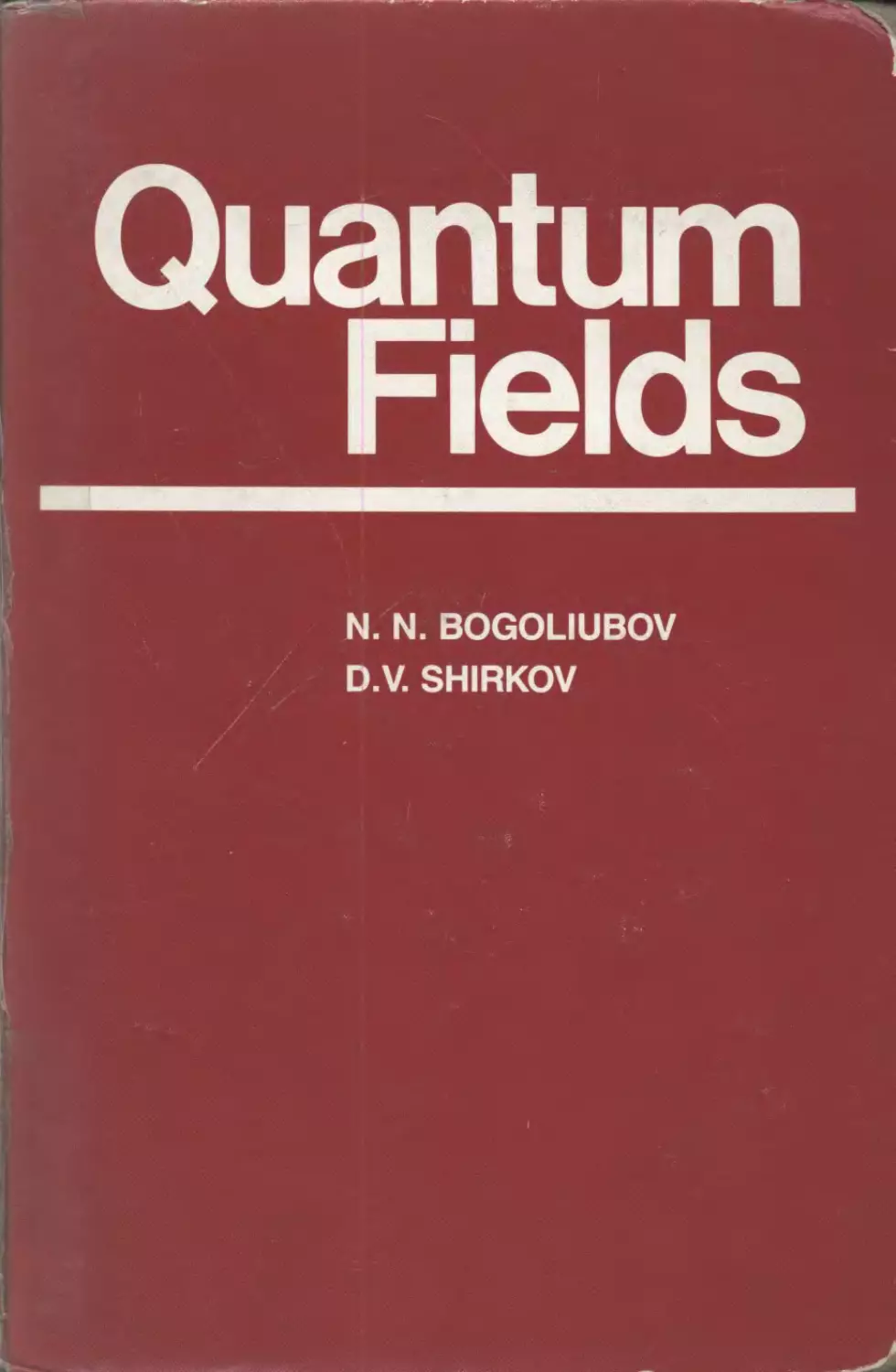
                    N. N. Bogoiiubov and D. V. Shirkov, Quantum Fields
First English Edition, 1982
Originally published in 1980 as KsanTOBMe no.iH
by Izdatel'stov ''Nauka," Moscow
Library of Congress Cataloging in Publication Data
Bogoiiubov, N. N. (Nikolai Nikolaevich), 1909-
Quantum fields.
Translation of: Kvantovye polia.
Bibliography: p.
Includes index.
1. Quantum field theory. I. Shirkov, D. V.
(Dmitrii VasiFevich) II. Title.
QC174.45.B5813 1982 530.1'43 82-4366
ISBN 0-8053-0983-7
Copyright © 1983 by Benjamin/Cummings Publishing Company, Inc.
Published simultaneously in Canada.
All rights reserved. No part of this publication may be reproduced, stored in a retrieval system,
or transmitted, in any form or by any means, electronic, mechanical, photocopying, recording, or
otherwise, without the prior written permission of the publisher, the Benjamin/Cummings
Publishing Company, Inc., Advanced Book Program/World Science Division, Reading,
Massachusetts, U.S.A.
Printed in the United States of America
ABCDEFGHIJ-HA-898765432

CONTENTS
Preface xiii
Preface to the English-language Edition xv
Chapter 0. Some Basic Concepts and Notation 1
1. Particles and fields 4
1.1 Particles and their main properties 4
1.2 Conservation laws 6
1.3 Particle-field correspondence 7
1.4 The representation of the Lorentz group 9
Chapter I. Free Classical Fields 15
2. Dynamical field invariants 15
2.1 The Lagrangian 15
2.2 Dynamical invariants. Energy-momentum 17
2.3 Noether's theorem 19
2.4 Angular momentum and spin 20
2.5 The current vector and the charge 22
3. The simplest fields 24
3.1 The scalar field 24
3.2 Momentum representation 25
3.3 The vector field 29
3.4 The local reference frame 32
4. The electromagnetic field 33
4.1. Potential of the^^^^^ field 33
4.2 Gauge invariance and the Lorentz condition 54
4.3 The generalized Lagrangian 37
4.4 The diagonal gauge 39
4.5 Transition to the local reference frame 41
5. The Dirac field 43
5.1 The Dirac equation and Dirac matrices 43
5.2 Lagrangian formalism 46
5.3 Momentum representation 47
5.4 Decomposition into spin states 49
5.5 Dynamical invariants 50

vi Contents
Chapter II. Quantization of Free Fields 53
6. Quantization of fields 53
6.1 The essence of the field quantization procedure 53
6.2 Interpretation of the occupation-number representation from
a corpuscular point of view 55
6.3 Canonical quantization 58
6.4 The Schrodinger and Heisenberg representations 60
6.5 The relativistic scheme of quantized fields 62
7. Commutation relations 64
7.1 The physical meaning of the frequency components 64
7.2 The vacuum amplitude and the Fock representation ....... 66
7.3 Types of commutation relations 68
7.4 Fermi-Dirac and Bose-Einstein quantization 70
7.5 Connection between spin and statistics 73
8. Fields of integral spin 74
8.1 The scalar field 74
8.2 The form of dynamical variables in terms of normal
products 75
8.3 The complex vector field 77
8.4 The electromagnetic field—difficulties of quantization .... 79
8.5 The electromagnetic field—its quantization according to
Gupta and Bleuler 81
9. Spinor fields 84
9.1 Quantization of the Dirac field 84
9.2 The spinor field with zero mass 86
9.3. Charge conjugation 91
9.4 The CPT theorem 94
Chapter III. Interacting Fields 97
10. The interaction of fields 97
10.1 Interaction between particles 97
-..-...- -IQ^ Interaction Lagrangians ............. -... ...■.-—.".:... t02
10.3 The electromagnetic field as a gauge field 104
11. Non-Abelian gauge fields 106
11.1 The Yang-Mills fields 106
11.2 Gauge interaction of fields 109
11.3 Spontaneous symmetry breaking 110
11.4 The massive Yang-Mills field 114
12. Quantum systems with interaction 117
12.1 Formulation of the problem 117
12.2 An illustration 119
12.3 The Hamiltonian approach 121

Contents vii
12.4 Diagonalization of model Hamiltonians 123
12.5 Interaction effects 127
13. The heavy-nucleon model 128
13.1 Formulation of the model 128
13.2 The solution in the one-nucleon sector 129
13.3 Properties of the single-nucleon solution 133
13.4 Transition to the local limit 135
Chapter IV. The Scattering Matrix 137
14. The scattering matrix 137
14.1 Pertubation theory 137
14.2 The interaction representation 139
14.3 The scattering matrix 141
14.4 Time-ordered products 144
14.5 The time-ordered exponential 145
15. General properties of the 5-matrix 146
15.1 The scattering matrix as a functional 146
15.2 Relativistic covariance and unitarity 149
15.3 The condition of causality 150
15.4 The differential condition of causality 152
16. The axiomatic 5-matrix 154
16.1 Expansion in powers of the interaction 154
16.2 Conditions for 5„ 155
16.3 Determination of the explicit form of ^2 and ^3 156
16.4 The general form of S(g) 157
17. Wick's theorems 159
17.1 Reduction to the normal form 159
17.2 Wick's first theorem 160
17.3 Time-ordered pairing 162
17.4 Wick's second theorem 165
17.5 Wick's third theorem ^, ,_^,_^,^,,,,,.,, .^^,^^^^jj5
Chapter V. The Feynman Rules and Diagrams 167
18. Green's functions for free fields 167
18.1 Green's function for a scalar field 167
18.2 The causal Green function 169
18.3 Singularities on the light cone 171
19. Feynman diagrams 174
19.1 The coefficient functions 174
19.2 The graphical representation of 5„ 175
19.3 Spinor electrodynamics 176
19.4 The Yang-Mills field 180

viii Contents
20. The Feynman rules in the /7-representation 184
20.1 Transition to the momentum representation 184
20.2 Feynman's rules for the evaluation of matrix elements 188
20.3 An illustration for the ^^ model 187
20.4 Spinor electrodynamics 189
21. Transition probabilities 193
21.1 The general structure of matrix elements 193
21.2 Normalization of the state amplitude 195
21.3 The general formula for the transition probability 197
21.4 Scattering of two particles 199
21.5 The two-particle decay 202
Chapter VI. Evaluation of Integrals and Divergences 203
22. The method for evaluating integrals 203
22.1 Integrals over virtual momenta 203
22.2 The a-representation and Gaussian quadratures 204
22.3 Feynman's parametrization 207
22.4 Ultraviolet divergences 209
23. Auxiliary regularizations 210
23.1 The necessity of regularization 210
23.2 Pauli-Villars regularization 211
23.3 Dimensional regularization 213
23.4 Regularization by means of a cutoff 215
24. One-loop diagrams 216
24.1 The scalar ^Tish'^ 216
24.2 Self-energies of the photon and of the electron 218
24.3 Triangular vertex diagrams 221
24.4 Ultraviolet divergences of higher orders 223
25. Isolation of the divergences 225
25.1 The structure of one-loop divergences 225
25.2 The contribution to the S-matrix 226
25.3 Counterterms and renormalizations 229
25.-T Divergences and distributions 231
Chapter VII. Removal of Divergences 233
26. The general structure of divergences 233
26.1 Higher-order divergences 233
26.2 The connection with counterterms and renormalizations ... 236
26.3 The degree of divergence of diagrams 238
26.4 The property of renormalizability 240
27. Dressed Green's functions 242
27.1 Propagators of physical fields 242
27.2 Higher Green's functions 245

Contents ix
27.3 Strongly connected multilegged functions (vertices) 248
27.4 Reduction formulas 250
28. The renormalization procedure 251
28.1 Renormalization of contributions to Green's functions .... 251
28.2 Theorem of renormalizability 256
28.3 A recipe for subtraction on the mass shell 257
28.4 Nonuniqueness of the vertex renormalization 259
29. Renormalization in spinor electrodynamics 260
29.1 The condition of gauge invariance 260
29.2 Gauge transformation of the photon propagator 262
29.3 The photon propagator with radiative corrections 263
29.4 The dressed propagator of the electron 266
29.5 The vertex part and Ward's identity 268
Chapter VIII. Description of Real Interactions 273
30. Electromagnetic interactions 273
30.1 Spinor electrodynamics 273
30.2 The anomalous magnetic moment of the electron 275
30.3 The limits of spinor electrodynamics 278
31. Weak interactions 280
31.1 Fermi interactions 280
31.2 The structure of the weak current 282
31.3 Nonrenormalizability and ultraviolet behavior 283
31.4 The intermediate-boson hypothesis 284
32. The Weinberg-Salam model 285
32.1 The main properties 285
32.2 The structure of the boson sector 286
32.3 The fermion sector 289
32.4 The Lagrangian and quantization 290
32.5 Physical content and experimental status 292
33. The general picture 293
_ 33.1 Strong interactions .^_..^_^^_^. 293
33.2 Restrictions of the perturbation-theory method 294
33.3 Other methods of quantum field theory 295
33.4 Conclusion 299
Appendix I. Isotopic Spin Formalism 301
1. The nucleon doublet 301
2. The pion triplet 303
Appendix II. Dirac Matrices and the Dirac Equation 305
1. Dirac matrices 305
2. The Dirac equation 308

Contents
3. Transformation properties 309
4. Nonrelativistic limit 312
Appendix III. Continuous Groups 315
1. General definitions 315
2. Lie groups 317
3. Representations of Lie groups 320
4. Generators and the Lie algebra 322
Appendix IV. Transformations of Operators 327
1. Linear continuous transformation 327
2. The ''untangling" of exponentials 330
3. Commutators with the particle-density operator n{k) 331
Appendix V. List of Singular Functions 333
1. Auxiliary singular functions 333
2. Scalar field functions 333
3. Functions of the electromagnetic, vector, and spinor fields ... 335
Appendix VI. Formulae for Integration over Momentum Space 337
1. The a-representation 337
2. Feynman parametrization 338
3. Dimensional regularization 338
4. Regularization by means of a cutoff 340
5. Simplest one-loop quadratures 340
Appendix VII. Kinematic Relations for the Vertices 343
1. Three-legged vertex 343
2. Four-legged vertex 343
Appendix VIII. Feynman Rules for Yang-Mills Fields 347
___ i•- The free_fieJd_Qf lhe_grQUfi SU{?) -^^^^^^^ ..-.-.^.-^^^r^.-.. MT-
2. Interaction of the gauge field with the fields of matter 350
3. The massive Yang-Mills field 352
Appendix IX. The Renormalization Group 355
1. Introduction 355
2. Functional equations of the renormalization group 355
3. Differential equations 358
4. Connection with perturbation theory. Ultraviolet asymptotic
behavior 360
5. Some applications to quantum chromodynamics 362

Contents xi
"September" Assignment (for Chapter I) 365
"October" Assignment (for Chapter II) 369
"November" Assignment (for Chapter III) 372
"December" Assignment (for Chapter IV) 375
"February" Assignment (for Chapter V) 376
"March" Assignment (for Chapter VI) 378
"April" Assignment (for Chapter VII) 379
Recommendations for Use 381
References 383
Subject Index 385

PREFACE
The main purpose of this book is to provide graduate students in physics
with the necessary minimum of information on the fundamentals of modem
quantum field theory.
It may turn out to be sufficient both for theoreticians, specializing in
nuclear physics, quantum statistics and other fields, in which quantum field
methods are utilized and which are based on quantum concepts, and also for
experimental physicists in the fields of nuclear and high-energy physics. For
the latter category of readers the present book should be supplemented by a
course on particle physics and particle interactions. At the same time the
book can be recommended as an introductury text for persons intending to
work in the field of quantum field theory and of the theory of elementary
interactions.
The material in this book corresponds to a course lasting one academic
year. Our personal experience testifies that parallel practical studies at
seminars are extremely desirable. For this purpose part of the technical
material has been assembled at the end of the book in the form of
Appendices. There, also, sets of exercises and problems, gathered together as
assignments corresponding to chapters of the main text, are given.
The authors are grateful to the editor of this book D. A. Slavnov, to the
reviewers M. A. Brown, L. V. Prokhorov, K. A. Ter-Martirosyan, and also
to B. M. Barbashov, B. V. Medvediev, and N. M. Shumeiko for valuable
comments on the typescript of the book.
N. N. Bogoliubov
D. V. Shirkov
xin

PREFACE TO THE
ENGLISH-LANGUAGE EDITION
This book is a text on the fundamentals of quantum field theory and
renormalized perturbation theory (RPT). The traditional field of application
of the latter for a long time was limited to quantum electrodynamics. During
recent years, due to the creation of a unified theory of electroweak
interactions and to the successes of quantum chromodynamics it has become clear
that the physical scope of RPT is much wider. However, in the study of the
quark-gluon interaction, as well as of possible mechanisms of the grand
unification of interactions, a decisive part is played by the simultaneous use
of results of RPT and of the apparatus of the renormalization-group method.
Therefore we have written a special Appendix IX, "The renormaliza-
tion group," for the English-language edition of our book. Besides this, small
editorial changes and corrections of noticed misprints have been made.
N. N. Bogoliubov
D. V. Shirkov
XV

Quantum Fields

SOME BASIC CONCEPTS AND NOTATION
We shall take all components of four-vectors to be real. The four-vector
a = {cP, a) consisting of the zero component a^ and the space vector a will,
according to tradition, be called a contravariant 4-vector, and we shall denote
its components by upper indices
We define the product of two vectors a and b as
ab = flOfto — a6 — a%^—a^b^ — a^b'^ — a^b^.
It is conveniently written in the form
ab^^e^vd^b"^ (jx, v = 0. 1. 2.3),
pi. V
where g^^ is a diagonal metric tensor
g^v = 0 when [x^v, g^=\\ ^11=^22 = ^33 = —1.
differing in sign from the well-known Minkowski tensor. The transition from
contravariant components a^ to covariant ones a^ (i.e. lowering of indices) is
accomplished with the aid of the metric tensor:
that is,
ao = a**. ak = — a^ (^ = 1. 2, 3), av = (a^ — o)-
Here and below, summation over twice repeated indices is implied in all
cases, and we will omit the summation sign. Indices representing summation

2 Some Basic Concepts and Notation
over the three space components are denoted by Latin letters, taken from the
middle of the alphabet:
ab = a^bn = a^b^ — ^i^i + ^2^2 + ^3^3>
while indices representing summation over all four components (0, 1, 2, 3)
are denoted by Greek letters:
ab = av^v = a^b\^ = ^ g^'X^v-
pi» V
Occasionally, in order to simplify the form of a cumbersome expression, we
shall lower or raise both Greek indices, that is
Hi V
Thus, the presence of two identical Greek indices in different factors always
implies covariant summation independently of the positions of the indices.
Indices associated with internal symmetry groups (for example, isotopic
indices) are denoted, as a rule, by latin letters taken from the beginning of the
alphabet (a, b,.. .).
The symbol a stands for the contraction of the four-vector components
fly with the Dirac matrices
d = a'^Yv = OvY^'
For derivatives with respect to covariant and contravariant components the
following abbreviated notation is often used:
^_5v^^y:v ^:^d CD =(P
5jCv "■ ' dx^ v^a "fa; v-
Naturally, we have

Some Basic Concepts and Notation 3
We represent the D'Alembert operator
in the form
n--av5v.
Throughout the book the so-called rational system of units is used, in
which the velocity of light and Planck's constant are taken equal to unity, i.e.,
c = fi = 1. In this system energy and momentum have the dimension of
mass, or of a reciprocal length, and the time Xq= t has the dimension of
length
[£] = [p] = m-/-i. [xo]-[Jc]=/ = m-i.
As a rule, the formulae for the four-dimensional Fourier transform are
written in the form
f (x) ~ J e-'^P^J (p) dp, f (p) ~ J e^P^f {x) dx.
The sign of the exponent is chosen to be such that the time component
corresponds to the quantum-mechanical expression
The three-dimensional Fourier transform correspondingly is
g)ijc)~j e^P"" ^{p)dp, _ T (P)~ J e-^>^cp (jc).dJC.
An exception will be made for the positive-frequency parts of field
functions and the positive-frequency parts of the Green's functions. The
normalizing factors of the Fourier transforms (powers of It:) are chosen in
different ways in various parts of this book.
Within each section single numbering of formulae is used: (1), (2),
(3),.. ., which is used directly for references to formulae within the given
section. Double numbering, like (8.12), (AIL6), indicates references to
formulae of other sections. The first symbol points to the number of the

4 Some Basic Concepts and Notation 1.1
section or appendix (Section 8, Appendix II), and the second one to the
ordinal number of the formula in the section.
Bibiliographical references are denoted by the years printed after the
author name. For example, "Medvediev (1977)" denotes a reference to the
book by B. V. Medvediev, published in 1977, the full bibliographical title of
which is presented in the list of references at the end of the present book. The
only exception is made for the third edition of our book Introduction to the
Theory of Quantized Fields, which will be referred to as the
Introduction.
1. PARTICLES AND FIELDS
1.1. Particles and their main properties. Quantum field theory is a physical
theory of elementary particles and their interactions. It is based on the
connection arising between relativistic particles and quantum fields, when
classical fields are quantized. The properties of the quantized fields closely
correspond to the properties of the particles. Therefore, we shall first of all make a
list of the main properties of particles.
An important attribute of a relativistic particle is its rest mass m. The
theory of relativity relates the mass m to the particle energy E and its
momentum/? by the well known relation;
In the rational system of units this relation assumes the form
In this system mass can be measured in energy units. For the mass of the
electron m, we have* m, = 9.109534(47) X 10"^^ g = 0.5110034(14)
MeV. The proton mass m^ = 938J196i(J7XMs}^
The second significant characteristic of a particle is its spin (i.e., its
intrinsic angular momentum). In accordance with general theorems of
quantum mechanics the spins of particles turn out to be quantized—their
absolute values are integer multiples of one-half of Planck's constant:
1.0545887(57) X 10'^^ erg-s = 6.582173(17) X lO^^^ i^^y
*Here and below we present the latest data. The numbers in brackets represent the
uncertainty, equal to one standard deviation, in terms of the last digit of the main number, i.e.
0.5110034(14) = 0.5110034 ± 0.0000014.

1.1 Particles and their main properties i
Therefore, in the rational system of units, which we use, the spins of the
electron and the proton turn out to be equal to one-half, and the spin of the
photon (y-quantum) is one:
^e = ^p= /2» Sy=I.
A third cardinal property of particles is the existence of electrical
charge, the values of which are also quantized. The charges of all observed"*"
particles are multiples of the so-called "elementary charge" e
= 4.803242(14) X 10"^^ CGS units = 1.6021892(46) X 10"^^ C, equal to
the charge of the electron. Unlike the spin, the quantum nature of which is
quite clear, the discreteness of electrical charge represents an exciting
mystery.
Finally, an important characteristic of a particle is its lifetime r. The
point is that only a few particles in the free state live for an indefinitely long
time (i.e., are absoutely stable). Among these are the electron e~, the proton
/?, the photon, and the neutrino v,* and also their antiparticles—the positron
e'^, the antiproton^, and the antineutrino v. All other particles are unstable
and spontaneously decay, by the exponential law exp(—//r), into other
particles. The coefficient r is called the lifetime. For example, the lifetime of the
neutron, which decays according to the scheme (^-decay)
' -. \\
-AT
turns out to be equal to r„ = 918(14) s = 15.3 min. The charged pion n'^
decays into a muon and a neutrino:
with a lifetime r^+ = 2.6030(23) X 10"^ s, etc.
The instability of particles displays a most important property of the
microcosm—the mutual transformation of particles into each other, which is
a consequence of their interactions. The interactions of particles fall into four
classes:,strong^electrjomajgnetic, weak, and gravitationaL We shall not dwell
in detail on the properties of the interactions (which are discussed below, in
tThe eiectricai charges of quarks (hypothetical constituents of hadrons) aro usually
considered equal to simple fractions (±3, ±5) of e. However, quarks in the free state have not
been observed.
* Besides the two well-known types of neutrinos, the electronic v^ and numonic v^, there
exists, probably, a third one—the v^, a "partner" of the recently discovered heavy r-lepton.

6 Some Basic Concepts and Notation 1.2
Section 10). We only point out that due to particle interactions, particles in
some combination transform, as a rule, into other particles in some other
combination, if such transitions are not forbidden by any conservation laws
(of energy, momentum, angular momentum, electric charge, baryon number,
strangeness, and some others).
The absence of any transition allowed by known conservation laws is
considered to be an indication of the existence of some new, hitherto
unknown conservation law.
1.2. Conservation laws. Generally speaking, conservation laws are the
consequence of some symmetries, which reflect the property of nonobserv-
ability of certain characteristics of physical objects. It is well known that in
conservative systems the law of energy conservation is the manifestation of
symmetry with respect to the continuous operation of time translation.
Invariance under time translation is, in turn, equivalent to the nonobserv-
ability of absolute time. Another sequence of the same type is made up by the
parity conservation law, invariance under space inversion, and the
conventionality of the concept of "right" and "left" (i.e., the nonobserv-
ability of "absolute right" and "absolute left").
Most of the conservation laws are connected with continuous
symmetries and can be obtained from the latter with the aid of Noether's theorem
(see below. Section 2.3). Among them the conservation laws of energy,
momentum, and angular momentum may be singled out as following from
symmetry of physical objects in the space-time. Such symmetry is a
consequence of such deep and general properties as the nonobservability of
absolute time and of absolute space coordinates (symmetry under space-time
translations), the isotropy of space, and the equivalence of coordinate
systems moving with respect to each other with constant velocities
(symmetry under rotations in space and Lorentz rotations). The
corresponding conservation laws are of a very general nature; they are characteristic of
all particles and all interactions, and are obeyed in all transitions.
electric charge and baryon number are universal as well. These conservation
laws can also be correlated with the already mentioned symmetries under
phase transformations of the continuous type. The latter, however, have no
explicit physical basis and are not connected with the space-time structure.
Such symmetries are called intrinsic symmetries.'^
*Some recent theoretical speculations (models of grand unification of interactions) raise
hope for the explanation of the quantum nature and conservation of the electric charge. At the
same time, there seems to be a possibility of baryonic-charge nonconservation (in particular, in
proton decay with lifetime > lO^^years).

1.3
Particle-field correspondence
Table I. Interaction symmetry properties and conserved physical quantities
Physical quantities
Electric charge
Baryon number
parity
Isospin
Strangeness
C+) = conserved; (~]
1 = not
conserved.
Strong
+
+
+
+
+
Interactions
Electromagnetic
+
+
+
+
Weak
+
+
The class of intrinsic symmetries includes isotopic symmetry, and also
some others (e.g., the so-called unitary symmetry). Most intrinsic
symmetries and the related quantities conserved are of an approximate
nature. With the two exceptions just mentioned (electric charge and baryon
number) the respective conservation laws are obeyed in some interactions
and violated in others. Isotopic invariance (the isotopic-spin conservation
law) holds in strong interactions and is violated in electromagnetic and weak
interactions. The law of parity (to be more precise, of space-parity)
conservation, which is connected with the symmetry of the wave function
under space inversion, holds in strong and electromagnetic interactions and is
violated in weak interactions. Analogous behaviour is displayed by the
conservation laws of strangeness (as well as of the new quantum numbers,
charm and beauty). These properties are summarized in Table 1.
We shall not discuss herein the properties of the gravitational
interaction, because of its very low intensity. For illustration we may point out
that two protons are attracted with a gravitational force approximately 10^"^
times less than the force of their electric repulsion.
1..^. Particle^field correspondence. A field represents a physical system
with an infinite number of degrees of freedom. The concept of field arises
naturally when one attempts to reject the notion of instantaneous action of
particles on each other at a distance (Newton's actio in distans)—B. notion
that contradicts the theory of special relativity (see Medvediev 1977, Part II,
Section 6, and also Wigner 1971, p. 12). Considering the space between
particles to be filled with a field, we charge the field with the task of
transferring perturbations with finite speed from one particle to another.
Thus, the introduction of classical fields into physics is dictated by reasons of
relativistic invariance. In particle theory a central role is played by
relativistic quantum fields.

8 Some Basic Concepts and Notation 1.2
The quantized wave field is a fundamental physical concept within the
framework of which the dynamics of particles and their interactions is
formulated. It allows one to describe various states of a system of many
particles by means of a single physical object in ordinary space-time.
Quantized fields appear when classical fields are quantized, as a result of
which the field functions take on an operator meaning and are expressed in
terms of particle creation and annihilation operators. Thereby there arises
the possibility of describing a most important property of elementary
particles—processes of mutual transformations.
An example, well known for a long time, of a classical field is the
electromagnetic field, which describes light and at the same time the
interaction of electrically charged particles. A classical description, based on
Maxwell's equations, leads to a purely wave concept of electromagnetism.
From a methodological viewpoint it sometimes turns out to be convenient to
consider a continuous system—a field—as the limit of a discrete mechanical
system with a number of degrees of freedom A'', tending to infinity. One field
oscillator corresponds to each degree of freedom.
A description of the corpuscular properties fo light is achieved as a
result of a quantization procedure, in the course of which the field is
associated with discrete energy quanta, corresponding to various possible
energy states of the field oscillators. Quanta of the electromagnetic field—
photons—have zero rest mass, have no electrical charge, and have a spin
equal to one. The last fact corresponds to the polarization properties of
classical fields and manifests itself in the fact that the electromagnetic field is
multicomponent and is described by a set of field functions—the components
of the electric or magnetic field strengths, or the components of the potential
Ay.
The properties of field functions, corresponding to other particles, also
reflect the spin, charge, and other discrete characteristics of the respective
particles. After quantization the quanta of the fields are usually identified
with the particles.
^^ the~^real univers^oTlntefactihg particles^ a system of coupled
equations for the various fields is ascribed. After quantization the
expressions representing the coupling of these equations (the interaction
Lagrangian or Hamiltonian—see Section 10 below) describe elementary
interactions between particles. These expressions acquire a clear
interpretation in Feynman's rules of correspondence (see Sections 19, 20 below).
We shall postpone consideration of the interaction apparatus of particles
and fields, and begin by examining properties of free fields and their
quantization.

1.4 The representation of the Lorentz group 9
1.4. The representation of the Lorentz group. Let us consider the laws of
transformation of field functions under relativistic transformations of
coordinates. We recall some definitions.
The full (in other words, general orthochronous) Lorentz group consists
of homogeneous linear transformations of the four coordiantesx" which leave
invariant the quadratic form
and do not reverse the direction of time x^. This group includes the usual
spatial rotations, the Lorentz "rotations" in the x^x^, xV, and xV planes
(i.e., transformations under transitions to a coordinate system moving with
respect to the initial one with constant velocity), the reflections of the three
space axes, and all the products of these transformations. If time reversal is
added, then we obtain the general Lorentz group.
In physics an important role is played by the group which consists of the
full-Lorentz-group transformations together with translations along all four
coordinate axes. This group is called the inhomogeneous Lorentz group (or
the full Poincare group). We shall call invariance under this group
relativistic invariance, to be distinguished from Lorentz invariance, which
corresponds to the Lorentz group.
Henceforth we shall be interested in the transformtion laws of field
functions under transformations of coordinates belonging to the full Poincare
group
x->x' = P(o); X), (1)
where a> = (L, a) denotes the set of parameters describing translations {a)
and rotations (L), and
The field function u{x) represents either one function (being a single-
component function) or several functions (being a many-component
function) of the four coordinates x" defined in each of the reference frames. A
transition from one coordinate systems to anotherx' which is related tox by
the transformation (2) corresponds to a linear homogeneous transformation
of the components of the field functions
u(x)-^«'(x') = A(0))«(x), (3)

10 Some Basic Concepts and Notation 1-4
where the transformation matrix A is completely determined by the matrix L
of the Lorentz transformation (2), i.e., depends on the same parameters as
L.
We emphasize that the transformation (3) can not be reduced to the
replacement of the arguments by x', since it describes a transformation from
one coordinate system to another, and not a displacement from one point of
space to another.
To each Lorentz transformation L there corresponds a matrix A^, to the
unit element of the group L there corresponds the unit matrix A = 1, while to
the product of two elements L^ and L2 of the Lorentz group there
corresponds the product
Ar J =Ar A,
A system of matrices with such properties is called, in group theory, a
linear representation of the group. Matrices A of finite rank form a finite-
dimensional representation of the Lorentz group. The rank of a
representation is determined by the dimension of the matrices, i.e., by the number of
components of w.
Therefore, the possible kinds of wave functionsani the laws of their
trans^mation can be obtained by mvesti^ation of th^ fjnitp-Htmpnsinnal
(irredjicible) regresentatioiiS-JlLili£,Xorentz_ group. Such an investigation
represents a special part of the theory of group representations, the result of
which comes to the following. The finite-dimensional representations of the
Lorentz group may be single-valued or double-valued, i.e., the
correspondence L -" Ai may be single-valued or double-valued. The importance to
physics of double-valued representations is due to the fact that the field
functions, generally speaking, are not directly observable (specifically, fields
which transform according to double-valued representations always enter
into the observable quantities in the form of quadratic combinations).
However, the lack of single-valuedness of the operator A^ must be such that
the observables transform in a completely unique manner under any Lorentz
transformation L. Besides, it is necessary that the operators A^ be
continuous functions of the parameters of the transformation L, i.e., that to
an infinitesimal transformation of the reference frame there correspond an
infinitesimal transformation of the field functions. The combined
requirements stated above lead to the representations of the Lorentz group being
divided into two categories. The first category is characterized by the single-
valuedness of the correspondence L -* A^ and contains the single-valued so-
called tensor and pseudotensor* representations. The field functions which
*The difference between tensors and pseudotensors is related to the reflections of space
axes and will be considered at the end of this section.

1.4 The representation of the Lorentz group 11
transform in accordance with the tensor representation are called tensors
(Pseudotensors) and in some cases may be directly observable (e.g. the
electromagnetic field). The second category is characterized by this
correspondence being double-valued: L -* ± A^.
The transformation law for a (pseudo) tensor of the Mh rank,
JVI.V2, . .VN^ under continuous transformations of coordinates has the form
^ dxv^ dxv^
or, using the notation (2),
The double-valued representations are called spinor representations,
and the corresponding quantities are called spinors. The transformation law
for spinor quantities has a more complex structure and is given for the
simplest spinors in Appendix II. Here, we merely note that under the
translation
x'v = xv + av
the transformation law for tensor quantities which follows from (4),
u (x) -> u' (x') = u (x) (5)
remains valid also for spinors.
We shall now present the simplest tensor representations and the
quantities which correspond to them. The tensor of zero rank which under
any continuous transformation transforms in accordance with the law (5) is
an invariant sndTS^ catted a scalar (pseudoscalai).
The tensor of the first rank which transforms under rotations of
coordinates in accordance with the law
«"' ix) = L^M*^ (X) = 1""^ {X), (6)
is called a contravariant vector (pseudovector). The covariant vector
connected with it transforms in accordance with the law

12 Some Basic Concepts and Notation 1.4
«; (/) = L^J«^ (X). (7)
Corresponding formulas for covariant and contravariant tensors of the
second and higher ranks may be written down without any difficulty.
Now consider the operation of space inversion P^ i.e., of reflection of all
three space axes:
X -> x' = Px, Xq = Xq. x' = — X. (8)
The transformation laws of the field functions are not defined by the
formulas (4) and must be formulated separately. Since the double application
of the transformation (P^ = 1) is equivalent to the identity operator due to the
single-valuedness of the tensor representations, these laws for the
components of the tensors T ■ ■ (x) can have only two forms:
PT {X)=r' (x')=r (Px)=± r (X).
A tensor of zero rank which does not change sign under inversion,
Pu{x)== + u{x) (9)
is called a scalar. In the other case, the corresponding quantity which
satisfies the relation
Pu(x) = —M(x). (10)
is called a pseudoscalar.
If a tensor of the first rank changes the signs of its space components
under the P-transformation and does not change the sign of the time
component:
i.e.,
PVo^x) = V^x), PV{x)=^—V{x\ (11)
it is then called a vector. If, on the other hand, only the time component
changes sign and the space components do not:
PVi^{x) = -Vi,{x),

1.4 The representation of the Lorentz group 13
i.e.,
then it is a pseudovector (axial vector). Generally, it is possible to describe
the transformation law of pseudotensors by the formula (4) multiplied by the
determinant of the transformation of the coordinates. The relations (9), (10)
and other similar relations define also the important property of parity of the
field functions and of the respective particles. This characteristic plays an
essential role in determining (see Section 10.2 below) the possible forms of
interaction between various fields.

CHAPTER I
FREE CLASSICAL FIELDS
2. DYNAMICAL FIELD INVARIANTS
2.1. The Lagrangian. In this section we shall present the formalism which
permits us to obtain, on a general basis, the equations of motion as well as
quantities which are preserved in time and correspond to invariance proper-
ties with respect to one continuous transrormation or another. Such a
-~'ii , •mmi«mii- - 1 ■■■iii-iirrl-Itfl-imi mm' —mil iiiii im»Miiniirniiii -.■■»..—■-i—.a*—'^-'--.iWa^/mmw-»«im...i..i;.t.»......„.—^-■,—i.i-*- „,
formalism applied to a mechanical system with a finite number of degrees ot
freedom is based on the Lagrangian function and is called the Lagrangian
formalism.
The Lagrangian function L is a function of time, it depends on the
dynamical variables of the system, and in mechanics it is expressed as a sum
over all the material points of the system. For a continuous system of the type
of a wave field this sum is replaced by a spatial integral of the density of the
Lagrangian function.
L{x^) = ldxX{x\ X).
The latter function
<s?(x^ x)=x{x)
is called the Lagrangian.
The starting point of the Lagrangian formalism is represented by the
action of tiie system, ^, which is ffieTntegr3r^)fX~ovefTinie!
G^ =]di L {i) = \dxUxX {x\ x) = \dxX{x). (1)
Hence it may be seen that the Lagrangian function L{t) turns out to play an
intermediate role in field theory, while the major role is ascribed to the
Lagrangian ^x).
The equations of motion can be obtained with the aid of the principle of
least action, according to which actual motion occurs in such a manner that
15

16 Free Classical Fields 2.1
the action ja/ achieves an extremum, i.e. its variation vanishes. From the
condition
together with the assumption that the variations of the field functions Su^
vanish at the surface of the four-volume over which the integral is taken, we
obtain using integration by parts the Euler-Lagrange equations
6ujx) dujx) ^^a«^;,-^' (2)
Let us briefly list the main requirements imposed on the Lagrangian in
quantum field theory. First, the Lagrangian is a function only of the
dynamical variables, i.e., of the components of the field functions u^(x) and
of their derivatives. The Lagrangian does not depend explicitly on the
coordinates x, as such a dependence would violate relativistic invariance.
That the theory is local is provided for by the fact that the value of the
Lagrangian^at the points is determined by the value of w^(x) and of a finite
number of partial derivatives evaluated at the same point x. Such a
Lagrangian is also referred to as local. The presence, for instance, of integrals
in ^ would lead to the nonlocal case.
To obtain differential equations of not higher than the second order, the
Lagrangian is considered to be a function of the field components u and of
their first derivatives:
X(x)^0{Uaix), Ua;Ax))- (3)
Notice, also, that since the physical properties of a system are
determined by the action j^, the expression for which involves the Lagrangian
under the integral sign, the correspondence ^ -* ^ is not one-to-one.
Lagrangians 4ifierin§4r0ffi ^aeh-ethei^%y"^r"teta^^ur-di v ergence (of s^^rre
four-vector)
^'(x) = Jf(x) + 5v/^(A:). (4)
turn out to be physically equivalent. This is because the integral (1) ofF".^ is
reduced, with the use of the Gauss-Ostrogradsky theorem, to the surface
integral of F"^^ over the three-dimensional boundary of the four-dimensional
region of integration. Since the variations of the field functions Su vanish on

2.2 Dynamical invariants. Energy-momentum 17
this boundary, we find that the term F^.^^ does not contribute to physical
quantities.
Important requirements imposed on the properties of the Lagrangian are
that it should be real (in the quantum case, Hermitian) and relativistically
invariant. The Lagrangian being real leads to the dynamical invariants
(energy, momentum, current, and so on) being real and, ultimately, to the
unitarity of the 5-matrix.
Relativistic invariance of the Lagrangian
X' (X') = (D {U'a (X'). U'a, v {x')) = O (U« (x), Ua; v (x)) = X (x) (5)
means that ^behaves like a (pseudo)scalar under the Poincare
transformations. As the infinitesimal element of the 4-integration region in (1),
namely dx = dx^dx, is also an invariant, we obtain that the value of the
action does not change under transformations of the Poincare group.
Therefore, the Lagrangian being a scalar ensures invariance of the action.
2.2. Dynamical invariants. Energy-momentum. This latter property turns
out to be essential for obtaining the so-called dynamical invariants, i.e.,
quantities which are preserved in time. The dynamical invariants include the
energy, momentum, and angular momentum, as well as some other quantities
which are conserved by virtue of the corresponding invariance of the action
(or Lagrangian), such as e.g., the electric charge.
As an example we shall consider the energy-momentum four-vectorP".
It can be represented in the form of the spatial integral
P^ = 5dJCT^Vx^ X) (6)
of the corresponding components of the energy-momentum tensor, which in
terms of the Lagrangian is givefr5y~Qie relation
T^ix)^ -^ «„; V {X) - g'^X {X). (7)
The independence of the integrals (6) of the time x^ is a consequence of
the tensor T^^ satisfying the continuity equation
= 0. (8)

18 Free Classical Fields 2.2
To verify this, consider the integral
J
dx
d;^ *
We transform it by the Gauss-Ostrogradsky theorem into a surface integral
^dx^ = ^da^T-nx), (9)
O
where a is the boundary surface of the integration volume and d(T^ is a surface
element perpendicular to the x^-axis, and we assume the region of integration
to expand to infinity in the spacelike directions and to be limited in time by
two three-dimensional "surfaces" ai{x^ = ti) and (T2ix^ = ^2)- Assuming also
that at points at infinity in the spacelike directions the fields Ua, their
derivatives, and the components of the energy-momentum tensor equal zero,
we obtain from (8) and (9)
\ dx r-^ (X) - \ dx T'-^ (x) = I dx r^"« (/„ jc) - ^ djc T^'« (t^, x) = 0,
Q.E.D.
We shall now demonstrate that the continuity equation (8) is a
consequence of the equations of motioa Consider the divergence of the right-
hand side of (7):
a rm ^ ^ ( f^ ] a', V + J^ d^ (u- V) _ d^X.
Using the equations of motion (2) and changing the order of differentiation of
the^^secondilenvative. we^^btaiflr
dX du^ dX du„... dX
Let us now draw some conclusions. We have established that each of the
four quantities /?" (v= 0,1,2,3) is conserved in time by virtue of the
corresponding spatial density 7"^ being the zero component of the "four-
vector" O^v) = T"^, satisfying the equation of continuity (8). The latter

2.3 Noether^s theorem 19
follows from Euler-Lagrange equations as well as from the fact that the
Lagrangian ^depends on the corrdinates x only through the field functions
Ua and their first derivatives w-i,, as a result of which
dX _dje_ ^, . dX d (dua\
It can be shown that the conservation of the projection of the "four-
vector" p" on the v-axis is a consequence of the covariance of the Lagrangian
(and of the vanishing of the corresponding variation of the action) under
translation along the x^-axis.
2.3 Noether's theorem. This statement represents a special case of the so-
called Noether's theorem, which may be formulated as follows.
Let there be a continuous transformation of both coordinates and
simultaneously of field functions, which depends on s parameters
a>^(/:= 1,2,. . . ,sy.
Xv->Xv = /v(-^; w), (10)
Ua {X) -^ U'a (X') = Ua {Ub {x)\ CO) (11)
and which makes the variation of the action ^= j^x)dx equal to
zero:
Ther^^thea exist^-dyiianiL^invariants. Cj^X^^^^ which are
independent of time, of the field functions and their derivatives) which
may be represented in the form of spatial integrals
Cu=^\dx^U){x) (12)
of the zero components of certain ''four-vectors"
e;,= -—^ {ua; ,X,^ - Wa: *) - XlX {X), (13)

20 Free Classical Fields 2.4
and
co-O
• '*'-=a-^to-' (14^
We shall not present the proof of this theorem here; we refer the
interested reader to Section 2.1 of the Introduction.
We note, first of all, that the expressions (6), (7) presented above are
special cases of the general expressions (12), (13) corresponding to
rV CV
X* = 6L 'Fa:* = 0. (15)
The values (15) correspond to the transformations
i.e., to translations of all four coordinates.
The latter formula represents the transformation law of the field
functions under translations. As is seen, it is identical for field functions
having different tensor dimensionalities. Substituting the values (15) into the
general formula (13), we obtain the expression (7) for the energy-momentum
tensor. With the aid of (12) we arrive at formula (6) for the conserved
energy-momentum four-vector P".
2.4. Angular momentum and spin. We shall now obtain the dynamical
invariants corresponding to the four-dimensional Lorentz rotations of the
coordinate system. As follows from (14), it is sufficient to consider only
infinitesimal four-rotations which are of the form
x^== Xv + x)^ 6Lvu» (16)
where SL^^ are the infinitesimal parameters of the rotations. Due to the
antisymmetry of SL^^, we may choose as independent parameters six of
them:
Sw.^^.= SL^^ bX ii< n, (17)
which represent infinitesimal angles of rotation in the x^^ plane. Thus the
index k in formulas (12)-(15) stands for the double index {iiv).

2.4 Angular momentum and spin 21
Representing the variation Sx in the form
6xv = Xt6co,== 2 X^Sco^pa), (18)
P<o
and using (16), (17), we obtain
P<o
i.e.,
Xi^^^ = x^6?--xX. (19)
We represent the infinitesimal variation of the field functions u'J^x') = uj^x)
+ Su^{x) in the form
6«a(x)= X ^a^'^^«.(x)6cO(pa). (20)
b,Q<a
In accordance with (1.5) and (1.6), for the scalar field
and for the vector field
AV'''' = Ki'^-Ki\ p<a.
Therefore, for the vector field
Y^P^> = ^tj ^P^>u^ (x) = u^ (x) 6? - u^ (X) 6?. (21)
Substituting (21) and (19) into (13), we obtain the angular-momentum tensor
^x (pa) _ ^^ (^; p;^a „ u:'0^o\ 4. jf (xPgCTt „ ^a^pt) - ^ ^^ ^^^^ (^)-
(22)
By comparing the first two terms of the right-hand side with (7), we see that
they can be represented in the form
^a^pT_^Py.aT_^x(pa)^ (23)

22 Free Classical Fields 2.5
This expression corresponds to the relation between the angular-
momentum tensor and energy-momentum tensor in the mechanics of a point
Therefore, the quantity (23) should be identified with the orbital angular
momentum of the wave field. In the case of a single-component (scalar,
pseudoscalar) field the total angular momentum is reduced to the orbital
angular momentum.
In the case of multicomponent fields the last term of the right-hand side
of (22) does not equal zero, it characterizes the polarization properties of the
fields and corresponds to the spin angular momentum of the field. Thus,
where
5t(pa) _„ ^^^Mpa)^^(^^^ (24)
a; X
For the vector field, with the aid of (21), we obtain
5(p^)= {dxS'<^^)= f djc/«p(x)^-«^(;c)^V (25)
J J I dua dup}
Here the symbol u stands for the partial derivative of m with respect to time.
The three quantities »S*^^\ S^^^\ S*^^^ represent the respective components of
a spatial pseudovector—the spin vector
Sn^^nmpS(mp) (^^ ^^^^ p^]^ 2, 3). (26)
2.5. The current vector and the charge. Finally, in the case of complex
fields which coffespGnd40^ehaFge4^articles^tnrthe-simplesrcase the charge
is the electric charge) the Lagrangian turns out to be invariant with respect to
the phase transformation of the field functions (the gauge transformation of
the first kind), which does not operate on the coordinates.
We shall make use of the example of a system described by a single
complex field in order to elucidate the point under discussion. By virtue of the
property of reality, the Lagrangian as well as the dynamical quantities may
depend on the complex field only through quadratic forms of the type MaW/,,
where m^ and u^ are complex conjugate functions or their derivatives. Hence
it immediately follows that the complex wave functions u may be multiplied

2.5 The current vector and the charge 23
by an arbitrary unitary phase factor of the form exp(fa) which does not lead
to any change in the quadratic form mm and consequently does not lead to any
observable effects.
Treating u and u as linearly independent functions, we may write the
gauge transformation of the first kind in the form
Assuming a to be infinitesimal, we find that
* * *
« -V «-f- iau, u-^u-- iau.
Hence, in accordance with (14), it follows that
^a = itia for all Uay
^i? = —'iUi, for all Ui,y
and also that X=0, Substituting these expressions into (13), we arrive at an
expression that has the tensor dimensionality of a vector:
r(x) = ii^u,~.^^u,]. (28)
This four-vector satisfies the equation of continuity
d^r = 0 (29)
and therefore is usually identified with the 4-vector of the current. The spatial
integral of its zero component,
Q={j''ix)dx = i{dx!-^Ua—^«i,\ (30)
is time-independent and represents a conserved characteristic of the field. It
is identified with the charge. The integral of motion Q can describe not only
the electric charge, but also other conserved characteristics, like baryonlc
charge, strangeness, charm, colour, SU(3) symmetry of the gauge quark-
gluon model of strong interactions, etc.

24 Free Classical Fields 3.1
Clearly, systems with similar integrals of motion are also described by
complex (in the general case, multicomponent) fields. We may point out,
also, that these transformations (^ 5^ 0, X= 0) which do not act on the
coordinates are called transformations of the internal symmetries. A
physically important example of internal symmetries is represented by
isotopic symmetry. The transformations corresponding to them can also be
investigated with the aid of Noether's theorem, which leads to the concept of
the conserved isotopic-spin vectors.
3. The simplest fields
3.1. The scalar field. The simplest field is the real scalar field (p{x) which
describes spinless particles of the same sort. The free Lagrangian of this field
is chosen to be as follows:
so that the equation of motion (2.2), derived from it, turns out to be the
Klein-Gordon equation
^-5]^a^ = -'"''P-a^ = (D-'^'')'PW = 0. (2)
.. y v,.v ^.v^
Here
□ = —ava^=A-^'
dr^
is the d'Alembert operator.
With the aid of (2.7) we obtain from (1) the energy-momentum tensor
r^iv (^) ^ (p: V (^) (p; M (x) - ^^X, (3)
The angular-momentum tensor can hence be obtained now by using the
relation (2.23). The spin angular momentum is equal to zero.
Substituting into (3) the explicit form of the Lagrangian (1), we obtain
the energy density
r«0 = (1/2) [(p2 4- (V(p)2 + /7i2(p2] (4)

3.2 Momentum representation 25
and the density of the momentum vector
r^^ = —(p: V* (A=l, 2, 3)
3.2. Momentum representation. In the theory of particles the momentum
representation is used very frequently. First, it is more convenient to describe
physical problems when particles are characterized by their energies and
momenta (but not by space-time coordinates). Second, the dynamical
variables acquire a more compact and clear structure in this representation.
So we write the field function (p(x) in the form of a four-dimensional
Fourier integral:
(p (x) = (2n)-2 5 dk g^*^$ (k), dk = dk^ dk.
The condition that (p(x) should be real, (p(x) = (p(x), gives
$(^) = 9(-^)-
In accordance with (2) the Fourier amplitude p satisfies the equation
and may therefore be represented in the form
$ (k) = ]/2n 6 (k^ - m^) cp (k).
The delta function establishes the relation
{kor-k^ = m^ (5)
between the frequency ko, the wave vector^, and the parameterm. As will be
shown later, the frequency ko is to be identified with the energy, and the wave
vector with the momentum vector, as a result of which the relation (5) turns
out to be the well-known relation from the relativistic mechanics of a particle
in which m represents the mass.
The Fourier transform takes on the form

26 Free Classical Fields 3.2
Because of the delta function under the integral sign, the integration is in
fact carried out not over the whole four-dimensional ^-space but only over
the two three-dimensional hyperboloids
one of which lies entirely within the upper light cone and the other within the
lower one. Noting further that the two hyperboloids are separately Lorentz-
invariant, we arrive at the following Lx^rentz-invariant decomposition of the
field function into two terms;
(p{x) = (p+{x) + (p-{x), (6)
where
(p± (x) = (2n)- 3/2 ^ dk e± ^A^S {k^ - m^) $± {k). (7)
Here
(p±{k)^^{k,)^{±k),
and 6 is the well-known step function
^ ^0, jc<0.
The functions (p^ and (p~ will in the future be referred to as the positive-
frequency and negative-frequency parts respectively of the function <p{x). As
may be seen, the sign of the frequency is determined by the sign of the
product kx (more precisely, by the sign of the "time" term k^x^
= x^\k^ -\- m^ in the exponent of the inte^and). In this connection we note
that in the contemporary literature the converse notation is sometimes used,
i.e. the sign of the frequency being taken the same as that of the form
k}xX^ = kx -\- k^x^= —kx. Such a notation is associated with the customary
way of writing down the quantum-mechanical wave function, which is
proportional to exp(—zIEjcq), where £* is the energy. Our choice of notation is
connected with the fact that expressions of the type of tp'^ correspond in
quantum theory to the creation of the field particles, while expressions of the
type of ^~ to their annihilation. Therefore, in the system of notation adopted
by us the signs + and — symbolize the physical meaning of the corresponding
quantum operators.

3.2 Momentum representation 27
As will be shown later, the above decomposition also turns out to be
very convenient for writing down the dynamical variables in the momentum
representation, since they may be expressed as quadratic forms in (p'^{k) and
We also note that in accordance with (7) the rules of complex
conjugation for ^-(A:) have the form
((p-(k)r= <P^{k),
Carrying out in (7) the integration over k^, we obtain
Here the following notation has been introduced:
Substituting (6) and (8) into (4), we obtain
po = \ r«*» dx = (V2) \ [(^vT W)' + m2(p2 (jc)] dx -
= (V2) \ dx {d^(p+ d^(p+ + 2 dy(p+ d^(p- + d^cp- d^(p- +
+ m2 [(p+ (x) r (x) + 2(p+ (x) (p- (x) + (p- (x) (p- (x)]}.
Note that in this expression all summations over v are noncovariant. It is
not difficult to demonstrate that the terms in which the product of the
functions (p^ of identical frequency are present do not contribute to the
dynamical invariant P*^. Thus, for example,
\dx{{d^r{x)Y + mH^Hx)?]^
(2ji)3 t) J -^ K ^0^ J J ^
= J ^ *P^ (^) *P^ (~ ^) ^'^*"^" (^' ~ ^0^*')»
and, since /n^ — A:o + *^=0, we obtain
\ djc [(av(p+ (a;))2 + m2 ((p+ {x)Y] = 0.

28 Free Classical Fields 3.2
An analogous relation holds also for the quadratic form in (p. Therefore
po = J djc [ d^K^^ {x) d^ (p- (x) + m2(p+ (x) (p- (x) ].
Inserting (8) into this expression, with the aid of a similar calculation we now
find
The corresponding expression for the momentum vector has the form
P'^^lT'^^dx^l dkk''(p^(k)p~{k), n=l, 2, 3.
Combining these expressions, we write them in the form which would also
hold if throughout the whole calculation the functions q)'^ and tp^ were treated
as noncommuting (i.e., their order were not changed):
P^:=^^dkk^ [(p+ (k) (p- (k) + (p- (k) (p-^ (k)], (9)
Now the point of introducing the particular normalizing factors in (8)
has become clear. The products
n (k) = <p+ (k) cp- (k) = I (p+ (k) p
represent the average densities of uncharged, spinless particles of mass m,
momentum k, and energy v^tM-T^. Under quantization these products
transform into operators with integer eigenvalues.
An important field, from a practical point of view, is the field which
corresponds to a pi-mesons (pions). This field is a pseudoscalar. The three
pions n''", n^, n~, which differ from each other on^y by their electric charge
(equal to 0, ± 1) form an isotopic triplet. They are thus assoicated with a
three-component field function q) = {^], (P2, ^3}, the constituents of which
form a vector in the three-dimensional isotopic space.
The free Lagrangian is written down in the form
1 m^
^ = |(CP;VCP=")-T-(W) (10)
and is the sum of the Lagrangians of each of the isotopic-vector components.
Therefore the dynamical quantities associated with the transformations of the

3.3 Momentum representation 29
Poincare group are represented by sums of the expressions obtained in
Sections 3,1 and 3.2 for each of the isotopic componnents.
The novel conserved quantity corresponds to transformations of
rotations in the isotopic space and is called the isotopic spin vector.
3.3. The vector field. As a next example, we shall consider the vector field,
which is used for describing particles with spin 1. The field U^ consists of four
(v = 0,1,2,3) components forming a covariant four-vector, i.e., transforming
under Lx^rentz rotations (2.16) in accordance with the law
U,. {x) -> U'^ ix') - U^ (x) + W^ (x); 6U^ - 6Q^,(/v (x).
Generally, the Lagrangian of the vector field may be constructed by
various means. The point is that the simplest generalization of the
Lagrangian (1) in the form of the covariant sum over the components
X = -{u^.,,U^-^'+fu^U^ (11)
is not the only possible Lorentz-invariant expression. To it one may add a
term proportional to
f/^;vf/^'^ (12)
which by virtue of (2.4) is equivalent to the expression
U'^Ul={dU/dxf.
To verify this, it is sufficient to establish that the difference between the
written expressions can be represented as the four-divergence dj^.^.
The Lagrangian (11) is a ''good" Lagrangian, as all dynamical
variables, from its point of view, are covariant sums (over ju.) of the
corresponding expressions from (1) for the single-component field. However,
since the term connected with the component Uq enters into such sums with
the negative sign, its contribution to the energy turns out to be negative. The
way out of this difficulty consists of imposing on the components U^ the
invariant subsidiary condition
d^U,, = -^U^{x)^idU)^0. (13)

30 Free Classical Fields 3.3
This condition reduces the number of linearly independent components
from four to three and, as will be shown later, guarantees that the energy of
the vector field is positive definite. The three remaining components
correspond to the three possible values of the component of the spin along a
given axis, which are respectively 1,0, —1, i.e., which describe particles with
spin 1. The imposition of the subsidiary condition is equivalent to the
exclusion of a particle of spin zero, which in this formulation would lead to a
negative energy.
The condition (13) is compatible with the equations of motion.
Moreover, by appropriate modification of the Lagrangian (11) (addition of a
term of the form of (12)),
4 ^^M-v^^ I 2
where
H^v = d^U^~d^U^, (14)
we can obtain as a consequence of the equations of motion
dv//^^- m^L'^ = (□ - m2) (/^ + a^avf/^ = 0. (15)
These equations are called Proca's equations. Differentiating them with
respect to jc'^ and performing simple transformations, we get the subsidiary
condition (13), Thus, Proca's equations are equivalent to the set of the
Klein-Gordon equations together with the condition (13).
The dynamical quantities corresponding to the analogous Lagrangian of
the complex vector field
X=~^ H^^m-' 4- mmyU\ (16)
have the following form: the energy-momentum tensor
the current vector
J^^i{Jj^H^^-H^^U^\ (17b)

3>3 Momentum representation 31
and the spin angular-momentum tensor
For further calculations it is necessary to decompose the potentials into
positive- and negative-frequency parts and go over to the three-dimensional
representation:
(and analogously for U^).
Substituting the expansions (18) into the zero (v = 0) components of the
expressions (17) and integrating over dx, we obtain the dynamical quantities:
P^^-ldkk^[u^ik)U^'^ik) + Ut{k)U--'^{k)\ (19)
Q = \dk[b-{k)U^'^{k)~U^{k)U''^ {k)\ (20)
S= i\dk {\u^{k)xU'{k)]~[U'{k)xU^{k)\Y (21)
Taking into account the conditions, following from the definitions (18),
for complex conjugation,
we see that the contribution, corresponding to jit = 0, to the right-hand side of
(19) turns out to be negative, while the energy Pq is of undetermined sign.
As was pointed out above, this difficulty is removed by the imposition of
additional condifions, which in the momentum representafion (18) take the
form
kvuf{k) = 0, fe^(/^(fe) = 0. (22)
By virtue of these conditions the components Uy are no longer independent.
Expressing with their aid the components Uq through the remaining
ones:
Ut (k) = ^ kM (k), Of (k) = ^ kM (k) (« = 1, 2, 3).

32 Free Classical Fields 3.4
we obtain for the quadratic form under the integral sign in (19) the following
expression which depends only on the "spatial" components of the potential:
-U^U^-^-U^Ak)U^{k)-^^[kU^{k)){kU^{k)). (23)
3.4. The local reference frame. This expression is diagonalized by the
linear substitution
U (k) = e,ai (k) + e,a, {k) + -^ . ^a,{k). (24)
Here e^ and €2 are unit vectors, orthogonal to the wave vector k and to each
other
(^r^;)-6i/, e^^kl\k\ (/, /=1, 2, 3),
i.e., they represent transverse-polarization vectors. The substitution (24)
represents the decomposition of the vector potential into its longitudinal and
transverse components with respect to the momentum, i.e. the transition to
the local reference frame in momentum space. With the aid of (24) we
obtain
*r+ /.. ,r- „ /,. * +
- U^ (k) U^' V (k) = a~ (k) ar\' (k). (25)
Inserting this expression into (19) and (20), we arrive at the diagonal
expressions for the energy-momentum and charge, the energy being in terms
of the new variables manifestly positive definite:
Py^\dkk^lk{k)an{k) + an{k)ai{k)],
Q=\dk [at (k) an (k) - an (k) at (k)l
However, the expression for the contribution to the component of the spin
along the direction of the momentum vector,
* » •» *
A53 r^ i [at (k) fl2 (Ar) - aX + a^at- a^a^) (26)
turns out to be nondiagonal.
The linear substitution
± _ b^-\'bp ± __ ^r-^r 'j: _ ;-x /97X

4.1 Potential of the electromagnetic field 33
(and similarly for the conjugate amplitudes a,,-) diagonalizes this expression,
leaving unchanged the diagonal form ofP^ and Q:
Pv Sdkk^ \bn (k) ha (k) + bn (k) b^n (k)], (28)
Q^^ldk \bn (k) bn (k) - h (k) b'n {k)\, (29)
^S., ^ \b, (k) bl (k) ~ kK + hb^- kb^l (30)
*
Hence it may be seen that the quadratic combinations of the amplitudes b
and b'^ may be considered as the densities of the average number of particles
which have definite values of energy, momentum, charge, and component of
spin along the direction of motion. Thus, for example, the quantity b^k)b^k)
represents the density of particles with momentum k, energy kQ, charge —1,
and component of spin along the direction of motion equal to +1; similarly,
D^k)b^k) is the density of particles with momentum k^ energy kQ, charge —1,
zero component spin, etc. As we shall see later, after quantization the
amplitude o^k) describes the creation of a particle of energy kQ, momentum
k, charge —1, and spin component +1, while the amplitude b^k) describes
its annihilation, etc.
Therefore, in accordance with (24) and (27) the amplitudes a]2
correspond to linearly polarized oscillations, while bi2 correspond to
circularly polarized oscillations.
Thus, the complex vector field describes positively and negatively
charged particles of mass m 7^0 and with three possible values of the
component of the spin vector along the direction of motion, equal
respectively to 1,0,-1.
4. The electromagnetic field
4.1. Potential of the electromagnetic field. The free electromagnetic fielJ
satisfies the Maxwell equations
curl£ — — //, cMx-XH^Ey
div£-0, div//=0.
For a more symmetric description of the electromgnetic field, a real
convariant four-vector of the electromagnetic potential A^={Aq^ ~ A) is
introduced in such a way that

34 Free Classical Fields 4.2
£ = —grad Aq — A, //== curM.
The components of the "four-dimensional curl" of the potential form the
well-known antisymmetric tensor of the electromagnetic field
whose components are related to the components of the vectors representing
the electric and magnetic field strengths by the relations
E^^-Fno. H^-\^nmpFnp K m, p = 1, 2, 3) (2)
It is convenient to exhibit this relation in the following explicit form:
/O — £^ — £2 —£3
\E^~m 0 m j'
\£3 7/2 —//I 0
The Maxwell equations are equivalent to the following equations for the
components of the tensor F:
In making the further transition in these equations from F to the
potential/I, we see that the first four equations of (3) are a consequence of
the definition (1) and do not lead to any equation for A, while the next four
equations yield
n^v + ^vaM^ = 0 (4)
which represents an analog of Proca's equations (3,15),
From this it follows that the formulation of the equations of the
electromagnetic field in terms of the potentiaM^ is really simple, symmetric,
and manifestly covariant,
4,2, Gauge invariance and the Lorentz condition. The method of
introducing the four-potentiaMj, is nonunique. It is not difficult to verify that the

4.2 Gauge invariance and the Lorentz condition 35
observable quantities E, H, F^^, and also the Maxwell equations are
invariant under a so-called gradient transformation of the second kind of the
potential/! ^,:
^v ix) -> ^; (x) = ^v W + dj (x), (5)
which is often called Si gauge transformation.
Therefore the potential/!, which is not an observable quantity, turns out
to be nonunique. The function b on the right-hand side of (5) is an arbitrary
function. Usually a smoothness condition is imposed on it.
Such a nonuniqueness signifies that the dynamical description of the
electromagnetic field in terms of A involves a nonphysical degree of freedom
which is usually associated with the value of the four-divergence
d^A^ix) = dA{x) = x{x),
for which we have introduced a special notation. The requirement that this
quantity be equal to zero,
dA (x) = 0 (6)
is known in the electromagnetic field theory as the Lorentz condition. Since,
if manifestly relativistic covariance is observed, after quantization (see
Section 8.5 below) it is not possible to satisfy the Lorentz condition as an
operator relation, it will be of use to us to investigate the degree of freedom
which is represented by the arbitrary scalar function xC^)^ and to discuss its
physical meaning.
For this we shall first digress for a while from the free electromagnetic
field and assume that the potential/! does not satisfy equation (4). It may be
considered to describe a field which is generated by some external sources
and, for example, satisfies the inhomogeneous equation
/
?> D A^{x) + dyidA{x))==Jy{x),
where/., is the current of the sources.
V
Second, we shall pass over to the momentum representation
Ay{x) = \dke^''''A^(k),
and we shall use the same symbol A to denote both functions and their
Fourier transforms. In this representation the operation of differentiation

36 Free Classical Fields 4.2
with respect to the configurational variables (and also the converse
operations) are algebraic. The gauge transformation (5) acquires the form
A'^ik) = A^{k) + k^f{k). (7)
where the function /(k) differs by the imaginary unit from the Fourier
transform of the functiony(x).
We introduce the projection operators
P\lAk) = g,.-^, PTik) = '^. (8)
Note that the operation {k'^) ^ is an integral operator in the jc-representation
and can be written in the form
1
k
\A^^^G{x~y)A^{y)dy,
where G is the Green's function for the d'Alembert equation defined by the
relation
□ G(x) = —6(x). (9)
The Green's functions for the equations for free fields are considered
below in Section 18. It is shown therein that to define uniquely the solutions
of equation (9), it is necessary to take into account the boundary conditions.
Here this fact is of no significance, and it will be quite sufficient for us that the
function G satisfies equation (9). Let us now decompose the four-potentiaM
into its transverse and longitudinal components, using the projection
operators (8):
A^^A'^+A\. X^=p;;,^^ 4=p;;"M^ (lo)
These components satisfy the relations
ifeMl'(ife) = 0, k''A\{k)^kA{k). (11)
Here it is convenient to introduce the special notation
kA (k) - ? (k)

4-3 The generalized Lagrangian 37
for the quantity which coincides, up to a factor of the imaginary unit, with the
Fourier transform of the function xW-
From the formulae (10) and (11) it follows that the longitudinal
component of the electromagnetic field is determined by the function §.
Actually,
A\{k) = ^l{k).
Under the gauge transformation (7) the latter transforms according to
the formula
l'{k)=^Uk)^k''f{k).
At the same time the transverse component A ^'" is not changed under the
transformation (7), It presents no difficulty to verify also that the gauge-
invariant tensor F does not depend onA^ (i.e. on ^). It is therefore clear that
the degree of freedom described by the scalar function ^{k) involves all the
arbitrariness connected with the nonuniqueness of the four-potentiaM and is
nonphysical
4.3. The generalized Lagrangian. The equations of motion (4) may be
obtained with the use of the variational principle from the Lagrangian
X.r^-\F^,F^\ (12)
which represents the well-known expression ^E'^ — H^) written in terms of
F. The subscript "tr" signifies that the "transverse" Lagrangian (12) is
gauge-invariant and contains no dependence on the longitudinal components
A\
Let us point out that the differential operator of the equation of motion
(4),
which is proportional to the transverse projection operator P^*", has no inverse
operator, and this complicates the solution of the corresponding inho-
mogeneous equation of motion. The transverse Lagrangian ^' is specified
from the point of view of the Hamiltonian formalism. We recall that in the
Hamiltonian formalism an important part is played by the canonical
momenta, which are defined as the derivatives of the Lagrangian with respect

38 Free Classical Fields 4.3
to the velocities v^ = ^/, i.e,, with respect to the time derivatives of the system
coordinates ^/. In the case of a system with an infinite number of degrees of
freedom—a field—the field functions (p{x, /) = (p{x) are chosen to be the
generalized coordinates. Therefore, the generalized canonical momenta of
the classical field are defined in the following manner:
The Hamiltonian formalism represents the basis of the so-called
canonical quantization, which is presented in Section 6, We refer the reader
to this section for a more detailed presentation of the Hamiltonian formalism
for fields, and now we return to the Lagrangian (12).
^ Choosing as generalized coordinates the components of the four-
potential A^, we arrive, by elementary calculation, at the conclusion that the
generalized momenta corresponding to the zero component Aq are equal to
zero:
/ In other words, the Lagrangian L^^ does not contain any dependence on the
7 "velocity" Aq. Lagrangians with such properties are sometimes called
/degenerate or singular. They correspond to systems v^iWv constraints. For
'; the description of systrems with constraints the generalized Hamiltonian
;dynamics introduced by Dirac (1968) is used. In our case the transition to
the generalized dynamics is equivalent to the following modification of the
/Lagrangian:
/
\ ^tr->^ = -|/^^v/^^ + |(a^)^ (13)
/
I
where a is a numerical coefficient
This Lagrangian leads to the following equations of motion;
d''F^^ + ad^{dA)^UA^ + {\+a)d,,{dA)^{), (14)
' from which, in particular, it follows that the longitudinal component of the
electromagnetic field satisfies the d'Alembert equation
D^^vW-nxW = 0. (15)
I Note that this property of the longitudinal component is preserved also

4.4 The diagonal gauge 39
^in the case when the electromagnetic field interacts with other fields, i.e.,
when the right-hand side of the equations of motion (14) contains the
components of an external current J^ satisfying the equation of continuity
. dU^ = 0, Thus, the longitudinal degree of freedom x(^) interacts neither with
'the transverse components A ^^ nor with any other fields,
/ As is seen, the Lagrangian (13) and equations (14) are no longer,
generally speaking, invariant under the transformation (5), Thus, we
conclude that the insertion of the term --(dA)^ into the Lagrangian fixes the
gauge. At the same time the expressions (13), (14) do not change under the
specialized gauge transformation
A'^{x)^AAx) + dJ,ix), (16)
the gauge function of which obeys the d'Alembert equation
n/oW = o. (17)
s
The insertion of the gauge-fixing term into the Lagrangian leads also to an
operator in the equation of motion
K^, = g^,0 +(1 -\-a)d^d,^ (1 -\- a)k^k,= k'P';j,k) - ak'Pl^ik)
which is no longer singular, i,e., to the existence of its inverse
K^v' = ^Pl^vik) + ^,PlAkh d,^~, (18)
' 4.4, The diagonal gauge. If the factor d] fixing the gauge is equal to one, we
then come to diagonal expressions forKsLndKT^:
Such a gauge is called diagonal. In this gauge the Lagrangian
may, by integration by parts, be transformed into the form
cSfdiag = - i ^^^ (x) d^A^ (X), (19)

40 Free Classical Fields 4.4
which represents the covariant sum of the Lagrangians for each of the
components /l^ separately.
The Lagrangian (19) leads to equations of motion
D A^ (x) = 0 (20)
in the form of d'Alembert equations. This Lagrangian will turn out to be the
most convenient one for quantization. According to its physical meaning (the
observed fields E, H), the Lagrangian (19), as well as the more general
expression (13), is equivalent to the initial "transverse" Lagrangian (12).
We may point out, furthermore, that the equations of motion (20) and
the Lagrangian (19), while representing a specific case of the general
relations (13) and (14), are invariant under the transformation (16), In any fixed
reference frame the function To of this transformation can be chosen so that
the zero component of the potential/Iq^ which satisfies the free equation (20),
vanishes. The Lorentz condition then takes the form
div/l = 0. (21)
The corresponding gauge is called the Coulomb gauge.
In the momentum representation equation (21) looks as follows:
Ar^(fe) = 0.
Evidently, in the Coulomb gauge the electromagnetic field satisfies the
condition of trans vers ality in the usual (three-dimensional) sense. Thus,
notwithstanding the fact that the electromagnetic field is described by a four-
component potential, only the two linearly independent components,
orthogonal to the wave vector k, have physical meaning. The actual
reduction of the four-component field to a two-component one which occurs due to
gauge invariance is closely connected with the vanishing of the rest mass of
the field particles—the photons. Namely, by virtue of this important
property, only derivatives ofA^ are present in the field equations and there arises
the property of gauge invariance of the electromagnetic field.
From the Lagrangian (19) by standard methods we obtain the energy-
momentum tensor

4.5 Transition to the local reference frame 41
the spatial densities of the four-vector P^ components
the spin angular-momentum tensor
and the spatial density of the spin vector
S = [A{x)xA(x)].
The Lorentz condition (6) must be imposed to complement the Lagrangian
formalism.
For calculating the dynamical invariants we perform decomposition into
frequency terms and introduce the momentum representation for the free
field:
4.5. Transition to the local reference frame. To perform diagonalization, it
is necessary in the representation (22) to decompose the field into
components related to the local reference frame. As the rest mass is equal to zero
(m = 0), the transformation (3.24) must be modified. We represent A{k) as a
sum of the transverse, longitudinal, and time components:
A^ (k) = elar (k) + elat (k) + eW (k) + elar (k). (23)
Here e^(k) and e^(k) are purely spatial transverse unit vecotrs orthogonal to
each other and similar to the ones introduced in (3.24), e^ = k/\k\ is the
longitudinal unit orthogonal vector,
el = 0, eV = 6,y, [e'xeq^e' (/,/, fe= 1, 2, 3),
and e^ is the unit time component of the 4-vector: el = S^. It is easy to verify
that under the transformation (23) the basic quadratic form remains

42 Free Classical Fields 4.5
diagonal;
Ai (k) A', {k)==g^^ai (k) a-, (ft). (24)
Inserting the expansion (23) into the Lorentz condition written separately for
the positive- and negative-frequency components, we obtain two relations
I ft I af (ft) — kouf (ft) = 0.
Noting that since the mass m is zero, \ k\ = kg^v/e hence obtain
ai (ft) a^ (ft) = at (ft) ao (ft). (25)
The obtained relation (25) means that because of the Lorentz condition
the densities of the average numbers of the "longitudinal" photons afajand
of the **timelike" photons ao^a^are equal to each other. Since their
contributions to the right-hand side of (24) are of opposite sign, one may therefore
speak of the "longitudinal" and "timelike" photons as ''compensating" each
other. Substituting (25) into (24), we obtain
- /l^ (ft) yiv (k) = at (ft) aT (k) + at (ft) al (ft).
Further, on computing the energy-momentum four-vector
P^= E \dkkyat{k)a-s{k),
s=l, 2
we find that in the case under consideration, as in the case of the vector field,
the energy turns out to be positive definite only due to the Lorentz
condition.
Defining, further, the spin vector
S=i\dk[A^(ft) X A-(ft)] =^i\dkEabce'^at (ft) a7 (ft),
we find its component along the direction of the propagation vector in the
form
^S^ r^ i[ai (ft) a:, (ft) - a-l (ft) a'l (ft)J.
Introducing the new amplitudes b^ and bi as in Section 3, we obtain for P^
and 5*3 the "diagonal" expressions

5.1 The Dirac equation and Dirac matrices 43
P^=ldk fev[bt (k) bT (k) + bt (k) br, (k)l (26)
^S^ ~ {bt (k) b-i (k) - bt (k) br, (/?)], (27)
from which it follows directly that the products
tis (k) == bt (k) b; (k) (s=l,2) (28)
may be regarded as densities of the average numbers of particles of zero
mass, momentum k, and energy \ k\ , having a component of the spin angular
momentum along the direction of the propagation vector k equal to +1
(S= 1) and —1 (S = 2). We are in fact dealing withp/roron^.
Thus, the transition to the momentum representation allows one to see
directly that the electromagnetic field describes transverse photons with two
possible values of the component of spin along the direction of motion,
5. The Dirac field
5.1. The Dirac equation and Dirac matrices. Fields which transform in
accordance with the spinor representations of the Poincare group are usually
called spinor fields. These fields after quantization describe particles of half-
integer spin {{, I, i,.. . )• The simplest of spinor fields is the field of spin {.
Such a field for particles of nonzero mass was introduced by Dirac for the
description of electrons. It also describes muons, nucleons (protons and
neutrons), and certain hyperons. It is this field that we shall henceforth call
the Dirac field. Following Dirac, we shall obtain the corresponding
equations by means of the "factorization" of the Klein-Gordon operator
where for convenience the usual quantum-mechanical notation
has been adopted. The operator D — m^ is quadratic in the derivatives d^
and, as may easily be seen, cannot be represented in the form of two factors
linear in P^ with numerical coefficients. Indeed, if by analogy with the
formula for factoring the difference of two squares, one attempts to write it in
the form

44 Free Classical Fields 5.1
where P is some linear combination of the operators P^ with coefficients y^:
P - P.y\
then one must demand that the relation
P.P'-={P^yn\
should hold, on expanding the right-hand side of which one finds the
condition determining the coefficients y:
Since, in accordance with this condition, the quantities y^ with different
indices anticommute, they are not ordinary numbers, but they may be chosen
in the form of matrices.
With the aid of these quantities the Klein-Gordon operator may be
represented as a product of two commuting matrix operators
n — /n^ = (i'Y^'^v + fn) (iy^% — m),
and in order that the field function may satisfy the Klein-Gordon equation
(□-/n2)i|) = 0,
we can demand that it should satisfy one of the following first-order
equations:
(/'Y^'^v - ^ri) ij) (x) - 0 or (/yv^^, _^ ^) ^ (^) ^ 0.
By tradition, we shall choose as the equation of motion for the spinor
field the first of these equations:
(id-m)yp(x) = 0, d^y'%. (2)
Equation (2) is, certainly, less general than the Klein-Gordon equation.
Therefore one may expect it to contain more detailed information. As is
known, this actually is the case, since with the aid of equation (2) Dirac for
the first time succeeded in describing the spin of the electron equal to \.

5.1 The Dirac equation and Dirac matrices 45
Equation (2) is called the Dirac equation, and the matrices y'' defined by the
relations (1) are called the Dirac matrices.
Due to the matrix character of the differential operator of the Dirac
equation, the field function \}j turn out to be multicomponent As is shown in
Appendix II, in the simplest case the Dirac field i// is a four-component
spinor; it is often represented as a column
'^^
which, for reasons of economy of space, we shall sometimes write in the
following manner: \p = {\p^, i/zj, i//3, \lf^Y.
Thus, the single matrix equation (2) contains four equations
0Y'a,-/n/)ap%W = O (a, p = l, 2, 3, 4).
The four quantities y^ are square matrices of rank four with matrix elements
•f^p, and / is the unit diagonal matrix (/a/5 ^ ^a/^j the symbol for which we
shall often omit. The main properties of the Dirac matrices are determined by
the (anti)commutation relation (1) and are expounded in detail in Appendix
II. From (l)it specifically follows that the Dirac matrices may be chosen to
be unitary:
Y^Y^ = Y^*Y^ = /, (no summation over v),
if the conditions of Hermitian conjugation are imposed in the form of
Y^ = g,^Y^ ^ Yv 13)
As is seen, the operation of lowering (raising) the Lorentz indices of the
Dirac matrices is performed according to the usual rules. The Hermitian-
conjugate spinor i/'represents a 4-component row i//=(i/'i, i/'2, i/'3, i/'4), the
elements of which are derived from the components i//^ by complex
conjugation. Multiplying the spinor on the right by the matrix y^, we obtain the so-
called Dirac-conjugate (also referred to as simply the adjoint) spinor

46 Free Classical Fields 5.2
Taking into account (13), it is possible to demonstrate (see Appendix II) that
the adjoint spinor ^ satisfies the equation
id^^ (x) Y^ + m^ (x) = 0. (4)
We recall that each of the components of the spinor ^jc) satisfies the
Klein-Gordon equation. To verify this, it is sufficient to operate on the Dirac
equation (2) on the left with the operator id + m and apply the commutation
relation (1).
Note that custom implies that the product ij/ Oij/, where O is a matrix, is
meant to contain summation over the spinor indices
ll/Oll/= ^aOafi^p
and represents an ordinary number, while an expression of the form }j/^ is a
matrix
5.2. Lagrangian formalism. The Dirac equation (2) and its conjugate
equation (4) may be obtained from the Lagrangian
X = {i/2) [^ (x) Y^av^ - d,^ (x) Y^^l^ (x)] - m^ (x) a|) (x) (5)
with the use of the variational principle. A peculiarity of this Lagrangian is
that it vanishes if if and ip in it satisfy the equations of motion.
Using Noether's theorem, we hence obtain the energy-momentum
tensor
n^ = (i/2) [^ (x) Y^^a^^l? (x) - a^op (x) y^y^ (x)] (6)
and the current vector
J\^(x) = ''^{x)f'yi^ix). (7)
In deriving (6) the equations of motion were used.
In order to calculate the spin tensor, we note that after summing over the
spin indices, the formula (2.24) may be written in the form

5.3 Momentum representation 47
St (txv) = ^2^A^ (^^v)^ (^x) - ^ (x) A^ (^^v) ^ ^
The infinitesimal generators A^, A'^ occurring in it are defined, with the aid
of the formulae of the infinitesimal Lorentz transformations
a|)'(x') = (l -^a^'<p)^pix), f(x') = ^(x)(l +|a^^(p),
which follow from the formulae (AIL 16, 18, 20), the form (see Exercise
S29)
where a^'^ is the so-called matrix spin tensor (see (AIL2)). Therefore
5.3 Momentum representation. Taking into account that the components
of the Dirac spinor ij/aix) satisfy the Klein-Gordon equation, we write the
momentum representation in the form
y^ (x) = (2n)~ V2 ^ dp ^^^^6 (p^ _ m^) -^ ip)\
where the amplitude ij/ satisfies the Dirac equation in the momentum
representation,
(Recall that in our notation^ = y^p^.)
Decomposing, as usual, the field function into the frequency
components il/= ip'^ -\- il/~, and explicitly integrating over^jQ' we define the
formulae of the three-dimensional momentum representation in the form
\|)± (x) = (2n)- V. 5 dp y^t (p) exp {± ipx). (9>

48 Free Classical Fields 5.3
Here in the integrand (and throughout the whole section)
Po = + Vp^+^'' (10)
The spinors ifr^ip) obey the matrix equations
(m±p)a|)i:(/;)=0.
The corresponding equations for the adjoint spinors are
^±{p){mz^p)^0, (11)
The explicit form of the components ij/-^ and ip-^ depends on the
representation of the Dirac matrices y and may be defined in the following
manner. By virtue of its covariance, equation (10) may be considered in
some fixed reference frame, keeping in mind that transition to any other
frame can always be accomplished through the transformations given in
Appendix II. Choosing as such a system the one in which p = 0, we find
from (10)
(yO -H /) ^± (0) = 0.
From this, in the standard representation (AIL5), we obtain
^a{0)=C^8^a + C2Kr ^p(O) =^363^ + ^464^. (12)
Here y, p are spinor indices, and S^p are the Kronecker symbols. The
solution for an arbitrary nonzero/i may be obtained from (12) by an appropriate
Lorentz transformation.
The equations satisfied by (/'^ and ij/^ may also be written in the
form
(±YVo-YP+m)^fc±(±p) = 0,
in which they differ from each other only by the sign of Pq. As has just been
established, each of them has two linearly independent solutions. Hence it
follows that the Dirac equation for each given value of the four-vector 77 (the
sign of the component Pq being fixed) has only two linearly independent
solutions.
Corresponding to this, the adjoint spinor ip also has two linearly
independent solutions for a fixed sign of ;7o- Since the considered solutions of
the Dirac equation are complex, it follows that they describe particles differ-

5.4 Decomposition into spin states 49
ing by their charges (to be more precise, particles and antiparticles). The
existence of two linearly independent solutions means that these particles
may exist in two different states which, as will be shown below, differ in the
sign of the component of spin along the direction of motion.
5.4. Decomposition into spin states. Denote by 2^'^{p) the normalized (see
the normalization relations (16) below) linearly independent solutions for
Pq > 0, i.e., of the first of the equations (10), and by tf~(p) those for^^o ^0,
i.e., of the second of the equations (10) {s = 1,2). We then write the
expansions of the functions ^~(p) into spin states in the form
s== I, 2
Similarly, for the adjoint spinor
^^ ip) = It ip) v'.- ^ ip) ^ af ip) v'- ^ (p) y". (14)
*-^ ~,S. ± /n\ %^ /r,\ f.S- ± /*^\ 0
Since ij/ "^ and ^ ~ are the positive- and negative-frequency parts of the
function ij/, the conditions of Hermitian conjugation for the normalized spinors v
have the form
*
iv''^iP)r=v^'^iPh (15)
Therefore the conditions for the orthonormality of the spinors may be written
in the form
V^' ± (P) vr^ ^ ip) S Z ^a* - (P) ^a' ^ (P) = S"* (^^
a=I. 2. 3. 4
By means of purely algebraic transformations, one may obtain from (15)
and (16) and the Dirac equations a number of relations for quadratic forms in
the spinors v and v = vy^, the most important of which are the following: the
condition of orthonormality for the adjoint spinors.
t;s. ± (p) yr, + (p) = ± ^ 6^^ (17)
the condition of mutual orthogonality for the spinors v with arguments
differing in sign,

50 Free Classical Fields
5.5
v''-^ip)v''-^i—p)=0\
(18)
the relations (/, n = 1,2,3)
E Pn^'- - ip) (yY - VV) ^'* "^ (—P) = 0
rt
(19)
and finally, the formulas for summation over the spin index,
(20)
5.5. Dynamical invariants. Substituting (9), (13), (14) into (6) and
integrating T^'^ over dx, we obtain, taking into account the condition of ortho-
normality (16), the energy-momentum four-vector
P, = \dk k, [at (k) aj (k) - k (k) at (k)].
(21)
Considering that, in accordance with the definitions used, the rules of
complex conjugation of the amplitudes in the momentum representation have
the form (a^)* = a , we come to the conclusion that the expression
Po = \dk ko [k (k) a7{k) - aj (k) at (k)]
(22)
for the energy which follows from (21) is not positive definite. Positive
definiteness of tt^ energy of the spinor field is achieved only in quantum
theory by Fermi-Dirac quantization.
Proceeding to the calculation of the spin vector, we note that in the
standard representation (AII.5) the components of the spin tensor a^"" may
be expressed in terms of the matrices a^ and (Tj in the following way:
a**^ =
qOO
qJO
Cy20
qSO
qOI
aU
a2i
a3i
q02
a^2
a^2
0^2
a03.
oxA_
Cj23 ]
qsV
/ ^
f - lai
> — iaz
\— iccs
iai
0
— c^3
(^2
laa
(^3
0
— Ql
ias
— c^2
f^i
0
(23)
Therefore, setting r = 0 and )Lt, v = 1, 2, 3 in (8), we see that the spatial
density of the spin vector is given by the matrix vector a:

5.5 Dynamical invariants 51
S={'/2)\^ix)o^{x)dx. (24)
In contrast to the spins of the vector and electromagnetic fields, the spin
vector (24) of the Dirac field is not conserved in time (a consequence of the
l^ck of symmetry in the energy-momentum tensor). However, in the case that
the field functions ij/, ^ do not depend on some of the coordinates jc^,jcS . ..,
it is possible to make the equation of continuity hold for some of the
components of the tensor 5, so that the corresponding integrals remain
conserved in time. Thus, setting d/dx, = 6/6x2 = 0, we obtain
from which it follows that the component of the spin vector along the x ^-
axis,
is conserved in time. In the momentum representation this statement is
equivalent to the conservation of the component of the spin vecor along the
direction of motion.
By passing in (24) to the three-dimensional momentum representation
and carrying out the integration over the three-dimensional configuration
space, we obtain
A5 -- (V2) {V (k) <Tr (k) -r ^- (k) aa|)+ (k) +
+ ^2^*0^+ (/j) 0-^1^+ (k) _|_e-2t*oAroxj,- (k) a\|r (ft)}.
Restricting ourselves to tiie consideration of only tiie S3 component, we
make use of the first of the relations (19), which we write in the form
v-^ (k) ov^ {~k)=~ v^ (k) [k X y] v± (— k).
lit'
By virtue of this relation the time-dependent terms in 53 disappear in the
reference frame in which ki= k2=0, and we arrive at an expression of the
following form:
AS3 -- (V2) [k (k) a7 (k) I'- + (k) o^v^' - {k) +
+ h (k) at (k) y^* - (k) %v^- + ik)l (25)

52 Free Classical Fields
5.5
In order to proceed it is convenient to refer to a definite representation of the
Dirac matrices. In the standard representation the matrix 0-3 is diagonal:
^3 =
1 .
. 1
— 1
Choosing the normahzed spinors in the reference frame ^i = A:2 = 0 in the
form
■ yv-i
1, 0,
0,
i. + = yv-i
V
y2. +
^0 + m '
iV-i( 0,
-k.
1, 0,
0, 1,
. 0,
ko + m
0
fti \t
0 "
(26)
where A^^is the normahzation constant equal to
N =
1 +
k^ + mj _
Vi
2k,
Vr
k^ + m
we find that the expression (25) assumes the form
^ •> al* •l^
ASg ~ (V2) [^I'^r — «J«2" + cixat — a~^a\\
(27)
Comparing the expressions (21) for energy-momentum, (27) for the
component of the spin vector, and the expression for the charge
Q = \\{x)y^{x)dx = \ dk [at (k) as (k) + aj (k) at (k)], (28)
which follows directly from (7), we find that the Dirac field corresponds to
charged particles, with the possible values of the component of the spin along
any given axis being equal to ±5. A more detailed classification of the
possible values of energy-momentum, charge, and spin component will be
given after quantization (Section 9), where it will receive a complete and
unambiguous foundation.

QUANTIZATION OF FREE FIELDS
6. QUANTIZATION OF FIELDS.
6.1. The essence of the field quantization procedure. The quantization of
wave fields is a procedure which is, essentially, similar to quantization in
nonrelativistic quantum mechanics. Its specific feature consists in that unlike
the physical systems with finite numbers of degrees of freedom, usually
considered in quantum mechanics, wave fields correspond to systems with an
infinite number of degrees of freedom. Such a system may be regarded as the
limit of a system with a very large number of degrees of freedom, N, as
TV -* °o. In conventional quantum mechanics an example of this would be a
system consisting of a large number of particles. A particular case of this kind
is represented by a system of A''oscillators.
An important technical aspect of the procedure of quantization of fields
consists of the occupation-number representation (or, in other words, the
second-quantization representation*). This representation is introduced in
the simplest manner by using as an example the quantum-mechanical
oscillator, and is widely utilized for examining systems consisting of a large
number of identical particles. We refer the reader to standard books on
quantum mechanics for technical details (see, for example, Davydov (1973),
Section 33; Messiah (1978), Chapter XII; Elyutin and Krivchenkov (1976),
Chapter III, Section 12; Medvediev (1977), Part III, Section 10); here we
shall only recall the essentials of the method of reasoning.
We write the Hamiltonian of a one-dimensional oscillator of unit mass
in the form
// = l(p2_|_coV). (1)
*The term "second" seems to imply the existence of a first quantization. Actually,
quantization is carried out only once, and this term turns out to be misleading. Whenever
possible, we shall avoid using it.
53

54 Quantization of Free Fields 6.1
The wave functions ^„ of the various states of the oscillator satisfy the
equation
//l|?„ = En'^n. En = h(x){n + V2)
and can be obtained from each other with the aid of certain operators a and
i a^ = Vn + l yipn+v «'*n = Vn yipn-v (2)
which are usually represented through combinations of the operators of
differentiation and of multiplication by the coordinate expressed in terms of
the variables 77 and/or q (here we set ^ = 1), i.e.,
V
V
\ »=/f («+'a. «=/f (^'-s
with^ = —id/dq, q = q in the coordinate representation and^ ^ P^Q ^
id/dp in the momentum representation. (Here the sign " over a letter denotes
an operator.) The operator a raises the state index by one (and the energy by
fi w) and is called the raising operator. Correspondingly, a is the lowering
operator. The ground state satisfies the equation
a% = 0. (3)
The numerical factors \/n + 1, \/n are introduced in (2) for the
normalization of the states (see (6) below).
From the formulas (2) it follows that the states ^„ are eigenfiinctions of
the products aa and a a with eigenvalues « + 1 and n. Therefore one may
write
aa = n-\-\, aa = h, /zil^n = n^i^n*
and also
\a, a\ = aa — aa=U ]
r+ +1 f (4)
[a, a] = [a, a\ = 0. j
The operator n is appropriately called the state index operator. The
Hamiltonian may now be represented in the form

6.2 Interpretation of occupation-number representation 55
H = 0(^ + 1/2) = -J (aa + aa). (5)
6.2. Interpretation of the occupation-number representation from a
corpuscular point of view. The transition to the occupation-number
representation consists in that, instead of the (/'-function being defined as a
function of the coordinates (the coordinate representation) or as a function of
the momenta (the momentum representation), the state of a system is
characterized by the occupation number «, i.e., the index of the excited state.
The linear dependence of the Hamiltonian (5) upon the operator of the
occupation number n represents the basis of the corpuscular interpretation of
the oscillator problem.
We shall for this purpose agree to regard an oscillator which is in the
excited state il/„ (n > 1) as the collection of n excitation quanta each of
which has the energy w (i.e., fi w). The fact that the levels are equidistant,
i.e., that there is a linear dependence of the energy on the number «, leads to
an important property of the excitation quanta, namely, to their being
indistinguishable. In accordance with this interpretation the operators raising
and lowering the numbers of the excited states a and a acquire the meaning
of creation and annihilation operators of the excitation quanta. The
index n is now equal to the number of excitation quanta in the state ij/^, and
the operator n becomes the operator of the number of quanta.
The state ij/^ in which there are n quanta (particles) may be obtained
from the ground state iJ/q in which there are no particles (and which, therefore,
is appropriately called the vacuum state) by applying the creation operator n
times in succession;
'+\n
^''=y|-^»- ^^
The numerical factor (niy^^^ occurs in this formula in accordance with the
first of the formulas (2) and provides equality between the norms of the states
il/,j with different n.
The relations (2)-(6) represent the formulation of the quantum-
mechanical oscillator problem in the framework of the occupation-number
representation (or, in other words, the Fock representation). In particular we
emphasize that particles are associated not with the oscillator itself but with
its excitation quanta. The particles are "generated" as a result of ordinary
quantization.
For the transition to the case of many degrees of freedom (A''> 1), a set

56 Quantization of Free Fields 6.2
of N oscillators with various frequencies w^ is introduced. The index k
assumes the N values 1,2,...^. The Hamiltonian is represented by the
sum
k k
The operators 5^, a^ satisfy the commutation relations (4) for coinciding
indices k = I and commute with each other if k 9^ l, i.e.,
An arbitrary state of the system is characterized here by a set of
occupation numbers n^, n2,. .., n^^. The state
m)
U..n,..)= n tS^o (7)
contains /Zj particles of the first kind with energy Wi, «2 particles of the
second kind with energy W2, etc.
We shall now show that a real scalar field function u{x) which satisfies
the Klein-Gordon equation
(□-m2)M(x) = 0
may be represented in the form of a set of oscillators. For this we shall first
pass from the infinite configurational space over to a "large cube" of volume
V = L^, and then impose on the solutions of the equation the periodicity
conditions:
u{x) = u{t, Xi, ^2, x^) = u{t, Xi + L, ^2, ^3) =
^U(t, Xj, X2 + L, X^) = uit, Xj, ^2, Xg + L).
Representing u in the form of a Fourier sum

6.2 Interpretation of occupation-number representation 57
we obtain the equation of motion for the amplitude a(t, k):
ait, k) + (x)lait, ft) = 0,
where w| = ft^ + m^. This equation is actually the equation for an oscillator.
Thus, the amplitude a(t, k) is the amplitude of an oscillator with the
frequency w^ = {k^ + rn^y^'^.
The condition of periodicity in x-space leads to the discreteness of
the allowed values of momentum:
u / V (2x1 2x1 2x1 \
ftK. n^. ^3)= 1x^1' T^2» x^4'
To each k{n) there corresponds an oscillator with the energy
1/2
4xi2
(o(n)={m2+^(/zf + /zi + «2)|
Thus, the relativistic field satisfying the Klein-Gordon equation may be
put into correspondence with a Hamiltonian of the oscillator type in which
three integers «i, «2) ^% ^^^ associated with the oscillators.
Transition to the real infinite configuration space (L -» =») leads to a
continuous momentum space. All sums are then replaced by integrals
according to the rule
rxrz-s*
and the Kronecker symbol is replaced by the delta function:
k)^^kk'-^^{k-k').
,2nj
Taking into account the change of the normalization of the operators,
4.
^ ak-^U) a{k)

58 Quantization of Free Fields 6.3
we obtain the commutation relations
[a(ft), aiq)] = 6(k-q), ^g^
[a(ft), a(^)] = [a(ft), a(^)] = 0.
Equation (7) retains its form in the continuous case. The corresponding
states contain quanta with strictly fixed momenta. The wave functions of
these states in the configuration representation correspond to plane waves.
Therefore, such states have no finite norm (see Assignment 03).
We may point out, furthermore, that as a result of the quantization of (8)
the field function u(x) = u(t, x), which satisfies the Klein-Gordon equation,
turns out to be represented in the form of a three-dimensional momentum
integral of a linear form in the operators a(k), a(k) and has, thus, itself
become an operator.
6.3. Canonical quantization. The operator formulation, discussed above, of
the oscillator quantum-mechanical problem may also be quite easily derived
from the classical oscillator problem presented with the aid of the canonical
formalism of classical mechanics.
In the canonical formalism the fundamental variables are the
coordinates q and the momenta conjugate to them:
The Hamiltonian of an oscillator in terms of the variables q, p has the
form (1). The equations of motion for the dynamical variable A, being a
function of q, p and hence not depending explicitly on the time, are written
down in the form
'-^f^=[A,H}, (9)
where the braces denote the classical Poisson brackets
. ,. dadb dadb /,^v

6.3 Canonical quantization 59
Specifically, therefore,
{?. P} = 1 (11)
and
q = {q. H] = p. p = {p, H} = -(i>^q.
From the last formulas, which represent the canonical equations of motion, it
follows that the solutions may be decomposed into positive- and negative-
frequency parts:
,(0=^p::W, p^t) = i/^[a'-(t)-a'-'it)l (12)
while
d(±) (t) = ± i(x)a^-^ (t), aci:) (t) = a(±) (0) exp (di icxit).
Using relations inverse to (12), as well as (11), we obtain
{a(-)(0, a(+)(0} = —I. (13)
Substituting (12) into the Hamiltonian (1), we find
// = (1/2) [a(+) (t) a(-) (t) + at-' (t) a<^+) (t)] = (1/2) {aa + aa).
We have here left unchanged the order of factors which follows from (1)
(such a precaution will prove to be useful for the transition to the quantuffl
case), as well as adopted the more compact notation.
+
The quantization procedure may now be carried out with the aid of the
following canonical quantization postulate: We assume that variables such
as q, p, a, a as well as functions of them (for instance, the Hamiltonian H)
are operators acting on the state (/'-function.
The laws governing the mutual transpositions of these operators are
established according to the following "correspondence principle": in the

60 Quantization of Free Fields 6.4
canonical-formalism formulas such as (9), (11), (13) the classical Poisson
brackets (10) are replaced by the quantum Poisson brackets defined by the
relation
I.e.,
[a, 6{ciass -^y[«. b]. (14)
Therefore in the quantum case the equation of motion (9) for the operator
quantity A takes the form
i^ =[A, H], (15)
while the formulas (11), (13) transform into the commutation relations
[?, p] = i, [a, a] = L (16)
Taking account of the latter commutation relation, the Hamiltonian H
may be written in the form (5). Thus, we arrive at the conclusion that the
above-mentioned canonical quantization postulate for an oscillator is
completely equivalent to the usual quantization formulation presented in Section
6.1. If applied to a physical field it may be regarded as the basis for the
quantization of fields. We then immediately obtain the quantum formulation
in the representation of occupation numbers.
For further discussion of the interrelations between various formulations
of the quantization of systems with large numbers of degrees of freedom, it is
necessary to recall some elementary information from the representation
theory of quantum mechanics.
6.4. The Schrodinger and Heisenberg representations. The most
widespread representation in quantum mechanics is the Schrodinger
representation. In this representation the evolution of a system in time is described by
means of a time-dependent wave function il/(t) which satisfies the Shrodinger

6-^ The Schrbdinger and Heisenberg representations 61
i^ = H^it).
dt
equation Here H is the Hamiltonian operator which corresponds to the total
energy of the system and which does not depend on time for closed systems.
In the Schrodinger representation the dynamical variables are characterized
by operators B that do not explicitly depend on time. Their expectation
values
¥t^l{t)B^{t), (17)
however, may depend on the time through the wave functions ^{t).
In (17) the evolution in time of the expectation value of the dynamic
variable B is due to ^{t). This dependence may be transferred directly into
the operator B. For this purpose we formally integrate the Schrodinger
equation. We obtain
^{t) = V{t)y^, (18)
where
U{t)=^^^K (19)
With the aid of (18) we represent (17) in the form
\{t)B^ (t) = ^U (0 BU (t) T|; = ^Bh it) T|;,
where
B^ (t) = U (t) BU (0 = e^^^^ Be-^^K (20)
Thus, the expectation value B ^ is represented as the quantum average over
the time-independent functions ^ of the operator (20) which does depend on
time explicitly. We have here arrived at the Heisenberg representation, in
which the dependence on time has been transferred from the wave function to
the operator. Differentiating (20) with respect to t, we obtain the equation of
motion
i-^={BH{t), HI (21)
Note that we have obtained two different methods of describing the evolution

62 Quantization of Free Fields 6.4
in time of a system. For transition from the instant of time 0 to instant t it is
necessary either to transform the wave function }jf according to (18) or to
transform operator B according to (20).
Comparing (21) and (15), we conclude that the scheme for canonical
quantization presented in Section 6.2 leads to the Heisenberg representation
for quantized wave fields.
In the canonical formalism the time plays a specific role. Therefore the
impression may arise that use of the above method in the theory of wave
fields may endanger the relativistic invariance of the latter. Actually this does
not happen, and as a result of canonical quantization of the fields we obtain
expressions which possess the required invariance. There exists, however,
one more scheme for quantization, in which relativistic invariance is
preserved at all intermediate stages. This scheme is based on the theory of
representations or, to be more precise, on the requirements of
correspondence between the transformation laws of quantized and classical fields under
transformations of the fields and coordinate reference systems.
We shall call this scheme, which arose from the work of Schwinger
during the late forties, the relativistic scheme, and describe its main points.
(A more complete presentation is to be found, for instance, in Section 9 of
the Introduction.)
6.5. The relativistic scheme of quantized fields. As a result of quantization,
the field functions acquire an operator meaning and are expressed linearly in
terms of the particle creation and annihilation operators between which
required commutation relations are set up. These operators act on a wave
function O common to all the fields.
In accordance with ordinary quantum mechanics, the wave function O
characterizes completely the physical state of the system described by the
quantized wave fields. Similarly to the usual i/'-function, the quantity O may
beihoughtof as a vectorin some linear space. In view ortTiis the function <J)
is called the^^a^^ amplitude (or state vector). As in quantum mechanics, not
all vectors have finite norms (for instance, those corresponding to plane
waves). However, the norms of real physical states can always be chosen so
as to be finite. The expectation values of dynamical quantities and transition
probabilities are given by quadratic forms in O.
Let us now consider the transformation properties of the vectors O
under transformations of coordinates and of the field functions introduced in
Sections 1, 2 (see (1.1), (1.3), (2.10)):
x -V x' = P (co; x) u {x) -^ m' (x') = A (co) u (x).

6.4 The Schrodinger and Heisenberg representations 63
To such transformations there corresponds a certain transformation of the
state vector which, owing to the superposition principle, should be linear:
(D -V O' = (/ (CO) O (22)
and, as the norm is conserved, unitary:
IJ (CO) [/ (co) = 1. (23)
In the simplest case of the translation u\x) = u(x ~ (o), the operator
U has the form
(/(co) = exp(/P^,co^^). (24)
The exponential behavior of the dependence of to on the parameters
follows from the group character of the transformation. By virtue of the
unitarity condition (23), the translation operators must be Hermitian:
+
P^ = P^, Note that (24) in the particular case of (o^ = S^qI corresponds to
(19). The operator P^ is thus the four-momentum operator. The analog of
formula (20) for the operator field function will be
«' (x) = u (x - CO) = t/-i (co) u (x) U (CO). (25)
For the case of infinitesimal to the apparent form of the transformation of the
state amplitude
(D' = (l-[-/Pco)0
coincides with the infinitesimal transformation of the field function
u'(x) = (l+//7co)u(x). (26)
If we consider u to be an ordinary wave function, then the coefficients/?^
may be regarded as quantum-mechanical operators of the four-momentum:
py = /^v = id/dx''^
We emphasize that/?^ is the generator of displacements (the momentum
operator) in the space of the field functions u(x), and Py is the generator of
displacements in the space of state vectors O, i.e., in the representation of

64 Quantization of Free Fields 7.1
occupation numbers or the representation of second quantization. (It was just
because of this correspondence that the word "second" was used.)
The formulae written down may be generalized to the case of of the
general transformations belonging to the Poincare group:
U = exp i (Pv«^ + y M^^co^^^), O' = (1 + /Pa + ^ Mca) O, (27)
a' {x) = \\ + ipa + y mcoj a (.v), m^^ = / {x^d^ — x^d^). (28)
Here m^^ are generators of four-dimensional rotations. By virtue of the
correspondence principle we shall therefore interpret P and M in (27) as the
operators for the energy-momentum four-vector and the angular-momentum
tensor, respectively.
Similarly, under phase transformations of the field functions.
/ _ ^t'arn ?n _^ ft' — o-ioi-f
^>~^^>' — e^aq), cp ->- cp' = e-'«q) (29)
the unitary operator for the transformation
has an exponential structure
(/a = exp(/aQ), (30)
in which the Hermitian operator Q should be interpreted as the charge
operator. As the i\xndzxntniz\ postulate for the quantization of wave fields
we shall assume that the Hermitian operators for the energy-momentum four-
vector /*, the aflgular-momentum tensor M, the charge Q, and so on, which
are generators of infinitesimal transformations of the state vectors (see (27)
and (30)), are expressed in terms of the operator field functions by the same
relations—of the type (2.6), (2.22), (2.30)—as in classical field theory, with
the operator factors, of course, being arranged in this case in appropriate
order. This postulate represents a further application of the correspondence
principle and defines the transformation law of second-quantized state
amplitudes.
7. COMMUTATION RELATIONS.
7.1. The physical meaning of the frequency components. Let us examine
the relation (6.25) in the case of an infinitesimal translation. Substituting into

7.1 The physical meaning of the frequency components 65
it the expansions in powers of (o^ and retaining the linear terms, we obtain the
four equations
i^^ = [u{x), P,] (1)
which generalize the equation of motion (6.21). These equations turn out to
be very convenient for analyzing the frequency components of the field
functions in the momentum representation. Substituting into (1) three-
dimensional momentum Fourier expansions of the type of (3.8), (4.13),
(5.9), we obtain the algebraic operator equations
V^(ft) = + [«-W» Pal (2)
Let us now introduce a state with a definite value p^ of the energy-
momentum 4-vector and described by the amplitude
Pv^p = PvOp. (3)
Multiplying the first of the equations (2) on the right by O^ and taking
account of (3), we obtain
PvU+ (k) Op = {py + k^) u+ (k) Op.
In the same manner, frotn the second equation we find
PvU- (k) Op = {py - ky) a- (k) Op,
and in both cases kQ = yk^ -\- m^> 0.
From the relations obtained it follows that the expression u^(k)^p either
is equal to zero or represents the ainpirtude of the state wrtliene^^^
momentum p -\- k, and u~(k)^p is the amplitude of the state with energy-
momentum/) — k (or zero). As at the same time the relation k^ = m^ holds,
one may consider that the operator u^{k) describes the creation of a particle
of mass m and four-momentum k, while the operator u~{k) corresponds to
the annihilation of the same particle.
We emphasize that this property of the frequency parts of the field
operators is quite general and valid for fields of arbitrary tensor
dimensionality, both real and complex, and does not depend on the specific form of the
commutation relations (i.e., it is valid under both Bose-Einstein quantization
and Fermi-Dirac quantization; see Section 7.4 below).
Note, also, that if we start from a relation like (6.25), then for the
phase transformations (6.29), (6.30)

66 Quantization of Free Fields 7.2
* *
e^^u = f/-i (a) uU (a), e-'^'u = U'^ (a)uU (a)
by equating the coefficients of the terms linear in a we obtain the
following:
u (x) = [u (X), Q] u (x) = -[u (x), q]. (4)
The equations (4) complement the equations (2). From them,
specifically, it follows that the operators w (as well as the frequency components
W-) are "lowering" with respect to the charge of the system H.e., to the
eigenvalue of the charge operator Q), The adjoint operators w, u- raise the
eigenvalue by one. We leave it to the reader to perform the corresponding
calculations on his own.
Thus, in the case of the complex field the operator u^ creates a particle
with charge +1, while the operator u~ annihilates a particle with charge —1,
etc.
7.2. The vacuum amplitude and the Fock representation. Now it is
possible to define the vacuum state in a natural way and establish rules for
constructing the amplitudes corresponding to states with a definite number of
various particles.
We shall consider a dynamical system consisting of several noninter-
acting quantized fields characterized by the operator functions U](x),
... ,w„(x). For convenience of notation, we shall also include in this
sequence the corresponding adjoint functions in those cases in which Uj
differs from Uj.
Let us define the vacuum state amplitude Oq for the given dynamical
system. Since there are no particles in the vacuum, the momentum of the
vacuum equals zero, while the energy of the vacuum is minimal (it also may
be-set equal to zero). As the negative-frequencyoperatOTSS^dimtntsh the
energy and the energy of the vacuum state Oq is minimal, the following
relations must hold for all x:
«r(x)Oo-0 {i=\, ..., n) (5)
Analogous reasoning leads to the relation
%ut (x) = 0.
Going over to the momentum representation, we correspondingly obtain
UT (k) Oo - 0. (6)

7,2 The vacuum amplitude and the Fock representation 67
Equation (6) and its adjoint relation Oow/(Ar) = 0, together with the
normalization condition
OoOo = 1 (7)
may be considered to be the definition of the vacuum state of free fields.
The amplitude of any arbitrary state of the dynamical system under
consideration may now be represented through the vacuum amplitude
introduced above and the creation operators for the appropriate particles.
Thus, the amplitude of the state which contains s particles of the kinds
J\,''' j'sj respectively (some of the indices may coincide) will be given by an
expression of the form
IF^'^ ^^) (/^i, ..., ks)u\(k,) ,,,ul(k,)dk^,,,dk,%.
The functions 7^* J * entering into this expression have the meaning of
ordinary quantum-mechanical wave functions of a system ofs particles in the
momentum representation. The amplitude of the state which contains exactly
s particles with the given characteristicsyj,... j\ is completely described by
one such function.
In the general case, when the number of particles is not fixed, the state
amplitude is characterized by a sequence of functions F^ with various values
of the index s. Summing over the discrete indices jj,... ,7^ and over 5, we
write
(D= 2 \F^r'''"^('-^"')^l^'^i)-'^t(^^)dk,,.,dk,%, (8)
We have here obtained the Fock representation for tjie state amplitude.
Passing over to the configuration representation through the relations
f^(.,./g...)= 3S/2 j ^ ^' ^>s{'--X,,.)dXi,,,dXs,
we shall obtain for the state amplitude the following expression:
<D= 2] S^.Ui, ..., a:,) n {^1(0. x^)dx,}%. (9)

68 Quantization of Free Fields 7.3
in place of (8). The functions (p^ occurring here are to be interpreted in the
nonrelativistic case as ordinary wave functions in configuration space.
As is seen, the dependence of O on the time has dropped out; this is
quite natural, since in the representation chosen by us the state amplitude in
the absence of interaction turns out to be constant.
7.3. Types of commutation relations. We now proceed to set up the
commutation relations for the operator wave functions. In the classical
theory of free fields with a quadratic Lagrangian the canonical formalism is
introduced by expressing the field functions linearly in terms of mutually
conjugate coordinates and momenta. The classical Poisson brackets for the
field functions {w(x), wO^)} then turn out to be certain functions of x and^ (to
be more precise, of the differences —7) independent of w. Therefore, starting
with the correspondence principle, it is customary to assume in the quantum
theory of a free field that the commutation rule for the operator field
functions has the form
= Ua (X) Ut, (y) - Ub (y) Ua {X) = Aab {x - ^).
(lOB)
This commutation relation, however, turns out to be too stringent and does
not embrace a number of physically important cases. Therefore, as an
alternative to (lOB) the following can be assumed;
{ua (x), Uf, (y)}^ = Ua (x) Uf, (y) + ut, iy) Ua ix) = Aab (x-y), (lOF)
i.e., it is assumed that, instead of the commutator, the anticommutator of two
field operators is a c-number.
The fact that field operators anticommute is expressed by commutation
relation (lOF), and it leads to the commutators of dynamical quantities,
which are quadratic forms in the field operators, being expressed in terms of
the commutation functions A. It is in this sense that the correspondence
principle should be interpreted for the second case.
The quanta of fields satisfying the relations (lOB) obey the Bose-
Einstein statistics, the corresponding particles are called bosons. The quanta
of fields which satisfy (lOF) obey the Fermi-Dirac statistics, and the
corresponding particles are called fermions.
The exact form of the commutation functions A for any arbitrary field is
determined by equations (1), (4) and by the structure of the energy operator
of the given field. However, independently of the specific form of the

7.3 Types of commutation relations 69
commutation relations, it may be demonstrated that the commutation
function of free fields depends only on the difference x ~ y, i.e.,
{Ua{x}, Ut,(y)} = Aab(x-y), (11)
To establish this fact, we shall consider the commutation relations (10) in the
momentum representation. Since the formulas for the Fourier transformation
are linear, the commutators or anticommutators of the frequency components
in the momentum representation, u-(k), must also be c-numbers. We shall
first show that operators of the same frequency must strictly commute or
anticommute:
{uf(k), u±iq)] = 0. (12)
Here, as in (11), the symbol {...,...} denotes either a commutator or an
anticommutator.
Consider the state amplitude O^ which corresponds to a definite value of
the four-momentum and which satisfies equation (3). Operating on it with the
operators w^(k) and w^(q) successively in different orders, we obtain new
amplitudes
^i = ut (k) at (q) Op, (D^ = ut (g) at (k) a\,
which in accordance with what was established above satisfy the
equations
Po%,z=iPo + ko + Qo)^i,Z'
Adding and subtracting these equations, we find
Po(0,±<I>,) = P,{ut(k). utig)}Op = (p, + ko + qo){ui. ut}Op,
If we now assume that {w^, w^} is a c-number differing from zero, then
canceling it out, we obtain
Po^P=(Po + ko + go)^P^
i.e., we come to a contradiction with the initial equation (3). Thus, (12) has
been proven. In the same manner it may be proven that
{"?(*)' ufig)] = Ov^henk=^g^ (1^)

70 Quantization of Free Fields 7.4
The relations (12) and (13) have a simple physical meaning. They mean
that acts of creation of particles of any arbitrary field do not interfere with
each other and do not affect other acts of particle annihilation or the creation
and annihilation of particles with different momenta.
If we now assume that in the general case, instead of zero on the right-
hand side of (13), there occurs a S(k — q), then in the configuration
representation we obtain the relations (11). Note that this formula reflects
the translational invariance of the commutation relations. It is quite natural
that for its proof we used the properties of the energy-momentum four-vector
operator, which is the generator of translations.
It is not difficult to demonstrate that in the case of complex fields,
besides (12), the commutators (anticommutators) of operators associated
with particles having different charges are also always equal to zero, i.e.,
{«+, u'} = {u+, «-} = 0. (14)
For this it is necessary to consider the state amplitude O^ with a definite
value of the charge and to carry out reasoning similar to the above for the
proof of (12). We leave it to the reader to do this. The physical meaning of
the relations (14) consists in the mutual independence of the acts of creation
and annihilation of particles with different charges.
Thus, it is established that for any arbitrary (complex) field, only the c-
numbers {w~(p), w^(p)} and {u~(p), w^(p)}, (i.e., the (anti)commutators of the
creation and annihilation operators corresponding to particles with
coinciding energy-momentum four-vectors and charges) may differ from zero. The
corresponding expressions in the configuration representation are invariant
under translations:
{uHx),*u^ iy)} = A^{x-y),
and their sum gives the total commutation function
{u(x), u(y)} = A+{x-y) + A-(x-y) = A{x-y),
To determine the commutation functions, it is necessary to refer to the
explicit form of the operator of the energy-momentum 4-vector and use the
equations (1) and (4).
7.4 Fermi-Dirac and Bose-Einstein quantization. To establish the
concrete form of the commutation relations, we shall make use of equations
(1), (2), with the energy-momentum operator written in the form

7.4 Fermi-Dirac and Bose-Einstein quantization 71
* *
Pv=^\dgg,[at{q)as{g)±aj{Q)at{q)]. (15)
In accordance with the classical expressions (3.9), (3.28), (4.26), and (5.21)
we have expressed it in terms of the independent amplitudes a-, a-
connected with u-, u- by linear relations of the form
u±{k) = ^v^-±{k)af{k),
where the coefficients v- are c-numbers.
As the operators a-, a- do not commute, their order in (15) corresponds
to to the order of the functions w and w in the Lagrangians. We recall that the
operators or and or are related by the conditions of complex (now
Hermitian) conjugation,
(a±(/f))* = a+(/f).
The upper sign ( + ) of the second term on the right-hand side of (15)
stands for fields of integral spin (scalar, vector, electromagneUc fields), and
the lower one (—) corresponds to fields of half-integral spin (the spinor
field).
To derive the commutation relations, we first note that the commutators
of the operators a- and the quadratic combinations occurring on the right-
hand side of (15) may be represented in the form
[a±{k), aHq)a'{q)] =
= {a±{k), aHq)}a'{q)-lH(l){a-{q). a±{k)}, (16)
Here, as was pointed out, the symbol {a, b] denotes either the commutator or
the anticommutator of the operators a and b, and it is necessary to use
simultaneously the same definition in the first and second terms on the right-
hand side.
Analogously,
[a±{kU ^{g)ci'ig)] =
= {a-^ik), a-iq)}a^q)-a'{q){aHq), a^(k)}. (17)
On the basis of (12) and (14) we have

72 Quantization of Free Fields 7.4
[aHk). aHg)a'(g)] = [a-{k), a~ (g) aHq)] = 0,
[a-(k), aHg) a'(g)] = {a-(k), a^{g)}a-{g),
[aHk), a-{g)aHg)]={ciHk). a-{g)}a^{g).
Substituting (15) into (2), we now obtain
k^Qa (k) = \ dg ?v2 {^a {k)y at (g)} ai (g),
b
=p k^ai (k) = \^dgqy'^ {a+ (k), k (g)] at (g),
from which it follows that
{aa{k), 4{g)} = ^ab^{k~gh (18)
{at(k), a,-(^)} = +6a,6(/f-^), (19)
where the explicitly shown indefiniteness in the sign (±) follows from
Equation (15). Thus for fields of each type we have obtained two kinds of
commutation relations. The requirement that these relations be symmetric
with respect to the change of charge (or, to be more precise, to the
substitution of antiparticles for particles),
af (k) ^ af (k) (20)
uniquely defines the recipe for quantization in each case. The symmetry of
(20) reflects the fact that the choice between the "fundamental" field
function w and its complex conjugate u is coayentional, and the opposite
choice w = u, w = u leads only to the substitution of antiparticles for the
"fundamental" particles, such a substitution affects the charge operator,
which is not invariant under (20), but should not influence the equation of
motion (1) or the expression for the energy-momentum four-vector. The
symmetry conditions with respect to (20) also provide the correct transition
from the complex to the real field: u(x) = u(x), a-(k) = a-(k).
Note that a transformation of the form (20) is called charge
conjugation, and the corresponding symmetry charge symmetry (see Section 9.3
below). If we now take the upper sign on the right-hand side of (19) (which
corresponds to integral-spin fields), then the symmetry of (18) and (19)
under the transformation (20) implies that the symbol {a, b} must be
understood to be a commutator. Otherwise (i.e., for the lower sign on the

7.5 Connection between spin and statistics 73
right-hand side of (19)—a spinor field) the symmetry is provided by the
condition
{a, b} = {a, b}+.
Thus, we have arrived at the conclusion that fields of integral spin are
subject to Bose-Einstein quantization:
[azik), at{g)] = [aa{k), at{g)l=6a,6{k-g), (21)
while fields of half-integral spin are subject to Fermi-Dirac quantization:
{aa{k), at{q)U = {aa{k), at{g)U = 8a,6ik-g). (22)
We point out here that the commutation relations fix the norms of the
operator field functions.
7.5. Connection between spin and statistics. The results obtained represent
a particular case of the fundamental Pauli theorem that establishes the
relationship between the transformation properties of the field and the way of
quantizing it (the connection between spin and statistics):
Fields describing particles with integral spin are subject to Bose-
Einstein quantization; fields describing particles of half-integral spin
are subject to Fermi-Dirac quantization.
The Pauli theorem is applicable to fields of arbitrary (no matter how
high) spin.
For our proof we made use of symmetry under charge conjugation.
However, other reasoningis^possible. \^QlatiQaxJthe connectionbetween
spin and statistics, established by the Pauli theorem, leads to a number of
deep contradictions.
Thus, if instead of (20) the positiveness of a metric in a Hilbert
space,
OAAO = 6\A\^<I>>0,
is used, then one may arrive at the formulas (18), (19) only via the condition
(17) (see Assignment 08).
At the same time, the Fermi-Dirac quantization of the integral-spin field
leads to a contradiction with the properties of commutators in space-time
(see Assignment 09).

74 Quantization of Free Fields 8.1
The appearance of the negative sign of the second term in the operator
expression (5.22) for the energy of the spinor field leads to the impossibility
of Bose-Einstein quantization of this field.
8. FIELDS OF INTEGRAL SPIN
8.1. The scalar field. In this section we shall examine the quantum theory of
the scalar, vector, and electromagnetic fields.
In accordance with the results of Section 7.4, the commutation relations
for the scalar field in the momentum representation have the form
(a) for the real field,
[^-{k), ^HQ)]^8{k-g), W^{k), cf±{g)]=0; (1)
(b) for the complex field,
[VW, ^Hg)] = [^-{k), ^Hg)] = 6{k-g) (2)
(all the other commutators are equal to zero).
Passing over to the configuration representation, we obtain instead of
the delta function on the right-hand sides the frequency components
__1
(2
JX)3 J y2ko V2q^ ^^ (2^)' J 2^0 t ^ ^^'
(2
of the so-calted PauH-Jordan commutatron function
Dix) = D+ (X) + D' (x) = i (2jt)-3 \ e-^*-^s (k^) 6 {k^ - m^) dk. (3)
Limiting ourselves to the real field, we write down the commutation relations
for the field functions in the configuration representation:
[(p-(x), ^^(y)] = -iD-(x-y),
[(p+ (X), (p- (i/)] = - iD^ ix-yh (4)
Wixh ^>iy)]^-iD(x-y),
The explicit form of the functions D- and D is presented in Appendix V.

8.2 The form of dynamical variables in terms of normal products 75
We here point out an important property of the function D(x): it
vanishes outside the light cone—see (18.17) below. Therefore
[q)W, (p(^)] = 0 if (x-^)2<0. (5)
This property is called the property of/oca/ commutativity, and it reflects the
causal independence of events separated by spacelike intervals.
Before writing down the Lagrangian and the dynamical variables for the
quantum case, we shall give some useful definitions.
8.2 The form of dynamical variables in terms of normal products. We
introduce the concept of an operator written in normal form and the concept
of the normal product of operators.
The normal form of an operator is the form in which in each term all the
creation operators u^ are written to the left of all the annihilation operators
w~.
It is not difficult to see that the normal form of operators is the most
convenient one from the point of view of carrying out calculations. Indeed, in
order to calculate the matrix element of any arbitrary operator A in its
normal form, it is necessary merely to commute the operators u~ occurring in
A with all the a^ occurring in the state amplitude O, and the w"^ occurring in
A with all the a~ occurring in O, until one of the u~ operates on Oq, or one of
the w"^ operates on Oq, which gives zero.
Consider an example. We write down in normal form the product of two
Bose operators u{x) and wO^). We then obtain in turn
•b ^ 4& '^ 4t
u(x)u(y) = «+ (x)«+ iy) + u^ {x) w (y) + w (x)«+ (y) + u- (x) a- (y) =
= «+ (x)«+ (y) + u+ (x) a- iy) + «+ {y) u' (x) + u- (x) u- (y) - iA- (x-y).
It is evident that in the more general case, by reducing to the normal
form the product of a certain number of operator field functions w, we shall
obtain a sum of products of the components w"^, w~ and of commutation A~-
functions. The general prescription for such a product will be considered by
us later (Section 17) and comprises the first Wick's theorem. The whole
expression may be conventionally regarded as a "polynominal" in powers of
A~-functions. The zero-power term of this polynominal, i.e., the sum of
terms not involving any A~-functions, is called the normal product of the
original operator field functions. The normal product may also be defined as
the original product reduced to its normal form with all the commutation
functions being taken equal to zero in the process of reduction.

76 Quantization of Free Fields 8.2
The normal product of the operators denoted by the
symbol :U]U2... w„:. The result of the last computation may be written in the
form
u (x) u{y) = :u (x) a (y): — i^r {x — y).
We now agree by definition to express all the dynamical variables which
depend quadratically on operators of the same arguments (like Lagrangian,
energy-momentum, current, etc.) in the form of normal products. For
example, we shall write the Lagrangian for a complex scalar field in the
form
X~ :T:v^*"^: — m2:$(p:.
It is not difficult to see that by virtue of the definition of the vacuum
amplitude Oq,
and of the conjugate relation
*
it follows from the preceding that the expectation values of all the dynamical
variables vanish for the vacuum state. Thus, we automatically eliminate all
pseudophysical quantities of the type of of vacuum energy, vacuum charge,
etc.
It is clear, also, that all the conservation laws established in the classical
theory remain valid also for the quantum expressions written in normal form,
since the^^braic identities which we hav^ used in die course of proving
Noether's theorem are not violated.
We now write the fundamental quantities of the complex scalar field in
the form
T^jiv = '>{^;m^; V + T: v^^: mY ~ guv^* (7)
P^ = \dk k- [$+ {k) (p- {k) + r {k) f {k)l (8)
Q^\dk[$^{k)(p- {k)- (P+ {k)tr {k)l (9)
From the structure of the operators P^, Q it follows (p^(k) is the creation
operator of a particle of energy-momentum k and charge +1, (p'(k) is the
annihilation operator of the same particle, <p'^(k) is the creation operator of a

8.3 The complex vector field 77
* _
particle of energy-momentum k and charge — 1, and (p (k) is the annihiliation
operator of the same particle.
Note that the reasoning which established the sign of the frequency
components of the field functions (p^ and (p~ has not led to the definition of
their norm. This norm may now be established with the aid of the expression
(8) for the energy-momentum four-vector. We consider the amplitude of the
state containing a single scalar particle with an unnormalized momentum
distribution function c(k):
(D, = \c{k)^>^k)dkO,, (10)
and calculate the expectation value of the operator P" in (8) over this state.
After carrying out the commutations of the operators, we obtain
* * ^ *
(P^)^ = (DiPv(D^/(D^(D^ ^S^c{k)c (k) k"" dkl\ \ c (k) \^ dk.
The transition to a state with a given value of the 4-momentum may be
performed by localizing the function c(k) in a small region around the value
k = A" (for example, by the limiting process c(k) -* S(k — K)). In the above,
k^ -" IC and we obtain
Thus, the expectation value of the operator P^ over a state with the given
value of the four-momentum IC is exactly equal to IC, and consequently the
normalization of the operators (p^(k), (p^{k) which was established by the
commutation relations (1), (2) corresponds to the normalization of
expressions of the type (8), (9) for dynamical quantities.
8.3, The complex vector field. In order to set up the quantization rules for
the four-pbtenliat of the ve^ctor iretd; we-note ihat ar straightferwardr
generalization to this case of the quantization rules of the scalar field (i.e., the
independent quantization of each component of the potential U^ following the
example of the scalar field) turns out to be impossible, since such a procedure
does not guarantee that the expectation value of the energy will be positive
and turns out to be incompatible with the subsidiary condition (3.13). The
quantization procedure must therefore take cognizance of the subsidiary
condition, which, as we have seen in Section 3, automatically guarantees that
/* will be positive. In particular, it was shown that as a result of going over
from Uy to the longitudinal and transverse components by means of the
formulas (3.24), (3.27), the energy-momentum four-vector may be expressed
in terms of three linearly independent amplitudes bj^k) in the following
manner:

78 Quantization of Free Fields 8.3
^ *
P- = \dk k- [bl (k) ba (k) + ba (k) bt (k)] (3.28)
This way of writing the classical four-momentum takes into account the
subsidiary condition (3.13) and guarantees that the unquantized F^ will be
positive. It is also clear that the quantization of the three independent
amplitudes b^ (a = 1,2, 3) directly in accordance with Bose-Einstein rules
will guarantee that the expectation value of the energy operator will be
positive definite.
As a result of this, the operators b^ must be made to satisfy the following
commutation relations:
«• *
[ba{k). bt{g)l = [ba{k). btm = ^at^{k^q) (11)
(all the other commutators are equal to zero).
Similar commutation relations exist for the operators a^, a^.
The expressions for the charge and for the component of the spin vector
along the direction of motion in accordance with the formulas (3.29), (3.30)
are
Q^\dk[bl(k)ba(k)- bt(k)ba {k)l (12)
AS, - [k (k) bi (k) - k (k) bi (k) - bt (k) k (k) + 6J (k) k {k)l (13)
By evaluating the corresponding expectation values we convince ourselves
that otik) and bi(k) are respectively the creation and annihilation operators
for a particle of momentum k, charge +1, and spin component +1 along the
direction of motion; 62^(Ar), b2(k) are the creation and annihilation operators
for a particle of momentum k, charge +1, and spin component — 1; D^(k) and
bj(k) are the creation and annihilation operators for a particle of momentum
k, charge +1, and spin component 6. The meaning of the operators b^ and d~
may be obtained from the foregoing by means of the following rule: the
transition from b^ to b^ corresponds to a change in the sign of the charge and
in the sign of the spin component.
We see from the above that the complex vector field describes charged
particles of mass m and with three possible values of the spin component (1,
0,-1) along a given direction. In other words, quanta of this field are
charged mesons of spin 1 (they are also called vector mesons).
The amplitudes a^ also have a simple meaning. Thus, the amplitudes a^
correspond to paricles of zero spin component along the direction of motion,
while Ui and a2 describe combinations of states with spin components 1 and
~1, which correspond to linear polarizations.

8.4 The electromagnetic field—difficulties of quantization 79
We also write down the commutation relations for the four dependent
amplitudes C/„. With the aid of (3.24) we find without difficulty the
commutation relations for the three amplitudes U,^ (n = 1,2, 3):
Utilizing the relation ^o^^ " ^n^n ^ 0, we then determine the commutation
relations which involve C/q-
[U-,{k), U'n{g)] = [U-,{k), u^n{g)] = -^Hk-g),
[U^k), UUg)]=:[U-,{k), Ut{g)]=(^-l)8{k-g).
Bringing together these expressions, we obtain the formula
[L/vW, ut{g)] = [U-,{k), vi{g)] = {^-^-g^]b{k-g), (14)
V
m'
which is relativistically symmetric and compatible with the subsidiary
conditions (3.22). Going over to the coordinate representation, we obtain
* / 1 ^2 \ ^^^)
[L'v {X), V^ {y)] = [g,^ + 7^ j^c^^^j iD {x - y).
It is not difficult to verify that the resulting commutation relations are
compatible both with the field equations and with the subsidiary conditions.
Thus, operating on both sides of (15) with the Klein-Gordon operator D,. —
m^, we obtain the identity 0=0, since according to (3)
(n-m2jD(x) = 0.
8.4. The electromagnetic field—difficulties of quantization. In the
quantization of the electromagnetic field, it is necessary to satisfy
simultaneously the requirements of positive energy density, the Lorentz subsidiary
condition, and the condition of transversality. Moreover, the whole
formulation should have the property of being relativistically covariant.

80 Quantization of Free Fields 8.4
We encountered a similar situation in the quantization of the vector-
meson field. The difference is that vector mesons can exist in three spin
states, while photons, because of their transversality, only in two spin states.
This in turn is because in contrast to mesons, the mass of the photons equals
zero. The first circumstance leads to the fact that the components of the
potential of the electromagnetic field contain, to an even greater extent than
in the case of the vector field, "superfluous" variables, since we have four
components and only two states in which real photons may exist.
The second difference {m = 0) makes it impossible to apply to the
electromagnetic field the procedure used for the quantization of the vector
field. Indeed, the quantization of a hypothetical vector field with vanishing
mass (i.e., of a field which differs from the electromagnetic field by not
having a gauge transmormation and therefore having three components)
already meets with considerable difficulties. In attempting to carry out such a
quantization we obtain meaningless expressions, first of all when we
diagonalize the energy-momentum by means of the substitution (3.24), and
second in setting up commutation relations for components of the potential
Ay in (14), (15), because of the presence of the vanishing mass in the
denominators of the above expressions.
Therefore, the quantization of the electromagnetic field is carried out in
the following manner. We regard the components of the vector potential as
independent quantities, thereby giving up the Lorentz condition in operator
form. Then, in accordance with the general prescription for quantization,
starting with the structure of the energy-momentum four-vector expressed in
terms of its longitudinal, transverse, and timelike components a^{k),
P'' = \dkky{-at{k)a-^(k)), (16)
we arrive at the commutation relations
[av{k), a^{g)] = — g^8(k-g), (17)
The quantization condition (17) allows us to regard the operators as
creation and annihilation operators for four independent kinds of photons—
two transverse kinds, and "longitudinal" and "timelike" kinds. However, the
following difficulty arises in such a quantization. The component Gq satisfies
the relation
[ai{k), ao(^)J = —6(/f-0,
a comparison of which with (7.19) shows that the creation and annihilation
operators for the "timelike" photons behave as if they had interchanged

8.5 The electromagnetic field 81
places, which occurs as a result of the term ao^o in (16) having a negative
sign. Such a commutation relation is incompatible with the assumption that
the metric in the Hilbert space of states is positive definite (see Assignment
012).
The difficulty outlined above may be eliminated by means of a formal
approach (the Gupta-Bleuler method) which is based on the fact that this
difficulty is due entirely to the "timelike" photons that do not actually exist,
but the appearance of which in the intermediate steps of the argument is
connected with the transition from observable quantities (the vectors E and
H) to the nonobservable four-potential ^i,, which has been made in order that
the theory may be relativistically symmetric and covariant.
•Govariant.-
8.5. The electromagnetic Held—its quantization according to Gupta and
Bleuler. We refer the reader for details to the literature (the "'Introduction'',
Section 12.2; Akhiezer and Berestetskii (1969), Section 5.2) and present
here only the fundamental idea of the Gupta-Bleuler method and the final
formulas.
A central part is played here by the Lorentz condition. In the course of
the quantization (17) we assumed that the components of the potential A^ are
independent, and consequently we may not impose the Lorentz condition on
the operators, it may easily be seen that it is likewise impossible to impose
the Lorentz condition on the admissible states
dA(x)(D = 0 (M = a^^v)
for such a condition contradicts, for example, the definition of the vacuum
state. Indeed, by setting O = Oq we have
dAix)^o = dAHxy^o = 0.
Multiplying on the left by A~{y), we obtain
A-^ (y) aM^ (X) Oo = 5^ (A], (y) Ai (x)) (Do =
= ^^[A^(x) A^,(y) - ig^,,Dt {x-y)]a>o = - id^Dt {x^y^
Here Do is the commutation function of the frequency components of the
electromagnetic field, i.e., the positive-frequency part of the commutation
function Dq to be introduced below in (22).

82 Quantization of Free Fields 8.5
Therefore we shall formulate the quantum Lorentz condition as a
condition on admissible states:
dA- {X) (D = ^^~- ^ = 0, O (dA^) = 0. (18)
The weakened condition (18) guarantees that the Lorentz condition is
satisfied for expectation values
(dA) = 6dA{x)(D=0,
which is quite sufficient to establish correspondence with the classical
field.
As pointed out in Section 4, the scalar function x(^) ^ dA{x) in the
diagonal gauge herein considered satisfies the free equation (4.15) even in
the presence of interaction with sources. Therefore the weakened Lorentz
condition (18) retains its form also in switching on interaction of the quantum
electromagnetic field with the conserved current of charged particles.
Transition to the momentum representation in terms of variables in the
local reference frame gives (taking into account that kQ ^ \ k\) instead of
(18) the following:
F-{k)O = 0, 6f+(fe) = 0, (19)
where
From this it follows that the combination a^a^ — aQGo does not
contribute to the admissible slates:
(ata^ - aX) = ^ («J - «o) «b^ = 0,
as a result of which the total contribution to the energy and momentum of
admissible states from the longitudinal and timelike pseudophotons is equal
to zero.
It is not difficult to verify that admissible states compatible with the
conditions (18), (19) have the following structure:
^ = ^?r + 2 c, n t«3^ (*-) - ^0^ (*-)] ^", (20)

8.5 The electromagnetic field 83
where OS)., O^^ are amplitudes of real photon states which do not contain
pseudophotons.
We shall now show that in the expansion over the local reference frame
(4.23) only the transverse components
A'^' (k) = el (k) a, (k) + el (k) a^ (k).
have significance. We present the right-hand side of (4.23) in the form
A^ (k) = ^^ - (k) + {jij- Svo) «3" (k) + 6voa^ (k) =
= Ai'' - (k) + kA (k) + 6vof' (k).
Here the term ^^A = k^a^{k)/ \ k \ has the same structure as a 4-gradient and
can be made to vanish by a gauge transformation, while F~{k)<^ = 0
according to (19). Therefore,
^v {k) O = ^t'* " {k) O,
and, consequently,
$)A^(!) = hA^^Q).
It may be shown that the more general assertion
^K {A) O = OX (^'0 ^ == fe (^'0 0?„ (21)
holds, where K{A) is an operator which depends polynomtally 0^24, and4>^r
was introduced in (20). Thus, in accordance with (21) the expectation value
of an arbitrary potential A over admissible states is equal to the expectation
value of the transverse potential A^^ over the real physical states.
We note also that to carry out this procedure in a consistent manner
requires the introduction of the indefinite metrics in that part of the Hilbert
subspace which contains timelike pseudophotons. We cannot go into details
here.
In conclusion we list the formulas for the quantized electromagnetic
field in the Lorentz gauge: the commutator of the field functions,
{A, (X), A^ (£/)] = ig,^D, {X - £/), (22)

84 Quantization of Free Fields 9.1
where
Do (x) = D (x) 'm^o = — t (2n)-3 J e^f^^d (k^) e {k') dk; (23)
the field equations,
D ^v = 0; (24)
the Lorentz condition on admissible states,
^i^) (D = 0; (25)
and the four-momentum expectation value over admissible states,
{P^) = l\dkk^ 2 atik)ao(k)\. (26)
9. SPINOR FIELDS
9.1. Quantization of the Dirac field. It may be seen from the structure of
the energy-momentum 4-vector of the spinor field,
P^ = \dk ^^ {at (k) aj (k) - aj (k) at (k)] (5.21)
that the independent amplitudes a^ (s ^ 1, 2) may be straightforwardly
quantized.
As we have mentioned earlier, the requirement that the expectation
value of the energy operator/* should be positive leads to the demand that
the spinor field must be quantized in accordance with Fermi-Dirac rules.
Therefore the Fourier amplitudes of the spinor field a^k) should be regarded
as operators satisfying the Fermi-Dirac commutation relations:
* *
[ai(k), aHg)]^ = [as(k). aHg)]^ = 6sr8 (k-g) (1)
(all the other anticommutators are zero).
The commutation relations for the operators ^(x) will be obtained from
the above with the aid of formulas for the Fourier transforms,

9.1 Quantization of the Dirac field 85
i|:-t (x) = (2n)-3/2 5 dk e^ ^^'af (k) v'^ ± (fe), (2)
^± (x) = (2n)-3/2 5 dfe e^ '^4^t (/?) f)s. ± (fe) (3)
which follow from (5.9), (5.13), (5.14) and the formulas for summation over
the spin index (5.20). We have
[% W' ^ (y)V = (2n)-3 5 dk e^' iy - -) ^ vl' " (k) vl' H- (k) -
(2n)3 J
dke^^<y"'^>
(fe + ffl)ag
2kn
= (2S? 5 d^ (^^ + m),,3 6 (k^^ - m^) 9 (^0) e^^ iy-^) ^
= {irdldx''-^m)a^\-D-{x^y).
Analogously it may be shown that
[V(^). r (y)]^={td^ + m) (1/0 D^ {x~y).
Introducing the notation
S4(x) = (fa + m)«pD^(x), S==S^-^S-,
we obtain
{^(x), ^(£/)] = |S(x-r/), (4)
where
S (x) =^(id + m)D (x) = ~ \ e-^^^b (k^ - m^) e (^O) (^ + m) d^. (5)
The commutation relations are compatible with the field equations, since
(id-m) S (x) = (D -m^) D (x) = 0.
Writing the Lagrangian in the normal form
X - m):[^ (x) Y^^vit- (dvf) Y''^ W]- - m;^^:, (6)
we obtain the energy-momentum tensor

86 Quantization of Free Fields 9.2
r- = 072):[$Y^g-gY^'4. (7)
the spin density tensor
SXim = I :^Y^a^^''^: + -J- rfa'Vif: (8)
and the current vector
^{x) = :^{x)y'^p{xy., (9)
As a result of the transition to the momentum representation by (2) and
(3), the corresponding integrals of motion, in accordance with (5.21), (5.27),
and (5.28), take the following form: the energy-momentum 4-vector is
* *
P^ = ^dk k^ [at (k) a; (k) + at (k) aj (k)], (10)
the charge is
Q = \dk[at (k) aj (k) - at (ft) ar(ft) ], (11)
and the spin component along the direction of motion is
ASg ^ (Va) [at (k) ar (k) - aX - atk + 4^1 (12)
From (10)-(12) it follows that the operators a^{k) and a^{k) are
respectively the creation and annihilation operators for particles of
momentum k, energy ko = \/k^ + m^\ charge +1, and component of
^pin along the direetien of ^-equal^ to ^5 = 2^. The operaters^ ^fik)
and a~{k) correspond to particles which differ from those described above by
the sign of the charge ( — 1) and by the sign of the spin (i.e., j{s= 2) and —5 (s
= 1)).
9.2. The spinor field with zero mass. The spinor field with zero mass,
which corresponds to the neutrino, is of particular interest.* Setting w = 0 in
the Dirac equation, we obtain
zy ^v^ (x) = 0.
*In recent years wide discussion on the possibility of the neutrino having nonzero rest mass
has been going on. Recent experiments at the ITEP (Moscow) yield evidence for the mass of the
electron neutrino being of the order of 30 eV.

9.2 The spinor field with zero mass 87
This equation decomposes into two independent two-component equations.
To demonstrate this, we make use of the fact that in the absence of the mass
term, the operator of the Dirac equation anticommutes with the matrix y^.
75-
By introducing the projection operators
I
we obtain
P±h = ^±Y' 5v^ = Y'^+ ^v^.
i.e., two separate equations for '^± = Pt?k
fa\lv = 0, /ai|)- = 0. (13)
In the standard representation,
Thus, each of the functions ^4., ^_ contains only two independent
components and in the "split" form
can be expressed in terms of the two-component spinors
Using the "split" form (Appendix 11,7) for the Dirac matrices, we
obtain instead of (13) the following:
' ±a#U^:H,W = 0. (14)
M^ dx.
Equations of this form were first proposed by Weyl. To understand

88 Quantization of Free Fields 9.2
the physical meaning of the two-component functions cp^ [a = (+), (—)], we
go over to the momentum representation
CPa = CP+ + ^a ' ^f W = (2Jt)-V. 5 dp f ^ ip) e± ^P\
The Weyl equations assume the form
(PoH=<yp)f(±)(P)=0- (1^)
As was estabhshed in Section 5.3 (see (5.24)), the matrix vector a
describes the spin of a fermion. From equations (15) it follows (see also
Assignment 016) that the spin of the neutrino can be directed either along its
momentum or in the opposite direction. Therefore each of the four-
component momentum amplitudes (o+ contains only one spin state.
The doubled value of the spin component of a fermion along its
momentum, {op)/\p\, is called its helicity. It has been experimentally
established that the spin of a neutrino is antiparallel to its momentum, i.e.,
the neutrino helicity is equal to -1 (which holds both for the electron and for
the muon neutrino). As will be shown below, the function ^_ describes
particles with negative helicity, and ^+ those with positive helicity.
Therefore we define the field operator for the neutrino as follows:
V (x) = Pj^ {x) .
It satisfies the massless Dirac equation
idv {x) = 0
and the subsidiary condition
^^v(x) = i±^^v(x) = 0. (16)
The corresponding conjugate function v = vf obeys the conjugate
equation
id^v {X) t = ^
and the subsidiary condition
v(A;)P_ = v(A;)i^ = 0.

9.2 The spinor field with zero mass 89
The Lagrangian of the quantized free neutrino field is written in the form
^ W = I :[v (x) yHK ^ (x) - v., ^ (x) Y^v (x)]:. (17)
The expressions for the energy-momentum tensor and the spin density tensor
in the configuration representation are obtained from formulas (7), (8) by
substituting v{x) for ^(jc). In the momentum representation the formula fovP^
is obtained from (10) by dropping the summation over the spin index:
P^ = \dpp^ [a+ ip) a- ip) + a^ (p) V (p)]. (18)
We shall consider the spin of the neutrino field separately. For this
purpose we shall proceed from an expression of the form (5.25) for the spin
vector density
(V2): {«+ iP) or ip) S+ ip) OsV ip) +a' ip) a+ (p) y- (p) a^v^ (p)}:, (19)
which is valid in the reference frame where/?, =P2 = 0, i.e., when the JC3-axis
is directed along the momentum. In this frame the normalized spinors
satisfying the equations
4*
pv± (p) = v± {p)p = 0
and subsidiary conditions
*
(1+Y^)y±(p) = y±(p)(l+Y^)=0,
may be chosen in the form (the standard representation of the Dirac matrices
is implied) "
Here w(p) are two-component spinors satisfying the Weyl equation (15):
iPo + 03p3)w{p)=0,
and have the form
t^(p)=(;)-

90 Quantization of Free Fields 9,2
Here we have taken into account that for a massless neutrino/Jq ^ P^- It is
also obvious that
*
K'(P) = (0, 1),
and therefore
*V± (P) OsV ^ (p) = - 1
Inserting this result into (19), we find
AS3 J a+ (p) a- ip) + ^ a^ (p) l' (p). (20)
The first term of this expression corresponds to the left-handed neutrino with
helicity equal to —1, and the second to the right-handed antineutrino with
helicity equal to +1.
The expression (20) corresponds to (12) when a, =0,a2 = a. If instead
of the function v = ^_ we were to examine the function ^+, we would obtain
the analog of (12) for ^2 ^ 0» which describes particles of positive helicity
and antiparticles with negative helicity.
Note that in the consideration of weak-interaction processes, in which
left-handed neutrinos are involved, sometimes the following representation
for the Dirac matrices (n ~ 1, 2, 3) is utilized:
'0 /\ ^„ -r. / 0 a„'
ro=ro = r ;, r" = -r„ =
— a« 0
n
r5=r^ = ( i °) = -iT°rTT3 = /rorir,r,,. (21)
Here we have made use of the split form of writing in terms of 2 X 2 matrices
I, 0 and Pauli matrices (see Appendix II),
In this representation the projection operators P+ are diagonal, and
consequently the spinor with negative helicity has the simpler form
v{x) = P-yp(x) =
The prepresentation (21) may be appropriately called the helicity
representation of the Dirac matrices. It is connected with the standard representation
(DII.5), (DII,7) by the transformation

9.3 Charge conjugation 91
r-o-'yo. o=i(_;;;
9.3. Charge conjugation. As is easily seen from the formulae of Section 2
for complex fields of integral spin describing charged particles, the
transformation
*
to the new functions (p\ ip' leaves the expressions for all the dynamical
quantities (with the exception of the current and charge) unchanged and
changes the sign of J^ and Q. Therefore a transformation of the type (22) is
called the transformation of charge conjugation, or just charge
conjugation.
The charge conjugation of a spinor field is more complicated than (22)
because of the matrix character (multicomponent nature) of spinor wave
functions; it is a matrix transformation of the following form:
r{x) = C^{x)\ ^' = i|)-C-i = (C-ii|))% (23)
for the consistency of which we must demand that
CyoCyo = 1. (24)
The transformation inverse to (23) is correspondingly given by
i|) (a:) = Op'(x)^, -^=Tj/'^-^=(€-V>-- -
We thus see that charge conjugation defined by (23), in addition to the
obvious property that the twice iterated transformation is the identity
transformation, also has the property of "mirror" symmetry, i.e., its form
coincides with that of the inverse transformation.
We shall determine the explicit form of the matrices C by requiring that
the Lagrangian of the free field and, consequently, the energy-momentum
four-vector should not change their form, while the current four-vector should
change its sign; i.e., that the following relations should hold:

92 Quantization of Free Fields 9.3
For this it will be sufficient (see Assignment 017) to demand that the
following two relations should hold:
:$i W Yv^2 (^) • = — :$2 (x) Yv^i W: (25)
and
:ip (x) i|)(a:): = :^' (x) ^' (x):, (26)
where ^i and ^2 ^^® equal either to the function ip itself or to its derivatives
d^ip, and they transform according to (23).
Let us now examine the restrictions imposed on the matrix C by the
conditions (25) and (26). Inserting (23) into the left hand side of (25), we
have
% W Yv^2 W: = :^'i(x)C"'y^C^2(-^)"
Taking into account the fact that the quantized spinors ip' and ip' anti-
commute, we hence obtain the relation
T T
:^]Yv^.2- = — :^2CyvC-i^i':
Comparing with (25) we obtain the first condition on the matrix C:
T T
CyvC-^ = Yv ,
or^ equivalently, in the transposed form
C-1yvC = Yv. (27)
Similarly, substituting (23) into (26), we obtain
%: = : I'C-'c}': = - :f CCf:,
T
from which we find the second condition on the matrix C: CC~^ = —U
i.e..

9.3 Charge conjugation 93
T
C = — C. (28)
Utilizing (28), we may write (27) in the form
C-VC = —r. (29)
It is not difficult to show (see Assignment 017) that from (28), (29), and
(24) it follows that the charge-conjugation matrix is unitary:
CC=1.
The formulas (29) and (30) allow us to determine the explicit form of
the matrix C in any fixed representation of the Dirac matrices. We suggest
that the reader verify on his own that both in the standard representation
(AII.5) and in the helicity representation (21) the matrix C equals the
product of the "zeroth" and the "second" Dirac matrices, i.e.,
Cstand=YV=a2, Che,ic = rT2.
We point out that generally, in going over from one representation of the
Dirac matrices y to some other one y, i.e.
Y^ = OfO-^
we shall obtain the new matrix C for the charge conjugation from the
relation
C = OCO,
T
where O is a matrix transposed with respect to O.
The physical meaning of the operation of charge conjugation C consists
in the substitution of an antiparticle for a particle. Therefore, for example,
invariance under the operation C (which takes place in strong and
electromagnetic interactions) leads to the following: if a certain process 11
(which represents an arbitrary combination of strong and electromagnetic
interactions) is realized, then the process CIl which differs from 11 in that all
particles are replaced by antiparticles may take place and is realized with the
same probability as 11.

94 Quantization of Free Fields 9.4
9.4. The CPT theorem. To complete the consideration of quantized free
fields, we recall one of the most important assertions of local quantum field
theory—the so-called CPT theorem that formulates the invariance property
under three discrete transformations:
the charge conjugation C,
the space inversion P,
the inversion of the time axis T.
Besides the operation C considered above, we have previously encountered
the operation P of reflection of all the three spatial coordinate axes (see
Section 1 and Appendix II). The third operation—inversion (or reflection) of
the time axis—has the form
Unlike the continuous transformations entering into the Poincare group,
the operations P and T do not correspond to any real motion of a physical
system. They do, however, connect various physical processes with each
other, as does the operation C.
We shall return to this question at the end of the section, and for the time
being we shall examine these transformations formally. Let us consider the
simple example of a complex scalar field described by the operators
cp (x) = (p+ (x) + cp- (x), $ (x) ^ 9-^ (x) + $- (x).
The operations P and T change the sign of the argument in the configuration
representation. For instance,
PT(p± (x) = PT(p^ {Xo. X) = P^)^ (—Xo, X) = cp-t (—Xo, - AT) = (p± i—x),
while the operation C replaces particles by antiparticles:
C(p± (x) = $± (a:), C$± (a:) = cpi (x).
Therefore
CPT<pt (x) = $-t (-a:), CPT^)^ (x) = (p± {— x).
In the same way as to transformations belonging to the Lorentz group L there
correspond unitary operators t/^ which transform fields and state vectors
(see, e.g., (6.25)), to the transformations C, P, T'in the quantum case there
also correspond the operators Uc, Up, Uj. Thus, for the complex scalar
field.

9.4 The CPT theorem 95
9c (a) = t/c cp (x) Uc^<P W,
cpp (x) = Up'(p (x) t/p = (p (Xo, — at)
and so on.
The CPT theorem asserts* that the local Lagrangian of a system of
quantum fields constructed according to "normal rules" turns out to be
invariant:
^CPT (a:') = U-dU-p'Ur'X (x') UrUpUc = ^ (x), x' = — x
under the simultaneous application of all three operations. The "normal
rules" involve the quantization rules of fields in accordance with the Pauli
theorem and the choice of coupling constants in accordance with the
condition of Hermiticity of the Lagrangian,
Let us now discuss the physical consequences of the CPr theorem. The
operation C replaces particles by antiparticles. The operation P changes the
directions in the 3-dimensional space, i,e,, replaces all three-vectors
(momenta, components of the electric field, etc.) by their negatives. The
operation 7" exchanges initial and final states and vice versa; the directions of
the momenta and spins are also changed. Thus, from the CPT theorem
follows the equality of the squares of the matrix elements of the processes 11
and CPTTl, while the process CPTR is obtained from 11 by the substitution
of antiparticles for all the particles, by the inversion of all the spins, and by
the substitution of final states for the initial ones. In particular, from the CPT
theorem the equality of the masses and lifetimes of particle and antiparticle
follows, as well as the fact that their magnetic moments differ in sign only.
*The reader may find a more precise formulation in terms of modern axiomatic field theory
in the book by Bogolubov, Logunov and Todorov (1969), Chapter 5.

CHAPTER III
INTERACTING FIELDS
10. THE INTERACTION OF FIELDS
10.1. Interaction between particles. One of the most important physical
features of microscopic particles is their ability to interact and to transform
mutually into each other. According to present-day conceptions all the
variety of different kinds and forms of interaction of matter can be reduced to
four types of elementary {ov fundamental) interactions between particles:
(1) gravitation,
(2) electromagnetlsm,
(3) weak interactions,
(4) strong interactions.
Gravitation is a universal interaction. It is an inherent quality of all
forms of matter, of all microscopic particles.
Electrically charged particles partake directly in electromagnetic
interactions.
Both gravitational and electromagnetic interactions are long-range.
Their intensity decreases weakly at large distances (~r~'); as a result of this
it is just these interactions that play a determining role in macrophysics.
At the same time, as pointed out in Section 1, in the microcosm the
gravitational interaction is much weaker than the electromagnetic
interaction. Therefore we shall not consider it.
Let us fifsl ex amine gfecfyo m agn eticrin teract ions, ft is well known that
the Coulomb interaction of two charged particles which represents action at a
distance (actio in distans) is the result of the interaction of each of the
particles with the electromagnetic field. After quantization the latter is
represented by its quanta—by photons—and the elementary act of
interaction of a charged particle Q with the electromagnetic field manifests itself
as an act of emission or of absorption of a y-quantum by this particle:
Q^Q + y or Q + y^Q. (1)
We shall agree to represent the combination of two such mutually
97

98 Interacting Fields 10.1
converse processes by a double arrow or by the following picture-diagram:
Q^^g^y^ g ^ , (2)
In the latter the solid lines correspond to the charged particle Q, while the
wavy line corresponds to the y-quantum. The Coulomb interaction of two
particles Q^ and Q^ is represented by the diagram
Of,Oz -^()f,02, (3)
which describes the exchange of a y-quantum between the particles Q^ and
Q2. We shall adopt the convention that in such diagrams time ''flows"
horizontally from left to right.
The diagram describing the annihilation or creation process of a pair will
then look like the following:
g^g ^^y^ ^^/x/^/v . (4)
In such a "transfer" to the opposite side of (2) the particle Q must be
replaced by its antiparticle Q.
If we now turn the picture (3) 90° clockwise, we obtain
g^^g^^^r^g^^g^ ^ ^>r^^^/^y<;^ (5)
—the diagram which describes the process of transformation of the pair (22?
Q2) into the pair (gi, Q^) by means of one-photon annihilation.
As we shall see below (see Section 10.3), to the elementary
electromagnetic interaction (2), (4), there corresponds a term in the Lagrangian of
the form
X{x)^eA^{x)J^{x), (6)

10.1 Interaction between particles 99
where A^ is the potential of the electromagnetic field, and 7^ is the field
current of the particles Q. For example, in the electron-positron case
^ix)^eA^{x)^{x)y^yp{x). (7)
A typical example of the weak interaction is the ^-decay of the neutron:
n-^p + e- + v„ (8)
which we shall present in a "more symmetric" form
^" \
As a rule, elementary weak-interaction processes have a four-fermion
structure similar to (9). A second example is the decay of a muon (ju -» e" +
v^ + v^), which corresponds to the interaction
- ""' ^^ • (10)
Weak interactions describing processes of the type (9), (10) are represented
in the Lagrangian by terms which have the structure (current X current):
Xr^GJl (x)h (x), (11)
where
J V (x) = p (x) O^n (x) + V, (x) O^e (x) + v^ (x) 0,\i (x) -i-... (12)
is the weak current, O^. are certain matrices, G is the Fermi constant, and the
operator field functions are denoted by the same symbols as the particles
corresponding to them. The numerical value of the Fermi constant may be
expressed in terms of the fundamental constants c, h, and some mass
squared. If we choose for this purpose the mass of the nucleon M, we
have

100 Interacting Fields 10.1
^,•^-1.0X10- (13)
The fact that in the system h = c= I {[G] = m'^) the Fermi constant
has a dimension differing from zero means that the intensity of the weak
interaction depends significantly on the energy. At energies of the order of
magnitude of 1 GeV (i.e., of the order of magnitude of the nucleon mass) in
the center-of-mass system the intensity is described by the numerical relation
(13). However, at energies within the range ICP-IO"^ GeV it increases up to
values of the order of magnitude of 1, and the Fermi interaction ceases to be
weak.
Strong interactions embrace a large group of particles with relatively
large masses (^/wj which are called by the generic name hadrons. These
interactions are short-ranged:
-^strong ~ ®^P ( "''/''nucl);
they manifest themselves only at small distances characterized by the range
of action of nuclear forces.
''nuci^ ;|;^-1.4fm=1.4X10-'^cm, (14)
which is close in value to the Compton wavelength of the pion.
Strong interactions are responsible for the nuclear forces which bind
protons and neutrons together in atomic nuclei. They are called strong
because in the microcosm they lead to significant quantitative effects. At the
same time, at small distances (when r < r^^^i) they are large in absolute value
and are considerably greater than electromagnetic interactions. We shall now
elucidatelhisldea "
There exist various ways of comparing the intensities of different
interactions. One of them is based on the comparison of energy effects. Thus,
electromagnetic interactions may be characterized by the binding energy of
the ^--electron in the hydrogen atom: E^x — 10 eV. Strong interactions are
responsible for the binding energy of nucleons in the nucleus: E^^^y — 10 MeV
= 10^ E,,
The second method consists in comparing numerical dimensionless
quantities which describe the intensities of the various interactions. The
Lagrangian of the electromagnetic interaction between the Dirac field and
the electromagnetic field (7) contains the electron charge e, which is a
measure of the interaction intensity. The Coulomb interaction of two charged

10,1 Interaction between particles 101
particles is proportional to ^ and may be characterized by the dimensionless
combination
""^^^W (15)
—the so-cdWtd fine-structure constant. This same quantity (more precisely,
a/TT — ^) represents the expansion parameter in electrodynamic
perturbation theory. Therefore the electromagnetic interactions are considered to be
of the order of magnitude of 10~^-10~-^. The relative splittings of masses
within the isotopic multiplets
^«-^p 939.55 - 938.26
M ^ ^ 1.38 X 10-^
^p 938.26
^^±-V 139.57 - 134.96
m
^ 136.96
^3.4X 10"^
are just of this order of magnitude, and they are regarded as electromagnetic
effects.
In the framework of the traditional description of the interaction of pions
and nucleons by the Yukawa mechanism
the interaction strength may be characterized, with the aid of the so-called
pseudoscalar coupling
X {x) = gW (X) yHW (x) Jt (a:), (17)
by the coupling constant g. The numerical value of this combination,
analogous to the fine-structure constant, is
AnKc
14.7, (18)
which is not small compared to unity.
At the same time the modern description of strong interactions by the
gauge quark-gluon mechanism results in a term in the Lagrangian describing
the quark-gluon interaction.

102 Interacting Fields 10.2
^QCD = gsgaix)y^B^^'ix)g,{x), (17a)
involving the constant of chromodynamic interaction, numerically estimated
to be
cc,= -r^-OA. (18a)
47Tn c
10.2. Interaction Lagrangians. In the study of a system of connected fields
describing interaction processes of the corresponding particles, one starts
from the total Lagrangian of the system, which is usually represented by the
sum
^ = ^ -\- ^.
=^ total =-^ 0 ' '=^ int
of the free Lagrangian^o (which is itself the sum of the Lagrangians entering
into the system of free fields) and the interaction Lagrangian J"■,^^. Examples
of ^ini are given above by the formulas (7), (11), (17). We shall now
formulate some of the general properties which the interaction Lagrangians
of fields must possess.
The Lagrangian ^-^^^ must, first, represent a local Hermitian Lorentz-
invariant construction consisting of the field functions of various fields and
their derivatives, ^^^t must, besides this, reflect the symmetry properties and
the discrete conservation laws characteristic of the given interaction
mechanism.
Limiting ourselves to the simplest polynomial (to be more precise,
multilinear) forms, we obtain, for example, that the interaction of a scalar
field ^ with a spinor field ^, if parity is conserved, may be constructed to b€
the type scalar X scalar (^x)^jc)^(jc)) or of the type vector X vector
(^ (x)y''^(jc)^.v(jc)). In a similar manner the simplest form of interaction
between4h€^seudoscalar isovector iHon^field 7;(j^and the fluckeiv field^j^)
described by (17) has the form pseudoscalar X pseudoscalar in the
configuration space and at the same time the structure isovector X isovector
in the isotopic space. The alternative form constructed to be of the type
(pseudovector X pseudovector) X (isovector X isovector) is
¥ (x) VV^^P W ^; V W (19)
and represents the so-called '^pseudovector" variant of the Yukawa
interaction. Here we point out the fact that isotopic symmetry represents an
example of broken symmetry—it exists only in strong interactions. In a
similar way there is symmetry under space inversions in strong and
electromagnetic interactions. Weak interactions do not conserve space

10.2 Interaction Lagrangians 103
parity. The weak current is a linear combination of a vector and a
pseudovector.
At the same time such laws as the conservation laws of the electric and
baryon charges are obeyed in all known interactions. Together with Lorentz
invariance, they are considered to be absolute.
In accordance with the conservation law of electric charge, the
Lagrangian should be invariant under the phase transformation of the
complex-conjugated field functions which describe charged particles:
(p _^ e'^cp, $ -^ H"$, (20)
and also of all other fields which carry the given charge.
Analogous limitations are imposed by the conservation laws of the
baryon charge, of strangeness, charm, etc.
Interactions of fields are usually introduced in accordance with
experimentally observed processes. Such reasoning does not, of course, have
a sufficiently firm theoretical basis and may lead to errors. The question
remains open, in particular, of the existence of the intermediate vector boson
which would make the 4-fermion Fermi interaction (11) a consequence of the
trilinear interaction J'ieak(x)B^(x), where B^ is a vector field—i.e., in a
manner similar to the transition from (3) to (2), the four-fermion vertex
presented in (9), (10) is split and represented in the form
i>
V
I
A
In quantum fieTd Oieory antmp^ftant ro1efe~played"by simple models
involving a small number of quantized fields connected with each other by
interactions simple in form.
Below we shall often deal with the model of a scalar real field with a
quartic interaction the total Lagrangian of which has the form
X{x) = ~d^ipd^^cp-'^cp^x)-hti^'{x). (21)
Here we shall regard the latter term containing the coupling constant h
as the interaction Lagrangian and call the model (21) the (p'^ model. In the
Lagrangian (21) the field (p may be considered to be either a scalar or a

104 Interacting Fields 10.3
pseudoscalar. Therefore the ^'^ model is close to a model of pion-pion
interaction decribed by the Lagrangian
^ (^) = I d^V (x) d^<( (x) - ^ cp (x) (p (X) - /i ((p(p)^ (22)
where <p is the isovector introduced in (3.10). The interaction term h(<p<p)^
describes several processes simultaneously:
n+ + n- ^ n« + n*» (23)
As it was pointed out above, we have no serious basis for regarding the
interaction (23) as a fundamental interaction. In the quark-gluon model of
strong interactions (see Section 33 below), for instance, pion-pion
interactions (23) as well as the pion-nucleon interaction (16), (17) turn out to be
derivatives of the more fundamental quark-gluon interaction.
Despite such a general unsatisfactory state of knowledge of the structure
of interactions of fields, there exist profound arguments which allow one to
determine the general structure of electromagnetic interactions. We shall
now present these arguments.
10.3. The electromagnetic field as a gauge field. The starting point is
a sort of singling out of the electromagnetic field, contrasting it with all other
fields, which we shall calljieids of matter.
The field functions of electrically charged fields of matter w, like the
quantum-mechanical ^function, are not observable and enter into dynamical
quantities in terms of bilinear forms in u and u. (On the contrary, the field
strengths of the ^tectromagnetrc^eWa^
this, the field functions of matter are determined only up to a phase factor. In
the preceding (Sections 2.5 and 6.5) this arbitrariness permitted us to
introduce a gauge transformation of the form (20) with the phase a
independent of the coordinates, and ultimately to obtain expressions for the
charge operator.
Let us now demand that the theory remain invariant also when the
parameter of the gauge transformation depends on x
a {x) -^ a' {x) = e^^ (^)« (x), « (x) -^ «' (x) = e- ^^ (^)« (x), (24)
i.e., that the relative phase a(x) — a(x') at two different points of the space-
time x and x' be absolutely arbitrary. The local phase transformation (24)

10.3 The electromagnetic field as a guage field 105
expresses the possibility that the arbitrariness in the choice of the phase
factor of the wave function of the field of matter may be of a local nature.
It is not difficult to verify that the Lagrangians of the above-considered
complex fields (see, for example, (3.16), (5.5)) are not invariant under (24),
since the field gradients, besides the phase factor, get an extra term
proportional to the gradient of the function a(x), Invariance may be restored
by introducing an additional vector field ^^ which transforms together with
(24) according to the law
A^ (x) -> /i; (x) = A^ (x) + /; V (x). (25)
All the derivatives d^u, d^u* in the Lagrangian must then be replaced by the
operators
Dv (A)« = (5v — ieAy (x)) u (x),
Dv (A)« = (^v + ieAy, (x)) u (x),
which depend on A, The expressions (26) are referred to as covariant
derivatives.
If the condition a(jc) = ef^x) is satisfied, the covariant derivatives under
the simultaneous transformations (24), (25) transform in a manner similar to
(24), i.e., they change their phase:
Dv {A') u' {X) = e'^f (-)Dv {A) u {x),
» » * * (27)
D^{A')u'{x)=^^'f<^my{A)u{x). ^
Besides the substitution of covariant derivatives for the ordinary ones, it is
alsa necessary to introduce into the Lagrangian the Lagrangian-^ of Ihe
free fields •
» * \ / * . *
X[u, a, da, du)^X'=X\u, a, D{A)u, D{A)u)-^X^{A), (28)
which in turn should be invariant under (25). It should be chosen in the form
(4.12):
^oiA) = -LF^,F^-, (29)
with
^nv = ^n^v-Mn (4.1)

106 Interacting Fields H-l
SO the field A^ of necessity turns out to be massless. The constant e in (26)
and (27) may be identified with the electric charge, and the vector field A^, is
to be identified with the electromagnetic field. Thus, t^e electromagnetic field
introduced through the covariant derivatives D, D plays the role of a
compensating field, fields which compensate the change of gauge of the fields
of matter are known also as gauge fields. As the group composed of the
transformations (25) is of an Abelian (commutative) nature, the
electromagnetic field is an Abelian gauge field.
The transition in the free Lagrangian from the ordinary to the covariant
derivatives in accordance with the rule (28), (26) leads to the appearance of
an interaction between the initial field u with the electromagnetic field A.
The interaction introduced with the aid of covariant derivatives is also
called the minimal electromagnetic interaction.
In the case of spinor fields, when ^ is linear in the derivatives, the
minimal electromagnetic interaction is linear in the gauge field A and
assumes the form (7).
For fields of integral spin the minimal interaction in the usual
formulation contains quadratic terms. Thus, to the Lagrangian of the
complex scalar field there corresponds
-4nter W = /^ [« {x) W;v {x) - W;v {x) U (x)] A"" (x) -^ C^U (x) U (x) A"" (x) Ay (x).
(30)
Thus, we have verified that the electromagnetic field provides invariance
of the total Lagrangian under local phase transformations which represent
generalizations of the "global" phase transformations leading to the
conservation of electric charge. Such a viewpoint establishes connections
between the properties of fields in space-time and the so-called intrinsic
^yrnmelnesrA mosflnTpoitan
generalizes the charge symmetry is isotopic symmetry.
The requirement of invariance under the local isotopic transformations
leads to the necessity of introducing a new compensating vector field—the
Yang-Mills field.
11. NON-ABELIAN GAUGE FIELDS
11.1. The Yang-Mills field. The requirement of invariance under local phase
transformations belonging to the continuous symmetry group leads to the
appearance of a compensating vector field. Such a field was first introduced for
the non-Abelian group of isotopic transformations by Yang and Mills in 1953.

11.1 The Yang-Mills field 107
The non-Abelian gauge fields subsequently acquired the name of Yang-Mills
fields. In modem physics such fields are widely employed in models of weak
and strong interactions (see Sections 32, 33). In these models use is made of
groups of appropriately large size. To facilitate the discussion, we shall
restrict ourselves to examining the simplest non-Abelian group—the SU{2)
group (the notation and terminology of the theory of continuous groups is
explained in Appendix III) which we shall conventionally call "isotopic",
not attributing any physical meaning to this term.
Consider a multicomponent field function (p^ (a = I, ., . , A) which
transforms according to a certain irreducible representation of the gauge group
G (i.e., it forms an isotopic multiplet). The infinitesimal transformation
^^a^^^a='^>a + lg^k{Tk)ab^b (^ = 1, ... , /() (1)
contains K independent real infinitesimal parameters a^, from which the finite
common multiplier^ is factored out for convenience. The number X is called
the dimensionality of the group G. In the case of (10.24) it is equal to 1, For the
group SU{2) under consideration K = 3; for the group SU{3) of unitary
transformations K= S, etc. The Hermitian generators T^ are matrices of the
representation to which the multiplet (p^ belongs. For the isodoublet {A = 2)
they are proportional to the Pauli matrices r^ (compare (AI.5)), for the
isotriplet (A = 3) the matrices T may be expressed in terms of the unit
antisymmetric tensor e (see (AI.15)):
Tk = tkt (h)ab = hab = — ^^kab (2)
and so on.
It may be useful to point out that the commutators of the matrices Tof an
arbitrary representation have the following universal form:
[Tkf Ti\^ — {tn)klTn^l^klnTn (3)
and contain the matrix elements of the matrix t of the so-called adjoint
representation as structure consants. The dimension of this representation is
equal to the dimension of the group—in the case under consideration it is
equal to three.
Equation (1), which involves the parameters a^ independent of the
coordinates, is analogous to (2.27) and describes the so-called global gauge
transformation. Passing over to the local transformation of the type (10.24),
i.e. considering the parameters a to depend on x
ak^ak{x)y

108 Interacting Fields 11.1
by analogy with electrodynamics we replace the ordinary derivatives of ^ by
the covariant ones
dy^a -^ (£>v (B) (p)a = d^^a - tgB^ (x) {Tk)at> <^t>^ (4)
which contain the new compensating vector field B^, This field, contrary to the
electromagnetic field A^, has group indices (the upper ones) and transforms
according to a more complicated law
B% -^ (5?)' = 5? + iga, {X) t,acB% + d^a {x), (5)
which, besides the gauge covariant d^a, also involves isotopic rotation. The
generators of this rotation, e = it, are matrices of the adjoint
representation.
Note that because of the gauge arbitrariness here, as in electrodynamics
(see Section 4,3), of the four components of the vector potential B^ only two
"three-dimensionally transverse" components correspond to physical
degrees of freedom.
With the aid of the formulas (3) it is now possible to demonstrate that the
covariant derivative Z)^^ transforms under gauge transformations (1), (5) like
(p\
[Dv (5') (p']a = [Ov (B) (p]a + iga, {X) {T%, [Dv (B) (p],. . (6)
The tensor
F\iv = f^n^v — dyB^ 4- igtjtinB^By. (7)
turns out to be the analog of the electromagnetic field strength tensor J'^^. For
the SU(2) groupwitfa the aidef^2)we also obtain
/Vv = '^^i^v- <^v^^i -^g[B^X B^l (8)
The tensor F transforms as the adjoint representation of the gauge gro\ip
Ft. -^ {F^vY = /Vv + igock (x) {tk)at fU W- (9)
The invariant Lagrangian of the free Yang-Mills field has the form
-SfvM {B) = — x^v/^Jlv> (10)

11.2 Gauge interaction of Fields 109
analogous to the Lagrangian of the electromagnetic field. However, unlike the
expression (10.29), in which each of the multipliers F^^y is gauge invariant, in
the case in question only the expression (10) as a whole is invariant.
The Lagrangian (10) is similar to the transverse Lagrangian of
electrodynamics (4.12), (10.29) in that it is degenerate. Therefore it must be
modified for its quantization. The equations of motion
^nv + ^''*'V^v = 0 (11)
following from it are nonlinear and contain "self-interaction".
If we were to try to quantize the Yang-Mills field by the Gupta-Bleuler
method by changing the Lagrangian in accordance with the prescription
(4.13),
X^X-\-^ {dBf
then, as can be shown, the longitudinal function
X^ {x) = (35« {x)
in this case would satisfy the nonlinear equation
nx"W+^6"*'5*waYW=o. (i2)
instead of the free d'Alembert equation.
Thus, the longitudinal degree of freedom does not "split away" from the
transverse ones. Hence it follows that in the process of time evolution
"physical states" for which the Lorentz condition <x^ = 0 holds (on the
average) may undergo transition to states having nonzero longitudinal
This generalization will be described in Section 19.4.
11.2. Gauge interaction of flelds. As was shown in Section 10.3, the
requirement that the Lagrangian of the fields of matter be invariant under the
local phase transformations (10.24) leads to the necessity of introducing a
compensating electromagnetic field A^, the interaction of which with all
electrically charged fields of matter is described by a single constant e. The
transformation (10.24) corresponds to the Abelian U(l) group of rank
one.
In more complicated cases, when some simple non-Abelian group G
occurs as the gauge group, the requirement of invariance of the Lagrangian

110 Interacting Fields 11.3
also leads to a ''uniform" interaction between the fields of matter and the gauge
field B^, Thus, a certain set is formed of matter fields (with differing spins,
electric charges, etc.) connected in a universal manner with the field B^,. The
terms in the interaction that appear due to making covariant the derivatives of
the matter fields in accordance with the rule (4) contain the same
dimensionless coupling constant^ as the nonlinear components of the Yang-
Milles field (see (7), (8)).
The procedure for the construction of a gauge model of interacting fields
consists of the following steps:
(1) We choose a (simple) gauge group G and fix the set of matter fields
W( I),. . ., u^n) which transform according to different (but definite)
representations of this group and are described by the free Lagrangian
X,{u, a«)-2^0 («(/), ^v«(n). (13)
(2) We introduce a compensating vector field B^ corresponding to the
adjoint representation of group G and form the overall Lagrangian (the fields
of matter w^j,. . ., u^„^ plus the Yang-Mills field B^) by the recipe
X(u, B)^Xo{u, D{B)u)-\-X^^{B). (14)
In the first term of the right-hand side the derivatives of each of the fields w^/j are
made covariant according to the rule (4) with the same constant^ which enters
into -jf^u- Therefore the Lagrangian .^'{u, B), describing a system of « + 1
fields, contains in the case of a simple group only one coupling constant. This
Lagrangian is invariant under the simultaneous gauge transformation (1), (5)
of its fields.
As pointed out atIM Mdof^ection^^^^
perforce massless. This circumstance imposes significant restrictions on the
possibility of using gauge models of field interaction, since in the real world the
only existing massless vector field is the electromagnetic field A^„ which
corresponds to the Abelian gauge group.
It turns out, however, that there exists a nontrivial way of introducing
mass into a gauge field interacting with a scalar field of matter. This method is
based on the so-called mechanism of spontaneous symmetry breaking. We
shall now proceed to examine this mechanism,
11.3. Spontaneous symmetry breaking. In various areas of physics, starting
with classical mechanics, examples are known of systems which exhibit

11.3
Spontaneous symmetry breaking HI
a) h)
Fig. 11.1. A mechanical system demonstrating spontaneous symmetry breaking:
(a) the initial state; (b) the final state.
spontaneous symmetry breaking. We mean by such a system one described by
expressions (a Lagrangian, a Hamiltonian, equations of motion) possessed of
some symmetry, while the real physical state of the system corresponding to a
particular solution of the equations of motion does not have this symmetry.
Such a situation arises when the lowest symmetric state does not have the
lowest possible energy and is itself unstable. The actual cause of symmetry
breaking may turn out to be an infinitesimal nonsymmetric perturbation.
A simple example is provided by a mechanical system consisting of an
empty vessel with a convex bottom and a small ball inside it. We make the
vessel, which has rotational symmetry, stand up in a perfectly vertical position
(with respect to the Earth gravitation field) and let the ball fall into it precisely
along its axis (Figure 11.1a). When the ball reaches the bottom, it will not stay
on the central protuberance and will roll down to the periphery (Figure 11.1b).
The final state does not have rotational symmetry. Another such example is
represented by an isotropic ferromagnet which breaks the symmetry with
respect to rotations in space by having a magnetization vector in a definite
direction.
We shall now turn to the classical scalar field (pjx) characterized by the
Lagrangian
X^T{d^)~V{<^), (15)
in which T is the kinetic part which depends only on the components of the
gradient, while F is a potential function. For the usual free scalar field
considered in Section 3, V{(p) is a second-order parabola nP-tp^H, presented in
Figure 11.2. The zero solution corresponds to the minimum of the potential
function, and quantization of the free scalar field performed in Section 8
corresponds to the quantization of small oscillations about the position of
equilibrium at ^ = 0,
The Lagrangian (15) is symmetric with respect to the ''reflection
transformation" (p -* — <p, and its lower state ^ = 0 is symmetric and stable.

112 Interacting Fields
11.3
Fig. 11.2. The potential function of tiie free scalar field.
the introduction into V{q)) of positive terms of the form H-^"^ (compare
(10.21), (10,22)) describing self-interaction of the field does not affect these
properties.
To achieve spontaneous breaking of the reflection symmetry, we assume
that the dependence of F on ^ has the form of an even function with two
symmetric minima shown in Fig. 11.3. Such a dependence may be described
by the binomial
V ((p) = - ^f (P^ +-^ (p*.
This expression contains a term quadratic in (p with "negative mass squared'*,
which may suggest such hypothetical particles as tachyons—particles moving
faster than light. To us, however, what is essential is that, owing to the
negative sign of the first term, the point ^ = 0 is not a minimum, and stable
equilibrium is observed at the two points
Both lower states have the same energy
V (± (po) = V^o = - ^V4/i2,
L V(p)
Fig. 11.3. The potential function of the scalar-field model
involving spontaneous symmetry breaking.

11.3 Spontaneous symmetry breaking 113
as a result of which the corresponding quantum system has a doubly-
degenerate vacuum state.
Now we must choose one of the lower states, for instance, and, through
the operation of displacement by a constant, pass over to a new field
function
which will turn out to be convenient for studying small deviations from (p^. In
this way we obtain
V{^>)^V ((po + u)^Vo + li''u^ + ixhu^ + (/i2/4) u\
Neglecting the constant Fq, which only changes the energy scale, we see
that the positive second term on the right-hand side corresponds to a mass of
the quanta of small oscillations equal to m = iJi/\/2, while the third and
fourth terms giving nonlinear contributions to the equations of motion may be
regarded at small A as a perturbation corresponding to the self-interaction of
the field. ^
Note here that the field transformation of the form
(p (x) = const + u (x)
was introduced into quantum physics for the first time by one of the authors of
this book at the time of the construction of the microscopic theory of
superfluidity in 1946 (see Bogoliubov (1979), pp. 115-131), whereas the
method of studying quantum systems with spontaneously broken symmetry,
referred to as the method of quasiaverages, was introduced in 1960-61 (see
Bogoliubov (1979), pp. 193-269).
A quite simple tmt physically profound generalization arises in the^
transition from the single-component (singlet) field to the isotopic multiplet
(p = {(Pi,. . ., (p^) with the potential
a
The discrete reflection symmetry is replaced by the continuous symmetry of
isotopic rotations, similar to the symmetry of rotations in space about the
vertical axis in the above example from mechanics. The minimum in the
potential energy now corresponds to the relation
<P<1) = cp^ = f^W, (17)

114 Interacting Fields 11.4
defining an (« — 1 )-dimensional manifold in the w-dimensional isotopic space.
It is necessary to shift the field function ^ by a constant vector tp^ satisfying the
condition (17). Without loss of generality, we choose this vector in the
form
<Po==((Po» 0, ..., 0), (po= + |x//i.
Setting, further,
^{x) = (po + ti{x)y (18)
we obtain for Fthe expression 4
Vii^o + u W) - V^o + ^2«f + ixhu, (uu) + ^ (aa)\
which contains no terms quadratic in Uj, W3,.. . , w„. At the same time the
structure of Fwith respect to the new variable u^ is analogous to the one-
component case.
Thus, as a result of spontaneous symmetry breaking, represented by the
displacement (18), the shifted component u^ "acquires" a free mass
mj = jLty 2, while the remaining components U2, W3,. . ., w^ correspond to
massless degrees of freedom (m2 = m^ ^ • • • = m„ = 0). This latter
property is invariably associated with the spontaneous breakdown of a
continuous symmetry, because each of the massless degrees of freedom
corresponds to an infinite degree of degeneracy of the vacuum state, which in
our case is described by the relation (17). In the classical example the
massless degree of freedom is related to the virtual motion of the ball in the
final state (Figure 11.1b) within the circular hollow at the bottom of the
vessel.
The assumption formulated above that t]ierejiecessarily^j)pear ma^^^^
scalar "mesons when continuous symmetry is spontaneously broken is known
in quantum field theory as the Goldstone theorem, and the massless particles
are called Goldstone bosons. The Goldstone theorem is the relativistic analog
of the theorem on long-range action in quantum statistics (see Bogoliubov
(1979), pp. 193-269, especially Chapter II).
11.4. The massive Yang-Mills field. We emphasize that spontaneous
symmetry breaking signifies the breaking of the symmetry of the solution and
not of the Lagrangian. The initial Lagrangian (14), (16) remains unchanged
under displacement by a constant (18), which only represents the transition to
new independent variables. This fact can be used for introducing a mass for
the non-Abelian gauge field while not breaking the gauge symmetry of the

11.4 The massive Yang-Mills field 115
Lagrangian. Such a massive field cannot be free. It must interact with the
scalar field which serves to implement the spontaneous symmetry
breaking.
Consider a non-Abelian Yang-Mills gauge field B interacting with the
scalar field u which transforms according to the triplet representation of the
SU{2) group. Assume that the field u obeys nonlinear equations
corresponding to a Lagrangian of the type (15), (16):
V .
I ^ .,. . u2 h^
X^(a, du)^l d,.ud^u-\--%-uu--r-{uuf.
The total Lagrangian of the system of fields u -\- B, on the basis of (14),
will be
I
\X{u, B)^Xo(u. D{B)u) + Xym{B), (19)
where the covariant derivative D{B)u is defined by (4). With this formula we
find
X{u. B)^{^U){d'u^g{B,^xu]){d'^u-\-g{B'xu])-\-
■ j^^^l.uu~~^^{uuf + XyM{B). (20)
Consider the terms containing both fields: u and B. After performing
slight simplifications these terms may be represented as follows:
(^V2) [{B,u) (B^u) - (au) (B,B^} - gUd^u X u]B''). (21)
Let us now carry out the operation of displacement by a constant for the
scalar field _ _ ..
a{x)^ao + v{x), (22)
where the isovector Uq is directed along the third axis:
The terms quadratic in the Yang-Mills field and not containing the new
scalar field obtained from (21) are:
- (g'vV2) {g^^BlBl - fi.fiv) = + ^grMv (Bj^fi. + BIB^, (23)

116 Interacting Fields 11.4
which are to be regarded as the mass terms of the components ^^ B^ of the
Yang-Mills field. Thus, these two components acquire the mass M = gip^.
The component B^ has remained massless.
The form (21) after the shift of the scalar field also involves quadratic
terms which contain the vector as well as the new scalar fields:
— M (Bl d^'v^ - Bl d^v^) (24)
The presence of such ''cross" quadratic terms, generally speaking,
complicates the interpretation of the massless components of the scalar field v^ and
V2 (concerning this question see also below, in Section 12,2), However, in the
case under discussion there exists an important circumstance leading to a
significant simplification. The cross terms may be eliminated by a gauge
transformation of a special kind, namely, by fixing the gauge so that the
following conditions will be satisfied:
v[ (x) = v', (X) = 0, a^5;-^ (x) = 0. (25)
As a result, we obtain a Lagrangian depending only on the scalar field v''^= v
and the vector triplet B' = {B\, Bj, B'^):
X{tt, B)==X(v. B'). (26)
The two components B\, Bj of the vector field, in conformity with (22), have
equal masses:
^ Mi = M2 = M==CTo = ^^//i» (27)
the component B'^ remains massless, while the scalar boson v has the
mass
m
= "|/2|x, (28)
Thus, instead of the initial isotriplet of massless vector fields and of the
triplet of scalar fields of negative squared mass, we have obtained a doublet
of massive vector fields: one massless vector field and one scalar meson with
taass. The massless Goldstone mesons have disappeared as a result of the
Igauge transformation. This process of transforming the massless gauge field
into a massive one together with the simultaneous "annihilation" of the
Goldstone mesons is called the Higgs effect (or mechanism). The surviving
massive scalar meson is called the Higgs boson, and its field (in the case
under discussion v^, = v) is called the Higgs field.

12.1 Formulation of the problem 117
It is not difficult to verify that the Higgs mechanism does not change the
number of particles of the system as a whole. For this we recall that a
massless four-vector field (for instance, the electromagnetic field) as a result
of quantization describes two particles. For brevity we shall say that it has
two physical degrees of freedom, A massive vector field has three degrees of
freedom, as follows from Section 8,3,
Therefore the initial Lagrangian (20) has the 3 X 2 = 6 degrees of
freedom of the three massless vector fields and the 3 X 1 =3 degrees of
freedom of the three scalar fields. Altogether, it has 6 + 3=9 degrees of
freedom. The final Lagrangian ^y'iv^, B) has the 2X3=6 degrees of
freedom of two massive vector fields, the 1X2 = 2 degrees of freedom of the
massless vector component B^^ and the single 1X1=1 component v^, of the
Higgs field. Altogether, it too has 6+2 + 1=9 degrees of freedom.
We point out also that, if the above model is made somewhat more
complicated, and instead of a triplet of scalar fields a quadruplet (a two-
component isospinor of complex scalar fields) is dealt with, we then will
obtain a system with 10 degrees of freedom. As a result of a transformation
of the form (22), three Goldstone bosons are generated and all three
components of the Yang-Mills field acquire mass. The three massless bosons
will subsequently be absorbed by the gauge transformation. Ultimately, we
obtain three massive vector fields and one Higgs boson.
Thus, the Higgs mechanism permits us to assign mass to all the
components of a gauge vector field. However, an indispensable attribute of
the model containing the massive Yang-Mills field is the Higgs boson. The
Higgs mechanism is applied to construct unified models of the weak and
electromagnetic ("electroweak") interaction (see Section 32 below),
12. QUANTUM SYSTEMS WITH INTERACTION
12.1. Formiitafion of tlie pfobtem. In considering the interactron Tjf
quantized fields one may take as a starting point the total Lagrangian of a
system of fields
X^X{Ui, dUj) = F{Ui, V«y, Wfe).
With the aid of Noether's theorem we obtain from the formulas of
Section 2 the energy-momentum tensor and the total energy (Hamiltonian)
H = Hi,u, V«, u). (1)
As the solutions of the equations of motion are (contrary to the
preceding) as a rule not known to us, the use of four-dimensional Fourier

118 Interacting Fields *^-*
transforms for the field functions turns out to be ineffectual. Instead we may
write
u
(X) = «+ + «-, «±(x)-(2jt)'-v.^^^..ft^a±(ft, t)dk. (2)
It should be noted that, in constrast to the free-field case, the
decomposition into positive- and negative-frequency parts may here turn out
to be relativistically noninvariant, and that the quantities a^ do not
necessarily have the meaning of creation and annihilation operators of real
particles.
Nevertheless, we shall assume below that the amplitudes a'^ may be
represented by a linear combination of positive time components
a+(/f, 0 = i;e"^-**"at(*) (3)
a
and are, therefore, creation operators, while the amplitudes a" are
annihilation operators. The Hamiltonian H may now be expressed in terms of the
amplitudes a- and their time derivatives. As //does not depend on the time,
we may set ^ = 0 and pass over to the amplitudes
a±(k)==a±(k. 0), d±ik)^d^-ik. 0). (4)
To establish the commutation relations, we may now make use of the
canonical quantization and obtain the quantum equations of motion in the
Heisenberg representation:
i^^ =[«,//], (5)
asweH asthe simultaneous commutation relations of the type
\uix. 0), -rr^ ^ibix^y). (6)
Inserting (2) and (1) into (5), we arrive at quite complicated nonlinear
operator relations for the amplitudes a-{k, t). The solution of these relations
is equivalent to the solution of the equations of motion.
On the other hand, using (6) and passing to the amplitudes (4), we
obtain commutation relations of the following form:

12.2 An illustration 119
Taken as a whole, the Schrodinger equation, the expressions for the
Hamiltonian H (and for other dynamic quantities) written in terms of the
time-independent operators (4), and the commutation relations (7), represent
the formulation of the problem in the Schrodinger representation.
The transition from the equal-time commutation relations (7) to
nonsimultaneous ones, i.e., the constructive transition from the Schrodinger
to the Heisenberg representation, requires knowledge of the time dependence
of the operators a- (i.e., of the explicit form of (3)), which in turn is
equivalent to solving the equations of motion. Thus, although the canonical
commutation relations do formally solve the problem of quantization of a
system of interacting fields, they actually turn out not to have a deep physical
meaning, since they absolutely do not reflect dynamics.
12.2. An illustration. This point may be illustrated by the following solvable
model:
where
The Lagrangian (8) may be diagonalized by the substitution
(Pj = cosa'Wi + sina- u^, (p2=:cosa-Wg —sina- w^,
where
Here it is implied that Am^ = m] - ml> 0, and the choice of sign of the
square root corresponds to w, -^ ^| and Uj -* (pj when^ -* 0,
Performing the corresponding transformation, we have
where the new masses may be represented in the form
o mf + mj , Afx2 mf + mj Ap,^
pi"° 2 "T" 2 * r^'2 — 2 2 '

120 Interacting Fields 12.1
Performing quantization of the new free fields
and returning to the initial ones, we obtain
i [(pi (x), (pi (y)] = cos2 a-Di{x~-y) + sin^ a-D^ix-y),
i [(p2 (X). (p2 (^/)] = cos2 a - D2 (X -1/) + sin« a - D^ (x - ^/), (9)
f [cpi (x), (p2 (^/)] = sinacosa- {D2 (x-t/) -Di (x-^/)}
—nonsimultaneous commutation relations which completely reflect the
dynamics of the problem. Differentiating them with respect to x^ and then
assuming jc^ = /* = ^, we may obtain the canonical commutation relations
which contain no dynamical information concerning the interaction of the
fields ^1, ^2-
Obviously, diagonalization (similar to that just performed) of the
Lagrangian at the same time leads to the explicit solution of the equations of
motion. However, within the framework of realistic models such a solution,
as a rule, turns out to be impossible.
Instead, we use the perturbative method, which consists in expanding
the solution in a series in powers of a small parameter represented by the
coupling constant. Thus the initial zeroth approximation is reduced to a
system of free equations, the solutions of which are known and are
represented by superpositions of plane waves. Such an approach is prevalant
in the present-day quantum field theory, ft is founulaled as a covariant
perturbation theory and is diagramatically represented by the well-known
Feynman diagrams. Their exposition is presented in the following
chapters.
For methodological purposes it seems expedient to consider the problem
of interaction between quantum systems having an infinite number of degrees
of freedom in the nonrelativistic approximation starting with the Schrodinger
equation in the occupation-number represention. Such a consideration will
permit us to introduce in a sufficiently simple manner such concepts as
renormalization of mass and of wave functions and connects them with the
idea of the "dressing" of particles due to quantum interaction effects. It will
also permit us to understand the physical nature of ultraviolet divergences
present in the local quantum field theory.

12.3 The Hamiltonian approach 121
12.3. The Hamiltonian approach. Consider a system of A'' identical
particles (bosons or fermions) connected by forces of interaction between
pairs. In the second-quantization representation such a system is described
by the Hamiltonian
H = l(o(q)a{q)a(q)dq +
+ ~2 ]^(^i)^(^2)V(Qv Q^\ Pv p2)aiPi)a(p2)dqidq2dp,dp2. (11)
+
Here a, a are Bose or Fermi operators with the given commutation
relations
[a(k), a{q)]^ = 8(k~q), [a, a] = [a, a] = 0. (12)
What we have obtained here is, of course, the quantum interaction problem
formulated in the Schrddinger representation.
The projection of the operator H on the single-particle state ^i{k)
= a (k)^Q will be
//0j(ife) = (o(ife)0j(ife),
and consequently (jj(k) represents the energy of a particle with momentum k.
Then projecting H onto the A'^-particle state, we see that V represents the
energy of the interaction between a pair of particles with corresponding
momenta(see, forexample, Blokhintsev(1976), Section 118; Lipkin(1973),
Chapter 5).
Formulas of the type (11), (12) are "good" in that they describe a
system of A'' particles when the number A'' is arbitrary although fixed, and
they do not depend explicitly on this number. The above property permits us
to md^e an important geaeralization^andabandon the condition iV^^= const.
For this purpose it is sufficient to change the function//(a, a) so that it ceases
to commute with the operator of the total number of particles
N = ^a(q)a (q) dq
or, in the case the system consists of sets differing from each other but
identical within each set of particles, with the operators of the numbers of
particles of the corresponding types A^,,
As an example, we shall present the so-called Frdlich Hamiltonian
Hrr=^\E{k)as(k)as{k)dk + loy(q)b{q)b{q)dq + H,. (13)

122 Interacting Fields 12.3
where
H,=\dkdk'dqVFr{k, k\ q)as{k)aAk'){b(q) + b{-~q)l
VFr(*, k\ q) = 8{k + q~k')^^]/'^.
+
Here a, a are Fermi electron operators, 5 = 2 is the spin index over which
summation is implied, 0, b are phonon Bose operators, E and a> are the
electron and phonon energies, and ^ is a coupling constant in the
normalization adopted in superconductivity theory.
This Hamiltonian corresponds to a system of electrons in a metal which
interacts with the oscillations of the crystalline ion lattice. The term H^
describes the excitation process of vibrations of the crystalline lattice by
electrons, i.e., the creation of a quantum of these oscillations (the phonon), as
well as the inverse process, i.e., the absorption of a phonon by an electron.
Accordingly, the Hamiltonian //p^ commutes with the operator of the total
number of electrons and does not commute with the operator of the total
number of phonons.
In this Hamiltonian formulation, as we call it, the problem is
formulated as follows: the eigenvectors of the states of the Hamiltonian// are
to be found, as well as its eigenvalues corresponding to the above
eigenvectors.
If, together with the Hamiltonian //, there are given operators of other
dynamic quantities A(a, a, . ..), then knowledge of the eigenvectors will
allow us to obtain the corresponding expectation values. An essential quantity
of that type is the momentum of a system. Note in this connection that the
arguments k,q,p,, , , of the operators a and a introduced in this section do
not yet have physical meaning and have been identified with the momenta of
P^^A^^^^ i^ ^^¥i*cjy fonnal waXvThey do, hqweye^ meaning of
momenta if one defines the momentum operator of the system. Thus, for the
Frolich model
Pn = \Pnas{p)as(p)dp + \kJ (k)b(k)dk (n=l, 2, 3). (14)
Now it is not difficult to check that
+ +
P,a (p) 00 = Pna (p) 00. Pnb (k) (Do = knb (k) Oo
and, generally.

12,4 Diagonalization of model Hamiltonians 123
if
In appropriate cases one may in a similar manner introduce the
operators for electric charge, spin, etc.
12.4. Diagonalization of model Hamiltonians. The process of solving the
problem in the Hamiltonian formulation is reduced to the diagonalization of
the Hamiltonian by means of a unitary operator transformation, A simple,
exactly solvable example is given by the Hamiltonian of the so-called
"static source" problem
H = 1^0(k)b (k)b (k) dk + \[g(k)b(k) + 'g(k)b(k)](x> {k)dk. (15)
+ +
Here b, b are Bose operators, and g{k), g (k) are c-number functions which
characterize the source of the field of the Z)-particles and are Fourier
transforms of the corresponding space distributions.
The problem consists in determining the eigenfunctions and eigenvalues
of the Schrddinger equation
H(^{q) = E(q)(^(q),
Applying formally the operation of "displacement" of variables
.- bik)^Rik-}^bm-+--gm. b.m^'km~hm+-gik)-
reduces the Hamiltonian (15) to the diagonal form
H = l(x)(k)B(k)B(k)dk~-\(x)(k)\g{k)\^dk.
Therefore the problem is reduced to seeking a unitary operator implementing
the transformation b -* B, i,e.,
U'' (g) b{k)U(g)^B (k), U-' ig) b{k)U(g)^B {k).
With the help of standard technique (see Appendix IV) we obtain

124 Interacting Fields 12.4
+ *
i/ (g) = exp 5 dk [g (k) b{k)-g (k) b (k)]. (16)
To find the eigenfunctions of the Hamiltonian //we note that in terms of
the operators B, B they take on the form
-L
T;V = fi(*i)...fi(M^O, (17)
i[/q being the vacuum of the 5-field:
B(*)To = 0. (18)
The eigenvalues corresponding to (17) will be
In order to express the state il/^ in terms of eigenvectors of the field b, we
insert the formulas (16) into equations (17) and (18). Multiplying further on
the left by U, we obtain
where the state
<^o-Uig)W, (19)
in accordance with (18), satisfies the condition b<^o = 0 and is, obviously,
the vacuum of the Z?-field.
We shall now consider in greater detail the structure of the new vacuum
vector ^0 = U"^tg)^o- ^ot this puipose we shatt reduce^ the operator 17"^ to
its normal form (see (AIV.IO))
U-i (g) = zv. exp {-\dkg (k) b (k)) exp (5 dg g (g) b {g)\
where
Z = exp(-5|g(/?)|2d*).
Thus, the new vacuum

12.4 Diagonalization of model Hamiltonians 125
W, = ZV« exp (- \ dkg (k) b (k)) (Do =
is a superposition of an infinite number of eigenstates of the Hamiltonian Hq
= fw{k)^k)b{k) dk.
We further present without computations (see also Assignment N13)
the solution of the problem involving the bilinear interaction of two Bose
fields:
/y= 2 \(i^{k)br{k)br{k)dk^'
+ 5 ^ (*) (0 {k) [b, (k) b, (k) + b, (k) b, (k)] dk. (21)
^=1.2 ^ ^
Diagonalization is achieved by means of the transformation
B, (k) = U-' (g) b, (k) U{g) = Y- [b, ik) - b, {k)l
B, (k) = (/-I ig) b, (k) U(g) = Y-^ [6i ik) + 6, {h)l
where
(/ (gr) = exp {^ J d^ [6, {k) b, ik) - b, ik) b, (^)]|. (22)
As a result, we obtain the diagonal expression for the Hainiltonian
where
The eigenvalues have the form
//T(/2, m) = E{n, m)W{n, m),
// = 2 5 Q, (^, g) Br (k) Br (k) dk. (23)

126 Interacting Fields 12.4
yy (n, m) = Bj (k,)... B, (ft.) B-2 (Q',) ... B^ (Q'm) "Po.
while the vacuum of the fields B coincides with the vacuum of the fields b:
Finally, we consider the model Hamiltonian which appears in the
superfluidity problem:
H = ldk {(0 (ft) b (ft) b (ft) +^(ft) [b (ft) b(—k) + b (ft) ft (— ft)]}. (24)
This Hamiltonian is diagonalized by the unitary transformation
B (ft) = ch a (ft) b (ft) + sh a (ft) ft (— ft) = U'' (a) b (ft) ^ (a),
B (ft) = ch a (ft) b (ft) + sh a (ft) b(—k)^ U'^ (a) b (ft) ^ (a),
where (compare (AIV.5.6))
In U(a) = \ dka (ft) [b (ft) b {—k)-b (ft) ft (— ft)], (25)
and oi^k) is found from the relation
2g (ft) th a (ft) = (0 (ft) - |/(o2 (ft) - ^2 (/J). (26)
The ground state of the Hamiltonian (24) is determined by the
expression
To (a) = U~' (cc) Oo,
where Oq is the vacuum of the field b. Reducing with the aid of (AIV. 12) the
operator U~\a) to its normal form, we obtain
% (a) == ZV. exp {— 5 th a (ft) b (ft) % (— ft) dft} (Do, (27)
where
Z-exp (2 5 dft Inch a (ft))

12.5 Interaction effects 127
Equation (27) contains the coherent superposition of correlated pairs of
quanta of the initial field b with opposite momenta, i.e. of pairs whose total
momentum equals zero.
12.5. Interaction effects. The solvable models considered in the preceding
section are important mostly as examples of technique, it is true that the
model (21), which is analogous to the field model (8), is related to the
problem of mixing of/T^-mesons (see, for example, Lipkin (1977), Chapter 7;
Feynman (1978), Section 10), while the Hamiltonian model with linear
interaction (15), as was pointed out, is related to the problem of fermion-
boson interaction of the Yukawa type, and its solution will be made use of in
Section 13 in the analysis of the one-nucleon sector of the static nucleon
model. However, for us the real value of these models here is that the
solutions obtained above enable us to understand the main features of the
physical structure of interaction effects.
The most important of them involves the transition to new coordinates,
to a new system of excitation quanta which are described by the transformed
operators B, B. In the more realistic models exact diagonalization turns out
to be impossible; however, as a rule, the key to an approximate solution lies
in the proper choice of that part of the interaction which can be diagonalized,
which is the most important part from a physical point of view. The
remaining part of the interaction is taken into account by perturbation
theory.
As we have seen, as a result of interaction there appear new states which
are (see (20)) infinite superpositions of the states of the initial Hamiltonian
Hq. Thus, from the set of vectors }pj^ of the free Hamiltonian Hq we pass over
to the set of vectors Oyy of the total Hamiltonian H.
Sometimes it turns out to be possible to establish the one-to-one
correspondence i/'yv ^ *^m ^^^ then there is sense in saying that interaction
''dresses" the initial "bare" state and transforms it into a ''dressed" or
"physical" state Oyy- Such a clothing process changes the energy of the
quantum (in the relativistic case, the mass), and may also lead to a change of
the norm and (as we shall see below) to a change of the coupling constant,
i.e., to a screening effect.
We wish to recall here that the effect consisting in the change of the mass
of a particle subjected to interaction is known, for instance, from the
quantum-mechanical problem of the motion of an electron in a crystal (see
Blokhintsev (1976), Section 55; Davydov (1973), Section 128), while the
screening of a charge introduced into a medium takes place within the
framework of classical electrodynamics.
Such effects as the changes of mass, coupling constants, and norms of

128 Interacting Fields 13.1
States are called in quantum theory renormalization effects, A characteristic
feature of renormahzations in quantum field theory is connected with their
singular nature, which is due to the interaction being local. The model
examined below of the heavy nucleon is not local, and when discussing
renormalization effects we shall consider the transition to the local limit.
13. THE HEAVY-NUCLEON MODEL
13.1. Formulation of the model. Consider the problem of an interaction of
the Yukawa type between spinless light bosons (mesons) and heavy fermions
(nucleons). We shall consider the fermions to be so heavy that their energy
does not depend on their momentum (and is equal to their mass), and we
shall also neglect the possibility of reorientation of their spin (this is justified
at sufficiently small momenta). ^
Introducing Bose operators b{k), b (k) for the mesons and Fermi
operators a(p), &(p) for the nucleons, we write the system Hamiltonian in
the form
H==Ho + H,. (1)
where
Ho = Mldpa(p)a(p) + 1 dk(i>ik)b (k) b (k), (2)
H,=ldpldkg{k)o^(k)'aip + k)aip)[b(k) + b(-k)l (3)
Here it is assumed that the initial Lagrangiah of the meson-nucleon
interaction is nonlocal:
Winter (^} = " SV ^^) ^' (^) l^y^i-^-y)^ (y) (yo = ^o).
and the form factor/" depends only on the modulus of the radius vector, while
its Fourier transform is connected with the function introduced in (3) by the
following relation:
^^e'^^-F(x)dx = gf{k)^{2nr^V2^o^)g{k). k = \k\. (4)
To the local limit F{x) = S^{x) there correspond the limiting expressions

13.2 The solution in the one-nucleon sector 129
^^') = (-V^rfe^. /(^) = I- (5)
The Hamiltonian (1) is written down in the Schrodinger representation.
The operators a, a satisfy the Fermi commutation relations, and b, b satisfy
the Bose commutation relations. The term H^ describes the creation and
annihilation of mesons on nucleons. The number of nucleons remains
unchanged. In contrast to the usual expression of the type }p}p(p (see Section
+ + +
10.2), //] does not contain terms of the form a ab and aab responsible for
the creation and annihilation of nucleon pairs. Therefore nonlocality is not
limited to the "smearing" function/?^ 1 and is of a more profound character.
(This circumstance is considered in greater detail below in Section 15.3.) If,
however, the nucleons are considered to be very heavy, i.e., Af ^ o^k) for
all physically significant momenta, then real processes of pair creation and
annihilation cannot take place, and we shall agree to neglect virtual effects of
this form, not going into details of the legitimacy of such an approximation. It
is in this sense that we shall consider the formula (5) to be the definition of
the local limit.
We point out also that in accordance with the preceding, the
Hamiltonian (1) commutes with the operator of the total number of nucleons
A^„ as well as with the operator of the total momentum
Pn = \Pndpa (p)a (p) + \kndkb{k) b{k) {n=\, 2, 3) (6)
and does not commute with the operator of the total number of mesons.
13.2. The solution in the one-nucleon sector. The static-nucleon model
allows an exact solutibri in Qie so-catted one-nucteon sector of the Mltbert
space, consisting of the vectors ^p satisfying the relation
Such states with a fixed total momentum equal to p may be written in the
form
^p = \dqa{p-q)(^{q), (7)
where 0(^) is the vector of a state containing no nucleons (and containing an
arbitrary number of mesons) which has the following structure:

130 Interacting Fields 13.2
^{g) = F,{q)%. (8)
Here Oq is the amplitude of the vacuum, and Ff^ is some functional of the
+
creation operators b of mesons of fixed total momentum q.
In order to obtain the equations for the meson amplitude O, we compute
the projection of the commutator [fl(0), H] onto the state ^^. We have
[a (0), Ho] '¥p = [M + \dkco (k) b (k) b (k)} <\) (/?),
[a (0), //i] '¥p=^\dkB (k) *D (/? + ft),
where the following notation is adopted:
B(k)^gik)co(k)lb(k) + b(-k)l
Thus, in the one-nucleon sector the problem has been reduced to finding the
solution of the equation
(M+W)^(p) + ldkB {k)^(p + k) = E^(Ph (9)
where
W^\dk(i>{k)b{k)b{k)
is the energy operator of the mesons.
To solve this equation we make use of formula (AIV. 15). Assuming in it
that
n(k) = b{k)b{k), K-j,(k) = ±g(k)e^^'^, l^ = -gHk),
we obtain
[n(ft), e^<^^] = — {g(k)[b{k)+b{-k)]e^'''' + gHk)}e^^^\ (10)
where
A(x)==ldqe^'f^g(q)[b(q)^b{-q)]
is an anti-Hermitian operator.

13.2 The solution in the one-nucleon sector 131
Let us check that the solution of equation (9) may be written in the
form
(DiO)(/,) = r(/?; ft, ft) (Do, (11)
where Oq is the amplitude of the meson vacuum, and the operator Thas the
following structure:
t[p\ b, b)=c\dxe'P''e^^''K (12)
Commuting Twith the energy operator of the mesons W^ with the aid of (10)
we find
[r(p), w\ = \dkB{k)T{p + k) + ^M■T{p), (13)
where
^M = \^{k)g-{k)dk=-^\dk^. (14)
Taking into account that WQ>q = 0 from (13), we obtain
U7(D(0) (p) + \^dkB (k) (D(*») (p + k) + AM(D(«) ip) = 0.
Comparing this relation with (9), we see that the formulas (11), (12) do
actually give the solution of equation (^provided that
Thus, (14) represents a correction to the nucleon mass due to interaction
with the meson field
The setof formulas (7), (11), (12) gives us the explicit expression for the
''dressed" one-nucleon state "^-^K To make it completely concrete, one must
define the constant c in equation (12). This is conveniently done starting with
the normalization condition
6(0)(p)(D(o)(p')3=:6(p_p').

132 Interacting Fields 13.2
Substituting into this condition the representations (7) and (11), we find
S{Q\T{p + q)T{q)\Q)dq = b{p),
Using (12) and taking into account the anti-Hermiticity ofthe operator^, we
obtain the following as a result of integrating over ^, jc, and^:
= (2jx)^\c\''\dxe-^P"" = (2jx)« \c\H{p),
Therefore we may assume c = (27r)~^.
We furthermore reduce the operator T to its normal form in order to
write down the right-hand side of (11) in the form of (8). Using for this
purpose the Hausdorf formula (see AIV.IO), we write
where
A^ {X) = ^\dkg (k) bi (k) e^^^^
and
Collecting the results, we represent the "dressed" one-nucleon state in the
form (7):
'¥'^'=^ldxeMx)^dqe^<i-l{p^q)%, (15)
where
2 = e-^ (16)
and the amplitude ^^' satisfies the equation
//Y;^ = (Al - AAl) ¥^^' (17)
and the normalization condition

13.3 Properties of the single-nucleon solution 133
n"n"=i- (18)
13.3. Properties of the single-nucleon solution. The formula (15)
represents the state of a physical nucleon, '^f\ in terms of an infinite superposition
of states containing a single bare nucleon and an arbitrary number of mesons.
Expanding in a series the operator exponential occurring on the right-hand
side of this formula, we obtain after integrating over x the following:
W;' = Z-A {a ip) -\dqg {q) b (q) a{p-q) +
+ +
+ ^r-j^^l jd92g^(9l)^(92)*(^l)* (^2)^(/?-9l-92)+.. j*I>0. (19
In this case the probability amplitude that the physical nucleon with
momentum p is in the state of a bare nucleon is equal to Z^^^, the probability
amplitude for it to be "made up" of a bare nucleon with momentum p — q
and a meson with momentum q is equal to Z^^'^g(q), and so on.
It is important to point out that the amplitudes of the highor-order terms
are factored out with respect to the momenta of the mesons. Infinite
superpositions of boson states of this type are referred to as coherent states.
Such states O^^h ^^Y b^ defined by the operator relation
6(0)O,„H = ^Ocoh, (20)
where )5 is a c-number. In other words, coherent states are eigenstates of the
annihilation operator. This property holds both in the momentum and in the
configuration representation. From a physical point of. view the factoriz-
ability of the correlation field functions b following from (20) is important.
Exactly this property allows one to connect O^oh with the phenomenon of
optical coherence (see, for instance, Klauder and Sudarshan (1970), Chapter
7).
It is not difficult to show that the amplitude ^^^ describes the ground
state in the single-nucleon region. Note for this that the action of the
annihilation operator on this amplitude gives
b{k)T;^ = -g{k)T^L,, (21)
which SLtk = 0 transforms into (20). Hence it may be seen that the amplitude
"i^f^ satisfies the condition

134 Interacting Fields 13.3
B(0)¥;'s(&(0)+g(0))¥;' = o
(here we have made use of the notation from Section 12.4). Thus, the
annihilation operator of the "dressed" quantum of the field B actually does
annihilate the amplitude ^^K The upper index (0) now acquires a clear
meaning.
It is interesting to construct Bose excitations of the state ^^*"*. The
simplest of these states corresponds to the system meson+nucleon. We
look for such a state ^p\k) with total momentum p -\- kin the form
It is not difficult to verify (see Assignment N17) that this expression, when
c(k) = g(k), is an eigenvector of the Hamiltonian, i.e.,
HT^^ (k) = (M-AM + o^ (k)) Y^' (ft), (22)
where
Y- (k) = b (ft)¥;'+g(k) ¥;^*. (23)
It is interesting to point out that the role of the creation operator of the
physical meson is here played by the expression
B+(k) = b(k) + g{k)h, (24)
where /^ is an operator that increases the momentum by k, i.e., that is defined
by the relation
It can also be seen that (20) may be rewritten in the form
B(ft)Y;'^0, (25)
where
B{k) = b(k) + g{k)I^,, (26)
Note also that from the fact established above that (23), describing the
physical state meson + nucleon, is an eigenvector of the Hamiltonian, it

13.4 Transition to the local limit 135
directly follows that in the model under consideration there exists no meson-
nucleon scattering.
13.4. Transition to the local limit. Let us consider the properties of the
solution in the transition to the local limit (5). This limit turns out to be
singular. To study the structure of the singularities arising, we introduce a
subsidiary parameter characterizing the extent to which the form factor/(A:)
is ''smeared out'". For this purpose we define for form factor in the following
way:
/(yfe)-e~*V2A^; k^\k\. (27)
The parameter A plays the part of the cutoff momentum in the momentum
representation. In the configuration representation the length r^ = fi/A
characterizes the region of smearing out of the nucleon. To pass over to the
local limit, one must let A tend to °o. For further discussion we shall need the
following two integrals:
CO
^2 + ^2
0
■kVA''
and
CO
in which we use the relativistic expression for the energy of mesons of mass
ju. In the limit A^fiwe obtain
AM^^^A, L:^-^ln|. (28)
Thus, in the local limit both integrals diverge. The integral AM, which
according to (17) gives the field contribution to the nucleon mass, diverges
linearly in A, i.e., is inversely proportional to the ''dimension" of the nucleon
r^. The second integral according to (15) enters into the norm of the
''dressed'' state. On the basis of (19) we conclude that the probability for the
''dressed'' nucleon to be in the bare state in the local limit is equal to
7 / / A \-gV4n^
*

136 Interacting Fields 13.4
i.e., it tends to zero exponentially. The probability of existence of the state
containing a "bare'' nucleon plus one meson,
w
.=^^«'w=^t = |i(0-,„^.
also tends to zero exponentially, and so on.
Thus, in the local limit the connections between the "bare" and
"dressed" masses as well as between the eigenfunctions of the free and total
Hamiltonians become singular.

CHAPTER IV
THE SCATTEIONG MATRIX
14. THE SCATTERING MATRIX
14.1. Perturbation theory. In studying interaction problems in quantum
mechanics one starts with the Schrodinger equation
in which the total system Hamiltonian H is represented as a sum of the free-
motion Hamiltonian Hq and the interaction Hamiltonian i/j:
H = Ho + H,. (1)
Since, as a rule, it is impossible to obtain the exact solution of the
Schrodinger equation, one usually uses perturbation theory. In this case in
the initial approximation the interaction term is neglected, and the exactly
solvable problem is obtained;
i^ = Ho%{t). (2)
tn the theory of quanlized^lteWs, as welt as^rT nonfeTaXtvtstl^^^
mechanics, exact solutions may be obtained only in the case of certain quite
simple models. Therefore, here one also usually resorts to perturbation
theory based on the initial approximation of noninteracting particles. In this
case it becomes necessary to start by considering corresponding idealized
free fields and to regard the interaction as a certain additional factor that
causes little change in the properties of the dynamical system, a factor that
one may "switch on" and "switch off'. At first sight such a formulation of
the problem does not seem objectionable. Indeed, elementary particles
interact intensely only if they come sufficiently close together (in collision
processes). Therefore it seems natural that at large distances the interaction
137

138 The Scattering Matrix 14.1
between fields is insignificant and to a certain approximation one may
neglect them and consider real particles as free ones. However (as is well
known, for example, from classical electrodynamics) even free particles
interact with the fields they themselves create. In the quantum case this leads
to the perturbation of the lowest (vacuum) state—compare, for example, the
problem of the static source in Section 12.4. Sometimes it is said that
particles interact with the vacuum (of free fields) as with a kind of physical
medium within which these particles move. Despite the possible weakness of
the interaction, owing to the small dimensions of the particles the interaction
effects turn out to be large (in the limit of pointlike particles, infinite).
Therefore using the conception of "bare" (i.e., not interacting even
with the vacuum) particles turns out to be unsatisfactory, and it thus seems
highly desirable to deal with real interacting particles without introducing the
artificial conception of fictitious free fields. Such a program has been to a
certain extent realized in the so-called axiomatic construction of the theory of
quantized fields.
However, putting it into effect constructively encounters serious
difficulties of a mathematical nature. The point is that at present the only
sufficiently developed method of investigating interacting quantum fields is
the perturbation-theory method. This method has as a starting point the
approximation of noninteracting fields described by linear equations. All
nonlinear contributions (cubic, trilinear, etc. in the Lagrangian), including
the terms describing the interaction between fields and nonlinear effects due
to self-interaction (see Sections 10.2 and 19.4), are considered here as small
perturbations. The interaction constants (in other words, the coupling
constants) occurring in these terms are considered to be small parameters, in
successive powers of which perturbation theory is constructed. Here it must
be emphasized that use of perturbation theory assumes tactitly the possibility
of using expansions in power series in the coupling constant (or constants).
Such an assumptioji actually lavolves two hypotheses: -
(a) The existence of a weak-coupling limit for physically consistent
solutions. We shall call solutions possessing such a limit adiabatic
solutions.
(b) The analyticity (or sufficiently weak nonanalyticity) in the coupling
constant of the adiabatic solution in the neighborhood of zero.
The use of these hypotheses is historically based on quantum
electrodynamics, i.e., on the model of quantum field theory which describes the
interaction between electrically charged particles and the electromagnetic
field. In the framework of this model the coupling constant is the electric
charge e, while the parameter of the perturbation expansion is proportional to
the fine-structure constant, which in the system of units adopted herein takes
on the form a = e^/4n.

14.2 The interaction representation 139
The actual expansion parameter is of the order of magnitude of 10~^
(—a/TT—see, e.g., (30.5)). Therefore, the higher-order terms of perturbation
theory in quantum electrodynamics numerically represent very small
corrections to the main expressions obtained from the first nonvanishing
terms of the perturbation expansion.
Such expressions, which had been calculated already in the late 1920s,
turned out to be very close to the experimental values, and consequentially
the possibility of using the perturbation theory expansion in quantum
electrodynamics was automatically confirmed. Thus, hypotheses (a) in quantum
electrodynamics always seemed to be quite natural. Owing to this fact,
it was taken to be valid also for other types of interaction. For the same
reasons, the validity of hypothesis (b) in quantum electrodynamics was not
called in question either.
From a modern point of view the plausibility of hypotheses a) and b) for
strong interactions is disputable. These hypotheses contradict certain
solvable quantum-field models which have been discovered recently.
Nevertheless our program will continue in constructing the apparatus of
the quantum field perturbation theory designed to calculate matrix elements
and transition probabilities. As we shall see later, this apparatus functions
excellently in quantum electrodynamics (see Section 30 below) as well as in
the realm of weak interactions (Section 32) and, at least partially, in the
realm of strong interactions (Section 33).
14.2. The interaction representation. In the case when no interaction is
present, the set of quantum fields is described by the analog of equation (2)
for the state amplitude ^:
i'-^ = H,Wit). (3)
By carrying but the integration formally we obtain
Y(^)=e-''/^o/(D, (4)
The constant amplitude O was introduced in Section 6. In the case where
interaction is present, (4) will no longer satisfy the equation of motion
t^ = (//o + //i)^F(0. (5)
However, we may generalize it by assuming O to depend on time:
^(/)=e~'^o/cD(^). (6)

140 The Scattering Matrix 14.2
On substituting (6) into (5) we obtain
i ^^ = e^^^^H^e- *^o'(D (0. (7)
Let us discuss the meaning of the equation obtained above. The density
j^{x) of the interaction Hamiltonian
H, = \^ (X) dx,
(for economy of space we omit the lower index 1 under the integral sign)
occurring on the right-hand sides of (5) and (7) is usually a polynomial
function of the field operators in the Schrodinger representation:
^(A:) = n"a(A:) = n«aWl:co = o.
a a
But, in accordance with (6.20),
e^'^o^Q%" (X) e-'^^ = ne'^'^^a (0, x)e-'^^ = O "<^ (^)»
a a
where uj^x) are field operators in the Heisenberg representation with respect
to the Hamiltonian of free motion. Therefore, the application of the operator
^^0' . . . g~^o' corresponds to replacing the operator functions of free fields in
the Schrodinger representation u{x) = w(0, x) by free-field operator functions
in the Heisenberg representation w(/, x) = u{x).
Ear the new state amplitude 0(i) we Jiow have, in accordance with (7),-
the following:
i^ = H{t)<t>{t), (8)
where the space density .^ {x) of the operator
H(t) = \M' (jc) dx (9)
depends on the free fields in the Heisenberg representation. Such a

14.3 The scattering matrix 141
representation of the Schrodinger equation is called the interaction
representation (or sometimes the Dirac picture).
On expressing in this representation the expectation value of the
dynamic operator B,
B, = ^ it) B^ (t) = d) {t)e^^'^^Be~^^^^0 (0,
we see that it may be written as the expectation value over the amplitudes
0(t) of the interaction representation of the expression
e^ti,tBe-^^nt^Bi,,{t), (10)
which it is natural to regard as the interaction representation for the
dynamical variable B.
The transformation for the interaction Hamiltonian which was
performed earlier may be written in the form
e(HotH^e~^^o' =i/„, (t) = H{t), (11)
Thus, in the interaction representation the operators for the dynamic
quantities must be regarded as functions of field operators u{x) in the
Heisenberg representation for the free fields.
14.3. The scattering matrix. We note that with the aid of (8) we may already
introduce into our discussion a very important quantity characterizing the
system, the so-called scattering matrix or 5-matrix. Let us study a process at
the beginning and at the end of which we have only particles that are widely
separated from each other and may be considered to be free. To calculate the
probability amplitude for the_sc?ittering and for the mutual transformations of
particles occuring in this process, we shall examine the situation in which the
interaction Hi(t) is adiabatically switched on in the infinitely remote past and
is adiabatically switched off in the infinitely remote future. By denoting the
amplitude of the initial state by <I>( —<^) and the amplitude of the final state by
<I>(<^), we may establish a connection between them by means of the
relation
0(cxD)=S(D(—cxD), (12)
in which the operator S is called the scattering operator. Evidently, the S
operator may be defined by its matrix elements (transition amplitudes)

142 The Scattering Matrix
14.3
where a > is a certain initial state which is characterized by the total set of
quantum numbers a = (a,, a2,. .. ,|, which represent both discrete and
continuous sets of values, and i ^ > is the corresponding final state. The
square of the modulus \ S^J ^ determines the probability of transition from
a>to p >.
Thus, the operator S may conventionally be represented in the form of a
matrix of infinite dimension composed of the elements 5^^. It is usually
called the scattering matrix.
To obtain the explicit expression for the operator 5, we return to the
Schrodinger equation in the interacdon representation and proceed to
construct its solution as an expansion in powers of the interaction //, starting
with the initial approximation, which we choose to be the function 0(/o) of
the inidal state at a certain 'initial" moment of time / = /q- We obtain
(D{t) = S{t, gO(g,
(13)
where
i t t'
S{t, t,)^A-i\H{r)dV + (~if\H{t')dt'\H(t")dt" + ...
The terms of the expansion obtained allow an extremely interesting
rearrangement. We shall demonstrate it taking for example the third term
of the right-hand side. On changing the notation of the integration variables
by /'"-"/" as well as reqrd^ering the integrations, we obtain (Figure 14.1)
t\
Hff'mf)
t f
Figure 14.1. Transformation of the region of integration when the order of integration is
changed in the second order of perturbation theory for the scattering matrix
(see (14)).

14.3 The scattering matrix 143
i' I t
I, i'
\H{t')dt' \ H (t")dt"^\ dV \ dt"H (t") H (f).
Then representing the initial expression as half the sum of the initial and
transformed ones, we find
t' t { V
\ H if) df J H in dt" ^ J ^ dV J dt"H if) H (f) + J df'H (/")//(/').
The expression in the braces may be written down in a more compact
form
{.,.} = ^drr{//(0//(0}
with the aid of the new symbol
—the symbol denoting the time-ordered product. The common /7-th term on
the right-hand side of (14) may be reduced to the form
I r
f^ jj d/i... ^ dt„T {H it,) H (t,)...H(t„)\,
n
where the symbol T\H{ti). .. H(t„)] for any arrangement of the time
arguments is equal to the product of the Hamiltonians taken in an order
corresponding to nonincreasing time arguments from left to right:
T [H it,) ,.,H (tn)} = H (y H (t^),,. // (to)H (^p),
ta^t^^...^ta>^t^. (16)
Representing each of the terms of the right-hand side of(14) with the aid
of the T-product and factorizing out the symbol Tfrom under the integration
signs, we obtain

144 The Scattering Matrix
14.4
I t. to
dt
n
+ ...] =
1
= r{exp
dt
= T <exp
(17)
—the so-called time-ordered exponential.
14.4. Time-ordered products. The expression (17) contains time-ordered
products of Jf (/,x) = .^(x). Such products of operator expressions depending
on points in four-dimensional space-time represent direct generalizations of
the definitions (16). We, however, shall proceed differently and use the T-
product of the local operator field functions.
We define the time-ordered product of n field operators Wi(xi),
Uiixi),. . ., u„(x„) as the product of these operators taken in an order
corresponding to the time arguments increasing from right to left, with due
regard being paid to the overall sign, which may change if some of the
operators are quantized in accordance with Fermi-Dirac rules. Here it is
necessary to make an important comment. The time sequence of two points
Xf, Xj is not a relativistically invariant concept in the case when they have a
spacelike relation to one another (x^ -^ xj). Therefore the new definition will
be Lorentz-invariant only for operators which (anti)commute outside of the
light cone:
Ui (Xi) Uj (Xj) = ^Uj (Ay) Ui (Xi), X; ~ Xy, 1] = ± I
(18)
We shall call such operators local field operators. It is clear, in
particular, that the frequency parts of the operators u- are not local. We have
by definition for the local field operators W|,.. ., w^,
T (W, (Xi) U^ (X^) ... Un (Xn)) -- 'n«(\ {Xij) . . . Ui ^ (Xi^)^
Here the symbol x^y signifies that the point x lies in the upper light cone of
the point j^ or has a spacelike relation to it, while 77 = ( —ly, where;? is the
parity of the permutation of the Fermi operators under the transition from the
order (1, 2,...,/?) to the order (/,, ij,. . . , 4).
Now it is possible to introduce the time-ordered product of the local
operator expressions ^|(X|),.. . , A„{x^):

14.5 The chronological exponential 145
T{A,{x,) ... ^„(x,))-ii4-,(A-,-J ... Ai^{xt^\
^t,^\^--''^^i,. (20)
We define the local operator expression^„(x) with respect to the field w(x) as
an operator expression depending on the field operator function u{x) and its
derivatives taken as a whole (u = u^ -^ u~) at the point x and
(anti)commuting with the field operator when the arguments are separated by
a spacelike interval:
{/l„(x), u{y)]jr = 0, xr^y.
Such operators are usually reduced to normal products of the operator
functions u(x). They possess the property of mutual local (anti)commutativity,
Ai (X) Aj (y) = ^Aj (y) A-, (x), x^y, (21)
as a result of which the definition (20) is self-consistent.
Here, indeed, it is necessary to make an essential qualification. The
problem is that (anti)commutators of the type (21) usually have singularities
at x = y. Therefore the time-ordered products (19), (20) turn out to be
indefinite when two or more arguments (x,,.. . , x„) coincide. This
indefiniteness may be dealt with in various ways; see Section 16 below.
Henceforth we shall call operators A{x) containing an even number of
Fermi operators local Bose operators or, simply, local operators, while
operator expressions in which an odd number of Fermi operators occurs will
be called local Fermi operators.
The Lagrangian ^ (x), the energy-momentum tensor, and the current
four-vector are examples of local operator expressions.
14.5. The time-ordered exponential. Returning to the scattering matrix
(12), we see that in order to obtain S from the operator 5(/|, t^), /, must be
made to tend towards +«=, and /q towards — «=. Taking into account that
within the framework of models in which the interaction Lagrangian contains
no derivatives of functions, the Hamiltonian differs from the Lagrangian
function only by its sign, i.e.,
H(t) = — L(t) = ~\X(x)dx.
we obtain

146 The Scattering Matrix 15.1
S = S (CO, - CO) = r exp (i \ dxX {x)) = Te^-^^, (22)
Here j^ is the part of the action of the system which contains the
interaction, i.e., the action of the interaction terms.
Here the following warning seems appropriate. In considering
expressions similar to the one occurring on the right-hand side of (22), a temptation
may arise to pull out from inside the T-product a factor of the type z:/ which
uoes not depend explicitly on the time. It is necessary to bear in mind that,
in accordance with the definitions introduced (compare with (17)), such
a factor must always be represented as an integral of a local-operator
expression, and the symbol T must be placed under the integral sign. For
example, the second term of the expansion (22) will be
T (a^^) = \dxl dyT {X (x), X (r/)). (23)
We may point out, also, that although we have obtained the T-
exponential of the Lagrangian (22) with the aid of the Schrodinger equation
and the T-exponential of the Hamiltonian (17), the expression (22) turns out
to be valid also when the interaction Lagrangian contains derivatives of the
field functions. In this case it turns out that the iS-matrix may be defined in
the form (22) by proceeding from a series of general requirements, such as
causality, unitarity, relativistic invariance, and the correspondence principle
(see Section 15 below). At the same time it turns out to be difficult to
introduce the Hamiltonian operator H (for details see the Introduction,
Chapter VII). Therefore we shall henceforth make use of (22) without
corresponding reservations.
15. GENERAL PROPERTIES OF THE S-MATRIX
15.L The scattering matrix as a functional. As was pointed to in Section
14, one may, by proceeding from the original idea of Heisenberg, introduce
the iS-matrix (corresponding to an infinitely large time interval from ^, = °o to
^^ = — oo) directly without reference to the Schrodinger equation, the
Hamiltonian, and the operator S{tx, t^) for finite /, and ^o- Instead of these
properties and construction, in order to make the form of the ^S-matrix
concrete, the following explicitly formulated physical conditions are used:
(a) causality,
(b) unitarity,
(c) relativistic covariance,
(d) the correspondence principle;

15.1 The scattering matrix as a functional 147
these conditions are accepted as initial axioms. Such a way of constructing
the iS-matrix, dating from the work of Stueckelberg and of BogoHubov at the
beginning of the 1950s, is conventionally called axiomatic (see the
Introduction, Sections 20, 52, as well as the book of BogoHubov, Logunov,
and Todorov (1969)). In Section 16 we shall discuss the content and the
formulation of the axioms, and present an expression for the iS-matrix similar
to (14.22) along with the corresponding comments.
It will then turn out to be necessary for us to define the iS-matrix as a
functional of certain subsidiary classical functions. The point is that the usual
scattering matrix described by (14.22) and corresponding to the interaction
of quantum wave fields throughout the whole space-time does not depend on
any ordinary functions, and its matrix elements therefore do not involve any
functional dependences. The introduction into the interaction Lagrangian of
an unquantized function transforms the ^S-matrix and its matrix elements into
functionals. In calculating the functional derivatives of these functionals one
may introduce into consideration the space-time properties of various
quantities involved in the theory (for instance, the causality condition). The
"classical fields" will then play the part of subsidiary variables in the
intermediate computations and are usually eliminated from the final
expressions by means of some corresponding limiting process.
Such a subsidiary classical field may, for example, be introduced in the
form of a fixed external field WgxtW or a fixed external current of some
particles, /ext(^)- Thus, in studying the behavior of charged particles in an
external electromagnetic field one introduces into the interaction Lagrangian
the external unquantized electromagnetic potential
X ^X (A,^,) = e:^(x)y''^{x) (A^{x)^ AT {x))u (1)
The scattering matrix then turns out to be a functional
S —>- o (^ext)*
A physically less clear, but technically more convenient method consists
in introducing a classical functional argument into the interaction Langran-
gian in the form of a "function of the interaction range" g(x). This function
allows us to formalize the operations of "switching on" and "switching
off the interaction. To describe this operation mathematically, we
introduce the function ^(x) which assumes values in the range [0, 1] and
which represents the intensity of switching on the interaction. In the regions
where g{x) = 0 the interaction is absent, it is completely switched on only
where g = \, and where 0 < ^ < 1 it is switched on only partially.
Substituting the product ^ (x)gix) for the actual interaction Lagrangian ^
we arrive at the interaction "switched on with an intensity g{xy\

148 The Scattering Matrix 15.1
Now let g differ from zero only within a certain finite space-time region.
In this case in the sufficiently remote past and future the fields are free, and
therefore the initial and final states of the dynamic system may be
characterized by the ordinary constant state amplitudes introduced in
Chapter 11. These two quantities <!)( —°o) and <t>(°°) are related to some
operator S which transforms <!)( —°o) into <t>{°°) and depends on the behavior
of the function g. By fixing the initial state amplitude <!)(—°o) = O, we may
regard the final amplitude as a functional of ^
CD (cx)) = (D (g) = S (g) 0). (2)
According to this definition it is natural to interpret *S'(^) as the
scattering matrix for the case when the interaction is switched on with
intensity g. The real case of interaction switched on completely throughout
the whole space-time should in this scheme be considered by means of the
limiting process in which the region where ^ = 1 expands and in the
limit embraces the whole space-tirne. The usual scattering matrix S may then
be defined in the form
S = S{1). (3)
We shall often deal with the concept of the functional derivative, which
is a natural extension of the concept of a partial derivative. As is well known,
the partial derivative of a function ofn variables z,,..., z^ can be defined as
the coefficient of dz- in the sum
df^^RidZi, (*)
I
representing the differential of this function.
Now consider a certain functional 7(h) the variation of which is 8l{u),
and defined as the main part of the increment/(w + Su) — I{u); this variation
may be represented by an integral of the form
6/ (u)=^^R (x, a) 8u dx.
G
Here 7? is a functional of w, depending on the position of the point x in the
region G in the same manner as, in the sum (*), Ri was a function of Zj,... ,
z„ depending on the index i. By analogy with the definition presented above
of the partial derivative, we then introduce the concept of the functional
derivative of the functional I{u) with respect to u at the point x, and define it
by the relation

15.2 Relativistic covariance and unitarity 149
f^, = «(^, «)•
6a (x) ^ '
In the same way it is possible to introduce also higher-order functional
derivatives, it being easy to see that functional derivatives possess the same
essential properties as ordinary ones do.
15.2. Relativistic covariance and unitarity. We shall now formulate a
number of essential physical conditions which must be satisfied by the S-
matrix. An important physical requirement, as usual, is the condition of
relativistic covariance. For its explicit formulation consider the
transformation P from the inhomogeneous Lorentz group, i.e., from the Poincare
group:
x-^x' = Px.
(4)
In the absence of interaction, the transformation law of the state amplitude
corresponding to transformation (4), according to (6.22), had the form
O' = UpO. (5)
On the other hand, now, when O = ^(g), it is necessary also to take into
account that the function g{x) itself, which may be considered as a certain
"classical scalar field", undergoes the transformation (4); since the
interaction region described by the function g remains unchanged under that
transformation, the transition to new coordinates in the argument of ^ gives
g(x)^Pg{x) = g{P-'x). (6)
Therefore the transformation law of the amplitude ^(g) has the form
(D (g) _^ (D' (Pg) = UpO ig). (7)
For reasons of relativistic covariance it is necessary to demand that the
transformation law (2) of the initial amplitude into the final one shall not
depend on the reference frame, i.e., that
d)'(g) = S (g) CD'.
Inserting here (5) and (7) with a displaced argument (Pg -* g), we find,
allowing for (2),
UpSiP-'g)O^S(g)Up^.

150 The Scattering Matrix 15.3
Owing to the arbitrariness of the initial state ampHtude O, this expression
may be written in the operator form
UpS (P-'g) = S (g) Up
or, displacing the arguments by P, multiplying on the right by Up\ and taking
into account the unitarity of Up,
S (Pg) = UpS (g) t/p' = UpS ig) Up. (8)
It is this formula that expresses the condition of covariance of the operator
S{g).
Let us now formulate another essential requirement, the requirement
that the norms of the wave functions be conserved. Applied to the case under
consideration, it implies that we should demand that
^ ig) fT* (g) = '53<I',
whence, under the condition of reversibility of the operator, it follows that
S{g)S{g) = S{g)S{g) = h (9)
i.e., that the operator *S'(^) must be unitary.
In accordance with what was said in Section 14 the relation obtained
may also be written in the form
2 Sp, ig) 5,, ig) ^ /p„ (9')
V
where tte symbol S stands lor summation over the discrete and integration
7
over the continuous quantum numbers characterizing the state y >, while the
symbol I^^ represents the product of the corresponding Kronecker symbols
and Dirac 5-functions.
15.3. The condition of causality. We must also guarantee that the condition
of causality is satisfied, i.e., require that the change in the interaction law in
any space-time region can influence the evolution of the system only at
subsequent times. To formulate the condition of causality explicitly, we
shall consider the case when the space-time region G in which the function^
differs from zero may be divided into two separate subregions G, and Gj such
that all points of one of them (G,) lie in the past with respect to a certain time

15.3
The condition of causality 151
A/
Ur
Fig. 15.1. Illustration of the mutual positions of interaction regions
for the formula (13).
instant ^ = r, while all points of the other (G2) lie in the future with respect to
t = r(Figure 15.1). The function^ may in this case be reresented as a sum of
two functions
gW = giW+^2W,
(10)
one of which, g^, differs from zero only in G,, while the second, g^, differs
from zero only in G^.
At time r one may define a state characterized by the amplitude <!>,-,
which, by considerations of causality, should not depend on the interaction in
the region G^ and may therefore be written in the form
(Dx = 5 (0^1) (D,
(11)
where *S'(^,) is the scattering matrix for the case when the interaction is
switched on with an intensity ^,. The final state ^{g) can now be obtained
from <!>,- with the aid of the operator *S'(^2) which describes the interaction in
the region G2.
O (g) = 5 te) O,.
(12)
Comparing (10)-(12) with (2), we find that
5 (gi + g2) = 5 (g.J S (gi) for G.,>G..
(13)
(The inequality G2 > G, denotes that all points of the region G2 lie at time
later than all points of the region G,.) The relation (13) represents the
formulation of the principle of causality for the case G2 > G,.
Note, furthermore, that if G, ~ G2, i.e., all points of the region G, have a
spacelike relation to all points of the region G2 (Figure 15.2), then the time
order of these regions may be changed by means of the corresponding
Lorentz transformation. Therefore

152 The Scattering Matrix
15.4
S (gi) S fe) = S (g,) S (gi) for G.r^G,.
(14)
The formulas (13), (14) represent formulations of the condition of causality
written down for the operator *S'(^) as a whole. For theoretical applications
the differential formulation of the condition of causality turns out to be more
effective.
15.4. The differential condition of causality. To obtain the differential
condition of causality, consider two cases which differ from each other by the
form of the interaction in region Gj and which are described by the same
function in G, (Figure 15.3), i.e.,
g' (x) = gi (x) +gi (X), g" (x) = g-I (x) + g, (x).
In constructing the expression S(g")S(g') we see that it does not depend on
the behavior of the functions g" and g' in the region G,. Indeed, since
according to (13)
S{gi + g,) = S{giySig,) for G2>Gi,
Fig. 15.2. Relative positioit of interae^ioft fegiefts^-eerrespondiag to {14).
^;
.^;v;^^^
Fig. 15.3. Illustration for the formulation of the differential condition of causality
(16).

15.4 The differential condition of causality 153
and taking into account the unitarity properties of the matrix *S'(^,), we
obtain
5 ig") S ig') = S (g'i) S ig,) S (g,) S (gi) = S (g'i) S igi).
Thus the product S{g")S{g') does not in fact depend on the behaviour of the
function^ in the region G,. This is due to the fact that the dependence on the
state of the system prior to the time t contained in *S'(^") is ehminated by the
corresponding part of the operator 5* (^), Therefore, in the more general case,
we shall also adopt the following formulation of the condition of causality:
If there are two functions g"{x) and g'(x) which coincide with
each other for x^ smaller than a certain t, then the product S{g")S{g')
must not depend on the simultaneous variation of^' and^" by the same
value in the region x^ < t.
Let us now formulate the condition of causality in differential form, if we
set g'{y) = g{y) and g"{y) = g(y) + Sg{y), where Sg{y) is an infinitesimal
variation of the function g which differs from zero only for y^ > t, then the
matrix *S'(^") can be represented in the form
S{g") = S{g) + 6S{g),
where
^^^^^SshM^l'^y'
y'>i
It may now be seen that the product
5 ig") S {g') = S ig) S (g) + 6S ig)S{g) = l+6S ig)S ig)
does not depend on the behavior of the function ^ for x^ < ^ < y^.
By going over to the variational derivative, we may therefore formulate
the condition of causality as the condition that the expression
H{y; 8) = i^^S{g) (15)

154 The Scattering Matrix 16.1
is independent of the behavior of the function ^(x) at the point x for x < y. By
considerations of covariance, it also follows from this that the operator (15)
cannot depend on the behaviour of the function g{x) at x ^ y either.
The condition of causality may evidently be written in the form
This relation represents the formulation of the principle of causality in
differential form.
We thus have conditions of relativistic covariance, unitarity, and
causality which together provide a sufficient basis for the construction of the
iS-matrix.
16. THE AXIOMATIC S-MATRIX
16.1. Expansion in powers of the interaction. We now proceed with
constructing the operator *S'(^) satisfying the conditions of covariance (15.8),
unitarity (15.9), and causality (15.16). For the time being we shall
completely disregard the arguments presented in Section 14 and the formula (14.22)
obtained therein on the basis of the Schrodinger equation.
We shall seek *S'(^) in the form of a formal functional expansion in
powers of ^:
S{g) = l+ 2 ^ ^ Sn(Xi, ... , XnjgiXi) .,^g{Xn)dXi .,, dXn, (1)
in which *S'„(x,,..., xj are operator expressions which depend on the
complete field functions w(x,),..., u{x„) and their partial derivatives as a
whole and not separately on their frequency parts m-, while the Fermi fiel^d_
operators occur in S„ only in even combinations.
We shall call such operator expressions multilocal. For two multilocal
operators ^(x,,..., x„), B{y^,... , y^), the following property holds:
[.4 (Xi, ... , Xn), B (y^, ..., y^)] = 0,
when all the x, are spacelike with respect to all the yj.
In the case under consideration the condition
[Sn (Xp . .. , Xn), Sm (i/i, . • • , i/m)] = 0 (Xf -^ (/•) (2)
has an important physical meaning. If the two functions g^ and g2 are

16.2 Conditions for S„ 155
localized in space-time regions such that any point of one region is spacelike
with respect to all the points of the other region, then Sig^) commutes with
*S'(^2)- This essentially expresses the fact (which is also a manifestation of the
principle of causality) that a signal cannot propagate with a speed greater
than that of light.
Returning to (1), we see that without loss of generality the S„ may be
considered to be symmetric functions of their arguments x,,.. . ,x„, since the
weight functions ^x,),..., g{x„) enter into the expressions in a symmetric
manner.
16.2. Conditions for S„, To determine the concrete form of the functions S„,
it is necessary to substitute the expansion (1) into the conditions (15.8),
(15.9), (15.16). The condition of covariance leads to the Hnear condition
while the condition of unitarity provides the nonlinear relations
~r ^j P (-^i* • • • » ^k -^ft+i» • • • » ^n) *^ft (^ii • • • » ^k) X
ft +
X Sn-k i^khV • • • » ^n) = 0- (4)
Here S^ is the Hermitian conjugate of the operator S„, and the symbol
P{xi,. . . ,x^|x^+i,. . . ,x„) denotes the sum over all the n\/k\{n — k)\ ways
of dividing the set of points x,,.. ., x„ each of which contributes equally
since the functions iS^ are symmetric in their arguments. For example,
The result obtained on applying the condition of causality takes on the
form
Hn(y\ -^1, ... , ■^/i)=0» (5)
if for at least one Xj{j ='\,.. . ,n)v^Q have y ^ Xj. Here H^ are coefficients of
the expansion of the operator (15.15):
^ (^; g) = 2 ;^r J ^'^ (^' ^1. • • - ^n) g (^1) . . . g i^n) dx, . . . dXn. (6)

156 The Scattering Matrix 16.3
related to S^ by means of the nonlinear relations
Hn (y\ X^, '"^ ^n)=^i 2 P {^1^ • . • > ^k ! .^ft+i, . . . , -^/i) X
The conditions (2) and (3) determine the general properties of local
commutativity and invariance of the operator functions S„, while the
nonlinear conditions (4) and (5) may be regarded as recurrence relations
allowing one to obtain each of the functions S„ in sequence in terms of the
preceding S/^ {\ < k < n — \).
Let Si{x) be the initial quantity. From the condition of unitarity (4) we
obtain
Siix) = iX{x), (8)
where ^is a Hermitian operator. The formula (3) for n == 1 gives the
condition of covariance for ^ and the formula (2) for n = /w = 1 leads to the
condition of local commutativity for ^
[X(x), X{y)] = 0 (x^y), (9)
The condition of local commutativity represents a particular case of the
condition (2). It imposes significant restrictions on the structure of the
operator ^x). In the axiomatic construction this operator plays the role of
the interaction Lagrangian. Owing to the condition (9),^x) should depend
on an even number of Fermi fields, and each of these fields must enter
into ^x) as a whole and not only in its separate frequency components. In
Section 14.3 we referred to such operator constructions dependent on the
fields at point x as local. Thus the condition of local commutativity leads to
the requirement that the interaction Lagrangian be local.
16.3. Determination of the explicit form of ^2 and ^3. To determine 5*2, we
write the condition of causality (5) for n = 1:
SAx. y)+SAx)S,(y)==S,ix, y) + Xix)X{y)^0.
Thus,
SAx. y)^-^{x)X{y) for x-^y.
By virtue of the symmetry of S2 we have also

16.4 The general form of Sig) 157
S2ix. y) = — X{y)X{x) for r/^x
The regions within which the two preceding formulas are defined
overlap for x ^ y. The requirement that they be compatible leads us to the
condition of local commutativity (9). At the same time these relations define
5*2 everywhere except at the point x = y. We have
S,(x, y) = PT{X{x)X{y)).
As is seen, the behavior of iS'2 for coinciding arguments is not determined by
the recurrence relations. Therefore it is possible to write
S, (X, y) - i'T {X (X) X (y)) + lA, (x, y). (10)
The operator A2 introduced here satisfies
K(x, y) = 0 for x#r/ (11)
and it is therefore called quasilocal. In the more general case a quasilocal
operator depending on n arguments is defined by the condition that
A« (^1, ... Xn) = 0 everywhere, except at the point
Aj A-n • > • ^tl* \ ^^f
Inserting (10) into the condition of unitarity (15.9), we find that the
operator /A2 must be anti-Hermitian, while A2 is correspondingly
Hermitian:
K(x. y) = \(x. y)-
Thus, the axioms used so far allow us to define the operator S2 in terms of the
first-order operator Si to tlie^^a^
operator zA2.
It may be shown (see the Introduction, Section 21) that such a situation
is typical also for the higher-order S„ (n > 3). Thus, for example,
S3 (x, y. z) ^ i'T {X {X) X (y) X {z)) +
Jri^T{X(x)A^{y, z)) + i'T {X (y) A,{x, z)) +
+ PT(X(z)A.Jx, y)) + iAAx, y, z), (13)
where A3 is a Hermitian quasilocal operator.
16.4. The general form o{ S(g). In the general case S„ is expressed in terms
of a sum, the components of which are of three different types. There is, first.

158 The Scattering Matrix 16.4
the r-product of yXxi) -/U,,), then the sum of the various T-products of
.J{Xj) and the quasilocal operators A,,. . . , A„_,, and finally the ''new''
quasilocal operator A,,:
S, (-v„ ... , Xn) - i"T {X (X,) X (X,) ...X (X,)) -:-
+ 0^1^' A,, A,, ..., A,,.,! + /A,(xi, ..., x„), (14)
Comparing (8), (10), (13), (14) with the expansion of the T-exponential
obtained earlier in Section 14, we see that the expression
5;, (a-,, ... , A';0 - V'T (X (a\) ..,X (x,,)),
which corresponds to
5(g) = rjexp(/!;i?(x)g(AV-v)], (15)
(and, in the limit ^ -* 1, also to (14.22) in which the operator ^'is the
interaction Lagrangian), is admissible in the sense that it satisfies all the
requirements imposed on S^, However, this expression is not the most
general one. To obtain expressions for iS,, iS'2,..., S„, one must specify in
addition to the local operator ^x) a sequence of quasilocal operators A2(x,,
X2J, . . . , A^(Xi, ^2, . . . , Xf^).
We have thus arrived at results which at first glance seem somewhat
strange. To completely determine the matrix *S'(^), it turns out to be
insufficient to specify the interaction Lagrangian, but it is also necessary to
specify in addition an infinite sequence of quasilocal operators A,,. It may,
however, be shown that the expression for *S'(^) for A2,. .. , A„ different
from zero can be reduced to the form
TUx^[i\X{x\ g)dx)\, (16)
in which the ''Lagrangian" ^x; g) is defined by the relation
X{X', g) = X{x)g(x) +
+ 2 iyT^l J ^v+i(-^' -^1,... , ■^v)gWg(A-,)...g-(A'v)dx,...dXv. (17)
In view of the localized nature of the functions A,„ all integrations disappear
here, and .^x; g), in fact, depends on the field functions u{x) at the point x,
and is therefore a local operator. In addition to the field operators u the
expression y{x\ g) also depends on the functions g{x). which may be
regarded as a "classical" field. Consequently, (16) satisfies all the conditions

17.1 Reduction to the normal form 159
imposed on *S'(^), and may be regarded as the expression for the scattering
matrix. By expanding (16) in a power series in^, we obtain the expressions
(14) for S„{xi,. . . , x„) which satisfy all the necessary conditions.
Passing over to the physical limit g = 1, we obtain
S^Sil) = T[exp{i\X{x; l)dx)), (18)
where
X (x, I) = .^ (a-) + 2 (^TfTT)! J ^v+1 (x^ -^1, .. - , -Vv) dx,... dxy. (19)
Therefore, the actual scattering matrix *S'( 1) is completely characterized by
the interaction Lagrangian of the system ^x; 1), which in perturbation
theory is sometimes represented as a series.
17. WICK S THEOREMS
17.1. Reduction to the normal form. Before proceeding to evaluate the
matrix elements of the ^S-matrix it is necessary to become familiar with a
number of properties of an algebraic nature characteristic of operator
expressions constructed of quantized free fields. In view of the evident fact
that for subsequent calculation of matrix elements it is convenient to
represent operator expressions in their normal form, the important question
arises as to the method of reduction to normal form.
To start with, we shall consider the technique for reducing to the normal
form ordinary ^^eduets^ (4he^rst W4ck'&4h€OFem)-an44hen^ chronological
products (the second Wick's theorem) occurring in the scattering matrix.
Clearly, for reducing to the normal form operator expressions poly-
nomially dependent on the field operators, it suffices to know how to reduce
products of the type ^i(Xi),. . . , A„{x^) in which ^(x) are 'iinear operators'',
i.e., linear combinations of the corresponding w'^(x), u^{x). In each particular
case the direct transformation of such a product does not present any
real difficulties. One simply consecutively shifts w"^ to the left and u~ to the
right, and applies the commutation relations at each shift. Nevertheless, in
view of the great number of terms appearing, it becomes expedient even for
small n to have a set of prescriptions so the reduction to the normal form
becomes as automatic as possible.
Such a set of prescriptions follows from an important theorem

160 The Scattering Matrix 17.2
established by Wick. We shall now present the formulation of this
theorem.
17.2. Wick's first theorem. Assume we have the product of two linear
operators A{x)B(y). In this case, in order to reduce the product to the normal
form, it is obviously sufficient to carry out not more than one displacement of
the operators w~(x), u'^{y), and therefore as a result we shall obtain terms
with the ''right order" in the sequence of positive- and negative-frequency
parts of wave functions, and a term in the commutation functions which no
longer contains any operator expressions.
Thus, the product under discussion may differ from the normal product
:A{x)B(y): only by a c-number (compare with the computation in Section
8.2) which we shall call a pairing and which we shall denote by bracketing
below the line:
A (x) B{y)^:A (x) B (y): + A{x)B (y). (1)
As for the vacuum state the expectation value of the normal product is
always equal to zero, we may define the pairing as the vacuum expectation
value of the ordinary product:
A (x) B (y) = {A {X) B {y)),. (2)
As an example, let us consider the real scalar field. Starting with the
commutation relations for the frequency parts,
cp- {x) 9+ {y) - (pi- {y) 9- {x) = — ID' {x - y),
we obtain
9WT(y)^ ^tW^pC^): -iD-ix-y). (3)
Thus,
9 W cp (y) -- <(p (.v) (p {y))o = (p" (x) 9^ (y) =^ — iD- (x - y),
I—■ 1 ' I
(p+(x)(p-(y) = 0.
(4J
Analogously, for the electromagnetic field we shall obtain
A, (x) A,, (y) - {A, (x) A^ {y))o = igr^Do (x-y), (5)

17.2 The first Wick^s theorem 161
Let us also consider a fermion field, for which
% W M (y) ^ — M (y) ^a (x) - iSa^ {x - y), (6)
and therefore
^cc (x) ipp (y) = — /Sap {x - y), (7)
'i— .J
as well as
^a (x) % (y) - — iS^a {y -- x) (8)
and
^^{x)^{y) = ^{x)-^{y)--^0. (9)
To formulate Wick's theorem, we shall need also to define the concept
of a normal product with pairing. We shall define it as follows:
:Ai (Xi) A^ (x^) ... Aj (xj) ... Ai (Xi) ...An (Xn)'- =
= ii]Aj{xj)Ai{Xiy. Ai{x-i) ... ^/-i.4y+i ... ^f-iAl;,i ... An--, ^ (10)
where ij = i~^Y and p is the parity of the Fermi permutations in the
transition from the order 1,. . ., j — 1, j, j + 1,...,/ — 1, /, / + 1,.. . , n to
the order j^ /, 1,. . ., j — 1, j + 1,. .. , / + 1,. . . , n.
In a completely analogous manner we define a normal product with an
arbitrary riumt>erbf]5aifinp7
:A^ (^l) ^2 (^2) ^3 (^3) ---Ak (Xk) . . . ^n-i (^n^:) ^n (^n):
to be equal to the product of all the pairings with the normal product of the
remaining unpaired operators and with the number ri = {—lf, i.e., to the
expression
r\AiAfjA.^An-i 'A^ ... Afj-iAf^^.i ■^n-2 * • • ^n-i^n'-^
! I' 1
where p is the parity of the permutation to which the Fermi operators are

162 The Scattering Matrix 17.3
subjected in the process of bringing the pairings outside the normal
product.
Thus, for example,
:^a (x) ipp (y) % (^) ^6 (0: = — $a (^) % (^) ipp (y) % (0 =
From the above definition it follows immediately that the normal
product with pairing is linear with respect to its factors, and that when they
are transposed within such a product, this product is multiplied byri=(—iy,
where p is the parity of the permutations of the Fermi operators.
We can now give a simple formulation of Wick's theorem. According to
this theorem
The ordinary product of linear operators is equal to the sum of all the
corresponding normal product with all possible pairings including the normal
product without pairing:
A^ •.. A^= '.Aj^ ... A^'. -f- ^ :Ai ... Ai .,. Aj ,,. A^: -|-
+ 2 -A ... ^; ... A-... ^jt ... ^/... ^n: + ... (11)
i,}. k, I I ; ' I
It may be easily seen that this theorem is also applicable to the case
when some of the factors themselves appear as normal products:
A A ■ A A • A. -A A -
/^-i * * * ^^Y • ^^ v-l~l • . . ^^ti* ... ^^«... . ^^p • • • ^~^n' •
In this case Wick's theorem is formulated in exactly the same way as for the
"pure" product A^ . . . A„, with the one obvious difference that we now need
not take into account pairings between those factors that belong to the same
normal product. For example, the pairings between ^ . . . A^ and the
pairings between A^,.. ., A„ should not be taken into account, and so on.
17.3. Time-ordered pairing. In the course of evaluating matrix elements of
the scattering matrix we shall have to deal with chronological products of
Lagrangians. For this we shall have to express the T-products of local
operator expressions through normal products of the corresponding operators
of free fields.

1"^-^ Chronological pairing 163
The prescription for the reduction of time-ordered products is given by
Wick's theorem for T-products, which is the analog of Wick's theorem for
ordinary products. Before beginning the proof of this theorem we shall
introduce the important concept of the time-ordered pairing of operators.
To do this, we examine (14.19) in the case of two field operators:
In accordance with the definition of ordinary pairing (1), the right-hand side
can be transformed to the form
f :ui (x) lu (y): + u^ (x) t^ (y), x^->y\
From this it may be seen that in any arbitrary case T{ui{x)u2{y)) differs from
:wi(x)w2(v): by a c-number, which we shall call the time-ordered pairing of
the operators Wj and W2, i.e., by definition
T (Wi (x) t^2 (y)) - :Wi (x) w^ (y)- + «i (^) «2 (y) (13)
and
Ui{x)u.2{y), x^>y\
«i (^) ih (y) =
m2{y)ui{x), y^>x^.
(14)
First of all, let us note an important property of time-ordered pairing. It
is permissible to interchange the order of factors within a time-ordered
pairing just as it within a normal product:
th{x)u2{y) = m.2{y)u^(x).
which directly follows from (14).
We shall now define time-ordered pairings for the operators of the
principal wave fields. To do this, we note that by evaluating the vacuum

164 The Scattering Matrix 17.3
expectation value of (13) and taking into account the fundamental property
of the normal product and the normalization of the amplitude of the vacuum
state, we obtain /, J ,>
<r (Wi {x) u^ {y)))o = Wi (x) W2 iy). (15)
Thus, the time-ordered pairing of two operators is equal to the vacuum
expectation value of the T-product of these operators. We have in the
following particular cases: for the scalar field,
19 (x) 9 (y) = / (Tq) (x) 9 {y))o -
= 8(x«-y«)D-(x-y)-8(y^-x«)D+(x ~ y)- (16)
for the electromagnetic field.
Mv(x)Ai(y)= {TA,{x)A^{y)\^
= - ^v^O ix' ~ y') D,- {x-y) + ^,^0 (y« - x') DJ (x - y); (17)
for the spinor field,
i^a (x) ^^ (y) = i {T^^a W ipp (y)>o =
^Hx'^y')S-,^{x^y)~Hy'^x')Si^ix-y); (18)
and so on (for the definition of the function 6 see (AV.3)).
As will be established below in Section 18.2, the right-hand sides of
these relations are solutions of the corresponding inhomogeneous equations,
i.e., they represent Green's functions.
Note now that these right-hand sides of the relations of the type (14)
were defined only for x^ > y^ and x^ < y^. From the above-established
property of covariance of T-products it now follows that they are defined
everywhere except for x = y. The rules of integration of these expressions in
the infinitesimal neighborhood of the point x = y may be fixed arbitrarily.
Thus, for example, to the right-hand side of each of them an arbitrary
coefficient function of the quasilocal operator P{d^)S{x ~ y) may be added,
where Pid^) is some polynomial in d^ ~ d/d^- This necessity for an additional
definition of pairing within the infinitesimal neighborhood of the point x = y
results from an ambiguity contained in the T-product. Actually, the T~
products are given by the formal definition (14.20) and (12) only when the
values of their arguments do not coincide.

17.5 The third Wick's theorem 165
17.4. Wick's second theorem. This theorem for time-ordered products
states that
The T-product of n linear operators is equal to the sum of their normal
products with all possible time-ordered pairings (including the term with no
pairings).
The proof, in fact, reduces to the proof of Wick's theorem for ordinary
products. Indeed, according to the definition (14.20) a T-product is always
equal to a certain ordinary product:
T{A,(x,) ... A,{x^))^^Af^{Xf,) ... Aj^(x,-^y
By applying the first Wick's theorem to this ordinary product, we see that it is
equal to the sum of the normal products of the operators Aj^,. . ., Aj^ with all
possible ordinary pairings. But since the order in the sequence Aj . ., Aj is
already time-ordered, the ordinary pairings will coincide with the time-
ordered ones, i.e., the given T-product is equal to the sum of the normal
products of the operators ^^j, • • -^j with all possible time-ordered pairings,
multiplied by /?.
As has been noted before, linear operators within a time-ordered
pairing, as well as within a normal product, may be commuted (taking into
account possible changes of sign). As a result, we may reestablish the normal
order of the factors 1, 2,... within normal products with all possible
time-ordered pairings, at the same time leaving out the factor ij. This
completes the proof of the theorem.
Let us now consider the 7"-product of several normal products of linear
field operators:
TivA^ix)A^^ ;,.Anix}: ... }D^-(^ 419)
T-products of just this form will be needed for the evaluation of T-products of
local operators, since, by definition, the local operator ^x) is expressed as a
linear combination of terms of the type :Ai{x)A2ix). . . A^(x):. The fomula-
tion of the second Wick's theorem for 7"-products of the type (19) has the
sole peculiarity that mutual time-ordered pairings of operators occurring
within the same normal products should not be taken into account.
17.5. Wick's third theorem. For applications the following assertion
turns out to be useful:
The vacuum expectation value of the time-ordered product of n + 1 linear

166 The Scattering Matrix 17.5
operators^, ^i,. . ., 5„ is equal to the sum of n vacuum expectation values
of these same time-ordered products with all possible pairings of one of these
operators (for instance, A) with all the remaining ones, i.e..
(TAB, ... Bn)o = 2 (TAB, ... B, ... B,>o. (20)
This assertion may be called Wick's theorem for vacuum expectation
values or Wick's third theorem.
We draw attention to the fact that the right-hand side of (20), unlike
Wick's first two theoroms, does not contain expressions with more than one
pairing.
Nevertheless, the validity of (20) follows directly from the second
Wick's thoerem. As the vacuum expectation value of the normal product of
an arbitrary nonzero number of unpaired operators vanishes, the left-handi
part of (20) equals the sum of all possible variants of the "total mutual
pairings" within the product of operators
AB, ...B^. (21)
i.e., of pairings, when all the operators are mutually paired with each other.
In a precisely analogous way any of the terms of the sum in the right-hand
part of (20)—for example, the first one—may be represented in the form
AB, {TB,B, ...B„)
0
and is equal to the product of the pairing AB^ with the sum of all possible
total pairings of the operators B2, . .. , B„.
Perfojining surnnmtiQn_Qver_ iin the right-hand part of (20)^ w£ obtain
the sum of all possible total pairings of operators (21). The third of Wick's
theorems has thus been proved.

CHAPTER V
THE FEYNMAN RULES AND DIAGRAMS
18. GREEN'S FUNCTION FOR FREE FIELDS
At the end of the preceding chapter it was estabhshed that the operator
terms of the 5-matrix are reduced by Wick's second theorem to normal
products with time-ordered pairings, which represent, as will now. shown,
Green's functions for free fields.
18.1. Green's function for a scalar field. First we shall show that the
time-ordered pairing of operators of a scalar field may be expressed in terms
of the Green's function of a specific form of the equation for the scalar
field.
We define the Green's function for the scalar field G as the solution of
the inhomogeneous Klein-Gordon equation
(n^-/n2)G(A;) = -6(A;). (1)
Here and henceforth for the sake of definiteness we shall adopt the
convention of choosing the sign of the 5-function on the right-hand side of the
equations for Green's functions in agreement with the sign of the mass term
in the left-hand side.
By 4ising4he Fourier lransfbnn_W£- obtain for, jj Ihe following formal
expression:
This expression is not actually defined until we have specified the way in
which we go around the poles at k^ = m^. This indefiniteness is related to the
fact that the complete (exact) solution of equation (1) may be written as a
sum of the particular solution of the inhomogeneous equation and of
solutions D^ and D~ of the homogeneous equation with arbitrary
coefficients. These coefficients may be uniquely determined by specifying the rules
167

168 The Feynman Rules and Diagrams 18.1
by which we go around the two poles at k^ = m^ or by imposing boundary
conditions on G.
Let us show this for the retarded Green's function satisfying the
boundary condition
D^e^ {x) = 0 for x"" < 0. (3)
To represent it in a form similar to (2), we note that if this function is
multiplied by exp(—o:*^), where e > 0, then in accordance with (3) it will not
acquire any additional singularities:
D'^^{x)e~^^' = G^{x),
as a result of which it may be represented in the form of the limit
D^^'{x) = \\mGA^)^ (4)
e->0
In accordance with its definition, the function G^ satisfies the equation
{a - (^ + e)' - m j G, (X) = - 6 (^)
and therefore in the momentum representation in the limit e -^ 0 it has the
form
1 1
Thus, in accordance with (4), the retarded Green's function may be
represented in the form
It may easily be verified that (5) actually satisfies the condition (3). For
this it is sufficient to carry out explicit integration over the variable k^ with the
help of the theory of residues. The infinitesimal additional term in the
denominator indicates that both poles in the complex k^ plane must be situated
above the path of integration (Figure 18.1). Therefore for x^ < 0, when the

18.2
The causal Green's function 169
fm/bi
(^
V
^—*
Fig. 18.1. The path of integration in the complex k^-p\anQ for the function D^^\
contour of integration may be closed in the upper half plane with a semicircle
of large radius, there are no poles inside it and we obtain zero, forx*^ > 0 the
path of integration is closed in the lower half plane. In this case, by
calculating the residues we find
^^^'W=WtJ
J'RqXq —ik^XQ
A'o = /ft2^m2
e-'^"" dk = D {x)
Therefore,
D^et {x) = 6 (x^) D (x)
(6^
In the same way it may be shown that the advanced Green's function, defined
by the condition
Z)«dv(A;) = 0 for x^> 0,
and satisfying equation (1), has the form
nadv (x) = _i [ 1
e-'>-^ dk
k^ + 2iek^
= - e(—X**)D(x).
(7)
18.2. The causal Green's function. The causal Green's function/)'' plays a
particularly important role in quantum field theory. It corresponds to the
right-hand side of (17.16), and is proportional to D~{x ~y) forx*^>.v*^,
while for x^ < y^ it is proportional to D^{x — y).
It is not difficult to verify that this right-hand side may be represented in
the form of the difference
6 (x^) D~ (x) - 6 (— x^) D+ (x) = D^e* (x) - D+ (x)
of the solutions D^^^ and D^ of the inhomogeneous and homogeneous

170 The Feynman Rules and Diagrams 18,2
equations respectively, and therefore satisfies the same equation (1) as does
/)rei ^g therefore assume
D' (x) = 6 (A^) D~ (x) — e i—x^) D+ ix). (8)
To obtain an expression for the causal Green's function D' in the
momentum representation, we note that the difference D'"^^ — D^ may be
written in this representation as follows:
, ,./ ^. ,, + 2jx/e (— yfeO) 6 (yfe2 - m^) =
which gives
D' (x) = T— \ , \, . dk (9)
(here B^ denotes the principal value; see (AV.6)-(AV.8)). Since the
commutation functions for the electromagnetic, the spinor, and the vector
fields may be obtained from the Pauli-Jordan function with the aid of
differential operations, the causal functions of these fields may be expressed in
terms of D'"(x) by the same relations
D% {X) = D' (x) U, 5^p (x) = {id + m)«^ D' (x),
^^v (x) = (g^y + -^ d^d^j D' (x),
where^ for instance, -
5^p (x) = 6 {x') S~ (x) - 6 (- x') S^ (X) =
We may now return to completing the definition of time-ordered pairings
at the point x = y. By convention we shall agree to consider that if, when
x^y, the time-ordered pairing coincides with a certain causal Green's
function, then it also coincides with this function within an infinitesimal
neighborhood of the point x = y. In other words: for the scalar field.

18.3 Singularities on the light cone 171
<P (x) <P iy) = (Tq> (x) (p {y)% = 1D^ (x - v); (12)
for the electromagnetic field.
= ig^^Dl{x-y) = -^^-^ J -^^j^dk; (13)
for the vector field,
t/v (X) U^ (y) = {TV, {X) U^ (y)\ = iD^^ {x-y) =
(2jt)4 J m^-k^-iE ^ ^^' (^^)
and for the spinor field
% (x) % (y) = (T% (x) % {y))o = J 5ap (x-y) =
{2kY
C '^'^y, e-pi^~y^dp. (15)
18.3. Singularities on the light cone. The Green's funcdons obtained above,
as well as the commutMiQn^mctiQria-QLihe-jCQrresponding-iie]ds.4nay^-be^
expressed explicitly in terms of cylindrical functions and of singular functions
(distributions) of the type of 5(x^), 6{x^), etc. We omit the corresponding
computations and present the expressions for the functions of the scalar
field.
The Pauli-Jordan commutation function is
D ix) = -ii^ - -^ e (I) e (x^) A (m /I). (16)
Here X = x^ = Xq — x^, while e and 6 are known step funcdons. From (16) a

172 The Feynman Rules and Diagrams 18.3
most important property of the commutation function follows directly—it
vanishes outside of the light cone:
D{x) = 0, x^<0. (17)
The frequency components of the function D have the form
ztiN,(mVm+^=0^KMV^>.)- (18)
Here/i,A^i, and^i arerespectively the Bessel, the Neumann, andtheHankel
function of imaginary argument. In the neighborhood of zero they may be
represented as the following expansions
Jl (2) --= o- - tI- + 0 iz') ,
The causal Green's function is
^where
y~X + i8 = iyX for A>0.
The retarded Green's function is
2jt 4ji y K
From the above formulas it follows that in the x-representation all of the
singularities of the functions D, Z)-, D^ and D'^' are located only in the
vicinity of the light cone. For example:

18.3 Singularities on the light cone 173
o^,y_^isqm^siisgm+om. ,21,
^-Q^^^^^^^^-Om-\n\K\). (22)
These relations have four types of singularities: a pole 1/X, ln|X|, a 5-
function 5(X), and a discontinuity ^(X). The factors e{x^) and 6{x^) in the
individual terms do not introduce any additional singularities outside the light
cone, as they occur together with d{\) or ^(X). They manifest themselves only
at the origin of the coordinate system.
For later use, we note that the functions for the scalar and vector fields
have the following structure:
Oscal, vec. (^) = ^'^ [m'K ^ ) , (23)
while the functions for the spinor field have the structure
S.,^{x) = m^F[rri'K j^\ (24)
Owing to this, for example, singularities of the type of 5(X) and X~^ in (23)
appear together with coefficients that do not depend on the mass m, while the
singularities In I X| and ^(X) appear with coefficients containing/?!^. Thus, the
commutation and causal functions of quantum fields are singular functions
containing strong singularities on the light cone.
7rom a mathematical point of view such funcTions belong to the class of
improper functions, or distributions. In contrast to ordinary functions,
distributions are defined not by establishing the relation between the values
of the function and those of its argument, but by defining rules for integrating
their products with sufficiently regular functions. For example, the 5-function
is characterized by the rule according to which its products with continuous
functions are integrated, while the derivatives of the 5-functions are
characterized respectively by the rules of integrating their products with
differentiable functions, etc.
In other words, a singular function is defined by fixing the corresponding
linear functional in an appropriate "linear space" of sufficiently regular
functions. We cannot here go into any detailed discussion of the properties of
distributions (for this purpose see the Introduction, Chapter III, as well as the

174 The Feynman Rules and Diagrams 19.1
book of Vladimirov (1976)) and so we draw attention only to the problem of
multiplying distributions by one another. The point is that a distribution is
defined by establishing the rules for integrating it only together with
sufficiently regular funcdons, while from such rules the prescription for
integrating the product of several distributions does not follow directly.
19. FEYNMAN DIAGRAMS
19.1. The coefficient functions. We now proceed to discuss the mathematical
nature of the coefficient functions of the scattering matrix, i.e., the functions
which appear as factors of the normal products of operators. These functions
enter, in an obvious manner, into the matrix elements of the 5-matrix to be
considered in the next section. They may be obtained with the aid of Wick's
second theorem and may be written in the form
KiXi, ..., Xn) = YlDa^{X,-Xs), (1)
r, s
wherex^ andx^ take on values from the setxi (We have in mind the
coefficient function for 5,,(-^ 1,. . .x,,).) As was established in Section 18, the
factors on the right-hand side of (1) are distributions.
The problem of multiplying singular causal Green's functions represents
the main difficulty of quantum field theory. This difficulty, which is called the
problem of ultraviolet divergences, had retarded the development of the theory
of particles for two decades when it was overcome at the end of the forties with
the creation of the theory of renormalization. We shall come back to this
question in the following chapter; for the present we shall bear in mind that
expressions Hkefi)^ are, as uTtrfe, defined purely fomially. —
We shall now turn to the construction of a convenient set of prescriptions
for obtaining the individual terms in the sum contained in the operator
expressions S„(x^,. .. , x,,). Such terms are represented as the product of a
coefficient function of the form (1) with the normal product of the remaining
unpaired operators:
K(Xj, ..., Xn): ... Uk (Xk) ... w/ (Xf) ,,.:. (2)
The construction of a particular function K corresponding to a given order of
pairing of the operators may be performed with the help of the Feynman
diagrams and rules.

19.2 The ^Mgraphical representation of 5„ 175
19.2. The graphical representation of 5„. In accordance with Wick's second
theorem, the operator functions 5„(xi,. .. ,x„) may be represented by a sum
of terms, each of which is a product of a certain number of pairings of the
operator field functions with the normal product of the remaining unpaired
operators of free fields. Each such term may be put into correspondence with
a graphical picture made up according to very simple rules. This
representation, which is called aFeynman diagram, contains, to begin with, n points
xi, X2,.. . , x„which are the vertices of the diagram describing the arguments
of the operator 5„(xi, . . . x„). To each of the pairings there corresponds a
line connecting the related vertices:
^iC^i) ^/ (^/)
To each unpaired operator there corresponds a line connecting the vertex
under consideration with the edge of the diagram (a line with a free end):
• ■ ■ • ^ C *^/V/ • ■ • *
^/f
The numerical and matrix factors occurring in the Lagrangian are made to
correspond to the appropriate vertex. Clearly, as a result of this, each vertex,
from a topological point of view, will be characterized by a complete set of
lines leaving it (or entering it), each of which corresponds to one of the
operators occurring in the given interaction Lagrangian. Thus, for the
interaction Lagrangian in spinor electrodynamics we have
^ ^^ ' ^'^^^'^ • (3)
To distinguish between various fields, we make wavy lines correspond to
operators of the electromagnetic field, and solid lines correspond to operators
of the Dirac field. Then, a line entering pointx corresponds to the spinor ^(x),
while a line leaving point x corresponds to the adjoint spinor ^(x). Thus spinor
lines (in contrast to electromagnetic ones) turn out to be directed. The graph
(3) may be said to represent a visual description of the act of emission (or
absorption) of a photon by an electron (or positron).

176 The Feynman Rules and Diagrams 19.3
\ -' \ / \ /
a) b)
c) d)
Fig. 19.1. Diagrams of second order in the 0"* model.
A simpler example is given by the model of a scalar field with the
fourfold interaction h(p^. To such an interaction Lagrangian there corresponds
a vertex with four identical lines:
h:p^(3)): c^ ycj? , (4)
As an illustration, we shall consider the term 52 of this model:
S^ {x, y) = i%^T {:q)4 (x): 'Y (i/):} = i^h^ ^9^ W <P^ (i/):-+
+ IGW^^ixylp (y) :q)^ (X) q)3 (y): + 721%^ {^(^ {y)f\ (p^ {x) q)^ (y): +
+ 96n^ [q) {X) 9 {y)Y: q) (a;) q) (r/): + 2imi^ [q) {x) q) (r/)f.
The corresponding diagrams are presented in Figure 19.1. In the more general
ease of /i > 2-we obtain ar^et of diagi'ams with /^rveUices,~invoivingT^rioD^
combinations of internal and external lines. The external lines of diagrams
have a simple meaning. Figure 19.1b contains four free (external) lines which
correspond precisely to the four unpaired operators occurring under the sign
of the normal product. The corresponding terms of the 5-matrix contribute to
the matrix element of the transitions 1 ^ 3 and 2^2. Therefore external
lines may be considered to be visual discriptions of the motion of the initial
and final particles.
The internal lines correspond to virtual particles.
19.3. Spinor electrodynamics. More complicated cases describe the
interaction of various fields having matrix structure. We shall now turn to

19.3 Spinor electrodynamics 177
spinor electrodynamics; see (3), In this case the operator expression of 5„ will
have the following form:
K.,.x.. {Xi ;^n):..-'$(^fe)...^''(^/)..-^(^m)...:. (5)
As is seen from this, the 5-matrix transforms the state | a > with a given
set of quanta of the electromagnetic and spinor fields into states with other sets
of quanta. Turning to (8.21), we see that when the initial state | a> is a
physical state (i.e., the time and longitudinal quanta either are absent in it or
enter into it in certain combinations corresponding to (8.20)), then the final
states I p > will also be physical ones.
Hence, in particular, it follows that relations like the condition of unitarity
(15.9') may be written in the form
where the summation on the left-hand side includes the states containing only
physical components of the electromagnetic field. We recall that the reason
for this is related to the fact that, as was emphasized in Section 4.3, the
longitudinal degree of freedom x(-^) is connected neither with the transverse
fields A^' nor with any other ones (in the case under consideration the field
The coefficient function K ^ ( . . .x . . .) in (5) represents the
product of time-ordered pairings of two types, which we shall by convention
denote by different graphical symbols:
I 1
A^WAjr^(ff) oo p^s^>.y^ , (6)
^(x) ^(y) r-o • * • (7)
The arrow in the representation of the second pairing serves to distinguish
between the expressions ip(x)ilJ(y) and il/{y)i[J{x).
For unpaired operators occurring under the sign of the normal product we
assume
J^ry; ^vj i/. ^ , (8)

178 The Feynman Rules and Diagrams 19,3
Thus, at each vertex one photon line and two spinor Unes (one of them
"incoming" and the other one "outgoing") will meet. Here it is necessary to
recall the Dirac matrix which occurs in each of the Lagrangians ^ (x). By
convention we shall make this matrix as well as the coupling constant e
correspond to the vertex in a way similar to the one presented in (3):
ey^ n-o '^/^^n/*^ . (9)
The relations (6)-(9) form a complete set of rules of correspondence for
constructing Feynman diagrams in spinor electrodynamics. These rules have
been chosen so that the diagram corresponding to one of the terms occurring in
5„ consists ofn vertices and a certain number of internal and external photon
and electron lines. Then one electron line enters and one electron line leaves
each vertex. Thus, the electron lines of the complete diagram are continuous at
the vertices and form either closed loops or open zigzag lines which begin and
end at the edges of the diagram. The sequence of the arguments of the
pairings
$W^Wil?(i/)^(i/)il?(2)...^(«)^(y)^(y)
determines the sequence of the vertices of the individual electron lines of the
diagram, while the pairs of free operators ^Xj)\p{Xi) within a normal product
correspond to the beginning {x) and to the end {xj) of individual electron lines
which do not form loops.
As an example, we consider one of the second-order terms which occur in
the expression for S2{x, y):
i^e^ {X) A (x) 11? {X) $ iy) A (y) ij) (y) =
= e'Sp{ :iS^ {y-x)A (x) iS^ {x ^ y) A (y):} ==
= ^e'Sp{:S^{jj-x)A{x)SHx-y)A(tj):}, (10)
Utilizing the rules of correspondence, we obtain the appropriate Feynman
diagram, the so-called "photon self-energy" diagram presented in Figure
19,2.
As a second example, let us consider one of the third-order terms
occurring in S^(x, y, z):

19.3 Spinor electrodynamics 179
Fig. 19.2. Photon self-energy diagram in spinor electrodynamics.
.3.- '
(iey : ^x) A (X) il? (x) yp (y) A (y) y^{y)~^ (z) A (z) y^{z): =
= -e'Dl(x-z):^(x)y''S'{x-y)A(y)S'(y~z)y,^^(z):. (11)
In this case the rules of correspondence lead us to the diagram shown in Figure
19.3.
An examination of these simplest diagrams shows that motion along an
electron line corresponds exactly to the order of the matrix elements from right
to left in the corresponding term of the 5-matrix. For example, in the case of
the diagram shown in Figure 19.3 we obtain exactly the same order of
noncommuting matrix factors,
:ip (X) y'S' (x-y) A {y) S' (y^z) Yv^ (2):,
as in (11).
We note, further, that when Fermi fields are present, one must be very
careful with the signs. Indeed, by definition the pairing iKx)il/{y) differs in sign
from the standard pairing ^Cv)?^x) which enters into the rules of
correspondence:
^('^)^(i/) = —^(i/)^(^)•
TlHs-ehaflge of signis essential for diagrams containing closed electron loops.
Thus, for example, according to the rules of correspondence the diagram in
Figure 19.2 corresponds to the expression
j; z
Fig. 19.3. Vertex diagram of the third order in spinor electrodynamics.

180 The Feynman Rules and Diagrams 19.4
{ie)^^^{x)^p(y)^^{y)^^{x),
which differs in sign from (10). It is also evident that in the more general case
such a difference will occur for any arbitrary group of pairings corresponding
to each of the closed loops of the diagram, irrespective of the order of these
loops. From this it follows that the expression which is obtained by means of
the rules of correspondence must in addition be multiplied by
where c is the number of closed fermion loops in the diagram under
consideration. We shall call this observation the rule of signs,
19.4. The Yang-Mills field. Of great interest are quantum-field models
involving non-Abelian gauge fields and the implementation of their
interaction with matter fields. As in the Abelian case (electrodynamics), such
models turn out to be very economical in having structurally simple
interaction terms and in the simplest cases involve only a single coupling constant^.
This constant also enters into the Lagrangian of the **pure" Yang-Mills field
(i.e., not interacting with other fields)
^YM (B) = ^0 (fi) + ^1 (g. B),
which together with the quadratic form ^ contains cubic and fourth-order
terms as well:
^i(g. B) = 2gF^AB^xB,] + gmB^xB,])\ (12)
(Here and henceforth for definiteness an SU{2) gauge theory will b^
considered.) The analogy with the example examined above of the nonlinear
scalar field (4) suggests that we first quantize the Yang-Mills field in the linear
approximation ( =^^ym ~" =^o) ^^^ then take into account the third- and
fourth-order components from ^^ with the help of perturbation theory in
powers of the constant g.
The expression for ^q might then be chosen as a sum "over the
components"
^0 (B) = E ^0 (B") (13)
a
of the quadratic nondegenerate forms similar to the Lagrangian of the
electromagnetic field in the form of (4.13) or (4.19). However, as was pointed

19.4 The Yang-Mills field 181
out in Section 11.1, the longitudinal components of the Yang-Mills field,
contrary to the electromagnetic field, do not split away from the transverse
ones. Owing to this the scattering matrix turns out not to be unitary in the space
of physical states. This manifests itself in the following. The left-hand side of
the condition of unitarity (15.9') involves a summation
4- 4- + +
(SS)ccp = 2 ^ocySy^ = 2 ^ay^y^ + 2 '^aX'^XP (1^)
y y %
over the intermediate states | y > which include, besides the transverse three-
dimensional states I y> corresponding to massless transverse quanta of the
Yang-Mills field (these states | y> are referred to below as physical states),
also the states | x ^ i'^ which the scalar component x(^) is present. In the Yang-
Mills theory, in contrast to electrodynamics, owing to the fact that the function
X{x) satisfies equation (11.12) and therefore interacts with the transverse
components, the matrix elements
Sxcc = <x|S|a>,
where | a > represent physical states turn out to differ from zero. Therefore, to
provide for unitarity in the space of physical states, it is necessary to modify
the operators
so that they obey the relations (16.4), in which matrix product on the right-
hand side implies contraction over the physical states | y > only:
s.+i„+2P(...)sA-A=o,
+
(SkSn-k)a^ ^2j ^^k)a,y iSn-k)y^'
V
This results in the following: In all computations involving summation over
intermediate states | y> it is necessary to subtract from the sum the
contribution of the states containing scalar quanta of the Yang-Mills field:
V V X y
A rigorous proof of the procedure under discussion was obtained by

182 The Feynman Rules and Diagrams
19.4
quantizing the Yang-Mills field with the aid of path integrals (see, for example,
Chapter III of the book by Faddeev and Slavnov (1978)).
We shall now present elements of the diagram technique of the
perturbation theory in powers of the interaction coupling constant^ for the free
Yang-Mills field.
In addition to the elements corresponding to the Yang-Mills fields:
internal lines
a
BimBJ,(y)
(16)
external lines
B^(3)) r^
^
(17)
third-order vertices
ff^/iv[Sju ^ V
and fourth-order vertices
(18)
9H[B, X B^l)
(19)
it is necessary to add elements corresponding to the subtracted longitudinal
components. These compoiTents"ar^ described by—the^ scalai massless
isovector field 4 and are represented in the Feynman diagrams by internal
lines of the field ^:
^''mi.^m
X
y
together with third-order vertices connecting the scalar field with the Yang-
Mills field:
ff^(3!)fS^^d^ij
>^/\/\/\/ •

19.4 The Yang-Mills field 183
The auxiliary scalar field ^ is often called the "Faddeev-Popov ghost
field".
The elements written out are conventionally related to the eff*ective
Lagrangian
-^eff = - I ^^.vf ^"' + J (dB,)^ - d^l d^l + g| [Bv X avc] (20)
In this expression "complex" notation has been introduced for the ghost field ^
~" (^, ?). The point is that the closed loops of ghost lines correspond to
contributions containing the ''additional" factor (—1). Therefore, formally it
is convenient to consider the scalar field ^ to be subjected to Fermi-Dirac
quantization, and this is taken into account by the new notation
^(^)^(!/)=-^(y)m ^--^~-*y ' (21)
g^(^)[By(X)^d''^(x)] ;xvw ♦ (22)
The Feynman rules now include also the sign factor
n = (-i)^. (23)
where g is the number of closed ghost loops in the diagram.
For illustration we consider the terms of order g^ in the scattering
matrix S-^ix, y), with two unpaired operators of the Yang-Mills field, similar to
the expression (10). These terms appear, first, from various pairings of the
operators occurring in the third-order vertices:
Sa (^, ih -- i'g'^atc^def :{fI-^{x)bUx)BI,{x)fU (y) Bp (y) B^o (y) +
+ f v^ (x) k (.V) B^ (X) fU jy) k (y) fig iy) +
+ f?^ (x) Bl (X) B% (X) FU (y) Bl (y) B^ (y)}:, (24)
and, second, from terms involving interaction of the ghost field c, with the
Yang-Mills field:
S, (X, y) r^ igHaH^aei :r (X) ^v^' (X) B% (X) r {y) d^V (y) Bl{y)u (25)

184 The Feynman Rules and Diagrams 20.1
Up to obvious modifications of the pairings occurring under the sign of
derivatives—for example,
f ' fi ». d (* p~ik i.x-y) R . (* p-ik {x-y)b^, fib
d i^(x)^^ (u) = "'' — \ - — dk = ^^ \ - i^vf«_ /ngx
Cvfe We W - i (2jx)4 a;cv J -k^-iE^^ (2jx)4 J k^+iE ^^^^
—these terms correspond to the two Feynman diagrams shown in Figure
19.4.
We refer the reader to Appendix VIII where the Feynman rules for
Yang—Mills fields interacting with matter fields may be found.
20. THE FEYNMAN RULES IN THE;?-REPRESENTATION.
20.1. Transition to the momentum representation. We shall now proceed to
consider the evaluation of matrix elements of the scattering matrix which are
needed for obtaining transition probabilities. The evaluation of matrix
elements is conveniently carried out in the momentum representation, since it
is in this representation that state amplitudes are usually written down:
^,..k.,, = at(ki)...at{k,)%. (1)
To obtain matrix elements of the /2th-order terms of the 5-matrix
S(„) = 5 dxi... dx„ /C (Xi, ..., x„):... Wcc (x,)... w^ (xj).. .i (2)
for transitions between states like (1), it is necessary to calculate the
expressions
•J*- *
The creation operators u^(x) occurring in the normal product must then be
*
commuted with the annihilation operators a (p) from the amplitude <Iy, while
the annihilation operators u~{x) are to be commuted with the creation
* _
operators a (k) from <!>/„ until one of the u^ acts on <I>o or one of the u happens
to be next to Oq? which will yield zero. The matrix element (3) may turn out to
^
(a) (b)
Fig. 19.4. Diagrams of second order with two external vector lines for the
Yang-Mills field in vacuum.

20.1 Transition to the momentum representation 185
differ from zero, if for each operator u{x) occurring in the normal product one
*
can find an operator a in O,-^ or a~ in <i)^corresponding to the same field which
will'' cancel" the operator w as a result of being commuted with it. Thus (3) will
differ from zero in the case when the sum of the number of particles of each
field in the initial state <I>,>j and in the final state Oy^will be exactly equal to the
number of operator functions of the given field in the normal product. The
matrix element (3) turns out also to differ from zero in the case when in
addition to the operators which "cancel" the normal product, Oy^and <!>/„ also
contain operators which cancel one another. The total number of particles in
the states Oy and <!>,„ will then exceed the number of operators in the normal
product by some even number. However, such matrix elements differ from
zero only in the case when the momenta of the above "extra" particle are the
same in states Oy and <!>,•„, i.e., the "extra" particles do not experience
interaction.
By restricting ourselves to the case when for no particles does the
momentum in the initial state equal the momentum in the final state, we
arrive at the conclusion that the matrix element (3) may be represented by a
product of the results of commuting the operators
U'{xj) = {2n)-'/^\e~''''J ^Va{p)aa{p)dp with a^{kj)
and
a+ (Xi) = (2n)-v. \ e^^'i ^ ^S (P) «S (P) dP with a- (kf).
Thus, after the commutations have been carried out explicitly, the matrix
element (3) is in fact expressed in the form of the product
n (• •.^ •..)=n i(2^)~^'^ ^~''^"^^- (*y)} n {(2^)"^''^''^'^^^ (*/)}' (4)
..- .-.- --..- L^. ___..^ 1
where the factors occurring in Ily correspond to particles in the initial state,
while the factors occurring in 11/ correspond to particles in the final state.
Coming back to the initial matrix element of the 5-matrix
•X*
OfSf^ni^in = 5 dXi.. . dX„ /C (Xi, ... , X„) J^ (.. . X ...), (5)
we may now perform integration over the variables Xj,. .., x„. Since the
dependence of the product 11 is purely exponential, the matrix element, up to
factors v^{k), v^{k) and powers of Itt, may be reduced to the Fourier
transform of the coefficient function K{xu ..., xj. Since, in turn, this
function may be expressed by the product of pairings, its Fourier transform is
represented by the integral contraction of the Fourier transforms of the
pairings.

186 The Feynman Rules and Diagrams 20.2
Substituting the integral representations of the pairings
into the right-hand side of (5), we see that the integration over the configuration
variables now reduces to the evaluation of integrals of the form
[dxje U J^{2:l)H{^p^ (6)
20.2. Feynman^s rules for the evaluation of matrix elements. Summing up
the above arguments, we arrive at the Feynman diagrams and rules in the
momentum representation.
To evaluate the matrix element of the transitions' -* r (i.e. of the process
in which s particles of the initial state transform into r particles of the final
state) of the nth order, it is necessary first to draw the corresponding diagram
according to the rules of the preceding section. On this diagram one must
arrange the momentum variables, i.e., ascribe to each of the internal and
external lines its four-momentum. One must distinguish between external lines
describing incoming particles (the initial state) and outgoing particles (the final
state) as well as take into account all topologically nonequivalent
possibilities.
Thereafter the evaluation of the matrix element is carried out in
accordance with the following rules:
(1 )A factor (27r)~^^^f "(/?,„) is made to correspond to each external line of
the initial state with the four-momentum/?,„;
(2) a factor (27r)~^^^(^)^is made to correspond to each external line of
the final state with the four-momentum k/,
(3) to each vertex there corresponds a factor
igOai2nr5{EPih
where gO^ are the coupling constant and matrix from the corresponding
interaction Lagrangian, the arguments of the 5-function contain the algebraic
sum of the momenta of all the lines (both internal and external) meeting at the
given vertex, and the factor / allows for the factor i" of S^ in the expression for
S;

20.3 An Illustration for the (p^ 187
(4) to each internal line with the four-momentum q^ we assign the
factor
(2jt)-^A«3(7;),
where
(5) integration is carried out over all the arguments qj\
(6) in case there are Fermi fields present, it is necessary to take into
account the rule of signs and to multiply the whole expression by the factor r^
(see Section 19.3);
(7) the expression obtained in this manner must further be multiplied by a
numerical factor—the symmetry factor c „• At the end of the following section
we shall discuss this factor.
20.3. An illustration for the 0^ model. As an illustration, let us consider
the contribution to the matrix element of the 2 -* 2 scattering corresponding
to the diagram in Figure 19.1b. We denote the four-momenta of the initial
particles by the symbols/7i,/?2^ ^i^d the momenta of the final particles by ^i,
There are three topologically nonequivalent ways of ascribing the
momenta/7,, ^yto the external lines. They are presented in Figure 20.1a, b, c.
The momenta of the internal lines are denoted by the symbols ^y, while the
short arrows correspond to the algebraic signs of the respective momenta.
Using the above-formulated rules and taking into account that for the
scalar field
k, P,
?A \?z
kf P'.
2
(C)
Fig. 20.1. Diagrams of second-order scattering in the (p'^ model
in the momentum representation.

188 The Feynman Rules and Diagrams 20.3
we obtain for the diagram in Figure 20.1a the following:
X j ■(2n)4 nm^-ql) '"^'" ^^^^^ ^ ^P^ + P2 + Q2- Qi) 5 (?i -k,-k,- q,) ^
^h^(pi + P2 — ki — k2) r dqi
For the diagrams in Figure 20.1b,c, respectively, we get
^^ ^ h^^JPi + P'i — h-h) r dqx
q'')[tn^-(q-h + P',Y]
To obtain the final contribution to the scattering matrix element 0^5*0,, it is
necessary to take into account also the symmetry factor. For its determination
we consider possible variants of commutations and pairings of operators in the
matrix element being investigated;
The following ordering of commutations corresponds to the diagram in Figure
20.1a:
Here near each bracket denoting the type of commutation we include its
combinatorial weight. We start by considering the annihilation operator aj". It
may act on any of the eight operators occurring in the product 0^0^. Therefore
the "weight" of the first contraction (2]"0-^ is equal to 8. Since the topology of
Figure 20.1 a requires the operator a^to act on the same vertex as does aj", the
weight of the second contraction (2^0^ is equal to 3, and so on.
It is also necessary to take into account the weight of the time-ordered
pairings of the remaining operators. It is easy to see that
I—I
(T :(p^(p^: :(py(py:}o = 2 {(px%)^' (8)

20.4 Spinor electrodynamics 189
Collecting the factors, we obtain
4)-5r8*3.4.3.2 = ^-^.
Analogous arguments for the diagrams in Figure 20.1b,c give
4 = 4) = 4) = (41)72.
Thus, the matrix element for 2 -* 2 scattering in second order perturbation
theory for the h<t)^ model will be
where
^^"^ n2 3 (/n2 — (?2 _ le) [;„2 — (q — ky — ie] ' ^ ^
We shall now formulate the prescription for obtaining the symmetry
factor:
(1) The /2th term of the expansion of the S-matrix contains the factor
{n\)~\ This factor is always compensated by the factor n\, which takes into
account permutations of the vertices which due to integration over
dxx,,, . , dx„ are all equivalent.
(2) In the case when the interaction Lagrangian contains k identical
operator factors (in the case under consideration k = 4), if the orders of
contraction and of time-ordered pairings are pstahlished, since we gn through
the symmetric possibilities, we must ascribe to each vertex a factor equal
to^!.
(3) In case there exist v topologically equivalent variants of pairing of
internal lines, they must be taken into account only once, this corresponds to
the introduction of the factor (v!)"^
20.4. Spinor electrodynamics. We now present a summary of the Feynman
rules for spinor electrodynamics (Table 2). These rules must be supplemented
by the rule of signs and by taking into account the symmetry factor.
As was pointed out, the diagrams introduced actually describe several
different processes simultaneously. Consider, for example, the diagram

190 The Feynman Rules and Diagrams
20.4
Fig, 20.2. Second-order diagram of spinor electrodynamics
with four external fermion lines.
depicted in Figure 20.2. For reasons of symmetry all the incoming momenta
are conventionally directed inwards.
If we assume that the zero components of the four-vectors pj and/72 ^^^
positive, and that those of ^, and ^2 ^^^ negative (p^\,p\ > 0; ^?, k\ < 0), then
the diagram will correspond to the one-photon annihilation of an electron
^ (Pi) ^^^ ^ positron e^ip^) and the subsequent creation of a pair e~{K2 =
—kj), e^{Ki = —^,). This process is represented in Figure 20.3a, where the
time axis is directed from left to right.
If, on the other hand, we assume that772, A:2 > 0 and that/??, k^^ < 0, we will
then obtain the electron-electron scattering process involving the exchange of
a single photon (the Mdller scattering). In this case it is convenient to introduce
the notation K^ = —^,, P, = —p, and to turn the diagram 90° clockwise. The
time in Figure 20.3b thus obtained will flow from left to'right.
The case ofp^, ^? > 0,/??, ^2^0 corresponds to the Moller electron-
positron scattering. Denoting P^ = —p^ and Kj = ~^2* we obtain Figure
20.3c. The matrix element of diagram (c) must be added to the matrix element
of diagram (a).
Thus, two different diagrams, Figure 20.3a and c, contribute to the same
physical process
^ (Pi) + ^ (Pa) ^ ^ (^1) + ^ (^2)
(11)
e + e^-~*e^-^e~
e +e ~*e ^ff e + ff'*'-^^' +e'*' e'^-^e'^-^e'^■^e'^
(a) (b) (c) (d)
Fig. 20.3. Various physical processes described by the diagram in Figure 20.2.

20.4
Spinor electrodynamics 191
Table 2. Feynman's rules for matrix elements in spinor electrodynamics.
Particle and its state
Factor in the matrix element
Electron in the initial state with
momentum p
-^
P
Positron in the initial state with
momentum p
■p
Electron in the final state with
momentum p
p
Positron in the final state with
momentum p
p
Photon in the initial or final state
wTtfi porarizatioh e^7alid"nioiTiehTijifi
k.
Motion of an electron from 1 to 2
(or of a positron from 2 to 1).
P
f^-/^;
(2jt)-''^^ vi^'~[p)
(211)"'/' C;'-~(p)
(2jt)-'''^ ^'■"^(p)
(2n)- '^^ x)^* + (p)
(2-n)''^ Vlh
(v=?^0)
(2ny
dp

192 The Feynman Rules and Diagrams
20.4
Table 2 (continued)
1
8
Particle and its state
Motion of a photon between vertices
with summation indices ju. and v.
k
Vertex with summation index v
with electron lingjf?] and photon
line k incoming, and electron line
P2 outgoing.
Factor in the matrix element
^tiv ^ dk
(2n)4 i\k^-\-18
iV(2n)4 6(P2-Pi-^)
(it is only necessary to take into account that in Figure 20.3c the four-vectors
p, andA", are denoted by ^ 1 and Pj). The total matrix element of this process
in the approximation considered (second-order perturtabion theory) is equal
to the sum of two terms
c^(ll) = ,^ (20.3a) +c^ (20.3c),
(12)
corresponding to these two diagrams.
Finally, the case k\,p\ > 0;p2, k^ < 0 corresponds to the Mdller positron-
positron scattering (see Figure 20.3d). To obtain the scattering matrix
element for the latter, it is necessary to take into account the antisymmetry of
physical states under permutation of the two identical Fermi particles, the
positrons.
In the evaluation of the quantity
\ dx dy <a- (^,) a- (q^) ^ (x) A (x) ^ (x) ^ (y) A (y) yp (y) a+ {k^) a+ {q^))
there arise two alternatives for the "contraction" of the Fermi operators
represented in Figure 20.4. The matrix element of the process
eHh) + e^{qx)^e^{h) + e^{q^:)
(13)

21.1
The general structure of matrix elements 193
XX // ^X //
e^m ^%)
.e^iki)
Fig. 20.4. The direct and exchange diagrams of the Moller positron scattering.
will now be represented by the difference
JC(Xi) = JC (20.4a) -a/^ (20.4b)
(14)
between the matrix elements corresponding to the diagrams in Figure 20.4,
which provides for the aforementioned antisymmetry and for fulfillment of
the Pauli principle.
In conclusion we point out that in the examples presented above there
occur propagators of the scalar, spinor, and electromagnetic fields which
possess to internal symmetry. In these examples, also, no vector field with
mass is present. To complete the picture, we therefore present also the
expressions in the momentum representation for the propagator of the pion
field
jcp.Wcp.(j/)^-'^^-^M^ = ,(,.^t^_,,)
(15)
and for the propagator of the massive vector field (compare with (18.14)):
J
u. ix) u^ iij) e"*^-^) dx=t ;",_^r_,-p. ■
IS
(16)
21. TRANSITION PROBABILITIES
21.1. The general structure of matrix elements. As was established in the
example of Section 20.3, the transition matrix element contains a singular
factor in the form of a 5-function corresponding to the conservation law of the
total energy-momentum four-vector of the initial and final particles. It is not
difficult to verify that from the Feynman rules for the matrix elements (see

194 The Feynman Rules and Diagrams 21.1
Section 20.2, item 3) it follows that the matrix element of the transition s ^ r
is always proportional to the four-dimensional 5-function
6(i]p,--i:p/). (1)
This fact reflects the general property of invariance under translations of the
scattering matrix. If the interaction process takes place in the external fields,
then the corresponding homogeneity is violated and the factor (1) partly or
completely vanishes. For example, in the case of scattering in an external field
depending on the space coordinates and independent of the time, we obtain,
instead of (1), the one-dimensional 5-function
5(i:p?-i:/'/")
representing the energy conservation law.
Returning to the general case of interaction in vacuum, we obtain
cVS(Dp = 6(2p-i:p')f{p', p), (2)
The function F is described by a set of Feynman diagrams with a number of
external lines equal io s -\- r.
We now introduce some useful definitions. We shall call a diagram G
connected if it cannot be decomposed into parts which are not joined together
by lines. If, on the other hand, the diagram G may be decomposed into
connected "parts" Gj, G2,..., we then call G disconnected, while its
"pieces" G, are called its connected components. A connected diagram is
called weakly connected (or one-particle reducible) if by opening one line it
may be changed into an disconnected one, and we shall say that it is strongly
The contribution of each of the connected components of a disconnected
diagram to the matrix element (1) involves a 5-function. The contributions of
connected diagrams contain one 5-function each. Therefore in the case of
connected diagrams the function F on the right-hand side of (2) is smooth,
i.e., does not contain as factors any other 5-functions.
To determine the transition probabilities, it is necessary to evaluate the
squares of matrix elements and to deal with the square of a 5-function. We
must here take into account that, as in ordinary quantum mechanics, we are
interested in transition probabilities per unit time interval and unit space
volume. Taking further into account that the four-dimensional momentum 8-

21.2 Normalization of the state amplitude 195
function appears as a result of integration over the four-dimensional volume
VT{V ^ ^,T ^ °o), we find that
[6 {p)f = 6 (p) 6 (0) = 6 (p) (2jt)-^ 5 dx = 6 ip) (2jt)-* VZ
We therefore have
^
10,SOp |2 - (2jt)-^ VT6 {^p-^pl\F (p\ p) \\ (3)
Analogous reasoning for the transition probability in a static external field
^ext yields
!6,.S(/iext)o^p = (2H)-in(vp,_2p;)!/^(p', p; ^xOl^ (4)
This formula is entirely equivalent to the corresponding expressions for
transition probabilities in nonrelativistic quantum mechanics (see, for
example, Section 84 of the textbook by Blokhintsev (1976) and Section 42 in
Landau and Lifshitz (1974)). The singular factor T vanishes when one deals
with the transition probability per unit time interval. The existence of another
singular factor V in (3) is a consequence of the fact that we are dealing with
plane waves, this factor disappears from the expression for the transition
probability normalized per unit volume.
21.2. Normalization of the state amplitude. Let us now investigate the
problem of normalizing state amplitudes of the form
(Dft = a|(fti). . .at{ks)^o-
Since such an amplitude corresponds to particles with strictly fixed momenta,
it corresponds to plane waves, which do not possess a finite norm in
coordinate~space. However,^ prarT^lvave,"^nd;"coiisequenlly the aniplilude
<E>^., can be normalized per unit volume.
In order to specify precisely the limiting transition K -* °°, we shall
consider a single-particle state, and we shall introduce a packet of plane
waves
<^\ = S la {k) ai (k) dk Oo. (5)
The norm of this state is equal to
^,<^i-\ la{k)?dk^N.

196 The Feynman Rules and Diagrams 21.2
By setting A'^= 1 we determine that the expression
gives the probability that the particle characterized by the internal quantum
number a has its momentum within the interval dk about the average value k.
The function x(^) itself is thus the wave function of the particle in the
momentum representation. Therefore its Fourier transform
fa (x) = (2jt)-v. 5 e«-^„ (ft) dk (6)
is the wave function in the configuration representation with a norm equal
to
\\fa{x)\'dx^\\Xa(k)\'dk=N.
In the case of A'^ = 1 one may interpret the quantity
I / (x) \' dx (7)
as the probability in configuration space. By setting N equal to the number of
particles (much larger than unity) we find that the expression (7) is the average
number of particles within the infinitesimal volume element dx.
Here it is appropriate to recall that in accordance with the general
statistical interpretation of quantum mechanics, we are dealing with a
quantum ensemble, i.e., with a large number of identical systems of
microparticles or with a set of identical copies of one and the same system. In
the given concrete case this image reflects quite adequately the situation which
is experimentally realized. Thus, for example, a beam of particles from an
accelerator is a rarefied beam of identical particles which do not interact with
each other, arid wMcli alT collide^Hritum'^wiffi a tafg^ same way."
Now by letting the normalization A'^ increase indefinitely, so that x^ tends
to {27Ty^^S{k — Uq), we shall obtain a wave packet of increasingly better
defined momentum. From (6) we find that
/aWKl,
and that therefore also
l/aWP^l
and we obtain in the limit the situation in which there is one particle per unit
volume.

21.3 The general formula for the transition probability 197
By going to the limit we obtain the expression for the amplitude of the
single-particle state normalized per unit volume:
(D, = (2jt)V.4(ft)(Do.
In the case of several different particles it is necessary to consider, instead
of (5), the expression
^^= n {\%o.{ki)aa,{kt)dki\%, (8)
1 <i<s
where all the sets {o",, kj] are different. The norm of such an amplitude will
obviously be given by the product of the norms of S single-particle states:
0,0,=^N,N,...Ns- (9)
By repeating the argument given above separately for each of the factors in (8)
and (9), we conclude that the state amplitude normalized per unit volume of
each of the particles present in this state has the form
(D,=n{(2^)'^^^^^M^o. (10)
21.3. The general formula for the transition probability. We shall now
examine the problem of determining the probability of such a process when in
the initial state there are s particles with precisely defined momenta
Atj, .. ., A:, and internal quantum numbers o-j,..., o-^ charaterizing the mass,
charge, and spin, and one is required to determine the average number of
scattered particles having momenta within the infinitesimal volumes dp,,
^^^^dp,. and possessing the internal quantum numbers Pi Pr-
As a result of interaction the system will transform from the state (10) into
the state described by the amplitude
S(1)(2ji)3V2(D„
where 4>^ is defined by (20.1). Therefore the average number of particles
which will turn out to be in the final state described by the normalized
amplitude O^, according to the general quantum-mechanical rule, will be
equal to
^2nfs\A4m±l^ (11)

198 The Feynman Rules and Diagrams 21.3
The choice of normalization is such that in the initial state the average
numbers of particles per unit volume are equal to unity. If, on the other hand,
these numbers are respectively equal to n^, n2,.. ., n,, then (11) must be
multiplied by ^1^2 • • • ^r-
We are now interested in the number of particles scattered into the
momentum intervals Api,..., Ap^ centered about the average valuespi,. ..,
p^. In carrying out this calculation we shall assume, as was mentioned in
Section 20.1, that the momentum of each particle has different values in the
initial and final states. Experimentally, this requirement corresponds to the
fact that particles with unchanged momentum are always included in the
primary beam, while those particles whose momentum has been altered are
considered as scattered particles.
We shall therefore take the amplitude of the final state in the form
A
where the region A is the product of the volumes ls.pf. Thus,
*
(D^rD^ = (2jt)3-Api ...A/7„
while in place of (11) we obtain the expression
A
which by virtue of the definition of the region A is equal to
ni.., Its {2nf' I SpSOk p Api... Ap,. (12)
The structure oTthe squares of matrix elemeri^^^ of tBe type f ^ . . . 5^
.. .| has been investigated at the beginning of this section. By substituting
the expression (3) into (12) and dividing it by VT v/e obtain the number of
particles scattered into the interval rfpi,..., dp^ per unit time and per unit
volume:
(2nr'~'n,...n,\F{p, ft) i^ 6 (^P - S *) rfPi ... dpr. (13)
Making use of (4), we also find the corresponding expression for
scattering per unit time by a stationary classical field in the form
{2nf'''n,...ns\F{pJz, ^exO P 6 (Sp^-^ft") rfpi... dpr- (H)

21.4 Scattering of two particles 199
Thus, in order to calculate the transition probability, it is first of all
necessary to calculate the matrix element (2) and to substitute the resulting
function F into (13) (or into (14)).
Notice that in connection with the transition from (20.1) to (10) it turns
out to be convenient to change the normalization of the matrix element.
Instead of (2) we assume
4--|(s-l-r)
^ p 5(D ft =_^iH2L^^ ^b^^^{V^p-^k)c.€{p, k). (15)
Equation (13) then takes on the form
2rini...n^i- R^ (16)
J.i(^^)
a
(
where
dpf
"'-ni;
,2»).2pJ/<2'>)'6(SP-SS) (17)
is the density of final states in momentum space, the dimension of which is
3r. If in the final state there turn out to be two particles (r = 2), it is then
convenient to make use of the density normalized with respect to the two-
dimensional volume instead of the six-dimensional one (i.e., by eliminating
four integrations with the aid of 5-functions). This density may be represented
in the form
where Q = H^kiiPi ^ | J^^il is a solution of the equation [Q — p^)^ — mj
= 0.
In the limit when one of the particles is much heavier than the other one
(m2 ^ fni.Pi), we have
R2-§^' (18b)
In the center-of-mass system we have
21.4. Scattering of two particies. Let us consider an important case: the
scattering of two particles (2 -* 2). The transition matrix element occurring in

200 The Feynman Rules and Diagrams 21.4
the left-hand side of (15) may differ from zero even in the case when there is no
interaction present, if 5 = 1 and the momenta and quantum numbers of the
particles in the initial state are equal to those in the final state.
To deal purely with the effect of interaction, the "diagonal" matrix
element is subtracted from the total one, i.e., the following expression is
considered:
which does not differ from the initial one y/henpi ^ A:,. In accordance with (15)
we shall assume (at the same time changing the normalization) the
following:
4«r iPi) a^ (P2) (5 - 1) at (fti) at (k^) Oq =
The function / introduced here represents the scattering amplitude in the
relativistic case. The norm of the right-hand side corresponds to the case of
scattering of spinless particles. It is not difficult to verify that the relativistic
amplitude/is a dimensionless function. It may be shown that it is also a
relativistically invariant function.
For the scattering of a boson (with creation operator «,t(A:), by a fermion
(with creation operator K{q)) the scattering amplitude is usually introduced in
a somewhat different manner:
4«m {k') b'^ {q') {S-\)al (k) b^ iq) O, =
-''^'^t^-'^U,rn{k\q';k,q). (20)
Here n and m are the isotopic indices of the bosons, while v and /x are the spin
and isotopic indices of the fermion. The representation (20) may be applied,
for example, to the scattering of light on electrons (Compton scattering) or to
pion-nucleon scattering. The matrix scattering amplitude /,„^^ has the
dimensionality [/w '] = cm^ and can be made dimensionless by the
introduction of an appropriate mass. This, however, is usually not done, in
order to retain the conventional correspondence between the nonrelativistic
limit and the dimensional scattering amplitude in quantum mechanics.
Taking the norm of (20), we obtain instead of (16) the following:
n,n,{2n)^4^\f\^R,, (21)

21.4 Scattering of two particles 201
This expression is equal to the number of particles scattered within R2 per unit
volume and per unit time. It is usually represented as the product ^1^2^*) da,
where v{k) is the modulus of the velocity of the incident particle in the
laboratory coordinate system (lab system) (equal to unity for the photon, and
to I A: I Ao for particles with finite rest mass). The factor da has the dimensions
of an area (cm^), is proportional to the element of solid angle containing the
particle after scattering, and is called the differential effective cross section. In
accordance with (21) and (18a) it may be represented in the form
In the static limit of pion-nucleon scattering
da
dQ
= 1/1'. (23)
By integrating the differential cross section over the total solid angle we
obtain the total effective cross section in the lab system:
-!
We recall also that with the help of the so-called optical theorem (see
Blokhintsev (1976), Section 86; Landau and Lifshitz (1974), Section 125;
Messiah (1962), Chapter XIX), the imaginary part of the forward elastic-
scattering amplitude, which is defined as the limit of the scattering amplitude in
going to small angles,
/(£, e = 0) = liTn/(£, G), (25)
6—0
-expressedjn terms of the total effective cross section
CTtol = ^elast + O-^neiast (26)
by means of a linear relation.
For the pion-nucleon scattering amplitude introduced in (20), the optical
theorem is usually written as follows:
Im /.„, ^m {k, q; k, q) = ^%^ ov^"., (27)
whereas in the case of the dimensionless pion-nucleon scattering amplitude

202 The Feynman Rules and Diagrams 21.5
normalized in accordance with (19), this theorem may be conveniently
expressed in terms of invariant variables:
lTn/(/fx, ft,; ftx, fe2)=^^^^4;;^'"^atot(S), (28)
S^ik'i + klf-iki + k^)^
21.5. The two-particle decay. Let us now assume that in the initial state
there is one particle (^ = 1) of mass M, while in the final state there are two
particles (r = 2) with masses rrii and m2. This case corresponds to the decay
of particle M into two particles, which is kinematically possible if M > nti
According to (16) the average number of particles to be found in the
final state within the intervals dpi, dpi per unit time and per unit volume will
be
Passing over to the rest frame of the initial particle, i.e., to the center-of-mass
system of the decay products, we obtain with the help of (18c), when ^ = 1,
the following:
Pi
32jt2M2
<^#(p, ^)|2dQ.
By integrating this expression over the solid angle, we find the total
probability of the two-particle decay per unit time:
^ ^ 32ji2M2
\dQ\JC ip, Q) \\ (29)
The quantity w has the dimension of mass (in the usual system of units equal
to c~^) and coincides with the energy width: w = T. In case there exist several
decay modes, the total width is represented by a sum of expressions of the
form (29):
{
while the lifetime of the initial particle, r, is determined by the relation
t=r^f=f^). (30)
^tot V ^tot

CHAPTER VI
EVALUATION OF INTEGRALS
AND DIVERGENCES
22. THE METHOD FOR EVALUATING INTEGRALS
22.1. Integrals over virtuai momenta. In the general case the number of
vertices in a diagram is smaller than the number of internal lines, as a
consequence of which the matrix element is represented by an expression
involving integration over virtual four-momenta:
g// (... p ...) =^ 5 ^A-i • • • ^^<^^ (^' ^)-
The number of integrations, c, is equal to the number of "loops" in the
diagram, i.e., to the number of topologically nonequivalent closed contours
occurring in it.
The integrand F is the product of propagators (free Green's functions)
having the structure
which correspond to the internal lines having momenta over which the
integration is performed, together with factors corresponding to the vertices.
The latter consist of coupling constants, of matrices, and possibly of
components^ the fottr-momcnta ^-^passiRg^' through the vertex ^case the^
interaction Lagrangian contains derivatives of the field functions).
Thus, the most general expression for an integral over the four-
momentum has the form
I(p,L) = ^^^dkJJ{tm~{k + pd'~i?}-'P{k. Ph (1)
where P is a polynomial in the components of the four-vectors A:,...,
p,... with matrix coefficients.
Our immediate aim will be to develop a technique for e\aluating
integrals of the type (1).
203

204 Evaluation of Integrals and Divergences 22.2
22.2. The a-representation and Gaussian quadratures. In order to
evaluate the integral (1), we shall make use of the following auxiliary device.
We represent the factors in the denominator of the integrand in the form of an
integral over a parameter:
CO
, 1, ■ ^i { e^^(k'~'^'+^^)da, (2)
0
We shall call this transformation the transition to the a-representation. After
this transition, integration in (1) will reduce to the calculation of Gaussian
integrals.
The fundamental four-dimensional Gaussian integral has the form
L f ei{ak^i-2bk) ^^ ^i ^t6Va. (3)
Jt2 J Or' ^ ^
Here b is some four-vector. Since both the left- and right-hand sides may be
factored into their respective component integrations, (3) is equivalent to the
product of four one-dimensional Gaussian quadratures of the form
CO
I {a, P)= \ expi{—aP + 2^t)dt.
—CO
For definiteness we shall consider the integral / to be the limit of the
expression
CO
I{a-iri,b)= \ exp[i{—aP + 2bt)-'(]t^dt, a>0, ti-h^ + O,
—CO
for the calculation of which we introduce a change of variable f -* x:
t=^-x+^^r ii--^^^^ - '
y 2 a
which consists of a displacement of the origin of the coordinate system by b/a
and of a subsequent rotation of the contour of integration through an angle of
45° in the complex plane. Then in the limit r; = 0 we obtain
CO
/ {a, b) = ~ e'"^'" { e-"-^^ dx = {Kjaiy'^ exp (+ ib^la), a> 0.
—CO
The value of the analogous integral for a < 0 may be obtained from this by
taking the complex conjugate
l{—\al b)=~.I{a, b) = {m/\ a\yf^ exp {— ib^l a\).

22.2 The a-representation and Gaussian quadratures 205
Returning to the initial expression on the left-hand side of (3), we represent it
by the product
5e'(«*§ + 2Vo)dife„ n \e-'('"'n+^''n''n)dk„ =
1 <n<3
= I{-a, b,) I {a, b,) I {a, b,) I (a, b,) = {n^lia^) exp ''l~''\-b\~bl^
which completes the proof of (3).
Notice that in performing the integration over k^, instead of taking the
complex conjugate of the integral /(a, b), it would be possible to carry out the
integration over the purely imaginary argument kQ = ik^, which is equivalent
to rotating the contour of integration over k^ through 90"". Such an operation,
leading to a four-dimensional Euclidean integral
\d^k = \ dk!" \ dk ^ i\dk^ \dk^i\ {dJi)E,
is sometimes called the "Wick rotation".
The other necessary integrals containing the factors k^ in the numerator
(and corresponding to the polynomial P{k, p)\n{\)) can be obtained from the
fundamental Gaussian integral (3) by means of repeated differentiation with
respect to the components b^:
Making use of (2), we transform the right-hand side of (1) into the
form
CO
^—^ f dai... dai {dkP {k, p) exp i {Ak^ + 2Bk - M^ + le^),
0
Here A = ai +, . . -\- ai, B = Tiiapi, M^ = Jlai(mj — pj). Representing,
further, P in the form
p {k, p)=p ip)+k-p, ip)+k-k^p^ {p)+....

206 Evaluation of Integrals and Divergences
22.2
with the aid of (3) and (4) we obtain
Iip) = t^\ \, 'expi^^-^-M' + iEAJK
0
x[P(p)-^Pv(p) + ^^^^!a^Vv.(p)+...]
To carry out singular integration we introduce a change of variables (aj, . . . ,
ai = XiA, 1=1, 2, ..., L—1, aL = {l—Xi—.,, — XL~i)A,
==A^-K (5)
da^.,. da^
dx^... dx^_^ dA
Taking into account that
ByA + M' = AD{x, p)\ D{x, p) = (i:x,p,)2 + Sx, (mf-pf), (6)
we obtain
oo
Up; L) = i^^dAA^-^^{dxUe'^<-D + '^^{Qo + ^Qi + ..], (7)
0 0
where
\{dx}L = \dx,...\dXL6 (l --^X,]^
0 0 0 V / /
0
1
0
l-x^~x^
^ ^1~^2 *"
-'»^L-2
^ dxi ^ dx2 \ dx^.. • \
0 0 __
Qo (P, x) = P (p) - b^P, + b-b^P,^,
Qi(p,^) = a72)Pv + ..., b=^x,pi.
dxi-i,
It is not difficult to now carry out the singular integration over^ with the
aid of formulas like (2):
CO
I
0
eiAi-D^iB)AL-3dA= ~^^^~^\, L>2.
(8)
In integrating over^ on the right-hand side of (7) when L < 2 and/or the
particles have spin (P^^ ^ 0), the formula (8) may turn out to be inapplicable,

22.3 Feynman's parameterization 207
because the index L will turn out to be zero or negative. Such integrals
contain a nonintegrable singularity at ^ = 0 due to the ultraviolet
divergences of the initial integrals (1), and we postpone considering them until
Section 23.
The procedure presented above is quite sufficient for calculating
Feynman integrals not involving ultraviolet divergences. As a result of
performing integrations over A^ I(p) will be represented in the form of a
multiple integral over the parameters Xf.
The remaining quadratures over the parameters X/ are, generally speaking,
not singular and when / < 3 may be carried out to the end.
22.3. Feynman's paratnetrization. We present one more—frequently
used—method of calculating the integral (1). The initial step consists in
taking the formula used by Feynman in his early work:
a. . ^~ - w .. ' sr' ^ (10)
> =(L-1V { ^-^
Assuming (k + Pif — m} + is = a,, we represent (1) by an integral over
the parameters xf.
hiP; L) = (-iML-\)\\{dxUJL(p, X), (11)
0
where
T / X i C dkP(k, p)
^^' ^ jx2 J [Z (p, K x')F^
here Z is a quadratic form in the components of k\
Zip, k, x)=y]xi[{k + pi)^-m! + lE] = k^ + 2bk + b^-D + iE.
After shifting the integration variable we have
/ P dqP(q—b, p)
j,(p,x)=^r^^^^-^>f, (12)
where D is the form introduced earlier by means of (6),

208 Evaluation of Integrals and Divergences 22.3
This integral in a number of cases can be reduced to the simpler one
To verify this, we first of all note that all the integrals of the form jqTiq^)
dq, fq^Q^Q^FiQ^) dq,.., , containing an odd number of components of the
integration vector q", for symmetry reasons turn out to be zero. By the same
argument, integrals with an even number of components are simplified in the
following way:
\ q-q^F (q^) dq = (V4) g""^ \ q'F {q') dq,
\ q-q^q^q<^F {q') dq = (V24) ig'^'g'''+ g^'g""'+g'''gn \{q'?F{q')dq,
Therefore the polynomial P{q — Z>, p) can be replace by a polynomial in
powers of ^^ and, consequently, by a polynomial in powers of the argument
q^ — D. Because of this the initial integral (12) will be represented in terms of
a linear combination of the integrals
These latter, in turn, as a result of applying the operation of integration over
Z) for / > 3, reduce to J^, For / < 2 the integral (14) does not exist. The
integral (13) may be calculated by combining (2), (3), and (8). In this way we
obtain
^^ J (ql — q'^ — D-\'Uf^ jx2 J [^ q\ — q'2.^D'{'iEf
{q%+Df 2D-
JX2 J
(15)
Differentiating with respect to Z), we have also
j^(^p^ x)^ (-0^-^' 1 (L^3). (16)
By substitution into (11) we obtain
7l(P)--(L-3)! \ ^"^''^^ , , (17)
which coincides with (9) in the simplest case {P{K p)^ 1).
Thus, both ways of Integrating lead to identical expressions.

22.4 Ultraviolet divergences 209
22.4. Ultraviolet divergences. As was mentioned above repeatedly, matrix
elements defined formally in accordance with Feynman's rules in the form of
integrals (1) over virtual momenta may turn out to be nonexistent owing to
the fact that the integrand does not fall off sufficiently fast in the region of
large k.
The divergences of integrals over virtual momenta in the region of large
k are called ultraviolet. Ultraviolet divergences are typical of perturbation-
theory matrix elements in relativistic quantum field theory. They do not
represent an exception but are rather a rule.
The simplest divergence corresponds to the one-loop integral with two
spinless internal lines (Figure 22.1),
^(^)=M
dp
{m^ — p^ ~ ie)[m^ — {k — p)^ ~ is]
which diverges logarithmically for large;?.
The integral I(p) is the Fourier transform of the square of the causal
Green's function:
\ e^P^^-y^I (p) dp r^ i2^n' [D' {x -y)\\
The expression on the right-hand side is indefinite owing to the singular
nature of the function Z)"" on the light cone. It arises in the evaluation with the
aid ofWick's theorem of the product r( ^(x) ^0)) occurring in ^2 (x,;').
In Section 14 it was established that this expression is not defined when
x = y, and in Section 16 it was shown that its definition may be completed
with the help of the quasilocal operator A2(x,y),
It turns out to be possible to choose the operator A2 so that the
completely defined expressions of the type (16), (17) are finite. Such a
procedure is known as the removal of ultraviolet divergences by renormaliza-
tion. We shall examine it in greater detail in Sections 27 and 28.
To analyse the nature of the ultraviolet divergences, as well as for an
appropriate choice of A2, A3,.. ., it turns out to be convenient to use an
intermediate auxiliary regularization of divergent integrals. We shall now
proceed to examine different versions of this procedure.
"^
^< >-^
Fig. 22.1. Second-order scalar diagram with one loop.

210 Evaluation of Integrals and Divergences 23.1
23. AUXILIARY REGULARIZATIONS
23.1. The necessity of regularization. As was established in Section 18.3,
the causal Green's functions occurring in Feynman's rules are singular
functions with singularities on the light cone. From a mathematical point of
view they represent distributions. The integrals over virtual momenta which
were introduced in the preceding section and which correspond to closed
loops of diagrams are the Fourier transforms of products of the causal A^-
functions whose arguments correspond to elements of these loops.
As was pointed out at the end of the preceding section, the simplest
integral
which corresponds to a one-loop diagram with two scalar internal lines (see
Figure 22.1) is the Fourier transform of two propagators with identical
arguments:
I {k) = l6nH\e^^^[DAx)fdx, (2)
Such products, in accordance with (18.22), contain squares of singular
distributions of the form S{\), \^^ (where X = x^) and are not, therefore, well-
defined quantities. In other words, from a mathematical pomt ot view tlie
definitions of the products of propagators and of their Fourier transforms
need to be completed.
We emphasize that the necessity of a special definition of products is, on
the whole, typical for distributions. The point is that a distribution is
determined by fixing the rules for integrating its product with sufficiently
regular functions, while from such rules the prescription for the integration of
To construct the necessary definitions, one may make use of an
improper transition to a limit and try to define the respective products
Tlr^si^ci^r ~~ ^s)) ^J^d their Fourier transforms of the form (22.1) with the
help of a sequence of regular expressions. Here two approaches are
possible.
The first is based on obtaining regular approximations of the causal
functions themselves, i.e., on the substitution for the distributions
Ac {X) -> reg ^c {x)
of certain regularized approximations which are continuous on the light cone
together with the necessary number of their derivatives. The products of the
regularized propagators Iljreg Ac(x^ — x,)) then also turn out to be regular.

23.2 Pauli-Villars regularization 211
A very frequently used procedure of this type Is the Pauli-Villars
regularization.
The second method takes the initial expressions for the propagators and
instead consists in the construction of regular approximations of their
products and of the integrals over the virtual four-momenta. Regularization
by means of a cutoff as well as dimensional regularization are examples of
this method.
23.2. Pauli-Villars regularization. Pauli-Villars regularization consists in
replacing the singular Green's functions of the massive free field with the
linear combination
A (m) -> vegM A (m) - A (m) + ^ ^i ^ (Mi)- (3)
i
Here the symbol A(m) stands for the Green's functions of the field of mass
m. Henceforth we shall always assume that the symbol A denotes the causal
Green's function, although the Pauli-Villars procedure is formulated in the
same manner both for A^ and for A^et, Ag^v, A^, A~. On the left-hand side
A(M,) are auxiliary quantities representing Green's functions of fictitious
fields with masses M^, while C/ are certain coefficients satisfying special
conditions. These conditions are chosen so that the regularized function
regA(x; m) considered in the configuration representation turns out to be
sufficiently regular in the vicinity of the light cone, or (what is equivalent)
such that the function reg A(/?; m) in the momentum representation falls off
sufficiently fast in the region of large \p^ \.
Thus, for fields of integral spin we see on the basis of the concluding
formulas of Section 18.3 that the strongest singularities on the light cone,
S{X) and X~\ enter into D{x\ m) with coefficients independent of the mass m.
Therefore, imposing on c, the condition
(44_
we obtain for reg A(x; m) an expression which does not contain the
singularities 8{\) and X"^ Its Fourier transform reg A(/?; m) in the region of
large I p^ \ will fall off like | p^ \ "■^. In a similar manner the condition
m
:^+i;c,yW? = 0 (4b)
provides for the absence in reg A(x) of singularities of the form of d{\). In X
and leads to reg A(/?) falling off in the ultraviolet region as | /^"^ |
The removal of the Pauli-Villars regularization is achieved by passing to
the limit M. -* ^.

212 Evaluation of Integrals and Divergences 23.2
The simplest case of the Paull-Villars regularization reduces to the
introduction of a single auxiliary mass M with the coefficient c = — 1
satisfying the condition (4a). In the momentum representation
By applying the regularization (5) to the integrand of (1) we obtain
/ (k) -> reg^ / (k) =
^ jx2 J ^ [m2 —p2 ~ yW2_p2j [m2 —(p —;fe)2 ~ yW2 —(p —A:)2j'
The right-hand side of this equation is a finite expression and can be
calculated with the help of the technique presented in Section 22. In this way
we obtain
00 ^ ^o
0
1
^ J ^^^[xM-^ + {\ — x)m^ — x(\—x)k^'(\—x)M^ + xm^ — x(\-x)k^'
Here we have made use of formulas of the form
oo
In
B + ie
0
(see Appendix VI).
We may now try to remove the regulator. By letting M^ tend to infinity
we have
reg./(^)^-lnf+^;cln[---^>-)^--'--]i-0(^). (6)
U
where /x^ is an arbitrary positive parameter. Thus, it turns out to be
impossible to remove the regularization directly. One may only explicitly
isolate from I{k) the ultraviolet infinity
vegM / (^) = — In -^ + /fin iM) {k^ \i^), (7)
where the finite part of 7^^ can be calculated explicitly (see Section 24.1
below).
We shall present also without computations the result of evaluating,

23.3 Dimensional regularization 213
with the help of the Pauli-Villars regularization, the quadratically divergent
integral
J (M - ^ f P^'^ 'P .o^
which enters as an essential part into the contribution of the photon self-
energy diagram (see Section 24.2 below). In the limit M^ — «= we obtain
1 r Ik^ m2\ ;fe,^v1 M^
= T^^vM' + L^^v(i2- TJ +TrJl" t?+-^.V^^^^^^ (9)
where the finite part
+ I J dx{2g^,Z{X, k') -k^k,(1 -2xf]In^
u
^12
can be integrated to the end.
A number of other formulas for frequently encountered divergent
integrals are presented in Appendix VI.
23.3. Dimensional regularization. Dimensional regularization consists in
substituting for the integral over a four-dimensional manifold of virtual
momenta a symbol formally corresponding to an integral over a space of
n = 4 ~ 2e dimensions. Here e is considered to be a small positive quantity,
while the regularized integration multiplicity n turns out to be noninteger.
Here we denote, in accordance with established usage, the noninteger
part of the dimensionality by the same symbol which is used for the definition
of a causal function. In the present section we shall make use of this notation
only in this new sense, tacitly implying that m^ = m^ ~ iS (S -^ -\- 0).
In the Euclidean case the operation of introducing dimensional
regularization looks as follows:
CO CO
\{d^p)E= I dQ] p^dp-^ldy = [i^^ \ dQ^p^-^dp, (10)
Q(4) 0 Q(«) 0
where the volume d{n) of a unit sphere in the ^-dimensional space is
interpolated with the aid of the Euler F-function:
Q(A2) = 2n"/2/r(A2/2),
while the dependence on the parameter /x with the dimensions of mass has
been introduced in order to preserve the overall dimensionality.

214 Evaluation of Integrals and Divergences 23.3
Instead of this one may also directly interpolate the formulae of the
preceding section. The fundamental Gaussian quadrature takes the form
n^ } ^ \ 7i j a'- ^ ^
The fundamental integral within the framework of the Feynman
parametrization may now be calculated by combining (11) and (22.8). It
turns out to be equal to
We shall now calculate the integral (1) by the method of dimensional
regularization with the help of the a-representation:
/(^)->rege/(^) = 5J
d'ip
(m-^-p-^)[m-^--(p-h/0-J
CO
= 1!H:!! C ^ct dp e^'P^' -' *^ + P*'"' f d^pe'' <« +15> p' + 2/pp;; ^
0
0
u u
To evaluate the integral that arises, we make use of the quadrature (22.8).
We find
rege/(^)=-(g)^r(e)^\^,_^.^f_^^^,^,. (13)
.__^ 0
Now it is necessary to remove the regularization, i.e., to make e tend to zero.
By utilizing the relation
r(e)->|--C + 0(e) (C-0,5772...), 8-> + 0,
we obtain
rege,/(^)->-l/e /'"'^' (yfe), (14)
where
1
r- (B) (k) =[dx\n \^'-^-i\--'')^']j^ In n + C.
u

23.4 Regularization by means of a cutoff 215
Thus, in the framework of the method of dimensional regularization the
singular part of an integral logarithmically divergent in the ultraviolet region
becomes the pole e~'.
We shall present also, without calculations, the result of the evaluation
of the quadratically diverging integral (8):
0
where
Z = Z{x, k^) = m2 _ x (1 - x) k\
In the limit of small e we have
where
J^'' ik)=-2-[m'-~) + I j dx[2g,,,Z-k^kAl-2xy]lnZ. (16)
u
Comparing (6) and (14), we conclude that in the method of dimensional
regularization the logarithmical ultraviolet divergences appear in the form of
poles in e. Comparison of (9) and (15) confirms this conclusion and shows
that quadratic ultraviolet divergences also lead, in this method, to the pole
23.4. Regularization by means of a cutoff. Regularization by means of a
cutoff represents the simplest regularization from an intuitive point of view
and consists in cutting off integrals over momenta at a certain upper limit.
After the reduction of an integral over the four-momentum to its Euclidean
form, this regularization may be formulated in the following way:
A
\dp = i\{d'p)E = i\dp^ldp-^vegj,\dp= \ dp=i \ dQ\p^dp.
Q^^ Q (4) 0
It is not difficult to verify that for divergent integrals over momenta
represented in the Feynman parametrization, regularization by means of a
cutoff gives
regA/.(D)=.i 5^^,-^=ln^ + l, (17)
"a
re.W„<0)-i J i5a^. = ^f (a.-.2D,„ ^'-d). (.8,
'A

216 Evaluation of Integrals and Divergences 24.1
In utilizing the a-representation it is more convenient to introduce the
smooth cutoff (Feynman's regularization)
which turns out to be sufficient for logarithmically divergent integrals. In the
simplest cases it reduces to a version of the Pauli-Villars regularization, and
allows one, by modifying the initial integral, to make use of the formulae of
the preceding section without having to change them. Thus, for the integral
(1) we obtain
dp
3X2 J ;;i2_(p_
p2) (A2 _ p2) [f^l —(p— kf]
1 1 \ A2
kf\^rTi^—p2 A2_p2y A^^^rn^
CO «ft
(a + P)2^ ^^ ^ iA2_;n2-
0
I
_ A2 C . r rn^—x(\—x)k^ 1 _. A2
"" A2-m2j ^^\_xm^ + (\—x)A^-x(\-x)k^\'^ '" ^i2 +
-1
u
I 0
d,ln[^2!^fii=i)l^|^ (20)
0
24. ONE-LOOP DIAGRAMS
We shall now consider in greater detail a number of the simplest
Feynman integrals corresponding to one-loop diagrams, and thus involving
one four-dimensional integration.
^4^4rr The sealar "fish^\ Th&~ simplest second-order diagram with4w0^
internal lines (see Figure 22.1) is referred to as the "fish". In the case when
both internal lines correspond to a scalar field of mass m, the matrix element
/ has the form of the integral
/(^)~-i^ J (m2-p2_fg)[;;i2_(p_;t)2_ig] • (23.1)
This integral diverges logarithmically in the region of large p. In the
preceding section it was examined with the aid of regularizations of various
types. Comparison of the formulas (23.6), (7), (14), (20) shows that the

24.1 The scalar "fish" 217
divergent expression (23.1) reduces, after isolation of the singular additive
part independent of ^, to the finite expression
1
/fin(^) = J dxln^ '-^ J. (1)
0
In other words, we may write
I(k) = /,i„, + lUk). (2)
The divergent constant/^jng is equal under the Pauli-Villars regularization to
ln(/xVM^), under the dimensional regularization to In tt + C — 1/e, and
under regularization by means of a cutoff to 1 + ln(/x^/A^).
The finite part/^n contains the dependence on the arbitrary parameter/x^
and is defined up to an additive constant. The definition of the constant that
we chose in (1) is absolutely arbitrary. It is convenient to break up the right-
hand side of (1) into two terms
/f-£) + fln^-2],
'2 \ , /. m2
where the integral
1 1
J{z)= {dx\n[l-ix{l-x)z] + 2=[ dxln
1 — Ax(\ —x)2
l_4x(l—jc)
0 0
may be represented in the form
CO
/ (z) = {l-z)[ ^^ . (3)
The expression (3) obtained has the same structure as the Cauchy
integral. We shall call such formulae spectral representations. The spectral
representation (3) defines a function of the complex variable z which has a
singularity on the cut Im z = 0, Re z > 1. On the remaining part of the real
axis it is real:
/W = 2(l^y^'arctg(-^)''* for O^x^l,
\L ^ ' \ for x^O. (4)

218 Evaluation of Integrals and Divergences 24.2
Forx > 1 the integrand in (3) contains a pole. The rules for going round
it are determined by the infinitesimal additional term +/e. Using the
symbolic formula (AV.6), we obtain
y(x) = _;n(^y^^ + 2(^y^Mn(l^x + l/:^^ for x^L
(5)
Thus, in the ultraviolet region, when \p^\ :^ m^,
/fin iP'^ fi^)--ln(|p2|/fi2)-m6(p2) + const^
= —In (—p2/H'^) +const. '
24.2. Self-energies of the photon and of the electron. In spinor
electrodynamics diagrams topologically equivalent to the one considered may differ
in types of external and internal lines (Figure 24.1a, b). When the external
lines are photon lines while the internal lines are electron lines, we have the
diagram of the self-energy of the photon. The corresponding integral
^'' (^)=iH^ ^ ^'^ sp (-47 Y*^ —r^rr v^). (7)
t^ J \m+q m + q+k J '
multiplied by ^IX^iP- = a/47r, forms the so~ca\\Qdpolarization operator
aU^^k)^^I^Hk). (8)
The Feynman integral (7) diverges quadratically in the region of large q.
For its regularization we use a version of the Pauli-Villars procedure:
o / \ 11 o / x ^ — Q I 1 1
I m-\-q i \m^—g^ M'^+m^—g^
(a) (b)
Fig. 24.1. One-loop diagrams of the second order in spinor electrodynamics:
(a) photon self-energy; (b) electron self-energy.

24.2 Self-energies of the photon and of the electron 219
The regularized expression
/v^ {h\=-L^ ^gSp(...)
where
reduces with the aid of standard transformations to the form
1 ca
rva
M
0 0
x(i _e-^-^^^')(l — e-^(i—^)^^') X
x\fx{l -X) {2k''k^-g''^k^) + g''^(^ + imA].
To perform integration over X, we transform the terms containing A and X^ in
the denominator according to the formulae
00
i ^ ^ a + ie •
0
00 00
0 0
The final result of the calculations in the limit M^ -* °o will be
nr (k) = ^ MY" + air 1" ^' (^"^' - k''k<^)+^Zik), (10)
where
while
1
I{z) = 2ldx{l-x)xln[l-4x{l-x)z].
0
Explicit integration over x allows us to obtain an expression akin to the
function J{z) introduced in (3):
I{z) = — P[J'{t)-J'{0)]—. (12)
4 ^° t

220 Evaluation of Integrals and Divergences 24.2
The spectral representation for / has the form
oo
7/\ 2: f l+2a-|/"a —1 do ,io\
To the electron self-energy diagram (Fig. 24.1b) there corresponds the
linearly divergent expression (for its physical meaning see equation (27.4)
below):
477^ J v n-^^ fn — q — p
which after regularization of the photon propagator
1 1 1 M2
reduces to the following:
^m(p) = ^A dx(2m-xp) In ^^^^^-^>-^^ 7/)":-/^^.
^^'' 2 J ^ ^^ xp2(i_x) —(1 —x)m^
0
In the limit M^ -* oo we obtain
SAi(p)=^(m-|jln^+E,„(p), (16)
where
1
^fin(/^)-^f d^(2m-xp)(ln ^,5^^, +ln
\-x
0
=K^i-Hr-^)'"r-^)+-^{i+45)- (^'^)
1^ ^n
^ -^ '^K
p P'f p'-p^/f p q p'^p^k
(a) (b)
Fig. 24.2. One-loop vertex diagrams of the third order: (a) in the scalar model,
(b) in spinor electrodynamics.

24.3 Triangular vertex diagrams 221
24.3. Triangular vertex diagrams. Let us now turn to one-loop diagrams
consisting of three lines. In the simplest case, when all these lines are scalar
(Figure 24.2a), the corresponding Feynman integral
converges. As a result of integration over q, it reduces to the form
1
T{p\ k\ p'2)= [ — r^-^^^^ r,, p'=P + k. (19)
0
Here the abbreviated notation (AVI.3) introduced after (22.7) is
used.
Let us examine the physically important diagram of spinor
electrodynamics depicted in Fig. 24.2b. The corresponding integral
4 { Jl-y^—^r—l-:^y, (20)
jx2j _q2 in — q — p rn — q—p
diverges logarithmically for large q. Performing regularization of the photon
propagator in accordance with formula (15), we have
^MKP, P )— ^^ J g2(^2_M2) [jTf-(q + pY][m''—(q+p'f] ' ^ ^
and after necessary transformations, in the limit of large M we obtain
regAiV-ip', p, k) = ynn^^Tl, (22)
r
1
n. = 2 J [dx], (yv In -f + 4^). (23)
0
where
Z = m^ (1 — Xi) — x^x^p"^ — x^x^p^ — ^2^3^^,
+ ^"{(1-^2) (1-^3)(p-p') + 2m(x2-X3)}+
- ^iP'Y^'P - 2^2 (1 - x^) p'^^p' - 2x3 (1 - X3) p^p.
On the right-hand side of (23) certain simplifications may be carried out
and two integrations may be performed explicitly. As these calculations are
cumbersome, we shall not present them here. We point out only that in the
important particular case when the electron before and after the act of

222 Evaluation of Integrals and Divergences 24.3
interaction is on the mass shell, the corresponding projection of the vertex
function may be represented in the form
a ip') nn u(p) = h m n iP') y'u (p)+k {k') a (P') {^^^^ ~ Y^} u (p),
(24)
i.e., it may be expressed in terms of the two form factors
1 1
/, {k^) = 2 J [dx]. In -g + J {dx}3 -|-. (25)
0 0
1
f,(k^)=\\dx],^. (26)
where
A^, = 2mMl-4xi + x0-2^2(l-^2)(l-^3)» N^ = AmH^{x, - 1).
The integrals in (25) and (26) may be expressed in terms of elementary
functions. After the substitution X2 = ^(1 — x^) we obtain for/2
1
0 (27)
Q = (i|J_iy'^ for k^^Am^
and, specifically,
f,{0) = -2. (28)
At the same time the substituUonx2^^ t(l — x^) in the second term of
the form factor/, exposes the nonintegrable singularity at x, = 1. This
singularity is a manifestation of the infrared catastrophe and corresponds to
the singularity of the integrand of the initial Feynman integral (20) at small
values of ^, i.e., when integration is carried out over the momenta of the soft
virtual photons. A similar singularity is encountered also in the derivative of
the operator for the electron self-energy (17) evaluated on the mass shell. We
shall not, however, discuss here the problem of infrared divergences in
quantum electrodynamics, and we refer the reader to a brief exposition of the
physical reasons for their appearance presented below in Section 29.4 as
well as to the literature cited therein. We note only that if a small mass Xq is
ascribed to the virtual photon in the diagram in Figure 24.2b then the

24.4 Ultraviolet divergences of higher orders 223
aforementioned singularity may be expressed in terms of the logarithm of this
mass:
1 r^-> 1" ^ (29)
0
(see on this topic Part 5 of Appendix VI). At the same time the form factor
fx{k") can be ''displaced by a constant":
through the renormalization of the coupling constant (i.e., of the electric
charge e\ see Sections 25 and 28.1 below) as a result of which the divergent
additive components in (25) independent of the momenta have no direct
physical meaning.
The second term in (24), with the aid of the relation
(30)
following from the Dirac equations, may be transformed into a form
convenient for evaluating the radiative correction to the magnetic moment of
the electron (see Section 30.2 below).
24.4. Ultraviolet divergences of higher orders. The examples examined
above of the simplest one-loop diagrams lead to the conclusion that
ultraviolet divergences represent a typical, frequently encountered phenomenon
(a ''rule" rather than an "exception"). In passing over to more complicated
diagrams (higher orders of perturbation theory, greater numbers of loops) the
picture remains essentially the same.
As an illustration we shall schematically consider the process of
Compton scattering. In the lowest (second) order of perturbation theory this
process is described by two Feyiiman diagfams^depicted tfr~^giir^ 24:5^."
These diagrams have no closed loops, and the corresponding matrix elements
do not contain any integrations over the four-momenta.
—>■
Fig. 24.3. Second-order diagrams for Compton scattering.

224 Evaluation of Integrals and Divergences
24.4
.-/O.
(c)
Fig. 24.4. Some fourth-order diagrams for Compton scattering.
In the fourth order the process under consideration is described by eight
one-loop diagrams, some characteristic representatives of which are
presented in Figure 24.4. Two of the diagrams contain polarization
insertions into the external photon lines (see Figure 24.4a); two diagrams
contain self-energy insertions (subdiagrams) into the external electron-
positron lines (Figure 24.4b); one diagram involves a self-energy subdiagram
on the internal electron-positron line (Figure 24.4c), and two diagrams
contain triangular vertex subdiagrams (Figure 24.4d). In accordance with
the results of Section 24.3, all these diagrams contain ultraviolet divergences.
Finally, the last diagram presented, in Figure 24.4e, has a closed loop with
four vertices. The corresponding integral over the momenta converges.
The sixth order of perturbation theory corresponds to two-loop
Fig. 24.5. Examples of sixth-order diagrams for Compton scattering.

25.1 The structure of one-loop divergences 225
diagrams; some of them are depicted in Figure 24.5. Here are encountered
diagrams with two independent one-loop subdiagrams (similar to those which
are depicted in Figure 24.5 a) as well as diagrams in which the divergent one-
loop subdiagram enters into the element involving the second integration over
the momentum. Examples of such cases are presented in Figure 24.5b, c, d.
Then, as a rule, both integrations contain ultraviolet divergences, which thus
overlap each other.
Our immediate aim is to establish the general structure of the divergent
contributions to the transition matrix elements and to construct a procedure
for their removal (the renormalization procedure).
25. ISOLATION OF THE DIVERGENCES.
25.1. The structure of one-loop divergences. As we have seen in the
preceding section, there is a remarkable property characteristic of all
divergent one-loop integrals: ultraviolet infinities may be isolated in the
form of additive components (see (24.2), (24.10), (24.16), (24.22)). The
latter have the form of polynomials in powers of the components of the
external momenta with divergent (in the case when the regularization is
removed) coefficients.
If we now pass from the momentum to the configuration representation,
then the divergent contributions will be represented by a polynomial in the
derivatives of the 5-functions. This, for example, (23.1), (23.2), and (24.2)
give
reg [D^ {x)f = ^ 5 e->-/A ip') dp = -^ /.ng 6 (x) + S? (x), (1)
where the singular constant in the Pauli-Villars regularization is equal to /^j^g
= ln(jit^/A/^), while the function
gffxt=j^-J^e='^-f^r ft^P <2)-
is free from ultraviolet divergences.
In a similar manner
reg [W (x)] = - ie^ Sp [y^ reg S, (x) y^ reg S, (- x)] =
= -^ g^'M'8 W+^ 1" ^ (^'' ° + ^'^') s (^) + n'^^ (x), (3)
reg [2 (x)] = - ieYS'^ (x) Yv reg Dl (x) =
4ji m
= ^ In^ (4m - id) 8{x)+S: W, (4)
regr(x, z; y)^ie'rtgDl{x-z)i'S''(x-y)fS''(y-z)y^^
-j— v^ In —
4ji ' m
= ^r\n^8{x-y)8{x-z) + T-{x, z; y), (5)

226 Evaluation of Integrals and Divergences 25.2
where the functions fl, S, f are Fourier transforms of the finite expressions
(24.11), (24.17), and (24.33).
25.2. The contribution to the S-matrix. Let us turn to the structure of the
contributions to the scattering matrix from the divergent terms of the right-
hand sides (1), (3), (4), and (5).
We shall start with the scalar "fish". In the model ^ = g(p^ the second-
order term in the S-matrix contains a piece corresponding to the self-energy
of the particle (Figure 25.1):
S^x, y) = iYTi^Hx)^>'{y)) = l8g' :^{x)[D^{x-y)f^>iy):+....
which contains an ultraviolet divergence. Upon regularization on the basis of
(1) we obtain
S, {X. y) = ig'C :(p (x) 8{x-y)^iy): + l 8g^ :(p (x) [5^0^)} cp (r/): +
+ ,,. = ig^C :(p (x)6 (x-y) cp{y):+S^ {x, y), (6)
where C ~ (9/877^) ln(/nVju^), and §2 is free from ultraviolet divergences. In
the evaluation of matrix elements of 52 the finite expression (2) corresponds
to the scalar "fish".
Subsituting (6) into the expansion for the S-matrix, we find
S = 1 + j Si (x) dx +y j S2 {x, y) dx dy + ,,. =
= l+i^[Xix) + AX{x)]dx + ^^ S,{x, y)dxdy + ..., (7)
where
A£(x) = -^C:(pHx):. (8)
Thus, isolation from 5*2 of the divergent quasilocal contribution (p{x)8
X^_—-_^)t^^Xia-equivalent to adding the local4eFm-A2^j»f)-to-^i. Such terms
are called counterterms.
The scalar "fish" enters also into the second-order term in the
model ^ = hq)"^:
S2 {X. y) = Ph^T (cp^ (x) cp^ (y)) = 72h^: cp^ (x) D? (x - y) cp^ {y): -
-i96h^:^>{x)DHx-y)^>{y):+.,,. (9)
Fig. 25.1. Second-order diagram of self-energy in the scalar (p^ model.

25.2 The contribution to the 5-matrix 227
,^ y^
/ --'- \
Fig. 25.2. Second-order diagram for scattering in the ip^ model.
which contributes to the scattering ampHtude 2^2 (Figure 25.2).
The second term of the right-hand side of (9) corresponds to the
''walnut" diagram depicted in Figure 25.3. The corresponding marix element
diverges quadratically. Calculations give
reg[D,(x-r/)P=- ^6(x)-An^6(x) + ^(x), (lO)
where for the Pauli-Villars regularization
^ = aoIn-^, 4 = «2^^^
while D\ is free from ultraviolet divergences. Substituting (9), (10), and (1)
into the expansion of the S-matrix, we obtain a formula of the form of (7)
where A/bonsists of three counterterms
^X {x) = Ch^ :^^ {X): + A^h^ -^ (x): - A^h^ :d^^> 3^:. (11)
In the S-matrix of spinor electrodynamics the second-order term
contains divergent components corresponding to (3) and (4):
S2ix, y) = — i'4(x)^ix-y)^{y):-
-i:A^{x)U^'^ix-y)AAyy- + {x-^y)+.^^.
while the third-order term includes components (Figure 25.4) containing as
factors the self-energies (3), (4) as well as the triangular vertex diagram
(5):
Ss{x. yy z) = — ie:~^(z)AAx)r^z, y; x)^(r/): +
-ie:^^{z)2{z-y)S'(y-x)y'A,{x)y^{x): +
-ie:^(x)y'AAx)S'(x-z)liz-y)yp{y): +
+ ie Mv (x) n^'' (x - z) D'vp (z-y)^ (y) y^ ^ (r/): +
+ (x ^ r/) + (x ^ e) + (r/ ^ e) + ...
-A ^
Fig. 25.3. Second-order ''walnut" diagram representing self-energy in the (p^
model.

228 Evaluation of Integrals and Divergences
25.2
(a)
(c)
Fig. 25.4. Third-order divergent contributions to the scattering matrix
of spinor electrodynamics.
Isolation from S, H, and T of the local terms
^(x-y) = {Qm + ibd)8{x-y) + 2'{x-y),
11'^^ {x-y) = cg^'^S (x-y) + d (^^^ Q + d^d"") 6 {x
r^^. ^; y) = fy''8ix-y)8ix-z) + rHx, z; y)
r/) + n'^\ (12)
leads to the following reconstruction of the second-order contribution:
"2 \ 'Sg {Xy y)dxdy — — / \ ^ {x) {am + ibd) tf {x) dx +
-iW {X) [cg^' + d(g^^a+ d^d^)] A^ (x) dx +
+ 2 ^S',(x, y) dxdy (13)
as well as of the third-order contribution:
\ S3 {x, y, z) dx dy dz —
= ie:\A^{x)[cg^^ + d{g^^nx + d^,dV}]D^,(x-y)x
xS'(x-y)y''A^{y)^(y):dxdy-\-
— ie \ :^ {x) Y^^v {^) S' (x -y) {am + bhy)yp{y):dxdy +
—/e/J :^{x)A^(x)y''yp{x):dx + ~[s^{x, y, z)dxdydz. (14)
3!
It may now be seen that the first two terms on the right-hand side of (13)
and the fourth term on the right-hand side of (14) may be included in the first-
order term
\ Si (x)dx^i\[X {x) + ^X {x)]dx,
b.X {x) = — :^ (X) {am + ihh)^ {x)\ -c\A^ {x) A^ (x): +
— d\A^{x)U A^ (x): +d :((3M^) ((9Mv): -e/ :^ {x)A{x) ^ (a:):. (15)

25.3 Counterterms and renormalizations 229
At the same time the first three terms of the right-hand side of (14) may be
represented in the form
~^T{X{x) + AX{x), X{y) + AX{y)}dxdy-
-~ ^T (X ix)X {y))dxdy = l^ ^ T {X (x)^ ^^ iy))dxdy+,..,
where the symbol A^stands for the right-hand side of (15) taken without the
last term.
Thus, we have verified that isolation from S2 and S^ of the singular
contributions corresponding to the quasilocal terms in (12) is equivalent to
adding the local counterterms (15) to the interaction Lagrangian ^ (x).
This equivalence forms the basis of the method for removing ultraviolet
divergences known as the renormalization method.
25.3. Counterterms and renormalization. The idea of renormalization is
based on the fact that the counterterms (9), as a rule, have the same structure
as separate components of the initial total Lagrangian.
Let us consider the model of a real scalar field with a quartic
interaction
-Aoi (^) = y ^^iT d^^-^ T^ W + /1(P^ W •
Comparison with (11) shows that the divergent counterterms have the
structure of separate terms of the total Lagrangian.
To establish the physical meaning of adding counterterms of such a
type to the Lagrangian, we shall divert our attention from the divergences for
a while, and consider the counterterms
^X(x) = ^^-^^^^^^-^^^x)^c^Hx) (IT)
with finite coefficients Qq, Qj, c. Summing =^ot with A^, we obtain
X' = \ {d^kf - ^ T' + ^M\ (16)
where z, = 1 + Qq, z^m'^ = rrp- -\- Qj, Zjh = h -\- c.
Let us first discuss the meaning of the coefficient z,. The first two terms
on the right-hand side of (16) represent the Lagrangian of the free scalar field
with mass m' multipled by Zj. The absolute normalization of the free
Lagrangian manifests itself only when the fields are quantized, i.e., in
equations of the type of (7.1). It is not difficult to verify that by performing
the substitution
(p ^ cp'= j/i^ (p, (17)

230 Evaluation of Integrals and Divergences 25,3
we arrive at the renormalized field (p'{x) which satisfies the normal
commutation relations (8.4). Substituting (17) into (16), we transform ^'
into the form
where
^'=]- id,.^>y - ^ q/'^+ft'cp'^ (18)
n -z, z^n-j^^~^, m -^:^^- (ly)
Thus, we see that the joint effect of the three counterterms (11), (H')
reduces to the renormalization of two physical parameters of the model: the
mass m and the coupling constant h.
In reality the coefficients of the counterterms (of the types C, Aq, A in
(11), (8)) are singular, i.e., tend to infinity when the regularization is
removed. As a result, relations of the type (19) connecting the initial ''bare"
values of m and h with the physical ''renormalized" values m' and h' also
become singular.
Such renormalization relations for the mass and norm of the operator
wave function have already been obtained here in the heavy-nucleon model
(Section 13.4). We recall that these relations became singular upon
transition to the pointlike nucleon. In relativistic quantum field theory the
nature of ultraviolet divergences is also due to the local character of the
interaction. This fact is particularly well illustrated by the examples,
considered in Section 24, of the electron self-energy diagrams as well as the
vertex diagram, the regularization utilized therein of the photon propagator
(24.15) is equivalent to a "smearing out" of a pointlike electron, i.e., to the
transition to the nonlocal interaction
where the form factor
^W=(W^''"m^^'^
in the limit M^ -» =« tends to the 5-function.
In the renormalization method, which is treated in greater detail below
(see Sections 28, 29), singular renormahzation relations of the type (19) are
considered purely formally. It must be recognized that the bare values of
constants of the type of m and h occurring in the initial Lagrangian and
connected with free fields (more precisely, with fields with infinitesimal
interaction) have no physical meaning, because such idealized fields do not

25.4 Divergences and distributions 231
exist in nature and it is not possible to connect the bare parameters with any
experiments, even with ideaHzed mental experiments.
At the same time, allowing for radiative corrections of higher orders
leads to the conclusion that not only S,, but also the higher S„ (n > 2) depend
only on the renormalized masses and coupling constants. Therefore it turns
out to be possible to connect the renormalized parameters with
experimentally measured quantities and consider them as physical masses and
charges.
The fact that the matrix elements free from divergences, obtained as a
result of renormalization, depend only on the renormalized physical masses
and coupling constants
g' = fg(m, g, A), m' = fm{m. g. A) (20)
and that there do not exist any additifonal dependences on the bare m, g and
the singular parameter A (or separately on any other parameters) represents
an important property of a certain class of models which are called
renormalizable.
ISA. Divergences and distributions. Another possible point of view is that
the removal of ultraviolet divergences in effect reduces to the subtraction
from the diverging matrix elements of the corresponding polynomials. We
draw attention to the fact that to divergent Feynman integrals over virtual
momenta in the configuration representation there always correspond
products of a certain number of propagators D^(x), Cq(x), S%x), ... As was
established in Section 18.3, these latter contain components of the form
0(x^), S(x^) and from a mathematical point of view are distributions. Unlike
ordinary functions encountered in mathematical analysis which establish the
correspondence number -» number, distributions are defined as kernels of
linear functionals, and they establish the correspondence function -*
Tiumber.^ Therefore the opgrationxrf multiplication of distributions by each
other requires a special definition. Without going into details of this quite
complicated problem (see the Introduction, Sections 18, 19), we point out
here that a transition such as
[D' {x)f -^ reg [D' {x)f -^ U (x)
may be considered as the definition of the product D]. In other words, one
may assume
Oc{x)'D,{x)^Dnx), (21)
where the right-hand side is defined in accordance with (2).
When one reasons in such a manner, the ultraviolet divergences do not

232 Evaluation of Integrals and Divergences 25.4
occur at all in the S-matrix and there is no need for infinite renormalizations of
masses and charges. It is necessary only to fix uniquely the arbitrariness in
the finite quantities related to parameters of the type ju^ from the formula
(24.1).
It then turns out that in renormalizable models of the quantum field
theory, matrix elements are expressed in terms of certain functions of the
parameters m, g of the Lagrangian and of arbitrary constants like ju:
^ = (p^(m, g, fx), m = (prn{m, g, M-) (22)
and they do not depend separately on m, g, and ju. These subjects will be
considered in greater detail in the following chapter.

CHAPTER VII
REMOVAL OF DIVERGENCES
26. THE GENERAL STRUCTURE OF DIVERGENCES
26.1. Higher-order divergences. In the preceding section we examined
ultraviolet divergences in the two lowest orders of perturbation theory in the
scalar nonlinear model, and in spinor electrodynamics. There it was
established, first of all, that in the case of the simplest one-loop Feynman diagrams
the ultraviolet divergences may be isolated into quasilocal terms. Second, it
was shown that, owing to their quasilocal nature, such terms give a
contribution to the scattering matrix which has the same structure as the
lower-order terms of perturbation theory, and because of this they ultimately
reduce to local contributions to the Lagrangian, i.e., to counterterms.
We shall now carry out a similar investigation of higher-order diagrams,
and show that, although in the general case divergent contributions are not of
a quasilocal nature, they nevertheless also reduce to counterterms. For
simplicity we shall restrict ourselves to the scalar nonlinear model with the
quartic self-interaction
^ = -^V(^). (1)
Second-order diagrams depicted in Figure 25.2 and 25.3 were
considered in Section 25.2. In the third order the scattering process is described
by the two-loop diagrams presented in Figure 26.1.
The diagram of Figure 26.1a represents an iteration of the "fish"
diagram, and the corresponding matrix element in the configuration
representation is proportional to the expression
DlLx-y)Dl(y-z). (2)
Upon regularization with the aid of (25.1) we have
233

234 Removal of Divergences 26.1
mM[Dl{x-y)Dny-z)]=[-j^\n^)'b{x-y)b{y-z) +
+ 4^^'^^\^(^-y)DUy-z)+^iy-z)Di{x-y)\ +
+ Dl{x-y)Di{y-z). (3)
Correspondingly, the Fourier transform in the momentum representation
reduces to the square of the integral (23.7), i.e., to the expression
[reg^ / {k^)f = (in •^)' - 2 in ^ /„„ (*^) + (/„„ {k'W, (4)
where /(-,„ is described by (24.1).
The structure of the singular components of the diagram in Fig. 26.1b is
most simply established in the momentum representation. We parametrize
the momenta as in Figure 26.2, and consider the following two-loop
Feynman integral:
^ f i^ __1 1 ...
As it is not difficult to verify, this integral diverges in the region of large
momenta. We now introduce a "smooth cutoff" with respect to each
integration variable:
j d^-^ reg^ (/T) J dq=y-^
M2
2"*
(a)
Fig. 26.1. Two-loop scattering diagrams of third order in the (p^ model.

26.1 Higher-order divergences 235
We obtain
J. C idq M^ 1 1 r / t. X /^
In this convergent expression we have estabhshed a definite sequence
for the integrations, and have utiHzed the notation of (23.1). Applying (23.7)
in the integrand, we find
reg^ {F)K = — \n-^ reg^ ^f) I (k) +
, f i dq M^ 1 1 T ( —b\ {7\
~r J k2 M2_^2 ' tn^—qi ' fn^^{q — k)^ "'f''" ^^ ^4)- (')
The structure of the first term is evident from (23.7). The second term also
contains a singularity in the limit M^ -* =», as follows from the asymptotic
formula (24.6) for /(-,„. It is not difficult to verify that this singular
contribution is additive. Calculations show that it is proprotional to the
square of the "large" logarithm In M^. Omitting the calculations, we present
the final result:
/ M2\2 A|2 1 / A/f2\a
regM (F) K = (in ^) - In ^ /„„ (k) -1 (in ^) +K,„ (...*.. .)• (8)
Here the first two terms of the right-hand side correspond to the term of the
right-hand side of (7).
The resulting expressions (4) and (8) have the same structure. In the
Hmit of large M they are polynomials inlnM. The coefficients of(lnM)^ are
numbers, while the coefficients of In M are functions of the momentum
variables.
x-^j ^T^^ ^
U^
f-f'A
Fig. 26.2. Notation for momenta adopted in the integral (5).

236 Removal of Divergences 26.2
In the case of higher orders the scattering diagrams (four-legged
diagrams) also diverge logarithmically. The complete expression for each of
them in the limit of large M is represented by a polynomial in powers of In m.
The highest power of the divergent logarithm is equal to the number of loops,
/ (i.e., to the number of independent 4-momentum integrations) of the
diagram, the coefficient of (In M)' is a number, while the coefficients of the
lower powers of In M are functions of the momentum variables.
26.2. The connection with counterterms and renormalizations. We shall
now show that the terms involving lower powers of divergent logarithms,
which do not have a quasilocal structure in the x-representation, also reduce
to counterterms and renormalizations.
To this end we introduce a graphical representation for the process of
isolation of divergences. We shall take the following picture to correspond
to (24.2):
<0 = © + <^^ , (9)
where the shaded fish corresponds to the finite function /p,„, while the small
cross within the circle corresponds to the divergent logarithm. Then the
contribution of the "fish" diagram to the second-order scattering matrix
element (25.9) will be represented in the form
The contribution of the diagram of Fig. 26.1a, in conformity with (4), will
-be - - - - - -~-
For the diagram of Fig. 26.2b, similarly,
=©'X + ® i + ®X +
(12)

26.2 The connection with counterterms and renormalizations 237
In the latter picture, the small cross within the double circle represents the
third term of (8), i.e., the divergent part of the second term of the right-hand
side of (7). The meaning of all the remaining symbols is evident.
By collecting the contributions to the scattering matrix of the terms (10),
(11), (12) we obtain
^h^ (>^^'®< 4- ^^)+... (13)
We see that the divergent contributions from the higher-order multiloop
diagrams, which have a quasilocal structure, contribute to the first-order term
S,, i.e., to the counterterms of the Lagrangian, which in the example under
consideration leads to the renormalization of the coupling constant:
The singular components of the second type, which are not of a
quasilocal character and which in the momentum representation depend on
the momenta (and are similar to the second terms on the right-hand sides of
(4) and (8)), reduce in our example to structures similar to the second-order
terms of the scattering matrix, and effectively renormalize the coupling
constant in Si\ —
/j2^/j2(i^2/i © + ...) ^/i'(l+/!©+...)' = /!*•
The illustration considered above is typical of a whole class of quantum-
field models of interacting fields, which includes self-interaction of the scalar
field h(i>^ as well as the physically important case of spinor electrodynamics.
For models belonging to this class, all the divergent components of the matrix
elements of arbitrarily high order reduce to the counterterms added to the
interaction Lagrangians occurring in the components of the S-matrix of lower
orders, and thus turn out to be equivalent to the renormalization of the
physical parameters of the model, i.e., of the mass, the coupling constants,
and the wave functions.

238 Removal of Divergences 26.3
Such models of interacting fields are called renormalizable.
26.3. The degree of divergence of diagrams. Let us now consider in greater
detail the above described property of renormalizability, and formulate the
criterion to be satisfied by renormalizable models of quantum field theory.
Take a typical Feynman integral in the momentum representation:
j{...k...)=\ n {5(i:pv-*v)} n Wiipddpi], (14)
corresponding to a connected diagram of the n\hQ order. Here the arguments
of the 5-functions contain algebraic sums of the moment of the initial lines of
the diagram as well as the external momenta k^ for the vertex v in question.
We represent the propagators in the form
A?(p)= /^y. (15)
where Pj is a certain polynomial of degree r^ which is characterized by the
spin of the respective field.
As has already been established, integrals of the type of (14), owing to
the existence of ultraviolet divergences, do not exist in general and must be
regularized. We shall not, however, introduce regularization here, but we
shall examine the properties of the integrands in the region of large \pi\ in
order to determine the nature of the corresponding ultraviolet divergences.
Since we are investigating connected diagrams, A{n — \) integrations
may be carried out with the aid of 5-functions (the one remaining 5-function
expresses the law of conservation of the total four-momentum) and we are
teftwilh 4(L — a7 -f I) mdeperiderif variables ofmtepMron,"wTi^feX^
the total number of internal lines.
Just as in the case of integration over three-dimensional space it is
convenient to use the radius as a variable of integration, we shall introduce
the corresponding "radial" momentum P in carrying out the integration over
the A{L — n -\- l)-dimensional space. Then the product of the independent
differentials dpi gives the factor P^*^~"^'^c//*//*. Taking into account only the
terms of the highest degree in the functions A^, we obtain the factor
P^ =P'

26.3 The degree of divergence of diagrams 239
and therefore, in carrying out the integration over /*, the factor multiplying
dP/P will behave for large P as P^, where
CO
(G)-I](r, + 2)-4(^^l). (16)
The number co is called the index of the diagram.
When co(G) < 0, the integral over P turns out to be convergent;
otherwise it diverges.
Naturally, the convergence of the integral over/* does not yet imply that
an integral of type (14) converges as a whole. Here a situation may arise
similar to that occurring when in the course of evaluating the integral
oo oo
\dx\dy
(//2+l)2
0 0
the integral
oo
J (l+p2sin2cp)2
0
over the radial variable p = jc/cos (p = y/sm cp converges, while the remaining
integral over (p turns out to be divergent because of a singularity at the point (p
= 0. Examples of this type are given by integrals corresponding to the
diagrams depicted in Figure 26.3. Both diagrams have a negative index co =
—2; however, each of them possesses a subdiagram which diverges either
logarithmically or quadratically.
Tfaps-the condition ——^-^
co(G)<0 (17)
is necessary for convergence to take place, but is not sufficient.
As is seen from the examples of divergent diagrams considered in
Sections 24, 25, the degree of divergence co of an integral determines, when
o) > 0, the structure of the divergent contributions of the corresponding
regularized integral in the limit of the removal of auxiliary regularization. To
an integral with an index co > 0 there corresponds the expression
/«(P)~reg/a)(p, M),

240 Removal of Divergences 26.4
> o <
a) 5)
Fig. 26.3. Examples of scalar diagrams which have negative indices
but contain divergent subdiagrams.
where
Here /f,n is the "finite part" of the integral /, which is independent of the
regularization parameter, and a^^ are coefficients which may depend on
InM.
We see that the diagram index determines the degree of the polynomial
in momentum variables with singular coefficients, the removal of which
makes the integral finite. This polynomial, in the configuration
representation, is a polynomial in derivatives of 5-functions.
Thus, if the diagram G under consideration combines n vertices and has
s external lines, then the corresponding quasilocal operator will be
represented by an expression of the type
:«i (^i) ... «^ (x^): Z(o {djdx) 6 (Xi — Xg) ... 6 {Xn-.^ — Xn),
while the degree of the polynomial Z^ is equal to the index of the diagram co.
By integrating this expression over all the variables x, but one, we obtain the
counterterm of the Lagrangian. In the course of carrying out these trivial
intp.grntinnB-4b^^4^rivc|tivf^g ^sHll^f^'g<; frnm ihe f^-fiinrtions over tO the field
operators u^, and the result will be represented in the form of a normal
product of a certain number of operator field functions and their derivatives.
The maximum total degree of the derivatives will then turn out to be equal to
the index of the diagram a)(G), while the degree of the whole expression in
the operator functions will be equal to the number of external lines s.
26.4. The property of renormalizability. Therefore, if a theory leads to
strongly connected diagrams with a nonnegative index, and with numbers
a)(G), s of which turn out to have limited values, then to completely remove
all the divergences, such a theory would require the introduction of
counterterms of a finite number of types. By the type of counterterm we mean
here its operator type and the degree of the derivatives occurring in each

26.4 The property of renormalization 241
operator. Otherwise, the number of types of counteterms turns out to be
infinite.
Let us now analyse the dependence of the indices ct)(G) upon the number
of external and internal lines of the diagram. For this purpose we introduce
the concept of the index of a vertex, defined by the equation
where the summation runs over all the internal lines which enter the zth
vertex. It is not difficult to verify that the diagram indices are expressed in
terms of the indices of the vertices entering into the diagram in the following
manner:
co(G)= 2 «' + 4. (19)
since each internal line arrives simultaneously at two vertices. For a given
type of vertices the index co, takes on its maximum value Cl, when all the lines
arriving at the vertex are internal.
The maximum index of a vertex, Cl-, is obviously a characteristic of the
interaction Lagrangian, or, to be more precise, of its individual terms. It may
be called the index of the Lagrangian. If all
Q^^O, (20)
then from (19) it follows that a)(G) < 4. On the other hand, if for at least
certain types of veitices (certain terms of the interaction Lagrangian)
Qi>0, (21)
then one may always construct such a diagram G, containing a sufficient
number of vertices of this type, that a)(G) turns out to be larger than any
given number. Thus, either the diagram index does not exceed 4 or it may be
made to be arbitrary large.
Taking into account that
.,=Q;-l2('"' + 2),
■ext

242 Removal of Divergences 27,1
where /gxi are the indices of the external lines occurring in the given vertex,
we may write the dependence of (d(G) on the number of external lines in the
form
co(G)=2^,+4-i-2(^^ + ^)' (22)
the summation in the last term being carried out over all the external lines of
the diagram under consideration. Therefore, in the case of (20) the number of
lines of a diagram with a positive index does not exceed 4. In this case both
quantities a)(G) and s are less than or equal to 4, the number of types of the
respective counterterms turns out to be finite and a detailed classification of
them may be performed. On the other hand, in the case of (21) both sums
may be made arbitrarily large for a nonnegative a)(G). Both characteristics,
(d(G) and s, turn out to be unbounded, and in order to compensate the
divergences of increasing orders, it is necessary to introduce counterterms of
an increasing degree of "linearity" and an increasing number of derivatives.
It turns out to be impossible to obtain a closed expression for the total
effective Lagrangian.
In accordance with the above, all interactions may be divided into two
classes:
(a) interactions of the renormalizable type (all 17, < 0);
(b) interactions of the nonrenormalizable type (certain Cl^ > 0).
Quantum-mechanical models involving interactions from the first type are
renormalizable. Here, however, it is appropriate to point out that the
condition Cl, < 0 is sufficient but not necessary. This observation is
illustrated by the Weinberg-Salam model, to be considered below in Section
32.
TrrDRESSETJ GREENE
27.1. Propagators of physical fields. For a more systematic investigation of
the physical meaning of the various counterterms and of the renormalizations
connected with them we shall have to make use of the so-called dressed
Green's functions and vertex parts, i.e., of the objects allowing for radiative
corrections, appearing as a result of the interaction of quantum fields, and
corresponding, therefore, to real particles.
We shall start by considering one-particle (two-legged) Green's
functions, i.e., propagators. The radiative corrections for free-field
propagators are determined by diagrams of the self-energy type. Figure 27.1
represents self-energy insertions of lower orders to the propagator of a scalar

27,1 Propagators of physical fields 243
•I--@-y -—+—0— + —^-"+
•••
Fig. 27.1. Propagator of a scalar particle with lower-order radiative corrections
in the (p'^ model.
particle in the hcp"^ model. By summing them we arrive at the dressed Green's
function for a scalar field.
From diagrams of the self-energy type one may isolate a class of
strongly connected or one-particle irreducible (IPI) diagrams (i.e., diagrams
which cannot be reduced to two unconnected ones by means of the removal
of one internal line). The sum of such IPI diagrams is represented in Figure
27.2. It corresponds to the so-called mass operator M(p^).
The dressed Green's function of the scalar field, A(p; g) (i.e. the
propagator of a scalar particle allowing for virtual processes of creation and
absorption of additional particles in the course of the motion of the initial
particle through vacuum) is connected with the mass operator M(p^\ g) by
the following relation corresponding to Figure 27.3:
^{p\ g)-Ao(p'') + Ao^^^f ^^Ao + Ao4^Ao4^Ao + ... (1)
Here
^^^'^ ~ t {m^=p^-
while the normalization of the mass operator (note the factor /) corresponds
to the simplest one-loop insertions introduced in Section 24. In the lowest
order of perturbation theory, corresponding to the "walnut" diagram (see
Figure 25.3), we have
Fig. 27.2. The sum of strongly connected diagrams representing the
mass operator.

244 Removal of Divergences 27.1
. • •
^J^ = -^ + -^--^ + -^0-^-^+-
Fig. 27,3. Representation of the dressed Green's function in terms of
diagrams containing iterations of the mass operator.
It is easy to see that the right-hand side of (1) has the same structure as a
geometric progression and may be represented in a compact form. We
obtain
A - Ao [1 - iTWAo + (- iMAo)2 + ■. 0 = Ao (1 ■+ /MAo)-^
i.e.,
One may represent in a similar manner the dressed Green's functions of
particles with spin, for example, of electrons and photons in spinor
electrodynamics. Thus, by introducing the mass operator of the electron, Z,
in accordance with Figure 27.4, we obtain
G(P)= ^-^TT :• (4)
/n—p + Il(p, a)
The contributions from~the ITTYelFenergy^ai^pamr^o^
polarization operator XV^Xk\ a), etc. In the lowest order of perturbation
theory these operators reduce to the expressions introduced in Section 24
-i^{p)^ ^^^ = >f>\> + ^> \^ >3 +
• • •
Fig. 27.4, One-particle irreducible diagrams forming the electron mass operator.

27.2
Higher Green's functions 245
• •
Fig. 27.5. One-particle irreducible diagrams of third and fourth orders
representing the electron-photon vertex in spinor electrodynamics.
[see (24.8) and (24.14)]:
2(p; a)=a2(p)+a2...,
(5)
We shall postpone considering the matrix structure of the polarization
operator until Section 29, where the condition of gauge invariance will be
introduced and utilized.
In a similar way one may introduce the sums of multilegged digrams,
including the sums of one-particle irreducible diagrams with / > 3 external
lines which form the so-called vertex functions or, simply, vertices (see, for
example. Figure 27.5), Henceforth we shall use the collective term dressed
Green's functions for expressions corresponding to sets of connected
diagrams with a given number of external lines greater than or equal to two.
Propagators of physical interacting fields correspond, in the framework of
this terminology, to two-legged dressed Green's functions.
27,2, Higher Green's functions. The concepts introduced above were based
on semi-intuitive reasoning utilizing the summation of terms corresponding to
certain types of diagrams. We shall now present analytic formulae for the
complete Green's functions.
The formal expression corresponding to the function with n legs will be
constructed on the basis of the vacuum expectation value
<r«i(Xi) .,, Un(Xn)S)o.
containing within the T-product sign the scattering matrix
(6)

246 Removal of Divergences 27-2
S = Tiexpi<2^), (7)
where js/ = j ^ (x) dx. On the one hand, expressions of the type (6) are
akin (see Section 27.4 below) to the S-matrix elements for transitions a2,,, -»
rij; rij^ ~\- nf= n. On the other hand, forn = 2 such expressions are natural
generalizations of the one-particle free-field Green's functions to the case
where interaction is present.
By expanding the T-exponential we obtain from (6), when n = 2, the
series
(Tui (X) Wa iy) S>o = {Til, (x) a, (y)\ + i (Tu^ (x) u^ {y) <z^) +
+ -iv (Tth W «2 (y) <^% + 4r (Tu, (X) u, (y) <^^\ +..., (8)
the subsequent terms of which contain radiative corrections to the first term,
iTuxUi^Q, which represents elementary (free) pairing.
It seems appropriate at this point to introduce an important technical
remark concerning expressions where the operation <r(.,.)>o contains
operator factors that do not explicitly depend on time which may appear in
the argument of the exponential in (7) or, for example, as field operators in
the momentum representation. One might be tempted to take a "time-
independent" factor of this kind outside the T-product sign. However, the
result of this operation after the calculation of the vacuum expectation value
is an expression in which time-ordered pairing may turn out to be replaced by
ordinary pairing, i.e., may lead to an incorrect result.
The correct procedure in expressions of this kind is always to begin with
the operation < r( . ..) >o, and only after this has been done integrate over the
configuration space. For example, the third term on the right-hand side of (8)
is, by definition.
{Ta^(x)u.^{y)Qj^'^)Q^\dz^dz^G(x, y; z^, z^),
where
G(x, y; zi, z^) = {Tu^{x)a^(y)X(z;)X{z.)\.
Therefore, the operations <T. . . >q and fdx do not commute, and an
expression of the type of (8) must be considered as purely symbolic.
The terms on the right-hand side of (8) include terms corresponding to
diagrams with two external lines leaving the points x and j, similar to the
ones presented in Figure 27.1. However, besides the diagrams of Figure

27-2 Higher Green's functions 247
27.1, to the third term on the right-hand side of (8) there corresponds the
disconnected diagram depicted in Fig. 27.6a; the diagram in Fig. 27.6b
corresponds to the fourth term, and so on. Such disconnected diagrams
appear in all the higher-order terms. They correspond to a particular method
of pairing the operators in which the operators u^(x) and W2(j) are paired
through a part of the intermediate vertices Zi,.. . 2,„. Operators of the
remaining vertices z^+i,, . ,, z,, in diagrams of a given order n are paired
with each other only. The corresponding contributions can be factorized:
The superscript introduced here corresponds to connected contributions. The
vertices z,,, , ., z,„ may be chosen out of the n vertices in nl/ml(n — m)l
ways. Therefore, we have
n 1 ^m^n
I]- Z •
Rearranging the order of summation, we obtain
= (Tu,u,Syo'So\ So = (S)o. (9)
The vacuum contributions Sq are thus seen to be factored out in the complete
expression as well.
We therefore define the complete one-particle Green's function as
follows r"'" ———^—^- ^— ——
A,,(;c, i/;g) = i-iIi^l«|iM^. (10)
Xm .y s» •ff
(a) (b)
Fig. 27.6. Disconnected diagrams of second and third orders corresponding to
terms on the right-hand side of (8).

248 Removal of Divergences 27.3
The above discussion, which leads to the factorization of the vacuum
contributions, may be repeated for the vacuum expectations for k> 2. Here,
however, after the removal of the vacuum contribution the expressions
So'{Tu^...u,S)o. (11)
in general, may contain terms in which some of the operators Wi,..., W/
appear in one of connected components of a disconnected diagram and the
others, W/+i,..., w^, in another (or others). Such terms correspond to the
product of diagrams occurring in the complete Green's functions with a lesser
number of external lines.
Therefore, expressions of the type of (11) for ^ > 2 cannot be identified
with complete ^-legged Green's functions. The only exception is provided by
the three-vertex
Sr(Tu,(x)u,iy)u,{z)S)o. (12)
which is the sum of connected contributions.
For the connected four-vertex we present the following formula without
giving the derivation:
Gi234 (^> y^ 2^> 0 = SP (Tu^ (x) Ua (y) u^ (z) u^ (t) S)o -
- lAia (x, y) A34 {z, i) - 1A13 {x, z) A24 (y, t) - lA^ (x, /) ^^.^ (f/, z). (13)
27.3. Strongly connected multilegged functions (vertices). The Green's
functions with several legs introduced above include all the weakly connected
(i.e., one-particle reducible) contributions. This property is illustrated by
Figures 27. J and 27.7, in which the strongly connected components are-
shown-cross hatched.
The formulas which express connected multilegged objects (complete
Green's functions) in terms of strongly connected vertices may be derived by
use oi Wit generating functional together with the representation of complete
Green's functions and vertices in terms of corresponding variational
derivatives. We refer the inquisitive reader to more special literature (see, for
example. Section 38 of the Introduction), and present here the final formulas
corresponding to Figure 27.7 for the scalar field:
G-Ax, y, z) =
= \^{x-x')dxT^{x\ y\ z')dy'A{y'-y)dz'A(/-z), (14)

27.3
Strongly connected multilegged functions (vertices) 249
(a) Gz(oi,y,z) =
(b) /?«(i;,ff,z,tj =
X
y
Z X
+
y t z t t
y
Fig. 27.7. Representation of the three- and four-legged Green's functions through the
two-legged Green's function A and strongly connected vertices, which are shown
cross-hatched. The square D stands for the "inverse propagator" A"'.
G^{X, y, Z, t) =
= l^{x-x')dx'^{y-y')dyT^(x\y\z\f)d/^{z'-z)dt'^(f-t) +
+ lG^(X, f/, T)dTA-l(T-T')dT'G3(T', Z, t) +
+ \g^(X, Z, T)dTA-l(T-T')dT'G3(T', f/, /) +
+ lG^{x, i, x)dx^-^x-x')dx'G^(x\ y, i). (15)
Here the function A~' is the inverse of A in the sense of the integral
contraction, i.e., by definition
5A(x-T)dTA"i(T-f/) = 5A-i(x-T)dTA(T-f/) = 6(x-f/). (16)
We 4i0te that in the momentum representation the
functions A and A~' are mutually inverse in the algebraic sense:
A(p)A-i(p)=l.
With the aid of the function A~' it is not difficult to write down formulas
inverse to (14) and (15). We have, for example,
Ta {x. y. z) =
= \^-^x^x')dx'^-^y-y')dy'GAx\y\z')dz'^-^z'-z). (17)
We present one more formula of the type of (14) for spinor
electrodynamics:

250 Removal of Divergences 27.4
So'(T^^(x)^(y)A^^)S)o =
= \SHx-x')dx'Dr(z-z')dzT^{x\y\z')dy'S^{y'-y). (18)
In conclusion we note that the transition from the weakly connected
three-legged G3 to the strongly connected vertex Fj eliminates radiative
corrections from the external lines and is therefore sometimes called
"amputation" of the external lines. For higher Green's functions such a
transition is not confined, as is seen from (15), to the amputation of the
external lines.
27.4. Reduction formulas. The Green's functions considered above may be
connected by simple relations with the matrix elements of the scattering
matrix.
It is quite clear that the matrix element of the transition m ^ n.
#
<0...(/7i, ..., Pn)SO(gj^ gm)of (19)
where
+ +
^a ... £0 (^1' "*^ Qm) = ^a (Qi) • • • ^co (Qm) ^o»
is described by the same Feynman diagrams as the connected (n + /w)-legged
Green's function G^+^. The difference consists in the factors corresponding
to the external lines. According to the Feynman rules from Section 20, to the
external lines in the matrix element (19) there correspond the amplitudes of
the initial and final particles/J(A:). For example,
f± (k) = ± (16jt^^o)- V2 for a spinless field,
f$ij}}=J^-^Iii^J^ for a spinor field,
f±{g) = ±(\Qn%)-'/« ^v (Q) for the electromagnetic field,
where the negative-frequency amplitudes f~ correspond to particles in the
initial state, and the positive-frequency ones /^ to particles in the final
state.
At the same time, for Green's function taken in the momentum
representation
A(n)(^i, ..., ^;,) = 5e^SVyA(;,)(Xi, ..., Xn)dXi...dXn, (20)
free propagators correspond to the external lines. Therefore one may
demonstrate that

28.1 Renormalization of contributions to Green's functions 251
xA(„+;„)(Pi, ..., P;,; -9i, ..., -9m) n \-fi'(9i)^T'(qi)]- (21)
The factor / on the right-hand side is due to the standard definition of Green's
functions, while // = ± 1 is a sign factor which takes into account the change
of signs under permutation of the fermion operators.
The relation (21) is a reduction formula in the momentum
representation.
28. THE RENORMALIZATION PROCEDURE
28.1. Renormalization of contributions to Green's functions. Our first
goal will be to carry out subtraction of the divergences occurring in the
dressed Green's functions and to obtain for them expressions not containing
ultraviolet infinities (i.e., expressions for the so-called renormalized Green's
Junctions). Such expressions will still bear the stamp of arbitrariness caused
by the nonuniqueness of the procedure of subtracting infinites. However, the
dependence of the renormalized Green's functions on the corresponding
indefinite finite constants for renormalizable theories is quite simple and at
the same time specific. This allows us to transfer the arbitrariness to such
parameters as masses, coupling constants, and norms of field operators, and
ultimately to obtain for the renormalized Green's functions expressions
depending on the so-called renormalized masses and coupling constants and
not containing any additional indefinite constants. The renormalized masses
and coupling constants, in turn, are uniquely expressed in terms of quantities
observed directly.
We shall inMate this program by analysing ~one-particle Green's
functions.
As was established in Section 27.1, in the momentum representation the
one-particle Green's function G(p) is expressed in terms of the strongly
connected two-legged vertex T2{p\g), which is equal to the mass operator, by
the algebraic relation
G(P\ g) = G,{p)-^G,T^{p^ g)G, + G,T^G,Tfi,-^... = (GP-T^Y\ (1)
As a result of subtraction of divergences the function r2, formally defined by
the Feynman rules in terms of strongly connected diagrams, is replaced by
tiip)^ not containing divergences. The structure of t2(p) depends
significantly on the type of the particular quantum field theory.

252 Removal of Divergences 28.1
For renormalizable interaction models, when the maximum vertex index
equals zero, the degree of divergence of the diagrams is independent of the
perturbation order and for diagrams with two external boson lines is equal to
2, while for diagrams with two fermion lines it is equal to 1. Therefore in the
first case, f2 has the following structure:
t,{p) = ap^ + bm^ + T^''(p'l (2a)
while in the second case
t^{p) = ap + bni+T^''(pl (2b)
i.e., in both the cases, due to its relativistic invariance, f 2 involves only two
finite arbitrary constants.
On the other hand, in nonrenormalizable models the degree of
divergence depends on the number of vertices and increases indefinitely with
the order of perturbation theory. In each finite order the function f2 contains
a finite polynomial in powers ofp^ orp with arbitrary coefficients, the degree
of which increases with the order of the diagram. Therefore the vertex f 2,
which is an infinite sum of contributions of various orders of perturbation
theory, depends on an infinite number of arbitrary parameters (i.e., on an
arbitrary function).
For the scalar case, with the aid of (1) and (2) we obtain
~G{p) = [(l-b)m'-{l+a)p^-If ip^)]-\ (3)
We define the square of the renormalized mass of a scalar partticle, m^, as
the position of the pole of the propagator with respect to p^, i.e..
G-i (/n2) = (l-b)m^-(l+a) rlc^ - r|" (m^) = 0. (4a)
The latter relation may be represented in the form
where
^^' 1^^' r+^ (5a)
is the shift of the mass squared due to quantum (radiative) corrections. For
the actual determination ofm^ and Am^ it is necessary to solve the transcen-

28.1 Renormalization of contributions to Green's functions 253
dental equation (4a). In the vicinity of the pole;?^ = ?h^ the renormalized
propagator G may be represented in the form
^(^) = -;^' (6a)
m2 — p2 /
where
zr = i+a+ri^-(m2), r'(m2)=iyp
dk-^
k^ = m^
The same reasoning for the spinor progagator leads us to find
G-i(^ = m) = m(l-&)-m(l+a)-r^n(;^) = 0, (4b)
m=m + Am, ^m = ~^m-^^, (5b)
1 ~\-a \~\-a '
&(^)k..-A-, (6b)
We see that in each case two arbitrary constants ultimately are involved
in the renormalization of the mass A/w and the renormalization of the
propagator Z^ (i.e., the renormalization of the field function).
Here there may be established a simple correspondence between the
renormalization procedure and the ambiguities arising from the insertion of
the finite counterterms, which were considered in Section 25.3, into the
Lagrangian. For the scalar field, counterterms of the following form are
meant:
A^ = —h id^(p)' - \ (P\ Z^m' = m\ (7a)
whereas for spinor fields
A^= /(Z2 - l)^a>-(Z2Z^- l)m{fi!f, Z^m = m. (7b)

254 Removal of Divergences 28.1
Below, for brevity, we shall consider only the second case. With the aid of
arguments similar to the ones of Section 25.3 it is not difficult to establish
that the effect of the counterterms (7b), which, for this purpose, are
conveniently presented in the form
A ^ = (Z2 - 1) ^0 + Zii^ ~ m)ifil/,
^0 ^ iipdip — mipip, m = Z^m,
reduces to the multiplicative renormalization of the field function
ip -^ f = v/Z2^,
and, as a consequence of this, to the corresponding renormalization of the
one-particle propagator
G - G' = ZJ'G
as well as to a shift of the mass
m -^ m ~\- (Z^ — l)/w,
which may also be represented by the multiplicative transformation
m -^ m = Z^m.
We now pass to the higher vertices. Concretely, we shall consider in
parallel two objects; the four-vertex r4 for scalar particles, and the three-
legged boson-fermion vertex T^ for models involving particles with integer
^ndTralf^nteger spin (sOT^ ~~~
In models with zero maximum vertex indices (renormalizable models),
the indices of diagrams do not depend on the perturbation order and for the
two aforementioned vertices are equal to zero. Therefore the structures of the
indefiniteness in both cases are the same:
A4(Pi, ..., P4) = d + A5"(-. -P •••). (8a)
Aj(Pu ..., P3) = ^0 + A?"(...;?...). (8b)
Here c, d are arbitrary finite constants, O is the Dirac matrix corresponding
to the Lorentz structure of the three-vertex, and A^ are the sums of radiative
corrections which together with the initial (skeleton) contribution of the

28.1 Renormalization of contributions to Green's functions 255
lowest perturbation order form the complete vertices T^. Thus, in the h(p^
model
r5"= /? +A5", (9a)
whereas in spinor electrodynamics
T'- = ey^-^{\'r)^- (9b)
The respective counterterms have the following forms: in the (p'^
model
A^= (Z, - \)h(p\
and in spinor electrodynamics
A^= (Z, - l)eifAil/.
These counterterms lead to the multiplicative renormalization of the strongly
connected vertex functions
r 4 = z 1 r4
and
which is equivalent to the finite renormalization of the coupling constants h
and e. As-was established in Scction-25.3 (sec (25.19)), renormalization of
the field operator functions (i.e., of the one-particle propagators) also
contributes to the renormalization of the coupling constants.
Thus in terms of Green's functions, the renormalization effect in the hq)"^
model may, with the aid of the counterterms
A=^=(z, - i)h(p' + {Z2-i)^o-Z2{z,„- \)fr,
be written down as follows:
A(h, m) — Z2''A(^, m).

256 Removal of Divergences 28.2
T,ih^ m) ~- Z,T,{h, m), (10)
h = Z,Z2'^h, m = Z^m.
Such transformations are called Dyson transformations.
We shall not discuss vertices with more than four external lines, as,
according to (26.22), diagrams with so many external lines are overall
convergent in renormalizable models, and no new abritrary constants
correspond to them.
28.2. Theorem of renormalizability. The reasoning presented above was of
a schematic nature. It did not, in particular, even touch upon the existence of
divergences in the subdiagrams of a given diagram, and the structure of the
corresponding arbitrariness was also not discussed.
To illustrate this fact, we point out, for example, that to evaluate in the
scalar h(p^ model the fifth-order contribution to the four-vertex r4 of the
diagram presented in Figure 28.1 a, it is necessary to calculate the
quadratically divergent self-energy subdiagram (Figure 28.1b) as well as the
logarithmically divergent scattering subdiagram (Figure 28.1c). Therefore,
the second term on the right-hand side of (8a) depends both on the arbitrary
constants a, b introduced in (2) and on the constant d.
The restricted size of this book does not allow us to go into details of
these important problems. We refer the interested reader to more technical
literature (see, for example. Chapter V of the Introduction and Chapters II,
III of the book by Zav'yalov (1979)); here we note only that the general
assertion concerning the renormalizability of perturbation theory represents
the essence of the theorem of renormalization (The Bogoliubov-Parasyuk
theorem), while a convenient practical prescription for a unique subtraction
POhc -divergences ^f^^^^^ the so-called i?-operation of Bogoliubov.
From a practical point of view, the most important aspect of the
renormalization procedure consists in the necessity of keeping to certain
simple rules which provide for its self-consistency. According to these rules,
within any given divergent diagram subtraction must always be performed in
the same way, whether it is to be considered as an independent diagram or as
a subdiagram of some complicated diagram. For example, both arbitrary
constants appearing in the course of the evaluation of the finite part of the
second-order "walnut" diagram in the scalar h(p^ model (see Figure 25.3)
must be determined in the same manner when the second-order contribution
to the propagator is being calculated as in the course of any evaluations of
diagrams, no matter how complicated, including even the diagram of Figure
28.1a. Under these conditions the arbitrary constants appearing during the

28.3 A recipe for subtraction on the mass shell 257
removal of infinities enter into the final expressions for the Green's functions
and the matrix elements in the form of a small number of combinations
tni = fi{m, g\ a, b, ...), ^gk = ^k{f^h g\ a, b, ...),
which may be identified with the physical masses and the physical coupling
constants.
Thus, it turns out to be possible in all orders of perturbation theory to
realize in a consistent manner the transition from the initial parameters
(masses and coupling constants) occurring in the Lagragian and in the
Feynman rules to new renormalized parameters
The renormalized vertices and the observed matrix elements now depend
only on the renormalized masses and coupling constants and do not
separately depend on the initial masses, the coupling constants, and the
arbitrary parameters a, b, c, .. . .
28.3. A recipe for subtraction on the mass shell. We shall now present
a method, most convenient for practical calculations, of determining the
arbitrary parameters appearing in the course of the subtraction of
divergences. Note, first, that according to (5 a), (5b) the parameters a, b may
be dealt with so that the shift in mass, A/w, turns out to be equal to zero. In
the scalar case, it is necessary for this to assume
m% m'a-r2^'"(m2). (12)
By inserting this relation into (2) we obtain
f^(p) = a{/-tr^)+Tf{p^)-Tf{m^).
^r ^^^ (""^
V)
Fig. 28.1. Logarithmically divergent scalar diagram of the fifth order (a) and its
divergent subdiagrams (b) and (c).

258 Removal of Divergences 28.3
If we now deal with the constant a in such a way that the renormalized T
acquires atp^ = m^ a second order zero,
(13)
then, in accordance with (7), the renormalization constant of the field
ftinction Z2 will turn out to be equal to unity.
Note that the recipe (12), (13), which is equivalent to the definition
r5'"(p2) = Tf{p^) - Tfim^) -{p^- m^)r^'\m^), (14)
reduces to the subtraction from the finite part of F^'" of the first two terms of
its expansion in a Taylor series at the point/?^ = rn}, i.e., on the mass shell.
This recipe for subtraction on the mass shell at the same time reduces to zero
both the renormalization of the mass and the change in the norm of the field
function
ni^ = m^j 22= 1,
which is very convenient from a practical point of view.
In the spinor case the corresponding formula has the form
rf"(p") - rf"(p^) - r^%m) - (J-m)r/^\m). (15)
Here we imply that the ftinction I^", which depends on the matrix argument;?
and on the scalar argument;?^, may, if we assume the identity;?^ = (pf, be
regarded as a ftinction of a single argument/?. It is in this sense that the
derivative in the last term on the right-hand side is understood: r'^'" =
Jdrdp)P\ " ------^
As will be established below in Section 29.4, the derivative of the mass
operator of the electron, Z', at the point/? = m becomes infinite because of
the so-called infrared divergence, which is due to the photons being
massless. Therefore, generally speaking, it may happen that it is more
convenient to perform the subtaction of the derivative not on the mass shell,
but at some other point/? =/?* (for example, dX p = 0). In this case (15)
takes the form
rr(p) - TfiJ) - Tf{m) -i^- /«)r^-(p*). (16)
This version of the subtraction corresponds to a renormalization of the
spinor field equal to

28.4 Nonuniqueness of the vertex renormalization 259
zr' -1 +r/'"(/«) - r/-(p*). (17)
28.4. Nonuniqueness of the vertex renormalization. We now proceed to
consider the renormalization of vertex functions. As is shown in Appendix
VII, the scalar four-legged vertex T^ip^,..., p^) is a function of six
independent scalar variables. We shall, however, write explicitly the
dependence on seven variables:
Tf =F{pl pi pi p\\ s = {pi+p^)\ /--(Pi + PaA
«==(Pi + P4)'). (18)
bearing in mind the linear connection between them (see (AVII.7)). The
transition to the mass shell fixes the first four variables and leaves the latter
three connected by the relation
s + / + u = 4m2. (19)
The point at which the four-vetex is subtracted is not, thus, fixed
uniquely when one goes to the mass shell. The remaining two-parameter
arbitrariness is limited only by the condition of reality. As was shown in
Section 26.2, the arbitrary constant d on the right-hand side of (8) is
equivalent to the four-meson counterterm dq)"^ occurring in the Lagrangian
and must, thus, be real. Therefore, the constant d may be determined through
the value of the vertex
rS"(s, u, t) = F{m\ m\ m\ m\ s, u. t) (20)
for values of the arguments s, u, t within the range defined by the
conditions __ _ ______
s<4m2, t^Am^, u^AmK (21)
The origin of these conditions is explained in Appendix VII.
A possible subtraction point is the point corresponding to the reaction
threshold in one of the channels, for example, the point s = Am}, u = t = 0.
The value of the four-vertex and of the scattering amplitude at this point are
proportional to the so-called 5-wave scattering length and may be directly
measured experimentally.
If one assumes
Ar( • --P •••) = A'r(s, w, t) - A^4w^ O, O), (22)

260 Removal of Divergences 29.1
then the total vertex ftinction in accordance with (9) will satisfy the
relation
r:^ {4m\ 0, 0; g) = g, (23)
which may be regarded as the definition of the renormalized coupling
constant.
Often another, so-called symmetric, subtraction point s = u = t
= 4m^/3 is made use of. In that case
An ...p..-) = A'r(s, K t) - Aj"(4/«V3, 4/«V3, 4/«V3) (24)
and
g=T\'^ (4m2/3, 4m2/3, 4m2/3; g). (25)
The coupling constants (23) and (25) may be expressed in terms of each
other. Let us denote by 14^"* the vertex ftinction normalized at the symmetric
point, i.e., that satisfies relation (25). The corresponding coupling constant
will be denoted by^'^"", i.e.,
rr (^\ ^, ^;g''"^) - g'''^. (26)
thresh „-,J ^thresh.
To the subtraction at the threshold we shall assign ly^^^^ and g^
pt^hresh(4^2^ 0, 0; ^^hresh) _ ^thresh^ (27)
Then
nhresh f^tn^ 4rrfi 4/n2
rthresh / ^Pl^ ^/n^ tm." ,. . \ ,f^nv
and vice versa:
^|^4m^ 0, 0; g'^"") ^ g'^'''^. (29)
29. RENORMALIZATION IN SPINOR ELECTRODYNAMICS
29.1. The condition of gauge invariance. In quantum field theory describing
electromagnetic interactions, an important role is played by the requirement

29.1 The condition of gauge invariance 261
of gauge invariance. As was shown in Section 4, a gauge transformation of
the potential of the electromagnetic field,
A^ (X) -^ A'^ {X) - A^ {X) + dj {X) (1)
does not alter the values of the components of the electric and magnetic fields
and thus should not lead to any observable effects.
The requirement of invariance of the matrix elements of the S-matrix
under the transformation (1) is called the condition of gauge invariance of the
scattering matrix. To formulate it explicitly, we note that under the
transformation (1), where/is an arbitrary infinitesimal function, the term of
nth order in the scattering matrix,
\ O/j yXf • • • * Xfi) CIX-^ . . , ClXfi
will undergo an increase, the main part of which has the form
By integrating this expression by parts we find that it becomes equal to zero if
the following identity is satisfied:
div f^) = \ dSAx.,...x^) _
[dAj dxf M^i^i) ^^
Tfls not difficultTo^erify thaTIhe condition obrained provides also for
invariance of the S-matrix under finite gauge transformations.
The condition (2) may be considered from the point of view of the
formal definition of the S-matrix as a time-ordered exponential function of
interaction Lagrangians. It may be shown (see, for example, the
Introduction, Sections 28.2, 33,2, and 33,3) that the gauge invariance of the
S-matrix represented, according to the Feynman rules, by products of
propagators is due to the equation of continuity of the fermion current in the
interaction representation.
We shall examine the condition of gauge invariance as applied to the
scattering matrix not containing divergences, i,e,, we shall assume that the
coefficient functions S„ are expressions obtained after subtraction of
divergences.

262 Removal of Divergences 29.2
29.2. Gauge transformation of the photon propagator. Notice now that if
the function y(x) on the right-hand side of the gauge transformation (1) is
considered to be an operator depending on the operator potentials'^, then it
is possible to obtain for the time-ordered pairing of the electromagnetic field
a more general expression than the diagonal one used in the Feynman rules,
which we shall now write in the form
%iv
A^ (k) A, (g) - (TA^ (k) A, (q)), ^ -^ 8 {k + q). (3)
Let us consider gauge transforming of the potentials A^, satisfying (3), into
the potentials
^v = ^v + ^v {kA {k)) ^ {k'W,
where .W is a certain c-function. In determining the time-ordered pairing of
the new operators A' we obtain
1 {( k,M . k^k
A;{l^}A:,{q)^^^\^g,,,~^ +-^d,{k^)]8ik + q), (4)
where
The first term on the right-hand side of (4) is proportional to the transverse
projection operator P^'v, and the second to the longitudinal projection
operator P[,^, i.e..
flV.
)1>- /M ^l^'^v nl ^L^V
^v (k) - g^v rr» P^v = ~* (5)
In accordance with the condition of gauge invariance, the matrix elements
should be independent of di{k^).
Assuming di = 0, we obtain from (4) an expression that satisfies the
condition of transversality,
.V /jtr /, X rtlr
^m;^(A;)/i;u<?) = o.

29,3 The photon propagator with radiative corrections 263
When di= [ we come back to the usual diagonal pairing (3),
29.3. The photon propagator with radiative corrections. In Section 24 the
simplest one-loop diagrams of spinor electrodynamics were evaluated. There
it was demonstrated that to the diagram of vacuum polarization in Figure
24.1b there corresponds the quadratically divergent integral 11^^ (see (24.7),
(24.8)), which represents the lowest-order approximation to the polarization
operator. The finite part of this integral, in accordance with (24,11), (24.12),
may be written in the form
17,, (k) = ^g,v + {g,nk' ~ k,A) [b + I (4^,)] i, (6)
where a and b are arbitrary finite constants, and the integral
I
I(z)-==2l dx X (1 - x) In [1 - Ax{\ -x)z- h]
0
according to (24.13), may be represented as
z ""^ du{\ ^-\u)^ f\ r_ 4 , 2
In the limit of larse I z
'w=-4iij?^^y>-j-=-i+^u«+/«i.
; W -^ 4 In (-/)^
Let us now make use of the condition (2) to define the indefinite
constants occurring in 11^,. Notice, to this^nd, that the polarization operator
enters into Sjix:, y) as follows:
-i:AHx)\V,,{x-tj)A^-(ilY,
Therefore the condition of gauge invariance gives
,^-nvu (.V) ^. 0, A'vn,„(A) = o. (7)
By inserting the right-hand side of (6) into the second of the two relations (7),
we obtain a = 0, The vacuum-polarization operator, by virtue of the
condition of gauge invariance, has the purely transverse form

264 Removal of Divergences 29.3
n-/ ik) = (^Vhv - KK) [h +1 (4I,)] i. (8)
Now consider the radiative correction to the photon propagator due to
n^^, which we shall, in accordance with (4), write in an arbitrary gauge:
DiXV (k) - ^2 [^giXV ^2 j ^2 ^2 - ^2 » (9)
where P^^ and P^ are the projection operators introduced in (5). According to
the conclusion of Section 29.2, the coefficient di may depend on k^.
However, here and henceforth we shall everywhere consider d/ = const.
To calculate the correction, one must add the expression
fD^Xk)W\k)DpXk) to (9). Substituting (8) and (9) into it, we find
o.v (^, a) = ~"L^ p% (k) -^1 pU (k). (10)
where
d ik\ a) = 1 + -J
h2 \
Taking into account the repeated one-loop insertions to the photon
propagator (Figure 29.1)
D - DUD + DUDUD - DUDUDUD +...
we again arrive at (10), where now d{k^, a) is represented by the geometric
progression
dM^3^1±^MAblsttiI±bl±^,_,
-W
which after formal summation becomes
^(^^ ") = l-n(Ua)- (11)
•^^^^^^;^\/\iB — •\^\/N/* -|- ffV*^^ ^V\/» -\~ W-,/^/^ ^W^ ^^/N/» -\~
Fig. 29.1. The contribution of the simplest one-loop diagrams
to the photon propagator.

29.3 The photon propagator with radiative corrections 265
where
"(^^«)-^KS+^•
Here it is appropriate to make some remarks. First, it may be seen that
the condition of gauge invariance leads to the absence of renormalization of
the photon {a =^ 0). However, the second subtraction parameter b, analogous
to the parameter a in (28,2), remains arbitrary and contributes to the
renormalization of the transverse part of the electromagnetic potential.
Taking into account that, according to (24,13), 7(0) = 0, we obtain
d(0, a) = —i—= Z3,
Jt
By analogy with the arguments of Section 28, it is convenient to set the
constant b equal to zero. In this case the photon propagator is not
renormalized on the mass shell of the photon, and it does not contribute to
the effective value of the coupling constant.
Secondly, notice that the formula (11) is of a very general nature. If we
understand 11^^ to be not the second-order diagram but the sum of all strongly
connected polarization diagrams (Figure 29.2), then we shall again obtain
(11), in which now
n{k\ a) = -/ + a2/2 + a'/3 + ... (12)
Here /„(A:^) is the contribution of the n-\oop strongly connected diagrams
normalized, according to the remark just made, at zero: /„(0) =" 0, On the
mass shell
d(0, a) = l.
Finally, it should be noted that the radiative correction studied in this
section, representing the lowest-order approximation of the vacuum-
polarization effect, becomes significant in the ultraviolet region when | k^/
m^\ ^ 1, In this limit we find
n{k\ a)-^^ (in ^. +const)
Fig. 29.2. Terms occurring in the polarization operator.

266 Removal of Divergences 29.4
and thus
d{k\ a)^ i . (13)
on
29A. The dressed electron propagator. The electron self-energy operator 2
in the second order of perturbation theory is formally defined by the
relations
2 (X) /^VS^Wv^D^j,(v), (14a)
^ (P^- (S-^ L-q^[^^^- (^) + ^^^i-v {k)]r JX-l ^'^' (^4^)
We shall present without the computations the result of evaluating the
integral (14b), which is linearly divergent in the ultraviolet region:
+ Ci{p-m) + c.^m\, (15)
where
1
A{p^) = \ —r = - In
m2
0
If one performs subtraction on the mass shell, then assuming C2 = 0, one
obtains
2(m) = 0. (16)
However, in the course of calculating the derivative
+ 2p
dp dp dp^
at the pointj3 = m,p^ = m^, we shall encounter the logarithmic divergence of
the function y4(p^). This divergence is related to the behavior of the integrand
at small values of the four-momentum k (i.e., to behavior in the vicinity of
the point k^ = 0) and is therefore called an infrared singularity. Physically,
it is due to the photon mass being equal to zero as well as to the possibility
that a charged particle (electron or positron) can radiate a large number of

29.4 The complete propagator of the electron 267
very soft photons. We cannot discuss this extremely important problem here
in detail, and so we refer the reader to more special literature (see, for
example, Introduction, Section 35.4; Bjorken and Drell (1965), Section
17.10; Akhiezer and Berestetskii (1969), Sections 30, 51).
Here two different methods are possible. The first one consists in
formally ascribing to the photon a small mass Aq. By introducing the
corresponding term Z:^ + /e ^ Z:^ - Ao + h into the denominator of the
integrand of (14b) we arrive at (15) in which yl(p^) is replaced by
A(n'2 ?n C dx(x-\)m^-
^KP y ^^)- } (\—x)(m''—xp^) + x'kl
0
It is now possible to evaluate the constant Cj from the condition
(17)
dp
= 2'(m) = 0, (18)
p= m
which gives
c, = 2{3-di)A{m\ K)-2di. (19)
In the final expressions for the observed probabilities of elastic
processes the quantity | Xq\ plays the role of a parameter describing the
uncertainty in the momentum value of the charged particle, which is related
io^iher possibility 4ha^ soft photons undetected in the given experiment are
emitted (see literature cited above).
The other method consists in carrying out the second subtraction of the
electron mass operator off the mass shell. Assuming C2 = 0, we write (15) in
the form
where
siP) = c,-^3(e±fi)Aip^) + ci^[^ + {^ + ^)Aip^)]. (20)

268 Removal of Divergences 29.5
We now see that the choice
c, = - 3 -^/, s{0) = 0 (21)
leads to the electron propagator, represented with the aid of (27.4) in the
form
^(p)=n^)b-^'(p^V' (22)
having, in the vicinity of the mass shell, the form
i{m~p)
[9
4j[
2^' - 1 + 4~ t2 (3 - d,) A (m^ K) + 3 - ^,].
(23)
29.5. The vertex part and Ward's identity. The third-order contribution to
the vertex part is represented by the expressions
A^p\ p; k = p'-p; di)^ (24)
- ^ J dqD^<^ (p - q; dd y^S^ {q + k) y^S^ (q) y,.
The second of these corresponds to the arrangement of the momentum
variables in Figure 29.3. The photon propagator Z)'"'' is defined by (9). The
integral (24) diverges logarithmically in the ultraviolet region.
We shall not present here the cumbersome finite part of the vertex
function A^ in an arbitrary gauge of the electromagnetic field. (The
corresponding expression is given, for example, in Section 35.4 of the
//2/wdw(?r/o/f.^Forour^arip6se"irwtin)e quite suffi^^
for A^ evaluated in Section 24.3 in the diagonal gauge for which di= \.
Fig. 29.3. Choice of notation for the momenta in the integral (24).

29.5 The vertex part and Ward's identity 269
Assume
K'^(p\ p; k; di=l)==c,y,+ P:'' {p\ p; k\ v? = m% (25)
where I^'" is defined in (24.23), andc3 is an arbitrary constant. This constant,
however, is not independent and may be expressed, with the aid of the
condition of gauge invariance (2), in terms of the constant Cj from the
expression (15) for the mass operator.
We apply this condition to the third-order terms of the scattering matrix
Si,{x, y, z), which may conveniently be divided into two groups. The first
group includes terms containing the product of the three operators yl(x),yl(j),
A{z)^ while the second one contains expressions linear in A. Owing to
different operator structures, the terms occurring in the first and second
groups contribute to different matrix elements. Therefore the condition of
gauge invariance may be investigated for them separately. Consider this
condition for diagrams of the second group. The corresponding contribution
to ^3 may be written as the sum of three terms
'•A^{x)P{x\y, z)\-^\A^{y)r{y\z, xY + \A^.{z) P{z\x, y):,
differing by permutation of the integration variables x, j, z. The condition of
gauge invariance takes the form
^■P{x\y, z) = 0. (26)
The function P contains four terms corresponding to the diagrams depicted
in Figure 25.4, and four more terms differing from the first four by
permutation of the arguments z and j.
_ \A/o Tir\tf> firct fhnt tViA Hi^rAffTPn/^p nt fnp tf*i*m r*r^t*rA'?T^rvTiHin(T tr\ tnp
VtC liULC lilol. LilCll tllC vtiV^l gCliC'C Xft Utv tvt tri wtjiT^CTjytttttttiig tXJ txtv
diagram in Fig. 25.4d,
n-^(x-z)D,^(x-y):^(y)y^^p(y):
vanishes after removal of divergences because of the condition of gauge
invariance of the finite part of the polarization operator (7). Therefore, one
should consider the sum of the first three diagrams in Figure 25.4. It may be
represented in the form
•.$(2)Av(2, y; x)xp(j/):+$(2)2(2-j/)S^(j/-x)vvApW +
+ $ (x) VvS^ (X - 2) 2 (2 - y) xp (y).

270 Removal of Divergences 29.5
Applying the operation id/dx^ to this expression, after slight transformations
we obtain, with the aid of the Dirac equations for ^(x), ^ (x) and the
corresponding inhomogeneous equations for S% the following:
_ ^^^ I.aAv^j^^ 2 (2 - y) 6 (y - X) - 6 (X - 2) 2 (2 - y)} xp (y).
Thus the condition of gauge invariance connects the contribution to the
vertex part, A^, with the contribution to the self-energy of the electron, 2:
i ' ly' = 2-8(z-y){6(x-z)-b{y-x)}. (27)
Passing to the momentum representation by the formulas
A,.(2, y; x)=={2n)-^\e^^^ + ^py~^P''A^{p\p\k)b(p^~k-p')dp'dpdk,
we get
^-A, (p', p; ^) = 2 (p') - 2 (p); p'=P + k. (28)
We have proven this formula for lowest-order contributions to A^ and 2.
It may, however, be demonstrated that a similar relation holds also for higher
orders by adding up one by one each of the contributions to the vertex
function
n(p', p; ^|a) = vv^ 2 a\\n){p\ p; k)
_. __. ^tt^A .-
as well as the contributions to the mass operator S,,,, having the same index
n. The corresponding contributions will then be described by strongly
connected vertex diagrams of the {In + l)st order and strongly connected
electron self-energy diagrams of the Inih order.
Summing (28) over all n and allowing for (27.4), we obtain
hTHp\ P\ k\a) = G-'{p; a)-G-Mp'; cc). (29)
This formula is known as the generalized Ward identity (the Ward-
Takahashi identity).

29.5 The vertex part and Ward's identity 271
In the general case, (29) establishes the relation between the arbitrary
finite constants in the counterterms of spinor electrodynamics:
A^ = (Z2 - l)^o(^, d^) + Z2{Z, - Dmifilf + (Z3 - l)^o(^^v)
+ (Z, - \)eifA ijf (30)
(here ■^oiij/, ^) is the free Lagrangian of the spinor field (5.5), and ^^{H^y)
is the free transverse Lagrangian of the electromagnetic field (4.12)). This
relation has the form
Z2-Z, (31)
It is called the Ward identity.
The expression (30) contains no contribution proportional to {dAf,
since such a term does not appear naturally by virtue of gauge invariance; but
if, nevertheless, such a term is introduced, this leads merely to a change of
the parameter di in the electromagnetic propagator.
Note, in this connection, that the dependence on di, as was established
above explicitly in the one-loop approximation, enters into the electron
Green's function G(p\ a, di) and into the vertex r^(p. A:; a, di), while it does
not enter into the photon polarization operator Yl^y{K «)•
Correspondingly, the finite Dyson transformations in spinor
electrodynamics have the form
G{m, a, adi) -^ G' ^Z^^Gim, a, adi),
r,(m, a, ad^) - r;=Z,r,(m, a, ad{), (32)
Xi{K cl) - ^'-Z3~'^(m^ a ),

CHAPTER VIII
DESCRIPTION OF REAL INTERACTIONS
30, ELECTROMAGNETIC INTERACTIONS
The way we discussed of describing interactions of quantum fields with
the aid of perturbation theory has a chance of being successful only if the
interaction of the fields may be considered to be weak. Such a property is
certainly an attribute of the electromagnetic interaction, to which there
corresponds a dimensionless small parameter a= e^/Airfic ~ 10"^, the so-
called fine-structure constant.
The field-theory model involving interacting spinor and electromagnetic
fields has turned out to be the simplest one. Such a model is adequate for
describing the interaction of electrons and positrons with photons, since
within a wide range of energies it turns out to be possible to disregard weak
and strong interactions, even those involved in virtual effects. We shall
begin with an examination of this model, spinor electrodynamics.
30.1. Spinor electrodynamics. This term properly describes processes and
effects involving electrons and positrons, and y-quanta in initial, final, and
intermediate states. These include such processes as scattering of photons by
electrons (Compton scattering) and scattering of electrons by electrons
(MoUer scattering), as well as similar processes involving positrons, creation
and annihilation of electron-positron pairs, interaction of electrons with an
ftvtftmfll magnetic field (anomalous magnetic moment), bremsstrahlung of an
electron in an external electrostatic field (for example, the field of an atomic
nucleus), and certain others, including the purely electromagnetic
interactions of muons and hadrons with each other and with electrons.
We shall not here go into any details concerning these processes and
effects, and shall restrict ourselves to describing common natural properties
and to presenting the most impressive illustrations.
The phenomena under consideration may symbolically be divided into
two categories. The first one includes processes which may largely be
understood and evaluated by taking into account electromagnetic effects
within the framework of nonrelativistic quantum mechanics, or more
273

274 Description of Real Interactions 30.1
precisely, within the framework of the quantum theory of the interaction of
matter with radiation. Here we have in mind such problems as the motion of
an electron in the Coulomb field of a nucleus, scattering of light on free
electrons, two-photon annihilation of an electron-positron pair, bremsstrah-
lung of an electron in the field of a nucleus, and certain others.
These problems have in common that the main contribution to the
matrix elements comes from Feynman diagrams not containing closed loops
or integrations over virtual four-momenta (so-called tree diagrams). The
corresponding calculations were carried out at the end of the twenties just
after the creation of quantum mechanics. It has turned out to be that
theoretical results are in good agreement with experiments.
An example of this is presented by the Klein-Nishina-Tamm formula
obtained in 1929-1930 for the differential scattering cross section of a
photon with momentum k^ and energy A:i = | ^i | by an electron at rest:
w=1-|(|+'t--'«)- <■)
Here r^ = a/m is the so-called classical electron radius, 6 is the scattering
angle of the electron, and k2 is the energy of the scattered photon, which is
related to k^ and 6 by the Compton formula
m + ^1 (1 — COS 6) *
The Klein-Nishina-Tamm formula corresponds to the square of the sum of
the matrix elements corresponding to the two second-order diagrams
presented in Figure 24.3.
Evaluation of the contribution of fourth-order diagrams (see Figure
24.4) initially encountered difficulties connected with ultraviolet
divergences, Tiixtverc^nethese^diffieulties^G^-^beut^we-deeadesT-Onfy
the second half of the forties was the so-called covariant perturbation theory
constructed, in the framework of which the renormalization procedure was
formulated.
The creation of the renormalization method opened up the way for
calculating corrections to the formulas of the tree approximation. The
radiative correction to (1), corresponding to fourth-order diagrams, was
evaluated by Brown and Feynman in 1952.
The second category of phenomena may be considered to include those
whose existence is due to radiative effects. To these belong the hyperflne
splitting of electron levels in the hydrogen atom, the Lamb shift of levels,
photon-photon scattering, and the anomalous magnetic moment of the
electron.

30.2 The anomalous magnetic moment of the electron 275
30.2. The anomalous magnetic moment of the electron. It is well known
that the Dirac equation for an electron interacting with an external
electromagnetic field contains a term responsible for the magnetic interaction
(AIL30). This term may also be derived from the matrix element
corresponding to the Bom interaction of the electron with the electromagnetic field
A'""' of the magnetic type (vlS"' = 0, | ifc| =0).
In the expression
— eu+'^ip') Y^ u-''{p) A^ (k) = ea+'' (p')yA (k) u-''(p),
P'=p + k. (2)
written in the interaction representation, we shall pass to the split
representation of spinors and matrices (AII,22), (AII,23),
and make use of the free-field equations for the two-component spinors p and
X. We eliminate the small positron components x with the aid of the relations
following from these equations:
X{P') = ^cp (/»'). X(/'')=^(P')^.
and represent (2) in the form
e[^ip')aAx(p) + x(p')aA(f(p)] =
= i^[^ip')[(oA(k))(ap) + (ap'){aA(k))](i>{p)].
Using thereafter the multiplication formulas for Pauli matrices (AIL28), we
finally obtain
e *
^j^^^>(p')MkxA{k)] + {p+p')A(k)}^>{p).
The first term of the above expression has the form of the purely
magnetic interaction
e *
2m
(p (p') ff(p (p) -{[kxA (k)] = MoH (ft),

276 Description of Real Interactions 30.2
where
H{k) = i[kxA (ft)], Aio = [io9ff<P.
and
f^o=2~ (3)
is the Bohr magneton.
The expression (2) corresponds to the diagram of the fundamental
electromagnetic interaction presented in Figure 30.1a. Effects due to
radiative corrections require that (2) be replaced by
- eit-' ip') r^en ip', p; k) «-•' (p) AT (k), (2')
where the matrix element iTTu may be represented in a form similar to
(24.24):
a ip') ru (p)=h (k\ a)«iP') y'u ip) +
+ /, (k\ a) a ip') [^^^±f- - v^] u ip). (4)
We now take into account that in accordance with (24.30) the second
term on the right-hand side vanishes at A: = 0, as a result of which the electric
charge of the electron is determined by the first term. Thus, the form factor^
at the point A: = 0 is usually normalized to unity:
/i(0, a) = l. (5)
(a) (b)
Fig. 30.1. Diagrams of the magnetic moment corresponding to the Bohr magneton
and to the Schwinger correction.

30.2 The anomalous magnetic moment of the electron 277
Such a normalization is achieved by an appropriate choice of the indefinite
finite parameters appearing in the course of subtracting ultraviolet
divergences (for example, the choice of the parameter ju. in (24.23)) and
corresponds to the definition of the renormalized electric charge e as a
quantity describing the interaction of an electron with an electromagnetic
field of infinitesimal frequency.
It now follows from the condition (5) that the anomalous magnetic
moment is determined entirely by the second term on the right-hand side of
(4). With the aid of (24.28) the contribution of this term to (2') may be
represented as follows:
- Lh ik\ a) a ip') (^ext (k) k - M^xt {k)) u ip) =
Am
^ ~ 2m
= -^h(k\ a) ${p')<T<p{p)H(k),
Thus, the quantity ^(0, a)/2m represents a correction to the magnetic
moment of the electron that may be written in the form
The first radiative correction to the Bohr magneton,
«2 = V2
corresponds to the diagram in Fig. 30.1b as well as to the computations of
Section 24.3, and was calculated by J. Schwinger in 1948 (see Exercise
M5). To calculate the next contribution required taking into account the five
two-loop diagrams depicted in Figure 30.2. The corresponding result.
'- a, = ^ +^ jxHST+'f g(3)~0:328479 . TT (^
was obtained by Peterman and Sommerfeld at the end of the fifties.
To determine the contribution a^, it is necessary to consider 40 different
three-loop diagrms. To perform calculations analytically by hand is
practically impossible because of the length of the computations. The first
calculation of a^, which was carried out in 1972, contained a large
uncertainty, a^= 1.49 ±0.25, caused by the approximate nature of the
numerical calculations of a significant fraction of the integrals. During the
following years, by using computers for performing analytical computations,
it has been possible to complete the evaluation of 30 of the 40 three-loop

278 Description of Real Interactions 30.3
Fig. 30.2. Two-loop diagrams contributing to the anomalous magnetic moment
of the electron.
diagrams, which has led to a significant improvement of the precision. The
up-to-date result has the form*
a6= 1.183 ±0.011 = 1.183(11). (7)
The precision achieved in theoretical computations of (7) makes important
the corresponding precision in the determination of the fine-structure
constant. The present-day value a"'= 137.035987(29) turns out to be
sufficiently accurate for these purposes, and together with (6) and (7) gives
the following value for the anomalous magnetic moment:
(M/Mo)theor= 1.00115965236(28). (8)
Here the greater part of the uncertainty in the result is due to the uncertainty
in the numerical value of the constant a.
The experimental value obtained in 1978,
(M/Mo)exp= 1.00115965241(20), (9)
is in agreement with the theoretical value (8). The degree of correspondence
retrieved between the experimerilal arid TheoreE^^ values ^<r X TU~'° m
relative units) represents a record in physics.
30.3. The limits of spinor electrodynamics. The example presented above
is actually very impressive. For other effects in quantum electrodynamics,
either the experimental precision is not so high or theoretical calculations
point to the necessity of taking into account effects which are beyond the
scope of pure electrodynamics.
Thus, for example, the experimental value of the hyperfine splitting of
the level 15i/2 in the hydrogen atom, which is due to the interaction of the
'Here the uncertainty in a numerical value is written in the form introduced in Section 1.

30.3 The limits of spinor electrodynamics 279
electron with the magnetic field of the proton, is now known with a record
accuracy (to 13 decimal numbers):
v^Hf ^ = 1420.4057517864( 17) MHz; (10)
however, theoretical estimates give only 7 decimal places, even though the
finite dimensions of the proton are taken into account.
The Lamb shift, i.e., the fine splitting of the 2Sy2 ^^^ l^i/2 levels in the
hydrogen atom, is known with an accuracy of the order of 10"^:
^theor= 1057.89(2) MHz,
^exp= 1057.89(2) MHz, ^^^^
in which those effects beyond the scope of spinor electrodynamics are of the
order of magnitude of 10"^ and are taken into account in the theoretical
value.
On the whole, it is necessary to say that the whole set of experimental
data on a large number of effects is in agreement with the results of
theoretical calculations, performed within the framework of perturbation
theory in spinor electrodynamics, in those cases when the strong interactions
involved either are negligible or may be taken into account. There exists,
however, a domain in which the description given by electrodynamics is
incomplete. For this there are two reasons.
First, the electromagnetic interactions of hadrons influence the
electrodynamics of leptons (electrons and positrons, and muons) through virtual
states. Thus, for example, in processes going via one-photon annihilation
^ ^ (12)
■ ■■ ----^-^-j^^^^p-^-j^ --
and realized at accelerators with colliding beams, a significant contribution is
provided by Feynman diagrams containing insertions to the virtual photon
lines corresponding to the hadron polarization of the photon (Figures 30.3,
30.4). Owing to the resonant interaction of two pions (the so-called p-
resonance), the cross section of the processes (12) at energies of an order of
magnitude of 700-800 MeV in the center-of-mass system exceeds by more
than one order of magnitude the value calculated in accordance with the
electrodynamic perturbation theory.
Second, as we have seen in the course of calculating the lowest-order
electrodynamic radiative corrections in Sections 24, 29, these corrections
contain logarithmically increasing contributions proportional to the ultra-

280 Description of Real Interactions 31.1
Fig. 30.3. The influence of the "vacuum hadron polarization" on processes of
creation and annihilation of lepton pairs.
violet logarithm L = \n{p^/m^). Analysis of the higher radiative corrections
reveals that actually the product oL, or ocL}, becomes the expansion
parameter of perturbation theory. In a number of cases (in the high-energy
region) terms of the form of oL^, ocL may introduce significant contributions
to cross sections as well as to other observable quantities. They have to be
evaluated and the corrections which they introduce must be taken into
account in the analysis of processes measured with sufficiently high
accuracy.
On the whole, however, the problem of taking into account higher
radiative corrections is still largely only of a theoretical interest,
31. WEAK INTERACTIONS
31.1. Fermi interactions. Four-fermion interactions of the contact type are
considerably weaker than electromagnetic interactions. As was pointed out
in Section 10, the dimensionless parameter composed of the Fermi coupling
constant G and the proton mass Mp turns out to be three orders of magnitude
smaller than the fine-structure constant a.
The simplest examples of weak interactions were considered in Section
10.1. Therein it was mentioned that the Fermi-interaction Lagrangian has
the form of the product current X current:
where j^ is the so-called weak current, bilinear in the fermion fields. An
expression of this type was proposed by Fermi in 1934 for describing the /5-
decay of the neutron. However, it took more than 30 years to establish all the
Fig. 30.4. The contribution of pion and nucleon loops to the
''vacuum hadron polarization".

31.1 Fermi interactions 281
details of the structure of the weak current (more precisely, of its lepton
part).
The weak current J^ is a sum of quadratic operator structures of the
form
Hi (x) O^i^Vi {x) (2)
(no summation is over /), where operators w, and v^, generally speaking,
correspond to different fields. Some of the terms contain only lepton fields
and form the lepton component of the weak current (in short, the lepton
current) ly. The remaining terms involving hadron fields form the hadron
current h^. Thus,
jv^lv + hv, (3)
where each of the two components represents a sum of structures of the form
of (2). Examples of such constructions were presented in (10.12).
The product of two lepton currents makes up the lepton part of the
Fermi Lagrangian. They are responsible for the pure leptonic weak processes
of the form
f^+->^ + v^ + V
v^ + e-->Vj, + e-, (4)
Ve + e'-^Ve + e-
etc. ^
Products of lepton and hadron components h^l ^ correspond to so-called
semileptonic processes which involve both leptons and hadrons. Examples of
semileptonic interactions are the following:
Vu + n->p + R", (5)_
and many others.
Finally, in nonleptonic weak interactions, corresponding to the product
only hadrons take part. The corresponding real processes are realized
by combining strong and weak interactions. Important examples of such
processes are the decays of strange hadrons:
K^ ->• n-^ + n-^ + n-, g
and so on.

282 Description of Real Interactions 312
31.2. The structure of the weak current The structure of the matrices O
occurring in the components of the weak current was established in the mid-
fifties after the discovery of parity violation in weak interactions. It was
revealed that the weak current represents the sum of a vector V and of an
axial vector^. Mutual products of V and A occurring in the Lagrangian (1)
lead to transitions in which parity is violated.
In the general case, to such a structure of the weak current there
corresponds a matrix O of the following form:
Oii'=ya{l+giy,), (7)
where ^^ are certain constants. Taking into account the Hermiticity of 75, the
constants gj must be considered to be real.
Experiments have demonstrated that for the lepton terms all the
constants gf are equal to unity. To this important property of the lepton
currents
la^eix)yai\+y^)Veix) + mx)ya{l+y,)v^,{x) + .,, (8)
there corresponds the property of neutrinos of being two-component (see
Section 9.2).
Thus, the lepton part of the Fermi interaction contains only one
parameter G. This parameter may be determined from the lifetime of the
muon (see Exercise F4). It then turns out that
^^^ = i^=l-0262(l)X10-= (9)
As for the hadron component, it has a somewhat more complicated
structure. Tims, ibrinstance; TTTthe^nucleon component ijfthe hadron current
p'Oc.n responsible for the /5-decay of the neutron, the constant ^^, determined
from the lifetime of the neutron and from (9), turned out to be equal to
gA= 1.25.
The fact, alluded to above, that the weak current is nondiagonal leads to
the weak current changing the quantum numbers of fermions: it transforms a
neutrino into an electron, a neutron into a proton, etc. The currents examined
above change the electric charge Q. They are called charged currents. (In
this terminology the usual electromagnetic electron-positron current is not
charged, i.e., is neutral.) In the hadron component of the weak current there
are constituents that change the strangeness of hadrons by one. The notation
adopted for them is h^{AS = 1). Thus, the total hadron current may be
represented by the sum

31.3 NonrenormalizabUity and ultraviolet behavior 283
hA^s = 0)+hai^s==\). (10)
Here for the second term the rule AS= AQ is fulfilled.
Some years ago the existence of neutral weak currents j^ that do not
change the electric charge was proved. The product of neutral currents enters
into the Lagrangian additively, i.e., (1) should be replaced by
^W = "^^Ly'"w/aW+i'a(^V''""(^)]- (11)
Neutral currents may also be represented as the sumy^ = /^ + /z^, where the
lepton component has a relatively simple structure:
/aW = -2-V.WYa(l+Y5KW + 4v^WYa(l+Y5)Y^W +
+ ^i>:)yaigv + gAy5)eix) + {e^\i), (12)
where gy, g^ are constants smaller than one.
31.3. Nonrenormalizability and ultraviolet behavior. On the whole, the
Fermi theory of weak interactions is in a position reminiscent of that of
quantum electrodynamics before the renormalization method appeared.
The interaction Lagrangian is known, and it contains a small number of
coupling constants, while the matrix elements evaluated in the tree
approximation are in good agreement with a large amount of experimental
evidence. In those cases when it is possible to disregard strong-interaction
effects one may hope that the accuracy of this agreement is limited only by
radiative corrections of electromagnetic (the small parameter a/n ~ 1/400)
or weak (the small GM^ ^ 10"^) origin. However, we would not be able to
evaluate radiative corrections that are due to weak interactions.
The Lagrangian (1), (2) has an index fl = +2 and, in accordance with
the classification introduced in Section 26.3, belongs to the nonrenormaliz-
able type. This property is reflected in the dimension of the coupling constant
G and in the exponential increase of the matrix elements in the ultraviolet
region.
Thus, for example, the total elastic scattering cross section of two
fermions caused by the weak interaction of the first order behaves like
a{s)^GH (s>mf). (13)
i.e., it increases to infinity with the total energy IV= \ s in the center-of-
mass system. It should also be expected that the radiative corrections to any
processes due to weak interactions will behave in a similar fashion. In other
words, the effective dimensionless combination containing the constant G

284 Description of Real Interactions 31.4
and representing the expansion parameter in perturbation theory depends on
the energy and equals
G\J72 = G-s. (14)
Comparison of (14) and (9) reveals that at energies of an order of
magnitude of
W^ ^ lO^^Mp^ 300 GeV, (15)
the Fermi interaction ceases to be weak. The energy W* is sometimes
referred to as the unitary limit.
31.4. The intermediate-boson hypothesis. The structure of the Fermi
interaction (current X current) gives rise to the idea that an expression of the
form of (1) may not be fundamental, but is only an effective interaction which
represents the weak currents J interacting with each other through a certain
intermediate field.
To elucidate this idea, we return to spinor electrodynamics
and for a while mentally confine ourselves to considering initial and final
states in which no photons are present. Then photons will remain only in the
virtual states to which there correspond virtual lines in the Feynman
diagrams. Imagine also that the virtual photons have mass M. Then (Figure
31.1) one may formally eliminate the electromagnetic field by replacing it
with the nonlocal effective Lagrangian
eVv (x) Dlit (x - y) J^ (y) -> ^^ff =^Vv (x) \ D"!^ {x - y) J^ (y) dy.
Then in the momentum representation
Fig. 31.1. The formal description of internal lines with the aid of a nonlocal
effective Lagrangian.

32.1 The main properties 285
If all the momenta and masses of interest of the particles are
considerably smaller than the mass of the "heavy intermediate photon" M,
then on the right-hand side of the latter expression one can neglect k^ as
compared to M^ and obtain
V
D^^ix-y)-^^b{x-y), ^,„ ix)->^ Jvix) J^x). (16)
Therefore the image of an intermediate vector field of large mass M allows us
to understand in a natural way the dimension of the Fermi constant and gives
us hope that it will be possible to construct a new formulation of weak
interactions such that they will turn out to be renormalizable. For this, of
course, from the very beginning it is necessary to assume that the mass of the
intermediate vector boson M is considerably greater than would be attainable
at present energies (energies in the center-of-mass system are implied) of
leptons, i.e., it must be of the order of magnitude ot several tens, it not
hundreds, of GeV,
At present great popularity has been acquired by the model of weak
interactions based on the idea that the intermediate bosons are quanta of a
non-Abelian gauge field—the Weinberg-Salam model. This model has quite
a complicated structure, but its complications are fully compensated by the
fact that, besides a renormalizable formulation of weak interactions, this
model also intrinsically includes electromagnetic interactions, i.e., it is a
unified theory of weak and electromagnetic interactions.
32. THE WEINBERG SALAM MODEL
32.1. The main properties. Here we shall present a general outline of the
unified model of weak and electromagnetic interactions put forward at the
«nd of 4he"Sixtie& ^-Weinberg and-Sal^n^ This-model is remarkable in
several respects.
First, it is a Yang-Mills model of weak interactions of leptons which, in
the region of "sufficiently low" energies (<50 GeV in the center-of-mass
system), reduces to the Fermi interaction. The universality of the Fermi
constant acquires a natural explanation in terms of the universality of the
gauge interaction constant.
Second, this model unifies in a quite simple manner the weak and
electromagnetic interactions of leptons and allows one to introduce massive
intermediate bosons with the aid of spontaneous symmetry breaking, at the
price of introducing only one Higgs boson. And, third, it predicted the
existence of neutral currents which were subsequently observed
experimentally.

286 Description of Real Interactions 32.2
Further, the condition of renormalizabiUty of the "quark expansion" of
the model, i.e., of the version containing the description of the weak
interaction of hadrons in terms of the gauge interaction of the constituent
quarks, led to the necessity of the existence of a fourth ("charmed") quark
and of a new quantum number (charm). This prediction was also confirmed
experimentally.
Finally, all the most significant numerical results of this model depend
only on three parameters: two gauge coupling constants g and gx, and the
mass M^r of the charged intermediate bosons W^. The electromagnetic
interaction constant e and the Fermi constant Gf are expressed in terms of
them as follows:
^^ ggi _£jL = _!!_ (1)
If we utilize the known experimental values of e and Gf, there remains
only one numerical degree of freedom. It is usually connected with the arc-
sine of the ratio e/g:
sinG^=^ = ^i-—, (2)
where 9^r is called the Weinberg angle.
As a rule, the predictions of the model are expressed in terms of three
quantities e, Gf, O^r. Thus, with the aid of (1) and (2) one may obtain the
following formula and estimate for the mass of the charged intermediate
boson:
,. /e2/2 V^^ I 37.7GeV^ .^ ^ ^ ,. ro^
^S2:2: The stfucIufe"6rilie~boson~secTor. The moderis"Ba^se3 on~ffie
hypothesis that there exist two gauge fields. One of them (A^ a= 1, 2, 3) has
three components and corresponds to the adjoint representation of the group
SU(2), while the second one (B) has one component and its gauge group is
the group [/(I).
Thus, the gauge group of the Weinberg-Salam model is the compact
group SU{2) X [/(I). It contains two numerical parameters,^ and^i. Four
gauge vector particles are necessary for the description of three intermediate
(massive) mesons and a photon. Of the four particles, two (the components
A^, A2) are charged and two (^3 and B) are neutral. As the fields A^ and B
have the same quantum numbers, mixing between them can take place. The
physical neutral vector particles, the photon and the massive Z-meson, turn

32.2 The structure of the boson sector 287
out to be superpositions of the fields A^ and B. To make the vector mesons
massive, one uses the mechanism of spontaneous symmetry breaking (see
Section 11.3), for which one introduces an auxiliary two-component
complex (four degrees of freedom) scalar field <p. Three of the four degrees of
freedom are used for "providing", with the aid of the Higgs mechanism, a
superfluous polarization state for each of the three vector components, while
the fourth one leads to the physical massive Higgs boson.
Thus, the boson sector of the Weinberg-Salam model is based on the
Lagrangian
^B = -1 Gl,Gl, -1 F^,F^, ^ I D^$ p - ^ (I $ |2 - Ti^)^ (4)
Here F is the field strength tensor of the Abelian field
G^y is the field strength tensor of the non-Abelian field
G% = d^A", - d,Al + gE'-'^AUl,
the field <p represents the isotopic doublet (of the gauge SU{2) group) of the
complex fields
and D^^tp are the covariant derivatives
^M^= (^tt - % rA^ - f B^) $ ix). (5)-
Spontaneous symmetry breaking is realized when the second component
of the field <p is shifted by a real constant r/:
As a result of the shift, the term | D^j^<p \ ^ gives the following contribution to
the "mass matrix" (i.e., to the terms bilinear in the components A^, B):
£f [{A^)^ + (M)^] + ^ [gA^, - g,B,f. (7)

288 Description of Real Interactions 32.2
The diagonalization of this contribution is performed by the Hnear
transformation
where
Introducing the notation
M.=-^, M.= —^—- = _^. (9)
we write the expression (7) as follows:
MhW^W^ + (Va) MiZvZ'- (10)
Here, for reasons of future convenience, new mutually complex
conjugate fields have been introduced for the intermediate charged
mesons:
,2 *
IV
^X/^^Ai^i^^ W, = W',, W^^Wt (11)
If the components of the doublet (p are represented in the form
Wl l-*J — y^ , ^2 W — y^ »
Iheri the last term in (4) results iirthe^ expression
^ i^ (0)2 _^ ^2)2 _ ^ ^ (^) (0)2 + a^) „ ^ oMx),
from which it clearly follows that the field a has the mass
ma = XT), (12)
while the components O^ represent Goldstone fields. They can be removed
by a gauge transformation, as a result of which three components of the non-
Abelian gauge field will acquire a superfluous polarization component (the
Higgs effect). Thus, the latter term on the right-hand side of (4) reduces to

32.3 The fermion sector 289
£r2 m%
32 M^r ^^
-Tm— O^ (x) —
The fermion sector
(13)
32.3. The fermion sector. As is well known, the weak interaction does not
conserve parity. Right-hand-polarized neutrinos have not been observed
experimentally. Therefore, the structure of the fermion sector should, in the
first place, account for these properties. To this end, the left-hand-polarized
component of the electron spinor e{x) and the electron neutrino v/x) are
united into a "left-handed" doublet Le(x), while the right-hand-polarized part
of e{x) forms a "right-handed" singlet with respect to the SU{2) group:
^wW = ^^'(';(it)' Rie){x)=^-^'e{x). (14)
Analogous multiplets are introduced for the muon and for the muon
neutrino:
Such a structure of the multiplets is convenient because it allows us to retain
in the charged components of weak currents only the left-handed components
of leptons united in the doublets L.
Assuming that the left-handed doublets take part in the gauge interaction
of the SU(2) X U(l) group, while the right-handed ones are connected only
with the Abelian subgroup, we arrive at the following terms in the
Lagrangian:
Xwp W = il (x) Y^ (d^ -1 T>1^ - i|. B^) L (x) +
+ lR{x)r{d^-igiB^)R{x). (15)
Here we have dropped the lower indices (ju) and (v), implying that it is
necessary to perform independent summation over them.
Direct introduction of mass terms for the leptons
m (LR + RL)
breaks gauge invariance. However, if one assumes that the multiplets L and
R interact, like the gauge fields A^ and B^, with the scalar field <p introduced
in (4), they then acquire mass as a result of spontaneous symmetry
breaking.
Assuming that the corresponding interaction term is of the Yukawa
form
- G [(I (X) $ (X)) Rix) + R (x) ($ (x) L {x))\ (16)

290 Description of Real Interactions 32.4
we find that the ''shift" (6) of the field ^ by a constant results in the
appearance in the Lagrangian of lepton mass terms
— rriee (x) e (x) — m^ijl (x) \i (x),
where
m, = iiG,/2, m^ = r|G^,/2. (17)
Thus, the complete expression for the lepton part of the Lagrangian,
based on the terms (15), (16) and written in terms of the variables fV, A, <p,
will have the form
X (X) = ^(,) (X) + ^(^) {X) + ^fep {Xh (18)
where
+ 77J^ ^ (^) y'^ (^) -^'^ (^) - % ^ (^)' (^) ^ (^) + ^^' ^f' X
X [v, (x) Y^- (1 - Ys) V. (x) - 2e (X) Y^' (7^ + ^^) e (x)] Z^ (x), (19)
^j^^j follows from ^^^ by the substitution e{x) -* ix{x), fx^ -* v^, and ^^p is
the free Lagrangian of the fields e(x), ix(x), v^ix), v^^ix):
^lep (X) = iVe (X) dVe {x) + i% {x) dv^ (x) +
4- e (x) {id — m^) e (x) +1^ (x) {id — mj ^ (x). (20)
From (19) it follows that the coupling constants of the electromagnetic
interaction gandoftheJ^rmi weak interaction Gf are linked to^_^i, andM
by the formulas (1).
We recall also that the mass of the Higgs boson, m^, is expressed
through the parameters of the Lagrangian by (12).
32.4. The Lagrangian and quantization. Collecting the results, we find that
the total classical Lagrangian in the Weinberg-Salam model has the form
(0
where ^g is the boson part determined by the relation (4), ^,j are the
lepton components of the form (19), and =^?ep is the sum of the free lepton
contributions (20). The first term of ^ written in the variables W^, A^, (t
contains the following quadratic terms:

32.4 The Lagrangian and quantization 291
X% (X) = - \ {d^A, - d,A,,f + -I {d,.o)^ -~o' +
i
2
- ~ {d^Z, - d,Z,,f + ^ Z,Z,. (22)
+ ^^{d,3^.-d,W^) {d^W,~d,W,,) + M\vW,W,^
i ,.. ^ . ^ .. , Ml
This expression, together with the free lepton Lagrangian ^?eip» described
by (20), contains exactly the "free" (to be more precise, bilinear) constituent
of the Weinberg-Salam Lagrangian which must be quantized in order to
construct perturbation theory in the coupling constants g, g^, G(,j (or their
combinations). The quantization procedure for a singular Abelian
Lagrangian of the electromagnetic field was considered in Section 8.5, and
for a non-Abelian field its outline was presented in Section 19.4. Therein it
was demonstrated that the Feynman rules for the Yang-Mills field involve
additional elements which may be expressed through the Faddeev-Popov
auxiliary fictitious ghost field. We shall not present the quantization
procedure here, and we refer the reader interested in the Feynman rules for a
massive Yang-Mills field to Appendix VIIL
We shall make one more remark concerning the ultraviolet divergences.
The Weinberg-Salam model has quite a complicated structure and involves
massive vector fields. The propagators of such fields (see (18.14)) contain in
the numerator a second-degree polynomial in components of the momentum,
and therefore, in accordance with the analysis of Section 26, lead, at first
glance, to nonrenormalizable ultraviolet divergences. At the same time,
however, the initial Lagrangian of the type (4), before the shift of the scalar
fields by a constant is performed, contains massless vector particles and, as it
may be demonstrated, is renormalizable. Since the initial Lagrangian and the
final one, obtained as a result of spontaneous symmetry breaking, are
physically equivalent (and differ only in choice of variables), the boson
'sector ot the model Turns out to be renormalizabte;~~~~
A more detailed investigation shows (see, for instance. Chapters IV, V
of the book by Faddeev and Slavnov (1978)) that a real difficulty from the
viewpoint of renormalizability arises in the fermion sector. It is related to
parity violation and manifests itself in the so-called anomalous triangular
diagrams (Figure 32.1) in which all three internal lines are fermion lines,
while the external ones are vector gauge lines, and in the vertices of which
there are y^ matrices (compare with the first line on the right-hand side of
(19)). The divergences of these diagrams cannot be renormalized so as to
retain gauge invariance. They can, however, be compensated.
One compensation possibility comes from the quark extension of the
model. If to the Weinberg-Salam lepton model described one adds weak

292 Description of Real Interactions 32.5
Fig. 32.1. Anomalous triangular diagram in non-Abelian gauge theory.
interactions of hadrons, introducing them by means of gauge interactions of
fermion quark fields, then one may achieve renormalizability of the extended
model, if the condition of balance between leptons and quarks is fulfilled. To
four leptons (e, ju, fi^ fi^) there should correspond four quarks. Just these
considerations, supplemented by certain qualitative physical arguments,
led to the hypothesis of the fourth quark with a new quantum number
(charm), which was confirmed in a striking manner by the discovery in 1975
of the family of ^-particles and the subsequent observation of hadrons with
nonzero charm.
32.5. Physical content and experimental status. We shall now give a short
description of the physical content of the Weinberg-Salam model and of its
correspondence to experimental data,
A significant feature of the model is the existence of neutral currents
(due to the neutral intermediate meson). These currents were discovered in
1973 in experiments on neutrino-nucleon interaction. The measured
quantitative characteristics are in agreement with the predictions of the
model for 0^ ^ 30°, sin^ 0^. ~ 0.23 ± 0.02. Inserting this value into (3) and
(9), we obtairi^approximate values for the masses of the intermediate bosons:
Mi^ ^75 GeV, Mz ^ST^GeVrTTTeTitefacGorrTan^e of weak-ibrce^
corresponding to these values equals
''weak ^^ 3 X 10 ^ cm.
For the direct detection of effects linked to the existence of such heavy
particles, rather high accelerator energies are necessary. Thus, for example,
the neutral Z-boson can be created in colliding e^e^ or pp beams, when the
energy of each individual beam is not less than 40-50 GeV, Such
accelerators may appear during the present decade.
The model involves the scalar Higgs boson. Its mass m^ is determined
by the formula (12), containing the free parameter X. Therefore the mass m^
may be "chosen" to be sufficiently large for the absence of the heavy scalar
neutral boson not to cause any headache for a long time.

33.1 Strong interactions 293
33. THE GENERAL PICTURE
33.1. Strong interactions. In the course of the discussion of interactions
between fields in Section 10 we wrote down the pseudoscalar (10.17) and
pseudovector (10.19) versions of the Yukawa Lagrangian. Therein it was
pointed out that when the pion-pion interaction (10.22) is introduced, there
is no serious reason to consider such expressions to be of a fundamental
nature. They may be regarded purely from a phenomenological point of view,
and one may try to determine the concrete interaction Lgrangian as well as
the numerical values of the coupling constants from comparison with
experimental data. Such attempts were repeatedly undertaken, mainly during
the fifties. It was established that certain expressions of this type may serve
as the basis of a renormalizable perturbation theory. Such, for example, are
the Lagrangians (10,17) and (10.22), (At the same time, the Yukawa
pseudovector interaction (10.19) is nonrenormalizable.) However, no
satisfactory quantitative descriptions of strong-interaction processes have yet
been obtained in this direction.
A quite clear (although not the only) reason for the failures is that the
coupling constants g and h in the strong interactions, and consequently the
expansion parameters of perturbation theory, are not small compared to
unity. Thus, for example, the coupling constant g of the Yukawa pion-
nucleon pseudoscalar interaction estimated through dispersion relations (see
Section 33.3 below) turned out to equal
g^/Art^ 14.7. (1)
During the seventies, in connection with the development of the
composite quark model of hadrons, expressions like (10.17), (10.22)
gradually "went out of fashion", and the efforts of theorists have of late been
concentrated on the so called quark gluon model, in which the leading part is
played by hypothetical "truly fundamental" constituents of hadrons, called
quarks, Fermion quark fields are linked to each other by a gauge field, the
quanta of which are vector particles and are cdXltd gluons.
Owing to the property of asymptotic freedom of gauge fields (see
Section 33.3 below and Appendix IX), the quark-gluon interaction becomes
weaker with increasing energy, and as a consequence, quarks and gluons in
the ultraviolet limit behave as quasifree pointlike objects. Experimentally, in
high-energy, so-called deep-inelastic processes, hadrons display a
complicated structure and seem to be made up of pointlike constituents called
partons. The observed picture may be explained naturally by the property of

294 Description of Real Interactions 33.2
asymptotic freedom. The role of partons is then played by gluons and quarks,
whose existence was first postulated at the beginning of the sixties in
connection with the phenomenological classification of the hadrons and
hadron resonances based on the concept of unitary symmetry.
The quantum-mechanical model describing interactions of fermion
quark fields by means of the gauge gluon field is called quantum chromo-
dynamics.
We cannot go into any details here of the physics of strong interactions
and of quantum chromodynamics. We merely point out that, in accordance
with modern methodology, the application within this book of the method of
renormalized perturbation theory to certain physical situations turns out to
be justified. To be precise, success in quantum chromodynamics is achieved
by the simultaneous application of perturbative methods and of the
renormalization group (see Appendix IX). Nevertheless, the main physical
problems of the quark-gluon model connected with the absence of free-state
quarks and gluons have still to be solved. They cannot be investigated by the
weak-coupling formalism (i.e., within the ordinary perturbation theory).
Thus, the field where methods of renormalizable perturbation theory
may be applied is restricted in a natural way to quantum field theory models
with numerically small values of coupling constants. There also exist other
limitations.
33.2. Restrictions of the perturbation-theory method. It turns out that
even in the case of numerically small coupling constants, there exist ranges of
values of the kinematic variables within which the subsequent terms of the
perturbative expansion may not diminish. As was established above, one-
loop corrections to propagators evaluated in the region of large momenta/?
(the ultraviolet asymptotics) increase logarithmically (see, for example,
(24.6), (29.6))^, and therefore their relative contribution to the propagator is
proportional to the product ^^ of theTqua^re'ortlie'coupTing consta^nT^ and
the large "ultraviolet" logarithm
L = ln(p2A'^). (2)
An analysis of the higher radiative corrections shows that in the ultraviolet
region n-loop contributions increase as (g^L)". An analogous situation arises
in the region of small momenta (the infrared asymptotics) in the framework
of certain quantum-field models involving massless fields. Thus, for instance,
in spinor electrodynamics the radiative correction to the electron propagator,
which is due to the emission and absorption of a massless photon, contains
(see (29.17), (29.20)) the product al of the expansion parameter a = e^/An
and the "infrared" logarithm
/^hi^^il^, (3)

33.3 Other methods of quantum field theory 295
which increases infinitely when the electron momentum p approaches the
mass shell (p^ -» m^). The higher radiative corrections contain the products
{aiy.
Thus in the ultraviolet and infrared regions, products of the type^L and
g^l turn out to be actual expansion parameters of perturbation theory. In
these regions one goes effectively beyond the limits of weak coupling, even
when the numerical values of the interaction coupling constants are small.
The above holds not only for one-particle propagators, but also for higher
vertex functions.
There arises the problem of determining and summing such large higher-
order contributions. In some individual cases this problem can be partially
solved by a certain extension of the perturbation theory technique. An
example is provided by the formula (29.13) for the ultraviolet asymptotics of
the photon propagator. However, in the general case one is obliged to make
use of methods that are beyond the scope of ordinary perturbation theory or,
at least, to combine such methods with results obtained by perturbation
theory (see Section 33.3 below).
Thus, the field of applications of the renormalizable perturbation theory
technique presented in Chapters IV-VII of the present book turns out to be
limited in several respects.
First, this technique may be applied only to the so-called renormalizable
interactions. In particular, it may not be utilized in the case of weak
interactions in the Fermi form (as mentioned in Section 31.3) or for
gravitational interactions (as the graviton spin equals 2 and the propagator
increases greatly in the ultraviolet region).
Second, in renormalizable quantum field theory models the method of
perturbation theory may be used only in case the coupling constants are
small. This condition is satisfied by spinor electrodynamics and by its
generalizations describing weak interactions like the Weinberg-Salam
model. However-in most of the renomializable models of strong intei actions
of the old-fashioned type, perturbation theory cannot be made use of, owing
to the large value of the coupling constant (compare with (1)).
Finally, as has just been demonstrated, even in renormalizable models
with numerically small coupling constants there exist kinematic restrictions.
To overcome them, various devices and methods are utilized which allow
one, at least partially, to go beyond the scope of the "standard" perturbation
theory discussed in the present book.
33.3. Other methods of quantum field theory. Since, as was noted, the
possibilities are limited for application of perturbation theory to real
processes, especially to problems of hadron physics, great importance is

296 Description of Real Interactions 33 j
attached to any successful theoretical means of analysing problems of the
theory of particles not connected directly with the smallness of the coupling
constant and exponential expansions. There exist three such approaches that
have proven useful. They are the method of dispersion relations, the method
of functional (or path) integration, and the renormalization group method.
The method of dispersion relations is based on the axiomatic
formulation of quantum field theory, the outline of which was presented in Chapter
IV. The axioms formulated in Section 15 were used in Section 16 for
constructing the expansion of the scattering matrix in powers of the
interaction strength, i.e., in powers of the coupling constant (or constants).
The results obtained turn out to be equivalent to the solution of the
Schrddinger equation by the iterative method presented in Section 14.
A somewhat extended version of the axioms of Section 15 (the
Bogoliubov axiomatics) was used by one of the authors in the mid 1950s to
substantiate the method of dispersion relations (see Introduction, Chapter
X). The decisive elements of the rigorous mathematical argument are the
formulation of the condition of causality in its differential form (15.16), and
the uniting of the methods of the theory of functions of several complex
variables together with the theory of distributions.
The dispersion relations formally represent a consequence of the
Cauchy theorem, from the theory of functions of a complex variable, applied
to the scattering amplitudey(£') analytically continued to the complex plane
of variable energy E -^ E + iV. Usually they are written down with the aid
of integral relations of the form
CO
Re/(f) = lJ^J^df' + ..
—CO
between the real and imaginary parts of the two-particle forward scattering
aiT^lItude
f{E) = f{E, Q = 0) = RefiE) + ilmf{E),
each of which can be expressed by algebraic relations (see the formulas of
Section 21.4) in terms of two directly measured quantities, the total effective
cross section (j(E) and the differential forward scattering cross section
d(j(E, 0 = 0)/dCl. Analytical continuation of the scattering amplitudey(£') to
the complex energy plane turns out to be possible owing to the condition of
causality.
The dispersion relations follow rigorously from the main axiomatic
principles of local quantum field theory formulated in the form of energy-
integral relations for observed quantities. These relations do not form a

33.3 Other methods of quantum field theory 297
system of equations sufficient for the theoretical definition of the functions
occurring in them. They may, however, be verified directly by experiments,
and they also represent the basis for obtaining rigorous qualitative as well as
approximate quantitative results.
During the subsequent decades the method of dispersion relations
was developed extensively and right up to the 1970s was the only means of
quantitative analysis of strong and electromagnetic interaction processes
involving hadrons.
The functional integral method is based on Feynman's formulation of
quantum mechanics in the form of path integral (see Section 138 of the
textbook by Blokhintsev (1976)). Transition amplitudes and Green's
functions are expressed in terms of certain formal expressions (functional
integrals) which may be imagined as limits of multiple integrals when the
number of integrations tends to infinity. It turns out to be possible to
introduce certain rules for dealing with functional integrals and, in some
cases, devices for their explicit evalaution. So far the functional integral
method has proved to be a good method for obtaining general results in
quantum field theory. With its aid non-Abelian gauge fields have been
quantized (see the book by Faddeev and Slavnov (1978)), a very elegant
derivation was achieved of the formulas for gauge transformations of the
complete Green's functions in quantum electrodynamics (see Chapter VIII
of the Introduction), and certain other important results were obtained as
well. Recently a number of interesting properties, linked to the structure of
the perturbation theory series as a whole, were established by the
approximate evaluation of the functional integral by using the functional
saddle point method, which is the analog of the saddle-point method known
in the theory of functions of a complex variable. In this way it turned out to
be possible to demonstrate that the quantum field perturbation theory series
are asymptotic expansions (and consequently have no domain of
convergence )^^^ .„„„„__ _„ .„
The renormalization group method is based on the group character of
the finite renormalizations of the Green's functions and coupling constants
corresponding to various ways of removing divergences (for example, to
different subraction points of the i?-operation; see Section 28). The
mathematical formulation of group properties (see Appendix IX in this book
and Chapter IX of the Introduction) leads to functional relationships linking
Green's functions for different renormalization procedures to each other. The
corresponding group differential equations (Lie equations) turn out to be very
convenient for investigating the ultraviolet and infrared asymptotics of
Green's functions, i.e., for the analysis of those cases when, as was pointed
out in Section 33.2, one effectively goes beyond the scope of weak
coupling.

298 Description of Real Interactions 33.3
It must be noted that, contrary to the main bulk of results obtained with
the aid of dispersion relations and the functional integral representation, here
the main physical results are obtained by means of a kind of symbiosis of
perturbation theory calculations and rigorous renormalization group
relations. They include the property of asymptotic freedom of a number of
quantum field models involving Yang-Mills fields.
The essence of the phenomenon of asymptotic freedom is expressed by
the formula
for the so-called effective (or invariant) interaction coupling constant ^
depending on the square of the four-momentum and describing the effective
change of the interaction intensity in the region of large momenta (i.e., at
small distances). The formula (4) represents the sum of the "highest"
ultraviolet logarithmic contributions (g^Lf of all orders of perturbation
theory, and differs from the analogous formula of spinor electrodynamics for
the invariant electric charge,
a{k^, a) = ^—p, |^2|_^oo (5)
3ji V^
in the algebraic sign of the logarithmic term in the denominator. (Equation
(5) is a direct consequence of the formula (29.13) for the photon propagator
and corresponds to the sum of the ultraviolet asymptotics of the contributions
of the interations of a simple electron-positron loop; see Figure 29.1.)
This difference leads to important physical consequences. Equation (5)
corresponds to the "normal picture" of screening (similar to screening of a
pointlike charge submerged in a polarizable medium), when the effective
charge a increases with ^, i.e., when the distance decreases (Figure 33.1).
Contrary to this, equation (4) leads to ^ decrease of^the effective interaction
H
Fig. 33.1. The effect of vacuum polarization in spinor electrodynamics
leading to the "normal screening" picture.

33.4 Conclusion 299
h
Fig. 33.2. The decrease of the effective interaction intensity with increasing
momentum in the non~Abelian gauge theory.
intensity, as the momentum increases, which in the asymptotic ultraviolet
limit tends to zero, with the fields taking part in the interaction tending
towards free ones (Figure 33.2). This phenomenon of "self-switching-ofP' of
the interaction at small distances is what is meant by asymptotic freedom.
For a time it used to be a decisive argument for establishing th gauge
mechanism of interaction of fields as the only possible one for strong
interactions.
33.4. Conclusion. The method of renormalization in perturbation theory
presented in this book is the primary tool of quantum field theory. It allows
one to obtain reliable quantitative results describing a wide variety of
physical phenomena in the microcosm. An important element of the method
is the renormalization procedure for removing ultraviolet divergences.
Sometimes the opinion is expressed that the existence of these divergences
represents a serious defect of quantum field theory, a defect which has to be
concealed" by a mathematically unsatisfactory renormalization pro-
i.i
In this connection two points must be stressed. The existence of
ultraviolet divergences is intrinsically linked to the quantum field theory
being a local theory. Thus, divergences and renormalization will inevitably
accompany any modification of the modem formulation of quantum field
theory provided that its local nature is to be conserved.
The renormalization procedure at present represents, in turn, a
mathematically rigorous operation which is performed according to a
prescription based on the theory of distributions. The physical meaning of
renormalization is that the influence of ''small" distances on the physics of
"large" distances may be effectively allowed for with the aid of a restricted
number of finite parameters.

APPENDICES

APPENDIX I
ISOTOPIC SPIN FORMALISM
The isotopic spin formalism was introduced by Heisenberg in order to
describe the electric charge independence of nuclear forces. In the
framework of this formalism the neutron and proton are regarded as two different
(charge) states of the same particle (the nucleon).
The nucleon wave function is then assigned the properties of a two-
component spinor under rotational transformations in a certain fictitious
three dimensional space, namely, the isotopic-spin space (the isospin space).
Analogous properties are assigned to the wave functions of the other charge
multiplets. For example, the pion triplet tt^, tt^, tt" is described by three
functions that are the components of a vector in the isospin space, and so
on.
Invariance under rotations in isospin space corresponds physically to
the equivalence of particles within each multiplet. It is clear that this
equivalence is violated by the electromagnetic interaction. However, if we
ignore the latter, the property of isospin invariance is found to be valid for
strong (nuclear) interactions.
Below we shall give a brief review of the basic formulas of the isosping
formalism for nucleons and pions. A more detailed discussion can be found
in Chapter 3 of the book by Perkins (1975).
1. The nucleon doublet. Consider, to begin with, the nucleon isodoublet. A
spmor~~m thTee^^mensional (isotopic) space has two components
corresponding to the proton (if/^) and neutron (^„) wave functions:
Operators of the rotations in isospin space are constructed from
matrices of rank two. They are identical with the Pauli matrices (App.II.8)
but are labeled by different symbols:
-.-Co), -.-ri). '.=(i-:)-
301

302 Appendix I
The matrices r anticommute with one another:
and obey the relations
TiT2 = iT3 (and cyclic permutations of indices 1, 2, 3). (4)
The operators for isospin rotations of nucleons are related to the matrices r
by
/a = Ta/2. (5)
By virtue of (3), (4) they satisfy the commutation relations for the rotation
operators:
Ui> h] = ^^a (and cyclic permutations of indices 1, 2, 3)
and the relation
/2 = /; + /| + /i=3/,.
so that the eigenvalue of the total isotopic angular momentum / given by the
quantum-mechanical relation
turns out to be /= 5.
The linear combintions of the matrices z^ and T2,
transform a neutron state into a proton state, and vice versa:
SO that r+ and r„ are occasionally referred to as "lowering" and "raising"
operators of the electric charge. The transformation formulas for the spinor Y
under rotation in isospin space around the z^-axis through an angle <p have
the form analogous to (All. 18):
(7)
-1
where
Aa (q>) = ^ ^ = e «* = cos -^ - ixa sin |-.

Appendix 303
the bilinear forms Yr^^ (a = 1, 2, 3) form the spatial density of the
isospin vector
/=J^Wy^WdA
the third component of which is related to the electric charge and the
hypercharge
Q = /3 + ^ = /3+y. (8)
2. The pion triplet The triplet of pseudoscalar pions n^, rfi, n" forms an
isotopic triplet that can be described by three pseudoscalar field functions
forming an isotopic vector. Two representations of these functions are
commonly used. In the first, the field functions are real:
In the second, the two real functions tt,, ttj are used to form the complex
combinations
The transformation of (9) to the representation
<p = {q>i. q>2. q>3} (ii)
can be written in the matrix form
where O is^a unitary matrixr"""" ~"~
(12)
00=1.
The transformation formulas for the isotopic vector (9) under rotations of
three-dimensional isotopic space have the form
ji-*-ji'==A(a)rf, A (a) =e~'"«*«,
where a„ (n= 1, 2, 3) are the angles of rotation and a>„ are the isospin
matrices in the representation (9):
/O 0 0\ / 0 0 i\ /O —i 0\
0)1== 0 0 —n. 0)2= 0 0 0), 0)3 =1 0 0 . (13)
\0 i 0 \-i 0 0/ \0 0 0/

304 Appendix I
The square of the matrix vector o) is given by
o)(o}+I) = 0)2+ 0)^ + 0)1 = 2.
Therefore, o) is the angular-momentum operator with eigenvalues 1, 0,
-1.
The operator of the transformation of rotation through an angle a about
the Z3-axis can be written in the form
(cos a — sin a 0\
sin a cosa 0|. (14)
0 0 1/
The components of the matrices (13) can be expressed in terms of a
completely antisymmetric unit tensor of rank three:
The matrices a>^ satisfy the commutation relations
[o)i, o}2]=/o}3 (and cyclic permutations of indices 1, 2, 3). (15)
The transition to the representation given by (11) is achieved by the unitary
transformation
r„ = Oo)„0.
The matrices 71 have the form
n
T, = :^l-i 0 -il r3 = |0 0 Ol (16)
and satisfy the commutation relations (15). An important point is that the
matrix Tt, is diagonal. This property reflects the fact that, in the
representation ( 11)^-the components ^^^ correspond to definite values -of the electric
charge. On the basis of (8) we should make the following identifications:

APPENDIX II
DIRAC MATRICES AND THE
DIRAC EQUATION
This appendix contains technical material concerning Dirac matrices,
the Dirac equation, and transformation properties of spinor functions. It
serves as an introduction to Section 5, and may be useful for evaluating
matrix elements. Exercises on this material are to be found in the
"September" assignment below.
1. Dirac matrices. The properties of the four hypercomplex numbers y^
(v= 0, 1, 2, 3) are defined by the basic anticommutation relation
VnVv + VvVn = 2g|iv.'i (I)
From this relation it first follows that the following 16 quantities form an
algebra over the field of complex numbers:
the unit matrix j— g^'^y^y^ (no summation),
the four quantities y^„
the six quantities a^^ = (y^y^ - y^y,)/2i ^ (v < /x), ^ (2)
the single quantity y^ = /yoy, y2y3 " "^^'/^ ^
and the four quantities D^ = y^yj
In other words, the set oi elements aeimed by all posible hnear combinations
of the quantities (2) with complex coefficients, as well as by all possible
mutual products for such quantilies and Lheir combinations, represents a set
closed with respect to the operations of addition of elements to each other
and multiplication of elements by each other or by a complex number.
Note that the expression for a^^ is bilinear in y, the expression for Z)^ is
cubic, and y^ is the only fourth-order expression. All other expressions of the
fourth order, as well as those of the fifth and higher orders, reduce, with the
aid of the basic relation (1), to one of the quantities (2).
Making use of a number of algebraic theorems, one may demonstrate
that the rank r of an irreducible matrix representation of a system of
hypercomplex numbers is connected with the number n of linearly
independent elements by the relationship
r^^tiy
305

3Q6 Appendix II
which is absolutely natural if the hypercomplex numbers are represented
by square matrices.
It is not difficult to show that the sixteen matrices (2) are linearly
independent. To this end, it is necessary first to examine the traces of all
these matrices and verify that all of them, with the exception of the trace of
the unit matrix Sp /=r, are equal to zero. The proof is based on the
possibility of cyclic permutation of matrix factors under the trace sign. As an
example, consider the trace of the product y^y^ when V9^ fi. Making use of
the cyclic property and of the basic relation (1) consecutively, we obtain
Sp YvVm = Sp V|iYv = (V2) Sp (VvVp. + VnVv) = 0.
At the second stage it is necessary to consider the linear form
and, by evaluating the traces of F and of the products Fy^, Fa^^ FD^, Fy^, to
verify successively that the assumption F = 0 yields the following sequence
of relations:
a = 0, ^7^ = 0, cni = 0, rf^' = 0, ^ = 0.
Thus, in our case a? = 16 and from the formula n = r^ \i now follows that the
hypercomplex numbers y^ defined by the relation (1) may be represented by
square matrices of the fourth rank, the Dirac matrices.
From the basic relation (1) it also follows that all the four matrices y^
may be chosen to be unitary if the conditions of Hermitian conjugation are
imposed as follows; ^if^^)'^^ ^
^=vv- (yX^^yi^6.yf^^ji ^^ (3)
Noting also that the matrix y^ anticommutes with y,, (v = 0, 1,2, 3), and that
te-Squar-ais-eqnfll to-^kX-^a^^^can write— —
VmV/i + V/iVm = 2^m«» m, rt = 0, I, 2, 3, 5, (4)
where by definition
Also
V5 = V5 = V5.
The basic relations (1), as well as the subsequent properties, are
invariant under the unitary transformation

Appendix II 307
where O is an arbitrary nonsingular matrix (i.e., one having an inverse) which
may, taking into account (3), be regarded as unitary.
Thus, the Dirac matrices in general are determined up to a unitary
transformation. It is customary to use that representation of the Dirac
matrices in which 7^ is diagonal:
(5)
. —I
(the dots stand for zeros). This turns out to be especially convenient for
examining the nonrelativistic limit (see below). We shall refer to the
representation (5) as to the standard representation of the Dirac matrices.
This representation of the matrices y is connected with the frequently
used matrices a, ^, d, and p by the relations
an = VuV" (n^\.2, 3); p-yO;
p^ = — Y^ P2 = ^YV-' P3 = V**-
The standard representation (5) may be written in the so-called "split-
up" form
through the Pauli matrices of second rank
satisfying the relations
OiOj + OjGi = 26,y, OkOj = fifty + hkH^i, (9)
and through the unit and zero matrices of rank two,
Let us return to the traces of the Dirac matrices and of their products.
The trace of a unit matrix equals to the rank of the representation, i.e.,
Sp /= Sp y^y^ = 4 (no summation over v).

308 Appendix II
Now, taking into account the fact proved above that the traces of the
matrices a^y and D^ vanish, we have
Sp Vv = 0, Sp VvVn = 4^vn. Sp VvVnVp = 0,
(V4) Sp VvTuVpVa = Sv^Spo + g\og\ip — Svpg^ioy
V, |i, p, a = 0, I, 2, 3,
As a general rule, we find that the traces of the products of an odd
number of matrices y are always equal to zero, while the traces of an even
number of y may, up to a factor 4, be expressed in terms of the
antisymmetrized products of the factors g^^, with the sign of the term
4?MiM2^M3M4" •^M2«-iM2« ^^ ^he expressiou for Sp(y^j, 7^2 • • • 7^2J ^^'^^
determined by whether the permutation of indices in p^i'^2'- ■'M2n jg ^^^ qj.
even.
We shall now present some more formulas for traces of the contractions
of the matrices y with the four-vectors a = a^y^. These formulas follow from
(10):
Spdb = 4{ab), (11a)
AAA
Sp dbcd=4 {{ab) {cd)+{ad) {bc) — {ac) (bd)}, (lib)
= {KiK2){K^Ki) + {K^K,){K^Ks)-{K^Ks){K2K,), (lie)
where
A relationship between traces involving masses and the massless traces,
analogous to the relationship between (lie) and (lib), holds when the
numbcr-ef factors 4s- larger-.-
2. The Dirac equation. This equation is a matrix linear partial differentia!
equation of the first order.
The field function ^^ is four-component (a= 1, 2, 3, 4). Applying the
operator (i^ + m) from the left to (12), we find, on taking into account (1),
that
Therefore each component ^„ satisfies the Klein-Gordon equation.

Appendix II 309
The adjoint equation is obtained from the Dirac equation in two steps.
By taking the Hermitian conjugate of (12) and using (3), we obtain
* » *
This expression does not have the "correct" Lorentz-symmetric form.
Multiplying this equation on the right by y^, and taking into account that
we obtain
YoV''Vo = Vv = V^ (13)
i^P'yv+m^{x)^0 , (14)
the adjoint Dirac equation. The spinor
occurring in it is referred to as the adjoint spinor with respect to tp.
The spinors ip and tp are often represented in the form of a four-
component column and row, respectively. Despite its simple appearance,
such a representation may, however, lead to a certain amount of confusion,
for example, in the introduction of the operation of charge conjugation (see
Section 9,3), In practice, it is sufficient, if ambiguity arises, to refer to the
second form in which equation (12) may be written, the component form,
3. Transformation properties. We refer the reader interested in the
derivation to the vast available literature and restrict ourselves here to
presenting the final formulas for transformations of the spinor field
functions,
_ On the basis of the general arguments of Section,] 3 we-hnve under
translation transformations,
ij) (a:) = iJ)' (a-'), x'=^x + a.
In the case of spatial rotations in the plane x^„ through an angle (p,
Kt = ^m cos (p - ^„ sin q), x; = x^ cos q) + x^ sin (p
the corresponding transformation has the matrix form
If W-^if' (x') = A,^.„, (q))ij, {xh (16)
where the rotation matrix A has the form
A(m.n)(*P) = expf —ia;„„ |-j,

310 Appendix II
and (7„,„ is the "spin tensor matrix'' introduced in (2). Thus,
If' (x') = cos ^^ yf (x) — i sin | o^n'^ (x). (17)
For a Lorentz rotation in the x^x" (a? = 1, 2, 3),
xJ = Xoch(p —x„ sh(p, ^Jj = x„ch(p —A-'osh cp (tg (p = y = y/c)
we have, correspondingly,
A (On) (9)= exp f/Con yj = ch -|- + laon sh I".
The formulas obtained may be combined:
A,^v,(cp) = exp(-iaMV-^J. (18)
It may be demonstrated that the above formulas are consistent with the
Dirac equation. To this end, one must first verify that the matrices A^^,,,
corresponding to the transformation
x' = Lx, x'^ = L^xS^,
possess the property
ArvV)Vv^(v^t) = ^vnV,t. Av^A-^ = /--iVv (19)
Multiplying then the Dirac equation (12) on the left by A, we obtain
A(iVv^^-m)ij)=l! (AvvA-i)(5^'-m] AiJ? =
Here we have taken into account that, in accordance with (19),
-^^-^^-^-d^-^^
It is well known that an equation is called covariant if after a
transformation, i.e., in terms of the transformed functions and variables, it
has the same form as before the transformation. Thus, we have verified that
by virtue of the matrix transformation (16) the Dirac equation is covariant
under transformations from the Lorentz group.
A similar conclusion for the adjoint Dirac equation can be drawn with
the aid of the transformation formula for the adjoint spinor,
^(x') = ^(x)A-H^). (20)

Appendix II 311
which is obtained from (16) by taking the Hermitian conjugate and
multiplying on the right by yo, on taking into account that
The nonuniqueness of spinor functions follows directly from the
formulas of spatial rotation (17). Setting ^ = 2ir in these formulas, we find
that the transformation matrix A(2ir) = —1 corresponds to a complete
spatial rotation of the coordinate system, i.e., the field function changes sign
under such a transformation. However, as the transformation of rotation
through 2n brings the coordinate system into its original position, i.e.,
coincides with the identity transformation, it follows that the spinor wave
functions are always determined to within their sign.
We also exhibit the form of the matrix A for the transformations of
reflection of the coordinate axes. Noting that the transformation formulas for/
reflections of an even number of different space axes, which reduce to
rotations, follow from (17), we restrict ourselves to the transformation of
reflection of all three space axes (the P-transformation):
x'n^-x^{n=\, 2, 3), jc'o = jcO,
^' (x') = ii (P) Ai23i|; (x), Ai23 = v0, ^^^^
As the spinor representation is double-valued, the phase factor obeys the
condition t]^(P) = ± 1,
The formulas for ''Lorentz transformations" of the matrices y, taken
together with the transformation formulas for ip and ip, permit us to obtain the
transformation laws for bilinear forms of the type of ipOij/, Based on (16) and
(20), we obtain
ip' {x')Of {x')^^ (x) A-iOAip (jc).
With the aid of (19) we now find
(a) O^ I, r_{x'W{x')= iP(x)iPixl
(b) 0= y„ nx')y,,ip'(x')- L„^iPix)y^iPixl
(c) 0= (7,.^, iP'a„^iP'^L,,,;L^^'ij/a,.'^'ij/, etc.
Thus, the quadratic forms under consideration transform in accordance
with tensor representations of the Lorentz group. We shall separately
consider these cases where the matrix y^ occurs as a factor in O. It may
easily be verified that the marix (18) corresponding to rotations commutes
with y^:
A-Mcp)VnA((p) = V5.

312 Appendix II
At the same time the matrix (21) of the reflection of an odd number of space
axes anticommutes with y^:
Alsa V5A123 = VoVsVo = — Vo-
As a result, we obtain the following classification of bilinear forms:
ipil'— is a scalar, ifvsif —is a pseudoscalar,
ij?VviJ?— is a four-vector, iJ'TvVoif —is a pseudovector,
ijj'a^ivij' — is a tensor of rank two.
4. Nonrelativistic limit The nonrelativistic limit for the Dirac equation
corresponds to the case when \p\ <C w. To pass to the nonrelativistic limit,
it is convenient to represent the four-component spinor of the four-
dimensional space-time through two two-component spinors x aiid ^ in the
three-dimensional Euclidean space:
and, fixing the standard representation (5), to pass over to the matrices a,
"=(::)• Hi-:)-
The matrices a of rank two, the Pauli matrices, which occur in a were
defined in (8).
Starting with the Dirac equation (12) written in the momentum
representation
{p'^yo'~py-mI)u{p) = 0 (24)
(here u{p) stands for the negative-frequency part of the spinor ur(p)), we
obtain, by multiplying it on the left by yo= )3 and making use of (22) and
(23), two equations for the two-component spinors (p and x-
(po -rn)^ (p) - (pa) x (p) = 0, (25)
(pa) cp (p) - (po + m)x (p) = 0. (26)
In the nonrelativistic approximation, as is seen, the spinor x is much
smaller than the spinor q?. Indeed, from (26) we obtain
X(P)=7iSrcp(P)=^S^cp(p,. (27)
Therefore, ordinarily the spinor <p describes the electron components
(compare with formula (5.12)), while x describes the positron
components.

Appendix II 313
On substituting (27) into (25), (26), we obtain the equation for (p:
(ap) (ap)
>(p(p)=U +
(P(P)'
2m
If one takes advantage of the matrix relation
(ffa) (<Jb) = (ab) — / (ff [a X b\). (28)
then one can see that the operator in the right-hand side turns out to be
diagonal in the spinor indices. Passing to the coordinate representation and
isolating the factor Qxp{imt),
cp (a:, t) e~^''^ = j ^-^>"'+^/'^(p (p) dp,
we obtain for (p(p, t)
i.e., the Schrodinger equation.
If an external electromagnetic field is present, then, in accordance with
the general rule for covariantizing derivatives (see Section 10,3), instead of
(24) one should write
[(p^-eA^)y^-(p-eA)-^-mI]ii{p)= 0. (29)
Repeating the transition to the two-component spinor of the electron and
neglecting bAq as compared to 2/77, we obtain
Here H~ curl A is the magnetic-field vector.
—This equation is called the Pauli ^^^^//'o7f. ttgibnTris~tfiFsame as that of
a Schrodinger equation involving the Hamiltonian
//- -^^^(p-eAT' + eA^-dKH), (31)
where the last terms describes the energy of a magnetic dipole
in an external magnetic field H. The quantity /^ represents the electron
magnetic moment and is called the Bohr magneton.

APPENDIX III*
CONTINUOUS GROUPS
In this appendix information is presented on the theory of continuous
groups. For details of formulations and proofs of the presented facts we refer
the reader to available texts on group theory.
We shall first give some definitions concerning abstract groups, i.e.,
groups whose elements and group operations are unconstrained.
1. General definitions. A set G (the elements of which we shall, as a rule,
denote hy g^.gi, and so on), in which an operation is defined for assigning to
each pair of elements of the groups, and ^2 ^ certain element^ of the same
set, is called a group. This group operation is usually referred to as
multiplication and is written in the form
^ = ^1^2-
The quantity g is called the product of the elements^! and ^2 of the group.
For concrete groups, the elements of which can be either numbers, or
mappings, or matrices, or operators, etc., group operations can respectively
be represented by the addition or multiplication of numbers, or by the
multiplication of matrices and operators, or by compositions of mappings,
and so on. The group operation must exhibit the following properties:
1, Associativity holds for any three elements g^, g2, gs of the group,
Le.l
V^i, gi. gz^G {gig2)gs = ^1 (^2^3)- ^
2, In the group G there exists a single element, e, called the identity
element, or simply the unit element, of the group G, which has the property
that for any element^ of the group G
ge^eg=g.
*The authors are grateful to N.A. Sveshnikov, who wrote this Appendix.
^In this Appendix we shall make use of some abbreviations, common in mathematical literature:
stands for 'for any"; € stands for "belongs to"; 3 stands for "there exists".
315

316 Appendix III
3. For any element g of the group G there exists one and only one
element of that group, which is called the inverse of^ and is denoted by g'\
such that
Note that the listed properties of the group operation (which we shall
henceforth always call multiplication) do not imply the property of
commutativity, that is, generally speaking, ^1^2 ^StSi ^^^ arbitrary elements
of the group G,
If the product for a given group is commutative, i.e.,
Vgl, g^^G glg2=g2gv
then the group is said to be Abelian, or commutative. The simplest example
of an Abelian group is the set of real numbers, denoted by the symbol R, in
which ordinary addition is chosen to be the group multiplication. It is clear
that here the unit of the group is the number 0, while the element that is
inverse to x is —x.
Any subset of G closed with respect to the group operations is called a
subgroup K of the group G, i,e,,
Vgi, g2^K g^g2 e y(. Vg e a: g-^ e K.
Thus, in the above example one can point to the subgroup Z of the group of
real numbers, which consists of all integers. Any group G contains two so-
called trivial subgroups. One of them coincides with the group G itself, while
the other consists of a single element, the unit e of the group.
In group theory an important role is played by the notions of simple and
semisimple groups. To define them, we first introduce the concept of an
invariant subgroup, A subgroup K of the group G is called an invariant
subgroup, (or, which is the same, a normal divisor) of the group G, if for any
element ^-o£ the group G the set consisting of the elements ff^g~-,whefe^^
runs through the whole subgroup K, coincides with K, i.e.,
Vg e G gKg-"- = K.
^ A group G is said to be simple if it has no invariant subgroups, A group G is
called semisimple if it has no Abelian invariant subgroups. Note that such
important groups for elementary particle theory as the Lorentz group and the
unitary symmetry group fall into these categories.
Historically, the first groups that appeared in theoretical physics were
the symmetry groups of crystals. An example of such a group is the group of
rotations of a plane through angles which are multiples of 60°, In this case the
group multiplication consists of composition of rotations. Another example
of a finite group, i.e,, a group with a finite number of elements, is the set of

Appendix III 317
transformations of field functions formed by the operations C, P, and T ^
introduced in Section 9, the identity transformation /, and all possible' ^
combinations of them. It is not difficult to verify that, by virtue of the /
property )
0 = P^' = T^ = I (
and the commutativity of the transformations C, P, T, the total number of
elements of this particular group is equal to 8.
2. Lie groups. In quantum theory the most interesting groups are infinite <
groups, i.e., groups containing an infinite number of elements. Infinite groups (
may be divided into two large classes: discrete and continuous groups. The /
structure of infinite discrete groups is very close to the structure of finite
groups: they have the property that all their elements differ "significantly"
from each other. The Abelian group of integers, which has already been t
mentioned, may serve as an example of such groups. In contrast, a i
continuous group involves an additional structure (topology) that permits one (
to introduce the notions of nearness of elements of the group, of continuity of j
a limit, and so on. The existence of such a structure makes possible the
continuous parameterization of the elements of the group by points in a
certain topological space. The group operations must then be continuous
transformations in the space of paameters. One says, for example,
that the elements gi and ^2 of the group Rare close to each other if the real
numbers Xj and X2 corresponding to them are. If for a given group one can
locally choose a finite-dimensional Euclidean space as the space of
parameters, then this group is called a Lie gwup^ To be more precise, a A
continuous group G is called an /^-parameter Lie group (or a Lie group of
dimension n) if a certain vicinity of any of its elements may be mutually
uniquely and mutually continuously mapped into a certain region of the n~
dimensional real Euclidean space R^. In practice, all continuous groups
appearing in studies devoted to particle physics are Lie groups. This leads to
the theory of Lie groups being of paramount importance for quantum
theory.
The simplest physically interesting example of a Lie group is the
Abelian group of rotations of a plane through arbitrary angles (p < In, the
group f/(l). Elements of the f/(l) group may be continuously and uniquely
parametrized with the aid of points of the interval [0, In] of the real axis with
ends identified according to the rule:
rotation through an angle <p *->■ the number <p E [0, In]. (1)
Thus, in accordance with the above definition the group f/(l) is a Lie group

318 Appendix III
of dimension 1. Another parameterization of the elements of the group f/(l)
arises when the rotation through an angle is put in correspondence with a
point on the unit circle in the complex plane C:
"rotation through an angle ^" -* the number z = e'^ E C. (2)
In particle physics the group f/(l) appears as the Abelian group of gauge
transformations connected with the conservation of additive charges.
An important class of Lie groups is represented by the groups of
nondegenerate linear transformations of finite-dimensional vector spaces to
which one may uniquely relate the groups of square matrices. The elements
of such groups are matrices with nonzero determinants, while the
multiplication of matrices serves as the group operation. It is customary to reflect the
properties of the group elements in its name. Thus, if there are no constraints
on the form of the nondegenerate matrices (elements of the group), then the
letter L (for linear) occurs in the name of the group; unitarity of the group
elements is denoted by the letter U (unitary), and orthogonality (for real
matrices) by the letter O. If matrices (elements of a group) have a unit
determinant, then this fact is signaled by the letter S (special) in the name of
the group. The parentheses coming after the name, as a rule, contain the
dimensionality (the number of rows) of the matrices forming the group. For
example, the group SU{N) consists of all unitary matrices of dimension A'^,
the determinants of which are equal to 1. By tradition the names of a number
of groups of matrices, like SU{N), SO{N), SL{N), etc., are transferred
to the respective abstract groups, i.e., Lie groups with the same
group and topological properties. Thus, the SL{2, C) group is a Lie group
such that there can be established a one-to-one continuous correspondence
between the set of all its elements and all two-row complex matrices with unit
determinant, such that to the product of elements of the group there will
correspond the product of corresponding matriccG, while to the iiiveise
element there will correspond the inverse matrix.
An important role in theoretical physics is played by the SU(2) spin
group, >yhich represents the simplest example of a non-Abelian Lie group.
It is easy to check that for the two row unitary matrices A and B the relation
AB = BA, generally speaking, does not hold. A_ggmglex 2X2 matrix,
clearly^^^parametmed^by eight real numbers. TheZunitarity condition
i^SE^ses on these numbers four independent conditions^^ ^^^^_J^^^ deter-,
minant"Being equarfo"ntTS*imposes *one"more condition. JThus^^^n^arbitrary
element 3" the group SL/JT) mayTe parametrized by^ree real numjaers^j.e.7
the dimension'bf SUCZYis^eonSto 3.
In a similar manner it may be shown that the dimension of 51/(3) equals

Appendix III 319
8, and that the dimension of SU{N) is equal to A^^ — 1. An arbitrary element
g of the group SU(2) may be written in the form
g=^exp(/> T/^a^t hs cos a + ^ sin a ^ r^a^t,, i3)
where Zf. are the Pauli matrices, and a^. are real numbers such that
a= (af + a2 + otlY^^ < tt. Note that, as in the case of the group [/(I) (see
(1), (2)), the range of the parameters in (3) is closed and bounded in the
corresponding Euclidean space. As it turns out, this fact is not a consequence
of the actual parametrization chosen, but reflects a common property of f/(l)
and 5(7(2), which is called compactness. Generally, a Lie group G is said to(
be compact if the set of its elements forms a compact manifold, i.e., if froni\
any infinite sequence of its elements there can be isolated a convergent!
subsequence. A consequence of compactness is the possibility of a
continuous parameterization of a Lie group by the points of a certain closed
and boundedJl£., compactj region of_the_correspondingJEuclidea space.
TKe groups SU(N) and SO(N) for any n represent important examples of
compact Lie groups. The theory of compact semisimple Lie groups is the best
developed part of the general theory of Lie groups.
Examples of noncompact Lie groups are the group T of space-time
translations and the Lorentz group L.
An element Uj- of the group T is defined as a parallel displacement of
points of the space-time M by a vector a E M:
It is clear that the product of the elements ar and br of the group Tis given by
the formula
__^_„__ _„_^^:^^=4M-%,
where the vector a -\- bin the space M corresponds to the element {a + b)^ of
the group T. The inverse ofay is the element (—a)?-. Clearly, the group Tis
Abelian. The concept of nearness (and, consequently, of convergence) of the
elements of the group T coincides with the concept of nearness of the vectors
corresponding to them in the space-time. Thus the noncompactness of the
group 3" is a direct consequence of A/ being unbounded.
An arbitrary element A of the Lorentz group may be represented by a
composition of a space rotation R and a pure Lorentz transformation (often
referred to as a boost) B, which transforms a system from a rest state into a
state of uniform motion along a straight line with a velocity v:

320 Appendix III
The space rotations form a compact subgroup ,of the Lorentz_group. the
group S0(3). The noncompactness of the group is connected with the
obvious fact that the value of the hyperboHc angle x= arcth(z^/c), which
parametrizes the boost continuously, can vary within infinite limits:
~oo<x<+oo.
The Poincare group P, the essential group of all of relativistic physics,
is a combination of the groups TandL in the sense that any of its elements/?
may be represented in the form
P = ayA. (4)
where the product of the elements/?,,/72 ^ ^ is given by the formula
The meaning of (4) is that any linear transformation of the space-time which
conserves the intervals between events may be represented as the result of
performing in succession a Lorentz transformation^ of the reference frame
and a displacement of the origin of the coordinate system by the vector a. It is
clear that the same result can be achieved by performing first a displacement
by the vector A^' and then a Lorentz rotation through A. Therefore, the
transformation/? can also be written in the form
7
It is easy to check that the group of translations, T, is an Abelian normal
divisor of P. Because of this the Poincare group is neither simple nor even
semisimple.
( 3. Representations of Lie groups. In physical investigations we are usually
^interested ffl^-eoftefete-^alizations t>fn given abstiact giouprif'wg restrict
ourselves to considering the realizations of groups by linear operators, we
then arrive at the concept of a linear representation of a group. To be
more precise, the continuous representation of a group G, commuting with
the group multiplication, by the group of linear operators in a certain vector
space ^ is referred to as a linear representation of the group G. Thus, if
'^ G G is an arbitrary element of the group and A(g) is the corresponding
/linear operator in ^, then
/ Vgi-, g2^G A (gigz) = A (gi) A {£2)
*
i
land
\

Appendix III 321
The formulae demonstrate that the group multiplication and the inversion of
an element of the group are replaced for the operators of the representation
by the multiplication of operators in the space ^ and by taking the inverse
operator, respectively. The dimension of the space ^ is called the
dimension of the representation.
For a representation of dimension A'^, one may replace the operators by
matrices corresponding to them (in a certain basis of the space ^) and study
the representation of the initial group as the group of N X N matrices. For
any group there exists a trivial onej^imensional representation which
establishesThe correspondence betweeiTeach element and the number L
A representation A of the group G is called faithful if to different
elements of the group ^j and ^2 there correspond different operators A(g^)
andA(g2), i.e., if there is established a one-to-one correspondence between
the set of elements of the group and the set of operators forming its
representation. A faithful representation reproduces completely the structure
of the Lie group.
A linear representation A of the group G in the space ^ is called
reducible if in ^ there exists a prnper (i.e., differing form {0} and ^)
subspace ^ which is transformed into itself by all the operators of the
representation:
Otherwise the representation A is called irreducible. In particle physics it is
of utmost interest to study ^nita^ linear representations, i.e., representations
whose elements are unitary operators and conserve, therefore, the
normalization^ot me state vectors. It may be shown that any reducible
unitary representation U of a^oup G breaks up into a sum of irreducible
representations, i.e., all the matrices U(g) are, in an appropriate basis, of a
block-diagonal form
%;=
Thus, the investigation of an arbitrary unitary representation reduces to
the study of irreducible representations. ~
We shall present several examples. For any Abelian group all
irreducible representations are one-dimensional. In particular, for the group
R the irreducible unitary representations have the form
where/? is a real number which fixes the choice of the representation. Above,
we mentioned that the group and topological properties of a number of groups

322 Appendix III
{SL{N)^ SU(AO^ SO{N), and so on) are identical with the properties of the
corresponding groups of matrices. Obviously, in this case the group of
matrices, the name of which coincides with the name of the given group,
realizes its faithful irreducible representation. FotSU{2) and5'f/(3), as well
as for certain other groups often utilized in quantum field theory, this
representation is customarily referred to as the fundamental representation.
An important role in the theory of Lie groups is played by the notion of
an adjoint representation of a group. It turns out that any /^-parameter Lie
group has a representation of dimension n, the form of which is entirely
determined by the local structure of the given group. We shall explain how to
construct this representation after introducing the concept of a Lie algebra
(see Section 4 of this appendix). We point out here that for compact simple
groups (such as, in particular, the groups SU(N) and SO{N) for any value of
TV), the adjoint representation is irreducible. Thus, for example, for the group
SU(2) the adjoint representation is of dimension 3.
In concluding this section we note that in field theory the group SU(2) is
often associated with the group of the spin (orisospin) while the group SU(3)
is associated with the group of unitary symmetry. In this case vectors of
the space =^, in which the irreducible representation of the group SU(2) is
realized, may be identified with the spin multiplets, and in the case of the
group SU(3), with the unitary multiplets. There exist spin multiplets of every
dimension. At the same time unitary multiplets can have only the selected
dimensions 1, 3, 8,10,..., i.e., only for certain dimensions can irreducible
representations of the group SU{3) be constructed in the space .^^
M. Generators and the Lie algebra From the very definition of the Lie group
it follows that this group locally (i.e., within an infinitesimal vicinity of any
.element) has the structure of a Euclidean space. This permits us to
introduce within a group such concepts as the difference between infini-
tesimally close elements, the derivative, etc. A remarkable result of the
theory of Lie groups is the assertion that an element of a Lie group is not
only a continuous but also a differentiable and even analytic function of
the parameters. Consider the immediate vicinity of the identity of the group.
Without loss of generality we may consider that the identity element
corresponds to the value zero of the parameters. Then an arbitrary element^
from the vicinity under discussion may, up to terms of the second order, be
written in the form
n
k = l
where the quantities
1 dg{...a...)
^h^^^
i da
k
H=H=- -""n-^^
(6)

Appendix III 323
are called infinitesimal generators of the Lie group, or simply generators. The
introduction of the imaginary unit into the formula (6) gives the advantage
that in physically interesting cases generators thus defined turn out to be
Hermitian operators of physically important quantities like momentum,
energy, spin, charge, and so on.
It may be demonstrated that the laws of group multiplication require the
following relations for generators to be satisfied:
[A'/, Xj\=i 2 C?/A,. (7)
k^ 1
[A'/. [Xj, Xu]] + lXj, [X,, X/1] + [A'^, [X/, AV1I = 0, (8)
the latter of which is called the Jacobi identity. Here [X, Y\ = XY — FXis
the commutator of two generators, and C^ are numbers referred to as
structure constants of the Lie group. The properties of generators pointed out
above are usually formulated as the assertion that generators of the Lie
group form the basis of the Lie algebra. A set A is called a Lie algebra if it is
a real or complex linear space, i.e., V X, Y ^ A and V numbers a, )3
aX + pKe^,
and is closed with respect to the operation of commutation of elements,
i.e., V X.Y^A
[X, Y\^A^
Note that the latter property distinguishes a Lie algebra from an ordinary
algebra which is closed with respect to the operation of multiplication of
elements that possesses the associative property. It may be shown that a set
of structure constants, i.e., of numbers with the properties
n
2^(cLc;H4cr*+Cl/C-) = 0, (9)
(the first of which follows from (7), while the second may be derived from the
Jacobi identity), determines completely the structure of the Lie algebra, i.e.,
by virtue of (5), the local structure of the Lie group.
In the case of an Abelian group the Lie algebra has the simplest possible
form. In this case all structure constants are equal to zero. In particular, the
generators of the group T constitute the momentum four-vector P^, and
The Lie algebra of the group SU{2) is given by the commutation relations

324 Appendix III
between three of its generators /;, (they may be the operators of the
components of the angular momentum, the spin, isospin, and so on):
3
[//. //] = ' 21 ^0*^*'
where e is a completely antisymmetric tensor. Similar commutation relations
are satisfied for the generators of the group S0{3), i.e., the groups SU{2) and
S0(3) coincide locally.
As for the Lie group, one may introduce for Lie algebras the concept of a
linear representation, i.e., of the mapping of a Lie algebra into a algebra of
operators in a certain vector space. The representation of the Lie algebra is
connected with the corresponding representation of the Lie group by the
formulas (5), (6), in which the elements of the abstract group and algebra
should be replaced by their concrete realizations in the form of operators of
the corresponding space. Note that if the representation of the group is
unitary, then by virtue of (6) the elements of the Lie algebra are Hermitian
operators. In particular, for the group SU{2) the generators of the
fundamental representation are represented by the 2X2 matrices
and the generators of the adjoint representation are the 3 X 3 matrices
Generally, the name adjoint representation of the Lie algebra of dimension
n is given to the n X n matrix representation whose generators have matrix
elements given by the structure constants
i^f )m ~~ iC^}^
It is easy to verify, using the property (9) of the structure functions, that the
generators thus defined satisfy (7) and therefore define representations of the
Lie algebra. The representation of groups corresponding to this
representation in accordance with (5) is called the adjoint representation of the Lie
group. Note that the relative simplicity of the theory of compact semisimple
Lie groups is related to the fact that any element of such a group (and not
only one infinitesimally close to the identity element) may be represented in
the so-called normal form
g(ai. ...,aj = exp I ^ ^kdkX

Appendix III 325
In conclusion we write out the commutation relations defining the Lie
algebra of the Poincare group P. The total number of generators of the group
equals 10; four of them, operators of the momentum components P^, are
connected with the subgroup T, while the rest, components of the angular
momentum M^^, are connected with the Lorentz group. It can be
demonstrated that
[^n. Mvx] = i {g^xP^-SxyvP}). (10)

APPENDIX IV
TRANSFORMATIONS OF OPERATORS
1. Linear continuous transformations. Let there be given a certain linear
continuous transformation of the operators a,, which depends on the
parameter (p:
ai—ai = Lij (cp) a/, a' = L/-^ (cp) aU ((p)
and which has the group property
'^(?i)^((Pa) = ^(<Pi+<P2)-
Then the expHcit form of the unitary operator U, which by virtue of the
abovementioned property is by necessity of the exponential form
may be found by means of the following general procedure.
Consider the infinitesimal transformation (q? ^ e <^ I)
Equating
a+EA^({—ieV)a(l+ieV),
we obtain
-7r^i[a, V\7 ' ^" (1)
the basic equation for defining the explicit form of the operator V. We shall
give a number of important examples:
(a) The transformation of shift by a c-number.
or
* * *
a' =a+cp + ii|?, a' =a + (p —iif,
U = exp (icpu + i-^v).
327

328 Appendix IV
The basic equation gives
I=i(au —ua), 1 = 1 [a, uj,
l = [a, v], —l=r[a, vl
It can be seen that u and v must be linear in the Bose operators a, a.
a, a\ = aa—aa=U [a. a]=[a, aj=0.
We obtain
u = i{a—a), v = {a + a),
as a result of which
acp—acpj. (2)
Note that a corresponding solution for Fermi operators does not exist. In this
case the operation of shift requires the replacement of the c-number objects
(p, (p by the generators of the Grassman algebra.
(b) The ''rotation'' transformation {a = (a^, ^2)}:
aj = a^ cos cp — 02 sin (p, (likewise for a[),
al = a2Cos(p + ai sincp, (likewise for a^).
The rotation transformation in the isotopic space, for example, reduces to
such transformations.
The basic equations give
ai = aa2, Vh -02=/K, Vh (3)
as well as the Hermitean conjugate relations
ai = i[a2. vl —k = il^\^^- (3')
Contrary to the preceding, the operator l^sliould be Minear in a^^ arid a^.:
K = caiQi + cfa2a2 + e (aia2+a2ai) + '7 (aia2—a2ai) •
Inserting this most general Hermitian expression into (3) and (3'), we find
c= rf= e = 0, /= 1, i.e.,
(* * \
azai—aiai). (4)
The expression obtained holds both for Bose and Fermi operators.
(c) The Bogoliubov transformation for Bose operators:
* * *
^i-^Pi = ^iCh(p + 62sh(p, Pi = 6i chcp + ^ashcp, ^
^2->P2 = ^iSh(p+/?2ch(p, P2 = ^ish(p + 62ch cp.

Appendix IV 329
The basic equation gives
as well as the corresponding Hermitian-conjugate equations. The solution
has the form
i.e.,
U (cp) = exp [cp (b^bi ~ 6162)]. (6)
(d) The Bogoliubov transformation for Fermi operators:
* . * *
ai= flicoscp+aasmcp, ai= Oi cos cp + a^ sin (p,
* . * * (7)
a2=—aisincp+flacoscp, a2 = — ai sin 9 + ^2 cos (p.
The basic equation gives
ai = —i[a2. ^], 02 = 1 K, V]
and the Hermitian conjugate relations. The solution has the form
V = i (aifla — a2ai) = i (ttittg — agaj,
^ (cp) = exp [cp (aafli — aia2)].
(8)
(e) Lorentz ''rotations'' of the Dirac matrices: We construct the
operator U((p) of the transformation of the Dirac matrices
Vti -> Vn =^ ^\xv (cp) Vv.
where L is the matrix of the Lorentz four-rotations of the coordinate vector
jc' = L(^_)3:.-EQr-a-Space-(E"c]idean)^tx)tation-in the^^ plane -
Vi==ViCoscp-v2sincp, V2 = Vi sincp+VaCoscp, Vo = Vo. 73 = 731
for a Lx)rentz rotation in the XqX^ plane
7o = 7ochcp + vish(p, 7i = 7o sh cp + Vi ch cp, 72 = 72. 73 = 73.
The basic equation gives
-72 = ^71. ^12], 7i=-n72, ^2], [Yo. ^i2]=[73, ^i2]=-0;
7i = a7o. Voih 7o = i[7i. ^i]. [72. ni]=[73> ni]=0.
The solutions have the form

330 Appendix IV
The obtained results may be combined to yield a single formula
t/^v = exp^^ VuVvj. (9)
2. The "untangling" of exponentials*. Let
where A and B do not commute with each other. The dependences on the
operators A and B are required to be factorized. In the particular case when A
contains only creation operators and B only annihilation operators, such a
necessity arises in the course of reducing the operator U to its normal
form.
In the general case the operator U may be represented in the form
where the factor Q, generally speaking, contains the dependences on the
operators A and B and their repeated commutators.
To determine the explicit form of Q, we take advantage of the method of
infinitesimal increments. To this end we introduce an auxiliary parameter
r.
U'^U{T)^e'^^-^^^=e'^^Q{T, A, B, [A, B], ...)e^^,
and, upon differentiating with respect to r, we write for Q the differential
operator equation
The simplest is the one when the commutator of the operators A
and 5,
[A. B]-C,
is a c-number (see (2)). Then
e~^'^Be'^^:=B — TC, Q (T) = exp (—t-C/2).
and we arrive at the so-called Baker-Haussdorf formula
{C=^IA, B] ^c-number)e'^'^^^e'^e-^'c^. (10)
In order to untangle the formulae (6), (8) appearing as a result of the
canonical Bogoliubov transformation, the particular case which turns out to
*The exposition of this section follows that of Appendix B in the Book by Kirzhnitz (1963), in
which there are also several other useful formulae.

Appendix IV 331
be important is when the commutator C is an operator, and the operators A,
B, C form a closed commutative algebra of the special form:
[A. B] = C, lA, C]=-21A. [B, C|=2gB. (in
This case may also be investigated by the differential method. We leave
it to the reader to verify that the desired result has the form
where
jX{A + B)^^fx{x)A^y{x)C^rx{x)B^ ^^
a(T) = -Lth(T/|), v(T, g) = Ylnch(T/f). (13)
In the case of Bose operators
■:'H I
A=tX. B = —bib2. C==l-Vi —M2, l=U
while for Fermi operators
A = 020], B = — 0^02, C=l+aii,+ <32a2, ^= ~ I.
3. Commutators with the particle density operator n(k). Let us further
obtain some useful formulas for the commutators with the particle density
operator
n {k)^a {k) a {k) = a^ {k) a- (k).
We introduce the linear superposition of the operators a and a~:
A = A^ + A^, Aj.==^kj_{g)a^ {q)dg. (14)
Then
Vim A±]=^^Y,^
and
[n {k), A]=^K {fi) = k+ (k)a^{k) — k_ {k) a" (k),
while the commutator of the operators A and A' is a c-number:
[A, K{k)]--^-2K^{k), KHk) = k,.Wk.ik).
Therefore
ln{k), /l\'] = v/C(A)>lv-i —v(v-l)^2Av-3
and, consequently,
[n{kh e'-'-'^]=^{-±K{k) + XHk)}e-'^, (15)

APPENDIX V
LIST OF SINGULAR FUNCTIONS
1. Auxiliary singular functions. The four-dimensional Dirac ^-function:
6 (x) = 6 (xo) 6(x)^6 (xo) 6 (x^) 6 (x^) 6 (x^), (2)
The Step functions 0{a) and £(a):
oo
^ ^ 2jti J T —le \ 0, a<0 ^ ' ^
(3)
—CO
oo
m J f I —U a<0
(4)
—CO
( ^ denotes the principal value).
The frequency parts of the ^-function:
CO
'^^-^-^l^^'^''^-2['^-^^i^~al
(5)
Some useful relations:
*_ = ^6^(a)=~6(a)+^l (e-^+0), (6)
a +18 / -f ^ ' (V ^
^'^ ==. 2jii6_ (a) = nib (a) + ^ —, (7)
a —IE a
oo
^-1 = ^ f e(T)^'«^dT. (8)
—CO
2. Scalar field functions. The Pauli-Jordan commutation function D:
[cpW, (p{y)] = Y^(x-y); (8.4)
(2n)3 J ' '
~ (2ji)3 J
dA
Yk'-' + trf-
e'*-^sin(xo/ft2^m2); (9)
333

334 Appendix V
dD{x\ x)
dx9
1
m
= 6W;
r^z{x^)B{l)Jy{mVi)^
D(x) = ~z{x^)^{'K) - ._
2jt 4jx K A,
A, = a:2 = 4 —a;2.
In the neighborhood of the light cone D has the form
1 mP-
^ ^^^ ^ 2S" ^ ^^°^ ^ ^^^ " 8S" ^ ^^"^ ^ ^^^•
T\iQ frequency parts of the Pauli-Jordan function Z)^ and Z)~:
[cp- (^), (p+ (I/)] = <(p (x) cp (i/)>o = Y £^-(a;-I/);
1
MO)
(18.16)
(18.21)
[9-^W, cp-(^)] = ^^^(^-^) = i/^-(^-^);
(11)
(12)
D-^(x)
= ^ . \ e'^^'Q {± Ao) 6 (^2 _ ^2) cf^ ^
(2n)^ J
dA
2/^2_|_^2
,±tx" /A2+ m^—j^A_
(13)
= —e(xO)6(^)--^^[e(xO)y,(mn)±/Wi(mv/X)]:r
4jl2 Xj^^2
In the neighborhood of the light cone D and D have the form
D^ix)^
g (A-») 6 (A.)
4;x
im2 . m ! A,
.1/2
4^2^ 8jx
^In
m2
j^^ e (.vO) 0 (?t). (14)
They are even and real:
D± (— x)=- D+ (x)= — (D± (x))*, D (a:) = — D (— a:) = D (x). (15)
*
The causal Green function D':
I
D^ (x) =
(2
<r(p(^)(p(i/)>o=yD^(^-^);
(□_m2)D^(A:) = -6(A:),
mi KiimV~X + iB)
1
m2—^2_ie '
D^(x) =
4ji2 /— X + le
(18.12)
(18.9)
(18.19)

Appendix V 335
The behavior of D^ in the neighborhood of the light cone:
1
Dcw^_6(A)-^ + i5lniA//^-£e(X). (18.22)
The causal function for zero mass:
^SW=4!F(6W-fJ = 4}~—)• ('6)
The retarded and advanced Green functions Z)'^^ and D^'^'':
D'^'{x)^0 npH xo<0, D^^^'(.v)-0 when a'^ > 0,
^"^ ^^)-tA^ i m-^-^ieko ''--= ' (-") ^ (^')^ (18.5M18.6)
^^'^^^^')- (2^)^ $ m^^^ + ^B^^^--^(-^")^W; (18.7;
D^^f {X) - -^ 0 (.vo) h {I) - 6 (?t) -^ y, (m |l)l; (18.20)
D^dv (^,) _ J_ 0 (- x^) Id ik) - e (?t) -^ y, (m I'Dl. (17)
The relations between the functions D, D^, D, D', D''\ D^"^':
D{x) = D+{x)-\-D-(x),
D^ (X) = G (xo) D- (X) — 0 (— xo) D+ (.V), (18.8)
D'^^ (X) = d (xo) D {X) = D' (X) + D^ (A-), (IS)
D^^^ (X) ==— 0 (— xo) D (X) = D^ (X) "D- (x), (19)
D (x) = D'"^^(x) —D^^'' (x). (20)
3j^FuiictioiiS--Q^Jjie€Jcctromagnetic, vcctorranthspfmjritelds. ~~
The electromagnetic field:
[A^{x), A^{y)]^^ig^^D,{x-y), (8.22)
{A^ {x)Av {y)},^ig^,y,,Do (x-r/), (21)
(7^^^. M ^v mo-ig^ivDo {x-y). (22)
The functions Dq, Dq, Dq, etc., are obtained from the functions D, Z>^, D' of
the scalar field for m = 0; for example
Dg (.) = or (X) ■„, ^ „ = _ ^ jj ^ <«. (23)

336 Appendix V
The vector field:
[^^W, lJAy)]^iD,,y{x-y). (24)
{TU,,{x)U^{y))o-iDl^-{x-y). (26)
The functions D^,,„ D^,„ D^^„ etc., may be obtained from the corresponding
functions of the scalar field by applying the differential operator ^^,, + d^dj
nr\ for example
^^.vW=(2i)rJ^i^:^-'-"^- (27)
The spinor field:
<7^^aW^M^))o = "^"5;p(^'-^)- (29)
The functions S, 5^, S'\ etc., may be obtained from the corresponding
functions of the scalar field by applying the operator
for example
5 {X) = -^ [ e-^'f^^e (^0) (jt + m) 6 (k^ - m'^) dk, (30)
5(-v) ,vo..o=n'°MJc). (31)
S^4x).=^..^-L_^^^ j;;^ . e-iP-^ dp.- i32X
^^ T2?t)5^ J^i^— p^^^iE ■^ ^-^^

APPENDIX VI
FORMULAE FOR INTEGRATION
OVER MOMENTUM SPACE
1. The a-representation. The formula for transition to the a-representa-
tion:
CO
^ -/ f eia{P'-rn^ + ^^>da (22.2)
0
and its generalization:
CO
! i, = -i^ { e«(--D + 'E) a*-i da., k > 0. (22.8)
0
The basic Gaussian quadratures {a is a positive number, 6 is a four-
vector):
-4 [ d/ee'^-^'+^fi^i^J. ,-iiVa ^ / („_ ^2)^ (22.3)
It- J a-
-^ J rfyt^' "■*'+ 2''*> [A^] = [- -J-] / (a, 6^). (22.4a)
i, J <i^.'- ""^^ + '»'^ [km^] = [ W^J , („_ ,.)^ (22.4b)
-i^ C dA/<''*H-2i*> [^2] = ^.5i+?i5.J / („, 6.), (22.4c)
J^ [ dke"''"'' + ""'^ [k-^k^ =\- fe^(fe^ + 3'").]/(a, b^). (1)
— 31^—j5—— ———-_— —4:—— -£t _-—_|- ______ ____________
9t
The isolation of infinite integration:
CO CO 1 CO
6 6 0 0
where
a = ai + a^ +... + a;,, x^. = oCv/a,
{dx]rj=^dxi dxi... cfx„6 (1 —x^ — x^ —...—x„). (3)
Typical integrals over a:
CO
1 r ,-,^-ia(/i+<e) _ '
(4)
0
337

338 Appendix VI
oo
f ^(,ta.4_,taB)^-ea_i^^ B + ie
A~\-is * (^)
0
CO
1 I' da
1 i il^(p''^^''_e'«^)(^taC_^,aO)^-e«_
/ .) a-
= M+D)ln(/l+D + ie) + (S + C)ln(S + C + Ee)-
— (/l + C)ln(/l+C + ie) —(S + D)ln(S+D + ie). (6)
In the case when B and D contain a large parameter A^ (B = bA},
D = flfA^), we obtain from (6) in the limit A^ -
oo
+ (A + C)\\-\n(A + C)] + A\nd + C\nb. il)
2, Feynman parametrization. The initial formula:
! = (n-\)\ f i^^ (22.10)
^ ' l^v^n
where the symbol {dx],^ is defined in (3).
Momentum quadratures of the type
,^p)^_L,e ^. (-l)^+;(L-3)l ,^3^ ^22.16)
are conveniently generalized for practical use (by shifting the integration
variable):
(8)
(11)
etc.
3. Dimensional regularization:
oo
\^dp = [ d^p -> ^ £i«p = ^2E j cfQ j p«-i iip, /I = 4 — 28. (23.10)
Q(/i) 0

Appendix VI 339
The modification of Gaussian quadratures
^ V"'''
{ak^-{-2bk) _
(^ri-'*"=M^. n
iak^-{-2bk) r^v]
[-
6^
a
/e (fl. b^)>
=[
2^2
/e (fl> b^)
(23.11)
(12)
(13)
(these three formulae differ from the formulae (22.3) and (22.4a), (22.4b)
by the substitution I{a, b^) -- IJ^a, b^))\
(a>fe*+2fr>fe)
(a*2+2fr>fe)
UV]=[-
62+ia(2 —8)
a2
l/e(^»
6v[&2-|-ffl(3-e)]
a3
^2).
/e(a, 62)
(14)
(15)
etc.
Note that the formula (14) may be derived either from (23.11) by
differentiation with respect to the parameter a or from (13) by summation
over the Lorentz indices. In the latter case it is necessary to take into account
that
SmvS^^ = Sp ^^.v = « = 4 - 28.
(16)
With this property, the operations with Dirac matrices should be performed
by using the usual relation
VnVv + VvVn = 2g^v {\i> v = 0, 1, 2, 3).
The modification of formulae for Feynman integration:
^^ J [p^ —
d'^p
2pA + D + i£]^
/ry.e r(L + B-^2) __ ,
n2 J [p2_
p^'d"p
,VcE
2pk + D\
-^k'FliD, k),
J_ C P
n2 J [p^-
p'^'pM^p
2pk^D\^
={
n2 J [p2_
p-M^p
2pk^D\^
2(L + 8-3)/ ^
L + 8
PxP-d'>p
2pk + D\^
= kJk-^
+
3-6
L + 8
^(D-r)|fl(D, /i^),
(18)
(19)
(20)
(21)

340 Appendix VI
From the above formulae, allowing for the fact that as e -*0, r(e) -*
1/e — C (where C = 0.5772 ... is the Euler constant), in particular it
follows that
F3 [P'-2pk + D]^-''n 8+'" n^ +^f'
' r P,Pad''P ( 1 (A2-£')-T J f k^-D\
^ J [p2_2pA + D]3 4e "*" 2 (A2 - D) "*" 4 [ H-" J ^
n
Ji
(22)
(23)
(24)
n2
I
4. Regularization by means of a cutoff:
A
^cfp=:i ^(a4p)^^i 5 cfQ^ p3£/p = reg^^cfp.
Q(4) 0
We list here the divergent integrals which are used most. The details of
the corresponding calculations can be found, for example, in Section 36 of
the book by Akhiezer and Berestetskii (1969).
(27)
k^-D '
^ P.P^dp _g, /g,v r)l/:/:lln^'
) (p2-2pA + D)2 4 ^ I 2 ^'^ ^) + Vv/ln^2
r - 4^ -5&2_30A _ ./ M^I) 111
^^^A^2 J (p2_2pA + D)3~ 4 ^" [i2 + 4 \ K' "^ 2/+ 2 A2_
2 A2:rB"
(30)
Comparison of these formulae with (22)-(26) reveals that the finite parts of
the integrals considered coincide with each other up to finite constants in the
case of logarithmically divergent integrals and up to finite polynomials of the
first and second degree in the case of linearly and quadratically divergent
integrals.
5. Simplest one-loop quadratures. Let us now write out some more results

Appendix VI 341
of calculations for a one-loop diagram consisting of two internal scalar lines
with different masses:
^^ n2 3 (/n2 —A2_i,
dk
The finite part of the function/may be written as follows:
(31)
/(p2; /nS ^2)= I dx\n
X/n2 + (l—X)^2_x(l_x)p2 —18
x/n2 + (l—x)^2
0
This expression is real for7)^ < (m + jxf and is normalized at zero, i.e.,
Calculating the integral over x, we obtain
f_M S Vn^^" I K(P)Ln^-P'-P'^(P) 1 (32^
where S = m^ + /x^, A = w^ — /x^, and
^(P) =
p2 ; ^ p--'
The second term of (32), containing the logarithm, represents three different
expressions corresponding to different real values of/>^:
= :^ln^-g-g^-r-n/C(p) for p2^(/n+^p,
= Q(P) arctg-|5M for (/n -^)2 ^ p'^ ^ (/n + ^)2,
and
P'-Q (P) = im + ^1)2 -~ p2) (p'^- (m - ^1)2)]^'2.
For identical masses (/x = m) we obtain
/ z—\ y/, Yz +Vz—\
4m2 y \2/' V z — \ — V z
Note that the function / was introduced in Section 24 and may be
represented in the form
I oo
r.x r^, 1-4X(1-X)2-I8 ^, .f ^g
/(2)-: \ dx\n ^^ =(1—z) \ -7- ■
J j_4;f^l_x) J ^ a (a—1) (a —2 + 18)

342 Appendix VI
If. on the other hand, one of the masses equals zero (/x = 0). then
/ (p-^ m\ 0) ^--
2-1
ln(l —z)—1, z = pym^
p2 ^" /n2
Such expressions are encountered in the course of evaluating the electron
self-energy (see (24.17)) and the vertex part. Note, in this connection, that
the logarithmic function arises from the parametric integral
0 ni^
which turns out to be singular on the mass shell, i.e., for p^ — m^. This
singularity is a reflection of the so-called infrared divergence and is related to
the singularity of the integrand of the initial Feynman integral at small values
of the virtual momentum k.
Therefore the transition to the limit /x = 0 must in certain cases be
executed more carefully. As is not difficult to verify, at small but finite /x the
integral on the left-hand side has to be replaced (see Section 29.4) by
A{p^)
0
m^'(x—\)dx
x)(m2 —,vp'-) + x^-^
in — for
1
m
2
7 2
H-'
I 2 ^" /n^
2 _ ™2
for p^ =" m^.
(29.17)
The representation of the function/in terms of A,
Urn f(p^- m\ ^^)- ^'~f' A(p^)-\
(33)
turns out to be useful in the course of the subtraction of the electron mass
operator S(p), and also for the evaluation of the vertex function (see Sections
24.3,29.4,29.5).

APPENDIX VII.
KINEMATIC RELATIONS
FOR THE VERTICES
1. Three-legged vertex. (See Figure AVII. 1.) From three four-vectors7)1.7)2^
7)3, the sum of which equals zero,
three invariant expressions can be made up:
p], p\, and pI = Cp, + Pif. (1)
These quantities are independent. However, not all triplets of values may be
realized for real values of the components of the four-vectors P\, P2. and
Pi-
In quantum electrodynamics the case of interest is the one when two
squares are positive and equal to the square of the electron mass, while the
third square is equal to zero:
pl^.pl = m-^, k^ = 0 (A = p3). (2)
If the condition of reality of the components of all the four-vectors is satisfied,
then the relations (2) lead to the requirement that A:^ — 0,Pi = —/?2. Thus all
three legs of the electron-photon vertex can be on the mass shell only for
photons of infinitesimal frequency.
The region
pl = pl = m\ k^<0, (3)
corresponding to the emission or absorption by the electron of a spacelike
photon, as well as the region
p2^p| = /n2, A2^4/n2, (4)
corresponding to the annihilation of a pair, is kinematically allowed.
In the case of the meson-nucleon three-vertex describing the Yukawa
interaction (the meson meomentum/?^ = k) it is impossible to simultaneously
be on the mass shell for all three momenta. The point
p\=pl = M2, A2 = ^2< yv^2 (5)
343

344 Appendix VII
Fig. AVII.l. Kinematic notation for a three-legged vertex.
is not kinematically allowed. It is necessary to take this fact into account in
formulating the prescription for the subtraction of divergences in the
corresponding models of quantum field theory.
2. Four-legged vertex. The scalar four-legged vertex (Figure AVII.2), by
virtue of the Lorentz invariance, is a function of the scalar products of its
four-momentum arguments ppj. Because of the law of conservation of the
total four-momentum,
Pl+P2 + P3 + P4 = 0
only six of the scalar products are independent. It is natural to choose four of
them in the form of squares of the external four-momenta /?,, while
representing the two remaining ones by expressions of the type {p;~^Pjf-
Altogether three such different expressions may be composed:
S = (Pi + P^f = (P3 + P4)^ ^ = (Pi + P3)S « = (Pi + P4)% (6)
which by virtue of the law of conservation of the total four-momentum satisfy
the relation
S + / + H=:pf+Pi+Pl+P|. (7)
'To understand the physical meaning of the variables s, t, u, we note that
the four-v€Ftexun4^Gon&idemtioiV€^ft describe six different proeesses^^
type 2 particles -^ 2 particles:
1+2-^3-^4, 1-^3^2 + 4, 1+4-^2-^3,
3_^4_^I+2, 2-^4^ 1-^3, 2-^3-> 1-^4.
(8)
4^.^X^:
Fig. AVII.2. Kinematic notation for a four-legged vertex.

Appendix VII 345
Here the numbers stand for the particle indices. The last three are connected
with the first three by a change of sign of all the four-momenta and
correspond to the same values of the quadratic momentum variables.
Therefore for our purposes it is sufficient to distinguish among three
possibilities:
I II
I + 2--3 + 4 1+3^2 + 4
Pi +P2 -^ (—P3) + (—P4) Pi +P3-^i— P2) + (— Pi)
P3 + P4-^(—Pi) + (—P2) P2+P4-^(—Pi) + (—Pa)
III (9)
1+4^2+3
Pi+P4'^(— P2) + (—Ps)
P2+P3-^(— Pl)+(— P4).
each one of which unites a certain reaction (the direct one) with its inverse
and is said to correspond to a definite channel.
In the first channel, the variable s = +(pi +^2)^ pl^ys the role of the
relativistically invariant square of the total energy, and the variable
^"^ iPi '^ Pzf pl^ys the role of the invariant square of the four-momentum
transferred from particle 1 to particle 3. The variable u = {p^-\-p^f
describes the four-momentum transfer from particle 1 to particle 4. Therefore
within the physical region of channel I
s^(^i + ^2)^ s^(m3 + m4)2, w, /<0.
Henceforth we shall assume the masses of all four particles to be equal
to each other. Then
s^4m2, w^O, t^O. (lO-I)
Similarly, the physical regions of channels II and III are
t^Ani^, s:^0, w^O, (lO-II)
Then, in accordance with (7), on the mass shell the variables s, t, u satisfy the
sum rule
s+w + /=4m2. (II)
This picture may be represented on a plane where the axes of the variables s,
t, u differ in their directions by 120° (Figure AVII.3).
In the physical regions (10). the scattering amplitude, proportional to the
matrix element of the scattering matrix, is a complex quantity. Therefore the
subtraction point of the four-vertex cannot be chosen to be within these

346 Appendix VII
Fig. AVII.3. The plane of the kinematic variables s, u, / of a four-legged vertex. The
double cross-hatching indicates the physical regions. The central triangle, defined by
the conditions s, t, u < 4m^, corresponds to the region in which the four-vertex is
real.
regions. An exception to this is given by points corresponding to reaction
thresholds:
u = 4m2, s = / = 0.
(12-1)
(12-11)
(12-III)
The vertex turns out to be real inside a triangle bounded by the straight lines
s=4m^, u^Arn^, t—Arn? corresponding to the two-particle reaction
thresholds I, II, and III. Already in the second perturbation order in the cp^
model, contributions to the four-vertex come from the 'Tish" diagrams,
which, as was shown by explicit calculation in Section 24.1, have an
imaginary part differing from zero above the two-particle threshold.

APPENDIX VIII
FEYNMAN RULES FOR
YANG-MILLS FIELDS
In this appendix the rules are given for constructing the scattering matrix
in perturbation theory for quantum-field models containing non-Abelian
gauge fields. Since the quantization procedure is complicated, we cannot
discuss how these rules are derived. We may merely point out that the Yang-
Mills fields were quantized only during the second half of the sixties and that
to this end such complicated methods were utilized as the representation of
the scattering matrix by a path integral (see, for example, the monograph by
Faddeev and Slavnov (1978)). In addition, models in quantum field theory
based on Yang-Mills fields are now becoming more and more important
both for electromagnetic and weak interactions (unified models like the
Weinberg-Salam model; see Section 32) and for strong interactions (parton-
gluon models).
1. The free field of the group SU{2), We start with the simplest case of the
free Yang-Mills field B^ corresponding to the gauge group SU{2). We write
the classical Lagrangian in the form
^tB) = -i /'uv/'^'-i (^fi)(^^)» (0
which differs from the expression for ^ym used in Section 11.1 by the
inclusion of the second term fixing the gauge of the field B,,. The introduction
of such a term into the Lagrangian of an Abelian gauge field was discussed in
Section 4.3.
It is convenient to break up the Lagrangian ^ into two terms:
X = Xo(B) + XAB. g), (2)
to the first of which we assign the terms quadratic in the components of fi and
their derivatives,
Xo (B)— ~ //^v//^^"—2^ (^5)^ (3)
where
347

348 Appendix VIII
while the second contains the higher-order terms
We recall (compare Section 4.3) that due to the existence of the second
term the differential operator of the Lagrangian
X,(B)=.^^^B%K'^^Bl, (5)
turns out to be nonsingular, i.€., its inverse
K'^l --= -^ {^v^a-^ - (1 - a) a^^v}. (6)
exists.
The quadratic Lagrangian (3), (5) is often referred to as the "free"
Lagrangian. In this case, field described by a Lagrangian of the form of
(H.IO) and (1) are called ''Yang-Mills fields in vacuum". To avoid
confusion (and in accordance with the terminology of Section 19), we shall
call the field described by linear equations following from the quadratic
Lagrangians (3), (5) the linear-approximation field or the "linear Yang-Mills
field". The Yang-Mills field described by the Lagrangians (H.IO) and (1)
and satisfying nonlinear equations of the form of (11.11) and not containing
interaction terms with other fields (i.e., with fields of matter) will here be
referred to as the "free Yang-Mills field," in correspondence with the physics
under consideration.
, If we now consider the constant^ to be a small quantity {g ^ 1), then it
is possible to formulate the problem of constructing a perturbation theory in
Qrder_s__of X-with the linear approximation as a starting point. Such a
perturbation theory was schematically considered in Section 19.4. In this
case the diagramatic technique involves a massless propagator in an arbitrary
gauge
{TB^^'Kx)Bl(y)) = tb-'^^^^(x-y),
where
^vu(^' ^) = -(2SF \ 3F37iK-(l-a)-^,^p^|.
(7)
as well as vertices corresponding to third-order and fourth-order components
from (4). As was explained in Section 19, this technique leads to difficulties

Appendix VIII 349
concerning unitarity, which may be overcome by introducing a fictitious
massless ghost field (Faddeev-Popov) Ci^) which transforms according to
the adjoint representation of the gauge group (see (19.22)):
where
X^d. B) = gl(x)[B^(x)xd^l(x)\, (10)
The ghost field ^ must then formally be assumed to be quantized according to
the Fermi—Dirac scheme, with the result that to each closed ghost loop in
the Feynman diagram there corresponds in the matrix element a factor
-1.
Thus, the Feynman diagrams for the free Yang-Mills field contain
external and internal lines of the Yang-Mills field as well as internal lines of
the ghost field. The corresponding Feynman rules in the configuration
representation were formulated in Section 19.4.
In the momentum representation, the Feynman rules of the free Yang-
Mills field involve the following elements:
(a) the propagator of massless vector particles,
1 6"* r k k '\
C(*) = T-]^qi¥K-(i-«)-^J (11)
(b) the vertex of the third-order self-interaction of vector particles,
^3 = 'g^'''''l(P-'t)pgnv + (/!-9)|xgvp+(9-p)vg|xp]6(p + /! + 9) (12)
(^,0) (v,d)

350 Appendix VIII
(in this diagram, as well as in all further vertex diagrams, for defmiteness all
four-momenta are considered to be incoming);
(c) the fourth-order interaction vertex
Cj^,cr)
(p,C) ((Sj)
(d) the ghost propagator
^^(^^-'tS-b <'^)
(a)_ (b)
(e) the interaction vertex of ghosts with the Yang-Mills field,
^'iSB = --f-^°*'(^'-'?VS(H-?+P) (15)
(6). ,
(f) a sign factor
ri=(-IF, (16)
where g is the number of closed loops of the fictitious field i^.
2. Interaction of the gauge field with the fields of matter. As was pointed
out in Section 11.2. the interaction of gauge fields with matter fields is
introduced in a unified manner by means of the covariantization of the

Appendix VIII 351
derivatives. Therefore, to each spinor matter field ip^ of mass m there
corresponds according to the Feynman rules:
(a) a spinor propagator
.<:a^>(^)_ 6^' rn + p
i m^ — p^ — ie
(a) (b) .
• *^ • ,
(17)
P
(b) the interaction vertex with the gauge field,
^4^^./3 = -^Vv(n„,6(p, + p,-f^) (18)
(^^0) ;
(c) a sign factor
where/is the number of closed fermion loops.
To each (pseudo)scalar matter field u^ of mass ju there corresponds:
(a) a scalar propagator
D^f>(k)= . ]: . (19)
W (b) _
(b) a third-order interaction vertex with the gauge field,
^/mZ^ = -^(7^'U(^-PV^(^ + P + ^) (20)
/p f
(b)

352 Appendix VIII
(c) a fourth-order interaction vertex with the gauge field,
ib) (Xd)
(d) other possible vertices of the self-interaction of the scalar field (of the
form u^) or of its interaction with other fields of matter.
3. The massive Yang-Mills field. Let us now formulate Feynman's rules for
a gauge field with mass, arising from the Higgs mechanism as a result of
spontaneous symmetry breaking by an auxiliary sclar field.
In order to retain conformity with the Weinberg-Salam model, we shall
consider the case of a Yang-Mills field of the group SU{2) interacting with
the complex scalar field (p^ that transforms in accordance with the spinor
representation (a = 1, 2) of the gauge group. The field (p thus contains only
four real scalar fields. This case is the simplest extension of the model of
spontaneous gauge symmetry breaking, described in Section 11.4.
As a result of a shift of the second component of the doublet ^ by a real
constant rj and the transition to four new real scalar fields a, C = (C^ C^
<P^=-y^. r=^i + -p--' (22)
the-initial Lagrangian of the form (11.20) takes on the following form:
+ f {o^- + C^)iB,,)^+-^o(a^-+C"-)-^(G^- + CY. (23)
Here the following notation has been introduced:
and also

Appendix VIII 353
The Lagrangian (23) contains three massive vector fields B" (mass M),
one scalar Higgs field a of mass m^, and three massless Goldstoae fields
Because of the existence of the nondiagonal term
MB^,d^C (25)
the Goldstone field C{x) and the longitudinal part of the vector field are not
independent dynamic variables. Therefore by an appropriate choice of the
gauge one may make either C or dB vanish. The gauge C = 0 is called
unitary. In this gauge the Lagrangian contains only physical fields, a triplet of
massive vector mesons, and a single massive Higgs meson.
For calculations the so-called transverse gauge dB = 0 turns out to be
more convenient, in which the vector propagator takes on the following
form:
k
In this case, because of the condition of transversality of the Yang-Mills
field, the term B^d^C ~ ~ Cd^B^ turns out to be ineffective, as the
time-ordered pairings of the divergence d^B^ reduce to zero (sometimes it is
said that "the field dB does not propagate").
Besides the transverse propagator of the vector field (26), Feynman's
rules contain the propagation functions of the Faddeev-Popov ghosts and the
vertices of their interaction (15) with the Yang-Mills field, the propagation
functions of the Goldstone particles
^d^
Ca{k)CHk)^i^j^ (27)
and of the Higgs boson
-(^)-(^) l^^rz^W^, (28)
k
numerous interaction vertices of the fields B, C, a, which are readily
reconstructed by means of the third and fourth rows of the Lagrangian (23),

354 Appendix VIII
and also, perhaps, propagators and vertices, such as (17)-(21), of various
fields of matter.
We recall that the fields corresponding to the Faddeev-Popov ghosts as
well as the fields C{x) that describe the Goldstone bosons are encountered
only on the internal lines of the Feynman diagrams.

APPENDIX IX
THE RENORMALIZATION GROUP
1. Introduction. The renormalization group method in quantum field theory
is the main method for obtaining information on the asymptotic ultraviolet
(and infrared, in certain cases) behavior of the Green's functions and matrix
elements. It acquired special significance during the seventies in connection
with applications to quantum chromodynamics.
The renormalization group (RG) in the general case is the group of finite
transformations of the Green's functions and of parameters (coupling
constants, masses, gauge parameters) having an effect equivalent to the
introduction of finite counterterms that do not violate the renormalizability of
the given quantum field model. The finite multiplicative Dyson
transformations, mentioned in Sections 28.1 and 29.5, represent examples of such
transformations. On the basis of these transformations it turns out to be
possible to obtain functional equations for the Green's functions and vertices,
as well as group differential equations equivalent to them. The latter can be
utilized for an effective improvement of the approximation methods of
conventional perturbation theory in the ultraviolet and infrared regions.
In the present appendix we shall give the minimum basic information,
including the background and equations of the renormalization group method
required for an understanding of the physical consequences mentioned in
Section 33.
^^ Let us point out, also, that the RG in quantum field theory was
liscovered by Stueckelberg and Peterman in 495 3. The functional equations
were formulated by Gell-Mann and Lx)w in 1954, while the differential group
equations were first obtained (and utilized for the summation of logarithms in
>:he ultraviolet and infrared regions) by Bogoliubov and Shirkov in 1955. The
b^ader may find a more detailed exposition of this subject in Chapter IX of
the Introduction.
2. Functional equations of the renormalization group. Functional
equations of the renormalization group are usually written for the Green's
functions and vertices considered in the momentum representation. This is
connected with the fact that the already mentioned finite arbitrariness which
arises in the process of renormalization and which is associated with finite
355

356 Appendix IX
counterterms. is parametrized naturally with the aid of the so-called
normalization momentum (or subtraction point), called ju in the momentum
representation (see Section 28).
As a typical object we shall consider a scalar function s depending on
rihe single relativistically invariant momentum argument/?^. Such an object
[ could be the transverse part of the photon propagator d{p^, a) from (29.1);
the mass operator of a scalar particle, M(p^, a), from (27.3); a vertex
function of the type (28.18) when all independent arguments are equal
to each other; the scalar components S,(p^) of the fermion mass operator; and
certain other quantities as well.
It will be convenient to deal with a dimensionless quantity normalized to
unity in the lowest order of perturbation theory. For defmiteness we shall
take the transverse part of the photon propagator in spinor electrodynamics,
Besides the expansion parameter a and the momentum argument k^, it
depends also on the electron mass m and the square of the normalization
momentum (or the dimensional parameter of the method of dimensional
regularization) ju:
;^
m
a
iThen, by definition, d{a = 0)= 1
M'
(1)
In the case when the ultraviolet
'divergences are removed with the "aid of the ./^-procedure by means of
subtraction at the point k^ ~ p} <: 0—for example, in the one-loop
approximation in the notation of Section 29.3
M'
m
M'
,a =1 +
a
n
Am
-I
M'
Am
+ 0{a^)
^^wehav-e also
(■/««.
d[ 1,
m
M^
, OL
- 1
(2)
Here we have deliberately diverted our attention from the fact that
usually subtraction of the photon propagator is carried out at the point ^^ = 0
that physically corresponds, according to the discussion Section 29.3, to the
"condition that radiative corrections are absent in processes involving photons
of long wavelengths and that, under this condition of renormalization, the
expansion parameter a is equal to the fine-structure constant, to which we
have, in the present context, assigned the lower index 0:
a
0
= 137.036

Appendix IX 357
Therefore the function (1) corresponds to the normahzation condition at an
arbitrary point ju^ < 0. We shall denote its particular value for ju^ = 0 by
^}dQ{k^/frp■, olq). The finite Dyson transformation from d^ to an arbitrary d may
iriow be written in the form
m^
M^
, a , a = Z^a^ (3)
By combining two different transformations of this type we obtain
m^ \ ^ / k^ m^
, a =23^Hcr.-:^'« ' a=Z3a (4)
The formulas (3), (4) explicitly express the fact that a change of the
normalization point (ju -* ju) of the photon propagator may be "compensated
for" by an appropriate change of the coupling constant (a -* a) together
with a simultaneous change of the normalization of the propagator
{d -* Zi^d), The transformation (4) obviously exhibits the group property.
^^ Here it must be pointed out that in the general case the renormalization
factors of an arbitrary Green's function and the coupling constants are not
iequal to each other. In the example considered the equality of the
multiplicative factors Z3, ^3 occurring in both parts of the formulas (3) and
(4) represents a special consequence of gauge invariance. In the more general
case, for instance, for the scalar component Sp of the electron mass
operator
Gr'ip) = m -p - i:{p)= mS^^ip') -pSpip^)
considered in the transverse gauge, the corresponding transformation will
be
m^ \ ^^ I D^ m}
(5)
where Z3 is the same as in (4). The situation (5) is more typical of an
individual Green's function than (4).
At the same time, (4) represents an example of a transformation of
multiplicative combinations of Green's functions that transform similarly to

358 Appendix IX
the coupling constant. In this case it turns out to be convenient to introduce
the product
p m
a {x, y, a) = ad{x, \\ a), x = — , v = — , (6)
which is called the invariant charge (or the running coupling), and for which
the functional equation takes on the more elegant form
^(x, )\ a) = wij,f, a~{t, y, a)j (7)
(In the transition from (4) to (7) the normaliztion condition (2) was utilized,
in addition to (6)). An analogous equation of the type of (5) may be written in
the form
Six^y, a) = Sit,y, a)slf,f^-ait,y, a)) .
(8)
The obtained functional equations (7), (8) are typical for the class of
quantum field models involving a single coupling constant. In particular, one
encounters them in quantum chromodynamics. Such equations signify the
fact that equations in quantum field theory and their solutions possess the
feature of being, in a way, model-independent and do not involve the
dynamics of any concrete quantum field model in question. The general
solutions of equations (7), (8) derived by Ovsyannikov in 1956 contain
arbitrary functions of two variables. Thus, taking into account the
renormalization-group properties decreases by one the number of
independent arguments.
3, DifFerential equations. To obtain more concrete information concerning
the case under consideration one must introduce dynamical information from
perturbation theory. To this end the most conveniently used are the group
differential equations, since they correspond to an infinitesimal group
transformation in (7), (8).
Differentiating (7) and (8) with respect to x, while / and y remain
constant, and assuming, upon differentiation, t = x. we obtain the Lie
differential equations
X \' - pi^-.aix, y. a) , (9)
ox \ X
da (^, V, a)
p{y, a) = ^^—
(10)

Appendix IX 359
and
X
d In S{x, }\ a)
dx
7
— , a {x, y, a) ] ,
X
y(y^ «) =
d\nS{^,y, a)
<->
(11)
(12)
On the other hand, if one differentiates (7) and (8) with respect to /,
while keeping x and v constant, and then puts / = 1, one obtains the following
partial differential equations:
d d
dx
X h V
dy
Piy^ «>
da
a (x, y, a) = 0,
(13)
dx
dv
piy, ay
da
\nSix,y^ a)= y{y^ a). (14)
The latter equations were first introduced by Ovsyannikov in the course
of his derivation of the general solution of the functional equations. Naturally
these linear partial differential equations are completely equivalent to the
nonlinear equations (9), (11) that are somewhat more convenient for finding
solutions corresponding to the usual perturbation theory.
In the current literature; equations (13). (14) are often associated with
the names of Callan and Symazik, who discovered an analogous equation by
a method different from the renormalization group method one and a half
decades later (see p. 509 of the Introduction).
We shall obtain some solutions of equations (9), (11) for the ultraviolet
asymptotic case—in particular, the formula for the invariant coupling
dTscu^slidTriSectron 33.3. To pass to the ultraviolet case we assume
|/)^| ^ I ju^l ^ m^ and drop the second argument j' = m^/{i^ occurring in
the functional integral equations. Instead of (9) we then obtain
da (x, a)
^Inx
= p{a)
(15)
This equation describes the ''evolution" of the invariant coupling a'
with increase of the squared momentum.
As was mentioned in Section 33.3, the quantity a~ describes the change
of the interaction intensity as the square of the momentum variable increases.
As may be demonstrated (see. for example, (41,20) of the Introduction), its
Fourier transform

360 Appendix IX
1 T dz ( z^
p{r,a) = -^ \ —^%\nzd\ :^ , « ) (16)
71 d ^ \ r
represents the effective electron charge, which has changed at short distances
r, owing to vacuum polarization effects, and which is connected with the
effective potential v{r) of a pointlike electron by the relationship
ep{r, a)
4nr
It is clear, therefore, that the behavior of the function a~{x, a) = ad(x, a) at
large (negative) x is directly connected with the behavior of the effective
charge ep(r, a) at short distances r.
4. Connection with perturbation theory. Ultraviolet asymptotic behavior.
Equation (15) contains an unknown function of one argument, P{a). One
may obtain its expansion in powers of a by utilizing the usual perturbation
theory. As it is not difficult to verify, to this end one must, starting from the
definition (10), find the coefficients of the contributions linear in In x to the
perturbation terms of increasing powers. In other words, if, when x -* «=,
d(x, a)= 1 + a)5, Inx + a\y2\n^x + p2 Inx) + a\S^ \n^ x
+ 73 In^ X + )53 In x) + . . . ,
then
Pia) = p,a^ + p2a^ + P^a"^ ^ (17)
The coefficients Pi represent the contributions of /-loop diagrams. In
quantum electrodynamics three terms of the expansion of the beta function
are known:
2 3 4
/5(a) = -^+^+-^(1^3)-ifJ ), a3)-1.2. (18)
The most significant fact is that all the terms on the right-hand side of (18) are
positive. Therefore a~(x,a) increases with x. In accordance with (16), the
effective charge of the electron increases as the distance decreases, and we
thus come to the picture of normal screening qualitatively depicted in Figure
33.1.

Appendix IX 361
To obtain the explicit expression for a~ we restrict ourselves to the first
term on the right-hand side of (18) (i.e.. to the single-loop contribution).
Substituting it into the right-hand side of (15), we obtain, upon integrating
(and taking account of the boundary condition a~ {\^ a) = a following from
the normalization condition), the following:
or^x, a) = - T-^—T—^ (19)
1 — (a/Sn) In A'
which coincides with (33.5).
The formula obtained possesses a number of remarkable properties.
Firstly, the terms of its expansion in a series in a,
a , (x, a) = a -\ In x + , In^ x + . . . ,
represent an infinite sequence of terms of the form a(alnx)", i.e., of the
higher logarithmic contributions from each order of perturbation theory.
Thus, the numerical coefficients of the higher logarithmic terms are not
independent and can be expressed in terms of the coefficient of the single-
loop logarithm.
Secondly, (19), obtained as a result fo the solution of the single-loop
(i.e., approximate) Lie differential equation
da~y(x, a) _ 1 _2
d \nx 3n
a ^{x, y, a),
represents a solution of the exact functional equation (7) in the ultraviolet
limit,47e7,4t satisfies the relation ——
a ,(x, a) = a , ( y , a ,(/, a)j ,
as may be verified by means of elementary operations. At the same time any
finite sum of the terms of the power-series expansion of a~,(x, a) will not
satisfy this equation. This clearly demonstrates that the synthesis of the
equations of the renormalization group together with information from the
lower orders of perturbation theory allows one to perform partial summation
of the infinite sequence of the "principal" contributions from the higher
orders of perturbation theory and thus to significantly improve the
approximation.
In the case considered, before the utilization of the renormalization

362 Appendix IX
group, the region of applicability of the usual single-loop perturbation theory
was determined by the relationship
a
\nx<^ 1,
3n
whereas the region of applicability of (19) was limited by the smallness of the
two-loop contribution to the beta function P{a~) compared to the single-loop
one, which on the basis of (18) gives a~ ^ 47r/3, i.e.,
a 3a 1
lnx»
3n 4n 575
From the latter estimate, in particular, it follows that one should not attach
any special significance to the fact that the right-hand side of (19) formally
tends to infinity when x* = exp(37r/a); for an analysis of the behavior of
a~{x, a) at x-values close to x* it is necessary to take into account the
contributions of the higher-order loops.
5. Some applications to quantum chromodynamics. In quantum chromo-
dynamics, as well, three terms of the expansion of the beta function are
known:
33-2/7 , 306-38/7 ,
llTT 48 TT'^
- (2857 - '-^n + ^5/7^) '-- . (20)
1287r'
Contrary to QED, here when the number n of flavors (i.e., the number of
quarks) is small, all the terms are ngeative. Therefore the effective coupling
in quantum chromodynamics, which may be defined by the relation
^A^^ «J= a.r2(^. a.)A^(x, aj, a, =--—^ (21)
4n
(where T is the three-gluon vertex, and A is the gluon propagator), decreases
with increasing \p^\; i.e., for small distances we arrive at the qualitative
picture in Figure 33.2.

Appendix IX 363
Limiting ourselves to the single-loop approximation for n=3, we
obtain, upon solving the differential equation (15),
1 + (9/47r)a^ Inx
—the well-known formula of asymptotic freedom (compare with (33.4)). It is
often represented in the form
47r
^siP ) = ; 7~ . (23)
'^ 91n(pVA') ^ ^
where A is the so-called scaling parameter, connected with a^ and ju^ by the
relationship
Existing experimental data permit one to determine the numerical
values of the parameters in (20) and (21) only approximately. Thus, basing
oneself on the data on deep-inelastic scattering of electrons on deuterons as
well as on the decay of the J/ip particle, one may tentatively assume as a
rough approximation
^,(100 GeV^) -0.2.
According to (24) this is equivalent to the value A ~ 300 MeV. The
tentative nature of this numerical estimation of A must be emphasized, and it
must be pointed out, as well, that for a^ ~ 0.2 the two-loop contribution to
the right-hand side of (20) amounts to 10% of the single-loop contibution, so
formulas (22)-(24) need to be made more accurate. We shall not do this
here.
We now turn our attention to the group equation of the second type, the
equation "typical" of the Green's function (see (8), (11), (12), (14)). The
differential equation (11) in the ultraviolet limit takes on the form
d In Six, a)
—^ = y,(^(x, a)). (25)
d Inx

364 Appendix IX
The function "/^(a) defined by the relationship
y.(«)==
d In S{x, a)
d \nx
x= I
is called the anomalous dimension of the function S{x, a). Similarly to the
beta function, one may define it by means of perturbation theory in the form
y,(a)= ay, + a^ys +
(26)
Here, as in (17), the notation for the coefficients of the expansion is chosen in
such a manner that the y/ correspond to the contributions of the /-loop
diagrams.
By combining (25) and (15) it is possible to show that the solution of
(25) may be represented in the form
S(x, a) = exp f da.
pia)
(27)
Hence we obtain, by expanding the integrand with the aid of (17) and (26) in
a series in a and integrating all terms sequentially, the following:
S{x, a) =
a {x, a)
a
{
exp^ [a {x, a) — a\-r . . . ?.
p
}
(28)
The exponential coefficient represents a purely single-loop effect, while
the Timnericai term ealetriated ttt-the ex^eiieM 4s-4he twe4eep effe€t7^^4^
spinor electrodynamics the electron mass operator has an anomalous
dimension independent of the gauge. With the aid of the formulae from
Section 29.4 one can obtain in the single-loop approximation the
following:
ym(a) =
3a
471
Accordingly
m (x, a)
a {x, a)
-9/4
m
a
(29)

Appendix IX 365
The mass operator introduced here enters into the asymptotic form of the
Green's function of the electron in the following manner:
G-'(/>, a) = S^(p\ a, d,){m^ip\ a) -p].
Similar calculations in QCD give for the mass operator of a fermion (i.e. a
quark) the following:
ym(«.) =
a.
n
from which, in turn, follows the formula for the effective invariant mass of a
quark:
m{x, aj = m
a ,{x, a,)
OL.
12/(33-2/7)
(30)
widely used of late in the literature on the hierarchies of interactions.
It is not difficult to verify that (27), (28), (29), (30), which were
obtained as a result of solving approximate differential equations, satisfy the
exact functional equation
S{x, oc) = s{t, a)s I J, a {t, a) 1 .
a
SEPTEMBER'' ASSIGNMENT (FOR CHAPTER I)
51. Proceeding from the definition (2.7) and making use of the equation of
motion (2.2), show by explicit calculation that the energy-momentum tensor
T^^ satisfies the equation of continuity (2.8).
52. Derive the formula (2.22) for the angular-momentum tensor of a vector
field. To this end, start from (1.6) and obtain an explicit expression for the
matrix A in (2.20); then define the matrix ^ of an infinitesimal increment of
the components of the field functions and make use of (2.13).
53. Using the definition (2.22), show by explicit calculation that the angular-
momentum tensor satisfies the continuity equation.
54. Show that the symmetry of the energy-momentum tensor T^^ leads to the
conservation of spin.

366 Appendix IX
55. Proceeding from the Lagrangian (3.1), obtain with the aid of (2.2) and
(2.7) the equation of motion (3.2) and the energy-momentum tensor (3.3) for
a real scalar field.
56. Proceeding from the Lagrangian (3.16), obtain with the aid of (2.2),
(2.7), (2.22), and (2.28) the equation of motion and explicit expressions for
the energy-momentum and spin-angular-momentum tensors as well as for the
current vector of a complex vector field.
57. Consider the field of pions which transforms as the triplet representation
of the isotopic group SU{2). In the real representation 7r={7r|, 712, 713},
n^ = n^, the isotopic transformations are written down as follows:
Here oci{l= 1, 2, 3) are numerical parameters (angles) of isotopic rotations,
and (Of are generators of rotations which in the real triplet representation may
be chosen in the form
/O 0 0\ / 0 0 (\ /O — ( 0\
o)j= 0 0-n, 0)2- 00 0, o)3 = N 00 ,
\0 ( 0/ \— ^ 0 0/ \0 0 0/
i.e., (co/)y^. = — leijf^, where e/^^. is a completely antisymmetric tensor of rank
three.
Find the matrix O of the unitary transformation T/ = OiO/O'^ leading to
the representation in which
58. Proceeding from the Lagrangian
v> r X 1 -M trfi
construct with the aid of Noether's theorem the corresponding "isotopic"'
currents and ''isotopic charges" which are conserved in time. Check that the
Lagrangian is invariant under the transformations considered in Problem
S7.
59. Repeat the preceding problem for the isotopic doublet of nucleons

Appendix IX 367
where r are the Pauli matrices,
510. Demonstrate that the inverses of the formulae (3.8) have the form
^^ {k) - V2k^ 9- (*) = (2n)- 3/3 J e+ ikx [^^^ (^) _ .^ (^jj ^^^ ^^ _ ■rF+^.
511. Passing to the momentum representation in accordance with (3.8),
show by explicit calculation that ''contributions with the same frequencies"
to the energy and momentum turn out to be zero, i.e.,
J dx [cppv ix) 9 % W+ m'cp- (X) (p"-^ (x)] = jdATcp^ {X) cp^ (x) = 0.
512. By substituting the expansions in momentum (3.18) into the zero
components of the formulas (3.17) and integrating over the configuration
space, obtain the expressions (3.19)-(3.21) for the vectors of energy-
momentum, momentum, and spin and for the electric charge of a complex
vector field.
S13.* Find the solution of the Klein-Gordon-Fock equation
(D—m2)(p(A:) = 0,
assuming (p and ip = d(p/dt to be given on the plane t = y^. Express in terms of
(p{t, y) and q>{t, y) and the frequency parts of the Pauli-Jordan functions
the positive- and negative-frequency parts of the field function (p{x).
"St+r Verify ^atTn~thecase'"or^^vector field the Xagrangian (3.16)
automatically leads to the Klein-Gordon equations and to the subsidiary
Lorentz conditions.
515. Proceeding from the Lagrangian (3.11) for a vector field, obtain
expressions for T^^„ /*„, and discuss how they differ from (3.17a) and
(3.19).
516. Utilizing the passage to the local reference frame (3.24), carry out the
diagonalization of the quadratic form (3.23). Obtain (3.25).
♦Problem numbers given in italics denote problems of greater difficulty.

368 Appendix IX
517. By introducing, with the aid of (3.27), the amphtudes b^ corresponding
to circular polarizations, diagonalize the expression (3.26) for the component
of the spin of a vector field along the direction of motion.
518. Proceeding from the Lagrangian (4.13) for the electromagnetic field,
obtain the spatial densities of the energy-momentum vector T^^ and of the
spin vector S.
519. By passing to the momentum amplitudes according to the formulae
(4.22) and making use of the expansion (4.23) in the local frame, obtain, with
the aid of the Lorentz condition, expressions for the energy-momentum
tensor and for the spin vector of the electromagnetic field.
520. Proceeding from the Lagrangian (5.5) for a spinor field, obtain the
energy-momentum tensor and the current vector in the form (5.6) and
(5.7).
521. Let
Show that
y^Y^-]^y^yy^^O^ y^y^ = I (v = 0, 1, 2, 3).
522. Make use of the cyclic property of a trace and of the commutation law
for Dirac matrices (5.1) to prove that the traces of all the matrices (AII.2)
but the unit matrix are equal to zero.
523. Taking advantage of the results obtained in the preceding problem
prove the linear independence of the 16 matrices (AII.2).
524. Show that the trace of an odd number of Dirac matrices equals zero,
and derive a recurrence formula expressing the trace of the product of 2n
matrices in terms of the traces of the products of 2/? — 2 matrices.
525. Evaluate
Sp/<i4, Sp [(Pi + mj) (p2 + fn2)],
Sp [^1 (Pi + m,) k2 (P2 -I- f^2)l Sp [^1^2 (pi + mj) (p2 + m^)].
526. Perform summation over a in the products

Appendix IX 369
527. Show that
where e^^^*^ is a completely antisymmetric unit tensor of rank 4.
528. By making use of the results of Problem S25 and considering the traces
of six factors of the type
-\ A. A.A AA It. It. A
find the general formula which relates
SP [klplp2k2P-ikz ...
where P =Pi -^ m,.
529. Proceeding from formulae (AIL 16), (AIL 18), (AIL20) for the
Lorentz transformations for spinors, obtain explicit expressions for the
generators ^^*^''' and ^^^"^ of rotations of the spinors i/' and ^in the plane
x^x", introduced in (2.20), in terms of the spin tensor o^^' defined by the
formula (AIL2), and obtain with the aid of (2.24) the expression (5.8) for the
spin tensor of a spinor field.
530. With the aid of the formulas (AIL 18) for transformations of a spinor
under Lorentz rotations, obtain from (5.12) the formulas (5.26).
531. Find in the representation (AIL5), (AIL7) the normalized solutions
u^'-{k), ^=1, 2, of the Dirac equation which are eigenfunctions of the
helicity operator
?^ = T^, S = iY^Y*'V
and which satisfy the condition of being orthonormal
m
S32. Construct a projection operator which singles out states of definite
helicity.
"OCTOBER'' ASSIGNMENT (FOR CHAPTER 11)
Ol. Obtain a realization of the eigenfunctions \p„ and of the operators a and

370 Appendix IX
a for a harmonic oscillator both in the configuration and in the momentum
representation. Verify that the following relations are satisfied;
"T r\, -r r\, IV
+ + + + +
[a, a]=aa — aa^\y [a, a] = [a, a]=0.
02. Proceeding from the commutation relations of the preceeding problem
and the normalization condition for the lowest state,
^0^0=1,
evaluate the norm ofthestate^„ = (a)"^o.
03. Evaluate the norm of the single-particle state
+ *
(Di = ^dq w (q) a (q) (Do, (Do<I>o = 1,
+
where the operator a(^) satisfies the commutation relations (6.8) and w{q) is
a c-number. Consider the limit
w(q)-^d{q-P).
where P is a fixed vector.
04. Proceeding from the commutation relations (7.4) containing the charge
operator Q, show that for a complex field the operators u- lower the charge,
while u- raise it, i.e., for example, if QO^ = ^O^, then Qw-O^
= (9 + l)w-0,.
05. Obtain the analog of equation (7.4) for isotopic transformations.
Consider the particular cases: (a) the nucleon doublet (/= {), (b) the pion
triplet t/=i);
06. -Prove the relations (7.14). Obtain the analog of these relations for the
pion triplet, making use of the solution of Problem 05.
07. Derive the angular-momentum operator for a scalar field in the
configuration and momentum representations. Obtain commutation relations
for its components. Show that
[M^v, 9 {x)] = i {x^d^—xy^^^) 9 (x)
08. Proceeding from the condition of Hermitian conjugation of operators
{a^ {k)y = P^ {k)

Appendix IX 371
and the formula (7.19), and making use of the property of the metric being
positive in the Hilbert space (^^|^O>0), determine the form of the
commutation relations for particles with integer and half-integer spins.
09. Assume that scalar fields (p{x) are subject to the Fermi-Dirac
quantization, while spinor fields il/{x) are subject to the Bose-Einstein
quantization, and discuss the behavior of the anticommutator {^(x), (p(y)] for
x = y as well as of the commutator [i!/{x), ^(j)] when (x — yY < 0.
010. Proceeding from the commutators (7.19), obtain, with the aid of the
transformation of transition to the local frame (3.24), commutation relations
for the vector field (8.14).
Oil. Assuming jLi= v= 0 in the commutation relation (8.17), prove that the
commutator for timelike pseudophotons contradicts the property of positivity
of the aietric in Hilbert space. Hint: Multiply the commutation relation
for a^iq) and a^ik) by J{q^k) and integrate over q and k.
012. Making use of the anticommutation relations (9.4), evaluate the
commutators
[tp(x)v^^(A:), ^{y)y^yi>{y)l [^ {x)y^^{x), ^{y)y'^{y)]
and examine their behavior outside of the light cone.
013. Determine the behavior outside of the light cone (when x ^ y) of the
commutators [ ^{x), ^(y)] when:
{a)^{x) = e:f{x)A{x)i!;{x):,
{b)^{x) = g:f{x)y^iK^)(p{xy.
014. Evaluate the Fourier transforms F{q) = /V^'i^(x) dx of the following
products of the functions D and S of the same frequencies:
{a)F{x) = D-{x)D-{x),
(b) F{x)= Sp[y'S-ix)y'S^{-x)],
(c) F{x)= Sp[rS~{x)y^S^{-x)].
015. Evaluate the Fourier transform of the vacuum expectation value of the
commutator of free spinor currents /V''*^"'' < [J^{x), J^{y)] o ^^ foi"
{a)r{x)=Hx)Y'Ux),
(b) r{x) = iKx)yyilfixX

372 Appendix IX
016. Proceeding from the two-component Weyl equations (9.15) for a
massless spinor field, show that the values of the helicity operator
averaged over the state (p ± equal ±1, i.e., that the spin of the neutrino in
the state (p +{p) is directed along its motion, while in the state (p _(/>) it points
in the opposite direction.
017. Proceeding from (9.24), (9.28), and (9.29) and the unitarity condition
of the matrix ■/*, derive the formula (9.30).
018. With the aid of (9.29), obtain the explicit form of the matrix of charge
conjugation C in the standard (AII.5) and the helicity (9.21) representations
of the Dirac matrics. Comment on the fact that the matrices C in both of
these representations have the same form.
((
NOVEMBER" ASSIGNMENT (FOR CHAPTER III)
Nl. Construct interaction Lagrangians, containing minimal powers of the
fields and not more than a single derivative, between:
(a) a scalar field ^ and a spinor field il/;
(b) a pseudoscalar field (p and a spinor field i/';
(c) a real scalar field (p and an axial-vector field B^;
(d) a spinor field ij/ and a vector field A^,.
N2. Construct isotopically invariant interaction Lagrangians, containing
minimal powers of the fields, between:
(a) a doublet of spinor fields and a triplet of scalar fields;
(b) a doubM of^pirrorlieWs^and a triptet of"f^^
(c) a doublet of spinor fields and a triplet of vector fields;
.(d) a doublet of spinor fields and a triplet of axial-vector fields;
(e) a doublet of spinor fields and a triplet of scalar fields with vector
coupling;
(f) a doublet of spinor fields and a doublet of pseudoscalar fields.
N3. Construct the minimal locally gauge-invariant Lagrangian for interacting
(a) spinor and electromagnetic fields, (b) scalar and electromagnetic fields.
N4. Proceeding from the formulae (11.3) and the definition of a covariant
derivative (11.4), show that it transforms like a field function, i.e., prove
(11.6).

Appendix IX 373
N5. Proceeding from the definition (11.7) and the transformation formulae
(11.5) for the Yang-Mills field, find the transformtion law for the tensor of
the Yang-Mills field, find the transformation law for the tensor of the Yang-
Mills field F^,.
N6. Construct a gauge model of the Yang-Mills field of the group SU{2),
interacting with a triplet of scalar mesons (p and a doublet of fermions if/.
N7, Find the static {d(p/dt~ 0) solutions of the following problem with
spontaneous symmetry breaking:
satisfying the boundary conditions (p{z, ±'^) = i^o^ where (p{x, t) is a field
function in the two-dimensional space-time x = (z, t), and h^ and (pi are
certain positive constants. Discuss the nature of the localization of energy
and momentum.
N8. By means of a linear substitution diagonalize the Lagrangian
where
N9. The same as the preceding problem, for the Lagrangian
Jf = Jfo((p; m)+gp(x)(^(x).
NIO. Find the operator U{a) which realizes the unitary transformation of the
Bose operators a, a, satisfying the relations
[a, a\ = aa—aa=^i^ [a, a\ = [at a]=0,
into the new operators
^ =^-1 (a)a(/(a) = a-|-a,
^=^-i(a)a^(a) = a-|- a,
where a is a real c-number.
Nil. Find the explicit form of the operator U realizing the unitary
transformation of the Bose operators a, a, b, b satisfying the relations

into the new operators
A =^U'^{(p)ciU (cp)=^acos q) + 6 sin (p, B=^U'^ (cp) bU {(p) = b coscp —a sin (p.
N12. Perform the canonical quantization of the Lagrangian of Problem N8.
At the same time obtain the commutation relations.
N13. Diagonalize the Hamiltonian
H = Hq + Hi, Ho=(daa+ebb, Hi==g{ab + ab),
containing the Bose operators a, b which satisfy the relations
Construct eigenstates and express them in terms of (a) the field operators of
the diagonal representation; (b) the eigenstates of the free Hamiltonian Hq.
N14. The same as in the preceding problem, but for the Hamiltonian
N15. Consider the passage to the local relativistic limit
in the expressions of Problem N14 for the shift of the energy of the vacuum
and of the norm of the eigenstates.
N16. Prove that within the one-nucleon sector the solution of the problem of
the heavy nucleon reduces to the solution of equation (13.9).
N17. Check by direct substitution that the expression
"i'p {k)=t (k)W^^^ + g(k)r;U (13.23)
satisfies the equation
H^p''(k) = {M--AM + o){k))W'^' (k)r (13.22)
where the state "if^ is defined by the relation (13.17), while H is the
Hamiltonian (13.1)~(13.3) of the heavy-nucleon problem.
N18. Determine the general form for the kernels (o{k. q) and/(it], ki. Qu Qi)
for which the operator
H = ^dkdq(ii{ky q)a{k)a{q)+
+ ^dk^dk2dq^dq^J {ku k^; qi, ^2)^(^1)0(^2)^(^1)0(^2).

may be regarded as the Hamiltonian of a system in which the number of
particles and the momentum three-vector are conserved.
N19. Determine the explicit form of the functions co and J as well as the
quantization rules for the operators a, a occurring in the Hamiltonian of the
preceding problem, for which
(a) the Hamiltonian H describes the total energy of a system of identical
nonrelativistic Bose particles whose charge has the same sign and that
interact according to the classical Coulomb-interaction potential
1 "2
4n \x—y I
(b) the Hamiltonian H describes correctly the total energy of a system of
identical relativistic fermions (for instance, nucleons) with the Yukawa-
interaction potential
^ )^|^exp(-mMLL).
^ ' 4n jc
a
DECEMBER" ASSIGNMENT (FOR CHAPTER IV)
Dl. Solve for the 5-matrix by iterating the Schrodinger equation.
Consider the n\h term. Reduce the solution to the form of a time-ordered
exponential.
D2. Consider the following interaction Lagrangians (here (p{x) is a scalar
field, <p{x) is the pseudoscalar isotriplet of 7r-mesons, "^{ipp, «/'„} is the
isodoublet of nucleons, e{x) is the electron field, jll(x) is the muon field, and
v{x) is the neutrino field):
(b) ^= h(p\x)-
(c) ^= h{(p{x)(p{x)f^
(d) the interaction Lagrangian of the electron, nucleon, and pion fields
with the electromagnetic field;
{t) ^= g%x)T->^nx)(p{x)^
(f) ^= (/7Mm^)r^y'^(^)^v^W;
(g) ^= -^{Ic) "*" --^{le)'^
(h) y'= J\2c)~^^ar)^
(i) y = (G/x 2)7,(x), where7a = /„ + K.

376 Appendix IX
and
^a = Ve W Ya (1 -T5) e W + V^i Wva (1 -T5)M' W»
ha = I'p WVa (1 —T5)^/j W + Wa^^- W-
For each of these Lagrangians, with the aid of Wick's second theorem, write
down in the normal form the time-ordered product T{^{x) ~^{y)).
D3. Do the same for the self-interaction Lagrangian of the Yang-Mills gauge
field:
where
Here / are structure constants of the corresponding Lie group. Method:
Isolate from A y^ the quadratic terms and regard the remaining part as the
self-interaction Lagrangian.
D4. Do the same for the time-ordered products T{^^{x)-^{y).^Xz) from
Problem 2(a)-(c).
D5. Construct Feynman's rules in the momentum representation for the
Lagrangians of Problems 2 and 3.
D6. Making use of combinations of Lagrangians from Problem 2, draw the
simplest diagrams and write out the respective contributions to the 5-matrix
in the momentum representation for the following processes: (a) e'^e~ -^ pp;
(b) e'^e~ — n'^n~; (c) 7r''^-scattering on a proton; (d) n'^n~ -^ n'^n~,
TT^^'^ -* TT^^^ii^ Yukawa.-s^
yp -^ yp\ (g) Moller scattering ep -^ ep; (h) ifi -^ 2y; (i) interaction of
neutrons with photons; Q) tt^ -^ fJi~v; (k) n^p -^ n'^Tfip; (1) jix -^ evV,
a
FEBRUARY" ASSIGNMENT (FOR CHAPTER V)
Fl. Derive a formula for the differential cross section of elastic scattering of
two spinor particles off each other.
F2. Derive the formulas for the transition probabilities of the decay of one
particle into two and into three particles as well as the lifetime of the initial
particle.

Appendix IX 377
F3, Utilize the results of Problem D6 to evaluate the differential cross
sections for the annihilation of an electron and positron by the following
channels:
(a) e'^e -
(b) e+e- -
(c) e-^e- -
- /A+/A ;
-2y;
-* n'^TT .
F4. Obtain the values of the lifetimes of the initial particles in the following
decay processes;
(a) ii~ ^ e~ +V, + v^;
(b) TT^ - ^'V^,
Hint: Make use of the results of Problem D2(d), (e), (i). Compare the
results obtained with experimental data. The latter may, for example, be
taken from the book by Perkins (1972).
F5. Obtain the energy distribution for electrons emitted in the j5-decay
n-^p + e-' + v.
Hint Make use of the interaction Lagrangian given in Problem D2(i).
Compare the results obtained with the experimental data presented in
Chapter IV of the book by Perkins (1975).
F6. Derive the partial widths of the decays
as functions of the spin of the ^-meson. The characteristics of the particles
are the following:
Mass
(MeV) Spin Isospin Parity
(p 1019 ? 0
K^ _ 494 0
KP, kP 498 0
I
?
2
Make use of the experimental result
r (9 -> K+K-)/r (9 -> K^KO) ^ 1.5,
and put forward arguments on the probable value of the spin of the
meson.
(p-

378 Appendix IX
F7. Evaluate the branching ratio for the decay probabilities of 7r^-mesons
for
TT- -* jLi- + v^ and TT- ^ e- -\- v^,
and compare the result with the experimental branching ratio equal to
(1.24 ± 0.03) X 10""^. Hint: Use the decay mechanism depicted in the
diagram
as well as the weak interaction Lagrangian from problem D2.
a
MARCH" ASSIGNMENT (FOR CHAPTER VI)
Ml. Calculate the difference between the Feynman integrals I{k) — I{0),
where
I{k) = ~^Dc(q)Dc(k-q)dq.
corresponding to the second-order self-energy diagram of a meson in the
theory with the interaction Lagrangian ^ = (^/3):^^(x):. Carry out the
calculation in two ways: (a) by passage to the a-representation, (b) by using
the Feynman parameters.
M2. By the same two methods evaluate the third-order diagram of the vertex
function of a meson in the theory^ = (g/3):(p^{xy..
M3. Evaluate the lifetime of the pion due to the decay tP ^ 2y through the
virtual TVWstate. From the known experimental value of the lifetime determine
determine the pion-nucleon interaction coupling constant^. Hint: Make use
of the results of Problems F2 and D2(d), (e).
M4. Calculate the contribution to the 5-matrix of the second-order diagram

Appendix IX 379
of the electron self-energy in spinor electrodynamics. Take the photon
propagator in the arbitrary gauge
^.vW = -l{(.,v-^) + ^^^,,}.
Use three regularization methods:
(a) the Pauli-Villars regularization
1 1 1
m2 —p2 /n2 —p2 M2 —p2 '
(b) the cutoff of the momentum of the virtual photon at/?^ = A^;
(c) dimensional regularization.
Investigate the behavior of the obtained expressions when A^, A/^ -^ °o,
£ — 0. Obtain an analog of the formulas (24.16), (24.17).
Find the value of rf/ for which the diagram under consideration does not
contain divergences.
M5. Evaluate the Schwinger contribution to the anomalous magnetic
moment of the electron corresponding to the vertex diagram of the third order
in Figure 24.2b. Hint: Make use of the formulas (24.24)-(24.26) and of
(30.4).
M6. Evaluate the anomalous magnetic moment of the neutron proceeding
from the interaction Lagrangian of Problem D2(d) and (e). Hint: Consider
vertex diagrams of the form
i
< / c ^ <
n n n
kk
APRIL" ASSIGNMENT (FOR CHAPTER VII)
Al. Evaluate the contribution to the ^'-matrix of the meson self-energy
second-order diagram in the theory with cubic self-action
Carry out the removal of the divergences.

380 Appendix IX
A2. Find the maximal vertex index for a scalar theory with the exponential
self-interaction
in an TV^-dimensional space-time. Determine the possible values for pairs of
numbers (N, k) for renormalizable models.
A3. Find the TTTT-scattering amplitudes in the second order of the theory
4.Tr2 .-*
^.nix)=-^h{^(x)^(x))\
Find the threshold values (at 5 = (/?] +/?2)^ ^ 4m^) of the amplitudes and
cross sections of elastic tt'^tt^ and tt^tt^ scattering processes.
A4. Find the cross section of the process e^e~ -*■ 7t^7t~ to second order to a
and h in the theory with the interaction Lagrangian
^M {x)=eA'' {X) |r|) (;c)Yv1|5 W + '<P (') T,d^(p{x)\ + -^h[xf (x)(p{x)) .
*>*>
\/\r^/\/\r^
+
A5. Find the contribution of the vacuum polarization to the correction to the
Coulomb law,
A6. Evaluate the contribution to the ^'-matrix of the third-order "glass"
diagram of the Lagrangian
4jx2
-^nt (X) = — -^ hep* (X) ,

Appendix IX 381
Formulate the 7?-operation, remove the divergences, and discuss the
structure of the finite arbitrariness in the ultimate expression.
RECOMMENDATIONS FOR USE
This book represents a textbook for a year-long course consisting of a
little more than thirty lectures and of the same number of seminars. Each
section corresponds, approximately, to a single one and a half hour lecture.
The exercises, collected in assignments based on specific subjects, are
intended for practical work during the seminars. The technical material given
in the appendices may also be used for this purpose. It seems reasonable to
conclude work on the assignments by holding tutorial sessions twice each
semester.
In the table of contents the titles given in italics denote parts which may
be omitted in a first reading of the book. The remaining material forms a
minimum which is recommended to students insufficiently familiar with the
fundamentals of relativistic theory and many-particle quantum theory
included in the university course on quantum mechanics, and also in case the
university term is incomplete. The said minimum consists of the following:
First semester: Sections 1-5, 6*, 7, 8*, 9*, 10*, 14, 17*, and 18—in all 13
lectures;
Second semester. Sections 19*, 20-22, 23*, 24-26, 27*, 28, 30, 31, and
33—in all 13 lectures. (The asterisks indicate that all the material in the
section is meant, except for subsections whose titles appear in italics in the
table of contents).
To this minimum one may add, in various combinations (depending on
the particular conditions and on the interests of the teacher), the material
mentioned in italics. We recommend as a "first reserve" Sections 9.4, 10.3,
12,_ 23.3 and 29. Of the remaining material we single out the following sets:
(a) SecdonsX4,X5^ 11, 19.4, 32, and Appendix VIII; (b) Sections 15 and
16, which it seems reasonable to include as a whole.
It is desirable for the students who proceed to study this book to have
taken, besides the standard course of quantum mechanics which includes the
aforementioned two subjects, a short course on the theory of continuous
groups and their representations (especially the representations of the
Poincare group), as well as one on the fundamentals of particle physics.

REFERENCES

REFERENCES
Bogoliubov, N.N., and Shirkov, D.V., Introduction to the Theory of
Quantized Fields, translation from the 1976 third Russian edition, J. Wiley,
New York, 1980.
Akhiezer, A.I., and Berestetskii, V.B., Kvantovaya elektrodinamika
(Quantum Electrodynamics), 3rd edition, Nauka Press, Moscow, 1969.
Blokhintsev, D.I., Osnovy kvantovoy mekhaniki (Fundamentals of
Quantum Mechanics), 5th edition, Nauka Press, Moscow, 1976.
Bogoliubov, N.N., Lectures on Quantum Statistics, in Vol. 2 o^ Selected
works in three volumes (in Russian), Naukova Dumka Press, Kiev, 1970.
Bogoliubov, N.N., Selected Works in Statistical Physics (in Russian),
Moscow University Press, Moscow, 1979.
Bogoliubov, N.N., Logunov, A. A., and Todorov, I.T., Osnovy
aksiomaticheskogo podkhoda v kvantovoy teorii polya (Fundamentals of
the Axiomatic Approach in Quantum Field Thoery), Nauka Press, Moscow,
1969.
Bjorken, J.D., and Drell, S.D., Re lati vis tic Quantum Fields, McGraw-Hill,
New York, 1965. Russian translation, Nauka Press, Moscow, 1978.
Davydov, A.S., Kvantovaya mekhanika (Quantum Mechanics), 2d edition,
Nauka Press,-Moscow, 1973^-——^^^— ^
Dirac, P.A.M., Lectures on Quantum Mechanics, Scripta Mathematica,
1964, Russian translation, Mir Press, Moscow, 1968.
Dirac, P.A.M., Principles of Quantum mechanics, Oxford University Press,
1958. Russian translation, Nauka Press, Moscow, 1979.
Elyutin, P.V., and Krivchenkov, V.D., Kvantovaya Mekhanika (Quantum
Mechanics), Nauka Press, Moscow, 1976.
Faddeev, L.D., and Slavnov, A. A. Gauge Fields. Introduction to Quantum
383

384 References
Theory^ Benjamin/Cummings, Reading, Massachusetts, 1980, translation
from the Russian edition, Nauka Press, Moscow, 1978.
Feynman, R.P. The Theory of Fundamental Processes, Benjamin, New
York, 1961. Russian translation, Nauka Press, Moscow, 1978.
Kirzhnitz, D.A., Polyeviye metody teorii mnogikh chastits (Field Methods
in the Theory of Many Particles), Atomizdat Press, Moscow, 1963. English
translation: Kirzhnits, D.A., Field Theoretical Methods in Many-Body
Systems, Pergamon, Oxford, 1967.
Klauder, J.R., and Sudarshan, E.C.G., Fundamentals of Quantum Optics,
W.A. Benjamin, New York, Amsterdam, 1968. Russian translation, Mir
Press, Moscow, 1970.
Landau, L.D., and Lifshitz, E.M., Kvantovaya mekhanika (Quantum
Mechanics), Nauka Press, Moscow, 1974.
Lipkin, H.J., Quantum Mechanics. New Approaches to Selected Topics,
Elsevier North-Holland, Amsterdam, London, New York, 1973. Russian
translation, Mir Press, Moscow, 1977.
Medvedev, B.V., Nachala teoreticheskoi fiziki (Fundamentals of
Theoretical Physics), Nauka Press, Moscow, 1977.
Messiah, A., Quantum Mechanics, North-Holland, Amsterdam, 1962.
Russian translation, Nauka Press, Moscow, 1978.
Perkins, D. H., Introduction to High Energy Physics, Addison-Wesley,
1972. Russian translation, Mir Press, Moscow, 1975.
Vladimirov, V.S. Uravneniya matematicheskoi fiziki (Equations of
Mathematical Physics), 3rd edition, Nauka Press, Moscow, 1976.
Wigner, E.P., Symmetries and i?e/7ec^/o«^^ IndiaM Uniy_e^
Russian translation, Mir Press, Moscow, 1971.
Zav'yalov, O.I., Perenormirovannye diagrammy Feynmana (Renormalized
Feynman Diagrams), Nauka Press, Moscow, 1979.

INDEX

INDEX
Action. 15
d'Alembert operator. 3
Alpha representation. 204
Asymptotic freedom. 298
Axiomatic field theory. 95. 147. 296
Bogoliubov transformation. 126. 328. 329
Bohr magneton. 276
Causality condition. 150
differential. 152
Causal Green's function. 169
Charge conjugation. 72. 91
of operators. 94
of spinor field. 91
Charge. 22
electron, 5
Charge symmetry. 72
CPT transformation. 94
Coefficient functions. 174
Coherent state. 133
Commutation function. 70
for electromagnetic field. 81
for scalar field. 74. 169
for spinor field. 85
for vector field. 78. 336
CommutaHon relationsTS^^SK. 61). 6K
Bose-Einstein. 70. 72. 76. 79
Fermi-Dirac. 70. 84
Simultaneous. 58. 118. 120
Compensating fields. 106. 110
Compton formula. 274
Conjugation
Dirac. 45
charge. 91
Conservation law. 6. 17
charge. 22
energy-momentum, 17
Cross section. 201. 202. 296
Counterterms, 229. 230
Coupling constant, 101. 103
invariant. 298
renormalized. 230. 260
Covariant derivative. 105. 108
Current
charged. 284
neutral. 285
Diagram
vertex of. 176. 178. 182
Dirac equation. 44. 308
nonrelativistic limit of. 312
Dirac field. 43
quantization of. 84
Dirac matrices. 45. 305
helicity representation of. 90
standard representation of. 307
traces of products of. 308
unitarity of. 45
Dirac spinor. 45
Dispersion relations. 296
Distributions. 173
multiplication of. 210. 231
Divergences.
infrared. 226. 266
ultraviolet. 210. 226, 229. 234. 238
Effective cross section, see Cross section
Electromagnetic interaction. 97. 273
minimal, 106
Electron form factor. 223. 277
Electron mass. 4
Equation
d'Alembert. 36. 38
Dirac. 44. 85. 308
Heisenberg. 60. 118
Klein-Gordon. 24
Pauli. 307
385

386 Index
Proca. 30, 34
Schrodinger, 54, 60
Weyl, 87
Faddeev-Popov ghosts, 183, 291
Fermi constant, 99, 282
Fermi interaction, 99, 280
Feynman diagram, 174
connected, 194
self-energy, 218
tree, 275
vertex, 221
Feynman rules, 175-180
momentum representation of, 184, 186,
187
in spinor electrodynamics, 117-180, 191,
192
for Yang-Mills field, 182-184
Field
elecromagnetic (Maxwell), 33
gauge, 104
Higgs, 116,210
neutrino (Weyl), 88
scalar, 24
spinor (Dirac), 43
vector, 29
Yang-Mills, 106
Field oscillators, 8, 53, 54
Fine-structure constant, 101, 273
Functional, 146, 147
Functional derivative, 149, 154
Functional integral, 297
Gauge, 39, 109
Coulomb, 40
^^agonat,^
transverse, 353
unitary, 352
Gauge fields, 104
transformations of, 35, 108
local, 104, 106
Gauge interaction, 106, 109
Gauge invariance, 34, 270
Gauge transformation, 35
Gluons, 293
Goldstone bosons, 114
Goldstone theorem, 114
Green's functions, 167, 335, 336
causal, 169, 334, 335
dressed, 245, 248
Group, 315
Abelian, 316
gauge. 107, 108, 286
Lie, 317
generators of. 322
representation of. 320
Lorentz, 9
representation of. 10
non-Abelian, 106
Poincare, 9
renormalization, 297
simple, 316
Hamiltonian, 53, 59, 117
diagonalization of, 123
Hamiltonian approach, 121
Helicity, 88
Helicity representation, 90
Higgs boson, 117, 290
Higgs mechanism, 116, 288. 292
Hyperfme splitting, 278
Indefinite metric, 83
Index
diagram, 240
Lagrangian, 242
vertex, 241
Infrared divergence, 258
Infrared singularity, 266
Interactions of fields, 97
Fermi, 99
gauge, 104, 109
Interactions of particles, 4, 97
electromagnetic, 97, 273
nonleptonic, 281
Intermediate bosons
mass of, 292
Invariance
Lorentz, 9
Poincare (relativistic), 9
Isotopic doublet, 107, 301
Isotopic formalism, 301
Isotopic group, 132, 107, 287
symmetry of, 7, 24
Isotopic multiplet, 107, 113
Isotopic spin, 302
Isotopic triplet, 107, 303, 304
Isovector, 102
Klein-Gordon equation, 24
Klein-Nishina formula, 274
Lagrangian
generalized, 37

Index 387
interaction. 99
locality of. 16. 156
singular. 38
transverse. 37
Lagrangian formalism. 15
Lamb shift, 279
Lifetime, 5, 202
pion, 5
Local commutativity, 156
Local expression, 145
Local operator. 145
Local reference system, 32. 41
Lorentz condition, 34, 35
weakened. 82, 83
Magnetic moment of electron. 275
anomalous, 277
Mass operator, 244. 25 1
Maxwell equations, 33
Model
heavy nucleon, 128
static source, 123
Mutual transformations of particles. 6
Neutral currents, 285
Neutrino field, 86, 99, 289, 290
Noether's theorem, 19, 117
Normal product, 75
Normal product with pairing, 161
Operator
d'Alembert, 3
field, 58
local field, 144
mass, 243
polarization, 218, 219, 244, 265
projection, 36
quasilocal, 157, 233
unitary, 20
Optical theorem, 201
Pairing of operators. 160
time-ordered, 162
Parity, 13
Pauli equation, 313
Pauli matrices, 307
Pauli theorem, 73
Pauli-Jordan function, 74, 170, 171
Pauli-Villars regularization, 211, 220. 221,
225,227
Planck's constant, 4
Photon propagator
gauge transformation of, 264
Poisson brackets
classical. 58
quantum. 60
Polarization.
vacuum. 280
Proca equation. 30. 34
Propagator, see Causal Green's function
Proton mass. 4
Quantization,
canonical, 58. 59
field, 53
relativistic scheme of, 62, 63
second. 53
Quantum chromodynamics, 294
Radiative corrections. 224. 263. 274, 279,
280
Reduction formulas. 250, 25 1
Regularization by cutoff, 215. 340
Relativistic covariance of 5-matrix, 149
Relativistic invariance, 9
RenormalizabiUty. 231, 238, 240
Renormalizability of Weinberg-Salam model,
291, 292
Renormalization
fieldfunction, 229, 230, 253
mass, 229, 253,254, 266
Renormalization of Green's functions, 251,
253
Renormalization theorem, 206
Representation
Fock, 66
interaction (Dirac). 141
„HRisRnhRrg, 60. 61, 11.9
occupation number, 55
Schrodinger. 60, 129
Representation of Dirac matrices, see Dirac
matrices
Scattering amplitude, 201
Scattering matrix, 141
causality of, 150, 152
covariance of, 149
gauge invariance of, 261
unitarity of, 150, 181
Schrodinger equation, 54, 61
Second quantization, 53
Sign rule, 180, 187
Singular functions, see Distributions
Spectral representation. 217

388
Index
Spin. 20
Spinor. 11
Spinor electrodynamics. 273
Spinor field. 43
massless, 86
quantization of. 84, 86
transformation laws of, 318-320
Spontaneous symmetry breaking. 110. 112
State amplitude, 62
Symmetries.
internal. 6. 23
Tensor. 11
angular momentum. 20
electromagnetic field.33
energy momentum, 17
Minkowski. 1
spin. 20
Theorem
CPT. 94
renormalization, 261
Time inversion, 94
Time ordered exponential. 144. 158
pairing, 162
product. 143. 144
Transformation
Bogoliubov, 125, 328
charge conjugation. 72, 91
gauge, 34, 107, 109
local phase, 103
Lorentz. 20
phase. 22
Poincare, 9. 149
space inversion. 12
time inversion, 94
unitary, 61-64
Transformation of unitary operators. 61, 63
64,95. 123. 125
Transition probability, 197
Ultraviolet asymptotics. 298
Unitarity limit. 284
Vacuum state amplitude, 66
normalization of. 197 '
Vector. 12
covariant. 1
current, 22
state, see State amplitude
Vector field, 29
complex quantization of, 77
gauge, 104
intermediate, 288
quantization of Yang-Mills. 180
Yang-Mills. 106, 109
Vertex, 252. 254
Vertex of diagram, 176, 178, 182
Vertex function, 222. 248
strongly connected, see Vetex
Virtual particles, 176
Ward identity. 268
Ward-Takahashi identity, 270
Weinberg angle, 286. 292
Weinberg-Salam model. 285
Wick's theorem. 159. 162. 165. 166