/
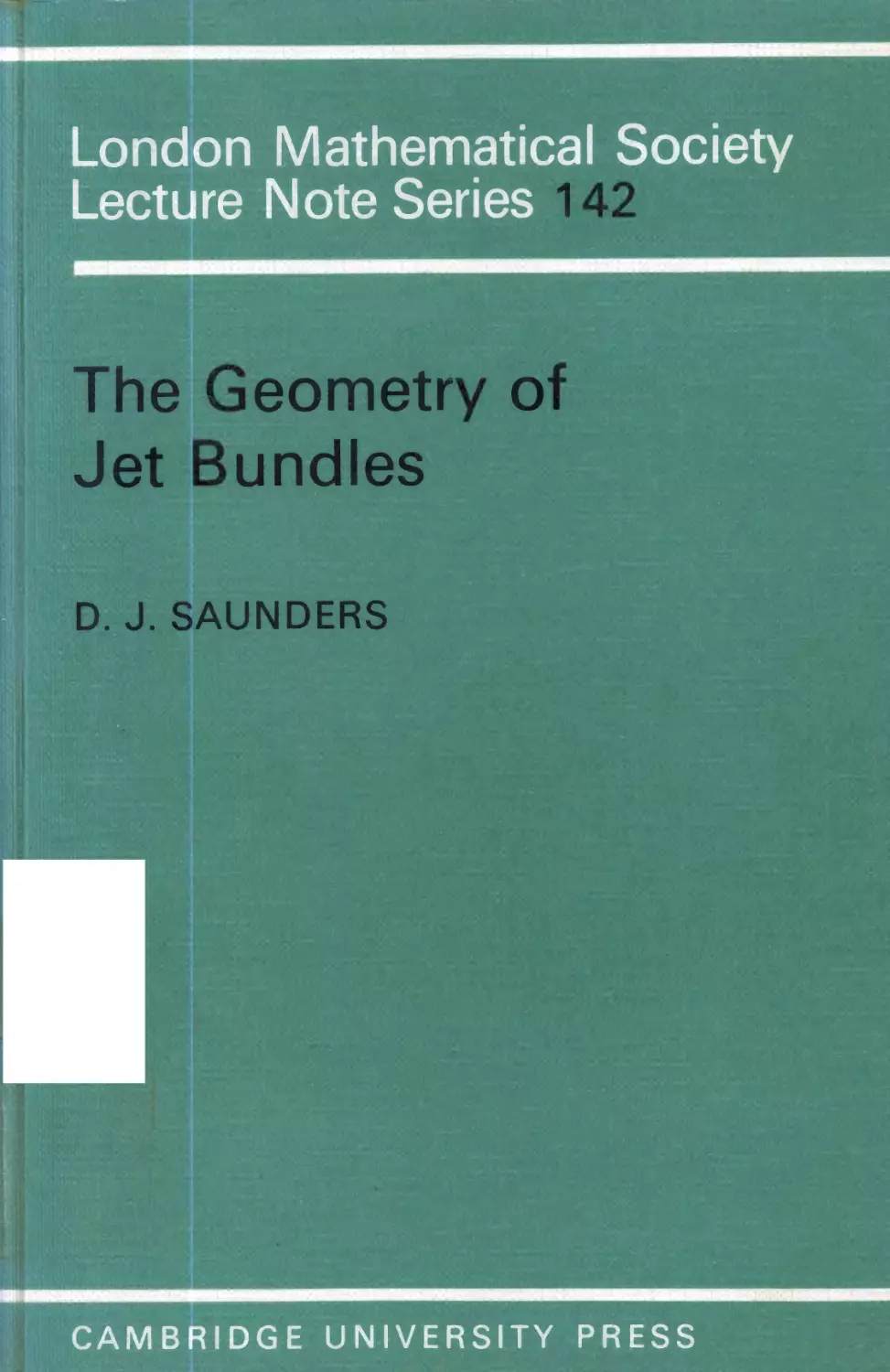


Автор: Saunders D.J.
Теги: mathematics geometry exact sciences natural sciences
ISBN: 0-521-36948-7
Год: 1989




Текст
                    London Mathematical Society
Lecture Note Series 1
CAMBRIDGE UNIVERSITY PRESS
D.J. SAUNDERS

London Mathematical Society Lecture Note Series. 142
The Geometry of Jet Bundles
D. J. Saunders
Honorary Research Fellow
Mathematics Faculty, The Open University
The right of the
University of Cambridge
to print and sell
all manner of book v
was granted by
Henry VIII in 1534
The University has printed
and published < ontinuouslv
since 1584
CAMBRIDGE UNIVERSITY PRESS
Cambridge
New York New Rochelle Melbourne Sydney

Published by the Press Syndicate of the University of Cambridge
The Pitt Building, Trumpington Street, Cambridge CB2 1RP
32 East 57th Street, New York, NY 10022, USA
10, Stamford Road, Oakleigh, Melbourne 3166, Australia
© Cambridge University Press 1989
First published 1989
Printed in Great Britain at the University Press, Cambridge
Library of Congress cataloging in publication data available
British Library cataloguing in publication data available
ISBN 0 52136948 7

Contents
Introduction
1 Bundles 1
1.1 Fibred Manifolds and Bundles 1
1.2 Sections 12
1.3 Bundle Morphisms 15
1.4 New Bundles From Old 20
2 Linear Bundles 27
2.1 Vector Bundles 27
2.2 Vector Bundle Morphisms 35
2.3 Duality and Tensor Products 42
2.4 Affine Bundles 48
3 Linear Operations on General Bundles 55
3.1 Tangent and Cotangent Vectors 55
3.2 Vector Fields 63
3.3 Differential Forms 71
3.4 Derivations 76
3.5 Connections 85
4 First-order Jet Bundles 92
4.1 First-order Jets 92
4.2 Prolongations of Morphisms 106
4.3 Total Derivatives and Contact Forms 115
4.4 Prolongations of Vector Fields 124
4.5 The Contact Structure 136
4.6 Jet Fields 145
4.7 Vertical Lifts 154
5 Second-order Jet Bundles 160
5.1 Second-order Jets 160
5.2 Repeated Jets 167

CONTENTS
5.3 Integrability and Semi-holonomic Jets 171
5.4 Second-order Jet Fields 177
5.5 The Cartan Form 183
6 Higher-order Jet Bundles 191
6.1 Multi-index Notation 191
6.2 Higher-order Jets 194
6.3 The Contact Structure' 207
6.4 Vector Fields and their Prolongations 221
6.5 The Higher-order Cartan Form 232
7 Infinite Jet Bundles 251
7.1 Preliminaries 251
7.2 Infinite Jets 258
7.3 The Infinite Contact System 265
7.4 The Inverse Problem 278
Bibliography 286
Glossary of Symbols 288
Index 290

Introduction
This book is intended as an introduction to the language of jet bundles,
for the reader who is interested in mathematical physics, and who has a
knowledge of modern differential geometry.
Several ways of applying geometric techniques to physics are now well
established in the literature: two major examples are the study of tangent and
cotangent bundles in mechanics, and the use of connections on principal fibre
bundles in field theories. More recently, the language of jets has appeared
as a concise way of describing phenomena associated with the derivatives of
maps, particularly those associated with the calculus of variations. In fact,
a jet is no more than a generalisation of a tangent vector, and the
geometrical theory of jet bundles includes the theories mentioned earlier as special
cases. Generalisation, of course, sometimes introduces complexity: for
instance, the coordinate representation used for jets bears some resemblance
to the traditional coordinate representation used in the tensor calculus, but
differs in that the transformation rules are no longer linear. In addition,
many of the coordinate formulae are symmetric in their indices, as a
consequence of the commutativity of repeated partial differentiation, and this also
introduces a certain complexity. On the other hand, the geometric nature
of the theory introduces simplicity: there is, for instance, a clear geometric
interpretation of the reason why the curvature of a connection is the
obstruction to the integrability of the system of partial differential equations
represented by the connection.
This book introduces those aspects of the theory of jet bundles which
explain these local phenomena, although the theory itself is described in
global terms. The first part of the book, comprising Chapters 1-3, sets out
those elements of the theory of bundles and of linear structures which will
be needed in subsequent chapters. Some of this material may be familiar
to readers who are already acquainted with fibre bundles, although the
perspective adopted here is one which ignores the existence of the structure
group of the bundle.
The remainder of the book introduces the theory of jets. This is done
in four distinct stages to make the task more manageable, although at a

risk of some repetition. The basic definitions are given in Chapter 4, which
describes first-order jets; the fundamental idea of prolongation also appears
here, and is used in the specification of variational problems. Chapter 5,
on second-order jets, introduces the idea of integrability, and also forms the
setting for an intrinsic version of the Euler-Lagrange equations, constructed
with the aid of a Cartan form. Higher-order jets are considered in
Chapter 6, and a multi-index notation is adopted to deal with them; the global
construction of a higher-order Cartan form also appears in this chapter.
Finally, Chapter 7 uses the theory of calculus in infinite-dimensional Fre'chet
space to define infinite jets, and in this context proves the local exactness
of the variational bi-complex; a consequence of this result is the Helmholtz
condition in the inverse problem of the calculus of variations.
I should like to express my gratitude to colleagues with whom I have
discussed this subject over the past few years. In particular, I should like to
thank Mike Crampin, for his advice and encouragement, and Frans Cantrijn,
who has read most of the manuscript and made many helpful suggestions.
I am also indebted to the Research Advisory staff of the Open University's
Academic Computing Service for their advice on the use of IAT^X.
D. J. Saunders
September 1988

Conventions
In this book, we suppose that all manifolds are real, and that manifolds and
maps are smooth (that is to say, of class C°°). We shall require the topology
on each manifold to be Hausdorff, second-countable and connected. We shall
assume, except in Chapter 7, that all our manifolds are finite-dimensional; it
follows from these assumptions that our manifolds admit partitions of unity.
When using wedge products of cotangent vectors or of differential forms,
it is always necessary to adopt a convention concerning the numerical factor
to be employed: our convention will be such that, if a and (3 are cotangent
vectors (or 1-forms), we may write
without any numerical factor.

Chapter 1
Bundles
In this chapter, we describe the basic structure upon which our study of
jets will be based, namely that of bundles and sections. This structure is
a generalisation of the more familiar structure of pairs of manifolds and
maps, and allows more complicated topological arrangements. Although we
shall be concerned primarily with local properties of jets, this more general
description is still necessary for our discussion, because there are pairs of
manifolds whose jet bundles do not themselves simplify to further pairs of
manifolds.
1.1 Fibred Manifolds and Bundles
Many of the theories in modern mathematical physics can be described by
considering smooth functions between differentiable manifolds. The domain
of such a function might represent a region of space-time, and the codomain
the possible states of the relevant physical system. Frequently, however,
one considers not the function itself, but rather its graph: if the function is
/ : M —► F then its graph is the new function gr^ : M —► M x F defined
by gr/(p) = (p, f{p))i and any function 0 : M —► M X F which satisfies
the condition pri o <j> = idu is the graph of a uniquely-defined function /
(namely, / = pr2 ° </>)- In this arrangement, the product manifold M X F
is called the total space, because its local coordinate charts contain both
dependent and independent variables for the function /. The domain M is
also called the base space.
This way of looking at functions has two advantages. One is conceptual:
the function may be thought of as a "field", in that for each point p £ M
there is a copy {p} X F of the codomain of /, and a single point in that
copy gives the value of the field at p. This is a common way of picturing
"vector fields", where the value of the field at a point may be represented by
a vector attached to that point. The second advantage is more substantial,
1

2
CHAPTER 1. BUNDLES
in that one may seek a generalisation of this arrangement where the total
space as a whole is not diffeomorphic to the product of the base space and
another manifold. For such a generalisation to be useful, however, there
must nevertheless be a local product structure: each point of the total space
must have a neighbourhood which "looks like" a product manifold. Such a
structure is called a fibred manifold.
Definition 1.1.1 A fibred manifold is a triple (E,7r,M) where E and M
are manifolds and 7r : E —> M is a surjective submersion. E is called the
total space, tr the projection, and M the base space. For each point p 6 M,
the subset 7r~1(p) of E is called the fibre over p and is usually denoted Ep.
1
As a shorthand, the same symbol E is sometimes used for the fibred
manifold as for its total space. However this notation may be ambiguous,
and in later chapters there will be many instances where the same manifold
is the total space of two different fibred manifolds. We shall therefore denote
the fibred manifold by the same symbol as we use for its projection, so that
the shorthand for (F,7r,M) will be 7r. Since the projection 7r of a fibred
manifold (jE7, 7T, M) is a submersion, each connected component of the fibre
Ep is a submanifold of E, and dim Ep = dimF — dim M is called the fibre
dimension of 7r. We shall normally assume that both dim M and dim Ev are
non-zero.
Example 1.1.2 If M and F are manifolds then (M x F,pri,M) is a fibred
manifold. This is called a trivial fibred manifold; the word "trivial" has a
technical meaning which is given in Definition 1.1.6. 1
Example 1.1.3 Let 5L(2,R) be the three-dimensional manifold of real
2x2 matrices with determinant one, and let H be the subset im z > 0 of
the complex plane (regarded as a two-dimensional real manifold). Define a
map 7T : 5L(2,R) —> H by
(a b \ _ ai + b
* \ c d J ci+d'
A straightforward computation shows that the rank of 7r* is 2 at each point
of 5L(2, R). Since 7r is surjective, it follows that (5L(2, R), 7r, H) is a fibred
manifold. I
Example 1.1.4 One of the simplest examples of a fibred manifold whose
local product structure does not extend to a global product is the Mobius
band. The total space (the Mobius band itself) may be constructed from the
topological space [0,1] X (0,1) by identifying the points (0,y) and

1.1. FIBRED MANIFOLDS AND BUNDLES
3
(1,1 - y) and giving the quotient space the structure of a 2-dimensional
smooth manifold in a straightforward way. The image of the set of points
[0,1] x {|} under the quotient map is then diffeomorphic to the circle S1,
and the projection [0,1] x (0,1) —> [0,1] x {^} passes to the quotient to give
the Mobius band the structure of a fibred manifold over the circle. Each
fibre is just a copy of the open interval (0,1), but the total space is not
diffeomorphic to the Cartesian product S1 x (0,1) because of the "twist". ■
The justification for describing a fibred manifold as having a local
product structure comes from the properties of submersions. By using the
implicit function theorem, we may see that for each point a £ E there is a
neighbourhood Ua C E, some other manifold Va, and a diffeomorphism
ta:Ua-^ 7r(Ua) x Va
which satisfies the condition that pri(ta(b)) = 7r(6) for all b £ Ua. The
condition on ta asserts that the fibres of 7r (when restricted to Ua) correspond
to the fibres of the Cartesian product projection pri. A condition such
as this, involving the composition of maps, is often expressed by using a
"commutative diagram":
Ua - 7r(Ua) x Va
prx
*(Ua) - *{Ua)
id
where 7r|^ denotes the restriction of 7r to Ua. Such a diagram is meant to
assert that, when there is more than one route between two different nodes,
then all such routes give the same result. In this case, the assertion is simply
that the two maps pri o ta and id o 7r|[7 are equal.
/K\ua

4
CHAPTER 1. BUNDLES
The existence of a local product structure on the total space of a fibred
manifold allows us to use special local coordinate systems called adapted
coordinates. These correspond to the product coordinates which may be
constructed on a product manifold MxF from coordinates on the individual
manifolds M and F.
Definition 1.1.5 Let (.F,7r, M) be a fibred manifold such that dim M = m,
dim E = ra-fn, and let y : U —► Rm+n be a coordinate system on the open
set U C E. The coordinate system y is called an adapted coordinate system
if, whenever a, 6 6 U and 7r(a) = 7r(6) = p, then pri(y(a)) = pri(y(b))
(where prt : Rm+n —► Rm). ■
The meaning of this definition is that points in the same fibre Ev n U
have their first m coordinates equal, and are distinguished by their last n
coordinates.
If a £ E then adapted coordinates around a may be constructed from
the local product structure in the following way. Starting with a coordinate
system x : W —► Rm around 7r(a) = pri(ta(a)) £ M (where W is chosen so
that W C flr(U)) and a coordinate system u : V —► Rn around pr,2(ta(a)) £
V C Va, we define y : t~l(W x V) —> Rm+n by
y = (x oprt ota,uopr2 ota),
just as for product manifolds. Conversely, any adapted coordinate system
y : U —► Rm+n yields a coordinate system x : 7r(U) —► Rm by setting
x(p) = pri(y(a)), where a £ Ev n U\ this is independent,of the choice of a
by Definition 1.1.5.
When dealing with the component functions of an adapted coordinate
system, we shall usually adopt the following notation. If xl (1 < i < m) are
the coordinate functions on M, then the coordinate functions on E will be
labelled
(x\ua) 1 < i < m, 1 < a < 7i
so that the same symbol xl will be used both for a function 7r(U) —► R
and for the composite function U —► n{U) —► R. The latter function
may also be written as the pullback 7r*(jrx), and this is the first of many
occasions when the same symbol will be used to represent both an object
and its pullback by a fibred manifold projection.
In many cases the idea of a fibred manifold without any additional
restrictions, although useful, is slightly too general: for example, different
fibres may have different topological structures. An example of this
phenomenon may be constructed by taking the trivial bundle (R x R,pri,R)

1.1. FIBRED MANIFOLDS AND BUNDLES
5
and deleting a single point. The result is a new fibred manifold where all the
fibres except one are connected. If the fibred manifold is supposed to model
a physical system then it may be unrealistic to allow the possible states of
the system to depend on the choice of a particular point in space-time.
This problem may be resolved by insisting that the fibred manifold look
rather more like a product than the definition of a submersion necessitates.
The additional condition which such a fibred manifold must satisfy is
expressed in terms of functions called local trivialisations, and the resulting
object is called a bundle; after the present section, we shall be concerned
almost entirely with bundles rather than more general fibred manifolds. We
shall first describe what is meant by a global trivialisation.
Definition 1.1.6 If (F,7r,M) is a fibred manifold then a (global)
trivialisation of n is a pair (F, t) where F is a manifold (called a typical fibre of 7r)
and t : E —► M x F is a diffeomorphism satisfying the condition
•pn o t — 7r.
A fibred manifold which has at least one trivialisation is called trivial. ■
E
— M x F
pri
M
M
id
In particular, our original example (MxF,pri, M) is a trivial fibred manifold
using the identity map as the trivialisation. However, suppose g : M X F —>
F satisfies the condition that, for each p £ M, the map gp : F —► F defined
by 5fp(^f) = g{p,<l) is a diffeomorphism. Then the map t : M x F —> M X F
defined by t(p, q) = (p, gp{q)) is another trivialisation, so it is important to be
clear that requiring a fibred manifold to be trivial does not give its total space
the structure of a Cartesian product in any particular way. Nevertheless,

6
CHAPTER 1. BUNDLES
the typical fibres corresponding to two different trivialisations must clearly
be diffeomorphic, so referring to a typical fibre of 7r rather than of the
trivialisation is justified.
Example 1.1.7 If the circle S1 is regarded as the unit circle in R2, then
we may define the map p\ : SL(2, R) —► S1 C R2 by
Pi
(a b \ _ f a c \
\c d ) ~ VTPT^' v/oTT^V '
and then
<i:5L(2,R) —♦ H x S1
h(A) = (7r(A),Pl(A))
is a diffeomorphism. Consequently t\ is a trivialisation of the fibred manifold
(5L(2, R), 7r, H). However, we may also define the map p2 : 5L(2, R) —► 51
by
a b \ ( b d
P2
c dl V^ + d2' \/b2 + d2
and then
t2:5L(2,R) —> 17 x 51
t2(A) = (7r(A),P2(A))
is another trivialisation of 7r. The existence of either trivialisation allows us
to assert that 7r is trivial with typical fibre S1. ■
In the definition of a local trivialisation, the word "local" refers to the
base manifold M rather than the total space E: the definition is concerned
with expressing, in product form, subsets of E which are the unions of
complete fibres of 7r.
Definition 1.1.8 If (F,7r, M) is a fibred manifold and p G M then a local
trivialisation of n around p is a triple (Wp, Fp,tp) where Wv is a
neighbourhood of p, FP is a manifold and tp : ir~1(Wp) —> Wp x Fp is a diffeomorphism
satisfying the condition
pri °tp = ^-.i(Wpy
A fibred manifold which has at least one local trivialisation around each
point of its base space is called locally trivial and is known as a bundle. ■

1.1. FIBRED MANIFOLDS AND BUNDLES
7
"W)
WvxFv
HWp)
pri
Wv
W„
It is worth noting that the existence of these local trivialisations around
each point of M automatically implies that the map n is a submersion.
The concept of a typical fibre is also appropriate for bundles, although
this is not quite immediate from the definition.
Lemma 1.1.9 7f(F,7r,M) is a bundle then there i& a manifold F such
that, for each local trivialisation (Wp, Fp,tp) oftr, the manifolds F and Fv
are diffeomorphic.
Proof Notice first that if (Wp,Fp,tp) and (VJ/"p, Fp, tp) are both local
trivialisations around the same point p then the manifolds Fp and Fp must be
diffeomorphic. So choose a fixed point p 6 M and a fixed local trivialisation
(Wp, Fpytp), and put F = Fp. Let W be the set of points q £ M such that
there exists a local trivialisation (Wqy F, tq) around q. Then W is non-empty,
and is open because each Wq is open. On the other hand, M — W must be
open since it is the union of the open sets of points r £ M where the local
trivialisations (Wr,Fr,tr) involve manifolds Fr which are not diffeomorphic
to F. Therefore M — W must be empty, because M is connected. ■
On the total space of a bundle, adapted coordinate systems may be
constructed from local trivialisations using coordinate systems on the base space
and the typical fibre: this apparently unnecessary remark is useful when
considering bundles with additional structure (such as vector bundles).
A trivial fibred manifold is obviously a bundle (and will be called a
trivial bundle). The Mobius band is an example of a bundle which is not
trivial. Further examples of bundles may be constructed from the manifolds
of tangent and cotangent vectors associated with a given base manifold.

8
CHAPTER 1. BUNDLES
Example 1.1.10 Let TM denote the tangent manifold to the ra-dimensional
manifold M, and let tm > TM —► M denote the map which associates to
each tangent vector the point of M at which it is located. Then (TM, tm, M)
is a bundle with typical fibre Rm. To demonstrate this, it is convenient to
use local coordinates. So let £ £ TM have the representation
where p = tm(£)> tne functions x1 are coordinate functions around p, and the
summation convention is employed for the repeated index i. If 7 : R —► M
is a curve whose tangent at zero is £ then the real numbers £l satisfy
r = (x*o7)'(o).
We may then define a coordinate system (xl,xl) on TM by writing (as
usual) x% instead of x% o tm, and setting xl(£) = £*. To show that the
fibred manifold constructed in this manner is locally trivial, let Wp be the
coordinate neighbourhood of p on which the functions xl are defined, and
let t : r^(Wv) —> Wp x Rm be given by t(rj) = (tmM,^)). The map t
is a diffeomorphism because it is the composition of the coordinate diffeo-
morphism (xotm^x) on t^(Wv) with the map (cc_1,idRm). (The fact that
TM has the topological properties which we require of a manifold, and that
tm is therefore a bundle, is a consequence of a more general result which we
shall give in Proposition 1.1.14.) I
Example 1.1.11 If M = Rm then TM ^ Rm x Rm and the tangent bundle
tm is trivial. Indeed, if x : M —► Rm is a global coordinate system on a
manifold M then (tm,x) : TM —> M x Rm is a global trivialisation. I
Example 1.1.12 The tangent bundle (T51,r5i,51) is trivial, even though
the circle S1 does not have a global coordinate system. To see this, let
01 : W\ —► R, 02 : W2 —► R be two angle coordinate systems on S1
whose domains W\, W2 together cover S1, and such that if p € W\ n W2
then 0\(p) — 02(p) i 7r- Given a tangent vector £ £ TS1, suppose that £ is
determined by the curve 7, and put
*(0 = (*i°7)'(0)
Hrsl(£)eWu
»(o = (»2 07y(o)
if tSi(£) £ W2. If it happens that r5i(£) G l^i n W2 then (^ o 7)'(0) =
(^2°7)r(0), because 0\ and 02 differ by a constant, and so this procedure gives
a well-defined mapping 9 : TS1 —> R. The map (r5i,0) : TS1 —► S1 x R
is then a global trivialisation. ■

1.1. FIBRED MANIFOLDS AND BUNDLES
9
Example 1.1.13 The tangent bundle (T52,r52, 52), where S2 denotes the
2-sphere, is not trivial. To see this, suppose that there were a global trivial-
isation t : TS2 —> S2 x R2. Choose a non-zero element v £ R2, and define
X : S2 —► TS2 by
X(p) = t~\p,v).
Then X(p) is a non-zero tangent vector in TpS2 which depends smoothly on
p, and so X is a non-vanishing smooth vector field on S2: but this contradicts
the famous Hairy Ball Theorem. ■
An important property of any bundle is that the manifold structure on
its total space E is completely determined by the manifold structures on its
base space M and typical fibre F. For a trivial bundle (M x F, pri, M) this
is a familiar result, but it applies equally to the case where the bundle is not
trivial. The reason for this is that, if (W, F, t) is a local trivialisation, then t
transports the manifold structure from W x F to the "strip" n~l{W) of E,
and where the strips overlap the manifold structures are the same. In fact
this technique can be used to construct a manifold structure on E when it
is not given a priori.
Proposition 1,1.14 Let M and F be manifolds, E a set, and n : E —►
M a function such that, for each p £ M, /7r~1(p) has the structure of an
n-dimensional manifold. Suppose also that, for each p £ M, there is a
neighbourhood Wp of p and a bisection tp : 7r~1(Wp) —> Wp X F satisfying:
1. prxotp = *\^-i(Wp);
2. for each q £ Wp, pr2 ° tpl^-it \ '■ 7r~1(^f) —► F ^s a diffeomorphism.
Then E may be given a unique structure as a manifold such that n becomes
a bundle and the maps tp become local trivialisations.
Proof Let a £ /7r~1(p) and let x : W —> Rm be a coordinate system around
p and u : V —> Rn be a coordinate system around pr2(^>(a)) £ F- Then,
with our usual understanding about domains of functions being sufficiently
small, the map yp = (z,u) o tp is a "coordinate system" around a. We shall
show that, whenever the domains of yp and yq have non-empty intersection
then yq oy~l is smooth (and hence a diffeomorphism). Since each map (x, u)
is a diffeomorphism, it will be sufficient to show that
tq o t'1 : (Wp nWq)xF — (Wp n Wq) x F
is smooth. To do this, we note first that for each r £ Wp n Wq, the map
to o t""1 induces a diffeomorphism of F with itself. A consequence of
v \{r}xF

10
CHAPTER 1. BUNDLES
this is that the map
(WpnWq)xF —♦ F
(r,c) ^» ^2(^°^1{r}xF(c))
is also smooth. But this,latter map is just the second component of tq ot~x,
and the first component of tqot~1 is simply pri : (WpC\Wq)x F —> WpC\Wq.
Therefore t^of"1 is smooth, and so E acquires a finite-dimensional C°° atlas.
The uniqueness of this manifold structure follows because, if each function
tp is a diffeomorphism for two manifold structures on E, then id# is a diffeo-
morphism between the two manifold structures. It now follows immediately
that the map 7r is smooth because locally it is just pri o tp, and it is
obviously surjective. The functions tp therefore become local trivialisations for
the bundle (J5J,7r,M).
We may also show that E satisfies the topological conditions which we
require of a manifold. First we shall demonstrate the Hausdorff property.
So let a, b £ E. If 7r(a) ^ ir(b) then there are open sets Wa, Wy C M which
separate 7r(a) and 7r(b), so that n~1(Wa)y ir~1(Wb) will separate a and b.
On the other hand, if 7r(a) = 7r(b) (= p, say) then pri(tP(a)) = pri(tp(b)) so
that pr2{tp(a)) ^ pr2(tp(b)) since tp is bijective. Then there must be open
sets Va, Vj, C F which separate J>T2{tp{a)) and pr2(*p(&)), and therefore open
sets (pr2 ° ip)~1(ya)y (pr2 ° ip)~1(^b) which separate a and b.
Next we shall show that E is second-countable. To do this, we shall first
demonstrate that there is a countable family of local trivialisations whose
neighbourhoods Wp cover M. So let X\ be a countable basis for the open
sets in M. For each q £ M, choose an open set X\q such that q £ X\q C Wq
and consider the triple
Since there are only countably many different open sets X\q, we may choose,
for each such set, one particular p £ M which gives rise to it and hence obtain
the required countable family
[XP,F, tP\n-nxp)) ■
Consequently any open set O C E may be written as a countable union
0 = (J(On7r-1(Xp))
V
where O n7r~1(Xp) is diffeomorphic to an open subset of Xp x F. Since each
product manifold Xp x F has a countable basis of open sets, it follows that
E does as well.

1.1. FIBRED MANIFOLDS AND BUNDLES
11
Finally we must show that E is connected. This follows from the fact
that each map pri o tp is an open map, so that tt is an open map which is
surjective. ■
EXERCISES
1.1.1 Let E, M be manifolds and let 7r : E —> M be a smooth map.
Suppose that for each p € M there is a neighbourhood Wv of p and a map
<t>v : Wv —► E satisfying 7r o <pp = idwp- Show that (JE7,7r,M) is a fibred
manifold.
1.1.2 Construct an example of a fibred manifold, all of whose fibres are
diffeomorphic to R, but which is not locally trivial.
1.1.3 Prove that the Mobius band (regarded as a fibred manifold over the
circle) is a bundle but is not trivial. Construct a pair of adapted coordinate
systems which together cover the total space of the Mobius band.
1.1.4 Let 7T : R3 - {0} —► S2 be defined by
Show that (R3 — {0},7r,52) is a trivial bundle, and confirm that spherical
polar coordinates (0, <p\ p) may be used as adapted coordinates in a
neighbourhood of (0,1, 0) <E R3 - {0}.
1.1.5 Let T*M denote the cotangent manifold to the m-dimensional
manifold M, and let r^ denote the map which associates to each cotangent
vector the point of M at which it is located. If 77 £ T*M, if the function
f G C°°(M) satisfies dfp = 77, and if xl are coordinate functions on M around
p, define a coordinate system (xl,dl) on T*M by setting
dxl\p
Show that this coordinate system determines a local trivialisation (t^,0)
of (T*M, rjj^, M), and that r^ thereby becomes a bundle with typical fibre
Rm.
1.1.6 If (J5J,7r,M) is a bundle, prove that (TE, 7r*, TM) is also a bundle.
1.1.7 Let G be a Lie group. Show that the map t^ : TG —► Gxg given
by
<l(0=(tg(0,-&(to(0)-'.(0),
where g is the Lie algebra of G and Lg : G —> G is left translation,
determines a trivialisation of the tangent bundle (TG,tq,G). Is this the same as
the corresponding trivialisation determined by right translation?

12
CHAPTER 1. BUNDLES
1.2 Sections
Given a bundle—or, indeed, a general fibred manifold—(F,7r,M) we can
now return to the idea of a map from M to E as the generalisation of the
graph of a function.
Definition 1.2.1 A map <j) : M —> E is called a section of tt if it satisfies
the condition 7r o </> = IcLm• The set of all sections of 7r will be denoted r(7r).
I
For a trivial bundle given in the form (M X F,pri, M), a section is indeed
just the graph of a function from M to F. However, for a general trivial
bundle (JE7,7r,M) with typical fibre F the function M —► F corresponding
to a particular section depends upon the choice of trivialisation, and so for
a non-trivial bundle it does not make sense to interpret a section in terms
of a function whose codomain is the typical fibre.
A section of a fibred manifold may also be described in terms of
coordinates. If <j) G r(7r) and (xl,ua) is a family of coordinate functions around
a G E then
x*(0(o)) = z*(7r(0(a))) (really)
= xl(a) since ir o <p = id^f
so that the first m coordinates of 0(a) are determined by the coordinates of
a. Hence only the last n coordinates are of interest in describing <j). We may
therefore define real-valued functions <j)a to represent <j) in this coordinate
system by
where in this equation the symbol <j) actually represents the restriction of the
section <j) to the domain of the appropriate chart in M. This particular abuse
of notation will be almost universal when we write equations involving local
coordinate representations, and it is to be understood that such equations
are meant to hold only on suitably small domains.
Example 1.2.2 A section X of the tangent bundle (TM, TAf, M) is just a
vector field on M, because it associates to each point of M a tangent vector
at that point. The set of all vector fields on M will be denoted by X(M)
in preference to T(tm)- Using coordinates (xl,xl) on TM and defining the
real-valued functions X1 by X1 — xl o X we can write
to represent the relationship between tangent vectors

1.2. SECTIONS
13
for each p in the domain of the coordinate functions xl. I
In this last example the symbol d/dxl does not, in general, represent a
section of tm because its domain might not be the whole of M. Indeed, in
extreme cases a bundle might not have any sections at all.
Example 1.2.3 Let S2 be the 2-sphere and let T°S2 be the open subset of
TS2 containing all non-zero tangent vectors. The triple
(T°S , TS2\ToS2 ,S )
is then a bundle called the slit tangent bundle of S2 with typical fibre R2 —
{0}. If <j> were a section of this bundle then it would define a vector field on
S2 which was never zero, contradicting the Hairy Ball Theorem. ■
Nevertheless, every fibred manifold does have local sections: that is,
maps defined only on open submanifolds of the base space which satisfy the
other conditions for being sections. A section defined on the whole base space
is then sometimes referred to as a global section for emphasis. Furthermore,
if a fibred manifold has any global sections at all then it will have a global
section which agrees with any given local section in a neighbourhood of any
given point. To prove this assertion, it is convenient to introduce the idea
of a germ.
Definition 1.2.4 If (F,7r, M) is a fibred manifold then a local section of n
is a map <j> : W —> E, where W is an open submanifold of M, satisfying
the condition 7r o <j> = idy/. The set of all local sections of 7r with domain
W will be denoted rw(7r), and the set of all local sections of 7r regardless of
domain will be denoted rjoc(7r). If p G M then the set of all local sections
of 7r whose domains contain p will be denoted rp(7r). ■
Definition 1.2.5 If <j) £ rp(7r) then the germ of <j) at p is the subset of
rp(7r) containing those local sections ij; having the property that, for some
neighbourhood W of p, ip\w — <j)\w. (The neighbourhood W will, of course,
depend on tp.) The germ of 0 at p will be denoted by [<t>]p. ■
The relation "has the same germ at p" is clearly an equivalence relation
on the set rp(7r).
Proposition 1.2.6 If <f) £ rp(7r), and r(7r) is non-empty, then there is a
global section ij; satisfying [ijj]p = [4>]v-
Proof Let x £ IX71")- Both <p(p) and x{p) are m tne fibre Fp, which as
a manifold is path-connected. Let 7 : [0,1] —> E be a path in this fibre
satisfying 7(0) = x(p)> 7(1) = 0(p)- Cover 7([0,1]) (regarded as a subset

14
CHAPTER 1. BUNDLES
of E) with the domains of convex adapted charts constructed from a local
trivialisation around p, and choose a finite subcover Ui,. .., Un where x(p) €
^i> 0(p) € ^n and Ur fl Ur+i is non-empty for 1 < r < n — 1. Let the
corresponding coordinate systems be yr : Ur —► Rm x Rn and put xr :
7r(Ur) —► Rm where xr o 7r = prx o ur.
Now suppose that, for some r with 1 < r < n — 1, there is a section
Xr £ r(7r) satisfying Xr(p) € ^r- Choose ar £ Ur n Ur+i n 7r~1(p), and
let Wr C M be an open subset which satisfies p G Wr C X^l^r) and is
sufficiently small that, for every q £ Wri
(xr(q),pr2(yr(ar))) <E yr(Ur).
It is then possible to define the map Kr : Wr —► E by
*>r(q) = 2/r"1(^r(g),^2(yr(ar)))
which is a local section of 7r owing to the relationship between xr and yr.
There is also a compact subset Cr C Wr with p £ Cr, and a bump function
br : Wr —► R satisfying br(p) = 1 and br(q) = 0 for q # Cr. We may
therefore define a new global section Xr+i by
Xr+i(q) = yr1(br(q)yr(^r(q)) + (l - br(q))yr(xr(q))) for g G Cr
= Xr(q) otherwise
which from its method of construction is smooth and which satisfies Xr+i(p) =
ar £ Ur+i- Taking xi to be x> we then obtain a sequence of global sections
Xi,. . ., Xn where finally Xn{p) £ Un. Since the original local section </)
satisfies <j)(p) £ Un we may use a similar construction to the one described above
with <j> instead of Kr and with a bump function which this time equals one in
a neighbourhood of p rather than merely at p. The result is a global section
ijj satisfying ip(q) = </)(q) for q in some neighbourhood of p. I
As with global sections, a local section <j) may be represented in
coordinates by the functions </>a = ua o <j). On the tangent bundle tm the symbol
dIdxl then represents a local section with the particular coordinate
representation
(*°^)<'>=*'(^IH-
Finally, we record the useful fact that every local section is actually an
embedding.
Proposition 1.2.7 If <\> £ Tw(^) then <j)(W) is an embedded submanijold
of E.

1.3. BUNDLE MORPHISMS
15
Proof First, <j) is an immersion because, for each p £ W, 7r* o <j>+ = i(Ltpm so
that <p* : TpM —> T^p\E is injective. Secondly, from tt o <j> — idw it then
follows that <j) is an injective immersion. Finally, from </)ott o<j) — <£ it follows
that <j> o 7rL/jy\ = id^(jy) so tnat 0 is a homeomorphism of W onto <f)(W). I
EXERCISES
1.2.1 Let (F,7r,M) be a fibred manifold and let a £ F. Show that there is
a local section <£ of 7r defined in some neighbourhood of 7r(a) and satisfying
</>(7r(a)) = a.
1.2.2 Let (F, 7r, M) be a bundle and let the (not necessarily smooth)
function <j) : M —► E satisfy 7r o <j) = id^f. Show that <j) is smooth (and therefore
a section of 7r) if, and only if, for every point p E M there is an adapted
coordinate system around <j>(p) E E such that the real-valued functions (pa
are smooth at p.
1.3 Bundle Morphisms
A morphism from one bundle to another may be described as a pair of
maps, one between the total spaces and one between the base spaces. The
two maps have to be related by the bundle projections, and indeed the map
between the total spaces—if it is able to form part of a bundle morphism at
all—determines uniquely the map between the base spaces.
Definition 1.3.1 If (E,7r, M) and (H,p, N) are bundles then a bundle
morphism from 7r to p is a pair (f, f) where f : E —► H, f : M —► N and
p o f = f o 7r. The map f is called the projection of f. I
E
H
M
N

16
CHAPTER 1. BUNDLES
Lemma 1.3.2 If f : E —► H then there is a bundle morphism (f, f) from
7r to p if, and only if, whenever p £ M and a,b £ Ep then p(f(a)) = p(f{b)).
The map f is unique.
Proof If (f, f) is a bundle morphism then
p(f(a)) = J(n(a)) = J(*(b)) = p(f(b)).
Conversely, suppose the condition holds. If p £ M then choose a £ Ev and
define f(p) to equal p(f(a)), which is independent of the choice of a. It
remains to show that / is smooth. So let <p be any local section of 7r defined
in a neighbourhood W of p. Then f — P° f ° 4>, demonstrating that f is
smooth at p. The map f is unique because 7r is surjective. ■
A bundle morphism may therefore be described as a map from E to H which
maps the fibres of 7r into the fibres of p. For shorthand, a map between the
total spaces of two bundles which satisfies this condition will often be called
a bundle morphism (although strictly it is the pair of maps which has this
description).
Bundle morphisms may be described using local coordinate systems. If
(f, f) is a bundle morphism from (jE7, 7t, M) to (H,py N) and if (ya,vA) is an
adapted coordinate system on H then the real-valued functions fa, fA are
defined by
fa = yaof
fA = vAof.
This description would apply to any map from E to H. The property that
f maps fibres of 7r to fibres of p is reflected in the fact that the functions
fa must be constant on the fibres of 7r. There must then exist real-valued
functions / defined on an open subset of M and satisfying
7° = »a°7
r = /°°t
where the ya in these equations are coordinate functions on N rather than
on H. Just as we used the same symbols for both these sets of coordinate
functions we shall normally denote the real-valued functions on both M and
E by fa, and with this understanding we have instead
/" = ya ° 7-
Note that we normally write the coordinate representation as (fa, fA) with
the base space coordinates first, even though we denote the bundle morphism
itself by (f, f); this is done so that the coordinate representation matches
the order of the coordinate functions (ya,vA).

1.3. BUNDLE MORPHISMS
17
Example 1.3.3 If (M x F,pri,M) and (N x K,pruN) are trivial bundles
and if f0 : F —> KyJ:M —> N are maps, then f = J x f0 : M X F —>
N X K defines a bundle morphism (f, f). If local coordinates on N and
K are ya, vA and the coordinate representations of f and f0 are fa, fA
then the coordinate representation of f is (fa opr1,fA opr2); as usual, we
abbreviate this to (fa, fA). ■
Example 1.3.4 Let (5L(2, R),7r, H) be the bundle described in
Example 1.1.3, and let fA : 5L(2,R) —> 5L(2,R), where A G R, be the map
' 1 A
0 1
corresponding to left multiplication by the matrix
The
*[fx
a b
c d
1 A
0 1
a -f Ac b -f Ad
c d
(ac + bd) + i
c2 + d2
a b
c d
+ A
+ A
so that fx determines a map fA : H —► H given by f \(z) = z + A. It
follows that (fA, f^) is a bundle morphism from 7r to itself. ■
Example 1.3.5 If M, N are manifolds and / : M —> N then (/*,/)
is a bundle morphism from (TM, r^f, M) to (TN,r^, N), because f* maps
the fibre TVM to the fibre Tj^N. To find the coordinate representation
of (f, f*), suppose that local coordinates around £ 6 TM are (ccr, cc*) and
around f*(£) <E TN are (ya,ya). Then if p = rM(£) and
* = r
<9z*
we have
so that
/.(0 = r
a/a
W(0)
f(p)
e
dxl
m(^°Tu)(o-

18 CHAPTER 1. BUNDLES
We may therefore write the coordinate representation of (f*, f) as
■
Example 1.3.6 If M, N are manifolds and f : M —> N is a local dif-
feomorphism (so that each f* : TpM —► ^f(p)^ an(^ its transpose f* :
T?/ xN —► T*M are isomorphisms) then (f*""1,/) is a bundle morphism
from (T*M,r^,M) to (T*N,r^,N). I
If (f, f) is a bundle morphism from 7r to p, and (</,</) is a bundle
morphism from p to a, then g o f also maps fibres to fibres and so defines the
composite bundle morphism (g o f,g o f) from p to cr. It therefore makes
sense to define a bundle isomorphism as a bundle morphism which has a
(two-sided) inverse. It should be clear that a bundle which is isomorphic
to a trivial bundle is itself trivial, for the isomorphism may be used to pull
back the trivialisationfrom one bundle to the other; indeed a fibred manifold
which is isomorphic to a bundle is itself a bundle. In general, since
(gof)o<K = aogof = gopof=:goJoir,
it follows that g o f = ~g o f. If (f, f) is a bundle isomorphism then both
f, f are diffeomorphisms, and conversely. Be warned, however, that it is
possible for just f (or just f) to be a diffeomorphism.
Example 1.3.7 The map fx : 5L(2,R) —► 5L(2,R) described in
Example 1.3.4 defines a bundle isomorphism (f\,fx)\ the inverse isomorphism is
(/-aJ-a)- ■
Example 1.3.8 If f : M —► N is a diffeomorphism then both (f*,f) :
tm —> tn and (f*""1, f) : r^ —► r^ are bundle isomorphisms. I
Example 1.3.9 The pair (7r, idAf) is a bundle morphism from (F,7r, M) to
(M, idM,M) but in general 7r is not a diffeomorphism. Similarly the pair
(ids, 7r) is a bundle morphism from (F, id£, E) to (F, 7r, M). I
Example 1.3.10 Any section </> £ r(7r) defines a bundle morphism (0, idA/)
from (M, idM,M) to (F,7r,M). I
If (F,7r,M) and (H,p,N) are bundles then there is an action on the
local sections of 7r by certain bundle morphisms from 7r to p. These are
the bundle morphisms whose projections are diffeomorphisms from M to N,
and they may be used to transport local sections from it to p.

1.3. BUNDLE MORPHISMS
19
Definition 1.3.11 If (f, f) is a bundle morphism from 7r to p where f is a
diffeomorphism, and if </> G Tw(n) then the local section f(</>) G T-7,wJtt) is
defined by
f (</>) = fo^of"1! .
■/VYV ^ r •> \f(W)
Example 1.3.12 If / : M —► N is a diffeomorphism then (f*,f) is a
bundle isomorphism from tm to r^v, so if X G A'(M) then f*(X) G 'V(N) is
defined by
f.(X) = f.oXof-1.
Usually this vector field is written as f*(X) rather than f*(X). ■
Just as one considers local sections as well as global sections, it is often
useful to consider local bundle morphisms.
Definition 1.3.13 If W C M is an open submanifold and if f : 7r~1(W)—►
H, f : W —► N then the pair (f, f) is called a local bundle morphism from
7T to p if p O / = f O 7T ■
l7r-1(W)
A local bundle morphism which has a (two-sided) inverse is called a local
bundle isomorphism. Indeed, it would have been possible to define a bundle
as a fibred manifold which was locally isomorphic to a trivial bundle.
A particularly important example of a bundle morphism which will be
discussed in more detail in Section 3.2 is given by a pair of 7r-related vector
fields.
Example 1.3.14 A vector field X G A'(F) which is also a bundle
morphism from (F,7r,M) to (TF,7r*, TM) is called a tr-projectable vector field,
or sometimes just a projectable vector field. The projection of X is a map
X : M —> TM which satisfies
TM ° X O 7T = Tj^ 0 7T* O X = 7T O T~ O X = 7T
because (7r*,7r) is a bundle morphism from t% to tm- Since 7r is surjective
it follows that tm ° X = idM, s° that X is a section of tm and therefore is
a vector field on M.
To find the coordinate representation of X we use coordinate functions
(x% xl, ua, ua) on TE and (x*,ita) on E. Since X is a section of te the x1
and Ma components of the coordinate representation are fixed, so that X is
determined by the real-valued functions X\ Xa defined by
X1 = xloX
Xa = iiaoX.

20
CHAPTER 1. BUNDLES
As with a general bundle morphism the functions X1 must be constant on
the fibres of 7r, so that there are real-valued functions X% defined on an open
subset of M and satisfying
TC = xloT
X{ = X'OTT
where the xz in these equations are coordinate functions on TM rather than
on TE. Once again we usually write X% instead of X\ With this notation
we have
X = X1—-+Xa —-
dxl dua
X = X<±.
OX1
EXERCISES
1.3.1 If f : M —► N is a local diffeomorphism, show that the coordinate
representation of the bundle morphism (f*-1, f) : r^ —► rjy is
(fa,di-Fl)
where (xl,di) are coordinate functions on T*M and where F\ is the inverse
of the matrix of functions dfa/dxl.
1.3.2 If M is a manifold then there are two bundles with base space TM
and total space TTM, namely ttm an(i TM*- Construct a bundle
isomorphism (f, idTAf) : TTM —* ^"M*- (Hint: starting with local coordinates x% on
M, what is the effect of ttm and tm* in terms of the induced coordinates on
TM and TTM? This should suggest the definition of a map whose domain
is a chart in TTM, which is smooth and has a smooth inverse. By showing
that this map is independent of the choice of coordinate system, deduce the
existence of a diffeomorphism of TTAf which restricts to this map and which
yields the required bundle isomorphism.)
1.4 New Bundles From Old
There are several methods of constructing new bundles from given ones, and
most of these methods involve products of some kind. The most general
construction is the product bundle, which may be formed from an arbitrary
pair of bundles.

1.4. NEW BUNDLES FROM OLD
21
Definition 1.4.1 If (F,7r,M) and (H,p,N) are bundles then the product
bundle is the triple (E x Hy -k x p, M x TV). I
It is straightforward to check that 7r x p really is a bundle whose typical
fibre is the Cartesian product of the typical fibres of 7r and p: if (Wpy F, tp)
and (Vq, if, sq) are local trivialisationsof 7r and p around p and q respectively,
then
tv x sq : (tt x p)"1^ x Vq) —> (Wp x V,) x (F x IT)
(tp X 3q)(a,b) = ((*(a),p(b)),(pr2o tp(a),pr2 o sq(b)))
is a local trivialisation of 7r x p around (a, 6).
Given local sections </> £ rp(7r), ip £ rq(p), the product section is the map
<fi X ip £ r(p>(?)(7r x p) defined by
(</>X V)(r>s) = (0(r),^(s)).
We may also define product coordinates: if (xt,ucx) is an adapted coordinate
system on U C E and (ya,vA) is an adapted coordinate system on V C H
then (ccl,ya,'ua,i;A) is an adapted coordinate system on U x V C jE7 x H.
Example 1.4.2 If (M x F,pri, M) and (N x if ,pri, if) are trivial bundles
then their product is the trivial bundle ((MxF)x(NxK),pr1xpru MxN).
Example 1.4.3 If M and N are manifolds then the product of their tangent
bundles tm, ttv is the bundle [TMxTN^tm^^n•, MxN). This is isomorphic
to the tangent bundle (T(M x N),TAfx7V>M x -W)> and the isomorphism
(f, ^MxTv) : TMxN —► t~m X r^v may be given explicitly as follows: if
f <E T(P|tj)(Af x TV) then
f(0 = (pru(0,Pr2*(t)) € TpM x TgN.
In local coordinates xz on M and ya on TV (and therefore (xl,f)onMxJV)
we may write
? ? ax'
(p,9) 92/a
(P.«)
><« = l?£
e —
If there is some relationship between the two bundles ir and p then other
constructions may be performed. In particular, if the base spaces of the

22
CHAPTER!. BUNDLES
two bundles are identical then an important construction called the fibred
product provides a new bundle over that same base space rather than over
the product of the base space with itself. On the other hand, by considering
the total space of the fibred product but choosing a different base space we
obtain the pull-back bundle, which may actually be defined in slightly more
general circumstances.
Definition 1.4.4 If (F,7r, M) and (fT, p, M) are bundles over the same base
space M then the fibred product bundle is the triple (E XmH,tt XmP,M),
where the total space E XmH is defined to equal
{(a,6)G Ex H : 7r(a) = p(b)}
and the projection map 7r XmP is defined by
(tt Xjifp)(o,i) = 7r(a) = p(b).
■
Once again it is necessary to check that 7r Xmp really is a bundle. The
first point is that the total space E XmH is a, manifold because it is the
submanifold of E X H given by (ir X p)_1(Am), where Am C M X M is
the diagonal. Having established this, it is again straightforward to see
that it XmP has the properties of a bundle whose typical fibre is again the
Cartesian product of the typical fibres of 7r and p. The fibred product is also
sometimes called the Whitney sum and denoted 7r ® p, although this latter
notation will be more appropriate when 7r and p are "vector bundles" (to
be defined in Section 2.1).
If </> and ij; are local sections of 7r and p respectively, we may construct
their fibre product provided that the domains of the two sections overlap.
If 0 G ry(7r), ip E rV(7r) then </) Xm^ € ^Vnw{^ Xmp) is defined by
(</>XMV0(?) = (<K<l),1>(q))-
We may define fibre product coordinates in similar circumstances: if (scl,tza)
is an adapted coordinate system on U C E and (xl,vA) is an adapted
coordinate system on V C H where tt(U)C\p(V) is non-empty, then we may
take (xt,ucx,vA) as an adapted coordinate system on
(U n T-^piV))) xM(V n p-H^U))) cExMH.
Although the total space ExmH has been given the structure of a bundle
over My there are also maps from this manifold to E and to H given by
restricting the Cartesian product projections. However, rather than writing
Pri\ExMH - E XmH —> E we normally denote this map by 7r*(/?) and
the corresponding map E XmH —> H by p*(n). Both these maps define
bundles.

1A. NEW BUNDLES FROM OLD
23
E xMH
**(P)
E
p*(7T)
H
M
In the more general situation where (say) 7r is a bundle but p is merely
an arbitrary smooth map, we can still regard p*(n) as a bundle. In these
circumstances it is conventional to denote the total space E Xm^, using an
alternative notation, as p*(E).
Definition 1.4.5 If (E,7r,M) is a bundle and p : H —> M is a map then
the pull-back of n by p is the bundle (p*(F), p*(tt), £T), where the total space
p*(E) is defined to equal
{(a,6)G Ex H : 7r(a) = p(b)}
and the projection p*(n) is defined by
p*{*){a,b) = b.
It is easy to check that the pull-back is a bundle, with typical fibre equal
to the typical fibre of 7r. The pair (7r*(p), p) is then a bundle morphism from
p*(n) to 7r. (Indeed, it is often convenient to think of the total space p*(E)
as comprising lots of copies of fibres of the form Ev with their base-points
transplanted from M to H.) If </) £ Tw(^)1S a local section then its pull-back
section is the map p*(0) E Tp-i/w\(p*(7r)) defined by
p*(<t>)(b) = (cj>(p(b)),b).
Since the composite map <pop may also be written as a pull-back /?*(</>), this
notation is reasonably consistent.
Important examples of pull-back bundles arise when a bundle (F,7r, M)
is given, and tangent or cotangent vectors on M are pulled back to E.

24
CHAPTER 1. BUNDLES
Example 1.4.6 For any map f : N —► M, the pull-back by f of the
tangent bundle (TM, tm, M) is a bundle (f*(TM), /*(rjvf), N), and a section
X of this bundle is called a vector field along f. In particular, if (25, tt, M) is
a bundle then the pull-back by 7r of tm is the bundle (7r*(TM),7r*(TAf), 2?)
known as the transverse bundle to 7r, which will be described in more detail
in Section 3.1. Although a section of 7T*(tm) is actually a map X : E —►
7r*(TM), we shall usually consider instead the map X : E —► TM defined
by X = Tjj|-(7r) o X. This map satisfies the condition tm ° X = 7r, because
TM O X = TM 0 Tm(7t) oX = 7TO 7T*(tm) O X - 7T O id£ = 7T.
On the other hand, every map X : E —► TM which satisfies this condition
defines a section X of 7t*(tm) by the rule X(p) = (X(p)yp). We shall often
call the map X (rather than X) a vector field along 7r, and we shall denote
the set of all such vector fields along 7r by X(tc). 1
Example 1.4.7 If (F,7r,M) is a bundle then the pull-back by 7r of the
cotangent bundle (T^M.r^.M) is the bundle (7r*(r*M),7r*(rJJf), E) known
as the cotangent bundle to E horizontal over 7r. This bundle will also be
described again in Section 3.L The elements of the total space 7r*(T*M) are
pairs (77, a) where ^(77) = ir(a).
In this example there is, however, another possible interpretation of the
symbol ?r*(T*M), and that is as the subset {7^(77) : rj <E T*M} of T*E. This
subset is actually a submanifold, and we obtain a sub-bundle
(**(T*M),T*E\n.{T.M),E)
of Tg. Fortunately the two bundles are isomorphic, and the isomorphism
(f,idE) : TeI^^m) —> **(tm)
may be given explicitly by f{n*(T])) = {v^Ei^*^)))- We shall usually
regard 7r*(T*M) as a submanifold of T*E. I
In the particular case when the pull-back map is an embedding then the
pull-back bundle is called the restricted bundle.
Definition 1.4.8 If (2£,7r,M) is a bundle and lw ' W —► M is an
embedding then the restriction of it to W is the bundle tjy(7r), which is usually
denoted n\w. ■
Technically, the total space l^/{E) of the restricted bundle consists of
pairs (a, 6) G E x W where 7r(a) = b. However this is clearly diffeomorphic
to the submanifold 7r~1(W) of E, and with this identification the restricted
bundle may be regarded as a sub-bundle of ir.

1.4. NEW BUNDLES FROM OLD
25
Definition 1.4.9 If (F,7r,M) is a bundle and Ef C E is a submanifold
such that the triple (Ef, 7r|-, r7r(E')) is itself a bundle, then 7r|-, is called a
sub-bundle of 7r. ■
(The reason for the qualification in this definition is that there may be
submanifolds E' C E where 7r|-, is not a bundle, or even a fibred manifold.)
A restricted bundle may therefore be considered as a sub-bundle with the
particular property that 7r~1(7r(F/)) = E'. It will be clear from the context
whether the notation 7r|~, is meant to denote a restricted bundle or a sub-
bundle, for this just depends upon whether Ef is a submanifold of M or of
E.
Example 1.4.10 If W is an open submanifold of M then whenever p £
M the vector spaces TVW and TpM are isomorphic. Correspondingly the
restricted bundle (tJ^(TM), tm\w » ^0 an(^tne tangent bundle (TW, T\y, W)
are isomorphic, and the isomorphism (f, idw) ' tm\w —► TW may be given
explicitly by f(£,p) = £. If, however, W is not open then ^(TM) will
contain elements (£,p) where the vector f(£,p) £ TpM is not tangent to W
but instead "points out into the surrounding space". ■
Example 1.4.11 Considering now the bundle (i£,7r,M), the subset
{UTE: *,(0 = 0 G TTM{M())M}
is called the set of vectors vertical ton. It is denoted W and is a submanifold
of TE. The triple (W, T%\yT , E) is a sub-bundle of r~ which is called the
vertical bundle to n. This bundle will be described again in Section 3.1. ■
EXERCISES
1.4.1 Construct an example of a bundle (F,7r, M) and a submanifold Ef C
E where 7r|~, is not a fibred manifold.
1.4.2 Let (F, 7r, M) and (Hy p, M) be bundles. Show that the fibred
product 7r Xjif p is locally trivial (and is therefore a bundle).
1.4.3 Let M be a manifold and denote by T2M the subset of elements
£ G TTM which satisfy ttm(() — tm*(0'> denote by r^}1 the map tTm\tw
Show that T2M is a submanifold of TTM and that (T2M,r^\TM) is a
sub-bundle both of (TTM, ttm, TM) and of (TTM, rM*, TM).

26
CHAPTER 1. BUNDLES
1.4.4 From the previous exercise, a section X of r^1 is also a section of
TTM and is therefore a vector field on TM of the particular type called a
second-order vector field. Show, using coordinate functions (xl,xl) on TM,
that the most general coordinate expression for such a vector field X is
dxl dxl
where X1 are functions defined locally on TM.
REMARKS
The description we have given of a "bundle" is not the most general
possible; in particular, the base and total spaces need only have a topology
rather than a differentiable structure. This is the point of view adopted
in [8], where the most general bundle is just a continuous map between
topological spaces which need be neither surjective nor locally trivial.
The most common type of bundle found in applications is the fibre
bundle. This involves, as well as the triple (F, 7r, M), a group of transformations
of the fibres: a Lie group for the differentiable case, or more generally a
topological group for the continuous case. Details of the properties of fibre
bundles may be found in [8] or [16].
The properties of local sections of a bundle may be expressed in the
language of sheaf theory, where the collection of germs of local sections may
be considered as a sheaf. An introduction to the ideas of sheaf theory may
be found in [18].
Finally, it is worth pointing out that the collection of bundles and bundle
morphisms forms a category, and that (for example) the correspondence
which associates to a manifold M its tangent bundle (TM,tm, M), and to
a map / : M —► N its derivative f* : TM —► TN, is a covariant functor.
We shall need to use a few of the ideas of category theory in a specialised
context in Chapter 7, and we shall give the necessary definitions there. An
introduction to category theory may be found in [13].

Chapter 2
Linear Bundles
In this chapter, we introduce bundles which have additional structure on
their fibres: the fibres of vector bundles and affine bundles are, respectively,
vector spaces and affine spaces. Although most of our discussion in
subsequent chapters will start with general bundles, we shall have a great deal to
say about various vector bundles associated with a general bundle. These
will be constructed from the tangent and cotangent bundles of two different
manifolds, namely the base and total spaces of the original bundle.
Affine bundles are less familiar objects; their importance lies in the fact
that a first-order jet, being just a first-order Taylor polynomial in disguise,
is the "best linear inhomogeneous approximation" to a section, and so is
naturally represented as an element of an affine space.
2.1 Vector Bundles
A vector bundle is a mathematical object which combines two different types
of structure. As such, its definition falls naturally into three parts, where
the third part is a consistency condition relating the two structures. For a
vector bundle, this consistency condition requires the existence of a family
of local trivialisations, each of which has Rn as its typical fibre, and each of
which is linear on every fibre.
Definition 2.1.1 A vector bundle is a quintuple (F,7r, M, cr,//) where:
1. (F,7r,M) is a bundle;
2. (a) a : E Xj^E —> E satisfies, for each p £ M, <t(Ep x Ev) C Fp;
(b) fi : R x E —► E satisfies, for each p £ M, fi(K x Ep) C Ep;
(c) for each p £ M, (Fp, a\E x - , m|rX£; ) is a real vector space;
3. for each p £ M there is a local trivialisation (Wp,Rn,tp), called a
linear local trivialisation, satisfying the condition that, for q £ Wp,
27

28
CHAPTER 2. LINEAR BUNDLES
the composite of
h\Eq : ^ —> {<?> x Rn
with pr2 : {q} X Rn —> Rn is a linear isomorphism.
In a vector bundle, the typical fibre and the actual fibres are all
isomorphic vector spaces, and it is possible to select a family of local trivialisations
which provide the isomorphisms. However, in general there is no canonical
isomorphism between the typical fibre and any particular fibre. Notice also
that the maps a and fi are automatically smooth, because under the linear
local trivialisation (W, Rn, t) they correspond locally to idy/ x s and id\y x m
where s and m are addition and scalar multiplication on Rn.
To avoid our notation for vector bundles getting too ridiculous we shall
usually refer to (i?,7r, M, cr,/x) as (E,7r,M) or even sometimes as 7r; we do
not normally consider two different vector bundle structures on the same
underlying bundle. Indeed, most of the vector bundles we shall consider will
be constructed in some way from the following three basic examples.
Example 2.1.2 For any manifold M, the trivial line bundle is the vector
bundle (M X R,pr1?M). The trivial n-plane bundle is the vector bundle
(M xRn,pruM). ■
Example 2.1.3 The tangent bundle (TM,tm, M) is a vector bundle. Each
fibre TPM may be given the structure of a vector space, and if (W, tr) is a
coordinate system around p £ M then the map
(TM\r-i(w),x):T^(W)^WxKm
is a local trivialisation around p. Since x : tj^(W) —> Rm is linear on each
fibre, the linearity condition is automatically satisfied. ■
Example 2.1.4 The cotangent bundle (T*M,Tm,M) is also a vector
bundle, where now the linear local trivialisations are
Example 2.1.5 The bundle (T2M,r2^,TM) described in Exercise 1.4.3 is
not a vector bundle in any natural way, even though its typical fibre is Rm.
The reason for this is that the fibres of r^j1 do not have a natural vector space
structure. Although T2M is a. submanifold of TTM and r^1 = r-^|-2^,
and although the fibres of ttm are vector spaces, the corresponding fibres

2.1. VECTOR BUNDLES
29
of r^1 are not vector subspaces. For instance, if £ £ TM and if (xl,xl) are
coordinates on TM around £, then an arbitrary element A £ T{TM has the
form
dx%
( dx{
If A € T2M then, from the results in Exercise 1.4.4, we must have
it follows that scalar multiples of A are generally not elements of T2M. ■
As with more general bundles, we may show that the manifold structure
on the total space of a vector bundle may be deduced from the manifold
structures on its base space and its typical fibre, although the linearity
allows us to express the result slightly differently.
Proposition 2.1.6 Let M be a manifold, E a set, and ir : E —► M a
function such that, for eachp £ M, 7r_1(p) has the structure of an n-dimensional
real vector space. Suppose also that, for each p £ M, there is a
neighbourhood Wp of p and a bisection tp : ^~1{WV) —► Wv x Rn satisfying:
1. priotp = 7r\^1{Wp);
2. for each q £ Wp, pr2 o tpl^-i^N : 7r—1(g) —► Rn is a linear
isomorphism.
Then E may be given a unique structure as a manifold such that n becomes
a vector bundle and the maps tp become linear local trivialisations.
Proof By Proposition 1.1.14, 7r is a bundle with typical fibre Rn. The vector
space structure on the fibres and the linearity of the maps pr2 o tp l^.j / n then
show that 7r is actually a vector bundle. ■
Example 2.1.7 The real projective plane RP2 may be defined as the
quotient space 52/{±}, where the equivalence relation ± on S2 identifies p and
—p. The manifold structure on RP2 is the one induced from S2; in
particular, each coordinate system defined on a suitably small domain in S2 yields
a coordinate system on RP2.
If S2 is regarded as a subset of R3, then we may identify RP2 with the set
of lines (in this context, one-dimensional vector subspaces) in R3. We may
therefore attempt to define a vector bundle with base space RP2 and typical
fibre R, by attaching to each point ±p £ RP2 the line {\p : A £ R} C R3
with which it is identified, and by letting E = {(±p, Ap)} C RP2 x R3; the
result (Eyhy RP2) is called the tautological bundle on RP2. To show that

30
CHAPTER 2. LINEAR BUNDLES
this is indeed a vector bundle, let W be a neighbourhood of p £ S2 which
is sufficiently small that Wf C\ ( — Wf) = 0, and let W be the corresponding
neighbourhood of ±p € RP2, so that the equivalence relation ± defines
a diffeomorphism between W and W. We may then specify the function
t \h~l(W) —► W x Rby
t(±p,Ap) = (±p,A),
using the diffeomorphism to select the sign of A. The map then satisfies the
conditions of Proposition 2.L6. ■
If (E,7T,M) is a vector bundle and (xl,ua) are adapted coordinate
systems on F, then in general there is no reason why the maps u01 should be
linear on the fibres of 7r. However, there are always adapted coordinate
systems which are linear on the fibres; these may be constructed from
coordinates on the base space and the linear local trivialisations. The domain of
such a coordinate system is then of the form ir~1(W) where W C M is the
domain of the base coordinates, and the coordinate system is called a vector
bundle coordinate system. When dealing with vector bundles we invariably
use vector bundle coordinate systems.
Corresponding to each vector bundle coordinate system there is a
family of local sections which may be regarded as dual to the coordinates. If
(xl,ua) is the coordinate system and W C M is the domain of the
coordinates xl, then we may define the family of local sections ep € IV(7r) by
ua(e(3(p)) = 6$ for every p £ W. This family has the property that every
local section <fr £ Tw^tt) may be written as a linear combination <fr = 0aea,
where <pa = ua o cp\w £ C°°(W) and the linear operations on sections are
defined point wise. In fact, when referring to the coordinate representation
of a section of a vector bundle, we shall invariably write </)aea and so refer
to these local sections explicitly.
Example 2.1.8 On the tangent bundle (TM,tm,M) the standard
coordinates (xl,xl) are vector bundle coordinates, and the corresponding local
sections are the vector fields d/dxl. I
Example 2.1.9 On the cotangent bundle (T*M,Tlf, M) the standard
coordinates (xl, di) are vector bundle coordinates, and the corresponding local
sections are the 1-forms dxl. I
We may also consider the sets of sections of a vector bundle. The set of
global sections forms a vector space, and many of the constructions which
may be performed with vector bundles may similarly be performed with

2.1. VECTOR BUNDLES
31
their spaces of sections; for some of these constructions, however, it is more
appropriate to regard the sections as forming a module over the ring of
functions on the base manifold. The existence of partitions of unity on the
base manifold will be an important tool for establishing the global validity
of certain results.
Lemma 2.1.10 7f(F,7r,M) is a vector bundle then T(tt) is a vector space
under pointwise operations. If W C M is an open submanifold then Twfa)
is a vector space in the same way.
Proof First, r(7r) is non-empty because the zero section (which maps p £ M
to 0 £ Ep) is smooth. If </>,VJ £ r(7r) and AG R then we must check that
<j> + ip and \<j> are smooth. So let (xl,ua) be vector bundle coordinates on E\
then xl o (<p -f ip)(p) = xl(p) and ua o (<p -f ip)(p) = (ua o </) -f ua o ip)(p). Since
addition is a linear map from R2 to R and hence smooth, it follows that
the component functions of <j) -f ip are aU smooth so that <j) -f ip is smooth.
The result for \<j) follows similarly. There is no essential difference when
considering Tw(n)- ■
Note that the vector space r(7r) is infinite-dimensional (provided that the
fibre dimension of E is non-zero). Although the choice of a topology for
r(7r) is an important question in the study of global analysis, it is not one
which we shall consider here.
Example 2.1.11 For any manifold M, the space of sections of the tangent
bundle (TM,ta/,M) will be denoted X(M)\ elements of X(M) are just
vector fields on M. ■
Example 2.1.12 For any manifold M, the space of sections of the
cotangent bundle (T*MyrlfyM) will be denoted f\^M\ elements of A1^ are Just
1-forms on M. We shall also use the notation f\rM for the space of r-forms
on M; this will be the space of sections of the vector bundle ArrM whose
fibres are the vector spaces /\rT*M (where p £ M). ■
Example 2.1.13 If 7r is the trivial line bundle (M x R,pri,M) then r(7r)
is a vector space which is canonically isomorphic to C°°(M): each section
<j) corresponds to the function pri o </). This is just a special case of the
relationship between functions and graphs which introduced our discussion
of bundles at the very beginning of Chapter 1. For this bundle ir we shall
choose not to distinguish between r(7r) and C°°(M)y although conceptually
they are different objects. Furthermore, for any real vector space V, there is
a canonical isomorphism from the zeroth alternating product space A°^ to
R; applying this to the fibres of the vector bundle A°rM we °btain a global
trivialisation /\°T*M = M x R, so that the space of 0-forms A°M may also
be identified with C°°(M). ■

32
CHAPTER 2. LINEAR BUNDLES
Of course, C°°(M) is more than a vector space: point wise multiplication
makes it a commutative ring, and we may use it to define a module structure
on the space of sections of a vector bundle over M.
Proposition 2.1.14 If (E,ir,M) is a vector bundle then T(ir) is a module
over C°°(M) under pointwise operations. IfWcM is an open submanifold
then Tw(n) is similarly a module over C°°(W). Furthermore, the module
r(7r) is locally finitely generated, in the sense that for each p E M there is
an open submanifold W containing p and a finite family <^ £ r(7r) such that
$/Jw generate Tw(ir).
Proof If <j) e r(7r) and / <E C°°(M) then f<j) is defined by f</>(p) = f(p)<f>(p),
and the smoothness of this new section is proved in the same way as for
\<fi. If p £ M then take a vector bundle coordinate system (Uyu) on E with
p £ w(U)y and let ea (E r(7r) be zero outside 7r(U) and satisfy tz^(ea(g)) = 6%
for all q in some neighbourhood W C n(U) of p: the global sections ea may
be constructed using bump functions from the local sections of tt^ dual to
the coordinate system. I
In general, the methods of constructing new bundles from old ones may
be applied to vector bundles, with results which, in most cases, are
themselves vector bundles. However not every sub-bundle of a vector bundle is
itself a vector bundle, and so in this case an amended definition is needed.
Definition 2.1.15 If (F,7r,M)is a vector bundle and E' C E is a
submanifold such that (F', 7r\E, , ir(E')) is itself a vector bundle under the restriction
of the fibre-linear operations cr, \i to E', then 7r\E, is termed a vector sub-
bundle Of7T. I
A vector sub-bundle is therefore a sub-bundle which is a vector bundle
in its own right under the induced operations. In most cases we deal with
vector sub-bundles where n(E') = M, although this is not a requirement
of our definition. Notice, however, that the mere specification of a linear
subspace of each fibre of 7r does not necessarily create a vector sub-bundle:
although Proposition 2.L6 implies that the result of such a specification
always yields a vector bundle provided that the subspaces all have the same
dimension, the definition of a sub-bundle also requires that the union of the
subspaces be a submanifold of the original total space.
Example 2.1.16 Let tt be the trivial bundle (R x R2,prl3 R). Define E' C
R x R2 by
E' = (-oo,0) x (Rx {0})u[0,oo)x ({0} x R),

2.1. VECTOR BUNDLES
33
so that n(E') = R. Although 7r|-, may be given the structure of a vector
bundle isomorphic to (R x R,pri,R) using Proposition 2.L6, the result is
not a vector sub-bundle of 7r because the subspace topology on E' is different
from the usual topology on R x R. ■
By contrast, if subspaces of the fibres of a vector bundle are defined by
the span of a family of sections then they do create a vector sub-bundle. We
shall prove this result by first establishing a local result. This generalises to
vector bundles the idea of creating a basis of a vector space by extending an
arbitrary basis of a subspace.
Proposition 2.1.17 Let(Eiiri M) be a vector bundle and let (E', 7r|-, ,M)
be a vector sub-bundle. If a £ E' and (xl,u,Ci), 1 < a < k = dim E' —
dim M < n is a vector bundle coordinate system on E' on the neighbourhood
U of a, then there is a neighbourhood W of 7r(a) E M and a vector bundle
coordinate system (x1^01) on 7r~1(W) such that
uCX\Tr-i(W)nU = u'aL-i(W)nU 1 - a - *
= 0 otherwise.
Proof Let ea, 1 < a < k be the local sections of 7r|-, dual to the vector
bundle coordinates (xl, ua)] they are also smooth local sections of 7r because
the inclusion map E' —> E is smooth. Choose also an arbitrary vector
bundle coordinate system on E around a, and let fa, 1 < a < n, be the
corresponding local sections.
Let p = 7r(a). At least one of the elements fa(p), say f/?(p), will be
linearly independent of {ei(p),... ,Cfc(p)} in Ep, and by continuity a similar
property will be true of fp(q) for all q in some neighbourhood of p. We
may therefore restrict the definition of el5. . ., e*. to this neighbourhood and
define e^+i to equal fp there. This procedure may clearly be continued to
yield a neighbourhood W of p and local sections e1?. . ., en £ r^y(7r). The
vector bundle coordinates (xl,ua) defined by
U<*(A%(g)) = A"
and dual to the local sections ea then satisfy the conditions of the
proposition. I
Proposition 2.1.18 Let (p^ £ r(7r) 6e a family of sections, and for each
p £ M let the subspace Ap C Ev be the linear span of the elements </>M(p). If
k = dim AP is independent of p then E' — Up€M ^-p zs a submanifold of E
and (F', 7r| -, , M) is a vector sub-bundle of n.

34
CHAPTER 2. LINEAR BUNDLES
Proof Choose p € M, and for 1 < a < k select a section <f>lla such that
{<j>(j.a{p)} forms a basis of AP. The elements 0Ma(g) will then be linearly
independent for q in some neighbourhood Wf of p, and will also span Aq
since dim Aq = k\ we may also choose W sufficiently small that it lies within
the domain of coordinate functions xl around p. Denote the local sections
<pfMa\w, by e'a) and extend these as in Proposition 2.1.17 to form a basis
{ea : 1 < a < n) of the local sections on some smaller neighbourhood W
of p. Let (ccl,iia) be vector bundle coordinates on tt~~1(W) C E which are
dual to the local sections ea. Then the subset E' C E will be defined locally
by the equations uk+1 = .. . = un = 0, and so will be a submanifold of E\
furthermore, the map {^^^^^ ,u) : ir~1(W) —► W x Rn will be a linear
local trivialisation around p. I
EXERCISES
2.1.1 Let (R3 - {0},tt,52) be the bundle defined in Exercise 1.1.4. Show
that 7r may be given the structure of a vector bundle, but that the spherical
polar coordinates (0, <f>; p) around (0,1, 0) € R3 — {0} are not vector bundle
coordinates. Confirm that (0, 0; log op) may be used instead as vector bundle
coordinates.
2.1.2 If (jE7, 7t, M) and (H, p, N) are vector bundles with typical fibres Rn
and Kk respectively, show that the product bundle (E x H,tt x p, M X N)
may be given the structure of a vector bundle with typical fibre Rn+A\ (The
resulting vector bundle is called the product vector bundle.)
2.1.3 If (J5J,7r,M) and (H,p,M) are vector bundles over the same base
manifold M with typical fibres Rn and Rfc respectively, show that the fibre
product bundle (E XmH^ XmP,M) may also be given the structure of a
vector bundle with typical fibre Rn+fc. (The resulting vector bundle is called
the direct sum or Whitney sum vector bundle and is denoted (E 0 £T,7r 0
p,M).)
2.1 A If (.F,7r, M)is a vector bundle with typical fibre Rn and p : H —► M
is a map, show that the pull-back bundle (p*(E),p*{n))H) may be given
the structure of a vector bundle with typical fibre Rn. (The resulting vector
bundle is called the pull-back vector bundle.)
2.1.5 Let (F,7r,M) be a bundle and suppose that, for each p E M,
(Wp,Rn,tp)

2.2. VECTOR BUNDLE MORPHISMS 35
is a local trivialisation around p which has the property that for each r €
WpnWq)
defines a linear automorphism of Rn. Show that 7r may then be given the
structure of a vector bundle such that each (Wp,Rn,tp) is a linear local
trivialisation.
2.1.6 Show that the tautological bundle on RP2 defined in Example 2.1.7
is not trivial. (Hint: if M x R is the total space of a trivial line bundle,
and if 7 : [0,1] —► M X R is a curve satisfying 7(0) = (p, -1), 7(1) = (p, 1)
for some p € M, then there is a t G (0,1) satisfying 7(2) = (g,0) for some
q£M.)
2.2 Vector Bundle Morphisms
If (F, 7r, M) and (H,p,N) are two vector bundles, then a bundle morphism
(/, /) from 7r to p may respect the additional structure by being linear on
each fibre. Such vector bundle morphisms have many of the properties of
linear maps between vector spaces. We may define the kernel of a vector
bundle morphism as the set of all elements in the domain total space which
map to the zero elements of the codomain total space, and in certain
circumstances this is a vector sub-bundle of the domain bundle. We are also able
to introduce the idea of an "exact sequence" of vector bundles, and there is
one particular exact sequence which will be of great importance in our study
of the partial differential equations associated with a connection. Finally,
we shall show how morphisms of vector bundles give rise to morphisms of
their modules of sections.
Definition 2.2.1 A vector bundle morphism from n to p is a bundle
morphism (/,/) which has the property that, for each p € M, f|- : Ev —►
Hjt \ is a linear map. ■
As a bundle morphism, (f, f) may be represented in coordinates. Let
(xlyua) be vector bundle coordinates around a € F, and let (ya,vA) be
vector bundle coordinates around f(a) G H. The coordinates of / are then
fA = yA o f, fa = ya o f. However, if f is a vector bundle morphism then we
may express it in matrix terms: whereas a linear map between vector spaces
may be represented by a matrix of numbers, a vector bundle morphism is
represented by a matrix of functions defined locally on the base space M.
To see how this matrix arises, let ea be the local sections of 7r dual to the

36
CHAPTER 2. LINEAR BUNDLES
coordinates ua, and let Ka be the local sections of p dual to the coordinates
vA. Put p = ir(a) e M, and let Xa = ua(a) (so that a = Xae(X(p)). Then
f(a) = A«f(ea(p)) G #7(p)
and so we may write
/(a) = \af*(p)hAQ(p))
where the real numbers fA(p) are the coordinates of f(ea(p)) with respect
to the basis vectors hji{f{p)) of H-?, y another way of saying this is that
fA(p) = vA(f(eoc(p))). It is then immediate that the functions fA = fA oea
are smooth, and the resulting matrix of smooth functions defined near p is
called the local matrix representation of the vector bundle morphism /. (Of
course the functions fA may be defined for any map / : E —► #, whether
or not it is linear on the fibres, but these functions may only be used to
reconstruct f in the manner we have described when f is a vector bundle
morphism.)
Example 2.2,2 If / : M —> N then (/*,/) is a vector bundle morphism
from tm to tjv. If (xl, xl) are coordinates on TM and ya,ya are coordinates
on TN then the local matrix representation of f* is dfa/dx\ If in addition
f is a local diffeomorphism (so that djajdx% is a square non-singular matrix
at each point), then (f*-1,f) : rfa —► rjjy is a vector bundle morphism
whose local matrix representation F^ satisfies
dfa
= 6).
Example 2.2.3 Let (J5J,7r,M) be a vector bundle, and let (E\ ir\E, ,M) be
a vector sub-bundle. It follows from Proposition 2.L17 that it is always
possible to find vector bundle coordinates on E and E' such that locally the
inclusion map E' —► E may be represented in matrix form by the constant
matrix
r
Since each map f\ - obtained from a vector bundle morphism f is linear,
we may define its rank in the usual manner as dim f(Ep). We therefore arrive
at the definition of the rank of a vector bundle morphism as a function
defined on the base space M; it should be clear that the rank of / at a point
p is equal to the rank of its local matrix representation fA{p) in any pair of

2.2. VECTOR BUNDLE MORPHISMS
37
coordinate systems. If the rank of / does not depend upon the particular
point p £ M then we sat that / is of constant rank; this is the condition
which will ensure that the kernel and image of / define vector sub-bundles
of 7r and p respectively.
Definition 2.2.4 If (F,7r, M) and (if,p, N) are vector bundles, and if (/,/)
7r —► p is a vector bundle morphism, then the kernel of f is the subset
ker/ = {aG£:/(a) = 0GF7Wfl))}.
■
Proposition 2.2.5 If f has constant rank then the kernel of f defines a
vector sub-bundle
(ker./>|ker/,M)
of7T, and the image of f defines a vector sub-bundle (imf, Him/ , N) of p.
Proof We shall show first that kerf defines a vector sub-bundle of 7r.
It is clear that kerf is a closed submanifold of E. Since f has constant
rank, the subspaces (kerf)p C Ep all have the same dimension. To prove
that Trlk,.,./ is locally trivial, choose p £ M and let
t:*-\T\w)) — T\w)xKn
s:p-1(W) —> WxRk
be linear local trivialisations of 7r, p around p, f(p) respectively. For each
q £ f~ (W), define the linear map fq : Rn —► Rfc by
fq(v) = pr2(s(f(t-1(q,v)))),
so that each fq has the same rank. Put F\ = kerfp, K\ — imfp and let
F2, K2 satisfy Ft 0 F2 = Rn, Kx 0 K2 = Rk. Put F = Rn 0 K2 and
K = R*©Fi, so that dimF = dimiif.
For each q £ / (W), define the linear map gq : F —► K by
^q(u,v,Ti;) = (/q(u +v) + ti;,u) £ R* (P jF\,
where (it, v,iy) £ Fi 0 F2 0 i^2 = F. Since fp is an isomorphism, it follows
that gp is injective and hence (by dimensionality) also an isomorphism;
therefore gq is also an isomorphism for each q in some neighbourhood / {W)
of p. Now observe that, if (it, v) £ F\ CD F2, then (it, t;) £ ker fq exactly when
gq(uy v,0) = (0,u) £ Rfc 0 Fi, so that kerfq = g~1(F\). We may therefore
define a diffeomorphism
(^iker/)_1(7_1(^')) — r\w')xFt

38
CHAPTER 2. LINEAR BUNDLES
by
a i—► (Tr(a)9prFl(g^a)(pr2{t(a)),0)))
where prj^ denotes the projection K —► Fi, and so kerf is locally trivial.
We shall now show that im f defines a vector sub-bundle of p. Given
p £ M, the vector space Ep is spanned by {</>(p) ' <j> G r(7r)}, and so imfp
is spanned by {f(</>(p)) • </> £ T(7r)}. It follows that imf is spanned by the
sections f(<fr) of p, and so defines a vector sub-bundle by Proposition 2.1.18.
I
Example 2.2.6 The set Vtr of vertical vectors defined in Example 1.4.11
is the kernel of the vector bundle morphism (7r*,7r) : te —► tm* Since
7r* has constant rank (because 7r is a submersion), it follows from
Proposition 2.2.5 that (Wr, te\vt , E) is a vector sub-bundle of t#. Note that, for
this example, we may also see directly that teIv* 1s l°cally trivial: for if
(x1^01) are adapted coordinates on U C E then (xl,ua\xl,ua) are vector
bundle coordinates on TE with dual local sections d/dxl, d/dua, and since
7r* o d/dxl — d/dxl, 7r* o d/dua = 0 we may take coordinates on Vtr as
(xl,u°i\ucx). From the local trivialisation
(rB|T-1(a)>(i») : r^(U) -^Ux (Rm x R»)
of r- we then obtain the local trivialisation
(rE\T-,{u)nV^u) : (teW*)-1 (U) —> ^ x R»
Of TE\Vir- ■
Since the kernel and image of a vector bundle morphism are vector sub-
bundles, it makes sense to consider exact sequences of vector bundle mor-
phisms. First, however, we shall recall the corresponding definition for
ordinary linear maps. If Vi, V2, V3 are vector spaces (or modules over some
commutative ring) and fi2 : V\ —► V2, f23 : V2 —► V3 are linear maps, we
say that the sequence of maps
Vi **> V2 ^ V3
is exact (at V2) if imf12 = kerf23. A longer sequence is called exact if it is
exact at each vector space in the sequence (apart from the initial and final
spaces). A very common form of exact sequence involves five spaces,
0 _> vi -H v2 ^ v3 —- 0,

2.2. VECTOR BUNDLE MORPHISMS
39
where exactness at V\ means that fi2 is injective, and exactness at V3 means
that f23 is surjective; such a sequence is commonly called a short exact
sequence. If there is another map s : V3 —► V2 such that f23 05 = idy3 then
we say that the short exact sequence splits) when this happens, we may
regard V2 as the direct sum V\ 0 V3 and the maps fi2, s as the canonical
inclusion maps. The standard example of a short exact sequence is
0 —► ker / -U V -^ im / —► 0
where / : V —> W is an arbitrary linear map and 1 is the inclusion. If this
sequence splits then we may write V = kerf 0 imf, so that any element
( E V has a unique representative £ — «s(f(£)) in the kernel of f.
A similar idea may be applied to vector bundles over the same base space
M.
Definition 2.2.7 Let (E^tt^M), (F2,7r2,M), (J573,7r3,M) be vector
bundles, and let (fi2,idAf) • *i —► 7r2? (f23,^Af) : 7r2 —► ^3 be vector bundle
morphisms of constant rank. The sequence
r» -/!2 jp J23 jp
Hj\ ► t>2 > &3
is said to be exact at E2 (or 7r2) if imfi2 = kerf23. ■
If we let 0 denote the trivial vector bundle (M X 0,pri, M) then we can
define a short exact sequence of vector bundles to be one of the form
0 —► Ex -H E2 -2A F3 —+ 0
so that fi2 is injective and f23 surjective. (Note that the latter assertions
depend on the fact the we have required f12 = f23 = idM•) We say that the
sequence splits if there is another vector bundle morphism (s, idAf) • ^3 —►
7T2, necessarily of constant rank, such that f23 05 — idE3, and then we may
regard 7r2 as the direct sum bundle 7^ 07r3. The standard example of a short
exact sequence of vector bundles is
0 —► kerf -i+ E -^ imf —> 0
where (J5J,7r,M) and (F, p,M) are bundles, and where (f, idAf) : n —> P is
a vector bundle morphism and (t,idAf) is the inclusion.
Example 2.2.8 If (J5J,7r,M) is an arbitrary bundle then (TE,te,E) and
(TM, TAf, M) do not have the same base space. However, we may instead
consider the pull-back vector bundle (7r*(TM), k*(tm), E) and we may define
a new map W* : TE —> 7r*(TM) by
w*(0 = (**(t),TE(0).

40
CHAPTER 2. LINEAR BUNDLES
Then ker7r* = ker7r* — Vir and im7r* = 7r*(TM), so we may construct a
short exact sequence
0 —► Vtt -i+ TE -^ tt*(TM) —► 0.
Further properties of this particular sequence will be described in Chapter 3.
In the final part of this section, we shall show that each exact sequence
of vector bundles gives rise to an exact sequence of modules of sections.
Lemma 2.2.9 Jf(i?,7r,M) and (H,pyN) are vector bundles and (f, f) :
7r —> p is a vector bundle morphism such that f is a diffeomorphism, then
f : r(7r) —► r(/o) is a module homomorphism over the ring isomorphism
T1* :C°°(M)—>C°°(N).
Proof If <j>,Tpe r(7r) and g <E C°°(M) then
R<t>+1>) = /o^+VOof"1
- (/°</>of-1) + (foV>of-1)
= /(*) + /W
and
M) = /°(<^)°7_1
= f°{g°Tl){<t>°Tl)
= (5°7_1)(/°0°7_1)
= Tu(g)f{4>)
because f is a linear map from the fibres of 7r to the fibres of p. I
Proposition 2.2.10 7f(J5Ji,7Ti, M), (E2,7r2,M) and (E3,7r3, M) are vector
bundles and if (fi2?^M) • ^i —► ^2, (f23?^M) : 7r2 —> ^3 are vector
bundle morphisms of constant rank such that the sequence
T? •'12v T? •'23v J?
rj\ > rj2 > r/3
is exact, then the sequence of C°°{M)-module morphisms
r(*i) -^ r(7r2) M r(7r3)
is also exact.

2.2. VECTOR BUNDLE MORPHISMS
41
Proof To see that imfi2 C kerf23, let </> £ r(7r) and p £ M; then
f23(fl2(<f>))(p) = /23 O fl2 O <#p) £ f23 O f12(#)P = {0}p
so that fi2(0) £ kerf23- For the converse inclusion, let tp £ kerf23*, then
lmtp C kerf23 so that V € r(p|ker/23) = r(p|im/l2). Let p £ M and let
Za. £ rp(7r) be a family of linearly independent local sections of 7r such
that 6i,...,€fc span kerf12 in a neighbourhood of p (as in the proof of
Proposition 2.1.17). Then fi2(efc+i ),••., fu{^n) are linearly independent
and span imfi2 in a neighbourhood of p, so that locally tp = V,a/i2(ea) =
fi2(V,"ea) where k + 1 < a < n. By using a partition of unity, it is then
possible to construct from the local sections tp^e^ a global section <p £ T(tt)
such that ip = fi2(0)- B
Corollary 2.2.11 7f(f, idAf) • *" —► p is a vector bundle morphism then
T(ker f) = kerf and T(im f) = im f. ■
The standard example of a short exact sequence of vector bundle morphisms
0 —► kerf —► E —> imf —► 0
therefore gives rise to a short exact sequence
0 —► kerf—> r(7r) —► imf—> 0
of modules over C°°(M).
EXERCISES
2.2.1 If (I7,7r,M) is a vector bundle, construct a canonical isomorphism
between the vector bundles (Wr, TE\Vn , E) and (7r*(F), 7r*(7r), F). Deduce
the existence of a canonical map Vir —► E which in general is not the
restriction of the tangent bundle projection r~. (Hint: the isomorphism is
a generalisation, to vector bundles, of the standard isomorphism TVV = V
where V is a vector space and p £ V.
2.2.2 Use the result of Exercise 2.2.1 to define a "vertical lift" operation on
the tangent bundle (TM,tm,M), whereby a tangent vector £ £ TVM may
be lifted to a tangent vector £v £ V^tm whenever r\ £ TpM. Show that, if
the coordinate representation of £ is

42
CHAPTER 2. LINEAR BUNDLES
then the coordinate representation of £v is
d I
Use this construction to give an intrinsic definition of a vector field A £
X(TM) whose coordinate representation is
2.2.3 Let M be a closed embedded submanifold of the manifold H. Show
that the inclusion map i : M —► H defines a vector bundle morphism of
constant rank *,* : tm —► Ttf. For each p € M, let the quotient space
TpH/TpM be denoted by NpM, and let NHM = \JpeMNPM' Let the
map v : NrM —> M be defined by v[(\ = p if [£] £ NVM. Show that
(NhM,v, M) becomes a vector bundle (called the normal bundle of M in
H), and that there is an exact sequence
0 —> rM —► l*{th) —> i/ —> 0
of vector bundles over M.
2.3 Duality and Tensor Products
There are certain ways of constructing new vector bundles from old ones
which make essential use of the linearity of the fibres, and so do not
correspond to any constructions applicable in the more general case. In one of
these, the fibres are the dual spaces to the fibres of the original bundle. We
shall normally apply this construction in the case where the original bundle
is a tangent bundle, or a sub-bundle of a tangent bundle (such as a bundle
of vertical vectors).
Definition 2.3.1 Let (J57,7r,M) be a vector bundle with fibres Ep. The
dual bundle is the vector bundle with fibres J5J*, and is denoted (J5J*,7r*,M).
■
In order to apply Proposition 2.1.6 to show that 7r* is indeed a bundle, we
must define suitable maps t* : 7r*~1( Wp) —► Wp x Rn which will become the
linear local trivialisations of 7r*. To do this, suppose that tp : 7r-1(Wp) —►
Wp X Rn is a linear local trivialisation of 7r around p. If q £ Wp, pr2 o
tpl^-i/ \ ' Eq —► Rn is a linear isomorphism, so that the inverse of its
transpose is a linear isomorphism t*q : E* —> Rn (where we have identified
Rn* with Rn). We may therefore define t*p : <k*-1(Wp) —> Wp x Rn by
*;(«) = (^(fl)i <;.-(.)(«))

2.3. DUALITY AND TENSOR PRODUCTS
43
and this map clearly satisfies the conditions of Proposition 2.1.6.
If (a:1, ua) is a system of vector bundle coordinates with domain ir"~1(W) C
E then we may define the dual coordinates (xl,ua) on ir*~1(W) C E* by
taking the fibre coordinates on E* to be the inverse transpose of the fibre
coordinates on E. Explicitly, let ep £ r^y(7r) be the local sections dual to
uay so that ^(e^p)) = *5| for each p £ W. Now ep(p) G Ep £ £**, so that
we may regard each ep(p) as a linear map from E* to R. We may therefore
define coordinate functions up : ir*~1(W) —► R on E* by
up\E+ = ep(p).
If ea € Twi^*) are the local sections dual to the coordinates up then we
also have
va\Ep = «"(?)•
Example 2.3.2 The bundle dual to the tangent bundle (TM,tm, M) is
the cotangent bundle (T*M, rjj^-, M), and the coordinates dual to (xl,xl) are
(xl,di). The fibre coordinates xl on TM therefore correspond to the local
sections dxl of T*M, in that
xl\ = dxl\ e TIM.
\TPM \p v
Similarly the fibre coordinates d{ on T*M correspond to the local sections
d/dxl of TM, in that
ft I d I
(In mechanics, the coordinates on TM are often denoted (gl,gT) rather than
(ccl, ccl), and then the dual coordinates on T*M are denoted (qx>Pi). We shall
sometimes use this alternative labelling convention in later chapters.) ■
The other vector bundle construction which we shall need to use is that
of the tensor product. If V, W are finite-dimensional vector spaces, then
their tensor product V <S) W may be defined to be the space of bilinear maps
from V* x W* to R. We may therefore apply this definition to two vector
bundles over the same base space M.
Definition 2.3.3 Let (F, 7r, M) and (F, p, M) be vector bundles with fibres
Ep, Fp respectively. The tensor product ofn and p is the vector bundle with
fibres Ep <g> Fp and is denoted (E & F, it tt p, M). ■
This construction clearly generalises to the tensor product of a finite
number of vector bundles. It may be considered "associative" in the same
way that the tensor product of vector spaces may be considered associative.

44
CHAPTER 2. LINEAR BUNDLES
Example 2.3.4 An element of the total space of the tensor product bundle
(TM (g) TM,tm ® tm, M) is a type (2,0) tensor. In local coordinates, such
an element would be written
A = WA a M .
\dxl dxJ Jp
(We shall generally distinguish between a tensor field, which is a local section
of a bundle such as this, and a tensor, which is an element of the total space.
A tensor field evaluated at a point gives a tensor.) ■
Example 2.3.5 An element of the total space of the tensor product bundle
(T*M ($ TM,Tm ® tm,M) is a type (1,1) tensor, and may be written in
coordinates as
However, since the fibre T*M ($TpM is canonically isomorphic to the space
L(TpM, TpM) of endomorphisms of TpM, we may also regard t^ <%) tm as a
bundle of endomorphisms of TM. A section of this bundle is also called a
vector-valued 1-form on M. I
We are also interested in certain sub-bundles of tensor product bundles,
where the tensors are either completely alternating or completely symmetric.
We use the symbols /\rV and SrV to denote the subspaces of V ® ... g) V
containing, respectively, the alternating and the symmetric r-linear maps
from V* x ...xV* toR.
Definition 2.3.6 Let (E,ir,M) be a vector bundle with fibres Ep. The
r-fold alternating product of ir is the vector bundle with fibres f\rEp and
is denoted (f\rE, /\r7r, M). The r-fold symmetric product of ir is the vector
bundle with fibres SrEp and is denoted (SrE, Sr7r, M). I
Example 2.3.7 An element of the total space of (/\2T*M, A2tm> M) is a
2-covector, with local coordinate representation
u) — utij^dx1 A dx3)p
where u){j = cjjl. A local section of this bundle is called a 2-form. ■
We shall now show that these R-linear constructions involving vector
bundles may be matched by corresponding C°°(M)-linear constructions
involving the corresponding modules of sections.

2.3. DUALITY AND TENSOR PRODUCTS
45
Proposition 2.3.8 If (E*,tt*,M) is the vector bundle dual to (J57,7r,M).
then I\n*) is isomorphic to the C°°(M)-module (r(7r))* dual to T(n).
Proof If tp £ r(7r*), define the element ip in (r(7r))* by
${Mp) = 1>(pMp))
where <p £ T(tt) and p £ M, It is clear that rp(<p) is smooth and hence
an element of C°°(M), because in coordinates ip(<p) = i)oi4>ot\ it is then
straightforward to check that tp i—> ip is a C°°(M)-module homomorphism.
To see that it is injective, suppose tp\ ^ tp2 and choose p £ M such that
V'i(p) 7^ V^p)- Choose a £ Ep such that V'i(p)(a) ¥" ^2(p)(a)» and let <£ be a
section of 7r satisfying <p(p) = a. Then tpi(<p(p)) ^ ip2(<P(p)) so that tpi ^ ip2<
Finally, to show that the correspondence is surjective, we shall employ
a local argument involving coordinates and then use a partition of unity.
So suppose x ls an element of (r(7r))\ Let (cc%ii") be vector bundle
coordinates on E (where xl are coordinates around p £ M); let ep be the
local sections dual to tz", and let ep be global sections of 7r which equal ep
in a neighbourhood W of p (using Proposition 1.2.6). Define the functions
X^ G C°°(M) by x^ - X(^), and put xp = Xp\w- Now define the local
sections ipw £ ^w{^*) by ipw = xpef3> where e@ are the local sections of
7T* defined by the coordinates u& on E. These local sections ipw may be
combined using a partition of unity on M, to give a global section ip £ r(7r*).
We may then see that rp = x by the following argument. Let <p £ T(tt)
with coordinates </>" = ua o </>, and extend these coordinates to smooth
functions <pa £ C°°(M) where (pa(q) = </>a(g) for each q in a neighbourhood
W C W of p. The global section <p° = <p — <p ea is then zero on W, and
so we may write <p° = z0°, where z € C°°(M) is a bump function which
satisfies z(p) = 0, z(q) = 1 for g £ M - W\ Then
X(0)(P) = x(Tea + z<P°)(p)
= Ap)x(e*)(p)
= <T(p)Xc*(p)
whereas
$Mp) = iP(p)(<p(p))
= Xp(p)e^(P)(<Pa(pK(p))
= Xa(p)J>a(p)
so that, for each </> £ r(7r) and for each p £ M,
x(Mp) - &*)(p)
which establishes the result.
■

46
CHAPTER 2. LINEAR BUNDLES
Example 2.3.9 For an arbitrary manifold M, the module of 1-forms A*^
is isomorphic to the module dual to X(M). We shall normally denote the
pairing of a vector field X £ X(M) and a 1-form w £ A*^ DY
XJa> £ C°°(M)
rather than uj(X). We shall use a similar notation for local vector fields and
differential forms, so that we may write (for example)
Xi—-Jujjdxj = X1ujz £ C°°(W)
ox1
if xl are coordinate functions defined on W C M. We shall also extend
this notation to r-forms, and if 6 £ /\rM then we shall write X J 6 for the
element of /\^~lM defined by
(xjff)(yi,...lyr_i) = ff(xlyi,...lxr_i).
There are similar results for the module of sections of a tensor product
bundle.
Proposition 2.3.10 If (E,n,M) and (H,p,M) are vector bundles then
r(7rcM = r(7r)®Coo(M)r(/>),
where the tensor product of modules is indicated explicitly.
Proof We shall construct a map
* : r(7r) ®c~{M) I» — r(7r ® p)
by using the fact that r(7r) <%)c°°(M) ^(p) is generated over C°°(M) by
elements of the form <j> ® ip, where <j> £ T(7r) and tp £ T(p). We may therefore
define #(</> <%) tp) by the rule that, for each p £ M,
*(</> ® 1>){p) = 4>{p) ® 1>(p) G Ep ft Hp.
The resulting map, extended to the whole of r(7r) toc°°(M) T(p), is then
C°°(M)-linear by construction. It is injective, for if
^((j)()tp) = 0 £ r(?r v p)
then, for every p £ M,
0(p) 0 V(p) = *(0 ® V0(p) = o,

2.3. DUALITY AND TENSOR PRODUCTS
47
so that both </>(p) = 0 and tp(p) = 0; it follows that both <j) = 0 and -0 = 0,
so that <)) ® ip = 0 £ T(ir) <8)c<*>(M) F{f).
We must now show that # is also surjective. So let x £ F(7r 0 p), let
VT be a coordinate neighbourhood of M, and let ea, fj± be bases of r^y(7r),
Tw(p) respectively. If p £ W then
x(p) = XaA(p)ea(p)®fA(p),
so that the restriction x\w yields an element
XaAe« ^/^ r(7r|^) 0CoO(^) T(p\w).
We may now use a partition of unity \\y to obtain
£ *wTAe« ®JA£ r(7r) ®c~(M) T(p),
where ea, fA and xa>l are ea, f^ and xa>l extended to the whole of M. By
construction, at each p £ M,
x(p) = £ *w(p)Ta(p)Mp) ® 7a(p),
w
so that
■
Example 2.3.11 For any manifold M, the module of vector-valued 1-forms
T(rM ® tm) is equal to the tensor product f\^M ^C°°(M) «Y(M). A typical
element A of this module may be written in local coordinates as
The preceding result may of course be extended to arbitrary finite tensor
product bundles. It is then straightforward to see that r(/\r7r) = /\rr(7r)
and r(5r7r) = 5rr(7r).
EXERCISES
2.3.1 If (F,7r,M) and (H,p,M) are vector bundles, construct explicit
linear local trivialisations for the tensor product n ty p, and hence confirm that
7r ® p is a vector bundle.

48
CHAPTER 2. LINEAR BUNDLES
2.3.2 Let (-F.7T, M) be a vector bundle, and let (f, idM) be a vector bundle
morphism from 7r to itself. Define the ^section A £ r(7r* ® ir) by, for p £ M,
Let (xl,ua) and (ajx,ua) be dual vector bundle coordinates on E and 22*,
and suppose that the local matrix representation of / is ffi and that the
coordinate representation of A is AS. Show that fg* = AS.
2.3.3 Let L £ C°°(E) be a function on the total space of a vector bundle
(J57,7r, M). If tp : -Z£p —► E is the inclusion, show that the map
a^d(LoL<a))eT:EAa)^El(a)
defines a bundle morphism (TL^idM) • *" —► 7r* called the fibre derivative
of L. Show further that if each L o *,p is a quadratic function on the vector
space 2£p (so that L is derived from a fibre metric on 7r), then TL is actually
a vector bundle morphism.
2.4 Affine Bundles
By analogy with vector bundles, we may describe affine bundles as bundles
whose fibres are affine spaces, and where there are the local trivialisations
which are affine maps on each fibre. Now every vector space has a
distinguished point, namely its origin, and any linear transformation of vector
spaces maps one origin to another. In an affine space, however, there is no
distinguished point: the definition of an affine space is intended to retain
those linear properties of a vector space which may be described without
reference to its origin, and the morphisms between affine spaces may be
described as inhomogeneous linear transformations.
Definition 2.4.1 If V is a vector space, A is a set and a : A x V —► A is
a function, then the triple (A,V,a) is called an affine space if:
1. for each x £ A, a(cc,0) = x\
2. for each x £ A and each v,w £ V, a(a(x,v),w) — a(x,v -f w)\
3. if x, y £ A then there is a unique v £ V satisfying a(x, v) = y.
We may regard the function a as expressing a displacement of the point
x by a vector v. The conditions in the definition may be made to seem more
familiar by writing a as addition, so that x -f 0 = x and (x -f v) -f w =

2.4. AFFINE BUNDLES
49
x -f (v -f iu), although in the latter equation the symbol -f is used in two
different senses. In the third condition, we may (suggestively) write the
unique element v as x — y. We usually say that A (rather than the triple
(A, V, a)) is an affine space, with an underlying vector space V, and we often
say that A is modelled on V. Every vector space V may be regarded as an
affine space modelled on itself, where the map a is just addition in V.
The fact that an affine space encapsulates all those properties of a
vector space which remain after ignoring the origin may be demonstrated by
selecting a distinguished point p £ A to serve as an "origin". The choice
of p then allows the vector space structure of V to be transported to A, in
such a way that the zero vector corresponds to p: v £ V corresponds to
<*(p, v) £ A, and x £ A corresponds to x — p £ V. If x, y £ A and A £ R, we
may set x -f y to equal a(p, (x — p) -f (y — p)) and Ace to equal a(p, A(cc — p)).
We shall also define the dimension of an affine space to equal the dimension
of its underlying vector space; we shall assume that V is finite-dimensional.
In a finite-dimensional affine space, we may introduce coordinates.
Definition 2.4.2 Let A be an affine space modelled on the vector space V,
let (e^) be a basis of V, and let p £ A. If x £ A then the affine coordinates
of x with respect to (p,e;) are the real numbers xl satisfying x — ct(p,xlei).
■
In other words, xl are the coordinates of x — p with respect to the basis
oiV.
For each point x, different coordinates may be obtained by choosing a
different basis of V, or a different origin in A. If (fj) is another basis of
V such that e^ = T/fj, then x = a(p,xlT? fj), so that the coordinates of x
with respect to (p, fj) are xlTj. If instead we choose q £ A to be the origin,
and if q has affine coordinates ql with respect to (p.e^), then
x = a(p,xlei)
= a(p,qiei + (xi-qi)ei)
= a(a(p,qiei),(xi-qi)ei)
= OL(q,(xi-qi)ei)
so that the coordinates of x with respect to (g,et-) are xz — ql: this is just a
"translation of coordinates". The most general rule for a coordinate
transformation is then obtained from
x = a(q,(zi-qi)T!fj),

50
CHAPTER 2. LINEAR BUNDLES
so that the new coordinates of x with respect to (g, fj) are (xl — gl)T/ and
are clearly related in an inhomogeneous linear manner to the original
coordinates.
As with vector spaces, coordinate transformations may be related to the
morphisms of affine spaces.
Definition 2.4.3 Let A, B be affine spaces modelled on V, W by the maps
a, {3 respectively. The function T : A —► B is called an affine morphism if
there is a linear map T : V —> W such that, whenever x 6 A and v 6 V,
T(a(x,v)) = (3(T(x),T(v)).
I
It may be seen that T is completely determined by T, as follows: if
v E V, p,q e A and we write Tp, Tq for the linear maps V —► W defined
by
Tp(t>) = T(a(p,v))-T(p)
Tq(v) = T(a(q,v))-T(q)
then
/3(T(q),Tq(v)) = T(a(q,v))
= T(a(p,(q-p) + v))
= /3(r(p),Tp((ff-p) + «))
= 0(T(p),Tp(q-p) + Tp(v))
= (3{T(q),Tp(v))
so that Tp(v) = Tq(v) by uniqueness. The map T is called the linear part of
T. An affine morphism which is invertible is called an affine isomorphism
because its inverse is also an affine morphism: in fact T is an affine
isomorphism if, and only if, its linear part T is a vector space isomorphism, and
then (T-1) = T~ . An affine morphism from A to itself whose linear part
is idy is called a translation.
To find the coordinate description of the affine morphism T : A —► £?,
suppose that we use (p,et) to give coordinates on A, and (q,/a) to give
coordinates on B. Then T(p) and T(a(p, ez)) are all elements of B. Suppose
the coordinates of T(p) are pAi and those of T(a(p, et-)) = /3(T(p)iT(el)) are

2.4. AFFINE BUNDLES
51
T/1. Then if x £ A has coordinates xl, we have
7(1) = T(a(p,x<ei))
= /3(r(p),T(**e0)
= /3(g,(r(p)-g) + T(a;lei))
= P(q,pAfA + xiTlAfA)
so that the coordinates of T(x) are
TAxi + pA The
numbers T* are the
components of the matrix of the linear transformation 7\ As we might have
expected, the transformation rule for affine coordinates is just the reverse of
the coordinate representation of an affine isomorphism.
With this machinery at our disposal, we can give a definition of an affine
bundle.
Definition 2.4.4 Let (J57,7r,M) be a vector bundle. An affine bundle
modelled on it is a quadruple (A,p, M,a) such that:
1. (A, p, M) is a bundle;
2. (a) a : A Xm E —► A satisfies, for each p £ M, a(Ap X Ev) C Ap;
(b) for each p £ M, (Ap, JEJp, a|^ x - ) is an affine space;
3. for each p £ M there is a local trivialisation (Wp,Rn,$p), called an
affine local trivialisation, satisfying the condition that, for q £ Wpi the
composite of
with pr2 X Rn —► Rn is an affine isomorphism.
We sometimes say that a is an action of the vector bundle 7r on the
affine bundle p. Although we have written a as a right action, it is also a
left action because the addition of vectors is commutative.
Example 2.4.5 If (E,ir, M) and (#, p, N) are vector bundles, (/, /) : -k —►
p is a vector bundle morphism of constant rank, and ij) £ T(p) is an arbitrary
section, then
(f-^imVO-Trl^^^M^)
is an affine bundle modelled on the vector bundle 7r|kerr, where the action
a is simply addition in the fibres of 7r. Each fibre f-1(im'0)p is a coset of
(kerf)pinFp. ■

52
CHAPTER 2. LINEAR BUNDLES
Example 2.4.6 As a special case of the previous example, if Y E X{M)
then the set of vectors projecting to Y is defined to be
and then r^|T v becomes an affine bundle modelled on the vector bundle
te\v«- ■
Example 2.4.7 Every vector bundle (F,7r,M) yields an affine bundle
(F,7T,M,<7)
where a : E Xm E —► E is addition in the fibres of 7r. ■
Lemma 2.4.8 Let (A,p,M, a) be an affine bundle modelled on the vector
bundle (J5J,7r,M). Let z £ T(p); then the section z (known as the zero
section J determines a vector bundle structure on (A,p,M).
Proof Let p £ M. If x,y € Ap then there is a unique v = x — z(p) £ Ep
such that a(z(p), v) = x, so define x -f y to equal a(y, v); similarly if A € R,
define Ace to equal a(z(p), Aw). The fibre Ap then becomes a vector space.
If tv : p~l(Wp) —> Wp x Rn is an affine local trivialisation, then the map
?p : p~l(Wp) —> Wv x Rn defined by
tp(a) = (p{a),Pr2(tp{a - z(p(a)))))
is a linear local trivialisation. ■
Just as for vector bundles, there are special coordinate systems (xl,aa)
appropriate to the total space of an affine bundle. These are called affine
bundle coordinate systems, and they have the property that aa is an affine
map on each fibre, whose linear part is the corresponding vector bundle
coordinate map ua. These coordinates may be derived from the affine local
trivialisations. In each fibre Ap there is a point b such that each aa(b) — 0
and so every affine bundle coordinate system determines a local zero section
of p; conversely, given a basis of local sections ep £ rV(7r) and a local section
z £ Tw(p), we may define affine coordinates aa on the fibres of p.
Definition 2.4.9 Let (A, p, M, a) be an affine bundle modelled on the
vector bundle (F,7r,M). If (F', tv\e, ,7r(F')) is a vector sub-bundle of -k and
A' C A is a submanifold such that p(Af) — n(Ef) and such that
(A',p\A,,p(A'),a\A^E,)
is an affine bundle modelled on tc\ -,, then p\A, is termed an affine sub-bundle
of p. I

2.4. AFFINE BUNDLES
53
Example 2.4.10 The bundle
7rl/-1(imV') described in Example 2.4.5 is an
affine sub-bundle of 7r (where the latter vector bundle is regarded as an affine
bundle modelled on itself). ■
Finally in this section we shall describe anine bundle morphisms: as
might be expected, these are bundle morphisms which, when restricted to
each fibre, are morphisms of affine spaces.
Definition 2.4.11 Let (A,p,M, a) and (#,cr,N5/?) be affine bundles. A
bundle morphism (/, /) ' p —► a is called an affine bundle morphism if, for
each p € M, f\A : Ap —► Bj, ^ is an affine morphism. ■
Just as each vector bundle morphism has a local matrix representation
obtained from vector bundle coordinates on its domain and codomain, there
is a similar local representation for each afTine bundle morphism. Indeed,
suppose that (xl,aa) and (ya>bA) are affine bundle coordinates on A and
B respectively; suppose also that a" correspond to the local sections ep of
the vector bundle tt on which p is modelled, and a local section z of p. Put
jA _ ^ofoao(z5ea) and put fA = bAofoz\ then if c G Ap has coordinates
ca = aa(c), the coordinates of f(c) 6 Bj, ^ are
bAU(c)) = f*(p)ca + fA(p).
The matrix of functions fA is also the local matrix representation of the
linear part of the affine bundle morphism /.
EXERCISES
2.4.1 Every anine space A modelled on the vector space V is automatically
a differentiable manifold with a global coordinate system. If p £ A, show
that there is a canonical isomorphism TpA = V.
2.4.2 Deduce from the results of Exercises 2.2.1 and 2.4.1 that, if (A, p, M)
is an affine bundle modelled on the vector bundle (F,7r,M) then there
is a canonical isomorphism between the vector bundles (Vp,ta\v ,A) and
(p*(F),p*(7T),A).
2.4.3 Show that the bundle {T2M,r2^,TM) described in Example 2.1.5 is
an affine bundle modelled on the vector bundle (Vr^, txm\vt ,TM).

54
CHAPTER 2. LINEAR BUNDLES
REMARKS
Many of the ideas introduced in this chapter may also be described in the
language of fibre bundles. A vector bundle may be considered as a particular
type of fibre bundle with structure group GL(n,R), and similarly an affine
bundle may be regarded as a fibre bundle whose structure group is the group
of affine transformations of Rn. The relationship between fibre bundles and
vector bundles is described in [8]. More information about affine spaces,
and their relationship with vector spaces, may be found in [3].
Vector bundles are also of importance in topology, where they may be
used to classify global properties of manifolds (or, indeed, of more general
topological spaces). We have already seen that the tangent bundle to the
sphere 52 is not globally trivial, whereas it may be shown that (for example)
every vector bundle with base space Rn is trivial. The study of topological
properties of spaces using isomorphism classes of vector bundles is known
as K-theory, and accounts of this theory may be found in [1] or [8].

Chapter 3
Linear Operations on General Bundles
In this chapter, we return to the study of a general bundle (i?,7r,M) and
the various vector bundles and modules of sections associated with it. These
vector bundles are constructed from the tangent and cotangent bundles to
E and to M. The main theme of the chapter comes from isolating those
tangent vectors and vector fields on E which are tangent to the fibres of 7r,
and those cotangent vectors and differential forms which annihilate them.
Many of the definitions in the early part of the chapter are restatements of
examples from the previous chapter, but are examined here in more detail.
3.1 Tangent and Cotangent Vectors
Definition 3.1.1 If (J£,7r,M) is a bundle, then the vertical bundle to n is
the vector sub-bundle (Vir, te\y^ , E) of the tangent bundle te whose total
space Vir is defined by
V* = {{eTE: ».(0 = 0 6 TTM{Mi))M}
(see Example 1.4.11). The fibre of Vir over a E E is usually denoted Va7r
rather than (Vir)a. ■
The total space of the vertical bundle may also be considered as the
collection of those vectors which are "tangent to the fibres of 7r".
Lemma 3.1.2 If a £ E then Ta(E^a)) £ Vair.
Proof Let t^a) : ^(a) —> E De tne inclusion, so that ttol^^ : ^(a) —* M
is a constant map and that therefore that tt+ol^)* : Ta(E^a^) —► T^a\M is
the zero map. Since Vair is the kernel of ^*\raE-> ^ f°ff°ws that im(t7r(a)Jk) C
Va7r. But since t^tay is an injection it also follows that
dimim(4(a)) = dimTa(F7r(a))
55

56 CHAPTER 3. LINEAR OPERATIONS ON GENERAL BUNDLES
V(a)
dimE.
dim E - dim M
dimTaE
dimker 7r*|~ e
dim Va7r
dim T<a)M
so that <V(a)* ls ^ne required isomorphism. ■
One important use of the vertical bundle is in demonstrating when a map
between the total spaces of two bundles gives rise to a bundle morphism:
such a map must take vertical vectors to vertical vectors, and is characterised
by this property.
Proposition 3.1.3 Let (J5,7r,M) and (H,p,N) be bundles, and let f :
E —► H. Then f defines a bundle morphism n —► p if, and only if,
MVt)C Vtt.
Proof Suppose first that (/,/) is a bundle morphism, and let £ G Vair so
that tt+(£) = 06 IV(a)Af. Then
M/.(0) = /.(MO)
- oer„
^N
Lp(H«)V
so that f*(£) G V/(a)/>-
To prove the converse, we shall use coordinates (xl,ua) on E and (ybi vB)
on #. Let £ G Va7r have the coordinate representation
so that /«(£) has coordinate representation
/*(o - r
dfh
d
dy*
+
Of1
/(«)
<9ua
/(•)
But /*(£) G V/(a)P> so that the coefficient of d/dyb must vanish. By choosing
vectors £ with a single non-zero coordinate £a we may deduce that, for each
a and each 6,
#ffc!
<9ua
= 0.
Since this must be true for each point a in the domain of the coordinate
system, it follows that yb o f is constant on the fibres of 7r in a neighbourhood
of each point of a. It then follows from the connectedness of the fibres that /
is constant on each complete fibre of 7r, so that it defines a bundle morphism.

3.1. TANGENT AND COTANGENT VECTORS
57
The complementary entity to the vertical bundle is called the transverse
bundle, and may be thought of as containing "horizontal" vectors. It is not,
however, a sub-bundle of t#.
Definition 3.1.4 The transverse bundle to ir is the pull-back vector bundle
(7r*(TM),7r*(TM),£) (see Example 1.4.6). ■
These two bundles, and the tangent bundle r^;, are related by a short
exact sequence of vector bundle morphisms projecting to the identity on E,
as described in Example 2.2.8, where the map W —► TE is the inclusion
and the map TE —► tt*(TM) is given by £ i—► (MO.^O)-
Lemma 3.1.5 The sequence of vector bundle morphisms
0 —> W —> TE —♦ tt*(TM) —> 0
is exact.
Proof The sequence is exact at Vit since the map Vir —► TE is an inclusion
and so injective. It is exact at TE since, given £ E TE, then (G Vf if, and
only if, 7r*(£) = 0 E T^TB^M, and this corresponds to (*"*(£), tjr?(£)) = 0 £
7T*(TM)TJB(£). Finally, the surjectivity of the map TE —> 7r*(TM) may be
seen in local coordinates: if (77, a) E 7r*(TM) with a E E and 77 E TT(a)M,
and if
77 = rf
dxl
then put
so that £ 1—► (77, a).
( = vl
dxl
r(a)
E TE
In general this short exact sequence does not split: there is no
distinguished sub-bundle of te which complements the vertical bundle. The choice
of such a sub-bundle is precisely the choice of a connection on 7r, and this
will be examined in Section 3.5.
A manifestation of this phenomenon may be seen in coordinates. Using
adapted local coordinates (;rl,ua) on E, the induced coordinates on TE are
(a:l,ua; £l,ua). An arbitrary element £ E TE may be written as
e
~dx~*
where a = tb({) G E, so that £« = i*(£), £a = ua((). However, { e Vir
precisely when £ may be written as
e
<9ua

58 CHAPTER 3. LINEAR OPERATIONS ON GENERAL BUNDLES
so that £*(£) = 0, and in fact (cc*, ua\ ua) may be used as adapted coordinates
on Vtc. Changing to a different adapted coordinate system (yi,v@) on E will
not introduce any terms in d/dyi into the coordinate description of elements
of W, because the xl depend only on the yi and not on the v&. However, a
tangent vector of the form
will in general, when written in the new coordinate system, have terms in
both d/dyi and d/dv@. Although (cc*, ua, xl) may be used as coordinates on
7r*(TM) and a general element of this manifold may be written as
e
dxi
7r(a)
there is no canonical injection 7r*(TM) —► TE.
Example 3.1.6 Let (5L(2, R),7r, H) be the bundle described in
Example 1.1.3, and let (£,77;$) be the coordinates in a neighbourhood of the
identity J G 51(2, R) defined by
ac + bd
where
ew
r;(A)
0(A)
c2 + d2
1
c2 + d2
1 c
— tan -
a
Re(7r(A))
im(7r(A))
;
these coordinates correspond to the trivialisation p\ of Example 1.1.7. Now
the tangent space to 5L(2,R) at the identity J may be represented by the
vector space sl(2, R) of 2 x 2 matrices with zero trace (we shall not need to
use the Lie algebra structure of sl(2, R) in this example). A short calculation
then gives
d_
d
drj
d_
de
0 1
0 0
1 c
0 -
0 -1
1 0

3.1. TANGENT AND COTANGENT VECTORS
59
so that the subspace of sl(2, R) spanned by d/d£ and d/dn contains matrices
of the form
A \i
0 -A
However, we may choose instead the coordinates (£', 77'; 6') where £' = £,
77' — 77 and
9'{A) = tan"1 ~;
these coordinates correspond to the trivialisation pi. We now find that
d
drj
0 0
1 0
1 I 1 0
2 V 0 -1
0 1
-1 0
so that the subspace of sl(2,R) spanned by d/d(' and djdrf contains
matrices of the form
' A 0
/x —A
Of course the vertical subspace of sl(2, R), containing matrices of the form
0 v
-vOl'
is spanned by both d/dO and d/dO'.
We may carry out a similar analysis of the bundles of cotangent vectors
which are associated with E. Once again we may define "vertical" and
"horizontal" cotangent vectors, although this time it is the bundle of horizontal
cotangent vectors which may be considered as a sub-bundle of r^.
Definition 3.1.7 The vertical cotangent bundle to tc is defined to be the
vector bundle dual to (WjT^I^ ,E) and is denoted (V*tt, (t^I^)*, E). ■
We may call an element of the total space V*tt a "vertical cotangent
vector"; it is not, however, a cotangent vector in the usual sense of the
word, and the bundle {te\y^Y is not normally the pull-back of a bundle
over some other manifold.

60 CHAPTER 3. LINEAR OPERATIONS ON GENERAL BUNDLES
Definition 3.1.8 The cotangent bundle to E horizontal over it is defined
to be the pull-back vector bundle (7r*(T*M),7r*(rjJf), E), which is identified
with the sub-bundle (7r*(T*M), TeL+(t+M) > ^) °^TE (8ee Example 1.4.7). ■
Lemma 3.1.9 The bundle (7T*(T*M),7r*(rJJf), E) is isomorphic to the
vector bundle dual to (7r*(TM),7r*(rAf), E).
Proof Let a G E] we shall show that the fibres 7r*(T*M)a and 7r*(TM)a
may be regarded as dual vector spaces. So suppose (rj,a) G 7r*(T*M)a and
(£,a) G 7r*(TM)a. Then n G T*(a)M and £ G T^a)M, so that the duality
relationship may be obtained from the obvious isomorphisms 7r*(T*M)a =
T;(a)M and 7r*(TM)a S T^a)M. ■
We may now relate these bundles to the cotangent bundle TjS* using
another short exact sequence of vector bundle morphisms projecting to the
identity on E. The map tt*(T*M) —► T*E will be given by (77, a) 1—► ir*r] G
T*E (or equivalently will be the inclusion, using the identification mentioned
in Definition 3.1.8), and the map T*E —► V*ir will be the transpose of the
inclusion W —> TE.
Lemma 3.1.10 The sequence of vector bundle morphisms
0 —♦ tt*(T*M) —> T*E —► V** —> 0
is exact.
Proof By duality from Lemma 3.1.5, using the fact that (rj^a) 1—► tt^tj is
the transpose of ( 1—► {**{()ite{())- ■
Lemma 3.1.11 The vector sub-bundle (7r*(T*M), ^e\^(t*M) > ^) *5 ^e an~
nihilator in rj* of te\y^; the vector sub-bundle (W, te\yn ,E) is the anni-
hilator in rE of r^^T,My
Proof If 77 G 7r*(T*M)a then 77 = tt*( for some ( G T;(a)M, so if ( G Va7r
then
17(0 = (**0(0 = C(*.0 = 0;
consequently (Va7r)° C ir*(T*M)a. However, dimVa7r = dimF^) = n
because Vair = Ta(E^a^) and dim7r*(T*M)a = d\mT\,M = m because 7r*
is injective so that (Va7r)° actually equals 7r*(T*M)a. The other half of the
result is obtained by duality. ■

3.1. TANGENT AND COTANGENT VECTORS
61
Using adapted local coordinates (ccl,ua) on E, an arbitrary element 77 G
T*E may be written as
7ft dXl +T]cxduCX\a
\a
where a = r^(rj) G £, whereas an arbitrary element of 7r*(T*M) may be
written as
rji dxl .
\a
Once again, changing to a different adapted coordinate system (yJ, v&) on
E will not introduce any terms in dvfi into the coordinate description of
elements of 7r*(T*M). However, a cotangent vector of the form
Vac ducx\a
will in general, when written in the new coordinate system, have terms in
both dyi and dv@. Although an element of V*7r may be written in
coordinates in this form, a better description would be as the coset
Va(du°<\a + (**(T*M)a)),
for there is no canonical injection V*7r —► T*E.
Example 3.1.12 Let (£, 77; 0) be coordinates on the total space of the
bundle (5L(2,R),7r, H) described in Example 3.1.6. If (e,f, h) is the basis of
sl(2,R)* dual to the basis
(0 1) (0 0) (1 0 \
^ 0 0 )' \1 0 )> \0 -1 )
of sl(2, R), then a short calculation gives
del/ = e + f
drjlj — 2h
d9\j = f.
On the other hand, if we use the coordinates (£', 77'; 6') then
dt'\T = e + f
d77'|7 = 2/i
as before, but
d0'|7 = e,
so by choosing two different coordinate systems we obtain two different
complements to the subspace of horizontal cotangent vectors at the identity.

62 CHAPTER 3. LINEAR OPERATIONS ON GENERAL BUNDLES
There is, however, one way in which the arrangement for cotangent
vectors differs from that for tangent vectors, and this occurs when the base
manifold M is orientable; in these circumstances, it is possible to construct
isomorphisms between the vertical cotangent bundle and a certain exterior
power of ordinary cotangent bundles. The particular bundle of interest here
is the sub-bundle
(T*E A AmT*(T*M), t*e A Am(^U.(T.M))> E)
of Am+lrfb where m = dimM, containing those (m + l)-covectors 77 G
Am+1Ta*F where
whenever two or more of the vectors & G TaE are vertical vectors.
Proposition 3.1.13 If(E,7r,M)isa bundle and M is orientable then each
volume form Q on M determines a vector bundle isomorphism between r^ A
Am(^l7r*(T*M)) and(TE\v*)*'
Proof Suppose 77 G (T*F A /\mir*(T*M))a9 and denote the pull-back of
the m-form Q to E also by Q. Then for each £ G Va7r the m-linear map
£ J 77 : TaE x ... X TaE —► R defined by
(077)(6, • • m 6n) = 77(£, 6, • • • , £m)
is an element of (/\m7r*(T*M))a, and so £j 77 = A^j77na for some A^jT? G R.
We may therefore define a function 77 : Va7r —► R by rj(£) = A^j7?, and since
77 is obviously linear it is an element of Va*7r.
The correspondence Tt : (T*£ A /\m**(T*Af ))a —► Va*7r given by n(rj) =
77 is linear on each fibre. It is surjective, for starting with an element 77 G V*7r
there is certainly a cotangent vector a £T*E satisfying a(£) = rj(() for all
£ G Va7r C TaJ57, so that we may define 77 = cr A Qa.
On the other hand, starting with 77, define a G T*E using coordinates
by
where the coordinate functions xl around 7r(a) G M are chosen so that
fi, = dx1 A ... A dxm. (Of course, the cotangent vector a obtained in this
way will depend upon the coordinate system used.) Then 77 = a A Qa and,
for £ G Ktt,
so that cr(£) = \>r? = rj((). If 7^ = r72 then, for all £ G Va7r, ^(f) = cr2(£)
so that o"i - cr2 G 7r*(T*M)a and hence 7/1 - 772 = (a-! - cr2) A Qa = 0,
demonstrating that H is also injective. It follows that Q, is a linear isomorphism

3.2. VECTOR FIELDS
63
between the fibres {T*E A /\m7r*(T*M))a and V*ir. To see that the collection
of these isomorphisms defines a smooth map between the two total spaces
(and hence a vector bundle isomorphism projecting to the identity on J£),
observe that in coordinates this correspondence is simply
^{du* A «)a .— Va (dua\a + 7r*(T*M)a).
Example 3.1.14 On the bundle (SL(2, R),7r, H) a vertical cotangent
vector at the identity may be therefore be written in coordinates as
Ad0A(d£Ad77)|7.
Notice that, although dO'\j — d£|/- d#|/, taking the wedge product with the
volume form (d£ A d77)|7 absorbs the term d£|7 and so the vertical cotangent
vector may also be written as
- Ad0'A(d£Ad77)|7.
■
EXERCISES
3.1.1 Let 7r be the trivial bundle (M x #,pri, M). Show that, in this case,
the vertical cotangent bundle (V*7r, (tmxhIvtt)*> M x H) is isomorphic to a
pull-back bundle (namely the pull-back of rj to M x if).
3.1.2 Let (F,7T, M) be a bundle, and let 0 be a global section of ir (so that
4>(M) is a closed embedded submanifold of E). Show that the normal
bundle (Ne4>{M),^, </>(M)) defined in Exercise 2.2.3 is isomorphic (as a vector
bundle) to the restricted bundle
(^l«M) » (Te\v*)\+IM) ><KMJ) •
3.2 Vector Fields
In this section, we shall describe some special types of vector field which
are particularly important in the theory of bundles. Some of these, the
vertical vector fields and the vector fields along the bundle projection 7r,
may be obtained by taking sections of bundles which have already been
introduced. Others, notably the projectable vector fields, do not in general
have a pointwise description, and may be defined instead as vector bundle
morphisms.

64 CHAPTER 3. LINEAR OPERATIONS ON GENERAL BUNDLES
Definition 3.2.1 A section of the bundle (W, te\y^ , E) is called a vertical
vector field on E\ the space of vertical vector fields will be denoted V(7r). ■
So a vertical vector field is just a vector field on E which is 7r-related to
zero. In adapted local coordinates, a vertical vector field appears as
X = XOL^-
so that the coefficients of d/dxl are all zero.
Example 3.2.2 If 7r is itself a vector bundle, then multiplication by real
numbers on the fibres gives a well-defined mapping R x E —► E. For each
a G E there is a canonical vertical tangent vector [t i—> eta] G TaE, and the
vector field A G V(7r) defined by
Aa = [t h— e*a]
is called the dilation field of 7r. In coordinates,
A = u"-^-.
du<*
A simple characterisation of vertical vector fields is given by the following
lemma, which describes a condition on the Lie derivative action.
Lemma 3.2.3 X G X{E) is vertical if, and only if, for each f G C°°(M),
Proof This is obtained directly from the definitions. At each a G E,
£*(**(/))(a) = *.(**(/)) = (*.(*.))(/)■
If X is vertical then Cx(/K*{f)){a) — 0 for each a G F, giving the condition
of the lemma. Conversely, if the condition holds then (7r*(Xa))(f) = 0 for
every / G C°°(M), so that ?r*(Xa) = 0. ■
Lemma 3.2.4 The space of vertical vector fields forms an (infinite-
dimensional) Lie algebra.
Proof This uses the result from elementary differential geometry involving
the Lie bracket and 7r-related vector fields. If X, Y G V(7r) then both X and
Y are 7r-related to zero, and so [X, Y] is 7r-related to [0,0]. ■

3.2. VECTOR FIELDS
65
To obtain vector fields along 7r, we shall start with the exact sequence
of vector bundles over E
0 —> tor —► TE —> tt*(TM) —► 0
and use Proposition 2.2.10 to construct an exact sequence
0 —> V(tt) —> X(E) —> X(ir) —> 0
of modules of sections.
Definition 3.2.5 A vector field along it is an element of .-V(7r), the space of
sections of the transverse bundle described in Example 1.4.6. ■
In local coordinates, a vector field along 7r is written as
where X1 are functions on the total space J£, but d/dxl are supposed to be
local vector fields on M. Where confusion is possible a coordinate
description like this will be written explicitly as
Xa = JT(a) ^
7r(a)
It is not in general possible to define the contraction of a vector field along
7r with a differential form on the total space E. However, it is possible to
define its contraction with a differential form on the base space M.
Definition 3.2.6 If X G X(tt) and a G A^^elinelJa G C°°(E) by, for
a G F,
(XJa)(a) = airM(Xa).
■
In local coordinates, if a — ajdx^ where aj are functions defined locally
on M, then
where the resulting function is defined locally on E. If 0 G Ar^ tnen -X"J ^
is defined in a similar way, and results in an "(r — l)-form on M with
coefficients on J£"; differential forms of this type will be described in Section 3.3.
The coordinate expression for a vector field along tc suggests that it would
also be possible to define A'(ir) in terms of derivations, in an analogous way
to the standard definition given for vector fields on manifolds; this is indeed
the case.

66 CHAPTER 3. LINEAR OPERATIONS ON GENERAL BUNDLES
Proposition 3.2.7 Let V(ir) be the space of linear maps X : C°°(M) —►
C°°(E) satisfying
X(fg) = ir*(f)X(g) + 7r*(g)X(f).
Then V(ir) ^ X(ir).
Proof This is just a variation on the standard proof which applies to vector
fields and derivations on manifolds, rather than along maps. Given a
function X : C°°(M) —> C°°(E) and a point a G E, define Xa : C°°{M) —► R
by Xa(f) = (X(f))(a). If X is linear and satisfies the derivation property
above, then Xa is clearly linear and satisfies
Xaifg) = X{fg)(a)
= (*V)X(9) + **(9)X{f)){a)
= f(*(a))Xa(g) + g(*(a))Xa(f)
for /, g G C°°(M). Since M is a finite-dimensional C°° manifold, this
property is sufficient to show that Xa G T^a)M. The map X : a i—► Xa is
smooth because in coordinates
X = (X(x'))^
where xl and therefore X(xl) are smooth. The reverse implication, showing
that a vector field along 7r is a derivation, is straightforward. ■
If X G X(7r), we may also use the notation Cx for this action of X
on functions in C°°(M), and indeed Cxf — X J df as specified in
Definition 3.2.6. In fact, the Lie derivative action of a vector field along 7r may be
combined with the surjectivity of the map (7r*,T£) : X(E) —► X(ir).
Lemma 3.2.8 IfY G X(ir) then CY = Cx o tt* for some X G X(E).
Proof Let X G X{E) satisfy {'k^te){X) = Y. Then for a G E,
Ya = (7r~rE)(X(a)) = (ir*(X(a)),a)
so that, if / G C°°(M),
Ya(f) = (*.(Xa))(f) = Xa(**(f))
and hence Cy f "— £x(7r*(/))- "

3.2. VECTOR FIELDS
67
The final type of vector field which we shall consider is the projectable
vector field. This is a particular type of vector field on E which can give
rise, not merely to a vector field 7r* o X along 7r, but also to a vector field
X on the base space M. To examine projectable vector fields, we shall first
consider the affine bundle te\t n described in Example 2.4.6.
Definition 3.2.9 A section of te\t ^ is called a vector field projecting to
Y\ the aftine space of all vector fields projecting to Y will be denoted Ay (7r).
■
So "X projects to Y" is just another way of saying that X and Y are
7r-related. The property of being a vector field projecting to Y is of course
a pointwise property; however, there is normally no reason to choose a
particular vector field on M (unless it is the zero field), and we usually consider
the space of all vector fields on E which project to some vector field on M.
Definition 3.2.10 A vector field X on E is called projectable on M if it
defines a bundle morphism from 7r to 7r*:
E
TE
7T*
M
TM
The set of projectable vector fields will be denoted .Yproj(7r). ■
Lemma 3.2.11 The map X : M —> TM which satisfies X o it — 7r* o X is
a vector field on M, such that X E A^-(7r).
Proof From tm o X o n — tm ° tt* o X ~ tc o te o X — tc it follows, since 7r
is surjective, that tm ° X = idM- •
Of course the general property of being projectable, unlike the property
of projecting to a particular vector field, is not a pointwise property; the

68 CHAPTER 3. LINEAR OPERATIONS ON GENERAL BUNDLES
requirement is that the tangent vectors at all points of a given fibre must
project to the same (but otherwise arbitrary) tangent vector on M, rather
than to a pre-assigned tangent vector. In fact,
-W*) = U AV(7T).
Y£X(M)
In coordinates, a projectable vector field may be written
where the functions X1 have all been pulled back from the base space M;
the vector field X then has the coordinate representation
dxl
Some elementary properties of projectable vector fields are given in the
following three lemmas.
Lemma 3.2.12 The vector fields on E which are projectable on M form an
(infinite-dimensional) Lie algebra.
Proof The projectable vector fields form a vector space; indeed if X G
■%(tt), Y G A'y(Tr) and A,/x G R then XX + fiY G Xxx+vY^)' If X>"% are
7r-related and Y, Y are 7r-related then so are [X, Y] and [X, Y]. ■
Lemma 3.2.13 If X is projectable and Y is vertical then [X, Y] is vertical.
Proof The Lie bracket[X, Y] is 7r-related to [X,0] by the same argument as
above, and so projects to zero. ■
Lemma 3.2.14 If X is projectable then Cx o 7r* = 7r* o £--■•
Proof The proof of this is just a sequence of basic manipulations, using the
definition of X. If / G C°°(M), a G E then
Cx{**{f)){*) = X«(**(f))
- 0r.(*.))(/)
= X*(a){f)
= (%/)(^(a))
= **{Cx{f)){a).

3.2. VECTOR FIELDS
69
A rather more substantial property of projectable vector fields is that
their flows define bundle morphisms, and that this property actually
characterises those vector fields on E which are projectable.
Proposition 3.2.15 If X E X(E) is a complete vector field with flow tp
then X is projectable to X if, and only if, for each t E R the diffeomorphism
ipt defines a bundle isomorphism (-0^, ipt) from ir to itself, where ip is the flow
ofX.
Proof Suppose first that each ipt gives rise to a bundle isomorphism (ipt, ^t);
the proof that X is projectable then just uses the definitions. For each a E E,
7r*(Xa) = ir*[t i—► ipt(a)]
= [t^^t(a))}
= [* —Mr(a))]
so that the tangent vector 7r*(Xa) depends only on the image 7r(a) E M
rather than a E E, and hence X defines a bundle morphism from 7r to 7r*.
The projection of the vector field X to a vector field X : M —► TM then
satisfies X^ta\ — [t i—► -0t(7r(a))], so that ip is the flow of X.
The proof of the converse assertion relies on the uniqueness of integral
curves. Suppose that X is projectable to X. Given a E E, the integral curve
of X through a is t i—► ^tip.) and so the integral curve of X through 7r(a)
is t i—► ir(ipt(a))', consequently
by uniqueness. It follows that, for each t, (ipt,i>t) is a bundle morphism. It
is a bundle isomorphism because both ipt and tpt are diffeomorphisms. ■
A similar result holds when the vector field X is not complete; however
the domain and image of the bundle isomorphism are then only sub-bundles
of 7T.
Finally in this section, we shall see how a vector field on E may act on
a section </> of 7r to give a vector field along </> (which may be regarded as
a section of 7r o te)> Of course the composite X o <\> is always a section of
7r o te\ we shall, however, be interested in constructing sections of 7r o te
which are vertical (that is, which take their values in Vir).
Definition 3.2.16 The action of X(E) on r/oc(7r) is the map (X, </>) i—►
X(<f>) given pointwise by
(x(<t>))p = [t.— M<K*W-t{<Kp)))))] e TmE
where tpt is the flow of X in a neighbourhood of <j)(p) E E. I

70 CHAPTER 3. LINEAR OPERATIONS ON GENERAL BUNDLES
We may check that, with this definition, tt*(X(</>))p = 0, so that (X(<j>))p
is indeed vertical.
If the original vector field X is projectable then the slightly lengthy
expression in the definition above may be simplified.
Lemma 3.2.17 If X € X(E) projects toYe X(M) and ^t is the flow of
X in a neighbourhood of p E M then
(X(<t>))p = [«►-, (&(*))(P)].
Proof From the property of (i/>t, ipt) as a bundle morphism and the definition
of i>u
= i>t{4>)-
If the vector field X is itself vertical then there is a further simplification.
Lemma 3.2.18 If X £ V(tt) then X{</>) = X o </>.
Proof Directly from the definitions:
*(*)p = [* —> (^(</>))(p)] = [< -^ ^(</>(p))] = **«■
■
Another interpretation of the construction of X(4>)) is that it defines a
vector field on the submanifold im</> C E\ according to Definition 3.2.16 this
should technically be denoted X(4>)o ft^^- It is evident from Lemma 3.2.18
that if X is vertical then X(</>) o 7r is just the restriction of X to im0.
Furthermore, we may use Definition 3.2.16 to write
{X(<f>))p = X^p) - ^(tt^X^p)));
in coordinates, if
x = xl—- + xa—-
<9zz <9ua
then
One might therefore ask whether it would be possible to obtain a vertical
vector field from an arbitrary vector field X on E by mapping each tangent
vector Xa E TaE to (X(0))7r(a), where </> is a local section satisfying </>(p) =

3.3. DIFFERENTIAL FORMS
71
a. The trouble with this idea is that such a mapping of tangent vectors
involves </>* and therefore depends, not just on the value of <f> at 7r(a), but
also on its first derivatives at that point. In fact, this is the same difficulty
as we found when considering the question of a complement to the vector
bundle (W, te\v^ , E) in (TE,te, F), and its resolution requires the use of
a connection on 7r.
EXERCISES
3.2.1 If X E %{E) and </> E r/oc(7r), confirm by an argument using
coordinates that the tangent vector (X(<f>))p specified in Definition 3.2.16 does
indeed satisfy the condition 7T*(X(0))P = 0.
3.2.2 For an arbitrary manifold M, define a map f : C°°(M) —► C°°(TM)
by
(r(/))(0 = «/) e r
where / E C°°(M) and £ E TM. Show that this map is a derivation, and
that the corresponding vector field along the tangent bundle projection tm
may be represented in coordinates by
d
q dq*
using coordinates (ql,ql) on TM. (This vector field along tm is called the
total time derivative on M.)
3.3 Differential Forms
In the same way as for vector fields, there are certain differential forms on
E which are distinguished by the bundle projection 7r.
Definition 3.3.1 A section a of the bundle (7r*(r*M),7r*(r£f), E) is called
a 1-form on E horizontal over M'. The set of all such 1-forms will be denoted
Ao*- ■
Another name for a horizontal 1-form is a semi-basic 1-form. The reason
for the notation /\J7T will become evident when we consider /.-forms which
are horizontal (or partly horizontal) over M.
It is clear that /\J7T is a vector space, and that it is the module generated
over C°°(E) by {ir*((r) : cr E A1^}) tne following lemma shows that it is
the annihilator of V(ir) under the operation of contraction.

72 CHAPTER 3. LINEAR OPERATIONS ON GENERAL BUNDLES
Lemma 3.3.2 If a £ f\xE then a E Ao71" *// and on^ *// for €VerV vertical
vector field X E V(7r),
IJ(7 = 0.
Proof The structure of this proof is similar to that of the proof in basic
differential geometry that the module dual to X(E) is A*^- H ^ G Ao71"
then, for each a E E, cra = 7r*(77) for some 77 E T*,.M. Then if X E V(7r),
(XJa)a = aa(Xa)
= v{**{Xa))
= 0.
Conversely, suppose a E f\xE and that Xj a = 0 for every X E V(7r).
Let a E E. For each £ E Va7r there is a vertical vector field X E V(7r)
such that Xa = £; X may be constructed by, for example, writing £ in
local coordinates, choosing smooth functions whose values at a are those
coordinates, and then extending the local vertical vector field so defined to
the whole of E by using a bump function. Then
aa(0 = Va(Xa) = (XJa)a = 0.
Define a cotangent vector 77 £ T\,M by, for J £ T„^M,
where £ E TaE satisfies 7r*(£) = £; if 7r*(£i) = 7r*(£2) = £ then 7r*(£i-£2) = 0,
so that £i - £2 € Va7r and therefore <7a(£i) — ^(£2)- It follows that, for any
t r T J?
so that aa = 7t*(t7) and therefore cr E Ao71"* '
In local coordinates, an element cr E Alj^ may De written
cr = crjdx1 + aadua.
If cr E Ao71" then
cr — (jtdxz
so that there are no terms in dua; however the functions a1 are elements of
C°°{E).
A similar definition may be used for r-forms.

3.3. DIFFERENTIAL FORMS
73
Definition 3.3.3 A section of the bundle (/\r7r*(T*M), Ar7r*(rAf)> E)is called
an r-form on E horizontal over M. The space of horizontal r-forms will be
denoted by /\q7t and the algebra of all horizontal forms by Ao71"- '
Lemma 3.3.4 If 9 E f\rE then 0 E Ao71" *// anc^ onty *// for everV X E V(7r);
X_J0 = O.
Proof Similar to the proof of Lemma 3.3.2. ■
In local coordinates a horizontal r-form is written
0 = ^...ir^*1 A ... Adxir
where the set of functions Oilm„ir is completely skew-symmetric, so that again
there are no terms involving dua. Note that this feature of horizontal forms
allows the definition of their contraction with vector fields on M and vector
fields along 7r, as well as with vector fields on E.
Definition 3.3.5 If X E X{M) and a E Ao71"* define the contraction X J a E
C°°(£)by, for a E E,
(XJa)(a) = V(Xn(a))
where rj E T*,*M satisfies 7r*(r7) = cra. ■
Definition 3.3.6 If X E X(ir) and a E Ao71"* define the contraction X J a E
C°°(£) by, for a E £,
(XJo-)(a) = 77(Xa)
where 77 E T*,^M satisfies 7r*(77) = aa. I
The notation Ao7™8 useful because it may be generalised to "partly
horizontal" r-forms, where /\^7r denotes the space of (r — s)-horizontal r-forms.
Definition 3.3.7 A section of the bundle
(A'T'u a Ar-5T*(r*M), A'r£ a AT-,»*(rjJf), £),
(l<5<r-l)isan r-form on F which is called (r - s)-horizontal over M.
The space of all (r - s)-horizontal r-forms on E is denoted /\^7r. I
Lemma 3.3.8 If 9 E Ar^ ^en 0 € A*7'"/ I1 < 5 < r - 1) «/i an<* on*2/ *// for
every X E V(tt), X J 0 E As-i7*"-
Proof Again similar to the proof of Lemma 3.3.2, but this time using
multilinear algebra to demonstrate that 6a E f\sT*E A /\r3**{T*,a)M). ■

74 CHAPTER 3. LINEAR OPERATIONS ON GENERAL BUNDLES
The specification of partly horizontal r-forms defines a filtration on the
space of r-forms on J£,
A5*cAi*c...cA;-i*cAr^,
where if 5 < r — dim M then f\rsir = {0}. In local coordinates, a form 0 E A*71"
may be written
0 = 0<x1...cxkik+1...irduCXl A ... A du"k A dx1^1 A ... A dxlr,
0 < k < 5, where the set of functions 0ai„.afctfc+1...tr is skew-symmetric in
the a indices and the i indices separately, and so a form in f\rsir contains
s (or fewer) dua's in each term of its coordinate expression. Note that,
without the additional structure of a connection, there is no distinguished
complement of /\r3ir in AI+i71"-
Lemma 3.3.9 The C°° (E)-module Ao71" Z5 isomorphic to the module dual
to A'(tt).
Proof The pairing (X}a) i—► X J a clearly gives an isomorphism of Ao71"
with a submodule of the dual of A'(7r); the fact that it is the whole of this
module follows from an argument similar to that used when showing that
A^is the dual of A(M). ■
We shall also mention briefly the space of vertical 1-forms. These are
not in fact 1-forms on any manifold, but may be regarded as cosets (just as
vertical cotangent vectors are cosets).
Definition 3.3.10 A section of the vector bundle (^*7r, (teI^)*, F)is called
a vertical 1-form. The space of all vertical 1-forms is denoted V*(7r). I
It follows from Proposition 2.3.8 that V*(7r) is the C°°(F)-module dual
to V(7r). In certain circumstances we also have the following realisation of
V*(tt).
Proposition 3.3.11 If M is orientable then each volume form Q
determines an isomorphism between /\™+17r and V*(7r).
Proof From Proposition 3.1.13, H determines a vector bundle isomorphism
between r£ A A^^L^M)) and (r^lvir)*- ■
In the final part of this section we shall consider vector-valued forms
defined in the context of bundles. We have defined three different bundles
of tangent vectors over E, namely W, TE and 7r*(TM), and similarly three

3.3. DIFFERENTIAL FORMS
75
different bundles of cotangent vectors. We may therefore construct nine
different types of vector-valued 1-form, and a correspondingly larger number of
different types of vector-valued r-form. We shall, however, restrict attention
to just two kinds of vector-valued form, depending roughly on whether the
vector field part or the differential form part is projected along 7r. These
will be important in our later consideration of connections and derivations
respectively.
Definition 3.3.12 A vector-valued r-form on E horizontal over M is a
section of the tensor product bundle (/\r7r*(T*M) <g> TEy K**{tm) ® TE, E).
■
One may check that if R is a vector-valued r-form on E then R is
horizontal over M if, and only if, for every X G V(7r), X J R = 0. The module
of all horizontal vector-valued r-forms is then Ao71" ® X(E). Just as with
ordinary horizontal forms, we may define an operation of contraction with
vector fields on M and vector fields along 7r, as well as with vector fields on
E.
Definition 3.3.13 If X G X(M) and R G ffa®X{E)> define the
contraction XjRe X(E) by, for a G F,
(X J R)a = Ra{X^(a>))
where Ra G (7r*(T*M))a(g)Ta£ is regarded as a linear map T*{a)M —► TaE.
■
Definition 3.3.14 If X G X(ir) and R G Ao71" ® X(E), define the
contraction X J R G X(E) by, for a G F,
(XjR)a = Ra(Xa).
■
A similar definition may be used if R is a horizontal vector-valued r-form
rather than a 1-form.
On the other hand, if the vector field part of the vector-valued form is
projected along 7r then the result is not a vector-valued form on the manifold
E.
Definition 3.3.15 A vector-valued r-form along ir is a section of the tensor
product bundle (/\rT*E <g> tt*(TM), f\rr^ 00 7t*(tm), E). I
The module of all vector-valued r-forms along 7r is /\rE 00 X(ir)y so that
such a form may be identified either with a C°°(F)-linear map from Ao71"
to fs\E) or alternatively as an alternating C°°(F)-multilinear map from
X(E) x ... x X(E) to X(ir). These forms will be used in the
construction of derivations on the bundle ir.

76 CHAPTER 3. LINEAR OPERATIONS ON GENERAL BUNDLES
Example 3.3.16 There is a natural vector-valued 1-form along 7r
corresponding to the inclusion map i : /\q1t —► f\xE (or, equivalently, to its
transpose 7r* : X(E) —► X(n)) which will be denoted by J. In coordinates
I = dxl ® d/dxl, or to be more precise
EXERCISES
n(a)
3.3.1 If M is any manifold, show that the map which assigns to any 77 £
T*M the cotangent vector Tj,^M(rj) £ T*T*M defines a horizontal 1-form
^ £ AorAf» if itfiPi) are coordinates on T*M, show that this 1-form has
coordinate representation
0 = ptdq\
(This is known as the canonical 1-form on T*M, and its differential d# G
Ai^Af *s caffe(l the canonical symplectic form on T*M.)
3.3.2 If L G C°°(M), show that the fibre derivative TL : TM —► T*M
specified in Exercise 2.3.3 may be used to define a horizontal 1-form Oi =
(TL)*(0) G AorAf with coordinate representation
'* = wdq-
Show further that TL itself may be regarded as a section of the pull-back
bundle
((TMy(T*M),(TMy(T*M),TM),
where we distinguish between the cotangent bundle projection r^ and the
action (tm)* of pull-back by the tangent bundle projection tm, and that
with this interpretation we may actually identify TL and 0^. (In mechanics,
the mapping 6 —> 0^ is called the Legendre transformation, and the 1-form
Ql is called the Cartan 1-form of L.)
3.4 Derivations
In the context of differential forms, a derivation is an operation D which is
R-linear, maps s-forms to (r-M)-forms for some fixed integer r, and satisfies
the following version of Leibniz' rule,
D(a A /?) = Da A (3 ± a A D/3,

3.4. DERIVATIONS
77
where the choice of sign depends on circumstances. The integer r is called
the degree of the derivation: for example, d, Cx and ix are derivations of
degree 1, 0 and —1 respectively, where ixO is an alternative notation for the
contraction X J 0. It is worth mentioning here that the choice of numerical
factor in the definition of the wedge product affects the statement of Leibniz*
rule. If we had adopted the alternative convention then (for example) if a,
ft were 1-forms and X, Y were vector fields, we would have
(X,Y)J (a A 0) = ±((XJa)(Yjp) - (Y J a)(Jt J /?))
yielding
ix{aA(3)= \{{ixa)l3 - {ix0)a)
so that Leibniz' rule would require a numerical factor which would depend
on the degree of the forms involved. The convention we have adopted has
the merit of giving simpler formulae in many of our applications.
In the context of bundles, we shall be interested in derivations mapping
differential forms on M to differential forms on F, and we shall call them
derivations along it .
Definition 3.4.1 A derivation along ir of degree r is an R-linear map D :
f\M —> f\E satisfying the properties
1. if 9 G f\sM then DO G f\r+sE\
2. if 9X G AS1M and °2 £ f\S2M then
D(61 A 02) = D91 A tt*(02) + (-l)rsi7r*(0i) A D02.
■
We may distinguish two particular types of derivation, which we shall
call derivations of type i* and of type d*. The model for derivations of
type i* is contraction with a vector field, and for those of type d* is the Lie
derivative. The importance of these two special types of derivation is that
every derivation may be decomposed into derivations of these two types.
Definition 3.4.2 A derivation D along 7r is of type i* if, for every / G
C°°(M) ^ h°M, Df = 0. I
Definition 3.4.3 A derivation D along 7r of degree r is of type d* if
Dod-: (-l)rdoD
where d on the left-hand side of this equation is exterior derivative on M,
and on the right-hand side is exterior derivative on E. I

78 CHAPTER 3. LINEAR OPERATIONS ON GENERAL BUNDLES
To construct derivations of type i*, we shall generalise the contraction
operation between vector fields along ir and 1-forms on M specified in
Definition 3.2.6. This operation rnay be extended to s-forms to give a derivation
of degree —1; by using a vector-valued r-form instead of a vector field we
may obtain a derivation of degree r — 1.
Proposition 3.4.4 If R is a vector-valued r-form along n then R
determines a derivation along it of type i* and degree (r — 1), denoted in, by
the following rules: if f G C°°(M) then iRf = 0; if 0 G A^ (5 > l) and
X\,..., Xr+s+x G X(E) then
{Xu...,Xr+a-i)MR0 =
/] ea((Xa(l), ' • •)^(7(r))J -A)71"* ° ^a(r+l)> • • • > 7r* ° ^cr(r + a-l)) J ^»
where Sr>s_i is the subgroup of the permutation group 5r+5_i containing
those permutations <j which satisfy a(l) < ... < a(r) and a(r -\- 1) < ... <
a(r + 3 — 1). Furthermore, every derivation along n of type i* and degree
(r — 1) is determined in this way by a unique vector-valued r-form along 7r.
Proof The map in is clearly R-linear and of degree (r - 1); a (not very
illuminating) combinatorial argument shows that it satisfies Leibniz' rule.
Since i^f = 0 it is therefore a derivation of type i*.
Conversely, suppose D is a derivation along 7r of type i* and degree
(r - 1). Define the mapping D from 1-forms on M to r-forms on E by
D = £|aim. Then if a; G A^, / G C°°(M),
£(/(*;) - (Df)7r*a; + (7r*(f))Da; = (ir*(f))bv
since Df = 0; consequently D is C°°(M)-linear.
Now the map I) defines a vector-valued r-form along 7r, for given a G F
let Da : T;(a)M — AX*^ by the rule
^a(^7r(a)) = {Dw)a\
this does not depend on the particular 1-form u> used to define the cotangent
vector u)v(ay The map Da then defines an element of the tensor product
space /\rT*E <g) Tn^M, and so the correspondence D : a i—► Da yields a
section of the bundle {[\rT*E 0 tt*(TM), /\rr£ 0 7r*(rM), F).
The final part of the proof relies on the fact that any derivation of
differential forms is characterised by its action on functions and 1-forms,
because its action on s-forms may be deduced from Leibniz' rule. Since
Df — i-j-f = 0 and Duj — i^u for uj G A1^ by construction, D = i-^; if
D = iR for some other vector-valued r-form R then clearly R — D. ■

3.4. DERIVATIONS
79
Example 3.4.5 Let E — M and 7r = idjs/[• Then if X is a vector field, %x
is just contraction with X, so the notation is consistent. If J is the identity
vector-valued 1-form then i/0 = 50 for 6 £ f\sM. I
Example 3.4.6 For general bundles (F,7r, M), if X is a vector field along
7r then %x is contraction with X as specified in Definition 3.3.6. If J is the
vector-valued 1-form along ir defined by the inclusion /\j7r —► f\xE then
again i/0 = ,s7r*(0) for 9 e f\3M. ■
Proposition 3.4.7 IfiR is a derivation along ir of type i* and degree (r —1),
then ir determines a derivation along ir of type d* and degree r, denoted dR,
by the rule
d>R = iro d + (-l)rdoiR.
Furthermore, every derivation along n of type d* and degree r is determined
in this way by a unique derivation of type i*.
Proof The map dR is certainly R-linear and of degree r. In addition, a
straightforward calculation shows that dR satisfies Leibniz' rule, and so is a
derivation along ir. Clearly dR o d = (-l)rd o dR.
Conversely, suppose D is a derivation along 7r of type d* and degree
r. For each a E F, define Da : T;{a)M —+ ftT^E by Da(df<a)) = (Df)a
where / E C°°(M)\ once again this does not depend on the particular choice
of / used to define the cotangent vector df^uy Linearity of Da follows from
R-linearity of D, so as in Proposition 3.4.4 we may obtain a vector-valued
r-form along 7r, denoted D, satisfying Df = i-pdf] since i-j-f = 0 this gives
D f — djjf. The commutation relation with d then shows that any derivation
of type d* is completely determined by its action on functions, and hence
D — d---. Finally, suppose ir is some other derivation of type i* satisfying
D = iR o d + (-l)rd o iR. Then for any / G Cco{M), iRdf = i^df so that
Rj df — DJ df and hence for any a E F, Ra{dfic(a)) — Da{dfv(a))\ as a an^
/ are arbitrary, R — D. ■
Example 3.4.8 Let E — M and ir — idu> Then if X is a vector field, dx
is just the Lie derivative by X. If I is the identity vector-valued 1-form then
dj0 — dO, the exterior derivative of 0. ■
Example 3.4.9 For general bundles (F,7r, M), if X is a vector field along
7r then dx defines a Lie derivative action of X\ for functions, this is just the
action described in Proposition 3.2.7. ■
Proposition 3.4.10 Every derivation along ir is the sum of two
derivations, one of type i* and one of type d*.

80 CHAPTER 3. LINEAR OPERATIONS ON GENERAL BUNDLES
Proof If D is a derivation along 7r then define a derivation of type d*,
denoted d£>, by dpf = Df for / E C°°(M). Then D - dp is a derivation of
typei*. ■
The relationship between vector-valued forms and derivations may be
used, in certain circumstances, to define a bracket operation on vector-valued
forms. On the bundle (M, id,M,M) this is just a generalisation of the Lie
bracket of vector fields; in the more general case it will allow us to define the
bracket of vector fields along maps. The background to this construction
will, however, be rather more complicated than a single bundle. So suppose
there are two bundles, (JS?i,7Ti,Mi) and (E2,ir2, M2) and a bundle morphism
(pi, p2) from 7Ti to 7T2, such that (i?i,pi, E2) a^d (M\, p2, M2) are themselves
both bundles:
Ei
Pi
E2
*i
*2
Mi
Mo
P2
Definition 3.4.11 If jRi, R2 are vector-valued r-forms along 7^, 7T2
respectively, then Ri, R2 are said to be p-relatedif, for each a E E\ and every
£1, • • -At G TaEi,
P2*((«l)a(6, • • • , tr)) = («2)Pl(a)(Pl*(6), ■ ■ • , Pl*{(r))-
An equivalent statement of this definition would be that #1, R2 are. /^-related
if, for every a E Ao7^? Pi(^2 J a) — Ri J (Pi(a))' Note that R2 (if it exists)
is completely determined by R\.

3.4. DERIVATIONS
81
To see what this condition looks like in coordinates, suppose that the
following coordinate systems are used:
xl on M2
(x\ua) on E2
{x\ya) on Mi
(x\ya,ua) on Fi
and for simplicity suppose that jRi, R2 are vector-valued 1-forms. Then R2
has coordinate representation
R2 = (R)dx> + R^du") ®-£_
where R^R^ € C°°{E2). If #1 Is p-related to R2 then we must have
d
Rx = {R)dz> + R^du") „ dx
+(R*dz> + R%du" + Rabdyb) ® ^~-
^~ *
so that the coefficients of dyb ® d/dxl are zero, and the coefficients of diJ ®
d/dxl and dtxa <g) d/dx1 are pulled back from £2 to E\.
Definition 3.4.12 If jRi, R2 are p-related vector-valued r-forms along 7Ti,
7T2 respectively, and Si, S2 are 7r-related vector-valued s-forms along /?i, /?2
respectively, then the bracket [jRi, Si] is the vector-valued (r-j-s)-form along
7r2 o pi — p2 o 7Ti defined by
<*[/*!,Si] = dRi ° dS2 ~ {~l)rsdSl o dfl2.
It is easy to check that djfl^Sj] as specified above is indeed a derivation
along 7T2 o pi of type d* and degree (r + s), so the definition makes sense by
Propositions 3.4.4 and 3.4.7. This bracket is sometimes called the Frolicher-
Nijenhuis bracket.
Example 3.4.13 Suppose 7r;, pi are all identity maps on a single manifold
M. If jR, S are both vector-valued 0-forms (that is, vector fields) then [jR, S]
is just the ordinary Lie bracket. More generally, if just R is a vector field
then [jR, S] is the Lie derivative CrS. ■
For the final part of this section we shall restrict attention to vector-
valued forms on a single manifold M.

82 CHAPTER 3. LINEAR OPERATIONS ON GENERAL BUNDLES
Lemma 3.4.14 The space f\M (g) X(M) of all vector-valued forms on M is
a graded Lie algebra under the Frolicher-Nijenhuis bracket.
Proof The bracket operation is clearly R-linear; it satisfies
{S,R) = (-iy°+1[R,S}
by definition. A simple calculation using this definition verifies the following
version of Jacobi's identity with an appropriate combination of minus signs:
(-l)rt[*, [S,T]} + (-1)"[S, [T, R}} + (-1)*[T, [R, S}} = 0.
A particularly important example of this construction arises when both R
and 5 are vector-valued 1-forms, and then the vector-valued 2-form [i?, 5]
is called the Nijenhuis tensor of R and 5.
Proposition 3.4.15 If X,Y e X(M) then
{X,Y)J[R,S]
= [X,Y]JRJS + [XjR,YjS]~ [XJ R,Y]J S - [X,Yj R]j S
+[X,Y]jSjR + [XjS,YjR]-[XjS,Y]jR-[X,YjS]jR.
Proof Each side of the above equation is a vector field. We shall
demonstrate equality when each side is contracted with an arbitrary exact 1-form,
from which the result will follow: the proof is just a long calculation. Now
iffec°°(M),
{{X,Y)j[R,S])jdf - {X,Y)Ji[RtS]df
= (X,Y)jd[RtS]f
- (x,y)jdfid5f + (x,y)jd5^f,
and we may expand the first term in detail. By definition,
(X, Y) J dRdsf = (X, Y)j(iRod-do iR)(isdf)
and
(X, Y) J iRdisdf = {XJR, Y) J d(S J df) + (X, Y J R) J d(S J df)
= dxj R{YJ SJ df) - dY{X J RJ SJ df)
-[XJ R,Y]jSJdf + dx{YA RJ S J df)
-dY j R(X J 5 J df) - [X,Y J R]J S J df

3.4. DERIVATIONS
83
whereas
-(X,Y)AdiRisdf = -dx{YjRjSjdf) + dY{XjRjSJdf)
+[X,Y]jRjSJdf
so that
{X,Y)JdRdsf = [X,Y]jRjSjdf
-[XjR,Y]jSJdf-[X,YjR]jSjdf
Uxjr(YjSj df) - dYJ r(XjSj df).
Similarly,
(X,Y)jdsdRf = [X,Y]jSjRjdf
-[XjS,Y]jRjdf-[X,YJS]jRjdf
+dxJs{YJRJdf) - dYJS{XjRj df)
and noting that (for example)
dxjfl(yjS-Jdf) - dYjs{XjRjdf) = dxjRdYJSf- dY j sdxj Rf
= d[XJR,YJS]f
= [Xj/E,yj5]jdf
the required equality is obtained. ■
The Nijenhuis tensor [jR, jR] is also denoted NR, and contains information
about the eigenspaces of jR. Indeed, at each point p G M the vector-valued 1-
form /E gives rise to an endomorphism of the tangent space TpM which may
have eigenvalues and eigenspaces: the "signature" of /E at p will be denoted
by a multi-index Ip E Nm (multi-index notation will be described in more
detail in Chapter 6). Here, Ip(j) is the number of distinct eigenspaces of
dimension j (so that 0 < jyj^iJIpU) -^ m)> an(^ we sna,ff require the map
J : M —► Nm given by p i—► Iv to be constant. The reason for this
condition is that, if it holds, one may define \I\ unique eigenfunctions X
which, at each p, yield the \Ip\ distinct eigenvalues A(p); the multiplicity
of each eigenfunction will be constant. One may correspondingly define \I\
unique distributions A which, at each p, yield the \Ip\ distinct eigenspaces
Ap.
Proposition 3.4.16 Suppose the vector-valued 1-form R has constant
signature I where Y^T=i J^ti) ~ m (s0 ^at R is diagonalisable) and that
NR — 0. Then each eigendistribution of R is involutive.

84 CHAPTER 3. LINEAR OPERATIONS ON GENERAL BUNDLES
Proof Let X,Y G X(M) belong to the distribution Ax corresponding to
the eigenfunction A. A calculation using the formula from Proposition 3.4.15
shows that
{R2 - 2\R + A2)[X, Y] = %NR{X, Y) = 0.
Since R is diagonalisable, so is R — A/, and hence
ker(R - XI)2 = ker(R - XI) = AA.
Consequently [X,y] also belongs to A>. ■
EXERCISES
3.4.1 If R and 5 are vector-valued 1-forms on M with coordinate
representation
ps p%
R = R\dx' ® -^ and 5 = Sfdx1 ® —-r,
J dx* da:*
show that the Nijenhuis tensor [R, S] has coordinate representation
r„ „, i(„idS5 nidS* nk(dS\ dS\\
+ 5'7*f - 5i"5? + 5< \aZ--oi)) (dx A ^ ® a?-
3.4.2 Show that the fibre derivative map J7 : C°°(TM) —► A0TM C A*™
described in Exercise 3.3.2 defines a derivation of type d*, and that the
corresponding vector-valued 1-form 5 has coordinate representation
s = «*±
where (ql,q%) are coordinates on TM. (The tensor S is called the almost
tangent structure on TM, and it plays an important part in the geometrical
study of the calculus of variations.)
3.4.3 Let G be a Lie group, and let T G X(tg) be the "total time
derivative" vector field introduced in Exercise 3.2.2, so that d~ is a derivation of
type d* along tq. Let g G G and ( G TgG\ by associating to every cotangent
vector 77 G T*G the corresponding left-invariant differential form 77 G A^>
use dT to construct a map l^ : I^G —> TgTG. Show that every a; G T^TC
may be written uniquely in the form l^(Vi) + (tg)*(772) where 771,772 G T*G.
Deduce, using the left translation Lg : G —> G, that every cotangent space
T?TG is isomorphic to a direct sum g* d1 g* where g* is the dual of the Lie
algebra g.

3.5. CONNECTIONS
85
3.5 Connections
As we have mentioned on several occasions earlier in this chapter, the vertical
bundle (Vn, te\y^ , E) does not in general have a distinguished complement
of "horizontal vectors" in the tangent bundle t#. In this section we shall see
one way of specifying a horizontal bundle, and some of the consequences of
making such a specification.
Definition 3.5.1 A connection on the bundle ir is a vector-valued 1-form
T G Ao71" ® '^("-O which satisfies the condition that- TJa — a for every
a G Ao^- ■
It follows immediately from this definition that r_J Tj <7 = T J cr for any
a G A1-'5 so tnat r J T = T and hence that each Ta may be regarded as a
projection operator on TaE. In coordinates, a connection may be written as
T = dzi® f-A + rf-r-^y
\dxi % du«J
Definition 3.5.2 The horizontal bundle defined by the connection T is the
vector sub-bundle (Hrn, te\h * > -?) °f rE defined by
where Ta G (7T*(T*M))a
TaE —♦ TaE.
(Hr7r)a = {ra(0 : £ G TaE}
TaE C T*E ®TaE is regarded as a linear map
The fact that the horizontal bundle is indeed a vector sub-bundle of
te may be seen by letting X^ be a family of vector fields which span tm-
Then X^J T is a family of vector fields on E which span te\h „. so that, by
Proposition 2.1.18, te\h ^ becomes a vector sub-bundle of r-.
Lemma 3.5.3 Given a connection T on ir, the tangent bundle r- may be
written as a direct sum
(V7r®Hr7r,TE,E).
Proof If (x*,ua) are coordinates around a e E then the fibre (Hr^)a has a
basis
Ta[dxi
*(«)/
d
dx'
+ Tf(a)
a
d
dua
If ?7 € Vaicn(Hr*)a then
V =
7'(^
+ 1
a
™ J&
J

86 CHAPTER 3. LINEAR OPERATIONS ON GENERAL BUNDLES
so that 7^(77) — 0 implies
= 0 G T<a)M,
7r(a)
demonstrating than Va7r D {Hr^)a — {0}. The result now follows by a
dimension argument, because dim(Hrir)a = m and dimVa7r = n. ■
It follows from this result that the complementary vector-valued form
I - r is an element of /\lE <g> V(tt), so that if X G X(E) then X J (I - T)
is vertical. The converse assertion to the lemma, that a complement to the
vertical bundle in te determines a connection, is also true.
Lemma 3.5.4 If the tangent bundle te may be written as a direct sum
(Vir® Htt,te,E)
where (Hit, te\h* >-0 ts a vec^or sub-bundle of te, then Hn determines a
unique connection T such that Hn = H^ir.
Proof For a G E, let the linear map Ta : TaE —► TaE be the projection on
Ha7c along Va7r. Then Ta may be regarded as an element of T^E^TaE, and
since ra(Va7r) = {0} it follows from Lemma 3.1.11 that Ta may actually be
considered to be an element of (7r*(T*M))a 0 TaE. We may also define the
map V : E —► 7r*(T*M) ® TE by a i—► Ta.
If coordinates on W are (xl, ua; ua) and coordinates on #7r are (xl, ua; y-7)
it follows from a dimension argument the range of the index j is from 1 to
ra; coordinates on Vir 0 Hn are then (xl, ua; ita, y-7) and if (ej,fa) are the
local sections dual to these vector bundle coordinates then
T = dxl (g) et,
showing that T is smooth. It is clear that r J T — T because each Ta is a
projection. Finally, it is obvious from the definition that Et =z Hr^- ■
Example 3.5.5 Let it be the trivial bundle (M x F,pri,M). Then Hit
may be defined by
Ha* = {teTa{MxF):pr2*{t) = 0}
and Vir © Hit = T(M x F). The connection defined in this way may be
called the zero connection determined by the global trivialisation. ■
cV

3.5. CONNECTIONS
87
Example 3.5.6 If it is the trivial bundle (M x R,pri, M) with coordinates
(cc\t), where t is the pull-back to M x R of the canonical coordinate on R,
then the coordinate representation of a connection T is
The connection T then determines a horizontal 1-form
Tjdt = Tidx1
Example 3.5.7 If now 7r is the trivial bundle (R x F,pri, R) with
coordinates (t,qa) then the coordinate representation of a connection T is
*®(| + r«
d
If we consider the vector fields Y E ^a/atC71")* then any two such vector
fields Y differ by a vertical vector field, so that the contraction Y J T does
not depend on the particular choice of Y. We may therefore write this
contraction as d/dtJ T, and in this way determine a vector field on R x F
of the particular form
dt dq«
One of the uses of a connection is to provide a means of lifting entities
defined on the base manifold M up to the total space E. This action is
called a horizontal lift.
Definition 3.5.8 If a E E and £ E T^a)M then the horizontal lift of £ by
r to a is the tangent vector
ra(0 e TaE
where Ta E (7r*(T*M))a ® TaF is regarded as a linear map T^a)M —► TaE.
■
The horizontal lift of £ is then an element of the horizontal bundle Hr^,
and by definition every element of Hr^ is the horizontal lift of a tangent
vector on M.

88 CHAPTER 3. LINEAR OPERATIONS ON GENERAL BUNDLES
Definition 3.5.9 If X E A'(Af) then the horizontal lift of X by T is the
vector field
XJT <EX(E).
We may call a vector field which takes its values in the horizontal bundle
a T-horizontal vector field; it is then evident that a horizontal lift is indeed
horizontal. Conversely, a projectable horizontal vector field is the horizontal
lift of its projection. In coordinates, if
X^X^
dxl
and
\axl ouQ
then the horizontal lift of X by T is the projectable vector field on E with
coordinate representation
Vdx1 % ~dvPL
where X1 are functions pulled back from M. In contrast, the most general
horizontal vector field Y on E has coordinate representation
\8xi l du«J
where Yl are functions on E which need not have been pulled back from M.
A similar idea to this may sometimes be used to obtain the horizontal
lift of a curve in the base manifold M. This may always be done locally;
however, our definition of a connection is too general to ensure that a global
horizontal lift always exists.
Definition 3.5.10 If 7 : (a, 6) —► M is a curve, then the curve a :
(a, 6) —► E is called a horizontal lift of 7 if 7r o a — 7 and if, for each
5 E (a,o), the tangent vector
[t h__> a(s + t)} G Ta(s)E
is the horizontal lift of [t 1—► 7(5 + t)] G T7(s)M by I\ ■
Lemma 3.5.11 7f7(a,b) —> M is a curve, if s £ (a,b) and if p G E
satisfies 7r(p) = 7(5); then there is an e > 0 such that 7|(s_e5_L£) has a
unique horizontal lift a satisfying cr(s) — p.

3.5. CONNECTIONS
89
Proof In coordinates, a has to satisfy
da" _ V(Xdji da{ _ ay
dt % dt dt dt
in a neighbourhood of p, and the result follows from the local existence and
uniqueness theorem for ordinary differential equations. I
Example 3.5.12 Let 7r be the trivial bundle (Rx(0, oo),pri, R) with global
coordinates (x,u), and let T be the connection defined by
T = dxi
(— —\
\dx duj
Let 7 = idR be the identity curve. Then the curve cr : ( —l,oo) —► R x
(0,oo) given by a(t) = (t,t + 1) is the horizontal lift of 7|/1>00) through
(0,1). However a cannot be extended to become a horizontal lift of the
whole curve 7, and indeed the whole curve 7 does not have a horizontal lift
through any point of R x (0, 00). ■
The trouble in this last example was that the lifted curve "wanted to leave
the total space". This phenomenon is similar to that which arises when an
integral curve of a vector field cannot be defined for all real values of its
parameter, and such vector fields are termed incomplete. We may therefore
say that the connection T is complete if every curve in M has a horizontal
lift to E. Since completeness of a connection is a global property we shall,
however, not consider it any further.
One property of a connection T which we shall consider is its curvature.
In Chapter 4 we shall see how certain local sections of the bundle ir may
be called "integral sections of T". These are sections <j> £ IV (7r) with the
property that every tangent vector to the image manifold </>(W) C E is
horizontal with respect to I\ In coordinates, the functions </>a must satisfy
the partial differential equations
dx* l r
Solutions to these equations will only exist if the coefficients Tf satisfy Frobe-
nius' integrability condition; we shall see that this condition is equivalent to
the vanishing of the curvature of T.
Definition 3.5.13 The curvature of the connection T is the map R? :
X{E) x X{E) —► X(E) defined by
Rr{x, Y) - [x j r, y j r] j {i - r).

90 CHAPTER 3. LINEAR OPERATIONS ON GENERAL BUNDLES
As may be seen from this definition, the curvature of T measures how far
the Lie bracket of two T-horizontal vector fields deviates from the horizontal.
The map R? is evidently skew-symmetric, and we shall see in a moment that
it is actually C°°(2£)-linear, so that it defines a vector-valued 2-form on E.
In fact, we have the following relationship between the curvature R? and
the Nijenhuis tensor Nr-
Proposition 3.5.14 IfT is a connection on n then Rr — ^Nr-
Proof Let I,7G X{E). If X is vertical then X J T = 0, so
±{x,y)jnv = [x,r]jrjr-[x,yjr]jr
= [X,Y -YJT]JT
= 0
using r J r = r and the facts that Y - Y J T is vertical and that the bracket
of two vertical vector fields is vertical. If follows from this (and the skew-
symmetry of Nr) that (X,Y)jNr depends only on the T-horizontal
components of X and Y:
|(x,y)jNr = |(xjr,rjr)jNr
= [xjr,rjr]jrjr + [xjrjr,yjrjr]
-[xjrjr,yjr]jr-[xjr,yjrjr]jr
= [xjr,yjr]-[xjr,yjr]jr
from which the result follows. ■
The condition for the existence of integral sections may also be described in
more geometric terms using Proposition 3.4.16. Since T may be considered as
a projection operator, its eigenfunctions are the constant functions zero and
one. The distribution corresponding to the eigenfunction zero just contains
the vertical vectors, and is always involutive; its integral manifolds are the
fibres of it. The distribution corresponding to the eigenfunction one will be
involutive when the curvature Rr vanishes, and then the image sets of the
integral sections will be its integral manifolds.
EXERCISES
3.5.1 If T is a connection on n with coordinate representation

3.5. CONNECTIONS
91
show that its curvature #r, considered as a vector-valued 2-form on J£, has
coordinate representation
3.5.2 Let G be a Lie group, and let g E G and £ E TgG. Use the
decomposition
t^tg = /^(t;g) e (tg)*(t;g)
described in Exercise 3.4.3 to define a connection on the tangent bundle
(TG,tg,G). Is this the same as the zero connection determined by the
trivialisation
TG^G xg
constructed in Exercise 1.1.7 using the left translation Lg : G —► Gl
REMARKS
A linear operation on differential forms which satisfies the version of Leibniz'
rule with a minus sign is often called an anti-derivation rather than a
derivation. Our usage follows that of a paper by Frolicher and Nijenhuis [5], where
the relationship of derivations to vector-valued forms is studied in detail.
Connections are usually defined on principal fibre bundles, and each
connection may be specified by giving an equivariant family of horizontal
subspaces. This corresponds directly to Lemma 3.5.4, with the proviso that,
in the absence of a particular transformation group, the concept of equiv-
ariance is inappropriate.
The connection form of a connection on a principal fibre bundle is a
Lie algebra-valued 1-form; since the vertical tangent space at each point of
a principal fibre bundle is canonically isomorphic to the Lie algebra, the
connection form determines a vertical vector-valued 1-form, and this is just
the complement of the vector-valued 1-form used in our definition of a
connection in Section 3.5. A useful source of information on connections and
their application to physical theories may be found in [2].

Chapter 4
First-order Jet Bundles
In basic differential geometry, a tangent vector to a manifold may be defined
as an equivalence class of curves passing through a given point, where two
curves are equivalent if they have the same derivative at that point: indeed,
this is the definition we have used in earlier chapters. (There are other
definitions which may be used instead, but the definition in terms of curves
is perhaps the most intuitive.) A first-order jet is a generalisation of this
idea to the case of families of higher-dimensional manifolds passing through
a point, where the embedding maps have the same first derivatives at that
point. We shall, however, choose to consider the graphs of these embeddings
rather than the embeddings themselves, in line with our previous policy of
considering bundles and sections rather than pairs of manifolds and maps.
In the first section of this chapter we shall give a formal definition of a
first-order jet, and show that the collection of all such jets is a differentiable
manifold. We shall also see that this manifold is the appropriate setting
for a general description of a first-order partial differential equation. In
subsequent sections, we shall examine some of the properties of this jet
manifold which arise when it is regarded as the total space of an affine
bundle, and we shall introduce the idea of prolongation whereby a bundle
morphism may be extended to act upon the jet manifold.
4.1 First-order Jets
Given any bundle (J5,7T,M), we wish to define the jet of a section </> at
a point p. Since some bundles do not have any global sections, we shall
necessarily have to use local sections, and find a way of dealing with the
different domains which these local sections will have. The approach we have
chosen is to place an equivalence relation on the set of local sections defined
in a neighbourhood of a given point in the base space. The equivalence
relation will be specified in terms of local coordinates, so we must first
92

4.1. FIRST-ORDER JETS
93
ensure that the particular choice of coordinate system will not matter. In
the following lemma we shall write (for example) ua o <f> instead of the more
usual </>a to distinguish between the two coordinate systems.
Lemma 4.1.1 Let (J5,7T,M) be a bundle, and let p E M. Suppose that
<j)iip E rp(7r) satisfy (p(p) — ip(p). Let (x\ua) and (y^v^) be two adapted
coordinate systems around 4>(p), and suppose also that
d(ua o <f>)
dx*
d(uaoi>)
~ dx1
for 1 < i < m and 1 < a < n. Then
d(vP o </>)
dyi
d(vP o<t/>)
dyi
for 1 < j < m and 1 < ft < n.
Proof From the Chain Rule,
d(vP o </>)
dyj
d(vP o
4>)
dxi
I dxi
4>(v)
dx1
dyi
V
dv
du
V
a
<9(ua o </>)
m
dx*
~dyl
using the relationship xl o <p — xl between similarly-named coordinate
functions on E and M. The result follows immediately. ■
Definition 4.1.2 Let (J5,7T,M) be a bundle and let p E M. Define the
local sections </>, ip E rp(7r) to be 1-equivalent at p if (p(p) = ip(p) and if, in
some adapted coordinate system (il,ua) around </>(p),
d<f>a
~dx*
dip"
~d&
for 1 < i < m and 1 < a < n. The equivalence class containing <p is called
the 1-jet of (p at p and is denoted j*<p. ■
Another way of constructing this relation would be in terms of tangent
maps.
Lemma 4.1.3 Let </>, tp E rp(7r) satisfy <j)(p) — ip(p). Then j*<p — j^tp if
and only if </>*|T M = 1>*\tvM-

94
CHAPTER 4. FIRST-ORDER JET BUNDLES
Proof Each assertion is just another way of making the statement which,
in coordinates around <^(p), reads
d<l>a
For the jets this is just the definition, and for the tangent maps it is obtained
from the coefficient of d/dua in the equation <f)+(d/dxl) = ip+(d/dxl). ■
The set of all the 1-jets of local sections of 7r has a natural structure
as a differentiable manifold. The atlas which describes this structure is
constructed from an atlas of adapted coordinate charts on the total space
E, in much the same way that the induced atlas on the tangent manifold
TM is constructed from an atlas on M.
Definition 4.1.4 The first jet manifold of it is the set
{i^:pGM,^rp(ir)}
and is denoted J1^. The functions 7Ti and tt^o, called the source and target
projections respectively, are defined by
7Ti : JlK ►
j> •—
and
TTl.O : J K y
iPV —>
M
P
E
0(P).
Definition 4.1.5 Let (F,7r,M) be a bundle, and let (U, u) be an adapted
coordinate system on E, where u — (x*, ua). The induced coordinate system
(U1,^1) on J1 ir is defined by
u1 = 0>: #*>) e tf}
where xl{j^(j)) — xl(p), ua(jp<j)) — ua(<j)(p)) and the mn new functions
< • U1 —> R
are specified by
and are known as derivative coordinates.

4.1. FIRST-ORDER JETS
95
Example 4.1.6 Let 7r be the trivial bundle (R2 X R,pri,R), with global
coordinates (x1, x2; u1) on R2 X R, so that global coordinates on JX7T are
(x1,x2\u1\u\,u\). To each jet j^cj) E J1**, where p — (p^p2) E R2, there
corresponds an inhomogeneous linear map tp : R2 —► R, defined as follows:
?(«) - <t>\p) + «i1(j»(?1 - p1) + <4(j»(?2 - p2)
where q — (g1, g2) E R2 and 01 = u1 o </> : R2 —► R. The map tp gives rise
to a global section ij) = (idR2,V0 of 7r, and it is obvious that j*(/> — j*ip;
clearly ^ is the unique globally-defined linear inhomogeneous map with this
property. The map ^ is of course the first-order Taylor polynomial of </>,
and the jet j*</> is really no more than a coordinate-free construction which
incorporates the same information about derivatives as the polynomial. I
Proposition 4.1.7 Given an atlas of adapted charts (U, u) on E, the
corresponding collection of charts (U1, u1) is a finite-dimensional C°° atlas on
Jl7T.
Proof First, note that every 1-jet j^<f> is in the domain of one such chart,
namely any chart (U1,^1) where </)(p) £ U. We shall show that, if (U, u)
and (V, v) are two charts in the atlas on E such that U1 n V1 is non-empty,
then the transition function
^ofu1)-1!
v ' lui(innKi)
is smooth. For convenience, we shall in future write v1 o (u1)-1 without any
indication that (u1)""1 has been restricted to a subset of its domain.
Now the component functions of v1 o (u1)-1 are yJ o (it1)"1, v@ o (u1)-1
and v? o (it1)-1, and the domain of each of these functions is an open subset
of Rm+n x Rmn. From the definition of u1, we have pri o u1 — u o tt^o, so
that
t/'otu1)"1 =
yi o u o pri
ir o u~
o pn
(on the left-hand side of these equations y-7 and v@ are functions defined
on J1^, whereas on the right-hand side they are functions defined on E).
Consequently the first two sets of component functions are smooth. As far
as the third set is concerned,
«?o» =
d(vP o
<t>)
dy>
(dvP
I dxi
<t>(v)
p
u?(jld>)
4>(p)
dxl
W3

96
CHAPTER 4. FIRST-ORDER JET BUNDLES
and so each vj o (u1)-1 is also a smooth function, because it is smooth in
terms of the first (ra+n) coordinates and depends in a linear inhomogeneous
manner upon the remaining ran coordinates. ■
Example 4.1.8 Let (R3-{0}, 7r, 52) be the bundle defined in Exercise 1.1.4,
and let (0, </>; p) be spherical polar coordinates in a neighbourhood U of
(0,1, 0) G R3 — {0}. Define new coordinates (x, z\ h) in this neighbourhood
by
x — sin 0 cos 4>
z = cos 0
h = psin0sin</>,
so that if a £ U then x and z are Cartesian coordinates for 7r(a) € S2. The
derivative coordinates on Ul C J1^ are then given by the rules
fdh dh \ dO fdh dh \ d<j)
[dO + TpPd) dx~+W + TpP+) Tx
pcot(/) + pf,
fdh dh \ dO fdh dh \ d<\>
\To + Tppe)Tz+\w + Tpp*)Tz
sin cj){p cot 6 + pe) + cot 6 cos (p(p cot </> + p<t>)-
To show that J1^ satisfies our chosen definition of a manifold, we must
now check that the topology induced on Jxtc by the atlas we have described
is Hausdorff, second-countable, and connected. By Proposition 1.1.14, this
will follow if we can show that J1^ is the total space of a bundle. In fact
there are two bundles which may be formed in this way, and they both have
interesting properties. The base spaces of these bundles are E and M.
Lemma 4.1.9 The function 7Ti>0 : J1^ —► E is a smooth surjective
submersion.
Proof The function 7Ti>0 is surjective because, for each a E F, there is
always a local section <\> such that </>(7r(a)) = a, and then ni,o{jha)(l>) — a- It
is smooth at every j^<j) £ Jxir because, using coordinate charts (U, u) around
^l.c-Op^) = 0(p) an(i {U1, u1) around j*0, the composite map uo7ri)0o(u1)~1
is simply the projection pn from u^U1) C R171^71 x Rmn to u(U) C R™4'71.
It is a submersion for the same reason. ■
Corollary 4.1.10 The function 7Ti : J1^ —> M is a smooth surjective
submersion. ■
hx =
K =

4.1. FIRST-ORDER JETS
97
Given for the moment that the atlas on Jxir defines a manifold, we see
that the triples (J1^,^!^, E) and (J17t,7Ti,M) become fibred manifolds.
The proof that 7Ti is actually a bundle involves the local trivialisations of 7r,
and will be deferred until later. By contrast, the proof that t^o is a bundle
does not involve the local trivialisations of 7r at all (and so would still be
valid if we had defined jets of local sections of arbitrary fibred manifolds).
Indeed, we can say more: t^o has a natural structure as an affine bundle.
The reason for this is that the fibre coordinates of t^o are just the derivative
coordinates introduced in Definition 4.1.5, and the inhomogeneous linear
transformation rule displayed in the proof of Proposition 4.1.7 satisfies the
requirements for the local trivialisations of an affine bundle. However, for a
precise definition we should give an associated vector bundle, and this will
be the bundle over E whose total space is the tensor product 7r*(T*M)(g) Vir:
formally, it is the bundle
[**{T'M) ® Vr,(T%\r.{T.u)) ® {rE\Vr), E) .
This rather unusual bundle, and the corresponding affine structure of J1^
over E, will turn out to be fundamental to a study of the properties of jet
bundles.
Theorem 4.1.11 The triple (J1^, 7Ti>0, E) may be given the structure of an
affine bundle modelled on the vector bundle {^e\-k*(T*M)) ® {te\vtt) *n 3uch
a way that, for each adapted chart (U, u) on E, the map
tu'.*ito{U) —> UxRmn
fit —> (<KP),<til4>))
is an affine local trivialisation.
Proof We must first define a fibrewise action of the vector bundle on 7T1>0,
and we shall do this by prescribing the effect of this action upon the
derivative coordinates of a given 1-jet. So let a E E and let (U, u) be an adapted
chart around a. A typical element £ G (7r*(T*M) 0 Vir)a may be written in
coordinates as
< = *(*'• 3=0.-
The action of £ on jha\<f> is then written as £[i^/a\0], and is defined by the
rule
We must now check that this definition does not depend upon the choice of
chart. So let (y^v^) be another coordinate system around a. Then from

98
CHAPTER 4. FIRST-ORDER JET BUNDLES
the calculation in Proposition 4.1.7,
W*M<>) = [ £
.A„i
+
dvP
dua
7r(a)
whereas, as a tensor,
JL\ =t*d-f-
t?
dua
dyi
(^•w).-
8vf>Ja
It follows immediately that
as required.
We must also consider the maps tu. Each such map is a diffeomorphism,
for it is just the composite (it"1 XidRmn)ou1, and evidently priotu — 7Tiyolc/i •
Now let a £ U; then the map tu;a : 7r{"J(a) —► Rmn defined by
satisfies tu.a = {uf )|7r-i(a\- Consequently tu.a is an affine morphism, where
the fibre 7r{"o(a) has the structure of an affine space given by the vector
bundle action, and Rmn has its natural affine structure. ■
Corollary 4.1.12 The total space J1^ of 7Ti>0 is a manifold. ■
Example 4.1.13 If it is the trivial bundle (R2 X R,pri,R) with global
coordinates (a,1,a,2;u1) on R2 X R, then each 1-jet j*<f> gives rise to the
Taylor polynomial
(q\q2) ~ ^(?) + vlVlm1 - P1) + «5(iPV)(92 " P2)
as in Example 4.1.6. The affine action of
then gives rise to a new 1-jet £[j*4>] with corresponding Taylor polynomial
(q\q2) — ^(q) + («10» + tf Xs1 - p1) + (<4(j>) + tl)(q2 - p2)
The following result concerning restricted bundles, although rather
obvious, is nevertheless worth recording.

4.1. FIRST-ORDER JETS
99
Lemma 4.1.14 IfWcM is an open submanifold then
Proof To each j^cj) E J1(7r|vr), where </> E Tp(ir\w), there corresponds a
unique j^(j) E ^\X{W)^ where <f> E rp(7r), given by <f> — </>. ■
Example 4.1.15 If 7r is the trivial bundle (M X R,pri, M), then there is a
canonical diffeomorphism between the first jet manifold J1^ and T*M X R.
To construct this diffeomorphism, for each <\> £ rV(7r) write <j> — pr^ o^G
C°°{W)\ then whenever p E W,
3r<t> = {i> : V> G rp(7r);^(p) = 0(p);d^p - o>p}.
Consequently the mapping
J1* —> T*M x R
is well-defined, and is clearly it injective. Writing it out in coordinates shows
that it is a diffeomorphism, because if (a:1, u) are coordinates onMxR where
u — id& is the identity coordinate, then the derivative coordinates U{ on J1^
correspond to the coordinates d{ on T*M. ■
Example 4.1.16 If 7r is now the trivial bundle (R x F,pri,R) then there
is a canonical diffeomorphism between J1^ and R x TF. This relationship
will be described in more detail in Example 4.1.23. ■
If we apply Theorem 4.1.11 to (say) Example 4.1.16, we see that (R x
TF, idR X TF, R x F) has the structure of an affine bundle. However, this
particular example is actually a vector bundle: in general, if the original
bundle 7r is trivial, then t^o may be given the structure of a vector bundle.
Proposition 4.1.17 If (M X F,7r,M) is a trivial bundle, then the triviali-
sation determines a vector bundle structure on (J1^,^!^, M X F).
Proof The vector bundle structure on 7r1(o will be induced from its affine
bundle structure by the specification of a zero section. So for each a E M X F,
define the constant section of 7r through a by
Mp) = (p,pr2(a)),
and then define the zero section of 7ri)0 by
zia) = Jp(<M-
■

100
CHAPTER 4. FIRST-ORDER JET BUNDLES
The converse assertion to Proposition 4.1A7 is, however, false: the choice
of a distinguished section of 7T1>0 does not determine a trivialisation of it.
Example 4.1.18 Let (J£,7r,M) be the Mobius band, regarded as a bundle
over the circle. For each a E F, let <j)a be a local section of 7r defined to be
constant in the local trivialisation around 7r(a) induced from the Cartesian
product structure on [0,1] X (-1,1). Then define a zero section of tt^q as
before by z(a) — jp(<t>a)- This induces a vector bundle structure on 7Tifo;
however 7r is not a trivial bundle. ■
In this example, the distinguished section of 7ri>0 was determined
essentially by the consistent choice of a "horizontal" direction across the fibre at
each point a E E. For a trivial bundle, each Cartesian product structure
gives suitable horizontal directions. In general, whenever a connection is
given on the bundle 7r, then the horizontal directions specified by the
connection determine a section of t^o- This relationship will be examined in
detail in Section 4.6.
We shall now return to the fibred manifold (J17r,7ri,M) and establish
that it, too, has the structure of a bundle, provided that 7r is locally trivial.
To do this, we shall show first that if 7r is a trivial bundle over Rm, then 7Ti
is trivial.
Definition 4.1.19 If p E M then the fibre 7rf1(p) is denoted Jpir rather
than (Jl*)v. ■
We have already seen that the map 7Ti is a submersion, so that J^n is a
submanifold of J1^; if (U, u) is an adapted coordinate system on E, where
p E 7r(U) and u — (il,wa), then (ua,u") are coordinates on Ul D Jpft.
Lemma 4.1.20 Let ir be the trivial bundle (Rm X F,pri,Rm). Then the
first jet bundle (J1iriiri,TVn) is trivial.
Proof We shall show that J1^ £ Rm x J^tt. So let j*</> E J1*; define the
translation rp : Rm —> Rm by rp(q) — p + q. Since </> E rp(7r), we may
define tp E r0(7r) by ip(q) — {q,pr2{<f>{i~p(q)))), and clearly j^ip depends only
on the value and first derivatives of </> at p. Consequently the map
J1* —> J*ir
JpV ►— JoV
is well-defined, and we may construct a map
J1-* —> Rm x J^tt
3l<t> '—► (P,JoV0-
It is straightforward to check that this map is a diffeomorphism. I

4.1. FIRST-ORDER JETS
101
Proposition 4.1.21 if(i?,7r,M) is a bundle then (J17r,7T1, M) is a bundle.
Proof Let p £ M and let (Wp,F, tp) be a local trivialisation of 7r around
p, where Wp is sufficiently small to be contained in the domain of a single
chart on M. Then (tp,idwp) is a bundle isomorphism from the restricted
bundle (7T~1(Wp), ir\w , Wp) to the trivial bundle (Wp X F,pruWp). Define
the map
t1p--J1{*\wP)—'J1{Pri)
by ^p(i^) = i^l^p ° <!>)• Then tp is well-defined, and it is a diffeomorphism
because tp is a diffeomorphism. Consequently (tp,id\yp) is a bundle
isomorphism.
We now observe that, because we have chosen Wp sufficiently small, it is
diffeomorphic to an open subset of Rm, so that the bundle (Wp x F,pri, Wp)
is isomorphic to the restriction of the bundle (Rm x F,pri, Rm) to the image
of Wp. The result now follows from Lemma 4.L20, Lemma 4.1.14 and the
fact that triviality is preserved by bundle isomorphisms. I
The net result of this discussion is that, starting with a bundle (j^,7t,M),
we obtain the following commutative diagram:
TTl.O
JH
TTi
M
M
where both the vertical arrows represent bundles, and the horizontal arrow
TTi^o represents, in general, an affine bundle; the points of the jet manifold
JlfK may be regarded as coordinate-free representations of first-order Taylor
polynomials.
Example 4.1.22 If 7r is the trivial bundle (R x F,pri,R), then Jq7t is
diffeomorphic to TF. To see this, note that if j^cj) £ J^7r, then 0 is a local

102
CHAPTER 4. FIRST-ORDER JET BUNDLES
section of 7T defined in a neighbourhood of zero, so that pr2 o </> is a curve in
F which defines the tangent vector [pr2 o </>]. Different representative local
sections <f> give the same tangent vector because the equivalence relations
defining both the jet and the tangent involve equality of first derivatives.
The correspondence is a diffeomorphism, because the manifold structures
on JqIT and TF are defined in essentially the same way.
In general, when the base manifold of a bundle 7r is one-dimensional,
we shall denote its single coordinate function by t. If qa are coordinate
functions on F, then (ga,ga) is a coordinate system on TF. On the other
hand, (<,ga) is a coordinate system on R x F (where we have, as usual,
used the same symbol qa both for a coordinate function on F and its pull-
back to R x F), and so (ga,gf) is a coordinate system on Jq7t. In these
coordinates, the correspondence between JqIT and TF is just the identity.
Furthermore, this diffeomorphism induces a bundle isomorphism between
(^^i(o|{0}xf>{°}^) a^d (TF,rF,F). I
Example 4.1.23 With the same bundle 7r, the first jet manifold J1^ is
diffeomorphic to R x TF. If now j^<p E J1^ then the corresponding element
of Rx TF is (p, [pr2°</>0'rp]), where rp : R —> R is the translation q i—► q+p.
Taking coordinates on R and F as before, the induced coordinate system on
JlfK is (t, ga, gf). For this particular bundle 7r we shall normally identify JX7T
with R x TF, and so use coordinates (t,qcc,qcx). With this interpretation, a
section of 7Ti>0 corresponds to a vector field along the Cartesian projection
pr2 : R X F —► F, and has coordinate representation
dq<*
There is, however, another interpretation of J1^, as a submanifold of
T(R X F). This interpretation arises by taking, for each point j*</> E J1**,
the tangent vector [</>orp] E T^p)(R X F). The coordinates on T(R X F) are
(t, qaiiiqol)i and the submanifold corresponding to J1^ is given by i — 1.
(Note that this submanifold gives a sub-bundle of tjixF which is an aj^ne
sub-bundle rather than a vector sub-bundle: although (J1^,^!^, R X F) is
itself a vector bundle by Proposition 4.1.17, the map J1^ —► T(R X F) is
not a vector bundle morphism.) Each section X of tt^o then gives rise to a
section of trx -, in other words a vector field on R X F, but in view of the
restriction i\ — 1 the coordinate representation of the vector field is always
of the form
*. + *«-*_
dt dqa'
Such a vector field (in either interpretation) is called a time-dependent
vector field because the component functions Xa — qa o X may depend on the

4.1. FIRST-ORDER JETS
103
"time" coordinate t as well as the "position" coordinates ga. If in a
particular case the component functions Xa happen to be independent of £, then
the vector field is projectable from R x F to F, and its projection is just an
ordinary vector field on F. ■
With the machinery of jet bundles at our disposal, we are now in a
position to give a coordinate-free definition of a differential equation: it is
simply an algebraic equation defined on a jet manifold, where the algebraic
equation is expressed as a submanifold.
Definition 4.1.24 Let (i£,7r,M) be a bundle. A first-order differential
equation on 7r is a closed embedded submanifold S of the first jet manifold
Jlir. A solution of the differential equation 5 is a local section (f> £ Tw(n),
where W is an open submanifold of M, which satisfies j*</> E S for every
Pew. ■
Now this definition looks nothing like the usual definition of a differential
equation, but we can see the relationship between the two by using
coordinates. Choose a point f*</> G S: note that we are not asserting here that the
local section 0 is a solution of 5, because we only know that the jet j^cf) is an
element of 5 for a single p E M. In any event, there is a neighbourhood U1
of jp(j) and a function F : U1 —► R^, where K — dim J17r-dim5, such that
5 n U1 — F_1(0). We may suppose that U1 is sufficiently small to be the
domain of a jet coordinate system u1 : U1 —► R^, where u1 = (x*, ua, uf)
and N = dim J1^; the composite map F o (u1)-1 then defines a partial
differential equation in the traditional sense. The use of a submanifold 5 is
therefore a way of separating the description of the equation from a
description of its solutions.
Example 4.1.25 Let 7r be the trivial bundle (R2 x R,prx,R) with global
coordinates (x1, x2; u1). Then the map F : J1^ —► R defined by
F = u\ul - 2x V
gives rise to the differential equation
S = {j> 6 J1* : {u\u\ - 2x2u1)(j» = 0}
which in traditional notation would be written
H d<t> 02, _ n
_ — Zx <p — U.
ox1 ox2
The particular section <\> : R2 —► R2 x R defined by
t(p\p2) = (P1,p2,p1(p2)2)

104
CHAPTER 4. FIRST-ORDER JET BUNDLES
is a solution of this differential equation, because j^<f> £ S for every p G R2.
We shall see in later sections how this definition of a differential equation
is related to some of the other manifestations of differential equations which
appear in differential geometry.
EXERCISES
4.1.1 Let (E,7r,M) be a bundle, and let (xl,ua) and (yJ\ v&) be two sets
of adapted coordinates defined on a neighbourhood U of a € E. Show that,
on Wiq{U) C J1^, the coordinate differentials d/vn transform according to
the formula
cV / d2vP „ d2vP
dyJ \ dua dxl l dua du^
/cV / d2vP ft d2vP
dyi \dxldxl l dua cV
dyk d2xl fdvP ndv^W ■
dx*dyJdyk \dxl l dua J J
Use this formula (and the standard transformation rules for dv@ and dyJ)
to determine the corresponding rules for the coordinate vector fields d/dyJ\
d/dvP and d/dvf.
4.1.2 Let (jE?,7t,M) be a vector bundle. Show directly that (J17t,7Ti,M)
may also be given a natural structure as a vector bundle. (The answer to
this exercise will demonstrate why the indirect approach is needed when 7r
is a general bundle.)
4.1.3 Let (J5J,7r, M) and (F, p,M) be bundles. Show that there is a
canonical diffeomorphism
J1^ Xmp) = J1* xm JV,
where J1^ Xm^P 1s the total space of the fibre product bundle
(J1^ XMJ1p)7T1 XMPuM).
4.1.4 Let 7r be the trivial vector bundle (M X R,pri, Af). Show that 7Ti
and rjjj 0 7r are isomorphic as vector bundles.

4.1. FIRST-ORDER JETS
105
4.1.5 Let 7r be the trivial bundle (Rm x M,pri,Rm) and consider the
subset of Jlir containing those 1-jets j\(f) where the linear map
fa : TpRm — T^(p)(Rm x M)
is non-singular. Show that this subset is well-defined and is an open subman-
ifold of Jx7r which is diffeomorphic to Rm x TM', where TM is the manifold
of linear frames on M.
4.1.6 Let p be the trivial bundle (M X Rm,pri, M) and consider the subset
of Jxp containing those 1-jets j^tp where the linear map
fa : TaM —> T^{a)(M x Rm)
is non-singular. Show that this subset is a well-defined open submanifold
of Jlp which is diffeomorphic to T*M x Rm, where T*M is the manifold of
linear coframes on M.
4.1.7 With the same bundles 7r and p as in the previous two exercises,
explain how two local sections <f> G rp(7r), ip G T^p)(p) may be considered
"mutually inverse" in a neighbourhood of p. Show how this relationship may
be used to construct a diffeomorphism between Rm x TM and T*M X Rm
which corresponds to the canonical map from a frame to its dual coframe.
4.1.8 The arguments in Lemma 4.L20 and Proposition 4.1.21 may be used
to show that, if 7r is the trivial bundle (M X F,pri, M) where M is
diffeomorphic to an open subset of Rm, then 7Ti is also trivial. Construct an example
of a trivial bundle 7r where 7^ is not trivial. (Hint: consider cotangent
bundles.)
4.1.9 Let 7r be the trivial bundle (M X R,pri,M), so that J1^ is
diffeomorphic to T*M x R. A 1-form wonM then gives rise to a section UJ of the
bundle t^o, by the rule
uj{p,\) = (o;p,A).
Show that if u = df, where f G C°°(M)) then f is a solution of the
differential equation described by the subset a;(MxR) of T*M X R. What happens
if uj is not closed?
4.1.10 Let X be a vector field on the manifold F, so that if 7r is the
trivial bundle (R x F,pri,R) then X defines a section (idR X X) of the
bundle 7Ti>0. Show that if <\> : (a,b) —► F is an integral curve of X, then
the local section (id(a,6)> 0) of 7r is a solution of the differential equation
Rxim(I)cRx TF^ J1*.

106
CHAPTER 4. FIRST-ORDER JET BUNDLES
4.2 Prolongations of Morphisms
Corresponding to each local section of the bundle 7r there is a uniquely
determined local section of the bundle 7Ti. This new section is called the first
prolongation, and its coordinate representation is obtained by appending to
the coordinates of the original section the derivatives of those coordinates.
This coordinate representation illustrates that not every section of 7Ti is
the prolongation of a section of 7r, and later in this chapter we shall find
ways of characterising those sections of iri which are prolongations. As a
generalisation, we shall also show how to prolong those bundle morphisms
which project to diffeomorphisms.
Definition 4.2.1 If (£,7r, M) is a bundle, W C M is an open submanifold
and (j) G rV(7r) then the first prolongation of <f> is the section j1^ G Tw(^i)
defined by
for p G W. ■
From the definition, 7Ti o j1^ = id^, so that j1^ is indeed a local section
of 7T!. Similarly, 7Ti>0 o j1^ = </> so that j1(7r\io ° 3l<t>) — j1^- It 18 clear that
this latter relationship may be used to characterise a prolongation.
Lemma 4.2.2 If ip G Tw{^i) then there is a local section <j) G rV(7r)
satisfying ij) = jl(j) if, and only if, ip = j1^!^ o ip). I
To find the coordinate representation of f1^, we must examine its
composition with the fibre coordinate functions ua and uf. Now
«a0V(p)) = t.a(j»
= «"Mp))
= 4>a(.p)
so that ua o jx(/) = (j)*. Similarly,
<(jV(p)) = <(jpV)
so that ufoj1^ = d<f>al&xl. The coordinate representation of jl<f> is therefore
By contrast, the most general local section ip G Tw{^i) will have coordinates
(-0a, -0") where the functions tj)f need have nothing to do with the functions

4.2. PROLONGATIONS OF MORPHISMS
107
Example 4.2.3 Let 7r be the trivial bundle (R2 X R,pri,R2), with global
coordinates (x1, x2; it1). If <\> G r(7r) is defined by
^(p1,P2) = (p1,P2;p1sinp2),
then in the induced coordinates (x1, x2; u1; uj, ttj) on J1^ the first
prolongation j1^ satisfies
jVfrSp2) = (p1,p2;p1sinp2;sinp2,p1cosp2).
If, however, -0 G r(7Ti) is defined in these coordinates by
tf(p\p2) - (pSpWsinp'jpy.O)
then, by Lemma 4.2.2, tp is not the prolongation of a section of 7r. ■
Example 4.2.4 More generally, if 7r is the trivial bundle (M x R,pri, M),
then Jx7r = T*MxR, so that a section V> of 7Ti may be written as a pair (a;, </>)
where u £ f\^M and </) G C°°(M). There may be no relationship between u
and <j>] if, however, tp = j1^ for some section <f> of 7r, then (/> = pr2 ° </> and
a; = d</>, so that a; is exact. The preceding example may be considered as a
special case of this one, where—if i/^pSp2) = (pSp2;^1 smp2]p1p2i 0)—then
0 = x1 sin x2 and uj = x1x2dx1. I
As an application of Definition 4.2.1, we may now restate our definition
of the solution of a differential equation. If 5 C J1^ is a first-order
differential equation, then </> G Tw{n) is a solution of 5 if the first prolongation
jx(j) takes its values in S.
As in example 1.3.10, a section of 7r may be considered as a special
case of a bundle morphism from idAf to 7r which projects to the identity on
M: in other words, the domain of the section consists entirely of
"independent variables" with respect to which the differentiation is carried out. A
generalisation is to consider the prolongation of a map where only some of
the domain variables are considered as independent variables. Such a map
would be a bundle morphism projecting to the identity on M. However
the generalisation may be extended further, to a bundle morphism between
bundles with different base spaces, provided that the projected map is a
diffeomorphism.
Definition 4.2.5 Let (F, 7r, M) and (#, p, N) be bundles, and let (/, f) be
a bundle morphism, where f is a diffeomorphism. The first prolongation of
(f, f) is the map j1(f, f) : J1!? —> Jxp defined by
i1(/J)0» = iip)(/(^))

108
CHAPTER 4. FIRST-ORDER JET BUNDLES
where f(</>) = f o <f> o f j . If no confusion is possible, the nota-
1/ (domain <£)
tion j1/ will be used rather than ^(f, f). ■
For this definition to be valid, we must ensure that choosing a different
representative <f> with the same 1-jet at p gives the same result. As usual, this
follows from the Chain Rule, because the right-hand side of the definition
just involves the value and first derivatives of </> at p. When M = N and
/ = idM, this definition reduces to fVOp^) = ip(/ ° <t>)- If E = M (so that
</> = idw where W C M, and so that f is a section of 7r) then the definition
collapses completely to j1f(p) = j*f.
Lemma 4.2.6 Both (j1/, f) : 7Ti>0 —► Pi,o and (i1/*/) : ^l —* Pi are
bundle morphisms.
Proof If jtye J1* then
PiArttil*)) = Pi,o(Jj{p)(fW)
= mcfip))
= (/°</>°7_1)(7(p))
= Mp))
= /Ko(iPV))
so that Pito ° j1! — f ° fl"i,o> as required. If follows that
Pi0;1/ = P°Pifo°J1f
= P°f °*i,o
= fO7TO7ri>0
= f°7Tl.
Lemma 4.2.7 If f : 7r —► p and # : p —> <j are bundle morphisms which
project to diffeomorphisms, then jx(g o f) = jxg o ^f and ^(ids) = idj\T.
Proof Directly from the definitions, using the relationships g o / = y o/,
g o f — g o f and id# = idAf. For every fp</> E J1^
j\g o f){jl4>) = J^jM9^fW
= W<fo»

4.2. PROLONGATIONS OF MORPHISMS
109
and
j\idE){jl<t>) = JhswiM*)
We may use Lemma 4.2.7 to rewrite the definition of the first
prolongation in a very suggestive way. Since (j1/,/) is a bundle morphism and / is
a diffeomorphism, we may write f1f(V>) for j1/ o rp o f whenever ip is a
section of 7Ti. Using this notation, the definition just becomes
7-1/
where q E N, so that
iVO'V) - ^(/(-A))-
J1*
*"l,0
J1/
JV
Pl,0
£
#
M
N
The coordinate representation of j1/ may be obtained by taking its
composition with the coordinate functions y-7, v@ and ir on J1^ (where 1 < j <

110
CHAPTER 4. FIRST-ORDER JET BUNDLES
dim N = dim M, and 1 < (3 < dim H — dim N). With the usual
understanding about similarly-named functions related by bundle projections,
yJojlf = y:}oplojlf
- yJ ° f
= P
and
v^oj1/ = v& o p1}0o j1/
= /o/
- /'■
Finally, if ^(/> € ./V then
<(i}(p)(/>))
dyj
/(p)
%;
+
d<t>a
/(p)
n ^U01
^r1)*'
*(p)>
ayj
/(p)
so that
H^.
"J °j f =
dfP , .3/^ (dif1)1 T
5s'
+ <
dua
dyj
of
The expression in the first pair of parentheses in this last equation is often
called a total derivative, and a common notation is
dxl
r 4- U? .
dxl l dua
It follows from this coordinate representation that—as with the
prolongation of sections—not every map from JX7T to Jxp is the prolongation of a
bundle morphism from 7T to p: the derivative coordinates of the image in
Jxp must be related to the derivative coordinates in the domain JX7T in this
inhomogeneous linear way. We shall discuss total derivatives in detail in
Section 4.3. For the moment, we simply record that this coordinate
representation demonstrates that (jlf,f) is always an affine bundle morphism.
Proposition 4.2.8 The bundle morphism {jlf, f)
affine bundle morphism.
^1,0
Pi}o is an

4.2. PROLONGATIONS OF MORPHISMS
111
Proof The coordinate representation above shows that, on each fibre of t^o,
v\f o jlf is an inhomogeneous linear function of the uf coordinates. ■
Example 4.2.9 Let tt be the trivial bundle (R2 x R,pri,R2), with global
coordinates (x1 ,x2\v}). Let (/, idR.) : 7T —► tt be defined by
/(pV-.o1) = (p\pV sin a1 + 3p2)
so that f1 = x1 sinu1 + 3s2. Then
rf/1 -ill i
-—r = Slnli + U^X COSU
ax1
dfl ,.ii i
—- = 3-j-itoX cosu
ax2
so that
— {p1>P2\Pl sin a1 -j- 3p2; sin a1 + ajp1 cos a1, 3 + a^p1 cos a1).
Example 4.2.10 Now let 7r be the trivial bundle (R X F,pri,R), and let
p be the trivial bundle (R x JK",pri,R). Let (idR x f, ida) be a bundle
morphism from 7r to /?. Using the identifications J1^ = R x TF and J1/? =
R X TK, the prolongation .^(idR X /) may be regarded as a map from
R x TF to R x TK. If (p, (jeRx TF, where £ = [7] for some curve 7 in
F, then
^(tdRX/Xp.O = /(^RX f)(^(idR,7°T-P))
= (P.[/°71)
- (p,A(0).
so that ^(idR X f) = idR x /*. Using coordinates (t,r^) on R X if,
rV(MRx/)) = *"!^
since <9(idR X f)/dt = 0. ■
Example 4.2.11 Now let 7r be the trivial bundle (MxR,pri, M), and let p
be the trivial bundle (N x R,pri, N). Let (/ x idR) be a bundle morphism
from 7r to p, where f is a diffeomorphism. There are now identifications

112
CHAPTER 4. FIRST-ORDER JET BUNDLES
J1* ^ T*M x R and Jlp £. T*N x R, so that the prolongation jx(f X idR)
may be regarded as a map from T*M x R to T*N x R. If (77, q) G T*M x R,
then there is always a function </> G C°°(M) such that 77 = d<j)T* ^j and
? = ^(TjEf(T7))- Then
^(f X idR)(r7, q) = J/(T^(T?))((f X idR)(idM, </>))
= (ru(^w)^)
so that jx(f x idR) = f"1* x idR. ■
Example 4.2.12 If (E, 7r, M) is a bundle, and if (Wp, F, tp) is a local trivi-
alisation of 7r around p G M, then the map <p (used in Proposition 4.L21 to
construct a local trivialisation of 7Ti) is just the prolongation jl(tPi idAf)- •
As an application of this process of prolonging a bundle morphism, we
may define a symmetry of a differential equation 5 C J1**. This is a bundle
isomorphism (/, /) of 7r with itself, such that f(</>) is a solution of 5 exactly
when <j) is a solution. (Strictly speaking, this should be called a point
symmetry: it is also possible to define generalised symmetries, which are not
derived from bundle morphisms of 7r.) Using the definition of a
prolongation, we may express the requirement of a symmetry by demanding that
f1(f(0)) = JVO1^) takes its values in 5 whenever j1^ does, and this will
be the case when ^/(S) = 5.
In Lemma 4.2.7 we described the composition of two bundle morphisms,
and a particular case of this arises when (F,7r,M) and (H,p,E) are two
bundles, and when </> G r(7r), tp G T(p). For simplicity we shall consider
global sections, although the discussion applies equally to local sections
where im(</>) 0 domain (-0) is non-empty, and where one keeps track of all
the domains. Now (</>, idAf) is a bundle morphism from (M, idAf > M) to
(F, 7r, M), and (-0, idAf) is a bundle morphism from (E, 7r, M) to the bundle
(H, 7r o p, M). The composite ^ ° 4> is a section of 7r o p, so that (ip o </>, idAf)
is a bundle morphism from (M, idAf, M) to (#, 7r o p, M). By Lemma 4.2.7
we have
f1^ o </>, idM) = f1^, idM) o j1^, zdAf)
where we must use the explicit notation for the prolongations of these bundle
morphisms to avoid confusion.

4.2. PROLONGATIONS OF MORPHISMS
113
J^idAf) £ M
j^Mm)
Jh
j^Mm)
J1 {l^op)
M E H
id
M
nop
M
id,M
M
id,M
M
Now f1(0, idAf) and f1(V> ° 05 Wjif) are just the prolongations of sections j1^
and f1(V> ° </>)• However, f1(V,)^Af) is riot the same as f1^, for the former
is a map J1^ —► Jrl(7r o p), whereas the latter is a map E —► Jxp (and,
of course, is just f1(V,) ids))- To construct j1^, all the coordinates in E
are regarded as independent variables for the purposes of differentiation;
to construct f1(V,)^Af)) only those coordinates pulled back from M are
regarded as independent. To find the relationship between f1('0 ° </>)> j1^
and j1^, we need to use a canonical map K\ : Jxir Xe JXP —► Jrl(7r o p)
which in effect incorporates the chain rule.
Definition 4.2.13 The map Ki : Jxir Xjp? Jlp —► Jrl(7r o p) is defined by
where <j> G ^(tt), V G r^(p)(p). ■
The map is well-defined because it depends only on the value and first
derivatives of <\> and tp. To see this explicitly, we shall examine its
coordinate representation. Let coordinates on M, E and H be xl, (xl,ua) and
(xl,ua, vA) respectively. Then coordinates on the jet manifolds are
j1*
J^TTOp)

114
CHAPTER 4. FIRST-ORDER JET BUNDLES
where the bar on the coordinates vf, v£ on Jlp is to indicate that they are
constructed by assuming that all the variables xl and ua are independent
(so that, in particular, vf is not the same as vf). Then the map «i does
not affect the coordinates xl, ua, vA or uf; furthermore,
<VOPV,4(P)VO) = vftilWofi)
(y o ij) o </>)
*(p)
(v^ 0-0)
_d_
'dxi
{ua o <£) +
dxi
«p)
(v"4 0-0)
= ^(4(P)^)<(i>) + ^(4(P)^)
so that vf o ki = v£u? -f v^4, which is the essence of the chain rule.
Proposition 4.2.14 If (jE?,7t,M) and (H,p,E) are bundles, and if </> E
r(7r), V G T(p), then
j1^ o<f>) = ki(jV, (iV) ° </>)•
EXERCISES
4.2.1 Prove that if (/, idM) is a bundle morphism then jxf — idji^ if, and
only if, / = id#.
4.2.2 Suppose that (J£,7r,M) and (H,p,N) are vector bundles, and that
(/,/) is a vector bundle morphism (where f is a diffeomorphism). Show
that (j1/, f) is a vector bundle morphism.
4.2.3 For an arbitrary bundle 7r, a section X of 7Tio may be regarded as
a bundle morphism (X, idM) from 7r to 7Ti. Suppose that, for each p G M,
there is a local section <f> G rp(7r) satisfying
Xoti> = j14>.
Show that the image of the composite map
j1(X,idM)oX : E —► J1^
must lie in the subset of JlK\ containing points j^ip (ip G rp(7r1)) satisfying
j1 (^1,0, idM)(jlip) = (ttiJi.oO'p^)
(see Section 5.3).

4.3. TOTAL DERIVATIVES AND CONTACT FORMS
115
4.2.4 Let G be a Lie group, let ir be the trivial bundle (Rx(Gx(?),pri, R),
and let p be the trivial bundle (R X G.pri, R). Let /x : G X G —► G denote
group multiplication, and let f = (id^x/x, idft) be the corresponding bundle
morphism from ir to p. Use the identifications Jx7r rRx T(G x G) = R x
TGxTG and JV = RxTG to show that the prolonged map j1) : Pit —► J>
projects to a map T/x : TG x TG —► TG, and that T/x defines a group
operation on TG. (According to Example 4.2.10, T/x is just /x*.) Show that,
if g, h £ G and £ G TpG, 77 G T^G then
T/x(£,77) = i^O + ^(77) € T^G,
where Lg,Rh : G —► G are left and right translations respectively.
4.3 Total Derivatives and Contact Forms
As we hinted at the beginning of this chapter, the bundle (•/^.Tr^o, E) has a
particularly rich structure. We have already seen that it is an affine bundle,
and in the present section we shall investigate the pull-back bundles ttJ 0(t-)
and *-J>0(t£). In Chapter 3 we saw that (TE,te,E) and (T^E.r^.E) had
distinguished sub-bundles, namely the bundles of vertical tangent vectors
and horizontal cotangent vectors respectively. We also saw that these sub-
bundles did not have distinguished complements in the absence of a
connection on 7r. This fact is clear in coordinates, because tangent and cotangent
vectors of the form
r-^L and vadua\a
need not maintain their form under a general change of adapted coordinates.
Surprisingly, therefore, when these sub-bundles are pulled back to JX7r
by tt1)0, they do have distinguished complements, and these complements
are called the bundles of holonomic tangent vectors and contact cotangent
vectors. Sections of these latter two bundles are called total derivatives and
contact forms. We have already seen the action of a total derivative as a
derivation, for if fa are the coordinates of a bundle morphism (f, idAf) then
the derivative coordinates of its prolongation are
dx* x duPJ J '
where the operator in brackets maps a function on E to a function on J1^.
It may easily be seen that a change of coordinates maintains the form of
these operators, although they are vector fields along 7Tito (rather than on
J1^). The dual objects to these have coordinate representation
dua - ufdxJ

116
CHAPTER 4. FIRST-ORDER JET BUNDLES
and they, too, maintain their form under a change of coordinates; these latter
objects, however, may legitimately be regarded as differential forms on Jx7r,
using the interpretation of the total space nl 0(T*E) as a submanifold of
TV1*.
Since all these objects may be constructed without choosing any
particular section of 7T1)0, they may be regarded as capturing the intrinsic structure
of that bundle; in particular, they describe the relationship between the
independent coordinate functions uf £ C°°(J17r), and those functions pulled
back by a prolongation to Af, (iV)*(u?) = d</>a/dxi £ C°°(M).
We shall start our discussion by considering tangent vectors.
Definition 4.3.1 Let (£,7r,M)be a bundle, and let p £ M, <j) £ rp(7r) and
C £ TPM. The holonomic lift of ( by <\> is defined to be
(4>.(Q,fy) e *lo(TE).
At first sight, there may seem to be no particular reason for considering
the pair {</>*((), jp<l>) rather than simply using the tangent vector </)*(() £
T^V)E. However, the construction described in the following theorem is not
possible on TE because, given a £ Ep and ( £ TpM, there are many possible
image vectors </>*(£) £ TaE for different sections <\> satisfying </)(p) = a.
Theorem 4.3.2 Let (i£,7r,M) be a bundle, and let j^cj) £ J1/k. There is
then a canonical decomposition of the vector space 7rJ0(Tii/)ji^ as a direct
sum of two subspaces
where <j)+(TvM) denotes the collection of holonomic lifts of tangent vectors
in TPM by </>.
Proof Note first that, since <\>+ depends only upon the value and first
derivatives of 0 at p, the holonomic lift of a tangent vector is completely determined
by j*</>, and does not depend on the choice of the section <j). In particular,
the set <p*(TpM) is well-defined, and is clearly a subspace of 7rJ0(TJE?)ji^.
Now suppose that (£,jp</>) £ 7rJ>0(TJE?)ji^; then
and from 7r*(£ — </>*(7r*(£))) = 0 it follows that
(e-^(*.(0),ipV)€»ri0(VT)^.

4.3. TOTAL DERIVATIVES AND CONTACT FORMS
117
On the other hand, if
then tt*(£) = 0; but £ = </>+(() for some ( £ TpM so that ( = **(^*(C)) = 0,
and hence f = 0. ■
Corollary 4.3.3 The vector bundle (7r{ 0(TE),7rJ 0(r-), Jx7r) may be
written as the direct sum of two sub-bundles
where jfiT7r1)0 is the union of the fibres <f)*(TpM) for p £ M. ■
To obtain the coordinate representation of a holonomic lift, suppose that
then
MO = C4>*
dx*
C
dx%
+
4>(p)
84>«
dxi
d
dua
<t>(v)
*(p)
+ "?#*>*?
*(p).
The decomposition of (£,jl</>) € 7rJ0(TE)ji^ may then be found by letting
e = e
axi
*(p)
•HP)
that
(r - r<(i») ^
*(p)
+v
dx*
*(p)
+ u?(j16) —
«p).
One way to describe a holonomic tangent vector is to say that it is in
the image of </)* for some local section <j). The dual construction is that of
the contact cotangent vector, which may be described as being in the kernel
of<£*.

118
CHAPTER 4. FIRST-ORDER JET BUNDLES
Definition 4.3.4 An element (n,jp<f>) of 7r^0(T*E) is called a contact
cotangent vector if </)*(r}) — 0. I
It is necessary to check that the vanishing of <f>*(rj) does not depend
on the particular choice of local section <£, but this too is straightforward,
because <j>* depends only on the value and the first derivatives of <\> at p, and
so is completely determined by j^(j).
The justification for referring to a duality between holonomic tangent
vectors and contact cotangent vectors comes from the duality between the
pull-back bundles 7rJ 0(t-) and 7rJ 0(t^)\ this is a consequence of Lemma 3.1.9
The decomposition of the former bundle in terms of vertical and holonomic
tangent vectors is matched by a decomposition of the latter in terms of
horizontal and contact cotangent vectors: the contact and holonomic elements
annihilate each other, as do the horizontal and vertical elements.
Proposition 4.3.5 Let (E,tt, M) be a bundle and let j^(j) £ Jx7r. Then
and
where 7r*(T*M) is regarded as a submanifold ofT*E, and7rj0(ker<^*) denotes
the set of contact cotangent vectors in tt^^T^E)^^.
Proof The first assertion follows from Lemma 3.1.11. To prove the second,
suppose that (77,^) G *J>0(ker^*). If (f, j^) € MTvM)> then £ = </>*(()
where ( £ TVM. It follows that
v(t) = v(M0)
= rmo
= o,
so that (£,fp<£) G ker(77,f^), and hence that 7rJ0(ker<£*) C <j)*(TvM)°. To
prove equality, observe that
dim7rjc0(ker<^*) = dimker<£* = n,
whereas
dim^(TpAf) = dim TVM = m
so that dim <j)*{TvM)° — (m -f n) — m. I
Theorem 4.3.6 Let (JE?,7r,M) be a bundle, and let j*</> E J1!?. There is
then a canonical decomposition of the vector space 7rl^0(T*E)Ji^ as a direct
sum

4.3. TOTAL DERIVATIVES AND CONTACT FORMS
119
Proof This follows directly from Theorem 4.3.2 by duality, using
Proposition 4.3.5. ■
Corollary 4.3.7 The vector bundle {^lyo(^*^)^iyo(rE)^ ^1?r) may ^e wr^~
ten as the direct sum of two sub-bundles
Ko(t*(T*M)) © CVll0, *fi0(r£), J1*)
where C*7r1)0 is the union of the fibres 7rJ0(ker<^*) for p £ M. ■
To express a contact cotangent vector in coordinates, suppose that
n = na du"\jl4t + t}i dxl\ G ?rj0(ker^*).
Then
that
rjad<t)a\ + Vldxl\ = 0,
d<f)a
for each index i. Consequently
Va dx*
+ Vi = 0
v
WiUfy) + W = 0,
and so
n = na(dua - u?dxl)jl<t>.
We shall need to adopt some notation for the sections of the various
bundles we have constructed. We have already denoted the module of vector
fields along 7r1)0 by A'(7r1)0), where (as in Example 1.4.6) we shall often regard
such a vector field as a map Jx7r —► TE rather than Jx7r —> 7r{0(TF). We
shall regard the submanifolds Kio(Vir) and FT7r10 of ir{0(TE) as containing
vertical and horizontal vectors respectively.
Definition 4.3.8 The submodule of ,Y(7r1)0) corresponding to sections of
the bundle 7r£ 0(tje) will be denoted by Xv(tt1 o), and the submodule
,7ri*,o(V'7r)
corresponding to sections of the bundle 7rJ o{te)\ will be denoted by
A,/l(7r1)0). An element of Xh(irito) will be called a total derivative. ■

120
CHAPTER 4. FIRST-ORDER JET BUNDLES
Example 4.3.9 Each vector field X £ X(M) corresponds to a total
derivative X° £ <V^(7rifo) according to the rule
x%* = MX,).
Not every total derivative is of this form, for the set {X° : X £ X(M)} is
a module over 7rJ(C°°(M)) rather than over C°°(Jx7r). If, however, (Xi)
is a basis for A'(Af) over C°°(M), then (Xf) is a basis for Af/l(7rlfo) over
C00(J17T). ' ■
Theorem 4.3.10 The module X^ip) may be written as the direct sum of
its two submodules
*"(*i,o)©*Vi.o)-
Proof This follows from Corollary 4.3.3 by the standard properties of vector
bundles. I
In coordinates, if X £ ^h{^\yo) then
\dxl l dua
for some functions X1 defined locally on J1 it. The total derivatives
9 _,_ « d
4- uy
dx* l dua
are called coordinate total derivatives and usually written as d/dxl. If f £
C°°(E) then the action of X as a derivation of type d* yields a function
d>xf £ C'00( Jx7r), and in coordinates
• df
In particular, the action of d/dxl on the coordinate functions ua gives the
result one would expect:
Example 4.3.11 Let 7r be the trivial bundle (R x F,pri,R), where q01 are
coordinates on F and t is the identity coordinate on R. The canonical vector
field d/dt on R gives rise to the total derivative

4.3. TOTAL DERIVATIVES AND CONTACT FORMS
121
where we have written (t,ga,ga) for coordinates on Jx7r = R x TF. This
vector field along 7r1)0 is called the total time derivative.
If f E C°°(F), then f may be pulled back to RxF; the resulting function
di = r§faec-(K,TF)
is independent oft, and therefore defines a function df/dt E C°°(TF). This
is the "total time derivative of f" which is used in the study of autonomous
mechanical systems. ■
As far as the bundles of cotangent vectors are concerned, we have already
denoted the module of sections of 7rJ o(T*E) by Ao^i.o? which is regarded
as a submodule of f^J1^ using the interpretation of 7rJ 0(T*E) as a sub-
manifold of T*/1^. We also have a notation for the module of sections of
^l.o^islwT'Af))' ^or *n*s bundle may equally be interpreted as
TJ1J**i0(ir*(T*Af)) = Th*\nrl(T+M)
with a total space containing cotangent vectors pulled back from M to Jx7r
by 7Ti: the module of its sections is therefore denoted Ao^i-
Definition 4.3.12 The module of sections of 7rJ qC7"^) 18 denoted by
• •C'*7riio
Ac^i.O) and an element of this module is called a contact form. ■
Theorem 4.3.13 The module Ao^i.o mct2/ be written as the direct sum of
its two submodule
Ao*i © Ac*i,o-
Proof This follows from Corollary 4.3.7 by the standard properties of vector
bundles. ■
The importance of contact forms arises from their relationship with
prolongations of sections. It is a straightforward consequence of the definitions
that prolongations characterise those 1-forms in Ao^i.o which are contact
forms; however, the coordinate representation shows that a similar
characterisation holds for arbitrary 1-forms on JlfK.
Theorem 4.3.14 If a £ /^J1* then a E Ac^i.o tft and onh tft for every
open submanifold W C M and every (j) E Tw{n),
(j'VrMnr) = 0.

122
CHAPTER 4. FIRST-ORDER JET BUNDLES
Proof We just have to show that, if {jl<j>Y{cr\w) — 0 ^or every <\> G IV(7r)
then a £ Ac^i.o- So write a in coordinates as
a — crladuf + aadua + Oidxx.
If jp<l> £ J1* then (j"V)*(^ji^) = °> so that
- «jn
a2<^a
da?1 #3^
+•■«♦>&
+ *;(#*) H •
Now choose particular indices A?, / and (3 with 1 < k,l < m and 1 < /3 < n,
where k ^ I. Let x € IV(tt) satisfy j*x = j\$ and, f°r each 1 < i,f < m
and 1 < a < n,
«V
ax* a^'
a2<^a
^x* dxi
+ 6%(6?6'j+6W),
where (for example) 8% equals one if a = /3, and equals zero otherwise.
Then, by a similar argument to that above,
0 = (*«#*> <£fe
+ *.(#.)§£
+ ^(jpX) dx>\
= K(j»
d24>a
ax* axJ
+ ^(^ + ^fc)
+MiPV)
dxi
+ <TJ(j»j^'|p.
Hence, by subtraction,
0 = cUftWWW + W) dx*
= ak0{jl<f>) dxl\ + c^fr) dxk\ ,
demonstrating that each cr^(f^) = 0. Consequently a-i^ E 7r^0(ker<£*), so
that a £ Ac^i.o- ■
On the other hand, contact forms provide a characterisation of those
local sections of 7Tx which are the prolongations of sections of 7r.

4.3. TOTAL DERIVATIVES AND CONTACT FORMS
123
Theorem 4.3.15 Let ip £ Tw{^i)i then ip = jx<j> where <j) £ IV (7r) if and
only if, ip*(a\w) = 0 for every a £ Ac^i.o-
Proof First, suppose ip = jx<\>. Let p £ W\ then
WVIlir)),. = {{J'*)'{°\w))v
= **(»7)
where 77 £ ker<£*, since o^^ £ 7rJ0(ker<^*). Consequently ip*(a\w) = 0.
The converse may be demonstrated using coordinates. We must show
that, for 1 < i < rn and 1 < a < n,
But this follows immediately by considering the contact forms a01 where
locally
aa = dua - ufdx\
for then
0 = ip*(dua - u<*dxl)
= dV>a - V^x*
EXERCISES
4.3.1 Let 7r be the trivial bundle (R x F,pri, R), where qa are coordinates
on F and t is the identity coordinate on R. Let
X = XaJ-
dq<*
be a vertical vector field on R X F, with flow
<tp : (R x F) x R —> R x F.
For s £ R, let ips : R X F —> R X F be defined as usual by V>s(a) = V(a> s).
Show that the vector field on J1/k = Rx TF whose flow is j1{tps,idji) has
coordinate representation
aga dt dqa'

124
CHAPTER 4. FIRST-ORDER JET BUNDLES
4.3.2 Let 7r be the trivial bundle (R2 x R,pri,R2), with global
coordinates (a;1,!2; it1). Use a suitable contact form on Jxtt to give an alternative
demonstration that the section ip G r(7ri) defined in Example 4.2.3 by
is not the prolongation of a section of 7r.
4.3.3 If 7r is an arbitrary bundle, (f, id,M) • *" —► it is a bundle morphism,
and a is a contact form on J1^, show that (f1f)*(<7) Is also a contact form.
Show in particular that
(jlfy{du* - ujdxj) = ^{dvP - u?dxj).
4.3.4 Let (i?,7r,M) be a bundle with dim M — m > 1. Construct (in
coordinates) an m-form 0 £ /\mJ17r which satisfies (j1(/>yO = 0 for every
$ £ rjoc(7r), but which does not satisfy 6 £ AcT^i.o- What is the most
general coordinate formula for a "contact m-form" on Jl7r7
4.4 Prolongations of Vector Fields
In Section 4.2 we demonstrated how certain bundle morphisms could be
prolonged from the total space of a bundle to its first jet manifold, and
in the present section we shall consider the "infinitesimal" version of this
construction. In other words, we shall start with a vector field X on E, and
obtain its prolongation X1 as a vector field on J1^. Such vector fields may
appear as infinitesimal symmetries of differential equations, and they also
play a part in describing the extremals of variational problems.
If the vector field on E is projectable onto the base manifold M, then
prolongation is a straightforward operation, for the flow of X will yield a
bundle isomorphism for each value of the time parameter. The
prolongations of these isomorphisms will provide a flow on Jx7r, which may then be
differentiated with respect to the time parameter to give the required vector
field. (This procedure works even when X is not complete, for one then
considers bundle isomorphisms between sub-bundles of 7r.) We intend, however,
to define the prolongation of an arbitrary vector field on E, and so the
procedure will be rather more complicated. Essentially, one takes the "vertical
representative" of X, prolongs this new vector field, and then replaces the
"horizontal part" in a suitable way. Now in Chapter 3 we emphasised the
point that, in general, an arbitrary vector field on E did not have a vertical
representative as a vector field on E, and indeed the vertical representative
of X is a vector field along 7r1)(> its coefficients at a point (j){p) £ E involve

4.4. PROLONGATIONS OF VECTOR FIELDS
125
the derivatives of </). Consequently the "prolongation" of the vertical
representative will contain second derivatives. However the suitable "horizontal
part" to be replaced will contain those same second derivatives with the
opposite sign, so the result will be a bona fide vector field on J1^.
It is possible to describe this process in terms of tangent bundles, and
that is the approach we shall adopt in this section; we shall describe the
results for vector fields as corollaries. (Details of the approach which deals
with vector fields directly will be given in Chapter 6, where we shall also
explain how to prolong vector fields along tti.o-) We start, therefore, with
the bundles (J1^,^, M) and (W, iv^, M): note that the latter is not a, vector
bundle, because the linear structure on the total space Vir is defined on its
fibres over E, not on its (larger) fibres over M. The vertical bundle of the
former (over M) is (Vtti, uni, M) and the first jet bundle of the latter is
(J1*/*-) (^Tr)i) M). These two bundles turn out to be isomorphic.
Theorem 4.4.1 There is a canonical diffeomorphism i\ : JxvT —► Viri
which projects to the identity on M.
Proof The essence of this proof lies in considering 1-parameter families
of local sections of 7r. Differentiating first with respect to the parameter
gives sections of un\ taking the prolongation first gives vertical curves in
Jx7r. Since prolonging is just a fancy name for differentiating, the two
operations commute, and they yield the required bijection between Jxv^ and
Viri. Writing this map in coordinates shows that it is a diffeomorphism.
So let W be an open submanifold of M, let p £ W, and let the map
7 : W x R —+ E
satisfy 7r o 7 = pr\. If t £ R and q £ W, define the maps 7* : W —► E,
7q : R —► E by 7t(g) = 7q(t) = 7(g, t). (With this definition, the curves
7q are defined for all t rather than t in some neighbourhood of the origin,
but restricting attention to such curves will not affect the possible tangent
vectors [7J.) Then for a given t, 7* E rw(7r), and so the map
t •—► ip7t
is a curve in Ja7r satisfying jp*y(0) — fp7o- Furthermore, ^\{Jll(t)) —
p for every t £ R, so that this curve lies entirely within the fibre J^tt.
Consequently the tangent vector [7*7] is vertical, and so we have
bp7] e y;>iri c v*,.

126
CHAPTER 4. FIRST-ORDER JET BUNDLES
On the other hand, for a given g, iq is a curve in E satisfying 7g(0) = 70(g)
and lying entirely within the fibre Eq, and so defines a tangent vector [7,] £
Vir. Furthermore, ^7r[7g] = g, so the map
bt)--w
q
Vir
[7,]
is a section of un. We therefore obtain the 1-jet
The map ii : Jlun —► Viri is now given by the correspondence J* [7] 1—►
[jpl]' Technically, of course, each of these objects involves two equivalence
relations (as a jet and a tangent vector). However, it should be clear that
two maps 7x : Wi X R —► E and 72 : W2 X R —► E will both represent
the same jp[*y] (where p E W\ D W2) when
527i
dt dx*
d2l2
t=0;p
dtdx1
t=0;p
for 1 < i < m, and that they will represent the same [.7^7] when exactly the
same conditions hold. The map ij is then a bijection because each element
of Jlv^ may be written in the form J*[7], and each element of Wx may be
written in the form [fp7], for a suitable choice of p and 7.
Now let (xl,ua) be an adapted coordinate system on E. The induced
adapted coordinate system on Vir is (xl,ua;ua), and the corresponding
coordinate system on Jxv^ is
(«.* „.C*. „\C*. „.C* *\a\
x ,u \u \ui,ui).
On the other hand, starting again from the coordinates (xl,ua) on E, the
induced adapted coordinate system on Jx7r is (xl,ua,uf), and the
corresponding coordinate system on V^ is
(x\ua,u?;u",u«).
In these coordinate systems, i\ is represented by the linear map which simply
transposes the ua and uf sets of coordinates, and so i\ is a diffeomorphism.
The projection of i\ onto M is clearly just idM- ■
The coordinate correspondence between Jxv^ and Viri may also be
written in the following way. A typical element £ £ Viri may (using the linear
structure on the fibres over E) be written as
e = r
dua\
+ ff
du?\

4.4. PROLONGATIONS OF VECTOR FIELDS
127
To find the corresponding element of J1^, let </) E F{n) and X £ V(7r)
satisfy ii(Jl(X o <l>)) = (. Then
ua(ti(Xo<f>)) = u«(X(<£(p))
and
<(^(Xo</>)) == ^
d(x«o</>)\
so that
and
dXa
dxi
dXa
+
dx*
dXa
dxl
Hp)
Jl<t>
dxl
dXa
duP
+ <(i»
r - xa{<t>{v))
dXa\
ff =
dx*
The map ii may be used directly to prolong vertical vector fields on E,
giving vertical vector fields on Jx7r. So suppose that X £ V(7r); the pair
(X, idAf) may then be regarded as a bundle morphism from (J£,7r,M) to
(Wji/^M). The first prolongation of this bundle morphism is the map
jxX : Jx7r —► J1"*, and then ii o jxX is a map from Jx7r to Vtti.
Furthermore,
tji.Mj1*^))) = tj^wjXx o </>)))
= j>,
because if j*(X o </>) = fx[7] then ii(jp[7]) = [jpW] is a tangent vector to Jx7r
at fx7o; but
d</>a
~dx~*
#7 a
dxl
t=0;p
and </>(p) = 7o(p)j so that jx70 = j^cf). Consequently ii o jxX is a vertical
vector field on Jx7r, and is denoted X1. It is also clear that X1 is projectable

128
CHAPTER 4. FIRST-ORDER JET BUNDLES
back to X, for
*i,o* (Xhp<t>) = ^i,o*[ip7]
= [^i,o(jp7)]
= [*■—>7t(p)]
- X<t>(vy
We may also see from the coordinate relationship between JxvT and Vtc\
that if
d
X = Xa—~
dua
then
1 d dXa d
X1 = Xa—- +
du01 dxi duf
If 7 is the flow of X, then from the argument in the proof of Theorem 4.4.1
it is clear that j17 (defined by i17(p, t) — jp~ft) Is the flow of X1.
There is an important application of this idea to problems in the calculus
of variations; these problems may be found in Lagrangian mechanics (where
the base manifold M is one-dimensional) and in Lagrangian field theories
(where dim M > 1). We shall suppose that M is orientable with volume
form ft, and we shall use the same symbol ft to denote the pullback 7rjft on
Definition 4.4.2 A Lagrangian density on it is a function L £ C°°( Jx7r).
The corresponding Lagrangian is the m-form Lft £ /\™Tri* *
In view of our specification of a fixed volume form ft, we shall usually
describe the function L as a Lagrangian, even though this description strictly
refers to the m-form Lft. The function is also sometimes called a first-order
Lagrangian, to distinguish it from the higher-order Lagrangians which we
shall meet in Chapter 6.
Given a fixed Lagrangian L, each (p £ T\y(ir) determines a function
(j1<j))*L : W —► R, and we wish to study the integrals of such functions.
Definition 4.4.3 If <j) £ rV(?r) and the vector field X E V(7r) has flow ij)U
then the variation of </) induced by X is the one-parameter family of local
sections ipt(</>) = ipt ° $ € rV(7r). ■
For small t, the variation of </) is therefore a "nearby" section, a
generalisation of the "nearby" curve used in the classical calculus of variations;
indeed when p £ W the tangent vector [t i—► ipt{<l>){p)} just equals (X(<£))p,

4.4. PROLONGATIONS OF VECTOR FIELDS
129
where X(</)) = Io^, just as in Lemma 3.2.18. The vertical vector field X
is called a variation field.
If C is a compact m-dimensional submanifold of M, and if <\> £ Yw(js}
where C C W, then a function (—£,£) —► R for some e > 0 may be defined
by
*■—> /V(VW))*£ft.
The local section </> will be called an extremal of L if this function is
stationary for every C C W, and every X which vanishes on ir~1(dC), where dC
is the boundary of C.
Definition 4.4.4 The local section <j> £ Yw{n) Is an extremal of L if
d
dt\t=0Jc
whenever C is a compact m-dimensional submanifold of M with C C W,
and whenever X £ V(7r) has flow tpt and satisfies X^-w^x = 0. ■
We should remark at this stage that a detailed study of the calculus of
variations would also involve the consideration of extremals which were not
necessarily C°°; we shall, however, not consider those matters here.
Lemma 4.4.5 The local section </) is an extremal of L if, and only if,
I {j1<l>ydxlLn = o.
Jc
Proof For each p £ C,
so that
= [t —► j\i>t o 4>)(p)](L)
. = -£| (j\i>t° <!>))* l(p)
dHt-0
Jc dt\t=z0Jc
As a consequence of this lemma, we need no longer consider the variation
of (j) (which involves the flow of the variation field X), but may work directly
with the first prolongation X1.

130
CHAPTER 4. FIRST-ORDER JET BUNDLES
Example 4.4.6 Let n be the trivial bundle (R x Rn,pri,R), with global
coordinates (t, ga), so that J1^ ^ R x TRn = RxRnxRn has coordinates
(t,ga,ga). Let L : J1* —► R be defined by
(where 6ap equals one if a — (3 and is zero otherwise) so that L is just
the pull-back of the quadratic function on TRn obtained from the standard
Euclidean metric on Rn. Let X be a vertical vector field on R x Rn, so that
8
X = X7 — ,
dq-y'
and
Then
, d dX^ d
X1 = Xi-—- +
dq-v dt dq-y
= 6apq -_-.
Now suppose that <f> £ r(7r) is a parametrised line, so that qa(jp(l>) = </>a{p) —
Xap + /ia, and that qa(j^</>) = Aa. Then
(iV)*(^1£)(p) = 6aPqa{jl4,)~\
d{XPo<t>)
= s°ex —Ft—
j1^
Jv*
Integration over the compact interval [a, b] then gives
/W^w, = s^[h«x0o+\
ft
Ja Ja Ot
= SaPXa(XP(<f>(b)) - XP{4>{a))),
and this expression vanishes whenever the vertical vector field X vanishes
on 7r_1({a,6}). It follows that (p is an extremal of L. I
The general case, where we prolong vector fields on E which need not be
vertical, is rather more complicated than our previous considerations might
suggest. Although, as we have seen, Jxv^ is diffeomorphic to Wi, it is not

4.4. PROLONGATIONS OF VECTOR FIELDS
131
true that Jx(7r o r-) is diffeomorphic to TJx7r: indeed, the dimension of the
former manifold is
m + (m + 2n) + m(m + 2n),
whereas the dimension of the latter is
2(m + n -f mn),
so that dim Jx(7r o r#) — dimTJx7r = m2. (In coordinates, the difference is
due to the functions ij which do not appear on TJx7r.) We shall therefore
construct a map rx : J1(7r o r#) —► TJx7r which will be surjective rather
than bijective.
To define ri, we shall consider its effect on an arbitrary element of j^ip £
Jx(7r or-) by examining in some detail the section ij> € Tw{^ ote)- From ij>
we may certainly construct a local section of 7r by composition with r#, and
we shall write <j) — re o ip £ IV (7r). We may also, however, use the fact that
tm °7r* = 7r or- to obtain in a similar way a local section of tm, and we shall
write X = 7r* o ip £ ^w{jm)- (Of course, X is just a locally-defined vector
field on M.) We may then consider the composition </)* o X : W —► TE,
and since
7T O TE O </)* O X — 7T O </) O TM ° X
we have <j>* o X £ rV(7r ° t^;)- It would be pleasing to announce that we
had thereby recovered our original section ip, but it turns out that these two
sections are not, in general, the same. Nevertheless, for any given p € W,
TE(MX(P))) = <KrM(X(p)))
= #p)
- teMp)),
so that ^(p) an(i </>*{% {p)) are ^n the same fibre of the vector bundle te] it
therefore makes sense to consider their difference ip(p) — </)*(X(p)).
Furthermore,
^W(p)-^Wp))) - **Wp))-x(p)
= 0
since X = 7r* ot/>, so that the vector VKp) ~ $*(^~(p)) *s vertical over M (and
so is an element of V^(p\7r). The map ip — </)* o X is therefore a local section
of the bundle (W, i/^, M).

132
CHAPTER 4. FIRST-ORDER JET BUNDLES
Definition 4.4.7 The map ri : Jx(7r o te) —► TJx7r is defined by
ri(jpV) = h(jl(i> - <t>* o X)) + 0V).(xp)
where <p — te o ip and X = 7r* o ip. I
As always, we shall need to check that different sections ip with the
same 1-jet at p give the same result, and this will follow from the coordinate
representation of the map ri.
Proposition 4.4.8 The pair (r^id^E) is a bundle morphism from (Jl(ir o
te),{* orE)lt0,TE) to (TJivtliri^TE). If ip € Tw{* ° rE) satisfies
1>(P) = #(?) ^"7
*(p)
+ V>a(p)
au«
*(p)
where <p — te o ip, ip1 = xl o ip and ipa = ii01 o ip, then
ri(j» = ^(p)
axi
+ (uf - x{uJ){jH>)
duf
j}4>
so that ri(jptp) does not depend upon the particular choice of ip to represent
the jet j*ip.
Proof To demonstrate the first assertion, notice that
*i.o*(ri(j>)) = ^^(ti^^-^o^JJJ + ^o^iVM^p)^
= (^-^oI)(p) + ^(Ip)
= V>(p)
= {*0te)i}o{JIiP)
so that 7r1)0* o ri = (tt o r^)ifo. This immediately implies that, in the
coordinate representation of r\{j^ip) as a tangent vector, the first two sets of
coefficients remain unchanged as ipl(p) and ipa(p). To calculate the third
set of coefficients, note that
AfMj») - <(ii(j;(f-^i)))+<((ivwip))
_a_
a?
ita o ( ip - <£* o ( ipJ —
+<((JV),(^(P)^7|J)
_a^
a^
• a(u^vo\ _a_
a^ y axi
diu^oipy
ipJ(p

4.4. PROLONGATIONS OF VECTOR FIELDS
133
dtpQ
dx1
~dxi\
d(ua o ip) I
dxi
= (&?-i^*)(j>).
The map rx may now be used to prolong arbitrary vector fields on E.
The method is a direct generalisation of the one used earlier for vertical
vector fields, and it reduces to that method when the vector field is vertical.
Definition 4.4.9 For each vector field X £ A'(F), the prolongation of X is
the vector field X1 G X( J1*) defined by Xjl<f> = rx(Jl(X o </>)). ■
If the coordinate representation of X is
X = X
dx1 du<*
then we can calculate the coordinate representation of X1 from
Proposition 4.4.8. The coefficients of d/dxl and d/dua are just X1 and Xa. The
coefficient of d/duf is uf o X1, and
^Xh)
d{xoLo(j))
dx
dXa
dx1
Jl4>
so that, finally,
X1
X1— + X« — +
dx1 dua
~ ~dx~7
dXa
d{Xi o <f>)
v
dXi
dx1
dxi
jj*
dxi
tdX'
dxi
d
du?'
Example 4.4.10 Let 7r be the trivial bundle (M X R,pri,M), and let X
be a projectable vector field whose flow tpt is the identity on R in the given
trivialisation, so that ipt — Xt X ^R- Then X1 is the vector field on Jx7r =
T*M x R given by
Xk* = [* — iVt(ipV)] = [t —> ((X-t)*^,^))],
and this corresponds to the traditional definition of the complete lift of a
vector field from a manifold M to its cotangent manifold T*M. Using (for

134
CHAPTER 4. FIRST-ORDER JET BUNDLES
this example) coordinates ql on M, t on R and writing pi for the derivative
coordinates t{ on J1^, if X — Xld/dql then
X1 -X1
j9_
Pt
ax* a
dqi dpj
If, as in the last example, the vector field X is projectable onto M, we
may also obtain a prolonged vector field by differentiating the prolongation
of the flow of X) the result is, of course, equal to X1.
Theorem 4.4.11 LetX £ A'(jEJ) be a projectable vector field with projection
X £ A'(M). Let a € E, let ip be the flow of X in a neighbourhood of a, and
let ip be the flow of X in the corresponding neighbourhood ofir(a). Let the
dijfeomorphisms ipt be defined by ipt{b) — tp(b,t). Then j1^ is the flow of
XI in a neighbourhood of all points in Jxtt which project to a under 7T1)0.
Proof The assertion may be proved using coordinates. For
X
chPl
dt
and so
x' =
dj4
dt
t=o
dx* dt
=0du<*
d 5V? 1
dxi dt \
( d d^f
\dxi dt
d
1 -„?1M
|<=0 3 dxi dt
t=0
a
du?
where the notation reflects the fact that the functions ip] may be defined on
M. On the other hand,
<^=l(f-*
and
d(uf oj1^)
at
t-o
a
dt
d^i
dt
since ipo is the identity.
An application of this technique of prolonging a general vector field on
E arises if we wish to define an infinitesimal symmetry of a differential
equation 5 C J1^. Such a symmetry will be a vector field X E 'T(E) whose
prolongation X1 is tangent to 5: for each j}</) G 5, X\ , £ T^i^S. If X

4.4. PROLONGATIONS OF VECTOR FIELDS
135
happens to be projectable onto M, then the flow of X1 is the prolongation
of the flow ip of X, and the tangency condition on X1 shows that ip yields
a one-parameter family ipt of symmetries of 5; from any solution </) we then
obtain a one-parameter family ipt(<l>) of solutions of S for sufficiently small
t. However, the definition may also be applied when X is not projectable
onto M, and in these circumstances the flow of X1 has a more complicated
relationship to the flow of X which we shall not consider in detail. (It
is indeed possible to extend the definition of the prolongation of a bundle
morphism to more general diffeomorphisms of the total space E, but the
resulting map might not be defined globally on J1 it.)
Example 4.4. L2 Let 7r be the trivial bundle (R x R,pr},R) with
coordinates (z,u), and let S be the submanifold of Jx7r defined by the equation
uu\ + x = 0. Solutions of 5 are the local sections </) defined by
<I>{P) = (P> \/a2 -P2)
or
<Kp)= \p,-\]a2 -p2)
for p £ (b, c) where a > 0, b < c and |6|, \c\ < a. The vector field
X = u- x —
ox ou
is an infinitesimal symmetry of 5, for its prolongation to Jx7r is
Jt,-«s-s!;-<, +<">">£
and
dXi{uui + t) — u — xu\ — (1 + (ui)2)u
= —ui(uui + x)
which vanishes on 5. The flow of X is of course just a family tpt of rotations
of the total space R x R; some of the solutions of 5 are mapped to other
solutions under the flow for sufficiently small values of the time parameter t,
whereas there are some solutions (such as the solution (f)(p) — (p, y/l - p2)
for p E ( — 1,1)) which become "multi-valued" however small the value of t.
■

136
CHAPTER 4. FIRST-ORDER JET BUNDLES
EXERCISES
4.4.1 For an arbitrary bundle (J5,7r,M) with coordinates (xl,ua), show
that if X £ V(tt) and / £ C°°(E) then
>">-<*■ (if)
as functions on Jlir. Find the coordinate representation of the difference
between these two functions in the case where X is not necessarily vertical.
4.4.2 For the same bundle 7r, show that if X £ X{E) and a is a contact
form on J1^, then d^ia" is also a contact form.
4.4.3 Let G be a Lie group, and let g £ G and £ £ TgG. The vertical
lift operation described in Exercise 2.2.2 may be used to map any tangent
vector ( £ TgG to (v £ T^TG. On the other hand, ( determines a unique
left-invariant vector field ZonG, and the prolongation Z1 yields a tangent
vector Z\ £ T^TG. Denoting these two maps TgG —► T{TG by v and p
respectively, show that every 77 £ T(TG may be written uniquely in the form
*7 = v(Ci) + p(C2)
where Ci? C2 £ TgG. Is the connection on (TG, tq, G) constructed in this way
the same as the connection described in Exercise 3.5.2?
4.4.4 Let 7r be the trivial bundle (R x F,pri,R), so that there are the
standard identifications Vir £ R x TF £ J1* and Jxv„ £ R x TTF £ Wi.
Show that, with these identifications, the map ii : Jlvv —► Wi projects
to a map i : TTF —> TTF which is the bundle isomorphism ttf —► tf*
described in Exercise 1.3.2.
4.5 The Contact Structure
In Section 4.3 we saw that the pull-back bundles (7rJ!0(TJ5J),7rJ0(r£;), Jx7r)
and (7Tj 0(T*E), 7rJ 0(r^), Jx7r) could be written as direct sums of vector
bundles over J1^,
irJi0(T*£?) = i;i0(ir*(T*M)) 0 C*7rli0,
where these decompositions were essentially dual to each other. As we saw
in Section 2.1, this decomposition determines two complementary vector
bundle endomorphisms of each of the bundles 7[\ 0(te) and ttJ^Tje), and
hence two complementary sections of the tensor product bundle 7rJ0(r^) »
fl"i o(r#)- We shall use the symbols h and v to denote both the two pairs of
endomorphisms and the pair of sections.

4.5. THE CONTACT STRUCTURE
137
Definition 4.5.1 The vector bundle endomorphisms (h,id£;) and (v,id-)
of Kito(TE) are defined by
v{th + n = r,
where £h G ifrri.o and £v G *"i,0(V?r). ■
Definition 4.5.2 The vector bundle endomorphisms (h,id£?) and (v,id£?)
ofir{0(rg) are defined by
M^ + ff) = V1
where 77/l G *J>0(?r*(r*Af)) and rjv G C*7T1)0. ■
Definition 4.5.3 The vector-valued 1-forms h, v are the sections of the
bundle 7tJ0(tJj) (8) TrJofr^) defined by
where £ G ic^TE)^ and 77 G irf|0(T*£)ji*- ■
We shall regard ttJ oC7"^;) ® ^i o(r#) as a sub-bundle of rjl7r 0 ^io(r^)>
and with this identification the sections h and v may be regarded as vector-
valued forms along 7rlf0 in the sense of Section 3.3. In coordinates, they may
be written as
d
h = dxl ® -—7
dxl
v = (dua-<dx^)® .
Since h and t; (in their various guises) incorporate the information
carried by the contact forms on J1-^, they are together known as the contact
structure on 7Ti, and they may in turn be used to characterise both those
sections of it\ which are prolongations, and (in certain circumstances) those
diffeomorphisms and vector fields on J1^ which are prolongations. One way
of doing this is to consider the vector sub-bundle of tji^ containing those
tangent vectors to J1 it which project to holonomic tangent vectors under
(*l,0*i TJItt)-

138
CHAPTER 4. FIRST-ORDER JET BUNDLES
Definition 4.5.4 The Cartan distribution is the kernel of the vector bundle
morphism over idji^
and is denoted C7r10. ■
It is immediate from this definition and from Definition 4.5.1 that Ctt1)0 =
(tti.o*. Tji7r)""1(jy7r1)0), and hence that, for each <j) € rp(7r),
Ciri.ol^ - (jx<t>)*(TvM) © y^i^i|0.
From the duality relations it also follows that Tjlv\c is the annihilator
of Tji^\Ciri , where C*7Tifo is regarded here as a submanifold of T*Jx7r. The
fibre dimension of the Cartan distribution at each point of Jxir is rn(l + n),
and a typical element £ £ Ctt^o may be written in coordinates as
t = Vl—-
d
il* " aua
+ <(;>)
ij*
The geometrical significance of the Cartan distribution may be expressed
in the following terms. If two local sections </>i and fa touch at a given point
<j)\{p) = ^(p) £ ^> then not only must their prolongations pass through the
same point j*</>i = j^</>2 £ J1!?, but whenever £ £ TpM then the two images
(j1^i)*(0 and (i1^2)*(0 must differ by a vector vertical over jEJ. If ip is an
arbitrary local section of n± satisfying Tp(p) = ji^i, then V**(f) ~~ (i1^i)*(0
need not be vertical over i£, in which case ip will not be a prolongation. The
Cartan distribution is just the distribution spanned by tangent vectors to
the images of prolongations.
It is now natural to ask whether, as a distribution, C7r1)0 is involutive.
Unfortunately, as the following example shows, it is not.
Example 4.5.5 Let X, 7 be the local vector fields defined on the domain
of the coordinate system (U1,!*1) by
x = d^ + <d^
Y =
d
for some indices /? and i. Then X and Y both belong to C7r1)0, but
which does not belong to C7r1)0.
I

4.5. THE CONTACT STRUCTURE
139
Example 4.5.6 An alternative characterisation of involutiveness arises when
a distribution is specified in terms of an ideal of differential forms. The
distribution is then involutive exactly when the ideal is differentially closed.
Now since C*7T1)0 is the annihilator of C7T1)0 and the sections of Tjltir\c
are the contact forms, the involutiveness of Ctt may be expressed by
requiring that da £ Ac^i.o A A1^*71" whenever a £ Ac^i.o- However, if
a - dua - u%dxk
for some index a then
da = -du% A dxk
which is not of the required form. ■
The reason why C7rlj0 is not involutive is connected with the behaviour
of the highest-order derivatives in a differential expression. (This is not
terribly obvious here since only first derivatives are involved, but it will become
clearer when we consider higher-order jets.) The problem goes away when
we discuss infinite jets, and the infinite Cartan distribution is, indeed,
involutive. In these circumstances, however, we can no longer apply Frobenius'
Theorem.
Returning to the present case, the non-involutiveness of the Cartan
distribution implies that there are nom(l + n)-dimensional integral manifolds.
Nevertheless, there are certainly "integral manifolds" of smaller dimension,
and the following proposition describes the most important of these.
Proposition 4.5.7 For each a £ E, the fibre ?rf o(a) z5 an inn-dimensional
integral manifold of Ctti^. For each <\> £ Tw{n), the image jl(t>(W) is an
m-dimensional integral manifold of Ci{\p; furthermore, ifip£ r^(7r1) and
tp(W) is an integral manifold of C7r1)(), then ip = jx(j) for some <j) £ Ty\r{^)-
Proof By Lemma 3.1.2, ^(^(^(p)) £ Vji^i.o C CVi.ol^, which
establishes the first assertion. The second is just a reformulation of the result
in Theorem 4.3.15, that those local sections of 7rx which pull all the contact
forms back to zero are just the prolongations of local sections of 7r. ■
We shall see shortly that, when the fibre dimension n of the original
bundle 7r is greater than one, then the integral manifolds of C7T1)0 of maximal
dimension are just the fibres of 7r10. When n — 1 this is clearly no longer
true, and we shall see a curious consequence of this fact when we consider
symmetries of the Cartan distribution: that is, diffeomorphisms f of JX7T
which satisfy f*(C7r1)0) C Ctti.o- If / projects onto a diffeomorphism of M,
then it is a symmetry precisely when it is a prolongation. (In particular,
therefore, any symmetry of a first-order differential equation on the bundle

140
CHAPTER 4. FIRST-ORDER JET BUNDLES
7r defines a symmetry of the Cart an distribution by prolongation to Jx7r.)
The reason for this, of course, is that in these circumstances it maps
prolongations of sections to prolongations of sections. If, however, / does not
project onto M, then its action on sections need not be defined;
nevertheless, it may still be a symmetry of the Cartan distribution. The curiosity is
that when n — 1 there may be symmetries which do not even project onto
E, although when n > 1 this is not possible.
Definition 4.5.8 A symmetry of the Cartan distribution on JX/k is a dif-
feomorphism / of Jx7r which satisfies f*(Cir ito) = CVi.o ■
It follows by duality that symmetries of the Cartan distribution are those
diffeomorphisms which satisfy f*(C*7r1)0) = C^i.o, and for this reason / is
sometimes called a contact transformation. Similarly, / may be
characterised by the fact that whenever o is a contact form then so is f*(cr).
Theorem 4.5.9 Let (i£,7r,M) and (F,p,N) be bundles, and suppose that
(f, f) : 71"! —> pi is a bundle morphism, where f is a diffeomorphism. Then
f*(C7Ti)0) C Cpiyo if, and only if, f is the prolongation of a bundle morphism
(/o,7):7r —► p-
Proof Suppose first that / = j'Vbi where (fo,f) : n —► p is a bundle
morphism. We shall use the decomposition Ctti^]^. = (jl<j))*(TvM) ©
V^tt^o. If £ e {jx<t>)*{TvM), we have
UO = W7o).(0
e jHfo(4>)).(T7MN),
whereas if £ £ Vji^7Ti>0 then
piMUO) = piMiftoUt))
= /o*(^i,o*(0)
- 0,
so that /*(£) £ Vpip. It follows that f*(C7r10) C C/?1)0-
Conversely, suppose that (f, f) is a bundle morphism with f*(C7r10) C
Cpi.o- We shall first establish that f defines a bundle morphism from 71^0
to /?1)0, and to do this we shall show that /*(V7Tifo) C Vpi.o and apply
Proposition 3.1.3. So let £ G Vji^ifi and write /*(£) = 771 + 772 € CVi.o,

4.5. THE CONTACT STRUCTURE
141
where 771 G (f1V;)*(Tj^N) for some ip G Tioci*), and where 772 G Vpiy0.
Then
Then
PuiMt)) = /.OMO)
- /*(**(*i,o*(0))
- 0,
so that, since pu(r]2) - P*{P\flJjl2)) = 0,
Pu{m) = Pi*(»7i + %)
- M/*(0)
= 0.
But 771 = (f1V;)*(Pi*(r7i)) so that ^1 = 0 and hence /*(£) G ^Pi.o-
Consequently / defines a bundle morphism (/, /o) ' ^1,0 —► Pi,o-
We shall now show that the maps / and fxfo are identical. So let
f(jp<j>) — jqip G Jxp. From p\ o f = f o 7rx it follows that g = f{p)i an(^
from /?i)0 o / = f0 o 7r1)0 it follows that i/>(f(p)) = fo{<t>{p)) = /o(<£)(f(p))-
Consequently, both V7* and fo{<t>)* are maps from Tj,.N to T- ,j, ..TV.
So let £ G ^7(p)^; then
V>*(0 - Pi,o.((jV).(0)
- Pi,o*(f*((iV)*(7;\0)))
- ^(^(TT'tO))
= 7o(*).(0,
so that V7* = fo(<£)* on T-, vTV. We may now use Lemma 4.1.3 to conclude
that f{#</>) = j^ = j}(p)(/o(^)) = j7o(j^). ■
Corollary 4.5.10 If (f, f) is a bundle automorphism of 7T1; then f is a
symmetry ofC7r10 if and only if f = j^fo for some bundle automorphism
(foj) of*.
Proof If f is a symmetry of Cirito then / = fxfo for some bundle morphism;
equally f_1 = fxfo for some other bundle morphism (/0,/ )• But then
fX(/o ° /o)_= f'1 ° f ~ idji*, and so f^ o f = id^; similarly f0 o f^ = idE, so
that (fo,f) is indeed a bundle automorphism. Conversely, if f — jlfo then
f_1 = j^fj"1) f°r a similar reason, so that / becomes a symmetry of C7r10.

142
CHAPTER 4. FIRST-ORDER JET BUNDLES
The requirement in the theorem that f defines a bundle morphism tti —►
p\ is essential, as the following example shows.
Example 4.5.11 Let it be the trivial bundle (Rm x R,pri,Rm) with
standard coordinates (xl,u), and let Jx7r have induced coordinates (xl,u, U{).
The map / : Jx7r —► Jx7r defined by
xl o / = Ui
uo f — xlUi - u
Ui o f = xl
is a diffeomorphism, and a calculation using these coordinates demonstrates
that /*(C7Tifo) = C7rlfo. However, / projects onto neither E nor M. ■
In that example, the fibre dimension of 7r was one. When n > 1 then
every symmetry must project onto J57, although it need not project further
onto M.
Theorem 4.5.12 If n > 1 and f is a symmetry ofC7r1)0, then f defines a
bundle automorphism (f, fo) c/fl"i,0'
Proof Let j*</> £ Jx7r, and let R be an integral manifold of Cx^o through
fx<£, so that Tji^R C C^i.oLi^- Suppose that dim7r1)0*(T7i^i2) > 1; then
there is a non-zero vector £ £ ^j1^ where £ £ (fx<£)*(TpM).
Now since .ft is a submanifold of Jx7r, the bracket of two vector fields
on R will again be a vector field on R. So let (fi,. . •, fr> tyi> • • • > ty«) be a
basis for Tji^R, where £M £ (fx<£)*(TpM) and 77^ £ Wi,o; suppose that, in
coordinates,
6* ~ V fl-t
»7i/i
auf
jl*
+*w*?
jj*
Extend £M, nu to vector fields XM, Yu on #; then the bracket [XM, Yj,]^
must also be an element of Tji^R. But this bracket will contain a term
-VvTtS
du<*
which must equal zero to ensure that [X^Y^ji^ £ CV^ol i^- Therefore, for
each a with 1 < a < n, it follows that n^^1 = 0. Since the vectors £M

4.5. THE CONTACT STRUCTURE
143
are linearly independent, each such vector thereby determines n constraints
on the components of each vector nv. Since the vectors nv are themselves
linearly independent, there can therefore be no more than nm — nr of them.
The dimension of Tji^R, and therefore of R, is r + nm — nr which is less
than nm since we have supposed r > 1 and n > 1.
Since the fibres of x^o are integral manifolds of C7r10, and the dimension
of each fibre is mn, it follows that these fibres are integral manifolds of
maximal dimension, and that all integral manifolds of this dimension are
fibres of 7r1)0. Since f is a symmetry of C7r10, it maps integral manifolds to
integral manifolds, and so maps fibres of 7r10 to fibres of 7r10- It therefore
defines a bundle morphism from 7r1)0 to itself, and a similar argument applied
to f_1 shows that this must be an automorphism. ■
The reason why this proof does not work when n — 1 is that the fibres of
7r1)0 then have the same dimension as the integral manifolds of the form
^(^(W), namely m.
Definition 4.5.13 An infinitesimal symmetry of the Cartan distribution is
a vector field X on JX7T with the property that, whenever the vector field Y
belongs to C7T1)0, then so does the vector field [X,y]. ■
An infinitesimal symmetry is sometimes called an infinitesimal contact
transformation. By duality, X is such an infinitesimal symmetry precisely
when dxcr is a contact form for every contact form o.
Proposition 4.5.14 Let X be a complete vector field on J1 it with flow Tpt-
Then X is an infinitesimal symmetry of the Cartan distribution if and only
if for each t the diffeomorphism ipt is a symmetry of the Cartan distribution.
Proof This follows from the characterisation of symmetries and infinitesimal
symmetries in terms of contact forms, and the definition of the Lie derivative
in terms of pull-backs:
dxak* = 7f\. . r^%,
so that, for every ift G Twin),
(j^Yidxo^p) =
t=0
(iVrwwxp),
and hence if each ipt is a symmetry then X is an infinitesimal symmetry.
Conversely, if X is an infinitesimal symmetry then, by integrating along the
flow in the manner described in similar proofs in other chapters, each ipt
may be seen to be a symmetry. ■

144
CHAPTER 4. FIRST-ORDER JET BUNDLES
A similar result is true if the vector field E is not complete, as this is
essentially a local proposition; the nomenclature is rather more complicated
and the (finite) symmetries are only defined on submanifolds of JX7T.
We shall now obtain a coordinate representation for an infinitesimal
symmetry of the Cartan distribution. It follows from Theorem 4.5.12 and
Proposition 4.5.14, together with the characterisation in Proposition 3.2.15 of the
flow of a project able vector field as a family of bundle isomorphisms, that
when n > 1 then every infinitesimal symmetry is projectable onto E; this
will in fact become apparent from a closer inspection of the coordinate
description. So let X £ X{ Jx7r) and suppose that if a is a contact form then
so is dxcr. By writing X in coordinates as
d d d
X = X1— + Xa-— + Xa-—
dxl dua l duf
and by considering the contact forms du@ — vr-dx^ for 1 < (5 < n, we obtain
constraint equations
dXP _ pdXJ
duf ~ Uj duf
and
a(dXP f,8XJ\ v0 dXP pdXi
1 \ dua J dua J l dxl J dxl
which the components of X must satisfy. When n > 1, the first set of
constraint equations implies that X must be projectable onto E, as the
following argument demonstrates. Differentiate these equations with respect
to uj,, giving
d2XP p d2Xi c0dX\
dul duf ~ Uj dul duf + 7 duf '
by re-labelling we also have
d2XP _ p d2XJ 08Xl
duf dul ~ Uj du? dul + "^1
so that
i duf a dul
Choose particular indices a, i and k, and let /3 = 7 7^ a (which is possible
because n > 1). The result is

4.6. JET FIELDS
145
which immediately gives
dXP _
du?
so that the functions Xk and X@ are all pulled back from E. In these
circumstances, the second set of constraint equations may be written as
1 dxi j dxl '
so that X is the prolongation of a vector field on E. If n — 1 and X
happens to be projectable onto E then a similar result holds. This discussion
therefore establishes the following theorem.
Theorem 4.5.15 If X £ X^J1*) is projectable onto E, then X is an
infinitesimal symmetry of the Cartan distribution if, and only if, X is the
prolongation of a vector field on E. If n > 1 then every infinitesimal
symmetry of the Cartan distribution is necessarily projectable onto E. ■
EXERCISES
4.5.1 Verify the coordinate expression given for the vector-valued forms h
and v, and for a typical element of the Cartan distribution C7r1)0.
4.5.2 If ip £ rV(7Ti), write down the coordinate representation of a general
element of T^p^ip(W). Use this to confirm that if tp(W) is an integral
manifold of C7r1)0 then ip — j1^ for some <\> £ Yw{^)-
4.5.3 Construct an example of a diffeomorphism / of J1/k such that (/, f0)
is a bundle automorphism of 7r1)0 and (/,/) is a bundle automorphism of
71"!, but that / is not a symmetry of the Cartan distribution.
4.6 Jet Fields
One of the most important features of the affine bundle (J1/k17Tii0i E) is that
a section of this bundle has many of the features of a vector field on a
manifold, with the vital difference that the "flow"—if it exists—is parametrised,
not by a one-dimensional time manifold, but by the m-dimensional base
manifold M. As some of the examples earlier in this chapter have shown,
if 7r is the trivial bundle (R x M,pri,R) then 7r10 is none other than
(R X TM,idji x TAfjR X M), so it may not be entirely surprising to find
that, in general, 7r1)0 is like a kind of multi-dimensional tangent bundle, and
that a jet (like a tangent vector) may act as a derivation. We shall also see

146
CHAPTER 4. FIRST-ORDER JET BUNDLES
that each section V of 7Ti)0 corresponds to a unique connection f on 7r, and
that the correspondence involves the contact structure on 7Ti. We shall call
a section of 7T1)0 a jet field.
Definition 4.6.1 Given a 1-jet jp(f> £ J1/k, the action of the jet on functions
is the map C°°(E) —► T*(p)£ defined by
Jl<t>[f} = **(d(<t>*(f))v)-
This action is well-defined for different representatives of j*</>, because
it depends only on the first derivatives of <j>. The main difference from the
action of a tangent vector on a function is that the resulting entity is a
cotangent vector lifted from the base manifold, rather than a number. It is
straightforward to check that, in coordinates, one has
^=(SL+<^)^|J^(
^ df
dx\
il*
<HpY
>pi
Definition 4.6.2 A jet field T : E —► JJ7r is a section of the bundle itifi-
The action of T on functions is the map C°°(E) —► /\Jtt defined by
(Tf)Hp) = T(<fi(p))[f}.
If the coordinate representation of V is given by Tf — uf o T, then the
action of T on functions may be written in coordinates as
r'=(£+rf£)*i-
This action, when extended to differential forms by the rule T(d0) = -d(T0),
is a derivation of type d*, and suggests the following result.
Proposition 4.6.3 There is a bijective correspondence between the jet fields
T : E —► J1 it and the connections R E Ao71" ® X(E).
Proof To obtain an explicit proof, suppose the jet field V is given. Let
a G Ej and put p = ?r(a); let (f> be a local section of 7r whose domain
contains p and which satisfies a = <j)(p) and j^<f> — T(</>(p)). Define an
endomorphism of tangent vectors in TaE by 0* ott* (so that the transpose of
this map is the endomorphism of cotangent vectors in T*E given by it* o</>*).
This endomorphism depends only on the value and first derivatives of </) at

4.6. JET FIELDS
147
p, and is therefore independent of the particular choice of <p satisfying the
conditions given; in coordinates it may be expressed as
? dx*
d
i „a
e(-
+ uf(T(a)) -?-
1 v v ;; duQ
Taking this endomorphism at each point a £ E yields a vector-valued 1-form
T which is seen to be smooth and to satisfy the conditions of the proposition
from its coordinate representation
<fa'®l^ + r.
1 du"J
Two distinct jet fields will have different coordinate representations at some
point in E so that the corresponding vector-valued forms will differ; the
correspondence is therefore injective. Furthermore, any vector-valued 1-
form R satisfying the conditions of the proposition must have a coordinate
representation of the form
R = d*i9{wi + R?^)'
so locally there is a jet field with coordinates Rf which gives rise to R] on
overlapping coordinate patches these local jet fields must agree since the
correspondence is injective, so that this construction defines a global jet
field: the correspondence is therefore also surjective. ■
We shall call T the connection corresponding to the jet field T. It is clear
from this result that, for a function /, Tf — d~f. Since the afiine bundle
7r1)0 only takes the additional structure of a vector bundle in special
circumstances, the sum of two jet fields is normally undefined.
Another way of looking at this construction involves the contact
structure on 71"!. This may be considered as the skeleton upon which all
connections on 7r are built; a jet field then provides the flesh which distinguishes
one connection from another. The connection T is related to the jet field T
by the formula
UO = Pri(h((,T(a)))
which describes the action of T on a tangent vector £ G TaE, where (h, id#)
is the horizontal vector bundle endomorphism of xj 0(te)- Similarly, given a
vector field JonM, its holonomic lift is a vector field X° along 7r10; using
the jet field T we obtain a vector field X° o T on the manifold E, and this
is just the horizontal lift of X corresponding to the connection T. We may

148
CHAPTER 4. FIRST-ORDER JET BUNDLES
also use a jet field to act on the horizontal and vertical representatives of
a vector field Y on E to give horizontal and vertical vector fields Yh o T,
Yv oT defined on E rather than along 7Ti)0; in fact Yh o T = Y J T, which is
the formula we used in Section 3.5 to describe the horizontal component of
Y relative to the connection T.
Example 4.6.4 If 7r is the trivial bundle (M X R,pri, M) with coordinates
(a^u), where u is the identity coordinate on R, then the jet field T : M x
R —► J1 it = T*M X R may be represented as
f=^(^+r^)-
If du is used to represent the pull-back pr^du) of the volume form on R to
M X R, then T may be represented as the horizontal 1-form
TJduzz Tidx1
Conversely, given a 1-form a £ Ao71"' ° determines a jet field Ya by Ta(p, t) =
(crp,<); in coordinates, if a = Oidx% then
(IV); =PioTc = <7t-
(see Example 3.5.6). I
Example 4.6.5 Now let n be the trivial bundle (R x F, pr i,R) with
coordinates (*, qa). As in Example 4.1.23, a jet field T : RxF —► J1* £ RxTF
determines a "time-dependent vector field" Xp £ A;(Rx F); it also
determines a connection T. If Ta — qa o T then the coordinate representation of
Xp is
and that of T is
/a a \
r=rf^U+rv)'
so that f = dt ® Xp (see Example 3.5.7). I
Example 4.6.6 Retaining 7r as the bundle (R X F,pri,R), a jet field on
the first jet bundle tti is a section of (ttx)! mapping J1^ = R x TF —►
J1^ r R x TTF. If r is such a jet field with the additional property that
i~0 — 0 for every 0 £ Ac^i.o then in coordinates
f = *®(£ + «Vr + r--
dqa dqa

4.6. JET FIELDS
149
The map T is then an example of a second-order jet field, the general
definition of which will be given in Chapter 5. As the base manifold of tti is
one-dimensional, there is a representation of T as a vector field on J1^,
1+ *«-*. 4. r«---.
at 9 dq« dq«'
such a vector field is called a time-dependent second-order vector field and
is used in the study of time-dependent mechanics on R X TF. ■
Example 4.6.7 If n happens to be a vector bundle (so that 7rx is also a
vector bundle) then we may impose the additional requirement that (T, idAf)
be a vector bundle morphism from it to 7Ti. This implies that the coordinate
functions Tf will be linear in the fibre coordinates, so that Tf — u^7r*(r^)
where Tfp are functions defined locally on M; in fact Tfp = Tf o ep, where
ep are the local sections of 7r dual to the fibre coordinates vP. Such a map
E —► Jx7r may be called an affine jet field. We may then construct the
map K : TE —► E by taking the composition
TE —► Vir —> E,
where the first map is J — T and the second is the map described in
Exercise 2.2.1 (rather than r-|F7r). In coordinates, if rj £ TaE is given by
i d
d
I ~OJ
+7? d^
then K(n) is the element of the fibre through a given by
K(V) = (Va ~ rt^(7r(a)K(a)r?i)ea(7r(a)).
If </> is a section of 7r, then the covariant differential of <j> determined by
the affine jet field T is the section V<j) of the tensor product bundle rjj^ ® it
defined by
(v^yo = K{MZ))
for £ E TpM. In coordinates, if £ is given by £%d/dx% then (V<£)p(f) is the
element of the fibre Ep given by
WMO=l£
rs,(p)**(p) f«„(p)
In the particular case when 7r is actually the tangent bundle (TAf,rjif,M)
with coordinates ga on M and (ga,ga) on TM, then for a vector field X E

150
CHAPTER 4. FIRST-ORDER JET BUNDLES
T(tm) = X{M) the covariant differential VX is the vector-valued 1-form
written in coordinates as
vx-{w-tv")«'*&
the functions T"* are (apart from sign) the Christoffel symbols of the
connection r. ■
If it happens to be the case that it is a trivial bundle (M x F,pri,M)
with trivial first jet bundle (M x Jpir,pri, M) for some p £ M, then it makes
sense to ask whether a jet field T : M X F —► M X J* 7r is a bundle morphism
from (M X F,pr2, F) to (M x «/^7r,pr2, «/p7r). If it is, then one m&y call T a
base-independent jet field, and obtain an induced map T : F —► J^ir. The
coordinate representation functions Tf will then be independent of xl in any
coordinate system (xl,ua) which respects the trivialisation M X F.
Example 4.6.8 If it is the trivial bundle (R x F,prx,R), then a base-
independent jet field T gives rise to a vector field on R x F written in
coordinates as
—u ra —
dt ^ dq« '
where the functions T°^ are independent of t. This vector field is then pro-
jectable onto F in the usual sense of a projectable vector field to give
which of course is just the coordinate representation of the ordinary (time-
independent) vector field T : F —► J^ir £ TF. I
To continue our analogy between jet fields and vector fields, we shall
define integral sections of a jet field.
Definition 4.6.9 An integral section of the jet field V is a local section <\>
of 7r satisfying jl<j) = T o <j), I
This definition clearly mimics the corresponding definition for an integral
curve of a vector field. There is, however, an important difference: there is
no guarantee that integral sections of a given jet field will exist, even locally.
To see this, observe that each jet field T defines a first-order differential
equation im (T) C J17r, and that an integral section of T is a solution of this
equation. (However, it should be clear that not every first-order differential
equation is the image of a jet field.) In coordinates,

4.6. JET FIELDS
151
and this set of partial differential equations must satisfy an integrability
condition if solutions (j)a are to exist. In fact, the following result is essentially
a translation of Frobenius' theorem into the language of jet fields. *
Proposition 4.6.10 The jet field V has integral sections if, and only if, the
curvature of T vanishes; such a jet field is termed integrable.
Proof From Definition 3.5.13,
i*F(x,y) = [xjf,yjf]j(/-f).
Consider this expression locally, and let X, Y be coordinate vector fields.
Then R-(d/dua,d/du^) and R~{d/dx\ d/dvP) vanish identically; the only
non-trivial expression comes from
r\dxi,dxiJ \\dxi idvfi) \dxi ^ iduPJjdu"'
But the vanishing of this expression is precisely the condition for the
equations
dx* l *
to be integrable in the sense of Frobenius. ■
Finally in this section, we shall consider symmetries of jet fields. In the
case of a vector field, a symmetry may be regarded as a diffeomorphism
of the manifold which permutes the integral curves without changing their
parametrization. It therefore seems natural to consider those bundle
isomorphisms (/, idAf) °f * which permute the integral sections of V. (Such
a bundle isomorphism is obviously a symmetry of the differential equation
im(r) C Jltx as described in Section 4.1; we could, more generally, consider
bundle isomorphisms which need not project onto the identity on M.) If
(f, idAf) Is sucn a bundle isomorphism, we wish to assert that f is a
symmetry of T if, whenever </) is an integral section, so is f(<f>) — f o </>. Using
the characterisation of r^(p) which was given in Proposition 4.6.3 as an
endomorphism of T^(p\F,
T<Hp) = &* ° *"*
we obtain
f/(*(P)) = (/*o^)°(7r*°/*~1)

152
CHAPTER 4. FIRST-ORDER JET BUNDLES
or, more generally,
r/(fl) = f* o ra o f;
-i
for a £ E. This leads to the following definition, which makes sense whether
or not T is integrable.
Definition 4.6.11 A symmetry of the jet field T is a bundle isomorphism
(fj idAf) °f * which satisfies f* o T — T o f*, where T is regarded as acting
on tangent vectors. I
Proposition 4.6.12 If V is integrable then (f, idAf) *5 a symmetry ofT if,
and only if, f permutes the integral sections of T. ■
Corresponding to this idea is the infinitesimal version. We shall consider
an infinitesimal symmetry of a jet field to be a vector field whose flow consists
of symmetries; as one would expect, this condition may be expressed by the
vanishing of the Lie derivative. We shall give an explicit proof of this result
in a slightly more general context.
Proposition 4.6.13 If X is a vector field on E with flow ipt, and R is a
vector-valued 1-form on E, then dxR — 0 if, and only if, ipt* o R — R o ipu
for each t (where R is regarded as acting on tangent vectors).
Proof For simplicity we shall assume that X is complete, although this
assumption is not necessary for the result to hold.
Suppose first that each ipt satisfies ipt* o R = R o ipu. Then for every
vector field Y and every point a £ E,
(YJdxR)a = (Cx(YjR))a-(CxYjR)a
d^
di
d
di
^((^J%,(a)) -R*(i\ V>t*(^_t(a))
0 \ »Ht=0
(V>t*(i^_t(a)(^-t(a))) " #a(V>t*(}Vt(a))))
using continuity of the endomorphism Ra of TaE. Consequently the right-
hand side of this expression vanishes, and so dxR = 0.
The converse involves a proof which effectively integrates along the flow
ipt. So suppose that dxR — 0. Then for every vector field Y and every point
a£ E,
(CX(Y J R))a = Ra{£xY)a
which we may write as
d_
di
t-o
^u{R^_t(a){y^.t(a))) = "77
dt
t-0
*a(lMV.(a)))-

4.6. JET FIELDS
153
Fix a and choose an arbitrary real number h, writing a_^ = tp-h.(a); then
this equation is still true with a replaced by a_^. For each tangent vector rj £
Ta_hE there is certainly a smooth vector field Y satisfying, for sufficiently
small t, Y1p_tra_h^ = ip-U(rj)] with this choice of Y we obtain
"dt
t=o
V>t*(^-t(a-*)(V>-t*(*7))) =
dt
= 0
R«-h(v)
since Ra_h(r]) is independent of t. Also, 77 £ Ta_hE is arbitrary, so
_d
dt
V>** ° R^-t(a-h) ° V>-** = 0
as an endomorphism of Ta_hE.
Now operate on this equation on the left by ipk* and on the right by ip-h*>
The result is an equation relating endomorphisms of TaEt and writing r for
t + h we obtain
d I
V>r* ° RiP-T(a) ° Ip-r* = 0.
dr
T = /l
But /i, too, is arbitrary and so ipT* o R^_T(a^ o V>-t* is independent of r and
therefore equals its value when r is zero:
V>r* O Rijj_T(a) ° ^-t
i*„
so that Vv*# = RipT*>
Definition 4.6.14 An infinitesimal symmetry of the jet field T is a vertical
vector field X satisfying dxf = 0. ■
Proposition 4.6.15 IfT is integrable then X is an infinitesimal symmetry
of T if, and only if, for each t the diffeomorphism ipt permutes the integral
sections of V. ■
EXERCISES
4.6.1 If T is a jet field and X £ X(E) satisfies dxY = 0, show that X is
necessarily projectable. (The vector field is then an "infinitesimal
symmetry" which need not retain the parametrisation of any integral sections of
r.)

154 CHAPTER 4. FIRST-ORDER JET BUNDLES
4.6.2 If X is an infinitesimal symmetry of T, show that
dxi dua l dua
where X = Xad/dua and Tf = uf o T.
4.6.3 Let r be an afnne jet field on the vector bundle (T^M.r^, M). Let
#* be coordinates on M, and let (^.pt) be the corresponding coordinates
on T*M\ let the coordinate representation of V be Tij = (pi)j o T, and let
rf- = I\j o dg*\ If V is the covariant differential defined by T, show that
Vdqk = -T^dq* ® dtf.
4.7 Vertical Lifts
There is one further property of the bundle («/17r,7r1)0, E) which is important
in the study of the calculus of variations, and which may be viewed as a
generalisation of the "almost tangent structure" on a tangent manifold TM
introduced in Exercise 3.4.2. This latter object is a vector-valued 1-form S
on TM having the properties that rank 5 = dim M, that 5 J 5 = 0 and that
the Nijenhuis tensor Ns — 0. In coordinates, 5 takes the form
5 = dx{® -—.
ax1
The pointwise action of S on tangent vectors may be defined by the rule
5.(0 - (tm.(0)v
where £ £ TaTM. The symbol v denotes the vertical lift of a tangent vector
mentioned in Exercise 2.2.2, and arises as a consequence of the vector
bundle isomorphism between (%, tm\vtm >TM) and (rjJf(TM),rjJf(rAf),TM)
(where rjj^ here denotes the pull-back of an object by the tangent bundle
projection tm, and not the cotangent bundle projection).
The generalisation of this construction to the bundle 7r1)0 takes advantage
of the vector bundle isomorphism between the vertical bundle to an affine
bundle, and the pull-back of the vector bundle on which the affine bundle
is modelled. As explained in Theorem 4.1.11, the bundle 7rlf0 is an affine
bundle modelled on the vector bundle
(**(T*M) ® W,(r^|,.(T.w)) ® (rE\v„),E) ,
so for each point j^<j> £ Jx7r there is a vertical lift operation from a pair of
elements (77, () where 77 £ T*M, ( £ "^(p)71". to &iVe a tangent vector in Vji^tti^.

4.7. VERTICAL LIFTS
155
Each 1-form w on the base manifold M therefore yields a vector-valued 1-
form 5W on J1 it by a somewhat more complicated version of composing the
projection 7r1)0 with the vertical lift.
There is, however, a rather different way of carrying out the vertical
lift operation on 7r1)0 which generalises more easily to higher-order jet
bundles. We shall therefore adopt this alternative approach, and subsequently
demonstrate the equivalence of the two operations using coordinates.
Theorem 4.7.1 Suppose given a point jl<j) E J1^, a cotangent vector n £
T*M and a tangent vector ( £ ^(p)71"- Let W be a neighbourhood of p G M
and let 7 : W x R —> E satisfy [t 1—> 7(p, t)} = (, j*(q 1—> 7(9, 0)) = jfa
Let f £ C°°(M) satisfy f(p) — 0, dfp = 77. Then the new tangent vector
j^'
7(9, tf(q)))],
denoted by the symbol n ®ji^(, is an element ofVp^iri^ which is
independent of the choices of 7 ana f.
Proof We note first that the existence of maps 7 satisfying the required
conditions may be seen easily in coordinates. The new tangent vector 77 ®ji<f,(
is an element of Tji^J1^ because j*(q 1
7r1)0 because
7(0,0)) = jp(j). It is vertical over
*i,o*[* '—► jp(« '
= [t.
= 0
*i,o(.7p(g ■—
lf{P,tf{p))]
7(*. */(*))))]
since f(p) = 0. Finally, if in coordinates
\p dua
then
ttr)
*%*<
~dt
d
dxi
*l
dx*
t=o
cV
q=p
7°(«, «/(«))--
1 dt
d-ya
=0 duf
ViC
duf
il<t>

156
CHAPTER 4. FIRST-ORDER JET BUNDLES
demonstrating that the new tangent vector depends on ( and 77 rather than
7 and f. ■
Corollary 4.7.2 The tangent vector 77 ©yi^, C *5 the image of {^*(rj) ®
(iJl<t>) under the canonical vector bundle isomorphism
7r*)0(7r*(T*M) ® Vic) —-> Vir1|0.
Proof The vector bundle isomorphism is given explicitly by
where A £ (7r*(T*M) ® ^7r)<^(p) and {tX)[Jl<f>] denotes the affine action of tX
on jp</> described in Theorem 4.1.11. In coordinates, if
A = 7r*(r,) ® ( = mC (dx* ® /-)
then
so that
[< —> (**)[#*]] - TfcC
au?
To obtain the vector-valued 1-form from this vertical lift operation, we
shall define a point wise action upon tangent vectors to Jx7r. Since, however,
the vertical lift is only defined for vectors vertical over M, we must project
each tangent vector to E, and then take its "vertical representative over
M" using the decomposition of 7rJ0(TE)ji^ described in Theorem 4.3.2. To
do this, we shall use the representation of the contact structure on 7Ti as a
vector bundle endomorphism (v, ids) of n o te-
Definition 4.7.3 If w £ /^M, then the vector-valued 1-form 5W £ Ac^i.o®
^v(^i,o) ls defined by
(*«)i}*(0 - "p ®ii^i(^i,o.(0.i^))
where £ £ Tji^J1*. I
In this definition, v(7r1)0*(£),jp<£) £ ^1 oC^"71") ~ ^ x# ^1?r) so that
projection on the first factor gives an element of Wr as required. In coordinates,
Su = Wi{dua-u<fdx3)®—.

4.7. VERTICAL LIFTS
157
Example 4.7.4 If n is the trivial bundle (R x F,pri, R), then it is natural
to use the volume form dt on the base manifold R; the vector-valued 1-form
Sdt then has the coordinate representation
Sdt = (dqa - qadt) ® ^.
This is the operator used in the classical Hamilton-Cart an formalism for
problems in the calculus of variations (in one independent variable) which
involve time explicitly. ■
In general, the vector-valued 1-form S^ retains some (but not all) of the
properties of the almost tangent structure on a tangent manifold. The rank
of Su is constant (and equal to the fibre dimension n of the bundle it) at all
points of Jx7r where tt^o;) does not vanish; at the remaining points its rank
is obviously zero. Equally obviously, if u>i,u>2 € A^ then 5Wl J SUJ2 — 0.
However the Nijenhuis tensor of Su does not vanish (unless w is identically
zero), and a quick calculation shows that, for example,
A disadvantage of this construction (at least when the base manifold
has dimension greater than one) is its dependence upon a 1-form u) £ A1^-
Since the dependence is linear, it is possible to find a single object 5 which
is a section of the bundle T*Jx7r ® TJx7r 0 7rJ(TM) over Jx7r, and may be
called a "type (2,1) tensor field along 7Ti". The tensor 5 is defined by the
rule
C(S®u) - 5W,
where C denotes contraction of the second contravariant index of 5 with the
1-form u). In coordinates,
S = (dua - u?dxj) 0 —- 0 —-.
v J } duf dx*
However, when M is orientable with a given volume form 17, then a more
convenient version of this entity may be obtained by contracting 5 with 17
to give a vector-valued ra-form 5n on Jx7r. In fact we can avoid the use of
the tensor 5 altogether by defining, for each a £ /^J1^, the vector-valued
1-form Sa along 7Ti according to the rule
(5a) J w = 5WJ(7,

158
CHAPTER 4. FIRST-ORDER JET BUNDLES
and then setting
Sq J a = i5a0
where isa is the derivation of type i* corresponding to Scr. In coordinates,
Sq - (dua - u?dxj) A (~ jfi)® ---.
This vector-valued m-form, together with a generalisation of the contact
structure introduced in Section 4.5, contains all the information necessary
for a study of the first-order calculus of variations.
Example 4.7.5 For the trivial bundle (R x F,pri,R), where the volume
form on the base manifold is ft = dt, the vector-valued m-form Sq is identical
to the vector-valued 1-form 5^. This identity is one of the reasons for
the relative simplicity of the calculus of variations in a single independent
variable. It also provides, as we shall see later, a reason why the natural
generalisation to the "higher-order" calculus of variations which may be used
for a single independent variable is inappropriate for multiple independent
variables. I
EXERCISES
4.7.1 Show that the image distribution of S^ is involutive, and that its
integral manifolds are affine subspaces of the fibres of 7Ti)0. Is the kernel
distribution of 5W ever involutive?
4.7.2 Let 7r be the bundle (R x F,prx,R), so that tti is the bundle (R x
TF,prx,R). Show that a section of (Trx)^ may be represented as a vector
field on J1 it = R x TF, and that if such a vector field X has the additional
property that X J Sdt — 0 then X has the coordinate representation
dt * dqa dqa
and so is a time-dependent second-order vector field as described in
Example 4.6.6.
4.7.3 Let 7T again be the bundle (R x F,prx,R), and let L £ C°°(J17r) be
a Lagrangian; define wl £ /\2JX^ by
wL = d(SJdt + Ldt).

4.7. VERTICAL LIFTS
159
If wl has constant rank 2n (where n — dimF), show that there is a unique
time-dependent second-order vector field Xl satisfying
XLJa;L - 0.
(The vector field Xl is called the Euler-Lagrange field of the Lagrangian L.)
Show that the coefficient functions Xg of Xl satisfy
a$«8#> L ag^ \dt'rq dq^J dqf3'
where the expression in brackets is regarded as an operator on C°°( J1 it).
REMARKS
Although we have defined jets of local sections of a bundle, it is clearly
possible to define jets of functions / : M —► F, where M and F are
manifolds; the jet of / then just corresponds to the jet of the section gry
of the trivial bundle (M X F,pri,F). This restriction does not simplify
the theory because, according to Exercise 4.1.8, the global triviality of it
does not imply the global triviality of 7^. If, instead, we consider functions
/ : Rm —► F, then this does introduce a simplification, because J1/k is then
diffeomorphic to Rm X JqTT by Lemma 4.1.20. This is the approach adopted
in, for example, [4].
It is also possible to generalise the idea of a jet to include jets of
"multivalued sections" or "sections with infinite derivatives" by considering
arbitrary local embeddings of M in E. These "extended jets" can be useful
in the study of differential equations: for instance, in the context of
Example 4.4.12, the map <f> : R —► R x R given by <f)(p) — (cosp, sinp) is
a "solution" of the equation which cannot be represented by a local
section of the bundle 7r. A discussion of extended jets may be found in [14];
this reference also contains a great deal of information about symmetries of
differential equations.

Chapter 5
Second-order Jet Bundles
This chapter is something of a half-way house, where we start the process of
generalising the idea of a jet to take account of derivatives higher than the
first. There are several advantages to be gained by restricting our attention
at this stage to second-order jets. We may continue with the coordinate
notation used in the previous chapter, and so see quite clearly the difference
between "holonomic" and "non-holonomic" jets; the integrability condition
for a jet field may be expressed in terms of second-order jets; the Euler-
Lagrange equations for a variational problem may be expressed in the form
of a "second-order jet field". It should be clear, however, that many of the
constructions involving second-order jets may be generalised further to jets
of arbitrary order.
5.1 Second-order Jets
If (E, 7r, M) is a bundle, we may define the second jet manifold J2tt using a
similar method to the one we employed when defining J1 it. The elements
of J2ir will be 2-jets j2<j) of local sections <j) £ rp(7r), where a 2-jet is an
equivalence class containing those local sections with the same value and
first two derivatives at p. As with 1-jets, we shall specify the equivalence
relation using coordinates, and so we must ensure that the particular choice
of coordinate system will not matter.
Lemma 5.1.1 Let (£,7r,M) be a bundle and let p £ M. Suppose that
<£, ip £ rp(7r) satisfy </)(p) — ip(p). Let (x\ua) and (y-7, v@) be two adapted
coordinate systems around </)(p), and suppose also that
d(uaO(f))\ __ d(ua0V>)|
ai* L ~ a? L
160

5.1. SECOND-ORDER JETS
161
and
d2(ua o0)
dxi dxi
d2(uaoil>)\
dxi dxi
for 1 < i,f < m and 1 < a < n. Then
d(yP o </>)
dyk
and
d2(yP o <j>)
dyk dyl
for 1 < kj < m and 1 < /? < n.
_ d(yP o V;)
" dyk
_ ay0^)
dyk dyl
Proof The first assertion is just Lemma 4.1.1. To prove the second, note
that
djyf3 o <f>)
dyk
difi \ d(u«o<l>)\ dx{
~du« ° w cV J ay*
. ^(,,«.0,,^)
where the functions Fjf do not depend on the local section </). A second
application of the Chain Rule then gives
d2(v0 ° <t>) _ tf
dyk dyl
*£o a\ti«o0,
d(ua o </)) d2(ua o </))
dxi
dxl dxi
where again the functions Fj^ do not depend on <\>. The result then follows
by evaluating this new equation at p, and using the equality of <j> and tp (and
their respective first- and second-order derivatives) at p. ■
Although the exact form of the functions F^ is not important at this
stage, it is worth noting that we may write
d2(yP o <j))
dyk dyl
dyP \ dxl dxi d2(ua o 0) ( ^
duc
O <j)
dyk dyl dxl dxi
■ + Gl
kr
' (x\ua o 0,
d(ua o </))
dx1
so that Fjrf is an inhomogeneous linear function of its final argument.
Definition 5,1,2 Let (i£,7r,M) be a bundle, and let p £ M. Define the
local sections 0, V> £ rp(7r) to be 2-equiyalent at p if <j)(p) — ip(p) and if, in
some adapted coordinate system (xl,ua) around 0(p),
d<f>a
and
a20a
dx{ dxi
d2ipa
dx1 8x3

162
CHAPTER 5. SECOND-ORDER JET BUNDLES
for 1 < i,f < rra and 1 < a < n. The equivalence class containing <j> is called
the 2-jet of <\> at p and is denoted j2<p. I
Definition 5.1.3 The second jet manifold of it is the set
{jl<t>:p£M,<t>£Tp{ir)}
and is denoted J2it. The functions 7r2, 7t2)o and 7r2)i, called the source, target
and 1-jet projections respectively, are defined by
and
""2
""2,0
""2,1
:J2tt
ipV
J2*
JpV
:J2?r
J>
—► Af
i—► p;
—► E
'—► <£(?)
— J1*
•—> J>-
So far, our construction of 2-jets has been similar to that of 1-jets,
although of course it has been slightly more complicated. The first major
difference arises in the next definition, where the commutativity of repeated
partial differentiation plays an important role.
Definition 5.1.4 Let (i£,7r,M) be a bundle, and let (U, u) be an adapted
coordinate system on E, where u = (xl, ua). The induced coordinate system
(U2,u2) on J27r is defined by
u2 = {jfr ■ <Kp) e v)
u2 = (x\ua,uf,u^),
where x'(j20) = xl(p); ««(#*) = u"{<f>{p)); uf(j$<f>) = <(j»; and the
lmn(m + 1) new functions
ug : U2 —♦ R
are specified by
«S(ipV) =
The functions u? and uf- are known as derivative coordinates.

5.1. SECOND-ORDER JETS
163
The reason why there are only |mn(m+l) different functions of the form
ufj, rather than m2n as the notation might suggest, is of course that itg = it^
(we have deliberately interchanged the indices in the partial derivative used
in this definition for, later convenience). This symmetry in the derivative
indices gives rise to complications in coordinate formulae, and in Chapter 6,
when we study higher-order jets, we shall introduce an alternative notation
which is rather easier to handle. For the moment, however, we shall continue
with our existing notation.
Proposition 5.1.5 Given an atlas of adapted charts (U, u) on E, the
corresponding collection of charts (U2, u2) is a finite-dimensional C°° atlas on
J27T.
Proof This is essentially the same as the proof of Proposition 4.1.7. The
only additional step is to show that, if the two charts on E are (U, u) and
(V, v), then each function v^ o (u2)'1 is smooth. But
*£.(ipV) = *f.(«U2*)).
where F^ are the smooth functions obtained in Lemma 5.1.1 by applying
the Chain Rule twice to the change-of-coordinates formula; it follows that
vki ° (u2)-1 = Fki ls smootn- •
Lemma 5.1.6 The functions 7r2 : J2n —► M, 7r2,o : J2n —► E and 7r2)1 :
J27r —► J1 it are smooth surjective submersions.
Proof The proof for 7r2)1 is similar to the proof of the part of Lemma 4.1.9
referring to 7Ti)0- The results for 7T2)o = ^l.o ° 7r2,i and 7r2 — 7rx o 7r2)1 then
follow immediately. I
When studying first-order jets, we saw that (J1^,^!^, E) had the
structure of an affine bundle, modelled on the vector bundle
(t'CTM) ® Vi, (r||w.(TW)) ® (tkIvJ, E) .
For second-order jets, it is the bundle («72tt, 7r2ii, J1*) which is an affine
bundle. This is the significance of our earlier remark that each function F^ =
vkl ° (u2)_1 *s an inhomogeneous linear function of its final argument. The
associated vector bundle in this case has total space 7rJ:(S2T*M) ® 7rJ 0(Vn),
where S2T*M is the total space of symmetric 2-covectors: formally, it is the
bundle
(7r*(52rM)®<0(W), (sar}lir| w)) ®<,o(^lvJ,^) •

164
CHAPTER 5. SECOND-ORDER JET BUNDLES
Theorem 5.1.7 The triple ( J27t,7T2,i, J1^) may be given the structure of
an affine bundle modelled on the vector bundle
SMlJ ) ®<o(r£llAr)
J *Wl(S*T+M)J 1'0V ]V7rJ
in such a way that, for each adapted coordinate system (U, u) on E, the map
tu'.ir-KU1) —► UxxR^
JpV
(i>,u«-(fpV)),
where N = ~mn(m -f 1), is an affine local trivialisation.
Proof As in Theorem 4.1.11, we shall define a flbrewise action of the vector
bundle on 7^,1. So let a £ Jx7r, and let (U, u) be an adapted coordinate
system around 7Tijo(a). A typical element £ G (7rJ[(52T*M)(g)7rJ:0(V7r))a may
be written in coordinates as
* = ** ((<**' 0d*>)®^;
where dxl © dx-7 denotes the symmetric product dxl (g) dx-7 -f dx-7 (g) dxl, and
where £g = {*. If ^ G T^^^tt) satisfies f* / ^ = a, then the action of £
on j* / v</> is written as £[f2 (a\</>], and is defined by the rule
«5(^1(.)^) = «3(j*1(.)^) + f3.
where the symmetry of the coordinates £g in the subscript indices is
obviously necessary. As before, however, we must check that this definition does
not depend upon the choice of coordinate system. So let (y-7, v@) be another
family of coordinates around 7Ti)0(a). Then
#(*.*( ,'2
«&(£(.)*) - KW&ia)*))
dvP
dua
7ri,o(a)
dx*
7ri(a)
dxi
7ri(a)
«5(J*1(.)^) + Gf1(«,(a)),
using the inhomogeneous linearity of the functions Fj^ described earlier. On
the other hand, as a tensor,
t
^((VoV)®^)^
BvP_
fl,o(a)
iri(a)
dxi
5~
7ri(a)
Q \
(dy* © dy<) ® _ J

5.1. SECOND-ORDER JETS
165
from which it follows immediately that
«f,(^i(.)^]) = »£(^1(.^) + ^.
as required.
We must also consider the maps tu. Each such map is a diffeomorphism,
for it is just the composite ((u1)~1 x idRw) o u2, and evidently pv\ o tu —
7r2,ilt;2- Now let a G U1; then the map tu.a : 7r^"J(a) —► R^ defined by
tU;a = F2 0^|,-i(a)
satisfies tU]a = (u?A\ . Consequently tu.a is an affine morphism, where
,7r2,i(a)
the fibre 7r^}(a) has the structure of an affine space given by the vector
bundle action, and RN has its natural affine structure. I
Corollary 5.1.8 The total space J2/k of^i is a manifold.
Proof From Proposition 1.1.14. I
It is also the case that the fibred manifolds (J27r,7r2)o> E) and (J27r,7r2, M)
are bundles, although we shall leave this to be deduced from more general
results in Chapter 6.
Example 5.1.9 Let it be the trivial bundle (R2 x R,prx,R) with global
coordinates (x1,x2;u1) on R2 x R. Then global coordinates on J27r are
(x1 ,x2\u1\u\,u\,u\1,u\2)U\2). To each jet f2<£ G J27r, where p — (px,p2) G
R2, there corresponds an inhomogeneous quadratic map ip : R2 —► R,
defined as follows:
?(<?) = 4>\v) + «l(jPW - p1) + <4(j»(<?2 - p2)
H feiiJlMq1 - P1)2 + 2«}2(j»(g1 - P1)^2 - P2)
+<42(j»(<?2-p2)2),
where q = (gx,g2) G R2 and (f)1 = u1 o <£ : R2 —► R. The map ip gives rise
to a global section ip = (idR2,V>) of 7r, and it is obvious that f2<£ = f2i/>;
clearly ip is the unique globally-defined inhomogeneous quadratic map with
this property. The map tp is of course the second-order Taylor polynomial
of <f>. ■

166
CHAPTER 5. SECOND-ORDER JET BUNDLES
EXERCISES
5.1.1 Let (E,7r,M) be a bundle, and let (xl,ua) and (yfc,v^) be two sets
of adapted coordinates defined in a neighbourhood W of a £ E. Show
that the explicit formula for the coordinate transformation functions F£J =
v%t o (u2)-1 is given by
vkl
82xi (dvP ^dv?
-r+U?-
I * f)nlOt
dyk dyl \ dxl % du[
dxi dxi ( d2vP „ dW „ dW
J j I y? L U9
dyk dyl \ dx{ dxi l dxi du<* J dxi du<*
d2vP a8v^
dua dm ,J dua
a , 8V advP
5.1.2 Let L £ C°°(J2tt). Why is the coordinate representation of the
1-form dL not always given by
dL = ^Ldxi + lLdu« + *L + JtLdy*?
dx* du<* duf l du% tJ
(Hint: just one term is incorrect, and this involves the omission of a
numerical factor.)
5.1.3 Let 7r be the trivial bundle (R x F,prx,R). Show that there is a
canonical diffeomorphism J27r = Rx T2F, where T2F is the second-order
tangent manifold introduced in Exercise 1.4.3.
5.1.4 Let (i£,7r,M) be a bundle. Show that the correspondence
{ — ((jVMO.ipV),
where £ £ TpM, gives a well-defined map TM —► ^^(TJ1^), and
consequently a well-defined map X(M) —► A'(7r2,i). (The images of these
maps are called holonomic lifts and total derivatives, and provide a direct
generalisation of the corresponding maps from M to Jx7r introduced in
Section 4.3.) Show that the image of the coordinate vector field d/dxl on M
under the second of these maps is the vector field along 7r2)i with coordinate
representation

5.2. REPEATED JETS
167
5.2 Repeated Jets
If (i£,7r,M) is an arbitrary bundle, then its first jet bundle [J1'K^i^M)
is a bundle in its own right, and so we may consider its first jet bundle
(J17Ti,(7Ti)i,M). An element of the total space JljK\ is then a 1-jet j^tp,
where ip £ Tp(tti). If local coordinates on E are (xl,ua) and on Jx7r are
(xl,ua;uf), then coordinates on JltK\ will be
(**,««; «f;«3,ufy-),
where the additional mn coordinate functions u?- and m2n coordinate
functions uf- are defined by
*3tfpV) =
dtpa
dxi
and
•«««-£
using the standard coordinate representation ipa = ua o 1/;, ^ = uf o ip.
Notice that the functions uf and uf{ are distinct, as are the functions uf- and
u^ for i ^ j. The dimension of the manifold Jx7ri is therefore m-f n(l-f rra)2.
There is, however, a distinguished subset of JX/K\ containing those
elements jpip where the local section ip is itself the prolongation j1^ of a local
section (j) £ rp(7r). It is not immediate from this description that the subset
is well-defined, but we shall see that it is by considering it as the image of
the second jet manifold J27r under a canonical map.
Definition 5.2.1 The map t\^ : J2tt —► J1^ is defined by
iu(ipV) = #(;V).
Elements of l\,\(J2/k) are called holonomic jets. I
We may show that the map t^i is well-defined by considering it in
coordinates. It is clear that xl o tltl = xl, ua o tltl = ua and uf o tltl = uf. To
calculate the remaining coordinates, we observe that
3Ki(#*))
- «3(#(iV))
a(u°ojV)
dx~J
~dxl
= *?ul
V
14>),

168
CHAPTER 5. SECOND-ORDER JET BUNDLES
and that
«fw-(n,i(ipV)) = *?»(%(?*))
d(ufoj*4>)
dxJ
d
dxi
d<j>*
P dx*
d2^
dxi dx%
In these coordinates, the map t^x therefore corresponds to a map from an
open subset of RM to an open subset of R^ (where M = m+ \{m-f l)(^i -f
2)n and N = m-\-n(m + l)2) which is a linear injection; it follows that t^i is
an embedding. It also follows from these calculations that, when restricted
to the submanifold ti,i(«/27r) , we do have equalities uf — u°^ and uf.- — u";i.
Indeed, this local coordinate description characterises ti,i(«/27r), for if there
is a point j^ip £ JlfK\ where all these equalities hold then we may construct
a local section <j) £ rp(7r) which satisfies j^ip = j^j1^)'. we simply use the
common values of the coordinates to form a quadratic Taylor polynomial
along the lines of Example 5.1.9.
Example 5.2.2 Let it be the trivial bundle (R2 x R,pri,R2), with global
coordinates (x1,x2\u1) on R2 x R. Let j^ip £ JX/K\ have coordinates
Jp>1
,1.
UlilUfy) = all> u\;2Ull>) = u2;lUfy) = a12> «2;2(ip^) = a
Then the local section <j) £ rp(7r) defined by
<j>\q) = a1 + aftg1 - p1) + a\(q2 - p2)
+ | (a'niq1 - p1)2 + 2a{2(g1 - p')(q2 - p2) + a\2(q2
satisfies j^j1^) = f2V>- ■
Example 5.2.3 With the same bundle 7r, the section tp £ r(7r1) defined in
Example 4.2.3 by
22-
p2)2)
i>(p\p2) = (p\p2;p1smp2;p1P2,0)

5.2. REPEATED JETS
169
is not the prolongation of a section of 7r, and if we consider its prolongation
jlftp we find that
«10» = pV , «a(i» = 0.
whereas
u]iUfy) = sinP2> uWl^) = P1 cosP2-
We also obtain
^2;l(i» = 0, u\.2{jl^) = 0.
It follows from these calculations that, except at discrete points of the form
(0,7i7r), j*^ does no^ take its values in *ili(Jr2ir). I
There are several uses of the map j,lfl. For instance, we may use it to
define the prolongation of a bundle morphism (/,/) from (J17r,7r1,M) to
(H,p,N) as a map J27r —► Jlp rather than as a map JltK\ —► Jlp\ we
simply consider j1/ o tlti instead of j1/. In this slightly tautological sense,
titi may be considered as the prolongation of the identity idji^. We shall see
other uses of this map (and of its generalisation to higher-order jet bundles)
in Chapter 6, although it will sometimes instead be convenient to identify
J27r with its image in J1tc\.
In general, there is no canonical projection of the repeated jet
manifold Jl/K\ onto its submanifold t1)1(J27r): this is one reason why the
construction of a higher-order Cartan form in the Calculus of Variations is
rather more complicated than in the first-order theory. There is, however,
a map J1^ —► JX/k which is distinct from the target projection (ttiJ^o,
and this is is obtained by taking the map 7r10 : J1^ —► E (regarded as
a bundle morphism (7r1)0, idM) : ^l —► *) and prolonging it to a map
jX{^iyo) • Jlit\ —► Jl/x. The distinction between (fl"i)i,o and j1(tc\$) may
be seen quite easily in coordinates: the xl and ua coordinates of the two
maps are equal, but
«?((*i)i.oO») = <Wp))
so that uf o (7Ti)1>0 = uf, whereas
<U\*iMl>)) = «f(ip(*i.oo^))
dj!a\
dx* I

170
CHAPTER 5. SECOND-ORDER JET BUNDLES
so that uf o j1(iriio) = u^. It follows that the two maps are equal when
restricted to t1)1( J27r) (although that submanifold is not characterised by this
equality). The existence of these two maps J1^ —► JX7T is a direct
generalisation of the existence of two distinct maps r--, r-* from the repeated
tangent manifold TTF to TF.
We may summarise how all these maps fit together by the following
diagram:
J27T
M
EXERCISES
5.2.1 Let (i£,7r,M) be a bundle, and let (xl,ua) and (yk,v@) be two sets
of adapted coordinates defined in a neighbourhood W of a £ E. Show that
the coordinate transformation rule for v^ on JlfK\ is given by
k>1 dykdyl \dx* l du<*J
dxl dxJ I d2v? d2vP d2vP
J I L u<x L ua.
dyk dyl \dxl dxJ l dxJ dua 'J dxl dua
7 d2yP a dvP\
+ u"u»du"d*r + u"jd^J '
5.2.2 Show that («/27r,7r2)i, Jxn) may be identified with an affine sub-
bundle of J1^!, (7Ti)i)0, J1^) using the map .^j.

5.3. INTEGRABILITY AND SEMI-HOLONOMIC JETS
171
5.2.3 Let 7r be the trivial bundle (R X F,pri,R). Construct a canonical
diffeomorphism JlfK\ = R X TTF, and show how this is related to the
diffeomorphism J27r = Rx T2F of Exercise 5A.3. If coordinates on R X F
are (t,ga), explain how the relationship between the coordinates on Jx7Ti
and J27r is simpler than in the general case where the base manifold has
dimension greater than one.
5.2.4 Give an example to show that, in general, the subset of J1^ where
(tti)i,o = i^TTi.o) strictly contains t1)i( J27r).
5.2.5 Let (J£,7r,M) be a bundle, and let (/,/) : n —► ^ be a bundle
morphism, where f is a diffeomorphism. Let jxf : Jx7r —► Jx7r be the
prolongation of (/,/), and let jl(jlf) ' J1^ —► J1tc\ be the prolongation
of (j1/, /). Show that the composite map jl(jlf) ot^i : J27r —► J1^ takes
its values in J27r. (This map is the second prolongation of /, and a direct
definition of higher-order prolongations will be given in Chapter 6.)
5.2.6 Let X be a vertical vector field on E with flow tpt. The second
prolongation of tpt defines a flow on J27r, and the corresponding vector field
may be called the second prolongation of X and denoted X2. (A direct
definition of higher-order prolongations of vertical vector fields will be given
in Chapter 6.) If the coordinate representation of X is X^d/du*, show that
the coordinate representation of X2 is
x2 = rl + ^lA- + ___ (dX"\ A,
dua dxi duf dxi \ dxi J duf '
where dXa/dxl is a function on Jx7r, and where the operator d/dx-7 is the
second-order total derivative described in Exercise 5.1.4, which (as a
derivation) maps functions on Jlir to functions on J27r.
5.3 Integrability and Semi-holonomic Jets
When we introduced jet fields in Section 4.6, we described an integral section
of a jet field T : E —► Jx7r as a local section of it satisfying V o </> — fx<£, and
we said that a jet field which admitted integral sections was integrable. It
was obviously desirable to have a characterisation of integrability in terms
of the jet field itself, and we saw that V was integrable exactly when the
associated connection T had zero curvature.
Since the coordinate expression for the curvature of T involves the
derivatives of the coefficients of T, it seems reasonable to try to express this
condition directly in terms of the jet field T. Our aim will be to reproduce,
in the language of jets, the traditional statement of Frobenius' Theorem in

172
CHAPTER 5. SECOND-ORDER JET BUNDLES
terms of the commutativity of partial differentiation operators. We start,
therefore, by considering the bundle morphism (T,idAf) from (i£,7r,M)
to (J1^,^!, M). The prolongation of this bundle morphism is the map
j1(T,idM) : J1** —► Jx^\- In this section, we shall identify J27r with its
image t\fi(J2n) in J1^.
Proposition 5.3.1 ThejetfieldT is integrableif, and only if, the composite
map j1(TiidM) ° T takes its values in the submanifold J2ir C Jlit\.
Proof If we regard the formula
To<f> = j1<f>
as describing a composition of bundle morphisms (T,id^) and (<^>, idw)>
where W is the domain of </>, then we may use the composition formula for
prolongations to obtain
j1(r,iM°iV = j1(jV) = j20,
so that
jx(T, idw) oTo^jVe J2tt C J1^.
If there is an integral section of V through every point of the total space jE7,
it follows that the composite map jx(T, idM) ° T must take its values in J27r.
We shall demonstrate the converse using the coordinate formula for the
prolongation of a bundle morphism. If a G E, we find that
dT? I
u^(j\T,idM)(T(a))) = -4-
dxl lr(a)
- ££? I +T0(a)™l\
~ dxi\a + Ll(a) dvP\a'
so that if im (j*(T, idnt) ° T) C J2ir then
dxi 3 duP dxi l duP'
it follows that the curvature of the connection T must vanish. ■
If T is a non-integrable jet field, the composite map jx(r,idAf) ° T will
not take its values in J27r: nevertheless,
dna I
u-(j\T,idM)(T(a))) = -J
dxi |r(a)
= ri(«)
= uf(j\T,idM)(T(a))).

5.3. INTEGRABILITY AND SEMI-HOLONOMIC JETS
173
We may see from this calculation that there is a restricted subset of Jl/K\ in
which the image of the composite map must always lie, namely the subset
where the coordinate functions uj and u" are equal, but where the
coordinate functions uf.j and uj.{ are allowed to differ for i ^ j. This subset may
be defined independently of coordinates, and is called the semi-holonomic
2-jet manifold and denoted fin.
Lemma 5.3.2 There is a unique map D\ : Jlit\ —► 7r*(T*M) ® Vtt which
satisfies
£i(jpVO[(*i)i,o(jpV')] = ;Vi,o)(jpV),
where the square brackets denote the affine action of an element of7r*(T*M)®
Vtt on J1 it. This map is called the Spencer operator.
Proof We just have to confirm that (ni)i}o{ j^ip) and J1(7ri,o)(fpV;) are m
the same fibre of J1 it over E, for then we simply let Di(jpip) be the unique
element of 7r*(T*M) ® Vtt which maps one to the other. But
^i,o((^i)i,o(.7pV>)) = *"i,o(V>(p)),
whereas
*i,o(J^loXjpVO) = ^i,o(jp(^i,o ° VO)
= *"i,o(V>(p))-
Definition 5.3.3 The semi-holonomic 2-jet manifold fiir is the submani-
fold Z^Ojof J1^. ■
It is easy to see that J2ir is indeed the submanifold of Jl/K\ where uf — u°\\
we just examine the coordinate representation of the Spencer operator D\.
Since uf o (^x^o = uf, whereas uf o j1(nifi) = ^", it follows that
so that Di(jpip) — 0 (and thus j*ip G fin) if, and only if,
dtpQ
v

174
CHAPTER 5. SECOND-ORDER JET BUNDLES
If, in addition, we have
dxi
v~ ~dx^
(which would be the case if, for example, dipa/dxl — ipf in a neighbourhood
of p rather than at a single point) then we would also have j*ip £ J27r. We
therefore have the inclusions
J27r C J2* C J^i,
and we shall normally use the functions (xl,ua,uf,u?-) as coordinates on
J^ir. We shall also define the map 7r2,i : J2* —* J1* by 7r2,i = (^lKolj^-
Theorem 5.3.4 The triple (J2^,^,!, Jx7r) is a bundle, and is isomorphic
to the fibred product of the affine bundle
(J27r,7T2)1, JX7T)
and the vector bundle
(tJ(A2T*M) ® ^oW.irKA'Tfc) ® 7r*i0(rB|^), JV) .
Proof We shall specify a bundle isomorphism
(*, WjiJ : J2tt XJlw(^(A2T*M) ® »r,0(Vir)) — J*7r
by describing, in coordinates, its action on the fibres over J1*. So let j*<f> £
J2tt, and let 0 £ (7r^(/\2T*M) ® ^(Vtt))^. Let (x\ua) be a coordinate
system around <f)(p), and suppose that
0 = ^(Va^)®^)
where 0* + 0* = 0. Set
so that u*j(jp</>) and 0g are respectively the symmetric and antisymmetric
parts of u^(*(f20,^)), and put
(*i)i,o(*(#M)) = #*,
so that # projects to the identity on Jx7r. We must check that this
definition is independent of the choice of coordinates; but if (yk,v^) is another

5.3. INTEGRABILITY AND SEMI-HOLONOMIC JETS
175
coordinate system around 0(p), then the coordinate transformation rule for
vkils
p _ 82xi (dvP advP
Vkl ~ dyk dyl \ dxi + Ui dua
dx{ dxi ( d2vP d2vP 82vf5
J L U<* L U«
dyk dyl \dxi dxi l dx^ du" J dxi du"
^ d2vP a^>
1 J du" dm lJ du<*
from Exercise 5.1.1, whereas the rule for v^.t (when restricted to j2ir) is
d2xi (dvP dvP
k\l dyk Qyl \dxi { du«
dx{ dxi ( d2v0 „ d2vf5 „ d2vf5
J L U« L U°f-
dyk dyl \dx{ dxi l dxi du* ^ •? dx{ dua
1 3 dua dm t;j du«
from Exercise 5.2.1. The transformation rule for the difference t;Jr.. — t;Jr. is
then just the standard tensor transformation rule. Since 0 transforms as a
tensor, the result follows. ■
One consequence of this theorem is that, although there is no canonical
projection Jlit\ —> J2tt, there is a projection J2-* —► J27r which picks out
the symmetric part of each fibre coordinate uf,-. For our present purposes,
however, we shall be more concerned with the projection on the second
factor
pr2 o ^r-1 : J2!, — tt*(A2T*M) ® irJ.oW = <oK(A2™0 ® Vic)
which describes the antisymmetric part of each uf-. If V is a jet field, the
sequence of maps
defines a map Ar : E —► 7r*(/\2T*M) ® Vir which is a vector-valued 2-form
on E, and which measures the deviation of j1(T,id,M) ° T from symmetry.
As we might expect, this vector-valued 2-form is very closely related to the
curvature of the associated connection T, and provides a geometric
explanation for the relationship between the vanishing of the curvature of the
connection, and the integrability of the jet field.

176
CHAPTER 5. SECOND-ORDER JET BUNDLES
Theorem 5.3.5 The map Ar : E —► 7r*(A2T*M)0Vr7r satisfies Ar = -ifc,
where R~ is the curvature of the connection T.
Proof In coordinates, if
Ar = AfAdx1 A dxj) <g> -—
where Af- + A?- = 0, then
2 ^ dx> J dvP dxi l dvP
= -Jig-
EXERCISES
5.3.1 If T : i? —► JJ7r is a jet field, show (without using coordinates) that
(^i)i,o(i1(r,irfM)(j») = r(0(p))
and
j1Ui,o)(j1(r)i<iM)(j») = j>
for each point j^cfi £ J1!?. Deduce that if j^<j) £ irn(r) then
(Ti)i,o(i1(r>.dM)(jpV)) = i1(Ti,o)(j1(r,tdM)(j»),
so that L>i of^TjidAf) o T = 0; conclude that ^(TjidAf) °T takes its values
in fiir.
5.3.2 Let 7r be the trivial bundle (M x R,pri,M), and let T : M X R —►
J1^ ^ T*M x R be a jet field which is projectable to a map V : M —► T*M
(so that T is just a differential form on M). Show that the curvature R-z of
the associated connection T satisfies
#F = dr®—,
where t is the identity coordinate on R. Deduce that the jet field T is
integrable precisely when the 1-form V is closed.
5.3.3 Let 7r be the trivial bundle (M x R,pri, M). Show that the repeated
jet manifold J1ir1 is diffeomorphic to J1^ Xm{T*M x R). Hence show that
the semi-holonomic jet manifold fiir is diffeomorphic to J1^ x R, and that
this diffeomorphism defines a bundle isomorphism
(•frr.wa.i.J1*) = (^rjtf x R>((Tjtf)li0,tdR),r*M x R).

5A. SECOND-ORDER JET FIELDS
177
5.4 Second-order Jet Fields
If (E,7r,M) is a bundle, we may consider jet fields defined on the first jet
bundle (J1^,^!, M). Such a jet field is then a section T of the bundle
(J1^!, (7Ti)1)0, J1*), and the associated connection is the vector-valued 1-
form on J1^ given in coordinates by
where T" = u"- o T and Yf- — uf.- o T. If the jet field is integrable, then its
integral sections ip will satisfy
T otp = jV,
where each ip is, of course, a local section of 7Ti. We may, however, take
advantage of the fact that 7Ti is a jet bundle, and consider those jet fields
which take their values in the submanifolds fiir or J2ir of Jl*K\.
Definition 5.4.1 A semi-holonomic second-order jet field on tt is a section
of the bundle (J27r,7T2,i, J1!?). ■
If T is a semi-holonomic second-order jet field then, from the definition
of the semi-holonomic jet manifold fiir, it follows that j1(iriio) o T = idjin.
We may express this in coordinates as
so that the coordinate representation of the connection T will be
( d d d \
r = dx> ® —- + <-— + re-— .
We may use this coordinate representation to find a characterisation of semi-
holonomic jet fields in terms of contact forms.
Proposition 5.4.2 The jet field T : Jxtt —► J1^ is a semi-holonomic
second-order jet field if, and only if, T J a = 0 for every contact form a on
J1*.
Proof Suppose first that T J cr = 0 for each contact form a. Choose an
adapted coordinate system on E, and take a to be giv£n locally by dvP —
uPkdxk\ it follows that (Tf - uf)dx^ = 0, so that TJ = uf, and therefore that
T takes its values in J27r. The argument may clearly be reversed to show
that, if T satisfies this condition, then T J a vanishes for every contact form
o. I

178
CHAPTER 5. SECOND-ORDER JET BUNDLES
If T is a semi-holonomic jet field, we may use the decomposition of Pit
as a fibred product J27r x j\^\ 0(tt*(/\2T*M) (g) Vtt) to define the torsion of
T as its antisymmetric part.
Definition 5.4.3 The torsion of the semi-holonomic second-order jet field
r : J1 ir —► Pit is the composite map
pr2 o^of: J1^ —► 7r*0(7r*(A2T*M) <g> Vtt).
In coordinates, the torsion of T is the map
which we may write more simply as
i(r$-r?t)(d*'Arf*J)® JL
The reason for calling this map the torsion of T may be seen from the
following example.
Example 5.4.4 Let ir be the trivial bundle (M x R,pri,M), so that we
have the identifications J1^ ^ T*M x R and Pit 9* J1^ x R. Let T :
J1* —► Pt be a semi-holonomic jet field which is projectable to a map
T : T*M —► J1^ (so that, as may readily be checked, T is itself a jet field
on the vector bundle (T*M, rjj^, M)). For this example, we shall let t be the
identity coordinate on R, and choose coordinates qi on M and (q^Pi) on
T*M\ the coordinates on J1^ will then be (gJ,pnpi;j), where
/ -l \ d(jJi
d{Pi ° ^)
6V
The coordinate representation of T will then be
rtj = Pi;j ° r.
If T is an affine jet field as described in Example 4.6.7, we may write r*- =
Tij o dgfc, where dqk are of course the local sections of rjj^ dual to the fibre
coordinates p^. As in Exercise 4.6.3, the covariant differential of dqk then
satisfies
Vdqk= -T^dq1 ® dqj.

5A. SECOND-ORDER JET FIELDS
179
This covariant differential may also be defined to act on vector fields by
duality, and the resulting coordinate formula is then
The standard definition of the torsion T is
T(X,Y) = VXY-VYX-[X,Y],
where X, Y are vector fields on M, and the covariant derivative V xY is
defined to equal the contraction X J VY\ In coordinates, this is just
t = (i* - i*).V ® <V ® ^ = §(r£ - r*)w a <**) ® —,
and a connection whose covariant differential has vanishing torsion is called
(for obvious reasons) a symmetric connection.
Now let us return to the original semi-holonomic jet field T. According
to our definition, the torsion of T is the map
pr2 o^or: T*M x R —► 7r*)0(7r*(A2T*M) <g> Vtt),
and from our hypothesis about the existence of T, this projects to a map
T*M —♦ 7r*)0(7r*(A2T*M) <g> Vir).
We may now form the composite map
T*M —+ 7r*)0(7r*(A2T*M) ® Vir) —> tt*(A2T*M) ® Vtt
—* tt*(A2T*M) —* A2r*M,
where the map 7r*(A2T*M) 0 Vtt —► n*(f\2T*M) is given by contraction
with the canonically-defined cotangent vector dtp in the appropriate fibre of
T*(M x R). This composite map T*M —► [\2T*M is linear on the fibres of
T*M because T is an affine jet field, and so it defines a vector-valued 2-form
which in coordinates may be written
If the torsion of a semi-holonomic second-order jet field V is zero, then
T must take its values in J2ir rather than fiir. We may call such a map a
holonomic second-order jet field on tt, or, more simply, just a second-order
jet field.

180
CHAPTER 5. SECOND-ORDER JET BUNDLES
Definition 5.4.5 A second-order jet field on tt is a section of the bundle
In coordinates, a second-order jet field T gives rise to a connection
( d d d \
where now Tfj = T* because the coordinate functions uf- are symmetric
in the derivative indices. As with semi-holonomic jet fields, it is possible
to characterise second-order jet fields using differential forms on J1^; now,
however, we need to use m-forms 9 which are (m — l)-horizontal over M
and which have the property that
(jV)*(0) = o
for every local section of 7i\
Proposition 5.4.6 The jet field T : J1^ —> J1^ is a second-order jet
field on 7r if, and only if, T J 9 = (m — 1)9 for every 9 6 A™71"! having the
property that (j1<f>)*9 = 0 for every local section <j> of tt.
Proof Again we shall give a proof in coordinates, and so we note first that
if 9 satisfies the conditions of the proposition then it must be represented
locally in coordinates as
e = £(*.«-«£&*) a (^jJ«)
+^(rf<A(^7jn)-^A(^jn))'
where 9lJ + 0% — 0, and where Q, = dx1 A ... A dxm (the orient ability of M is
not assumed because this is only a local description). So let T J 9 = (m— 1)0
for every such 9. By taking 9 to be given locally by
(rfua-u?dxfc)A^jn),
we see that (Tf — uf )0 = 0, so that im(T) C T2^; by taking 0 to be given
instead by
we obtain (Tf- — T^)0 = 0, so that im(T) C J2n as required. If, conversely,
we are given that T is a second-order jet field, then the coordinate
representation shows that Tj9 = (m — 1)9 for every m-form 9 satisfying the
conditions of the proposition. ■

5.4. SECOND-ORDER JET FIELDS
181
As a jet field on 7Ti, a second-order jet field T may have integral sections
ip satisfying T o ^ = j1^; we may see, however, that any such integral section
is itself always a prolongation. Since T is automatically a semi-holonomic
second-order jet field, each contact form a on J1ir satisfies TJcr = 0, so
that <7Ti(V;*(cr)) — 0 using the relationship between connections and integral
sections described in Section 4.6; since 7r^ is injective, it follows that ip*(&) =
0. Since a is arbitrary, we then have tp = jx<p where <j> = 7Ti)0 o ip, and so
In these circumstances, we shall normally regard <j> (rather than j1^) as the
integral section of T, so that V may be considered as defining the family of
second-order partial differential equations
dx'dxi -L*'\x ,<tr>dxk)-
The submanifold im(T) C J2n may also be considered as an example of a
coordinate-free "second-order differential equation" in the same way as we
regard a submanifold of J1^ as a first-order differential equation. We shall
see the importance of second-order jet fields in the next section, when we
apply some of these ideas to the calculus of variations.
To finish the present section, we shall show how a second-order jet field
defines a complement to Vtt^o in Vtti C TJ1!?, so that every tangent vector
to J1^ which is vertical over M may be assigned a unique component vertical
over E. Since a second-order jet field is automatically an (ordinary) jet field
on 7Ti, so that any tangent vector on J1!? is assigned a unique tangent vector
vertical over M, it follows that TJxtt may be written as a direct sum of three
components Vtt^o 0 #ir 0 Hr-
Theorem 5.4.7 Let (F,7r,M) 6e a bundle, where the base manifold M is
orientable with volume form O. Each second-order jet field T on Jxir then
determines a decomposition of the bundle (Vtti, Tji^\V7r .J1^) as a direct
sum
Proof Let 5q be the vector-valued m-form defined on J17r in Section 4.7.
We shall consider the Frolicher-Nijenhuis bracket [5n,r], which is a vector-
valued (m+l)-form on J17T. For every 1-form a on J1^, wehave[5n,r] J a E
Ar+1?rii tf> m addition, a £ Ao71"!? tnen [£n>?]-.a- = 0. We may see this

182
CHAPTER 5. SECOND-ORDER JET BUNDLES
from the coordinate representation of [5n,r]:
[5n>f] = (duf A ft) <g> —- - {dua A 0) (
OU;
+
< a
Su« ' du? du?) '
Writing J A ft for the vector-valued (m + l)-form defined by
(I A ft)_Jcr = a A ft,
and putting Q = |(J A ft - [5n>f]), then again Q J a G Ar+l7ri;
addition, cr G Ao71"!? then <2 J cr = 0. In coordinates,
if, in
/ d tOTf,
a
du« 2 duf #«/ J '
We shall now use the canonical isomorphism between V*7Ti and TV1! A
/\m7Ti(T*M). The vector-valued (m-fl)-form (J defines a mapping (which we
shall also call Q) from TV1* to TV1* A /\m*i(T*M) by the rule <2(*ji*) =
(Qjer)^, where cr.-^ G T^J1^; if it so happens that er^ G 7Ti(Tp*M)
then <?K^) = 0. But each 9jl<t> G TV1! A Am7r*(T*Af) has a
representative crji^ satisfying 0ji^ = cr^i^ A ftji^, and any two such representatives
differ by an element of 7rJ(r*M). We may therefore define Q{0ji<f,) to equal
Q(ctji^)) where er^ is a representative of Ojij. The resulting endomorphism
of TV1! A Am^"i(T*M) (and hence of V*tti) yields the dual endomorphism
of Vtti which is a projection operator expressed in coordinates as
d
+ ff
duf
+
#*
2 duf
#*y
The kernel of this endomorphism is Vtt^o, and defining its image to be H\r
gives the required decomposition of Vtti. I
EXERCISES
5.4.1 Let T be a semi-holonomic second-order jet field on tt. Show that if
T is integrable, then it must be holonomic
5.4.2 If T is a second-order jet field on tt and £ G TJ1ir has coordinate
representation
e = r
#*
?J <9u?
jj<*

5.5. THE CARTAN FORM
183
show that the component of £ vertical over E under the decomposition of
TJ1^ by T has coordinate representation
tot __ -na /-i _ 1 3K
(«fe-^)
duf
il<t>
5.5 The Cartan Form
In this section, we shall continue our development of a jet-bundle description
of the calculus of variations which we began in Section 4.4. So let L £
C°°(J17r) be a Lagrangian function; we have already seen that the local
section <f> of tt is an extremal of L if, and only if,
L
{j1<j>)*dxlLn = o
c
whenever C is a compact m-dimensional submanifold of M satisfying C C
domain (</>), and whenever X is a vertical vector field on E satisfying
X\n-i(dc) — 0- Our objectives here will be to show that <j> must satisfy
a family of partial differential equations called the Euler-Lagrange
equations, and to find ways of representing these equations in a coordinate-free
way.
To carry out this project, we shall need to generalise several of the
objects described in Chapter 4 to involve 2-jets rather than 1-jets; many of
these objects have already been constructed in exercises, and formal
definitions of them will be given in Chapter 6, when we consider higher-order jet
bundles. For instance, we shall need to use a generalisation of the horizontal
vector-valued form on J1^ which we described in Definition 4.5.3. This will
be the vector-valued form along 7^1 constructed as a vector-bundle endo-
morphism of ^^(tji^) by mapping (£,jp</>) £ ir21i(^lir)p<f> *° ^s horizontal
component ((iV)*!71"!^))^^)' an(^ giyen *n coordinates as
, _, i d
h = dx:l 0 :,
dx1
where d/dxl is now the vector field along tt2.i given by
d d a d a d
dx1 dx1 l du<* tJ du?'
We shall also need to use the corresponding derivation of type d*, which will
be denoted d^ and will map r-forms on J1^ to (r + l)-forms on J27r. In

184
CHAPTER 5. SECOND-ORDER JET BUNDLES
coordinates,
and
dhdx1
dhdua
dhduf
dhf
=
=
=
=
o,
dxj Aduf,
dxJ A dufj,
dxJ
if 0 is a local section of 7r then (j2<j>)* o dh = d o (f1 </>)*• Finally, if X is
a vertical vector field on E with coordinate representation X = X^d/du*,
then its second prolongation will be the vector field X2 on J27r given by
dua dxi duf dxl \ dxi J du*'
We shall start by obtaining a coordinate representation of the Euler-
Lagrange equations.
Proposition 5.5.1 Let L £ Cco(J1ir) 6e a Lagrangian, and let C be a
fixed compact m-dimensional submanifold of M lying within the domain of
a single coordinate system. Suppose (p is a local section of ir, where C C
domain (0), and where </>(C) lies within the domain of a single coordinate
system on E. If <j) is an extremal of L, then <j> satisfies the Euler-Lagrange
equations
, , ( dL d dL\
ti 4>) ~ -7--— 1=0 1< ol < n
Kdua dxiduf/
at every interior point of C.
Proof Let the vector field X £ V(7r) satisfy X\^..iidC\ = 0. If the coordinate
representation of X is Xad/duct, then Xa(a) = 0 whenever 7r(a) £ dC.
Consequently
L™{*-%&"))
-Jftl \ = 0.
If we apply Stokes' Theorem to the integral in this equation, we find that
Lw(^(»'»)

5.5. THE CARTAN FORM
185
where as usual we have omitted the various projection maps, so that (for
example) the symbol Xa represents three functions on the manifolds E, J1**
and J27r; it follows that the last integral also vanishes.
We may now apply this to the characterisation of extremals. We obtain
0 = J (WdxiLSl
- Io-*r(*-£+££)n
By taking a suitable variation field X, we can then show in the usual way
that if p is any interior point of C then the vanishing of this integral implies
that
2 /^_A^L\
U *} \ du" aV du? ) KF)
To demonstrate how this technique may be applied to a global
construction of the Euler-Lagrange equations, we shall examine in more detail the
operations carried out to the integrand in the last Proposition. Starting
with the m-form d^iLO on J1^, we lifted this form to J27r, and then
subtracted from it d^,0^, where 0^ denotes the (rra — l)-form on J1^ written
in coordinates as
duf \dxl
Since the variation field X vanished at points corresponding to the boundary
of the region of integration, d^O* made no contribution to the integral; the
purpose of the subtraction was to produce an integrand which did not involve
derivatives of the coefficient functions Xa. If we write E* for the m-form
on J27r written in coordinates as
dL d dL\
dua dx{ du? I '

186
CHAPTER 5. SECOND-ORDER JET BUNDLES
then the operation on the integrand was in effect to write the equation
where for clarity we have reinstated the pull-back map 71-5 x; the various
differential forms involved satisfy
El € AS1^,
©£ e AS1-1*!,
where the tilde indicates the restriction of the jet projection to a suitably
small portion of the appropriate jet manifold. This equation (or a closely
related one) is commonly called the equation of first variation, and the key
to preparing a global version of this construction is to note that each of the
three m-forms involved may be regarded as the contraction of a suitable
(ra + l)-form with the second prolongation X2 of the variation field:
El = X2J6L
*2,i(dxiLto) = X2Jir^1(dL AH)
dhG$ = -X2JdhOL,
where we shall describe SL and 0£ shortly (the choice of sign for 0£ is
purely conventional). Since the variation field X was chosen arbitrarily, the
equation of first variation may then be written
SL = ^(dL A fi) + dhOL,
where this equation is now required to hold globally on J2ir.
Since the (ra+l)-form SL £ Ar+1?r2 must have the property that X2 J SL
does not involve the derivatives of the functions Xa, SL must be horizontal
over E\ in coordinates
SL = ( |* _ * 1L) du* a n e a?+1^2 0.
\du<* dx'duf) /X0
We shall call SL the Euler- Lagrange form of L. The m-form 0£ £ A™71"!
must then be chosen so that SL is horizontal over E. There are many possible
choices of 0£ which give this result; there is, however, only one such form
which also has the same extremals as L, in the sense that (j1(p)*LQ =
(i1^)*®L f°r every <j> £ r/oc(7r). This unique m-form on J1 it will be called
the Cartan form of L; in coordinates it is
eL = -—(dua - ufdxj) A ( —- J O I + LO.
dufv J } \dxl t J

5.5. THE CARTAN FORM
187
The global construction is carried out readily with the aid of the canonical
vector-valued m-form on J1!? described in Section 4.7.
Theorem 5.5.2 If L G C°°(J17r); then the Cart an form of L may be defined
globally by
Ol = dSnL + Ln.
Proof It is clear from the coordinate representation
5n J a = <rla{dua - ujdxj) A (~ J Si)
(where a £ /\x J1^) that the following properties are satisfied:
1. (5q J a")ji^ depends only upon the germ of a at fp0,
2. iri^a A O) + dh(SQ J a) <E K?*1^ n Ao^^.o, and
3. (i V)*(Sn J a) = 0 for every 0 G r/oc(7r),
where these conditions have been selected so that they may be generalised
later to higher-order systems. It is then immediate that 0£ has the
properties required of a Cartan form; the definition is global because Sq has been
defined globally. I
Proposition 5.5.3 If S : /^J1^ —► AT1"71"! n No'^ifi satisfies
*2,i(* A n) + dhS(a) € Ar+1^2 n Aon+1^2,o,
and if (j1<j))*(S(a)) = 0 for every 0 £ r/oc(7r), then for each a £ /^J1^,
S(cr) — 5q J cf.
Proof This may readily be seen in local coordinates. The m-form S^Ja —
S(a) is an element of Ai1"71"! n AcT^i.o. and so it may be written locally as
5n J a - S(ar) = {al)dtdua A ( —- J O j + fH
for some functions (<7l)a, / on J1^. Now {j1<j>)*{Sn J a- S(a)) = 0 for every
0 € r/oc(7r), giving the relationship / = — (al)auf. Furthermore,
dh(SnJa - 5(a)) = -^-hdua AH- (<T%duf A O,
dxl
and from d^(5n J o - 5(a)) G Aol+l7r2,o it follows that each {?%)ol = 0. I

188 CHAPTER 5. SECOND-ORDER JET BUNDLES
Corollary 5.5.4 The Cartan form corresponding to a first-order Lagrangian
is unique. I
As we have seen, the Euler-Lagrange form 6L incorporates the Euler-
Lagrange equations in a global form. These equations may also be
incorporated in a second-order jet field, in a way which generalises the construction
of a second-order vector field in the traditional calculus of variations in a
single independent variable. (These vector fields were introduced in
Example 4.6.6.) Such a vector field is defined, in the time-dependent case,
on the product manifold R x TF (= J1* where 7r = (R x F,pri,R)). A
time-dependent second-order vector field T is then required to satisfy two
conditions:
1. r J <7 = 0 for every contact form a on J1^, or equivalently V J Sdt = 0;
2. drt = 1.
In coordinates,
r = d i aa d i r* d
dt q dq<* dq<*'
Starting with a time-dependent Lagrangian L £ C°°(R x TF), the Euler-
Lagrange field Tl (if it exists) is defined to satisfy
rLjdeL = o,
where 0£ = dsdtL + L dt] such a vector field must have coordinate coefficients
which satisfy
dq<* dqP \ dqP dt dqf3 q dq« dqf3 J '
In the more general case, the association of a second-order jet field V with
a Lagrangian L £ C°°(J1ir) involves d0L, where 0£ is the Cartan form of
L; in coordinates
deL = (llL-JlL\du<*An
\dua dx'dufj
+ I n 9a » dv,0 + 9„L dvP- | A (dua - u%dxk) A (-^- J tl) .
Theorem 5.5.5 Let T be a second-order jet field; then
TJdOL = {m- l)dQL + T*6L.

5.5. THE CARTAN FORM
189
If T is integrable then the integral sections of T are extremals of L if, and
only if,
f Jd0L = (m- l)d0L.
Proof From the coordinate representation of d0£ and f,
fjd0L = (m-l)d0L
(dL_ _ d2L _ d2L u(3 _ d2L 0
I dua dxi duf dvP duf U{ quP qu^ ij
= (m-l)d0L + r*O~L.
Now suppose that T is integrable. Write 6L/6ua for the coefficient of duaAH
in the coordinate expression for SL. If every integral section of T is an
extremal of L then for each integral section 0,
But there is an integral section of T through each point of J1^, so that
T*(6L/6ua) = 0. Conversely if f J dSL = (m - l)d0L then T*(6L/6ua) = 0,
so if 0 is an integral section of T then (j2(/))*(6L/6u01) = 0. I
We shall call an integrable jet field T which satisfies these conditions an
Euler-Lagrange field for L. When rra = 1, the condition on T reduces to
T J d0L = 0; writing T for the time-dependent vector field corresponding to
T (so that r = dt ® T), the condition becomes dt A (V J d0j,) = 0,
demonstrating the sense in which Theorem 5.5.5 generalises the one-dimensional
result.
EXERCISE
5.5.1 Let 7r be the trivial bundle (R2 x R,pri, R), with global coordinates
(x1,!2,^). Let the Lagrangian L : J1^ —► R be given by
L = |ui^2 — cos u.
Confirm that the Cartan form of L is
0L = |u2du A dx2 — |uidu A dx1 + f|uiU2 — cos u) dx1 A dx2,
and that the Euler-Lagrange form is
6L = (ui2 — sin u)du A dx1 A dx2.
(The equation 1*12 = sinu is known as the sine-Gordon equation.)
dua AH

190
CHAPTER 5. SECOND-ORDER JET BUNDLES
REMARKS
Semi-holonomic jets and the Spencer operator (and their higher-order
analogues, which are described in Chapter 6) may be used to investigate
the "formal integrability" of partial differential equations: the idea is to
construct a Taylor series solution to the equation by repeated differentiation,
as in the proof of the Cauchy-Kowalewskayatheorem for analytic equations.
The result is termed "formal" integrability because, in the C°° case, there is
no guarantee that the resulting series will converge. This topic is examined
in detail in [15] and [9]; note that, in the latter reference, jets are defined
in an algebraic rather than a geometric context.
A discussion of the Cart an form in first-order field theories, and of its
relationship to the afnne structure of first-order jet bundles, may be found
in [6].

Chapter 6
Higher-order Jet Bundles
In this chapter, we shall extend our definitions to encompass jets of arbitrary
order, with the particular objective of studying the higher-order calculus of
variations. Many of these extended definitions do not involve any significant
new ideas, and so the proofs of our results will often be left as exercises.
There is, however, a problem of notation: this was already beginning to
appear in Chapter 5, where we saw that the derivative coordinates uf- on
J27r were symmetric in i and j. Continuing with the same notation would
require coordinates denoted by u"imti on Jfc7r, with symmetry in all the
indices ii,.. .,i^. In the remaining two chapters, we shall take advantage
of this symmetry in order to use multi-index notation, where the derivative
coordinates (and, indeed, the independent variables themselves) may be
denoted simply by uf.
6.1 Multi-index Notation
Let (F, 7r, M) be a bundle, with dim M = m.
Definition 6.1.1 A multi-index is an m-tuple J of natural numbers. The
components of J are denoted I(j), where j is an ordinary index, 1 < j < m.
The multi-index lj is defined by lj(j) = 1, lj(i) = 0 for i ^ j. Addition
and subtraction of multi-indexes are defined componentwise (although the
result of a subtraction might not be a multi-index): (J± J){i) = I{i) ± ^(0-
The length of a multi-index is \I\ = YaLi A0> an(^ ^s factorial is J! =
nr=iW))>- ■
It is important to be clear about the way we use multi-indexes, because
there is an alternative way of using a single letter to represent a family of
subscripts or superscripts which is sometimes found in the literature. Our
convention is that the f-th component of the multi-index (a natural number,
arbitrarily large) represents the number of occasions that an index with value
j occurs in the ordinary representation.
191

192
CHAPTER 6. HIGHER-ORDER JET BUNDLES
Example 6.1.2 Let 7r be the trivial bundle (R3 x R,pri,R), with
coordinates (aj1,2c2, x3] u). The first derivative coordinates on J27r are
ui, u2, u3,
and the second derivative coordinates are
Un, U12, U13, U22, U23, U33.
In multi-index notation, the first derivative coordinates would be written as
u(l,0,0), w(0,l,0)i U(0,0,l),
and the second derivative coordinates as
^(2,0,0)1 u(l,l,0)i U(1,0,1), u(0,2,0), U(0,1,1)> U(0,0,2)-
■
Definition 6.1.3 The symbol dW/dx1 is defined by
<9x7 " M UaJV
If |J| = 0 then dW/dx1 is the identity operator. I
Typically, capital letters J, J, K... will denote multi-indexes. The
summation convention will not extend to multi-indexes: any such such sum
will always be indicated explicitly. However, the summation convention for
ordinary indices will apply to the subscript of a multi-index such as lj.
As an example of the use of multi-indexes, we shall demonstrate the
following useful result, a higher-order version of Leibniz' rule for partial
derivatives.
Proposition 6.1.4 Iff,g€ C°°(M) then
dWjfg) _ ---. J! d\J\fd\K\g
dx1 ~ T^ TJ\K\ dxJ dxK '
Proof By induction. The result is clearly true when \I\ — 0; so suppose it
is true whenever | J| = r. We shall show that it is then true for J + 1;, and
since every multi-index of length r + 1 may be written in such a form for
some I and some i, the inductive step will follow.

6.1. MULTI-INDEX NOTATION
193
Now
E
J+K=I+U
J(i)>l
+ E
K(t)>l
/! ^lJlf 0l*l$
(j- u)\k\ dxJ dxK
I\ d\J\f d\K\g
J\(K - U)\ dxJ dxK '
We may combine the two separate sums by adopting the convention that if,
for example, J(i) = 0, then the quantity ((J — li)!)-1 is deemed to be zero,
even though J — 1; is not a bona fide multi-index. This convention is just
the analogue of the usual convention (( —l)!)"1 = 0. So then
fl|/|+1(/g) = ^ ( I\ II \ d\J\f dWg
dx*+U J+£I+1\(J-li)\Ki. J\(K-li)\) dxJ dx*'
The result now follows by considering the coefficient in parentheses on the
right-hand side. If J(i) — 0 then the first term of this coefficient is zero by
convention; in the second term, K(i) = I(i) + 1, so that
/! _(i+uy.
J\(K-U)\ J\K\ '
A similar result holds if K(i) = 0; note that J(i) + K(i) = J(.) + 1 > 0.
Finally if J(i), K(i) are both non-zero then
n\(J-U)\K\+ J\(K-li)\) = (J-li)\(K-U)\\J(ij + W))
I\ (J(i) + K(i))
(J-U)l(K-U)l J(i)K(i)
= n (J(0 + i)
{J-U)\{K-U)\ J(i)K{i)
= (J + iQ!
J\K\ '
We shall also use multi-index notation when referring to symmetric co-
variant tensors and tensor fields; we shall need to use tensors of this kind

194
CHAPTER 6. HIGHER-ORDER JET BUNDLES
when describing the affine structure of jet bundles. A section £ of the
bundle (SrT*M,Srrl[,M) of symmetric (0,r) tensors over M will be written
locally in coordinates as
* - E ^*7>
\I\=r
where each dxl is a symmetric product of the basis 1-forms dxl.
EXERCISE
6.1.1 Let
so that n(ij) is the number of distinct indices represented by i and j. If
L £ C°°( J27r), show that the 1-form dL has coordinate representation
dL ■ dL , a dL , a 1 dL J a
dL = -r-rdx1 + -—dua + -—d< + -tttt «—du",
<9xl dua duf l n(ij)dufj xv
where the final term may also be written in multi-index notation as
dL
du<?{
E 1^*1?.
6.2 Higher-order Jets
We have defined 1-jets and 2-jets of local sections (f> £ rp(7r) to be
equivalence classes of local sections which have the same value and first (or first
and second) partial derivatives at p. An obvious way to extend this idea is
to define further equivalence relations where higher derivatives of the
sections are required to be the same. The A;-jet of a section will then be the
equivalence class containing those sections with the same partial derivatives
of order up to k. As before, we shall present the definition in terms of local
coordinates, and our proof that the particular choice of coordinate system
does not matter will be expressed in terms of multi-indexes.
Lemma 6.2.1 Let (2£,tt,M) be a bundle and let p £ M. Suppose that
</>, V € rp(7r) satisfy </>(p) = ip(p). Let (xl,ua) and (yJ',v^) be two adapted
coordinate systems around (j)(p), and suppose also that
dW(uao<p)\ _ <9l7l(uao<0)|
dxT~~\ ~~ thT1

6.2. HIGHER-ORDER JETS
195
for 1 < a < n, and for every multi-index I with 1 < \I\ < k. Then
#lJl(t/£ o 0)
6V
d\J\(v0oip)
dyJ
for 1 < (3 < n, and for every multi-index J with 1 < \J\ < k.
Proof The first part of this proof uses induction on the length of the multi-
index J. Suppose we have shown that, in some neighbourhood of p,
q^^q^) 0S|jr|s|J|.
where the smooth function Fj is independent of the choice of section (j).
Then, by the chain rule,
aW-^ofl _ 6V / H ^lLl+1(^ o 0) pL ( kd\K\{uao(P)
dyJ+h ~~ dyi I ^Q dxL+^ ^ ° \X ' dxK
♦SH-^)) -^I'l^i'i.
where Fj denotes the partial derivative of Fj corresponding to the #lLl(u7o
</))/dxL coordinate; this equation is valid in the same neighbourhood of p.
We may therefore certainly write
where Fj, 1 is again independent of the choice of section (p. (We observe
that Fj' 1 is afnne-linear in the coordinates corresponding to the highest
order partial derivatives.)
Now every multi-index of length \J\ + 1 may be written as the sum of a
multi-index of length J and a multi-index of the form lj, so the induction
step is valid. Furthermore,
d^ocj)) _ dxi((^yP02\ [^f_ A d{uao(py
dyi dyi \ \ dxl I \ dua I dxl
exactly as in the proof of Lemma 5.1.1. We therefore have in general that,
for any multi-index J of arbitrary length,

196
CHAPTER 6. HIGHER-ORDER JET BUNDLES
in some suitably small neighbourhood of p, and thus that
alJl(v^o0)
= ^(*'W,^g^|J .<W<W
The result now follows for 1 < | J\ < k by applying the conditions of the
lemma. ■
Definition 6.2.2 Let (E,7r,M) be a bundle and let p € M. Define the
local sections 0,-0 € rp(7r) to be k-equivalent at p if <j>(p) = tp(p) and if, in
some adapted coordinate system (ajl,ua) around <j>(p),
<9lJl</>a
dx*
dWip01
dx*
for 1 < \I\ < k and 1 < a < n. The equivalence class containing <f> is called
the k-jet of <j> at p and is denoted j£(p. I
The equivalence class j£(p always contains a local section which, in
coordinates (x%ita), is a polynomial of degree not greater than k. This is, of
course, the A:-th Taylor polynomial of 0 around p.
The set of all the A:~jets of local sections of 7r has a natural structure as
a differentiable manifold, and the construction of the atlas which describes
this structure is a straightforward generalisation of the corresponding
constructions on J1!? and J27r.
Definition 6.2.3 The A:-th jet manifold of ir is the set
{fp^:peM,0erp(7r)}
and is denoted Jkir. The functions ir^ and x^o? called the source and target
projections respectively, are defined by
7Tfc ! Jfc7T -
and
iPV
^fc.O • J *
jp<P
M
P
E
If 1 < / < k then the I-jet projection is the function ir^i defined by
jkP4>
Jlr
j'P<t>

6.2. HIGHER-ORDER JETS
197
It is clear from this definition that x^ = n o 71^0> and that if 0 < m < /
then 7Tfc)Tn = 7r/fTn oi^. It is conventional to regard 7r^k as the identity map
on Jfc7r, and to identify J°ir with E.
Jkir - Jk~li
Jh
^"1,0
F
*k
*k-i
*i
M
M
M
M
id,M
id>M
Definition 6.2.4 Let (F,7r,M) be a bundle and let (U,u) be an adapted
coordinate system on Ey where u = (x% ua). The induced coordinate system
(Uk,uk) on Jkir is defined by
Uk = 0> : 4>(p) € U}
u* = (*\ti«,ti?)i
where a,*(i*0) = a,*(p), ua(jk</)) = ua(0(p)), and the n(m+fcCA: - 1) functions
uj :Uk —> R
are specified by
<9x'
and are known as derivative coordinates. I
Note that if \I\ < I < k then the coordinate function uj on Jkir is the
pullback by ir^i of the coordinate function uj on Jlir.
Proposition 6.2.5 Given an atlas of adapted charts (U, u) on E, the
corresponding collection of charts (Uk,uk) is a finite-dimensional C°° at/as on
Jkir.
Proof First, note that every A:-jet jk<p is in the domain of one such chart,
namely any chart (Uk,uk) where </>(p) £ U. We must now show that, if (U, u)
and (V, v) are two charts in the atlas on E such that Uk D Vk is non-empty,
then the transition function
vko(uk)-1

198
CHAPTER 6. HIGHER-ORDER JET BUNDLES
is smooth (where we have again omitted the explicit restriction of (u^)"1 to
a subset of its domain).
As before, the component functions of vk o (u^)"1 are yJ o (ufc)_1, v& o
(u^)"1, and Vj o (u^)"1, but the domain of each of these functions is now
an open subset of Rm+n x RA, where N = n(rn+kCk - 1). Since pri o uk =
^ ° ^fc.Oj we have
yJ o (uk)~1 = yi o u_1 o pn
yP o(uk)~l = v*3 ou"1 opn,
so that the first two sets of component functions are smooth. As far as the
third set is concerned,
WW =
dy3
Fpj U(p); -
V
d\K\(ua o </))
dx~K
o< \k\ < I j
— r i)
where Fj are the functions introduced in the proof of Lemma 6.2.1 and
shown there to be smooth. I
Once again, if we show that Jkir is the total space of a bundle, then
Proposition 1.1.14 will imply that it satisfies the topological conditions we
require for it to be a manifold. There will now, however, be k + 1 different
bundles of which it is the total space.
Lemma 6.2.6 The function irk,k-i '• J1*** —► Jk~1ir is a smooth surjectiye
submersion. ■
Corollary 6.2.7 The functions tt^j : Jkn —► Jlir (where 1 < I < k),
TTfc.o : Jkn —► E and n^ ' Jkn —> M are smooth surjectiye submersions. I
Given for the moment that the atlas on each Jkir defines a manifold, we
now see that the triples (Jfc7r, ir^i, J1*), (Jkir,itkyo, E) and (Jfc7r,7Tfc, M) all
become fibred manifolds. The proof that ttj^ is a bundle will again involve the
local trivialisations of tt, whereas the remaining triples are still be bundles
even if 7r is only a fibred manifold. Furthermore, our results that 7r1)0 and
7T2.i are affine bundles may be generalised to an assertion that nk,k-i is
an affine bundle. However, the remaining tt^/ are not affine bundles: for
example, in ^k,k-2 the transition functions are quadratic functions of the
fibre coordinates. This is another manifestation of our observation in the
proof of Lemma 6.2.1 concerning the affine-linear appearance of the highest-
order derivatives in the expression of the chain rule.

6.2. HIGHER-ORDER JETS
199
Proposition 6.2.8 JfO < I < k then Jkir is a manifold, and (Jkit,'Kk,U Jlir)
is a bundle.
Proof Let jlv4> E J1*, and let (U, u) be an adapted coordinate system around
</)(p) e E. Then Uk = ^}{Ul), and the map
tkti . Vk __, vi x RW
(where N — nJ]J=|+1 m+r-1Cr) is a diffeomorphism, because it is the
composite ((u1)'1 x idRw) o ufc; clearly jprj o t*>1 = 7Tkyi\uk. By taking I = 0, it
follows from Proposition 1.1.14 that Jkn is a manifold. The maps tk>1 then
become local trivialisations, and each ttj.^ becomes a bundle. I
To demonstrate the affine structure of the bundle ir^k-i, we should
indicate a corresponding vector bundle over Jfc_17r. This will be the bundle
with total space 7rj*_1(SkT*M) <g> ^%_x q{V^): formally, it is the bundle
{K-i{SkT*M)®*i_lfl{V*),
The proof is just a straightforward generalisation of the proof of
Theorem 5.1.7.
Theorem 6.2.9 The triple {Jk,K^k,k-\^ ^fc_17r) may be given the structure
of an affine bundle modelled on the vector bundle
5fcr^-1-L;_1(5»r.iw)J® **-»■» ^'^J
in such a way that, for each adapted chart (Uyu) on E, the map
<u:*M-i(tf*-1) — Uk-lxRN
where N = nm+k-1Ck, is an affine local trivialisation.
Proof In coordinates, if a G Jfc_17r, then a typical element
£e«_1(sfc:TM)®*;u.o(^))a

200
CHAPTER 6. HIGHER-ORDER JET BUNDLES
may be written as
\I\ = k X ' a
If the image of jk ,*</) under the action of £ is denoted by £[jk (a\4>\y
then
which is independent of the choice of coordinate system. I
Lemma 6.2.10 IfWc M is an open submanifold then
Jk(«\.-i(w))=«k\W)-
Definition 6.2.11 If p £ M then the fibre 7rfc1(p) is denoted Jkir rather
than (Jfc7r)p. I
Lemma 6.2.12 Let ir be the trivial bundle (Rm x F,pri,Rm). Then the
fibred manifold (Jfc7r,7Tfc, Rm) is trivial.
Proof Similar to the proof of Lemma 4.1.20. I
Proposition 6.2.13 Let (F,7r,M) be a bundle. Then (Jfc7r,7Tfc, M) is a
bundle.
Proof Similar to the proof of Proposition 4.1.21. I
Example 6.2.14 Let ir be the trivial bundle (R X F,pri,R). We have
already seen that J1^ ^ R x TF and J2?r ^ R x T2F (the latter in
Exercise 5.1.3); in general, Jkir = R x TfcF, where TkF is the fc-th order tangent
manifold to F. The elements oiTkF are equivalence classes of curves through
each point in F, where curves through the same point are equivalent if they
have the same derivatives of order up to k. There is an obvious
identification of TkF with JqTt. In mechanics, where coordinates (t,ga) are used
on R X F, the coordinates on TkF are often written as (gftx), where the
subscript r indicates the number of dots above the q: of course, (r) £ N1 is
really just a multi-index. I
As we might expect, some of the local sections of (Jfc7r,7Tfc, M) may be
characterised as arising from sections of tt.

6.2. HIGHER-ORDER JETS
201
Definition 6.2.15 Let 0 be a local section of tt with domain W C M. The
k-th prolongation of </) is the map jk(/> : W —► Jkn defined by
3k<P{p) = Jp<P-
Note that 7T*. o jk<j> = idw, so that jk(/> really is a section; also, if k > /,
then TTkti o jk<p = jl<p. In local coordinates, jk<p is given by
Using the identification of J°7r with E, we may also identify j°<f> with 0.
Lemma 6.2.16 If ip £ rj0C(7Tfc) then -0 is the A;-th prolongation of some
0 € r/oc(7r) if, and only if jk{irkt0 o ip) = ip. % I
We may also define the prolongation of bundle morphisms.
Definition 6.2.17 Let (F,?r,M) and (F^p.N) be bundles, and let (f,f) :
7r —► p be a bundle morphism, where f is a diffeomorphism. The k-th
prolongation of f is the map ffc(f, f) : Jfc7r —► Jkp defined by
Jk(fJ)Ufr) = Jj{p)7(4>)-
We also write jkf instead of jk(f, f) where there is no ambiguity. I
As before, this definition does not depend on the particular choice of 0,
and we may rewrite the formula as
H{jk<t>) = //(</>)•
Lemma 6.2.18 Both {jkf,f) : irky0 —► Pkyo and {jkf,f) : 7rfc —► pk are
bundle morphisms. I

202
CHAPTER 6. HIGHER-ORDER JET BUNDLES
JkK
jkf
J'P
7Tfc,0
Pk,0
E
M
N
Lemma 6.2.19 Let f : 7r —> p and g : p —> a be bundle morphisms
which project to diffeomorphisms; then jk(g o f, g o f) = jk(g,g) o ffc(f, f).
In addition, jk(idfi, idjif) — idj**- B
We may also define differential equations on tt, in a way which directly
generalises our earlier definition of a first-order differential equation.
Definition 6.2.20 Let (F,7r, M) be a bundle. A differential equation on ir
is a closed embedded submanifold 5 of the jet manifold Jfc7r. The order of
5 is the largest natural number r satisfying
This description of the order of a differential equation is intended to
concentrate attention on the case r = k\ the point of the definition is that the
additional derivative variables uf, where |/| > r, do not provide any further
information about 5. It follows from this that a first-order differential
equation, as specified in Definition 4.1.24, might have order zero—but of course
the result then isn't really a differential equation at all. We shall normally
regard a differential equation of order k as being defined on the bundle 7Tfc.
Definition 6.2.21 A solution of the differential equation 5 is a local section
<f> G rV(7r) satisfying jk(p £ 5 for every p £ W. I

6.2. HIGHER-ORDER JETS
203
An alternative description of a solution is that it is a local section <f>
whose prolongation jk4> takes its values in 5 C Jfc7r.
It is often the case that a differential equation is defined by a bundle
morphism whose domain is a jet bundle.
Definition 6.2.22 Let (F,?r, M) and (H,p, M) be bundles, and let {f,idM)
7Tfc —y p be a bundle morphism, so that / : Jkir —► H. The differential
operator determined by f is the map Vj : r/oc(7r) —► Tioc(p) given by
Definition 6.2.23 Let Vf be the differential operator determined by / :
Jk7r —► H, and let x be a local section of p. The differential equation
determined by 'Df and x is the submanifold
Sf,x = 0PV : /(#*) = X(P)} C Jk*.
A solution of a differential equation determined in this manner is then
nothing but a local section <f> £ rV(7r) satisfying 'Df(<j>) = x\w Frequently,
of course, p is a trivial vector bundle and x 1S '^s zero section, but this is
not a requirement of our definition.
Example 6.2.24 Let tt and p both be the trivial bundles (R2 X R,pri, R),
with coordinates (x1, x2; u). Let / : J27r —► R2 x R be given by
/(J» = {V\v2\u12{jl4>) - sin(0(p))),
where p = (p^p2) G R2, and let z £ T(p) be the zero section. Then
Sf,z = {jfy : (ui2 ~ sinu)(f20) = 0},
so that solutions of 5/)Z satisfy the sine-Gordon equation
d2<j)
dx1 dx2
sin0.
As an application of the process of prolonging a bundle morphism, we
may define a symmetry of the differential equation 5 C Jkn to be a bundle
isomorphism (/, /) of 7r with itself, such that f(<p) is a solution of 5 exactly
when <f) is a solution. We may express this requirement by demanding that

204
CHAPTER 6. HIGHER-ORDER JET BUNDLES
jkf(S) = S.
We may also use the fact that (Jfc7r,7Tfc, M) is a bundle to consider
repeated jets, as in Section 5.2. The /-jet manifold of 7Tfc will be denoted Jl7Tk>
and will contain /-jets of all the local sections of 7Tfc.
Jl*k = 0>: if e rp(7n0}.
If local coordinates on E are (xlyua)y and on are (xlyuf)y 0 < \I\ < k,
then coordinates on Jl*Kk are
(x^uf.j) 0<|/|<fc, 0<|J|</,
where the functions uf.j are defined by
using the standard coordinate representation t/jf = ufot/j. Here, too, there is
a distinguished subset containing those elements jlpt/> where the local section
-0 is itself the prolongation jk(j) of a local section of 7r, and we may define a
map n^ which generalises the map t^i described in Section 5.2.
Definition 6.2.25 The map n^ ' Jk+l'K —► Jl^k is defined by
In coordinates,
d\J\
dxJ
d\J\
(«?o jk4>)
\ dx1
d\*+J\<lP
dx1*3
= uf+J(j$+l<t>).
It follows that nfk{ Jk*l'x) is the subset of Jlitk where, for every local
coordinate system (x\ uf.j), if h + Jx = I2 + h then uf^j^jty) = uf j2(jlp1>).

6.2. HIGHER-ORDER JETS
205
Since, in these coordinates, n^ is represented by a linear injection, it is an
embedding. We may, of course, continue this procedure and use the fact
that (^k)l is a bundle to define its r-jet bundle, and so on: in fact, we shall
only need to use several levels of repeated jets when k = l = r = ...= l,
and we shall write 7rf for ((.. .(7Ti)i . . .)i)i-
As with j^i, we may use n^ to define the prolongation of bundle mor-
phisms (/,/) : ^k —► P as maps Jk+lir —► Jlp rather than Jl*Kk —► JlP'
we simply consider jl(f, f) o n^. We may also prolong differential equations
by this method, for if M = N, if x is a section of p, and if S C Jkn is the
differential equation determined by / and x> then
j'S = {j$+l<P : j'(/,7)(#+'tf) = jlpX} C Jk+l*
is also a differential equation, and is called the l-th. prolongation of 5. In
classical notation, jlS describes the family of partial differential equations
obtained by differentiating the original equations 0,1,2,...,/ times with
respect to the independent variables xl.
The way these maps fit together may be summarised in the following two
commutative diagrams, which generalise the diagrams given for second-order
jets and repeated jets in Chapter 5:
Jk+l+m^ -Jl+mTTk
*k+l+m,k+l
Jfc+/7T - Jlltk
{Kk)l+m,l
and

206
CHAPTER 6. HIGHER-ORDER JET BUNDLES
Jk+lir
M
Finally in this section we shall define semi-holonomic jets. As with
semi-holonomic 2-jets, these may be constructed by considering two
different maps between the same pair of jet manifolds; this time the two
manifolds are J1^ and J1?."*.-!. First, the maps (TTk)ito • Jx^k —► Jkn and
^l.fc-i ' Jkn —► J1*!*-! rnay be composed to give the map li^-i ° (^"A:)i,o;
secondly, the map ^ktk~i : Jk^ —► Jfc_17r may be regarded as a bundle
morphism (Tr^fc^i, idjif) : ^k —► ^fc-i, and so may be prolonged to give a
map j1(itk,k-i)- Note that if j^ip £ J1'*k, then its images under these two
maps will be in the same fibre of JlfKk-\ over ^fc-1<7r, because
(n-i)i,o(^i,fc-i((^fc)i,o(ip^))) = (7rfc-i)i,o(i1(7TA:,A:_i)(fpV'))
= ^M-i(^(p))-
This means that the structure of (^k-i)i,o as an affine bundle modelled on
the vector bundle
(**-i(™) ® V*k-1,(T}h-1X._i(T.M)) ® (^-Uv^J, J*"1*)
may be used to construct the difference of these two maps.
Definition 6.2.26 The k-jet Spencer operator is the map
Dk : JX*k —* *Z-i{T*M) ® Vitk-x
defined by requiring Dk(jpi>) to be the unique element of 7r^_1(T*M)®Vitk-\
whose affine action on JlKk-\ maps ii,k-i({*k)ifl{Jl1>)) to i1(7rM-i)(ipV,)«

6.3. THE CONTACT STRUCTURE
207
In local coordinates,
|/|=0 V //irfcifc_1(V(p))
Definition 6.2.27 The semi-holonomic (k -f l)-fet manifold J7c+17r is the
submanifold D^"1(0) of J1^. ■
We now have the inclusions ii,fc(.7fc+17r) C Jfc+17r C .J1*"*.; in terms
of coordinates, we may say that iifk{Jk+1^) 1S the submanifold of J1 irk
where the derivative coordinates are totally symmetric, whereas .7fc+17r is
the submanifold where all except the highest order derivative coordinates
are totally symmetric (so that we may take (jr% u",Ujtl ) as a coordinate
system on ft*1*, where 0 < \I\ < k and \J\ = k).
EXERCISES
6.2.1 Complete the proofs of Lemma 6.2.12, and of Proposition 6.2.13.
6.2.2 Let 7r be the trivial bundle (R2 x R,pri, R), with global coordinates
(xi,X2\u). Let 5 C J27r be the differential equation U12 = sinu described
in Exercise 5.5.1. Show that the first prolongation jxS is the subset of J37r
described by the equations
U12 = sinu,
Un2 = UiCOSU,
^122 = U2COSU.
6.3 The Contact Structure
In Section 4.3, we explained that the intrinsic structure of the affine bundle
(J17r,7ri|0, E) could be captured by certain vector fields along 7Ti)0 and the
dual differential forms on J1^. In Section 4.5, we saw further how this
information could be summarised in the vector-valued forms h and v which
we termed the contact structure on tti. These ideas may be generalised
without difficulty to the affine bundle (Jfc+17r,7Tfc+iifc, J**), and yield two
families of d*-derivations called the horizontal and vertical differentials. We
have already glimpsed the horizontal differential d^ in Section 5.5, and we
shall see in these last two chapters that d^ is an operator of fundamental
importance in the calculus of variations.

208
CHAPTER 6. HIGHER-ORDER JET BUNDLES
Definition 6.3.1 Let (E,7r,M) be a bundle, and suppose that p £ M,
<j> £ rp(7r), and ( £ TpM. The kth holonomic lift of £ by <p is defined to be
((j'V).(0,irV)e*;+lifc(rj**).
A word about nomenclature is necessary here: we have chosen to call
the resulting element of ^Jj+i fc(rJfc7r) the A:-th rather than the (k + l)-th
holonomic lift, because it involves a tangent vector to Jfc7r, and so the
original holonomic lift to iti0(TE) described in Definition 4.3.1 should properly
be called the zeroth holonomic lift.
Theorem 6.3.2 Let (F,7r,M) 6e a bundle and let j*+1<f> £ Jfc+17r. There
is then a canonical decomposition of the vector space ^+1 k(TJkir) fc+i^ as
a direct sum of two subspaces
**+i,J.(Virj.)i*+i,J © (jk4>UTpM),
where (jk(p)*(TpM) denotes the collection of k-th holonomic lifts of tangent
vectors in TVM by (p.
Proof Similar to the proof of Theorem 4.3.2; of course we must check that
the k-th. holonomic lift is well-defined for different choices of (p with the same
(k + l)-jet at p, but if 7 : R —► M is a curve with 7(0) = p, [7] = £, then
(i*0)*C = [ifc0°7], and
di
dl'l+V*
tJuJ oj^oj)= fe/+ii
d7l
~dt
t=o
depends only on the derivatives of <j) of order < k -f 1. ■
Corollary 6.3.3 The vector bundle (7r£+1 k(TJkir),irk+i fc(rJfc7r)> J1***) may
be written as the direct sum of two sub-bundles
where Hnk+i,k is the union of the fibres (jk<f>)*(TpM) for p £ M. I
In coordinates, the k-th holonomic lift of
C = C -^

6.3. THE CONTACT STRUCTURE
209
is given by
(iV).(O
= COV)
= c
= c
dx<-
dx{
dxi
+ E
^ |/|-o
k
d(uj o </))
dxl
d
#* du<i
a*)
+ E «7+i.(#+V)
'p* |/|=0
<9u?
#*y
Dual to the construction of holonomic lifts is the specification of contact
cotangent vectors; these are contained in the kernels of prolongations.
Definition 6.3.4 An element (v,jk+14>) € ^k+i k(T*Jkir) is called a contact
cotangent vector if {jk(j>)*{ri) = 0. I
As before, this definition does not depend on the particular choice of the
local section 0, because (jk<f>)* depends only on the derivatives of <j) of order
up to (k -f 1), and so is completely determined by jk+1<j>.
Proposition 6.3.5 Let (F,7r,M) 6e a bundle, and let jk+1<p £ Jfc+17r.
Then
rt+Mi™)).^ = (^+ilfc(V^)i;+^)°
and
*2+i,j.(ker(jV)*)= (Uh4>).(TPM)Y,
where irl(T*M) is regardedas a submanifold ofT*Jkn, andTrJj, x fc(ker (jk<t>)*)
denotes the set of contact cotangent vectors in 7r£+1 k(T*Jkir) -it+i.. ■
Theorem 6.3.6 Let (F,7r,M) 6e a bundle, and let jk+1<j> € Jfc+17r. There
is then a canonical decomposition of the vector space 7r£ , 1 k(T*JkTr) k+i, as
a direct sum
Corollary 6.3.7 The vector bundle (*k+it(T*jk*)>K+i*(Tjk*),Jk+1*)
may 6e written as the direct sum of two sub-bundles
«+i,fcK(™)) ® CVfc+llik, ^+1,fc(r}k J, Jfc+17r),
where CV^^jfe i5 the union of the fibres ^£+1 fc(ker{jk<j>)*) for p £ M. ■

210
CHAPTER 6. HIGHER-ORDER JET BUNDLES
In coordinates, if
k
then
so that
|/|-o Jp
k
|/|=o Jp *
^ Va dxi
|/|-o
i^
+ ^i = 0
for each index i. Consequently
k
|/|-o
We shall, of course, be interested in sections of these bundles of tangent
and cotangent vectors. Our notation for the sections will be a
straightforward generalisation of the notation of Chapter 4.
Definition 6.3.8 The submodule of X(irk+i,k) corresponding to sections
°f ^Ah-i k(TJkTr)\ will De denoted by «Vv(7Tfc+i *), and the
submodel .fc^fc)
ule corresponding to sections of 7r£+1 j^T/*^) w^ De denoted by
Xh(irk+i,k)' An element of the submodule Xh(^k+i,k) will be called a total
derivative. I
It follows from Corollary 6.3.3 that we may write
X{*k+i,k) = X"(.*k+i,k) ® Xk{*k+i,k).
Definition 6.3.9 Each vector field X £ X(M) corresponds to a total
derivative, its k-th holonomic lift Xk £ Xh{iTk+i,k), according to the rule

6.3. THE CONTACT STRUCTURE
211
We should expect different holonomic lifts Xfc, X1 to be 7r-related in the
sense of Definition 3.4.11, and this is indeed the case: if k > I then
= x\
X1
/ -fc+1
Alternatively, we may consider the coordinate representations of X* and
X1. To do this, we shall obtain a characterisation of Xk as a derivation, by
taking / G C°°(Jkir) and unwinding the definitions:
(<W)(#+V) = J^n
= (iV).(*P(/))
= Xp(fojk<f>)
= dx(f o iV)(p)-
Another way of writing this is
(<W)(ifc+V(p)) = djK/°;V)O0,
which gives
so that
(ifc+V)*(djf*(/)) = djf((iV)*(/)),
(ifc+vr ° ^ = «** ° (i vr
for every (p £ r/oc(7r).
In coordinates, if X = Xld/dxl then the coordinate expression of its
fc-th holonomic lift is
(Of course, Xk on the left of this equation is a vector field along TTfc+i^,
whereas X1 on the right is a function lifted from M to Jfc+17r, but it will
be clear from the context which type of object is intended.) The coordinate
total derivatives are the holonomic lifts of the local vector fields d/dxl\ their
coordinate representations are
9 ± V* - d
°X |/|=0 °UI

212
CHAPTER 6. HIGHER-ORDER JET BUNDLES
and they are normally written as d/dxl without any specific indication of
the degree of holonomic lift involved. As derivations of type d*, we see
immediately that, when acting on the coordinate functions uj on
duf
dx{
x/+i»
as functions on Jfc+17r.
Example 6.3.10 If tt is the trivial bundle (R x F,pri, R) with coordinates
(t, qa), then the coordinate representation of the total time derivative d/dt €
^(tffc+i,*) is
— = — 4- V a" 9
dt <9t ~ (r+1)0tf\'
r=0 ^(r)
If we use the identification Jkir = R X TfcF, and we denote by r£+1,fc the
unique map satisfying
r x rfc+1F
pr2
-+. rpk+ij?
tffc+l.fc
fc+l,fc
R xTfcF
P^2
TfcF
then the total time derivative induces an operator T £ X(tf+1' ) which is
also called a total time derivative operator, and which satisfies
Tpr2(rf+1*) = (?r2)*
dt
iPfe+V
In coordinates,
r-E«Tr+l)--j-
r-0
The derivation of type d* corresponding to T will be denoted df.

6.3. THE CONTACT STRUCTURE
213
With the introduction of holonomic lifts of different orders, we can see
how the Lie algebra structure of the vector fields on M is reflected in their
lifts. Of course a holonomic lift is a vector field along itk+iyk (or Kk+2,k+i),
and so the natural bracket operation is the Frolicher-Nijenhuis bracket. The
result is then a vector field along 7Tfc+2,A:j and so is not in itself a holonomic
lift: the difference, however, simply involves the jet projection Kk+2yk+i- To
see this, we shall first prove a lemma about the characterisation of vector
fields along 71-^/.
Lemma 6.3.11 Suppose I,7E Xfakj). If for every <j) £ r/oc(7r),
(jk<t>yodx = (jk<i>rodY,
then dx = dy (so that X = Y ).
Proof This follows directly from the definitions. For every / £ C°°( J'tt),
(iVn<w)) = wmMf)) ^ c°°(M),
giving, for every p £ M,
((jV)*(«W)))(p) = (Uk4>T(Mf)))(p),
so that
dxfUfr) = drfUfr)-
Since this is true for every j£<f> £ Jfc7r, it follows that dxf
dx = dy and hence X — Y.
Proposition 6.3.12 If X,Y are vector fields on M, then
*k+2,k+l ° d[X,Y]k = d[X*+i,Ir*+1]"
Proof The operator dryfc+i yfc+11 = dj^fc+i ° dyk — dyfc+i o dxk. represents
the Lie derivative action of a vector field along 7Tfc+2,A:- It satisfies, for any
<t> € r,oc(ir),
(ifc+20)* ° (^jffc+i ° dYk - dyfc+i o dXk) = {dx o dy - dy o dx) o (jk<l>Y
= d[Xx\ ° (jk<fiY
= {3k+l<t>Y°d[xx]k
= (jk+2<t>y ° ^^+2,^+1 ° d[xx]k 1
using the properties of holonomic lifts and prolongations. The result then
follows from Lemma 6.3.11. I
= dyf, so that

214
CHAPTER 6. HIGHER-ORDER JET BUNDLES
The corresponding decomposition of the module Ao^fc+i.fc °f differential
forms requires slightly less new notation, because the submodule
corresponding to sections of ^+1|fc(r}fcir)| + may be identified with Ao*fc+i-
Definition 6.3.13 The submodule of Ao^fc+M corresponding to sections
°f ^ifc+i k(Tjk ) will be denoted by Ac^fc+i./c? anc* ^s elements will
be called contact forms. I
We may therefore write
Ao^fc+i.fc = Ao^fc+i ® Ac^fc+i.fci
it is clear that Ac^fc+i.fc anc^ ^^(^fc+i.fc) annihilate each other, as do Ao^fc+i
and Xv(iTk+itk). In coordinates, a contact form may be written as
k
* = E ^(du?-u?+ltdxl).
|/|-o
As with contact forms on J1^, the contact forms on Jfc+17r may be
characterised (among all the 1-forms on Jfc+17r) as those which are pulled
back to the zero form on M by prolongations.
Theorem 6.3.14 If a € f^J^1^ then a £ Ac^fc+i.fc */; ana* on^V tf> for
every open submanifold W C M and every <j) £ rV(7r);
It is often convenient to encapsulate information about the
decomposition of the bundle ttJ!+1 k(TJkir) m P^TS °f vector bundle endomorphisms or
in a pair of vector-valued 1-forms, and this may be done in just the same
way as in Section 4.5.
Definition 6.3.15 The two vector bundle endomorphisms (/i,idJfc7r) and
(v,idJkir) of 7r£+1)A.(rJfc7r) are defined by
where (h e Hirk+lyk and fv G *t+iAV*i<)' I

6.3. THE CONTACT STRUCTURE
215
Clearly h -f v = 7rfc+1)fc*; we shall not normally indicate the particular
map along which h or v is defined, because if £ £ ^£+1 k(TJkir) -*+i j, and if
0 < / < fc, then
^M^fc+i/O) ^ ^+1*(7r*+i,f+i*(0)>
and similarly for v.
Definition 6.3.16 The two vector bundle endomorphisms (h, idj*^) and
KidjO of ir*k+iyk(TjkTr) are defined by
htf + rf) = Vh
where rjh £ ^+1)fc(^(T*M)) and 77" € C*xk+ltk. I
Definition 6.3.17 The two vector-valued 1-forms h, v are the sections of
the bundle 7rJ+1)fc(r}fc7r) ® tt^^t,^) defined by
^•m-V(£,77) = i7(v(0),
where £ € ^+1)fc(TJ*7r) .*+1, and 77 € ^+M(T*J*7r) .*+v I
If we consider ttJ!+1 a^ja^)®71"^! fc(rJfc7r) *° De a sub-bundle of rjfc+l7r®
^ifc+i fc(rJfc7r)> we may regard h and v as vector-valued 1-forms along 71-*.+!^
in the sense of Section 3.3; in coordinates, these vector-valued forms may be
written as
h
V
=
=
dxl <g> —-
ax1
|/|=0
■ u/+l,
dxl) ®
d
duf
As in Section 4.5, we could now go on to define the Cart an distribution
on Jfc+17r, and use it to characterise prolongations. Rather than do this,
however, we shall investigate some further properties of h and v which take
account of the fact that these symbols really represent two families of tt-
related vector-valued forms. These properties will involve the corresponding
derivations of type i* and d*, whose actions on the coordinate functions and

216
CHAPTER 6. HIGHER-ORDER JET BUNDLES
coordinate 1-forms may be summarised as follows:
ih(dxl) = dh.xl = dxl
ih{duf) = dhuf = uf+1.dxl
dhdx1' = 0
dkduf = dxl A du"+li
iv(dxl) = dvxl = 0
iv(duf) = dvuf = duf — u"+1 dxl
dvdxx — 0
dvduf = dUj+ltAdx\
We shall call d^ and dv the horizontal and vertical differentials. Notice
that, whereas ih and iv map Ao^fc+i.fc to itself, dh and dv map Ao^fc+i.fc to
Ao+1**+2,fc+i.
One consequence of the relationship h + v = TTk-\-itk* is that dh -\- dv —
TTfc+i.A:*0^ this yields the following lemma, which shows what happens when
the exterior derivative d is taken to the other side of a prolongation.
Lemma 6.3.18 For every <j) e T^tt), d o (jk<f>)* = (ifc+V)* ° dh-
Proof The exterior derivative d commutes with pull-backs, so
do(jk<t>r = (jk<t>)*od
= (i*+V)*° (<** + <**)■
But for any 1-form a, v J a is a contact form, so that (jk+1</>)*(vJ a) = 0;
therefore (ifc+V)* o tv = 0, and so (jk+1<f>)* o dv = 0. I
Another important property of the horizontal and vertical differentials
is the following.
Lemma 6.3.19 The horizontal and vertical differentials satisfy d\ = d* =
0.
Proof The derivations d£, dj are of type d* and degree 2 along 7rfc+2,fc- We
shall show, using coordinates, that they both vanish on C°°(Jkir). For d£,
4/ = *(£&<)
rf2/
da^ dxx
= 0,
TdxJ A dxl

6.3. THE CONTACT STRUCTURE
217
so that d\ = 0. For dj, we shall first consider d^u":
- dv(duf - u"+liaV)
dluf
0.
We then see that, in general,
<f = m E |^(^/-^+1.^)1
|/|=0|J|=0 °UJ°UI
= 0.
Corollary 6.3.20 The horizontal and vertical differentials satisfy
dk o dv -f dv ° d/i = 0.
Proof This follows immediately from (d^ -f dv)2 = 7r£+2 fcorf2. I
These results show that, if we consider the spaces Ao^fc+i.fc °^ r-forms
on Jfc+17r which are totally horizontal over Jfc7r, then dh. and dv may be
considered as coboundary operators. To show how they fit together, we
shall define a canonical splitting of Ao^fc+i.fc which generalises the splitting
Ao^fc+i.fc - Ao^fc+i ® Ac^fc+i.fc- To do this, we shall denote the p-fold
composite i^ o .. . o ih by i£, where 0 < p < r. We shall also let A denote
the (r + 1) x (r + 1) matrix
/ 1
1 1 1 \
2 1 0
4 1 0
\rr ... 2r 1 0/
so that Apq = (r — q)v for 0 < p, q < r, and we shall put B = A-1.
Definition 6.3.21 The map $s : Ao^fc+i.fc —* Ao^fc+i,* *s defined by
*.(*)=it, BfiPkW>
p=0
and the image ^(Ao^fc+i,*) is denoted by $rs s(7rfc+1).

218
CHAPTER 6. HIGHER-ORDER JET BUNDLES
It is immediate from the construction that $s is a homomorphism of
C00(Jfc+17r) modules, and therefore that $rs~s(irk+i) is a module. Since
it follows that
It is also true that
v>.,*.o = w.
5 = 0
5-0
$;^(xfc+1)n*;-^(xfc+1) = o
for Si ^ 32, and we may see this by using coordinates. Suppose first that,
locally,
9 = (duji - u%+1 dxj) A ... A (du^ - u%+1dxj) A dx^1 A ... A dxir,
so that 0 has q contact factors and (r — q) factors which are horizontal over
M. Then %ph($) = (r - q)v$, so that
*.(') = J2Bps(r-qye
p-0
= 6sq9,
because the numbers (r — q)v for 0 < p < r constitute the g-th column of
the matrix A. Now any element of /\JJfl"A,+i,A, mav De written locally as a
unique combination of elements of the form of 0, so it follows that 3>s picks
out those terms with s contact factors and r horizontal factors. We have
therefore obtained the following result.
Proposition 6.3.22 Ao**+i,* = ®l=o $5~s(^+i). ■
As a special case of this construction, note that when r = 0 we have
*°(Tfc+1) = A°Jfc+1*,
and when r=lwe have
*o(**+i) = Ao**+i>
*?(**+i) = Ac**+i,*-
We may now construct the following large commutative diagram, and
this will be the framework for the "variational bicomplex" to be introduced
in Chapter 7.

6.3. THE CONTACT STRUCTURE
219
*>k)
*?(**+i)
*?(**+.)
*2+l(**+a+l)
<*H
(-l)^H
(-l)J + 1<*H
*S(**+l)
*l(^fc+2)
$J(7Tfc+s+1)
dv
— *i + l(**+a + 2)
-rfh
<*H
(-1)J + 1<*H
(-l)^K
*8(^+2)
*l(^fc+3)
$2a{*k+s + 2)
*2+l(^fc+-+3>
3* 1(^fc+m-l)
^"'('fc+m)
*r"1(^+m+.-i) — *r+i1(^+^+-)
^(7Tfc+m)
(-l)m^K
*r(^fc+m + l)
(-l)m+-1dh
*7l(7Tfc+m+s)
(-i)m+J4
dv
*r+l(^fc+m + a+l
We may choose any fc £ Z when constructing this diagram, but if k < 0
then only part of the diagram exists, namely the part containing the spaces
^(^fc+r+s) where k + r + 5 > 0.
We shall call an element of 3>j_s(7rfc+i) an s-contact r-form on Jfc+17r. A
word of caution is necessary here: when r < dim M, it would seem natural to
try to characterise a contact r-form on Jfc+17r as an r-form 0 G /\rJfc+17r
satisfying (jk+1<f>)*0 = 0 for every </> G rj0C(7r), by analogy with Theorem 4.3.14.
When r = 1 this is just a contact form as previously defined, and when
dim M — 1 it is indeed a sum of s-contact r-forms for 1 < s < r. However,
when dim M > 2 and r > 2 there are contact r-forms which cannot be
written as sums of elements of $rs~s(irk+i), because they are not even elements
of Ao**+i,fc-
Example 6.3.23 Let 7r be the trivial bundle (R2 x R,pri,R), with
coordinates (x1,!2;^). Then the 2-form 0 = dvdu = duiAdx1 + du2f\dx2 £ /\2JX^

220
CHAPTER 6. HIGHER-ORDER JET BUNDLES
satisfies
w - '<(l?)"-'+'<(Il^«*,
^ dx2 A dx1 + n . f ds1 A dx2
dx2dx1 dx1dx2
= o;
nevertheless, 0 £ Ao^i.o-
EXERCISES
6.3.1 Let X be a vector field on Jkn with coordinate representation
9x1 |fc> 8u"
Let A''1, Xv be the vector fields along irk+i,k defined by
X&>* = (Xii*>Jkv+1Vh
where the superscripts h, v indicate components with respect to the
decomposition of 7rj£+1 k(TJkir) as a direct sum of holonomic and vertical vectors
described in Corollary 6.3.3. Confirm that the coordinate representations of
Xh and Xv are
j. d
x = *'-?■
xv = y (xf - jt*«?+1 )-^-.
LA r+u)duf
6.3.2 Confirm the validity of Proposition 6.3.5 by an argument using
coordinates.
6.3.3 Supply a proof of Theorem 6.3.14 by adapting the coordinate proof
of Theorem 4.3.14 to use multi-index notation.
6.3.4 If f,g e C°°(Jkir) and I is a multi-index, show that the repeated
total derivative of a product satisfies Leibniz' rule in the following form:
~HJ~ ~ J+^=/Mi ^|/|,.+|/|^7j ^|/I,*+|Jf|-x"

6.4. VECTOR FIELDS AND THEIR PROLONGATIONS
221
(We normally omit the pullback maps preceding the various derivatives in
the above formula and simply write it as
dW(fg) = ^ I! dWfdWg)
dx1 j^=I J\ K\ dxJ dxK J
6.3.5 Show by induction that, if / € C°°(Jk-ir) and </> € IV(7r), then
dWf
dx1
dW(f°Jk<P)
iPfc+|/|* 9xI
6.3.6 If #, Rf are 7r-related vector-valued r-forms along the projections
fl"M-m,fc and irk+m+i,k+i respectively, define the derivations along 7Tfc+m+1|fc
of type h* and t/* determined by R to be
hR = iRodh + (-l)rdhoiRI
vr = in odv + {-l)rdv oiR/,
by analogy with the definition of derivations of type d*. Show that
VR = dRJv + i[vtR]
and
^r - dRjh + i[htR].
6.3.7 Suppose that Rk is a family of 7r-related vector-valued r-forms along
^fc+m.fcj and that Sk is a family of 7r-related vector-valued s-forms along
nk+l,k- Show that the operator
vRk+i+i o vSk — ( — l)rsvSk+m+i o vRk
is a derivation along irk+i+m+2tk of type v*. (The corresponding vector-
valued (r + s)-form along ?rfc+j+m+1|fc may be denoted [jR, 5]v, and called the
vertical bracket of .ft and 5.
6.4 Vector Fields and their Prolongations
In Section 4.4, we saw how a vector field X on E could be prolonged to
a vector field on J1!?. For a vertical vector field, this was comparatively
straightforward: in coordinates, the coefficients of the basis fields in the
derivative variables were obtained by differentiating the coefficients of the
basis fields in the independent variables. Where the vector field was not
vertical, the result was rather more complicated, although if the vector field

222
CHAPTER 6. HIGHER-ORDER JET BUNDLES
happened to be projectable then its flow could be prolonged to give the flow
of the prolonged field. In both cases, however, we started by describing a
suitable bundle morphism which we then composed with jxX to give the
required section of Tji^.
All this generalises easily to give higher-order prolongations of a vector
field on E. We shall, however, choose to extend our generalisation in a
slightly different direction, by starting with vector fields along ir^o rather
than on E. These will be called generalised vector fields, and the reason for
including them in our discussion is that they provide yet another means of
representing certain types of differential equation.
Definition 6.4.1 A generalised vector field is a section X of the pull-back
bundle (^^(TF),^^^^), Jfc7r); X is a vertical generalised vector field li it
is also a section of the sub-bundle (^fc0(^)>x/co(r-'lv:7r)> Jk*)- *
We shall, as usual, regard generalised vector fields as maps Jkir —> TE\
in coordinates, we have
d d
where the functions X1, Xa are defined locally on Jfc7r; more explicitly, we
have
xjki = x*(jk4>) d
k'„,
dxl
d
+ xa(jk<t>)
) ou" I*(p)
If X is vertical (and so may be regarded as a map Jkir —> Vir) then its
coordinate expression is just
X = Xa—-.
du"
We shall also regard vector fields on E as generalised vector fields, using the
identification J°tt ^ E.
Example 6.4.2 The zeroth-order holonomic lift of a vector field on M is a
generalised vector field; in coordinates,
dxl l dua
Higher-order holonomic lifts are not generalised vector fields. ■
Any generalised vector field X : Jkir —> TE gives rise to a family
of generalised vector fields defined on higher-order jet manifolds, namely
X o 7rm)fc : Jm7r —> TE. Equally, X itself may have arisen by the same
process from a generalised vector field on a lower-order jet manifold. We
may use this idea to define the order of X.

6.4. VECTOR FIELDS AND THEIR PROLONGATIONS
223
Definition 6.4.3 If X : Jfc7r —► TE is a generalised vector field, then the
order of X is the smallest natural number / such that there is a generalised
vector field Y : Jlir —► TE satisfying X = Y o irkii. ■
A vector field on E is therefore a generalised vector field of order zero,
and a zeroth-order holonomic lift is a generalised vector field of order one.
It will often be convenient to adopt the convention that a generalised vector
field of order k is defined on Jkir (rather than on a higher-order jet manifold).
As usual, we shall be particularly interested in vertical generalised vector
fields, and in fact every generalised vector field has a vertical representative.
This applies even to generalised vector fields of order zero: in this case,
however, the vertical representative is a generalised vector field of order
one; we have already pointed out that a connection is required to yield the
vertical representative as a vector field on E.
Definition 6.4.4 If X : Jkir —> TE is a generalised vector field of order
ky the vertical representative of X is the generalised vector field Xv of order
max{fc, 1} defined by
when k > 0, and by
when k = 0.
In coordinates, if
then
xh = xii*" **(**(*#*))
xh* = xHp) ~ M^*ix<f>(v)))
■ d d
dxl dua'
r = (r-r<)i-
When k = 1, the vertical representative of X is just the vector field along
7T10 which would be obtained from the canonical decomposition of the
bundle (7Ti 0(TF),7rJ 0(te), J1^) into its sub-bundles of vertical and holonomic
tangent vectors.
The relationship between generalised vector fields and differential
equations arises when we consider the action of a vertical generalised vector field
upon local sections of the bundle 7r.

224
CHAPTER 6. HIGHER-ORDER JET BUNDLES
Definition 6.4.5 If X : Jkir —► Vn is a vertical generalised vector field
and if 0 G IV(tt), then the local section X(<j>) £ Tw{^) is defined by
X(4>) = Xojk4>.
So far, this is just a generalisation of the action of a vertical vector
field on E, as described in Lemma 3.2.18. We may, however, take the idea
further by considering maps 7 : W X I —► JE7, where W C M and where
I C R is a non-empty open interval. If 7* : W —► E is defined as usual
by 7t(p) = 7(p, t), and if 7r o jt = idw, then we may construct the local
section X(^t) € Tw{^)\ for each p £ W, X(^t)(p) £ ^(p.t)71"- ^n tne other
hand, we may obtain an element of V^p^ir directly from 7 by considering
the tangent vector [s 1—► 7(p, s + t)].
Definition 6.4.6 A solution of the vertical generalised vector field X is a
map 7 : W X J —> E which satisfies tt o 7^ = id^ for each t £ J, and
-y(7t(p)) = [a»—>7(P,* + 01
for each (p, t)eW X I. I
In coordinates, if X = X^d/du" then 7 is a solution of X if
*"#»> 8^
l(p,t)
dt
tJt^r(r,s + t))JL
7(p,t)
or, in more traditional language, if
*- (xi ^ *z! dlI^\ - *H
\X'J 'a**''"' dxi J' at
for 1 < a < n: a general set of n evolution equations for the functions 7.
If X has order zero, then these are ordinary differential equations whose
solutions are given by the flow of X. If the order of X is greater than
zero, then there is no concept of a flow unless "infinite jets" are used, and
indeed there is no general existence theorem for the solutions of these partial
differential equations. Of course, we may also express these equations in the
language of Definition 6.2.20; to do this, we would need to consider the
bundle (^ x R,?r x idR, M X R) in order to include the time coordinate
explicitly as an independent variable. We shall not go into the details of
this relationship here.

6.4. VECTOR FIELDS AND THEIR PROLONGATIONS
225
Example 6.4.7 An evolution equation which it is often convenient to
consider in this form is the Korteweg-de Vries equation, given (with a suitable
choice of scaling factors) as
ut = uxxx + 6uux.
On the bundle (R x R,pri,R) with coordinates (x,u), the corresponding
vertical generalised vector field is just
{u(3) + Suu{1)) —
We shall now consider how to prolong vector fields and generalised vector
fields. This may be done by generalising Theorem 4.4.1, Definition 4.4.7 and
Proposition 4.4.8.
Theorem 6.4.8 There is a canonical diffeomorphism ii : Jlun —► Vttj
which projects onto the identity of M.
Proof As with Theorem 4.4.1, this diffeomorphism may be constructed by
considering maps 7 : W X R —► E which satisfy 7r(7(p, t)) = p. We may
then define a map
f'7:R — J'tt
t '—► Jp7«,
where jt : W —► E satisfies *yt(q) = 7(0,*), and so we obtain the tangent
vector [j\pf] £ Viri. On the other hand, we may also define a map
[7] : W —> Vir
v ►—> [7«] 1
where *yq : R —► E satisfies 7q(t) = 7(0, t), and so obtain the /-jet ^[7] £
Jlv^. The map i/ : Jlu^ —► Vttj is then given by the correspondence
jlvb\ —♦ \j\n\- ■
In terms of coordinates, the diffeomorphism i/ is represented by a simple
rearrangement: the coordinates on Jlu^ are
(x\ua;ua;u?,u?) 1 < \I\ < I
whereas those on Vttj are
(x\ua;u?;ua,u?) 1 < \I\ < /.

226
CHAPTER 6. HIGHER-ORDER JET BUNDLES
Definition 6.4.9 If X : Jk7r —► Vir is a vertical generalised vector field,
then its l~th prolongation is the vector field X1 along itk+l,l defined by
X1 = ii o jlX o Llk : Jk+lir —► Virt.
As we might expect, prolongations of different orders are related by the
jet projections: if / > m then fl".1 m*(X*fc+.,) = I^+mi) so that X1 is 7rjm-
' jp <p jp <p
related to Xm. In coordinates, if
then
We shall, as usual, just write
p
rite
X1
r' - dx*
dWx«
rfz7
|/|=o
#+,V
d
hif'
by pulling all the coefficient functions back to Jk+lir.
Proposition 6.4.10 Let X : Jkir —> Vir and Y : Jmir —> Vir be vertical
generalised vector fields. Then the Frolicher-Nijenhuis bracket [XmyYk] :
Jk+™"K —> Vir is a vertical generalised vector field.
Proof The vector fields Xm and X are 7r-related in the sense of
Definition 3.4.11, as are Yk and Y, so that [Xm,yfc] is defined as a vector
field along 7rfc+mio. If / € 7r*(C°°(M)) then dxf = dYf = 0, so that
d[xm,Yk]f = ®' ^ f°ll°ws that [-X"m,yfc] is vertical over M, and therefore
defines a vertical generalised vector field. ■
On the other hand, the Frolicher-Nijenhuis bracket of a vertical
generalised vector field and a holonomic lift will always vanish. In the following
result, note that, despite the similarity in notation, X1*1 is a holonomic lift,
whereas Yk+l is a prolongation.

6.4. VECTOR FIELDS AND THEIR PROLONGATIONS
227
Proposition 6.4.11 If X : Jkir —► Vir is a vertical generalised vector field
on E, and Y is a vector field on M, then for any natural number I,
[Yk+l,Xl+1} = 0
Proof In local coordinates. Suppose that X = Xad/dua and Y = Y^/dxK
Then for / e C°°(J<7r),
A d f V* d (\- SllXa df\
dY^xlf = Y^^-^^—y
so that
On the other hand,
dyk+idxix-1 = 0,
.d\J\+iX0
dY^dxluPj = Yl dxJ+u .
£i dl7IX« d
dxHldYlf = £^WV&)
f^ dxi duf U*V '
because the functions Yl have been pulled back from M, so that
dxi+idyix-1 = 0,
dxl+1dYluPj = Y dxJ+u .
Consequently dYk+i o dXi = dxi+i ° dYi- ■
The converse of this result gives a characterisation of those vertical vector
fields along TTk+i,i which are /-prolongations of vertical generalised vector
fields.
Proposition 6.4.12 Suppose that the vector fields X" G Xv{iTk+i+i,i+i)
and Xf £ Xv(irk+iti) are ir-related. If, for every vector field Y G X(M),
[Yk+l,X"] = 0,
then there is a vertical generalised vector field X £ ^(^k,o) such that X' =
Xl,X,, = X1^1.

228
CHAPTER 6. HIGHER-ORDER JET BUNDLES
Proof It is clear that we shall need to define X £ X{wk,o) by X.*^ =
fl"{,o*(X'fc+i,); we shall use coordinates to show that X1 = X' and X/+1 = X".
Jp 0
So take, for y, vector fields on M which may be expressed locally as the
coordinate vector fields d/dxl. Suppose also that
1 Ft
and
1+1 Q
where the functions Xf are defined locally on Jk+ln for 0 < \I\ < /, and are
defined locally on J*+'+17r for \I\ = / + 1. Then
so that
dyk+i o dx' — dx" o dyi = 0,
' dxi_e_ y x* V du'+u d
ifc dxt du? |/M ' lfc> *«? *•?
m=o '**'
Hence, equating coefficients,
so that
as required.
j|J| Y"a
The result dual to that of the last two propositions is that the
prolongations of vertical generalised vector fields are characterised as those vector
fields along 7r*.+*,/ which, as derivations of type d*, map contact forms to
contact forms.
Proposition 6.4.13 If X' £ ^(^fc+iy) *5 the prolongation of a vertical
generalised vector field and a £ A1*^'71" i5 a contact form then dx'Cr £
/\1Jfc+/7r is a contact form. Conversely, if X' £ Xv(irk+i,i) has the
property that dx'Cr is a contact form on Jk+lir whenever a is a contact form on
Jl7r, then X' is the prolongation of a vertical generalised vector field.

6.4. VECTOR FIELDS AND THEIR PROLONGATIONS
229
Proof Suppose first that X' — X1, where X is a vertical generalised vector
field, and that a is a contact form. Then a £ Ao^U-i? so f°r eacn point
jlp(p £ Jln there is a cotangent vector 77 G T^J1"1^ such that a^^ = 7r*z_1 (77).
Then
= i7(^fz-i*(-yjfc+^))
so that ij^ta £ -tt^^; fc-f-Z—i(^'00(^A:+Z l7r))' anc* consequently
d(ixiv) € Ao^fc+J.fc+i-i-
By a similar argument, we may show that
ixi(d<r) € Ao^fc+^fc+z-ii
and therefore it follows that dxicr £ AiW+z.fc+f-i • ^ now ^ *s an arbitrary
vector field on M, then
dx,(^/_1 J <?) = [X1, Y^1-1} J a + y^'"1 J dx.a.
Now Y1-1 J a = 0 and [X*, y^'"1] = 0, so that y*+f-i j dXicr = 0; it follows
that dxicr is a contact form.
Conversely, suppose Xf £ Xv(irk+iti) satisfies the property described in
the statement of the proposition. Then, for each contact form a on Jlir,
dx'V is a contact form on Jfc+/7r, and so is an element of Ao^fc+f.fc+f-i- An
argument in coordinates then shows that X' must be 7r-related to a vector
field along itk+i-\,i-\> If Y is an arbitrary vector field on M, then
dx^Y1-1 J a) = [X', Y^1-1] J a + Y^1'1 J dx,a,
but both Yl"1Ja and y*+'-* j dx>(T are zero, so that [r,7fc+M]Ja is
zero. Since a is arbitrary, [X',yfc+/_1] £ ^(^"fc+z.z-i)) and since X' is
vertical and yfc+/~1 is projectable, [X', yfc+'-1] is also vertical, and hence
is zero. Since Y is arbitrary, X is therefore the prolongation of a vertical
generalised vector field. ■
As in Section 4.4, we may now move on to construct the /-th prolongation
of an arbitrary vector field on E (or, indeed, of an arbitrary generalised
vector field) by defining a map rj : J1(tt o te) —► TJlir. The new definition
is a direct generalisation of the earlier one.

230
CHAPTER 6. HIGHER-ORDER JET BUNDLES
Definition 6.4.14 The map r/ : J1(tt o te) —► TJln is defined by
rj(i» = ilti'rW r 4>. ° X)) + (j'tUXp),
where <p = te ° ip and X = 7r* o ip. \ ■
Proposition 6.4.15 The pair (r/, idTJE?) is a bundle morphism from (J1(tt o
te),{*ote)i,o,TE) to (TJl<K,(irly0)*,TE). If ip eTw{* o te) satisfies
1>(P) = ^{p) —r
dxi
m
Hp)
where <fr = te ° ip, ip1 — xl o ip and ipa = ua o ip, then
ri{jlpip) = i>\p) -—
6V
„. + *"Wa^
Jl4>
il*
|/|=0
\
if- E
jjli^^^
ii*
/
so that ri(jpip) does not depend upon the particular choice of ip to represent
the jet jlpip.
Proof The coordinate expression is derived from that given in
Proposition 4.4.8 by an application of Leibniz' rule. ■
Definition 6.4.16 If X : Jkir —► TE is a generalised vector field, then the
l-th prolongation of X is the vector field X1 along Kk+l,l defined by
X1 = n o jlX oLlk: Jfc+/7r —+ TJ'tt.
In coordinates, if X = X{d/dxl + Xad/dua then
/
Art ^
6V
M=o
\
d^X" ^ J! dlJl^ a
~~dx~i~ ^ J\K\ dxJ Uk^
J+K=I
duQT

6.4. VECTOR FIELDS AND THEIR PROLONGATIONS
231
EXERCISES
6.4.1 If X is a generalised vector field of order k > 0, show by using
coordinates that the t-th prolongation X1 satisfies
(x%>+l+ = (x")'.>^ + O'V).K(^)),
where Xv is the vertical representative of X described in Definition 6.4.4.
6.4.2 If X is a vector field on F, show that its /~th prolongation X1 satisfies
(X<);<* = (x%^ + (*'*).(*.(*#(,)))•
Explain why the expression on the right-hand side is well-defined, despite
the appearance of an (I + l)-jet.
6.4.3 If X : Jfc7r —► TE is a generalised vector field and if Y is a vector
field on M, show that, for any natural number I and any point fp+f+10 £
7*+'+**,
is the holonomic lift of a tangent vector in TpM.
6.4.4 Suppose the vector fields X" £ X(Ttk+i+i,i+i) and X' £ ,^(71-*.+^)
are 7r-related. If, for every vector field Y on M and every point j£+l+1<t> £
[yfc+U"]Jpfc+<+v £ tj'tt
is the holonomic lift of a tangent vector in TpM, then there is a generalised
vector field X such that X' = X1 and X" = Xl+1.
6.4.5 If X1 £ Af(7Tfc+f/) is the prolongation of a generalised vector field
X and a £ f\}Jlir *s a contact form, show that dxicr £ /\1Jfc+/7r is also a
contact form.
6.4.6 If Xf £ X(nk+i,i) has the property that dx'Cr is a contact form on
Jk+lir whenever a is a contact form on Jl7ry show that X' is the prolongation
of a generalised vector field X : Jkn —► TE.
6.4.7 Suppose that the vector field X £ X(E) is projectable onto M, and
let ipt be the flow of X in a neighbourhood of <p(p) £ 1? for given <f> £ rV(7r)
and p £ W. Show that the prolonged vector field X1 is related to the
prolonged flow jlipt by
*]«, = [«—>jty.(i^)].

232
CHAPTER 6, HIGHER-ORDER JET BUNDLES
6.5 The Higher-order Cartan Form
In Section 5,5 we saw how a problem in the calculus of variations could be
reformulated in terms of the Euler-Lagrange equations, initially in terms of
coordinate representations, and then subsequently in a global context. The
variational problem was first-order, in the sense that the Lagrangian function
L was defined on the first jet manifold Jlit, but the resulting Euler-Lagrange
equations were second-order: the Euler-Lagrange form SL was defined on
J27r. The coordinate-free version of "integration by parts" used to construct
SL involved the Cartan form 0//, this had been obtained from the vector-
valued m-form 5n, and therefore from the vector-valued 1-forms 5^ on J1^.
The generalisation of this procedure to the higher-order calculus of
variations starts as we might expect.
Definition 6.5.1 A A:-th order Lagrangian (density) on tt is a function L £
C°°(Jfc7r), ■
Definition 6.5.2 The local section <f> £ rw(7r) is an extremal of L if
t\ / (ifc(VW))*Ln = o,
dt\t=0Jc
whenever C is a compact m-dimensional submanifold of M with C C W,
and whenever X £ V(7r) has flow ipt and satisfies X\^-itdC\ =0. ■
Lemma 6.5.3 The local section <j) is an extremal of L if, and only if,
f(jk4>ydxkLQ = 0.
Jc
It turns out, however, that subsequent stages of the procedure involve
unexpected difficulties. Although it is always possible to find a unique
globally-defined Euler-Lagrange form on J2fc7r, there is a degree of
arbitrariness in the Cartan form employed in the construction: if k > 1 and
rn = dimM > 1, then there will be different Cartan forms which carry out
the same function. The reason for this is to do with the commutativity
of repeated partial differentiation; the problem can only arise when there
are two or more independent variables, and when the Lagrangian involves
second (or higher) derivatives. It is possible, by imposing a condition on
the Cartan form, to regain uniqueness for second-order Lagrangians, but we
shall see that this condition is inadequate for third-order Lagrangians,

6.5. TIfE HIGHER-ORDER CARTAN FORM
233
We shall start our investigation of this problem by extending the vertical
lift operators of Section 4,7 to higher-order jet manifolds. Formerly, we were
able to construct a tensor 5 which, when acting by contraction, yielded a
map
For higher-order jet manifolds, the operator is more complicated: on J27r,
for instance, the corresponding map has the property that
(*fff)"<-(^ + B4)'
and so no longer represents a tensor, because it involves derivatives of the
coefficients of the 1-form, This complication is necessary for the operator
to behave properly under coordinate changes, and it arises naturally in the
generalisation of the construction in Theorem 4.7.1.
Theorem 6.5.4 Suppose given a point j£<j) £ Jk7t, a closed 1-form uj £
/\XM, and a tangent vector ( £ V.k-i.nk-i- Let W be a neighbourhood of
p £ M and let 7 : W x R —► E satisfy ir o 7 = prx and [t 1—► jp-17t] = (,
where jt • W —► E is given by 7t(g) = 7(9, t); suppose also that j^jo = jp</>-
Let f £ C°°(M) satisfy f(p) = 0, df\w, = u\w, for some neighbourhood
Wf C W of p. Then the new tangent vector
denoted by the symbol u ®jk(f) (, is an element ofVjk^k^o which is
independent of the choices of 7 ana f.
Proof We must first establish the existence of suitable maps 7, and this may
be done using coordinates. So let (xl,ua) be coordinates around <p(p) £ Ey
and let
k-l Q
|/|=0 /
fr1*
We may find a map 7 such that, whenever t sufficiently small,
0lV
dx1
= t(f + ti? y;-V)
iP,t
for 0 < \I\ < k - 1, by choosing 7 to be a (k - l)-th degree polynomial in
the coordinates xx in a neighbourhood of (p, 0). By adding a fc-th degree
polynomial in these coordinates, we may also ensure that
<9lJl7a|
dxJ
p;t=0

234
CHAPTER 6, HIGHER-ORDER JET BUNDLES
for | J| = A;, as required.
We may now use 7 and the function / to construct a new map x :
W XK —► E by the rule x(tfiO = 7(?> */(?))• We then have
<9lJlxa
<9x'
alJl7a
p;t=0
dx1
p;t=0
for 0 < |J| < A;, so that f£xo = fp</> (where xt • VT —► J5J satisfies Xt(<?) =
x(tf>*)). and so that a; ®jk(f>( — [t 1—► jpXt] is indeed a tangent vector to
Jkir at j£<f>.
We also have
3x"
at
„w-««»-s-
(?)
for g £ W, and if we apply the higher-order version of Leibniz' rule to this
equation, we obtain
dW+^x"
dtdx1
= E
I! d\J\f
p;t = 0 J + K = J
J! if! <9xJ
#l+i^
dtdxK
p;t=0
for 0 < |J| < k — 1, showing that the coordinates of the tangent vector
w ®jk(f> ( depend on u> and £, rather than the maps / and 7 chosen to
represent them. Since, in particular,
£>Xa\
dt
p;t=0
- ™ %
= 0,
p;t-0
we see that u ®jk(f> ( is vertical over E.
We may find the coordinate representation of a; ®jk(f> ( by the following
calculation:
k fl|J| + lva
|/|-0
A:
t=0;p
6^
i^
= E E
J! aW+i-y"
dW\f
t=0;p
t=0;p
Jt/f' 8t8xK
\I\=0J+K=I Jn' °lOX
ti (j + jjt + iQ! ai*i+y
^ (J + K+lj)l d\J\wj
dxJ
d\J\f
dxJ
d
du?
d
p 9uJ+K
iH
d\J\+lf
t=0;p
dxJ+^
p 'M+K+l,
JS*
p ^J+tf+1,
i^

6.5. THE HIGHER-ORDER CARTAN FORM
235
It is clear from this coordinate representation that different vertical lifts are
related correctly by the jet bundle structure, so that if ( £ V.k-ix^k-i and
0 < / < k then irkM{uj ®jk<f>() = oj ®jip+(*k-i,i-u(Q)'
Example 6.5.5 Let 7r be the trivial bundle (RxF, pri, R) with coordinates
(t,ga), and let ( £ V.k-i±^k-\ have coordinate representation
k-i d
< = £<w
Then dt ®jk(f> ( has coordinate representation
'tf-1*
fc-i
*®^c=E('-+i)<rr)
r=0 l/^r + l)
da?
j5^
We may now combine the operation of the vertical lift of tangent vectors
with the vertical vector-valued form along tt^^.i, to define a vector-valued
1-form Si ' on Jfc7r. This will be a direct generalisation of the corresponding
object Su introduced on J17r in Chapter 4.
Definition 6.5.6 If u> £ [\}M satisfies dw = 0, then the vector-valued 1-
form s£ ' £ Ac^fc+i.fc ® V(*fc,o) is defined by
where £ £ 2^(7**). ■
In coordinates,
ij+ki=o ^tm-*- ax ouJ+K+lx
For a given 1-form a;, the vector-valued 1-forms Si, ' on different jet
manifolds are compatible with the bundle structure; this follows from the
corresponding property of vertical lifts.
Lemma 6.5.7 If X £ X{Jkir) is irKl-related to Y £ X(Jlir), then XJ S{uk)
isirkj-relatedtoYJsW. Ifae^J1^, then s£fc) J ttJ £(<r) = ^ll(s^ J *)•

236
CHAPTER 6. HIGHER-ORDER JET BUNDLES
Proof For each j£(p £ Jkir,
= w ®i^(7rfc_1,(_1,(pri(v(7rfc,fc_1,(Xi^),j*(/>))))
= W ©,,, (pnMHl-i.^*). 4^)))
If now £ G T,k(hJkir then
= K,(5i')ja)W(0.
We may also consider the contraction of two of these vector-valued 1-
forms corresponding to different 1-forms on M, and we shall see that they
commute. In this proposition, as on other occasions when we are considering
only a single jet manifold Jfc7r, we shall omit the superscript k and refer
simply to 5W.
Proposition 6.5.8 Ifu;1,oj2 £ A*^ satisfy do;1 = du2 — 0, then
Proof If k = 1 then, as we remarked in Section 4.7, S^i J 5^2 = 0, and so
there is nothing to prove. We may therefore assume that k > 1.
Let ( £ T.k-2 A Jk~2n). In Theorem 6.5.4, let ( be represented by a map
7 which still satisfies j^o = jk(f>, even though now
If locally a;1 = df1 and a;2 = df2 then
and from the additional restriction on 7 we obtain
a;2 ©^(a,1 ©£-., C) = [* ~ Jpfc(<7 —► 7(g,t/1(?)/2(?)))],

6.5. THE HIGHER-ORDER CARTAN FORM
237
which is clearly also equal to uj1 ®jk^{uj2 ®.k-i,().
Now let ( G Tjk<f>(Jkir). Then
(^iJ^)i^(O
= a,2 ®jkp+pr1(v(*Kk-U(ujl ®j^pr1(v(^k.1,(OJ^))J^)))'
Now a;1 ©j^pr^^TT/i,^!*^),,;^)) G Vjfc^fc.o C V}****, so that
priM^M-i^"1 ®jk^pr1{v{nkik.1,(()Jk<f>)))Jk<t)))
= tr^k-ufa1 ®jk(f>pr1(v(7rkik-1*(()j£<t>)))
It therefore follows that
= w2 ®j>+(u,1 ®i»-i,*j.-i,*-a.(mM*M-i.(0, #*))))
= w1 ®^(a,2 ®i»-,^*_1>*_a.(pr1(t;KJk_1.(0,JpV))))
= (5„2J5„,)^(0.
■
By virtue of this lemma, we will be justified in using a multi-index
notation for the contraction of several of these vector-valued forms. If
(w1,.. .,wm) is a family of to closed 1-forms on M, we may define Swi
by
Swi+it = Swi J 5W,.
Of course, the idea is that (a;1,... ,a>m) should form a basis of closed 1-
forms: however, the topological nature of M may prohibit this, and so we
shall also allow the use of a family which only forms a basis on some open
submanifold of M.
The vector-valued 1-forms Sw are of importance in showing that the
horizontal differential d^ is-locally exact: in fact, for any a G ^\1Jk/Ki the
relationship
is(k+i)dh.cr - dhis{k)0- = 7r£+1(a;) A iv7r£+1 k(a)
may be obtained from a calculation in local coordinates. We shall examine
this question in more detail in Chapter 7. For the moment, however, the

238
CHAPTER 6. HIGHER-ORDER JET BUNDLES
most important feature of these vector-valued forms will be that the map
cj i—► Su depends on the derivatives of the coefficients of a>, and so cannot be
used directly to define a vector-valued ra-form 5n on Jkfr. We shall therefore
adopt a rather more roundabout technique, which we shall illustrate by an
example before giving a general proof.
Example 6.5.9 Let 7r be the trivial bundle (Rm x Rn,pri, Rm) with global
coordinates (xt,uot), and let a be a 1-form on J2ir. (In the context of a
variational problem we would take a — dL, where L G C°°(J27r) was a
second-order Lagrangian.) In coordinates, we have
a = aidx* + (7adua + cr^duf + cr'Jdufj,
where, for this example, we have reverted to ordinary subscript notation for
the derivative coordinates on J27r, and where alJ = &£. Note that the sum
in the final term is over all pairs of indices i, j with 1 < i,f < m: if a — dL
then we have
a n(ij)du^
where n(ij) is the number of distinct indices represented by i and f, as in
Exercise 6.1.1.
In order to use our first-order theory on this second-order example, we
shall use the relationship between J2ir and J1^ described in Section 5.2.
Now titi : J27r —► JlfK\ is an embedding, but to extend the 1-form a from
J27r to Jlit\ we require a projection r : Jlit\ —► J27r, and for this example
we may use the projection given by the coordinate system:
<(r(j») = |«0PV) + ^(JPV))
The resulting 1-form t*(<t) on Jlit\ has coordinate representation
r*(a) = atdxl + aadua + §<(d< + dv%) + alJdu?]jy
where we have omitted the pull-back maps r* in front of the coefficient
functions, and where we have made use of the symmetry alJ = a%.
We may now apply the first-order theory on J1^. Here, of course, the
operator S'Q takes the form
S'n = (dua - u%dxk) A f :Jfi)yv
Q K >k } \dxi J dv%
d_
d \ "d
Hdv?-v?.kdxk)A(JLjn)

6.5. THE HIGHER-ORDER CART AN FORM
239
because the functions ua and uf are all regarded as independent coordinates.
Similarly, the horizontal differential d'h is here to be regarded as a map
I^J1* —► Ar+1^1?ri or Ar^1?ri —* /\r+1J2/Ki'i the composition tj.o d'h :
[\?Jlir —► /\r+1J27r is then the original horizontal differential d^. Taking
account of this, we find that
M(r») = -§§du<*Afi-I<T^AQ
—r^-d< Aft- axidu%{ A ft,
dxl J a J'1
so that the "Euler-Lagrange form" on J1 it is then
= \ <?* -
1 ""a
dua A n + l«ri - VH At? A Q.
Our integration by parts has given us an (m+ l)-form on J27Ti which is
horizontal over J1^: it is an element of f^^1 (^1)2^ f^^1 {^1)2,0 as described
in Theorem 5.5.2. Our target, however, is an (m -f l)-form horizontal over
F, and so we must integrate by parts again. We can do this by using the
injection £2,i : J3n —► J2it\ to obtain an (m + l)-form t,2i(Ea) on J3tt
horizontal over J1^, and employing a variant of the first-order theory. The
two features we must deal with are that we now have an (m+ l)-form rather
than a 1-form, and that the coefficient functions are defined on J37r rather
than on J1 it. Neither of these factors presents any problem, and we can
apply Sq and d^ (in their original forms on J1^ rather than on J1^) to
obtain the horizontal differential of the "Cartan form",
Finally, therefore, we obtain
E2<7 = ir;3(t;il(Ea))+dA5n(t5il(^a))
dxJ dxl dxJ J
as an (ra -f l)-form on J47r horizontal over E\ it is an element of A™*1 ^4 ^
Aol+l7r4,o- If L G C°°( J27r) is a second-order Lagrangian and a — dL, then

240
CHAPTER 6. HIGHER-ORDER JET BUNDLES
the result is the Euler-Lagrange form for L,
6L = E2{dL)
\du<* dxi \duf) n(ij) dxi dxi \du% ) )
■
This example suggests that it might be possible to find a Cartan form
and an Euler-Lagrange form for a Lagrangian defined on a jet manifold
of arbitrary order: if L € C°°(Jkir) then we would need to perform k
integrations by parts to obtain the Euler-Lagrange form, of which the first
(k — 1) integrations would yield the corresponding Cartan form. The
problem, of course, is that we need to use projections from repeated jet manifolds
to their holonomic submanifolds, and these projections may be defined in
many different ways. In our example, we used the global coordinate system
on the base manifold to define a suitable projection. More generally, we
shall construct such a projection by using tubular neighbourhoods.
Definition 6.5.10 Let M be an embedded closed submanifold of the
manifold H, and let (NhM,v,M) be the normal bundle of M in H. A tubular
neighbourhood of M in H is a neighbourhood U of M in H, a neighbourhood
V of the image of the zero section z(M) in 7V#M, and a diffeomorphism
/ : U —> V satisfying f\M = z. The map v o / : U —► M is called the
projection of the tubular neighbourhood. ■
It may be shown that tubular neighbourhoods always exist, and we may
therefore use the projection of such a neighbourhood to "spread out" the
value of a differential form.
Before proving the general result, we shall dispose of the two technical
features mentioned in the example, by using the vector-valued m-form Sq
on J1 it to construct a map from (m -f l)-forms to m-forms on J1^, and
hence a map from (m + l)-forms to m-forms on Jstt. We shall use the same
notation Sq for these new maps as for the original vector-valued m-forms.
Definition 6.5.11 The map Sq : ft?*1*! —► frTJ1* is defined by the rule
that, for e e Ar+l7rii
Sq{0) = SqJ<t,
where a £ /\x J1^ satisfies 0 = a A Q. ■
Of course, we need to check that this definition makes sense. To see this,
note that the vector-valued m-form Sn, when regarded as an alternating
m-linear map
X( J1*) X ... x X( J1-k) —> X( J1*)

6.5. THE HIGHER-ORDER CARTAN FORM
241
is vertical over M: it takes its values in V(7Ti) C A'(J17r). The
transposed map A1^*71" —> Am^1?r may therefore be defined on the quotient
space V*(7Ti) of vertical 1-forms described in Definition 3.3.10. By
Proposition 3.3.11, V*(7Ti) is isomorphic to /\™+1ni, and the isomorphism is given
by
[a] i—► a A O,
so that our new map Sq is really no more than a reformulation of the old
one.
Our second definition uses the fact that the module over C°°( J3tt)
generated by 7T* iCAr4"1^) maY be written as Ao^"1**.! n A™4"1^ the (m + 1)-
forms in this module are those which are not only ra-horizontal over M, but
are also completely horizontal over J1 it.
Definition 6.5.12 For any s > 0, the map Sq : AcT*1*'.! n Ar+1^* —*
Am«/a7r is defined by considering the map
<i(Ar+V) — AmJ*»
<M -^ *:tl(sa(o)),
which is well-defined because ir*x is injective, and extending to Aon+1?r3,i n
/\?+1*s by C°°(Js7r)-linearity. ■
Note that, as a consequence of the contact properties of the original
vector-valued m-form, this last operator Sq takes its values in a sub-module
of /\mJ3ir: it is always the case that Sq(0) £ AcT71"^ n A™71"^ an(^ indeed
that {ja<t>)*(SQ{0)) = 0 for every <f> G T^tt).
We are now in a position to apply the induction argument. We shall use
the notation 7rf = ((.. .if\)i .. -)i)i for the bundle of /c-th repeated 1-jets as
described in Section 6.2. The induction step will be that, if the result is
true for Jrv for an arbitrary bundle i/, then it is also true for Jr+17r; we
shall, of course, let v be the bundle 7Ti. We shall formulate the result by
supposing that the necessary tubular neighbourhoods have been specified,
and by demonstrating the existence of an operator with properties which
generalise those given in Theorem 5.5.2 for the first-order Cart an form.
Theorem 6.5.13 Suppose given, for 0 < r < k — 2, a family of tubular
neighbourhoods of J/c_r7r[ in Jk~r~17r[+1. Corresponding to this family,
there is then an H-linear operator Sq ' : [\^ Jkit —► /\o'^2k-i}k-i ^ Ni^2k-\
satisfying the conditions
1. (5^ \cr)) .2k-i. depends only on the germ of a at j£<f>;
2- *n.k(° An) + Msn\°)) £ AIT+^fc.on Ar+1*2*; and

242
CHAPTER 6. HIGHER-ORDER JET BUNDLES
3. (f2/c-V)*(4 V)) = ° f°r every <t> e r«oc(7r).
Proof The proof is by induction on k. When k — 1, no tubular
neighbourhoods are needed and the operator is just Sq as previously defined;
so suppose k > 1. The induction hypothesis is that, for every bundle v :
F —y M and family of tubular neighbourhoods of Jk~r~lv\ in Jk~T~2v'[Jtl,
where 0 < r < k — 3, there is an R-linear operator Sq : f\^Jk~lv —►
/\™v2k-3,k-2 n P\£v2k-3 such that, for a £ /\1Jk~1u, the three properties
1. (5^ ~ '(&)) -2fc-3 , depends only on the germ of a at fp-1^?
2- ^fc-2,fc-i(5' A n) + *t(4*_1)(*)) e Aon+1^-2,o n Ar+1^-2, where
dh in this expression is the horizontal differential on the jet bundles of
i/, and
3. (j2k-3^r(S^k-1\a)) = 0 for V € Tlec(u),
are satisfied.
Choose v to be 7Ti : JX/k —> M. Given a £ ^\1Jk/Ki transfer a to
t>k-i,i(Jkn) along tfc—i,ii extend it to the tubular neighbourhood using the
neighbourhood's projection; and then extend it in an arbitrary manner as a
smooth 1-form a over the whole of Jk~lfK\.
By the induction hypothesis,
4fc-1)(*) e Aol(*i)aj.-3,fc-2nAil(*i)2j.-3
c AmJ2/c_3^,
and if we write J3(*-1)(a) for the result of the next integration by parts,
then
E{k-1]t € Aon+1(^i)2fc-2,onAra+1(^i)2fc-2
C /\m+1J2k~2iru
so that ^2/t-2 i(--?^~1^) is an (m + l)-form on J2k~1ir.
We may now use the basic relationship for repeated jets illustrated in
Section 6.2 by a commutative diagram,
This relationship yields (^1)2^-2,0 ° ^2^-2,1 — 7r2fc-i,ij so that
^2fc-2,l(Acn+1(7rl)2A:-2,o) C A^^fc-l.li

6.5. THE HIGHER-ORDER CARTAN FORM
243
and consequently -K\ o (^1)2/^-2,0 ° ^2fc-2,i = ^2^-1? so that
^-2,i(Ar+Vi)2fc-2) c Ar+1T2fc-x.
Therefore
so by using Definition 6.5.12 we may apply Sn to this (m + l)-form to obtain
the m-form
5n(^fc-2,i(^(fc"1)^)) 6 Ao^fc-Lo n Ar^fc-i
on J2k~lir.
Now this m-form will be one term of the m-form Sq (&)] the other term
will be one which, when its horizontal differential is taken and the result
added to a A O, yields the (m + l)-form t^k_2 1(J5,(fc"1)a). More formally, we
will let
where the m-form 0 on J2k~1ir will be chosen so that the (ra -f l)-form
*;*,*(* a «) + <**(4fc)(<0) = *2kA°A n) + ^+^^n(^-2,i(-;(fc"1)&))
has the property of being totally horizontal over i£: we shall therefore be
able to regard the latter as the Euler-Lagrange form E^a. If we require 0
to satisfy the equation
*lk,k{° A «) + <W = »;m*-i(^-2,i(^(*_1)*)),
then we will be sure that
E(k)o = »aV2*-1(t5*-2,i(£(*"1)&)) + ^^(^.^(^C*-1)*))
will have the appropriate property. We shall therefore set 0 to equal
7r2fc-l,2fc-2(^2fc-3,l(5r2 (&))>
which is an element of AcT7r2A:—2,/fc—1 n /\^rt7r2A:—2 by virtue of the relationship
(^i)2fc-3,fc-2 ° ^2fc-3,i = ifc-2,1 ° ^2fc-2,fc-i- Tne definition of E^'^a then
shows that 9 will satisfy the required equation.
Our definition of 5^ ' is therefore
4fc>(«0 = »2Vl,2fc-2('2fc-3,l(4fc"1)(*))) + 50(^-2,l(^(*-1)*))
£ No'*2k-\,k-\ n Ar^fc-i.

244
CHAPTER 6. HIGHER-ORDER JET BUNDLES
and clearly (Sq (&))-ik-i. depends only on the germ of a at jk<f>. The
operator Sq ' satisfies the second required property by construction. As far
as the third property is concerned, if <f> G r{oc(7r), then
o2fc-vr(4fcV))
= (J^-^JV))*^-1^) + (ja*-V)*(5n(t;fc_a,1(JB(*-1)a)))>
where the first term vanishes by the induction hypothesis because j1^ is a
local section of 7Ti, and the second term vanishes by virtue of the properties
ofSn. ■
Corollary 6.5.14 If L G C°°(Jk/K) where k > 1, then a Car tan form for L
may be constructed globally by
The preceding argument provides a satisfactory demonstration of the
existence of a suitable Cartan form; as we have already remarked, however,
the uniqueness of such a form is a rather more complicated affair.
Nevertheless, the Euler-Lagrange form which is constructed from the Cartan
form by the equation of first variation is always unique (so that when two
distinct Cartan forms may be found, their difference will necessarily be
annihilated by the horizontal differential d/J. Although our construction of
a Cartan form gave an m-form which was totally horizontal over J^-1^, it
is a priori possible that an m-form with suitable properties could be found
in /\™K2k-i,k n Ar^/fe-iJ we sna-ff therefore express the following result in
slightly more general terms.
Proposition 6.5.15 If L G C°°(Jkir)t and if GUG2 G NS^k-i^Kf^k-i
have the property that both the (m -f 1)-forms
"i = *;*,*(<*£ a n) + <k©i
SL2 = 'K*2k)k{dL^n) + dh<^2
are elements of /\™~*~1n2k,o n /\™~*~1'X2k, then 6L1 — 8L2.
Proof We shall use coordinates to show that d^(0i — ©2) — 0. First, because
both 0x and 02 are elements of AcT^fc-i.fc n Ai^ife-i) it follows that their
difference 0i — 02 may be expressed locally as

6.5. THE HIGHER-ORDER CARTAN FORM
245
where the 1-forms a1 are elements of Ao7r2fc-i,A:- If the coordinate
representation of each a1 is
{c%dxi + £ (cl)lduf,
|/|=o
then
dh<xl = ^f^-dxm A da' + ]T ( ™3a^m A du? + (<7l)radxm A du?+lm J ,
dxm \ dxm mJ
|/|=o
and so
An.
Since dh(®i — ©2) £ Ao1*1^/^* the only non-zero terms in this expression
are those in dua A H, with coefficients —d/dxl((at)a). From the vanishing of
the other terms, we may calculate recursively that these coefficients equal
\I\ = k J=/ + lt aX
But for each fixed multi-index J with | J| = fc + 1, the sum
J+i,=J
equals the coefficient of du" A ft, which is zero. The coefficient of dua A ft is
then a sum of derivatives of the coefficients of the du°j A ft where \J\ = A; -f 1,
and so itself is zero. ■
To obtain the coordinate representation of the unique Euler-Lagrange
form, we shall make a particular choice of tubular neighbourhood which
yields a particular choice of Cartan form. While the coordinate description
of the Cartan form may only be valid for this coordinate system,
Proposition 6.5.15 implies that the representation of SL is valid in an arbitrary
coordinate system. So suppose (xl,ua) is a coordinate system on U C E
and that, for each s with 1 < s < fc, (xl, uf) and (x% uij, uf .j) are the
corresponding coordinate systems on U3 C Js7r and U^"1 C Js_17Ti respectively,

246
CHAPTER 6. HIGHER-ORDER JET BUNDLES
where |/| < s, \J\ < 3-1. Then a projection rs : U' 1 —► U3 may be
defined by the rule
Ats{jsp-1^)) = s'orV);
«?(T.orv)) = hr/or1v-)+i(f:^<i/-li(ir1V')
for \I\ < s - 1;
«f(r.(jp-V)) = E^^Z-uOTV) for |/| = -.
(This is just a generalisation of the projection used globally in Example 6.5.9.)
Each rs may be extended to define a tubular neighbourhood of the whole
of Ja7r in Js~l'K\, and used to construct the corresponding operator Sfo .
Then given a Lagrangian L £ C°°(Jk7r), the coordinate representation of
0L = S$\dL) + *2k-itk(Ln) in the neighbourhood U2*"1 is
y^vw nlJ,(J + J + iQl|J|l|J|l);
^C^o H +J+UW i\J\
The corresponding Euler-Lagrange form SL is then
Example 6.5.16 Let 7r be the trivial bundle (R2 x Rjpr^R2) with
coordinates (z, t\ u), and let L £ C°°( J27r) be given by
L = lUa-Ut + ul + U2X.
Then in this coordinate system, the Cartan form of L is given by
0L = (3u2 + |ut - 2uxxx)du A dt - \uxdu A dx
+ 2^^^ A dt + (2Ua.Ua.a-a. - U2^ - 2u^ - |tta;Ut)dX A dt,
and the Euler-Lagrange form of L is
SL - (Uxxxx + 6^3:^0; + Uxt)du A dx A dt.
It follows that if the local section <f> satisfies the Euler-Lagrange equation
then its derivative d<f>/dx satisfies the Korteweg-de Vries equation,
ay | Qd<t>d24> | d2<j> =Q
dx4 dx dx2 dx dt

6.5. THE HIGHER-ORDER CARTAN FORM
247
We shall now justify pur remarks about the uniqueness of the Cartan
form. We saw in Section 5.5 that the Cartan form for a first-order La-
grangian was unique, and a corresponding result holds for Lagrangians of
arbitrary order where the base manifold M is one-dimensional. The proof
of this result uses the local exactness of the horizontal differential d^; this
will be proved in the context of infinite jets in Chapter 7.
Proposition 6.5.17 If the base manifold M is one-dimensional, and if S :
/\1 Jfc7r —► /\o^2k-i,k-i satisfies the properties that
*2k,k(c A dt) + ^5(a) ^ Ao*2*,o n A?*2fc,
and that
(jafc-V)*(s(<0) = o
for every <f> £ r/oc(7r), then S = S^ .
Proof If a G A1^** then
(f2fc-V)*(5(a)) = (i2fc-V)*(5^(cr)) = 0,
so that 5(a)— S^t'(a) is a contact form. By Proposition 6.5.15,
dk(S(a) - S<J>(<r)) = 0,
so that locally 5(a) - S^t'(a) = d^f for some function / on J2k~2ir. But
then
*2k,2k-l(dhf) = *2k,2k-l(hjdf)
= hj(hJdf)
= hJdhf
= h(S(a)-S$\a))
= o,
since the horizontal component of any contact form is zero. I
Corollary 6.5.18 The Cartan form S$(dL) + L dt is unique, and has
coordinate representation
1=0 7=0 \ ^(t+J + l)/
where (t,ga) are coordinates on the total space of the bundle ir. ■

248
CHAPTER 6. HIGHER-ORDER JET BUNDLES
On the other hand, when dim M > 2 and k > 2, the construction of
Theorem 6.5.13 does not provide a unique Cartan form.
Example 6.5.19 Let 7r be the trivial bundle (R2 x R,prx,R2) with
coordinates (x1,^2;^), let H = dx1 A dx2 be the volume form on R2, and let
the derivative coordinates on J27r and J17^ be denoted in ordinary (rather
than multi-index) notation. Let Si be an operator 5^ ' defined using the
projection t\ : J1^ —► J2ir described earlier, and let S2 be an operator
defined using the alternative projection r2, where
but where the other components of T\ and r2 are equal. Then
Si(dun) = (dui — Undx1) A dx2,
but
52(dun) = (dui — Undx1) A dx2 — (dui A dx1 -f du2 A dx2),
so that Si and 52 both satisfy the conditions we have specified for the
(2)
operator 5^ , but Si -fi 52. A similar example can obviously be constructed
in cases where k > 2 and m > 2. ■
(2)
That example used a second-order operator 5^ , and it is important to
note that the alternative operator was constructed using a tubular
neighbourhood which was not obtained from a coordinate system in the way
described earlier. However, it is in fact the case that—for second-order
systems—our earlier description can be made to yield a unique operator
and a unique Cartan form: in coordinates, we will always have
S%\dL) = ((^-^*4L)(du«-u«kdxk)
+ -7-~^r(d<-<fcdx/c)) A f AjnV
where, as usual on J27r, n(ij) denotes the number of distinct indices
represented by i and j.
Theorem 6.5.20 There is a unique operator 5^ ' which satisfies the
conditions of Theorem 6.5.13 and which, in each local coordinate system, may be
constructed from the tubular neighbourhood defined by that coordinate
system.

6.5. THE HIGHER-ORDER CARTAN FORM
249
Proof We shall show that the coordinate representation of 5^ (dL) given
above is unaltered by a change to a different coordinate system. First, if just
the dependent variable coordinates are changed, we may let (x1,^) to be
the new coordinate system on E. The terms in the coordinate representation
transform as follows:
dua - v%dxk = ^{dvP - vpkdxk)\
d _ dv7 _a_ 2d /dvi\ d
dvf ~~ a^ ~dv? + n(ij)dx~J \du" J 0v£ '
d dv'y d
Invariance of the coordinate representation follows from a straightforward
calculation using
On the other hand, if the independent variable coordinates are changed, we
may let (yJ, ua) to be the new coordinate system on E. In this case, the
calculations are simpler by letting r be the tubular neighbourhood projection
corresponding to the original coordinate system, and writing this in the new
coordinate system:
r*(dua) = dua;
r*(d<) = ±(du* + du$)i
where
r*{du%) = l{du%+duh) + \a%duZ. + \b*du^
dyv dy« d2x™
b7i =
dxl dxi dyP dy?
lJ dxl dxi dyP '
An explicit calculation of 5^ ' in the new coordinates shows that again the
coordinate representation is unchanged, this time as a consequence of a7^ -f
b^ — 0. Our specification of Sq ' in local coordinates therefore gives a
well-defined operator on the whole of J27r. ■
Corollary 6.5.21 It is possible to select a unique Cartan form in second-
order field theories. ■

250
CHAPTER 6, HIGHER-ORDER JET BUNDLES
EXERCISES
6.5.1 Let ujl £ A1-^ (where 1 < i < m) satisfy dul — 0, and suppose that
7 is a multi-index with |7| > k. Show that S$ = 0.
6.5.2 If cj G ^M satisfies duj = 0, and if there is a point p £ M where
ujp jk 0, show that TB.nk(slk))jk^ = n(m+k-lCk-i).
6.5.3 If ujl E A1-^ (where 1 < i < m) satisfies do;1 = 0, and if there is
some p E M where each u>lv ^ 0, show that 5(^ ^ 0 for |7| < k.
6.5.4 If (f, f) : 7r —> 7r is a bundle morphism where f is an isomorphism,
show that
//* ° (slk%+ = (slk))j>fmojku
6.5.5 If w1,^2 e f\lM satisfy dw1 = rfw2 = 0, show that
where the bracket is the vertical bracket described in Exercise 6.3.7.
REMARKS
The form of the variational bicomplex used in this chapter and in
Chapter 7 is based on a version given in an article by Tulczyjew [17]; this article
also gives a definition of the holonomic lift operation in a form similar to
that used here.
There are many approaches to the higher-order Cartan form (or Poincare-
Cartan form, as it is often called); the approach taken in this chapter, and
in particular the method of repeated integration by parts, uses ideas which
originate in an article by Kuperschmidt [11]. (The justification for our
assumption about the existence of tubular neighbourhoods may be found
in [12].) An approach to the Cartan form which uses the idea of "local Lep-
agean equivalence" may be found in an article by Krupka [10]; the result
has the same local coordinate representation as the Cartan form described
in the present chapter.

Chapter 7
Infinite Jet Bundles
Many of the constructions described in the last chapter may be carried out
on jet manifolds of various orders, with results which are related by the jet
projections. In many cases, a clearer formulation of these results is possible
if we can avoid the need to keep track of the order of the jets. The way to
do this is to use "infinite jets".
There are two approaches to this idea. One is to regard the "infinite jet
manifold" as merely a convenient fiction, and to regard entities defined on
different jet manifolds as equivalent when they are related by the
appropriate projection maps; these equivalence classes are then the corresponding
entities defined on the fictitious manifold "J°°7r". With this approach, one
has to keep in mind just which properties the various entities are meant to
possess: for example, a "vector field" on "J°°7r" is actually an equivalence
class of vector fields, and there is no reason a priori why such an object
should have any of the standard properties of vector fields.
The alternative approach, which we shall adopt here, is to define J°°ir as
a bona fide manifold. The result, of course, will be an infinite-dimensional
manifold, and in the first section of this chapter we shall describe some of
the ideas which are needed for its definition.
7.1 Preliminaries
The first two definitions in this section are taken from the theory of
categories, although we shall only apply that theory to the particular category
of real topological vector spaces and continuous linear maps. We shall start,
therefore, with an infinite family Vo, V"i, V2,... of topological vector spaces,
and a corresponding infinite family fn+i)Tl •' K1+1 —► Vn of continuous linear
maps.
Definition 7.1.1 The family (V, foo.n) is called an inverse limit of the
family (Vn, /n+l,n) ^
251

252
CHAPTER 7. INFINITE JET BUNDLES
1. V is a topological vector space, each f^n : V —► Vn is a continuous
linear map, and fn+i,n o foo,n+i = /oo.n for each n G N;
2. if W is a topological vector space and <7oo,n • W —► Vn are continuous
linear maps which satisfy fn+i,n ° <7oo,n+i = <7oo,n for n £ N, then
there is a unique continuous linear map g : W —► V which satisfies
SW = foo.n Og for 71 G N.
We may illustrate this definition using a commutative diagram.
W
- vn+1 - vn
Jn-f l,n
If the inverse limit of such a family exists, then it is unique to within
isomorphism: if (V, foo.n) and (U,/ioo,n) are both candidates, then there are
maps h : U —► V satisfying /ioo,n = foo.n ° h, and f : V —► U satisfying
foo.n = ^-oo.n ° f • It follows from this that foo,n — foo.n ° h o f for n £ N.
By applying the definition of inverse limit to (V, foo,n)> and letting W — V
and goo.n = foo.n> we see that there is a unique map g : V —► V satisfying
foo.n = foo.n ° <7- Since both idy and ho f satisfy this condition, it follows
that ho f — idy. A similar argument shows that f o h = idu, establishing
the isomorphism.
Example 7.1.2 Let pn+i,u • Rn+1 —► Rn be the projection on the first n
components. The family (Rn,pn+i)Tl) then has an inverse limit (R00,^^),
where R°° is the vector space of all infinite sequences of real numbers, where

7.1. PRELIMINARIES
253
Poo.n ' R°° —> Rn is again projection on the first n components, and where
the inverse limit topology on the vector space R°° is defined by letting
subsets of the form p^)1n(On), On C Rn, On open, be a basis for the open
sets. It is not hard to see that the linear maps poo.n are continuous, and that
the relation pn+i,u°Poo,u+i = Poo.n holds for all n. If W is another topological
vector space and <7oo,n : W —► Rn, then we may define g : W —► R°° by
setting the n-th component of g(x) £ R°° to equal the n-th component of
9ooAx) ^ Rn:
(9(x))n = (^oo,n(«))n.
The map g is then linear and continuous, it has the property that <7oo,n =
Poo.n ° 9, and it is the only continuous linear map which does so. ■
The usual (Hausdorff) topology on the finite-dimensional space Rn is, of
course, derived from the standard Euclidean norm. On infinite-dimensional
spaces, however, the topology need not be derived from a norm, and indeed
R°° has no suitable norm. To see this, suppose that the contrary were the
case. Let efn\ £ R°° be defined by e^ny — 8n{ £ R, where n,i £ N+, and
where the notation e(n); indicates the i-th component of the element e(n\;
then put
_ e(")
*(n,~lk<»)l'
If O C R°° is an arbitrary neighbourhood of zero, put
and choose an index fi such that 0 £ p^n (Oy). Whenever n > n^, the first
n^ components of Z(n) are zero, and so Z(n) £ p^n (P^) C O, demonstrating
that X(n) —y 0 as n —► oo. Since the norm must necessarily be a continuous
function, it follows that ||a,(n)|| —> 0; however, by construction, each ||a,(n)|| =
1.
Although R°° is therefore not a Banach space, it may be shown that it is
the next best thing, a Frechet space: that is, it is complete, metrizable, and
locally convex. It is also path-connected and second-countable, and for any
n £ N there is an obvious canonical isomorphism between Rn x R°° and R°°.
The reason for the name "inverse limit" is that the object so constructed
is at the blunt end of all the arrows. There is a dual construction, called the
direct limit, where all the arrows are turned round, and which we shall also
need to use. We suppose, therefore, that the infinite family Vq, Vi, V2,... of
topological vector spaces is now linked by an infinite family fn,n+i • Vn —►
Vn_|_i of continuous linear maps.

254
CHAPTER 7. INFINITE JET BUNDLES
Definition 7.1.3 The family (V, fn,oo) is called a direct limit of the family
(Vru,/u,u+i) if:
1. V is a topological vector space, each fU}00 : Vn —> V is a continuous
linear map, and /n+i,oo ° /n,n+i = /n.oo for n G N;
2. if W is a topological vector space and <7n,oo : V^ —► W are continuous
linear maps which satisfy <7n+i,oo ° fn,n+i = <7n,oo for n £ N, then
there is a unique continuous linear map g : V —► W which satisfies
#n,oo = 9 ° fn.oo-
Jn,n-f 1
Example 7.1.4 Let in,n+i : Rn —► Rn+1 be the injection onto the sub-
space of points in Rn+1 whose last component is zero. The family (Rn, in,n+i)
then has a direct limit (Ro°,in)00), where Rg° is the (vector) subspace of
R°° containing those infinite sequences with only finitely-many non-zero
components, where in)00 : Rn —► Rg° is the injection onto the subspace
of points where only the first n components may be non-zero, and where
the direct limit topology on Rg° is defined by specifying that O C Rg° is
open if, and only if, for each n G N, i~^o(0) is open in Rn. It is not
hard to see that the linear maps in)00 are continuous, and that the relation
inoo = in+lj00 oinjn+1 holds for all n G N. If W is another topological vector
space and gny0o - Rn —► W, then we may define g : Rg° —► Y as follows:

7.1. PRELIMINARIES
255
set #(0) = 0; if x £ Rg° is non-zero then let n be the largest index for which
xn is non-zero, so that there is a unique x £ Rn with in,oo(^) = z> and then
set g(x) to equal <7n,oo(z)- The map g is then linear and continuous, it has
the property that gniOQ = g o in)00, and it is the only continuous linear map
to do so. ■
The space Rg° will play a less prominent role than R°° in our discussion,
as it normally appears through duality. It is easy to see that R°° may be
identified with the algebraic dual of Rg°: given x £ R°°, the map Qx :
R°° —► R defined by
CO
(Qx)(y)= Y^xkVk
fc-i
(finite sum since y G Ro°) Is obviously linear; conversely, given any linear
map a : Rg° —► R, put a{ = a(e^) where again e^ = Sik, and define
X(a\ £ R°° by JE(a)t = O-i. Then Qx^ = a because the e^j form a basis
of Rg°. It is equally easy to see that Rg° cannot be identified with the
algebraic dual of R°°: the canonical map from a vector space to its double
algebraic dual is no longer surjective.
Instead of algebraic duals, however, we shall consider topological duals,
and then this problem no longer arises. In general, we shall denote the
topological dual of a topological vector space V by V*. Under pointwise
operations, V* becomes a vector space. It may be given a topological structure
using more than one method, and for infinite-dimensional spaces these need
not produce the same topology on V. Consequently there may be different
candidates for the double dual V**, and in general there is no reason why
any of these candidates should be naturally identified with V.
Nevertheless, with the two spaces R°° and Rg° we do have a symmetric relationship:
the topological dual of R°° is isomorphic to the vector space Rg°, and the
topological dual of Rg° is isomorphic to the vector space R°°.
To see how this relationship arises, suppose first that a : R°° —► R is
linear. If a depends only on finitely many components of its argument—that
is, if there is a natural number n such that if z,y £ R°° and Xk = Vk for
k < n then a(x) = a(y)—then a is continuous. For define an : Rn —► R
by ctn = a o in>0o» tne condition on a then implies that a = an op^,*., and
since an and poo.n are continuous, so is a; consequently a £ R°°*. On the
other hand, if a depends on infinitely many components of its argument,
then for every n £ N there are £(n),2/(n) G R°° with Z(n)k = V(n)k f°r k < n
but a(z(n)) ^ a(y(n)). Consider the sequence of elements 2(n) £ R°° defined
by
= *(n)-y(n)
(n) a(x(n)-y(n))"

256
CHAPTER 7. INFINITE JET BUNDLES
Then Z(n) —► 0 G R°° as n —> oo, whereas a(z(n\) = 1 for each n, so that a
is not continuous. Consequently the map P : Rg° —► R°°* defined by, for
y G Rg° and x G R°°,
oo
(Py)(a,)= ^2/fcX/t
fc-i
(finite sum since y G Ro°) ^s a canonical linear isomorphism. Finally, to see
that R°° = Rg°*, we simply observe that every map Rg° —► R is
continuous; for if a is such a map, then for each n G N+, a o iU}00 : Rn —► R is
linear and hence continuous. So if O C R is open then for each n G N+,
*n,oo(a~1(^)) = (ao*n,oo)_1(^) is open in Rn; consequently a-1^) is open
inRg°.
We shall now move on to a definition of differentiability for maps between
subsets of topological vector spaces.
Definition 7.1.5 Let V, W be topological vector spaces, and let O C V
be open. The map / : O —► W is said to be of class C1 if, for every x G O
and every v € V, the limit
Df(x] v) = lim - (f(x + tv) - f(x))
exists, and if the resulting map Df : O x V —► W is continuous. ■
The quantity Df(x;v) is, of course, just the directional derivative of /
at x in the direction v. For each x G O, the map v \—> Df(x\v) is linear
and continuous.
Example 7.1.6 Let O C R°° be open, and let / : R°° —► R be of class
C1. For each x G O, the map v —> Df(x; v) is a continuous linear map from
R°° to R, and so is an element of Rg°. If we let the "partial derivatives"
of / be the directional derivatives in the component directions, it follows
that / can only have a finite number of non-zero partial derivatives at each
x £0. ■
Definition 7.1.7 The map / : O —► W is said to be of class Ck+1 for
k > 1 if it is of class Ck and if, for every vi,..., v* G V", the map O —► W
given by
x i—► Dkf(x]vu...,vk)
is of class C1; the map D*+1/ : O X Vk+1 —> W is then defined by
Dk+1f(x]v,vl,...,vk)
= lim - (Dkf(x + tv\vl,...,vk)-Dkf(x]Vi,...,vk)) .

7.1. PRELIMINARIES
257
If / is of class Ck for each k > 1 then it is said to be smooth, or of class
C°°. ■
In much of our subsequent discussion, the codomain of the map / will
be the inverse limit space R°°, and checking the smoothness of such a map
can be reduced to checking the smoothness of the composite maps poo.n ° / •
O —> Rn.
Lemma 7.1.8 The map f : O —► R°° is smooth if and only if each
composite map fn — poo.n ° f is smooth.
Proof Suppose first that each fn is smooth. We shall show that / is smooth.
Since fm = pUyrn o fn, where m < n and pnyTn : Rn —► Rm is the projection
on the first m components, it follows that Dfm = pny7n o Dfn using the chain
rule and the linearity of pn>m. If x G O and v G V, we may therefore
let it; be the unique element of R°° which satisfies poo,n(w) = Dfn(x\v).
So let U C R°° be any neighbourhood of w\ then, for some n, there is a
neighbourhood Un of p00)Tl('u;) G Rn satisfying p^n{Un) C U. Since fn is of
class C1, there is some e > 0 such that
i (/n(t5 + t«) - /„(*)) 6 Un
whenever \t\ < e. But
i (fn(x + tv) - fn(x)) = Poo,n Q (/(x + tv) - /(*))) ,
so that |t| < e also implies
i(f(x + tv)-f(x))eu,
and we may conclude that w — Df(x\v). Continuity of the map Df then
follows from the continuity of the maps Dfn, so that f is of class C1. A
straightforward induction argument along similar lines then shows that / is
of class Ck for each k.
The converse assertion, that if / is smooth then each fn is smooth, is
obvious. ■
We shall also need to consider maps with codomain Rq°, and checking
smoothness of these maps can be more complicated. Of course, if a map / :
0 —> Rg0 is the pull-back of some map g : O —► Rn, so that / = in)00 o g,
then the smoothness of g automatically implies that / is smooth. We shall
normally restrict our attention to maps of this form. There are, however,
smooth maps to Rg° which do not satisfy this condition.

258
CHAPTER 7. INFINITE JET BUNDLES
Example 7.1.9 Let b : R —► R be a smooth bump function satisfying
b(t) = 0 for |tf| > §, and 6(0) = 1. Let / : R —► Rg° be defined by
PM/(0) - *(2"n(* + 3)),
so that, for each t £ R, only one component of f(t) is non-zero. Furthermore,
at each (t,v) ERxR,
prn(Df(t;h)) = h&(t),
and similarly for higher derivatives, so that for each t £ R, only one
component of Dkf(t\ hx,..., hfc) is non-zero. Nevertheless, for any e > 0, infinitely
many of the functions prn o /|/e c\ are non-zero. I
EXERCISE
7.1.1 Let b : R —► R be the bump function defined in Example 7.1.9, and
let the maps fm : R —► Rm for m £ N+, and / : R —► Rg°, be defined by
Prn{fm{t)) = rt(2"n0, n <m;
prn(f(t)) = tb{2-»t).
Show that each fm is smooth, but that f is not differentiable at zero.
7.2 Infinite Jets
If </> is a local section of the bundle 7r, we may define the oo-jet of <f> in a way
which is a direct generalisation of our definition in earlier chapters.
Definition 7.2.1 Let (E,7r,M) be a bundle and let p £ M. Define the
local sections <f>, ij) £ rp(7r) to be oo-equivalent at p if <f>(jp) = i/>(p) and if, in
some adapted coordinate system (xl9ua) around </>(p),
dWf"
dx1
dWip01
dx1
for 1 < |7| < oo and 1 < a < n. The equivalence class containing <f> is called
the oo-jet of <f> at p and is denoted j™<f>. ■
Although this definition is expressed in terms of coordinates, it follows
from Lemma 6.2.1 that the particular choice of coordinate system does not

7.2. INFINITE JETS
259
matter. Alternatively, we may note that the sequence of equivalence classes
(jp(f>) satisfies
..•c^c.c %4> c fpV,
and that we may set
oo
#°* = n $+>
k=i
where the intersection is non-empty because <f> £ j£<j) for every k. If 7r
happens to be a real-analytic bundle (rather than being merely C°°), and if
</> is a real-analytic local section, then the oo-jet jg°<f> may be considered as
the Taylor series of <f> around p.
Definition 7.2.2 The infinite jet manifold of -k is the set
{f~0:peM,0erp(7r)}
and is denoted J°°7r. The functions -k^ and Tr^o, called the source and
target projections respectively, are defined by
TToo : J°°7r —► M
3?4> ^- P
and
fl"oo,0 : J°°^ ► E
If I > 1 then the I-jet projection is the function itooj defined by
*oo,. : J°°7r —> J1tt
3^<t> ►— J>
Definition 7.2.3 Let (E,7r,M) be a bundle and let (U, u) be an adapted
coordinate system on E, where u = (z*, ua). The induced coordinate system
{U00,u00)on J°°7r is defined by
tf°° - OpV : 0(P) € U}
uoo . r/oo __^ Roo
where u°° = (zl, ua, u?) for 1 < |J| < oo. I

260
CHAPTER 7. INFINITE JET BUNDLES
If k > \I\ then the coordinate function uf on J°°7r is of course just the
pull-back by tTqq^ of the coordinate function uf on Jk7r.
Proposition 7.2.4 Given an atlas of adapted charts (U, u) on E, the
corresponding collection of charts (U00,^00) is a C°° atlas on J°°7r.
Proof As before, every oo-jet j™<f> is in the domain of the chart (U00,^00)
whenever (U, u) is a chart on E with <f>(p) G U. There is now, however, a
slight difference: the fact that u00^00) is open in R°° is no longer trivial,
and depends on the result, which we shall not prove, that an arbitrary family
of Taylor coefficients defines a C°° (though not necessarily analytic) function
in a neighbourhood of a point in Rm.
To see that the transition functions v°° o (u°°)~l are smooth, we simply
observe that the composite maps
Poo.n ot)°°o {u00)-1 : u00^00 n V°°) —► Rn,
where n = dim Jkir, satisfy
Poo,n o v°° o (u00)-1 = vkoukoPoQ)n\
because the new k-th. derivative coordinates depend only on the old 1-th
derivative coordinates for I < k, and on the dependent and independent
variables. It follows that each map poo>n o v°° o (u00)-1 is smooth for
arbitrarily large n, and hence for all n, so that we may apply Lemma 7.1.8 to
deduce smoothness. I
Lemma 7.2.5 The functions -k^ : J°°7r —► M, x^o : J°°^ —> E and
^oo./fc : J°°^ —► Jkn are smooth surjective submersions.
Proof Similar to the proof of Lemma 4.1.9; note that the standard definition
of a submersion, as a map / whose derivative f* is surjective at each point,
is still applicable in these circumstances because the codomain manifold is
finite-dimensional. ■
Proposition 7.2.6 The space J°°7r is an infinite-dimensional manifold,
and for k>0 the triple (J007r,'Xoo,k,Jk'K) w a bundle.
Proof We shall consider bundles whose total spaces are infinite-dimensional
manifolds, so long as they satisfy the remaining conditions given in
Definition 1.1.8. They must, in particular, be locally trivial, and the local
triviality of (J°°7r, 71-00^, Jkw) follows from arguments ^imilar to those used in the
proof of Proposition 6.2.8.

7.2. INFINITE JETS
261
We have already seen that J°°7r has an infinite-dimensional C°° atlas; we
shall also require an infinite-dimensional manifold to satisfy the topological
conditions we required of a finite-dimensional manifold, namely that it be
connected, second-countable, and Hausdorff. The arguments used in the
proof of Proposition 1.1.14 may then be used to show that, since the fibres
°f ^00,0 are manifolds (each fibre is diffeomorphic to R°° because an arbitrary
family of Taylor coefficients may arise from a C°° function), it follows that
J°°7r is a manifold. I
Proposition 7.2.7 The triple (J00'k,'k00,M) is a bundle.
Proof Similar to the proof of Proposition 4.1.21. ■
Example 7.2.8 Let n be the trivial bundle (R x F,pri,R). The infinite
jet bundle (J°°7r,x^, R) is then trivial, and we may write J°°7r = Rx «/o°tt.
The fibre Jo°7r 1S Jus^ the infinite tangent manifold to F, and an alternative
notation for this manifold would be T°°F; the infinite tangent projection rj?
is the map T°°F —► F given by -Koo^jco^. ■
We may define the infinite prolongation of a local section, or of a bundle
morphism, in the same way as for a finite prolongation.
Definition 7.2.9 Let <f> be a local section of 7r with domain W C M. The
infinite prolongation of <f> is the map j°°<f>: W —► J°°7r defined by
j°°<t>(p) = j?4>-
The map j°°<f> is clearly a local section of tt^. It is smooth because each
map n^k ° j°°0 — jk<f> is smooth, so that we can apply the arguments of
Lemma 7.1.8.
Definition 7.2.10 Let (E,*,M) and (F,p,N) be bundles, and let (f,f) :
7r —► p be a bundle morphism, where f is a diffeomorphism. The infinite
prolongation of f is the map f°°(f, f) : J°°7r —► J°°p defined by
j"(/,7)(jp"*) = >£_)/(*)•
To see that f°°(f, f) is smooth, observe that each composite map poo,k °
3°°{fy f) — jk{f> f) ° ^oo./fc is smooth, so that once again we may apply the
arguments of Lemma 7.1.8.

262
CHAPTER 7. INFINITE JET BUNDLES
Our next task will be to construct the tangent and cotangent spaces to
J°°7r. There is no difficulty in defining a tangent vector to J°°7r at j£°<f> as an
equivalence class of curves 7 through f£°</>, and then Tjoo^ J°°ir is isomorphic
to R°°. In coordinates, a tangent vector £ = [7] may therefore be written
^l
+ ££?
d
du°,
where (l = (x* o7)'(0) and £f = (uj107)'(0). Note that the summation
indicated in this expression is purely formal: the coordinate tangent vectors are
simply placeholders in an infinite sequence, and no question of convergence
arises. A tangent vector may, as usual, act on a function / 6 C°°(J°°7r) to
give the real number
«/) = (/o7)'(0) = f ^1 +Eff^T
ax hp4> |/|=0 aui
JZ°<t>
the summation is now finite because any smooth function on R°° (and
hence on J°°7r) can have only a finite number of non-zero partial
derivatives. Another manifestation of this phenomenon is that the cotangent space
Tfooj, J°°7r is isomorphic to Rg0, so that a cotangent vector 77 may be written
p .
as a finite expression
k
Jp * |/|=o
for some k £ N. It follows that every cotangent vector on J°°7r is the pull-
back of a cotangent vector on some finite jet manifold Jkw (although, as we
shall see, the corresponding property does not hold for differential forms).
Using the tangent and cotangent spaces to J°°7r, we may go on to
construct the tangent and cotangent bundles, (TJ°°7r, tj00^, J°°7r)
and (T"\7°°7r, r}oo^, J°°7r). A suitable generalisation of our definition of a
vector bundle would allow us to deduce that these were vector bundles over
the infinite-dimensional manifold J°°7r, whose total spaces were modelled
on the topological vector spaces R°° x R°° and R°° x Rg° respectively. We
shall not pursue this matter; we shall, however, be interested in sections of
these two bundles.
Definition 7.2.11 A vector field on J°°7r is a smooth section of the bundle

7.2. INFINITE JETS
263
To use this definition, we must know how to check whether a section X
of Tjoo,,- is smooth. This is a local matter, so it is sufficient to consider a
coordinate chart (U00,^00) and the coordinate representation
x = jpA + f; x?4-
ax |/|-o aui
valid on U°°. Just as for a vector field on a finite-dimensional manifold,
the coordinate representation defines a map Xjjoo : U°° —► R°°, and X is
smooth precisely when each map Xt/«> is smooth. We may now apply the
argument of Lemma 7.1.8 to say that X is smooth whenever the coordinate
functions X1 and Xf are all smooth.
Example 7.2.12 The locally-defined vector field
is smooth; it is the infinite version of the coordinate total derivative
introduced in previous chapters. Note that, unlike the earlier version, this is a
vector field defined on a manifold, rather than along a map. ■
As usual, vector fields on J°°7r act as derivations on functions; this action
may be defined point wise by the action of the corresponding tangent vectors,
so that
dxf(j^) = xJrM).
To see that the resulting function dxf is smooth, observe that it may be
described using the coordinate chart (U00,^00) by
dxf(j?4) = D(f o («~)-1)(tt~0-~#)>^-(i~^)).
On the other hand, it is not true that all vector fields on J°°7r have flows.
The trouble here is that the usual proof of the existence of flows relies on
the coefficients of the vector field satisfying a Lipschitz condition, and this
does not make sense in the absence of a norm. We shall not need to use
flows in this chapter.
In contrast to the situation with vector fields, the characterisation of
suitable differential forms on J°°7r needs a little care. The most general
1-form is just a smooth section of the cotangent bundle Tj^^, and so its
coordinate representation defines a map cjjjoo : U°° —► Rg°; w is smooth
precisely when each map ujuoo is smooth. We saw in Section 7.1 the
complexity of determining whether maps to Rg° were smooth, and, in particular,
we saw that such maps need not be pullbacks of maps to Rn.

264
CHAPTER 7. INFINITE JET BUNDLES
Example 7.2.13 Let 7r be the trivial bundle (R x R,pri,R) with global
coordinates (t = i^R,g), and let b : R —► R be the bump function defined
in Example 7.1.9. The 1-form lj on J°°7r given in coordinates by
u,j-4 = 6(2"1(3 + p)) dt\^ + £ 6(2-('"+2)(3 + p)) dq{,
is smooth, because the corresponding function uijoo* : J°°7r —► Rg° defined
by the coordinate system satisfies uijoo* = / o x^, where / : R —► Rg° is
the smooth function defined in Example 7.1.9. The 1-form w is therefore
not the pull-back to J°°7r of a 1-form on a finite jet manifold. I
Another manifestation of this phenomenon arises when we consider
smooth functions on J°°7r. At any point j£°<f) G J°°7r, such a function /
will yield a cotangent vector df\-00. which in coordinates will be given by
dfW* - t&L/Hj-, + £o duf
£1
du?L~*
for some k G N; as we saw in Example 7.1.6, the map / can only have
a finite number of non-zero partial derivatives at each point. There is,
however, no reason why a similar restriction should apply to the 1-form df,
and in general there may be infinitely many of the functions df/duj which
are not identically zero.
Nevertheless, for most purposes it is unnecessary to use differential forms
which are not the pullbacks of forms on a finite jet manifold. We shall
therefore adopt a definition of differential forms of finite order, and our
definition will be suitable to apply more generally to r-forms.
Definition 7.2.14 A differential r-form on J°°7r of finite order is an
element of 71"^ k(/\rJkn) for some k G N. The set of all such differential r-forms
will be denoted /\rF J°°7r. I
Note that fS^J00^ is not a module over C00(J007r); it is, however, a
module over /\^ J°°7r. In coordinates, an element of /^J00^ takes the form
k
a = (7{dxx + ^^ aLduf
|/|-o
for some k G N, where the functions Oi and af are also pulled back from a
finite jet manifold; a will be smooth when all these functions are smooth.
Elements of/\5rJ°°7r are then sums of wedge products of elements oi f\lFJ°°ir.

7.3. THE INFINITE CONTACT SYSTEM
265
EXERCISES
7.2.1 Let G be a Lie group, let ir be the trivial bundle (Rx(GxG),prly R),
and let p be the trivial bundle (R x <3,pri,R). Let p, : G x G —► G
denote group multiplication, and let f = (idRX^z, idR.) be the corresponding
bundle morphism from 7r to p. By analogy with Exercise 4.2.4, show that
the prolonged map j°°f : J°°7r —► J°°p projects to a map T°°p : T°°G x
T°°G —> T°°G, and that T°°p defines a group operation on T°°G.
7.2.2 Construct a diffeomorphism ioo : J°°vv —► V-k^ which projects to
the identity on M, and use it to define the infinite prolongation X°° of a
vertical generalised vector field X : J°°7r —► W.
7.2.3 If X, Yare vertical vector fields on E, show that [X,Y]°° = [X00^00]
7.3 The Infinite Contact System
One of the main advantages of using infinite jets is that the description
of holonomic lifts and the contact system may be simplified. The reason
for this is that there is no longer any need to consider the highest-order
derivatives as a special case. A consequence is that the tangent bundle rjoo*
may be written as a direct sum of the bundles of vertical and holonomic
vectors, without the need to choose a connection: there is, indeed, a natural
connection on J°°7r.
Definition 7.3.1 Let (jE7, 7t, M) be a bundle, and let p £ M, (f> G rp(7r) and
( G TpM. The infinite holonomic lift of ( by <f> is defined to be
■
Notice that, at each point j™</> G J°°7r, the infinite holonomic lift of
( G TpM is a well-defined element of the tangent space at that point which
does not depend upon the particular representative <f> of the infinite jet j™<f>.
This is in sharp contrast to the /c-jet case, where a (/c -f- l)-jet j^l4> is needed
to define a unique /c-th holonomic lift {jk<j>)*{C)-
Theorem 7.3.2 Let (E,7r,M) 6e a bundle, and let j™<f> G J°°7r. There is
then a canonical decomposition of the vector space Tjoo ^ J°°7r as a direct sum
of two subspaces
Vi«#*oo e (j°°<PUtpm).

266
CHAPTER 7. INFINITE JET BUNDLES
Corollary 7.3.3 The vector bundle (TJ°°7r, rj«>ni J°°7r) may be written as
the direct sum of the two sub-bundles
(Woo © iZTToo J°°7r),
where H'Kqq is the union of the fibres (j°°<f))^(TpM). ■
In coordinates, if
c = c
dx{
then its infinite holonomic lift is
d
(j°°*MO - C
axi
+ E *f+iSi?4>) izz
#°* |/|=0
au?
js°*y
Definition 7,3.4 An element rj £ T^^J00^ is called a contact cotangent
vector if (j°°<t>)*(ri) = 0. * I
Proposition 7.3.5 If j™</> G J°°7r then
<,(r*M)ip«o, = (^--^oo)0
and
ker(j~^)' = ((i~#),(rpM))°.
Theorem 7.3.6 There is a canonical decomposition of the vector space
,m
^(T'MWekerO-00*)*.
T*oo^ J°°7r as a direct sum
Corollary 7.3.7 The vector bundle (T*J007r,Tj007r, J°°7r) may be written as
the direct sum of two sub-bundles
(^(T'MJSCVoo.T}.,,/^),
where C*^^ is the union of the fibres kei(j°°(f>)* for p £ M. ■
In coordinates, a contact cotangent vector may be written as a finite
k
V = E rfMtf - u?+lt<te*)joo.*
|/|-o
sum

7.3. THE INFINITE CONTACT SYSTEM
267
for some k G N.
The corresponding vector bundle endomorphisms also have a formulation
here which is simpler than the one used in the context of finite jets.
Definition 7.3.8 The two vector bundle endomorphisms h and v of rjoo^
are defined by
v{th + o -: r,
where (h G Hir^ and (v G Vic^. ■
Definition 7.3.9 The two vector bundle endomorphisms h and v of Tj^^
are defined by
h(r,h + r,v) = 7]h
v(Vh + Vv) = ri\
where -qh G 7r^(T*M) and ?7V G C^. ■
We may also define an operator corresponding to the vector-valued 1-
form Si, \
Proposition 7.3.10 Suppose given a point j™</> G J°°7r. a closed 1-form
u) G A1^; and a tangent vector ( G Vjoo^tToq. There is then a unique
tangent vector
which satisfies, for each I G N+,
*"oo,.*(^ ©joo^C) = ^ ®j^(*oo,l-l*(C))-
Proof Since irktU(uj ®jk(f>() = w ®ji4,(iCk-i1i-i*(()) for k > /, we may
just take a> ©joo^ £ to be the unique element of Tjoo^ J°°ir whose coordinate
representation, when truncated to the correct length, is the same as the
coordinate representation of each uj ®ji(/> {^oo}l-i*{())] this clearly satisfies
the conditions of the proposition. ■
Definition 7.3.11 If u G A*^ satisfies dw — 0, then the vector-valued
1-form 5ioo) G Af j°°* ® V(7rOO)0) is defined by
where £ G 7joo^(J°°7r). I

268
CHAPTER 7. INFINITE JET BUNDLES
We may regard 5^,°° as an operator X(J°°ir) —► X(J°°ir) or, by
transposition and restriction to Af^0071"* as an operator /\rFJ°°ir —► /\rFJ°°7r. In
coordinates, we may write Si, as a tensor field, as
5(oo) = £ U^|lQ!g^( xJ)(
u+ln=o (J + ^)lKl dxJ h
|J+K|=0 ^ TXt,:-: —' ' ^J+tf+l.
Our main interest in this section will be in differential forms of finite
order on J°°tt. Just as in Section 6.3, the bundle endomorphisms h and v
allow us to define horizontal and vertical differentials dh and dv, with the
difference now that both dh and dv map r-forms to (r + l)-forms on the
same manifold: they are derivations on J°°7r rather than, as before, along
Kk+i,k- We may similarly define the spaces $r3(J°°ir) of (r + ,s)-forms on
J°°7r which contain r factors horizontal over M, and s contact factors; since
we normally just consider a single bundle ir and we are no longer counting
the order of the jets, we may abbreviate this notation and simply write $£,
so that dh : $rs —► $s+1 and dv : $rs —► $s+i- As before, the maps dh
and dv may be included in a commutative diagram, called the variational
bicomplex.
Our new commutative diagram will, however, include some additional
spaces. Some of these will be familiar: for instance, the spaces /\rM of
reforms on the base manifold. Others, such as the spaces of functional forms
Es, have not been introduced before (although it would have been possible
to define them on finite jet manifolds if we had needed to do so).
Definition 7.3.12 The space of functional s-forms on J°°7r is the quotient
space
e, = *r/rffc(*r_1),
and the map p3 : $™ —► Ss is defined to be the canonical projection. The
space So of functional O-forms is also known as the space of Junctionals on
J°°7r. ■
Example 7.3.13 A classical example of a functional is the map
C :C§°[a,6] —► R
given by
£[4>]= t L(4>{t),4>\t))dt,
J a
where Co°[a, 6] denotes the subspace of C°°[a, 6] containing functions which
vanish at the endpoints a, 6 of the interval, and where L is a Lagrangian.

7.3. THE INFINITE CONTACT SYSTEM
269
A different Lagrangian L\ will yield the same functional C if the difference
L - L\ is a total time derivative df/dty for
df
I %\ dt = I (/° *)'(*)*
J a. dt\(<t>(t),<t>'(t)) J a
= f(<t>(b))-f(<f>(a))
= 0.
Using our present terminology, we may consider the Lagrangian pulled back
to a function L on the infinite jet manifold J°°7r, so that the 1-form L dt is
an element of $q. If L — L\ = df/dt then
L dt — L\dt = —— dt = dhf.
dt *"
so that the two Lagrangian 1-forms L dt, L\dt both yield the same functional
when they differ by an element of dh(^o). It is therefore reasonable to regard
C as an element of the quotient space E0 = $o/^/i($o)» tne projection map
po • $o —y ~o is then often denoted (suggestively) by an integral sign, so
that
C = p0{Ldt) = I Lit.
The spaces Es are related by maps 8 : E3 —► ~s+i, which are constructed
in such a way as to ensure the commutativity of the portion
$TI
$
5 + 1
Ps+1
~a+l

270
CHAPTER 7. INFINITE JET BUNDLES
of the large diagram. If
p3(e) = e + dh($™-1)ess,
then we set
*(Ps(0)) = *,(*_! (0))
This definition does not depend on the choice of 0, for if 0 — 0\ = d^a then
dv(6 — 9\) — dvdh.cr
= —dhdv<7
It is also clear from the definition that 6 o 6 = 0. As a result of these
considerations, the complete variational bicomplex looks like this.

3. THE INFINITE CONTACT SYSTEM
271
R
R
A°M
A'm
*8
<*h
n
$0
*\
$0
(-l)^H
*i
*?+!
*1+1
Am_1M-
#m-l
(-I)™"1**
(-ir-1^
AmM
$s
$5^-1
(-i)m^
$
m-l
$m-l
(-lr+'-^fc
$7
$:
- $
5 + 1
Ps + 1
-*■ -o
-*- -1
— -a + 1

272
CHAPTER 7. INFINITE JET BUNDLES
(The maps R —► /\°M and R —► $q Just take eacn rea,l number to the
corresponding constant function.)
Our main contention is now that every row and column in this extended
diagram is exact. In this section, we shall always use the term "exact" to
mean locally exact, so that all assertions (and proofs) are to be understood as
applying to differential forms defined on a suitable subset of J°°7r, or, where
appropriate, of M. Of course, we already know that certain parts of the
diagram are exact; for instance, exactness of the column /\rM —► /\r+1M
is simply local exactness of the exterior derivative d on M. We also know
that the remaining columns are exact at $™ and at Ha, by construction.
To complete the proof of our contention, we shall show first that every row
apart from the final one is exact: in particular, that the vertical differential
dv is exact.
Proposition 7.3.14 The rows
0 > /\rM <^ $£ A+ $J A> . . . -^ $' A* . . .
are exact.
Proof First, let 0 £ $°. Since the vertical differential dv does not involve
differentiation with respect to the coordinates xl pulled back from M, we may
consider 0 as a parametrised family of differential forms on the fibres of x^,
and exactness follows from a parametrised version of the standard Poincare
lemma. In more detail, suppose that (zl,Uj) are coordinates around f£°</>
such that (f>a(p) = 0, and suppose also that 0 is given in these coordinates
by
» = E ^V.ll^1 - "UiM) A ... A (duj: - ul+,dx%
|Ji|,...,|J.|=0
so that 0 has been pulled back from Jk7r. In the standard formula for the
homotopy operator which is used in the proof of the Poincare lemma, we
shall let
OO o
be the vector field which is used for scaling (so that X is the infinite
prolongation of the vertical vector field u^d/du^ on E)\ we shall also write m^ for the
scaling of coordinates along the fibres of -k^ given by (zl,Uj)_1 o (zl,^Uj).
The homotopy operator is then given by
ir.l ir i_n WO /

7.3. THE INFINITE CONTACT SYSTEM
273
OO o
£ v!>—gj{du% - uf^dx*) A ... A (Atf; - ul+udx%
Ul-o **j
and this is defined for points in a sufficiently small neighbourhood of j™<f>.
The usual calculation then shows that, in this neighbourhood,
#s+i ° dv -f dv o Ha = id.
Now suppose that 0 £ $r3 where 1 < r < m and s > 0. We may use the
coordinate representation of 0 to write
. ^-^ Vaxii *'\
ll <...<!„
-in af^11-1—
where 0*1-*™-' G $o^ so tnat if ^ = 0 then each dv0ll-lm~r = 0. From the
first part of the proof, there exists atl"itm-r G ^a_x such that 0n-lrn~r =
dvall--lm-r, and then 0 = dv<j where
J . . . —: J ft 1 A an"-lrn-r.
^dx1* dx1™-
l\<...<lm-T
Exactness at $£ follows by a simple variant of this argument, and exactness
at /\rM follows because n^ : /\rM —► $£ is injective. ■
The proof of the exactness of dv is therefore no more than a variant of the
usual proof of the exactness of the exterior derivative d. On the other hand,
the exactness of the horizontal differential dh is a rather more complicated
matter. We shall prove the result first for the case when 5 > 1.
Proposition 7.3.15 If s > 1 then the column
o _ $0 <-2)> f i (-ly^dn (-Di^-1^ §r j^Es_^0
is exact.
Proof Let j™<f> G J°°7r, and suppose that (xl,Uj) are coordinates around
j™<f>. We shall use the vector-valued 1-form Si, to construct a suitable
homotopy operator, adopting the notation Si = S^' and 5/ = S^j around
j™<f>t In coordinates, S{ takes the particularly simple form
OO o
\K\=0 ' duK+lt

274
CHAPTER 7. INFINITE JET BUNDLES
and consequently
|K|=0 ^ • J ' aUK+J
First, we partition the set M = Nm — {(0, ...,0)} of non-zero multi-
indexes into m subsets
Mi = {I G Nm : I(i) > 0 but 7(f) = 0 for j > i}.
The idea here is that Mi contains those multi-indexes which only involve
differentiation with respect to the variable as1; M* contains the additional
multi-indexes which are permitted when we also allow differentiation with
respect to x2\ and so on. Using these sets Mi, we define maps Fi : $rs —► $rs
by
where the sum is finite because, if 6 £ 7^ k(Ar^/c'7r)> then S/J0 = 0 for
\I\ > k. The fact that Fl($rs) C $rs follows from d/dxl($rs) C $rs and
•^t(^s) C ^s- The maps Fi have the property that
if i < f, whereas
if i = f, and
* (sW = °
if i > j.
We may now construct the required homotopy operator for dk by the
following rule. If 0 £ $J, we may as before write
-. £ G
0 = V ( -r^r-J ... n d Jfll A(911-1—*,
^ v#zii ax1"—-
ll<...<lm_r
where 0li-1— e $2- We sha11 denne #J : $* —> K'1 hY
\ll<...<lm-r X ' /

7.3. THE INFINITE CONTACT SYSTEM
275
and then we may check that
#;+104 + 40 j; = id*r
and that
H] o dh = id$o.
■
To prove the exactness of dh for the case 5 = 0, we shall first establish
the following lemma.
Lemma 7.3.16 7fl<r<ra-l and s > 1, then
ker($o^H$i+i) = im($o_iA+$o)
and
ker($; d^ #;+}) = im($;_1 A, $;) +im(#ri A, #;).
Consequently,
ker($5 ^ $J+1) = im(ArM ?h $5) + im(^-1 -^f $5)
and
ker($°^#j) = im(A°M^§°);
also
ker(*? ^ S.+1) = im($r-i -- *7) + im^"1 -- *D
and
ker^ ^ Si) = im(AM ?k $y) + imW1 -^ $?).
Proof The first equality is equivalent to the exactness of
because
0 —+ $0 j^ $1
is also exact, so that $® —-* <£j is injective.
The second equality is proved by induction on r, using the first equality
as a starting proposition. The right-hand side of the second equality is
contained in the left-hand side as a consequence of d\ = d% = 0, and we

276
CHAPTER 7. INFINITE JET BUNDLES
shall obtain the reverse inclusion by the technique of "diagram-chasing". So
suppose that
* 6 ker(#;^ *;+}).
From dv o dh = — d/i o dv, we obtain
so that, by exactness of d^, there is an element r\ G $^J satisfying dyj] =
dv6. Now dvdyj] — dj0 = 0, so that
■?eker(*;;l^#;+a);
by the induction hypothesis, we may therefore write
T] = dvu + dhi>,
where u) G $s_1 and ip G $3+1 • If we now consider 0 -f d^u) G ^, we find
that
dv(0 + d^o;) = dv0 + dvd^a;
= dkV ~ dh(v ~ dh^)
= 0,
so that, by exactness of dVi there is an element a G $s_i satisfying dva =
0 + dhuj.
The third and fourth equalities follow in exactly the same way from the
second, by setting 5 = 1; in the case of the fourth, we also observe that
im(R —► $[]) C im(/\°M —-+ $[]), so that the right-hand side contains
only a single term. The fifth and sixth equalities are also proved in the same
way, by setting r = m. ■
Proposition 7.3.17 The column
o _^ r _ $g -^ #j -<S ... (-ir;1^ #y jpo^ 5o _^ 0
is exact.
Proof Suppose that 6 G $o where r > 1, and that d^fl = 0. Since
0Gker(*5^h*;+1),

7.3. THE INFINITE CONTACT SYSTEM
277
it follows from Lemma 7.3.16 that 9 = 7r^(<j) 4- d/i^, where a £ ^rM and
u) £ 3>o-1- Now
Trader) = dh^cr)
= dh(0 - dhu)
= 0,
so that da = 0 because 7r^ is injective. Since d is exact, it follows that
a = drj, where r\ £ /\r+1M, and so
* = 7rSo(d77) + ^
It remains to prove exactness at 4>§; but if 0 G $o an(^ dhfi — 0, then
a similar argument using the fourth equality in Lemma 7.3.16 shows that
0Gim(R—►#§). ■
Finally, we need to show that the bottom row of the diagram is exact.
Proposition 7.3.18 The row
n _ " S "=■ - 6 " -
is exact.
Proof Suppose that 0 £ Es satisfies 80 — 0. By construction, there is an
element a £ 4>™ such that 0 — ps(<j), so that
aGker($7S-^Sa+1).
It follows from the fifth equality in Lemma 7.3.16 that a = dyTj-^dk^, where
r\ € $™_! and ^ € Q?'1, so that
0 = Ps(dvV + dhip)
= Psdv7]
= 6(Ps-i(ri))
G im(^ —► -J+i).
A similar argument using the sixth equality in Lemma 7.3.16 shows that,
if 0 £ Eo and 60 = 0, then 0 = poC^JoC7?)) where r/ £ fS^M; consequently
0 = 0. I

278
CHAPTER 7. INFINITE JET BUNDLES
EXERCISES
7.3.1 Let (E,7r, M) be a bundle. The "natural connection" on the infinite
jet bundle (J00^^^ M) is defined by the "jet field" Llf00 : J°°7r —► J1!?™,
where t\t0o (i£°0) = fp(;°°0)> so tnat, in coordinates, the connection may
be represented by dxl (g) d/dxl. Show that the "integral sections" of this
connection are just the infinite prolongations j°°(f> of local sections <f> G
7.3.2 Let G be a Lie group, and let g G G and £ G T~G = (r^)"1^). If
C G TpG, let Z be the left-invariant vector field on G determined by £, and
let p(() denote the tangent vector Z?° G T^T°°G. Show, by analogy with
Exercise 4.4.3, that every r\ G T^T°°G may be expressed as a formal infinite
series
oo ,
k=0
where (k G TgG for k G N. Deduce that T^T°°G may be given the structure
of an (infinite-dimensional) Lie algebra by employing the Lie bracket on
TgG — g and using a formal multiplication rule for series.
7.4 The Inverse Problem
The direct problem of the calculus of variations is concerned with finding
local sections <f> which give critical points of the integral /Lft, where L is
some given Lagrangian, and we have seen how this is related to the
problem of finding solutions to the Euler-Lagrange equations. In our global
formulation, this amounts to finding the submanifold of J2k7r on which the
Euler-Lagrange form 6L vanishes (where k is the order of the Lagrangian),
and then of finding solutions to this equation. In contrast, the inverse
problem is not concerned with finding solutions to differential equations in this
way, but asks whether a given equation may be derived from a variational
problem, and, if so, how the corresponding Lagrangian may be found.
In its most general form, the inverse problem remains unsolved. The
main difficulty seems to be that, when the Euler-Lagrange equations are
derived from a Lagrangian, they always appear in a standard form. For
instance, with a first-order Lagrangian L, the second-order Euler-Lagrange
equations take the particular quasi-linear form
d2L p _ dL d2L p d2L
du? du? Uij ~ 9u" ~ cV duf ~ U{ duP duf '
where the coefficients of the second derivative have a particular
relationship to the sought-after Lagrangian. There are certainly ways to recognise

7.4. THE INVERSE PROBLEM
279
whether equations in this form are Euler-Lagrange equations, and later in
this section we shall see how this may be done. The difficulty with the
inverse problem arises because the submanifold of J2tt defined by this formula
may also be defined by many different formulae, and the algebraic techniques
at present available recognise the standard form rather than alternative but
equivalent forms.
Example 7.4.1 On the trivial bundle -k — (R x R,pri, R), a second-order
differential equation 5 C J2n may be defined by a bundle morphism J2tt —►
R X R. If (t, q) are coordinates on R x R, then it may be shown that the
quasi-linear equation
*2,l(/)$ = *2,l(0)
(where / and g are defined on Jxir) corresponds to an Euler-Lagrange
equation with a Lagrangian L satisfying
d2L _
w
if, and only if,
m+qdj + d-q-°-
This condition is called the Helmholtz condition.
If we consider the equation 5 C J2tt described by
e-**q = e-2*q2,
then the Helmholtz condition is satisfied, and indeed the Lagrangian
L = \e~2*q2
yields this equation. However, 5 may equally well be described by
q = q2,
and this formulation does not satisfy the Helmholtz condition. In this
example, the "multiplier" function e~2q may be considered as an integrating
factor. ■
When dim M = dim E = 1, a suitable multiplier function may always be
found locally, and so every second-order ordinary differential equation is the
Euler-Lagrange equation for some Lagrangian. This is easy to see, because
if the equation is q = ^^(/i) and if / is the multiplier, so that the equation
in standard form is
*iu(/)5 = *2.i( A) = *2.i(fl0>

280
CHAPTER 7. INFINITE JET BUNDLES
then substituting this relationship into the Helmholtz condition gives a linear
partial differential equation in f,
and any solution of the equation will be suitable as a multiplier.
Nevertheless, this is very much a special case, and even when dim M = 1, dim E = 2
the analysis is extremely complicated. We shall therefore restrict ourselves
to establishing a generalisation of the Helmholtz condition to the case of
(possibly higher-order Lagrangians) in several dependent and independent
variables, and we shall do this using some of the algebraic machinery which
we have developed.
In the previous section, we defined the spaces Es of functional forms,
and in Example 7.3.13 we saw how, in the case of one independent and one
dependent variable, a first-order Lagrangian L gave rise to the functional
/ Ldt £ So (here, we are using the alternative notation f for the projection
map po)- For a general bundle (E,7r,M) and for a general Lagrangian
L € C°°( Jfc7r), we may similarly write
£= f LQ G S0,
where Q is the volume form on the (supposed orientable) base manifold M,
and where we have omitted the pull-back maps. On the other hand, we also
know from Theorem 6.5.13 and Proposition 6.5.15 that we may construct
the Euler-Lagrange form of L using a particular choice of Cart an form: the
result, once again omitting the pull-back maps, is
6L = dL A Q, + dh(Su(dL) + LSI)
= dv(Ln) + dh(SQ(dL)),
where dv(Lfi,) £ 3?™ an(^ dh(SQ(dL)) £ d/^*!?^-1). Now in the construction
of the Euler-Lagrange form by repeated integration by parts, the exactness
of the 1-form dL played no part: indeed, Theorem 6.5.13 was expressed in
terms of a 1-form a, and when the (m + l)-form a AH is pulled back to
J°°7r it becomes an element of $5n. We may therefore use exactly the same
technique to yield a unique "Euler-Lagrange form"
Ea = a A 0, + dh(Su(a))
for an arbitrary element a Aft of $5n. We may summarise this in the following
result.

7.4. THE INVERSE PROBLEM
281
Theorem 7.4.2 There is a canonical isomorphism of Hi with a subspace
$1 = $™ n Aol+l7roo,0; such that
*r = *i©^(^-1).
Proof If a AD is horizontal over E, then 5n(a) vanishes. Since Ea is always
horizontal over E, it follows that the map aAH i—► Ea is a projection with
image ^y1 n Ao1*1^^; we shall denote this image by #1. It is immediate
from the construction that the kernel of the projection is a subspace of
dh^™-1), and we may show that the two spaces are actually equal by an
argument in coordinates. So let 77 £ §™~l\ in coordinates,
k
V = E VL+I'(duj - «?+1,«.X>) A(ijjfl),
so that
The formula for the Euler-Lagrange form then gives
= 0.
We may therefore write
*r = *i®^w1)i
and the isomorphism #1 £ ~i is given by 0 1—► / 0 = 0 + d^S™"1). I
Using this isomorphism, we may consider the Euler-Lagrange form 6L
of a Lagrangian L to be an element of Hi rather than of $1, and it is clear
from our construction that
6L = 6jC
= 6 f LSI,
']■
where the symbol 6 on the right-hand side is just the map Ho —► Hi
introduced in the previous section.
We can now apply this result to the inverse problem. So suppose given
a differential equation in Jk7r which is described by the vanishing of the

282
CHAPTER 7. INFINITE JET BUNDLES
(m -f l)-form a A Q G \Pi- We wish to discover whether there is an element
Lfi, € $0* sucn that, locally,
]lm = l
a A ft G Si,
and it follows from the local exactness of 6 that this will be the case precisely
when
6 a AQ, = 0 £Z2.
We may re-write this condition using
8 I a A n = / dv(cr A ft)
= ^aAflj + ^r1),
to see that the equation may be derived from a Lagrangian when its
differential da A H = dv(<J A ft) is d^-exact. The checking of this condition is just
the analogue, for (m -f 2)-forms, of the construction of the Euler-Lagrange
form SL as an (m -f l)-form d^-equivalent to dL A ft, and it may be carried
out in the same way, using integration by parts. Since we are interested only
in the local existence of a Lagrangian, it will be sufficient to carry out this
procedure in coordinates. So suppose that we may represent aAflas
Then
aAfi = aadua A ft.
da AH = V —%dupTAdua Aft
|J|=o duJ
J|=0 duJ aX
k
= Y (-lf\du^ A ^(^duA Ail+ dh6
\J\=
for some 9 6 $™_1. The (matrix) differential operator
*i.:r.~ \ sin,.
> —rv-ji^«
is known as the formal adjoint of the operator

7.4. THE INVERSE PROBLEM
283
because, when projected onto the space of functional 2-forms, it satisfies the
traditional adjoint relationship
/ Va0(dvP) A du" A Q = f du? A V%a(dua) A fl = - / V*a/3(dv,P) A dua A ft.
It follows from these considerations that we may represent da A Q locally in
skew-adjoint form as
da A 0 = \ (v^dvP) - V*aP{dvP)) A dua A ft + \dh6
- »£te>-<-i,M,£(3r.
|j|=
+ 1^0,
a dua a n
so that da A ft will be d^-exact when Vap is self-adjoint. We have arrived
at the following result.
Theorem 7.4.3 Suppose that the (ra + l)-form aAllG^i has been pulled
back from an (m + l)-form a A Q on the k~th jet manifold Jkir. Then the
differential equation in Jkfr determined by the vanishing of a Aft is an Euler-
Lagrange equation in standard form if, and only if da Aft is self-adjoint in
the sense that
daa SJ\ >j\SJ\ daa
for every lj £ $?.
Example 7.4.4 In Example 7.4.1, we considered the bundle ir = (R x
R,pri,R) and the equation
*2.i(/)$ = *2.i(s)-
The corresponding element of #1 is, omitting the pull-back maps,
a A dt — (g — fq)dq A dt,
so that
da A dt = (dg — f dq — q df) A dq A dt
— dg — f dq — q — dq ) A dq A dt
dq dq J

284
CHAPTER 7. INFINITE JET BUNDLES
The adjoint expression for da A dt is
da A dt = dq A (-| ((I - ^) dg) - ^(fdq^j A A,
and so da A dt will be self-adjoint when
((!4 - «S^ 4) <*>*.K(^4£)«)+&">=••
In this expression, the coefficient of dq vanishes identically. The coefficient
of dg is
\dq qdqdt
\dq dt qdq
and the vanishing of this expression is just the Helmholtz condition given in
the previous example. Finally, the coefficient of dq is
L(dA + dl+ -dJ.
dt \dq dt dq
and so it, too, vanishes when the Helmholtz condition is satisfied. ■
Now suppose that the (m -f l)-form aAfiG$i satisfies f da A Q = 0.
There remains the question of finding a Lagrangian L such that, locally,
SL — a A ft, and this may be done using the homotopy formula from the
proof of Proposition 7.3.14. If, as before,
a A n = aadua A n = aa A (dua - ufdx{) A ft,
then the Lagrangian is given by
L = ua(aa o m^d/j,.
Jo
Example 7.4.5 In Example 7.4.1, we considered the (1 + l)-form
a Adt = e~2q(q2 - q)dq A dt,
which we saw satisfied the Helmholtz condition, so that / da A dt = 0. If we
apply the homotopy formula, we find
L = [ qe-2fMq(fJ,2q2 - fiq)dfj,
Jo
4q
2 (q2 -qq + e"2'((l + 2q)qq - (1 + 2q + 2q2)q2)),

7.4. THE INVERSE PROBLEM
285
defined for q ^ 0. Now this is not the same as the Lagrangian |e 2qq2 given
in that example; the difference, however, is
j~(«' - « + e-»«((l + 2,),j - (1 + 2? + 4,V))
and so is just a total time derivative. I
REMARKS
A good introduction to the theory of Frechet spaces and Frechet manifolds
may be found in a paper by Hamilton [7].
Our approach to the local exactness of the variational bicomplex again
follows that of Tulczyjew [17]; an alternative proof for the horizontal
differential may be found in [14]. The latter work also contains a discussion of
the inverse problem of the calculus of variations.

Bibliography
[1] M. F. Atiyah. K-theory. New York: Benjamin, 1967.
[2] Y. Choquet-Bruhat and C. DeWitt-Morette. Analysis, Manifolds and
Physics. Amsterdam: North-Holland, 1982.
[3]"M. Crampin and F. A. E. Pirani. Applicable Differential Geometry.
LMS Lecture Note Series 59, Cambridge: University Press, 1986.
[4] M. de Leon and P. Rodriguez. Generalised Classical Mechanics and
Field Theory. Amsterdam: North-Holland, 1985.
[5] A. Frolicher and A. Nijenhuis. Theory of vector-valued differential
forms. Nederl.Akad. Wetensch.Proc, A59:338-359, 1956.
[6] V. Guillemin and S. Sternberg. Geometric Asymptotics. Providence,
R.I.: American Mathematical Society, 1977.
[7] R. Hamilton. The inverse function theorem of Nash and Moser.
BullAm.Math.Soc, 7:65-222, 1982.
[8] Dale Husemoller. Fibre Bundles. Berlin: Springer, 1975.
[9] I. S. Krasil'shchik, V. V. Lychagin, and A. M. Vinogradov. Geometry
of Jet Spaces and Non-linear Partial Differential Equations. New York:
Gordon and Breach, 1986.
[10] D. Krupka. Lepagean forms in higher-order variational theory. In
Proceedings of the IUTAM-ISIMM Symposium on Modern Developments
in Analytical Mechanics, pages 197-238, Bologna: Tecnoprint, 1983.
[11] B. A. Kuperschmidt. Geometry of jet bundles and the structure of La-
grangian and Hamiltonian formalism. In Lecture Notes in
Mathematics 775, Geometric Methods in Mathematical Physics, pages 162-218,
Berlin: Springer, 1980.
[12] S.Lang. Differential Manifolds. Reading, Mass: Addison-Wesley, 1972.
286

BIBLIOGRAPHY
287
[13] S. MacLane and G. Birkhoff. Algebra. New York: Macmillan, 1967.
[14] P. J. Olver. Applications of Lie Groups to Differential Equations.
Berlin: Springer, 1986.
[15] J. F. Pommaret. Systems of Partial Differential Equations and Lie
Pseudogroups. New York: Gordon and Breach, 1978.
[16] N. E. Steenrod. Topology of Fibre Bundles. Princeton: University
Press, 1951.
[17] W. M. Tulczyjew. The Euler-Lagrange resolution. In Lecture Notes
in Mathematics 836, Differential Geometric Methods in Mathematical
Physics, pages 22-48, Berlin: Springer, 1980.
[18] F. W. Warner. Foundations of Differentiable Manifolds and Lie Groups.
Berlin: Springer, 1983.

Glossary of Symbols
i;
Ctti.o
C*fl"i,o
191
138
119
C*7rfc+M 209
CVqo
dh
d>R
d—
dv
d*
D!
Dk
Vf
Vap
T)*
u(3ol
dx1
d/dxl
dfP/da
(fJ)
K<t>)
h
#fl"i,o
H-Kk+i
H'Koo
Hir
H
H
T>R
i*
Hi)
m
n
266
183, 216, 268
79
212
216, 268
77
173
206
203
282
282
194
120, 212
:* 110
15
19
136, 214, 267
117
,* 208
266
181
125
225
78
77
191
191
191
j'UJ) 107
jk(f>f) 201
J°°(/,/) '
iV
jk<t>
3°°<f>
iPV
J2P4>
3k<t>
j?<t>
J1*
J27T
P-K
Jk7T
J**1*
J°°7r
Jl*
kerf
L
m
c[4>]
n(ij)
Nr
?(r)
T\
n
Rt
[R,S]
R°°
T> OO
±t0
5W
So
e(fc)
c(*)
c(°°)
t2m
106
201
261
93
162
196
258
94
162
173
196
20
259
100
37
128
128
268
194
83
200
131
229
89
81
252
254
156
157
235
241
267
25
288

GLOSSARY OF SYMBOLS
289
TkF
TTM
V
V(tt)
X1
Xk
X1
x(<p)
X(M)
*(*)
Xh{*i
<*'VK
200
25
136, 214, 267
64
133
210
226
69
31
65
o) H9
o) 119
Xh(*k+i,k) 210
Xv{-Kk+i,k) 210
s
6L
A
r
f
r(Tr)
M*)
r^(7r)
Tloc(*)
Ol
*1,1
M.As
«1
—'a
7T|^
*1
-7T2
**
*"oo
^l.O
^.O
TTfc.O
fl"oo,0
^2,1
^2,1
*k,l
*"oo,i*
TM
269
186
64
85
147
12
13
13
1 13
186, 244
167
204
113
268
24
94
162
196
259
94
162
196
259
162
174
196
259
8
rb1 25
*; 268
$s 217
# 174
Ao* 71
Ac^i.o
Ac^fc+i.fc
/\rM 31
AoTr 73
A> 73
V<f> 149
ai'i/aa,7
F
217
121
214
264
34
43
23
44
44
192
155
233
267
>*M) 2
£® #,7r0p,M)
;f?® F,7r®p,M)
E XmH,tt XmP,M) 22
F%?r*,M) 42
lp*(E),p*{*),H)
'SrEySrir,M)
;Ar£,Ar*,M)
(^r7r,rE|Hr^,E) 85
{k*(TM)^\tm),E)
(7r*(T*M),7r*(r^),£)
;V7r,rE|Vir,S) 55
'VTT.i/^Af) 125
V*7r,(rE|F7r)*,E)
U1,^1) 94
U2yu2) 162
t/fc,ufc) 197
U00,^00) 259
x\ua) 4
y,T4a,T4f) 94
xl,ua,u<f) 197
y,ua,u?,u£) 162
y^-jTifjTig,^.) 167
57
60
59

Index
action (of a bundle morphism on a
local section) 19
adapted coordinates 4
adjoint
formal 282
affine bundle 51
affine bundle coordinate system 52
affine bundle morphism 53
affine coordinates 49
affine isomorphism 50
affine jet field 149
affine local trivialisation 51
affine morphism 50
affine space 48
affine sub-bundle 52
almost tangent structure 84, 154
alternating product bundle 44
base-independent jet field 150
base space 2
bundle 6
affine 51
fibred product 22
product 21
pull-back 23
restricted 24
trivial 7
vector 27
bundle isomorphism 18
local 19
bundle morphism 15
local 19
Cartan 1-form 76
Cartan distribution 138
Cartan form 186
complete (connection) 89
components (of a multi-index) 191
composite bundle morphism 18
connection 85, 147
zero 86
contact cotangent vector 118, 209,
266
contact form 121, 214
contact structure 137
contact transformation 140
infinitesimal 143
coordinate system
affine bundle 52
vector bundle 30
cotangent bundle
horizontal 24, 60
vertical 59
covariant differential 149
curvature 89
degree (of a derivation) 77
derivation 77
derivation of type h.* 221
derivation of type v* 221
derivative coordinates 94, 162, 197
differential equation 202
first-order 103
differential operator 203
dilation field 64
direct limit 254
direct sum vector bundle 34
dual bundle 42
Euler-Lagrange field 159, 189
290

INDEX
291
Euler-Lagrange form 186
exact sequence 38
short 39
extremal 129, 232
fibre derivative 48
fibre dimension 2
fibred manifold 2
fibred product bundle 22
fibre metric 48
fibre over p 2
first-order differential equation 103
first variation
equation 186
formal adjoint 282
functional 268
functional form 268
generalised vector field 222
germ 13
holonomic jets 167
holonomic lift 116, 208, 265
horizontal 1-form 71
horizontal bundle (of a connection)
85
horizontal cotangent bundle 24, 60
horizontal differential 216
horizontal lift 87
horizontal r-form 73
horizontal vector-valued form 75
horizontal vector field 88
induced coordinates 94, 162, 197,
259
infinitesimal contact transformation
143
infinitesimal symmetry (of a jet field)
153
infinitesimal symmetry (of the Car-
tan distribution) 143
infinite tangent manifold 261
integral section 150
inverse limit 251
isomorphism
bundle 18
local bundle 19
jet 93, 162, 196, 258
jet field 146
affine 149
base-independent 150
second-order 149, 180
semi-holonomic 177
jet manifold
first 94
second 162
jet projection 162, 196, 259
kernel (of a vector bundle morphism
37
Lagrangian 128, 232
Lagrangian density 128
Legendre transformation 76
lift
holonomic 116, 208
horizontal 87
linear local trivialisation 27
linear part (of an affine morphism)
50
line bundle
trivial 28
local bundle isomorphism 19
local bundle morphism 19
locally trivial 6
local matrix representation (of a
vector bundle morphism)
36
local section 13
local trivialisation 6
affine 51
linear 27
Mobius band 7

292
INDEX
modelled (an affine space on a
vector space) 49
morphism
affine bundle 53
bundle 15
vector bundle 35
multi-index 191
n-plane bundle
trivial 28
Nijenhuis tensor 82
normal bundle 42
order (of a differential equation)
202
7r-related vector-valued forms 80
product bundle 21
product section 21
product vector bundle 34
protectable vector field 19, 67
projection 2
projection (of a bundle morphism)
15
prolongation
second 171
prolongation (of a bundle morphism)
107, 171, 201, 261
prolongation (of a differential
equation) 205
prolongation (of a generalised
vector field) 226, 230
prolongation (of a section) 106, 201,
261
prolongation (of a vector field) 133
pull-back bundle 23
pull-back section 23
pull-back vector bundle 34
rank (of a vector bundle morphism)
36
restricted bundle 24
p-related vector-valued forms 80
second-order jet field 149, 180
second-order vector field 26
section 12
integral 150
local 13
product 21
pull-back 23
zero 52
semi-basic 1-form 71
semi-holonomic jet 173, 207
semi-holonomic jet field 177
short exact sequence 39
smooth 257
solution (of a differential equation)
103, 202
solution (of a vertical generalised
vector field) 224
source projection 94, 162, 196, 259
Spencer operator 173, 206
split (of an exact sequence) 39
sub-bundle 25
affine 52
vector 32
symmetric product bundle 44
symmetry
infinitesimal (of a jet field) 153
infinitesimal (of the Cartan dis
tribution) 143
symmetry (of a differential
equation) 112, 203
symmetry (of a jet field) 152
symmetry (of the Cartan
distribution) 140
symplectic form (on T*M) 76
target projection 94, 162, 196, 259
tautological bundle 29
tensor 44
tensor field 44
tensor product bundle 43
time-dependent vector field 102
torsion 178

INDEX
293
total derivative 110, 119, 210
coordinate 120
total space 2
total time derivative 71, 121
translation 50
transverse bundle 24, 57
trivial
locally 6
trivial bundle 7
trivial fibred manifold 2
trivialisation 5
local 6
affine 51
linear 27
trivial line bundle 28
trivial n-plane bundle 28
tubular neighbourhood 240
typical fibre 5
vector sub-bundle 32
vertical 1-form 74
vertical bracket 221
vertical bundle 25, 55
vertical cotangent bundle 59
vertical differential 216
vertical vector 25
vertical vector field 64
Whitney sum 22, 34
zero connection 86
zero section 52
variation (of a section) 128
variational bicomplex 268
variation equation 186
variation field 129
vector-valued form 44
along 7r 75
horizontal 75
vector bundle 27
alternating product 44
direct sum 34
dual 42
product 34
pull-back 34
symmetric product 44
tensor product 43
vector bundle coordinate system 30
vector bundle morphism 35
vector field
along a map 24
along 7r 65
projectable 67
second-order 26
vertical 64