/











































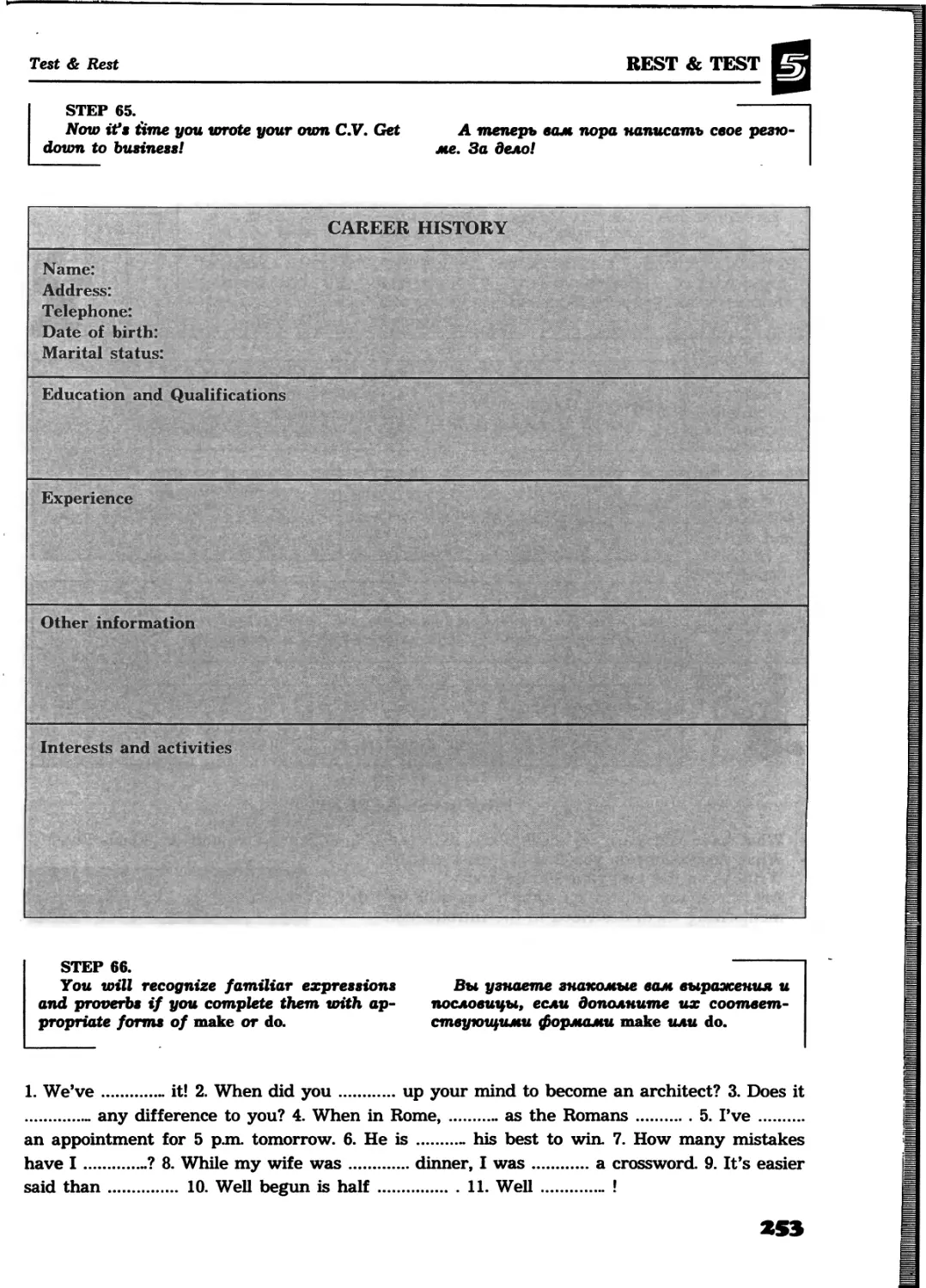
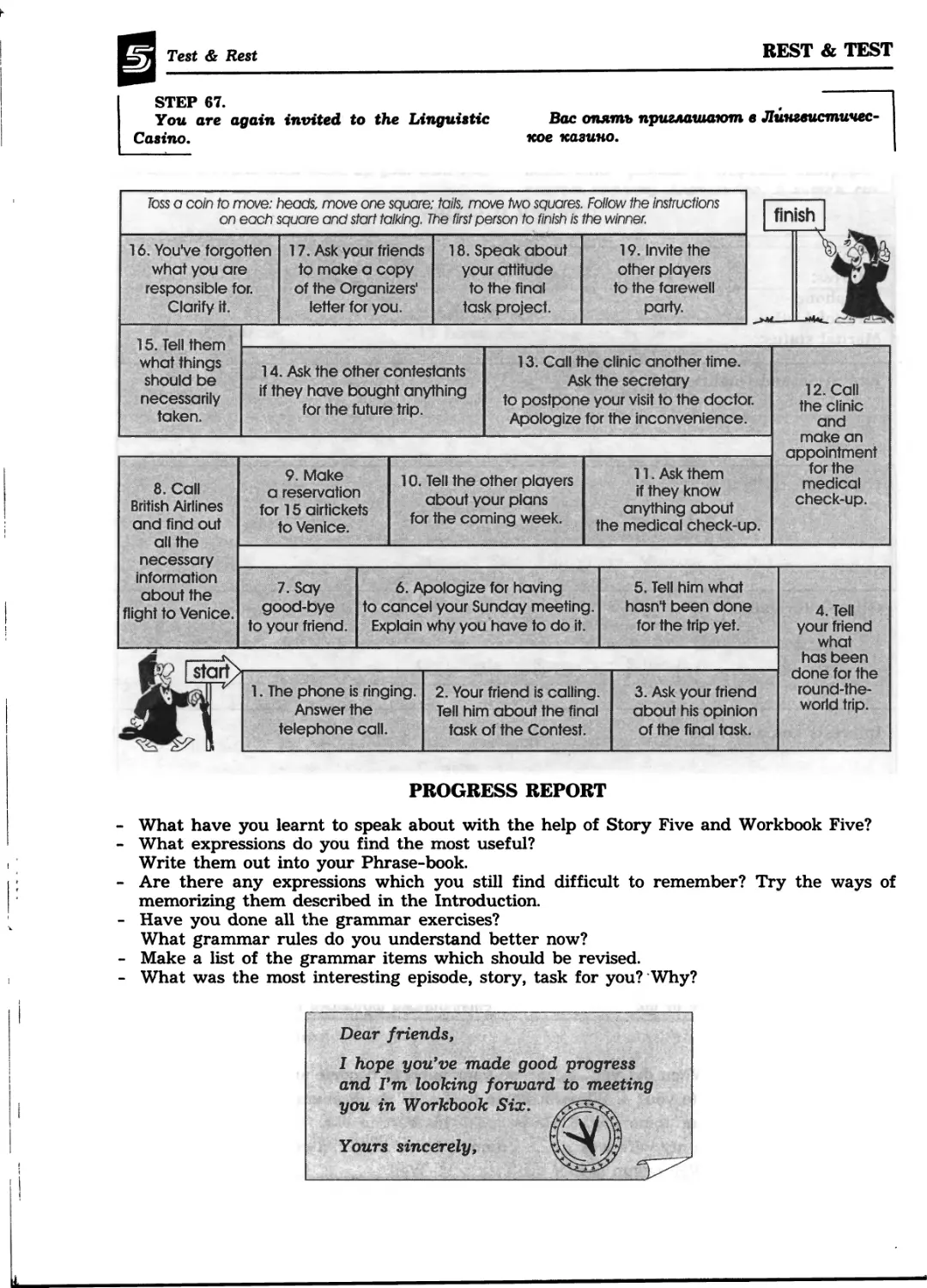




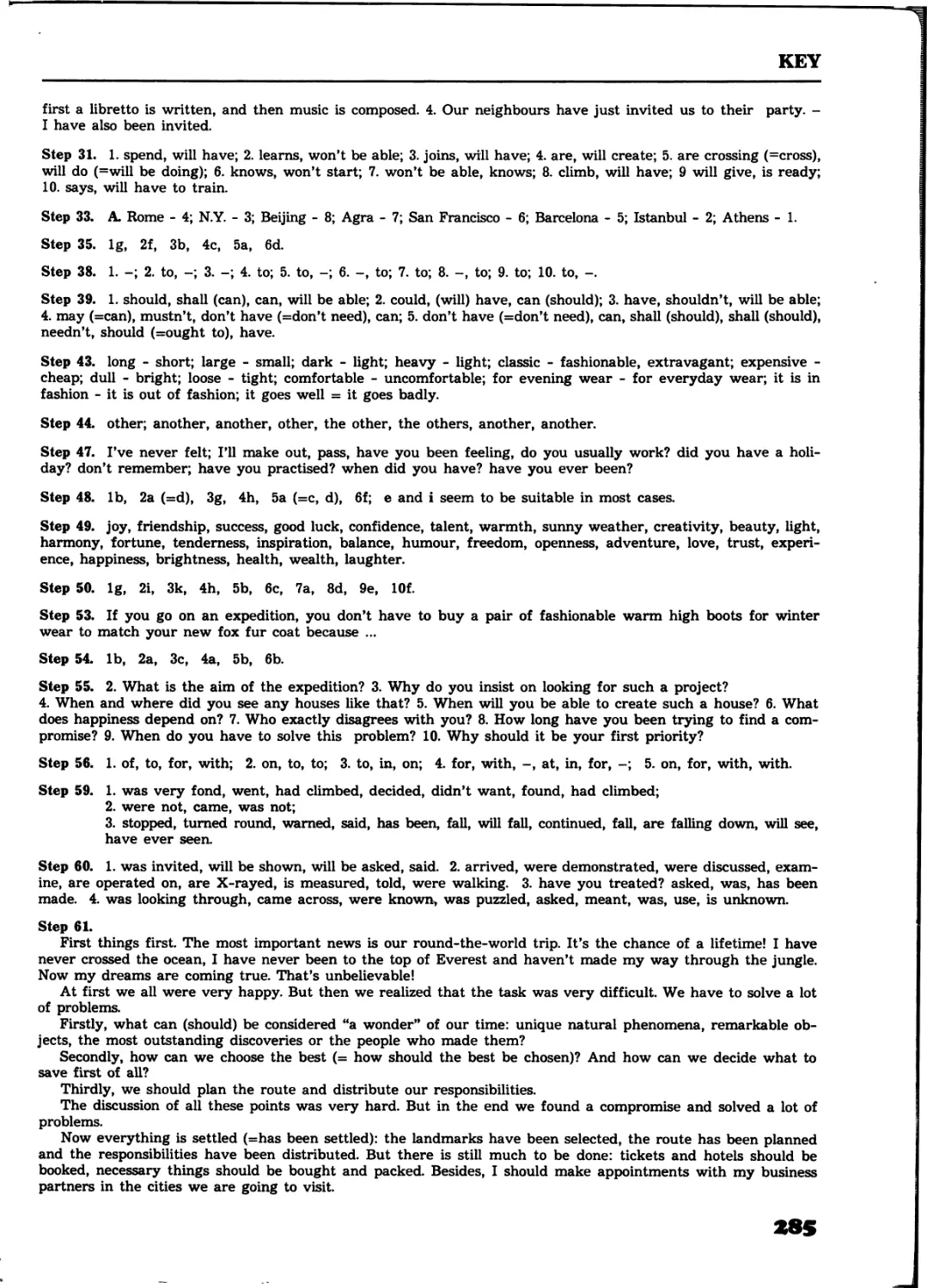

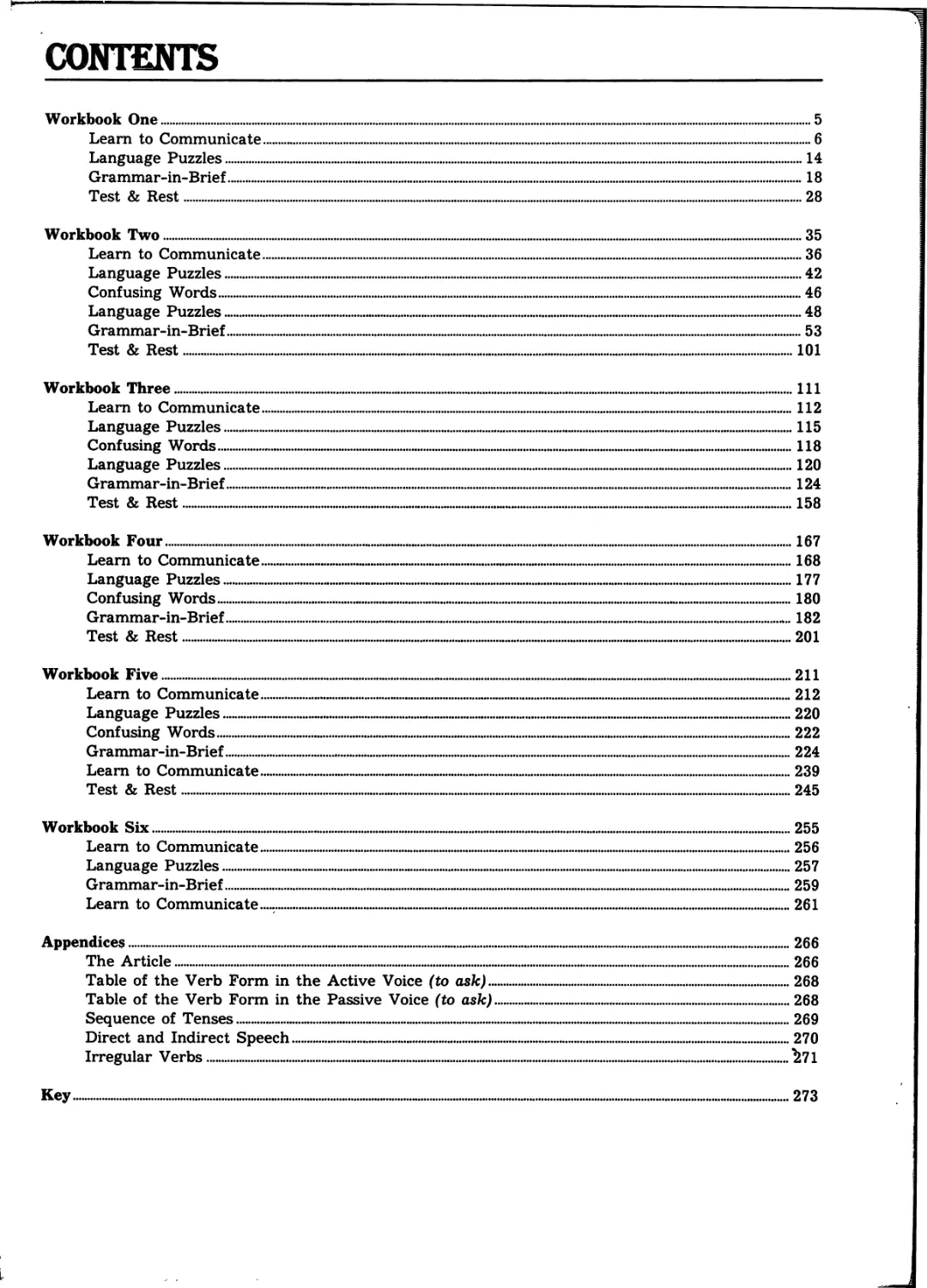

Автор: Каминская Л.И.
Теги: английский язык языки мира рабочая тетрадь издательство высшая школа учебник по английскому языку
ISBN: 5-06-004964-7
Год: 2005



Текст
L. Kaminskaya
A Step Forward
*.	17
4
WORKBOOK
Л	Ж»ж1и I'iti
Л.И. Каминская
Шаг вперед!
Английский язык
для продолжающих
Рабочая тетрадь
Издательство «Высшая школа»
Научно-образовательный центр «Школа Китайгородской»
Москва • 2005
УДК811.111
ББК81.2Англ
К 18
Рецензенты:
Международный университет (в Москве)
кандидат филологических наук, доцент В.Н. Дзюба,
кандидат филологических наук, доцент М.Л. Егорова
Каминская, Л.И.
К 18 Шаг вперед! Английский язык для продолжающих: Рабочая тетрадь/Л.И. Каминская. - М.:
Высшая школа; Научно-образовательный центр «Школа Китайгородской», 2005. - 287 с.: ил.
ISBN 5-06-004964-7
ISBN 5-87151-033-7
Рабочая тетрадь - вторая часть учебно-методического комплекса «Шаг вперед!» (“A Step Forward”). В ней содержатся
лексико-грамматические упражнения, а также упражнения для усвоения формул речевого этикета, основанные на материале
Учебника. Первые пять глав Рабочей тетради (Workbooks 1-5) содержат лексико-грамматические комментарии, объясняющие
новый материал и облегчающие выполнение упражнений. Последняя глава (W>rkbook 6) состоит из тестов, проверяющих
усвоение изученного материала. Рабочая тетрадь содержит ключи-ответы к упражнениям и таблицы справочного характера.
Упражнения рекомендованы для домашней самостоятельной работы, они также могут выполняться в классе с
преподавателем.
Предназначается для студентов вузов, учащихся старших классов, слушателей курсов и всех, кто продолжает изучение
английского языка с преподавателем или самостоятельно.
УДК 811.111
ББК 81.2 Англ
All rights reserved. No part of this publication may be reproduced, stored in a retrieval system, or transmitted, in
any form or by any means, electronic, mechanical, photocopying, recording or otherwise, without the prior permission
of the copyright holders.
ISBN 5-06-004964-7
ISBN 5-87151-033-7
© ФГУП «Издательство «Высшая школа», 2005
© Г. Китайгородская. Концепция обучения и
учебного комплекса, 2005
© Л. Каминская. Текст, 2005
ДОРОГИЕ ДРУЗЬЯ!
Вы открыли Рабочую тетрадь учебно-методического комплекса A Step Forward. Надеемся, что
она станет вашим помощником в изучении английского языка. В ней вы найдете как уже знакомый,
так и новый грамматический материал, большое количество лексико-грамматических упражнений и
ключей к ним, а также таблицы справочного характера. В Рабочей тетради шесть глав (Workbooks
1-6), каждая из которых соотносится с определенным текстом-полилогом учебника (Storybook).
Эти главы включают разделы: Learn to Communicate, Language Puzzles, Confusing Words,
Grammar-in-Brief, Test and Rest.
В разделе Learn to Communicate даны образцы формул речевого этикета и наиболее употреби-
тельных выражений из текстов-полилогов, а также упражнения для их усвоения. Выполняя эти
упражнения, старайтесь использовать предлагаемые выражения целиком, не расчленяя их и не спе-
ша разгадать правила их построения. Это задача следующего этапа работы.
В разделах Language Puzzles и Confusing Words рассматриваются лексические единицы и выра-
жения из полилогов, употребление которых представляет наибольшую трудность. Объяснения и
упражнения этих рубрик помогут вам разобраться, почему нужно говорить так, а не иначе.
В разделе Grammar-in-Brief вы найдете объяснение того грамматического материала, который
уже встретился в полилогах и который вы уже начали употреблять в речи. Объяснение граммати-
ческого материала сопровождается схемами, таблицами, рисунками и многочисленными упражнени-
ями.
Завершает каждую главу Рабочей тетради рубрика Test and Rest, включающая тесты, которые
дадут вам возможность проверить, насколько хорошо усвоен предложенный материал. В раздел
Test and Rest также входят устные и письменные задания творческого характера, выполняя кото-
рые, вы можете использовать изученные языковые средства для выражения собственных идей и
мнений.
Даже если в будущем вам почти не придется писать по-английски, не пренебрегайте письменны-
ми заданиями творческого характера - они способствуют развитию устной речи. Для выполнения
таких упражнений (составления рассказов, описаний картинок и т.д.), а также для упражнений на
перевод с русского языка на английский, в Рабочей тетради отведено немного места, так как пред-
полагается, что задания такого рода будут выполняться на отдельных листочках или в специальной
тетради.
Ключи-ответы (Keys) даны ко всем упражнениям, кроме тех из них, которые выполняются стро-
го по модели, или предполагают творческий подход в выполнении.
Каждая глава (Workbook) имеет свои задачи и специфику.
Workbook One не содержит нового грамматического материала и предназначена для повторения
ранее изученного. Если вы недавно прошли начальный курс обучения (например, по учебнику
Т. Латышевой There Is Nothing Like Travelling), вы можете начать работу с Workbook One с выпол-
нения заданий раздела Test and Rest. Если при выполнении этих заданий у вас не возникло затруд-
нений и ваши ответы верны, можно сразу переходить к Workbook Two.
Workbook Two поможет повторить уже известные и познакомиться с новыми грамматическими
явлениями, в частности, со всеми глагольными формами настоящего и будущего времени.
Главная задача Workbook Three - систематизировать все глагольные формы прошедшего време-
ни, дать их в сравнении друг с другом и с глагольными формами настоящего времени.
Workbook Four и Workbook Five включают, в основном, новый лексико-грамматический материал
и рассматривают каждое языковое явление сначала отдельно, а потом в сравнении с ранее изучен-
ными.
Workbook Six совсем небольшая по объему и содержит только тесты и задания, позволяющие
проверить, насколько успешно вы усвоили материал учебника A Step Forward.
Каждая глава Рабочей тетради заканчивается игрой Small Talk. Оптимальное число участников -
два-три человека. Тем, кто изучает язык самостоятельно, рекомендуем выполнять все задания этой
игры, записывая себя на магнитофон. Затем прослушать каждое выполненное задание и подумать,
нужно ли в нем что-то исправить, что и как можно было бы улучшить, добавить, сказать по-друго-
му. Было бы полезно записать себя на магнитофон еще раз. Такая же форма работы может быть
рекомендована и при выполнении других устных заданий.
А теперь несколько слов о том, как лучше организовать изучение английского языка с помощью
Рабочей тетради A Step Forward.
СЕМЬ СОВЕТОВ ОТ АВТОРА
Работа с языком трудна, кропотлива, требует времени и терпения. “Выучить” иностранный язык,
а тем более знать его “в совершенстве” практически невозможно. Для достижения успеха прежде
всего необходимо ставить перед собой посильные задачи и понимать, что ни преподаватель, ни ме-
тод, ни учебник не могут сделать то, что каждый должен и может сделать сам, приложив к этому
максимум усилий. А преподаватель, метод и учебник помогут сделать это быстрее и радостнее.
Итак, первый совет - ставить реальные задачи и работать с удовольствием.
Второй совет касается умения организовывать и управлять своей работой. Необходимо осозна-
вать, что вы делаете, что вам удалось и что еще предстоит сделать. В этом вам поможет рубрика
Progress Report, которой завершается каждая глава Рабочей тетради. Приучите себя выполнять те за-
дания, которые предлагает эта рубрика. Это даст вам возможность управлять своим движением к цели.
Третий совет - приступайте к упражнениям Рабочей тетради только после завершения первого
этапа работы с соответствующим текстом-полилогом. Не спешите заглядывать в грамматические
правила, а заглянув, не ограничивайтесь только их прочтением. Сами по себе правила дают лишь
информацию о языке. Научиться им пользоваться вам помогут упражнения.
Четвертый совет - не огорчайтесь, что не успеваете делать все, но обязательно делайте главное.
Если вы занятой человек и изучаете язык в группе на краткосрочных курсах (100-150 часов), то
вы не успеете выполнить все упражнения и прочитать все рассказы, предлагаемые в этом учебно-
методическом комплексе, за время учебы. Не огорчайтесь, вы сумеете это сделать позднее, после
окончания курса обучения. Дополнительные упражнения и рассказы обеспечат возможность даль-
нейшего изучения языка и позволят вам закрепить и улучшить свои знания. Ваш преподаватель
определит объем, характер и последовательность грамматических заданий, необходимых именно вам,
но то, что будет рекомендовано преподавателем, должно непременно выполняться вовремя, если вы
хотите добиться успеха.
Пятый совет. Работайте систематически. Этого требует специфика иностранного языка как учеб-
ного предмета. Как бы вы ни были заняты, постарайтесь сделать работу с языком своей ежедневной
привычкой. Даже полчаса-час занятий каждый день гораздо эффективнее утомительного многоча-
сового наверстывания упущенного один раз в неделю. А как приятно не чувствовать груза задол-
женности, накапливающегося изо дня в день! Вы будете приходить на занятия с хорошим настрое-
нием и чувствовать себя более уверенно.
Шестой совет. Выполняйте домашние задания в комфортных условиях. Делая их в дороге, в
машине, вы снижаете эффективность занятий. Рекомендуем вам выработать определенный ритуал
выполнения самостоятельной работы. Хорошо, когда это происходит в одном и том же, удобном ме-
сте, когда сначала вы настраивайтесь на английский язык, припоминая, что происходило с вами и с
вашей группой на предыдущем занятии. Прослушайте запись той истории, которую вы сейчас изу-
чаете, а потом приступайте к выполнению упражнений или чтению рассказов.
Совет седьмой и последний касается способов овладения тем объемом материала, который пред-
лагает этот учебник.
Постарайтесь, работая дома, припомнить те приемы и средства запоминания наиболее важных
выражений, которые при введении нового материала предлагал ваш преподаватель, работающий по
методу профессора Г. А. Китайгородской “Активизация возможностей личности и коллектива”.
Если вы учите язык самостоятельно, то попробуйте помочь себе сами. Пишите наиболее трудные
и нужные выражения (не слова, а именно выражения) несколько раз подряд, выписывайте их на
карточки. Наиболее важные выражения пишите на карточках разных цветов и развешивайте их в
своей квартире. Их не должно быть больше семи-десяти одновременно. Запомнив одни выражения,
заменяйте их другими. Придумывайте рассказы, ситуации, используя эти фразы и старайтесь про-
говаривать их вслух.
При изучении грамматического материала тем, у кого сильнее развито логическое мышление, по-
могут схемы, диаграммы, логические цепочки. Те, у кого развито образное мышление, могут опи-
раться на рисунки, символы, ассоциации и так называемые спайдограммы (mind-maps).
Постигая язык творчески, экспериментируя, вы сможете лучше узнать себя и превратить заня-
тия в удовольствие.
Англичане говорят “All things are difficult before they are easy”. Это в полной мере относится к
изучению иностранного языка. Мы надеемся, что этот учебник поможет вам сделать трудное про-
стым, и тогда ваш путь в мир английского языка станет легким и радостным.
Желаем успеха!
Л.Каминская
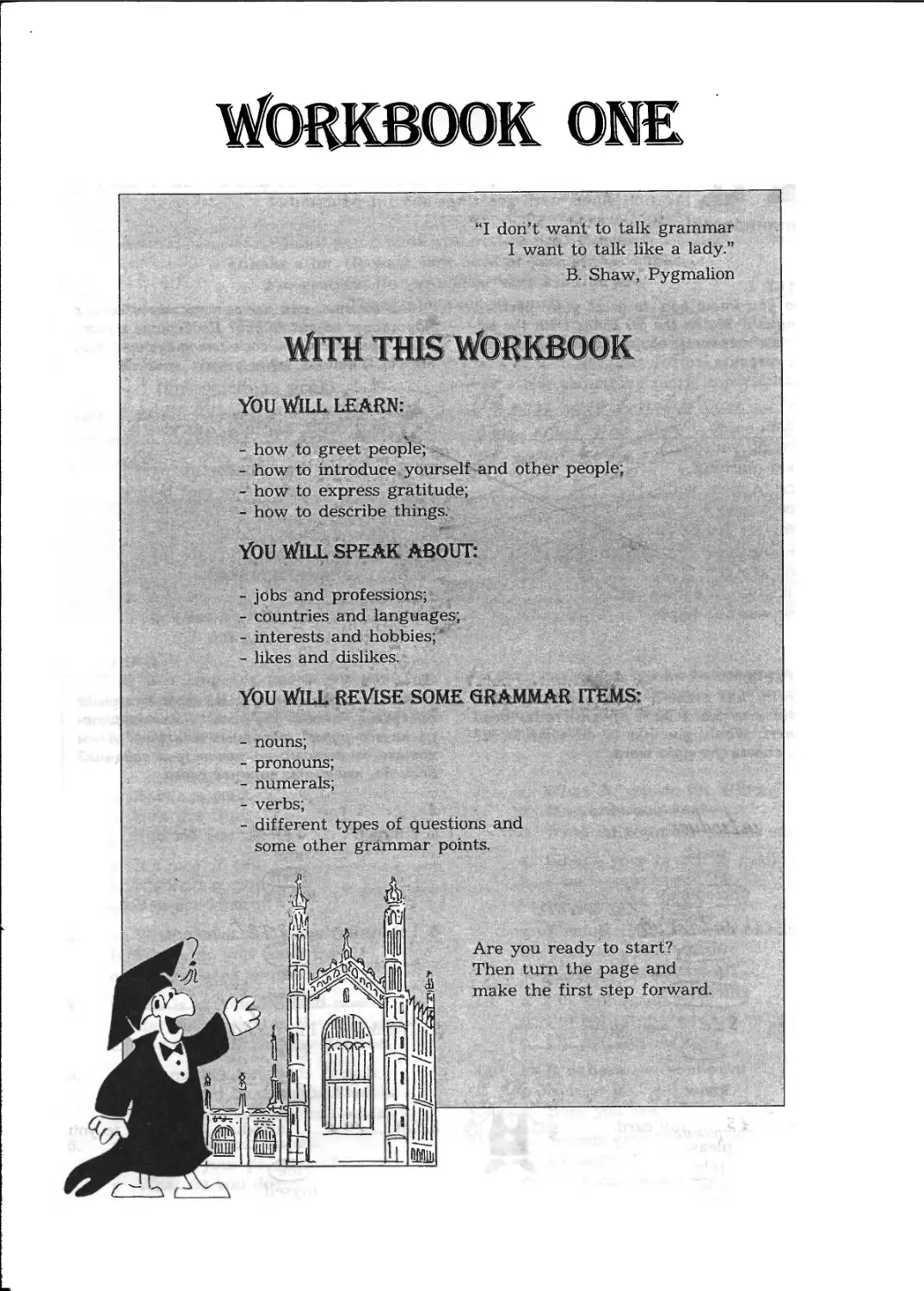
Workbook one
“I don’t want to talk grammar
I want to talk like a lady.”
B. Shaw, Pygmalion
With this Workbook
You Will learn:
4:
-	how to greet people;
-	how to introduce yourself and other people;
-	how to express gratitude;
-	how to describe things.
You Will speak about:
-	jobs and professions;
-	countries and languages;
-	interests and hobbies;
-	likes and dislikes.
You Will revise some grammar items:
-	nouns;
-	pronouns;
-	numerals;
-	verbs;
-	different types of questions and
some other grammar points.
Offllb
Are you ready to start?
Then turn the page and
make the first step forward.
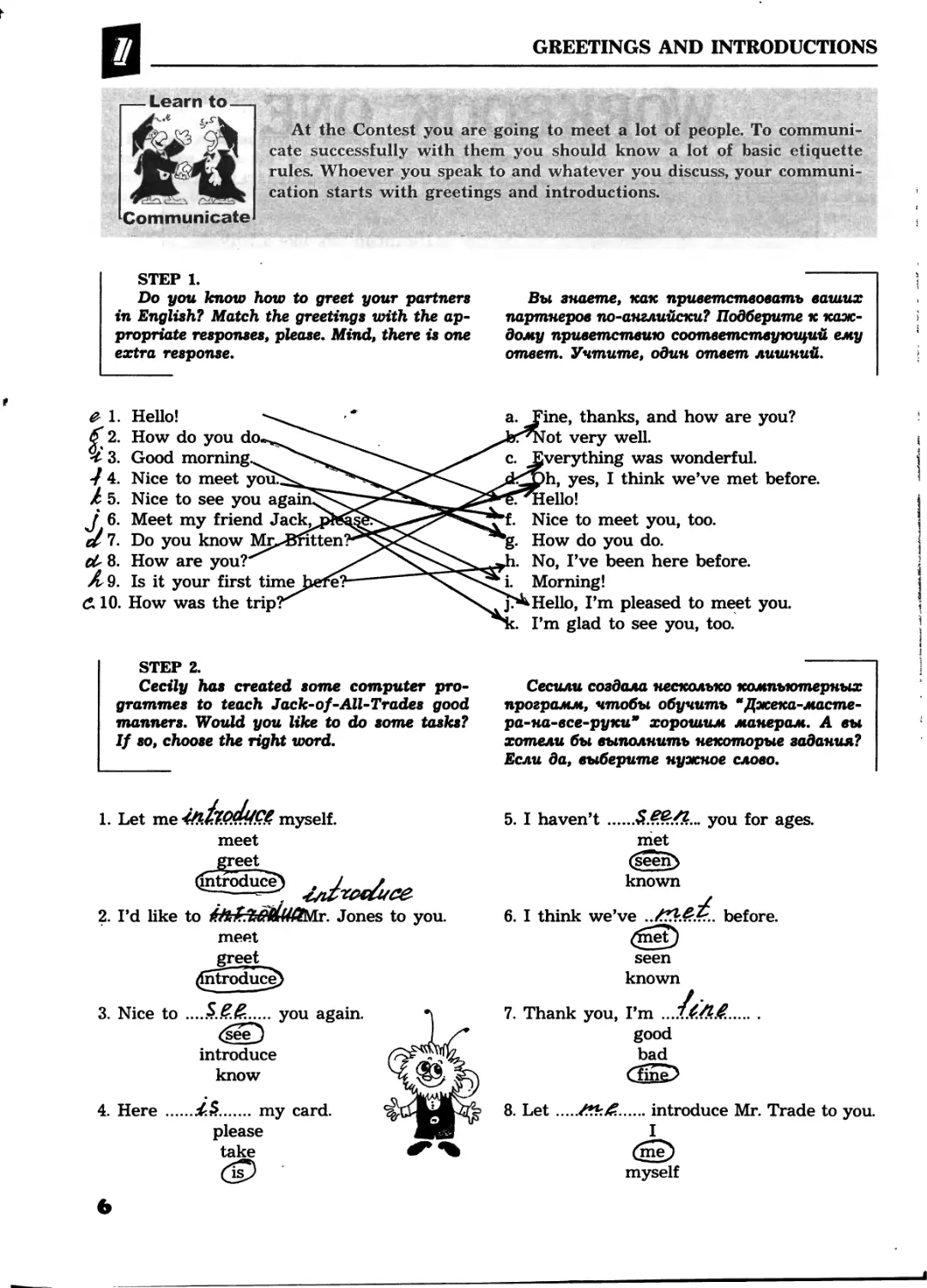
GREETINGS AND INTRODUCTIONS
-Communicate
At the Contest you are going to meet a lot of people. To communi-
cate successfully with them you should know a lot of basic etiquette
rules. Whoever you speak to and whatever you discuss, your communi-
cation starts with greetings and introductions.
STEP 1.
Do you know how to greet your partners
in English? Match the greetings with the ap-
propriate responses, please. Mind, there is one
extra response.
Вы знаете, как приветствовать ваших
партнеров по-английски? Подберите к каж-
дому приветствию соответствующий ему
ответ. Учтите, один ответ лишний.
& 1. Hello!
jT 2. How do you do
ф 3. Good morning
-f 4. Nice to meet you: _
Z 5. Nice to see you again
J 6. Meet my friend Jack,
7. Do you know Mr
oL 8. How are you?
X 9. Is it your first time
d 10. How was the trip'
ine, thanks, and how are you?
ot very well.
verything was wonderful.
h, yes, I think we’ve met before.
Hello!
Nice to meet you, too.
How do you do.
No, I’ve been here before.
Morning!
Hello, I’m pleased to meet you.
. I’m glad to see you, too.
STEP 2.
Cecily has created some computer pro-
grammes to teach Jack-of-All-Trades good
manners. Would you like to do some tasks?
If so, choose the right word.
Сесили создала несколько компьютерных
программ, чтобы обучить “Джека-масте-
ра-на-все-руки” хорошим манерам. А вы
хотели бы выполнить некоторые гадания?
Если да, выберите нужное слово.
1. Let me	myself,
meet
greet
5. I haven’t.....£.^Z?... you for ages.
met
(seeif>
known
2. I’d like to ^^8^2Mr. Jones to you.
meet
greet
introduce)
3. Nice to .....$.££... you again.
introduce
know
4. Here............my card,
please
take
(IsJ
6. I think we’ve	before,
seen
known
7. Thank you, I’m	....
good
bad
8. Let...........introduce Mr. Trade to you.
myself
Learn to Communicate
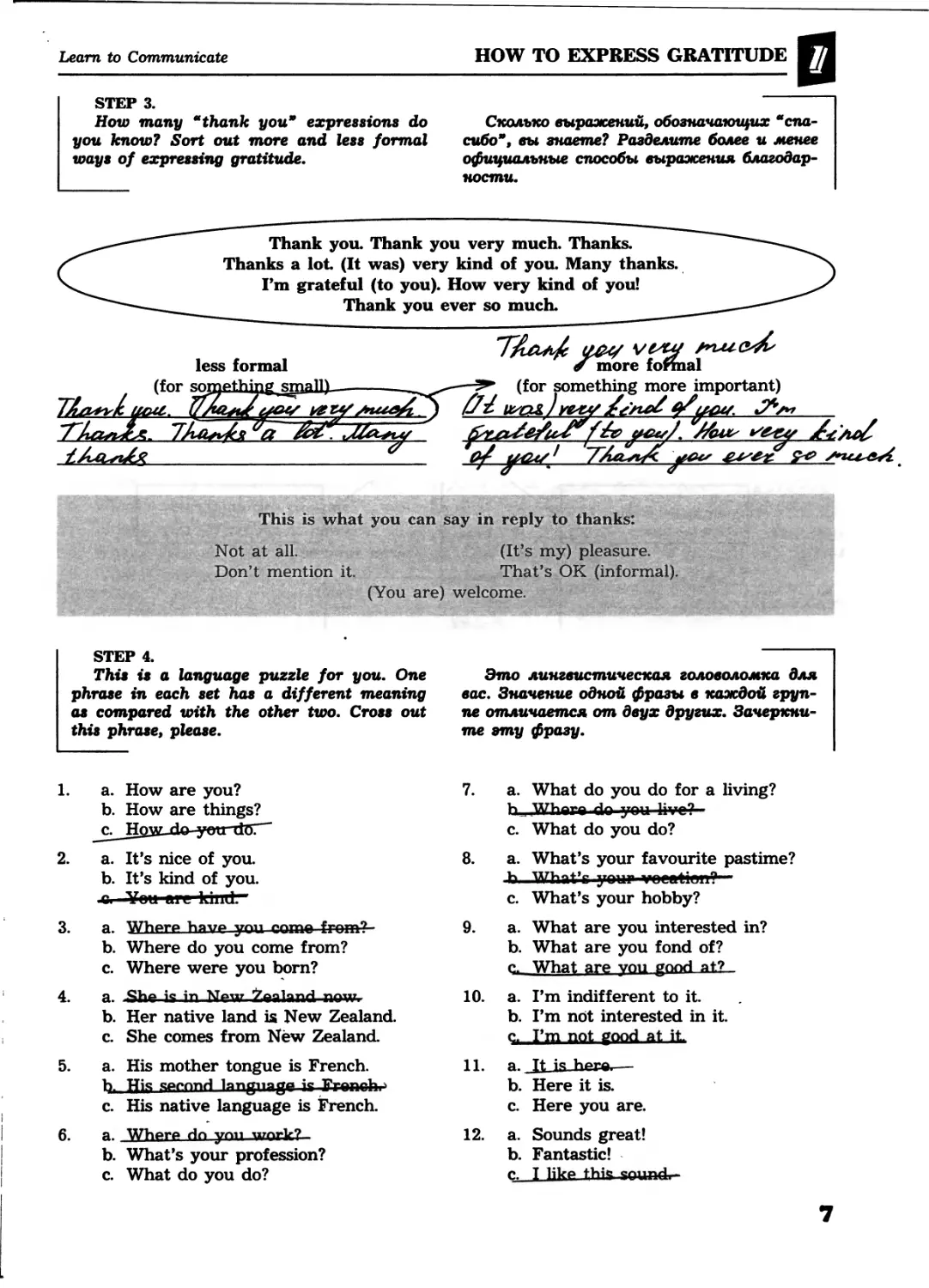
HOW TO EXPRESS GRATITUDE
STEP 3.
How many "thank you" expressions do
you know? Sort out more and less formal
ways of expressing gratitude.
Сколько выражений, обозначающих "спа-
сибо", вы знаете? Разделите более и менее
официальные способы выражения благодар-
ности.
Thank you. Thank you very much. Thanks.
Thanks a lot (It was) very kind of you. Many thanks.
I’m grateful (to you). How very kind of you!
Thank you ever so much.
less formal
This is what you can say in reply to thanks:
Not at all.	(It’s my) pleasure.
Don’t mention it.	That’s OK (informal).
(You are) welcome.
STEP 4.
This is a language puzzle for you. One
phrase in each set has a different meaning
as compared with the other two. Cross out
this phrase, please.
Это лингвистическая головоломка для
вас. Значение одной фразы в каждой груп-
пе отличается от двух других. Зачеркни-
те зту фразу.
1. a. How are you?
b. How are things?
2. a. It’s nice of you.
b. It’s kind of you.
You an kind.**'
3.	a. Where have yo11 from*?
b. Where do you come from?
c. Where were you born?
4.	a. She is in New Zealand now,
b. Her native land is New Zealand,
c. She comes from New Zealand.
5.	a. His mother tongue is French.
b. His sernnri langnnga irTrannh,-
c. His native language is French.
6.	a. Where dn ynn wnrlr?-
b. What’s your profession?
c.	What do you do?
7.
8.
9.
10.
11.
12.
a. What do you do for a living?
h Wherp Лгч y?.i 1i„e?-
c. What do you do?
a. What’s your favourite pastime?
b What’s your vocation?—
c. What’s your hobby?
a.	What are you interested in?
b.	What are you fond of?
G. What are you good at?_
a.	I’m indifferent to it.
b.	I’m not interested in it.
c,	I’m not good at it
a.	It is herp —
b.	Here it is.
c.	Here you are.
a.	Sounds great!
b.	Fantastic!
с.	I like thi«p yn'ind,-
7
Learn to Communicate
WHO AM I?
STEP 5.
If you ask yourself “Who am I?”, what
will you first think of: your family back-
ground, your work, hobbies or ...? Look at the
mind map and mark what corresponds to
your image of yourself. What would you like
to add to make your image more complete?
Если вы спросите себя “Кто я?", о чем
будет ваш первый ответ: о вашем проис-
хождении, работе или увлечениях? По-
смотрите на схему и отметьте то, что со-
ответствует вашему представлению о себе.
Что бы вы хотели добавить, чтобы дать бо-
лее полное представление о себе?
STEP 6.
The sentences below can help you tell about
yourself and other people. To do it you'll have
to complete them with the verbs in the frame.
Mind, each verb can be used only once.
Предложения, данные ниже, помогут вам
рассказать о себе и других людях. Чтобы это
сделать, вам придется дополнить их глагола-
ми в рамочке. Учтите, что каждый глагол мо-
жет быть использован только один раз.
лмоё'/ шагс / rfqnirri / eembtlfS / /jnarriCiT
value"/ ДеяТ/-knCw”rm t-/ еошеЗ"/ -mean
1.	I’m married with three children.
2.	I ....0U0... sports and I keen on
computer graphics.
3.	I	job description very well.
4.	My friends /й4$йа lot to me.
5.	I born in a large family.
6.	My work<£Z^24$£2& lot of expertise.
7.	My grandparents	born in Hungary.
8.	Challenging tasks ЛУ^И^лпе.
9.	I manage to	work and
learning foreign languages.
10.	My job».a£.S..both demanding and
rewarding.
11.	My family first.
12.	I	reliability most of all.
13.	My strongest points	competence
and common sense.	.	*
14.	My colleagues are nice to	with.
Learn to Communicate
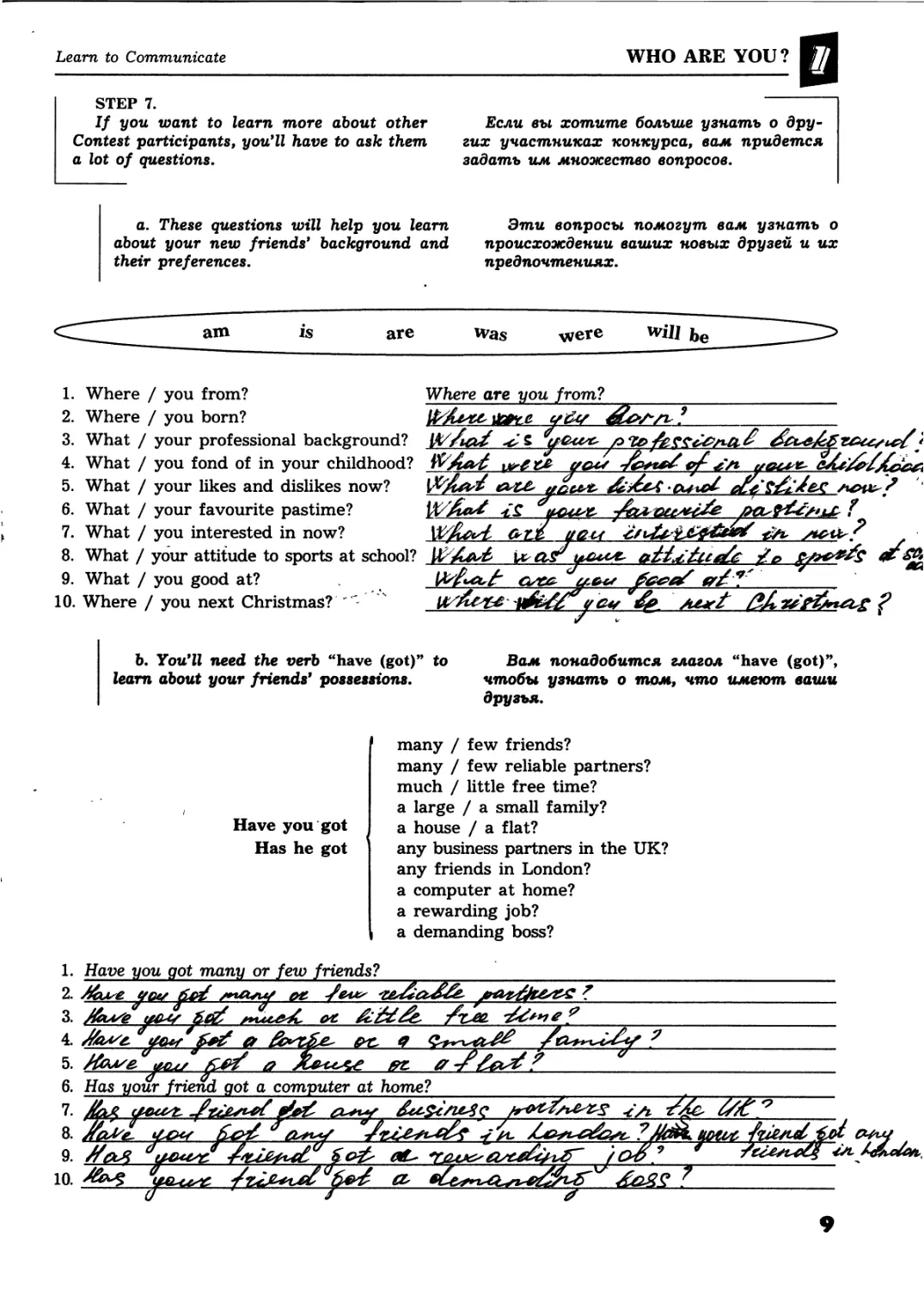
WHO ARE YOU?
STEP 7.
If you want to learn more about other
Contest participants, you’ll have to ask them
a lot of questions.
Если вы хотите больше узнать о дру-
гих участниках конкурса, вам придется
задать им множество вопросов.
a. These questions will help you learn
about your new friends’ background and
their preferences.
Эти вопросы помогут вам узнать о
происхождении ваших новых друзей и их
предпочтениях.
•were
will be
1.	Where / you from?
2.	Where / you bom?
3.	What / your professional background?
4.	What / you fond of in your childhood?
5.	What / your likes and dislikes now?
6.	What / your favourite pastime?
7.	What / you interested in now?
8.	What / your attitude to sports at school?
9.	What I you good at?
10.	Where / you next Christmas?
Where are you from? _______________
..........ZZ
vret*	ef its mu*-
WAtid	mu* AaA&f
\Х/£лг£	p&UZ -АлЪОи^Ае	?


b. You’ll need the verb “have (got)” to Вам понадобится глагол “have (got)”,
learn about your friends’ possessions. чтобы узнать о том, что имеют ваши
друзья.
Have you got
Has he got
many I few friends?
many / few reliable partners?
much / little free time?
a large / a small family?
a house / a flat?
any business partners in the UK?
any friends in London?
a computer at home?
a rewarding job?
a demanding boss?
1.	Have you got many or few friends? ______________________________________________________
2.	on -/esus	?
3.	Мяи/ё	At-M-	______________________________
4.	/у	4	?
5-	a	O'-AAtbA ?	"
6.	Has your friend got a computer at home?_________________ _______________________________
7.	-<fy
8-	с
10-	tffbLcst.	О,	AaSQ ?
9
Learn to Communicate
WHAT DO YOU LIKE?
c. What can you ask about with the help
of this “merry-go-round?"
О чем вы можете спросить с помощью
атой “карусели"?
8.
9.
10.
11.
12.’
Does your wife drive?.______________
What languages does your boss speak?
1. Do pou speak Japanese?
2. Where do you Hye?_______
6.
7.
d. Tag questions will help you keep con-
versation going by involving listeners and
inviting them to participate.
Разделительные вопросы помогут вам
поддержать беседу, вовлекая в нее собесед-
ников и приглашая их к участию в ней.
1.	It’s your first time here, isn’t it?
2.	You lack time, don’t you?
3.	You like it here,	...?
4.	You can drive,
5.	You work hard,
6.
You don’t speak French, do you?
7.	You haven’t got a house in
8.	You can’t play the violin,
9.	Your job isn’t rewarding,
10.	Art doesn’t attract you, .:
1. В английском языке различают четыре типа вопросов:
а.	Общие (yes/по questions):
Do you enjoy pop music?
Is it your first time here?
b.	Специальные (special questions).
What kind of music do you like?
Where is your luggage?
с.	Альтернативные (alternative questions):
Are you fond of hard rock or du you
prefer pop music?
d.	Разделительные (tag questions):
You are keen on jazz, aren’t you?
You don’t like classical music, do you?
2. Глагол he, модальные глаголы can, must, should и некоторые другие
(см. стр. 193, 196, 235) задают вопросы и строяг отрицательные предложения
самостоятельно, им не нужен вспомогательный глагол do (does, did):
Can I have another cup of tea, please?
Learn to Communicate
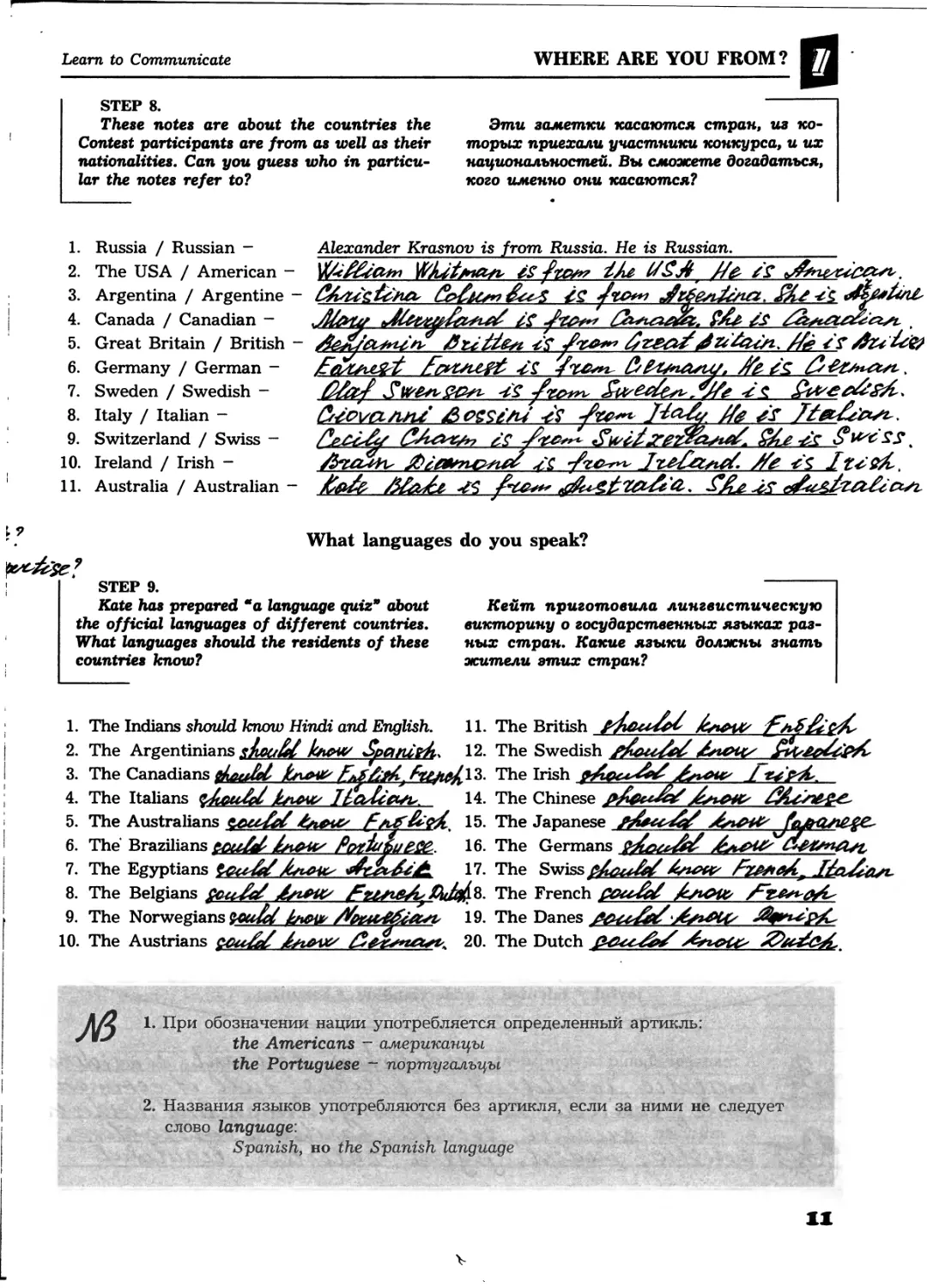
WHERE ARE YOU FROM?
STEP 8.
These notes are about the countries the
Contest participants are from as well as their
nationalities. Can you guess who in particu-
lar the notes refer to?
Эти заметки касаются стран, из ко-
торых приехали участники конкурса, и их
национальностей. Вы сможете догадаться,
кого именно они касаются?
1.	Russia / Russian -
2.	The USA / American -
3.	Argentina / Argentine -
4.	Canada / Canadian -
5.	Great Britain / British -
6.	Germany / German -
7.	Sweden / Swedish -
8.	Italy / Italian -
9.	Switzerland / Swiss —
10.	Ireland / Irish —
11.	Australia / Australian -
Alexander Krasriov is from Russia. He is Russian.
Z'ggtsZJ/g. JZ
&ZO14ZZU1Z. & 0ZSJ&L Js.	ZL '&M'•
424^*7	?	$ mss.
Z£	Jfe £$_ Z&Z.
t ?
;	STEP 9.
Kate has prepared “a language quiz" about
the official languages of different countries.
What languages should the residents of these
countries know?
What languages do you speak?
Кейт приготовила лингвистическую
викторину о государственных языках раз-
ных стран. Какие языки должны знать
жители этих стран?
1.	The Indians should know Hindi and English. 11.
2.	The Argentinians	kww	12.
3.	The Canadians
4.	The Italians	UaZj^k. 14-
5.	The Australians	Z&g&fZ 15.
6.	The' Brazilians	ZzzZfMfSZ- 16.
7.	The	Egyptians	1?-
8.	The	Belgians ^ог^£а/_	A&fs.
9.	The	Norwegians taaZL	19.
10.	The	Austrians gCuJZL	20.
The British	ZJtZZJ&Z
The Swedish fiZ&uZeZ Zst&fjs. ZJi'UgJJpZ
The Irish	-L
The Chinese
The Japanese	fa^SUi^
The Germans
The Swiss	ZZz&a/i-
The French
The Danes	^gt*±2£
The Dutch
hZc 1. При обозначении нации употребляется определенный артикль:
*	the Americans - американцы
the Portuguese ~ португальцы
2. Названия языков употребляются без артикля, если за ними не следует
слово language:
Spanish, но the Spanish language
¥
Learn to Communicate
WHAT DO YOU DO?
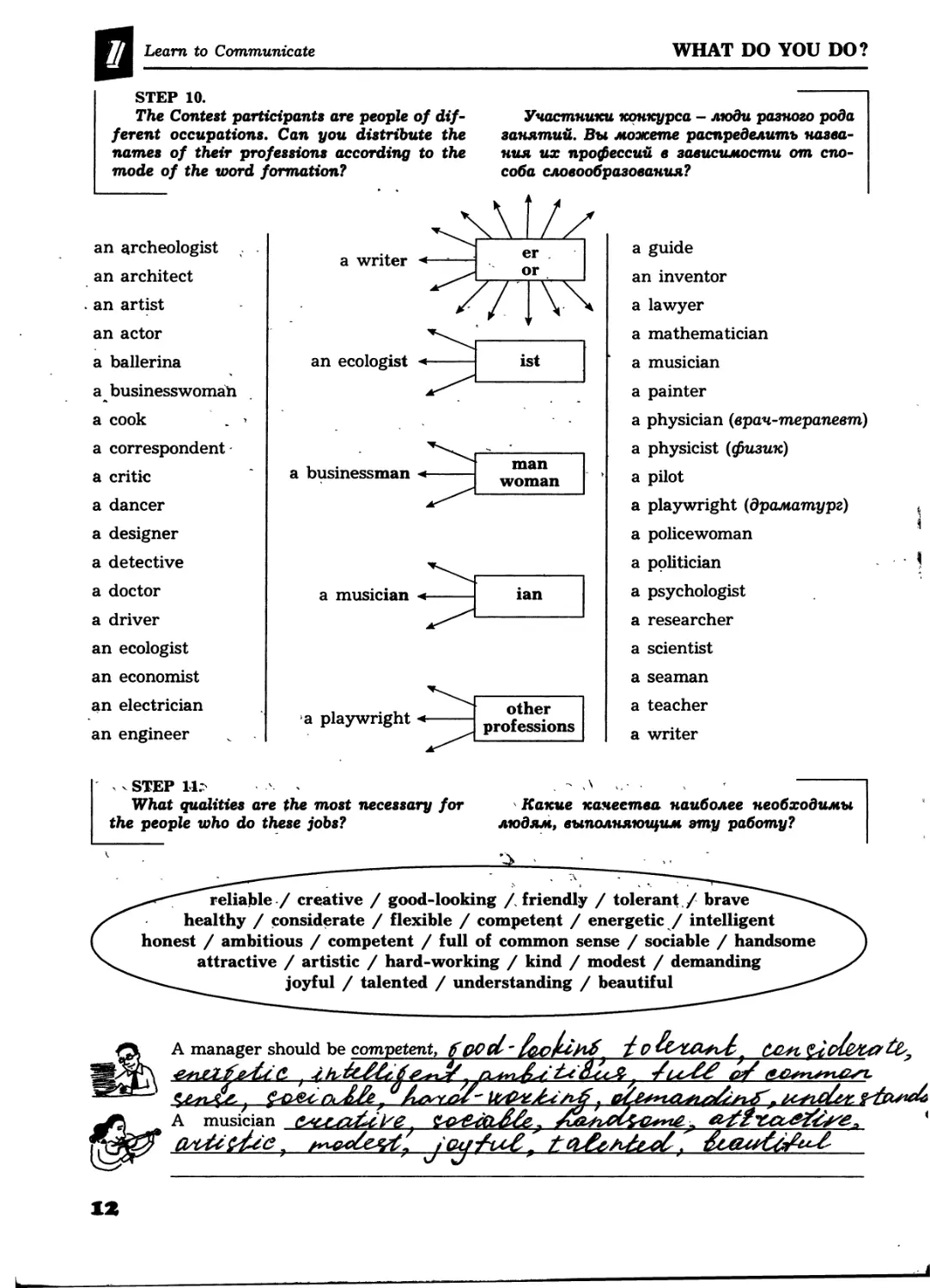
STEP 10.
The Contest participants are people of dif-
ferent occupations. Can you distribute the
names of their professions according to the
mode of the word formation?
Участники конкурса - люди разного рода
занятий. Вы можете распределить назва-
ния их профессий в зависимости от спо-
соба словообразования?
an archeologist
an architect
an artist
an actor
a ballerina
a businesswoman
a cook
a correspondent
a critic
a dancer
a designer
a detective
a doctor
a driver
an ecologist
an economist
an electrician
an engineer
a businessman
a writer
an ecologist
man
woman
a playwright
◄		other professions
a guide
an inventor
a lawyer
a mathematician
a musician
a painter
a physician (врач-терапевт)
a physicist (физик)
a pilot
a playwright (драматург)
a policewoman
a politician
a psychologist
a researcher
a scientist
a seaman
a teacher
a writer
v STEP
What qualities are the most necessary for
the people who do these jobs?
 Какие качества наиболее необходимы
людям, выполняющим эту работу?
reliable / creative / good-looking /. friendly / tolerant./ brave
healthy / considerate / flexible / competent / energetic J intelligent
honest / ambitious / competent / full of common sense / sociable / handsome
attractive / artistic / hard-working / kind / modest / demanding
joyful / talented / understanding / beautiful	_______
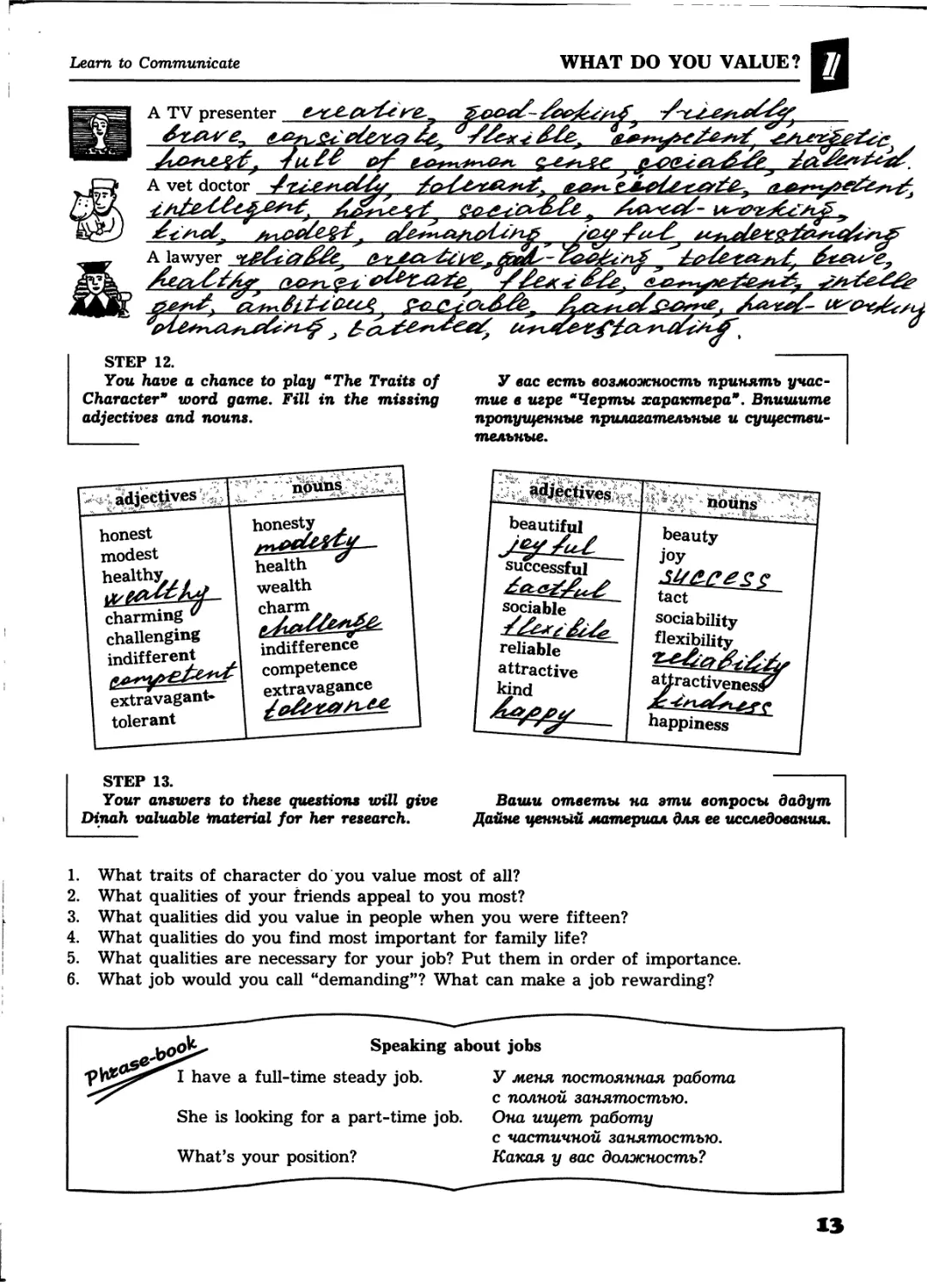
STEP 12.
You have a chance to play “The Traits of
Character” word game. Fill in the missing
adjectives and nouns.
У вас есть возможность принять учас-
тие в игре "Черты характера". Впишите
пропущенные прилагательные и существи-
тельные.
STEP 13.
Your answers to these questions will give
Dinah valuable material far her research.
Ваши ответы на эти вопросы дадут
Дайне ценный материал для ее исследования.
1.	What traits of character do you value most of all?
2.	What qualities of your friends appeal to you most?
3.	What qualities did you value in people when you were fifteen?
4.	What qualities do you find most important for family life?
5.	What qualities are necessary for your job? Put them in order of importance.
6.	What job would you call “demanding”? What can make a job rewarding?
Speaking about jobs
have a full-time steady job. У меня постоянная работа
с полной занятостью.
She is looking for a part-time job. Она ищет работу
с частичной занятостью.
What’s your position?	Какая у вас должность?
и
WHAT’S YOUR FAVOURITE PASTIME?
j— Language—
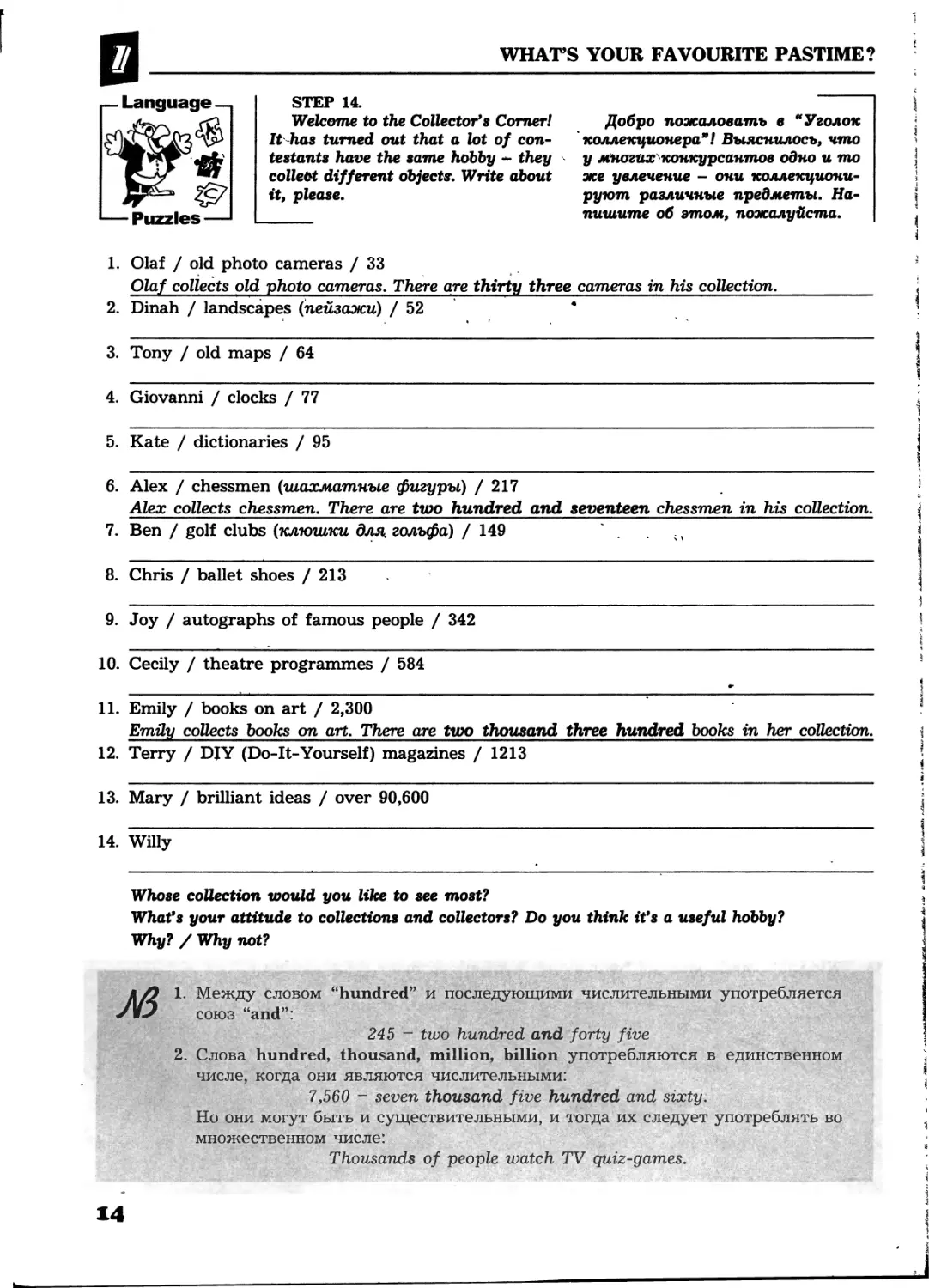
STEP 14.
Welcome to the Collector's Corner!
It has turned out that a lot of con-
testants have the same hobby - they
collect different objects. Write about
it, please.
Добро пожаловать в " Уголок
коллекционера”! Выяснилось, что
у многих-конкурсантов одно и то
же увлечение - они коллекциони-
руют различные предметы. На-
пишите об атом, пожалуйста.
1. Olaf / old photo cameras / 33
Olaf collects old photo cameras. There are thirty three cameras tn his collection^
2. Dinah / landscapes (пейзажи) /52
3.	Tony / old maps / 64
4.	Giovanni / clocks / 77
5.	Kate / dictionaries / 95
6.	Alex / chessmen (шахматные фигуры) / 217
Alex collects chessmen. There are two hundred and seventeen chessmen tn his collection.
7.	Ben / golf clubs (клюшки для. гольфа.) / 149	. (
8.	Chris / ballet shoes / 213
9.	Joy / autographs of famous people / 342
10.	Cecily / theatre programmes / 584
11.	Emily / books on art / 2,300
Етйу collects books on art. There are two thousand three hundred books in her collection.
12.	Terry / DIY (Do-It-Yourself) magazines / 1213
13.	Mary / brilliant ideas / over 90,600
14.	Willy
Whose collection would you like to see most?
What’s your attitude to collections and collectors? Do you think it’s a useful hobby?
Why? / Why not?
s/f 1. Между словом “hundred” и последующими числительными употребляется
союз “and”:
245 ~ two hundred and forty five
2. Слова hundred, thousand, million, billion употребляются в единственном
числе, когда они являются числительными:
7,560 - seven thousand five hundred and sixty.
Но они могут быть и существительными, и тогда их следует употреблять во
множественном числе:
Thousands of people watch TV quiz-games.
Language Puzzles
WHAT’S YOUR FAVOURITE PASTIME?
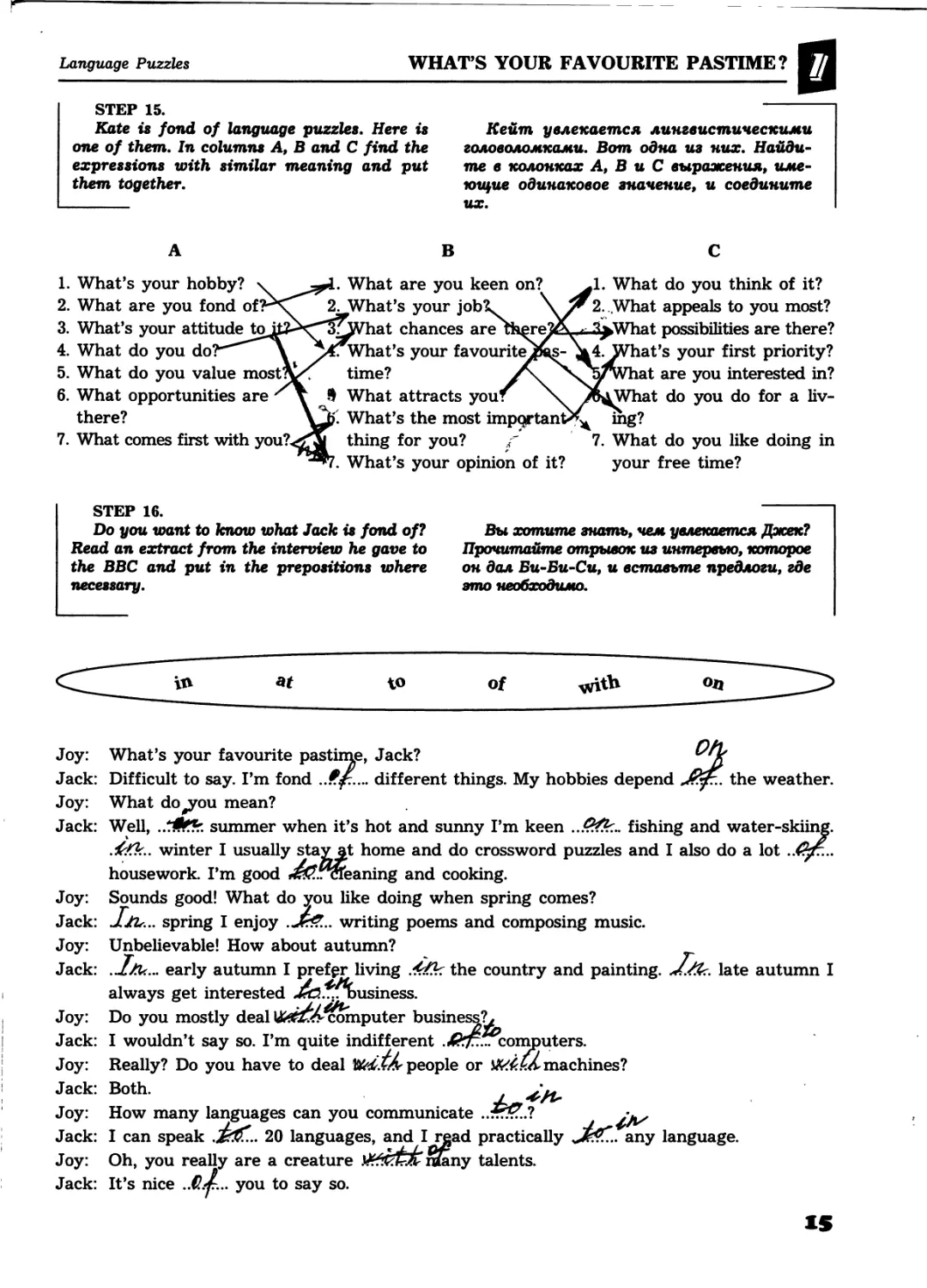
STEP 15.
Kate is fond of language puzzles. Here is
one of them. In columns A, В and C find the
expressions with similar meaning and put
them together.
Кейт увлекается лингвистическими
головоломками. Вот одна иг них. Найди-
те в колонках А, В и С выражения, име-
ющие одинаковое значение, и соедините
их.
АВС
1.	What’s your hobby? к
2.	What are you fond of?-^\
3.	What’s your attitude
4.	What do you do?" \
5.	What do you value mostn^f
6.	What opportunities are ' у
there?	\
7.	What comes first with you?<^
>1. What are you keen on?
2. What’s your jobl \
"S^JVhat chances are there^ta
47 What’s your favouritezws-
time?
Э What attracts you? X.
p. What’s the most important
I thing for you?
7. What’s your opinion of it?
Л. What do you think of it?
2. ..What appeals to you most?
.fc-S^What possibilities are there?
k4. What's your first priority?
^Х/What are you interested in?
yo^What do you do for a liv-
7. What do you like doing in
your free time?
STEP 16.
Do you want to know what Jack is fond of?
Read an extract from the interview he gave to
the BBC and put in the prepositions where
necessary.
Вы хотите знать, чем увлекается Джек?
Прочитайте отрывок из интервью, которое
он дал Би-Би-Си, и вставьте предлоги, где
зто необходимо.

Joy: What’s your favourite pastime, Jack?
Jack: Difficult to say. I’m fond different things. My hobbies depend the weather.
Joy: What do ^you mean?
Jack: Well, summer when it’s hot and sunny I’m keen fishing and water-skiing.
.4£k.. winter I usually stay at home and do crossword puzzles and I also do a lot ..t^£..
housework. I’m good <J8C?.;%eaning and cooking.
Joy: Sounds good! What do you like doing when spring comes?
Jack: .ItL... spring I enjoy .Jet?... writing poems and composing music.
Joy: Unbelievable! How about autumn?
Jack: .Jjftf... early autumn I prefer living the country and painting. xZz&. late autumn I
always get interested J^S.^^ausiness.
Joy: Do you mostly deal computer business'^
Jack: I wouldn’t say so. I’m quite indifferent .^computers.
Joy: Really? Do you have to deal people or machines?
Jack: Both.
Joy: How many languages can you communicate ..#£.?
Jack: I can speak 20 languages, and I read practically
Joy: Oh, you really are a creature many talents.
Jack: It’s nice ..0.^... you to say so.
any language.
0 Риггк1
HOW ТО DESCRIBE THINGS
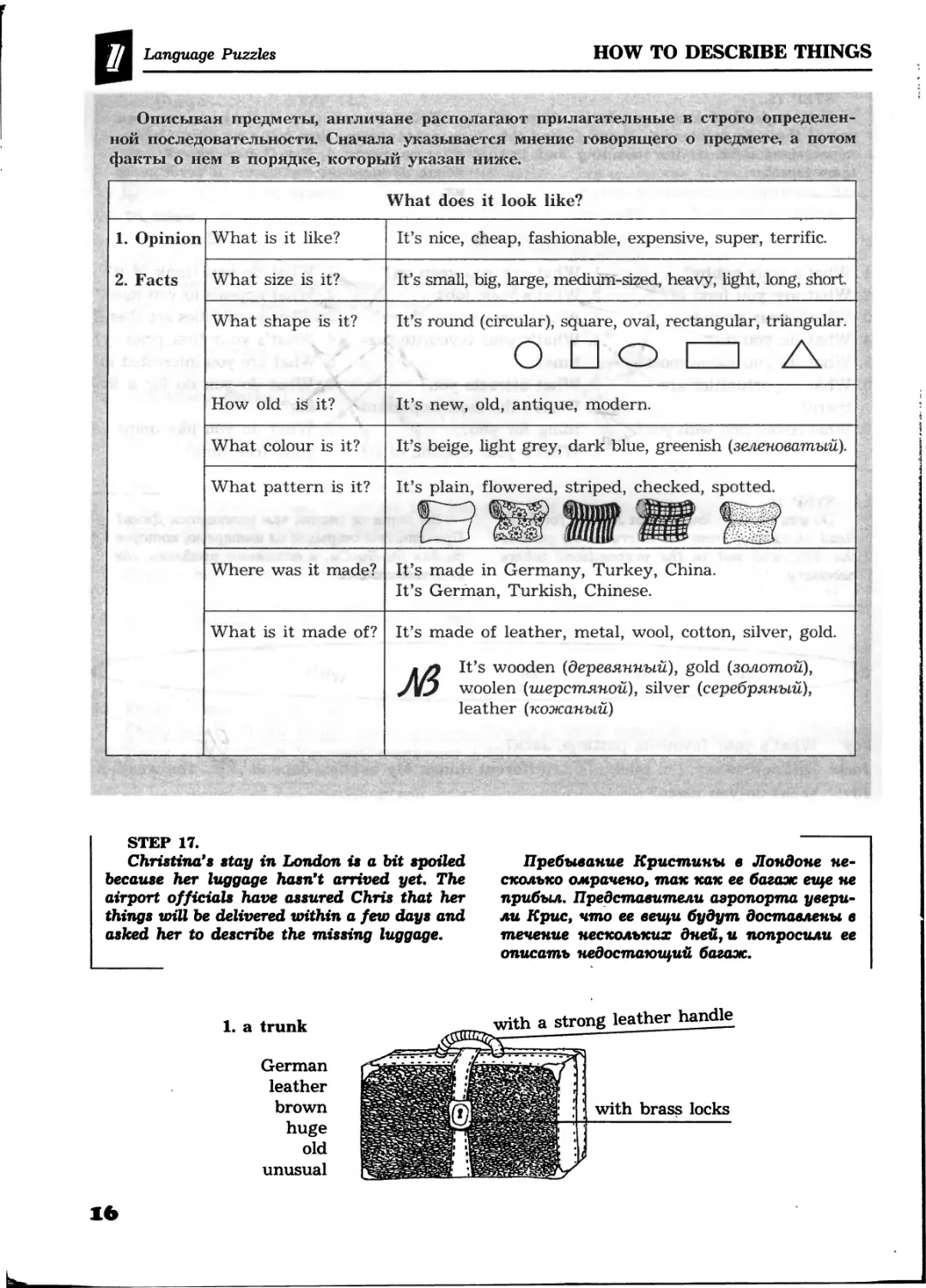
Описывая предметы, англичане располагают прилагательные в строго определен-
ной последовательности. Сначала указывается мнение говорящего о предмете, а потом
факты о нем в порядке, который указан ниже.
What does it look like?
1. Opinion 2. Facts	What is it like?	It’s nice, cheap, fashionable, expensive, super, terrific.
	What size is it?	It’s small, big, large, medium-sized, heavy, light, long, short
	What shape is it?	It’s round (circular), s<	quare, oval, rec		‘tangul	ar, triangular.
	How old is it?	It’s new, old, antique, modern.
	What colour is it?	It’s beige, light grey, dark blue, greenish (зеленоватый).
	What pattern is it?	It’s plain, flowered, £ L—J feWJ i|	!tripe< Аидой	d, checked, spotted.
	Where was it made?	It’s made in Germany, Turkey, China. It’s German, Turkish, Chinese.
	What is it made of?	It’s made of leather, metal, wool, cotton, silver, gold. wooden (деревянный), gold (золотой), woolen (шерстяной), silver (серебряный), leather (кожаный)
STEP 17.
Christina’s stay in London is a bit spoiled
because her luggage hasn’t arrived yet. The
airport officials have assured Chris that her
things will be delivered within a few days and
asked her to describe the missing luggage.
Пребывание Кристины в Лондоне не-
сколько омрачено, так как ее багаж еще не
прибыл. Представители аэропорта увери-
ли Крис, что ее вещи будут доставлены в
течение нескольких дней, и попросили ее
описать недостающий багаж.
1. a trunk
German
leather
brown
huge
old
unusual
16
Language Puzzles
HOW TO DESCRIBE THINGS
Help Chris describe each piece of her lug-
gage arranging the information in the appro-
priate order.
Помогите Крис описать каждый пред-
мет ее багажа, располагая информацию в
правильном порядке.
Chris’ missing baggage description
Opinion	Size	Shape	Age	Colour	Pattern	Origin	Material	Object (предмет)
1.	an unusual...................................................................trunk
with brass locks and ......................................
2.
3.
4.
5.
small=not big (size)
They bought a small house.
little=not big but nice (size+emotions)
Look at my lovely little house.
2-4666

The NOUN
Эта таблица напомнит вам, как образуется множественное число
существительных. Обратите внимание на исключения.
+ S	a report - reports	[S]	после глухих согласных звуков
	a car — cars a plane — planes	[Z]	после гласных и звонких согласных звуков
+ ES после -s, -sh, -ch, -х, -z	an address - addresses a language - languages	[IZ]	после шипящих и свистящих согласных звуков
Исключения: a man — men (ли/жчгша - мужчины) a child — children (ребенок - дети) a mouse — mice (мышь - мыши) a foot ” feet (нога — ноги) a tooth — teeth (зуб - зубы) a goose - geese (гусь - гуси) an ох — oxen (вол — волы) a sheep - sheep (овца - овцы) a deer — deer (олень - олени)	Правописание: Буква у после согласной меняется на i: a country - countries после гласной буквы у сохраняется: a key - keys буква f часто меняется на v: a wife - wives после согласной “+о” - “es”: a tomato ~ tomatoes но: a photo — photos
	Эти существительные употребляются только в форме множественного числа: trousers	—	брюки	wages	-	зарплата jeans	”	джинсы	goods	—	товар, товары shorts	—	шорты	police	—	полиция pajamas	—	пижама	glasses	-	очки tights	~	колготки	contents -	содержание scissors — ножницы	clothes — одежда Эти существительные согласуются с глаголами и местоимениями во множе- ственном числе. These clothes are very fashionable.
STEP 18.
At last Christina’s luggage has arrived. But
to receive it she has to make up a list of the
things which are packed in her cases, indi-
cating their number. Help her do it.
Наконец прибыл багаж Кристины. Но
чтобы его получить, она должна соста-
вить список вещей, которые находятся в
ее чемоданах, указав их количество. Помо-
гите ей это сделать.
18
Grammar-in-Brief	The NOUN / The NUMERAL
The English Language
We’ll begin with box, and the plural is boxes,
But the plural of ox should be oxen, not axes.
The one fowl is a goose, but two are called geese,
Yet the plural of mouse should never be meese.
If the plural of man is always called men,
Why shouldn’t the plural of pan be called pen?
So English, I think you all will agree,
Is the greatest language you ever did see.
Unknown
2*
19
I
Grammar-in-Brief
NOUN / The POSSESSIVE CASE
Вы, конечно, помните, что в форме притяжательного падежа (The Possessive Case)
употребляются, в основном, одушевленные существительные. Они, как правило, вы-
ражают принадлежность предмета в широком смысле слова:
Willy's cars - машины Вилли	Joy's questions - вопросы Джой
i Л 1. В притяжательном падеже могут также употребляться существительные,
обозначающие:
-	время:	- yesterday's meeting;
—	расстояние:	— a mile's distance;
-	страны, города, суда: - London's sights;
~ слова “world”, “country”, “town”, “city”, “ship” и другие:
the world's biggest car producer.
2. Большинство неодушевлённых существительных выражает принадлежность с
помощью предлога of:
the beginning of the story - начало рассказа
the capital of Great Britain - столица Великобритании
the windows of the house — окна дома
Как образуется притяжательный падеж?
Существительные в единственном числе образуют притяжательный падеж с по-
мощью ’s:
Mary's bank has a first-class	Банк Мэри имеет первоклассную
reputation.	репутацию.
Для образования притяжательного падежа существительных во множественном
числе достаточно добавить только апостроф ’:
Му parents' house is not very large. Дом моих родителей небольшой.
Существительные, не имеющие окончания -з во множественном числе, образуют
притяжательнй падеж с помощью ’s:
Му children's letters are very dear Письма моих детей мне очень
ж to те.	дороги.
i/? 1. Притяжательный падеж сложных существительных образуется прибавлением
> У Г-х - ’з к последнему слову, входящему в состав существительного:
ту brother-in-law's family
Ж 2. Когда два лица или более являются обладателями одного и того же предмета,
j	окончание притяжательного падежа прибавляется к последнему существитель-
f-j'	ному:
$	Jack and Jill’s house
J 3. Притяжательный падеж может употребляться без поясняемого слова типа
fl	shop, school, house, hospital, church:
#-5	Гт going to the baker’s.
i	. ''M-x.n ;;
zo
г
Grammar-in-Brief
NOUN / The POSSESSIVE CASE
STEP 19.
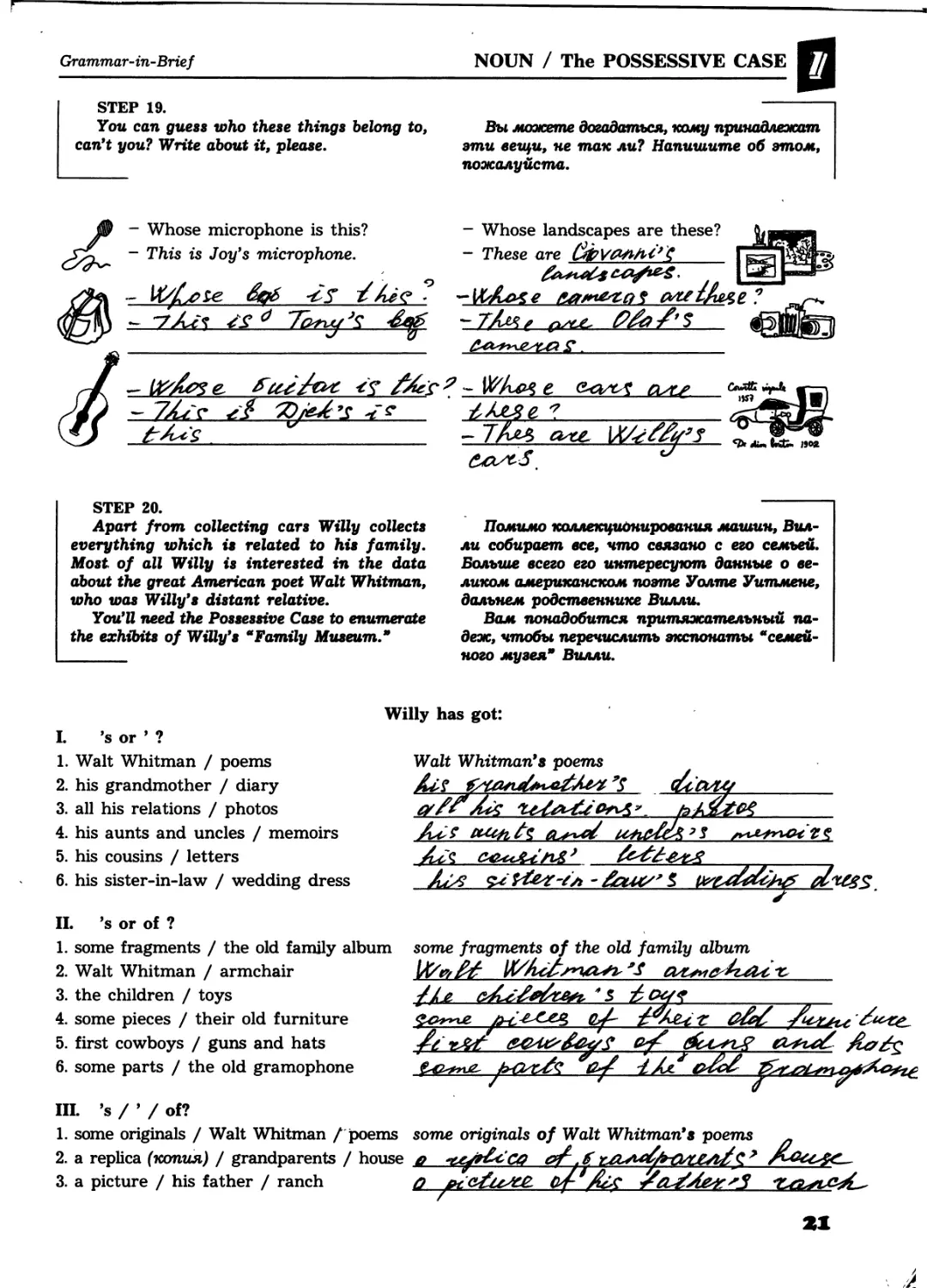
You can guess who these things belong to,
can’t you? Write about it, please.
Вы можете догадаться, кому принадлежат
эти вещи, не так ли? Напишите об атом,
пожалуйста.
- Whose microphone is this?
- This is Joy’s microphone.
- Whose landscapes are these?
- These are	£
смгААля
-Tfa, fM. C>&>S'S__________
- 7 A^S
П02
STEP 20.
Apart from collecting cars Willy collects
everything which is related to his family.
Most of all Willy is interested in the data
about the great American poet Walt Whitman,
who was Willy’s distant relative.
You’ll need the Possessive Case to enumerate
the exhibits of Willy’s “Family Museum."
Помимо коллекционирования машин, Вил-
ли собирает все, что связано с его семьей.
Больше всего его интересуют данные о ве-
ликом американском поэте Уолте Уитмене,
дальнем родственнике Вилли.
Вам понадобится притяжательный па-
деж, чтобы перечислишь экспонаты “семей-
ного музея" Вилли.
Willy has got:
I. ’s or ’ ?
1.	Walt Whitman / poems
2.	his grandmother / diary
3.	all his relations / photos
4.	his aunts and uncles / memoirs
5.	his cousins / letters
6.	his sister-in-law / wedding dress
Walt Whitman’s poems
аЛЛЛея геЛ&ЛЛ
II. ’s or of ?
1.	some fragments / the old family album
2.	Walt Whitman / armchair
3.	the children / toys
4.	some pieces / their old furniture
5.	first cowboys / guns and hats
6.	some parts / the old gramophone
some fragments of the old family album
УЛпАЛ УЛАсЛл’ълЛг
AU cAyUU&t *S ________________
Луз яИЛ&г-гл
IIL ’s / ’ / of?
1.	some originals / Walt Whitman / poems
2.	a replica (копия) / grandparents / house
3.	a picture / his father / ranch
some originals of Walt Whitman’s poems
Grammar-in-Brief
COUNTABLES & UNCOUNTABLES
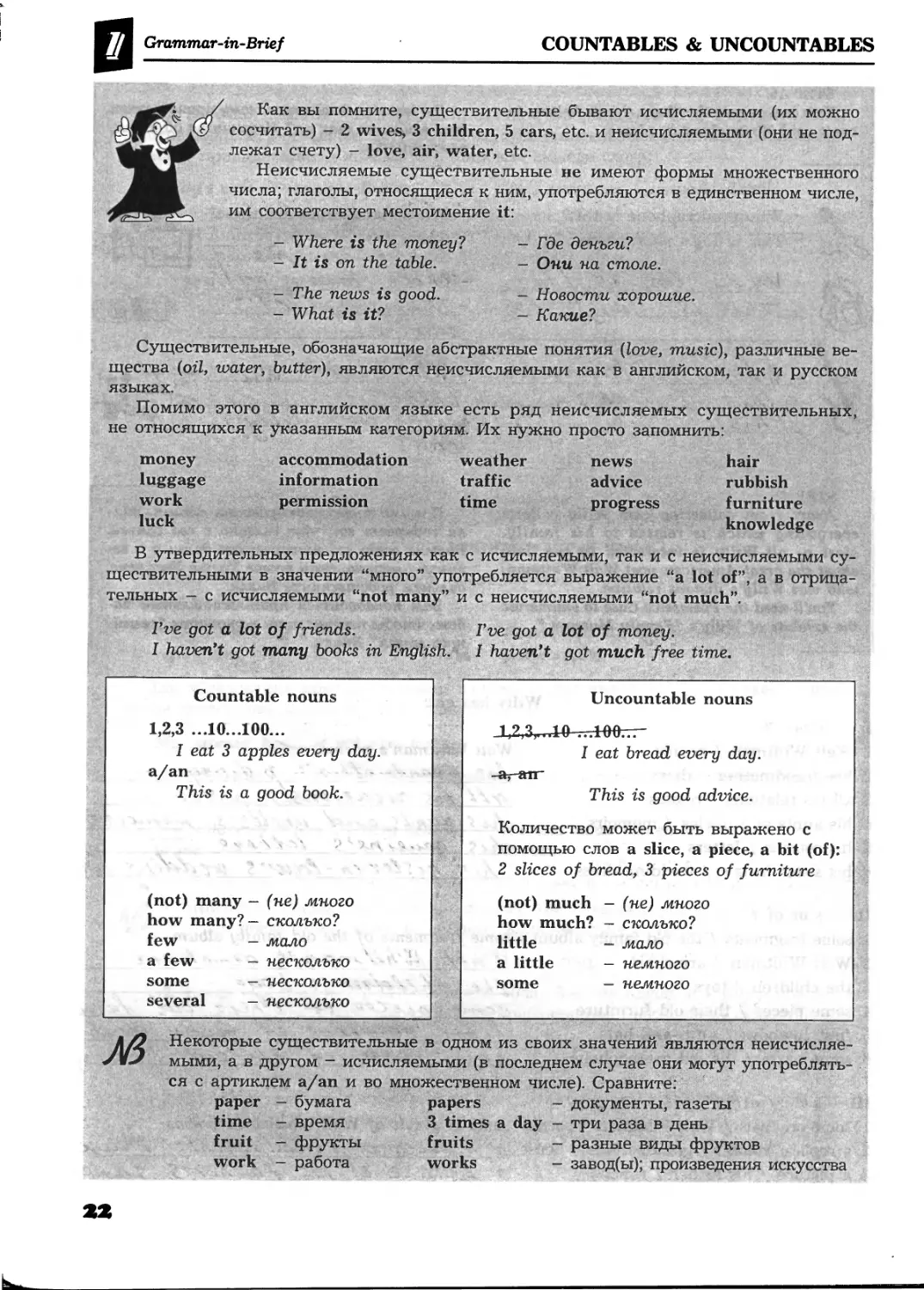
Как вы помните, существительные бывают исчисляемыми (их можно
сосчитать) - 2 wives, 3 children, 5 cars, etc. и неисчисляемыми (они не под-
лежат счету) - love, air, water, etc.
Неисчисляемые существительные не имеют формы множественного
числа; глаголы, относящиеся к ним, употребляются в единственном числе,
им соответствует местоимение it:
- Where is the money?
- It is on the table.
- Где деньги?
- Они на столе.
- The news is good.
- What is it?
- Новости хорошие.
- Какие?
Существительные, обозначающие абстрактные понятия (love, music), различные ве-
щества (oil, water, butter), являются неисчисляемыми как в английском, так и русском
языках.
Помимо этого в английском языке есть ряд неисчисляемых существительных,
не относящихся к указанным категориям. Их нужно просто запомнить:
money	accommodation	weather	news	hair
luggage	information	traffic	advice	rubbish
work	permission	time	progress	furniture
luck				knowledge
В утвердительных предложениях как с исчисляемыми, так и с неисчисляемыми су-
ществительными в значении “много” употребляется выражение “a lot of”, а в отрица-
тельных — с исчисляемыми “not many” и с неисчисляемыми “not much”.
I've got a lot of friends.	I’ve got a lot of money.
I haven’t got many books in English. I haven’t got much free time.
	Countable nouns 1,2,3 ...10...100... I eat 3 apples every day. a/an This is a good book. (not) many - (не) много how many? — сколько? few	-	мало a few	—	несколько some	-	несколько several	-	несколько		Uncountable nouns I eat bread every day. -&r~&rr This is good advice. Количество может быть выражено с помощью слов a slice, a piece, a bit (of): 2 slices of bread, 3 pieces of furniture (not) much - (не) много how much? -	сколько? little	-	мало a little	-	немного some	—	немного
JI/2 Некоторые существительные в одном из своих значений являются неисчисляе- мыми, а в другом - исчисляемыми (в последнем случае они могут употреблять- ся с артиклем а/ап и во множественном числе). Сравните: paper	-	бумага	papers	-	документы, газеты time	-	время	3 times a day -	три раза в день fruit	-	фрукты	fruits	-	разные виды фруктов work	-	работа	works	-	завод(ы); произведения искусства
33
Grammar-in-Brief
COUNTABLES & UNCOUNTABLES
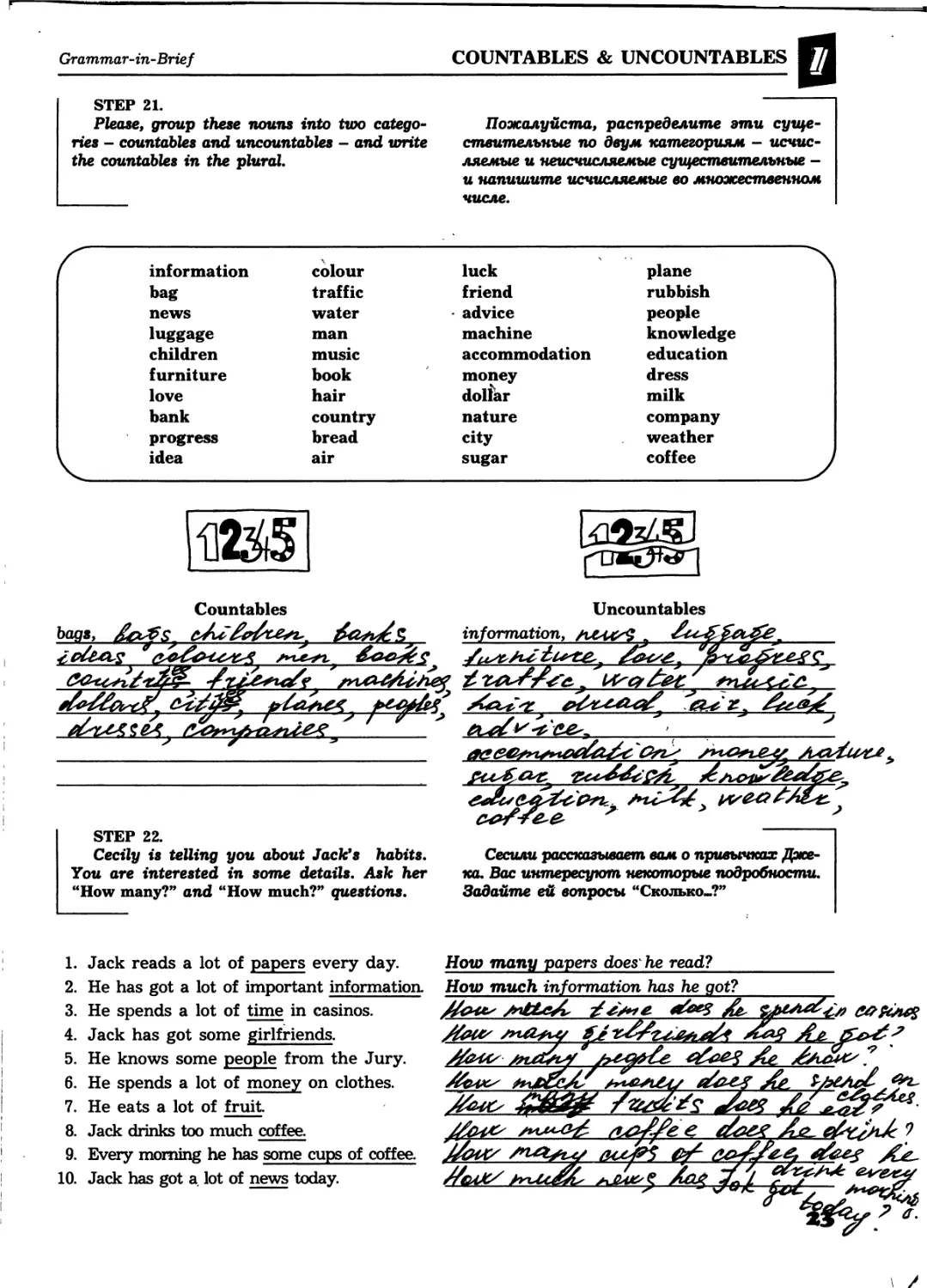
STEP 21.
Please, group these nouns into two catego-
ries - countables and uncountables — and write
the countables in the plural.
Пожалуйста, распределите эти суще-
ствительные no двум категориям — исчис-
ляемые и неисчисляемые существительные -
и напишите исчисляемые во множественном
числе.
f	information	colour	luck	plane
bag	traffic	friend	rubbish
news	water	- advice	people
luggage	man	machine	knowledge
children	music	accommodation	education
furniture	book	money	dress
love	hair	dollar	milk
bank	country	nature	company
progress	bread	city	weather
	idea		air	sugar	coffee	 )
ЯШ
Countables
Uncountables
STEP 22.
Cecily is telling you about Jack’s habits.
You are interested in some details. Ask her
“How many?” and “How much?” questions.
Сесили рассказывает вам о привычках Дже-
ка. Вас интересуют некоторые подробности.
Задайте ей вопросы “Сколько..?”
1.	Jack reads a lot of papers every day.
2.	He has got a lot of important information.
3.	He spends a lot of time in casinos.
4.	Jack has got some girlfriends.
5.	He knows some people from the Jury.
6.	He spends a lot of money on clothes.
7.	He eats a lot of fruit
8.	Jack drinks too much coffee.
9.	Every morning he has some cups of coffee.
10.	Jack has got a. lot of news today.
How many papers does he read?
Grammar-in-Brief
COUNTABLES & UNCOUNTABLES
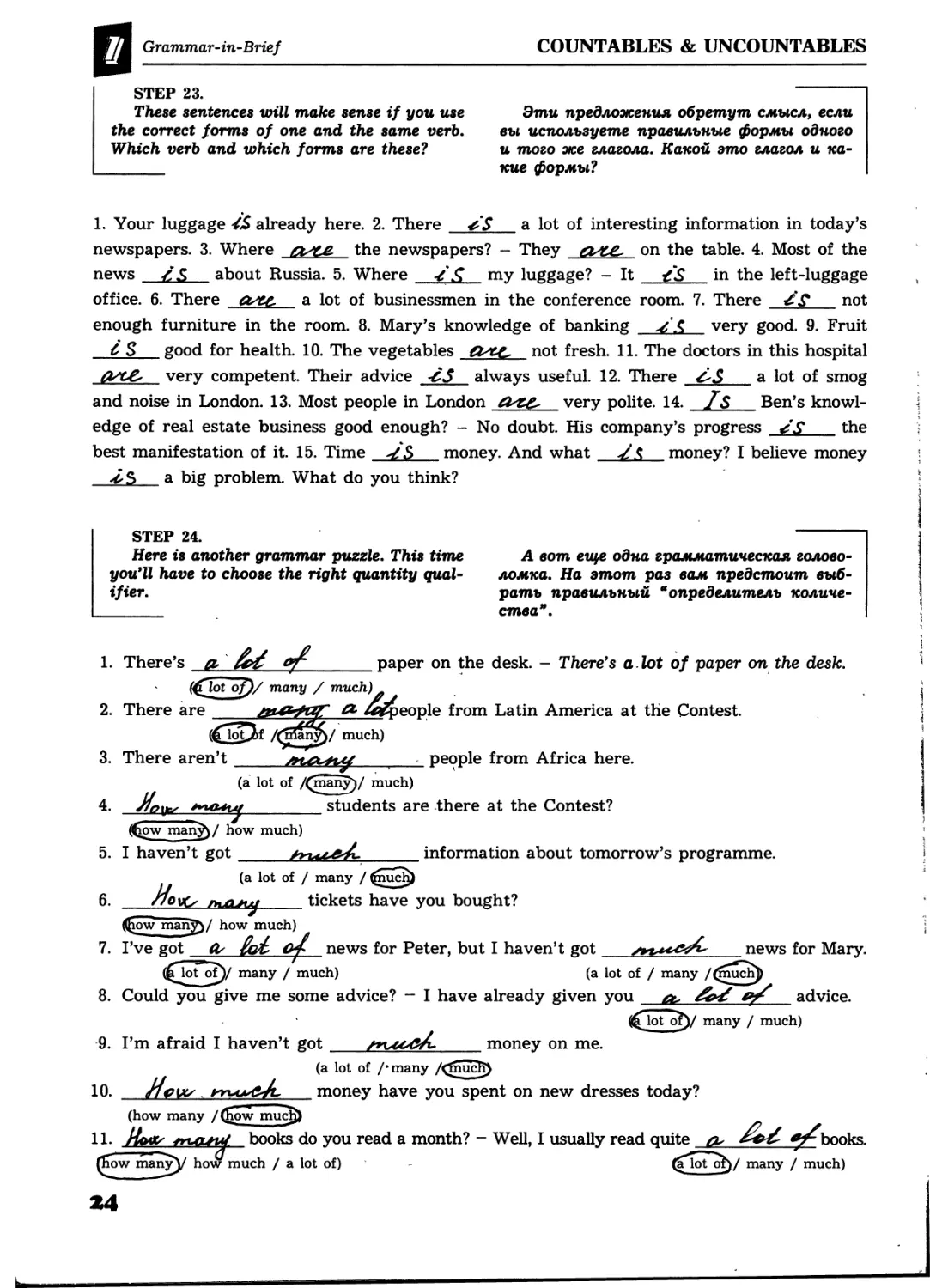
STEP 23.
These sentences will make sense if you use
the correct forms of one and the same verb.
Which verb and which forms are these?
Эти предложения обретут смысл, если
вы используете правильные формы одного
и того же глагола. Какой это глагол и ка-
кие формы?
1. Your luggage already here. 2. There -OS a lot of interesting information in today’s
newspapers. 3. Where	the newspapers? - They	on the table. 4. Most of the
news Z.S about Russia. 5. Where 4 & my luggage? - It £$ in the left-luggage
office. 6. There a/te. a lot of businessmen in the conference room. 7. There	not
enough furniture in the room. 8. Mary’s knowledge of banking z'.C very good. 9. Fruit
C S good for health. 10. The vegetables	not fresh. 11. The doctors in this hospital
very competent. Their advice Zj always useful. 12. There SS a lot of smog
and noise in London. 13. Most people in London	very polite. 14. Ts Ben’s knowl-
edge of real estate business good enough? - No doubt. His company’s progress	the
best manifestation of it. 15. Time -ZS money. And what -Z.S money? I believe money
ZS a big problem. What do you think?
STEP 24.
Here is another grammar puzzle. This time
you’ll have to choose the right quantity qual-
ifier.
А вот еще одна грамматическая голово-
ломка. На этот раз вам предстоит выб-
рать правильный "определитель количе-
ства".
1.	There’s g. of paper on the desk. - There’s a. lot of paper on the desk.
(£lot of)/ many / much)
2.	There are_______	Я /<йэеор1е from Latin America at the Contest.
(^loLof / anj^/ much)
3.	There aren’t people from Africa here.
(a lot of /(many)/ much)
4.	J/oyw students are there at the Contest?
(feow man^)/ how much)
5.	I haven’t got
information about tomorrow’s programme.
6.
7.
8.
9.
floats	tickets have you bought?
(Qoow man^/ how much)
I’ve got Q/ fob news for Peter, but I haven’t got	news for Mary.
(^lot*of)/ many / much)	(a lot of / many /^nuch])
Could you give me some advice? - I have already given you a,	advice.
I’m afraid I haven’t got
money on me.
lot of)/ many / much)
(a lot of /’many AfnucR}
money have you spent on new dresses today?
11.
(how many /(bow muc^l
books do you read a month? - Well, I usually read quite a, <^^boo
iow manyV how much / a lot of)	-	(alot ot)/ many / much)
10. tHoW
Grammar-in-Brief
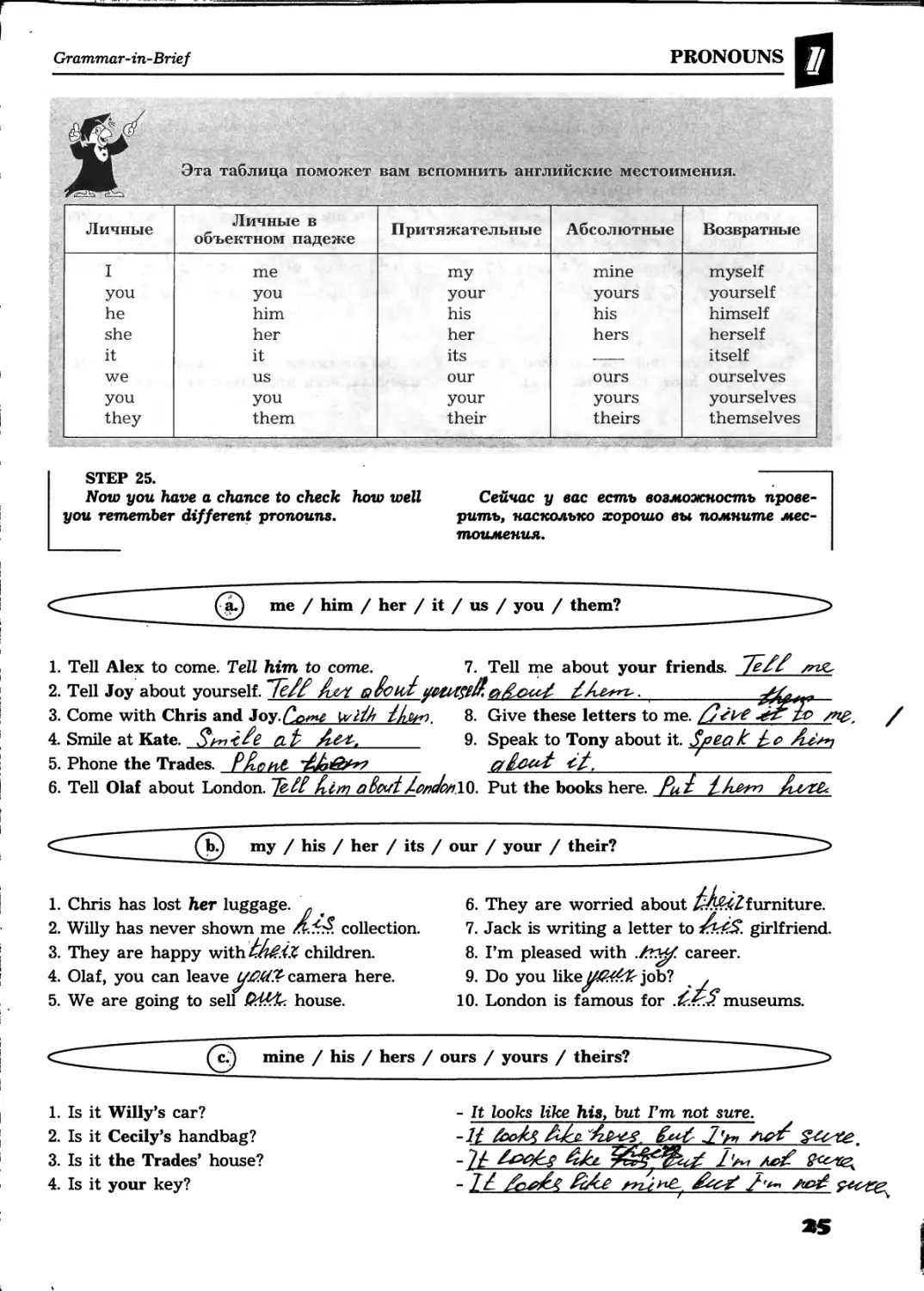
PRONOUNS
Эта таблица поможет вам вспомнить английские местоимения.
Личные	Личные в объектном падеже	Притяжательные	Абсолютные	Возвратные
I	me	my	mine	myself
you	you	your	yours	yourself
he	him	his	his	himself
she	her	her	hers	herself
it	it	its	——.	itself
we	us	our	ours	ourselves
you	you	your	yours	yourselves
they	them	their	theirs	themselves
STEP 25.
Now you have a chance to check how well Сейчас у вас есть возможность прове-
you remember different pronouns.	ритъ, насколько хорошо вы помните мес-
тоимения.
___________me / him / her / it / us / you / them?_______________________
1.	Tell Alex to come. Tell him to come.	7. Tell me about your friends.
2.	Tell Joy about yourself. ZZ/
3.	Come with Chris and Joy./Cgw	8. Give these letters to me.	/не,
4.	Smile at Kate. §±п<Ае at 	9. Speak to Tony about it.	ALe^
5.	Phone the Trades.	AA____________________________
6.	Tell Olaf about London. Алгц а$м1^с>пс/м1Ъ. Put the books here, /д/
his / her / its / our / your / their?
1.	Chris has lost her luggage. . 2.	Willy has never shown me	collection. 3.	They are happy withZ^Z? children. 4.	Olaf, you can leave	camera here. 5.	We are going to sell	house.	6.	They are worried about £*££<4 furniture. 7.	Jack is writing a letter to	girlfriend. 8.	I’m pleased with .Z?^Z career. 9.	Do you like^?4<Z job? . 10.	London is famous for AAA?. museums.
mine / his / hers / ours / yours / theirs?
1.	Is it Willy’s car? 2.	Is it Cecily’s handbag? 3.	Is it the Trades’ house? 4.	Is it your key?	-	It looks like his, but Гт not sure. -	7/	AA&	AAzl ~2£,	AfA -	ZZ	AAtA. A^r.
15
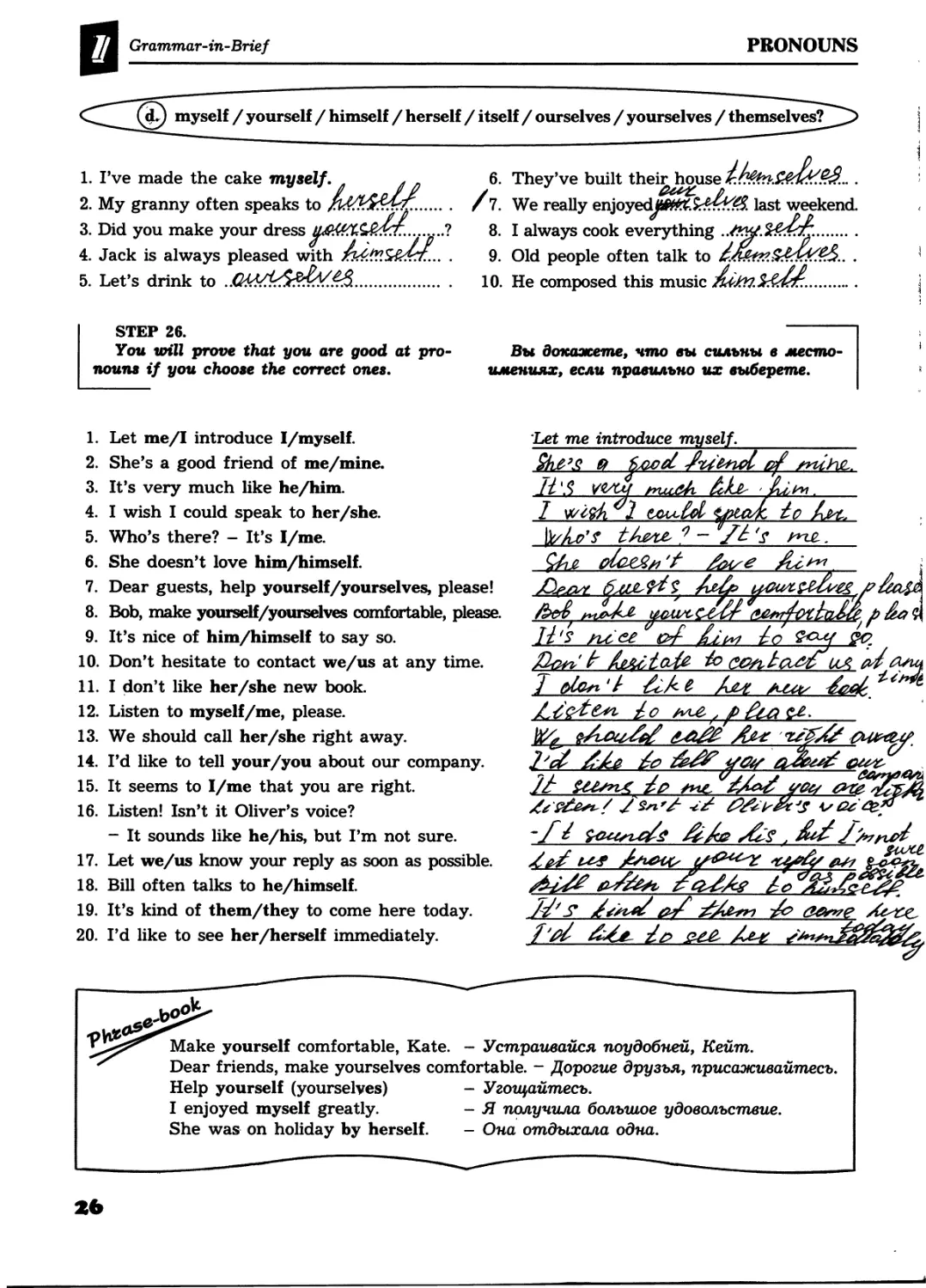
Grammar-in-Brief
PRONOUNS
(<L) myself / yourself / himself /herself /itself / ourselves/ yourselves / themselves?
1. I’ve made the cake myself.
3. Did you make your dress
4. Jack is always pleased with Ай#.
6. They’ve built their jhouse	.
/7. We really enjoyed^fi^.&^^S last weekend.
8.	’ ' *
9.
10.
I always cook everything ..•/
Old people often talk to dt
He composed this music 2^
f
STEP 26.
You will prove that you are good at pro-
nouns if you choose the correct ones.
Вы докажете, что вы сильны в место-
имениях, если правильно их выберете.
1.	Let me/I introduce I/myself.
2.	She’s a good friend of me/mine.
3.	It’s very much like he/him.
4.	I wish I could speak to her/she.
5.	Who’s there? - It’s I/me.
6.	She doesn’t love him/himself.
7.	Dear guests, help yourself/yourselves, please!
8.	Bob, make yourself/yourselves comfortable, please
9.	It’s nice of him/himself to say so.
10.	Don’t hesitate to contact we/us at any time.
11.	I don’t like her/she new book.
12.	Listen to myself/me, please.
13.	We should call her/she right away.
14.	I’d like to tell your/you about our company.
15.	It seems to I/me that you are right.
16.	Listen! Isn’t it Oliver’s voice?
- It sounds like he/his, but I’m not sure.
17.	Let we/us know your reply as soon as possible.
18.	Bill often talks to he/himself.
19.	It’s kind of them/they to come here today.
20.	I’d like to see her/herself immediately.
Let me introduce myself.
AJpo^
Make yourself comfortable, Kate. - Устраивайся поудобней, Кейт.
' Dear friends, make yourselves comfortable. - Дорогие друзья, присаживайтесь.
Help yourself (yourselves)
I enjoyed myself greatly.
She was on holiday by herself.
- Угощайтесь.
— Я получила большое удовольствие.
- Она отдыхала одна.

26
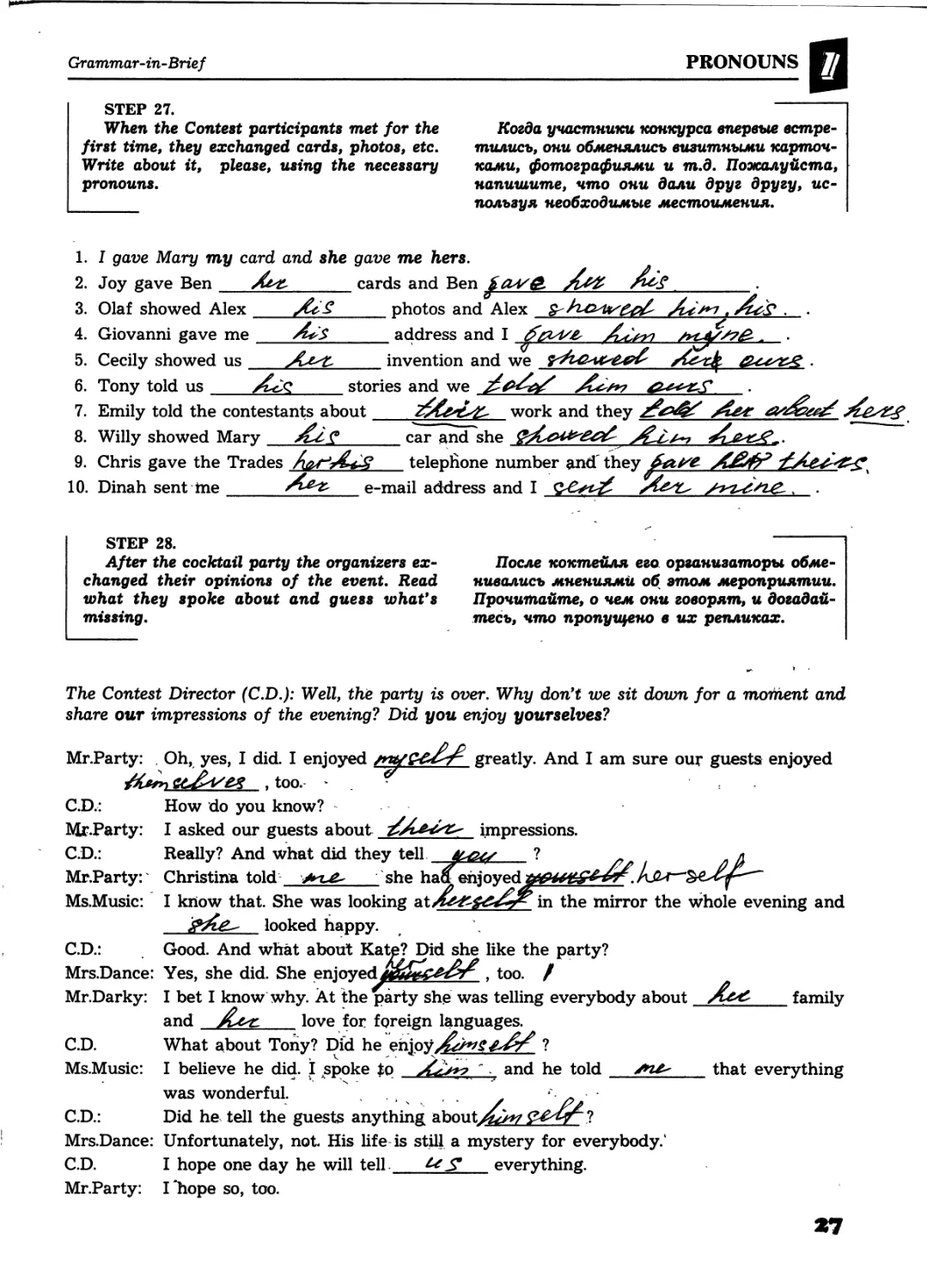
Grammar-in-Brief
PRONOUNS
STEP 27.
When the Contest participants met for the
first time, they exchanged cards, photos, etc.
Write about it, please, using the necessary
pronouns.
Когда участники конкурса впервые встре-
тились, они обменялись визитными карточ-
ками, фотографиями и т.д. Пожалуйста,
напишите, что они дали друг другу, ис-
пользуя необходимые местоимения.
1.	I gave Магу ту card and she gave me hers.
2.	Joy gave Ben	cards and Ben	&£___________•
3.	Olaf showed Alex &£photos and Alex	. .
4.	Giovanni gave me	______address and I	. .
5.	Cecily showed us	invention and we	sC&cjf.	.
6.	Tony told us	stories and we	.
7.	Emily told the contestants about	work and they
8.	Willy showed Mary	car and she
9.	Chris gave the Trades	telephone number and' they
10.	Dinah sent me e-mail address and I	.
STEP 28.
After the cocktail party the organizers ex-
changed their opinions of the event. Read
what they spoke about and guess what’s
missing.
После коктейля его организаторы обме-
нивались мнениями об этом мероприятии.
Прочитайте, о чем они говорят, и догадай-
тесь, что пропущено в их репликах.
The Contest Director (C.D.): Well, the party is over. Why don’t we sit down for a moment and
share our impressions of the evening? Did you enjoy yourselves?
MrJParty: . Oh, yes, I did. I enjoyed	greatly. And I am sure our guests enjoyed
, too. • .
C.D.:	How do you know? -
Mr.Party: I asked our guests about	impressions.
C.D.:	Really? And what did they tell	~	. л
Mr.Party: Christina told	she halfehioyeda^^F**&F.
Ms.Music: I know that. She was looking at<^z/^£^y^ in the mirror the whole evening and
looked happy.
C.D.:	Good. And what about Kate? Did she like the party?
Mrs.Dance: Yes, she did. She enjoyed	, too. /
Mr.Darky: I bet I know why. At the party she was telling everybody about	family
and ^zg love for foreign languages.
C.D. What about Tony? Did he eixycrt?
Ms.Music: I believe he did. I spoke to	. and he told Jnt' that everything
was wonderful.	z *' л
C.D.:	Did he tell the guests anything abouty^^z
Mrs.Dance: Unfortunately, not. His life is still a mystery for everybody.'
C.D. I hope one day he will tell- ^3* everything.
Mr.Party: I hope so, too.
REST & TEST
.Test & Rest.
Now it’s high time we tested how well you remember Story One.
The tasks I’m going to offer you are part of the Contest grammar test.
Are you ready to start?
I wish you good luck!
STEP 29.
Match the phrase» in the left-hand column
and the appropriate responses in the right-
hand column. Mind, there are some extra
answers.
Подберите к фразам в левой колонке со-
ответствующие им ответы из правой ко-
лонки. Учтите, там есть несколько лиш-
них ответов.
t 1. Meet my friend Bob, please.
ЧС-2. Thanks a lot
g 3. How do you do. _
’ 4^4. Pleased to meet you.
How are you?
4 6. I think we’ve met before.
^7. How was the trip?
л 8. Who’s Denis?
9. What does he do?
^10. Could I help you?
j-
к.
i.	Fine, thanks. And you?
. I’m pleased to meet you, too.
Hello!
. He’s my dose friend.
. Thank you It’s kind of you.
. He’s an architect
g. How do you do.
. Not at all
It’s nice to see you again.
Hello! Glad to meet you.
With pleasure.
Wonderful!
STEP 30.
Do you remember what these phrases mean
in Russian?
Вы помните, что зти фразы означают по-
русски?
1.	How do you do.
2.	What do you do?
3.	This job is very rewarding.
4.	What do you value in people?
5.	You of all people! Here of all
6.	Here you are.
7.	I’m in the computer business.
8.	She is very intelligent.
9.	It requires a lot of expertise.
10.	What’s your educational background?
11.	She is good at languages.
12.	No wonder.
13.	I wonder where he is now.
14.	Where are you from?
15.	Where do you come from?
16.	I don’t know him, but I know of him
17.	If I were you, I would do it.
18.	It’s part of my job description.
19.	Which reminds me ...
20.	It’s fun.
28
Test & Rest
REST & TEST
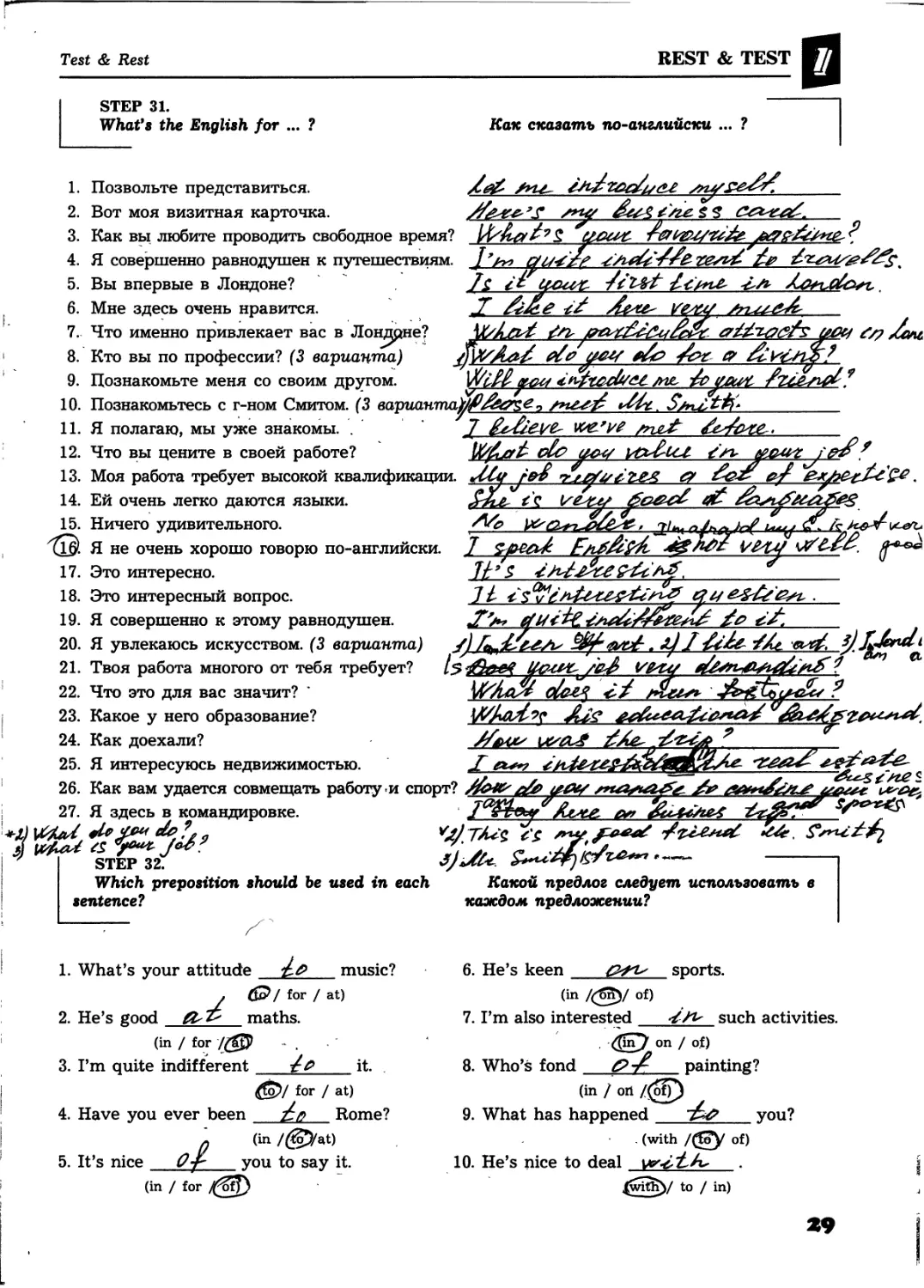
STEP 31.
What’s the English for ... ?
Как сказать по-английски ... ?
Позвольте представиться.
Бот моя визитная карточка.
Как вы любите проводить свободное время?
Я совершенно равнодушен к путешествиям.
Вы впервые в Лондоне?
Мне здесь очень нравится.
7. Что именно привлекает вас в Лон^рне?
Кто вы по профессии? (3 варианта)
Познакомьте меня со своим другом.
Познакомьтесь с г-ном Смитом. (3 вауианта^^вд^с	Лбе..
Я полагаю, мы уже знакомы. .	’*’
Что вы цените в своей работе?
Моя работа требует высокой квалификации.
Ей очень легко даются языки.
Ничего удивительного.
Я не очень хорошо говорю по-английски.
Это интересно.
Это интересный вопрос.
Я совершенно к этому равнодушен.
Я увлекаюсь искусством. (3 варианта)
Твоя работа многого от тебя требует?
Что это для вас значит?
Какое у него образование?
Как доехали?
Я интересуюсь недвижимостью.
Как вам удается совмещать работу-и сп<
Я здесь в командировке.
1.
2.
3.
4.
5.
6.
8.
9.
10.
11.
12.
13.
14.
15.
17.
18.
19.
20.
21.
22.
23.
24.
25.
26.
27.
STEP 32.
Which preposition should be used in each
sentence?
1.	What’s your attitude	music?
.	(£o> / for / at)
2.	He’s good	maths.
(in / for
3.	I’m quite indifferent	it. .
for / at)
4.	Have you ever been	Rome?
p (in /(to*)/at)
5.	It’s nice	you to say it.
(in / for 4^fjj

*
Какой предлог следует использовать в
каждом предложении?

6.	He’s keen	sports,
(in /(fjn)/ of)
7.	I’m also interested	such activities.
/(nQ' °n / °f)
8.	Who’s fond	painting?
(in / on Z(p^)
9.	What has happened	7^* you?
. (with of)
10.	He’s nice to deal	.
to / in)
39
Test & Rest
REST & TEST
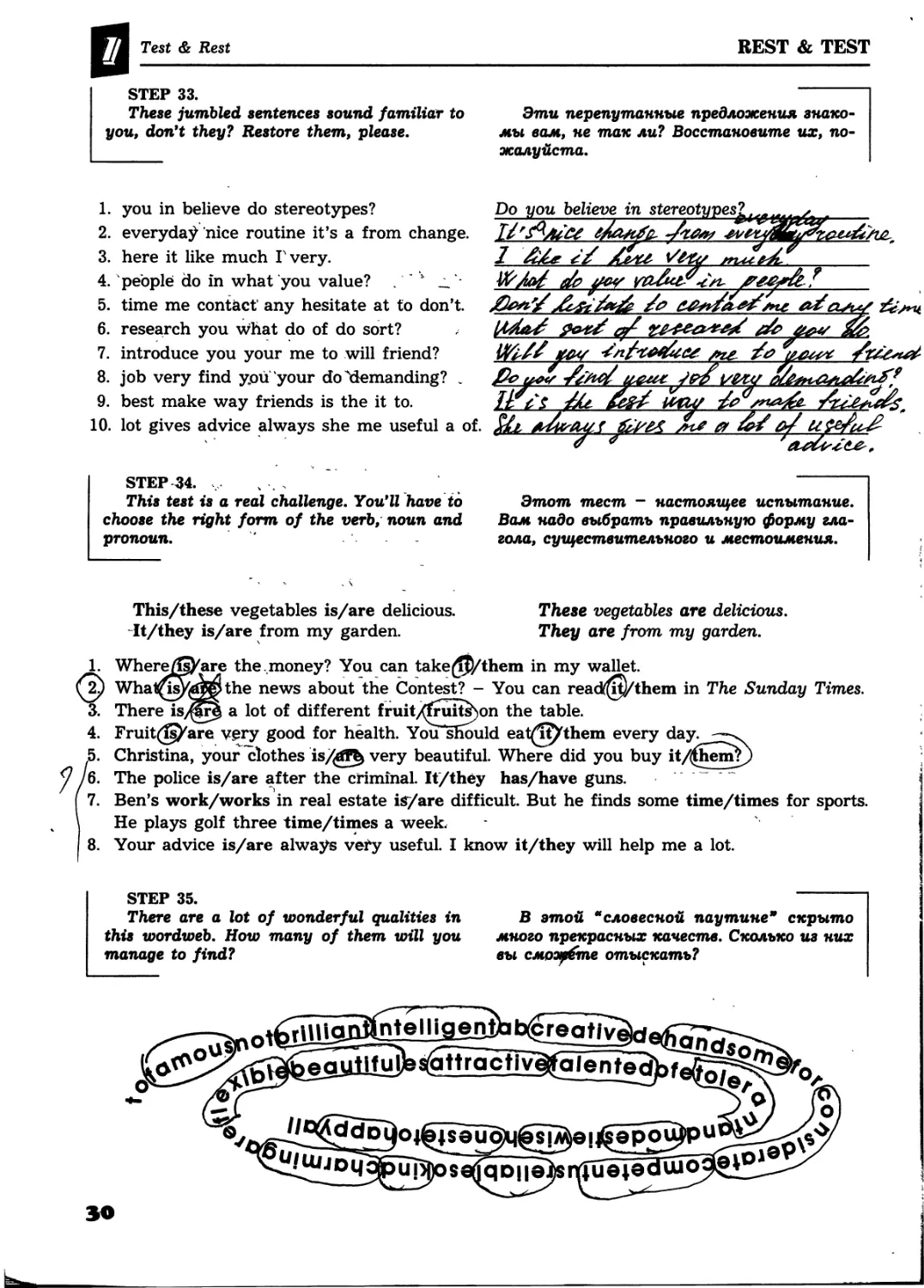
STEP 33.
These jumbled sentences sound familiar to
you, don’t they? Restore them, please.
Эти перепутанные предложения знако-
мы вам, не так ли? Восстановите их, по-
жалуйста.
1.	you in believe do stereotypes?
2.	everyda/nice routine it’s a from change.
3.	here it like much Г very.
4.	people do in what you value? . ’ ’ ‘	•
5.	time me contact' any hesitate at to don’t.
6.	research you what do of do sort?
7.	introduce you your me to will friend?
8.	job very find ypu 'your do'demanding? .
9.	best make way friends is the it to.
10.	lot gives advice always she me useful a of.
STEP 34.
This test is a real challenge. You’ll have to
choose the right form of the verb, noun and
pronoun.
Этот тест - настоящее испытание.
Вам надо выбрать правильную форму гла-
гола, существительного и местоимения.
This/these vegetables is/are delicious.	These vegetables are delicious.
It/they is/are from my garden.	They are from my garden.
1. Where/Is/аге the .money? You can take^/them in my wallet.
2^) What^is^d^ the news about the Contest? - You can readf(i^/them in The Sunday Times.
3.	There is/rar^ a lot of different fruit/fruitsbon the table.
4.	Fruit (is/are very good for health. Yousfiould eat^^them every day. —x.
5.	Christina, your clothes is/gT^ very beautiful. Where did you buy it/memV)
6.	The police is/are after the criminal. It/they has/have guns.
7.	Ben’s work/works in real estate is/are difficult. But he finds some time/times for sports.
He plays golf three time/times a week.
8.	Your advice is/are always very useful. I know it/they will help me a lot.
STEP 35.
There are a lot of wonderful qualities in
this wordweb. How many of them will you
manage to find?
В этой "словесной паутине" скрыто
много прекрасных качеств. Сколько из них
вы смозрбте отыскать?
30
Test & Rest
REST & TEST
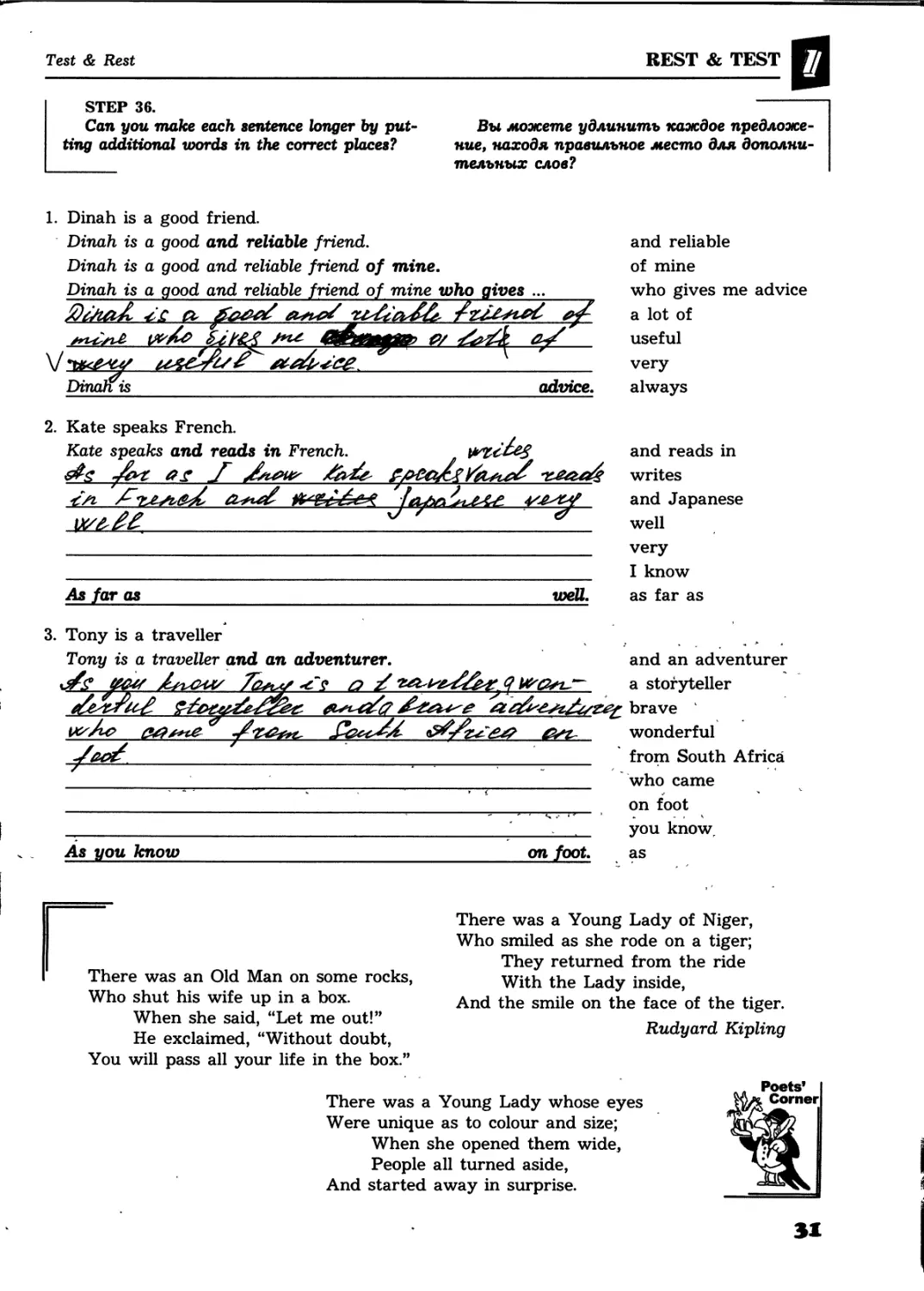
STEP 36.
Can you make each sentence longer by put-
ting additional words in the correct places?
Вы можете удлинить каждое предложе-
ние, находя правильное место для дополни-
тельных слов?
1. Dinah is a good friend.
Dinah is a good and reliable friend.
Dinah is a good and reliable friend of mine.
Dinah is a good and reliable friend of mine who gives ...
" v
Dinanis advice.
and reliable
of mine
who gives me advice
a lot of
useful
very
always
As far as
and reads in
writes
and Japanese
well
very
I know
as far as
3. Tony is a traveller
Tony is a traveller and an adventurer.
and an adventurer
a storyteller
brave
wonderful
from South Africa
who came
on foot
you know.
As you know
on foot. as
There was an Old Man on some rocks,
Who shut his wife up in a box.
When she said, “Let me out!”
He exclaimed, “Without doubt,
You will pass all your life in the box.”
There was a Young Lady of Niger,
Who smiled as she rode on a tiger;
They returned from the ride
With the Lady inside,
And the smile on the face of the tiger.
Rudyard Kipling
There was a Young Lady whose eyes
Were unique as to colour and size;
When she opened them wide,
People all turned aside,
And started away in surprise.
31
Test & Rest
REST & TEST
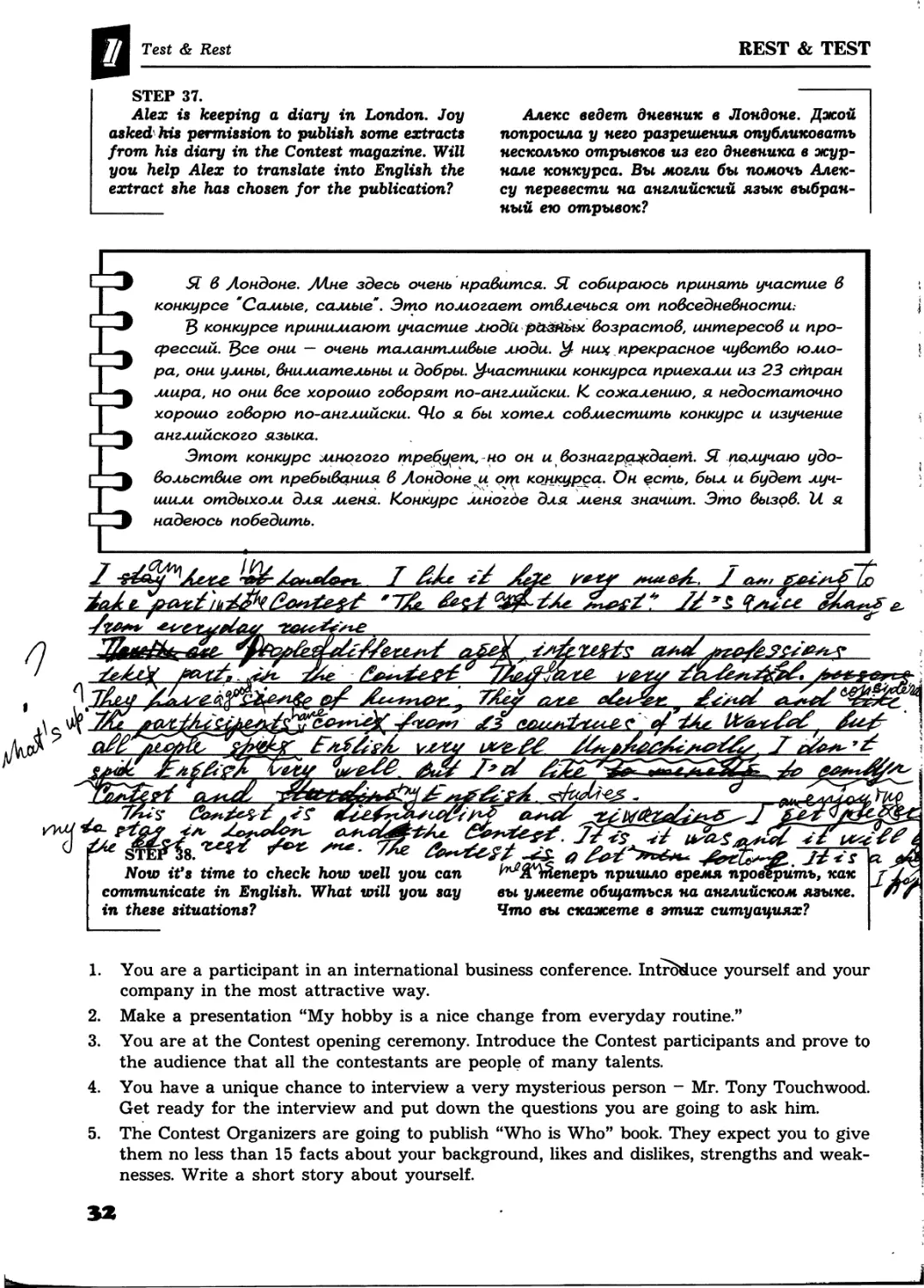
STEP 37.
Alex is keeping a diary in London. Joy
asked his permission to publish some extracts
from his diary in the Contest magazine. Will
you help Alex to translate into English the
extract she has chosen for the publication?
Алекс ведет дневник в Лондоне. Джой
попросила у него разрешения опубликовать
несколько отрывков из его дневника в жур-
нале конкурса. Вы могли бы помочь Алек-
су перевести на английский язык выбран-
ный ею отрывок?
Я в Лондоне. ЛАне здесь очень нравится. Я собираюсь принять участие в	:
конкурсе ‘Самые, самые’. Это помогает отвлечься от повседневности:	j
3 конкурсе принимают участие люди розйых возрастов, интересов и про-
грессий. Все они — очень талантливые люди. ник прекрасное чувство юмо-	I
ра, они уллмы, внимательны и добры, ^частники конкурса приехали из 23 сбгран
мира, но они все хорошо говорят по-английски. К сожалению, я недостаточно
хорошо говорю по-английски. 04о я бы хотел совместить конкурс и изучение	>
английского языка.
Этот конкурс многого требует,-но он и вознагррррдает. Я получаю удо-	t
вольствие от пребывания в Лондоне ^и ont конкурса. Он есть, был и будет луч-
шим отдыхом для меня. Конкурс многое для меня значит. Это вызрв. И я
надеюсь победить.
in these situations?
Что вы скажете в этих ситуациях?
1.	You аге a participant in an international business conference. Introduce yourself and your
company in the most attractive way.
2.	Make a presentation “My hobby is a nice change from everyday routine.”
3.	You are at the Contest opening ceremony. Introduce the Contest participants and prove to
the audience that all the contestants are people of many talents.
4.	You have a unique chance to interview a very mysterious person - Mr. Tony Touch wood.
Get ready for the interview and put down the questions you are going to ask him.
5.	The Contest Organizers are going to publish “Who is Who” book. They expect you to give
them no less than 15 facts about your background, likes and dislikes, strengths and weak- j
nesses. Write a short story about yourself.	s
Test & Rest
REST & TEST
STEP 39.
Each entry in the “Who is Who" book will
have an unusual picture of the person de-
scribed. It won’t be a photo or a portrait, but
a sort of a “formula" reflecting the person’s
character, job, interests and hobbies. Look at
the “formula" of one of the Contest partici-
pants. Have you guessed whose “formula" it
is? Support your guess by giving some facts
about this participant.
Каждая запись в книге “Кто есть кто"
будет сопровождаться необычным изобра-
жением описываемого человека. Это не бу-
дет его фотография или портрет, а что-
то вроде “формулы", отражающей харак-
тер человека, его работу, интересы и ув-
лечения. Посмотрите на “формулу" одно-
го из участников конкурса. Вы догадались,
чья это “формула"? Подтвердите свою
догадку фактами об этом участнике.
Now draw “a formula" of yourself and/
or another member of your group. Show it to
your groupmates and ask them to guess who
it is.
А теперь нарисуйте свою “формулу" или
“формулу" кого-то из членов своей группы.
Покажите ее членам своей группы и попро-
сите их отгадать, кто это.
3 - 4666
33
Test & Rest
REST & TEST
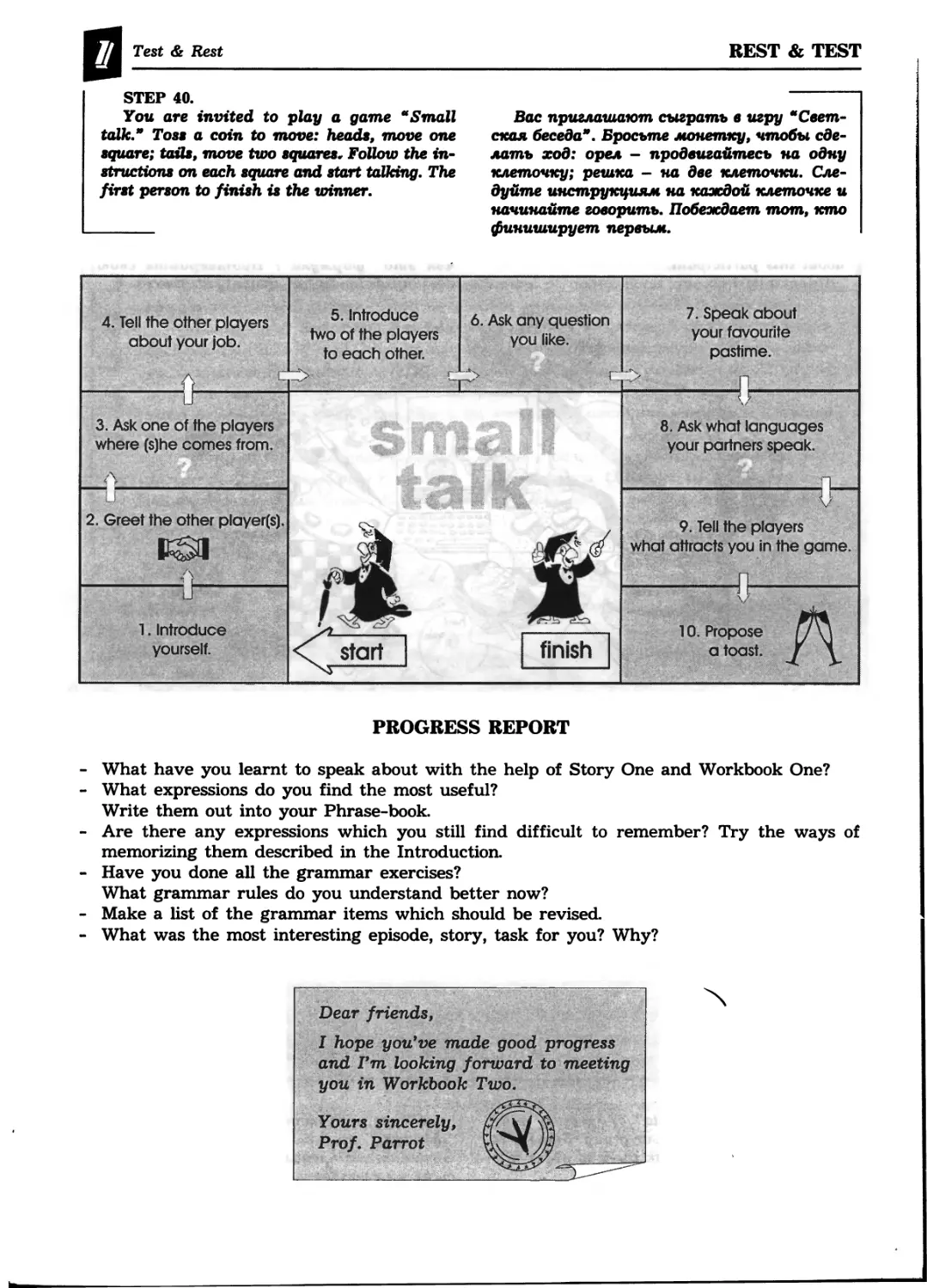
STEP 40.
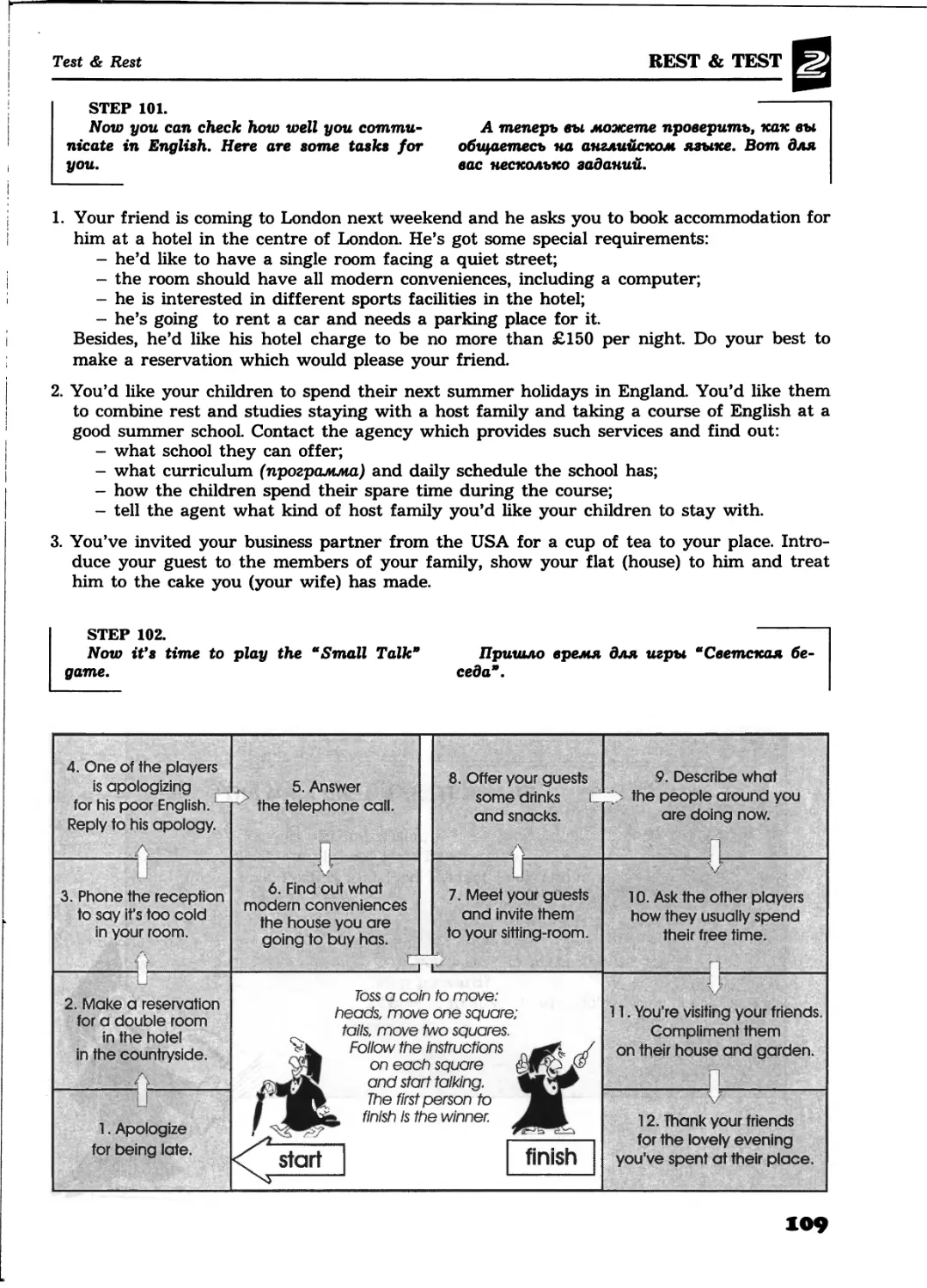
You are invited to play a game "Small
talk." Toss a coin to move: heads, move one
square; tails, move two squares. Follow the in-
structions on each square and start talking. The
first person to finish is the winner.
Вас приглашают сыграть в игру "Свет-
ская беседа". Бросьте монетку, чтобы сде-
лать ход: орел - продвигайтесь на одну
клеточку; решка — на две клеточки. Сле-
дуйте инструкциям на каждой клеточке и
начинайте говорить. Побеждает тот, кто
финиширует первым.
4. Tell the other players 5‘ ^гос)исе 6. Ask any question
about your job. two of the players you like.
to each other.
3. Ask one of the players
7. Speak about
your favourite
pastime.
8. Ask what languages
your partners speak.
9. Tell the players
what attracts you in the game.
10. Propose
a toast.
PROGRESS REPORT
-	What have you learnt to speak about with the help of Story One and Workbook One?
-	What expressions do you find the most useful?
Write them out into your Phrase-book.
-	Are there any expressions which you still find difficult to remember? Try the ways of
memorizing them described in the Introduction.
-	Have you done all the grammar exercises?
What grammar rules do you understand better now?
-	Make a list of the grammar items which should be revised.
-	What was the most interesting episode, story, task for you? Why?
Dear friends,
I hope you've made good progress
and Pm looking forward to meeting
you in Workbook Two.
Yours sincerely,
Prof. Parrot
Workbook тийэ
“The great advantage of a hotel is
that it is a refuge from home life.”
B. Shaw
v/ггн this Workbook
You Will learn:
-	how to make requests;
-	how to apologize;
-	how to speak on the phone;
-	how to make hotel reservations;
-	what to say if you have some problems
when staying at the hotel.
You Will speak about:
-	time and timetables;
-	houses and homes;
-	visiting friends and receiving guests.
YOU'LL HAVE A CHANCE TO REVISE
AND LEARN SOME GRAMMAR ITEMS:
3*
-	Present Simple, Present Progressive,
Present Perfect, Present Perfect Progressive;
-	Future Tenses;
-	clauses of time and condition;
-	prepositions of place and time.
You’ll be able to check
how well you remember
Story Two.
Go ahead!
REQUESTS
Communicate
There are different ways of expressing requests. The degree of po-
liteness depends not so much on what you are asking for, but who you
are asking to do something for you and where it takes place.
STEP 1.
Read the request» and decide who they
could be addressed to and in what circum-
stances each request could be made. Look up
the dictionary if you don't know some ex-
pressions.
Прочитайте просьбы и решите, кому
они могут быть адресованы и при каких
обстоятельствах может быть сделана
каждая просьба. Если вы не знаете какие-
то выражения, загляните в словарь.
How to make a request
Help me, please.
Five apples and three bananas, please.
Will you answer some more questions, please?
Would you make a reservation for me, please?
Could you help me (with my luggage)?
Could I borrow your dictionary?
Do you think you could give me a lift home?
I wonder if you could come tomorrow?
Do you mind my smoking here?
Would you mind speaking more slowly?
Will you be so kind as to let me use your phone? (formal)
Would you be so kind as to come a little earlier? (formal)
STEP 2.
Which of the responses would you choose Какой ответ вы бы выбрали, чтобы
to answer the above requests?	ответить на просьбы, данные выше?
How to answer a request
If you agree to meet a request,
you should say:
If you refuse to meet a request,
you should say:
Yes, certainly.
Yes, of course.
Sure.
I’d be glad to.
Why, yes, of course.
By all means.
With pleasure.
All right (alright).
OK.
I’m awfully sorry, but you see...
I’d like to say “yes,” but...
I’d really like to help you, but...
I’m afraid, I can’t (do it).
Sorry, I can’t (do it).
I’m sorry to say “no.”
I wish I could do it, but...
Unfortunately, I can’t do it.
I’m afraid, it’s impossible. .
Learn to Communicate	APOLOGIES
How to apologize for something small and unimportant
Apologies	Replies to apologies
Sorry.	That’s alright.
I’m sorry.	That’s OK.
I’m so sorry.	No problem. (USA)
How to apologize for something more important
Apologies	Replies to apologies
I am sorry (stress am). I’m extremely sorry. I’m terribly sorry. I’m awfully sorry. I’m awfully sorry, it’s my fault. Do forgive me. I’d like to apologize.	That’s quite alright. Never mind. No problem at all. Don’t worry (about it). It’s not your fault. Please, don’t blame yourself. Oh, never mind, it doesn’t really matter.
If you don’t know a foreign language well you should say:	If you don’t understand the speaker you should say:
Sorry, my English isn’t good enough. I’m afraid my English is a little rusty. My English needs brushing up. What’s the English for “	?” What do you call this thing in English? Sorry, what do you mean by “	?”	Pardon? Sorry? (USA) Pardon, could you say it (that) again, please? Sorry, I didn’t catch what you said. Sorry, I didn’t get you. (USA) Could you repeat it, please?
д/9 When to use “Excuse me” and “Sorry?”
Say “Excuse me” before you do something to attract somebody’s attention.
Say “Sorry’' after you have done something wrong. Compare:
Excuse me, could you help me,	I’m sorry, I couldn’t help you, I was
please?	busy.
But there are some exceptions to this basic rule.
If you are late, you should apologize, saying:
informal	formal
(I’m) sorry, I’m late.	Excuse my being late.
Excuse me for being late.
If you interrupt somebody, you should say:
informal	formal
Sorry to interrupt you.	Excuse my interrupting you.
When you are standing (sitting) with back to somebody:
Excuse my back, please.
	- Do forgive me.	- Пожалуйста, простите (меня). It’s all my fault.	Это моя вина. — Don’t blame yourself. - He вините себя. It’s not your fault.	Это не ваша вина.
Э7
Learn to Communicate
GOOD MANNERS
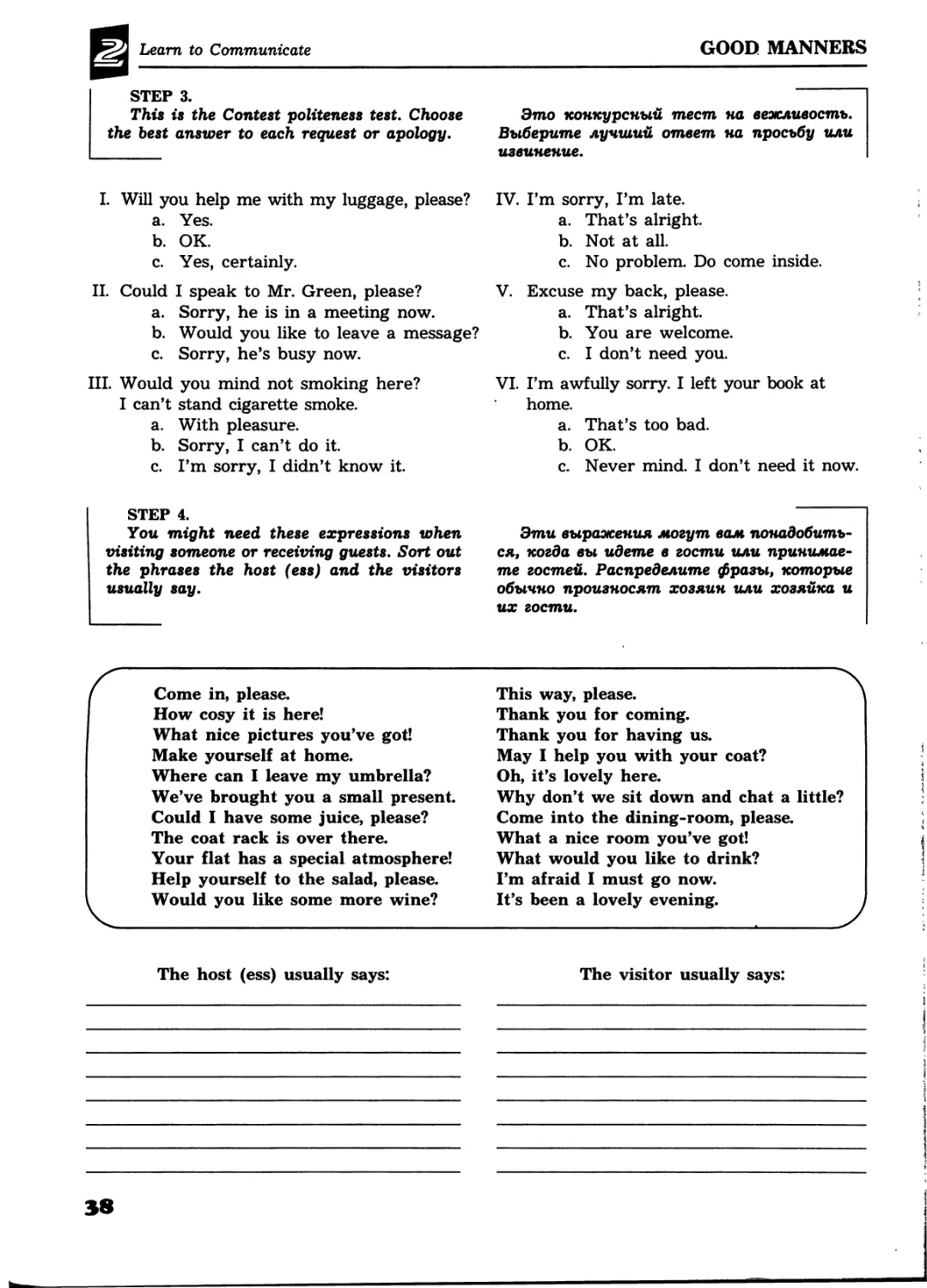
STEP 3.
This is the Contest politeness test. Choose
the best answer to each request or apology.
Это конкурсный тест на вежливость.
Выберите лучший ответ на просьбу или
извинение.
I. Will you help me with my luggage, please?
a. Yes.
b.	OK.
c.	Yes, certainly.
II.	Could I speak to Mr. Green, please?
a.	Sorry, he is in a meeting now.
b.	Would you like to leave a message?
c. Sorry, he’s busy now.
III.	Would you mind not smoking here?
I can’t stand cigarette smoke.
a.	With pleasure.
b.	Sorry, I can’t do it.
c.	I’m sorry, I didn’t know it.
STEP 4.
You might need these expressions when
visiting someone or receiving guests. Sort out
the phrases the host (ess) and the visitors
usually say.
IV.	I’m sorry, I’m late.
a.	That’s alright.
b.	Not at all.
c.	No problem. Do come inside.
V.	Excuse my back, please.
a.	That’s alright.
b.	You are welcome.
с.	I don’t need you.
VI.	I’m awfully sorry. I left your book at
home.
a.	That’s too bad.
b.	OK.
c.	Never mind. I don’t need it now.
Эти выражения могут вам понадобить-
ся, когда вы идете в гости или принимае-
те гостей. Распределите фразы, которые
обычно произносят хозяин или хозяйка и
их гости.
Come in, please.
How cosy it is here!
What nice pictures you’ve got!
Make yourself at home.
Where can I leave my umbrella?
We’ve brought you a small present.
Could I have some juice, please?
The coat rack is over there.
Your flat has a special atmosphere!
Help yourself to the salad, please.
Would you like some more wine?
This way, please.
Thank you for coming.
Thank you for having us.
May I help you with your coat?
Oh, it’s lovely here.
Why don’t we sit down and chat a little?
Come into the dining-room, please.
What a nice room you’ve got!
What would you like to drink?
I’m afraid I must go now.
It’s been a lovely evening.
The host (ess) usually says:
The visitor usually says:
S8
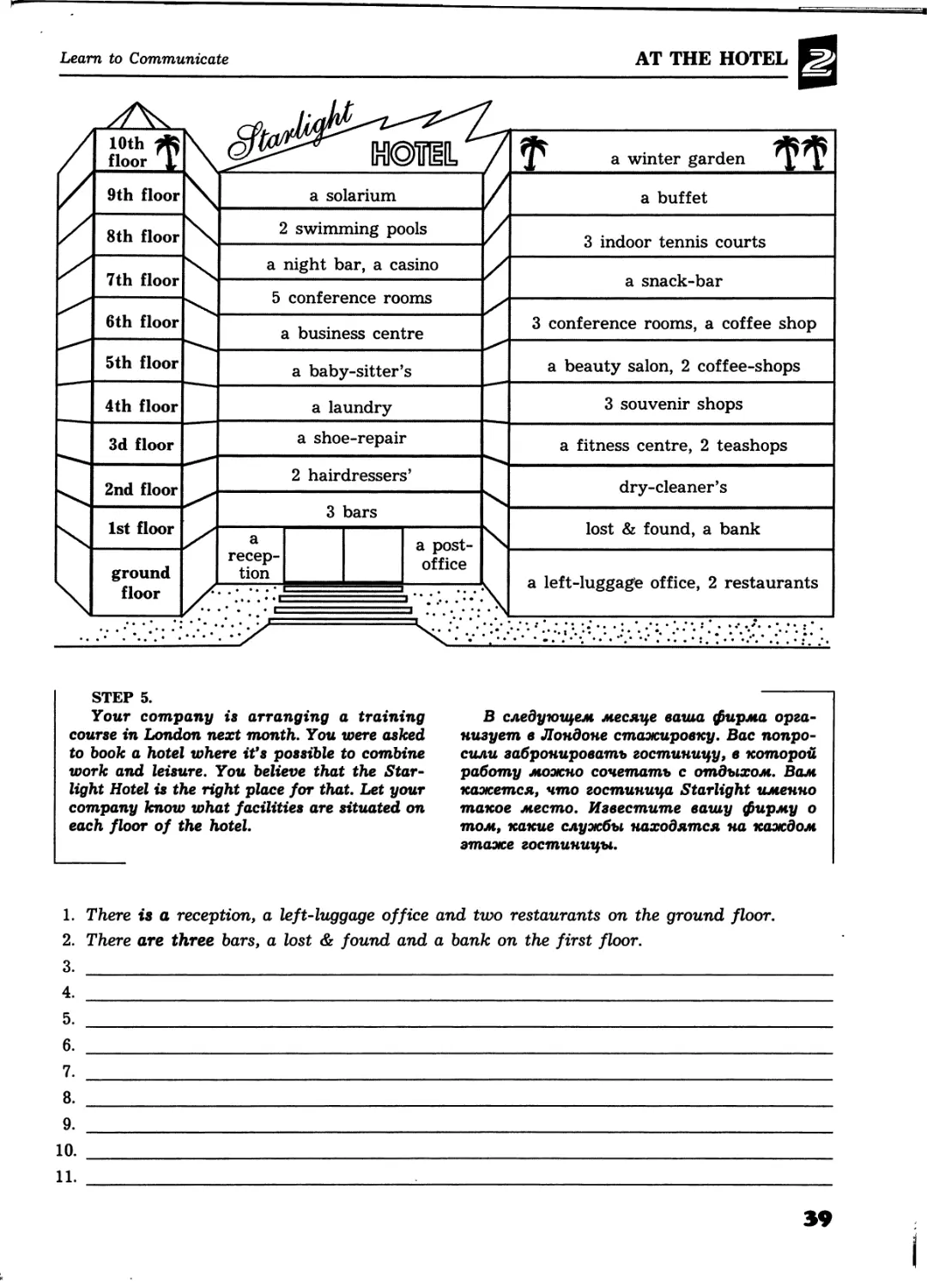
Learn to Communicate
AT THE HOTEL
3d floor
1st floor
ground
floor

a winter garden
9th floor
8th floor
7th floor
6th floor
5th floor
4th floor
a solarium
a buffet
2 swimming pools
a night bar, a casino
5 conference rooms
a business centre
a baby-sitter’s
a laundry
3 indoor tennis courts
a snack-bar
3 conference rooms, a coffee shop
a beauty salon, 2 coffee-shops
3 souvenir shops
2nd floor
a shoe-repair
2 hairdressers’
3 bars
a
recep-
tion
a post-
office
a fitness centre, 2 teashops
dry-cleaner’s
lost & found, a bank
a left-luggage office, 2 restaurants
STEP 5.
Your company is arranging a training
course in London next month. You were asked
to book a hotel where it's possible to combine
work and leisure. You believe that the Star-
light Hotel is the right place for that. Let your
company know what facilities are situated on
each floor of the hotel.
В следующем месяце ваша фирма орга-
низует в Лондоне стажировку. Вас попро-
сили забронировать гостиницу, в которой
работу можно сочетать с отдыхом. Вам
кажется, что гостиница Starlight именно
такое место. Известите вашу фирму о
том, какие службы находятся на каждом
этаже гостиницы.
1.	There is a reception, a left-luggage office and two restaurants on the ground, floor.
2.	There are three bars, a lost & found and a bank on the first floor.
3.
4.	_____________________________________________________________________________________________________________
5.
6.
7.
8.
9.
10.	____________________________________________________________________________________________________________
11.	_______________________________________________
39
Learn to Communicate
AT THE HOTEL
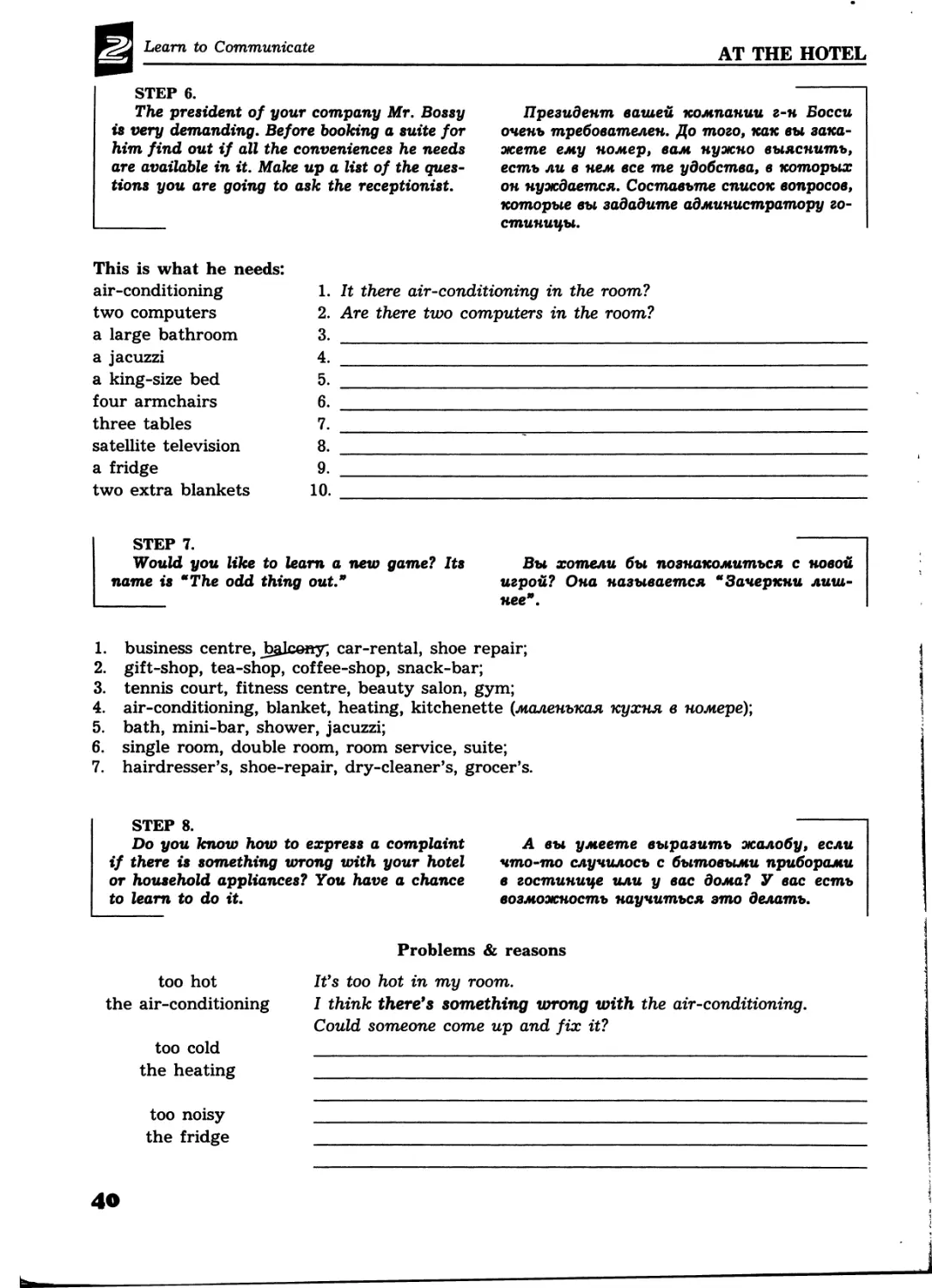
STEP 6.
The president of your company Mr. Bossy
is very demanding. Before booking a suite for
him find out if all the conveniences he needs
are available in it. Make up a list of the ques-
tions you are going to ask the receptionist.
Президент вашей компании г-н Босси
очень требователен. До того, пак вы зака-
жете ему номер, вам нужно выяснить,
есть ли в нем все те удобства, в которых
он нуждается. Составьте список вопросов,
которые вы зададите администратору го-
стиницы.
This is what he needs:
air-conditioning
two computers
a large bathroom
a jacuzzi
a king-size bed
four armchairs
three tables
satellite television
a fridge
two extra blankets
1.	It there air-conditioning in the room?
2.	Are there two computers in the room?
3.
4.	_____________________________________________________________________
5.	_____________________________________________________________________
6.
7.
8.	_______________________
9.	_____________________________________________________________________
10.	______________________________________________________________________
STEP 7.
Would you like to learn a new game? Its Вы хотели бы познакомиться с новой
name is “The odd thing out."	игрой? Она называется "Зачеркни лиш-
______	нее".
1.	business centre, Jjalceny; car-rental, shoe repair;
2.	gift-shop, tea-shop, coffee-shop, snack-bar;	j
3.	tennis court, fitness centre, beauty salon, gym;
4.	air-conditioning, blanket, heating, kitchenette (маленькая кухня в номере);
5.	bath, mini-bar, shower, jacuzzi;
6.	single room, double room, room service, suite;
7.	hairdresser’s, shoe-repair, dry-cleaner’s, grocer’s.
STEP 8.
Do you know how to express a complaint
if there is something wrong with your hotel
or household appliances? You have a chance
to learn to do it.
А вы умеете выразить жалобу, если
что-то случилось с бытовыми приборами
в гостинице или у вас дома? У вас есть
возможность научиться это делать.
Problems & reasons
too hot
the air-conditioning
too cold
the heating
too noisy
the fridge
It’s too hot in my room.
I think there’s something wrong with the air-conditioning.
Could someone come up and fix it?
40
Learn to Communicate	AT THE HOTEL g||
the cold water tap it is leaking (кран течет)	There’s something wrong with the cold water tap. It is leaking. I can’t stand it any longer.
the shower
it is leaking

the hot water tap
the water is dripping
(капает вода)
the fridge doesn’t work	My fridge doesn’t work. I think it has broken down. Could somebody	?
the coffee-machine
doesn’t switch on
(не включается)
STEP 9.
Every day a lot of customers call the Star-
light Hotel to book accommodation. Restore
some telephone conversations putting the sen-
tences in the correct order.
Телефон в гостинице Starlight звонит
непрерывно. Восстановите, пожалуйста,
несколько телефонных разговоров, распо-
ложив предложения в нужном порядке.
1.	a. Good afternoon, Starlight Hotel. Can I help you?
b.	Try the Grand Hotel.
c.	I’m sorry we’re fully booked.
d.	Could you recommend any other hotel which is situated in the centre?
e.	Yes. Have you got any vacancies for next week?
f.	Thank you.
1-a,
2.	a. A double, please. Is it available?
b.	Thank you, Mr. Hopkins.
c.	What room would you like to have?
d.	Grand Hotel. Good morning. Can I help you?
e.	Yes, how many nights are you going to stay?
f.	Yes, I’d like to make a reservation for the next week.
g.	Good. What’s your name, please?
h.	Three nights. I’m arriving on Monday morning.
i.	Hopkins. Bob Hopkins.
1-d,
What to say when something doesn’t work:
- My hair-dryer doesn’t work.
- There’s something wrong with my hair-dryer.
- My hair-dryer has broken down.
41
STEP 10.
Are you good at telephone num-
bers?
NUMBERS
Вы легко справляетесь с номе-
рами телефонов?
A. Write the telephone numbers in fig- Напишите эти телефонные номера
ures, please.	цифрами, пожалуйста.
1.	two one two double seven five eight	_________________________________________
2.	nine three nine five seven one six	______________________________________
3.	four oh seven double three five two	_________________________________________
4.	one seven three six double eight five oh
5.	seven three double seven three oh seven
B. Could you write these telephone
numbers in words?
Пожалуйста, напишите эти телефон-
ные номера словами.
331 69 04
157 11 25
257 70 31
(181) 223 0974
(065) 40 188538
(718) 56 008376
STEP 11.
Is it sometimes difficult for you to remem-
ber the birthdays of your relations and
friends? Perhaps, writing them down will
help you memorize them better.
Вам иногда бывает трудно запомнить
дни рождения ваших родственников или дру-
зей? Возможно, если вы их сейчас запишите,
это поможет вам лучше их запомнить.
- When were you born, Professor? - I was bom on the thirteenth of September, 1950.
Now it’s your turn to answer the questions.
1.	When were you born?_____________________________________________________________________
2.	When was your mother born?______________________________________________________________
3.	When was your father born?______________________________________________________________
4.	When was your wife / husband / partner bom?
5.	When was your best friend born?_________________________________________________________
6.	If you have children, write down their birthdays, please.
7.	Do you know your boss’s birthday? If so, put down his / her birthday.
8.	What other birthdays do you find important to remember? Put them down, please.
42
Language Puzzles
PREPOSITIONS OF PLACE
STEP 12.
How well do you know prepositions of
place? Match the prepositions with appropri-
ate pictures.
Насколько хорошо вы знаете предлоги
места? Подберите предлоги к соответ-
ствующим картинкам.
' in front of '
behind / in
around / on
across / along
in the middle of
down / under
out of / up
into / near
X. between /
STEP 13.
This is a Detective Game. Look at the Это "Игра в детектив". Посмотрите
objects and say who they might belong to. на эти предметы и скажите, кому они
	могли бы принадлежать.
a bowler hat
bookshelves
a convenience table
Right. AU these things belong to Sherlock
Holmes, at least they dU can be seen in his
sitting-room in the famous museum in Baker
Street, 221b.
If you have been there, try to remember
where each object is situated in his sitting-
room. If you haven’t been there, use the “de-
ductive method" and guess where in the sit-
ting-room these objects might be situated.
Take a sheet of paper and describe the
room:
I think the armchair is in the
Верно. Все эти вещи принадлежат Шер-
локу Холмсу, или по крайней мере их мож-
но увидеть в его гостиной в знаменитом
музее на Вейкер-стрит, 221b.
Если вы там уже побывали, вспомните, где
располагается каждый предмет в его гости-
ной. Если вы там еще не были, используйте
“метод дедукции” и догадайтесь, где в гос-
тиной могли бы находиться эти предметы.
Возьмите листок бумаги и опишите эту
комнату:
left-hand corner of the room.
You can also make a drawing of the room.
Then compare your description and your
drawing with the picture on page 44.
Вы также можете нарисовать эту ком-
нату. Затем сравните свое описание и свой
рисунок с картинкой на стр. 44.
4
Language Puzzles
HOUSES & HOMES
Have the pictures coincided? Congratula-
tions!
Do the pictures differ a lot? Don’t feel
unhappy about it. You have another chance
to test your memory and attention to details.
Study the picture above for a minute, then
cover the picture and describe it in the fol-
lowing manner:
Картинки совпали? Поздравляем!
Картинки очень отличаются? Не огор-
чайтесь. У вас есть еще одна возможность
проверить вашу память и внимание к де-
талям.
Изучите картияр, которую вы видите
на этой странице в течение одной мину-
ты, затем закройте ее и опишите следу-
ющим образом:
There’s a cabinet in the right-hand corner of the room. It is not far from the window. There
are a lot of test bottles and glasses for chemicals in the cabinet...
44
Language Puzzles
HOUSES & HOMES
STEP 14.
This is a story about the most famous
house in Britain. Read it and put in either
“there is / are” or “it is.”
Это рассказ о самом знаменитом доме
в Великобритании. Прочитайте его и
вставьте либо “there is / аге” либо “it is”.
The Queen’s Home.
1........one house in London which is famous all over the world. 2.Buckingham Pal-
ace, the official residence of Her Majesty The Queen. 3.........................both an architectural monu-
ment and a family home, where children play and grow up. 4...................... also	the place where
presidents, kings and politicians meet the Queen. 5......... 600	rooms and.......three miles of
red carpet in the Queen’s house. 6.........like a small town with everything necessary inside
the Palace. 7......a police station, two post offices, a hospital, a bar, two sports clubs, a disco,
a cinema, and a swimming pool. 8.......... 300	clocks and two men work full-time to look after
them. 9......also the Queen’s Gallery in the Palace. 10.......one of finest art collections in the
world, and......open to visitors.
STEP 15.
Here are some questions from the Royal
Family Quiz. Complete them with “How
many?” or “How much?”
Вот некоторые вопросы из викторины
“Королевская семья”. Дополните их слова-
ми “How many?” или “How much”?
1............... members of the Royal Family constantly live in Buckingham Palace?
2...............time does the Queen usually spend in the Palace? 3..................antique
furniture is there in the Palace? 4.............pictures	has the Queen got in her collection?
5...............horses has the Queen got? 6.................money	does the Queen pay to her
staff? 7.............correspondence does the Queen receive daily? 8..............letters	does
she write every day?
STEP 16.
Ben’s real estate company collects stories
of different people about their homes. It
would be great, if you also wrote about your
home. These questions might help you do it.
Компания недвижимости Вена собирает
рассказы разных людей об их доме. Выло бы
замечательно, если бы вы тоже написали о
своем доме. Эти вопросы могут помочь вам
это сделать.
•	Do you live in a house or a flat? Do you like the place where it is situated? If so, why?
•	How many rooms are there in your flat (house)?
•	Could you describe your room (its furniture, colours, decoration)?
•	What makes this room dear to you?
•	What’s the difference between the word “house” and the word “home?”
•	What does each of them mean to you?
Be careful when using the word “home.”
be/stay at home,	go/come/arrive home
make yourself at home	be back home
East or West home is best (proverb). There is no place like home (proverb).
45
COMFORTABLE or CONVENIENT?
What words can be called “confusing?”
These are English or any other foreign words which have different mean-
ings but are translated into Russian with the help of the same word or ex-
pression. This makes them seem similar, and they are often confused. For
example, both “comfortable” and “convenient” can be translated into Rus-
sian as “удобный” hut they mean different things. To understand the dif-
ference let’s look up these words in an explanatory (толковый) dictionary.
Comfortable or convenient?
comfortable ['kAmfatabl] adj
*1. giving comfort to the body: a~ chair (bed).
2.	having or providing comfort: a ~ life (income).
Please make yourself ~ .
3.	free from pain, anxiety etc.: to be (feel) - .
comfortably adv. in a comfortable manner: a car
that holds six people comfortably.
They are comfortably off, have enough money to
live in comfort.
convenient [kan'vi:njant] adj
suitable; handy; serving to avoid trouble
or difficulty; easy to get to or at:
Will it be ~ for you to start work
tomorrow? This is a ~ tool for the job.
Will the 3.50 train be - for you?
conveniently adv: in a convenient manner:
My house is ~ ly near the bus-stop.
STEP 17.
Which word» in the box match “comfort-
able," which can be used with "convenient"
or, probably, with both?
Какие слова в рамочке сочетаются со
словом “comfortable", какие используются
со словом “convenient” или, возможно, и с
тем, и с другим?
—------- time / hotel / armchair / room / place / shoes	—
chair / timetable / sofa / bus / schedule / date / train / car / carriage / plane
	—_________location / bed / hall / clothes / tool ___________________'
armchair
comfortable
STEP 18.
Now you are ready to choose the right
word, aren’t you?
Теперь вы готовы выбрать правильное
слово, не правда ли?
convenience
(in)convenient
( in jconveniently
comfort
(un)comfortable
(ип) comfortably
1. These shoes are very...............I’ll	buy them. 2. My office is not far from here. It’s very
............3.	Choose the most..............time	and place for our meeting. 4. I like this room
46
Confusing "Words
SO or SUCH?
very much. It’s so nice and.............- That’s true. But I’m afraid, the room is not very
..........for studies. It’s too dark here. 5. When I feel tired I need rest and ..
6. Now that my husband has become President of the company we are.................off. 7. Our
house is very..............located,	there are lots of shops and parks around. 8. Are there all
modem ............... in	your house? 9. Let’s go by the 12.15 train. I took it last time and
enjoyed the journey greatly. The compartments are very ................ — But it arrives too
late. It’s.............. 10.	If we come late, we’ll cause our host a lot of............
So or such?
It’s so difficult.
(перед прилагательным)
It’s such a game!
(перед существительным)
It’s such a difficult game.
(перед существительным,
определяемым прилагателъным(и)
Это так трудно.
Это такая игра!
Это такая трудная игра.
STEP 19.
Which word to choose: so or such?
Какое слово выбрать: so или such?
1. It’s...interesting. 2. It’s....an interesting story. 3. This village is.....quiet. 4. It’s....a
quiet street. 5. He is .... an	intelligent man! 6. This is ... a	surprise! 7. Your garden is ....
beautiful. 8. I’ve never lived in....an old house. 9. The place is.......nice. 10. Your house has
....a wonderful atmosphere.
STEP 20.
Match the words that have the same mean-
ing (A) and the words that have the opposite
meaning (B). Mind, there are some extra
words in the right-hand columns.
Соедините слова, имеющие одинаковое
значение (А), и слова, имеющие противо-
положное значение (В). Учтите, в колон-
ках справа есть лишние слова.
A. find synonyms
В. find antonyms
1. delicious.	a.	incredible	1. convenient	a.	cloudy
2. stressful \	b.	clever	2. comfortable	b.	encouraging
3. cheerful \	c.	simple	3. boring	c.	quiet
4. unbelievable \	d.	dull	4. sunny	d.	relaxing
5. intelligent	\ e.	kind	5. tolerant	e.	inconvenient
6. easy	*f.	tasty	6. frustrating	f.	cheerful
7. difficult	g-	joyful	7. noisy	g-	difficult
8. boring	h.	frustrating	8. skilful	h.	unquiet
9. peaceful	L	quiet	9. stressful	i.	uncomfortable
10. skilled	j-	experienced	10. easy	j-	intolerant
	k.	hard		k.	unskilful
47
Language Puzzles
PREPOSITIONS OF TIME
48
Language Puzzles
PREPOSITIONS OF TIME
STEP 21.
Which preposition goes with each word in Какой предлог подходит к каждому сло-
the frame?	ву, данному в рамочке?
Мау / Monday / summer / (the) morning
10 o’clock / midnight / (the) afternoon / Sunday
Tuesday evening / the second of June / noon / (the) evening / 2002
night / January / 7 o’clock / winter / 3 p.m.
weekend / autumn / 1945	________
in	on
at
in summer on Monday at 10 o^clock
STEP 22.
Are you good at prepositions of time? Test
yourself filling in the gaps with the preposi-
tions where necessary.
Вы разбираетесь в предлогах времени?
Проверьте себя,.заполнив пропуски предло-
гами, где это необходимо.
1.	Do you like driving ...night?
2.	We seldom go out ......the evening.
3.	We never go out......Monday evening.
4.	What are you doing.....the weekend?
5.	I often feel frustrated....autumn.
6.	Are you busy tomorrow......noon?
7.	We are leaving for Bath ...Saturday.
8.	We are leaving for York....next Saturday.
9.	Most shops in Britain are open...9 a.m....... 5 p.m.
10.	Jack-of-All-Trades was born..... 25th December, that’s why he feels double happy
Christmas.
This week I have a lot to do.
Next year we are going to Africa.
at the beginning (of) - в начале
at the end (of) - в конце
in the end - в конце концов
На этой неделе мне многое нужно сделать. .
В следующем году мы поедем в Африку.
At the beginning of the story.
At the end of the year.
In the end we decided to stay at home.
\ — 4666
49
Language Puzzles
WHAT’S THE TIME?
STEP 23.
What’s the time?
9.00
S
8
The British say:
— It’s nine o'clock.
9.30 - It’s half past nine.
9.45 - It’s (a) quarter to ten.
The word minutes isn’t usually used with:
5, 10, 15, 20, 25 past/to:
2.10 — It’s ten past two.
But! 5.57 - It’s three minutes to six.
at noon — в 12 часов дня (в полдень)
Bat midnight — в 12 часов ночи (в полночь)
at dawn - на рассвете
at 1 o’clock in the morning — в час ночи
Который час?
12.05 - five past twelve
8.03 - three minutes past eight
13.45 - __________________________
10.30 - __________________________
14.22 - __________________________
9.55 -____________________________
19.40 -___________________________
4.17 -____________________________
01.30 -___________________________
7.15 -____________________________
Посмотрите на де-
рево-время и напиши-
те, какое время пока-
зывают каждые часы.
STEP 24.
Look at the Time Tree
and write the time each
clock shows.
What time is it?	What time is breakfast?
Can you tell me the time, please? My watch has stopped.
My watch is 3 minutes fast (slow).
Sorry, I am 5 minutes late (early).
We go to bed at elevenish.
Мои часы спешат (отстают)
на 3 минуты.
Простите, я опоздала
(пришла раньше) на 5 минут.
Мы ложимся спать около 11 часов.
Language Puzzles
TIME
Contest Schedule
Monday	“The Events That Made History” - a test	10 a.m. - 1.30 p.m.
Tuesday	“People of the Year” - a quiz	1 p.m. - 3.15 p.m.
Wednesday	“Discovery” — a team competition	4.30 p.m. - 7.45 p.m.
Thursday	preparation for the semi-finals TV press conference	9 a.m. - 4 p.m. 6.50 p.m. - 8.00 p.m.
Friday	semi-finals cocktail party	10 a.m. - 12 noon 8 p.m. - midnight

STEP 25.
Your family and your friends are eager to
know more about the Contest. Study this
weeWs schedule and answer their questions,
please.
Ваша семья и друзья очень хотят боль-
ше знать о конкурсе. Изучите расписание
на эту неделю и ответьте на их вопросы,
пожалуйста.
1.	When аге you writing the test? We are writing the test from ten to half past one.
2.	When are you doing the quiz?:
3.	What time are you having the team competition?
4.	What are you doing on Thursday afternoon?______________________
5.	What time does the TV press-conference begin?
6.	What are you doing on Friday morning?__________________________
7.	When will the semi-finals be over?_____________________________
8.	What time does the cocktail party start and by what time do you expect it to be over?
>K
He works long (short) hours.
He works till late at night.
I’ll be back in no time.
У него длинный (короткий) рабочий день.
Он работает допоздна.
Я очень быстро (мигом) вернусь.
4*
51
Language Puzzles
TIME
How long does it take you?
How long	does did will	it take	me you him her us them	to do it?
STEP 26.
Dinah, has started preparing a new question-
naire but she’s too busy now to finish it up.
Will you, please, use Dinah’s notes to formu-
late the questions and give answers to them.
Дайна начала подготовку новой анкеты,
но она сейчас слишком занята, чтобы за-
вершить ее. Пожалуйста, используйте за-
метки Дайны, чтобы сформулировать
вопросы и ответьте на них.
1. you / to get to your work
How long does it take you to get to your
work when, there are no traffic jams?^
It takes me......minutes to get to my
work when there are no traffic jams.
2.	you / to get to your work in the rush hours?
3.	Chris / to dress up before the performance
4.	you / to decide to join the Contest
How long did it take you to decide It took me...................to decide to do it
to join the Contest^ ___________________________________________________________
5.	Tony / to get to London from South Africa on foot
6.	Giovanni and his wife / to make it up (помириться)
7. you I to finish doing this Step
How tong will it take you to finish
doing this Step?
It will take me another.......minutes to
do it.
8. Joy / to prepare for an interview with the Queen?
9. Willy / to cover 1,000 miles in his new car
PRESENT SIMPLE
действий, которые
происходят обычно,
постоянно или
периодически:
I often dream of a peace-
ful evening at home.
Present Simple употребляется для выражения:
T
будущих действий,
связанных с программами,
графиками, расписаниями (движения
транспорта и др.):
"	~3—
Tomorrow the quiz begins
at 9 a.m.
	I You We They . He ‘	► work hard.	I work hard.		Yes, I do. No, I don’t
			Do	you work hard?
				I do not (don’t) work hard. He works hard.
	She It	 works hard.	Does	he work hard? He does not (doesn’t) work hard.	Yes, he does. No, he doesn’t.
л/2 Если глагол оканчивается на -о, -s, -ss, - sh, -ch, -x, то в 3-ем лице единствен-
zlrx ного числа к нему прибавляется окончание -es:
watch + es - watches
Если глагол оканчивается на букву “-у,*" перед которой стоит согласная, то к нему
прибавляется “-es,” а и-у” меняется на “-г”:
study + es = studies
В остальных случаях буква “у” сохраняется:
stay - stayed
	Окончание “-s (-es)*	произносится:
[s] [г]	- после глухих согласных - после звонких согласных и после гласных		- speaks - reads
[iz]	- после шипящих и свистящих		-х/oes - wishes
STEP 27.
You’ve got a lot of gadgets in your kitch-
en, haven’t you? Write what they can do by
putting the beginnings and the ends of the
phrases together. Don’t forget to put -(e)s on
the verb if necessary.
У вас на кухне много современных при-
способлений, не так ли? Напишите, что
они делают, соединив начало и конец фраз
вместе. Не забудьте добавить -(e)s к гла-
голу, если это необходимо.
1.
2.
3.
4.
5.
6.
7.
8.
A coffee-machine make + s = makes ....	_ a.
Air-conditioning regulate * F -	b.
Dishwashers wash +./S =
Cookers make+.5
An electric kettle boil t.** e
Freezers keep..f-65
A washing machine wash.f.^.-wS'fl	\ g.
Fridges keep.* 6?	^h.
dishes
food hot
food very cold
food fresh
clothes
coffee
water
air
Grammar-in-Brief
PRESENT SIMPLE
Эти обозначения времени, характерные для Present Simple, ставятся перед смысло-
вым глаголом:
always	sometimes	seldom (редко)	hardly ever (почти никогда)
usually	occasionally (изредка)	rarely (редко)	almost never (никогда)
often	never
Terry always spends all his free time in the garden.
Эти же обозначения времени употребляются после глагола be и модальных глаголов
can, must, should, ought (to):
I am never late.	They can always help us.
STEP 28.
Most people spend a lot of time speaking
on the phone. What do they talk about? Write
about yourself and the people you know well.
Большинство людей тратит много вре-
мени на телефонные разговоры. О чем они
говорят? Напишите о себе и о людях, ко-
торых вы хорошо знаете.
(I
Му wife / husband
Му friend
Му boss
Му colleagues
i Му mother-in-law
often
seldom
occasionally
sometimes
hardly ever
never
speak about
discuss
gossip about
criticize
talk about
talk
family problems/the weather...
business problems/the latest news...
our friends/VIPs/cinema stars...
our colleagues/neighbours/relatives...
shopping/the family budget/...
politics/sports
1.1 often discuss the Contest news on the phone.
I sometimes	2?/?	,_______________
I occasionally	________
I seldom XczXX
I hardly ever	XXe.
I never //a. ££	~Q_
2.	My wife never talks shop on the phone.
to talk about something - говорить о чем-то
She often talks about TV shows.
But: to talk politics
to talk sports
to talk shop
- говорить о политике
- говорить о спорте
- говорить на профессиональные темы
Grammar-in-Brief
PRESENT SIMPLE
3.	My boss always talks shop on the phone.
4.	My colleagues seldom gossip on the phone.
5.	My friend occasionally speaks about the weather on the phone.
5.	My mother-in-law often gossips on the phone.
Эти обозначения времени, характерные для Present Simple, ставятся в
конце предложения:
I do yoga every day (week, month, etc.)
every other day (через день)
every weekend
once or twice a week
three times a week (три раза в неделю)
Ben plays golf from time to time (время от времени)
STEP 29.
What kinds of sports do the Contest par-
ticipants and their families practise? How
often do they do that? Write about it using
the time prompts given above.
Какими видами спорта занимаются
участники конкурса и их семьи? Как час-
то они ото делают? Напишите об атом,
используя обозначения времени, данные
выше.
55
Grammar-in-Brief
PRESENT SIMPLE
do	gymnastics sports aerobics athletics karate yoga exercises	1.	Kate does gymnastics twice a week. 2.	The Trades go sailing every summer weekend. 3.	Olaf	 4.	Emily
go	climbing fishing	5. Chris
	jogging sailing skating skiing swimming walking wind-surfing yatching	6.	The Brittens	. 7.	Tony	 8.	Giovanni’s sons	 9.	Alex	 10.	Mary and her family
play baseball basketball		11. Joy
	chess cricket	12. Willy
	football golf (ice)-hockey rugby tennis	13.	Cecily and her creatures	 14.	Dinah	 	*	 15.	I
Articles
to play football (any sports game)
But:
to play the piano (any musical instrument)
STEP 30.
What do people in different countries do
when they have some time to spare? Read
Willy’s qtory about the way some American
families spend their weekends and put the
tense markers in the correct places.
Что делают люди в разных странах,
когда у них есть свободное время? Прочи-
тайте рассказ Вилли о том, как проводят
свои выходные некоторые американские
семьи и правильно расставьте указатели
времени.
1. After a busy week Americans try very hard to have a good time at weekends (usually).
2. The weekend in the USA begins on Friday night (always). 3. A lot of people go to bars for
a happy hour when the drinks are half price (often). 4. Other people go there preferring a
movie or a show to a meal and drink (seldom). 5. Saturday morning is the time for cleaning
the house, washing the car, doing the laundry (usually). 6. Today you can find women who
try to do the housework all by themselves (hardly ever). 7. After lunch most people practise
sports (usually). 8. If they fail to do sports, they jog or play games (every day, at least once
a week). 9. On Saturday evening Americans stay at home (practically never). 10. They visit
friends (occasionally), and go to bars to listen to music and relax (most often). 11. On Sunday
a lot of people have a lie-in, but there are few who do it (always; from time to time). 12. If
the weather is fine, they sit in the garden enjoying late coffee and read the latest news in the
Grammar-in-Brief
PRESENT SIMPLE
papers (sometimes, usually). 13. Americans visit their relatives at weekends (hardly ever).
14. But they can have a family get-together for a brunch in a restaurant (once or twice a
month). 15. On Sunday evening Americans quiet down (usually). 16. Most people go out, they
watch television and go to bed early to be ready for the coming week (never, sometimes).
STEP 31.
Write how you and your friends usually Напишите о том, как вы и ваши дру-
spend weekends.	зья обычно проводите выходные дни.
57
Grammar-in-Brief
PRESENT SIMPLE NEGATIVES
I
You
We
They
do not work = don’t work
She
He
It
docs not work = doesn’t work
Глагол be и модальные глаголы can, may, must, should, ought (to) не требуют
употребления вспомогательного глагола “do” при образовании отрицательной формы.
You shouldn’t work so much.
STEP 32.
Mr. and Mrs. Disagree always contradict
each other, and yet they seem to be very hap-
py. This is the way they usually speak to each
other.
Г-н и г-жа Спорщики всегда противоре-
чат друг другу, и тем не менее они ка-
жутся очень счастливыми. Вот как они
обычно разговаривают друг с другом.
Mr. Disagree: It looks like rain. It’s cold and cloudy today.
Mrs. Disagree: Oh, no, it doesn’t look like rain. And it isn’t cold and cloudy. On the contrary,
it’s hot and sunny.
Mr. D: Anyway, I feel cold and I want to stay at home.
Mrs. D: But I_____________________________________________________________________________
Mr. D: I don’t want to eat out The food in the restaurant isn’t good, and the prices are
high.
Mrs. D: On the contrary the food and the prices
Besides, I’m tired of cooking. I do it every day.
Mr. D: No, you____________________________________________________________________________
I often help you cook. Besides, I always wash up and do the shopping.
Mrs. D: Who? You? You_____________________________________________________________________
Look at John Smith! He is a perfect husband. He does everything about the house.
Mr. D: You must be kidding! He____________________________________________________________
John spends all his free time in pubs. He drinks a lot and he is lazy.
Mrs. D: On the contrary, he_______________________________________________________________
John works hard and he earns a lot.
Mr. D: That’s not true.___________________________________________________________________
His wife__________________________________________________________________________
By the way you can visit beauty salons whenever you choose to. You’ve got a
lot of free time.
Mrs. D: You can’t be serious. I___________________________________________________________
I do the housework round-the-clock. No wonder, I look old and ugly.
Mr. D: Oh, no. You______________________________________________________________________
Mrs. D: You don’t care for me. You don’t love me.
Mr. D: On the contrary, darling, I _______________________________________________________
58
Grammar-in-Brief
YES/NO QUESTIONS
Do
I
you
we
they
know it?
she
Does he
it
> know it?
STEP 33.
Joy is planning to interview Terry tomor-
row. Complete the questions she’s going to ask
him.
Завтра Джой планирует взять интер-
вью у Терри. Допишите вопросы, которые
она собирается ему задать.
a.	What is missing in these questions?
1	. Do you like your house?
2	. Does your wife like it?
3	.your younger son go to school?
4	.you sometimes drive him there?
5	.your wife drive?
6	.you often go out?
7	. your children have any prac-
tical skills?
8	.your wife often watch television?
9	. your parents live near here?
10	. your secretary know any
foreign languages?
b.	Tag questions help establish good contacts with the people you speak to:
1.	You make your breakfast yourself, don’t you?
2.	Your wife doesn’t like gardening, does she?
3.	Your house doesn’t look old,?
4.	You spend a lot of time in the garden,?
5.	It takes you 30 minutes to get to work,?
6.	Your elder son enjoys making furniture,?
7.	Your neighbours don’t envy you,?
8.	Your hobby gives you a lot of pleasure,?
9.	You don’t like living in the country,?
10.	Greenfield looks gorgeous,т?
c.	Can you choose the correct word:
1.	Do your friends often visit you? (friend/friends)
2.	Does your sometimes help you? (son/sons)
3.	Does your start early? (work, talks)
4.	Do take care of the family budget? (your wife, you)
5.	Does your do the cleaning? (wife, children)
6.	Does your seem boring to you? (life, lives)
d.	Could you make up these questions:
1.	you - often / seldom - go out?	Do you often or seldom go out?
2.	you - usually spend holidays - in Britain/abroad?
3.	your wife - have a full-time job/а part-time job?
4.	your son - make furniture - quicker / slower than you?
5.	you - seldom/often - practise sports?
59
Grammar-in-Brief
SPECIAL QUESTIONS
Do you work much? (общий вопрос)
When Where Why	* do you work much? (специальный вопрос)
STEP 34.
Joy has invited you to her talk-show where
she’s going to ask you some questions about
your friends’ ordinary day. Get ready for the
show and write the questions you might be
asked and the answers to them.
Джой пригласила вас на свое ток-шоу,
где она задаст вам несколько вопросов об
обычном дне ваших друзей. Подготовьтесь
к телепередаче и напишите вопросы, ко-
торые вам могут задать, и ответы на
них.
A. Mr. Britten’s day.
1.	Head of the Real Estate Co.
2.	Live / London
3.	Get up / 6.30 a.m.
4.	Read / “The Financial Times”
5.	Come to the office / 8.45
6.	Play golf / 7 p.m. - 8 p.m.
7.	Have dinner / at home
8.	Go to bed / 11 p.m.
He is head of the real estate company.
1. What does Mr. Britten do?__________________
2. Where		?
3. What time		?
4. What		?
5. When		?
6. When,		?
7. Where		?
8. What time		?
B. Ms. Merryland’s day.
1.	Bank manager
2.	Get up / 6 a.m.
3.	Jog / in the park
4.	Have breakfast / grapefruit juice and nuts
5.	Come to the office / 8.30 a.m.
6.	Make 20-25 telephone calls a day
7.	Have lunch / in the office
8.	Leave the office / 8 p.m.
9.	Go to the fitness centre / after her office hours.
10.	Come home / 10 p.m.
1. What		?
2. When.		?
3. Where		?
4. What		?
5. When		?
6. How maruy		?
7. Where		?
8. When		?
9. Where		?
10. When		?
60
Grammar-in-Brief
“WHO” - QUESTIONS
My
colleagues
„ Who
Whose colleagues
His
wi:
:e
Who
Whose wife
work much.
cooks well.
cooks well? _ His wife does,
cooks well? — His wife does.

works much? - My colleagues do.
work much? - My colleagues do.
STEP 35.
Do you mind answering some questions
about your family?
Будьте добры, ответьте на несколько
вопросов о вашей семье.
1.	Who makes decisions in your family?_______________________________________________________
2.	Who takes care of the family budget?_______________________________________________________
3.	Who gets up the earliest?_________________________________________________________________
4.	Who goes to bed the latest?_______________________________________________________________
5.	Who does the cleaning?____________________________________________________________________
6.	Who likes giving advice?__________________________________________________________________
7.	Who speaks on the phone most?_____________________________________________________________
8.	Who spends a lot of time in front of the computer?
9.	Whose friends visit your family most often?
10.	Whose boss sometimes calls late at night?________________________________________________
STEP 36.
Now that you know the participants in the
Contest quite well, you can make up a
“Who?" quiz yourself.
Теперь, когда вы уже хорошо знаете
участников конкурса, вы сами можете
составить викторину “Кто?"
1.	- Who likes taking part in intellectual games? We all do.
2.	— Who travels round the world dll the time? Tony does.
3.	 _____________________________________________________________________
4.		’
5.		 _________________________________________________________________
6.		 _________________________________________________________________
7.	 _____________________________________________________________________
8.	 _____________________________________________________________________
9.		 _______________________________________________________________
10.	 ____________________________________________________________________
11.	 ____________________________________________________________________
12.	 ____________________________________________________________________
13.	 ____________________________________________________________________
14.	 ____________________________________________________________________
15.	 ____________________________________________________________________
61
Grammar-in-Brief
QUESTIONS
STEP 37.
Soon there's going to be “The Ideal Wife"
and "The Ideal Husband" competition at the
Contest. You are supposed to make up two
questionnaires: one - to find the ideal wife,
the other — the ideal husband. These expres-
sions can prompt you what to ask about.
Вскоре на конкурсе пройдет соревнова-
ние “Идеальная жена и идеальный муж".
Вам предстоит составить две анкеты:
одну - чтобы определить лучшую жену,
другую - лучшего мужа. Эти выражения
подскажут вам, о чем спрашивать.
make breakfast / fix your car /cook dinner
do the washing up/ do the cleaning / do the laundry / vacuum-clean
(	pay compliments / wash up / talk politics / work round-the-clock	\
к	do the gardening / make cakes / buy flowers / go shopping	J
write poems / give gifts / watch ice-hockey
criticize your spouse [супруг(а)]
The Ideal Wife Questionnaire
1.	How often do you watch football with your husband?____________________________________________
2.
3.
4.	_____________________________________________________________________________________________
5.
6.	__________________________________________________________________________________
7.
8.
9.
10.	_____________________________________________________________________________________________
11.	____________________________________________________________________________________________
12.	_____________________________________________________________________________________________
13.	_____________________________________________________________________________________________
The Ideal Husband Questionnaire
1.	Do you write poems to your wife?
2.
3.
4.	_________________________________________________________________________________________________________________
5.
6.
7.
8.
9.
10.	________________________________________________________________________________________________________________
11.	________________________________________________________________________________________________________________
12.	________________________________________________________________________________________________________________
13.	________________________________________________________________________________________________________________
62
Grammar-in-Brief	TO HAVE or NOT TO HAVE?
Выражение “have got” в значении “обладать” употребляется в Present Simple чаще,
чем глагол “have”:
I’ve got a lot of friends.	He’s got a new car.
Вопросительную и отрицательную формы “have got” образует самостоятельно, без вспо-
могательного глагола do (does):
I haven’t got any free time.	Have you got any friends in Paris?
В тех случаях, когда глагол have в сочетании с некоторыми существительными теря-
ет значение “обладать” и приобретает другое значение, он всегда образует вопроси-
тельную и отрицательную форму с помощью вспомогательного глагола do (does / did):
When do you usually have dinner7 Когда вы обычно обедаете?
I don’t have talks today.	Сегодня у меня нет переговоров.
л л Выражение “have got” не употребляется в Past Simple и Future Simple.
✓ 14? В этих формах употребляется глагол “have”:
I didn’t have a car when I was 16. I hope I will have a higher salary next year.
I had a bicycle.	It means we won’t have any problems.
STEP 38.
Check how careful you are when asking
questions. In some cases you should use the
verbs do (does), in others you shouldn’t.
Проверьте, насколько вы внимательны,
когда задаете вопросы. В некоторых слу-
чаях следует использовать глаголы do (does),
в других - нет.
1.	Kate has a lesson of Japanese on Monday. (What time?)
What time does Kate have a lesson of Japanese on Monday?_________________
2.	She has got a lot of friends in Japan. (How many?)
How many friends has she got in Japan?___________________________________
3.	They usually have breakfast later on Sunday. (What time?)
4.	We always have a good time when we are together. (Why?)
5.	Mary has got a lot of new ideas. (How many?)
6.	My friends always have holidays in October. (Why?)
7.	The Trades have got a lot of trees in their garden. (What kind of trees?)
8.	Alex often has talks with his British partners. (How often?)
9.	Tony has got a lot of free time now. (Why?)
10.	Chris has a swim every morning. (Where?)
11.	I always have dinner in a restaurant. (What time?)
12.	Willy has got some French cars. (How many?)
63
Grammar-in-Brief
PRESENT PROGRESSIVE
Present Progressive употребляется для выражения:
действий,
совершающихся
в момент
речи
1
Where are you running?
заранее
запланированных
будущих
< действий у
действий,
происходящих в
настоящий период
времени
We are staying
at the Starlight Hotel.
We are having a test
on Monday.
be + Ving
I You He She It	1 am are is is is	► working =	I’m You’re He’s She’s It’s	» working
We	are		We’re
You	are		You’re
They	are |		They’re (
I Tony is working.
Is Tony	working?
Tony is not working,
(isn’t)
д/9 1. Обратите внимание на правописание:
ZKx take + ing = taking (если глагол оканчивается на немое - е, то при прибавлении
окончания -ing немое -е опускается);
lie + ing = lying (в глаголах, заканчивающихся на -ie, буквы ie меняются на -у);
sit + ing = sitting (после краткой ударной гласной, обозначенной одной буквой,
согласная удваивается).
2.	В Present Progressive (и в других временах труппы Progressive) не употребляются
так называемые “статические глаголы”, которые обозначают не действия, а состоя-
ния, чувства, эмоциональное восприятие, умственную деятельность и т.д. К ним от-
носятся глаголы, которые Джой включила в свою рифмовку Stages of Love:
to notice, to know and to see,	then to remember, to expect,
to understand, to realize and to agree, to smell, to feel, to hear,
to like, to love,	to own, to possess,
to want, to wish, to need,	to hope and to doubt,
to hate and suddenly to fear;	to forget and finally to disappear.
Вместо форм Present Progressive обычно употребляются формы этих глаголов в Present
Simple:
I like it here very much.	I don’t understand it.
Но! В качестве исключения некоторые из перечисленных глаголов могут употребляться
в Present Progressive, когда:
1. Они меняют свое значение:
They are seeing their friend	Они провожают своего друга
to the airport.	в аэропорт.
2. Нужно показать, что состояние, выраженное этим глаголом, более эмоционально,
более интенсивно, чем обычно:
I am hoping for the best.	Гт feeling great today.
64
Grammar-in-Brief
PRESENT PROGRESSIVE
STEP 39.
Each guest of the Starlight Hotel can find
there something to his or her liking. You can
easily guess where some customers are now
and what they are doing there.
Каждый посетитель гостиницы “Star-
light" может найти в ней занятие по душе.
Вы легко можете догадаться, где сейчас на-
ходятся некоторые постояльцы и что они
там делают.
- Where is Mr. Money?
- He is in the bank.
- What is he doing?
- He is changing money.
Where are Mr. & Mrs. Toyota?
They are in the rent-a-car service.
What are they doing?
They are renting a Toyota.
Mr. Money
Mr. & Mrs. Toyota
Ms. Swi
Mr. Gambl
Mr. & Mrs. Eaters
Ms. Health
Mr. & Mrs. Tenni
Mr. Luggage
Mr. Beer--^
Mrs. Mail-^
Mr. & Mrs. Pleasiri'e
Mrs. Lost &
Ms. Busines
estaurant
tennis court
wimming pool
hairdresser’s
gift shop
usiness centre
post-office
pub
auna
bank
^•fitness centre
casino
rent-a-car service
left-luggage office
disco club
ost and found

-	9 о r
г??

Grammar-in-Brief
PRESENT PROGRESSIVE
STEP 40.
Mr. Trade is very busy at the Contest now.
He hopes that his employees are working
hard while he is not in the office. But are
they? Drop in at Mr. Trade’s office and write
what his employees are doing while their boss
is taking part in the Contest.
Г-н Трейд сейчас очень занят на кон-
курсе. Он надеется, что его служащие
усердно трудятся, пока его нет. Но так
ли это? Загляните в офис г-на Трейда и
напишите, чем, занимаются его служащие,
пока их начальник принимает участие в
конкурсе.
do one’s nails / leave the office
play draughts / do a crossword puzzle
have tea / sleep / listen to music
knit (вязать) / write a love letter
dream / have a good time
3. Mr. Lazy J &
1. Ms. Beauty is doing her nails.
5. Mr. Game and Mr. Music аЛСД
8. Everybody
STEP 41.
Which of the people in the picture is lis-
tening to, remembering or thinking about the
Beatles* song "Гт Only Sleeping?" Would
you like to translate the song into Russian?
Кто из людей, изображенных на кар-
тинке, слушает, вспоминает или думает
о песне Битлз "Я только лишь сплю"? Хо-
тите перевести ее на русский язык?
I’m Only Sleeping
When I wake up early in the morning,
Lift my head, I’m still yawning.
When I’m in the middle of a dream,
Stay in bed, float up stream (float up stream),
Please don’t wake me, no, don’t shake me,
Leave me where I am, I’m only sleeping.
Everybody seems to think I’m lazy.
I don’t mind, I think they’re crazy
Running everywhere at such a speed,
Till they find there’s no need (there’s no need),
Please don’t spoil my day, I’m miles away,
And after all, I’m only sleeping.
Keeping an eye on the world going by my
window,
Taking my time, lying there and staring
at the ceiling,
Waiting for a sleepy feeling.
Please don’t spoil my day, I’m miles away,
And after all I’m only sleeping,
Keeping an eye on the world going by
my window,
Taking my time.
66
Grammar-in-Brief
PRESENT SIMPLE or PRESENT PROGRESSIVE?
STEP 42.
How well do you know your relatives? Can
you guess what they are doing now? These
are the questions Dinah asked the Contest
participants.
Насколько хорошо вы знаете своих род-
ственников? Вы можете догадаться, что
они делают сейчас? Эти вопросы Дайна за-
дала участникам конкурса.
It’s 9 p.m. in London.
1.	Olaf / mother / watch TV Dinah: What is your mother doing now, Olaf?
Olaf: Гт sure she is watching a soap-opera on TV.
Dinah: How do you know?
Olaf: That’s easy. She always watches soap-operas at this time.
2.	Emily / husband / drink beer______________________________________________________
3.	Joy / grandmother / sit by the fire_______________________________________
4.	Giovanni / mother-in-law / do the washing
5.	Alex / daughter / play tennis__________________________________________________________
6.	Mary / son / play football '___________________________________________________________
7.	Willy / parents / sleep________________________________________________________________
8.	Chris I sister / sunbathe______________________________________________________________
9.	Kate / grandparents / have lunch_______________________________________________________
10.	Cecily I creatures / do the cleaning__________________________________________________
11.	Terry / wife / watch a fashion show___________________________________________________
12.	Tony / parents / expect my call________________
13.	Ben / children / play computer games__________________________________________________
5*
67
Grammar-in-Brief
PRESENT SIMPLE or PRESENT PROGRESSIVE?
STEP 43.
“The English at Home* is a popular TV
programme. It attracts TV-viewers because as
a rule people’s activities at home are absolute-
ly different from what they do at work. Look
at the fragments of the latest TV show and
write what these people usually do at work
and what they are doing at home now.
“Англичане дома* - популярная телеви-
зионная передача. Она привлекает теле-
зрителей тем, что, как правило, люди
дома занимаются совсем не тем, чем они
заняты на работе. Посмотрите на фраг-
менты последнего телешоу и напишите,
что эти люди обычно делают на работе,
и что они сейчас делают дома.
Mr. Smith is an М.Р.
Не often speaks
in the Parliament.
Now he is at home.
He is washing up.
sing / cook / paint
< relax and do nothing >
do the cleaning / water flowers
perform operations / vacuum-clean
deal in banking operations
play the violin (guitar)
treat (лечить) patients
К play computer games У
play on the stage
2. Dr. Health is a physician.
7. Fred is a gardener.
68
Grammar-in-Brief
PRESENT SIMPLE or PRESENT PROGRESSIVE?
STEP 44.
Today Jack has made a lot of telephone
calls. Cecily has records of his telephone con-
versations. Look at them and decide which
verb forms should be used: Present Simple or
Present Progressive?
Сегодня Джек много звонил. У Сесили
есть записи его телефонных разговоров.
Посмотрите на них и решите, какие гла-
гольные формы следует употребить:
Present Simple или Present Progressive?
I.	- Hello! Room Service. Can I help you?
-	Yes, please. The air-conditioning in my room (not workjf
-	I’m sorry about that. What (oe) your room number, please?
-	Room 777.
-	Well, usually.the air-conditioning inihis room (work) alright.
-	But now it fnot coolf^rbut it /fheatj^the air. It (bej very hot and stuffy in the room.
ifnbt like) it. Could someone (comg up) and (fix) the air-conditioning?
-	Yes, certainly. I (send) the fitter right away.
-	Thanks.
II.	- Hello! Could I speak to Mr. Clark, please?
-	Just a moment. Who shall I say (call)?
-	My name’s Jack, Jack Creature.
-	Hold on, please. I’ll see if Mr. Clark’s available.
a minute later jg
-	Helk», Mr. Creature. I’m sorry, but Mr. Clark (be) in a meeting now.
He (recetvejSjapanese businessmen. Would you like to leave a message?
-	Yes, please. Tell Mr. Clark I (plan) to be in your office after lunch.
When he usually (have lunch)?
-	As a rule he (not have lunch) at all. He always (have a cup of coffee) in his office.
-	Really? Anyway I’ll be in your office by 2 p.m.
-	Good. Anything else?
-	No, thank you. Good-bye.
-	Good-bye. Thank you for calling.
STEP 45.
When talking to Alex Jack prefers to speak
Russian. Will you translate their telephone
conversation into English?
Когда Джек разговаривает с Алексом, он
предпочитает говорить по-русски. Переве-
дите их телефонный разговор на английс-
кий, пожалуйста.
- Привет, Алекс. Что ты делаешь?
- Я сижу перед компьютером и пишу письмо в “Русскую школу бизнеса”.
- Ты пишешь по-русски или по-английски?
- Конечно, по-русски. Но когда я пишу своему сыну, я обычно делаю это по-английски.
-	Он хорошо знает английский?
-	Не очень. Поэтому я стараюсь общаться с ним по-английски.
-	А сколько писем ты отправляешь каждый день?
-	Трудно сказать. Иногда 2-3 письма, а иногда я пишу больше 10 деловых писем в день.
-	Это много. Сколько времени у тебя уходит, чтобы написать 10 писем?
-	Это зависит от типа письма. Довольно много.
-	А я терпеть не могу писать письма. Я предпочитаю говорить по телефону. Кстати, я звоню,
чтобы пригласить тебя сыграть со мной в шахматы.
-	Спасибо, Джек. Я был бы рад сыграть с тобой, но сейчас я занят. Прости.
-	Ничего страшного, сыграем как-нибудь в другой раз (some other time).
-	Спасибо, что позвонил. Пока.
69
Grammar-in-Brief
REGULAR and IRREGULAR VERBS
Как вы помните, английские глаголы подразделяются на правильные
(regular) и неправильные (irregular) в зависимости от способа образования
форм прошедшего времени (Past Simple) и причастия прошедшего време-
ни (Past Participle).
Правильными называются глаголы, образующие форму Past Simple (ее принято на-
зывать 2-й формой глагола) и форму Past Participle (ее принято называть 3-ей формой
глагола) по единому правилу - путем прибавления окончания -ed к основе глагола:
work + -ed - worked
Неправильные глаголы никаким правилам не подчиняются, и их формы Past Simple
и Past Participle нужно запомнить:
to do - did - done
to say - said - said
to put - put - put
1.	Глагол to be имеет две формы Past Simple:
was - для единственного числа,
were - для множественного
2.	Модальные глаголы сап и may имеют только форму Past Simple:
can - could
may - might
3.	Модальные глаголы must, should, ought (to) формы Past Simple не имеют.
Особенности произношения окончания -ed правильных глаголов
[d] [t] [id]	после гласных и звонких согласных (кроме d) после глухих согласных (кроме t) после звуков[1], [d]	stayed, lived liked, asked translated, added
Особенности правописания правильных глаголов
при прибавлении к ним окончания -ed
translate + -ed = translated	Если инфинитив глагола заканчивается на букву -е, то она опускается и прибавляется окончание -ed.
study + -ed = studied But: play + -ed = played	Глаголы, оканчивающиеся на букву -у с предше- ствующей согласной, меняют -у на £. После гласной буквы сохраняется - у.
ship + -ed = shipped	После краткого ударного гласного звука, обозначен- ного одной буквой, конечная согласная удваивается.
70
Grammar-in-Brief
REGULAR and IRREGULAR VERBS
STEP 46.
Group these regular verbs according to the
spelling rules.
Распределите эти “правильные* глаголы
в соответствии с правилами правописания.
care / miss / change / frustrate / nod / socialize / live
recognize / fix / contradict / produce / earn / suggest / use / appreciate / raise
invite / listen / rob / carry / stay / worry / watch / introduce / slip / copy / hope
--------- cry / stop / try / call / offer / ruin / marry / sunbathe / turn_________
start - started
tip - tipped
reserve- reserved
studp - studied
__________________________________________ play - played
STEP 47.
Here is another rhyming exercise written
by Joy. She hopes it will help you memorize
some irregular verbs.
А вот еще одно "упражнение в рифмов-
ке", написанное Джой. Она надеется, что
оно поможет вам запомнить некоторые
неправильные глаголы.
read say	- read - said	- read — said	(читать) (сказать)	sell tell	- sold - told	- sold - told	(продавать) (рассказывать)
pay	- paid	— paid	(платить)	see	- saw	- seen	(видеть)
make	- made	- made	(делать)	be	— was/were	— been	(быть)
let	— let	- let	(позволять)	eat	- ate	- - eaten (есть, кутать)
set	- set	- set	(устанавливать)	write	— wrote	- written (писать)
bet	- bet	- bet	(держать пари)	give	— gave	— given	(давать)
cut	- cut	- cut	(резать)	take	- took	— taken	(брать)
shut	— shut	- shut	(закрывать[ ся])	shake	- shook	- shaken (трясти[съ])
bring	- brought	— brought (приносить)		run	— ran	- run	(бежать)
buy	- bought	- bought	(покупать)	begin	- began	- begun (начинать)
think	- thought	- thought (думать)		swim	— swam	— swum	(плавать)
teach	- taught	— taught	(учить)	become	- became	— become (становиться)
know	- knew	— known	(знать)	do	did	- done	(делать)
grow	— grew	— grown	(расти)	come	- came	- come	(приходить)
break	- broke	— broken	(разбивать)	go	- went	- gone	(идти)
speak	— spoke	- spoken	(говорить)	wear	- wore	- - worn	{носить одежду)
sing	- sang	- sung	(петь)	feed	- fed	- fed .	(кормить)
ring	— rang	- rung	(звонить)	meet	v- met	— met	(встречаться])
sink	- sank	- sunk	(тонуть)	get	- got	- got	(получать)
swing	- swung	- swung	(качать[ся])	hear	- heard	- heard	(слышать)
71
Grammar-in-Brief
REGULAR and IRREGULAR VERBS
STEP 48.	~
If you write the missing verb forms cor- Если вы напишете недостающие гла-
rectly, you’ll also get some rhymes.	вольные формы правильно, у вас тоже по-
	лучатся “рифмовки”.
mean 	 meant dream	 dreamt	mean - meant — meant dream - dreamt - dreamt
1. speak		 spoken	'7. 	 	 known
	 broke				 grew
2. catch	caught			8. think
teach		 taught		 	 brought
3. say		 said	9. 	 	 felt
	 read			leave
4. tell	_______			10. lose		 lost
	 	 sold	cost		 cost
5. give		 given	11. 	 ran
	 drove	driven 6. swim		 swum		 	 begun 12. pay
	 became				 made

STEP 49. How many Past Participles (3d forms) can you find in this wordweb? X 0X / 4^"eni 0 0 S	’ % < % 72	4 Сколько причастий прошедшего време- ни (3-х форм глагола) вы можете найти в этой "словесной паутине"? %. 5а1а°'>в ч \ 15	О Ф	% Ф	® >	э о</ел|6^	«? / Моероици®0
Grammar-in-Brief	PRESENT PERFECT
В английском языке В отличие от русского не одна, а четыре формы на-
стоящего времени. Вы уже вспомнили две из них — Present Simple и Present
Progressive. Сейчас вам предстоит вспомнить о правилах образования и упот-
ребления Present Perfect. Сравните:
Olaf always takes pictures.	Олаф всегда фотографирует.
(Present Simple)
Olaf is taking our picture now.	— Олаф сейчас нас фотографирует.
(Present Progressive)
How many pictures have you taken today*! — Сколько фотографий ты сделал сегодня?
(Present Perfect)
Несмотря на то, что на русский язык Present Perfect чаще всего переводится глаго-
лами в прошедшем времени, в английском языке Present Perfect является формой на-
стоящего времени и в смысловом отношении всегда соотносится именно с настоящим.
The Present Perfect Tense
 I	have	(I’ve) You	have	(you’ve) He	has	(he’s) She	has	(she’s) a	worked done	We	have	(we’ve)	1	worked You	have	(you’ve)	done They	have	(they’ve)
		done it. done it? 1 Yes he has ,	J No, he hasn t. done it.
| He Has he He	1	 has
	has not = hasn’t
Present Perfect употребляется:
I. Для выражения действий, свершившихся к моменту речи и своими результатами
связанных с настоящим:
I’ve heard a lot about your bank.	Я много слышал о вашем банке.
Fd like to do business with you.	Я хочу иметь с вами деловые отношения.
Present Perfect употребляется, когда в центре внимания говорящего находится само
действие, а не обстоятельства (время, место и т.д.), при которых оно совершалось. Чаще
всего это происходит в начале разговора или сообщения, когда речь идет о каких-то
новостях:
The prices for oil have doubled.	Цены на нефть возросли вдвое.
I have lost ту mobile telephone.	Я потерял свой мобильный телефон.
Если обсуждение этих событий продолжается и сообщается, когда и где это произош-
ло, то действия, связанные с обстоятельствами произошедшего, выражаются глаголами
в форме Past Simple (см. стр. 138).
— I think we’ve met before.	Кажется, мы уже встречались раньше.
- Yes, indeed. We met at the Quiz Show Да, действительно. Мы познакомились
in Mexico.	(встретились) на шоу-викторине в Мексике.
73
Grammar-in-Brief
PRESENT PERFECT
Эти наречия часто употребляются с глаголами в Present Perfect.
Обратите внимание на их место в предложении.
ever	-	когда-либо	Have you ever been to Italy?
never	-	никогда	I’ve never seen a private house like that.
just	-	только что	I’ve just talked to Mary.
already	-	уже	Everybody has already come.
(already, как правило, употребляется в утвердительных предложениях)
yet - уже, еще нет	Has Топу arrived yet?
Не hasn’t arrived yet.
(yet употребляется только в вопросительных и отрицательных предложе-
ниях)
recently- недавно	We have visited Terry recently.
lately - (в) последнее время I’ve been very busy lately.
K/2 Такие обозначения времени, как today, this morning (afternoon, etc), this week,
this month, this year и др. могут относиться как к моменту речи, так и к недавне-
му прошлому, поэтому с ними возможно употребление как Present Perfect, так и
Past Simple (см. стр. 138). Эти обозначения времени, как правило, стоят в конце
предложения.
Если указанный период времени	Если указанный период
еще не закончился, то употребляется уже закончился, то употребляется
Present Perfect:	Past Simple:
- I am hungry.
- No wonder. You haven’t had lunch
this afternoon, and it’s already 3 p.m.
Thank God, this hectic day is over.
Lots of visitors, lots of calls.
I didn’t even have lunch this afternoon.
II. Present Perfect может употребляться вместо Present Perfect Progressive
(см. стр. 80) для обозначения действий, которые начались в прошлом и еще продол-
жаются в тот момент речи. В основном это касается действий, выраженных “стати-
ческими” глаголами, которые не имеют формы Progressive (см. стр. 64). В этих слу-
чаях Present Perfect часто используется с how long? (как долго?), since (с тех пор
как...), for (в течение):
How long have you known Joy?	— Как давно ты знаком с Джой?
I haven’t heard from Топу since April.	— Я не получал известий от Тони
с апреля.
	1. Помните, что в английском предложении может быть только одно отрицание:
I have never seen the Queen. Я никогда не видел королеву.
2. Обратите внимание на употребление предлога “to” с глаголом “to be” в Present
Perfect:
I have been to Paris.
Grammar-in-Brief
PRESENT PERFECT
STEP 50.
People say travelling is fun. Might be. But
Vve never been abroad. It makes me so sad
that I’ve even written a poem “Brighton in
the Rain." Could you read and translate it
into Russian?
Говорят, что путешествия — это раз-
влечение. Может быть. Но я никогда не
был за границей. Это меня так огорчает,
что я даже написал стихотворение "Брай-
тон под дождем". Пожалуйста, прочитай-
те и переведите его на русский язык.
I’ve never been to Athens and I’ve never been to Rome.
I’ve only seen the Pyramids in picture books at home.
I’ve never sailed across the sea or been inside a plane.
I’ve always spent my holidays in Brighton in the rain.
I’ve never eaten foreign food or drunk in a foreign bar.
I’ve never kissed a foreign girl or driven a foreign car.
I’ve never had to find my way in a country I don’t know.
I’ve always known just where I am and where I’ll never go.
I’ve read travel books by writers who have been to Pakistan.
I’ve heard people telling stories of adventures in Iran.
I’ve watched TV documentaries about China and Brazil.
But I’ve never been abroad myself, it’s making me feel ill.
I’ve studied several languages like Hindi and Malay.
I’ve learnt lots of useful sentences I’ve never been able to say.
The furthest place I’ve ever been to was to the Isle of Man
And that was full of tourists from Jamaica and Japan.
(Cambridge Course Songs)
STEP 51.
Professor Parrot hasn’t experienced so
many things. What about your friends?
To find it out make up a questionnaire “Have
you ever ...?".
Профессор Пэррот многого не испытал.
А ваши друзья? Чтобы выяснить это,
составьте анкету “Доводилось ли вам ког-
да-нибудь ...?".
Here are some ideas for you:
make furniture yourself	1.
build a house	2.
fix a fridge	3.
write a poem	4.
do the gardening in winter 5.
be to the North Pole	6.
eat a crocodile	7.
get lost in the forest	8.
win the lottery	9.
work round-the-clock	10.
sleep in the tree	11.
cross the ocean	12.
fly on a balloon	13.
take part in a TV show	14.
Have you ever made any furniture yourself?
75
Grammar-in-Brief
PRESENT PERFECT '
STEP 52.
Use your questionnaire to find out which
of your friends has had the most eventful
life. Then announce the name of the winner
and explain your choice describing his or her
experience.
Используйте свою анкету, чтобы выяс-
нить, у кого из ваших друзей жизнь полна
необычных событий. Затем объявите имя
победителя и объясните свой выбор, опи-
сав его или ее опыт.
According to ту information Mr.(s) .......... is	the winner of “The Most Eventful Life”
contest because (s)he has been to fifteen countries, (s)he has.........................................
STEP 53.
This is Emily*8 list of things to be done
this week. Write what she has already done
and what she hasn’t done yet
Это список того, что Эмили должна
сделать на этой неделе. Напишите, что
она уже сделала, а что нет.
Things to be done this week.
have my hair cut
buy a new dress
make an appointment with M.r.ffayO-or
send 15 e-maiS. messages
speak to ^ack
book two tickets to the Odeon'
caQ£ Susan
give an interview to "fhe Quazdian
•/ visit the British Museum
go to a fatness c(Lub
S contact J?ondon University
do 10 grammar exercises
already
1.	She has had her hair cut.
2.
3.
4.
5.
6.
yet
1.	She hasn’t bought a new dress yet.
2.
3.
4.
5.
6.
STEP 54.
Here are some headlines from today’s BBC
news broadcast. Can you put in the necessary
verb forms to make the news complete?
Вот заголовки сегодняшней передачи
новостей Би-Би-Си. Вы можете вставить
нужную форму глаголов, чтобы дописать
новости?
crash lnven( save
Win
^°se block
Grammar-in-Brief
PRESENT PERFECT
1.	The US President has arrived in Moscow for a 3-day visit.
2.	Fifteen cars in the biggest road accident.
3.	A Chinese teenager a medicine for cancer.
4.	Heavy snow traffic in Rome.
5.	The Loch Ness monster a three-year-old girl.
6.	The Mastermind Computer the game with the world chess champion.
7.	Brazil the final match.
STEP 55.
When Cecily came to the hotel after a long
day at the Contest, Jack, who felt bored and
lonely, started firing questions at her. Restore
his questions, please.
Когда Сесили возвратилась в гостиницу
после долгого дня на конкурсе, Джек, кото-
рому было скучно и одиноко, забросал ее
вопросами. Восстановите его вопросы, по-
жалуйста.
1.	You / have a nice day / today? Have you had a nice day today?
2.	You / have dinner / yet?____________________________________________________________________
3.	My friends / ask about me today?____________________________________________________________
4.	Terry’s wife / come back from her holiday?
5.	You / be to a fitness centre?_______________________________________________________________
6.	How many tests / you / write / since the Contest started?
7.	You / buy / any sweets?_____________________________________________________________________
8.	How many interviews / we / give / since we arrived?
9.	How many articles / Joy / write / for the past five days?
10.	Joy / publish / the interview with me / yet?
11.	Why / she / not do it?_____________________________________________________________________
STEP 56.
Cecily got tired of Jack’s questions, and
she decided to change his programme. But
she might have pressed the wrong button as
Jack started speaking Russian. Will you,
please, translate Jack’s “report" into English?
Сесили устала от вопросов Джека, и она
решила поменять его программу. Но, веро-
ятно, она нажала не ту кнопку, потому
что Джек начал говорить по-русски. Пере-
ведите, пожалуйста, отчет Джека на ан-
глийский язык.
1.	Я сегодня многое сделал. Я отремонтировал телевизор. Теперь мы можем смотреть
спортивные передачи из Швейцарии. Я все купил. Вот конфеты. Угощайся.
2.	Я прочитал всю электронную почту. Новости хорошие.
3.	Том нашел работу. Дик и Эмили недавно купили новый дом, но они его еще не сфотогра-
фировали, и я не могу показать тебе их дом.
4.	Со времени нашего отъезда (since our departure) .наша кошка разбила три чашки и одну
вазу. Я считаю, что это немного.
5.	Да, совсем забыл. Твоя бабушка за последнюю неделю пять раз была в кино, но только
один раз в бассейне. Я считаю, что она должна заниматься спортом каждый день. Я ей
об этом написал.
6.	Всего я послал 17 писем. Ты довольна мной, Сесили?
77
PRESENT PERFECT, PRESENT PROGRESSIVE
or PRESENT SIMPLE?
Grammar-in-Brief
STEP 57.
The conversation beZow is taking place in
the tourist office. Which verb form should be
used?
Этот разговор происходит в туристи-
ческом агентстве. Какую форму глагола
нужно использовать?
Tourist office clerk (Т.): Good afternoon. Can I help you?
Customer (C.): Hello! I wonder if you could help me. I just (arrive) here, and I (look for)
somewhere to stay.
T.: What kind of accommodation you (have in mind): a hotel, B&B or a host family?
C.: Not a very expensive hotel. You (know) any hotel not far from here?
T.: There’s one just round the corner.
C.: You (mean) The National? I already (be) there. They are fully booked. They (have)
a conference now.
T.: Oh, yes. I (forget) about it. I’m afraid all the hotels in the centre are booked at the moment.
C.: Any host family (let) a room in the centre?
T.: I hope so. Shall I find it out for you?
C.: Please, do.
STEP 58.
This is one of Dinah’s favourite stories
about psychology and psychologists. Read it
and choose the correct verb form.
Это один из любимых рассказов Дайны
о психологии и психологах. Прочитайте
его и выберите правильную форму глагола.
А.
1.	Professor Brain, a world famous psychologist, is visiting his native village in Wales where
he hasn’t been for 30 years. Now he (walk) down the street with his old friend Mr. Farm-
er who (spend) all his life in the village. This is what they (speak) about.
2.	“I (know) everything about people.” “I (read) thousands of books since I started studying
human nature, I (make) hundreds of experiments, I (write) dozens of articles and I (help)
lots of people. I just look at people and then I can tell you everything about them.”
3.	“That’s great. I (envy) you,” Mr. Farmer answers. “You know I (live) on the farm all my
life. I never (travel) anywhere and I (not read) so many books. That’s why I (not learn)
much. Perhaps you can teach me something. Can you tell me about the people who (walk)
along this street now? Where they (go)? What they (plan) to do?”
4.	“That’s easy,” Mr. Brain answers. “Can you see the little old woman who (cross) the street?
She (not look) very healthy. She always (have a headache) and she (have a splitting head-
ache) now. That’s why she (go) to the chemist’s (аптека)”
5.	“What about the young long-haired man who (ride) a bicycle?” - “I’m sure he (go) to the
hairdresser’s to have his hair cut.”
6.	“The young slim lady (hurry) to the beauty salon. She (have) a date (свидание) tonight
and she (want) to look her best.”
7.	“What can you say about the tall well-built man who (get out) of his car?” Mr. Farmer
asked. “Oh, this man (look) very athletic. I bet he either (work) in the fitness club or (vis-
it) it regularly. So today he (come) to visit it again.”
8.	“As to the boy who (turn) round the comer, I believe he (run away) from school. He
(have) a sweet tooth and he (want) to buy some sweets at the confectioner’s (конди-
терская). That’s it. You (agree) with me?”
9.	“I’m sorry to disappoint you, my dear friend, but it (seem) to me you are not quite right.”
“You (mean) to say that I (not guess) who these people are?”
“Exactly. Let me tell you my story.”
78
PRESENT PERFECT, PRESENT PROGRESSIVE
or PRESENT SIMPLE?
Grammar-in-Brief
If you want to know what Mr. Farmer
said, you should translate his story from Rus-
sian into English.
Если вы хотите знать, что сказал г-н
Фермер, то переведите его рассказ с рус-
ского на английский язык.
В.
“Я думаю, что пожилая дама идет в парикмахерскую. Она хочет постричься и уложить
волосы (have her hair done).
Молодой человек с длинными волосами идет в цветочный магазин.
Молодая женщина спешит в кондитерский магазин. Она собирается купить торт. Л вы-
сокий спортивный мужчина идет в салон красоты. Что же касается мальчика (as to the boy),
он бежит в аптеку”.
“Ты шутишь! Ты не можешь говорить это серьезно”.
“Давай подождем и увидим, что случится”.
(минутой позже)
“Это невероятно! Мальчик вошел в аптеку, а молодой человек входит в цветочный ма-
газин. Пожилая дама уже сидит в кресле в парикмахерской, а высокий мужчина открыл
дверь салона красоты. Так-так, молодая женщина выходит из кондитерского магазина, она
что-то держит в руке... Торт!. Она купила торт. Ты отгадал! Как ты это сделал?”, спросил
профессор.
“Все очень просто. Я всех их хорошо знаю. Мальчик — мой внук. Он не убежал с заня-
тий. У него болит зуб. Он купил лекарство (a medicine) и сейчас возвращается в школу.
Высокий мужчина - мой старший сын. Он работает в салоне красоты. Он - генеральный
директор. Молодой человек - мой младший сын. Он не работает в цветочном магазине. Се-
годня вечером он собирается пойти на день рождения, и поэтому сейчас он покупает цветы.
Молодая женщина - моя дочь. Она купила торт для дня рождения. А пожилая дама сейчас
в парикмахерской, потому что у нее сегодня день рождения. Ей 70 лет. Она моя жена”.
79
Grammar-in-Brief
PRESENT PERFECT PROGRESSIVE
Само название времени Present Perfect Progressive говорит о том, что
оно сочетает в себе признаки времен Perfect и Progressive. Это касается
как формы, так и значения этого грамматического времени.
I’ve been waiting for your call Я жду твоего звонка с раннего утра,
since early morning.
Present Perfect Progressive
* I	have	(I’ve) You	have	(you’ve) He	has	(he’s) She	has	(she’s) a	> been working	We have (we’ve) You have (you’ve) ’ been working They have (they’ve)
|	They	have |	been	working.
Have	they	been	working?
They	have not	been	working.
Present Perfect Progressive употребляется для выражения действий, начавшихся
в определенный момент в прошлом и все еще продолжающихся в момент речи.
I have been trying to reach	Я уже почти два часа пытаюсь
room 1015 for nearly two hours.	дозвониться в номер 1015.
Present Perfect Progressive часто употребляется с такими обозначениями времени, как:
л.	for	- for a week (month, year), for a long time, for the past three days
/ \	since	- since 8 o’clock, since Tuesday, since 1995, since we met last
x—\A|	all this week (month, year), all my life
I’ve been dreaming about a trip to Paris all my life.
15marke^> bow long - в вопросительных предложениях:
Vu .	“ How long have you been learning Japanese, Kate?
z	- I’ve been learning it for the past four months.
Present Perfect Progressive употребляется также без указания на период времени,
в течение которого происходит действие. Сама грамматическая форма указывает на
то, что действие происходило в недавнем прошлом, и его результат повлиял на со-
стояние дел в момент речи:
— You look tired, Jack.	— Ты выглядишь усталым, Джек.
— I’ve been working hard.	- Я много работаю.
№
Время Present Perfect Progressive не употребляется с так называемыми “ста-
тическими” глаголами (be, have, know и другими). Это те же глаголы, которые
не употребляются во временах группы Progressive (см. стихотворение Джой на
стр. 64). В этих случаях вместо Present Perfect Progressive употребляются фор-
мы Present Perfect (см. стр. 74):
I’ve known Mr. Swenson Я знаю г-на Свенсона уже
for ten years.	десять лет.
80
Grammar-in-Brief
PRESENT PERFECT PROGRESSIVE
STEP 59.
This test checks how logical you are. You
are supposed to add a summarizing sentence
to each situation.
Этот тест проверяет, насколько вы
логичны. Вам предстоит добавить обобща-
ющее предложение к каждой ситуации.
1.	We came to this hotel two weeks ago. We are still staying here, (for)
We have been staying at this hotel for two weeks._______________________________________________
2.	My son finished school in June. He’s still looking for a job. (since)
3.	They began playing golf four hours ago. They are still playing, (for)
4.	My friend started writing his new book three years ago. He is still writing it. (for)
5.	Paul joined Microsoft in 1995. He’s still working for the company, (since)
6.	It started raining on Monday. It’s still raining heavily, (since)
7.	I lost my key at nine. Now it’s 9.40 pm. I’m still looking for the key. (for)
STEP 60.
Can you put these words in the correct
box?
Вы сможете правильно распределить
эти слова?
STEP 61.
Are you good at asking questions which Вы умеете задавать вопросы, которые
begin with "How long ...?"	начинаются c "How long ...?”
1.	Mr. Budd / teach astronomy How lony has Mr. Budd been teaching astronovrvy?
2.	Nancy I do the washing_____________________________________________________________________
3.	Steven / paint his house___________________________________________________________________
4.	The kids / do sports_______________________________________________________________________
5.	Jill / learn to drive______________________________________________________________________
6.	Mr. Green / do business with IBM___________________________________________________________
7.	Your friends / travel down the Mississippi_________________________________________________
6-4666
81
Grammar-in-Brief
PRESENT PERFECT PROGRESSIVE
STEP 62.
Will you, please, answer the questions con- Ответьте, пожалуйста, на вопросы, ка-
cemtng yourself and your company?	сающиеся вас и вашей фирмы.
1.	Where are you working now?__________________________
How long have you been working here??
2.	What countries is your company doing business with?
How long has your company been doing business with them?
3.	What document is your boss studying now?
How long 2
4.	What problem are your partners discussing now?
How long 2
5.	What telephone call is your colleague expecting now?
How long 2
6.	What project is your company taking part in now?
	?
How long 2
7.	What document are you studying now?_________________
How long 2
8.	What is your colleague doing now?___________________
How long 2
9.	What letter is your assistant writing now?__________
How long?
10.	What language are you learning now?________________
How long 2
82
Grammar-in-Brief
PRESENT PERFECT PROGRESSIVE
STEP 63.
Look, compare and write the misting cap-
tions.
Посмотрите, сравните и сделайте не-
достающие подписи к рисункам.
They are going to
rob a bank.
They are robbing
the bank.
They have been
robbing the bank for
3 minutes.
They haven’t
robbed the bank.
They haven’t built
the house yet.
They are arranging
the Contest hall.
He is going
to paint flowers.
6*
Grammar-in-Brief
PRESENT PERFECT PROGRESSIVE
STEP 64.
Giovanni’s relations are having an outing
in the country today. You’ll learn what each
of them has been doing if you match “the
result" and “the reason."
У родственников Джованни сегодня пик-
ник за городом. Вы узнаете, чем каждый
из них занимался, если соедините “резуль-
тат" с “причиной".
result
reason
Giovanni’s grandma is out of breath. *
His uncle’s face is red.
His cousins are hot.
His wife’s nervous.
His little nieces’ lips are covered with
His younger brother’s jeans .are dirty.
His nephew’s hands are in paint.
His sister-in-law is tanned (загорела).
His daughter’s eyes are red.
His son’s hair is wet.
eat ice-cream
watch a horror film
read for a long time
decorate the tents
chocolate. “ walk up the hill
sit in the sun
do nothing all day long
cry
sunbathe
swim in the cold river
His godfather’s bored.
His elder brother is tired.
His aunt’s shivering with cold
(дрожит от холода).
His mother-in-law is trembling with fear
(дрожит от страха).
eat sweets
smoke a pipe
wait for a telephone call
walk in the rain
drive a long way
play football
Giovanni’s grandma is out of breath. - I bet she has been walking up the hill.
84
PRESENT PERFECT
or PRESENT PERFECT PROGRESSIVE?
Grammar-in-Brief
В чем отличие значения форм Present Perfect от значения форм
Present Perfect Progressive?
Present Perfect используется в основном для выражения действий, ко-
торые уже завершились к настоящему моменту, и нас интересует их ре-
зультат, связанный с этим моментом.
Present Perfect Progressive употребляется для выражения действий,
начавшихся в прошлом и еще не закончившихся, при этом, как правило,
указывается, как долго эти действия продолжаются. Сравните:
Joy has written seven articles about
the Contest.
She has been writing about the Contest
since it started.
Джой написала семь статей
о конкурсе.
Она пишет о конкурсе с тех пор,
как он начался.
Сравните еще два предложения и переведите их на русский язык:
The fitters have been fixing the heating ________________________________________
in my room for 2 hours.	_______________________________________
They haven’t fixed it yet.	_______________________________________
В первом случае нас интересует само действие и то, как долго оно длится. Во втором
случае нас интересует результат действия.
К/2	1. Present Perfect Progressive обычно не употребляется в отрицательных пред-
'	ложениях, если действие отрицается полностью:
I haven’t slept for 5 days. Я не сплю 5 дней.
2. Глаголы live и work в случаях, когда указана длительность действия, могут
употребляться как в Present Perfect Progressive, так и в Present Perfect.
They have been living here = They have lived here
for a long time.	for a long time.
How long have you been = How long have you worked
working for the company?	for the company?
STEP 65.
This test can help you find out how well you
understand the difference between Present Per-
fect and Present Perfect Progressive. Choose the
correct form, please.
Этот тест поможет вам выяснить,
насколько хорошо вы понимаете разницу
между Present Perfect и Present Perfect Prog-
ressive. Выберите необходимую форму, по-
жалуйста.
1.	How long have youJearfti / been learning English?
2.	Have you spoken / been speaking to the Contest director yet?
3.	What have you done / been doing to get ready for the semi-finals?
4.	It has rained / been raining all day.
5.	Has the rain stopped / been stopping?
6.	Jack has watched / been watching TV since early morning.
7.	I’ve written / been writing 5 letters today.
8.	How long have you written / been writing the letter?
PRESENT PERFECT
or PRESENT PERFECT PROGRESSIVE?
Grammar-in-Brief
STEP 66.
Joy continues to interview the Contest
participants. Restore some fragments using
Joy’s notes.
Джой продолжает брать интервью у
участников конкурса. Восстановите не-
сколько фрагментов, используя записи Джой.
1.	Joy: Christina, I must say you are one of the best ballerinas I’ve ever seen,
dance - since childhood / take part -15 ballets
Joy: How long have you been dancing?
Chris: I’ve been dancing since my childhood.
Joy: How many ballets have you taken part in?
Chris: I’ve taken part in 15 ballets.
2.	Tony, I must admit you’ve travelled more than many other people I know.
travel - for 17 years / visit - 38 countries
Joy: _______________________________________________________________________
Tony:_________________________________________________________________________________________
Joy: _________________________________________________________________________________________
Tony:_________________________________________________________________________________________
3.	Willy, I know you are preparing for the next Formula-I.
prepare - since September I take part in Formula-I - 6 times
Joy : _______________________________________________________________
Willy:________________________________________________________________________________________
Joy: _________________________________________________________________________________________
Willy:________________________________________________________________________________________
4.	Ben, I know you deal in real estate business.
deal in it - for 15 years / sell houses - thousands
Joy: _________________________________________________________________________________________
Ben: _________________________________________________________________________________________
Joy: _________________________________________________________________________________________
Ben: _________________________________________________________________________________________
5.	Alex, you teach economics, don’t you?
teach - for the past two years / give lectures - quite a lot
Joy: _________________________________________________________________________________________
Alex:_________________________________________________________________________________________
Joy: _________________________________________________________________________________________
Alex:_________________________________________________________________________________________
6.	Mary, as far as I know, your bank collects brilliant ideas.
collect - since 2000 / more than ten thousand
Joy: _________________________________________________________________________________________
Mary:_________________________________________________________________________________________
Joy: ___________________________________________________________________._____________________
Mary:________________________________________________________________________________________
86
PRESENT PERFECT
or PRESENT PERFECT PROGRESSIVE?
Grammar-in-Brief
7.	Olaf, I’ve learnt that you are doing research in the North Pole.
do research - 2 years I be there - 7 times
Joy: ___________________________________________________________________________________________
Olaf: __________________________________________________________________________________________
Joy: ___________________________________________________________________________________________
Olaf: __________________________________________________________________________________________
STEP 67.
These conversations will make sense if you
choose the correct verb form: Present Perfect
or Present Perfect Progressive?
Эти разговоры приобретут смысл, если
вы выберете правильную форму глагола:
Present Perfect или Present Perfect Progressive?
1.	- You (finish) reading the book yet?
- Not yet. I (read) it the whole day, but I (read) only half of it.
2.	- How long you (prepare) for the Contest?
- I (do) it since last January. But I can’t say I (do) everything I wanted to.
3.	- How long you (know) Prof. Parrot?
- I (know) him since I came to London. He (teach) us all this time. Professor (give) us
more than 15 lessons.
4.	- You look worried, Kate. Anything (happen)?
- Not really. I (wait) for my parents’ call since morning, but they (not call) me yet.
5.	My wife (ruin) our dinner again. She (cook) it since early morning and here you are ...
she (bum) everything.
6.	You (decide) what to do? - Unfortunately, not. I (think) about it since you told me the
news, but I (not find) a way out.
7.	- I’m sorry, I’m late. You (wait) long?
- No, I just (come).
8.	I (work) for the BBC for 15 years, and I never (be) late.
9.	- She just (sell) two of her paintings.
- Really? I (paint) all my life, but I (not sell) a single picture yet.
10.	- The ground is wet.
- No wonder, it (rain) all night long.
STEP 68.
Translation is always a challenging task, isn't
it? But you will, certainly, cope with this one.
Перевод всегда непростое задание, не так
ли? Но вы, конечно, справитесь с ним.
1.	Они обсуждают программу конкурса уже три часа, но еще обсудили не все вопросы.
2.	Где ты была? Я тебя уже полчаса жду.
- Прости, я все это время искала свои часы. Но я их так и не нашла.
3.	Он говорит (speak) уже два часа, но еще не сказал (say) ничего интересного.
4.	- Ты выглядишь усталой.
- Ничего удивительного, я целый день убираю квартиру и я еще не все сделала.
- А я уже сделала всю домашнюю работу (housework): убрала, постирала, приготовила
обед и сделала все покупки.
- Неужели?
- Да, я всегда встаю в 6 часов утра.
5.	Посмотри! Я купил новую машину. Я давно искал такую модель, и, наконец, нашел.
6.	Я знаю г-на Джексона уже 20 лет, но я никогда не видел его жену.
7.	- Ты уже заказал гостиницу?
- Я пытаюсь туда дозвониться с 9 часов утра, но линия все время занята.
87
Grammar-in-Brief
PRESENT TENSES
Сейчас вам предстоит сравнить четыре видо-временные формы глагола:
Present Simple, Present Progressive, Present Perfect и Present Perfect
Progressive. Если у вас возникнут затруднения, вернитесь к разделам, по-
священным каждой из указанных форм.
STEP 69.
Can you match the name of the verb forms
and their main meaning?
Вы можете соединить названия форм
глагола и их основное значение?
1.	Present Simple
2.	Present Progressive
3.	Present Perfect
4.	Present Perfect Progressive
a.	The action in the past has a result now.
b.	The action takes place all the time or repeatedly; some-
thing is always true.
c.	The action began at a certain moment in the past and
is still taking place now.
d.	The action is taking place now or around now.
STEP 70.
Now group the “time prompts" in accor-
dance with the verb forms they are most
often used with.
А теперь распределите “подсказки време-
ни", соотнеся их с теми формами глагола, с
которыми они чаще всего употребляются.
still / often / just / ever / usually	~
now / all my life / already / every day / occasionally / from time to time
seldom / sometimes / lately / all this year
—__________yet / at the moment / for / since_____________________
Present
Simple
Present
Progressive
Present	Present Perfect
Perfect	Progressive
STEP 71.
Will you, please, put the verb in brackets
in the form corresponding to each “prompt."
Пожалуйста, используйте глагол в скоб-
ках в форме, соответствующей каждой
“подсказке".
Professor Parrot (write) a new textbook.
1.	now
2.	every year
3.	already
4.	since Monday
5.	at the moment
Professor Parrot is writing a new textbook now.
88
Grammar-in-Brief
PRESENT TENSES
6.	just
7.	yet
8.	for the past 3 months
9.	still
STEP 72.
Alex needs to translate these sentences into Алексу нужно перевести ати предложе-
English. Will you help him?	ния на английский. Помогите ему, пожа-
луйста.
А.	1. Что ты делаешь? - Я читаю газету.____________________________________________
2.	Обычно я читаю газеты за завтраком.___________________________________________
3.	Я еще никогда не читал газету “The Sunday Times”.
4.	Я ее читаю уже три часа, но я еще не все прочитал.
5.	Я уже прочитал эти журналы. Возьми их, если хочешь.
В.	1. Вилли часто говорит по телефону с гонщиками из разных стран.
2.	Сейчас он разговаривает со своим китайским другом.
3.	На каком языке они сейчас говорят? - Сейчас они говорят по-английски, но иногда
они говорят по-китайски.________________________________________________________
4.	Вилли знает китайский? - Да, хотя он никогда не был в Китае.
5.	Он мечтает об этом всю свою жизнь и надеется поехать туда в этом году.
Л/2 Такие обозначения времени как always и never встречаются в сочетании с
✓ различными формами глагола. Посмотрите, как меняется значение предложений
в зависимости от форм глагола:
Ты мне никогда не пом<~^гаешъ.
You never help те. (Present Simple)
(Это твое правило)
You have never helped me. (Present Perfect) Ты мне никогда ' e •	•
Не always plays computer games.
(Present Simple)
He is always playing computer games.
(Present Progressive)
He has always played computer games.
He has done nothing else (Present Perfect).
(Это длится в течение какого-то
времени до сих пор)
Он всегда играет в компьютерные
игры. (Это его обычное занятие)
Вечно он играет в компьютерные
игры. (Он слишком много этим
занимается, это всем надоело)
Он всегда (всю жизнь) играл в
компьютерные игры. Ничем другим
он не занимался. (И вот результат...)
99
Grammar-in-Brief
PRESENT TENSES
STEP 73.
Match each English sentence with its Rus-
sian equivalent.
Соедините каждое английское предложе-
ние с его переводом на русский язык.
1.	Не always fixes his саг himself.	*•
2.	Не has always fixed his car himself. c
3.	He is always fixing his car himself,
cl
4.	He never fixes his car himself,
e.
5.	He has never fixed his car himself.
Вечно он ремонтирует свою машину сам.
Он никогда сам не ремонтирует свою машину.
До сих пор он никогда сам машину не ремон-
тировал.
Он всегда сам ремонтирует свою машину.
До сих пор он всегда сам ремонтировал свою
машину.
STEP 74.
Can you translate these sentences into
English?
Вы можете перевести эти предложения
на английский язык?
1.	Я никогда не останавливаюсь в плохих гостиницах.
2.	Гостиница “Holiday Inn” достаточно хорошая?
Не знаю, я никогда в ней не останавливался.
3.	Я всегда останавливаюсь в гостиницах в центре города.
4.	Опять не работает кондиционер. Я не могу этого больше выносить. Почему мы всегда
останавливаемся в этой ужасной гостинице?
5.	Я очень люблю эту гостиницу. Со времени моего первого визита в Лондон я всегда
останавливался только здесь.________________________________________________________
STEP 75.
Last week Joy interviewed Ms. Earnest.
You’ll learn something new about Emily if
you put the verbs in brackets in the correct
tense form.
На прошлой неделе Джой взяла интервью
у г-жи Эрнест. Вы узнаете что-то новое об
Эмили, если используете глаголы в скобках
в нужной форме.
Joy (J.): What you (do) for a living, Ms. Earnest?
Emily (E.): I’m a researcher.
J.:	That’s interesting. What sort of research you (do)?
E.:	I (study) the connection between art and science.
J.:	What in particular you (investigate) now?
E.:	I (study) the influence of music on people.
J.:	Sounds great! You (make) a lot of experiments yet?
E.:	Oh, yes, hundreds, thousands. We already (collect) a lot of experimental data.
J.:	How long you (investigate) the problem?
E.:	We (make experiments) for nearly five years. We (prove) that	people’s	dependence
on music is much greater than we expected.
J.:	Oh, really? You (publish) the results of your investigation?
E.:	Not yet. Now I (write) an article summing up the results of our research. I	(not finish)
it yet, but I hope to do it soon
J.:	I’m sure it’s going to be a sensation.
90
Grammar-in-Brief
TALKING ABOUT THE FUTURE
Поговорив о настоящем, мы можем заглянуть в будущее и рассмот-
реть способы его выражения в английском языке. Рассмотрим наиболее
употребительные из них, а именно: Future Simple, Present Simple, Present
Progressive и выражение “to be going (to).”
Выбор грамматической формы выражения будущего определяется в основном
степенью уверенности в будущем действии того, кто о нем говорит, и временем
принятия того или иного решения, касающегося будущих действий.
Сравните:
- Гт leaving for Bath tomorrow, (a)	- Завтра я уезжаю в город Бат.
The train leaves at 9 a.m. (b)	Поезд уходит в 9 часов утра.
- ГН come to see you off. (с)	—Я приду проводить тебя.
How long are you going to stay there? (d) Сколько ты собираешься там пробыть?
- About a week. Гт having talks there, (e) - Около недели. У меня там переговоры.
Present Progressive (примеры а, е) выражает действие, заранее запланированное
его исполнителем. Как правило, при этом указывается, когда и/или где это действие
произойдет. Выражение “to be going (to)” (пример d) также употребляется, когда речь
идет о чем-то решенном, запланированном.
Present Simple (пример b) употребляется для выражения действий, предусмот-
ренных расписаниями, планами, графиками.
Future Simple (пример с) чаще всего выражает решение, принятое в тот момент,
когда мы об этом говорим.
> л Для выражения будущего в английском языке могут употребляться и такие фор-
/|М мы глагола как Future Progressive и Future Perfect, при этом Future Progressive
используется для выражения действия, которое будет происходить в точно ука-
занный момент (пример /) или период времени, a Future Perfect - для действия,
которое завершится к указанному моменту в будущем (пример д).
The bus will be waiting for you
tomorrow at 5 p.m. (f)
Excellent. By that time
I will have finished my work and
I'll be able to go on an excursion, (g)
- Автобус будет ждать вас
завтра в 5 часов вечера.
- Отлично. К тому времени
я закончу работу и смогу
поехать на экскурсию.
STEP 76.
This is a "pretest" for you. If it is still
difficult for you to choose the correct way to
express the future, study pages 92-98.
Это "предварительный тест" для вас.
Если вам пока еще трудно выбрать пра-
вильный способ выражения будущего, изу-
чите стр 92-98.
1.	We will leave /аге leaving for Paris soon.
2.	The shop gpens/is opening at 9 a.m.
3.	When doe*/will the train arrive?
4.	We have/are having a meeting tomorrow at 5.
5.	I don’t think Ann is helping/unllhelptts.
6.	Who do you/are you going to invite for
Saturday lunch?
7.	I’ll do/doit right now.
8.	Wliat wiuyou do/are you doing tonight?
9.	What would you lilce^Eo^nnl^-Icwn
having/y^M_havesome juice.
10.	The fridge is almost empty. - Don’t worry.
I^willbuy / am buying something on my
way home.
91
PRESENT SIMPLE & PRESENT PROGRESSIVE
for the FUTURE
в
Grammar-in-Brief
— What are your plans for the weekend?
— I’m visiting my friends in York.
I’m taking the 9.30 train on Saturday.
- What time does your train arrive in York?
- Let me see the timetable. It arrives at 11.31.
STEP 77.
Study Ben’s diary and write what he is
planning to do next week.
Изучите ежедневник Бена и напишите,
что он планирует сделать на следующей
неделе.
10 a.wt. - Ц.р.т.
- (lidcudd Ute new- houde
dedicprd - 10 a.wt.-Z.p.tn.
^Jtteddatf - meet new- cllentd - 4 p.m.
Wedtteddatf - wonk at the Unitidh Jhh'uvuf.
^IkuAddatf - uidit Ute eUtihiiiMt - ниУийпф
- Lurch taith Mb. Lnadiroa
fytidcuf - take pant ut Ute demt-^uiald -
11 a.m. - 5 p.m.
-	have a cocktail parity - 8 p.m.
^aturiday - <роЦ - 9 ct.ttt. - 11. a.m.
-	Uteabte - 7.30 p.m.
1.	Ben is preparing for the semi-fi?ials on Snndag.________________________________________________________________
2.		__________________________________________________________________________________________________________
3.	________________________________________________________________________________________________________________
4.	________________________________________________________________________________________________________________
5.
6.
7.
8.
9.
10.	_______________________________________________________________________________________________________________
STEP 78.
Tony's travelling notes most often concern
timetables, schedules, sports events, etc.
Use Present Simple to restore his notes.
Путевые заметки Тони чаще всего каса-
ются расписаний, графиков, спорта и т.д.
Используйте Present Simple, чтобы восста-
новить его записи.
1.	The plane / land / 3 pin. The plane lands at 3 pan.______________________________________
2.	The 9.30 train / stop / at every station.________________________________________________
3.	What time / the bus / arrive / in Kyoto?_________________________________________________
4.	The bus / not stop / at Green Lane.______________________________________________________
5.	What time / the boat / leave / for New Orleans?
6.	The tour / not include / the national park.______________________________________________
7.	When I the rugby match/ begin?___________________________________________________________
8.	What time / the banks / close?___________________________________________________________
Grammar-in-Brief
TO BE GOING

Выражение to be going (to do something) - собираться (что-то сделать) - исполь-
зуется, когда мы говорим о будущих планах и намерениях.
Му sou is going to enter the university Мой сын собирается поступать
this year.	в университет в этом году.
They aren’t going to stay at home	Сегодня вечером они не собираются
tonight.	оставаться дома.
Выражение to be going (to) часто используется, когда что-то уже начинается или
вот-вот начнется.
Look — it’s going to rain!	Посмотрите, сейчас пойдет дождь!
. STEP 79.
Write about the plans for the coming week-
end. The words in the left-hand column can
give you some ideas.
Напишите о планах на ближайшие вы-
ходные дни. Слова в колонке слева могут
подсказать вам, о чем писать.
to stay at home
to sunbathe
to go for a swim
to sit by the fire
to do the gardening
to do housework
to do research
to talk politics
to go to the country
to do the cleaning
to go shopping
to do the cooking
to watch TV
to relax and listen to music
to eat out
to practise sports
to do the washing
to have business talks
to have a picnic
to go to a fitness club
to play computer games
to have a lie-in
to go out
to socialize a lot
to have a walk on the beach
to go to the theatre
to do yoga
to discuss the family budget
to go to the hairdresser’s
to do crossword puzzles
Your plans
On Saturday morning Гт going to do some housework.
On Saturday afternoon____________________________________
On Saturday evening______________________________________
On Sunday morning________________________________________
On Sunday afternoon______________________________________
On Sunday evening________________________________________
Ask your friend about his or her plans
Are you going to do the cleaning on Saturday mormng?
Guess what the Trades* aren't going to do
I believe the Trades arerCt going to stag at home on Saturday.

Grammar-in-Brief
FUTURE SIMPLE
tKaK уже упоминалось (стр. 91), Future Simple используется, когда мы ре-
шаем, соглашаемся, обещаем или отказываемся сделать что-то в будущем:
We will study English Мы будем заниматься английским
every day.	каждый день.
Future Simple, как правило, употребляется, когда решение сделать что-то в буду-
щем принимается в момент говорения, а не планируется заранее:
- The telephone is ringing.	- Звонит телефон.
— 1’11 answer it.	— Я отвечу.
Future Simple также может выражать предсказание, основанное скорее на личном
мнении, а не на фактах:
I think the winter will be cold.	Думаю, что эта зима будет холодной
I don’t think he’ll come.	Я думаю, он не придет.
Д 9 В английском языке принято говорить “Z don’t think .... will,”
• а не “I think....... won’t.”
Future Simple
I / you / he / she / it / we / they will work
| Не		1 will	do it.
Will he		do it? 1 Yes> he wtl1
Не will not do it. J No> he won L
	(won’t)
Д/9 1. В современном английском языке для образования Future Simple со всеми
* лицами используется вспомогательный глагол will.
2. Вспомогательный глагол will используется также для выражения вежливой
просьбы, приглашения:
Will you call back later, please? Пожалуйста, перезвоните позже.
3. Вспомогательный глагол shall употребляется в основном в вопросах, выража-
ющих предложение что-то сделать или уточняющих у собеседника, что де-
лать.
Shall I help you?	Вам помочь?
Where shall we go tomorrow? Куда мы пойдем завтра?
STEP 80.
Cecily is tired after a long day of prepa-
ration for the semi-finals. Jack is doing his
best to help her cope with her stress. Guess
what he promises to do in reply to her com-
plaints.
Сесили устала после долгого дня подго-
товки к полуфиналу. Джек делает все от
него зависящее, чтобы помочь ей снять
стресс. Догадайтесь, что он обещает сде-
лать в ответ на ее жалобы.
94
Grammar-in-Brief
FUTURE SIMPLE
These words might be helpful:
switch on/off the light, (the radio, the coffee-machine, etc.) -
включить/выключить свет и т.д.
turn on/off a TV-set (the hot water tap, the light, etc.) -
включить/выключить телевизор и т.д.
1.	It’s too cold in my room. 2.	It’s too hot now. 3.	It’s too dark here. 4.	Where’s this loud music coming from? 5.	I can’t stand the street noise. 6.	The fridge doesn’t work. 7.	My jeans are dirty. 8.	I’d like a cup of coffee.	1.	Is it? I’ll switch on the heating then. 2.	Don’t worry. I	the heating. 3.	No problem.	the light. 4.	the radio. 5.	the window. 6.	the reception. 7.	the laundry. 8.	the coffee-machine.
STEP 81.
You have received a letter concerning the
coming semi-finals but it lacks detailed in-
formation. Send an e-mail to the Organizers
to clarify each point.
Вы получили письмо, касающееся пред-
стоящего полуфинала, но в нем отсут-
ствует конкретная информация. Пошли-
те в оргкомитет электронное письмо,
чтобы уточнить каждый вопрос.
1.	You’ll have a chance to win a prize. (What prize?) What prize will I have a chance to win?
2.	You’ll have to give some interviews. (When?)
3.	You’ll have a unique opportunity to become popular. (Why?)
4.	You will be able to meet some famous people at the opening ceremony. (Who?)
- Who will I be able to meet at the opening ceremony?
5.	You’ll be able to establish good business contacts. (Where?)
6.	You’ll be able to improve your English. (How?)
7.	There will be a lot of questions concerning history in the test. (How many?)
- How many questions concerning history will there be in the test?
8.	There will be some intercultural tests at the semi-finals. (How many?)
9.	There’ll be some breaks during the semi-finals. (How many breaks?)
10.	There’ll be a lot of VIPs at the opening ceremony. (How many?)
11.	There’ll be a lot of correspondents at the semi-finals. (What correspondents?)
95
Grammar-in-Brief
FUTURE SIMPLE
STEP 82.
Kate is afraid of the coming team compe-
tition. Her friend David is trying to encour-
age her, but Kate objects to everything he
says.
Кейт боится предстоящих командных
соревнований. Ее друг Давид пытается
подбодрить Кейт, но что бы он ни сказал,
все вызывает ее возражение.
David (D.): Don’t worry, Katie! It will be easy for you to take part in the team competition.
Kate (K.): No, it won’t be easy. On the contrary, I’m sure it’ll be difficult for me to parti-
cipate in the team competition.
D.: You’ll win, if you play together.
K.: No, we won’t_________________________________________________________________________________
On the contrary____________________________________________________________________________
D.: You’ll have a good “training” at Terry’s. You’ll work hard there.
K.: _____________________________________________________________________________________________
D.: Before the game starts we’ll go for a swim, and you’ll feel more energetic.
K.: _____________________________________________________________________________________________
D.: Then we’ll go to a fitness centre, and you’ll feel stronger after that.
K.: _____________________________________________________________________________________________
D.: OK, if you don’t want to practise sports, we’ll go to the theatre, and then later we’ll
have dinner at a good restaurant. It’ll cheer you up.
K.: _____________________________________________________________________________________________
D.: Alright, if you don’t want to go out, we’ll stay at home. We’ll sit by the fire and listen to
music. It’ll take away your stress.
K.: _____________________________________________________________________________________________
D.: Well, Katie, I see that all my ideas upset you. Then I’ll leave, and you’ll feel better with-
out me.
K.: _____________________________________________________________________________________________
STEP 83.
Kate’s very sorry about her behaviour with
David, and she wants to please him in every
possible way. She has got a lot of ideas for
that:
Кейт сожалеет о том, как она вела себя
с Дэвидом и пытается сделать ему что-
то приятное. У нее есть много идей:
__—•—'	'	cook a good dinner	'
make a reservation for two tickets for a concert / tell a funny story / play the piano
—__	play tennis / go to a disco / help David in everything	.__
David: It’s stuffy in the room.
Kate: Shall I open the window?
David: I feel bored.
Kate: _________________________________________________________________________________
David: It’s difficult for me to do this crossword.
Kate: _________________________________________________________________________________
9b
Grammar-in-Brief
FUTURE SIMPLE
David: I’m hungry.
Kate: ______________________________________________________________________________________
David: I feel frustrated.
Kate: ______________________________;__________________________________________________
David: I can’t fix my car.
Kate: ______________________________________________________________________________________
David: I’d like to listen to some good music.
Kate: _________________________________________________________________________________
STEP 84.
This task is called “Can you speak about
the future?", and it's one of the semi-finals
tests.
Это задание называется “Умеете ли вы
говорить о будущем?", и это один из тес-
тов полуфинала.
a. Please, use contracted forms.
1.	He is going = He’s going.
2.	I will = _________________________________
3.	They will not =___________________________
4.	She is arriving =__________________________
b. Can you make negative forms?
Пожалуйста, напишите сокращенные
формы.
5.	We are leaving =_____________________
6.	There will be a concert =
7.	I am meeting =_______________________
8.	You are doing =______________________
Вы умеете образовывать отрицательные
формы?
1.	We’re going to stay at home tonight.We aren’t going to stay at home tonight.
2.	There’ll be a lot of correspondents at the TV show.
3.	I’m flying to Vienna next week.________________________________________
4.	They’re buying a new house soon._______________________________________
5.	He’s coming back in the near future.___________________________________
c. Are you good at asking questions?
Хорошо ли вы умеете задавать вопросы?
1.	We are moving out. (When?)When are you moving out?
2.	I’ll see the doctor tomorrow. (What time?)__________________
3.	They’re working on Saturday. (Why?)_________________________
4.	There’ll be a lot of people. (Where?)_______________________
5.	He’s going to take a driving test. (When?)__________________
d. Choose a more adequate way of ex-
pressing the future, please.
Пожалуйста, выберите способ выраже-
ния будущего действия, соответствую-
щий каждой ситуации.
1.	I wiUjio/am doing it by all means.
2.	Listen, Mary will tell/ is~going_to tell us something.
7 — 4666
97
Grammar-in-Brief
FUTURE SIMPLE
3.	I promise I help / wtUhelpyou.
4.	When are you talcing /will you take your next exam?
5.	Caroline is gov
6.	Where иЯПш
7.	When does/ will the plane'from Habana arrive?
8.	Shall / will I fetch a chair for you?
9.	What are you doing/will you do next weekend?
to / will have a baby soon.
have/arejthej^havmg_talks tomorrow?
e. This is a challenging task. Translate
Mary and Dinah’s talk into English,
please.
Это задание требует особых умений.
Пожалуйста, переведите на английский
беседу Мэри и Дайны.
— Что ты собираешься делать после полуфинала?
- Я навещу своих друзей в Эдинбурге (Edinburgh).
- Здорово! Ты поедешь автобусом?
- Нет. На это уйдет слишком много времени. Я поеду ночным поездом (overnight train).
Он прибывает в Эдинбург в 8 часов утра.
- Это очень удобно. Я уверена, что ты получишь удовольствие от поездки. Я тебе завидую.
- Поедем со мной. Будет здорово попутешествовать вместе.
- Спасибо. Но боюсь, в Эдинбурге будет много туристов и будет невозможно заказать го-
стиницу.	.f
— Я позвоню своим друзьям и спрошу их, можешь ли ты остановиться у них (if you can
stay at their place).
— Нет-нет. Это доставит им много неудобств.
- Никаких неудобств. Они будут рады помочь тебе.
STEP 85.
What can make us feel happy? This poem
gives an answer to the question. Would you
try and translate it into Russian?
Что может сделать нас счастливыми?
Это стихотворение дает свой ответ на
этот вопрос. Вы не хотели бы попробовать
перевести его на русский язык?
Afternoon on a Hill
I will be the gladdest thing
Under the sun
I will touch a hundred flowers
And not pick one.
I will look at cliffs and clouds
With quiet eyes
Watch the wind bow down the grass,
And the grass rise.
And when lights begin to show
Up from the town,
I will mark which must be mine,
And then start down!
Edna St. Vincent Millay
98
Grammar-in-Brief
CLAUSES of TIME & CONDITION
В английском языке в придаточных предложениях условия и времени
не употребляются формы глагола в будущем времени.
..Г* *" .'*•* Л» -J.I	***** -"УУ ***<\.*	t?'
We’ll be happy if we win.	Мы, будем счастливы, если победим.
When we are in Canada,	Когда мы будем в Канаде,
we’ll visit Магу.	мы навестим Мэри.
Придаточные предложения условия обычно вводятся союзами if (если), unless
(если не), in case (в случае, если). Придаточные предложения времени вводятся союзами
when (когда), while (в то время как), till, until (до тех пор пока), before (до), after
(после), as soon as (как только).
STEP 86.
As you know Kate takes every opportunity
to learn foreign languages. Write what lan-
guages she's going to learn when visiting dif-
ferent countries.
Как вы знаете, Кейт использует любую
возможность для изучения иностранных
языков. Напишите, какие языки она соби-
рается изучить, посещая разные страны.
1. go to China —► learn	If Kate goes to China, she will learn Chinese.
2. visit Holland —► brush up	In case
3. go hunting to Kenya —► learn	When
4. travel across India —► pick up some	While
5. study archeology in Egypt —♦ read a lot	Before
6. take part in the Brazilian carnival —- speak	As soon as
7. go to Japan —► not understand	Unless Kate goes to Japan, she won’t understand
	Japanese culture.
8. visit Russia —* not improve	Until
STEP 87.
Dinah’s favourite pastime is creating the
so-called “if-chains." Can you continue this
one?
Любимое занятие Дайны - создавать
так называемые "цепочки если". Вы може-
те продолжить эту цепочку?
1.	I/ I decide to start mg life anew tomorrow, ГП get ug eartien
2.	If I get up earlier tomorrow, ГП manage to do more.
3.	If, I’ll be more tired by the evening.
4.	If, I won’t go out in the evening.
5.	If, I won’t socialize with interesting people.
6.	If, I won’t have any friends.
7.	If, I’ll feel lonely.
8.	If, I’ll be unhappy and frustrated.
9.	If, I won’t decide to start my life anew.
10.	If I dorit decide to start mg life anew, whg do I have to get up earlier tontorrow?
7»
99
Grammar-in-Brief
CLAUSES of TIME & CONDITION
STEP 88.
Can you create your own "if-chain?"
А вы можете создать свою “цепочку
если"?
1.	If I win a lottery, I’ll___________________________________________________________________________________________
2.	___________________________________________________________________________________________________________________
3.
4.	___________________________________________________________________________________________________________________
5.	___________________________________________________________________________________________________________________
6.	___________________________________________________________________________________________________________________
7.
8.
9.	___________________________________________________________________________________________________________________
10.	___________________________________________________________________________________________________________________
STEP 89.
Do you know what services are offered at
the hotel where you are staying? Study the
hotel telephone directory and write where you
will phone if ...
Вы знаете, какие услуги предоставляет
гостиница, в которой вы остановились?
Изучите телефонный справочник гостини-
цы и напишите, куда вы будете звонить,
если ...
If I want to have my laundry done, I’ll phone the Laundry (06).
TELEPHONE DIRECTORY
Reception...............  00
Operator/Wake up call.....01
Room service (24 hours)...02
Information.........  .....03
Barber Shop......,......  04
Hairdresser’s.............05
Laundry & Valet...........06
Dry Cleaner’s...........  07
Shoe Repair...............08
Bank......................09
Airtickets...........:.......... 2010
Left Luggage Office......2011
Lost and Found..........2012
Tennis Court.............2013
Swimming Pool..........  .2014
Business Service Centre ...2015
Car Rental...............2016
Baby-sitters............  2017
Restaurants	Please,
Bars	see
Tea-shops	separate
Coffee-shops	pages
Continue, please.
1.	If I want to have my hair cut (постричься),
2.	If I want to have my luggage found,
3.	In case I want to have my shirt ironed (выгладить),
4.	When I want to have my suit cleaned,
5.	When I want to have an airticket booked in advance,
6.	I’ll call 2015, if__________________________________
7.	I’ll dial 02, in case_______________________________
8.	I’ll phone 09, when_________________________________
9-	ГН саП 06, if
10.	I’ll саП 08, when____________________________________
111®[Ж1а|3№1
1OO
REST & TEST
Don’t you think it’s the right time to continue our competition
and check how much you have improved your English?
STEP 90.
Match the expressions in the left-hand col-
umn and the appropriate responses in the
right-hand column. Mind, there are some ex-
tra responses.
Подберите к выражениям в левой колон-
ке соответствующие им ответы в правой
колонке. Учтите, что там есть несколь-
ко лишних ответов.
1.
2.
3.
4.
5.
6.
7.
8.
9.
10.
How is he doing?.	a.
What is he doing?X.	b.
What does he do?	c.
I’m sorry.	d.
Thank you.	e.
May I help you with your coat?	f.
Could I speak to Mrs. Green?	g.
Thank you for having us.	h.
Would that be convenient?	i.
I’m afraid I’ll cause you a lot of trouble, j.
k.
1.
Speaking.
Not at all.
Thank you.
Thank you for coming.
Absolutely.
It’s nice of you to say it.
Very well, as far as I know.
He’s writing a new book.
No trouble at all.
That’s alright.
He’s a doctor.
Sure, I’d be glad.
STEP 91.
Can you translate these sentences into Rus-
sian?
Вы можете перевести эти предложения
на русский язык?
1.	Do you often go out?	____________________________________________________
2.	This way, please.	____________________________________________________
3.	I’m sorry to disappoint you.	____________________________________________________
4.	I’m homesick.	____________________________________________________
5.	Make yourself at home.	____________________________________________________
6.	Don’t you enjoy your work?	____________________________________________________
7.	That’s alright.	____________________________________________________
8.	That’s right.	____________________________________________________
9.	Could I have my laundry done? ____________________________________________________________
10.	The line is busy.	____________________________________________________
11.	What’s up?	____________________________________________________
12.	Say “hello” to your wife for me. ________________________________________________________
13.	You don’t care for me.	____________________________________________________
14.	It’s frustrating.	____________________________________________________
15.	You work hard.	____________________________________________________
16.	You hardly work at all.	____________________________________________________
17.	That’s what I suspected.	____________________________________________________
18.	That’s the main entertainment. __________________________________________________________
xox
Test & Rest
REST & TEST
19.	It would be nice, if you could come. 	>
20.	Don’t exaggerate the difficulties. ________________________________________________________
21.	Good for you.	______________________________________________________
22.	Shall I give you a hand?	_____________________________________________________
23.	My elder son takes after me.	_____________________________________________________
24.	I’m a poor host.	__________________________________________
25.	I’d appreciate your help.	_____________________________________________________
STEP 92.
What’s the English for ...?
Как будет по-английски...?
1.	Чувствуйте себя, как дома.	_____________________________________
2.	Я бы хотел забронировать одноместный номер.
3.	В моем номере сломался телевизор.	_____________________________________
4.	Мог бы я оставить сообщение для г-на Брауна?
5.	Что случилось? (2 варианта)	_____________________________________
6.	Передайте привет вашему мужу.	_____________________________________
7.	Я по тебе скучаю.	_____________________________________
8.	Я скучаю по дому.	_____________________________________
9.	Кто зарабатывает деньги?	_____________________________________
10.	Какая сегодня погода?	_____________________________________
11.	Воспитывать детей нелегко.	_____________________________________
12.	Гостиница удобная.	_____________________________________
13.	В номере есть все современные удобства.
14.	Сколько стоит этот номер?	_____________________________________
15.	Боюсь, мы причиним вам много неудобств.
16.	Сколько времени у вас уходит на дорогу
от дома до работы?	_____________________________________
17.	Я занят круглосуточно.	_____________________________________
18.	Угощайтесь.	_____________________________________
19.	Время поджимает.	.
20.	Давайте займемся делом.	_____________________________________
STEP 93.
These sentences will make sense if you put
in the prepositions where necessary.
Эти предложения приобретут смысл,
если вы вставите предлоги, где это необ-
ходимо.
in
On
at
to
of
tiH

fr°m to
1.	The train arrives....Paris..... 5 pm.
2.	The bank is open.....9 am......2 p.m.
3.	I usually stay....the office... 8 p.m.....T
4.	I’m going to stay.... home  next weekend.
Tuesday.
102
Test & Rest
REST & TEST
5.	The bus arrives......the station....noon.
6.	My son is fond.....playing.....football ....summer.
7.	All the documents must be ready....... 2 p.m......Monday.
8	the evening I like sitting ......the fire and listening ....music.
STEP 94.
How about another “Word Order Game?”
You’ve got three minutes to compose 10 sen-
tences. You’ll find the correct answers in Sto-
ry Two.
Как насчет еще одной игры “Порядок
слов”? У вас три минуты, чтобы соста-
вить 10 предложений. Вы найдете пра-
вильные ответы в Story Two.
1.	reservation I make a would to like.
2.	weather what in like the is London?
3.	my I laundry have could done?
4.	the wrong is with something there fridge.
5.	at you hardly all work.
6.	now suggest I start right training we.
7.	wife say me your “hello” to for.
8.	you nice come would could it if be.
9.	much now people don’t anywhere socialize.
10.	dream a at evening often I home peaceful of.
I would like to make a reservation.
STEP 95.
Can you speak using longer sentences? Ex-
pand the sentences adding the given words.
Find the right place for each word, please.
Вы уже можете говорить, используя
более длинные предложения? Расширьте
эти предложения, добавляя предложенные
слова. Найдите верное место для каждого
слова.
1.1 like this hotel.
I like the rooms in this hotel.
the rooms (in)
very much
and the service
all
I must say
2. It’s a house.
new
5 bed-room
with a garden
behind
lovely
large
which I have been dreaming about
all my life
103
Test & Rest
REST & TEST
3. There is a swimming-pool.
here
and two gyms
new
____________________________________________________ large
____________________________________________________ wonderful
____________________________________________________ on the ground floor
____________________________________________________ to the left
____________________________________________________ of the entrance
____________________________________________________ I know
STEP 96.
You’re going to rent a room in London. Вы собираетесь снять комнату в Лон-
Clarify the information your hostess is giv- доне. Уточните информацию, которую
ing you.	дает вам хозяйка дома.
1.	There are some more lodgers (жильцы) in the house. (How many?)
- How many lodgers are there in the house?_______________________________________
2.	I’ve been dreaming of having a lodger from Russia all my life. (Why?)
3.	You can leave your things downstairs. (Where?)
4.	We’ve got some house rules. (What rules?)____________________________________________
5.	We usually have dinner rather late. (When?)
6.	You will have to pay every week. (How much?)
7.	The rent includes some other things. (What?)
8.	I don’t expect you to come very late. (What time?)
9.	It doesn’t take long to get to the centre. (How long?)
10.	Some lodgers prefer washing up themselves. (Who?)
11.	We have breakfast a little later on Sunday. (When?)
12.	You should use one of the bathrooms on the first floor. (Which?)
13.	The underground station is near here. (Where?)
Are you pleaded with the information you’ve received?
Would you like to rent the offered room?
Why have you taken this decision?
104
Test & Rest
REST & TEST
STEP 97.
Jack's girlfriend Daisy wants to improve
her English and she asked Jack to play
a “Verb Game” with her. Jack writes only in-
finitives and Daisy tries to guess what verb
forms should be used. Would you like to join
the game?
Дейзи, подружка Джека, хочет улуч-
шить свой английский, и она попросила
Джека поиграть с ней “в глаголы”. Джек
пишет только инфинитивы, а Дейзи ста-
рается догадаться, какую форму глагола
нужно употребить. Хотите поучаство-
вать в игре?
Dear Daisy
I just (receive) your letter, and now (sit) in the hotel lounge and (read) it.
I am glad you (enjoy) your holiday now. I never (do) downhill skiing and I (envy) you.
I (be) still in London. We (stay) here for 10 days but I (not see) much of London yet
because Cecily (be busy) round-the-clock. She successfully (pass) 10 preliminary tests.
Now she (get ready) for the semi-finals. Though all the Contest participants (prepare)
for the semi-finals for the past six months, they all (be very nervous). The thing is this
time they (be going) to have not only individual tests but a team competition too. It
(require) a different kind of preparation. They already (start) training together. We just
(return) from Greenfield, a little village in the suburbs of London where Terry Trade
(live).
Terry says his family (live) there for 350 years. Fancy that!
You ever (be) to the London countryside? It (be) gorgeous there. The village (not be)
very far from London. It (not take) Terry long to get to his office. He (travel) to Lon-
don and back every day. I wish I could live in a place like that. Terry (invite) us to visit
him again, so now I (dream) of another get-together at his place. If we (have) some free
time next weekend, we (visit) him again.
That's about all for today. Cecily (have) another test tomorrow and I must help her get
ready for it. She (sit) next to me and (wait) for me to start working.
Bye-bye. Keep in touch.
I hope to hear from you soon.
Yours,
Jack.
There was an Old Man in a garden,
Who always begged every one’s pardon.
When they asked him, “What for?” -
He replied, “You are a bore!
And I trust you’ll go out of my garden.”
There was an Old Person of Spain
Who hated all trouble and pain;
So he sat on a chair,
With his feet in the air,
That umbrageous Old Person of Spain.
105
Test & Rest
REST & TEST
STEP 98.
At job interviews the candidates are often
asked how they see their future. Create a map
of your future plans and ambitions indicat-
ing what you really want to achieve.
Во время интервью при приеме на ра-
боту кандидатов часто спрашивают, как
они видят свое будущее. Составьте карту
своих будущих планов и устремлений, ука-
зав, чего вы действительно хотите дос-
тичь.
have my own business
be happily married
be more experienced
be promoted to President
of the company
speak English fluently
have no more worries
about lack of money
Now analyse your mind-map and decide
which of your plans you are going to speak
about at the job interview. You are expected
to show how ambitious, career-minded, eager
to learn and develop you are.
А теперь проанализируйте вашу схему
и решите, о каких планах вы расскажете
при приеме на работу. Предполагается,
что вы проявите свою целеустремлен-
ность, желание сделать карьеру, готов-
ность учиться и развиваться.
HOW I SEE MYSELF
in 1 year
I hope I will find a new job._____________________________________________________________
I think___________________________________________________________________________________
I don't think_____________________________________________________________________________
I am sure_________________________________________________________________________________
I will probably___________________________________________________________________________
in 5 years
in 10 years
106
Test & Rest
REST & TEST
STEP 99.
The publication of Alex’s London diary
was a great success, and Joy asked Alex to
continue publishing it. Here is another frag-
ment. Will you be so kind as to translate it
into English?
Публикация лондонского дневника Алек-
са имела большой успех, и Джой попроси-
ла его продолжить публикацию. Вот еще
один отрывок. Переведите его на англий-
ский язык, пожалуйста.
Jlodxodum к концу вторая неделя моего пребывания в Лондоне. Каковы ре-
зультаты этой недели? Я прошел десятки тестов, дал два интервью и при-
нял участие в телевикторине. Qlo я еще многое не видел в Лондоне и не посе-
тил британский музей, котя (though) я мечтал об этом всю свою жизнь.
ЛЛы заняты круглые сутки. Каждый день суматошный. меня совсем нет
свободного времени. Это меня огорчает.
Сейчас мое главное развлечение — спорт. В моей гостинице множество со-
временных спортивных сооружений, и я каждый день занимаюсь спортом в цен-
тре здоровья.
Лучшее событие (event) этой недели — наш визит в маленькую деревушку в
пригороде Лондона, где живет *JKeppu. Семья Фрейдов живет в этом доме уже
350 лет! Jileppu — прекрасный хозяин, и в его доме особенная атмоссрера.
Сейчас мы готовимся к командным соревнованиям. Это испытание, так
как лил никогда не играли вместе. Qlo мне нравится наша команда: некото-
рые конкурсанты сильны в науке, другие (some others) увлекаются искусством,
у многик прекрасные практические навыки. ЛАне кажется, что это замеча-
тельная возможность пообщаться и лучше узнать друг друга. Qlo нас поджи-
мает время. Это меня очень беспокоит.
Я должен торопиться. Через десять минут у меня собрание. Я продолжу
записи через несколько дней.
107
Test & Rest
REST & TEST
STEP 100.
Ben decided to follow Terry’s example and
invited the Contest participants to his place.
Look at the picture Olaf took, describe Ben’s
garden and the way the contestants are pre-
paring for the semi-finals. Don’t forget to
describe Ben’s house. It impressed you great-
ly, didn’t it?
Бен решил последовать примеру Терри
и пригласил участников конкурса к себе
домой. Посмотрите на фотографию, кото-
рую сделал Олаф, опишите сад Вена и то,
как конкурсанты готовятся к полуфиналу.
Не забудьте описать дом Бена. Он произвел
на вас огромное впечатление, не так ли?
108
Test & Rest
REST & TEST
STEP 101.
Now you can check how well you commu-
nicate in English. Here are some tasks for
you.
А теперь вы можете проверить, как вы
общаетесь на английском языке. Вот для
вас несколько заданий.
1.	Your friend is coming to London next weekend and he asks you to book accommodation for
him at a hotel in the centre of London. He’s got some special requirements:
-	he’d like to have a single room facing a quiet street;
-	the room should have all modern conveniences, including a computer;
-	he is interested in different sports facilities in the hotel;
-	he’s going to rent a car and needs a parking place for it.
Besides, he’d like his hotel charge to be no more than £150 per night. Do your best to
make a reservation which would please your friend.
2.	You’d like your children to spend their next summer holidays in England. You’d like them
to combine rest and studies staying with a host family and taking a course of English at a
good summer school. Contact the agency which provides such services and find out:
-	what school they can offer;
-	what curriculum (программа) and daily schedule the school has;
-	how the children spend their spare time during the course;
-	tell the agent what kind of host family you’d like your children to stay with.
3.	You’ve invited your business partner from the USA for a cup of tea to your place. Intro-
duce your guest to the members of your family, show your flat (house) to him and treat
him to the cake you (your wife) has made.
STEP 102.
Now it’s time to play the "Small Talk"
game.
Пришло время для игры "Светская бе-
седа".
4.	One of the players
is apologizing . .
for his poor English.1
Reply to his apology.
__________A____________
LJ
3. Phone the reception
to say it's too cold
in your room.
5.	Answer
' the telephone call.
-—о—
6.	Find out what
modern conveniences
the house you are
going to buy has.
8. Offer your guests
some drinks I
and snacks.
—о—
7. Meet your guests
and invite them
to your sitting-room.
9. Describe what
the people around you
are doing now.
-—Л------------
V
10. Ask the other players
how they usually spend
their free time.
’-----------
2. Make a reservation
for a double room
in the hotel
in the countryside
1. Apologize
for being late.
start
loss a coin to move:
heads, move one square:
tails, move two squares.
Follow the instructions
on each square
and start talking.
The first person to
finish is the winner.
finish
__________________________
v
11. You’re visiting your friends.
Compliment them
on their house and garden.
_n
v
12. Thank your friends
for the lovely evening
you’ve spent at their place.
109
Test & Rest
REST & TEST
PROGRESS REPORT
- What have you learnt to speak about with the help of Story Two and Workbook Two?
-	What expressions do you find the most useful?
Write them out into your Phrase-book.
-	Are there any expressions which you still find difficult to remember? Try to memorize them
using the ways described in the Introduction.
-	Have you done all the grammar exercises?
What grammar rules do you understand better now?
-	Make a list of the grammar items which should be revised.
-	What was the most interesting episode, story, task for you? Why?
Dear friends,
You've made some more
steps forward and now
you are ready
for Workbook Three.
Congratulations!
Prof. Parrot	T
“On the Continent people have good food;
in England they have good table manners.”
George Mikes
With this Workbook
You Will learn:
-	how to congratulate people on different occasions;
-	how to describe people’s appearance and character.
You Will speak about:
-	meals and food;
-	healthy lifestyles;
-	your own and other people’s biographies.
You Will learn to communicate:
-	in restaurants and pubs;
-	in food shops;
-	at parties;
-	at job interviews.
THE MAIN GRAMMAR ITEMS ARE:
-	degrees of comparison;
-	Past Simple and Past Progressive;
-	Past Perfect and Past Perfect Progressive.
Are you ready to make the next
step forward?
Then ... Ready, steady, go!
CONGRATULATIONS
Communicate
We say “Congratulations” when:
-	someone has got married or engaged (помолвлен)’,
-	someone has had a baby or a promotion (повышение no службе);
-	someone has passed an exam or has been a success;
-	someone has a special birthday (the British consider it to be a
special birthday when people are 18, 21, 70, 80).
On other birthdays the British say “Happy birthday!” or
✓ Ю “Many happy returns!”
STEP 1.
Choose the most appropriate congratulation
or an answer to -it for the occasions described
below. If necessary, you can use the prompts
at the bottom of the page.
Выберите поздравление или ответ на
него, наиболее соответствующие описан-
ным ниже событиям. При необходимости
вы можете воспользоваться подсказками
внизу страницы.
1.	At Christmas -
2.	Your boss is 50 today -
3.	Your friend has got married -
4.	Your colleague has been appointed managing director -
5.	Your grandmother is 70 today -
6.	Your friend has passed a driving test -
7.	Your partner is 35 today -
8.	Happy New Year! -
9.	Happy birthday! -
10.1 congratulate you on your victory. You were at your best -
Merry Chru>tmas[
Congratulations! Happy New Year! Many happy returns!
Happy birthday! I congratulate you on your promotion.
Thank you. The same to you. Thank you.
It’s nice of you to say it. Merry Christmas!
112
Learn to Communicate
AT THE RESTAURANT
STEP 2.
The phrases in the conversations that fol-
low have been mixed. Will you put them in
the correct order, please?
В диалогах, которые приводятся ниже,
реплики перепутаны. Распределите их в
правильном порядке, пожалуйста.
a. Arriving at a restaurant
1.	Good evening!
2.	This way, please.
3.	We are four.
4.	Somewhere in the middle of the hall.
5.	How many are you?
6.	Where would you like to sit?
c.	Ordering the main course
1.	Yes, a little bit of everything, please.
2.	Right. Do you want any vegetables?
3.	Yes, I’d like to have some curry.
4.	Have you chosen something
for the main course?
5.	But not too hot, please.
b. Ordering starters
1.	Alright. Anything else?
2.	What would you like to start with?
3.	That’s all for the starters.
4.	Tuna salad, please.
5.	Which salad would you like to have, madam?
6.	I’ll have a cup of tea and ... a salad.
d. Ordering the sweet and paying the bill
1.	What about you, sir?
2.	Yes, certainly, sir.
3.	The same for me, please.
4.	Apple pie and custard would be nice.
5.	And ... could we have the bill, please?
6.	Would you like any sweet?
STEP 3.
Take the odd word out. Use your dictio-
naries to look up new words, if any.
Уберите лишнее слово. Используйте
словари, чтобы выяснить значения новых
слов, если таковые имеются.
1.	appetizers, vegetables, hors d’oeuvres, starters;
2.	medium, meat, well-done, rare;
3.	food, breakfast, lunch, dinner;
4.	the sweet, liquors, beverages, liqueur;
5.	vegetables, meat, meals, buiscuits.
STEP 4.
Which words given in the box are missing
in the sentences?
Какие слова из тех, что даны в рамоч-
ке, отсутствуют в предложениях?
1.	Nothing....the kind.
2.	The same.....me.
3.	What would you like to start.... ?
4.	It’s fine..me.
5.	I’ll take your word...it.
6.	Foreign menus are Greek.....me.
7.	A Scotch....the rocks.
8.	Meat....new potatoes.
9.	Cheese to finish....
10.	I’m....a loss.
11.	What would you like to have
12.	I don’t care....seafood.
the main course?
8-4666
из
Learn to Communicate
AT THE RESTAURANT
STEP 5.
Could you restore the sentences by placing
the words in the correct order?
Пожалуйста, восстановите предложения,
расположив слова в правильном порядке.
1.	have you diet a be to do on?	_________________________________________
2.	coffee have later finish could with we to.
3.	recommend you could perhaps me something to?
4.	out often you do eat?	_________________________________________
5.	dishes our you treat I’d national like to to.
6.	to like starters for you what would have?
7.	rocks a the Scotch on me for please.	_________________________________________
8.	you choice made your have?	_________________________________________
9.	cauliflower have fresh for a I’ll starter.
10.	good they Russian very is cuisine say.
STEP 6.
You are going to invite three of your busi-
ness partners for dinner. One of your guests
in a vegetarian, another is a Muslim, the
third is a gourmand. Contact the "Bon Ap-
petit" restaurant, make a reservation for a
table and order dinner for each of your part-
ners and yourself.
Вы собираетесь пригласить троих де-
ловых партнеров на ужин. Один из ваших
гостей — вегетарианец, другой - мусульма-
нин, а третий — гурман. Свяжитесь с ре-
стораном "Bon Appetit", забронируйте
столик и закажите ужин для каждого из
ваших партнеров и для себя.
Bon Appetit Menu
appetizers	chef’s suggestions	desserts
fried cheese sticks	£8.25 prawn cocktail	£10*70 green Italian salad	£4.50 shrimp dumplings	£12.75 pumpkin curry	£6.00 mushroom delight	£7.25 egg plant in garlic sauce .. £8.75	deluxe roast beef	£16.25 cheese fondue	£17.95 cherry pork chop	£16.25 baked lobster	£18.25 spicy bean casserole	£13.15 lamb and pork cutlets ...£14.50 fried rice and vegetables ...£7.25	white chocolate cake	£6.25 cherry pie and custard... £6.25 carrot cake	£4.50 fruit pudding	£4.50 strawberry field	£4.50 banana split	£6.50 ice-cream 	£4.50
Артикли с названиями блюд, как правило, не употребляются.
ГН have chocolate pudding for dessert. It’s onion soup.
Но если речь идет о блюде, которое уже упоминалось или стоит на столе, то упот-
ребляется определенный артикль.
ГН try the soup.	The pudding is delicious.
Если с названием блюда или напитка употреблен неопределенный артикль, то
имеется в виду одна порция.
A gin and tonic, please.	Одну порцию джина с тоником, пожалуйста.
How about a steak?	Как насчет (порции) бифштекса?
114
SHOPPING FOR FOOD
STEP 7.
Mrs. Choosy prefers small shops
to big supermarkets. Study her
shopping list and write under the
name of each shop what products
she is going to buy in it.
Г-жа Чузи (“Разборчивая")
предпочитает маленькие магазины
большим супермаркетам. Изучи-
те список ее покупок и под назва-
нием каждого магазина напиши-
те, что она собирается в нем ку-
пить.
Shopping list
milk	- 3 bottles
eggs	- a dozen
marmalade	- 5 jars
bread	- 1 loaf
steaks	- 10
bacon	- 0,5 kg
instant coffee	- 1 tin
raisins (изюм)	- 0,5 kg
tomatoes	- 0,5 kg
brown sugar	- 250 g
rolls	- 5
sausage	- 300 g
chocolate	- 3 boxes
grapes	- 1 kg
potatoes	- 1 packet
Baker’s Булочная	Butcher’s Мясные продукты	Dairy Молочные продукты	Greengrocer’s Овощи-фрукты	Grocer’s Бакалея

STEP 8.
Mrs. Choosy has taken three shopping bags
for her purchases. Distribute the food she
bought among the bags depending on the
quantity of the products she bought and on
whether they can be or cannot be counted.
Г-жа Чузи взяла три пакета для своих
покупок. Распределите еду, которую она
купила, по пакетам в зависимости от ко-
личества продуктов и от того, можно или
нельзя их сосчитать.
8*
115
Language Puzzles
SHOPPING FOR FOOD
STEP 9.
If you collect different recipes, Mrs. Choosy
is the right person for you. She’s a very good
cook. Here is her famous Irish Teabrack rec-
ipe. The phrase-book on p. 117 can help you
understand it.
Если вы собираете (кулинарные) рецепты,
то г-жа Чузи именно тот человек, который
вам нужен. Она хорошо готовит. Вот ее зна-
менитый рецепт Irish Teabrack. Phrase-book
на стр. 117 поможет вам понять его.
Recipe raisins
sultanas (кишмиш)
brown sugar
strong black tea
plain flour (мука)
eggs
spices
butter or margarine
Put the fruit and sugar in a bowl and pour over the tea. Cover and leave to soak over-
night. Beat the eggs. Add the flour and eggs to the fruit and mix thoroughly. Add the
spices. Grease a medium tin, pour in the mixture and bake in a preheated oven, 160° C,
325° F, gas 3 for 1 */2 hours.
A. Do you like the recipe? Sounds deli-
cious, doesn't it? There's only one thing miss-
ing in the recipe - the quantity of each in-
gredient. Mrs. Choosy has forgotten to tell
you about it. Ask her “How much?” or “How
many?” questions to find out all the necessary
information.
Вам понравился рецепт? Вкусно, не так
ли? Единственное, чего в рецепте не хва-
тает, это количества каждого ингредиен-
та. Г-жа Чузи забыла рассказать вам об
этом. Задайте ей вопросы "Сколько?"
(“How much?” или “How many?”), чтобы по-
лучить всю необходимую информацию.
1.	How many raisins do we need?
2.	How much brown sugar do you put?
3.	How............sultanas shall I put?
4.	How............tea is necessary?
5.	How............flour shall I add?
6.	How............eggs shah I beat?
7.	How............spices should be added?
8.	How............butter or margarine do I need?
-	250 g.
-	250 g
-	250 g
-	150 ml
-	250 g
-	3 eggs
-	1 teaspoon
-	Just a little to grease the tin.
B. Mrs. Choosy seems to be a bit absent-
minded, doesn't she? Ask her if she has
bought everything necessary for the pudding.
Use some, any, a lot of, (not) many, (not) much
in your questions and in her answers.
Г-жа Чузи кажется немного рассеянной,
не правда ли? Узнайте у нее, купила ли она
все необходимое для пудинга. Используйте
some, any, a lot of, (not) many, (not) much в
своих вопросах и в ее ответах.
1	. Have you bought any raisins?
2........................sultanas?
3........................brown sugar?
4........................tea?
5........................eggs?
6........................spices?
7........................butter?
8........................flour?
- Yes, Pve bought a lot.
- No, I haven't bought any.
- Yes,......................
- No, but I’ve got............at	home.
- Yes,..........................
- No............................
- No, but.......................
- Yes, .........................
116
Language Puzzles
SHOPPING FOR FOOD
STEP 10.
Now it’s time for you to share your cook-
ing secrets. Write the recipe of the dish you
like cooking and/or eating most of all.
А теперь пора и вам поделиться своими
кулинарными секретами. Напишите ре-
цепт блюда, которое вы больше всего лю-
бите готовить и/или есть.
STEP 11.
Are you good at fractions? Study the left-
hand chart and then complete the right-hand
chart, please.
Вы хорошо справляетесь с дробями?
Изучите таблицу слева, а потом заполни-
те таблицу справа.
figures	words
Уз	one third
2/з	two thirds
%	a quarter
872	eight and a half
53/э	five and three ninths
у5	one fifth
76	two sixths
зу2	three and a half
figures	words
101/2
	four and a quarter
8V4
	three tenths
5/6
	ten and a half
93/4
—	one seventh
- (зд.) пропитываться)
- (зд.) взбивать
to grease - смазывать
to bake — печь, выпекать
to heat	- нагревать
to boil	- кипятить, варить
to fry	- жарить (на масле)
to roast	- запекать (в духовке)
to pour (over) - лить, вливать
«7
MEAL or FOOD?
Confusing
meal n. 1. occasion of eating: three ~s
a day; breakfast, the first -of the day;
the mealtime n. usual time for taking a -
2. food served or eaten at such a time.
food [fu:d] n. (except when used for
“a kind of ~”) that which can be eaten
by people or animals, or used by plants,
to keep them living and for growth: * and
water, (attrib.) * rationing; (fig.) ~ for
thought (reflection), sth. to think about.
~ stuff n. material used as
~ less adj. without
STEP 12.
Which word should be used: meal(s) or Какое слово следует использовать: meal(s)
food?	или food?
1. How many...............a day do you usually have? 2. There’s no..............in	the fridge.
3. Now people are crazy about health ................4. Lunch is a ..............taken	in the
middle of the day. 5. Are all your ........... included into the rent? - No, only breakfast.
6..............and drinks will be served in a moment. It’s going to be a stand up.............
7. When do you have your last.............? 8.1 don’t specially care for.............I	can eat
whatever is available. 9. Everything you told me is...............for thought. I’m afraid I’m
not ready to give you my reply right now. 10. Don’t talk during..............
Other, another, the other?
Употребление этих слов часто вызывает затруднение. Попробуем разобраться.
Перед существительным в единственном числе:
 употребляется the other, если данное существительное означает одно из двух лиц
или предметов, упомянутых в ситуации:
The shop is on the other side of the street
We've got two candidates for this vacancy.
I’ve talked to one of them
When is the other coming?
1		i	<
Магазин находится на другой стороне
улицы.
У нас два претендента на эту вакансию.
С одним из них я уже беседовал.
Когда придет другой?
 употребляется another, если речь идет об одном из трех или более предметов или
лиц. В этом случае another означает еще один, любой другой, какой-нибудь дру-
гой, не такой:
....
Would you like another cup of coffee'*' He хотите ли еще нагаечку кофе?
. i	,
I dun t like it here. Let's go to another pub. Мне здесь не нравится. Пойдемте
в другой паб.

118
Confusing Words	OTHER, ANOTHER, THE OTHER?
Перед существительными во множественном числе:
	Употребляется the other, если речь идет об известном остатке (остальных) из
определенного числа предметов или лиц:
There are fourteen people in our group. В нашей группе четырнадцать человек.
Eight have come, where are the other	Восемь пришло, где остальные
contestants?	конкурсанты?
	Употребляется other, если речь идет о неустановленном числе лиц или предметов:
At the Contest there are representatives На конкурсе присутствуют представи-
of Britain, Germany, France, Russia and тели Великобритании, Германии,
other countries of the world.	Франции, России и других стран мира.
А/2 В роли существительного other может принимать окончание множественного
xlLx числа:
I’ve been to different museums in London: the National Gallery, the Tate, the Brit-
ish Museum and others.
Правила употребления артикля такие же, как описано выше.
STEP 13.
What should be used: other, another or
the other?
Что следует употребить: other, another
или the other?
1.	I’ve got two close friends: one lives in Moscow and......................in Paris.
2.	Can I have.....................pint	of beer, please?
3.	We’ll take a boat and go to.......................side of the river.
4.	This pen won’t write. Give me.........................one,	please.
5.	How many people work for your company? - About five hundred Two hundred people
work in our head office and..........................employees	work in our subsidiaries.
6.	What are you looking for? - My gloves. I’ve found one, but where is.........................?
7.	How about.....................piece	of cake?
STEP 14.
Try your hand in translating into English.
Попробуйте себя в переводе на англий-
ский.
1.	Хотите еще чашечку чая?
2.	Мне нужно купить овощи, фрукты, мясо и другие продукты.
3.	У нас два офиса. Один находится в Москве, а другой в Нью-Йорке.
4.	Здесь холодно. Дайте мне, пожалуйста, еще одно одеяло (blanket).
5.	Мы должны обсудить пять вопросов. Три мы уже обсудили. Давайте остальные обсудим
завтра.
6.	В холодильнике много всякой еды: молоко, йогурт, масло, ветчина и другие продукты.
7.	Гостиница предлагает трехразовое питание. Завтрак с 8 до 10 утра, а в какое время
другие (приемы пищи)?
119
HOW TO DESCRIBE THINGS AND PEOPLE
Language—।
— Puzzles—
STEP 15.
Match the words that have the
same meaning (column A) and the
words that have the opposite mean-
ing (column B).
Соедините слова, имеющие оди-
наковое значение (колонка А), и
слова, имеющие противоположное
значение (колонка В).
A. find synonyms
B. find antonyms
1. fasts. 2. sad ^4	a. b.
3. silly	c.
4. talented	\	d.
5. hard-working	e.
6. smart	f.
7. amazing	g-
8. scared	h.
9. brave	i.
10. slim	j-
	k.
stupid
gifted
slender
courageous
quick
frightened
industrious
gloomy
surprising
clever
promising
1. hardworking. 2. modest	\	a. b.
3. polite	\	c.
4. strong	\	d.
5. fattening	\ e’
6. difficult	\ f-
7. heavy	\g-
8. high	n.
9. tall	i.
10. possible	j-
	k.
impossible
weak
easy
low
impolite
immodest
tough
lazy
slimming
light
short
Pay attention to the adjectives which
form their antonyms with the help of the
prefix “im”.
Обратите внимание на прилага-
тельные, образующие антонимы с по-
мощью приставки “im”.
STEP 16.
Which words in the right-hand column can
describe the ones in the left-hand column?
Find all the possible combinations.
Какие слова правой колонки могут опи-
сать те, что даны в колонке слева? Най-
дите все возможные сочетания.
a man
a book
a street
a schedule
a girl
a room
a job
a secretary
high
tall
small
large
slim
special
thick
beautiful
quiet
handsome
a tall man (small, stvrr^.
a car	comfortable________________________________________________________________
a partner	new		 single
a flat	long
a mountain	interesting
a suitcase	convenient
hair	heavy
	difficult
food	light
atmosphere	easy
120
Language Puzzles
HOW TO DESCRIBE PEOPLE
STEP 17.
A new president will soon be appointed in
the company you are working for. There's so
much talk about him that everything is
mixed up in your head. Systematize the in-
formation about your future boss distribut-
ing it among the four sections: appearance,
character, likes and dislikes.
Вскоре в компании, где вы работаете,
будет назначен новый президент. О нем
так много говорят, что все смешалось в
вашей голове. Систематизируйте инфор-
мацию о вашем будущем начальнике, рас-
пределив ее по четырем разделам: вне-
шность, характер, пристрастия и анти-
патии.
What does Mr. Bossy look like?
He is of medium height (он среднего роста).
What is Mr. Bossy like?
avoids risks
doesn’t look his age
(is) a strong-willed person
has a sweet tooth
dislikes pressure
(is) extremely ambitious
(is) fond of classical jazz
(is) broad-faced
(is) long-legged
(is) a self-made man
(is) well-dressed
prefers working alone
doesn’t care for luxury
has perfect manners
~fis) ‘"rdniin heigh*,
(is) interested in politics
(is) difficult to talk to
(is) off alcohol
doesn’t pay much attention to sports
has a strong dislike for heavy smokers
admires fashionable clothes
appreciates discipline and punctuality
has a unique collection of clocks
(is) good at crosswords
his favourite pastime is horse-racing
has a good sense of humour
(is) well-informed in business
can’t stand long telephone conversations
wears glasses
hates routine work
(is) green-eyed
(is) fat
wears moustache
(is) tough enough
hates weak tea
has thick curly hair
(is) broad-minded
avoids conflicts
(is) red-haired
adores Chinese cuisine
cares for good food
What does Mr. Bossy like?
What does Mr. Bossy dislike?
121
Language Puzzles
HOW TO DESCRIBE PEOPLE
STEP 18.
Now study the information about Mr. Bossy
very carefully (Step 17) and work out recom-
mendations as to how the staffs behaviour
and habits should be changed in accordance
with your new presidents likes and dislikes.
А теперь внимательно изучите инфор-
мацию о г-не Босси (Step 17) и выработай-
те рекомендации о том, как должно изме-
ниться поведение и привычки вашего кол-
лектива, чтобы соответствовать при-
страстиям вашего нового президента.
What we must give up doing:
1. Smokers must give up smoking immediately.
What we should avoid doing:
1. We should avoid talking sports.
What we should start doing:
1. We should start eating Chinese food.
Now draw Mr. Bossy’s portrait using his
appearance description:
Mr. Bossy
STEP 19.
How well can you describe people’s appear-
ances? Which words in the box can be used
to describe eyes, hair and build? Some of the
words can be used in more than one combi-
nation.
Хорошо ли вы умеете описывать вне-
шность? Какие слова в рамочке могут быть
использованы, чтобы описать глаза, волосы и
телосложение? Некоторые слова могут быть
использованы в нескольких сочетаниях.
—""	green / large / grey / straight / well-built
' curly / slim / hazel / short / long / blue / bright / shining
(of) medium height / tall / wavy / bald / black / thick / plump / fair
red / dark / stout / athletic / long-legged / overweight
-------------------broad-shouldered / beautiful	-------

122
Language Puzzles
HOW TO DESCRIBE THINGS AND PEOPLE
STEP 20.
Cecily accepts orders for producing crea-
tures for home and office use. You can order
a secretary-creature, a baby-sitter, a house-
keeper or whoever you want. Describe the ap-
pearance, character, likes and dislikes of the
creature you need. It would be easier to ful-
fil your order if you illustrated it.
Сесили принимает заказы на изготовле-
ние “существа" для использования дома и
на работе. Вы можете заказать секрета-
ря, няню, экономку или кого пожелаете.
Опишите внешность, характер, симпатии
и антипатии нужного вам “существа".
Было бы проще выполнить ваш заказ, если
бы вы его проиллюстрировали.
Dear Cecily
I’d like to order ...............
As to the appearance, the creature should be
Ж23
g
ADJECTIVES. DEGREES OF COMPARISON
Grammar--

Эта таблица поможет вам вспомнить правила образования степеней
сравнения прилагательных.
I— m-Brict —
	Прилагательные	Положительная степень ( “ )	Сравнительная степень ( -er )	Превосходная степень ( -est )
	Односложные и двусложные, заканчивающиеся на- ег, - у, - ly, -OW	small cheap clever healthy narrow	smaller cheaper cleverer healthier narrower	the smallest the cheapest the cleverest the healthiest
	Остальные двусложные и многосложные	modest useful expensive	more modest more useful more expensive	the most modest the most useful the most expensive
		Исключения:
		good bad many, much little far	better worse more less farther (о расстоянии) further (о времени)	the best the worst the most the least the farthest the furthest
		Обратите внимание на правописание:
		nice big heavy но: grey	nicer bigger heavier greyer	the nicest the biggest the heaviest the greyest
„ 				’ 		  ..
STEP 21.
Will you, please, group the adjectives given
below into three categories according to the
mode of the comparative forms formation?
Пожалуйста, распределите прилагатель-
ные, данные ниже, по трем группам в зави-
симости от способа образования форм сте-
пеней сравнения.
""'	cold / happy / interesting / good / expensive / talented
small / little / easy / high / short / efficient / great / large / expensive
hungry / tall / comfortable / far / old / wide / young / important
—.—sociable / kind / hot / intelligent / many / bad	____
good - better - the best
124
Grammar-in-Brief
ADJECTIVES. DEGREES OF COMPARISON
long - longer - the longest
beautiful - more beautiful - the most beautiful
STEP 22.
Here you can see two famous characters.
The way they are compared here can serve as
an example of how comparisons can be made.
Перед вами два знаменитых персонажа.
То, как они сравниваются здесь, может слу-
жить примером для построения сравни-
тельных конструкций.
idealistic?
well-educated?
good-looking?
cheerful?
popular?
lazy?
slim?
Don Quixote Don Quixote He He Sancho He He Don Quixote Sancho He	is taller than Sancho Panza. is much (= a lot) taller than Sancho Panza (гораздо выше). is more intelligent than Sancho. is much more intelligent than Sancho (гораздо умнее). is	than his master. is more	than Don Quixote. is the most	literary	character. is one of the	literary	characters I’ve ever read about is as	as	his master (as	as - такой же, как). is not as	as	his master (not as (so) ..... as - не такой, как).
в
Grammar-in-Brief
ADJECTIVES. DEGREES OF COMPARISON
STEP 23.
Ben’s real estate company has published a
new offer of two totally different houses lo-
cated in London countryside. Compare them
and say which of them you would prefer to
live in if you had the wish and the money to
buy it.
Фирма Бена no торговле недвижимостью
опубликовала новое предложение по продаже
двух абсолютно разных домов в пригороде
Лондона. Сравните их и скажите, в каком
из них вы предпочли бы жить, если бы у вас
было желание и деньги его купить.
Oaklane House
Fantasy Home
Outstanding, luxurious, 4 bedroom house,
built in 1830, unique interior design, 3
bathrooms, sitting-room, dining-room,
kitchen / breakfast room, wine cellar, dou-
ble garage, conservatory, south facing gar-
den, next to the park, 30 km to the city
centre, 700 m to the shops, £ 450,000.
Modern house of exceptional quality, built
in 2001, 4 beds, 4 baths, sitting-room, hi-
tech kitchen, dining-room, study, under-
ground garage for 3 cars, swimming pool,
garden, videoentry phone, 30 km to the
city centre, 300 m to the shops, £ 450,000.
Choose the right answer
How old?	The Oaklane House is as old as the Fantasy Home.
The Oaklane is older than the Fantasy.
The Oaklane is a bit older than the Fantasy.
The Oaklane is much older than the Fantasy.
How many bedrooms?	There are as many bedrooms in the Odldane House
as in the Fantasy Home.
How many / few reception rooms? ______________________________________________________
(комнаты общего пользования)	----------------------------------------------
How many/few modern conveniences?
How large / small?	______________________________________________
How close/far to the city centre? ____________________________________________________
How comfortable / uncomfortable? -----------------------------------------------------—
How convenient / inconvenient?
How usual / unusual?	______________________________________________
How attractive / unattractive?	----------------------------------------------
How up-to-date / old-fashioned?	---
How expensive / cheap?	”
What have you chosen and why?	______________________________________________
126
Grammar-in-Brief
ADJECTIVES. DEGREES OF COMPARISON
STEP 24.
The Contest “Miss Britain" is taking place
in London now. Study the data about the
main candidates and compare them. Which of
the contestants do you find the best and why?
В Лондоне сейчас проходит конкурс
“Мисс Британия". Изучите данные о глав-
ных претендентках и сравните их. Какую
из конкурсанток вы считаете лучшей и
почему?
Miss Wales
Age: 17
Height: 1 m 75 cm
Weight: 49 kg
Education:
secondary school
IQ: 115
Hobbies: sports, cooking,
disco-dancing
Miss England
Age: 20
Height: 1 m 76 cm
Weight: 49 kg
Education:
business college
IQ: 125
Hobbies:
photography,
horse-riding,
choir singing, yoga
Miss Scotland
Age: 20
Height: 1 m 75 cm
Weight: 51 kg
Education: art school
IQ: 115
Hobbies: painting, aerobics,
computer games
age: old / young
1.	Miss Scotland is as old as Miss England.
2.	Miss Scotland is not as young as Miss Wales.
3.	Miss Wales is the youngest finalist._____
weight: slim / plump
1._________________________________________________________________
2._________________________________________________________________
3._________________________________________________________________
height: tall / short
1.____________________________________________________
2.____________________________________________________
3.____________________________________________________
IQ: intelligent/silly
(Intelligence Quotient - коэффициент
умственного развития)
1._________________________________________________
2._________________________________________________
3._________________________________________________
education: well-educated/badly-educated
1._________________________________________
2._________________________________________
3._________________________________________
hobbies: many/few
usual/unusual
1._________________________________________________________________
2._________________________________________________________________
3._________________________________________________________________
1X7
Й Grammar-in-Brief	ADJECTIVES. DEGREES OF COMPARISON
STEP 25.
If you are planning to buy a new car, Wil-
ly’s “Guide to New Cars" might help you to
make the right choice. Compare the three
makes and choose the one that suits you best.
Если вы планируете купить новую ма-
шину, то “Путеводитель по новым маши-
нам" Вилли поможет вам сделать правиль-
ный выбор. Сравните три марки и выбе-
рите ту, что подходит вам больше всего.
Guide to New Cars
	British Motors Carnival	Ford Sierra	Javelin 157
Top speed (miles per hour)	82 mph	78 mph	86 mph
Economy (miles per gallon)	42	46	40
Comfort	♦♦♦*	♦*♦	♦♦
Noise (**♦** very quiet * very noisy)	*♦♦	♦♦♦♦	♦*
Safety features (♦♦*** very safe * poor)		♦**♦	*****
Price (in pounds)	8 200	8 100	8 350
Final score (***** very good * very bad)	♦♦♦♦	♦♦*♦♦	***
1. The Javelin is faster than the Carnival, 1. Which is the fastest? - The Javelin is
and the Carnival is faster than the Sierra. the fastest.
Continue comparing the cars and describe them as:
economical, noisy, safe, expensive, cheap, comfortable, good
2.
3.
4.	_________________________________________________________
5.
6.
7.
2.
3.
4.	__________________________________________________________
5.
6.
7.
XZ8
Grammar-in-Brief
ADJECTIVES. DEGREES OF COMPARISON

STEP 26.
As you can see Mr. Eater is
extremely fat. Can you recom-
mend a proper diet for him?
Как видите, г-н Обжора не-
вероятно толст. Вы можете
порекомендовать ему необхо-
димую диету?
То eat or not to eat?
FOOD		RESULT
bread	1. If you eat less bread, you will look slimmer.	slim
nuts	2. If you eat fewer nuts, you’ll be less energetic.	healthy
juice	3.		young
fruit	4.		shy
vegetables	5.		strong
meat	6.		cheerful
butter	7.		handsome
cheese	8.		energetic
sweets	9.		attractive
ham	10.		joyful
bisquits	11.		stressed
beer	12.		fat
chocolate	13.		nervous
yoghourt	14.		old
fish	15.		gloomy
potatoes	16.		optimistic
chips	17.		lazy
coffee	18.		weak-willed
ice-cream	19.		pessimistic
eggs	20.		well-built
whisky	21.		frustrated
rice	22.		good-looking
STEP 27.
Do you remember your visit to Terry’s
club? What forms of adjectives would you use
if you decided to describe your impressions?
Вы помните ваш визит в клуб Терри?
Какие формы прилагательных вы бы ис-
пользовали, если бы решили описать свои
впечатления?
1.	Thanks to Terry we had a chance to visit one of the (old) clubs in London. It appeared to
be (small), but (beautiful) than we had expected. The Club’s history is as (interesting) as
its present. I was (much) of all impressed by the Club’s museum. We were shown a unique
collection of photos of the Club members, among them the (famous), the (respected), the
(smart) people in the UK.
2.	One of the (large) halls in the Club is the billiard-room. We also visited the Club library
which has one of the (rich) collections of books on history I’ve ever seen.
3.	After a short tour we went to have dinner in the restaurant. The food was a bit (bad) than
I had expected, but the atmosphere was much (good) than in other London restaurants.
There were (few) people and it was (noisy) than anywhere else. So we could enjoy (lovely)
piano music, relax and chat. It was one of the (enjoyable) evenings I’ve ever had in London.
9 - 4666
129
Grammar-in-Brief
ADVERBS. DEGREES OF COMPARISON
Большинство наречий в английском языке, в частности те, которые описывают, как
происходит действие, образуются путем добавления суффикса -1у к прилагательным
He’s a quick learner.
Не does everything quickly.
She's a careful baby-sitter.
Listen to her carefully.
Наречия, оканчивающиеся на суффикс — 1у, образуют сравнительную степень сле-
дующим образом:
more + наречие (... than)
Willy drives more dangerously than Tony (does).
Наречия early, late, fast, hard, near, soon и другие, не имеющие суффикса -1у,
образуют сравнительную степень так же, как прилагательные - с помощью суффик-
са -ег.
He'll do it sooner or later.
A/f	Исключения: well	— *-	better	much,	a lot —more
™ *	badly	—2	worse	little	—*-	less
far	—2	further or farther
Наречия редко употребляются в превосходной степени.
ЯННЯНЯЛННмЯНммНЯЯНнмМВЯНВЯВНММЯЯИНННМОМНИЯВЯЯНВЯЯШННМКИМНМНМНМНВНММНОВНМНННММИ
STEP 28.
Advise your friends what should be done
in the situations that follow using the adverbs
in the box.
Посоветуйте вашим друзьям, что де-
лать в следующих ситуациях, используя
наречия в рамочке.
1.	I feel sleepy. - Then you should go to bed earlier.
2.	I feel frustrated. - You should see your friends
3.	I make too many mistakes in my letters. — Then you should check your letters
4.	I wish I earned more money. - I believe you should work
5.	I’d like to speak English better. - You should study
6.	I may be late for the concert - You’d better walk
7.	I can’t understand my British partners. — Ask them to speak
8.	I feel embarrassed, I talked too much at yesterday’s meeting. - Take it easy, try to speak
	next time.
9.	I’d like to be slimmer. - Then you should eat.
10.	I often have a headache. - Try to work and to walk.
11.	I’d like to play tennis. - Then you should practise it.
12.	I’d like Bill to fall in love with me. - Then you should
130
Grammar-in-Brief
PAST SIMPLE

Обратимся вновь к таблице времен английского глагола и поговорим о
временах прошедших и уже совершившихся действиях.
	Simple	Progressive	Perfect	Perfect Progressive
Present	I	work	I am	working	I	have worked	I	have been working
Past	I	worked	I was working	I	had worked	I	had been working
Future	I will work	I will be working	I will have worked	I will have been working
Четыре грамматические формы, выделенные в таблице, выражают действия, про-
исходившие в прошлом. Выбор нужной формы определяется тем, как данное действие
соотносится с указанным моментом (или подразумеваемой ситуацией) в прошлом: про-
исходило ли оно именно в тот момент (Past Progressive), закончилось ли действие в про-
шлом, и мы знаем, когда это произошло (Past Simple), завершилось ли оно до указан-
ного момента в прошлом (Past Perfect) или нам известно не только то, что действие
завершилось, но и как долго оно происходило до этого момента (Past Perfect Progressive).
Прежде всего рассмотрим наиболее употребительную форму прошедшего времени -
Past Simple
Past Simple — это время “летописец”, время “рассказчик”, поэтому ему свойствен-
но указывать, когда, где и при каких обстоятельствах произошло то или иное исто-
рическое событие или событие нашей жизни.
It happened in the Middle Ages. Это произошло в средние века.
I first met Mary in 1999.	Я впервые встретился с Мэри в 1999.
It was in Mexico.	Это было в Мексике.
Вопросы о прошедших событиях, начинающиеся со слова “when”, как правило, требу-
ют употребления Past Simple.
-	When did you last see Mr. Holmes? - Когда вы видели г-на Холмса в последний раз?
-	I saw him a year ago.	- Я видел его год назад.
Past Simple используется при описании прошедших действий, которые в рассказе
следуют друг за другом.
Mr. Lucky was bom in France, graduated from Harvard, worked in Latin America and
Europe, and did well everywhere.
Для обозначения действий, регулярно повторявшихся в прошлом, или какой-то про-
шлой привычки в английском языке часто используется выражение “used to”:
Не used to smoke a pack of cigarettes a day.
Alr~l yesterday	2 days ago	last week
С Д1 1 the day before yesterday	a week ago	last year
other day - на днях	2 months ago	last Monday
VUllT (о прошлом)	long ago	last night (вчера вечером)

Grammar-in-Brief
PAST SIMPLE
Образование вопросительной и отрицательной форм
| Не work ed in London.	| He told me about it.
Did he work  in London? Did he tell you about it?
He did not (didn’t) work in London.	He did not (didn’t) tell me about it.
K/2 L Обратите внимание на образование вопросительной и отрицательной формы в
предложениях, где глагол “do” является смысловым.
- What did you do yesterday?	- Что вы делали вчера?
— I didn’t do anything at all.	— Я ничего не делал.
2. Глаголы be (was, were) и can (could) в Past Simple так же, как и в Present
Simple, образуют вопросительную и отрицательную формы самостоятельно, без
помощи вспомогательных глаголов.
-	Were you at the press-conference yesterday?
-	Unfortunately, I couldn’t take part in it, I was busy.
STEP 29.
Can you write the missing verb forms?
They will help you cope with the next Con-
test tasks.
Вы можете написать недостающие фор-
мы глаголов? Они помогут вам справиться
со следующим заданием конкурса.
1. be	-			 - been	9. eat -			 - eaten
2. write -			 - written	10. fly -			 - flown
3. fall	-			 - fallen	11. say -			 - said
4. feel	-			 - felt	12. lose -			 - lost
5. do	-			 - done	13. win -			 - won
6. give	-			 - given	14. see -			 - seen
7. take	-			 - taken	15. go -			 - gone
8. become -			 - become	16. speak -			 - spoken
0g
Useful phrases in Past Simple:
- Что вы сказали?
- Когда вы возвратились?
- Как прошел полет (путешествие)?
- Вам там понравилось?
- Вы хорошо провели время?
What did you say?
When did you come back?
How was the flight (trip)?
Did you like it there?
Did you have a good time?
132
Grammar-in-Brief
PAST SIMPLE
STEP 30.
You are invited to play "A Famous Person
Game." Think of a person whose life story is
well-known to each member of your group.
Describe his or her life and ask the contes-
tants to guess who the person is.
Приглашаем вас сыграть в игру “Знаме-
нитая личность". Задумайте человека, чья
жизнь хорошо известна каждому члену ва-
шей группы. Опишите его или ее жизнь и
попросите конкурсантов догадаться, кто
этот человек.
when at school,
after (s)he graduated
from the university,
at the time when..,
a couple of years ago,
some years later
be born
learn to read
read the first book
go to school
fall in love for the first time
do well / badly at school
finish school
enter university
take part in ...
graduate from university
find an interesting job
be a great success
earn a lot of money
get married
buy a house
make a good career
divorce
lose everything
start his / her life anew ...
establish a new company
do well
win a lottery
fall in love again
be happy
[Sfhe was born in ...___________________________________
(Sjhe learnt to read at the age of four and the first book
which [sfhe read was
133
Grammar-in-Brief
SPECIAL QUESTIONS in PAST SIMPLE
Did you stay at home last night?
What did you do?
- Yes, I did.
- I watched television.
STEP 31.
Dinah promises to predict your future if you Дайна обещает предсказать ваше будущее,
answer some questions concerning your past. если вы ответите на некоторые вопросы,
касающиеся вашего прошлого.
When did you first
read a book?
I first read a book at the age of
see the sea?	_________________________________________________________
fall in love?	_________________________________________________________
write a poem?	_________________________________________________________
take a photo?	_________________________________________________________
make a public speech?	_________________________________________________________
fly? Where to?	_________________________________________________________
travel abroad?	_________________________________________________________
drive a car? What make was it? ___________________________________________________________
plant a tree?	_________________________________________________________
go out with your friends? ________________________________________________________________
decorate the Christmas tree? _____________________________________________________________
take part in a contest?	_________________________________________________________
use the computer?	_________________________________________________________
send an e-mail?	_________________________________________________________
decide what profession to choose? ________________________________________________________
open a bank account?	_________________________________________________________
make an important decision? ______________________________________________________________
When did you last...
go to the theatre?	Last time I went to the theatre long ago.
watch TV?
lose something?	_________________________________________________________
pay a compliment?	_________________________________________________________
help someone?	_________________________________________________________
visit an art gallery?	_________________________________________________________
eat out?	_________________________________________________________
do the gardening?	_________________________________________________________
speak about the weather? _________________________________________________________________
enjoy yourself?	_________________________________________________________
practise sports?	_________________________________________________________
buy a gift for yourself?	_________________________________________________________
write a love letter?	_________________________________________________________
dance all night long?	_________________________________________________________
have a good laugh?	_________________________________________________________
sit by the fire?	_________________________________________________________
cook something special?
take part in business talks? _____________________________________________________________
decide to change your lifestyle? _________________________________________________________
say “well-done” to yourself? _____________________________________________________________
1Э4
Grammar-in-Brief
“WHO” QUESTIONS
Shakespeare
Who
wrote “Hamlet.”
wrote “Hamlet?” - Shakespeare did.
STEP 32.
It’s well-known that you are a great ex-
pert in quizes. This time you are asked not
only to answer questions but also to make
them up. The beginning of the “Who-quiz”
has already been made for you.
Известно, что вы - большой специалист
в викторинах. В этот раз вас просят не
только ответить на вопросы, но и соста-
вить их. Начало викторины “Кто?" уже
сделано.
kill
write
win
invent
discover
compose
build
paint
make
create
Caesar?
“the Godfather?”
the Battle of Trafalgar?
the steam locomotive?
the Hawaiin Islands?
“Notre Dame de Paris?”
St Paul’s Cathedral?
“Mona Liza?”
the safety razor?
the microphone?
“Happy Birthday To You?”
Patty and Mildred Hill
Michael Angelo
George Stephenson
James Cook
Richardo Cocciante
King Camp Gillette
Brutus
Leonardo da Vinci
Admiral Nelson
Victor Hugo
Thomas Edison
Mario Puzo
Sir Christopher Wren
1.	Who killed Caesar? - Brutus did._____________________________________________________________________
2.
3.
4.
5.
6.
7.
8.
9.
10.________________________________________________________________________________________________________________
Would you like to make a similar “Who” quiz for your friends?
1._________________________________________________________________________________________________________________
2._________________________________________________________________________________________________________________
3._________________________________________________________________________________________________________________
4._________________________________________________________________________________________________________________
5._________________________________________________________________________________________________________________
6.	________________________________________________________________________________________________________
1._________________________________________________________________________________________________________________
8._________________________________________________________________________________________________________________
9._________________________________________________________________________________________________________________
10.________________________________________________________________________________________________________________
135
Grammar-in-Brief
PAST SIMPLE
STEP 33.
Our next quiz concerns “The Beat-
les," in particular John Lennon's life
story. You are supposed to write some
questions using the biographical notes
and then to give answers to them.
Check your answers with the Key on
page 279.
Belles
Наша следующая викторина каса-
ется группы “Битлз”, в частности
истории жизни Джона Леннона. Вам
предстоит написать вопросы, исполь-
зуя биографические данные, и дать на
них ответы. Проверьте правильность
ответов в ключах на стр. 279.
Biographical notes.
1940	John Lennon was born.	1. Where was John Lennon bom?
		He was bom in...
...	formed a pop group	2. When did he form a pop group at school?
	at school.
1957	entered ... college.	3. What college		7

...	became a professional	4. When		7
	as one of The Beatles.		7
1961	... began to manage	5. Who		7
	The Beatles.
...	married Cyntia Powell.	6. When		7

1962	... replaced Pete Best	7. Who		?
	as the Beatles drummer.
1963	... records became	8. How many		7
	Number 1 in British Top 20.
...	The Beatles made two	9. When 		7
	US tours. Huge audiences.
1965	... awarded them with MBE	10. Who		7
	(special award - Member of
	the British Empire).
...	met Yoko Ono, a Japanese	11. When		7
	avant-garde artist.
1967	The Beatles’ most famous	12. What disc		7
	disc appeared.
...	The Beatles founded their	13. When		7
	company “Apple.”
1969	The Beatles gave their	14. Where		7
	last performance on the
	roof of ...
...	Lennon and Yoko Ono	15. When		7
	got married.
1970	... left the Beatles.	16. Who		7

	Lennon and Yoko’s son Sean was born.	17. When		7
	Lennon retired from public life.	18. When		7
1980	First record for six years	19. What record		7
	appeared.
1980	... killed John Lennon.	20. Who		7
13*
Grammar-in-Brief
PAST SIMPLE
STEP 34.
The correspondent of the “Daily Sport”
who interviewed Willy yesterday sent him his
article for verification. Unfortunately there
are a lot of things to be corrected. Do it to-
gether with Willy, please.
Корреспондент газеты "Дейли спорт”,
который взял интервью у Вилли, прислал
ему свою статью для проверки. К сожале-
нию, многое должно быть исправлено. Сде-
лайте ото вместе с Вилли, пожалуйста.
1. I didn’t sign a contract with Ferrari (with Mercedes). I signed a contract with Mercedes.
2.1 didn’t travel across India by elephant (by car).
3.1 didn’t feel tired after the semi-finals (after the press-conference)..
4.1 didn’t tell the “Daily Sport” about my private life (professional plans).
5. I took part in Formula I two years ago (not last year). But I didn’t take part in it last year.
6.1 started my car collection five years ago (not ten years ago).
7.1 won Camel Trophy in 2000 (not in 2002)._____________________________
8.1 bought a new house some time ago (not a ranch).
STEP 35.
Remember last week and write about five
things you didn’t do.
Вспомните прошлую неделю и напиши-
те о пяти вещах, которые вы не делали.
1.
2.	_____________________________________________________________________________________________________________________________________
3.	_____________________________________________________________________________________________________________________________________
4.	_____________________________________________________________________________________________________________________________________
5.	_____________________________________________________________________________________________________________________________________
STEP 36.
It’s common knowledge that elderly peo-
ple often say that life used to be better than
it is now. Write what Mr. Grumble usually
complains about.
Общеизвестно, что пожилые люди часто
говорят, что раньше жизнь была лучше, чем
сейчас. Напишите, на что обычно жалует-
ся г-н Ворчун.
1.	The water / wet
2.	The grass / green
3.	The sugar / sweet
4.	The winters / warm
5.	The trees / tall, beautiful
6.	The sun / bright, healthy
7.	The people / kind, honest
8.	The children / behave well
9.	Everybody / work hard
10.	Life / happy
The water used to be wetter.
137
Grammar-in-Brief
PRESENT PERFECT or PAST SIMPLE?
Чем отличаются Present Perfect и Past Simple?
Present Perfect главное внимание обращает на результат действия,
который имеет отношение к настоящему моменту. Это время часто ис-
пользуется для сообщения новостей в начале беседы, газетной статьи
или выпуска новостей:
Here are the main headlines:
The British Prime Minister has arrived in Japan.
A dangerous criminal has escaped from prison.
“The Best & the Most” have won in the semi-finals.
Если обсуждение упомянутого события продолжается и мы начинаем выяснять его
подробности (когда, где, при каких обстоятельствах что-то произошло), на смену
Present Perfect приходит Past Simple.
- Have you heard the news? Our friends have won!
- Oh, really? Who said it?
What did they say?
When did they say it?
- I learnt it from the 7 o’clock news, just a couple of minutes ago.
Past Simple употребляется, когда мы говорим о закончившемся периоде времени,
который принадлежит прошлому (5 minutes ago, yesterday, last week, in 1985, when I
was a child и т.д.). Сравните:
Last week the same happened to Giovanni.
He lost his phone and couldn’t call his wife.
Shakespeare wrote a lot of plays.
Rewrote a
past
I’ve lost my mobile phone, and
I can’t call my family.
Joy has written a lot of articles.
Иногда употребление Present Perfect или Past Simple зависит не от того, когда
произошло действие, а от того, когда мы об этом рассказываем:
Where’s Chris? It’s already 11 a.m.	- Did you see Chris this morning?
Have you seen her this morning?	- No, I didn’t, I hope she’ll come to the hotel
soon. It’s already 9 p.m.
Present Perfect (или Present Perfect Progressive) употребляется с указаниями вре-
мени, обозначающими, что действие началось в прошлом, но продолжается и сейчас:
today, this week, this month, this year, since, for:
It has rained a lot this week.
We’ve been waiting for an hour
(and we are still waiting).
It rained a lot last week, too.
We waited for an hour and left (we are not
waiting now).
138
Grammar-in-Brief
PRESENT PERFECT or PAST SIMPLE?
STEP 37.
Distribute the time markers among the two Распределите “указатели времени" no
categories:	двум категориям.
—	’	today / last month / long ago / this week	' ~-
last week / last weekend / in 1995 / lately / since 1955 / a few days ago
since last weekend / this year / at 9 o’clock / since 9 o’clock / then
---	this summer / last winter / 5 months ago / now _______
finished past time
present time
STEP 38.
Will you, please, cross out the wrong verb
form?
Пожалуйста, зачеркните неправильную
форму глагола.
1.	I have found /fou^d, your keys. Here they are.
2.	I have given up / gave up smoking lately. Now I feel much better.
3.	Mary has bought / bought two new ideas last week.
4.	There have been/were hundreds of people in the TV studio during the semi-finals.
5.	Terry has signed / signed a profitable contract lately.
6.	There’s nobody here. What has happened / happened?
7.	I parked my car and ... What has happened/ happened next?
8.	She has lived/lived in Cambridge for 2 years. She is studying at the Language Centre there.
9.	Kate has lived/lived in Australia for 18 years. Now she lives in England.
10.	Kate has written / wrote some poems. - I’m not surprised. Do you know that her great
great grandfather William Blake has written / wrote hundreds of wonderful poems?
STEP 39.
Your friends’ news is so interesting that
you are asking for more details.
Новости ваших друзей так интересны,
что вы просите их сообщить вам подроб-
ности.
1.	Liza Bossini has arrived in London.
2.	Willy has sold his favourite car.
3.	Kate has learnt another language.
4.	Cecily has invented a new creature.
5.	Olaf has found an ecologically
clean place in London.
6.	Christina has given up her diet.
7.	Alex has changed his lifestyle.
8.	Tony has published a new story.
9.	Ben has started composing music.
10.	Emily has discovered some connection
between maths and music.
- Oh, has she? When did she arrive? (when?)
________________________________________ (when?)
________________________________________ (when?)
________________________________________ (when?)
________________________________________ (where?)
(when?)
_______ (how?)
________________________________________ (where?)
_______ (when?)
(how?)
139
Grammar-in-Brief
PRESENT PERFECT or PAST SIMPLE?
STEP 40.
Mary was greatly impressed by Dr. Lucky's
dramatic change, and she decided to learn more
about different lifestyles. Help her formulate
some questions and give answers to them,
please.
To, как сильно изменился г-н Лакки,
произвело огромное впечатление на Мэри,
и она решила узнать больше о различиях
в образе жизни. Помогите ей сформулиро-
вать несколько вопросов и дайте ответы,
на них.
1.	You / ever / be on a diet?
What / results?
2.	You / be to a fitness club / this year?
When / last?
3.	You / ever / practise any sport?
What sport / last?
4.	You / ever / jog?
Where?
5.	You / ever / lose weight?
How / do it?
6.	You / ever / give up / a bad habit?
What habit?
7.	You / eat fast food / lately?
When?
8.	You / read Dr. Lucky’s book
“Health Is About Wealth”?
You / like it?
Have you ever been on a diet?
What were the results?
STEP 41.
This task is a little more difficult. You
have to choose the verb form yourself and to
write it.
Это задание немного труднее. Вы сами
должны выбрать форму глагола и напи-
сать ее.
Present Perfect or Past Simple?
1.	- How long you (know) Ms. Mary Merryland?
- I (know) her for three years. We first (meet) at the Quiz show in Mexico.
2.	- When you (see) her last?
- Many years ago. We (go) to Harvard together and I never (hear) of her since then.
3.	- Mr. Black (arrive) yet?
- Yes, he already (arrive). - Good news. When he (arrive)? - I don’t know. I (not see) him yet.
4.	- You ever (taste) home-made spaghetti?
- Yes, I (eat) it when I (be) in Italy.
5.	- The children (have dinner) yet?
- Yes, they (have) it at 7 p.m.
6.	- You ever (try) to give up smoking?
- Yes, I (do) it last year, but then I (realize) I was getting fat, so I (start) smoking again.
7.	- How many pieces of furniture you (make), Terry? - Difficult to say.
- When you (start) making furniture? - It (be) many years ago, when the first DIY
(Do-It-Yourself) shops (appear).
X4O
Grammar-in-Brief
PRESENT PERFECT or PAST SIMPLE?
STEP 42.
This story will tell you about some bio-
graphical facts and some achievements.
Which verb form Present Perfect or Past Sim-
ple should be used in each case?
Эта история о биографических фактах
и о достижениях. Какую форму глагола
Present Perfect или Past Simple следует ис-
пользовать в каждом случае?
Success Story
1.	How to be successful in personal life and in business? There’s hardly a person who (not ask)
this question but there are few people who (find) the answer. One of them is William Henry
Gates III.
2.	Bill Gates (be) 20 when in 1975 he and his friend Paul Allen (start) their business. Bill (be) a
third-year student at that time and he (leave) Harvard and (give up) his studies for the sake
of (ради) business.
3.	Since then, Microsoft (become) the world’s largest computer company, and Bill Gates (win)
the fame (слава) of one of the richest men in the world.
4.	One of the reasons for his success is the fact that Bill always (be) very ambitious and hard-
working. Even at school, where at first he (not do well), the teachers soon (realize) that Bill
(be) exceptionally good at maths and computer programming. He (earn) his first money -
$4,200 - at school when he (make) a very good computer programme for the school curricu-
lum (расписание).
5.	All his life Bill Gates (be) busy round-the-clock which (not leave) him much time for per-
sonal life. In one of his interviews Bill (say): “There are lots of experiences I (not have),
lots of things I (not do), lots of places I (not see), lots of books I (not read), but I have my
job and I like what I (do) yesterday and what I am doing.”
6.	Bill (get married) rather late when he (be) 39. He (decide) to marry his employee Melinda
French quite unexpectedly. Once when they (be) high up the skies on board Bill’s plane, he
(order) the pilot to land in a small place where he (go) to a jewellry shop and (buy) two
rings. Bill and Melinda (be) together since that day.
STEP 43.
A couple of days ago Alex dropped in at a
pub where he met an interesting person.
Translate his story into English, please.
Несколько дней назад Алекс заглянул в
паб, где познакомился с интересным чело-
веком. Пожалуйста, переведите его рассказ
на английский язык.
На днях я зашел в паб перекусить. Там было очень много молодых людей. Я удивился,
когда увидел среди них (among them) пожилого седого человека, который очень хорошо
чувствовал себя с молодыми людьми. Так как я интересуюсь здоровым образом жизни, я
решил поговорить с ним.
-	Простите, я мог бы задать вам несколько вопросов?'
-	Пожалуйста.
-	Вы когда-нибудь курили?
-	Конечно.
-	А когда вы бросили курить?
-	Я никогда не бросал курить, я и сейчас курю.
-	Я полагаю, вы никогда не пили крепких напитков и никогда не переедали?
-	Напротив, я всегда много ел и пил. Я никогда не сидел на диете. Когда мне было 20
лет, я, бывало, съедал десять гамбургеров на ланч.
-	Неужели? А когда вы начали заниматься спортом?
-	Я никогда не занимался никакими видами спорта. Много лет назад я однажды пошел в
бассейн поплавать, но через полчаса я устал и ушел С тех пор я ни разу не был в бассейне.
-	Как же вам удалось прожить такую долгую жизнь? Простите, сколько вам лет?
-	Мне? Мне 27. А почему вы спрашиваете?
14Х
Grammar-in-Brief
PAST PROGRESSIVE
Past Progressive употребляется для выражения действия, проис
ходившего в определенный момент или период времени в прошлом.
- What were you doing yesterday
at 8 p.m.?
— I was speaking on the phone.
- Who were you speaking to?
— I was speaking to you, darling.
- Что ты делал вчера
в 8 часов вечера?
- Я говорил по телефону.
“ С кем ты говорил?
- Я говорил с тобой, дорогая.
Момент, в который происходило интересующее нас действие, может быть выражен
точным указанием времени (см. пример выше) или другим глаголом в Past Simple:
When the police arrived
the criminals were sleeping.
What was the driver doing
when you saw him?
Когда прибыла полиция,
преступники спали.
Что делал шофер,
когда вы е?о увидели?
yesterday at 7 p.m.
at that moment
when you phoned
when he entered the room
was
be + V ing
I
You
He
She
It
We
They
were
was
was >
was
were
working
were,
He was
Was he
He was not
(wasn’t)
working.
working?
working.
№
1. В Past Progressive не употребляются те же глаголы, которые не употребля-
ются в Present Progressive. Это глаголы, выражающие чувства, умственную де-
ятельность и др. (см. стр. 64). Вместо Past Progressive с этими глаголами обыч-
но употребляется Past Simple.
2. Правила правописания “-ing” формы см. на стр. 64.
142
Grammar-in-Brief
PAST PROGRESSIVE
STEP 44.
Have you revised the spelling rules? Test
yourself and put the verbs in the correct col-
umn.
Вы уже вспомнили правила орфографии?
Проверьте себя и расположите глаголы в
нужных колонках.
look / forget / contribute / enjoy / win / create / hold
sleep / have / host / appreciate / do / advertise / graduate
begin / complete / speak / smile / laugh / get / cut
work - working
take - taking
sit - sitting
STEP 45.
What were your friends doing when
the invitation to take part in the Con-
test came?
Что делали ваши друзья, когда
пришло приглашение принять учас-
тие в конкурсе?
1.	Terry / water flowers
2.	Mary / enjoy her morning coffee
3.	Willy / fix his car
4.	Tony I cross the Indian Ocean
5.	Chris / buy a new dress in Milan
6.	Ben / talk politics in his club
7.	Dinah / do a crossword
8.	Alex / give a lecture
9.	Giovanni / play cards in Las Vegas
10.	Emily / play the piano at home
11.	Kate / ski in the Alps
12.	Olaf / jog in the park
13.	Cecily / sleep and dream about London
Terry was watering flowers in his garden.
STEP 46.
Before the semi-finals Dinah told every-
body how to manage stress. She recommend-
ed to remember one of the moments in the
past when they felt very happy. Write what
each contestant remembered.
Перед полуфиналом Дайна рассказала
всем, как снять стресс. Она рекомендо-
вала вспомнить один из моментов в про-
шлом, когда они чувствовали себя счаст-
ливыми. Напишите, что вспомнил каж-
дый конкурсант.
143
Grammar-in-Brief	PAST PROGRESSIVE
Dinah / make a birthday cake	Dinah remembered the moment when she was
making a birthday cake for her mother.
Mary / play with her pets	_____________________________________________
Terry / look at the blossoming apple tree ____________________________________________
Olaf I watch the sunset	_____________________________________________
Cecily / ride a horse	_____________________________________________
Willy / decorate his Christmas tree __________________________________________________
Joy / sit by the fire and dream	_____________________________________________
Tony / stand on the top of Fujiyama __________________________________________________
Kate / watch the ocean	_____________________________________________
Chris / jump with a parachute	_____________________________________________
Giovanni / paint a landscape	_____________________________________________
Alex / waterski	_____________________________________________
Emily / listen to the birds singing	_____________________________________________
Ben / sing in the pub with his friends _______________________________________________
STEP 47.
Yesterday you were at your friend’s birth-
day party. Describe what the guests were
doing when you came.
Вчера вы были на дне рождения вашего
друга. Опишите, что делали гости, когда
вы пришли.
What were the guests:
- eating?
- drinking?
- wearing?
-	speaking about?
-	thinking about?
-	laughing at?
Were they enjoying the party?
Why do you think so?
144
Grammar-in-Brief
PAST PROGRESSIVE or PAST SIMPLE?
Past Progressive означает действие в прошлом в процессе его
развития, a Past Simple - законченное действие в прошлом.
Сравните:
I entered the hall at 4:03 p.m.
Я вошел в зал в 4:03
(я уже в зале).
i entered
future
past
I was entering the hall at 4 p.m.
Я входил в зал в 4 часа дня
(я был еще в дверях).
Как уже было упомянуто, Past Progressive и Past Simple часто употребляются вместе,
например, с союзом while:
While I was driving home
my boss called and asked me
to come back to the office.
Когда я ехала домой,
позвонил мой начальник и попросил меня
возвратиться в офис.
STEP 48.
If won’t be difficult for you to choose the
right verb form, as these situations are famil-
iar to you.
Вам будет нетрудно выбрать правиль-
ную форму глагола, так как эти ситуации
вам хорошо знакомы.
1.	When Giovanni called Liza yesterday morning, she was still sleeping.
2.	When he phoned her in the afternoon, she (have lunch).
3.	Liza (wash up) when her husband called to say good night to her.
4.	When Kate (come up) to us at the cocktail party, Joy was telling us about Christina.
5.	We were discussing the problems of foreign language learning when Emily (join) us.
6.	Just when we were wondering where Tony could be, the door (open) and Tony (appear)
in the hall.
7.	The first person I saw when I entered the cocktail party hall was Olaf. He (take) pictures.
8.	While we were enjoying small talk and drinks, Joy managed to interview 15 people.
9.	While Mr. Lucky (describe) his keep-fit programme, Joy asked him a lot of questions.
10.	While Joy was telling us about Mr. Lucky, Mary (interrupt) her several times.
STEP 49.
Past Simple or Past Progressive - that is
the question.
Past Simple или Past Progressive - вот в
чем вопрос.
1.	While I, my cat the cake.
watch TV	eat
2.	While I, somebody my car.
shop	steal
10 - 4666
145
Grammar-in-Brief
PAST SIMPLE or PAST PROGRESSIVE?
3.	The phone, while I.
ring	take a bath
4.	It, when we in Paris.
rain	arrive
5.	When I home last night, I suddenly. somebody’s footsteps behind me.
walk	hear
6.	When I to the office, my colleagues about me.
come	gossip
7.	They, when I them
sleep	call
8.	I, while I grammar exercises.
faU asleep	do
STEP 50.
Willy believes that the best way to man-
age stress is to remember something funny.
Read the story he told us and guess which
verb forms Willy used to describe the situa-
tion.
Вилли считает, что лучший способ
снять стресс — вспомнить что-то смеш-
ное. Прочитайте историю, которую он
рассказал, и отгадайте, какие формы гла-
голов использовал Вилли, чтобы описать
эту ситуацию.
1.	Mr. Robinson was head of a big company and he (work) hard every day. He used to tell
his wife that his work (be) very demanding, that he (be) very busy the whole day and
(not have) a minute to phone her.
2.	Every morning he (have breakfast) with his wife at half-past seven, (read) a morning
newspaper, (drink) a cup of coffee and (leave) home at 8 o’clock sharp to be in time for
his work.
3.	One morning at five past eight he still (sit) comfortably at the breakfast table and
(enjoy) his coffee. When ten minutes later his wife (enter) the kitchen, he still (read)
The Times. He (not seem) to be in hurry and (ask) his wife for another cup of coffee.
“Another cup?” she (ask). “But aren’t you going to the office today?”
“The office?” he (say) and (look up) from the newspaper very surprised.
“I thought I was in the office”.
STEP 51.
Kate’s story is about the importance of
knowing foreign languages. What verb form
should be used: Past Simple or Past Progres-
sive?
Рассказ Кейт о важности знания ино-
странных языков. Какая форма глагола
должна быть использована: Past Simple или
Past Progressive?
1.	Once upon a time my great grandfather John Blake (go) to Spain. It so (hap-
W . 1  pen) that he (come) there soon after a serious operation and he (have) to be on a
VPnJr	diet. The doctors (not recommend) him to eat either pork or lamb, only beef. John
if	(not know) how to explain it to the restaurant staff as he (not speak) Spanish.
♦ Anyway, John (be) so hungry that when he (see) a nice restaurant, he (enter) it.
2.	The people in the restaurant (eat) and (drink) something very delicious, they
obviously (enjoy) their food. AU the customers around (speak) only Span-
ish. John (hope) that his waiter (know) some words in English. Soon the
waiter (come up) to him, (give) him the menu and (say) something in
Spanish very quickly. NaturaUy John (not understand) anything. He (try)
14b
Grammar-in-Brief
PAST SIMPLE or PAST PROGRESSIVE?
to explain to the waiter what he (want) but (fail). The only thing he
(dream) about at that moment (be) a juicy piece of steak. Then it (occur)
to him. He (take) a pen and some paper and (draw) a cow. The waiter
(smile), (nod) and (disappear).
3.	John (be) happy, he (expect) a delicious dinner.
Ten minutes (pass), twenty ... thirty... there (be) no wait-
er. John (wait) and (look) at the restaurant entrance.
4.	Thirty minutes (pass), at last the waiter (appear).
He (carry) something in his hand. He (come up) to John, (smile) happily
and (give) him ... a ticket for a bullfight!
STEP 52.
You certainly remember that the contes-
tants were too excited to notice what the Jury
were doing during the semi-finals. But Jack
was in the TV studio at that time, and he
shared his impressions with his friends.
Translate their conversation into English,
please.
Вы, конечно, помните, что конкурсанты
были слишком взволнованы, чтобы заме-
тить, что делали во время полуфинала чле-
ны жюри. Но Джек в то время был в теле-
студии, и он поделился своими впечатлени-
ями с друзьями. Переведите их разговор на
английский язык.
-	Джек, где ты был во время полуфинала?
-	Я был в зале.	_________________________________________
-	Ты видел членов жюри?	_________________________________________
-	Конечно. Я все время за ними наблюдал.
-	Что они делали?	_________________________________________
-	Когда я вошел в телестудию, это было еще
до соревнования, четыре члена жюри __________________________________________________
обсуждали что-то, а один (человек) спал. __________________________________________
-	Неужели? А как они реагировали на наши
ответы?	________________________________________
-	Я бы сказал, очень положительно.	_________________________________________
Они все время вас внимательно слушали. ____________________________________________
Время от времени они что-то писали, _______________________________________________
улыбались и обсуждали результаты.	_________________________________________
-	А ты заметил женщину, на которой было
сероватое платье?	________________________________________
-	Конечно. Она все время разговаривала со
своей соседкой (the woman sitting next to her).
-	А что она сказала о нас?	_________________________________________
-	Я этого не слышал.	_________________________________________
-	А что делал председатель жюри?	_________________________________________
-	Ты имеешь в виду пожилого человека с
бородой и в очках?	________________________________________
-	Нет-нет. Я имею в виду красивого мужчину
средних лет в .модном сером костюме и _______________________________________________
красном галстуке. Ты его видел?	_________________________________________
-	Да. Он все время старался вас приободрить.
И он все время смотрел на тебя, Кристина!
-	Именно это я и подозревала.	_________________________________________
о*	147
Grammar-in-Brief
PAST PERFECT
Как вы помните, слово “perfect” означает “совершенный”. Если
Present Perfect употребляется для обозначения действия, свершивше-
гося к настоящему моменту, то Past Perfect употребляется для обозна-
чения действия, свершившегося (или не свершившегося) к какому-то
моменту в прошлом.
Сравните:
I am hungry. I haven’t had lunch.
They have prepared special awards.
I was hungry. I hadn’t had lunch.
He said they had prepared special awards.
Г
Had
He had
he
He had not
done it by 11 a.m. yesterday.
done it by 11 a.m. yesterday?
done it by 11 a.m. yesterday.
Past Perfect является как бы “предпрошедшим” временем и употребляется,
когда нужно подчеркнуть, что данное прошедшее действие произошло еще
раньше, чем наступил какой-то момент в прошлом.
Этот момент может быть выражен:
1. обозначением времени (или события) с предлогом “by”:
by last week
by the end of last year
by your arrival
We had passed a lot of tests
by the beginning of the Contest.
к прошлой неделе;
к концу прошлого года;
к вашему приезду.
Мы сдали много тестов
к началу конкурса.
2. другим (более поздним) прошедшим действием, выраженным глаголом в Past Simple:
When we came to the restaurant,
Terry had already ordered drinks for us.
Before we moved into our new house,
we had repaired it.
After Joy had interviewed Mr. Lucky,
she decided to read his book.
Когда мы пришли в ресторан,
Терри уже заказал нам напитки.
Прежде чем мы переехали в наш новый
дом, мы отремонтировали его.
После того, как Джой взяла интервью
у господина Лакки, она решила
прочитать его книгу.
Как видно из примеров, Past Perfect часто употребляется в сложноподчиненных
предложениях с придаточными предложениями времени, которые вводятся союзами
when, after, before. Употребление Past Perfect в этом типе предложений обязательно
только в тех случаях, когда необходимо подчеркнуть, что одно действие произошло
раньше другого действия в прошлом. Если такой необходимости нет, то в обеих час-
тях сложноподчиненных предложений употребляется Past Simple.
148
Grammar-in-Brief
PAST PERFECT
3. Употребление Past Perfect может быть обусловлено ситуацией в целом. Так, если
при описании каких-то событий, произошедших в прошлом, последовательность в
их изложении нарушается и описывается действие, произошедшее еще раньше, не-
обходимо употребить Past Perfect.
Yesterday I was walking along Oxford Street when a pleasant-looking woman of about 40
came up to me. At first I didn't recognize her, but a moment later I realized she was one of
my classmates. I hadn't seen her for ages and, of course, we both had changed a lot. It
was so nice to see each other again after all those years.
Past Perfect следует употреблять в тех случаях, когда мы не просто перечисляем
последовательность событий в прошлом (в таких случаях уместно употребление Past
Simple), а подчеркиваем, чтс одно из действий произошло до другого.
Сравните:
Past Simple
Past Perfect
Mr. Morgan finished working at 5 p.m.
He checked the papers on his desk, put
the secret ones in ihe safe, locked it and
left the office.
Mr. Morgan finished working at 5 p.m.
Before he left the office, he had checked
the papers on his desk and had put the
secret ones in the safe. Only after that he
locked it and went home.
STEP 53.
After the semi-finals ВВС-I received a lot Телекомпания Би-Би-Си-Iпосле полуфи-
of questions from their TV-viewers. Will you, нала получила много писем от слоих теле-
please, answer the ones addressed to you. зрителей. Пожалуйста, отлетите на me us
	них, которые адресованы лам.
1.	How many intellectual games had you taken part in before the Contest started?
Before the Contest started I had taken part in_______________________________________
2.	How many times had you received the first prize before you arrived in Britain?
3.	How many times had you taken part in TV shows before the semi-finals were televised?
4.	Had you ever played in a team before this Contest?. If so, how many times had you done it?
5.	What kind of books had you studied before you felt you were ready for the last game?
6.	How many reference books had you looked though by the semi-finals?
7.	What else had you done before you felt fit for the game?
149
Grammar-in-Brief
PAST PERFECT or PAST SIMPLE?
STEP 54.
Which event happened before the other
one? Past Perfect and Past Simple will help
you show it.
Какое событие произошло до другого
события? Past Perfect и Present Simple по-
могут вам это показать.
1.	When we (come) to the station, the train already (leave).
2.	Mary (be pleased) to see Mr. Lucky. She (not see) him for many years.
3.	She (not recognize) him because he (change) a lot.
4.	The house was very quiet when we (get) home. Everybody (go) to bed.
5.	It was very difficult for Kate to translate the poem Tony (give) her yesterday. She never
(translate) from Hindi into English before.
6.	Did you see Mr. Kyoto when you (come) to the Japanese restaurant? No, he already (go) home.
STEP 55.
You’ll be able to describe some episodes of Вы сможете описать некоторые зпизо-
the semi-finals if you use the correct verb ды полуфинала, если используете правиль-
form.	ную форму глагола.
Before the game (start), everybody (be) very nervous.
Before the game started, everybody had been very nervous.
1.. The Contest participants (pass) many tests by the beginning of the semi-finals. 2. Terry
(say) he (not expect) the tasks to be so difficult. 3. The contestants never (play) together
before the semi-finals. 4. Before the game (start), a lot of correspondents (interview) them.
5. The Jury (make) their final decision only after the TV-viewers (give) their opinion of the
game. 6. By the end of the game the TV-viewers (make) 15,127 telephone calls giving their
opinion. 7. After the Chairperson (announce) the results, everybody (feel happy). 8. The con-
testants (decide) to celebrate their victory and (go) to the English Club. They never (be) there
before. 9. They (not reserve) a table before they (come), but they (receive) a warm welcome.
10. After they (spend) some hours in the English Club, the contestants (feel) rested.
STEP 56.
It would be great if you translated this Выло бы замечательно, если бы вы пере-
роет into Russian.	вели это стихотворение на русский язык.
Nothing Had Changed
When I went back to my old school
nothing had changed.
Well, OK,
the place had closed down.
Doors stood wide,
windows had lost their glass,
ceilings had fallen.
Travellers had camped in the dining-room,
and left their names on the walls.
Wind blew
through the room, where I had sat for so long
and learnt so little.
Rubbish piled up in the corners.
But nothing important
had changed.
Evan Stabetsi
iso
Grammar-in-Brief
PAST PERFECT PROGRESSIVE
И, наконец, еще одно прошедшее время - Past Perfect Progressive.
Это время употребляется для выражения действий, начавшихся до
указанного момента в прошлом и продолжавшихся до этого момента.
Вспомните слова Терри:
I had been preparing for the	Я долго готовился к презентации,
presentation for a long time but но когда она началась, я все забыл,
when it started I forgot everything.
В этом случае нам недостаточно просто сообщить, что одно действие произошло до
другого (Past Perfect). Нам необходимо подчеркнуть, как долго это действие длилось до
наступления другого действия:
Past Perfect
We had worked hard before
we won in the semi-finals.
Past Perfect Progressive
We had been working hard for
several years before we won in the
semi-finals.
Это время по своему характеру очень похоже на время Present Perfect Progressive,
но только в данном случае мы подводим итог длительности действия не до настояще-
го момента, а до какого-то момента (действия) в прошлом.
Сравните:
Present Perfect Progressive
Топу has been travelling for 6 months.
6 months
ago
Past Perfect Progressive
Tony had been travelling for 6 months
before he reached the North Pole.
January	June
2000	2000
Past Perfect Progressive
had + been + Participle I
I had been (I’d been)
You had been (you’d been)
He had been (he’d been)
working
doing
We had been (we’d been)
You had been (you’d been)
They had been (they’d been)
working
doing
|	They ~had~|	been	waiting	for the	bus for 20	minutes	before	it	came.
Had	they --------- been	waiting	for the	bus for 20	minutes	before	it	came?
They had not	been	waiting	for the	bus for 20	minutes	before	it	came.
Л/? Глаголы, не употребляющиеся во временах группы Progressive (см. стр. 64),
не употребляются и в Past Perfect Progressive.
Grammar-in-Brief
PAST PERFECT PROGRESSIVE
STEP 57.
All the contenstants are achievers. Find out
how long it took them to achieve their goals.
Все конкурсанты — люди, добившиеся
многого. Выясните, сколько времени они
потратили, чтобы достичь своих целей.
1.	Mary / collect extraordinary ideas / before / opened her bank.
You; Mary, how long had you been collecting extraordinary ideas before you opened your bank?
Mary: I had been collecting extraordinary ideas for.......years before I opened the bank.
2.	Alex / work for the Russian School of Business / before / became its director
3.	Tony / train / before / climbed Mont Blant
4.	Cecily / do research / before / designed her first creature
5.	Christina / dance / before / gave her first performance
6.	Emily / make experiments / before wrote her PhD paper
7.	Willy / take part in different races / before / got his first international award
8.	Kate / learn Arabic / before / passed her proficiency exam
9.	Dinah / study psychotherapy / before / published her first book
10.	Olaf / collect a lot of photos / before / arranged his first exhibition
11.	Giovanni / think about his Fairy Tale Palace / before / designed it
12.	Ben / study the Russian market / before / opened his office in Moscow
13.	Terry / do business with Microsoft / before / signed a new agreement with them
Grammar-in-Brief
PAST PERFECT PROGRESSIVE

STEP 58.
Which verb in the left-hand column match-
es each situation best? The verbs should be
used in Past Perfect Progressive.
Какой глагол в колонке слева лучше всего
подходит к каждой ситуации? Глаголы сле-
дует использовать в Past Perfect Progressive.
create
look for
smoke
dance
drive
drink
1.	When Emily entered the office she understood at once that her staff
had been speaking about her. Everybody stopped talking and looked em-
barrassed.
2.	When Terry entered his son’s room yesterday he immediately guessed
that the boy................There was cigarette smell in the room.
3.	When Giovanni called Liza yesterday he felt she............There	were
tears in her voice.
4.	When I met Olaf I understood he..............hard. He looked tired.
5.	When I saw Willy’s car I realized he.........for a long time. The car
was covered with a lot of dust.
6.	When we entered Tony’s room we guessed he.............a new trip. His
room was full of maps and travel books.
7.	When Ben returned to his office after his business trip he realized eve-
rybody ..................nothing	since he left. All the staff looked rested.
8.	When Cecily saw her creature she guessed he..........jam. There were
traces of it on his face and his hands were sticky.
9.	When I entered Kattie’s room I realized she..........Hindi. The text-
books were scattered about the room and there was a smell of sandel in
it.
10.	When Joy appeared I guessed she..................Her face was red and
she was out of breath.
STEP 59.
Joy is going to publish a book “Star Sto-
ries" about the famous pop stars. Read some
extracts from Joy’s book and decide what
verb form should be used: Past Perfect or
Past Perfect Progressive?
Джой собирается опубликовать книгу
“Рассказы звезд" о знаменитых поп-звездах.
Прочитайте некоторые отрывки иг книги
Джой и решите, какая глагольная форма
должна быть использована: Past Perfect или
Past Perfect Progressive?
1.	Before Barbra Streisand became a superstar she (sing) in the high school chorus for
many years. Her classmates (одноклассники) said she (not be) the best at school and
never (sing) a solo.
2.	Before The Beatles formed their group they (study) at the same institute - the Liver-
pool Institute for Performing Arts.
3.	In their interview to the BBC Spice Girls said that they never (expect) the kind of
success they achieved but they (dream) about it all their life.
4.	Enrique Iglesias began his career in 1995, when he was 20 years old. His first album
which he secretly (plan) since he was 16 was a great success. His parents were shocked
when the album appeared because Iglesias (not share) his plans with them.
5.	Before Steve Lewis got into show business he (form) a group with one of his school
friends. He always wanted to be a pop star, but he never (dream) that he would make
it to the top.
6.	In one of her interviews Madonna said she deserved the glory (слава) she had because
she (work) hard for it since her childhood: she (give up) the things she loved and (learn)
to do the things she hated.
153
Grammar-in-Brief
TENSES SUMMARY
Сравним значение и формы четырех грамматических времен:
Past Simple, Past Progressive, Past Perfect и Past Perfect Progressive.
Если у вас возникнут затруднения, возвращайтесь к разделам, посвя-
щенным каждому из указанных времен.
STEP 60.
Match the name of the grammar tense and
its main meaning. Take care - there’s one
extra meaning.
Соедините название грамматического
времени и его основное значение. Будьте
внимательны - одно из предложенных зна-
чений лишнее.
1. Past Simple	a. Somebody was in the process of doing something at a certain moment in the past
2. Past Progressive	b. The action had been taking place for a period of time before something else happened.
3. Past Perfect	c. The action in the past has a result now. d. The action took place before another action or a moment
4. Past Perfect Progressive	in the past. e. The action took place in the past, and we know when it happened.
STEP 61.
Will you, please, distribute the tense mark-
ers according to the verb form they are most
often used with?
Пожалуйста, распределите “подсказки",
соотнеся их с той формой глагола, с ко-
торой они чаще всего употребляются.
yesterday
before last Monday
yesterday at 5 p.m.
last Monday
by 5 p.m. yesterday
this time last Monday
long ago
for 2 weeks before last Monday
when you called me
when at school
before I entered university
by his last concert
when I entered the room
at that moment
in 2000
by 2000
for two years before 2000
last week
Past Simple
yesterday
Past Progressive
Past Perfect Past Perfect Progressive
154
Grammar-in-Brief
TENSES SUMMARY
STEP 62.
Put the verb in brackets in the form cor-
responding to the time-markers in the left-
hand column.
Поставьте глагол e скобках в форму,
соответствующую “подсказке” в колонке
слева.
Jack (do) a difficult crossword.
1.	yesterday	Jack did a difficult crossword yesterday.
2.	yesterday at 10 p.m. ________________________________________________________________
3.	2 hours ago	_______________________________________________________________
4.	before I came	______________________________________________________________
5.	for an hour before I came____________________________________________________________
6.	when I came	______________________________________________________________
7.	last Sunday	______________________________________________________________
8.	by noon	______________________________________________________________
9.	the other day	______________________________________________________________
10.	when you called him ________________________________________________________________
STEP 63.
Would you like to try and translate a frag-
ment of a detective story into English?
Хотите попробовать перевести фраг-
мент из детектива на английский?
- Где вы были вчера в 8 часов вечера?_________________________________________________
- Я был дома._________________________________________________________________________
- Что вы делали?______________________________________________________________________
- Я смотрел детектив (a detective film) по телевизору.
- Где была ваша жена?________________________________________________________________
- На кухне. К тому времени мы уже поужинали, и она мыла посуду.
- Вы слышали какие-нибудь странные звуки на улице?
- Нет.
-	Как выглядела ваша улица, когда вы возвращались домой?
-	Как всегда. Я не заметил ничего необычного.
-	А вы заметили новую машину г-жи Трабл (Trouble)?
-	Новую машину? Я не знал, что она купила новую машину. А что
случилось с машиной?
-	Она исчезла (disappear).
-	О, боже! Г-жа Трабл три года копила деньги (save money), чтобы
купить ее. Бедная г-жа Трабл! Как она?
-	Она тоже вчера исчезла.
155
Grammar-in-Brief
TENSES SUMMARY
Настало время подвести некоторые “грамматические” итоги. Вы по-
знакомились со всеми формами грамматических времен английского
языка. Наиболее употребительные формы и их значение вы изучали
более подробно, наименее употребительные (Future Progressive и
Future Perfect) были лишь упомянуты (см. стр. 91). Задания на стр.
156-157 помогут вам проверить, какие грамматические явления уже
понятны, а над какими еще нужно поработать.
STEP 64.
The table that follows is familiar to you,
isn’t it? This time you have to fill it out your-
self. Use the verb “to ask” for that. After the
table has been filled in, compare it with the
one of page 268.
Таблица, приведенная ниже, знакома вам,
не так ли? В зтот раз вам придется за-
полнить ее самостоятельно. Используйте
для этого глагол “to ask”. После того, как
таблица будет заполнена, сравните ее с
таблицей на стр. 268.
	Simple	Progressive	Perfect	Perfect Progressive
Present	I	ask	I	I	I
	(S)he	(S)he	(S)he	(S)he
	We	We	We	We
Past	I	I	I	I
	(S)he .	(S)he	(S)he	(S)he
	We	We	We	We
Future	I	I	I	I
	(S)he .	(S)he.	(S)he	(S)he .
	We	We	We	We
STEP 65.
Here is another grammar puzzle. Put the
verbs in brackets in the form corresponding
to the markers in the left-hand column.
А вот еще одна грамматическая загад-
ка. Поставьте глагол в скобках в форму,
соответствующую “подсказке* в колонке
слева.
Giovanni (speak) on the phone to his wife.
1.	often	Giovanni often speaks on the phone.
2.	yesterday	____________________________________________________
3.	yesterday at 5 p.m.	____________________________________________________
4.	just	____________________________________________________
5.	since 5 p.m.	____________________________________________________
6.	now	____________________________________________________
7.	when I saw him	____________________________________________________
8.	for an hour before I saw him __________________________________________________
9.	tomorrow	____________________________________________________
10.	tomorrow at 5 pan.	____________________________________________________
11.	an hour ago	____________________________________________________
15b
Grammar-in-Brief
TENSES SUMMARY
STEP 66.
This task will help you get ready for a job
interview. Write the questions which are of-
ten asked when more detailed information is
required.
Это задание поможет вам подгото-
виться к интервью при приеме на работу.
Напишите вопросы, которые часто зада-
ют, когда нужна более подробная инфор-
мация.
1.	I was born in 1975. (Where?)	Where were you bom?
2.	I finished school when I was 18. (What school?)
3.	Then I entered university. (What university?)
4.	I graduated from the Economics. Department (When?)
5.	Now I am working for Microsoft. (How long?)
6.	I have improved my skills. (What skills?)
7.	I am taking a training course now. (What course?)
8.	Three people have given me references. (Who?)
9.	I earn enough to have a comfortable life. (How much?)
10.	But I want to work for your company. (Why?)
STEP 67.
If you want to enjoy this funny story, use Если вы хотите получить удовольствие
the correct verb form.	от этой смешной истории, используйте
	правильную форму глагола.
Come home, Dandy!
1.	Dandy was a beautiful dog, and Mr. Simpson loved him very much. Every day they (have)
a walk in their favourite park: green grass, lovely trees and lots of space where Dandy
(can) run.
2.	One day, a young lady (appear) in the park with her dog. Mr. Simpson and Dandy never
(see) them before. The lady (look) pretty to Mr. Simpson and the dog (impress) Dandy a
lot. All their lives they (dream) of having such beautiful girlfriends.
“Hello”, (say) Mr. Simpson. “What (be) the name of your lovely dog?”
“Sandy” (be) answer.
“What a beautiful name!” (exclaim) Mr. Simpson, and the conversation (start).
3.	While the people (talk), their dogs (run) away. When Mr. Simpson and the lady (notice) it,
the dogs (disappear). They (look) for the dogs everywhere but (fail) to find them. They
(return) home hoping that the dogs (wait) for them there. But there (be) no dogs at home.
Mr. Simpson (feel) frustrated. He (not go) to the office the next day. He (sit) and (wait)
for Dandy but the dog (not come).
4.	A week later Mr. Simpson (meet) the young lady.
“Dandy (come) back home?” she (ask).
“Unfortunately, no. I (give up) hope of seeing him again” (answer) Mr. Simpson. “I (not
know) where he (be) and what he (do). It (be) terrible”.
5.	“Why don’t you publish an advertisement in the local newspaper? I (do) it, and two
days later Sandy (return) home. You should do the same.”
“I (think) about it for three days before I (understand) that it (be) of no use”.
“Why not?”
“You see, Dandy can’t read.”
157
REST & TEST
г
You like doing crosswords, quizes and puzzles, don’t you? So rack your
brains and check if you have made good progress in English.
STEP 68.
Match the phrases in the left-hand
column and the appropriate respons-
es in the right-hand column.
1.	How are you doing? х.	а.
2.	What is he doing?	b.
3.	What does he look like?	c.
4.	What is he like?	d.
5.	What does he like?	e.
6.	What does he like doing?	f.
7.	Would you like some more wine? g.
8.	I like seafood.	h.
9.	She doesn’t look her age.	i.
10.	Does he like it here?	j.
k.
L
Подберите x фразам в левой
колонке соответствующие им
ответы в правой колонке.
I wouldn’t say so.
He is having breakfast.
He likes it here very much.
So do I.
I’m fine.
He’s very tall.
So am I.
He adores French wine.
He likes learning English.
No, thank you, I’m fine.
He is very reliable.
It’s fine with me.
STEP 69.
What’s the Russian for ..... ?
Как сказать по-русски.... ?
1.	We appreciate your help.	___________________________________________________
2.	We’ll let you know our answer. __________________________________________________________
3.	Except for me.	___________________________________________________
4.	You are always at your best. ____________________________________________________________
5.	I was scared to'death.	___________________________________________________
6.	Her clothes are always casual. __________________________________________________________
7.	It takes 'an expert to notice this. _____________________________________________________
8.	I’d rather stay at home.	___________________________________________________
9.	I’d like a Scotch on the rocks. _________________________________________________________
10.	He used to smoke much.	___________________________________________________
11.	It’s fine with me.	___________________________________________________
12.	This is to our friendship!	___________________________________________________
13.	Do you often eat out?	____________________________________________________
14.	There’s nothing like a friendly chat. __________________________________________________
15.	Are you fasting?	___________________________________________________
16.	He did well at school.	______________________________________________
17.	Are you a heavy smoker?	___________________________________________________
18.	I don’t very much care for sports. _____________________________________________________
19.	He is very ambitious.	___________________________________________________
20.	A man of character.	___________________________________________________
21.	We have much in common.	_______________________________________________
22.	To put it mildly ...	_____________________________________________
23.	Her hair is so thick!	___________________________________________________
24.	We went to college together.	____________________________________________________
25.	It’s a small world.	_____________________________
158
Test & Rest
REST & TEST
STEP 70.
Whafs the English for.. ?
Как сказать по-английски ... ?
1.	Он очень начитан.	_______________________________________
2.	Поздравляю вас с успехом.	_______________________________________
3.	Поздравляю вас с днем рождения.	_______________________________________
4.	Мы победили.	_______________________________________
5.	Желаю удачи.	_______________________________________
6.	Полный провал.	_______________________________________
7.	Ты была в ударе.	_______________________________________
8.	Я бы хотел подбодрить вас.	_______________________________________
9.	Что он сказал?	_______________________________________
10.	Успокойтесь.	_______________________________________
11.	Это не имеет значения. (2 варианта)
12.	Мне пришла в голову идея.	_______________________________________
13.	У меня есть предложение.	_______________________________________
14.	Я бы хотела молодую картошку.	_______________________________________
15.	Угощайтесь!	_______________________________________
16.	Я бы хотела угостить вас своим вареньем.
17.	Я в растерянности.	_______________________________________
18.	Что-нибудь еще?
19.	(Выпьем за) ваше здоровье.	_______________________________________
20.	Она хорошо готовит.	_______________________________________
21.	Я бы так не сказал.	_______________________________________
22.	Я стараюсь избегать еды, от которой полнеют.
23.	На днях (о прошлом).	_______________________________________
24.	На днях (о будущем).	_______________________________________
25.	Когда вы окончили школу?	_______________________________________
26.	Какой университет вы закончили?	_______________________________________
27.	Мы преуспеваем.	_______________________________________
28.	Как он выглядит?	_______________________________________
29.	Что он за человек?	_______________________________________
30.	Что он любит?	_______________________________________
31.	Я предпочитаю французскую кухню.
32.	У нас нет ничего общего.	_______________________________________
33.	Мы вместе учились в Гарварде.	_______________________________________
34.	Он давно бросил курить.	_______________________________________
STEP 71.
How many forms of Past Simple can you
find in this wordweb?
Сколько форм Past Simple вы сможете
найти в этой “словесной паутине"?
--atoatespealwrthheardarktoldmegonesaweren^.
^httebtokeatonaremeth^	lr,r%
^0P!ospuo6aqa<i	цо'
159
Test & Rest
REST & TEST
STEP 72.
Are you good at prepositions? Fill them in
where they are necessary.
Хорошо ли вы знаете предлоги? Вставь-
те их там, где это необходимо.
1.	I usually start dinner....salad, and finish it......pudding.
2.	What would you like to order......the main dish? - I really don’t know. I’m...a loss.
3.	I gave.....jogging many years ago. I don’t care.........it any more.
4.	I congratulate you.....your success. You were.......your best today.
5.	I’d like to treat you.....my cake.
6.	Our plans depend ....... the	weather. - No doubt.......it.
7.	I know that she finished....school........Switzerland, but I don’t know what univer-
sity she graduated ..........................
8.	Do you have much.......common.........your brother? - Everything except.......hobbies.
9.	Do you know.....any chance when Caroline is coming back.......Boston? - She said.....
me she would never come back......home.
10.	Could you recommend something ........ me?	— If any good idea occurs .... me,	I’ll tell
you........ it .. pleasure.
11.	I prefer having meals......home. I don’t like eating.....
12.	We were afraid to look.....the Jury.
13.	Could we meet ...... noon? - It’s fine .... me.
STEP 73.
This joke is another grammar puzzle. Put
a (an), the or some (any) in the gaps where
necessary.
А вот еще одна грамматическая загад-
ка. Вставьте a (an), the or some (any), где
зто необходимо.
1.	It was 11 o’clock in......evening. 2. London was getting..quieter and dark-
er. 3. Mr. Morrison was going home by........................... bus. 4. It was.very busy day for him,
he even didn’t have........time to have ...........dinner. 5. Now at last he was enjoying
his late snack sitting on....bus. 6. Mr. Morrison was.......vegetarian, so he had bought
himself ....... packet	of ..... juice and .......... banana.	7. Mr. Morrison was ....
only passenger on......bus. 8. Soon another passenger got on....bus, and he took.......
seat not far from Mr. Morrison. 9. When Mr. Morrison looked up, he saw.......strangest
thing he’d ever seen. 10........other man had............banana	in his ear. 11. Mr. Morrison
tapped (похлопал) ......... man on his shoulder. “Excuse me,” he said. 12. “You’ve got
........... banana	in your ear!” 13	 man	turned round. “Pardon?” 14. “There’s
....................................................big yellow banana in your ear,” Mr. Morrison repeated. 15. “I’m sorry,” .sec-
ond man replied. “I can’t hear you because of ..................banana in my ear.”
160
Test & Rest
REST & TEST
STEP 74.
The better you know English, the longer
sentences you can use. Expand the sentences
and find the right place for each word,
please.
Чем лучше вы знаете английский, тем
более длинными становятся ваши предло-
жения. Расширьте эти предложения и
найдите нужное место для каждого слова.
1. We have prepared some awards.
just
special
for the winners
all
who are these people
best-educated
sitting next to you
2.	She is a woman.
3. I interviewed an actor.
young
ambitious
of exceptional beauty
who loves her husband
most of all
and her children
tough
badly-educated
silly
popular
very
who told me a lot
yesterday '
about his life
private
and childhood
early
Hollywood
There was an Old Man of the Border,
Who lived in the utmost disorder,
He danced with his cat,
Made tea in his hat,
Which vexed all the folk of the Border.
There was an Old Man of Berlin,
Whose form was uncommonly thin; •
Till he once, by mistake,
Was mixed up in a cake,
So they baked that Old Man of Berlin.
11-4666
Test & Rest
REST & TEST
STEP 75.
What do you know about your family
background? Draw your Family Tree and
write your family story.
Что вы знаете о своем происхождении?
Нарисуйте свое генеалогическое древо и на-
пишите историю своей семьи.
162
Test & Rest
REST & TEST
STEP 76.
You’ll learn a lot about Alex’s first visit
to an English family, if you use the correct
verb forms.
Вы многое узнаете о первом визите
Алекса в английскую семью, если использу-
ете правильные формы глагола.
A Visit to ап English Family
1. The other day Alex was invited to dinner by his English partner Mr. Parker. Alex (not be)
to an English family before and he (feel excited) about the forthcoming visit. 2. When he
(come) to the Parkers there (be) already some people in the sitting-room. They (have) drinks,
(talk) and (laugh). While Mr. Parker (entertain) the guests, Mrs. Parker (finish) laying the
table for dinner. Alex was introduced to the guests, and it (turn out) that most of them (see)
him on TV some days before. 3. Soon a new guest (arrive). When Alex (see) him, he immedi-
ately (recognize) Mr. Turner who he (meet) three years before at a workshop in Budapest.
Mr. Turner (be glad) to see Alex, he (come up) to him and (start) asking lots of questions:
“Hi, Alex! How you (do)? Where you (work)? What you (do) here in London?” 4. Alex (not
have) time to answer Mr. Turner’s questions as at that time Mr. Parker (invite) all the guests
to the dining-room. 5. The dinner was wonderful. The food (be) delicious, and all the guests
(enjoy) it very much. Alex (like) Yorkshire pudding most of all. He never (taste) this famous
dish before and (know) about it only from the books about England he (read). 6. When the
dinner (be over), Mr. Parker (invite) the guests back to the sitting-room where he (show)
them their family photo albums. Then they (listen) to music, (have) some coffee with brandy,
and (talk) a lot. 7. The evening (pass) very quickly, and soon it (be) time to leave the Parker’s
house. Alex (thank) Mr. and Mrs. Parker for the wonderful evening he (have) and (leave). It
(be) one of the most enjoyable parties he ever (be) to.
STEP 77.
After his visit to the Parkers Alex sent
them "a thank-you-note* Will you help him
translate the message into English?
На следующий день после визита к Пар-
керам Алекс послал им "письмо благодар-
ности*. Будьте добры, помогите ему пе-
ревести это письмо на английский язык.
уважаемые г-жа и г-н Jlapnep!
"Большое спасибо за чудесный вечер, который я вчера провел у вас. $1 получил
огромное удовольствие. Do этого я никогда не бывал в английской семье, и я раб,
что первым домом, который я посетил в Англии, был ваш. дом.
"Все было замечательно. £да была очень вкусной. АЛме понравились все блю-
да, но больше всего Ыоркширский пудинг (^ozlcshiire pudding). Do того, как я вас
посетил, я только читал о нем, но никогда его не пробовал. Т-жа Jlapnep, Вы —
замечательный повар!
$[ наслаждался особенной атмосферой вашего дома. $1 был рад познакомить-
ся с вашими гостями. .Мне очень понравились ваши семейные альбомы. Они многое
рассказали мне о событиях, которые произошли давным-давно.
$1 надеюсь, что однажды вы побываете в Москве и посетите меня и мою се-
мью. Моя жена угостит вас нашими национальными блюдами, а я расскажу вам
о нашей семье. $[ уже написал о вас жене, и она с нетерпением ждет встречи с
вами в нашем доме.
С уважением,	_______
^Александр
п*
1*3
Test & Rest
REST & TEST
STEP 78.
This photo is Olafs gift to you. He took it
when you were entering the restaurant hall at
Terry’s club. It would be interesting for your
family to receive this photo and your descrip-
tion of it.
Эта фотография — подарок Олафа вам.
Он сделал ее, когда вы входили в ресторан
клуба Терри. Вашей семье было бы инте-
ресно получить ату фотографию с вашим
описанием ее.
Write what the visitors to the restaurant were doing when you arrived. Describe their
appearance, clothes, manners. Share your impressions of the evening, the food you had,
the service and the atmosphere at the restaurant. If you know something about the history
of this Club, write about it, too.
164
Test & Rest
REST & TEST

STEP 79.
Here is a fragment of a job interview.
Translate it into English, please.
Это отрывок из интервью при приеме
на работу. Пожалуйста, переведите его на
английский язык.
1.	Где вы работаете? - Я работаю в (компании) “Intertrade”.
2.	Как долго вы там работаете? — Я там работаю в течение последних трех лет.
3.	Что вы делали до того, как начали работать в этой фирме? — В течение двух лет до
этого я работал в банке.
4.	Какой университет вы закончили? — Я закончил экономический факультет Междуна-
родного университета.
5.	Почему вы хотите работать в нашей компании? - Я считаю, что ваша компания - одна
из лучших. Я всегда мечтал работать здесь.
STEP 80.
Welcome to "The Linguistic Casino". This
time you are invited to play "A Job Inter-
view" game.
Добро пожаловать в "Лингвистическое
казино". В зтот ров вас приглашают сыг-
рать в "Интервью при приеме на работу".
5. When did you
graduate from the
university?
6. What was your first
job like?
12. Tell the interviewer
about your plans
for the near future.
11. Speak about
your best
achievements
for the past 5 years.
4. What's your
educational
background?
3. Tell the interviewer
about your family
background.
________A_________
и
2. How did you learn
about the vacancy?
A
----------- ------
U
1. Introduce yourself.
7.	What company
are you working
for now?
——
8.	How long
have you been
working for this
company?
10. Which of your
responsibilities
do you like best?
---------i----------
u
9.	Whafs
your position?
13. Ask what your job
description will be like
if you get the job.
til
14 Ask what salary
the company can
offer you.
Toss о coin to move:
heads, move one square:
toils, move iwo squares.
Follow the instructions
on each square
and start talking.
The first person to
finish is the winner.
15. Tell the interviewer
that you appreciate
the offer but you need
some time to make
a decision.
16. Say good-bye.
165
Test & Rest
REST & TEST
STEP 81.
How well can you communicate in En-
glish? These tasks will give you a chance to
demonstrate your speaking and writing skills.
Как вы умеете общаться на английском
языке? Эти задания дадут вам возмож-
ность продемонстрировать свое умение
говорить и писать.
1. You have to hand in some papers to a person you’ve never seen before. For him to recog-
nize you describe your appearance and the clothes you will be wearing when you meet
him. Ask him detailed questions about his appearance and the clothes he will be wearing
at the time of your meeting.
2. You and your friends have always been dreaming of living next to each other. Now at last
you have an opportunity to do so, but you can’t agree where to settle down: in the city or
in the country. Decide where you would prefer to live and try to prove to your friends
that your choice is better from the point of view of:
-	location and comfort;
-	conveniences, transport and ecology;
-	sports and entertaining facilities;
-	the people living nearby and their lifestyles.
3. Your friends don’t want to arrange a birthday party for their little daughter. They think
it’s a waste of time, money and energy. Persuade (уговорите) them not to give up the
idea of the party. Tell them about the way your parents used to celebrate your birthday
when you were young. Share with them your best memories of the event, the guests, the
games, the food, the gifts and the fun you had.
PROGRESS REPORT
-	What have you learnt to speak about with the help of Story Three and Workbook Three?
-	What expressions do you find the most useful?
Write them out into your Phrase-book.
-	Are there any expressions which you still find difficult to remember? Try the ways of
memorizing them described in the Introduction.
-	Have you done all the grammar exercises?
What grammar rules do you understand better now?
-	Make a list of the grammar items which should be revised.
-	What was the most interesting episode, story, task for you? Why?
Dear friends,
I hope you’ve made good progress and
Гт looking forward to meeting you in
Workbook Four.
Yours sincerely, '	.
Prof. Parrot . "л )м
WORKBOOK FOUR
“Oh, London, is a fine town,
A very famous city,
Where all the streets are paved with gold,
And all the maidens pretty.”
G. Colman, the Younger
With this Workbook
You Will learn:
-	how to speak about places of interest and your
impressions of them;
-	how to ask the way and give directions;
-	how to book tours and theatre or cinema tickets;
-	how to express your appreciation, interest or
indifference and negative attitude to different things
and events.
You Will focus on new grammar items:
-	Passive Voice (Present, Past and Future Simple);
-	modal verbs (must, should, ought (to), have (to).
You Will revise:
-	verb forms in the Active Voice;
-	degrees of comparison;
-	prepositions;
-	articles;
-	numerals.
You will enjoy travelling
about London, visiting its
famous sights, theatres and
museums.
Enjoy your tour!
THEATRE
Communicate
STEP 1.
A lot of theatre-lovers who didn’t
have a chance to see the first night
of “All’s Well That Ends Well” are
eager to learn at least some things
about this ballet. This programme
will help you answer their questions.
Многие театралы, которым не
довелось побывать на премьере
“Все хорошо, что хорошо конча-
ется”, горят желанием хоть что-
то узнать об этом балете. Эта
программа поможет вам отве-
тить на их вопросы.
ALL’S WELL THAT ENDS WELL
The new production brings real Shakespeare back to the theatre-goers. The stunning
Christina Columbus accompanied by a wonderful ensemble and a fabulous Royal Opera
orchestra make the ballet a magnificent show.
“All’s Well That Ends Well” has become London’s hit for years and years to come.
Sponsored by The Friends of Co vent Garden
Conductor................................................................ Eric West
Music..................................................................__ Stephen Simon
Choreography™............................................................ Jerome Robbins
Production realized by.....__________________— .....™....................John Clifford
Designs_________________________.._______________________________________ Peter Farmer
Lighting______2_™........................................................ David Read
The King of France___________________________........................™...David Bintley
The Duke of Florence-----------------------------------------------------Joseph Fund
Bertram, Count of Rousillon..........................................-... Adam Cooper
Countess of Rousillon, mother to Bertram--------------------------------- Sandra Page
Helena, a gentlewoman protected by the Countess.......................... Christina Columbus
A widow of Florence...........  ______________-  —.......................................— Natalie Saunders
Diana, daughter to the widow—............................................Sarah Nunn
Mon-Sat at 7.30 p.m. (2 hrs 46 min) — Mats Sat at 2.30 p.m.
\_____________________________________________________________________________________—— -----------------------------
1.	Who dances the leading part?_________________________________________________________
2.	Who’s the choreographer?_____________________________________________________________
3.	Who was the ballet produced by?______________________________________________________
4.	Who was it designed by?;
5.	Whose music is used in the ballet?___________________________________________________
6.	How long does it last? ______________________________________________________________
7.	When does the performance begin on weekdays?
8.	When do the matinee (дневные) performances start?
9.	Who’s the performance sponsored by?;
10.	How did the first night go? Has the ballet received good critiques?
11.	What’s your impression of the ballet?_______________________________________________
12.	Do you think it is worth seeing? If so, what makes this performance a success?
168
Learn to Communicate
THEATRE, CINEMA, TV
STEP 2.
These conversations are jumbled. Can you
sort them out? Where do they take place?
Реплики в этих разговорах перепутаны.
Вы можете восстановить правильную пос-
ледовательность? Где происходят эти
разговоры?
-----------^anything cheaper some
2Wlik:tOea^seatsiorneXtWeek'
5. rm 1 * 3 * S°"aX ле boxes for next
6’ wXesday are all '
1. Where is it on?
2 Not yet. You see I don t teel
’ like watching anything serious now.
3. I saw it at the “Odeon.
л "Rut it’s really worth seeing.
4 “ le of the best films I’ve everseen*
5. Have you seen the latest film by Spielb g.
STEP 3.
Do you feel like playing "The odd genre out”
game? Cross out the notion which doesn’t be-
long to this kind of art or literature.
Хотите сыграть в игру "Убери лишний
жанр"? Вычеркните понятие, не принад-
лежащее к этому виду искусства или ли-
тературы.
theatre:	a ballet, a play, a soap opera, a whodunnit, a musical.
cinema:	a western, a thriller, a novel, a detective film.
television: a soap opera, a commercial, a talk show, a poem, a panel discussion.
literature: a novel, a panel discussion, a story, a detective story.
169
Learn to Communicate
THEATRE, CINEMA, TV
STEP 4.
Very often people’s opinions of one and the
same performance or film differ a lot. Dis-
tribute the opinions of the audience among
three categories: positive, negative and indif-
ferent.
Очень часто мнения людей об одном и
том же спектакле или фильме значитель-
но разнятся. Распределите мнения зрите-
лей по трем категориям: положительные,
отрицательные и безразличные.
What a fascinating show! It’s all the same to me.
I’d rather not say anything. It was a complete failure.
/ It’s the hit of the season. I am puzzled by it I didn’t like it at alt
It’s a piece of art! I’m looking forward to seeing it again. It isn’t worth seeing.
I’m in two minds. I couldn’t stand it. I was so impressed. It’s the best I’ve ever seen.
It was so boring. I really don’t know what to say. It’s not bad, but ... .
It’s too much of a good thing. I don’t feel like discussing it. It’s a masterpiece.
Let’s change the subject and speak about something more interesting. >
I’m eager to see it again. You see, I’m not much of an expert,
What an awful show! It’s super!
I like it very much.
I feel quite
indifferent to it.
I don’t like it.
STEP 5.
Dinah’s questionnaire “Tastes Differ” will
help you find out if your preferences in the
cinema, TV and reading coincide with your
friends* preferences. First answer the ques-
tions and then use them to interview your
friends.
Анкета Дайны “О вкусах не спорят”
поможет вам выяснить, совпадают ли
ваши предпочтения в области кино, теле-
видения и чтения с предпочтениями ва-
ших друзей. Сначала ответьте на вопро-
сы, а потом используйте их для того,
чтобы взять интервью у ваших друзей.
I. Are you a cinema-goer?
What film did you see last?__________________________
Where was it on?_____________________________________
What kind of film was it?____________________________
Who’s starring in it?________________________________
Who was the film directed by?________________________
Did you like the cameraman’s work (работа оператора)?
170
Learn to Communicate
THEATRE, CINEMA, TV
What’s your impression of the film?_________________________________________________________
What kind of films do you prefer watching?__________________________________________________
Which is your favourite?____________________________________________________________________
IL Are you addicted (пристрастились) to television?
What’s your attitude to television?_________________________________________________________
What TV channels do you usually watch?______________________________________________________
Why do you prefer them to other channels?___________________________________________________
What is your favourite TV show?_____________________________________________________________
What attracts you in this show?_____________________________________________________________
Is there any TV show which you don’t like?__________________________________________________
Why don’t you like it?______________________________________________________________________
What TV programmes are you indifferent to? Why?
What can make a TV show a success: a brilliant idea? an unusual format? the personality of
the host(ess)?______________________________________________________________________________
What else can make a TV programme a success or a failure?
Now you will have not only to answer the questions, but to formulate them.
III. Are you fond of reading?
1.	What kind of books / you / prefer reading? What kind of books do you prefer reading?
2.	What I you / reading now?________________________________________________________________
3.	What I your impression of it?____________________________________________________________
4.	The plot (сюжет) / interesting? What / it / about?
5.	When and where / the event / take place?
6.	What / your opinion / the author’s style?
7.	What genre / the book / belong to?_______________________________________________________
8.	It / worth reading?______________________________________________________________________
STEP 6.
Look through Story Four very carefully
once again and write out into your Phrase-
book:
a)	what the guides usually say;
b)	what the tourists might ask about or
comment on;
c)	which phrases can belong both to the
guides and to the tourists.
Просмотрите четвертую историю еще
раз очень внимательно и выпишите в свой
разговорник:
а) что обычно говорят гиды;
в) что могут спросить или прокоммен-
тировать туристы;
с) какие фразы могут принадлежать и
туристам, и гидам.
Learn to Communicate
SIGHTSEEING
STEP 7.
Most tourists are usually eager to learn as
much as possible about the places they visit.
Match the tourists* questions and the guides*
answers.
Большинство туристов обычно горят
желанием узнать как можно больше о тех
местах, которые они посещают. Совмес-
тите вопросы туристов и ответы гидов.
1.	When was it built?
2.	Who’s the architect?
3.	What’s it famous for?
4.	When was it rebuilt?
5.	Has it ever been restored?
6.	Where is it situated?
7.	Why does it attract so many visitors?
a.	It was rebuilt last year.
b.	You can’t miss it.
c.	It was designed by John Nash.
d.	I don’t think so.
e.	It dates from 1790.
f.	It’s well-known for its history.
g.	It’s a masterpiece of architecture.
h.	Not far from here.
STEP 8.
You'll need these phrases when you are on
a tour. Make them complete, please.
Вам понадобятся эта фразы, когда вы
будете на экскурсии. Заполните в них
пропуски, пожалуйста.
1. How much........the excursion? 2. What is this square famous.........? 3. I’m willing to go
....... excursion. 4. How....... will the tour last? 5. It’s the most fascinating museum I’ve
ever been.......................6. Will you put me down.the tour? 7. I enjoyed...minute of
our excursion. 8. I don’t feel ..... taking	a guided tour. 9. Who is this monument .....?
10. I didn’t ...... what you said. 11. Who .... the architect? 12. What century does it date
.......? 13........Buckingham Palace open to visitors? 14. What.........the tour include?
STEP 9.
Yesterday Emily dropped in at one of Lon-
don tourist information centres. You will
learn what tour she booked there if you put
in other, another or the other.
Вчера Эмили заглянула в один из цент-
ров туристической информации Лондона.
Вы узнаете, какую экскурсию она заказала,
если вставите other, another или the other.
The Clerk (Cl.): I can offer you a fascinating Royal Parks tour. During this tour you’ll visit
Hyde Park, St. James’s Park, Kensington Gardens and..................Royal parks. We’ll start
our excursion with Kensington Gardens, where there are two outstanding build-
ings: one is Kensington Palace, ....is the Serpentine Gallery.
Emily (E.): Are there any ....... attractions there?
Cl.:	Yes, sure. Several statues are worth seeing: Peter Pan and Physical Energy. There’s
.....attraction in Kensington Gardens - the Round Pond with beautiful ducks.
E.:	When does the tour start?
Cl.:	There are two tours: one starts at noon, .....at 3 p.m.
E.:	How much is the noon tour?
Cl.:	For a group of ten it costs £150.
E.:	I see. Thanks for the information. I’ve got some more offers from ....... tourist
companies and I’d like to consider them all.
CL:	Hold on a minute. If you don’t like these tours, I can offer you..one. It’s a little
shorter and it costs only £80.
E.:	Sounds good. Put me down for this tour, please.
I7X
Learn to Communicate
SIGHTSEEING
STEP 10.	------
Can you restore these sentences? Make sure Вы можете восстановить emu предло-
you know what they mean.	жения? Проверьте, знаете ли вы их значе-
______ ние.
1.	for you put will tour the me down?Will you put me down for the tour?
2.	famous is sight what for this?
3.	a me you do will favour?
4.	idea got the haven’t slightest I.
5.	worse weather changing the is for the.
6.	bus take we there do what to get?
7.	goer a much I theatre am of not.
8.	time to long build it it took a.
STEP IL
Tony wants to present his “City Quiz* to
the TV viewers. He asks you to help him for-
mulate the questions and give correct an-
swers.
Тони хочет представить свою виктори-
ну “Города* телезрителям. Он просит вас
помочь ему составить вопросы и правиль-
ные ответы.
1.	What is (old) town in the world? - What is the oldest town in the world?
- The oldest town in the world is_______________________________________________________
2.	Which city has a (large) territory: Mexico City or Hong Kong? - Which city has a larger
territory: ________
3.	Which building is (tall): the Empire State Building in N.Y. or the Sears Tower in Chicago?
4.	Where is (old) underground situated?_________________________________________________
5.	Which city is (young): London or Moscow?_____________________________________________
6.	What is (polluted) city in the world?________________________________________________
7.	Which city had a (small) population in 2000: Tokyo or New York?
8.	What city has a (great) number of underground railway stations?
, ____________________________________•_________ .
9.	Which monument appeared (early): the Statue of Liberty or the Eiffel Tower?
10.	Where is the ecological situation (bad): in Bejing or in Washington?
173
ГДт
UK significant historical dates •
55 and 54 BC: Julius Caesar’s expeditions to Britain.
450s onwards: foundation of the Anglo-Saxon kingdoms
597: arrival of St. Augustine to make Christianity known to the Anglo-Saxons
1337: Hundred Years War between England and France begins
1445-87: Wars of the Roses between Yorkists and Lancastrians
1653-58: Oliver Cromwell rules as Lord Protector
1707: Acts of Union unite the English and Scottish Parliaments
1801: Act of Union unites Great Britain and Ireland
1805: Battle of Trafalgar, the decisive naval battle of the Napoleonic Wars
1815: Battle of Waterloo, the final defeat of Napoleon
1914-18: First World War
1939-45: Second World War
1952: accession of Elizabeth П
1973: the UK enters the European Community (now the European Union)
2003: Queen Elizabeth II Golden Jubilee
•шпор apisdn 3&od aip илгц цвпС _ Лрдарэшш* злзалзио at/? шоэ] иоэ поЛ ‘j.uop поЛ fi
рлозЛ Э9ОЦ1 ui aoojd цоо} адиэаэ уоцсп споиц поЛ oq
"ЯП ЭЧ? /° Ллоупц зцу щ тияцлоЛшг Илза зло заоф> зцх
£003
£2.61
3561
St-6£6l
8I-H61
SI8I
5081
1081
2.02.1
85-£591
2.8-SSH
2.££1
2.65
(TV s0S^
ЭЯ *5 рив дд
эио рив puesnotp ом; _ ЮОЗ	рэдрипц uaa;xis _	0091
иалэь’ цо иаа;иэлэз _ ЛОАТ	uaa;jij ал;эм; _	<3121
i9.de пэтин -г _ ээиц; Xpioj (-штг) шпиод оииу - ду
(vnoiuondx vmuwgmod од) i9.dc пэтпн од -г дд —	;зицд ajojag элц A;jij _ -дд дд
^прог «шотгоя
эшээмгА ошк ‘1ч.нзИэзИ па у ‘шид жоашээж
-онж э отд •ииэчт mrnngoxndu пн ‘wogm
э игзЛзшззтзшЛи nw одгом •end цпзтэд
^влпэЛ Лпв ит
поЛ злпя поЛ злу 'ззуор fo щ о щуп дор oj
запц зал лпо^-рзрупВ п ио зло зал лзазизцм
Zl JHIS
DNiaasiiHDis
э^пмияшшоэ сп гиоэ7
Learn to Communicate
ASKING THE WAY
It’s high time you started getting ready for the finals. One of the tasks
will be connected with giving directions.
STEP 13.
Make sure you remember the prep-
ositions of place. Match the preposi-
tion and the place. There can be more
than one combination with some of
the prepositions.
Проверьте, помните ли вы пред-
логи места. Соедините предлог и
место. Некоторые предлоги могут
образовывать больше, чем одно со-
четание.
opposite
along
round
across
over
in front
behind
next
on
at
to the shop opposite the theatre, the bridge the bank^
the theatre ______________________________________________
the traffic lights----------------------------------------
the comer ------------------------------------------------
the bridge -----------------------------------------------
the river
the street	~
of the museum ____________________________________________
the bank	__________________________________________
STEP 14.
You are standing at the entrance of Marble
Arch underground station. Some passers-by
come up to you to ask the way. Use your map
to give them directions.
Вы стоите у входа на станцию метро
Marble Arch. Некоторые прохожие подходят
к вам, чтобы спросить дорогу. Воспользуй-
тесь своей картой, чтобы объяснить им,
как пройти.
1.	Excuse me, where is the nearest underground station?
2.	Excuse me, can you tell me the way to Piccadilly?
3.	Excuse me, am I right for Hyde Park Comer?
4.	Excuse me, how do I get to the Royal Academy?
5.	Excuse me, could you tell me the shortest way to Trafalgar Square?
175
Learn to Communicate
ASKING THE WAY
STEP 15.
Here is a “Transport Quiz." Which two ex-
pressions in each group that don’t belong to
this kind of transport?
Это транспортная викторина. Какие
два выражения в каждой группе не принад-
лежат данному виду транспорта?
е underground
- Which line do I take
to get to King’s Cross?
- Two returns / singles
to Baker Street, please.
- Are you getting out
at the next station?
- Are you getting off
at the next stop?
- Do we have to change?
- Excuse me, how much is
a Seven Day Travelcard?
- Fares, please!
— Catch the Victoria to
Oxford Circus and
change to the Central.
taxi
- Where is the nearest
bus-stop?
- Excuse me, does the 11
stop at Piccadilly?
- Are you getting out
at the next station?
- Do we have to change?
- Fares, please!
- You can keep the change.
- We should get on the
single-decker through
the front door.
- Are you getting off
at the next stop?
- What’s the taxi fare?
- Where is the nearest
taxi-rank (стоянка)?
- Be quick to get in.
- Two returns, please.
- Take care when get-
ting out.
- You can keep the
change.
- Fares, please!
- Will you put my lug-
gage in the car-boot
(багажник)?
STEP 16.
Study the footnotes (Ав) below, then cover
them and check if you remember the rules
well by putting in the articles where neces-
sary.
Изучите примечания (Ав), данные ниже,
затем закройте их и проверите, запомни-
ли ли вы правила, вставив артикли там,
где это необходимо.
- Excuse те, am I right for.........British Museum?
- Oh, I’m afraid it’s a long way from here. You’d better take.......underground.
... Leicester Square (station) is right round ... corner.
- Which line do I take?
- Catch ......... Metropolitan	(line) to Russel Square (station). The museum is just a few
minutes’ walk from there, in........Great Russel Street.
АРТИКЛИ!
Названия улиц, площадей, дворцов, парков употребляются без артикля:
Hyde Park, Oxford Street
Названия театров, музеев, кинотеатров -с определенным артиклем:
the British Museum, the National Theatre
Названия станций метро употребляются без артикля:
Oxford Circus, Victoria (station)
Названия линий метро употребляются с определенным артиклем:
the Central Line, the Victoria (line)
176
WORDS, WORDS, WORDS _
i— Language—,
STEP 17.
Your vocabulary has expanded,
hasn't it? Now you can express your
ideas using different phrases which
mean the same. Find the synonyms,
please. There are two extra expres-
sions in the right-hand column.
Ваш словарный запас расширил-
ся, не так ли? Сейчас вы можете
выразить свои мысли, используя
разные фразы, имеющие одинако-
вое значение. Найдите синонимы,
пожалуйста. В колонке справа
есть два лишних выражения.
1.
2.
3.
4.
5.
6.
7.
8.
9.
10.
12.
It’s on me.	, . Л
t make out anything.
1 can
Finally-
It’s
i\ave in mind
What do you
the hit of the season.
To add to it .••
I’m eager to do it.
It rings a bell-
Xs"'"11 —
put me down for the tour.
Can anybody tell me the way.
11. Put тле
L At the end...
’’ V hat do you mean?
Besides...
• I’m willing to do it.
It sounds familiar.
1 s fascinating.
' 'ta. t mderstand anything,
tn the end...
Can anyone give me directions’
1 ar the bel1 r,n«inS
It s the best.
Wto are the , coming to
I ™ f°r *he
1 wui pay.
STEP 18.
As to the antonyms you'll have to find
them yourself.
Что же касается антонимов, то их вам
придется найти самостоятельно.
1.	to miss a train
2.	at the beginning
3.	to find a job
4.	to be a success
5.	to keep a promise
6.	I’m full.
7.	to cancel an appointment
8.	to be well-educated
9.	to be of great importance
10.	the best sights
11.	That’s a simple question.
12.	He’s the right person for it.
13.	I’m a theatre-goer.
14.	We’re five minutes early.
15.	The weather’s changed for the better.
16.	I don’t feel like going out tonight
to catch a train
12 - 4666
Language Puzzles
SO ... I & NEITHER ... I
Одним из способов выражения согласия или несогласия с высказыванием собесед-
ника является использование конструкций:
I So ... I Neither ... I ]
Для согласия с утверждением используется конструкция So ... I:
I am happy. - So am I.	Я счастлива.	—Ия тоже (счастлив).
I ух. к a lot. — So does Alex.	Я много работаю. — Алекс тоже
(много работает).
Для согласия с отрицанием используется конструкция Neither ... I:
I hue n’l been to Japan. - Neither m I. Я не был в Японии. — Я тоже (не был).
Joy didrCt like this book. - Neither did Ben. Джой эта книга не понравилась.
— Вену тоже (не понравилась).
Как видно из примеров, если в предыдущей реплике в состав сказуемого входит вспо-
могательный глагол, глагол “to be” или модальный глагол, то он повторяется. В осталь-
ных случаях в конструкциях So ... I и Neither ... I употребляется do/does/did.
STEP 19.
Mr. Conformist always echoes every word
of his boss. Here is an example of their usu-
al conversation. Continue it, please.
1.	- I’m eager to work.
- So am I.
2.	-1 can’t postpone anything.
- Neither can I.
3.	- I’ve got a lot of work today.
4.	- I’m not going to have lunch today.
5.	- I wouldn’t like to cancel the meeting.
6.	- I must answer all the letters on time.
7.	- I was terribly tired last night
Г-н Конформист всегда поддакивает сво-
ему начальнику. Вот пример их обычного
разговора. Продолжите его, пожалуйста.
8.	- I enjoyed the conference.
- So did I.
9.	- I never have coffee in the evening.
- Neither do I.
10.	- I have a lot of appointments today.
11.	- I worked hard last week.
12.	- I didn’t like Ms. Sweet.
13.	- I don’t find her beautiful .
14.	- I hate my boss.
- What? What did you say?
178
Language Puzzles
SO ... I & NEITHER ... I
STEP 20.
For some contestants it’s the first partici-
pation in international games. Dinah asked
them to fill in the questionnaire concerning
their impressions. Analyse it, please.
Для некоторых конкурсантов зто пер-
вое участие в международных играх. Дай-
на попросила их заполнить анкету, каса-
ющуюся их впечатлений. Проанализируй-
те её, пожалуйста.
Name	likes the atmos- phere	felt stressed at the beginning of the Contest	has learnt a lot	is a bit tired	finds the tasks interesting	wants to win
Cecily	+	—	+	+	+	+
Emily	+	+	—	+	—-	+
Kate	+	+	+	—	+	+
Olaf	+	+	—	+	—	+
Willy	+	—	+	—	+	+
1.	Cecily likes the atmosphere. (Emily?)And so does Emily.
2.	Kate likes the atmosphere (Olaf?)________________________________________________________
3.	Cecily didn’t feel stressed at the beginning of the Contest. (Willy?) Neither did WiUy.
4.	Emily felt stressed at the beginning of the Contest. (Kate and Olaf?)
5.	Emily / Olaf - has learnt a lot?_________________________________________________________
6.	Kate / Willy - has learnt a lot?_________________________________________________________
7.	Emily / Cecily / Olaf - tired?___________________________________________________________
8.	Kate/ Willy - tired?_____________________________________________________________________
9.	Willy / Kate / Cecily - interesting?_____________________________________________________
10.	Emily/Olaf - interesting?_______________________________________________________________
11.	Olaf wants to win. -5o does everybody else.
Д/f 1. Для подтверждения отрицания вместо neither может употребляться nor:
х	I don’t like Cola.	- Nor do I.
2.	Кроме указанных, существуют и другие способы выражения согласия и несогла-
сия.
- I often speak on the phone.
- I do too./ Me too (informal).
- I don’t like writing letters.
- I don’t (like it) either
- Я часто разговариваю no телефону.
-Ия тоже (разговариваю).
- Я не люблю писать письма.
-Ия тоже (не люблю).
12*
179
Е
TELL, SAY, SPEAK or TALK?
r Confusing
Words
Эта страница Confusing Words посвящена близким по значению гла-
голам say, tell, speak and talk.
Прочитайте уже знакомый вам отрывок из Story Three, обратите вни-
мание на то, как употребляется каждый из этих глаголов и переведите
этот эпизод на русский язык.
“...We spoke about fast food, junk food and all that stuff, you know.
— Did he tell you anything new?
- I learnt a lot, especially about his keep-fit programme.
— What did he say?
- Mr. Lucky, that’s his name, said that jogging ...”
somebody (that) ...	рассказывать, что,..
tell somebody about ...	 сообщать о ...
somebody something	сказать кому-либо что-то
that ... say something to somebody something	сказать, что... • говорить что-то кому-либо произнести что-то
speak	to somebody about something говорить,
talk	about something	беседовать,
разговаривать с кем-либо (to)
о чем-либо (about)
talk предполагает, что в разговоре участвуют двое или больше собеседников, и их
беседа носит неформальный характер:
Му wife and her sister can talk to each other hours on end.
speak предполагает более серьезный и официальный разговор:
I’d like to speak to the Contest Director.
STEP 21.
Now it’s time to decide which of the four Теперь пришло время решать, какой из
verbs to choose: speak, talk, say or tell.	четырех глаголов выбрать: speak, talk, say
или telL
1. Did Tony............you	about his adventures? 2. What did he.......to you? 3. Did you
...... to him yesterday? 4. Have you ever.........to a member of the Royal Family, Joy?
5. This actress always.......about herself. 6.........	me about your plans for the future.
7. The doctor.......that he’ll come again next Monday. 8. Can you....... me the way to the
180
Confusing Words
TELL, SAY, SPEAK or TALK?
Tate Gallery, please? 9. Hello! Could I.......to Mr. Bell, please? 10. Come to my place, we’ll
.........and have a cup of tea. 11. You didn’t.........us anything about yesterday’s meeting.
12.1 was so nervous at the job interview, I couldn’t...a word. 13. What did the interview-
er want you to ........................................him about? 14. I’ve never. to a native speaker before. 15. He
......for a long time but..........nothing.
STEP 22.
Two secretaries are gossiping about their
new vice-president. Translate their conversa-
tion into English.
Две секретарши сплетничают об их но-
вом вице-президенте. Переведите их бесе-
ду на английский язык.
- Говорят, ты знаешь нашего нового вице-президента, Холли? Расскажи мне о нем.
— Не знаю, что сказать. Ну... он говорит на пяти языках. Он любит выступать на собрани-
ях и терпеть не может говорить по телефону. Он не любит говорить о себе и никогда не
рассказывает смешных историй.
- Как интересно! А что он тебе сказал, когда увидел тебя здесь?
— Честно говоря, я никогда с ним не разговаривала. Я рассказала тебе то, что другие (люди)
часто говорят о нем. Ты не должна никому об этом рассказывать. Это секрет.
say
What did you say? -
что вы. сказали.
Q., еяу - говорят
Послушайте-
можно так ск
speak
to speak foreign languages
to speak on the phone
to speak at the meeting = speak in pubIic
SO to speak - так сказать
bpeak more slowly, please. -
Говорите медленнее, пожалуйста.
Tell me the time, please,
to tell the truth - говорить правду
to tell a he - лгать	У
to tell the difference - отличать
1 can't tell one brother from the other.
t0 d° Smth> ~ приказать
кому-то что-то сделать
John told me to do it.
talk
n of this and that
talk of tm	0 сем
говорит»
’ Sp^eW^
to he^We
18X
THE PASSIVE VOICE
—Grammar--,
— in-Brief —
В этой главе вам предстоит вспомнить еще одну грамматическую ка-
тегорию — залог. В русском языке есть два залога: действительный
(Кристофер Рен спроектировал собор) и страдательный (Собор был
спроектирован Кристофером Реном). В английском языке им соответ-
ствуют Active Voice (активный залог) и Passive Voice (пассивный залог):
Christopher Wren designed	The cathedral was designed
the cathedral.	by Christopher Wren.
В английском языке страдательный залог употребляется чаще, чем в русском, осо-
бенно в официальной речи и научной литературе.
Passive Voice образуется при помощи вспомогательного глагола to be в соответству-
ющей видо-временной форме и причастия прошедшего времени (Past Participle) основ-
ного глагола.
to be + Past Participle (III форма глагола)
Глаголы в Passive Voice употребляются в трех группах времени: Simple, Progressive
и Perfect, имеющих такое же значение, что и в Active Voice.
THE PASSIVE VOICE
	Simple f факты, повторяющиеся действия)	Progressive (действия, проис- ходящие в точно указанный момент)	Perfect (действия, завершившиеся к указанному моменту)	Perfect Progressive
Present	The work is done every day.	The work is being done now.	The work has been done lately.	—
Past	The work was done yesterday.	The work was being done when I came.	The work had been done by your arrival.	—
Future	The work will be done tomorrow.	—	The work will have been done by next week.	—
Л/с Как видно из таблицы, в Passive Voice отсутствует форма Future Progressive.
Вместо нее употребляется форма Simple Future. Отсутствуют также формы
группы Perfect Progressive.
Каково значение пассивного залога?
И в русском, и в английском языке пассивный залог употребляется, когда нас инте-
ресует лицо или предмет, на который направлено действие, а не лицо или предмет,
который совершает действие.
Mr. Trade was asked a lot of questions. Г-ну Трейду задали много вопросов.
Money is made here.	Здесь делают деньги.
При этом лицо, совершающее действие:
1. неизвестно говорящему или он(а) не считает нужным его упомянуть:
The book has just been published.	Книга только что опубликована.
182
Grammar-in-Brief
SIMPLE PASSIVE
	2. известно и указывается говорящим, являясь в предложении дополнением с предлогом by: The book will be translated by Kate.	Эта книга будет переведена Кейт. л/7 После глагола в Passive Voice может употребляться также дополнение с пред- < -* логом with для выражения орудия, с помощью которого было совершено дей- ствие: The Great Fire was put out with Великий пожар был потушен sand and water.	песком и водой.
	SIMPLE PASSIVE
		to be изменяемая часть	Past Participle неизменяемая часть
	Present	am is are	asked told
	Past	was were
	Future	will be
Значение грамматических форм Present Simple, Past Simple и Future Simple в Pa'ssive
Voice такое же, как и в Active Voice, и они употребляются с теми же “подсказками”
(tense markers):
I am often (sometimes, never, seldom) interviewed.
Terry's company was established 5 years ago (long ago, last year, in 1987).
A new contract will be signed soon (next month, in a year, in the near future).
1	The problem	is	often discussed.
Is	the problem	often discussed? The problem is not (isn’t) often discussed.
1 Was	This picture this picture This picture was	- , I		 was not (we	painted by Turner. painted by Turner? isn’t) painted by Turner?
Will	This book this book This book will		1	 will not (wi	be published next year. be published next year? on’t) be published next year.
лЛ Глаголы, требующие после себя предлога, сохраняют этот предлог в Passive
/IP Voice.
Active Voice	Passive Voice
We laughed at the story.	The story was laughed at.
We will send for the doctor.	The doctor will be sent for.
183
Grammar-in-Brief
SIMPLE PASSIVE
2. В английском языке широко употребляются обороты, состоящие из местоиме-
ния it и глагола в Passive Voice — it is said, it was announced, it will be
reported. Перевод таких оборотов представляет некоторую трудность, так как
it является в них ‘‘формальным подлежащим” и на русский язык не перево-
дится:
It is said that ...
It is known that ...
Говорят, что ...
Известно, что ...
STEP 23.
The Contest participants were asked to
write an essay about London. Here is one of
the essays. Who, do you think, it was written
by? You will find a lot of Passive Voice con-
structions in the description of London. High-
light them and translate the extract into Rus-
sian.
Участников конкурса попросили напи-
сать эссе о Лондоне. Вот одно из эссе. Как
вы думаете, кем оно написано? В описании
Лондона вы найдете много конструкций, в
которых использован пассивный залог. От-
метьте их и переведите отрывок на рус-
ский язык.
London is one of the oldest cities of the world. It was inhabited by the Celts back in 800
BC. More than two thousand years ago a military camp was founded across the Thames, and
it was called Londinium.
London’s history is closely connected with the Thames. The river has always served as
London’s lifeline, its main highway, its chief route. The Thames can be called London’s Grand
Canal. Thanks to it London is known as one of the world’s most important ports.
Throughout its history London was attacked and destroyed hundreds of times, but each
time it was restored and enlarged.
At present more than 9 million people live in London and its suburbs. The city covers an
area of 620 sq. miles, making it one of the world’s largest capitals. Its huge size can be ex-
plained by the preference of the English for terraced houses and small gardens. As a result
less than 5,000 people live in the City of London, while more than half a million are trans-
ported here for their daily work.
London is rightly considered one of the most beautiful cities of the world. It is famous for
its masterpieces of architecture, marvellous parks, magnificent monuments. More than 50 the-
atres are situated in London. Numerous visitors from all over the world are attracted by Lon-
don’s museums and art galleries.
The first line of London Underground was built in 1863. At present London Tube is not
only the oldest but the longest in Europe. Quite a few new stations are being built now.
There are many ways to see London, but there is nothing like walking along its old streets,
crossing its bridges, watching the life around. This is the moment you feel you are part of the
city. You are surrounded by its history, you are told about its breathtaking events not by
guides but by the city itself. That is the moment you start understanding the true meaning of
Dr. Johnson’s words:
“When a man is tired of London, he is tired of life;
for there is in London aU that life can afford."
Grammar-in-Brief
SIMPLE PASSIVE
STEP 24.
Will you write passive equivalents of the
active infinitive forms?
Напишите формы пассива, соответ-
ствующие этим инфинитивам в активном
залоге.
to describe - to be described		 to write -	to be written
to locate -		 to show -
to found -		 to tell -
to restore - 			 to say -
to consider 			 to build -
to enlarge - 			 to find -
to complete -			 to do -
to destroy - 			 to know -
to invite -				 to hear -
to construct -			 to speak -
to recognize -			 to meet -
to alter -				 to buy -
to call -				 to take -
to exhibit - 			 to see -
to ask -				 to give -
STEP 25.
You certainly remember that during the
bus-ride across London Alex and his friends
asked each other a lot of questions. Restore
the questions, please.
Вы, конечно, помните, что во время ав-
тобусной прогулки по Лондону Алекс и его
друзья задавали друг другу много вопросов.
Восстановите их вопросы, пожалуйста.
1.	When / the Stock Exchange / built? When was the Stock Exchange built?
2.	When / St. Paul’s Cathedral / completed?____________________________________________________
3.	Where / the Millennium Wheel / situated?____________________________________________________
4.	How long ago / the Globe Theatre / restored?
5.	What / Piccadilly / famous for?_____________________________________________________________
6.	How many new underground lines / built / next year?
7.	Why / the British Museum collection / considered unique?
8.	When / the next excursion / arranged?_______________________________________________________
Now write the answers to the above questions, please. If you don’t know the answers to some
questions, you can find them in the fourth issue of “The Step Forward" magazine. Here is the
beginning:
1.	The Stock Exchange was founded in 1773 but its modem building was built in 1970.____________
2.
3.
4.
5.
6.
7.
8.
185
Grammar-in-Brief
SIMPLE PASSIVE
STEP 26.
Here are some brief notes about the histo-
ry of several London sights. Make up a story
arranging the given information in the chro-
nological order, please.
Вот краткие заметки об истории неко-
торых достопримечательностей Лондона.
Пожалуйста, составьте рассказ, располо-
жив данную информацию в хронологичес-
ком порядке.
Houses of Parliament
built by Edward the Confessor (Эдуард Исповедник, 1003-66)
used as the Royal Palace until 1529
enlarged by William the Conqueror
restored after 1945
destroyed by fire in 1834
bombed and destroyed during
the Second World War
used for the Parliament sitting since 1567
1.	Houses of Parliament were built by Edward the Confessor__________________________________________________
2.	_________________________________________________________________________________________________________
3.	_________________________________________________________________________________________________________
4.	_________________________________________________________________________________________________________
5.
6.	_________________________________________________________________________________________________________
7.	_________________________________________________________________________________________________________
8.
The Tower of London
preserved as a museum
enlarged by William the Conqueror (Вильгельм Завоеватель, 1027-87)
fortified and extended in 12 and 13 centuries
restored in 1512
founded by Julius Caesar
used as the Royal Palace
completed by William II
used as a fortress, palace, prison and a place of execution (казнь)
1._______The Tower of London was founded by Julius Caesar.___________________________________________________
2.	______________________________________________________________________________________________
3.
4.	____________________________________________________________________________________________
5.
6.
7.
8.	,___________________________________________________________________________________________________
186
Grammar-in-Brief
SIMPLE PASSIVE
Buckingham Palace
enlarged in 1826-30
built in 1703
restored after the fire in 1994
used as the residence of the Royal Family
built by the Duke of Buckingham
named after the Duke of Buckingham
1.	Buckingham Palace is used as the residence of the Royal Family.________________________________
2.
3.
4.
5.
6.
STEP 27.
During the guided tour arranged by the
Contest Organizers the tourists asked their
guide a lot of questions about Westminster
Abbey. Guess what questions were asked judg-
ing by the guide's answers.
Во время экскурсии, устроенной оргко-
митетом конкурса, туристы задали гиду
много вопросов о Вестминстерском аббат-
стве. Догадайтесь, какие вопросы были за-
даны, судя по ответам.
Guide: Now you can see Westminster Abbey, a masterpiece of architecture, a great reli-
gious centre, the place where English kings and queens are crowned and buried.
I can talk about its history and significance hours on end, so perhaps, it would be
better if you asked me questions. You are welcome.
1.	Mary: Who.................................by?
Guide: It was founded by Henry III, the monument to whom you can see in the Abbey.
2.	Kate: When...................................?
Guide: The existing building of Westminster Abbey was built in 1245. Later it was rebuilt
and restored.
3.	Terry: When..................................?
Guide: It was restored many times. The greatest restoration was in the 19th century.
4.	Tony: Is.....................................?
Guide: Right. The Poet’s Comer is situated here.
5.	Willy: What..................................for?
Guide: The Poet’s Comer is famous for the fact that the greatest English poets and writers
were buried here.
6.	Nora: Is.....................................?
Guide: Unfortunately, the name of the first architect of Westminster Abbey is unknown,
but one can certainly feel the French influence.
7.	Willy: Is....................................?
Guide: Yes, the church is open to visitors. We can go inside and see everything I told you
about.
187
Grammar-in-Brief
SIMPLE PASSIVE
STEP 28.
Walking about London you’ll see a vari-
ety of bright notices. To make them shorter
and more unusual the notice-makers often
break grammar rules. One of the ways to do
it is to omit auxiliary verbs. Will you rewrite
these notices filling in the missing auxiliary
verbs?
Прогуливаясь no Лондону, вы увидите
множество ярких объявлений. Чтобы сде-
лать их короче и необычнее, авторы рек-
ламы часто нарушают грамматические
правила. Один из способов сделать это -
пропустить вспомогательные глаголы.
Перепишите текст этих объявлений, впи-
сывая недостающие вспомогательные гла-
голы.
1.	Pets not allowed!	Pets are not allowed.
2.	Service not included.	______________________________________________________
3.	Senior accountant wanted. _____________________________________________________________
4.	Eyesight checked here.	______________________________________________________
5.	Job opportunities offered. ____________________________________________________________
6.	Photos taken round-the-clock. _________________________________________________________
7.	Business system analyst required.______________________________________________________
8.	Tickets sold out.	______________________________________________________
9.	Housekeeper invited.	______________________________________________________
10.	Afternoon tea served.	______________________________________________________
11.	Traveller’s cheques not accepted._____________________________________________________
STEP 29.
This “Who?” quiz is part of the Contest
programme. Mind that only full answers are
accepted by the Jury.
Эта викторина
граммы конкурса,
принимает только
"Кто?" - часть про-
Помните, что жюри
полные ответы.
1. Who was the rock-opera “Jesus Christ Superstar” composed by?
B. Bernstein	A. Weber The rock-opera “Jesus Christ Superstar” was composed by	G. Gershwin
2. Who was Buckingham Palace founded by? the Royal Family	Queen Victoria	Duke of Buckingham
3. Who was the “Titanic” directed by? Leonardo di Caprio	James Cameron	Steven Spielberg
4. Who was the Statue of Liberty erected by? A. Effel	Le Corbusier	D. Guggenheim
5. Who was “Mona Liza” painted by? Paolo Veronese	Leonardo da Vinci	Rafaello Santi
6. Who was the song “Back in the U.S.S.R.” sung by? the Beatles	the Rolling Stones	Pink Floyd
188
Grammar-in-Brief
SIMPLE PASSIVE
7. Who was “Gone with the Wind” written by? S. Fitzgerald	M. Mitchell	W. Faulkner
8. Who was the first TV-set constructed by? Charles Babbage	Thomas Edison	John Baird
9. Who was America discovered by? Christopher Columbus	Amerigo Vespucci	Ferdinand Magellan
10. Who was the first telephone invented by? Alexander Popov	Alexander Bell	Alexander Fleming
STEP 30.
Some more questions are required for the
"Who?" quiz. Will you make them up? Don't
forget to give the right answers for the Con-
test organizers to be able to announce the quiz
results quickly.
Для викторины "Кто?" нужны допол-
нительные вопросы. Придумайте их, по-
жалуйста. Не забудьте написать пра-
вильные ответы для того, чтобы органи-
заторы конкурса могли быстро объявить
результаты викторины.
1. Who was the computer invented by?______________________________________________
3.___________________________________________________________________________________________________________________________________
4._________________________
5.___________________________________________________________________________________________________________________________________
6.___________________________________________________________________________________________________________________________________
7.___________________________________________________________________________________________________________________________________
8.___________________________________________________________________________________________________________________________________
9.___________________________________________________________________________________________________________________________________
10.__________________________________________________________________________________________________________________________________
189
§
Grammar-in-Brief
SIMPLE PASSIVE
STEP 31.
You are going to buy a flat in the new
residential area. The flat suits you alright,
but you don’t know much about the area.
Clarify each piece of information Ben’s real
estate company indicated in their brochure.
Вы собираетесь купить квартиру в но-
вом жилом районе. Квартира вполне вас
устраивает, но вы мало знаете о районе.
Уточните каждый пункт информации,
указанной в брошюре компании недвижи-
мости Бена.
1.	A lot of sports facilities will be constructed in the area. (When?)
When will the sports facilities be constructed there?________
2.	A supermarket will be opened there. (When?)
3.	A keep-fit centre will be completed. (When?)
4.	New schools will be built. (How many?)
5.	The old church will be restored. (When?)
6.	The roads will be expanded. (Where?)
7.	A lot of trees will be planted. (What trees?)
8.	Some pubs and restaurants will be constructed. (How many?)
9.	All the problems will be solved. (What problems?)
10.	The whole territory will be modernized. (When?)
Now you have received the answers to all your questions.
Share the information and describe the future of the new area in every detail.
190
Grammar-in-Brief
PASSIVE or ACTIVE?

Как уже упоминалось, мы можем сообщать об одних и тех же собы-
тиях или действиях, используя как Active Voice, так и Passive Voice. Вы-
бор залога определяется тем, что для нас важнее: кто совершил действие
(Active Voice) или что произошло (Passive Voice).
Walt Whitman wrote this poem.
This poem was written long ago.
This poem was written by Walt Whitman.
STEP 32.
Report these facts stressing first the doer,
then the event.
Сообщите об этих фактах, сначала об-
ращая внимание на исполнителя, а потом
на событие.
1. Kate / translate / this poem / yesterday.
Who translated the poem?
What was translated?
Kate translated this poem yesterday.
The poem was translated yesterday.
2.	Tony / publish / a new story / soon.
Who .....................................?
What.....................................?
3.	Terry / usually / sign / a lot of documents.
Who .....................:...............?
What.....................................?
4.	Mary / collect / some ideas next month.
Who......................................?
What.....................................?
5.	Cecily / invent / Jack / last year.
Who......................................?
What.....................................?
STEP 33.
To know more about the famous Tower
Bridge you'll have to choose either active or
passive verb form.
Чтобы больше узнать о знаменитом
Таузрском мосте, вы должны будете выб-
рать форму глагола в активном или пас-
сивном залоге.
1.	London’s Tower Bridge (knows / is known) as a famous landmark of the city. It
(attracts/is attracted) thousands of tourists from all over the world and (reproduces/is
reproduced) by millions postcards and souvenirs.
2.	Tower Bridge (completed / was completed) in 1894 and it (de-
signed / was designed) to be used by pedestrians (пешеходы)
and road traffic in such a way that it does not block the ships
going up the Thames. When a ship (approached/was ap-
proached), the bridge (cleared/was cleared) of people and
transport, then it split (разделялся) into two parts, (raised/was
raised) in the air and the river traffic (passed/was passed)
through.
3.	Some minutes later, the bridge (lowered/was lowered) again
and pedestrians, carriages and cars (continued/were continued) their journey.
Grammar-in-Brief
PASSIVE or ACTIVE?
4.	In its busiest time, the bridge (lifted/was lifted) and (lowered/was lowered) up to 50 times
a day. Soon the river traffic (became/was become) very heavy, and Parliament (took/was
taken) the decision to make it possible for pedestrians to cross the bridge at any time.
5.	It was then that special walkways (constructed/were constructed). So when the lower
part of the bridge (raised/was raised) for the ships to pass, people (cross) the river by
two walkways, 45 metres above the Thames.
6.	In 1907 the walkways (closed/were closed) and (reopened/were reopened) for the pe-
destrians 75 years later, in 1982. If you are in London, don’t miss the opportunity to visit
this unique engineering construction. You (will impress/will be impressed) by its beauty
and (will fascinate / will be fascinated) by the Victorian steam engines which (used/
were used) earlier to raise and lower the road and (display /are displayed) now. They
(attract) numerous tourists.
STEP 34.
You’ll enjoy this story if you choose the
verb form correctly: active or passive.
Вы получите удовольствие от этой ис-
тории, если выберете правильную форму
глагола: в активном или пассивном залоге.
1.	Once a lady whose name was Ms. Parker (write) a long love story and (read) it to her
friends. The story (listen to) with great attention and heatedly (discuss). Most of the friends
(praise - хвалить) the story and (advise) her to send the story to a newspaper or a mag-
azine. One of the friends (say): “I am sure the story (publish).”
2.	Ms. Parker (follow) her friends’ advice and soon (send) the story to a famous magazine
and (start) waiting.
A few weeks later the story (send) back to her.
Ms. Parker got angry and (write) to the magazine editor:
3.	“Dear Sir!
Yesterday you (return) a story of mine. I (inform) by your letter that the story was bad.
But how can you know it’s bad if you (not read) it? Before sending my story I (paste -
склеивать) pages 13, 14, and 15. When the story (come back) the pages still (paste). I (ex-
pect) your explanations.”
4.	Ms. Parker’s second letter (study) carefully by the editor and soon the reply (write). It read:
“Dear Ms. Parker,
When I (wake up) in the morning and have my breakfast I don’t have to eat up my egg
to know it’s bad.”
STEP 35.
When communicating we often have to use
phrases like these. Can you translate them
into English?
Общаясь, мы часто используем фразы,
подобные этим. Вы можете перевести их
на английский язык?
1.	Когда был построен этот музей?_________________________________________________
2.	Где будет опубликована ваша статья?____________________________________________
3.	На английском говорят во многих странах мира.
4.	Кем была основана Москва?______________________________________________________
5.	Эта компьютерная программа создана год назад.
6.	Эту проблему часто обсуждают.__________________________________________________
7.	Полагают, что этот фильм не будет показан на фестивале.
191
Grammar-in-Brief
MODAL VERBS
Модальными называются глаголы, которые обозначают не само дей-
ствие, а отношение говорящего к этому действию.
Этот раздел поможет вам систематизировать свои знания о модальных
глаголах, выражающих долженствование, в частности о глаголах must,
should, ought (to), have (to).
MUST
Глагол must выражает обязательность действия и является самым “жестким” из
всех глаголов долженствования.
Глагол must лучше применять, говоря о своих обязанностях, а не об обязанностях
других людей, чтобы не звучать слишком категорично:
“I simply must know everything,
said Joy.
“You must know everything
about the staff,” the boss said
angrily to his deputy.
“Я просто обязана знать все,”
сказала Джой.
“Вы должны знать все
о наших работниках,” сердито сказал
начальник своему заместителю.
Глагол must имеет только одну форму, которая употребляется в контекстах настоя-
щего времени.
Глагол must задает вопросы и строит отрицательные предложения самостоятельно,
без вспомогательных глаголов:
Must you go to the theatre now?
You mustn't take pictures here.
Ты сейчас должна идти в театр?
Здесь нельзя (запрещено)
фотографировать.
IГлагол mustn't означает запрещение.
✓ lr-2 Глагол needn't (=don't need) выражает отсутствие необходимости совершения
действия. Сравните:
You mustn't do it (=don’t do it)
You needn't do it (=it isn’t necessary)
Вам запрещается это делать.
Вам не нужно это делать
STEP 36.
Which of the two modal verbs - must(n’t)
or need(n’t) - will you use in the sentences
that follow?
Какой из двух модальных глаголов -
must(n’t) или need(n’t) - вы используете в
предложениях, данных ниже?
1.	The windows aren’t dirty. You clean them.	*
2.	Your windows are on the fifteenth floor. It’s dangerous to clean them. You do it.
3.	It isn’t so urgent. You do it right now.
4.	You_____________smoke in front of the children.
5. I simply			tell them about it.
6. You		_ drive fast. We’ve got plenty of time.
7. You		_ drive fast. There’s a speed limit here.
8. He		, take more than three of these pills a day. It’s dangerous.
9. He		. take the pills any more. His blood tests are much better now.
10. The criminals		be arrested immediately.
13-4666
193

Grammar-in-Brief
MUST
STEP 37.
Are you a very busy person? Is there too
much to be done and you don’t know what
to start with? If so, start with making a
mind-map of your "musts."
Вы очень занятой человек? У вас нако-
пилось так много дел, что вы не знаете, с
чего начать? Тогда начните с составления
схемы того, что вы обязаны сделать.
194
Grammar-in-Brief
MUST & MUSTN’T
Now study your mind-map very carefully
and prioritize your plans. Write down what
you must do first of all and what must be
done later.
Внимательно изучите вашу схему и на-
метьте последовательность выполнения за-
даний. Запишите, что вы должны сделать
прежде всего, что нужно сделать потом.
First of all I must have my hair cut. Then I ...
STEP 38.
Look at the signs. What do they mean?
Where can they be seen?
Посмотрите на знаки. Что они означа-
ют? Где можно их увидеть?
1.	You mustn’t wait here (in the street).
2.	________________________________________________________
3.	________________________________________________________
4.	________________________________________________________
5.	________________________________________________________
6.	________________________________________________________
7.
8.
9.
10.
11.	_______________________________________________________
12.	_______________________________________________________
13*
195
Grammar-in-Brief
SHOULD and OUGHT (to)
У Модальные глаголы should и ought (to) — самые “мягкие” из глаголов
(у долженствования. Они носят характер рекомендации, совета:
I think you should rest a little. Я думаю, что тебе следует
немного отдохнуть.
You look a bit tired.	Ты выглядишь немного усталым.
I believe you ought to apologize. Я полагаю, вам следует извиниться.
А/) 1. Глаголы should и ought (to) образуют отрицательную и вопросительную фор-
< -/ мы самостоятельно, без помощи вспомогательных глаголов.
What should I do to get ready for the performance?
You oughtn't to speak to your boss like that.
2. Эти глаголы часто употребляются со словами “I think”, “I don’t think”, etc.
I don’t think you should work so hard.
3. Как видно из приведенных примеров, глагол ought (to) требует после себя
употребления глагола с частицей “to”.
STEP 39.
This week has been very difficult for most
of your friends and they complain a lot about
their problems. Give them some advice on
how to overcome their difficulties. You can
use Dinah’s list of useful recommendations.
Эта неделя была очень трудной для
большинства ваших друзей, и они жалу-
ются на свои проблемы. Посоветуйте им,
как преодолеть трудности. Вы можете
использовать список самых полезных реко-
мендаций Дайны.
Dinah’s list of recommendations:
'	set realistic deadlines / have a cup of tea / find a new job
have a chat with a friend / take up yoga / do sports / go on atour
listen to some nice music / fall in love / sit by the fire / learn to say “no”
go for a swim / put on something warm / count to a hundred / take a hot bath
do something you really like / have a drink / take a holiday / talk to your pet
x.	start a new hobby / start travelling / change your lifestyle ___________'
go to a pub / take a walk / forget it
Your friends’ complaints
-	I feel frustrated.
-	I feel tired.
-	I’ve got a headache.
-	I feel cold.
Your advice
I think you should see a psychotherapist.
19b
Grammar-in-Brief
SHOULD or MUST?
-	There is nothing that can cheer me up. -
-	I can’t stand my boss.	-
-	I feel bored.	-
-	I feel sleepy.	-
-	My boss is angry with me.	_______________________________________________
I failed to do everything I planned. - _____________________________________________________
-	I feel stressed. I can’t sleep at night. -
-	I’ve put on weight lately.	-
-	I’m sick and tired of everything around. —
STEP 40.
After the Contest Kate is planning to start
working for a company you know very well.
She asks you to advise her of the company* s
code of behaviour. TeU her what the compa-
ny employees shouldfn’t) do and what they
must(n’t) do.
После конкурса Кейт планирует начать
работать на фирме, которую вы хорошо
знаете. Она просит вас сообщить ей о
нормах поведения, принятых в этой ком-
пании. Расскажите ей, что сотрудникам
компании (не) рекомендуют делать и что
они делать (не) должны.
wear appropriate clothes	You should wear appropriate clothes.
ask the staff personal questions	You mustn’t ask the staff personal questions.
wear heavy make-up	___________________________________________________
be punctual	___________________________________________________
ask about your new colleagues’ salary ______________________________________________________
wear black tights	___________________________________________________
smile at everybody you meet	___________________________________________________
offer to pay for your own coffee ___________________________________________________________
criticize the company’s policy	___________________________________________________
make a lot of private telephone calls ______________________________________________________
show your new colleagues the pictures ______________________________________________________
of your family	___________________________________________________
make a note of everything your boss ________________________________________________________
tells you	___________________________________________________
smoke in the office	___________________________________________________
keep your desk tidy	___________________________________________________
wear heavy perfume	___________________________________________________
speak too much	___________________________________________________
wear sandals	___________________________________________________
have a lot of coffee breaks	___________________________________________________
197
Grammar-in-Brief
HAVE (to)
Модальный глагол have (to) выражает вынужденную необходимость совер-
шения действия в силу каких-то обстоятельств или сложившихся правил
I have to miss the tour	Я вынужден пропустить экскурсию,
(as I have an appointment (так как у меня деловая встреча
at that time).	в это время).
В отличие от других модальных глаголов
стоящего, прошедшего и будущего.
I had to change as I spilt coffee
on my skirt.
We’ll have to take a taxi,
otherwise we’ll be late.
have (to) имеет формы трех времен: на-
Мне пришлось переодеться,
так как я пролила кофе на юбку.
Нам придется взять такси,
иначе мы опоздаем
Отрицательную и вопросительную формы в Present Simple и Past Simple модаль-
ный глагол have (to) образует с помощью вспомогательного глагола do (does, did):
Do we have to change?	Мы должны делать пересадку?
Why did you have to change	Почему тебе пришлось изменить
your plans?	свои планы?
1. Обратите внимание на то, что после модального глагола have инфинитив упот-
ребляется с частицей to:
Joy had to keep Christina’s news a secret because she had promised to.
To, что после модального глагола have всегда употребляется инфинитив, по-
могает отличить его от глагола have (got) в значении “иметь”. Сравните:
Не has to look for a new job.	He has (got) a new job.
2 Форма have (got) to менее формальна по стилю, чем have (to):
I’ve got to go now to make a call. See you later!
STEP 41.
Sometimes the circumstances force us to
do a lot of things which we don’t want to do.
Joy says this is what often happens to her.
Ask her about the reasons which make her do
this or that thing.
Иногда обстоятельства заставляют нас
делать то, чего мы не хотим. Джой гово-
рит, что с ней это часто случается. Рас-
спросите ее о причинах, вынуждающих ее
поступать так или иначе.
1.	I often have to get up very early. Why do you have to get up early?
2.	I have to leave now._____________________________________________________________________
3.	I have to postpone our excursion.________________________________________________________
4.	Some days ago I had to pay a parking fine. Why did you have to pay it?
5.	That day I had to change the route when driving here.
6.	I had to cancel the interview with Joanne Rowling.
7.	I’ll have to work next weekend. Why will you have to work next weekend?
8.	I’ll have to take my car to a garage.____________________________________________________
9.	I’m afraid I’ll have to miss Christina’s Sunday performance.
198
Grammar-in-Brief
HAVE (to) or MUST?
В чем основная разница в значении глаголов must и have (to)?
В то время как глагол must выражает долженствование, основывающееся на личном
мнении, глагол have (to) показывает зависимость от внешних (объективных) обстоя-
тельств:
I must get up early tomorrow.	Я должен встать рано завтра.
I want to do a lot.	Я хочу многое сделать.
I have to get up early tomorrow.	Я вынужден встать рано завтра.
Гт having an early business meeting. У меня раннее деловое совещание.
Если вы не уверены, какой из этих двух глаголов следует употребить, безопаснее
использовать have (to), так как он не имеет оттенка категоричности.
Глаголы mustn't и don't have (to) имеют абсолютно разное значение:
mustn’t - означает запрет;
don’t have (to) означает отсутствие необходимости
(можно совершить действие, если хочется, но в этом нет необходимости):
You mustn’t go there. It’s dangerous.	Ты не должен ехать туда. Это опасно.
You don’t have to go on a tour.	Ты не обязан ехать на экскурсию.
But if you do, I’ll be very glad.	Но если ты поедешь, я буду очень рада.
STEP 42.
You have a chance to test how well you
understand the difference between the two
modal verbs: must and have (to).
У вас есть возможность проверить, хо-
рошо ли вы понимаете разницу двух мо-
дальных глаголов: must и have (to).
1.1 had a terrible toothache yesterday. So I.........go to the dentist’s.
2.	Bob has a very high temperature. A doctor.........be sent for right away.
3.	In Britain many children............ wear	a uniform when they go to school.
4.	That hotel was really terrible. It was so cold in my room that I ........... wear warm
clothes.
5.1.............give	up smoking because I felt bad.
6.	The hotel guests (not).........smoke in bed.
7.	As a rule hotel guests......... sign the register immediately on arrival.
8.	I...........learn	to drive as soon as possible because my new job description requires it.
9.	I’m afraid I.........give up my job, it’s becoming too difficult for me.
10.	You (not)...........stop working immediately, but if you do, you’ll feel much better.
11.	You (not)........eat any more sweets. You’ve had more than enough today.
12.	You (not) ............eat the cake. But if you do, mother will be pleased. She made it
specially for you.
13.	You (not)...........tell me anything. I quite understand it’s personal.
14.	You (not)...........anybody about it. It’s important you keep it a secret.
15.	If you still don’t understand the difference between the two modal verbs, you.............
read the rules once again.
199
Grammar-in-Brief
SHOULD, MUST or HAVE (to)?
STEP 43.
“The Best & the Most* Foundation is
opening a new public library in London. You
are expected to give recommendations on the
library regulations. The degree of strictness
depends on whether you use should(n’t),
must(n’t) or (not have (to). Make your sug-
gestions, please.
Фонд “Самые, самые...” открывает в
Лондоне новую публичную библиотеку. От
вас ждут рекомендаций, касающихся пра-
вил пользования этой библиотекой. Сте-
пень строгости зависит от того, что вы
используете: should (n’t), must (n’t) или (not)
have (to). Дайте свои предложения, пожа-
луйста.
1.	Readers (not)...........show a pass to the library when they enter it, but they..............
go through the security check when leaving.
2.	Readers.............wait	for 10-15 minutes before a special order is fulfilled.
3.	Readers (not)...........make advance bookings by phone but if they do, they’ll be served
much quicker.
4.	The borrowed books..............be returned on time. If they aren’t, readers...........pay
for each day of delay.
5.	Visitors to the library (not)............smoke	in the reading hall.
6.	They (not)............talk	loudly in the library.
7.	Mobile telephones...........be switched off in the reading hall.
Would you like to add some more regulations?
8.	_____________________________________________________________________________________________
9.
10.	___________________________________________________________________________________________
STEP 44.
When doing the translation, pay special
attention to the meaning of each sentence. Is
it a recommendation? Or does the sentence
express necessity to do something?
Выполняя этот перевод, обратите вни-
мание на значение каждого предложения.
Это рекомендация? Или это предложение
выражает необходимость что-то сделать?
1.	Вам следует немного отдохнуть.
2.	Во время полета запрещается пользоваться мобильными телефонами.
3.	Вам следует рассказать нам правду.
4.	Мы должны будем сделать две пересадки.
5.	Вы не обязаны это делать, но если вы мне поможете, я буду вам очень благодарна.
6.	Тебе пришлось отменить переговоры? - Нет, я их отложил.
7.	Я полагаю, что вашему сыну не следует проводить так много времени у компьютера.
8.	Мне пришлось взять такси, так как я боялся опоздать на поезд.
200
REST & TEST
.Test & Rest.
It’s time we continued our Contest.
Here are some language tests.
STEP 45.
Match the phrases in the left col-
umn and the appropriate responses in
the right column.
Подберите к фразам в левой ко-
лонке соответствующие им фразы
в правой колонке.
1.	Thank you very much.
2.	Make yourself comfortable.
3.	I’ve passed my exam!
4.	I’ve lost my umbrella.
5.	I don’t feel like going out today.
6.	Excuse me, could you help me?
7.	I’m not much of a sports fan.
8.	.This cake is worth tasting.
9.	Sorry, it’s my turn now.
10.	I’m sorry to have kept you waiting.
STEP 46.
What’s the Russian for ...?
a.	You don’t have to.
b.	Yes, certainly.
c.	Neither am I.
d.	You know better.
e.	I’m awfully sorry. I didn’t realize it.
f.	Thank you.
g.	At last!
h.	Congratulations!
i.	You are welcome.
j.	Never mind.
k.	Take it easy. These things happen.
Как сказать по-русски?
1.	I’m sorry I’ve kept you waiting. ___________________________________________________________
2.	We got stuck in a traffic jam. _____________________________________________________________
3.	It’s high time we saw it.	______________________________________________________
4.	What do you have in mind? _________________________________________________________________
5.	I’m in two minds.	______________________________________________________
6.	You’ll change your mind very soon. _________________________________________________________
7.	Never mind.	______________________________________________________
8.	I don’t feel like doing it now. -
9.	I wish I could do it.	______________________________________________________
10.	What a shame!	______________________________________________________
11.	We’ll take turns and do it.	______________________________________________________
12.	Cheer up!	______________________________________________________
13.	You know better!	______________________________________________________
14.	We tried to do it but failed. _____________________________________________________________
15.	At the end of the book...	______________________________________________________
16.	In the end...	______________________________________________________
17.	I haven’t got the slightest idea. _________________________________________________________
18.	Will you do me a favour?	______________________________________________________
19.	I enjoyed every minute of it. _____________________________________________________________
20.	It’s too much of a good thing.
21.	I’m not much of a theatre-goer. ___________________________________________________________
22.	It’s the first night.	.
23.	What are you driving at?
24.	Let’s change the subject.	______________________________________________________
201
Test & Rest
REST & TEST
25.	I can’t make out anything.
26.	It’s on me today.
27.	I’m ignorant of boxing.
28.	Can you give us directions?
29.	By all means.
30.	The name rings a bell.
STEP 47.
What’s the English for ...?
Как сказать по-английски?
1.	Запишите, пожалуйста, меня на экскурсию.
2.	Я очень хочу поехать. (2 варианта) ______________________________________________
3.	Как жаль! (2 варианта)	_________________________________________
4.	Я полностью “за”.	__________________________________________
5.	Это стоит посмотреть.	_________________________________________
6.	Сколько стоит эта экскурсия?	_________________________________________
7.	Сколько она длится?	_________________________________________
8.	Такое случается.	_________________________________________
9.	Понятия не имею. (2 варианта).	_________________________________________
10.	Что включает экскурсия?	_________________________________________
11.	Достопримечательности (2 варианта) _____________________________________________
12.	Осматривать достопримечательности ______________________________________________
13.	Нам придется пропустить экскурсию. _____________________________________________
14.	Это не имеет значения (2 варианта). ____________________________________________
15.	Мы поедем на метро.	_________________________________________
16.	На какой автобус мы должны сесть? ______________________________________________
17.	Где находится университет?	_________________________________________
18.	Вы выходите на следующей остановке?
19.	Мне нужно делать пересадку?	_________________________________________
20.	Есть ли поблизости автобусная остановка?
21.	Эта картина - шедевр.	_________________________________________
22.	Сейчас моя очередь.	_________________________________________
23.	Кто архитектор?	_________________________________________
24.	Когда был построен этот дом?	_________________________________________
25.	В конце XVII века	_________________________________________
26.	В конце концов, мы вчера нашли это здание.
27.	Что сегодня идет в театре?	_________________________________________
28.	Мне нужно забрать билеты.	_________________________________________
29.	Это генеральная репетиция.	_________________________________________
30.	Кто танцует главную партию?	_________________________________________
31.	Какое у тебя впечатление?	'
32.	Этот спектакль - хит сезона.	_________________________________________
33.	Я была растрогана до слез.	_________________________________________
34.	Этот фильм имеет успех.	_________________________________________
35.	Все хорошо, что хорошо кончается. ______________________________________________
202
Test & Rest
REST & TEST
STEP 48.
Are you good at the prepositions?
Хорошо ли вы знаете предлоги?


1.	What are you driving.......?
2.	What place are you driving........?
3.	Let me pay. It’s......me today.
4.	Are you getting ..............next	stop?
5.	There’s a fire in the building! Get...quickly.
6.	What is your company famous.......?
7.	I can’t make....... anything.
8.	What do you have......... mind?
9.	I never pay attention......insignificant details.
10.	They are arriving.......London....... 10 a.m. It means they’ll soon arrive....the hotel.
11	the end of the story the author describes how the police were trying to catch the
criminal and how........the end they managed to arrest him.
12.	Will you put me ..............the	tour?
13.	Where is the department store near here? - Turn........the corner and you’ll see it.
STEP 49.
Were you attentive when reading footnotes
on page 176? Check how well you remember
the rules concerning the use of articles.
Были ли вы внимательны, читая при-
мечания на стр. 176? Проверьте, насколь-
ко хорошо вы запомнили правила, касаю-
щиеся использования артиклей.
In the Street
- Excuse me, am I right for..... Globe Theatre?
- Yes, though it’s a long way. Go as far as . Leicester	Square, go along ... Lisle Street,
then turn right at the crossroads and go up ... Wardour	Street as far as . Shaftesbury
Avenue. You can’t miss it.
-	Many thanks.
On a Bus
-	Excuse me, does... 16 go to..Science Museum?
- No, it only goes as far as..Green Park. You should have taken..... 14.
Travelling by Underground
- Excuse me, how do I get to ...Bond Street?
- Catch....Victoria (line) to.Oxford Circus (station) and then change on to.Central Line.
- Thank you.
203
Test & Rest
REST & TEST
STEP 50.
One of the way» to estimate your progress
in English is "to measure the length" of sen-
tences you can make up. Expand the sentenc-
es finding the right place for each word or
phrase.
Одним из способов оцепить ваши успе-
хи в английском является "измерение дли-
ны" предложений, которые вы можете со-
ставить. Расширьте предложения, находя
для каждого слова или фразы соответ-
ствующее им место.
1. I missed the train.
2. This film is a success.
yesterday
morning
8.45
to Manchester
as I got up late
too
first got stuck in the lift
and then in a traffic jam
terrible
I’m upset that
so
wonderful
great
new
Hollywood
which is on
at the Odeon
and other cinemas
London
as I learnt
yesterday
from some newspapers
British
STEP 51.
How many comparative forms of adjec-
tives can you find in this wordweb?
Сколько сравнительных форм прилага-
тельных вы можете найти в этой "сло-
весной паутине"?
^-^muchormorecomfortableofatteredirfy
s4Jidebiggergoodonwealthieran(yz S/""%
J9M9pg)|oinbnoj9U9qJ9N
°'/9Uu!4)9SJ0MJ9p|9J0UU9U04ue^j8
204
Test & Rest
REST & TEST
STEP 52.
Last week the new ballet star Christina
Columbus gave a press-conference. The cor-
respondents asked Chris a lot of clarifying
questions about her ballet career. Can you
guess which questions they asked?
На прошлой неделе новая звезда балета
Кристина Колумб дала пресс-конференцию.
Корреспонденты задали Крис много уточня-
ющих вопросов о ее балетной карьере. Вы
можете догадаться, какие вопросы они за-
дали?
1.	Му parents were professional dancers. (What kind?)
What kind of dancers were your parents?_________________
2.	I was bom in Argentina. (What city?)
3.	I entered Buenos Aires ballet school when I was very young. (How old?)
4.	I was trained by the most talented choreographers. (Who?)
5.	When I finished school I was invited to the best Argentine ballet troupe. (What troupe?)
6.	Since then I have danced at a great number of theatres. (What theatres?)
7.	But I have always been dreaming of dancing at the Covent Garden. (Why?)
8.	I hope I will be invited to dance at the Bolshoy Theatre. (When?)
9.	I prefer classical ballet to modem dances. (Why?)
10.	I’m planning to stage my own ballet in the near future. (What ballet?)
STEP 53.
You haven’t trained your memory for quite
a long time. Now you have a chance to do it.
Restore Joy’s story about her unlucky day
making captions to these pictures.
Вы уже давно не тренировали свою па-
мять. Сейчас у вас есть возможность зто
сделать. Восстановите рассказ Джой о ее
неудачном дне, сделав подписи к этим ри-
сункам.
205
Test& Rest
REST & TEST
STEP 54.
Joy wanted to forget her unlucky day, and
she wrote a story about an ideal day. To un-
derstand the story you have to choose the
Active or the Passive form of the verbs.
Джой хотела забыть свой неудачный
день и написала рассказ об идеальном дне.
Чтобы понять этот рассказ, вы должны
выбрать активную или пассивную форму
глагола.
When Everything Goes Right

Г
That morning I (wake up) by the sweet birds’ singing. “Good morning,” they
(say) in different languages. It’s great (to teach) foreign languages by native
speakers. The first thing I (see) when I (open) my eyes (be) a fascinating view
from my bedroom window. “I (not feel) like getting up,” I (say) to myself. “You
(not have to),” answered my polite alarm-clock. I (look) at the telly and it (switch
on) right away. “What would you like (to show)?” the best TV presenter (ask)
me. “I’d rather listen to some sweet music,” I (reply). The TV-set (switch off)
immediately. Soon I (hear) wonderful sounds of music which (play) by an invis-
ible orchestra. “I feel like a cup of coffee,” I (think), and at that very moment a
cup of coffee and my favourite fruit salad (bring). I (spill) some coffee on my
blanket, and the blanket immediately (replace) by another one.
Then a luxurious bath (prepare) by my housekeeper. While I (take) a bath I
(make) some telephone calls: I (chat) on the phone with my best friend, (post-
pone) an appointment with my fitness trainer and (cancel) a business meeting.
Then I had my hair beautifully (do) by my hairdresser and I (put on) one of
my new fashionable dresses. It (make) in Paris to my order.	;
I (not want) to hurry that day and I (choose) to miss the afternoon British
Airways plane to my house on the Mediterranean Sea. So I (have) to tell my
pilot that my private plane should (prepare) for the flight.
Will you, please, continue describing “A Perfect Day in a Perfect Life” when everything goes
right?
206
Test & Rest
REST & TEST
STEP 55.
Alex is eager to invite his new friends
to Moscow. To prove that Moscow is worth
visiting he has written a short essay about
it. Help him translate it into English, please.
Алекс очень хочет пригласить своих но-
вых друзей в Москву. Чтобы доказать, что
Москву стоит посетить, он написал не-
большой очерк. Помогите ему перевести
его на английский язык.
ЛЛоя ЛЛосква
Т)ля меня ЛЛосква — самое лучшее место в мире. Здесь я родился, закон-
чил школу и университет, начал работать. Здесь живет моя семья и друзья.
Вся моя жизнь связана с этим городом.
ЛЛосква — один из самых старых городов России. Она была основана в 1147
году. В ЛЛоскве много исторических памятников. Самый известный и самый
красивый из них — Кремль (the KzemCin). Он находится в самом центре горо-
да, и его архитектура и шедевры искусства привлекают тысячи туристов.
Красная площадь (Red Square) — это еще один символ столицы России.
Раньше слово красный' означало "красивый", и эта площадь действительно
заслуживает это имя.
В течение своей истории (during its history) ЛЛосква .иного раз перестраива-
лась, увеличивалась и изменялась. Ей удается сочетать разные стили, и это
делает город уникальным.
ЛЛосква знаменита своими церквами, лиузеями, театрами, парками и
гостеприимством. Сегодня это один из самых современных городов Европы.
Каждый год в ЛЛоскве строится много новых зданий, памятников, дорог.
Когда вы приедете в ЛЛоскву, я сдержу свое обещание и покажу вам самые
интересные достопримечательности и мои любимые тихие улочки в старой
ЛЛоскве. Я уверен, что вы получите огромное удовольствие от своего пребы-
вания в ЛЛоскве.
STEP 56.
You have a chance to check how well you
can communicate in some new situations.
Performing the tasks try to use as many ex-
pressions from Story Four as possible.
У вас есть возможность проверить, на-
сколько хорошо вы можете общаться в
некоторых новых ситуациях. Выполняя
задания, старайтесь максимально исполь-
зовать выражения из четвертой истории.
I. Your partner is coming to Moscow on business. He’s going to be very busy and he’ll have
only one day for sightseeing. He’s much upset about it as it’s his first time in Moscow, and he
is eager to see as much as possible. Write a letter to
him describing a very intensive sightseeing pro-
gramme which you have made up for him. Justify
your choice of sights telling him about the places
you’ve included into the programme.
II.	You haven’t been to the theatre for a long time and
you don’t know anything about the repertoire. Ask
your friend who is a great theatre-goer what is there
worth seeing in London now. Then decide which of the
recommended performances you’d like to see most and
call the theatre box-office. Find out when the perform-
ance is on and make a reservation for two tickets.
Covent Garden Seating Plan
207
Test & Rest
REST & TEST
III.	Your friend who has never been to Britain is now cancelling her visit to London saying
that she is too tired to do sights. Send her an e-mail from London persuading her not to give
up this tour. Prove to her that London is worth visiting and that it would be great to spend a
couple of days together. Give directions how to get from Victoria Station to the hotel you are
staying at (see the map on p. 175).
STEP 57.
This picture is another gift from Olaf. He
took it when he was in Piccadilly. You can
send it home describing the famous square, its
statues, buildings and the numerous visitors.
Эта фотография — еще один подарок от
Олафа. Он сделал ее, когда был на Пикадил-
ли. Вы можете послать ее домой с описани-
ем этой знаменитой площади, ее статуй,
зданий и многочисленных посетителей.
208
Test & Rest
REST & TEST
STEP 58.
You’ve done so much. You really deserve a
good rest. Here’s “London Sights” game for
you. Go ahead!
Вы так много сделали. Вы действитель-
но заслужили хороший отдых. Вот игра
“Лондонские достопримечательности".
Вперед!
5. Persuade the other players to join you. 	A	Z	6. Ask the guide what architectural monument you are passing now. . П			11. Ask the way to the theatre. 4 ' '	12. Share your impression of the musical you've just seen with the other players. 		1
u 4. Find out how long the excursion lasts. 	ft		7. Thank the guide for the tour. Tell the guide what impressed you most of all. _____I ‘				u 10. Book two tickets for a musical. 6	V 13. What film did you see last? Did you like it? p
LI 3. Make a reservation for a tour to the city centre. 	]'[		u 8. Ask the other tourists what they think of the tour.		1	9. Find out what performances you can see in London tonight, г		V 14. What kinds of films do you prefer? • i I
LJ 2. Explain to your friends why you have to cancel your visit to the pub. Apologize for that.		Toss a coin to move: heads move one square; tails, move two squares. Follow the instructions on each square	/ and start talking. The first person to finish is the winner. ~	finish			V 15. Ask the other players if they sometimes watch television. j i
	0— 1. Greet the other players.	start				J i;	 16. Wnat TV programmes do you prefer watching? Why?
Dictionary
A Dictionary’s where you can look things up
To see if they’re really there:
To see if what you breathe is Air,
If what you sit on is a Chair,
If what you comb is curly Hair,
If what you drink from is a Cup.
A Dictionary’s where you can look things up
To see if they’re really there.
William Jay Smith
14 - 4666
XO9
Test & Rest
REST & TEST
PROGRESS REPORT
- What have you learnt to speak about with the help of Story Four and Workbook Four?
- What expressions do you find the most useful?
Write them out into your Phrase-book.
- Are there any expressions which you still find difficult to remember? Try the ways of
memorizing them described in the Introduction.
-	Have you done all the grammar exercises?
What grammar rules do you understand better now?
-	Make a list of the grammar items which should be revised.
-	What was the most interesting episode, story, task for you? Why?
Dear friends,
I hope you’ve made good progress
and I’m looking forward to
meeting you in Workbook Five.
“For my part, I travel not to go anywhere,
but to go. I travel for the travel’s sake.
The great affair is to move.”
R.L. Stevenson
With this Workbook
You Will learn:
-	how to express your attitude to different events, news,
ideas;
-	how to make suggestions;
-	how to book tickets and make appointments;
-	how to speak about travelling, shopping and health
problems.
You Will focus on new grammar items:
-	Passive Voice (Perfect Tenses);
-	articles with geographical names.
YOU WILL REVISE:
-	verb forms in the Active Voice;
-	if & when-clauses;
-	modal verbs;
-	articles;
-	numerals;
-	prepositions;
-	pronouns.
You will get ready for the greatest
adventure - a round-the-world trip!
There’s much to o₽ done, isn’t there?
So don’t waste your time.
Turn the page and start working.
Good luck!
ATTITUDES
Communicate^
Dear friends!
Yours is the most rewarding contest task I’ve ever heard of.
But as far as I know the attitude to the task is very different.
It varies from very enthusiastic to quite skeptical. In this connec-
tion I’ve got a suggestion to make.
STEP 1.
Look through Story Five and write out all
the expressions describing different attitudes
towards your future round-the-world trip.
Просмотрите Story Five и выпишите все
выражения, описывающие различное отно-
шение к вашему будущему кругосветному
путешествию.
Mr. Optimist
Mr. Pessimist
Ms. Indecisive
Giving Opinions
Whatever we speak about - everyday or business problems - we usually give our opin-
ions, and react to other people’s opinions of different events, news, ideas. There are a lot
of different ways of agreeing or disagreeing with someone’s opinion.
It’s very important to sound polite, especially when disagreeing with somebody — even
with someone you know quite well.
STEP 2.
Read the expressions of agreement and
disagreement and mark + the ones you will
use speaking to your business partners and
mark ++ the expressions you can use talking
to your friends.
Прочитайте выражения согласия и не-
согласия и отметьте + те из них, кото-
рые можно употребить, разговаривая с
деловыми партнерами, и отметьте ++
выражения, которые можно использовать
в беседе с друзьями.
Z12
Learn to Communicate
ATTITUDES
Agreement
Disagreement
I agree with you. (=I’m of the same opinion)
I agree to your proposal. (=1 say “yes”)
I totally agree that ...
I couldn’t agree with you more.
(No doubt) it’s a good idea and ...
That’s a good point.
I think you are right.
Exactly.
Absolutely.
That’s a good idea, and (but) ...
Yes, that’s quite true, and (but) ...
I’m afraid I can’t agree with you on that.
Well, you have a point there, but ...
Perhaps, but don’t you think that ...
I see what you mean, but ...
I’m afraid I have to object (to your proposal).
If you know someone very well,
you can disagree more directly using expressions like these:
I can’t agree with you here!
I’m afraid I disagree with you.
I don’t agree at all!
You can’t be serious!
It’s quite difficult to express an opinion on the spot. Most people — both native speakers
and learners of English - hesitate a lot during a conversation. The worst way to hesitate is
silence. There are some ways of filling in the pause: you can verbalize hesitation or clarify
the information.
Hesitating
um ...
er ...
well ...
actually...
in fact ...
you see ...
you know ...
the point is ...
the thing is ...
the fact is ...
how shall I put it?
let’s see now ...
it’s like this, you see ...
... sort of ... (... kind of ...)
Clarifying
Are you saying that ...?
Do you mean that ...?
Did I understand you right, that ...?
Could you tell me a bit more about ...?
I didn’t quite follow what you said about ...
Sorry, I don’t quite understand why ...
STEP 3.
Match the phrases with a similar mean-
ing, please.
Соедините фразы с одинаковым значе-
нием, пожалуйста.
1.
2.
3.
4.
5.
6.
7.
8.
9.
10.
The fact is ...	____
I agree with you.
I doubt it.
That’s a good idea.
What’s your opinion?
Are you saying that ...?
Definitely.
I agree to it.
Could I make a suggestion?
How about ...?
a.	I’m not at all sure.
b.	Do you mean to say that ...?
c.	No doubt.
d.	The point is...
e.	I say “yes.”
f.	I’d like to propose.
g.	I’m of the same opinion.
h.	Why don’t we?
i.	The thing is...
j.	What do you think of it?
k.	That’s a good point.
213
в
Learn to Communicate
DISCUSSION SKILLS
Making Suggestions
No matter how different the attitudes to the future trip might be it’s necessary
to discuss the project in every detail and find a compromise. To do it you’ll need several
discussion skills, such as making suggestions, giving opinions, agreeing, disagreeing, ex-
pressing doubt, etc
STEP 4.
Suggestion» are made in both business and
everyday situations. Sort out more and less
formal ways of making suggestions.
Мы вносим предложения как в ситуаци-
ях делового, так и неофициального обще-
ния. Разделите более и менее официальные
способы формулировки предложений.
I suggest we discuss it now.
I suppose we could ..................
Wouldn’t it be a good idea?
Why don’t we
Could I make a suggestion?
If I were you, I’d ....................
I wonder if I might suggest........—.. .
How about
I’d like to suggest we do it now.
Could I make a point here?
Don’t you think it would be a good idea to...~.....?
If I could propose
more formal
less formal
STEP 5.
Which prepositions are missing? You have
several to choose from.
Какие предлоги пропущены? У вас есть
несколько на выбор.
1.	What’s your opinion this suggestion?
on/to/of
2.	What’s your attitude this project?
on/to/of
214
Learn to Communicate
DISCUSSION SKILLS
3.	What are your views the forthcoming trip?
on/to/of
4.	I agree you.
to/with/at
5.	We have to agree their conditions.
to/with/at
6.	I don’t agree all.
to/with/at
7.	Does anyone object this proposal?
to/with/at
8.	It seems me that they disagree us.
to/with/at	to/with/at
STEP 6.
Here are the TV-viewers’ opinions of mod-
em wonders. Do you agree or disagree with
them? Express your attitude using the formu-
lae on p. 213. Give strong arguments “for"
and "against" each point of view, but try not
to sound too categorical.
Вот мнения телезрителей о современных
чудесах. Вы согласны или не согласны с
ними? Выразите свое отношение, используя
выражения на стр. 213. Ваша аргументация
"за" и "против" должна быть убедитель-
ной, но не излишне категоричной.
What’s your opinion?
1.	Nothing can compete with cars and planes when we speak of technological progress.
You: Yes, that’s quite true, but________________________________________________________
2.	No doubt computers are the greatest modern achievement.
You:____________________________________________________________________________________
3.	Wildlife and unique natural phenomena cannot be our first priority when so many people
are dying because of starvation and incurable (неизлечимые) diseases.
You:____________________________________________________________________________________
4.	I, for one, believe that only excellent education can save the humanity. That’s why we
should first of all look for the best educational ideas and institutions.
You:____________________________________________________________________________________
5.	Simple gadgets such as dish-washers, washing machines and the like have changed our
everyday life more than any other technical inventions.
You:____________________________________________________________________________________
6.	There’s nothing like art It is, it was and it will be the greatest creation.
You:____________________________________________________________________________________
215
Learn to Communicate
MEETING SKILLS
STEP 7.
It’s very important for any business per-
son to have certain meeting skills. Study the
meeting scheme and highlight the expressions
which were not used at the meeting devoted
to the discussion of the Contest final task.
Для любого делового человека важно иметь
навыки ведения собрания. Изучите схему со-
брания и отметьте выражения, которые
не были использованы на совещании, посвя-
щенном обсуждению финального задания
конкурса.
Chairing the Meeting
Basic Phrases
OK. Let’s get started.
Good morning, everyone!
The main target of this
meeting is to ...
We have 3 items (points,
questions) on the agenda
this morning.
Firstly ...
We’ve got 2 hours to achieve
our targets.
I suggest everyone make
a 10-minute presentation and
then we’ll discuss it.
Do you agree?
Shall we start?
Mary, could you handle the
first item?
Right. Let’s move on to the
second point.
What do you think of it, Ben?
Well, so far we’ve been
speaking only about ...
What else in your opinion
can be considered?
OK. Let me sum up our
discussion.
We have decided that ...
Does anyone object (to it)?
No? Good then.
I think we’ve covered every-
thing. So let’s call it a day.
Thank you, everybody!
Hello!
Targets
(цели)
Agenda
(повестка дня)
Rules

ITEM 1 p~
ITEM 2 *
ITEM 3
Summary &
Conclusion
Thanks!
Additional Phrases
	I’m glad you could all make it this morning. The purpose (aim, objective) of this meeting is... There are 3 things we’ve got to discuss today. First of all we should study the problem more carefully and then exchange our opinions. OK, everyone? Does anyone have any com- ments?
	Are you saying that...?

	Excuse me, I’m not quite clear on ...

	Can you specify one thing, please?

	Are you happy with this? Do you feel comfortable with this decision, Kate? I suggest we meet again and discuss ... I suppose we should meet later and consider ... Thanks for a very useful (productive) meeting. Have a nice day!
216
Learn to Communicate
WRITING LETTERS
STEP 8.
Can you rewrite these sentences putting the
words in the correct order?
Перепишите эти предложения, расста-
вив слова в правильном порядке.
1.	carefully we task should more our study. We should study owr task more carefulhj^
2.	planned been route the has.
3.	our been responsibilities distributed have.
4.	deal been a great has everything of discovered.
5.	discussion me our let up sum.
6.	be still done a there lot is to.
7.	recommendations you some to are work expected out.
8.	have everything I covered think we.
STEP 9.
Now you have to write two letters: to the
Contest Organizers and to your friends (or
family). The purpose of the two letters is the
same - to inform the addressees of the prep-
arations that have been made for the trip. But
the style of the letters should be different as
one of them is formal and the other is infor-
mal. Here are some phrases to help you.
Сейчас вам предстоит написать два
письма: организаторам конкурса и вашим
друзьям (или семье). Цель у обоих писем
одна и та же — проинформировать адре-
сатов о том, что уже подготовлено к пу-
тешествию. Но стиль писем должен быть
разным, так как одно из них официальное,
а другое личное. Вот некоторые фразы,
которые могут вам помочь.
Dear Contest Organizers,
We are writing to inform you of
Firstly ......................
Secondly .....................
Thirdly ......................
At the moment we are doing our best to
We are enclosing with the letter our bills
and other ..........................
We are looking forward to ..........
Yours sincerely,
Enc.: 10
Dear ... ,
I’d like to tell you ............
First of all .............................
After that ..............................
And later .......	....
Now I’m trying to ........................
I’m sending you the photos which I
I hope to hear from you soon.

Learn to Communicate
TRAVELLING BY TRAIN, PLANE, SHIP
STEP 10.
Here is another Transport Quiz. Which two
expressions in each group do not relate to
this or that kind of transport?
А вот еще одна транспортная виктори-
на. Какие два выражения в каждой группе не
имеют отношения к тому или иному виду
транспорта?
train
When are we due in New York?
We are taking off.
Two first class singles on the 23.30 sleeper
to Edinburgh, please.
Is there a buffet (restaurant car) on the train?
There’s no need to change.
It’s a through train.
There are two berths in your
compartment.
Have a nice voyage!
Which do you prefer: a seat facing the engine
or back to the engine (no ходу или против
хода поезда)?
ship
plane
-	When are we due in New York?
-	We are taking off.
-	We are landing in 20 minutes.
-	Have a nice voyage!
-	When are we supposed to check in?
-	How much is a return?
-	Are you getting off at the next stop?
-	What’s the fare?
-	How was the flight?
-	Can I break my journey to Tokyo?
- We are bound for New York.
- When are we due in Sydney?
- I’ve never been seasick.
- Two first class tickets on the main deck, please.
- When are we supposed to board the ship?
- Have a nice voyage!
- Have a nice journey!
- There are two berths in our cabin.
- We are taking off in 20 minutes.
STEP 11.
The fare for the same distance trip can
vary greatly depending on the type of the
ticket you’ve bought. That's why it's very im-
portant to know what the names of tickets
stand for. Match the name of the ticket and
its definition.
Плата за путешествие на одно и то же
расстояние может значительно разниться
в зависимости от того, какой вид билета вы
приобрели. Вот почему важно знать, что
означают названия билетов. Подберите к
каждому названию билета его определение.
a througn train - прямой поезд
a carriage - вагон
a compartment - купе
a sleeper - спальный вагон
The ship is bound for Calcutta -
Судно направляется в Калькутту.
a cabin - каюта
an upper (lower) berth -
верхняя (нижняя) полка в купе
или каюте
218
Learn to Communicate
BOOKING TICKETS
The Ticket Quiz
1.	an ordinary return (ticket) ч.	a.
2.	a (cheap) day return (ticket)	b.
3.	a midweek single (ticket)	c.
a single ticket, i. e. a fare for one trip to
the place of your destination
a fare for the best accommodation on
a train, plane, etc.
a more expensive ticket to the place of
your destination and back valid (действи-
тельный) on any train for three months
4. an open return
d.	a return ticket, i. e. a fare for a trip to the
place of your destination and back
5.	a first class ticket
6.	an economy class ticket
7.	a one-way ticket (USA)
8.	a round-trip ticket (USA)
e.	a fare for the accommodation on a plane
cheaper than first class
f.	a reduced fare by train for a trip to the
place of your destination made in the
middle of the week (usually on Wednes-
day or Thursday)
g.	a return which may be used at any time
h.	a reduced fare for a trip to the place of your
destination and back valid only on the day
you buy it, and usually only after a cer-
tain time in the morning
STEP 12.
Will you, please, restore the jumbled con-
versations?
Восстановите, пожалуйста, перепутан-
ные разговоры.
At the Railway Enquiry Office
a.	When is the next train to Oxford, please?
b.	No, it’s a through train.
c.	There’s a buffet on it, and there’ll be a buffet trolley with drinks and snacks.
d.	11.25. Platform 5.
e.	Is there a restaurant car on it?
f.	When does it get in (=arrive)?
g.	Do I have to change?
h.	It’s due (in) at 15.40, but they are running a bit late today.
i.	Thanks a lot.
Booking Airline Tickets
a.	What flights are there from London to Athens?
b.	I’d like to break my journey in Paris. Is it possible?
c.	OK. I’ll take an economy class open return.
d.	Of course. Then take Lufthansa Flight LH 103 which leaves at 11.35.
e.	The coach leaves for the airport from Victoria Coach Station at 9.35, the latest time of report-
ing at the airport is 10.30.
f.	When am I supposed to check in?
g.	BA Flight BA 416 takes off from Heathrow at 08.15, and flies direct.
h.	I’ll have to look in the timetable for you.
219
ARTICLES WITH GEOGRAPHICAL NAMES
Во время кругосветного путешествия и подготовки к нему вы стол-
кнетесь со многими географическими названиями. Значит, пришло
время разобраться в правилах употребления с ними артикля.
Какие выводы об употреблении артикля с географическими на-
званиями вы можете сделать на примере уже знакомых вам фраз?
Once when I was flying over the Pacific Ocean.,.
Down the Mississippi	Save the Sahara!
On top of Everest	When we come to the North Pole...
If it rains in Spain...	I come from Australia.
А теперь проверьте правильность своих догадок.
Определенный артикль употребляется:
	с названиями океанов, морей, проливов, каналов, рек и озер:
the Indian Ocean, the Mediterranean Sea, the English Channel, the Nile, the Baikal
Ho: Lake Baikal, Lake Michigan
	с названиями горных цепей и групп островов:
the Alps, the Urals, the Bermudas
Ho: названия отдельных вершин и островов употребляются без артикля:
Everest, Mont Blanc, Cyprus
	с названиями пустынь:
the Sahara, the Gobi
Артикль не употребляется:
	с названиями континентов:
Europe, Africa, North America
	с названиями заливов:
Hudson Bay
	с названиями стран, штатов, провинций, городов, деревень, улиц, площадей, парков:
Germany, Ohio, Wales, Athens, Red Square, Fleet Street, Hyde Park
1.	Если в названия стран входят слова “republic”, “state”, “kingdom”, “union”,
то употребляется определенный артикль:
the Federal Republic of Germany
the United Kingdom (the UK)
the United States of America (the USA)
2.	Перед некоторыми названиями улиц и парков (в частности не английских)
употребляется определенный артикль:
the Rue de Rivoli (в Париже), the Gorki Park (в Москве)
3.	Определенный артикль также употребляется со следующими названиями:
the Middle East
the Philippines
the Netherlands
the Kameroon
the Senegal
и некоторыми другими географическими названиями, являющимися исключе-
ниями из правил.
the Ruhr [гиэ] (Рур)
the Hague [heig] (Гаага)
the Crimea [krai'mr.a] (Крым)
the Caucasus ['ko:kasas] (Кавказ)
the Riviera [/гпл'еэгэ] (Ривьера)
220
Language Puzzles
ARTICLES WITH GEOGRAPHICAL NAMES
STEP 13.
Match the geographical names either with Соедините географические названия либо
the definite article or with the "zero" article с определенным артиклем, либо с "нуле-
(по article).	вым" артиклем.
Arctic Ocean / Black Sea / Bond Street / Bosporus	.
British Isles / Brazil / Canary Islands / Cape Town / Caracas / Denmark
Carribean Sea / Crimea / Federative Republic of Brazil / New Zealand
Fujiyama / Himalaya(s) / Kent / Lake Victoria, Madagascar / Netherlands
Northern Europe / Ontario (lake), Philippines / Red Sea / Regent Street
Rocky Mountains / South Pole / Switzerland / Turkey
'	-—_______ Valencia / Volga	_____
the Arctic Ocean —(the)—
STEP 14.
Prove that you are an experienced travel-
ler and write what continents and countries
you've visited, what oceans you’ve crossed,
what mountains you’ve climbed and what
exotic places you’ve been to.
Докажите, что вы опытный путеше-
ственник, и напишите, какие континенты
и страны вы посетили, какие океаны пе-
ресекли, на какие горы взбирались, в каких
экзотических местах побывали.
STEP 15.
Make your suggestions as to the route of
the future round-the-world trip, indicating
the landmarks which make this place unique.
Mind that all the continents must be visited
and dll the oceans should be crossed.
Предложите маршрут будущего кругос-
ветного путешествия и напишите, что
делает зто место уникальным. Учтите,
что вы должны посетить все континенты
и пересечь все океаны.
I suggest we fly from London to Venice to find out what must be done to save this unique city
from sinking into the water (от погружения в воду). From Italy we can go by ship across
the Mediterranean Sea to..._____________________________________________________________
221
DO or MAKE?
do [du:,du] 1. (a) perform, carry out (an
action); busy oneself with: What are you
doing now? What shall I do next?
I will do what I can. What does he do for
a living (Le. what is his occupation)? I have
nothing to do (Le. no means of passing the
time) here.
make [meik] 1. construct or produce by
combining parts or putting materials together,
bring into existence (esp by effort) ~ bricks;
- bread', ~ a coat', - ( = manufacture) paper.
She made coffee for all of us. Cloth is
made of cotton, wool, silk and other mate-
rials.
STEP 16.
Which word should be used: do or make?
Choose the correct form of each verb.
Какое слово следует выбрать: do или
make? Выберите правильную форму каж-
дого глагола.
1. Terry сап........very beautiful furniture. 2. Who has..........the cake? 3. I’ll......myself a
cup of tea. 4. What’s Ben .........now? - He’s playing golf. 5. Cecily has .......... a	lot of crea-
tures. 6. How are you...................................................................., Willy? — Fine, thanks. And you? 7. Where was this wine.?
8. What ........ Olaf	..._? - He’s an ecologist. 9. I’m bored. I’ve nothing to ... . - Will you,
please, .....coffee for us? 10. I haven’t.........the washing yet.
STEP 17.
You already know a lot of set expressions
with the verbs make and da Match the words
given below with the right verb and translate
each expression into Russian.
Вы уже знаете многие устойчивые вы-
ражения с глаголами таке и do. Соедините
слова, данные ниже, с соответствующим
глаголом и переведите каждое выражение
на русский язык.
jugood dinner' / ajat-of-good / plans / yourself comfortable
the cleaning / one’s best / a speech / friends / the sights / mistakes / homework
well at school / the beds / an appointment / love / a phone call / a lot of harm
a decision / housework / me a favour / a suggestion / a crossword / business
money / some (no) difference / progress / shopping
What other expressions with do and make do you know? Add them to the spidergrams.
222
Confusing Words
LOOK or SEE, LISTEN or HEAR?
We can see and hear something without trying. When we look at something or listen to
somebody, we want to see and hear it.
STEP 18.
What’s the Russian for these expressions Как перевести на русский язык эти
and word combinations?	выражения и словосочетания?
LOOK
at - смотреть на кого-либо
after -_____________________
around -____________________
for -_______________________
forward to -________________
out -_______________________
through -___________________
up -________________________
I see. - понятно
Let me see. -_________________________________________
See you later. -______________________________________
I’ll see to it —______________________________________
I can see your point -________________________________
Let me see you home. -_____________
Listen to me, please. -_______________________________
Can you hear me well? -
I hope to hear from you soon. -
STEP 19.
Now you’ll have to choose the right verb
in the necessary form.
Сейчас вам предстоит выбрать пра-
вильный глагол в нужной форме.
look or see?
А. 1.1 haven’t......you for ages. 2. It’s too dark here. I can’t.....anything. 3. What are
you.....at? 4. I’m going to......the sights tomorrow. 5. I......for the key everywhere
but didn’t find it 6. You should.....the doctor right away. 7. When did you........Mary
last? 8. You should.......up the new words in the dictionary. 9.1........forward to......
you soon. 10. I.......around but.......nothing.
listen or hear?
В. 1. We.......but could..........nothing. 2. Have you.........the news? 3. You are not..........to
me! 4. It’s too noisy here. I can’t......anything. 5.1 hope to..........from you soon. 6. Don’t
......to him 7. What are you doing? - I............to the news on the radio. 8.1 wish I could
...................................................to Tony’s travel stories.
STEP 20.
No doubt you can translate into English
these fragments of telephone conversations.
Вы, конечно, можете перевести на анг-
лийский эти фрагменты телефонных раз-
говоров.
1.	Алло! Что ты делаешь? - Я убираю квартиру и слушаю музыку. - Понятно. А я решаю
кроссворд. Ты можешь сделать мне одолжение? Посмотри, пожалуйста, одно слово в сло-
варе. Я боюсь сделать ошибку.
2.	Ты меня слышишь? - Я слушаю тебя очень внимательно, но ничего не слышу. Здесь
очень шумно.
3.	Как дела у твоего сына? - Спасибо, он хорошо успевает в школе. Он сделал большие
успехи в английском, хотя (though) он по-прежнему делает много ошибок. Я с нетерпе-
нием жду встречи с его учителями. - Я тоже принял решение пойти в школу. Это пой-
дет на пользу моим детям и мне. - Верно. До встречи в школе.
ZZ3
PERFECT PASSIVE
Значение форм Present, Past и Future Perfect в пассивном залоге
такое же, как и в активном - они подчеркивают результат, завершен-
ность действия к настоящему моменту, к какому-то моменту в прошлом
или будущем соответственно. Однако формы Passive Voice употребля-
ются в тех случаях, когда важно не то, кто совершил действие, а что
было совершено.
Present Perfect Passive
What has been done? The route has been planned. The responsibilities have been distributed.	Что уже сделано? Маршрут запланирован. Обязанности распределены.
Present Perfect Passive подчеркивает, что действие было завершено (или не завер-
шено) к настоящему моменту.
—। ....
have already been booked.
been booked yet?
haven’t	been booked yet.
|	The tickets
Have	the tickets
The tickets
STEP 21.
Here are today’s newspaper headlines. Это заголовки сегодняшних газет. По-
Help Joy turn them into BBC news.	могите Джой преобразовать их в новости
Би-Би-Си.
The final Contest task announced at last
60 BILLION CONTRACT SIGNED BY THE BANK OF IDEAS
Three MPs arrested today
A new planet discovered by computer
The world record in underwater kissing beaten
The computer virus destroyed forever
The pop-star kidnapped... by her husband
TWO NATIONAL GALLERY MASTERPIECES STOLEN
A miraculous antiage vitamin invented
224
Grammar-in-Brief
PERFECT PASSIVE
1.	The final task of the "Best & the Most" Contest has been announced at last.
2.
3.
4.
- 5._________________________________________________________________________________________
6.___________________________________________________________________________________________
7.___________________________________________________________________________________________
8.___________________________________________________________________________________________
9.___________________________________________________________________________________________
10.__________________________________________________________________________________________
11.
STEP 22.
As you know, a lot of preparatory work
has to be done by the finalists before their de-
parture. Look at the notes and write what has
and what hasn’t been done yet.
Как вы знаете, финалисты должны про-
вести большую подготовительную работу
до отъезда. Посмотрите на заметки и на-
пишите, что уже сделано, а что еще не
сделано.
1. responsibilities
2. tickets
{distribute (+)
fulfil (-)
Responsibilities have been distributed but they
haven’t been fulfilled yet.
f book (+)
I collect (-)
3. visas
{apply for (+)
receive (-)
4. hotel reservations
{make (+)
confirm (-)
(подтверждать)
5. travel equipment
{order (+)
pay for (-)
6. souvenirs
buy (+)
pack (-)
7. medical check up -f arran8®
Г I cancel (-)
STEP 23.
Mary Merryland regularly calls her bank to
check the progress. When reporting to Mary,
her deputy Mr. Duty always consults his dia-
ry where it’s marked when certain things
have been done or will be done. Read the be-
ginning of their telephone conversation and
continue it.
Мэри Мерриленд регулярно звонит в
свой банк, чтобы проверить, как идут
дела. Докладывая Мэри, ее заместитель,
г-н Дэвид Дьюти, всегда сверяется со сво-
им дневником, где отмечено, когда что-то
было или будет сделано. Прочитайте на-
чало их телефонного разговора и продол-
жите его.
15 - 4666
225
Grammar-in-Brief
PERFECT PASSIVE
Ms. Merryland’s planner
the contract with eJ$.AA.
the annual fainanciaC report
new ads
the Stock Exchange T$u(L(letin
the next board meeting
the stockholders' meeting
an agreement with the "Wordd JinanciaC Jund
add. the current accounts (текущие счета)
some new ideas
another biCCion doCCars
Mr. David Duty’s diary
signed (yesterday)
completed (in two weeks)
published (tomorrow)
analyzed (next week)
postponed (till next Alonday)
cancelled (last night)
concluded (an hour ago)
checked (the day after tomorrow)
bought (2 days ago)
invested (last week)
Mary (M.):Good morning, David. How are you doing? Has the contract with IBM been signed?
David (D.):Yes, it has been signed.
M.:	When	was	it	signed?
D.:	.................................................yesterday.
M.:	Good.	Has	..................................................................?
D.:	No, ....................................................................
M.:	When	will	it	be completed?
D.:	...........................................in two weeks.
M.:	_____________________________________________________________________________________________
D.:	_____________________________________________________________________________________________
M.:	_____________________________________________________________________________________________
D.:	_____________________________________________________________________________________________
M.:	_____________________________________________________________________________________________
D.:	_____________________________________________________________________________________________
M.:	_____________________________________________________________________________________________
D.:	_____________________________________________________________________________________________
M.:	_____________________________________________________________________________________________
D.:	_____________________________________________________________________________________________
M.:	_____________________________________________________________________________________________
D.:	_____________________________________________________________________________________________
M- -----------------------------------------------------------------------------------------------------
D.:____________________________________________________
M.:	______________________________________________________________________________________________
D.:	______________________________________________________________________________________________
M.:	______________________________________________________________________________________________
D.:	______________________________________________________________________________________________
M.:	______________________________________________________________________________________________
D.:	______________________________________________________________________________________________
M.:	______________________________________________________________________________________________
D.:	______________________________________________________________________________________________
M.:	______________________________________________________________________________________________
D.:
M.:	______________________________________________________________________________________________
D.:	______________________________________________________________________________________________
M.:	__________________________________________________________________________________
22b
Grammar-in-Brief
PAST PERFECT PASSIVE
В
Past Perfect Passive употребляется в тех же Случаях, что и Past
Perfect Active, и отличается только тем, что в данном случае гово-
рящего интересует, что произошло до какого-то момента в прошлом,
а не кто это действие совершил.
1 The reservations
Had the reservations
The reservations
had
had not
(hadn’t)
been made before you arrived,
been made before you arrived?
been made before you arrived.
STEP 24.
When Liza Bossini came back home after
her daily shopping, she as usual expected to
find the house in a mess. But when Liza en-
tered the house she couldn’t believe her eyes
because...
Когда Лиза Боссини возвратилась домой
после ежедневного похода по магазинам, она
ждала, что ее дом, как всегда, будет в бес-
порядке. Но когда Лиза вошла в дом, она не
могла поверить своим глазам, потому
что...
Everything had been done by her arrival
All the rooms / clean	AU the гоотз had been cleaned by the time she came.
The carpets / vacuum	_____________________________________________________
The dishes / wash up	_____________________________________________________
The litter / take away	_____________________________________________________
The chairs / place in their proper places___________________________________________________
The laundry / do	_____________________________________________________
The shirts / iron	_____________________________________________________
Dinner / cook	_____________________________________________________
Her favourite cake / make	_____________________________________________________
The table / lay	_____________________________________________________
The furniture / dust	_____________________________________________________
The window / clean	_____________________________________________________
The curtains / fix	_____________________________________________________
The cat / feed (fed)	_____________________________________________________
The room / air	_____________________________________________________
The plants in the garden / water ___________________________________________________________
The grass / cut	_____________________________________________________
Her favorite flowers / buy	_____________________________________________________
Who had done all the housework? Do you have any idea about it? Prove your point of view.
15»
Grammar-in-Brief
PAST PERFECT PASSIVE
STEP 25.
Even Liza's elder son had done his home-
work by her arrival. That day he had to draw
a picture showing his great grandfather’s life
at the beginning of the 20th century. The pic-
ture’s nice, isn’t it? But there are some fac-
tual mistakes in it. Write what hadn’t yet
been created by 1910.
Даже старший сын Лизы сделал домаш-
нее задание к ее возвращению. В тот день
он должен был сделать рисунок, изобража-
ющий жизнь его прадедушки в начале XX
века. Хорошая картина, не так ли? Но в ней
есть несколько фактических ошибок. Напи-
шите, что еще не было создано к 1910 году.
These words
might help
you:
discover
produce
publish
launch
design
write
ZZ8
Grammar-in-Brief
FUTURE PERFECT PASSIVE
Future Perfect Passive используется так же редко, как и Future
Perfect Active, и означает, что действие закончится к определенному
моменту в будущем. При этом нас интересует, что и когда произой-
дет, а не кто это действие совершит.
| This problem will	have been settled by next Sunday.
Will this problem	have been settled by next Sunday?
This problem will not (won’t) have been settled by next Sunday.
STEP 26.
Everywhere in the world scientists are dis-
cussing the prospects of future inventions.
What do you think will have been created by
the year 2025?
Везде в мире ученые обсуждают пер-
спективы будущих изобретений. Что, как
вы думаете, будет создано к 2025 году?
artificial intellect / create	I believe artificial intellect wM have been created by 2025.
the time machine / invent	The time machine won’t have been created by ...
the genes map / make	_____________________________________________________
the climate / improve	_____________________________________________________
a lot of new materials / create _________________________________________________________
solar energy / use	_____________________________________________________
antiage pills / produce	_____________________________________________________
beauty elixir / extract	_____________________________________________________
poverty / eliminate (уничтожать) ________________________________________________________
drugs I ban (запрещать)	_____________________________________________________
cancer / cure	_____________________________________________________
pollution I stop	_____________________________________________________
holidays on other planets / arrange _____________________________________________________
all kinds of transplantation / do _______________________________________________________
money I eliminate	_____________________________________________________
AIDS / cure	_____________________________________________________
unemployment / stop	_____________________________________________________
starvation / eliminate	_____________________________________________________
elderly peoples’ problems / solve _______________________________________________________
nuclear weapons / eliminate	_____________________________________________________
wars I do away with (покончить) _________________________________________________________
the secret of happiness / discover ______________________________________________________
an ideal society / create	_____________________________________________________
Happy Thought
The world is so full of a number of things,
I’m sure we should all be as happy as kings.
Robert Louis Stevenson
2Я9
Grammar-in-Brief
ACTIVE or PASSIVE VOICE?
STEP 27.
These sentences will make sense if you
choose the correct verb form.
Эти предложения приобретут смысл,
если вы выберете правильную форму гла-
гола.
1.	What language will speak/will be spoken most in the world in 2100?
2.	This problem hasn’t discussed/hasn’t been discussed yet
3.	We spent/were spent too much money on souvenirs, yesterday.
4.	This film often shows /is often shown on TV.
5.	They had bought/had been bought their house before their wedding.
6.	Chris’s clothes made/are made by Dior.
7.	Who invented /was invented the computer?
8.	We have invited/have been invited to the English Club.
9.	The book will have translated/will have been translated by next year.
10.	The first university appeared /was appeared long ago.
STEP 28.
This story not only tells you about one of
the most amazing mysteries of our time - the
Loch Ness monster - but also offers you a
Grammar Puzzle. Choose the right voice and
tense form of the verbs.
Этот рассказ не только повествует об
одной из самых загадочных тайн нашего
времени, но и предлагает вам граммати-
ческую загадку. Выберите правильный за-
лог и форму времени глагола.
The Story of the Loch Ness Monster
In the North of Scotland there is a lake which contains one of the greatest mysteries of
the 20th century. For somewhere in the deep waters of Loch Ness a monster is hiding.
The story of the Loch Ness monster begins in 1933 when it (see) for the first time. Since
then it (see) at least once every year and (photograph) many times. The first photograph
(take) by a local man in November, 1933. On one occasion, large brown eyes (notice), and
horns (report) several times. Ears (not mention). The monster (describe) by local people many
times before the scientists (publish) their description of the strange creature. Not much (add)
to the monster’s portrait since it (meet) first.
The monster, however, (not forget) and probably will never (forget). It (know) that the
monster sometimes leaves the loch (озеро), and a few years ago it (see) running along the
main road not far from a cafe. Occasionally two monsters (notice) at the same time. It
(not know) whether they are father and son, husband and wife, or perhaps the monster and
its girlfriend. But the monster’s origin remains a mystery. The scientists hope that by the
year 2033, a century after it (notice) first, the puzzle (solve).
STEP 29.
It would be useful if you translated these Было бы полезно, если бы вы перевели
sentenses into English.	эти предложения на английский.
1.	Когда вы написали этот рассказ? - Все мои рассказы написаны в прошлом году.
2.	Когда будет обсуждаться эта проблема? - Я не хочу ее обсуждать.
3.	Я сочинил эту музыку до того, как было написано либретто (libretto). -
Как правило, сначала пишут либретто, а потом сочиняют музыку.
4.	Наши соседи только что пригласили нас на вечеринку. - Меня тоже пригласили.
230
Grammar-in-Brief
IF & WHEN CLAUSES
STEP 30.
Do you remember that Future verb forms
cannot be used in clauses of time and condi-
tion? It’s important for writing about the con-
ditions the women participants in the expe-
dition have put forward.
Вы помните, что формы будущего вре-
мени не употребляются в придаточных
предложениях условия и времени? Это
важно, чтобы написать, какие условия
выдвинули участницы экспедиции.
Present Tenses		Future Tenses
If	it rains in Spain,	I will need a new raincoat.
In case	the weather is fine,	I will	   ...
Unless	Cecily buys five pairs of shoes,	she won’t .....................,.................
When	we ..........................................	I’ll have to wear a furcoat.
While	we travel (—are travelling),	Well
Until	I.............................................	I won’t go to Russia.
Till	Dinah visits a fashion show,	she won’t
Before	we .. 						we’ll have to buy a few evening dresses.
After	we buy (=have bought) new dresses,	we will ..........................................
As soon as	we .........................................	we’ll need some new hats.
STEP 31.
The gentlemen have also worked out their
conditions. Help them formulate their re-
quirements by putting the verbs into the cor-
rect forms.
Мужчины тоже выработали свои условия.
Помогите им сформулировать свои требо-
вания, правильно употребив формы глаго-
лов.
1.	И you(spend) all the money on shopping, we
(have) serious financial problems.
2.	Unless each of us(learn) to overcome difficulties, we
(not be able) to survive.
3.	In case Jack(join) the expedition, he(have) a lot
of responsibilities.
4.	When we(be) in the Sahara, we(create) some oases.
5.	While we(cross) the ocean, we(do) underwater investigations.
6.	Till each of us(know) how to make a fire, we(not start) travelling.
7.	We(not be able) to start the trip until each traveller
(know) how to render first aid (оказывать первую помощь).
8.	Before the women-participants(climb) Kilimanjaro, they(have)
to learn to climb trees.
9.	Tony(give) us his final instructions as soon as everything
(be ready) for the trip.
10.	If Tony(toy) we aren’t yet ready for this risky adventure, we
(have) to train more intensively.
231
Grammar-in-Brief
IF & WHEN CLAUSES
STEP 32.
If there are any special conditions of your
participation in the expedition it’s the right
time to put them forward.
Если у вас есть особые условия, на ко-
торых вы согласитесь принять участие в
экспедиции, то сейчас самый удачный мо-
мент, чтобы их выдвинуть.
I’ll take part in the expedition if:
1.
2.	_____________________________________________________________________________________________________________
3.	_____________________________________________________________________________________________________________
4.	_____________________________________________________________________________________________________________
5.	_____________________________________________________________________________________________________________
6.	____________________________________________________
7.	_____________________________________________________________________________________________________________
8.	_____________________________________________________________________________________________________________
9.	_________________________,___________________________________________________________________________________
10.	____________________________________________________________________________________________________________
I won’t participate in the round-the-world trip:
unless_______________________________________________________________________________________
till ________________________________________________________________________________________
until _______________________________________________________________________________________
STEP 33.
The famous Sights Quiz has been prepared
by Tony. What sights will you see if you vis-
it these cities?
Викторина "Знаменитые достоприме-
чательности" подготовлена Тони. Какие
достопримечательности вы увидите, если
посетите эти города?
Rome / Madrid / Paris / New York / Beijing / London / Agra
San Francisco / Barcelona / Istanbul / Athens
232
Grammar-in-Brief
IF & WHEN CLAUSES
A.	1. If I go to Rome, I’ll see the Colosseum.______________________________________________________
2.	If___________________________________________________________________________________________
3.	_____________________________________________________________________________________________
4.	_____________________________________________________________________________________________
5.	_____________________________________________________________________________________________
6.	_____________________________________________________________________________________________
7.	_____________________________________________________________________________________________
8.
В.	1. When I come back from Italy / tell
When I come back from Italy, Г11 tell my friends about Italian people and Italian art.
2.	While / stay in London / meet
3.	Before / go to France / learn French
4.	After / visit the USA / speak American English
5.	As soon as / come to Turkey / visit
6.	When / the trip be over / write a book
7.	In case / see all the sights / make a video
8.	Till / learn Hindi / not go
9.	Until / see Taj Mahal / not believe
10.	Unless / do this quiz correctly / not take part in the semi-finals
233
Е
Grammar-in-Brief
IF & WHEN CLAUSES
STEP 34.
Would you like to have another try at
translating? When translating the lyrics of
this song, pay attention to the difference in
the usage of grammar tenses in English and
in Russian.
Вы хотели бы еще раз попробовать себя
в переводе? Переводя слова этой песни, об-
ратите внимание на разницу в употреб-
лении времен в английском и русском язы-
ках.
И you go to Rome
If you go to Rome,
You’ll see the Colosseum.
If you go to London,
Maybe you’ll see the Queen.
If you stay with me,
You won’t see anything,
But you’ll be very happy
That’s for sure.
Если ты поедешь в Рим,
ты увидишь Колизей...
If you climb this mountain, _____________________________________________________________
You’ll be above the noisy crowds. _______________________________________________________
If you catch a jet-plane,	_____________________________________________________
You’ll see above the clouds. ____________________________________________________________
If you stay with me,	_____________________________________________________
You won’t see anything,	_____________________________________________________
But you’ll be very happy	_____________________________________________________
That’s for sure.	_____________________________________________________
If you leave me now,
I’ll be very lonely.
If you walk away,
I’ll search around for you.
If it takes a year,
I’ll find you, my darling,
And you’ll be very happy
That’s for sure.
If I make some money,	________________________________________________
Will you come and live with me? _________________________________________________
If I make some money,	________________________________________________
Will you change your mind? ______________________________________________________
If I ask you nicely,	________________________________________________
Will you make a cup of tea? _____________________________________________________
Then I’ll be very happy	________________________________________________
That’s for sure.	________________________________________________
234
Grammar-in-Brief
CAN, COULD, MAY
Модальные глаголы can, could, may могут выражать:
Ben can play the guitar Can I use
but he can’t play your phone?
the piano.
You can see a lot
in Rome.
Can it be true?
It can’t be true.
My son could use	Could I (possibly) call you He could be at home,
the computer	later?
when he was four.
He may be at the hotel	May I ask you a question, You may book a room
now.	Mr. Wise?	right now.
к/2	1. Форма may not употребляется очень редко и означает запрет:
JkJ	You may not leave the classroom now.
2. Глагол might является формой Past Simple глагола may и употребляется:
- в контексте прошедшего времени
Joy said she might have taken the wrong turning.
- для выражения большей степени сомнения, чем глагол may
Do you know Mr.Lucky? — Might be.
235
Grammar-in-Brief
MODAL VERBS
STEP 35.
Who do you think is asking for permis-
sion in these situations? Match the question
and the speaker.
Кто, no вашему мнению, просит разре-
шения в этих ситуациях? Соедините воп-
рос с тем, кто его задает.
1.	May I see your ticket, madam?
2.	May I have some more ice-cream?
3.	May I ask you a personal question?
4.	May I use your telephone?
5.	May I search (обыскать) you, sir?
6.	May I hope to see you again?
a. a security officer
b. an interviewer
c. a lodger
d. a person in love
e. a teacher
f. a child
g. a ticket collector
STEP 36.
Will you, please, write what you can (or
can't) do now that you couldn’t (or could) do
some time ago?
Пожалуйста, напишите, что вы сейчас
умеете (или не умеете) делать из того,
что вы не могли (или могли) делать рань-
ше?
drive climb trees	1. Now I can drive quite well, but I couldn’t drive ten years ago. 2. I can’t climb trees now, but when a child I could climb very tall trees.
afford a holiday abroad	3.
speak English a little	4.
dance all night long	5.
use a computer	6.
avoid misunderstanding	7.
do the cooking	8.
run fast	9.
find a compromise	10.
play tennis	11.
socialize with strangers	12.
fix a car	13.
make fire	14.
make decisions	15.
manage difficult situations	16.
23b
Grammar-in-Brief	CAN or BE ABLE (to)
1. Словосочетание be able (to) так же, как и глагол сап, выражает способность, воз-
можность сделать что-то Однако be able (to) носит более официальный характер.
Сравните:
Sorry, Greg, I can’t come to you today. Please, let us know in advance, if you
are not able to take part in the conference.
2. Как вы знаете, глагол сап имеет формы только настоящего и прошедшего времени,
а словосочетание be able (to) имеет и другие грамматические формы и часто заме-
няет глагол can в будущем времени:
I’ll be able to do it next week.	He’s never been able to understand me.
STEP 37.
Are you optimistic or pessimistic about
your future trip? Write what in your opinion
the members of the expedition will be able
to do.
Вы оптимистично или пессимистично
смотрите на будущее путешествие? На-
пишите, что, по вашему мнению, смогут
сделать участники экспедиции.
1.	I / survive in difficult conditions I hope I’ll be able to survive in difficult conditions.
2.	I / make fire_______________________Гт afraid I wonft be аЫе to make fire^_______________
3.	Cecily / find outstanding scientists
4.	Chris / climb Everest
5.	Dinah / help the travellers manage stress
6.	Emily / discover the connection between maths and music
7.	Joy I write a bestseller about this challenging trip
8.	Kate / survive on a desert island
9.	Mary / cover all the travel expenses
10.	Alex / expand his business during the trip
11.	Ben / fix a comfortable tent in the jungle
12.	Giovanni / save Venice
13.	Olaf / protect the Sahara
14.	Terry / invent universal antivirus computer programme
15.	Tony / cross the Atlantic Ocean in a boat
16.	Willy I cope with all the difficulties
17.	AU the traveUers / find seven wonders
237
Grammar-in-Brief
MODAL VERBS
STEP 38.
Now let’s test how attentive you are. Where
is it necessary to put “to” before the verbs?
А теперь давайте проверим, насколько
вы внимательны. Где необходимо поставить
частицу “to” перед глаголами?
1.	You must_________look both ways before crossing the road.
2.	You won’t have_________book a hotel. You can stay at our place.
3.	They should tell their tourists about all the possible changes in the route.
4.	Now I’m not able__________realize what has happened.
5.	You don’t have_________come but it would be great, if you could join us.
6.	May I have a look at the timetable? We’ll have change trains in Manchester.
7.	Will you be able call me tomorrow?
8.	I must say they have work really hard.
9.	Now Alan ought take care of himself.
10.	You don’t have stay overnight here, but if you like, you can do it.
STEP 39.
These situations will make sense if you use
the modal verbs in the appropriate forms.
Each verb can be used more than once.
Эти ситуации приобретут смысл, если
вы используете модальные глаголы в пра-
вильной форме. Каждый глагол может
быть использован несколько раз.
хо&Ч сал coU\d Ье *ble (to^	^ust	(to) have shall
1.	- It’s been a hard week. I’m tired after all the tests and games.
- I believe you.......rest a bit Why don’t you come to my country house for the weekend?
- Thank you, I’ll come with pleasure. How.......... I get there?
~ You......go by local train. If you take a train, you..to get to my place in 30 minutes.
2.	- ........you tell me if this train goes to Crescent Road?
- I’m afraid, it doesn’t You.......to change. I believe you......do it at the next station.
3.	Most teenagers think it’s difficult to be young because they.........to do lots of things
they don’t like. They think that adults (not)......tell their children what to do. Only in
this case the children ............to become independent and creative people.
4	I	use this phone?
- Sorry, this telephone is for the staff only. Visitors (not) ..... use	it. But you (not)
...... to go anywhere. You ........use my phone.
5.	— You (not).........to	go to England to learn English. You.....stay at home and take a
course of English here.
— What........I do to master the language?.........I take a private teacher?
- No, you............I	believe you.......read and listen to the tapes more. But, of course,
you’ll ....... to work hard.
You can do what you want,
if you don’t think you can’t.
So don’t think you can’t,
think you can.
Charles Inge
238
SHOPPING
— Learn to—
Communicate
STEP 40.
You are window-shopping in Ox-
ford Street. This window has at-
tracted your attention. Write down
the prices of dll the exhibits to be
able to tell your fellow-travellers
about them.
Вы осматриваете витрины
магазинов на Оксфорд-стрит.
Эта витрина привлекла ваше вни-
мание. Запишите цены всех экспо-
натов, чтобы суметь рассказать
о них своим попутчикам.
1.	The dinner jacket- The dinner jacket costs three hundred and ninety nine pounds.
2.	The suit trousers_______________________________________________________________
3.	The shirt_______________________________________________________________________
4.	The bow-tie (галстук-бабочка)___________________________________________________
5.	The ties________________________________________________________________________
6.	The men’s shoes_________________________________________________________________
7.	The raincoat ___________________________________________________________________
8.	The socks (носки)_______________________________________________________________
9.	The umbrella____________________________________________________________________
10.	The fur coat___________________________________________________________________
11.	The scarf______________________________________________________________________
12.	The hat _______________________________________________________________________
13.	The handbag____________________________________________________________________
14.	The high boots_________________________________________________________________
15.	The boots______________________________________________________________________
16.	The women’s highheeled shoes___________________________________________________
17.	The gloves_____________________________________________________________________
239
Learn to Communicate
SHOPPING
STEP 41.
You are waiting for the lift in the depart-
ment store. Some shoppers come up to you
and ask for directions, as you’re holding the
store plan. Tell them the way to the depart-
ment they need.
Вы стоите у лифта в универсальном
магазине. Некоторые покупатели подходят
к вам и спрашивают, как пройти, т.к. вы
держите план магазина. Скажите им, как
пройти в нужный отдел.
West
1. Fashion Accessories 2. Food Hall 3. Gifts 4. Men’s
Wear 5. Perfumery & Cosmetics 6. Shoes 7. Stationery
8. Pharmacy 9. Ladies’ Wear 10. China & Glass
11. Electrical Appliances 12. Swimwear 13. Coffee Shop
14. Jewellery 15. Outerwear Department @ - Infor-
mation
1.	Excuse me, where is the Shoe Department?
2.	Excuse me, do you happen to know where
the China (фарфор) and Glass is?
3.	Excuse me, where is the Stationery (канцто-
вары) situated?
STEP 42.
Use the above scheme of the department
store to complete your shopping plan.
Используйте данную выше схему уни-
вермага, чтобы дописать свой план поку-
пок.
1.	If I need a furcoat, I’ll go to the Outerwear Department.
2.	In case I decide to buy a ring and ear-rings, I......................................
3.	If I want to try on sandals (босоножки), I ..........................................
4.	If I make up my mind to buy a new bikini, I..........................................
5.	In case I need some envelopes and pens, I............................................
6.	I’ll go to the China and Glass if ...................................................
7.	I’ll drop into Men’s Wear if.........................................................
8.	I’ll have to try on several pairs of trainers in case ...............................
9.	I’ll look for the fitting-room if ...................................................
10.	I’ll visit Perfumery and Cosmetics in case .........................................
STEP 43.	-------
What are the opposites of these words and Какие слова и выражения противопо-
expressions?	ложны по значению этим?
240
Learn to Communicate
SHOPPING
long -
large -
dark -
heavy -
classic -
expensive -
dull (зд. тусклый) -	______________________
loose (свободный, не тесный) -
comfortable -	______________________
clothes for evening wear -
It is in fashion. -	______________________
It goes well with your shoes. -
STEP 44.
Dinah is at the Ladies’ Wear. To complete
her conversation with the shop-assistant (A.)
you’ll need the words another, the other(s),
other(s).
Дайна сейчас в отделе женской одежды.
Чтобы дописать ее разговор с продавцом,
вам понадобятся слова another, the other(s),
other(s).
At the Ladies’ Wear
A.: Can I help you, madam?
D.: Yes, I’m looking for a coat for autumn wear. I would also like to buy a hat, gloves, and
..........accessories to match the coat.
A.: Very good, madam. What kind of coat do you have in mind: something casual, designer
collection or ... one?
D.: I’d prefer something classic.
A.: What size coat do you wear?
D.: Size 10.
A.: Do you like this one?
D.: Hm... not really. Show me..........model, please. Probably you have something in beige
or some........quiet colours?
A.: We only have two collections of classic coats: one in black and........in white.
D.: OK. I’ll try on the black one. Where’s the fitting-room?
A.: There are four fitting-rooms just behind you. Two are occupied,........are vacant.
(some minutes later)
D.: Isn’t it too loose? Don’t you think I need......cut?
A.: Oh, no, madam, it fits you perfectly. Besides, it’s just your style and colour.
D.: Good. I’ll take it. How much is it?
A.: 365 pounds: It’s a good price for such quality. It’s a real bargain.
D.: OK, I’m taking it Now how about a hat? Does this one go well with the coat?
A.: Well, not bad. And still let me show you........one.
JoO^ to go shopping
to do one’s shopping
to shop
a shopper = a customer - покупатель
a shopping-bag - сумка (пакет для покупок)

ходить no магазинам
делать покупки
shop-lifting - воровство в магазине
a fitting-room (=а changing room) - примерочная
to try smth. on — примерить
I prefer a classic cut. - Я предпочитаю классический покрой.
The coat fits perfectly. - Пальто замечательно сидит.
It’s a real bargain. - Это очень выгодная покупка.
Have you got such suits in beige (in size 12)? - Есть ли у вас такие костюмы
бежевого цвета (двенадцатого размера)?
16-4666
Х41
Learn to Communicate
HEALTH PROBLEMS
STEP 45.
To obtain a visa the applicants often have
to fill in different forms which contain ques-
tions concerning their health problems. These
questions most frequently occur in such
forms.
Чтобы получить визу, заявителям час-
то приходится заполнять различные
бланки, содержащие вопросы, касающиеся
их здоровья. Эти вопросы наиболее часто
встречаются в, таких анкетах.
1.	Have you got any health problems?_________________________________________
If so, what are they?_____________________________________________________
2.	Which of the diseases given below did you have in childhood? (Tick, please)
-	mumps (свинка)
-	measles (корь)
-	German measles (краснуха)
-	chicken pox (ветрянка)
- scarlet fever (скарлатина)
3.	Did you have any complications (осложнения) after them?
If so, which ones?_______________________________
4.	Are you undertaking any treatment now?____________________________________
If so, what kind of treatment is it?______________________________________
How long have you been undertaking it?____________________________________
5.	Have you ever been operated on?___________________________________________
If so, when?______________________________________________________________
What kind of operation did you have?______________________________________
6.	Have you ever had hepatitis?______________________________________________
If so, when?______________________________________________________________
7.	Have you ever suffered from diabetes?________________________
If so, what medication are you taking?____________________________________
8.	When did you last have your blood pressure measured?
What was it?________________________________________________________________
9.	When did you last have a medical check-up?.
What were the results?________________________________________________
10.	When did you last visit the dentist?_____________________________________
STEP 46.
Rearrange the words to make expressions Перегруппируйте слова, чтобы получи-
you’ll use while making an appointment with лись выражения, которые можно использо-
а doctor.	ватъ при записи к врачу.
1.	certificate I a medical need I need a medical certificate.
2.	concerns up our check it medical____________________________________________________
3.	can you doctor to very I good a recommend___________________________________________
4.	you is 1 p.m. for convenient?_______________________________________________________
5.	for pain I time have from been the suffering long a
6.	the make I doctor like an with would appointment to
7.	without you do a can’t dentist______________________________________________________
8.	schedule have your any in got you slot?_____________________________________________
242
Learn to Communicate
AT THE DOCTOR’S
STEP 47.
Mr. Dark is in the doctor** office now.
Which grammar tenses are the doctor and the
patient using when talking to each other?
Г-н Дарк сейчас в кабинете врача. Ка-
кие грамматические времена используют
врач и пациент, разговаривая друг с дру-
гом?
Doctor:	What’s the matter with you, Mr. Dark?
Patient:	I have a splitting headache, I feel dizzy (я испытываю головокружение) and I can’t sleep at night. Please, doctor, give me some medicine for insomnia (лекарство от бессонницы). I never (feel) so bad before!
Doctor:	Calm down, please. I (make out) all the necessary prescriptions after you (pass) a thorough (тщательный) medical examination. But first I’d like to ask you a cou- ple of questions. How long you (feel) bad?
Patient:	For about three months.
Doctor: Patient: Doctor: Patient:	Hm... How many hours a day you usually (work)?	,	— Difficult to say. I’m sometimes busy round the clock.	1	[ When you last (have a holiday)? Well... I really (not remember).
Doctor:	You (practise) any sports lately?
Patient:	Unfortunately, not.	(	\
Doctor:	When you (have a swim) last time?	CSr J
Patient: Doctor:	I’m sorry to say I can’t swim.	* You ever (be) to a fitness club?
Patient:	Of course, I	I’m the owner of all the fitness clubs in the city. It’s such a head- ache, doctor!
STEP 48.
Do you think you can diagnose a disease
by its symptoms? Match each complaint with
the corresponding recommendation, please.
Как вы думаете, вы можете опреде-
лить болезнь по ее симптомам? Соедини-
те каждую жалобу с соответствующей
рекомендацией.
Complaints
Recommendations
1.	I have a sore throat (у меня болит a.
горло) and I’m running a very high
temperature.	b.
2.	I’m sneezing and coughing. I feel
shivery (меня знобит).	с.
3.	My son ate too much fast food yes-
terday. He’s got a stomachache and	d.
he is feverish.
4.	I’ve been suffering from insomnia e.
for the past two weeks. I feel de-
pressed and frustrated.	f.
5.	I’ve got sore lips and I feel sick.
6.	I’ve been coughing for about a g.
month, and it hurts when I breathe
in (делаю вдох).	h.
i.
Sounds like a cold (простуда). I suppose you
should ...
Try this gargle (полоскание) for your tonsillitis
(ангина).
I believe you’ve picked up some infection. I
could recommend this ointment (мазь) for ...
I’m sure it’s the flu (=the grippe). You have to
stay in bed and ...
It’s high time you saw a doctor and found out
what’s wrong with you.
I’m afraid it might be bronchitis or pneumonia. You
have to be X-rayed as soon as possible.
No doubt it’s indigestion. I believe a doctor
should be sent for immediately.
You are run-down (=too tired and overstrained).
I felt the same last week. Take these pills (таб-
летки) three times a day before meals. They
helped me a lot.
16*
243
Learn to Communicate
AT THE DOCTOR’S
I’d like to make my contribution to the Good Health Programme and share
with you a prescription of a mixture for all misfortunes (микстура от всех
невзгод):
Mixture for all misfortunes
Take:
3 sincere smiles
1	tablespoon of support
2	teaspoons of understanding
1 handful of sharing
5 good measures of love
Mix all the ingredients, then add 7 drops of good luck.
Shake the mixture thoroughly for 7 minutes while
listening to your favourite music
Take the mixture 3 times a day during meals instead
of dessert.
The Bank of Ideas announces a contest of the best prescriptions for:
- bad mood;
- ill luck;
- overtiredness;
- lack of confidence;
- unhappy love;
- failure at exams;
- conflict at work;
- slow progress in English.
And all other kinds of minor troubles.
You are welcome with all your ideas!
STEP 49.
There are a lot of wonderful "ingredient»"
for your prescriptions in this wordweb. How
many words will you manage to find?
В этой "словесной паутине" много за-
мечательных "ингредиентов" для ваших
рецептов. Сколько слое вам удается най-
ти?
.s^ponsuccessforgoodluckceconWdenceo/r/
SeB^endetnessartinspiratlonwithba/ance^ с
^Xonexperienceplushappinessalbr/g^
>	.л%0 S
£	^®Д/6ПО|О$Ц||Ь0МриОЩ1^л -л®
/^^®/WouApu>0qp|m^||A||0ej0O4Di®'^oe
* с §
~w^e4q6no|o$4i|D0Mpuo4UOe'*' «э0'
Q
244
REST & TEST
.Test & Rest,
The preparation for the trip is in full swing. You’ve been working very
hard since the final task was announced. Let’s see what progress you’ve
made in English.
STEP 50.
Match the phrases in the left col-
umn with the appropriate responses
in the right one.
Подберите к фразам слева соот-
ветствующие им ответы в правой
колонке.
1.	What’s your opinion?	\
2.	Is the time convenient for you? \
3.	What’s the problem, Mr. Pain? \
4.	Could I join you?	\
5.	What size suit do you wear?
6.	Could I speak to Mr. Boss?
7.	Have a nice day.
8.	Do you object to it, Bob?
9.	Anything else?
10.	Who will be responsible for the luggage?
a.	You too.
b.	I don’t know my English size.
c.	Hold on, please. I’m putting you through.
d.	No, it’s fine with me.
e.	No, we’ve covered everything.
f.	I’ll see to it.
g.	I think this suggestion makes sense.
h.	Please, do.
i.	It suits me perfectly.
j.	It’s getting us nowhere.
к. I have a terrible backache.
STEP 51.
Can you translate these sentences into
Russian?
Вы можете перевести зти предложения
на русский язык?
1.	It’s the chance of a lifetime!______________________________________________________________
2.	Which reminds me ...________________________________________________________________________
3.	It’s beyond my expectations.________________________________________________________________
4.	Let’s get started.__________________________________________________________________________
5.	I can see your point.______________________________________
6.	Are you saying that it should be our first priority?
7.	It’s the most outstanding discovery.________________________________________________________
8.	How shall we single out the best?___________________________________________________________
9.	If I could make a point here ...____________________________________________________________
10.	Homeless and disabled people.______________________________________________________________
11.	I think it’s getting us nowhere.___________________________________________________________
12.	We had a heated discussion.________________________________________________________________
13.	Now everything is settled.________________________________________________________________
14.	I’m not quite clear on my duties.__________________________________________________________
15.	Are you happy with this?___________________________________________________________________
16.	We’ve covered everything.__________________________________________________________________
17.	Let’s call it a day._______________________________________________________________________
18.	Before I forget..._________________________________________________________________________
19.	Do you have a slot in the schedule?________________________________________________________
20.	I’m putting you through.__________________________;_______________________________________
21.	I have a bad tooth._______________________________________________________________________
245
Test & Rest
REST & TEST
22.	First things first.____________________________________________________________________
23.	You are reading my mind._______________________________________________________________
24.	To cut a long story short._____________________________________________________________
25.	There is always room for improvement.__________________________________________________
STEP 52.
What’s the English for ...?
Как сказать по-английски ...?
1.	Мои мечты сбываются.____________________________________________________________
2.	У меня нет слов ..._____________________________________________________________
3.	Я настаиваю на этом.____________________________________________________________
4.	Каково ваше мнение?_____________________________________________________________
5.	Я понимаю, что вы имеете в виду. (2 варианта)
6.	Пожалуйста, поделитесь с нами вашим опытом.
7.	Боюсь, я не могу с вами согласиться._____________________________________________
8.	С одной стороны ..., с другой стороны ..._______________________________________
9.	Это причиняет много вреда._______________________________________________________
10.	Я могу многое добавить.________________________________________________________
11.	Что с вами сегодня (случилось)? (3 варианта)
12.	Имеет место некоторое недопонимание.___________________________________________
13.	Мы найдем компромисс, если подумаем немного.
14.	Нам следует это обсудить более детально._______________________________________
15.	Это хорошее предложение._______________________________________________________
16.	Кто-нибудь возражает против этого?_____________________________________________
17.	Позвольте мне подвести итог нашей дискуссии.
18.	Кто отвечает за билеты? ________________________________________________________
19.	Это сэкономит время.___________________________________________________________
20.	Вы не могли бы сказать это еще раз?____________________________________________
21.	Это решает проблему. __________________________________________________________
22.	Я бы хотел назначить встречу.__________________________________________________
23.	Это срочное дело.______________________________________________________________
24.	Не кладите трубку._____________________________________________________________
25.	Туфли на каждый день. _________________________________________________________
26.	Это время удобно для вас?______________________________________________________
27.	Этот день мне очень подходит.__________________________________________________
28.	Эта шляпа подходит к вашему платью.____________________________________________
29.	Вы не могли бы меня подбросить?________________________________________________
30.	Это наша первоочередная задача.________________________________________________
31.	Кто несет ответственность за наши расходы?
32.	Это разумно..__________________________________________________________________
33.	Мне это кажется нереальным.____________________________________________________
34.	Тебе не обойтись без врача. >__________________________________________________
35.	Сначала главное._______________________________________________________________
Z46
Test & Rest
REST & TEST
Win
STEP 53.
You will prove that you have become an
eloquent speaker of English if you expand
this short sentence.
Вы докажете, что достигли красноре-
чия в английском языке, если расширите
это короткое предложение.
You have to buy high boots.
_______________________________________________________________ a pair of
_______________________________________________________________ for winter wear
_______________________________________________________________ fashionable
_______________________________________________________________ warm
to match your fur coat
___________________________________________________ new
___________________________________________________ fox
______________________________________________________________ if you go on an expedition
_______________________________________________________________ don’t
_______________________________________________________________ because ...	(think	of	a____good
____________________________________________________________________________________________ reason not	to make	the	pur-
chase and write it down)
STEP 54.
What’s missing in these sentences?
Что пропущено в зтих предложениях?
1.	I’d like to buy a suit for evening...
a. dressing
b. wear
c. wearing
2.	Have you got this......red?
a. in
b. of
c. with
3.	I’d like to.....on this raincoat,
a. dress
b. take
c. try
STEP 55.
Ben has recently given an interview to The
Sunday Times. What clarifying questions did
the correspondent ask him?
4.	Where’s the........please?
a.	fitting-room
b.	trying on room
c.	putting on room
5.	How........are these gloves?
a.	many
b.	much
c.	much money
6. It......you very well.
a. sits
b. fits
c. puts
Недавно Бен дал интервью газете "Сан-
ди Таймс". Какие уточняющие вопросы за-
дал ему корреспондент? .
1.	We have just received a new contest task. (When?)
When did you receive your new task?__________________
2.	The aim of the expedition is very important. (What?)
3.	I insist on looking for a good project of a perfect house for a perfect family. (Why?)
4.	I’ve seen some houses like that. (When and where?)
247
g Test & Rest	REST & TEST
5.	I’m sure we’ll be able to create such a house. (When?)
6.	To my mind, happiness doesn’t depend on the modern conveniences one has. (What?)
7.	Some members of our expedition disagree with me. (Who exactly?)
8.	We are trying to find a compromise. (How long?)
9.	We have to solve this problem. (When?)
10.	It should be our first priority. (Why?)
STEP 56.
Here are some extracts from the minutes Перед вами отрывки из протоколов de-
af business meetings. Will you, please, fill in ловых совещаний. Пожалуйста, вставьте
the prepositions where necessary.	предлоги там, где это необходимо.
1.	What’s your opinion ........ the market situation? - It seems ............ me	that it has
changed.............the	worse. - I’m afraid I can’t agree........you.
2.	What are your views...........the Microsoft offer? - I suppose we have to agree.......it.
- I’m afraid I have to object..........it.
3.	What’s your attitude ..... our	proposal? - The contract seems attractive, but we should
discuss it.......every detail. I insist.......it.
4.	Can we make an appointment.............our next meeting now? - It’s fine.......... me. -
Why don’t we meet ..........next Monday ...........ten .......the morning? Would it be
convenient..........you? - It suits........me alright.
5.	I’m not quite clear ..... this	problem. Who’s responsible ...... preparing the exhibi-
tion? - I can do it. - Are you happy.................................this decision? - I’m quite satisfied.
it. It makes sense.
STEP 57.
Here is another if-chain from Dinah. Com-
plete it, please.
А вот еще одна цепочка "if" от Дайны.
Допишите ее, пожалуйста.
1.	If I live on a desert island, Гll meet somebody like Robinson’s Friday.
2.	If I meet such a person, I ..._______________________________________*___________________________
3.
4.	_________________________________________________________________________________________________
5.
6.		_______________________________________________________________________________________
248
Test & Rest
REST & TEST
7.
8.
9.
10.
STEP 58.
Tony has again prepared some challenging
questions for you. He asks you to answer
them in writing.
Тони опять подготовил несколько слож-
ных вопросов для вас. Он просит вас отве-
тить на них письменно.
1.	What will you do if your car breaks down when you are crossing the Sahara?
2.	What will you do if you are lost in the jungle and your mobile telephone doesn’t work?
3.	The road to the place of your destination is blocked by snow. You can either wait till the
road is cleared or take a faster but more dangerous route through the mountains. What
decision will you take and why?
4.	You are boarding a ship to cross the Pacific Ocean. At the Immigration it turns out that
you left your ticket, passport and other documents at the hotel. What will you do as soon
as you have discovered it?
5.	You are running out of money. What will you spend it on if you have:
300 dollars left;
100 dollars left;
10 dollars left?
6.	You came to India to see Taj Mahal, which you consider to be one of the greatest wonders
of the world. An hour before the coach departure you learn that there is a dangerous ep-
idemic in the area where Taj Mahal is situated. Half the group insist on going there, the
others are strongly against. What decision will you take if you are head of the group?
7.	What book will you take with you if you are allowed to have only one book during your
long trip? Why have you chosen this very book?
It would be great if you could offer your challenging questions to other participants in the
expedition.
STEP 59.
When reading this exciting
travel story, you’ll have to choose
the correct verb forms.
Читая smy волнующую ис-
торию о путешествиях, вы
должны будете выбрать пра-
вильные формы глагола.
1.	Mr. Jones (be very fond) of climbing mountains, so one year
he (go) to Switzerland for his holidays. After he (climb) some
easy mountains, he (decide) to climb a more difficult one. But
he (not want) to go up the mountains alone, so he (find) a good
Swiss guide who (climb) that mountain many times before.
2.	At first, the mountains (not be) difficult to climb, but then
the travellers (come) to a place which (not be) so easy.
3.	The guide (stop, turn round) and (warn) Mr. Jones. “Be care-
ful here,” he (say). “This (be) a dangerous place for a long time.
You can easily fall, and if you (fall), you (fall) straight down a
very long way. But,” he (continue) calmly, “in case you really
(fall) here, don’t forget to look to the right while you (fall down).
You (see) an absolutely stunning view there - much more beau-
tiful than anything you ever (see) before.”
«49
Test & Rest
REST & TEST
STEP 60.
Here is another Verb Puzzle. This time
you’ll have to write the correct verb form
either in the Active or Passive Voice.
А вот еще одна глагольная головоломка.
На этот раз вам придется написать пра-
вильную форму глагола либо в активном,
либо в пассивном залоге.
1.	Once a world-famous American doctor (invite) to England to get acquainted with the
British public health system “You (show) a lot of modem hospitals in Britain and you (ask)
to operate on some patients there,” one of the organizers (say) to him before the departure.
2.	One day the doctor (arrive) at one of the best London clinics. A lot of new facilities and
devices (demonstrate) to him, and a lot of problems (discuss).
“This is one of our surgeries where we (examine) our patients, in this operating theatre
they (operate on), in this room they (X-ray), here their blood pressure (measure),” his
British colleague (tell) him when they (walk) around the hospital.
3.	“How many patients you (treat) this year?” the American doctor (ask). “Can I see their
medical histories?” “No problem,” (be) the answer. “The computer analysis (make) lately.
Here are the results.”
4.	When he (look through) the medical histories, the American doctor (come across) a lot
of abbreviations. Almost all of them (know) to him: GR stood for grippe, ТВ stood for
tuberculosis, but the American doctor (puzzle) by the abbreviation — GKW. When he (ask)
his British colleague what the abbreviation (mean), the answer (be): “That’s what we (use)
when the diagnosis (be unknown). It stands for “God Knows What.”
STEP 61.
Alex has again agreed to publish a new
extract from his London diary in the Con-
test magazine A Step Forward. But as usual
he has no time for translating it. Will you,
please, translate Alex’s story for the new is-
sue of the magazine?
Алекс опять согласился опубликовать
новый отрывок из своего лондонского днев-
ника в журнале конкурса "Шаг вперед". Но
у него, как всегда, нет времени перевести
его. Переведите, пожалуйста, рассказ Алек-
са для нового номера журнала.
Сначала, главное. Саллая важная новость — это наше кругосветное путешествие.
‘JHa.K.oe бывает раз в жизни! Я никогда не пересекал океан, никогда не был на вершине
Эвереста и не продирался сквозь джунгли (the jung&e), и сейчас мои .мечты сбывают-
ся. Это невероятно!
Сначала лил все были очень счастливы. Qlo потом лил поняли, что задание очень
трудное. ДЛы должны решить многие проблемы.
"So-первых (fjtestgy), что считать "чудом современного мира : уникальные природные яв-
ления, необыкновенные сооружения, наиболее выдающиеся открытия или людей, которые
их сделали?
"Во-вторых (secondly), как следует выбирать лучшее? И как лил можем решить, что
спасать прежде всего?
Вгтретьих (thizMy), лил должны спланировать лларшрут и распределить наши обя-
занности.
Обсуждение всех этих вопросов было очень трудным. <Ио в конце концов лил пришли
к компролилссу и решили .многие вопросы.
Сейчас все урегулировано: объекты поиска отобраны, лларшрут запланирован, рас-
пределены наши обязанности. Qio еще многое предстоит сделать: забронировать би-
леты и гостиницы, сделать необходимые покупки и упаковать вещи. К толлу же я дол-
жен назначить встречи со своими деловыми партнералли в некоторых городах, кото-
рые лил собираемся посетить.
С одной стороны, я горю желанием поскорее начать наше путешествие, с другой
стороны, мне не хватает времени. Qio я уверен, лил успеем все сделать вовремя.
Я с нетерпением жду путешествия. Я ллечтал о нем всю свою жизнь.
250
Test & Rest
REST & TEST
STEP 62.
This picture was taken during Tony’s last
trip to Africa. Describe how Tony was trying
to pull out (вырвать) the lion’s tooth, the
events that had taken place before it and what
happened later.
Эта фотография была сделана во время
последнего путешествия Тони по Африке.
Опишите, как Тони пытался вырвать губ
льву, события, которые атому предше-
ствовали, и что случилось потом.
STEP 63.
Here are some new situations for you to
check how well you can communicate in them.
А вот несколько новых ситуаций, что-
бы вы проверили, насколько хорошо вы мо-
жете общаться в таких ситуациях.
1.	Call your business partner Mr. Gonzales in Rio and tell him that you are going to be there
during your round-the-world trip. Make an appointment with Mr. Gonzales and tell him
what problems you are planning to discuss with him in connection with the seminar on
personnel training which your company is arranging in Rio next month.
2.	Mrs. Homelover is not much of a traveller. She prefers spending her holiday at home. Now
at last she decided to go abroad, but she doesn’t know where to go. Tell her about the
place which impressed you most of all when you were travelling and persuade her to go
there.
3.	Your friend has to buy a birthday gift for her boss and she cannot make up her mind
what to choose. On the one hand she wants to please her boss, on the other hand she is
afraid to make him angry with the wrong choice. She asks you to advise her what to buy.
Before giving any recommendations ask your friend what kind of person her boss is, what
he is interested in, what his likes and dislikes are. Don’t forget to tell her the way to the
shop where nice gifts are sold at reasonable prices.
251
Test & Rest
REST & TEST
STEP 64.
One of the documents to be submitted to
the Contest Organizers is a curriculum vitae
(it is also called a "resume"). Study Alex-
ander's C.V. and then make up your own one.
Одним из документов, которые нужно
представить в оргкомитет конкурса, яв-
ляется биографическая справка (ее иногда
называют “резюме”). Изучите биографи-
ческую справку Александра, а затем со-
ставьте свою.
	CURRICULUM VITAE
Name:	Alexander I. Krasnov
Present address:	15 Lomonosov prospect, Moscow
Telephone:	9395555 (home), 7377370 (office)
Date of birth: Marital status:	29 February, 1970 Married, 2 children (7 and 3 yrs)
Education and Qualifications
1994-1999	Financial Academy, Moscow, Russia post-graduate course in Management and Finance PhD in Economics
1990-91	Science and Education Centre (Moscow, Russia) Certificate of Computer Programming
1988-1993	Moscow State University (Moscow, Russia) Economics Department Master degree in Foreign Economics Diploma in Management and Finance
1977-88	Moscow Secondary School №19 (Moscow, Russia) Certificate of Secondary Education
Experience
2002-to date	Russian School of Business, Moscow Director
2000-2002	Russian School of Business, Moscow Associate Professor, Deputy Director. Head of Economics Department.
1998-2000	Higher School of Economics, Moscow Lecturer, Senior Lecturer
Other information
Over hundred publications in journals and conference papers.
Excellent computer skills.
Fluent English, good spoken German, reasonable spoken Spanish.
Interests & activities
Intellectual games ( “What? Where? When?” TV-shows).
Winner in All-Russia Contest “The Best & the Most.”
Sports, martial arts, scuba diving, tennis.
Travelling, cinema, jazz, history.
252
Test & Rest
REST & TEST
STEP 65.
Now tfs time you wrote your own C.V. Get
down to business!
А теперь вам пора написать свое резю-
ме. За дело!
CAREER HISTORY
Name:
Address:
Telephone:
Date of birth:
Marital status:
Education and Qualifications
Experience
Other information
Interests and activities
STEP 66.
You will recognize familiar expressions
and proverbs if you complete them with ap-
propriate forms of make or da
Вы узнаете знакомые вам выражения и
пословицы, если дополните их соответ-
ствующими формами таке или do.
1. We’ve.........it! 2. When did you.......up your mind to become an architect? 3. Does it
......... any difference to you? 4. When in Rome,.....as the Romans.........5. I’ve.....
an appointment for 5 p.m. tomorrow. 6. He is............................................. his best to win. 7. How many mistakes
have I........? 8. While my wife was.......dinner, I was........a crossword. 9. It’s easier
said than........ 10. Well begun is half.........11. Well......... !
Z53
Test & Rest
REST & TEST
STEP 67.
You are again invited to the Linguistic
Casino.
Вас опять приглашают в Лингвистичес-
кое казино.
Toss a coin to move: heads, move one square; tails, move two squares. Follow the instructions on each square and start talking. The first person to finish is the winner.
16. You've forgotten what you are responsible for. Clarify it.	17. Ask your friends to make a copy of the Organizers' letter for you.	18. Speak about your attitude to the final task project.	19. Invite the other players to the farewell party.
finish
15. Tell them what things should be necessarily taken.	14. Ask the other contestants if they have bought anything for the future trip.		13. Call the clinic another time. Ask the secretary to postpone your visit to the doctor. Apologize for the inconvenience.		12. Call the clinic and make an appointment for the medical check-up.

8. Call British Airlines and find out all the	9 Make a reservation for 15 airtickets to Venice.	10. Tell the other players about your plans for the coming week.		11. Ask them if they know anything about the medical check-up.
necessary
information about the flight to Venice.	7. Say good-bye to your friend.	6. Apologize for having to cancel your Sunday meeting. Explain why you have to do it.		5. Tell him what hasn’t been done for the trip yet.		4. Tell your friend what has been done for the round-the- world trip.
n -	—
	1. The phone is ringing. Answer the telephone call.		2. Your friend is calling. Tell him about the final task of the Contest.		3. Ask vour friend about his opinion of the final task.
PROGRESS REPORT
- What have you learnt to speak about with the help of Story Five and Workbook Five?
- What expressions do you find the most useful?
Write them out into your Phrase-book.
- Are there any expressions which you still find difficult to remember? Try the ways of
memorizing them described in the Introduction.
- Have you done all the grammar exercises?
What grammar rules do you understand better now?
- Make a list of the grammar items which should be revised.
- What was the most interesting episode, story, task for you? Why?
Yours sincerely.
Dear friends,
I hope you’ve made good progress
and I’m looking forward to meeting
you in Workbook Six.
WORKBOOK SIX
“A man travels the world in search
of what he needs and returns home
to find it.”
G. Moore
With this Workbook
You Wont learn anything quite new
but You Will revise:
-	the most important speech patterns and
the main grammar items you’ve studied so far.
You Will test:
-	your memory;
-	your ability to use the language material
you’ve learnt;
-	your speaking and writing skills.
You Will find out:
-	how well you can communicate in English;
-	if you are ready for the round-the-world trip.
Qood duck and
a happy joutney!
It’s a challenge, isn’t it?
It’s also a good chance to find out
what you have done and what you
should do in future to improve your
English.
So ... go ahead!
TEST & REST
— Learn to —
Communicate
This Workbook consists of different tests. I’m sure you’ll cope with
all of them. But if you have some problems with any of the tasks, go
back to previous Workbooks and revise the necessary language mate-
rial.
And now... let’s get down to business. Here are some social quiz-
zes for you.
STEP 1.
This is the final Politeness Test. Which
reply do you consider the best in each situa-
tion?
Это финальный "тест на вежливость".
Какой ответ вы считаете лучшим в каж-
дой ситуации?
1.	“Hello. How are you?”
a.	I’m fine, thank you.
b.	Not too bad.
c.	I’m fine, thanks. And you?
2.	“This is Mark Hornby.”
a.	How do you do, Mr. Hornby?
b.	How are you, Mr. Hornby?
c.	What do you do, Mr. Hornby?
3.	“Did you have a good trip?”
a.	Yes.
b.	Yes, of course.
c.	Yes, thanks.
4.	“I’m terribly sorry about that.”
a.	You’re welcome.
b.	Don’t mention it.
c.	That’s alright.
5.	“Could I speak to Mr. Morgan?”
a.	Yes.
b.	Yes, just a moment, please.
c.	Hold on.
6.	“Would it be possible to postpone our meeting?”
a. No, it’s impossible.
b.	I’d really like to do it, but ...
c.	No.
7.	“Hello! Can I make a reservation?”
a.	Wrong number.
b.	No, you can’t.
c.	I’m afraid, you’ve got the wrong number.
8.	“Is Thursday convenient for you?”
a.	It’s inconvenient.
b.	It doesn’t suit me.
c.	Not really. Could it be another day?
9.	“Will you help me with my luggage?”
a.	Yes.
b.	OK.
c.	Yes, certainly.
10. “Thank you very much.”
a. Not at all
b. It doesn’t matter,
c. That’s alright.
STEP 2.
Will you, please, match the question and
the appropriate answer?
Пожалуйста, подберите соответствую-
щий ответ к каждому вопросу.
1.	How are you?
2.	What is Jack like?
3.	What does he look like?
4.	What does he like?
5.	What does he do?
6.	What is he doing now?
7.	Could I speak to Jack, please?
8.	Is the time convenient for you?
9.	Would you like some more juice?
10.	Could I interview you?
a.	Please, do.
b.	He likes sweets.
c.	Speaking.
d.	It suits me alright.
e.	He’s nice to deal with.
f.	No, thank you, I’m fine.
g.	Thank you, I’m fine. And you?
h.	He deals in computers.
i.	He’s very good-looking.
j.	He’s speaking on the phone.
k.	Well-done.
256
TEST & REST
STEP 3.
This test will help you while
away the time at the airport when
waiting for your flight.
Этот тест поможет вам
скоротать время в аэропорту в
ожидании самолета.
1.	Heathrow is...........airport	in London.
oldest/the oldest /the eldest.
2	too many people here.
these are/there are/there is
3.	We’ve got too..........luggage.
a lot of / many / much
4.	Whose suitcase is this? - It’s.........
mine /my / me
5.	I’ve got two bags. One is here.
Where is.................one?
another /other /the other
6.	I don’t remember where my money........
there is/is/are
7.	I.......to buy some more hats,
would like / like / love
8.	Passengers......smoke during the flight
mustn’t / don’t have / shouldn’t
9.	I think you.............smoke	so much.
mustn’t / don’t have / shouldn’t
10.	Your advice.........always good.
are/is /aren’t
11.	Have you bought.............souvenirs?
some / any / anything
12.	Where did you............them?
buy / bought / have bought
13.	I bought them in........Regent Street.
a / the / -
14.	We’ve done a lot....the past five days.
during / for / while
15.	We solved a lot of problems....our last
meeting.
during / for / while
16.	Pardon? What did you..............?
speak / say / tell
17.	I’d like to........you about the flight,
speak / say / tell
18.	Sorry, I can’t.........anything.
listen / hear / here
19.	It’s too......here.
noise / noisy / more noisy
20.	I’d like to swim in....Indian Ocean.
an / the / -
21.	I....... swimming in the sea.
would like / like / want
22.	I’m........in scuba-diving.
interest / interesting / interested
23	at the timetable!
see / look / watch
24.	I can’t..........the flight number.
see / look / watch
25.	What time is the.............for you?
convenient / comfortable / most convenient
26	 you help me with my luggage?
can /may /be able
27.	I hope we........to relax during the flight
can/ could /will be able
28.	How many.........shall we have during
the flight?
meal / meals /food
29.	Congratulations! You haven’t..........
many mistakes.
done / made / make
30.	No wonder. Now I know English.........
than before.
good / well / better
17-4666
257
Language Puzzles
TEST & REST
STEP 4.
To enjoy these anecdotes about Mark Twain
you have to fill in the prepositions, where nec-
essary.
Чтобы получить удовольствие от этих
забавных историй о Марке Твене, вам нуж-
но вставить предлоги, где зто необходимо.
I. Once Mark Twain arrived ........... a	small town where he was going to give a lecture.
.....the afternoon he went.........the barber’s to be shaved (чтобы побриться).
The barber looked........him very carefully and asked: “Are you a stranger?”
“Yes,” Mark Twain replied. “I’ve never been........this place before.”
“You’ve chosen the right time to come.......here,” the barber continued. “Mark Twain is
giving a lecture...... 7 p.m. tonight. Are you interested.....it? Are you planning to listen
.....him? Have you bought a ticket.........the lecture?”
“Not yet.”
“Wow! Everything is sold out You’ll have to stand......his lecture.”
“Bad luck again,” the writer said.......the barber. “This is what always happens........
me. I have to stand each time when this guy lectures.”
* ♦ ♦
II. Once when Mark Twain was travelling...........train, he lost his ticket When the conductor
came.......his compartment, the writer looked.....the ticket everywhere, but failed to find it
“OK, sir,” said the conductor. “I’ll come......an hour.”
An hour later, when they arrived ........ next	station, the conductor entered .... the
compartment again. Unfortunately, Mark Twain still couldn’t show a ticket.........him.
“Don’t worry, sir,” said the conductor and smiled......the writer. “I know who you are.
You are famous........your books all over the world. I believe you.”
“It’s nice.....you to say it, but I have to find my ticket. You see, I’ve forgotten what
place I’m going.......”
STEP 5.
How many superlative forms of adjectives Сколько превосходных форм прилагатель-
сап you find in this wordweb?	ных вы можете найти в этой "словесной
	паутине"?
STEP 6.
Do you know the opposites of these adjec-
tives? Use the prefixes in the frame.
Вы знаете антонимы этих прилага-
тельных? Используйте приставки в ра-
мочке.
pleasant - ________________
accurate - ________________
honest - __________________
happy - ___________________
comfortable - .
possible - ________________
tolerant - _________________
expected - _________________
interesting - ______________
fashionable - ______________
reliable - _________________
employed - _________________
convenient -________________
sincere -___________________
attractive -________________
polite -____________________
modest -____________________
familiar -__________________
258
TEST & REST
STEP 7.
This tale about a traveller is based
on a short story by the famous Ger-
man writer Heinrich Boll. You’ll have
no problem in understanding the sto-
ry if you use the correct verb forms.
Эта история о путешествен-
нике основана на рассказе знаме-
нитого немецкого писателя Ген-
риха Бёлля. Вы сможете понять
рассказ, если употребите пра-
вильные формы глагола.
1.	An American tourist who was fond of exotic places was spending his holiday in Africa.
Once when he (walk) by the sea, he (see) a native man lying in a boat. The man (sleep)
, and (smile) in his sleep. It (be) an idyllic picture, and the tourist (decide) to take a photo-
graph as he never (see) anybody looking happier than that man.
2.	The click of the camera (wake) the man up. He (open) his eyes and (greet) the tourist.
The tourist (offer) him a cigarette. “The weather (be) great. There (be) plenty of fish in
the sea. Why you (lie) here in the sun instead of fishing?”
“I (catch) a lot of fish yesterday,” replied the fisherman. “I (not eat) it yet.”
3.	“But just imagine,” the American said. “If you (work) every day, you (catch) more fish.
And if you (go) fishing three times a day, you (have) three times as much fish and money.
In a year you (be able) to buy yourself a boat. In three years you (have) a lot of boats
working for you. And then ...”
4.	“And what (happen) then?”
“And then,” the tourist continued triumphantly, “you comfortably (sit) on the beach, (re-
lax) in the sun and (look) at the beautiful sea.”
STEP 8.
Whether you like Coca-Cola or not, you
have to admit that its success is one of busi-
ness wonders. The story of the company is a
good example of how to develop business.
Reading about it, use the verbs in brackets in
the correct tense and voice.
Любите вы кока-колу или нет, вы не
можете не признать, что ее успех являет-
ся одним из чудес бизнеса. История этой
компании - хороший пример того, как
нужно развивать бизнес. Читая об этом,
используйте глаголы в скобках в нужном
времени и залоге.
То Advertise or Not to Advertise?
1.	Coca-Cola (invent) in 1886 by John S. Pemberton. That very year his partner (suggest)
putting an advertisement for the drink in The Atlanta Journal. Since that time the product
(advertise).
2.	In 1888, Aza Chandler (buy) the Coca-Cola and (decide) to make the product better known.
Coca-Cola (advertise) through signs, calendars and clocks.
3.	In 1923, when Robert Woodcruff (elect - избирать) President of the company, it (become)
a truly international corporation. He (create) a foreign department, which (export) Coca-
Cola to the Olympic Games in Amsterdam in 1928. During World War Two, he (promise)
to bring Coca-Cola to every soldier in every part of the world.
4.	Since its foundation the company always (pay attention) to advertising. It’s impossible to
enumerate all the celebrities who (invite) and (take part) in Coca-Cola adverts. Cary Grant,
Ray Charles and Whitney Houston (be) just three of the big name stars who (agree) to
appear in Coca-Cola commercials.
5.	What the success of an advertising campaign (depend on)? A lot of research should (do),
the best professionals in many areas should (invite), extensive testing should (arrange).
6.	Today, people in more than 160 countries around the globe (enjoy) drinking Coca-Cola. It
(ask for) more than 524 million times a day in more than 80 languages. Now, in the twen-
ty-first century, the company (plan) to expand its global presence even further, particu-
larly in developing markets.
17*
259
Grammar-in-Brief
TEST & REST
STEP 9.
ТЫ» story can be a good warning for you
before your trip. To get the message of the
story you should use the right verb forms,
in the Active or the Passive Voice.
Этот рассказ может стать для вас
хорошим предупреждением перед путеше-
ствием. Чтобы понять рассказ, вам нуж-
но использовать правильные формы глаго-
лов, в активном или пассивном залоге.
A Pleasant Voyage
1.	Mr. Smith was spending his holiday in Italy. He (have a good time) there, and when the
time (come) to return home, he (find out) that he (not have) enough money to pay his
airfares.
He (look for) a cheaper means of transport for three days before he (find) a small Sea
Travel Company which (offer) him very good prices.
Mr. Smith (count) his money once again and (understand) that it (be) just enough to cover
travel expenses. He (realize) he (not have) any money to pay for the meals on board the
ship; and he (decide) to survive without any food during the voyage as it (last) only two
days.
2.	So the ticket (buy), and soon Mr. Smith (get) on board a ship. The weather (be) gorgeous.
Mr. Smith (enjoy) the sea view. He never (travel) by ship before. He (walk) up and down
the main deck the whole morning, breathing in the fresh air and looking around. Every-
thing (be) wonderful. But when he (hear) the bell for lunch, he (run) to his cabin and
(lock) the door.
In the evening when he (invite) to dinner, he (not go) to the restaurant and again (stay)
in his cabin.
3.	The next morning he (hide away) from ship attendants and waiters as he (have) to miss
breakfast.
In the afternoon when he (hear) the lunch bell ringing he (say) to himself: “I (not be)
hungry. I (not be thirsty). I (hate) food. I (try) to choose a diet and lose weight all my life.
Now the time (come).”
4.	The time (pass) very slowly. Mr. Smith couldn’t enjoy the seaview any longer. He (be sick
and tired) of everything around. When the dinner (announce) he (think): “I can’t stand it
any longer. I (go) to the restaurant and (have dinner) at any cost, even if they (throw) me
out into the sea.”
5.	When he (come) to the restaurant, a lot of passengers (sit) at the tables, and it (seem) to
Mr. Smith that they (eat) and (drink) the most delicious things in the world. Mr. Smith
(show) the way to the table and (offer) a menu. He (order) a substantial three-course
dinner and (enjoy) his meal. After he (eat up) everything, he (call) the waiter and (say):
“The bill, please.”
6.	The waiter (look) very surprised. “Pardon? What you (say), sir?”
Mr. Smith (repeat): “Give me the bill, please.”
“What bill, sir?” (answer) the waiter. “Your meals (pay for) long ago.”
“What you (mean)? When I (pay) for them?” Mr. Smith (ask) in amazement.
“The cost of your meals (include) into your fare,” was the answer.
How Many Miles to Babylon?
How many miles to Babylon?
Three score miles and ten.
Can I get there by candlelight?
Yes, and back again.
If your horse be swift,
And your spurs be bright,
You may travel the world
By candlelight.
260
TEST & REST
Communicate
STEP 10.
You are going to make a speech
at the Speakers* Corner in Hyde
Park. Choose any of the suggested
topics and get ready to speak. If it*s
difficult for you to improvise, first
make a plan, then pick up the most
suitable expressions from the Story-
books, write your speech and ...
make it.
Вы собираетесь произнести
речь в Уголке ораторов в Гайд-пар-
ке. Выберите любую из предлагае-
мых тем и подготовьтесь к выс-
туплению. Если вам трудно имп-
ровизировать, сначала составьте
план, выпишите наиболее подходя-
щие выражения из Storybooks, на-
пишите свою речь и ... произне-
сите ее.

Welcome to the Speakers’ Corner!
1.	Health is above wealth.
2.	East or West - home is best.
3.	A friend in need is a friend indeed.
4.	Every country has its customs.
5.	There is no bad weather, there are bad clothes.
6.	An apple a day keeps the doctor away.
7.	Where there’s a will, there’s a way.
8.	Tastes differ.
9.	There’s nothing like travelling.
10.	When in Rome, do as the Romans do.
STEP 11.
Every week Joy interviews dozens of peo-
ple, but she never gives interviews. Before the
departure her friends persuaded her to answer
their questions.
Look at their notes and write what they
are going to ask Joy about.
Каждую неделю Джой берет интервью
у многих людей, но она никогда не дает
интервью. Накануне отъезда ее друзья уго-
ворили ее ответить на их вопросы.
Посмотрите на их заметки и напиши-
те, о чем они собираются спросить Джой.
1.	Where / born?	_____________________________________
2.	What / family background?	_____________________________________
3.	What university / graduate from?	_____________________________________
4.	How long I work for the BBC?	_____________________________________
5.	When I make your first talk-show?	_____________________________________
6.	What I your work / mean to you?	_____________________________________
7.	What I your favourite pastime?	_____________________________________
8.	You / sometimes watch TV?	_____________________________________
9.	You / ever / take part in a game-show?
10.	You / join our next game?	_____________________________________
11.	How many articles / you / publish / this year?
12.	You / often have to get up early?	_____________________________________
13.	When / your usual day / end?	_____________________________________
14.	Why I you / decide to become a journalist?
15.	What I you / dream about / now?
16.	How / you see your future?	_____________________________________
ИШ1Н1ПП1НН11Н1Н1Н1ШП1111|||11111111Ш111111Н1Н111111111НШ1111111111Н!111111111111111
261
Learn to Communicate
TEST & REST
STEP 12.
This is the last page of Alex’s London di-
ary. His account of the latest events is no
doubt worth publishing. Could you translate
this extract into English, please?
Это последняя страница лондонского
дневника Алекса. Его рассказ о последних
событиях, безусловно, стоит опублико-
вать. Не могли бы вы перевести этот
отрывок на английский язык?
Завтра мы уезжаем. уИне кажется, что я в Лондоне уже целую
вечность. Сейчас, когда я думаю о конкурсе, я понимаю, что это было одно
из самых ярких событий моей жизни.
ЛЛы многое сделали, многое поняли, я познакомился с замечательными
людьми. И надеюсь, что я изменился в лучшую сторону.
Прошлая неделя была очень суматошной. АЛы были очень заняты, так
как готовились к путешествию. Каждый день мы что-то обсуждали,
предлагали, находили компромиссы, делали покупки, проходили медосмотр
и т.д. должен сказать, что это было труднее, чем конкурс.
JUeM не менее, сейчас все уже готово; билеты куплены, гостиницы
забронированы, вещи уложены. Завтра мне придется встать пораньше,
оплатить телесронные счета, выписаться из гостиницы и попрощаться с
Лондоном.
Я с нетерпением жду нашего путешествия, но мне немного грустно. Я
буду скучать по Лондону и по тем дням, которые мы здесь провели. Конкурс
стал настоящим испытанием. Он многое значит для всех нас. Qlo я знаю,
что наш отъезд — это не конец. Это только начало.
Do свидания, Лондон. Do скорой встречи.
STEP 13.
Would you like to translate this poem into
Russian?
Пожалуйста, переведите это стихот-
ворение на русский язык.
I have an hour, only an hour,
In order to meet, in order to part,
In order to keep your promise now,
I have an hour, the whole hour.
I have a day, the whole day,
In order to supress alarm,
In order to begin my way,
I have a day, the whole day.
I have a year, the whole year,
In order to forget my love,
To look you boldly in the eyes
I have a year, the whole year.
I have an age, and only an age,
To live in people’s memory,
In order I could understand
What for I have an age, only an age.
262
Learn to Communicate
TEST & REST
STEP 14.
This picture is familiar to you, isn’t it?
You described it at the beginning of the Con-
test. Now you are supposed to do it again
adding everything you’ve learnt about the
person since your first meeting.
Now you can certainly write more about
his or her biography, educational and profes-
sional background, lifestyle, achievements,
travelling experience, preferences in food,
sports, arts. You should also describe the
things which you can see in the picture: their
"biographies" and "characters," likes and dis-
likes, etc.
This story is a chance for you to show
what progress you’ve made in English since
the beginning of the Contest.
The best stories will certainly be published
in "Who is Who" book of the Contest.
Эта картина знакома вам, не так ли?
Вы описывали ее в начале конкурса. Сейчас
вам предстоит сделать это еще раз, допол-
няя все, что вы узнали об этом человеке с
тех пор, как вы впервые встретились.
Вы, конечно, можете написать больше
о его или ее биографии, образовании, про-
фессиональной карьере, образе жизни, дос-
тижениях, путешествиях, предпочтениях
в еде, спорте, искусстве. Вы также долж-
ны описать те предметы, которые вы ви-
дите на картинке: их “биографии" и "ха-
рактеры", о том, что они любят, что им
не нравится.
Ваш рассказ - это возможность пока-
зать, чего вы достигли в английском со
времени начала конкурса. Лучшие расска-
зы будут напечатаны в книге "Кто есть
кто" на конкурсе.
263
1111М11111111!!1111111111111111|||||||||||||
Learn to Communicate
TEST & REST
STEP 15.
Welcome to our Linguistic Casino! You
have another chance to play the "Small Talk”
game.
Добро пожаловать в наше Лингвисти-
ческое казино! У вас есть еще одна воз-
можность сыграть в игру “Светская бе-
седа”.
^2 starts —v	Toss a coin to move: heads. move one square; tails, move two squares. Follow the instructions on each square and start talking. The first person to finish is the winner.
	1. You are at Heathrow airport. Ask the way to the Information.		2. Find out if there is any delay of the flight to Rome			3. Check in for the flight.	4. You have a considerable overweight. What are you going to do about it?

7. Ask the passenger if (s)he is going on business or on holiday.	6. You are on board the plane. Introduce yourself to the person sitting next to you.			5. Go to the duty-free shop. Buy a photo-camera and a T-shirt there.

8. Tell the passenge about your stay in Britain.	r 9. How long have you been staying in London?	10. What was the most difficult thing in the Contest?			11. What was the most interesting thing in the Contest?			12. Ask if the passenger watched the Contest
on (V
16. What’s
your attitude
to travelling?
15. Ask if the passenger
likes travelling.
14. Tell the passenger
about your preparation
for the round-the-world trip.
13. What are your
plans for the
near future?
17. What’s your	18. How do you	19. Ask what	20. Tell the passenger	21 Speak
favourite pastime?	usually spend	the passenger	about your last	about your
	your weekends?	did last Sunday.	holiday.	favourite sport
and music.
	24. Why are you	23. What	22. Ask about the passenger’s
25. The	learning English?	TV programmes	preferences as to
stewardess		do you like / dislike?	the theatre and cinema.
offers you
lunch. Make your choice.	26. What’s your favourite food?	27. You’ve spilt some wine on the passenger sitting next to you. Apologize for that.	28. Order some more wine and juice.	29. Ask about the weather in Rome,
32. What’s your idea
of a happy family?
31. Speak about
your family.
30. Tell the passenger about the weather
in Moscow at this time of the year.
33 What do you do? Speak about your job.
	34. Give your card to your new friend.	35. The plane is landing. Thank the passenger for the wonderful talk you had. Say good-bye.
264
Test & Rest
REST & TEST
APPENDICES
APPENDIX 1
THE ARTICLE
Артикль
А, ап (неопределенный)	The (определенный)
Употребляется только с исчисляемыми существительными в единственном числе: I’d like to buy a hat.	Употребляется с исчисляемыми существительными как в единственном, так и во множественном числе: The hat is good. The hats you bought last time are not so good. Может употребляться с неисчисляемыми существительными: The air is fresh.
Употребляется для обозначения при- надлежности предмета или лица к ка- кому-то классу; имеет значение “один из”, “какой-то”, “любой”, “всякий”: A middle-aged man entered the hall.	Выделяет какой-либо предмет (лицо) из клас- са ему подобных; имеет значение “этот”, “тот”: The man who entered the hall is my friend.
Определенный артикль употребляется:
1. перед именами собственными во мно- жественном числе, обозначающими всю семью	the Trades (семья Трейд'ов)
2. перед названием некоторых стран, преимущественно тех, в состав кото- рых входят слова: state, republic, union	the USA (the United States of America) the United Kingdom the Netherlands
3. перед названиями морей, океанов, рек, пустынь, проливов, каналов, гор- ных хребтов, групп островов	the Northern Sea the Urals the Atlantic (Ocean) the Azores the Mississippi (River)
4. перед названиями газет, журналов, гостиниц, музеев, театров, кинотеатров, ресторанов, судов, зданий (если в их название не входит имя собственное)	the National Hotel	the British Museum the Times	the White House the Titanic	но: Buckingham Palace
5. перед названиями сторон света	the North, the South, the East, the West
6. перед прилагательными в превосход- ной степени	This is the most unusual story. но: сочетание most + прилагательное может не быть формой превосходной степени и означать “очень”, “весьма”. В этом случае употребляет- ся неопределенный артикль: This is a most unusual story. Это очень необычный рассказ.
7. перед порядковыми числительными	the second floor the tenth of May
8. для обозначения всех людей одной национальности	The Brazilians speak Portuguese (нация в целом). но: Brazilians like dancing (не вся нация, а многие ее представители).
9. в устойчивых выражениях и некото- рых словосочетаниях	in the country, to play the piano, in the middle и dp.
266
APPENDIX 1
Артикль не употребляется:
1. с именами существительными собственны- ми	Helen, Paris, France, Oxford Street
2. с неисчисляемыми абстрактными суще- ствительными; перед названиями веществ, если речь не идет о каком-либо конкретном количестве	His work gives him satisfaction. Oil is difficult to transport.
3. с неисчисляемыми существительными (information, news, advice, money, equip- ment и др.); если при них имеется ограничивающее определение, неисчисляемые существи- тельные употребляются с определенным артиклем	This is important information. ho: The information you received is very important.
4. с существительными, обозначающими ти- тулы, звания, форму обращения, если за ними следует имя собственное	Doctor Brown, Mr. Smith, Professor Green
5. с существительными, входящими в со- став именного составного сказуемого и обозначающими должность или положе- ние, которые могут быть заняты только одним человеком	Mr. Trade is Managing Director of Glo- bal Internet. ho: His son is a student.
6. с именами существительными, обознача- ющими названия дней и месяцев	on Monday, in January
7. с существительным, определяемым сло- вами next и last, если эти существитель- ные обозначают время	last week, next year ho: the last week of the year
8. с существительными, после которых сле- дует количественное числительное со значением порядкового числительного	room 5, page 13
9. перед названиями наук	I like physics.
10. в предложных словосочетаниях типа	day by day, from year to year и др.
11. перед существительными, которые вме- сте с предлогом образуют идиоматичес- кие выражения •	to go by car, on foot, by phone, on holiday, on business, by mistake, in detail и др.
12. в устойчивых выражениях, которые сле- дует запомнить	to have breakfast (lunch, dinner) to be at home to go to bed и др. 1	1
267
APPENDIX 2
TABLE OF THE VERB FORMS IN THE ACTIVE VOICE (to ask) / Таблица форм глагола to ask в активном залоге
	Simple		Progressive be + V-ing		Perfect have + Past Participle		Perfect Progressive have + been + V-ing
Present	I (S)he We	ask  asks ask	I (S)he We	am is	asking are	I	have (S)he has	asked We	have		I	have (S)he has  been asking We	have
Past	I (S)he We .	asked	I (S)he We ]	was was asking were	I (S)he We .	' had	asked	I (S)he We .	1 had been	asking
Future	I (S)he We J	will ask	I (S)he We ,	will be asking	I (S)he We ,	' will have asked	I (S)he We .	 will have been asking
TABLE OF THE VERB FORMS IN THE PASSIVE VOICE (to ask) / Таблица форм глагола to ask в пассивном залоге
	Simple be + Past Participle		Progressive be + being + Past Participle		Perfect have + been + Past Participle		Perfect Progressive
Present	I	am (S)he is We are	asked	I	am (S)he is We	are	being asked	I	have (S)he has been asked We	have		—
Past	I	was (S)he was We were,	asked	I	was (S)he was We	were,	being asked	I (S)he We	had been	asked	—
Future	I (S)he will be asked We		—		I (S)he We	• will have been asked	—
APPENDIX 3
SEQUENCE OF TENSES
Согласование времен
Правило согласования времен соблюдается в некоторых типах придаточных предложений, в частности, в дополнительных предложениях,
и заключается в том, что если глагол в сказуемом главного предложения выражен одной из форм прошедшего времени, то глаголы в
придаточных предложениях тоже должны быть употреблены в прошедшем времени. Выбор формы глагола придаточного предложения
зависит от того, происходило ли действие придаточного предложения одновременно с действием главного предложения, предшествовало
ему или произошло после него.
Главное предложение «э	Придаточное (дополнительное) предложение		Примеры
Past Simple (или другая форма прошедшего времени)	Одновременное действие	Past Simple или Past Progressive	- I think Dinah is at home. - Really? I thought she was in the office. - I think Olaf is working. - Really? I thought he was taking pictures.
	Предшествующее действие	Past Perfect или Past Perfect Progressive	- I hear Tony has written a lot of stories. - I didn’t know he had written a lot of stories. - He says he wrote his first story long ago. - He sad he had written it long before. - He says he has been writing this story for a long time. - I knew he had been writing that story for a long time.
	Последующее действие	Future-in-the-Past или Past Progressive	- I think we will enjoy the trip. - I was sure we would enjoy it. - Terry says he is leaving for Paris. - He didn’t tell me he was leaving for Paris.
Л?
$
1. Модальные глаголы should, ought (to), could, might при согласовании времен не изменяются:
I knew that they should join us soon.
2. Правило согласования времен не соблюдается, когда речь идет о вещах и явлениях, остающихся неизменными во все времена:
Не said that the water in the White Sea is cold even in summer.
N
О
APPENDIX 4
DIRECT AND INDIRECT SPEECH
Прямая и косвенная речь
Прямая речь	Косвенная речь						Примеры
Тип предложения	Способ присоединения главного предложения к придаточному	Порядок слов	Согласо- вание времен	Изменение местоимений		Изменение обстоятельств времени и места
				(при соблюдении правил согласования времен)
1. Повество- вательные предложе- ния	(that)	Прямой	См. прило- жение 4 (правило соблюда- ется, если в главном предложе- нии глагол употреб- ляется в одном из прошедших времен).	this - that these - those (личные и притяжа- тельные местоимения изменяются по смыслу)		here - there now - then today - that day yesterday - the day before ago - before last - previous tomorrow - the next day next - the follo- wing	Ann: “I am reading this book now.” Ann said (that) she was reading that book then.
2. Специаль- ный вопрос	Специальное вопроситель- ное «слово (when, where, what и др.)						Ann: “What book did you read yesterday, Jack?” Ann asked Jack what book he had read the day before.
3. Общий вопрос	if (whether)						Ann: “Have you read this book?” Ann asked if I had read that book.
4. Повели- тельное наклоне- ние	Производятся следующ просьба:	say —► ask приказание:	say —♦ tell (=order)				ие изменения: smb to do smth. smb not to do smth.		Ann: “Give me the book, please.” Ann asked me to give her the book.
							Ann: “Don’t read it now.” Ann told me not to read it then.
APPENDIX 5
IRREGULAR VERBS
Неправильные глаголы
Infinitive	Past Simple	Past Participle	Translation
be	was/were	been	быть
beat	beat	beaten	бить; отбивать (ритм)
become	became	become	становиться	л
begin	began	begun	начинать(ся)
bet	bet	bet	спорить, держать пари
bite	bit	bitten	кусать(ся)
blow	blew	blown	дуть, гудеть; сморкаться
break	broke	broken	ломать; нарушать
bring	brought	brought	приносить, приводить
build	built	built	строить
burst	burst	burst	взрываться
buy	bought	bought	покупать
catch	caught	caught	ловить; улавливать
choose	chose	chosen	выбирать
come	came	come	приходить
cost	cost	cost	стоить
cut	cut	cut	резать
deal	dealt	dealt	иметь дело; справляться
dig	dug	dug	копать, рыть
do	did	done	делать
draw	drew	drawn	рисовать; тащить
drink	drank	drunk	пить
drive	drove	driven	двигать; водить (машину)
eat	ate	eaten	есть
fall	feU	fallen	падать
feed	fed	fed	кормить
feel	felt	felt	чувствовать (себя); щупать
fight	fought	fought	драться, ссориться
find	found	found	находить
fit	fit	fit	подходить, соответствовать
fly	flew	flown	летать
forbid	forbade/forbad	forbidden	запрещать
forget	forgot	forgotten	забывать
forgive	forgave	forgiven	прощать
freeze	froze	frozen	морозить
get	got	got	получать
give	gave	given	давать
go	went	gone	ходить, идти, уходить
grow	grew	grown	расти, выращивать
hang	hung/hanged	hung/hanged	вешать (что-л.) / вешать (кого-л.)
have	had	had	иметь
hear	heard	heard	слышать
hide	hid	hidden	прятать(ся)
hit	hit	hit	ударять
hold	held	held	держать
hurt	hurt	hurt	причинять боль, обижать
keep	kept	kept	держать, хранить вязать (на спицах)
knit	knit/knitted	knit/knitted
know	knew	known	знать
lay	laid	laid	класть
lead	led	led	вести
271
APPENDIX 5
leave	left	left	уходить, уезжать; покидать
lend	lent	lent	одалживать
let	let	let	разрешать, сдавать внаем
lie	lay	lain	лежать
light	lit/lighted	lit/lighted	зажигать(ся); освещать
lose	lost	lost	терять; проигрывать
make	made	made	делать
mean .	meant	meant	значить; иметь в виду
meet	met	met	встречать(ся)
mistake	mistook	mistaken	неправильно понимать
pay	paid	paid	платить
put	put	put	класть, ставить
read	read [red]	read [red]	читать
ride	rode	ridden	ездить
ring	rang	rung	звонить
rise	rose	risen	подниматься
run	ran	run	бегать
say	said	said	сказать
see	saw	seen	видеть
sell	sold	sold	продавать
send	sent	sent	посылать
set	set	set	ставить; устанавливать
sew	sewed	sewn/sewed	шить
shake	shook	shaken	трясти
shine	shone	shone	светить(ся)
shoot	shot	shot	стрелять; снимать (кино)
show	showed	shown	показывать
shut	shut	shut	закрывать
sing	sang	sung	петь
sink	sank	sunk	тонуть (о корабле); топить
sit	sat	sat	сидеть
sleep	slept	slept	спать
speak	spoke	spoken	говорить, разговаривать
spend	spent	spent	тратить, проводить (время)
split	split	split	расщеплять(ся)
spread	spread	spread	распространять(ся)
stand	stood	stood	стоять
steal	stole	stolen	красть
stick	stuck	stuck	прилипать; застревать
strike	struck	struck	ударять
swear	swore	sworn	клясться, ругаться
swim	swam	swum	плавать
swing	swung	swung	качать(ся)
take	took	taken	брать
teach	taught	taught	преподавать, учить
tear	tore	torn	рвать
tell	told	told	говорить, рассказывать
think	thought	thought	думать
throw	threw	thrown	бросать
understand	understood	understood	понимать
upset	upset	upset	опрокидывать; расстраивать
wake	woke	woken	будить; просыпаться
wear	wore	worn	носить, надевать
win	won	won	выигрывать
write	wrote	written	писать
272
WORKBOOK 1
Step 1. le, 2g, 3i, 4f, 5k, 6j, 7d, 8a, 9h, 10c.
Step 2.	1. introduce; 2. introduce; 3. see; 4. is; 5. seen; 6. met; 7. fine; 8. me.
Step 3. less formal: Thank you. Thanks. Many thanks. Thanks a lot.
more formal: Thank you very much. It was very kind of you. Гт grateful (to you). Thank you ever so
much. How very kind of you!
Step 4.	1c, 2c, 3a, 4a, 5b, 6a, 7b, 8b, 9c,	10c, Ila, 12c.
Step 6.	2.	do, am; 3. know; 4. mean; 5.	was;	6. requires;	7.	were;	8. attract;	9. combine;	10.	is; 11. comes;
12. value; 13. are; 14. deal.
Step 7.	a)	1. are; 2. were; 3. is; 4. were; 5. are;	6. is; 7. are;	8.	was;	9.	are;	10. will you be?
d)	3. don’t you?; 4. can’t you?; 5.	don’t	you?; 7. have you?;	8.	can	you?;	9. is it? 10.	does	it?.
Step 9. 2. Spanish; 3. English and French; 4. Italian; 5. English; 6. Portuguese; 7. Arabic; 8. French, Flemish, Dutch,
German; 9. Norwegian; 10. German; 11. English; 12. Swedish; 13. Irish; 14. Chinese; 15. Japanese; 16. German;
17. German, French, Italian, Romansh; 18. French; 19. Danish; 20. Dutch.
Step 12. modesty, wealthy, challenge, competent, tolerance, joyful, success, tactful, flexible, reliability, kindness,
happy.
Step 14. 2. fifty two; 3. sixty four; 4. seventy seven; 5. ninety five; 7. one hundred and forty nine; 8. two hundred
and thirteen; 9. three hundred and forty two; 10. five hundred and eighty four; 12. one thousand two hundred
and thirteen; 13. ninety thousand six hundred.
Step 15. 1-4-7; 2-1-5; 3-7-1; 4-2-6; 5-5-2; 6-3-3; 7-6-4.
Step 16. fond of; depend pn; in summer; keen on; in winter; a lot of; good at; in spring; enjoy writing; in early
autumn, in the country, in late autumn; interested in; deal in; indifferent to; deal with; communicate in; speak 20
languages, read in any language; of many talents; nice of you.
Step 17. 1. an unusual huge old brown German leather trunk with brass locks and a strong leather handle;
2. a very stylish new light green flowered French bag with a long shoulder strap; 3. an elegant medium-sized
greyish checked Swiss metal suitcase with a round glass handle; 4. a lovely little spotted Italian hat box with a
beautiful silk ribbon; 5. a fashionable big striped Chinese nylon bag for tutus with two nylon straps.
Step 20. I. his grandmother’s diary; his relations’ photos; his aunts and uncles’ memoirs; his cousins’ letters; his
sister-in-law’s wedding dress; II. fragments of; W. Whitman’s armchair; the children’s toys; some pieces of; cow-
boys’ guns; some parts of; III. a replica of his grandparents’ house; a picture of his father’s ranch.
Step 21. countables: bags, children, banks, ideas, colours, men, books, countries, friends, machines, dollars, cities,
planes, people, dresses, companies.
uncountables: information, news, luggage, furniture, love, progress, traffic, water, music, hair, bread, air,
luck, advice, accommodation, money, nature, sugar, rubbish, knowledge, education, milk, weather, coffee.
Step 22. 3. How much...? 4. How many...? 5. How many...? 6. How much...? 7. How much...? 8 How much ...?
9. How many...? 10. How much ...?
Step 23. 1. is; 2. is; 3. are, are; 4. is; 5. is, is; 6. are; 7. is; 8. is; 9. is; 10. are; 11. are, is; 12: is; 13. are; 14. is, is;
15. is, is, is.
Step 24. 1. a lot of; 2. a lot; 3. (not) many; 4. how many; 5. (aren’t) much; 6. how many; 7. a lot of, (haven’t got)
much; 8. a lot of; 9. (haven’t got) much; 10. how much; 11. how many, a lot of (=many).
Step 25. a. 2. her; 3. them; 4. her; 5. them; 6. him; 7. them; 8. them; 9. him; 10. them.
b.	2. his; 3. their; 4. your; 5. our; 6. their; 7. his; 8. my; 9. your; 10. its.
c.	2. hers; 3. theirs; 4. mine (ours).
d.	2. herself; 3. yourself; 4. himself; 5. ourselves; 6. themselves; 7. ourselves; 8. myself; 9. themselves;
10. himself.
Step 26. 1. me, myself; 2. mine; 3. him; 4. her; 5. me; 6. him; 7. yourselves; 8. yourself; 9. him; 10. us; 11. her;
12. me; 13. her; 14. you; 15. me; 16. his; 17. us; 18. himself; 19. them; 20. her.
Step 27. 2. her, his; 3. his, his; 4. his, mine; 5. her, ours; 6. his, ours; 7. her, theirs; 8. his, hers; 9. her, theirs;
10. her, mine.
273
18-4666
KEY
Step 28. myself, themselves; their; you; me, herself; herself, she; herself; her, her; himself; him, me; himself; us.
Step 29. Ij; 2h; 3g; 4b; 5a; 6i; 71; 8d; 9f; lOe.
Step 32. 1. to; 2. at; 3. to; 4. to; 5. of; 6. on; 7. in; 8. of; 9. to; 10. with.
Step 34. 1. is, it; 2. is, it; 3. are, fruits; 4. is, it; 5. are, them; 6. are, they, have; 7. work, is, time, times; 8. is, it
Step 35. famous, brilliant, intelligent, creative, handsome, considerate, competent, reliable, kind, charming, flex-
ible, beautiful, attractive, talented, tolerant, modest, wise, honest, happy.
Step 36. 1. Dinah is a good and reliable friend of mine who always gives me a lot of very useful advice.
2 As far as I know, Kate speaks, reads and writes in French and Japanese very well.
3. As you know, Tony is a brave traveller, a wonderful storyteller and an adventurer who came from South
Africa on foot.
Step 37. I am in London. I like it here very much. I’m going to take part in the Contest “The Best and The
Most.” It’s a nice change from everyday routine. People of different age, interests and occupations take part in
this Contest. They have an excellent sense of humour, they are intelligent, considerate and kind. The Contest
participants have arrived from 23 countries but they all speak English very well. Unfortunately, my English isn’t
good enough. I’d like to combine the Contest and learning English.
This Contest is very demanding and very rewarding. I am enjoying my stay in London and the Contest. It is, it
was and it will be the best kind of rest for me. The Contest means a lot to me. It’s a challenge. And I hope to win.
WORKBOOK 2
Step 3. I-c; II-а; III-c; IV-c; V-a; VI-c.
Step 5.	3. There are two hairdressers’ and ... 4. There is a shoe-repair and ... 5. There is a laundry and... 6. There
is a baby-sitter’s and ... 7. There is a business centre and ... 8. There are five conference rooms and... 9. There is
a night bar and ... 10. There are two swimming pools and... 11. There is a solarium and ...
Step 7.	2. gift-shop; 3. beauty salon; 4. blanket; 5. mini-bar; 6. room service; 7. grocer’s.
Step 9.	1. a, e, c, d, b, f; 2. d, f, c, a, e, h, g, i, b.
Step 10. A. 1. 2127758; 2. 9395716; 3. 4073352; 4. 1738850; 5. 7377370.
B. double three one six nine oh, four; one five seven double one two five; two five double seven oh
three one; one eight one double two three oh nine seven four; oh six five four oh one double eight five
three eight; seven one eight five six double oh eight three seven six.
Step 14. 1. there is; 2. it is; 3. it is; 4. it is; 5. there are, there are; 6. it is; 7. there is; 8. there are; 9. there is;
10. it is, it is.
Step 15. 1. how many; 2. how much; 3. how much; 4. how many; 5. how many; 6. how much; 7. how much;
8. how many.
Step 17. comfortable: hotel, armchair, room, place, shoes, chair, sofa, carriage, bed, clothes;
convenient: time, place, timetable, bus, schedule, date, train, plane, location, tool.
Step 18. 1. comfortable; 2. convenient; 3. convenient; 4. comfortable, convenient; 5. comfort; 6. comfortably (off);
7. conveniently; 8. conveniences; 9. comfortable, inconvenient; 10. inconvenience.
Step 19. 1. so; 2. such; 3. so; 4. such; 5. such; 6. such; 7. so; 8. such; 9. so; 10. such.
Step 20 A. If; 2h; 3g; 4a; 5b; 6c; 7k; 8d; 9i; lOj.
B. Ie, 2i, 3f, 4a, 5j, 6b, 7c, 8k, 9d, 10g.
Step 21 in: summer, May, the morning, the afternoon, 2002, the evening, January, winter, 1945, autumn;
on:	Monday, Sunday, Tuesday evening, the second of June;
at:	10 o’clock, midnight, noon, night, 3 p.m, 7 o’clock, weekend.
Step 22 1. at; 2. in; 3. on; 4. at; 5. in; 6. at; 7. on; 8. - ; 9. from ...to; 10. on, at.
Step 23 (a) quarter to two; half past ten; twenty two minutes past two; five to ten; twenty to eight in the
evening; seventeen minutes past four; half past one (in the morning); (a) quarter past seven.
Step 27 2. Air-conditioning regulates air. 3. Dishwashers wash dishes. 4. Cookers make food hot. 5. An electric
kettle boils water. 6. Freezers keep food very cold. 7. A washing machine washes clothes. 8. Fridges keep food
fresh.
Step 30 1.... usually try ...; 2.... always begins ...; 3.... often go ... 4.... seldom go ...; 5.... is usually ...; 6. ...hardly
ever find.... 7. ...usually practise.... 8. ... do sports every day, ...play games at least once a week. 9. ...practically
Z74
KEY
never stay.... 10. ...occasionally visit...; ...most often go.... 11. ...always have ...; ...do it from time to time. 12. ...they
sometimes sit...; ... usually read.... 13. ...hardly ever visit.... 14. ...in a restaurant once or twice a month. 15. ...
usually quiet down. 16. ... never go out, ...sometimes watch ....
Step 32 ... I don’t feel cold and I don’t want to... ; ... the food is good, and the prices aren’t high; ... you don’t
do it; you don’t wash up and don’t do the shopping; he doesn’t do...; ... he doesn’t spend; ... she doesn’t often
visit; ... doesn’t work hard, doesn’t earn much; ... I haven’t got ...; you don’t look old; ... I love you.
Step 33 a. 3. does; 4. do; 5. does; 6. do; 7. do; 8. does; 9. do; 10. does.
b. 3. does it? 4. don’t you? 5. doesn’t it? 6. doesn’t he? 7. do they? 8. doesn’t it? 9. do you? 10. doesn’t it?
c. 2. son; 3. work; 4. you; 5. wife; 6. life.
d. 2. Do you...? 3. Does your wife...? 4. Does your son...? 5. Do you...?
Step 34 A. 2. Where does Mr. Britain live? 3. What time does he get up? 4. What does he read? 5. When does he
come to the office? 6. When does he play golf? 7. Where does he have dinner? 8. What time does he go to bed?
В. 1. What does Ms. Merryland do? 2. When does she get up? 3. Where does she jog? 4. What does she have for
breakfast? 5. When does she come to the office? 6. How many telephone calls does she make a day? 7. Where does
she have lunch? 8. When does she leave the office? 9. Where does she go after her office hours? 10. When does
she come home?
Step 38 3. What time do they usually have breakfast ...? 4. Why do you have a good time...? 5. How many new
ideas has Mary got? 6. Why do your friends always have holidays...? 7. What kind of trees have they got...?
8. How often does Alex have talks...? 9. Why has he got a lot of time...? 10. Where does Chris have a swim...?
11. What time do you have dinner? 12. How many French cars has William got?
Step 44 I. isn’t working; is; works; isn’t cooling, it’s heating; is; don’t like; come up, fix; am sending.
II. is calling? is; is receiving; am planning; does he usually have lunch? doesn’t have, has.
Step 45 - Hi, Alex. What are you doing?
-	I’m sitting at the computer and (I’m) writing a letter to the Russian School of Business.
-	Are you writing it in Russian or in English?
-	Certainly, in Russian. But when I write to my son I usually do it in English.
-	Does he know English well?
-	Not very well. That’s why I try to communicate with him in English.
-	How many letters do you send every day?
-	(It’s) difficult to say. Sometimes two or three (letters), and sometimes I write more than 10 business
letters a day.
-	That’s a lot. How long does it take you to write ten letters?
-	It depends on the type of the letter. Quite a lot of time.
-	And I hate (=can’t stand) writing letters. I prefer talking on the phone. By the way, I’m calling to
invite you to play chess with me.
-	Thanks, Jack. I’d be glad to play with you, but I’m busy now. I’m very sorry.
-	That’s alright, we’ll play some other time.
-	Thank you for calling. Bye-bye (=see you).
Step 46 start-started: missed, fixed, contradicted, earned, suggested, listened, watched, called, ruined, offered, turned;
reserve-reserved: cared, changed, frustrated, socialized, lived, recognized, produced, used, appreciated,
raised, invited, introduced, hoped, sunbathed; tip-tipped: robbed, slipped, stopped; study-studied: carried,
worried, copied, cried, tried, married; play-played: stayed.
Step 49 had, seen, forgotten, become, taught, ridden, broken, gone, taken, made, chosen, written, said, done, been,
run, given.
Step 56. 1. I’ve done a lot today. I’ve fixed a TV-set. Now we can watch sports programmes from Switzerland.
I’ve bought everything. Here are the sweets. Help yourself, please. 2. I’ve read all e-mail messages. The news is
good. Tom has found a job. 3. Dick and Emily have bought a new house recently, but they haven’t made a pic-
ture of it yet, so I can’t show their house to you. 4. Our cat has broken three cups and a vase since our departure.
I don’t think it’s much. 5. Oh, it has completely slipped my memory. Your grandmother has been to the cinema
five times for the past week, but only once to the swimming pool. I believe she should practise sports every day.
I’ve written to her about it. 6. I’ve sent 17 letters altogether. Are you pleased with me, Cecily?
Step 57. I’ve just arrived, ... I’m looking (for)...; ... do you have in mind...? Do you know...? Do you mean? I’ve
already been there, they are having; I’ve forgotten; is any host family letting...?
Step 58. A. 1. is walking, has spent, are speaking; 2. know, have read, have made, have written, have helped;
3. envy, have lived, have never travelled, haven’t read, haven’t learnt (learned), are walking; where are they
going? what are they planning ...? 4. is crossing, doesn’t look, has a headache, is having a splitting headache, is
going; 5. is riding, is going; 6. is hurrying, is having, wants; 7. is getting out, looks, works, visits, has come; 8. is
turning, has run away, has, wants, do you agree...? 9. seems, do you mean...? haven’t guessed.
18*
275
KEY
В. “I think the old lady is going to the hairdresser’s. She wants to have her hair cut and done. The young
long-haired man is going to the florist’s. The young woman is hurrying to the confectioner’s. She is going to buy
a cake. And the tall well-built man is going to the beauty salon. As to the boy, he is running to the chemist’s.”
“You’re kidding! You can’t be serious.”
“Let’s wait and see what will happen (=what happens).”
(a minute later)
“That’s incredible! The boy has entered the chemist’s, and the young man is entering the florist’s. The elderly
lady is already sitting in the hairdresser’s chair, and the tall man has opened the door of the beauty salon. Aha,
the young lady is leaving the confectioner’s, she is holding something in her hand... A cake! She has bought a
cake. You’ve guessed right! How have you done it?” asked the Professor.
“That’s very easy. I know all of them well. The boy is my grandson. He hasn’t run away from school. He is
having a toothache. He has bought a medicine and now he is going back (=returning) to school. The tall man is
my elder son. He works at the beauty salon. He is managing director. The young man is my younger son. He
doesn’t work at the florist’s. Tonight he is going to a birthday party, that’s why he is buying flowers. The young
lady is my daughter. She has bought a cake for a birthday. And the old lady is at (= is visiting) the hairdresser’s
because it’s her birthday today. She is 70. And she is my wife.”
Step 59. 2. He has been looking for a job since June. 3. They have been playing golf for four hours. 4. He has
been writing it for three years. 5. He has been working for Microsoft since 1995. 6. It’s been raining since Mon-
day. 7. I have been looking for my key for forty minutes.
Step 60.
for:	15 minutes, a long time, 2 weeks, 5 months;
since:	1980, 12 p.m., I came to London, last weekend, childhood, 12th January, July, I finished school.
Step 65. 2. have you spoken...? 3. ... have you done...? 4. it has been raining; 5. has the rain stopped? 6. has been
watching; 7. ...have written; 8...have you been writing...?
Step 67. 1. have you finished...? have been reading, have read; 2. have you been preparing...? have been doing,
have done; 3. have you known...? have known, has been teaching, has given; 4. has anything happened...? have
been waiting, haven’t called; 5. has ruined, has been cooking, has burned; 6. have you decided...? have been
thinking, haven’t found; 7. have you been waiting...? have just come; 8. have been working (=have worked),
have never been; 9. has just sold, have painted (=have been painting), haven’t sold; 10. has been raining.
Step 68. 1. They have been discussing the Contest schedule for three hours but they haven’t discussed all the
points yet. 2. Where have you been? I’ve been waiting for you for half an hour. - I’m sorry, I’ve been looking for
my watch all the time. But I haven’t found it yet. 3. He has been speaking for two hours, but hasn’t said any-
thing interesting. 4. You look tired. - No wonder, I’ve been cleaning the flat the whole day and I haven’t done
everything yet. - I’ve already done all my housework: I’ve done the cleaning, I’ve done the washing, I’ve cooked
dinner and I’ve done the shopping. - Have you (=really)? - Yes, I always get up at 6 a.m. 5. Look! I’ve bought
a new car. I’ve been looking for this make for a long time, and I’ve found it at last 6. I’ve known Mr. Jackson for
20 years, but I have never seen his wife. 7. Have you booked the hotel yet? - I’ve been trying to reach them on
the phone since 9 in the morning, but the line has been busy all the time.
Step 69. lb, 2d, 3a, 4c.
Step 70. Present Simple - often, usually, every day, occasionally, from time to time, seldom, sometimes;
Present Progressive - still, now, at the moment;
Present Perfect - just, ever, already, since, lately, yet, for, all this year;
Present Perfect Progressive - for, since, all my life, all this year.
Step 71. 2. writes every year; 3. has already written; 4. has been writing since Monday; 5. is writing at the mo-
ment; 6. has just written; 7. hasn’t written yet; 8. has been writing for the past three months; 9. is still writing.
Step 72. A. 1. What are you doing? - I’m reading a newspaper. 2. I usually read papers at breakfast. 3. I’ve
never read The Sunday Times. 4. I’ve been reading it for three hours, but I haven’t read everything yet. 5. I’ve
already read all these magazines. You can take them, if you like.
В. 1. Willy often speaks on the phone to the car-racing drivers from different countries. 2. He is speaking to his
Chinese friend now. 3. What language are they speaking? - Now they are speaking English, but they sometimes
speak Chinese. 4. Does Willy know Chinese? - Yes, he does, though he has never been to China. 5. He has been
dreaming about it all his life, and he hopes to go there this year.
Step 73. Id; 2e; 3a; 4b; 5c.
Step 74. 1. I never stay at bad hotels. 2. Is The Holiday Inn good enough? - I don’t know, I’ve never stayed in
it. 3.1 always stay at the hotels in the city centre. 4. The air-conditioning isn’t working again. I can’t stand it any
longer. Why are we always staying at this terrible hotel? 5. I like this hotel very much. I’ve always stayed here
since my first visit to London.
276
KEY
Step 75. What do you do? ... do you do...? study; are you investigating...? am studying; have you made...? have
already collected; how long have you been investigating...? have been making experiments, have proved; have
you published..? am writing, haven’t finished.
Step 76. 1. are leaving; 2. opens; 3. does (the train) arrive? 4. are having; 5. will help; 6. are you going...? 7. will
do; 8. are you doing...? 9. will have; 10. will buy.
Step 78. 2. stops; 3. ...does the bus arrive...? 4. doesn’t stop; 5. ...does the boat leave...? 6. doesn’t include; 7. When
does the match begin? 8. What time do the banks close?
Step 82. No, we won’t win. On the contrary, we’ll lose the game.
No, we won’t work hard. On the contrary, we’ll relax and do nothing (continue in the same manner).
Step 84. a. 2. I’ll; 3. they won’t; 4. she’s arriving; 5. we’re leaving; 6. there’ll be; 7. I’m meeting; 8. you’re doing,
b. 2. There won’t be...; 3. I’m not flying...; 4. They aren’t buying ....; 5. He isn’t coming...
c. 2. What time will you see... ? 3. Why are they working... ? 4. Where will there be... ? 5. When is he going... ?
d. 1. will do; 2. is going; 3. will help; 4. are you taking; 5. is going to; 6. are they having; 7. does; 8. shall; 9. are you doing,
e. - What are you going to do after the semi-finals?
- I’m going to visit (=I’m visiting) my friends in Edinburgh.
- Sounds great! Are you going by bus?
-No, that will take a lot of time. I’ll take an overnight train. It arrives in Edinburgh at 8 a.m.
- That’s convenient. I’m sure, you’ll enjoy the trip. I envy you.
- Come with me. It’ll be great to travel together.
- Thanks. But I’m afraid there will be a lot of tourists in Edinburgh, and it’ll be impossible to make a hotel
reservation.
- I’ll call my friends and ask if you can stay at their place.
- No, no. It’ll cause them a lot of inconvenience.
- No inconvenience at all. They’ll be glad to help you.
Step 86. 2. In case she visits Holland, she’ll brush up her Dutch. 3. When she goes hunting to Kenya, she’ll learn
Swahili. 4. While she travels (= while she is travelling) across India, she’ll pick up some Hindi. 5. Before she
studies archeology in Egypt, she’ll read a lot in Arabic. 6. As soon as she takes part in the Brazilian carnival,
she’ll speak Portuguese. 8. Until she visits Russia, she won’t improve her Russian.
Step 87. 3. If I manage to do more, I’ll be more tired by the	evening. 4. If I’m more tired,	I	won’t go out in the
evening. 5. If I don’t go out in the evening, I won’t socialize	with interesting people. 6.	If	I	don’t socialize with
interesting people, I won’t have any friends. 7. If I don’t have	any friends, I’ll feel lonely.	8.	If	I feel lonely, I’ll be
unhappy and frustrated. 9. If I am unhappy and frustrated, I won’t decide	to start	my life anew.
Step 90.	1g; 2h; 3k; 4j; 5b; 6c; 7a; 8d; 9e; lOi.
Step 93.	1. in, at; 2. from ... to; 3. in, till, on; 4. at, (=till); 5. at, at;	6. of,	-, in;	7.	by (=at), on;	8.	in,	at,	to.
Step 95.	1. I must say I like all the rooms and the service in this hotel	very	much.	2.	It’s a new 5 bedroom	house
with a lovely large garden behind it which I have been dreaming about all my life. 3. I know there is a wonderful
(large) new swimming-pool on the ground floor to the left of the entrance and two large (new) gyms here.
Step 96. 2. Why have you been dreaming...? 3. Where can I leave...? 4. What rules have you got? 5. When do you
usually have...? 6. How much will I have to pay? 7. What does the rent include? 8. What time do you expect ...?
9. How long does it take? 10. Who prefers ...? 11. When do you have breakfast? 12. Which bathroom should I use?
13. Where is ...?
Step 97. have just received, am sitting ...and reading; are enjoying, have never done, envy; am; have been stay-
ing, haven’t seen, is busy; has successfully passed; is getting ready; have been preparing, are nervous; are going;
requires; have already started; have just returned, lives;
have lived; have you ever been...; is; isn’t; doesn’t take; travels; has invited, am dreaming; have, will visit;
is having; is sitting and waiting.
Step 99.
The second week of my stay in London is coming to an end. What are the results of the week? I have passed
dozens of tests, I have given two interviews and taken part in a TV quiz-show. But I haven’t seen much of
London yet and I haven’t been to the British Museum, though I’ve been dreaming about it all my life.
We are busy round-the-clock. Every day is hectic. I have no free time at all. It’s frustrating. (=It upsets me.)
Now sports is the main entertainment for me. There are lots of modern sports facilities in my hotel, and every
day I practise sports in the fitness centre.
The best event of this week has been our visit to a small village in the suburbs of London where Terry lives.
The Trades have lived in the house for 350 years! Terry is a great host, his house has a special atmosphere.
Now we are preparing for a team competition. It’s a challenge as we have never played together. But I like
our team: some Contest participants are good at science, some others are interested in arts, many of us have
vn
KEY
wonderful practical skills. I think, it’s a nice opportunity to socialize and get to know each other better. But we’re
pressed for time. It worries me a lot.
I’ve (got) to hurry. I’m having a meeting in ten minutes. I’ll continue my notes in a few days.
WORKBOOK 3
Step 1.	1. Merry Christmas! 2. Happy birthday! Many happy returns. 3. Congratulations! 4. I congratulate you
on your promotion! Congratulations! 5. Congratulations! 6. Congratulations! 7. Happy birthday! Many happy re-
turns. 8. Happy New Year! 9. Thank you. 10. Thank you. It’s nice of you to say it.
Step 2.	a. 1,5,3,6,4,2; b. 2,6,5,4,1,3; c. 4,3,5,2,1; d. 6,4,1,3,5,2.
Step 3.	1. vegetables; 2. meat; 3. food; 4. the sweet; 5. meals.
Step 4.	1. of; 2. for; 3. with; 4. with; 5. for; 6. to; 7. on; 8. and; 9. with; 10. at; 11. for; 12. for.
Step 7.	Baker’s:	1 loaf of bread, 5 rolls. Butcher’s:	0,5 kg of bacon, 10 steaks, 300g of sausage. Dairy:	3 bottles of milk. Greengrocer’s: 0,5 kg raisins, 0,5 kg tomatoes, 1 kg of grapes, 1 packet of potatoes. Grocer’s:	a dozen of eggs, 5 jars of marmalade, 1 tin of instant coffee, 250g of brown sugar, 3 boxes of chocolate.
Step 8.	a lot of: milk, marmalade, steaks, chocolate; not many: eggs, raisins, tomatoes, rolls, oranges, potatoes; not much: bread, bacon, coffee, sugar, sausage.
Step 9.	3. how many; 4. how much; 5. how much; 6. how many; 7. how many; 8. how much.
Step 11.	ten and a half; 4^4', eight and a quarter; ^/ю’» five sixths; 10 ^/2^ п*пе and three quarters, V7.
Step 12.	1. meals; 2. food; 3. food; 4. meal; 5. meals; 6. food, meal; 7. meal; 8. food; 9. food; 10. meals.
Step 13.	1. the other; 2. another; 3. the other; 4. another; 5. the other; 6. the other; 7. another.
Step 14. 1. Would you like another cup of tea? 2. I need to buy some vegetables, fruit, meat and other food.
3. We’ve got two offices. One is (located) in Moscow, the other is in New York. 4. It’s cold here. Could you give
me another blanket, please? 5. We have to discuss five questions. We’ve discussed three. Let’s discuss the others
tomorrow. 6. There is a lot of food in the fridge: milk, yoghurt, butter, ham and some other foodstuffs. 7. The
hotel offers three meals a day. Breakfast is served from-8 a.m. to 10 a.m., what time are the other meals?
Step 15. A. le, 2h, 3a, 4b, 5g, 6j, 7i; 8f; 9d, 10c.
B. Ih, 2f, 3e, 4b, 5i, 6c, 7j, 8d, 9k, 10a.
Step 17.
What does Mr. Bossy look like? He is broad-faced, green-eyed, fat, long-legged, red-haired, well-dressed. He has
thick curly hair. He wears glasses. He wears moustache. He doesn’t look his age.
What is Mr. Bossy like? He avoids risk, is a strong-willed person, has a sweet tooth, is extremely ambitious, is a
self-made man, has perfect manners, is interested in politics, is difficult to talk to, is off alcohol, doesn’t pay
much attention to sports, is good at crosswords, has a good sense of humour, is well-informed in business, is
tough enough, is broad-minded, avoids conflicts.
What does Mr. Bossy like? He is fond of classical jazz, prefers working alone, admires fashionable clothes, appre-
ciates discipline and punctuality, has a unique collection of clocks, his favourite pastime is horse-racing, adores
Chinese cuisine, cares for good food, likes sweets, likes working alone.
What does Mr. Bossy dislike? He dislikes pressure, doesn’t care for luxury, doesn’t like alcohol, has a strong
dislike for heavy smokers, can’t stand long telephone conversations, hates routine work, hates weak tea.
Step 19. hair: straight, curly, short, long, dark, wavy, black, fair, red, thick, beautiful;	)
eyes: green, large, grey, hazel, blue, bright, dark, shining, black, beautiful;	/
build: well-built, slim, short, of medium height, tall, plump, stout, athletic, long-legged, fat, over-
weight, broad-shouldered.	К
Step 21. A. bad-worse-the worst; little-less-the least; far-farther(further)-the farthest (the furthest); many-more-
the most.	'
B. - er - est: cold - colder - the coldest; happy - happier - the happiest; small - smaller - the smallest; easy -
easier - the easiest; high - higher - the highest, short - shorter - the shortest, great - greater - the greatest,
large - larger - the largest; hungry - hungrier - the hungriest; tall - taller - the tallest; old - older (elder) -
278
KEY
the oldest (the eldest); wide - wider - the widest, young - younger - the youngest, kind - kinder - the kindest,
hot - hotter - the hottest.
C. more - the most: interesting, expensive, talented, efficient, sociable, comfortable, important, educated, intelligent.
Step 22. (much) fatter; more practical; the most romantic; the most idealistic; as popular as; not as idealistic as.
Step 25. economical - more economical - the most economical; noisy - noisier - the noisiest; safe - safer - the
safest; expensive - more expensive - the most expensive; cheap - cheaper - the cheapest; comfortable - more
comfortable - the most comfortable; good - better - the best.
Step 27. 1. (the) oldest, smaller, more beautiful, interesting, most (of all), (the) most famous, (the) most respect-
ed, (the) smartest; 2. (the) largest, (the) richest; 3. worse, better, fewer, less noisy, lovely, the most enjoyable.
Step 28. 2. oftener (=more often); 3. more carefully; 4. harder; 5. more; 6. faster; 7. more slowly; 8. less; 9. less;
10. less, more; 11. better; 12. ?
Step 32. 2. Who wrote “The Godfather?” - Mario Puzo did. 3. Who won the Battle of Trafalgar? - Admiral
Nelson did. 4. Who invented the steam locomotive? - George Stephenson did. 5. Who discovered the Hawaiin
Islands? - James Cook did. 6. Who wrote “Notre Dame de Paris?” - Victor Hugo did. 7. Who painted “Mona
Lisa?” - Leonardo da Vinci did. 8. Who invented the safety razor? - King Camp Gillette did. 9. Who created the
microphone? - Thomas Edison did. 10. Who composed “Happy Birthday to You?” - Patty and Mildred Hill did.
- in Liverpool.
- in 1956.
- Liverpool College of Art.
- in 1960.
- Brian Epstein did.
- in 1962.
- Ringo Starr did.
- in 1964.
- Queen Elizabeth the Second did.
- in 1966.
- “Sergeant Pepper” did.
Step 33.	1. Where was J. Lennon bom?
2.	When did he form a pop group at school?
3.	What college did he enter in 1957?
4.	When did he become a professional?
5.	Who began to manage the Beatles in 1961?
6.	When did John marry Cyntia Powell?
7.	Who replaced Pete Best as the Beatles drummer?
8.	How many records became number 1 in British Top 20? - Three records did.
9.	When did the Beatles make two US tours?
10.	Who awarded them with MBE?
11.	When did John meet Yoko Ono?
12.	What disc appeared in 1967?
13.	When	did the Beatles found their company “Apple”?	-	in 1968.
14.	Where	did the Beatles give their last performance?	-	On the roof	of	the	Apple	Building.
15.	When	did Lennon and Yoko Ono get married?	-	in 1968.
16.	Who left the Beatles in 1970?	- Paul Me. Cartney did.
17.	When	was Sean bom?	-	On the 9th	October (Lennon’s	birthday), 1965.
18.	When	did Lennon retire from public life?	-	in 1976.
19.	What record appeared in 1980?	- “Double Fantasy” did.
20.	Who killed John Lennon?	- John’s fan Mark Chapman did.
Step 36. 1. wetter; 2. greener; 3. sweeter; 4. warmer; 5. taller, more beautiful; 6. brighter, healthier; 7. kinder,
more honest; 8. better; 9. harder; 10. happier.
Step 37. finished past time: last month, long ago, last week, last weekend, in 1995, a few days ago, at 9 o’clock,
then, last winter, 5 months ago;
present time: today, this week, lately, since 1955, since last weekend, this year, since 9 o’clock, this summer, now.
Step 38. 1. have found; 2. have given up; 3. bought; 4. were; 5. has signed; 6. has happened; 7. happened; 8. has
lived; 9. lived; 10. has written, wrote.
Step 39. 1. When did she arrive? 2. When did he sell it? 3. When did she learn it? 4. When did she invent it?
5. Where did he find it? 6. When did she do it? 7. How did he do it? 8. Where did he publish it? 9. When did he
start composing music? 10. How did she discover it?
Step 40. 2. Have you been ...? When were you there last? 3. Have you ever practised ...? What sport did you
practise? 4. Have you ever jogged? Where did you last jog? 5. Have you ever lost weight? How did you do it?
6. Have you ever given up ...? What habit did you give up? 7. Have you eaten ...? When did you eat ...? 8. Have
you read ...? Did you like it?
Step 41. 1. have (you) known, have known, met; 2. when did you see? went, have never heard; 3. has Mr. Black
arrived? has already arrived? when did he arrive? haven’t seen; 4. have you ever tasted? ate, was; 5. have the
children had dinner? had; 6. have you ever tried ...? did, realized, started; 7. have you made? did you start? was,
appeared.
Step 42. 1. hasn’t asked, have found; 2. was, started; was, left, gave up; 3. has become, has won; 4. has (always)
been; didn’t do well, realized, was; earned, made; 5. has been, hasn’t left (^doesn’t leave); said, haven’t had,
haven’t done, haven’t seen, haven’t read, did; 6. got married, was; decided; were, ordered, went, bought; have been.
379
KEY
Step 43.
The other day I dropped in at a pub to have a snack. There were a lot of young people there. I was surprised
when I saw among them an elderly grey-haired man who felt very well with young people. As Гт interested in
healthy lifestyle I decided to speak to him.
- Excuse me, could I ask you some questions?
- Please, do (=you are welcome).
- Have you ever smoked?
- I certainly have.
- When did you give up smoking?
- I have never given it up. Гт still smoking.
- I believe you have never drunk (alcohol) and you have never overeaten.
- On the contrary, I have always eaten and drunk a lot. (=I’ve always been a heavy eater and drinker). I’ve
never been on a diet. When I was 20, I used to eat 10 hamburgers at lunch.
- Did you? When did you start doing sport?
- I’ve never practised any kind of sport. Once, many years ago, I went to a swimming-pool (to have a swim),
but half an hour later I felt tired and left. I’ve never been to a swimming-pool since then.
- How did you manage to live such a long life? Sorry, how old are you?
- I? I’m 27. Why are you asking?
Step 44.
working: looking, enjoying, holding, sleeping, hosting, doing, speaking, laughing;
taking: contributing, creating, having, appreciating, advertising, graduating, completing, smiling;
sitting: forgetting, winning, beginning, getting, cutting.
Step 48. 2. was having lunch; 3. was washing up; 4. came up; 5. joined; 6. opened, appeared; 7. was taking; 9. was
describing; 10. interrupted.
Step 49. 1. was watching, ate; 2. was shopping, stole; 3. rang, was taking a bath; 4. was raining, arrived; 5. was
walking, heard; 6. came, were gossiping; 7. were sleeping, called; 8. fell asleep, was doing.
Step 50. 1. worked; was, was, didn’t have; 2. had breakfast, read, drank, left; 3. was sitting, (was) enjoying; en-
tered, was still reading; didn’t seem, asked; asked; said, looked up.
Step 51. 1. went; happened, came, had; didn’t recommend; didn’t know, didn’t speak; was, saw, entered. 2. were
eating and drinking, were enjoying; were speaking; hoped, knew; came up, gave, said; did not understand; tried,
wanted, failed; was dreaming, was; occurred; took, drew; smiled, nodded, disappeared. 3. was, expected; passed,
was; was waiting and looking. 4. passed, appeared; was carrying; came up, smiled, gave.
Step 52.
- Jack, where were you during the semi-finals?
- I was in the hall.
- Did you see the Jury members?
- Of course, I did. I was watching them all the time.
- What were they doing?
- When I entered the TV studio, it was before the competition, four members of the Jury were discussing
something, and one person was sleeping.
- Really? (=were they?) How did they react to our replies?
- Very positively, I would say. They were all the time listening to you very carefully. From time to time they
wrote something, smiled and discussed the results.
- Did you notice the woman who was wearing a greyish dress?
- Certainly. She was all the time speaking to the woman sitting next to her.
- What did she say about us?
- I didn’t (=couldn’t) hear it.
- What was the Chairman doing?
- Do you mean an elderly man wearing a beard and glasses?
- No-no. I mean a handsome, middle-aged man wearing a fashionable grey suit and a red tie. Did you see him?
- Yes, I did. He was trying to encourage you all the time. And he was all the time looking at you, Christina!
- That’s what I suspected.
Step 54. 1. came, had left; 2. was pleased, hadn’t seen; 3. didn’t recognize, had changed; 4. got, had gone; 5. gave,
had never translated; 6. came, had gone.
Step 55. 1. had passed; 2. said, had not expected; 3. had never played; 4. started, had interviewed; 5. made, had
given, 6. had made; 7. had announced, felt happy; 8. decided, went, had never been; 9. hadn’t reserved, came,
received; 10. had spent, felt.
Step 59. 1. had been singing, had not been, had never sung; 2. had studied; 3. had (never) expected, had been
dreaming; 4. had been planning, had not shared; 5. had formed, had never dreamt; 6. had been working hard,
had given up, had learned.
280
KEY
Step 60. le; 2a; 3d; 4b.
Step 61.
Past Simple: yesterday, last Monday, long ago, when at school, in 2000, last week.
Past Progressive: yesterday at 5 p.m., when you called me, at that moment, this time last Monday, when I en-
tered the room, at that moment.
Past Perfect: before last Monday, by 5 p.m. yesterday, before I entered university, by his last concert; by 2000,
when I entered the room.
Past Perfect Progressive: for two weeks before last Monday, for two years before 2000.
Step 62. 2. was doing a crossword; 3. did; 4. had done; 5. had been doing; 6. was doing; 7. did; 8. had done; 9. did;
10. was doing.
Step 64.
- Where were you yesterday at 8 p.m.?
- I was at home.
- What were you doing?
- I was watching a detective film on TV.
- Where was your wife?
- In the kitchen. We had already had dinner by that time, and she was washing up.
- Did you hear any strange sounds in the street?
- No, I didn’t
- What did the street look like when you were walking home?
- It looked the way it always looks. I didn’t notice anything unusual.
- Did you notice Mrs. Trouble’s new car?
- A new car? I didn’t know she had bought a new car. And what happened to the car?
- It disappeared.
- Oh, Gosh! Mrs. Trouble had been saving money for 3 years to buy it Poor Mrs. Trouble! How is she?
- She also disappeared yesterday.
Step 65. 2. spoke; 3. was speaking; 4. has just spoken; 5. has been speaking; 6. is speaking; 7. was speaking; 8. had
been speaking; 9. will speak; 10. will be speaking; 11. spoke.
Step 66. 1. Where were you bom? 2. What school did you finish? 3. What University did you enter? 4. When did
you graduate from the Economics Department? 5. How long have you been working there? 6. What skills have
you improved? 7. What course are you taking now? 8. Who has given you references? 9. How much do you earn?
10. Why do you want to work for our company?
Step 67. 1. had, could; 2. appeared, had (never) seen, looked, impressed, had been dreaming, said, is, was, ex-
claimed, started; 3. were talking, ran, noticed, had disappeared, looked, failed, returned, were waiting, were, felt,
didn’t go, was sitting, (was) waiting, didn’t come; 4. met, has ...come? asked, have given up, answered, don’t
know, is, is doing, is; 5. did, returned, had been thinking, understood, was.
Step 68. le; 2b; 3f; 4k; 5h; 6i; 7j; 8d; 9a; 10c.
Step 71. came, ate, heard, told, saw, were, read, wrote, gave, took, caught, cost, broke, met, began, said.
Step 72. 1. with, with; 2. for, at; 3. up, for; 4. on, at; 5. to; 6. on, about; 7 - , in, from; 8. in, with; for; 9. by, to,
to, - ; 10. to, to, about, with; 11. at, out; 12. at; 13. at, with.
Step 73. 1. the; 2 - ; 3 - ; 4. a, any, - ; 5. a; 6. a, a, - , a; 7. the, the. 8. the, a; 9. the; 10. the, a; 11. the; 12. a;
13. the; 14. a; 15. the, the.
Step 74. 1. We have just prepared some special awards for all the winners who are these best-educated people
sitting next to you. 2. She is an ambitious, young woman of exceptional beauty who loves her tough (badly-
educated) old husband and her silly (badly-educated) children most of all 3. Yesterday I interviewed a very pop-
ular Hollywood actor who told me a lot about his private life and early childhood.
Step 76. 1. hadn’t been, felt excited; 2. came, were, were having, (were) talking, (were) laughing; was entertain-
ing, finished; turned out, had seen; 3. arrived; saw, recognized, had met; was glad, came up, started, how are you
doing? where do you work? what are you doing? 4. didn’t have, invited; 5. was; was, enjoyed; liked, had never
tasted, knew, had read; 6. was over, invited, showed, listened, had, talked; 7. passed, was; thanked, had, left; was,
had ever been to.
Step 77.
Dear Mrs. and Mr. Parker,
Thank you very much for the lovely evening I spent yesterday with you. I enjoyed every minute of it. I had
never been to an English family before, and I’m happy that the first house I visited in England was yours.
Everything was wonderful. The food was delicious. I liked all the dishes, but most of all Yorkshire pudding.
Before I visited you I had only read about it, but I had never tasted it. Mrs. Parker, you are a wonderful cook!
281
KEY
I enjoyed the special atmosphere of your house. I was very glad to meet your guests. I liked your family
albums very much. They told me much about the events that had taken place long before.
I hope that one day you will come to Moscow and visit me and my family. My wife will treat you to our
national dishes, and I’ll tell you about our family. I’ve already written to my wife about you and she is looking
forward to meeting you in our house.
Yours sincerely, Alexander.
Step 79. 1. Where do you work? - I work for Intertrade. 2. How long have you worked (=have you been work-
ing) there? - I have worked (have been working) there for the past 3 years. 3. What had you done before you
started working for this company? - Before that I had been working in a bank for two years. 4. What university
did you graduate from? - I graduated from the Economics Department of the International University. 5. Why do
you want to work for our company? - I think your company is one of the best. I have been always dreaming of
working here.
WORKBOOK 4
Step 2. A. 2, 5, 3, 6, 1, 4. B. 6, 4, 2, 1, 5, 3. C. 5, 2, 4, 1, 3.
Step 3. a soap opera; a novel; a poem; a panel discussion.
Step 5. Ill 2. What are you reading now? 3. What is your impression of it? 4. Is the plot interesting? What is
it about? 5. When and where does the event take place? 6. What’s your opinion of the author’s style? 7. What
genre does the book belong to? 8. Is it worth reading?
Step 7. le; 2c; 3f; 4a; 5d; 6h; 7g.
Step 8.	1. is; 2. for; 3. on; 4. long; 5. to; 6. for; 7. every; 8. like; 9. to; 10. hear; 11. is; 12. from; 13. is; 14. does.
Step 9.	1. other; 2. the other; 3. other; 4. another; 5. the other; 6. other; 7. another.
Step 11. 1. the oldest - Dolni Vestonice, Czech Republic (founded in 27,000 BC); 2. larger - Mexico City; 3. taller
- the Sears Tower; 4. the oldest - in London; 5. younger - Moscow; 6. the most polluted - Mexico City; 7. a
smaller population - in New York; 8. the greatest number - New York; 9. earlier - the Statue of Liberty; 10. worse
- in Bejing.
Step 12. fifty five and fifty four Before Christ; four hundred and fifties Anno Domini; five hundred and ninety
seven; thirteen thirty seven; from fourteen fifty five to eighty seven; from sixteen fifty three to fifty eight; sev-
enteen oh seven; eighteen oh one; eighteen fifteen; from nineteen fourteen to ninety eighteen; from nineteen
thirty nine to forty five; nineteen fifty two; nineteen seventy three; two thousand and three.
Step 13. along: the bridge, the river, the street; round: the comer; across: the bridge, the river, the street; over:
the bridge, the river, the street; in front of: the museum; behind: the theatre, the bank; next: to the shop; at: the
traffic lights; the corner; on: the bridge, the corner, the street (USA).
Step 15. underground: Are you getting off at the next stop? Fares, please, bus: Are you getting out at the next
station? You can keep the change, taxi: Two returns, please. Fares, please.
Step 17. In; 2g; 3h; 4b; 5k; 6c; 7d; 8e; 9f; 101; Um; 12i.
Step 18. 2. at the end; 3. to lose a job; 4. to be a failure; 5. to break a promise; 6. I’m hungry; 7. to make an
appointment; 8. to be badly-educated; 9. to be of little (no, not much) importance; 10. the worst sights; 11. That’s
a difficult (complicated) question. 12. He’s the wrong person for it. 13. I’m not much of a theatre-goer (=1 don’t
care for the theatre). 14. We’re five minutes late. 15. The weather has changed for the worse. 16. I feel like going
out (=1 don’t feel like staying in).
Step 19. 3. So have I. 4. Neither am I. 5. Neither would I. 6. So must I. 7. So was I. 10. So do I. 11. So
did I. 12. Neither did I. 13. Neither do I. 14. So do I.
Step 21. 1. tell; 2. say; 3. speak (=talk); 4. spoken; 5. talks (=speaks); 6. tell; 7. says; 8. tell; 9. speak; 10. talk;
11. tell; 12. say; 13. tell; 14. spoken; 15. spoke, said.
Step 22.
- They say you know our new vice-president, Holly. Tell me about him, please.
- I really don’t know what to say. Well... he speaks five languages. He likes speaking at the meetings,
and he hates speaking on the phone. He doesn’t like speaking about himself, and he never tells funny stories.
- How very interesting! And what did he say when he saw you here?
- Frankly I’ve never spoken to him. I told you what other people often say about him. But you shouldn’t tell
anybody about it. It’s a secret.
Step 25. 2. When was St. Paul’s Cathedral completed? 3. Where is the Millennium Wheel situated? 4. How long
ago was the Globe Theatre restored? 5. What is Piccadilly famous for? 6. How many new underground lines will
282
KEY
be built next year? 7. Why is the British Museum collection considered unique? 8. When will the next excursion
be arranged?
Step 27. 1. Who was it founded by? 2. When was it built? 3. When was it restored? 4. Is the Poets’ Corner
situated here? 5. What is it famous for? 6. Is the name of the architect known? 7. Is the church open to visitors?
Step 28. 2. Service is not included. 3. A senior accountant is wanted. 4. Eyesight is checked here. 5. Job opportu-
nities are offered. 6. Photos are taken round-the-clock. 7. A business system analyst is required. 8. Tickets are
sold out. 9. A housekeeper is invited. 10. Afternoon tea is served. 11. Traveller’s cheques are not accepted.
Step 29. 1. A. Weber; 2. Duke of Buckingham; 3. James Cameron; 4. A. Effel; 5. Leonardo da Vinci; 6. the Beatles;
7. M. Mitchell; 8. John Baird; 9. Amerigo Vespucci, 10. Alexander Bell.
Step 31. 2. When will the supermarket be opened there? 3. When will the keep-fit centre be completed? 4. How
many new schools will be built? 5. When will the old church be restored? 6. Where will the roads be expanded?
7. What trees will be planted? 8. How many pubs and restaurants will be constructed? 9. What problems will be
solved? 10. When will the whole territory be modernized?
Step 33. 1. is known, attracts, is reproduced; 2. was completed, was designed, approached, was cleared, was raised,
passed; 3. was lowered, continued; 4. was lifted, was lowered, became, took; 5. were constructed, was raised,
crossed; 6. were closed, were reopened, will be impressed, will be fascinated, were used, are displayed; attract.
Step 34. 1. wrote, read, was listened to, was heatedly discussed, praised, advised, said, will be published; 2. fol-
lowed, sent, started, was sent, wrote; 3. returned, was informed, haven’t read, had pasted, came back, were still
pasted, expect; 4. was studied, was written, wake up.
Step 35. 1. When was this museum built? 2. Where will your article be published? 3. English is spoken in many
countries of the world. 4. Who was Moscow founded by? 5. This computer programme was created (=designed) a
year ago. 6. This problem is often discussed. 7. It is believed that this film won’t be shown at the festival.
Step 36. 1. needn’t; 2. mustn’t; 3. needn’t; 4. mustn’t; 5. must; 6. needn’t; 7. mustn’t; 8. mustn’t; 9. needn’t; 10. must.
Step 38. 2. You mustn’t feed the animals (in the zoo). 3. You mustn’t smoke here (everywhere). 4. You mustn’t
camp here (in the forest). 5. You mustn’t fish here (on the bridge). 6. You mustn’t cross the line (on the railway
station platform). 7. in the street; 8. on the beach; 9. in the train; 10. on the double-decker; 11. on the plane;
12. in the park.
Step 42. 1. had to; 2. must; 3. must; 4. had to; 5. had to; 6. mustn’t; 7. must; 8. have to; 9. will have to;
10. don’t have to; 11. mustn’t; 12. don’t have to; 13. don’t have to; 14. mustn’t; 15. will have to.
Step 43. 1. don’t have to, must; 2. have to; 3. don’t have to; 4. must, have to; 5. mustn’t; 6. shouldn’t; 7. must.
Step 44. 1. You should rest a little. 2. Mobile phones must be switched off during the flight. 3. You should tell us
the truth. 4. We’ll have to change two times. 5. You don’t have to do it, but if you help me, I’ll be very grateful
to you. 6. Did you have to cancel the talks (=negotiations)? - No, I didn’t, I postponed them. 7. I believe your son
shouldn’t spend so much time	in front of the computer. 8. I had to take	a taxi as I	was afraid to	miss the train.
Step 45. li, 2f, 3h, 4k, 5a,	6b, 7c, 8d, 9e, lOj.
Step 48. 1. at; 2. to; 3. on; 4.	off, at; 5. out; 6. for; 7. out; 8. in; 9. to;	10. in, at,	at; 11. at, in;	12. down, for;
13. round.
Step 49. In the street: the Globe Theatre, Leicester Square, Lisle Street, turn right, at the crossroads, Wardour
Street, Shaftesbury Avenue.
On a bus: the 16, the Science Museum, Green Park, the 14.
Travelling by Underground: Bond Street, the Victoria (line), Oxford Circus, the Central Line.
Step 50. 1. I’m so upset that yesterday morning I missed the 8.45 train to Manchester as I got up too late, first
got stuck in the lift, and then in a terrible traffic jam.
2. As I learnt yesterday from some British newspapers, this wonderful new Hollywood film which is on
at the Odeon and other London cinemas is a great success.
Step 51. easier, more comfortable, fatter, slimmer, cheaper, hotter, elder, worse, thinner, less, bigger, wealthier,
braver, better, quicker, fewer.
Step 52. 2. What city were you born in? 3. How old were you when ...? 4. Who were you trained by? 5. What
troupe were you invited to? 6. What theatres have you danced at? 7. Why have you always been dreaming of ...?
8. When will you be invited to ...? 9. Why do you prefer ...? 10. What ballet are you planning to ... ?
283
KEY
Step 54. woke up; said; to be taught; saw, opened, was; don’t feel, said; don’t have to; looked, was switched on;
to be shown, asked, replied; was switched off; heard; was played; thought, were brought; spilt, was replaced; was
prepared; was taking, made; chatted, postponed; cancelled; done; put on; was made; didn’t want; chose; had, be
prepared.
Step 55.
My Moscow
Moscow is the best place in the world for me. I was bom here, finished school and graduated from the uni-
versity, I started working here. My family and my friends live here. All my life is connected with this city.
Moscow is one of the oldest cities in Russia. It was founded in 1147. There are a lot of historical monuments in
Moscow. The most famous and the most beautiful of them is the Kremlin. It is located (=situated) in the centre
of the city, and its architecture and masterpieces of art attract thousands of tourists.
Red Square is another symbol of the Russian capital. Long ago the word “krasnyj” (red) meant “beautiful”,
and the square really deserves the name.
During its history Moscow was many times rebuilt, enlarged and changed. It manages to combine different
styles, and this makes the city unique.
Moscow is famous for its churches, museums, theatres, parks and hospitality. Today it’s one of the most mod-
ern cities in Europe. Every year a lot of new buildings, monuments and roads are constructed in Moscow.
When you come to Moscow, I’ll keep my promise and show you the most interesting sights and my favourite
quiet streets in old Moscow.
I’m sure you’ll greatly enjoy your stay in Moscow.
WORKBOOK 5
Step 3.	ld(=i), 2g, 3a, 4k, 5j, 6b, 7c, 8e, 9f, lOh.
Step 4. more formal: I suggest we discuss it now. Don’t you think it would be a good idea to...? Could I make
a suggestion? I wonder if I might suggest... . I’d like to suggest we do it now. Could I make a point here? If I
could propose...?
less formal: Why don’t we...? I suppose we could...; How about...? Wouldn’t it be a good idea? If I were you, I’d ... .
Step 5.	1. of; 2. to; 3. on; 4. with; 5. to; 6. at; 7. to; 8. to, with.
Step 10. train: We are taking off. Have a nice voyage! plane: Have a nice voyage! Are you getting off at the
next stop? ship: Have a nice journey! We are taking off in 20 minutes.
Step 11. 1c, 2h, 3f, 4g, 5b, 6e, 7a, 8d.
Step 12. 1. a, d, f, h, g, b, e, c, i.
2. a, h, g; b, d, f, e, c.
Step 16. 1. make; 2. made; 3. will make; 4. doing; 5. made; 6. doing; 7. made; 8. does, do; 9. do, make; 10. done.
Step 17. do: a lot of good, the cleaning, one’s best, the sights, well at school, a lot of harm, housework, me a
favour, a crossword, business, shopping.
Step 19. A. 1. seen; 2. see; 3. looking (at); 4. see; 5. looked (for); 6. see; 7. see; 8. look (up); 9. am looking forward,
see (=seeing); 10. looked (around), saw.
В. 1. listened, heard; 2. heard; 3. listening; 4. hear; 5. hear; 6. listen; 7. am listening; 8. listen.
Step 20. 1. Hello! What are you doing? - I’m doing the cleaning and listening to music. - I see. And I’m doing a
crossword. Can you do me a favour? Will you, please, look up one word in the dictionary. I’m afraid to make a
mistake. 2. Can you hear me? - I’m listening to you very carefully, but I can’t hear anything. It’s very noisy
here. 3. How’s your son doing? - Thank you. He’s doing quite well at school. He has made good progress in
English, though he’s still making a lot of mistakes. I’m looking forward to meeting his teachers. - I’ve also made
a decision to go to school. It’ll do my children and me a lot of good. - Right. See you at school.
Step 21. 1. has been announced at last; 2. has been signed; 3. have been arrested; 4. has been discovered; 5. has
been operated on; 6. has been killed; 7. has been beaten; 8. has been destroyed; 9. has been kidnapped; 10. have
been stolen; 11. has been invented.
Step 27. 1. will be spoken; 2. hasn’t been discussed; 3. spent; 4. is often shown; 5. had bought; 6. are made;
7. invented; 8. have been invited; 9. will have been translated; 10. appeared.
Step 28. was seen; has been seen, has been photographed; was taken; were noticed, were reported;
were not mentioned; had been described, published; has been added, was met, hasn’t been forgotten, will never
be forgotten; is known; was seen; were noticed; is not known; was noticed, will have been solved.
Step 29. 1. When did you write this story? - All my stories were written last year. 2. When will this problem be
discussed? - I don’t want to discuss it. 3. I had composed this music before the libretto was written. - As a rule,
284
KEY
first a libretto is written, and then music is composed. 4. Our neighbours have just invited us to their party. -
I have also been invited.
Step 31. 1. spend, will have; 2. learns, won’t be able; 3. joins, will have; 4. are, will create; 5. are crossing (=cross),
will do (=will be doing); 6. knows, won’t start; 7. won’t be able, knows; 8. climb, will have; 9 will give, is ready;
10. says, will have to train.
Step 33. A. Rome - 4; N.Y. - 3; Beijing - 8; Agra - 7; San Francisco - 6; Barcelona - 5; Istanbul - 2; Athens - 1.
Step 35. 1g, 2f, 3b, 4c, 5a, 6d.
Step 38. 1. -; 2. to, -; 3. -; 4. to; 5. to, -; 6. -, to; 7. to; 8. -, to; 9. to; 10. to, -.
Step 39. 1. should, shall (can), can, will be able; 2. could, (will) have, can (should); 3. have, shouldn’t, will be able;
4. may (=can), mustn’t, don’t have (=don’t need), can; 5. don’t have (=don’t need), can, shall (should), shall (should),
needn’t, should (=ought to), have.
Step 43. long - short; large - small; dark - light; heavy - light; classic - fashionable, extravagant; expensive -
cheap; dull - bright; loose - tight; comfortable - uncomfortable; for evening wear - for everyday wear; it is in
fashion - it is out of fashion; it goes well = it goes badly.
Step 44.	other; another,	another, other, the other, the others,	another,	another.
Step 47.	I’ve never felt;	I’ll make out, pass, have you been feeling, do	you usually work? did you	have	a	holi-
day? don’t remember; have you practised? when did you have? have you ever been?
Step 48.	lb, 2a (=d), 3g, 4h, 5a (=c, d), 6f; e and i seem	to be suitable in most cases.
Step 49.	joy, friendship,	success, good luck, confidence, talent,	warmth,	sunny weather, creativity,	beauty, light,
harmony, fortune, tenderness, inspiration, balance, humour, freedom, openness, adventure, love, trust, experi-
ence, happiness, brightness, health, wealth, laughter.
Step 50. 1g, 2i, 3k, 4h, 5b, 6c, 7a, 8d, 9e, lOf.
Step 53. If you go on an expedition, you don’t have to buy a pair of fashionable warm high boots for winter
wear to match your new fox fur coat because ...
Step 54. lb, 2a, 3c, 4a, 5b, 6b.
Step 55. 2. What is the aim of the expedition? 3. Why do you insist on looking for such a project?
4. When and where did you see any houses like that? 5. When will you be able to create such a house? 6. What
does happiness depend on? 7. Who exactly disagrees with you? 8. How long have you been trying to find a com-
promise? 9. When do you have to solve this problem? 10. Why should it be your first priority?
Step 56. 1. of, to, for, with; 2. on, to, to; 3. to, in, on; 4. for, with, -, at, in, for, -; 5. on, for, with, with.
Step 59. 1. was very fond, went, had climbed, decided, didn’t want, found, had climbed;
2. were not, came, was not;
3. stopped, turned round, warned, said, has been, fall, will fall, continued, fall, are falling down, will see,
have ever seen.
Step 60. 1. was invited, will be shown, will be asked, said. 2. arrived, were demonstrated, were discussed, exam-
ine, are operated on, are X-rayed, is measured, told, were walking. 3. have you treated? asked, was, has been
made. 4. was looking through, came across, were known, was puzzled, asked, meant, was, use, is unknown.
Step 61.
First things first. The most important news is our round-the-world trip. It’s the chance of a lifetime! I have
never crossed the ocean, I have never been to the top of Everest and haven’t made my way through the jungle.
Now my dreams are coming true. That’s unbelievable!
At first we all were very happy. But then we realized that the task was very difficult. We have to solve a lot
of problems.
Firstly, what can (should) be considered “a wonder” of our time: unique natural phenomena, remarkable ob-
jects, the most outstanding discoveries or the people who made them?
Secondly, how can we choose the best (= how should the best be chosen)? And how can we decide what to
save first of all?
Thirdly, we should plan the route and distribute our responsibilities.
The discussion of all these points was very hard. But in the end we found a compromise and solved a lot of
problems.
Now everything is settled (=has been settled): the landmarks have been selected, the route has been planned
and the responsibilities have been distributed. But there is still much to be done: tickets and hotels should be
booked, necessary things should be bought and packed. Besides, I should make appointments with my business
partners in the cities we are going to visit.
285
KEY
On the one hand, Гт eager (= am willing) to start our trip, on the other hand, I’m pressed for time. But I’m
sure we’ll manage to do everything in time.
I’m looking forward to our trip. I have been dreaming about it all my life.
Step 66. 1. done; 2. make (up); 3. make; 4. do, do; 5. made; 6. doing; 7. made; 8. making, doing; 9. done; 10. done;
11. done.
WORKBOOK 6
Step 1.	1c; 2a;	3c;	4c; 5b;	6b;	7c; 8c;	9c; 10a.
Step 2.	1g; 2e;	3i;	4b; 5h;	6j;	7c; 8d;	9f; 10a.
Step 3.	1. the oldest;	2. there	are;	3. much;	4. mine; 5.	the	other;	6.	is;	7.	I	would	like;	8.	mustn’t;	9. shouldn’t;
10. is; 11. any; 12.	buy;	13. -; 14.	for;	15. during; 16. say;	17. tell;	18.	hear;	19. noisy; 20.	the; 21.	like;	22.	interested;
23. look; 24. see; 25. most convenient; 26. can; 27. will be able; 28. meals; 29. made; 30. better.
Step 4. I. at; in, to; at; to; at; in; to; for; during; to; to. II. by; into, for; in; at; -, to; at; for; of; to.
Step 5. (the) most handsome, oldest, youngest, tidiest, best, least, least sociable, toughest, healthiest, longest,
wisest, worst, coldest, prettiest, furthest, nicest.
Step 6. unpleasant, inaccurate, dishonest, unhappy, uncomfortable, impossible, intolerant, unexpected, unin-
teresting, unfashionable, unreliable, unemployed, inconvenient, insincere, unattractive, impolite, immodest, unfa-
miliar.
Step 7.	1. was walking, saw; was sleeping, (was) smiling; was, decided, had (never) seen. 2. woke (up); opened,
greeted; offered; is, is; why are (you) lying...? caught; haven’t eaten. 3. work, will catch; go, will have; will be
able; will have. 4. what will happen...?; will sit (=will be sitting), will relax, will look.
Step 8.	1. was invented; suggested; has been advertised; 2. bought, decided, was advertised; 3. was elected,
became; created, exported; promised; 4. has paid attention, were invited; took part; were, agreed; 5. what does
the success ...depend on? be done, be invited, be arranged; 6. enjoy; is asked for; is planning.
Step 9.
1. had (=was having), came, found out, didn’t have; had been looking, found, offered; counted, understood, was;
realized, didn’t have, decided, lasted; 2. was bought, got; was, enjoyed (=was enjoying); had (never) travelled;
was walking (=walked); was; heard, ran, locked; was invited, didn’t go, stayed; 3. was hiding away, had; heard,
said, am not, am not, hate; have been trying; has come; 4. was passing; was sick and tired; was announced,
thought; will go, will have dinner, throw out; 5. came, were sitting, seemed, were eating, (were) drinking; was
shown, was offered; ordered, enjoyed; had eaten up, called, said; 6. looked, what did you say? repeated; an-
swered, were paid (for); what do you mean? when did I pay...? asked; is (=has been) included.
Step 11. 1. Where were you born? 2. What is...? 3. What university did you...? 4. How long have you been work-
ing...? 5. When did you make...? 6. What does your work...? 7. What is...? 8. Do you sometimes...? 9. Hove you ever
taken part in...? 10. Will you join...? 11. How many articles have you published...? 12. Do you often have to...?
13. When does your usual day end? 14. Why did you decide...? 15. What are you dreaming about? 16. How do you
see...?
Step 12.
We are leaving tomorrow. It seems to me that I’ve been (staying) in London for a very long time. Now, when
I’m thinking about the Contest, I realize that it has been one of the brightest events of my life.
We’ve done a lot, we’ve understood a lot, I’ve met a lot of wonderful people. And I hope I’ve changed for the
better.
Last week was very hectic. We were very busy as we were getting ready (= were preparing) for the trip.
Every day we discussed and suggested something, found compromises, did the shopping, had a medical check-up,
etc. I must say it was more difficult than the Contest.
Anyway, now everything is ready: the tickets have been bought, the hotels have been booked, our things
have been packed. Tomorrow I’ll have to get up earlier to pay my telephone bills, to check out (of the hotel) and
to say good-bye to London.
I’m looking forward to our trip, but I feel a little sad. I’ll miss London and the days we spent here. The
Contest has become a real challenge. It means a lot to all of us. But I know that our departure is not the end. It’s
only the beginning.
Good-bye, London. See you soon.
► ' 1 " ____________________________________
CONTENTS
Workbook One...............................5
	Learn to Communicate	6 Language Puzzles	14 Grammar-in-Brief	18 Test & Rest	28
Workbook Two.......................„..........................................35
	Learn to Communicate	36 Language Puzzles	42 Confusing Words	46 Language Puzzles	48 Grammar-in-Brief	53 Test & Rest	101
Workbook Three________________________________________________________________111
	Learn to Communicate	112 Language Puzzles	115 Confusing Words	  118 Language Puzzles	 120 Grammar-in-Brief	124 Test & Rest	158
Workbook Four-----------------------------------------------------------------167
	Language Puzzles	177 Confusing Words	180 ^3* ra»j^nin^a»r—f	1 ^12 Test & Rest	201
Workbook Five-----------------------------------------------------------------211
	Learn to Communicate	212 Language Puzzles	220 Confusing Words	222 Grammar-in-Brief	224 Learn to Communicate	239 Test & Rest	245
Workbook Six------------------------------------------------------------------255
	Learn to Communicate	256 Language Puzzles	257 Grammar-in-Brief	259 Learn to Communicate.....	261
Appendices.............................................................................  266
	The Article	266 Table of the Verb Form in the Active Voice (to ask)		268 Table of the Verb Form in the Passive Voice (to ask)	  268 Direct and Indirect Speech..	  270 Xrre^^xilcir erbs	71
Key..		273
L
Учебное издание
Каминская Лариса Исааковна
ШАГ ВПЕРЕД!
АНГЛИЙСКИЙ ЯЗЫК ДЛЯ ПРОДОЛЖАЮЩИХ
Рабочая тетрадь
Редактор издательства Л.И. Кравцова
Редакторы Е.В. Гордеева, КА. Мичурина
Художники: ЕА. Костина, О.Г. Шемякина (иллюстрации),
АЛ. Шереметьев (обложка)
Оформление, макет и компьютерная верстка О А. Богданова
Оригинал-макет изготовлен НОЦ «Школа Китайгородской»
Лицензия ИД Ns 06236 от 09.11.01
ЛР№ 010146 от 25.12.96
ЛР№ 062778 от 23.06.98
Изд. № А-415. Подп. в печать 17.10.04. Формат 60x90’/,.
Бум. офсетная. Гарнитура «Таймс». Печать офсетная.
Объем 36 усл. печ. л., 37 усл. кр.-отт.
Тираж 3000 экз. Заказ № 4666.
ФГУП «Издательство «Высшая школа», 127994, Москва, ГСП-4,
Неглинная ул., 29/14.
Тел.: (095) 200-04-56.
http://www/v-shkola.ru E-mail: info@v-shkola.ru
Отдел реализации: (095) 200-07-69, 200-59-39, факс: (095) 200-03-01.
E-mail: sales@v-shkola.ru
Отпечатано на ФГУП ордена «Знак Почета» Смоленская областная типография им. В.И. Смирнова,
214000, г. Смоленск, пр-т им. Ю. Гагарина, 2.
	Научно-образовательный центр "ШКОЛА КИТАЙГОРОДСКОЙ"
		это авторская система группового обучения, известная как Метод активизации возмож- ностей личности и коллектива (Метод Китайгородской);	i
		это опытнейшие педагоги и самые современные технологии преподавания, основанные на достижениях лингвистики, методики, психологии и социологии;
		это десятки тысяч людей, а также фирмы и организации, прошедшие обучение иностран- ному языку в “Школе Китайгородской”;	i
		это международная известность и престиж.
			"Школа Китайгородской" представляет:
•	Интенсивные курсы иностранных языков и русского как иностранного;	i •	Стажировки и семинары для преподавателей; •	Детский центр; •	Специальные программы; •	Видеокурс лекций профессора Г.А. Китайгородской “Как обучать общению на иностранном языке”, М., 2002; •	Авторские учебники, аудиокассеты и компакт-диски.
			Серия "МВТОД КИТАЙГОРОДСКОЙ":
			Английский язык
	1 этап обучения		Гордеева Е.В., Курилов В.Б., Лав М. “AMERICA THE BEAUTIFUL” (американский английский). М., 1999
			Латышева Т.С. “THERE IS NOTHING LIKE TRAVELLING!” (британский английский). M., 2000
	2 этап •бучения		Каминская Л.И. “BUSINESS BEFORE PLEASURE”	1 (британский английский) Введение в деловое общение. М., 1993

	3 этап обучения		Николаева О.В., Бесси A. “STEP THREE” (британский английский). М.,1997

	4 этап обучения		Ивицкая О.Д., Самарова О.В., Флетчер М. “HELLO, BRITAIN!” (британский английский). М., 1993 Мичурина К.А. “GO AHEAD.” Пособие-самоучитель для чтения по-английски. М., 1994	i

			Французский язык
	1 этап обучения		Китайгородская Г.А. “VIVE LA JOIE!”. Интенсивный курс. М., 2000

	2 этап обучения		Степанян А.Х. “ALLONS-Y ENSEMBLE!”. Интенсивный курс. М., 2002
			Немецкий язык Савинкина Н.Б. Интенсивный курс для продолжающих. М.,1995	i
			Гордеева Е.В., Курилов В.Б., Лав М. “AMERICA THE BEAUTIFUL - П”
	Готовится к изданию
			(американский английский). 	 г
		•	Москва, Ленинградский проспект, 17 Тел.: (095) 737-73-70	_ http//www.kitaygorodskaya.ru
ШАГ ВПЕРЕД!
КУРС английского языка
для ПРОДОЛЖАЮЩИХ
I *	''!з	/ '*'31'	•	 Г'
РАБОЧАЯ ТЕТРАДЬ