/











































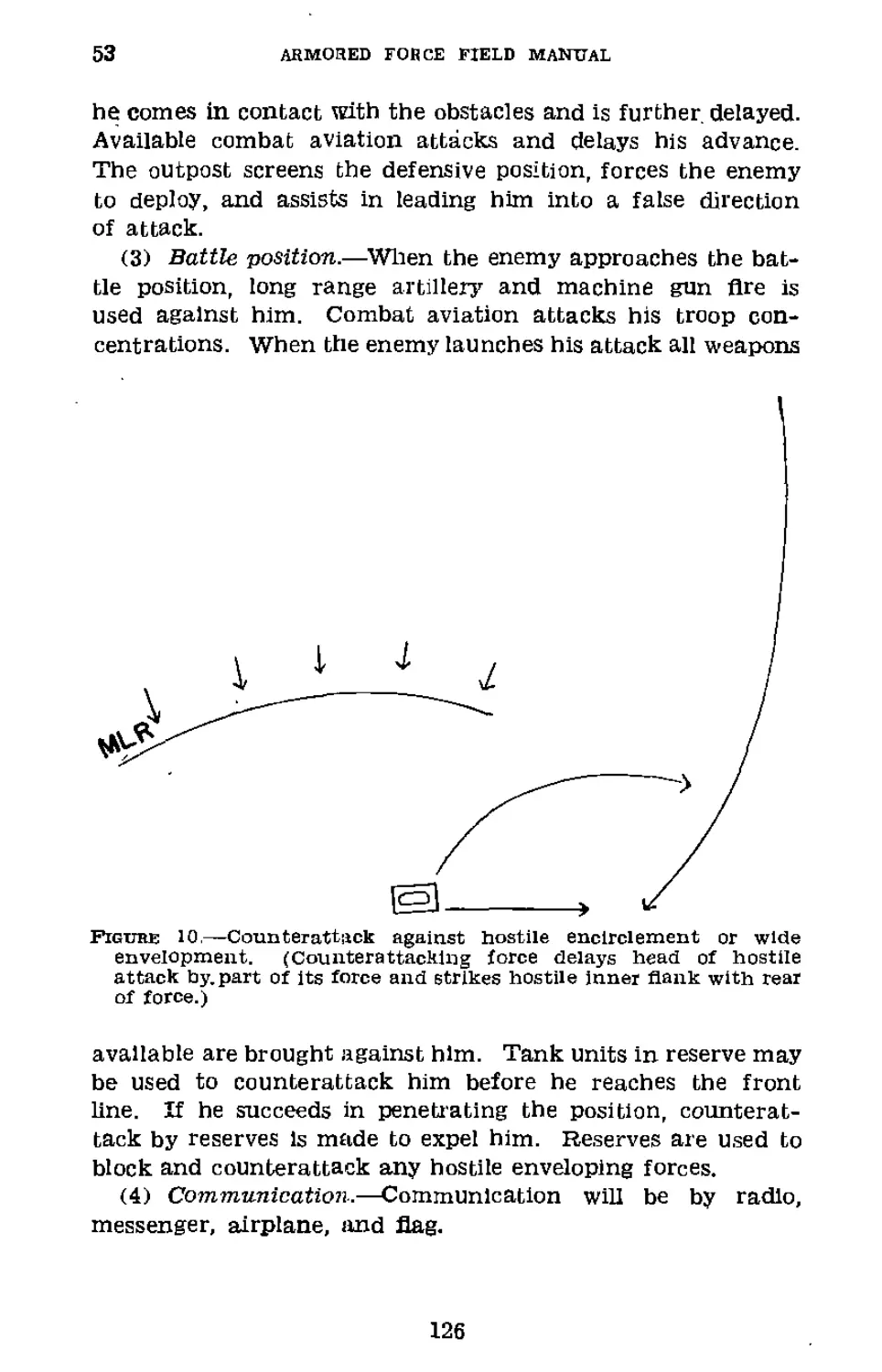




















































































































Теги: weapons military affairs
Год: 1942

Текст
                    FM 17-10
MHI
Copy 3
WAR DEPARTMENT
ARMORED FORCE FIELD
MANUAL
TACTICS AND TECHNIQUE
ii’fr, 1942 . ,
FM 17-10
ARMORED FORCE FIELD
MANUAL
TACTICS. AND TECHNIQUE
Prepared under direction of the
Chief of the Armored Force
united states
GOVERNMENT PRINTING OFFICE
WASHINGTON : 1942
For sale by the Superintendent of Documents, Washing'ton. D. C.
WAR DEPARTMENT,
Washington, March 7, 1942.
FM 17-10, Armored Force Field Manual, Tactics and Tech-
nique, is published for the information and guidance of all
concerned.
[A.G, 002.11 (7—11—40).]
By obdeb of the Secretary of War:
G. C. MARSHALL,
Chief of Staff.
Official :
J. A. ULIO,
Major General,
The Adjutant General.
Distribution :
D2, 7 (5) ; IR 2, 7 (5); Bn and H 17 (5); IBn 2, 5-10 (3) ;
C 17 (20) ; IC 2, 5-11 (5).
(For explanation of symbols, see FM 21-6.)
n
TABLE OF CONTENTS
Chapter i,	Doctrine and organization,	Paragraphs Page
Section I. General____________________________ 1—12	1
II.	Individual and unit	training___13-15	9
III.	Relation with other	arms___________16-24	11
Chapter 2.	Tactical employment.
Section I. General______________________________ 25-27	15
II, Reconnaissance____________________  28-31	20
1П. Security__________________________  32-45	30
IV.	Offensive combat-________________  46-51	85
V.	The defensive______________________ 52-56	120
VI.	Special operations_______________  57-64	133
Vll,	Marches__________________________  65-66	147
Chapter 3. Scouting and patrolling, mounted.
Section 1, General ______________________________  67	149
11. Mounted scouting_________________   60-70	149
Ill. Mounted patrolling_________________71-90	153
Chapter 4, Reconnaissance platoon and company,
armored.
Section 1. General____________________________91—99	163
II. Reconnaissance platoon___________ 100-109	166
111, Reconnaissance company___________110-118	185
Chapter 5. Armored company and armored bat-
talion, tank, light and medium.
Section I.	General__________________________119-133	192
II,	Individual tank_________________  134-136	190
III,	Tank section and platoon_______ 137-143	205
IV.	Tank company, light and	medium.	144-150	211
V.	Tank battalion, light and	medium.	151-167	226
Chapter e. Maintenance company, armored regi-
ment___________________________________________ 160-173	252
Chapter 7. The armored regiment.
Section 1. Armored regiment____________174—104	256
II. Tactical employment_____________ 105-193	262
III. General_______________________   194-197	274
Chapter 8. Reconnaissance battalion, armored,
Section I. General__________________________  196—206	277
II.	Reconnaissance.________________ 207-215	281
III,	Security__________________________   216	285
IV.	Movement.-.__________________    217-218	285
V.	Combat_____________________________ 219	287
VI.	Evacuation_________________________  220	288
VII.	Bivouac_____________________________ 221	289
VIII.	Supply and maintenance_____________ 222	209
Chapter 9. Headquarters company, armored.
Section I. General___________________________ 223-235	291
II. Headquarters and headquarters
company, armored battalion,
light and medium___________________ 236-241	303
HI. Headquarters and headquarters
company, armored regiment  242-248	306
IV. Headquarters and headquarters
company, reconnaissance bat-
talion____________________________ 249-254	308
HI
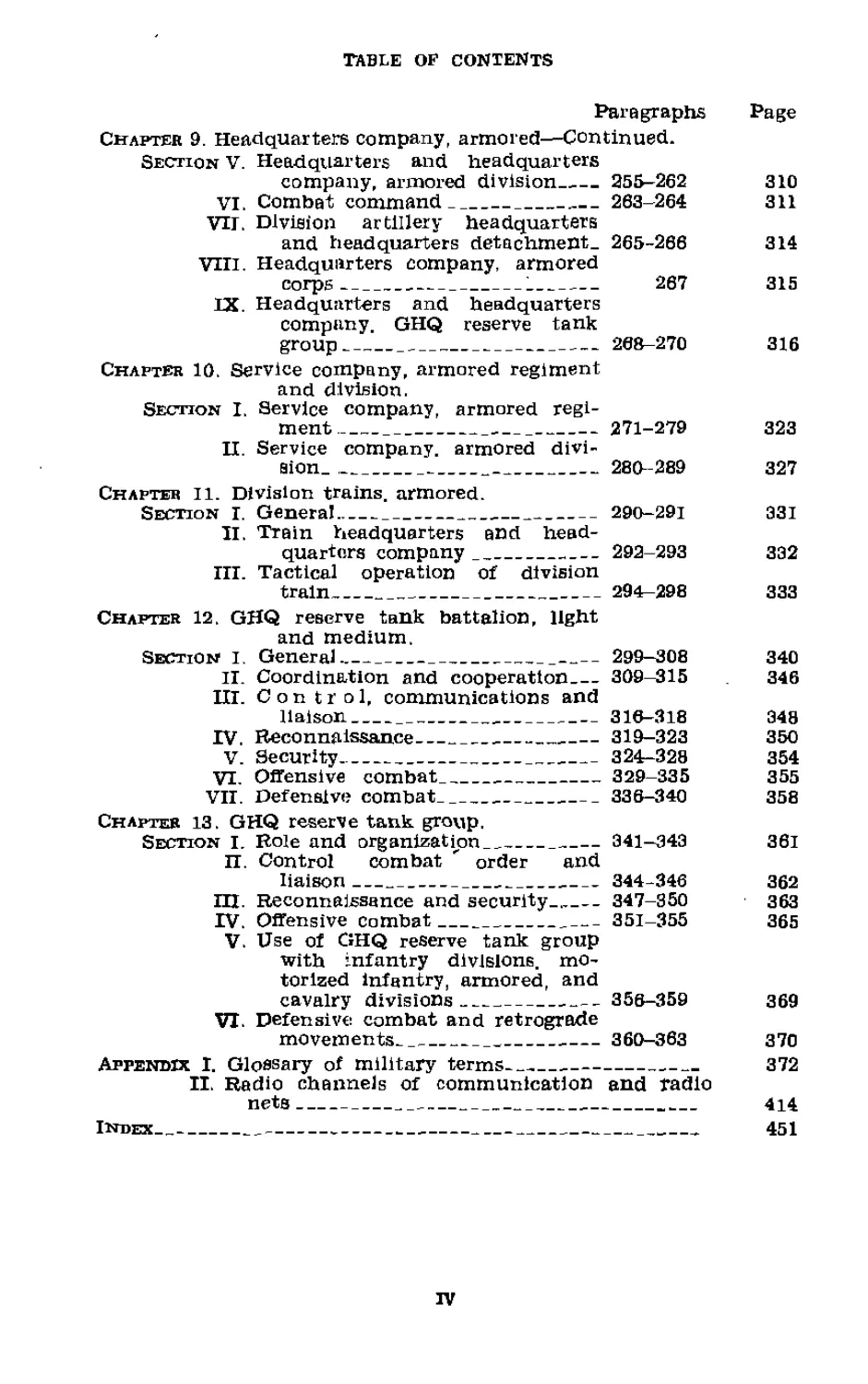
TABLE OF CONTENTS
Paragraphs Page
Chapter 9.	Headquarters company, armored—Continued.
Section V. Headquarters and headquarters
company, armored division________________ 255-262	310
VI.	Combat command.________________ 263-264	311
VII.	Division artillery headquarters
and headquarters detachment.	265-266	314
VIII.	Headquarters company, armored
corps _______________________:______	267	315
tx Headquarters and headquarters
company. GHQ reserve tank
group_____________________________268—270	316
Chapter 10.	Service company, armored regiment
and division.
Section I. Service company, armored regi-
ment___________________________________   271-279	323
П. Service company, armored divi-
sion. ___________________________   280-289	327
Chapter II.	Division trains, armored.
Section I.	Genera!________________________ 290-291	Э31
II. Train headquarters and head-
quarters company__________________ 292-293	ЗЭ2
III. Tactical operation of division
train______________________________ 294 298	333
Chapter 12.	GHQ reserve tank battalion, light
and medium.
Section I. General___________________      299—308	340
II.	Coordination and cooperation__ 309-315	346
III.	Control, communications and
liaison____________________________316-318	Э48
IV.	Reconnaissance_________________ 319-323	350
V.	Security______________________  324-328	354
VI.	Offensive combat_______________ 329-335	355
VII.	Defensive combat. ____________  336-340	358
Chapter 13.	GHQ reserve tank group.
Section I. Role and	organization__________Э41-Э4Э	361
П. Control combat ' order and
liaison__________________________  344-346	362
Ш. Reconnaissance and	security..___ 347-350	363
IV.	Offensive	combat______________  351-355	365
V.	Use of GHQ reserve tank group
with infantry divisions, mo-
torized Infantry, armored, and
cavalry divisions_________________ 356-359	369
VI.	Defensive combat and retrograde
movements.._______________________ 360-363	370
Appendix I.	Glossary	of military terms-------------------- 372
II. Radio channels of communication and radio
nets_____________________________________________   414
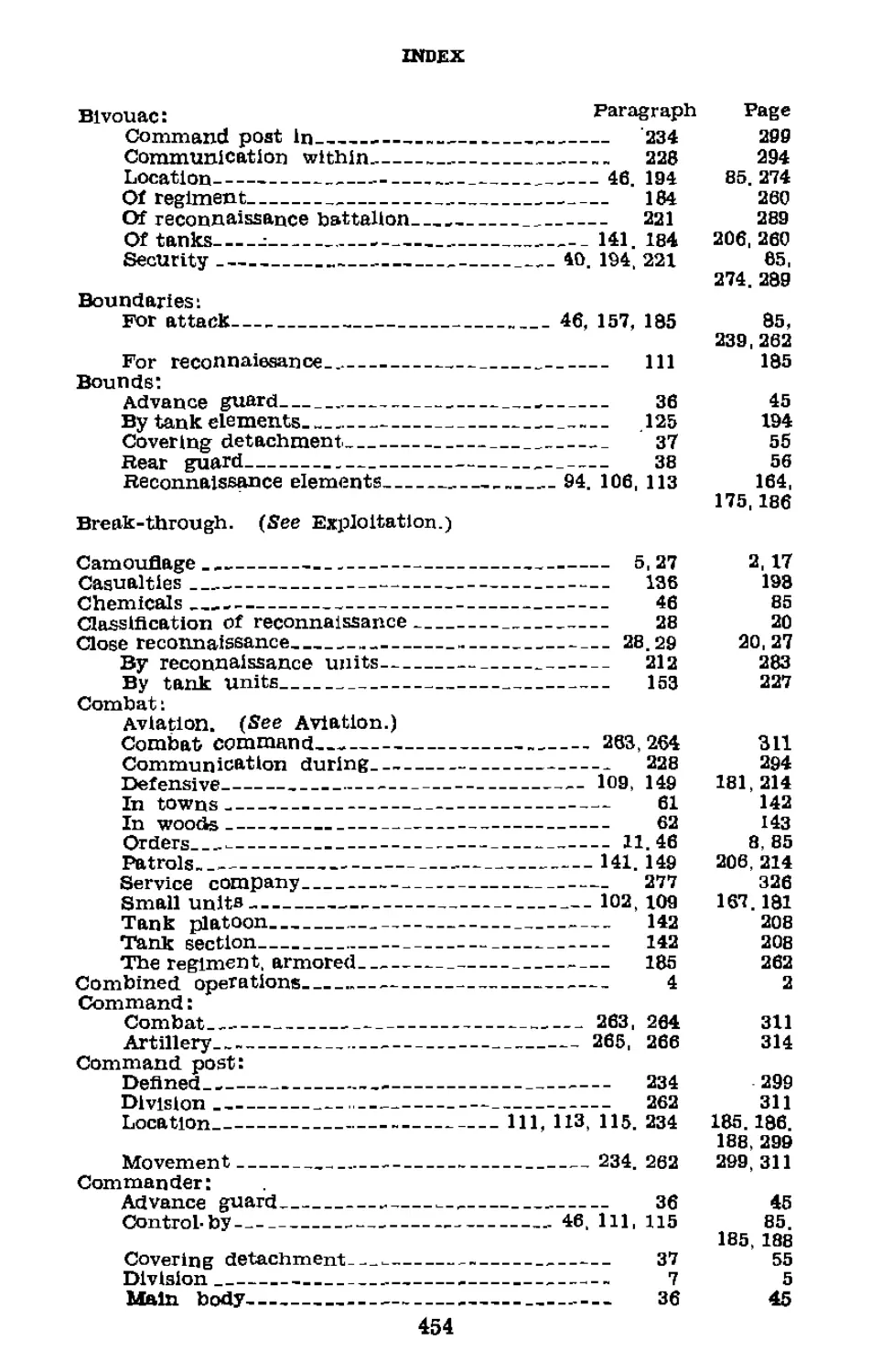
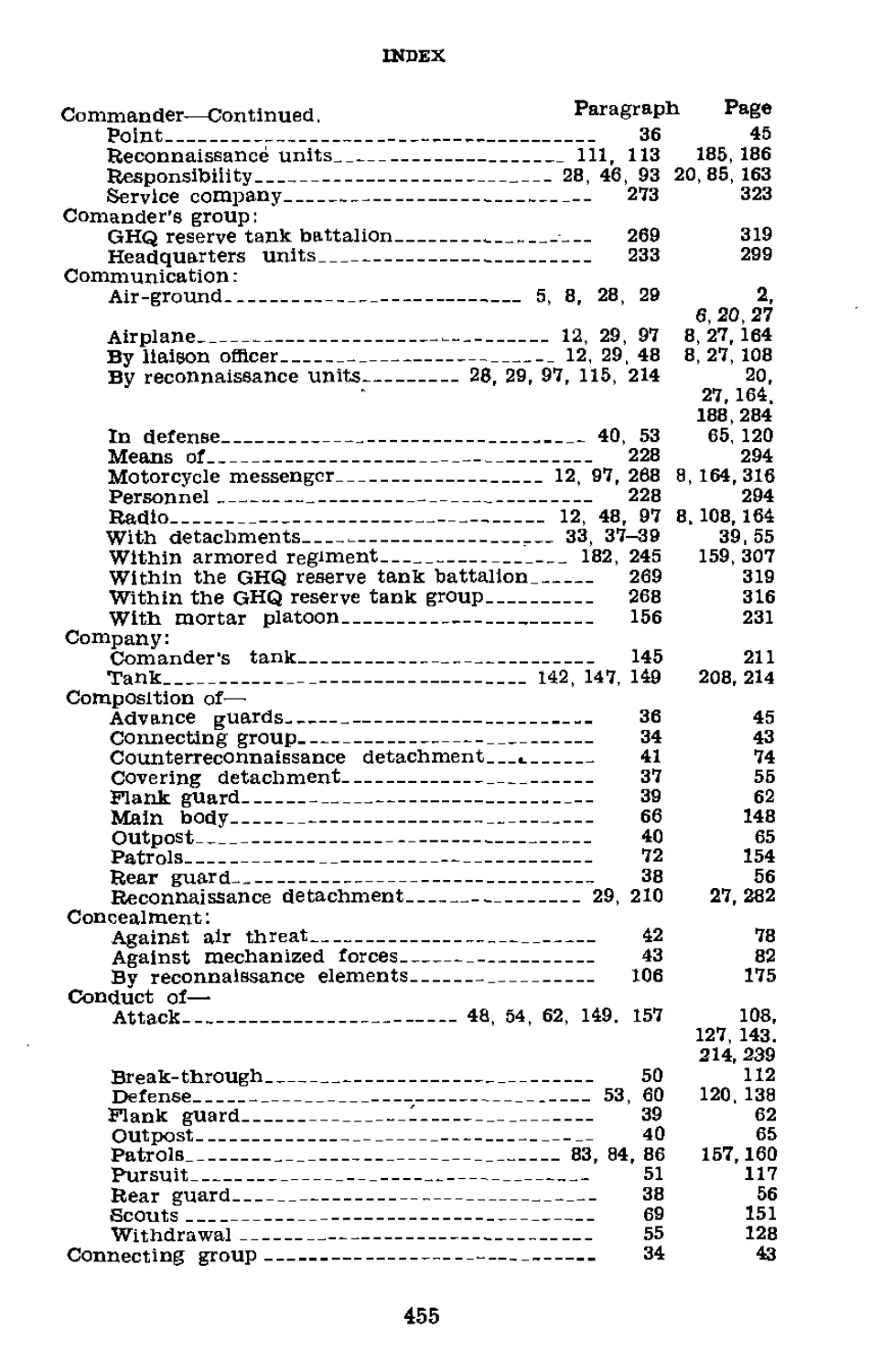
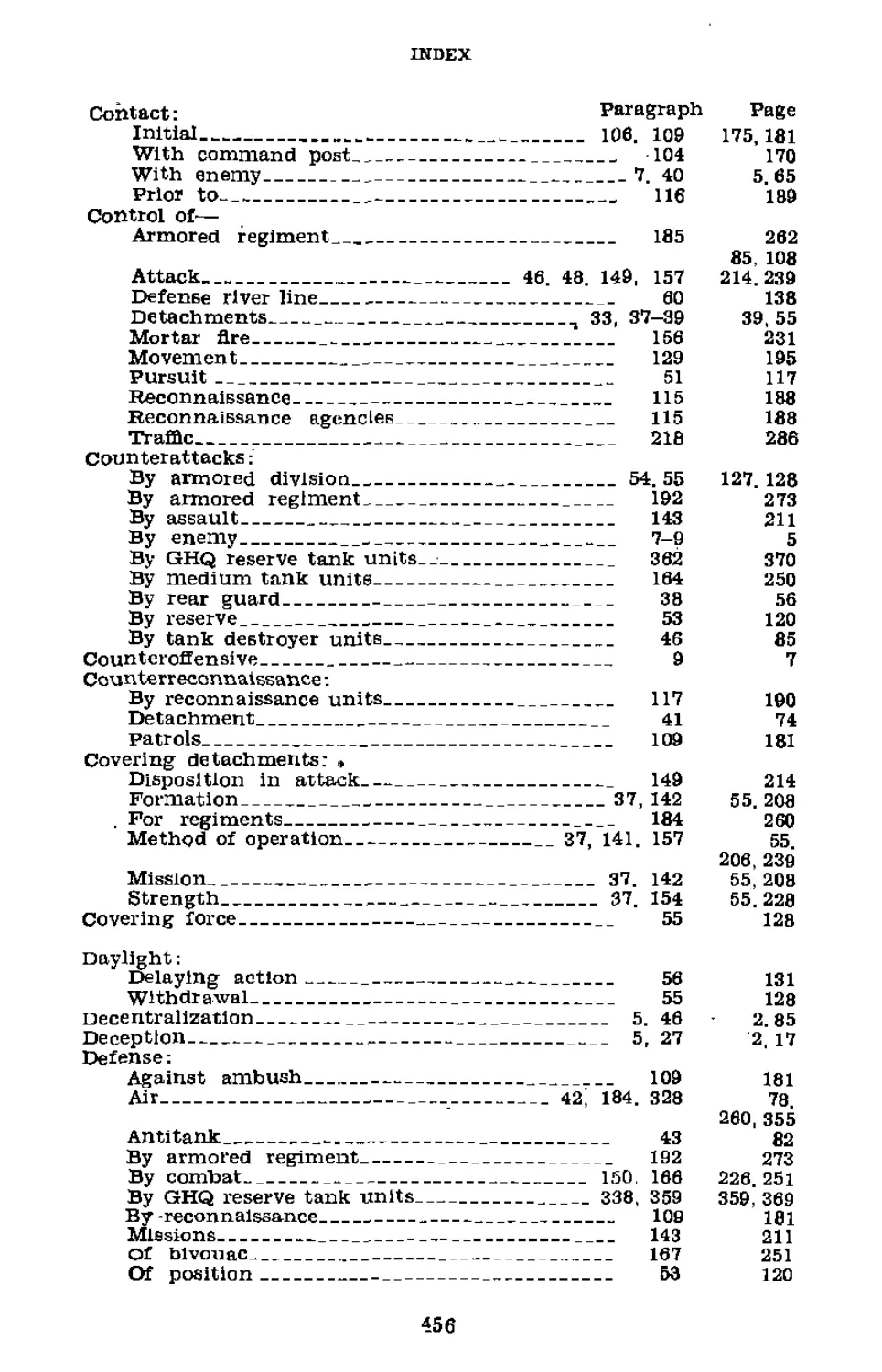
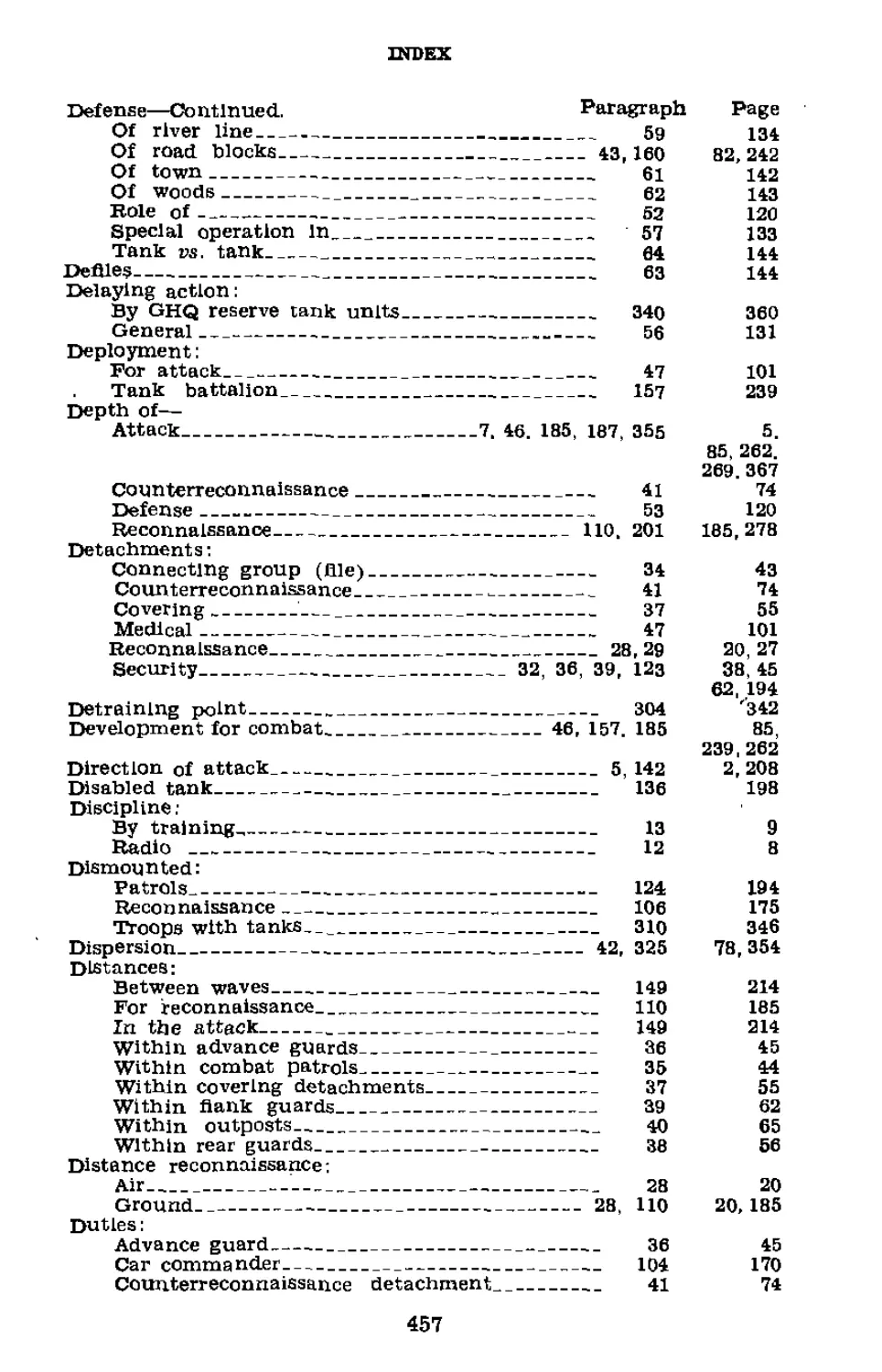
Index----------------------------------------------------   451
IV
FM 17-10
1-2
ARMORED FORCE FIELD MANUAL
TACTICS AND TECHNIQUE
CHAPTER 1
DOCTRINE AND ORGANIZATION
Paragraphs
Bection I. General_______________________________ 1-12
II. Individual and unit training__________13-15
III, Relation with other arms_____________16-24'
Section I
GENERAL
	1. Role.—The role of the Armored Force and Its com-
ponents is the conduct of highly mobile ground warfare, pri-
marily offensive in character, by self-sustaining units of great
power and mobility, composed of specially equipped troops
of the required arms and services. Combat elements of "the
Armored Force operate in close cooperation with combat avia-
tion and with large units of ground troops in the accomplish-
ment of a mission.
	2. Tactical Organization.—a. The Armored Force consists
of armored corps, armored divisions, and GHQ reserve tank
battalions. It is composed of troops from more than one arm
or service, transported in armored or other type motor
vehicles.
b.	The amored corps consists of a headquarters and head-
quarters company, two or more armored divisions, and certain
organic and auxiliary units termed corps troops.
c.	The armored division is a self-contained unit of the sev-
eral arms and services organized tactically and administra-
tively for independent action. It may be attached for
operation with an infantry or a cavalry corps.
d.	The GHQ reserve tank group contains a headquarters
and headquarters detachment and three GHQ reserve tank
battalions of either light or medium tanks or both.
1
2-5
ARMORED FORCE FIELD MANUAL
e.	The GHQ reserve battalions are self-contained units, of
either light or medium tanks, organized tactically and admin-
istratively for employment by battalion or by group to furnish
additional striking power to other ground forces including
amored divisions and corps. Trained as units, they are im-
mediately adaptable to inclusion in larger groupings of other
ground troops.
 3. Characteristics.—The characteristics of Armored Force
units are:
a.	Mobility.—All combat units are mounted in armored
motor vehicles.
b.	Fire power.—Through a multiplicity of weapons mounted
on the vehicles.
c.	Armor protection.—All combat vehicles are protected by
armor of varying thickness, capable of withstanding at least
rifle Are.
d.	Shock action.—Accomplished by the combination of the
other characteristics and by the weight and crushing power
of the major vehicles.
 4. Methods of Employing Elements of Armored Force.—
Operations of components of the Armored Force may, at
various times or simultaneously, involve—
a.	The attachment of GHQ tank battalions and groups to
infantry, cavalry, and armored divisions or corps.
b.	The grouping of armored divisions, corps, or GHQ tank
groups with other corps or Held armies for combined
operations.
c.	The employment, by the field or theater commander, of
armored divisions and corps on independent or semi-
independent missions without reinforcing logistical means, or
additional supporting troops other than combat and recon-
naissance aviation.
d.	Operation as task forces wherein armored divisions or
corps or, at times GHQ reserve tank units, are teamed with
motorized divisions, antitank battalions, antiaircraft auto-
matic weapons battalions, and GHQ engineer, maintenance,
and supply units, closely supported by combat aviation, para-
chute, and other troops transported by air.
 5. General Considerations.—Larger units of the Armored
Force properly utilized, either separately or in combination
2
TACTICS AND TECHNIQUE
5
with other means, can achieve rapid decisive results in the
area of employment. They are to be employed on decisive
missions. They must not be frittered away on unimportant
objectives. A mission far in advance of other main forces is
justified when the operation will obtain decisive results, but
must be closely supported by other equally mobile troops.
Their proper utilization necessitates a definite appreciation
and a careful consideration of the several characteristics of
the Armored Force units.
a.	The conditions which should exist or be created for their
successful action are air superiority in the decisive area of
employment, surprise, favorable terrain, and absence of or
neutralization of massed defensive means.
b.	The mobility of armored units permits great latitude in
the choice of direction and the method of attack. The de-
cision as to whether the attack will be executed as a turning
movement, envelopment, or penetration will be determined
largely by the time factor involved, by the terrain, and by
the hostile dispositions, including hostile rear installations.
The most suitable areas for the employment of Armored Force
units are on the open flanks or through existing gaps created
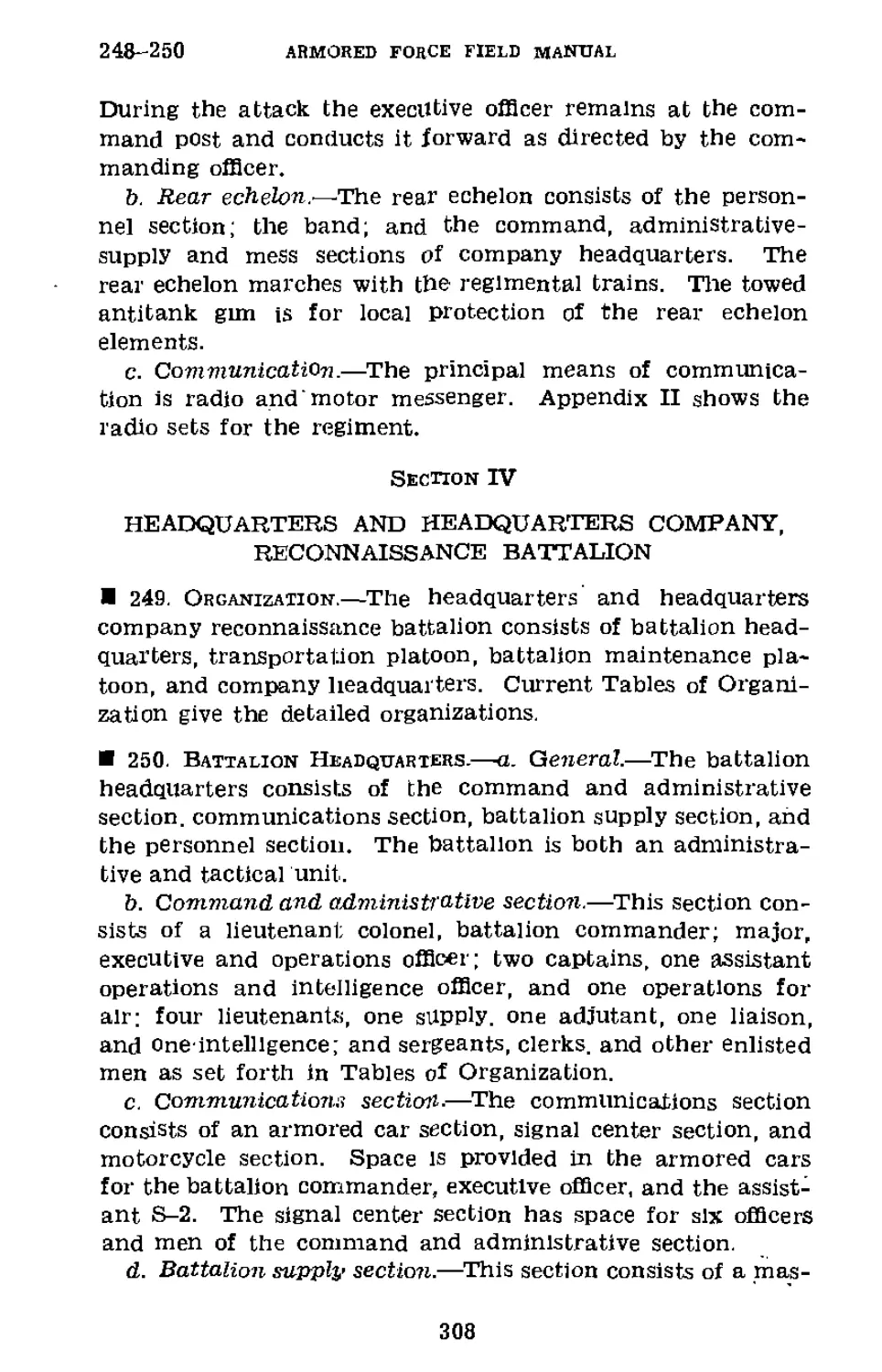
by penetrations of the enemy’s positions.
c.	The assignment of missions or objectives to armored
units must be preceded by a careful consideration of the more
important factors which affect the operation of the armored
and other units associated in the operations. These factors
are: weather, terrain throughout the entire area of contem-
plated operation, nature of the enemy and his methods of
combat, availability of other supporting troops, and especially,
adequate space and road net for the operation of the units
concerned. The axis of advance of the major armored and
motorized units will be along roads.
d.	The most decisive results will be gained from the group-
ing of overpowering masses of armored units and launching
them against vital objectives deep in the hostile rear. The
armored mass must be supported by sufficient means to main-
tain its momentum until the objective has been attained.
e.	The most effective and decisive application of the mo-
bility and power of large armored and motorized combina-
tions will often necessitate the decentralization of control to
the appropriate commanders who will be guided only by the
broad general plan of the higher headquarters. After the
3
5-6
ARMORED FORCE FIELD MANUAL
initiation of the operation, however, the superior commander
must keep the armored unit commanders constantly informed
of the situation.
/. The maximum development of the demoralizing power
of the larger armored formations will be dependent in a large
measure on the continuous support of adequate reconnaissance
and observation aviation, and timely assistance of combat
aviation in overcoming critical ground resistance beyond the
ability of available artillery, This should be assured by direct
arrangement between air and armored unit commanders and
by adequate air-ground signal communication nets. Higher
commanders can enhance the effectiveness of supporting
aviation by habitually assigning the same air and ground units
to work together as a task force or team.
g. The sustained mobility of armored and motorized units
is dependent upon adequate timely replenishment of required
supplies, especially fuel, and, to a lesser degree, oil and lubri-
cants, Regular vehicle maintenance must be continued.
When operations are to be prolonged for several days, it must
be appreciated that armored and motorized units must have
opportunity for daily maintenance.
h. Because of their mass employment, armored and motor-
ized units are difficult to conceal during approach and develop-
ment, Elaborate measures for deception and surprise will be
required often and may involve variously: advance stockage
and concealment of essential supplies; improvising and con-
centrating dummy armored vehicles or marked activity of
actual units in localities distant from that of contemplated
employment; extensive camouflage work; and rapid shifting
of armored masses to the area of decisive attack.
 6. A Task Force.—A task force is a temporary tactical
grouping composed of one or more arms or services formed
for a specific mission or operation. The operation of large
armored formations wiD frequently dictate the organization
of task forces. The composition of such forces will be decided
only after a careful estimate of the associated means which
will be required to accomplish the projected mission or opera-
tion. This estimate must consider the nature of the expected
resistance, the distance to which operations are projected, the
terrain to be traversed, and the troops available for the
operation. The additional means to be associated with
4
TACTICS AND TECHNIQUE
6-7
armored elements will vary with each situation but may
comprise appropriately: infantry divisions, foot or motorized
or components thereof; cavalry units; engineers; combat avia-
tion; parachuts troops; other troops transported by air; anti-
tank battalions; antiaircraft units; and additional main-
tenance and supply facilities, especially for GHQ groups.
 7. Methods of Operation.—a, Offensive operations of
armored units, acting either alone or as part of a combined
force, are characterized by rapid thrusts into vital parts
of the hostile rear followed by immediate exploitation to
complete enemy demoralization. Armored division com-
manders coordinate and control the movement of subordi-
nate units by appropriate assignment of routes, zones, ob-
jectives, or phase lines. Phase lines are prescribed only
when required to insure coordinated action or movement of
two or more units and must not involve prolonged halts
thereon. The attack is massed initially, but is extended
promptly in frontage and depth by the armored reconnais-
sance and combat elements after the hostile position is pene-
trated. As the’operation gains momentum, reconnaissance
agencies will precede combat elements at the earliest oppor-
tunity to seek out and develop soft spots through which com-
bat elements may pass rapidly. The more time allowed
for this reconnaissance, the more effective it will be. Con-
tact once gained must be maintained.
b.	Maximum advantage is taken of speed and terrain
barriers to prevent or neutralize enemy countermeasures.
Reconnaissance agencies provide information on which to
base security measures. Other combat detachments provide
immediate advance, flank, and rear security. Closely sup-
porting motorized units protect the immediate rear and lines
of communication of the armored elements. Other motor-
ized units should relieve the armored unit commanders of
concern for extended lines of communication and assure con-
tinuous logistical support. When armored units are oper-
ating as task forces, the security of the immediate supporting
motorized elements will be enhanced by their following the
armored combat elements as closely as possible.
c.	Following the advance of armored units, other elements
of task forces operate to overcome remaining hostile re-
sistance, occupy ground gained, keep gaps open, extend and
5
7-8
armored force field manual
protect the flanks, and relieve armored units temporarily
checked in ordei’ to permit their employment in a more
remunerative direction. Whenever practicable, other less
mobile troops will follow motorized task units as closely as
possible to wipe out the last vestige of resistance, meet
counterattacks, and relieve the more mobile elements for
close support of the armored units.
d.	In addition to establishing and maintaining local con-
trol of the air, supporting combat aviation is directed against
hostile antitank dispositions, artillery and reserves, espe-
cially armored, in the immediate zone of advance. Con-
currently, if available aviation suffices, it may be directed
against hostile command and supply installations, targets
of opportunity such as more distant reserves, and other
formed bodies of troops, especially armored units.
e.	In an envelopment, the support units of armored di-
visions and task forces may. when the situation demands,
attack or contain enemy elements on the flank while tank
units make the main attack.
/. Troops transported by air may be suitably employed in
advance of armored units to seize critical points or to create
opportunity for immediate exploitation by armored forces
operating alone or as task forces.
g. Highly organized areas should be avoided. Where their
attack is necessary, it will usually be advisable for other
specially equipped infantry and engineer troops to breach
the enemy defenses in advance or concurrently with the
advance of the armored units unless heavy tanks are avail-
able to lead the attack.
h. Against equal or superior hostile armored forces, friendly
armored units will avoid frontal assault and maneuver to cut
off or destroy armored units supply facilities, followed by
blows against the rear of enemy detachments.
 8. Exploitation and Pursuit.—a. Large armored formations,
operating separately or as part of task forces, are especially
suited for exploitation and pursuit. They should be launched
boldly against vital areas deep in the hostile rear. The
exploitation and pursuit phase must be anticipated to insure
that appropriate plans are made and timely orders issued in
all echelons. There must be no relaxing of pressure on the
shaken or beaten enemy. Objectives for armored units should
6
TACTICS AND TECHNIQUE
8-10
be those which will halt hostile rearward movement until less
mobile friendly troops can close with the enemy. Con-
currently, some armored elements operate to destroy, disrupt,
and paralyze enemy communication and supply.
b. Pursuit by large armored units, operating alone or as
major elements of. task forces, is rapid and continuous, even
during hours of darkness.
c. When the operations of armored units are likely to cany
them beyond practicable operating radius of organic supply
means, special provision must be made by the higher com-
manders to place necessary supplies within operating radius
of the units. Likewise, special arrangements must be made
by higher headquarters for rapid communication with the
widely dispersed elements of armored formations.
	9. Defensive Situations.—Large armored units, as part of
other major forces on the defensive, are held in readiness for
the counteroffensive or major counterattack. The employ-
ment of the armored units must be carefully timed and co-
ordinated with the attack objectives of the other forces.
Local air superiority during the period of the counteroffensive
or major counterattack is a prerequisite to success of the
operations. Usually the armored attack should be delivered
to disrupt the continuity of the hostile offensive and not
merely to restore the defensive position.
	10. Logistical Considerations.—a. Where prolonged opera-
tions of armored divisions and corps or GHQ tank units are
contemplated, adequate arrangements must be made by the
higher headquarters to insure timely replenishments of sup-
plies required by the armored units. Where the armored units
are required to operate at great distances from their base of
supply, when continuity of supply is interrupted by enemy
action, and in other emergency situations, delivery of urgent
supplies may be made by air.
b. Where several armored divisions or GHQ tank units are
under control of one headquarters, consideration should be
given to retaining one or more division or GHQ tank units in
reserve either for the purpose of extending combat opera-
tions or of relieving similar units to permit necessary main-
tenance and replacement operations. In this manner, con-
tinuity of the operation and necessary maintenance, rest, and
replacement will be assured.
7
11-12
ARMORED FORCE FIELD MANUAL
 1Г. "Orders.—a. Orders follow the general form prescribed
in FM 101-5. Mission type orders will be frequent. Warning
and fragmentary orders in the form of messages, overlays,
and oral instructions are freely used to give early instructions
to subordinates so they will have adequate time to make their
reconnaissance and prepare their plans. Orders of this
type, together with operation maps, aerial photographs, and
standing operating procedure will reduce the scope of orders
of execution to a minimum.
b. Save in the beginning of an operation, the use of formal
written orders will be exceptional. Orders will normally be
dictated or oral, and often fragmentary in units smaller than
the corps. All commanders must be trained not only to be
able to give brief clear oral orders but also to be able to act
intelligently on receipt of any such orders.
c. Orders for combat must be thoroughly understood by al]
subordinate commanders and their units. They must be
timely to permit necessary dissemination and reconnaissance
by various affected echelons.
 12. Communications.—a. The usual methods of communica-
tion used within armored units are visual signals, motorcycle
messengers, liaison officers, radio, and command airplanes.
&. Visual signals are used within the battalion and lower
units and between air and ground troops.
c. Motorcycle messengers are most efficient over short
distances and are used to a maximum to reduce the amount
of radio traffic.
d- Liaison officers are the most satisfactory means for
transmitting instructions where time is vital or the situation
is hazy. For qualifications and duties of liaison officers and
their methods, see FM 101-5.
e. Radio communication is available down to include
vehicle commander in platoons of armored units. In order
to derive the maximum use of this agency, strict radio
discipline is essential. Only essential sets are operated and
the maximum use is made of a simple system of prearranged
code messages.
/. Command and liaison airplanes are utilized to transmit
orders, overlays, and staff officers, when the situation
warrants.
8
TACTICS AND TECHNIQUE
13-14
Section П
INDIVIDUAL AND UNIT TRAINING
 13. The Soldier.—a. Man is the final and decisive element
in war. Victory is gained through the application of tech-
nique and employment of materiel by troops with high
morale, discipline, and the will to overcome al] obstacles to
attain their objectives. (See EM 21-50 and 21-100.) The
following requirements are essential in developing armored
units whose individuals are capable of superior performances
and confident of their ability to accomplish any mission
assigned.
b.	A high standard of individual training attained by
painstaking and meticulous attention to the smallest details
is necessary to make the soldier mechanically perfect in
handling his weapon, vehicle, and equipment, under all cir-
cumstances. Proficiency in these details may mean the
difference between success and failure of an operation and
life and death of the individual.
c.	Emphasis on calisthenics and other forms of physical
exercises is essential to develop the high degree of physical
fitness and stamina necessary for withstanding the pro-
longed strain of active campaign.
d.	Each individual must be kept constantly informed of
the purpose of training and of the tactical situation in which
he is engaged. Simulation of battle casualties among subor-
dinate leaders in combat training to allow the soldier to carry
out the mission of the combat team teaches him to accept
similar responsibility in actual warfare. Realism in train-
ing, including all field exercises, must be constantly stressed
by visualization of battle conditions and impressing upon
all the significance of such conditions.
e.	Every opportunity during training will be utilized to
create enthusiasm and interest, to stimulate alertness, pride
in personal appearance, sense of responsibility, and to develop
initiative and esprit de corps.
 14. The Leader.—a. The qualities of command leadership
must be developed to a high degree in all grades. The ability
to analyze situations basically and quickly, to reach sound
decisions, and to give expression thereto in concise and
clear orders will be developed in all leaders through frequent
tactical exercises.
9
14-15
ARMORED FORCE FIELD MANUAL
b.	Initiative must be demanded in all grades. Mental
alertness and aggressiveness, and ability to think, act, and
quickly take advantage , of tactical opportunities must be
developed to the highest degree. In the absence of orders,
each individual must use his judgment and act in accord-
ance with the tactical situation in furtherance of the general
mission.
c.	A sense of duty which subordinates personal considera-
tion to the welfare of the unit or group and a Will to accept
personal hazards and prolonged intensive effort in the execu-
tion of orders must be demanded.
d.	Leaders must always be well forward to receive early
information of the situation, make their estimate, announce
their decision, and issue orders personally to the subordinate
commanders.
e.	Leaders must understand and appreciate the thoughts
and problems of their troops. They must make every effort
to provide timely necessities, insure rest, and protect their
troops from unnecessary hazards.
/. Leaders must require strict and complete obedience and
demand the maximum measure of sacrifice from their units
when necessary to insure victory.
 15- The Unit.—a. The primary training objective of each
unit will be the early development of an efficient, hard-
striking unit which is prepared to take the field at short
notice, at existing strength, and capable of conducting com-
bined operations against an enemy equipped with modern
means of warfare.
b. Success in battle depends upon the coordinated employ-
ment of all available arms and technique applicable to the
situation. This coordination is only obtained through pains-
taking combined training of highly trained individuals and
units. Tactical flexibility is based on the ability to exact
definite and rigid standards of performance from individuals
and units committed to action.
c. Men are grouped into units with a view to their training
for and use in combat. Individuals constantly trained,
quartered, and fed together develop a feeling of solidarity,
which must be furthered by the greatest degree of perma-
nence being given to squad and platoon assignments. (See
FM 100-5.)'
10
TACTICS AND TECHNIQUE
16-17
SECTION П1
RELATION WITH OTHER ARMS
 16. Artillery.—a. The role of the artillery of armored
units, its characteristics, arid tactical and technical employ-
ment are given in FM 100-5 and 6-20.
b.	The division artillery composed of a headquarters ana
headquarters detachment and three artillery battalions of
105-mm howitzers is an organic part of each armored di-
vision. Each battalion has three firing batteries of six
105-mm howitzers each, a headquarters battery, and a seiwice
and ammunition battery. The.battalion normally furnishes
general support fires and may be attached to or support the
Infantry regiment in the execution of particular missions.
c.	Armored artillery is organized and equipped to facilitate
its employment in support of highly mobile units.
d.	Observers in radio-equipped armored vehicles accom-
pany supported units to obtain and adjust artillery fire. Air
observers supplement ground observation in the adjustment
of fire.
e.	Antiaircraft units, equipped with weapons suitable for
both air defense and antitank employment may be attached
to large armored force units to provide protection of routes,
particularly critical points, areas, and installations vital to
armored operations.
 17. Aviation.—a. The role of aviation attached to or oper-
ating in support of armored force units, its characteristics,
and tactical and technical employment are given in FM 1-5,
1-20, and 100-5.
b.	Corps headquarters contain an aviation section that acts
in an advisory and technical capacity for the corps com-
mander and coordinates operations of attached or supporting
obseiwation and combat aviation.
c.	(1) An observation squadron is attached to the armored
division. It is equipped both with airplanes of high speed
and sufficient range to reconnoiter the area essential to ar-
mored operations and with airplanes capable of operation
from advanced landing fields.
(2)	Observation aviation performs distant and battle re-
connaissance (including artillery adjustment), liaison, com-
mand, and photographic missions.
11
17-16
ARMORED FORCE FIELD MANUAL
d.	Combat aviation is made available by GHQ. It is em-
ployed against targets which cannot be engaged effectively
by available ground weapons within the time required and
supplements or extends the range of available artillery. Its
chief missions in support of large armored force units are:
(1)	Neutralization of hostile aviation.
(2)	Neutralization of enemy artillery.
(3)	Neutralization of hostile defensive installations, includ-
ing antitank.
(4)	Direct support of the attack.
(5)	Neutralization of counterattacks, especially of armored
units.
(6)	Destruction, harassing, or delaying of hostile concen-
trations, reinforcing, pursuing, or retreating forces, and rear
installations and centers of communication.
e.	Transport aviation will be furnished by GHQ for the
supply of elements of armored units when operating beyond
the sources of normal supply or when no land communica-
tions are available.
f.	Either parachute troops or air-borne troops may be
employed in conjunction with the operations of armored units
to secure terrain objectives on the routes of march or to seize
vital points in rear of the hostile front. They may establish
support groups and supply bases for a break-through.
 16. Chemical Troops.—a. Chemical regiments (motorized),
organically a part of GHQ reserve, are attached to armored
units for tactical employment as needed. For details of their
employment see FM 3-5 and 100-5.
b.	The armored corps headquarters includes a section of
chemical warfare personnel that acts in an advisory and
technical capacity in the planning, execution, and supervision
of gas defense measures and with decontamination, of
equipment.
c.	Chemical weapons within the division, intended princi-
pally for smoke missions, are the 81-mm and 60-mm mortar
subordinate units in the armored and infantry regiments.
d.	Smoke is employed to screen troop movements from
hostile observation, to reduce the effectiveness of hostile fire,
to protect a flank exposed to enfilade fire, and- to blind anti-
tank guns and machine gun nests. In defense it is employed
to blind hostile observation, cover a withdrawal, and aid in
counterattacks.
12
TACTICS AND TECHNIQUE
19-21
 19. Engineers.—a. The role of the engineers with armored
force units, its characteristics, and tactical and technical em-
ployment are given in FM 5-5 and 100-5.
b. An armored engineer battalion is an organic part of each
armored division. It includes four combat (pioneer) com-
panies and a bridge company. The latter is equipped with
assault boats, portable ferries, and ponton and steel bridge
equipage.
c. Their duties include: making bridge, water, road, and
bivouac reconnaissance; strengthening, repairing, and con-
structing bridges; providing means for crossing streams in
the presence of the enemy; reproduction and issue of maps;
establishing and operating watar supply points; removal of
or assisting in the passage of tank obstacles and mines; and
supervising and assisting in the construction of obstacles, and
preparation and execution of demolitions.
 20. Infantry.—a. The role of the infantry with armored
force units, its characteristics, and tactical and technical
employment are given in FM 100-5.
b. An armored infantry regiment is an organic part of each
armored division. Its combat element consists of three infan-
try battalions of three rifle companies each.
c. The infantry regiment may attack to drive in hostile
covering forces, to develop a situation, and to seize terrain
from which to launch the tank attack. It may follow closely
the tank attack to wipe out remaining hostile resistance, cover
the flanks of the division against a hostile threat, occupy and
hold ground gained, and cover the reorganization of the tank
units. It is used to establish bridgeheads and outposts. It is
employed in a similar manner to that prescribed for ths
infantry rifle regiment in FM 7-40.
Ж 21. Medical Service.—a. The role of medical troops with
armored force units and their employment are given in the
training regulations for that service. See FM 8-5 and para-
graph 47 this manual.
b. A medical battalion is an organic part of each armored
division. It includes three medical companies.
c. The medical company makes battlefield collection of
casualties and establishes collecting points for the division.
It is equipped for emergency surgery and first aid treatment.
439995°—-42----2
13
22-24
ARMORED FORCE FIELD MANUAL
 22. Ordnance Department.—a. The functions of the ord-
nance with armored force units and their employment are
given in FM 9-5.
b.	An ordnance battalion, maintenance, is an organic part
of each armored division. It includes three maintenance
companies.
c.	It provides spare parts for the upkeep of ordnance ma-
teriel throughout the division. It is capable of accomplishing
artillery, automotive, instrument, and small arms repairs as
well as ordnance vehicular maintenance. It establishes
divisional ammunition distributings or control points as
required.
d.	Heavy maintenance elements from GHQ reserve units
furnish similar services to a GHQ reserve tank group.
 23. Quartermaster Corps.—a. The functions of the quarter-
master troops with armored force units and their employment
are given in FM 10-5 and 100-5.
b.	A battalion is an organic part of each armored division.
It includes a headquarters company and two truck companies,
maintains a labor pool, and is the basis of the transportation
pool.
c.	It operates the division railhead and gasoline and oil
supply point.
d.	The truck company supplements the unit trains in trans-
porting and replenishing supplies, including ammunition.
 24, Signal Corps.—a. The role of signal troops with ar-
mored force units and their employment is set forth In
FM 11-17.
b.	A signal battalion and signal company are organic parts
of an armored corps and division respectively.
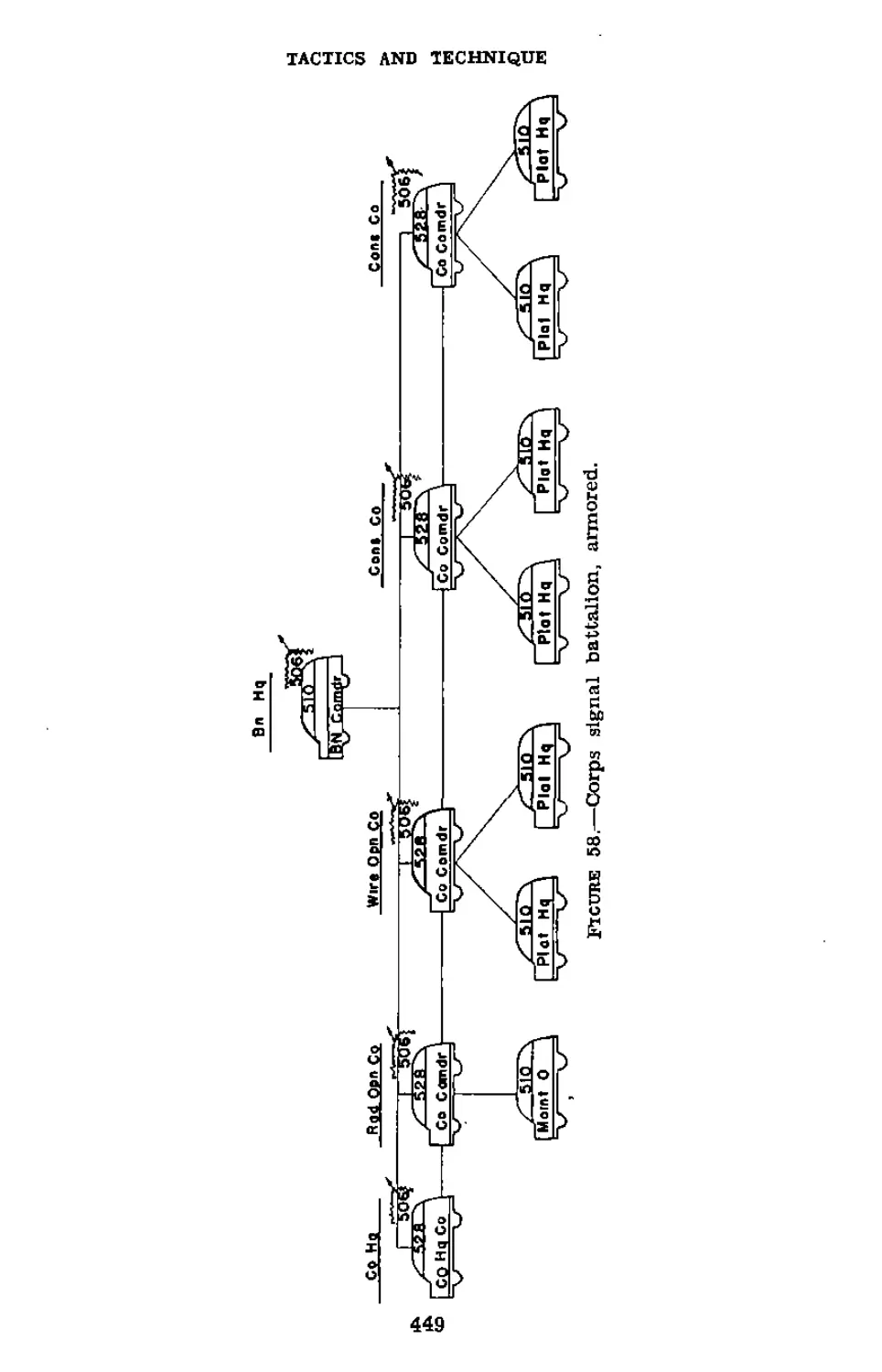
c.	The signal battalion includes a radio operation company,
a wire operation company, and two construction companies.
d.	The division signal company consists of a headquarters
platoon, an operating platoon, and a radio platoon.
e.	Within their respective units, they provide signal equip-
ment and parts and perform radio repair and maintenance.
They operate message centers and radios at the forward and
rear echelons of corps and division command posts. They
install, maintain, and operate telephones, telegraph, and tele-
graph printers.
14
TACTICS AND TECHNIQUE
25
CHAPTER 2
TACTICAL EMPLOYMENT
Paragraphs
Section I. General_____________________________________    25-27
II.	Reconnaissance________ ____________________    28-31
III.	Security ______________________________        32-45
IV.	Offensive combat_____________________________  46-51
V.	The defensive___________________________       52-56
VI.	Special operations_______________________      57-64
VII.	Marches________________________________________65-66
Section I
GENERAL
 25. General Doctrine.—a. The tactical employment of ar-
mored force units is based upon the doctrine set forth in
FM 100-5 and chapter 1 of this manual. Their character-
istics favor the striking of quick, hard blows.
b.	Armored units should be assigned missions which their
characteristics are designed to accomplish and, except in
emergencies, should not be assigned missions that other
available troops can perform satisfactorily.
c.	Since tanks furnish the striking power of armored units
it is necessary to understand and keep constantly in mind
their capabilities and limitations in the assignment of mis-
sions. (See ch. 5.)
d.	Tlie capabilities are—
(1)	High road speed: 35 to 40 mph.
(2)	Ability to move cross country at speeds up to 25 mph
in especially favorable terrain.
(3)	Ability to cross small obstacles, ditches, and shallow
streams.
(4)	Ability to pass through thin woods and brush.
(5)	Great fire power.
(6)	Crushing ability to overrun personnel, materiel, and
equipment.
(7)	Armor protection for crew.
e.	The limitations are—
(1)	Cannot cross deep or soft-bottomed streams, marshy
ground, or swamps.
(2)	Cannot cross wide ditches or other large obstacles.
15
25-26
ARMORED FORCE FIELD MANUAL
(3)	Cannot pass through dense woods.
(4)	Heavier vehicles must avoid roads having bridges and
culverts of light construction.
(5)	Operations in mountainous country are generally lim-
ited to roads.
(6)	observation and control is difficult when vehicles are
operated with all ports and doors closed.
(7)	Vulnerable to fire of artillery and antitank weapons.
(8)	Noise of engines indicates the presence of tanks which
may affect the element of surprise.
(9)	Fire from moving vehicles is limited in its casualty
effect.
(10)	Difficulty of fuel and ammunition supply.
(11)	Necessity for periodic maintenance.
 26. Terrain and Weather.—a. The terrain exercises an
important and often decisive Influence in tactical situations.
It may be the determining factor in the decision to employ
armored units on a specified mission or not. Generally the
terrain will determine the tactical form of an attack and the
ground over which the main attack will be launched.
b.	A thorough appreciation of terrain and its effect on
operations is essential to the proper command and employ-
ment of al] armored units. Areas most favorable for their
employment are determined from: the study of maps, recon-
naissance agencies, higher and adjacent units, troops already
in contact with the enemy, and personal reconnaissance by
the leader or his staff.
c.	Gently rolling, open terrain with occasional lightly
wooded areas, affording some cover and facilities for observa-
tion, is the most favorable for operations of armored units.
Desirable terrain is that which provides covered routes of
approach, positions for supporting units, and permits the
maximum use of the speed and maneuverability of armored
vehicles.
d.	Terrain broken by natural obstacles, such as unfordable
streams, ravines, or streams with steep banks, marshes, cliffs,
dense woods, closely spaced boulders or stumps, forces ar-
mored units either to make long detours, or follow canalized
routes, limiting their maneuverability, choice of direction,
and method of attack.
e.	Rough, hilly, or mountainous terrain reduces the speed
16
TACTICS and TECHNIQUE
26-27
of armored troops to almost that of dismounted troops, or
else restricts their movements to roads. Armored troops
when restricted to roads and defiles, unless frequent “turn-
arounds” are available, are particularly vulnerable to attack
by hostile aircraft and to antitank weapons.
f.	Armored units avoid defended towns or cities when pos-
sible except when they can be surprised. Such localities
are attacked by motorized infantry or other closely following
troops.
g.	Unfavorable weather may materially affect operations
of armored force units. Rain, mud, ice, and snow may im-
pede, limit, or prevent the employment of armored units.
Extremes of temperature adversely affect both materiel and
personnel. However, inclement weather may prove advan-
tageous to the troops inured to hardships.
 27. Covek and Concealment.—a. The discovery of unusual
numbers of tank units in a given area is an indication of
a probable major operation in that vicinity. The conceal-
ment of vehicles, therefore, is important at all times, par-
ticularly from aerial observation and photography. Partial
concealment is of little or no value. Every practicable effort
must be made to provide complete concealment.
b.	Camouflage is work done to provide concealment of
materiel, troops, or military works from enemy air or ground
observers. To be effective, camouflage must be supervised by
personnel thoroughly familiar with its principles and methods.
The means employed are nets, paulins, paint, earth, branches,
and grass. The fundamental rules of camouflage are covered
in detail in FM 5-20 and 21-45.
c.	Personnel of armored units must be thoroughly in-
structed in the use of natural means of camouflage available
and be required to apply habitually these means to conceal
themselves and vehicles.
d.	The following rules governing concealment should be
known and understood by all:
(1)	Natural concealment should be sought before resorting
to camouflage; It is simpler, requires less time, skill, and
material, and is more effective. Concealment of bivouacs
is much simpler in woods and villages than in the open.
Vehicles are best concealed by placing them under heavy
natural cover as in dense woods. In partly open country,
17
27
ARMORED FORCE FIELD MANUAL
they should be driven into thin woods or clumps of trees or
brush.
(2)	Camouflage should not be overdone. A small amount
of material, judiciously employed, is frequently more effective
than a mass of material. Branches of trees, brush, weeds,
leaves, grass, or dirt are usually available to cover tents and
vehicles that are partially or wholly exposed. Irregular
patches of different material are better than solid blankets
of any one kind.
(3)	The worst enemies of concealment are straight lines,
regularity of pattern, angles, and shadows. Therefore, in-
genuity must be exercised to change or break the outline or
regularity of the pattern of the object being camouflaged.
Shelter tents in bivouacs, and vehicles in parks or assembly
areas should always be placed in scattered, irregular forma-
tions.
(4)	An aerial observer cannot see an object within a
shadow; neither will an aerial photograph of the locality
reveal it. Even a partial shadow crossing the object makes
recognition difficult from the air. Therefore, natural con-
cealment can be obtained by halting vehicles within shadows.
(5)	Care should be taken that track imprints do not
disclose the location of vehicles. Tracks may be obliterated
by covering them with brush, leaves, or dirt, or by dragging
over them with branches or some other means. The enemy
may be further deceived by running one or more vehicles
beyond the true entrance to the area and obliterating the
actual entrance. In entering woods, fewer tracks will have
to be obliterated if vehicles enter in column and scatter after
getting under cover. Also,  in dense woods, care should be
taken not to knock down any more trees than absolutely
necessary and then straighten up those that have been
knocked down.
(6)	Making paths within bivouac to concealed vehicles
should be avoided, unless such paths are concealed from air
observation.
(7)	When foliage is used to cover vehicles and other equip-
ment, it should be renewed daily. Wilted leaves 'and
branches will appear different in color from natural sur-
roundings when observed or photographed from the air.
Care should also be taken in gathering natural camouflage,
to avoid denuding the ground in the immediate vicinity of
18
TACTICS and TECHNIQUE
27
the object being camouflaged. Fresh dirt should be cov-
ered with brush, leaves, or grass.
(8)	No rubbish of any kind should be allowed to accumu-
late about a bivouac.
(9)	Fire or smoke should not be permitted near vehicles,
(10)	Ruins provide one of the best means of concealment.
(11)	At night necessary lights are concealed.
(12)	If natural concealment is not available, vehicles
halted in the open should seek very broken ground, folds in
the ground, etc. • Natural or artificial means available should
be used to disguise their characteristic profile.
(13)	Bright or shining parts of material should be cov-
ered with mud or grease.
e. Concealment in snow is much more difficult than at
other times. The following points should be kept in mind:
Trails get tracked with mud and melt out early, leaving a
black line; snow falls through camouflage material and the
holes show dark; the heat of engines and of kitchen ranges
cause early melting of snow. This can be remedied by keep-
ing activity at a minimum when snow first falls; and by
covering trails, vehicles, etc., with fresh snow, replacing it
as often as needed.
f. The noise of running engines, particularly those of
tanks, can be heard at a considerable distance and will dis-
close the presence of concealed tanks to ground observers.
Engines, therefore, should always be stopped as soon as ve-
hicles have been placed under cover or concealed. This
should likewise be done whenever practicable, as a means
of conserving fuel.
p. The following precautions should be observed while
moving to attack or in close proximity to the enemy:
(1)	Use all available natural cover, whether stationary or
moving.
(2)	Halt preferably under trees, in thickets, or in the
shadow of buildings or trees. -
(3)	Choose routes of approach which provide the most
cover and concealment, such as ravines, draws, gulleys, or
folds in the ground; avoid skylines.
(4)	Avoid bottoms where vehicles may be bogged down,
and clumps of bushes where sink holes, stumps, etc., may be
encountered.	;
(5)	Avoid dense woods; travel along .the edges.
19
27-28
ARMORED FORCE FIELD MANUAL
(6)	Approach the crests of hills and ridges slowly and
look over.
(7)	Avoid crossing ridge lines; back down and go around
if possible.
(8)	If forced to cross over open ground or ridges, move
speedily.
(9)	When under observation, avoid halting and exposing
personnel or tops of vehicles.
(10)	Avoid massing of vehicles.
(11)	Avoid following the tracks of preceding vehicles when
passing over soft ground, stream crossings, ditches, or similar
obe taeles.
(12)	If time permits, and if considered essential, obliterate
tank tracks by dragging suitable objects over them.
(13)	When approaching the enemy, if the presence of tank
units has been disclosed, deception as to direction of attack
and numbers of vehicles may be obtained by running several
tanks back and forth off to a flank.
Section II
RECONNAISSANCE
 28. General.—a. The purpose of reconnaissance is to gain
information upon which to base strategical maneuvers or
tactical operations.
b.	Information desired may be of the enemy or of the ter-
rain. Information concerning the enemy may include his
location, disposition, strength, organization, capabilities,
movements, attitude, equipment, and morale. Information
concerning the terrain may include character of roads,
streams, cover and concealment, positions, bivouac areas, and
suitable areas for employment of obstacles.
c.	Responsibility.—The commander of each unit is responsi-
ble for maintaining reconnaissance for information that influ-
ences his own operations, or which is required of him by the
higher commander. The detailed preparation of plans and
orders for reconnaissance is the function of the staff. Plans
for the employment of armored force units should be based
on the most careful and detailed reconnaissance practicable
in the time available. Every effort must be made to obtain
the information of greatest importance, i. e., the essential
elements of information.
20
TACTICS AND TECHNIQUE
28
d.	Essential elements of information.—(1) (See FM 30-5.)
The essential elements of information are those which the
commander deems necessary or highly desirable to;
(a)	Make a sound decision.
(b)	Conduct a maneuver.
(c)	Avoid surprise.
(d)	Form details of a plan of operation.
(e)	Permit him to revise or make a new decision.
(/) Accomplish his mission.
(2) To obtain this information, reconnaissance missions
should be expressed in specific questions stating the informa-
tion desired such as:
(a)	Enemy.
Does the enemy occupy ---------- position? If so, in what
strength? What are his approximate dispositions?
Where is the enemy’s reserve?
What is the strength and location of the enemy’s advanced
columns?
What supporting weapons does the enemy have?
(b)	Terrain.
Are certain roads passable for all armored vehicles?
Are certain bridges intact? What is their capacity?
Are certain terrain features capable of defense by hostile
or friendly troops?
Are obstacles present which affect the plan of attack or
defense?
e.	Routine information.—In addition to the essential ele-
ments of information prescribed by the commander, ground
reconnaissance units obtain and report, at specified times or
at most practicable time, as a matter of routine without addi-
tional orders and in conjunction with the execution of specific
missions, information covering the following items:
(1)	Route and bridges.—Type, condition, load, and traffic
capabilities.
(2)	Landing fields.—Location and suitability.
(3)	Utilities (water, sewage, electric power, communica-
tion, railroads, docks).—Condition, and repair necessary.
(4)	Supplies.—Amounts, location, type, and condition, par-
ticularly fuel, lubricants, and food.
(5)	Prepared obstacles, demolitions, mines, and contami~
nated areas.—Location, extent, means of avoiding.
(6)	A continuing brief estimate of terrain.—Fordability of
21
28
ARMORED FORCE FIELD MANUAL
streams; marshy and wooded areas; clear areas suitable for
tank employment; areas unsuited for tank employment;
commanding terrain; cover and concealment.
(7)	Hostile aircraft.—Number of, location, time, type, alti-
tude, direction of flight.
(8)	Hostile ground forces.—Location and time of all hostile
contacts giving strength, composition, and movements, with
particular' attention to location and movements of hostile
mechanized forces.
(9)	Friendly troops and miscellaneous.—Includes friendly
troops within the sphere of action of the reconnaissance unit
and other intelligence data not included in other items per-
tinent to the operation, such as weather, visibility, etc.
f.	Sources of information.—The sources of information are
varied and include reports from reconnaissance agencies,
actual observation of terrain or physical objects, informa-
tion or intelligence reports procured from other units, exami-
nation of inhabitants, prisoners, documents, aerial photo-
graphs, maps, spies, or identifications, and summaries from
higher and lower echelons.
g.	Reconnaissance agencies.—(1) The execution of the
commander’s plan for reconnaissance is the task of the re-
connaissance agencies. The reconnaissance agencies and
personnel available to the armored division and its elements
are:
(a)	The attached obeervation squadron.
(b)	The division reconnaissance battalion, which includes
three armored reconnaissance companies and a light armored
(tank) company.
(c)	An armored reconnaissance company in each armored
(tank) regiment.
(d)	The reconnaissance platoon in the headquarters com-
pany, engineer battalion, and reconnaissance and liaison
section in each engineer company.
(e)	The personal reconnaissance by the commander, staff
officers, and subordinate commanders.
(/) Artillery reconnaissance elements.
(gr) Scouts and patrols.
(2)	The reconnaissance agencies and personnel available
to the GHQ reserve tank groups and battalions are:
(a)	Reconnaissance platoon in the group and battalion
headquarters companies.
22
TACTICS AND TECHNIQUE
28
(b)	Personal reconnaissance by the commander, staff
officers, and subordinate commanders.
(c)	Scouts and patrols.
h. Classification.—Reconnaissance is usually classified in
accordance with the location of the objective and the phase of
operations as distant, close, or battle reconnaissance.
(1)	Distant reconnaissance is the function of the aviation
and the division reconnaissance battalion. It seeks to locate
the advanced elements of the enemy forces, and maintain con-
tact with them. It procures the information upon which the
strategical and operative decisions and the plans of the high
command are based. Distant reconnaissance is dealt with
in FM 100-5.
(2)	Close reconnaissance is the function of the regimental
reconnaissance companies. It seeks to gain more detailed
information for tactical operation, such as the location,
strength, composition, and movements of the enemy and a
reconnaissance of the terrain.
(3)	Battle reconnaissance is a function of all echelons of
the command and must be continuous. It includes observa-
tion of all enemy forces engaged in the action and those whose
contact with our principal forces is imminent. Both air and
ground troops should seek the location of hostile flanks,
changes in hostile dispositions, location of hostile artillery,
movement of hostile reserves, preparation for countarattacks,
and indications of a withdrawal.
i.	Plans for the employment of tank units require, in ad-
dition to the usual classes of reconnaissance, a special type
of battle or tank reconnaissance to determine when, where,
and how tanks can best be employed. Tank reconnaissance
is of particular importance to all commanders of tank units.
It is always made prior to an Operation and when possible
before oiUers are issued. Information may be obtained by the
regular reconnaissance agencies, but will normaDy be obtained
by personal reconnaissance or by scouts or patrols dispatched
from the tank units in the area over which tanks are to
operate. Information of this type must be obtained by GHQ
reserve tank battalions when attached to cavalry or infantry
divisions.
j.	Reconnaissance in force.--When hostile resistance is en-
countered which cannot be brushed aside, flanked, or out-
flanked by the reconnaissance agencies, a reconnaissance in
23
28
ARMORED FORCE FIELD MANUAL
force may constitute the best method of clearing up an un-
certain situation. Troops assigned to this mission may vary
in strength from an armored (tank) company to a reinforced
armored regiment, but must be sufficiently strong to accom-
plish the mission. Their action will usually consist of a local
attack on a limited objective. The commander who orders a
reconnaissance in force must consider the possibility that his
intentions or those of the higher commander may thereby
be disclosed. He must also be prepared for the eventuality of
the reconnaissance in force bringing on a general engagement.
k.	Zones, routes, and localities.—(1) To avoid duplication
of effort, reconnaissance agencies must be assigned a zone, an
axis or route, or a locality or area for reconnaissance. The
boundaries thereof are not to be construed as limiting the
movements of the units, but rather as definite guides as to
areas of responsibility for reconnaissance. The maximum
liberty of movement that the situation warrants should be
allowed.
(2)	When the enemy is disposed on a broad front, or
when his location is in doubt, a zone of reconnaissance may
be assigned. Factors to be considered in determining the
width of the zone of action are the terrain; the road net;
strength of forces to be employed; strength, disposition, and
activity of the enemy; facilities for communication; and the
time available.
(3)	When information indicates the enemy’s advance is
by a definite route (or routes), a route (or routes) for recon-
naissance is generally designated.
(4)	When accurate information has disclosed the presence
of the enemy in a definite area, then that locality or area
is assigned for reconnaissance.
(5)	In large forces, such as a division or larger, a recon-
naissance line is designated marking the limit of reconnais-
sance between the higher and lower unit. The subordinate
unit reconnoiters outward to this line, the superior unit be-
yond it. Either may cross the line if necessary. During
an advance, the reconnaissance line is advanced from day
to day so that prior to the commencement of each march
stage, reconnaissance by the division has explored in advance
to a distance equal to at least a day’s march.
(6)	Advance of reconnaissance elements will be regulated
by designation of successive phase lines or objectives which
24
TACTICS AND TECHNIQUE
28
may be crossed or passed only on orders or in accordance with
a time schedule. Lateral communications between reconnais-
sance elements is maintained by contact, normally on phase
lines, or at designated objectives.
(7)	Reconnaissance phase lines should include easily iden-
tified terrain features such as roads, streams, railroads, or
towns.
(8)	Observation aviation should know in advance the limits
of reconnaissance for the reconnaissance battalion and the
route of the battalion command post.
I. Coordination.—The commander coordinates the employ-
ment of reconnaissance agencies at his disposal. He regu-
lates their employment in such manner that they will
supplement and assist one another. Duplication of effort
is avoided by the assignment of reconnaissance missions and
objectives and by informing subordinates concerning recon-
naissance to be executed by agencies of other commanders.
m. Aggressiveness.—Reconnaissance agencies must be active
and aggressive. Such missions generally require secrecy of
movement. As a rule combat is avoided which is not neces-
sary for gaining essential ’information. Essential informa-
tion can frequently be obtained only through attack. Re-
connaissance units do not hesitate to attack when their
mission requires it.
n. Reserves.—Commanders initiating reconnaissance should
arrange for reserve reconnaissance elements which can be
employed to reinforce or extend reconnaissance to the front
or flanks.
o. Communications.-—(1) To insure the prompt and reliable
transmission of the results of reconnaissance, the com-
mander must regulate the establishment and maintenance of
signal communication, including the coordination of com-
munication to be used between air and ground reconnaissance
agencies. When there is danger of hostile interception he
may sharply restrict or prohibit the use of radio In the Interest
of secrecy.
(2) in the employment of ground reconnaissance agencies,
the distance they are sent out, and the front to be covered,
consideration must be given to the sending range of radios.
Frequently reconnaissance units, particularly divisional re-
connaissance, will be out beyond direct radio communication
with their commanders. Under such circumstances informa-
25
26
armored force field manual
tion will have to be transmitted by airplane through pick-up
messages, or relayed by radio through air-ground nets or
reconnaissance nets of lower units.
(a)	A liaison type airplane working with the division recon-
naissance, if practicable, will speed up transmission without
interfering with missions of other agencies or utilizing their
radio sets which are needed for transmitting information
that they have obtained.
(b)	Shuttling of command cars until they are within radio
range, or even dispatching motorcycle messengers, may be
used as expedients, but have obvious disadvantages. Motor-
cycle messengers may, however, be utilized expeditiously for
short distances between elements of the divisional or regi-
mental reconnaissance units.
(c)	Provision should be made in the regimental reconnais-
sance unit for listening in on the divisional reconnaissance
net.
p. Instructions.—(1) Instructions for the execution of re-
connaissance in large units may be issued in the form of an
intelligence annex (see FM 30-5 and 101-5). In small units
they may be included in the field order or be Issued separately,
in complete or fragmentary form, as instructions for recon-
naissance.
(2)	Instructions to reconnaissance agencies should include,
in addition to the mission and essential elements of informa-
tion, the following:
(a)	Time of departure.
(b)	Zone, areas, or route.
(c)	Objectives and time to be reached.
(d)	Duration.
(e)	Reconnaissance phase lines and time to be crossed.
(/) Instructions concerning adjacent reconnaissance units.
(g) Instruction for the transmission of reports, or time
reports are desired.
(Л) Instructions about communication with observation
aviation.
(i) Time of departure, route, and objectives of main force.
(3) In the absence of instructions, each unit executes the
reconnaissance necessary to its own operations within its own
zone of action and toward any exposed flanks.
26
TACTICS AND TECHNIQUE
29
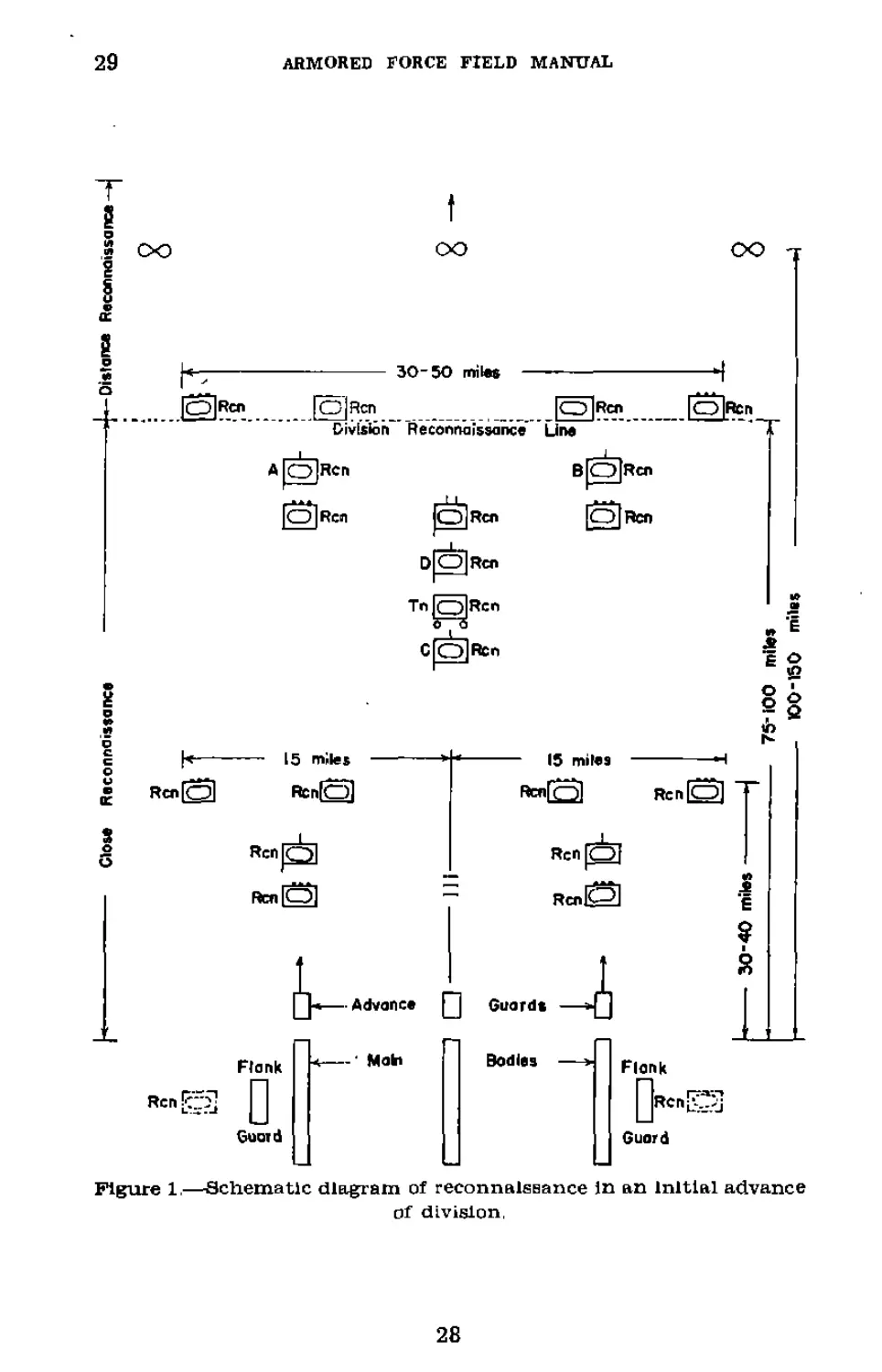
Ж 29. Execution of Reconnaissance.—a. Distant reconnais-
sance.—The speed and mobility of armored troops and of a
mobile enemy requires air and ground reconnaissance forces
to operate at great distances from the main body. (See fig. 1.)
(1) Air.—(a) Distant reconnaissance by air will be wide
and deep and is usually conducted beyond the sphere of action
of friendly ground forces. It will never be less than the oper-
ating range of hostile armored forces, or the equivalent of
a day’s march for the division, that is from 100 to 150 miles.
It will normally be initiated prior to the establishment of
contact between ground forces and is.under control of the
commander of the armored force unit.
(b) Time, the ever increasing depth of zone to be observed,
and the fact that available aircraft are seldom adequate to
perform all the missions desired, precludes detailed recon-
naissance of areas off the main roads. Initially, “search"
missions to locate the enemy concentrations and to provide
early information of the enemy’s dispositions and movements
are the most important. Primarily, they should be confined
to the main routes or probable localities. The commanders
of armored units also need information as to the condition
of roads, bridges, defiles, and general terrain features many
miles ahead in order to guide their fast moving columns and
to direct their reconnaissance elements in the right direction
avoiding unnecessary detailed reconnaissance. This is known
as route reconnaissance. Other missions, i. e. surveillance,
tracking, or photographic, may be assigned. It is important,
however, that the priority of missions be specified in the orders
or instructions.
(c) The tactics and technique of air reconnaissance and
, observation are contained in FM 1-20.
(2) Ground.—(a) Since effective reconnaissance cannot be
made at the rate of march of the division, reconnaissance
elements should be pushed out sufficiently far in advance of
the division to insure the timely receipt of information by the
division commander. In an initial advance, prior to contact
with the enemy, the divisional reconnaissance may precede
the division by as much as 100 miles and usually is sent out
1 to 2 days in advance of the main body.
(b)	When the division is moving under cover of darkness,
reconnaissance should be pushed out during daylight hours
to a line beyond the expected bivouac location of the division.
27
29
ARMORED FORCE FIELD MANUAL
75- iOO mitet -
- Ю0-150 miles
Figure 1,—Schematic diagram of reconnaissance in an Initial advance
of division,
28
TACTICS AND TECHNIQUE
29
A line of observation is established during the hours of dark-
ness to warn of the movement of hostile troops that might
interfere with the march or bivouac of the division.
(c)	In other situations reconnaissance should be sent out
sufficiently early to gain their distance in front of the main
body and have at their disposal the time necessary for
reconnaissance.
(d)	The divisional reconnaissance battalion may be re-
quired to cover a perimeter of as much as 150 miles. Detailed
reconnaissance of such a large area is usually impracticable.
The usual objectives are principal terrain features, critical
points or areas, and hostile main forces previously indicated
by observation aviation. The assignment of broad frontages
lor reconnaissance necessarily will restrict in detail the infor-
mation that can be expected and may result in gaps between
adjacent elements.
(e)	In general the breadth of zone for the battalion should
not exceed from 30 to 50 miles. It is determined by the situa-
tion, location, strength, and composition of the enemy, the
road net and terrain, and the mission of the main body.
(/) Each reconnaissance platoon can reconnoiter in average
terrain a front of about^5 to 7% miles in width while advanc-
ing at the rate of approximately 12 to 15 miles per hour.
Assigning two platoons to reconnaissance and one to reserve
in each reconnaissance company will enable the battalion to
reconnoiter on a 30-mile front while the division is moving.
Initially one reconnaissance company may be held in reserve.
If the rate of advance is decreased the width of reconnais-
sance can be correspondingly increased.
(gr) When contact is gained, the divisional reconnaissance
battalion seeks to locate enemy dispositions, including his
hanks, and favorable ground for an assembly position for the
attack. The methods used by the reconnaissance platoon and
company are discussed in chapter 4.
(Л) The ground reconnaissance agencies work in close co-
operation with the aviation which will furnish some positive
information and a very large amount of negative information.
Ground agencies will develop the information that requires
verification, and verify and amplify the positive informa-
tion. When the aviation is prevented from getting informa-
tion because of weather conditions or:hostile air superiority,
the ground reconnaissance must be prepared to extend its
439995°—42-
29
29
ARMORED FORCE FIELD MANUAL
reconnaissance. Each arm supplements and assists the other.
Team play is essential.
(i) The successful operation of an armored unit will be
materially impeded, if not stopped, unless there is a constant
flow of information from the reconnaissance agencies to the
commander. Communication from air to ground is usually
accomplished by radio or dropped messages; from ground to
air by radio, pick-up messages, or by a prearranged system
of panel signals. Information by radio from the aviation is
received by the ground reconnaissance agencies at the same
time it is received by the armored unit commander. In this
way advantage is taken of important and vital information
and reconnaissance directed accordingly. Ground elements
use motorcycles to augment or replace radio communication.
(?) In order to give power and drive to the reconnaissance
battalion and sufficient combat power to overcome minor
opposition, an armored (tank) company is provided. This
company will normally remain with the battalion headquar-
ters, in a central location if the road net permits. It may
be dispatched in detachments or as a unit to furnish sup-
port for reconnaissance companies when required, Where
the front to be covered is so broad that prompt assistance
cannot be rendered; or where critical points must be reached
and held temporarily; or where hostile resistance is expected
to be encountered, detachments of the armored (tank) com-
pany may be attached initially to the reconnaissance com-
pany elements, When the necessity for the attachment no
longer exists, the tank elements revert to battalion control/
(k)	Platoons and sections of the armored (tank) company
execute reconnaissance over terrain that is unsuitable for
wheeled vehicles. They may also be used to reduce resist-
ance that is delaying the advance of the more lightly armored
units of the battalion.
(I)	Normally it will be desirable and necessary to attach
engineers to the battalion. Elements from this detachment
accompany the reconnaissance units and furnish detailed
road information, with particular reference to condition of
bridges and fords. The engineer detachment locates and
makes initial preparations for stream crossings.
(m)	The principal function of the battalion is reconnais-
sance. It should not be assigned security or combat missions
that will interfere with the performance of reconnaissance.
30
TACTICS AND TECHNIQUE
29
(n) Provisions must be made for replenishment of rations,
fuel, and ammunition and for maintenance of vehicles.
b. Close reconnaissance.—When contact with the enemy is
imminent, reconnaissance is intensified. More detailed in-
formation will be required on points of decisive importance
near the probable or actual zone of contact of the ground
forces. Air and ground reconnaissance agencies by contin-
uous reconnaissance endeavor to determine the contour and
identification of the enemy’s leading elements, the frontage
and depth of the enemy’s movement, his assembly position,
his measures for antiaircraft defense, the location of his
airdromes, detraining stations, principal supply establish-
ments, and any changes when they occur.
(1) Air.—The primary mission of the air reconnaissance
is to extend in depth the zone under observation by ground
reconnaissance and to secure information which will enable
ground units to give effective direction to their reconnais-
sance activities. The principal objectives are roads, com-
munication centers, and exits of woods and villages. These
objectives are closely observed both day and night with a
view to discovering the location of the enemy’s main forces
and their direction of movement. Flights made shortly after
dawn and before dark offer a favorable opportunity for dis-
covery of night movements. The missions for the observa-
tion aviation include: route reconnaissance, march liaison,
surveillance, search, tracking, and photographic missions.
(2) Ground.—(er) Regimental reconnaissance is conducted
under the direction of the regimental commander by the
methods set forth in chapter 4. The reconnaissance ele-
ments precedes the main body of the regiment by 3 to 4
hours and covers the entire width of the regimental zone.
The regiment follows on one or more axial roads. The ex-
tent of the front or area covered by this reconnaissance
depends upon the mission, amount, and kind of resistance
expected, the available road net, and front covered by the
regiment. A reconnaissance company under normal condi-
tions can reconnoiter a zone about 15 . miles in width, con-
taining three or four axial roads and frequent lateral roads,
at the rate of from 9 to 12 miles per hour.
(b)	Reconnaissance operations at night are generally re-
stricted to movements of elements to initial positions from
which they may continue or commence operations at dawn.
31
29
armored force field manual
Night reconnaissance limits observations and requires slower
speeds and more extensive dismounted observation. Move-
ment by armored reconnaissance vehicles at night is limited
to roads, except for short periods over favorable terrain or
during bright moonlight.
(c)	Detailed reconnaissance of important areas not cov-
ered by elements from reconnaissance units may be executed
by patrols from the main body or at times by motorcycle
scouts. The details of employment of scouts and patrols are
set forth in chapter 3.
(d)	Frequently, reconnaissance elements will be required
to attack to obtain exact information of hostile dispositions,
or they may encounter hostile mechanized counterreconnais-
sance units. When this is anticipated, tank elements may
be attached to reinforce the reconnaissance platoons. Nor-
mally, tank elements are not used for other than battle
reconnaissance.
(ei Engineer and artillery reconnaissance personnel ac-
company the regimental reconnaissance company.
(/) The length of missions is dependent upon the ability
to supply gasoline and oil, endurance of personnel, and re-
servicing and maintenance of vehicles.
c. Battle reconnaissance.—Battle reconnaissance begins
when units initiate development for combat.
(1) Air.—(a) In the assignment of missions during battle,
consideration must be given to the number of missions that
can be effectively executed with the aviation available. Of
especial importance are the reconnaissance of movements
of hostile troops in rear areas and on the flanks of the battle
position and the surveillance of hostile detrucking and de-
training points. Air reconnaissance and surveillance of areas
beyond the zone of reconnaissance of front line troops and
divisional ground reconnaissance will be continuous before,
during, and after battle.
(b)	Battle reconnaissance missions report all dispositions
and activities in the immediate battle area with particular
emphasis on the following:
1.	Gaps in enemy positions, enemy reserves, Command
posts, railhead, supply and distributing points, and
tank and troop concentrations.
2.	Mechanized forces, artillery and antitank guns,
mines and demolitions, road and area blocks.
32
TACTICS AND TECHNIQUE
29
3.	Conditions of routes, bridges, and terrain on the
projected route of the armored units and between
them and hostile armored forces.
4.	Artillery missions, which include the location of
artillery targets, adjustment of artillery fire, re-
port of effect of fire, and general surveillance of
scheduled artillery fires and enemy activity. Air-
planes assigned to artillery missions operate under
direction of the artillery commander.
(c)	Priority is given to radio in communicating informa-
tion to command posts, ground reconnaissance elements,
and to the artillery. This method as compared to using
dropped messages expedites the action and quickens the battle
reconnaissance by obviating the necessity for the airplane
returning many miles with each important item of informa-
tion. Moreover, it permits the command post and inter-
ested subordinate elements in the divisions to keep abreast
of the situation. In case of radio failure or silence, drop
messages may be resorted to. This method may cause delay
in locating the various command posts.
(d)	A certain amount of battle liaison can be performed
simultaneously by airplanes on battle reconnaissance missions,
However, when enemy aerial and antiaircraft activity per-
mits, battle liaison may be performed satisfactorily by the
slower, liaison type of airplane. Battle liaison is concerned
with: .
1.	Visual location of front lines and tactical disposition
of advanced elements.
2.	General locations and unusual conditions affecting
adjacent units.
3.	Command and liaison missions, including the trans-
mission of information and instructions between
the superior commander and his artillery, infantry
and other subordinate commanders; also all ob-
servation missions executed for special informa-
tion for the superior commander. These missions
may be ordered for the purpose of obtaining or
verifying information as to the tactical situation
of the units engaged, or to obtain other urgent
information.
(e)	Radio provides the quickest means of communication
both from air to ground and ground to air. Where other
33
29
ARMORED FORCE FIELD MANUAL
means are available, they should be utilized, keeping the
net free and available for emergency messages. Such addi-
tional means are; from air to ground: dropped messages,
rocket signals, and simple airplane maneuvers; from ground
to air: pick-up messages, or by prearranged system of panel
or other signals,
(2) Ground.—(д) Immediately preceding combat, as the
enemy main force is approached, detailed reconnaissance of
hostile dispositions and of terrain is intensified by all recon-
naissance agencies.
1. As the regimental reconnaissance companies and se-
curity detachments of the various columns make
contact with the enemy, the reconnaissance bat-
talion may be relieved by them and move to the
flanks and continue reconnaissance against the
hostile flanks and rear,
2. Elements of the reconnaissance battalion in contact
with the enemy maintain contact during combat.
In this case regimental reconnaissance companies
may be attached to the reconnaissance battalion
to continue reconnaissance to the flanks and rear.
(b)	During combat the division reconnaissance ele-
ments gain contact with the enemy by working through gaps
-and around the flanks and rear and ascertain the strength,
composition, and dispositions of the enemy main force and
the approach of enemy reinforcements. When ordered, the
reconnaissance elements avail themselves of every opportunity
to harass enemy command and supply installations, reserves,
or reinforcements without becoming engaged in combat at
the expense of adequate reconnaissance.
1.	Where the terrain or the situation prohibits further
reconnaissance to the front during battle, the
divisional reconnaissance battalion may be ordered
to protect an exposed flank or the rear of the
division and give, timely warning of approaching
air and tank attacks. It may be withdrawn into
division reserve to reservice and recuperate pending
further missions.
2.	Regimental reconnaissance units when no longer
able to perform reconnaissance to the front pro-
ceed to the flanks of their unit to secure them
34
TACTICS AND TECHNIQUE
29
during combat and give warning of air and tank
attacks,
(c)	After combat, the reconnaissance battalion moves either
around the flanks or through a gap in the hostile front to
determine the routes of withdrawal of the hostile main
column; whether his withdrawal is well organized or in dis-
order; the covering positions with reference to his columns;
and whether or not critical points on his routes are held in
strength. Contact must be maintained.
(d)	When the battle results in the withdrawal of our own
forces, contact with the enemy must be maintained. The
delaying force must be constantly informed of the progress
of the hostile troops.
1.	Divisional reconnaissance towards the enemy will be
extended to the flanks to obtain information of
the direction of the main threat of the enemy’s
pursuit or exploitation.
2.	The reconnaissance battalion may be ordered to de-
lay and harass the enemy by action against his
head and flanks while continuing reconnaissance.
3.	Reconnaissance in the direction of withdrawal must
be instituted to insure that the routes of with-
drawal are free of enemy and clear of obstacles.
(e)	.After combat, the regimental reconnaissance companies
prepare to assist in the exploitation, pursuit, or withdrawal
of their regiment in the same manner as the divisional
reconnaissance units’function with the division, A portion of
the regimental reconnaissance may be attached to rear or
flank guards when necessary to further the mission of these
security detachments. (See sec, Ш.)
d. Tank reconnaissance.—This type of reconnaissance is
conducted prior to an operation when the use of tanks is
contemplated, It is made to determine: the location, ca-
pacity, concealment, and suitability of positions; the routes
to selected positions; the terrain over which tanks may oper-
ate; and the allotment of tanks,
(1) The items to be considered regarding positions include
in general:
(a)	Routes into and within the assembly or intermediate
position,
(b)	Available routes to point of probable subsequent
activities.
35
29
ARMORED FORCE FIELD MANUAL
(c)	Available routas to alternate positions.
(d)	Water (quantity, quality, and reliability).
(e)	Cover and concealment.
(7) Capacity and suitability.
(g) Standings for vehicles under all weather conditions.
(ft) Protection from hostile fire.
(i) Suitability for local defense.
(?) Shelter for maintenance activities.
(Jc) Assignment of areas to subordinate units.
(0 Tactical soundness of location.
(2) Prior to any movement of tank units, principle routes
and alternate routes should be thoroughly reconnoitered and
a suitable system established for marking the routes and fur-
nishing guides. In reconnoitering routes, consideration must
be given to the following:
(a)	Means of identification day or night; i. e., by land-
marks, sketches, description, map reference, or aerial photo-
graphs.
(b)	Critical points and areas for location of guides and route
markers.
(c)	Distance over entire route and important parts thereof
and time required to traverse them.
(d)	Detailed data on routes, such as kind (road, trail, or
cross country); width (one-way or two-way); grades; sur-
face (firmness, smoothness); defiles; availability; probable
effect of changes in the weather; and practical speeds day or
night, wet or dry.
(e)	Cover and concealment, including defilade.
(7) Pords; whether depth* and conditions of bottom and
approaches permit crossing, and whether water level is rising
or falling.
(g) Bridges, including location, size, kind, capacity, condi-
tion, and material required for reinforcement. Also possibility
of detouring around them.
(ft) Tank obstacles including mines and contaminated
areas; their location, nature, and possibility of removing,
neutralizing, or avoiding them.
(i) Friendly installations, including steps necessary to pre-
vent destruction of telephone wire, point of crossing field
works, or work and material necessary to insure expeditious
crossing.
(j) Routes for passage through friendly lines.
36
TACTICS AND TECHNIQUE
29-30
(Jte) Routes for wheeled transportation forward to the line
of departure.
(I) Comparative desirability of all routes.
e. Personal reconnaissance.—In preparing for combat, per-
sonal reconnaissance of the terrain by the commander, staff
officers, and subordinate commanders, under protection of
leading elements, is conducted whenever possible to supple-
ment and verify reports of reconnaissance agencies.
 30. Transmission of Information.—a. All commanders are
responsible that their immediate and lower unit commanders
are promptly and fully informed of the situation.
b.	Neighboring units and reconnaissance agencies when
meeting habitually exchange pertinent information. Recon-
naissance elements in contact with the enemy cooperate with
reconnaissance elements and security detachments that may
be employed in the interval between the main force and the
reconnaissance elements in contact. Information of vital in-
terest to these reconnaissance elements and security detach-
ments is transmitted through “listening in” radio sets, dropped
messages from airplanes, or by messengers.
c.	First contact with the enemy and new identifications are
always reported by the most rapid means available. Negative
reports must be submitted with the same promptness as posi-
tive information.
d.	Prisoners, inhabitants; messages from patrols, and docu-
ments are examined by the reconnaissance unitor detachment
commander and forwarded to the main body by the quickest
and most reliable means available. Radio, airplanes, scout
cars, motorcycles, or Impressed motor transportation may be
used. In friendly or occupied territory commercial wires
should be used whenever practicable.
e.	Captured prisoners are evacuated by any available means,
together with a digest of their individual statements.
,f. Units in contact, although closely engaged in combat, are
not relieved of the responsibility of making reports as often
as desired by the higher commander. In order to offset the
failure to receive a report, commanders must make provision
for obtaining prompt information by special reconnaissance
and by sending1 liaison agents to higher, subordinate, or
adjacent .units.
37
30-32
ARMORED FORCE FIELD MANUAL
g. Artillery observers and liaison officers transmit to the
higher commander, over their own communication systems,
important information which might otherwise be delayed
in transmission.
 31. Summary.—a. The prompt employment of armored
force units necessitates early information of the enemy and
of the terrain in order for the commander to formulate sound
plans and make prompt decisions.
b.	All available reconnaissance agencies must be used boldly
to gain and maintain contact and obtain information.
c.	Reconnaissance agencies must be dispatched in advance
of the main force in time to allow for proper reconnaissance
of the designated zones, routes, or localities and to get infor-
mation back to the commander in time to be of value.
d.	Information must be transmitted by the quickest and
most reliable means available.
e.	Prior to combat, personal reconnaissance by the com-
mander, staff officers, and subordinate commanders must
supplement and verify reports of reconnaissance agencies.
/. All reconnaissance personnel must be trained to note
and report on, suitable terrain for the employment of tanks;
possible emergency landing fields; water and gasoline supply
sources; and similar items of vital Importance to armored
force units.
g. The successful operation of an armored force is depend-
ent upon a constant flow of information to the commander.
Section III
SECURITY
 32. General.—a. Security.—Security embraces all meas-
ures taken by a command to protect itself against annoyance,
surprise, attack, observation, and interference by the enemy.
It includes the special measures taken for protection against
hostile aviation and ground forces, including mechanized and
chemical attacks. Security is always necessary, whether in
movement, at the halt, or in combat. In bivouac and in
movement, security is provided in all directions. Adequate
and timely information is the basis of all security measures.
Continuous reconnaissance is therefore an essential part of
security. Security retains freedom of maneuver for the
commander.
38
TACTICS AND TECHNIQUE
32-33
b. Responsibility.—The commander of each unit is responsi-
ble for the security of his command. This includes the pro-
tection of his lines of communication, unless such protection
is furnished by the higher commander. The superior com-
mander prescribes security measures for the protection of the
command as a whole or coordinates those adopted by subor-
dinate commanders. He insures that measures adopted are
appropriate to the hostile threat. Subordinate commanders
provide additional security required for their own local pro-
tection. When contact is imminent, security measures are
increased.
c. Warning.—All security measures include an adequate
warning service consisting of observers and the means of
signal communication. In this manner changes in hostile
dispositions and other operations on the ground and in the
air are known early. Special measures are taken to warn
of the approach of hostile mechanized or air forces.
 33. Security Against Ground Forces.—The principal secu-
rity measures against ground forces include, reconnaissance,
the employment of security detachments, the distribution,
formation, and mobility of units, and utilization of terrain.
a.	Reconnaissance.—While reconnaissance is closely allied
with security, reconnaissance and security forces operate in
accordance with different considerations. Reconnaissance
influences security by indicating to the commander the meas-
ures to be taken to protect his forces. Under certain condi-
tions it may be the only measure employed for security.
Information furnished through reconnaissance is a guide to
the commander for determining the strength, composition,
and disposition of his security detachments.
b.	Security detachments.—(1) General.—Security detach-
ments are elements of a command assigned to protect the
main body. Such detachments are always necessary whether
In movement, at the halt, or in combat. On the march, secu-
rity detachments are called advance guards, rear guards, flank
guards, and march outposts; in camp, in bivouac, or in a
defensive position, they are called outposts: during develop-
ment for combat, covering detachments; and in combat,
combat patrols. (See FM 100-5.)
(2) Missions.—In general, the mission of a security de-
tachment Is to furnish the command with information rela-
39
33
ARMORED FORCE FIELD MANUAL
tive to the enemy, to protect the command against surprise,
observation, and interference by hostile ground forces, and
to maintain the freedom of maneuver for the command by
gaining the time and space it requires to make the necessary
dispositions. The priority given to these missions embodying
reconnaissance, counterreconnaissance, and resistance varies
with the situation and the expressed intentions of the
commander,
(a) Information of the enemy in proximity is obtained
by the reconnaissance elements or combat patrols from the
security detachment,
(E>) Protection of the main body from surprise, observa-
tion, and interference is accomplished by preventing the
enemy firing into the main body and from observing the
size, dispositions, and composition of the main body; and by
holding the enemy and gaining time for the main body to
deploy before coming under effective fire,
(c) Freedom of maneuver of the main body is insured by
the security detachment which, according to circumstances,
attacks, resists, or delays the hostile forces,
(3)	Strength.—The strength of a security detachment de-
pends upon the mission assigned it, the terrain, proximity
of the enemy, and the size, composition, and physical condi-
tion of the command. In certain situations security detach-
ments constitute a partial commitment of the strength of a
command to action. They are given sufficient strength to
preserve freedom of action for the main body and no more.
As far as practicable, tactical unity is preserved in the detail
of security detachments.
(4)	Formations of security detachments.—There is a sim-
ilarity in the formation of advance, flank, and rear guards
and outposts. Each comprise groups which send out patrols
or post sentinels for observation. These reconnaissance
groups are reinforced by a support, the principal element of
resistance. In large security detachments, a reserve is pro-
vided. The reserve constitutes the principal maneuvering
and reinforcing element for offensive or defensive action as
determined by the mission of the security detachment.
These missions in turn depend upon the plan for the subse-
quent employment of the command as a whole,
(5)	Distances or time interval.—(a) The distances or
time interval between the main body and the security de-
40
TACTICS AND TECHNIQUE
33
tachments and between subdivisions of the security detach-
ments will vary with the size and mission of the security
detachment, visibility and terrain, and strength, composition,
and proximity of the enemy. It should be sufficient to allow
the security detachments time to cope with small hostile
forces, to allow successive elements of the detachment space
to maneuver, and to secure the uninterrupted movement of
the main body.
(b) The normal distances between vehicles and units com-
prising elements of security detachments on the march will
be those prescribed for tactical marches. । (See sec. Vn.)
Fixed or routine distances cannot be prescribed for all move-
ments of detachments as terrain, composition, mission, hos-
tile air activity, and many other factors will influence the
conduct of the movement.
(c) When operating in darkness, fog, or in close country,
distances maintained will be less than when operating in
daylight, clear weather, or in open country. Distances be-
tween the main body and security detachments and between
subdivisions of the security detachments should be reduced
to that consistent with control; between vehicles it should
be reduced to that consistent with visual communication with
the vehicle immediately preceding and following.
(6)	Rate of march.—The march order prescribes the rate
of march for the command and the distance between the
security detachments and the main body. The main body
regulates the rate of march whenever the command must
maintain a certain rate of march to reach a designated place
at a prescribed time. When contact is imminent, the ad-
vance guard regulates the march.
(7)	Communication.—(a) Communication between the
elements of the security detachment and between the security
detachments and the main body is maintained by the
quickest means available. Radio, except when radio silence
is necessary, or motorcycle messengers are the principal
means employed. The commander and leader of each ele-
ment of the security detachment have radio equipped ve-
hicles. In addition, one or more motorcyclist should accom-
pany the security detachment commander for messenger
service.
(b) Leaders of security detachments send information
41
33
ARMORED FORCE FIELD MANUAL
promptly. Promptness is vital because of the mobility of
all units.
(8)	Control.—(a) Control is obtained by means of radio,
visual signals, connecting files, or, the main body commander
may designate phase lines, control points, assembly positions,
or message relay points, when such are necessary to insure
control and facilitate communications.
(b) The normal drill signals for “halt,” “forward,” and
“assembly,” and simple improvised signals to indicate “enemy
in sight” or “all clear” are used.
(c) Contact between elements of security detachments and
between the main body and security detachments is main-
tained by connecting groups or files. (See par. 34.)
(9) Movement.—Security detachments on the march regu-
late their movements so as to give the main body the protec-
tion required by the tactical situation and offered by the
terrain. When contact is imminent, they move by bounds as
outlined in the following subparagraphs. When darkness,
fog, or rapid rate of march of the main body makes the
movement by bounds impracticable or inadvisable, move-
ment is continuous and at a prescribed rate.
(a)	An advance by bounds is accomplished by a forward
element gaining distance over the one in rear to reach some
important point which possesses tactical- advantage either
for observation or combat. The smaller the element, the
more easily its speed can be changed, and the shorter and
more frequent are its bounds.
(b)	A bound of a forward element should not be so great
as to place it beyond, supporting distance of the next suc-
ceeding element.
(c)	A bound of a rear element should be under the pro-
taction of the element next in front.
(d)	An advance by bounds has several important advan-
tages. It—
Enables an element to reconnoiter the terrain before the
following element has closed up.
Permits the crossing of terrain that may be under hostile
observation or fire in the shortest time.
Offers opportunities for the interrogation of inhabitants,
and for servicing of vehicles.
Offers opportunities to coordinate the advance.
c.	Distribution of units.—The distribution of units in the
42
TACTICS AND TECHNIQUE
33-34
main body is made in accordance with their probable tac-
tical. employment. Each unit makes provision for prompt
formation and movement to facilitate the command’s readi-
ness for action.
d.	Utilization of terrain.—Terrain and the road net influ-
ence the commander in his selection of positions or routes
for the main body and for the security detachments. A map
study, supplemented by air and ground reconnaissance, will
disclose terrain which may afford protection to the command
while in movement or at the halt. A consideration of the
road net and terrain will also be a determining factor in the
location of the security detachments with respect to the
main body.
 34. Connecting Groups (Files).—a. A connecting group
is a detachment detailed by a force to maintain contact
(liaison) with a neighboring force or between units (ele-
ments) of a force on the march Elements of a connecting
group used within a march column are called connecting
files.
(1)	Connecting groups are used to maintain contact with
adjacent forces prior to and during combat.
(2)	They are used between units within march columns
where distance limits visual communication.
(3)	They are always used during night marches within a
march column.
(4)	Within the main body, connecting groups are furnished
from the unit in rear to maintain contact with the preceding
unit.
(5)	Within a security detachment, connecting groups are
furnished by the larger element to maintain contact with
the next smaller element. For example, from the main body
to the advance guard (flank or rear guard), within the
advance guard from the support to the advance party.
(6)	Connecting groups are especially useful when:
(a)	Observation is limited because of terrain features or
weather.
(b)	A march column passes through a city or large town.
(c)	The route of march has many changes of direction.
(d)	The route of the preceding element is difficult to follow.
(7) Connecting groups are not to be confused with recon-
naissance or combat patrols, although their missions in cer-
tain situations are similar.
43
34-35
ARMORED FORCE FIELD MANUAL
b.	Mission.—The primary mission of a connecting group is
liaison. Specifically its duties are to—
(1)	Keep the commander of the force from which detailed
informed of the location and progress of neighboring units.
(2)	Observe and report any penetrating hostile force and
oppose such force until arrival of reinforcements or until
the threat has ceased.
(3)	Maintain connections and liaison within a march
column.
c.	Strength and composition.—(1) The strength of a con-
necting group depends upon its mission. When its mission
is one of liaison, it may be small; when the distance between
adjacent forces is great and hostile threat exists, it is larger.
It varies from two motorcyclists to a platoon.
(2)	For liaison .with adjacent units, scout car, half-track,
y4-ton truck, or tank elements may be used.
(3)	For liaison on the march between armored units, such
groups consist of two or more motorcyclists or V^-ton trucks.
The number of motorcyclists detailed for this purpose will
depend upon the distance between units, the terrain, visibility,
and the number of motorcyclists available.
d.	Formations and methods of operation.—(1) Formations
for connecting groups vary with their mission, terrain, and
hostile situation,
(2) For contact and liaison with an adjacent force, a patrol
formation is used,
(3) For contact and liaison within a march column, a
connecting group usually marches in the interval between
the units to which its mission applies.
(a)	Whenever visual contact is broken, connecting files,
preferably in pairs, are detached from the group to maintain
visual contact. When visual contact is regained they close
on the connecting group leader at increased speed, if in rear
of the leader; or halt and await his arrival, if in front of the
leader.
(b)	When the number of connecting files is limited and
visual contact cannot be maintained because of distance or
terrain, connecting files move by bounds.
 35. Combat Patrols.—a. Purpose.— (1) Combat patrols are
security detachments sent out to the front, flanks, and rear
to protect the main body or the detachment from which sent
out.
44
TACTICS AND TECHNIQUE
35-36
(2) Units engaged in combat employ combat patrols for
their protection.
b.	Mission,—The primary mission of combat patrols is
security. Specifically, their duties are to—
(1)	Obseiwe the terrain for hostile dispositions and move-
ment.
(2)	Gain contact with the enemy in a close situation and
furnish timely information of enemy movements towards or
around the flanks.
(3)	Drive off small enemy forces which threaten the front,
flanks, and rear, and contain larger forces until suitable
preparations can be made to oppose them.
c.	Strength and composition.—The strength of a combat
patrol depends upon the force from which detailed(the enemy,
and the terrain. It may consist of a pair of motorcyclists,
one or more Vi-ton trucks, a section of half-tracks, or a sec-
tion or platoon of tanks.
d.	Formation. and methods of operation.—Combat patrols
operate under orders from the commander of the force from
which they are detailed. The formation in which they move is
similar to that prescribed for reconnaissance patrols, Their
conduct is different in that combat is usually required for the
accomplishment of their missions, They regulate their move-
ments upon the body from which detached.
 36. Advance Guahds.—a. General.—An advance guard is a
security detachment which precedes the main body on the
march.
b.	Mission and duties.—The mission of an advance guard
is to insure the uninterrupted advance of the main body and
to protect it against surprise and observation by hostile ground
forces. Specifically, its duties are to—
(1)	Guard against surprise and to obtain information by
reconnoitering to the front and flanks,
(2)	Push back small parties of the enemy and to prevent
their observing, firing upon, or delaying the main body.
(3)	Check the enemy’s advance in force long enough to
permit the main body to prepare for action.
(4)	Determine the strength and location of the hostile lines
and flanks when the enemy is encountered on the defensive,
but to avoid bringing on a general engagement unless em-
powered to do so.
439995°—42-
45
36
ARMORED FORCE FIELD MANUAL
Figure 2,—Schematic diagram of advance guard
kEQEND
J - Moforcyeie Scout
S P Self Propelled Mount
C/F Codnecttne File
NOTE: a Distance indicated
will, vary widely, de-
pertd'ng upon rood
nel^ tel rain, and
enemy activity.
b Wbbn a medium lank
company constituted»
advance ouard, a
similar formation is
taken,
for regiment.
46
TACTICS AND TECHNIQUE
36
(5)	Remove obstacles, repair roads, and facilitate in every
practicable way the uninterrupted march of the column.
(6)	Seize or hold such terrain features as will facilitate the
successful execution of the commander’s plan for his command
as a whole.
c.	Strength and composition.—(1) The strength of an ad-
vance guard for armored force units varies from a small
fraction to about one-fourth of the command. From front to
rear it consists of a point, advance party, support, and reserve.
In an advance guard consisting of less than a battalion, the
reserve is generally omitted. Figure 2 may be used as a guide
but distances indicated will vary widely, depending upon road
net, terrain, and similar items. The following are suggested
as appropriate advance guards for the forces indicated:
For a platoon—Point------- One or two solo motorcycles
For a company—Point___
Advance
party.
For a battalion—Point-
Advance
party.
For a regiment—Point--
Advance
party.
Support___
For a combat command
group—Point______________
Advance party___
Support_________
and (4-ton truck, com-
mand; one car, half-track, or
tank.
Two solo motorcycles.
One &-ton truck.
One section, armored cars
(half-tracks, or tanks).
Same as for company and one
self-propelled' mount. .
One mortar squad.
One tank platoon.
One section engineer platoon.
Same as for company.
Same as for battalion.
One tank company (less 1 or 2
platoons).
One mortar platoon.
One engineer platoon (less sec-
tion with advance party).
One field artillery battery.
Same as for company.
Same as for battalion.
Same as for regiment.
47
36
ARMORED FORCE FIELD MANUAL
Reserve		One tank battalion (less 1 or 2
For a division—Point		companies). One engineer company (less 1 platoon). One field artillery battery. Same as for company.
Advance	Same as for battalion.
Party. Support		Same as for regiment.
Reserve		Same as for combat command
group.
(2) At night the advance guard for battalions and larger
units may be composed of infantry and engineer elements.
(3) If any portions of the advance guard are unnecessary,
the rear elements are the first omitted. The point is always
present.
d.	Distances.—Within the advance guard the following
are considered satisfactory limits during daylight: (See fig.
2.)
Main body to reserve—5 to 10 minutes.
Reserve to support-—3 to 5 minutes.
Support to advance party—1 to 2 minutes.
Advance party to point—J/2 to 1 minute.
e.	Rate of march.—When the movement of the main body
is dependent upon information which the- advance guard
obtains or upon the actions of the latter, the advance guard
regulates the rate of march. At night it is usual for the
advance guard to regulate the rate of march.
/.	Main body commander.— (1) The main body comman-
der issues the order for the movement of his troops, and
prescribes the size and composition of the advance guard
or guards to be employed.
(2)	He issues the necessary Instructions to insure the
operation of the advance guard in furtherance of his general
plans, and to control its progress and movement.
(3)	If the command is marching in two or more columns,
orders to the advance guards may prescribe phase lines, se-
lected with regard to the road net 'and terrain on which
periodic control is established and necessary instructions
for the coordination of the advance guards.
(4)	During the march he may join the advance guard
commander, thus keeping himself informed of the situation
48
TACTICS AND TECHNIQUE
36
in his front, and keeping the latter advised of any changes
in his plans he may deem necessary to make.
g. Advance guard commander.—(1) Upon receipt of a
march order the advance guard commander issues the nec-
essary orders for the disposition and movement of the ad-
vance guard.
(2) During the advance he may control the advance guard
from any position. His usual position is in rear of the
advance party;
(3) When.the enemy is encountered he makes a rapid per-
sonal reconnaissance and decision for the employment of
the advance guard as follows:
(a)	To employ any part of the advance guard as necessary
to dislodge the enemy in time to prevent delay of the march
of the main body.
(b)	To establish a defensive position to cover the approach
march and offensive action of the main body.
(c)	To contain or delay a hostile force, permitting the
main body to continue its advance.
(4)	When the leading elements of the advance guard' en-
gage the enemy, the advance guard commander moves for-
ward close to the axis of movement of the advance guard
to observe the action and to keep the commander of the main
body informed of the situation. When the enemy has been
disposed of he reorganizes the advance guard elements rap-
idly and continues the advance.
h- Paint commander.—(1) The point commander is re-
sponsible for the conduct of the point. In large advance
guards, the point commander may be mounted on a }4-ton
truck and ride wherever he deems his- presence necessary.
His usual position is with the self-propelled mount.
(2)	He instructs the point en route, and makes sure that
the designated route is followed.
(3)	In case the designated route becomes impracticable,
or obstacles are encountered over which the main body
cannot readily move, he notifies the next higher commander
and executes reconnaissance promptly to determine routes
around the obstacle.
(4)	In case the enemy is encountered, he will:
(a)	Report contact.
(b)	Employ the self-propelled mount to drive off hostile
resistance. Send dismounted members of the point to re-
49
36
ARMORED. FORCE FIELD MANUAL
connofter the enemy position, fire on, and mark the hostile
flanks with tracer ammunition, and to signal if the enemy
withdraws.
(c)	Send prompt information to the next- higher com-
mander of the hostile strength, composition, and disposition.
(d)	Reorganize the point following combat, prepared to
continue the advance.
(5)	If the scouts sent out from the point remain out of
view for an unreasonable period, the point commander will
assume that these scouts have been shot or captured and
will send dismounted scouts to reconnoiter the place where
they disappeared before permitting the point to proceed,
i. Point.—(1) The point is both a reconnaissance and se-
curity element, (See fig. 2.) Its obseiwation is limited to
the line of march. It pushes forward boldly, by bounds, em-
ploying the self-propelled mount, if attached, closely sup-
ported by the advance party. On winding roads or where
terrain features between definite bounds prevent visual con-
tact, elements within the point maintain visual contact until
the next bound is reached, thus avoiding stopping at inter-
mediate points of no tactical value.
(2)	Its principal duties in the advance are to—
(a)	Reconnoiter the road on which the column is march-
ing and observe to the immediate flanks.
(E>) Gain rapidly elevations, edges of woods, and other
points of vantage from which a good view to the front can
be obtained or which the enemy might try to occupy.
(O Give timely warning, to the element next in rear, of
the enemy’s presence or of road blocks, mines, traps, or sim-
ilar methods for delaying a marching column.
(d)	Drive back or disperse promptly small hostile patrols.
When the enemy encountered is too strong to be defeated by
the point, the point protects the next element in rear.
(e)	Remove small obstacles blocking the route. When
these obstacles require more manpower and technical equip-
ment than that contained in the point, it proceeds beyond the
obstacle and protects the next element in rear while engaged
in removing -the. obstacle. When the obstacle is defended,
the point first assists in driving off the enemy,
(/) Push boldly into villages along the line of march and
determine promptly whether or not they are occupied by the
enemy.
50
TACTICS AND TECHNIQUE
36
(y) Remain on or near the route of advance in order to
protect the head of the column from surprise.
(3)	In the execution of its duties the elements of the point
proceed as follows:
(a)	Motorcycle scouts, if available, work as a pair preceding
the rear vehicle (Vi-ton truck, self-propelled mount, armored
car, half-track, or tank) keeping always a bound ahead. They
move in single column, staggered on either side of the road at
a distance of 35 to 50 yards between scouts. Successive bounds
are made at the maximum speed road conditions permit.
(b)	At the .end of each succeeding bound they slow down,
halt short of the crest, bend, etc., and the leading scout dis-
mounted, moves to reconnoiter the terrain to the front, and
check the route. The remaining scout observes to the flanks.
He also is employed to reconnoiter lateral roads, if necessary
riding out to a position where he can observe for at least 600
yards (effective rifle range). Motorcyclists maintain contact
within the point.
(c)	When an obstacle or enemy is discovered, one scout
reports this information to the point commander, the other
scout remaining in observation.
(d)	Scouts do not move forward to the next bound until
they have signalled “all clear” to the remainder of the-point..
Control is maintained by visual signals.
(e)	When fired upon, scouts seek cover, report contact, and
then reconnoiter to determine the direction and nature of
the hostile action. They fire their weapons in self-defense
and to warn elements in rear.
(/) In case a hostile position has been passed without being
observed by the scouts, they will return, dismount, and attack
the enemy. They will especially seek and bring under fire
antitank guns or machine guns. If the enemy withdraws,,
they endeavor to ambush him. The scouts avoid getting in
the line of fire from other elements of the advance guard.
(gr) Upon reaching a terrain feature in rear of the motor- •,
cyclists, crew members from the rear vehicle of the point
observe to the immediate flanks. When the terrain, time ele-
ment, and situation warrant, a dismounted reconnaissance
will be .made for a short .distance to either side of the route
of march.
.(A) This vehicle closes on the.motorcyclists on.receipt of-
51-
36
ARMORED FORCE FIELD MANUAL
signals from the motorcyclists. It coordinates’ by bounds,
its movement with that of the advance party.
(i) If the enemy is encountered, the rear vehicle and the
self-propelled mount, if present, will move forward, depending
upon the location of the enemy and place fire on the enemy.
The crew, when necessary, will continue its reconnaissance
dismounted.
/. Advance party,—(1) The advance party is both a recon-
naissance (maneuvering) and holding (pivot) element. (See
fig. 2.) Its principle duties are to—
(a)	Maintain connection with the point and assist it in
overcoming resistance encountered on the line of march.
(b)	Extend flank reconnaissance to a distance of about
800 yards.
(c)	Check the enemy’s advance until the element next in
rear has time to prepare for action. In case the enemy en-
countered is too strong for the advance party to defeat, the
latter reports the fact to the next element in rear and recon-
noiters the enemy’s strength and dispositions.
(2)	In the execution of its duties the elements of the ad-
vance party proceed as follows:
(a)	Each vehicle commander receives, acknowledges, and
passes signals both from the front and rear and moves by
bounds, coordinating its advance with the rear vehicle of the
point.
(b)	When contact is gained, the leading vehicle remains
on or near the axis of march and engages the enemy by fire,
to support the action of the remainder of the advance party.
(c)	If subjected to surprise1 fire the leading vehicle will
seek.a defiladed firing position if immediately available; oth-
erwise, unless a tank, the vehicle will be abandoned for a
dismounted position.
(d)	Whenever Are is opened on the leading vehicle, the
advance party commander in the next vehicle in column
makes a hasty reconnaissance, mounted or dismounted, de-
pending upon the available cover, and disposes the advance
party initially to protect the next element in.rear.
(e)	In larger advance guards, a platoon of tanks, an
engineer section, and .one or more mortar squads, constitutes
the advance party. They perform reconnaissance to the
flanks, either by having a. patroh march parallel to the axis
of movement, where the terrain permits, or by having the
52
TACTICS AND TECHNIQUE
36
patrol move direct to reconnoiter features of terrain and re-
turn to the axis. Only those terrain features that may afford
possible positions for the enemy should be reconnoitered.
This reconnaissance is continuous when dictated by the
situation and terrain.
(f)	When enemy resistance stops the advance the tank
platoon extends reconnaissance to locate the flanks, drive
out the enemy, and develop the situation, reporting results to
the advance party commander.
(gr) If the enemy resistance is too strong to be overcome
by the advance party, each element will hold its most ad-
vanced position and cover the approach of rear elements
of the advance guard or of the main body.
(ft) In advance guards, where there is no support, the
tank platoon may be left as a containing force while the
main body bypasses the enemy position.
fc. Support.—(1) The support bears the same relation to
the elements in its front and rear as the advance party does
to the point and support. It extends the reconnaissance
(maneuvering) or acts as the holding (pivot) element. (See
fig. 2.) In the absence of a reserve, it is also the principal
striking element. Its principal duties are to—
(a)	Maintain connection with the advance party and assist
it in overcoming enemy resistance.
(b)	Extend the flank reconnaissance to a distance of about
1 mile.
(c)	Check the enemy’s advance until the element next
in rear, or the main body has time to prepare for action.
In case the enemy encountered is too strong to be defeated,
the support reports the fact to the next element in rear,
protects it, and extends reconnaissance.
(2)	In the execution of its duties the elements of the sup-
port proceed as follows:
(a)	March at the prescribed rate of march maintaining
the time distance in front of the reserve, if present, or the
main body. It should not move on the next bound until the
preceding element has cleared.
(b)	Extends the reconnaissance to the flanks in a similar
manner to that of the tank platoon in the advance party.
(c)	when the enemy is encountered, it reenforces the action
of the advance party, whether it is combat, reconnaissance,
or both.
53
36
ARMORED FORCE FIELD MANUAL
I. The reserve—The reserve is the striking (main blow)
element of the advance guard. Its employment is based on
the information obtained from the lesser forward elements
and other sources by the advance guard commander.
m. Artillery.—In an advance guard for a regiment or larger
unit it will often be desirable to attach a battery of field
artillery. When attached it will normally march as the
rear unit of the advance guard, with a reconnaissance officer
well forward. If no artillery is attached to the advance guard,
the necessary artillery support for its action is furnished by
the artillery with the main body. When the need for their
employment can be foreseen, supporting antiaircraft artillery
may accompany the advance guard. It occupies critical points
en route.
n. Aviation.—While not normally attached to the advance
guard, available airplanes should be directed to cooperate.
They render valuable assistance by reporting direct to the
advance guard commander the approach of enemy forces, the
location of hostile positions along the axis of advance, perti-
nent information of roads and bridges, and other similar
information.
o.	Engineers.—Engineers march at the rear of the support,
or near the head of the reserve. Their principal functions
are to repair or strengthen bridges, remove obstacles, prepare
stream crossings, and repair roads. An engineer detachment
marches at the rear of the advance party; its function is to
furnish early engineer information. Where need for their use
can be foreseen, engineers with bridge building equipment
may be attached to the rear element of an advance guard.
p.	Medium tanks.—In the absence of artillery with the
advance guard, or where their use can be foreseen, medium
tanks may be attached to the advance guard composed of
a light tank unit or a regiment or larger unit.
q.	Mortars.—In an advance guard for a battalion or larger
unit, the attachment of at least a squad of mortars is desira-
ble. It Is used to neutralize enemy observation posts and
screen the movement of advance guard units and later, if
necessary, the development of the main body.
r.	Trains.—The unit trains of an advance guard generally
remain with the trains of the main body. A truck to trans-
port gasoline for refueling motorcycles should march at the
rear of the last element in the advance guard. The light
54
TACTICS AND TECHNIQUE
36-37
maintenance elements of Units performing advance guard
duty march in rear of their units.
5.	Advance guard in retrograde movement.—In retrograde
movements an advance guard should be detailed. It will
vary from a point to a larger element, depending on whether
or not there is a possibility of an enemy attack against the
head of the column. If there is no enemy threat, the prin-
cipal missions of the advance guard will be to clear the route
of march, insure the uninterrupted movement of the main
body, and regulate civilian and refugee traffic. For the latter
purpose, military police may be attached.
t.	March outposts.—Advance guards are used in forming
march outposts for temporary or prolonged halts. (See par.
40.)
 37. Covering Detachments.—a. General.—(1) A covering
detachment is a security detachment used to protect troops
moving in the presence of the enemy.
(2) It is used when early contact with the enemy is ex-
pected and when because of this expectation the main body
is deployed in an approach formation.
(3) A covering detachment is always used in an approach
to a line of departure.
b.	Missions.—The missions assigned to covering detach-
ments are similar to those given an advance guard, except in
situations requiring combat strength. The primary mission
is that of security; the secondary mission is reconnaissance.
Specifically its duties are to—
(1)	Guard against surprise and obtain information by ob-
serving -to the front and flanks.
(2)	Cover a larger force in the approach to a line of
departure.
(3)	Guide a larger force over the best terrain available.
(4)	Push aside small enemy* patrols and offer resistance
to larger hostile forces until the main body attacks.
(5)	Support the main body in an attack.
c.	Strength and composition.—A covering detachment for
a tank company usually consists of a platoon; for a battalion
a platoon reinforced by detachments of the battalion head-
quarters company; for an armored regiment a light tsnk
company reinforced.
d.	Formations.— (1) Formations for covering detachments
55
37-38
ARMORED FORCE FIELD MANUAL
vary depending upon the terrain. They are generally de-
ployed over a broad front with very little depth.
(2)	The interval between vehicles (squads) varies between
150 to 300 yards, depending on terrain and visibility.
e.	Communication and control.—(1) Communication and
control are maintained normally by radio or prearranged
visual signals. Exceptionally, motorcycle or other vehicle
messengers may be employed.
(2)	Movement of the covering detachment is controlled by
the main force commander from his position in the interval
between the covering detachment and the main force.
/. Methods of operation.—(1) The covering detachment
precedes the unit from which it is detailed.
(2)	It moves by successive bounds, the limitations of each
bound being indicated by the force commander and not by
the covering detachment commander.
(3)	Upon arriving at each terrain objective, the covering
detachment halts and observes to the front and flanks until
ordered to make another indicated bound. Full advantage is
taken of available cover.
(4)	Covering detachments attack small patrols and offer
resistance to larger forces.
(5)	Upon reaching the line of departure the covering
detachment may constitute the leading assault wave; may
halt and support the attack by fire; may afford flank and
rear protection; or follow in support or reserve.
g. Reconnaissance.—Reconnaissance elements may be at-
tached to a covering detachment the size of a company, or
ordered to cooperate with a smaller covering detachment.
When the terrain and road net are favorable, early informa-
tion of hostile dispositions can be obtained by the recon-
naissance elements which enables a covering detachment to
better carry out its mission.
 38. Rear Guards.—a. General.—A rear guard is a security
detachment which follows and covers the main body on the
march. The fundamentals covering rear guards and rear
guard action are contained in FM 100—5.
b.	Who may perform.—Armored units are suitable to per-
form rear guard duty because of their mobility and fire power,
which enable them to withdraw quickly after delaying the
pursuing enemy to the last possible moment. However, this
56
TACTICS AND TECHNIQUE
38
use is exceptional and sacrifices their offensive power. This
mission should not be assigned armored units when other suit-
able units are available. However, the rear guard covering
the retirement of a combined force often contains armored
units.
c.	Mission and duties.—The mission of a rear guard is to
assure an uninterrupted movement of the main body and to
protect it from attack, observation, or interference by hostile
ground forces. Specifically its duties are to—
(1)	Guard against surprise and furnish information by
observing to the rear.
(2)	Hold back small forces of the enemy and prevent their
observing, firing upon or delaying the main body.
(3)	Check an enemy in force until the main body has time
to prepare for action, march beyond the range of hostile fire,
or occupy a position.
(4)	Provide suitable passive measures of opposition, such as
interposing obstacles and destroying or damaging bridges and
roads.
(5)	Collect stragglers and lost vehicles and destroy
abandoned property.
d.	Strength and composition.—The strength and composi-
tion of a rear guard for armored units depends upon the
mission, direction of a march, nature of the terrain, and
upon the mobility and strength of hostile forces likely to be
encountered. Its strength and composition should be such
as to permit the execution of its mission without the inter-
vention of the main body.
(1)	Strength.—Its strength varies from a small fraction to
about one fourth of the command.
(2)	Composition.—It normally is composed of machine gun
and tank elements. It may be augmented by artillery and
mortar elements to provide greater combat power for recon-
naissance units; and by engineers, chemical, and medical
troops. At night it may be composed of infantry and engineer
elements, and when the situation is obscure it should consist
primarily of armored or motorized infantry.
e.	Formation.—The rear guard formation resembles that of
an advance guard reversed. Next behind the main body
marches the reserve, followed in turn by the support, rear
party, and rear point. In general the size of the rear guard
is smaller than an advance guard, except in retrograde move-
57
38
ARMORED FORCE FIELD MANUAL
ments. When the size makes it impracticable to have all
the elements, they are omitted in order of size beginning with
the reserve. A rear point is always present.
/. Distances or time interval.—On the march, distances or
time intervals between the rear guard and the main body and
between subdivisions of the rear guard vary. In general they
are governed by the size and mission of the rear guard, by
visibility and terrain; and by the strength, composition, mobil-
ity, and proximity of the enemy. The distances and time
intervals previously outlined for advance guards may be taken
as a guide subject to the following:
(1) Support to reserve.—The minimum distance between
the support and reserve is determined by the consideration
that the support must delay the enemy until the reserve can
prepare for action. The maximum distance is that which the
reserve can take without exposing the support to the lia-
bility of being cut off. These distances may be greater in
open country or during daylight than under the opposite
conditions.
(2) Reserve to main body.—The minimum distance between
the reserve and the main body is determined by the considera-
tion that the rear guard must protect, and not be driven back
upon, the main body. The maximum distance is that which
can separate the reserve and the main body without subject-
ing the rear guard to the danger of being cut off by the enemy.
It must not be such as will permit intervention of hostile
forces in strength between the reserve and the main body.
g. Rate of march.— (1) The march order prescribes the rate
of march for the command and the time or distance between
the rear guard and the main body.
(2) The elements of (he rear guard usually retire by bounds,
based on the progress of the main body and the time limit
set by the main body commander for holding designated lines.
They may follow the main body at a steady rate of march
when conditions render the movement by bounds impractical
or unnecessary.
h.	Communication and control.—Communication and con-
trol are maintained between the rear-guard and the main
body and between subdivisions of the rear guard in the same
general manner as has been previously outlined for advance
guards.
53
TACTICS AND TECHNIQUE
38
i.	Conduct of rear guard.—(1) When the distance from the
enemy permits, the rear guard retires in march formation.
(2)	When in contact with the enemy, the reat guard moves
on a broad front and opens fire at long range to force the
enemy to deploy and thus delay his advance. Unless the
security of the main body requires a stubborn resistance, the
rear guard, as far as practicable, avoids close range combat
and withdraws successively from position to position as the
enemy approaches.
(3)	The rear guard fights in successive positions.
(4)	The rear guard commander makes timely provision
for preliminary reconnaissance of new positions and routes
thereto.'
(5)	The  successive positions of the rear guard are chosen
at such distance from each other that the enemy is forced
to renew his preparations for attack, including forward dis-
placement of his artillery, in each instance.
(6)	A rear guard position should favor withdrawal by af-
fording covered routes of withdrawal.
(7)	When the enemy presses his pursuit closely, greater
resistance is offered. Full use is made of surprise attacks
and ambushes to slow down or halt the hostile advance.
(8)	In general, the main efforts of the rear guard, like those
of any delaying force, must be constantly directed toward
barring roads or other avenues of approach, and denying, or
disputing to the limit of available means, their use by the
enemy forces.
(9)	’Hostile mechanized elements usually attempt to attack
from the flank. Against such forces, care must be taken to
prevent dispersion of the rear guard in order that it may be
able to repel flank attacks and avoid being cut off from the
main body.
(10)	Advantage is taken of favorable opportunities to
punish over-hasty pursuit by counterattacks against the heads
of pursuing columns, or against hostile forces attacking from
the flank, Ambush of leading hostile elements will be effec-
tive in slowing down and punishing a hasty enemy. Such
tactics will cause the enemy to be more cautious and, conse-
quently, slower in action.
(11)	A rear guard resorts to such defensive measures for
halting or delaying the enemy as obstructing fords, executing
59
38
armored force field manual
demolitions within the capabilities of the rear guard, felling
trees across the road, burning stretches of grass or shrubs,
or by the use of persistent chemicals.
j. Duties of rear guard elements.—(l)(a) In general,
each rear guard element maintains connection with the
next lower element and. by fire action or otherwise, assists
it in effecting withdrawal.
(b)	Each element observes or reconnoiters to its own rear
and flanks and furnishes timely information of the enemy
situation to the next higher commander.
(c)	Each element covers the retirement and cooperates in
the fulfillment of the mission of its next higher element.
(d)	Each element in falling back avoids masking the fire
or interfering with the action of the elements covering its
withdrawal.
(e)	Limited flank reconnaissance for their own protection
Is performed by elements of the rear guard. When special
flank reconnaissance is necessary, it is performed by recon-
naissance units attached to the rear guard or by patrols de-
tailed for this purpose from the reserve or main body.
(2)	The principal duties of the rear guard elements are
as follows:
(a)	Rear point.—The rear point is a patrol from the rear
party and follows the rear party en route. It adheres closely
to the route of retirement, observing constantly to the flanks
and rear to detect hostile moves. It discourages pursuit by
firing upon hostile elements.
(b)	Rear party.—The rear party, a subdivision of the sup-
port, foDows and protects the support. It endeavors to delay
a closely pursuing enemy by long-range fire. It covers the
withdrawal of the rear point by engaging the enemy by fire
alone or by fire and movement. When necessary it maneu-
vers at distances up to about 800 yards on either side of
the axis of movement.
(c)	Support.—The support is the smallest element .of the
rear guard capable of offering the enemy serious resistance.
It follows the reserve en route or the main body when no
reserve is present. When no resei“ve is present, it performs
the duties that normally devolve upon the reserve. It delays
the enemy, usually by means of long-range fire in successive
positions; It covers the occupation of delaying positions by
the reserve; it covers the withdrawal of the rear party by
60
TACTICS AND TECHNIQUE
38
fire alone or by fire and movement. It may operate as much
as 1 mile to either side of the route.
(d)	Reserve.—The reserve, normally the strongest element
of the rear guard, constitutes its chief maneuvering force.
It is a duty of the reserve in particular to detect the pres-
ence of any hostile forces attempting an encircling maneuver.
It delays the enemy by means of all available fire power and,
when occasion demands, by offensive action in cooperation
with the support. In case the situation requires the rear
guard to effect a long delay of the enemy force, the reserve,
under protection of the support, occupies strong delaying
positions. It maneuvers as necessary to either side of the
route.
fc. Artillery.—Field artillery may be attached to the rear
guard for a regiment or larger unit. When attached, it gen-
erally marches near the head of the largest element of the
rear guard. Because of its great range, artillery can force
the enemy off roads before he is within range of small arms
fire and can compel him to march across country in deployed
formation, or to use circuitous routes in order to obtain
cover.
I. Aviation.—W'.iilc not normally attached to the rear
guard, obseiwation airplanes operate in close liaison with its
commander. 'They keep him informed of the strength, com-
position, location, and movements of enemy forces. They
assist, whenever necessary, in maintaining liaison between
the main body and the rear guard. Some airplanes usually
are placed at the disposal of the artillery with rear guards
to observe their long-range fires.
m. Chemical troops.—Detachments of chemical troops
may be attached to a rear guard for the purpose of delaying
the enemy by the use of persistent chemicals or other chem-
ical ammunition. Smoke may also be used to assist the ele-
ments of the rear guard in concealing their movements dur-
ing successive withdrawals. When attached, chemical troops
should march with the reserve.
n. Engineers.—When available, engineers should be at-
tached to the rear guard to complete demolitions or the in-
stallation of obstacles which may have been prepared by
preceding engineer troops.
o.	Medical troops.—Sufficient medical troops are attached
439995°—42-
-5
61
38-39
ARMORED FORCE FIELD MANUAL
to the forward elements of the rear guard to care for prob-
able casualties.
p.	Medium tanks.—Medium tank units may be attached to
the rear guard for an armored regiment or larger unit when
there is no artillery attached, or when a mechanized threat
exists.
q.	Mortars.—In the absence of chemical troops, the attach-
ment of at least a platoon of mortars to the support of a rear
guard for a regiment or larger unit to furnish smoke is
desirable.
r.	Reconnaissance units.—(1) Divisional reconnaissance
units are seldom attached to rear guards. In a withdrawal,
divisional reconnaissance units between the enemy and the
rear guard keep the rear guard commander informed of the
strength, composition, location, and movement of enemy
forces. ,
(2) A portion of the regimental reconnaissance company
may frequently be attached. When attached to rear guards,
these units are of great assistance in performing flank recon-
naissance and in obtaining early information of encircling
maneuvers. They generally move abreast of the rear guard,
on parallel roads’or cross country.
s.	Trains.—The unit trains of the rear guard should march
at the rear of main body. In general, maintenance elements
of the rear guard march as far to the rear as is consistent
with the tactical situation. Usually maintenance vehicles
with the reserve will march at the rear of the reserve while
maintenance vehicles of other elements march at the head
of their respective units.
t.	March outposts.—Rear guards are used in forming march
outposts. (See par. 40.)
 39. Flank Guards.—a. General.—(1) A flank guard is a
security detachment detailed to protect the flank of a march-
ing force. The fundamentals covering flank guards and
flank guard action are contained in FM 100-5.
(2) Because of their high degree of mobility, armored
units are especially suitable to perform flank guard duty.
However, tank units must not be used for that duty when such
employment will materially reduce their offensive power
or when other suitable troops are available for such duty.
(3) When the protection usually afforded by adjacent units
62
TACTICS and TECHNIQUE
39
or obstacles is absent, a flank guard may be necessary.
b.	Mission.—The mission of a flank guard is to insure the
uninterrupted advance or retirement of a force and to pro-
tect it from attack, observation, or harassment by hostile
ground forces from the flank. Its duties are similar to those
of advance and rear guards.
c.	Strength and composition.—The strength and composi-
tion of a flank guard varies according to the situation, from
a patrol to a force of all arms. When the main body exe-
cutes a flank march in proximity of the enemy, flank pro-
tection assumes great importance; a strong flank guard is
detailed.
d.	Distance.—(1) Since the mission of a flank guard is to
protect the flank of a marching column, it is interposed be-
tween this column and the located or anticipated hostile
threats. The distance of operation to the flank will vary
depending upon the enemy composition, terrain, such as
defiles and obetacles, and particularly upon adjacent roads
parallel to the route of the main force.
(2)	Large flank guards should be far enough out to the
flank to prevent hostile artillery or antitank weapons from
placing effective Are on the main body. Small flank guard
patrols should be far enough out to protect the command
from enemy machine gun and antitank gun Are.
(3)	Distance between elements of the flank guard on the
march may conform to those between elements of an advance
or rear guard. When continuous flank protection is re-
quired, the flank guard is distributed in detachments to give
protection throughout the length of the main body. Critical
areas (key positions) controlling avenues of approach may
be occupied and held until the main body has passed. (See
g below.)
e.	Rate of march.—(1) The rate of march of the flank
guard conforms generally to that of the main body.
(2)	When movement of the flank guard is by bounds, the
rate of march will be based on the progress of the main body
or the time limit set by the main body commander for hold-
ing specific localities or points.
f.	Communication and control.—(1) The communication
facilities afforded by the use of radio, aviation, motor, and
motorcycle messengers enable the flank guard commander to
maintain contact with the main body.
63
39
ARMORBD FORCE FIELD MANUAL
(2)	Where the terrain permits, contact with the main body
may be maintained through connecting groups.
(3)	Contact is frequently gained with flank guards and
their movement controlled by the main body commander on
designated phase lines or objectives.
(4)	Communication and control are maintained between
subdivisions of the flank guard in the same manner as has
previously been outlined for advance guards.
g.	Conduct of flank guard.—(1) Flank guards are conducted
with especial reference to routes or localities which favor
attack against the flanks of a command.
(2)	When a route generally parallel to the line of march
of the main body exists and more or less continuous flank
protection is required throughout the depth of the column
during the march, the flank guard marches parallel to the
main body to cover possible routes of hostile attack. Ex-
cept as indicated below, it is distributed in echelons over
sufficient depth to offer resistance to attack at various points
on the flank of the main body and to prevent inroads of
small hostile detachments.
(3)	When the locality from which an attack is to be ex-
pected is well defined, a flank guard occupies a key position
covering the routes of approach to the main body until the
command has passed.
(4)	When several such locations must be passed during
the progress of a march, echelons of the flank guard move
by bounds from one position to another.
(5)	Upon arrival at a locality, dispositions are made to
hold that position as long as may be necessary to allow the
main body to march out of danger. The flank guard, or
echelon thereof, then moves to the next locality.
(6)	When the enemy is encountered, the flank guard may
act offensively, delay in successive positions, or defend a
position, as the situation may require.
(7)	In addition to the normal methods of performing flank
guard duties, where considerable doubt exists as to the most
likely avenue of hostile approach, a flank guard may resort
to a position of readiness at some conveniently located point.
If sufficiently strong, it may occupy two or more key positions
covering the most probable routes of approach. In the latter
case, a highly mobile reserve should be held at a convenient
64
TACTICS AND TECHNIQUE
39-40
location to move rapidly to oppose the enemy when his line
of approach is known.
h.	Artillery.—Artillery is usually attached to flank guards
required to operate beyond effective supporting distance of the
artillery in the main column, or to combat hostile forces
likely to be accompanied by mechanized elements.
i.	Medium tanks.—Medium tank units may be attached to
large flank guards for a combat command or division when
there is danger of attack by hostile mechanized elements.
j.	Aviation.—Although observation airplanes are not nor-
mally attached to flank guards, they cooperate with them in
the same manner as with advance guards and rear guards.
In some situations, flank guards may be supported by combat
aviation.	*
k.	Other auxiliary troops.—Other auxiliary troops, such as
engineer, chemical warfare, and medical units, are attached
in accordance with their need as the situation in each in-
stance may demand.
I.	Reconnaissance units.—(1) Divisional reconnaissance
units are seldom attached to flank guards. In a withdrawal
these units cooperate with or may even supplant flank guards.
(2)	A portion of the regimental reconnaissance unit may
frequently be attached. When attached to flank guards, these
units are used to conduct reconnaissance to locate hostile
threats, or to seise and hold critical points prior to their
occupation by the flank guard proper. Exceptionally they
may be employed to delay the enemy from localities too
distant for the flank guard to occupy.
m.	Trains.—Unit trains of the flank guard march with the
trains of the main body. The maintenance elements of units
performing flank guard duty accompany their units.
 40. Outposts.—a. General.—(1) An outpost is a security
detachment to protect a resting command or a defensive po-
sition against annoyance, surprise, and observation by ground
forces.
(2)	The presence of hostile mechanized units necessitates
all-around security.
(3)	In order to obtain cover and concealment against air
attack, units may have to disperse over a large area.
(4)	When armored force units are attached to other ground
forces, they may depend upon the general security furnished
65
40
ARMORED FORCE FIELD MANUAL
by the force to which they are attached. However, they pro-
vide their own local security, including security against hostile
mechanized elements and aviation.
(5)	When operating alone, or at too great a distance from
the force to which they are attached to be furnished adequate
security by them, armored force units provide their own all-
around security. This paragraph covers the security of
armored force units when they furnish their own security.
b. Types.—(1) Outposts at halt and in bivouac.—At a halt
during the course of a march the advance guard, or rear
guard, or both, establish a march outpost consisting of obser-
vation posts at commanding points and combat patrols at
critical terrain features. The support usually furnishes this
outpost. In bivou&c, while the outpost is being established,
advance, flank, and rear guards provide security.
(2) Combat outposts.—When operations are interrupted by
a halt for reorganization or by nightfall and troops are re-
quired to bivouac in battle formation, companies or battalions
cover their sectors by means of a security detachment termed
a combat outpost. Provision is made for patrolling the fore-
ground and intervals between tactical localities. Contact with
the enemy must be maintained. The action of the several
combat outposts is coordinated by the commander of the
whole force. The flanks and rear must also be covered with
security detachments.
c. Strength and composition.—(1) The strength and com-
position, as well as the disposition, organization, and conduct
of an outpost depend upon the following considerations:
(д) Special mission assigned the outpost, i. e., march, com-
bat, or outpost for a prolonged halt.
(b)	Proximity, strength, composition, mobility, and attitude
of the enemy.
(c)	Size and composition of the whole command.
(d)	Tactical dispositions of the main body.
(e)	Front to be covered and the distance of the outpost
from the main body.
(/) Nature of the tarrain, especially the road net and
natural obatacles.
(2) Strength.—An outpost is given sufficient strength to
enable it to accomplish its mission, but is made no stronger
than is consistent with reasonable security.
(3) Composition.—Outposts for large armored force units
66
TACTICS AND TECHNIQUE
40
are composed principally of infantry and machine gun ele-
ments augmented by reconnaissance, artillery, and engineer
elements. In smaller units, such as an armored regiment,
they are normally composed of machine gun elements. For
armored units smaller than a regiment, see chapter 5.
d. Outpost dispositions.—The degree of organization of the
outpost depends upon whether or not contact with the enemy
is remote or imminent, or whether forces are in actual con-
tact. The basic consideration is that a command must not
allow itself to be surprised.
(1)	When contact is remote.—The time distance from the
enemy varies with the rate of march of the enemy troops
that may move against the command. When contact is
remote, security is provided by far reaching reconnaissance;
by depth of depositions and location of units in the bivouac;
and by sending out detached posts to hold critical points on
routes of approach from the front, flanks, and rear. These
detached posts, preferably, are along some protective terrain
line that the enemy will be forced to pass in his advance
(defiles, stream crossings). They provide local security by
posting outguards and sending out patrols. Additional out-
guards aare posted near the bivouac area.
(2)	When contact is imminent.—When the enemy is so
close that contact can be expected at any moment, a more
highly organized outpost system is prescribed. Combat units
may be assigned sectors for which to furnish security. These
sectors are assigned by the senior commander and include
the bivouac area of the combat unit. When sectors are so
assigned, the dispositions of troops in the bivouac area must
be such that combat units encircle the noncombatant elements
present; and sectors must be contiguous. When necessary,
portions of the main body are held in readiness for immediate
action.
(3)	In close contact with enemy.—When in close contact
with the enemy, a complete outpost is organized as described
in subsequent subparagraphs. Such circumstances will be
exceptional since armored force units, when they pass to the
defensive, should be replaced by other ground forces and
withdrawn to conserve their strength for a resumption of the
offensive. (See ch. 1.) However, when armored force units
in contact with the enemy have outdistanced the ground
forces to which they are attached, It may be necessary to
67
40
ARMORED FORCE FIELD MANUAL
bivouac, to assemble, and to reorganize and service the ve-
hicles, pending relief by cither ground forces. Either an
organized outpost or combat outposts will then have to be
established, depending upon the hostile situation. The pro-
visions outlined in FM 100 5, pertaining to supports, out-
guards, sentinels, detached posts, and patrols, applicable to
outpost dispositions, are made.
e. Organization of outposts.--An outpost position should be
selected because of its facilities for observation and its suit-
ability for defense. Two lines are usually established, i. e.,
a line of observation and a line of resistance. The position is
organized in depth in such manner as to place between the
main body and the enemy a series of groups which the enemy
must attack successively as he advances. The closer to the
main body, the stronger the group.
(1)	Line of observation.—The line of observation consists
of small groups (Outgnards) charged with observing and re-
porting any hostile advance. This line is extended well to the
front on terrain commanding an unobstructed view of the
front, particularly avenues of approach and of the intervening
terrain.
(2)	Line of resistance.—The outpost line of resistance con-
sists of larger groups (supports) posted on the best defensive
ground, encircling the bivouac areas. During the hours of
dayDght, the outpost line of resistance for armored force units
of a regiment or larger are usually at some distance from
the main body. Full advantage is taken of all obstacles. At
night, since it is not practical to build up a line of resistance
in advance of the bivouac by attempting to maneuver heavier
elements of the command forward to that line during the
hours of darkness, the line of resistance may be increased in
strength; or the line of resistance may be established by the
disposition of combat units in bivouac. This may be obtained
by providing close-in protection with the guns of the vehicles
sighted for all-around defense, with personnel bivouacked at
their vehicles.
(3)	Subdivisions of outposts.—The usual subdivisions of an
outpost from rear to front are reserve, supports, and out-
guards. In case of attack, the primary duty of each sub-
division in front is to gain time for the element next in rear
to prepare for action. Elements in rear reinforce elements
in front. In occupying their positions and during relief, the
68
TACTICS and technique
40
various subdivisions of the outpost conceal their movements
against both air and ground observation. The outpost troops
ordinarily stand relieved when the support of the advance
guard passes the outpost line of resistance.
(a)	Reserve.—The reserve, which constitutes the main
force of the outpost, is held at some central point from
which it can support the troops on the main line of resistance.
It renders support by reinforcement or by counterattack.
In case the outpost is assigned a delaying mission it holds
a rallying position upon which the more advanced elements
may retire in the event of a hostile attack in force. Its
strength varies1 from one-fourth to two-thirds of the outpost
strength. The reserve is marched to its post by its com-
mander, who then sends out such detachments as have been
ordered and places the remainder at rest. He stations sen-
tinels at the post of the reserve. He establishes connection
with the supports and nearby detached posts. Each unit of
the reserve is informed of its place of formation and action
in case of hostile attack and the general action expected
of the reserve.
(b)	Supports.—The supports constitute a line of support-
ing and resisting elements. They are usually located on or
near the line of resistance along prominent terrain features
or clearly defined points, such as buildings, bridges, or road
junctions so as to cover likely avenues of approach. Strength
is concentrated at the most important points, the remainder
being covered by smaD detachments, patrols, and weapons
previously sighted in positions. Supports vary in strength
from a platoon to a company. The strength, armament, ter-
rain, and extent of the outpost sector control the distance
between adjacent supports. Each support is organized as
a defense area. It commands an adequate field of fire to
the front and the inteiwals between adjacent supports.
Each support is assigned a sector clearly defined by means
of readily distinguishable terrain features. Sector bound-
aries are so arranged and so designated that responsibility
for covering roads, sensitive points, and likely avenues .of
hostile approach is never divided. Supports are numbered
consecutively from right to left in the outpost. Each sup-
port commander stations at least one sentinel at the post of
the support, details outguards to cover the front of the sup-
69
40
ARMORED FORCE FIELD MANUAL
port, and makes provision for patrolling including visiting
lateral patrols.
(c)	Outguards.—Outguards are detailed from supports to
occupy vantage points on the line of obseiwation. They vary
in strength from four men to a platoon, depending on their
location, distance from the support, and the number of
sentries they are to furnish. An outguard of four men in-
cludes a leader and maintains three reliefs of single sentinels.
A squad posted in observation maintains single or double
sentinels. Larger outguards protect themselves by sentinel
posts of half squad or squad groups, and patrols, depending
on the situation. At night it is frequently advisable to place
outguards in positions different from those occupied during
the day. Outguards are numbered consecutively from right
to left in each support, The number and size of outguards
employed will depend upon the strength of the support, ter-
rain, and actions of the enemy, outguards must be ready
for action at all times. In every case the outguard com-
mander must understand what he is to do in an emergency.
Vehicles of the outguard may be with the support or kept
under cover near the outguard.
(d)	Sentinels.—Sentinels are posted from outguards either
singly or in pairs. On sentinel posts from the larger out-
guards it is customary to use one sentinel in the daytime and
two at night. Sentinels are located in concealed positions
which afford an unobstructed view. They must be near
enough to their leader to attract his attention without leav-
ing their post. They are charged with the obsei’vation of a
portion of the foreground of the outpost position, with the
discovery of hostile activity, and with giving the alarm in
case of attack. Sentinels are given the following infor-
mation:
1.	Number of their relief, outguard, and support.
2.	Direction and probable route of approach of the
enemy.
3.	Names of features of military importance, such as
roads, villages, or streams.
4.	Location of the support or other units of which the
outguard Is an outpost element and the location of
adjacent outguards.
5.	What friendly patrols are in advance of the line
of observation.
70
TACTICS AND TECHNIQUE
40
6.	Special signals.
7.	Means of identification of friendly vehicles at night.
8.	Where prisoners are to be sent.
9.	Where messages may be sent.
10.	When he is to be relieved.
(4) Detached posts.—Detached posts are observation and
combat groups detailed for the purpose of1 occupying points
which possess special importance to the security of the com-
mand but which are too remote to be included in the normal
outpost organization. Detached posts are given sufficient
strength to maintain themselves and to furnish the necessary
observation.
f. Distances.—Because of the mobility, organic fire power,
and facilities for rapid communication of armored force
units, the distance between subdivisions of the outpost may
be considerably greater than in less mobile troops. Armored
force units can quickly support an outpost line of resistance
at a distance from the bivouac of a command. The line of
observation, when practicable, should be at sufficient dis-
tance to keep hostile light artillery beyond the range of the
bivouac area.
ff. Communication and contact.—(1) Communication be-
tween the main body and the outpost and between subdi-
visions of the outpost are maintained in the same general
manner as has been previously described for all security
detachments.
(2) Within the outpost position, contact with advance ele-
ments and with adjacent supports and outguards is main-
tained by patrols.
(3) Visual signals, such as ground projector signals or
improvised alarms, may be utilized in accordance with a pre-
arranged code to warn of the approach of hostile ground or
air forces.
h.	Conduct.—The conduct of an outpost depends primarily
on the contemplated employment of the main body. The
plan of action of the main body may require the line of
resistance to be held at all costs, or the outpost and security
detachments may be required to delay in,order to afford the
main body time to prepare for action or withdrawal. The
course of action to be followed is prescribed by the commander
of the force.
i.	Obstacles.—Obstacles (road blocks) constructed from
71
40
ARMORED FORCE FIELD MANUAL
material found on the ground are placed on roads in front
of outguards and supports, where they may effectively delay
the enemy advance. Such obstacles must be covered by
fire. Obstacles are placed by the outpost troops with the
assistance of engineers. They are located to take full ad-
vantage of defiles. Mines are used freely. (See FM 5-30.)
j.	Terrain.—Terrain feature are utilized to the maximum
extent in providing protection and in making dispositions.
Terrain should be selected for positions that will cover ave-
nues of approach, provide an adequate field of fire to the
front, and cover the interval between adjacent elements.
Covered routes of withdrawals from positions should be se-
lected and reconnoitered in advance.
k.	Vehicles.—The minimum number of vehicles necessary
for patrolling, communication, and transportation of per-
sonnel remain with the subdivisions of the outpost. When
not employed they are concealed. Remaining vehicles are
left with the vehicles of their unit.
I.	Identification of friendly vehicles.—Some means of iden-
tifying friendly vehicles approaching outguards from the di-
rection of the enemy must be improvised and understood
by all sentinels and the crews of vehicles. A simple pre-
arranged code that can be flashed by a light and seen at a
distance will serve to warn of the approach of friendly ve-
hicles at night. Along routes that are likely to be used by
vehicles it may often be preferable to post an additional
sentinel a hundred yards or so in advance of the outguard
to flash a light on all vehicles to insure identification. If
an enemy vehicle is identified, the outguard is warned by
the sentinel giving a prearranged signal.
m.	Artillery.—Support of the outpost troops is usually pro-
vided by the artillery with the main body, or that assigned
to the defense of the main position. Batteries are specially
designated for this purpose in case such action is contem-
plated. If such support is impractical, artillery may be
attached to the outpost.
n. Aviation.—Observation aviation provides additional sur-
veillance and cooperates with outpost troops in the same
manner as with advance, flank, and rear guards.
o. Engineers.—Engineers are attached to the outpost as
required for the repair or destruction of bridges and roads,
and for the construction of obstacles, mine fields, and other
barriers.
TACTICS AND TECHNIQUE
40
P. Other auxiliary troops.—Other auxiliary troops, such as
chemical warfare and medical units, are attached to large
outposts in accordance with their needs as the situation in
each case demands.
q.	Reconnaissance units.—(1) Divisional reconnaissance
units are seldom attached to outposts. They execute distant
reconnaissance regulated by the higher commander. (See
sec. П.)
(2)	A portion of the regimental reconnaissance unit may
be attached to extend the zone of reconnaissance of an out-
post to the front and flanks.
(3)	All reconnaissance elements maintain close contact
with the enemy when combat outposts or outposts for the
night ате established. During the hours of darkness, unless
an emergency calls for other action, reconnaissance elements
not in contact are habitually withdrawn to the bivouac area
of the main body. Elements in contact with the enemy
maintain observation of the enemy with the minimum per-
sonnel required while the remainder of the element rests
in concealed bivouac in the vicinity.
r.	Trains.—Trains of outpost elements remain at the service
park of their unit bivouac.
s.	Supply and maintenance.—The feeding of personnel and
maintenance of vehicles on outpost duty 'in armored force
units, at a distance from their bivouac areas and service
parks, may offer a difficult problem. The following methods
may be taken as a guide:
(1)	Rations, fuel, and lubricants may be transported in
containers to the various elements. Necessary servicing is
Performed by the crews with vehicles concealed at the out-
post position.
(2)	In proximity to, or in close contact with the enemy,
feeding and servicing may have to be accomplished prior
to the element being posted, if sufficient warning is given,
or after the element has been relieved from outpost duty and
has been withdrawn. Elements may have to exist on their
reserve rations and carry the necessary fuel and lubricants
in containers with them in the combat vehicles.
(3)	When practical and at not too great a distance from
the element in rear, personnel and vehicles may return to
the rear element in relays for feeding and servicing,
(4)	Maintenance, other than first echelon maintenance,
73
40-41
ARMORED FORCE FIELD MANUAL
normally is not performed at outpost positions. If such main-
tenance is essential, vehicles requiring it should be replaced
by other vehicles prior to going on outpost duty.
 41. Counterreconnaissance.—a. General.—(1) Counterre-
connaissance includes the measures to screen a command
from hostile obseiwation. Armored force units when oper-
ating alone provide, when necessary, their own counterre-
connaissance screen. The screening of other troops by
armored units is usually incidental to other missions.
(2) Counterreconnaissance missions may be assigned
whether the force to be screened is advancing, withdrawing,
moving laterally, or is at a halt.
(3) Air superiority is essential to prevent observation by
hostile aviation.
b.	Missions and duties.—Counter reconnaissance missions
may be to screen a force in movement (moving screen); or
to screen the disposition or concentration of troops (sta-
tionary screen). Specifically the duties of counterreconnais-
sance elements are:
(1)	To prevent hostile patrols from working through the
screen.
(2)	To prevent a hostile penetration in force.
(3)	To engage the enemy in such a manner as to prevent
or limit his observation of a certain area or beyond a certain
line.
c.	Strength.—The strength of a screening force, as well as
the number of security detachments employed and the front-
age and depth to be covered, depends upon the following
principal factors:
(1)	Strength, composition, dispositions, and mobility of
the enemy.
(2)	Kind of screen to be established, i. e., moving or sta-
tionary.
(3)	Size and tactical dispositions of the force being
screened.
(4)	Nature of the terrain, particularly the road net.
d.	Composition.—Counterreconnaissance in an armored
division is executed principally by reconnaissance, infantry,
and attached aviation elements, while the remaining combat
elements of the division reinforce, from a central location,
the screen as necessary. In smaller units, such as an
74
tactics and technique
41
armored regiment, it Is normally executed by reconnaissance
and tank units. Units smaller than a regiment may have
appropriate elements attached for the purpose.
e.	Organization of counterreconnaissance screen.—When a
commander assigns a counterreconnaissance mission to a
force, he may designate a zone or sector to be covered by
the counterreconnaissance screen. This zone or sector is cov-
ered by security detachments known as counterreconnais-
sance detachments which in turn send out counterreconnais-
sance patrols. Reconnaissance to a distance beyond the
screen, under the control of the commander of the counter-
reconnaissance force, is performed by reconnaissance units.
The main body of the counterreconnaissance force marches
or remains in a central location behind the counterrecon-
naissance detachments. It supports the counterreconnais-
sance detachments as the situations may require.
f.	Zones and sectors.—(1) If the mission calls for screen-
ing a moving force, a zone of action is usually prescribed.
(2)	If the mission caDs for the establishment of a station-
ary screen, the instructions designate the general line and
sector to be screened. A stationary screen is similar to an
outpost.
g.	Frontage and depth.—(1) A counterreconnaissance force
is disposed to cover the entire front and in sufficient depth
to give the commander thereof time to concentrate an ade-
quate force to prevent a hostile penetration of the screen.
Those parts of the front or area most vulnerable to hostile
reconnaissance receive special attention in the disposal of
the counterreconnaissance force.
(2) The following may be taken as a guide for the frontage
that can normally be effectively covered in a moving screen
by units of the infantry or reconnaissance elements of the
armored division:
	Infantry	Reconnais- sance units
Regiment		Miles 27 13И ЗИ	Miles
Battalion 									15-25 5-7
Company (or armored tank company)
75
41
ARMORED force FIELD manual
(3) In a stationary screen these frontages may be in-
creased by approximately 25 percent.
Л, Moving and stationary eounterreconnazssance.—(1) In
a moving screen, the elements of a counterreconnaissance
force usually move by bounds. Patrols operating on a broad
front move from one coordinating or phase line at specified
times to another. Counterreconnaissance detachments,
keeping within supporting distance of their patrols, and the
main body, move from one suitable defensive terrain feature
to another. In marches of more than one column the move-
ment of the main body is usually coordinated by the desig-
nation of specific lines to be reached by heads of columns
at specified hours.
(2) In a stationary screen counterreconnaissance elements
are posted to block the advance of the hostile reconnaissance.
Maximum advantage is taken of terrain, obstacles, and de-
fended road blocks. Patrols must be supported promptly to
prevent penetration of the screen.
- i. Counterreconnaissance detachments.—(1) The duties of
counterreconnaissance detachments are primarily to prevent
reconnaissance by the enemy’s ground troops and to deny
the transmission of information to the enemy. They are
habitually assigned zones of action or sectors.
(2)	The strength of a counterreconnaissance detachment
depends chiefly upon the width of the zone of action or
the frontage assigned, and the number of patrols it must
furnish to accomplish its mission. These in turn depend upon
the strength of the hostile forces likely to be encountered,
the terrain and road net, and the nature of the screen to
be established. The strength may vary from a platoon to
a battalion.
(3)	In general, counterreconnaissance detachments will
normally Joe used to:
(a)	Prevent smaller hostile patrols from penetrating the
zone of action or sector assigned.
(b)	Destroy or drive off small hostile detachments.:
(c)	Locate and delay the advance of larger detachments.
(d)	Reinforce, or form rallying points for, their own
patrols.
(e)	Maintain liaison within that part of the screen estab-
lished by the detachment as well as with adjacent detach-
ments.
76
TACTICS AND TECHNIQUE
41
(/) Reconnoiter locally to the front and. flanks of the
detachment.
(ff) Furnish information to the commander of the main
body.
(4)	Personnel and weapons are employed in accordance
with the principles of their use in offensive and defensive
action by small units.
?. Counterreconnaissance patrols.—(1) The principle duties
of the patrols are to locate and destroy hostile patrols and
to warn the counterreconnaissance detachments of the pres-
ence and movement of larger hostile detachments that are
beyond the capability of the patrol to destroy. They delay
such detachments. The strength of a patrol varies from half
a squad to a platoon with its organic weapons. Normally,
vehicles operate in pairs.
(2)	In general, the conduct of counterreconnaissance pa-
trols, whether in moving or in stationary screens, is similar.
(a)	In a moving screen patrols move along routes which
enable them to keep under observation the likely routes of
hostile advance. They patrol laterally to adjacent patrols.
(b)	In stationary screens patrols are posted at observation
points from whicjr they can view routes of hostile approach.
Active patrolling between adjoining groups is maintained.
fc. Instructions .to counterreconnaissance detachments.—
Instructions to the commander of the detachment include:
(1)	Time of starting.
(2)	Zone of action (for moving .screen).
(3)	Sector and line of observation arid defense (stationary
screen).
(4)	Coordinating lines and time to be passed (for moving
screen).
(5)	Special reconnaissance desired.
(6)	Procedure if enemy is met in force.
(7)	Lines of communication; responsibility for liaison be-
tween detachments.
1. Methods о/ operation.—In performing counterreconnais-
sance missions, units seek to defeat or neutralize hostile re-
connaissance forces. In the execution of this mission they
operate offensively, defensively, or by delaying action, re-
sorting to all forms of combat when necessary. Hostile avia-
tion is fired upon within range unless prohibited in orders.
439995 °—42----6
77
41-42
armored force field MANUAL
(1) Counterreconnaissance detachments attack hostile
detachments whenever and wherever found.
(2) When hostile reconnaissance forces are superior in
strength, or the screen must cover a broad front, the screen-
ing force may have to resort to defensive or delaying action
as a means of temporarily impeding the operations of hostile
reconnaissance forces. Defensive action is most effective
when the screen, or an clement thereof, can be established
behind an obstacle, such as a stream, defile, or road block
which must be crossed or passed by the enemy.
m. Artillery.—The artillery with armored force units on a
counter reconnaissance mission is used to support the screen-
ing force. When the screen is moving, artillery generally
accompanies the main body. In cases where the defense of
a screen has become necessary or advisable, all or part of the
artillery may' be placed in position for the support of the
screen or may be held with the main body prepared to move
to the support of any part of the screen which may be
threatened.
n. Aviation.—Aviation assists counterreconnaissance forces
by attacking hostile aviation attempting to cross the area
of counter reconnaissance, by reporting hostile ground move-
ments, especially the movement of approaching highly mo-
bile units, and by attacking hostile attempts in force to
penetrate tile screen.
o. Trains.—Trains of units composing the counter recon-
naissance screen remain with the trains of the main force.
 42. Security against Hostile Aviation.—a. General.—(1)
Hostile aviation presents a menace to operations of armored
force units by attacking them or observing and rendering
reports on their presence, location, and activity to enemy
ground forces.
(2)	Armored force units may frequently operate under the
protection of supporting air units, or may even have at-
tached to it combat aviation and antiaircraft artillery for
defense against hostile aircraft. (See FM 100-5.) Regard-
less of the security measures taken or furnished by the
higher command, all armored force units must be alert to
the probability of hostile air attack or reconnaissance and
must provide appropriate security measures for its own pro-
tection.
(3)	Antiaircraft protection of a column depends initially
78
TACTICS AND TECHNIQUE
42
on the efficiency of the concealment in its last bivouac.
Special security measures must be taken during the time of
exit from bivouac, while passing through defiles, at tem-
porary halts, and during movement into assembly areas or
bivouac.
(4)	The principal security measures employed by armored
force units against hostile aviation include passive measures
such as night marches, concealment, and dispersion or dis-
tribution into small units or groups; active measures; and
the construction of slit trenches for al] personnel except crews
of turreted vehicles.
b. Warning service.—(1) The first requirement of anti-
aircraft security is an adequate warning service. Warning
of the approach of hostile aviation is provided for as follows;
(a)	By air and ground reconnaissance units whose routine
missions include reports on hostile aircraft. (See sec. П.)
(b)	By detailing air scouts from all units. Air scouts con-
sist of designated personnel in each unit whose duty is to
observe for hostile aircraft and give timely warning. On the
march they observe from the vehicle to which they are
regularly assigned. At the halt, they are posted near their
units.
(c)	Where observation is limited because of the character
of the terrain, such as In a defile, a flank patrol may be
posted or detailed to march along high ground parallel to
the column for the specific purpose of warning of the approach
of hostile aircraft.
(2)	All personnel must be trained in the identification of
hostile aircraft.
(3)	The air alarm may be transmitted by radio, improvised
visual signal, prescribed whistle signal, firing weapons (see
FM 17-5), or voice. Any one or all the methods may be used
depending upon the distance at which the warning is given
from the command and whether or not the engines of vehicles
are running.
(4)	Upon receiving the air alarm warning or signal, units
and personnel are governed by the following rules:
(a	) while marching, large armored force units cannot
expect to keep from being obeerved. Since the normal dis-
persion of turreted vehicles renders such units an unfavorable
target for air attack, they continue in motion. However,
if the column consists of open vehicles or these vehicles are
79
42
armored force field manual
intermingled with turreted vehicles, all will halt without
closing up and all possible small arms Are will be brought to
bear on the attacking airplanes. Personnel in open vehicles
not manning antiaircraft weapons will disperse dismounted.
Movement will be resumed as soon as practicable after the
hostile airplanes have passed. Small groups, such as patrols
or trucks moving by infiltration, cease movement in the
open, since they are primarily interested in escaping detec-
tion and are not likely to be subject of an air attack. When
columns halt, vehicles are moved off the road, whenever pos-
sible, to cover and are immediately camouflaged- This is
'done even though the halt is for only a few minutes.
(b	) In an assembly position, or in a bivouac area, per-
sonnel remain motionless until the “all clear” signal is given.
If early warning has been received, they may seek cover
and remain motionless. Men are trained not to look up,
as faces are easily detected. At night, it is especially im-
portant that these precautions be observed when hostile
aviation uses flares to illuminate an area. In addition, all
lights not completely concealed should be extinguished dur-
ing the period of the air alarm.
c.	Night marches.—Large armored force units in the com-
bat zone can best escape detection from the air by marching
during the hours of darkness. These night marches are
made without lights, or with the use of tactical lights only.
d.	Concealment.—The presence and position of troops are
disclosed to an air observer by movement, regular formation
or outline, reflection of light, dust, smoke, or newly made
tracks and installations. Measures taken for concealment
aim to defeat both visual reconnaissance and photography
from the air. These measures and the rules governing con-
cealment are covered in detail in section I. Extensive artir
ficial camo ullage rarely will be practicable. (See FM 5-20.)
e.	Dispersion.—A command diminishes its vulnerability to
air observation and attack by adopting dispersed formations
and by distribution into small units or groups. Dispersion
may be accomplished by increased width and depth of forma-
tions; by moving in multiple columns; by distribution in
assembly or bivouac areas into small units or groups to take
advantage of cover; by halting at extended distances, by
clearing roads, and moving under nearby cover; and by in-
80
TACTICS AND technique
42
creased speed of movement between successive terrain lines
affording cover.
/. Antiaircraft fire.—All units provide immediate protec-
tion against low flying hostile aircraft by using their own
antiaircraft weapons and other weapons suitable for fire
against aircraft.
(1) All antiaircraft weapons are alerted for antiaircraft
fire at all time. Troops and personnel charged specifically
with the duty of antiaircraft firing are constantly prepared
for immediate action. Organic weapons provided for the
purpose protect trains in movement and in service parks.
(2) Fire is opened promptly upon enemy airplanes within
effective range, except from a concealed position where it is
desirable to maintain secrecy and firing might disclose the
presence of troops.
g. Air-borne troops.—The threat from air-borne troops,
parachute and air-landing, requires that special security
measures be instituted against them. Responsibility for
these measures extends down through all echelons of com-
mand, the measures adopted within each echelon being co-
ordinated in such a way as to provide a unified system over
the entire danger area. In general, the security measures
adopted are designed to gain early information; to attack
incoming enemy transports by combat aviation and antiair-
craft fire; to destroy parachute troops while in the act of
landing, when they are most vulnerable, or immediately
after; to obstruct all possible landing fields (airdromes, open
fields, and straight stretches of level highway) ; and to isolate
and destroy all forces that land by immediate attack before
they can be resupplied and reinforced with supporting
weapons. See FM 100-5 and 100-15.
h. Summary.—In order to provide its own antiaircraft
security armored force units must:
(1)	Provide timely warning of the approach of hostile
airplanes.
(2)	Rely on dispersed formations or make such appropri-
ate use of cover or concealment as conditions offer.
(3)	Keep antiaircraft guns ready for immediate action
at all times.
(4)	Be skillful in the antiaircraft use of its own fire
weapons and open fire promptly upon enemy airplanes, except
81
42—43
ARMORED FORCE FIELD MANUAL
when security is to be gained through concealment rather
than Are protection.
(5)	Determine when security depends on fire power or on
concealment.
 43. Security Against Hostile Mechanized Forces.—a.
General.—The inherent characteristics of armored units (mo-
bility, fire power, armor protection, and shock action) pro-
vide the primary means of protection against hostile mech-
anized attacks. Certain armored force units, however, do
not have this protection and additional means are frequently
necessary for their protection, as well as for the security of
the command as a whole. These additional security meas-
ures are active and passive, generally used in combinations.
They supplement the normal security detachments provided
for the security of the command as a whole.
(1) The active means available to armored force units
include employment of tank destroyer, artillery, chemicals,
and the counterattack. Combat aviation, when attached,
may also be employed. (See FM 100-5.)
(2) The principal passive means employed include con-
cealment, natural and artificial obstacles, demolitions, and
antitank mines.
b.	Reference.—FM 100-5 covers the methods employed to
warn of mechanized threats and the use of antitank guns,
artillery, and chemicals.
c.	Concealment.—The rules set forth in section I govern-
ing cover and concealment apply to all armored force units.
d.	Natural obstacles.—Terrain which is unsuitable for the
employment of hostile mechanization is also unsuitable for
the employment of friendly armored force units for offensive
action. Consideration, therefore, must be given to the proba-
ble employment of friendly armored force units. Natural
obstacles, which restrict the offensive operations of these
units, are avoided. However, the defensive possibilities of
terrain must be studied constantly from the viewpoint of
protection and antimechanized defense in order to utilize
existing natural obstacles to the maximum extent.
(1)	A map study, supplemented by air and ground recon-
naissance, may disclose avenues of approach and natural
obatacles such as streams, lakes, marshes, thick woods, and
mountainous country, which will impede or restrict enemy
82
TACTICS AND TECHNIQUE
43
mechanized operations. During marches, halts, or when in
position, full use is made of those terrain features which
restrict the approach of hostile mechanized vehicles. When
the enemy’s approach is limited to a few routes crossing
a natural barrier, protection is obtained by blocking these
crossings.
(2)	When approaches are favorable to enemy mechanized
elements and march columns are exposed, chief reliance
must be placed on active means of providing security.
(3)	Tank destroyer and artillery units when employed
on antimechanized missions take advantage of local natural
obstacles, including buildings, walls, and stump covered or
rocky areas.
e. Artificial obstacles.—Artificial obstacles such as barri-
cades, demolitions, and antitank mines normally are em-
ployed by armored force units only to block crossings, defiles,
and other routes of approach of hostile mechanized vehicles;
to provide additional security of bivouac areas; and for local
defense of tank destroyer and artillery units and weapons
on antimechanised missions.
(1)	Engineers with armored force units are charged with
the placing and construction of major artificial obstacles.
(For details see FM 5-30.) When artificial obstacles are em-
ployed, their location must be coordinated with natural
obstacles and with the fire of antitank and other weapons.
The main effort in the construction of artificial obstacles
is made on those parts of the front possessing natural ob-
stacles which are susceptible of improvement. The bulk of
the antitank guns are placed to cover the avenues favorable
for tank action. A barrier or obstacle loses much of its
defensive value unless covered by fire of supporting troops.
Removal of obstacles can be impeded by contamination with
persistent chemical agents. In general, obetacles, demoli-
tions, mines, and persistent gas contaminations are located
where the enemy wiD come upon them suddenly and be
unable to avoid them.
(2)	Demolitions and mines are useful for quickly blocking
defiles and principal avenues of approach. They constitute
a means for canalizing a hostile mechanized attack. Mines
have the advantage over demolitions in that mines may pro-
duce casualities both of personnel and vehicles. The location
of mines must be coordinated with natural and artificial
83
43-44
ARMORED FORCE FIELD MANUAL
obstacles and with the Are of antitank guns and other
weapons.
(3)	Artificial obstacles, demolitions, antitank mines, and
contaminated areas may restrict the movement of troops
which they are designed to protect. A record must be made
of the location and extent of such measures when used so
that the necessary precautions may be prescribed for the
safety of friendly troops.
(4)	The construction of road blocks is covered in FM 5-30.
(a)	Employment.—A road block is a barrier to block or limit
the movement of hostile vehicles along a road. They are
used to protect the flanks of a marching column or an
encircling force; to delay an enemy to give time and space
for deployment for combat or time to organize the defense;
and as counter reconnaissance measures.
(b)	Location.—Road blocks are located in defiles where
they cannot be readily avoided. To be most effective a road
block should be located so that the enemy will come upon
it suddenly. A position immediately around a bend where
vegetation shields it from view of approaching hostile elements
is preferable. Covered or concealed positions from which
effective machine gun or antitank gun fire can cover the
obstacle are desirable.
(c)	Construction.—Road blocks may be constructed by
engineers when available. However, all units must be trained
in the methods of constructing hasty obstacles and in their
removal.
(d)	Defense.—Road blocks must be defended by fire.
Strength of the defense depends upon the means available
and extent of delay desired. The defense may vary from
two riflemen to several riflemen, machine guns, and self-
propelled guns. Guns are so placed that their fire will pre-
vent hostile troops from removing the obstacle or passing
around it. Tank destroyer elements may be used. The em-
ployment of tanks to defend road blocks is unusual. When so
used they should operate by section, taking mutually sup-
porting positions to increase protection against stalking and
to permit rapid withdrawal.
	44. Security Against Chemicals.—Security against chemi-
cals is conducted in accordance with the fundamentals pre-
scribed in FM 100-5 and procedure outlined in FM 21-40.
84
TACTICS and technique
45-46
	45. Summary.—a. All armored force units must provide
themselves with the necessary security to protect themselves
at all times against surprise, observation, and interference by
hostile air and ground forces.
b.	All security measures include an adequate warning serv-
ice to prevent surprise.
c.	Security detachments between the enemy and the main
body are detailed to prevent observation by hostile ground
forces.
d.	Protection of the main body against interference is
obtained by making security detachments sufficiently strong
to either defeat the enemy or to hold the enemy until the
main body gains time for deployment to meet the threat.
e.	Reconnaissance is an essential element of security.
/. Terrain and the road net are important factors in the
security of a command.
g. A command’s readiness for action is facilitated by the
distribution of units in the main body and prior plans to
meet enemy situations.
ft. Special measures must be taken for protection against
hostile aviation and mechanized units and enemy chemical
attacks.
i. The use of armored troops on security missions, except
for their own security, when others are available for this
duty, is justified only under conditions of extreme emergency.
It will be remembered that armored units are first, last, and
always offensive troops.
Section TV
OFFENSIVE COMBAT
 46. General.—a. Purpose.—offensive combat has for its
object the attainment of an objective by means of the attack.
The organization and equipment of armored force units are
designed primarily for offensive combat. Units must be im-
bued with the spirit of the offensive and must be always on the
alert to seize the opportunity for offensive action. The at-
tack of armored force units should be characterized by bold-
ness and speed in striking sudden blows in the most favorable
direction.
b.	Scope.—Armored force units are employed in accord-
ance with the principles of large numbers, surprise, and ma-
neuver. (See FM 100-5.)
85
46
ARMORED FORCE FIELD MANUAL
(1)	Large numbers.—They are employed in large numbers
in decisive areas which afford suitable terrain and sufficient
space to utilize fully their mobility and shock action. Pro-
tection against hostile air attack and antitank weapons Is
a prerequisite of successful employment.
(2)	Surprise.—Surprise is obtained by rapid maneuver,
secrecy, and deception. By prompt delivery of the initial
blow the commander places his adversary at a disadvantage
and forces him on the defensive or prevents him from or-
ganizing his defenses. A rapid, bold attack by a small force
may often accomplish more than a slower carefully coordi-
nated attack by a larger force. By such an attack initiative
is taken from the enemy and his plans for attack or defense
disrupted.
(3)	Maneuver.—The maneuver of units rapidly to project
shock action and protected fire power into the vital part of
hostile rear areas from an unexpected direction must be
sought in all attacks.
c.	Use of terrain.—Full advantage must be taken of terrain
favorable for movement, concealment, and use as observa-
tion points. Terrain suitable for operations should provide:
concealed assembly positions (areas), covered routes of ap-
proach, areas for attack sufficiently free of obstacles to permit
movement to objectives at speed, and suitable- positions and
observation for supporting artillery and other ground weap-
ons during the attack. (See par. 26.)
d.	Initiative.—Initiative of subordinates plays a great part
in success in any action. Commanders will often be con-
fronted, especially when the situation is obscure, with the
problem of making immediate decision and initiating prompt
action. Time may, but usually will not, permit detailed re-
connaissance. Mission type orders may be given and lead-
ers of small units must be relied upon to make a prompt
estimate of the situation, arrive quickly at a decision, and
promptly and energetically carry out that decision. De-
cisions made must be in conformity with the general mis-
sions and intentions of the commander, hence it is essential
that all commanders be informed of such missions and in-
tentions. Calm and clear, yet rapid, thinking must be com-
bined with a high degree of initiative. Snap judgment must
be avoided.
e.	Fire and movement.—(1) The principal means of attack
86
TACTICS AND TECHNIQUE
46
for armored force units is a combination of fire and movement
to reduce enemy opposition. By Are and movement is meant
the advance by certain elements or units (maneuvering ele-
ment) protected by the fire of other elements or units (base
of fire). The object of this form of attack is to advance ele-
ments or units to positions from which stationary fire will
annihilate enemy opposition, or to a point where a swift
assault over a short distance, strongly supported by fire,
can be launched to overrun the enemy position.
(ft) This method of attack is applicable in the largest
armored force unit and down to and including the section.
For example, the regiment attacks by fire and movement
when the armored (tank) battalions advance under the
cover of the base of fire established by its machine gun and
mortar units and by supporting artillery.
(b) Fire and movement is generally employed by the com-
ponents of the maneuvering force when enemy fire is en-
countered. For example, a platoon in the maneuvering force,
when held up by fire, furnishes its own base of fire consist-
ing of one of its sections. This section, preferably from a
partially defiladed position, fires while the other section
maneuvers to a forward position from which it in turn estab-
lishes a temporary base of fire to cover the advance of the
former.
(c) Fire and movement is also employed in displacing for-
ward by the force constituting the base of fire. For exam-
ple, the elements of the self-propelled gun platoon and
mortar platoon displace forward to a new position by echelons,
each echelon being protected in its advance by the fire from
the elements remaining in position.
(2) The elements or units constituting the base of fire
deliver fire from either vehicular or ground mounted weap-
ons, depending upon the cover and the field of fire availa-
ble. The vehicles of the maneuvering force advance by cov-
ered routes, where practicable; weapons being fired from
the vehicle when the enemy position is in view. Where
the terrain permits, vehicles move- into a partially defiladed
position, fire a small burst, maneuver to a new position, and
repeat. The 37-mm and 75-mm guns are normally fired
when the tank is halted. Where the terrain is relatively
fiat and smooth, a large burst of fire may be delivered while
the vehicle is moving. Even under the most favorable
87
46
armored force field manual
terrain conditions fire will be more effective if the vehicle is
halted a few seconds while a small burst is fired and then
moves on. Firing from moving vehicles should only be at-
tempted where a swift assault over open terrain for a short
distance (not over 200 yards) is desired; casualties can only
be held down when this assault is given the maximum fire
support of supporting weapons.
/. Tactical forms of attack.—The tactical forms of attack
are covered in detail in FM 100-5. The mobility of armored
force units permits great latitude in the choice of direction
and method of attack. Against forces of similar charac-
teristics and against strongly organized positions, the turn-
ing movement is the preferred form.. Against groups or
positions highly vulnerable to armored attack, the attack
may be an envelopment of one or both hostile flanks, pref-
erably the latter. When the mission, time, terrain, and
other factors do not favor an envelopment, an attack against
the hostile front may be by a penetration. A prompt direct
attack may be made to take full advantage of surprise or
of a temporarily favorable situation.
g. Tactical groupings.—In attack the combat command
groups generally are disposed into four parts: a reconnaissance
force (consisting of organic reconnaissance units and attack
units), a striking force (the striking echelon consisting of
tanks with engineers attached), a supporting force (consist-
ing of the support echelon, i. e., the infantry, artillery, and
tank destroyer units), and a reserve. Whether the striking
force makes the Initial attack or main attack will depend on
the terrain and the extent and dispositions of the hostile
antitank defenses.
(1)	Striking force.—When terrain is favorable for tank
operation and hostile antitank defenses are not strong, the
striking echelon supported by available combat aviation
makes the initial attack. This attack is usually by envelop-
ment, the supporting echelon being used as a holding force
or base of fire, or a portion of the tank units may be used
for such holding or secondary attack. The striking echelon
will make the initial attack in a penetration only when hostile
defenses are very weak or when given overwhelming air and
artillery support. Engineers are usually attached to the
striking echelon. Infantry may be attached.
(2)	Support force.—When the striking force makes the
88
TACTICS AND TECHNIQUE
46
initial attack, the support echelon follows to seize and hold
objectives taken by the striking echelon. When terrain is un-
favorable for tank operation or antitank defenses are strong,
the support echelon, supported by medium tank units, may
lead the attack to secure ground from which the striking
echelon may attack. The support echelon usually leads the
attack in a penetration. The support echelon may be used
to make an attack initially to serve as a base of fire for the
striking force in an envelopment. This attack serves to fix
the enemy and may attract his reserves. In this manner it
assists the advance of the enveloping or striking force.
(3)	Reserve.—A part of the command, the reserve, is held
out of the combat initially for employment by the commander
of the whole force in furtherance of his plan of attack or for
use according to the development of the action. The reserve
is composed chiefly of tank units. Its strength usually varies
from one-third to a small fraction of the command. A maxi-
mum is held out against an enemy composed of mechanized
troops, or strong in antitank weapons. Its employment will
vary with existing conditions and opportunities. As soon as
the reserve is committed, a new reserve must be constituted
without delay.
(a)	The commander of the reserve must be in close com-
munication with the commander of the whole force.
(b)	In emergencies, he must not hesitate to act without
waiting for orders, keeping in mind the mission and general
plan of the commander. He must maintain personal recon-
naissance and keep close contact with the attacking troops.
He should anticipate possible uses of the reserve and prepare
tentative plans therefor.
(c)	The commanding officer of the reserve must conduct
timely reconnaissance of routes to probable localities for em-
ployment or movement.
(d)	The reserve is located in a position from which it can
best support the main effort and protect the flanks. To
support an envelopment, the reserve is located towards the
flank enveloped, generally In rear of the main attack.
(e)	When the main attack force reaches the enemy or
attains its objectives, the reserve must be ready to take
advantage of the situation to give an added impetus to.the
attack at a critical moment to clinch the victory or to resist
counterattack. It rrtay pursue a retreating enemy or tempo -
89
4в
ARMORED FORCE FIELD MANUAL
rarily occupy the ground captured. The reserve must be pre-
pared to cover the withdrawal or reorganization of the main
attack force,
h. Employment of tanks.—(1) General.—In the attack, the
mobility, Are power, and shock action of tanks are exploited
to the maximum. Tank attacks will be costly or will result
in failure to reach their objective unless employed in decisive
numbers.
(a)	The width and depth of the formation depends upon
the situation and terrain. Terrain may limit the breadth of
the formation and force a unit to attack on a narrow front.
When the situation is obscure or great power is needed to
overcome hostile resistance, a deep formation is used. This
formation gives the maximum control and flexibility. When
a limited objective attack is to be made such as in withdrawal,
a broad formation may be used. This formation is difficult
to control. Echelon formation is suitable for flank protec-
tion, units being echeloned toward the flank to be protected.
(b)	Tank units are arranged in the attack formation in
accordance with the plan of attack. They advance to their
objectives by a combination of fire and movement. Within
the platoons, the intervals and distances between tanks is
not to be less than 50 yards, when supporting other ground
troops; otherwise not less than 75 yards. The distance be-
tween successive waves must not be less than 150 yards.
(2)	Light tanks.—The primary mission of, the light tank
Units is to close with the enemy and to disrupt the hostile
organization in vital rear areas by fast, bold action. This
is accomplished by destroying hostile automatic weapons and
personnel; disrupting communications; and overrunning
command posts, artillery positions, reserves, and other instal-
lations essential to the enemy.
(3)	Medium tanks.—(a) The primary mission of medium
tank units is to assist the' attack of the light tank units,
chiefly by neutralizing or destroying the hostile antitank
weapons. When organized resistance is encountered, espe-
cially antitank guns, medium tank units will usually precede
the light tank units for this purpose. The use of one or more
platoons of medium tanks following the attack of light tank
units for supporting fire will frequently be desirable. Tanks
so employed, for short periods, should assume turret defilade
90
TACTICS AND TECHNIQUE
46
positions from which they can bring direct fire to bear on
hostile antitank weapons as they are found.
(b) Medium tanks also protect the light tanks against the
attack of hostile tanks. When the enemy is composed of
mechanized troops, a large medium tank component, If avail-
able, is held in the reserve.
(4)	For further details on the employment of tanks, see
chs. 5, 7, 12. and 13.
i. Heavy tank destroyer battalions.—(1) Organization,—
This battalion consists of a headquarters company and three
heavy tank destroyer companies. The company has two
heavy and one light platoon of four guns each,
(2) Missions.—(a) The mission of the tank destroyer with
the armored division is to assist either by offensive or de-
fensive action in the protection of the division against hostile
mechanized forces.
(b)	The battalion may be used to—
1.	Protect a bivouac, assembly area, or rallying point.
2.	Guard an exposed flank,
3.	Protect the rear of the division.
(c)	The battalion may be used as a unit or companies may
be attached to armored regiments or combat commands.
Except when actually emplaced to protect a bivouac, assembly
area, of rallying point, tank destroyer units should be held in
mobile reserve, prepared to move promptly to any threatened
area.
(3)	Reconnaissance.—Reconnaissance for positions and
routes thereto is continuous during the advance, Informa-
tion gained is immediately transmitted to the battalion head-
quarters or the company concerned, Battalions and com-
pany reconnaissance personnel supplements the reconnais-
sance of units to which the battalion or its companies are
attached. Close cooperation must be maintained with obser-
vation aviation.
(4)	Liaison.—The battalion sends a liaison officer to the
unit to which It Is attached and each company sends liaison
personnel to the unit to which it is attached, Close liaison
must be maintained in order that the tank destroyer units
may act promptly.
(5)	Advance.—During the advance the tank destroyer units
move usually as a unit near the head of the unit to which
they are attached. A detachment or the whole battalion
91
46
ARMORED FORCE FIELD MANUAL
may be used to guard an exposed flank. In this case they
are usually attached to or act as flank guard. When the
armored units go into assembly areas, tank destroyers imme-
diately place guns in position to cover likely avenues of ap-
proach for attacking armored units. A portion of the bat-
talion or company Is held in mobile reserve ready to reinforce
any threatened point.
(6)	During combat.—Tank destroyer units may advance
behind the second echelon of attack, usually the second ar-
mored battalion in depth. They are prepared to repel coun-
terattacks from the flanks and rear. The greater part of the
unit should, if terrain is suitable, be near the exposed flank.
(7)	During reorganization.—As the attack progresses, the
tank units in rear will pass through the destroyer units to
enter combat. After the objective is reached, the tank de-
stroyer units move rapidly forward and cover the rallying
point to protect the reorganization.
(8)	In defense.—In defense the tank destroyer battalion
is usually kept intact in mobile reserve in such position that
it may move promptly to any threatened point to repel a
counterattack. Tank destroyer units are not ordinarily at-
tached to lower units and emplaced as stationary antitank
guns in defense. Their mobility is preserved.
(9)	Retrograde movements.—In retrograde movements
tank destroyer units are usually attached to the rear guard.
They are held mobile ready to repel enemy armored units.
(10)	River crossings.—In river crossings tank destroyer
units should cross the river immediately after the infantry in
order to repel hostile armored counterattacks.
(11)	The employment of the tank destroyer company is
covered in chapter 7.
J. Artillery.—(1) Role.—The role of the armored artillery
is to support the armored division and its elements in the
conduct of highly mobile ground warfare primarily offensive
In character.
(2)	Sources of fire, missions.—The sources of artillery fire
missions are:
(a)	Artillery forward observers (with advance elements of
division).—The armored vehicle serves as an armored obser-
vation post for these observers. Radio is the means of
communication.
(b)	Air observation.—Air observers report directly to the
92
TACTICS AND TECHNIQUE
46
particular artillery echelon with which they are functioning.
Prearrangement of plans and definite assignment of zones of
responsibility for observation and fire are essential.
(c)	Artillery liaison officers.—Artillery liaison officers ac-
company the armored unit commanders. Flexibility in plans
and fire support by the artillery are thus facilitated.
(3)	On the march.—The armored division usually advances
in multiple columns. When contact is imminent for any col-
umn. its advance guard moves on a broad front. Artillery
usually supports this type of action by immediate occupation
of a position. Continuous support is effected by displacement
by echelon. The artillery must be prepared to place fire on
the principal routes leading toward the marching columns
from the front and flanks. If no special use for the battery is
contemplated, it is left under artillery control with limita-
tions placed on its employment and displacement.
(4)	In assembly areas and bivouac.—When armored forces
are in assembly areas or bivouac, artillery is posted to cover
all approaches to the area. Positions are selected from which
it may bring long range interdiction fire on principal routes
of approach for hostile forces. It performs counterbattery
missions If within range of hostile artillery. It supplements
the antitank defense of the area.
(5)	Attack о/ deliberately prepared hostile position.—
(a) Fires preceding attack.—The division artillery officer is
responsible for the coordination of all fire by the artillery
of the division (organic and reinforcing). A short prepara-
tion may precede the attack.
(b)	Fires in support of the attack.—Fires in support of the
attack are planned and executed as follows:
1.	Limited objective.—Same as (5) (a).
2.	Unlimited objective.—The mobility of the armored
division practically precludes complete coordina-
tion of artillery fire in support of the attack. Nor-
mally decentralization is effected by attachment of
elements of the artillery to the armored echelons.
(c)	Normal artillery fires in support of the attack.—These
fires include:
1.	Counterbattery.
439995=- 42------7
93
46
ARMORED FORCE FIELD MANUAL
2.	Neutralization of antitank guns, infantry heavy
weapons, and hostile reserves.
3.	Neutralization of areas on the flanks of the attack.
4. Fires to oppose hostile counterattacks.
(d)	The organization for combat of the artillery with the
division provides for general support and direct support mis-
sions. The bulk of the artillery supports the main effort.
(e)	General support artillery fires on targets capable of
affecting the operation of the division as a whole. Such fires
may be interdiction of crossroads, bridges, and other defiles,
counterbattery fire, or the firing of concentrations on hostile
known or suspected points of assembly. Direct support artil-
lery is primarily concerned with targets that will immediately
affect the operations of the supported units. Its fires are:
neutralization of hostile antitank guns and observation posts;
neutralization of infantry heavy weapons; neutralization of
hostile reserves; and assistance by concentrations or direct
laying to repel hostile counterattack. Successful artillery
support as the attack progresses depends upon coordination
of fires, air and ground observation, liaison and communica-
tions, and the vigorous forward displacement of the
batteries.
(/) Artillery supports the tanks until they come in close
contact with hostile positions, usually to about 300 yards.
(p) At When tank units halt for reorganization,
artillery must be emplaced to protect them.
(6)	Attack of hastily prepared battle position.—This situ-
ation occurs more often in a meeting engagement. Armored
units attack at once and little time will be available for
coordinating fires. In some cases medium tanks will provide
the principal artillery fire support. Artillery supports such
attack by opening fire early to assist advance elements to seize
vital terrain; by counterbattery; and by neutralization of
hostile antitank weapons, heavy infantry weapons, reserves,
and observation posts. It neutralizes hostile fires on the
flanks of the attack and fires on troops forming for
counterattacks.
(7)	Exploitation.—In exploitation, artillery control proba-
bly will be decentralized.
(8)	Pursuit.—When the division is pursuing alone, part of
the artillery will be with the direct pressure and part with the
encircling force. With the direct pressure force, artillery
94
TACTICS and technique
46
gives direct support. Artillery of the encircling force takes
positions from which it may fire on retreating hostile forces.
It supports the attack of tank units. It assists- in repelling
counterattacks made against the encircling force.
k. Mortar units.—Mortar fire is coordinated with the artil-
lery fire to avoid duplication of effort. Mortars place smoke
screens at the shorter ranges, while the artillery fires smoke
at the longer ranges. Infantry mortar units are employed
with the infantry elements. Mortar platoons of armored
battalions operate with these units, normally under centralized
control. In some situations a section of the mortar platoon
may be attached to a subordinate unit. For further details
on the employment of mortars of armored force units, see
chapter 5.
I. Aviation.—(1) Operation of the armored force is facili-
tated by control of the air. Such control permits free move-
ment of units in the approach and makes possible the sup-
port of an attack by bombardment aviation. Lack of con-
trol of the air, although not prohibiting movement, makes
operations much more difficult. Pursuit aviation is em-
ployed to deny the use of the air to hostile observation and
bombardment aviation.
(2) Combat aviation supports armored force units by at-
tacks on hostile supply and command installations, reserves,
artillery, antitank weapons, and other resistance holding up
an attack. In the advance combat aviation in close support
is used to attack and delay hostile columns. In the attack
it supplements the fire of artillery against critical targets;
attacks targets beyond the range of artillery; gives close
support to attacking units that have advanced beyond range
of their supporting artillery; and attacks hostile counter-
attacking forces. In pursuit it gives close support to pursuing
forces by attack on hostile resistances holding up the move-
ment; by attacking and delaying withdrawing hostile forces;
and by destruction of bridges on routes of withdrawal. In
defense it attacks hostile attacking forces, reserves, com-
mand and supply installations.
(3) Observation aviation performs battle reconnaissance as
previously discussed in this chapter. It is also employed
during a crisis in combat to maintain liaison and coordination
between tanks, artillery, and combat aviation.
m. Infantry element.—(1) Action of the armored infantry
.95
46
ARMORED FORCE FIELD MANUAL
in the attack varies. Part or all of it may be employed in the
secondary attack. A part of it may be attached to the
maneuvering element or be held in reserve. It remains mobile
as long as the situation permits and then may be employed as
follows:
(a)	To clarify or develop a situation, such as attacking to
drive in hostile covering forces or attacking a hostile antitank
zone.
(b)	To seize terrain from which to launch a tank attack,
(c)	To make holding attacks while tank units envelop.
(d)	To follow closely the main attack to overcome the re-
maining hostile resistance, occupy and hold ground gained,
(e)	To cover the flanks against a hostile threat,
(/) To constitute a new reserve.
Cg) To protect tank units during their reorganization after
the attack.
(ft) To protect tank units at night in movement or in
bivouac.
(2) The fire of infantry supporting weapons is coordinated
with that of the, artillery. The Are of these weapons supple-
ments the artillery direct support Are, chiefly by engaging
targets in the immediate foreground.
n. Engineer units,—Engineer units may be employed with
the main or secondary attack forces to facilitate their move-
ment in the attack. Engineer missions will include; removing
or assisting in the passage of obstacles and mine fields; pro-
viding means for crossing streams; and protection of flanks
by means of obstacles, demolitions, and mines. Engineer
troops engage in combat when necessary for the accomplish-
ment of their assigned work. (For details, see F'M 5-30.)
o. Use of chemicals.—Because of the difficulty of establish-
ing and maintaining effective chemical concentrations in
mobile operations, use of chemical agents other than smoke
by armored force units in the attack is limited. The em-
ployment of smoke must be limited carefully in respect to
both lime and space and must be coordinated carefully with
other supporting fires and with the action of tanks and sup-
porting aviation. Under favorable conditions of wind and
weather, smoke is used to blind hostile observatien posts,
antitank guns, and infantry supporting weapons, to conceal
the approach of the attacking elements, and to protect the
96
TACTICS AND TECHNIQUE
46
flanks of the attack. It is especially useful during short
periods when troops must traverse exposed ground.
(1) Smoke may be projected from artillery or mortar shell;
from aircraft, or dischargers attached to tanks. Smoke
placed by mortars frequently will be more effective than
artillery Arc in neutralizing observation and hostile antitank
gun fire within a particular area.
(2) Partial loss of control and disorganization may result
from tanks passing through smoke. It must not be placed on
tank objectives or on areas where tanks will be required to
pass in the assault unless the wind conditions are such that
It will be dissipated before the arrival of the tanks.
p. Coordination.—(1) General.—The commander is re-
sponsible for coordination of all elements of his command.
Attacks launched directly from march columns without halt-
ing, or with a short halt may result in an uncoordinated
attack, loss of control, and a sacrifice of some of the capabil-
ities of artillery, tanks, and other supporting weapons. Such
attacks will usually be launched in a meeting engagement or
against a retreating enemy. They may be launched against
an inferior enemy, against an enemy not fully organized for
defense, or against an enemy whose morale is low. Ordi-
narily an attack in a moving situation may be organized and
coordinated in assembly or Intermediate positions.
(2)	During the attack the action of the light and medium
tank units must be coordinated with each other and with
the action of the infantry and other supporting units. The
fire of all supporting weapons must be coordinated, wherever
practicable, with the scheme of maneuver and plan of tank
employment. In ail cases the maximum coordination per-
mitted by the .situation and time element is sought. The
measures to insure coordination are prescribed in the attack
order.
(3)	Line of departure.—See FM 100-5 and appendix I.
(4)	Inter mediate position.—If the line of departure is at
a considerable distance from the assembly position, an inter-
mediate position may bs designated for coordinating the
advance of all elements.
(5)	Attack position.—An attack position, on or immedi-
ately in rear of the line of departure, may be designated for
the coordination of armored force units with other ground
forces they are supporting.
97
46
ARMORED FORCE FIELD MANUAL
(6)	Rallying and alternate rallying points.—Rallying and
alternate rallying points are designated where the unit
assembles after combat for the purpose of reorganization.
Rallying and alternate points are announced for each objec-
tive. The rallying point is usually just in rear of the objec-
tive. The alternate rallying point is farther to the rear and
may be the attack or intermediate position. In the exploita-
tion of a break-through a series of rallying points may be
designated along the axis of advance. These are designated
before the movement starts. Any change in direction of ad-
vance will require the designation of new rallying points.
(7)	Objectives.—Each subordinate tank unit in the attack
should be assigned a principal objective. Suitable objectives
are:
(a)	Hostile elements or installations, the destruction of
which will disrupt most effectively the enemy operation.
(b)	Enemy reserves.
(c)	A decisive terrain feature.
(8) Time of attack.—The earlier an attack can be launched
after gaining contact with the enemy, the less preparation
the enemy can make to meet it and the greater the possi-
bility of surprise. Ordinarily the main attack by tank units
should not be started unless there is sufficient daylight re-
maining to permit such units to reach their objective by
nightfall. The time of the attack will depend chiefly upon
the enemy situation, terrain, and the time required to organize
and prepare for the attack.
(a)	The time of attack may be indicated by prescribing
a definite hour, or by prescribing that the unit will attack
upon order (radio, visual signal, or other means) of the
commander; or on reaching a certain line or terrain feature.
(b)	When the command attacks by an envelopment, the
time of attack may be indicated by:
1.	Prescribing a definite hour for each part of the
attacking force. This method insures the best
coordination of the attack and should be used
whenever existing conditions render it feasible.
2.	A signal, visual or otherwise. This method may
be necessary when conditions of terrain and the
enemy situation are so vague or uncertain as to
render the prescribing of a definite hour imprac-
ticable. When employed, care should be taken to
98
TACTICS AND TECHNIQUE
46
Insure that the signal -prescribed can be seen and
understood.
3.	Making the time of attack of one element dependent
upon the time or progress of attack of the other.
This presupposes that the terrain over which the
attacks take place is clearly visible to one or both
elements or that close liaison exists. Such a
method of time coordination may prescribe that
one element attack in conjunction with the other;
when the attack of one element has been launched,
the attack of the other is made at the same time
or at such time thereafter as to bring the full
weight of both attacks on the enemy.
4.	The secondary or main attack force being directed to
attack as soon as in position. Frequently this may
be the only feasible method, because of difficulties
of terrain, uncertainty, or rapidly changing condi-
tions in the enemy situation.'
(c)	When the command attacks by a double envelopment,
any one or combination of the foregoing methods may be
employed that are applicable.
Q. Orders.—(1) Attack orders for armored force units usu-
ally are issued orally. They are issued to the assembled staff
and available unit commanders prior to the separation of
the various elements for the attack. When practicable, or-
ders are issued at a point from which the objective can be
seen. To those not present, orders may be delivered, as
appropriate, orally by staff officer messengers, by radio, or
(written) by motorcycle messengers. Fragmentary orders
are frequently used. Orders are issued sufficiently far In ad-
vance to permit subordinates as much time as possible for
reconnaissance, for the preparation of plans, and issuance of
their own orders. For the form and details of the attack
order, see FM 101-5.
(a)	Orders will designate or prescribe, as may be neces-
sary—intermediate assembly positions, line of departure,
time of attack, zone of action, direction of attack, objective
or objectives, rallying and alternate rallying points, and the
limit of pursuit.
(b)	Orders to supporting units will contain definite instruc-
tions covering the particular support the unit is to render.’
As appropriate, these orders will cover positions, targets, time
99
46	ARMORED FORCE FIELD MANUAL
of opening' fire, any limitations of fire, forward displacement,
and subsequent action.
(2) When conditions require, decentralization of command
is encouraged. The initiative of subordinates is relied upon.
The commander issues mission type orders to those tactical
groupings in which command is decentralized and attaches
the means necessary to accomplish their tasks.
(31 In armored force units it is particularly necessary that
smaller units be familiar with higher plans in order that they
may act promptly and correctly in any situation not covered
by orders. Leaders must be enterprising and always ready to
seize opportunities for the employment of their commands in
furtherance of the plan of the higher commander.
r. Control.— (1) Tlie chief Tequb ements of control during
the attack are simplicity of plans and formations, rigid ad-
herence to the procedure of follow the leader, reliable radio
and visual communication, and prearranged rallying points
or alternate rallying points.
(2) Control by a commander of an armored force unit dur-
ing attack is difficult. He exercises such control as is possible
by utilizing all practicable means of communication and
liaison, and by making full use of his staff. The commander
of the whole force is well forward until his troops are-com-
mitted to action. He may remain with the force whose
mission is of decisive importance to the action or may go to a
position from which he can observe the action of both the
secondary and maneuvering forces. He should at al] times
be in close communication with his command post and his
reserve. Control is always regained at rallying or alternate
rallying points.
(3) Since mobility of all elements may result in consid-
erable dispersion, the greatest possible latitude is given sub-
ordinates to accomplish their missions in their own manner
in conformity with the genera] plan rather than on specific
instructions. During the approach march, formations are as
flexible as conditions of the terrain permit. Each tank com-
mander selects his route and rate of march to conform to
the general formation, and takes full advantage of cover.
. s. Formations.—Formations of units in the attack should
be simple and flexible in order that units may retain their
ability to maneuver. Dispositions should permit control,
mutual fire support, and development of the maximum fire
100
TACTICS AND TECHNIQUE
46—47
power in the shortest time with least exposure' to hostile fire.
t. Frontage and depth.—The depth and frontage of ’the
initial combat formations depend primarily upon known
hostile composition and dispositions, the terrain, and distance
to the objective.
(1) The main attack is delivered on the minimum frontage
necessary to overcome resistance to its advance consistent
with the number of tank units employed. It is launched in
sufficient depth to insure sustained and successive striking
power.
(2) Secondary attacks are characterized by lack of depth,
limited objectives, and wide zones of action, - The frontage
of any unit in the secondary attack is based, in general, upon
its principal weapon strength, It varies with the mission or
missions and combat power of the unit, the terrain, the
amount of fire support available, and the probable hostile
resistance that will be encountered.
 47. Conduct of Offense.—a. Offensive action.—Offensive
situations that armored force units will participate in are
covered under subsequent paragraphs. They may be classed
generally as:
(1)	Meeting engagements,
(2)	Attacks against enemy positions.
(3)	Exploitation of a success.
(4)	Pursuit,
(5)	Special operations.
b, Development for combat.—(1) In anticipation of offen-
sive combat, an armored force unit is disposed with the recon-
naissance elements in contact or seeking contact with the
enemy, the advance guard furnishing security en route, the
combat elements in the main body in the order facilitating
their employment, the light maintenance elements close up
in rear, and the supply and administrative elements moving
well to the rear.
(2) Development for offensive combat may be from the
march column direct with the minimum amount of coordi-
nation, or if the approach is made at night it will be made
from assembly positions (areas). Should the commander
decide that rapidity of action is essential to retain a tactical
advantage, he may dispense with assembly positions, decen-
tralize operations to combat units, and issue orders to those
101
47
ARMORED FORCE FIELD MANUAL
units to develop and attack. Normally coordinated attacks
are organized and launched from assembly positions. (See
fig. 24.)
c. Assembly positions (see fig. 24).—Under conditions
where contact is imminent, especially at night, and march
formations are no longer safe to continue, the units go into
previously reconnoitered assembly positions. Assignment of
units to assembly positions is based chiefly upon the cover
and concealment available; the disposition of units upon their
probable employment; and to facilitate their initial move-
ment from the assembly positions. Movement into positions
is under protection of the advance guard. Guides are pro-
vided to lead units into their assembly positions. Depending
upon the available cover, positions may be widely separated.
They should not be within the range of hostile light artillery
fire. Movement into assembly positions is often made under
the cover of darkness. Daylight positions will have to be
changed after dark if the command is to bivouac. Subordi-
nate commanders assign assembly positions to the component
units of their command in accordance with the foregoing
principles.
(1)	While units arc moving into their assembly positions,
the commander prepares his orders and completes arrange-
ments for the execution of his scheme of maneuver, including:
instructions for further reconnaissance; arrangements for
coordinating the action of troops in the attack echelon with
that of the artillery, combat aviation, and other sup porting
elements; assignment of artillery units to direct and general
support; attachments to attacking troops; establishment of
communications; and any other necessary measures. Be-
fore he decides on his scheme of maneuver for an attack, the
commander, whenever practicable, makes a personal recon-
naissance. If possible he should be accompanied ’by his im-
mediate subordinate commanders.
(2)	As each unit arrives in its assembly position, elements
take up dispersed formations suitable to the available cover
and concealment and to facilitate movement in more than
one direction out of the position. Measures are taken Imme-
diately for security against both air and ground forces.
Roads are cleared and exits reconnoitered. Communication
Is established without delay between command posts, and
liaison with the next higher unit is maintained. Radio com-
102
TACTICS AND TECHNIQUE
47
munication ceases in proximity to the enemy. Reconnais-
sance of routes over which the elements are to advance is
initiated as soon as these routes are known.
(3)	Maintenance and supply echelons are brought up to
their unit assembly positions. Vehicles are refueled, last
minute inspections are made, and necessary maintenance is
performed until the last moment. Extra ammunition re-
quired is issued. Kitchen trucks may be brought up and
personnel fed while in the assembly position.
(4)	Commanders of troops in the attack echelon and com-
manders of units designated to support them coordinate the
action of their units. Coordination of the plans for maneu-
ver and plans of the fire of subordinate units is completed
and attack orders are issued promptly.
d. Phases of attack-—Normally the attack passes through
several stages. These stages are the approach march, de-
ployment for attack, fire fight, assault, reorganization, and
pursuit. Some of these phases may be omitted. For exam-
ple, in a sudden .meeting engagement, units may have to
deploy for the attack direct from the march formation and
be launched in an assault without going through an approach
march or engaging in a fire fight. There must be a reorgani-
zation of attacking units afterwards. An attack may be
followed by a pursuit.
e. Approach- march,.—(1) Security.—In the approach to the
attack a force protects its front by the use of a covering de-
tachment. Flanks and rear are protected by the utilization
of terrain, the use of combat patrols, tank destroyer weapons
supports, and reserves. Any element of the command oper-
ating at such distance that the security provided by the
higher commander is not sufficient must provide its own
security groups- All subordinate units are responsible for the
local protection of their flanks. (For details on security, see
sec. Ш.)
(2) Formations.—The main body of a combat force moves
out from the assembly position, in approach march forma-
tions, at the prescribed distance in rear of the covering de-
tachments, which move by bounds. The enemy situation
and terrain determine the formation. It should be extended
both laterally and in depth in anticipation of the attack and
to afford protection of personnel and vehicles from hostile
long range fire. The formation should be such as to take
103
47
ARMORED FORCE FIELD MANUAL
advantage of covered routes. Smaller units maneuver in
their approach to take as much advantage of cover as the
rate of advance permits. Formations may and should be
changed to meet terrain conditions, (See FM 17-5.)
(3) Intermediate positions.—The approach march con-
tinues to the line of departure, except where halts of brief
duration are made at predesignated intermediate positions
for the purpose of coordination or pending further reconnais-
sance. Units remain disposed insofar as practicable in the
same relative position as in the approach march with vehicles
dispersed under cover.
f.	Deployment for attack.—As soon as resistance is encoun-
tered by covering detachments, the leading waves take up
attack formations before coming under effective fire. De-
ployment for the attack generally takes place as the line of
departure is crossed. If the objective is at a distance from
the line of departure, approach march formations may be
continued by all or part of the attack echelon until subjected
to hostile fire.
(1)	Usually, if attack formations are not taken as the line
of departure is crossed, a partial deployment, in anticipation
of the attack formation, is made. This is done to permit the
continued advance of the rear elements when the leading
waves assume the attack formation. For example, a com-
pany in line of platoons may change to a wedge formation
(platoons in column),
(2)	Within attacking platoons, maximum extended inter-
vals and distances, consistent with control, are taken to
afford protection to personnel and vehicles and permit them
to reach their objective with minimum casualties. Vehicles
are disposed so that they will not interfere with the fire or
maneuver of adjacent vehicles. Suitable attack formations
of platoons or companies are the squads wedge, or squads
echelon formations, (See FM 17-5.)
(3)	Security during the attack is provided by reconnais-
sance elements and combat patrols. Liaison is maintained
by connecting groups, (See sec. III.)
(4)	For details concerning the conduct of the attack, see
chapters 5, 7, 12, and 13.
g.	Fire fight.—The fire fight takes place when combat units
are deployed and the advance can no longer be continued
without engaging the enemy by fire. The fire fight is the
104
TACTICS AND TECHNIQUE
47
primary mission of the units in the secondary attack force
(support echelon). Maneuvering units engage the enemy
during their advance by fire and movement.
h.	Assault.—The assault is the final combined effort of all
the combat units to overcome enemy resistance.
(1)	Generally, the tank units, supported by the maximum
fire of supporting elements, launch their assault by a short,
swift, concerted attack to overrun the enemy. It is made
upon the signal of the leader of each wave after the units
have deployed and advanced to a point from which the ob-
jective is readily discernible and the hostile position and
direction of attack is fixed. Normally the assault is launched
from 200 to 400 yards from the objective. Tanks are driven
at speed, delivering a maximum volume of fire from their
weapons as they close with the enemy and overrun the hostile
position. Units of the secondary attack force whose fire is
masked are displaced forward.
(2)	Some medium tank units may be used in turret defi-
laded positions to support the assault by fire. These posi-
tions should be on the flank of the assaulting wave so that
fire of the medium tanks may be maintained until the last
practicable moment.
(3)	After overruning their objectives, tank units are reor-
ganized, as subsequently described.
i. Consolidation of positions.—Consolidation of positions is
accomplished by infantry and tank destroyer units who hold
the captured objective and cover the reorganization of the
tank elements. Antitank weapons, artillery, machine guns,
and mortars are disposed in mutually supporting positions
to protect the consolidation and reorganization. The coor-
dination of the forward displacement of all units is the
function of the force commander.
j. Reorganization.—(1) After an attack, whether success-
ful or not, the commander must reorganize his command
preparatory to further operations. This is accomplished by
units reorganizing at rallying points or at alternate rallying
points under the protection of other combat units. If pur-
suit or another mission has been ordered previously, it pro-
ceeds after the reorganization.
(a)	Depending upon the time available at these points, the
tank unit commander makes any necessary reorganization of
his unit; directs the tank crews, assisted by the mechanical
105
47
ARMORED FORCE FIELD MANUAL
crews, to make needed repairs; supervises the repair and re-
distribution of weapons where necessary; checks and redis-
tributes ammunition; and regains rapidly a state of readiness
for combat. When required, supply elements may be brought
forward. Upon the arrival of the supply elements, tanks are
refueled and ammunition replaced. First aid is rendered at
this time by members of the unit and by attached medical
personnel, which usually arrives with the maintenance per-
sonnel. Walking wounded are directed to the most con-
veniently located aid station.
(b)	Upon completion of the reorganization, each tank unit
commander reports to his next superior the combat condition
of his unit. As soon as known, he issues instructions to his
commanders covering the future action of his unit, with spe-
cial reference to the next objective, the route, the formation,
special missions, and the time to start.
(2) If unable to reach the rallying point, or if at any time
it becomes necessary to rapidly reform to renew the attack
or to meet an immediate hostile threat, a tank unit is rallied
as prescribed in FM 17-5.
k.	Continuation of attack.—The direction and continuity
of the attack is of first importance. Continuity of the attack
is mainained by timely movement and employment of re-
serves and by rapid reorganization and continuation of the
attack on the next position or movement toward the next
objective after successful assault on a hostile position. When
the hostile position is broken through, reconnaissance ele-
ments followed by tank units immediately move out and con-
tinue the advance. Continuous pressure must be kept on the
enemy in order that exploitation or pursuit may begin at the
earliest practicable moment.
I.	Pursuit.—The situation determines to what extent pur-
suit is carried out. The attack order issued by the commander
informs subordinates whether or not to pursue. If a pursuit
is ordered, the elements to make the pursuit are designated
and the limit of pursuit is prescribed in the attack order.
Upon reaching the limits of the pursuit, elements are assem-
bled and conducted to the rallying or alternate rallying points.
m.	Service park.—(1) Except for the light maintenance
vehicle, the maintenance sections do not accompany their
combat units in the approach march. Tire unit motor officer
selects a position for the unit service park where maintenance
106
TACTICS AND TECHNIQUE
47
elements assemble when combat units attack. The service
park may be established at the assembly position, intermediate
position, or other suitable position in rear of the line of
departure, where water and cover, or concealment, are avail-
able, as dictated by the situation. The unit motor officer is
responsible for the operation and immediate defense of the
unit service park. He follows the course of action of the
combat units by radio or other means so as to be able to meet
conditions promptly. Unit maintenance officers direct the
work of their unit maintenance in the service park.
(2) Light maintenance vehicles accompany their tfnits as
far forward in the approach as practicable, but not beyond
the line of departure. When their units cross the line of
departure, maintenance vehicles and motorcycles are assem-
bled at a predesignated place in the vicinity of a supporting
unit command post or at a battalion or regimental service
park.
(3) After combat, light maintenance vehicles, motorcy-
clists. and heavier maintenance elements may be directed to
rejoin their units at the rallying or alternate rallying points.
Maintenance is continued to the last practicable moment be-
fore combat and Is resumed at the first opportunity during or
after combat. The location of vehicle casualties is reported
to the service park.
n. Medical unit and detachments.—(1) The operations of
the medical unit and detachments are covered in detail in
FM 8-10,
(2)	In general, regimental aid stations are established in
the vicinity of the service park. Battalion sections accompany
their combat units in the approach and establish battalion
aid stations in the vicinity of the battalion service park where
the light maintenance vehicles and motorcyclists are located.
Litter bearers of units remain at their battalion aid stations.
Litter bearers, of infantry units follow closely behind the
infantry and artillery elements. Company first aid men of
infantry and artillery elements accompany them into action,
(3)	The commander of the medical battalion establishes
collecting points in rear of the battalion aid stations, and as
near to them as ambulances can be operated with reasonable
safety. Provisions are made for collecting platoons to evacu-
ate the wounded from the aid stations to the collecting sta-
tions where clearing oompanies evacuate them to the rear.
107
47—48
ARMORED FORCE FIELD MANUAL
(4)	After combat the battalion sections accompany the light
maintenance vehicles when they rejoin their units and estab-
lish aid stations when and where needed.
o. Trains.—The supply echelons are consolidated under the
command of the train commander. G-4 (S-4 in smaller
units) directs the employment of the supply echelons in ac-
cordance with the situation and plan of supply. The train
commander is In charge of their movement and bivouac and
is responsible for reconnaissance of their routes and for their
security. (See FM 17-50.)
 48. Meeting Engagement.—a. General.—A meeting en-
gagement may result from uncertainty or obscurity in the
situation such as in the meeting of small units or when recon-
naissance is ineffective. Again, it may occur when each op-
ponent is cognizant of the other but both decide to attack
without delay to retain or gain some tactical advantage, or to
gain a decisive terrain feature, or because of a knowledge of
superiority over the other. Except where armored units are
employed to rupture a position, collision with hostile forces
will usually be in the nature of a meeting engagement.
b. Plans.—(1) Preliminary planning.—Anticipatory plan-
ning is essential to success in a meeting engagement. Plan-
ning starts with receipt of warning orders for the movement.
All available data on the route or routes of march and terrain
of the zone of advance is obtained and information concern-
ing it disseminated to commanders. The best available maps
are procured and distributed. Aerial photographic recon-
naissance is used to supplement the maps. Reconnaissance
strips and individual photographs are taken of critical points
and areas. By study of these data and maps the commander
plans his march and disposes his subordinate units in various
columns so as best to develop for combat. He determines the
critical points in the zone of advance and makes plans for
action against the enemy at those points. He determines
points or areas where the enemy may be taken by surprise or
at a disadvantage and plans to force combat in such areas if
opportunity arises. Plans are made flexible and troops are
disposed for control and to facilitate rapid entry into battle.
Commanders of the main subdivisions of the command are
informed of these plans and given orders, missions, or tasks
for carrying them out.
108
TACTICS AND TECHNIQUE
48
(2) Dispositions.—Armored units advance usually in multi-
ple columns covered by advance, flank, and rear guards as
necessary and by reconnaissance elements well to the front.
Usually medium tank units may be attached to light armored
regiments for the movement. Medium tank units should be
placed well forward in the columns so that they may be used
to counter hostile mechanized threats and may enter into
combat without passing through the light tank organizations.
Infantry may be attached to each column. Each column
must be given artillery. Tank destroyer elements are usually
detailed to march with flank columns to protect against a
mechanized attack.
(3) Scheme of maneuver.—Direct frontal attacks are
avoided when practicable and are made only when the hostile
flanks are unassailable. The envelopment or double envelop-
ment is the usual method of attack. Tank units seek to
encircle the enemy and attack him from the rear. The
advance guard or guards are used to seize vital terrain to
limit the hostile advance to the front while the tank units
move around the flanks. Infantry may be used to reinforce
the advance guard or all or part of it used to follow up the
tank attack.
c. Action as combat becomes imminent.—As combat be-
comes imminent the commander completes his plan of action
and gives final instructions for the operation.
(1) Advance guard.—Action of the advance guard is char-
acterized by speed and aggressiveness. If indications show
that the enemy is preparing to organize or is organizing a
defensive position, the advance guard drives in the hostile
covering force and seeks to disrupt his defensive organization.
If the advancing enemy is in a position unfavorable for our
attack the advance guard may fight a delaying action or
withdraw until the enemy has advanced to more favorable
ground for our attack. However, the advance guard must
not retire so far as to endanger or restrict the movement of
the main body.
(2) Artillery.—(a) Artillery with advance guard.—As con-
tact becomes imminent the artillery advances by leap frog-
ging, part of it always being in position to support the advance
guard action. It opens long range fire on hostile columns and
439995
109
48
ARMORED FORCE FIELD MANUAL
interdicts routes of approach. An artillery liaison officer
must be with the leading elements of the advance guard and
an artillery airplane furnished.
(b) Artillery with main body.—Artillery with the main
body is well forward so that it may quickly go into action.
As contact becomes imminent the artillery prepares to rein-
force the advance guard, to protect the flanks, and to protect
the development of the main body. When the situation is
obscure artillery advances by echelon, part of it always being
in position to protect the column.
(c) Infantry.—The Infantry may be used to support the
advance guards; to seize and hold terrain to form a pivot for
maneuver. It may seize assembly positions on the flanks
from which armored units launch their attacks, it may be
held in reserve to follow the attacking echelons and assist in
the mopping up of the hostile forces.
d.	conduct о/ attack.—(1) Control.—Control js chiefly
maintained by assigning a direction of attack and objective.
In some cases a commander may be given a mission order
assigning him an objective and time of attack. The force
commander may assign rallying points where he will regain
control. Communication is chiefly by radio. Liaison airplane
and messenger may be used.
(2)	Artillery.—Artillery gives close support in initial stages
of the attack by preparation flre and successive concentra-
tions, and thereafter is used against resistances holding up
the attack. Artillery observers are with forward units. Ar-
tillery interdicts routes of approach of enemy reinforcements.
A part of it follows the attack closely so that it will be ready
to give close support in assisting in reducing small islands of
resistance holding up the attack.
(3)	Aviation.—See paragraph 46.
(4)	infantry.—Infantry assists the attack by forming a
base of flre about which the tank units maneuver. Where
unexpected hostile organized defenses are encountered and
cannot be avoided by tanks, infantry is used to attack such
localities. Infantry follows the tank echelon and consoli-
dates gains made.
e.	Meeting engagement with unarmored troops.—In a
meeting engagement with unarmored troops the attack is
pushed to a conclusion without delay. If the hostile force
Is known to be poorly disposed for defense, the attack is
110
TACTICS AND TECHNIQUE
48-49
launched promptly and aggressively with little or no fire sup-
port in order to afford the enemy no time to develop and
concentrate his defensive means. Armored units attack on
a broad front against a flank to engage the greatest possible
number of enemy troops simultaneously and permit a maxi-
mum use of shock action combined with fire power of vehic-
ular weapons. After the attack has passed through the hos-
tile dispositions, its direction may be reversed and the
assault repeated. Each march column may be given a certain
task in this operation so attacks may be launched simulta-
neously. Flank attacks may not be practicable, in which
case frontal attacks usually on a narrow front in great depth
are made direct from march column. Against unarmored
troops small reserves are held out.
/, Meeting engagement with hostile armored units.—In a
meeting engagement with hostile armored units, maximum
use is made of terrain to canalize and restrict the enemy’s
maneuver. If the advance guard is opposed by weak forces
the reserve of the advance guard may be used at once to
turn this attack into the main attack. The main attack
force is composed of tank units. It maneuvers to attack the
enemy from the flank or rear. It has as its objective the
destruction of hostile artillery, communication and service
elements. Attempt is made by feints to cause the enemy to
dislocate his main body or reserves and thus place himself
in a vulnerable tMisition. Medium tank units may be used in
the leading attack echelons against armored forces. A large
reserve is held out and is located so as to facilitate its
employment with either the main or secondary attack.
 49. Attack against Hostile Fortified Positions.—a. Gen-
eral.—In general, armored units avoid attacking enemy de-
fensive positions. If practicable the position is screened by
all or part of the support echelon while the remainder of the
force passes around a flank of the hostile defenses and pro-
ceeds on its mission. After passage of this force, screening
elements assemble and follow unless they are required to
remain to protect the line of communication. Higher com-
manders detail motorized infantry units to relieve the ar-
mored infantry when necessary. When the hostile defenses
cannot be screened and passed by, armored forces seek to
turn the enemy out of position by encirclement or envelop-
111
49-50
ARMORED FORCE FIELD MANUAL
ment of one or both flanks. An attack of a fortified position
by penetration is unusual for an armored force acting alone
and should be made only when other maneuver is impracti-
cable or a weak spot can be found in the hostile defenses. In
penetrations in cooperation with other large units of the
combined arms, the zone of the initial break-through is neu-
tralized or breached completely by other troops. Armored,
divisions then enter the breach and launch their attack as a
passage of lines.
b. Attack by envelopment.—When one or both hostile flanks
are vulnerable, single or double envelopment is made. The
support echelon is used to make the holding or secondary
attack while the striking force envelops or encircles one or
both hostile flanks. Direction and time of attack and line
of departure are given for the secondary attack. The strik-
ing force is given a direction of attack including an objective
or objectives, or it may be given a mission order, an objective
and route or routes of approach being assigned. It may
attack simultaneously with the support echelon but usually
attacks later. The striking force seeks to attack the enemy
from the rear and destroy his artillery, reserves, communi-
cations, and supply installations.
c. Attack by penetration.—When an attack by penetration
is necessary the support echelon in conjunction with the
infantry, artillery, engineers, and combat aviation neutralizes
or breaks through the front to be attacked by the tank units.
The attack is launched on a narrow front and in great depth.
The striking echelon moves rapidly forward through the gap
created or makes a passage of the infantry lines and advances
through the neutralized zone. After passing through the
hostile position some tank units move to the right and left and
attack the enemy from the rear. Other units continue‘to the
rear and attack hostile artillery, reserves, communications,
and supply installations. The Infantry assists the tank units
in mopping up the hostile position and in widening or main-
taining the gap. (See figs. 3, 4, and 5.)
 50. Break-Through and Exploitation of Break-Through.—
a. General.—When operating with other large units armored
divisions are seldom used to effect the actual operation of
break-through. Their primary mission in such operations is
112
TACTICS AND TECHNIQUE
50
О
О О О О
Cowing force)
Corering force)
Infortfry
end
Engineer)
LLU 1Ш U±l LLU
LLU
echelon prtpored	Al* artillery
Io mw« Through	suoportB
фор.	Initial aifock.
Figure 3,—Penetration of defensive position. (Attack made on
narrow front, usually the width of an infantry battalion In the
main attack. 500 to 1,000 yards.)
О
0	0	0	0
Striking force
prepares to
pass through
gap.
Support echelon
breaches ar
neutralizes gap
and protects
flanks.
Figure 4.—Penetration of defensive position.
113
50
ARMORED FORCE FIELD MANUAL
to push through the gap created and to exploit the success
gained, GHQ reserve tank units operate with units detailed
to breach the hostile defenses.
b,	Scheme of maneuver in break-through.—To effect a
break-through and exploit such an operation, the higher
commander masses his break-through troops, usually special
units, supported by large groups of artillery, and such engi-
neers, chemical troops, and GHQ reserve tank units as are
necessary, behind that portion of the line to be penetrated.
Armored divisions and motorized infantry or cavalry divisions
Figure 5,—Penetration of hostile position. (Support echelon rolls
up hostile flanks created by the gap and protects tank elements
pouring through the gap. Tank units pouring through the gap
attack hostile positions from the rear, hostile reserves, and
artillery,)
are massed behind the break-through troops ready to be
pushed through the gap to be effected in the hostile line.
Combat aviation is detailed to assist break-through troops
and delay hostile reinforcements. Other troops are detailed
to attack all along the hostile line to confuse the enemy as to
the place and direction of the attack and delay movement of
reserves to meet such attack. A feint may be made at some
other portion of the line to draw hostile reserves away from
the contemplated zone of penetration.
c.	Assault unit of break-through.—When GHQ reserve tank
units are not available or are present in Insufficient numbers,
armored divisions may be used as assault units in a break-
114
TACTICS AND TECHNIQUE
50
through. Tills employment is unusual. The combat com-
mands in such operation are used similarly to GHQ reserve
tank units as explained in chapters 12 and 13.
d.	Exploitation of a break-through by armored units.— (1)
General.—The general methods employed in passing through
a gap in the hostile line and in exploiting a penetration are
the same. However, in the first case the gap will probably be
found unexpectedly and time for deliberate reconnaissance
and preparation of plans will not be available. In such a case
objectives are assigned and mission or task orders issued.
In the latter case definite deliberately planned orders are
given.
(2) Mi.ssion.s and objectives.—Missions assigned to armored
units in exploitation will be to attack hostile positions from
the rear; attack and destroy hostile reserves and artillery;
disrupt hostile communications, command posts, and supply
installations; and to seize and hold vital terrain features or
areas until the arrival of other troops.
(3) Preliminary preparations.—Preliminary preparations
for exploitation of a break-through include reconnaissance
for routes and sites; planning of movement to initial positions
and preparation of plans for the attack; arrangements for
coordination with other units, particularly with motorized
infantry, supporting artillery, and combat aviation; arrange-
ments for attachment of other troops such as additional
engineer units, if needed, chemical troops, combat aviation;
and arrangements for supply and maintenance during the
operation.
(a)	Reconnaissance,—Reconnaissance is made to deter-
mine assembly and intermediate positions and .routes and
zones of advance. Routes to the front line held by friendly
troops are reconnoitered and arrangements made for mark-
ing and for guides. It must be remembered that the armored
units may be several miles behind the line of departure and
forward areas will be filled with troops detailed for the
break-through. Map and aerial reconnaissance of the zone
of advance must be made.
(b)	Coordination with other units.—Arrangements are
made with the break-through troops for necessary passage
of line. Plans of action are coordinated by conference with
commanders of following motorized infantry divisions. Liai-
son officers should be sent to the headquarters of the break-
115
50
ARMORED FORCE FIELD MANUAL
through units that are in the zone of the armored force
unit's advance and also to motorized troops that follow.
(c)	Supply.- - Fuel trucks may accompany units to their
assembly or intermediate positions. In case the armored
unit moves deep into hostile territory additional fuel trucks
may be attached io units. Empty trucks are assembled
under division control. It must be expected that some fuel
Figure 6.—Exploitation of a break-through. (Break-through troops
hold gap open. Armored units move rapidly through. Some units
attack enemy from the rear while others attack hostile reserves,
seize.5 vital points of critical areas,’disrupt communication^ ;and
supply systems. Motorized infantry divisions follow closely behind
armored units and consolidate gains.)
trucks will be lost. In isolated cases of small units becoming
separated from their organizations, fuel may be transported
by airplane. Food and water are carried in each vehicle. A
maximum load of ammunition is carried and replenishment
is made at every opportunity.
(4) Conduct о/ attack.—Reconnaissance units lead the ar-
mored tank units after5 they pass through the gap in the
hostile .line and proceed rapidly toward previously designated
objectives. The striking force units follow the reconnais-
116
TACTICS AND TECHNIQUE
50-51
sance units more closely than in other forms of attack. Those
units detailed to attack to the right and left fan out as soon
as they emerge from the gap, advance rapidly on their ob-
jectives, and after completion of their mission rally and pro-
ceed on to the next objective. Those units that are detailed
to more distant objectives move rapidly forward in columns
preceded by their reconnaissance units. The support echelon
follows the striking echelon. Control is exercised by assign-
ment of routes, zones, phase lines, and objectives. (See
fig. 6.)
 51. Pursuit.—a. General.—The pursuit is launched when
the enemy is decisively defeated. A commander recognizes
success by the continued advance of his troops in a decisive
direction and the capture of critical objectives; by the num-
ber of captured prisoners and abandoned weapons; by the
number of hostile dead; by the diminution of hostile artillery
fire; by the relaxation or cessation of hostile countermeasures;
and from reports that the enemy is withdrawing.
b.	Preparation for pursuit.—When it is recognized that the
enemy is withdrawing the commander should immediately in-
crease pressure on the enemy to maintain continuity of the
attack. He regroups his reserves and makes plans for en-
circling and completing the destruction of the enemy. He
organizes his command into a direct pressure and an en-
circling force. A reorganization line, usually a line of rally-
ing points, is set from which to launch the pursuit.
c.	Object of pursuit.—The object of the pursuit is the
annihilation of the hostile forces. Pursuit is pushed to the
utmost endurance of men and vehicles. No opportunity must
be given to the enemy to reorganize his defense. Direct pres-
sure is combined with an enveloping or encircling maneuver
to place troops across the enemy’s line of retreat. Every effort
must be made to prevent withdrawal of the enemy under
cover of darkness. Units continue to advance after dark.
d.	Direct pressure force.—The function of the direct pres-
sure force is to keep continuous heavy pressure on the retreat-
ing hostile force so that the enemy will not be able to dis-
engage any appreciable part of his troops and send them to
the rear or use them to delay the encircling force. Pursuit
is launched, without halting, direct from a reorganization line
set by the commander when he plans the pursuit. Reserves
117
51
ARMORED FORCE FIELD MANUAL
are sent in to gain the hostile flank or rear and break through
his covering troops.
e.	Encircling force.—The encircling force seeks to place
itself across the enemy’s line of retreat. When practicable it
advances along roads parallel to the hostile line of retreat
and attempts to block the enemy at defiles and other critical
points. When the encircling force is unable to outdistance
the enemy it attacks liim in flank and delays him so that the
direct pressure force can attack and complete the destruc-
tion. If the encircling force is not able to move around a
flank it pushes through a gap in the hostile line and proceeds
on its mission.
f.	Pursuit by armored forces in conjunction with other
arms.—(1) General.—When operating with larger forces, the
armored division is employed in the encircling maneuvers
around exterior hostile flanks or through a breach effected in
the hostile dispositions. GHQ reserve tank units, if available,
are usually used with the direct pressure force when armored
divisions are present. However, some battalions may be
attached to the encircling force. The action of GHQ reserve
tank units in pursuit is covered in chapters 12 and 13.
(2)	Terrain.—Unsuitable terrain or secure flanks of the
enemy may limit pursuit operations to direct pressure initi-
ally, or may admit of only limited encircling maneuvers to
areas where the retreating columns can be checked until
overtaken and destroyed by troops which are following directly.
Encircling forces sent to these areas are usually small, con-
sisting primarily of infantry reinforced by reconnaissance
elements, tanks, artillery, and engineers.
(3)	Cooperation with other troops.—Infantry, engineers,
artillery, and chemical troops may be attached to an armored
force unit in an encircling movement. Motorized divisions
may follow to consolidate gains made and to assist in the de-
struction of the enemy. Observation aviation reports on
positions of hostile columns. Combat aviation attacks and
delays the hostile retreat; thus giving the encircling force
time to place itself across the hostile line of retreat.
(4)	Conduct of the encircling force.—(a) Reconnais-
sance.-—Reconnaissance units operate on the flanks of the
retree ting columns, gain contact, and report on the composi-
tion and direction of movement of hostile forces, and execute
harassing missions.
118
TACTICS AND TECHNIQUE
51
(b)	Armored units.—Armored divisions usually advance in
parallel columns. Reconnaissance elements of the armored
regiments precede the advance. Engineers are attached to
each column to assist in removal of road blocks and construc-
tion of crossings. Artillery is placed with the advance guard
or well forward in the main bodies. The artillery must be
prepared to occupy positions from which fire may be brought
to bear on any hostile threat. Tank destroyer units are dis-
posed in each column. If the enemy has mechanized units,
attack by such units may be expected on the heads and near
flank. A medium tank unit therefore should be well forward
in the column. However, the outer flank must not be neg-
lected because hostile reinforcements may be sent in from
that direction.
(c)	Infantry.-—The Infantry with the encircling force fol-
lows the armored units closely and takes over critical terrain
gained by the tank units. It holds these areas to halt or
delay the retreating columns.
(d)	Control.—Control is exercised by giving march objec-
tives, routes of advance, boundaries, phase lines, intermediate
objectives to be used as bases for reorganization, and by com-
munication, principally by airplane, radio, and motor mes-
senger.
g. Pursuit by armored force acting alone.—(1) General.—
An armored force unit acting alone pursues principally by
encirclement, applies its strength to hostile weaknesses, strikes
enemy personnel and materiel at or near the heads of the
retreating columns, and seeks to gain critical points or areas
on the hostile route where the enemy can be halted and
destroyed.
(2) Hired pressure force.—The support echelon is usually
employed as the direct pressure force. It may have attached
to it GHQ reserve tank units if available or medium tank
units from the striking force. It pushes rapidly and aggres-
sively forward keeping constant pressure on the hostile cov-
ering forces. Suitable missions for tank units with the direct
pressure force include disorganization or destruction of hostile
reserves, supporting weapons, observation posts, and command
and communication Installations. Such tank units are given
zones or routes of advance and final objectives. They ad-
vance without regard to supporting fires, using fire and move-
ment within the unit. They will usually, after the Initial
119
51-53
ARMORED FORCE FIELD MANUAL
attack, work forward in small groups by infiltration and attack
the enemy wherever found.
(3) Encircling force.—The striking echelon is usually em-
ployed as the encircling force. Its action and conduct is as
previously explained,
Section V
THE DEFENSIVE
 52. General,—a. Role.—The primary role of armored
forces on the defensive is the tactical offensive. Their usual
employment will be in the counterattack, However, armored
divisions may for short periods organize and occupy a defen-
sive position,
b. GHQ reserve tank units.—On the defensive, GHQ reserve
tank units are employed primarily in counterattacks. Their
use on the defensive is covered in chapters 12 and 13.
c. Types of defensive operations in which armored units
may participate,—The usual types of defensive operations in
which armored units participate either when acting alone or
in conjunction with other troops are:
(1)	Defense of a position.
(2)	Withdrawal,
(3)	Delaying action.
 53. Defense of Position When Acting Alone.—a. Gen-
eral,— (1) An armored force acting alone may be forced to
take up a defensive position temporarily because of superior
hostile forces or it may have been assigned a mission to seize
and hold a critical point, such as a bridgehead or a vital area,
pending arrival of other troops.
(2)	The support echelon occupies the defensive position
while the striking force is used primarily for counterattacks,
Reconnaissance elements perform their Usual mission of re-
connaissance and in addition may be used for counterrecon-
naissance and security missions.
(3)	The defense seeks to act by surprise. Every effort is
made to conceal the nature of the defense and location of the
main line of resistance, Changes In the defensive arrange-
ments, camouflage, dummy works, and skillful screening by
security detachments in advance of the battle position mis-
lead the enemy and induce him to adopt faulty dispositions.
By causing the enemy to take unfavorable dispositions, the
120
TACTICS AND TECHNIQUE
53
reserves of the defense, consisting primarily of tank units,
may be able to strike him a fatal blow.
(4)	Defense must be mobile. The front covered by the
infantry regiment of an armored division will be small,
therefore dependence must be placed upon the effective use
of large tank units as mobile reserves. FM 7-40 gives front-
ages for infantry in defense.
b. Selection of position.—As the Infantry will occupy and
defend the main battle position, selection of such position
will conform to procedures laid down in FM 7-40. Full utiliz-
ation of all natural obstacles must be made to restrict the
direction and scope of the hostile attack. When practicable,
flanks should rest on impassable obstacles. When this is not
practicable, ground should be selected with a view to limiting
as much as possible any flank attack. Tire position should
afford good observation and fields of flre while denying to the
enemy observation over approaches to the position from the
rear. Frequently it may be located on reverse slopes where
an adequate field of fire can be obtained.
c. Distribution of troops.—(1) Usually the front is not de-
fended in uniform density. Key points of terrain are occu-
pied and arrangements made to cover intervening spaces and
flanks by fire and counterattack of reserves. Key points are
usually those terrain features that afford good observation
into the defensive position or over the foreground.
(2)	Troops on the defense are distributed in depth. This
distribution provides for—
(a)	Security and the necessary time for manning the
defenses of the battle position.
(b)	Screening the battle position and keeping the enemy
in doubt as to its location.
(c)	Facilitating resistance on the flanks and in the rear as
well as to the front.
(<Z) Avoiding offering the enemy a vulnerable concentrated
target.
(e) Providing suitable positions for reserves.
(3)	Troops are distributed in—
(a)	A reconnaissance echelon.
(b)	A security or counterreconnaissance echelon.
(c)	A combat echelon.
(d)	Reserves.
121
53
ARMORED force field manual
d.	Reconnaissance.—The reconnaissance battalion performs
its reconnaissance missions in all directions. It contacts the
enemy and gives information of his strength, composition, and
movements. It withdraws through or around the defensive
position and assists in flank protection. It must be ready to
move out on reconnaissance when the offensive is resumed.
Observation aviation performs its usual reconnaissance
missions.
e.	Security and counterreconnaissance.—Security detach-
ments protect the battle position from surprise ground attack
and screen it from hostile observation and investigation.
Engineers, assisted by infantry, establish defended road blocks
and demolitions along the principal routes leading toward
the position. Strong patrols operate between the obatacles.
When necessary to accomplish greater delay than can be
expectsd by small infantry detachments not provided with
antitank guns, tanks and artillery may be used to defend such
road blocks. Elements of the reconnaissance company may
be used to defend road blocks and for patrolling between such
road blocks. Outposts are ordinarily established within
range of light artillery supporting the main line of resistance.
When beyond this range some light artillery is usually at-
tached to the outpost. Local outguards sent out by units bn
the main line of resistance are posted within range of infantry
supporting weapons. When the battle position is on a reverse
slope, it is protected by combat outposts on the crest. These
are either made a part of or are protected by the combat
outpost. When attack by mechanized forces is expected, a
strong natural obstacle in the immediate front is a requisite.
The reconnaissance battalion, reinforced if necessary by the
reconnaissance companies of the light armored regi-
ments tank destroyer units, may be used to form a counter-
reconnaissance screen across the front. It may be reinforced
and employed to delay the enemy to give time for the defense
to be organized.
f.	Battle position.—The Infantry organizes and defends
the battle position in accordance with the methods discussed
in .FM 7-40. All the artillery tank destroyer units, except
that detailed for defense of certain road blocks, are used to
support this position. The striking force Is used primarily as
a reserve, therefore, infantry units need not hold out large
reserves. This procedure is the reverse of that used by In-
fantry in an infantry division. In the armored division the
TACTICS AND TECHNIQUE
53
tanks furnish the reserve, whereas in the Infantry divi-
sion a large mobile reserve must be held out when a wide
front is occupied. In cases where a wide front must be de-
fended, the Infantry may hold out no reserves and may have
attached to it small tank units for local reserves. Under
exceptional circumstances individual tanks may, when the
battle position is unduly extended, be placed in a turret defi-
Hostife Columns
Friendly Reconnaissance
laded position in rear of the main line of resistance to assist
in the defense of that line. Such use of tanks is unusual.
However, when an armored force has been forced on the de-
fensive because of the lack of fuel, this method would be
extremely applicable. In this case the fuel from such might
be drained and used to augment the fuel supply of tanks held
in reserve. The use of tanks as stationary pill boxes should
123
53
ARMORED FORCE FIELD MANUAL
be avoided when practicable and all tanks used in reserve.
Crews and weapons of disabled tanks may be dismounted and
used to reinforce the battle positions. (See fig. 7.)
g.	Reserves.—(1) Com position and location.—Reserves
consist primarily of the tank units. Depending upon the
terrain and the extent of the battle position, reserves are
placed in one or more positions. They are located in cov-
ered positions, preferably beyond range of light artillery flre,
and where they have good routes of approach to counterattack
positions. Where both flanks are open, the striking echelon
Figure 8.—Counterattack against a penetration. (Counterattack-
ing force strikes flank of salient. Oblectlve is limited distance in
front of main line of resistance so that hostile attack may he
disrupted.)
may be divided into two or more parts, one of which will be
in position to strike hostile enveloping forces.
(2)	Counterattacks.—Plans are made for counterattacking
the enemy from any direction. Where flanks are secure the
counterattack will be made to restore the battle position.
This attack does not stop at the main line of resistance but
continues on beyond to a limited objective to completely
disrupt the hostile attack. When one or both flanks are
open to counterattacks, plans are prepared not only against
hostile forces attacking In front but also against hostile en-
veloping or encircling forces. The enemy may try to work
far around the flanks and attack from the rear. Plans must
124
TACTICS AND TECHNIQUE
53
be made to delay the heads of his forces while the bulk of the
counterattacking force strikes him in the flank. (See flgs.
8, 9, and 10.)
h.	Conduct of defense.—(1) Reconnaissance units.—As the
enemy advances, ground and air reconnaissance units keep
him constantly under surveillance and report his strength,
Figure 9.—Counterattack against hostile close-ln envelopment.
(Fart of counterattacking force makes frontal attack while re-
mainder strikes hostile front on outer flank.)
location, composition, dispositions, and direction of move-
ment. Ground reconnaissance units may be ordered to delay
the advance and to lead the enemy into false dispositions. As
the enemy continues to advance, reconnaissance elements
withdraw through the outpost or to the flanks and are used
for flank security.
(2)	Security echelon.—As the enemy continues -to advance,
439995°—42------9	125
53
ARMORED FORCE FIELD MANUAL
he comes in contact with the obstacles and is further delayed.
Available combat aviation attacks and delays his advance.
The outpost screens the defensive position, forces the enemy
to deploy, and assists in leading him into a false direction
of attack.
(3)	Battle position.—When the enemy approaches the bat-
tle position, long range artillery and machine gun fire is
used against him. Combat aviation attacks his troop con-
centrations. When the enemy launches his attack all weapons
Figure 10,—Counterattack against hostile encirclement or wide
envelopment. (Counterattacking force delays head of hostile
attack by.part of its force and strikes hostile inner flank with rear
of force.)
available are brought against him. Tank units in reserve may
be used to counterattack him before he reaches the front
line. If he succeeds in penetrating the position, counterat-
tack by reserves is made to expel him. Reserves are used to
block and counterattack any hostile enveloping forces.
(4)	Communication.—Communication will be by radio,
messenger, airplane, and flag.
126
TACTICS AND TECHNIQUE
54
 54. Defense in Conjunction With Other Taoops.—a. Gen-
eral.—(1) When employed In defense with other large bodies
of troops, armored force units may be used to—
(a)	Counterattack an enemy who has succeeded in pene-
trating the position, and disrupt his attack.
(b)	Attack an enveloping or encircling force.
(c)	Attack a hostile force that has committed itself to an
attack but has not yet penetrated the battle position.
(2) Seldom will an armored division, when operating with
other forces, be assigned to hold a sector of the defensive
line. A portion of the tank units, particularly medium tank
units, may be used to augment the antitank defense by talcing
up positions where they may ambush hostile tanks that have
penetrated the position. The armored artillery may be used
to augment the artillery of the defense. However, If the
armored division is to perform a semi-independent mission
against the flanks of attacking hostile forces or is to block
an envelopment, then it should retain Its artillery. The use
of GHQ reserve tank units in the defense is discussed in
chapters 12 and 13.
b. Counterattacks.—(1) Positions.—If the armored division
is to be used as a whole in the counterattack, it should be
located well to the rear in a covered area out of light artillery
range. The location should permit of easy access to any
contemplated sector of employment.
(2)	Plans.—By reconnaissance, avenues of possible hostile
attack are determined. Plans are then made for counterat-
tacking against any probable place of hostile penetration.
Routes from the reserve position to the attack positions are
reconnoitered and assigned to various units. Tentative zones
of action and lines of departure are assigned. All arrange-
ments are made for quickly moving to attack positions and
launching the counterattack without delay.
(3)	Objectives.—Objectives in front of the main line of
resistance are assigned in order to break up a hostile attack
formation. Where the direction of the hostile attack has been
determined but the ful] force of the attack has not reached
the main line of resistance, the armored force attack might
be launched against the flank cf such hostile attack.
(4)	Support echelon.—The support echelon usually follows
and consolidatss the gains of the striking echelon as in
offensive operations.
127
54- 5 5
ARMORED FORCE FIELD MANUAL
(5)	Artillery.—Artillery supports the attack initially by
concentrations on hostile troops. All artillery in the area
should be used to support the attack.
(6)	Engineers.—Engineers prepare routes of approach for
the attacking tank units.
(7)	Reconnaissance units.—Reconnaissance units are
either retained in reserve or given reconnaissance, screening,
counterattack, or flank protection missions.
(8)	Conduct of attack.—The conduct of the attack is the
same as the offensive (see sec, IV), except that after the
attack tank units withdraw to a previously designated area
behind the battle position, unless the offensive is to be
immediately assumed.
c. Attack of an enveloping or encircling force.—The attack
of a hostile enveloping or encircling force is similar to an
attack in a meeting engagement, Against unarmored troops,
the support echelon is used to block the hostile advance while
the striking force maneuvers to strike the enemy in the flank
or rear. Against armored troops, the support echelon, sup-
ported by a part of the striking force, blocks the advance
while the remainder of the striking force maneuvers to
attack the hostile flank.
d. Attack against hostile force that has committed itself
to attack but has not yet penetrated battle position.—This is
a defensive-offensive operation, Tire commander of the
whole force may take up the defensive to require the enemy
to deploy and attack, By using the armored force from con-
cealed positions on the flank or even by passing the armored
units through his own line in a certain area, the commander
may strike the enemy in flank or rear. The enemy should be
struck after he has made his dispositions and launched his
attack, but before he has penetrated the battle position, This
operation requires careful timing. Tire striking echelon
leads the attack and may be followed by the support echelon.
 55. Withdrawal From Action.—a. General.—Tactical doc-
trine covering withdrawal from action by armored force units
is contained in FM 100-5. Action of GHQ reserve tank units
in withdrawal is discussed in chapters 12 and 13.
b. Armored force units in withdrawal.—An armored force
unit may participate in withdrawal either as part of a larger
force or when acting alone. In withdrawal its use is prima-
128
TACTICS AND TECHNIQUE
55
lily offensive to delay or break up hostile attacks and by so
doing relieving pressure so that the withdrawal may be
accomplished without undue casualties. Armored forces,
except the armored infantry, are seldom used during night
withdrawal. Tank units are used during the day for coun-
terattack to assist other troops in holding out until night in.
order that withdrawal may be made under cover of darkness.
c. Withdrawal when acting alone.—(1) Daylight with-
drawal.—In daylight withdrawal it may be expected that a
series of delaying actions will be fought. The withdrawal of
large units in daylight is dangerous and many casualties
may be expected.
(a)	Scheme of maneuver.—A rearward position is desig-
nated on which troops will prepare for renewal of resistance
or under the protection of which they may be assembled for
further retrograde movement. A covering force consisting
of a part of the striking force is used to assist in the disen-
gagement of the infantry. The infantry is disengaged and
moves to the rear. Reconnaissance units assist in flank
protection.
(b)	Rearward position.—The rearward, position and routes
thereto should be thoroughly reconnoitered. Its selection is
based upon tile natural protection it affords against attack
of hostile troops. It should have good routes leading to its
rear.
(c)	Covering force.—The covering force will consist pri-
marily of tank units and should be strong in medium tanks.
A part of the artillery may be attached to the covering force.
Engineers may be attached for demolition purposes. The
purpose of the covering force is to slow down or halt the hos-
tile attack and protect the rearward movement of other
troops.
(d)	Conduct of withdrawal.—Counterattacks are made by
reserves to halt or slow down the hostile attack. The cover-
ing force takes a position from which it may block the hostile
advance. Small tank units may be moved, into turret defilade
positions in or in rear of the Infantry lines to protect the
infantry withdrawal. Artillery supports the withdrawal by
concentrations on hostile troop concentrations and interdic-
tion of critical areas. Engineers destroy bridges and perform
other demolitions that will delay the hostile attack. Combat
aviation assists in the withdrawal by attacking hostile troop
129
55
ARMORED FORCE FIELD MANUAL
concentrations and reinforcements. Trains are withdrawn
first. Infantry units in front lines, as they are relieved by
tank units, move to the rear in small groups, entruck, and
move to the rearward position. Artillery withdraws by
echelon. Tank units, supported by tank destroyer units, fight
a delaying action to protect the withdrawal of the remainder
of the force. Reconnaissance units protect the flanks and,
if and when action is broken off by the main force, keep
contact with the enemy. Maximum resort is made to ambush
tactics and delay in intermediate positions.
(2) Night withdrawal.—Whenever practicable troops hold
out until night to make a withdrawal. By counterattacking
before dark with tank units pressure may be relieved and
organization of the night withdrawal made easier. Rearward
positions are selected, routes reconnoitered, and all necessary
plans made as prescribed for a daylight withdrawal. The
covering force will consist of elements of infantry, tank de-
stroyer, and artillery, and operates In accordance with doc-
trine prescribed in FM 100-5, Reconnaissance units protect
the flanks and are used as an additional covering force. The
reconnaissance companies of the armored (tank) regiments
together with tank destroyer units may be attached to the
reconnaissance battalion for this maneuver, when the
covering screen is withdrawn, the reconnaissance units close
across the zone and cover the withdrawal. They contact and
maintain contact with hostile units. Troops withdrawn to
the rearward position may organize that position or retire
under the protection of a rear guard. It will be unusual to
assign tanks to such a force.
d. Withdrawal when apposed by unarmored troops.—When
opposed by unarmored troops in a withdrawal, the striking
force attacks to disrupt hostile forces. Other units disen-
gaged by the tank attack move to the rear, Tire striking
echelon then moves to the rear, followed by the reconnais-
sance elements.
e. Withdrawal when acting with other large bodies of
troops.— (1) General.—When operating with other large
bodies of troops, armored units are used primarily in daylight
withdrawal. The support echelon may be used as a covering
force. The artillery may and usually will be used to aug-
ment the artillery 01 the defense. The tank units may
be used either as a unit or in two or more units for launching
130
TACTICS AND TECHNIQUE
55-56
counterattacks. In some cases the armored division, and in
large forces the armored corps, may be used to make a wide
encircling movement to move behind the hostile- lines to
attack the hostile rear and break up and disorganize the
hostile attack. Conduct of such forces is the same as in the
offensive. Armored force units, reinforced by tank destroyer
elements, will be particularly effective as a covering force
acting against hostile armored units.
(2) Counterattacks.—The primary use of armored force
units in the withdrawal in conjunction with larger bodies of
troops will be in the counterattack. Such attacks may be
made by the entire striking force or any portion of it. Tire
piecemeal employment of tank units is wrong; they must be
used in large numbers in a coordinated effort. When hostile
mechanized forces are expected, medium tank units should
be assigned each attack force and used primarily to lead the
attack. Counterattacks in withdrawal are usually limited
objective attacks made on a broad front to delay and disrupt
the hostile attack,
(3) Scheme of maneuver.—See paragraph 54.
 56. Delaying Action.—a. General.-—Procedure governing
delaying action is covered in FM 100-5. The purpose of
delaying action is to give the main force time to retire, to
consolidate positions, or time and space to deploy for offensive
action. GHQ reserve tank units may be attached to motor-
ized infantry or cavalry divisions engaged on delaying mis-
sions. A portion or all of an armored division, reinforced by
tank destroyer units, may be used on delaying missions.
When advancing hostile columns contain armored units, ar-
mored units should be used against them. The methods
employed vary from use of small groups to defend road
blocks, or temporary defense of a natural obstacle, to methods
involving offensive action by tank units, such as limited ob-
jective attacks and ambush. Armored force units may be
employed alone or in conjunction with other forces. It may
delay in one or successive positions. If acting alone, delay
in successive positions will be normal, terrain permitting.
b.	Scheme of maneuver.—In delaying action by armored
force units, one combat command is used to occupy delaying
positions to check the hostile advancing columns while the
other echelon with engineers threaten or attack the hostile
131
56
ARMORED FORCE FIELD MANUAL
flanks or rear. Combat aviation is used to attack hostile
columns, troop concentrations, and artillery. Reconnaissance
elements keep the columns under constant surveillance.
When operating with larger forces against hostile armored
units, tank units together with tank destroyer units, are used
to protect the flanks of the troops on the delaying position,
to limit penetrations, and to deliver counterattacks.
c.	Selection of position.—Good observation, long-range
fields of Are, Covered routes of withdrawal, and secure flanks
are desirable for a delaying position. When opposed to hos-
tile armored troops a position covered by natural obstacles
is highly desirable. Successive positions should be separated
by such distance that hostile artillery will be forced to dis-
place in order to Are effectively. Infantry units may, how-
ever, have to occupy intermediate positions for mutual
support.
d.	Delaying action when acting alone.-—When operating
alone as a delaying force, armored units may be required to
cover a broad front in order to delay the various hostile
columns. It will usually operate in two or more groups
against the heads, flanks, and, if practicable, the rear of
hostile columns. For such operations an armored division
utilizes its combat command groups consisting of tanks, in-
fantry, artillery, tank destroyers, engineers, and reconnais-
sance units. Each combat command group will be given a
certain column or a zone to delay.
(1) Delay of hostile unarmored units.-—In the delay of hos-
tile unarmored units, Infantry and engineers will usually be
used to block the advance of the hostile columns while tank
units attack the flank and rear of such columns. Some engi-
neers and reconnaissance units should be attached to the
maneuvering force. The tank attack, as in withdrawal, is
characterized by quick, powerful blows to disorganize the
enemy.
(2) Delay of hostile armored units.—In the delay of hostile
armored units enemy effort is made to locate each delaying
position behind a formidable natural obstacle. Tire infantry,
supported by artillery and tank destroyer units, occupies the
position. Engineers place obstacles in front of the position.
Tank units are held in reserve to protect the flanks and to
execute counterattacks. These counterattacks are charac-
terized by rapid blows to disorganize the enemy attack. They
132
TACTICS AND TECHNIQUE
56-56.
may be launched before the enemy has reached our own front
lines. They are usually followed by rapid withdrawal to a
reserve position.
e. Delaying action in conjunction with other troops.—(1)
Against unarmored troops.—Against unarmored troops, ar-
mored units, when acting in conjunction with other troops,
are used as in d( 1) above.
(2) Against armored troops,—when operating in conjunc-
tion with other troops in delay against an enemy having
armored elements, armored units are usually left in reserve
to be used to protect the flanks and to counterattack. The
counterattack is usually conducted as in d(2) above. How-
ever, armored divisions may be used to move around a flank
of the delaying position and attack the enemy in flank.
f. Withdrawal.—Withdrawal in delaying action is accom-
plished as previously described. Withdrawal starts before
units become heavily engaged in order to avoid losses. If the
delaying force does become heavily engaged every effort should
be made to hold out until dark for a night withdrawal.
Section VI
SPECIAL OPERATIONS
	57. General.—The general procedure governing special
operations is contained in FM 100-5. Armored units partici-
pate in special operations primarily by employment of offen-
sive action. Such operations Include attack or defense of a
river line, attack in woods, attack and defense of towns and
cities, and, to a limited extent, night operations. The funda-
mentals of attack and defense discussed in sections TV and V
apply to these operations.
	56. Night Operations,—a. General.—In general, night
operations of armored units will consist of night marches,,
movement into position, and defense. Collision with hostile
tank units at night will be rare because of the protective
reconnaissance and security elements. However, in pursuit,
armored units continue the advance to the limit of their
ability al night.
b.	Infantry in night operations.—The technique of em-
ployment of infantry in night operations is covered in FM
100-5 and 7-40. Infantry in the support echelons of
133
58-59
ARMORED FORCE FIELD MANUAL
armored forces may, when the division occupies a defensive
position, make a local night attack to gain information, to
seize defiles or to secure ground from which tank units may
launch a daylight attack. Again infantry may be used at
night to seize and hold vital terrain features on a flank to
protect advancing armored columns. In some cases infantry
might even make an attack to throw a hostile column into
confusion. Hostile tank bivouacs or assemblies may provide
remunerative objectives for infantry night attack.
c.	Reconnaissance units.—Use, of reconnaissance units is
covered in chapter 4.
d.	Tank units.—The use of tank units in night operations
will be limited to local defense except in delaying action and
pursuit. Observation from a tank is poor at the best and in
a night attack they would be very much at the mercy of
hostile antitank guns at close range and subject to destruction
by gasoline grenades. They may be used in defense from
covered positions with guns sighted on main avenues of
approach. They are not used in night attack except against
a badly beaten enemy under favorable conditions of visibility
and terrain or in limited objective attacks over previously
reconnoitered ground.
e.	Artillery.—Artillery is used in night operations to sup-
port an infantry attack. It may be used to fire against hos-
tile troop concentrations and for interdiction. Use of artil-
lery in defense and withdrawals has already been discussed.
f.	Tank destroyer units.—Tank destroyer units are used at
night to cover likely avenues of approach and support the
defense of infantry, artillery, and tank units.
 59. Attack Against River Line.—a. General.—Procedure
in attacks against a river line is covered in FM 100-5.
Armored units may take part in such operations as part of a
large force or may, when acting alone, find it necessary to
force a river crossing (see ch. 9 for combat command group-
ings) . GHQ reserve tank units must be reinforced by other
troops, particularly engineers when the necessity for crossing
of unfordable streams can be foreseen. Armored divisions
carry some bridging equipment but must be reinforced by
additional engineer troops when wide rivers are to be crossed
or crossings are to be made at several points simultaneously.
b.	Types of action.—Operations in the attack of a river
134
TACTICS AND TECHNIQUE
59
line may be classed as hasty crossings of small streams or large
streams where bridges can be seized intact, and forced cross-
ings of large streams.
c.	Surprise.—Surprise in a river crossing is as essential as
in any other operation. Every effort must be made to deceive
the enemy as to the actual point or points of crossing so he
will not be able to mass his defensive means against the
operations. Frequently feints are made at two or more points
while the actual crossing is made at another point. The
first troops usually cross just before daylight. Smoke may be
used to conceal the crossing or used at the place where feints
are made.
d.	Security.—Air superiority is essential in forcing a cross-
ing of large streams. Antiaircraft artillery protects the
bridging operations.
e.	Reconnaissance.—Prior to any operation all available
data are assembled concerning streams to be crossed. This
includes width, depth, swiftness of current, condition of bot-
tom and banks, fordability, location of fords and bridges,
observation on each side of the stream, and natural defen-
sive strength of positions on hostile side. Preparations are
then made to provide the necessary units and materiels to
cross the streams. Engineers and tank destroyer units are
attached. Extra bridging equipment may be necessary. All
preparations practicable are made in order that a rapid
crossing may be made.
/. Hasty crossings.—(1) General.—This type of crossing
will occur frequently in pursuit, exploitation, and enveloping
movements. Minor hostile resistance may be encountered or
the enemy may be prepared to give deliberate resistance to
crossing. Bridges will usually be found destroyed and fords
mined or damaged. Engineers protected by infantry and
tank destroyer units must be prepared to give prompt assist-
ance in repairing or improvising crossings and in removal
of obstructions and mines. Advance units must act with
boldness and energy to seize bridges before the enemy is able
to damage them.
(2) Fordable streams.—(a) Streams fordable for great
distance.—Reconnaissance elements endeavor to locate un-
defended or lightly defended crossing points. They seize
such points and hold them until arrival of other troops. The
attacking unit may cross on a broad front. Part of the unit
135
59
ARMORED FORCE FIELD MANUAL
by either firing from vehicles in covered positions or by using
weapons in dismounted positions cover the crossing by fire
while other vehicles are pushed rapidly across the stream and
attack the enemy from the rear. Smoke, if available, is used
to screen hostile weapons and observation points. Artillery,
when present, supports by concentrations' on hostile defenders
and by counterbattery fire. Medium tank units may be used
to support the crossing. When the enemy has organized a
defense on the opposite bank, the Infantry, with tank de-
stroyers and engineers, are used to effect the crossing. (See
FM 7-40.)
(b) Stream fordable at only few points.—In this case fire
is brought on the hostile defenders as previously described.
Dismounted men, infantry, and engineers, or a portion of the
crew of the vehicles, are used as a dismounted maneuvering
element to move across, up, or down stream from the hostile
defensive position and attack from the flank or rear to destroy
or neutralize antitank, weapons. These men are armed with
personal weapons and vehicular weapons such as caliber .30
machine guns. Armament includes subcaliber machine guns
and grenades. In attacking a defended stream, the support
echelon supported by all the artillery, tank destroyer, and
engineers forces the crossing. The bulk of the tanks are
kept in covered areas prepared to move across when the cross-
ing has been effected.
g. Crossing of unfordable streams by armored unit acting
alone.—(1) General.—In general, armored units smaller than
a division, unless reinforced by engineers, rarely attempt to
force a river crossing when acting alone. Armored divisions
and smaller armored units move forward rapidly and seize
the necessary crossings and bridgehead on the enemy’s side
of the river. Parachute troops may be used to seize bridges
Initially. They are rapidly relieved by armored troops. If
it is impossible to seize a bridge intact, armored units move
quickly to weakly or undefended portions of the river line and
effect a crossing. Action is rapid and bold. Usually limited
time will be available for detailed reconnaissance. Anticipa-
tory planning is essentia] to the success of the operation.
Rapid communication and exploitation of local successes are
also essential. Crossings may be made either during the day
or at night.
(2) Plans.—Plans are made before forward movement is
136
TACTICS AND TECHNIQUE
59
started to force a crossing In case the bridgehead desired
cannot be secured.
(a)	Scheme of maneuver.—The scheme of maneuver is as
described in FM 100-5. After the Infantry has secured the
opposite bank and the bridge site from hostile small arms
flre, some artillery, tank destroyer, and light tank units will
be ferried across. The engineers build the bridge for the
remainder of the unit to cross. Air superiority must be ob-
tained in daytime, except In surprise crossings, and antiair-
craft protection is furnished to troops building the bridge.
(b)	Infantry.—The Infantry crosses in assault boats ini-
tially. Assigned objectives are seized and defensive positions
to secure the bridgehead are occupied. Preparations are made
to break up hostile counterattacks. Antitank guns and tank
destroyer element must be ferried across in the leading waves,
(c)	Artillery.—All the artillery supports the attack initially
by concentrations on hostile positions, counterbattery, and
interdiction.
(d)	Tank destroyer.—Tank destroyer elements are ferried
across early in the operation to assist the Infantry in antitank
defense. The tank destroyer battalion crosses as soon as the
bridge is constructed and before tank units.
(e)	Engineers.—Engineers with the reconnaissance units
reconnoiter the bridge sites and construct the bridges. The
bridge company must be well forward In the column in the ap-
proach so that assault boats will be available to the Infantry
at once and ponton equipment available for starting bridge
construction and for ferrying, when needed. The engineers
operate the assault boats and construct the bridge.
(/) Reconnaissance elements.—If hostile resistance is
slight, reconnaissance units are crossed behind the Infantry
and continue on reconnaissance. If hostile • resistance is
heavy, reconnaissance units are crossed after the tank units.
(p) Tank units.—Tank units are crossed as soon as the
bridge is constructed and follow the reconnaissance Units.
Artillery may be crossed with tank units.
(h)	Trains are crossed after all other troops and only when
the bridgehead is secure,
(i)	Time of attack.—In this action time is essential. Sur-
prise is essential and is obtained by secrecy, deception, and
speed of action. The crossing is forced at the earliest time
that preparations can be made. A bridgehead must be ob-
137
59-60
ABMORED FORCE FIELD MANUAL
tained during daylight hours of the day the attack is launched:
h. Attack of river line by armored forces in conjunction
with other- troops.—(1) General.—When operating with other
troops in forcing a river crossing, armored units are usually
held well to the rear in covered positions until other troops
have secured the bridgehead. However, armored divisions
may be used to effect a surprise crossing as previously de-
scribed and attack the enemy from the rear. The armored
artillery may be used to reinforce, the artillery of the bridge-
head troops. It must, however, be ready to move forward
with the division.
(2)	Plans.—When armored forces are to cross after the
bridgehead has been established, plans are made and tenta-
tive objectives are set so that it may best be employed to
exploit the crossing. Plans must be flexible to take advantage
of the enemy situation. Assembly positions of such armored
forces are selected with a view to rapid movement to any
point where a successful crossing has been made.
 60. Defense of a Riveb Line.—a. General.—The general
procedure for defense of river lines is covered in FM 100-5.
A river is often used as an obstacle in front of a defensive
or delaying position. It may be used as an aid in defensive-
offensive action.
b. General scheme for defense of river line.—Usually a river
line is not held in strength as a defensive position. Units
are assigned such wide sectors that strong defense along the
river bank is impracticable. The entire river line is covered
by patrols, stationed to give warning of an attack. Certain
favorable crossing points may be held by strong detachments.
The bulk of the force is held in one or more reserve positions
ready to move to defend any threatened point of crossing or
to counterattack any hostile forces that have crossed.
c. Employment of armored forces in defense of river lines.—
In defense of a river line armored units are most effectively
used as a powerful mobile reserve to attack hostile units that
have succeeded in crossing the river. Both GHQ reserve
tank battalions and armored divisions may be used for this
purpose. GHQ reserve tank units will seldom defend a river
line alone. Armored divisions may defend a river line in
conjunction with other troops either being employed as a
reserve or to hold a sector on the river, or they may defend
138
TACTICS AND TECHNIQUE
60
a river line alone, pending the arrival of other troops,
d. Employment as reserve of a larger force in defense of a
river line,—(1) GHQ reserve tank units.—In defense of a river
line GHQ reserve tank units are habitually employed in
reserve. They may be attached by battalion unit to infantry
or cavalry divisions for operation with the reserves of such
units. They are seldom employed in units smaller than a
battalion.
(2)	Armored divisions.—Armored divisions employed as a
reserve of larger units may be employed as a whole or used
in two or more combat command groups, each consisting
of reconnaissance, light and medium tanks, artillery, tank
destroyer, infantry, and engineer units. The most effective
use will be to counterattack the main enemy forces while they
are in the midst of crossing or before they have had time
to organize or consolidate after crossing. The division should
be kept intact when the road net and other conditions permit.
(3)	Position of reserves.—The road net and- condition of
cross-country approaches as well as cover, concealment, and
the tactical situation, determine the position of armored
units in reserve. In general, reserve positions must fulfill the
same conditions as those in the defense of a position. They
must facilitate speedy entrance into combat in any planned
area of operation. GHQ reserve tank units usually are held
near the general reserve of the unit to which they are
attached.
(4)	Plans-—Procedure in planning for the use of the reserve
in defense of a river line is the same as in the defense of a
position. After receiving the plan of the sector commander
in whose sector he is operating, the commander of an armored
unit, by detailed reconnaissance and conference with unit
commanders in whose subsector he may operate, makes plans
to meet all possible action by the enemy. As in defense, de-
tailed plans are made for counterattacks and full coordina-
tion of effort and a plan of supporting fires is made in coopera-
tion with other ground unit commanders. When the armored
unit is located in two or more groups situated to support the
defense of different subsectors, plans are made for the
speedy movement of such reserves to support the movement
of any one unit. (See fig. 11.1
(5)	Reconnaissance units.—Reconnaissance units may be
employed by the force commander to gain and maintain con-
139
60
ARMORED FORCE FIELD MANUAL
Figure 11.—Armored units in reserve in defense of a river line.
(Armored units in division reserve are usually held near other
reserves of the division. Plans are made by the higher com-
mander for their speedy movement and employment in any other
sector. Armored units in general reserve are usually held in one
area ready to move against the hostile main threat once it has
been discovered.)
140
TACTICS AND TECHNIQUE
60
tact with the hostile force on the enemy side of the river.
(6)	Artillery.—The artillery should be left with the armored
units to be employed by them in the counterattack. When
the armored division is divided into two or more combat
command groups, each may require some artillery.
(7)	Engineers.—Engineers are employed to prepare routes
of approach and some are attached to each group in reserve.
(8)	Infantry.—Infantry is employed as indicated in FM
7-40. The armored infantry should remain with the armored
division and should not be used as a separate reserve for
other units. A part of it may be attached to armored regi-
ments detailed in separate reserve locations.
(9)	Tanks.—Light and medium tank units are used in the
counterattack. As the enemy will ferry antitank guns across
early, medium tank units should be used in the leading waves
of the attack. When attack is made to reduce a bridgehead,
hostile tanks may be encountered. The fundamentals of
tank versus tank combat then apply. (See par. 43.)
(10)	Control.—Prior to an attack, communication is pri-
marily by messenger. Telephone may be used between larger
units. In attack, radio is the principal means of communi-
cation. Control is exercised'as in the counterattack.
(11)	Conduct of attack.—The attack is conducted as a
counterattack in defense of a position. When the attacking
force reaches its objective, usually the river bank where bridg-
ing work is in progress or a bridge has been built, the tanks
attack the enemy by fire while infantry and engineers destroy
the bridge. Tank units are then withdrawn to a reserve
position.
(12)	Time о/ attack.—The attack is preferably launched
before the enemy has established a bridgehead and started
bridging operations. It is launched as soon as the location
of the hostile main effort is determined.
e. Employment in defensive-offensive.—In defensive-offen-
sive operations attempt is made to strike the enemy while
he is astride the river. Some armored units may cross the
river and attack the enemy in rear or flank. Action will be
similar to a meeting engagement in the offensive. Other
units may counterattack troops already crossed.
f. Defense of river line when acting alone.—(1) Scheme of
defense.—When acting alone, an armored force defends a
river line by using reconnaissance and delaying elements on
439995°—42---10	141
60-61
ARMORED FORCE FIELD MANUAL
the hostile side of the river; local patrols along the bank;
local defense elements at most favorable points of crossing;
local reserves in defensive sectors; and a large general re-
serve. No attempt is made to hold the river line in strength
at any one point.
(2)	Reconnaissance elements.—Reconnaissance elements
operating against advancing hostile forces delay the enemy
and report his movements. Air observation is used to the
maximum. When forced across the river, reconnaissance
elements assist in patrolling the river line and protecting
the flanks.
(3)	Engineers.—Engineers prepare bridges for destruction
and routes of approach for tank units.
(4) Infantry.—Infantry patrols the river line and fur-
nishes local reserves at the most likely crossing points,
(5)	Tanks.—Tank units are held in reserve for counter-
attack use.
(6)	Artillery.—Some of the artillery supports the Infantry,
but the bulk is held in mobile reserve prepared to support the
striking echelon.
(7)	Destruction of fords and bridges.—Fords and bridges
are prepared for destruction. Those not to be used by with-
drawing reconnaissance and delaying elements are destroyed.
Others are prepared for destruction. These points are de-
fended by flre of automatic weapons and tank destroyer ele-
ments. When reconnaissance units have withdrawn, the
bridge or ford is destroyed. An officer must be stationed at
the bridge or ford prepared to instantly destroy it if it is in
danger of falling into hostile hands. This officer must act
upon his опт initiative and not wait for instructions from
higher authority.
(8)	Conduct of defense.—The defense is conducted as in the
defense of a position.
 61. Combat in Towns.—a. General.—In general, armored
vehicles are not suitable for combat in towns, particularly
large towns. Towns offer concealment to large forces, ob-
servation is limited, flre effect is reduced, and combat de-
teriorates to that of small groups, such localities enable the
enemy to effectively use antitank weapons, barricades,
demolitions, and mines.
Ъ. Attack of a town.—Armored units, if practicable, avoid
142
TACTICS AND TECHNIQUE
61-22
attacking towns. If attack must be made, the town is en-
circled. A direct frontal attack is resorted to only when
encirclement is impossible.
(1) Attack by encirclement.—The support echelon with
part of the artillery makes the direct assault on the town while
tank units move around one or both flanks to cut off the forces
in the town from reinforcements and isolate it from hostile
supporting forces. When no infantry is present, part of the
tank units, supported by machine gun elements, is used for the
main attack.
(2) Frontal attack.—This form of attack is resorted to
only as a last resort or when the locality can be surprised.
The infantry supported by all the artillery makes the attack.
Tank destroyer and tank units will usually be used only to
repel counterattacks after the town has been taken. When
no Infantry is available, elements of the reconnaissance and
battalion headquarters companies may be used in the assault,
while tank and artillery units cover the advance by fire.
(See FM 7-5.)
c. Defense of town.—in defense of a town, infantry sup-
ported by artillery and tank destroyer units are used to de-
fend the town itself, while tank units are held in reserve to
attack enveloping forces. When a tank unit is acting alone,
it uses Its mobility to attack the enemy before he reaches the
outskirts. (See FM 7-40.)
 62. Combat in Woods.—a. General.—The effect of woods
upon movement of tanks has been previously discussed.
Woods may be both a help and a hindrance to armored Units
in combat. They are a help in that they afford cover and
concealment. However, observation in woods is limited;
large closely spaced trees slow down or prevent movement
except on roads or paths. Control in. woods is difficult, direc-
tion is easily lost, and mixing of units often results. Tracts
of heavy woods tend to canalize an attack. Woods facilitate
enemy antimechanized defense. The concealment of anti-
tank guns is easy. Demolitions, barricades, and mines can
be used to good effect.
b. Attack on woods.—(1) Hostile defenses.—Owing to the
excellent artillery target presented by the edge of, a woods,
defensive works are either placed some distance in front of or
back from the edge. The position will depend largely on the
field of fire.
143
62—64
ARMORED FORCE FIELD MANUAL
(2) Scheme of maneuver.—Tank units seek to avoid heavy
Woods. Smoke is used to blind observation and antitank
guns in the front edges and flanks. Where woods must be
attacked frontally, the Infantry, when available, supported
by heavy artillery fire, makes the attack. When infantry is
not available, tank units supported by artillery, tank de-
stroyers, mortars, and other tank units make the attack.
(3) Conduct о/ attack.—When tanks reach their objectives,
they must not halt in the edge of woods. Directions may be
given and tanks push on through the woods. In heavy
woods when trails only can be used, antitank mines and anti-
tank guns may and probably will be encountered, and ambush
may be expected. After the initial assault and when the dis-
tance through the woods is great, reconnaissance units may
precede the tanks. When emerging from woods, tanks must
be deployed.
c. Defense of woods.—-The support echelon defends woods
as outlined heretofore for the defense. Tank units are held
in reserve to counterattack hostile attacking forces. Tanks
may be concealed in woods, through which they may move
by previously reconnoitered routes to attack a hostile force
in flank. This maneuver is especially effective in counter-
attacking hostile tanks that seek to avoid heavy woods.
	63. Attacks in Mountainous Country.—Operations In
mountainous terrain usually limit tanks to defiles, which are
easily defended by antitank guns and antitank mines. In-
fantry and engineers, supported by artillery, clear the defiles
and the tanks attack the enemy after debouching from the
passes. Air superiority is a requisite to moving through
mountain passes during daylight hours, (see FM 31-15.)
	64. Tank Versus Tank Combat.—a. General.— (1) Large
tank units and armored divisions are highly effective means
to counter hostile mechanized forces. They are used in an
offensive manner, in large numbers, in execution of definite
missions. The employment of these units on such missions
must be closely coordinated with, and supported by, all other
available antimechanized means, including tank destroyer
units and combat aviation. Tanks must not be used as sta-
tionary pill boxes.
(2)	When tanks are assigned a mission that does not con-
144
TACTICS AND TECHNIQUE
64
template the engagement of hostile tanks, they should not be
diverted from such mission, except—
(a) When forced to engage hostile tanks as a matter of
self-preservation.
(t>) When it is apparent that the hostile attacks will
seriously disrupt the operations of other troope.
(3)	When hostile tanks are superior in armor and arma-
ment, combat is avoided, if practicable. When these condi-
tions exist, effort is made to draw the enemy into our own
mine fields or into areas covered by friendly tank destroyer
weapons.
(4)	Maneuvers should be planned and executed so as to
destroy the enemy in detail. Hank attacks in close forma-
tions to bring a great volume of fire on successive waves sup-
ported by tank destroyer elements are most effective. Speed
is used to maneuver to a defiladed or covered position from
which accurate fire from a halted tank may be brought to
bear on hostile tanks. When the hostile armament outranges
that of our own, closing within range of the enemy guns is
avoided unless effective fire can be brought to bear from
defilade. Attack with a view to collision is avoided unless
out of ammunition or almost out of gasoline. Tanks so used
will probably be sacrificed. Under exceptional circum-
stances, when other means are not available and time is a
deciding factor, a tank may be used to block a defile.
(5)	Medium tank units, owing to their superior armor and
armament, are used to lead attacks against hostile mecha-
nized units. They are supported by tank destroyer units.
(6)	Tank crews must be carefully trained in- -
(a)	Recognition of hostile and friendly tanks by silhouette.
(b)	Characteristics and capabilities of hostile tanks per-
taining to armor, armament, and speed.
(c)	Vulnerable parts of hostile tanks upon which fire will
be effective.
(d)	Range at which our weapons are effective against
hostile vehicles.
(e)	Hostile methods of tank employment.
(/) Methods of combating hostile tanks, such as use of
speed, defilade and cover, and ambush.
(g) Cooperation with tank destroyer elements.
b. Offensive action.—(1) Tank units on the offensive will
be used to deliberately attack hostile mechanized forces.
145
64
ARMORED FORCE FIELD MANUAL
Tank versus tank combat may result from contact with hos-
tile attacking units. Tanks are most vulnerable to hostile
armored fighting vehicles when actively engaged with other
elements of the enemy and when undergoing reorganization.
(2) In planning his action a tank unit commander must
consider tlie probability of hostile mechanized attack and
terrain where such attacks are possible. Plans are made for
countering hostile mechanized attack and definite orders
given to units as to action in case of attack. Flanks and rear
are particularly vulnerable. Medium tank units and tank
destroyers, when available, are used not only to lead the
attack, but also some units are detailed to protect the flanks
and rear. Tank destroyer units also protect the flank and
rear. When hostile mechanized attack is expected, a large
reserve consisting primarily of medium tank and tank de-
stroyer units should be held out. This reserve must follow
the attack by such routes as to be readily available to counter
hostile tanks.
c. Defense.—(1) in the defensive, tank units supplement
the employment of tank destroyer units in the antitank
defense. They are used in large numbers to counterattack
hostile mechanized elements that have penetrated the battle
position and to attack hostile forces in their assembly posi-
tions or when they have launched their attack, but have not
yet reached the battle position.
(2)	The counterattack of tank units against hostile tanks
must be supported by fire Of all available tank destroyer
weapons and artillery. Support of bombardment aviation is
desirable and should especially be used when the attack is
made against hostile units that have not yet reached our
lines. After contact has been made with hostile tanks, fire
of large caliber supporting weapons will be limited because
of the danger of hitting friendly tanks.
(3)	Counterattacks are planned as described in section V.
In counterattack against mechanized. forces all available
cover is used to approach those forces from the flank. If
practicable, ambush may be prepared. Tank destroyer units
are especially suitable for use in ambush. When used from
ambush, tanks halt in covered or defiladed positions for
short periods to fire their heavy weapons.
(4)	Hostile tanks that break through the defensive posi-
tion must be attacked immediately by tank destroyer and
146
TACTICS AND TECHNIQUE
64-65
tank units. They should not be allowed to penetrate deeply
into a position before counteraction is taken. GHQ reserve
tank battalions supported by tank destroyers are suitable
for such missions. The battalion will be given a certain
defined sector to cover. It will in turn divide this into com-
pany sectors. The battalion as a whole is located in a cen-
tral reserve position from which it or any of its elements may
move quickly to any part of the sector to search for and
destroy hostile tanks. As soon as an element has completed
its mission it returns to the central reserve position. In this
way the greater part of the battalion will be ready for other
missions. Liaison officers with the headquarters of the troops
holding the sector and battalion reconnaissance elements are
used to report locations of hostile tanks.
Section VII
MARCHES
 65. General.—a. FM 17-50 covers technique of marches,
both administrative and tactical.
b.	The armored division habitually marches in multiple
columns disposed so as to readily enter combat in accord-
ance with the plan of the commander. It is preceded' by
the reconnaissance battalion, the reconnaissance companies
of the tank regiments, and advance guards for each column.
Columns are formed so that entry into bivouac, assembly
areas, or combat may be made with the least practicable
delay and confusion. Doubling of units on the road must
be avoided.
c.	The number and composition of columns varies with the
road net, the tactical situation, and the plan for employment.
The columns are composed of combat command groups, both
tanks and Infantry, artillery, engineer, and tank destroyer;
light tanks usually lead. Infantry with tank destroyer units
are placed in the lead; during the hours of darkness; when
the situation is obscure; when the plan of employment
contemplates commitment of the infantry prior to the tanks;
and when the employment of the tanks cannot reasonably
be foreseen. Artillery is placed well forward in each column.
Tank destroyer elements are disposed to protect the flank
and rear. Depending upon the condition of routes and
the necessity for clearing hostile road blocks, engineers are
147
65-66
ARMORED FORCE FIELD MANUAL
attached to each column, including a detachment with the
advance guard. Infantry should he. attached to the advance
guard when their use in reducing road blocks can be foreseen.
d.	Control is maintained by designating march objectives;
zones or routes of advance; phase lines to he passed at des-
ignated times or when ordered; and by prescribing rates
of march.
e.	Air superiority is a requisite for a successful daylight
march. When air attacks are expected, increased distance
must be taken between elements and in some cases advance
Is made cross-country in small groups.
/. In the presence of hostile aviation, and when secrecy
is vital, night marches are habitual. The infantry, with
tank destroyer unit, usually leads the march to secure assem-
bly areas for the division.
 66. Formation.—a. (See ch. 7.) The armored division
may march in regimental- columns or it may be formed
into combat command groupings with tank battalions as the
nucleus of each group. Each such group may consist of light
tanks, medium tanks, artillery, tank destroyers, engineers,
and infantry. Within each column the light tanks usually
lead. The artillery if, placed well forward, usually following
the light battalion.
b. Unit trains with the columns are usually grouped and
follow in rear of the column. They may, however, be with
their units. The division trains march on a route away
from the exposed flank or in the center column where they
will have the maximum protection afforded by the combat
echelons.
148
TACTICS AND TECHNIQUE
67-68
CHAPTER 3
SCOUTING AND PATROLLING, MOUNTED
Paragraphs
Section I.	General_________________________________________   67
II.	Mounted	scouting______________________________ 68-70
1П.	Mounted	patrolling_____________________________71-90
Section I
GENERAL
 67. Purpose and Scope.—a. Scope.—AJ1 personnel of ar-
mored force reconnaissance and combat units must be thor-
oughly grounded in the fundamentals of scouting and patrol-
ling, both dismounted and mounted.
b. Dismounted scouting and patrolling.—The fundamentals
of dismounted scouting and patrolling are set forth in FM
21—45 and FM 21-100.
C. Mounted scouting and patrolling.—The fundamentals
only of mounted scouting and patrolling, which are performed
by personnel mounted on motorcycles, Wton trucks, or in
combat vehicles, are covered in this chapter.
d. Agencies.—The application of the principles of scouting
and patrolling employed by security detachments, recon-
naissance and combat units is discussed in the pertinent chap-
ters on these subjects.
Section П
MOUNTED SCOUTING
 68. Employment of Scouts.—a. Restrictions.—Individual
mounted scouts are used by armored force units only when
strict economy of manpower is required and then only for
close-in missions.
b. Training of scouts.—In addition to their dismounted
training, they must be trained to note and report information
of vital importance to armored force units. Scouts will be
trained in recognition of the following:
(1) Localities.—(a) Is the terrain suitable for the employ-
ment of tanks and other armored vehicles?
What size unit will they accommodate?
149
68
ARMORED FORCE FIELD MANUAL
How much cover or concealment is available?
Are there any swamps, cut-over timber, or other
impassable areas?
Are there any areas suitable for assembly areas, biv-
ouacs, or service parks?
What are the routes available to get into these posi-
tions?
(b) Are there any fields that can be used for emergency
or temporary landing fields?
(2) Roads.—(a) Are the road surfaces concrete, oiled, tar,
gravel, sand, or dirt?
Are they all-weather roads?
Are they one- or two-way roads?
Where are the steep grades?
(b)	Where are the defiles?
Can they be easily defended by the enemy?
Are they impassable for armored vehicles?
Can they be avoided?
Does your map accurately show the roads and bridges?
Are there any road blocks?
(c)	Are there any tank obstacles?
What is required to remove them?
(d)	Are there any important landmarks?
(3) Streams.—(a) Are they fordable by armored vehicles?
If so, how steep are the banks on either side?
Do they have rock, gravel, sand, or mud bottoms?
What is the extent of cover on either side?
(b) Will the bridges support a tank, other armored vehicles,
or trucks?
Are they concrete, steel, or wood type bridges?
Do they need to be repaired or strengthened?
Can they be readily defended by the enemy?
What detours are available around them?
(4) Supply,—(a) What sources of water supply are avail-
able?
(b	) Are there any gasoline filling stations? Location?
Stockage?
(c	) What facilities are there for loading or unloading
supplies, tanks, and other equipment shipped by rail or water?
c.	Reconnaissance scouts.—Scouts of this type are sent out
primarily to verify or obtain certain information. It may
be to determine: Whether the enemy occupies a particular
150
TACTICS AND TECHNIQUE
88-89
area, town or route; the condition of a bridge, or other instal-
lations; the nature of important features of terrain; or other
doubtful mattsrs. They may be sent out individually, in
pairs, or in groups. Reconnaissance scouts are not expected
to engage in combat except in self-protection.
d.	Motorcycle scouts.—Tire vulnerability of motorcycle
scouts to small arms fire usually renders it impracticable to
employ them as mounted ground scouts on the battlefield.
During combat they may be used for local security. When
it is impracticable for motorcycle scouts to accompany their
respective units in combat, they are held under the control
of their unit reconnaissance sergeant or other individual,
or report to the headquarters of the next higher unit. Motor-
cycle scouts should rejoin their units as soon as the situation
permits.
e.	Reconnaissance noncommissioned officer.—Unit recon-
naissance sergeants (chief scout) direct and coordinate the
activities of the agents, scout and reconnaissance, of ..their
units when operating in a group. The regimental reconnais-
sance sergeant should he an experienced noncommissioned
officer who is capable of handling all the scouts of the regi-
ment whenever they operate in a group. The chief scout
of each unit should have an appropriately marked map to
Indicate routes and objectives. This map must not carry
information of friendly dispositions and plans should it be
captured by the enemy.
f.	Orders.—(1) Orders to scouts prescribe definite missions
are given orally, and are similar to the orders given patrol
leaders as set forth subsequently in this chapter. The scout
notes in writing only such items as will give no essential infor-
mation if he is captured.	’ -
(2) Upon receiving an order to make a reconnaissance,
each scout should make.sure that he thoroughly understands
his mission and should .know exactly what he is expected
to do. He should study his map and the terrain he is to
traverse and plan his procedure accordingly.
 69. Conduct of Scours.—a. Application.—The following
methods governing the conduct of individual scouts are
equally applicable to the members of patrols.
b. Movement by day.~(\) Observation alone, unless long
continued, will often fail to disclose the presence of the enemy.
151
69
ARMORED FORCE FIELD MANUAL
When the time element will not permit of delay, it is often
found necessary to use additional measures. The scout may
approach a suspected locality, either mounted or dismounted,
by bounds in an effort to cause the enemy, if present, to
disclose his presence by firing.
(2) In order to see, and not he seen, a scout must use cover
to conceal his movements. In exposed areas he moves rapidly
from cover to cover and remains motionless except when
it is necessary for him to change position. Halts should
not be made in the open, in fields, or on roads. In enemy
country the scout seeks concealment from high places and
other likely points for enemy observation. When low flying
airplanes appear, the scout should remain motionless, if In
the open. He must take full advantage of available woods,
trees, buildings, or other overhead cover. Although he may
have selected a suitable route of advance, it may be necessary
for the scout to make wide detours, avoid open spaces, or
enemy patrols.
(3) A mounted scout can march long distances by day or
night on roads; when the terrain is favorable, he can make
fair progress across country. The speed with which he can
move, under favorable conditions, compensates to some ex-
tent for the fact that a scout from an armored force unit
is more likely to attract attention than is a horseman or
man on foot. In view of the characteristics of his vehicle,
he resorts more frequently to dismounted work than does
a horseman; he is constantly concerned with the necessity
for concealing his vehicle during pauses in his advance, plac-
ing it to facilitate a rapid change in direction of route.
c. Movement by night.—(1) Scouts of armored force units
operating at night normally drive without lights, and insofar
as is practicable, remain on or adjacent to roads or trails.
The noise of the motor is usually audible for at least 300
yards on a still night; it is impracticable for the scout to
see or hear much while in motion. He progresses by bounds
from one terrain feature to another. At the end of each
bound he stops and proceeds on foot to look and listen for
the information that he seeks.
(2) On night marches each column should be guided by
competent scouts who employ their knowledge of distance,
direction, maps, stars, and landmarks to guide their units
correctly. If practicable, scouts should go over the route
152
TACTICS AND TECHNIQUE
69-71
by day and make both mental and written notes, or prefer-
ably be posted before dark. At each, critical point, such as
a road junction or where the route changes direction, a
scout should be stationed until the last unit has passed that
point. It is essential that whenever a column subdivides,
or leaves the road to go into assembly areas prior to action,
a number of well informed scouts be present to guide the
units.
 70. Summary.—a. Mounted scouts must be thoroughly
grounded in the fundamentals of dismounted scouting; they
do most of their reconnoitering dismounted.
b.	All scouts must know what to look for.
c.	They must make full use of available cover and
concealment.
Section III
MOUNTED PATROLLING
 71. Patrols.—a. (1) Strength о/ patrols.—A patrol is a
detachment of two or more men employed on reconnaissance
or security missions beyond the immediate control of the
commander by whom it is sent out. Patrols may be sent
out on the initiative of the commander of the unit from
which provided or on orders from higher authority. In all
cases patrols should be given specific missions.
(2) Reconnaissance patrols.—Patrols of this type are sent
out to obtain information and to get it back to the proper
commander. The information may be of the enemy, ter-
rain features, communication facilities, or on other matters.
Missions should be expressed in the form of questions that
require specific answers. Reconnaissance patrols regulate
their movements on the enemy and avoid combat except for
self-protection or when the mission requires combat.
(See ch. 2.)
(3) Security patrols.—These patrols are sent out from
security detachments, the main body, or both for the pre-
vention of surprise and protection. They will capture or
drive off hostile patrols, thus preventing counterreconnais-
sance. Missions should prescribe definitely the area of re-
sponsibility and the methods by which security is to be
provided. They regulate their movements on the body from
which sent out and frequently engaged in combat. (See ch. 2.)
153
71-75
ARMORED FORCE FIELD MANUAL
b. Factors considered in patrolling.—Prior to sending out
patrols, a commander estimates the situation and considers
the following factors:
(1)	Information to be obtained or security to be provided.
(2)	Number, size, and composition of patrols necessary.
(3)	Route and locality for each patrol.
(4)	Hour of starting.
(5)	Time and place of rejoining.
(6)	. Equipment, rations, replenishment of fuel and oil.
(7)	When and where information will be sent, and by
what means.
	72. Number. Size, and Composition of Patrols.—The
number and size of patrols should be the minimum required
by the situation. Strength of patrols will depend on the
resistance that they may have to overcome, the means of
communication provided, and the number of messengers that
may be required. Engineer and intelligence personnel may
accompany patrols. As far as practicable, the integrity of
squads, sections, and platoons should be preserved in detail-
ing patrols. Officers should lead patrols on important
missions.
	73. Routes, Areas, or Localities.—Reconnaissance patrols
should be assigned definite routes or areas; security patrols
should be assigned definite routes or localities. If not pre-
scribed by higher authority, these are selected by the com-
mander who sends out patrols, from a map study and other
information. When it is desired to regulate the movement
of patrols, phase lines or positions to be reached by certain
times may be prescribed. (See ch. 4.)
Я 74. Hour of Starting.—The hour of starting depends upon
the time by which the information must be received or the
security furnished. For a reconnaissance patrol, the time
required for the patrol to obtain and transmit the information
must be computed in order to determine the hour of departure
of the patrol. It is unwise in making this computation to
assume that all communication will be by radio. For a
security patrol, it is necessary to compute only the time
required for the patrol to reach its position.
	75. Time and Place to Rejoin.—The time and place for
patrols to rejoin depend on their missions and the movements
154
TACTICS AND TECHNIQUE
75-79
of the unit from which sent out. Instructions to the patrol
as to duration and as to time and place of rejoining must be
definitely understood.
	76. Equipment, Rations, Fuel, and Oil.—a. Special items.-—
Patrol leaders should have wire cutters, watch, compass, mes-
sage blanks, pencil, and flashlight. If conditions warrant,
thPy should also be furnished with maps and field glasses.
b. Supplies.—Individuals should carry enough rations for
the duration of the mission. The patrol starts, whenever
practicable, with extra oil and fuel containers which are later
discarded or used to secure replenishment from local sources
as occasion indicates.
	77. When and Where Messages are to be Sent.—The points
to which to send messages and the hours messages should
reach these points must be given to patrols. Leaders of both
reconnaissance and security patrols should know the location
of the command or its route, and the location and length of
its major halts. Whenever the radio is to be used, the time
when messages can best be transmitted and received must be
prescribed. Patrols should be required to furnish positive
or negative reports at designated hours or upon reaching
certain points.
	78. Warning Orders.—Whenever time permits, warning
orders should be issued covering the following:
a.	Strength, composition, and leaders of patrols.
b.	Time and place of starting.
c.	Instructions on equipment, rations, oil, and fuel.
d.	Instructions regarding maps, routes, or terrain to study.
 79. Duties of Patrol Leader.—a. Initial preparation.—
Having received his warning order, the patrol leader at once
notifies the men concerned, specifies the time and place of
assembly, and arranges to secure any special maps or equip-
ment that he will need. He will instruct the men concerned
as to details regarding arms, uniform, any equipment to be
carried, and issue proper instructions regarding letters, papers,
or other matter which might reveal the identification of the
unit. He then studies his map and secures information from
other sources regarding the area in which he is to operate.
b. Inspection of patrol by leader.—When members of the
155
79-81
ARMORED FORCE FIELD MANUAL
patrol report for duty, the patrol leader verifies the details
and inspects men, vehicles, and equipment to insure that
preparations have been carried out as ordered. He particu-
larly checks ammunition, weapons, oil, fuel, water, rations,
and communications equipment; and sees that no unnecessary
papers, letters, or maps are carried that might be of value to
the enemy if captured. He will instinct them as to the proper
procedure in the event of capture. (See TF 11-204 and
11-225.)
c. Inspection of patrol by officer.—He forms the patrol and
reports it to the officer sending it out. The officer inspects
the patrol and issues his orders, in the presence of the entire
patrol.
 80. Orders to Patrols.—The following points should be
covered:
a.	Information of the enemy which may affect the patrols
and such information of our own troops as may be necessary
to insure teamwork.
b.	General purpose, i. e., reconnaissance or security.
c.	Specific instructions covering—
(1)	Hour of starting.1
(2)	Route or locality for each patrol.
(3)	Specific questions for reconnaissance patrols; specific
missions for security patrols.
(4)	Under what conditions patrols^should engage in combat.
(5)	Time and place at which information is desired or
reports will be made, and by what means.
d.	Instructions on rations, oil, and fuel.1
e.	Instructions relative to securing identifications.
f.	Instructions as to authority to arrest civilians, impress
guides and motor vehicles, seize telegrams and mail matter,
and to destroy or interrupt hostile communications means.
g.	When and where to return.
 81. Patrol Leader’s Orders.—a. Supplementing the fore-
going orders, the patrol leader issues his own orders, covering
the following items In the sequence given:
(1) Plan of the patrol leader for accomplishing the mission,
(2) Initial formation and security measures for the patrol.
(3) Designation of a second-in-command; men and ve-
J И not already prescribed in warning order.
156
TACTICS AND TECHNIQUE
81-84
hides for nearby reconnaissance to the flanks; and special
instructions to guides and attached scouts (if present).
(4)	Designation of first assembly point, and orders regard-
ing general conduct of the patrol, including combat.
(5)	Explanation of prearranged signals to be used.
(6)	Where patrol leader will march.
b. When the patrol leader has satisfied himself that all
members of the patrol understand their orders and their
individual assignments, he orders the patrol to move out.
	82. Passage of Outposts.—In leaving a bivouac area, the
patrol leader informs the nearest outguard commander of his
departure, asks for new information of the enemy and of
friendly patrols, and informs him when and where he expects
to return.
	83. Conduct of Patrols.—a. Assignment of duties.—Before
starting, the patrol leader designates certain members of the
patrol to observe and be prepared to reconnoiter both to the
right and to the left; other members are assigned to observe
for hostile aircraft and for signals from friendly aircraft.
(For example, a patrol of a platoon might be instructed and
arranged as shown in ch. 4.)
b. Performance of duties.—This assignment of duties hav-
ing been made, the patrol leader needs only to point out the
house, hill, woods, village, or other terrain feature he wishes
investigated, and the previously designated personnel moves
out. A patrol leader should not send men on missions or
reconnaissance too far away from the patrol. When an
essential feature is too far distant to be covered by part of
the patrol, the entire patrol goes there. When en route, the
patrol leader observes in all directions. Designated personnel
observe' as previously Instructed. The last man In or on the
last vehicle looks frequently to the rear for the enemy. The
second in command of a patrol rides at the rear. The patrol
moves with the least possible noise.
 84. Movement of Patrols.—a. Conduct of advance.—(1)
The patrol and the parts thereof proceed by bounds. When
crossing a ravine, stream, or narrow valley the leading vehicle
should be on the farther side before the main body crosses.
(2)	When approaching a crest, the leading vehicle should
increase the rate of speed in order that it may be sufficiently
439995 ° —42----11
157
84-65
ARMORED FORCE FIELD MANUAL
in advance to allow the car commander to dismount and peer
cautiously over the top to make sure that the enemy is not in
the immediate vicinity before the rest of the patrol arrives.
(3)	Dismounted observations are more accurate than
mounted ones, therefore, if a rapid survey is insufficient to
disclose the desired information, one or more men may dis-
mount and, with field glasses, examine the terrain in front
for any movement or sign of the enemy. Particular attention
should be given to woods, crests, and folds in the ground.
These observations may be made while the rest of the patrol
is closing up. The patrol then proceeds to the next vantage
Point, where the procedure is repeated. The same method
is carried out at the edge of a wood or thicket.
(4)	A patrol moves under cover as much as possible,
utilizing all shadows such as those cast by rows of trees and
hedges. It crosses open spaces at increased speed and may
move slowly under cover. When practicable, it avoids raising
dust by marching on grass or damp ground.
(5)	When near the enemy, a patrol operates preferably
off the roads to avoid enemy groups and dispositions. Large
bodies of the enemy use the main roads; small bodies may
use side roads. The patrol may therefore observe better
by choosing routes and observation points off the roads, with
much less danger of being discovered.
(6)	During halts a march outpost is established.
(7)	When necessary to pass through a town or village,
patrol on leaving may start in a false direction in order to
mislead hostile inhabitants, later changing direction when
beyond the range of their observation.
b. Assembly points.—An assembly point is designated by
the patrol leader for use in case the patrol is dispersed. As
the advance progresses, new assembly points are designated
at 3- or 4-mile intervals. Such a point should be a prom-
inent natural feature such as a hill or a clump of trees which
men can see a long way off. If the patrol is suddenly and
unexpectedly attacked and scattered, each man or individual
vehicle looks out for himself, or itself, returning as soon as
possible to the assembly point designated by the patrol leader.
The patrol then, reunited, continues on its mission.
 85. Aviation.—a. Friendly aviation.—(1) Aviation and re-
connaissance patrols cooperate in obtaining^ information.
158
TACTICS AND TECHNIQUE
85
Aircraft may detect movement at a certain place or have its
suspicions aroused as to some locality. By use of a signal
or dropped message it informs the patrol which then recon-
noiters the indicated locality as required.
(2) In all cases the aerial observer is given information
in advance as to the routes to be followed by patrols and
missions to be accomplished. The observer and patrols
communicate with each other through an air-ground code and
prearranged signals, in accordance with existing instructions
or restrictions as to use of radio.
b. Hostile aviation.-—(1) When hostile aviation is active
in any area, patrols therein govern their actions accordingly.
If the area has formerly been free from patrols, their pres-
ence, when noted by hostile aviation, may convey important
information to the enemy. Under the circumstances, patrols
must make every effort to avoid being observed. When an
airplane approaches, the patrol takes cover at once under
trees, in buildings, or in the shade of buildings, among
scrub, or at any other place where the vehicles cannot be
seen. If absolutely in the open/ patrols scatter, vehicles
halt and remain motionless; geometric formations that might
indicated an organized body are avoided. If material for
camouflage, such as hay, straw, cornstalks, etc., is available,
it should be used to limit visibility and to deceive the enemy.
If under trees or other equally good concealment, patrols
may continue to advance.
(2) When a patrol must continue on its mission, regard-
less of enemy airplanes, it advances by vehicle at greater
distances, or the leader disperses the vehicles which proceed
by devious routes to a designated assembly point. In no
case should the dispersion be so great that the patrol leader
cannot quickly assemble his patrol in case an enemy on the
ground is met.
(3) When uncertain whether an airplane is hostile or
friendly, the patrol assumes it to be hostile and seeks con-
cealment. The presence of hostile airplanes must not be
allowed to prevent accomplishment of the mission of the
patrol.
<4) When an enemy balloon is up, a patrol can generally
avoid observation by keeping a mask, such as a ridge or tree
line, between itself and the balloon.
159
86
ARMORED FORCE FIELD MANUAL
 86. Combat.—a. The officer sending out the patrol indi-
cates the general line of conduct to pursue in the face
of the enemy or when hostile patrols are met.
b. If the higher commander desires to keep the enemy in.
ignorance of the presence of his force, he directs the patrols
to resort to concealment to obtain their information, to re-
turn without allowing themselves to be discovered, and to
avoid combat except in self-defense or when it is necessary
to accomplish the mission.
c. On the other hand he may direct the patrol to engage in
combat for any of the following reasons:
(1)	To prevent enemy patrols from gaining information.
(2)	To prevent enemy patrols from getting in rear of
friendly reconnaissance and thus harassing the messenger
service.
(3)	To obtain prisoners.
(4)	When the patrol has a security mission.
d. Tire patrol leader in any given case has certain decisions
to make even though his general line of action may have been
indicated to him, for example—
(1)	If concealment is ordered, is’combat necessary In self-
defense or for the purpose of accomplishing the mission?
Assume that the patrol encounters a hostile patrol very
close by. Both parties are surprised. There is no time for
concealment. Tire patrol opens fire at once. Surprise, au-
dacity, and rapid movement bring success against a force
of approximately equal size. Even against a greatly superior
enemy, bold determined action may enable the patrol leader
to throw him into confusion, inflict losses, and get- away.
(2)	If combat Is ordered, is this a situation which promises
success, or is concealment or flight necessary? Tire com-
mander does not expect the patrol to sacrifice itself in futile
combat. The patrol leader makes hasty estimate of the sit-
uation and considers his chances of success. He should never
hesitate to attack equal numbers and may attack greatly
superior numbers, if he possesses certain advantages such
as surprise, favorable terrain, and an enemy unprepared to
receive the attack. When in doubt, the patrol leader adopts
the bolder course.
(3)	When the patrol has a security mission, it Is guided
by the necessity of providing the required protection as
prescribed In its orders.
160
TACTICS AND TECHNIQUE
87-89
 87. Hostile Mechanised Elements.—When hostile mecha-
nized elements are encountered suddenly, the patrol scatters
or seeks cover in terrain. Since hostile mechanized recon-
naissance vehicles may be encountered at any time, the patrol
leader in designating assembly points considers terrain to
which movement may he made under cover.
	88. Night Dispositions.—Unless so ordered, a patrol does
not stop for a prolonged rest before returning. If necessary
to remain out over night or to make a prolonged halt, the
patrol avoids villages, farms, or Inclosures in selecting a
bivouac. The position chosen should provide concealment
from both air and ground observation and several routes
for movement therefrom. It should offer opportunities for
observation, defense, and departure. In daytime it should
be near high ground offering distant all around observation.
At night it should be on low ground so as to bring approach-
ing persons into view against the sky. By night or day the
front, flanks, and rear are protected by observation.
	89. Messages.—a. Reference.—See FM 21 45 for scouting
and patrolling, dismounted.
b. Methods of sending (see FM 21-45).-—Information must
be returned in time to be acted upon. In addition to radio
and motorcycle messenger a patrol may have several means
at its disposal for getting back messages. In friendly country
the telephone or telegraph, if available, should be utilized
whenever possible; motor cars or motorcycles may be im-
pressed. Code signals may be arranged with cooperating
aviation or messages may be sent by pick-up arranged with
aviation.
c. Duties of patrol leader in sending message.—(1) Reads
and explains message to messenger and ascertains that he
understands.
(2)	Tells him the place where the message should be taken.
(3)	Tells the messenger to destroy the message if in danger
of capture, and on getting through to repeat It verbally to the
officer to whom it is sent.
(4)	Indicates the route to take and, If necessary to leave
road, the compass bearing to follow.
(5)	Indicates what to do after delivering message.
(6)	Prescribes the rate of march or movement.
161
90
ARMORED force field MANUAL
 90. Summary.—a. Patrols must be given specific missions
and assigned definite objectives in order of priority.
b.	All members of a patrol must be familiar with the orders.
c.	AU personnel must be thoroughly trained In the duties of
scouts.
d.	The function of reconnaissance patrols is to obtain In-
formation. They move rapidly, with skillful use of the ter-
rain and as stealthily as the accomplishment of the mission
will permit. Combat is avoided unless necessary to accom-
plish their mission.
e.	The frequent use of dismounted scouts is essential to ob-
tain information.
/. Information must be promptly reported.
g. In case of capture, information of value to the enemy
must not be allowed to fall into enemy hands or be divulged
thereto.
162
TACTICS AND TECHNIQUE
91-93
CHAPTER 4
RECONNAISSANCE PLATOON AND COMPANY,
ARMORED
Paragraphs
Section I. General_____________________________________ 91-99
П, Reconnaissance platoon_____________________ 100—109
III, Reconnaissance company_____________________110-118
Section I
GENERAL
	91, Scope,—Tills chapter deals with the tactics and tech-
nique of employment of the armored reconnaissance com-
pany and its subordinate elements. Fundamentals appli-
cable to the leading and employment of the platoon and
company are set forth separately. The basic doctrine ap-
plicable to all reconnaissance elements is covered in chapter
2. For further details of reconnaissance, see chapter 8,
	92. Organization and Drill.—The organization, drill, and
maneuver formations of the reconnaissance company and its
subordinate elements are covered in FM 17-5.
	93, Security,—a. Security is the responsibility of each
Unit commander. It is his duty to take measures to protect
his command from annoyance, surprise, and observation'by
the enemy. The energetic and intelligent use of recon-
naissance elements materially assists in such security
measures.
b.	Reconnaissance platoons or detachments provide their
own security against ambush or surprise, • During move-
ment, they are covered habitually by advance and rear
guards, Small reconnaissance detachments may only need
to be covered by scouts in |4-ton trucks; however, when
in close proximity to the enemy they will advance by bounds,
one vehicle covering with its weapons the advance of another.
For this reason, reconnaissance or security detachments con-
sist of at least two vehicles, During temporary halts, march
security detachments perform outpost security. For pro-
tracted halts, outposts are detailed and definite sectors of
responsibility assigned for “all around” security.
163
S3-97
ARMORED FORCE FIELD MANUAL
c.	All elements must be constantly prepared to repel air
and mechanized attack. When halted or while moving,
vehicles must be disposed so as to minimize losses in case
of air or mechanized attack. Pull use will be made of cover
and concealment at all times' to minimize losses and to
prevent hostile ground and air observation.
d.	Careless and unnecessary exposure of vehicles must
be avoided at all times. Maximum mobility is sought
through skillful use of the vehicles in taking advantage of
cover and by rapid movement, but critical terrain features
such as defiles and important road intersections must be
carefully investigated by prompt dismounted reconnaissance
before advancing mounted.
e.	In the combat zone, operation with tactical lights or
without lights at night will be habitual. Display of open
lights is prohibited except when specifically authorized.
 94. Movement.—a. In the presence of the enemy all units
habitually move by bounds, halts being on distinct terrain
features, usually jusl behind ridges or phase lines. Indi-
vidual vehicles move rapidly from one position of observa-
tion and concealment to the next. Small units usually make
shorter bounds than larger units. In flat, open country
bounds are longer than in rolling or close country.
b. Halts are made at points where cover is available, if
practicable. In the event that no cover is available, vehicles
are dispersed so as to form an unprofitable target. At
prolonged halts when there is danger of air attack, personnel
of each vehicle dig slit trenches.
	95. Use of Terrain,—In the selection of, and approach to,
positions for observation, reconnaissance detachments avoid
serious obstacles and take advantage of terrain favorable
to observation and concealment from hostile observation,
and the avoidance of, or protection from, hostile fire.
	96. Scouting and Patrolling.—All personnel of reconnais-
sance units must be thoroughly grounded in the fundamentals
of both mounted and dismounted scouting and patrolling.
These subjects are covered in FM 21-45, 21-100, and chapter
3 of this manual,
	97. Communications.—a. The successful functioning of re-
connaissance elements is dependent upon rapid, reliable com-
164
TACTICS AND TECHNIQUE
97
munications. Radio motor and motorcycle messengers are
the principal means of communication in reconnaissance
companies. Auxiliary means include: panel, drop and pick-
up messages with airplanes; air courier; motor messenger;
and commercial wire (telephone or telegraph).
b.	Radio is the normal means of distant communication
within the company and to higher units. To keep the vari-
ous commanders abreast of the situation, all radio operators
copy all messages coming over their nets whether addressed
to their station or some other. Radio traffic must be kept to
a minimum. Radio operators transmit only written messages
which are given to them by competent authority and use the
minimum of procedure signals necessary for net operation.
Platoon leaders, section leaders, and car commanders must
be capable of operating radio sets on voice. All ranks should
understand that unnecessary radio traffic not only delays
transmission of important information, but also gives enemy
intercept agencies more opportunity to gather information.
c.	The tactical situation may require radio silence, or dis-
tance, static, interference, mechanical failure, or casualties
may render radio useless. Any and all means must be em-
ployed to maintain communications under these conditions.
No matter how much information the reconnaissance unit
gathers, if the information fails to reach the higher com-
mander In time to be of use, the reconnaissance unit has
failed in its mission.
d.	Motorcycle messengers are used whenever practicable to
supplement radio transmission and to reduce radio traffic.
e.	The airplane messenger is the most rapid means of com-
munication, other than radio or commercial telephone, over
long distances. Messages may be transmitted to the air-
plane for relay by means of radio, panel, or pick-up device;
or the airplane may be able to land nearby to receive the
message or courier. Reconnaissance companies normally
maintain one radio set in the air-ground net.
f.	Constant consideration must be given by all concerned
to the most expeditious communication agency to be em-
ployed. Pull advantage must be made of runners, motor-
cycle messengers, and liaison agencies. The originator of
a message is responsible that it is written in legible, brief,
military terms, and that it is properly encoded (where nec-
essary) before being transmitted. He also is responsible that
165
97-100
ARMORED FORCE FIELD MANUAL
all coded messages begin with his location and include the
time of observations reported.
	98. Routine Items of Information.—In addition to essen-
tial items of information prescribed by higher commanders
for a particular mission, all reconnaissance units habitually
obtain, as a matter of routine, information concerning cer-
tain items. These routine items of information are set forth
in chapter 2.
	99. Limiting Factors.—Some of the factors, other than
enemy activities, that limit the operations of reconnaissance
units are:
a.	Availability of fuel, lubricants, and other supplies.
b.	Necessity for maintenance of vehicles and rest periods
for personnel.
c.	Vulnerability to fire of antitank weapons.
d.	Difficulty of operating unobserved in the vicinity of
the enemy and the difficulty of observing while the vehicle
is moving rapidly.
e.	Unsuitability of vehicles for locating small bodies of
the enemy and the necessity for dismounted scouting and
patrolling to secure accurate, detailed information.
j. Limited cross-country mobility over difficult terrain.
Section П
RECONNAISSANCE PLATOON
 100. Organization,—a. Administrative.—The reconnais-
sance platoon is organized for administrative purposes into
three sections: an armored car section, a scout section, and
a gun section.
(1)	The armored car section consists of four armored re-
connaissance cars, each manned by a crew of six. It is
commanded by an officer who Is also in command of the
platoon. The platoon sergeant is assigned to this section.
(2)	The scout section consists of four 14-ton trucks, each
manned by a crew of three. It is commanded by an officer
who is also second-in-command of the platoon. A section
sergeant is provided.
(3)	The gun section consists of a self-propelled assault
gun and a half-track ammunition carrier. Each vehicle
transports a crew of four. It is commanded by a sergeant.
166
TACTICS and technique
100-102
b. Tactical.—The platoon may be organized into patrols
consisting of any combination of vehicles as desired for a
particular mission or operation.
 101. Characteristics.—a. Vehicles.—The combat vehicles of
the reconnaissance platoons are characterized by the fol-
lowing:
(1)	Armored reconnaissance cars have good road mobility
and good cross country mobility.
(2)	Half-track carriers have good road mobility and good
cross country mobility.
(3)	Half track carriers have limited armor protection for
personnel against small arms fire from hostile ground units.
Armored reconnaissance cars have reasonable armor pro-
tection for personnel against small arms fire from hostile air
and ground units and against hostile antitank fire.
(4)	One-quarter-ton trucks have good road mobility and
good cross country mobility. They are quiet in operation and
easily concealed, but have no armor protection.
(5)	Self-propelled guns have good road mobility and good
cross country mobility. They are lightly armored against
small arms fire from hostile ground units.
b. Armament.—(1) The armament of each armored re-
connaissance car consists of two or more machine guns, one
antitank gun, and one submachine gun. All machine guns
can be fired from the vehicle, or may be dismounted and
fired from the ground. One machine gun is immediately
available for antiaircraft fire, when mounted on the vehicle.
(2)	Two of the 14-ton trucks are equipped with 60-mm
mortars for ground use. Tire other two ^-ton trucks Will
tow 37-mm antitank guns where antitank guns are not
mounted on armored vehicles. Each vehicle is equipped
with a submachine gun.
(3)	Self-propelled assault guns consist- of a 75-mm or
higher caliber gun capable of direct fire against hostile
mechanized vehicles, antitank guns, and personnel.
(4)	All personnel are armed with the pistol or the carbine.
 102. Employment.—a. Tire reconnaissance platoon is nor-
mally employed on reconnaissance missions under control of
the company commander. It may be detached from the
company and detailed on separate reconnaissance missions
when necessary. When employed on reconnaissance missions.
167
102-103
ARMORED FORCE FIELD MANUAL
the platoon avoids combat, except .when necessary to secure
essential information or to defend itself.
b. The reconnaissance platoon may be assigned security
or combat missions, either as part of the company or when
operating alone. When so employed, the reconnaissance
platoon may be reinforced by the attachment of combat
elements from other units such as a section of tanks, a platoon
of infantry, or a platoon of antitank guns.
 103, Tactical Grouping and Operation,—a. General.—Nor-
mally the platoon operates as a unit, however, the different
sections or specially organized patrols of the platoon may
operate separately. Platoons or separate patrols may be
reinforced by elements attached from other units when neces-
sary, Normally one motorcycle messenger from company
headquarters will be attached to the platoon,
b.	Organisation of patrols.—For reconnaissance missions
the platoon is organized Into patrols of two or more vehicles,
each patrol under the command of a leader. The composition
of these patrols will vary with the mission, the width of the
zone or area assigned to the platoon, the nature of the
terrain, the number and type of roads, the time available,
and many other factors. A patrol never consists of less
than two vehicles.
c.	Composite patrols.—Normally, the platoon will be or-
ganized into patrols composed of elements from both the
armored car section and the scout section, with the gun
section attached to the patrol led by the platoon commander.
Such an organization is shown below:
(1)	Patrol No. 1.
Armored reconnaissance car (point car).
Armored reconnaissance car (platoon leader).
Ц-ton truck (platoon sergeant).
Ц-ton truck (60-mm mortar).
Self-propelled gun (section sergeant).
Ammunition carrier (corporal, squad leader),
(2)	Patrol No. 2.
Armored reconnaissance car (point car).
Armored reconnaissance car (platoon second in com-
mand) .
Ц-ton truck (scout, section sergeant).
Ц-ton truck (fiO-mm mortar).
168
TACTICS and technique
103
The type of organization shown above is applicable whether
the platoon advances as a unit or with each patrol marching
on separate routes. Each patrol may be further subdivided
into an armored car squad and a scout squad, each of which
may be used separately for patrolling as needed. In many
situations it will be advisable for the platoon to operate by
sections, the armored car section constituting one more patrol
and the scout section operating as a patrol. The gun section
may be attached to either patrol, depending on the situation.
d.	Tactical employment о/ sections.— (1) Armored car sec-
tion.—This section is the primary reconnaissance and fighting
element of the platoon. It constitutes a powerful recon-
naissance agency with sufficient fire power and protection to
force its way through light hostile resistance. Vehicles or
squads of this section form the basis for the formation of
patrols which may be supplemented by the attachment of
vehicles or squads of the scout section.
(2) Scout section.—The scout section may be employed as
a unit, or subordinate elements of the section may be attached
to the armored car squads of the platoon.
(a)	When employed as a unit, it may be assigned recon-
naissance, security, or combat missions. Some of these mis-
sions are: Supplementing the reconnaissance of the armored
car squads; detailed and rapid reconnaissance of areas, lo-
calities, or roads which are difficult or unsuitable for the
armored cars; missions requiring dismounted patrolling and
reconnaissance; combat missions requiring dismounted action
such as flank security, seizing or defending road blocks,
bridges, or other defiles, and counterreconnaissance; combat
missions requiring the use of the 60-mm mortars; estab-
lishment of outposts in bivouac.
(b)	Vehicles of the scout section may be attached to the
armored car section when the situation or the mission indi-
cates the necessity for their use. When attached, they sup-
plement the activities of the armored car section by: Recon-
naissance of secondary roads, and of areas and localities
unsuited for the larger vehicles; by dismounted reconnais-
sance where mounted reconnaissance Is impracticable; by dis-
mounted combat; by firing the 60-mm mortars.
(3)	Gun section.—(a) The gun section is used to assist the
mission of the platoon by: Neutralization or destruction of
hostile antitank guns; by destruction of hostile armored ve-
169
103-104
ARMORED FORCE FIELD MANUAL
hides: by neutralization or destruction of hostile automatic
weapons. When the platoon or a patrol thereof is engaged
in reconnaissance, the assault gun is used primarily to neu-
tralize or destroy hostile antitank guns or armored vehicles
which impede the advance of the patrol. It should be placed
well forward in the patrol formation, preferably behind the
patrol leader’s vehicle, where it can be placed in action
quickly. In offensive or defensive combat, it constitutes a
powerful supporting weapon for use in conjunction with the
other weapons of the platoon.
(b) For training of personnel in the technique of fire, all
gun sections of the company may be consolidated into a pro-
visional platoon for brief periods.
И 104. Tactical Training and Duties of Personnel.—a.
Drivers.— (1) Individual training of all drivers of combat
vehicles must cause them to—
(a)	Be responsive to the car commander’s control but not
to be dependent upon it.
(b)	Utilize maximum cover in moving toward the objective.
(c)	Drive close to a crest to enable the car commander to
see over the top without unduly exposing the vehicle. The
driver does not drive so close to the crest that he himself
can see oyer it.
(d)	Drive fast over open terrain, always looking ahead for
cover and for places to turn around or to get off the road.
(e)	Keep the vehicle in proper gear so that the maximum
acceleration can be obtained when necessary.
(/) Avoid stalling the engine, realizing that a stalled engine
may cause the loss of a vehicle and the lives of its crew.
(g)	Place the vehicle under cover in such a manner that
it is always headed out so that immediate movement can
be made forward.
(h)	Camouflage the vehicle at halts with branches, brush,
top cover, or shelter tent when other means of natural con-
cealment are not available.
(i)	Man the. vehicle weapons when he is the only member
of the crew left with the vehicle at a halt.
(?) Remain in the vehicle and to dismount only when so
directed by the car commander.
(fc) Have the vehicle ready to move when the crew returns
to it.
170
TACTICS AND TECHNIQUE
104
(2)	Learn the capabilities of his vehicle In movement over
all types of terrain so as to avoid stalling or getting it stuck
or mired.
(m) Drive the vehicle boldly when on difficult terrain.
(n) Drive the vehicle with all ports closed under all tactical
conditions.
(2) The tactical training of drivers is of the utmost im-
portance and is the first step in the tactical training of the
car crew. It must be realized that the skillful driver can
do much to free the attention of the car commander from
the detailed movement of the vehicle and allow him to con-
centrate his attention on observation. The trained driver
can be expected to select the next objective for each bound.
The car commander cannot supervise the handling of his
vehicle and still perform his functions of command and
observation.
(3) All drivers must be capable of operating all weapons
when necessary. They perform “drivers" or 1st echelon main-
tenance. (See FM 25-10.) The most skillful driver should
drive the platoon leader’s car.
b. Car commanders.—(1) The duties of the car commander
vary somewhat depending upon the location of his car in
the platoon formation. For instance, the platoon leader must
command the platoon and the leader of each patrol must
command his patrol. The detailed work of organizing and
training the car crew is a responsibility of the noncom-
missioned officer car commander of the platoon leader's car;
therefore, the general functions of all car commanders are
the same. The particular tactical functions of each leader
will be discussed later.
(2) The car commander must know and have confidence
in his driver. With training and practice a single word or
signal will be the only control required. The desirability of
maintaining the integrity of at least this much of the team
or car crew is extremely important. In most units, especially
during the training period, the integrity of the remainder of
the crew cannot be maintained; therefore, the first duty of
the car commander Is to organize his crew. He first desig-
nates the second in command whose specific function is to
assume command of the vehicle when for any reason the
car commander leaves it. He designates a member of the
crew to watch to the rear for signals from other vehicles and
171
104
ARMORED FORCE FIELD MANUAL
for the approach of hostile ground or air forces from that
direction. The car commander designates one or two men
for close-in security of the vehicle, when it is halted, and
personnel who are to form dismounted patrols. He will
generally lead the latter in person. He insures that observa-
tion to the right and left and for hostile aircraft is main-
tained. He designates the gunners for each machine gun.
He makes use of his field glasses for distant visual recon-
naissance and designates the next objective or bound to the
driver. He relays all signals to the front and rear and main-
tains the signaling flag close at hand to transmit such signals
as may be necessary. He stays within visual signaling dis-
tance of the next car ahead. He places his own car to cover
by fire the movement of the car ahead.
(3) In addition to his purely tactical functions the car
commander Is responsible that the driver performs the re-
quired "driver maintenance” and that necessary supplies
of gasoline, oil, ammunition, and rations are loaded in the
vehicle. He is responsible also for securing necessary maps
and overlays or sketches and keeps, the car crew informed of
the situation and the missions. Car commanders must be
trained drivers and gunners, and must be able to operate the
radio set on voice.
c.	Commander of leading or "point" car.—The vehicle
commander of the leading or “point” car has one of the most
important and difficult tasks in the platoon. In addition
to the duties llstsd above for the car commander, he must
visually reconnoiter and select each bound or objective be-
fore leaving the cover or concealment of his present position.
He must select as his next objective a position which offers
cover, concealment, and observation, especially from the
front. He is responsible for maintaining the prescribed route.
When the enemy is observed, he makes an immediate deci-
sion as to the action required and immediately signals to
the rear. If unobserved, he may elect to remain concealed
for further observation; he may decide to withdraw to better
concealment; or he may decide to ambush the enemy. He
may decide that conditions require him to open fire immedi-
ately on the enemy. If fired upon he seeks cover without de-
lay. He decides when critical points require dismounted
reconnaissance. He carefully Investigates road intersections,
bridges, and other defiles for mines, and for location of pos-
172
TACTICS AND TECHNIQUE
104
slble road blocks or ambush. This may require dismounted
reconnaissance on his part; furthermore, he is always accom-
panied by previously designated dismounted scouts. When
his vehicle is halted for other than brief periods for observa-
tion, he posts one or two scouts in observation to prevent
surprise by enemy patrols. He insures that all dismounted
movement is covered whenever possible by vehicular weapons.
When this would unduly expose the vehicle, he causes one
of the caliber .30 machine guns to be suitably sited on its
ground mount. He transmits information gained to the
platoon or patrol leader and frequently signals the platoon
(patrol) leader forward to impart Information or to request
instructions. When road blocks or suspected locations of
ambush are observed, he takes cover, posts dismounted se-
curity elements, and signals the platoon (patrol) leader
forward.
Note.—If deemed desirable, the platoon leader may assign any
noncommissioned officer of the platoon to the '’point’’ car If by so
doing he can better fulfill his mission.
d.	Patrol leader.—The patrol leader commands his patrol
under the direction of the platoon leader. When the platoon
operates as a unit on the same route, the leader of the second
patrol halts his patrol under cover and maintains visual con-
tact with the platoon leader’s vehicle. When his patrol is
employed separately, his duties are, in general, the same
as those of the platoon leader. In a tactical situation the
leader of the second patrol acts as car commander of the
vehicle in which he rides.
e.	Radio operators.—(1) The technical training of radio
operators is amply covered in existing manuals (see FM 24-5).
Radio operators are permanently assigned to the same set
and to the same station in the net. Efficient teamwork be-
tween the radio operator and the platoon or section leader
requires familiarity and constant work together.
(2) Radio operators must be trained to function as drivers
and gunners; also when necessary be prepared to take part
in offensive or defensive action. They must be taught to
inform the section or the platoon leader promptly of any
messages received or intercepted, and to report when outgoing
messages have been cleared. Frequently, time will be saved
If messages which are incomplete or have some words or let-
ters missing are referred to the leader before asking for a
430005°—42----12	173
104-105
ARMORED FORCE FIELD MANUAL
repeat. The leader, who will be familiar with the Information
or the orders expected, often will be able to decipher the
messages. This Is particularly true with reference to unusual
geographical names which are the cause of frequent requests
for "repeat.” The operator must learn to reduce the noise,
incident to operation of his set, when it may disclose the
location of the vehicle to the enemy. During the press of
circumstances and duties, the platoon or section leader fre-
quently will forget his radio operator. Therefore, the radio
operator should not hesitate to request time for relief and
relaxation when the opportunity presents itself.
(3) The training of the radio operator must be concurrent
with the training of the other key members of the platoon.
Satisfactory results will be attained only when the operator
Is a permanent member of the team.
 105. Orders to Platoon Leader.—Orders to platoon and
detached patrol leaders are issued by the company com-
mander. Orders are usually oral; special reconnaissance in-
structions may be written,
a. Warning orders are issued when time permits, These
include information as to—
(1)	Mission.
(2)	Time of starting.
(3)	Reinforcements, If any.
(4)	Gasoline, oil, ammunition, equipment, and rations.
(5)	Maps,
b. Detailed instructions,—Following the warning order, de-
tailed instructions are issued, They contain general and
special instructions,
(1)	General instructions include—
(a)	Information of the enemy which has a direct bearing
on the mission.
(b)	Mission, time of departure, route, and objectives of
main body.
(c)	Information of other reconnaissance or security agen-
cies, particularly adjacent reconnaissance units.
(<Z) Mission, route, and objectives of the company.
(2)	Special instructions include—
(a)	Special information required (stated In the form of a
specific question or assigned as a specific mission).
(b)	Zone, area, or route to be covered.
174
TACTICS AND TECHNIQUE
105-106
(c)	Objectives and time each is to be reached.
(d)	Reconnaissance phase lines and time each is to be
crossed.
(e)	Instructions for transmission of reports or time reports
are desired.
(/) Instructions concerning communication with observa-
tion aviation.
(fir) When and where the platoon or patrol must rejoin.
(h) Location of the company command post.
 106. Execution of Reconnaissance.—a. Preparation.—
Upon receipt of a reconnaissance mission, the platoon leader
issues warning orders; estimates the situation, usually by a
map study; plans his reconnaissance; and causes speed-
ometer reading, gasoline, oil, ammunition, and radio equip-
ment to be checked. Prior to starting, the platoon leader
inspects his personnel and vehicles, transmits information
in his possession to all members of the platoon, and issues
detailed orders.
b.	Passage of outpost line.- -The platoon leader, upon
reaching the friendly outpost line, when starting on a
reconnaissance mission, should inform the nearest outguard
commander the route he plans to follow and when he ex-
pects to return. He should ask the outguard commander
for information concerning the enemy, the location of
friendly patrols and detachments, and pass the information
received to the car commanders. The platoon, if not already
in formation at this point, assumes patrol formation and
makes final preparations to move out on its mission. Guns
and ammunition are put in readiness for action; machine
guns are half loaded. Specific men in each vehicle, if not
already detailed, are designated to observe to the front,
flanks, rear, and overhead for hostile airplanes and for
signals from‘friendly aviation.
c.	Formations.—(1) Formations ale adopted which pro-
vide for all around security, facilitate control, and offer
the minimum target to hostile fire.
(2)	On roads, the leading car of the first patrol acts as
a point and precedes the platoon. The platoon leader rides
in the second car of the first patrol. One motorcycle mes-
senger, if present, follows the platoon leader's car. The
second patrol follows the first patrol within supporting
175
106
ARMORED FORCE FIELD MANUAL
distance, the patrol leader’s car leading. The rear vehicle
acts as a rear point.
(3)	When operating cross country, the platoon deploys
in both width and depth, with sections far enough apart to
secure wide observation and to utilize the best available
covered routes of advance.
1/4 ton truck
Armd Car
(Point)
Armd Car
(Plat Hq)
Mtcl (At t)
Scout
IM tan truck (squcd
(60 mm mortarjy
S P assault gun
L6un
Amm carrier (HT) ec
1/4 ton truck
Armd Car
(rear point)
Patrol
Armd Car
(2nd in command]
1/4 ton truck’)
Patrol
Figure 12,—Platoon moving as a unit on one road. (Organized into
two composite patrols, either of which may be given a separate
route or mission.)
(4)	Some possible formations of the platoon on reconnais-
sance are shown in figures 12, 13, and 14.
d.	Advance by bounds.—(1) The normal method of ad-
vance of the platoon is by bounds from one position of
observation and concealment to the next. After arriving
176
TACTICS AND TECHNIQUE
106
at the end of a bound, the leading car observes the inter-
vening terrain to the next bound and. If all is clear, advances
at maximum speed. The remaining car of the leading squad
covers the advance of the leading car from its original posi-
Armd Car
(Rat Hq)
Mtcl (Aft)
1/4 ton truck
(2nd in command)
J/4 ton truck
S P Assult Gun\
\Gun
(Sec
Amm Carrier I
Armd Car
(Plat Sgt)
Armd Car
(Rear Point)
tion truck
1/4 ton truck
Armd Car
(Point)
Scout
Sec
Armd Cor
Squad-
}Armd Car
Squad
Figure 13.—Platoon moving as a unit on one road. (Organized by
sections; gun section may precede scout section.)
tion, or follows It at a suitable distance prepared to support
its movement by flre. The remainder of the platoon fol-
lows at supporting distance. Cars remain within visual
signaling distance of each other.
177
106
ARMORED FORCE FIELD MANUAL
(2)	In each case the preliminary reconnaissance of the
next bound must be as brief as possible to avoid undue delay
in the advance of the platoon.
(3)	The distance between bounds varies with the situation
and the terrain. 'When moving across country, bounds are
generally short and squads or cars may be echeloned.
Patrot (Armd Car Sect)
Armd Car
(Plat Hq)
Mtcl(Atchd)
Armd Car
(Plat Sqtl
Armd Car
(Rear Point)
S P Assault guru Qun
(Sect
Amm carrier 1
Armd Car
(Paint)
Armd Car
Squad
Armd Cor
Squad
Scout
Squad
t/4 tan truck J
(RearPoint) J
1/4 ton truck )
(poin” Iscout
fSquad
t/4 ton truck
(Sec Comdr)?
Mtd (ifatcbd)
t/4 ton truck
(Sec Sgt)
Patrol (Scout Sect)
Figttre 14.—Platoon operating by section on separate roads, (Gun
section may be attached to either patrol,)
(4)	Various modifications of this method are possible and
frequently advisable. The leading car may turn and back
up to the crest for observation whenever the necessity for a
quick withdrawal is anticipated.
(5)	Dismounted reconnaissance may be necessary before
moving to the next bound. In this case the car must be
concealed during the reconnaissance and located for a quick
departure. Personnel remaining with the car must be on
the alert, observing in all. directions. This procedure is
always advisable when in close proximity to hostile troops,
173
TACTICS AND TECHNIQUE
106
in moving up to towns and villages, or when approaching
dangerous localities.
(6)	The gun section is usually placed well forward in the
platoon formation to facilitate early action against hostile
mechanized vehicles or antitank guns which impede the
advance of the platoon.
e. Basic doctrine.—(1) The reconnaissance platoon avoids
combat except when necessary for the success of its mission.
In general, it avoids unnecessary encounters by resorting to
flight, concealment, or by making a detour; it seeks to attain
its objective by stealth and by outwitting the enemy, rather
than by force. To be diverted from its assigned task by tar-
gets of opportunity, or to allow intermediary developments to
interfere with the mission, is fatal; such procedure reveals
to the enemy the presence of the platoon and seriously reduces
its strength. The most effective reconnaissance platoon is
one that sees without being seen.
(2) The platoon uses every means available to maintain
contact with the company command post.
(3) The frequent use of dismounted scouts and patrols
is essential. Accurate and detailed information from inhab-
itants, tracks, abandoned articles of enemy equipment,
former bivouac areas, and other sources, cannot otherwise
be obtained. To secure accurate information about a cul-
vert, bridge, or road block, requires the use of dismounted
men, particularly at night. The carbine and the submachine
gun are the principal weapons of dismounted scouts and
patrols. Investigations by dismounted patrols take time
and require skill to execute; but when necessary, the time
is profitably spent.
f.	Reconnaissance of village.-—In reconnoitering a village
suspected of containing hostile troops, approach to the vil-
lage from a flank or the rear is desirable. A detailed re-
connaissance with field glasses is first made. This is fol-
lowed by a mounted reconnaissance around the village where
practicable. A part of the platoon, either a scout squad,
dismounted men, or a squad of armored cars, then enters
the village for a detailed reconnaissance. The remainder of
the platoon takes position from which it can guard or assure
an exit.
g.	Reconnaissance of bridges and defiles.—The platoon
conducts thorough road reconnaissance in its zone of opera-
179
106
ARMORED FORCE FIELD MANUAL
tion or on its assigned route. In approaching a locality such
as a bridge or a defile where the enemy could advantageously
place road blocks, mines, or other ambush, the leading car
proceeds cautiously. It is better to take time for dismounted
scouting than to rush blindly into the enemy’s trap. Unless
specifically ordered to avoid road blocks and press on to more
important reconnaissance objectives, the platoon thoroughly
reconnoiters each road block encountered before going on.
Such reconnaissance consists of determining the nature and
extent of the road block; the strength, armament, and dispo-
sition of defending troops; configuration of the adjacent ter-
rain; and detours available.
h.	Passing through dangerous localities.—In passing
through a village, over a bridge, or through a short defile, the
passage by the leading element is covered by the remainder
of the platoon from a position on the rear side with guns
sighted on possible enemy positions. The rearward part of
the platoon moves out when the leading element has secured
the far exit. When a defile is of such extent that visual
contact is lost, a squad, rather than a single car, is sent
ahead. For the passage of a short defile, bridge, or road
intersection, it will frequently be desirable to send a dis-
mounted patrol ahead, despite the fact that doing this
consumes valuable time,
i,	Reconnaissance of hostile forces.—(1) The reconnais-
sance of a hostile column on the march is best made from
several successive observation positions on the flank of the
column.
(2	) The reconnaissance of an enemy bivouac is made by
successively approaching the bivouac area from several di-
rections on the flanks and rear to secure observations. As
stealth is essential, the use of dismounted scouts or patrols
is necessary to secure accurate and detailed information.
(3	) When on a mission of battle reconnaissance, the
platoon commander, upon his own initiative, promptly and
vigorously attempts to ward off any hostile development
which constitutes an immediate threat to the success of the
main body. During combat, missions assigned to recon-
naissance platoons are definite and prescribe either recon-
naissance or security missions, or disposition In .reserve.
Each reconnaissance platoon commander must know what
his platoon is to do; and in the absence of orders he hiust
180
TACTICS AND TECHNIQUE
106-109
do whatever will contribute most to the success of the main
body.
j. Reconnaissance to flanks.—Vehicles of the scout section
are used to supplement the reconnaissance of the combat
vehicle elements by patrolling to the flanks. Scout squads
may be sent to investigate side roads or trails for a limited
distance.
k. Reports.—The platoon leader records all information
obtained and makes the necessary reports to the company
commander. Information specially called for in his orders
is transmitted as soon as obtained or at the time specified.
Routine items of information are transmitted in accordance
with the standing operating procedure established by the
company commander.
	107, Reconnaissance by Patrols,—If the patrols are em-
ployed separately on reconnaissance missions, the procedure
is as prescribed for the platoon. If each patrol contains a
scout squad, it may be used to assist in patrolling to the front
and flanks.
	108. Security Missions.—a. General.—The performance of
reconnaissance missions by reconnaissance platoons is in
itself a security measure. In addition, because of the mo-
bility, armor, and armament of the platoon, it constitutes
a potentially strong security element and may be assigned
security missions.
b. Security detachments.—When the situation warrants,
reconnaissance platoons or patrols are employed as mobile
security detachments on the front, flanks, or rear of a com-
mand. They may operate under the control of the com-
pany commander or may be attached to other units. The
conduct of security detachments is discussed in chapter 2.
 109. Combat,—a. General.-—A reconnaissance platoon en-
gages in combat when necessary to accomplish its mission or
for self-preservation. Missions which may be expected
include-—
(1)	To secure identifications,
(2)	To reduce a road block.
(3)	To delay or harass a hostile column,
(4)	Counterreconnaissance.
181
109
ARMORED FORCE FIELD MANUAL
(5)	To secure and hold temporarily a bridge, defile, or
other terrain feature.
(6)	Security missions.
b. Initial contact.—(1) When the enemy is sighted before
he sees the platoon, every precaution is taken to prevent
disclosing the platoon's presence. The leading car, on ob-
serving the enemy, halts at the nearest cover and informs
the platoon leader, who transmits the Information to the
other elements of the platoon and immediately makes a
personal reconnaissance. . The rear elements keep the
platoon leader under observation for signals and place
their vehicles so as to cover the flanks and rear of the pla-
toon. If the mission and immediate situation require com-
bat,' the platoon leader decides whether to employ offensive
or defensive action. When combat is Incidental to securing
identifications or engaging hostile reconnaissance vehicles,
an ambush is set. Consideration must always be given to
the terrain, road net, and mutual supporting action between
elements of the platoon.
(2) When the leading car is taken under surprise Are,
or surprises a hostile force, it utilizes its maximum Are power
to inflict the greatest possible damage at once, and quickly
seeks cover from which to continue its Are fight. The pla-
toon commander, informed of the encounter by persona] ob-
servation, the sound of flring, or by message, must decide
promptly whether to attack, defend, or retire. When the
mission permits, offensive action by Are and movement against
one of the enemy's flanks often affords the best chance of
success. Regardless of how the leader plans to handle the
situation, he should provide assistance at once for the leading
car by taking his own car or sending another to a position
where supporting Are can be delivered on the enemy. If the
hostile force consists of mechanized vehicles or is equipped
with antitank guns, the self-propelled assault gun of the pla-
toon must be brought forward and placed in action imme-
dlately. His next immediate concern Is to assure himself
that his platoon is so disposed that his flanks and rear are
reasonably secure. If he has run into an ambush or a force
stronger than his own, he promptly breaks off the action and
retires swiftly; then continues his reconnaissance by another
route. If In doubt, he may maintain contact and dispose
his platoon for defense while making further investigation.
182
tactics and technique
109
Even though his platoon is well disposed for Its own security,
and appears to have the initial advantage, he does not com-
mit it to an attack unless—
(a)	His mission justifies an attack.
(b)	A personal reconnaissance convinces him that an attack
will succeed.
c. Offensive combat.—Such action will always be by a com-
bination of fire and movement, i.e., one element supporting
by fire the advance of the other elements. Whenever prac-
ticable, attacks are made against the hostile flanks. They may
be made mounted or dismounted, or by a combination of the
two. The scout section provides flank security and fires the
60-mm mortars. Tire assault gun is Used to destroy hostile
armored vehicles and to neutralize hostile antitank guns and
machine guns. During combat, elements of the platoon may
be separated, but usually remain within supporting distance
of each other. When conditions prevent the designation of
a rallying point at the time combat orders are issued, separate
elements return to the platoon axis of movement and rejoin
other elements of the platoon.
(1)	Attack of road blocks.—(a) When the platoon encoun-
ters a road block, dismounted reconnaissance is made to
determine the nature and extent of the obstacle; whether
it is isolated or merely one of a series; whether it is defended,
and, if so, in what strength and by what type of weapons;
and whether it can be detoured. If a detour is practicable,
the platoon detours the road block and continues on its
mission, reporting promptly and in detail the information
obtained. When detour is impracticable or reconnaissance
reveals a weak defense, the platoon may attack.
(b) The method of attack of a road block will depend
on the location, strength, and composition of the hostile
defending troope. Usually the scout section and the gun
section are employed near the axis of movement to engage
the enemy by fire, while the remainder of the platoon, utiliz-
ing surprise to the maximum, maneuvers to a favorable posi-
tion on the flank or in the rear, and attacks by fire and
movement. Stalking is particularly applicable in such action.
The attachment of mortar and tank elements facilitates
greatly in the reduction of road blocks.
(2)	Delaying and harassing action.—(a) In a delaying ac-
tion, the platoon or its subdivisions occupy successive positions
183
109
ARMORED FORCE FIELD MANUAL
between the hostile force and its objective in order to force
the hostile column io deploy frequently for attack. One
element goes into action on a forward position and opens fire
at long range while the other element occupies a position in
rear to cover the withdrawal of the element from the forward
position. These measures may be combined with surprise
attacks by fire from positions on the hostile flanks. Guns
may be placed on the ground, with vehicles concealed nearby,
when good vehicular firing positions are not available.
(b) In harassing action, the patrols annoy and wear down
the hostile resistance by frequent surprise attacks on the
enemy’s front, flank, and rear. In both delaying and harass-
ing action, combat vehicles are dispersed in depth and width,
but within supporting distances, In withdrawing, individual
cars or squads withdraw successively and mutually support
each other. Provision must be made for security when cars
are halted. Security measures include the posting of one
or more men in observation within supporting distance of
the vehicle in order to prevent surprise and to give warning
of the approach of hostile forces.
(3)	Counterreconna-issance.—Platoons assigned counter-
reconnaissance missions seek to defeat or neutralize hostile
reconnaissance forces. In the case of a moving counterrecon-
naissance screen, platoons will normally be assigned zones of
advance. When the stationary counter reconnaissance screen
is employed, the platoon will be assigned a sector and should
be located behind an obatacle. The platoon will maintain
reconnaissance beyond the obstacle to warn of the approach
of hostile troops. The use of ambush is particularly effective.
d. Defensive combat.—Defensive combat of the reconnais-
sance platoon will be of brief duration and will usually in-
volve the holding of a key terrain feature, bridge, or defile,
pending arrival of reinforcements from other units. In ac-
complishing such missions, the action may take the form of
delaying or harassing action in advance of the assigned ob-
jective, or may include the occupation of a defensive position/
If a strong defensive position is available, guns may be dis-
mounted and vehicles dispersed under cover, Defensive posi-
tions selected must have good observation and long fields of
fire, afford cover close by for vehicles, and have good avenues
of withdrawal.
184
TACTICS AND TECHNIQUE
110-111
Section Ш
RECONNAISSANCE COMPANY
 110. General.—The reconnaissance company is the prin-
cipal reconnaissance element of the armored regiment and
of the reconnaissance battalion of the armored division. It
has great fire power and road mobility, and is capable of both
offensive and defensive action. Although normally employed
on roads, its elements move across country, on suitable ter-
rain, when necessary. It assists the higher commander by
gaining Information of the enemy, the road net, terrain, and
resources of the theater of operations. The company may
also be used to harass and delay the enemy, to secure critical
routes or areas, to participate in counterreconnaissance mis-
sions, or to provide security detachments.
a.	The reconnaissance company of the armored regiment
operates as much as 50 miles (2 to 6 hrs.) in advance of the
regiment. When the regiment is operating alone, the recon-
naissance may be extended to as much as 100 miles.
b.	The reconnaissance company of the reconnaissance bat-
talion acting as part of the battalion may operate as much
as 75 to 150 miles (3 to 24 hrs.) in advance of the armored
division. This is necessary in order that information may
be secured and reported to the division commander in suffi-
cient time for him to take full advantage of the information
gained.
 111. Mission.—a. The normal mission of the reconnais-
sance company is distant or close reconnaissance within a
given zone, to locate and report on the main body of hostile
troops, and to obtain other items of information. It is not
concerned with small hostile forces except Insofar as they
may interfere with the accomplishment of the mission
assigned.
b. The commander who assigns a reconnaissance mission
should give the reconnaissance company commander all
available information pertaining to the enemy and to friendly
troops, and should keep the company commander posted as
to changes in the situation as the operation develope. Orders
and plans of the higher commander, all available data on the
road net and terrain, and a specific statement of his mission,
including questions to be answered and Information partic-
185
111-113
ARMORED FORCE FIELD MANUAL
ularly required, should he given the reconnaissance company
commander. He should he instructed, before he starts,
when, where, and by what means to submit his reports. If
this information is not given, he will obtain it and pass it on
to his platoon commanders. Maximum efficiency in recon-
naissance operations, where situations change rapidly, is pos-
sible only when every member of the company has a thorough
knowledge of the situation, orders, and missions.
c. When a higher commander assigns a mission to the
reconnaissance company, he may assign a zone of action,
designate a locality or area, or assign an axis or route.
Boundaries given are not to be construed as limiting the
movements of reconnaissance units, but rather as definite
guides as to areas of responsibility.
И Ц2. Tactical Employment.—a. The reconnaissance com-
pany functions as a unit only in the sense that the company
commander controls and coordinates the activities of his
platoons. The platoon is the basic tactical unit, and sep-
arate missions are assigned each platoon. Tire company
commander employs his platoons to carry out the mission
assigned to the company as a whole. This necessitates as-
signment of zones, routes, or areas to each platoon, together
with other necessary measures for control and coordination.
b. The company commander, in assigning missions to his
platoons, observes the following:
(1)	The platoon is the basic tactical unit.
(2)	Each platoon is assigned a mission.
(3)	Each platoon is assigned a zone or route(s).
(4)	Normally one platoon is held in company reserve.
(5)	Ample time must be allowed for dismounted scouting
and patrolling.
 113. Operation.—a. The command group, reserve platoon,
combat trains, and attached units march in one serial on the
axis of reconnaissance prescribed by higher authority. The
command group Usually moves by bounds and halts at con-
venient Intervals to maintain contact with the platoons and
with higher headquarters. All elements are kept informed
about the location of the company command post. It is
desirable that these locations permit satisfactory radio com-
munication and rapid motor liaison with all platoons and
186
TACTICS AND TECHNIQUE
113-114
be at easily located geographical features. The reserve
platoon furnishes security for the company command group,
both while moving and when halted.
b. The company commander assures the continuity of
operation of the platoons by use of the company reserve.
He does not hesitate to send the reserve platoon to assist
the action of another platoon, if the fulfillment of the com-
pany’s mission depends on the success of that particular
platoon’s operation.
 114. Transmission of Information,—The reconnaissance
company commander evaluates all information received from
platoons and other sources, and takes the necessary measures
to assure the prompt transmission of information to the
higher commander. To save time and promote coordinated
teamwork, he transmits this information directly to the com-
manders of security detachments whose operations may be
influenced thereby. Liaison between the reconnaissance and
security elements of an armored unit is best effected by at-
taching a security liaison officer to the reconnaissance com-
pany. Tliis liaison officer should have his own radio-equipped
vehicle and is charged with transmitting to his unit com-
mander all information obtained by the reconnaissance com-
pany commander and by his own observation that will affect
the operation of the security detachment. Such information
includes—
a.	Routes—condition of road or trail, landmarks, distances,
obstacles (extent,-nature, and detours), and alternate routes.
b.	Nature of terrain adjacent to the route, i. e., wooded,
bare, level, rolling, mountainous, good offensive or defensive
positions.
c.	Road blocks—nature and extent, strength and armament
of defending troops, detours, terrain adjacent to the road
block, and use and extent of demolitions.
<Z. All information of the enemy giving strength, composi-
tion, disposition, direction of movement if moving, and loca-
tion of flanks if halted or in a defensive position, and antitank
defensive measures.
e. If the enemy is encountered in defensive position, give
information in d above; show positions on map or sketch.
Report nature of terrain over which operations may be made
and routes to probable attack positions.
187
115
ARMORED FORCE FIELD MANUAL
 115. Control and Communication.—a. General.—Control
of reconnaissance units must be rapid, flexible, and depend-
able. Control is exercised by direct command, as far as
practicable, and is supplemented by all available means of
communication.
b.	With higher commander.—To facilitate the exchange
of information and the issuance of orders, the command post
of the reconnaissance company in bivouac is close to that
of its next higher commander. On the march, the recon-
naissance company commander avails himself of favorable
opportunities to report to his higher commander in person.
Whenever practicable, he joins his higher commander when
the force makes its last halt before an anticipated action, and
remains with the higher commander until orders have been
issued for the action. If the reconnaissance company is held
in reserve, the company commander turns the company over
to the second-in-command, and remains with the higher
commander.
c.	With platoons.—The platoons are kept under control by
assigning them definite missions, prescribing routes or zones,
and limits beyond which they do not pass until stated times
or further orders are issued. In addition, platoons are or-
dered to check in by radio, or other means, at stated times
or on arrival at prescribed localities. The company com-
mander, in order to properly determine the situation, may
personally visit platoons which have been held up.
d.	Means of communication.—Radio is the most important
means of communication in the reconnaissance company.
Voice radio between commanders concerned is the most
satisfactory method. When combat is imminent, informa-
tion of the enemy sent in the clear may be necessary to save
time. Because it is necessary for the company to maintain
radio communication to the rear with higher headquarters,
to the front with two or three separate platoons, and, pos-
sibly, with adjacent units and with observation aviation, it is
essential that all messages be brief and clear, and that strict-
est radio discipline be observed. Whenever a platoon is in
company reserve, its radio may operate in any net which
will facilitate the reception and transmission of information
and orders. When radio is not available or the distance in-
volved does not warrant its use, motorcycle messengers are
employed. Normally, one or more motorcycle messengers
188
TACTICS and technique
115-116
from company headquarters are attached to each of the
reconnaissance platoons. Frequently, time will be conserved
and more information furnished by transmitting marked
maps or overlays. .
e.	Cooperation with other agencies.—(1) Cooperation be-
tween observation aviation and reconnaissance units requires
that direct communication be maintained between them by
means of radio, dropped or pick-up messages, and panels.
(2) There must be complete cooperation and coordination
of effort between companies of the reconnaissance battalion
operating in advance of an armored division and the recon-
naissance company operating in advance of the regiment of
which it is a part. This coordination must be effected by
higher headquarters.
 116. Reconnaissance.—a. One of the functions of the com-
pany is to furnish road information upon which the higher
commander can make early decisions as to the route of
march. Information about road conditions which might af-
fect the march of the main body is promptly furnished by
the platoons to the company for transmission to the higher
commander.
b.	Prior to contact, the company reconnoiters the zone of
advance, locates hostile forces, and reports their size, com-
position, disposition, and movements. This reconnaissance
extends far enough to secure information concerning the lo-
cation of the enemy's flanks and the depth of his dispositions.
c.	When the main body is committed to combat, the recon-
naissance company, unless ordered into reserve, performs
battle reconnaissance and provides security for the flanks.
Tliis includes continuous observation of hostile flanks and
rear, to secure timely information of changes in enemy dis-
positions, and to observe routes over which enemy reinforce-
ments may advance.
d.	When engaged in pursuit or while covering a withdrawal,
the reconnaissance company carries out intensive reconnais-
sance and harassing action against the head and flanks of the
enemy force.
e.	The effectiveness of reconnaissance Is in direct ratio
to the degree of cooperation maintained between observation
aviation and the reconnaissance company. Ground recon-
naissance is greatly facilitated by timely information from
439995°—4!
13
189
116-118
ARMORED FORCE FIELD MANUAL
observation aviation on location of the enemy main body,
other hostile forces in the zone of reconnaissance, and ex-
tent and nature of road blocks and demolitions in the zone
of reconnaissance.
/. Reconnaissance of an enemy who is disposed on a broad
front is accomplished by assigning zones of action to platoons.
The width of the zones is dependent on the road net, ter-
rain, visibility factors, and the strength,, mobility, and prob-
able reaction of the enemy.
	117. Security Missions.—The reconnaissance company
may be detailed as a security detachment for other units.
When so detailed, it is conducted in accordance with funda-
mentals set forth in chapter 2.
	118. Combat Missions.—Although normally employed on
reconnaissance missions, the reconnaissance company may
be used to harass or delay a hostile column or to secure
critical routes or areas, pending the arrival of other forces.
When engaged in reconnaissance missions, the reconnaissance
company may be required to engage in combat in order to
carry out its mission. When the necessity for combat can be
foreseen, the reconnaissance company is reinforced by the
attachment of other units. These attachments may include
mortar elements, tank elements, rifle elements, or tank de-
stroyer elements.
a. Delaying action.—(1) In a delaying action, the mission
is to impede the advance of a hostile force; hence, early con-
tact is desirable. Maximum delays are made at natural ter-
rain features, such as streams or ridge lines. The delaying
position must be such that the enemy must attack it or con-
sume much time in avoiding it. The ideal delaying position
for reconnaissance elements is one covering the route of the
enemy at a point where his advance is limited to a narrow
front, such as a bridge or defile. Such a position must have
good observation, good fields of fire at mid and long ranges,
and at least one route of withdrawal free from hostile
observation and fire.
(2) It is advisable to take up successive positions rather
than hold one position so- long as to run the risk of getting
too deeply involved or of allowing the enemy to cut off the
avenue of withdrawal by flanking movement. The withdrawal
from successive positions may be made by each platoon as a
190
TACTICS AND TECHNIQUE
118
unit, although it is generally accomplished by subordinate
elements leapfrogging and mutually supporting each other.
(3) The assignment of one or more platoons to operate
against the enemy’s flank is desirable in delaying action. In
harassing action, the company annoys and wears down the
hostile resistance by frequent surprise attacks by flre against
the enemy’s front, flank, and rear. In both types of action,
elements of the platoon may be dispersed in width and depth
but seldom beyond mutual supporting distance.
b Securing critical routes or areas.—The reconnaissance
company may be employed to secure a critical route or area.
When assigned such a mission, the company is reinforced with
mortar units, rifle elements, and tank destroyer units, if
available, which take over the immediate defense of the criti-
cal area and allow the reconnaissance elements freedom to
locate the enemy, and, if possible, to delay him at consider-
able distance therefrom. Lacking reinforcements, the recon-
naissance company must provide the immediate defense, and
conduct such reconnaissance and delaying action as is within
its power.
191
119-120
ARMORED FORCE FIELD MANUAL

CHAPTER 5
ARMORED COMPANY AND ARMORED BATTALION,
TANK, LIGHT AND MEDIUM
Paragraphs
Section I. General_____________________________________   119-133
II.	Individual tank______________________________ 134-136
III.	Tank section and platoon______________________137-143
IV.	Tank company, lignt	and	medium-------------144-150
V.	Tank battalion, light	and	medium-------------151-167
SECTION I
GENERAL
	119. Scope.—This chapter deals with the tactics and tech-
nique of tank units up to and including the battalion. Fun-
damentals applicable to the training and employment of the
individual tank, the section, platoon, company, and bat-
talion are set forth in separate sections. The general meth-
ods applicable to tactical employment Of tank units in com-
bination with other armored force units are covered in
chapter 2. Drill and maneuver formations are contained
in FM 17-5.
	120. General Organization.—a. Tank battalions both light
and medium are organized similarly. Each has a head-
quarters company and three tank companies. The difference
is mainly in equipment. For detailed organization see cur-
rent tables cf organization.
Ъ. Battalion headquarters company.—The battalion head-
quarters company consists of a headquarters section, com-
pany headquarters, mortar platoon, and assault gun platoon.
For detailed discussion of the battalion headquarters com-
pany, see chapter 9.
c. Tank company.—(1) The tank company, both light and
medium, consists of a company headquarters and three tank
platoons of five tanks each. The company headquarters
consists of a command section; a tank section of two tanks;
a communication, liaison, and reconnaissance section; a
maintenance section; an administrative and supply section;
and a mess section. Each tank platoon consists of a pla-
toon headquarters and two sections of two tanks each.
192
tactics and technique
120-122
(2) The tank company (medium) differs from the tank
company (light) In that It contains more personnel and
has heavier armor and armament.
 121. Characteristics of Tanks.—a. Light tanks.—Light
tanks combined with medium tanks furnish the striking
power of armored force units. Their armament consists of
antitank weapons, weapons for use against hostile personnel,
and weapons for protection against low-flying aircraft. They
possess mobility, flre power, armor protection, and shock
action. Some of their most important capabilities and
limitations are listed in chapter 2.
b. Medium tanks.-—Medium tanks may be used as the
assault echelon or to assist the attack of the light tanks,
primarily by neutralizing or destroying hostile antitank
weapons, and secondarily by protecting the light tanks
against the attack of hostile tanks. Similarly they assist
each other. They differ from the light tanks in the following
characteristics:
(1)	Capabilities.—(a) Greater obstacle crossing ability.
(b)	Greater crushing ability.
(c)	More flre power. Includes flre from at least four
caliber .30 machine guns and one 75-mm gun. Some medium
tanks have both a 37-mm and a 75-mm gun.
(d)	Greater armor protection, which gives it reasonable
protection against light antitank flre as well as small arms
flre, shrapnel, and bomb fragments.
(2)	Limitations.—(a) Slower road and cross country
speeds than the light tank.
(b) Limited use on roads having weak culverts and bridges,
 122. Reconnaissance.—The type and extent of reconnais-
sance necessary for tank operations is discussed in chapter 2.
Prior to combat the leader of each unit makes a personal
reconnaissance, as thoroughly as time will permit, to verify
and complete information regarding the enemy and terrain.
The reconnaissance may be limited to a hasty glance at the
enemy and terrain, as in a meeting engagement or sudden
collision with other armored units. In some instances it may
be necessary to supplement this reconnaissance by employing
scouts or patrols. The reconnaissance by the leader is made
under the protection of local security, such as scouts or a
covering detachment; and, whenever possible, the leader is
193
122-126
armored force field manual
accompanied by the leaders of his next subordinate units.
It may be made mounted or dismounted, or a combination
of the two. The proper reconnaissance of hostile positions,
particularly those of antitank weapons, requires the use of all
available means; motorcycles, scout cars, tanks, men on foot,
and aviation when available. Use should always be made of
available cover and the advance of reconnaissance elements
should be by bounds with the elements in motion covered by
stationary weapons. For reconnaissance to be of value the
information obtained thereby must be communicated to the
commander in time to affect the employment of his unit.
	123. Security.—Leaders of any units operating separately
under combat conditions must protect their units from sur-
prise by employing small organized groups, termed security
detachments, between their commands and the enemy. These
security detachments may be advance guards, flank guards,
rear guards, covering detachments, scouts, combat patrols,
or outposts, according to their missions. The methods of
operation and conduct of these security detachments are
discussed in chapter 2.
	124. Scouting and Patrolling.—All personnel of tank units
must be thoroughly grounded in the fundamentals of scout-
ing and patrolling, both dismounted and mounted. The fun-
damentals of dismounted scouting and patrolling are set
forth in FM 21-45. Mounted scouting and patrolling for
armored force units are covered In chapter 3.
	125. Movement.—In the presence of the enemy, tank units,
when deployed habitually move by bounds. Individual tanks
and units move rapidly from one position of observation and
concealment to the next. Each bound is followed by a check
to observe to the front, to keep in touch with the rear, and
to plan the next bound. The length of the bound varies with
the size of the unit and the character of the terrain. Small
units usually make shorter bounds than larger units. In
open or rolling country, bounds are longer than in wooded,
broken country.
	126. Mobility.—The retention of mobility Is a primary
requisite in tank units. This is directly dependent upon
driver training, march discipline, and vehicular maintenance,
194
TACTICS AND TECHNIQUE
126-129
as well as the type of the terrain. Inadequately trained
drivers or poor march discipline may cause delay which will
often prove costly. Preventive vehicular maintenance must
be continued until the last possible moment before engaging
in combat, therefore light maintenance sections must ac-
company units on the march and to lines of departure or
attack positions. Reconnaissance of routes and terrain will
save time and trouble. During halts of any length, engines
should be stopped. Needless running of engines will consume
fuel which may be badly needed during combat.
	127. Influence of Terrain.—a. Tanks are relatively sen-
sitive to terrain. The primary natural obstacles to tanks
are water lines which cannot be forded, marshes, cliffs, deep
ravines, areas containing many large closely spaced boul-
ders, and woods with trees of large diameter growing close
together. Artificial obstacles include tank traps, wide and
deep trenches, iron or concrete posts closely spaced, and
suspended cables. Secondary obstacles include fordable
streams with soft banks, rising slopes of over 25°, woods and
heavy brush, and stumps higher than the clearance of the
tank.
b. Frequently, obstacles of considerable depth and width
are encountered in terrain over which tanks must operate,
Generally, tank unit commanders have'Several choices of
maneuver in avoiding such obstacles. The terrain over which
a tank unit is to operate must be analyzed from the view -
point of the enemy as well as that of friendly troops. The
commander must determine the probable location and type of
hostile defensive installations and select the route or routes
that will lead him quickly to the objective.
c. Full advantage must be taken of terrain favorable for
movement, concealment, and use as observation points. Ter-
rain suitable for operations should provide concealed assembly
areas, covered routes of approach, areas for attack sufficiently
free of obstacles to permit movement to objectives at high
speed, and suitable positions for supporting elements.
	128. Concealment and Camouflage.—See chapter 2 of this
manual, FM 5-20, and 21-45.
	129. Command.—a. Command is exercised through the
leaders of subordinate units who control the movements and
195
129-130
ARMORED FORCE FIELD MANUAL
dispositions of their units by means of signals or radio as
long as tactical conditions will permit, then by the previous
assignment of objectives and missions.
b. Tactical missions are assigned to leaders of subordinate
units to effect the accomplishment of tasks for which the
unit is responsible. As units are committed to combat, each
successive leader may assign tactical missions to the leaders
of subordinate units down to include the section. The sec-
tion is the smallest unit which is normally employed on a
separate mission.
 130. Estimate of the Situation'^—Having been given a mis-
sion by higher authority, a leader must clearly understand
the mission and must have information about the enemy,
supporting troops, and the terrain before he makes a decision
as to how it will be executed. This information is obtained
from higher authority, from patrols and scouts, and by per-
sonal reconnaissance. He makes an estimate of the situation,
however brief, covering the following points:
a.	Mission.—He considers what he has been directed to
do—that is, what he must accomplish.
b.	Enemy.—He considers how the enemy may interfere
with the performance of his mission.
c.	Own troops.—He considers his strength as compared to
that of the enemy and what assistance he may expect from
friendly troops.
d: Terrain.—He considers how the terrain may assist or
hinder him in the performance of his mission, and how it
favors the enemy.
e. Plans.—He considers plans by which he can perform
his mission.
/. Decision.—From the foregoing he decides what he will
do; and when, where, and how he will do it. Before start-
ing out on a mission the leader of a unit should be able to
answer in his own mind the following questions:
Where am I going?
How am I going to get there?
In what formation am I going to march to assure
security?
What am I going to do when I get to my objective?
If I cannot reach my objective, what then shall I do?
196
TACTICS AND TECHNIQUE
130-133
While carrying out any mission, he should frequently ask
himself the following questions:
What is my mission?
Am I on a side track?
Am I keeping my commander properly informed of my
actions and those of the enemy?
With what elements of other units should I maintain
contact?
 131. Ohdehs.—a. After the decision is made, individuals
and Units concerned must be given definite orders to insure
cooperation in carrying out the plan. In tank Units, all
smaller elements down to include tank commanders must
be made as familiar as possible with higher plans in order
that they may act intelligently in any situation not covered
by orders. Orders to small units will usually be issued orally.
They may be delivered by radio or by messenger to Units
not present.
b. To make certain that an order is complete, the general
form set forth in FM 101-5 will be followed.
Note.—Under paragraph 4 of the order will be Included instruc-
tione, if necessary, covering supply, refueling, maintenance, and
equipment.
c. Only the essentials of the form of an order are used.
For small units, frequently only paragraph 3 will be used. In
hasty action when time is a vital element, the order will be
reduced to a minimum, and may consist only of visual signals.
 132. Messages.—When time permits and distances are not
too great, messages should be written and sent by motorcycle
messenger. Radio traffic must be reduced to a minimum.
For important messages both means should be used. All
messages must be brief and clear. If oral messages are used,
they should contain but one thought or idea. A sketch is
often better and contains more information than a written
message. This subject is covered in detail in FM 21-45 and
in chapters 3 and 9 of this manual.
 133. Control.—The control of tank units, both on roads
and cross country, is difficult due to the noise of engines;
lack of visibility in turreted vehicles, and speed of movement.
This is particularly true under combat conditions. Leaders
197
133-136
ARMORED FORCE FIELD MANUAL
of all units, down to include individual tanks, must be con-
stantly on the alert, watching the next higher commander
for signals. Simplicity of plans and formation, rigid adher-
ence to the example of “follow the leader” and reliable radio
and visual communication are necessary for control at all
times. During attack, control of small units is decentralized.
It is regained through the assignment of definite objectives
and rallying or alternate rallying points. Compass bearings
between important points (attack position, line of departure,
objective, rallying point) may be given, down to and includ-
ing the commander of each individual tank. Compass bear-
ings are particularly effective when used in conjunction with
speedometer readings. The methods of control of armored
units are covered in chapter 2.
Section П
INDIVIDUAL TANK
	134. Organization and Duties of Crew.—The training, or-
ganization, duties, and functioning of the individual members
of the crew of both light and medium tanks is covered in
detail in FM 17-5.
	135. Tactical Employment.—The individual tank is not
employed alone, that is, beyond supporting distance of other
tanks. As part.of the section or platoon, it attacks, defends,
and performs reconnaissance or security missions.
	136. Technique of Employment.—a. Terrain.—Tank com-
manders must be able to judge terrain and to take advantage
of favorable features for employment of their tanks. Move-
ment under existing cover shoufd be habitual. Difficult places
such as mud holes or deep ditches should be avoided. It
may become necessary for the tank commander to dismount
when not under fire, and guide the tank on foot in a doubtful
situation.
t>. Night movements.—Night movement without lights or
with tactical lights requires that the tank commander and
the driver be constantly alert. If in column, it is essential
to keep well closed on the vehicle ahead to avoid being lost.
Movement off roads and into assembly areas or bivouacs
can be expedited by the tank commander dismounting and
leading his vehicle on foot. Tanks are located in assembly
196
- TACTICS AND TECHNIQUE
136
area or bivouac to favor an exit in the desired direction of
movement. Previous reconnaissance of exits is essential.
c. Security.—Security missions assigned to an individual
tank will ordinarily be limited to that of a point of the
advance guard where the remainder of its section or platoon
constitutes the next higher element of the advance guard.
In the case of a platoon acting alone, an individual tank
may constitute the advance guard for the platoon. If avail-
able, one or two motorcycles will be attached to the point.
The conduct of the point is covered in detail in chapter 2.
As part of a section or platoon, individual tanks will par-
ticipate in all types of security missions, such as advance
guards, flank guards, rear guards, patrols, outguards, and
covering detachments. In addition to carrying out specific
assigned duties, each tank commander must observe the fol-
lowing general rules, wherever applicable:
(1)	Take advantage of all possible cover and concealment,
both while moving and when halted.
(2)	Keep a minimum of 35 yards between vehicles.
(3)	When halted under cover, locate his tank so that it
can cover effectively with fire the intervening terrain in
the most likely direction of attack.
(4)	On outpost duty, always post a dismounted member
of the crew to protect the tank against surprise.
(5)	Always have at least one member of the crew manning
the guns of the tank. Do not let yourself be surprised.
d. Reconnaissance.—As part of the section Or platoon,
tanks may be attached to reconnaissance units or may par-
ticipate in reconnaissance missions. On such missions tanks
are normally employed for security for other reconnaissance
units. All tank commanders must be thoroughly grounded
in the fundamentals of reconnaissance set forth in chapter 2.
In addition, they should receive special training in tank
reconnaissance. This comprises—
(1)	Reconnaissance for routes and positions in rear of the
line of departure.
(2)	Reconnaissance of the zone of action, when possible,
from the line of departure to the objective—for the purpose
of locating natural obstacles, antitank weapons, tank obsta-
cles, and covered routes.
(3)	Reconnaissance during combat for information of the
enemy, location of rallying points and alternate rallying
199
136
ARMORED FORCE FIELD MANUAL
points, and routes thereto. Special training should also cover
map reading, aerial photograph interpretation, and sketching.
e. Combat duties of tank crew.— (1) Before combat.—(a)
Before leaving the assembly position (or the intermediate
assembly'position,j if time permits), the tank commander
causes a thorough inspection of his tank to be made. Neces-
sary refueling, seitvicing, and maintenance is performed.
Guns and ammunition are carefully checked. On leaving the
assembly position, -he is responsible that his tank conforms
to instructions, and he repeals to tanks in rear any orders
or signals that may be passed back during the movement to
the attack position and line of departure. Advantage should
be taken of all means of cover and concealment for his tank
in movement and during halts. He accompanies the platoon
or section leader on reconnaissance when directed and takes
his tank driver with him when practicable. When ordered,
he reports with a part of his crew to the platoon or section
leader to receive the attack order. He makes certain that
he understands the order, and that he is oriented on the
ground and on the map or aerial photograph. He selects
and plots on his map, if time permits, any prominent terrain
features that might be used as guides or landmarks. On
returning to his tank he assembles the crew, and verifies the
fitness of the tank for combat. If the entire crew did not
receive the platoon or section order, he orients them, particu-
larly the driver, as to its content. He determines and an-
nounces the magnetic azimuth (direction) of the objective,
and where applicable, of the rallying point and alternate
rallying point. He notes the speedometer reading with a
view to using this as a means of checking distances from the
attack position or the line of deparure. If time and the
situation permit, he takes his driver, and, at times, other
members of the crew, to a point from which the terrain to
the front may be observed, and points out the salient features
on the ground, including the objective and the route to be
followed. He reconnoiters to the front as far as practicable.
He notifies his section leader when his tank is ready for action.
(b) When directed by the tank commander, the crew per-
forms such inspections, refueling, servicing, and checking of
armament and equipment as time permits. The radio oper-
ator, in tanks so equipped, operates his radio as directed.
(2) During combat.—(a) At the proper time the tank
200
TACTICS AND TECHNIQUE
136
commander causes his tank to move forward in the attack,
in accordance with orders of his platoon or section leader.
In the movement forward, he takes advantage of available
cover and changes direction, and speed, within the limits
imposed by his place in the formation, route, and direction of
attack, in order to reduce the effectiveness of the fire of hostile
antitank weapons. When halting to deliver accurate fire
on enemy targets, he should always endeavor to halt his tank
in such a position that it has hull down or is concealed. He
observes the other tanks, particularly that of the section
leader. In case contact with the section leader is lost, he
regains it. He directs the driver so as to maintain direction
and to prevent closing with the other tanks of the platoon.
By constant reconnaissance during the attack, observation
of other tanks, and the changing situation, he can determine
the future conduct of his tank and crew. He points out
targets to the gunners and the driver. In light tanks, ho
fires the turret weapons. In the assault, he endeavors to
maintain his place in the platoon formation, while delivering
the maximum fire of all weapons on the hostile position.
When ordered by the section leader, or if he becomes lost,
he directs his tank to the rallying point,
(t>) The tank driver moves the tank forward toward the
objective, in accordance with the signals of the tank com-
mander, He aids the gunners by seeking favorable ground
when fire is to be delivered. He fires fixed guns by remote
control. If a zigzagging advance is adopted, he moves the
tank directly toward the target for a while then turns to the
right or left. After traveling a short distance he again changes-
direction. This change of direction must be coordinated with
the firing of the weapons and will be made on signal of the
tank commander. He avoids skylines or a background against
which his tank will be contrasted. He seeks to attack from
the direction of the sun so the gunner of the opposite tank
or antitank gun will be somewhat blinded by the sun's rays.
He tries to cross unavoidable obstacles or difficult terrain
without unduly decreasing speed or exposing the lightly ar-
mored belly of the tank. In the event of mechanical trouble
or damage to his tank, he attempts to maneuver to a covered
position. Upon arrival on the objective, he cruises on the
objective or takes a position to cover the objective by fire as
201
136
ARMORED FORCE FIELD MANUAL
directed by the tank commander, until ordered to either pro-
ceed to the rallying point or to his next objective.
(c) Gunners observe continually throughout their field of
vision, point out targets to the tank commander, and open fire
on suitable targets.
(d) During the attack (unless firing a gun) and particularly
after arrival on the objective the radio operator in medium
tanks attends his radio for reception of orders from the platoon
leader. In the case of the command tank, he transmits such
orders as are given to him by the platoon commander. In
general, in addition to their specified duties, all members of the
crew observe other tanks of the platoon and are constantly
on the alert for signals from the section leader’s tank. The
tank commander and platoon leaders habitually use the radio
themselves.
(3) After combat.—(a) Upon arrival at the rallying point,
the tank commander seeks such cover as he can find and takes
steps for local security as prescribed by the section leader.
He prepares for further action, with special reference to im-
mediate readiness for meeting a hostile counterattack. He
checks his crew, supervises first aid, and directs other crew
members in need of medical attention to the aid station.
He causes the remaining members of the crew to perform
the steps prescribed for them in preparing for action. He
reports to his section leader, giving casualties, mechanical
condition of the tank, weapons, radio, and ammunition, fuel,
and oil requirements. He orients himself as to the situation,
and obtains information as to feeding, servicing, and re-
plenishing ammunition and other supplies. In the event that
his tank is in need of repairs or servicing, he notifies the
section leader as to the mechanical condition of his tank.
He supervises the work of other members of the crew, and
orients them as to the situation. If necessary, he reor-
ganizes his crew. In case his tank fails to reach the rally-
ing point, he sends a message to the section commander giv-
ing the exact location of the tank and the nature of the
damage, and stating whether the tank can be repaired in its
present location.
(b) Upon arrival at the rallying point each member of the
crew performs the duties prescribed for him.- Duties of dis-
abled members of the crew are performed by others as di-
rected by the tank commander.
f.	Control.—The principal requisite for maintaining con-
202
TACTICS AND TECHNIQUE
136
trol is thorough training of all crew members prior to com-
bat. The tank crew is a team, habitually working together
inside the cramped space of the crew compartment. Each
crew member not only must know his own duties, but he
also must be familiar with the duties of the other crew
members. Definite orders, completely understood by all
members of the crew, are an important factor in effecting
control. In addition to constituting a team among them-
selves, the tank crew must function as a part of the section
team. The tank commander must be sure that each member
of his crew knows exactly what the section as a unit is to
do, what the tank as a part of the section team is to do, and
what he, as a member of the crew is to do.
g.	Communication.—The combination of battle noises out-
side the tank, and operating noises inside the tank, complicate
communication among crew members. Touch signals are
prescribed for control of the driver by the tank commander.
Intratank telephones facilitate communication. The tank
commander may in some cases transmit his instructions to
individual crew members by pointing or other visual signals.
h.	Employment in combat.—(1) General.—A combat tank
normally operates as a part of the section, in furtherance of
the section mission. Command and staff tanks are employed
as the appropriate commander sees fit. The success of any
tank attack will depend largely upon the initiative and train-
ing of individual tank commanders and their willingness to
take advantage of opportunities promptly as they are pre-
sented. Tank commanders utilize the inherent characteris-
tics of their combat vehicles: mobility, fire power, armor
protectlpp, gnd shock.
(2) Targets.—Tanks engage targets in the order of im-
portance to themselves and their Unit. The order of im-
portance is:
(a) Hostile tanks, the weapons of which are effective
against our own tanks.
(t>) Hostile antitank guns.
(c) Hostile armored vehicles, the weapons of which are not
effective against our tanks.
(d) Hostile personnel and weapons, the destruction of
which will materially effect our maneuver. Medium tanks,
because of their armor and armament, may be used to support
an attack by fire. However, mobility must not be lost, and
203
136	ARMORED FORCE FIELD MANUAL
these tanks advance from position to position from which
they bring the most effective fire on the enemy. The medium
tank battalions are the main attacking elements of the
armored regiment.
(3)	Action against antitank guns.—When one or more
tanks are endangered by a hostile antitank weapon, other
tanks in the vicinity must assist in destroying it. Tf cover
or concealment is available, stationary fire from a position
of hull down or in concealment is the most effective. Some
tanks fire from such positions while others maneuver to close
With the antitank gun. Where cover is not available, tanks
seek to reduce their vulnerability by zigzagging or pursuing
irregular courses. Each tank independently changes direc-
tion at frequent intervals, deviating at random toward either
flank. Tanks open fire when within effective range, and con-
tinue to fire until the antitank gun is put out of action.
When possible, one or more of the tanks present approach the
antitank gun from the flank or rear. The tank nearest the
gun crushes it to prevent its being remanned. When the
gun has been destroyed, tanks immediately return to their
original mission. Some tanks may halt out of the effective
range of the hostile antitank weapon and bring fire to bear
on such weapon while other tanks close to crush it.
(4)	Action against mines.—Where extensive mine fields are
encountered during an action, tanks will have to proceed
around them, unless assistance is available for clearing a
passage through them.
(5)	Method of attack.—(a) The method of attack upon
any specific target depends upon the target, the terrain,
and the range. The safety of the tank depends upon ite
speed, change of direction by zigzagging, change of speed,
the effectiveness of the fire from the tank, and the utilization
of available cover and concealment. The decision whether
to open fire and when to open fire is left primarily to the in-
dividual tank commander, although initially it may be con-
trolled by the section or platoon leader. It is based on the
mission, power, and characteristics of the weapons, the range,
and the importance of the targets encountered. Fire from
a stationary tank is more effective than fire from a moving
tank. Fire from a moving tank gains effectiveness as the
range decreases. In general such fire is not effective beyond
ranges of 300 yards. An exposed tank which Is not in motion
204
TACTICS AND TECHNIQUE
136-138
is extremely vulnerable. Tanks may stop to fire from par-
tially defiladed positions, exposing only the turret; they may
stop under good cover to deliver fire for brief periods, or
they may stop momentarily to enfilade a hostile position.
(t>) An assault may be made simultaneously by all tanks
of a platoon. Speed of movement and volume of fire are
important in the assault. Tanks unable to fire continue to
advance with the platoon and obtain the maximum effect of
their crushing and shock power. Tanks utilize their crush-
ing power to destroy hostile automatic weapons and per-
sonnel, to disrupt communications, and to overrun com-
mand posts, artillery positions, and other installations.
(6)	Disabled tanks.—If a tank becomes a casualty, or is so
disabled that it cannot continue to the objective, the tank
commander displays the flag signal “disregard my move-
ments.” Tire tank is then moved to cover, if possible. If
the tank is completely immobilized, the tank commander de-
termines whether the crew will continue the fire fight from
the tank, repair the tank, fight on foot or abandon the tank.
He must consider the location of the tank as to concealment
from hostile observation, and the field of fire obtainable.
In the event that he decides to fight on foot or abandon his
tank, he and the other members of his crew follow the pro-
cedure prescribed in FM 17-5.
Section HI
TANK SECTION AND PLATOON
	137. Organization.—The tank platoon of both the light
and medium armored companies consists of a platoon head-
quarters tank and two sections of two tanks each. Each
section is commanded by a sergeant.
	138. Tactical Employment.—The section or the platoon is
normally employed for combat as part of the company. They
may be attached to other armored units engaged in recon-
naissance and security missions. They are considered as
acting separately when they are beyond immediate support-
ing distance of other troops. Alone, the section or platoon
performs reconnaissance or security missions which fre-
quently involve combat.
439995°—42----14
205
139-141
ARMORED FORCE FIELD MANUAL
 139. Duties of Platoon and Section Leaders.—a. When
platoon or section is acting alone.—The platoon or section
leader must be thoroughly familiar with the general provi-
sions pertaining to leaders of tank units as set forth in this
chapter. Before proceeding on his initial mission, and in
subsequent situations, he must carefully estimate the situa-
tion and issue definite orders. These orders must be trans-
mitted to each tank commander and the commander of at-
tached units, if any. He must take the necessary measures
for reconnaissance, security, cover, and concealment through-
out the entire operation. Above all, he must keep his tank
commanders informed as to all developments which may affect
the situation.
t>. When acting as part of the company.—The primary
duties of the platoon or section leader when operating with
the company are—
(1)	Control of his unit.
(2)	Conduct of his unit in accordance with orders.
(3)	Transmission of all orders and information to his tank
commanders.
(4)	To keep his next higher commander informed of his
progress and changes In the situation.
	140. Reconnaissance Missions.—Tank sections or platoons
will not normally be assigned reconnaissance missions other
than battle reconnaissance. In the tank company of the
reconnaissance battalion they may be used for reconnaissance
over terrain that is unsuitable for wheeled vehicles. Recon-
naissance platoons may be reinforced by tank sections or
platoons when it is anticipated their employment is necessary
in order to gain information. If employed on reconnaissance
missions, they are conducted in accordance with the funda-
mentals set forth in chapter 2.
	141. Security Missions.—Alone or as part of a larger unit,
tank sections or platoons perform security missions as ad-
vance guards, rear guards, flank guards, combat patrols, cov-
ering detachments, and outposts. Light tank elements only
are normally employed on security missions for other ar-
mored force units. Medium tank elements perform security
missions for their own units or may be attached to other units
when the necessity therefore can be anticipated.
206
TACTICS AND TECHNIQUE
141
a. Advance guards, rear guards, and flank guards.— (1) A
tank section normally performs the security missions for a
tank company when the company is acting alone. When so
used, two or more motorcycle scouts will be attached from
battalion headquarters. A self-propelled assault gun may be
attached.
(2) A tank platoon may constitute the entire advance
guard for a battalion or may be the leading element of an
advance guard for a larger force, in which case it is called
the advance party. One or more motorcycles with a y4-ton
truck will normally be attached. A section of engineers may
be attached. A tank platoon may be similarly employed in
rear and flank guards.
(3) Hie detailed conduct and employment of advance,
flank, and rear guards is set forth in chapter 2.
t>. Combat patrols.—Tank sections or platoons will often
be employed as combat patrols to protect the main body or
to protect their own units. The formation and method of
operation of such patrols is similar to that of reconnaissance
patrols (see ch. 4). Their conduct is different in that combat
is usually required for the accomplishment of their mission.
c.	Covering detachments.—The mission, formation, and
method of operation of covering detachments,are discussed
in chapter 2.
(1)	A section will normally constitute the covering detach-
ment for a tank company advancing alone. The tanks of
the section will be deployed at extended interval (150 to 300
yards).
(2)	A platoon will normally constitute the covering detach-
ment for a battalion. The formation • will be similar to
that of the section.
(3)	The platoon or section leader in command of a cover-
ing detachment must be constantly on the alert to guard
against surprise by the enemy and must designate an ob-
server to observe to the rear for signals from the commander
of the main force. Control of the actions and movements
of a covering detachment is exercised through the* designa-
tions of bounds.
d.	Outposts.—The subject of outposts is discussed in chap-
ter 2 of this manual and in FM 100-5. Normally, rifle and
machine gun units provide outpost protection for tank units.
However, when operating as advance, rear, or flank guards
207
141-142
ARMORED FORCE FIELD MANUAL
of a, larger armored force, or when operating alone, tank
units may be required to furnish their own outpost protection.
(1) March outposts.—The tank section or platoon, oper-
ating as the advance or rear guard, or as the advance or
rear party of an advance or rear guard, will habitually estab-
lish a march outpost at each halt, including the halt for the
night. Tanks will be posted under cover at commanding
points to protect the axis of movement. The tanks of a
section are posted so as to be mutually supporting.
(2) Bivouac.—When in bivouac and not closely protected
by other ground troops, tank units may be required to out-
post their own areas. In this situation, tank elements will
be so disposed that they furnish all around protection of
the area. Tanks may be located so as to be mutually sup-
porting with bands of fire from their machine guns. They
should be concealed from ground and air observation and
protected by dismounted members of the crews. They
should be faced in the direction in which they may be re-
quired to act. Crews should bivouac at their vehicles.
Machine guns should be sighted and half-loaded. Sections
or platoons are posted to cover likely routes of approach.
They should not be placed beyond supporting distance from
the main body.
e. Road blocks.—Road blocks will normally be established
and defended by infantry machine gun, rifle elements, and
antitank weapons. However, tank sections or platoons on
security missions, either acting alone or as part of a larger
force, will frequently be required to establish temporary
road blocks on Important routes of approach. They will
also be required to reduce hostile road blocks which have
been placed on the axis of march of a larger unit. When
available, engineer troops and infantry rifle units are at-
tached for such missions. The subject of road blocks is
discussed in chapter 2, In attacking road blocks part of the
platoon brings fire on the defenders from covered or con-
cealed positions while the remainder maneuver to close with
the enemy. The heavy weapons of the tank may be used
to destroy the road block in some cases.
 142. Offensive Combat.—a. Tank section acting alone.—
The section may attack by fire alone, with the tanks
occupying stationary positions under cover (hull down); or
206
TACTICS AND TECHNIQUE
142
it may attack by fire and movement. In the latter case, the
section leader utilizes one tank to deliver accurate fire from
a defiladed position, while the other tank maneuvers to a
more advanced firing position. By continuing this method
of advance, he can maneuver his section, to a position where
stationary fire will annihilate the opposition or to a point
where an assault can be made over a very short distance
with effective moving fire. Unless support fire is furnished
by other units, it must be furnished by one of the tanks of
the section. An assault gun, if attached, is used to support
the movement.
b. Tank platoon.—(1) Acting alone.—(a) A tank platoon
will frequently be required to engage in combat when em-
ployed on reconnaissance or security missions. When so em-
ployed it may be reinforced by motorcycle scouts and a section
of machine guns. The method of attack will depend on the
mobility of the enemy, the element of surprise, and the
terrain. If machine gun elements are present, they should
be utilized to support the attack by fire from a suitable posi-
tion. Motorcycle scouts are used to reconnoiter enemy dis-
positions. The tank platoon maneuvers via covered routes
to a flank position from which it can attack by surprise
fire or fire and movement. If fire support by other elements
is lacking, one section of the tank platoon, from hull-defiladed
positions, may be used to furnish the support fire, while the
other section maneuvers to a fiank position from which it
can attack by fire and movement. Where support fire is
furnished by other troops, and the platoon maneuvers as
a unit, the platoon leader habitually leads his platoon in
the attack. A covering detachment of one tank or one sec-
tion is provided in the approach to the attack position. The
formation in the approach march may be column, line, eche-
lon, or wedge; closed or extended, depending on the terrain
and hostile situation. Usually the platoon leader controls
the movement of the platoon in the attack by the movement
of his own tank supplemented by the use of radio and visual
signals, or where necessary, by the fire of tracer ammunition
to designate objectives. Team play is essential in all phases
of the employment of the tank platoon.
(t>) The attack may be by fire alone; by a combination of
fire and movement; by assault; or by fire and movement,
followed by assault.
209
142
ARMORED FORCE FIELD MANUAL
(c)	The attack by fire alone is usually employed—
1.	Where the terrain does not favor an assault.
2.	Where the platoon leader merely wishes to delay
by forcing a hostile deployment, withdrawing be-
fore becoming heavily engaged.
3.	Against hostile tanks caught in movement.
(d)	The normal method of attack from a flank position
is by a'combination of fire and movement. The platoon, at-
tacking by fire and movement, advances by sections. One
section halts momentarily to deliver accurate fire on hostile
targets while the other section moves rapidly to advanced
cover. This ‘‘leap-frogging” advance is continued until the
platoon has reached a position favorable for an assault and
all hostile antitank weapons on the objective have been
destroyed.
(e)	In the assault, the platoon leader leads his platoon.
The formation may be line, echelon, or wedge. The assault
is made simultaneously by all tanks of the platoon except
those engaged in reducing antitank fire. It is made at maxi-
mum speed with the maximum volume of fire from all weap-
ons. The assault is continued until the objective is over-
run. After overrunning the objective, the platoon leader
assembles his platoon under cover at the designated rallying
point where he may quickly reform and again attack in the
reverse direction or may reorganize for future missions. Sup-
porting units, if any, displace forward as soon as the tank
attack is launched and occupy the objective or rejoin, as
ordered.
(2)	As part of company.—(a) The platoon leader conducts
his platoon in the approach march and in the attack as
directed by the company commander. The direction, objec-
tive, line of departure, formation, time of attack, rallying
point, and alternate rallying point are prescribed by the com-
pany commander. The platoon normally attacks as hereto-
fore described, within the limitations prescribed by the
company commander. Unless directed otherwise, platoons in
rear conform to the movements and actions of the leading
platoon.
(t>) Tire platoon leader of an interior platoon must not
only conduct his platoon to conform to the advance of other
platoons of his own company, but must also coordinate the
advance of his platoon with that of adjacent platoons from
210
TACTICS AND TECHNIQUE
142-145
other companies. This is accomplished by regulating the
rate of advance of his own platoon and by timely assistance
to adjacent platoons in reducing hostile targets which may
be holding up their advance.
(3)	The platoon leader of a flank platoon must be con-
stantly on the alert to guard against a hostile surprise attack
on his exposed flank. A suitable attack formation for flank
platoons is echelon. This formation not only permits the
employment of all tanks of the platoon in the advance on
the assigned objective, but also affords greater protection from
a hostile flank attack and facilitates the employment of the
platoon against such an attack.
(4)	The platoon leader of a support platoon employs his
platoon against hostile targets as directed by the company
commander. Normally, this platoon will advance as the rear
wave of the company and will be personally led by the com-
pany commander. It may be used to give depth to the
attack, to assist leading platoons temporarily held up, to
assist supporting elements, or to engage unforeseen targets.
It may advance in line, echelon, or wedge formation.
 143. Defensive Combat.—The tank is an offensive weapon.
Tank sections or platoons temporarily employed on defensive
missions, either alone or as part of the company, accomplish
their missions by the same methods of fire and movement
as set forth in this chapter. Full use is made of stationary
fire from covered positions. The assault is used in the
counterattack.
Section IV
TANK COMPANY, LIGHT AND MEDIUM
	144. Organization.—This subject is covered in section I.
	145. Duties of Members of Company Headquarters, Tank
Company, Licht.—a. Company commander.—(1) The com-
pany commander is responsible for the administration, main-
tenance, supply, training, and operation of the company.
(2)	On the march he leads and supervises the advance
of the company.
(3)	In combat he assigns missions to platoons and sections
employed separately, controls and supervises their employ-
ment. maintains communication with them, and is responsible
for security measures.
211
145
ARMORED FORCE FIELD MANUAL
(4)	He rides in a command tank.
b.	Forward echelon.—(1) Sergeant, communications, liai-
son, and reconnaissance.—The communication sergeant su-
pervises the training and operation of all radio operators in
the company. In the field he is the message center for the
company commander. He acts as liaison agent for the com-
pany commander, when necessary, and is used for reconnais-
sance missions.
(2)	Tank driver.—Drives the command tank and is re-
sponsible for 1st echelon maintenance.
(3)	Radio operators.—Operate the radio sets in the com-
mand tank and in motor maintenance section.
(4)	Corporal, communications, reconnaissance, and
liaison.—Performs liaison and reconnaissance missions as
directed by the company commander.
(5)	Bugler.—The bugler sounds calls and serves as dis-
mounted messenger when the forward echelon is halted.
He may act as relief driver and gunner in the vehicle to
which he is assigned.
(6)	Half-track car drivers.—Drive and perform 1st echelon
maintenance on the half-track cars in the forward echelon.
(7)	Basic privates.-—All basic privates of platoons and
company headquarters ride in the half-track cars of the
forward echelon. They perform duties as relief drivers,
gunners, and assistant gunners. They replace casualties as
necessary.
(8)	Armorers.—Repair and maintain all armament of
company. They ride on a Vi-ton truck.
(9)	Maintenance officer.—The motor maintenance officer
trains and supervises the work of the company maintenance
personnel. He makes frequent inspections of the motor
vehicles in the company and advises the company commander
on matters pertaining to motor vehicle maintenance, and
supply. He prepares requisitions for and controls the dis-
position of minor spare parts. He normally rides in a
half-track car.
(10)	Maintenance sergeant.—The maintenance sergeant
is the principal assistant to the maintenance officer. He is in
direct charge of the company mechanics. He rides on a
^4-ton truck at the rear of the company.
(11)	Sergeant, mechanic.—Assists the maintenance ser-
212
TACTICS AND TECHNIQUE
145-146
geant. He normally rides in a maintenance half-track car
at the rear of the company.
(12)	Mechanics.-—The mechanics perform 2d echelon
maintenance on all motor vehicles in the company, as di-
rected by the maintenance sergeant. They must be capable
of operating machine guns assigned to the section. One
or more mechanics may be assigned to the rear echelon.
c.	Rear echelon,—(1) First sergeant.—The first sergeant
assists the company commander and is in Immediate charge
of the enlisted personnel and records of the company. He
normally rides in a ’Л-ton truck. He may ride in any
vehicle.
(2)	Afess sergeant.—The mess sergeant is in charge of
the company mess. He rides In the kitchen truck and
operates a train defense gun.
(3)	Supply sergeant.—The supply sergeant obtains and
delivers supplies to the company and is responsible for the
care of company property and the records pertaining thereto.
He rides in the combat truck and operates a train defense
gun. When the trains are released, he moves forward with
the company trucks and joins the company. He supervises
the operation of all establishments in the rear echelon.
(4)	Chauffeurs.—Chauffeurs drive and perform 1st echelon
maintenance of the kitchen and combat trucks and other
administrative vehicles.
(5)	Cooks.—The cooks prepare and serve meals under
the supervision of the mess sergeant. They must be capable
of acting as alternate chauffeurs and in aiding in the defense
of vehicles of the rear echelon.
(6)	Corporal (clerk).—Is in charge of the preparation
and keeping of company and individual records under super-
vision of the regimental staff. He is responsible for the
receipt and dispatch of mail. He rides in the 14-ton pick-up
truck.
(7)	Cook’s helper and orderly.—Perform such duties as
they are assigned by the mess sergeant,
 146. Duties of Members of Company Headquarters, Tank
Company, Medium.—Although the* strength and vehicular
equipment differ slightly from that of the light tank com-
pany, the members of the company headquarters perform
similar duties.
213
147-149
ARMORED FORCE FIELD MANUAL
	147. Employment.—The tank company (light and medium)
is not a self-contained unit. It normally operates as part
of the tank battalion in conjunction with supporting elements
from other troops. Jt is capable of sustained separate action
for a limited period. It may be detached from the battalion
to perform reconnaissance and security missions for larger
units. When detached on such missions, supporting elements
should be attached. The normal attachment to a light tank
company is one assault gun, one mortar squad, and one
engineer platoon or section, depending on the mission assigned
and the troops available.
	148, Reconnaissance and Security Missions,—When de-
tached on these missions, the tank company is employed
according to the methods set forth in chapter 2, Tank com-
panies used on detached missions will frequently engage in
combat.
	149. Offensive Combat.—a. Tank company, with attached
support elements, acting alone,—This situation will usually
occur where the company is employed on a security mission,
such as an advance, flank, or rear guard for a larger force-
The resulting action will ordinarily be in the nature of a
meeting engagement, (See ch, 2.)
(1)	March column.—The company is preceded by an ad-
vance guard, consisting of a tank section, Two or more
motorcycle scouts, an assault gun squad, and one or more
mortar squads from battalion headquarters companies usually
are attached to the company. The company commander
marches at the head of his company. The mortar squad is
usually near the head of the company. The assault gun squad
with motorcycles are with the point. Maintenance and rear
echelon elements, if present, march at the rear of the
company.
(2)	Approach march.—When contact is imminent, the com-
pany changes from march column to an approach formation,
It moves off the road if terrain is suitable and the rate of
march permits. The advance guard operates as a covering
detachment and develops the enemy situation, When con-
tact is gained, it may be directed to drive in the enemy
security groups and attack by fire and movement in order
to seize favorable terrain, Normally, the company follows
the covering detachment in an approach formation, usually
214
TACTICS AND TECHNIQUE
149
line of platoons or sections. Intervals between platoons may
vary from 75 to 150 yards, dependent on terrain. The com-
pany commander normally moves in the interval between the
covering detachment and the company where he can control
the movements of both.
(3)	Form of attack.—Based on information gained from
the covering detachment and by personal reconnaissance, the
company commander formulates a plan of attack. A direct
frontal attack is avoided when practicable and is made only
when terrain does not permit of a flank attack, or against a
weak, disorganized enemy force when time is a vital factor.
Surprise is essential. The usual method of attack is by an
envelopment. The support elements and/or the advance
guard attack frontally by fire while the tank company moves
under cover to a flank position from which it attacks the
hostile rear or flank.
(4)	Envelopment.—(a) Plans for the attack.—Having de-
cided on the form of attack, the company commander for-
mulates detailed plans for its execution. He decides on the
strength, direction, and objective for the supporting elements,
and the strength, direction, and objective for the main
(flank) attack, and the route to its attack position. He also
decides the method of coordinating these attacks; the
strength and location of the support; the limit of pursuit;
and the location of a rallying point and alternate rallying
point; screening missions for the mortar elements, if present;
the disposition of motorcycles and other vehicles which do
not participate in the attack; and on special security meas-
ures to be taken.
(t>) Dispositions for the attack.
1.	The assault gun squad and the covering detachment
fix the enemy by fire. As the attack progresses
these elements move forward and join in the
assault.
2.	If mortar squads are attached, they may be assigned
the mission of screening by smoke the movement
of tank elements towards the flank for an attack.
It may also screen terrain adjacent to the objective
from which hostile fire may be delivered. Posi-
tion for the mortar squad is selected near the sup-
port elements. Smoke in the attack should not be
used indiscriminately. It may disclose the ma-
215
149
ARMORED FORCE FIELD MANUAL
neuver. The company commander controls this
action by radio or visual signals.
3.	The tank company (less detachments) makes the
envelopment. The position from which this ele-
ment attacks should be one which it can reach un-
observed and from which it can launch an attack
by fire or movement or a combination of the two
against the hostile flank and rear. This attack is
launched as a surprise and should follow or be
made simultaneously with the frontal attack by
support elements.
4.	The movement of the tank company to the line of
departure for the flank attack is conducted in suit-
able approach formation preceded by a covering
detachment. If time permits, personal reconnais-
sance is made from this position by company, pla-
toon, and tank commanders prior to launching the
attack. The company commander points out pla-
toon objectives, direction of attack, specifies the
formation, and. indicates rallying points.
5.	The formation for the attack may be in successive
waves, in line, in echelon, in wedge, or it may be
a combination of these. In hasty action against
Unarmored units, an attack in successive waves
favors control and assures maximum striking
power.
6.	The company commander holds out a support, nor-
mally of one platoon, which he usually controls
by personally leading it. It may follow directly
in rear of the attacking platoon or it may be
echeloned to one flank, depending on the situation.
He uses this support to influence the action, em-
ploying it against the enemy at a critical point,
to meet an unexpected threat, or to give depth
and strength to the tank attack. Suitable forma-
tions of the tank company in the attack are shown
in figures 15, 16, 17, and 18.
7.	Motorcycle scouts from battalion headquarters com-
pany may be used to reconnoiter and develop
enemy dispositions or to observe on exposed flanks
to prevent surprise. They may be used as mes-
sengers prior to the time the attack is launched.
They do not participate in the attack but report
216
TACTICS AND TECHNIQUE
149
g
-®- 81 mm
Figure 15,—Possible formations of a tank company reinforced
attack, (Company covering a broad front with some depth;
company headquarters omitted,)
□
eimm
Figure 16.—Possible formations of a tank company reinforced in
the attack, (Company covering a broad front; excellent fire power
and control; company headquarters omitted,)
217
149
ARMORED FORCE FIELD MANUAL
Figure 17.—Company reinforced attack formation with hostile
threat against left flank. (Company headquarters omitted.)
Minimum
of
300 yds
__
л
Platoon
may
be
in
wedge position
Minimum
of
300 yds
61 mm
Figure 18.—Company reinforced attack formation, successive waves.
(Company headquarters omitted.)
218
TACTICS AND TECHNIQUE
149
to the maintenance section unless detailed on
other missions. Half-track cars of company
headquarters may be used to furnish additional
flre support or may be used as a security detach-
ment on an exposed flank.
8. The light maintenance vehicle accompanies the
maneuvering force to the line of departure, cover
being available. Thereafter it returns to the pro-
tection of the supporting fire elements and awaits
orders. Rear echelon vehicles, if present with the
company, are placed in concealed positions well in
rear of the support elements. They usually re-
main with the rear echelon of the regiment.
(c)	Control.—The attack of all elements may be con-
trolled initially by the company commander. Fire of the
support elements may be intensified just prior to and during
the early stages of the tank attack. It is usually lifted as
the tank platoons close in the assault. The mortar section, if
present, and its employment is necessary, must time its
smoke screen to give the maximum protection to the leading
tank elements. The company commander may control all of
these actions by radio, by visual signals, by messenger, and/or
by designating a definite time for the tank attack. During
the execution of the attack, the company commander can
exert his influence on the action by personal example and by
his use of the support. Control is regained on arrival at the
company rallying point or alternate rallying point. The as-
sault gun squad, if present, is used to support the attack by fire
on antitank guns. It assists in repelling armored counter-
attacks.
(d)	Attack.—Tank platoons attack as previously described.
The assault is made simultaneously by platoons in the lead-
ing wave. This requires teamwork and coordination on the
part of platoon leaders. A piecemeal attack loses a great
deal of its effect. Where more than one platoon is in the
leading wave, coordination is effected by designating the base
platoon. An attack by fire and movement is employed until
all antitank weapons in the position are destroyed. Nor-
mally an assault is made when about 300 yards or less from
the objective. In the assault stage of the attack, movement
is greatly accelerated and all tanks not engaged in reducing
antitank fire close rapidly with the enemy. Speed is essen-
219
149
ARMORED FORCE FIELD MANUAL
tial to success. If halts to fire are made, they must be mo-
mentary, and defiladed or screened whenever practicable.
Tanks must not halt on the skyline. Rapid movement is
their chief protection. If the attack is not successful, tanks
must return to their alternate rallying point and another at-
tack launched. When practicable the assault is launched
with the sun behind the attacker.
The supporting elements increase their fire just prior to
and during the early stages of the tank attack. When this
fire is masked by the tank elements, the secondary attack
elements prepare to displace forward. As soon as hostile
resistance is reduced, they displace forward and occupy the
enemy position, prepared to hold it against counterattack
and to cover the reorganization of the tank elements.
Tank elements must be on the alert to facilitate the ad-
vance of attached supporting elements, protecting the latter
from hostile counterattack and thus enabling them to mop
up and secure the objective with a minimum of hostile inter-
ference. Tank elements may assist in mopping up and re-
ducing any remaining hostile resistance by throwing hand
grenades in slit trenches or on gun positions.
(e)	Reorganisation.—Upon the termination of the engage-
ment, the company and attached elements assemble at the
designated rallying point(s). The company commander re-
organizes the company, checks vehicular and personnel cas-
ualties, and makes preparations for continuing the mission,
reporting the engagement at the earliest opportunity. Dur-
ing reorganization at the rallying point, full advantage must
be taken of cover. Cohesion must be quickly reestablished
for subsequent action. Platoons must be prepared to meet a
counterattack. Local security measures must be taken im-
mediately to prevent surprise. Maintenance and other sec-
tions rejoin the company. Servicing, refueling, and repair
operations are carried out to the extent that time and the
situation permit.
(5) Direct frontal attack.—This form of attack is nor-
mally avoided, inasmuch as the inherent mobility of the tank
company favors attacks on the flanks, or on the hostile rear.
However, against an enemy whose flanks cannot be turned, it
may be necessary to attack frontally. Rapidity of action is
essential in order to achieve surprise. This form of attack
against an enemy in position, must be supported by artillery
220
TACTICS AND TECHNIQUE
149
and air bombardment. Against a well fortified position in-
fantry leads the attack.
(fl) Plan of attack.—Reconnaissance is made to discover
possible weak points in the hostile position and to determine
suitable terrain for the attack. If weak points are discov-
ered, the company commander may decide to attack in depth,
with a view to penetrating the hostile position and disrupting
rear establishments. If the situation is obscure, he may decide
to attack in width and develop the situation. His plan for
attack must include the direction of attack, objectives, for-
mation, line of departure, use of fire support elements, secu-
rity measures, and the location of the rallying point and
alternate rallying point,
(b)	Dispositions for attack.
1.	The assault gun and mortar elements are imme-
diately placed in position to support the attack.
2.	The covering detachment continues to attack by
fire and prepares to follow in the support wave of
the main attack.
3.	The tank company advances under available cover,
deploys for the attack, and crosses the line of de-
parture on a flank or flanks of the machine gun
elements.
4.	Combat patrols composed of motorcycle or Vvton
truck elements are sent to the flanks.
(c)	Attack in column.—The tank company attacking in
column of platoons advances rapidly on the objective and
seeks to penetrate the hostile position. After passing through
the hostile position, a designated platoon moves to the right
and another platoon to the left and attack the enemy from
the rear. The leading platoon usually continues to the rear
and attacks the enemy local reserves.
(d)	Attack in line.—The tank company attacks with two
platoons in the leading wave and one platoon in the sup-
port wave. The attack is on a broad front. It seeks to
discover weak points in the hostile position. A platoon held
up by fire from strongly held positions changes direction
and goes through a gap effected by the other platoon. After
penetrating the front of a position, defense areas may be
reduced by attacking from the rear.
(e)	Fire support elements.—If the tank attack is successful,
assault gun and mortar or infantry elements displace for-
439995°—42---15	221
149
ARMORED force field manual
ward to mop up and occupy the hostile position and to cover
the reorganization of the tank company. If the tank attack
is repulsed by the enemy, assault gun and mortar or infantry
elements cover the withdrawal and reorganization of the
tank company and seek to hold their position until the tank
company can reorganize and renew the attack. The mor-
tar section can render effective aid by placing smoke on
enemy pointe of observation,
(/) Control.—Initially, the company commander controls
the attack by all available means from a position near the
fire support elements. When the tank attack is launched,
he leads the support platoon of the tank attack.
(<7) Reorganization.—After the attack, the company and
attached units assemble at the rallying point or alternate
rallying point as previously described, and reorganization
is effected. The rallying point is located in rear or to one
fiank ef the objective. Reorganization is effected under the
protection of the fire support elemente after they have occu-
pied the objective. The alternate rallying point is located
near the initial position of the fire support element. If the
tank attack is repulsed, reorganization will be effected under
protection of fire from the fire support elements.
(6) Pursuit.—A tank company operating alone on a secu-
rity mission normally engages in combat only in order to
carry out a mission assigned by higher authority. When the
enemy force is defeated, the company continues on its origi-
nal mission. Pursuit is made only to the extent necessary
to prevent interference with this mission. If pursuit is
ordered it must be launched at the earliest possible mo-
ment. Reorganization of the company is quickly effected
and pursuit of the retreating enemy force by fire and move-
ment of tank platoons is. Undertaken. One or more tank
platoons may be sent out locally to intercept the hostile
force and cut off escape to the rear. Within a unit as
small as a tank company, platoons operate within support-
ing distance of each other.
(7) Security.—(a) General.—A tank company operating
alone on a security mission must protect the main body.
If it is unsuccesful in defeating and driving off a hostile
force which it encounters, it must secure the main body
by reporting the situation and by preventing further hostile
advance until the higher commander is prepared to meet the
situation.
222
TACTICS AND TECHNIQUE
149
(b)	Advance guard.—When the company is acting as an
advance guard and its attack is unsuccessful, it must quickly
reorganize and, with its attached fire support element as a
base, hold the position against hostile advance until the
main body can prepare for action or can change its route.
(c)	Flank guard.—When acting as a flank guard, the tank
company has more latitude for maneuver, but, if unsUcess-
ful in driving off the hostile force, must give prompt warn-
ing and delay the hostile advance until the main body
has passed critical points.
(d)	Rear guard.—In rear guard action, the tank company
accomplishes its mission by a succession of attacks and
withdrawals.
b, Tank company, acting alone, without support elements.—
This situation will be exceptional. When it occurs, the com-
pany will be employed by methods similar to those discussed
heretofore, Where fire support from other elements is lack-
ing, it must be furnished by elements of the tank company.
c. Tank company, acting alone against other tank units.—
(1) General.—The tank company attacks and destroys hostile
tank elements that are markedly inferior in armor, arma-
ment, and maneuverability. These encounters are to be
expected, When hostile tanks are encountered, the com-
pany commander must make a quick estimate of the sit-
uation and evolve a plan of action which can be executed
quickly. This plan includes the use of terrain combined
with fire and movement, Under no circumstances should
tanks be used to charge (collide with) hostile tanks in the
attack. The most dangerous time to be attacked by hostile
tanks is when the company is engaged against other hostile
troops or when undergoing reorganization. All effective
weapons must be prepared to protect the maneuver or
reorganization.
(2) Technique of employment.—Although each situation
differs as to details of execution, certain basic fundamentals,
largely dictated by the characteristics of tanks, will have to
be considered. Some of these are—
(a) Initiative.—The company commander should endeavor
to take and maintain the initiative, thereby forcing the
enemy on the defensive. Maximum use must be made of
terrain in order to canalize and restrict the enemy’s maneu-
223
149
ARMORED FORCE FIELD MANUAL
ver. Every effort must be made to obtain surprise as to
direction, time, and strength of the main attack.
(t>) Fire.—Fire delivered by the antitank weapons of tanks
is much more accurate and effective when the vehicles are
halted. However, tanks should halt only where they are
in concealment or partially defiladed. In a fight with hostile
tanks, the tank company should endeavor to surprise the
enemy by opening accurate fire first with its major weapons,
from the halt at effective ranges. Every means should be em-
ployed to intercept hostile vehicles while they are in the open,
(c)	Movement.—Every possible use should be made of
movement under cover in order to reach positions which will
afford superiority of fire. Maneuver must be planned and
executed so as to destroy the enemy in detail.
(d)	Speed.—Speed of movement is important. Inactivity,
particularly in the open, is the most ineffective method of
employing the tank and may prove fatal. Speed permits con-
centration of a number of tanks against small elements of
the enemy. It permits rapid movement from one covered
position to another. It is the best means of protection against
other tanks. Rapid movement does not prohibit the tank
from halting to fire its major weapons.
(e)	Cover.—Full advantage must be taken of cover to mini-
mize losses from hostile fire.
(/) Ambush.—Where terrain permits, an effort is made to
ambush the hostile tanks while in movement. Ambush tac-
tics are particularly suitable when the movement of the hostile
tank unit is restricted to a defile, bridge, ford, or a path
through a mined area.
(ff) Antitank mines.—When antitank mines are available,
they may be used to restrict hostile tank units to definite
routes of approach or they may be used to protect friendly
tank and other units by denying likely avenues of approach
to the enemy.
d. Tank company as part о/ battalion.—(1) General.—
When participating in combat as part of the battalion, the
battalion commander conducts the approach march. He
announces the zone of action, objective, rallying point, and
alternate rallying point of the battalion. He assigns objec-
tives, direction of attack, line of departure, time of attack,
and the initial formation for each company.
(2)	Preparations for attack.—Having received his orders
224
TACTICS AND TECHNIQUE
149
from the battalion commander at the assembly or intermedi-
ate position, the company commander assembles his platoon
leaders, and, if conditions are favorable, the tank command-
ers. If time permits, he makes a detailed reconnaissance,
accompanied by his platoon leaders. He selects routes of
advance to the objective. He decides on a plan of attack;
and, if practicable, issues his orders from a point overlooking
the zone in which his company is to operate. Care must be
taken to keep under cover at the observation point. In
issuing the order, the company commander points out the
physical features on the ground and/or on a map. He issues
the necessary instructions to maintenance personnel as to
the location of the service park. If time permits, the platoon
leaders, with their tank commanders, in turn reconnoiter the
routes to the line of departure, over which their platoons
will operate.
(3)	Conduct of attack.—In accordance with the order of
his battalion commander, the company commander issues
orders for the advance of the company from the assembly
position or the intermediate position. If no covering de-
tachment is furnished by the battalion commander, he sends
out his own covering detachment. The company may ad-
vance in an approach formation or In attack formation.
On passing the line of departure, the company advances
in an attack formation. The company commander con-
ducts the rear platoon as a support wave, which he uses
to assist the leading platoons in the attack, The platoon
leaders are left generally to their own initiative in carrying
out their assigned missions. Their movements should be
coordinated as to time and space, so as to insure that one
will not mask the fire or hinder the action of the other.
The company commander should not interfere with their
movements unless there is evidence of a mistake in direction
and objective, or a very serious error in execution. Gen-
erally. the attack is conducted so as to provide a strong
concentration of fire on the most dangerous targets. When
the objective is overrun and hostile opposition is reduced,
the platoons move promptly to the previously designated
rallying point(s) where the company is reorganized as
previously described.
(4)	Reorganization.—At the company rallying point, the
company is quickly reorganized, necessary repairs are made
225
149-152
ARMORED FORCE FIELD MANUAL
to vehicles, and first aid is rendered to wounded personnel.
As soon as possible, the company commander conducts his
company to the battalion rallying point where he reports the
extent of casualties, both in vehicles and personnel, to the
battalion commander. Arrangements are then made, so far
as practicable, for evacuating the wounded, resupplying fuel
and ammunition, and servicing and repairing vehicles.
 150. Defensive Combat.—The tank company, acting alone,
will seldom engage in defensive missions. However, in rear-
guard or flank actions, it may be required to hold key
positions or terrain leatures temporarily to delay the advance
of enemy forces. In such situations the company commander
accomplishes his mission by offensive action using the same
methods of fire and movement as previously mentioned.
Machine gun or tank elements are located near the axis of
movement to deny it to the enemy. The company com-
mander delays a hostile force by surprise fire and shock
action from a flank, with the remainder of his company. He
withdraws before becoming heavily engaged.
Section V
TANK BATTALION, LIGHT AND MEDIUM
	151. Organization.—The organization of the battalion is
covered in section I.
	152. Employment.—a. Light tank battalion.—The light
tank battalion engages in combat alone, or as part of the
regiment. It is the light maneuvering element of the regi-
ment. It performs security missions for larger forces.
When operating alone, it may be reinforced by the attach-
ment of additional reconnaissance elements, artillery, en-
gineers, and medium tanks, and is usually supported by
observation and bombardment aviation.
t>. Medium tank battalion.-—The medium tank battalion is
the heavy striking force of the regiment. It may operate
alone, but if so employed, it is usually reinforced by the at-
tachment of reconnaissance elements, artillery, and engineers.
It should be supported by observation and bombardment
aviation. Light tank units may be attached in special
situations.
226
TACTICS AND TECHNIQUE
153
 153. Reconnaissance.—a. General.—(1) The operations of
a tank battalion must be preceded by thorough reconnais-
sance. The responsibility for reconnaissance and the types
and extent of reconnaissance performed by special recon-
naissance agencies of larger forces is covered in chapter 2.
Personal reconnaissance prior to combat is discussed
previously in this chapter.
(2) A tank battalion has available to it organically the
reconnaissance section of the battalion headquarters company,
b. Close reconnaissance.—A tank battalion operating as
part of a larger force does not execute missions of close
reconnaissance, It relies for such information upon the
reconnaissance agencies of the unit with which it is operating.
This information is furnished to the battalion by means of
radio messages or through liaison agents. If operating alone
it should have attached to it additional reconnaissance ele-
ments from -larger units, The method of employment of
reconnaissance elements is discussed in chapter 4.
c. Battle reconnaissance.—(1) Ground,—Battle reconnais-
sance begins when the battalion gains contact with the hostile
forces and continues Until the engagement is terminated.
It is executed by all elements of the command. Initially it is
made to gain information on which to base the plan of em-
ployment of the battalion, In addition to information sup-
plied by regular reconnaissance agencies, the battalion com-
mander and subordinate unit commanders make a personal
reconnaissance (see sec. I). Security detachments, scouts,
and patrols supplement this reconnaissance both before, dur-
ing, and after combat, During combat, reconnaissance must
be maintained by all elements to obtain information as to the
following;
(a)	Changes in location of our troops.
(b)	Progress of attack.
(c)	Routes to rallying point.
(d)	Changes in enemy disposition,
(e)	Arrival of enemy reinforcements.
(/) Enemy air and tank attacks,
(gf) Plans for further offensive action.
(hi Probable direction of hostile counterattacks.
(z) Need for engineer assistance.
(?) Location of antitank guns, mines, and obstacles,
(2) Air.—(a) Airplanes are valuable reconnaissance agen-
227
153-154
ARMORED FORCE FIELD MANUAL
cies both before, during, and after combat (see ch. 2). The
air observer keeps the supporting troops informed of the
progress of the tank attack. He reports hostile reactions
to the attack, the location of obstacles and antitank weapons,
and indications of hostile tank attacks. He is Particularly
alert for hostile counterattacks during reorganization. If
pursuit is to be instituted, he furnishes information as to the
route of hostile withdrawal. During pursuit, he performs
reconnaissance and liaison missions.
(t>) When the tank battalion is operating as part of the
tank regiment or a larger force, request for observation and
combat aviation support will be made by the regiment. When
the battalion is operating alone, such request will be made
by the battalion commander. Effective air support requires
the closest cooperation between tank and air corps personnel.
The use of observation and combat aviation in support of
tank units is covered in chapter 2.
 154. Security.—a. When acting alone.—The tank battalion
acting alone must furnish Its own security detachments.
These detachments are organized and conducted as set forth
in chapter 2.
(1)	Advance guard.—The advance guard of a tank battalion
will normally consist of one or more tank platoons with an
assault gun squad at cached.
(2)	Rear guard.—The rear guard must be made strong
enough initially to accomplish its mission. It will vary from
a reinforced tank plaroon to a tank company.
(3)	Flank guards.—Flank guards are sent out on either or
both flanks to protect the main body. They will usually
consist of a tank platoon reinforced with an assault gun squad.
(4)	Covering detachments.—The covering detachment for
a tank battalion will normally consist of a tank platoon.
(5)	Security during halts.—During halts, march outposts
and local security detachments are posted. At least one man
must be in each vehicle at ail times to man the guns in case
of attack. In bivouac, the battalion secures itself by
outposts.
b. When with the regiment or other units.—When a part
of a larger unit, responsibility for Its own local security is the
function of the battalion. Local ground and air warning
sentinels are posted.
228
TACTICS AND TECHNIQUE
154-155
c. Security against air attack.—Both active and passive de-
fense measures are employed.
(1) Active measures.—Air sentinels are detailed to observe
for hostile airplanes and to give warning of their approach.
When attacked, all elements of the battalion use all available
small arms and automatic weapons against low flying hostile
aircraft.
(2) Passive measures.—The battalion protects itself from
air attack by use of cover and concealment, camouflage,
night and cross country marches, dispersion of vehicles, and
increased distances on roads. Assembly areas or bivouacs
occupied during the day should be vacated immediately after
dark and the battalion moved to another location.
d. Acting as security detachments far larger units.—The
light tank battalion will normally be detailed as the advance
guard during daylight marches for the armored brigade or
division^ When so detailed, it will be reinforced by the at-
tachment of supporting elements (see ch. 2). The battalion
may be similarly detailed as flank guard or rear guard.
The type and size of attached elements will depend on the
mission and the strength of hostile resistance which is ex-
pected. Observation airplanes, although not normally
attached, may be directed to cooperate with the battalion on
security missions.
 155. Assault Gun Platoon.—a. This platoon is an integral
part of the armored battalion headquarters company and
consists of a platoon headquarters; three gun squads each
having one self-propelled assault gun; and an ammunition
section of 3 half-track vehicles. Each assault gun is usually
accompanied by one of the half-track ammunition vehicles.
b. Tactical employment of assault guns.
(1)	Assault gun squads may be used as a platoon or they
may be attached to the tank companies of the battalion.
They are for direct support, and are moved close up where
they can fire by direct laying. The question of control
decides whether to use them as a unit or to attach them to
lower units.
(2)	Targets for assault guns.—Assault guns are used to
provide close up heavy gun fire to support tank units. For
such use their primary targets are hostile antitank guns and
hostile armored vehicles. They may be used to fire against
229
155
ARMORED FORCE FIELD MANUAL
observation posts. If smoke shell is provided, these guns
may be used for screening missions. However, the mortar
is a much better weapon for this purpose.
(3)	Positions.—Assault gun carriers are lightly armored.
The gun is not suited to firing from a moving vehicle. It
is therefore essential that they occupy covered, and if prac-
ticable. concealed positions from which direct fire may be
obtained. A position in defilade where only the gun is above
the cover is best. This position should also be concealed by
woods or brush when practicable. The muzzle blast will
quickly disclose its position. Because of this, alternate posi-
tions must be selected and routes thereto reconnoitered. Ad-
vance from one position to another is made by covered routes
when practicable and by use of maximum speed when such
routes are not available. Positions selected should provide for
local security, that Is, whenever possible do not occupy a posi-
tion that can be easily approached by hostile troops from
concealed routes. Further security is afforded by the small
caliber weapons of the ammunition vehicle. The ammuni-
tion vehicle should be placed close to the gun position and
under cover. Routes for quick withdrawal from the position
should be reconnoitered.
(4)	Employment in attack.—(a) In the attack, assault
guns are pushed well forward as close as practicable to the
line of departure where they may use direct laying to support
the attack. They fire on hostile antitank guns that disclose
themselves, on armored vehicles that may be counterattack-
ing. and on probable observation posts. As the attack pro-
gresses the guns are moved forward so as to give continuous
support to the attacking tanks.
(b)	The guns may initially be used as a platoon under
control of the battalion commander. This method of em-
ployment is applicable when attack is launched in a column
of companies. As the attack progresses and rear companies
are used to extend the flanks or to envelop a flank, guns may
be attached to the company.
(c)	When the attack is made with two companies in the
attack and one in reserve, the assault gun platoon may be
held under control of the battalion commander or attached
to the leading companies. If the attack is on a broad front
the guns should be attached. All guns may be attached to
the company making the main effort. Usually the platoon
230
TACTICS and technique
155—156
or the platoon less a squad is attached to the company making
the main effort or the company on an exposed flank.
(d)	In these rare cases when three companies are in the
assault, one gun may be attached to each company or they
may all support the main effort,
(e)	In employment of these guns in attack they will be
kept under battalion control if the front is narrow and control
can be effectively exercised. If the attack is on a wide front,
attach them to lower units.
(5)	Employment in defense.—In defense, assault guns are
used as antitank guns to cover favorable avenues of tank
approach.
(6)	Employment at rallying points.—At rallying and alter-
nate rallying points, assault guns protect reorganization by
covering likely avenues of approach for armored vehicles.
They may be used to fire on approaching dismounted troops.
(7)	Employment in bivouac.—In bivouac, assault guns are
attached to the outpost to cover avenues of approach of
armored vehicles. They should be protected by local dis-
mounted security elements.
(8)	Employment with advance guards and flank guards.—
One assault gun is usually assigned to the point and is placed
usually behind the leading tank. It should be prepared to
cover the maneuver of the tanks by fire.
(9)	Employment with rear guards.—With rear guards the
assault guns are well to the rear and are used to cover road
blocks and force enemy deployment.
 156. Mortar Platoon.—a. General.—(1) The primary mis-
sions of the mortar platoon are to neutralize enemy observa-
tion and antitank guns by high explosive or smoke shell and
to screen the movement of friendly troops with smoke shell.
(2)	The use of smoke by tank units in the attack is gen-
erally confined to the following:
(a)	To screen the movement of tank elements towards
the objective.
(b)	To blind hostile observation points.
(c)	To neutralize the action of hostile antitank weapons.
(d)	To be used as a feint in a doubtful situation,
(3)	Atmospheric conditions including the velocity and the
direction of the wind affect the application of smoke. Smoke
should never be used indiscriminately.
231
156
ARMORED FORCE FIELD MANUAL
(4)	Hostile antitank weapons constitute the greatest men-
ace to armored units. A smoke screen which precludes
well-aimed fire by hostile antitank gunners constitutes an
efficient defense against them, especially when smoke is laid
in front of the gun positions (see fig. 19). The mortar is a
Figuhe 19.—Mortar platoon in support of attack.
reasonably accurate weapon, and by the use of high explosive
shell may be used to inflict casualties on personnel or vehicles,
and to reduce or destroy suitable objects, such as road
blocks, (See fig. 20.)
(5)	The mortar carrier has excellent cross country mobil-
ity, and can usually follow tanks without loss of distance.
232
TACTICS AND TECHNIQUE
156
Figure 20.—-Mortar platoon reducing road block by using HE shell.
It carries one 81-mm mortar. 100 rounds of 81-mm mortar
ammunition, 2,000 rounds of caliber ,30. and 750 rounds of
caliber .50 ammunition. It mounts one caliber .30 and one
caliber .50 machine gun. and has a caliber ,45 submachine
gun with 550 rounds of ammunition, for close defense.
233
156
ARMORED force field manual
(6)	Speed in the occupation of a position, accurate obser-
vation coupled with rapid and positive means of fire con-
trol, and speed in going out of action to escape hostile re-
taliatory fire must characterize armored force mortar
employment.
(7)	Although figure 19 shows squads engaging point tar-
gets (antitank guns), also the platoon is capable of putting
down smoke in front of the main hostile position, the tactical
situation could be such that all the mortars of the platoon
would be engaged first in the destruction of located anti-
tank weapons and later employed in putting down smoke in
front of the objective of the attacking force.
b.	Ammunition.—Two types of ammunition are normally
employed to execute the mission of the mortar platoon;
namely, smoke and high explosive. White phosphorus is
the normal smoke agent, although for peacetime training,
FS may be used. White phosphorus is an effective smoke
producing medium. In addition, it has an excellent casualty
producing effect on personnel, and incendiary properties on
combustible material. The high explosive mortar shell con-
tains a bursting charge of TNT, A combination quick and
delay fuze allows a fuze setting to obtain either casualty
producing effect on personnel or demolition effect. It will
be used to harass and hinder hostile forces and may be
fired with smoke shell while establishing and maintaining
a smoke screen. For detailed data on shell and fuzes, refer
to FM 23-90 or the appropriate Standard Nomenclature List.
c.	Adjustment of fire.—For detailed information on the
technique of adjusting fire, fire commands, and duties of the
81-mm mortar squad dismounted, refer to FM 17-5 and
23-90.
d.	Smoke.—(1) Tire variable factors affecting smoke
screens which can be determined only by observation on
the spot are atmospheric conditions, terrain, ground, time
of day, wind velocity, and direction . Allowing time for flight
of the shell and time for the smoke material to burn, a
satisfactory smoke screen can be established about two
minutes after fire for effect begins. Because the initiation
of a smoke screen will attract immediate attention to the
location of the mortars, and because the smoke will obscure
his observation, the mortar commander must adjust his fire
quickly. The procedure may be considered in three phases:
234
TACTICS AND TECHNIQUE
156
First, adjustment, during which the mortars are laid on
the target and wind effect is observed; second, rapid fire to
establish the screen quickly; third, slow flre to maintain the
screen as long as necessary with the minimum expenditure
of ammunition. Effort is made to put the smoke in front of
the objective rather than on the objective itself. The rea-
son for this is that when our own troops arrive at the ob-
jective their actions should not be hampered by the smoke
put down by our own mortars.
(2)	To adjust fire, a smoke shell should be fired with
firing data calculated as accurately as possible. A single
round, instead of a salvo, is fired to conserve ammunition
and to avoid revealing prematurely the presence of the
platoon as a whole. If the first round fails to indicate neces-
sary corrections in firing data, another round is fired. When
satisfactory data are obtained, the screen is established by
firing the necessary number of rounds as quickly as possible
from all mortars. The laying of each mortar should be
checked after its first round. With a dense obscuring screen
established, the method of fire is changed to maintain a
screen of obscuring density without wasting ammunition.
When there is no wind, the screen may be maintained by
firing approximately two shells per minute for each 100
yards of screen frontage. For firing with head or tail winds
blowing, the time interval between rounds must be shortened
as the velocity of the wind increases. For fiank winds, one
section or mortar may be able to maintain the screen with
an economical expenditure of ammunition. Constant prac-
tice in control of fire is necessary to insure an effective screen
during the desired periods.
(3)	(a) Smoke screens are employed most satisfactorily
under the following conditions:
Sky—Heavily overcast.
Time of day—Dawn or dusk.
Terrain—Level fields or water.
Ground—Colder than the air.
Wind—Steady, 5 to 8 miles per hour, and parallel to
the front to be screened.
(b)	Smoke may be favorably used under the following
average conditions:
Sky—Partly overcast.
Time of day-- -Mid morning or late afternoon.
235
156
ARMORED FORCE FIELD MANUAL
Terrain—Moderately rolling farm land.
Ground—Air and ground nearly the same temperature.
Wind—Slightly shifting, 8 to 12 miles per hour.
(c)	The following conditions are unfavorable to the use
of smoke:
Sky—Clear.
Time of day—11:00 AM to 4:00 PM.
Terrain—Broken or wooded.
Ground—Warmer than the air.
Wind—Variable, and/or over 12 miles per hour.
Although the above conditions are unfavorable for the use
of smoke, the existence of any or all of these conditions
should in no way preclude the use of smoke if the tactical
situation indicates the desirability of its use.
(d)	Smoke screens may be put down with advantage with
cross, head, and tail winds provided that proper allowance
is made for dispersion and that the wind velocity is not in
excess of 12 miles per hour,
(4)	Before, during, and after the attack, smoke will fre-
quently be used in blinding hostile OP's, artillery, and anti-
tank weapons. These targets may or may not be within
the zone of the unit supported by the mortars. The primary
consideration regarding such use is: Will these targets, if
not engaged, interfere with the mission of the troops
supported by the mortars?
e. High explosive (HE).—(1) The firing of high explosive
shell may be considered in two phases, adjustment fire and
fire for effect. For adjustment, the target is bracketed for
range and the deflection is adjusted for direction. For fire
for effect, a suitable amount of ammunition is fired at the
target in a manner depending upon the nature of the target
and the mission assigned. The target may be either a point
target, such as an antitank gun (see fig, 19) or an area
target. The mission may be neutralization or destruction.
The proper setting of the fuze is made to effect demolitions
or to inflict casualties.
(2) In the selection of HE shell it should be borne in mind
that although the amount of TNT contained in the M45
shell Is slightly more than double the amount contained in
the M43, its range Is somewhat less than one-half the range
of the latter.
/. Observation and fire control.— (1) Accurate observation
236
TACTICS and technique
156
of the shell impact area and rapid means of transmitting
fire-control data are essential factors in laying an obscuring
smoke screen, or in firing high explosive shell to inflict cas-
ualties on personnel or vehicles. In the attack of armored
units the mortar commander must observe the progress of
the attack and cease firing before the leading elements of
the attacking force close with the enemy. If mortar fire
with smoke shell is continued until tanks close with the
enemy, the smoke will cause confusion in the attacking force
and. by lowering visibility, will lessen the effectiveness of the
fire from the tanks and other supporting weapons.
(2) When obeervation cannot be obtained otherwise, the
necessity of aerial observation is indicated for the mortar
platoon. However, this method of observation and adjust-
ment of mortar fire is exceptional.
g. Communication.—Communication between the observa-
tion post and the mortar position must be rapid and reliable.
The quickest means is radio, using portable short wave voice
equipment. An alternative means is the use of field tele-
phones. However, to lay and reel up telephone wire con-
sumes valuable time. When practicable, the mortar position
should be selected close enough to the observation post to
permit transmission of firing data by voice, messenger, or
visual signals. In action, it is particularly desirable where
the mortar platoon is employed as a unit that its observation
post and that of the battalion be in close proximity.
h. Coordination.—When the battalion commander issues
his attack order, he prescribes the measures to be taken to
coordinate the fire of mortars with the attack. He may
direct that a smoke screen be established as soon as mortars
are In position, and that the attack will be launched as soon
as smoke is laid. In situations calling for the attack to be
launched at a specified time, the mortar commander regu-
lates his fire so as to cover the target during the critical
period. The battalion commander may direct that combat
elements take an assembly position and be prepared to attack
on his order. In this event mortars are laid and. upon re-
ceipt of the order for the attack to be launched, the fire is
delivered. Whenever practicable, phase lines for the control
and the coordination of all elements will be prescribed by
the senior commander present. It is important that each
mortar unit commander be fully informed as to phase lines
439995°—4!
16
237
156
ABMORED FORCE FIELD MANUAL
in order that he may regulate his fire and displacements
accordingly.
i. Reconnaissance, selection, and occupation of a position.—
(1) The mortar platoon commander who has been assigned
a mission in a combat situation is confronted with the prob-
lem of selecting and occupying a position without delay. Ac-
companied by the platoon sergeant and radio tender, he pro-
ceeds to select a defiladed firing position with the target
well within the range of the mortars. This firing position
should not be so far lo the flank that it is exposed to sur-
prise attacks; usually a position can be selected in the
general vicinity of the supporting machine guns, which will
help to afford the necessary security. Mortar units are
responsible for the local protection of their own flanks and
rear. The mortar commander indicates the selected posi-
tion, the route thereto, method of going into action, and
the target to the platoon sergeant who sets the aiming
stakes on the line mortar-target. The observation post is
then selected and communication, either by radio, telephone,
or otherwise, is established with the mortar position. In
the meantime the platoon is brought forward by the senior
gun squad leader to the mortar position. The platoon ser-
geant having set the aiming stakes, meets the platoon and
points out the firing position, the aiming stakes, and indi-
cates whether the mortars will be fired from the vehicle
or from the ground. The platoon sergeant directs squad
leaders to their places on the indicated line. The platoon
sergeant rejoins the mortar platoon commander at the
observation post to help compute firing data. When the
platoon sergeant reports all mortars ready for action, the
firing data are transmitted and the Ате is controlled by
the mortar commander. The mortar platoon commander is
normally at the observation post; his second in command,
the platoon sergeant, directs the actual firing. Whenever
practicable, the observation post for the mortar unit and
that of the unit supported should coincide.
(2) Special situations may demand that the mortars be
fired from their vehicles, Observation of the impact area
and quick adjustment of fire are required. Full advantage
must be taken of brush, trees, hills, or fields in the ground
for concealment, defilade, and cover.
(3) An alternate position must always be selected so that
238
TACTICS AND TECHNIQUE
156-157
after any action the platoon may be moved rapidly to escape
hostile retaliatory fire.
j. Attachment of sections,—Whenever a tank company is
given a combat mission requiring the attachment of support-
ing units, a squad of mortars may be included. One motor-
cycle messenger from headquarters company may accom-
pany each detached mortar section. When  a detached
mortar squad has no radio or telephone equipment, its
commander must use every available means to keep himself
informed as to the mortar needs of the company he is
supporting. Due to the limited amount of personnel and
equipment in the mortar squad, it may frequently be desir-
able for the commander of the unit being supported to attach
some personnel and equipment to the mortar squad. Mor-
tar squad commanders must frequently, on their own initia-
tive, decide when and where to place their fire, and when
to cease firing.
k. Ammunition supply.—As replacement of expended am-
munition will always be uncertain, ammunition must be con-
served in every action. The ammunition in the mortal
vehicles is sufficient to place three separate 5-minute screens
1,200 yards long under favorable wind conditions. After each
action, the first opportunity must be taken to replenish ammu-
nition supply.
 157. Offensive Combat.—a. General.—(1) The funda-
mentals governing the employment of tank units and other
armored force units in combat are set forth in chapter 2.
(2)	Terrain.—Terrain is a major factor in the employment
of the tank battalion. The routes of advance, method and
formation of attack, direction of attack, objectives, and zones
of action will be influenced by terrain. It may sometimes
be necessary to delay tank attacks until favorable terrain is
seized by other troops.
(3)	Surprise.—The attack of the battalion must be planned
239
157
ARMORED FORCE FIELD MANUAL
to strike unexpectedly against definite objectives. Surprise
is gained by attacking in large numbers at an unexpected time
and place, and in an unexpected direction.
(4)	(a) Supporting elements.—The battalion has its own
supporting self-propelled assault guns and mortars. In the
attack it is further assisted by artillery fire support and bom-
bardment aviation. A light tank battalion may be reinforced
by one or more companies of medium tanks. Engineers are
usually attached.
(b) The tank battalion, when operating alone, will be rein-
forced by the attachment of artillery, engineers, and infantry
units.
(c) The tactical missions of supporting elements are cov-
ered in chapter 2.
(5) Fire and movement.—The battalion, whether operating
as part of the regiment or operating alone on detached mis-
sions, attacks by a combination of fire and movement. This
method of attack is discussed in detail in chapter 2 and in
previous sections of this chapter.
b.	Coordination.—The battalion commander is responsible
for the coordination of the attack of all companies of his
battalion and all attached elements. When operating under
regimental control, the attack of the battalion is coordinated
with that of other units by the regimental commander. In
this case, the battalion commander is concerned only with
coordinating the attack of his tank companies and attached
elements, if any, in compliance with the orders given him by
the regimental commander. When operating alone, he must
coordinate the attack of all units under his control. Ordi-
narily, an attack is organized and coordinated in an assembly
or intermediate position. Means of coordination are pre-
scribed in the attack order. When attacking from march
column as in a meeting engagement, control is decentralized
and coordination is brought about through training and
standing operation procedure. Coordination of the battalion
attack with supported units is facilitated by the use of a
liaison officer, This officer, in a radio equipped vehicle, is sent
to the headquarters of the supported unit. Artillery and
aviation support for the battalion are best coordinated by
having an artillery observer and an air observer accompany
the battalion in radio equipped armored vehicles.
c.	Orders.—The battalion commander habitually issues at-
240
TACTICS AND TECHNIQUE
157
tack orders orally. They are issued to his staff, company
commanders, and attached unit commanders. If practicable,
orders are issued at a point from which the salient topo-
graphical features can be seen. They are issued as early as
possible in order to permit company commanders time to
reconnoiter, prepare plans, and issue their orders. Form
and details of the attack order are covered in FM 101-5.
Contents especially applicable to armored force units are dis-
cussed in chapter 2. In his detailed instructions to com-
panies, the battalion commander must specify the direction
and time of attack, assign definite objectives, indicate the
battalion zone of action and .line of departure, and desig-
nate a battalion rallying point and alternate rallying point.
d.	Control.—Initially, the battalion commander decen-
tralizes control within the battalion. As agencies for com-
munication, he utilizes radio, motorcycle messengers, staff
officers, and visual signals. Coordination of attacking units
is achieved by the issuance of simple, definite orders. The
battalion commander retains control of the reserve. He usu-
ally leads it in the attack. Control that has been decentralized
is regained at the rallying or alternate rallying point,
e,	Zone of action, boundaries.—When attacking as part
of a larger force, the battalion may be assigned a zone of
action, or may be assigned simply a direction of attack
and objective or successive objectives- The battalion is or-
dinarily the smallest unit which is assigned a zone of action.
Boundaries of the zone of action will be clearly defined by
easily recognizable topographical features. Open fianks are
not ordinarily bounded. Within the limits of the zone
assigned to him, the battalion commander is free to maneu-
ver his battalion as he sees fit in order to accomplish his
mission. He assigns a direction of attack and an objective
to each company. He normally does not attempt to extend
the attack formation across the entire zone of action. He
may maneuver outside the assigned zone, if necessary, to
assist adjacent units or to utilize favorable terrain, but
must npt interfere with the action of adjacent units.
/. Development for combat.—(1) March column.—When
marching as part of the regiment, the battalion is conducted
as a march unit in the regimental column, in compliance
with orders of the regimental commander. Light mainte-
.nance vehicles march at the rear of their respective com-
241
157
ARMORED FORCE FIELD MANUAL
panies. Combat, kitchen, and heavy maintenance trucks
march with the regimental trains, except when their presence
with the battalion is required by the tactical situation.
(2) When marching alone, on a detached mission, the re-
inforced battalion will be preceded by the reconnaissance
platoon. An advance guard, consisting of one or more tank
platoons, and a squad of assault guns will furnish security
en route. Flank guards are sent out if necessary. If the
battalion is operating in rear of the enemy, a small rear
guard may also be necessary. Tire remaining machine gun
elements and the mortar elements, if present, will ordinarily
march near the head of the main body. Engineer elements
will be placed well forward. Artillery elements attached
to the battalion will ordinarily march at the rear. Light
maintenance vehicles are with their companies. Combat,
kitchen, and heavy maintenance vehicles may accompany
the battalion or may be kept with the regimental train. If
present, they are consolidated at the rear of the battalion.
(3) Methods of development.—Development for combat
may be made direct from the march column or it may be
made from assembly or intermediate positions. If rapidity
of action is essential, the regimental or higher commander
may dispense with assembly positions, develop the regiment
for combat, and issue orders for the attack. This will be the
usual method for the battalion acting alone on detached
missions, such as security detachments.
g. Assembly position (area).—(1) This subject is covered
in detail in chapter 2. When operating as part of the regi-
ment or other unit, the battalion occupies the assembly
position in accordance with the plan of the regimental com-
mander or the commander of the unit to which attached.
The battalion commander disperses his companies in forma-
tions suitable for cover and concealment and to facilitate
movement oui of the assembly position. He provides for
local security against air and ground attack. He sends a
liaison officer to the headquarters of the regiment or other
unit with which he is operating. Each company sends a
liaison agent or runner to the battalion headquarters.
Maintenance, combat, and kitchen trucks join their com-
panies. Vehicles are refueled, serviced, inspected, and re-
paired as necessary. Ammunition and supplies are issued.
If time permits, personnel are fed.
242
TACTICS AND TECHNIQUE
157
(2) As soon as he receives his orders from the regimentai
or other unit commander, the battalion commander, with
the assistance of his staff, prepares plans and issues orders
for the battalion attack, If practicable, he makes a per-
sonal reconnaissance, accompanied by his company com-
manders. If the assembly position is considerably in rear
of the line of departure, the final attack order may not
be issued until an intermediate position is reached. How-
ever, all pertinent information is given subordinate com-
manders at the earliest opportunity. On leaving the as-
sembly position, heavy maintenance, combat, and kitchen
trucks join the regimental rear echelon. Light maintenance
vehicles accompany their companies to the line of departure.
Thereafter they rejoin the battalion in rallying points after
combat.
h.	Phases о/ the attack.—Normally these phases consist
of the approach march, deployment for attack, fire fight,
assault, seizing an objective, and reorganization. In hasty
attacks, such as meeting engagements, the battalion may
deploy for the attack direct from a march formation and
may be launched in an assault without engaging in a fire
fight, Reorganization after the attack will follow,
i.	Approach march.—(1) Security.—During the approach
to the attack, unless preceded by other units, the battalion
commander protects his immediate front by the use of a
covering detachment. Exposed flanks must be protected by
small combat patrols. He is responsible for local security.
(2	) Formations.—The main body of the battalion moves
out from the assembly position, approximately 1,000 yards
in rear of the covering detachment, in an approach march
formation, (See Covering detachments, ch. 2.) The enemy
situation and the terrain will determine the formation.
Companies and attached units are disposed in the order in
which they will participate in the attack, Extended inter-
vals and distances are used. Formations are adopted by
companies to take advantage of covered routes of approach
and to afford protection from hostile artillery fire, During
the approach march, formations are changed to meet terrain
conditions and hostile reactions. The battalion commander
normally marches in the interval between the covering de-
tachment and the main body of his battalion, where he can
control the advance of both elements. Some suitable forma-
tions are:
243
157
ARMORED FORCE FIELD MANUAL
(a) Line of companies.—This formation is best for cross
country movement and is easy to control, having the com-
pany commanders in front. Companies may be in any suit-
able formation.
(t>) Column of companies.—This formation is difficult to
lead cross country unless terrain is favorable.
(c) Echelon.—This formation may be used where one flank
of the battalion is exposed to a flank attack.
(d) Column.—This formation with extended distances
may be necessary where the advance is limited to a definite
route.
(3) Intermediate position.—Halts are made at previously
designated intermediate positions in accordance with orders
of higher commanders. These positions are designated for
coordination and reconnaissance. Further detailed attack
orders may be issued to companies after arrival at an inter-
mediate’ position; Normally, halts at these positions will be
brief. Companies will remain disposed in the same general
formation, if cover permits. Further servicing, inspection,
and maintenance are performed, if time permits. On leav-
ing the intermediate position the battalion continues the ap-
proach march towards the line of departure.
j. Deployment for attack.—(1) When resistance is en-
countered by the covering detachment, the leading units
change from approach formation to attack formations.
Normally this deployment takes place as the line of depart-
ure is crossed. If the objective is at a considerable distance
from the line of departure, rear elements may continue in
approach march formation until they are subjected to hostile
fire.
(2) Attack formations, for the battalion vary consider-
ably with the type of attack ordered by the regimental com-
mander and the mission assigned to the battalion as well as
the nature of the terrain. The battalion commander may
deploy his battalion in line of companies, in column of
companies, in echelon, in wedge, or in any combination of
these formations. (See FM 17-5.)
(a)	Regimental attack in column —If the regiment attacks
in column of battalions, the leading battalion may be de-
ployed with all companies in line. Succeeding battalions
may conform to the formation of the leading battalion or may
be deployed with two companies in line and one in reserve.
244
TACTICS AND TECHNIQUE
157
One battalion may fallow in reserve, echeloned to an exposed
flank. The reserve is usually deployed in depth.
(b)	Battalion attacking in assigned zone.—The battalion
may be assigned a zone, or direction of attack and objective,
separated in distance from the attack of other units. In
this situation the battalion commander will adopt formations
suitable to the objective assigned him. He may attack in
depth (column of companies) or in width (line of companies).
Companies may be assigned objectives and directions of at-
tack separated by distance. All or part of a company may
be held out initially in battalion reserve. The reserve may
follow echeloned to one flank or may be centrally located.
(c)	Battalion in support of foot troops.—This subject is
discussed in chapter 12.
(3) If security is not provided by higher units, combat
patrols are sent out. This is particularly necessary on an
exposed flank.
k. Conduct of attack.—(1) Time of attack.—The battalion
advances from the line of departure in attack formation
in conformance to the plan of the higher commander. The
attack of the battalion is coordinated with that of other
Units by the regimental commander. A definite time may
be specified or radio or visual signals may be used. The
battalion commander Uses similar means to coordinate the
attack by Units of his battalion.
(2) Fire and movement.—Attack by fire begins when the
advancing elemente are within effective range of the enemy.
The fire fight is the primary mission of the support elements
of‘the regiment, whether centrally controlled or attached to
the battalion. The tank companies engage the enemy dur-
ing their advance by fire and movement, as previously de-
scribed. During this phase of the attack, the battalion
commander follows the rear attacking wave and observes
the progress of the attack. He personally leads his reserve
so that he can employ it quickly when the need arises. He
may use the reserve to assist companies Unable to advance,
to meet an unexpected flank attack, to repulse a counter-
attack, or to give depth and increased shock action to the
assault.
(3) Assault.—The assault takes place when the leading
wave has advanced to a previously designated assault posi-
tion or when the time has arrived to drive home the attack.
245
157
ARMORED FORCE FIELD MANUAL
It is conducted as previously described for the platoon and
company.
(a)	It is made on signal from the leader of each wave
when all elements of the wave have advanced to a point
from which the objective is easily seen, their frontage and
direction is fixed, and terrain favors an assault. The assault
is launched at a distance of 200 to 400 yards from the
objective.
(b)	After overrunning their objectives, certain previously
designated tank elements may be ordered to cover the objec-
tive by fire and movement until supporting units take over,
after which they proceed to their company rallying points.
If hostile resistance has not been reduced, companies are
quickly rallied and the attack is renewed pending the arrival
of ground support uniis.
(4) Consolidation of position.—If assault gun and mortar
units are centralized under battalion control, they are dis-
placed forward, as ordered by the battalion commander, to oc-
cupy the captured objective and cover the reorganization of
the battalion. If elements of support units are attached to
the companies, the company commander must coordinate
their displacement forward to effect this mission for the bat-
talion. The means for this coordination are covered in the
attack order.
I. Reorganization.—At the company rallying points, each
company is guickly assembled and a brief check made of
personnel and equipment. The company commander then
conducts his company to the battalion rallying point. If
the battalion is operating with the regiment, the battalion
commander then conducts his battalion to the regimental
rallying point. Here more thorough reorganization, servic-
ing, inspection, repair, and first aid is effected with a view of
further employment. If the battalion is operating separately,
this reorganization will take place at the battalion rallying
point.
m. Maintenance sections.—(1) Light maintenance ve-
hicles accompany the elements of the battalion as far for-
ward in the approach march as practicable, but not beyond
the line of departure. When the battalion crosses the line
of departure, maintenance vehicles and attached medical
elements and motorcycles are assembled in a service park
246
TACTICS AND TECHNIQUE
157-158
near the line of departure prepared to move to rallying points
on order.
(2) After combat, light maintenance and attached medical
elements and motorcyclists will normally be directed to re-
join their companies at the battalion rallying or alternate
rallying points.
n. Battalion medical section.—(1) The battalion medical
section accompanies the battalion in the approach march
and establishes a battalion aid station in the vicinity of the
battalion service park where the light maintenance elements
and motorcyclists are located.
(2) After combat, the battalion medical section accom-
panies the light maintenance elements, when they rejoin their
companies, and establishes aid stations as needed.
В 156. Combat Situations.—-In order to utilize to the maxi-
mum the inherent mobility, fire power, and shock action of
tanks, the tank battalion will normally be used offiensively,
even though its mission or that of the larger unit with which
it is operating may be temporarily of a defensive nature.
The method of employment of the tank battalion and sub-
ordinate units previously discussed in this chapter will be
generally applicable in all special situations in which the bat-
talion may participate. Combat situations pertaining pri-
marily to regimental missions are discussed in chapter 7.
Some of the special combat situations in which a tank bat-
talion may be employed are covered in subsequent paragraphs.
They are listed as follows:
a.	Tank battalion, light.
(1)	Security missions.
(2)	Attack against road blocks.
(3)	Envelopment of hostile flank or rear.
(4)	Pursuit.
(5)	Attack against hostile artillery.
(6)	Counterattack hostile tanks,
(7)	As reserve of larger unit.
b,	Tank battalion, medium.
(1)	Attack against hostile artillery,
(2)	Attack of hostile antitank installations.
(3)	Counterattack hostile tanks.
(4)	As reserve of larger force.
247
159-160
ARMORED FORCE FIELD MANUAL
	159. Security Missions.—The tank battalion employed as
advance, flank, or rear guard for an armored brigade or divi-
sion is employed in combat by methods similar to those pre-
viously discussed.
	160. Attack Against Road Blocks.—a. General.—(1) The
tank battalion will encounter hostile road blocks on—
(a) Important roads leading to the front, flanks, or rear
of a hostile defensive position.
(t>) Roads leading to important hostile rear installations.
(c) Roads leading to the flank of a hostile marching
column.
(2)	Road blocks may be—
(a)	Of a temporary nature, hastily constructed.
(b)	Of a semipermanent nature, very elaborately con-
structed.
(c)	They may be heavily mined or not mined at all.
(d)	They may be strongly or lightly defended.
(3)	The methods of construction and defense of road blocks
are covered in FM 5-30, chapter 2 of this manual, and TF
5-148 and 5-149-. Normally, road blocks will be defended by
hostile antitank weapons and small arms fire. Important
road blocks may be defended by artillery.
(4)	Information concerning road blocks on the most im-
portant avenues of approach to enemy forces or positions will
normally be obtained by distant or close reconnaissance
agencies and furnished to armored battalions operating on
those roads prior to actual encounter.
(5)	If alternative routes are available, the armored bat-
talion does not attempt to attack or reduce a road block, but
goes around it.
b.	Attachments.—When it is known or anticipated that
the battalion will encounter strong road blocks, supporting
troops should be attached to assist in reducing the hostile
defense and in the removal or passage of obstacles.
(1)	Engineer troops.—Engineer troops are essential for re-
moval of mines, construction of culverts or bridges, demolition
of concrete or semipermanent obstacles, and excavation of
earthworks.
(2)	Artillery.—Artillery is of great assistance in reducing
hostile resistance, neutralization of hostile artillery, neutral-
izing antitank weapons, detonating mines, and in destruction
246
TACTICS AND TECHNIQUE
160
of barricades. If artillery is not available, medium tanks may
take over certain of these missions.
(3)	Mortar elements,—Mortar elements may be used for
neutralization of antitank weapons or for screening missions,
(4)	Combat aviation.—Although not normally attached,
light bombardment aviation may be directed by a higher
commander to cooperate in reducing a critical road block.
By dive bombing, combat aviation may assist materially in
the destruction of barricades, detonation of mines, destruc-
tion of antitank guns, and neutralization of artillery.
c.	Reconnaissance.—When a road block is encountered,
careful reconnaissance must be initiated to secure the follow-
ing information:
(1)	Possible routes around the road block.
(2)	Strength and dispositions of hostile defending troops.
(3)	Location of antitank mines in vicinity of road block
and in adjacent terrain over which maneuver is contemplated.
(4)	Possible routes for maneuver with a view to attack on
flanks or rear.
d.	Terrain.—As in all other operations, the nature of the
terrain will exercise a predominant influence on the method
of attack of a road block. Normally road blocks will be con-
structed at points such as defiles, culverts, bridges, road cuts,
swampy areas, densely wooded areas, and other points where
the attacking force is confined to the road or where freedom
of maneuver is limited.
e.	Method of attack.—(1) Where the terrain permits, the
battalion commander seeks to attack by envelopment. Artil-
lery elements, if present, seek to neutralize hostile artillery
and antitank weapons. Medium tank elements seek to de-
stroy antitank weapons. They may support the attack of the
maneuvering force from suitable positions or may lead the
attack. The light tank companies attack by fire and move-
ment from one or both flanks. A reserve normally is held out.
(2)	Where maneuver is restricted to the vicinity of the
axis of movement, the battalion commander must attack
frontally. Full advantage must be taken of cover and of
249
160-164
ARMORED FORCE FIELD MANUAL
available dismounted troops to overcome antitank weapons.
If the road block is strongly defended, artillery or medium
tanks ai'e utilized to the maximum. Against strong defenses
in depth, close support aviation, when available, should be
utilized to assist the attack.
(3)	When antitank weapons have been neutralized or de-
stroyed, and gaps have been effected in the barricade by
artillery or medium tank shell fire, an attempt may be made
to send tanks through the gaps in the barricade.
(4)	After the hostile resistance has been completely neu-
tralized, engineer troops are used to remove the barricade
and mines or to bridge a passage over the obstacles.
 161. Envelopment of Hostile Flank and Rear,—The bat-
talion, when acting alone or as part of the enveloping force
of a larger unit, employs methods similar to those set forth
previously in this chapter.
	162. Pursuit.—The battalion as part of the regiment is
employed on pursuit missions in accordance with methods
discussed in chapter 2. Tank battalions employed separately
on pursuit missions are conducted similarly to GHQ tank
battalions. (See ch. 12.)
	163. Attack against Hostile Artillery.—When attack-
ing artillery in position, the battalion must first gain a loca-
tion on the flanks or rear, outside of the firing arc of the guns
being attacked. A small portion of the command may attack
by fire from frontal positions as a ruse to engage the atten-
tion of the hostile artillery. The main attack is made from
the flank or rear, with the tanks closing on the gun positions
at maximum speed, firing all vehicular weapons. Surprise
is essential. The attack must be made on as wide a front
as possible. Subordinate units attack from different direc-
tions. If possible, guns are crushed when taken. Medium
tank units are more suitable for this mission than light tank
units.
 164. Counterattack Hostile Tanks.—Medium tank bat-
talions are more suitable for attack of hostile tanks than light
tank battalions. A battalion held in regimental reserve will
often be given this mission. Methods of attack will be similar
250
TACTICS AND TECHNIQUE
164-167
to those set forth in chapter 2. (See FM 100-5 for anti-
mechanized defense.)
 165. Battalion as Reserve.—A tank battalion held in re-
serve by a larger unit will be assigned combat missions in
accordance with the situation. The battalion will normally
be held in a position of readiness under cover near the loca-
tion of the command post of the larger unit. Local security
must be provided against air and ground attack. The bat-
talion commander, or a liaison officer from his staff, will
report to the higher commander and remain with the com-
mander’s group. The battalion must be kept in a constant
state of readiness for attack. The battalion commander keeps
his subordinate commanders oriented as to the situation. He
prepares possible plans for the use of the battalion. He
initiates reconnaissance tor possible routes of movement.
The staff of the higher commander keep him informed as to
possible plans for use of the reserve so that he can be
prepared to act promptly.
 166. Defensive; Combat.—The tank battalion, acting alone,
will seldom engage in defensive combat. However, such situ-
ations may occur when the battalion is employed on security
missions for a larger unit. The method of employment is
similar to that of the tank company, previously discussed in
this chapter. Defensive missions are accomplished by local
offensive combat.
 167. Bivouac.—a. The tank battalion normally bivouacs as
part of the regiment in rear of protection provided by other
arms. If bivouacked with the regiment, or if bivouacked
alone, the battalion commander must provide for local, all
around security of his battalion. In all bivouacs, regardless
of location, advantage is taken of available cover and conceal-
ment. Camouflage measures may be used to supplement
natural cover. Vehicles are disposed for all around defense
and for quick movement out of the bivouac area. Routes
leading out of bivouac are reconnoitered. Vehicles enter in
column, if practicable, in order to minimize the number of
tracks visible from the air. All tracks are erased or covered
with brush.
t>. Protection is provided by blocking the main avenue of
approach and by postmg outguards at critical points.
251
168-170
ARMORED FORCE FIELD MANUAL
CHAPTER 6
MAINTENANCE COMPANY, ARMORED REGIMENT
	166. Organization.—The maintenance company includes a
company headquarters, a tank platoon, and a maintenance
platoon.
	169. Employment.—The company is employed as a regi-
mental organization and. is charged with the repair or proper
disposition of all disabled vehicles assigned or attached to the
regiment which cannot be repaired by company maintenance
sections.
	170. Company Headquarters.—Company Headquarters con-
sists of a command section, a communication-liaison-recon-
naissance section, an administrative-supply section, and a
mess section.
a. Command section.—The command section consists of a
major as company commander, a captain as executive officer,
and the crew of the half-track command car. The company
commander is responsible for the administration, supply,
training, and operation of the company. In addition, he
functions as regimental motor officer on the staff of the regi-
mental commander. In this capacity he exercises technical
supervision over the maintenance sections of all companies
of the regiment. The functions and duties of the motor
officer are set forth in FM 17 50 and 25-10.
t). Communication - iiaison - reconnaissance section.—The
communication-liaison-reconnaissance section consists of a
lieutenant, a communications sergeant, and messenger, all
transported in a ^-ton truck. The lieutenant assumes tacti-
cal command of the tank platoon when it is used to furnish
security for the division trains.
c. Administrative-supply s ecti о n.—The administrative-
supply section functions only for the administration and
supply of the company.
d. Mess section.—The mess section provides messing facili-
ties for all personnel of the company. Sufficient personnel
and facilities are provided to take care of vehicle operators or
252
TACTICS AND TECHNIQUE
170-172 .
crews of other organizations when their vehicles are tempo-
rarily undergoing repair at the maintenance company. When
the tank platoon is detached for duty with the division trains,
sufficient mess personnel accompanies it.
 171. Tank Platoon.—The tank platoon, consisting of three
officers and 52 enlisted men, comprises a platoon headquar-
ters, two medium tank sections, and one light tank section.
These tank sections serve the dual purpose of being available
as replacements for disabled vehicles, or until so required, to
serve as protective units for the rear echelon of the armored
regiment. All tanks assigned to this platoon are manned
by reduced crews. Each tank section includes four tanks,
either medium or light, complete with armament. The
officers of this platoon serve as maintenance assistants when
the platoon is not engaged in security missions.
 172. Maintenance Platoon.—The maintenance platoon,
consisting of one officer and 87 enlisted men, comprises a
platoon headquarters, a repair section of four maintenance
crews, a supply section, and an inspection and allied trades
section.
a.	Platoon headquarters.—The platoon headquarters con-
sists of a maintenance officer, two noncommissioned officer
assistants, a clerk, a mechanic, and the skeleton crew of the
half-track command car. The maintenance officer com-
mands the maintenance platoon and is in direct charge of
the technical and tactical training, operation, and functioning
of the maintenance platoon Under the general supervision of
the maintenance company commander. In garrison, in
bivouac, and in combat, he establishes a mobile repair shop
at the regimental service park as directed by the maintenance
company commander.
b.	Repair section.—The repair section consists of 57 en-
listed men organized into three battalion maintenance crews
and a reserve crew.
(1)	Each battalion crew includes noncommissioned officer
supervising personnel, mechanics, skeleton vehicular crews,
and antitank gunners. The crew is transported in two per-
sonnel carriers and one ^4-ton truck. One antitank gun is
towed. The 1st and 2d battalion crews contain personnel
specially qualified in the repair and maintenance of medium
438995°—42---17	253
172	ARMORED FORCE FIELD MANUAL
tanks, whereas the 3d battalion crew is qualified in the re-
pair and maintenance of light tanks.
(2)	The reserve crew is. as the name implies, a reserve
working group which, in addition to its other duties, is
charged with the repair and maintenance of the vehicles of
the four separate companies of the regiment. This crew also
furnishes wrecking service for the regiment. In addition to
one personnel carrier and a }4~ton truck, it is equipped with
four heavy 10-ton wreckers. These vehicles and crews carry
out the salvage operations of the regiment. Tire wrecker
group is always the last element in the regimental or separate
battalion column on the march. In garrison, in bivouac, and
in combat, it operates from the service park as directed by the
maintenance officer.
c.	Supply section.—The supply section is charged with the
handling of all motor maintenance parts, not only for the
use of the regimental maintenance company, but for the use
of all other companies of the regiment.
d.	Inspection section.—The inspection section consists of a
foreman mechanic with two or more assistants and a clerk.
This section functions under the supervision of the company
commander who utilizes the personnel of this section to
inspect all vehicles sent to the regimental maintenance for
repair. After the completion of the necessary maintenance
operations, personnel of the inspection section inspect the
vehicle to determine the adequacy of the repairs made. This
section will maintain a record of all experimental motor
equipment in the regiment, to include the date of installa-
tion, periodic reports on performance, details of failures, and
final disposition, Personnel of this section will make frequent
periodic inspections of all companies for general condition of
vehicles and to check on the procedure and efficiency of
company maintenance sections.
e.	Allied trades section.—The allied trades section consists
of specialists such as, blacksmiths, painters, machinists,
welders, and electricians. It performs repair work of the na-
ture indicated, on all vehicles of the regiment, under the
supervision of the foreman mechanic. In the field the per-
sonnel of this section ride on shop trucks assigned to the
company.
254
TACTICS AND TECHNIQUE
173
 173. Maintenance Procedure.—a. Maintenance procedure
in garrison, in bivouac, on the march, and' during combat, is
discussed in FM 17-50. The maintenance platoon normally
marches at the rear of the regiment with echelon A of the
regimental trains.
t>. The regimental maintenance company, less the mainte-
nance platoon, marches with the division or combat Comr
mands group trains (echelon B). Under certain conditions it
may march at the tail of the regiment.
255
174-175
ARMORED FORCE FIELD MANUAL
CHAPTER 7
THE ARMORED REGIMENT
Paragrapne
Section I. Armored regiment__________________________ 174—184
II. Tactical employment______________________ 185-193
III. General__________________________________194—197
Section I
ARMORED REGIMENT
 174. Organization (see current Tables of Organization).—
a. The armored regiment is organized into a command
echelon (headquarters and headquarters company); a recon-
naissance echelon (reconnaissance company) ; a striking
echelon (three tank battalions; one light and two mediums) ;
and a service echelon (service company, maintenance com-
pany, and attached medical personnel). Each battalion, as
described in chapter 5, has its own support echelon in the
mortar platoon and assault gun platoon.
t>. The functions of thq reconnaissance company are de-
scribed in chapter 4, the headquarters company in chapter 9,
the service company in chapter 10, and the maintenance
company in chapter 6.
C. The reconnaissance company performs close reconnais-
sance for the regiment. It may perform distant reconnais-
sance when the regiment is acting alone or is part of a com-
bat command acting alone. For its employment see chapter 4.
d. The light armored battalion is the fast maneuvering
force for the regiment. The two medium battalions are the
main striking force. All other elements of the regiment are
organized for the purpose of assisting the armored bat-
talions.
 175. Tactical Employment.—a. The armored regiment is
organized as a mobile striking force to penetrate deep within
and behind the hostile lines to destroy hostile establishments
such as command posts, hostile reserves, artillery, communi-
cations, and supply points. It forms the nucleus about which
the combat command group is usually built.
b. The regiment may engage in any of the forms of com-
bat but its primary mission is offensive combat.
256
TACTICS AND TECHNIQUE
176-176
	176. Attached and Supporting Elements.—The regiment
may have attached to or supporting it any or all of the
following:
One or more companies of infantry.
One or more batteries of artillery.
One or more companies of engineers.
One or more tank destroyer companies.
Observation and combat aviation,
Additional reconnaissance elements.
A medical company.
A maintenance unit.
Usually when these elements are with the regiment in
greater strength, the whole is termed a division combat com-
mand as covered in chapter 9.
	177. Characteristics,—a. The armored regiment, due to its
organization and equipment, is the most mobile, self-con-
tained combat element of the armored division. From a
functional and organizational viewpoint, it is comparable to
the division, having its own command, reconnaissance, strik-
ing, and service elements. Supporting units are attached as
required by the situation. Due to its inherent ability to
operate and supply itself over wide areas and for prolonged
periods; to subdivide into smaller, relatively self-sufficient
combat units; and to its speed of action; the armored regi-
ment is the principal combat agency of the division."It forms
a nucleus for the organization of task forces for combat com-
mand groups. Its mobility particularly adapts it for exploita-
tion of a break-through or pursuit of a defeated enemy.
b. Tactics of the armored regiment stresses speed of
maneuver, fire and movement, and bold and aggressive ac-
tion. It creates surprise by the sustained celerity and power
of its tactical movement. It uses its mobility to reach vital
enemy rear areas. It seeks to attack where the enemy is un-
prepared to meet mechanized attack. It avoids strongly or-
ganized positions. Maximum .strength in the attack is
secured by initial coordination of fire power and maneuvering
forces and reliance upon the initiative of subordinates there-
after until objectives are reached and the mission accom-
plished, Operations are predicated upon careful, timely de-
tailed planning and rapid aggressive execution.
 176. Marches.—a. General.—The regiment may march in
257
178-179
ARMORED FORCE FIELD MANUAL
one or more columns. It is preceded by the reconnaissance
company at a distance of from two to several hours. The
units are disposed in the column in the expected order of
engagement in combat. Advance, flank, and rear guards are
detailed as previously described in chapter 2-
b.	Daylight marches.—(1) During daylight the order of
march, including attached units, is usually as follows:
Reconnaissance company.
Advance guard (light tanks, self-propelled gun squads,
mortar squads), infantry, engineers, tank de-
stroyer elements, artillery.
Main body.
Forward echelon В HQ.
Light tank battalion (less detachments).
Engineers (less detachments).
Tank company.
Tank destroyer company (less detachments).
Artillery battalion (less detachments).
Medium tank battalions.
Infantry (less detachments).
Trains (train detachments may be with the battalions).
Medical unit.
Maintenance unit (less detachments).
(2)	Light tanks are used as a covering force as previously
described. Engineers must always be well forward to make
quick repair of routes. Infantry and tank destroyer unite
are well forward to assist in reduction of road blocks and to
seize and furnish protection for assembly areas. Artillery
must be prepared to bring prompt fire on hostile troops.
c.	Night marches.—At night infantry with tank destroyers
and engineers attached usually forms the advance guard.
d.	When more than one column.—When the armored regi-
ment marches in more than one column, infantry, if avail-
able, engineers, tank destroyer elements, light tanks, and
artillery should be a part of each column.
 179. Command.—a. The armored regiment is a relatively
large and highly complex unit. The variety and amount of
armament, of vehicles, and of communication and other
equipment in the regiment are of little combat value unless
they are manned by highly trained personnel, each of whom
knows his particular job and functions properly in the team,
256
TACTICS AND TECHNIQUE
179-182
whether that team be a radio net, a tank crew, a company,
or a battalion. The regimental commander is largely de-
pendent upon the efficiency of his company and battalion
commanders and he must encourage their initiative and place
Upon them the responsibility for training their units. He
may expect those commanders to employ their organizations
under a given plan without having to be told just what to
do and how to do it. AU elements of the regiment are com-
bined to form a fighting team; all separate companies oper-
ate to assist the advance of the three tank battalions,
t>, Although the regimental commander may place much
responsibility upon his subordinate commanders, he must still,
personally and through his staff, coordinate and direct their
actions. This staff consists of an executive officer, who is
second in command; an adjutant (S-l); an intelligence
officer (S-2); an operations officer (S-3) ; a supply officer
(S-4); a maintenance officer; a liaison officer; and a com-
munications officer. (See ch. 9.)
	180. Functions and Duties of Regimental Staff.—This sub-
ject is covered in FM 101-5.
	161. Orders.—a. Due to the mobility of the regiment, it is
necessary, especially in combat, for all organization com-
manders to know the general plan of operations, to keep
abreast of the situation which may change rapidly, and to
take prompt steps to carry out assigned tasks. The staff must
disseminate information promptly; and, by means of warning
messages, alert all commanders concerned. Having been
warned of impending action, it is the duty of the battalion
or separate company commanders to be well forward in
column or at the probable place where combat orders will be
issued. Battalion arid company commanders require similar
procedure from their subordinates.
t>. Orders are brief, often oral, and usually fragmentary in
form. For contents of field orders see chapter 2 and
FM 101-5.
	182. Communication.—While radio and motorcycle mes-
senger are the principal and usual means of communication
Within the regiment and to other units, all other practical
means must be used to supplement these when necessary or
as a substitute when normal means fail. Liaison agents are
259
162-164
ARMORED FORCE FIELD MANUAL
habitually sent from lower to higher units, and are provided
with necessary additional transportation and radio to insure
communication. For short distances, light, flag, and some-
times sound signals are used as supplementary means.
 163. Reconnaissance.—a. Reconnaissance company (see
ch. 4).—General information of the enemy, routes, critical
points, and terrain are vital to the success of the tank bat-
talions. When the regiment is operating, as part of the
division, the reconnaissance company performs close recon-
naissance missions. It Usually precedes the regiment by at
least one or two hours and operates in rear of the division
reconnaissance battalion. When the regiment is operating
alone, the reconnaissance company performs distant recon-
naissance missions and may operate up to a hundred miles
from the regiment. On distant missions it may be reinforced.
It may be used to secure and hold critical points, such as
defiles, for the passage of the regiment. It does its work, if
possible, without fighting. It endeavors to gather informa-
tion and get it back promptly to the regiment. If combat
is anticipated, the company should be suitably reinforced
before departure on the mission. Such reinforcements may
consist of a light tank platoon' or company. In any event,
it should be dispatched early in order to accomplish its mis-
sion thoroughly. During the attack, the reconnaissance com-
pany continues reconnaissance and protects the flanks. It
seeks out hostile attacks which may be developing, hostile
reserves, artillery, command and supply installations, and any
other appropriate targets. Contact is maintained with the
reconnaissance battalion of the division. Close cooperation
is maintained with observation aviation.
b. Personal reconnaissance.—Prior to combat, the regi-
mental commander and his staff make such detailed personal
reconnaissance as practicable to verify and complete informa-
tion regarding the enemy and terrain. (See ch. 2.)
C. Battle reconnaissance.—Battle reconnaissance is exe-
cuted by all elements of the regiment continuously through-
out an engagement. (See ch. 2.)
 184. Security.—a. General.—FM 100-5 gives the funda-
mentals of security. Timely warning is vital to protection
against surprise, especially from enemy armored forces and
aviation. Consequently, all around security, both ground and
260
Tactics and technique
184
air, is necessary at all times; day and night, whether in com-
bat, on the march, or while in bivouac. Security depends
largely upon the efficiency of concealment and reconnaissance
and upon the efficiency of security ground detachments in
preventing discovery in bivouac and during movement. In
all situations, subordinate units of the regiment are respon-
sible for their own local security. Precautions and protection
against attack, both ground and air, are stressed during
periods of reorganization, refueling, and maintenance. Con-
gestion is avoided at all times and maximum use made of
cover. During darkness the use of lights, other than tactical
lights, is usually prohibited. This prohibition is habitual
unless instructions are issued to the contrary,
t>. During movement.—Security on the march is obtained
by the use of security detachments such as advance, flank,
and rear guards. When the regiment is marching as part
of a larger force, these security detachments are sent out by
the higher commander. If the regiment is marching as a
separate column, the regimental commander must provide
for these security detachments. In daylight marches the
advance guard will usually consist of a light tank company
reinforced with one or more assault gun squads and motor
squads and a platoon of engineers. The battalion reconnais-
sance platoon may be attached to the advance guard. In
night marches infantry, if present, usually constitutes the
leading elements of the advance guard. When moving cross
country, a covering detachment precedes the regiment. The
size and composition of such detachment will depend upon the
situation and the terrain (see ch. 2). A part of the light
tank battalion is used as a covering force for the regiment.
c.	Bivouac.—In bivouac, security is obtained by an outpost,
by reconnaissance and counterreconnaissance measures, by
selecting a bivouac area to take advantage of obstacles, and
by blocking main routes of approach. Light tanks with addi-
tional assault guns and tank destroyer units attached are
employed as the outpost for the regiment. When infantry
is attached, the outpost consists of infantry with assault guns
attached,
d.	Assembly areas.—Security in assembly areas is obtained
by cover, concealment, dispersion, and posting of security de-
tachments. Infantry, if attached, may be used to secure the
area. Light tanks, tank destroyer units, and assault guns
261
164г 185
ARMORED FORCE FIELD MANUAL
are placed in position to cover avenues of hostile approach.
e.	Rallying points.—One of the most dangerous periods of
combat is during reorganization. "Units must be ready to repel
promptly any enemy counterattack. At rallying and alter-
nate rallying points tank units acting alone place tanks in
position to cover avenues of approach. Infantry, if available,
assault guns, and attached tank destroyer elements are used
to secure the rallying point. Some tank destroyer elements
are held in mobile reserve ready to move to any threatened
point. Reconnaissance is intensified to discover enemy move-
ments and enemy positions and routes thereto.
/. Air.—Antiaircraft guns are habitually ready for use.
Air warning sentinels are posted in all subordinate units, both
while moving and when halted. Reconnaissance agencies
furnish timely information of the approach of hostile
airplanes.
g. Employment о/ security detachments.—The strength,
composition, and technique of employment of security detach-
ments are covered in chapter 2.
Section II
TACTICAL EMPLOYMENT
Я 185. General.—a. (1) The fundamentals of offensive com-
bat oi armored force units are set forth in chapter 2. The
attack of the armored regiment is characterized by speed of
maneuver to strike vital enemy objectives.
(2) Forms of attack (see fig. 24).—Normally the regiment
attacks by enveloping the hostile flank or rear. Attack by
penetration is only made against an unorganized position.
When operating alone, the regiment usually attacks by en-
velopment. A direct frontal attack is justified only when the
enemy position is unorganized and the terrain prohibits other
forms of attack.
(3) Tactical groupings.—In an attack, the combat elements
of the regiment usually are disposed In three tactical group-
ings: a main attack force which comprises the bulk of the
regiment’s striking power (the tank battalions); a secondary
attack (holding) which supports the main attack, engages
the enemy’s attention, and contains him; and a reserve.
(See FM 100-5.)
(a)	Main attack.—The main attack force usually consists
of two or more armored battalions, These battalions may
TACTICS AND TECHNIQUE
185
be reinforced by infantry, engineer, and tank destroyer units,
depending upon the enemy situation, mission, terrain, and
other factors. The main attack force is maneuvered so as to
take advantage of weak spots in the hostile defense or to
approach the enemy, if practicable, from a flank or rear.
It is made on the minimum frontage necessary to overcome
enemy resistance initially encountered in order to maintain
flexibility and freedom of action throughout the attack. The
main attack is rapid and deep and is usually made in a series
of waves, supported by rapid concentrations of artillery, and
combat aviation fires on critical objectives, if such support is
available.
(b)	Secondary attack (holding).—Normally, when the regi-
ment is acting alone, the secondary attack is composed of
those security units which first come in contact with the
enemy and protect the deployment of the regiment. Light
tank elements may be in the secondary attack force. Artil-
lery, if attached, may be with either the main or secondary
attack force. The secondary attack force establishes the base
of fire about which the main attack force maneuvers. The
fire of the attached artillery and of assault guns is concen-
trated on the enemy to neutralize his antitank weapons, The
mortar platoons will smoke enemy observation and screen
the movements of the maneuvering force. After the main
attack force has gained its objectives, infantry elements fol-
lowing the attack displace forward rapidly to seize and mop up
the positions and to cover the reorganization of the regi-
ment. Tank destroyer units protect the flanks and rear and
provide security for reorganization.
(c)	Reserve.—A part of the regiment is held out of the
combat initially for use as a reserve by the regimental com-
mander. It is kept mobile. It is used to maintain the con-
tinuity of the attack by extending the envelopment or by
being employed to strengthen the main attack force. It may
be used to protect the flanks or rear of the main attack force
or to counter enemy action. The reserve for a regiment will
normally consist of a tank company or battalion. It is lo-
cated in a position from which it can best support the main
attack. It may be used to assist the main attack, to extend
the envelopment, to repulse a counterattack, or to cover a
withdrawal.
2C3
185
ABMOBED FORCE FIELD MANUAL
(4) Fire and movement.—The- regiment habitually attacks
by a combination of fire and movement. The armored bat-
talions advance with support of fire of the assault gun and
mortar. Within the armored battalions, platoons advance by
fire and movement (see ch. 5). Fire and movement are also
used by the assault gun elements when they displace forward.
(See ch. 5.)
(5) Employment of armored battalions.—No fixed rule for
employment of the armored (tank) battalions can or should
be prescribed. However, the following general rules usually
apply:
(a) Against personnel when hostile armored units are not
present or suspected, the tank attack will disorganize and
demoralize the enemy by overrunning the area, using the
fire of all appropriate automatic weapons.
(t>) If the objective is one of appreciable depth comprising
command posts, supply establishments, artillery positions,
and such installations, the attack will usually be made In
depth and will depend principally upon speed, automatic fire,
and sustained momentum to attain the demoralization and
disorganization desired.
(c) If the situation Is obscure, it is usually desirable to
launch the attack in a deep column of deployed tank units,
light tanks leading, and supported by medium tanks of the
second echelon of attack. One or more medium tank com-
panies may be attached to the light tank battalion.
(d) If the hostile objective or position is strong in anti-
tank weapons, the medium tank elements lead the attack. If
the situation is obscure, they may follow the light tank bat-
talion and support the attack. If a counterattack by hostile
tanks is anticipated, tank destroyer units and medium tanks
are disposed to meet such threat.
(6)	Employment of artillery.—When artillery unite are at-
tached to the regiment, they are usually employed under regi-
mental control. In exceptional situations attachment may
be made to armored battalions but only for such time as sup-
port may be required. The tactical missions of artillery with
armored force units are covered in chapter 2.
(7)	Employment of infantry.—Infantry elements, when at-
tached, are employed as set forth In chapter 2.
(8)	Employment of engineers.—Engineer units, when at-
tached, are employed as set forth in chapter 2.
264,
TACTICS AND TECHNIQUE
165
b.	Coordination.—The regimental commander must coor-
dinate the attack by all elements of his command in order
to achieve decisive results. The attack must be coordinated
with the division plan. Coordination is best obtained by
prescribing a definite time for the attack. In hasty actions,
where it is impracticable to set a definite time for all ele-
ments. coordination is effected by radio. Visual signals may
be used where distances are short and terrain permits. Liai-
son officers may be used to effect coordination.
c.	Control.—Initially, the regimental commander controls
the attack by the assignment of zones, objectives, and direc-
tions, and time of attack and lines of departure. He regains
control at the regimental rallying point or alternate rallying
point. He may influence the action by use of the attached
fire support elements and the reserve.
d.	Zones of action; boundaries.—(1) When attacking in
close contact with other units, the regiment may be assigned
a zone of action.
(2) If the attack of the regiment is separated by some
distance from that of other units, it may be assigned a di-
rection of attack and an objective or successive objectives.
In many situations it will be given a mission type order.
(3) The regimental commander, in turn, assigns zones of
action, direction of attack and objectives, or missions to his
armored battalions and his support elements. Zones of
action will normally be used when time permits detailed or-
ganization for the attack, and when the battalions are at-
tacking abreast. When it is desired to have the battalions
attack from different directions, the direction of attack and
objectives for each will be designated. Mission type orders are
usually given in hasty engagements or where subordinate
units are operating beyond immediate supporting distance of
the regiment.
e. Development of combat.—The regimental commander
may develop his regiment for combat directly from the march
column or he may place it in assembly areas (positions).
When rapidity oLaction is essential, he dispenses with an as-
sembly area and attacks from march column. This will be
the normal method for the regiment acting alone or when
participating in meeting engagements, raids, or pursuit mis-
sions. When participating in a coordinated attack of the
division, the regiment will normally be developed for combat
from assembly areas.
265
185
ARMORED FORCE FIELD MANUAL
/. Assembly area (or position) (see fig. 23).—(1) The se-
lection and occupation of assembly areas is discussed in de-
tail in chapter 2. The assembly area may be selected and as-
signed by higher commanders,, or the general location only
may be designated. In the latter case, the regimental com-
mander must reconnoiter and select assembly positions for
his regiment. Maintenance and supply are facilitated if the
units of the regiment are not too widely separated. The
advance guard furnishes security for the movement into the
assembly area. The reconnaissance company maintains con-
tact with the enemy force and intensifies reconnaissance of
the area over which the regiment is to operate. All or part
of the regimental trains are brought forward. The mainte-
nance officer establishes a service park in or near the assembly
area. Vehicles are serviced, inspected, and repaired as
necessary.
(2) As soon as he receives his order from higher head-
quarters, the regimental commander formulates his plan
of attack and communicates it to his battalion and separate
company commanders. If the assembly area is at consid-
erable distance from the objective, final details of the attack
order may not be issued until the inter mediate position is
reached.
(3) In his detailed instructions for the subordinate units
of the regiment, the regimental commander must include—
(a) Reconnaissance compdny.—Special reconnaissance or
security missions during combat; designation .of areas in
which it will operate; general plan of the commander.
(t>) Support elements.—
1. Tank destroyer units.—Location; missions; means of
coordination with main attack; action to be taken
if main attack is repulsed; action to be taken if
enemy tanks counterattack; instructions for for-
ward displacement.
2. Artillery.—Location; missions; objectives; time of
attack; means of coordination; instructions for
forward displacement. ’
(c)	Armored battalions.—Line of departure; zones of action
and/or objectives and direction of attack; time of attack;
means of coordination with other units; initial formation for
attack; action to be taken if hostile tanks counterattack;
limit of pursuit.
266
TACTICS AND TECHNIQUE
185
(d)	Reserve.—Composition; location; initial mission; prob-
able future missions.
(e)	Supply and service elements.—Location; special secur-
ity measures; attachment of combat units as guard when
necessary; action in case of advance; action in case of with-
drawal; location of service park; location of regimental
aid station.
(/) All units.—Location of regimental rallying point and
alternate rallying point; location of regimental command
post; location of service park; location of regimental aid
station.
g.	Approach march.—Subordinate units of the regiment
move out from the assembly area in appioach march forma-
tions in accordance with the orders of the regimental com-
mander. Covering detachment from the light tank battalion
usually protects this movement. Normally the regimental
commander does not lead his regiment in the approach march.
Where the line of departure is at a considerable distance
from the assembly area and the final plan of attack has not
been determined, he may personally conduct the regiment
to the intermediate position from which he delivers the final
attack order. In any event, he retains control until the line
of departure is crossed, either by personal leading or by radio,
visual signals, staff officers, or messengers.
h.	Deployment for attack.—The deployment of subordinate
units for the attack is covered in the chapters of this manual
which pertain to those units.
i.	Conduct of attack.—(1) Subordinate units advance to the
attack at the specified time or on receipt of orders or signals
from the regimental commander. The conduct of the at-
tack by subordinate units of the regiment is covered in other
chapters of this manual.
(2)	During the attack, the regimental commander estab-
lishes his command post where he can best obeerve the prog-
ress of the main attack and can control the actions of
support elements and the reserve. By personal reconnais-
sance and by reports from reconnaissance agencies, he keeps
informed as to the situation. As the attack progresses he
continuously plans for the employment of the reserve. He'
makes plans for constituting a new reserve in case the re-
serve is committed to action. He avoids commitment of the
reserve in action too soon, since this would leave him without
267
165-166
ARMORED FORCE FIELD MANUAL
any means of repulsing a hostile counterattack by tanks or of
assisting in the reduction of critical points. He may utilize
the reserve to repulse hostile counterattacks, to protect an ex-
posed flank, to assist units in reducing critical points, or to
give depth to the main attack. If not used in the main attack,
the reserve may be used to protect the support elements
against hostile counterattack while displacing forward to
occupy the objective. He initiates the order for the displace-
ment forward t>f support elements after the main attack has
overrun the objective.
(3)	After the objective has been overrun and occupied by
the ground support elements, the regimental commander
with certain members of his staff proceeds to the regimental
rallying point and supervises the reorganization of his
regiment.
?. Reorganization.—(1) Reorganization of the armored
battalions may be necessary after each objective is overrun.
Hasty reorganization is effected at the company and bat-
talion rallying pointe as previously described in other chap-
ters of this manual. At the regimental rallying point, more
thorough reorganization, servicing, inspection, repair, and
first aid is effected. The necessary sections of the regimental
trains are brought forward and the regiment is made ready
for further combat. If the regiment must move out imme-
diately on pursuit or other missions, repair operations are
reduced to a minimum. The regiment or certain units
thereof may return to the service park for reservicing. If
time and other considerations permit, the regimental service
park is moved and reestablished at or near the rallying point.
(2) During reorganization, the tank destroyer and recon-
naissance elements are employed to give all around protec-
tion. Special security measures against hostile counterattack
by tanks or combat aviation are necessary.
 166. Meeting Engagement.—a. General.—(1) A meeting
engagement usually results in attack by enveloping of one
or both flanks. Leading units attack directly from march
column while units in rear maneuver to strike the enemy in
flank and rear. There is little time for coordination of fires.
(2) As opposing forces approach contact, ground and air
reconnaissance elements seek information of and report on
the strength, dispositions, composition, ancUocation of hostile
266
TACTICS AND TECHNIQUE
186-187
forces. The locations of flanks and the direction of deploy-
ment of hostile forces must especially be found and reported
upon.
t>. Advance guard.—The advance guard attacks and halts
the hostile advance. It is assisted by artillery.
e. Light tank battaiion, -supported by artillery, immediately
attacks from march column and fixes the enemy. It attempts
to disorganize leading enemy units and to delay hostile de-
velopment for the attack. Formation is usually column of
companies as one company is in the advance guard.
d. Infantry and tank destroyer units well forward in the
column move to one or both flanks and protect the develop-
ment of the medium tank battalions. When the attack
starts, infantry and tank destroyer elements follow the rear
waves of the tank battalion and are prepared to repel hostile
attacks.
e. Medium tank battaiion may attack one flank, or both
flanks simultaneously. If terrain is suitable both flanks
should be enveloped. They move from march column directly
to attack positions and attack. The objective is the enemy
hostile forces, reserves, and communication installation. The
regimental commander designates an objective and rallying
point. Speed is essential to strike the enemy while he is
partially deployed.
/. Reserve.—The reserve consists of infantry not with the
advance guard, tank destroyer units, and usually one medium
tank company. The reserve usually follows one of the en-
veloping forces. Hie medium tank company is used to extend
the envelopment, or counter an enemy attack. The infantry
assists in mopping up the area.
g. Bombardment aviation.—Bombardment aviation targets
are designated by reconnaissance units and battalion com-
manders in a meeting engagement.
h.Completion of attack.—When the attack is completed,
battalions quickly reorganize under the protection of the
infantry and the tank destroyer units.
 167. Penetration.—a. In a penetration, the armored regi-
ment attacks from an assembly area (see fig. 23). It seeks
to attack through lightly defended localities in the enemy line.
Attack is not made in areas heavily defended by antitank
guns, tank obstacles, and mines until those defenses have
439995	42- -18
269
187
ahmohed force field manual
been removed by infantry and engineers, or neutralized.
b.	The attack must be coordinated with artillery and bom-
bardment aviation. If it is made in conjunction with in-
fantry, the attack of the infantry and tanks must be coordi-
nated.
c.	Reconnaissance units are used to find the weak links in
the enemy line, When reconnaissance units are unable to
find such weak localities, the light tank battalion, supported
by a medium tank company, attacks on a broad front to
develop the situation.
d.	The attack is made in three echelons on a front of 1,000
to 2,000 yards to provide necessary power for penetration.
Each echelon consists of a tank battalion. Each battalion
attacks usually with two companies in assault. Objectives
are—
(1)	First echelon.—Enemy machine guns and antitank
weapons in forward areas, enemy artillery, enemy reserves,
command posts, and rear communications.
(2)	Second echelon..—Supports first echoion by fire and
movement. Attacks hostile machine guns, antitank guns, and
artillery passed over by the first echelon. Attacks hostile
reserves and command posts.
(3)	Third echelon.—Attacks enemy installations missed by
other echelons, used as a reserve for exploitation or pursuit.
e.	(1) First echelon of the attack.— (a) When the situation
is obscure, the light armored battalion supported by tank
destroyer, artillery, and one or two medium tank companies,
is the first echelon. The battalion attacks on a broad front
and seeks enemy weakness. It may attack in conjunction
with infantry.
(t>) When the attack is made through a known weak link,
a light armored battalion supported by artillery also con-
stitutes the first echelon.
(2) Second echelon.—The second echelon is a medium
armored battalion. Some of its elements may be attached
to the first echelon. Tank destroyer units usually follow this
echelon prepared to protect either flank or the rear. When
the light armored battalion leads the attack, the second ech-
elon passes through that battalion when heavy resistance
is met which the light tanks cannot overcome.
(3) Third echelon.—The third echelon reserve unit consists
270
TACTICS AND TECHNIQUE
187-189
of medium tanks. This echelon is usually followed by
infantry.
	188. Envelopment.—The formation described in the pre-
ceding paragraph is suitable for envelopment. Either of the
second or third echelons can be moved to the flank to en-
velope the enemy.
	189. Pursuit.—a. General.—(1) The tactical employment
of armored force units in pursuit is covered in chapter 2. The
regiment may be employed in pursuit missions as part of the
armored division combat command or it may be employed
alone. If employed alone, it may be reinforced by the attach-
ment of supporting units. The light tank battalion with
reconnaissance, infantry, and engineers, because of its mo-
bility, is usually used as the encircling force. If the entire
regiment is used these units lead.
(2) The regiment in pursuit is best employed by using
its speed and mobility to encircle a retreating enemy column
and strike its head and flank or to seize critical localities
to halt the retreating enemy. The mission is the complete
destruction of the enemy. Strong hostile positions are
avoided.
b.	Communication and control.—(1) Because of the rapid
movement and greater distances 'involved, communication
with higher units may be difficult.' Tladio is the principal
means of communication. Control by the higher commander
may be facilitated by designation of routes to be followed and
phase lines for establishment of liaison with other units or
report to higher headquarters.
(2)	Cooperation by observation and bombardment aviation
is necessary in pursuit. This cooperation must be provided
by higher headquarters. It assists the higher commander to
control the regiment. It guides the regiment to its objectives
and assists the reconnaissance company in locating hostile
antitank threats. It also keeps the regimental commander
informed of the progress of other friendly pursuit ’forces.
It assists in overcoming local hostile resistances.
(3)	Control and communication within the regiment is
effected by the same means as in other forms of combat.
c.	Reconnaissance.—The reconnaissance company precedes
the regiment on normal reconnaissance missions. Due to the
rapid rate of march of the regiment, opportunity for ground
271
189—190
ARMORED FORCE FIELD MANUAL
reconnaissance will be limited. Observation aviation is In-
valuable In directing the reconnaissance elements to points
of greatest Importance.
d.	Scheme of attack.—Tbe regiment attacks generally by
the same methods previously described. Action is character-
ized by rapid and audacious thrusts. Time for detailed co-
ordinated attacks is usually lacking. Hie action is similar
to a meeting engagement.
e.	Supply.—Supply of the regiment in this type Of opera-
tion will be accomplished according to the division or higher
plans. Essential supply and service sections of the regi-
mental trains may accompany the regiment. Protection for
these supply elements must be provided when necessary by
attachment of combat elements from the regiment. Tbe
supply and replenishment of supply of a regiment on pursuit
missions are very important factors. It may be necessary
to place the supply trains in the center of the-march column.
Supply may be made by air transport.
 190. Exploitation.—a. Exploitation is a mission of an ar-
mored division or larger force. Acting as a part of the
division, the regiment, alone or reinforced, will have mis-
sions assigned to it by the division. The regimental com-
mander must be thoroughly familiar with the general plan
of action of the higher commander. Such an operation will
usually involve rapid movement from an initial assembly area
(position) through a breach in the hostile lines or around a
hostile flank, to a selected assembly area in the hostile rear.
Here it may be necessary first to dispatch the reconnaissance
company quickly to verify the location of previously reported
hostile objectives, or, if information is lacking, to seek out
suitable objectives. In some situations advance information
may be sufficient to warrant offensive action without delay.
In any event, once the assembly area in the hostile area is
reached, the entire regiment, or reinforced armored (tank)
battalions from the regiment, will be dispatched against ob-
jectives with the least practicable delay. If the exploitation
is to be made in depth, definite objectives in the hostile rear
are assigned. Hie advance may be pushed rapidly with lit-
tle attention given to mopping up enemy resistance encount-
ered en route. In such cases the regiment passes around hos-
tile resistance and marches rapidly on the final division ob-
272
TACTICS AND TECHNIQUE
190193
jectives. Control is decentralized until the objective Is
reached. (See FM 100-5.)
b. Supply of the regiment in this type of operation presents
problems similar to those in the pursuit. Adequate supplies
of ammunition and fuel must be carried.
	191. Training with Other Arms,—The regiment in combat
attacks in close cooperation with the infantry, field artillery,
engineers of the armored division, and attached tank de-
stroyer units, as well as with attached observation and combat
aviation. When operating alone as a reinforced regiment,
it will have elements of some or all arms attached. It is
essential that the regiment have units of other arms attached
to it frequently in order that teamwork may be developed.
	192. Defensive Combat.—a. The employment of a light
armored regiment to hold a defensive position is resorted
to only in emergencies. In such cases, mutually supporting
machine gun elements and antitank weapons form the frame-
work of the defense. Where necessary, weapons are dis-
mounted from combat vehicles and employed on the ground.
The defense is elastic and characterized by the counterattack.
It is conducted on mobile lines with covering detachments
from the reconnaissance company operating to the front, on
the flanks, and to the rear. Active and continuous reconais-
sance is necessary to know in time when, where, and in what
strength the enemy will attack. The defensive area selected
must be such as to take advantage of natural obstacles both
in front and on the flanks. Obstacles or road blocks must
be placed so as to canalize the main hostile attack. The bulk
of the armored (tank) battalions is held in reserve in covered
positions favorable for rapid employment. On the defense,
tank units are usually held in reserve and given counterattack
missions.
b. In the execution of delaying actions, the reconnaissance
company, assault guns, mortars, and tank destroyer elements
operate against the head of the advancing column while the
light armored battalion attacks the hostile flanks and rear.
The medium tank units are held in reserve to execute counter-
attack missions.
 193. Night Combat.—Due to the difficulties of control and
movement over unknown country in darkness without the
273
193-194
ARMORED FORCE FIELD MANUAL
use of lights, combat at night is avoided when possible. Vehi-
cles which have occupied defensive positions in daytime can
deliver fire at night with some effectiveness. Marches and
movement into assembly areas will often be made at night.
In night marches, the infantry and reconnaissance elements
furnish'the security, for the regiment.
Section 1П
GENERAL
 194. Bivouac.—a. General.—Tire subject of bivouacs for
armored force units is discussed in FM 17-50. The armored
tank regiments normally bivouac in rear of protection pro-
vided by other arms (see fig. 23). In the armored division,
the armored infantry regiment supported by artillery and
the tank destroyer battalion will usually furnish the protec-
tion. However, in all bivouacs, regardless of location, advan-
tage is taken of available Cover and concealment, supple-
mented by camouflage measures. Each unit provides for its
own local all around security. Positions-are taken and all
routes leading out of bivouac are reconnoitered, so that all
vehicles can quickly leave the bivouac area in darkness with-
out confusion. Vehicles enter a bivouac in one column, if pos-
sible, in order to minimize the number of tracks leading into
the bivouac. All tracks are then covered or eliminated to
prevent hostile air observation from noting them. Bivouac
areas occupied in daylight may be changed as soon as it is
dark.
b.	Selection of bivouac areas.—Some of the tactical consid-
erations which enter into the selection of a bivouac are:
(1)	Suitable position for security, preferably in rear of
natural obstacles.
(2)	Concealment and cover.
(3)	Good field of fire.
(4)	Exits to the front and rear.
(5)	Hard standings for vehicles.
c.	Defensive measures.—In bivouac, the regiment is dis-
posed for all around defense. Formations are irregular to
confuse observation by air. Protection is afforded by block-
ing main avenues of approach and by establishing an outpost,
located at critical points. Alternate bivouacs must be recon-
274
TACTICS AND TECHNIQUE
194-195
noitered for use- in case the ones occupied are discovered or
fired on from the air or by hostile artillery.
 195. Supply.—a. General.—(See FM 17-50.) The supply
of an armored regiment in the field is difficult and extremely
important. The supply problem directly affects every oper-
ation of the regiment. In planning operations and through-
out each movement, the regimental commander must con-
stantly consider the status of supply in his command. Am-
munition, gasoline, oil, rations, and spare parts must be pro-
vided at all times. If possible, the vehicles of the regiment
are serviced just prior to combat. Every precaution must be
taken against running out of fuel just prior to or during
combat.
b. Supply officer.—The supply officer (S-4) is a member of
the regimental commander's staff and is directly charged
with the supply of the regiment in the field. The consoli-
dated Unit trains of the regiment are employed under his
direction.
c. Unit train.—Hie train of the regiment is normally organ-
ized as follows:
(1) Echelon A.—Those vehicles which are normally needed
with the combat troops include the following: light mainte-
nance trucks, ammunition, fuel, lubricant trucks, and medical
vehicles.
(2) Echelon B.—Those vehicles which are not normally
required with the troops. These are: Heavy maintenance
trucks, kitchen and combat equipment trucks, and engineer
bridge trains. In certain situations these vehicles may ac-
company the regiment. Part or all of the roar echelon
vehicles may be marched under division control.
d. Protection о/ unit trains.—Armament is provided for
local protection of the unit train against air and ground
attack. However, neither organic personnel nor armament
is sufficient to adequately protect the train vehicles against
a determined attack. If the regiment is operating inde-
pendently in hostile territory, it may often be necessary to
detail a train guard from combat units to insure that supplies
get through to the regiment. However, motorized infantry or
other troops should be provided by higher authority to pro-
tect the trains.
e. Disposition jor combat.—Prior to combat, after vehicles
275
195—197
ARMORED FORCE FIELD MANUAL
are serviced and the personnel fed, rear echelon В vehicles,
except maintenance and medical vehicles, revert to the con-
trol of the supply officer and are moved to the rear echelon
bivouac. During combat, rear echelon A vehicles usually
remain at the regimental service park.
	196. Evacuation.—The regimental medical detachment -is
organized to establish a regimental aid station and an aid
station for each armored (tank) battalion. During the at-
tack, these stations are located at the regimental service park
or other establishments in rear of the line of departure. After
an attack, these stations may be moved forward to the bat-
talion or regimental rallying points. Evacuation is made by
the division medical battalion. (See FM 8-10.)
	197. Maintenance.—See chapter 6.
276
TACTICS AND TECHNIQUE
198-200
CHAPTER 8
RECONNAISSANCE BATTALION. ARMORED
Paragraphs
Section I. General______________________________    198-206
II.	Reconnaissance______________________     207-215
III.	Securlty___________________________________  216
IV.	Movement______________________________   217—218
V.	Combat__________________________________      219
VI.	Evacuation________________________________    220
VII.	Bivouac-------------___-------------------- 221
VIII.	Supply and maintenance. ___________________ 222
Section 1
GENERAL
 198. Organization.—The reconnaissance battalion of the
armored division consists of the following: a battalion head-
quarters and headquarters company: three armored recon-
naissance  companies; one tank company, light; and an
attached medical detachment.
 199. Mobility.—The reconnaissance companies are
mounted in wheeled vehicles (armored reconnaissance cars)
and their cross country mobility is limited by the type
of vehicle with which they are equipped. This fact should
be borne in mind when assigning missions to this battalion.
Under normal conditions of terrain, these companies and
their elements will operate very largely on roads.
 200. Functions.—a. In the armored division, the division
commander depends upon the picture built up by his recon-
naissance agencies, both ground and air, as the principal
foundation upon which to formulate his plans in a rapidly
moving situation, This is generally accomplished without
the benefit of any personal reconnaissance. The recon ais-
sance battalion is organized and equipped for the specific
purpose of providing, in conjunction with the air corps, this
picture of the enemy situation.
b. The primary function of the reconnaissance battalion is
the gathering of information, both positive and negative, and
the prompt transmission of this information to the division
commander. The reconnaissance battalion as a general prac-
277
200-202
armored force field MANUAL
tice seeks to avoid combat. However, there will be many
occasions when it will be necessary, to fight to obtain the
desired information. It is essential that the battalion does
not become so involved in combat that it will require the Use
of other units of the division to extricate it. Under such
a situation, the effectiveness of the battalion is materially
reduced.
c. In the tactical employment of the reconnaissance bat-
talion, it is essential that all personnel of the battalion be
thoroughly familiar with and understand their specific mis-
sion and also that of the battalion. This is essential because
the crew of individual vehicle, in many situations, will be
wholly on their own. Carrying out its mission the action
of the battalion is aggressive, roving, but not foolhardy.
When there is sufficient time, it will operate by stealth and
avoid combat when possible. When time is a factor, it will
not hesitate to fight for information.
 201. Depth and Frontage.-TIic reconnaissance battalion
operates at varying distances up to one day's march (100 to
150 miles) in front of the division. The battalion can recon-
noiter a front of from 30 to 50 miles and at the same time
move forward at from 10 to 15 miles per hour. Thus, if the
rate of the forward movement of the reconnaissance battalion
is increased, the front that it reconnoiters must be decreased.
Conversely, if its normal frontage is decreased, the rate of
the forward movement may be increased. A platoon of the
reconnaissance company can normally cover a front of about
5 to 7 miles. The number of roads to be reconnoitered by
a reconnaissance company and its elements will influence the
front that can be efficiently covered and also the speed of
the forward movement. The more dense the road net, the
less the frontage covered and the slower the rate of forward
movement. Hostile counterreconnaissance and security de-
tachments in proximity to a large enemy force may delay
this rate of advance to from 3 to 5 miles per hour. Finally,
in determining detailed information of the enemy main body,
the rate of reconnaissance may be slowed to the speed of
dismounted scouting. The figures given are a general guide
only, and vary greatly according to the terrain and to the
hostile resistance encountered.
 202. Methods of Employment.—a. The action of the re-
278
TACTICS AND TECHNIQUE
202-203
connaissance battalion must be aggressive and continuous.
It is characterized by speed in decision and mobility of action.
It is not sufficient merely to gain contact with the foremost
hostile elements. Reconnaissance must seek to identify
hostile units and determine their dispositions and flanks.
Where practicable and when the tactical situation so de-
mands, reconnaissance elements should, by avoiding or brush-
ing aside hostile counterreconnaissance and security ele-
ments, locate hostile artillery positions, trains, routes of
supply, centers of communication, and any other rear in-
stallations which may become an objective of the armored
division. In seeking this information reconnaissance ele-
ments must not become so involved in combat with hostile
troops that the engagement cannot be promptly broken off;
also, a route of withdrawal must be assured. In some in-
stances it will be necessary to employ other troops of the
division to develop the situation and facilitate the obtaining
of this information.
b.	Contact once made with the enemy is retained, day or
night.
c.	Reconnaissance is fully as important on the defensive as
on the offensive.
d.	The inability to determine all items of information of
the enemy and of the terrain requires that reconnaissance be
concentrated on those which are essential.
 203. Missions.—a. In assigning missions other than recon-
naissance to the battalion, the division commander considers
the availability and location of other troops more suited to
perform these missions and the relative importance of the
mission and of reconnaissance. The reconnaissance bat-
talion destroys hostile centers of communication, raids and
damages hostile air fields, captures enemy headquarters, or
holds a terrain feature when these actions do not interfere
with or delay reconnaissance and will further the plan of
the commander.
b. Under no circumstances will the reconnaissance bat-
talion be considered a security detachment such as an ad-
vance guard of the division. These duties are performed by
other units of the division and in the same manner as if the
reconnaissance battalion were not out in front of the division.
However, the reconnaissance battalion must provide for its
own local security.
219
203-206
ARMORED FORCE FIELD MANUAL
c. When the division is moving under cover of darkness,
reconnaissance is pushed out during daylight to a line beyond
the expected bivouac location of the division. A line of
observation is established during the hours of darkness to
warn of the movement of hostile troops that might interfere
with the march or bivouac of the division.
	204. Cooperation by Observation Aviation.—In order to
properly utilize the potential value of the reconnaissance
battalion, there must be close cooperation between the bat-
talion and the aviation attached to the division. This indi-
cates the necessity of these organizations frequently training
and operating together.
	205. Attached Engineers.—In all operations the reconnais-
sance platoon of the engineer battalion of the armored divi-
sion is attached to the reconnaissance battalion. It assists
the advance of the battalion by removing obstacles, road
blocks, and mine fields which cannot be detoured. It trans-
mits to the engineer battalion the information necessary for
the engineer battalion to make timely preparation for the
repair of roads and bridges to be used by the division. This
platoon likewise prepares road blocks and demolitions to
delay or halt hostile forces.
 206. Support from Other Units.—a. When it is impossible
for the reconnaissance battalion to break through the enemy
groups and detachments to obtain the desired information,
the division commander may attach other troops in suffi-
cient strength to brush aside or drive back the hostile groups
and thus assist the reconnaissance battalion to accomplish its
mission.
t>. The attaching to the reconnaissance battalion of liaison
personnel in radio equipped vehicles from each of the recon-
naissance companies of the light armored regiments will
greatly facilitate the employment of these companies in their
normal reconnaissance duties. This attachment may aid
regimental commanders in receiving more timely information
of the existing terrain and tactical situation.
c. When practicable, an air corps liaison officer and an
artillery liaison officer accompany the reconnaissance bat-
talion in tactical situations. The presence of these officers
with the reconnaissance battalion materially assists in the
prompt and effective employment of their respective arms.
280
TACTICS AND TECHNIQUE
206-208
Liaison officers accompanying the reconnaissance battalion
will provide their own communications facilities and channels.
Section II
REC ONNAISSANCE
	207. Routes, Zones, and Areas (see ch. 2).—The reconnais-
sance battalion commander’s instructions to each of the re-
connaissance companies must clearly define the routes they
are to follow, the zone or area of responsibility, and the limit
of reconnaissance.
	208. Routine Details.—a. The following may well be con-
sidered routine subjects upon which information will be ob-
tained and reported appropriately under the varying condi-
tions encountered and will be found present to a greater or
lesser degree in all situations:
(1)	Hostile ground forces.—Location, time, composition,
direction of movement or disposition, and identification.
(2)	Hostile aircraft.—Location, time, type, altitude, and
direction of flight.
(3)	Obstacles, demolitions, mines, and contaminated
areas.—Location, character, extent, and means of avoiding
them.
(4)	Routes and bridges.—Type, condition, load, and traffic
capabilities, necessary repairs, and availability of repair
materials.
(5)	Continuing brief estimate of terrain.—Fordability of
streams, areas unsuited for tank employment, commanding
ground, defiles, and suitable bivouac areas.
(6)	Landing fields.—Location, type, suitability, condition,
and repairs necessary.
(7)	Supplies and resources.—Location, type, quantity, and
condition; particularly of fuel and lubricants, water and food,
abandoned military stores, transportation and construction
material.
(8)	Utilities.—Water, sewage, electric power, gas, communi-
cations, railroads, and shelter; their condition, capacity, and
repairs necessary.
(9)	Any other information specifically requested.
b.	The timely reporting of this information as follows:
(1)	Information listed under subparagraphs (1). (2), (3),
and (4) above, insofar as it applies to the unsuitability of
281
208-210
ARMORED FORCE FIELD MANUAL
selected routes for division loads, and any information
especially called for in orders will be reported by tpe most
expeditious means as soon as obtained.
(2)	All other information will be noted in writing or
marked on a map, when obtained, consolidated by companies
and submitted by messenger to the battalion command post.
(3)	Engineers, when attached, will normally report, in
part at least, on information listed under subparagraphs (3)
to (8) above, inclusive. Copies of their reports are sub-
mitted to battalion headquarters.
c.	These missions will be performed in varying degrees of
detail by different echelons of reconnaissance, depending upon
the proximity of hostile forces. For instance, the battalion
will report initially on only the more important routes in its
zone and whether or not they will support division loads; the
less important routes are left to be covered by the regimental
reconnaissance echelon. Before coming in close contact with
the enemy, the report of terrain may be very general, includ-
ing only such items as stream crossings and defiles; in contrast
while in proximity to the enemy, areas unsuited for tank
employment, observation, cover and concealment, and routes,
must be reported in the most minute detail.
 209. Methods.—Although it may be considered that the
reconnaissance performed by the battalion is a mounted
reconnaissance, in reality a great deal of the actual recon-
noitering is done by dismounted personnel, especially after
contact has been made. The vehicle will be placed in a
concealed position where it can provide covering fire for
personnel engaged in dismounted reconnaissance. It will
often be necessary, particularly at night, to resort to dis-
mounted reconnaissance for detailed information. Dis-
mounting for tlie purposes of detailed reconnaissance has
particular application to the scout sections of the recon-
naissance platoons. In the performance of this dismounted
reconnaissance, the provisions of FM 21-45 apply. Details
and methods of mounted scouting and patrolling will be found
in chapter 3.
 210, Strength  of .-Detachments.—a. The reconnoitering
missions are normally performed by the reconnaissance com-
panies of the battalion which may be reinforced by detach-
ments from the tank company, and by attached engineers.
282
TACTICS AND TECHNIQUE
210-212
The strength of these attached elements is dependent upon
the particular situation and information available.
b. Economy of force.—Due to the arduous nature of recon-
naissance duty, the minimum of troops necessary from each
company to'perform the assigned mission will be employed,
and every opportunity will be utilized to allow personnel to
rest and for the servicing of equipment. If this is not done,
the unit soon will become ineffective. Normally a recon-
naissance company will retain at least one of its reconnais-
sance platoons in reserve ready to relieve one of the platoons
on duty. Only under exceptional circumstances will a pla-
toon be kept on continuous reconnaissance for a period longer
than 24 hours, usually for a much shorter period.
 211, Control.—a. The advance of the reconnaissance ele-
ments will be regulated by the designation of phase lines, or
of objectives, and the time for the passage of those line's.
Phase lines are usually selected at well defined terrain fea-
tures such as a river, a railroad, or a highway, and are spaced
from 1 to 2 hours apart. Their use should not delay recon-
naissance. When it is impracticable to designate phase lines
or objectives, a rate of advance may be indicated.
b. Normally, lateral communication between reconnais-
sance elements is obtained by contact on phase lines, or at
designated contact points.
 212, Close and Battle Reconnaissance—a. As contact is
made with hostile forces the resistance to the forward move-
ment of the reconnaissance battalion will, in most cases,
gradually increase, and thus slow its rate of advance. The
division then closes on its reconnaissance. As this occurs, it
is essential that the detailed reconnaissance of the terrain
and of the enemy dispositions be intensified so as to enable
the division commander to make more detailed plans for the
tactical employment of the division prior to making contact
with the hostile main forces.
b. As the distance between the division and the reconnais-
sance battalion is further closed, and the regimental recon-
naissance companies and security detachments of the several
columns make physical contact with the elements of the
reconnaissance battalion, the latter may gradually be shifted
to one or both flanks to continue reconnaissance, directed at
the enemy rear and rear areas, or to go into division reserve.
283
212-214
ARMORED FORCE FIELD MANUAL
c. When the reconnaissance battalion goes into division re-
serve, the battalion commander should formulate his plans
for the future employment of his battalion in the pursuit or
the withdrawal, depending on how the situation as a whole
develops.
 213. Transmission of Information.—a. The most valuable
information is wholly valueless unless transmitted to the
higher commander in ample time to be of use. Often infor-
mation, which in itself appears to be of slight value, when
considered in connection with other information becomes of
the utmost value. Therefore, all information obtained must
be forwarded with a minimum of delay consistent with the
tactical situation.
b.	Elements of the reconnaissance battalion are well sup-
plied with the means of transmitting this information. Some
of these means are: radio, motorcycle messenger, airplane-
radio, panels, and dropped and pick-up messages. Impressed
motor transportation for messengers and commercial tele-
phone and telegraph may be used.
c.	From information furnished by the Air Corps, and re-
ports from his reconnaissance detachments, the reconnais-
sance battalion commander is able to determine where he
should place more strength and what features or areas re-
quire more detailed or special reconnoitering. The battalion
commander does not transmit his own evaluation of infor-
mation obtained, but does transmit information, verified
where practicable, inosuch manner as to present a true
picture.
d.	Not only must all information be promptly transmitted
to the higher echelons, but the higher echelons must promptly
transmit pertinent information to subordinate elements.
 214. Communication.—The reconnaissance battalion will
normally designate its own and company axes of communi-
cation and points where contact will be effected between
adjacent organizations. Similarly, companies will designate
axes or routes and contact points for their separate platoons.
The designation of axes of communication facilitates the loca-
tion of command posts by messengers. At contact points,
elements will exchange confirmation copies of radio messages
sent since last contact and any information gathered that
was not transmitted by radio. This information will be
284
TACTICS AND TECHNIQUE
214-217
transmitted to company headquarters where it will be con-
solidated and forwarded by appropriate means to battalion
headquarters.
 215. Standing Operating Procedure.—In order to conserve
time in the issuance of instructions and at the same time
insure thorough and proper instruction in reconnaissance
duties, a well thought-out standing operating procedure
should be set up in each organization guided by the consider-
ations outlined in paragraph 208.
Section III
SECURITY
 216. General.--a. Responsibility.—In every tactical situa-
tion the commander is directly responsible for the security
of his command. This security extends to the front, flanks,
and rear, depending on the situation. It includes security
from attacks by air and by motorized and mechanized enemy.
b- Means.—Reconnaissance platoons and detachments pro-
vide their own security against surprise and ambush by means
of motorized scouts, by movement, by avoidance of dangerous
areas, by use of dismounted scouts, or by “leap-frogging”
(one element, from a protected location, covering the forward
movement of another element). Normally elements of the
armored (tank) company provide march security for bat-
talion headquarters. At night, operations will habitually be
without lights, or with tactical lights only. Display of open
hghts is not permitted.
c. During halts.—During temporary halts, march outposts
furnish the security. For protracted halts, outposts are
usually detailed from the tank company. Formations will
be adopted to facilitate protection. Maximum use will be
made of cover and concealment to prevent hostile observation
from ground and air.
Section IV
MOVEMENT
 217- Tactical Marches.—a. In a tactical situation the re-
connaissance battalion will seldom march as a unit. If it
does, and if marching alone, it will establish reconnaissance
and security measures appropriate to the situation.
439995°—42---19	265
217-218
ARMORED FORCE FIELD MANUAL
b.	Normally the reconnaissance battalion moves and op-
erates on a broad front (30 to 50 miles), with two of the recon-
naissance companies, reinforced, operating in its designated
zone. Usually battalion headquarters and trains will follow
some centrally located route protected by elements of the
tank company and the reconnaissance company which are
held in reserve.
c.	Movement is by bounds. Halts are made on previously
designated phase lines or terrain features. Vehicles are
spaced not less than 70 yards apart to reduce vulnerability to
air, antitank, or artillery fire.
d.	Locations selected for halts should have cover for all
vehicles from both lire and observation. If no cover is avail-
able, vehicles will be dispersed, to take advantage of accidents
of the terrain and the use of camouflage. In either case
they are so located as to provide mutual protection.
218. Administrative Marches.—a. The company is the
march unit.
b.	The reconnaissance battalion will normally march as a
serial, with the forward echelon of battalion headquarters
leading. The combat vehicles of the four combat companies
follow, maintenance vehicles being with their respective com-
panies. Headquarters company with the rear echelon of bat-
talion headquarters and the administrative, supply, and
remaining maintenance vehicles of the battalion usually
march at the rear of the battalion. In exceptional circum-
stances the rear echelon may be ordered to march with the
consolidated trains of the division. In a mas’ch of several
days, the order of march of the companies within the bat-
talion is rotated.
c.	March rates seldom exceed the limits set by local traffic
laws. Minimum distances in yards between vehicles is de-
termined by multiplying the speedometer rate by two or three.
All personnel assist in the free flow of civilian traffic up and
down the column. Upon approaching a town or congested
area the rate of march at the head of the column is reduced
early enough to permit the column to close without increasing
speed. Reduced diatances are maintained while passing
through such locality to prevent the march unit from being
broken by other traffic and unduly delayed or a part of it lost.
d.	If for any reason the announced march route is changed.
286
TACTICS AND TECHNIQUE
216-219
all elements must be informed. This applies especially to
any elements which may be following at some distance, such
•as trains or maintenance vehicles.
e.	For complete details pertaining to marches, see FM
17-50 and 25-10.
/. Motorcyclists handle traffic so as to insure maximum
safety for both military and civilian traffic and the uninter-
rupted march of their units. For complete details for traffic
control, see FM 17-50 and 29-5.
Section V
COMBAT
 219. Employment.—a. The fight for information.—When
the hostile resistance is such that the reconnaissance com-
panies cannot break through or drive back the hostile groups
to obtain the desired information, and when time is a primary
factor, it will be necessary to resort to “reconnaissance in
force,” to obtain the desired information. The reconnais-
sance company, assisted by the tank company or elements
thereof, is well suited for this task. Combat by units of the
reconnaissance battalion may take place during reconnais-
sance, pursuit, or while engaged in delaying the enemy. It is
characterized by brief encounters with small hostile elements
and by harassing action over a wide front and against the
flanks and rear of larger units.
t>. Fire and movement.—When engaged in combat, the ac-
tion is by fire and movement, that is, one element supporting
by fire the movement of another element.
c.	Seizure of key position.—The reconnaissance battalion
may be employed to seize and hold an important terrain
feature pending the arrival of other troops of the division
when it is recognized that control by the enemy would ad-
versely affect the plan of the division or higher commander;
when the position or area cannot be attained by other ele-
ments either because of time or distance; and in other emer-
gency situations.
d.	Pur suit.'--When the division engages in a pursuit, the
reconnaissance battalion operates with the encircling force.
It gains contact with the retreating columns; operates on
their flanks; locates routes that will enable them to reach the
heads of these enemy columns; find and report on routes that
237
219-220
ARMORED FORCE FIELD MANUAL
will enable the encircling force to avoid obstacles and hostile
security elements; and locate key positions from which the
encircling force may operate against the heads of the retreat-
ing enemy columns and thus facilitate the destruction of the
enemy by the direct pressure forces. This reconnaissance
during a pursuit must be pushed with great vigor. (See also
FM 100-5.)
e.	Retrograde.—In. a retrograde movement, the reconnais-
sance battalion operates on the hostile flanks to establish
road blocks, and to locate, harass, and delay hostile pursuing
forces. Withdrawal must be effected before becoming too
closely engaged. The delaying force must be kept constantly
informed of the progress of the hostile troops. Contact is
maintained and enemy progress reported by elements of re-
connaissance companies observing the hostile route of march
from positions along the flanks. These detachments harass
the enemy by firing into the flank of the hostile force and
quickly retiring to other points of observation. During a
retrograde movement there will be frequent opportunities for
elements of the reconnaissance battalion to prepare well
planned ambushes into which enemy troops, especially se-
curity groups, can be drawn and then annihilated. The
tank company may be used with the delaying force, or moves
on routes parallel to the hostile route prepared to crush
enemy security forces or other small groups. Unit com-
manders will ordinarily be given mission type orders in an
action of this nature, Every means of communication will be
used' to effect coordination and control. Air cooperation is
invaluable in maintaining hostile and friendly contact and
in reporting targets of opportunity. This cooperation is not
restricted to observation aviation but envisages the utmost
use of combat aviation to operate against the heads of enemy
columns and reconnaissance elements.
Section VI
EVACUATION
 220. General.—a. Sick and wounded.—First aid is ad-
ministered by the vehicle crew and the medical detachment
aid men assigned to the company. In tactical situations, an
ambulance or personnel carrier and necessary personnel from
the battalion medical detachment is attached to each of the
288
TACTICS AND TECHNIQUE
220-222
reconnaissance companies. When impracticable to transport
casualties they are left in a sheltered place and their location
reported to the division medical service.
b. Prisoners.—Prisoners are retained by elements until
transportation is available to evacuate them. Prisoners from
whom important information may be obtained are sent to
battalion headquarters as soon as practicable. When the
number of prisoners is large, they are placed under guard and
their location reported for collection. Prisoners must not be
allowed to delay the operations of reconnaissance elements.
Prisoners may be disarmed, searched, and started toward the
rear under a very small guard.
c. Material.—Captured documents of importance are sent
to battalion headquarters as soon as practicable. Captured
materiel, equipment, stores, and transportation will either be
secured, rendered unserviceable, or destroyed, as ordered by
higher headquarters.
Section VII
BIVOUAC
 221. Halts,—a. Tactical.—The battalion may bivouac as
a unit, but will usually bivouac in small detachments widely
dispersed. Cover and concealment are essential. Buildings
afford excellent places for command posts, maintenance shops,
and shelter. Vehicles are so disposed that they may be rap-
idly driven out of the bivouac area in daylight or at night.
If a concealed bivouac is occupied during daylight, care must
be exercised that tracks made going into the bivouac do not
disclose its presence. A new bivouac should be secured and
occupied after nightfall. (See also-FM 17-50.)
b.	Administrative--Administrative bivouacs will be occu-
pied as ordered by the battalion or division commander.
Section VTII
SUPPLY AND MAINTENANCE
 222. General.—a. Requirements.—The supply, mainte-
nance, and evacuation problems of the reconnaissance
battalion are among the most difficult of any unit in the
division. This is because the battalion operates over such
a wide frontage at a considerable distance ahead of division
installations.
289
222
AR MOB ED FORCE FIELD MANUAL
t>. Supplies.—Organically the battalion carries sufficient
ammunition on its combat vehicles for at least two days
of reconaissance. Enough fuel and lubricants are .carried
on the vehicles and. with the companies to travel 100 miles;
the battalion train will carry enough for another 100 addi-
tional miles of travel. One day’s field ration is with the man,
one on the kitchen, one on the Unit train, and one field ration
on the division train.
c.	Trains.—Companies will normally be accompanied by
armored maintenance vehicles and a 2^-ton truck (carrying
extra fuel). Other noncombatant vehicles will be consoli-
dated with the battaiion train which may accompany bat-
talion headquarters which moves by bounds.
d.	Operation at night.—Under cover of darkness, the bat-
talion will dispatch company kitchens, fuel, lubricants, and
other supplies to the companies. Also during darkness a
detachment of the division train will contact the battalion
at some forward rendezvous, the situation permitting, to
replace the day’s expenditures.
e.	Maintenance.—Vehicles that cannot be repaired by for-
ward company maintenance will be left Under guard and the
battalion notified of their exact location and diagnosis of
repairs needed. The battalion maintenance officer will con-
tact these vehicles by repair-ci'ew or wrecker or arrange for
repair by higher echelon.
290
TACTICS AND TECHNIQUE
223-224
CHAPTER 9
HEADQUARTERS COMPANY, ARMORED
Paragraphs
Section I. General. __________________________________ 223—235
II,	Headquarters and headquarters company,
armored battalion, light and medium__________  236-241
III.	Headquarters and headquarters company,
armored regiment_____________________________  242-248
IV.	Headquarters and headquarters company,
reconnaissance battalion______________________ 249-254
V.	Headquarters and headquarters company,
armored division______________________________ 255-262
VI.	Combat command___________________________  263-264
VII.	Division artillery headquarters and headquar-
ters detachment_________________________________265-266
VIII.	Headquarters company,	armored corps__^_______ 267
IX.	Headquarters and headquarters GHQ reserve
tank group____________________________________ 268-270
Section I
GENERAL
 223. Mission.—The mission of the headquarters company
and detachment is to furnish personnel and equipment to
assist the commander and his staff in the control, adminis-
tration, and supply of the unit.
 224. Organization.—a. This chapter applies to the head-
quarters and headquarters company of the armored corps;
armored division; armored regiment (tank); armored bat-
talion (tank), light and medium; the armored reconnaissance
battalion; the GHQ tank group; and GHQ tank battalions,
light and medium. The organization and size of the com-
pany vary with the unit concerned, each organization being
fitted to the needs of its unit. In general the organization
consists of a unit headquarters, for furnishing personnel for
the commander and his staff; a company headquarters, for
administration and supply of the company; a tank platoon;
a reconnaissance platoon or section; a communications pla-
toon or section; a transportation platoon, or section; a
maintenance platoon or section; and in some units a mortar
platoon and an assault gun platoon.
b. current tables of organization describe the organiza-
291
224-227
ARMORED FORCE FIELD MANUAL
tion in detail. This chapter deals with the duties of the
personnel and the tactical employment of the unit. Suc-
ceeding sections deal with specific organizations.
	225. Training.—Basic training requirements for the in-
dividuals of the headquarters company are the same as for
the men of other elements of the unit. This training is con-
ducted under the supervision of the company commander.
Technical and tactical training is conducted under the super-
vision of the staff officer to whose section the individual is
assigned or the officer who commands the platoon or the
section.
	226: Company Headquarters.—Company headquarters con-
tains personnel for the control and the administration of
the company and for the supply and the messing of both the
headquarters and the company. It is divided into a com-
mand group and a supply and administration group.
a. The command group in general consists of the company
commander, the executive officer, the first sergeant, and
certain orderlies and chauffeurs.
t>. The administration and supply group consists of the
supply sergeant, the mess sergeant, the company clerk, cooks
and cooks helpers, and basic privates.
 227. Unit Headquarters or Staff Section.—a. General.—
The staff section furnishes enlisted personnel for the various
staff sections of the headquarters.
t>. Administration or personnel section.—The adjutant is in
charge of this section and the sergeant major is his principal
enlisted assistant. The sergeant.major performs such duties
pertaining to administration as may be directed by the ad-
jutant. He must have a good knowledge of army and ad-
ministrative regulations and military correspondefice. He
keeps himself informed of the strength and the location of
all units of the command. He supervises under the direction
of the adjutant the preparation of correspondence and per-
sonnel reports and the filing of administrative records, orders,
bulletins, and other matter received and issued by the unit.
He may be assisted by a personnel sergeant major, such
clerical assistants as necessary are detailed to the personnel
section. In combat the personnel section is with the rear
echelon of the headquarters.
c.	Intelligence.—The intelligence section is charged with
292
TACTICS AND TECHNIQUE
227
the planning and preparation of orders for the collection of
enemy information; it evaluates, interprets, and distributes
this information; and in larger units it is concerned with
counterintelligence activities. This section is assigned cleri-
cal assistants, scouts, and reconnaissance personnel. The
intelligence sergeant is the chief enlisted assistant of the intel-
ligence officer. He keeps the situation map and section
journal. He prepares routine reports as directed by the intel-
ligence officer. He trains clerks, messengers, enlisted scouts,
and other personnel in intelligence duties. He must be
trained in map and aerial photograph reading, sketching, and
drafting; in the collection, evaluation, interpretation, and
distribution of information of the enemy; in the establish-
ment of observation posts; in reconnaissance; in examina-
tion of prisoners of war and enemy deserters; and in the
search for and the examination of enemy documents.
d.	Operations section.—The operations and training section
is charged with those functions of the staff which relate to
organization, training, and combat operations. The section
is furnished with such clerks and other specialists as are nec-
essary for its operation. The operations sergeant is the as-
sistant to the operations officer, G-3 or S—3. He keeps the
necessary operations maps and records data for the journal
and diary. He trains clerks In operations duties. He must
be skilled In map and aerial photograph reading, sketching
and drafting, and in the technique of preparation of combat
orders. He must be able to prepare march graphs and march
tables.
e.	Supply.—The supply section is charged with the prepa-
ration of policies and the supervision of execution of arrange-
ments for supply, evacuation, transportation, and other
administrative matters related thereto. In the light and the
medium armored regiments, the service company furnishes
personnel for the supply section. In other organizations this
personnel comes from the headquarters company. The sup-
ply sergeant (not to be confused with the company supply
sergeant) is the principal enlisted assistant of the supply
officer and performs such duties as may be prescribed by that
officer. He must have a knowledge of the system of supply
of units in the field, and of the receipt, storage, Issue, and
care of supplies. He must know how to prepare all papers
pertaining to supply. He must be trained in the use of rail
293
227-228
ARMORED FORCE FIELD MANUAL
and motor transportation, -and in the methods of billeting
and of establishing camps and bivouacs. He keeps himself
informed of the location of all units of the organization, of
the state of their supply, of the location of supply installa-
tions, and of current traffic circulation instructions.
 228. Communications.—a. General.—In units up to and
including the armored regiment and GHQ tank group, com-
munications personnel are a part of the headquarters de-
tachment or company. The armored division has a signal
company and the armored corps will usually have attached
to it a signal battalion. Discussion in this chapter is limited
to the communications personnel and equipment in the head-
quarters companies.
b. Means of communication.—Communication elements of
the armored units are equipped with part or all of the follow-
ing communication means: radio, messenger, panels, tele-
phone, flags, lamps, and pyrotechnics. In addition pigeons
may be used. Frequently airplanes will be assigned for
courier or pick-up sendee. Motorcycle or other motor mes-
senger and radio are the most frequently used means of com-
munication. For short distances a motorcycle messenger is
faster than radio.
c. Communication personnel.— (1) The communications
officer is responsible to the unit commander for the training,
operation, and maintenance of all communication agencies
within the Unit. He must have a practical working knowl-
edge of the methods of communication used by all Units with
which the armored force may operate. He is responsible for
the execution of the details of communication between his
unit and the next higher and lower units. He makes recom-
mendations for and supervises communication with subordi-
nate units in accordance with the approved communication
plan. His duties are prescribed in FM 24-5 and 101-5.
(2)	Communication chief.—The communications chief is
the enlisted assistant to the communications officer and per-
forms such duties as that officer directs. He must be a highly
trained technical man as well as a leader. He must be thor-
oughly familiar with the preparation, issuance, and execution
of signal operations instructions and signal annexes; with
message center procedure; and with the operation, inspection,
and maintenance of ail communication facilities of the unit.
294
TACTICS AND TECHNIQUE
228
He must be a qualified radio operator. He assists the com-
munications officer in the conduct of unit communication
schools and in the instruction of communication personnel.
(3)	Message center .chief.—The message center chief may
be in the communications platoon or the staff platoon. The
message center, however, is under the supervision of and
operates directly under the communications officer. The
message center chief must be thoroughly familiar with mes-
sage center procedure and the preparation of records and
reports. He keeps himself posted on the location of higher
and lower headquarters and the means of communication
available. He dispatches messages by the most rapid means
consistent with secrecy. He is responsible for the prompt
dispatch of messages entrusted to him. The messengers and
code clerks are under his control.
(4)	Clerk, panel and code.—This man. usually a noncom-
missioned officer, encodes and decodes messages and displays
panels for air-ground liaison. He is an assistant to the mes-
sage center chief.
(5)	Sergeant, radio supply.—This man is responsible to the
communications officer for the preparation of requisitions
and the inspection, repair, and maintenance of radio sets.
(6)	Radio electrician.—This man assists in the inspection
of radio equipment and makes repairs in conformity with
existing regulations.
(7)	Messengers.—These men. usually mounted on Solo
motorcycles, operate either directly under the message center
chief or may be assigned to a staff officer. On the march a
motorcycle messenger follows immediately in rear of each
staff vehicle. These men must be trained thoroughly in map
reading.
(8)	Radio operators.—Beside being radio operators, these
men must be able to encode and decode messages.
(9)	Radio tenders.—These men operate the voice radio sets
for the commander concerned when that commander is not
operating the set himself.
d. Message center procedure.—(1) General.—FM 24—5 pre-
scribes message center procedure in detail. Armored force
units operate under conditions that require wide variation
from standard message center procedure. The organization
and operation of message centers in units of the armored
295
228
ARMORED FORCE FIELD MANUAL
force below the division and in the GHQ reserve tank group
and battalion are based upon the following:
(a) Command echelons are each distributed in several
vehicles. Voice radio and messengers are available for intra-
staff communication. Command, air-ground, liaison, and
other radio nets are controlled from the vehicle of the staff
officer concerned.
<E>) Tank battalions and their components use voice radio.
The commander usually operates this radio.
(c) The message center consists of the communications
officer, the communications chief, the message center chief
and assistant, and the radio operators. Each radio equipped
vehicle constitutes a section of the organization message
center. Persons riding in the vehicle may be called upon
for assistance in encoding and decoding messages.
(d) No forms other than the message book are required
except that in vehicles carrying a radio operator the radio
log sheet is kept.
(2) Incoming messages.—Incoming messages are handled
as prescribed in FM 24-5.
(3) Outgoing messages.—The procedure is as outlined below.
(a) The writer of a message furnishes two copies to a
representative of the message center. On the march, in the
assembly area, or during combat, this representative may
be the radio operator in his own car or he may be a messenger
called for the purpose from the command echelon. In bivouac
a more formal message center organization is established and
operation corresponds more closely to that prescribed in
FM 24-5.
1.	Delivery by messenger.—The messenger receives two
copies from the writer or the message center,
delivers the message to the addressee, obtains a
receipt, and returns the receipt to the writer or
the message center. The receipt consists of the
addressee’s initials and the time received written
on the duplicate copy.
2.	Transmission by radio.—Normally messages to be
transmitted by radio originate in the vehicle car-
rying the radio station involved. The writer of a
message hands two copies to the radio operator
who transmits the message, services it in dupli-
cate, files the original, and returns the duplicate
296
TACTICS AND TECHNIQUE
228
to the writer. If the message is destined for a
radio station in another net, the writer sends the
message by any appropriate means to the proper
car or operator. The operator handles it as above.
3.	Other means of transmission.—When other means
of transmission, such as signal light, airplane
pick-up, panel, telephone, or pigeon are employed,
the message is given to the proper message center
representative or operator who completes arrange-
ments for transmission. The receipted or serviced
duplicate is returned to the writer when the mes-
sage has been transmitted.
<E>) Since it is impossible to establish a single complete
message center throughout mobile situations, message center
numbers are not used. The writer of a message who wishes to
check on its delivery refers to it by its context or by the
time signed.
(c)	Since it is desirable to have a single file of all mes-
sages originating in an organization or delivered thereto, the
individual vehicle files of messages are turned over to the
message center chief of the organization whenever a suitable
opportunity presents itself.
(d)	Officers and enlisted men handling messages exert
every effort to prevent messages in clear from being filed with
the same messages in code. If possible they are filed in sep-
 ar ate vehicles. Commanders destroy copies of all messages
when contact with the enemy Is imminent.
(e)	When messages are transmitted by voice radio by the
originator himself, he makes such notes as to context and
time transmitted as he deems necessary. Such notes are
placed in the vehicle file for eventual delivery to the mes-
sage center chief.
e. Communication in bivouac.—In bivouac, communication
may be by radio, messenger, telephone, panels, lights, and
any other means of communication with which the unit is
equipped. When the unit is In bivouac, especially in proxim-
ity to the enemy, use of radio is either prohibited or limited
to stations set up at least five miles outside the bivouac area.
The armored division and the GHQ reserve tank group com-
munications agencies are equipped with telephones and tele-
graph instilments. These may be used, when a bivouac
is to be occupied for an extended period, for temporary
297
228
ARMORED FORCE FIELD MANUAL
connection with commercial telephone lines, and when a
higher unit lays a telephone line to the headquarters. The
GHQ reserve tank group are not equipped to lay wire circuits
to subordinate units. Foresight in planning the location of
command posts with respect to each other will greatly facili-
tate communication in bivouac.
/. Communication during advance.—During the advance,
communication is usually limited to messenger and contact
airplane when in the proximity of the enemy. Radio silence,
especially during the hours of darkness, is usually observed
by all units except reconnaissance elements. Receivers are
kept on although transmission is prohibited.
g. Communication in offense.—(1) The attack.—During
the attack, communication within the battalion is usually
by voice radio in the clear or by flag signal. Short code words
or letter groups may be used for brevity. Such a code must
be simple and the number of groups small. The commander
usually uses the radio himself. The radio operator (tender)
copies for future reference any important orders and other
messages sent or received. Communication other than within
the battalion may be by radio, messenger, or contact airplane.
Radio is the primary means of communication and voice is
ordinarily used except for long distances. Information of
the enemy is sent in the clear. Orders are usually sent in
brevity code or secret code. Short orders during combat
are in the clear when execution is to be immediate. When"
detailed orders are sent, messengers or pick-up message are
utilized for secrecy. To send a long order by radio requires
too much time for encoding and decoding.
(2) Exploitation.—In exploitation, the principal means of
communication is by radio. All messages may be in the clear
except for perhaps the use of a map code and a brevity code.
Motorcycle messengers may be used. A contact airplane is
of great assistance in such operations. Battalions depend
primarily on voice radio.
h. Communication on defensive.—On the defensive, ar-
mored units usually are held in reserve. Radio silence is
preserved and communication is primarily by messenger.
The GHQ reserve tank groups may have telephone and tele-
graph communication with higher units. When the units
are used for counterattack, the system of communication
discussed in (1) above applies.
298
TACTICS AND TECHNIQUE
228-234
i. Communication in retrograde movement.—In retrograde
movements radio is us6d to the fullest extent until contact is
broken and the retirement is begun. Radio silence is then
usually preserved.
	229. Transportation.—Transportation for personnel is
usually within the sections to which such personnel is de-
tailed. However, the armored reconnaissance battalion
headquarters and headquarters company has a small trans-
portation platoon for supply of lubricants and rations. The
GHQ reserve tank group and battalions have transportation
platoons to furnish transportation for the headquarters com-
pany. The transportation platoon of the GHQ tank bat-
talions contains vehicles for supply of the battalion.
	230. Reconnaissance.—Each headquarters contains recon-
naissance personnel for local reconnaissance. The armored
battalions and GHQ tank battalions have a small reconnais-
sance platoon. These operate usually for close and battle
reconnaissance.
	231. Military Police.—The division headquarters com-
pany has a small military police section that is under the
control of G-3. The military police platoon is in the service
company.
	232. Echelons of the Headquarters.—The headquarters is
divided into two echelons, forward and rear. The forward
echelon consists of the staff agencies and command facilities
immediately required by the commander for assistance in
tactical operations. The rear echelon consists of the admin-
istrative and the supply agencies of the unit.
	233. Commander's Group.—The commander’s group is part
of the forward echelon of the headquarters. It consists of
such personnel and equipment as the commander may desire.
It is the group that accompanies the commander when he
leaves the command post and moves forward to combat, or
when he visits higher headquarters. The rest of the forward
echelon is known as the command post group.
	234. Command Post.—a. The command post is defined as
the forward echelon of the headquarters and also as the loca-
tion of that echelon. It consists of the operations and the
intelligence sections and such communication facilities and
transportation as are necessary. In the larger headquarters,
299
234
ARMORED FORCE FIELD MANUAL
representatives of the administrative and the supply sections
are present at the command post.
b. On the march the command post moves at the head of
the unit or between the head of the main body and the
I CP SIGN
OTK
I CP SIGN
□ s-t
□ ho COMDT
□ MSG CEN
COM О
□ S'2
□ 5‘*	Cex o
z/maint and \
(baggage vehicle^
Figube 21,—Type command post arrangement in assembly area.
The arrangement will vary according to the cover available and
size of the command post. Combat vehicles are disposed for all-
around defense. At least one man must be in the vehicle at
all times to man one of the vehicular weapons.
advance guard. When the command marches in multiple
columns, the command post marches with that column from
which the commander can best control the movement and
300
TACTICS AND TECHNIQUE
234
subsequent action of the unit. The order of march of the
command post varies with the unit concerned and the desires
of the commander.
И
1/4 Ton Truck
Mtcl
О
О
S
О
□
И
□
1
□
I
о
□
□
□
□
ф Moving
Tk for CO
S'Cor for Co and S"3
Mtcl
Tkfor S'3
HT for Msg Cen, Com О
Mtcls
HT lor Ex О
Mtcl
HTfor S-2orExO
Mtcl
Tk for S-2
H T Comd for Hq Comdt
Mtcl
Attached
Liaison
Officers
a
1/4 Ton Truck
□
□
□
Tns
Fig use 22.—One method of arrangement of command post vehicles
for the march. (Fig. © shows the column in motion. Fig. @
shows the column halted. At halts all vehicles, when practicable,
are moved off the road under cover and camouflaged. Tracks
of vehicles are brushed out. Motorcycle and crews on %-ton
trucks are sent to the front and flank to give warning of ap-
proach of hostile ground troops. One man remains in each
combat vehicle prepared to operate any of the weapons. The
headquarters commandant or his assistant inspects the column,
checks security measures, and moves to the head of the column.)
c. In bivouac the command post is located centrally in well
concealed positions.
Й. In combat the command post is moved from position to
position as the situation dictates. It usually follows the unit
making the main effort. The executive is responsible for the
439995° 42------20
301
234-235
ARMORED FORCE FIELD MANUAL
proper functioning of the command post. He moves it as and
when the commander orders.
e. (1) Each headquarters down to and including the bat-
talions has personnel for liaison with bombardment aviation.
This group consists of the S-3 for air and a small enlisted
detachment. It is equipped with radio for communication
with the airplanes.
(2) It is the duty of this group to contact the bombing
planes and give them instructions concerning targets and
time of attack. Location of targets is sent by radio by impro-
vised coordinate code. As the airplanes approach, this group
describes the exact location of the target and operates any
ground prearranged signals to indicate the target.
/. The headquarters company commander is the headquar-
ters commandant. He is responsible for the forming of the
vehicles of the commander's group and other vehicles of the
forward echelon in the proper order for the march; selection
of command post sites; and security on the march, at halts,
and in bivouac.
g. The command post depends primarily on subordinate
units for security. However, command post personnel must
be trained in the use of the weapons with which they and
their vehicles are equipped and must be prepared to furnish
their own local security. At temporary halts certain men and
vehicles are detailed to protect the column. Motorcyclists
are sent to the front and the flanks. In bivouac and assembly
areas, vehicles are distributed so that vehicular weapons
cover avenues of approach. Sentinels are posted "to give
warning of any hostile approach.
 235. Rear Echelon.—The rear echelon is divided into two
parts, echelon A and echelon В (see app. I). It consists of
the supply and the administrative elements of the head-
quarters company, maintenance personnel not needed with
the forward echelon, and such trains as may be attached.
The rear echelons of lower units may march with the trains
of the higher unit. For example the regimental rear echelon
may march with the division trains. During combat the
rear echelon A is at the service park.
302
TACTICS AND TECHNIQUE
236-237
Section П
HEADQUARTERS AND HEADQUARTERS COMPANY,
armored battalion, light and medium.
 236. Organization.—The headquarters and headquarters
companies of the armored battalions light and medium have
similar organizations, the only difference being in the type
of tanks in the tank section. Detailed organization is con-
tained in current tables of organization. The company con-
sists of battalion headquarters, company headquarters, mor-
tar platoon, and assault gun platoon. The battalion is a
tactical unit only.
 237. Battalion Headquarters.—a. The battalion headquar-
ters consists of the command section, communications sec-
tion, tank section, and battalion reconnaissance platoon,
b.	Command section.— (1) The battalion is commanded by
a lieutenant colonel; has a major who is S-2 and S-3, and a
captain who is adjutant and also acts as S-3 for air coopera-
tion. The operations sergeant is a technical sergeant. The
remainder of this section consists of radio operators, drivers,
chauffeurs, and machine gunners.
(2)	On the march the lieutenant colonel and major ride in
the half-track vehicle. During combat three officers ride in
tanks. The adjutant and technical sergeant ride in lz4-ton
trucks,
c.	Communications section.—This section has a lieutenant,
battalion communications officer; a technical sergeant, com-
munications sergeant; two privates, agent messengers,
mounted on motorcycles; and a chauffeur. The lieutenant
and sergeant ride in a V^-ton truck. The lieutenant, in addi-
tion to his duties as communications officer, acts as liaison
officer for the battalion,
d.	Tank section.—The tank section is equipped with three
tanks, light or medium, depending upon the type of battalion.
One tank is for the battalion commander, another for the
S-2-3, and the third for an artillery'observer. The section
is commanded by a lieutenant who is also a battalion liaison
officer. Crews for the tanks are as prescribed in tables of
organization.
e.	Battalion reconnaissance platoon.—This platoon con-
sists of a platoon headquarters and two reconnaissance
303
237-239
ARMORED FORCE FIELD MANUAL
squads. It is equipped with one half-track vehicle, four
%-ton trucks, and two motorcycles. It is primarily used for
close reconnaissance.
 238. Company Headquarters.—a. General.—С о m p a n у
headquarters is organized to administer, supply, and mess
the headquarters and headquarters company. It consists
of the command section, communications-liaison-reconnais-
sance section, maintenance section, administrative-supply
section, and a mess section.
b.	Command section.—The command section consists of
a captain, company commander, who also acts as headquar-
ters commandant; and a radio tender, driver, bugler, and
machine gunner. The section is transported in a half-track
vehicle. The command section is usually with the battalion
headquarters on the march and remains at the battalion
command post when an attack starts.
c.	Communication-liaison-reconnaissance section.—T h i s
section consists of one staff sergeant, company communica-
tions sergeant, and two privates. They are transported in
a *4-ton truck. The section is used for messenger service,
for local reconnaissance near the command post, and for
liaison with higher or lower units, if necessary.
d.	Maintenance section.—This section consists of a lieu-
tenant, maintenance officer; a staff sergeant, maintenance;
a corporal, supply; and mechanics, drivers, and a chauffeur.
It is equipped with a half-track maintenance vehicle and a
Vi-ton truck. The section accompanies the forward echelon
of the command post. The maintenance section maintains
only vehicles of the battalion headquarters and headquarters
company.
e.	Administrative-supply section.—This section consists of
the first sergeant, supply sergeant, and other administrative
personnel, except mess. It is in the rear echelon of the
company.
/. Affiss section.—This section consists of the mess sergeant,
cooks, cooks’ helpers, and orderlies. It is in the rear echelon.
	239. Mortar Platoon.—The mortar platoon consists of a
platoon headquarters and three mortar squads. It is com-
manded by a lieutenant. For tactical employment of the
platoon see chapters 2 and 5.
304
TACTICS AND TECHNIQUE
240-241
	240. Assault Gun Platoon.—This platoon consists of a
platoon headquarters, three gun squads, and an ammunition
section. It is commanded by a lieutenant. For tactical
employment of the platoon see chapters 2 and 5.
	241. Tactical Employment.—a. Forward echelon.— (1)
The forward echelon of battalion headquarters company
consists of the battalion headquarters; the command sec-
tion, communication-liaison-reconnaissance section, and the
maintenance section of the company headquarters; the
mortar platoon; and the assault gun platoon.
(2)	On the march the forward echelon marches at the
head of the battalion or the head of the main body if the
battalion is acting alone. The order of march is prescribed
by the battalion commander. The following order is
suggested:
Battalion reconnaissance platoon.
Command section, battalion headquarters.
Communications section.
Command section, company headquarters.
Communications-liaison-reconnaissance section, com-
pany headquarters.
Tank section.
Assault gun platoon.
Mortar platoon.
Maintenance section.
(3)	In assembly areas the command post is protected by
the three tanks and by vehicular weapons. The assault gun
platoon and reconnaissance platoons will be protecting the
battalion as a whole.
(4)	When the battalion moves forward to the attack, the
adjutant is responsible for the command post. He moves the
command post when so ordered by the battalion commander.
b.	Rear echelon.—The rear echelon consists of the admin-
istrative-supply section and the mess section. It usually
marches with the regimental trains.
c.	Communications.—The principal means of communica-
tion are radio and motor messenger. Voice radio is usually
used. Radio nets are as prescribed in appendix II.
d.	Commander’s group—During combat the commander's
group is the personnel in the three tanks.
306
242-244
ARMORED FORCE FIELD MANUAL
Section III
HEADQUARTERS AND HEADQUARTERS COMPANY.
ARMORED REGIMENT
	242. Organization.—The headquarters and headquarters
company, armored regiment, consists of the regimental head-
quarters, tank platoon, communications platoon, reconnais-
sance platoon, and company headquarters. Detailed organi-
zation is contained in current Tables of Organization. The
regiment is both an administrative and a tactical unit.
	243. Regimental Headquarters.—a. General.—The regi-
mental headquarters is divided into the command and S-3
section, S-2 section, administrative section, and personnel
section.
b.	Command and S-3 section.—This section consists of the
colonel, commanding; executive officer, who is operations
officer; five majors, one S-3 for air, one adjutant, one S-2,
one S-Л, and one assistant operations officer; one captain
Chaplin; one master sergeant, operations; draftsmen, clerks,
chauffeurs, and drivers. The section is equipped with one
half-track vehicle, three tv ton trucks, and a 5-passenger
sedan. The latter is with the rear echelon during combat.
During combat any of the officers may ride in the tanks of
the tank platoon. On the march the executive officer rides
with the S-2 section and the adjutant rides in the half-track
vehicle of the administrative section.
c.	S-2 section.—S-2 is in charge of this section. He has
at his disposal one technical sergeant, two sergeants, and
three privates. The technical sergeant and the two sergeants
ride with the reconnaissance platoon.
d.	Administrative section.—The adjutant is in charge of
this section. It consists of the sergeant major, clerks, a
driver, a radio operator, and a stenographer.
e.	Personnel section.—This section consists of a captain,
personnel officer, and various noncommissioned officers and
clerks.
/. Band.—The band is commanded by the adjutant.
 244. Tank Platoon.—This platoon is equipped with five
light tanks in which the commanding officer and such staff
officers as he desires ride during combat. One tank is re-
served for the artillery observer.
306
TACTICS AND technique
245-248
	245. Communications Platoon.—This platoon is com-
manded by a lieutenant, communications officer, and con-
sists of a regimental signal center, a message center sec-
tion, and a radio repair section, it is equipped with two
half-track vehicles, two y4-ton trucks, and two motorcycles.
	246. Reconnaissance Platoon.—This platoon is com-
manded by a lieutenant, reconnaissance officer. It has one
half-track vehicle, four Vi-ton trucks, and two motorcycles.
It is used for close reconnaissance and for keeping liaison
with lower and adjacent units.
	247. Company Headquarters.—The company headquarters
is divided into a command section, maintenance section, ad-
ministrative-supply section, and a mess section. < These sec-
tions have the same function as similar sections in the
company headquarters of the armored battalion. The main-
tenance officer, in addition to his other duties, commands the
tank platoon for administrative purposes.
	248. Tactical Employment.—a. Forward echelon.—(1) The
forward echelon of regimental headquarters and head-
quarters company consists of the regimental headquarters,
less the personnel section and band; the maintenance sec-
tion of the company headquarters; the tank platoon; the
communications platoon; and the reconnaissance platoon.
(2)	On the march the commander's group consists of the
personnel in the half-track vehicle of the command and
S-3 section. During combat it consists of such personnel as
the commander desires to take in his tanks; usually the S-3,
S-2, and the artillery observer. One tank is left at the com-
mand post for the executive.
(3)	During the march the forward echelon marches at
the head of the main body. The order of march is prescribed
by the commanding officer. The following is a guide:
Reconnaissance platoon.
Command and S-3 section.
S-2 section.
Administration section.
Communications platoon.
Tank platoon.
Maintenance section.
(4)	At the command post the weapons of the half-track
vehicles and the tanks are disposed for local protection.
307
248-250
ARMORED FORCE FIELD MANUAL
During the attack the executive officer remains at the com-
mand post and conducts it forward as directed by the com-
manding officer.
b. Rear echelon.--The rear echelon consists of the person-
nel section; the band; and the command, administrative-
supply and mess sections of company headquarters. The
rear echelon marches with the regimental trains. The towed
antitank gim is for local protection of the rear echelon
elements.
c. Communication.—The principal means of communica-
tion is radio and motor messenger. Appendix II shows the
radio sets for the regiment.
Section IV
HEADQUARTERS AND HEADQUARTERS COMPANY,
RECONNAISSANCE BATTALION
	249. Organization.—The headquarters and headquarters
company reconnaissance battalion consists of battalion head-
quarters, transportation platoon, battalion maintenance pla-
toon, and company headquarters. Current Tables of Organi-
zation give the detailed organizations.
	250. Battalion Headquarters.—a. General.—The battalion
headquarters consists of the command and administrative
section, communications section, battalion supply section, and
the personnel section. The battalion is both an administra-
tive and tactical unit.
b.	Command and administrative section.—This section con-
sists of a lieutenant colonel, battalion commander; major,
executive and operations officer; two captains, one assistant
operations and intelligence officer, and one operations for
air; four lieutenants, one supply, one adjutant, one liaison,
and one intelligence; and sergeants, clerks, and other enlisted
men as set forth in Tables of Organization.
c.	Communications section.—The communications section
consists of an armored car section, signal center section, and
motorcycle section. Space is provided in the armored cars
for the battalion commander, executive officer, and the assist-
ant S-2. The signal center section has space for six officers
and men of the command and administrative section.
d.	Battalion supply section.—This section consists of a mas-
308
TACTICS AND TECHNIQUE
250-254
ter sergeant for supply, and several assistants. It is equipped
with three 2^-ton trucks. The supply officer is in charge of
this section.
e.	Personnel section.—This section consists of a lieutenant,
personnel officer, and necessary assistants.
 251. Transportation Platoon.—This platoon consists of a
platoon headquarters, a fuel and lubricants section, and a
rations section. It is equipped with two ^i-ton trucks and
twelve 2^-ton trucks. This section is under the direction s!
the supply officer.
 252. Battalion Maintenance.—This platoon consists of a
platoon headquarters, three maintenance sections, and a
wrecker section. The platoon is commanded by a lieutenant
who is battalion maintenance officer. The platoon performs
second echelon maintenance for the entire battalion. Two
maintenance sections are for armored cars and one for other
wheeled vehicles. The maintenance platoon must be distin-
guished from the maintenance section of company head-
quarters. That section performs maintenance for headquar-
ters company only. The maintenance sections of the platoon
may be used to reinforce the maintenance sections of the
reconnaissance companies.
 253. Company Headquarters.—Company headquarters con-
sists of a command section; reconnaissance section for local
reconnaissance near the command post; the maintenance
section, for company maintenance^only; administrative, sup-
ply section; and mess section.
 254. Tactical Employment.—a. Forward echelon.— (1)
The forward echelon of the command posts consists of all
the company except the personnel section.
(2) The commander's group consists of personnel as he
desires, usually his S-2. During combat this group rides in
armored cars.
(3) During the advance the command post advances by
bounds along the axis of advance usually on an interior road.
The tank company until used for combat advances with the
command post. It furnishes local protection for the com-
mand post, and advance and rear guards for the command
post while moving.
b. Rear echelon.—The rear echelon consists of the person-
309
254-261
ARMORED FORCE FIELD MANUAL
nei section and such supply and administrative vehicles as
the battalion commander may direct.
c. Communications.—Communication is principally by radio
and motor messenger. Appendix II gives the radio nets
within the battaiion.
Section V
HEADQUARTERS AND HEADQUARTERS COMPANY,
ARMORED DIVISION
	255. Organization.—The headquarters and headquarters
company, armored division, consists of a command and gen-
eral staff section, two combat commands (see sec. VI), divi-
sion air officer, division artillery command, chemical warfare
service section, and headquarters company. The division is
both an administrative and tactical unit.
	256. Command and General Staff Section.—This section
consists of the division commander and aides, Chief of Staff,
G-l, G-2, G-3 and bomber control unit, and G-4. For
assistants and equipment see tables of organization.
	257. Combat Command.—See section VI.
	258. Division Air Officer.—This officer is on the division
commander’s staff to coordinate all matters affecting aviation.
	259. Division Artillery Command.—See section VH.
	260. Chemical Warfare Service Section.—This section
coordinates all matters pertaining to use of and defense
against Chemicals.
	261. Headquarters Company.—a. This company consists of
a company command section; communications-reconnais-
sance-lialson-section; three tank platoons; G-3 traffic control
section; maintenance section; administrative section; com-
pany mess section; and division headquarters mess.
b.	Company command section.—The company is com-
manded by a captain who is also headquarters commandant.
The company headquarters section consists of the captain, a
sergeant, and six privates.
c.	The communications-reconnaissance-liaison-section con-
sists of a sergeant, communications sergeant, and three pri-
vates. It is for use of the company commander for messenger
service, local reconnaissance, and liaison.
310
TACTICS AND TECHNIQUE
261-264
d.	The tank platoon is to provide tanks for the division
commander and staff for each of the combat command staffs,
and for local protection of the command post. The three
platoons are commanded by the senior platoon leader.
e.The G-3 traffic control section consisting of one lieu-
tenant and eight enlisted men mounted on motorcycles is for
use by G-3 in traffic control in forward areas.
/. The maintenance section maintains the vehicles of divi-
sion headquarters and the headquarters company.
g. The administrative section is for administration and
supply of the company.
h. The company mess section takes care of the mess for the
company. Separate messes are provided for division head-
quarters and for each combat command.
 262. Tactical Employment.—The headquarters and head-
quarters company, armored division, is the forward echelon
of division headquarters. The rear echelon is in the service
company. The command post usually marches at the head
of the division reserve. During combat it moves by bounds
usually behind the unit making the division main effort.
Section VI
COMBAT COMMAND
В 263. Organization.—In each division headquarters are two
combat commands. Each is commanded by a brigadier gen-
eral and consists of a headquarters, a reconnaissance-liaison
section, a tank platoon, staff section, and mess section. This
unit is tactical only. The combat command has a complete
staff. The division signal company furnishes it with signal
center vehicles as needed, operators, motorcyclists, and mes-
sage center personnel and equipment.
 264. Tactical Employment.—a. The combat command is
used by the division commander to direct and control a major
tactical grouping on the march and during combat. These
groupings depend upon terrain, the enemy situation, and the
particular type of operation contemplated. The groupings
listed below are suitable for the type of action indicated.
311
264
ARMORED FORCE FIELD MANUAL
(1)	Advance—contact imminent.
Combat command A.
Reconnaissance company
from reconnaissance bat-
talion may be attached.
Armored regiment.
Infantry battalion.
One or more artillery bat-
talions.
Engineer company.
The attached heavy tank de-
stroyer company.
Medical detachment.
Maintenance company.
Combat command B.
Reconnaissance company
from reconnaissance bat-
talion may be attached.
Armored regiment (less one
medium battalion for divi-
sion reserve).
Infantry battalion.
One or more artillery bat-
talions.
Engineer company.
The attached heavy tank de-
stroyer company.
Medical detachment.
Maintenance company.
Forward echelon armored division.
Infantry regiment, less detachments.
One medium armored battalion.
Heavy tank destroyer battalion, less detachment.
Engineer battalion, less detachment.
Division artillery, less detachment.
Rear echelon.
(2)	River crossing or passing a defile.—Combat command
A forces the crossing or defile.
Combat command A.
Reconnaissance battalion.
Infantry regiment.
All or the greater part of the
division artillery.
Engineer battalion (less one
or two companies).
One medium armored bat-
talion.
One light tank company.
Forward echelon armored
division.
One heavy tank destroyer
company.
Medical Company.
Maintenance company.
Rear echelon armored divi-
sion.
Combat command B.
Two tank regiments (less de-
tachments) .
One or two engineer com-
panies.
Medical company.
Two maintenance compa-
nies.
Note.—When combat com-
mand В crosses a river, one or
more battalions of artillery and
a company of the engineer bat-
talion may join It.
312
TACTICS AND TECHNIQUE
264
Pursuant or exploitation.—Combat
(3)
as a fast moving pursuing
for encircling movement.
Combat command A.
Reconnaissance battalion.
Two light armored battalions.
Infantry regiment (less one
or more battalions).
One or more battalions of
artillery.
Tank destroyer battalions.
One or more companies of
engineers.
Medical company.
One maintenance company.
Rear echelon armored division.
command A is used
force and is especially qualified
Combat command B.
Armored regiments (less light
battalions).
One or more battalions of
artillery.
Engineer battalion (less de-
tachments) .
Medical company.
One maintenance company.
Forward echelon armored
division.
(4)	Defense.—Combat command A occupies defensive posi-
tion. Combat command В is the counterattacking force.
Combat command A.
Infantry regiment.
Engineer battalion (less
bridge company and other
detachments).
All artillery (may be directly
under the division com-
mander) .
Tank destroyer company.
Medical company.
Combat command B.
Two armored regiments (less
battalion of medium tanks
in division reserve).
Tank destroyer company.
Engineer company.
Medical company.
Maintenance company.
Forward echelon armored division.
One medium battalion.
Tank destroyer battalion, less two companies.
Rear echelon armored division.
313
264-266
ARMORED FORCE FIELD MANUAL
(5)	Withdrawal from action, and retrograde movements.—
Combat command A is the delaying force. Combat command
В engages only in extensive counterattacks in force.
Combat command B.
Armored regiments (less light
armored battalions).
Engineer company.
One battalion of artillery if
available.
Medical company.
Maintenance company.
Forward echelon armored
divison.
Combat command A.
Reconnaissance battalion.
Two light armored battalions.
Infantry regiment.
Two or more battalions of
artillery.
Engineer battalion (less
bridge company and one
other company).
Tank destroyer battalion.
Medical company.
Maintenance company.
Rear echelon armored division.
b. The groupings above are suitable for the actions indi-
cated. The situation dictates the exact grouping and strength
of each combat command group. .
c. The employment of the tank destroyer battalion is de-
scribed in chapters 2 and 7.
Section VII
DIVISION ARTILLERY HEADQUARTERS AND
HEADQUARTERS DETACHMENT
 265, Organization.—The division artillery headquarters
and headquarters detachment consist of a colonel, division
artillery officer; a lieutenant colonel, S-3 and assistant to
the division artillery officer; one major and one captain,
assistants to S-3; one major, S-2 and a lieutenant, assistant
S-2; and enlisted men assistants. The detachment is trans-
ported in scout cars, half-track vehicles, and ^-ton trucks.
В 266. Employment.—a. The division artillery officer is the
advisor to the division commander on all matters pertaining
to artillery. He may at times command during combat all
or part of the division artillery.
b. When the division artillery can be efficiently controlled
by one headquarters, it is placed under the command of the
<314
-TACTICS AND TECHNIQUE
266-267
artillery officer. Such occasions may arise during the initial
attack on a narrow front and when forcing a river line.
Artillery is usually attached to the combat command groups.
Section VIU
HEADQUARTERS COMPANY, ARMORED CORPS
 267. Headquarters Company, Armored Corps.—a. T/O
170-1 prescribes the organization of the headquarters
armored corps and T/O 170-2 prescribes that for the head-
quarters company armored corps. The corps is not an admin-
istrative unit except for corps troops. Corps headquarters
is attached to the corps headquarters company.
b.	The headquarters company armored corps is divided
into company headquarters, transportation platoon, special
platoon, and postal section. The corps headquarters is
divided into a forward and a rear echelon. (See T/O 170-1.1
c.	The transportation platoon furnishes transportation for
the corps headquarters and maintains the transportation of
the headquarters company.
d.	The special platoon furnishes personnel for the opera-
tion of messes and Iot orderlies.
e.	The postal section collects and distributes mail.
/. The iorward echelon of corps headquarters moves by long
bounds by shuttling.- Transportation furnished is not suffi-
cient to move all personnel at one time.
g. The corps headquarters company has two radio sets.
These are used by the company commander and the trans-
portation platoon. Other communication facilities are fur-
nished by the corps signal battalion.
315
268
ARMORED FORCE FIELD MANUAL
Section IX
HEADQUARTERS AND HEADQUARTERS, GHQ RESERVE
TANK GROUP
 268. Headquarters and Headquarters Detachment.—a.
Current Tables of Organization prescribe the organization
of the GHQ Reserve headquarters and headquarters detach-
ment, The group is not an administrative unit, except insofar
as personnel of group headquarters is concerned,
b.	The detachment is divided into a headquarters section;
a reconnaissance-liaison section; tank platoon; staff section;
and a mess section. The mess section Is the rear echelon
while the remainder of the detachment is the forward echelon.
c.	The group is commanded by a colonel; has a lieutenant
colonel as executive and operations officer; two majors, one
S-3 for air and the other is intelligence officer; three cap-
tains, liaison officers; one lieutenant, communications officer.
d.	The reconnaissance-liaison section consists of three
captains (liaison officers from the headquarters section) and
10 enlisted men. It has two motorcycles and four }4-ton
trucks
e.	The tank platoon has five tanks with their crews. It is
commanded for administrative, training, and maintenance
purposes by the liaison officers. The type of tank, light or
medium, depends upon whether the whole group is equipped
with light or medium tanks. One tank is reserved for an
artillery observer while the others are used by the commander
and staff as necessary.
/. The staff section contains enlisted personnel for the
operations and intelligence sections of the headquarters.
316, 317. 318
TACTICS AND TECHNIQUE
269
 269. Headquarters and Headquarters Company, GHQ Re-
serve Tank Battalion, Light.—a. T/O 17-56 prescribes the
organization for the headquarters and headquarters com-
pany, GHQ reserve tank battalion, light. The battalion is an
administrative and tactical unit; the headquarters company
contains personnel for administration and supply.
b.	The company is divided into battalion headquarters,
company headquarters, staff platoon, reconnaissance platoon,
maintenance platoon, and transportation platoon.
c.	The forward echelon of the company usually consists
of the operation and the intelligence personnel of the staff
section, the reconnaissance platoon, part of the maintenance
section, and the necessary transportation from the trans-
portation section. The following manning table for the
forward echelon is a guide only:
Tank No. 1		Battalion comman-	(Commanding officer
	der.	may ride in car,
	Tank commander. NCO chief or radio operator. Driver.	half-track.)
Tank No. 2		S-3.	(S-3 may ride in car,
	Tank commander. NCO chief or radio operator. Driver.	half-track.)
Tank No. 3		Executive officer.	(S-2 or artillery offi-
	Tank commander.	cer may ride in
	NCO chief or radio	this tank and ex-
	operator.	ecutive officer in
	Driver.	car, half-track.)
Car, half-track,	Company comman-
No. 1.	der and party.
Car, half-track,	(Battalion c om
No. 2.	mander.) (S-3.) Operations
	sergeant.
439995“—42---21
319
269
ARMORED FORCE FIELD MANUAL
Operations person-
nel.
Radio operator.
Clerks.
Driver.
Car, half-track,
No. 3.
S-2.
Com munications
officer.
Communications
sergeant.
Message center
chief.
Radio operator.
Clerks.
Driver.
Reconnaissance
platoon.
Motorcycles_____Agents, scout and
reconnaissance.
^-ton truck_____Corporal supply.
Radio electrician.
The commander’s group in combat consists of the three tanks.
At other times it is composed of such vehicles and personnel
as the commander may desire. On the march the forward
echelon is at the head of the main body of the battalion.
During combat it remains at the intermediate or attack posi-
tion and moves forward to the rallying or the alternate rally-
ing point as ordered by the battalion commander.
d.	The rear echelon consists of that portion of the com-
pany not with the forward echelon. It is composed primarily
of the supply and the personnel section, a portion of the
maintenance platoon, and a portion of the transportation
platoon. The supply officer may be at either the forward or
the rear echelon. On the march the rear echelon marches at
the rear of the battalion column or with the group rear
echelon. During combat it is at the service park.
e.	Employment of the reconnaissance platoon is discussed
in chapters’4 and 12.
/. (1) The maintenance platoon is organized to perform
second echelon maintenance for the entire battalion, its
320
TACTICS AND TECHNIQUE
269-270
functions are similar to the maintenance platoon of the
service company of the armored regiments. The maintenance
officer commands the platoon. He is responsible to the bat-
talion commander for the maintenance of all vehicles of the
battalion headquarters company and for the general technical
supervision of maintenance throughout the battalion. He
makes mechanical inspections of vehicles and assists the
battalion commander in command inspections.
(2) The maintenance platoon is capable of being divided
into three maintenance teams to reinforce the maintenance
personnel of the tank companies. One such team usually
accompanies the company maintenance personnel during
combat.
g. The transportation platoon operates the supply ve-
hicles of the company. This platoon contains vehicles for the
second day’s supply of gasoline and/or ammunition. The
transportation officer is the assistant to S-Л.
h. The company has no communication platoon as such-
Most of the communication personnel are in the staff pla-
toon. Communication within the battalion is principally by
voice radio and motorcycle messenger. Communication to
higher headquarters is by radio, voice, or key, and by motor-
cycle messenger. Appendix II shows the radio communica-
tion system for the battalion.
 270. Headquarters and Headquarters Company, GHQ Re-
serve Tank Battalion, Medium.—a. T/O 17^46 prescribes the
organization of the headquarters and headquarters company,
GHQ reserve tank battalion, medium. The organization is
similar to that of the headquarters and headquarters company
of the GHQ reserve tank battalion, light, and the functions of
the various sections and platoons are the same.
b. The following is suggested as a manning table:
Tank No. 1---
Battalion com-
mander.
NCO chief or radio
operator.
Tank commander.
Gunner.
Gunner.
Driver.
(Commanding offi-
cer and S-3 may
ride in ear, half-
track.)
321
270
ARMORED FORCE FIELD MANUAL
Tank No. 2		S-2 or artillery ob- (S-2 may ride in server.	car, half-track.) Tank commander.
« •    • о •  »	NCO chief. Gunner.
- - *	Gunner. Driver.
Tank No. 3		Executive officer. Tank commander. NCO chief. Driver.
Car, half-track, No. 1	 C a r, half-track, No. 2			Company commander and party. (Battalion commander.) (S—3.) Operations sergeant. Clerks. Gunner. Driver. Radio operator.
Car, half-track, No. 3		S-2. Communications officer. Communcations sergeant. Message center chief. Clerks. Gunner. Driver. Riadio operator.
Appropriate vehi- cles	 Solo motorcycles. Maintenance ve- hicles	—	Reconnaissance platoons. Agents, scout and reconnaissance and personnel.
c. The rear echelon consists of those elements not in the
forward echelon.	Some personnel may be in either echelon,
depending upon the desires of the commander.
d. The forward and the rear echelon are conducted the
same as for the light tank battalions.
e. Communication within the battalion is similar to that
of the light tank battalions. Appendix II shows the radio
communication system for the GHQ reserve tank battalion,
medium.	322
TACTICS AND TECHNIQUE
271-273
CHAPTER 10
SERVICE COMPANY, ARMORED REGIMENT AND
DIVISION
Paragraphs
Section I. Service company, armored regiment________ 271-279
П. Service company, armored division_________ 280-289
Section I
SERVICE COMPANY, ARMORED REGIMENT
	271. Organization.—The service company includes a com-
pany headquarters, a regimental supply section, and a trans-
portation platoon. (See current tables of organization.)
	272. Employment.—The service company is employed as a
regimental transportation and supply agency. It transports
regimental equipment, rations, fuel, lubricants, and ammuni-
tion under the direction of the regimental supply officer. It
normally does not function as a unit, but usually operates by
platoons and sections.
 273. Company Headquarters.—a. General.—The service
company headquarters is composed of a command section,
a communicatlons-liaison-reconnaissance section, an admin-
istrative and supply section, a mess section, a maintenance
section, and an attached train section.
b.	Command section.—The command section consists of
the company commander and the crew of his command
vehicle. Radio communications are provided for control and
command of the unit trains. The company commander is
responsible for the administration, supply, and training of the
company. He conducts the basic and disciplinary training of
all members of the company. He supervises the technical
and tactical training of the platoons, which is conducted by
the platoon commanders. On the march and during combat
he commands the consolidated regimental trains and is re-
sponsible for the train defense. When the trains are divided
into echelon A and echelon B, he normally conducts the march
of the rear echelon.
c.	Communications - liaison - reconnaissance section.—The
communications-liaison-reconnaissance section consists of
323
273-275
ARMORED FORCE FIELD MANUAL
four motorcyclists used for traffic control and messenger
service.
d.	Administ? ative and supply section.—The administrative
and supply section consists of the enlisted personnel and
vehicles necessary for the administration and supply of the
company.
e.	Mess section.—The mess section consists of the enlisted
personnel and vehicles necessary for the messing of the com-
pany and attached unit trains. Two kitchen trucks and
crews are provided, one to operate with echelon A of the unit
trains and one to operate with echelon B.
/. Maintenance section.—The maintenance section consists
of the necessary personnel and vehicles for the second echelon
maintenance of the organic vehicles of the company. ’ When
the regimental trains are consolidated, this section is rein-
forced by a detachment from the regimental maintenance
company.
g. Attached train section.—The attached train section con-
sists of the necessary personnel and vehicles to .control and
command the consolidated kitchen and combat equipment
trucks of the companies of the regiment.
 274. Regimental Supply Section.—This section, under the
direction of the regimental supply officer, operates, where
necessary, to draw and issue rations, ammunition, fuel, lubri-
cants, and all other supplies for the regiment. It consists of
the regimental supply sergeant, noncommissioned officer as-
sistants, and the necessary clerks and chauffeurs. In- addition
to the transportation required for the section personnel, rec-
ords, and equipment, this section contains a pool of ammuni-
tion trucks. These trucks may be used to transport ammu-
nition, fuel, and lubricants, or other cargo as required and
may be used for resupply of these items in combat. The
functioning of the supply system is discussed in FM 17-50.
 275. Transportation Platoon.—a. Organization.—This pla-
toon consists of a platoon headquarters, a fuel and lubricants
section, and a ration section.
b.	Platoon headquarters.—The platoon headquarters con-
sists of the transportation officer, an assistant transportation
officer, a truckmaster, and two 14-ton trucks with chauffeurs.
The transportation platoon leader is charged with the train-
ing, control, marching, and dispatching of the vehicles of the
324
Tactics and technique
275-276
platoon in accordance with the orders of the regimental
commander. The assistant transportation officer also serves
as regimental munitions officer and commands the ammuni-
tion trucks of the regimental supply section.
c.	Fuel and lubricants section.—This section is subdivided
into three battalion sections and a regimental section. Each
battalion section has its own section leader, assistant section
leader, and motorcyclist, with the necessary truck transpor-
tation and personnel to transport fuel and lubricants for one
battalion. The regimental section is similarly organized and
equipped to transport fuel and lubricants for the headquar-
ters, reconnaissance, maintenance, and service companies of
the regiment.
d.	Ration section.—The ration section, operating directly
under the supply officer, is organized and equipped to trans-
port and distribute the rations for the regiment.
 276. Operation.—a. In garrison and bivouac.—In garrison
and in bivouac the service company maintains a service park
for the company vehicular equipment, a dispatcher’s office,
a pool for truck transportation available to the service com-
pany and the regimental commander, and a shop for the
maintenance of its own equipment. Under the direction of
the service company commander and in accordance with re-
quests of the regimental supply officer, it lurnishes the neces-
sary transportation for drawing and distributing supplies for
the regiment.
b. On march.—On the march the service company may have
attached to it the combat and kitchen trucks of all the com-
panies of the regiment. They operate as the attached train
section. This section, with the service company, constitutes
the consolidated regimental trains and is commanded by the
service company commander. The consolidated regimental
trains may be marched at the rear of the regiment or may
be marched as part of the consolidated division trains. In
many situations the consolidated regimental trains will be
divided into two echelons, echelon A and В with echelon A
marching at the rear of the regiment and echelon В march-
ing with the consolidated division trains. Echelon A con-
sists of those vehicles necessary for the supply of the regi-
ment on the march and prior to or during combat. It is
subdivided into battalion sections to facilitate dispatching
325
276-278
ARMORED FORCE FIELD MANUAL
,of vehicles to units in combat. Echelon В consists of those
additional vehicles necessary for the supply of the regiment
in bivouac or at the end of the day’s operation.
 277. Combat.—a. During combat, echelon A of the service
company and regimental units, which consists of those ele-
ments of the trains accompanying the regiment, and the
heavy maintenance vehicles of the maintenance company,
establishes a service park. The service park is located under
cover as close to the combat elements as the situation will
permit. It is established and operated under the supervision
of the maintenance company commander, who issues the
necessary instructions for local security. Where a portion of
the trains are with echelon A, the second-in-command of the
service company normally commands this echelon and is
responsible for the necessary local security measures. Main-
tenance elements operate under instructions of the regimental
maintenance officer; supply elements operate under instruc-
tions of the regimental supply officer.
b. Echelon В of the service company and regimental units
establishes a bivouac for the remainder of the consolidated
trains and takes the necessary measures to defend them.
Normally, the service company commander will'be in direct
command of this echelon and will operate under the tactical
control of the regimental S-Л or the division train com-
mander. In special situations, when the regiment is oper-
ating separately, its control may be decentralized to the regi-
ment. In any case, the service company commander is
responsible for his own local security measures. The location
of the train bivouac will depend on the tactical situation. If
the trains are consolidated under division control, the train
bivouac may be located at a considerable distance from the
combat elements. If the regiment is operating alone, it may
be located close enough to receive protection from the secu-
rity detachments sent out by the main body to cover its
Hanks and rear.
 278. Train Defense.—a. General.—The trains of the regi-
ment may be a primary target for hostile aircraft and hostile
mechanized units. The service company commander must
utilize all available means to protect the regimental trains
against air and ground attack. The fundamentals of security
326
TACTICS AND TECHNIQUE
278-280
are set forth in chapter 2. Special instructions for the de-
fense of motorized columns are discussed in FM 25-10 and
chapter 11.
b. Organic means.—The half-track cars of the company
are provided with their normal vehicular armament. All
14-ton trucks and motorcycles are equipped with submachine
guns. Fourteen caliber .50 machine guns are mounted on
trucks and eight caliber .50 machine guns are carried on
trucks for ground use. Twenty-five caliber .30 machine guns
are mounted on trucks and fifteen caliber .30 machine guns
are carried on trucks for ground use. All personnel are armed
with either the carbine or the pistol.
c. Attachments.—In many situations it will be necessary to
attach combat elements from other organizations of the regi-
ment to protect the trains against attack. These combat
elements may consist of armored vehicles from battalion and
company headquarters, temporarily organized into platoons
or similar units, or they may consist of tank units. Antiair-
craft units may be used, when available.
 279. Training.—a. All personnel of the service company
must be thoroughly trained in the operation of vehicles, both
individually and in convoy. For instruction in marching,
the combat and kitchen trucks of the other companies of the
regiment should be frequently attached to the service com-
pany, since they will normally march with the regimental
trains in the field. Fundamentals applicable to training of
drivers and to marching are covered in FM 25-10 and
17-5.
b, All personnel of the company, and the personnel of at-
tached vehicles, must be trained both individually and as a
unit in active and passive measures of train defense.
Section II
SERVICE COMPANY, ARMORED DIVISION
 280. Organization.—The service company includes a com-
mand section, a communications-liaison-reconnaissance sec-
tion, a maintenance section, an administrative section, a com-
pany mess section, a special mess section, a headquarters
supply section, a transportation platoon, and a military
police platoon.
327
261-265
ARMORED FORCE FIELD MANUAL
 261. Employment.—The service company is employed as a
transportation, supply, and administrative agency for its own
organic elements and for the sections of the rear echelon of
division headquarters. It also functions as a supply agency
for the division headquarters company and the division signal
company.
 262. Company Headquarters .—The service company head-
quarters proper includes certain sections that function di-
rectly for the service company. They are: the command sec-
tion, the communications-liaison-reconnaissance section, the
maintenance section, the administrative section, and the com-
pany mess section. These sections are organized and perform
functions similar to those of the service company of the ar-
mored regiment. Other sections and platoons of the division
service company, while administered by the service company,
function for several separate units of the division including
the rear echelon. These are: the headquarters supply section,
special mess section, transportation platoon, and military
police platoon.
 283. Headquarters Supply Section.—This section consists
of the headquarters supply officer and the necessary enlisted
assistants. This section operates where necessary to draw
and issue rations, ammunition, fuel, lubricants, and all other
supplies for the division headquarters company, the division
signal company, and the service company.
 264. Special Mess Section.—This section includes the nec-
essary personnel and equipment to establish and operate a
mess for the officers of division headquarters rear echelon.
It also includes an electrician, a carpenter, and several
orderlies.
 265. Transportation Platoon.—This platoon contains the
necessary personnel and vehicles for the transportation of
all personnel of the division headquarters rear echelon not
specifically otherwise provided for. It also contains a ration
truck witn the necessary personnel to draw and distribute
rations to the division headquarters company, the division
signal company, and the division service company. This
truck and its personnel operate under thedirect orders of the
headquarters supply officers. The fuel and lubricants section
326
TACTICS AND TECHNIQUE
265-267
of the platoon consists of five trucks and a fuel and lubricants
supply sergeant. This section operates under the headquar-
ters supply officer to draw, transport, and distribute fuel and
lubricants to the three headquarters organizations previously
referred to.
 266. Military Police Platoon.—a. Organization.—This
platoon consists of a platoon headquarters, a military police
section, and a motorcycle section.
b.	Platoon headquarters.—The platoon headquarters con-
sists of a captain, three lieutenants, a platoon sergeant, and
an assistant platoon sergeant. The captain, in addition to
commanding the platoon, acts as assistant to the division
provost marshal. Three lieutenants are provided so that one
officer will be on duty at all times.
c.	Military -police section.—This section consists of three
sergeants, three corporals, and twenty-four privates. It is
transported in trucks and is organized to furnish three, com-
plete reliefs of watchmen wherever needed.
d.	Motorcycle section.—This section consists of one staff
sergeant, three corporals, and twelve privates, all transported
on solo motorcycles. It furnishes military police for traffic
control and mounted patrolling wherever needed.
e.	Employment.—This platoon is employed under the orders
of the division provost marshal, in accordance with the pro-
visions of FM 100-10. Regulations and instructions for the
general guidance of military police are set forth in FM 29-5.
 267. Operation.—a. On march.—On the march the division
headquarters rear echelon and service company, under the
command of the service company commander, marches as
a unit in the division trains under control of the train
commander.
b. In bivouac.—In bivouac, the service company estab-
lishes and services the rear echelon of the division head-
quarters. It maintains a service park for the company
vehicular equipment, a dispatcher’s office, a pool for admin-
istrative cars and truck transportation available to the
service company and the rear echelon sections, and a shop
for the maintenance of its own equipment. It operates
messes for all rear echelon personnel. Under the direction
of the service company commander and in accordance with
329
287-289
ARMORED FORCE FIELD MANUAL
the requests of the headquarters supply officer, it furnishes
the necessary transportation for drawing and distributing
supplies to the three companies operating the division
headquarters.
c. During combat.—During combat, the rear echelon of
the division headquarters and headquarters company oper-
ate under the supervision of the division train commander
for movements, control in bivouac, and defense. In accord-
ance with the division train commander’s instructions, the
service company commander places his company in con-
cealed bivouac, provides for local security, and takes such
other measures as are necessary for defense.
 288. Security.—a. General.—The division train com-
mander is responsible for the general defense of the trains,
including the rear echelon of the division headquarters and
service company. However, the service company com-
mander must utilize ail available organic means to protect
his unit against air and ground attack, both while moving,
or halted, and when in bivouac.
b. Organic means.—For local security the company has
eight submachine gum as vehicular armament on its r/4“ton
trucks, two caliber .50 machine guns, and six caliber .30
machine guns mounted on trucks, and one antitank gun.
In addition all personnel are armed either with the carbine
or the pistol.
 289. Training.—a. AU personnel of the service company,
including the personnel of the division headquarters sec-
tions, must be thoroughly trained in the operation of
vehicles, both individually and in convoy. Fundamentals
applicable to training of drivers and to marching are covered
In FM 25-10 and 17-50.
b. All personnel of the company and the personnel of the
rear echelon of the division headquarters must be trained
both individually and as a unit in active and passive meas-
ures of train defense and in dismounted combat.
330
TACTICS AND TECHNIQUE
290-291
CHAPTER 11
DIVISION TRAINS, ARMORED
Paragraphs
Section I. General__________________________________ 290-291
II. Train headquarters and headquarters company- 292-293
III. Tactical operation of division train_____ 294-298
Section I
GENERAL
 290. Composition.—a. Organic.—The division train of an
armored division consists organically of a train headquarters
and headquarters company, a supply battalion, a mainte-
nance battalion, and a medical battalion.
b. Normal attachments,—Normally the rear echelon of di-
vision headquarters and the division service company, to-
gether with the rear echelon of the division signal company,
are attached to the division train for movement, bivouac, and
security. In addition, the echelon В of the unit trains of all
regiments and separate battalions of the division will usually
be consolidated under the division train commander prior to
combat.
c. Other attachments.—When additional quartermaster
truck companies or special engineer bridge units or other sim-
ilar units are attached to the division for a special operation,
they may be temporarily placed under the division train
commander.
 291. Purpose and Scope,—This chapter deals with the tac-
tical operation of the division train in the field under combat
conditions. The division train is organized and consolidated
under one commander for tactical reasons only and is not an
administrative unit. The technique of supply, maintenance,
and evacuation by the services constituting the component
units of the train is covered in FM 17-50. The method of
operation' of the unit trains of the regiments and separate
battalions of the division train is covered in other chapters of
this manual and in the manuals of other arms and services.
331
292-293
ARMORED FORCE FIELD MANUAL
Section II
TRAIN HEADQUARTERS AND HEADQUARTERS
COMPANY
 292. Train Headquarters.—a. Composition.—The train
headquarters consists of the train commander, an executive
and operations officer, two column commanders, an intelli-
gence officer, an assistant operations officer, a liaison officer,
and a chaplain, with the necessary enlisted assistants, includ-
ing vehicle crews. Three scout cars, two command and
reconnaissance trucks, and a ’/i-ton truck are provided.
b. Duties о/ personnel.— (1) Train commander.—The train
commander is a tactical commander directly responsible to
the division commander. He exercises tactical control of the
division train' on the march and in bivouac. This does not
include control of supply, maintenance, and evacuation ac-
tivities and administrative functions normally handled by
the general and special staff sections of the division com-
mander. However, the train commander endeavors to facili-
tate the accomplishment of these activities by giving them
priority when tactical considerations permit.
(2)	Two column cotnmanders.—The two column command-
ers are provided to assist the train commander when the
consolidated division train is separated into two groups.
This will be the rule rather than the exception. Each column
commander will command a group of unit trains, both on
the march and in bivouac, under the direct orders of the.
train commander.
(3)	The staff performs functions as set forth in FM 101-5.
The liaison officer normally remains at the forward echelon
of division headquarters.
(4)	The chaplain functions for the organic units of the
division train.
 293. Headquarters Company.—a. Organization.—The train
headquarters company consists of a company headquarters,
a reconnaissance platoon, a communications platoon, and a
tank command headquarters.
b.	Company headquarters.—The company headquarters in-
cludes a command section, a communications-liaison-recon-
naissance section, a maintenance section, an administrative
section, and a mess section. These sections provide facilities
332
TACTICS AND TECHNIQUE
293-294
for the administration, supply, and messing of the company
and the train headquarters.
c.	Reconnaissance platoon.—The reconnaissance platoon
consists of a platoon headquarters and two reconalssance
squads. The platoon headquarters consists of an officer and
seven enlisted men transported in a personnel carrier. Each
reconnaissance squad includes two noncommissioned officers
and five privates, transported in two ^-ton trucks and a
motorcycle. Radio communication is provided. This platoon
functions as a reconnaissance agency for the train com-
mander. It secures information as to routes, bivouac sites,
and terrain features, as well as furnishing early information
of the approach of hostile forces.
d.	Communications platoon.—(1) The communications
platoon consists of a headquarters section and six signal
centers. The headquarters section contains a communica-
tions officer and a driver, transported in a 14-ton truck. Each
signal center consists of a communications sergeant and
seven privates, transported in a scout *car and two motor-
cycles. The scout car is equipped with radio for both distant
and close communication.
(2) This platoon provides radio and motorcycle messengers
for communication between the train commander and division
headquarters; between the train commander and the two col-
umn commanders; and between the two column commanders
and their respective unit train groups.
e.	Tank command headquarters-—The tank command con-
sists of one officer and five enlisted men transported in a
half-track M-2. This command group is provided for the
tactical control of the tank platoons which accompany
echelon В of the unit trains of the armored regiments. The
tank command functions directly under the train commander
who employs the tank units for train defense.
Section HI
TACTICAL OPERATION OF DIVISION TRAIN
 294. General Considerations.—a. Reconnaissance.—The
fundamentals of reconnaissance discussed in chapter 2 apply
to the division train and its subordinate elements. The re-
connaissance platoon of the train headquarters, supplemented
when necessary by reconnaissance sections from subordinate
333
294
ARMORED FORCE FIELD MANUAL
units, is utilized for local reconnaissance missions and for
patrolling to the flanks and rear. Since the train habitually
operates in rear of the combat units of the division, distant
reconnaissance is not normally required.
b.	Scouting and patrolling.—All personnel of combat and
reconnaissance vehicles operating with the train must be
thoroughly grounded in the fundamentals of scouting and
patrolling, both dismounted and mounted, as set forth in
FM 21-45 and in chapter 3.
c.	Concealment and camouflage.—AU personnel of train
units must be thoroughly trained in the use of natural cover
and concealment. Where cover is available, it must be util-
ized to the maximum as a means of passive protection against
air and ground attack. When cover is not available, camou-
flage must be resorted to- The fundamentals of this subject
are covered in chapter 2 and in FM 5-20.
d.	Marching and march discipline.—The division train is
marched in accordance with the fundamentals set forth in
FM 17-50 and 25—10/ Although the train commander is not
charged with the training of the subordinate units, the state
of training of these units in marching and march discipline
is of primary concern to him. For this reason he should
schedule periodic marches of the consolidated division train
in order to check on this important subject and to train
subordinate units in the prescribed method of control.
e.	Communication and control.—(1) Control of train units
when in movement is effected by careful planning, maximum
use of available road nets, and by the use of reliable radio and
motorcycle messenger communications. The bivouac area
and road space required for the consolidated train requires the
train commander to largely depend on radio communication
to control the train in movement, to transmit information to
subordinate units, and to issue orders for defensive measures.
(2)	When radios are silenced or other conditions prevent
its use, motorcycle messengers are used as a supplementary
means о/ communication.
(3)	If conditions warrant, liaison agents from subordinate
units are kept at train headquarters.
(4)	Whenever it can be foreseen that the trains will remain
In bivouac for sufficient time to warrant it, wire is laid by the
division signal company to the three service battalions, to the
two column commanders, within the components of the rear
334
TACTICS AND TECHNIQUE
294-295
echelon, and to the train commander’s command post. This
is the most satisfactory means of intertrain communication.
/. Bivouacs.—Bivouac sites are selected and occupied in
accordance with the provisions of FM 17-50. In the selection
of bivouac sites for the service units, consideration must be
given to the location of the combat units which they serve
and the connecting road net. (See fig. 23.)
g. Security.—The fundamentals of security are set forth in
chapter 2. Each column of the train must be protected dur-
ing movement by advance, flank, and rear guards. In biv-
ouac, outposts must be established for all around protection
against air and ground attack.
 295. Train Defense.—a. Organic means.— (1) The organic
units of the division train, supplemented by the division serv-
ice company, contain within themselves considerable defens-
ive armament. In addition to approximately twenty scout
cars and half-track cars with complete vehicular armament,
these units have available: 22 towed antitank guns; 82 caliber
.50 machine guns; 168 caliber ,30 machine guns; 52 caliber
.45 submachine guns; 1,133 carbines or rifles; and 337 pistols.
(2)	The В echelon of the unit trains of the armored regi-
ments and separate battalions of the division, when consoli-
dated under the train commander, are accompanied by their
own organic means for defense consisting of armament simi-
lar to that enumerated.
(3)	The В echelon of the unit train of each armored regi-
ment of the division is always accompanied by the reserve
tank platoon of the maintenance company. These two tank
platoons are consolidated for tactical employment under the
control of the tank command of the train headquarters.
(4)	Combat vehicles undergoing repair in the maintenance
battalion are available for employment ;when necessary.
b.	Attachments.—In addition to the organic train defense
elements mentioned above, it will often be necessary for the
division commander to detail other combat units to protect
the consolidated train. Combat units when so detailed oper-
ate directly under the control of the train commander. These
attachments may consist of any or all of the following:
infantry, tank emits, artillery, engineers, self-propelled assault
guns, tank destroyers, and antiaircraft elements.
439995°—42----22
335
295
ARMORED FORCE FIELD MANUAL
c.	Added protection.—In addition to the train defense
afforded by train defense elements specially and habitually
provided for that purpose and by the organic means exist-
ing within the trains themselves, in most situations the
tactical dispositions of the combat troops automatically
provide for further protection, particularly when the dis-
tances between the combat troops and the trains are not
extreme. The division commander’s tactical dispositions
and the tactical dispositions of adjoining troops, in accord-
ance with measures taken for security of the flanks and
rear of the division or larger unit to which the division
belongs, will result in this added protection for the trains.
d.	Organization of train defense.—(1) When combat is
imminent and it is known that the combat elements of the
division will move forward in the combat area, leaving the
trains, including echelon В of the unit trains, behind under
control of the division train commander, commanders of the
units of the trains or their commissioned representatives
report to the division train commander. The division train
commander ascertains the means of defense available to
him under the particular situation, and organizes the unit
trains into column commands. Considering the probable
enemy threats, he assigns defensive missions to the two
column commanders, to the commander of the tank com-
mand, and to other units of the trains. ' Measures for or-
ganizing local and general reserves are prescribed. When
practicable, the maintenance and supply battalions are as-
signed missions that require only their own local defenses
and organization of general reserves in order that they may
give maximum effort to their normal supply and maints-
nance functions.
(2) The plan of the division train commander must pro-
vide for all around defense of the trains as a whole, includ-
ing bivouacs, supply points, distributing points, dumps,
collecting and clearing stations, and other installations of
the rear area for the defense of which the division is re-
sponsible. His plan further provides for reconnaissance,
liaison, and communications. The location of antitank guns
and ground machine guns must be coordinated by the train
commander to provide for all around defense, with particu-
lar attention to likely avenues of approach.
336
TACTICS AND TECHNIQUE
295-296
(3) Passive measures of defense against air and ground
attack must be utilized to the maximum. These measures
include the following:
(a)	Immediate movement off roads whenever halted.
(b)	Dispersion of vehicles and of units.
(c)	Maximum use of cover and concealment.
(d)	Erasures of vehicular tracks leading into bivouac
areas.
(e)	Movement at night without lights,
(/) Movement by infiltration during daylight.
 296, Movement of Trains,—a, Methods and procedure of
marching are covered in FM 25-10 and 17-50.
b.	Normally, if the trains are established in satisfactory
and well concealed locations it is desirable not to move them
as a whole or in part Unless their destruction is threatened.
They are more vulnerable when in movement and their
important supply and maintenance functions may be dis-
rupted or impeded. Frequently these considerations must
be weighed against the advantages of better dispositions for
defense in another location.
c.	Under some circumstances it may be advisable to move
the trains before orders are received from the division com-
mander, Ip such cases the division train commander makes
the decision on his own responsibility.
d.	When movement of the train is contemplated or necessi-
tated, a reconnaissance of the new locations should be made
in advance. Assignment of new bivouac areas and other
arrangements are facilitated If billeting officers from subordi-
nate units accompany the reconaissance party.
e.	In all movements of the trains full use should be made
of the military police with the rear echelon division head-
quarters for traffic direction and control. The officer in
charge of the military police should be given all possible and
early information regarding contemplated movements to en-
able him to make reconnaissance and other preparations.
/. Protection of the trains when moving as an entire body
or when portions of the trains are moving separately presents
varied problems which must be solved in accordance with the
means available, It will always be necessary to use elements
of the train defense as advance guard, rear guard, or flank
guards.
337
296
ARMORED FORCE FIELD MANUAL
—2J640 Yds (11/2 Mi)—•	1—1300 Yds (I Mi) -J L1000Yds,
1332 (a) COMBAT VEHICLES	I « COMBAT 0 I vehicle:		t 1 COMBAT § gCOMMAND 0 5	°	(d)	$

263Unit Tn (Echelon A) (b)	20(1	1
583 Unit Tn [Echelon B) (cl	U1 8
	i
CoIfflAT DHQ	T
	8	*-725
		Unit Tns Ech^jon	2

NOTES
(a)	Does not include ‘motorcycles
or .trailers.
(b)	Echelon A-Vehicles tor
for light maint, fuel, lubricants,
ammunition.
(C) Echelon B-Vehlcles for
kitchens, baggage, supply,
heavy maint, Engr Br Tns
(d) Composition of Combat
Command:
Tank Regt (less I Co)
1 Co Engrs
t Bn FA
I Bn mi
(e) Diagrams are based on
50 yd distances and intervals
between vehicles-
—1200—*
Unit Tns	T
	0
(Echelon B)	0 1
*650-*
Unit Tns
EcheloaB	1
-—1,300—*
DHQ Div Tns	<5 0
FiGURje 23.—Armored division, minimum assembly areas,
338
TACTICS AND TECHNIQUE
297-298
 297. Supervisory Measures.—a. Constant effort must be
exerted by the train commander to insure full compliance
with passive measures for defense, such as use of blackout
measures, dispersion of vehicles, placing of service installa-
tions under concealment with sufficient intervals, and proper
road and camouflage discipline.
b. Frequent inspections by officers must be initiated in order
to keep sentinels, guards, and crews of vehicles on outpost
duties constantly alert and vigilant, particularly in periods
of relative quietness and after unusual exertion and hardships.
c. Each unit and detachment commander must be required
to prepare plans for and have frequent practices in alerting
and assembling for local defense and for prompt action as
a reserve.
 298. Unit Trains.—When directed by the division com-
mander, the train'commander releases all or part of the В
echelon of the unit trains to their respective units. They
are met by guides at designated points and conducted to
the bivouac of the parent unit. While en route from the
division train bivouac, to the bivouac or assembly area of the
combat unit, protection for the unit train must be provided
by its own organic defense elements or must be furnished by
the parent unit.
339
299-300
ARMORED FORCE FIELD MANUAL
CHAPTER 12
GHQ RESERVE TANK BATTALION, LIGHT AND MEDIUM
Paragraphs
Section I. General______________________________________299-308
П. Coordination and	cooperation_________________ 309—31Б
HI. Control, communications,	and liaison_________316—318
IV.	Reconnaissance_____________________________ 319-323
V.	Security____________________________________ 324 -328
VI.	Offensive combat_______________________     329-335
VII.	Defense combat_______________________       336-340
'Section I
GENERAL
 299. Role of GHQ Reserve Tank Battalions.—The role
of GHQ reserve tank battalions is to furnish additional
striking power to other ground forces. These battalions are
normally attached for specific operations to those corps and
divisions (infantry, cavalry, motorized or armored) requir-
ing the support of tank units to insure the success of the
particular operation. Under exceptional circumstances,
tank units may be attached to lower echelons to operate on
missions definitely assigned by the division commander.
(See SOFM 100-5.)
 300. Organization, Tactical and Administrative.—a. GHQ
reserve tank battalions are separate units suitable for in-
clusion in tactical groupings such as GHQ reserve tank
groups. Separate battalions may be attached to divisions
for specific operations. GHQ reserve tank battalions are
provided with sufficient staff and operating personnel to
function independently as administrative and tactical units.
However, organic supply and maintenance facilities are not
capable of sustaining extended operations. Therefore,
higher headquarters attaches as necessary service elements
to GllQ reserve tank units and makes necessary supply ar-
rangements prior to attachment of these units to lower
echelons. For continuity of operation, maintenance facili-
ties must be provided by attachment of ordnance companies
(HM) and quartermaster companies (LM).
340
TACTICS AND TECHNIQUE
300-302
b. The GHQ reserve tank battalion is composed of a
headquarters and headquarters company, a service company,
three tank companies, and attached medical detachment (see
T/O 17-27, 17-45, 17 -46, 17-55, 17-56, 17-57). The headquar-
ters and headquarters company consists of a battalion head-
quarters, company headquarters, staff platoon, reconnaissance
platoon, maintenance platoon, and transportation platoon.
The reconnaissance, maintenance,and transportation platoons
are organized into three sections each, for attachment to the
tank companies of the battalion when desirable. The tank
company is composed of a company headquarters consisting
of a- headquarters section and a motor maintenance section,
and three platoons of five tanks each. Command and staff
tanks are provided in the staff platoon of headquarters
company and the headquarters section of the tank company.
	301. Battalion Staff.—The battalion staff is organized to
assist the commander in executing his command functions.
Through their staff functions they materially assist the
commander in exercising control. SOFM 101-5 outlines the
duties of the various members of the staff.
	302. Characteristics.—a. Tanks, now provided GHQ re-
serve tank battalions, are classified as light or medium
tanks. The battle capabilities of each type determine its
tactical employment in combat. Characteristics of light and
medium tanks, including their capabilities and limitations,
are covered in detail in chapters 2 and 5.
Ъ.	Medium tank units, in conjunction with the supporting
fires of other weapons, destroy or neutralize hostile antitank
weapons within their zones of operation. They may also
assist light tanks to destroy automatic weapons after accom-
plishnient of their primary missions. In the absence of
light tanks, medium tanks perform the missions for both.
They are used offensively against hostile tanks. (See ch. 2.)
c.	Light tank units are designed to advance through the
fire of hostile automatic weapons to the enemy position
where the fire power and crushing action of the tanks neu-
tralize and demoralize all organized resistance.
d.	Tank units are committed to combat in large num-
bers. All tank combat is offensive In nature. Tank units
use their mobility to the utmost in the accomplishment of
their missions.
341
303-304
armored force field manual
 303. Allotment of Tank Units.—a. Tank units of the
GHQ reserve are allotted by GHQ to armies, army corps, and
divisions for specific operations. Only in exceptional cir-
cumstances will GHQ tanks be allotted to lower echelons,
and then only for specific missions. In any case the in-
tegrity of battalions is maintained to avoid dissipation of
tank strength on unimportant missions.
b. Tank units are allotted to afford the maximum assist-
ance to the main attack. A commander having tank units
at his disposal* may—
(1) Hold'them in reserve initially.
(2) Assign them a specific combat mission.
 304. Positions and Establishments.— (See fig, 24.) Posi-
tions and establishments, as they pertain to other units of
the Armored Force, are covered in detail in chapter 2, Ap-
pendix I defines such establishments. Only such positions
and establishments as pertain to GHQ reserve tank units are
discussed in this paragraph,
a.	Detraining point.—The detraining point may be in the
concentration area and even in the service park area, More
often, because of threat of hostile air attack and use of the
detraining point by other units, the service park will be at
some distance from the detraining point.
b.	Service park.—Tank units usually assemble at a service
park after detraining or after movement into a forward area
by road. The service park is located so as to facilitate the
movement of tank units to intermediate or attack positions
and the delivery of supplies. It will provide concealment from
the air and be beyond range of hostile light artillery fire.
Administrative, supply, and maintenance operations prepara-
tory to combat are performed at the service park, Adminis-
trative personnel and material, except gas trucks and mainte-
nance vehicles, remain at the service park when the battalion
moves to the intermediate or attack positions. The service
park is moved forward as the attack progresses.
c.	Intermediate position.—(1) The intermediate position
may be occupied or passed through by tank units after they
leave the service park. A position beyond the range of hostile
light artillery is desirable. When the attack position is at
a great distance from the service park, the tank unit moves
to the intermediate position after dark to be closer to the
342
TACTICS AND TECHNIQUE
304
line of departure. When obstacles which may cause a bottle-
neck exist between the service park and the line of departure,
intermediate positions forward of such obstacles are occupied.
Generally, when intermediate positions are to be occupied,
movement should be initiated at such an hour that only the
time necessary for last minute coordination, inspection, serv-
icing, and gassing is spent before movement is begun to attack
positions and the line of departure. Should the tank unit in
its movement forward between the intermediate position and
attack position be forced by a hostile air or mobile ground
343
304-305
ARMORED FORCE FIELD MANUAL
force attack, or threat, to reorganize or change its plan, the
intermediate position may be used as a rallying point for
regaining control and issuing orders.
(2) In moving forward from the service park to or through
intermediate positions, tank units take up approach march
formations, using the best available routes and avoiding
places likely to be under hostile observation or fire. Arrange-
ments must be made to insure reconnaissance of terrain over
which the approach at night is to be made, and to have guides
at hand to conduct units to their, positions.
d.	Attack position.— (1) The attack position is a control
position where any halt made is of short duration, preferably
for not more than a few minutes. Attack positions are se-
lected immediately in rear of the line of departure. Here
control is regained, final instructions are issued, and last
minuate coordination with ground troops is made.
(2)	Maintenance personnel and medical personnel remain
at the intermediate position ready to move forward as the
attack progresses.
e.	Rallying point.—The rallying point should be a well de-
fined terrain feature. In its selection consideration will be
given to defense against hostile counterattacks. At this
position the tank unit commander regains control after an
attack. He makes such reorganization as is necessary and
contacts the commander of the unit to which he is attached,
or which he is supporting. If his mission calls for further
action, he issues necessary orders and instruction, and pro-
ceeds to his next objective. Rallying points are usually in
the zone of advance of the unit to which the tank unit is
attached, or which ij. supports, and near the last objective.
/. Alternate rallying point.—An alternate rallying point
is prescribed in orders and is to be used in case the rallying
point cannot be reached or is untenable. It may be the attack
position, but is usually on the near side of the objective.
g. Position in reserve.—A tank unit in reserve is located
where it will be immediately available to the unit to which
attached or which it supports, and far enough to the rear
to permit employment anywhere within the supported unit’s
zone of action.
 305. Factors Influencing Tank Operations.—a. Terrain.—
Terrain is a major factor in the employment of tanks. At
344
TACTICS AND TECHNIQUE
305-307
times it may be desirable to delay tank attacks until favorable
terrain from which to launch the attack is secured by other
troops. Weather, as it affects the terrain, must be considered.
Rain, melting snow, and thaws influence tremendously the
suitability of terrain. (See ch. 2.)
b.	Routes of advance.—Routes of advance are selected with
a view to favorable terrain and tactical suitability for tank
employment.
c.	Objectives and zones of action.—Tank battalions are as-
signed specific missions which will assist the supported troops.
They will attack in large numbers, successively or simul-
taneously, against the enemy’s front lines or flanks and com-
mand, supply, communications, and artillery installations.
Zones of action must provide freedom for maneuver. Tank
units must not be tied to the movement of foot troops, other-
wise their mobility is sacrificed and vulnerability to hostile
antitank weapons increases.
d.	Surprise.—Tank attacks are planned to strike unexpect-
edly against definite objectives. Surprise is gained by striking
in large numbers, at an unexpected time and' place, and in
an unexpected direction.
e.	Combat formations.—Combat formations (see chs. 2 and
5) should permit control, mutual fire support, and develop-
ment of the maximum fire power in the shortest practicable
time with the least exposure to hostile fire. They depend upon
the mission, terrain, obstacles, nature of hostile resistance,
number of tanks available for the operation, and state of
training of the unit. Formations must be simple and flexible
in order that units may retain freedom of maneuver. (See
ch. 5.)
	306. Action Against Antitank Measures.—GHQ tank units
exercise the same measures against antitank defenses as
other armored units of the same type. (See ch. 2.)
	307. Action Against Hostile Mechanized Forces,—a.
Chapter 2 covers action of tank units against hostile
mechanized forces.
b. During the course of an attack GHQ tank units may be
used offensively, in conjunction with other available antitank
measures, to attack hostile mechanized forces threatening to
break up or disorganize the main effort.
345
307-310
ARMORED FORCE FIELD MANUAL
c. In either attack or defense, when the armor and arma-
ment are equal to or superior to the enemy, GHQ tank units
attached to army corps or divisions may be used in large
numbers to break up hostile mechanized formations. This
counterattack is made on the enemy flank or rear before the
enemy launch their attack or before they reach friendly
formations.
 306, Combat Orders,-^!, Orders of army corps and division
commanders to tank units, while prescribing necessary details
of coordination and cooperation, must not be so restrictive
that the initiative of the tank unit commander will be stifled.
b.. Combat orders of GHQ tank units are similar in form,
sequence, and technique to combat orders of similar armored
Units. Orders are usually oral. They may be fragmentary.
Overlays, sketches, and maps are used to the maximum.
Written orders will he the exception. Orders are issued in
accordance with FM 101-5.
Section II
COORDINATION AND COOPERATION
 309. General.—a. The action of tank units must be fully
coordinated with that of all other arms participating in the
operation. Coordination is achieved by thorough planning
and the issuance of instructions in sufficient detail to insure
complete understanding by all units. There must be the
maximum cooperation between units.
b. The following must be particularly coordinated:
(1)	Infantry supporting fires.
(2)	Advance of foot troops,
(3)	Artillery fires.
(4)	Air observation and air supporting fires.
(5)	Use of smoke,
(6)	Engineer support,
(7)	-Supply, maintenance, and evacuation.
 310. Dismounted Troops.—a. The infantry, cavalry, or en-
gineers, on foot, assist the supporting tank units by placing
all available fire on known or suspected locations of hostile
antitank guns and observation posts.
b.	Infantry advances rapidly behind the tanks to seize and
hold the positions overrun by the tanks.
346
TACTICS and technique
310-312
c.	Infantry may seize ground from which a tank attack may
be launched,
d.	Infantry or other dismounted troops will assist the ad-
vance of tank units by stalking hostile antitank weapon using
methods of infiltration.
 311. Tank Units.—Tank units assist infantry and other foot
troops whom they are supporting by—
a.	Neutralizing or destroying hostile automatic weapons
likely to hold up the advance of the foot troops.
b.	Making passages through wire or other obstacles.
c.	Maintaining neutralization of hostile resistance by attack
in depth until arrival of foot troops on the objective.
d.	Neutralizing or destroying hostile reserves and artillery
formations in the battle area.
e.	Destroying or disorganizing hostile command, communi-
cations, and supply installations in the battle area.
/. Breaking up hostile Counterattacks.
 312. Artillery.—a. Effective artillery support of a tank at-
tack requires definite detailed plans. These are made in a
conference of the commander of the unit to which tanks are
attached or which they support, the artillery commander,
the commander of the tank unit, and appropriate staff officers.
These plans cover such points as the protection of the flanks
of the attacking tanks, areas to be covered by artillery fire
and avoided by tanks, and time schedules of fires. The areas
to be avoided and time schedules of artillery fires must be
known to all tank commanders.
b. Preparation fires are requested on areas known or be-
lieved to contain antitank weapons. Smoke may be used to
blind hostile observation points and antitank glins. Smoke
is not placed on the objective unless it will be dissipated before
arrival of the tanks.
c. Artillery furnishes direct support to the leading tank
echelons. Fires are lifted to targets on the flanks or in rear
before tanks reach the first objective. Thereafter fire support
is accomplished by an artillery liaison officer who follows the
attack closely in a tank accompanying the tank unit com-
mander, and by means of radio causes fire to be placed on
new targets. The air observer for artillery also observes the
progress of the tank attack and keeps the artillery informed.
347
313-316
ARMORED FORCE FIELD MANUAL
 313. Aviation.—a. It is highly desirable that tank units
have observation aviation for reconnaissance and liaison, and
combat aviation for close support; throughout an operation.
b. Observation aviation is of great value in maintaining
liaison between the division commander and the commander
of the tank unit, and in indicating an objective to the tanks.
Progress of tank units is reported as a routine measure to
give a continuous picture of the situation to the tank unit
commander.
c. Bombardment aviation support is highly desirable for
employment of tank units against organized objectives. The
Immediate assistance of bombardment aviation to reduce anti-
tank guns and other hostile resistance is of particular value
in all stages of the attack both to augment the fire of artillery
and to replace this fire when artillery is unable to render close
support. Missions are requested through the accompanying
air liaison officer.
 314. Engineers,—Engineer assistance must be requested in
time to allow engineer reconnaissance and preparations to be
made. Stream crossings are improved or constructed, mine
fields are cleared, demolition work is performed, and camou-
flage assistance is furnished by available engineer troops.
These engineer operations are coordinated with the scheme
of maneuver so that supporting troops neutralize hostile
troops interfering with engineer projects.
 315. Chemical Troops.—Chemical troops, by use of smoke,
screen hostile observation posts and antitank weapons. This
fire must be coordinated with the artillery and the infantry
mortars.
Section III
CONTROL, COMMUNICATIONS, AND LIAISON
 316. Control,—Control of a GHQ reserve tank battalion is
of vital importance before, during, and after Combat. The
degree to which the battalion commander can exercise control
may be the difference between success and defeat. In order
to exercise control the battalion commander must use every
agency at his command. The principal means by which the
battalion commander can exercise control lie in the thorough
training of individuals, tank crews, platoons, and companies
in their combat functions; in the battalion staff; in liaison
346
TACTICS AND TECHNIQUE
315-318
with higher headquarters, and supported and supporting units;
in rapid and accurate communications; in prescribed forma-
tions for units; and in a simple plan of operations and
maneuver.
 317. Communications.—a. Efficient communications is the
major means by which the GHQ reserve tank battalion com-
mander directs and controls his battalion. Disrupted com-
munications result in loss of control and rapid loss of offensive
power.
b.	The battalion communications officer is responsible to
the battalion commander for the training of personnel and
operation of all communication agencies within the battalion.
Upon him falls the responsibility for maintaining at all times
efficient communications with all units within the battalion
and with attached and supported units.
c.	Radio is the principal means of communication. Runners
and mounted messengers must be used when radio silence is
in effect or radio has failed, and for transmission of routine
reports in order that air channels will not be clogged with
unimportant details.
d.	The communications officer’s plan of signal communica-
tion must fit and serve the tactical plan of operation of the
commander. Furthermore, it must be coordinated with the
plan of the supported unit.
e.	Appendix II shows the radio nets for GHQ reserve tank
units.
 318. Liaison.—a. The liaison officer of a GHQ tank battalion,
equipped with radio and accompanied by mounted messengers,
reports to and remains at the headquarters of the unit to
which the GHQ tank battalion is attached or is supporting.
He will furnish his battalion commander, through the bat-
talion intelligence officer, information continuously of—
(1)	The tactical situation.
(2)	The enemy.
(3)	Our own troops.
(4)	Terrain and road nets.
b.	The commanding officer of an artillery unit attached
to or supporting the attack or maneuver of a GHQ tank bat-
talion sends an artillery liaison officer, equipped with radio
and mounted messengers, to the headquarters of the GHQ
349
318-319
ARMORED FORCE FIELD MANUAL
tank battalion. The artillery liaison officer will keep his
headquarters informed of—
(1)	The plan of maneuver of the GHQ tank battalion.
(2)	Type of artillery fire requested and area to be covered
by the fire.
(3)	The time the artillery fire is to begin, be lifted, or
cease.
c.	The communications officer of the GHQ tank battalion
acts as liaison officer with airplanes that are assigned the task
of observing for or supporting the attack or maneuver of a
GHQ tank battalion. He will be in constant communication
with the airplane (s) by a radio tuned to the frequency
assigned to the airplane(s). He relays—
(1) Requests for tasks to be performed by airplane(s).
(2) Information received from the airplane(s) to the bat-
talion commander, through the battalion intelligence officer,
or direct, as the situation requires.
Section IV
RECONNAISSANCE
 319, General,—a. Tank operations must be preceded by a
thorough reconnaissance. The responsibility for reconnais-
sance, the types of reconnaissance, and methods and means
of obtaining the information desired are covered in detail in
chapters 2 and 5.
b.	GHQ reserve tank battalions have available to them as
organic reconnaissance personnel the reconnaissance platoon
of headquarters company, commanded by the reconnaissance
officer. The reconnaissance officer is responsible to the bat-
talion commander for reconnaissance for the battalion
before, during, and after combat.
c.	Each tank company in the battalion has a small recon-
naissance detachment. This detachment is responsible to
the company commander for company route and site recon-
naissance, reconnaissance into and out of positions, and route
reconnaissance from the attack position to the line of de-
parture. Company reconnaissance detachments may be used
to reinforce the battalion reconnaissance platoon as the situ-
ation dictates.
d.	Reconnaissance is a major security measure in a GHQ
reserve tank battalion.
350
TACTICS AND TECHNIQUE
320-321
 320. Reconnaissance.—a. The reconnaissance platoon of a
GHQ reserve tank battalion executes such employment, route,
and site reconnaissance missions as the situation dictates.
It seeks information from the reconnaissance agencies-of the
ground force unit to which the battalion is attached or which
it supports. Reconnaissance is continuous for checking routes
and sites, bridges, terrain, friendly and hostile troop dis-
positions and obstacles, and for seeking every bit of informa-
tion that may be of value to the commander.
b. Route and site reconnaissance from assembly position
(area) to intermediate positions and attack positions are of
prime importance, Company reconnaissance agents may be
used to supplement the battalioji reconnaissance platoon for
this reconnaissance.
 321. Battle Reconnaissance.—a. Battle reconnaissance is
discussed in detail in chapters 2 and 5.
b. Personal reconnaissance, as executed by a GHQ reserve
tank unit commander, requires the gathering of information
not normally furnished by other agencies. Such reconnais-
sance is made to determine when, where, and how tanks can
best be employed. It begins when the use of tanks is con-
templated and continues throughout the engagement.
(1)	When the tank battalion commander reports to the
headquarters of the unit to which his unit is attached or
is to support, he obtains from that commander all avail-
able information in regard to the hostile strength, arma-
ment, organization, dispositions, establishments, and nature
of the terrain, including location of tank obstacles, mine
fields, and-other pertinent information. He learns the dis-
position of friendly troops, including adjacent troops, also
the plan of the unit which he is to support.
(2)	The tank battalion commander will make a personal
reconnaissance and utilize his reconnaissance personnel and
staff to supplement the information received and to gather
ether pertinent information on which he may base his
recommendations.
(3)	After a study of the information obtained, the tank
unit commander submits his recommendations for the em-
ployment of his tanks to the commander of the troops which
Iris unit is to support or to which it is attached. When
the decision of this supported unit commander regarding
439995°—42----23
351
321-322
ARMORED FORCE FIELD MANUAL
these recommendations is announced, the tank battalion
commander issues his orders to his subordinate leaders.
(4)	Reconnaissance by subordinate tank unit commanders
is begun immediately. The tank company commanders
contact the unit(s) through which they attack (if that
should be the case), and arrange for a passage of lines.
Routes into the attack position and from the attack posi-
tion to the line of departure are thoroughly reconnoitered
by platoon leaders and by tank commanders, if this is
feasible. As thorough a reconnaissance as possible is made
of the terrain beyond the line of departure, to include
known enemy installations, obstacles, and prominent land-
marks,
(5)	During the tank attack, reconnaissance is continuous
to determine the following:
(a)	Suitable terrain for tank employment.
(b)	Progress of the supported ground forces.
(c)	Routes to rallying points.
(d)	Location of hostile mechanized units.
(e)	Probable direction of hostile counterattacks.
(/) Need for engineer assistance.
c. Other than as covered above, reconnaissance as exe-
cuted by units of GHQ reserve tank battalions is the same
as that prescribed for units of the armored regiment. (See
chs. 2, 5, and 7.)
 322. Air Reconnaissance Cooperation.—a. Airplanes are
valuable reconnaissance agencies before and during the
progress of the action. (See chs. 2 and 5.) To the separate
tank battalion (s) they are of the utmost value in main-
taining contact with the supported units. These results сап-
be accomplished only by means of the closest cooperation
between tank and air corps personnel and frequent experi-
ence in combined training.
b.	Requests for aviation support for a tank attack should
be made by the commander of the unit to which the tank
unit is attached or is supporting. These requests may be
initiated by the tank unit commander. Definite plans and
arrangements for the execution of the missions requested
will be effected best by conference between the tank unit
commander and the representative air corps unit designated
352
TACTICS AND TECHNIQUE
322
to accomplish the mission. Air corps personnel should be
informed of the plan of attack, including the plan of co-
operation between tanks, infantry, and artillery. The
details of communication between the air service and the
tank unit must be announced to the personnel concerned.
c.	Air observation keeps in close touch with the tank
unit from the time the tanks leave their attack position.
It keeps the supported infantry and the supporting artillery
constantly informed of the progress of the tank action. It
should be on the alert for and report the hostile, reaction to
the attack. It immediately reports any threatened hostile
counter measures such as a hostile tank attack. During
that critical period just following the capture of an objective
and before the tank unit has reassembled and reorganized
and the foot troops have completed the organization of the
terrain captured, air observation is particularly alert for
hostile tanks or other highly mobile units that may launch
surprise counterattacks and nullify all that the operation
has accomplished.
d.	On pursuit or exploitation missions, prior visual and
photographic air reconnaissance normally will form the basis
for planning the route for the tanks to their objective and
the location of intermediate positions and rallying points. It
observes along the route to the objective for any hostile troops
and defensive measures which may require a change in the
plan of tank employment. Information concerning the con-
dition of bridges, roads, and causeways over swamps, and
other defiles is particularly important. This information
should be transmitted promptly both to the commander of
the pursuing force and to the tank unit commander. At the
same time observation aviation will maintain continuous
surveillance of the progress of the tank movement, keep the
tank unit commander constantly informed of the location
and progress of his own elements, and help him maintain his
direction and routes when the terrain does not permit suffi-
cient forward visibility for proper orientation. Throughout
the entire operation, a liaison airplane should be used to com-
municate with accompanying motorized forces and with the
headquarters of the entire force, keeping them informed of
the tank operation so that the tank effort may be promptly
assisted by and coordinated with the other arms.
353
323-326
ARMORED FORCE FIELD MANUAL
	323. Intelligence,—Separate tank battalions supplement
their intelligence operations by cooperating with the intelli-
gence service of the ground force unit to which they are
attached or are supporting, (See ch. 2.)
Section V
SECURITY
	324. General,—Security measures, in general, for all
tank units are covered in chapter 2.
	325. Security in Rear Areas of Friendly Troops.—a. In
assembly positions, intermediate positions, or attack positions,
local security detachments are posted. -Timely warning from
the reconnaissance elements of the approach of a hostile
threat affords the best security for the battalion. Positions
will be occupied automatically and organized for all around
defense with the tanks generally on the perimeter of the
position and administrative installations in the center. For
control, individual tanks of platoons will be grouped to-
gether with not less than 50 yards between tanks. Intervals
between platoons and companies are considerably greater.
Security from visual and photographic observation is ob-
tained through concealment and camouflage. Security from
artillery fire and aerial attack is obtained through conceal-
ment, dispersion, and the use of defiladed positions. Gas
and air alarm sentries will habitually be posted. Security
against ground attack, especially mechanized attack, is ob-
tained by reconnaissance patrols, by outposts, by siting tanks
for mutually supporting fires, by exploiting obstacles, by use
of land mines, and by covering routes of approach with fire.
Upon being warned by the reconnaissance and security ele-
ments of the approach of hostile forces, the battalion must
be prepared to move out in any direction, at a moment’s
notice by day or night, without confusion or delay,
b. On the march in rear areas GHQ reserve tank battalions
normally will not require a1 large advance guard. At times
the reconnaissance platoon provides sufficient security.
 326, Security When Attached to Other Units.—Attach-
ment to a unit does not relieve GHQ reserve tank battalions
from responsibility for local security. The security meas-
ures enumerated in paragraph 27 should be taken regard-
354
TACTICS AND TECHNIQUE
326-329
less of the general security afforded by the unit to which
the battalion is attached.
	327. Security When Acting Alone.—GHQ reserve tank
battalions will not normally operate alone. If this situation
arises they cover themselves with such security detachments
as are necessary to prevent surprise. These may comprise,
in addition to the reconnaissance personnel, a platoon as
advance guard, a platoon as rear guard, and a platoon in
each flank guard. Half-track vehicles may be attached to
the platoon.
	328. Security Against Air Attack.—The GHQ reserve
tank battaiion uses both active and passive defense meas-
ures against air attack.
a.	Active defense.—Air guards are detailed to give instant
warning of impending air attack. When attacked, tank
units use all available small arms and automatic weapons
against low flying hostile ajrcrait. Although tanks are not
vulnerable to small arms fire from the air, the fire of large
caliber weapons may be destructive to tanks, and light
bombs falling near the vehicle may break a track.
b.	Passive defense.—Tank units protect themselves from
air attack by use of cover and concealment, camouflage,
night and cross country marches, dispersion of vehicles, and
increased distances on roads. Assembly areas or bivouacs
occupied during the day should be vacated immediately
after dark and the unit moved to some other location.
Full use will be made of engineer camouflage troops when
available.
Section VI
OFFENSIVE COMBAT
 329. General.—The tactics oi GHQ reserve tank battal-
ions must be flexible. They must be prepared to function as
separate tactical organizations either alone or attached to
an infantry or cavalry division, in one operation, to con-
form to the requirements of a tank groupment in another,
or to function organically within an armored division in
still another operation. Tactical training, doctrines’, and
techniques for the GHQ reserve tank battalions must there-
fore prepare them to accomplish these various tactical
missions.
355
330-332
ARMORED FORCE FIELD MANUAL
 330. Employment in Preliminary Operations.—A battal-
ion to be used against hostile advance elements may be held
in a reserve position or may advance by bounds behind the
main body of infantry or cavalry, when these units are not
disposed in great depth. When contact is imminent, a GHQ
reserve tank battalion with the advance guard may follow
the advance guard by bounds. With motorized units, tank
units are located In column so as to facilitate their entry
into combat.
 331. Approach into Combat.—a. General.—The approach
into-combat begins when a tank unit enters the zone threat-
ened by hostile artillery fire.
b. Approach by day.—In approaching Into combat by day,
tank units take full advantage of terrain and of maximum
practicable speed to obtain surprise. Covered routes are
used in the approach march to the line of departure. In
any event, local air superiority must be secured and main-
tained. When cover is not available, maximum practicable
speed is used in the approach march. Security from artil-
lery fire is obtained by dispersion of the unit into small
groups, or columns. However, dispersion must not be so
great that control is lost.
C. Approach by night.—The units move on routes and into
their positions under close control. Routes are thoroughly
marked and guides posted at critical points. Engineers are
detailed to prepare crossings over streams and ditches. Char-
acteristic tank noises at night will disclose movement into
position unless care is exercised. Decision may be obtained
by having a few tanks make considerable noise in moving
into a false attack position while other tanks move with least
practicable noise into the rear position. This, of course,
should not be done if it Is desired to conceal the presence of all
tanks. Artillery fire and aviation may be used to drown the
noise of tanks moving into position,
 332. Plan of Attack-—a. The following are particularly
considered in planning the attack:
(1) Intermediate position.
(2)'Attack positions.
(3)	Time of attack of the tanks.
(4)	Objectives, routes, and zones suitable for tank opera-
tions.
356
TACTICS AND TECHNIQUE
332-333
(5)	Mission of the tank unit.
(6)	Fire support to be given tanks including all infantry
weapons, artillery, chemical troops, and bombardment
aviation.
(7)	Coordination with other arms and units.
b. Time о/ attack.—In recommending the time of attack of
the tanks, the time required to move all tanks from the attack
position to the line of departure must be considered.
c. Passage through foot troops on departure position.—(1)
Sufficient passages through the line of departure of an in-
fantry unit are reserved for tanks. When practicable, the
tanks pass through the foot troops on a relatively narrow
front, which they later extend in accordance with the situa-
tion. If the situation requires the tanks to debouch on a wide
front, care must be exercised by both Infantry and tank per-
sonnel. Whenever practicable, detailed reconnaissance by in-
dividual tank company officers is made. This will include a
definite method of indicating to supported troops when the
last tanks cross the line of departure. Whenever detailed
arrangements cannot be made, timely warning will be given
the foot troops.
(2) Launching the tank advance in the trace of foot troops
while they are attacking an objective is exceptional; such
action Is practicable only when the tanks have available a
route of advance which does not pass through the rifle units.
d. Passage through foot troops between objectives.—If the
plan contemplates initiation of the tank attack while the foot
troops are attacking an objective, a tank route of advance
must be defined prior to the attack, and foot troops fully in-
formed. Where practicable, commanders keep their units
clear of the tank route.
 333. Conduct of the Attack.—a. Action of the tank com-
pany and battalion during the attack is discussed in chapter 5.
b.	In the initial stages of their advance, tank elements pro-
ceed by routes and take formations that permit full use of
cover. They deploy before becoming exposed to hostile anti-
tank fire or artillery fire. At the proper time they assault
(close on their objective), preferably from several directions,
using maximum fire and greatest speed consistent with the
terrain.
c.	Some medium tanks may halt in defilade behind a crest
357
333-336
ARMORED FORCE FIELD MANUAL
or under cover to support by direct fire the advance of other
tanks. After short periods of fire these tanks move to new
positions to avoid destruction. They move forward when
their fire is masked or the range becomes too great. The
supported tanks may take up a similar position to cover the
advance of the supporting tanks. Individual companies,
platoons, or sections, advance by teamwork involving fire
and movement.
d.	When both light, and medium tank battalions are pres-
ent, light tank battalions usually advance behind the medium
tanks, destroy or neutralize hostile automatic weapons and
tank weapons overlooked by leading tank elements, and de-
moralize the hostile defense. When the hostile antitank
defense is known to be weak, light tank units may lead the
attack. In an attack against hostile mechanized units, me-
dium tank units should lead and, if available, some should
be held in reserve (see ch. 2). Speed is used to search for
and crush local hostile resistances. Foot troops follow the
tank attack rapidly w seize and hold the objective, allowing
the tanks to proceed to their next objective or rallying point.
e.	When light tank battalions only are available, bombard-
ment aviation, artillery fire, and infantry weapons fire replace
the fire and shock action of the medium tanks.
	334. Action at Rallying Point.—Details concerning dis-
positions and actions taken at rallying point are covered in
chapter 5. Tanks in a rallying point must be prepared to
break up hostile counterattacks.
	335. Pursuit.—Pursuit is covered in chapter 13.
Section VH
DEFENSIVE COMBAT
	336. General.—a. When attached to an army corps, an
infantry division, or a cavalry division in a defensive posi-
tion, the role of GHQ reserve tank units is the tactical offen-
sive. Plans for counterattack include attack by tank units
in conjunction with a coordinated attack by reserve troops
with available combat aviation and artillery supporting the
action.
b.	Attached GHQ reserve tank units held in army corps
or division reserve constitute a powerful mobile striking ele-
358
TACTICS AND TECHNIQUE
336-339
ment to be used in conjunction with other suitable means
for offensive operation against the flanks or rear of any
hostile penetration or envelopment.
c.	Besides affording cover and being beyond effective hostile
artillery range, positions for tank units in reserve must be
selected with a view to being invulnerable to surprise attack,
facilitate rapid entry into any probable sector or area of
combat, and be far enough to the rear to provide freedom
of maneuver. A central location is desirable.
d.	Tank units may participate in the following defensive
operations;
(1)	Defense.
(2)	Withdrawal.
(3)	Delaying action.
	337. Plans foh the Defense,—When tank units are to sup-
port the counterattack, the ground, where practicable, should
be chosen to suit the characteristics of the tanks. The fires
of all supporting units must be coordinated with the tank
plan of attack. Infantry support must be prompt and
vigorous.
	338. Defense.—a. In the defense, tank units are used
offensively to support a counterattack. They are not used
as stationary machine gun or antitank gun emplacements.
b. A commander having tank units allotted to his command
may attach tank units to his counterattacking unit or he may
employ them under his own control to support the counter-
attack. The latter method is especially desirable when the
tank units attack from a direction different from that of the
counterattacking foot troops. Tank units used in large num-
bers in the counterattack may break up hostile mechanized
formation by attacking them in flank or rear before their
attack is launched, or has reached our formations.
c. Fire support for tank units in the counterattack should
be as fully coordinated as in the offensive. Instructions issued
are similar to those applicable to an offensive operation.
 339. Withdrawal.—a. Tank units are effective in daylight
withdrawals, but are seldom used at night.
b.	The principal role of tanks in the withdrawal Is to assist
in disengagement of hard pressed units by counterattacking
359
339-340
ARMORED FORCE FIELD MANUAL
and disrupting the hostile attack. They should be supported
by artillery and combat aviation.
c.	Tank attacks in withdrawals are characterized by fast,
aggressive attack which are limited In depth. Such action is
more effective if directed toward a flank. In withdrawing,
tank units acquire early information of terrain features in-
cluding routes and positions for future offensive employment.
d.	Tank units may be attached to the general covering force
or may be retained by the commander as a mobile reserve.
This decision depends to a great extent upon the immediate
need of the general covering force for tank support and the
composition and disposition of hostile pursuing forces.
 340. Delaving Action.—In delaying action the role of tank
units is similar to that in withdrawal.
360
TACTICS AND TECHNIQUE
341-342
CHAPTER 13
GHQ RESERVE TANK GROUP
Paragraphs
Section I. Role and organization..______________________ 341-343
II.	Control, combat orders, and liaison.—________ 344—346
III,	Reconnaissance and security..________________ 347—350
IV.	Offensive combat_____________________________ 351—355
V.	Use of GHQ reserve tank group with infantry
divisions, motorized infantry, armored, and
cavalry divisions.______________________________ 356-359
VI.	Defensive combat and retrograde movements____ 360-363
Section I
ROLE AND ORGANIZATION
	341. Role.—The role of the GHQ reserve tank group is
to furnish additional striking power to corps and to infantry,
cavalry, and armored divisions in the tactical offensive. The
fundamentals given in chapter 12 are applicable to the GHQ
reserve tank group.
	342. Organization.—a. The GHQ reserve tank group is a
tactical unit consisting of a headquarters and headquarters
detachment and three tank battalions. It may be equipped
with either light or medium tanks.
b. For organization and functions of the group headquar-
ters see chapter 9.
361
343-344
ARMORED FORCE FIELD MANUAL
 343. Allotment.—a. GHQ reserve tank groups are allotted
for specific operations to armies, army corps, and divisions
in accordance with the strategic plan of general headquar-
ters. GHQ reserve tank groups may form the nucleus of a
composite force, including the necessary supporting arms
and services, for employment on missions ordinarily
assigned armored divisions. (See SOFM 100-5.)
b. After attachment to a unit for a specific operation the
group may be employed as a unit or it may be suballotted
by battalion to commanders of combined arms teams.
c. Recommendations for suballotment of GHQ reserve
tank units are made by the group commander after con-
sideration of terrain and the scheme of maneuver.
Section II
CONTROL, COMBAT ORDERS, AND LIAISON
 344. Control.—a. A tactical operation involving the use
of GHQ reserve tank groups is a carefully coordinated action
requiring continuous control of all participating elements.
The GHQ tank group commander obtains the necessary
control over the tank battalions under his command by
utilizing every available means of communication and
liaison. Methods of communication prescribed by FM
11-17 for the armored division are generally applicable to
the GHQ reserve tank group.
b. The communication platoon of the GHQ reserve tank
group is organized to function as a unit to furnish communi-
cation for the group headquarters. It is capable of being
362
TACTICS AND TECHNIQUE
344-347
divided to furnish communication for two subgroups. (See
par, 342b(2),)
	345. Combat Orders.—Combat orders are usually oral and
fragmentary, and are issued in accordance with the provisions
of SOFM 101-5. Orders of the commander for the tank
group, while prescribing all necessary details, coordination,
and cooperation, must not restrict the initiative of subordinate
commanders.
	346. Liaison.—a. A group liaison officer is always main-
tained at the headquarters of the supported unit. This officer
must be provided with means of communication by the GHQ
reserve tank group.
b.	When necessary, special liaison officers from the group
maintain contact with reconnaissance agencies, combat avia-
tion, and artillery.
c.	Each tank battalion within the group sends a liaison
officer to group headquarters when engaged in active
operation.
d.	Liaison officers have the following specific duties (see
FM 101-5 J :
(1)	To^be familiar with the plans of his own unit and the
higher unit.
(2)	. To know the capabilities and limitations of hfs tank
unit in any given situation.
(3)	To report to the higher unit and to his own unit all
pertinent information that might, in any way, affect tank
unit operation or the scheme of maneuver of the higher
commander.
(4)	To arrange all details connected with requests from
his tank unit for support,
(5)	To seek constantly information in order to keep his
commander abreast of the changing situation.
Section III
RECONNAISSANCE AND SECURITY
 347. Reconnaissance, GHQ Reserve Tank Units.—The
GHQ reserve tank group commander is primarily concerned
with reconnaissance measures to obtain information and
data affecting tank operation in the area of the projected
operation. The GHQ reserve tank group has reconnaissance
363
347-349
ARMORED FORCE FIELD MANUAL
elements for execution of such reconnaissance missions.
These elements are not organized to perform extsnsive dis-
tant reconnaissance. The GHQ reserve tank group com-
mander, therefore, usually limits his reconnaissance to those
measures necessary to furnish security for his unit and to
form the basis for the plan of employment of his tank
battalions.
	348, Agencies.—The GHQ reserve tank group is provided
with a reconnaissance platoon organized to execute the close
tank reconnaissance missions required by this unit.
	349. Procedure.—a. As soon as practicable after attach-
ment to a unit the tank group commander, accompanied by
certain members of his staff, reports to the unit headquarters.
Reconnaissance elements of the group and battalions are
moved in the meantime to a central location near the unit
headquarters where they can be given detailed instructions
after the group commander has been informed of the general
scheme of maneuver.
b.	After the general plan has been outlined to the group
commander, he should obtain ali pertinent information and
data from those staff officers who are able to supplement the
commander’s instructions.
c.	Usually it will be necessary for the group commander to
make a hasty initial reconnaissance of the general area before
making recommendations for the employment of his tank
units. After making the preliminary reconnaissance the
group commander returns to the headquarters to which his
group is attached, prepared to make recommendations for the
employment of his unit.
d.	The commander conducting the operation, after consid-
ering the recommendations of the tank group commander,
decides what employment will be made of tank units and
issues orders to the tank group commander. Measures for
detailed reconnaissance of the operations area are initiated
immediately by the tank group commander. Usually the
area is divided into battalion zones corresponding to probable
operating areas for each battalion, and orders are issued
directing detailed reconnaissance by battalion reconnaissance
platoons within the assigned area.
e.	In order to control and coordinate the reconnaissance
efforts of subordinate units, the group commander through
364
TACTICS AND TECHNIQUE
349-352
his S-2 requires special and periodic reports. Within a few
hours enough Information may be assembled to give the group
commander a clear picture of the area insofar as operation
of tank units is concerned.
 350. Security.—a. Security measures applicable to all ar-
mored units are covered in chapter 2. GHQ reserve tank
group commanders take all necessary measures for local se-
curity to supplement the general measures adopted by higher
headquarters. Battalion commanders are responsible for the
security of their units.
b, During movement under control of the group com-
mander, subordinate units are covered by security detach-
ments in accordance with instructions issued by the group
commander. In bivouac, local security is coordinated by the
group commander with the general protection afforded by
the higher units.
Section IV
OFFENSIVE COMBAT
	351. General.—Employment in large numbers in a decisive
direction is of primary importance in offensive combat. In
such operations those characteristics peculiar to tank units—
mobile fire power, armor protection, and destructive crushing
power, are utilized to the maximum. Attacks by units smaller
than a tank battalion are seldom warranted.
	352. Missions.—The GHQ reserve tank group may be given
a mission as follows:
a.	To assist the foot troops in seizing and holding the hostile
battle position by executing surprise attacks in large numbers
against hostile forward areas, rear positions, reserves, ar-
tillery, and command, and supply installations within the
battle area. 'When the frontal attack is necessary and terrain
permits, the penetration is made in sufficient depth to give
power and momentum for a continuous effort through the
hostile areas offering the greater chance of success.
b.	To attack in conjunction with cavalry, foot or motorized
infantry, or armored divisions by employing decisive mass
against vital objectives in rear of the hostile position.
c.	To assist in the pursuit of a defeated enemy either as an
element of the encircling force, as a reinforcement for the
direct pressure troops, or as an Independent encircling force.
365
353-354
ARMORED FORCE FIELD MANUAL
 353. Planning the Attack.—a. The mission and area of op-
eration having been decided, the GHQ reserve tank group com-
mander plans his attack. He considers the following:
(1)	His mission.
(2)	Scheme of maneuver of the force to which he is attached
or which he is supporting.
(3)	Hostile dispositions, defenses, and capabilities.
(4)	Objective of the force to which his unit is attached or
is supporting.
(5)	Zones of action of group and battalions.
(6)	Coordination of supporting fires.
(7)	Coordination of attack of combat aviation.
(6) Liaison with the unit to which he is attached or
which he is supporting.
(9)	Air observation and reconnaissance,
(10)	Tank installations.
(11)	Routes and provision for guides.
(12)	Methods of regaining control—rallying points.
(13)	Preparatory measures for crossing obstacles; engi-
neer support requested if necessary.
(14)	Plans for maintenance, supply, and evacuation.
(15)	His own dispositions for the attack, including as-
signment of objectives and zones of action.
(16)	Hour and direction of attack.
(17)	Lines of departure.
(16) Instructions for secrecy, such as reduction or mask-
ing of noise of movement into position, radio silence prior
to attack, deceptive measures, if any, to be employed, and
use of lights.
b. After announcing his plan to his staff and battalion
commanders, the GHQ reserve tank group commander re-
leases his battalion commanders so that they may make
necessary arrangements for the attack as discussed in
chapter 12,
 354. Conduct of Attack,—a. The initial formation for
the attack depends primarily upon known hostile disposi-
tions and located antitank guns, the terrain, distance to the
objective, and the number of battalions available.
b. The attack must be launched with sufficient depth to
insure continued effort to the objective. The advance is
characterized by fire and movement utilizing all available
cover and terrain features to cover approach to hostile
position.
TACTICS and technique
354-355
c. The objective assigned the tank group will be that of
the main effort of the force to which it is attached or
which it supports or an objective the taking of which will
vitally affect the main effort. When deep penetration is
contemplated, a series of objectives may be assigned each
battalion. Each battalion moves by the route prescribed to
its objectives. Throughout the attack the group commander
maintains communication with advancing battalions and
directs changes in the original plan as necessary, Obser-
vation aviation must be used to observe progress and as-
sist in control of battalions. Bombardment aviation, when
available, should support the attack, Maintenance of
liaison and communication with higher headquarters and
supported units is necessary for complete coordination of
the attack. After final objectives have been overrun each
battalion proceeds to its assigned rallying point. Battalion
procedure at rallying points is covered in chapters 5 and 12.
 355. Pursuit.—a. In pursuit the GHQ reserve tank group
may be employed with either the direct pressure or encir-
cling force. In either case, the cooperation of bombard-
ment and observation aviation with the tank effort is re-
quired, When armored divisions are available, GHQ reserve
tank units will usually be used in direct pressure.
b.	In attaching GHQ reserve tank units for pursuit the
following should be considered:
(1)	Attach all tank units to the direct pressure force
when—
(a)	Terrain over which the encircling force is to operate
Is unfavorable.
(b)	Time is a vital factor,
(c)	The enemy is badly disorganized.
(2)	Attach all tank units to the encircling force when—
(a) Terrain over which the direct pressure force is to
operate is unfavorable.
Cb) When the enemy has covered his withdrawal by
heavy antitank defense.
(3)	When terrain is favorable for employment with both
direct pressure and encircling forces, the bulk of the tank
units may be assigned to the encircling force.
(4)	When tank units operating with the direct pressure
force are to be employed on such a broad front that control
439995°—42----24
367
355
ARMORED FORCE FIELD MANUAL
is difficult, control is decentralized to subgroups or
individual battalions.
c.	Direct pressure.—Tank units with the direct pressure
force seek to pass through gaps that have been opened in
the hostile defense, or to break through the enemy covering
forces. They then move rapidly deep along the hostile line
of withdrawal. Hostile reserves, command posts, and hos-
tile columns are particular objectives. Ground recon-
naissance is pushed to the maximum. Tank battalions will
operate in many cases well beyond the range of small arms
supporting weapons. Artillery support will be limited.
Tank battalions advance by a combination of fire and move-
ment, using the fire of a portion of the tanks to cover the
advance of the others when necessary. Control is exer-
cised by giving zones or routes of advance and areas
(critical terrain features) as objectives. All radio restric-
tions are removed. Liaison airplanes should be detailed to
operate with the tank group and tank battalions. Action
is characterized by rapid, audacious thrusts.
d.	Encircling force..—(1) The encircling force seeks to
place itself across the enemy’s line of retreat. When prac-
ticable, it advances along roads parallel to the hostile line
of retreat and attempts to block the enemy at defiles, bridges,
and other critical points. When the encircling force is un-
able to place itself across the line of retreat of the enemy,
it attacks him in flank and delays him until the direct pres-
sure force can arrive and complete the destruction.
(2) When the tank group is detailed as an encircling
force, it may act independently or it may have attached to
it infantry, mechanized cavalry reconnaissance elements,
artillery, and engineers. The reconnaissance platoons of the
various battalions may be combined to form a reconnais-
sance group for the tank group. The commander is usually
given a mission type order which permits him great freedom
in the execution of the operations. Routes and objectives
are assigned to battalions by the group commander. In-
fantry or cavalry, when attached, is used to seize and hold
vital terrain features, the control of which will block or
delay hostile retreat, and to assist in reducing hostile
antitank defense.
(3) Supply elements are reduced to the minimum but
must be ample to cover any possible extended operation.
366
TACTICS AND TECHNIQUE
.356-359
Section V
USE OF GHQ RESERVE TANK GROUP WITH INFANTRY
DIVISIONS, MOTORIZED INFANTRY, ARMORED, AND
CAVALRY DIVISIONS
 356. General.—a. GHQ reserve tank groups operate with
infantry divisions as explained in preceding sections of this
chapter.
Ъ. GHQ reserve tank groups may be attached to mobile
combat units such as armored, cavalry, and motorized
infantry divisions. When attached to these units, GHQ
tank groups furnish the additional striking power necessary
for a decisive effort against vital objectives deep in hostile
rear areas. Such operations are characterized by swift
movement through weak or hastily organized defensive posi-
tions. In general, attacks may be made on a broader front
than when supporting foot troops. When confronted with
strong hostile antitank defense, it will usually be advisable
for other troops to make a gap for the employment of tank
units. Reconnaissance measures covering long distances
must often be augmented.
	357. Employment with Motorized Infantry Divisions.—
When GHQ reserve tank groups and battalions are attached
to motorized infantry divisions, their role is unchanged.
Their mobility and offensive striking power assist the motor-
ized infantry division to accomplish Its mission. Air ob-
servation and bombardment aviation are especially desired
for support of these missions.
 356. Employment with Armored Divisions.—The GHQ
reserve tank group may be attached to the armored division
to furnish additional striking power for a particular opera-
tion. In such a case it may be employed as a unit directly
under the division commander, or its battalions may func-
tion as additional battalions of the armored brigade. The
armored division provides necessary reconnaissance and fire
support for GHQ units so attached.
	359. Employment with Cavalry Divisions.—In general,
the GHQ reserve tank group attached to a cavalry division
will be employed as with the motorized infantry. Tank
units are held in reserve until committed for the attack
against the decisive abjective.
369
360-362.
ARMORED FORCE FIELD MANUAL
Section VI
defensive combat and retrograde movements
 360. General.—Defensive roles of the GHQ reserve tank
group are executed by offensive action. The group or indi-
vidual battalions are usually employed to assist in the counter-
attack in conjunction with other troops. In the defense,
GHQ reserve tank units are initially held in reserve under
cover, out of artillery range until the situation is favorable
for their employment. (See ch. 12.)
 361. Plans.—a. Based upon the defense plan of the force
commander and upon reconnaissance, the GHQ reserve tank
group commander makes plans for the use of his group
in all practicable areas of employment. This may involve
attachment of the group or its units to combat elements
or employment of the group with the general reserve.
These plans cover, in general, the same subjects as plans
for an attack.
b. When attachment to designated units is contemplated,
plans are made for operation of individual battalions with
the divisions of the defending force. Subgroup or battalion
commanders establish liaison with the headquarters of the
division whose support is contemplated. Reconnaissance is
made of terrain and routes for the employment of tank units.
Counterattack plans of the division are studied and plans
are made for support of counterattacks. Coordination of
fires is arranged.
c. If the GHQ reserve tank group is to act in conjunction
with the general reserve, the group commander by confer-
ence with the commander of the reserve makes plans for
the possible employment of his group either in support of or
attached to the general reserve in any contemplated action.
 362. Counterattacks.—a. The employment of a GHQ re-
serve tank battalion in the counterattack Is discussed in
chapter 12. The same fundamentals of employment apply
to the GHQ reserve Lank group. The tank group may sup-
port a'reserve division used to counterattack against a pene-
tration. In any case, its action is similar to that in the
offensive in which all possible supporting fires are coordinated
with bombardment aviation.
370
TACTICS AND TECHNIQUE
362-363
b. Attack by a GHQ reserve tank group to assist in a
counterattack is preferably made against a flank of the
penetration. Efforts are made to obtain the full effect of
a surprise attack in large numbers, supported by the fires
of all available weapons in this operation.
 363. Retrograde Movement.—a. GHQ reserve tank groups
may assist in retrograde movement by constituting a highly
mobile reserve. In these operations the action of the tank
units is always offensive.
b. Tank units may harass an advancing enemy from the
flanks or they may make limited objective attacks when
opportunity offers a favorable situation for tank operation.
As with other mobile elements of any force moving to the
rear, the GHQ reserve tank groups must not be committed
to action unless maneuver room and terrain permits
withdrawal when desired.
371
ARMORED FORCE FIELD MANUAL
Appendix I
GLOSSARY OF MILITARY TERMS
Accompanying artillery-Single batteries, platoons, or pieces
attached to assault infantry regiments or battalions for
their close support.
Action.—An engagement or battle, usually one on a small
scale.
Administrative map.—A map on which is recorded graphically
information pertaining to administrative matters; such as
supply and evacuation installations, train bivouacs, rear
echelon, straggler -line, collecting points for stragglers and
prisoners of war, main supply road(s), and the line for-
ward of which no lights will be shown; necessary tactical
details also shown.
Administrative order,—An order covering administrative de-
tails, such as traffic, supply, and evacuation, when the in-
structions are too voluminous to be included in paragraph 4
of the field order, and at other times when necessary to pub-
lish administrative instructions to the command; usually
issued by divisions and higher units.
Advance.—The progress of a command toward the enemy.
To move forward. To make progress in the direction of
the enemy.
Advance by bounds.—An advance controlled by the assign-
ment of successive movement objectives usually from one
terrain line to the next.
Advance by echelon.—An advance of a unit by successive move-
ments of its component elements.
Advance command post.—The location of the commander or
a small staff party, or both, other than at the command
post or rear echelon of the unit.
Advavice guard.—A security detachment which precedes the
main body on the march.
Advance message center.—A communication center for the
reception and relay of messages to facilitate communica-
tions with advanced units or units operating on a flank.
Advance on.—Advance toward.
372
TACTICS AND TECHNIQUE
Advance party.—A detachment that it sent out by and moves
ahead of the support of the advance guard and forms a
reconnoitering element of the support. A detachment
which precedes its unit to make administrative or other
arrangements.
Aerial (or air) observation.—Observation from balloons, air-
planes, or airships.
Aerial photograph.—A picture taken from any land of air-
craft.
Aerial photograph, oblique (vertical) .See Oblique (vertical)
aerial photograph.
Agency о/ signal communication.—A term embracing the per-
sonnel and equipment necessary to operate message centers,
signal intelligence, signal supply, and messenger, pigeon,
radio, visual, sound, and wire communication.
Aid station.—An establishment of the Medical Department
provided for the emergency treatment, sorting, and further
disposition of casualties in combat. The first station on
the route of evacuation to which the wounded are brought.
Aid stations are usually established for each battalion in
combat by the battalion medical detachment.
Air attack.—The attack of objectives on the earth’s surface
by aircraft.
Air base.—An establishment which is equipped and organized
for sustaining the operations of one or more tactical air
units.
Air-borne troops.—A general term used to include both para-
chute and air landing troops.
Airdrome.—A landing field, with the necessary additional in-
stallations for servicing, arming, operating, and maintain-
ing military aviation units.
Air-landed troops.—Troops moved by aircraft who disembark
after the aircraft reaches the ground.
Air reconnaissance and observation.—The gaining of informa-
tion through visual and photographic means carried in
aircraft.
Air scouts (or air guards).—Personnel detailed to furnish
warning of the approach of hostile aircraft.
Air superiority.—Superiority over enemy aviation sufficient to
permit air or ground operations in any desired locality
without effective hostile air opposition.
373
ARMORED FORCE FIELD MANUAL
Alert.—A state of readiness for movement or action. An
alarm warning. Vigilant.
Atonement.—A straight line upon which several elements are
formed or are to be formed, or the dressing of several
elements upon a straight line.
Allotment.-—Allocation of units for certain missions or assign-
ment. Applicable to GHQ reserve tank units.
Alternate emplacement.—An emplacement prepared for occu-
pation in case the principal emplacement becomes untenable
or unsuitable.
Alternate firing position.—A firing position from which the
same fire missions can be executed as from, the primary
firing position.
Alternate rallying points.—A place selected as a precaution
in case the rallying point is not accessible or becomes un-
tenable.
Ambulance loading post.—A point where casualties are loaded
into ambulances.
Ambulance station.—A point established for the administra-
tion and control of ambulance units and the regulation of
movement of ambulances from front to rear and vice
versa.
Ambush.—A concealed place or station where troops lie hidden
for the purpose of attacking by surprise. Troops posted in
such a position. To attack from such a position.
Annexes.—Orders, maps, overlays, sketches, forms, charts,
tables, graphs, etc., employed to amplify orders and reports.
Antiaircraft defense.—That class of defense provided by the
coordinated employment of air and ground forces against
attack from the air. It includes passive means of defense.
Antimechanized defense.—The measures employed to protect
troops, installations, and establishments against mecha-
nized or armored units.
Antitank ditch.—A ditch designed to stop the passage of
track laying vehicles.
Antitank mine.—A device consisting of a container with a
quantity of high explosive which detonates when pressure
is exerted on it; also, any device similarly operated.
Antitank mine field.- -A grouping of antitank mines placed in
concealed position so spaced as to stop or impede the prog-
ress of track laying or wheeled vehicles.
374
TACTICS and technique
Antitank weapons.—Those weapons whose primary mission is
employment against armored vehicles.
Approach.—A route by which a place or position can be ap-
proached by an attacking force. The route leading to any-
thing, as a bridge.
Approach march.—The advance, usually in extended forma-
tions, from the point where hostile medium artillery fire is
expected or air attack is encountered to the point of effective
small-arms fire.
Armored force.—A combined force comprising reconnaissance,
assault, and supporting troops of more than one arm or
service, transported in wheeled or track laying type motor
vehicles, the bulk of which are provided either with partial
or complete armor.
Arrive.—To jjeach a designated point or line. Refers to the
head of a unit.
Artificial obstacles.—Obstacles prepared by human agency;
they may be fixed or portable.
Artillery position.—A position selected for and occupied by an
artillery fire unit for the delivery of fire.
Artillery preparation.—Intensive artillery fire delivered on
hostile forward elements (short preparation) and other
objectives' (longer preparation) during the period immedi-
ately prior to the advance of the infantry from its line of
departure to attack.
Artillery with the corps.—A term used to indicate all the
artillery in a corps; includes corps, division, and attached
artillery.
Assault.—To close with the enemy in order to employ weapons
and shock action. When delivered by mounted troops, it
is called the “charge”. To deliver a concentrated attack
from a short distance. To close with the enemy in hand-
to-hand combat.
Assault, general.—An assault delivered on an extended front
under coordination of a higher commander.
Assault, local.—An assault initiated and executed by a small
unit (squad, section, platoon, company, battalion) in order
to take immediate advantage of local conditions.
Assembly.—The regular grouping in close order, of the ele-
ments of a command. The grouping of units in areas, prior
to or following combat, for the purpose of coordination or
reorganization preceding further effort or movement.
375
ARMORED FORCE FIELD MANUAL
Assembly area (or position).—The area in which elements of
a command are organized preparatory to further action.
Attached unit.—A unit placed temporarily under the direct
orders of the commander of another unit to which it does
not organically belong.
Attack.—An advance upon the enemy to drive him from his
position.
Attack position.—A position immediately in rear of the line
of departure, in the last available cover from hostile ground
observation, where commanders of attacking units (ele-
ments) make final contact and coordination with cooperat-
ing troops before launching their attack.
Attacking echelon.—The leading echelon in attack.
Automatic supply.—A process of supply under which deliveries
of specific kinds and quantities of supplies ^re moved in
accordance with a predetermined scheduled. Daily auto-
matic supply means that supplies are dispatched daily to
an organization or installation.
Auxiliary arm.—Any arm that assists the principal arm as-
signed the mission of gaining or holding ground.
Axis of advance.—A road or series of locations along the con-
templated direction of advance.
Axis of signal communication.—The initial and probable suc-
cessive locations of the command post of a unit, named
in the direction of contemplated movement.
Barrage.—Prearranged fire on a line or lines, either stationary
or moving.
Barricade.—To fortify or close with a barrier, usually applied
to roads.
Barrier.—A group of obstacles, either natural or artificial, or
both, that block or restrict entrance into an area.
Barrier tactics.—A term used to describe the use of obstacles
defended by fire.
Base of fire.—The supporting weapons of the unit of the
attacking echelon when emplaced in firing position to sup-
port the advance.
Battle map.—A map, prepared normally by photogrammetric
means and at a scale of 1:20,000, for the tactical and tech-
nical needs of ail arms.
Billets.—Shelter consisting of private or public buildings.
376
TACTICS AND TECHNIQUE
Bivouac.—An area in which troops rest on the ground with
no overhead cover or under natural cover, shelter tents, or
improvised shelter.
Bombardment aviation.—That type of aviation whose pri-
mary mission is the attack of surface objectives; classified
as light, medium, and heavy.
Bound.—The distance marched by a unit when advancing in
a successive series of moves.
Boundary,—Lines designating the lateral limits of zones of
action or of areas of sectors of defense.
Box barrage.—A system of standing barrages inclosing an
area.
Break-through.—A penetration of the entire depth of a de-
fensive system into unorganized areas in rear.
Bridgehead.—Position occupied by advance troops to protect
the passage of a river or defile by the remainder of the
command-
Call sign.—A signal, usually a group of letters, or of letters
and numerals, used for radio station identification,
Call (supply).—A demand for the delivery of supplies covered
by credits.
Camouflage-—Work done for the purpose of deceiving the
enemy as to the existence, nature, or location of material,
troops, or military works,
Camp.—Shelter consisting mainly of heavy tentage, A tem-
porary location or station for troops. To put into camp.
To establish camp.
Canalize.—To restrict an advance by natural or artificial
obstacles and by fire into a narrow zone.
Capture.—To take or seize by force or stratagem. “Also used
for disabled, destroyed, or captured vehicles.”
Casualties.—Losses in numerical strength by death, wounds,
sickness, discharge, capture, or desertioiT
Casualty agent (chemical).—A material of such physical and
chemical characteristics that a dangerous or killing con-
centration can be set up under conditions encountered in
the field.
Censorship.—Measures taken to prevent the leakage of in-
formation; they are applied to private communications,
photography, press dispatches, radio broadcasts, publica-
tions, and all communications.
377
ARMORED FORCE FIELD MANUAL
Center.—The middle point or element of a command. If the
number of elements considered is even, the right center
element is considered the center element.
Check concentrations.—Registration of fire on easily identi-
fied .points throughout the zone of fire, from which trans-
fers can be made to targets of opportunity.
Chemical agent.—A substance useful in war which, after
release and acting directly through its chemical properties,
is capable of producing a toxic effect, a powerful irritant
effect, a screening smoke, or an incendiary action.
Chemical land mine.—A container of persistent gas employed
with a detonator to contaminate surrounding ground and
vegetation.
Chief of Staff.—The senior general staff officer, detailed as
such, on duty with the staff of a division or higher unit.
Chlorination.—The process of sterilizing water for drinking
purposes by treatment with calcium hypochlorite.
Cipher.—A method of secret writing that substitutes other
characters for the letters intended or transposes the plain
text letters or employs both these processes.
Circulation map.—A map showing the measures for traffic
regulation.
Class I.—A class of supplies consisting of those articles which
are consumed at an approximately uniform daily rate
irrespective of combat operations or terrain, and which
do not necessitate special adaptation to meet individual
requirements; such as rations and forage.
Class II.—A class of supplies consisting of those authorized
articles for which allowances are established by Tables
of Basic Allowances; such as clothing, gas masks, arms,
trucks, radio sets, tools, and instruments.
Class III.—A class of supplies consisting of engine fuels and
lubricants, including gasoline for all vehicles and aircraft,
Diesel oil, fuel oil, and coal.
Class IV.—A class of supplies consisting of those articles which
are not covered in Tables of Basic Allowances and the de-
mands for which are directly related to the operations
contemplated or in progress (except for articles in classes
HI and V); such as fortification materials, construction
materials, and machinery.
Class V.—A class of supplies consisting of ammunition, pyro-
technics, antitank mines, and chemicals.
378
TACTICS AND TECHNIQUE
Clear (in the).—The sending of messages, orders, or instruc-
tions in plain (uncoded) language.
Clearing station.—The corps or division medical installation
where sick and wounded are assembled from the collecting
stations and aid stations, sorted, treated if necessary, and
turned over to the army for further evacuation. (Formerly
called hospital station.)
Clear (verb).—To pass a designated point or line. Refers
to the tail of a unit.
Coflc'.--A method of secret writing that substitutes arbitrary
groups of symbols given in a code book as equivalents of
whole sentences, phrases, words, letters, or numbers.
Collecting point,—A point designated for the collection of
prisoners of war or stragglers.
Collecting station,—An establishment located in the forward
combat zone for the purpose of collecting and receiving
casualties from aid stations and units, and preparing them
for further evacuation by ambulance.
Column.—A formation in which the elements are placed one
behind another. A march column comprises all elements
of a command marching on one route under the control of
one commander, including such forward, flank, and rear
security forces as may be employed.
Combat aviation.—A term applied to bombardment and pur-
suit aviation.
Combat echelon.—The principal element of offensive or de-
fensive power.
Combat intelligence.—Military intelligence produced in the
field, after the outbreak of hostilities, by the military in-
relligence section of GHQ and military intelligence sections
of all subordinate units.
Combat orders.—Oral, dictated, or written orders issued by
a superior to a subordinate unit, covering any phase of
operations in the field. Combat orders include field orders,
letters of instruction, and administrative orders.
Combat outpost.—The outpost or security detachments estab-
lished by subordinate commanders (company or battalion)
when the distance of a security echelon from the main
line of resistance is so reduced that the security troops
can be more effectively coordinated with, and supported
by, the combat echelon than a separate outpost under the
control of higher commanders.
379
AHMORED FOHCE FIELD MANUAL
Combat unit loading.—See Unit loading.
Combat vehicle.—A self-propelled, armed vehicle, with or
without armor, manned by combat personnel.
Combat гопе.—The forward area of the theater of opera-
tions required for the active operations of the combatant
forces. It is divided into army, corps, and division areas.
Combined operations.—The tactics of the combined or asso-
ciated arms, as the infantry, armored force, cavalry, field
artillery, corps of engineers, air corps, or any two or more
of them. Joint operations, as by two or more allies, the
army and navy, etc.
Command.—The authority which an individual exercises over
his subordinates by virtue of rank and assignment. The
direction of a commander expressed orally and in the
prescribed phraseology. A body of troops or a locality
under the command of one individual. One of the essen-
tial elements of military organization, the other two being
combat and supply elements. The vertical height of the
fire crest of the parapet above the original natural surface
of the ground. The vertical height of any ground over
other ground in its vicinity. To order or exercise command.
Commander's group.—A subdivision of the forward echelon
containing certain key officers and men who usually ac-
company the commander. During combat it. may be
combined with the command post.
Commanding ground.—A rising ground which overlooks a
post or position.
Command post.—The staff agencies and command facilities
immediately required by the commander for assistance in
tactical operations. The locations of such agencies and
facilities.
Compartment of terrain.—An area of terrain inclosed on at
least two opposite sides by terrain features such as ridges,
woods, cities, or bodies of water, which prevent ground ob-
servation and direct fire into the area.
Composite photograph.—The picture that results from the
joining together of the vertical and transformed ot>
lique photographs made by a multilens camera.
Concealment.—The state or condition of being hidden from
the enemy's view. Any object affording protection from
the view of the enemy.
380
TACTICS AND TECHNIQUE
Concentration.—An assembly of troops in a particular lo-
cality, on mobilization for training, attack, or defense.
The amount of toxic chemical vapor in a given volume of
air at any particular time and place. A volume of fire
placed on an area within a limited time.
Conference call.—A telephone call in which one Individual
desires to obtain telephone connection with two or more
other individuals at the same time in order to transmit
instructions or information to all parties simultaneously.
Connecting file.—Elements of a connecting group used within
a march column.
Connecting group-—Any group used to maintain contact be-
tween separated forces or elements.
Contain.—To hold in place. To inclose. To restrain.
Containing action.—An attack designed to hold the enemy to
his position or to prevent him from withdrawing any part
or all of his forces for use elsewhere.
Containing force.—A body of troops whose mission is to hold
an enemy force in check or position.
Contaminated area.—An area contaminated with persistent
gas.
Contaminated vehicle area-—An area to which vehicles are
sent for decontamination.
Contingent zone.—An area within the field of fire, other than
the normal zone, within which a unit may be called upon
. to fire.
Controlled mosaic.—An assembly of two or more overlapping
verticai photographs oriented with respect to each other
and to a framework of points appearing on the photo-
graphs whose locations on the ground have been definitely
determined.
Control of the air.—Total neutralization of enemy's aviation.
Freedom of all friendly air and surface forces to operate
without hostile air opposition.
Control point.—An agency established by a unit at a con-
venient point on the route of its trains at which information
and instructions are given and received in order to facilitate
and regulate supply or traffic.
Convoy.—Any group of transportation temporarily organized
to operate as a unit during movement. To escort. To
accompany for the purpose of protecting.
Convoy unit loading.—See Unit loading.
381
ARMORED FORCE FIELD MANUAL
Cooperation.—The act of working together for the accom-
plishment of a common end.
Coordination.—The act of supervising, regulating, and com-
bining, to gain the best results.
Corridor.—A compartment of terrain of which the longer
dimension lies generally in the direction of movement of
a force, or leads toward an objective,
Cossack post.—An outguard consisting of four men posted
as an observation group, with a single sentinel in observa-
tion, the remaining men resting nearby and furnishing the
reliefs for the sentinel.
Counterattack.—An attack by a part or all of the defending
force against a hostile attacking force for the purpose of
regaining ground lost or destroying hostile elements.
Counterbattery fire.—Artillery fire delivered for the neutral-
ization or destruction of enemy batteries in position.
Counterespionage.—Measure taken to prevent espionage by
the enemy.
Counteroffensive.—An offensive operation launched by an
entire defending force for the purpose of defeating the
enemy.
Coun ter preparation.—Prearranged fire delivered in a defen-
sive action just prior to the enemy attack for the purpose
of breaking up the attack or reducing its effectiveness.
Counter reconnaissance.—Those measures taken to screen a
command from hostile ground and air observation, and
reconnaissance.
Cover.—Natural or artificial shelter or protection from fire
or observation, or any object affording such protection.
The vertical relief of a trench measured from the bottom,
or from the trench board, to the top of the parapet. To
protect or provide security for another force or a locality.
Covering detachment (or force).—Any body or detachment of
troops which provides security for a larger force by observa-
tion, reconnaissance, attack, or defense, or any combination
of these methods.
Credit.—An allocation of a definite quantity of supplies which
is placed al; the disposal of the commander of an organiza-
tion for a prescribed period of time.
Crest.—The summit or highest fine of a ridge. The actual
or topographical crest.
382
TACTICS AND TECHNIQUE
Critical points.—Selected terrain features along a route of
march with respect to which instructions are given to serials
for the purpose of controlling the movement.
Cruising.—Operation of tanks on the objective to keep down
hostile fire until arrival of attacking foot or other troops.
Cryptography.—The science which embraces the methods
and devices used to convert a written message into code
or cipher.
Daily telegram.—A telegram or other message dispatched
daily by divisions and larger units giving the unit’s situ-
ation as regards supplies. A strength report is included.
Daily train.—The train arriving daily at a railroad with sup-
plies for troops which the railhead serves.
Danger space.—That portion of the range within which a
target of given dimensions would be hit by a projectile
with a given angle of fall.
Day of fire.—See Unit of fire.
Day of supply.—The estimated average expenditure of vari-
ous items of supply per day in campaign expressed in
quantities of specific items or in pounds per man per
day.
Dead space.—Ground which cannot be covered by fire from
a position, because of intervening obstacles.
Debouch.—To march from a defile, wood, or other close
country into open country.
Decision.—The general plan of a commander expressed
definitely and briefly. A decisive outcome of a battle,
one side being decisively defeated.
Decode.—To translate a code message into ordinary language.
Defend.—To maintain against force. To secure against
attack. To conduct a defensive battle.
Defense.—The means adopted for resisting attack. The act
of defending, or state of being defended.
Defense алея.- --That, part of the battle position (or outpost
Zone) assigned to a unit as its area of responsibility in
the all around defense of the area of a higher unit (or-
dinarily used when referring to units smaller than a
regiment. See Sector.
Defensive position.—Any area occupied and more or less
organized for defense. A battle position. A system of
mutually supporting defensive areas or tactical localities
of varying size.
439995J—42——-25	333
ARMORED FORCE FIELD MANUAL
Defensive zone.—A belt of terrain, generally parallel to the
front, which includes two or more organized or partially
organized battle positions.
Deferred message.—д message whose delivery to the ad-
dressee may be delayed until the beginning of office hours
of the morning following the day on which it is filed.
Defilade.—Protection from hostile ground observation and
fire provided by a mask. Vertical distance by which a
position is concealed from enemy observation.
Defile.—A terrain feature or a structure which can be tra-
versed only on a narrow front, or which restricts lateral
movements; such as a mountain pass or a bridge.
Delaying action.—A form of defensive action employed to
slow up the enemy's advance and gain time without be-
coming decisively engaged.
Delaying position.—A position taken up for the purpose of
slowing up or interfering with the advance of the enemy
without becoming decisively engaged.
Demonstration.—An attack delivered on a show of force
made on a front where a decision is not sought and for
the purpose of deceiving the enemy.
Density.—The amount of traffic moving one way on a road,
expressed In number of vehicles per mile.
Deployment.—An extension of the front of a command,
Depot.—An organized locality for the reception, classifica-
tion, storage, issue, or salvage of supplies; or for the
reception, classification, and forwarding of replacements.
Arm or service depots pertain to a single arm or service
and general depots pertain to two or more supply arms
or services.
Depth.—The space from front to rear of any formation or
of a position, Including the front and rear elements.
Detached post.—A post established outside the limits of
the outpost proper for a special mission, as to observe or
guard some locality of special importance.
Detachment.—A part 'of a unit separated from the main
organization.
Detraining point.—A point on a railroad where troops and
equipment are unloaded.
Development.—The distribution of a command from mass
or route column disposition into smaller columns or groups
in preparation for action.
384
TACTICS AND TECHNIQUE
Dictated order.—An order delivered orally, of which a verba-
tim record is made by the receiver.
Direction of march.—The direction in which the base of the
command, whether actually in march or halted, is facing
at the instant considered.
Direct laying.—Laying in which the sights of the weapon are
alined directly on the target.
Direct pursuit.—Pursuit conducted against the rear of the
retreating columns, and including envelopment thereof.
Direct pressure force.—Force which executes direct pursuit.
Direct support.—Support provided by that artillery which has
the primary mission of supporting a designated subdivision
of the combined force of which it is a part.
Discipline.—That mental attitude and state of training which
render obedience and proper conduct habitual under all
conditions.
Displacement.—The movement of supporting weapons from
one firing position to another.
Disposition.—The distribution and the formation of the ele-
ments of a command and the duties assigned to each for
the accomplishment of a common purpose.
Distance.—Space between elements in the direction of depth.
Distributing point.—A place, other than a depot or railhead,
where supplies are issued to regiments and smaller units.
Distributing points are designated by the class of supplies
therein, and by the identity of the unit establishing them,
such as “Class I Distributing Point, 1st Division,” or “Am-
munition Distributing Point, 1st Infantry.”
Distribution.—The manner in which troops are disposed for
any particular purpose, as battle, march, or maneuver.
Dispersion of projectiles. An intentional dispersion of fire
for the purpose of covering a desired frontage or depth,
accomplished in various ways. A delivery of supplies, spe-
cifically by the supply officer of a higher unit to subordinate
units, or to individuals.
Distribution, dump (railroad) (unit).—See Dump (railroad)
(unit) distribution.
Dump.—A temporary stockage of supplies established by a
corps, division, or smaller unit. When supplies are ordered
issued from dumps, the latter become distributing points.
Dumps are designated by the identity of the unit estab-
lishing them and the class of supplies therein, such as “1st
385
ARMORED FORCE FIELD MANUAL
Infantry Ammunition Dump” or "1st Division Class I
Supply Dump."
Dump distribution.—Issue of Class I or other supplies to
regimental or (similar unit) transportation at a dump es-
tablished by higher authority.
Echelon.—A formation in which the subdivisions are placed
one behind another extending beyond and unmasking one
another wholly or in part. In battle formations, the dif-
ferent fractions of a command in the direction of depth,
to each of which a principal combat mission is assigned;
such as the attacking echelon, support echelon, and reserve
echelon. The various subdivisions of a headquarters; such
as forward echelon and rear echelon.
Effective range.—The range at which, for a particular gun,
effective results may be expected.
Element.—One of the subdivisions of a command. The term
"elements” is used in an inclusive sense to refer to all
those various smaller units or parts of units, generally dif-
ferent in character; as service elements, meaning quar-
termaster, ordnance, engineer, and medical units, etc.
Emergency barrage.—A barrage which may be ordered fired
to cover gaps in the normal barrage line or to reinforce the
normal barrage of another part of the line.
Emergency counterpreparation.—Fire planned by the artillery
of one division to reinforce the local counterpreparations
of other divisions.
Emplacement.—A prepared position from which a unit or a
weapon executes it;S fire missions. See Firing position.
Encircling force.—A pursuing force which moves around the
hostile flanks or through a breach to reach and attack the
heads of retreating enemy columns and bring them to a
halt.
Encode.—To translate ordinary language into code. To pre-
pare a message in code.
Enfilade.—To fire at a target so that the line of fire coincides
with the long axis of the target.
Entraining point.—A point on a railroad at which troops or
vehicles are loaded on trains.
Entrucking (.detrucking) point.—The point at which the head
of a truck column halts for the entrucking (detrucking) of
troops or supplies.
TACTICS AND TECHNIQUE
Entrucking group.—Troops, materiel, or supplies properly dis-
posed for loading at an entrucking point.
Envelopment.—An offensive maneuver in which the main at-
tack is directed from an area wholly or partially cutside
and to the fiank(s) of the initial disposition of the enemy's
main forces and toward an objective in his rear; usually
assisted by a secondary attack directed against the enemy's
front.
Escort.—A body of armed men to guard a person, persons, or
goods on a journey, or to accompany as a mark of respect
or honor.
Escort force.—A part of the naval local defense forces
charged with the duty of protecting convoys within naval
district waters.
Espionage.—The process of obtaining information of the
enemy by means of spies.
Essential elements of information.—That information of the
enemy, of the terrain not under our control, or of meteoro-
logical conditions in territory held by the enemy, which a
commander needs in order to make a sound decision, con-
duct a maneuver, avoid surprise, or formulate the details
of a plan. They include questions relating to enemy capa-
bilities, other intelligence specifically desired by the com-
mander, and Information requested by other units.
Estimate of the situation.—A logical process of reasoning by
which a commander considers all available data affecting
the military situation and arrives at a decision as to a course
of action, Including the expression of his decision.
Evacuation.—The withdrawal of troops or civilians from a
given area; also, the act of clearing personnel (such as
stragglers, prisoners of war, sick, and wounded), animals,
or materiel (such as salvage and surplus baggage) from
a given locality.
Evaluation of information.—An analysis of information to
determine its probable intelligence value; i. e„ its accuracy,
its credibility, and its application to the situation.
Evolution.—A movement by which a command changes its
position or formation.
Executive-—An officer charged with the responsibility of
supervising the work of the staff in a command not pro-
vided with a general staff; generally, the second-in-
command.
387
ARMORED FORCE FIELD MANUAL
Exploitation.—The act of taking full advantage of a success.
To utilize.
Extended order.—Formations in which the individuals or ele-
ments are separated by intervals or distances, or both,
greater than in close order.
Extreme range.—The maximum range of any weapon.
Feint.—An attack or demonstration intended to deceive the
enemy. A pretense. A strategem. To make a feint.
Field expedients.—Improvised means used to facilitate con-'
tinued employment of equipment in the field. Particularly
applicable to automotive equipment.
Field fortification.—The act of increasing the natural
strength of a defensive position by words designed to permit
the fullest possible fire and movement of the defender,
and to restrict to the greatest possible extent the movement
and the effects of the fire of the attacker.' Defensive
works of a temporary nature used in the field in both the
attack and defense.
Field order.—An order conveying the directions of the com-
mander to th£ subordinate commanders charged with the
execution of tactical operations.
Final protective line.—For machine gun fire, a predetermined
line along which, in order to stop assaults, is placed graz-
ing fire, often fixed as to. direction and elevation, and cap-
able of delivery under any condition of visibility.
Fire, assault.—Fire delivered by the unit while advancing at
a walk.
Fire, collective.—The combined fire of a group of individuals.
Fire, combined traversing and searching.—Fire distributed
both in width and depth by changes in direction and
elevation of the gun.
Fire, conduct of.—Employment of technical means to place
accurate fire on a target.
Fire control.—Fire control includes all operations connected
with the preparation and actual application of fire to a
target.
Fire, converging.—Fire from different directions brought to
bear upon a single point or area.
Fire, destruction.—Artillery fire delivered for the express pur-
pose of destruction and when it is reasonable to expect
that relatively complete destruction can be attained.
388
TACTICS AND TECHNIQUE
Fire, direct.—Fire in which the sights of the weapon are
alined directly on the target.
Fire direction.—Exercise of the tactical command of one or
more units in the selection of objectives and, at appropriate
times, in the concentration or distribution of fire thereon.
Fire discipline.—That condition resulting from training and
practice which insures an orderly and efficient conduct of
the personnel in the delivery of fire.
Fire distributed.—Fire distributed in width for the purpose
of keeping all parts of the target under effective fire.
Fire, field о/.—The area in the direction of the enemy which
can be effectively covered by the fire of a filing unit, from
a given position. That portion of the terrain or water
area covered by the fire of a gun, battery, or other unit.
Fire, fixed (concentrated) (point).—Fire directed at a single
point, without traversing or searching.
Fire, flanking.—Fire directed against a unit or objective from
an area on its flank. Flanking fire may be enfilade or
oblique,
Fire for adjustment.—Fire delivered primarily for the purpose
of correcting, by observation, inaccuracies in the firing
data.
Fire for effect.—Fire delivered for the purpose of neutraliz-
ing or destroying a target, or the accomplishment of the
tactical effect sought. Any fire against a hostile target,
other than for registration.
Fire, frontal.—Fire delivered approximately at right angles
to the front of the enemy’s line, or other linear target.
Fire, grazing.—Fire which is approximately parallel to the
surface of the ground and does not rise higher above it
than the height of a man standing. Fire with a long or
continuous danger space.
Fire, high-angle.—Fire delivered at elevations greater than
the elevation corresponding to the maximum range.
Fire, indirect.—Fire in which the weapon is aimed by indirect
laying.
Fire, leading.—Fire delivered to strike a moving target.
Fire. low-angle.—Fire delivered at angles of elevation below
that required for maximum range.
Fira, oblique.—Fire delivered from a direction oblique to the
long axis of the target.
Fire, observed.—Fire which is adjusted by observation.
309
ARMORED FORCE FIELD MANUAL
Fire on targets of opportunity.—Fire on targets appearing
suddenly or unexpectedly during the course of an engage-
ment.
Fire, overhead.—Fire that is delivered over the heads of
friendly troops.
Fire, plunging.—Fire in which the angle of fail of the bullets
with reference to the slope of the ground is such that the
danger space is practically confined to the beaten zone
and the length of the beaten zone is materially lessened.
Fire, searching.—Fire distributed in the direction of depth by
successive changes in the elevation of the gun.
Fire superiority.—A condition of fire whose effect is greater
than that of the enemy.
Fire, traversing.—Fire distributed in the direction of width
by successive changes in the direction of the gun.
Fire unit.—A unit whose fire in battle is under the immediate
and effective control of its leader.
Firing position.—A locality or emplacement from which a
unit or a weapon executes fire missions; classified as pri-
mary, alternate, or supplementary.
Fixed obstacles.—Obstacles which are securely placed or
fastened.
Flank.—The side of a command, from the leading to the
rearmost element, inclusive.. Right flank is the right side,
when facing the enemy, and does not change when the
command is moving to the rear.
Flank guard.—A security detachment which protects the
flanks of a marching force.
Flanking attack.—An attack directed against the flank of
a hostile force.
Flank march.—A march across or nearly parallel to the front
of the enemy.
Flight.—The basic tactical unit of air corps organization.
Follow.—To regular movement on the element in front.
Follow-up.—The act of exerting close, direct pressure on a
withdrawing force.
Forced march.—Any march in which the march capacity of
foot and mounted troops is increased by increasing the
number of marching hours per day rather than by increas-
ing the hourly rate of march.
Fox hole.—Small, individual shelter or rifle pit.
390
TACTICS AND TECHNIQUE
Fragmentary orders.—Combat orders issued in fragmentary
form, and consisting of separate instructions to one or more
subordinate units prescribing the part each is to play in the
operation or in the separate phases thereof.
Fragmentation.—The breaking up and scattering of the frag-
ments of a shell, bomb, or grenade.
Fragmentation bomb.—A bomb intended primarily for use
against personnel on the ground.
Front.—The direction of the enemy. The line of contact
of two opposing forces. The space occupied by an element,
measured from one flank to the opposite flank.
Frontage.—The space, in width, occupied or covered by a unit
in any formation.
Front line.—The line formed by the most advanced units,
exclusive of local security, in any given situation.
G^l, G—2> G—3, G-4,—See General staff.
General counterpreparation.—A counterpreparation planned
to meet a general attack and involving all the weapons
capable of firing on the threatened front.
General staff.—A body of officers detailed to the performance
of staff duty in the War Department or with divisions and
higher units. The general staff is headed by a chief of
staff who may be assisted by one or more deputy chiefs.
Each section is headed by an assistant chief of staff. The
sections of the general staff are as follows: G-l, personnel;
G-2, intelligence; G-3, operations and training; G-4, sup-
ply; and with the War Department, a fifth section, war
plans. In units smaller than the division, to include the
battalion (or equivalent unit), duties corresponding to those
of the general staff are assigned to officers designated as
executive, S-l, S-2, S-3, S-Л.
General support.—Support provided by that artillery which
supports the entire force of which it is a part.
Group.—A tactical unit of the harbor defense formed for
the purpose of fire direction. An Air Corps unit com-
posed of two or more squadrons of a single class of avia-
tion. An armored force unit composed of two or more
GHQ reserve tank battalions either or both of light,
medium, от heavy tanks.
Groupment (field artillery).—A temporary grouping of two
or more battalions or larger units which have the same
tactical mission.
391
ARMORED FORCE FIELD MANUAL
Guide.—An individual who leads or guides a unit or vehicle
over a predetermined route or into a selected area.
Harass.—To annoy and disturb the enemy by fire, raids, fre-
quent small attacks, etc.
Harassing agent.—A chemical agent used to force masking
and thus slow up the enemy operations.
Harassing fire.—Fire delivered to interfere with and annoy
the enemy, to keep his troops alerted unnecessarily, and
to lower his efficiency and morale.
Head of column.---First element of a column in order of
march.
Hold (verb).—To retain physical possession.
Holding attack (or secondary attack) .--That part of the
attack designed to hold the enemy in position and prevent
redistribution of his reserves.
Hull down.—Position taken by a combat vehicle whereby only
the fighting compartment (turret) is exposed to hostile fire-
or view.
Identification panels.—Panels of cloth or other easily handled
material which are displayed by ground troops to indicate
to friendly aircraft the position of a unit.
Identifications.—Any distinctive marks or otheF means by
which personnel, organizations, or equipment are identified.
Immobilize.—To tie down. To deprive of mobility.
Incendiary agent.—An agent used primarily for setting fire
to material.
Indirect laying.—Laying in which the line of sighting is
directed upon a fixed object other than the target.
Individual requirements.—Those supplies necessary to en-
able the individual to function as a soldier.
Infiltrate.—To pass troops in relatively small numbers
through gaps in the enemy’s position or in his field of fire.
To move vehicles at extended distance, usually 600 yards
or greater.
Initial requirements.—Those supplies required to meet the
original demands incident to field operations.
In position.—A term which indicates that the weapons of
a unit are in position and ready to fire and the necessary
systems of observation and communication have been
established.
392
TACTICS AND TECHNIQUE
In readiness.—A term which indicates that an artillery unit
is held near one or more possible positions, prepared to
move quickly into position when ordered. This term may
be applied to other units to indicate a state or condition
of preparedness.
Integrity of tactical units.—The maintenance of complete
tactical units.
Intercept station.—A station that copies enemy radio traffic
for the purpose of obtaining information, or friendly traffic
for the purpose of supervision.
Interdict.—To prevent or hinder the use of an area or route
by the application of chemicals or fire, or both.
Interdiction fire.—Fire delivered on certain areas or routes
to prevent or hinder their use.
Intermediate objective.—The objective whose attainment pre-
cedes and is usually essential to the attainment of the
final objective.
Intermediate position.—A position between the assembly po-
sitions and the line of departure which may be occupied
temporarily by units of the attacking echelon for co-
ordination of the attack, for further reconnaissance, or
last minute servicing of vehicles.
Intermediate scale maps.—Maps normally of a scale from
1:200,000 to 1:500,000, intended for planning strategic
operations, including the movement, concentration, and
supply of troops.
Interpretation of information.—An analysis of information
to determine its probable significance in the existing
situation.
Interval.—Space between Individuals or elements of the same
line. See also Time Interval.
Irritant smoke.—A chemical agent which causes sneezing,
coughing, lacrimation, or headache followed by nausea and
temporary physical disability.
Issue.—A delivery of supplies. Specifically, the delivery of
supplies of any kind by a supply department to responsible
persons authorized to receive them on behalf of their
organizations. The supplies so delivered. To send out
officially or publicly, as orders or communiques. To
emerge or sally forth, as from a defile or fortress.
Journal.—A chronological record of events affecting a unit,
or staff section.
393
ARMORED FORCE FIELD MANUAL
KeV point.—A tactical locality, affording observation and
communication, the possession of which may be vital to
the success of an engagement.
Lacrimator.—A chemical agent which causes a continuous
flow of tears and intense, though temporary, eye pains.
Landing Held.—A field or system of runways suitable for the
landing and take-off of airplanes.
Large scale maps.—Maps normally of a scale not greater than
1:20,000 intended for the technical and tactical needs of
the combat arms.
Leading.—The acts of a commander in controlling his unit
by personal direction.
Leapfrog.—To advance the elements of a command in the
attack by passing successively through or by the other
elements.
Liaison.—The connection established between units or ele-
ments by a representative—usually an officer—of one unit
who visits or remains with another unit.
Limiting points.—Designated points where the several lines
in a defensive position or outpost shall cross the unit sector
boundaries, used to insure coordination between adjacent
units.
Lane of departure.—A line designated to coordinate the de-
parture of attack elements.
Ltne of observation.—The line occupied by the observation
elements of the outpost position. The line from a position
finder to a target at the instant of a recorded observation.
Lines of action.—The possible plans open to a commander in
a particular situation.
Ltnes of communication.—The network of railways, water-
ways, and roads which lead into the combat zone from ad-
ministrative establishments located in the communications
zone or in the zone of the interior.
Listening post.—A concealed or sheltered position established
in advance of a defensive line for early detection of the
enemy’s movements.
Litter relay point.—A point where litter bearer squads change
the mode of transport, such as from hand litter to wheeled
Utter, or where a new litter bearer squad takes over further
movement of the patient.
Livens projector.—A mortar installed In the ground to project
chemical agents.
394
TACTICS ‘AND TECHNIQUE
Local counterpreparation,—A counterpreparation covering
only that portion of the front threatened by a local attack
and normally employing only the division artillery support-
ing the threatened front.
Local sector.—One of the subdivisions of a subsector.
Local security.—A security element, independent of any out-
post, established by a subordinate commander to protect
his unit against surprise.
Logistics.—That branch of military art that comprises every-
thing relating to movement, supply, and evacuation.
Loss replacement.—A replacement to fill a vacancy which
has been created by the loss to the organization of the
original occupant.
Lung irritant,—A chemical agent which causes irritation and
inflammation of the bronchial tubes and lungs,
Main attack,—That part of the attack in which the com-
mander concentrates the greatest possible offensive power.
Main body.—The principal part of a command. A command
less all detachments.
Main effort.—In each tactical grouping, the employment of
the mass of the available means in a decisive direction.
Main line о/ resistance.—A line at the forward boundary of
the battle position designated to coordinate the defensive
fires of all units and supporting weapons.
Main supply road.—The principal inbound road over which
supplies are carried to troops in the forward area. For-
merly called axial road.)
Maintenance, first echelon.—Driver’s maintenance, covering
the simple operations that can be trusted to the skill of the
average driver using tools and supplies available on the
vehicle.
Maintenance, fourth echelon.—That maintenance normally
performed in the rear areas by quartermaster and ordnance
personnel.
Maintenance requirements.—Those supplies required to re-
place expenditures.
Maintenance, second echelon.—That maintenance, other than
first echelon maintenance, performed by the using arms
and services.
Maintenance, third echelon.—That maintenance normally
performed in the field by quartermaster and ordnance
personnel.
395
ARMORED FORCE FIELD MANUAL
Maneuver.—Movement so designed as to place troops, ma-
teriel, or fire in favorable strategic or tactical locations with
respect to the enemy. Also a tactical exercise executed on
the ground or map, in simulation of war and involving two
opposing sides, though one side may be outlined, repre-
sented, or imaginary, The plural of the term applies to a
series of such exercises, generally involving large bodies of
troops in the field in simulation of war.
Map.—A representation (usually on a fiat’surface) of the
surface of the earth, or some part of it, showing the relative
size and position, according to some given scale or projec-
tion, of the parts represented.
Maps, intermediate scale {large scale) (medium scale) (small
scale).—See Intermediate scale (large scale) (medium
scale) (small scale) maps.
Marell discipline.—The observance and enforcement of the
rules of good marching, especially as relates to the conduct
of individuals and operation vehicles.
March graph.—A graphical presentation of a march, used in
planning and controlling marches and in preparing and
checking march tables.
March on.—March toward.
March outpost.—A temporary outpost established for the
protection of the command during a brief halt, or while
regular outposts are being established.
March table.—A combined location and movement schedule
for a march.
March unit.—A subdivision of a marching column which
moves and halts at the command or signal of its com-
mander.
Martial law.—Military authority substituted for civil govern-
ment in the home country or any district thereof, either
by proclamation or as a military necessity, when the civil
government is temporarily unable to exercise control.
Mask (obstruction) .—Any natural or artificial obstruction
which interferes with view of fire; usually an intervening
hill, woods, etc. Friendly troops located between a gun
and its target may constitute a mask.
Means of signal communication.—An agency of signal com-
munication capable of transmitting messages such as mes-
senger, pigeon, radio, visual, sound, and wire communication.
396
TACTICS AND TECHNIQUE
Mechanization.—A term used to denote the process of equip-
ping a military force with armed and armored motor-
propelled vehicles.
Mechanized cavalry.—Cavalry, equipped with armored and
self-propelled motor vehicles designed for combat purposes
and in which weapons are mounted.
Mechanized unit.—A unit which moves and fights in motor
vehicles, the bulk of which are armed, and armored vehicles
self-contained as to crew and weapons.
Medium scale maps.—Maps normally of a scale from 1:50,000
to 1:125,000, intended for strategical, tactical, and admin-
istrative studies by units ranging in size from the corps
to the regiment.
Meeting engagement.—A collision between two opposing
forces, each of which is more or less unprepared for battle.
Meeting point.—The point at which guides meet their units
or transportation.
Message.—A term which includes all instructions, reports,
orders, documents, photographs, maps, etc., in plain lan-
guage or code, transmitted by a means of signal communi-
cation.
Message center.—The agency of the commander at each head-
quarters or command post charged with the receipt,
transmission, and delivery of all messages except those
transmitted directly by the writer to the addressee by
telephone or personal agency, those handled by the mil-
itary or civil postal service, local messages, and those arriv-
ing by special messengers.
Message, deferred (priority) (routine) (urgent).—See De-
ferred (priority) (routine) (urgent) message.
Military crest.—The line nearest the crest of a ridge or hill
from which all or nearly all of the ground toward the
enemy and within range may be seen and reached by
fire.
Military government.—A government established by the land
or naval forces in enemy territory or in domestic territory
recovered from rebels treated as belligerents.
Military information.—Information, gathered from any
source, which may serve to throw light on the enemy or the
theater of operations.
397
armored force field manual
Military intelligence.—Evaluated and interpreted information
concerning a possible or actual enemy, or theater of opera-
tions, together with the conclusions drawn therefrom.
Military police.—A class of troops charged with the enforce-
ment of all police regulations in the theater of operations
and in other places occupied by troops.
Minimum range.-—The least range setting at which the
projectile will clear the mask when the gun is fired from
a given position.
Mission.—A specific task or duty assigned to an individual
or unit, or deduced from a knowledge of the plans of the
immediate superior. For the Air Corps: each separate
flight operation of a single airplane or of a formation.
Mobile reserves.—Reserve supplies held on trucks or on rail-
road cars for prompt movement forward.
Mopping up.—The act of searching an area or position that
has been passed over by friendly troops in the attack and
of killing or capturing any enemy found.
Morale.—The psychological condition or mental state of an
individual or body of troops.
Mosaic.- An assembly of two or more overlapping vertical
aerial photographs: classified as controlled, uncontrolled, or
strip.
Motorization.—The process of equipping a military force ex-
clusively with motor-propelled vehicles.
Motorized unit.—A unit equipped either organically or tem-
porarily with sufficient motor vehicles to carry all its mate-
riel and personnel at the same time.
Motor park.—See Park.
Motor pool.—Assembly of all vehicles of an organization into
one group to be dispatched under the direction of the com-
mander or his representative.
Mutual support.—The support involving fire or movement or
both, rendered one another by adjacent elements.
Natural obstacles.—Any terrain features which hamper mili-
tary maneuvers or operations, such as deserts, mountains,
streams, swamps, fores^ etc.
Neutralization fire.-—Fire delivered for the purpose of causing
severe losses, hampering, or interrupting movement or ac-
tion, and in general destroying the combat efficiency of
enemy personnel.
398
TACTICS AND TECHNIQUE
Neutralize.—To destroy or reduce the effectiveness of person-
nel or materiel by the application of chemicals or fire.
Nonpersistent agent.—A chemical agent whose effectiveness
in the air at a point of release is dissipated within 10
minutes.
Nontoxic.—Not poisonous.
Normal barrage.—A standing barrage laid in immediate de-
fense of the sector which it supports. The barrage which is
fired on prearranged signal from the support unit.
Normal zone.—That portion of the zone of fire of a unit within
which its fire is ordinarily delivered.
Objective.—A locality which a command has been ordered to
reach and occupy or a hostile force which a command has
been ordered to overcome. For the Air Corps: That locality
or thing which must be destroyed in order to accomplish
an assigned mission.
Oblique aerial photograph.—An aerial photograph made with
a camera whose optical axis is oblique.
Observation aviation.—Units whose primary functions are
reconnaissance and observation of near objectives, observa-
tion of artillery fire, and command, courier, and liaison duty
for ground units.
Observation post.—A point selected for the observation and
conduct of fire, for the observation of an area or sector, for
the study of objectives, or for the purpose of securing infor-
mation of the enemy and his activities. A position from
which friendly and enemy troops can be seen and from
which fire is controlled and corrected.
Observed fire.—Fire which can be adjusted by ground obser-
vation of the target either at the emplacement of a weapon
or at an observation point in liaison with it.
Obstacle.—Any device or feature, either natural or artifiicial.
used in field fortifications for the purpose of delaying the
hostile advance. A natural terrain feature or artificial
work which impedes the movements of the troops. Ob-
stacles are classified as natural or artificial, tactical or
protective, fixed or portable, etc.
Operation map.—A graphic presentation of all or parts of a
field order, using conventional signs, military symbols, ab-
breviations, and writing or printing.
Oral order.—An order delivered by word of mouth.
439995°—42-
26
399
ARMORED FORCE FIELD MANUAL
Order of march.—The disposition of troops for a march, or
their order in the march column.
Organizational requirements,—Those supplies necessary for
the organization to function as a unit.
Organizational unit loading,—See Unit loading,
Organization for combat.—The measures taken by a com-
mander to insure that the troops of his command are so
grouped that they can most efficiently carry out the mission
assigned.
Orient.—To determine one’s position on the ground with re-
spect to a map or to the four cardinal points of the compass.
To identify directions on the terrain. To place a map so
that its meridian will be parallel to the imaginary meridian
on the ground, and ah points on the map in the same rela-
tive positions as the points on the ground which they repre-
sent, To inform or explain, to make another conversant
with,
Outflank.—To pass around or turn the flank or flanks of an
enemy. To extend beyond the flanks of the enemy’s line.
Outguard.—The most forward security unit posted by an
outpost.
Outpost.—A detachment detailed to protect a resting or de-
fending force against surprise and observation by hostile
ground forces. See Combat outpost.
Outpost area.—A belt of terrain lying in front of a battle posi-
tion, occupied by the: observation or outpost elements.
Outpost line of resistance.—A line designated to coordinate the
-fires of the elements of the outpost and its supporting
artillery.
Overlay.—A sheet of translucent paper or cloth, for laying over
a map, on which various locations, as of artillery, targets,
field works, enemy positions, etc., are shown.
Parachute troops.—Troops moved by air transport and landed
by means of parachutes.
Park,—An area used ior the purpose of servicing, maintain-
ing, and parking vehicles.
Party.—A detachment of individuals employed on any kind
of duty or special service. For the artillery: Certain key
officers and men who usually accompany the commander
on the march and assist him in reconnaissance, in issuing
his initial orders, in initiating the movement forward to
400
TACTICS AND TECHNIQUE
position, and in the occupation and organization of the
position.
Passage of lines.—A relief of a front line unit in the attack
in which the rear unit moves forward through the already
established iine; the unit passed through may remain in
position or move to the rear.
Patrol.—A moving group or detachment sent1 out from a
larger body on an independent or limited mission of
reconnaissance or security, or both. The act of patrolling.
Penetration.—A form of attack in which the main attack
seeks to break the continuity of the enemy’s front and to
envelop the flanks thus created.
Persistent agent.—A chemical agent which will maintain
an effective vapor concentration in the air at point of
release for more than 10 minutes.
Personnel carrier.—A motor vehicle, sometimes armored,
designed primarily for the transportation of personnel
and their weapons to and on the battlefield.
Phase line.—A line or terrain feature which troops are
directed to reach by a specified time, and which is utilized
by a commander for control or coordination.
Photographic reconnaissance.—AU military aerial photog-
raphy accomplished for other than mapping purposes.
Photomap.—An aerial photograph upon which information
commonly found on maps has been placed, Including at
least a scale and a directional arrow.
Picket.—A detachment of an outpost sent out to perform
the duties of an outguard at a critical point, the detach-
ment being stronger than an ordinary outguard and estab-
lishing sentinel posts of its own, A stake of wood or steel
used in the construction of revetments and obstacles. To
guard, as a camp or road, by an outlying picket. To post
as a picket.
Pin point.—A vertical aerial photograph in which the object
of interest is centered.
Plain text (or clear text) (or plain language).—The text
of a message which, on its face, conveys an intelligible
meaning in a spoken language.
Plan.—A scheme or design, specifically for any military op-
eration. A course of action or method of procedure de-
cided upon and adopted by a commander, and which is
the basis for his orders to his command.
401
ARMORED FORCE FIELD MANUAL
Point.—The patrol or reconnaissance element which pre-
cedes the advance party of an advance guard, or follows
the rear party of a rear guard.
Portable obstacles.—Obstacles capable of being moved.
Position in readiness.—A position assumed as a temporary
expedient in a situation so clouded with uncertainty that
positive action is considered unwarranted.
Prearranged fires (or schedule fires').—Supporting fires for
which the data are prepared in advance and which are
delivered according to a time schedule or on call from
the supported troops.
Precede.—To regulate movement on the element in rear.
Preparation. artillery.—See Artillery preparation.
Primary firing position.—The firing position from which a
unit or a weapon executes its primary fire mission.
Priorities.—Definite rulings which establish, in order of time,
the precedence of shipment; movements of rail, road,
water, or other transport; or performance of several tasks.
Priority message.—A message of less urgency than those
entitled to urgent classification but which warrants prece-
dence over routine messages in order to reach the addressee
in time for effective action.
Prisoners о/ war.—Persons captured and held in captivity
or interned by a belligerent power.
Protective fires.—Fires placed by supporting weapons on
enemy rearward areas for the purpose of hindering enemy
fire or movement against the friendly attacking rifle or
tank elements. For infantry weapons such fires are usually
delivered at long range.
Protective obstacles.—Obstacles whose chief purpose is to
prevent a sudden incursion of attacking forces.
Pursuit.—An offensive operation against a defeated enemy
for the purpose of accomplishing his annihilation.
Pursuit aviation.—That type of aviation whose primary
function is air fighting; classified as interceptor and fighter.
Quartering party.—A detail sent out to reconnoiter for billets
or quarters. A billeting party.
Raid.—A sudden and rapid incursion. An offensive move-
ment, usually by small forces directed against an enemy.
Railhead (truckhead) (navigation head).—A supply point
where loads are transferred from the particular type of
transportation being employed; such as “Class I Rail-
402
TACTICS AND TECHNIQUE
head, 1st Division,” "Ammunition Railhead, 1st and 2d
Divisions.”
Railhead distribution.—Issue of Class I supplies to regimental
(or similar unit) transportation at the railhead.
Rallying point.—A point, designated by a unit commander,
where he assembles his unit for reorganization pending
further operations after the attack of an objective.
Rate of march.—The average speed over a period of time
including short periodic halts.
Ration.—The prescribed allowance of the different articles
of food for the subsistence of one person or one animal for
one day.
Ration cycle.—The period of time within which the three
meals of a ration are consumed. Normally it begins with
the evening meal.
Rear.—That part of a force which comes last or is stationed
behind the rest. The direction away from the enemy.
Rear guard.—A security detachment which follows the main
body and protects it on the march.
Rear party.—The detachment from the support of a rear
guard which follows and protects it on the march.
Reconnaissance.—The operation of searching for informa-
tion in the field.
Reconnaissance aviation.—Units whose primary function is
reconnaissance of distant objectives.
Reconnaissance patrol.—A patrol whose primary mission
is to obtain information, maintain contact with the enemy,
or to observe terrain.
Reconnaissance strip.—A series of overlapping vertical photo-
graphs made from an airplane flying a selected course.
Refilling point.—Formerly, a supply pointer establishment at
which the trains of the supply services of divisions or larger
units drew supplies. See Supply-point,
Regimental reserve line.—A line designated to coordinate the
locations and actions of the regimental reserves in the
battle position.
Registration.—An adjustment on a selected point to deter-
mine data for use in preparation of fire.
Regulating point.—An easily recognizable point where an in-
coming motor transport column is separated into detach-
ments for entrucking or detrucking purposes.
493
ARMORED FORCE FIELD MANUAL
Regulating station.—A traffic control agency established on
Zines of communication and through which movements are
directed and controlled by the commander of the theater
of operations.
Regulation officer.—The officer in charge of a regulating
station.
Reinforcements.—Troops used to augment the strength oi
another body of troops, especially for combat purposes.
Rendezvous.—In bivouacking, the point at which a person
assigning bivouac areas meets unit representatives.
Repatriate.—An individual who is restored or returned to his
own country or citizenship.
Replacement.—An individual available for assignment.
Requirements.—The computed needs for a military force em-
bracing all supplies necessary for its equipment, mainte-
nance, and operation for a given period. They are classi-
fied as individual, organizational, initial, maintenance, and
reserve.
Requirements, individual (initial) (maintenance) (organiza-
tional) (reserve) .—See Individual (initial) (maintenance)
(organizational) (reserve) requirements.
Requisition.—A request for supplies, usually on a form fur-
nished for the purpose; also used to signify the purchase
by demand of supplies in hostile occupied territory.
Reserve (tactical).—a fraction of a command held initially
under the control of the commander to influence future
action.
Reserve (or rear) battle position.—Any battle position in rear
of the main battle position, that has been reconnoitered
and staked out, and generally partially organized, for use
in case the troops are driven out of the main, battle
position.
Reserve requirements.—Those supplies necessary to meet
emergency situations incident to campaign.
Reserves (supply).—Supplies accumulated in excess of im-
mediate needs for the purpose of insuring continuity of
an adequate supply; also designated as "reserve supplies.”
Battle reserves are supplies accumulated by the army,
detached corps, or detached division In the vicinity of
the battlefield in addition to individual and unit reserves.
Individual reserves are those carried on the soldier, ani-
mal, or vehicle for his or its individual use in an emergency.
404
TACTICS AND TECHNIQUE
Unit reserves are prescribed quantities of supplies car-
ried as a reserve by a unit.
Retirement.—A retrograde movement of the main forces
which, while contact with the enemy is not an essential
condition, is generally made for the purpose of regaining
initiative and freedom of action by a complete disengage-
ment. A movement made to forestall a decisive engage-
ment, to attract the enemy in a desired direction, or to
gain time for the reorganization of the forces preparatory
to renewed efforts against the enemy.
Retreat.—An involuntary retrograde movement forced on a
command as a result of an unsuccessful operation or com-
bat. The act of retreating. To retire from any position
or place. To withdraw.
Retrograde movement.—A movement to the rear.
Reverse slope.—A slope which descends away from the enemy
and forms the masked or sheltered side of a covering ridge.
The rear slope of a position on elevated terrain.
Right (left) bank of stream.—The bank which is on the light
(left) of the observer when facing downstream.
Road block.—A barrier to block or limit the movement of
hostile vehicles along a road.
Road crater.—A hole blown in the road at points which can-
not be easily detoured.
Road space.—The distance from head to taii of a column
when it is in a prescribed formation on a road.
Rolling barrage.—Artillery fire on successive lines, advancing
according to a time schedule and closely followed by as-
saulting infantry elements.
Routes of communication.—The road net available for tacti-
cal maneuver or supply; the presence of rail facilities,
navigable waters, and airplane landing facilities.
Routine message.—A message requiring no special precedence.
Roving gun (field artillery).—An artillery piece withdrawn
from its regular position and posted in a temporary posi-
tion for the execution of a specific mission upon the con-
clusion of which it rejoins its battery.
, Runner.—A foot messenger.
S-l, S-2, S-3, S-4.—See General Staff.
Salient.—A portion of a battle line or fortification which
extends sharply to the front of the general line.
405
ARMORED FORCE FIELD MANUAL
Salvage.—The collection of abandoned, captured, or unserv-
iceable property with a view to its utilization or repair.
Property so collected. To recover or save.
Sanitation.—The use or application of sanitary measures.
Schedule fires.—See Prearranged fires.
Scheme of maneuver.—The commander’s plan for employing
subordinate units to accomplish a mission.
Scout.—A man especially trained in shooting, in using ground
and cover, in observing, and in reporting the results of
observation. A man who gathers information in the field.
To reconnoiter a region or country to obtain information of
the enemy or for any other military purpose. To act as
a scout.
Screen.—To prevent hostile ground reconnaissance or obser-
vation. The body of troops used to screen a command.
Screening smoke.—A chemical agent used to blind hostile
observation.
Secondary attack.—See Holding attack.
Secret tert (or secret language).—The text of a message
which, on its face, conveys no intelligible meaning in any
spoken language. The secret text of a message constitutes
a cryptogram.
Sector.—One of the subdivisions of a coastal frontier. A
defense area designated by boundaries within which a unit
operates and for which it Is responsible. See Defense area.
Secure.—Same as Seize.
Security.—АП measures taken by a command to protect itself
from observation, annoyance, or surprise attack by the
enemy; and to obtain for itself the necessary freedom of
action. The protection resulting from such measures.
Security detachment.—Any subdivision of a unit disposed to
protect the unit against surprise or interference by the
enemy.
Seize (or secure).—To gain physical possession of, with or
without force.
Sentry squad.—A squad posted for security and information
with a single or double sentinel in observation, the remain-
ing men resting nearby and furnishing the relief for the
sentinels. An outguard of one squad.
Serial.—One or more march units, preferably with the same
march characteristics, placed under one commander for
march purposes.
Service park.- -A place in the forward area where the organic
maintenance elements and attached medical elements as-
semble when combat units enter combat.
TACTICS AND TECHNIQUE
Service units (.or elements').—Those organizations provided
for by Tables of Organization within larger units whose
functions are to provide for the supply, transportation,
communication, evacuation, maintenance, construction, and
police of the larger unit as a whole.
Shelter.—Any form of concealment from view, of protection
against the elements or the fire of weapons. That which
covers or defends. A screen. Protection. To afford or
provide shelter. To screen or cover from notice.
Signal communication.—All methods and means employed to
transmit messages and telephone conversations.
Signal operation instructions.—A type of combat orders is-
sued for the technical control and coordination of signal
agencies throughout the command.
Signal security.—The security of friendly signal communica-
tion message traffic against the availability and intelligi-
bility of that traffic to enemy or other intelligence agencies.
Situation.—AH the conditions and circumstances, taken as a
whole, which affect a command at any given time, and on
which its plans must be based. They include such items
as the positions, strength, armament, etc., of the opposing
forces and any supporting troops, considerations of time
and space, the weather, terrain, etc., and the mission to be
accomplished. A consideration of these conditions and the
possible courses of action open, followed by a decision, con-
stitute the estimate of the situation.
Situation map.—A map showing the tactical or administra-
tive situation at a particular time, usually for use as a
graphic aid in carrying on the work of a staff section or
as an annex to staff reports.
Skirmishers.—Soldiers, dismounted, deployed in line and in
extended order in drill or attack.
Slit trench.—A very narrow trench used for protection against
shell fire and passage of tanks, especially in massing troops
close to the front.
Small scale maps.—Maps of a scale varying from 1:1,000,000
to 1:7,000,000, intended for the general planning and
strategical studies of the commanders of large units.
Smoke screen.—Curtain of smoke employed for masking either
friendly or hostile activities or installations.
Sniper.—A soldier, usually an expert shot, detailed to file at
and pick off individuals of the enemy.
407
ARMORED FORCE FIELD MANUAL
Special staff.—A staff group, subordinate to the general staff
of a unit, whose duty it is to assist the commander in the
exercise of his tactical, administrative, technical, and supply
functions. It includes the heads of the administrative,
technical, and supply services, and certain technical special-
ists. In divisions and higher units the general and special
staffs are separate, but in lower units they partly merge
into each other. A special staff officer may also exercise
command in his own branch.
Speed.—The rapidity of movement at any particular instant
expressed in miles per hour.	•
Staff authority.—The authority exercised by a staff officer.
A staff officer, as such, has no authority to command. AH
responsibility rests with the commanders, in whose name
all orders are given.
Staging area.—One of a series of areas on the route of march
occupied by troops for a long halt.
Standing barrage.—A stationary artillery or machine-gun
barrage laid for defensive purposes in front of an occupied
line or position. Fire on a line, usually placed across a
probable avenue of enemy approach, or an exposed sector
of the front, in order to prevent passage of enemy troops.
Standing operating procedure.—Routine procedure prescribed
to be carried out in the absence of orders to the contrary.
Stereo-pair.—Two vertical aerial photographs taken prefer-
ably with an overlap of not less than 60 percent nor more
than 75 percent.
Stereo-triplet.—Three vertical aerial photographs taken so
that the entire area of the center picture is overlapped
by the other two.
Stcrnu tutor.—An irritant smoke.-
Straggler.—A soldier who has become separated, without
authority, from his organization. A motor vehicle that
has fallen behind for any reason in an advance.
Straggler line.—A line, usually designated by means of well-
defined terrain feature such as roads, railroads, or streams,
along or in rear of which the military police patrol in order
to apprehend stragglers moving to the rear.
Straggler post.—The point at which straggling vehicles or
personnel are directed to proceed and where they are as-
sembled into groups to be conducted to their units.
408
TACTICS AMD TECHNIQUE
Strip mosaic-—A mosaic compiled by assembling one strip of
vertical aerial photographs taken on a single flight.
Subsector.—Usually one of the subdivisions of a sector,
Supplementary firing position,—A firing position assigned to
a unit or weapon to accomplish secondary fire missions,
other than those to be accomplished from primary or
alternate positions.
Supplies.—A general term covering all things necessary for
the equipment, maintenance, and operation of a military
command, including food, clothing, equipment, arms, am-
munition, fuel, forage, and materials and machinery of
all kinds,
Supply point.—A general term used to include depots, rail-
heads, dumps, and distributing points.
Support (noun),—The rearmost combat element of a rifle
company (troop) or platoon in attack or defense,
Supporting distance.—Generally, that distance between two
units which can be traveled in the time available in order
for one to come to the aid of the other. For small infantry
units; That distance between two elements which can be
effectively covered by their fire,
Supporting fire.-—Fire delivered by auxilary weapons for the
immediate assistance of a unit during an offensive or de-
fensive action.
Supporting unit.—A unit acting with but not under the direct
orders of another unit to which it does not organically
belong.
Support of the advance guard,—That part of the advance
guard which marches in front of the reserve and protects
it by observation and combat.
Support of the outpost.—The principal echelon of resistance
of an outpost.
Support of the rear guard.---That part of the rear guard
which marches behind the reserve and protects it by ob-
servation and combat,
Switch position,—A defensive position oblique to and con-
necting successive defensive positions paralleling the front.
Tactical groupings.—The balanced grouping of combat units
and means within a command to accomplish a tactical
mission, It may be accomplished by Tables of Organiza-
tion, by standard operating procedure within a command,
or improvised for a particular operation.
409
ARMORED FORCE FIELD MANUAL
Tactical obstacles.—Obstacles whose chief purpose is to hold
the attacking forces under the effective fire of the defense.
Tail of column.—Last element of a column in order of march.
Tank traps.—Concealed ditches placed in roads, level stretches
of ground, or other similar practicable routes of approach
so designed that vehicles will fall into them and not be
able to escape.
Target.—The specific thing at which fire is to be directed.
Task force.—A temporary tactical unit, composed of elements
of one or more arms and services, formed for the execution
of a specific mission or operation.
Telegram, daily.—See Daily telegram.
Terrain compartment.—See Compartment of terrain.
Theater of operations.—The area of the theater of war in
which operations are or may be conducted. It is divided
normally into a combat zone and a communications zone.
Time distance.—The distance to a point measured in time.
It is found by dividing the ground distance to the point
by the rate of march.
Time interval.—The interval of time between march units
or serials, measured from the tail of the one in front to
the head of the one in rear.
Time length.—The time required for a column to pass a given
point.
Time of attack.—The hour at which the attack is to be
launched. The hour designated for the forward movement
from the line of departure to begin.
Toxic.—Poison ous.
Train.—That portion of a unit’s transportation, including per-
sonnel, operating under the immediate orders of the unit
commander primarily for supply, evacuation, and main-
tenance. It is designated by the name of the unit; such
as "1st Infantry Train." Trains are subdivided into
"Echelon A’’ and “Echelon B."
Echelon A includes those vehicles of the unit train that
are essential for combat, i. e., light maintenance, fuel,
lubricants, and ammunition.
Echelon В consists of the remaining vehicles of the unit
train, i. e., kitchen, baggage, and heavy maintenance.
 Transfer point.—The point at which control over railway
trains, motor convoys, or reinforcements passes from 'one
commander to another.
410
TACTICS AND TECHNIQUE
Troop leading.—The art of leading troops in maneuver and
battle.
Troop movement by air.—A movement in which troops are
moved by means of air transport.
Troop movement by marching.—A movement in which foot
troops move as such and other units move by their organic
transport.
Troop movement by motor.—A movement in which foot troops
and all other elements move simultaneously by motor
vehicles.
Troop movement by shuttling.-—A movement by motor in
which all or a portion of the trucks make successive trips
in moving both cargoes and troops.
Truckhead.—See Railhead.
Turning movement.—An enveloping maneuver which passes
around the enemy’s main force, and strikes at some vital
point deep in the hostile rear.
Uncontrolled mosaic.—An assembly of two or more overlap-
ping vertical photographs accomplished by the matching
of photographic detail only, without the benefit of a frame-
work of control points.
Unit.—A military force having a prescribed organization.
Unit distribution.—The delivery of Class I supplies to the
regimental (or similar unit) kitchen areas by the
quartermaster.
Unit load.—A term used to indicate method of loading vehi-
cles; supplies required for a particular unit being loaded
as required on one or more vehicles.
Unit loading.—Method of loading which gives primary con-
sideration to the availability of the troops for combat pur-
poses on detraining or landing, rather than utilization of
railroad or ship space.
Combat unit loading.—Method of loading in which cer-
tain units are completely loaded on one train or ship with at
least their essential combat equipment and supplies im-
mediately available for detraining or debarkation with the
troops, together with the animals and motors for the organ-
ization when this is practicable.
Convoy unit loading.—Method of loading in which the
troops with their equipment and supplies are loaded on
transports of the same convoy, but not necessarily on the
same transport.
411
ARMORED FORCE FIELD MANUAL
Organizational unit loading.-—Method of loading in
which organizations, with their equipment and supplies,
are loaded on the same train or transport, but not so loaded
as to allow detraining or debarkation of troops and their
equipment simultaneously.
Unit mile of gasoline.—The amount of gasoline in gallons
required to move every vehicle of the unit one mile.
Unit of fire.—The quantity in rounds or tons of ammunition,
bombs, grenades, and pyrotechnics which a designated
oganization or weapon may be expected to expend on the
average in one day of combat.
Unit replacement.—The system of repair by which an un-
serviceable unit assembly is replaced by a like, serviceable
Unit assembly.
Urgent call.—A telephone call believed by the calling party
to be more important than any call which might be in
progress. This classification of calls should be Used
cautiously.
Urgent message.—A message requiring the greatest speed in
handling.
Vehicle park.—An area used for the purpose of parking
vehicles. The place where vehicles of a unit are parked.
Vertical aerial photograph.—An aerial photograph made with
a camera whose optical axis is at or near the vertical.
Vesicant.—A chemical agent which is readily absorbed or
dissolved in both the exterior and interior parts of the
human body, followed by the production of inflammation,
burns, and destruction of tissue.
Visual signals.—Signals conveyed through the eye; they in-
clude signals transmitted by flags. lamps, panels, helio-
gratjji, pyrotechnics, hand, and arm.
“Walfcie talkie” (colloquial).—A radio set which may be car-
ried and operated for both receiving and sending by one
man.
Warning order.—An order issued as a preliminary to another
order, especially for a movement, which is to follow; it
may be a message or a field order, and may be either writ-
ten, dictated, or oral. The purpose is to give advance
information so that the commanders may make necessary
arrangements to facilitate the execution of the subsequent
field order.
412
TACTICS AND TECHNIQUE .
Wave.—One of a series of lines of foragers, mechanized vehi-
cles, skirmishers, or small columns into which an attack
unit is deployed in depth.
Wire entanglement.—An obstacle of barbed wire, erected in
place on pickets, or constructed in rear of the site and
brought up and placed in position.
Wire line.—One or more wire circuits.
Withdrawal from action.—The operation of breaking off com-
bat with a hostile force.
Writer.—The originator of a message.
X-X line.—A limiting line in the direction of depth to define
the primary responsibility of corps and division artillery for
certain classes of fire missions.
Y-Y line.--A limiting line in the direction of depth to define
the primary responsibility in the handling of certain fire
missions by subdivisions of the corps artillery.
Zone defense.- - A form of defense which includes several suc-
cessive battle positions, more or less completely organized.
Zone of action.—A zone designated by boundaries in an
advance or a retrograde movement within which the unit
operates and for which it is responsible.
Zone of fire,—The area within which a unit is to be prepared
to deliver fire.
Z-Z line.- A limiting line in the direction of depth to define
the primary responsibility of corps and army artillery for
certain classes of fire missions.
413
ARMORED FORCE FIELD MANUAL
Appendix II
RADIO CHANNELS OF C OMMUNIC ATION AND
RADIO NETS
 1. Equipment.—a. The Armored Force is equipped for long
range operation with the SCR—506 radio set or its substi-
tute and some SCR—299. which is an extra long range set.
The SCR-506 set can be tuned to any one of 125 channels.
Four such channels are preset and can be obtained by turn-
ing a switch on the set. Other SCR-506 sets are equipped
with one transmitter and two receivers as noted in the fol-
lowing charts. The SCR-506 set can be netted with SCR-299
only.
b. For short’ range communication, radio sets SCR-508,
510, 528, and 538 (receiver only) and their substitutes are
furnished. The SCR—508 and SCR—528 sets have ten pre-
set channels, any one of which can be obtained by pushing
a button. The SCR 510 has two such channels. Other
channels are obtained by retuning sets and changing
crystals.
	2. Radio Directory.—A radio directory showing channels
for each radio net or unit will be issued by the division or
other unit signal officer. A radio set can be changed from
one net to another by simply pushing a button or turning
a switch. This makes for simplicity and flexibility.
	3. Radio Discipline.—Because of the great number of sets
and the ease of transferring from one net to another it is
essential that strict radio discipline be observed. Messages
must be short and conversation limited to the minimum.
	4. Radio Sets.—Figures 25 to 58, inclusive, show the radio
Sets in each unit. Sets connected with a line can communi-
cate with each other. They may be in the same channel or
may have to change channels for such communication. Unit
Signal Operations Instructions will show how many channels
414
tactics and technique
are allotted to each unit together with station cal] letters
or words.
Note.—1. Receivers are kept on the radio channel assigned until
anotner channel is to be used. When another channel is to be used,
that is, when communication is desired with an element whose
set is in another channel, push the button for that channel, and
listen to determine if any traffic is in progress, Do not interrupt.
2. If no traffic .is jn progress, report to the net control station
of the unit, giving station with which you wish to communicate.
When that permission is granted, call the station, transact business
as rapidly as practicable, and return to your own channel.
439995°—42—27
415
ARMORED FORCE FIELD MANUAL
Figure 25,—Identifying
Trk 1/2-T Cwry-dll
Trk 1/2-TCR
w/12 Volt ignition
Trk 2-1/2-T
(+)	Indicotes additional vehicle
for the commander,
A	indicotesone transmitter and
two receivers
I indicates communication
* with other nets.
} indicates receivers only.
Dismounted Communication Set
radio channels and nets.
416
CBGSSec	Corps Sig Sec Corps Air Sec	Corps Hq Co
Figure 26.—Armored corps headquarters.
Note.—A pool of four sets SCR-510 are held for staff use.
TACTICS AND TECHNIQUE
ARMORED FORCE FIELD MANUAL
Figure 27.—Armored division headquarters.
CSGSSec COMBAT COM Ъ COMBAT COMO DIVAIRO	DIV ARTY	CWS SEC
' See t ig. ч see f ig. 4	see fig. b
418
TACTICS AND TECHNIQUE
419
s- Car
S' Car
420
S" Car
H T-M3
528
Asst S-3
ARMORED FORCE FIELD MANUAL
Figure 29.—Armored division artillery.

Figure 30.—Headquarters and headquarters company, armored, reconnaissance battalion.
TACTICS AND TECHNIQUE
Co Hq
Ren Plot
Some
Ren Riol
Same
Comdg Sec	Com Sec
Ren Riol
Figure 31.—Reconnaissance company, armored.
ARMORED FORCE FIELD MANUAL
ts3
ы
TACTICS AND TECHNIQUE
Figure 32.—Headquarters and headquarters company, armored regiment, tank.
424
Attdulr Gun Plot
Hq Gufl Sqd(3£qdl}
Figube 33.-—Headquarters and headquarters company, armored battalion, tank, light and medium.
ARMORED FORCE FIELD MANUAL
Co Hq
Tk Hat
( 3 Plats in Co Net)
Comd Sec	Tk 5s£.
[-1 528
Co Comdr (+)
Com Ren	Maint Sec
TACTICS AND TECHNIQUE
Figure 34.—Armored company, tank, light and medium.
ARMORED FORCE FIELD MANUAL
Co Hq
Comd Soc
Afchd Tn Sec
Figure 35.—Service company, armored regiment.
426
427
Co Hq
Moir! Ptat
Tk Plql (Trtsl
Figure 36.—Maintenance company, armored regiment.
825-
Bn Hq 	_	Hq	_____
Opn Hat	Qbn-Ren- Ln Plat	Adm Plat
Figtjbe 37,—-Battalion headquarters and headquarters battery. 105-mm howitzer, battalion, armored.
ARMORED FORCE FIELD MANUAL
TACTICS AND TECHNIQUE
Figube 38,—105-mm howitzer battery, armored.
429
430
Figubje 39.—105-mm howitzer service battery, battalion, armored.
ARMORED FORCE FIELD MANUAL
439995° -42-- 28	431
RHQ
Hq Co
Figure 40.—Headquarters and headquarters company, infantry regiment, armored.
TACTICS AND TECHNIQUE
ARMORED FORCE FIELD MANUAL
TACTICS AND technique
Co Hq
CorndSec
Com-Ln-Rcn Sec
Figure 42,—-Rifle company, infantry, armored.
433
Rogf Sec Co Hq
T Plat_________	___Main) Plot______	____Comd Sec_______	_ _ Atch Tn Sec
434
Figure 43.—-Service company, infantry regiment, armored.
ARMORED FORCE FIELD MANUAL
435
Bn Hq Plot	Div EgrSgc	Co Hq Plat	Ren Plot	T Plot
I 3 3ec )
TACTICS AND TECHNIQUE
Com-Ln-Ren Sec
Moi nt Sec
Plot Hq
(3 Plats)
Co Ht|
Figube 45.—Engineer company, armored.
ARMORED FORCE FIELD MANUAL
TACTICS AND TECHNIQUE
Co Hq
Ren-Com Sec
Comd Sec
Figure 46,—Bridge company, engineer, armored.
437
Com Plat
Ren Plat
Tk Comd
Co Hq
Tk Hq
armored force field manual
TACTICS AND TECHNIQUE
439
Bn Hq
Co Hq
Comd See	___Hq Sec	_ Maint Sec
Figure 49,—Maintenance battalion, armored division.
ARMORED FORCE FIELD MANUAL
TACTICS AND TECHNIQUE
Bn Hq
Figure 50.—Supply battalion, armored division.
441
Bn Hq
Go Hq Med Bn
ComdgSec	Com-Ln-Ren Sec
Figure 51.—Medical battalion, armored division.
ARMORED FORCE FIELD MANUAL
TACTICS AND TECHNIQUE
(a) also corrie* 2 telephones,panels,pyrotechnics
and 1000 ft of wire.
Figure 52,—Signal company, armored.
443
Comd Group
Hq Co
Figure 53.—Headquarters and headquarters company, armored tank group, GHQ reserve.
ARMORED Force field manual
Bn Hq ond Stf Plat
Ca Hq
TACTICS AND TECHNIQUE
(a) Apool of 3SCR5IO
sets held for staff use
Figure 54.—Headquarters and headquarters company. GHQ reserve tank battalion, light.
ARMORED FORCE FIELD MANUAL
Hq Sec
Co Hq
Moint Sec
Tk Plot
(3 Plole)
Figube 55.—Armored company. GHQ reserve tank battalion, light.
446
438885
FIGURE 56.—Headquarters and headquarters company, OHQ reserve tank battalion, medium.
Co Hq
Hq Sec	Maint Sec
Tk Plal
(3 Ptats)
448
Note.-—The "Rad Opn Co” contains a pool о/ mobile sets (six SCR-299 and eight SCR-506).
ARMORED FORCE FIELD MANUAL
449
Bn Hq
Figure 58.—Corps signal battalion, armored.
TACTICS AND TECHNIQUE

INDEX
Action:	Paragraph
Advance guard.._____________________________ 36,48
Combat, imminent _________________________ 48
Defensive-_-------------------------------52-54
Delaying_______________________________ 56. 109. 118
Harassing_________________________________109, 118
Independent.______________________________ 2 ‘
Offensive_____________________________ 47, 64, 142
Zone of___________________________________ 111
Advance guard:
Attack__________________________________      48
Combat, action_____________________________35,36
Composition_____________________________      36
Definition________________________________    36
Distance__________________________________- 35, 36
Formation_________________________________36,141
March rate______________________________   35,36
Mission__________________________________  36,48
party___________________________________      36
Reconnaissance by__________________________   36
Strength-----------------------------------   36
Support___________________________________ 36
Tanks________________________________141, 149, 154
Advance party_________________________________36,141
Agencies, for reconnaissance_______ 7,27,28,29,31,115
Air defense---------------------------------
42,234,328
Airplane:
' Artillery______________________________________  17
Command -------------------------------------     12
Liaison___________________________________        12
Air superiority:
Daylight marches_________________________________ 65
For river crossing.______________________________ 59
In decisive area------------------------------   5-9
Allied, trades group------------J---------------- 172
Alternate rallying point:
For larger units______________________________ 185
For tank units___________________________x.— 142, 149
Purpose ------------------------------- 46
Ammunition supply:
Mortar_____________________________________ 156
Tank company______________________________ 149
Antitank:
Defense ________________________________    43
Units ______________________________     Зд—46
Weapons___________________ 46, 122, 136, 149, 155
Page
45,108
108
120
131,
181, 190
181.190
1
101,
144, 208
185
108
44, 45
45
45
44, 45
45,206
44, 45
45, 108
45
45
45
45
206,
214,228
45,206
5, 17,
20, 27,
38, 188
78,
299,355
11
8
8
147
134
2
253
262
208,214
85
231
214
82
62
85,
193, 198,
214, 229
451
INDEX
Armament:	Paragraph
Combat vehicles______________________________ 121
Reconnaissance vehicles________________101
Armor protection___________________________2___	3
Armored corps____________________________________   2
Armored division:
Defense of river line__________________________ 60
Delaying action_______________________________ 56
In pursuit_____________________________________  51
In reserve_______________J__________________ 10
Marches _____________________________________  65
Organization________________________________    2
Armored force units:
Attack against river line_____________________ 59
Defense of river line______________________    60
Delaying action.----------------------------   56
Hostile________________________________________ 7
Mission, large units------------------------  5-7
Organization___________________________________ 2
Pursuit_____________________________________   51
Withdrawal_________________________________    55
Arms other;
Artillery_____________________.________— 36, 38—40
Combat aviation_______________________ 6.17,36.40
Employment of armored force	units----------- 2
Engineer_______________________________ 4, 6. 36, 38—40
Motorized division_________________________4,6,50
Observation aviation — ----------------------- 36,40
parachute troops_______________________4,6 17,42
Artillery:	*
Ability_______________________________________  5
Antiaircraft_______________________________    16
Calibers______________________________________ 16
Division artillery command--------— __------ 265,266
Employment..________________________  16,36.38-41
In the attack_______________________________48, 185
In the counterattack__________________________ 54
Missions__________________________________     16
Night operation--.--------------------------   58
Observers________________________________      16
River crossing______________________________   59
Role_________________________________________  46
Support of GHQ tank units___________________—	312
With advance guard-.-------------------_---- 48
With main body------------------------------ 48
Assault:
Boats________-______________________________ 59
By tanks__________________------------------ 136
Distance--------------------------_--------- 149
Guns-----_----------— ---------------------- 155
In the attack-------------------------- 47, 50, 157
Assembly area. (See Position, assembly.)
During penetration.-________________________ 50
For attack__________________________________— 46,47
For larger units____________________________—	185
For tank units______________________________136, 157
Page
193
167
2
1
138
131
117
7
147
1
134
138
131
5
2
1
117
128
45,56
4,
11, 45, 65
1
2,
4, 45, 56
2,4.112
45,65
2.
4, 11, 78
2
11
11
314
11,45,56
108,262
127
11
133
11
134
85
347
108
108
134
198
214
229
101.
112,239
112
85,101
262
198, 239
452
INDEX
Attachments:	Paragraph
For tank units_______________________________ 147
Of assault gun elements______________________ 155
Of mortar elements__________________________ 156'
Of tank destroyer elements_________________46. 176
Attack:
Advance guard______________________________	48
Artillery___________________________________   46
Continuation of_______________________________ 47
Coordination of____________________________46,157
Direction 0f_____________________________   5,142
Envelopment___________________________________  5
Forms of_________________________________     185
Frontal____________________________________   149
Infantry____________________________________   20
In pursuit_________________________________51, 189
Main________________________________________   46
Mass_________________________________________   7
Methods Of______________________ 5, 136, 142. 147. 157
Night_______________________________________58,	193
Of fortified position__________________________  49
Of river line___________________________________ 59
Of road blocks___________________________  109.	160
Of woods______________________________________   62
Penetrative__________________________________     5
Position_______________________________     46.	304
Secondary_________________________________  46.	185
Smoke in____________________________________    156
Tank_______________________________________ 20.	142
Tank ns tank------------------------------------ 64
Turning movement_________________________________ 5
Aviation;
Combat г
Employment of________________________1, 5-7. 17, 46
In offensive________,_________________ 46
With ground reconnaissance________________ 153
With GHQ reserve tank units_______________ 813
Hostile_________________________________________ 85
Observation;
Employment of-------------------------5, 17, 46
In the offensive___________________—	46
With advance guards___________________ 36
With  counterreconnaissance ____________ 41
With ground reconnaissance_________85, 116, 153
With GHQ reserve tank units __--------313, 322
With rear guards--------------------------  38
Transport______________________________________ 17
Base of fire --------------------------------------  48
Basic tactical unit____________________________111, 112
Battle position-------------------------------- 53
Battle reconnaissance;
Air____________________________________________ 28
Ground_________________________ 28, 140. 153, 183, 212
Page
214
229
231
85.257
108
85
101
. 85,239
2, 208
2
262
214
13
117.271
85
5
2.
198, 208,
214,239
133,273
111
134
181,248
143
2
85,342
85,262
231
13.208
144
2
1,
2, 11. 85
85
227
348
158
2,11,85
85
45
74
158.
189,227
348, 352
56
11
108
185,186
120
20
20,
206, 227,
260,283
453
INDEX
Bivouac:	Paragraph Page
Command post In____________________,____	234	200
Communication within_______________________ 228	294
Location________________________________ 46. 194	85. 274
Of regiment-------------------------------- 184	260
Of reconnaissance battalion________________  221	289
Of tanks____________________________________ 141. 184	206, 260
Security_________________________________40. 194, 221	85,
274. 289
Boundaries:
For attack--------------------------- 46, 157, 185
For reconnaissance..______________________   111
Bounds:
Advance guard—______________________________  36
By tank elements_________________________   .125
Covering detachment________________________   37
Rear guard---------------------------------   38
Reconnaissance elements______________ 94. 106, 113
Break-through. (See Exploitation.)
85,
239,262
185
45
194
55
56
164,
175,186
Camouflage____________________________________ 5, 27
Casualties_______________________________________ 136
Chemicals_________________________________________ 46
Glassification of reconnaissance_________________  28
Close reconnaissance___________________________ 28.29
By reconnaissance	units____________________  212
By tank units________________________________ 153
Combat:
Aviation. (See Aviation.)
Combat command...________________________ 263,264
Communication during_________________________ 228
Defensive_______________________________ 109,	149
In towns_____________________________________  61
In woods______________________________________ 62
Orders___._________________________________ 11.46
Patrols________________________________  141.	149
Service company______________________________ 277
Small units------------------------------102,	109
Tank platoon-------------------------------   142
Tank section------------------------------    142
The regiment, armored_____________________    185
Combined operations________________________________ 4
Command:
Combat____________________—___________________ 263, 264
Artillery_________________________________ 265, 266
Command post:
Defined___________________________________ 234
Division__________________________________ 262
Location________________________111, 113, 115. 234
Movement---------------------------------- 234. 262
Commander:
Advance guard______________________________   36
Control-by-.-________________________46, 111, 115
Covering detachment___._______________________ 37
Division_______________________________________ 7
Main body------------------------------------- 36
2,17
198
85
20
20, 27
283
227
311
294
181,214
142
143
8, 85
206,214
326
167.181
208
208
262
2
311
314
299
311
185. 186.
188,299
299, 311
45
85.
185,188
55
5
45
454
INDEX
Commander-—Continued.
Paragraph Page
Point-------------------------------------- 36
Reconnaissance units..-------------------111, 113
Responsibility___________________________ 28, 46, 93
Service company_____________________________ 273
Comander's group:
GHQ reserve tank battalion_______._________ 269
Headquarters units_______________________ 233
Communication:
Air-ground___________________________ 5, 8, 28, 29
Airplane____________________________________12, 29, 97
By liaison officer_____—_____________________ 12, 29, 48
By reconnaissance units------------ 28, 29, 97, 115, 214
In defense_______________________________- 40, 53
Means of___________________________________ 228
Motorcycle messenger__________________ 12, 97, 268
Personnel__________________________________ 228
Radio___________________________________ 12, 48, 97
With detachments________________________ 33, 37-39
Within armored regiment----------------- 182, 245
Within the GHQ reserve tank battalion.__	269
Within the GHQ reserve tank	group--------- 268
With mortar platoon------------------------ 156
Company:
Comander’s tank---------------------------- 145
Tank________________________________ 142, 147, 149
Composition of-—
Advance guards______________________________ 36
Connecting group___________________________  34
Counterreconnaissance detachment____<_______ 41
Covering detachment----------------------    37
РЧапк guard________________________________  39
Main body----------------------------------  66
Outpost_____________________________________ 40
Patrols______________________—__________ 72
Rear guard__________________________________ 38
Reconnaissance detachment---------------29, 210
Concealment:
Against air threat------------------------   42
Against mechanized forces------------------- 43
By reconnaissance elements___________________ 106
Conduct of—
Attack_______________________ 48, 54, 62, 149. 157
45
185,186
20, 85, 163
323
319
299
2,
6, 20, 27
8, 27, 164
8, 27, 108
20,
27, 164.
188,284
65, 120
294
8, 164, 316
294
Break-through___________________________ 50
Defense___________________,-------------53, 60
Flank guard____________________________      39
Outpost--------------------------------      40
Patrols.________________________________ 83, 84, 86
Pursuit--------------------------------      51
Rear guard--------------------------------   38
Scouts------------------------------------   69
Withdrawal__________________________________ 55
Connecting group-------------------------------  34
8. 108, 164
39, 55
159, 307
319
316
231
211
208, 214
45
43
74
55
62
148
65
154
56
27, 282
78
82
175
108,
127, 143.
214, 239
112
120,138
62
65
157,160
117
56
151
128
43
455
INDEX
Contact:	Paragraph
Initial_________________________.______ 106. 109
With command post_________________________ 104
With enemy--------------------------------7. 40
Prior to._________________________________ 116
Control of--
Armored regiment__________________________ 185
Attack______________________________ 46. 48. 149, 157
Defense river line________________________._	60
Detachments----------------------------n 33, 37-39
Mortar fire_________________________________ 156
Movement_______________________________.__ 129
Pursuit __________________________________    51
Reconnaissance------------------------------ 115
Reconnaissance agencies...________________   115
Traffic_________________________________     218
Counterattacks
By armored division________________________ 54.55
By armored regiment_______________________   192
By assault________________________________   143
By enemy___________________________________  7-9
By GHQ reserve tank units..----------------- 362
By medium tank units______________________   164
By rear guard-----------------------------    38
By reserve.._____________________________     53
By tank destroyer units______________________ 46
Counteroffensive______________________________ 9
Counter reconnaissance -.
By reconnaissance units______________________   117
Detachment__________________________________  41
Patrols______________________________________  109
Covering detachments: *
Disposition in	attack________________________ 149
Formation_________________________________37, 142
. For regiments-------------------------____	184
Method of operation____________________ 37, 141. 157
Mission.._________________________________37. 142
Strength______________________ — _________37. 154
Covering force__________________________________	55
Daylight:
Delaying action___________________________ 56
Withdrawal________________________________ 55
Decentralization------------------------._.___ 5. 46
Deception----------------------------------5, 27
Defense:
Against ambush________________________________ 109
Air____________________________________42; 184. 328
Antitank___________________________________   43
By armored regiment__________________________   192
By combat. _______________________________ 150, 166
By GHQ reserve tank units___.------------- 338, 359
By -reconnaissance____________________________ IOS
Missions_____________________________        143
Of bivouac..._____________________________   167
Of position__________________________________    53
Page
175, 181
170
5. 65
189
262
85, 108
214.239
138
39, 55
231
195
117
188
188
286
127. 128
273
211
5
370
250
56
120
85
7
190
74
181
214
55. 208
260
55
206,239
55, 208
55. 228
128
131
128
2. 85
2. 17
181
78.
260, 355
82
273
226.251
359, 369
181
211
251
120
456
INDEX
Defense—Continued..	Paragraph
Of	river	line------------------------------- 59
Of	road	blocks__________________________ 43,160
Of	town___________________________________   61
Of	woods_______________________________      62
Role of_____________________________________   52
Special operation In__________________________ 57
Tank us.	tank_______________________________  64
Defiles__________________________________________  63
Delaying action:
By GHQ reserve tank units____________________ 340
General_______________________________________ 56
Deployment:
For attack________________________________     47
Tank battalion ______________________________   15?
Depth of—
Attack____________________________7. 46. 185, 187, 355
Counterreconnaissance-------------------—	41
Defense____________________________________ 53
Reconnaissance_____________________________ 110. 201
Detachments:
Connecting group (file)____________________ 34
Counterreconnaissance______________________--	41
Covering----------------------------------- 37
Medical________--__________________________ 47
Reconnaissance_____________________________28, 29
Security_________________________ 32, 36, 39, 123
Detraining point------------------------------- 304
Development for combat___________________ 46, 157. 185
Direction of attack,---------------------------5, 142
Disabled tank__________________________________ 136
Discipline;
By training-_________________________________ 13
Radio ---------------------------------------    12
Dismounted:
Patrols____________________________________   124
Reconnaissance —------------------------------ 106
Troops with tanks,,_________________________    310
Dispersion_____________________________________ 42, 325
Distances:
Between waves-------------------------------—	149
For reconnaissance_________________________ 110
In the attack---------------------------149
Within advance guards____________—_-------- 36
Within combat patrols________________________ 35
Within covering detachments------------------ 37
Within flank guards_________________________  39
Within outposts------------------------------ 40
Within rear guards__________________________  38
Distance reconnaissance;
Air----------------------------------------    28
Ground.,-----------------------------------28, 110
Duties:
Advance guard----------------------------—---- 36
Car commander------------------------------ 104
Counterreconnaissance detachment, _________ 41
Page
134
82,242
142
143
120
133
144
144
360
131
101
239
5.
85, 262.
269.367
74
120
185,278
43
74
55
101
20, 27
38, 45
62,194
'342
85,
239,262
2,208
198
9
8
194
175
346
78,354
214
185
214
45
44
55
62
65
56
20
20, 185
45
170
74
457
INDEX
Duties -Continued.	Paragraph Page
Covering detachment________________________ 37	55
Driver_______________________________ 104, 136, 145	170
198,211
Members of company headquarters._______________ 145	211
Patrol leader_______________________________ 79, 39	155. 161
Patrol member---------------------------------- 83	157
Real guard____________________________________  38	56
Scouts----------------------------------------  58	149
Tank crew_____________________________________    134	198
Echelon:
Formation-..______________________________ 149
Forward :
Battalion headquarters and headquarters
company, light and medium___________ 236-241
Corps headquarters company_________________ 287
Defined__________________________________   232
Division headquarters company_________ 255—284
GHQ reserve tank battalion headquarters
company_______________________— 268, 294, 295
Reconnaissance battalion______________ 249,	254
Regimental headquarters company_______ 242-248
Tank company_______________________________ 145
Tank group headquarters company_______	288
Rear:
Defined_______________________________—	232
Division headquarters company. 255-264. 280-289
Headquarters company.____________________   232
Service company_______________________  271-289
Tank company_____________________________   145
Enemy:
Armored____________________________________    48
Artillery____________________________________   163
Methods of combat_______________________________  5
Prisoners_________________________________—	220
Engineers:
Employment________________________________ 4, 46
In counterattack_______-__________________ 54
In river crossing-_______________________ 59
With GHQ tank units—___________________________ 314
With outpost____‘______________________________  40
With rear guards___________________________      38
With reconnaissance units____________________   205
Envelopment:
By reconnaissance elements._______________ 102, 112
By tank battalion_________________________ 161
By tank platoon________________________ 138, 141, 146
By tank section---------------------- 129, 136. 138
Form of attack___________________________ 5
In attack_________________________________54, 149
Single and double_________________________46, 49
Essential elements of information------------- 28
Evacuation:
Personnel____________________________ 157. 196, 220
Prisoners_________________________________ 220
Vehicles----------------------—-------- 157, 220
214
303
315
299
310
316
333,335
308,309
306
211
316
299
310,327
299
323
211
108
250
2
288
2, 85
127
134
348
65
56
280
167, 186
250
205,
206,213
195
198, 205
2
127. 214
85. Ill
20
239,
276,288
288
239, 288
458
INDEX
Exploitation:	Paragraph Page
Air support, GHQ tank units_________________  322	352
By armored regiment------------------------   190	292
Communication during_________________________ 228	294
Of break-through_____________________________    50	112
Readiness for_______________________________      47	101
When used_________________________________ 7. 46	5, 85
Fire and movement________ 46. 64. 109, 142, 157, 185
Antiaircraft___________________________________ 42
Control of smoke_________________________________ 156
Fight___________________________________ 47, 64, 142
From tanks_________________________________ 149
Support____________________________________ 149
Fire power:
Defined__________________________—---------3, 110
Of tanks.___________________________________ 121
First aid______________________________________157. 196
Flank:
Attack________________________________ 142
Guard___________________________ 39, 141, 149'. 154
Reconnaissance. ____________________________ 106
Form of attack:
By tanks_____________________________*__46-51, 149
Defined------------------------------------- 46
Formations:
Advance guard____________________________ 36
Approach march__________________________47, 142
Attack__________________________ 46, 142, 149, 305
Combat patrol_____________________________.	35
Connecting group (file)_____________________ 34
Covering detachment_______________________   37
For reconnaissance units___________________ 106
March___________________________________     66
Rear guard_______________________________    38
Security________________________________     33
Tank battalion----------------------------  157
Fragmentary orders____________________________   11
Frontage:
Counter reconnaissance_____________________  41
Of attack.____________________________7, 46, 187
Reconnaissance____________________________ 116, 201
Function of service company...________________ 272, 281
85, 144,
181. 208,
239. 262
78
231
101,
144,208
214
214
2. 185
193
239,276
208
62, 206,
214, 228
175
85. 214
85
45
101, 208
85. 208,
214,344
44
43
55
175
148
56
39
239
8
74
5,85,269
189,278
323,328
Gaps In line---------------------------------- 5,50	2,112
GHQ reserve tank—
Battalion (L) and (M):
Approach march______________________   331	356
Attachment________________________   4.299	2,340
Attack position____________________    304	342
Communication within..________________ 317	349
Conduct of attack._________________    333	357
Defense by__________________________   338	359
Intermediate position_________________ 304	342
459
INDEX
GHQ reserve tank-—Continued.	Paragraph
'Battalion (L) and (M)-—Continued.
Organization_________________________2, 300
plan of attack_______________________   332
Rallying point______________________    304
Security_____________________________   325
Service park_____________________:___ 304
Group:
Attachment_______________________________ 4
Communication ________________________ 344
Organization_________________________2. 342
Security------------------------------  350
Staff__________________________________ 342
With other	arms------------------  356,359
Subgroup:
Communication_____________________________   344
Organization  _______________________2, 342
Security______ ______________________   350
Staff________________________________ 342
With other arms______________________ 356, 358
Units:
Counterattack________________________ 362
Defense. —_______________________ 52,. 337, 338
Operations of____________________ 305, 311, 329
Reconnaissance_______________________ 347-349
Glossary of military terms.____________________Арр. I
Page
1, 340
356
342
354
342
2
362
1, 361
365
361
369
362
1, 361
365
361
369
370
120.359
344,
347,355
363
372
Halts:
By reconnaissance elements_____________ 94. 109, 221
On march____________________________________ 178
Security at_________________________________154, 216
To fire________________________________-_______ 149
Hull down________________________________________ 142, 333
Individual:
Duties of_______________________— —_________ 226-231
In combat-----------------------—----------- 13
Initiative__________________________________ , 13
Tank______________________________________ 125, 134-136
Training____________________________________ 13-15
Infantry:
In attack___________________________________46. 48
In pursuit---------------------------------     51
In river crossing-----------------------------  59
Motorized------_ ___________________________ 50
With advance guard-._________________________   48
Information:
For reconnaissance______________________ 106, 208, 321
Of enemy__________________________________ 28,29.321
Of terrain------------------------------ 28, 29. 321
Road --------------------------------------- 116
164,
181,289
257
228,285
214
208,357
292
9
9
194.198
9
85, 108
117
134
112
108
175,
281,351
20, 27, 351
20, 27, 351
189
Routine___________________________ 28,29,98,106 208	20,
27, 166,
175,281
Sources_____________________________________ 28	20
Transmission of___________________________ 114. 213	187,264
460
INDEX
Initiative;
Of commander______________
Of subordinate____________
Instructions for reconnaissance.
Intelligence--------------------
Interior platoon--------------
Intermediate position_________
Paragraph Page
_______149	214
______	46	85
105. 207. 208	174,281
____ 30, 323	37. 354
____	142	208
46.47.50.304	85,101,
112,342
Leaders;
Of subordinate units___
Reconnaissance platoon
Reconnaissance section.
Tank platoon,._________
Tank section___________
Line:
Departure_____________
Observation____________
Passage of_____________
Resistance------------
__________ 129	195
_______ 106. 109	175 181
__________ 104	170
_______ 139. 142	206. 208
__________ 139	206
46. 142, 149. 321	85, 208.
214,351
40	65
___ 50, 106. 321	112.
175.351
__________ 40	65
Main body;
Commander-------------------------------
On march_____________________________
Maintenance:
Vehicular. ____________________ 5, 10, 22. 23, 40, 47
36, 40	45. 65
65	147
Company, armored regiment____________ 168-173
Disposition of______________ 157, 197, 222, 235
Functional grouping_______________________ 172
Platoon, GHQ reserve tank battalions_____	270
Reconnaissance_______j_____________________ 99
Tank________________________126, 136. 149
Radio------------------------------------ 24
2, 7, 14,
65,101
252
239, 276.
289, 302
253
321
166
194.
198,214
’ ‘14
Maps:
Reproduction and issue.
Use of---------------
19. 104. 114	13,
_____ 308 170, 187
346
March:
Administrative______________________________ 218
Approach___________________________ 47. 142, 149, 157
Daylight___________________________— 65, 178. 184
Disposition---------------------------------- 178
Formations_______________________________  66,149
Halts______________________________________   178
Multiple columns___________________ 46, 48, 65, 178
Night______________________________ 42, 65, 178, 184
Rate__________________________________ 33, 36-39, 65
Reconnaissance	unit__---------------------- 217
Security of--------------------------------   178
Medical company------------------------------------ 21
286
101. 208.
214.239
147,
257,260
257
148.214
257
85. 108,
147. 257
78, 147,
257. 260
39.
45. 147
285
257
13
461
INDEX
Paragraph Page
Meeting engagement______________________________46-Л8
Messages:
Centers_________________________________ 24. 77, 228
Oral----------------------------... 11, 40, 89. 132
Pick-up and drop___________________________ 228
Voice radio.__________________________________ 228
Written__________1__________________ 11, 40. 89. 132
Messenger:
Airplane___________________________________ 97
Motor___________________________________ 12,89,228
Motorcycle__________________________________ 97. 228
Officer-------------------------------------   114
Use of scouts_______________________________   104
Methods of operation:
Armored regiment______________________________ 185
Artillery with GHQ tank unite________________  312
Counterreconnaissan.ee detachments_____________ 41
Reconnaissance battalion______________________ 202
Reconnaissance detachments___________________  209
Security detachments_______________________  33-37
Tank units______________________________       157
Military police__________________________________   231
Mines________________________________ 19, 109, 136, 149
Missions:
Advance guards__________________________________38
Artillery___________________________________ 16
Assault guns_________________________________  155
Combat patrol-______________________________35, 71
 Connecting group	(file)______________________  34
Counterreconnalssance-’_______________________  41
Covering detachments_________________________   37
Flank guard__________ ______________________ 39
In attack___________________________________ 48
In break-through------------------------------  50
Large units___________________________________   5
Patrols__________________________________       71
Reconnaissance._____________108, 111, 200, 203, 208
Security-----------------------------------     33
Tank______________________________________  129
Tank destroyer units. ._____________________   46
Mission type orders.___________________________ 11. 48
Mobility:
Defined___________________________________ 3
Of tanks______________________________ 121, 128
Mopping up_______!----------------------------- 149
Mortar 60-mm_________________________________ 101, 103
Mortar 81-mm:
Employment_________________ 38. 38. 46, 109, 149, 156
II
85
14,
155,294
8, 65,
161,197
294
294
8, 65,
161,197
164
8.
161,294
164, 294
187
170
262
347
74
278
282
39
239
299
13.181,
198,214
45
11
229
44. 153
43
74
55
62
108
112
2
153
181,
185. 277,
279,281
39
195
85
8, 108
2
193. 194
214
167. 168
45, 56,
85, 181,
214.231
231
Platoon ___________________________________ 158
462
INDEX
Movement:	Paragraph
By scouts_____________________________________ 69
By security detachments______________________ 33
By small units„__________________________ 36-38, 109
Fire and-------------------------- 46, 64, 142, 157
In presence of enemy_______________________ 125
Maneuver. _ _______________________________ 46
Retrograde._______________________ 55, 56. 192. 363
Night:
Attack_________________________________________ 58. 193
Disposition of patrols_______________________  88
Infantry operations_________________________   58
Marches------------------------------------58, 184
Operations________________________________     58
Tank operations_______________________ 58. 136, 331
Page
151
39
45.181
85, 144,
208,239
194
85
128, 131,
273, 371
133,273
161
133
133, 260
133
1 чч
198. 356
128
Withdrawal_______________________________ 55
Objective:
Defined______________________________________ 7, 13	5,9
In attack-___________________________________ 46, 50	35, 112
Of counterattacks _  ------------------------ 54	127
Of GHQ reserve tank units.-------------------- 354	366
Of reconnaissance-----------------------—_	28	20
Of tanks_____________________ 127, 129. 136, 142, 211	195, 198,
208,283
Observers:
Air____________________________________________ 27
Artillery_________________________________________ 16
Obstacles_______________________ 19, 36, 38, 40, 43, 95. 127
Offensive combat:
By armored regiment________________________185-190
Large units________________________________46. 185
Small elements_____________________________ Ю9
Tank units_________________________________—	157
Officer:
Commanding_________________________________ 36
Executive__________________________________ 224
17
11
13, 45,
56. 65, 82,
164,195
262
85, 262
181
239
45
291
8.
112. 187.
Liaison__________________________ 12. 50, 114, 318, 346
349,363
Maintenance___________________________________   145	211
Staff_________________________________________   227	292
Supply--------------------------------------    1915	275
Transportation._________________________________ 329	355
Oral orders:
Defined_______________________________________    11	8
For GHQ reserve tank unlts____________________   308	346
For reconnaissance units______________________   105	174
For tank units_________________________ 131, 157	197. 239
In offensive_________________________________ 46. 48	85. 108
To patrols_________________________________    80,81	156
To scouts..----------------------------------     68	149
Orders mission type_________________________________  48	108
439995е—42
Ю
463
INDEX
Other arms:
Paragraph Page
Artillery_______________________________ 36, 38, 40
Combat aviation___________________________6, 17, 40
Employment with armored force units_________	2
Engineers____________________________ 4, 6, 36, 38-40
In attack of river line_____________________ 59
In delaying action,.________________________56, 147
in pursuit...-______________________________ 51
Motorized divisions_________________________4, 6, 50
Parachute troops_______________________4, 6, 17, 42
With armored regiment_______________________ 176
With GHQ reserve tank units____________352, 356, 358
With reconnaissance units.___'_________________ 206
Overlays__________________________________ 11, 104, 308
Outgard__________________________________________ 40
Outposts;
Combat______________________________________40, 141
Definition__________________________________ 40
For night___________________________________ 40
March._______________________________ 36, 38, 141, 154
Organization________________________________ 40, 141
Subdivision__________________________________ 40
Passage:
Of lines_____________________________________ 50
Of localities__________________________________ 106
Of outpost__________________________________   106
Streams_______________________________________  50
Through foot troops__________________________  332
Patrols:
Assembly point	Of______________________   84,87
Combat___________________________________  141.149
Counterreconnaissance_______________________ 41
Equipment of---------------------------------- 76
Reconnaissance------------------------------ 67, 68, 96
Route of____________________________________ 73
Security_____________________________ 41, 67, 68, 124
Penetration _____________________________________ 5,49
-Personal example_______________—_______________ 149
Phase:
Lines__________________________________ 7,28,41,211
Of attacks....______________________________47, 157
Plans:
Anticipatory---------------------------------- 48
For art illery liaison_______________________ 318
For attack___________________________  48,149.353
For counterattack____________________________  54
For defense by tank units____________________ 361
For defense of river line------------------- 60
For light and medium tanks.----------------   333
For reconnaissance__________________________  111
For river crossing___________________________  59
45, 56, 65
4, 11, 65
1
2,
4.45, 56
134
131,214
117
2, 4, 112
2,
4, 11, 78
257
365, 369
280
8,
170,346
- 65
65,208
65
65
45, 56,
206,228
65,206
85
112
175
175
134
356
157.161
206,214
74
155
149,164
154
74,
149, 194
2, 111
214
5,20,
74, 288
101,239
108
349
108, 214,
366
127
370
138
357
185
134
464
INDEX
point:	Paragraph
Advance guard______________________________ 36
Assembly for patrols_______________________84, 87
Commander of__________________________—	104
Motorcycle scouts____________________________  36
Observation________________-_______________ 149
Rallying.. ___________________________—46
Rear guard________________________________     38
Position:
Assault gun-------------------------------    155
Assembly___________________________ 46. 47, 157, 325
Attack.____________________________    46.308,325
Consolidation	of....____________________  47.157
Delaying action_______-____________________-	46
Intermediate__________________________ 56. 157. 325
Key________________________________________ 219
Mortar_____________________________________ 156
Pursuit:
Armored Force unit alone___________________ 51
At night'_____________________________________  8
By armored regiment__________________________ 189
By GHQ reserve tank units____________________ 355
By reconnaissance units. ____________________ 219
By tank units.______________________ 149. 162, 187
Direct pressure...____________________— 46. 51, 355
Encircling force______________ 46,51,187.219,354
Limit of_______________..._________________ 47
Object of__________________________________    51
Preparation for_______________________________ 51
When to pursue..__________________________ 51,354
Radio:
Code_______________________________________    12
Communication------------------------ 12. 29. 97. 317
Control__________________________________     104
Discipline__________________________________. 12.104
Nets______________________________________  App.H
Operator_____________________________________ 104
Silence____________________________________97.104
Transmission--------------------------------- 228
Rallying point:
Defined________________________________,___46.47
For GHQ reserve tank units_________________ 304
For larger units___________________________ 185
For small tank units__________________ 136, 142,149
Rear:
Echelon,_______________________________________ 145,232
Guard___________________...._______ 38, 141. 149, 154
Hostile ._____________________________________ 7. 8
Party______________________________________ 38,141
Page
45
157.161
170’
45
214
85
56
229
85, 101,
239,354
85,
346 354
101,239
85
131,
239,354
287
231
117
6
271
367
287
214,
250,269
85,
117, 367
85,
117. 269.
287.366
101
117
117
117 366
8
8, 27,
164, 349
170
8, 170
414
170
164, 170
294
85. 101
342
262
198,
208.214
211,299
56. 206.
214,228
5 6
56 206
465
INDEX
Rear—Continued.	Paragraph
platoons	in attack--------------------------  142
Reserve____________________________________    38
Security	of__________________________      109
Support__________________________________      38
Vehicle____________________________________    36
Reconnaissance:
Agencies. (See Agencies.)
Battalion:
Attachments________________________  205,206
Missions______________________________   203
Retrograde movement_____________________ 219
Battle_________________________ 28, 29, 122. 153, 321
Page
208
56
181
56
45
Bridge______________________________________ 106
By headquarters elements____________________ 230,320
Close_______________________________ 28, 29, 122, 153
Communications for______________________ 28
Distant_____________________________ 28,29. 106
Divisional. ________________________ 29, 36, 38-40
Hank________________________________ 36, 53, 106
In force__________________________________     28,219
Instructions_________________________________  28,210
Of defense position.____________________________   53
Of locality______________________________ 28, 104, 106
Of river line______________________________________ 59
Patrols____________________________________ 71
personal___________________________ 29, 31, 109, 122
Regimental___________________ 29, 36. 38-40, 110, 183
Reports____________________________28, 31, 106
Route___________________________ 28, 31, 106. 126
Tank________________________ 29, 110, 136, 153, 319
280
279
287
20,
27, 193,
227,351
175
279, 351
20, 27,
193, 227
20
20,
27, 175
27. 45, 56
45,
120, 175
20, 287
20, 282
120
20,
170, 175
134
153
27, 38,
181,193
27,
45, 56,
185, 260
With covering detachment________________ 37
Zone__________________—____________________ 28, 31
Regiment, armored:
Acting alone_____________________________________   175
Attack---------------------------------- 185, 189
Communication_________________________     182
Employment of____________________________  185
Reconnaissance _________________________   183
Security of-------------------..._________ 184
Staff___________________________________179, 180
Reorganization following attack._________ 47, 149, 157
Replacement________________________________      10
Report:
Radio________________________________      111
Reconnaissance.—____________________________ 111
20. 38. 175
20, 38,
175, 194
27,
185,198,
227, 350
55
20, 38
256
262, 271
259
262
260
260
258,259
101,
214,239
7
185
185
466
INDEX
Report—Continued.	Paragraph
When to______________________________________    111
Where to submit____------------------------   111
Reserve:
Advance guard_____—_________________________   36
For reconnaissance___________________________     116
In defense__________________________________53,60
In offense_________________________--------46. 185
Location Of_________________________________46. 53
Outposts____________________________________   40
Position in________________________________   304
Rear guard___________________________________  38
Tank battalion______________________________  165
Use Of______________________________________   48
Responsibility:
Commander____________________________________ 28, 46, 93
For reconnaissance--------------------------- 28
For security________________________________ 32. 93, 216
Rest______________________________________________ 10
River line;
Attack of_______ _ _ ___________________________  59
Crossing___________________________________   59
Defense of__________________________________   60
Reconnaissance______________________________   59
Road blocks------------------------- 43,109.114,141.160
Routes:
For patrols_________________________
Of advance__________________________
Reconnaissance of___________________
______	73
______5.7.36
28, 29, 111. 149
Security of____________________________________ 118
Page
185
185
45
189
120, 138
85. 262
85. 120
65
342
56
251
85
20,
85.163
20
38,
185,285
7
134
134
138
134
82
181,187^
206.248
154
2. 5. 45
20. 27,
185.214
190
Scheme of maneuver:
In attack of woods___________________________
In delaying action___________________________
In river crossing___________________________
In the attack________________________________
In withdrawal________________________________
Scouts:
Duties of____________________________________
Ground_______________
Motorcycle___________
Reconnaissance_______
Screen:
Counterreconnaissance.
Smoke________________
Security:
Against aviation_____
By covering foros____
By reconnaissance______
By tank units________
Control of___________
62	143
56	131
59	134
48. 50	108,112
55	128
68	149
---- 67,68.125 149.194
36. 67, 68. 104, 149 45. 149.
170.214
__________ 96.107	164, 181
_______________  41________74
_____________________ 156	231
----- 27, 42__________17. 78
_____________________________________________53_120
________________________________________________ 93.108.118	163.
181. 190
126, 150,154,325	194.226.
228. 354
-------------- 33	39
467
INDEX
Security—Continued.
Detachmen ts_____________________
Paragraph
33-40,108,123
For battle position---------------------------
From chemical attaek___________________________
In bivouac____________________________________
Local________________________________ 40, 71. 326,
53
44
167
328
Measures___________________________________ 7, 32
Patrols_____________________________________   71
Sentinels______________________________________40.325
Service:
Company____________________________________ 271,289
Medical______________________________       38-40
Ordnance_____________________________________  22
Park______________________ 47,149,157,196,197,304
Quartermaster _  ___________________________ 23
Signal______________________________________ 24
Warning_____________________________________ 42.325
Shock action_____________________________________ 3, 121
Signal, visual;
Application_________________________________ 12
In combat __________________________________ 46
Regimental headquarters company_____________ 242, 248
Tank units_____________________________— 126, 149
Use by security detachments_________________36-40
Situation, estimate of_________________________   130
Slit trenches____________________________________ 149
Smoke;
Employment_________________________ 18. 109,156, 315
Weapons_____________________________________ 18
Staff, sections___________—_____________________ 227
Streams:
Banks..____________________________________ 127
Passage_____________________________________ 59
Striking echelon_____________—------------------ 54
Striking force___________——_____________________ 48
Subdivision of outpost-----------------------------  40
Subgroups, GHQ reserve tank group________________ 268
Supplies:
By air________________________________________ 10
Class I___________________________ 22, 76, 99. 222
Class III_________________________ 5, 22, 76, 99, 222
Class IV___________________________________ 22. 222
Replenishment_____________________________ 10, 136
Reserve_____________________________________   5
supply-of armored units:
Armored regiment____________________________  195
During offensive---------------------------   50
During pursuit----------------------------   189
On outpost_________________________________   40
Reconnaissance battalion__________________   222
Regimental section__________________________ 274
Page
39.
181,194
120
84
251
65, 153,
354,365
5. 38
153
65,354
323,330
56
14
101,
214. 239.'
276.312
14
14
78.354
2, 193
8
85
306, 307
194,214
45
196
214
12, 181,
231,348
12
292
195
134
127
85
65
315
7
14, 155,
166.289
2
14. 155,
166.289
14, 289
7, 193
2
, 275
112
271
65
289
324
468
INDEX
Support:	Paragraph
Advance guard._________________________ 36
Company—-------------------—__________ 149
Echelon---------------------__________- 54
Fire___________________________________ 46
In the attack___l______________________ 157. 185
Of outpost---------------------------------- 40
Rear guard__________________________________ 38
Support force--------------__.__________________ 46
Surprise._________________________ 5, 46, 59, 86, 109, 305
Tactical grouping:
For marches__________________________________ 66
The reserve---------------------------------- 46, 185
The striking force___________________________46. 185
The support force____________________________46. 185
Tank—
Battalion ((L) and (M)):
Acting alone____________________    153-157
As part of larger force_____________153-154
Attack by_________________________      157
Boundaries_____________________________ 157
Employment_____________________________ 152
Company:
Acting alone______________________.___ 149
Part of battalion_____________________ 149
Tanks:
Heavy---------------------------------------- 7
Light:
Capabilities___________________________—	25
Disabled_________________________________ 136
Disposition__________________________ 48
Employment______________ 2. 46, 58, 60. 121. 158.
GHQ reserve_____________________________ 2
Limitations_______________________________	25
The platoon_____________________________ 142
The section.--------------_--------------- 142
rs. tank---------------------------- 7, 58, 307
Medium:
Acting alone___________________________ 160
Capabilities_________________________ 25, 121
Disabled—____________________ — ----- 141-
Disposition. ________________________s>_	48
Employment__________ 2. 36. 38. 39, 46, 60, 121, 158
GHQ reserve________________________________ 2
Limitations___________________________ 25. 121
Platoon _____________________________     142
Section-------------------------------    142
vs tank---------------------------- 7, 58, 307
Targets:
Opportunity....___________________________;_	7
Tank______________________________________ 136
Page
45
214
127
85
239.262
65
56
85
2. 85,
134, 160,
181.344
148
85,262
85, 262
85, 262
227
227
239
239
226
214
214
5
15
198
108
1, 85.
133, 138.
193,247
1
15
208
208
5,
133.345
251
15,193
206
108
1, 45.
56. 62.
85, 138,
193,247
1
15,193
208
208
5.
133.245
5
198
469
INDEX
Task forces:	Paragraph
Composition------------------------------- 6
Employment_______________________—--______—	4, 5
Terrain;
Areas to avoid______________________—_ —	7,26
Factors of---------------------------‘ -	5
Formation__________________-— _—-----——	26
For road, blocks________________________——	160
Influence of--------------------------------- 127
In pursuit___________________________________ 51
Mountainous. ________________________________ 63
Reconnaissance of---- —_____________________   126
Study.------------------------------------26, 114
Suitable_________-------------------- 5, 26, 40, 127
Unsuitable__________________________________ 26
Use of___________________________ 33, 40, 46, 95, 305
Page
4
2
5, 16
2
16
248
195
117
144
194
16,167
2, 16,
55, 195
16
39,
65, 85,
164,344
Time:
Interval_______________________________________ 33, 36, 38 39,45,56
Of attack____________________ 46, 59, 60, 142, 157, 322	85, 134,
138, 208.
239,352
Train:
Bivouac___________________________________—	294
Commander_________________________________ 47, 292
Disposition of_________________________   66,195
Division_____________________________ 66, 290-298
GHQ reserve tank group.____________________  268
Of security detachment____________________ 36-40
Operation at night__________________________ 222
Protection for______________________________ 295
Reconnaissance battalion-------------------- 222
Unit____________ ____________________ 157, 195, 298
With counterreconnaissance detachments_____	41
Training;
Drivers.___________________________________ 126
Individual_________________________________13, 227
In train defense______________________________  295
Radio_______________________________________    104
Tank crews__________________________________    136
Units_____________________________________  104.191
Transportation:
Means, of------------------------------------   229
Platoon. GHQ<tank units. —_____________________ 284
Troops:
Air borne_____________________________    7,	17,42
Chemical________________________________   18.	38, 40
Engineer_________________________________ 19,	38—40
Infantry, foot---------------------------------  20
Parachute------------------------------------    17
Signal----------------------------------------   24
Turning movement------------------------------- 5, 46
333
101,332
148, 275
148,331
316
45
289
335
289
239,
275,339
74
194
9, 292
335
170
198
170, 273
299
311
5, 11, 78
12, 56, 65
13, 56
13
11
14
2, 85
Unit:
Antiaircraft-  ------------------------------ 16	11
Armored__________________________________ 7	5
470
INDEX
Unit—Continued.	Paragraph Page
Armored regiment_____________________________ 174	256
Assault gun----------------------------------  46	85
Engineer______________________________________ 46	85
GHQ tank_____________________________________  10	7
In withdrawal--------------------------------  54	227
Medical ___________________________________    47	Ю1
Mortar ___________________________________     46	85
Of main body.-------------------------------   33	39
Reconnaissance battalion..___________l_____	198	279
Small_____________________________________     15	10
Support____________________________________.	7	5
Tank_______________________________________ 29, 59	27, 134
Tank destroyer battalion____—______________ 46	85
Use of lights__________________________________ 184	260
Vehicle:
Administrative____L___________________________ 149	214
Identification______________________________   40	65
In bivouac------------------------------------  167	251
Leading____________________________________ 36, 109	45, 181
Outpost___________________________________     40	65
Rear______________________________________     36	45
Rear echelon__________________________________ 149	214
Reconnaissance______________—______________ 100	166
Warning orders:
Defined___________;________________________ 11
For patrols_____________________________      78
For reconnaissance	platoon._________________ 105
For regiment armored-____________________    181
Water supply point___---------------------------- 19
Weapons:
Antitank__________________________ 46, 122, 136, 149
Artillery__________________________________   16
Chemical___________________________________   18
Weather:
Effect on terrain.__________________________ 305
Extremes. ---------------------------------   26
Factors of___________________________________  5
Unfavorable _______________________________   26
Withdrawals__________________________ 55, 150, 192, 337
Woods, attack of______________________________ 62
8
155
174
259
18
85, 193,
198,214
11
12
344
16
2
16
128, 226,
273,359
143
Zones ;
Counterreconnalssance
Of action____________
Of advance___________
Reconnaissance_______
_______	41	74
_ 157,185,305	239,
262, 344
_______	7	5
7, 28, 111, 349	5, 20,
185,364
471