/


Текст
Всероссийская государственная библиотека
иностранной литературы им. М.И. Рудомино
Исследовательский проект по искусству и архивам (США)
All-Russia State Library for Foreign Literature (Founder M. Rudomino)
The Research Project on Art and Archives (USA)
Проект «Обретенное наследие»
Project «Heritage Revealed»
All-Russia State Library for Foreign Literature (Founder M. Rudomino)
The Research Project on Art and Archives (USA)
THE RETURN
OF THE «SMOLENSK
ARCHIVE»
Moscow
ROSSPEN
2005
Всероссийская государственная библиотека
иностранной литературы им. М.И. Рудомино
Исследовательский проект по искусству и архивам (США)
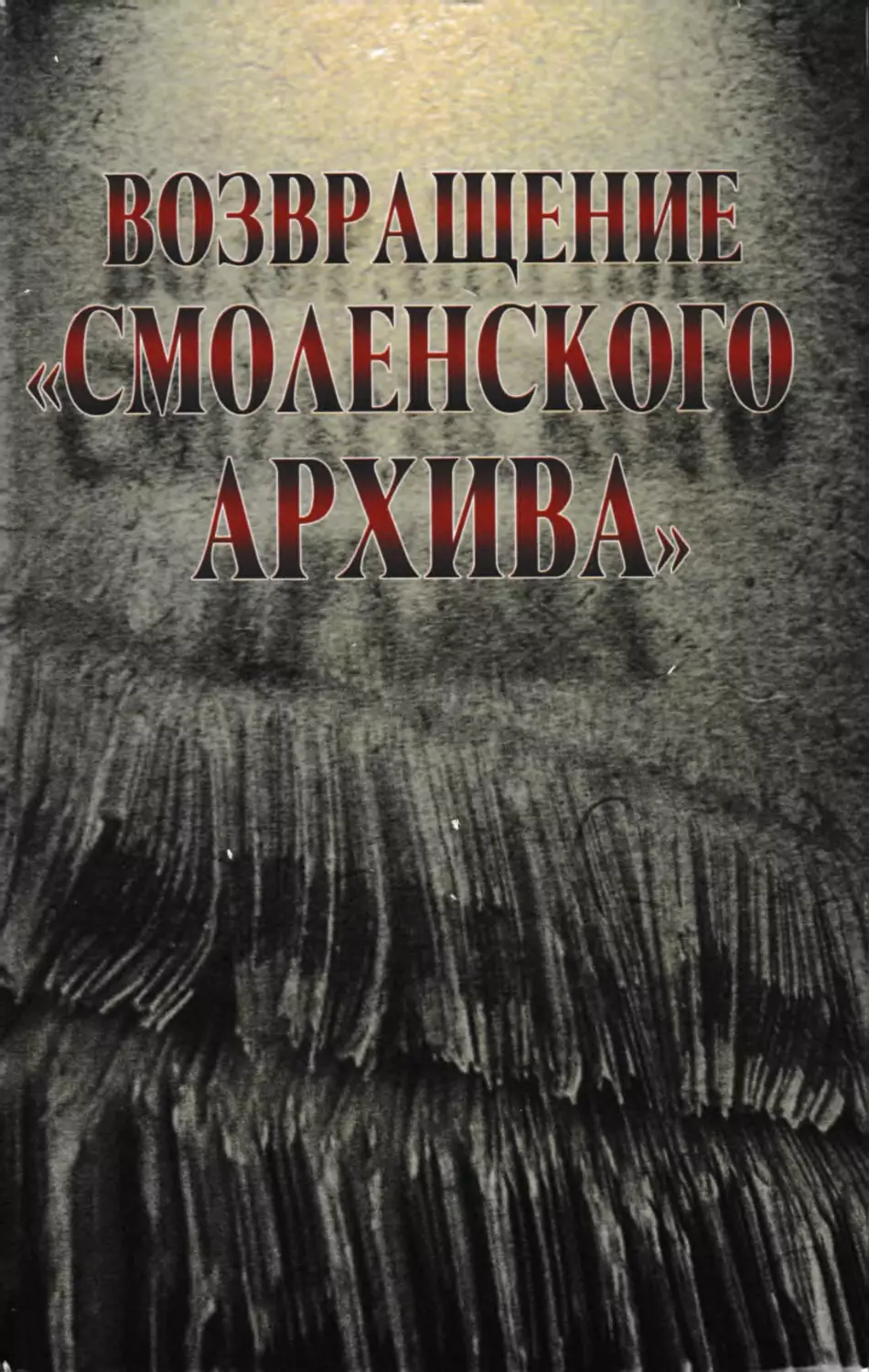
ВОЗВРАЩЕНИЕ
«СМОЛЕНСКОГО
АРХИВА»
Москва
РОССПЭН
2005
ББК 63.3(2)61; 63.3(2)621
В 64
Издание осуществлено при финансовой поддержке
Исследовательского проекта по искусству и архивам (США)
This publication has been made possible
by The Research Project on Art and Archives, Inc.
Издание подготовлено и издано в рамках
Международного проекта «Обретенное наследие»
Редакционная коллегия / Editorial Board
Екатерина Юрьевна Гениева, Патриция Кеннеди Гримстед,
Карина Александровна Дмитриева, Марианна Тэкс Чолдин
Редакторы / Editors
К.А. Дмитриева, Н.В. Гончарук, П.К. Гримстед
Составители / Compilers
К.А. Дмитриева, Н.В. Гончарук, М.Т. Чолдин, П.К. Гримстед
Перевод / Translation
Э.Г. Азгальдов, Д.С. Соколова
В 64
Возвращ ение «Смоленского архива»: Сборник статей. — М.:
«Российская политическая энциклопедия» (РОССПЭН), 2005. —
352 с. — (Обретенное наследие)
В сборник вошли статьи, написанные на основе выступлений на
круглом столе «Возвращение “Смоленского архива”», проводившего
ся в рамках конференции Американской ассоциации содействия раз
витию славистики, состоявшейся в Торонто в ноябре 2002 г., а также
статьи, специально подготовленные для этого издания.
Сборник рассчитан на исследователей, студентов, читателей, инте
ресующихся отечественной и мировой историей.
This publication includes articles based on the materials of the round ta
ble «Return of the “Smolensk Archive”» which took place in Toronto
within the frameworks of the AAASS conference in November 2002 as
well as papers specially written for this publication.
This collection of materials is addressed to scholars, students and
readers interested in Russian and world history.
The publication has been prepared within the «Heritage Revealed»
International project.
ISBN 5 - 8 2 4 3 - 0 6 8 6 - 9
О «Российская политическая энциклопе
дия», 2005.
Содержание
Table of Contents
От составителей......................................................................................
Editorial N ote...........................................................................................
Вступительное слово
Гениева Е.Ю............................................................................................
Introduction
Ekaterina Genieva................................................................................
Вступительное слово
Марианна Тэкс Чолдин.....................................................................
Introduction
Marianna Tах Choldin.........................................................................
Предисловие
Патриция Кеннеди Гримстед............................................................
Preface
Patricia Kennedy Grimsted......................................................................
История странствий «Смоленского архива»
С.Л. Солодовникова..............................................................................
Peregrinations of the «Smolensk Archive»
S.L. Solodovnikova.................................................................................
Особенности учета и описания коллекции документов
«Смоленский архив»
М.Л. Степченкова..............................................................................
The «Smolensk Archive» Collection: Characteristics
of Control and Description
M.L. Stepchenkova..............................................................................
Возвращение «Смоленского архива». От инструмента
нацистской и американской советологии к роли пешки в
международных политических интригах в области реституции
Патриция Кеннеди Гримстед............................................................
The Return of the «Smolensk Archive». From a Tool for Nazi
and American Sovietology to a Pawn in International
Restitution Politics
Patricia Kennedy Grimsted.....................................................................
7
9
И
12
13
14
15
22
29
40
50
53
56
127
6
Возвращение «Смоленского архива»
Путь назад: библиотека Шнеерсона и возвращение
«Смоленского архива»
Константин Акинша.........................................................................
On the Way Back: the Schneerson Collection and the Return
of the «Smolensk Archive»
Konstantin A kinsha............................................................................
«Смоленский архив» как символ американской
послевоенной советологии: взгляд из Смоленска
Е.В. Кодин..........................................................................................
The «Smolensk Archive» as a Symbol of American Sovietology:
A View from Smolensk
E.V. Kodin...........................................................................................
Приключения «Смоленского архива»: исповедь
американского советолога
Роберта М аннинг..............................................................................
Adventures in the «Smolensk Archive»:
The Confessions of an American Sovietologist
Roberta M anning................................................................................
Abbreviations and Acronyms............................................................
191
232
272
289
305
326
344
От составителей
В настоящем сборнике представлены статьи российских и аме
риканских исследователей «Смоленского архива», в которых авторы
пытаются проследить историческую судьбу архива и выпавшую на
его долю историческую миссию.
Следует отметить, что «Смоленский архив» включает в себя не
все то огромное количество партийных документов, которые были
вывезены из Смоленска во время оккупации, а только небольшую их
часть, нашедшую после Второй мировой войны пристанище в На
циональном архиве в Вашингтоне. По подсчетам исследователей,
«Смоленский архив» составляет около 0,5% от всей массы вывезен
ных из Смоленска документов.
Эти пожелтевшие листки, проделавшие долгий путь в про
странстве и времени, кочевавшие из России в Германию, из Герма
нии в США и обратно в Россию, являются свидетелями трагических
событий нашей истории. В «Смоленский архив» входят партийные
документы Смоленского губкома, обкома и Западного обкома
ВКП(б), уездных и окружных партийных комитетов и организаций,
охватывающих период истории с 1917 по 1941 годы. Они содержат
информацию о партийных чистках и массовых репрессиях 1930-х го
дов, о проблемах, обсуждавшихся на партийных собраниях, о работе
с доносчиками и т.д. «Смоленский архив» стал единственным, а по
этому уникальным, источником знаний о Советском Союзе для за
падных исследователей и базой для формирования основных поло
жений американской советологии.
На основе «Смоленского архива» нельзя получить всестороннее
и объективное представление об истории довоенной Смоленщины.
Однако мы с полным правом можем назвать этот архив уникальным,
поскольку именно его документы оказались доступными иностран
ным исследователям и слегка приоткрыли долгое время закрытую
дверь в нашу страну.
Вопрос о возвращении «Смоленского архива» впервые возник
после публикации книги американского исследователя Мерла Фейнсода «Смоленск под властью Советов» (1958). Инициатива возвра
щения архива принадлежала США, которые в 1965 году предложили
вернуть документы. Однако советская сторона не поддержала этой
инициативы. Лишь в 2002 году «Смоленский архив» вернулся на
свою историческую родину.
8
Возвращение «Смоленского архива»
Это, бесспорно, историческое событие вызвало в России неод
нозначную реакцию и не получило, на наш взгляд, должного осве
щения.
Цель сборника — восполнить этот пробел, подчеркнув, как
символическую ценность составляющих «Смоленский архив» исто
рических документов, так и факт их возвращения на историческую
родину.
Возвращение «Смоленского архива» стало возможным благода
ря усилиям большого количества людей, как в США, так и в России.
Особую благодарность хотелось бы выразить Стюарту Айзенштату
и Патриции Кеннеди Гримстед.
Карина Дмитриева
Наташа Гончарук
Editorial Note
This publication includes articles of Russian and American
specialists on the «Smolensk Archive» that trace the history of the
collection and accentuate its importance.
It should be mentioned that the «Smolensk Archive» does not
include all of the enormous number of Communist Party documents
removed from Smolensk during the German occupation, but just a small
part that after World War II found shelter in the National Archives in
Washington. Scholars estimate the «Smolensk Archive» to be less than
half of one percent of all the documents plundered from the Smolensk
Oblast Communist Party Archive.
These yellowed sheets of paper have made a long trip through time
and space, wandering from Russia to Germany, from Germany to the
United States of America and back to Russia, and have witnessed many
tragic moments of our history. The «Smolensk Archive» includes party
documents from the Smolensk gubkom, obkom and Western obkom of
the VKP(b), materials of the uezd and raion party committees and
organizations covering the period from 1917 to 1941. They reflect and
provide information about the party purges and mass repressions of the
1930s, topics discussed during the party meetings, informers’ reports. The
«Smolensk Archive» became the only and unique source of original
documents from the Soviet Union for Western scholars and formed the
basis of American Sovietology.
Based solely on the «Smolensk Archive» one can not get a thorough
and impartial idea of the prewar history of Smolensk and the Western
Oblast. Still, we have the right to call this archive unique because these
very documents became available to foreign researchers and slightly
opened the door to the Soviet Union that had been closed for such a long
time.
The issue of restitution of the «Smolensk Archive» was raised after a
book by the American professor Merle Fainsod, «Smolensk under Soviet
Rule», appeared in 1958. The USA initiated the return of the Archive in
1965, offering at that time to return the documents to the USSR. But the
Soviet side did not support the initiative. It was only in 2002 that the
«Smolensk Archive» returned home.
This indisputably historic action provoked an ambiguous reaction
and, in our opinion, did not receive a proper coverage.
10
Возвращение «Смоленского архива»
Many people in the USA and in Russia have made possible the
return of the «Smolensk Archive». We would like to express sincere
gratitude to them, and particularly to Stuart Eizenstat and Patricia
Kennedy Grimsted.
The purpose of this publication is to fill this gap, emphasizing the
symbolic value of the documents from the «Smolensk Archive» and the
significance of their restitution.
Karina Dmitrieva
Natasha Goncharuk
Вступительное слово
История возвращения «Смоленского архива» долгая и запутан
ная. Самый факт возвращения и оценка возвращенных материалов
вызывают в российских СМИ и среди специалистов — архивистов и
историков — большой разброс мнений. Все это подробно освещено
на страницах настоящего сборника статей. Уверена, что споры еще
будут продолжены. Поэтому я хотела бы подчеркнуть несколько
важных, на мой взгляд, аспектов этого события.
Во-первых, возвращение «Смоленского архива» знаменует со
бой проявление доброй воли двух наших стран, Америки и России, в
таком щепетильном вопросе, как проблема реституции.
Во-вторых, оно свидетельствует о конструктивном подходе аме
риканской неправительственной организации «Исследовательский
проект по искусству и архивам», подписавшей с Министерством
культуры Российской Федерации соглашение о сотрудничестве в об
ласти нахождения и идентификации перемещенных объектов искус
ства и культуры. Я рада поздравить господина Рональда С. Лаудера,
главу «Проекта», с успехом этой акции и поблагодарить его за лич
ный вклад в возвращение «Смоленского архива».
В-третьих, оно стало одним из первых практических шагов в
осуществлении российско-американской программы «Обретенное
наследие», созданной в рамках этого соглашения, и мне, как гене
ральному директору Библиотеки иностранной литературы, весьма
приятно, что библиотека активно работает над выполнением этой
программы.
Наконец, статьи настоящего сборника дают наглядное пред
ставление о том, насколько сложны все связанные с реституцией
процессы. Это лишний раз убеждает нас в том, что решение о рести
туции в каждом отдельном случае должно приниматься на основе
существующего национального законодательства и международных
соглашений.
Многие называют передачу «Смоленского архива» в Смоленск
символическим актом. С этим можно согласиться, если восприни
мать его как символ победы духа сотрудничества, здравого смысла и
взвешенного подхода к далеко непростым проблемам. Дай нам Бог
больше таких символов — наше время в них очень нуждается.
Екатерина Юрьевна Гениева
Генеральный директор Всероссийской государственной
библиотеки иностранной литературы им. М.И. Рудомино
Introduction
The return of the «Smolensk Archive» had a long and most compli
cated history. The very fact of its return and the evaluation of the returned
materials have provoked great controversy in the Russian mass media and
among specialists — archivists and historians. All these things are eluci
dated in detail in the present collection of articles. I am sure that disputes
will continue. Therefore I would like to accentuate some important, in my
view, aspects of this event.
First, it represents in itself a manifestation of good will on the part of
our two countries, America and Russia, in such a delicate matter as the
problem of restitution.
Second, it testifies to the constructive approaches of the American
nongovernmental organization «The Research Project on Art and Ar
chives» which has signed an agreement with the Ministry of Culture of
the Russian Federation on mutual cooperation in the search for and identi
fication of displaced objects of art and culture. I am happy to congratulate
Mr. Ronald S. Lauder, Ambassador, Head of the Project, on the success
of this action, and I thank him for his personal contribution to the return
of the «Smolensk Archive».
Third, this was one of the first steps in realizing the RussianAmerican programme «Heritage Revealed», created within the frame
work of this agreement, and I, as Director General of the Library for For
eign Literature, am very pleased with the fact that the Library is active in
carrying out this programme.
Finally, the articles collected in this book present an obvious case
study of how complicated everything related to restitution can be. That
convinces us once again that decisions on restitution must in each sepa
rate case be taken on the basis of national legislation in force and interna
tional agreements.
Many people call the return of the «Smolensk Archive» to Smolensk
a symbolic act. One can agree with that if this act is taken as a symbol of
the triumph of the spirit of cooperation, of common sense, and as a rea
sonable approach to far from simple problems. May such symbols pre
vail — we badly need them in our day.
Ekaterina Genieva
Director General, State Library fo r Foreign Literature
Вступительное слово
Моя роль в этом проекте — организатор. Патриция Кеннеди Гримстед попросила меня председательствовать на секции конференции
Американской ассоциации содействия развитию славистики, состо
явшейся в Торонто в ноябре 2002 года, на которой собрались спе
циалисты, впоследствии ставшие авторами данного сборника. Вы
ступления участников дополняли друг друга и стали незабываемым
событием.
Подводя итог дискуссии, последовавшей за выступлениями, я
выразила общее мнение: «Эти доклады должны быть опубликова
ны». Я обсудила эту идею с членом нашей секции Екатериной Ге
ниевой, которая, к сожалению, не смогла приехать в Торонто, и в ре
зультате появился этот сборник. Мы очень рады, что этот важный
проект был поддержан, и что «Смоленский сборник», как мы его на
звали, нашел свое место в контексте истории.
Марианна Тэкс Чолдин
Заслуженный профессор библиотековедения в отставке
(Университета Иллинойса), бывший президент AAASS
Introduction
My role in this project has been that of match-maker. Patricia Ken
nedy Grimsted asked me to chair the panel which took place in Toronto
within the frameworks o f the AAASS conference in November 2002 that
brought together the group of scholars whose contributions form the basis
of this volume. Each panelist’s presentation was fascinating in itself;
taken together, they melded into an extraordinary two-hour event that no
one present is likely to forget. At the conclusion of the lively discussion
following the presentations, I said to the assembled colleagues, «These
papers really must be published», and everyone agreed enthusiastically.
I brought the matter up with Ekaterina Genieva, who had been a member
of the panel originally but unfortunately was not able to come to Toronto,
and the ultimate result was the volume you see today. I am delighted that
such a worthy project has found eminently suitable sponsors, and that
«the Smolensk cluster», as we came to call it, has now found its place in
the historical record.
Marianna Tax Choldin
Mortenson Distinguished Professor Emerita from
the University o f Illinois, Former President o f the AAASS
Предисловие
Патриция Кеннеди Гримстед
Международный институт социальной истории,
Украинский исследовательский институт
В пятницу 13 декабря 2002 года в Москве прошла церемония
официального возврата Соединенными Штатами Америки нескольких
символических дел из так называемого «Смоленского архива». Это
произошло 56 лет спустя после изъятия этих дел сотрудниками аме
риканской разведки из общего реституционного потока. До этого они
были в Оффенбахском архивном хранилище (OAD) в окрестностях
Франкфурта-на-Майне, куда были доставлены вместе с великим мно
жеством архивных и библиотечных материалов, награбленных Треть
им рейхом. Тем временем за океаном, в Национальном архиве США в
г. Колледж-Парк (штат Мэриленд), в тот же самый день происходила
передача российским представителям остальных дел из 73 архивных
коробок из бескислотного картона с 538 делами (в 541 папке), кото
рые укладывались в грузовик Российского посольства. России переда
валась коллекция документов Коммунистической партии объемом
28 погонных футов. И вот, наконец, в марте 2003 года в Смоленске
отпраздновали их возвращение домой1.
Взаимосвязь людей и мест нередко играет решающую роль в
исторических событиях, и это в не меньшей степени относится к
долгожданному возвращению «Смоленского архива» в Смоленск.
Благодаря монографии «Одиссея Смоленского партийного архива»
(Питтсбург, 1995)2 и открытой агитации за его возвращение я полу
чила от Государственного департамента США и Комиссии по воз
врату произведений искусства приглашение принять участие в мос
ковской церемонии, но не смогла приехать. Позже я огорчилась,
узнав, что не был приглашен один из моих смоленских коллег, про
фессор истории и заместитель ректора Смоленского государственно
го педагогического университета Евгений Кодин, чье имя и знания
самым тесным образом связаны со «Смоленским архивом». По
скольку он был одним из немногих российских историков (и единст
венным из Смоленска), кто работал с этими делами в Вашингтоне,
было особенно важно, чтобы он участвовал в последующей научной
дискуссии о значении возвращенных в Смоленск дел.
16
Возвращение «Смоленского архива»
Когда в 1953 году, в самый разгар «холодной войны», со «Смо
ленского архива» впервые был снят покров секретности, Rand
Corporation и ВВС США предоставили гарвардскому профессору
политологии Мерлу Фейнсоду щедрый грант на написание книги
«Смоленск под властью Советов», сразу ставшей классикой периода
«холодной войны» (Кембридж, шт. Массачусетс, 1958)3. Когда в
конце 60-х — начале 70-х годов, в годы «холодной войны», я читала
курс советской истории в Соединенных Штатах, книга Фейнсода вхо
дила в список обязательного чтения для студентов, причем даже на
моем курсе в Университете Мэриленда в Пентагоне! Профессиональ
но сделанный Фейнсодом анализ, а также его концепция «тоталита
ризма», которая вызвала неоднозначное отношение, стимулировали
широкую дискуссию по проблемам перехода России к сталинскому
коммунистическому режиму.
В 90-е годы, когда Смоленск находился в центре внимания
западных исследователей советской системы, Е.В. Кодин провел чет
кий анализ использования книги Фейнсода и его теоретической моде
ли «тоталитаризма» в американских научных работах, посвященных
Советскому Союзу. Его монография «“Смоленский архив” и амери
канская советология» вышла в свет в Смоленске как раз в 40-ю го
довщину публикации книги Фейнсода4 и через три года после того,
как он отредактировал русский перевод работы Фейнсода5. После
возвращения архивных дел в Смоленск Е.В. Кодин проанализировал
эту коллекцию в статье, напечатанной в журнале «Вопросы исто
рии», а также координировал публикацию выборочных документов
из этих дел, характеризующих типы оригинальных источников из
Смоленска, которыми пользовались западные исследователи в годы
«холодной войны», когда советские архивы были для них закрыты6.
Профессиональная деятельность историка из Бостонского кол
леджа Роберты Маннинг также тесно связана со «Смоленским архи
вом». Она является ведущим американским специалистом по исто
рии Советского Союза — по предмету, который ее наставники в
годы ее учебы в аспирантуре Российского института в Колумбий
ском университете считали «ненаучным». Еще до того как в Смо
ленске открыли архивы для западных ученых, ее аспиранты работали
в Америке с микрофильмами фрагментов Смоленского партийного
архива, изготовленными NARA. При этом Маннинг оказалась в цен
тре историографической полемики вокруг использования этих дел, и
она прекрасно понимала, какую роль они сыграли в ее собственном
становлении как историка. Сегодня в Смоленске целый ряд допол
нительных дел (и смежных документов) из архива Смоленского об
Предисловие
17
кома ВКП(б), относящихся к периоду 20-х и 30-х годов, доступны
для исследователей всего мира7. Маннинг с головой погрузилась во
многие, вновь открытые документы советского периода. Она прини
мала непосредственное участие в исследованиях Е.В. Кодина, по
священных «Смоленскому архиву», и в организованных им конфе
ренциях в Смоленске. Ее собственный «микроанализ» Бельского
района Смоленской области служит образцом поиска новых аспек
тов исследований по новейшей советской истории.
Такие же партийные документы сейчас открыты для ученых в
региональных архивах по всей территории Российской Федерации.
Это можно видеть на примере исследования, проведенного амери
канским историком Дэвидом Рейли в Саратове8.
Воспользовавшись атмосферой открытости, Маннинг в сотруд
ничестве с российскими коллегами выступила в качестве основного
организатора ставшей уже знаменитой серии документальных «мак
роисследований» трагедии русской деревни в ходе коллективиза
ции9. Историографические споры продолжаются, но сейчас они
строятся на чрезвычайно расширившейся документальной базе, а
отнюдь не на тех делах Смоленского обкома, которые в течение по
лувека были доступны на Западе.
Ни Кодин, ни Маннинг, ни я не смогли приехать в Москву, что
бы отпраздновать возвращение «Смоленского архива». Однако мы
оценили его значение для американских славистов, рассмотрев ряд
связанных с ним научных и историографических вопросов, а также
его роль в «политике реституции». Наши выступления на круглом
столе «Возвращение “Смоленского архива”» в рамках конференции
Американской ассоциации содействия развитию славистики, прохо
дившей в Торонто в ноябре 2002 года, послужили основой для ста
тей, напечатанных в настоящем сборнике. Из России на конферен
цию прилетел Евгений Кодин, и в Торонто к нему присоединились
Константин Акинша, Роберта Маннинг и я. Ведущей на круглом
столе была Марианна Тэкс Чолдин, заслуженный профессор биб
лиотековедения в отставке из Университета Иллинойса и бывший
президент AAASS, которая много лет занимается международными
проблемами библиотечного и архивного дела, особенно в области,
касающейся славянского региона. Посол США в России Джек Мэт
лок выступал в качестве комментатора.
Моя публикация в данном сборнике является обобщенным и
существенно обновленным вариантом моей монографии 1995 года.
В статье дается анализ ряда специфических особенностей «одиссеи»
архива из Смоленска и одновременно освещается характер нацист
ского и американского политических императивов при конфискации
18
Возвращение «Смоленского архива»
архивных документов на оккупированных территориях. Она бросает
свет на послевоенную политику западных союзников в отношении
трофейных документов и реституции культурных ценностей. Впо
следствии, в годы «холодной войны», а затем и в постсоветский пе
риод, те же смоленские дела стали заложниками международных
политических интриг вокруг реституции культурных ценностей10.
По иронии судьбы, выяснилось, что один оригинал из Архива Смо
ленского обкома партии до сих пор находится в США. Он является
частью коллекции Б.И. Нико-лаевского, который, сам того не созна
вая, оказался одним из тех, кто в 1946 году самым непосредствен
ным образом повлиял на решение руководителей американской
разведки вывести остальные смоленские дела из общего потока до
кументов, которые Соединенные Штаты возвращали владельцам по
сле войны.
Я уже много лет сотрудничаю с Константином Акиншей по во
просам, касающимся перемещенных культурных ценностей и рести
туции в России и Украине. Его участие в работе круглого стола на
торонтской конференции AAASS стало решающим фактором, ибо
он добился успеха там, где я потерпела поражение в попытках найти
необходимые рычаги для возврата «Смоленского архива». Именно
он обеспечил необходимые связи для «возврата» 2002 года, и этот
успех увенчался его участием в московском торжестве. В данном
сборнике он рассматривает историю вопроса в более широком кон
тексте, анализируя проблему, явившуюся препятствием к возвраще
нию этих дел на протяжении 90-х годов. Особое внимание он уделяет
курьезной «увязке» американской политики в отношении «Смолен
ского архива» с притязаниями наследников из бруклинской общины
Хабад на собрание книг и рукописей, хранящихся в Российской го
сударственной библиотеке (РГБ) в Москве. Эта коллекция собира
лась ребе Шнеерсоном и его последователями до 1914 года в Любавичах — хасидской общине на западной территории Российской
империи11. Во время Первой мировой войны коллекция была остав
лена на хранение на складе в Москве, а потом ее владельцем стала
библиотека, впоследствии названная Ленинской, а ныне — РГБ. Сын
ребе Шнеерсона, седьмой любавический раввин, вначале был ре
прессирован в Ленинграде, а затем ради его спасения вывезен из
Варшавы и Риги в начале Второй мировой войны и Холокоста.
История борьбы Хабада за возврат религиозной коллекции их
предков изобилует эпизодами антисемитизма и попытками исполь
зовать перипетии тяжбы в политических целях. Ни с точки зрения
правовых принципов, ни с точки зрения международного права пре
тензия на библиотеку Шнеерсона не имеет ничего общего с притяза
Предисловие
19
нием на «Смоленский архив». Между тем американские политики во
главе с Альбертом Гором и его коллегой по сенату Джозефом Либерманом создали ситуацию, которая помешала намеченному на
1992 год возврату «Смоленского архива» в Россию и способствовала
удержанию его в Вашингтоне все последующее десятилетие12. По
случайному совпадению село Любавичи находится на территории
Смоленской области. И хотя сенаторы, скорее всего, не знали об
этом, в одном из дел «Смоленского архива» вскрываются факты ан
тисемитизма в Любавичах в период коллективизации в Советском
Союзе.
В ходе сотрудничества с К. Акиншей при написании его статьи,
мне пришлось вести переговоры и с Российской государственной
библиотекой в Москве, и с Библиотекой Хабад в Бруклине. Меня
удивило то, что ни та, ни другая сторона не могла сказать мне, о ка
ком количестве книг и рукописей идет речь. Хотя большинство книг
из библиотеки Шнеерсона было введено в общий Восточный фонд
РГБ, их происхождение никогда не устанавливалось. Обе стороны
сошлись на цифре примерно 4 500 томов, в отношении которых оп
ределенно можно сказать, что они относятся к библиотеке Шнеерсо
на, из общего числа 12 000 книг в составе коллекций, приобретен
ных с того же московского склада в 20-х годах XX века.
В 80-е годы в Музее книги Ленинской библиотеки начал создаваться
(но так и не был закончен) каталог почти 100 редких изданий (в
большинстве своем XVI века), а сегодня в Музее книги РГБ нет спе
циалиста со знанием иврита. В Отделе рукописей РГБ никто не мог
назвать мне точное число рукописей из коллекции Шнеерсона, и мне
предложили проконсультироваться у специалистов в Израиле. На
следие Шнеерсона в Отделе рукописей явно перемешалось с други
ми «трофейными» рукописями на иврите, поступившими после Вто
рой мировой войны, и все они до сих пор прошли лишь частичную
обработку. Все эти вопросы разъяснены в статье К. Акинши. Отсут
ствие точного описания оспариваемых документов является серьез
ным препятствием для подачи официального иска.
В Восточном центре РГБ для книг на еврейских языках был
создан специальный читальный зал. Это никак не могло удовлетво
рить наследников из общины Хабад, которые много лет боролись за
то, чтобы получить обратно свою утраченную библиотеку и привез
ти ее в Бруклин, ставший их мировым библиотечным центром.
В 90-е годы присутствие «Смоленского архива» в США использова
лось СССР как оправдание отказа возвращать культурные ценности,
перемещенные в Советский Союз из Западной Европы в результате
Второй мировой войны. В конце 90-х годов, когда заинтересованные
20
Возвращение «Смоленского архива»
круги за рубежом настойчиво требовали предоставить информацию
о перемещенных в Россию культурных ценностях эпохи Холокоста,
присутствие «Смоленского архива» в Америке стало тормозить пе
реговоры по проекту, ставившему целью обнаружение и описание
«трофейных» еврейских культурных ценностей в России. Таким
образом, возврат этого архива в Смоленск приобрел новую полити
ческую целесообразность. К. Акинша принимал самое непосредст
венное участие в переговорах, которые, наконец, завершились рес
титуцией «Смоленского архива».
Начальник Архивного управления Департамента Смоленской
области по культуре С.Л. Солодовникова в начале 90-х годов помог
ла мне в сборе имевшихся в Смоленске сведений об «одиссее» дел
из архива Смоленского обкома. Факты, изложенные в моей моно
графии «Одиссея “Смоленского архива”», нашли подтверждение в
статье С.Л. Солодовниковой, опубликованной в журнале «Отечест
венные архивы» после возвращения архива в Смоленск13.
Однако реституция архива не положила конец «вопросам», воз
никающим в России относительно содержания и объема «Смолен
ского архива» в американской компоновке. Имеются даже иски со
стороны Украины на еврейские дела, которые перемешались с кол
лекцией, пока она находилась в США. Таким образом, дело о «Смо
ленском архиве» по-прежнему вызывает интерес, поскольку аккуму
лирует в себе проблемы, типичные для перемещенных архивов и
реституции. Трудно найти другое такое дело, которое, будучи пред
ставленным сравнительно небольшим количеством архивных доку
ментов, приковывало бы к себе общественное внимание политиче
ских лидеров по обе стороны Атлантики.
1 В официальных документах на передачу и в некоторых отчетах назы
вается цифра 541, но на самом деле в последовательной нумерации не хва
тало четырех номеров. По словам смоленских архивистов, в одном деле
(№ 33) хранились три папки, а в другом (№ 90) — две, что и было засвиде
тельствовано после их получения в Смоленске. В системе NARA дела были
пронумерованы от WKP 1 до WKP 541, причем четыре позиции были утра
чены, а одно дело было лишним. Подробнее о спорах вокруг нумерации см.
ниже в статьях Патриции Гримстед и Е.В. Кодина.
2 Grimsted Р.К. The Odyssey of the Smolensk Party Archive: Plundered
Communist Archives for the Service of Anti-Communism. Pittsburgh PA:
University of Pittsburgh (Center for Russian and East European Studies, 1995).
Сокращенный вариант монографии Гримстед вышел под заглавием « The
Odyssey of the Smolensk Archive. Plundered Communist Records in 1999:
Предисловие
21
Zeitschrift für Sozialgeschichte des 20 und 21. Jahrhunderts» (in 3 parts). 1997.
Heft 4. P. 71—91; 1998. Heft 2. P. 190—201; 1999. Heft 1. P. 134— 51.
3 Fainsod M. Smolensk under Soviet Rule. Cambridge, MA: Harvard
University Press, 1958. Далее ссылки даются на издание в бумажной обложке
(N.Y.: Vintage, 1963). М. Фейнсод (1907— 1972) долгое время был профес
сором государственного управления в Гарвардском университете и дирек
тором Центра российских исследований.
4 Кодин Е.В. «Смоленский архив» и американская советология. Смо
ленск: СГПУ, 1998.
5 Фейнсод М. Смоленск под властью Советов. Смоленск: Траст-Имаком,
1995.
6 «Смоленский архив» как «зеркало советской действительности» // Во
просы истории. 2003. № 9. С. 3—27; № 11. С. 3— 37; № 12. С. 3—25.
7 См. путеводитель по бывшему архиву Коммунистической партии в
Смоленске: Центр документации новейшей истории Смоленской области:
Краткий справочник по фондам / Сост. Н.Ф. Пикалова и др.; ред.
Е.В. Кодин и др. Смоленск, 1998 (серия «Архивы Смоленской области»). Я
благодарю архивных работников за экскурсию по их учреждению, а также
Евгения Кодина за экземпляр этого справочника, который наглядно свиде
тельствует о том, как много документов 20-х и 30-х годов вернулось домой.
8 См., например, Raleigh D. Doing Soviet History: the Impact o f the
Archival Revolution // Russian Review. 2002, January. № 1. P. 18— 19.
9 Трагедия советской деревни: Коллективизация и раскулачивание. До
кументы и материалы. В 5 т. / Под ред. В. Данилова, Р. Маннинг, Л. Виола и
др. М.: РОССПЭН, 1999—2004; Советская деревня глазами ВЧК-ОГПУНКВД, 1918— 1939: Документы и материалы. В 4 т. / Под ред. А. Береловича, В. Данилова. М., 1998.
10 См.: Grimsted Р.К. Displaced Archives and Restitution Problems on the
Eastern Front in the Aftermath of World War II // Contemporary European
History. 6:1 (1997): 27—74. Из последних публикаций см.: Grimsted Р.К.
Russia’s Trophy Archives: Still Prisoners of World War II? Электронный вари
ант (Budapest: Open Society Archive, 2002) http://www.osa.ceu.hu/
publications/ 2002/RussianTrophvArchives/RussianTrophv Archives.html.
11 До революции Любавичи находились в Оршском уезде Могилевской
губернии (ныне в составе Белоруссии), сегодня Любавичи находятся на тер
ритории Смоленской области Российской Федерации.
lî Подробнее об этом см.: Grimsted Р.К. The Odyssey of the Smolensk Party
Archive: Plundered Communist Archives for the Service of Anti-Communism.
Pittsburgh PA: University of Pittsburgh, Center for Russian and East European
Studies, 1995. P. 80—87.
13 Солодовникова С.Л. Конец одиссеи «Смоленского архива» // Отечест
венные архивы. 2003. № 5. С. 15—21.
Introduction
The «Smolensk Archive» Returns Home
Patricia Kennedy Grimsted
Harvard Ukrainian Research Institute,
International Institute o f Social History
A few symbolic files of the so-called «Smolensk Archive» were offi
cially returned to the Russian Federation by the United States of America
in a Moscow ceremony on Friday the 13th of December 2002. That was
56 years after American intelligence officers had removed them from the
restitution pipeline at the Offenbach Archival Depot (OAD) near Frank
furt on Main, where they had surfaced amidst the vast archival and library
plunder of the Third Reich. Meanwhile across the ocean, the remainder of
the 73 acid-free cardboard archival boxes with 538 numbered files (in
541 folders) were turned over to Russian representatives the same day at
the U.S. National Archives in College Park MD and loaded into a Russian
Embassy truck. The 28 linear feet of Communist Party records were on
their way home, and their homecoming was finally celebrated in
Smolensk in March 20031.
The interconnection of people and places frequently plays a crucial
role in historical events, and it is no less the case in the long-awaited re
turn of the «Smolensk Archive» to Smolensk. As a result of my mono
graph The Odyssey o f the Smolensk Party Archive (Pittsburgh, 1995)2,
and my outspoken advocacy for its return, I was duly invited to the Mos
cow ceremony by the U.S. Department of State and the Commission on
Art Recovery, but was unable to attend. Afterwards, I was distressed to
learn that a Smolensk colleague whose name and scholarship has been
most closely associated with the «Smolensk Archive», professor of his
tory and vice-rector of Smolensk State Pedagogical University Evgenii
Kodin, had not been invited. Since he was one of the few Russian histori
ans — and the only one from Smolensk — personally to have seen and
worked with those files in Washington, DC, it was all the more important
for him to participate in subsequent academic discussion about the sig
nificance of the files returned to Smolensk.
When the «Smolensk Archive» first came out of intelligence wraps
at the height of the Cold War in 1953, Harvard political science professor
Merle Fainsod was generously funded by the Rand Corporation (and the
Preface
23
United States Air Force) to write what quickly became a Cold War clas
sic, Smolensk under Soviet Rule (Cambridge, MA, 1958)3. When I taught
Soviet history in the United States during the Cold War in the late 1960s
and early 1970s, Fainsod’s book was required student reading, and even
for my University of Maryland course at the Pentagon! Fainsod’s master
ful regional analysis, together with his construct of «totalitarianism», and
examples of equivocation about the model, fueled considerable discussion
of the traumatic transformation of Russia to Stalin’s communist regime.
With Smolensk at the center of attention for Western analyses of the
Soviet regime, in the 1990s, Evgenii Kodin incisively researched the use
of Fainsod’s text and his conceptual model of «totalitarianism» in Ameri
can studies of the Soviet Union. Kodin’s monograph On the «Smolensk
Archive» and American Sovietology appropriately appeared in Smolensk
on the forty-year anniversary of Fainsod’s book4, three years after he had
edited the Russian translation of the Fainsod study5. After the return of
the files to Smolensk, Kodin analyzed the collection in Moscow’s prestig
ious Voprosy istorii and supervised the publication of selected documents
from the files, characterizing the types o f original sources that Western
researchers were using from Smolensk during the Cold War period of
closed Soviet archives .
Boston College historian Roberta Manning’s professional life had
also become entwined with the «Smolensk Archive». Her career brought
her into prominence as a leading American scholar on the history of the
Soviet Union, a subject her mentors considered «unscholarly» when she
was a graduate student in the Russian Institute of Columbia University.
Before the archives were open to Western scholars in Smolensk, she had
her own graduate students working with the NARA microfilms of those
fragments from the Smolensk Communist Party Archive in America.
Meanwhile, she has been at the center o f historiographical controversies
stemming from their use of those files, and she is duly conscious of the
role they have played in her own historical upbringing. Today in
Smolensk, many additional revealing files — and contiguous documenta
tion — from the 1920s and 30s in the former Party Archive of Smolensk
Oblast are now open to researchers from throughout the world7. Manning
has been immersed in many of the newly opened Soviet-period records.
She has been closely involved with Kodin’s studies about the «Smolensk
Archive» and the conferences he has organized in Smolensk. Her own
«micro» analysis of the Belyi Region of Smolensk Oblast is a model of
the new dimensions of research in contemporary Soviet history.
Similar Party records are open to researchers in regional archives
throughout the Russian Federation, as American historian Donald Ra
leigh, for example, has shown with his research in Saratov8. Taking ad
24
Возвращение «Смоленского архива»
vantage of the new openness, starting in 1991, Manning served as the key
organizer for the acclaimed «macro» documentary series on the tragedy
of transformation of the Russian countryside through collectivization, in
collaboration with Russian colleagues9. Historiographical debates con
tinue today, but now with a greatly expanded source base, rather than
only those 500 Smolensk CP files that for half a century were the only
ones available in the West.
Neither Kodin, nor Manning, nor myself could be in Moscow to
celebrate the return o f the «Smolensk Archive». We did, however, appro
priately salute its legacy for American Slavic specialists, while consider
ing some of its academic and historiographical issues, as well as its role
in «restitution politics». A panel discussion devoted to «The Return of the
Smolensk Archive» at the Toronto conference of the American Associa
tion for the Advancement of Slavic Studies in November 2002 provided
the basis for our presentations in this volume. Evgenii Kodin flew in from
Russia for the occasion to be joined in Toronto by Konstantin Akinsha,
Roberta Manning, and myself. Marianna Tax Choldin, retired Distin
guished Professor of Library Sciences from the University of Illinois, and
a former president of the AAASS, who has long been involved with in
ternational library and archival issues, particularly relating to the Slavic
world, chaired the panel and now serves as one of the editors. Ambassa
dor Jack Matlock, who had served en poste in Moscow during part of the
recent controversy over the «Smolensk Archive», served as commentator.
My present account summarizes and significantly updates my 1995
monograph, drawing on new documentation and questions that have
come to light since the Smolensk CP files returned to Smolensk. Review
ing some of the specifics of the «odyssey», it simultaneously illuminates
patterns of Nazi and American political imperatives for archival seizures
from occupied lands. It throws light on Western Allied postwar policies
with respect to captured records and cultural restitution. Subsequently
during the Cold War, and again during the recent post-Soviet period,
those same files from Smolensk became a pawn in international cultural
restitution politics10. Quite ironically, it has come to light that today one
original file from the Smolensk Oblast Communist Party Archive still
remains in the United States. It is held in the collection of Boris I. Nicolaevsky, who turns out unknowingly to have been one of those most di
rectly responsible in 1946 for U.S. intelligence authorities having with
held the rest of the files from Smolensk from the postwar U.S. restitution
pipeline.
I
have been cooperating for many years with Konstantin Akinsha o
various issues regarding displaced cultural treasures and restitution in
Russia and Ukraine. His participation in the Toronto AAASS panel was
Preface
25
crucial since he succeeded where I failed to find a break-through mecha
nism for the return of the «Smolensk Archive». That success was cli
maxed by his participation in the Moscow celebration. Having provided
the essential links for the 2002 «return», he here comments on the back
ground and wider perspective of the problem that prevented the restitu
tion of those files throughout the 1990s. He focuses on the curious
American political «linkage» of the «Smolensk Archive» to the claim o f
Chabad heirs in Brooklyn for a collection o f books and manuscripts held
today in the Russian State Library (RGB) in Moscow. That collection had
been gathered by Rabbi Schneerson and his followers before 1914 in
Lubavichi, a Hasidic community in the western Russian Empire11. During
the World War I, the collection was deposited in a Moscow warehouse
and then taken over by what was to become the Lenin Library and today
RGB. Meanwhile Rabbi Schneerson’s son, the Seventh Lubavichi Rebbe
had first been repressed in Leningrad, and then was rescued from Warsaw
and Riga at the start of World War II and the Holocaust.
The Chabad struggle to retrieve the religious collection of their fore
bears, is rife with incidents of anti-Semitism on the one hand, and political
use of a Jewish cause on the other. Neither in underlying legal principles,
nor in customary international law, does the claim for the Schneerson
Collection have anything in common with the claim for the «Smolensk
Archive». Yet American politicians, led by Albert Gore and his Senate
colleague Joseph Lieberman, established a linkage that prevented the
planned 1992 return of the «Smolensk Archive» to Russia and kept the
archive in Washington, DC, for the next decade12. Coincidentally today,
but hardly involved in the political linkage, the village of Lubavichi is lo
cated in Smolensk Oblast. And although the Senators probably never
knew about it, one file in the «Smolensk Archive» reveals anti-Semitism
in Lubavichi during Soviet collectivization.
Collaboration with Akinsha on his contribution involved my own
consultations with both the Russian State Library (RGB) in Moscow and
the Chabad Library in Brooklyn. I was surprised to find that neither side
could tell me precisely how many books and manuscripts were in ques
tion. While most of the books from the Schneerson Collection have been
catalogued among the general RGB Oriental holdings, they were never
identified as to provenance. So far the two sides have agreed on approxi
mately 4,500 volumes that could definitively be identified as part of the
Schneerson Collection out of the potential 12,000 books in collections
acquired from the same Moscow warehouse in the 1920s. While a profes
sional card catalogue of close to 100 early rare editions (most from the
16th century) was started in the Lenin Library’s Museum of the Book
(Rare Book Department) in the 1980s, it was never completed, and today
26
Возвращение «Смоленского архива»
RGB does not even have a Hebrew rare book specialist. No one in the
RGB Manuscript Department could tell me how many Schneerson manu
scripts were there and suggested I consult with specialists in Israel. The
Schneerson legacy there has apparently now become intermixed with
other «trophy» Hebrew manuscripts received after World War II, all of
which still remain only partially processed. Those problems are now ex
plained in Akinsha’s contribution, but suggest how difficult it will be to
file a formal claim without a more precise description of the materials
under contention.
Meanwhile during the 1990s, the presence of the «Smolensk Ar
chive» in the United States was being used in Moscow as an excuse why
Russia should not return cultural treasures from Western Europe that had
been displaced to the Soviet Union after the Second World War. Simulta
neously, the political and legal battles for custody of the Schneerson Col
lection have resulted in the formation of an Oriental Center in the Russian
State Library and even a special reading room for Hebraica including the
Schneerson Collection itself. That hardly satisfied the Chabad heirs, who
have been struggling for many years to regain their long-lost library and
bring it to Brooklyn, which has become their world library center, since
the Rebbe from Lubavichi came to the United States in 1940. In the late
1990s, when concerned foreign circles were clamoring for more informa
tion about Holocaust-era cultural assets displaced in Russia, the presence
of «Smolensk Archive» in America became an impediment in negotiating
a project for identification and description of «trophy» Jewish cultural as
sets in Russia. As a consequence, the return of those files to Smolensk
gained new political expediency. Akinsha was closely involved with the
negotiations that finally resulted in their restitution.
Smolensk archival administration director S.L. Solodovnikova, in
the early 1990s, had generously assisted me in gathering what data re
mained in Smolensk about the odyssey of the Smolensk CP files long
held in America. Following the return of those files to Smolensk, her arti
cle in the leading Russian professional archival journal basically con
firmed the facts presented in my earlier The Odyssey o f the «Smolensk
Archive»13. Here, she and an archivist in the former Smolensk Party Ar
chive join our collection of essays with commentaries on the homecom
ing and archival analysis of the files now being processed in Smolensk.
As we shall see below, however, even restitution did not stop «ques
tions» in Russia about the nature and quantity of the «Smolensk Archive»
in its American configuration. Ironically there have even been claims
from Ukraine for Jewish files that had become intermingled with the col
lection when in American hands. Thus the case of the «Smolensk Ar
chive» remains a special and intriguing one, an example of the much
Preface
27
broader problems of historiography, displaced archives, and restitution is
sues. One can hardly find another case where such a relatively small
group of archival documents has drawn so much public attention among
political leaders on both sides of the Atlantic.
1 Official transfer papers and some accounts have claimed there were
541 files, but in fact there were four numbers missing in the consecutive numera
tion. According to Smolensk archivists, one file № 33 contained three folders,
and another contained two (№ 90), as verified after receipt in Smolensk. In the
NARA system, the files were numbered WKP 1 through WKP 541, with four
missing positions and one extra file. See more details about the numbering con
troversies in the articles by Patricia Grimsted and Evgenii Kodin below.
2 Grimsted P.K. The Odyssey of the Smolensk Party Archive: Plundered
Communist Archives for the Service of Anti-Communism. Pittsburgh PA: Univer
sity of Pittsburgh, Center for Russian and East European Studies, 1995 (Carl
Beck Occasional Papers in Russian and East European Studies. № 1201). A con
densed version of the Grimsted monograph was published as The Odyssey of the
Smolensk Archive. Plundered Communist Records, in 1999: Zeitschrift fur
Sozialgeschichte des 20 und 21. Jahrhunderts (in 3 parts), 1997. Heft 4. P. 71—
91; 1998. Heft 2. P. 190—201; 1999. Heft 1. P. 134— 51.
3 Fainsod M. Smolensk under Soviet Rule. Cambridge, MA: Harvard Univer
sity Press, 1958. Subsequent references are to the paperback edition (N.Y.: Vin
tage, 1963). Fainsod (1907—1972) long served as professor of Government at
Harvard University and director of the Russian Research Center.
4 Kodin E.V. «Smolenskii arhiv» i amerikanskaia sovetologiia. Smolensk:
SGPU, 1998.
5 Fainsod M. Smolensk pod vlast'iu Sovetov. Smolensk: Trast-Imakom, 1995.
6 «Smolenskii arkhiv» как «zerkalo sovetskoi deistvitel’nosti» И Voprosy istorii. 2003. № 9. P. 3—27; № 11. P. 3—37; № 12. P. 3—25.
7 See the guide to the former Party Archive in Smolensk: Tsentr dokumentatsii noveishei istorii Smolenskoi oblasti: Kratkii spravochnik po fondam /
Comp. N.F. Pikalova et al.; ed. E.V. Kodin et al. Smolensk, 1998 (AU
administratsii Smolenskoi oblasti; TsDNISO) Arkhivy Smolenskoi oblasti.
I thank the archival staff for giving me a VIP tour of their facility and Evgenii
Kodin for sending me a copy of that guide, which clearly demonstrates that many
records from the 1920s and 30s had come home.
8 See, for example, Raleigh D. Doing Soviet History: The Impact of the Ar
chival Revolution // Russian Review. 61. № 1. January 2002. P. 18— 19.
9 Tragediia sovetskoi derevni: Kollektivizatsiia i raskulachivanie: Dokumenty
i materially v 5 tomakh. M.: ROSSPEN, 1999—2004; and Sovetskaia derevnia
glazami VChK-OGPU-NKVD, 1918—1939: Dokumenty i materialy v 4 tomakh.
M., 1998.
10 See Grimsted P.K. Displaced Archives and Restitution Problems on the
Eastern Front in the Aftermath of World War II // Contemporary European His
tory 6:1. 1997. P. 27— 74. See more recently, Grimsted P.K. Russia's Trophy Ar
chives: Still Prisoners of World War II? Electronic version (Budapest: Open So
28
Возвращение «Смоленского архива»
ciety Archive, Central European University, 2002) — http://www.osa.ceu.hu/
publications/2002/RussianTrophvArchives/RussianTrophvArchives.html.
11 Before the revolution, Lubavachi was located in Orsha Uezd (district) of
Mogilev Gubemiia, now part of Belarus, but today Lubavachi is a part of
Smolensk Oblast (region) o f the Russian Federation.
12 See more details in Grimsted P.K. The Odyssey of the Smolensk Party Ar
chive: Plundered Communist Archives for the Service of Anti-Communism. Pitts
burgh PA: University o f Pittsburgh, Center for Russian and East European Stud
ies, 1995. P. 80— 87.
13 Solodovnikova S.L. Konets odissei «Smolenskogo arkhiva» // Otechestvennyie arkhivy. 2003. № 5. P. 15—21.
История странствий
«Смоленского архива»
Светлана Леонидовна Солодовникова
Начальник Архивного управления
Департамента Смоленской области по культуре
Вернулись в Смоленск из США документы «Смоленского архи
ва» (541 дело), исколесившие пол-Европы и побывавшие за океаном.
Знамениты они тем, что это единственные партийные документы,
которые оказались в руках западных историков во времена «холод
ной войны». Можно сказать, что почти вся советология до перестро
ечных времен основывалась на этих документах.
Попытаемся заново проследить судьбу смоленских документов,
так как из Смоленска были вывезены не только материалы партий
ного архива, но также областного государственного и ведомствен
ных архивов.
К началу Великой Отечественной войны (1941) в Государствен
ном архиве Смоленской области (ГАСО) насчитывалось около
1.5 млн дел. Сколько дел было в партийном архиве Смоленского об
кома ВКП(б) определить по документам самого архива сложно, так
как после известия о нахождении смоленских материалов в США
было сделано все, чтобы доказать, что за океаном никаких подлин
ных документов нет, а вся история так называемого «Смоленского
архива» не что иное, как фальсификация.
До войны документы Государственного архива Смоленской об
ласти располагались в пяти приспособленных помещениях: СпасоПреображенском соборе Аврамиевского монастыря, Покровской и
Петропавловской церквях, здании Духовной консистории и Римскокатолическом костеле. Два последних здания ГАСО занимает и сей
час. Фонды партийного архива были размещены в церкви Всех Свя
тых. Эти архивохранилища располагались в центральной части Смо
ленска, занятой фашистами 15-16 июля 1941 года. В распоряжении
смоленских архивистов было менее месяца для того, чтобы органи
зовать эвакуацию документов в тыл.
30
Возвращение «Смоленского архива»
В приказе № 70 архивного отдела УНКВД Смоленской области
от 8 августа 1941 года указывалось, что отдел эвакуировался из
Смоленска 15 июля 1941 года.
В докладной записке об эвакуации документов из Государст
венного архива Смоленской области отмечалось, что к началу войны
в архиве хранилось 2 787 фондов с общим количеством
1 436 763 дела. В июле 1941 года в Куйбышев были вывезены только
4 вагона с делами и картотекой секретного отдела. Далее указыва
лось: «Начальник отдела государственных архивов УНКВД Смолен
ской области Николай Георгиевич Быстров проявил безответствен
ное отношение к сохранности документальных материалов архива и
эвакуации их не организовал. Материалы были погружены в вагоны
навалом в связках и даже в состоянии россыпи...»1. Не были выве
зены описи на материалы архива, в том числе и на эвакуированные
документы. Архивные дела, эвакуируемые в г. Куйбышев, сопрово
ждали директор Секретного архива В.К. Журавлев и старший ин
спектор архивного отдела М.Ф. Левченко. Известно, что 15 августа
1941 года Н.Г. Быстров выезжал в г. Куйбышев, откуда вернулся
18 сентября в г. Кондрово, где в то время находились органы вла
сти Смоленской области. Вскоре, в связи с временной оккупацией
Смоленской области, Н.Г. Быстров был освобожден от занимаемой
должности. Его направили сначала по месту жительства семьи, а
затем в отдел государственных архивов УНКВД Приморского края,
где некоторое время он работал начальником отдела секретных
фондов.
Всего из облгосархива в Куйбышевскую область удалось эва
куировать более 280 000 дел2. Сотрудники партархива организовали
вывоз дел на 6 автомашинах сначала в г. Юхнов, а затем в Ураль
скую область Казахской ССР. Остальные документы были вскоре
обнаружены оккупантами. Сейчас уже невозможно объяснить, по
чему было не выполнено или не полностью выполнено решение бю
ро Смоленского обкома ВКП(б) от 28 июня 1941 года (протокол
№ 101) о сожжении документов3.
М.С. Зинич в статье «Деятельность Оперативного штаба
А. Розенберга по вывозу культурных ценностей из СССР» отметил
негативную роль коллаборационистов в пособничестве по розыску и
отправке в Германию именно музейных и архивных материалов4.
В Смоленске большую помощь в организации отбора и вывоза до
кументов оказал оккупантам Илья Авксентьевич Морозов.
И.А. Морозов, 1889 года рождения (по другим данным —
1887 года), после окончания в 1918 году Московского археологиче
История странствий «Смоленского архива»
31
ского института и демобилизации в 1926 году из рядов Красной Ар
мии приехал в Смоленск, где работал с декабря 1926 года по май
1930 года инструктором, а с мая 1930 года по февраль 1931 года —
научным сотрудником Западного архивного бюро (до 1929 года —
Смоленского архивного бюро). Затем он подвергся репрессиям: в
1931 году был арестован, в 1932 году — осужден по ст. 58 п. 6 УК
РСФСР на 10 лет исправительно-трудовых лагерей «за принадлеж
ность к агентуре латвийской и польской разведок». Накануне войны
он вернулся в Смоленск, а впоследствии был назначен оккупацион
ными властями заведующим архивным бюро. Осенью 1943 года
И.А. Морозов уехал вместе с отступающими немецкими войсками.
Однако после окончания войны он снова вернулся в Смоленск, где
был арестован и осужден — на этот раз за пособничество фашистам.
Справка по материалам его уголовного дела, хранящегося в архиве
УФСБ по Смоленской области, служит одним из источников, по ко
торому можно проследить судьбы смоленских архивов в годы Вели
кой Отечественной войны5.
Морозов хорошо знал, где располагались архивы, и именно он
сообщил в СД о месте нахождения документов партийного архива
Смоленского обкома ВКП(б). Архивными документами занимались
сотрудники подразделений Оперативного штаба А. Розенберга, раз
местившихся в Смоленске. Известно, что в состав главных рабочих
групп штаба «Остланд» и «Митте» входила рабочая группа «Смо
ленск». Были созданы зондерштабы по отраслям, например, наряду с
зондерштабами «Библиотеки», «Музыка», «Изобразительное искус
ство» действовал зондерштаб «Архивы» (руководитель д-р Вольф
ганг Моммзен, позднее — д-р Дюльфер). Указанные штабы следова
ли за немецкими войсками.
17
июля 1941 года из Смоленска был отправлен первый отче
подразделения штаба Розенберга о наличии в городе архивных до
кументов. В докладе от 21 сентября уже упоминаются материалы
партийного архива Смоленского обкома ВКП(б), попавшие в распо
ряжение СД.
Архивное бюро под руководством И.А. Морозова приступило к
работе в августе 1941 года. Из отчетов следует, что сначала его со
трудники занимались разбором документов и выдачей справок насе
лению. Непосредственная подготовка документов к вывозу в Германию
началась, скорее всего, с лета 1942 года. В одной из информаций
бюро указывалось: «Наступившие холода 1941—42 гг. прекратили
почти совершенно работу в архивах, так как архивохранилище не
отапливалось, электрического света не было, и только с наступлени-
32
Возвращение «Смоленского архива»
ем теплого времени, т.е. с 1 мая с.г. работа в архиве развернулась»6.
Из докладных фюрера зондеркоманды войсковой группы «Митте»
д-ра Нерлинга, датированных маем — июнем 1942 года, можно сде
лать вывод, что к этому времени был изучен состав оставленных
фондов партийного архива и документов облгосархива, касающихся
сведений о рождениях, бракосочетаниях и смерти. В частности, в
Оперативный штаб Розенберга сообщалось: «Архив содержит адми
нистративные документы всей Коммунистической партии в районе
Смоленска. Он состоит из 200 фондов, важнейшими фондами явля
ются следующие:
1) Контрольный комитет партии (Комитет по проведению чист
ки партии, 1930— 1936 годы)
2) Губернский комитет партии, 1919— 1928 годы
3) Районный комитет партии, 1919— 1938 годы
4) Городской районный комитет партии, 1923— 1938 годы
5) Документы отдельных партийно-производственных ячеек
партии, 1924— 1938 годы.
Кроме того, архив содержит еще старую картотеку членов пар
тии 1917— 1925 годов. Новая картотека членов партии была уничто
жена большевиками»7.
В январе 1943 года Смоленск посетил руководитель зондерштаба «Архивы» д-р В. Моммзен. Он наметил план эвакуации большей
части партийного архива. Партийные документы занимали прибли
зительно 1 200 м стеллажных полок. Они были перевязаны бечевка
ми и имели шифр. В Германии, в Федеральном архиве в Кобленце,
среди материалов Оперативного штаба Розенберга хранятся не
сколько вариантов списков фондов Смоленского партийного архива
на немецком языке. В них включены 348 фондов «центральных»
(губернских, областных, города Смоленска) организаций и 191 фонд
«местных» (уездных, волостных, районных). Списки были составле
ны д-ром Мюкке и Пастором. Фамилия переводчика Пастора из
штаба Розенберга упоминается и в донесении одного из сотрудников
НКВД о ситуации в оккупированном Смоленске от 20 июля 1943 го
да, которое хранится в фонде Западного штаба партизанского дви
жения в Государственном архиве новейшей истории Смоленской
области (ГАНИСО)8.
Научно-справочный аппарат к документам партархива был эва
куирован с делами в Уральскую область или уничтожен, но
И.А. Морозову удалось обнаружить карточки старого фондового ка
талога. Эти карточки Моммзен «упаковал особенно тщательно» и
поручил сотрудникам архивного бюро подготовить «список дел
История странствий «Смоленского архива»
33
Контрольной комиссии Коммунистической партии». Кроме того, как
свидетельствуют документы, он дал следующие указания: «Все опи
си архива Коммунистической партии и материалы Комиссии пар
тийного контроля из партийного архива должны быть уложены от
дельно в товарные вагоны для транспортировки. Также они должны
быть уложены и в Вильнюсе, так как могут вскоре понадобиться»9.
Из отчета д-ра В. Моммзена, датированного январем 1943 года,
можно сделать вывод, что именно тогда и был произведен вывоз
большей части документов Смоленского партийного архива в Виль
нюс. Он писал: «Погрузка документов в вагоны несколько отклады
вается по техническим причинам. Так как я не смог продлить свое
пребывание в Смоленске, я был вынужден отказаться от личного
руководства и наблюдения за процедурой погрузки. Но я дал все не
обходимые указания и уверен, что сотрудники штаба Розенберга
осуществят вывоз в соответствии с моими распоряжениями». Есть
сведения, что документы были вывезены в трех вагонах. В. Моммзен
принял соответствующие меры по устройству смоленских докумен
тов в Вильнюсе: «На основе моего обсуждения в Вильнюсе переме
щение [документов] в Государственный архив будет проведено под
руководством особой команды Оперативного штаба Розенберга...
Материалы должны быть размещены в специальном помещении Го
сударственного архива, комната должна обязательно опечатываться.
Я обещал написать инструкцию на этот счет»10. Сведений о том, что
в то же время из Смоленска были вывезены какие-либо другие ар
хивные материалы, нет, хотя д-р В. Моммзен проявлял заинтересо
ванность в перемещении в Ригу приходских реестров церкви немец
кой общины в Смоленске.
В очередной раз д-р В. Моммзен приезжал на четыре дня в
Смоленск в апреле 1943 года. Целью этой поездки была организация
вывоза документов ГАСО. Предлогом для эвакуации послужила
близость Смоленска к линии фронта и интенсивные воздушные на
леты. Бургомистр Смоленска Б.И. Меньшагин выступал против вы
воза материалов, ссылаясь на то, что Вильнюс не менее Смоленска
подвержен бомбардировкам. По его словам, перемещение архивных
документов могло вызвать тревогу у населения и усилить слухи о
приближении фронта, которые оккупационные власти-усиленно оп
ровергали. Только после указания немецкого военного командова
ния бургомистр согласился на вывоз дел.
Остававшиеся материалы Смоленского партийного архива, пе
ремещенные сотрудниками архивного бюро из церкви Всех Святых
в архивохранилище облгосархива (Спасо-Преображенский собор
34
Возвращение «Смоленского архива»
Аврамиевского монастыря), решили вывозить частично. В. Моммзен
ссылался на мнение И.А. Морозова, утверждавшего, что документы
«Рославля и Вязьмы представляют лишь районные материалы, а по
тому представляют мало интереса»11.
Среди дел, вывезенных из Смоленска в апреле — начале мая
1943 года, преобладали документы местных дореволюционных учре
ждений и генеалогические материалы облгосархива: «40 погонных
метров [материалов] Канцелярии смоленского губернатора, 570 мет
ров — смоленского губернского правления, 240 метров — церковных
книг исторического архива...». В докладной записке д-ра В. Моммзена
от 18 апреля 1943 года указывалось, что «общий объем отправляемых
материалов примерно 4— 5 железнодорожных вагонов (намного менее
10% от общего количества)»12. Среди указанных вагонов один был с
документами партийного архива, поэтому в конечном счете в Вильнюс
было доставлено 4 вагона с материалами ВКП(б). В мае 1943 года ар
хивные дела, вывезенные из Смоленска, были размещены в бывшем
бенедиктинском монастыре Святого Игнатия.
Вывоз архивных документов из Смоленска продолжался до ос
вобождения города советскими войсками 25 сентября 1943 года.
В отчете архивного бюро за вторую половину августа 1943 года го
ворилось: «Произведены выборки из архивных материалов по зада
нию штаба Розенберга. Для каковой цели работало 3 сотрудника все
полмесяца». В информации о работе за период с 1 по 15 сентября
1943 года отмечалось: «Затрачено на подбор материалов справочно
го характера для штаба Розенберга — 12 ч/дней»13.
В Вильнюсе смоленские архивные документы и особенно пар
тийные дела интенсивно изучались. Их пытались систематизировать
и описать. Этим занимались сотрудники штаба Розенберга, два
польских профессора, знавшие русский язык — Хенрик Ловмянский
и Станислав Мариан Зайончковский, а также И.А. Морозов, при
ехавший в Вильнюс из Минска в ноябре 1943 года. К середине марта
1944 года на 16 739 документов были составлены карточки.
По мере продвижения советских войск на запад встал вопрос о
перемещении вывезенных архивных материалов вглубь Третьего
рейха. Множество документов, в том числе и из Смоленска, будучи
политически мало значимыми, были брошены фашистами в Виль
нюсе. Дела Смоленского партийного архива рассматривались как
очень важные, поэтому их подготовили к вывозу одними из первых
в мае 1944 года. В июне того же года они были направлены в Лие
паю. В докладной записке народного комиссара внутренних дел Ли
товской ССР полковника Барташунаса, направленной в НКВД СССР
История странствий «Смоленского архива»
35
в августе 1944 года после освобождения Вильнюса частями Красной
Армии, отмечалось: «Кроме документальных материалов, принад
лежавших государственным архивам Литовской ССР, в гор. Виль
нюсе в здании бывшего женского монастыря по ул. Игното, 3, обна
ружены материалы... Смоленского государственного областного
архива в количестве 4 вагонов, Политического] отдела Западной
железной дороги 600 ед. хранения и Ярцевского РК ВКП(б) Смолен
ской области — 15 связок. По заявлению научного сотрудника Цен
трального госархива ЛССР в г. Вильнюсе Жемайтис и бывш[его] ди
ректора архива Стакаускас немецкие оккупационные власти из
г. Вильнюса, наряду с документальными материалами областного
архива, вывезли в г. Вильнюс 4 вагона материалов Смоленского об
кома партии и райкомов партии г. Смоленска. Данные материалы
ими были размещены также в здании бывшего женского монастыря
и приводились в порядок комиссией штаба Розенберга в составе
5 человек во главе с доктором фон Бергом. В конце июня месяца
1944 г. материалы Смоленского партархива были вывезены немцами
в Либаву»14.
Далее их следы обнаруживаются в Пщине (нем. Плесе) — сред
невековом замке в семидесяти километрах от Рацибужа (нем. Ратибор). Об этом свидетельствует отчет штаба Розенберга за ноябрь
1944 года, в котором сообщалось, что в Пщине «продолжалась рабо
та по упорядочению материалов бывшего партийного архива, кото
рый прибыл туда ранее»15.
Из обнаруженных на данный момент документов, созданных
нацистами и упоминающих дела Смоленского партийного архива,
последний датирован 13 декабря 1944 года. В нем указывалось, что
подготовлены 2 вагона материалов для проведения исследователь
ских работ в антибольшевистском центре в Рацибуже. Остальные
дела (примерно 3 вагона) планировалось вывезти в Карлсбад (Кар
ловы Вары). Как позже выяснилось, нацистам удалось переправить
на Запад лишь небольшую часть партийного архива, но когда это
случилось и при каких обстоятельствах, неизвестно.
Все остальные документы партийного архива Смоленского об
кома ВКП(б) так и остались в Пщине, где и были обнаружены зимой
1945 года наступавшими советскими войсками. В РГАСПИ находит
ся на хранении докладная записка заместителя начальника Главного
политического управления РККА И.В. Шилина, датированная 1 мар
та 1945 года, об обнаружении на железнодорожной станции Пщина
немецкого эшелона с книгами, музейными экспонатами и архивны
ми документами. В докладной говорилось: «Среди документов на
36
Возвращение «Смоленского архива»
ходятся архивы Смоленского и Западного обкома ВКП(б) и ВЛКСМ,
а также райкомов, укомов и волкомов ВКП(б) с учетными карточка
ми на членов и кандидатов партии. Обнаружено также много архив
ных материалов советских и торговых организаций этих областей».
В другой, более подробной информации от 15 марта 1945 года ука
зывалось, что «весь архив связан в пачки и упакован в большие
мешки, для перевозки которых потребуется 3 железнодорожных то
варных вагона»16. Вскоре вагоны были найдены, и документы отпра
вились в Смоленск. В справке о состоянии партийного архива Смо
ленского обкома ВКП(б) от 21 июня 1945 года отмечалось, что в
апреле 1945 года материалы архива, вывезенные оккупантами, вер
нулись в Смоленск в количестве 3,5 вагонов17.
11— 13 декабря 1944 года в Москве состоялось совещание на
чальников архивных управлений и отделов НКВД и УНКВД краев и
областей, освобожденных от немецко-фашистских захватчиков.
В своем докладе начальник архивного отдела НКВД Литовской ССР
Василий Николаевич Норнов сообщил, что в г. Вильнюсе, кроме до
кументов, принадлежавших государственному архиву Литовской
ССР, были обнаружены и взяты на учет материалы Витебского облгосархива в количестве 30 вагонов и государственного архива Смо
ленской области в количестве 4 вагонов18.
Документы ГАСО были возвращены из Вильнюса в 1945 году
«в количестве 4 вагонов, весом 70 тонн»19.
Доподлинно неизвестно, где и как документы партийного архи
ва Смоленского обкома ВКП(б) попали в руки американских воен
ных, почему и кем было принято решение о не возвращении дел в
Советский Союз. Патриция К. Гримстед в своей монографии «Одис
сея “Смоленского архива”» обнародовала следующую свою находку:
первое упоминание о смоленских материалах в американских доку
ментах датируется началом октября 1946 года. В Военный департа
мент в Вашингтоне поступил отчет разведотдела (G-2) штаба амери
канских войск в Европе об архивохранилище Оффенбаха недалеко
от Франкфурта20. Впоследствии материалы были переправлены в
США, скорее всего, с небольшим количеством дел Оперативного
штаба Розенберга после использования последних при подготовке
Нюрнбергского процесса.
В США партийные документы с 1947 года изучались специали
стами разведки в Вашингтоне. В 1953 году Секция немецких воен
ных документов ЦРУ обозначила их как «группа документов
1056— Коммунистическая партия — 494 русских материала Смо
ленской области 1917— 41 (годов)». В 1954 году они были включены
История странствий «Смоленского архива»
37
в «Общий список захваченных документов, предназначенных для
неофициальных исследований». Первое упоминание о смоленских
архивных материалах в средствах массовой информации относится к
1955 году, когда в газете New York Times от 23 января была опубли
кована статья Гарри Шварца «Секреты Советов в руках американ
ской армии». В статье упоминались «пятьсот больших конвертов с
документами периода 1919— 1939 годов», относившихся к истории
Смоленской области. В 1957 году Джон Армстронг в статье «Ключи
к советским политическим архивам», опубликованной на страницах
известного журнала «Русское обозрение» (.Russian Review), писал о
захваченных немцами документах, «наиболее значительная часть
которых находится в “Смоленском архиве”, который в настоящее
время анализируется американскими “учеными»21. Так появилось
устойчивое выражение «Смоленский архив», знакомое многим рос
сийским и зарубежным историкам. Указанное понятие справедливо
связывают с именем профессора Гарвардского университета Мерла
Фейнсода, который в 1958 году выпустил свою монографию «Смо
ленск под властью Советов». По предположению американского ис
следователя X. Эпштейна Фейнсод занимался смоленскими доку
ментами, начиная с 1953 года под псевдонимом «Борис»22.
В год выхода труда Мерла Фейнсода смоленские архивные ма
териалы были переданы на хранение в Национальный архив США.
В 1980 году Национальным архивом был выпущен «Путеводитель
по документам Смоленской области». Документы «Смоленского ар
хива» стали доступны для исследователей, так как были микро
фильмированы и могли тиражироваться в любых количествах. Они
послужили источником для многих исследований американских со
ветологов. Но это уже другая тема, интересующихся которой можно
отослать к монографии д-ра ист. наук Е.В. Кодина «“Смоленский
архив” и американская советология».
В 1961 году на заседании круглого стола Международного со
вета архивов в Варшаве поднимался вопрос о возможности реститу
ции смоленских архивных документов. В 1963 году США выразили
готовность вернуть указанные документы в СССР. Однако ЦК
КПСС, по предложению начальника ГАУ СССР Г.А. Белова, отка
зался от передачи документов, назвав их фальсифицированными, из
опасения, что «признание подлинности возвращенного подхлестнет
пропаганду холодной войны в США»23.
Следующие шаги к возвращению документов «Смоленского ар
хива» были предприняты в феврале 1991 года, когда в адрес Главно
го архивиста США Дона В. Вильсона, председателя американской
38
Возвращение «Смоленского архива»
части Комиссии по архивному сотрудничеству между Главным ар
хивным управлением при Совете Министров СССР и Американским
советом познавательных обществ, было направлено письмо началь
ника Главархива СССР Ф.М. Ваганова, с просьбой рассмотреть во
прос о возвращении смоленских материалов. После августа 1991 го
да, когда была отменена статья Конституции СССР о руководящей
роли КПСС, а партийные архивы переданы государственной архив
ной службе, Роскомархив неоднократно ставил вопрос о возвраще
нии смоленских архивных материалов. В марте 1992 года Дон
В. Вильсон написал официальное письмо председателю Роскомархива Р.Г. Пихое с согласием вернуть в Россию документы партийно
го архива Смоленского обкома ВКП(б), хранящиеся в Национальном
архиве США. Решение о передаче архивных документов было весь
ма символичным для того времени. К сожалению, реституция, на
значенная на лето 1992 года, не состоялась. В процесс возвращения
вмешался Конгресс США, поставив условием реституции передачу
Америке так называемой «библиотеки Шнеерсона». Требование бы
ло неправомерным, однако оно задержало возвращение архивных
документов на долгие десять лет.
В конце концов усилия многих заинтересованных организаций
и лиц завершились успехом. 13 декабря 2002 года в Министерстве
культуры Российской Федерации состоялась церемония символи
ческой передачи России дел «Смоленского архива». 25 марта
2003 года эти дела были в торжественной обстановке переданы
Смоленской области руководителем Федеральной архивной служ
бы В.П. Козловым.
Документы-путешественники нашли постоянное пристанище в
ГАНИСО, где в 2005 году будет закончено их описание.
1 ГАРФ. Ф. 5325. Оп. 10. Д. 1305. Л. 6.
2 ОГУ ГАСО. Ф. 1544. Оп. 2. Д. 42. Л. 3.
3 ОГУ ГАНИСО. Ф. 6. On. 1. Д. 687. Л. 3.
4 Зинич М.С. Деятельность Оперативного штаба А. Розенберга по выво
зу культурных ценностей из СССР // Отечественная история. 1999. № 4.
С. 161— 169.
5 ОГУ ГАСО. Ф. 1544. On. 1. Д. 1163. Л. 2—4, 85. Справка УФСБ РФ по
Смоленской области от 25.04.2003. № 10/14-2342. Л. 4.
6 Справка УФСБ РФ по Смоленской области от 25.04.2003. № 10/142342. Л. 2.
7 ОГУ ГАНИСО. Ф. 142. Оп. 3. Д. 275. Л. 40.
8 Там же. Ф. 8. On. 1. Д. 323. Л. 100-102 об.
История странствий «Смоленского архива»
39
9 Там же. Ф. 142. Оп. 3. Д. 275. Л. 13— 14.
10 Grimsted Р. К. The Odyssey o f the Smolensk Party Archive: Plundered
Communist Archives fo r the Service o f Anti-Communism II Carl Beck Occasional
Papers in Russian and East European Studies. № 1201. Pittsburgh PA, 1995.
C. 29—30.
" ОГУ ГАНИСО. Ф. 142. On. 3. Д. 275. Л. 17.
12 Там же. Ф. 142. On. 3. Д. 275. Л. 39.
13 Справка УФСБ РФ по Смоленской области от 25.04.2003. № 10/142342. Л. 12— 13.
14 Литовский государственный архив. Ф. P-234. On. 1. Д. 15. Л. 18— 19.
15 ОГУ ГАНИСО. Ф. 142. Оп. 3. Д. 275. Л. 22.
16 Шепелев В. Судьба «Смоленского архива» // Известия ЦК КПСС.
1991. № 5. С. 135— 136.
17 ОГУ ГАНИСО. Ф. 142. On. 1. Д. 75. Л. 5.
18 ГАРФ. Ф. 5325. Оп. 10. Д. 1697 Л. 22 об.
19 ОГУ ГАСО. Ф. 1544. Оп. 2. Д. 42. Л. 3.
20 Grimsted Р.К. The Odyssey o f the Smolensk Party Archive: Plundered
Communist Archives fo r the Service o f Anti-Communism. P. 49.
21 Кодин E.B. «Смоленский архив» и американская советология. Смо
ленск, 1998. С. 4.
22 Grimsted Р.К. The Odyssey o f the Smolensk Party Archive: Plundered
Communist Archives fo r the Service o f Anti-Communism. C. 65.
23 ОГУ ГАНИСО. Ф. 142. On. 3. Д. 275. Л. 33.
Peregrinations of the «Smolensk Archive»
Svetlana L. Solodovnikova
Head, Archives Office, Smolensk Oblast Department o f Culture
The documents of the «Smolensk Archive» (541 files), having trav
eled over half of Europe and then to the United States, are finally back in
Smolensk. What makes these documents famous is that these are the only
Communist Party archives to have found themselves in the hands of
Western historians in the Cold War era. It is safe to say that almost all of
historically based Sovietology before the time of perestroika could rely
only on these documents.
Let us try to trace the story of the documents removed and returned
to Smolensk, which are not limited to Party records but also include gov
ernment and departmental archives of the oblast.
By the start of the Great Patriotic War (1941), the State Archive of
Smolensk Oblast (GASO) numbered approximately 1.5 million files. The
exact number of files in the archive of the Smolensk Regional Committee
of the CPSU(b) cannot be readily determined by the documents held in
the archive, for after it became known that the Smolensk files were held
in the United States, no effort was spared to prove that the documents
found across the ocean were not authentic and that the whole story of the
so-called «Smolensk Archive» was nothing but a hoax.
Before the war, the Smolensk Oblast archives were kept in five con
verted buildings: the Cathedral of Transfiguration of Our Saviour in the
Abraham Monastery, the Patronage of the Mother of God and Peter and
Paul churches, the building of the Ecclesiastical Consistory, and the Ro
man-Catholic church. The latter two are still being occupied by the
GASO. The party records were kept in the Church of All Saints (Vsiekh
Sviatych). These storage areas were in the central part of Smolensk,
which the Germans seized on 15— 16 July, 1941. Smolensk archivists had
less than a month to complete the evacuation of documents to the interior.
An order issued by the Archival Department of the Office of the
People’s Commissar o f Internal Affairs (UNKVD in Russian) for
Smolensk Oblast (No.70, of 8 August, 1941) said that the department was
evacuated from Smolensk on 15 July, 1941.
A memorandum report on the evacuation of records from the State
Archive of Smolensk Oblast noted that when the war broke out, the ar
Peregrinations o f the «Smolensk Archive»
41
chive contained 2 787 fonds totaling 1,436.763 files. In July 1941, only
four trainload wagons had left for the city of Kuibyshev, which contained
files and the card file of the security division. The report went on to say:
«Head of the State Archives Department, UNKVD of Smolensk Oblast,
Bystrov, showed an irresponsible attitude to the preservation of documen
tary materials of the archive and did not organize their evacuation. Mate
rials were loaded into railway cars in bulk, in bundles, or even in a loose
state...»1. The archival inventories (opisi) were not taken, not even those
for the evacuated records. The archival files were accompanied to Kuiby
shev by the director of the Security Archive V.K. Zhuravlev and the chief
inspector of the Archival Department M.F. Levchenko. It is on record that
Nikolai Bystrov left for Kuibyshev on August 15, 1941, and returned on
September 18 to the town of Kondrovo (Kaluga Oblast), where the gov
ernment authorities of Smolensk Oblast were located at the time. Soon af
terwards, because of the temporary German occupation of Smolensk
Oblast, N.G. Bystrov was released from office. At first, he was sent to the
place of residence of his family, and then to the Department of State Ar
chives of the UNKVD of Primorskii [Maritime] Krai, where he held the
position of chief of the secret fond department for a while.
All in all, more than 280 000 files could be evacuated from the re
gional archives to Kuibyshev Oblast2. Party archive staff had files carried
off in six lorries, first to the town of Yukhnov, and later on, to Ural
Oblast in the Kazakh Republic. The rest o f the documents were soon dis
covered by the occupying Germans. Today, one finds it hard to find a rea
son why the order of the bureau of the Smolensk Regional Party Commit
tee of June 28, 1941 (№ 101) to bum down the documents was never car
ried out3.
M.S. Zinich mentioned in her article «The Removal of Cultural
Valuables from the USSR by the ERR (Einsatzstab Reichsleiters
Rosenberg)» the negative role of collaborationists who aided the Germans
in hunting out and shipping to Germany preeminent museum and archival
items4. In Smolensk, Ilia Morozov lent great support to the occupants in
managing the selection and shipment of documents.
I.A. Morozov (bom 1889 [or 1887]), after graduating from the Mos
cow Archaeological Institute in 1918 and demobilization from the Red
Army in 1926, went to Smolensk, where he was an instructor from De
cember 1926 to May 1930, and a research assistant of the Western Archi
val Bureau (Smolensk Archival Bureau until 1929) from May 1930 to
February 1931. He was a victim of Stalin’s repressions: arrested in 1931
he was sentenced under paragraph 6 of Article 58 of the Criminal Code of
the RSFSR to 10 years in a correctional labour camp «for being an agent
of the Latvian and Polish intelligence services». On the eve of the war he
42
Возвращение «Смоленского архива»
came back to Smolensk, where the German occupying authority ap
pointed him head of the Archival Office. In the autumn of 1943, Morozov
left together with the retreating German troops. However, after the war he
returned to Smolensk again, where he was arrested and convicted, this
time for aiding and abetting the fascists. A memorandum on his criminal
case, which is kept in the archives of the Federal Security Service Office
for Smolensk Oblast, is one of the sources by which one can trace the
story of Smolensk archives during the Second World War5.
Morozov knew well the whereabouts of the archives, and it was he
who directed the SD to the location of the archive of the Smolensk re
gional committee of CPSU(b). Archival documents were the business of
the staff of the Rosenberg units (ERR) headquartered in Smolensk. It is
on record that a working group called «Smolensk» was among the Main
Working Groups (HAG) of the Ostland and Mitte ERR commandos. In
addition, Sondercommandos were structured by subject; e.g., along with
«Libraries», «Music», and «Visual Arts» Sondercommandos, there was
the «Archives» Sondercommando (headed by Dr. Mommsen, and later by
Dr. Dülfer). These staff commandos followed the German troops.
The first report on the presence of archival documents in the city
was sent from Smolensk by a Rosenberg staff unit on July 17, 1941. The
September 21 report already mentions materials from the Smolensk
Oblast Party Archive that fell into the hands of the SD.
The Archival Office headed by I.A. Morozov started work in August
1941. It follows from reports that initially its staff handled documents and
issued certificates to people. It was probably in the summer of 1942 that
they started preparing documents for withdrawal to Germany. An infor
mation report from the office said: «With the onset of cold in 1941—42,
work in the archives all but stopped, because the archival depository was
not heated and there was no electricity, and it was not until the warm sea
son, i.e., from May 1, that work began in the archive»6. From the reports
of the führer of the Sonderkommando of the army group Mitte Dr. Nerling, dated May to June 1942, one can deduce that by that time they had
studied the composition of the abandoned fonds of the Party Archive and
the documents of the Oblast State archive concerning information about
births, marriages, and deaths. In particular, a report to the ES Rosenberg
said: «The archive contains administrative records of the whole Commu
nist Party in the region of Smolensk. It consists of 200 fonds, of which
the most important are:
(1) The Party Control Committee (Party Purge Committee 1930—
1936),
(2) Gubemiya [Provincial] Party Committee 1919— 1928,
(3) District Party Committee 1919— 1938,
Peregrinations o f the «Smolensk Archive»
43
(4) City District Party Committee 1923— 1938,
(5) Documents of individual Party and production cells 1924—
1938.
Besides, the archive contains an old Party members card file 1917—
1925. The new members card file was destroyed by the Bolsheviks»7.
In January 1943, head of the ERR Sondercommando Archives
Dr. Mommsen visited Smolensk. He outlined an evacuation plan for the
bulk of the Party archive. Party documents occupied approximately
1,200 m of stack shelves. They were corded and had a reference number.
The Federal Archive in Koblenz, Germany, holds among the materials of
the ERR several different inventories o f the Smolensk Party archive
documents in German. They include 348 fonds of «central» (provincial,
oblast, and city) organizations of Smolensk and 191 «local» ones (uezd,
volost [district], and regional). The inventories had been prepared by
Dr. Mücke and Pastor. The name Pastor is mentioned in an NKVD offi
cer’s report on the situation in occupied Smolensk of 20 July, 1943,
which is held in the fond of the Western Headquarters of guerilla move
ment in the State Archive of Contemporary History of Smolensk Oblast
(GANISO)8.
The reference tools for the Party Archive documents had been
evacuated together with files to Ural Oblast or else destroyed, but
I.A. Morozov succeeded in finding the cards of the old fond catalogue.
Mommsen «packed these cards with special саге» and instructed the ar
chival office staff to prepared «a list of files of the Communist Party Con
trol Commission». In addition, according to documentary evidence, he
gave the following directions: «All the statements of the archive of the
Communist Party and the materials of the Party Control Commission
from the Party archive are to be stowed separately in freight cars for
transportation. They are to be stowed in the same way in Vilnius, for they
may soon be needed»9.
Dr. Mommsen’s report dated January 1943 suggests that it was at
that time that most of the documents of the Smolensk Party Archive were
shipped to Vilnius. He wrote, «The loading of the documents in the cars
is somewhat delayed for technical reasons. Because I could not extend
my stay in Smolensk, I was compelled to give up personal guidance and
supervision of the loading procedure. But I had given all the necessary in
structions and am positive that the ERR staff will carry out the shipping
according to my instructions». There is information that the documents
were transported in three cars. Mommsen took appropriate measures to
arrange the Smolensk documents in Vilnius: «Based on my discussion in
Vilnius the transfer [of documents] to the State Archive will be super
vised by a special ERR team... The materials are to be arranged in a spe
44
Возвращение «Смоленского архива»
cial room of the State Archive, the room will have to be sealed without
fail. I promised to write an instruction on that score»10. There is no infor
mation that any other archival materials were carried off from Smolensk
at the same time, although Mommsen showed interest in moving to Riga
the parish registers of the German community in Smolensk.
Dr. Mommsen’s next visit to Smolensk was for four days in April
1943. The aim was to organise the withdrawal of GASO documents. The
excuse for the evacuation was the closeness of Smolensk to the front line
and intense air raids. Smolensk burgomaster B.I. Men’shagin argued
against the export o f materials, saying that Vilnius was being bombed as
heavily as Smolensk. According to him, the movement of archival docu
ments could alarm the population and increase rumours of the approach
of the front, which the occupying authority was doing its best to confute.
It took a German command order to bend the burgomaster to OK the
withdrawal of files.
It was decided that the remaining documents of the Smolensk Party
archive, which had been moved by the archival office staff from the
Church of All Saints to the archival depository of the regional govern
ment archive (at the Cathedral of the Transfiguration of our Saviour in the
Abraham Monastery) be carried off in part. Mommsen referred to
I.A. Morozov’s opinion that the documents of the towns of «Roslavl and
Vyazma contain only district materials and are thus of little interest»11.
The documents moved from Smolensk in April and early May 1943
were dominated by documents of local pre-revolutionary institutions and
genealogical materials of the regional government archives: «40 linear
metres [of materials] o f the Smolensk Governor’s office, 570 metres of
the Smolensk Provincial Administration, 240 metres of the church books
of the historical archive..». Dr. Mommsen’s staff report of April 18, 1943,
said that «the total volume of shipped materials is approximately 4— 5
railway cars (much less than 10% of the total quantity)»12. One of these
cars contained Party archive documents, so in the final count four car
loads of CPSU(b) materials arrived in Vilnius. In May 1943, archival files
brought in from Smolensk were arranged in the former St. Ignatius’
Benedictine Monastery.
The shipping of archival documents from Smolensk continued until
25 September 1943, the day the city was liberated by Soviet troops. The
Archival Office report for the second half of August 1943 said: «Sam
plings from archival materials were taken by order of the ERR. To which
end three staff members worked for half a month». The work report for
the period 1 to 15 September 1943 noted: «Spent on selection of refer
ence materials for the ERR, 12 man-days»13.
Peregrinations o f the «Smolensk Archive»
45
Once in Vilnius, the Smolensk archival documents were thoroughly
studied, especially Party files. They tried to classify and describe them.
This work was carried out by ERR workers, two Polish professors who
knew Russian — Henryk Lowmianski and Stanislaw Zaionczkowski, as
well as I.A. Morozov, who had came to Vilnius from Minsk in November
1943. By mid-March 1944, cards had been prepared for 16,739 docu
ments.
As the Soviet troops moved west, the question of evacuation of re
moved archival documents inland to the Third Reich came up. A great
many documents, including some from Smolensk, wereabandoned in Vil
nius as being of little political importance. The Smolensk Party archive
files were considered very important, therefore they were among the first
to be prepared for evacuation in May 1944. In June o f the same year they
were forwarded to Liepaja (Libava). A memorandum report of Colonel
Bartasunas, People’s Commissar of Internal Affairs of the Lithuanian
SSR, to the People’s Commissariat o f Internal Affairs of the USSR in
August 1944, following the liberation of Vilnius by Red Army troops
noted: «Apart from documentary materials that belonged to the state ar
chives of the Lithuanian SSR, there were discovered in the city of Vil
nius, in the building of a former nunnery at 3 Ignoto Street, materials... of
the Smolensk State Oblast Archive, a total of four carloads, of the Politi
cal Department of the Western Railway (600 items) and the Yartsevo Re
gional Committee of CPSU(b), Smolensk Oblast (15 bundles). By the tes
timony of Zemajtis, a research assistant of the Lithuanian SSR Central
State Archives in Vilnius, and Stakauskas, former director of the archives,
the German occupying authority brought to Vilnius, along with documen
tary materials of the regional archives, four wagonloads of materials of
the Smolensk regional Party committee and district Party committees.
These materials were placed by them also in the building of a former
nunnery and were arranged by an ERR commission consisting of five
persons led by Dr. von Berg. In late June 1944 the materials of the
Smolensk Party archive were carried off by the Germans to Libava»14.
Next, their traces were found in Pszczina (Germ. Pless), a medieval
castle 70 km off from Raciborz (Germ. Ratibor). The ERR report of No
vember 1944 bears record to it, which says that «the work of ordering of
materials of a former Party archive, which had arrived there earlier»15
was continued in Pszczina.
The latest discovered documents o f the ERR to date to mention the
Smolensk Party archive files is dated 13 December 1944. It says that two
carloads of materials were prepared to carry our research in the antiBolshevist centre in Raciborz. The rest of the records (approximately
three wagonloads) were planned to be moved to Karlsbad (Kar
46
Возвращение «Смоленского архива»
lovy Vary). It transpired later on that the Nazis had managed to carry to
the west only a small part of the Party archive, but we do not know when
and under what circumstances it happened.
The rest of the records of the Party Archive of the Smolensk Re
gional Party committee remained in Pszczina, where they were discov
ered by advancing Soviet troops in the winter of 1945. RGASPI holds a
memorandum report of I.V. Shilin, chief of the Main Political Admini
stration of the Red Army, dated 1 March 1945, on the discovery of a
German echelon with books, museum pieces, and archival materials at the
railway station of Pszczina. The memorandum report went on to say:
«The documents include the archives of the Smolensk and Western re
gional committees of CPSU(b) and the Komsomol, as well as of district,
uezd and volost committees of CPSU(b), with the registration cards of
Party members and candidates. Also were discovered numerous archival
materials o f Soviet and trade organizations of these regions». Another,
more detailed information report, of 15 March 1945 mentioned that «the
entire archive is bound in bundles and packed in big sacks, which it
would take three railway freight cars to carry»16. The cars were soon
found and the documents went to Smolensk. A statement on the condition
of the archive of the Smolensk regional committee of CPSU (b) of
21 June 1945 noted that the archive materials that had been carried off by
the occupants returned to Smolensk in April 1945 in 3.5 railway cars17.
A conference in Moscow (11— 13 December 1944) of chiefs of the
Archival administration and divisions of the NKVD and its regional ad
ministrations in the areas liberated from the German aggressor. Chief of
the Archival Division o f the NKVD of the Lithuanian SSR Vasily Nomov
said in his report that they had discovered and registered in Vilnius, in
addition to documents belonging to the State Archives of the Lithuanian
SSR, also materials of the Vitebsk Oblast State Archive (a total of
30 railway carloads) and of the Smolensk Oblast State Archive (a total of
4 railway carloads)18.
GASO documents were returned from Vilnius in 1945 — «aj total of
four carloads, weighing 70 tons»19.
We do not know for sure where and how the documents of the
Smolensk Oblast Party Archive passed into the hands of the American
military, and who and why decided not to turn the files back to the Soviet
Union. Patricia K. Grimsted made public in her monograph The Odyssey
o f the Smolensk Archive the following find: the first mention of the
Smolensk materials in American documents is dated early October 1946.
The War Department in Washington received a report of the Intelligence
Unit (G-2) o f the headquarters of the United States Forces in Europe con
cerning the Offenbach Archival Depository near Frankfurt20. Subse
Peregrinations o f the «Smolensk Archive»
47
quently, the materials were transferred to the United States, most proba
bly with a few ERR files, that had been used in the preparation of the
Nuremberg trials.
In the United States, the Smolensk Party documents were scrutinised
by intelligence experts starting in 1947. In 1953, the CIA German War
Documents Section designated them «Document Group 1056 — Com
munist Party — 494 Russian Materials o f Smolensk Oblast 1917— 1941».
In 1954 they were included in the «General list of captured documents in
tended for unofficial research». The first mention of the Smolensk archi
val materials in the media dates back to 1955, when the New York Times
of 23 January carried an article by Harry Schwartz, «The Secrets of the
Soviets in the Hands of the American Army». The article mentioned «five
hundred big envelopes with documents of the period 1919— 1939» per
taining to the history of Smolensk Oblast. In 1957 John Armstrong wrote
in his article «Keys to Soviet Political Archives», published by the wellknown periodical, the Russian Review, about documents captured by the
Germans, «the most important part of which are held in the «Smolensk
Archive», which is currently being examined by American scholars»21.
This gave rise to the fixed expression «Smolensk Archive», which is fa
miliar to many Russian and foreign historians. This notion is rightly asso
ciated with Merle Fainsod, a Harvard professor who published a mono
graph, Smolensk under Soviet Rule, in 1958. At the suggestion of the
American scholar H. Epstein Fainsod had been working with the
Smolensk documents since 1953 under a project code-name «Boris»22.
In the year that Merle Fainsod’s work saw the light, the Smolensk
archival materials were transferred for safekeeping to the US National
Archives. In 1980 the National Archives published a Guide to the Re
cords o f Smolensk Oblast. The «Smolensk Archive» documents became
accessible for researchers, because they had been microfilmed and could
be duplicated in any number of copies. They served as a source for many
studies of American Sovietologists. However, this is a different topic, and
anyone interest in it is referred to a book written by E.V. Kodin The
«Smolensk Archive» and American Sovietology.
The International Council on Archives round-table in Warsaw in
1961 raised the question of the restitution of the Smolensk archival
documents. The United States offered to return these documents to the
USSR in 1963. However, the Central Committee of the Communist Party
of the Soviet Union at the suggestion of head of the Main Archival Ad
ministration of the USSR G.A. Belov refused the offer, calling the docu
ments fabricated, out of fear that «our recognition of the authenticity of
the returned material would whip up cold war propaganda in the USA»23.
48
Возвращение «Смоленского архива»
The next steps toward the return of the «Smolensk Archive» records
were taken in February 1991, when F.M. Vaganov, head of the Main Ar
chival Administration o f the USSR, sent a letter addressed to Don
W. Wilson, Chief Archivist of the USA and chairman of the American
part of the Commission on Archives Cooperation between the USSR
Council of Ministers Main Archival Administration and the American
Union of Cognitive Societies, requesting that the question of the return of
the Smolensk materials be reviewed. After August 1991, when the USSR
Constitution article stating the leading role of the CPSU was abolished
and Party archives were turned over to the state archival service, Roskomarkhiv more than once raised the issue of return of the Smolensk archi
val materials. In March 1992, Don Wilson wrote an official letter to
Roskomarkhiv chairman R.G. Pikhoya voicing his consent to the return
of files of the Smolensk Oblast archive of the CPSU (b) held in the
United States National Archives. The decision to transfer archival docu
ments was highly emblematic for that period. Unfortunately, the act of
restitution scheduled for the summer of 1992 never took place. The US
Congress intervened, making this act conditional upon the transfer to the
United States of the so-called Schneerson Library (or Schneerson Collec
tion). This was an unlawful condition, yet it delayed the return of the ar
chival records for a full decade.
Finally, the efforts of many interested institutions and individuals
were crowned with success. On 13 December 2002 the Russian Ministry
of Culture was the venue of the symbolic transfer of the «Smolensk Ar
chive» files to Russia. In a special ceremony held on 25 March 2003
these files were handed by head of the Federal Archival Service
V.P. Kozlov over to Smolensk Oblast.
The itinerant documents have finally found their permanent shelter
at the GANISO, where their description will be completed in 2005.
1GARF. 5325/10/1305, folio 6.
2 OGU GASO. 1544/2/42, folio 3.
3 OGU GANISO. 6/1/687, folio 3.
4 Zinich M.S. Deiatelnost’ Operativnogo Shtaba A. Rozenberga po vyvozu kultumykh tsennostei iz SSSR // Otechestvennaia istoria. 1999. № 4. P. 161— 169.
* OGU GASO. 1544/1/1163, folios 2 - 4 , 85. Spravka UFSB RF po Smolenskoi oblasti ot 25.04.2003. № 10/14-2342, folio 4.
6 Spravka UFSB RF po Smolenskoi oblasti ot 25.04.2003. № 10/14-2342, fo
lio 2.
7 OGU GANISO. 142/3/275, folio 40. The quoted list is from a Nerling report
among the ERR records in TsDAVO in Kiev (fond 3676).
8 Ibid. 8/1/323, folios 100— 102.
Peregrinations o f the «Smolensk Archive»
49
9 Ibid. 142/3/275, folios 13— 14.
10 Grimsted P.K. The Odyssey o f the Smolensk Party Archive: Plundered
Communist Archives fo r the Service o f Anti-Communism 11 Carl Beck Occasional
Papers in Russian and East European Studies. № 1201. Pittsburgh PA. 1995.
P. 29—30.
11 OGU GANISO. 142/3/275, folio 17.
12 Ibid. 142/3/275, folio 39.
13 Spravka UFSB RF po Smolenskoi oblasti ot 25.04.2003. № 10/14-2342, fo
lio 12— 13.
14 Lithuanian State Archive R-234/1/15, folios 18— 19.
15 OGU GANISO 142/3/275, folio 22.
16 Shepelev V. Sud’ba «Smolenskogo archiva» // Izvestia TsK KPSS. 1991.
№ 5. P. 135-136.
17 OGU GANISO. 142/1/5, folio 5.
18 GARF. 5325/10/1697, folio 22.
19 OGU GASO. 1544/2/42, folio 3.
20 Grimsted P.K. The Odyssey o f the Smolensk Party Archive. P. 49.
21 Kodin E.V. «Smolenskii archive» i amerikanskaia sovetologia. Smolensk,
1998. P. 4.
22 Grimsted P.K. The Odyssey o f the Smolensk Party Archive. P. 65.
23 OGU GANISO. 142/3/275, folio 33.
Особенности учета и описания
коллекции документов
«Смоленский архив»
Марина Леонидовна Степченкова
Главный специалист
Государственный архив новейшей истории
Смоленской области (Г4НИСО)
Через 60 лет «вынужденной эмиграции» из США в Россию бы
ли возвращены документы «Смоленского архива». Произошло это
знаменательное событие в Москве 25 марта 2003 года. Затем доку
менты были переданы в Смоленск и поступили на постоянное место
хранения в Центр документации новейшей истории Смоленской об
ласти (ныне — Государственный архив документов новейшей исто
рии Смоленской области (ГАНИСО). Всего из Национального архи
ва США вернулось 541 дело объемом 72 373 листа.
Архивная коллекция, о которой пойдет речь, является частью
документов ВКП(б) за довоенный период, которую нацисты вывезли
в апреле 1943 года из оккупированного Смоленска.
Сразу после приема документов «Смоленского архива» специа
листами ГАНИСО была составлена черновая (рабочая) опись дел,
которая дала возможность предварительно определить количествен
ный и качественный состав документов, их содержание, наметить
планы предстоящего учета (фондирования) и описания докумен
тального комплекса.
Анализ полученных материалов показал, что коллекция объ
единяет документы партийных органов не только Смоленской об
ласти, но и областей, входивших ранее в состав Западной области
СССР, и содержит самые разнообразные документы: протоколы
конференций, пленумов, заседаний бюро, общих собраний, доку
менты контрольных органов партии, переписку, материалы о дея
тельности
молодежных,
детских
организаций,
судебно
следственных органов и многие другие. Большинство из переданных
документов идентичны тем, что хранятся в архиве.
Подходы к описанию документов обсуждались в ноябре
2003 года на специальном заседании Научного совета архива, на ко
тором было принято решение описать коллекцию как единый ком
Особенности учета и описания коллекции документов . . .
51
плекс архивных материалов и разработать рабочую инструкцию по
ее описанию.
В 2004 году сотрудники ГАНИСО приступили к работе по уче
ту (фондированию), описанию и реставрации коллекции полученных
документов.
В ходе научного описания конкретизирована и исправлена да
тировка документов, уточнены хронологические границы фонда.
Например, кроме комплекса документов за 1917— 1941 годы, были
обнаружены документы за 1902 год: выписки из периодических из
даний и архивных документов о политической обстановке в Смолен
ской губернии в начале XX века.
На каждую единицу хранения составляется специальная кар
точка описания, в которой приводится: старый шифр и рабочий но
мер дела; заголовок дела, с наибольшей полнотой отражающий его
содержание и хронологические рамки единицы хранения; точное ко
личество листов.
В процессе работы уточнялись заголовки дел и изменялись в
случае несоответствия содержанию документов. Например, заголо
вок дела «Материалы о состоянии массово-политической и пропа
гандистской работы в Смоленской губернии» был заменен на «Про
токол заседания комиссии по партпросвещению от 03.03.1920.
Опросные листы Агитотдела Смоленского угоркома РКП(б). Списки
культпросветаппарата по Дорогобужскому, Гжатскому и Духовщинскому угоркомам РКП(б). Статьи из газет “Брянский рабочий” и
“Рабочий путь” о деятельности комсомольских организаций, прове
дении профсоюзной работы», а дело, озаглавленное ранее «Отчеты,
информации, акты обследования Смоленской губернской организа
ции Юных пионеров», получило новое название — «Протоколы
III совещания пионерработников Смоленской губернии, заседаний
Ельнинского, Шумячского, Рославльского, Батюшковского уездных
бюро Юных пионеров». Из приведенных примеров видно, что неко
торые описательные статьи стали более объемными, но они с мак
симальной полнотой отражают все разнообразие документов, соб
ранных в одном деле.
При описании материалов в ряде случаев отмечалась языковая
принадлежность документов, степень сохранности материального но
сителя и текста, внешние особенности, экземплярность документов.
К концу 2004 года после упорядочения половины поступивших
документов из 271 единицы хранения были сформированы и описа
ны 293 дела. Дела, насчитывающие 400, 500, 600 и более листов, бы
ли разъединены на несколько дел и в результате количество единиц
хранения увеличилось. В некоторых случаях дела были разделены
на 2—3 тома.
52
Возвращение «Смоленского архива»
Большая работа проведена в связи с необходимостью перенуме
рации как дел, так и листов. В одних случаях встречается двойная
нумерация дел, проставленная в разные периоды времени. В дру
гих — не пронумерованные листы или большие разрывы в нумерации
(возможно, из-за изъятия листов). Все это привело к необходимости
провести новую нумерацию дел с сохранением существовавшей ра
нее. Технически эта работа была выполнена простым карандашом в
правом верхнем углу в круглых скобках.
Большинство документов коллекции хорошо читаются, но
встречаются листы с угасающим текстом. Все материалы были пере
даны нам в расшитом виде, и почти каждый лист требовал реставрации
и наращивания корешка. Множество листов проклеено скотчем в мес
тах повреждений, отдельные листы разорваны на несколько частей и
вложены в папки-файлы. Некоторые листы утратили эластичность, и
это создает определенные трудности при проведении реставрацион
ных работ, требует высокого профессионализма и больших затрат
времени.
Наряду с русскоязычными встречаются документы на иврите,
польском, белорусском, украинском и других языках. Как я уже от
мечала, большую часть коллекции составляют копии документов,
зачастую это вторые, иногда даже четвертые экземпляры, как маши
нописные, так и рукописные. Типографским способом исполнены
отдельные брошюры, инструкции ЦК и ЦИК, газеты, листовки.
В ходе описания были выявлены документы с внешними осо
бенностями: внутренними описями, сургучными печатями, почто
выми марками.
В настоящее время дела архивной коллекции организованы в
хронологическом порядке, внутри каждого года располагаются по ви
дам и значимости документов. В 2004 году составлена первая часть
описи с управленческой документацией за 1902, 1917— 1929 годы.
Работа по описанию коллекции в 2005 году будет продолжена.
Мы планируем написать историческую справку и предисловие к
коллекции, составить предметно-тематический и географический
указатели, библиографию, список сокращенных слов.
В коллекции документов «Смоленский архив» находится 17 дел
с непрофильными документами. Они пока оставлены в неописанном
виде для составления отдельной описи.
В заключение хотелось бы отметить большой интерес исследо
вателей, историков, краеведов к коллекции документов «Смолен
ский архив» как к особому комплексу архивных материалов по ис
тории не только Смоленщины, но и других регионов, входивших
ранее в Западную область.
The «Smolensk Archive» Collection:
Characteristics of Control and Description
Marina Leonidovna Stepchenkova
Chief Specialist State Archive o f Contemporary
History o f Smolensk Oblast (GANISO)
After 60 years of «forced emigration», files from the «Smolensk Ar
chive» were returned by the United States to Russia. This important event
took place in Moscow on 25 March 2003. The documents were then
transferred to Smolensk for permanent storage at the Centre of Smolensk
Oblast Contemporary History Documentation (now called the State Ar
chive of Contemporary History of Smolensk Oblast, or GANISO). A total
of 541 files amounting to 72,373 folios came back from the US National
Archives.
The archival collection in question is part of the prewar Communist
Party documents the Nazis removed from occupied Smolensk in April
1943.
Right after the acceptance of the «Smolensk Archive» documents,
GANISO specialists compiled a draft (working) inventory so as to deter
mine the quantitative and qualitative composition of the documents and
their content and to draw up a plan of the forthcoming development of a
file allocation and description scheme.
Our analysis of the records received showed that the collection
brings together party documents not only from Smolensk Oblast but also
from districts that formed part of what used to be Western Oblast of the
USSR. They include a wide variety of materials: minutes of conferences,
plenary meetings, party bureau sessions, general meetings, documents of
party supervising bodies, correspondence, materials relating to the activi
ties of youth and children’s organizations, judicial and investigative au
thorities, and many others. Most of the documents that have been trans
ferred are identical to those held in the archive.
Document description approaches were discussed in an ad hoc meet
ing of the Research Council of the archive in November 2003. It was re
solved to treat the collection as a single complex and to develop descrip
tion guidelines.
In 2004, GANISO staff started work on a file allocation scheme and
the description and restoration of the collection.
54
Возвращение «Смоленского архива»
In the course of description, dating was checked and occasionally
corrected, and the time scope of the fond was specified. For example, in
addition to 1917— 1941 documents, we found some dating from 1902:
extracts from periodicals and archival files describing the political situa
tion in Smolensk province in the early 20th century.
A description card is being compiled for each file with the following
details: the old reference number and working number of the file; a title
giving the fullest possible description of the file; the time limits of the
item; and the exact number of folios.
As work went on, file titles were revised and amended if they did not
agree with the contents of documents. To illustrate, the title «Materials on
the State of Mass-Political and Propaganda Work in Smolensk Province»
was replaced by «Minutes of the Party Enlightenment Commission Meet
ing of March 3, 1920. Questionnaires of the Agitation Department of the
Smolensk Uezd-City Committee of the RKP(b) [Russian Communist
Party (Bolsheviks)]. Lists of Cultural and Enlightenment Workers of the
RKP(b). Lists of Cultural and Enlightenment Workers of the
Dorogobuzh, Gzhatsk, and Dukhovshin Uezd-City Committees of the
RKP(b). Articles from the newspapers Brianskii rabochii and Rabochii
p u t’ on the Work of Komsomol [Young Communist League] Organiza
tions and Trade Union Activities», and a file previously titled «Minutes
of the 3rd Meeting of Young Pioneer Leaders of Smolensk Province» re
ceived a new title — «Minutes of the 3rd Meeting of Young Pioneer
Leaders of Smolensk Province, meetings of El’nia, Shumiachi, Roslavl,
and Batiushkov Uezd Young Pioneer Bureaus». These examples show
that some descriptive entries were made larger, but they represent in the
best possible way all the different records collected in a file.
Some descriptions took note of the language of documents, the de
gree of preservation of the physical medium and text, external features,
and the number of copies.
By the end of 2004, after half of the documents had been collated,
271 storage items had been made into 293 files. Files numbering 400, 500
and more folios were split into several files, which led to increase in the
number of storage items. In some cases, files were separated into twothree volumes.
Much effort was spent on renumbering both files and folios. One
comes across files with double numbering from different periods. Also,
there are files with unnumbered folios or with gaps in numbering, possi
bly due to removed folios. All this required that files be renumbered, re
taining the old numbers. Technically, this was done by inscribing a new
number in parentheses with a lead pencil in the upper right comer.
The «Smolensk Archive» Collection...
55
Most of the documents in the collection are perfectly legible, but
there are folios with fading text. All the material was delivered to us un
stitched and almost every folio required restoration and spine back-up.
Many folios had Scotch tape glued over damaged parts, some folios were
tom into fragments and were kept in folders. Some folios had lost elastic
ity, thus cause problems in restoration, which requires high professional
skill and entails high labour cost.
Alongside Russian language documents there are documents in He
brew, Polish, Byelorussian, Ukrainian, and other languages. As I have
said already, most of the collection consists of copies, often second or
even fourth, either handwritten or typewritten. Printed materials include
brochures, instructions of the Central Committee and Central Executive
Committee, newspapers, and leaflets.
In the course of description, we identified documents with certain
external features: internal inventories, wax seals, and postmarks.
At present, the archival collection files are ordered chronologically
and within each year arranged by kind and importance. In 2004, the first
part of the inventory covering management documentation for 1902 and
1917— 1929 was prepared. The description effort will continue in 2005.
We plan to write a historical summary and preface to the collection,
compile subject and place-name indexes, a bibliography, and a list o f ab
breviations.
The «Smolensk Archive» collection contains 17 files of «nonprofile» documents. Thus far, they are left undescribed, to be included in
a separate inventory.
In conclusion, I should like to note that researchers, historians, and
regional ethnographers are taking a great interest in the «Smolensk Ar
chive» as a unique body of archival documents on the history of not only
the Smolensk region but also other regions that used to be part of Western
Oblast.
Возвращение «Смоленского архива».
От инструмента нацистской
и американской советологии к роли
пешки в международных политических
интригах в области реституции
Патриция Кеннеди Гримстед
Введение
«Смоленский архив» возвращен.
Остались ли еще вопросы?
В марте 2003 года так называемый «Смоленский архив», долгое
время хранившийся в Национальном архиве США, вернулся домой,
в Смоленск. 541 дело в 77 архивных коробках было передано Рос
сийской Федерации на официальной церемонии, которая состоялась
в Москве 13 декабря 2002 года1. В годы Второй мировой войны эти
разрозненные дела дважды конфисковывались для политических и
разведывательных целей — вначале немецкими захватчиками, а за
тем, по иронии судьбы, американским союзником, который в период
«холодной войны» превратился в противника. Под руководством
немецких архивистов в январе и апреле 1943 года Оперативный
штаб рейхсляйтера Розенберга (ERR) вывез почти пять грузовых ва
гонов документов из бывшего Архива Смоленского обкома Всесо
юзной Коммунистической партии (большевиков) сначала в Виль
нюс, а затем в научно-исследовательский центр ERR в Силезии. В
апреле 1945 года большая часть этого архива вернулась в Смоленск.
Вплоть до 1991 года факт возврата замалчивался, что привело к завы
шению количественных оценок фондов, находившихся в Америке. На
самом деле немцы в конце войны сумели эвакуировать на запад не
больше 520 дел из Смоленска. В Германию они прибыли вместе с
множеством советских документов, изъятых из других источников.
После того как они оказались в руках американцев, к ним добави
лись и другие советские документы.
Третий рейх потерпел поражение еще до того как нацисты
смогли опубликовать какие-либо результаты своего антибольшеви
стского аналитического исследования, проведенного на основе ма
Возвращение «Смоленского архива»...
57
териалов Смоленского партийного архива; фрагментарные данные
об этом исследовании сохранились в Вильнюсе и Плессе. В годы
«холодной войны» 500 с лишним дел Смоленского партийного архи
ва, оказавшиеся, в конце концов, в Национальном архиве США, ста
ли для американцев единственным советским партийным архивом
среди массы германских документов, захваченных британскими и
американскими военными. Анализ этого небольшого фонда, прове
денный американцами, послужил основой и для политологических
концепций, и для серьезных исторических споров о природе совет
ского режима, о чем свидетельствуют сочинения Мерла Фейнсода,
Роберты Маннинг и Евгения Кодина. А в конце 1980-х годов, когда
был открыт доступ к архивам советского периода, «Смоленский ар
хив» в Америке стал учебным материалом для западных исследова
телей. В настоящей статье я прослеживаю архивную историю и ми
грацию этих дел, а также их роль в политике реституции культурных
ценностей, проводимой Россией и Соединенными Штатами.
В течение нескольких десятилетий мы не знали, как и почему
эти смоленские архивные дела попали в Вашингтон и какие усилия
предпринимались для их возврата2. Сегодня, однако, уже намети
лись общие очертания их удивительной одиссеи, хотя остаются еще
вопросы о том, как эти дела оказались в Баварии и кто их отбирал.
Мы можем проследить их след, начиная с Оффенбахского архивного
хранилища (OAD) — американского центра возврата книг и архивов,
располагавшегося в окрестностях Франкфурта-на-Майне. Сейчас мы
располагаем оригиналом отгрузочного документа, выписанного по
случаю их пересылки в Пентагон. Также мы можем назвать имя од
ной из ключевых фигур, убедивших сотрудников американской раз
ведки изъять этот архив из общего реституционного потока.
Хотя всем нам казалось, что большинство фактов, касающихся
странствий «Смоленского архива», уже выяснено, после его возвра
щения в Россию возникли новые вопросы о его составе и его пере
мещениях в Америке. В российском журнале «Отечественные архи
вы», (2004, № 1) была напечатана спорная, на мой взгляд, статья на
чальника отдела Федеральной архивной службы России (Росархив)
С.Д. Мякушева, сопровождавшего архив во время его возвращения в
Смоленск. Автор статьи под названием «“Смоленский архив” воз
вращен, вопросы остались» утверждал, что Соединенные Штаты
вернули не все смоленские дела3. Беседуя с С.Д. Мякушевым я по
няла, что его ошибочное представление о том, что часть «Смолен
ского архива» задерживается в США, возникло потому, что он не
читал мою монографию «Одиссея “Смоленского архива”» (1995) и
не был знаком с путеводителями, составленными Национальным
управлением архивов и документации США (NARA). Впрочем, эти
58
Возвращение «Смоленского архива»
инсинуации, исходящие от высокопоставленного российского архи
виста, заслуживают внимания лишь постольку, поскольку они пере
кликаются с утверждениями российских политиков, что множество
российских культурных ценностей, утраченных или разграбленных в
годы Второй мировой войны, сегодня утаиваются Америкой4.
В 2003 году в Нью-Йорке появилось сообщение мемуарного ха
рактера, рассказывающее о том, как американцы нашли «Смолен
ский архив». Его автор, недавно скончавшийся князь Алексей Щер
батов, наследник смоленского дворянского рода, который в конце
войны служил в американской армии, утверждал, что именно он на
шел «Смоленский архив» в одной баварской деревне. Этой истории
посвящена глава его мемуаров, опубликованных в Москве5.
Е.В. Кодин и смоленские архивисты отвергают большую часть его
сообщения как чистую «фантазию», однако А.П. Щербатов дает но
вую информацию для воссоздания этой одиссеи. Хотя он и охарак
теризовал найденные им документы как архив смоленского
НКВД/ОГПУ, а не Коммунистической партии, данное им описание
этих документов как основы исследований М. Фейнсода «Смоленск
под властью Советов» и еще одной российско-американской публи
кации о коллективизации указывает на то, что речь идет об архив
ных документах Смоленского обкома партии6. Тем не менее его спе
кулятивные утверждения о характере и судьбе этого архива требуют
изучения.
Утверждения о том, что в Соединенных Штатах все еще оста
ются некоторые смоленские дела, совершенно неожиданно пришли
и из другого источника, о котором до последнего времени не знали
ни С.Д. Мякушев, ни я. Их следы ведут не к армейским или разве
дывательным архивам, как предполагает С.Д. Мякушев, а к Гуверовскому институту войны, революции и мира в Стэнфорде (штат Ка
лифорния), где в коллекции Б.И. Николаевского обнаружены три де
ла из Смоленского партийного архива! Оказалось, что только одно
из них — оригинал. Пока что мы можем лишь строить догадки, как
оно оказалось в собственности Б.И. Николаевского. Хотя сам Нико
лаевский, вероятно, об этом даже и не догадывался, но судьба его
оказалась связанной с судьбой смоленских дел, перевезенных в
США. Учитывая эти неожиданные повороты, можно утверждать, что
одиссея «Смоленского архива» еще не подошла к концу.
Мы еще вернемся к вопросам С.Д. Мякушева, мемуарам
АП. Щербатова и трем смоленским архивным делам, находящимся в
Калифорнии. Но вначале проследим путь странствий «Смоленского
архива» и возврата его большей части в Смоленск в апреле 1945 года.
Возвращение «Смоленского архива»...
59
1. «Одиссея»: путь до Силезии
а) Нацисты находят в Смоленске партийный архив
Когда в июне 1941 года немцы приступили к осуществлению
плана «Барбаросса», в Советском Союзе был отдан приказ эвакуиро
вать секретные архивы и уничтожить те, которые невозможно эвакуи
ровать. Поскольку Смоленск оказался одним из первых советских го
родов, в который вступили немецкие войска, у руководителей архивов
было мало времени. Государственные архивы из Смоленска удалось
вывезти примерно в семи грузовых железнодорожных вагонах в Куй
бышев (ныне Самару). Это были те документы, которые размеща
лись в здании Духовной консистории, Аврамиевом монастыре и
бывшем польском Петропавловском костеле; в их число входила и
часть документов ОГПУ, относившаяся к 20-м годам7. Что касается
партийных органов, то они сумели эвакуировать всего шесть авто
машин в г. Уральск (Казахстан). После освобождения города был
возвращен примерно один товарный вагон партийных документов
(28 декабря 1944 года)8. С.Л. Солодовникова совершенно справедли
во задает вопрос о причине невыполнения приказа бюро Смоленско
го обкома партии от 28 июня 1941 года, согласно которому осталь
ная часть партийного архива должна была быть сожжена9. Сегодня
историки могут только радоваться, что эти приказы не были выпол
нены. М. Фейнсод отмечает тот факт, что ни одно дело 1939—
1941 годов не было представлено в той коллекции, которая оказа
лась в Америке, поскольку «партийные руководители, очевидно, су
мели сжечь или удалить все важные документы»10. Впрочем, он не
знал всей истории Смоленского партийного архива и не располагал
информацией о развитии событий в местных архивах.
В противоположность тому, что впоследствии писали М. Фейн
сод и многие другие исследователи, сегодня нет никаких данных о
том, что все дела сразу, уже в 1941 году, были перевезены в рейх11.
Напротив, многое говорит о том, что в начале войны немцы не спе
шили вывозить архивы и приступали к эвакуации только после их
анализа на местах. Несомненно, какие-то случайные архивные доку
менты отправлялись в рейх для анализа, и вполне возможно, что не
которые из тех, которые попали в руки к американцам, позже вошли
в «Смоленский архив».
Первое упоминание немцами архивов в Смоленске зафиксиро
вано в донесении Кюнсбергского специального десантно-дивер
сионного отряда «Нюрнберг» (находясь в подчинении Министерства
иностранных дел, он сопровождал фронтовые части), который при
был в город 17 июля 1941 года. В донесении говорится, что не най
60
Возвращение «Смоленского архива»
дено никаких «подшивок документов» (.Aktenmaterial), потому что
«русские упаковали и вывезли их». Еще один десантно
диверсионный отряд, предположительно входивший в военную раз
ведку (Абвер), обнаружил карты, плакаты, статистические материа
лы по сельскому хозяйству, отчеты и протоколы заседаний особых
частей ГПУ, а также речь Сталина. Все это были рассыпанные доку
менты, для отправки которых хватило бы курьера и грузовика, и ни
что не указывало на то, что обнаружен местный партийный архив12.
На самом деле, большая часть партийного архива находилась в то
время в бывшей Всехсвятской церкви по Выгонному переулку, ко
торая не сохранилась до наших дней. По данным официального от
чета за 1940 год, архив Смоленского обкома партии насчитывал
121 590 дел13.
Первое упоминание Смоленского партийного архива в немец
ких отчетах (за третью неделю сентября 1941 года) было сделано ар
хивным диверсионно-десантным отрядом из Военного архива, под
командованием барона фон Вальденфельса, который сделал обзор
ситуации в Смоленске. Вальденфельс докладывал, что партийный
архив «рядом с площадью Молотова монополизируется Службой
безопасности (СД)», но что «в настоящее время перемещение не
планируется». В своих донесениях Вальденфельс, как правило,
очень точно определяет тип перемещаемых документов, но нигде не
упоминает об отправке из Смоленска каких-либо партийных доку
ментов14. Разведчики военного архива решили, что архив не пред
ставляет «военного» интереса, а именно таким был профиль их до
кументального мародерства. До сих пор не обнаружено никаких от
четов СД из Смоленска, которые говорили бы о вывозе каких-либо
грузов.
Первое упоминание партийного архива в Смоленске Оператив
ным штабом рейхсляйтера Розенберга (ERR) поступило в мае
1942 года. Именно ERR провел в 1943 году эвакуацию партийных
документов из Смоленска. Поскольку почти все партийные дела из
Смоленска оказались в руках ERR, сначала в Вильнюсе (март
1943 года — июль 1944 года), а затем в Силезии, в районе Катовице
(август — сентябрь 1944 года — январь — февраль 1945 года), а
«случайная» коллекция дел из Смоленска прибыла в Оффенбахское
архивное хранилище США (OAD), вероятно, вместе с делами, кото
рые ERR сумел эвакуировать в ходе отступления в Баварию, мы мо
жем сделать вывод, что именно ERR отвечал за их перемещение.
Следовательно, имеет смысл проанализировать судьбу основной
части Смоленского партийного архива, оказавшегося в руках ERR.
Возвращение «Смоленского архива»...
61
Что касается архивов Коммунистической партии, то в этом деле
СД и Военный архив намного опередили ERR. ERR обосновался в
Смоленске в ноябре 1941 года и вначале был занят обследованием,
инвентаризацией и регистрацией культурных памятников региона.
К концу ноября сотрудники ERR обнаружили в Успенском соборе
Исторический архив, о чем свидетельствует регистрационная «Карто
тека “Z”» культурных ценностей15. Роберт Нерлинг, присланный ERR
с военной диверсионно-десантной группой в мае 1942 года, завел
учетную карточку на Аврамиев монастырь (от 3 июня), в которой он
упоминает Архив «Октябрьской революции» (т.е. фонды пострево
люционного, советского, периода). Год спустя, когда ERR эвакуиро
вал архивы, он обнаружил в них часть партийных архивов16.
Д-р Шпеер, зарегистрировавший Государственный архив Смоленска
в июле-августе 1942 года, упоминает приходские метрические кни
ги. Однако архивы Компартии не упоминаются ни в одном из сохра
нившихся учетных документов ERR17.
Вероятно, ERR впервые узнал о партийном архиве, размещав
шемся во Всехсвятской церкви, от Роберта Нерлинга, который нахо
дился в Смоленске в мае — июне 1942 года. 17 мая Нерлинг уведо
мил штаб ERR в Берлине об «особо важном» архивном расследова
нии в Смоленске — первом или, по крайней мере, «одном из очень
немногих городов, где местный архив Коммунистической партии
сохранился почти целиком»18. Получив это известие, Герд Вундер,
который в то время руководил из Берлина научными и библиотеч
ными операциями ERR в Восточной Европе, вероятно, запросил
подробную информацию, потому что Нерлинг в ответном письме от
15 июня упоминает собрание из 200 фондов и выделяет те, которые
считает «самыми важными». На первое место он ставит «Контроль
ный комитет партии (который занимался партийными чистками в
1930— 1936 гг.)». Хотя он обнаружил старую членскую картотеку
(1917— 1925 гг.), он объясняет, что «новая членская картотека унич
тожена большевиками»19.
Г. Вундер, который усердно искал материалы для «антибольше
вистских» исследований и пропаганды ERR, в своей докладной за
писке д-ру Вольфгангу Моммзену повторил слова Нерлинга об уни
кальности архива Смоленского обкома партии, а затем распорядился
прислать в Смоленск немецкого архивиста. Он был особенно озабо
чен тем, чтобы сделать все необходимое для обеспечения макси
мальной безопасности архива Компартии, поскольку в тот период
ERR в основном не эвакуировал культурные ценности с оккупиро
ванной территории Смоленщины20. ERR нашел архивы не только в
Смоленске. Специалист из Государственного архива Георг Винтер,
62
Возвращение «Смоленского архива»
командированный на Украину от имени ERR осенью 1941 года, об
наружил партийные архивы также в Днепропетровске, Кировограде
и Запорожье; перед эвакуацией все они были тщательно описаны на
месте. Осенью 1943 года кировоградские архивы были отправлены в
Главное управление имперской безопасности (RSHA) в Берлин, а
днепропетровские партийные документы — в центр ERR в Ратиборе
(Силезия) .
Д-р Вольфганг Моммзен, который в то время руководил немец
кими архивными операциями для Государственного архива
(Reichsarchiv) в Балтийских странах со штаб-квартирой в Риге, летом
1942 года совершил первую поездку в Смоленск под эгидой ERR с
целью изучить архивную ситуацию22. Хотя СД пользовалась при
оритетом в архивных делах и нередко затевала споры с ERR по по
воду раздела добычи, летом 1942 года Отряд особого назначения
(HAG-Mitte) организовал особое подразделение для работы в четы
рех разных архивах Смоленска, во главе которого был поставлен
Густав М ю к е .
Как и на других оккупированных территориях, немцы находили
местных специалистов, которые преследовались при советской вла
сти и теперь помогали им в работе. В Смоленске самым влиятель
ным был И.А. Морозов, который получил специальное образование
и работал архивистом в 20-е годы; в 1931 году он был арестован, а в
1941 году вернулся в Смоленск. Впервые его имя появляется в доне
сениях Вальденфельса из Смоленска в Военный архив в сентябре
1941 года; впоследствии И.А. Морозов часто упоминается в докла
дах ERR. После вывоза архива из Смоленска ERR взял его с собой в
Вильнюс, а после войны он был репрессирован как «коллаборацио
нист»24.
Сохранившиеся списки фондов (на немецком языке), хранив
шихся в архиве Смоленского обкома партии, датированные январем
1943 года, — 348 фондов в одном списке и 191 фонд местных доку
ментов, в другом — дают основание считать, что партийный архив
был в Смоленске в полном составе25. К тому времени ERR уже тща
тельно разработал план эвакуации. Немцы обнаружили, что многие
советские описи эвакуированы или уничтожены, и им пришлось по
тратить немало сил на составление и перевод описей фондов, пред
ставлявших для них особый интерес. Сохранившиеся дела среди до
кументов ERR, хранящихся в Федеральном архиве (Bundesarchiv) в
Берлине—Лихтерфельде, включают опись документов Заднепровского райкома партии 20-х годов (также датированную январем
1943 года)26. Эти списки фондов и описи свидетельствуют о том зна
чении, которое немцы придавали архиву Смоленского обкома пар
Возвращение «Смоленского архива»...
63
тии, и о тех приоритетах, которые они определили в отношении пар
тийных документов еще до их вывоза из Смоленска. Главный при
оритет— документы Контрольного комитета партии; впрочем, на
цисты рассчитывали забрать все оставшиеся документы Компартии.
б) Вывоз партийного архива в Вильнюс
Разграбление оставшегося Смоленского партийного архива
произошло зимой и ранней весной 1943 года. Немцы пользовались
термином «спасение», или эвакуация, который, как ни странно, дей
ствительно означал сохранение архива, поскольку ход военных дей
ствий на Восточном фронте был не в пользу немецких оккупантов, и
сражения велись с нарастающим ожесточением. Регион подвергался
налетам советской авиации, что заставило ERR организовать мас
штабную эвакуацию с оккупированных советских территорий наи
более ценных культурных сокровищ. Смоленский партийный архив
стоял у них на первом месте. Вначале, когда усилились бомбежки,
немцы обсуждали возможность перемещения выборочных архивов
из Смоленска и Минска в Ригу «ради их сохранности»27. Повидимому, для перемещения архивов необходимо было иметь раз
решение от других нацистских властей, и в этих вопросах ERR не
редко сталкивался с СД. Когда в январе 1943 года д-р Моммзен вер
нулся в Смоленск, он смог доложить в связи с партийным архивом,
что СД «согласилась на вывоз в Вильнюс, поскольку они уже ис
пользовали архивы для собственных целей»28.
Отчеты об операциях СД в Смоленске обнаружить не удалось, и
поэтому мы можем лишь строить догадки о том, для каких «целей»
они могли «использовать» архив. Нет сомнения, что они вполне
могли изъять какие-то документы из смоленских партийных архи
вов, прежде чем д-р Моммзен получил санкцию на их эвакуацию си
лами ERR. А.П. Щербатов ссылается на своего литовского информатора-священника, утверждая, что найденные им смоленские архивы
«ГПУ» были отправлены Гиммлером в район Бамберга (Бавария) в
1943 году; но никакого подтверждения такой передачи у нас не име
ется29. К тому времени СД входила в Главное управление государст
венной [имперской] безопасности (RSHA), и номинально подчиня
лась Гиммлеру. Более того, осенью 1943 года RSHA (или СД) не за
нималась вывозом архивов с советской территории, и к тому же
большая часть трофейных архивов направлялась в Берлин или в
архивный центр 7-го Управления RSHA в Силезии30. Бамбергский
район в Баварии, как будет показано ниже, служил эвакуационным
пунктом, которым год спустя воспользовался ERR.
64
Возвращение «Смоленского архива»
Для обоснования необходимости эвакуации д-р Моммзен ссы
лался на требование сохранности. Он объяснял, что местные власти
в Смоленске не могут обеспечить соответствующие помещения для
хранения. Одна из церквей, которые немцы снова открыли для рели
гиозной службы, была разбомблена, и оккупационные власти желали
получить здание Всехсвятской церкви, в которой тогда размещался
партийный архив, для совершения служб. Д-р Моммзен планировал
первоначально эвакуировать в примерно 1 200 погонных метров
партийных документов. Вследствие проволочек с организацией от
правки он не мог больше задерживаться в Смоленске, чтобы лично
проследить за погрузкой. В числе первых фондов, перевезенных в
Вильнюс, были документы Комиссии партийного контроля31. В ап
реле д-р Моммзен вернулся в Смоленск в связи с еще одной отправ
кой четырех или пяти товарных вагонов других архивных материа
лов вместе с «остальной частью Архива Коммунистической партии
из Аврамиевского монастыря (около 150 [погонных] метров)»32.
В списке этих материалов на немецком языке (датированном 5 мая
1943 года) числятся 16 отдельных фондов33. Ни в одном из наличных
немецких эвакуационных списков не упоминаются документы ОГПУ
или иной службы безопасности, хотя немцы перевезли из Смоленска
в Вильнюс немало других исторических документов.
Парадокс состоит в том, что если бы д-р Моммзен не сумел эва
куировать из Смоленска все эти архивы, они могли бы погибнуть во
время бомбежек и в ходе сражения за освобождение города34. В на
чале 1960-х годов я познакомилась с Вольфгангом Моммзеном,
бывшим тогда президентом Федерального архива, но в то время я
еще не занималась этой темой и не знала о его роли в годы войны
(которая всегда тщательно скрывалась). В 2000 году его племянник
Ганс Моммзен участвовал в семинаре по ERR, который я проводила
в американском Музее Холокоста в Вашингтоне (округ Колумбия).
Хотя я упоминала «Смоленский архив», я не называла имя Моммзе
на (зная, что в аудитории присутствует его племянник). Во время
обсуждения племянник спросил меня, знаю ли я, что его дядя «спас»
те Смоленские дела. Он объяснил, что его дядя Вольфганг Моммзен
«нашел их в снегу»! Позже, после того как я передала Гансу Мом
мзену экземпляр своей монографии о «смоленской одиссее», где
упоминаются составленные в Смоленске инвентарные описи и да
ются пространные ссылки на отчеты его дяди (ныне хранящиеся в
Федеральном архиве в Берлине) с описанием эвакуационных опера
ций, племянник потерял охоту продолжать беседу со мной!
Возвращение «Смоленского архива»...
65
в) Смоленский партийный архив в Вильнюсе
В начале мая 1943 года «четыре товарных вагона документов из
Смоленского партийного архива» тщательно анализировались спе
циальным подразделением ERR, размещавшемся в бывшем бенедик
тинском монастыре в Вильнюсе15. К концу июля 1943 года д-р Ро
берт фон Берг смог доложить об архиве. Каталогизацией занималась
группа из десяти специалистов под руководством двух польских
профессоров истории, Хенрика Ловмянского и Станислава Мариана
Зайончковского. Позже, когда ERR отступил из Украины, на помощь
им были присланы Элизабет Пирсон и другие сотрудники ERR из
Главной рабочей группы «Украина». В Вильнюсе с архивом работал
также И.А. Морозов, смоленский архивист, пострадавший от совет
ской власти36. Составленный Э. Пирсон «Отчет о ходе работы над
Смоленским партийным архивом» (середина марта 1944 года) пока
зывает, что были составлены аннотированные карточки на более чем
16 739 документов37.
Составление аннотированных карточек было лишь первым ша
гом. ERR на базе документов «Смоленского архива» провел анали
тическое исследование советской политики и судопроизводства.
К маю 1944 года рабочая группа, во главе с Элизабет Пирсон, зани
мавшаяся изучением «Смоленского архива», подготовила обзор, оза
главленный «Первый отчет, подготовленный по документам архива
Коммунистической партии Смоленской области, отражающих со
стояние промышленности», и посвященный теме «Роль КПСС в раз
витии промышленности и современные проблемы советской про
мышленности». 12 мая Г. Вундер получил копию краткого (на
15 страницах) обзорного отчета. Хотя в нем не было прямых цитат
или ссылок на конфетные документы, отчет положил начало более
глубокому анализу3 .
Одной из тем, интересовавших ERR в тот период, была коллек
тивизация сельского хозяйства в СССР, о чем свидетельствуют не
которые переводы и конспекты документов, подготовленные ERR в
Вильнюсе; сейчас они хранятся в Государственном архиве в Виль
нюсе. Один из документов, датированный январем 1930 года, под за
главием «Ликвидация кулаков», подписан членом ЦК, Первым сек
ретарем Западного обкома партии И.П. Румянцевым, который неод
нократно упоминается в аналитическом исследовании М. Фейнсода39. Весьма любопытно, что найденный вместе с этими докумен
тами случайный фрагмент чернового варианта «антибольшевистской
брошюры» ERR предвосхищает сделанный Фейнсодом позднейший
анализ коллективизации. Впрочем, ни один из составленных ERR
66
Возвращение «Смоленского архива»
конспектов документов, по-прежнему находящихся в Вильнюсе, не
совпадает с теми, которыми пользовался Фейнсод40.
Копия доклада Э. Пирсон от марта 1944 года, обнаруженного
среди документов ERR в Париже, в 1978 году была передана в быв
ший Центральный партийный архив в Москве (ныне хранится в
РГАСПИ) Георгом Штайном, известным немецким специалистом по
перемещенным культурным ценностям. Г. Штайн также отослал два
рулона микрофильма «Смоленского архива», изготовленного На
циональным управлением архивов и документации США41. Замести
тель директора РГАСПИ В.Н. Шепелев в своей статье, написанной в
начале 90-х годов, дает описание этого доклада. Однако, как и мно
гие другие, он не понял, что в тот период (апрель 1943 года — июль
1944 года) большая часть Смоленского партийного архива находи
лась в Вильнюсе и что именно там ERR работал с ним42. Поднятые
им вопросы показывают, как мало было известно в России о судьбе
архива. Как ни странно, Советский Союз так и не приобрел полный
комплект микрофильмов Национального управления архивов и до
кументации США.
Не имеется никаких документов, из которых было бы видно,
сколько еще смоленских дел было «проработано» ERR в Вильнюсе
после доклада Э. Пирсон, датированного мартом 1944 года. Но в кон
це апреля, когда ERR запланировал отступление, первоочередной
задачей была эвакуация объемных документов из «SmolenskerBolschewistisches Parteiarchiv in Wilna» («Смоленского большевист
ского партийного архива в Вильне»), особенно документов Контроль
ного комитета партии, которые занимали первоочередное место в их
аналитическом исследовании43. Мы знаем от литовских архивистов,
находившихся там в то время, что в июне 1944 года немцам удалось
вывезти большую часть документов Смоленского партийного архива
через морской порт Лиепая (нем. Libau)44, хотя отдельные части
Смоленского партийного архива могли быть вывезены с партией
грузов ERR через Белосток или Кёнигсберг45. Некоторые части Смо
ленского партийного архива были брошены ERR в Вильнюсе, в том
числе «15 связок из Ярцевского районного комитета ВКП(б) Смо
ленской области». После войны все они были возвращены вместе с
прочими фондами из государственных архивов Смоленска и Бело
русской ССР46. Нет свидетельств тому, что какие-либо дела из Смо
ленского партийного архива были отправлены ERR в Германию из
Вильнюса, хотя это вполне возможно. К тому времени ERR уже эва
куировал свои основные подразделения, занимавшиеся антибольше
вистскими исследованиями и пропагандой, из Берлина в Силезию.
Возвращение «Смоленского архива»...
67
г)
Следующая остановка — Плесе (Центр ERR, Ратибор, Силе
зия), далее — домой в Смоленск
Для основной части Смоленского партийного архива следую
щей остановкой после Вильнюса был силезский замок Плесе (попольски Pszczynd). Этот крупнейший научно-исследовательский
центр ERR, в который частично входило и специальное подразделе
ние по изучению большевизма, был в августе — сентябре 1943 года
переведен в город Ратибор (сейчас по-польски Racibôrz), в 80 км к
югу от Катовице (сейчас по-польски Katowice)47. Герд Вундер, кото
рый первым направил В. Моммзена в Смоленск в связи с партийным
архивом в июне 1942 года, руководил научно-исследова-тельскими и
библиотечными операциями в центре ERR в Ратиборе и особенно
интересовался антибольшевистской пропагандой. Подразделения
ERR располагались в разных зданиях в самом городе и в его окрест
ностях. Одним из самых крупных зданий был нарядный средневеко
вый замок графов Плесских, в 70 км к востоку от Ратибора, в кото
ром располагались библиотека периодики и несколько рабочих
групп. К осени 1944 года самая богатая архивная добыча ERR нахо
дилась в Плессе, где «продолжалась работа по систематизации быв
шего Смоленского партийного архива». В то же время «на базе ра
боты, уже проделанной архивистом И.А. Морозовым, комиссия под
руководством фон Крузенштерна занималась изучением большеви
стской политики контроля»48. В тот период во главе плесского цен
тра стоял д-р Ханс Мюллер, который до вывоза архивов работал с
ERR в Смоленске. А тем временем в самом Ратиборе Г. Вундер за
канчивал свою антибольшевистскую брошюру «Стена падает:
истинное лицо большевизма»49. Несомненно, что он сам или его по
мощники осуществляли прямую связь с теми, кто работал над смо
ленскими документами в Плессе, где и закончила войну большая
часть Смоленского партийного архива.
Вдоволь попутешествовавший Смоленский партийный архив
недолго оставался в Плессе, хотя отчеты ERR 1944 года свидетель
ствуют о том, что там осуществлялся содержательный анализ доку
ментов. К середине декабря 1944 года ERR готовил к эвакуации пар
тию документов и планировал забрать с собой этот ценнейший
«трофей». По данным отчета от 13 декабря 1944 года, наиболее ак
туальные смоленские дела (разделы 1—23) должны были быть до
ставлены в Ратибор, для чего требовались два товарных вагона
(плюс еще один вагон для других материалов). Три товарных вагона
со Смоленским партийным архивом и четыре с другими не уточнен
ными материалами имели пунктом назначения Карлсбад (по-чешски
68
Возвращение «Смоленского архива»
Karlovy Vary) в Судетах, но у нас нет данных, что они действительно
были отправлены.
На самом деле, большая часть груза была брошена на ближайшей
железнодорожной станции (остальные коллекции ERR остались в
Плессе). Именно там Красная Армия в марте 1945 года обнаружила
смоленские документы, что подтверждается подробным докладом
ГлавПУ РКК Центральному Комитету Коммунистической партии, в
котором говорится, что они «упакованы в большие ящики, транспор
тировка которых потребует трех железнодорожных товарных ваго
нов» (на самом деле потребовалось четыре), и содержат следующее:
а) Партийный архив Западного и Смоленского обкомов
ВКП(б), датированные от 1916 по 1941 год включительно... [с под
робным изложением содержания]
б) Партийные архивы городских и районных комитетов ВКП(б)
[27 городов и районных центров]...
в) Архивы Западного и Смоленского обкомов ВЛКСМ с 1922
по 1940 г. ...[с подробным изложением содержания]...50
Большая часть брошенного Смоленского партийного архива в
апреле 1945 года вернулась в Смоленск, хотя в Советском Союзе
этот факт никогда открыто не признавался. Только в 1991 году за
меститель директора Центрального партийного архива В.П. Шепе
лев опубликовал большие отрывки из отчетов Главного политиче
ского управления (ГлавПУ) РКК51. Сохранившиеся в Смоленске
документы свидетельствуют о том, что в апреле 1945 года три с по
ловиной вагона были возвращены из Силезии, и еще одна партия до
кументов была отправлена из Вильнюса в 1945 году вместе с мате
риалами из Государственного архива Смоленской области52.
Несмотря на эти возвраты, в советских документах факты изла
гались таким образом, как будто весь архив обкома партии был уве
зен в Соединенные Штаты. Даже в 1992 году, через год после пуб
ликации документов ГлавПУ РКК, датированных 1945 годом, один
видный российский архивист ошибочно сообщал, что «четыре ваго
на документов Смоленского обкома ВКП(б)... в июле 1944 года бы
ли вывезены в Германию, а оттуда в США»53.
д) ERR уходит из Ратибора в Баварию
После того как основная часть захваченного нацистами партий
ного архива была в апреле 1945 года возвращена в Смоленск, что
случилось с остальной его частью? Каким образом небольшая часть
«Смоленского архива» оказалась в Соединенных Штатах? Наиболее
правдоподобная гипотеза заключается в том, что ERR сумел эвакуи
Возвращение «Смоленского архива»...
69
ровать ряд дел из района Ратибора, будучи вынужден бросить ос
тальное в Плессе.
К середине декабря 1944 года, по данным цитированного выше
доклада ERR, из Ратибора ERR отсортировал в Плессе смоленские
документы, «срочно требовавшиеся для научных исследований»,
проводимых антибольшевистским центром в Ратиборе. У нас нет
подтверждения тому, что был использован именно железнодорож
ный транспорт. Возможно, в Плесе за какими-то смоленскими цен
ностями отправили легковой или грузовой автомобиль. Мы можем
только строить догадки. Скорее всего, Г. Вундер постарался бы со
хранить некоторые дела. До конца января 1945 года он продолжал
руководить исследовательскими работами в Ратиборе и завершал
свою книгу «Большевистский заговор». Осенью 1943 года в Ратибор
поступили важные документы из днепропетровского партийного ар
хива, но после войны ни одно из них не всплыло в Германии. Когда
Г. Вундер в первый раз приказал Моммзену прибыть в Смоленск, он
явно нацеливался на Смоленский партийный архив и, несомненно,
имел отношение к приказу вывезти в Ратибор «срочно требовавшие
ся» документы. Книга Г. Вундера к тому времени была уже набрана,
и мы не находим никаких данных о том, что в последние месяцы
функционирования ERR в Ратиборе он лично работал с какими-либо
смоленскими делами.
В одном из последних докладов из Ратибора (25 января 1945 го
да) отмечается, что ERR сумел эвакуировать из Плесса в Берлин
только 600 килограммов служебных материалов (Dienstgut), и что
многие из самых важных материалов из Ратибора уже эвакуированы.
Они все еще надеялись «отправить дальнейшие грузы в открытых
вагонах в Замок Банц (Бавария)», но также были готовы уничтожить
секретные материалы (причем «для этой задачи подготовлены и бен
зин и канистры»), в случае отсутствия транспорта54. Вполне воз
можно, что некоторые из тех 500 смоленских дел, которые Армия
США обнаружила в Баварии, и были теми ящиками, которые спе
циалисты ERR смогли заранее отправить из Силезии или сумели от
грузить в последний момент, когда советские войска уже приближа
лись к их центру антибольшевистских исследований.
ERR предполагал в случае невозможности эвакуации так назы
ваемой Восточной библиотеки (Ostbücherei) сохранить ее в полном
объеме и рассчитывал вернуться, «если улучшится военная ситуа
ция». Библиотечные бригады Красной Армии обнаружили непода
леку большую часть книг из Ратибора и отправили ее в Минск55.
Помимо смоленских дел и книг из Ратибора, они нашли некоторые
административные документы ERR (из Ратибора и Берлина), значи
70
Возвращение «Смоленского архива»
тельная партия которых сейчас находится в Киеве, куда они прибы
ли «из Дрездена» в декабре 1945 года56. Среди них были и разроз
ненные документы из западноевропейских источников, но при этом
не всплыло никаких трофейных русских архивных материалов, на
пример смоленских дел.
Сам Вундер прибыл в Банд в середине февраля 1945 года, при
чем часть пути прошел пешком. Он немедленно организовал работу
ERR в бывшем замке-монастыре и близлежащих городках Лихтенфельс
и Штаффельштайн, где ERR разместил некоторые документы на
хранение в разных зданиях. Командная инстанция в Штаффельштайне (Dienststelle Staffelstein) находилась в здании ратуши57. Глав
ной штаб-квартирой служила усадьба барона Курта фон Бера, кото
рый руководил парижским бюро ERR. По окончании войны одним
из первых в Банд прибыл американский инспектор по культуре
Джеймс Роример, который рассказал, что после самоубийства Бера и
его жены «оказалось, что в подвалах замка в легкодоступных местах
хранились тысячи книг и документов. Их обнаружили также в
стальном зацементированном подвале на глубине пяти этажей»58. На
основании материалов, которые сохранились среди личных и слу
жебных бумаг Г. Вундера, в том числе корректуры его книги о
Возвращение «Смоленского архива»...
71
большевизме, нам известно, что он сумел эвакуировать из Ратибора
изрядное количество служебных дел. Мы не знаем, сохранил ли он
какие-либо дела из Смоленского партийного архива, но среди его
бумаг не осталось никаких следов этих д е л . Несомненно, что
Г. Вундер знал бы, если бы какие-нибудь смоленские документы
были отправлены в Баварию, но сам он уже убежал из Банда, когда
туда пришли американцы. Позже он был задержан и допрошен в
Нюрнберге. Однако лица, проводившие допрос, практически ничего
не знали ни о ратиборских операциях, ни о фрагментах «Смоленско
го архива», которые к тому времени были уже в Вашингтоне, между
тем как сам Г. Вундер не предоставил никакой информации по соб
ственной инициативе. Ему всегда удавалось скрывать ту роль, кото
рую он играл во время войны60.
2.
Американские находки:
от Баварии до Оффенбаха (OAD)
В конце Второй мировой войны США совместно со своим со
юзником Великобританией осуществляли масштабную программу
захвата и обработки документов противника. Ее составной частью
было создание центров документации, пополнявшихся сотрудника
ми разведуправлений — вначале в составе наступавших армий воо
руженных сил США на Европейском театре и штаба Верховного ко
мандования союзных экспедиционных сил, а затем под эгидой
Управления военной администрации США61. Один из пунктов сбора
документации Разведывательного управления Третьей армии США
находился в Бамбурге, примерно в 25 км южнее поместья барона
Курта фон Бера Шлосс-Банц, неподалеку от баз ERR в Лихтенфельсе
и Штаффелыптайне.
Эти центры документации создавались параллельно с организо
ванной работой по возврату и реституции других разграбленных на
цистами культурных ценностей. Наступающие армии союзников
сопровождали специальные офицеры по работе с памятниками, про
изведениями изобразительного искусства и архивами. Они комплек
товали «центральные сборные пункты» в Мюнхене, Марбурге и
Висбадене, служившие для идентификации перемещенных культур
ных ценностей и работы с исками для реституции62. В рамках этой
работы по реституции Советский Союз получил в общей сложности
14 крупных партий грузов за период между 1945 и 1948 годами, по
сле чего центры закрылись: еще два груза поступили через Берлин
позже, в 1952— 1953 годах63. Основной американский центр рести
туции книг и архивов находился в районе Франкфурта-на-Майне, на
территории завода «I.G. FARBEN» в Оффенбахе. Официальное от
72
Возвращение «Смоленского архива»
крытие Оффенбахского архивного хранилища (OAD) состоялось в
марте 1946 года. OAD обработал пять партий книг и архивных мате
риалов, переданных затем Советскому Союзу. Названное «антитезой
Оперативного штаба рейхсляйтера Розенберга, Оффенбахское ар
хивное хранилище осуществило крупнейшую операцию по реститу
ции книг в библиотечной истории»: с марта 1946 года до его закры
тия в апреле 1949 года через его двери прошло более трех миллио
нов томов64. Как правило, захваченные иностранные архивы негер
манского происхождения также передавались в Оффенбах с целью
возврата стране происхождения. Большинство материалов, прежде
чем поступить в OAD, проверялись американскими военными раз
ведчиками. Первый отчет, в котором упоминаются смоленские дела,
находящиеся в распоряжении разведуправления, датирован октяб
рем 1946 года.
а) Находки в Баварии
До октября 1946 года смоленские документы не упоминаются в
отчетах «целевых групп» и отчетах о проверке документов, захва
ченных вооруженными силами США и Великобритании в Европе65.
Ничего удивительного, что недокументированные воспоминания
князя А.П. Щербатова (1910—2003) о том, как он нашел «Смолен
ский архив» в Баварии в мае 1945 года, во время службы в Третьей
армии США, вызывают значительный интерес. А.П. Щербатов в то
время служил в Бамберге, где располагался пункт сбора документа
ции разведуправления Третьей армии, и его сообщение подтвержда
ет прежнюю информацию66. Все же некоторые сомнения возникают
в связи с его рассказом о том, как литовский ксендз в небольшой де
ревушке привел его к «громадному архиву смоленского ГПУ, спря
танному в силосной яме», который, как он утверждал впоследствии,
содержал «около 20 тонн документов», перевезенных в Бамберг, а
оттуда во Франкфурт67.
Понятно, что, будучи уроженцем Смоленска, А.П. Щербатов
имел личную заинтересованность: после 1917 года многие члены его
семьи были уничтожены или репрессированы советскими властями в
Смоленске. Действительно, многие дела в просмотренных им ящи
ках вполне могли содержать документы из органов ГПУ/ОГПУ, ад
ресованные местным партийным органам — в «Смоленском архиве»
немало таких документов68. Он пишет, что Мерл Фейнсод построил
свою книгу «Смоленск под властью Советов» на основе документов,
найденных им близ Бамберга. Между тем книга Фейнсода основыва
ется лишь на документах Смоленского партийного архива. До сих
пор не обнаружено никаких данных, подтверждающих тот факт, что
немцы захватили или американская армия обнаружила сколько-
Возвращение «Смоленского архива»...
73
нибудь значительный объем документов смоленских органов ОПТУ/
НКВД.
Я по-прежнему полагаю, что смоленские дела, скорее всего, пе
реезжали вместе с другими материалами ERR и, вероятно, были вы
везены Армией США из Шлосс-Банца или прилегающей местности.
Рапорты Армии США указывают на то, что документы ERR из замка
Банц и близлежащих Штаффелыптайна и Лихтенфельса (25 км се
вернее Бамберга) были опознаны и вывезены Армией США не
сколькими партиями в период между маем и декабрем 1945 года69.
В сохранившихся рапортах из сборного пункта в Бамберге за фев
раль и март 1947 года упоминаются документы ERR, что говорит о
том, что какие-то материалы из Банца были вывезены в Бамберг для
первичной обработки70. Впрочем, к этому времени смоленские дела
из OAD были уже в Вашингтоне.
В конечном итоге многие из дел ERR были отправлены вместе с
другими захваченными документами в Отдел германских военных
документов (GMDS) в США, откуда после анализа и микрофильми
рования были в 60-е годы возвращены в Германию. Смоленских дел
среди них не было. Согласно политической линии США и Велико
британии в конце войны, только «вражеские» документы подлежали
удержанию и вывозу в Британию или США (если только разведыва
тельные службы не находили для себя интересными какие-то другие
материалы).
б)
Оффенбах: возврат библиотечных и архивных материало
СССР
Сразу же после окончания войны американские власти стара
лись поддерживать дружеские отношения со своим союзником
СССР и полагали, что им удастся договориться с ним о порядке рес
титуции перемещенных культурных ценностей. Официальная поли
тика США состояла в том, чтобы возвращать книги и архивы, как и
прочие культурные ценности, лишь в том случае, если установлено
их советское происхождение. Это объясняет, почему смоленские де
ла вместе с другими русскими документами, обнаруженными амери
канской армией, были переданы в Оффенбах. Еще до открытия OAD
США дважды возвращали Советскому Союзу документы, в том чис
ле и архивные материалы. Первый возврат документов произошел
20 сентября 1945 года в Берлине, когда было передано 333 ящика
(1 000 единиц), преимущественно из Новгорода. Вторая передача
(25 октября 1945 года) включала 1 160 ящиков архивных документов
из Киева, наряду с архивами и музейными экспонатами из Латвии,
обнаруженными в замке Трписты (по-чешски Trpisty близ Пльзеня) в
74
Возвращение «Смоленского архива»
Чехословакии71. Хотя американцы были прекрасно информированы
о количестве изъятых немецких культурных ценностей русскими,
они продолжали возврат перемещенных советских культурных цен
ностей.
Вполне вероятно, что смоленские архивные дела и некоторые
другие «русские архивы» поступили в OAD на обработку для после
дующего возврата в апреле — июне 1946 года (OAD официально на
чал работу лишь в марте 1946 года), но не удалось найти никаких
подобных поступлений. Одна партия из 240 ящиков русских книг
«найденных в Гере (советская оккупационная зона) Восьмым корпу
сом Армии США, была предположительно собрана немцами в раз
ных библиотеках и научных учреждениях России, чтобы служить
набором основных русских технологических источников...». В пе
редаточном поручении OAD от 3 апреля 1946 года, поступившем из
армейской базы близ Франкфурта, указывалось, что «Разведыва
тельное управление Вооруженных сил США в Европе и Военное
министерство, Служба военной разведки (Вашингтон) 23 февраля
46-го года разрешают вернуть эти книги Советскому правительст
ву»72. Хотя военные не упоминают архивные материалы, смоленские
документы могли вернуться с одной из передач из Фехенхайма73.
Если смоленские дела не были получены с архивами ERR из
района Бамберга (возможно, через Фехенхайм), они вполне могли
поступить в OAD вместе с библиотечным фондом ERR из замка
Банц и Штаффелыптайна. Вывоз книг из Банца начался в апреле
1946 года и продолжался до июля месяца включительно74. Однако
многие русские и немецкие книги были перемешаны. Директор OAD
д-р Айзек Бенковиц разработал систему сортировки книг на славян
ских языках, которая заключалась в распознавании фотографий биб
лиотечных штампов и не требовала знаний языка. К концу мая к рес
титуции были подготовлены 536 ящиков «русских книг»75. В июне
месяце OAD отправил из сборного пункта в Штаффелыптайне груз в
составе «186 ящиков русских книг... 11 ящиков русских метеороло
гических материалов... и 47 ящиков смешанных, голландских, рус
ских и французских книг»; дополнительно «5 ящиков русских книг»
поступили от бургомистра Штаффелыптайна76.
В июне и июле 1946 года из Оффенбаха были осуществлены две
передачи библиотечных материалов. Сохранились фотографии при
сутствовавших при этом советских офицеров, в том числе кадр, на
котором видны восемь железнодорожных товарных вагонов, отправ
ленных 7 августа 1946 года из OAD с этими грузами (1 055 ящиков с
232 100 книгами)77. Не исключено, что в эти партии случайно попа
ли какие-либо смоленские дела (некоторые из них позже всплыли в
Возвращение «Смоленского архива»...
75
Киеве). В Оффенбахе все еще оставалось множество русских книг и
архивных материалов.
в)
Из OAD в разведуправление Оберурзель и GMDS
Первые сигналы о том, что Смоленский партийный архив нахо
дится в OAD, пришли в октябре 1946 года. Начальник разведки в
Военном министерстве в Вашингтоне запросил по телеграфу Раз
ведуправление Вооруженных сил США в Европе (Франкфурт) ин
формацию о «наличии русских материалов в большом библиотечном
собрании, в настоящее время хранящемся в подвале здания
«I.G. FARBEN» в Оффенбахе»78. В своем ответе Военному мини
стерству от 7 октября Разведуправление подтвердило эту информа
цию, сообщив, в частности, о коллекции технической литературы,
полученной из Геры в апреле месяце:
В настоящее время в архивном хранилище находится около
60 (шестидесяти) ящиков русских материалов из первоначальных
250 (двухсот пятидесяти)... поскольку 190 ящиков уже возвращено
русским, [а остальные] дожидаются отгрузки... И Сектор докумен
тации Разведуправления и Библиотека Конгресса проверили биб
лиотеку и решили, что она не представляет интереса, поскольку ее
содержимое устарело.. ,79
Архивные материалы не упоминаются ни в составе русской
коллекции из Геры, ни в телеграмме в Военное министерство. Не
упоминаются они и в отдельном «Рапорте о находках в Архивном
хранилище в Оффенбахе», составленном разведуправлением, в ко
тором подчеркивается, что и Сектор учета документов, и Военное
министерство, и Служба военной разведки «санкционировали рести
туцию» остальных русских материалов, хранившихся в OAD80.
Однако после телеграммы из Вашингтона офицеры разведки из
Оберурзеля, по-видимому, более тщательно проанализировали «рус
ские материалы» в Оффенбахе и обнаружили среди них ряд доку
ментов, которые они решили изъять из реституционного потока.
Расписка OAD в получении за подписью Сектора учета документов
Разведуправления в Оберурзеле подтверждает, что из Оффенбаха
вывезено «17 коробок [исправлено от руки на «18»], содержащих
архивные материалы... посланные 26 октября 1946 года»81. Оберур
зель (587 отделение военно-почтовой службы ВВС), расположенный
к северо-западу от Франкфурта и недалеко от аэропорта, служил
штаб-квартирой Разведуправления Вооруженных сил США в Европе
с Отделом документации 7707-го Разведывательного центра Воору
76
Возвращение «Смоленского архива»
женных сил США в Европе. В секретном рапорте, датированном
мартом 1948 года, разъясняется:
В обязанности Отдела документации входят получение и сор
тировка всех трофейных документов противника при первом их
обнаружении и впоследствии, после использования этих докумен
тов всеми пользователями среди Вооруженных сил США в Европе,
транспортировка этих документов в GMDS [Отдел германских во
енных документов]. Он также является накопителем всех докумен
тов, отгружаемых Вооруженным силам США в Европе, из Штатов
и тем самым — пунктом распределения этих документов82 .
Понятно, что коль скоро эти операции имели в то время гриф
секретности, к данному получению OAD не могло прилагаться ни
какой описи. Но позже, составляя отчет о выполнении американской
программы работы с захваченными документами, первый директор
Оффенбаха полковник Сеймур Помрензе обнаружил составленные
Разведуправлением описи русских документов.
Эти неподписанные и недатированные описи с пометкой «СЕК
РЕТНО», охватывают девять категорий русских материалов, кото
рые были отложены как представляющие возможный «интерес для
разведки». Под номером 3 в списке числятся дела из «Смоленского
архива»:
Протоколы и другие материалы собраний местных коммуни
стических организаций, касающиеся партийной работы и государ
ственных функций в районе Смоленска. Они важны как уменьшен
ная модель реального функционирования Коммунистической пар
тии и Правительства. (Очень важно). Часть родственных материа
лов имеет гриф «Совершенно секретно».
Среди других пунктов: (1) «материалы Российской закупочной
комиссии в Чехословакии»; (4) «книги Ленина, Маркса, Энгельса,
Сталина и др. и о них»; (7.Ь.) «Российская энциклопедия, озаглав
ленная “Большая советская энциклопедия” (около 80 томов)»; и
(9) «правительственные инструкции, директивы, стандартные регла
менты с пометкой “секретно”, предназначенные для различных низ
ших звеньев управления в сферах сельского хозяйства, промышлен
ности и городского управления»84.
Благодаря недавно обнаруженному оригиналу «УВЕДОМЛЕ
НИЯ ОБ ОТПРАВКЕ» из Оберурзеля от 29 октября теперь мы знаем,
что те же самые смоленские дела и другие материалы были отправ
лены в Отдел особых документов Отдела германских военных доку
ментов в Пентагоне. В графе «Наименование» записано:
Возвращение «Смоленского архива»...
77
27 ящиков документов; подробности см. в прилагаемом письме.
ПРИМЕЧАНИЕ: 7 ящиков, помеченные знаком (X), представ
ляют непосредственный интерес85.
Следующий документ в том же деле — оригинал сопроводи
тельной «ОПИСИ», о которой говорилось выше (под номером 3 чис
лятся смоленские дела)86. Этот груз подтверждается составленным
позже ретроспективным перечнем «ДОКУМЕНТЫ, ОТПРАВЛЕН
НЫЕ В ВОЕННОЕ МИНИСТЕРСТВО» (август 1945 года — январь
1946 года), где в записи о ненумерованном «Специальном» транс
порте от 5 ноября 1946 года указаны две тонны (27 ящиков) «рус
ских библиотечных материалов из Оффенбаха»87. Хотя «ОПИСЬ» не
разбита на отдельные позиции, она охватывает и другие русские ма
териалы, посланные в США в тот же период: документы Пражской
закупочной комиссии и «смешанную русскую коллекцию»; всем им
суждено было храниться вместе со «Смоленским архивом» в Нацио
нальном архиве США до конца 90-х годов.
Год спустя, в сентябре 1947 года, согласно сохранившимся до
кументам, смоленские дела прорабатывались специалистами амери
канской разведки в Отделе германских военных документов
(GMDS) — подразделении Военного министерства США, занимав
шегося использованием разведывательных данных, которое перво
начально находилось в Кэмп-Ричи (штат Мэриленд), а затем в Алек
сандрии (штат Виргиния). К тому времени смоленские партийные
дела пополнились другими захваченными русскими и украинскими
документами разного происхождения (не из Смоленска), некоторые
из которых были обнаружены в OAD и переданы Разведуправлению.
Мою гипотезу о том, что смоленские и другие родственные де
ла прибыли в Оффенбах с другими материалами ERR, подтверждает
тот факт, что даже после отгрузки Разведуправлением материалов
для Пентагона и реституционных передач СССР из OAD в 1946 и
1947 годах, в Оффенбахе все еще оставались материалы ERR, пото
му что 23 мая 1947 года в партии груза для Военного министерства в
количестве 42 ящиков (4 тонны) числилась и «Коллекция Альфреда
Розенберга (Оффенбах), предназначенная для Библиотеки Конгрес
са»88. Ясно, что груз, датированный октябрем 1946 года, не мог быть
теми «20 тоннами документов ГПУ/НКВД», о которых говорил
А.П. Щербатов, но то, что речь идет о смоленских партийных делах,
не вызывает сомнения. Поскольку Разведуправление установило, что
они обладают потенциальной «ценностью для разведки», они были
выведены из реституционного потока. Позже Советскому Союзу бы
78
Возвращение «Смоленского архива»
ли возвращены из Оффенбаха и другие партии русских книг и архи
вов: в октябре 1947 года и в декабре 1948 года, когда OAD уже закры
вался89. Третья партия была перемещена из Берлина в 1952 году90.
3. Б.И. Николаевский в OAD и его смоленское дело
в Гуверовском институте
Рассказ А.П. Щербатова о документах ОГПУ/НКВД — не един
ственный озадачивающий поворот в истории странствий «Смолен
ского архива». Вот еще один невыясненный фрагмент головоломки:
три дела из Смоленского партийного архива продолжили свою одис
сею дальше на запад, в Калифорнию, вместе с коллекцией Бориса
Николаевского. Борис Иванович Николаевский — высланный из
страны известный деятель партии меньшевиков, ученый и коллек
ционер, значительная часть коллекции которого в конце 1963 года
была приобретена Гуверовским институтом войны, революции и
мира91. С утверждением А.П. Щербатова сходится то обстоятельст
во, что лишь одно дело из трех было создано внутри органа НКВД,
хотя его адресат явно указывает на то, что оно принадлежит к смо
ленским партийным документам. Одновременно выясняется, что
Б.И. Николаевский сыграл ключевую роль в изъятии из реституци
онного потока в Оффенбахе тех дел, которые впоследствии состави
ли «Смоленский архив», а также в их передаче в Пентагон. Впрочем,
в тот момент он никак не мог знать о том, что смоленские дела ока
жутся в руках американцев.
а)
Б.И. Николаевский и парижские коллекции Международного
института социальной истории (IISH)
Б.И. Николаевский после ареста ЧК в феврале 1921 года и года,
проведенного в тюрьме, был в 1922 году выслан из Советского Сою
за. Обосновавшись в Берлине, он служил агентом по комплектова
нию для Центрального партийного архива в Москве и одновременно
собирал собственный архив социалистических документов в Германии.
После прихода Гитлера к власти в 1933 году он бежал во Францию,
где с 1935 года возглавлял Парижское отделение Международного
института социальной истории (IISH) в Амстердаме. Б.И. Нико
лаевскому принадлежит заслуга спасения важных архивов сослан
ных или эмигрировавших немецких и советских социалистов и орга
низации их вывоза из Германии в Амстердам и Париж, где многие
изгнанники нашли пристанище при содействии IISH92. С приближе
нием военных действий к территории Франции он много сделал для
того, чтобы своевременно эвакуировать русских эмигрантов и мно
Возвращение «Смоленского архива»...
79
гочисленные бумаги IISH из Парижа, в том числе собственные до
кументы. После нацистского вторжения Б.И. Николаевский помогал
другим, а затем сам бежал на юг Франции и затем в Нью-Йорк. Его
будущая жена Анна Михайловна Бургина с большим риском для се
бя осталась в стране, чтобы защитить эти архивные ценности, мно
гие из которых были эвакуированы из Парижа в дом в Амбуазе, где
предполагалось найти для них надежное пристанище. А.М. Бургина
находилась при этих архивах в Амбуазе, когда в конце августа
1940 года они были конфискованы немцами. Николаевскому так и
не удалось ничего узнать об их судьбе93.
Когда после войны Николаевский услышал о найденных амери
канцами в Оффенбахе материалах ERR, происходящих из Института
по изучению еврейского вопроса (IEJ) во Франкфурте (а позже в
Хунгене), он ошибочно решил, что вместе с ними были и разграб
ленные материала I1SH и его собственная парижская коллекция, по
скольку считал, что аббревиатура IEJ расшифровывается как «Ин
ститут по иудаизму и большевизму»94. На самом деле в этот инсти
тут свозились книги и архивные материалы, конфискованные ERR в
Париже из еврейских коллекций. Те, которые были обнаружены по
сле войны американцами, были направлены в OAD, а потом возвра
щены Франции, аналогично материалам из других стран. Это об
стоятельство также объясняет наличие в OAD документов Еврейского
института из Киева, которые впоследствии перемешались со смо
ленскими документами. Небольшое количество материалов посту
пило в OAD из антибольшевистского центра ERR в Берлине, а позже
в Ратиборе. На многих из них имелись книжные знаки российских,
украинских и других советских библиотек, и, следовательно, они
подлежали возврату в свете послевоенной политики США.
б) Восточные адресаты коллекций IISH
Б.И. Николаевский не знал, что значительная часть его собра
ния, а также собрания IISH и, особенно, советские материалы по во
просам социализма, были отправлены ERR не во Франкфурт, а в
Берлин. Многие книги вошли в «Восточную библиотеку» (особую
библиотеку ERR для антибольшевистских исследований), которая,
как объяснялось выше, в 1943 году была эвакуирована в Силезский
центр ERR — город Ратибор. Большинство награбленных книг и
других материалов из района Ратибора весной 1945 года были най
дены частями Красной Армии и в ноябре того же года отправлены в
Минск95.
Однако ERR пришлось передать большую часть архивных ма
териалов IISH, Николаевского и других социалистических источни
80
Возвращение «Смоленского архива»
ков, конфискованных ими в Париже, 7-му управлению Главного
управления государственной [имперской] безопасности (RSHA).
Вначале они хранились в Берлине, а с 1943 года началась их эвакуа
ция в Силезию. В основном эти архивные «трофеи» закончили войну
в архивном центре 7-го управления RSHA в Вёльфельсдорфе (120 км
южнее Бреслау/Вроцлава), где летом 1945 года были обнаружены
частями Красной Армии. К октябрю — ноябрю 1945 года 28 вагонов
этих материалов были уже в Москве96. Большая часть собственных
бумаг Николаевского была перевезена из Парижа в Центральный ар
хив Октябрьской революции СССР (ЦГАОР СССР), а сейчас хра
нится в его правопреемнике — ГАРФе. Значительная часть париж
ских материалов IISH была переведена в Центральный партийный
архив (ныне РГАСПИ), меньшая часть собрания IISH осталась в
Центральном государственном особом архиве (ЦГОА)97. Наконец, в
2002—2003 годах его правопреемник, Российский государственный
военный архив (РГВА), вернул большую часть документов Нидерландам 98 .
в) Б.И. Николаевский против возврата СССР документов из OAD
Не зная о существовании силезских центров, Б.И. Николаевский
старался убедить американские власти, что большая часть награб
ленной ERR библиотеки по антибольшевистским исследованиям на
ходилась в OAD. В сентябре 1946 года он встретился в Нью-Йорке с
представителем Американской федерации труда (АФТ), незадолго
до того вернувшимся из Европы, который сообщил, что увидел там
«как ему кажется, “добычу Розенберга”... в настоящее время нахо
дящуюся в подвале одного из зданий фирмы “I. G. FARBEN Indus
trie” в Оффенбахе... — около 2 миллионов томов плюс другие доку
менты на французском, немецком, русском и других языках». Он
утверждал, что на некоторых ящиках была фамилия Николаевский»99.
После этого Б. Николаевский составил памятную записку от
лица «одного из ограбленных» Альфредом Розенбергом, который
«основал Институт по изучению враждебных нацизму теорий и
практик, прежде всего большевизма». Агенты Розенберга «конфи
сковали в Париже и Амбуазе» библиотеку IISH «вместе с его личной
библиотекой... (не менее 1 200— 1 500 больших ящиков). Все кон
фискованные материалы сейчас находятся в Оффенбахе... около
2 миллионов книг, не считая чрезвычайно большого числа разных
документов. По своей научной ценности это собрание... не имеет
себе равных в мире». Б. Николаевскому стало известно «от амери
канских журналистов... что предполагается передача Советской
России всех книг и документов на русском языке». Он считает, что
Возвращение «Смоленского архива»...
81
«это будет совершенно неоправданным актом: русские книги и до
кументы были награблены... у множества русских, живших за гра
ницей, и в частности, у автора данной памятной записки»100. Кроме
того, Б. Николаевский продолжает:
После войны систематическое изучение России приобрело еще
большую актуальность... чтобы лучше понять, что происходит за
железным занавесом... Собранные Розенбергом материалы, ныне
находящиеся в собственности Армии США, призваны по самой
своей природе стать в будущем ядром такого Института. В связи с
этим их следует немедленно доставить в Соединенные Штаты...101
В начале 1946 года Б.И. Николаевский направил памятную за
писку в разные американские учреждения, включая Гарвардский
университет и Библиотеку Конгресса, с предложением организовать
филиал IISH в США. Когда его предложение было отвергнуто и Гарвардом и Библиотекой Конгресса, Б. Николаевский продолжил пере
писку, пытаясь воспользоваться покровительством Миссии Библио
теки Конгресса в Германии, чтобы предупредить возврат советских
документов, находившихся в OAD, и доставить их в США102.
26
сентября 1946 года директор OAD капитан Айзек Бенкович
своем «Ответе на Запрос, касающийся Библиотеки Бориса
И. Николаевского» информировал Миссию Библиотеки Конгресса:
1. В OAD нет книг, опознаваемых по имени Б.И. Николаевский.
У нас есть восемь книг, опознаваемых по имени Никольский Н.М.
2. Если книги... о которых говорит г-н Николаевский, [были в]
Париже или Франции, следует искать их среди книг, возвращенных
Франции103.
Такой ответ едва ли обескуражил Б. Николаевского. Его копия
«Памятной записки», поступившая в Пентагон в конце сентября, повидимому, инициировала телеграмму Военного министерства в ад
рес Разведуправления Вооруженных сил США в Европе (Франк
фурт) от 29 сентября 1946 года, в которой предлагалось провести
дальнейшее исследование русских фондов OAD! За два дня до этого
(27 сентября 1946 года) полковник Дж. А. Мичела из Управления
сухопутной разведки в Пентагоне приехал в Нью-Йорк, чтобы
встретиться с Б. Николаевским и его коллегой из АФТ, только что
вернувшимся из Германии, который сообщил о «“добыче Розенбер
га” ... находящейся сейчас в подвале... в Оффенбахе». После того
как полковник явился с рапортом в Пентагон, «начальник разведки
полковник Кларк санкционировал телеграмму командующему Воо
руженными силами США в Европе с запросом о статусе вышеука
занных материалов»104.
82
Возвращение «Смоленского архива»
Таким образом, именно кампания Б. Николаевского, скорее все
го, привела к телеграмме на имя Разведуправления во Франкфурте
от 29 сентября с требованием провести исследование «русских фон
дов OAD». Месяц спустя смоленские дела и другие русские архив
ные материалы были уже на пути в Штаты. Поскольку Б. Николаев
ский не мог знать об этом «тайном» грузе, он неутомимо продолжал
свою кампанию. К декабрю 1946 года памятная записка Б. Нико
лаевского дошла до Центрального разведывательного управления
(ЦРУ); это стало нам известно из грифа секретности, оставленного
на копии в архиве ЦРУ, со следующим пояснением:
В докладной записке с сугубо конфиденциальной информацией
от 30 дек. 1946 г. полковник Юнис из Разведуправления написал
ЦРУ, что коллекция Розенберга была проверена представителями
Военного министерства, и материалы, представляющие ценность
как разведданные, были отправлены в Вашингтон. Командование
Вооруженными силами США в Европе считало, что [остальную
часть] коллекции нельзя отправлять в США и что имелось обяза
тельство вернуть примерно 300 тысяч томов в СССР, из которых
75 тысяч томов уже возвращены105.
г)
Б. И. Николаевский посещает OAD: возврат документов от
кладывается в ожидании дополнительных советских материалов
Б.И. Николаевский затеял несколько новых интриг с целью по
мешать возврату в СССР материалов на русском языке. 31 марта
1947 года председатель Отдела международных трудовых отноше
ний АФТ Мэтью Уолл написал письмо на имя генерал-лейтенанта
Люсиуса Д. Клея, командующего Управлением Военной админист
рации США, в котором от имени Б. Николаевского ходатайствовал о
разрешении посетить Оффенбах для идентификации материалов и
организации их последующего возврата «законным владельцам»106.
Ответ Клея от 16 апреля сформулирован как твердый отказ:
Я отказываюсь понимать переданное мне заявление, что книги
направляются в Россию лишь потому, что они на русском языке,
ибо это противоречит нашему установленному порядку и, очевид
но, лишено всякого смысла. Приказ, о котором вы сообщаете, ни
когда не отдавался, также и наши офицеры никогда не действовали
подобным образом. На самом деле, реституция заключается в
возврате награбленных предметов стране, в которой они были
захвачены. Удивительно, что какой-то неназванный американский
журналист сообщает об обнаружении «значительных материалов,
принадлежащих парижскому отделению» Института социальной
истории, когда квалифицированные архивисты, уже много месяцев
Возвращение «Смоленского архива»...
83
обследующие хранилище, сумели найти всего две книги, принад
лежащие этой организации. Нет никаких данных о том, что вся эта
коллекция находится сейчас в Оффенбахе107.
Хотя больше ни одной книги из фондов IISH не было найдено,
Николаевскому удалось через Разведуправление Вооруженных сил
США в Германии устроить в мае 1947 года «сугубо конфиденциаль
ное» посещение OAD в сопровождении высокопоставленного агента
ЦРУ. На этот раз он отобрал для ЦРУ «около 10 ящиков книг и бро
шюр», которые были переданы Разведуправлению для отправки в
США. Во время последующих посещений, в мае и июне 1947 года,
Б. Николаевский отложил еще ряд книг, но и Разведуправление и
OAD испытывали к нему большое недоверие. В октябрьской партии,
отправленной Разведуправлением в США, было только семь ящиков,
«представляющих ценность как разведданные», которые были «ото
браны двумя офицерами разведки из примерно 30 ящиков, которые
Б. Николаевский отложил для себя, утверждая, что они являются
собственностью Парижского отделения Института социальной исто
рии». У руководства OAD были на этот счет большие сомнения, по
тому что материалы, которые Б. Николаевский отложил для ЦРУ,
Библиотеки Конгресса и для себя, не имели владельческих помет
или, наоборот, имели четкие пометы советского происхождения.
Что касается материалов IISH, то один из руководителей OAD
докладывал: «Ни одна единица, находящаяся в настоящее время в
Хранилище, не может быть определенно опознана как собственность
Института». Далее он объясняет:
Представляется неблагоразумным слишком доверять заявлени
ям Бориса Николаевского. Его поведение во время проверки пред
метных материалов здесь, в Оффенбахе, было по меньшей мере
подозрительным. Например, видели как он сводил экслибрисы с
неких материалов на русском языке, которые ему разрешили изу
чить (по просьбе Разведуправления)108.
Тем не менее этот эпизод в OAD и образ действий правительства
США наглядно демонстрируют стремление американцев выполнить
свои обязательства по возврату документов, несмотря на призывы
Б. Николаевского направить все советские материалы в Соединен
ные Штаты. Но документы также свидетельствуют и о том, что при
подстрекательстве Б. Николаевского все материалы, даже отдаленно
признанные имеющими «ценность как разведданные», в том числе
несколько комплектов Большой Советской Энцик-лопедии, было
решено не возвращать. Кроме того, некоторые материалы из «Кол
лекции Альфреда Розенберга (Оффенбах)» были перевезены в Со
84
Возвращение «Смоленского архива»
единенные Штаты в составе четырехтонного груза (42 ящика)
«предназначавшегося для Библиотеки Конгресса» в мае 1947 года.
Некоторые «русские газеты (с пометкой “для Б.И. Николаевского”)»
вошли в состав груза, направленного в Военное министерство 15 ав
густа 1947 года, через два месяца после его приезда в OAD109.
24
октября 1947 года OAD отправил в Советский Союз еще
320 ящиков (40 395 книг и архивных материалов), но удержал неко
торые другие, на которые заявлял права Б. Николаевский. После
того как OAD в 1951 году прекратил свою деятельность, Государст
венный департамент решил, что «книги, являющиеся собствен
ностью российских государственных библиотек, должны быть
возвращены Советскому Союзу немедленно после того, как будут
микрофильмированы любые единицы этой категории, представляю
щие интерес для разведывательных органов Соединенных Шта
тов»110. Последняя партия в составе 2 249 книг и периодики, ранее
находившихся в OAD, была направлена в СССР из Берлина в
1952 году. Пятилетняя задержка с отправкой была связана с тем, что
эти материалы были в числе тех, на которые претендовал
Б. Николаевский во время его посещений Оффенбаха111.
д) Б.И. Николаевский и три смоленских дела
Архивный список «Документы, отправленные в Военный Де
партамент», служит единственным косвенным доказательством того,
что советские материалы из Оффенбаха предназначались именно
Б. Николаевскому. Не имеется никаких данных, которые позволили
бы утверждать, что визиты Б. Николаевского в OAD каким-то обра
зом связаны с наличием в его коллекции оригинала смоленского де
ла. «Смоленский архив» находился уже в Вашингтоне; он никак не
мог знать о том, что в октябре 1946 года Разведуправление отправи
ло его в Пентагон; и нет никаких сомнений, что ни Отдел герман
ских военных документов, ни ЦРУ никогда не передали бы ему ни
одно смоленское дело.
Два смоленских дела, ныне находящиеся в Гуверовском инсти
туте, являются копиями, которые Б. Николаевский мог приобрести
только в 50-е годы. Первое дело — фотокопия дела 1935 года
(WKP 86 [ранее WKP 1361), которую Б. Николаевский приобрел в
Гарвардском университете112. Второе дело — машинописная копия
пока еще не идентифицированных документов из «Смоленского ар
хива», которые предположительно готовились к публикации. Это
дело также включает копию статьи на русском языке 1957 года (из
мюнхенского эмигрантского журнала «Свобода»), в которой описы
ваются некоторые документы из «Смоленского архива»1гз. Аноним
Возвращение «Смоленского архива»...
85
ный автор статьи, опубликованной за год до выхода книги Фейнсода, «видел архив в Вашингтоне». Не исключено, что Б. Никола
евский мог участвовать в этом издании или предполагавшемся его
продолжении114.
Третье дело в Гуверовской коллекции (238 пронумерованных
листов) — оригинал дела (отсутствует только обложка) из Смолен
ского партийного архива — ставит более серьезные вопросы о том,
как, где и когда оно было приобретено Б. Николаевским. Это дело
вовсе не из тех, которые могли бы быть отобраны для особого ана
лиза или публикации, или которые стоило украсть. Этот оригинал
«Дела № 23» из необозначенного фонда содержит подписанные про
токолы собраний партийной ячейки (первичной партийной органи
зации) внутри особого управления НКВД по дорожному строитель
ству (ОШОСДОР УНКВД) в Сталинском районе города Смоленск
(3 января 1936 года — 8 сентября 1937 года). Качество бумаги и ори
гинальная подпись на документах разными цветными чернилами
лишний раз подтверждают ее подлинность. Невозможно сказать, яв
ляется ли это дело одним из недостающих номеров с маркировкой
«WKP» , потому что отсутствуют и обложка и первый лист115.
Нельзя исключить возможность, что оригинал этого смоленско
го дела в какой-то момент был украден (либо в Германии, либо в
Отделе германских военных документов), а затем передан
Б. Николаевскому. Также известно, что Б. Николаевский лично в те
чение нескольких дней изучал русские материалы в OAD, а то, что
он «на руку нечист», архивисты знали. Если большинство других
оригинальных смоленских дел из Оффенбаха были уже в Штатах,
вполне возможно, что это конкретное смоленское дело было забыто
в OAD. Из OAD в СССР был возвращен ряд других смоленских дел
наряду с некоторыми киевскими материалами.
Когда я включила в свою «Одиссею» (1995) раздел, посвящен
ный Б. Николаевскому, я не знала о тех трех смоленских делах, ко
торые находились в Гуверовском институте. Не знала я и о встрече
Николаевского с офицером разведки из Пентагона за два дня до по
лучения Разведуправлением во Франкфурте телеграммы из Военно
го министерства (сентябрь 1946 года). Е.В. Кодин не включает
Б. Николаевского в число серьезных американских советологов, за
нимающихся проблемой «Смоленского архива», потому что, на
сколько известно, Б. Николаевский никогда не писал об этих делах.
Но, подобно другим эмигрантам своего поколения с их антибольше
вистскими настроениями, Б. Николаевский одним из первых способ
ствовал развитию советологии в послевоенной Америке в духе «хо
лодной войны».
86
Возвращение «Смоленского архива»
Сейчас известно, что именно Б. Николаевский инициировал не
возвращение Соединенными Штатами смоленских архивных дел. У
Николаевского было немало источников пополнения его собрания
российских архивных материалов, ныне находящегося в Гуверовском институте, однако до настоящего времени не обнаружены све
дения, объясняющие приобретение им оригинала смоленского дела.
Мы можем лишь предполагать, что, либо оно было передано ему
кем-то из знакомых, либо он мог найти его в OAD.
Так уж совпало, что когда в 2002—2003 годах материалы IISH
были возвращены из Москвы в Нидерланды, Росархив отказался
вернуть одну важную папку с корреспонденцией Б. Николаев
ского, касавшейся фондов IISH. В тот момент Росархив не знал, что
оригинал одного из дел Смоленского партийного архива находится в
коллекции Б. Николаевского в Гуверовском институте в Калифор
нии. Совершенно случайно они расплатились с Николаевским за его
антиреституционную позицию, которую он занимал 60 лет назад.
4. Сопутствующие документы в Соединенных Штатах
а) Несмоленские документы
«Смоленский архив» был впервые скомпонован в Отделе
германских военных документов, и в том виде, в каком он был воз
вращен в Смоленск, он действительно представляет собой беспоря
дочное собрание документов, к которому на разных этапах его
путешествия примешивался целый ряд случайных дел из разных ис
точников. С.Д. Мякушев был не первым, кто заметил, что примерно
5% (если не больше) дел не имеет отношения к архиву Смоленского
обкома партии116. После возвращения архива смоленские архивисты
определили 17 дел как «непрофильные»117. Представляется необхо
димым перечислить сопутствующие документы.
1)
Украинско-еврейские документы. Большая часть еврейски
архивных материалов, поступивших в OAD, была собрана для Ин
ститута по изучению еврейского вопроса (IEJ) во Франкфурте-наМайне и его эвакуационного пункта в городе Хунген, близ Гиссена
(северо-восточнее Франкфурта). Эти материалы прибыли в OAD пе
репутанными и сортировались людьми (в основном местными нем
цами), которые не читали ни по-русски, ни на идиш и не различали
украинский и русский языки.
Этим можно объяснить присутствие девяти (и фрагмента десятого)
дел из Института еврейской пролетарской культуры при Всеукраинской
академии наук (ВУАН) в Киеве, относящихся к 20—30-м годам, кото
рые ERR, несомненно, доставил для IEJ из Киева во Франкфурт-на-
Возвращение «Смоленского архива »
. ..
87
Майне (или Хунген)118. Те, которые оказались в смоленской коллек
ции, предположительно перемешались со смоленскими делами в
OAD и вместе с ними были отправлены в Оберурзель и Пентагон.
Как я писала в своей «Одиссее», среди документов имеются биогра
фические справки (анкетные данные) специалистов из киевского ин
ститута, бухгалтерские счета, в том числе платежные квитанции
аспирантов (на украинском языке) и даже машинописные научные
работы (на русском и идиш) по проблемам сельского хозяйства в
Еврейской автономной области119. Некоторые другие дела были воз
вращены из OAD в Киев и в настоящее время хранятся в Отделе гебраики Национальной библиотеки Украины имени В.И. Вернадского
(НБУВ)120. Ряд дел оказался в Израиле, вероятно, с какими-то пере
дачами из OAD121. Национальный архив США передал копии этих
дел Посольству Украины в Вашингтоне в декабре 2002 года после
возвращения смоленской коллекции в Москву122. О перемешивании
дел свидетельствует и то обстоятельство, что несколько смоленских
дел были найдены вместе с еврейскими делами, возвращенными из
OAD в Киев в 40-е годы. Еще одно смоленское дело было возвраще
но в Смоленск из Киева в 1988 году123.
2) Дела из других источников. Несколько других дел, приме
шавшихся к «Смоленскому архиву», были несомненно подобраны
немцами где-то еще; в их число входит ряд документов, относящих
ся к белорусским евреям. Одно дело оказалось в Рейхе еще до отхо
да ERR из Ратибора . На трех делах имеются штампы совместного
британо-американского Отдела военной разведки (MIRS), у которо
го с мая 1943 по июль 1945 года были офисы в Лондоне и Вашингтоне . Похоже, что ни один из этих документов не имеет отноше
ния ни к Коммунистической партии, ни к Смоленску. К примеру, в
одном деле с немецкой папкой «Leitz» хранятся антифашистские
фотографии и карикатуры, в том числе американских грабителей
банка Сакко и Ванцетти (WKP 478), а также советские плакаты во
енного времени. GMDS был прямым преемником MIRS (реоргани
зованного в июле 1945 года), что может объяснить миграцию этих
дел в смоленскую коллекцию.
3) Прочие Фонды российского происхождения. Как следует из
«описи» Разведуправления, датированной октябрем 1946 года, смо
ленские дела были не единственными как в «17 коробках» архивных
материалов, вывезенных из OAD Разведуправлением, так и в «27 ко
робках российских библиотечных материалов из Оффенбаха», от
правленных в Пентагон из Оберурзеля. Их сопровождали две другие
группы русских материалов, которые Разведуправление захватило в
OAD.
88
Возвращение «Смоленского архива»
Во-первых, в собрании под названием «Разные русские доку
менты» были объединены сравнительно неинтересные коллекции в
основном печатных материалов с несколькими случайными архив
ными документами, а также радом микрофильмов и пропагандист
ских изданий. С.Д. Мякушев верно заметил, что некоторые дела из
«Смоленского архива» были ранее промаркированы как «RS». По
скольку смоленские дела WKP 535 —WKP 538 имели более ранние
обозначения RS 921 — RS 924, он предположил, что должен суще
ствовать отдельный фонд или серия (или даже отдельный военный
или разведывательный архив) объемом, минимум, 924 единицы. На
самом деле, в составе так называемых «Разных российских докумен
тов, 1870— 1942 гг.» имелось 5 309 документов с маркировкой «RS»,
ни один из которых не имел отношения к Смоленску, но, тем не ме
нее, все они поступили со «Смоленским архивом» из OAD в GMDS.
В начале 1990-х годов коллекция все еще находилась в Федеральном
центре документации в Сьютленде (отделение Национального архи
ва)
Печатные материалы с маркировкой «RS» имеют самый разный
характер: «от полного комплекта Большой Советской Энциклопедии
и других советских справочных изданий до научных, технических и
экономических трактатов, наряду со случайными сериальными из
даниями 1920— 30-х годов, довоенных справочников и справочников
по оперативным вопросам военных лет, которые были найдены раз
ведывательными подразделениями или захвачены с пленными». Все
эти материалы, несомненно, входили в общее число 5 957 единиц,
переправленных из OAD в Отдел документов Разведуправления во
енного командования США, поскольку некоторые из них также
числились в «описи» Разведуправления за октябрь 1946 года как
предназначенные для отправки в Пентагон127. В 1950-е годы рад
важнейших «архивных» документов (RS 921 — RS 924) был переве
ден в смоленскую коллекцию и получил номера WKP 535—538, не
смотря на то, что эти документы были не смоленского происхожде
ния1 8. После переезда Национального архива в новое здание (Архив
II) в Колледж-Парк (штат Мэриленд) печатные материалы в коллек
ции «RS» (не представлявшие ценности для архивирования) были
подарены Гуверовскому институту в Пало-Альто (штат Калифор
ния). Если бы С.Д. Мякушев просмотрел 18 оставшихся дел «RS» с
российскими документами в Национальном архиве в Колледж-Парк
(штат Мэриленд) или их микрофильмы в Национальном управлении
архивов и документации, он был бы весьма разочарован129. В том
случае, если ГА РФ пожелает заявить официальную претензию на 80
с лишним томов Большой Советской Энциклопедии или на экземп
Возвращение «Смоленского архива»...
89
ляры произведений В.И. Ленина и И.В. Сталина, которые когда-то
хранились в числе дел «RS», ему теперь придется обращаться в Гуверовский институт.
Вторая небольшая группа дел советского происхождения, отра
женная в «описи» Разведуправления (октябрь 1946 года), включала
фрагментарные дела Торгового представительства СССР в Праге с
«важной перепиской между компанией “Шкода” и советскими эко
номическими, промышленными и торговыми организациями»130.
Хотя эти документы всегда переезжали со «Смоленским архивом»,
они неизменно включались во все последующие печатные списки
американских «трофейных» документов и путеводители по Нацио
нальному архиву131. Еще один пример рассеивания перемещенных и
захваченных документов: одно дело из этой пражской коллекции
сейчас хранится в архиве Института еврейских исследований в НьюЙорке (YIVO)132.
6)
Из GMDS и DRB в Национальный архив
Далее С.Д. Мякушев ставит под сомнение якобы «секретные
факты», касающиеся хранимого в США «Смоленского архива». Се
годня все эти подробности вполне доступны исследователям. Слож
ные взаимоотношения между различными федеральными агентства
ми, в том числе разведывательными органами, «использующими»
перемещенные немецкие документы и «Смоленский архив», уже
достаточно хорошо освещены в разных изданиях. В нескольких
статьях, вышедших после организованной Национальным архивом
конференции «Захваченные германские и другие, относящиеся к
ним документы» (1970), смоленские дела указаны в прилагаемом пе
речне перемещенных документов133.
Поскольку в Соединенных Штатах все материалы военных и
разведывательных служб в конечном счете поступают в Националь
ный архив, другая возможная категория документов — это «объеди
ненные документы». В 1993 году, занимаясь поиском информации о
захвате Соединенными Штатами «Смоленского архива», я подала в
Национальный архив запрос в рамках «Закона о свободе информа
ции». Роберт Вулф, который в то время еще возглавлял Центр захва
ченных германских документов, ответил мне 26 августа 1993 года,
что «дополнительно прояснить вопрос не удалось». Он объясняет
далее:
Документы противника (в некоторых случаях микрофильмы),
захваченные во время или конфискованные после Второй мировой
войны и не включенные в состав документов американских учреж
дений, при их поступлении из Армии США, а в других случаях —
90
Возвращение «Смоленского архива»
из ВМС, в первой половине 1958 года были полностью описаны и
введены в каталог Государственного департамента и других учре
ждений федерального правительства. Все эти объединенные доку
менты после микрофильмирования были возвращены в страны их
происхождения или правопреемникам. Что касается документов,
включенных в состав американских дел, то они могут быть обна
ружены лишь в результате отдельного поиска или в рамках таких
масштабных исследовательских проектов как проект, проводимый
Мемориальным музеем Холокоста в США.
Поскольку подобные трофейные документы рассредоточены
среди массы документов американских организаций... Националь
ный архив не может тратить рабочее время сотрудников на органи
зацию их поиска. .. .Это ни в коей мере не затрагивает документы с
грифом секретности. У нас нет сведений о трофейных документах,
которые удерживались бы или оставались засекреченными после
их обнаружения. Проблемы заключаются в масштабе усилий, ко
торые требуются для их поиска134.
1)
Первые путеводители GMDS/ПРУ. В ходе работы со смолен
скими делами специалисты американской разведки из Отдела гер
манских военных документов (GMDS) в Кэмп-Ричи, а затем в Алек
сандрии составили путеводители по коллекциям. Майкл Халишин
составил для GMDS и ЦРУ краткие карточные аннотации на 494 до
кумента, а также подготовил несколько рефератов и переводов. Яс
но, что разведслужбам США не нужна была подробная информация,
потому что созданные картотеки (позже включенные в микрофиль
мированное издание) едва ли давали адекватную оценку или резюме
этих дел135. Один из составленных ЦРУ путеводителей по смолен
ским делам был напечатан в 1950 году с грифом секретности136.
Как отмечается в конфиденциальном «Пособии по изучению
GMDS», подготовленном ЦРУ в 1953 году, американские специали
сты пытались систематизировать эти дела по тематике137. Смолен
ские дела, зарегистрированные как «Группа документов № 1056 —
Коммунистическая партия», снабжены следующей аннотацией:
«494 русских документа из района Смоленска (1917—1941)
разбиты на следующие группы: протоколы, переписка, директивы,
финансовые документы, Еврейская автономная республика, мень
шинства, пропаганда, социальное обеспечение, религиозные во
просы, партийная пресса, промышленность, сельское хозяйство,
работа с женщинами, работа с молодежью, партийный контроль,
расследования, отчеты о работе, информационные бюллетени»138.
Однако нет никаких данных о том, что эти дела когда-либо
группировались под указанными рубриками. Историки, пользовав
Возвращение «Смоленского архива»...
91
шиеся этими материалами, не находили в них никакого порядка.
Е.В. Кодин совершенно справедливо охарактеризовал их как «дело
производственные единицы, не систематизированные ни по време
ни, ни по территории, ни по тематическому содержанию»139.
2)
Рассекречивание и доступ для Мерла Фейнсода. «Смолен
ский архив» был рассекречен 11 мая 1953 года вместе с пражскими
материалами и уже упоминавшейся смешанной российской коллек
цией с маркировкой «RS». Он был внесен в «Генеральный перечень
захваченных документов, доступных для неофициального изуче
ния», находившийся в ведении Отделения ведомственных докумен
тов (DRB) Административного отдела Армии США (Adjutant
General’s Office). Памятная записка о рассекречивании гласит:
Государственный департамент... рекомендует поощрять изуче
ние этих документов историками и учеными... и предоставлять
доступ к документам заинтересованным лицам140.
В свете этого заявления возникают вопросы, связанные с орга
низацией свободного доступа к архивам: почему профессору Гар
вардского университета Мерлу Фейнсоду было предоставлено
«исключительное» право доступа к вновь открытому архивному
«кладу»? Вначале его работа со смоленскими материалами финан
сировалась напрямую по договору с ВВС США, а затем через Rand
Corporation — известным «мозговым центром» времен «холодной
войны». Разгар «холодной войны» и начало эпохи маккартизма также
могут служить объяснением предоставления приоритетного доступа к
документам известному американскому исследователю, который мог
«должным образом» интерпретировать материалы смоленских дел и
рассказать всю «правду» о «тоталитаризме» в СССР. Последующие
исследователи не согласятся с ним в отношении политологической
или социологической концепции «тоталитаризма», однако, значение
того, что он сделал, сложно переоценить.
Согласно записям Фейнсода, вначале он получил «9 солдатских
сундучков» с «524 документами [делами]», а также коробку с карто
текой (причем не хватало трех из 527 нумерованных дел, что было
оговорено в документах Армии США), которые он должен был изу
чать в Центре русских исследований при Гарвардском университе
те141. По-видимому, позже он получил дополнительные дела, по
скольку в «Библиографических примечаниях» в конце своей книги
он пишет о 536 делах142. Составленный Фейнсодом «Выборочный
указатель» устанавливал новый тематический ряд, соответствующий
тем главам, которые он задумал для своей книги143.
92
Возвращение «Смоленского архива»
Через год после того как дела были отправлены в Гарвард и за
три года до публикации книги Фейнсода, в январе 1955 года газета
New York Times напечатала статью «Секреты Советов в руках Армии
США», автором которой был журналист-советолог Гарри Шварц.
Это был первый случай публичного разглашения факта присутствия
«Смоленского архива» в Америке. Армия была смущена заголовком
статьи не меньше, чем редакционной статьей в этой же газете144. Ко
гда вопрос об «избирательном подходе к предоставлению доступа»
был поднят другими журналистами, военные уступили. Поскольку
доступ Шварца к документам архива «не был санкционирован соот
ветствующими инстанциями»145, Армия США отказала Мерлу
Фейнсоду в просьбе оставить оригиналы смоленских дел в Гарвард
ском университете еще на какое-то время, и Rand Corporation, фи
нансировавшая исследования и публикации Фейнсода на субсидии
ВВС, вынуждена была искать неправительственные источники под
держки проекта. Фейнсоду пришлось вернуть оригиналы дел в
Александрию, но Rand Corporation договорилась об изготовлении
фотокопий всей коллекции14 .
В это время оригиналы документов официально находились в
ведении Отделения ведомственных документов (DRB) в Александ
рии (впоследствии — Отделения захваченных документов Нацио
нального архива). После публикации статей в New York Times амери
канские и зарубежные журналисты стали обращаться с просьбами о
получении доступа к архиву. И даже тогда, когда дела стали доступ
ными для изучения, военные старались замять вопрос об обстоя
тельствах их приобретения. Когда в мае 1955 года этот вопрос был
поднят военным редактором журнала U.S. News and World Report,
генералом в отставке, Робертом Гинсбергом, его «попытались уго
ворить не затрагивать тему приобретения Армией США этих доку
ментов». Когда же генерал Гинсберг не согласился, было найдено
компромиссное решение, которое разъясняется в рассекреченной за
писи в служебном журнале DRB: «DRB санкционировал такое вы
ражение: “Эти документы относятся к тем, которые были захвачены
Армией США во время Второй мировой войны”»147.
в) «Смоленский архив» в Национальном архиве
1)
Микрофильмы. Вскоре микрофильмы «Смоленского архива»
которые изготавливались, начиная с 1953 года, под эгидой Амери
канской ассоциации по изучению истории (еще до того как Фейнсод
получил оригиналы), Национальный архив предлагал покупателю по
низкой цене. На первом рулоне микрофильмированного издания
Возвращение «Смоленского архива»...
93
(Т87, №1) воспроизведены аннотации со старой картотеки
GMDS/ЦРУ, а также «Выборочный указатель» М. Фейнсода.
В официальном «бланке об отчуждении» 1955 года, подписан
ном начальником Отдела реквизированных документов Германом
Голдбеком, фонд получает название «Всесоюзная (Российская)
Коммунистическая партия, Смоленский район» и характеризуется
как «Фонд № 1056, 1917— 1941 гг., 32 погонных фута, 527 докумен
тов»148. В это время в той же организации хранились и две другие
вышеупомянутые группы «захваченных российских архивов». Во
преки утверждениям С.Д. Мякушева, местонахождение архива в пе
риод публикации Фейнсода уже не являлось секретом149.
В том же году, когда была опубликована книга Фейнсода
(1958), смоленские дела наряду со многими другими германскими
документами, захваченными американцами, были переданы в веде
ние Национального архива150. Вскоре они были перевезены в глав
ное здание архива на Пенсильвания-авеню. На обновленной «Справ
ке по фонду RG 1056» имеется карандашная помета, вероятно,
добавленная позже: «Материал утвержден для возврата Советам»151.
2)
«Путеводитель» NARA, В 1980 году, почти через два десяти
летия после выхода «Указателя» М. Фейнсода, NARA напечатало
«Путеводитель по документам Смоленской области Всесоюзной Ком
мунистической партии Советского Союза, 1917— 1941 гг.», который
являлся попыткой придать этому собранию еще одну «тематическую»
систематизацию152. Но для пользователей микрофильмов «Путеводи
тель» NARA чрезвычайно неудобен по структуре и лишь подчеркивает
отсутствие порядка в смоленских делах. Исследователи, работавшие в
Национальном архиве, никогда не имели доступа к оригинальным до
кументам архива. Описание, сделанное Арчем Гетги десятилетие
спустя, содержит обзор коллекции и библиографию научных публи
каций, написанных на основе материалов этого архива153.
Разделение микрофильмов NARA на три части и сложная сис
тема нумерации дел (включающая предшествующие варианты) в со
брании «Смоленского архива» не только запутали С.Д. Мякушева,
но затруднили пользование ими и установление их происхождения.
Кроме того, в предисловии к «Путеводителю» ошибочно утвержда
ется, что семь оригиналов дел были «случайно перемещены в Гер
манию» вместе с другими перемещенными документами. Я занима
лась этим вопросом и выяснила, что все оригиналы дел находились в
Вашингтоне. Главный архивист США извинилась перед своей гер
манской коллегой за неверною справку в «Путеводителе» NARA,
которая привела к путанице15 .
94
Возвращение «Смоленского архива»
3)
Оценка количества листов и дел. На вопросы С.Д. Мякушев
о количестве листов и дел я даю подробный ответ в отдельной пуб
ликации. Там же я устанавливаю причину недоразумения, возникше
го в результате завышенной оценки Фейнсодом объема смоленского
собрания — «200 тысяч страниц документов»155. Арч Гетти повторя
ет ошибку Фейнсода, и при переводе на русский язык цифра пре
вращается уже в «200 тысяч документов», что еще невероятнее156.
С.Д. Мякушев противопоставляет этой цифре другую — «72 373 лис
тов», о которых сообщают смоленские архивисты. К сожалению,
расхождение в цифрах становится причиной «сомнений»
С.Д. Мякушева в том, что США вернули все смоленские дела. Одна
ко причину этого недоразумения можно легко выяснить. Когда
Фейнсод и его помощники (не имевшие никакого опыта работы с
советскими архивами) подсчитывали «страницы», они, вероятно,
считали отдельно лицевую и отдельно оборотную стороны листа, в
то время как российские архивисты обычно считали «листы». Это
дает нам основание для уменьшения вдвое цифры Фейнсода (хотя
необходимо учитывать, что не все листы были заполнены с обеих
сторон).
Если российские архивисты сомневаются в количестве «стра
ниц» или листов, они могут свериться с микрофильмами. Следует
иметь в виду, что в отличие от советских архивов, Национальный
архив США не учитывает страницы или листы в архивном описании,
и потому ни в одной из первоначальных американских описей смо
ленских дел такие цифры не приводятся. Если говорить о делах, со
держащихся в данной «коллекции», то, как мы могли убедиться, в
Америке их численность возросла. Но сравнительно постоянным ос
тавалось линейное измерение («28 погонных футов»), которое явля
ется стандартным в Национальном архиве США, а также цифра
1955 года (вероятно, получившаяся в результате добавления дел с
маркировкой «RS») — «32 погонных фута»157. Однако самое главное
сегодня то, что в Смоленск вернулись все «дела 538/541», несмотря
на три недостающих номера дел с маркировкой «WKP».
5. Пешка в политической игре вокруг реституции
а)
Американские попытки возврата архива в 1960-е годы
Вскоре после появления книги Мерла Фейнсода Советское пра
вительство проявило беспокойство по поводу нахождения «Смолен
ского архива» в Вашингтоне, но не предприняло никаких дальней
ших шагов. В 1956 году Советский Союз вступил в Международный
Возвращение «Смоленского архива»...
95
союз архивов (ICA) и претендовал на активную роль в нем. В тот
период ICA в связи с распадом колониальных империй занимался
проблемами перехода права собственности на архивы и правопреем
ственности государств, что особенно затрагивало крупнейшие коло
ниальные державы Западной Европы, игравшие активную роль в ру
ководстве ICA. В это время мало кто знал о количестве захваченных
документов и других культурных ценностей, находившихся в Совет
ском Союзе, но некоторые предположения начинали превращаться в
неопровержимые факты. Уже в конце 50-х годов СССР вернул в Вос
точную Германию и в страны Советского блока, наряду с большим
количеством сокровищ Дрезденской галереи, некоторые из захвачен
ных архивов, «спасенных Советской Армией». А в 1960 году несколь
ко «спасенных» дел были возвращены Франции158.
Организованная под эгидой ICA Конференция круглого стола
по архивам (CITRA) в Варшаве (1961) в ходе дискуссии о переме
щении архивов в результате деколонизации приняла одну из глав
ных своих резолюций по вопросу о перемещениях в годы Второй
мировой войны — первую в длинном ряду международных резолю
ций по этому вопросу, в которой, в частности, говорится:
Принимая во внимание, что в каждой стране архивы принадле
жат к наиболее значимым культурным ценностям, и что каждая
страна имеет право хранить свои архивы.
На основе международного права и с целью содействия делу
мира и дружбы между народами.
VII Международная конференция круглого стола по архивам
считает желательным обратиться к архивным учреждениям и архи
вам всего мира с призывом принять соответствующие меры для
возврата законным владельцам архивных фондов и документов,
перемещенных в ходе Второй мировой войны159.
После выхода книги Мерла Фейнсода факт нахождения «Смо
ленского архива» в США получил широкую известность. Неудиви
тельно, что на Конференции круглого стола по архивам в Варшаве
советские архивисты неофициально задавали вопросы о возможно
сти его возврата160. К тому времени правительство США — по со
гласованию с правительством Великобритании — уже занималось
возвратом большей части перемещенных документов Германии,
Японии и другим странам. В феврале 1963 года Главный архивист
Соединенных Штатов Уэйн Гровер направил докладную записку ру
ководству Армии США и Государственному департаменту с реко
мендацией о возврате российских документов:
96
Возвращение «Смоленского архива»
[поскольку] японские документы уже возвращены, а реституция
германских материалов близится к завершению,... Соединенным
Штатам становится тем более неловко не предпринимать никаких
действий по русским документам. Это особенно справедливо в от
ношении смоленских документов, которые уже рассекречены, пе
реведены на микрофильмы и открыты для американских исследо
вателей... [Я рекомендовал бы] серьезно подумать о реституции
смоленских документов161.
В течение месяца было принято решение, согласно которому
«Государственный департамент не возражал бы против возврата
смоленских документов»162. Одно из военных управлений «попроси
ло Государственный департамент договориться с советскими вла
стями о реституции смоленских документов»163. Вслед за тем NARA
осенью направило памятную записку на имя советника Советского
посольства в США с «кратким описанием смоленских докумен
тов»164. Но ответа не последовало, и официальная претензия не была
заявлена. Впоследствии, когда один американский архивист пред
ложил советскому официальному лицу, находившемуся с визитом в
США, оригиналы смоленских документов, тот не проявил к этому
никакого интереса165.
Благодаря открытым в настоящее время документам ЦК КПСС
известно, почему в эпоху «холодной войны» руководители советско
го архивного ведомства отклоняли американские предложения о
возврате «Смоленского архива». На самом деле в июле 1965 года ру
ководитель Главархива Г.А. Белов не рекомендовал Центральному
Комитету подавать официальный иск о возврате «Смоленского ар
хива»:
Среди документальных материалов Областного партийного ар
хива... имеются телеграммы и другие документы руководства
КПСС... материалы о влиянии коллективизации, об оперативных
органах НКВД и другие, вплоть до свидетельств о допущенных
ошибках в процессе коллективизации, репрессиях и жестокости.
Официальное обращение Советского Союза к Государственно
му департаменту могло быть использовано в США как официаль
ное признание подлинности документальных материалов и тем са
мым содействовать сфабрикованной демонстрации экспонатов и
последующему использованию их в публикациях с целью антисо
ветской пропаганды и, таким образом, подтвердить конкретные
примеры событий, происходивших в 30-е годы.
В этой связи ГАУ полагает, что в настоящее время было бы не
целесообразно обсуждать с Государственным департаментом во
прос о возврате Смоленского архива, и, в частности, потому, что в
Возвращение «Смоленского архива»...
97
настоящее время он не представляет никакой особой практической
ценности.
Министерство иностранных дел согласно в этом вопросе166.
Другого случая советским архивистам уже не представилось, и
лишь через четверть века вопрос о возврате «Смоленского архива»
был поставлен вновь. Тем временем из СССР в Германскую Демокра
тическую Республику были возвращены многие исторические доку
менты. Например, два миллиона дел в 1966 году, в том числе часть
средневековых документов ганзейских городов, которые были выве
зены в Москву после Второй мировой войны. В том же году несколь
ко дел были возвращены Франции. Еще один раунд возврата архив
ных материалов состоялся в конце 70-х годов167. В конце 80-х годов
ГДР было передано 40 тонн германских документов, в том числе
значительный объем перемещенных документов немецких масонов.
После падения Берлинской стены в октябре 1990 года оставшаяся
часть средневековых архивов таких ганзейских городов как Бремен,
Гамбург и Любек наконец отправилась домой в обмен на городской
архив Таллинна, который находился в качестве «заложника» в За
падной Германии168.
6)
Срыв запланированной реституции в 1992 году
Когда осенью 1991 года стало известно, что в ЦГОА (Централь
ном государственном особом архиве) в Москве тайно хранится
большой объем документов из Западной Европы, перемещенных в
СССР в середине 1940-х годов, российским архивистам пришлось
занять оборонительную позицию169. Вместе с советским режимом
практически рухнули и советские интернационалистические взгляды
на возврат архивных документов. В начале 1990-х годов, когда рос
сийские архивисты обратились к странам Запада за экономической
помощью в открытии российских архивов, тема возвращения ино
странных архивов, хранившихся в Москве, практически не обсужда
лась. Советская сторона решила, что если уж возвращать «трофей
ные» западные архивы, то нужно получить в обмен все, что можно
из перемещенной архивной Россики. Активно наводились справки о
«Смоленском архиве», который уже приобрел известность как при
мер политически мотивированного захвата архивов. В условиях
стремительно развивающихся российско-американских архивных
контактов, совместных публикаций и проектов по микрофильмиро
ванию, все говорило в пользу возврата «Смоленского архива». Глав
ный архивист Соединенных Штатов стремился избавиться от остав
шейся небольшой коллекции перемещенных документов, вызывав
98
Возвращение «Смоленского архива»
шей столько волнений за границей. В 1992 году NARA без лишней
огласки вернуло в Варшаву еще остававшиеся у нее польские дела.
После формальных предложений Ф.М. Ваганова и А.С. Прокопенко
исполняющая обязанности Главного архивиста США Труди Питер
сон в меморандуме от 12 ноября 1991 года писала, что «поскольку
все документы переведены на микрофильмы, нет никаких препятст
вий для «передачи их владельцам», хотя в этом случае возникает во
прос о том, «кто является законным наследником»170. Проблема
была решена в феврале 1992 года, когда Р.Г. Пихоя, председатель
Комитета по делам архивов при Правительстве Российской Федера
ции (Роскомархив), в письме Главному архивисту США Дону Уил
сону написал, что «принимая во внимание кардинальные изменения
в отношениях между США и Россией, а также успешное развитие
взаимоотношений между Роскомархивом и научным архивным со
обществом США, стоит пересмотреть вопрос о возвращении России
“Смоленского архива”»171.
В начале 1992 года поступило второе предложение со стороны
Америки о возврате архива, что было символичным для новых от
ношений, установившихся между нашими странами после эпохи
«холодной войны» и изменением политического курса, последовав
шего за распадом СССР. В письме к своему российскому коллеге
Главный архивист Соединенных Штатов Дон Уилсон предложил ис
пользовать встречу российского президента Б.Н. Ельцина и амери
канского президента Джорджа Буша в июне 1992 года в Вашингтоне
как возможный повод для передачи хранящихся в Вашингтоне смо
ленских дел, поскольку «сейчас наступило самое благоприятное
время для их возврата»172. Церемония передачи должна была пройти
одновременно с открытием в Библиотеке Конгресса выставки «От
кровения из российских архивов», что символизировало бы откры
тие доступа к российским документам, аналогичным смоленским
делам. Но политики сорвали планы архивистов.
Запланированная церемония передачи так и не состоялась, и
«Смоленский архив» остался в Национальном архиве еще на одно
десятилетие. Возврат документов был заблокирован в связи с кол
лективным письмом Сената США, инициированным сенатором Аль
бертом Гором. В этом письме возвращение «Смоленского архива»
увязывалось с требованием о возвращении коллекции Шнеерсона,
хранившейся в Государственной библиотеке им. В.И. Ленина (ГБЛ),
предъявленным наследниками из хасидской общины Бруклина. Эта
коллекция, состоящая из книг и рукописей на иврите, до 1914 года
принадлежала хасидской общине в Любавичах; после революции
была национализирована и в течение десятилетий хранилась в Госу
Возвращение «Смоленского архива»...
99
дарственной библиотеке им. В.И. Ленина. Когда хасидская община
узнала о местонахождении своей коллекции, она организовала пике
тирование и сидячую забастовку в ГБЛ в Москве, а также возбудила
несколько дел в российских судах, однако их требование не было
принято. Госсекретарь США Джеймс Бейкер сообщил сенатору
Джозефу Либерману: «Я лично информировал президента Ельцина о
нашем желании вернуть “Смоленский архив” России в рамках дого
воренности, согласно которой коллекция Шнеерсона была бы воз
вращена общине Хабад Любавичей»173.
Претензия на библиотеку Шнеерсона, в отличие от «Смолен
ского архива», ставит вопрос о праве наследников заявлять претен
зии на культурное имущество религиозных учреждений, национали
зированного советской властью после революции, а также вопрос о
праве наследников, проживающих в эмиграции, заявлять претензии
на библиотечные и архивные материалы, находящиеся на террито
рии бывшего Советского Союза. И то и другое запрещено россий
ским законодательством и к тому же противоречит положениям о
государственной собственности, содержащимся в российских зако
нах последних лет. К этому времени Библиотека имени В.И. Ленина
была переименована в Российскую государственную библиотеку
(РГБ), а ее фонды получили статус российского национального на
следия. Вот почему передача коллекции Шнеерсона бруклинским
наследникам не только противоречила бы закону, но и стала бы пре
цедентом, затрагивающим национализированное имущество множе
ства религиозных общин, в том числе православных монастырей
России, а также собственность русских эмигрантов. Сама постановка
проблемы, при которой возвращение «Смоленского архива» стави
лось в зависимость от возвращения коллекции Шнеерсона, была, с
точки зрения международного права, некорректной. Препятствия в
разрешении вопросов, связанных с претензией на коллекцию Шне
ерсона и уже согласованного возврата «Смоленского архива», поро
ждали уродливый призрак антисемитизма. Несомненно, что, с точки
зрения международного права, увязка этих двух претензий была не
уместной.
Любопытно, что между этими коллекциями имеется сущест
венная связь: село Любавичи, где возникла ультраконсервативная
хасидская община и сформировалась коллекция Шнеерсона, сегодня
находится в Смоленской области. Кроме того, в одном из дел «Смо
ленского архива» сообщается об атмосфере антисемитизма, которая
сохранялась в Любавичах в 30-е годы при советской власти и о по
пытках искоренить в этой местности всякую память о еврейской об
щине174. Когда возникли претензии на коллекцию Шнеерсона, и
100
Возвращение «Смоленского архива»
приезжавшая в страну американская сторона настаивала на решении
вопроса, в Министерстве культуры Российской Федерации решили
рассмотреть компромиссное предложение о создании мемориала ха
сидской общины Шнеерсона в Любавичах и передаче коллекции в
местный музей. После посещения Любавичей было решено, что село
в его нынешнем виде не является подходящим местом для культур
ного центра, а местный музей не сумел бы обеспечить сохранность
коллекции175.
В тот период я, американка, проживавшая в Москве и работав
шая в тесном контакте с российскими архивистами в рамках нового
проекта по созданию автоматизированного архивного справочника
«ArcheoBiblioBase» (финансировавшегося IREX, IISH и фондом
Дж. Сороса), поддерживала постоянную связь с российским архив
ным и библиотечным руководством. Обнаружив в России значи
тельные массивы «трофейных» иностранных архивных документов,
я стала мишенью для критики за нежелание моей страны вернуть
«Смоленский архив». Поэтому, будучи лично заинтересованной в
судьбе архива, я занялась расследованием его истории. Мне как ак
тивному индивидуальному члену ICA было трудно оправдываться
как по поводу отказа Америки вернуть «Смоленский архив», так и
по поводу нежелания российской стороны вернуть иностранные
документы, захваченные Советским Союзом. В качестве неофици
альной переводчицы российской делегации на Конгрессе Междуна
родного совета архивов (Монреаль, 1992) я принимала участие в
международных переговорах по вопросам реституции и микрофиль
мирования архивов. В то же время, активно выступая в печати в
пользу возвращения архивов и располагая информацией о храня
щихся в России документах и архивной Россики за рубежом, я не
редко сообщала руководителям европейских архивных ведомств об
имеющихся в России архивах и проблемах, связанных с их возвра
щением. К тому времени международная политическая игра в во
просах архивной реституции на высшем дипломатическом уровне
достигла кризисной точки.
Моя лекция, прочитанная в ноябре 1992 года в Национальном
центре научных исследований (CNRS) в Париже, совпала по време
ни с подписанием франко-российского договора, предусматривав
шего возврат французских архивов до конца 1994 года (это обстоя
тельство не ускользнуло от внимания корреспондента газеты
Le Monde и руководителей французского архивного ведомства, при
сутствовавших на моем семинаре)176. Я документально подтвердила
вывоз Советским Союзом французских архивов (примерно семь по
гонных километров), находившихся в нацистских тайниках в Чехо-
Возвращение «Смоленского архива»...
101
Словакии и Силезии в 1945 году. Французы предпочли игнорировать
«историю» смоленского архива, так как полагали, что это вряд ли
будет способствовать успешным переговорам. Аргументы француз
ской стороны в пользу возврата документов из России были убеди
тельными и завершились договором 1992 года. В соответствии с до
говором Франция должна была заплатить полмиллиона долларов за
выборочное микрофильмирование документов (плюс еще 400 тысяч
франков за копии российских указателей), и «в обмен» вернуть Рос
сии некоторые перемещенные документы из архивной Россики (по
большей части XIX века), которые до той поры хранились во Фран
ции. В разгар эйфории 1992 года Россия также заключила договоры
о возвращении архивов в Нидерланды, Бельгию, Польшу и Герма
нию. В ближайшее время ни одному из этих договоров не суждено
было осуществиться. Франция все же успела получить более поло
вины своих архивов до объявления Государственной Думой РФ в
мае 1994 года «бойкота» реституции.
в) В эпицентре российской антиреституционной политики
Тем временем в Москве Росархив при поддержке Министерства
иностранных дел Российской Федерации приступил к выполнению
правительственной программы по выявлению и возврату находящих
ся за границей российских архивных документов. Я написала обзор
ный материал, который был опубликован в российском архивном
журнале и в котором я настаивала на разграничении таких понятий,
как «происхождение» (provenance), «пертинентность» (pertinence) и
приоритеты описания17 . В 1993 году, на организованной Росархивом конференции «Проблемы зарубежной архивной Россики» я вме
сте с голландским коллегой Япом Клостерманом, директором Меж
дународного института социальной истории (Амстердам), пыталась
рассмотреть проблемы возврата архивной Россики в более широком
контексте178. Мой доклад о «Смоленском архиве», подготовленный
по просьбе организаторов конференции, привлек внимание россий
ских коллег. Я высказала мнение, что позиция американского Кон
гресса наносит «серьезный урон имиджу Америки на международ
ном и российском архивном фронте». К тому времени заместитель
директора бывшего Центрального партийного архива (ЦПА, затем
РЦХИДНИ, а сейчас РГАСПИ) В.П. Шепелев сделал достоянием
гласности информацию о том, что большая часть «Смоленского ар
хива» (от четырех до пяти товарных вагонов) была возвращена в
Смоленск еще в 1945 году179. А.М. Петров, сотрудник бывшего ар
хива ЦК (тогда ЦХСД, сейчас РГАНИ), обнародовал недавно рас
102
Возвращение «Смоленского архива»
секреченную докладную записку Г.А. Белова 1965 года об отказе
Советского Союза заявлять претензию на «Смоленский архив»180.
Эти два обстоятельства весьма скоро оказались забыты россий
скими парламентариями, несмотря на то, что «Смоленский архив»
стал основной темой дискуссий на заседаниях парламента. Весной
1994 года депутаты узнали о французских грузовиках, прибывших в
Москву, чтобы забрать вторую партию «дважды разграбленных»
французских архивов. Дума решительно высказалась за приостанов
ку дальнейшего возвращения французских архивов, и грузовики
вернулись во Францию пустыми.
Когда 20 мая 1994 года вопрос о возврате французских архивов
был поднят в Государственной Думе, он вызвал бурю эмоций. Один
из депутатов, признавая, что французские материалы, несомненно,
должны быть возвращены Франции, предложил взыскать с Франции
денежную компенсацию за хранение миллиона дел, которые нахо
дились в одном из московских архивов в течение сорока лет. Затем
дискуссия приобрела более широкий характер, и «Смоленский ар
хив» стал пешкой в политической игре. Например, на заседании Ду
мы потребовали, чтобы заместитель председателя Росархива
В.А. Тюнеев ответил на вопрос:
Какие меры предпринимаются для возвращения, в частности,
«Смоленского архива», который должен быть, очевидно, возвра
щен нам на тех же основаниях, на каких мы обязаны вернуть фран
цузский архив?
Ответ В.А. Тюнеева был выразительным:
В отношении «Смоленского архива»... Были обращения к амери
канской стороне на всех уровнях, но документы эти мы не получили.
Сейчас к нам обращаются международные организации, раз
личные деятели с просьбой вернуть им... документы. Я лично ду
маю, что лучше бы немножко подождать с возвращением «Смо
ленского архива». Почему? Потому что это у нас единственный
козырь... Вы упрекаете нас за то, что мы мало выторговали у
Франции. Но я думаю, что не будь «Смоленского архива», мы бы
вообще ничего не получили...
Если говорить собственно о «Смоленском архиве», то этот не
большой архив, примерно 600 дел... [который] расписан настоль
ко, что никакой ценности ни для наших историков, ни для кого-то
еще не представляет. Поэтому, повторяю, это дело просто нашего
престижа — добиться его возвращения.
Министр культуры Российской Федерации Е.Ю. Сидоров в сво
ем выступлении в Думе был более категоричен:
Возвращение «Смоленского архива»...
103
Американцы никогда нам его [«Смоленский архив»] не отдадут.
У нас нет никаких соглашений на этот счет.
Когда я был в Америке, я был в Гуверовском институте; и мне
предложили сделку (я не буду говорить кто): давайте мы вам вер
нем «Смоленский архив», а вы нам, хасидам, отдайте знаменитую
коллекцию Шнеерсона... На это я ответил, что, конечно, это очень
интересное предложение, но... Эта сделка, во-первых, не очень
корректная, а, во-вторых, она совершенно не эквивалентна, потому
что 12 тысяч из коллекции Шнеерсона стоит гораздо больше, чем
полностью опубликованный уже и использованный в работе аме
риканских советологов «Смоленский архив»...181
Государственная Дума приняла постановление [«О моратории
на возвращение культурных ценностей, перемещенных в годы Вели
кой отечественной войны», от 21.04.1995. — Прим, ред.], запрещав
шее дальнейшее возвращение перемещенных культурных.ценностей,
оказавшихся на территории Российской Федерации в результате
Второй мировой войны, вплоть до принятия нового закона, регули
рующего этот вопрос. «Смоленский архив» снова стал «заложни
ком» политического манипулирования архивами по обе стороны
Атлантики. Российский парламент старался воспрепятствовать воз
врату культурных ценностей, изъятых в результате Второй мировой
войны, ссылаясь в свое оправдание на «демократическую» Америку.
Сенат США продолжал «удерживать в заложниках» примерно
540 дел так называемого «Смоленского архива» (причем не все из
них были из Смоленска). Таким образом, судьбы смоленских архив
ных документов и книг из коллекции Шнеерсона оказались связан
ными и в другом аспекте: оба дела символизируют неспособность
международного права разрешить связанные с ними проблемы.
Я была настолько расстроена всеми этими событиями, что направи
ла личное обращение к вице-президенту Альберту Гору от 26 июля
1994 года, но безрезультатно182.
Через несколько месяцев, в октябре 1994 года, генеральный
секретарь ICA Чарльз Кечкемети пригласил меня участвовать в ка
честве специального наблюдателя на Конференции круглого стола
по архивам (CITRA) в Салониках, которая проходила под председа
тельством исполняющей обязанности Главного архивиста Соеди
ненных Штатов Труди Хаскэмп Питерсон. На голосование была
поставлена резолюция, запрещающая изъятие архивов в качестве
«военных трофеев» или предметов обмена. Резолюция была принята
единогласно, но при голосовании воздержались российский делегат
и один из африканских делегатов183. С тех пор Росархив предпочита
104
Возвращение «Смоленского архива»
ет не пользоваться термином «трофейный» применительно к захва
ченным европейским документам, хранящимся в Москве.
Изменения в области терминологии нисколько не изменили си
туацию. В 1995 году Государственная Дума объявила мораторий на
возвращение культурных ценностей, обосновывая свое решение
фактом нахождения «Смоленского архива» в Соединенных Штатах.
Европейский Союз отрицательно отреагировал на это решение, и
Международный совет архивов объединил усилия тех, кто старался
придать вопросу о возвращении архивных материалов максимально
широкий резонанс. Исходя из условий приема России в Совет Евро
пы, в январе 1996 года Россия согласилась «ускорить процесс рести
туции культурных ценностей, в том числе архивов»1 . Разумеется,
это не стало достоянием гласности в России. В 2000 году были воз
вращены еще два фонда французских архивов (остаются еще не
сколько фондов французского происхождения).
Потребовалось три года дискуссий и споров, прежде чем в Рос
сии был принят Федеральный закон*, регулирующий статус
культурных ценностей, перемещенных на территорию Российской
Федерации в результате Второй мировой войны, которую многие
россияне по-прежнему называют «Великой Отечественной». В ито
ге, Государственная Дума прислушалась к главному защитнику
закона — Н.Н. Губенко, который, будучи последним министром
культуры Советского Союза, а затем председателем Комитета по
культуре в Государственной Думе, стал рупором антиреституционных
настроений и находился в оппозиции к президенту Б.Н. Ельцину. Ра
туя за принятие закона, подразумевающего, обращение в государствен
ную собственность культурных ценностей, оказавшихся на территории
России в результате Второй мировой войны, Н.Н. Губенко сравнивал
его со «Сталинградской битвой» и подчеркивал символическое значе
ние «борьбы за Победу». В одном из своих выступлений на прессконференции, передававшейся по российскому телевидению 16 марта
1997 года, он сказал: «Я думал только о тех 27 миллионах погибших и
могилах на Волге», и что «даже символическая реституция культур
ных ценностей Германии была бы подобна плевку на эти могилы».
Однако на этом противостояние не окончилось. Совет Федерации
весной 1997 года преодолел президентское вето, но президент
Б.Н. Ельцин не подписал законопроект. Год спустя он был вынужден
это сделать после, на мой взгляд, двусмысленного решения Консти
* Федеральный закон «О культурных ценностях, перемещенных в Союз
ССР в результате Второй мировой войны и находящихся на территории
Российской Федерации».
Возвращение «Смоленского архива»...
105
туционного Суда. Н.Н. Губенко и другие российские политики счи
тали, что «реституция культурных ценностей странам-агрессорам...
возможна лишь в обмен на российские культурные ценности», мно
гие из которых, по утверждению Н.Н. Губенко, после войны оказа
лись за океаном и не были возвращены Советскому Союзу. Тем не
менее закон не «работал», прежде чем новая его редакция не была
подписана Путиным в мае 2000 года185.
После дебатов в Конституционном Суде президент В.В. Путин
в мае 2000 года подписал изменения в Законе [речь идет о Феде
ральном законе о внесении изменений и дополнений в Закон от
15 апреля 1998 года. Прим. ред.\, которые, по-прежнему, исключали
возврат документов Германии и ее военным союзникам, даже в том
случае, если эти документы принадлежали «противникам режима» и
были конфискованы нацистами в Германии (хотя, по некоторым тол
кованиям Закона, эти документы отвечают требованиям реституции).
Постепенно архивы, захваченные СССР в ходе и после Второй
мировой войны, стали возвращаться домой, но только после дли
тельных и утомительных переговоров. Еще до возвращения «Смо
ленского архива» в Российскую Федерацию, Лихтенштейн (1996),
Великобритания (1997), Бельгия (май 2001), семья Ротшильдов (но
ябрь 2001) и Нидерланды (декабрь 2001 — январь 2002) вернули
многие архивные документы в обмен на «архивную Россику», нахо
дившуюся в этих странах, а Лихтенштейн и семья Ротшильдов спе
циально для «обмена» приобрела документы через аукционные дома.
Все они заплатили значительные суммы за хранение и микрофиль
мирование этих документов. В конце мая 2003 года в Гааге состоя
лась официальная церемония возвращения последних 9 фондов
голландского происхождения (22 из которых были возвращены в
2001 году) из РГВА186. В числе последних возвратов— восемь
ящиков масонских документов, переданных Люксембургу в августе
2003 года.
г)
Новая составляющая для «бартерной сделки» по делу о воз
вращении «Смоленского архива»
Политика слишком часто не считается ни с международным
правом, ни с резолюциями. К сожалению, правовой механизм реали
зации законов, связанных с возвратом перемещенных архивных соб
раний или рукописей, все еще недостаточно разработан.
По иронии судьбы, к моменту, когда в 1946 году американские
разведывательные части изъяли в Оффенбахе смоленские архивные
дела, советские войска уже тайно перевезли в Москву ранее захвачен
ные нацистами французские и многие другие европейские архивы.
106
Возвращение «Смоленского архива»
Полвека спустя, когда российский Парламент проголосовал за
мораторий на возврат французских и других культурных ценностей,
находящихся в Москве, Сенат США использовал «Смоленский ар
хив» в качестве пешки в своей политической игре, что, несомненно,
негативно сказалось на процессе международной реституции. Я на
писала еще несколько писем вице-президенту Гору и другим офици
альным лицам, в которых подчеркивала, что возврат «Смоленского
архива» мог бы послужить доказательством желания «демократиче
ской» Америки перестать играть в политические игры с архивным
наследием других стран и стать символом процесса реституции. Я не
достигла успеха и в обращениях к Совету национальной безопасно
сти США. В 1994 году вместе с Е.В. Кодиным я организовала встре
чу с юристами в специальном офисе, который вице-президент Гор
создал для решения этого вопроса. Помню, что после встречи Евге
ний Ко дин произнес: «“Смоленский архив” никогда не вернется в
Смоленск!» Я также не верила в успех, хотя и продолжала писать
письма и поднимать этот вопрос всякий раз, как только такая воз
можность представлялась.
В конце концов, благодаря участию политиков высокого уровня
и мотивации, появившейся у еврейской общины, прежде выступав
шей против возвращения «Смоленского архива», все же удалось
продвинуться в решении этого вопроса. Политическая борьба вокруг
реституции культурных ценностей приобрела новый акцент в связи с
возвратом имущества жертвам «эпохи» Холокоста. Вашингтонская
конференция по собственности периода Холокоста 1998 года зало
жила новые принципы реституции культурных ценностей, а Комис
сия по возврату произведений искусства при Всемирном еврейском
конгрессе приняла новую программу описания перемещенных ев
рейских культурных ценностей, все еще находящихся в России.
Являясь консультантом российско-американского проекта,
осуществляемого под эгидой Комиссии по возврату произведений
искусства, Константин Акинша прекрасно понимает проблемы, свя
занные с Россией, что позволяет более эффективно использовать ту
небольшую помощь в подготовке материалов, которую я ему оказы
ваю. Как объясняет К. Акинша, пребывание «Смоленского архива» в
США оказалось серьезным препятствием на пути осуществления но
вого проекта в Москве. При поддержке новой республиканской ад
министрации США и содействии хасидских истцов в Бруклине был
приобретен необходимый политический вес для преодоления сопро
тивления и поиска выхода из тупика, который оставили после себя
Альберт Гор и Джозеф Либерман. К счастью, я сохранила копии со
бранных мною документов по этому делу. Как объясняет К. Акинша,
Возвращение «Смоленского архива»...
107
они могут быть использованы в последующих переговорах. Благода
ря нашим совместным действиям хранившиеся в Вашингтоне смо
ленские документы смогли, наконец, вернуться домой.
Действительно, «Смоленский архив» был не только «школой
для американской советологии», но также, как писала New York
Times, «символом международной проблемы перемещенных архивов
и проблем реституции, возникших после Второй мировой войны»187.
Вторая мировая война была не только самой страшной войной за
всю историю человечества, но и самой губительной для европейских
архивов и других культурных ценностей. Уже после окончания «хо
лодной войны», в последние десять лет до их возврата, эти дела из
Смоленска стали пешкой в играх политиков и дипломатов по обе
стороны Атлантики. Например, в апреле 1997 года статья на первой
полосе New York Times называлась: «Сложный вопрос для России:
следует ли возвращать награбленное нацистами?» Газета писала, что
«для России это один из самых мучительных вопросов ее внешней
политики»188. «Смоленский архив» вновь превратился в «козырь»
для разрешения той сложной ситуации, в которой оказались полити
ки как в России, так и в Соединенных Штатах. И в Государственной
Думе и в российской прессе для оправдания невозвращения захва
ченных документов, хранящихся в настоящее время в Москве, по
стоянно звучат ссылки на смоленские дела, хранившиеся в Вашинг
тоне. Российские политики сравнивают их (не упоминая о том, что
речь идет о 538 или 541 деле) с более чем семью погонными кило
метрами французских архивов, которые были конфискованы вначале
нацистами, а в 1945 году — советскими войсками в Берлине, Силе
зии и Чехословакии. Если британцы и американцы вернули в
60-е годы почти все захваченные документы, в том числе из Третье
го рейха, то для русских слишком гооькой была память о нацистской
оккупации, чтобы поступить так же189.
На протяжении своей шестидесятилетней одиссеи «Смоленско
му архиву» пришлось быть «орудием» нацистской пропаганды и
американской «советологии», а также оправданием отказа России
возвращать культурные ценности, перемещенные из Европы и нахо
дящиеся на территории Российской Федерации. Но после возвраще
ния «Смоленского архива» у России больше не осталось такого «ко
зыря». Может быть, его исчезновение служит объяснением того,
почему российским архивистам так не хотелось «поставить точку» в
этом деле. Поднятые ими «вопросы» расширили рамки настоящего
исследования, и — о чудо! — оказалось, что в Калифорнии находит
ся еще один оригинал смоленского дела. Возвращение его в Смо
ленск было бы желательно, но, по крайней мере, в Москве имеется
108
Возвращение «Смоленского архива»
его микрофильм. Те дополнительные документы, которые, по убеж
дению Б. Николаевского, находились в Оффенбахе и побудили его
настаивать на прекращении реституции в СССР в 1946 и 1947 годах,
на деле оказались в Москве. Б. Николаевский мог бы и не обнару
жить то единственное дело из Смоленска, если бы нашел собствен
ные документы, а также коллекции, собранные им для Международ
ного института социальной истории в Амстердаме.
Когда я впервые приехала в Смоленск в 1997 году, чтобы вы
ступить на конференции, мне, как американке, стыдно было докла
дывать о смоленских делах, все еще остававшихся в Вашингтоне.
Парадоксальность ситуации заключалась в том, что если бы я не пи
сала об их судьбе и не настаивала на их возврате, я бы никогда не
была приглашена Евгением Кодиным в Смоленск. Я упомянула это
обстоятельство, произнося тост на банкете по случаю окончания
конференции, и поклялась не возвращаться в Смоленск, пока доку
менты «Смоленского архива» не вернутся домой. Жаль, что я не
смогла присутствовать на церемонии возвращения архива на родину
в марте 2003 года, но, по крайней мере, теперь я могу приезжать в
Смоленск с чистой совестью. Сегодня я не убеждена, что возврат
«Смоленского архива» или даже возможный возврат того единст
венного дела, которое все еще пребывает в Калифорнии, будет спо
собствовать возвращению домой архивов и культурных ценностей
из других стран. Остается лишь надеяться, что данное аналитическое
эссе может дать толчок к обнаружению и описанию других ценно
стей, все еще остающихся в России.
1 Официальный акт передачи 77 коробок. Смоленские архивисты насчи
тали 541 дело. Маркировка WKP является немецкой (и польской) трансли
терацией VKP (ВКП). В Национальном архиве США (и в микрофильмах
NARA) недоставало четырех номеров в порядковой нумерации от WKP 1 до
WKP 541 (№ 276, 388, 473 и 487). После того, как смоленские архивисты
проверили полученные дела, они обнаружили три дела под номером
WKP 33, а номер WKP 90 оказался присвоенным двум делам, но в настоя
щее время они разбивают многие дела, так что соответствующая цифра бу
дет значительно больше.
2 См. мою монографию: The Odyssey o f the Smolensk Archive: Plundered
Communist Archives fo r the Service o f Anti-Communism, которая вышла в се
рии «Carl Beck Occasional Papers in Russian and East European Studies».
№ 1201 (Pittsburgh PA: University of Pittsburgh, Center for Russian and East
European Studies, 1995); в настоящее время имеется в Интернете в файле
формата PDF: http://www.iisg.nl/archives in mssia/bibliography.html.
3 Мякушев С.Д. «Смоленский архив» возвращен, вопросы остались //
Отечественные архивы. 2004. № 1. С. 13—25. В ходе продолжительной бе
Возвращение «Смоленского архива»...
109
седы (сентябрь 2004) я сумела дать удовлетворительные ответы на боль
шинство «вопросов» Мякушева и тем самым опровергнуть различные спе
куляции о том, что какие-то части «Смоленского архива» все еще скрыва
ются в Соединенных Штатах. С.Д. Мякушев признался мне, что хотя у него
был сигнальный экземпляр моей монографии о смоленских документах, он
ознакомился лишь с несколькими отрывками, которые были ему переведе
ны (моя монография на русский не переведена), не видел он и составленный
NARA путеводитель по «Смоленскому архиву» 1980 года или другие поис
ковые пособия, включенные в микрофильмированное издание. В России
имеется всего несколько рулонов этого микрофильма (РГАСПИ).
4 Свидетельством того, с какой легкостью распространяются в России
подобные мнения, является то, что руководитель Росархива и Главный ар
хивист России Владимир Козлов, обратив мое внимание на статью Мяку
шева (Москва, август 2004 г.), предложил, чтобы он показал, «где в США
находятся остальные части архива».
5 Щербатов А.П. Из воспоминаний. Смоленский архив // Новый журнал.
Нью-Йорк, 2003. С. 200—210. Первым, кто сообщил мне о версии в Интер
нете, был Евгений Кодин: http://magazines.russ.ru/ni/2003/ 233/ sherbat.html.
См. также русское издание: Щербатов А.П., Криворучкина-Щербатова Л.
Право на прошлое. Издание Сретенского монастыря. М., 2005.
6 Щербатов также ссылается на публикацию Максудова С. (псевдоним
Алекса Бабенышева) «Неуслышанные голоса. Документы Смоленского ар
хива. Книга первая. 1929: Кулаки и партейцы». Ann Arbor: Ardis, 1987), ко
торая является изданием 65 документов из архива Компартии, относящихся
к «раскулачиванию», и строится на основе фотокопий, хранящихся в Гар
вардском университете, и микрофильмов, хранящихся в Колумбийском
университете. В Париже напечатана большая статья, в которую вошла часть
планируемого второго тома: Максудов С. Некоторые документы Смолен
ского архива о раскулачивании и высылке казаков // Минувшее: Историче
ский альманах. 1987. № 4. С. 169—250.
7 Согласно «Акту», представленному Смоленской комиссии по убыткам,
понесенным в ходе войны (12.XII.1944), Государственный архив Смолен
ской области (ГАСО. 1630/2/32. Л. 1—2). В другом документе, находив
шемся в Главархиве (Москва), имеется ссылка на семь вагонов, которые
должны быть возвращены в 1945 г. (ГА РФ. 5325/2/1313. Л. 2).
8 «Справка о состоянии партийного архива Смоленского обкома
ВКП(б)» (21.VII. 1945), Российский государственный архив социальнополитической истории (далее — РГАСПИ, раньше — ЦПА) 71/6/191.
Л. 119— 119в. Я благодарна заместителю директора РГАСПИ Валерию Ше
пелеву за помощь, оказанную мне в работе по документированию истории
смоленских архивов во время и после войны.
9 Солодовникова С.Л. Конец одиссеи «Смоленского архива» // Отечест
венные архивы. 2003. № 5. С. 16. Она ссылается на приказ, находившийся в
бывшем Смоленском партийном архиве. ЦЦНИСО. 6/1/687. Л. 3.
10 Fainsod М. Smolensk under Soviet Rule. Cambridge, MA: Harvard Univer
sity Press, 1958. P. 3.
11 Там же.
12 Расшифровка телеграммы Шуберта министру иностранных дел (Бер
лин, 2.VIII.1941), Sonderkommando v. Künsberg. № 52, РА, AA, R 27575. Ев
гений Кодин в книге «“Смоленский архив” и американская советология»
(с. 8) цитирует ссылку на смоленские архивы (от 17 июля) Оперативного
по
Возвращение «Смоленского архива»
штаба рейхсляйтера Розенберга (ERR), но это донесение явно поступило из
какого-то отряда, дислоцировавшегося в Кюнсберге. Насколько известно,
ERR оказался в Смоленске не раньше ноября месяца. Ту же ошибку повто
ряет Солодовникова С.Л. (Конец одиссеи «Смоленского архива». С. 16).
13 Довоенный объем и местонахождение подтверждаются целым рядом
документов, в том числе «Докладной запиской» начальника архива Медведникова (7.V.1941). ГАНИСО. 6/1/725. Л. 203—206. Медведников пишет,
что планируется приобретение еще 25 тысяч дел в 1941 году, но что в церк
ви уже не осталось места. См. также отчет московского инспектора
(4.IV. 1940). РГАСПИ. 71/6/19. Л. 66— 69. Здание церкви упоминается еще в
посланном вг Москву отчете 1945 года (Смоленск, 21.VI. 1945). РГАСПИ.
71/6/19. Л. 119. Не имеется никаких сведений о разрушении церкви. Под
робнее об этом см. Grimsted Р.К. The Odyssey o f the Smolensk Archive. P. 6—
7. Я благодарна С.Л. Солодовниковой из Смоленска и В.Н. Шепелеву из
РГАСПИ за то, что они нашли для меня эти доклады в 1994 г.
14 Барон фон Вальденфельс — Начальнику Военного архива в Потсдаме
(Смоленск, 21.IX .1941). РГВА. 1387к/1/115. Л. 51— 52. Тот же текст повто
рен в донесении начальника Военного архива комиссару по хранению архи
вов Ципфелю (7.Х. 1941), л. 50. Доклады Вальденфельса из других городов,
в которых он побывал в тот период, хранятся в том же деле. Многие ориги
налы германских дел с его докладами сейчас хранятся в бывшем Особом
архиве в Москве вместе с трофейными германскими документами из Воен
ного архива (фонд 1387к). Копия доклада Вальденфельса имеется в виде из
дания на микрофильме, выпущенного Национальным архивом США (Na
tional Archives Microfilm Publication T-78, Records of the German Army High
Command (Oberkommando des Heeres), roll 26, frames 698295-296), о чем мне
любезно сообщил Тимоти Маллиген в письме от 19 декабря 2002 г.
15 Картотека “Z” Оперативного штата “Рейхсляйтер Розенберг”: Ценно
сти культуры на оккупированных территориях России, Украины и Белорус
сии, 1941— 1942. М.: Изд-во Московского университета, 1998; = Труды ис
торического факультета МГУ, 5; Исторические источники, 1. С. 63. № 42
(28.XI.1941) — Fust., HAG-Mitte, and P.41. № 10 (4.XII.1941) — Weise,
HAG-Ostland. Исторический архив Смоленской области располагался в зда
нии бывшей Консистории, которая являлась частью соборного комплекса.
Так называемая «Картотека “Z”», опубликованная в виде двуязычного рус
ско-немецкого издания, была обнаружена после войны в Польше и в на
стоящее время входит в фонд ERR в РГВА (Л. 1401 к. Д. 75). В донесении
ERR из Риги (22.IV. 1942) — ЦДАВО. 3676/1/176. Л. 38 — имеется ссылка
на более ранний отчет о сохранности архивов в Смоленске — «Betreffend
Archivschutzmassnahmen in Smolensk vom 4.12.41», но копию этого доку
мента найти не удалось.
16 Ibid. Р. 83. № 73 (3.VI.1942) — Dr. Nerling, «Abrahams Klosterkirche».
17 Ibid. С. 57. № 33 (31.VII— 15.VIII. 1942) — Dr. Speer. Другие зарегистрированные смоленские дела находятся на с. 46, 71—85. № 17— 18 и 58—77.
18 Dr. Nerling, ERR Sondercommando im Operationsgebiet der Heeres
gruppe-Mitte to ERR Stabsfiihrung, Berlin (Smolensk, 17.V.1942), «Arbeit
sverhältnisse in Smolensk. YIVO. RG 215 (Berlin Collection), box 32, file 32
(photostat in BAB, NS 30/195).
19 Нерлинг — Вундеру (Смоленск, 15 июня 1942). ЦДАВО. 3676/1. Я ци
тирую по переводу на русский язык, любезно предоставленному мне смо
Возвращение «Смоленского архива»...
111
ленской архивисткой Светланой Солодовниковой; копия немецкого ориги
нала сейчас отсутствует.
20 Вундер — Моммзену (Берлин, 6.VI.1942). ЦДАВО. 3676/1/136. Л. 37.
21 См.: Grimsted Р.К. The Odyssey o f the Smolensk Archive. P. 20—23
22 Ibid. P. 24—25.
23 См., например, квартальный отчет ERR за период 1.VII.— 30.IX.1942
(Берлин, 9.Х. 1942). CDJC. CXLI— 147. Л. 2. CXLI—428. Предыдущие отче
ты найти не удалось.
24 Илья Морозов (род. 1889) учился в Московском археологическом ин
ституте, а затем в военном училище. С 1926 по 1930 гг. работал инструкто
ром и архивистом в Архивном бюро Смоленской губернии (после 1929 го
д а — Западной области), но в 1931 году был арестован. Вернулся в Смо
ленск в 1941 году и работал при немцах в историческом архиве и архиве
ЗАГСа. Когда американцы передали его советским властям (по договору о
репатриации), он вернулся в Смоленск, но в 1949 году за сотрудничество с
нацистами был приговорен к 25 годам лишения свободы и, вероятно, умер в
тюрьме. Солодовникова любезно предоставила мне копии имеющихся до
кументов о Морозове, на которые она тоже ссылается в своей статье «Конец
одиссеи “Смоленского архива”» (с. 16— 18).
25 «Verzeichnis der Archivbestande der ehemaligen Allrussischen Kommu
nistischen Partei ere Bolschewiken» (Bearbeitung des kommunistischen
Parteiarchivs in Smolensk) (Smolensk, 29.1.1943), ВAB, NS 30/78. Имеются
два варианта копий списка, насчитывающего 348 фондов, а также отдель
ный перечень 191 фондов местных районных парторганизаций. Описи были
подготовлены специалистом ERR Густавом Мюке.
26 Четыре описи дел (дата: Смоленск, 29 января 1943 г.), подготовленные
д-ром Мюке, остаются в BAB NS 30/78 (все они в виде машинописных ко
пий). Они охватывают 1921 год (125 дел), 1922 год (163 дел), 1923 год
(168 дел) и 1926 год (231 дело).
11 См. донесение Моммзену на этот счет (Рига, 7.XII.1942). ЦЦАВО.
3676/1/136. Л. 22.
28 «Bericht des Staatsarchivrates Dr. Mommsen über seine im Januar 1943
durchgeführte Dienstreise nach Witebsk und Smolensk und den Abtransport des
Smolensker Partei-Archivs nach Wilna», ERR HAG-Ostland, Sonderstab Archiv.
BAB. NS 30/78. C. 2.
29 Щербатов А.П. Из воспоминаний. Смоленский архив. С. 200—201.
30 См.: Grimsted Р.К. Twice Plundered or Twice Saved? Russia’s «Trophy»
Archives and the Loot of the Reichssicherheitshauptamt // Holocaust and Geno
cide Studies. 2001 № 15(2). P. 191—244.
31 «Bericht des Staatsarchivrates Dr. Mommsen... im Januar 1943», f. 3— 6.
32 «Bericht des Staatsarchivrates Dr. Mommsen über seine Dienstreise nach
Witebsk, Smolensk, Bijansk und Gomel vom 30. März bis 17. April 1943».
BAB. NS 30/160, а также копия в NS 30/78. Другие копии доклада Моммзе
на имеются среди документов ERR в Киеве. ЦДАВО. 3676/1/136. Л. 45— 52,
84— 88 и 96— 100; отгрузочные документы находятся в: ЦДАВО.
3676/1/136. Л. 91; 3676/1/144. Л. 480—480v, 304— 304v. См. фрагменты эва
куационных отчетов Моммзена в кн.: Grimsted Р.К. The Odyssey o f the
Smolensk Archive. P. 23—32.
33 «Verzeichnis der Archivbestände des ehern. Archivs der Allrussischen
kommunistischen Partei der Bolschewiken im Awramijewkloster (Zimmer
112
Возвращение «Смоленского архива»
Nr. 1)» (подготовлено в партийном архиве в Смоленске, переведено Пасто
ром). BAB. NS 30/78.
4 Советские архивисты нередко утверждают, что во время отхода немцы
уничтожили архивы, но учитывая стремление немцев сохранять архивы и
их надежду вернуться в «Остланд», столь же вероятно, что архивы погибли
под советскими бомбами.
35 См.: Lommatzsch to ERR Berlin (Vilnius, 8.V.1943). CDJC CXLI-161;
BAB. NS 30/163. В том же месте хранились б) материалы из Тенишевского
музея и в) пять товарных вагонов российских архивов XIX века из Смолен
ска, среди других документов из Минска и Витебска.
36 Berg to Stabsfuhrung-Berlin (Vilnius, 8.V.1943), BAB, NS 30/78; здесь
дается общее описание организации архивов.
37 Pirson (Obereinsatzführerin), «Bericht über den Stand der Arbeiten im
Smolensker Parteiarchiv» (17.III.1945), документы 159 и 160 из Дела
Розенберга при Управлении Главного юрисконсульта по военным
преступлениям (Международный военный трибунал), из CDJC в Париже. В
РГАСПИ имеется фотокопия (фонд 71/5/1088, листы 115— 120), но отсутст
вует первая страница. Заместитель директора Валерий Н. Шепелев любезно
сообщил мне об этом деле, но я не сумела найти оригиналы в Париже. См.:
Grimsted Р.К. The Odyssey o f the Smolensk Archive. P. 33—42.
38 «Erster zusammenfassender Bericht über die Akten der Industrieabteilung
des Smolensker Gebietsarchivs der kommunistischen Partei», forwarded by
Rudolf (Ratibor, 12 May 1944) to ERR Headquarters. Отчет Пирсон озаглавлен
«Zusammenfassendes über die Befunde der bisherigen Durchsicht der Akten der
Industrieabteilung des Smolensker Gebietsarchivs der KP». BAB. NS 30/78.
В регистрационной записи о получении отчета в Ратиборе Вундер значится
как получатель копии.
39 Например, Rumiantsev I.P. Über die Liquidierung von Kulacken
(30.1.1930) («streng Geheim»). LCVA. R-633/1/30, fols. 1— lv. Я благодарю
Госархив в Вильнюсе за то, что он прислал мне копии этих документов в
1993 году. Позже я видела оригиналы в Вильнюсе. Ни на одном из этих до
кументов нет пометы «WIÜ*», которая впоследствии употреблялась для
обозначения захваченных американцами смоленских архивных дел.
40 Переведенные на немецкий язык документы датируются периодом от
января до марта 1930 г. LCVA. R-633/1/30, fols. 1— 14. Cf. Fainsod,
Smolensk, ch. 12. The Story of Collectivization. P. 238—64.
41 См. сопроводительное письмо Георга Штайна при этом документе в
РГАСПИ. 71/5/1088. Л. 115— 120.
42 Описан: Шепелев В.Н. Новые факты о судьбе документов «Смолен
ского архива» (по материалам РЦХИДНИ) // Проблемы зарубежной архив
ной Россики. С. 129— 130. Как ветеран Центрального партийного архива,
Шепелев был одним из наиболее информированных людей в вопросе о
судьбе «Смоленского архива».
43 Pirson, «Berichte» (Март 1944), CDJC (копия РГАСПИ). Указаны пла
ны эвакуации и первоочередные задачи. «Aktennotiz. Besprechungen mit
Dr. Nerling und Dr. Speer in Riga. Am 26 und 27 april 1944», подписано: Gerh.
Spinkler, Einsatzfuhrer (Vilnius, 28.IV. 1944). LCVA. R-633/1/30, fol. 16.
44 Барташюнас — Круглову. LCVA. R-234/1/15, fol. 18. Об отправке в
Лиепаю также сообщал Jegelevicius, «Lietuvos archyvai 1940— 1945 m.».
Lietuvos archyvai. 1990. № 2. P. 13— 14. Копии этих докладов были любезно
предоставлены мне Литовским государственным архивом.
Возвращение «Смоленского архива»...
113
45 Об эвакуации из Вильнюса Розенбергу докладывал Утикал,
«Aktenvermerk für den Reichsleiter» (Berlin, 12.VII.1944). BAB. NS 8/261,
fols. 97—99. См. также донесение ERR (14.IX.1944). BAB. NS 30/35.
46 Там же.
47 См. дополнительные подробности и примечания из донесений ERR в
кн.: Grimsted Р.К. The Odyssey o f the Smolensk Archive. P. 14— 18. Относи
тельно разграбления дел из партийного архива в Днепропетровске —
Р. 20—23.
48 Ганс Мюллер, месячный отчет ERR (Плесе, 1.XII. 1944). ВАВ.
NS 30/55. Д-р Мюллер, который до того работал с ERR в Смоленске и Риге,
руководил в Плессе Газетным подразделением.
49 Рукопись и корректурный экземпляр книги Вундера «Die Mauer Fällt:
Das Wahre Gesicht des Bolschewismus», публиковавшейся в Мюнхене изда
тельством «Zentralverlag der NSDAP Franz Eher Nachf», находится в числе
документов ERR в BAB. NS 30. Д. 108— 114. Нет никаких документальных
подтверждений того, что книга когда-либо была напечатана.
50 Доклады Начальника Главного политического управления (ГлавПУ)
разведывательной службы Красной Армии (РККА) И.В. Шикина (1 марта
1945 г.) Г.М. Маленкову, ЦК ВКП(б), РГАСПИ. 17/125/308. Л. 11— 12;
Г.Е. Александров и И.В. Шикин — Г.М. Маленкову, ЦК ВКП(б) (1.III. 1945).
РГАСПИ. 17/125/308. Л. 14— 17. Фрагменты докладов были опубликованы
Шепелевым В. Судьба «Смоленского архива» // Известия ЦК IOTCC. 1991.
№ 5. С. 135— 136. В одном докладе из Смоленска в Москву (21.VI. 1945) от
мечается возврат «трех с половиной товарных вагонов из Дзедзице; в по
следующем письме (17.VII.1945). РГАСПИ. 71/6/191. Л. 119, упоминаются
«четыре вагона грузов» — РГАСПИ. 71/6/191. Л. 115. Дзедзице — железно
дорожный узел в нескольких километрах к югу от Плесса; в одном русском
докладе он перепутан с Дрезденом. См.: Grimsted Р.К. The Odyssey o f the
Smolensk Archive. P. 44— 48.
51 Там же.
52 Солодовникова С.Л. Конец одиссеи «Смоленского архива». С. 19.
53 Пшеничный А.П. Архивы на оккупированной территории в годы Ве
ликой Отечественной войны // Отечественные архивы. 1992. № 4. С. 94.
Формально та часть Силезии, где находится Ратибор, была аннексирована
Третьим Рейхом, и потому в советских источниках она часто называется
Германией.
54 Utikal G. Aktenvermerk fur den Reichsleiter (25.1.1945). BAB. NS 8/261.
55 Utikal G. Aktenvermerk für den Reichsleiter (25.1.1945). BAB. NS8/261.
Cm.: Grimsted P.K. The Road to Minsk for Western «Trophy» Books: Twice
Plundered but Not Yet Home from the War // Libraries & Culture. 2004. № 4.
P. 351—404.
56 ЦЦАВО. Фонд 3676. 5 описей.
57 См.: Подробный доклад Вундера об эвакуации из Ратибора в его
«Meldung an den Stabsfuhrer» (Staffelstein, 23.11.1945). BAB. NS 30/50.
58 Rorimer J. Survival. N.Y.: Abelard, 1950. P. 159— 160.
59 Большая часть остальных деловых бумаг Вундера из Ратибора (до ян
варя 1945 года) сейчас хранится в Берлине-Лихтерфельде (BAB, NS 30), в
том числе некоторые лишь недавно обработанные личные и семейные бу
маги. Я благодарю архивистку ВАВ Яну Блумберг за помощь.
60 Г. Вундер (1908— 1988), член НСДАП с 1930 года, был библиотекарем
в Дюссельдорфе и учителем в Чили, затем директором Дюссельдорфской
114
Возвращение «Смоленского архива»
библиотеки, после чего поступил в ERR и в 1940— 1941 гг. возглавлял его
библиотечные операции в Париже. Бунд ера подвергли допросу в связи с су
дом над Альфредом Розенбергом в Нюрнберге (18 и 26.VIII. 1947); стено
граммы имеются в микрофильмированном издании NARA (NARA Microfilm
Publication М1019, roll 81, frames 102— 121). Впоследствии Вундер препода
вал в средней школе и изучал местную генеалогию. В его биографических
данных опущена его работа с ERR в нацистский период. Упоминается о том,
что он служил в пехоте в Бельгии и Франции, затем в России, где позже был
связан с «партийным ведомством, занимавшимся изучением коммунизма в
Советском Союзе, в Риге, Берлине и Ратиборе». См.: Dieter Wunder. «Gerd
Wunder», in Festschrift fü r Gerd Wunder, =Württembergisch Franken.
Jahrbuch 58 (Schwäbisch Hall: Historischer Verein fur Württembergisch
Franken, 1974. P. 7— 13, и Edith Ennen, «Sehr verehrter, lieber Herr Wunder!
(Laudatio Gerd Wunder)» // Württembergisch Franken. Jahrbuch 67. Schwäbisch
Hall 1983. P. 3—9.
63 См., в особенности, Pomrenze S.J. Policies and Procedures for the Protec
tion, Use, and Return of Captured German Records // Captured German and Re
lated Records: A National Archives Conference, Athens OH: Ohio University
Press, 1974. P. 5— 30. Многие американские документы, собранные Помрензе для этой статьи, по-прежнему входят в особую серию, относящуюся к
принципам и регламенту работы с трофейными документами: AGAR-S (Ad
jutant General Army Records), ныне входит в NACP, RG 242.
62 Отлично написанный обзор культурных операций (с акцентом на ис
кусство) содержится в книге: Lynn N. The Rape o f Europa: The Fate o f
Europe's Treasures in the Third Reich and the Second World War (N.Y.: Alfred
A. Knopf, 1994), особенно в главах VII—XIII. Более подробно о юридиче
ской стороне вопроса см.: Kurtz M.J. Nazi Contraband: American Policy on the
Return o f the European Cultural Treasures, 1945—1955. N.Y.: Garland Press,
1985. См. также его статью и статьи других авторов, а также библиографию
по вопросам американской политики в сфере реституции в сборнике: The
Spoils o f War: World War II and Its Aftermath: The Loss, Reappearance, and
Recovery o f Cultural Property / Ed. Ëlizabeth Simpson. N.Y.: Henry N. Abrams,
1997.
63 См. подробности в моем предисловии к сборнику документов: «U.S.
Restitution of Nazi-Looted Cultural Treasures to the USSR, 1945— 1959: Fac
simile Documents from the National Archives of the United States»; foreword by
Kurtz M.J. (CD-ROM ed.; Washington, DC: GPO, 2001). Были еще две пере
дачи из Австрии, первая из которых, включавшая книги из Зальцбурга, тоже
документирована в этой книге.
Процитированный отрывок дважды повторяется в исправленном ва
рианте докторской диссертации Поста (защищенной в Библиотечной школе
при Чикагском университете в 1958 г.), The Development o f U. S. Protection o f
Libraries and Archives in Europe during World War II (Fort Gordan, GA: U.S.
Army Civil Affairs School, 1964). P. 306, 311. Пост посвящает большую главу
Оффенбаху (с. 258— 301). См. также его статью: Books Go Home from the
Wars // Library Journal. № 73. 1948, 1 December. P. 1704. См. недавно напе
чатанный очерк: Frits Hoogewoud. The Nazi Looting of Books and Its Ameri
can «Antithesis»: Selected Pictures from the Offenbach Archival Depot’s Photo
graphic History and Its Supplement // Studia Rosenthaliana. № 26(1/2). 1992.
174— 92. Популярный отчет с библиографией можно найти на веб-сайте
Возвращение «Смоленского архива»...
115
Мемориального музея Холокоста в США: «Offenbach Archival Depot — An
tithesis to Nazi Plunder» — http://www.ushmm.org/oad/.
65 Серия AGAR-S (Коллекция Помрензе), в которую входят документы,
захваченные американцами в Германии, содержит копии множества доне
сения и перечней, но ни в одном из них не упоминается Смоленск, за ис
ключением дела, датированного октябрем 1946 года, о котором речь идет
ниже.
66 Щербатов А.П. Из воспоминаний. Смоленский архив. С. 200— 210.
Пройдя обучение на курсах для разведчиков сухопутных войск в Париже в
1944 году, Щербатов служил в Третьей армии 22-го корпуса, о чем мне лю
безно сообщила его вдова.
67 Там же. С. 201—203.
68 См. полторы страницы перечней дел под рубрикой «Secret Police» в
указателе в конце издания Национального архива США Guide to the Records
o f the Smolensk Oblast (Washington, DC: NARA, 1980). P. 237— 38.
69 Например, в докладе MFA&A report (8.XII.1945) описаны многочис
ленные документы из Банца, но не упоминаются никакие русские материа
лы — AK, В-323/550.
70 В ряде документов, затрагивающих Разведуправление (Office of the
Assistant Chief of Staff, USFET, APO 757), имеются ссылки на документы
ERR в Бамбергском сборном пункте и их перевозку во Франкфурт (Фехенхайм). Но эти перевозки имели место уже после того, как смоленские дела
были отправлены в Пентагон в конце октября 1946 года (см. ниже).
71 См. факсимильные копии документов на передачу, подписанные со
ветскими получателями, компакт-диск: U.S. Restitution to the USSR, transfers
1 and 2. В моем предисловии имеются дополнительные подробности о биб
лиотечных и архивных материалах, которые были возвращены СССР из
США.
72 Ежемесячные отчеты и расписки в получении Административного
управления, датированные 1946 годом, сохраняются в NACP. RG 260
(OMGUS), Ardelia Hall Collection (АНС), документы Административного
управления сейчас доступны в микрофильмированном издании: NARA Mi
crofilm Publication M l942. Цитированное распоряжение о перевозке отдал
Major L.B. LaFarge, Chief, MFA&A Section, OMGUS, to MFA&A Section,
OMG for Greater Hesse (3 April 1946). Эти доклады OAD: M l942, roll 9.
Чарльз Уиник ранее докладывал о найденном в Гере фонде русской техни
ческой библиотеки (1880— 1941) начальнику Отдела учета документации
Разведывательного управления — Headquarters, USFET (7 февраля 1946 г.),
копия имеется в RG 242, AGAR-S. № 1863.
73 Фехенхайм был центром документации близ Франкфурта; Шербатов
упоминает, что смоленские материалы перевозились из Бамберга во
Франкфурт. (Из воспоминаний: Смоленский архив. С. 203—204).
74 Согласно данным ежемесячного отчета OAD (30 апреля 1946 г.). М.,
1942, рулон 9. Фотографии передачи книг из Банца хранятся в NACP.
RG 260 (POAD— II— 10). Воспроизводится по альбому фотографий OAD,
хранящихся в Национальном архиве США, в кн.: Hoogewoud. Р. 187, а так
же в: U.S. Restitution to the USSR, illustration № 8. Все альбомы OAD сейчас
имеются в виде NARA Microfilm Publication. М., 1942, roll 11.
75 См. расписку от 9 мая 1946 г. в УВА от директора АУ капитана Айзе
ка Бенковица в ящике 252. Тот же номер упоминается в ежемесячном отче
те АУ (31 мая 1946 г.). M l942, roll 9. Составленный УВА альбом библио
116
Возвращение «Смоленского архива»
темных штампов сохраняется в NACP, а все штампы из советских библио
тек воспроизведены в: U.S. Restitution to the USSR, and M l942, rolls 11— 13.
76 «Removal of Books from Collecting Point and Bürgermeister Staffelstein,
LK Bamberg», Расписка в получении директора АУ Айзека Бенковица
(18 июня 1946 г.). M l942, roll 4; также упоминается в месячном отчете за
июнь, М1942, roll 9. Фотография этой передачи приведена в кн.: US. Resti
tution to the USSR (from RG 260, POAD-II-12), illustration № 9.
77 Одна такая передача была совершена 10 июня, когда было передано
760 ящиков книг (167 200 единиц), а вторая — 31 июля, когда было переда
но 295 ящиков с книгами (64 900 единиц). В соответствующих документах
(№ 4 и 5) объясняется, что они были объединены в одной партии, переве
зенной по железной дороге 7 августа 1946 г. См. мое предисловие к кн.:
«US. Restitution to the USSR», а также документы на 4-ю и 5-ю передачи с
фотографиями; та, что с поездом, приводится на обложке компакт-диска.
78 Headquarters, US FET, incoming classified message — W-81678
(27.IX.1946), from AGWAR to USFET [for G-2], NACP, RG 242, AGAR-S.
№ 1887. N.B. См. м о и ранее опубликованные материалы об АУ в The Odys
sey o f the Smolensk Archive. P. 49— 57.
™ Lt. Col. M.C. Taylor Investigation of Library Collection in Offenbach.
(7 October 1946). NACP. RG 242. AGAR-S. № 1887.
80 В документе Разведуправления «Report on findings at the Archival De
pot, Offenbach» (в том же деле) разъясняется, что эти российские библио
течные материалы уже получили добро на реституцию. NACP. RG 242.
AGAR-S. № 1887.
81 На расписке имеется шапка «Штаб Вооруженных сил США в Европе,
Разведуправление, Отдел учета документации» и подпись «Н. Weiner, USC,
of the Research Branch “За и от имени Начальника Отдела документации”»,
личность которого установлена: капитан Уиник. NACP. RG 260. Property
Division. AHC, OAD, now in Ml 942, roll 10. The О AD Monthly Report for No
vember 1946 (also roll 10) cites «3,740 items — 17 cases» as having been
handed over to G-2.
82 «List of Repositories of captured German Documents in the European
Command» (30.Ш.1948) from HQ USFET, Office of the Deputy director of In
telligence (APO 757), over the signature of Lt. Col. W.R. Rainford. NACP.
RG 319. Entry 47D, box 181.
83 «INVENTORY» (SECRET) и «“Short Report” of INVENTORY of Russian Material» (SECRET), приложенные к неподписанной копии исходящего
отчета от имени подполковника М.К. Тейлора «Investigation of Library
Collection in Offenbach», from Headquarters, USFET, Office of the Acting Chief
of Staff, G-2, на имя Начальника Разведывательного отдела Генерального
штаба Военного министерства (attention: Chief of Captured Enemy Documents
Branch) (7.X. 1946). NACP. RG 242. AGAR-S. № 1887 (copy).
84 «INVENTORY» (SECRET) and «“Short Report” of INVENTORY of Rus
sian Material» (SECRET). NACP. RG 242. AGAR-S. № 1887 (copy).
85 NACP. RG 319 (Records of the Army Staff). Entry 47C. Records of the
Assistant Chief of Staff for Intelligence, Army Intelligence Project Decimal File,
box 475. Сопроводительная накладная на бланке USFET G-2 Document Con
trol Section (APO 757) имеет регистрационный номер 505. Я благодарю ар
хивиста Национального управления архивов и документации Робина Куксена за оказанную мне помощь в обнаружении оригинала этого дела в янва
ре 2005 г.
Возвращение «Смоленского архива»...
117
86
NACP. RG 319. Entry 47С, box 475. В отличие от копии той же описи в
Коллекции Помрензе, на данной копии имеется сделанная ручкой пометка
«Reg. № 505; Disp. № 594», соответствующая регистрационному номеру на
сопроводительной накладной.
7 Копия перечня «Documents Shipments to War Department» (n.d.), охва
тывающего период с 24 августа 1945 г. до 27 августа 1947 г. включительно,
в US NA. RG 242. AGAR-S. № 1553.
88 «Documents Shipments to War Department». US NA. RG 242. AGAR-S.
№ 1553. № 64 bears the notation «Entire shipment LC Material».
89 Cm.: U.S. Restitution to the USSR. Transfer №> 12 (24.X.1947) —
«329 ящиков библиотечных книг, картотек и архивных материалов»
(40 395 единиц), преимущественно из Украины и Беларуси, и № 15
(9.XII.1948) — 3 ящика книг и брошюр (397 единиц) и 14 ящиков метеоро
логических материалов (753 единиц).
90 См.: U.S. Restitution to the USSR. Transfer № 16 (Berlin, HiCOG,
2.II.1952).
91 Елена Даниэльсон, директор Архивов и Библиотеки в Гуверовском
институте, информировала меня о делах Смоленского партийного архива,
входящих в Коллекцию Николаевского, а заместитель архивиста Кэрол Лиденем любезно помогла мне в их анализе. Их имена упоминаются в опубли
кованном поисковом пособии — Series 217, box 193, files 1— 3 — Guide to
the Boris I. Nicolaevsky Collection in the Hoover Institution Archives. Stanford,
CA: Hoover Institution, 1989. P. 219. Я пользуюсь принятым американизиро
ванным написанием его имени, а не изначальным русским —
«Nikolaevskii».
92 О Б.И. Николаевском см. биографический очерк: Kristof Ladis K.D.
B.I. Nicolaevsky: The Formative Years, в сборнике Revolution and Politics in
Russia: essays in memory o f B.I. Nicolaevsky (Bloomington, Indiana University
Press [1973, c 1972]). P. 2—32; Mosely P.E. Boris Nicolaevsky: The American
Years. P. 33—38.
93 Cm.: Mosely P. Boris Nicolaevsky and Nicolaevsky B. «Memorandum» to
Library of Congress, Hoover Institute, Nicolaevsky Collection, box 470, folder 3.
См. также отрывки из рассказа Николаевского об Амбуазе, который приво
дится в отчете 1945 года, составленном директором IISH Н.У. Постхьюмусом,
в кн.: Hunmink Maria. De papieren van de revolutie: Het Internationaal Instituut
voor Sociale Geschiendenis, 1935—1947 (Amsterdam: IISG, 1986). P. 334. В
книге дается перечень наиболее крупных коллекций, приобретенных IISH
до войны.
94 Mosely Р. Boris Nicolaevsky: The American Years (P. 33— 34), повторя
ется то же ошибочное обозначение. Дополнительная документация, отно
сящаяся к поискам Николаевским своей библиотеки и архива, находится в
Nicolaevsky Collection, box 470, folder 1.
95 См.: Grimsted P.K. The Road to Minsk fo r Western Trophy Books: Twice
Plundered But not Yet «Home from the War» // Libraries & Culture. 39. № 4
(2004). P. 351—404. Некоторые материалы из Ратибора, очевидно, были об
наружены поляками.
6 См.: Grimsted P.K. Twice Plundered or Twice Saved? Russia's «Trophy»
Archives and the Loot of the Reichssicherheitshauptamt // Holocaust and Geno
cide Studies. 15(2). 2001. P. 209— 211.
97
Там же. Многие из парижских коллекций IISH по-прежнему находятся
в бывшем Партийном архиве в Москве (ныне РГАСПИ).
118
Возвращение «Смоленского архива»
98 Что касается фондов, возвращенных в Амстердам в 2003 г., см. веб
сайт IISH: http://www.iisg.nl:80/archives_in_russia/index.html/
99 Michela J.A. Colonel GSC, «Memorandum for the Record» (27.IX. 1946
«office copy»). NACP. RG 319 (Army Staff OACSI), entry 47D. Army Intelli
gence Project Decimal File, box 181.
100 «Memorandum» by Nicolaevsky B.I., Director, The American Labor Re
search Institute, Inc., filed with the Michela «Memorandum for the Record»
(27.IX.1946). NACP. RG 319 (Army Staff OACSI), entry 47D. Army Intelli
gence Project Decimal File, box 181.
101 Там же.
102 Большое дело, содержащее переписку между Б.И. Николаевским и
Вернером У. Клэппом, по-прежнему находится в Гуверовском институте —
Nicolaevsky Collection, box 470, folder 3.
103 Bencowitz I. to LC Mission (26.IX.1946). NACP. RG 260. AHC, OAD,
box 251, now in NARA Microfilm Publication 1942, roll 2.
104 Michela J.A. Memorandum for the Record, ibid.
105 Nicolaevsky B.I. «Memorandum», copy in NACP. RG 242. AGAR-S.
№ 1367.
106 Matthew Woll to Lt. General Lucius Clay (31.III. 1945). RG 260. Records
of the Executive Office. AG Decimal Files (cc RG 260, Economics Division,
box 115).
107 Lt. General Lucius Clay to Matthew Woll (16.IV. 1945). RG 260. Records
of the Executive Office. AG Decimal Files (cc RG 260, Economics Division,
box 115).
108 OAD to OMGUS. NACP. RG 260. Economics Division, Restitution
Branch, MFA&A section (21.1.1945), copy in French claims files, F-151. NARA
Microfilm Publication M-1949.
109 «Documents Shipments to War Department» (n.d.). NACP. RG 242.
AGAR-S. № 1553. Отгрузочные ведомости на материалы, направленные в
Библиотеку Конгресса, обнаружить не удалось.
1,0 Acheson to HICOG, Frankfurt, confidential (12.IX.1950). NACP. RG 260.
OAD records. M-1942, rolls 2—3 (box 251).
111 Сохранилось отдельное дело HICOG о передаче. Официальные со
проводительные документы на партии, отгруженные в октябре 1947 года (из
OAD) и в феврале 1952 года (Берлин), приводятся в издании на компактдиске: «U.S. Restitution to the USSR», transfer 16.
112 Hoover Institution. Nicolaevsky Collection, series 227, box 293, file 1.
Первый лист — это заявка на фотокопирование Гарвардского университета,
а второй лист — уже знакомая общая карточка GMDS с описанием WKP 86,
причем тот же самый текст приводится в «NARA Guide»: «Protocols from the
City Regional CP Committee and subordinate CP agencies in Smolensk» (1935).
Первоначальное рукописное название на русском: «дело № 176 на 90 лис
тах». Л. 9— 40 были переложены в конец дела.
113 Nicolaevsky Collection, series 227, box 293, file 2. В «указателе» (лис
ты I— III) перечислены 23 документа или отрывка (1926— 1938) в
176-страничном машинописном тексте, в том числе резюме из 10 пунктов о
«чистке 1935 года», последовавшей за убийством Кирова. Рукописная по
метка наверху неподписанной печатной статьи «Живого архива» (ненуме
рованные листы внутри дела) указывает на ее источник — «Свобода (Мюн
хен). № 8 (июль 1957 г.). С. 25— 27». После проверки оригинала выпуска в
Библиотеке Конгресса выяснилось, что вырезка на самом деле взята из ав
Возвращение «Смоленского архива»...
119
густовского выпуска. Фамилию автора не удалось установить ни внутри
этого, ни в последующих выпусках.
114 Смоленск не встречается ни в одной из опубликованных библиогра
фий трудов Николаевского, например в той, которая была составлена Бургиной для книги Revolution and Politics in Russia. P. 322— 41. Кроме архивистки из Гуверовского института Кэрол Лиденем, помощь в этом вопросе
была любезно оказана мне почетным профессором Александром Рабинови
чем из Университета Индианы.
115 Nicolaevsky Collection, series 227, box 293, file 3; отсутствуют первые
два листа, дело начинается с листа 3; все остальные нумерованы до л. 238
включительно. Заглавие на л. 3 гласит: «Дело № 23. Протоколы парторгани
зации ОШОСДОРа [Отдел строительства шоссейных дорог] УНКВД 3/0
Сталинского РК ВКП(б). Начато 3 января 1936 г., окончено 8 сентября
1937 г. на 238 листах». Имеются 11 подписанных протоколов за 1936 г. и 21
за 1937 г. Типичная советская архивная помета на небольшой карточке в
конце удостоверяет количество страниц по состоянию на 4/VI-1940. Мик
рофильмированная копия с остальной частью Коллекции Бориса Николаев
ского хранится в Государственном архиве Российской Федерации (ГАРФ).
Роберта Маннинг и Кэрол Лиденем любезно помогли мне в анализе.
Несмоленские компоненты особенно бросились мне в глаза, когда я
получила разрешение изучить оригиналы в Вашингтоне в 1994 году (тогда
они были в корпусе Национального архива на Пенсильвания-авеню). В то
время я смогла выборочно проверить только ограниченное число коробок
(когда возникла проблема происхождения) на базе «подозрительных» опи
саний в путеводителе NARA Guide to the Records o f the Smolensk Oblast.
Washington, DC: NARA, 1980. Я благодарна за помощь архивистам NARA, в
особенности Роберту Вулфу и Робину Куксену. Подобные технические ар
хивные проблемы будут не так заметны для исследователей, не знакомым с
советской архивной практикой, когда им приходится пользоваться микро
фильмами.
117 По данным Кодина Е. и смоленских архивистов «непрофильные» де
ла следующие: WKP 123, 179, 358, 446, 447, 449, 455, 456, 475, 484-^186,
488 490, 501,508.
18 Вывезенные из Киева еврейские материалы упоминаются в целом ря
де отчетов ERR, хотя в списках исходящих документов не упоминается ни
каких документов именно из этого учреждения.
119 Например, US NACP, RG 242, WKP 179 (ранее 366), 358, 475, 484
(ранее № 94), 485 (ранее 347), 486 (ранее № 479), 488— 490. Подробности
см. в кн.: Grimsted Р.К. Odyssey o f the Smolensk Archive. P. 74— 76, 128—29
(notes 214—219).
120 Национальна библиотека Украины им. В.И. Вернадского (НБУВ),
1нститут рукопису (ИР) (ранее — Вщдш рукопиав ЦНБ), фонд 190 (Каби
нет еврейской культуры АН СССР).
121 Большинство документов и коллекция рабочих рукописей из Киев
ского института и его преемников (ликвидированы в 1947— 1949 гг.)
хранятся в Отделе Гебраики Национальной библиотеки Украины им. Вер
надского (НБУ, ранее — ЦНБ), хотя некоторые дела остаются в Архиве На
циональной академии наук Украины, а также хранятся в НБУ. Ряд других
материалов, эвакуированных ERR из Киева и оказавшихся после войны в
Оффенбахе (OAD), в настоящее время находятся в Еврейской национальной и
университетской библиотеке (JNUL) в Иерусалиме. Я благодарна директору
120
Возвращение «Смоленского архива»
Института рукописей Л.А. Дубровиной и начальнику Сектора гебраики
И.А. Сергеевой за разъяснение этого вопроса. Сергеевой довелось видеть
некоторые из этих дел в Израиле.
122 Держкомархив Украины заявил официальное правопритязание на
оригиналы из России, но не получил ответа.
123 Как сообщают мои киевские коллеги, некоторые дела были возвра
щены в Киев еще раньше. Возврат в 1988 году из Киевской ЦНБ архивного
дела с документами комсомола (494 л.) подтверждается письмом директора
Смоленского архива Солодовниковой С.Л. директору Росархива Козло
ву В.П. (12.XI.2003). Я признательна С.Д. Мякушеву за предоставленную
мне копию.
124 Внутри старого дела WKP 474 (старый № WKP 381) имеется немецкий
список учета использования из Имперского министерства продовольствия и
сельского хозяйства. В самом деле содержатся два текста радиопередач, отно
сящиеся к 1931 году, и протоколы заседаний Кунинского районного комитета
комсомола — «Протокол Кунинского бюро РК ВЛКСМ» (5 и 25.XII.1930).
Куня, районный центр Великих Лук, в то время должен был входить в За
падную область, но возможно, что это дело было подобрано на месте ка
ким-либо другим нацистским органом.
125 «Smolensk Archive». WKP 478, 480, 496. Немецкая папка, в которой
хранилось дело WKP 478, имеет дату 2.VII. 1943, и это говорит о том, что оно
могло поступить, когда остальная часть коллекции была еще в Вильнюсе.
126 Я изучала картотеку в начале 90-х годов, когда коллекция была еще в
Сьютленде.
127 «INVENTORY» (SECRET) and «“Short Report” o f INVENTORY of
Russian Material» (SECRET). (7.X.1946). USNA. RG 242. AGAR-S. № 1887
(copy). Процитированные отрывки взяты из кн.: Grimsted Р.К. Odyssey o f the
Smolensk Archive. P. 51, 117 (fn. 148).
128 GMDS выпустил недатированный путеводитель «German Military
Documents Section: Catalog of Russian Section», мимеографированное изда
ние (б.м., б.д., 93 с.) с приложением фотографий на 30 страницах, и я пом
ню, что в Сьютленде есть карточный каталог. Вся коллекция «RS» имеется
в виде издания NARA: Microfilm Publication Т88 — «Miscellaneous Russian
Records Collection», 4 rolls.
129 Документы, ныне числящиеся в фонде 242 путеводителя NARA и на
веб-сайте Национального архива, «National Archives Collection of Foreign
Records Seized» (RG 242.18.3), включают RS 129, 131, 132, 372, 372a, 373,
373a-b, 374, 486, 488, 494, 500, 504, 524, 524a, 529, 4 600.
130 «INVENTORY» (SECRET) and «Short Report» of INVENTORY of Rus
sian Material (SECRET). (7.X.1946). USNA. RG242. AGAR-S. № 1887
(copy). Пражские материалы: Halyshyn M. and Roszkowski E. Catalogue of the
Records of the Soviet Purchasing Commission in Prague (Торговое представи
тельство СССР в Праге). (November 1949. 47 р.), подготовлено для ЦРУ.
Имеется копия в RG 242, GMDS reference aids, box 157. № 33. См.: Grim
sted Р.К. Odyssey o f the Smolensk Archive. C. 51, 116 (fn. 147).
131 Это 49 погонных футов (ранее приводилась цифра 37 погонных фу
тов) документов, датируемых 1936— 1941 гг., и они по-прежнему входят в
Фонд 242 (Трофейные документы), 283В, в 116 архивных коробках стан
дартного размера.
Возвращение «Смоленского архива»...
121
132 YIVO. RG 222 (IEJ — Institut der NSDAP zur Erforschung der Juden
frage), file № 144, материалы Советского торгового представительства в
Праге, 1940— 1941 гг.
133 См.: Goldbeck H.G. The German Military Documents Section and the
Captured Records Section // Captured German and Related Records: A National
Archives Conference. Athens OH: Ohio University Press, 1974. P. 36. См. цити
ровавшуюся выше статью Сеймура Дж. Помрензе (первого директора
OAD). «Miscellaneous Russian Records Collection» и «Smolensk Archive»
приводятся на с. 273. Различные материалы этой книги содержат данные об
американских разведывательных операциях в связи с захваченными доку
ментами, в том числе и Смоленскими делами, которые должны дать ответ
на большинство поднятых Мякушевым вопросов.
134 Wolfe R. to Grimsted Р.К. (26.VIII.1993).
135 Подробности анализа разведданных см. в кн.: Grimsted Р.К. Odyssey
o f the Smolensk Archive. C. 55— 57, 123— 26; некоторые из них включены в
микрофильмированные издания NARA, другие же можно найти в архивах:
Fainsod Papers, Harvard University Archive (HUG 4382.47) c m .: [box 1]. Со
кращенные описания на карточках на дела от WKP 1 до WKP 538, состав
ленные Майклом Халишином, имеются в 1-м рулоне микрофильмированно
го издания Т87.
136 «Опись документов Всесоюзной Коммунистической партии, Смолен
ский район» вышла в виде приложения к ежемесячнику «GMDS Monthly
Historical Report. December 1950», Captured Records Section (CRS-NNMC
File). Одна копия имеется среди собрания путеводителей GMDS в Нацио
нальном архиве США.
137 Исполняющий обязанности мастер-сержанта Майкл Халишин чис
лился начальником 5-го сектора GMDS «Негерманские военные докумен
ты» согласно его первому и последующим отчетам, содержащим его орга
низационную структуру; их копии сохраняются в NACP. RG 498. Records of
Headquarters, European Theater of Operations, U.S. Army (World War II). G-2,
Admin Branch, Classified Decimal File RE Captured Documents, 1945. Родст
венные отчеты имеются в коллекции Помрензе. NACP. RG 242. AGAR-S
1818.
138 «Collections and Indexes of the GMDS (AGO)» ([Washington, DC]: CIA,
May 1953; CIA/CD Research Aid № 5). US NACP. RG 242. GMDS reference
collection, box 164. № 8. Несколько иная рубрикация давалась в цитировав
шемся выше документе, Goldbeck’s «Disposition Form», и к 1955 г. NARA
насчитывала в этом фонде 527 дел.
139 Кодин Е.В. «Смоленский архив» как «зеркало советской действи
тельности» // Вопросы истории. 2003. № 9. С. 8.
140 NARA любезно предоставило мне копию рассекреченной докладной
записки из своих административных документов (RG 64).
141 Chief, DRB OAG to Rand and Fainsod (29.VI. 1954), Fainsod Paper,
HU А. Я благодарна дочерям Мерла Фейнсода за разрешение просмотреть
бумаги их отца, хранящиеся в Архиве Гарвардского университета. См. так
же: Rand to DRB and Fainsod (17.VI.1954), ibidem. He хватало дел № 276,
388 и 487. Количество дел то же — WKP 1— 527, которое указано в началь
ном разделе уведомления о микрофильмированных документах Американ
ской исторической ассоциации. Позже к коллекции добавили (и включили в
122
Возвращение «Смоленского архива»
другие микрофильмы), согласно уведомлениям о микрофильмах, ЕАР
116/154 е, f, с; ЕАР 116/155, 156, 171; RS 921— 924.
142 Fainsod М. Smolensk under Soviet Rule. Cambridge, MA: Harvard Uni
versity Press, 1958. P. [456]. Приводимые им здесь семь дел — это присвоен
ные NARA временные номера «ЕАР» 116/154е—h, 116/155, 116/156 и
116/171, а также RS 921 и RS 924, которые позже получили номера
WKP 528— 538. Расхождение между некоторыми цитируемыми номерами
приводило к путанице, в том числе той, которую отмечает С.Д.Мякушев.
См. ниже в статье Кодина его объяснение по поводу четырех недостающих
единиц и одной ненумерованной единицы в возвращенной в Смоленск кол
лекции.
143 «The Smolensk Archives, A Selective Index to Items of Principal Inter
est», подготовленный M. Фейнсодом для Rand Corporation (сентябрь 1954),
carbon copy in Fainsod Papers, HUA.
144 Schwartz H. Secrets of Soviet Held by the U.S. Army // New York Times.
23 January 1955. P. A-13.
145 DRB Journal (Captured Records Publicity) (21 January 1955). NACP.
RG 407. Records of the Administrative Service Division (Office of the Adjutant
General). DRB classified decimal files. DRB Journal, box 3.
146 Fainsod to OAG, US Army (27.1.1955); Rand to Fainsod (8.11.1955); and
related letters, Fainsod Papers, HUA. Оригинал полученной под расписку ко
пии письма Фейнсода находится в NACP, RG 407, OAG, DRB, decimal file,
with a typed notation (signed by Sherrod East, Chief, DRB, 8.II. 1955); в нем го
ворится, что «Rand Corporation предлагает профессору Фейнсоду вернуть
документы в ФВД». Эти копии, предоставленные Rand Corporation, остают
ся в Библиотеке Гарвардского колледжа.
147 DRB Journal (4 May 1955), box 3.
148 Goldbeck H.G. Disposition Form: «The Smolensk Archives» (11.II. 1955).
Копия предоставлена автору NARA. В этой форме отмечается, что «494 до
кументов были описаны на стандартных каталожных карточках», причем
«идентификационным кодом» служат либо «WKP» либо «VKP». В заклю
чение говорится: «В Секторе трофейных документов хранятся оригиналы
дел плюс негативы микрофильма». Но при этом не отмечены три недос
тающие номера «WKP», а также добавленные дела. Пражские материалы
хранились под номером RG 1055, а разные русские документы — под номе
ром RG 1054.
149 Смоленские дела, как верно заметил Фейнсод, в то время хранились в
Филиале ведомственных документов (бывшем GMDS) регионального Цен
тра федеральных документов (в тот период Национальный архив еще нахо
дился в ведении Управления служб общего назначения). Фейнсод дал со
вершенно точное разъяснение в своем «Bibliographical Note» (P. 456), но
С.Д. Мякушев, очевидно, не разобрался с американскими условными обо
значениями.
150 Freedom of Information reply from Robert Wolfe to Patricia K. Grimsted
(26.VIII.1993). По словам Вулфа, смоленские дела были зарегистрированы в
составе большого объема трофейных документов, которые были переведе
ны в Национальный архив из Армии США.
151 Departmental Records Branch. TAGO. RG Summary Nr 1056 «Records of
the All-Union Communist Party, Smolensk District. 1917— 1941. 28 linear feet».
Возвращение «Смоленского архива»...
123
Имеется пометка карандашом без даты: «Эти материалы сейчас находятся в
здании Национального] арх[ива]. Если кто-то желает посмотреть их, обра
щайтесь к [Шерроду] Исту».
152
Guide to the Records of the Smolensk Oblast of the All-Union Communist
Party of the Soviet Union, 1917— 1941. Washington, DC: NARA, 1980.
53 Getty A. Guide to the Smolensk Archive. P. 92; библиография содер
жится в фонде 4. С. 9А— 95. В предисловии к изданию 1991 года Шепелев
ссылается на статью Гетти и перечисляет несколько публикаций из библио
графии Гетти Арч «Судьба “Смоленского архива”». С. 137.
54 Имеющиеся у меня копии писем от Труди Хаскэмп Питерсон, и.о.
Главного архивиста США (5.VIII.1994), Президента Государственного ар
хива Фридриха Каленберга (5 июля 1994 г.) и специалиста по иностранным
делам Кая фон Йена (30.VII и 30.VIII.1994) помогают разъяснить вопрос.
Дополнительные подробности и разъяснения по поводу дел см. в кн. : Grimsted Р.К. Odyssey o f the Smolensk Archive. P. 51, 127 (fn. 209). Арч Гетти по
вторил ошибочное примечание к описи 1980 года (Getty A. Guide to the
Smolensk Archive. P. 94; fn. 1), из-за которого С.Д. Мякушев поставил под
сомнение количество возвращенных дел.
155 Fainsod М. Smolensk under Soviet Rule. Cambridge, MA: Harvard Uni
versity Press, 1958. P. 3.
156 Getty J.A. Guide to the Smolensk Archive // A Researcher's Guide to
Sources on Soviet Social History in the 1930s. Armonk, N.Y.: M.E. Sharpe,
1990. P. 85. В русском переводе — Фонды «Смоленского архива» // Совет
ские архивы. 1991. № 1. С. 95. Гетти любезно ответил в сентябре 2004 г.,
что ему никогда не приходило в голову ставить под сомнение цифру Фейнсода и не хотелось считать самому.
157 Поскольку смоленские дела были микрофильмированы до того, как
их послали Фейнсоду в Кембридж, возможно, вопрос можно было бы раз
решить, пересчитав число «страниц» или «листов» на микрофильмах NARA
или в полученных Фейнсодом печатных копиях, которые по-прежнему хра
нятся в Гарвардском университете. В любом случае и Е.В. Кодин и смолен
ские архивисты сходятся в том, что численность дел не вызывает сомнений.
158 См., например, публикации: Баскаков Е.Г., Шабловский О.В. Воз
вращение архивных материалов, спасенных Советской Армией // Историче
ский архив. 1958. № 5. С. 175— 179. Передача документов Национальному
архиву Франции // Вопросы архивоведения. 1960. № 6. С. 107.
159 Впервые опубликовано в кн.: Actes de la Sixième conference de la Table
ronde des archives. Les archives dans la vie internationale. Paris, 1963; перепе
чатано в кн.: Council o f Europe, Reference Dossier on Archival Claims, comp.
Hervé Bastien ([Paris]: ICA Legal Matters Committee, 1995); французское из
дание: Dossier de reference sur les Contentieux Archivistique (Strasbourg:
Conseil de l’Europe, 1997; CC LIVRE [97] 1).
160 Сообщение Эрнста Познера в журнале American Archivist (January
1962): 15—23, привлекло внимание Главного архивиста, о чем свидетельст
вует внутренняя докладная в одном из дел NARA. «Dossier on Seized Enemy
Record — Smolensk», NACP, RG 64. Стюарт Л. Батлер любезно предоставил
мне копию этого и других документов из досье, когда я занималась изуче
нием материалов для своей монографии. Вначале никак не удавалось найти
административное дело по «Смоленскому архиву».
124
Возвращение «Смоленского архива»
161 Wayne C.G. Archivist of the U.S. to Major General J.C. Lambert, U.S.
Army Adjutant General (12.11.1963); and to William M. Franklin, Director His
torical Office, Bureau o f Public Affairs, U.S. Department of State (13.11.1963).
NACP. RG 64.
162 William M. Franklin, Director Historical Office, Bureau of Public Affairs,
U.S. Department o f State (13.11.1963). NACP. RG 64.
163 Major General J.C. Lambert, Adjutant General, to Wayne C. Grover, Ar
chivist of the U.S. (17.IV. 1963), NACP, RG 64.
164 Роберт Бамер, заместитель Главного архивиста США, — И.К. Колоссовскому, советнику Посольства СССР (16.Х.1963). NACP. RG 64. NARA
приложило копии сводных таблиц по этим двум фондам российского про
исхождения — Коллекция разных русских документов (сводка фонда 1054)
и Торговое представительство СССР в Праге (фонд 1055), а также смолен
ские документы (фонд 1054), последние имеют здесь характеристику —
«28 погонных футов».
165 Об этом в начале 1960-х годов мне сообщил Роберт Вулф.
166 Письмо ГАУ (2.VII. 1965) было обнаружено в недавно рассекречен
ном деле Центрального Комитета в РГАНИ. 5/35/212. Л. 158— 159. Встреча
Белова с Бамером произошла в Лондоне на заседании Исполнительного ко
митета ICA. Этот инцидент впервые был коротко затронут А.М. Беловым,
архивистом РГАНИ (в то время ЦХСД) в докладе на конференции Росархива по зарубежной архивной Россике, проходившей в декабре 1993 года:
«Вопросы возвращения архивной Россики в документах ЦК КПСС (19531986 гг.) // Проблемы зарубежной архивной Россики: Сборник статей. М.:
Русский мир, 1997. С. 170—78. Петров любезно помог мне в поиске мате
риалов.
167 См.: Капран М.Я. Международное сотрудничество советских архи
вистов // Советские архив. 1968. № 3. С. 33. Тихвинский С.Л. Помощь Со
ветского Союза другим государствам в воссоздании национального архив
ного достояния // Советские архив. 1979. № 2. С. 11— 16.
168 См.: Schmidt W. Übernahme von Archivgut aus der UdSSR //
Archivmitteilungen. 39 (5) (1989): 179—80. Возвращение ганзейских архи
вов// Советские архивы. 1991. № 1. С. 111; Кодин Е., Кузьмин Е. Нетро
фейная история // Литературная газета. 1990. № 41. С. 10. Подробности
архивной реституции Советскому Союзу см. в кн.: Grimsted Р.К. Trophies o f
War and Empire: The Archival Heritage o f Ukraine, World War II, and the In
ternational Politics o f Restitution. Cambridge, MA: distributed by Harvard
University Press for the Ukrainian Research Institute, 2001. Especially Chapter 8.
P. 307— 314.
169 Кузьмин E. Вывезти... уничитожить... спрятать... судьбы трофейных
архивов (интервью с П.К. Гримстед) // Литературная газета. № 39
(2.Х. 1991). С. 13; публикация этого интервью была задержана почти на год
и была разрешена лишь после августа 1991 г. Я также обсуждала вопрос о
русских «трофейных документах» в публикации: Grimsted Р.К. Perestroika in
the Archives? Further Efforts at Soviet Archival Reform // American Archivist.
54 (Winter 1991). P. 75— 77. Директор ЦГОА Анатолий Прокопенко под
твердил мою историю и представил дополнительные подробности о фонде
иностранных материалов в интервью с Эллой Максимовой: Архивы
французской разведки скрывали на Ленинградском шоссе // Известия.
Возвращение «Смоленского архива»...
125
цузской разведки скрывали на Ленинградском шоссе // Известия. № 240.
1991. 9 октября.
170 Меморандум исполняющей обязанности Главного архивиста США
Труди Питерсон Главному архивисту США Дону Вилсону (12 ноября
1991 года), включающий меморандум библиотекаря Гуверовского институ
та Йозефа Двайера архивисту Чарльзу Палму (4 ноября 1991 года).
171 Письмо Р. Пихоя Главному архивисту США Дону Вильсону
(13.11.1992), копия, предоставленная Хабад, находится у автора.
172 Письмо Дона Уилсона, Главного архивиста США, Рудольфу Пихое,
Председателю Комитета по архивам Российской Федерации (18.III.1992);
имеющаяся у меня копия была любезно предоставлена Рудольфом Пихоей.
173 Копия письма Джеймса Бейкера Сенатору Джозефу Либерману
(26 июня 1992) было любезно предоставлено мне Хабадом.
174 См., например, Smolensk Archive. RG 242. WKP 17. Фейнсод сделал
подробные записи из этого дела и указал на него как на пример положения
евреев, хотя он ничего не знал о ранее существовавшей хасидской общине в
Любавичах — Fainsod М. Smolensk under Soviet Rule. P. 440— 443.
175 Об этом автору сообщили коллеги из Министерства культуры в Мо
скве. Подробнее об иске Хабада и его политических аспектах см. в указан
ной ниже статье Акинши К.
176 См. статью: Isnard J., Tatu М. Moscou accepte de restituer 20 tonnes de
documents des Deuxième bureaux H Le Monde. 14 November 1992; в ней также
приводятся некоторые подробности, взятые из моей лекции.
177 См.: Гримстед П.К. Зарубежная архивная Россика и Советика. Про
блемы происхождения документов и их отношение к истории России
(СССР), потребность в описании и библиографии // Отечественные архивы.
1993. № 1. С. 20— 53, а также расширенный вариант: Archival Rossica /
Sovetica Abroad — Provenance or Pertinence, Bibliographic and Descriptive
Needs H Cahiers du Monde Russe et Soviétique. 34. № 3. 1993. С. 431—480.
178 См.: Гримстед П.К. Архивная Россика / Советика: К определению ти
пологии русского архивного наследия за рубежом // Проблемы зарубежной
архивной Россики. М.: Русский мир, 1997. С. 7—43.
179 Мой смоленский доклад не был опубликован, но Шепелев ссылается
на прочитанный мною предварительный вариант, который впоследствии
вырос в мою монографию: Шепелев В.Н. Новые факты о судьбе документов
«Смоленского архива» (по материалам РЦХИДНИ) // Проблемы зарубеж
ной архивной Россики. С. 124— 133.
18(1 См.: Петров А.М. Вопросы возвращения архивной Россики в доку
ментах ЦК КПСС, 1953— 1986 гг. // Проблемы зарубежной архивной Росси
ки. М.: Русский мир, 1997. С. 174.
181 Федеральное Собрание, парламент Российской Федерации. Бюлле
тень № 34. Заседания Государственной думы, 20 мая 1994 года. М., 1994.
С. 31— 32.
182 Grimsted Р.К. to Vice-President Gore (Moscow, 26.VII.1994), копия
принадлежит автору.
183 Текст резолюции воспроизведен в кн.: Grimsted Р.К. Trophies o f War
and Empire. Appendix VI. P. 555— 557.
184 Council of Europe Parliamentary Assembly / Conseil de l’Europe Assem
blée parlementaire, Opinion № 193 (1996) — «On Russia’s Request for
126
Возвращение «Смоленского архива»
Membership o f the Council of Europe», принято Ассамблеей 25 января
1996 года, когда на основании этого документа Россия была принята в чле
ны Совета Европы.
185 Подробности принятия этого российского закона и международной
реакции на него см. в кн.: Grimsted Р.К. Trophies o f War and Empire. P. 389—
422. Процитированные высказывания H.H. Губенко взяты из прессконференции, передававшейся по российскому телевидению 16 марта
1997 г., фрагменты которой приводятся в статье: Пиюк Б. Ты мне — я те
бе // Итоги. № 16 (49). 1997. 22 апреля. С. 13— 14.
186 Передачи последних лет и полные тексты соответствующих юри
дических актов можно будет найти в кн.: Grimsted Р.К. Russia’s Trophy
Archives: Still Prisoners of World War II? Electronic version: Budapest:
Open Society Archive (Central European University): http://www.osa.ceu.hu/
publiccations/2002/RussianTrophyArchives/ Russian TrophvArchives.html
(последнее исправленное издание — апрель 2002 г.).
187 Bohlen С. A Stray Record of Stalinist Horrors Finds Its Way Home // New
York Times. 14 December 2002. P. A21.
188 Gordon M. A Hot Issue for Russia: Should It Return Nazi Plunder? // New
York Times. April 1997. P. 1.
189 C m .: Grimsted P.K. Russia’s Trophy Archives: Still Prisoners o f World
War II? CEU. Budapest.
The Return of the «Smolensk Archive».
From a Tool for Nazi and
American Sovietology to a Pawn
in International Restitution Politics
Patricia Kennedy Grimsted
Introduction
The «Smolensk Archive» Returned:
What Questions Could Remain?
In March 2003 the so-called «Smolensk Archive» long held in the
U.S. National Archives returned home to Smolensk. The 77 archival
boxes had been turned over to the Russian Federation in an official trans
fer ceremony in Moscow on the 13th of December 20021. Those 541 frag
mentary files had been intentionally seized twice during the Second
World War for political and intelligence purposes, first by the German
invader, and then ironically by an American ally who became a Cold War
adversary. Under professional German archival direction, in January and
April of 1943, the Einsatzstab R eichsleiter R o senberg (ERR) evacuated
close to five freight-train wagonloads from the former Archive of the
Smolensk Oblast Committee of the All-Union Communist Party ( Vsesoiuznaia Kom m unisticheskaia Partiia (bolshevikov) — VKP(b), in Ger
man WKP — later KPSS, or in English CPSU), first to Vilnius and then
to the ERR research center in Silesia. Most of that larger complex re
turned to Smolensk in April 1945. The fact that information about the
1945 return was suppressed before 1991 led to inflated estimates of the
extent of Smolensk holdings in America. In contrast to Soviet accounts,
the Germans in fact managed to evacuate no more than 520 of those
Smolensk files further West at the end o f the war. They reached Germany
along with miscellaneous Soviet documents seized from other sources,
and then more stray Soviet documents were added to the collection in
American hands, as we shall see.
The Third Reich was defeated before the Nazis could publish any re
sults of their anti-Bolshevik analysis based on the evacuated Smolensk
128
Возвращение «Смоленского архива»
Party Archive, although fragmentary indications remain of their research
in Vilnius and Pless. During the Cold War, the more than 500 Smolensk
CP files that ended up in the U.S. National Archives were the only origi
nal Soviet Party files in American hands, among the extensive German
records captured by the British and American military. But in contrast to
the abortive German utilization, American analysis of that tiny group of
files became the basis for both political science constructs and important
historiographic controversies about the nature of the Soviet regime, as the
writings of Merle Fainsod, Roberta Manning, and Evgenii Kodin have
shown. Simultaneously, the «Smolensk Archive» in America became a
prime training ground for Western researchers when the doors were
opened to Soviet-period archives at the end of the 1980s. Here, I survey
the archival history and migration of those files, and their role in cultural
restitution politics in Russia and the United States.
For many decades, little had been known about how or why those
fragmentary Smolensk files reached Washington or the archival context
of efforts underway to secure their return2. Yet today the general outline
of their remarkable odyssey is clear. Questions may remain about exactly
how those particular files reached Bavaria, or who chose them. But we
can pick up their trail at the U.S. restitution center for books and archives
outside of Frankfurt, the Offenbach Archival Depot (OAD). Now we
even have the original shipping document for their transfer to the Penta
gon. And we can name one of the prime individuals who induced U.S. in
telligence officers to pull them out of the restitution pipeline.
Although we all thought that most of the facts about the migration of
the «Smolensk Archive» had been clarified, new questions about its com
position and odyssey in American hands have arisen since its return to
Russia. The first 2004 issue of the official Russian archival journal, Otechestvennye arkhivy, features a contentious article by a department head
in the State Archival Agency (Rosarkhiv), who accompanied the home
coming archive to Smolensk. Sergei Davidovich Miakushev’s «“Smolenskii arkhiv” vozvrashchen, voprosy ostalis’» («The “Smolensk Archive”
Returned: Questions Remain») suggests quite bluntly that the United
States did not return all of the Smolensk files that reached America after
the war3. Discussion with Miakushev confirmed that his misunderstand
ing about the custody of the «Smolensk Archive» in the United States
arose because he had not read «The Odyssey of the Smolensk Party Ar
chive: Plundered Communist Archives for the Service of AntiCommunism» (1995), and he was not acquainted with published NARA
finding aids. Yet his questions and insinuations, coming as they do from a
highly placed Russian archivist, require consideration, because they echo
recent assertions by Russian politicians that many Russian cultural treas
The Return o f the «Smolensk Archive»...
129
ures lost or plundered during the Second World War are today hiding
across the seas in America4.
In the meantime, a memoir account about the American retrieval of
the «Smolensk Archive» appeared in New York in 2003, authored by the
recently deceased heir of a prominent Smolensk noble family. Prince
Aleksei Shcherbatov, who was serving in the American Army at the end
of the war, claims to have been the one who found the «Smolensk Ar
chive» in a Bavarian village. The same story appears as a chapter in his
memoirs published in Moscow in Russian5. Evgenii Kodin and archivists
in Smolensk may dismiss most of his account as «fantasy», but in fact he
contributes new clues to the odyssey. While Shcherbatov identifies the
records he found as the Smolensk NKVD/OGPU Archive rather than that
of the Communist Party, his description o f those documents as the basis
for Fainsod’s study of Smolensk under Soviet Rule and another RussianAmerican documentary publication on collectivization suggest the same
archival consignment as those from the Smolensk CP files6. His specula
tive assertions about the nature of the archive and its destiny, neverthe
less, demand scrutiny.
Quite unexpectedly, assertions that some Smolensk files remain in
the United States have come from another source, of which neither Miakushev nor I were aware until recently. Their odyssey leads us not to
military or intelligence agency archives, as Miakushev would suggest, but
rather to the Hoover Institution of War, Revolution and Peace in Stanford
(CA) where three files of provenance in the Smolensk Party Archive have
been identified in the Boris Nicolaevsky Collection! As it turns out, only
one of the three is an original. We still can only hypothesize about how it
came into Nicolaevsky’s possession. Although he probably never realized
it, Nicolaevsky can now personally be linked to the destiny of the other
Smolensk files that were transported to the United States. With such new
twists and turns, the odyssey of the «Smolensk Archive» has not finished.
We will return to Miakushev’s questions, Shcherbatov’s memoir,
and the three Smolensk files in California. But first we need to review the
migration of the «Smolensk Archive» as a whole and the return o f most
of it to Smolensk in April 1945.
1. Reviewing the «Odyssey» to Silesia
a) Nazi Discovery o f the CP Archive in Smolensk
Following the launch of Operation Barbarossa in June 1941, Soviet
orders went out for evacuation of sensitive archives and/or destruction of
those that could not be evacuated. With Smolensk among the first major
Soviet cities to be hit by the German advance, archival authorities had lit-
130
Возвращение «Смоленского архива»
tie time. State archives in Smolensk managed to evacuate approximately
seven railroad freight cars to Kuibyshev (now Samara); those records had
been held in the building of the former Orthodox Ecclesiastical Consis
tory, the Avramievskii Monastery, and the former Polish Peter and Paul
(Petropavlovskii) Church, including portions of the OGPU records from
the 1920s7. Party authorities, however, succeeded in evacuating only six
«auto car (<avtomashin) loads», to Uralsk in Kazakhstan. After the city
was liberated, approximately one railroad freightcar with CP records re
turned to Smolensk (28 December 1944)8. Solodovnikova appropriately
raised the question as to why the rest of the CP archive had not been
burned according to the order of the Smolensk Oblast Party Bureau
(28 June 1941)9. But both the Germans then, Americans later, and all his
torians today can be glad those orders were not carried out. Fainsod noted
that among current files (1939— 1941), «Party officials apparently man
aged to bum or remove all important documents», since none from those
years were represented in the collection that came to America10. But he
was not aware of the full story of the Smolensk CP Archive during the
war and had no documentation about local archival developments.
In contrast to what Fainsod and many later commentators wrote,
there is no evidence today that all the files — let alone the random selec
tion that later ended up in American hands — were transferred to the
Reich immediately in 1941n . To the contrary, there is good evidence that
the Germans were leaving archives in situ early in the war and analyzing
them locally before removal. Undoubtedly a few stray archival docu
ments were sent back to the Reich for analysis, and quite possible a few
of those that fell into American hands later joined the «Smolensk Ar
chive».
The first German wartime mention of archives in Smolensk was dur
ing a visit (17 July 1941) by the Kimsberg Special Commando «Nürn
berg» (a Foreign Office unit accompanying frontline troops), when they
reported that they found no «Aktenmaterial» because «the Russians had
packed and taken it away». Another commando, presumably with the
military intelligence (Abwehr) had found «some maps, posters, agricul
tural statistical materials, reports and protocols of GPU special troops,
and a speech of Stalin — scattered documentation that merited the dis
patch of a courier and truck, but with no indication they found the local
Party Archive»12. In fact, most of the Party Archive was then located in
the former All-Saints Church (Vsekhsviatskaia tserkov', Vygonnyi pereulok), which does not survive today. According to an official report in
1940, the Smolensk CP Archive comprised 121,590 files in 194013.
The first mention of the Smolensk Party Archive in German re
ports — during the third week of September 1941 — was from a military
The Return o f the «Smolensk Archive»...
131
archival commando unit from the Military Archive (Heeresarchiv)
headed by Otto Freiherm von Waldenfels, who surveyed the situation in
Smolensk. Waldenfels reported that the Party Archive «near Molotov
Place, was being monopolized by the secret police (SD — Sicherheitsdi
enst)», but there were «no plans for removal at that time». Waldenfels
usually identified quite precisely documents removed — even selective
ones — in his reports, but he mentioned no CP documents as being sent
from Smolensk14. The Heeresarchiv scouts had not found the archive of
«military» interest, as was their profile for documentary plunder. No SD
reports from Smolensk have been found that might suggest any outshipments.
The first mention of the Party Archive in Smolensk by the Ein
satzstab Reichsleiter Rosenberg {hereafter ERR) came in May 1942.
It was the ERR who undertook the 1943 evacuation of CP records from
Smolensk: since almost all of the Smolensk CP files ended up in ERR
hands in Vilnius (March 1943 — July 1944) and then in the Kattowitz
area of Silesia (August-September 1944 — January-February 1945);
since the «random» collection of files from Smolensk most probably ar
rived at the U.S. Offenbach Archival Depository (OAD) with those the
ERR were able to evacuate with their retreat to Bavaria; we can therefore
deduce that the ERR was most likely responsible for their migration.
Hence, it is appropriate briefly to review the fate of the main part of the
CP archive from Smolensk in the hands of the ERR, once the Rosenberg
agency got control of it from the SD.
The SD and the Heeresarchiv were well ahead of the ERR in regards
to the CP archives. The ERR first set up shop in Smolensk in November
1941, and were initially busy surveying, inventorying, and registering
cultural sites in the area. By the end of November they had located the
Historical Archive in the Uspenskii Cathedral, as evident in their cultural
registration «Card File “Z”» . Robert Nerling, who had been sent on be
half of the ERR in with a Military Commando unit in May 1942 filed a
registration card for the Abraham (or Avramievskii) Monastery, dated
3 June, where he mentions the «October Revolution» Archive (i.e. Sovietperiod, postrevolutionary holdings); a year later, when the ERR was
evacuating the archives, they also identified part of the CP archives
there16. Dr. Speer registered the State Archive in Smolensk in July and
August 1942, where he noted particularly the parish registers (metrical
books). However, the CP archives are not mentioned in any of the surviv
ing ERR registration documents17.
Apparently, the ERR first learned about the Party Archive in AllSaints Church from Robert Nerling, who was in Smolensk in May and
June of 1942. Nerling informed ERR headquarters in Berlin on the 17th
132
Возвращение «Смоленского архива»
of May about «a particularly important» archivai reconnaissance in
Smolensk — the first, or at least «one of the very few cities where the lo
cal Communist Party archive is preserved almost in its entirety»18. When
he heard the news, Gerd Wunder, who was then directing ERR research
and library operations involving Eastern Europe in Berlin, must have re
quested more detailed information, because Nerling wrote back on the
15th of June mentioning holdings of 200 fonds and singling out several
that he considered «most important». In first place he listed the «Party
Control Committee (Committee for operations of cleansing the party
1930— 1936)». While he found an old card file on members (1917—
1925), he explained that «the new card file of members had been de
stroyed by the Bolsheviks»19.
Wunder, who was eagerly trying to locate materials for the ERR
«anti-Bolshevik» research and propaganda efforts, had already repeated
Nerling’s words about the uniqueness of the Smolensk Party Archive in a
memorandum to Dr. Wolfgang Mommsen and then ordered the profes
sional German archivist to Smolensk. He was particularly anxious that
everything necessary be done to provide top security for the CP archive
and assure its preservation in Smolensk, as at that point, the ERR was not
evacuating most cultural treasures from occupied Soviet lands20.
Smolensk was not the only place the ERR had found CP archives. Profes
sional Reichsarchiv archivist Dr. Georg Winter, sent to Ukraine on behalf
of the ERR in the fall of 1941, found additional CP archives in
Dnepropetrovsk, Kirovograd and Zaporozhie, which they also carefully
described in situ before evacuating — the Kirovograd archives eventually
went to the RSHA to Berlin, and the Dnepropetrovsk CP records to the
ERR center in Ratibor (Silesia) in the fall of 194321.
Mommsen, who was then directing German archival operations for
the Reichsarchiv in the Baltic countries (Ostland) headquartered in Riga,
made an initial trip to Smolensk in the summer of 1942 under ERR aus
pices to survey the archival situation22. Although the SD had priority in
the archives and often staged turf-wars with the ERR over spoils, during
the summer of 1942, the ERR HAG-Mitte organized a special unit for
work in four different Smolensk archives, headed by Gustav Mücke23.
As in other occupied areas, the Germans found local specialists who
had been persecuted by the Soviets to assist their work. Most important in
Smolensk was Ilia Morozov (1889— 194?), who had been trained and
worked as an archivist in the 1920s; arrested in 1931, he was back in
Smolensk in 1941. His name first appeared in von Waldenfels report to
the Heeresarchiv from Smolensk in September 1941, and subsequently he
figures prominently in ERR reports. The ERR took him with them to Vil
The Return o f the «Smolensk Archive »
...
133
nius when they removed the archive from Smolensk, and after the war he
was persecuted as a «collaborator»24.
Surviving German-language lists of fonds in the Smolensk Party Ar
chive dated January 1943—348 fonds in one list plus 191 fonds of local
records in another — make clear that the Party Archive was still intact in
Smolensk25. By then, the ERR was carefully planning evacuation. The
Germans found that many of the Soviet inventories (opisi) had been
evacuated or destroyed, which may explain why they devoted consider
able efforts to preparing and/or translating file-level inventories of fonds
of special interest. Surviving files among ERR records now in the Bunde
sarchiv in Berlin-Lichterfelde include an inventory for records of TransDnieper Raion Party Committee in the 1920s (also dated January 1943)26.
Those lists of fonds and the file-level inventories show the care and atten
tion the Germans gave to the CP archive in Smolensk and the priorities
they assigned within the Party records, even before removal from
Smolensk. The CP Control Commission was their top priority, although
they planned to take all of the remaining CP records.
b) Removal o f the CP Archive to Vilnius
The plunder of the entire remaining Party Archive from Smolensk
occurred in the winter and early spring of 1943. The Germans would use
the term «rescue» or evacuation, which ironically did mean its survival,
as the war on the Eastern Front began turning against the German invader
with the brutality of fighting. Soviet bombing in the area started up, lead
ing the ERR to initiate extensive evacuation of cultural treasures they
valued most from occupied Soviet lands. The Smolensk Party Archive
was their highest priority. Initially with increased bombing, the Germans
considered moving selected archives from Smolensk and Minsk to Riga
«for preservation»27. Apparently, as in other areas, the ERR had to have
approval of other Nazi authorities to remove archives, and on such issues
the ERR was often at odds with the SD. When Mommsen returned to
Smolensk in January 1943, he could report in connection with the CP ar
chive that the SD had «agreed to the removal to Vilnius, because they had
already utilized the archives themselves for their own purposes»28.
Reports of SD operations in Smolensk have not been found, so we
can only assume for what «purposes» they might «utilized» the archive.
Certainly they might have removed some documents from the CP ar
chives in Smolensk before Mommsen got the green light for ERR evacua
tion. Shcherbatov quotes his Lithuanian priest informant to the effect that
the Smolensk «GPU» archives he found had been sent to the Bamberg
area of Bavaria by Himmler in 1943, but there is no confirmation of such
a transfer29. The SD was by then part of the Reich Security Main Of
134
Возвращение «Смоленского архива»
fice— RSHA, nominally under Himmler. Furthermore, in the fall of
1943, the RSHA (or SD) was not shipping archives out of Soviet lands,
and besides, most of their archival plunder went to Berlin, or the RSHA
Amt VII archival center in Silesia30. The Bamberg area of Bavaria, as we
shall see, was an evacuation point used a year later by the ERR.
In justifying the evacuation, Mommsen cited reasons of preserva
tion. He explained that local authorities could not provide suitable storage
facilities for the archive in Smolensk. One of the churches that the Ger
mans had reopened for religious services under occupation had been
bombed, and occupation authorities wanted the All-Saints Church build
ing that was then housing the CP Archive for religious services. Given his
agreement with the SD and the Party, Mommsen planned the initial
evacuation of approximately 1,200 linear meters of Party records in Janu
ary. Due to delayed shipping arrangements, he could not stay on in
Smolensk to supervise loading. Records of the Party Control Commission
were among the first fonds moved to Vilnius31. Mommsen returned to
Smolensk in April for another shipment of four or five freight cars of
other archival materials, together with «the remainder of the Communist
Party Archive in the Avramievskii Monastery (ca. 150 [linear] meters)»32.
A German-language list of those materials (dated 5 May 1943) names six
teen separate fonds33. None of the available German evacuation lists in
clude any reference to OGPU or other security agency records, although
the Germans took many other historical records from Smolensk to Vil
nius.
Ironically, it is fortunate that Mommsen was able to evacuate as
many archives as he did from Smolensk, because many of those archives
remaining in the city were destroyed in the bombing and warfare to liber
ate the city34. I met Wolfgang Mommsen as President of the Bundesar
chiv in the early 1960s, but that was before I was researching this subject
or was aware of his wartime role that was always well hidden. In 2000 his
nephew Hans Mommsen participated in a seminar I gave on the ERR at
the U.S. Holocaust Museum in Washington, DC. Although I had referred
to the «Smolensk Archive» I had not mentioned the name of Mommsen
(knowing that the nephew was present). During the discussion period, the
nephew asked if I knew that his uncle had «saved» the Smolensk files
then in the U.S. National Archives. His uncle, Wolfgang Mommsen, he
explained, «had found them in the snow»! Later after I gave Hans
Mommsen a copy of my Smolensk Odyssey monograph with mention of
the German inventories prepared in Smolensk and long quotations from
his uncle’s reports (now held in the Bundesarchiv in Berlin) describing
the evacuation operations, the nephew was unprepared for further discus
sion with me!
The Return o f the «Smolensk Archive»...
135
c) The Smolensk CP Archive in Vilnius
By early May 1943, «four freight cars of the Smolensk Party Ar
chive» were being worked over by a special ERR unit housed in the for
mer Benedictine Monastery in Vilnius35. By the end of July 1943, Einsatzfuhrer Dr. Robert von Berg could report on the archive as they had it
organized there. Cataloguing was being carried out by a group of ten Jew
ish specialists under the direction of two (later well known) Polish history
professors Henryk Lowmianski and Stanislaw Marian Zaj^cykowski.
Subsequently, following ERR retreat from Ukraine, Elizabeth Pirson and
other ERR staff from the HAG-Ukraine were brought in to assist. Ivan
(earlier Ilia) Morozov, the Soviet-persecuted archivist from Smolensk,
was also working on the project in Vilnius36. Pirson’s «Report on the
status of work on the Smolensk Party Archive» (mid-March 1944) shows
that they had prepared content-summary cards for more than
16,739 documents37.
Documentary summary cards were only a first technical step. The
ERR was also immediately producing analytic studies of Sovet policies
and procedures based on the Smolensk CP documentation. Already by
May 1944, Elizabeth Pirson, one of the key ERR specialists with the
working group on the Smolensk Archive, produced what was billed as the
«First transmitted report based on the documents of the industrial section
of the Smolensk Oblast CP Archive», which addressed the subject o f the
«The Roll of the CPSU in industrializationanmd actual problems of So
viet industry». Dr. Wunder in Ratibor had already received a copy of the
brief fiftenn-page summary report by the 12th of May. Although there
were no direct quotations or citations to specific documents, her report
was intended as the herald of a larger analysis38.
Immediate ERR preoccupation with agricultural collectivization in
the USSR is also apparent in a few sample translations and document
summaries prepared by the ERR in Vilnius, remaining today in the State
Archive in Vilnius. One January 1930 document preserved, bearing the ti
tle of «the Liquidation of the Kulaks», is signed by the same Central
Committee member I.P. Rumiantsev, First Secretary of the Western
Oblast Party Committee (Obkom), who figures prominently in Fainsod’s
analysis39. A fragmentary sample of a draft ERR «anti-Bolshevik tract»
found with them quite interestingly anticipates Fainsod’s later analysis of
collectivization. None of the ERR document summaries remaining in
Vilnius (a few fragments from the close to 17,000), however, coincide
with those used by Fainsod40.
A copy of Pirson’s March 1944 report, found among ERR files in
Paris, was furnished to the former Central Party Archive in Moscow (now
held in RGASPI) in 1978 by Georg Stein, a well-known German special-
136
Возвращение «Смоленского архива»
ist on displaced cultural treasures. Stein also sent two rolls of the NARA
microfilms of the «Smolensk Archive»41. RGASPI deputy director Valerii
Shepelev, described that March 1944 document in a report in the early
1990s, yet like many others, had not understood that most of the
Smolensk Party Archive was located in Vilnius at that point and that the
ERR were working on it there (April 1943 — July 1944)42. The points he
raised showed how little was known in Russia about its fate. Surprisingly,
the Soviets never acquired a full set of the NARA microfilms.
No reports are available about how many more of the Smolensk files
the ERR had «worked over» in Vilnius after Pirson’s March 1944 report.
But by the end of April as the ERR was planning retreat, the voluminous
records from the «Smolensker-Bolschewistisches Parteiarchiv in Wilna»
were the top ERR priority for evacuation, especially the records of the
central CP Control Committee, which had been their priority for analy
sis43. We know from Lithuanian archivists there at the time that the Ger
mans succeeded in shipping out most of the Smolensk CP records via the
seaport of Liepaja (Ger. Libau, Rus. Libava) in June 194444, although
some parts may have gone with ERR shipments via Bialystok or Königs
berg4 . The ERR abandoned some parts of the Smolensk CP archive in
Vilnius, among them «15 bundles from the Iartsevo Raion Committee
RKP(b) of Smolensk Oblast». Together with the other voluminous hold
ings from state archives in Smolensk and the Belarusian SSR, they were
all returned after the war46. There is no hint that the ERR shipped any of
the Smolensk CP files to Germany from Vilnius, although certainly that
would have been possible. By that time the ERR had already evacuated
their main anti-Bolshevik research and propaganda operations from Berlin
to Silesia, and they were shipping Soviet books and archives there, rather
than to Berlin or Bavaria.
d)
Next Stop Pless (ERR Center, Ratibor, Silesia) and Home t
Smolensk
After Vilnius, the Silesian castle of Pless (now Polish Pszczyna) was
the next stop for the largest part of the Party Archive from Smolensk. The
major ERR research center, including part of the special unit for the study
of Bolshevism, had been transferred in August and September 1943 to the
relatively isolated city of Ratibor {now Polish Racibôrz), 80 km south
west of Kattowitz {now Polish Katowice)47. Gerard Wunder, who had
first directed Mommsen to Smolensk in connection with the CP archive in
June 1942, was directing research and library operations in the ERR Rati
bor center, and was himself especially concerned with anti-Bolshevik ef
forts. ERR units were housed in a series of different buildings in the city
and several castles or other facilities in the vicinity, thus camouflaging
The Return o f the «Smolensk Archive »
...
137
their activities from the local population. The elegant medieval castle of
the Counts of Pless, 70 km east of Ratibor, along with one of its adminis
trative buildings in the town, was the largest satellite unit, housing the
newspaper and periodical library and several working groups. By the fall
of 1944, the prize ERR archival plunder was in Pless, where work «con
tinued with the arrangement of the former Smolensk Party Archive». At
the same time, «on the basis of work earlier done by the archivist Moro
zov, a commission headed by von Krusenstjem was working on a study
of Bolshevik control policies»48. Dr Hans Müller, who had worked with
the ERR in Smolensk before the archives were removed, was then in
charge of the Pless facility. Meanwhile in Ratibor itself, Wunder was fin
ishing his anti-Bolshevik tract «The Wall Falls Down: The True Face of
Bolshevism»49. Undoubtedly he or his assistants were in direct contact
with, if not actually directing those working on the Smolensk records in
Pless, where most of the CP Archive from Smolensk ended the war.
The well-traveled Smolensk Party Archive did not stay long in Pless,
although ERR 1944 reports make clear that analysis of the contents was
proceeding there. By mid-December 1944, however, the ERR was prepar
ing evacuation shipments and planning to take their highly valued prize
with them. According to a 13 December report, the most urgently needed
Smolensk files (sections 1—23) were to be transferred to Ratibor, for
which two freight cars were needed (along with one wagon for other ma
terials). Three freight car loads of the Smolensk Party Archive and four
with other unspecified materials were destined for Karlsbad (Czech Kar
lovy Vary) in the Sudetenland, but there is no evidence that they were
shipped out.
In fact, most of the consignment (with other ERR holdings in Pless)
was abandoned in the nearest railroad station. The Red Army found the
Smolensk records there in March 1945, as confirmed by a detailed
GlavPU report to the CP Central Committee describing them as being
«packed in large crates the transport of which would require three railroad
freight cars» (in fact they required four), and containing:
b) The Party Archive of the Western and Smolensk VKP (b) Obkoms, dating from 1916 through 1941... [with details of contents]
c) Party archives of VKP (b) city and raion committees of [27 cities
and raion centers]...
d) Archives of the Western and Smolensk VLKSM [Komsomol]
Obkoms from 1922 to 1940 [with details of contents]...50
Most of the abandoned Party Archive returned to Smolensk in April
1945, although that fact was never openly admitted in the Soviet Union.
It was 1991 before Central Party Archive deputy director Valerii Shepe-
138
Возвращение «Смоленского архива»
lev published major extracts of the GlavPU reports51. Documents pre
served in Smolensk confirm that three and a half wagons were returned
from Silesia in April 1945, and an additional portion was included in the
four wagonloads of materials from the State Archive Smolensk Oblast —
returned from Vilnius in 194552.
Despite those retrievals, Soviet accounts usually made it sound as if
the whole CP Archive had been taken to the United States. Even in 1992,
a year after those 1945 GlavPU documents had been published, a promi
nent Russian archivist reported erroneously that «four wagons of
Smolensk VKP[bl records ...in July of 1944 were taken to Germany and
then to the USA»53.
e) ERR Retreat from Ratibor to Bavaria
With the major portion of the Nazi-captured Party Archive returned
to Smolensk in April 1945, what happened to the rest? How then, and by
what route, did a small portion (500+ files) of the «Smolensk Archive»
reach the United States? Even if we do not have complete answers, the
account of migration via Bavaria presented a decade ago in my «Odyssey
of the “Smolensk Archive”» still rings true. The most likely hypothesis is
that the ERR managed to evacuate some files from the Ratibor area, when
forced to abandon the rest in Pless.
By mid-December 1944, according to the ERR report from Ratibor
quoted above, the ERR had sorted out in Pless the Smolensk files «most
urgently needed for research» in their anti-Bolshevik center in Ratibor.
We have no confirmation of the planned shipment, two freight cars from
Pless to Ratibor. Perhaps, if no freight train wagon was available, they
might have sent a car or truck to Pless for some of the Smolensk treas
ures. We can only speculate. Presumably Gerhard Wunder would have
wanted to preserve some select files. Wunder was still directing research
operations in Ratibor until the end of January 1945 and was finishing his
book on the «Bolshevik conspiracy». Significant files from the Party Ar
chive in Dnepropetrovsk had arrived in Ratibor in the fall of 1943, but
none of those surfaced in Germany after the war. When he had ordered
Mommsen to Smolensk in the first place, he obviously had his eye on the
Smolensk Party Archive, and certainly he would have had a hand in or
dering the «most urgently needed» ones to Ratibor. Wunders’ book was
already typeset, and we find no mention of his work with any of the
Smolensk files himself during the last months of the ERR Ratibor opera
tions. Obviously those were unsettled times, yet certainly, he would have
wanted to save as many Smolensk materials as possible, when he was
forced to leave for Bavaria in January 1945.
The Return o f the «Smolensk Archive»...
139
One of the last reports from Ratibor (25 January 1945) notes the
ERR had only been able to evacuate 600 kilos of office materials (Di
enstgut) from Pless to Berlin, but that many of the most important materi
als from Ratibor itself had already been evacuated. They still hoped «to
take more in open wagons to Castle Banz [Bavaria]», but they were also
prepared for destruction of sensitive materials, «with gasoline and canis
ters readied for the task», if transport was not available54. Quite possibly
some of the over 500 Smolensk files found in Bavaria by the U.S. Army
may have been those few crates that ERR specialists were able to send in
advance from Silesia, or that they succeeded in dispatching at the last
moment, when the Red Army was closing in on their anti-Bolshevik re
search center.
The ERR had decided to leave the so-called Ostbücherei intact, if
they could not evacuate it, because they hoped to return «if the war situa
tion improved». If not, they assumed the abandoned materials would be
«captured by the Bolsheviks». That was just what happened. Red Army
library brigades found most of the books from Ratibor nearby and
shipped them to Minsk55. In addition to the Smolensk records in Pless and
the books from Ratibor, they found some of the ERR administrative re
cords from Ratibor and Berlin, the largest batch of which are now in
Kiev, where they arrived «from Dresden» in December of 194556. While
they contained fragmentary plundered files from Western European
sources, no plundered Russian archival materials, such as those from
Smolensk, surfaced with them.
Wunder himself reached Banz in mid-February 1945, partly on foot.
He immediately organized ERR operations in the former castle/monastery
of Banz and nearby towns o f Lichtenfels and Staffelstein, where the ERR
deposited some of their records in different buildings. The main office
(Dienststelle Staffelstein) was in the Town Hall57. Their principal head
quarter was the estate of Baron Kurt von Behr, who had directed the ERR
Paris office. American cultural officer James Rorimer was one of the first
to arrive in Banz at the end of the war and related that after Behr and his
wife committed suicide, «thousands of books and documents were found
stored in readily accessible parts of the castle’s cellars. Others were dis
covered in a cement-covered steel vault five stories underground»58.
Given the materials preserved among Wunder’s personal and office files,
including the proofs of his book on Bolshevism, we know he was able to
evacuate a goodly number of office records from Ratibor. We do not
know if he saved some of the Smolensk CP files, but no trace remains
among his surviving papers59. Undoubtedly he would have known if some
of the Smolensk records were shipped to Bavaria, but Wunder himself
had fled from Banz by the time the Americans arrived. He was later ap
140
Возвращение «Смоленского архива»
prehended and interrogated in Nuremberg. His interrogators, however,
knew little or nothing about the Ratibor operations, nor about the frag
ments of the «Smolensk Archive» that were by then in Washington, while
Wunder volunteered no details. He always managed to conceal his war
time role60.
2. American Retrieval:
From Bavaria to Offenbach (OAD)
At the end of World War II, the United States together with its Brit
ish Ally had an extensive program for capturing and processing enemy
records, including a series of record centers, supplied by G-2 intelligence
officers, first under invading armies and USFET (U.S. Forces European
Theater) and the Supreme Headquarters Allied Expeditionary Forces
(SHAEF) and later under the U.S. Office of Military Government
(OMGUS)61. One of the U.S. Third Army G-2 document collecting cen
ters was located in Bamburg, about 25 km south of the Behr estate of
Schloss Banz, near the ERR bases in Lichtenfels and Staffelstein.
These record centers paralleled organized recovery and restitution
efforts for other Nazi-looted cultural property. Monuments, Fine Arts,
and Archives officers (MFA&A) accompanied invading armies on the
European Continent and then staffed a series of Central Collecting Points
in Munich, Marburg, and Wiesbaden for identifying displaced cultural
property and processing claims62. The Soviet Union received a total of
fourteen major restitution transfers between 1945 and 1948, when the
centers closed, and an additional two through Berlin later (1952—
1953)63. The principal American book and archival restitution center was
located near Frankfurt am Main, in the large «I.G. FARBEN» compound
in Offenbach (OAD), officially opened in March 1946. OAD processed
five consignments of books and archival materials transferred to the
USSR. Characterized «as the antithesis of the Einsatzstab Reichsleiter
Rosenberg, the Offenbach Archival Depot accomplished the largest book
restitution operation in library history», with more than three million vol
umes passing through its doors between March 1946 and its closing in
April 194964. Normally captured foreign archives not of German prove
nance were also transferred to Offenbach for restitution to their country of
origin. Most of the materials coming into OAD had already been screened
by U.S. intelligence (G-2) officers, but G-2 officers from the intelligence
document center in Oberursel to the north also visited OAD in case mate
rials of intelligence interest had escaped previous screening. The first re
port specifically mentioning the Smolensk files in G-2 custody dates Oc
tober 1946.
The Return o f the «Smolensk Archive » ...
141
a) Retrieval in Bavaria
The name of Prince Aleksei Shcherbatov (1910— 2003) has not been
found as yet in any U.S. Army reports regarding the seizure of captured
records. Nor are Smolensk records mentioned «target team» or earlier in
spection reports of records seized by U.S. and British forces in Germany
before they were removed from Offenbach in October 194665. Accord
ingly, Shcherbatov’s undocumented memoir about his discovery of the
«Smolensk Archive» in Bavaria in May 1945 while serving in the U.S.
Third Army arouses considerable interest. Based in Bamberg where a
Third Army G-2 records collecting center was located, Shcherbatov’s ac
count confirms earlier clues66. Yet questions arise about his story that a
Lithuanian priest in a small unidentified village led him to the «massive
archive of the Smolensk GPU hidden in a silo», which he later claimed
contained «about 20 tons of documents», that were taken to Bamberg and
thence to Frankfurt67.
As a native of Smolensk, Shcherbatov’s personal interest was under
standably deeply involved because many members of his family were
murdered or repressed by Soviet authorities in Smolensk after 1917. In
deed many files in the crates he examined may well have contained
documents from GPU/OGPU sources addressed to local CP units, be
cause there are many of them in the «Smolensk Archive»68. Shcherbatov
identifies Merle Fainsod as having based his book «Smolensk Under So
viet Rule» on the records he had found near Bamberg. However, Fainsod’s book is based only on documents from the Party Archive. No con
firming evidence has surfaced that the Germans seized or that the U.S.
Army found a significant quantity of OGPU/NKVD records from
Smolensk.
My earlier presumption remains that the Smolensk files most likely
traveled with other ERR materials and were most probably removed by
the U.S. Army from Schloss Banz or surrounding locations. U.S. Army
reports indicate that ERR records from Castle Banz and nearby Staffelstein and Lichtenfels (25 km north of Bamberg) were identified and re
moved by the U.S. Army in several different batches, between May and
December 194569. Surviving reports from the Bamberg collecting point in
February and March of 1947, mention ERR documents, suggesting that
some ERR materials from Banz were moved to Bamberg for initial proc
essing70. By that time, however, the Smolensk files from OAD, were al
ready in Washington.
Eventually many of the ERR files were sent with other captured re
cords to the German Military Documents Section (GMDS) in the United
States and, after analysis and microfilming, returned to Germany in the
1960s. No Smolensk files were found among them. Given U.S. and Brit
142
Возвращение «Смоленского архива»
ish policy at the end o f the war, only «enemy» records were subject to re
tention and transport to Britain or the United States for «utilization»,
unless U.S. intelligence units (G-2) found other materials of interest.
b) Offenbach: Library and Archival Restitution to Russia
During the immediate postwar period, American authorities were
still trying to maintain friendly relations with their Soviet Ally, and hop
ing to negotiate restitution procedures for displaced cultural treasures. Of
ficial U.S. policy was to restitute books and archives identified as of So
viet provenance, along with other cultural property, which would explain
why the Smolensk files with other Russian documentary materials found
by the U.S. Army were taken to Offenbach. Even before OAD opened,
there were two major U.S. restitution transfers to the USSR involving ar
chival materials. The first on 20 September 1945 in Berlin, involved
333 cases (1,000 units), predominantly from Novgorod. The second trans
fer (25 October 1945) comprised 1,160 cases of archival records from
Kiev, along with archives and museum exhibits from Latvia found in the
castle of Trypist {Czech, Trpisty; near Pilsen/Plzen) in Czechoslovakia71.
Although the Americans were well informed about the extent of Russian
plunder of cultural treasures from Germany, they continued restitution of
displaced Soviet cultural property.
Quite probably the Smolensk files and some other «Russian ar
chives» were received at OAD for restitution processing between April
and June of 1946 (OAD was not officially operating until March 1946),
but no such specific receipts have been found. One consignment of
240 cases of Russian books «found at Gera (Russian Zone) by Eighth
Corps, U.S. Army, was presumably culled by the Germans from various
libraries and scientific institutes in Russia, to be used as a compendium of
basic Russian technological sources...» The transfer order to OAD
(3 April 1946) from the Fechenheim Army base (near Frankfurt) noted
that «G-2 Division, USFET, and War Department, Military Intelligence
Service, Washington on 23 February 46 authorized return of these books
to the Russian Government»72. Although the Army did not mention any
archival materials, the Smolensk documents could have come with one of
the transfers from Fechenheim73.
If they had not been received with ERR archives from the Bamberg
region (possibly via Fechenheim), the Smolensk files could well have
come to OAD with some of the ERR library collections from Banz Castle
and Staffelstein. Removal of the books from Banz started in April 1946,
and continued through July74. However, many Russian and German books
were intermixed. OAD Director Isaac Bencowitz devised a system for
sorting Slavic books with photographs of book stamps that could be iden
The Return o f the «Smolensk Archive»...
143
tified by the German workers who did not know the language. By the end
of May they had 536 cases of «Russian books» ready for restitution75. In
June OAD send a shipment from the Collecting Point Staffelstein, includ
ing «186 cases Russian books, ...11 cases Russian meteorological mate
rial... and 47 cases of mixed, Dutch, Russian and French books»; an
additional «5 cases Russian books» came from the Bürgermeister of Staf
felstein76.
During June and July of 1946, two different library transfers to the
Soviet Union were made from Offenbach. Photographs are preserved of
the Soviet officers present, including an image of the eight freight train
wagons dispatched on 7 August 1946 from OAD with those two con
signments (1055 cases with 232,100 books)77. Although possibly some
stray Smolensk files were mixed in with those shipments (several later
surfaced in Kiev), many Russian books and archival materials still re
mained in Offenbach.
c) From OAD to G-2 Oberursel and GMDS
Our first indication that the Smolensk Party archival materials were
being held in OAD came in October 1946. The Chief of Intelligence in
the War Department in Washington cabled USFET G-2 in Frankfurt in
quiring about the «existence Russian material in large library collection
presently stored in basement «I. G. FARBEN» Building in Offenbach»78.
The intelligence office (G-2) at USFET Headquarters replied to the War
Department on 7 October, confirming the report with specific reference to
the technical library collection received from Gera in April:
There are now some sixty (60) cases of Russian material at the ar
chival depot, of an original two hundred and fifty (250)... 190 cases
have already been returned to the Russians, [and, the remainder] await
ing shipment. ...Both G-2 Documents Section and Library of Congress
have examined the library and found it of no interest, because the con
tents were so dated...79
Archival materials were not mentioned as part of the Russian collec
tion from Gera, nor in the cable to the War Department. Nor were they
mentioned in the separate G-2 «Report on findings in the Archival Depot,
Offenbach», which emphasized that the Documents Control Section, the
War Department, and the Military Intelligence Service (MIS), all «author
ized restitution» of the remaining Russian materials held at OAD80.
Apparently, however, following the cable from Washington, G-2 of
ficers from Oberursel had made a more careful inspection of «Russian
materials» in Offenbach and found some that they decided to pull out of
the restitution pipeline. An OAD receipt signed by the G-2 Document
144
Возвращение «Смоленского архива»
Control Section in Oberursel acknowledges «17 Boxes [hand corrected to
“ 18”], containing Archive-Material... sent 26 October 1946», as being
removed from Offenbach81. Oberursel (APO 587), northwest of Frankfurt
and close to the airport, served as USFET G-2 Headquarters with the
Document Section of the 7707th European Command Intelligence Center.
As explained in a secret March 1948 report:
The Document Section at Oberursel is charged with receiving and
screening all captured enemy documents when they are first discovered,
and later on, after the documents have been utilized by all using agen
cies in the European Command, with the shipment of these documents
to GMDS [German Military Documents Section]. It is also the hub of
all documents being shipped to the European Command from the States,
and thus the distribution point of these documents82.
Understandably, since such operations were classified «secret» at
that time, an inventory would not have accompanied the OAD receipt.
But later, in preparing his report about the U.S. captured records program,
Colonel Seymour Pomrenze, the first director of Offenbach, found inventones of the Russian documents taken by G-2 .
The unsigned and undated inventories both marked «SECRET» list
nine categories of Russian materials that had been set aside as of possible
«intelligence interest». Number 3 on the list covers the files from the
«Smolensk Archive»:
Minutes and other papers of meetings of Communist local organiza
tions and dealing with party work and governmental functions in the re
gion Smolensk. This is important as a small scale model of the actual
operation of the Communist party and the Government. (Very impor
tant). Some of the allied material is classified «Top Secret».
Q1
Other items include (1) «material from Russian Trade Commission
in Czechoslovakia»; (4) «Books by or about Lenin, Marx, Engels, Stalin,
etc... (7.b.) Russian Encyclopedia titled “Bolshaya Sovetskaia Encyclo
pedia” (about 80 volumes)»; and (9) «Government Instructions, Direc
tives, SOP’s marked “Secret”, to various lower echelon commands in ag
riculture, industry, city government fields»84.
Thanks to a recently discovered original «DISPATCH NOTICE»
from Oberursel dated the 29th of October, we now know that those
Smolensk files and the other materials were dispatched to the Special
Documents Section of GMDS at the Pentagon. The «description» reads:
27 crates of documents; for more details see attached letter.
NOTE: 7 crates marked (X) are of immediate importance85.
The Return o f the «Smolensk Archive »
...
145
An accompanying original copy of the same «INVENTORY» men
tioned above (with no. 3 describing the Smolensk files) is the next docu
ment in the same file»86. The shipment is confirmed on a later retrospec
tive list of «DOCUMENTS SHIPMENTS TO WAR DEPARTMENT»
(August 1945 — January 1950), where an entry for an unnumbered «Spe
cial» shipment dated on the 5th of November 1946 with two tons
(27 boxes) of «Russian Library Material from Offenbach»87. Although
not yet broken out into separate entities, the «INVENTORY» clearly cov
ers the other Russian materials sent to the United States at the same
time — the records of the Prague Purchasing Commission, and the «Mis
cellaneous Russian Collection», all of which were to remain in the U.S.
National Archives with the «Smolensk Archive» through the 1990s.
A year later, by September of 1947, surviving documents show that
the Smolensk files were being worked over by U.S. intelligence special
ists in the German Military Documents Section (GMDS), a U.S. War De
partment intelligence exploitation unit located first in Camp Ritchie
(Maryland) and then in Alexandria (Virginia). By then the Smolensk CP
files were augmented by other captured Russian and Ukrainian docu
ments of miscellaneous, non-Smolensk origin, some of which had been
found in ОAD and also turned over to G-2.
Strengthening my hypothesis that the Smolensk and related files
came to Offenbach with the ERR materials, there were still ERR materi
als at Offenbach even after the G-2 shipment to the Pentagon and the res
titution transfers to the USSR from OAD in 1946 and 1947, because on
23 May 1947, a shipment to the War Department of 42 boxes (4 tons) in
cluded «Alfred Rosenberg Collection (Offenbach), destined for the Li
brary of Congress88. Clearly the October 1946 shipment could not have
been the «20 tons» of Smolensk GPU/NKVD documents» that Shcherbatov suggested, but reference to the Smolensk CP files is unmistakable.
Since G-2 determined them of potential «intelligence value», they were
moved from the restitution pipeline. Other consignments of Russian
books and archives were restituted to the USSR from Offenbach later —
in October 1947 and in December 1948 when OAD was closing down89.
A third batch was transferred in Berlin in 195290.
3. Boris Nicolaevsky in OAD and his Smolensk File
in the Hoover Institution
Shcherbatov’s story about OGPU/NKVD records is not the only
puzzling twist about wandering parts of the «Smolensk Archive». As yet
another earlier overlooked piece of the puzzle, three files from the CP Ar
chive in Smolensk continued their odyssey further West to California
146
Возвращение «Смоленского архива»
with the collection of Boris Nicolaevsky, the well-known exiled Russian
Menshevik activist, scholar, and collector, a large part of which was ac
quired by the Hoover Institution of War, Revolution and Peace in late
196391. As a coincidence with Shcherbatov’s claim, the one original file
among the three was created in an NKVD agency, although by its ad
dressee it is clearly of provenance in Smolensk CP records. Simultane
ously, it turns out that, Nicolaevsky played a crucial role in the removal
of the files that later became the «Smolensk Archive» from the restitution
pipeline in Offenbach and their transfer to the Pentagon. At that point,
however, he could not have known about the Smolensk files in American
hands.
a) Nicolaevsky and the Paris IISH Collections
Boris Ivanovich, following his arrest by the Cheka in February 1921
and a year in jail, was expelled from the Soviet Union in 1922. Settled in
Berlin, he served as an acquisition agent for the Central Party Archive in
Moscow and simultaneously amassed his own archive of socialist files in
Germany. After Hitler came to power in 1933, he fled to France where,
starting in 1935, he headed the Paris Branch of the International Institute
of Social History (IISH, based in Amsterdam). Boris Nicolaevsky was
personally responsible for rescuing important German and Soviet exile or
émigré socialist archives and arranging transport from Germany to
Amsterdam or Paris, where many individual exiles had themselves found
refuge in association with IISH92. As war approached in France, he was
instrumental in evacuating many of the IISH and other Russian émigré
papers from Paris, including his own. Following the Nazi invasion,
Nicolaevsky helped others, before escaping to the South of France and
then to New York, while his future wife, Anna Mikhailovna Bourguina,
stayed behind at great risk to protect their archival treasures, many of
which had been evacuated from Paris to what they had hoped would be a
safe house in Amboise. Bourguina was actually on hand in Amboise at
the end of August 1940, when the Germans confiscated the archives, but
Nicolaevsky never knew their fate93.
When Nicolaevsky heard about the ERR materials in Offenbach af
ter the war that had been found by the Americans in the Institute for the
Study of the Jewish Question (IEJ) in Frankfurt (and later Hungen) he er
roneously assumed the plundered IISH materials and his own collections
from Paris were with them, believing as he did that IEJ was named the
«Institute on Judaism and Bolshevism»94. In fact, IEJ was the destination
for many of the books and archival materials seized by the ERR in Paris
from Jewish collections. Those found after the war by the Americans
were brought to OAD, and restituted to France, along with those from
The Return o f the «Smolensk Archive » ...
147
other countries. That also explains the presence in OAD of the Jewish in
stitute files from Kiev that later became intermixed with the Smolensk
materials. The few socialist library materials that came to OAD had come
from the ERR anti-Bolshevik operations in Berlin and later Ratibor by
way of Bavaria. Many of them bore book markings of Russian, Ukrainian
or other Soviet libraries, and hence were legitimately in line for restitu
tion given U.S. postwar policy.
b) Eastern Destinations fo r the Paris IISH Collections
What Nicolaevsky did not know was that a large part of his collec
tion and those of the IISH, and especially Russian socialist materials,
were sent by the ERR to Berlin rather than Frankfurt. Many of the books
were added to the Ostbücherei, the special ERR library for ERR antiBolshevik research, which, as explained above, was evacuated to the ERR
Silesian center in Ratibor in 1943. Most of the plundered books and other
materials from the Ratibor area were found by Red Army trophy units in
the spring of 1945 and sent to Minsk in November 1 9 4 5 .
However, the ERR was forced to turn over most of the archival ma
terials of the IISH, Nicolaevsky, and other socialist sources they seized in
Paris, to the Reich Security Main Office — RSHA (Reichssicherheitsahauptamt) Amt VII. First in Berlin, they were evacuated to Silesia start
ing in 1943. Most of that archival loot ended the war in the RSHA Amt
VII archival center in Wölfelsdorf (120 km south of Breslau/Wroclaw),
where it was found by the Red Army in the summer of 1945. By October
and November of 1945, 28 wagonloads were already in Moscow96. Most
of Nicolaevsky own papers from Paris were transferred to the Central
State Archive of the October Revolution of the USSR (TsGAOR SSSR)
and remain today in it’s successor GARF. While a large part of the Paris
IISH materials were transferred to the Central Party Archive (now
RGASP1), a smaller part of the IISH collection remained in the Central
State Special Archive (TsGOA)97. Most of that latter part was finally re
turned to the Netherlands in 2002/2003 from the successor Russian State
Military Archive (RGVA)98.
c) Nicolaevsky ’s Campaign against OAD Restitution to the USSR
Not knowing about the centers in Silesia, Nicolaevsky tried to con
vince American authorities that most of the ERR-plundered antiBolshevik research collection was in OAD. In September of 1946 in New
York he met a representative of the American Federation of Labor (APL)
recently returned from Europe who reported having seen what he «believe[d] to be the “Rosenberg steal” ...now in the basement of one of the
148
Возвращение «Смоленского архива»
«I.G. FARBEN Industrie» buildings in Offenbach... — about
2,000,000 volumes plus other documents in the French, German, Russian
and other languages». He claimed that some of the boxes bore «the name
of Boris I. Nicolaevsky»99.
;;
Nicolaevsky thereupon prepared a strongly worded memorandum as
«one of the spoiled» by Alfred Rosenberg, who had «founded an Institute
for the study of the theories and practices inimical to Nazism, and first of
all, Bolshevism». Agents of Rosenberg had «confiscated in Paris and in
Ambroise» the IISH library «together with his personal library... (no less
than 1200— 1500 large cases). All the confiscated material is now to be
found in Offenbach... about 2,000,000 books, not counting the very great
number of various documents. The scientific value of this collection is
...not to be equaled in the world». Nicolaevsky had heard «according to
American journalists... there is a plan to turn over to Soviet Russia all
books and documents in the Russian language». He considered «This
would constitute an entirely unjustified act: Russian books and documents
were robbed ...from many Russians who lived abroad, and in particular,
from the author of this memorandum»100. Furthermore, Nicolaevsky con
tinued,
«Since the war, a systematic study of Russia has become even more
urgent, .. .to permit a clear understanding of what is going on behind the
iron curtain... The material collected by Rosenberg, which is now in
possession of the United States Army, is destined by its very nature to
become the nucleus for such a future Institute. It should, therefore be
immediately brought to the United States.. .»101
Already in early 1946, Nicolaevsky had sent a memorandum to dif
ferent American authorities, including Harvard University and the Library
of Congress, proposing establishment of an IISH branch in the United
States. After both Harvard and the Library of Congress dismissed his
proposal, Nicolaevsky continued a heated correspondence trying to use
the good auspices of the Library of Congress Mission in Germany to pre
vent the return of the Russian materials in OAD and bring them to the
u.s.102
On 26 September 1946, OAD director Capt. Isaac Bencowitz in
formed the Library of Congress Mission, in «Reply to Inquiry regarding
Library of Boris I. Nicolaevsky»:
1. There are no books in the OAD identified by the name of Boris
I. Nicolaevsky. We have eight books identified by the name of Nikolskij, N.M.
The Return o f the «Smolensk Archive »
...
149
2. If the books ... Mr. Nicolaevsky [is] suggesting [are from] Paris
or France, then they should be looked for among the books restituted to
France103.
However, such a reply hardly put a damper on Nicolaevsky’s cam
paign. A copy of Nicolaevsky’s «Memorandum» that reached the Penta
gon at the end of September appears to have been the trigger for the
29 September 1946 War Department cable to USFET G-2 (Frankfurt)
mentioned above, calling for further investigation of the Russian holdings
at OAD! Two days before (27 September 1946), Colonel J.A. Michela of
the Army Intelligence Office at the Pentagon traveled to New York to
meet with Nicolaevsky and his AFL colleague just back from Germany,
who had reported «the “Rosenberg steal” ... now in the basement of
...Offenbach...» After the Colonel reported back to the Pentagon, «Col.
Clarke, Deputy Director of Intelligence, authorized sending a cable to the
C[ommanding] G[eneral], USFET, requesting information on the status
of the material mentioned above»104.
Nicolaevsky’s campaign thus apparently resulted in the 29 Septem
ber cable to G-2 Frankfurt calling for the G-2 investigation of «Russian
holdings in OAD». A month later the Smolensk files and other Russian
archival materials were on their way to the States. Since Nicolaevsky
never would have known about that «secret» shipment, he continued his
relentless campaign. By December 1946 Nicolaevsky’s memorandum had
reached the CIA, as we know from a confidential notation on a copy of.it
in a CIA file, explaining:
In top secret memo of 30 Dec. 46, Col. Eunis of IC wrote to CIA
that this Rosenberg collection had been screened by WD representatives
and material of intelligence value sent to Washington, D.C. USFET
thought that the [rest of the] collection could not be shipped to U.S. and
that commitments had been made to return some 300,000 volumes to
USSR of which 75,000 volumes had already been returned105.
d)
Nicolaevsky Visits OAD: Restitution Delayedfor More Soviet Ma
terials
Nicolaevsky devised several further schemes to prevent the return of
the Russian-related materials to the USSR. On 31 March 1947 Matthew
Woll, Chairman of the International Labor Relations Department of the
AFL, addressed a two-page letter to Lt. General Lucius D. Clay, Com
mander in Chief of OMGUS, on Nicolaevsky’s behalf requesting his visit
to Offenbach to identify the materials and arrange their subsequent return
«to their rightful owners»106. Clay’s reply on 16 April firmly denied the
request:
150
Возвращение «Смоленского архива»
I am at a loss to understand the reported statement that books are be
ing sent to Russia merely because they happen to be in the Russian lan
guage, since this is contrary to our established policy and procedure
and, obviously, would make no sense. No such order as you report has
ever been given, nor have our officers ever proceeded in this manner. In
fact, restitution actually consists of returning looted items to the country
from which they were looted. It is surprising that some unnamed
American journalist should report finding «considerable material be
longing to the Paris branch» of the Institute of Social History when
competent archivists, searching the depot for many months, have only
been able to find two books belonging to the organization. There is no
indication whatever that the entire collection is now in Offenbach107.
Although no more books from the IISH collections were found,
Nicolaevsky succeeded in arranging a «highly confidential» visit to OAD
in May 1947, accompanied by a high-level CIA agent, arranged by
USFET G-2. At that time he selected «about 10 cases of books and bro
chures» for the CIA, which were turned over to G-2 for shipment to the
United States. During subsequent visits in May and June 1947,
Nicolaevsky set aside more books, but both G-2 officers and OAD were
very suspicious of Nicolaevsky. A G-2 shipment to the States in October
contained only seven cases of «intelligence value» which had been «seg
regated by two G-2 officers from the approximately 30 cases which
Nicolaevsky [sic] had selected for himself, claiming them as property of
the Paris Branch of the Institute of Social History». The OAD directors
were very dubious, because the materials Nicolaevsky had set aside for
the CIA, the Library of Congress, and himself, had no ownership mark
ings, or to the contrary had clear markings of Soviet provenance.
As to the IISH materials, one OAD director reported, «Not a single
item now in the Depot can definitely be identified as the property of the
Institute». He further explained:
It is felt that it would be unwise to place too much credence in the
statements of Boris Nicolaevsky. His conduct while inspecting the sub
ject materials here at Offenbach was, to say the least, questionable. He
was seen for example removing Ex-Libris from certain Russian lan
guage materials which he was permitted (at the request of G-2) to exam
ine108.
The whole episode at OAD and U.S. government procedures, none
theless well demonstrate the American commitment to restitution, despite
Nicolaevsky’s pleas to send all the Russian materials to the United States.
Yet the record also shows that, with Nicolaevsky’s encouragement, mate
rials even remotely deemed of «intelligence value», including several sets
The Return o f the «Smolensk Archive »
...
151
of the Great Soviet Encyclopedia, were withheld from restitution. Be
sides, some materials from the «Alfred Rosenberg Collection (Offen
bach)» were shipped to the United States as part of a four-ton shipment
(42 boxes) «destined for the Library of Congress» on 23 May 1947, soon
after Nicolaevsky’s first visit, and some «Russian newspapers (Ear
marked for B.I. Nicolaevsky)» were among a shipment to the War De
partment on 15 August 1947, two months after his visit to OAD109.
OAD released another 320 cases (40,395 books and archival materi
als) to the Soviet Union on 24 October 1947, but held back some others
that Nicolaevsky had claimed. After OAD was closed down, in 1951, the
State Department determined that «Books identified as the property of
Russian State libraries should be restituted to the Soviet Union as soon as
any items in this category which are of interest to the Intelligence agen
cies of the United States have been microfilmed»110.The final Berlin con
signment of 2,249 books and periodicals (earlier at OAD) transferred to
the Soviet Union in 1952 had been delayed five years because they had
been among those claimed by Nicolaevsky at Offenbach111.
e) Nicolaevsky ’s Three Smolensk Files
The AGAR-S list entitled «Documents shipments to the War De
partment» is the only circumstantial evidence that Nicolaevsky was an in
tended recipient of Russian materials from Offenbach. No additional clue
links Nicolaevsky’s visits to OAD with the original Smolensk file in his
collection. The «Smolensk Archive» was already in Washington before
his visits; he could not have known about its shipment to the Pentagon in
October 1946 by G-2; and certainly GMDS or the CIA would not have
passed a Smolensk file to him.
The other two Smolensk files now at Hoover are copies that
Nicolaevsky could have acquired only in the 1950s. The first file is a pho
tocopy of a 1935 file (WKP 86 [earlier WKP 136]) that Nicolaevsky ac
quired from Harvard University 12. The second file is a typescript tran
scription of as yet unidentified documents from the «Smolensk Archive»
that were presumably being prepared for publication. The file also in
cludes a copy of a 1957 Russian article (from the Munich émigré serial
Svoboda) describing (with excerpts) some of the documents in the
«Smolensk Archive»113. Published a year before Fainsod’s book came
out, the anonymous author had «seen the archive in Washington». It is
not impossible that Nicolaevsky could have been involved with that pub
lication, or a prospective sequel114.
The third file in the Hoover Collection (238 numbered folios) — a
complete original file (missing only its cover) from the Smolensk CP ar
chive — raises more serious questions as to how, where, and when
152
Возвращение «Смоленского архива»
Nicolaevsky acquired it. It is hardly one that would have been chosen for
special analysis or publication, or even worthy of theft. Unquestionably
an original, «file no. 23» from an unspecified fond number contains
signed minutes (protokoly) of meetings of the CP cell (primary party or
ganization) within the special NKVD Department for Highway Construc
tion — OShOSDOR UNKVD — in the Stalin Raion of the city of
Smolensk (3 January 1936 — 8 September 1937). The quality of paper
and original signatures on documents in various colored ink further attest
to its authenticity. We cannot tell if it might be one of the three missing
«WKP» numbers (see below), because its cover and initial leaf (where
such a designation would have appeared) are both missing115.
We should not rule out the possibility the original Smolensk file had
been stolen at some point, either in Germany or in GMDS, and then
passed on to Nicolaevsky. We also know that Nicolaevsky spent several
days searching Russian materials in OAD, and his «sticky fingers» are
well known to archivists. While most of the other original Smolensk files
from Offenbach were already in the States, quite possibly that particular
Smolensk file could have been left behind. Several other original
Smolensk files were returned to the USSR from OAD with some of the
Kiev materials.
When I included a section about Nicolaevsky in my «The Odyssey
of the Smolensk Party», I had not known about the three Smolensk files
in the Hoover Institution. Nor had I known about Nicolaevsky’s meeting
with a Pentagon intelligence officer two days before the War Depart
ment’s September 1946 cable to G-2 in Frankfurt. Yet in his memoran
dum and the controversial reports about his visit at OAD, Nicolaevsky
exemplified burgeoning Cold War reactions that would have encouraged
American intelligence concerns about the Soviet Union. Kodin does not
include Nicolaevsky among more academic American sovietologists in
volved with the «Smolensk Archive», because as far as is known
Nicolaevsky never wrote about those files. Yet like other violently antiBolshevik exiles and émigré scholars of his generation, Nicolaevsky was
among the first who contributed to the postwar development of Soviet
studies in America in a significant Cold War context.
Now we know his advice probably triggered American retention of
the Smolensk files, although he never could have known about the
«Smolensk Archive» in Offenbach. Nicolaevsky had many sources of ac
quisition for the Russian archival materials in his collection now in Hoo
ver, and no smoking gun has surfaced to explain his acquisition of the
original Smolensk file. We can only speculate that, if not passed on to
him by an acquaintance, he might have found it at OAD.
The Return o f the «Smolensk Archive»...
153
Coincidently, when the IISH materials were returned from Moscow
to the Netherlands in 2002—2003, the Russian Archival Service (Rosarkhiv) refused to return one important folder of Nicolaevsky correspon
dence relating to IISH collections (from his Paris deposit). At that point
Rosarkhiv did not know that one original file from the Smolensk Party
Archive was held among the Nicolaevsky Collection in the Hoover Insti
tution in California. Quite by chance, they unwittingly found retribution
for Nicolaevsky’s anti-restitution stance sixty years earlier at OAD!
4. With Fellow Travelers in the United States
a) Non-Smolensk Components
The «Smolensk Archive», first configured in GMDS, and as re
turned to Smolensk, is indeed a jumbled collection, which had gathered a
number of stray files from several sources at various points during its od
yssey. Miakushev was not the first to have noticed that an estimated five
percent (if not more) of the files were not of provenance in the Party Ar
chive of Smolensk Oblast116. Since their return Smolensk archivists have
designated 17 files as «non-profile»117. Most likely most of the intermix
ing took place in American hands, if not in OAD or Oberursel, then in
GMDS or the U.S. National Archives. Especially in response to Miaku
shev’s «questions», it is appropriate to comment briefly on the related
components.
1) Ukrainian Jewish Components. Most of the Jewish archival mate
rials that came to OAD had been collected for the Institute for the Study
of the Jewish Question (IEJ) in Frankfurt am Main, and its evacuation site
in the town of Hungen (near Giessen, NE of Frankfurt). Those materials
arrived at OAD in an exceedingly jumbled state, and were sorted by peo
ple (mostly local Germans) who did not read Russian or Yiddish, and
could not distinguish between Ukrainian and Russian.
That would explain the presence of nine (and part of a tenth) stray
files from the Institute of Jewish Proletarian Culture (Institut evreiskoi
proletarskoi kuTtury) under the All-Ukrainian Academy of Sciences
(VUAN) in Kiev, dating from the 1920s and 30s, which undoubtedly the
ERR shipped from Kiev to Frankfurt am Main and/or Hungen for IEJ118.
Those that ended up in the Smolensk collection were presumably inter
mixed with the Smolensk files by mistake in OAD and went on with them
to Oberursel and the Pentagon. As described in my «The Odyssey of the
Smolensk Archive», documents, include personnel questionnaires (cur
ricula vitae) for specialists in the Kiev Institute, accounting records in
cluding 1935 pay receipts for graduate students (in Ukrainian), and even
typescript studies in Russian and Yiddish of agricultural problems in the
154
Возвращение «Смоленского архива»
Jewish Autonomous Oblast119. Some other files from the Kiev Institute
were returned to Kiev from OAD and are held today in the Hebraica sec
tion of the Vemadskii National Library of Ukraine (NBUV)120. Still oth
ers found their way to Israel, undoubtedly with some of the transfers from
OAD121. The U.S. National Archives gave copies of those files to the
Ukrainian Embassy in Washington, DC, in December 2002 when the
Smolensk collection was returned to Moscow122. Indicative of the inter
mixing, several Smolensk files were found with those Jewish files re
turned from OAD to Kiev in the 1940s. Another Smolensk file was re
turned to Smolensk from Kiev in 1988123.
2) Files from Other Sources. A few other stray files intermixed in
the «Smolensk Archive» were undoubtedly picked up by the Germans
elsewhere, including some documents of Belarusian Jewish provenance.
One file had found its way to the Reich before the ERR retreat from Ratibor124. Three other files bear stamps of the joint British-American Mili
tary Intelligence Section (MIRS), which had offices in London and Wash
ington from May 1943 through July 1945125. None of the miscellaneous
documents included would appear to have been of CP or even of
Smolensk provenance. For example, one file with a German «Leitz»
folder contains ant-fascist photographs and cartoons, including American
bank robbers Sacco and Vanzetti (WKP 478), along with other Soviet
wartime posters. GMDS was the direct successor to MIRS (reorganized in
July 1945), which would explain the migration of those files to the
Smolensk collection.
3) Other Fonds of Russian Provenance. As apparent from the Octo
ber 1946 G-2 «inventory», the Smolensk files were not alone in either the
«17 boxes» of archival material removed from OAD by G-2 or the
«27 boxes of Russian Library material from Offenbach» shipped to the
Pentagon from Oberursel. Two other groups of Russian materials that G-2
seized in OAD accompanied them on the «odyssey» in American hands.
First, the «Miscellaneous Russian Documents» component com
bined the relatively uninteresting collections of predominately published
materials with a few stray archival documents, together with some micro
films and propaganda editions. Miakushev correctly noticed «Smolensk
Archive» files with an earlier «RS» numbers. Since Smolensk files WKP
535 — WKP 538 had earlier designations of RS 921 — RS 924, he pro
jected that there must be a separate fond or series (or even a separate mili
tary or intelligence archives) where at least 924 items would have been
located. In fact there were 5,309 «RS» items in the so-called «Miscella
neous Russian Records, 1870— 1942», none of which were from
Smolensk, but which had come with the «Smolensk Archive» from OAD
The Return o f the «Smolensk Archive»...
155
to GMDS. In the early 1990s the collection was still held in the Federal
Records Center in Suitland (a branch of the National Archives)126.
Printed components with «RS» numbers «rang[ed] from a full set of
the BoVshaia Sovetskaia Entsiklopediia and other Soviet reference works
to scientific, technical, and economic tracts, along with stray serial publi
cations from the 1920s and 1930s, to military training and operational
handbooks from the war years that were retrieved by intelligence units or
captured with prisoners of war». These were undoubtedly among the total
figure of 5,957 items transferred from OAD to the Documents Section of
G-2 of OMGUS, as some of them were also listed in the October 1946
G-2 «inventory» for the shipment to the Pentagon127. A few of the more
important «archivai» documents (RS 921— RS 924) were moved to the
Smolensk collection in the 1950s and assigned numbers WKP 535— 538,
although they were not of Smolensk provenance128. After the National
Archives moved to the new building (Archives II) in College Park (MD),
printed matter in the «RS» collection — considered of no archival
value — was donated to the Hoover Institution (Palo Alto, CA). If Miakushev were to examine the 18 remaining «RS» files of Russian docu
ments in the National Archives in College Park (MD), or on the micro
film publication from NARA, he will be sadly disappointed129. If
Rosarkhiv wants to file a formal claim for the eighty-odd volumes of the
«Great Soviet Encyclopedia» or extra copies of the works of Lenin and
Stalin once held in the «RS» files, it will now have to apply to the Hoover
Institution.
A second small group of files of Soviet Russian provenance de
scribed in the October 1946 G-2 «inventory» comprised fragmentary files
from the Soviet Trade Commission in Prague (Torgovoe predstaviteVstvo
SSSR v Präge), with «“important” correspondence between Skoda and
Russian economic, industrial, and trade agencies»130. While always trav
eling with the «Smolensk Archive», they have been included in every
subsequent published list of U.S. captured records and guides to the Na
tional Archives131. As a further example of the dispersal of displaced and
captured records, one file from the Prague series is now held in the Ar
chives of the YIVO Jewish Research Institute in New York City132.
b) From GMDS and DRB to the National Archives
Miakushev further questioned allegedly «secret facts» about U.S.
custody of the «Smolensk Archive». Today such details are openly avail
able to researchers. The complicated inter-connection of the various fed
eral agencies, including intelligence units «utilizing» the captured Ger
man records and the «Smolensk Archive», have been well explained in
various publications, including several articles from a 1970 conference at
156
Возвращение «Смоленского архива»
the National Archives on «Captured German and Related Records»,
where the Smolensk files are listed in an appended list of captured re
cords133.
Since in the United States, all records from military and intelligence
agencies eventually come to the National Archives, the only other possi
ble files remaining would be those constituting «incorporated docu
ments». In 1993, in searching for information about the U.S. capture of
the «Smolensk Archive», I addressed a Freedom of Information (Foi) in
quiry to the National Archives. Robert Wolfe, who then still headed the
Center for Captured German records, replied on 26 August 1993 that «no
further clarification has been found». He goes on to explain:
Enemy documents (in some cases, microfilm thereof) captured during
or seized after the Second World War, and not interfiled with American
agency records, were accessioned in toto from the U.S. Army during the
first half of 1958, and at other times from the Navy, the State Department,
and other federal agencies. All of these unincorporated records have been
returned after extensive microfilming to the country of origin or its legal
successors. Those incorporated into American files are being discovered
only in the course of individual research, or by extensive research projects
like that underway by the U.S. Holocaust Memorial Museum.
Since such captured documents are strewn throughout many American
agency records... the National Archives cannot justify devoting the staff
time that such a search would require. ...This is in no way involves secu
rity classified documents. No known captured documents are being with
held or remain classified once discovered. The problem lies in the magni
tude of the effort to find them134.
1)
Early GMDS/CIA Finding Aids. As the Smolensk files were
worked over by U.S. intelligence specialists in the German Military
Documents Section (GMDS) in Camp Ritchie and then in Alexandria,
finding aids were developed that remained with the collection. Brief card
descriptions of 494 documents were prepared for GMDS and the CIA by
Michael Halyshyn, along with a few abstracts and translations. Clearly
very limited data was being sought by the U.S. intelligence community,
since the resulting card indexes (later included with the microfilm edi
tion) were hardly an adequate appraisal or summary of the file con
tents135. An initial CIA finding aid for the Smolensk files was printed in a
classified status in 1950136.
As noted in a 1953 confidential CIA «GMDS Research Aid»,
American specialists had apparently tried to put the files in a rudimentary
subject order137. The Smolensk files listed as «Record Group 1056 —
Communist Party» were described as consisting of:
The Return o f the «Smolensk Archive»...
157
«494 Russian documents of the Smolensk area, 1917—41, arranged
according to the following breakdown: Minutes, correspondence, direc
tives, financial, Jewish Autonomous Republic, minority groups, propa
ganda, welfare, religious affairs, party press, industry, agriculture,
women’s activity, youth activity, party control, investigations, activity
reports, information bulletins»130.
There is no evidence, however, that the files were ever consistently
grouped under those rubrics. Historians who have used the materials
could discern no intelligible order. Kodin quite appropriately character
ized the materials as «unsystematized by time, territory, recordkeeping
[<deloproizvodstvennye] units, or thematic content»139.
2)
Declassification and Access for Fainsod. The «Smolensk Ar
chive» was declassified the 11th of May 1953, along with the Prague ma
terials and the miscellaneous Russian «RS» collection mentioned above,
and was listed in the published «General List of Seized Records Available
for Unofficial Research», then under the Documents Records Branch
(DRB) of the Adjutant General’s Office. The Declassification memoran
dum notes, «the Department of State... also recommends that research
into these records by private historians and other scholars be encour
aged... and that interested individuals be granted access to these re
cords»140.
Given that statement, some people concerned about open archival
access might wonder why Harvard University Professor Merle Fainsod
was given «exclusive» access to the newly opened archival «treasure
trove». His work with the Smolensk materials was initially supported by
contract research with the U.S. Air Force, first directly, and then through
the Rand Corporation, a prominent Cold War «think tank». That was the
height of the Cold War and beginning of the McCarthy era, which also
may help explain priority access to a senior American scholar who could
«appropriately» interpret the data to be culled from the Smolensk files
and present the «truth» about «totalitarianism» in the USSR. Subsequent
researchers were to take issue with him regarding the political or social sci
ence construct of «totalitarianism», but his achievement is obvious in the
attention still given to the «Smolensk Archive» and his study based on it.
According to a note in his papers, Fainsod initially received «9 footlockers» with «524 documents [files]», along with a box of index
cards— with three missing files from the numbered sequence of 527
specified by the Army, for use at the Russian Research Center at Harvard
University 41. Apparently he received a few more later as he specified
536 files in the «Bibliographical Note» at the end of his book145. Fainsod’s «Selective Index» imposed a new subject order according to the
chapters planned for his book143.
158
Возвращение «Смоленского архива»
A year after the files had been sent to Harvard, and three years be
fore Fainsod’s book, an article on the «Secrets of Soviet held by the U.S.
Army», appeared in the New York Times in January 1955. Authored by
Soviet area specialist Harry Schwartz, it was the first public disclosure of
the «Smolensk Archive» in America. The Army was embarrassed by the
headline, no less than by a Times editorial the next day about «Russia’s
“ 1 9 8 4 ”»144 w hen the issue of «privileged access» was raised by other
journalists, the Army backed down. Since Schwartz’s «access had not
been authorized through proper channels»145, the Army refused Fainsod’s
request to keep the original Smolensk files longer at Harvard University.
Even the Rand Corporation, which was then sponsoring Fainsod’s re
search and publication through Air Force subsidy, had to find non
governmental funding for the project. Fainsod was forced to return the
original files to Alexandria, but the Rand Corporation arranged for photo
static copies of the entire collection146.
At that point, the original records were technically under custody of
the Departmental Records Branch (DRB) in Alexandria (later the Cap
tured Records Branch of the National Archives), under responsibility of
the Office of the Adjutant General. Following Schwartz’s story and the
Times editorial, other journalists at home and abroad demanded access.
Even as the files were opened, the Army tried to keep under wraps the
question of how or where the Army had acquired the Smolensk files.
When the military editor of U.S. News and World Report, retired General
A. Robert Ginsburgh, raised that question in May 1955, the Adjutant
General «sought to dissuade General Ginsburgh from making any men
tion of acquisition by the Army of these records». When General Gins
burgh took issue, they found a compromise, as explained in a nowdeclassified DRB journal entry: «DRB authorized a phrase such as
“These documents are among the records captured by the U.S. Army during World War II”»147.
c) The «Smolensk Archive» in the National Archives
1) Microfilms. Microfilms of the «Smolensk Archive», prepared start
ing in 1953 under the auspices of the American Historical Association, be
fore Fainsod received the originals, were soon made available for low-cost
public sale by the National Archives. They reproduced the earlier
GMDS/CLA card descriptions and Fainsod’s «Selective Index» on the first
roll of the microfilm publication (T87, no. 1).
An official 1955 «Disposition Form», signed by Herman G. Goldbeck, Chief of the Captured Records Section, described the «All-Union
(Russian) Communist Party, Smolensk District», as «Record Group
№ 1056, 1917— 1941, 32 linear feet, 527 documents148. At that time, the
The Return o f the «Smolensk Archive »
...
159
other two groups of «captured Russian archives» mentioned above were
held in the same facility. Contrary to Miakushev’s allegation, the location
of the archive at the time of Fainsod’s publication was no secret149.
The same year Fainsod’s book appeared (1958) the Smolensk files
were transferred to the custody of the National Archives, along with
many other U.S.-captured German records150. Soon afterwards, they were
moved to the main Archives building on Pennsylvania Avenue. An up
dated «Record Group Summary» for RG 1056 bears a penciled notation
(probably added later) reads «Material approved for return to Soviets»151.
2) NARA «Guide». Two decades after Fainsod’s «Index», the 1980
NARA «Guide to the Records of the Smolensk Oblast of the All-Union
Communist Party of the Soviet Union, 1917— 1941», tried to impose an
other computer-sorted «subject» order on the collection*52. But for those
using the microfilms, the NARA «Guide» has proves extremely awkward
in organization and underlines the lack of order in the Smolensk files. Re
searchers in the National Archives were never permitted access to the
originals. Arch Getty’s description a decade later provides a helpful brief
survey of the collection and bibliography of scholarly publications on the
basis of the archive153.
The three components of the NARA microfilms and the complicated
numbering systems (with earlier variants) for the files in the «Smolensk
Archive» collection confused not only Miakushev, but have further inhib
ited reference access and identification of the provenance of the files. Be
sides, the introduction to that «Guide» erroneously stated that seven of
the original files had been «inadvertently transferred to Germany» with
other captured records. To the contrary, I investigated this matter in the
early 1990s and discovered that the original files in question were all in
Washington, DC. In the end, the Archivist of the United States even
apologized to her German colleague for the erroneous reference in the
NARA «Guide» that had led to the confusion154.
3) Folio Estimates and Number of Files. My more detailed answers
to Miakushev’s questions are discussed in a separate publication, includ
ing the confusion caused by Fainsod’s exaggerated estimate that the
Smolensk collection «200,000 pages of documents»155. To add to the con
fusion, J. Arch Getty repeats (without questioning) Fainsod’s estimate.
But when translated into Russian Getty’s figure became «200,000 docu
ments (dokumenty)», which would be even more unlikely156. Miakushev
contrasts those numbers to the «72,373 folios (listy)» reported today by
Smolensk archivists. Unfortunately the discrepancy in figures becomes a
cardinal point in Miakushev’s «questioning» that America had not re
turned all of the Smolensk files. The confusion can be resolved to a large
extent, because when Fainsod and his assistants (with no Soviet archival
160
Возвращение «Смоленского архива»
experience) were estimating «pages», they would have probably counted
recto plus verso of each folio separately, whereas Russian archivists
would usually count the number of «folios» or «leaves». That alone
would cut Fainsod’s total up to half, although not all leaves were written
on both sides. That could reduce the discrepancy to 30,000 «pages» or
15,000 «leaves».
Today there is no reason to dwell on that discrepancy. If Russian ar
chivists fear they are missing «pages» or folios, they should consult the
microfilms. It should be remembered, in contrast to Soviet archives, the
U.S. National Archives never counts pages, leaves, or folios in archival
description, and hence no earlier U.S. lists or inventories of the Smolensk
files provide such figures. The number of files involved in the «collec
tion» actually grew in American hands, as we have seen. But the linear
measurement of «28 linear feet» (the standard measurement used by the
U.S. National Archives) was relatively constant — or the 1955 figure
(probably based on the addition of the «RS» files) of «32 linear feet»157.
Most important at this point, however, all of the «538/541 files» returned
to Smolensk, despite the three missing «WKP» file numbers.
5. A Pawn in Restitution Politics
a) A ttem p ted U.S. R eturn in the 1960s
Not long after the appearance of Fainsod’s book, Soviet authorities
became troubled by the «Smolensk Archive» in Washington, but then
chose to ignore it. The Soviet Union joined the International Council on
Archives (ICA) in 1956, and was anxious to plan an active role. In that
period the ICA was significantly involved with the problem of devolution
of archives in connection with the end of colonial empires and the succes
sion of States, especially affecting the major Western European colonial
powers active in the ICA leadership. Few then knew about the extent of
captured records and other cultural treasures in the Soviet Union, but
some hints were turning into hard facts. Already in the late 1950s, along
with many of the treasures of the Dresden Gallery, Soviet authorities re
turned some of the plundered archives «rescued by the Soviet Army»,
mostly to East Germany and Soviet-bloc countries. And even a few «res
cued» files were returned to France in I960158.
1961 ICA Round Table Conference on Archives (CITRA) in War
saw, in the context of discussion of displaced archives resulting from de
colonization, addressed one of its main resolutions to World War II dis
placements, the first of a long series of international resolutions on the
subject:
Официальная церемония передачи «Смоленского архива»
(Москва, Министерство культуры Российской Федерации, 2002 г.)
The official ceremony of the "Smolensk Archive11 returning
(Moscow, Ministry of Culture of Russian Federation, 2002)
Выступление Рональда С.Лаудера.
Справа налево — В.П. Козлов — руководитель Федеральной архивной
службы РФ, М.Е. Швыдкой министр культуры Российской Федерации,
раввин Яков Бидерман; вице-президент ВЕК Рональд С. Лаудер,
посол США в России Александр Вершбоу. 2002
Ronald S. Lauder's speech.
Right left V.P. Kozlov, Head o f the Federal Archive Service o f Russian Federation;
M.E. Shvydkoi, Minister of Culture o f the Russian Federation; Rabbi Jacob Biderman;
Ronald S. Lauder, vice-president o f the World Jewish Congress; Alexander Vershbow,
Ambassador o f the United States o f America in Russian Federation. 2002.
Момент передачи. 2002.
The moment of "Smolensk Archive" handing. 2002.
Справа налево — В.В. Петраков, заместитель руководителя Департамента
по сохранению культурных ценностей Министерства культуры РФ,
Константин Акинша, Исследовательский проект по искусству и архивам (США),
А.В. Кибовский, заместитель руководителя Департамента по сохранению
культурных ценностей Министерства культуры РФ. 2002.
Right left V.V. Petrakov, Deputy Head o f the Department o f Preservation o f Cultural
Assets, Ministry o f Culture o f Russian Federation; K. Akinsha, Research Project
on Art and Archives (USA); A.V. Kibovsky, Deputy Head o f the Department
o f Preservation o f Cultural Assets, Ministry o f Culture o f Russian Federation. 2002.
В центре — Е.Ю.Гениева, генеральный директор ВГБИЛ. 2002.
In the centre — E.Genieva, Director General, VGBIL. 2002.
The Return o f the «Smolensk Archive»
...
161
Considering that archives are for every nation part of the most valu
able cultural property and that each nation has the right to hold its own
archives;
On the base of international law and in order to promote peace and
friendship among peoples;
The VIIth International Conference of the Round Table on Archives
deem desirable to call on archival institutions and archivists all around
the world, asking them to take the suitable measures for returning to
their rightful owners archives groups and documents which have been
displaced during World War II1 .
With the recent publication of Fainsod’s book, awareness was
spreading about the «Smolensk Archive» being held in the United States.
Not surprisingly, in the context of CITRA discussions in Warsaw, Soviet
archivists informally inquired about its possible return160. By that time the
U.S. Government — in agreement with the British — were returning
most of their captured records to Germany, Japan, and other countries of
provenance. Accordingly, in February 1963, Archivist of the United
States Wayne C. Grover sent a memorandum to the U.S. Army and State
Departments recommending restitution of the Russian records:
[since] the Japanese records have been restituted and restitution of
the German materials is almost complete, ... it has become more embar
rassing for the United States to fail to act on the Russian records. This is
particularly true concerning the Smolensk records which have been de
classified and microfilmed and are open to use by American students...
[I recommended] that restitution of the Smolensk records should be se
riously considered161.
Within a month approval came through that «the Department of
State would have no objection to the return o f the Smolensk records»162.
And the Adjutant General «requested the State Department to arrange
with the Soviet authorities to restitute the Smolensk records»163. NARA
followed up in the fall with a memo to the Counselor of the Soviet Em
bassy with «a brief description of the Smolensk records»164. But there
was no reply, and the required official claim was never filed. Subse
quently, when a U.S. archivist offered to show a visiting Soviet official
the original Smolensk files, the Soviet official showed no interest165.
Thanks to newly opened CPSU Central Committee records, we now
know why Soviet archival authorities rejected American proposals for
restitution of the «Smolensk Archive» in the Cold War era. In fact, in July
1965, Glavarkhiv chief Gennady A. Belov recommended to the Central
Committee against an official request for the return of the «Smolensk Ar
chive»:
162
Возвращение «Смоленского архива»
Among the documentary materials of the Oblast Party Ar
chive...there are telegrams and other documents of KPSS leadership...
materials on the effects of collectivization, on operational organs of the
NKVD and others, and even including testimony of tolerated errors in
collectivization procedures and extensive repression and brutality.
An official petition (claim) by the Soviet Union to the State Depart
ment could be used in the USA as an official recognition of the authen
ticity of those documentary materials, and thus even contribute to falsi
fied display in public exhibits and further published utilization with the
aim of anti-Soviet propaganda and hence appear to substantiate concrete
examples of events which took place during the 1930s.
In this connection, GAU recommends that it is not appropriate at the
present time to raise with the State Department the question of the re
turn of the Smolensk Archive, and further especially because it cur
rently presents no special practical value.
The Ministry of Foreign Affairs agrees in this matter166.
Soviet archivists never got another chance, and it was a quarter of a
century before the return of the «Smolensk Archive» would again be
raised. In the meantime, Soviet authorities quietly returned many German
historical records to the German Democratic Republic, as for example,
two million files in 1966, including part of the medieval records the Han
seatic municipalities brought to Moscow after the war. Another few files
were returned to France that same year. And there was another round of
archival restitution in the late 1970s167. Forty tons of German records
were handed over to the GDR in the late 1980s, including vast captured
German Masonic files, and, following the fall of the Berlin Wall, remain
ing parts of the medieval Hanseatic municipal archives from Bremen,
Hamburg, and Lübeck finally went home in October 1990, in exchange
for the Tallinn Municipal Archive that had remained hostage in West
Germany168.
b)
Planned Restitution Foiled Again in 1992
Revelation in the fall of 1991 about the extensive captured records
from Western Europe held secretly since World War II in the Special Ar
chive — TsGOA (TsentraVnyi gosudarstvennyi osobyi arkhiv) in Moscow
put Russian archivists on the defensive169. Yet Soviet internationalist
views of archival restitution virtually collapsed with the Soviet regime.
While post-1991 Russian archivists were immediately turning to the West
for economic assistance in opening the archives, restitution of foreign ar
chives in Moscow was not readily part of the bargain. If they were going
to have to return Western «trophy» archives, Russian archivists decided
they should retrieve all possible alienated archival Rossica in exchange.
The Return o f the «Smolensk Archive»...
163
In that context, they started more aggressive inquiries about the
«Smolensk Archive», as an already famous example of politically in
spired archival seizures being utilized against Russia on the international
archival front. Even before the collapse of the Soviet Union, the last So
viet archival chief Fedor Vaganov had raised the issue of the «Smolensk
Archive» during a visit with the U.S. Archivist, and Anatolii Prokopenko,
director of the Special Archive, who in the fall of 1991 was negotiating a
multi-million dollar microfilming project with the Hoover Institution in
California again raised the issue. Thus context of expanding American
involvement with Russian archives, joint publications, and prospective
major microfilming projects, all provided incentive for immediate restitu
tion on the American side. The Archivist o f the United States would be
glad to get rid of the small remaining collection of captured records that
was causing so much uproar abroad. In 1992, NARA quietly returned re
maining Polish files to Warsaw. After overtures from both Vaganov and
Prokopenko an internal memorandum within the U.S. National Archives
suggested already in Smolensk files, U.S. Archivist Trudy Peterson wrote
in a 12 November 1991 memorandum since «all the records are filmed,
there is no objection in principle to the records to their owner», although
at that point, she had a problem about «who is the legitimate heir»170. Al
ready that problem was resolved by early February 1992, when Rudolf
Pikhoia, the new President of the Committee of Archival Affairs of the
Russian Federation (Roskomarkhiv), wrote a letter to U.S. Archivist Don
Wilson. Pikhoia requested that «taking into account the recent «signifi
cant changes in relations between the united States and Russia, and also
taking into account the development o f cooperative relations between
Roskomarkhiv and scholarly archival relations in the United States, that
the question of the return to Russia of the records of the «Smolensk Ar
chive be reconsidered»171.
Symbolic of new post-Cold War attitudes and political normalization
after the collapse of the USSR, after the necessary consultations within
the government, the American Archivist immediately agreed. In a letter
of reply to his Russian counterpart, Don Wilson proposed that the June
1992 Summit meeting in Washington, DC, between President Yeltsin and
American President George Bush, would be the occasion for the transfer
of the Smolensk files held in Washington «with our respective presidents
to participate in the ceremony», since «the most propitious time for their
return has now arrived»172. The ceremony was to take place simultane
ously with the opening of the exhibit o f «Revelations from Russian Ar
chives» at the Library of Congress, symbolizing that records similar to
the Smolensk files from throughout the Russian Federation were being
164
Возвращение «Смоленского архива»
opened for public research. But the plans of professional archivists were
foiled by politicians.
The planned transfer ceremony never took place, however, and the
538/541 displaced files of the «Smolensk Archive» remained in the Na
tional Archives for another decade. Restitution was halted by a unani
mous petition in the U.S. Senate, initiated by Senator Albert Gore, linking
the «Smolensk Archive» to the unresolved claim from Hasidic heirs in
Brooklyn for the return of the Schneerson Collection of Hebrew books
and manuscripts held in the Russian State Library (former Lenin Library)
in Moscow. That collection, which had belonged to the Hasidic commu
nity in Lubavichi (now in Smolensk Oblast) before 1914 was nationalized
after the Revolution, and held for decades under wraps in the Lenin Li
brary. After learning about their collection, the Hasidic group staged a
candlelight vigil and sit-in at the Lenin Library in Moscow, and pursued
their claim in Russian courts, but their claim in the end was not recog
nized. As U.S. Secretary of State James Baker explained to Senator Jo
seph Lieberman, «I personally informed President Yeltsin that we would
be willing to return the important Smolensk archives to Russia as part of
an arrangement in which the Schneerson manuiscripts were released to
the Lubavitchers»173.
The Schneerson claim, in contrast to the «Smolensk Archive», raises
the issue of the right o f heirs to claim religious institutional cultural prop
erty nationalized under a predecessor regime, and the further question
arose of the right of heirs now living in emigration or exile to claim and
alienate abroad library and manuscript materials created or held within
the former Soviet Union. Both are forbidden under Russian law and are
further opposed to the strong state proprietary provisions of other recent
Russian legislation. By that time the Lenin Library had been renamed the
Russian State Library (RGB) and its contents designated as registered
components of the Russian national heritage. Hence enacting a transfer to
the Brooklyn heirs would not only be illegal, but would raise a hornets
nest of precedents affecting nationalized property of many religious
groups, including Russian Orthodox monasteries, within Russia and Rus
sian émigrés abroad. Political factors and the ugly specter of antiSemitism further aggravated appropriate resolution both of the Schneer
son claim and the agreed-upon restitution of the «Smolensk Archive».
Obviously the linkage of these two claims was inappropriate from an in
ternational legal perspective.
Curiously, there is a substantive link between the two collections:
Lubavichi, the ancestral home of the Schneerson Collection, an ultra
conservative Hasidic community, today lies in Smolensk Oblast. Besides,
and quite coincidently, reports in one file in the «Smolensk Archive» re
The Return o f the «Smolensk Archive»...
165
veal the ugly anti-Semitism that persisted in Lubavichi in the 1930s under
the Soviet system and the attempt to eradicate the memory of the Jewish
community in the area174. When claims arose for the Schneerson Collec
tion, and when visiting American leaders were pressing the matter, the
Ministry of Culture considered a compromise proposal to establish a me
morial to the Schneerson Hasidic community in Lubavichi and restore the
collection to a local museum. But the official group that visited Lubavichi
decided that the village as it remains today would not be an appropriate
site for such a cultural center and a local museum could not assure pres
ervation of the collection175.
At that point, as an American living in Moscow collaborating
closely with Russian archivists on our newly launched ArcheoBiblioBase
computerized archival directory project (under IREX, IISH, and Soros
sponsorship), I was in regular contact with Russian archival and library
leaders. Having been the one to reveal the extensive remaining captured
foreign records in Russia, I became a target for criticism of my country’s
refusal to return the «Smolensk Archive». Thus personally involved in its
fate, I also started investigating its odyssey. As an active individual mem
ber of the International Council on Archives, it became impossible for me
to justify both the American refusal on the Smolensk issue and Russian
recalcitrance for immediate restitution o f foreign records captured by the
Soviet Union, particularly in light of the mounting pressure from Euro
pean archival leaders. As a host (under IREX funding) and informal inter
preter for the Russian delegation at the Montreal Congress of the Interna
tional Council on Archives in 1992, I was privy to various international
restitution and microfilming negotiations involving Russia. At the same
time, having come out strongly in print in favor of restitution and knowl
edgeable about holdings in Russia and archival Rossica abroad, I was often
personally involved in advising European archival leaders about archives in
Russia and restitution problems. The international politics of archival resti
tution had reached a crisis phase on the highest diplomatic levels.
My lecture on the subject in Paris in November 1992 at the National
Center for Scientific Research (CNRS) coincided with the signing of a
Franco-Russian diplomatic agreement providing for the return of the
French archives by the end of 1994, a fact that did not escape the corre
spondent from Le Monde and French archival leaders who attended my
seminar176.1 had been able to document the Soviet capture of the volumi
nous French archives (an estimated seven linear kilometers) in Nazi hide
outs in Czechoslovakia and Silesia in 1945. The French might have
wanted to ignore the Smolensk case, because the example hardly helped
their negotiations. Despite Smolensk and the American recalcitrance, the
French case for restitution from Russia appeared to be progressing to the
166
Возвращение «Смоленского архива»
1992 agreement with presidential pressure, although France was obliged
to pay half a million dollars for selected microfilming (and another
400,000 francs for copies of the Russian finding aids) and was obliged to
return to Russia «in exchange» some earlier displaced archival Rossica
(mostly from the nineteenth century) still held in France. Amidst the
euphoria of 1992, Russia also signed agreements for archival restitution
with the Netherlands, Belgium, Poland, as well as Germany. None of
them were to be implemented soon, although the French did receive more
than half of their archives before the spring 1995 Russian boycott on res
titution.
c) Amidst Russian Anti-Restitution Politics
Meanwhile in Moscow, Rosarkhiv launched a high-level govern
ment program (with backing of the Foreign Ministry) to locate and re
trieve Russian archival materials held abroad. I was urged to prepare a
survey essay, which was quickly published in the Russian professional
archival journal, even when I urged distinction between «provenance»
and «pertinence» and descriptive priorities177. Placed on the presidium of
a Rosarkhiv conference on «Problems of Archival Rossica Abroad» in
1993, together with Dutch colleague Jaap Kloosterman, the director of the
International Institute o f Social History (Amsterdam), one of the targets
of archival Rossica retrieval efforts, we tried to put restitution issues for
Russian archival holdings abroad in a larger perspective178. My specially
request report on the case of the «Smolensk Archive» delighted my Rus
sian colleagues. In deference to the end of the Cold War, I suggested that
the position of the American Congress was «a serious blight on the
American image on the international — and especially Russian — archi
val front». By that time, Deputy Director of the former Central Party Ar
chive (TsPA, then RTsKhIDNI, now RGASPI) Valerii Shepelev had
already revealed that most of the «Smolensk Archive» (four to five
freight-cars) had been returned to Smolensk in 1945179. A.M. Petrov, an
archivist in the former Central Committee archive (then TsKhSD, now
RGANI) revealed the newly declassified 1965 Belov memorandum (men
tioned above) on the Soviet refusal to claim the «Smolensk Archive»
when it was offered by the United States180.
The latter two points from a scholarly conference were quickly for
gotten in the halls o f the Russian Parliament, where the «Smolensk Ar
chive» took center stage. In the spring of 1994, Duma leaders got wind of
the huge French trucks that had arrived in Moscow to collect the second
load of «twice-plundered» French archives. The Russian politics of resti
tution peaked in another crisis. The Duma resolved emphatically to block
The Return o f the «Smolensk Archive»...
167
further return of the French archives, and the French trucks were forced to
return home empty.
Emotions were high when the matter was raised in the Duma on
20 May 1994. One deputy, who admitted that the French materials should
undoubtedly be returned to France, suggested that storage charges should
be exacted from France for the million files that had been preserved in
Moscow for fifty years. Then the issues became much broader, and the
«Smolensk Archive» became a pawn in the political fray. A Duma deputy
challenged Rosarkhiv Deputy Chairman Vladimir A. Tiuneev:
To what extent are efforts being made for the return of the Smolensk
Archive, which should be returned to us on the same grounds under
which we are obliged to return the French archives?
Tiuneev was emphatic in reply:
In connection with the Smolensk Archive, ...we have made represen
tations on all possible levels, but we have not received any documents.
Now all sorts of international organizations and foreign representa
tives are making representations to us to return their documents... But
now, I personally think, perhaps we should wait a little for the return of
the Smolensk Archive. Why? Because that is our only trump card... You
reproach us that we got too little in the bargain from France. But I be
lieve, that if there had not been the Smolensk example, we would have
received nothing...
If we speak strictly about the Smolensk Archive, then that small ar
chive, approximately 600 files... which has been so well written about,
that it has virtually no value, neither for our historians, nor for anyone
else. Hence, it is only a matter of our prestige to insist on its return.
Russian Minister of Culture, E. Sidorov, was more emphatic in ad
dressing the Duma:
the Americans will never give it [the Smolensk Archive] back to us. We
have no agreement on that account... When I was in America, a deal
was proposed (I won’t say by whom): okay, we’ll give you the
Smolensk Archive, and you give us, the Hassids that is, the well-known
Schneerson Collection... I repeated some of same arguments. I answered
that such a bargain, first of all, is not a very correct one, and secondly,
there is no equivalence, because the 12,000 item Schneerson Collection
obviously is worth much more than the Smolensk Archive, which has
already been completely published and utilized in the work of American
sovietologists181.
The Duma passed a resolution banning further restitution o f dis
placed foreign cultural treasures that had ended up in Russia in the aftermath of the Second World War until a new law could be passed regulat
ing the matter. The «Smolensk Archive» had become once more a symbol
168
Возвращение «Смоленского архива»
of the political use o f archives on both sides of the Atlantic. Even while
the Russian Parliament tried to block all archival and other cultural resti
tution resulting from wartime seizures, and cited «democratic» America
in justification, the U.S. Senate still held in hostage some 541 files of the
so-called «Smolensk Archive» — not all of which are even from
Smolensk. The collections of Smolensk files and Schneerson books thus
became linked in another more important way — both of them now sym
bolize the inadequacy of international law to resolve such issues. Dis
tressed as I was by such developments, when in Moscow at the time,
I personally addressed a letter of appeal to Vice-President Albert Gore,
dated 26 July 1994, but to no avail18 .
Several months later, in October 1994 I was invited by ICA Secre
tary General Charles Kecskemeti as a special observer to the Conference
of the International Round Table on Archives (CITRA) in Thessalonica
(Salonica), chaired by Acting Archivist of the United States, Trudy
Huskamp Peterson. I was sitting between the Russian and Polish delega
tions when a resolution outlawing the seizure of archives as «trophies of
war» or objects of exchange came to a vote. The resolution passed
unanimously — but with the Russian and one African delegate sitting
nearby abstaining183. Subsequently, Rosarkhiv has been avoiding the term
«trophy» archives in connection with the captured European records held
in Moscow!
Terminology hardly changed the situation. In 1995 the Russian
Duma passed a moratorium on cultural restitution, citing the «Smolensk
Archive» in the United States to justify their refusal. Reaction in the
European Community was intense, and the International Council on Ar
chives led efforts to make archival restitution a cause célèbre. As one of
the conditions imposed on Russia in joining the Council of Europe in
January 1996, Russian agreed «to expedite the restitution process of cul
tural treasures of member States — including archives»184. That stricture
was never published in Russia to be sure, and it was 2000 before the latest
two groups of French archives were returned (with still a few fonds of
French provenance left behind).
There were three years of discussion and debates before a Russian
law was passed in 1997 regulating cultural treasures displaced to Russia
as a result of World War II, but in the end the Duma listened to the law’s
chief patron, Nikolai Gubenko. Earlier the last Soviet Minister of Culture
under Mikhail Gorbachev, and then chair of the Committee on Culture in
the Duma, Gubenko became the spokesman for anti-restitution senti
ments, at loggerheads with Russian President Boris Yeltsin. Gubenko
emphasized the symbolic significance of the «struggle for Victory» in
adopting the law to nationalize Russia’s cultural trophies, comparing it
The Return o f the «Smolensk Archive »
...
169
«to the Battle of Stalingrad». He was «thinking only of the 27 million
who perished and the graves on the Volga», implying that «even sym
bolic restitution to Germany would be like spitting on those graves». But
the struggle was not over, when the Council of the Federation overrode
the presidential veto in May 1997, and passed the long-debated law,
President Yeltsin refused to sign. A year later he was forced to do so by
the Constitutional Court in an equivocal decision. Gubenko and other
Russian politicians justified provisions that «restitution of cultural treas
ures» to the «aggressor nations ...could be possible only by exchange for
Russian cultural treasures», many of which, he claimed, had gone across
the ocean, rather than being returned to the Soviet Union after the war.
Still the law could not be implemented before a new version was signed
by President Putin in May 2000185.
Following contest in the Constitutional Court, President Putin signed
an amended version into law in May 2000, still ruling out the return of re
cords to Germany and its wartime allies, even those from «enemies of the
regime» confiscated by the Nazis in Germany (which under some read
ings of the law should be eligible for restitution). Gradually, after the first
law went through, the archives captured by Soviet authorities during and
after World War II have been going home, but only gradually and usually
after long and tedious negotiations. Even before the «Smolensk Archive»
was returned to the Russian Federation, Lichtenstein (1996), Great Britain
(1997), Belgium (May 2001), the Rothschild family (November 2001),
the Netherlands (December 2001/January 2002) and Luxembourg (2003)
received many of the records that the Soviets captured after World
War II — but not without high storage charges, filming charges, and ex
change for «archivai Rossica» found in those countries — or in the case
of Lichtenstein and the Rothschilds, purchased through auction houses for
«exchange». As the latest transfers more recently, eight boxes of Masonic
materials were handed over to Luxembourg in August 2003, and at the
end of May 2003 an official ceremony in the Hague marked the return of
the final designated nine fonds of Dutch provenance (22 had been re
turned in 2001) from the former Special Archive in Moscow186.
d) A New Ingredient for Smolensk Restitution Barter
What is clear is that politics can too often make mockery of interna
tional law and resolutions, and that the world still lacks professionally
formulated mechanisms for the resolution o f archival claims or legal pro
cedures for the restitution of displaced archives and manuscript collec
tions. Ironically, when U.S. intelligence units removed the Smolensk files
from the designated restitution process at Offenbach in 1946, that was a
170
Возвращение «Смоленского архива»
year after Soviet authorities had already secretly transferred the Nazicaptured French files and many other European archives to Moscow.
Half a century later, while the Russian Parliament voted to block the
return of French and other foreign cultural treasures in Moscow, the U.S.
Senate transformed the «Smolensk Archive» into a much larger pawn to
the retrogressive detriment of the international restitution process. I wrote
several more letters to Vice-President Gore and others urging the Ameri
can return of the «Smolensk Archive» to the point of its creation and
original archival home could be an important example to the world of
«democratic» American willingness to stop playing politics with the ar
chival heritage of other nations and a new symbol of a more appropriate
professional restitution process in the spirit of international archival co
operation. I had no more success with follow-up appeals to the National
Security Council. In 1994 with Evgenii Kodin, I arranged a meeting with
the attorneys in the special office Vice-President Gore had established to
deal with the issue. When we left the Executive Office Building, I recall
Kodin remarking to me, «The “Smolensk Archive” will never return to
Smolensk»! I, too, was discouraged about the prospects, although I kept
writing letters and raising the issue whenever the opportunity presented
itself.
Eventually, while my efforts bore no success, higher politics and an
important motive within the Jewish community that had initially opposed
the move, succeeded in breaking through the impasse. International con
cern about the retrieval o f «Holocaust-Era» assets brought new focus to
restitution politics. The 1998 Washington Conference on Holocaust-Era
Assets set forth new principals for cultural restitution, and the Commis
sion on Art Recovery under the Jewish World Congress set a new agenda
for the description of displaced Jewish cultural assets still hidden in Rus
sia. My friend Konstantin Akinsha, who all too well understands the is
sues involved in Russia. As a consultant for a new Russian-American
project under the Commission on Art Recovery, he proved to be in a bet
ter position to carry through the crusade and what little background help I
was able to provide could be turned to better use. But as he explains be
low, the continual presence of the «Smolensk Archive» in the United
States proved to be a major impediment to their newly launched project in
Moscow. There were both incentives and trade-offs. With a new Republi
can administration, and more influence among the Hasidic claimants in
Brooklyn, his group had the clout needed to overcome the resistance and
stalemate Albert Gore and Joseph Lieberman left behind. Fortunately, I
had retained copies of the documentation on the case that I had gathered,
which, as Akinsha explains, could be put to good use in subsequent sue-
The Return o f the «Smolensk Archive »
...
171
cessfiil negotiations. Thanks to our combined efforts, the Smolensk files
in Washington could complete their odyssey and return home.
Indeed, in addition to a «school for American Sovietology», the
«Smolensk Archive» also became, as I was quoted in the New York Times
at the time of their return, «a symbol of the international problem of dis
placed archives and restitution problems that arose after World
War II»187. Not only was the Second World War the most disastrous war
in human history, it was also the most disastrous ever for European ar
chives and other cultural treasures. In a symbolic way, those fragmentary
files from the «Smolensk Archive» are but a microcosm, one of many
examples of wartime-captured records held as prisoners of war for over
half a century. Even after the Cold War ended, during the last ten years
before their return, those fragmentary files from Smolensk were a pawn
for politicians and diplomats on both sides of the Atlantic. In April 1997,
for example, a front-page story in the New York Times exposed «А Hot
Issue for Russia: Should It Return Nazi Plunder?» which «has emerged as
one of Russia’s most vexing foreign policy quandaries»188. The
«Smolensk Archive» had again become a «trump card» in that quandary
for politicians both in Russia and the United State. Cited in the Duma and
widely in the Russian press as justification for Russian non-return of
captured records now held in Moscow, the Smolensk files in Washington
(the fact that there were only 538 or 541 files was not mentioned) were
compared by Russian politicians to the over seven linear kilometers of
French records that had been seized first by the Nazis and in 1945 then by
Soviet authorities in Berlin, Silesia, and Czechoslovakia. While the
British and Americans returned almost all o f their captured records in the
1960s, including those from the Third Reich, memories of the war (and
Stalin-era propaganda) have been too bitter about the Nazi occupation of
Soviet lands for the Russians to do likewise189.
In the course of its odyssey during six decades, the «Smolensk Ar
chive» may have served as a «tool» for Nazi propaganda and American
«Sovietology», and may also have provided an excuse for Russia’s not re
turning all of the «trophy» cultural treasures of foreign provenance that
were still located in the Russian Federation. But with the return of the
«Smolensk Archive», Russia no longer had such an acclaimed «trump
card» in the United States. Perhaps the fact that such an excuse no longer
existed may explain why Russian archivists were so reluctant to place a
«period» on the matter. The «questions» they raised have extended the
present inquiry, and low and behold, we find there is still one original
Smolensk file in California. It would be nice if that original file could go
home to Smolensk as well, but at least there is already a microform copy
in Moscow. The counterpart materials that Nicolaevsky was convinced
172
Возвращение «Смоленского архива»
were in Offenbach and that led to his efforts to stop restitution to the
USSR in 1946 and 1947 instead turned out to be in Moscow and still re
main there. Nicolaevsky may not have found that one file from Smolensk,
if instead he had found his own and the collections he had gathered for
the International Institute of Social History in Amsterdam.
When I finally visited Smolensk for the first time to address a con
ference in 1997, I was ashamed as an American to report about the
Smolensk files that still remained in Washington. Ironically, however,
had I not already written about their fate and urged their return, I would
never have been invited to Smolensk by Evgenii Kodin. I mentioned that
fact in a toast at the final conference banquet, and I vowed not to return to
Smolensk before the «Smolensk Archive» was home from Washington.
I regret I was unable to attend the homecoming ceremony in March 2003,
but at least now I will be able to return to Smolensk with a cleaner con
science. Yet I’m not sure today if the return of the «Smolensk Archive»,
or even the possible return of the one renegade file still in California, will
encourage the homeward journey of more archives and cultural treasures
from other countries displaced during the Second World War. We can
only hope the analytic effort undertaken here can provide an incentive for
identification and description of more of those treasures remaining in
Russia.
1 The official act o f transfer cites 77 boxes. Smolensk archivists counted
541 files. «WKP» designations come from the German (and Polish) translitera
tion of «VKP», the abbreviation for All-Russian Communist Party — Bolshevik
(VKP[b]>.
In the U.S. National Archives (and the NARA microfilms), 4 numbers were
missing in the consecutive numeration from WKP 1 through WKP 541 (nos. 276,
388, 473, 487). But as noted in the «Preface», when Smolensk archivists verified
the files received in Smolensk, they are still counting 541, because they found
3 files as prt of file number WKP 33, and the designation WKP 90 had been as
signed to 2 files. Now, because of the very questionable and confusing American
arrangement, they are now subdividing many files, so the corresponding total
number of files will be much higher, as explained in the article by the Smolensk
archivist involved in the reprocessing.
2 See my monograph The Odyssey o f the Smolensk Archive: Plundered Com
munist Archives fo r the Service o f Anti-Communism 11 Carl Beck Occasional Pa
pers in Russian and East European Studies. № 120. Pittsburgh PA: University of
Pittsburgh, 1995; now available in a PDF file at http://www.iisg.nl/ archives
in russia/bibliographv.html.
3 Miakushev S.D. «Smolenskii arkhiv» vozvrashchen, voprosy ostalis' 11 Otechestvennye arkhivy. № 1. 2004. P. 13—25. In a lengthy meeting (September
2004), I was able to answer most of Miakushev’s «questions» to his satisfaction
The Return o f the «Smolensk Archive »
...
173
and thus countered any speculation that parts o f the «Smolensk Archive» were
still hiding in the United States. Miakushev admitted to me that although he had
an advance copy of my monograph, he was acquainted with only a few fragments
that had been translated for him (my monograph was never published in Russian),
nor had he seen the 1980 NARA guide to the «Smolensk Archive» (see fn. 158)
nor other finding aids included in the microfilm edition. Only a few reels of the
microfilm are held in Russia (RGASPI).
4 Indicative of how such impressions spread in Russia, Vladimir Kozlov, head
of the Russian State Archival Agency (Rosarkhiv) and Chief Archivist of Russia,
in calling my attention to Miakushev’s article (Moscow, August 2004), suggested
that he showed «where the remaining archival fragments were located in the
United States».
5 Shcherbatov A. Iz vospominanii. Smolenskii arkhiv // Novyi zhurnal. N.Y.,
2003. P.200—210. Evgenii Kodin first alerted me to the Internet version
http://magazines.russ.ru/ni/20Q3/233/sherbat.html. See also the Russian edition:
Aleksei Shcherbatov and Larisa Krivoruchkina-Shcherbatova, Pravo na proshloe
(Moscow: Izdanie Sretenskogo monastyria, 2005), where the chapter entitled
«Smolenskii arkhiv» appears on p. 276— 88. See further discussion below.
6 Shcherbatov also cites a publication by Maksudov S. (pseud, of Aleks Babenyshev). Neuslyshannye golosa. Dokumenty Smolenskogo arkhiva. Kniga pervaia, 1929: Kulaki i parteitsy. Ann Arbor: Ardis, 1987, which presents an edition
of 65 documents from the CP archive relating to «dekulakization»— on the basis
of photocopies held in Harvard and microfilms in Columbia University. A large
article with part of the projected second volume appeared in Paris: Maksudov S.
Nekotorye dokumenty Smolenskogo arkhiva о raskulachivanii i vysylke kulakov //
Minuvshee: Istoricheskii aVmanakh. № 4. 1987. P. 169—250.
7 According to the «Akt» submitted to the Smolensk commission on losses
during the war (12.XII.1944) // Gosudarstvennyi arkhiv Smolenskoi oblasti
(GASO). 1630/2/32, folios 1—2. Another document among Glavarkhiv records in
Moscow reference seven wagons to be returned in 1945. GARF. 5325/2/1313, fo
lio 2.
8 Spravka о sostoianii partiinogo arkhiva Smolenskogo obkoma VKP (b)
(21. VII. 1945) // Rossijskii gosudarstvennyi arkhiv sotsial'no-politicheskoi istorii
(hereafter RGASPI; formerly TsPA). 71/6/19, folio 119— 119v. I appreciate the
assistance of RGASPI deputy director Valerii Shepelev in documenting
Smolensk archival developments during and after the war.
9 Solodovnikova L.S. Konets odissei «Smolenskogo arkhiva» // Otechestvennye arkhivy. № 5. 2003. P. 16. She cites the order in the former Smolensk Party
Archive. TsDNISO. 6/1/687, folio 3.
10 Fainsod M. Smolensk Under Soviet Rule. Cambridge, MA: Harvard Univer
sity Press, 1958. P. 3.
11 Ibid. P. 3.
12 Transcript of telegram by Schubert to the Foreign Minister (Berlin,
2.VIII.1941), Sonderkommando v. Künsberg. № 52. PA, AA, R 27575. Evgenii
Kodin. «Smolenskii arhiv» i amerikanskaia sovetologiia. P. 8, cites a 17 July ref
erence to archives in Smolensk from the Einsatzstab Reichsleiter Rosenberg
(ERR), but that report is clearly from a Künsberg commando. As far as is known,
174
Возвращение «Смоленского архива»
the ERR did not reach Smolensk before November. The same error is also re
peated by Solodovnikova. Konets odissei «Smolenskogo arkhiva». P. 16.
13 The prewar quantity and location are confirmed in several reports — in
cluding «Dokladnaia zapiska» by Archive Chief Medvednikov (7.V.1941),
GANISO. 6/1/725, folios 203—206. Medvednikov noted plans to accession
25,000 more files in 1941, but that there was no more room in the church. See
also the report o f a Moscow inspector (4.IV.1940). RGASP1. 71/6/19, folios 66—
69. The church building is still mentioned in a 1945 report to Moscow
(Smolensk, 21.VI.1945). RGASPI. 71/6/19, folios 119. Details about destruction
of the church are not available. See more details in Grimsted P.K. The Odyssey o f
the Smolensk Archive. P. 6— 7. I am grateful to Solodovnikova S.L. in Smolensk
and Shepelev V.N. in RGASPI for finding those reports for me in 1994.
14 Freiherm von Waldenfels to Chef der Heeresarchiv Potsdam (Smolensk,
21.IX.1941). RGVA. 1387k/l/l 15, folios 51— 52. The same text is repeated by
the Chef der Heeresarchiv to Zipfel, Kommissar fur der Archivschutz (7.X.1941),
folio 50. Waldenfels reports from other cities visited during the same period are
preserved in the same file. Many original German files with his reports are now
in the former Special Archive in Moscow with the captured German records of
the Heeresarchiv (fond 1387k). A copy of Waldenfels report is available on Na
tional Archives Microfilm Publication T-78, Records of the German Army High
Command (Oberkommando des Heeres), roll 26, frames 698295-296, as kindly
reported to me by T. Mulligan in a letter of 19 December 2002.
15 «Kartoteka “Z ” Operativnogo shtaba «Reikhsliaiter Rozenberg»: Tsennosti
kuVtury na okkupirovannykh territoriiakh Rossii, Ukrainy i Belorussin 1941—
1942». M.: MGU, 1998. P. 63. № 42 (28.XI.1941) — Fust., HAG-Mitte, and
P.41. № 10 (4.XII.1941) — Weise, HAG-Ostland. The Historical Archive of
Smolensk Oblast was in the building of the former Consistory, part of the Cathe
dral complex. The so-called «Card File “Z”», published in a bilingual RussianGerman edition, was discovered after the war in Poland and is now part of the
ERR fond in RGVA (fond 1401k, file № 75). An ERR report from Riga
(22.IV. 1942) — TsDAVO. 3676/1/176, folio 38 — refers to an earlier report on
archival preservation in Smolensk — «Betreffend Archivschutzmassnahmen in
Smolensk vom 4.12.4» but a copy o f that document has not been located.
16 Ibid. P. 83. № 73 (3.VI.1942) — Dr. Nerling, the «Abrahams Klosterkirche».
17 Ibid. P. 57. № 33 (31.VII— 15.VIII.1942) — Dr. Speer. Other Smolensk
registrations are found on p. 46, 71— 85. № 17— 18, 58—77.
18 Dr. Nerling, ERR Sondercommando im Operationsgebiet der Heeres
gruppe-Mitte to ERR Stabsfuhrung, Berlin (Smolensk, 17.V.1942), «Arbeits
verhältnisse in Smolensk». YIVO. RG 215 (Berlin Collection), box 32, file 32
(photostat in BAB. NS 30/195).
19 Nerling to Wunder (Smolensk, 15 June 1942). TsDAVO. 3676/1. I quote
from a Russian-language translation kindly furnished to me by Smolensk archi
vist Svetlana Solodovnikova; a copy of the German original is not currently
available.
20 Wunder to Mommsen (Berlin, 6.VI.1942). TsDAVO. 3676/1/136, folio 37.
The Return o f the «Smolensk Archive »
...
175
21 See Grimsted P.K. The Odyssey o f the Smolensk Archive: Plundered Com
munist Archives fo r the Service o f Anti-Communism. P. 20—23.
22 Ibid. P. 24— 25.
23 See, for example, an ERR quarterly report l.VII—30.IX.1942 (Berlin,
9.X. 1942). CDJC. CXLI— 147, folio 2; CXLI—428. Earlier reports have not
been found.
24 Ilia Morozov studied at the Moscow Archeological Institute and then in
military school. From 1926 to 1930 he served as an instructor and archivist in
Smolensk Guberniia (after 1929 Western Oblast) Archival Bureau, but was ar
rested in 1931. He returned to Smolensk in 1941 and worked in the historical and
ZAGS archives under the Nazis. After the Americans turned him over to Soviet
authorities (under repatriation agreement), he returned to Smolensk but was sen
tenced to 23 years as a Nazi collaborator in 1949 and probably died in prison. Solodovnikova kindly gave me copies of available documents about Morozov,
which she also cites in her own account. See Solodovnikova S. Konets odissei
«Smolenskogo arkhiva». P. 16— 18.
25 «Verzeichnis der Archivbestande der ehemaligen Allrussischen
Kommunistischen Partei ere Bolschewiken» (Bearbeitung des kommunistischen
Parteiarchivs in Smolensk) (Smolensk, 29.1.1943). BAB. NS 30/78. There are
two variant copies of a list of 348 fonds, along with a separate list of 191 fonds of
local district/raion Party organizations. The inventories were prepared by ERR
specialists Gustav Mücke and translated by Alfred Pastor.
26 Four file-level inventories (dated Smolensk, 29 January 1943), prepared by
Dr. Mücke, remain in BAB NS 30/78, all carbon copies. They cover 1921
(125 files), 1922 (163 files), 1923 (168 files), 1926 (231 files).
27 See the message to Mommsen to this effect (Riga, 7.XII.1942). TsDAVO.
676/1/136, folio 22.
28 «Bericht des Staatsarchivrates Dr. Mommsen über seine im Januar 1943
durchgefuhrte Dienstreise nach Witebsk und Smolensk und den Abtransport des
Smolensker Partei-Archivs nach Wilna». ERR HAG-Ostland. Sonderstab Archiv.
BAB. NS 30/78, folio 2.
29 Shcherbatov A. Iz vospominanii. Smolenskii arkhiv // Novyi zhumal. N.Y.,
2003. P. 200—201.
30 See Grimsted P.K. Twice Plundered or Twice Saved? Russia's «Trophy»
Archives and the Loot o f the Reichssicherheitshauptamt. P. 191—244.
31 «Bericht des Staatsarchivrates Dr. Mommsen... im Januar 1943», fo
lios 3—6.
32 «Bericht des Staatsarchivrates Dr. Mommsen über seine Dienstreise nach
Witebsk, Smolensk, Bijansk und Gomel vom 30. März bis 17. April 1943».
BAB. NS 30/160, and a copy in NS 30/78. Other copies of Mommsen’s reports
are found among ERR records in Kiev. TsDAVO. 3676/1/136, folios 45— 52,
84— 88, 96— 100; shipping reports are found in TsDAVO. 3676/1/136, folio 91;
and 3676/1/144, folio 480—480v, 304— 304v. See extracts from Mommsen’s
evacuation reports in Grimsted P.K. The Odyssey o f the Smolensk Archive.
P. 23—32.
33 «Verzeichnis der Archivbestände des ehern. Archivs der Allrussischen
kommunistischen Partei der Bolschewiken im Awramijewkloster (Zimmer
176
Возвращение «Смоленского архива»
Nr. 1)», prepared by the CP Archive in Smolensk, translated by Pastor. BAB. NS
30/78. Mommsen and other Germans frequently used «Commission» rather than
«Committee».
34
Soviet archivists often claim that the Germans destroyed the archives when
they were leaving, but given the German commitment to archival preservation
and their hope to return to the «Ostland», it is equally possible that they were de
stroyed by Soviet bombs.
55 See Lommatzsch to ERR Berlin (Vilnius, 8.V.1943). CDJC CXLI-161;
BAB. NS 30/163. Also held in the same facility were b) materials from the
Tenischev Museum and c) five freight cars of nineteenth-century Russian ar
chives from Smolensk, among others from Minsk and Vitebsk.
36 Berg to Stabsfuhrung-Berlin (Vilnius, 8.V.1943). BAB. NS 30/78, includes
an outline of the archival organization.
37 Pirson (Obereinsatzfuhrerin), «Bericht über den Stand der Arbeiten im
Smolensker Parteiarchiv» (17.III. 1945), documents 159 and 160 from the
Rosenberg File under the Office of Chief Counsel for War Crimes (IMT), from
CDJC in Paris. A photostat copy is available in RGASPI (fond 71/5/1088, folios.
115— 120) but lacks the first page. Deputy Director Shepelev V. kindly alerted
me to this file, but I have not located the originals in Paris. See Grimsted P.K.
Odyssey o f the Smolensk Archive. P. 33— 42.
38 «Erster zusammenfassender Bericht über die Akten der Industrieabteilung
des Smolensker Gebietsarchivs der kommunistischen Partei», forwarded by Ru
dolf (Ratibor, 12 May 1944) to ERR Headquarters. Pirson’s report was entitled
«Zusammenfassendes über die Befunde der bisherigen Durchsicht der Akten der
Industrieabteilung des Smolensker Gebietsarchivs der KP». BAB. NS 30/78.
A registration sheet for the report in Ratibor indictes that Wunder was one of
those to receive a copy.
39 For example, Rumiantsev I.P. Über die Liquidierung von Kulacken
(30.1.1930) («streng Geheim»). LC VA. R-633/1/30, folio 1— lv. I am grateful to
the State Archives in Vilnius for sending me copies of these documents in 1993.
I later saw the originals in Vilnius. None of those documents bear the «WKP»
designation later used for the American-captured Smolensk files.
The German translated documents date from January — March 1930.
LCVA. R-633/1/30, folios 1— 14. Cf. Fainsod, Smolensk, ch. 12; The Story of
Collectivization. P. 238— 64.
41 See the letter from Stein G. with the document in RGASPI 71/5/1088, fo
lios 115— 120.
42 Described by Shepelev V.N. Novye fakty о sud’be dokumentov «Smolenskogo Arkhiva» (po materialam RTsKhIDNI) // Problemy zarubezhnoi arkhivnoi
Rossiki. P. 129— 130. As a longtime specialist in the Central Party Archive,
Shepelev was one of the best informed about the fate of the «Smolensk Archive».
3 Pirson E. «Berichte» (March 1944), CDJC (RGASPI copy). Evacuation
plans and priorities were noted «Aktennotiz. Besprechungen mit Dr. Nerling und
Dr. Speer in Riga. Am 26 und 27 April 1944», signed by Gerh. Spinkler, Einsatzföhrer (Vilnius, 28.IV.1944). LCVA. R-633/1/30, folio 16.
44
Bartashiunas to Kruglov. LCVA. R-234/1/15, fol. 18. The shipment to
Liepaja was also reported by Jegelevicius. Lietuvos archyvai 1940— 1945 m. //
The Return o f the «Smolensk Archive»...
177
Lietuvos archyvai. 1990. № 2. P. 13— 14. Copies of these reports were kindly
furnished to me by the Lithuanian State Archives.
45 Evacuation from Vilnius was reported by Utikal to Rosenberg, «Aktenver
merk fur den Reichsleiter» (Berlin, 12.VII.1944). BAB. NS8/261, folios 97—99.
See also the ERR report (14.IX.1944). BAB. NS 30/35.
46 Ibid.
47 See more details and notes from ERR Ratibor reports in Grimsted P.K. The
Odyssey o f the Smolensk Archive. P. 14— 18, and regarding the plunder of files
from the Party Archive from Dnepropetrovsk. P. 20— 23.
48 Hans Müller, ERR monthly report (Pless, 1.XII. 1944). BAB. NS 30/55.
Dr. Hans Müller, who had earlier worked with the ERR in Smolensk and Riga
was directing the Newspaper Division in Pless.
49 The typescript and proof copies of W under’s book «Die Mauer Fällt: Das
Wahre Gesicht des Bolschewismus», being published in Munich by «Zentralver
lag der NSDAP Franz Eher Nachf», are among the ERR records in BAB. NS 30,
files № 108— 114. No record has been found that the book was ever published.
50 Report of the Chief of the Main Political Directorate (GlavPU) of the Red
Army intelligence service (RKKA), Shikin I.V. (1 March 1945) to
Malenkov G.M. TsK VKP(b). RGASPI. 17/125/308, folios. 11— 12; Aleksan
drov G.F. and Shikin I.V. to Malenkov G.M. TsK VKP(b) (1.III. 1945). RGASPI.
17/125/308, folios 14— 17. Extracts of the reports were published by Shepelev V.
Sud'ba «Smolenskogo arkhiva» // Izvestiia TsK KPSS. 1991. № 5. P. 135— 136.
The return of «three and a half freight cars from Dziedzice» is noted in one report
to Moscow from Smolensk (21.VI. 1945); a later letter (17.VII.1945). RGASPI.
71/6/191, folio 119, mentions «four freight-car loads» — RGASPI. 71/6/191, fo
lio 115. Dziedzice is a railroad junction a few kilometers south of Pless; one Rus
sian report confused it with Dresden. See Grimsted P. The Odyssey o f the
Smolensk Archive. P. 44— 48.
51 Ibid.
52 Solodovnikova S.L. Konets odissei «Smolenskogo arkhiva». P. 19.
53 Pshenichnyi A.P. Arkhivy na okkupirovannoi territorii v gody Velikoi Otechestvennoi voiny // Otechestvennye arkhivy. 1992. № 4. P. 94. Technically the
Ratibor part of Silesia had been annexed to the Third Reich and hence Soviet
sources often referred to it as Germany.
54 Utikal G. Aktenvermerk fur den Reichsleiter (25.1.1945). BAB. NS8/261.
55 Utikal G. Aktenvermerk fur den Reichsleiter (25.1.1945). BAB. NS8/261.
See Grimsted P.K. The Road to Minsk for Western «Trophy» Books: Twice
Plundered but Not Yet «Home from the War» // Libraries & Culture. № 4. 2004.
P. 351—404.
56 TsDAVO, fond3676, 5 opis.
57 See Wunder’s detailed report on evacuation from Ratibor in his «Meldung
an den Stabsführer» (Staffelstein, 23.11.1945). BAB. NS 30/50.
58 Rorimer J. Survival. N.Y.: Abelard, 1950. P. 159— 160.
59 Most of Wunder’s remaining office papers from Ratibor (as late as January
1945) are now held in Berlin-Lichterfelde (BAB, NS 30), including some re
cently processed personal and family papers. I am grateful to BAB archivist
Jana Blumberg for assistance.
178
Возвращение «Смоленского архива»
60 Gerd Wunder (1908— 1988), an NSDAP member since 1930, had been a
librarian in Dusseldorf and teacher in Chile, and then director of the Düsseldorf
Library before joining the ERR and heading the library operations in Paris,
1940— 1941. Wunder was interrogated in connection with the Alfred Rosenberg
trial in Nüremberg (18 and 26.VIII.1947); transcripts are available on NARA Mi
crofilm Publication M1019, roll 81, frames 102— 121. Subsequently, Wunder
taught in a secondary school and studied local genealogy. Biographic data omit
his work with the ERR during the Nazi period. Mention is made that he served
with the infantry in Belgium and France, and then Russia, where he was subse
quently involved with «a party office for research regarding Communism in the
Soviet Union, in Riga, Berlin, and Ratibor». See Wunder D. Gerd Wunder //
Festschrift fü r Gerd Wunder = Württembergisch Franken. Jahrbuch 58,
Schwäbisch Hall: Historischer Verein für Württembergisch Franken, 1974. P. 7—
13, and Ennen E. Sehr verehrter, lieber Herr Wunder! (Laudatio Gerd Wunder) //
Württembergisch Franken. Jahrbuch 67. Schwäbisch Hall, 1983. P. 3—9.
61 See especially Pomrenze S.J. Policies and Procedures for the Protection,
Use, and Return of Captured German Records // Captured German and Related
Records: A National Archives Conference. Athens OH: Ohio University Press,
1974. P. 5—30. Many o f the U.S. documents Pomrenze collected for this article
remain in a special series relating to captured records policies and procedures,
AGAR-S (Adjutant General Army Records), now part of NACP. RG 242.
62 A very readable summary of the cultural operations (with emphasis on art)
is provided by Lynn Nicholas, The Rape o f Europa: The Fate o f Europe ’s Treas
ures in the Third Reich and the Second World War (N.Y.: Alfred A. Knopf,
1994), especially chapters VII—XIII. For more of the legal background, see Mi
chael J. Kurtz, Nazi Contraband: American Policy on the Return o f the European
Cultural Treasures, 1945— 1955 (N.Y.: Garland Press, 1985. See also his and
other contributions and bibliograpphy regarding American restitution policies in
The Spoils o f War: World War II and Its Aftermath: The Loss, Reappearance,
and Recovery o f Cultural Property / ed. Elizabeth Simpson (N.Y.: Henry N.
Abrams, 1997).
63 See more details in my introduction to «U.S. Restitution of Nazi-Looted
Cultural Treasures to the USSR, 1945— 1959: Facsimile Documents from the Na
tional Archives of the United States»; foreword by Kurtz M.J. (CD-ROM ed.;
Washington, DC: GPO, 2001). There were also three transfers from Austria, the
first of which involving books from Salzburg, is also documented there.
64 The quoted passage occurs twice in the revised version of Poste’s doctoral
dissertation (from the Library School at the University of Chicago, 1958), The
Development o f U.S. Protection o f Libraries and Archives in Europe during
World War II (Fort Gordan, GA: U.S. Army Civil Affairs School, 1964). P. 306,
311. Poste devotes a major chapter to Offenbach (p. 258—301). See also his arti
cle Books Go Home from the Wars // Library Journal 73 (1 December 1948).
P. 1704. See the more recent essay by Frits Hoogewoud. The Nazi Looting of
Books and Its American «Antithesis»: Selected Pictures from the Offenbach Ar
chival Depot’s Photographic History and Its Supplement // Studio Rosenthaliana.
26(1/2) (1992). P. 174—92. A popular account with bibliography appears the
The Return o f the «Smolensk Archive»...
179
website of the U.S. Holocaust Memorial Museum — «Offenbach Archival De
pot — Antithesis to Nazi Plunder» — http://www.ushmm.org/oad/.
65 The AGAR-S series (Pomerenze Collection), covering U.S. captured re
cords in Germany has copies o f many reports and lists, none of which reference
Smolensk before the file for October 1946 discussed below.
66 Shcherbatov A.P. Provo na proshloie. Moscow: Izd-vo Srietienskogo
monastyria, 2005. P. 276—288. After attending Army intelligence training pro
gram in Paris in 1944, Shcherbatov was serving with the Third Army, 22nd Corps
as his widow kindly informed me, and is explained in his memoirs.
67 Shcherbatov A. Iz vospominanii. Smolenskii arkhiv // Novyi zhumal. N.Y.,
2003. P. 201—203.
68 See the page and a half o f file listings under «Secret Police» in the index at
the end of the National Archives Guide to the Records o f the Smolensk Oblast
(Washington, DC: NARA, 1980). P. 237—38.
69 For example, an MFA&A report (8.XII.1945) describes many materials
removed from Banz, but does not mention Russian ones — ВАК. B-323/550.
70 Several documents involving G-2 (Office of the Assistant Chief of Staff,
USFET, APO 757 reference ERR documents at the Bamberg Collecting Point
and their transfer to Frankfurt. But those transfers came after the Smolensk files
had already left for the Pentagon at the end o f October 1946 (see below).
71 See the transfer documents signed by Soviet recipients in facsimile in «U.S.
Restitution to the USSR», transfers 1 and 2. My introduction includes more de
tails about U.S. library and archival restitution to the USSR.
72 ОAD monthly reports and in-coming receipts from 1946 are preserved in
NACP. RG 260 (OMGUS). Ardelia Hall Collection (AHC). О AD records are
now available on NARA Microfilm Publication M l942. The quoted transfer di
rective from Major L.B. LaFarge, Chief, MFA&A Section, OMGUS, to MFA&A
Section, OMG for Greater Hesse (3 April 1946). Those О AD reports are both in
M l942, roll 9. Charles Winick earlier reported on the Russian technical library
collection (1880— 1941) found at Gera to Chief, G-2 Documents Control Section,
Headquarters, USFET (7 February 1946), copy in RG 242, AGAR-S. № 1863.
73 Fechenheim was a document center near Frankfurt; Shcherbatov mentioned
the Smolensk materials were being transferred from Bamberg to Frankfurt,
«Iz vospominanii: Smolenskii arkhiv». P. 203— 204.
74 As specified in the OAD Monthly Report (30 April 1946). M 1942, roll 9.
Photographs are preserved of the book transfers from Banz in NACP. RG 260
(POAD—II— 10). Reproduced from an OAD photographic album in US NA by
Hoogewoud. P. 187, and also in «U.S. Restitution to the USSR», illustration № 8.
All of the OAD albums are now available on NARA Microfilm Publication
M 1942, roll 11.
75 See the receipt dated 9 May 1946 to OMG Bavaria from OAD Director
Capt. Isaac Bencowitz, in box 252. The same number is mentioned in the OAD
Monthly Report (31 May 1946), M l942, roll 9. The OAD albums o f book stamps
have been preserved in the NACP, and all o f those from libraries in the Soviet
Union are reproduced in U.S. Restitution to the USSR, and M l942, rolls 11— 13.
76 «Removal of Books from Collecting Point and Bürgermeister Staffelstein,
LK Bamberg», Receipt by OAD Director Isaac Bencowitz (18 June 1946),
180
Возвращение «Смоленского архива»
M l942, roll 4; also noted in the Monthly Report for June, M l942, roll 9. A pho
tograph of that transfer is reproduced in «U.S. Restitution to the USSR» (from
RG 260, POAD-II-12), illustration № 9.
77 One was made on 10 June with 760 cases of books (167,200 items) and a
second on 31 July with 295 cases of books (64,900 items). Related documents for
transfer № 4 and 5 explain that they were combined in the train shipment of
7 August 1946. See my introduction to «U.S. Restitution to the USSR», and the
documents for transfers 4 and 5 with photographs; the one with the train appears
on the cover of the CD.
78 Headquarters, US FET, incoming classified message — W-81678
(27.IX.1946), from AGWAR to USFET [for G-2]. NACP. RG 242. AGAR-S.
№ 1887. N.B. See my earlier section on OAD in «The Odyssey o f the Smolensk
Archive». P. 49— 57.
79 Lt. Colonel M.C. Taylor. Investigation of Library Collection in Offenbach
(7 October 1946). NACP. RG 242. AGAR-S. № 1887.
80 The G-2 «Report on findings at the Archival Depot, Offenbach» (in the
same file) explained that, the Russian library materials had already been cleared
for restitution. NACP. RG 242. AGAR-S. № 1887.
81 The receipt bears the letterhead of Headquarters USFET, G-2 Division,
Document Control Section, signed by H. Weiner, USC, of the Research Branch
«For the Chief of Documents Section» who was identified as Capt. Winick.
NACP. RG 260. Property Division. AHC. OAD, now in M l942, roll 10. The
OAD Monthly Report for November 1946 (also roll 10) cites «3,740 items —
17 cases» as having been handed over to G-2.
82 «List of Repositories of captured German Documents in the European
Command» (30.III. 1948) from HQ USFET, Office of the Deputy director of In
telligence (APO 757), over the signature of Lt. Col. W.R. Rainford. NACP.
RG 319. Entry 47D, box 181.
83 «INVENTORY» (SECRET) and «“Short Report” of INVENTORY of Russian Material» (SECRET), enclosed with the unsigned copy of the outgoing re
port in the name of Lt. Colonel M.C. Taylor Investigation of Library Collection
in Offenbach, from Headquarters, USFET, Office of the Acting Chief of Staff, G2, to Director of Intelligence, War Department General Staff (attention: Chief of
Captured Enemy Documents Branch) (7.X.1946). NACP. RG242. AGAR-S.
№ 1887 (copy).
84 «INVENTORY» (SECRET) and «Short Report» of INVENTORY of Rus
sian Material (SECRET). NACP. RG 242. AGAR-S. № 1887 (copy).
85 NACP. RG 319 (Records of the Army Staff). Entry 47C. Records of the
Assistant Chief of Staff for Intelligence, Army Intelligence Project Decimal File,
box 475. The Dispatch Notice on the letterhead of the USFET G-2 Document
Control Section (APO 757) bears the registration № 505. I am very grateful to
NARA Archivist Robin Cooksen for assisting me in tracking down this original
file in January 2005.
86 NACP. RG 319. Entry 47C, box 475. Unlike the copy of the same inven
tory in the Pomrenze Collection, that copy bears a penned notation «Reg. #505;
Disp #594», corresponding to the registration number on the dispatch notice.
The Return o f the «Smolensk Archive »
...
181
87 A copy of the list «Documents Shipments to War Department» (n.d.), cov
ering the period 24 Aug. 1945 through 27 August 1947, is in US NA. RG 242.
AGAR-S. № 1553.
88 «Documents Shipments to War Department». US NA. RG 242. AGAR-S.
№ 1553. № 64 bears the notation «Entire shipment LC Material».
89 See «U.S. Restitution to the USSR». Transfer № 12 (24.X.1947) —
«329 cases» of «library books, card files, and archival materials» (40,395 items),
predominantly from Ukraine and Belarus and № 15 (9.XII.1948) — 3 cases of
books and brochures (397 items) and 14 cases of meteorological materials
(753 items).
90 See «U.S. Restitution to the USSR», Transfer № 16 (Berlin, HiCOG,
2.II.1952).
91 Elena Danielson, director of the Archives and Library at the Hoover Institu
tion informed me about the Smolensk CP files in the Nicolaevsky Collection and
deputy archivist Carol Leadenham kindly assisted me in analysis. They are identi
fied in the published finding aid — Series 217, box 193, files 1— 3 — Guide to
the Boris I. Nicolaevsky Collection in the Hoover Institution Archives. Stanford,
CA: Hoover Institution, 1989. P. 219. I use the preferred Americanized spelling
rather than the original Russian «Nicolaevskii».
92 Regarding Nicolaevsky, see the biographic essays by Kristof L.K.D.
B.I. Nicolaevsky: The Formative Years // Revolution and Politics in Rus
sia: essays in memory of B.I. Nicolaevsky. Bloomington, Indiana University
Press [1973, c 1972]. P. 2—32; and Mosely P.E. Boris Nicolaevsky: The Ameri
can Years. P. 33—38.
93 See Mosely P.E. Boris Nicolaevsky, and Nicolaevsky. Memorandum to Li
brary of Congress. Hoover Institute. Nicolaevsky Collection, box 470, folder 3.
See also excerpts of Nicolaevsky’s account about Amboise within a 1945 report
by IISH director N.W. Posthumus, in Maria Hunmink, De papieren van de revolutie: Het Internationaal Instituut voor Sociale Geschiendenis, 1935—1947 (Am
sterdam: IISG, 1986). P. 334. The volume includes a list of major collections the
IISH had acquired before the war.
94 Mosely P.E. Boris Nicolaevsky: The American Years. P. 33— 34, repeats
the erroneous designation. Additional documentation about Nicolaevsky’s search
for his library and archive are in the Nicolaevsky Collection, box 470, folder 1.
95 See Grimsted P.K. The Road to Minsk for Western Trophy Books: Twice
Plundered But not Yet Home from the War // Libraries & Culture. 39. № 4.
2004. P. 351—404. Some of the Ratibor materials were apparently found by the
Poles.
96 See Grimsted P.K. Twice Plundered or Twice Saved? P. 209—211.
97 Ibid. Many of the IISH Paris collections remain in the former CP Archive
in Moscow (now RGASPI).
98 Regarding the fonds returned to Amsterdam in 2003, see also the IISH
website: http://www.iisg.nl:80/archives_in_russia/index.html/.
99 Michela J.A., Colonel GSC. Memorandum for the Record (27.IX.1946 «of
fice copy»). NACP. RG 319 (Army Staff OACSI), entry 47D. Army Intelligence
Project Decimal File, box 181.
182
Возвращение «Смоленского архива»
100 «Memorandum» by Nicolaevsky B.I., Director, The American Labor Re
search Institute, Inc., filed with the Michela J.A. Memorandum for the Record
(27.IX.1946). NACP. RG 319 (Army Staff OACSI), entry 47D. Army Intelli
gence Project Decimal File, box 181.
101 Ibid.
102 A large file of correspondence between Nicolaevsky and Vemer W. Clapp at
LC remains in the Hoover Institution, Nicolaevsky Collection, box 470, folder 3.
103 Bencowitz I. to LC Mission (26.IX.1946). NACP. RG 260. AHC. OAD.
box 251, now in NARA Microfilm Publication 1942, roll 2.
104 Michela J.A. Memorandum for the Record. Ibid.
105 Nicolaevsky B.I. Memorandum. Copy in NACP. RG 242. AGAR-S.
№ 1367.
106 Matthew Woll to Lt. General Lucius Clay (31.III. 1945). RG 260. Records
of the Executive Office. AG Decimal Files (cc RG 260. Economics Division,
box 115).
107 Lt. General Lucius Clay to Matthew Woll (16.IV. 1945). RG 260. Records
of the Executive Office. AG Decimal Files (cc RG 260, Economics Division,
box 115).
108 OAD to OMGUS. NACP. RG 260, Economics Division, Restitution
Branch, MFA&A section (21.1.1945), copy in French claims files. F-151. NARA
Microfilm Publication M-1949.
109 «Documents Shipments to War Department» (n.d.). NACP. RG 242.
AGAR-S. № 1553. No shipping lists for the materials sent to LC have been
found.
110 Acheson to HICOG, Frankfurt, confidential (12.IX.1950). NACP. RG 260.
OAD records. M-1942, rolls 2—3 (box 251).
111 A separate HICOG file remains about the transfer. Official transfer docu
ments for the October 1947 (from OAD) and the February 1952 (Berlin) con
signments are included on the CD edition, «U.S. Restitution to the USSR», trans
fer 16.
112 Hoover Institution. Nicolaevsky Collection, series 227, box 293, file 1.
The Harvard photocopying order form is the first folio, while the second is the
familiar typed GMDS summary card describing WKP 86 with exactly the same
text found in the NARA Guide, identifying it as «Protocols from the City Re
gional CP Committee and subordinate CP agencies in Smolensk» (1935). An ini
tial Cyrillic handwritten title identifies it as delo № 176 with 90 folios; folios 9—
40 have been transposed to the end o f the file.
1.3 Nicolaevsky Collection, series 227, box 293, file 2. The «ukazatel'
(fols. I— III)» lists 23 documents or extracts (1926— 1938) in the 176-page type
script, including one 10-point compendium about the «chistka of 1935» following
the Kirov assassination. A handwritten notation at the top of the unsigned printed
article «Zhivogo arkhiva» (unnumbered folios within the file) identifies its origin
as «Svoboda (Munich). № 8 (July 1957). P. 25—27». Checking the original issue
at the Library o f Congress, the clipping is actually from the August issue. No in
dication of authorship was found in the rest of the issue or subsequent ones.
1.4 Smolensk does not appear in published bibliographies of Nicolaevsky’s
writings, such as the one compiled by Bourguina in Revolution and Politics in
The Return o f the «Smolensk Archive »
...
183
Russia. P. 322—341. In addition to Hoover archivist Carol Leadenham, Professor
emeritus Alexander Rabinovitch (Indiana University) kindly advised me on this
matter.
115 Nicolaevsky Collection, series 227, box 293, file 3; the two first folios are
missing, the file starts with folio 3; all others are foliated through folio 238. A ti
tle on folio 3 reads «Delo M 23, Protokoly partorganizatsii OShOSDORa [Otdel
stroiteVstva shosseinykh dorog] UNKVD 7J0 Stalinskogo RK VKP/b/. Nachato
3 ianvaria 1936g., okoncheno 8 sentiabria 1937g. na 238 listakh». There are
11 signed protokoly for 1936 and 21 for 1937. A typical Soviet archival note on a
small slip at the end verifies the number o f pages as o f 4/VI-1940. A microfilm
copy with the rest of the Boris Nicolaevsky Collection, is available in the State
Archive of the Russian Federation (GARF). Roberta Manning and Carol Leaden
ham kindly assisted my analysis.
116 Non-Smolensk components became particularly apparent to me when I
was permitted to examine the originals in Washington, DC, in 1994 (then in the
National Archives Pennsylvania Avenue building). At that time, I could spot
check only a limited number of boxes — after the problem o f provenance became
apparent — on the basis of «suspicious» descriptions in the NARA Guide to the
Records o f the Smolensk Oblast. Washington, DC: NARA, 1980.1 appreciate the
assistance of NARA archivists, and especially Robert Wolfe and Robin Cooksen.
Such technical archival problems would be less apparent to researchers not famil
iar with Soviet archival practices and who are required to use the microfilm.
117 As reported by Evgenii Kodin and the Smolensk archivists, the «non
profile [neprofil’nye delo]» files are the following: WKP 123, 179, 358,446, 447,
449, 455, 456, 475, 48 4 -4 8 6 , 488, 490, 501, 508. — See M.L. Stepchenkova
(GANISO [former Smolensk Party Archive]), «Osobennosti ucheta i opisaniia
kollektsii dokumentov “Smolenskii arkhiv”» in: The Return o f the «Smolensk Ar
chive». As far as I know, Smolensk archivists had not been aware of my earlier
(and slightly variant) analysist. The matter may still equire further discussion, be
cause some cases, parts of WKP-numbered files are involved.
118 Jewish materials shipped from Kiev are mentioned in a number of ERR
reports, although there is no specific mention o f records from that Institute in out
going lists.
|Г9 For example, US NACP. RG 242. WKP 179 (earlier 366), 358, 475, 484
(earlier № 94), 485 (earlier № 347), 486 (earlier № 479), 488— 490. See more de
tails in Grimsted P.K. Odyssey o f the Smolensk Archive. P. 74— 76, 128—29
(notes 214— 219).
120 Natsional’na biblioteka Ukraïny im. V.I. Vemads’koho (NBUV), Institute
of Manuscripts (Instytut rukopysu (IR) (formerly Viddil rukopysiv TsNB), fond
190 (Kabinet evreyskoy kul'tury AN USSR).
1 1 Most of the records and collection o f working manuscripts from the Kiev
Institute and its successors (liquidated in 1947/49), are held in the Hebraica Divi
sion of the Vemads’kyi National Library of Ukraine, although some files remain
in the Archive of the National Academy of Sciences of Ukraine, also held in
NBU. Some of the other materials evacuated by the ERR from Kiev that ended
up after the war in Offenbach (OAD) are now in the Jewish National and Univer
sity Library (JNUL) in Jerusalem. I am grateful to L.A. Dubrovina, Director of
184
Возвращение «Смоленского архива»
the Institute o f Manuscripts, and I. A. Serheeva, Head of the Hebraica section, for
clarifying this matter. Serheeva had seen some of the files in Israel.
122 Derzhkomarkhiv filed a formal claim of the originals from Russia, but
there has been no response.
123 As reported by Kiev colleagues, some files were returned to Kiev earlier.
The 1988 transfer from TsNB in Kiev of a 1926 Komsomol file (494 folios) is
confirmed in a letter from Smolensk archive director S.L. Solodovnikova to Rosarkhiv director V.P. Kozlov (12.XI.2003). I am grateful to Miakushev for provid
ing me a copy.
124 Inside the back folder of WKP 474 (old № WKP 381) is a German use list
from the Reichsministerium fiir Ernährung und Landwirtschaft. The file itself
contains two radio texts dating from 1931 and protocols of meetings of the Kunia
Raion Komsomol committee — «Protokol Kuninskogo biuro RK VLKSM» (5 and
25.XII.1930). Kun'ia, a raion center of Velikie Luki would have been part of the
Western Oblast at that date, but it is possible the file may have been picked up lo
cally by another Nazi agency.
125 «Smolensk Archive». WKP 478, 480, 496. The German folder for
WKP 478 is dated 2. VII. 1943, suggesting it might have come when the rest of the
collection was still in Vilnius.
126 I examined the item-level card index in the early 1990s, when the collec
tion was held in Suitland.
127 «INVENTORY» (SECRET) and «Short Report» of INVENTORY of Rus
sian Material (SECRET). (7.X.1946). US NA. RG 242. AGAR-S. № 1887
(copy). The quoted passages are from Grimsted P.K. Odyssey o f the Smolensk
Archive. P. 51, 117 (fn. 148).
128 An undated finding aid «German Military Documents Section: Catalog of
Russian Section», mimeographed (n.p., n.d. 93 p.) with a 30-page supplement
covering photographs was produced by GMDS, and I recall a card catalogue
available in Suitland. The entire «RS» collection is available as NARA Microfilm
Publication T88 — «Miscellaneous Russian Records Collection», 4 rolls.
129 Those documents, now listed as part of Record Group 242 in the NARA
guide and website of the National Archives, «National Archives Collection of
Foreign Records Seized» (RG 242.18.3), comprise RS 129, 131, 132, 372, 372a,
373, 373a-b, 374, 486, 488, 494, 500, 504, 524, 524a, 529, and 4600.
130 «INVENTORY» (SECRET) and «Short Report» of INVENTORY of Rus
sian Material (SECRET). (7.X.1946). USNA. RG242. AGAR-S. № 1887
(copy). The Prague materials were Halyshyn M. and Roszkowski E. «Catalogue
of the Records o f the Soviet Purchasing Commission in Prague» (Torgovoje
predstaviteVstvo SSSR v Präge), (November 1949; 47 p.), prepared for the CIA.
A copy is in RG 242, GMDS reference aids, box 157. № 33. See Grimsted P.K.
Odyssey of the Smolensk Archive. P. 51, 116 (fn. 147).
131 They are 49 linear feet (earlier listed as 37 linear feet), dating from 1936—
1941, and are still held as part of Record Group 242 (Captured Records), entry
283B, in 116 legal size archives boxes.
132 YIVO. RG 222 (IEJ — Institut der NSDAO zur Erforschung der Juden
frage), file № 144, materials of the Soviet Trade mission in Prague, 1940— 1941.
The Return o f the «Smolensk Archive »
...
185
133
See especially Goldbeck H.G. The German Military Documents Section
and the Captured Records Section // Captured German and Related Records:
A National Archives Conference, Athens OH: Ohio University Press, 1974. P. 36.
See also the important article by Pomrenze S. J. (the first director of О AD) cited
above (fn. 63). The «Miscellaneous Russian Records Collection» and the
«Smolensk Archive» are listed on p. 273. The various contributions in that vol
ume provide essential data about the U.S. intelligence operations with respect to
captured records, that included the Smolensk files, which should answer most of
the questions Miakushev’s raised.
™ Wolfe R. to Grimsted P.K. (26.VIII. 1993).
135 See details about some o f the intelligence analysis notes in Grimsted P.K.
Odyssey of the Smolensk Archive. P. 55— 57, 123—26, some of which are in
cluded in the NARA microfilms, others can be found in the Fainsod Papers, Har
vard University Archive (HUG 4382.47) see [box 1]. The brief card descriptions
for WKP 1 through WKP 538 prepared by M. Halyshyn are included on reel 1 of
the microfilm publication T87.
136 An «inventory» of the «records of the All-Union Communist Party,
Smolensk District», appeared as an appendix to «GMDS Monthly Historical Re
port, December 1950», Captured Records Section (CRS-NNMC File). A copy
remains among the GMDS finding aids collection in the National Archives.
137 Acting Master Sgt. Michael Halyshyn was listed as the head of GMDS
section 5 — Non-German Foreign Records, in its first and subsequent reports
with organizational structure, copies of which are preserved in NACP. RG 498.
Records of Headquarters, European Theater o f Operations, U.S. Army (World
War II). G-2. Admin Branch, Classified Decimal File RE Captured Documents,
1945. Related reports are found in the Pomrenze collection. NACP. RG 242.
AGAR-S 1818.
138 Collections and Indexes of the GMDS (AGO) ([Washington, DC]: CIA,
May 1953; CIA/CD Research Aid, № 5). US NACP. RG 242. GMDS reference
collection, box 164. № 8. A slightly different breakdown of subjects was given in
Goldbeck’s «Disposition Form», and by 1955 NARA was counting 527 files in
the record group.
139 Kodin E. «Smolenskii arkhiv» как «zerkalo sovietskoi deistvitielnosti» //
Voprosy istorii. 2003. № 9. P. 8.
140 A copy of the declassification memorandum was kindly furnished me by
NARA from their administrative records (RG 64).
141 Chief, DRB OAG to Rand and Fainsod (29.VI, 1954), Fainsod Paper,
HUA. I am grateful to Merle Fainsod’s daughters for permission to consult their
father’s papers in the Harvard University Archive. See also Rand to DRB and
M. Fainsod (17.VI.1954), ibid. The missing files were № 276, 388, and 487. That
is the same number of files — WKP 1—527 — specified in the initial section of
the American Historical Association microfilming control notice. Added to the
collection later (and included in different films), according to the film control
notes were EAP 116/154 e, f, c; EAP 116/155, 156, 171; and RS 921— 924.
142 Fainsod M. Smolensk under Soviet Rule. Cambridge, MA: Harvard Uni
versity Press, 1958. P. [456]. The seven he lists there were NARA temporary
«EAP» numbers 116/154e—h, 116/155, 116/156, 116/171, and also RS 921 and
186
Возвращение «Смоленского архива»
RS 924, were later numbered WKP 528—538. Divergence o f some of the num
bers cited has led to confusion such as Miakushev noted. See Kodin’s explanation
about the four missing items and one unnumbered item in the collection returned
to Smolensk in his article below.
143 «The Smolensk Archives, A Selective Index to Items of Principal Inter
est», prepared for the Rand Corporation by Merle Fainsod (typescript, September
1954L carbon copy in Fainsod Papers, HUA.
144 Schwartz H. Secrets of Soviet Held by the U.S. Army // New York Times.
23 January 1955. P. A-13.
145 DRB Journal (Captured Records Publicity) (21 January 1955). NACP.
RG 407. Records of the Administrative Service Division (Office of the Adjutant
General). DRB classified decimal files. DRB Journal, box 3.
146 Fainsod to OAG, US Ar my (27.1.1955); Rand to Fainsod (8.II.1955); and
related letters, Fainsod Papers, HUA. The original receipted copy of Fainsod’s
letter is in NACP. RG 407. OAG. DRB, decimal file, with a typed notation
(signed by Sherrod East. Chief. DRB. 8.II.1955) to the effect that «the Rand Cor
poration is directing Professor Fainsod to return the records to DRB». Those cop
ies furnished by Rand remain in the Harvard College Library.
147 DRB Journal (4 May 1955), box 3.
148 Goldbeck H.G. Disposition Form: «The Smolensk Archives» (11.II. 1955).
Copy furnished to the author by NARA. That form noted that «494 documents
have been described on 3x5 catalog cards», with the «identification code» as
«WKP» or «VKP». The Disposition Form concluded, «Captured Records Section
has in its custody the original files plus microfilm negative». But it did not note
the three missing «WKP» numbers, or the added files. The Prague materials were
listed as RG 1055, the miscellaneous Russian records as RG 1054.
149 The Smolensk files were then held, as Fainsod correctly noted, in the De
partmental Records Branch (formerly GMDS) of the regional Federal Records
Center (at that point the National Archives was still controlled by the General
Services Administration). Fainsod quite precisely explained in his «Bibliographi
cal Note» (P. 456), although Miakushev apparently did not understand the
American nomenclature.
150 Freedom of Information reply from Robert Wolfe to Patricia K. Grimsted
(26.VIII.1993). According to Wolfe, the Smolensk files accessioned as part of a
large body of captured records that were transferred to the National Archives
from the U.S. Army.
151 Departmental Records Branch, TAGO, «RG Summary Nr 1056 «Records
o f the All-Union Communist Party, Smolensk District, 1917— 1941. 28 linear
feet». A penciled undated note states «This material is now in the National]
Archives] Bldg. Call [Sherrod] East if anyone wishes to see it».
Guide to the Records of the Smolensk Oblast of the All-Union Communist
Party of the Soviet Union, 1917— 1941. Washington, DC: NARA, 1980.
53 Getty A. Guide to the Smolensk Archive. P. 92; the bibliography is in
cluded in fh. 4. P. 9A— 95. In his 1991 publication, Shepelev cites Getty’s article
and lists selected publication from Getty’s bibliography S ud’ba «Smolenskogo
arkhiva». P. 137.
The Return o f the «Smolensk Archive »
...
187
154 Copies of letters in my possession from Trudy Huskamp Peterson, Acting
Archivist of the U.S. (5.VIII. 1994), and Bundesarchiv President Friedrich Kahlen
berg (5 July 1994) and foreign affairs specialist Kai von Jena (30.VII and
30. VIII. 1994) clarify the matter. See more details and explanation of the files in
volved in Grimsted P.K. Odyssey of the Smolensk Archive. P. 51, 127 (fn. 209).
Arch Getty repeated the mistaken note in the 1980 inventory (Getty A. Guide to the
Smolensk Archive. P. 94; fh. 1), which caused Miakushev to question the figure for
the number of files returned, and to attribute the error to me.
155 Fainsod M. Smolensk Under Soviet Rule. Cambridge, MA: Harvard Uni
versity Press, 1958. P. 3.
156 Getty A. Guide to the Smolensk Archive // A Researcher's Guide to
Sources on Soviet Social History in the 1930s. Armonk, N.Y.: M.E. Sharpe,
1990. P. 85. Russian translation: Fondy «Smolenskogo arkhiva» H Sovetskie
arkhivy. 1991. № 1. P. 95. Getty kindly replied in September 2004 that he never
thought of questioning Fainsod’s figure and had no interest in counting for him
self.
157 Since the Smolensk files were microfilmed before being sent to Fainsod in
Cambridge, perhaps the matter could be resolved by counting the number of
«pages» or «folios» on the NARA microfilms or the printed copies Fainsod re
ceived, which remain at Harvard University. In any case, as Kodin and Smolensk
archivists agree, the number of files is not in question.
158 See, for example, Baskakov E.G. and Shablovskii O.V. Vozvrashchenie
arkhivnykh materialov, spasennykh Sovetskoi Armiei // lstoricheskii arkhiv.
1958. № 5. P. 175— 179; Peredacha dokumentov Natsional'nomu arkhivu Frantsii // Voprosy arkhivovedeniia. 1960. № 6. P. 107.
159 First published in Actes de la Sixième conference de la Table ronde des ar
chives. Les archives dans la vie internationale (Paris, 1963); reprinted in Council
of Europe, Reference Dossier on Archival Claims, comp. Hervé Bastien ([Paris]:
ICA Legal Matters Committee, 1995); French edition: Dossier de reference sur
les Contentieux Archivistique (Strasbourg: Conseil de l’Europe, 1997; CC LIVRE
[97üw}-Ernst Posner’s report in the American Archivist (January
1962). P. 15— 23,
aroused the interest of the Archivist as is apparent from an internal memorandum
in a NARA file. «Dossier on Seized Enemy Record— Smolensk». NACP. RG 64.
Stuart L. Butler kindly furnished me a copy o f this and related documents from
the dossier when I was researching my monograph. At first no administrative file
could be found on the «Smolensk archive».
161 Wayne C.G., Archivist o f the U.S. to Major General J.C. Lambert, U.S.
Army Adjutant General (12.11.1963); and to William M. Franklin, Director His
torical Office, Bureau of Public Affairs, U.S. Department of State (13.11.1963).
NACP. RG 64.
162 William M. Franklin, Director Historical Office, Bureau of Public Affairs,
U.S. Department of State, to Robert H. Bahmer, Deputy Archivist of the U.S.
(5.III. 1963). US NA. RG 64.
163 Major General J. C. Lambert, Adjutant General, to Wayne C. Grover, Ar
chivist of the U.S. (17.IV 1963). NACP. RG 64.
188
Возвращение «Смоленского архива»
164 Robert Н. Bahmer, Deputy Archivist of the U.S.to Igor K. Kolossovsky,
Counselor, Embassy o f the USSR (16.X.1963). NACP. RG 64. NARA enclosed
copies of the summary sheets for the two record groups of Russian provenance —
Miscellaneous Russian Records Collection (RG summary 1054) and the Soviet
Purchasing Commission in Prague (RG summary 1055), as well as the Smolensk
records (RG summary 1054), the latter there described as «28 linear feet».
165 As reported to me by Robert Wolfe in the early 1990s.
166 The GAU letter (2.VII. 1965) was found in a recently declassified Central
Committee file in RGANI. 5/35/212, folios 158— 159. Belov’s meeting with
Bahmer took place in London during a meeting of the ICA Executive Committee.
The incident was first mentioned briefly by RGANI (then TsKhSD) archivist
A.M. Petrov in a report at the December 1993 Rosarkhiv conference on Archival
Rossica Abroad — Voprosy vozvrashcheniia arkhivnoi Rossiki v dokumentakh
TsK KPSS (1953— 1986 gg. // Problemy zarubezhnoi arkhivnoi Rossiki: Sbornik
statei. M.: Russkii mir, 1997. P. 170— 178. Petrov kindly assisted me in finding
related documents.
167 See Kapran M.I. Mezhdunarodnoe sotrudnichestvo sovetskikh arkhivistov// Sovetskie arkhivy. 1968. № 3. P.33. Tikhvinskii S.L. Pomoshch' Sovetskogo Soiuza drugim gosudarstvam v vossozdanii natsional'nogo arkhivnogo
dostoianiia // Sovetskie arkhivy. 1979. № 2. P. 11— 16.
168 See the report by Wolfram Schmidt Übernahme von Archivgut aus der
UdSSR H Archivmitteilungen. 39(5). 1989. P. 179— 180; Vozrashchenie
ganzeiskikh arkhivov // Sovetskie arkhivy. 1991. № 1. P. I l l ; Kuz'min E.
Netrofeinaia istoriia // Literaturnaia gazet. 1990. № 41. P. 10. See more details
about Soviet archival restitution in Grimsted P.K. Trophies of War and Empire:
The Archival Heritage o f Ukraine, World War II, and the International Politics of
Restitution. Cambridge, MA: distributed by Harvard University Press for the
Ukrainian Research Institute, 2001. Especially ch. 8. P. 307—314.
169 Kuz'min E. Vyvezti... unichtozhit' ...spriatat'... Sud'by trofeinykh arkhivov
(interview with P.K. Grimsted) // Literaturnaia gazeta. № 39. 2.X.1991. P. 13;
publication of that interview was delayed for almost a year and was permitted in
print only after August 1991.1 also discussed the Russian «Captured Records» in
Grimsted P.K. Perestroika in the Archives? Further Efforts at Soviet Archival Re
form // American Archivist. 54 (Winter 1991). P. 75—77. TsGOA director Anato
li i Prokopenko confirmed my story and expanded on the foreign holdings in an
interview with Ella Maksimova. «Arkhivy Frantsuzskoi razvedki skryvali na Leningradskom shosse» // Izvestiia. № 240. 9.X.1991.
170 Memorandum of U.S. Assistant Archivist Trudy Peterson to U.S. Assistant
Archivist Don Wilson (12 November 1991), enclosing a memorandum from
Hoover Institution librarian Joseph Dwyer to Hoover Archivist Charles Palm
(4 November 1991), reporting that during their final meeting in October, «Anatolii S. Prokopenko, Deputy Chairman of the Committee on Archival Affairs,
Council of Ministers, RSFSR ...expressed his deep regret that in these times of
“glasnosf ’ (openness), the originals of the Smolensk Oblast Coimmunist Party
Archives, currently deposited in the National Archives, has not yet been returned
to the Soviet Union (i.e., Russia). This was so, he said, even though the German
The Return o f the «Smolensk Archive»...
189
documents captured at the same time had been returned to Germany after micro
filming».
171
Letter from Rudol’f Pikhoia, Chairman o f the Committee on Archives of
the Russian Federation, to Don Wilson, Archivist of the U.S. (13.11.1992), copy
in my possession, kindly furnished by the Chabad
1 2 Letter from Don Wilson, Archivist of the U.S. to Rudolf Pikhoia, Chair
man of the Committee on Archives of the Russian Federation (18.III.1992), copy
in my possession, kindly furnished by Rudolf Pikhoia.
1 3 A copy of the letter from James A. Baker, III to Senator Joseph Lieberman
(26 June 1992) was kindly furnished to me by the Chabad.
174 See, for example, Smolensk Archive. RG 242. WKP 17. Fainsod recorded
detailed notes from that file and noted it as an example o f the situation of the
Jews, although he was unaware of the earlier Hasidic community in Lubavichi —
Fainsod M. Smolensk under Soviet Rule. P. 440— 443.
175 As reported to the author by colleagues in the Ministry of Culture in Mos
cow. See more details about the Chabad claim and the political linkage in the ar
ticle by Akinsha K. below.
176 See the article by Isnard J. and Tatu M. Moscou accepte de restituer
20 tonnes de documents des Deuxième bureaux H Le Monde. 14 November 1992,
which also reported details from my lecture.
177 See Grimsted P.K. Zarubezhnaia arkhivnaia Rossika i Sovetika. Problemy
proiskhozhdeniia dokumentov i ikh otnoshenie к istorii Rossii (SSSR), potrebnost’ v opisanii i bibliografii // Otechestvennye arkhivy. 1993. № 1. P. 20— 53,
and the expanded version Archival Rossica / Sovetica Abroad — Provenance or
Pertinence, Bibliographic and Descriptive Needs // Cahiers du Monde Russe et
Soviétique. 34. № 3. 1993. P. 431—480.
178 See Grimsted P.K. Arkhivnaia Rossika / Sovetika: K opredeleniiu tipologii
russkogo arkhivnogo naslediia za rubezhom // Problemy zarubezhnoi arkhivnoi
Rossiki. P. 7— 43.
179 My Smolensk report was not published, but Shepelev cites a preliminary
draft presented orally, which eventually turned into my monograph: Shepe
lev V.N. Novye fakty о sud'be dokumentov «Smolenskogo arkhiva» (po materialam RTsKhIDNI) // Problemy zarubezhnoi arkhivnoi Rossiki. P. 124— 133.
180 See Petrov A.M. Voprosy vozvrashcheniia arkhivnoi Rossiki v dokumentakh TsK KPSS (1953— 1986 gg.) // Problemy zarubezhnoi arkhivnoi Rossiki:
Sbornikstatei. M.: Russkii mir, 1997. P. 174.
181 Federal’noe Sobranie, parlament Rossiiskoi Federatsii, Biulleten'. № 34,
Zasedaniia Gosudarstvennoi Dumy, 20 maia 1994 goda. M., 1994. P. 31—32.
182 Grimsted P.K. to Vice-President Gore (Moscow, 26.VII.1994), copy in
possession of author.
183 The text of the resolution is reprinted in Grimsted P.K. Trophies o f War
and Empire: The Archival Heritage o f Ukraine, World War II, and the Interna
tional Politics o f Restitution. Cambridge, MA: distributed by Harvard University
Press for the Ukrainian Research Institute, 2001. Appendix VI. P. 555— 557.
184 Council of Europe Parliamentary Assembly / Conseil de l’Europe Assem
blée parlementaire, Opinion № 193 (1996) — «On Russia’s Request for Mem-
190
Возвращение «Смоленского архива»
bership of the Council o f Europe», adopted by the Assembly on 25 January 1996,
when Russia was admitted to membership on its basis.
185 See more details about the passage of the Russian law and international re
action in Grimsted P.K. Trophies o f War and Empire: The Archival Heritage o f
Ukraine, World War II, and the International Politics o f Restitution. P. 389—
422. The quotations from Gubenko are from a press conference reported on Rus
sian television, 16 March 1997, fragments from which were reported by Piiuk B.
Ту mne — Ia tebe / / Itogi. 16(49). 22 April 1997. P. 13— 14.
186 More recent transfers and full citations of the related legal instruments will
be found in Grimsted P.K. Russia’s Trophy Archives: Still Prisoners of World
War II? Electronic version: Budapest: Open Society Archive (Central European
University): http://www.osa.ceu.hu/publications/2002/RussianTrophvArchives/
Russ ianT roph v Archives.html.
187 Bohlen C. A Stray Record of Stalinist Horrors Finds Its Way Home // New
York Times. 14 December 2002. P. A21.
188 Gordon M. A Hot Issue for Russia: Should It Return Nazi Plunder? // New
York Times. April 1997. P. 1.
189 See Grimsted P.K. Russia’s Trophy Archives: Still Prisoners o f World
W arll? CEU. Budapest.
Путь назад: библиотека Шнеерсона
и возвращение «Смоленского архива»
Константин Акинша
(совместно с П.К. Гримстед)
В 2002 году закончилась печальная одиссея «Смоленского архи
ва»1. Захваченная нацистами в качестве трофея, а затем обнаруженная
американцами на развалинах побежденной Германии, эта разрознен
ная коллекция документов местной организации Коммунистической
партии, относящихся к 20-м и 30-м годам, на протяжении более 60 лет
привлекала внимание политических лидеров разных стран, от Иоси
фа Сталина до Альберта Гора. По словам Збигнева Бжезинского, со
ветника по национальной безопасности Президента США Джимми
Картера, смоленские документы дали американским историкам
«действительно достоверный взгляд снизу на социальное и институ
циональное уродство» Советского Союза при Сталине2. Однако, ес
ли в годы «холодной войны» «Смоленский архив» использовался и
для научных целей, и для целей антикоммунистической пропаганды,
то в 90-е годы отказ американцев вернуть архив использовался рос
сийскими политиками националистического толка для разжигания
растущих антиамериканских и антиреституционных настроений.
Многие россияне не верили, что архив когда-нибудь вернется
домой. Не так давно студенты Смоленского государственного педа
гогического университета даже поместили в Интернете шуточную
викторину, в которой был вопрос: «Какой ученый из Смоленска
имел возможность работать со “Смоленским архивом” в Америке?»
(Правильный ответ: первый проректор профессор Евгений Кодин,
известный российсий исследователь американской коллекции)3. Се
годня смоленским историкам нет необходимости ехать в Вашингтон
(округ Колумбия) или Колледж-Парк (Мэриленд) для изучения этих
документов, которые проливают свет на историю сталинских ре
прессий — они могут заказать их в читальном зале местного архива.
Возврат «Смоленского архива» в Российскую Федерацию был
осуществлен по инициативе некоммерческой организации «Иссле
довательский проект по искусству и архивам» (RPA&A), сопредсе
дателями которой являются Рональд С. Лаудер и Эдгар М. Бронф
192
Возвращение «Смоленского архива»
ман. Эта структура была создана после того как заместитель мини
стра финансов США Стюарт Айзенштат в октябре 2000 года объявил
на Международном форуме по похищенным культурным ценностям
эпохи Холокоста (Вильнюс), что «аукционный дом Кристи предло
жил, чтобы какая-нибудь частная некоммерческая организация мо
билизовала средства, оценила научные заявки и выделила гранты на
создание специального реестра перемещенных культурных ценно
стей, находящихся в России»4. Средства на новый проект выделили
Эдгар М. Бронфман, президент Всемирного еврейского конгресса, и
Рональд С. Лаудер, председатель Комиссии по возврату произведе
ний искусства при Всемирном еврейском конгрессе и Всемирной ев
рейской организации по реституции5.
4 декабря 2001 года Министерство культуры Российской Феде
рации заключило договор о сотрудничестве с «Исследовательским
проектом по искусству и архивам». Задача нового совместного
проекта, названного «Обретенное наследие» (Heritage Revealed) — изу
чить и обнародовать информацию о культурных ценностях, принадле
жавших жертвам Холокоста, которые были перемещены на территорию
Российской Федерации в результате Второй мировой войны6.
Уже само подписание подобного соглашения рассматривалось
на Западе как важный шаг вперед на пути выявления культурных
ценностей эпохи Холокоста — до этого русские отрицали само на
личие еврейских культурных ценностей среди российских «военных
трофеев». Кроме того, Россия очень медленно двигалась вперед в
вопросах информирования общественности о находящихся в России
картинах и рукописях, конфискованных нацистами в Венгрии,
Польше и других европейских странах. Однако с самого начала Про
ект столкнулся с серьезным препятствием на пути сотрудничества с
Россией в поиске культурных ценностей, разграбленных в ходе Вто
рой мировой войны. Этим препятствием был «Смоленский архив»,
находившийся на территории США.
Многие российские политики стремились использовать факт
невозвращения архива как доказательство того, что в США находят
ся российские культурные сокровища, конфискованные нацистами, а
затем тайно вывезенные американской армией из побежденной Гер
мании. В 1994 году, в ходе слушаний в Государственной Думе Рос
сийской Федерации, первый министр культуры Российской Федера
ции Евгений Сидоров утверждал, что американцы никогда не вернут
«Смоленский архив»: «Я могу сказать о судьбе «Смоленского архи
ва», что американцы никогда не вернут его. У нас нет с ними дого
воренности по этому вопросу»7.
Путь назад...
193
В 1999 году, на Вашингтонской коференции по имуществу эпо
хи Холокоста, Николай Губенко, последний министр культуры Со
ветского Союза, а ныне председатель Комитета по культуре Госу
дарственной Думы, заявил (цитирую по статье в немецкой газете Die
Zeit): «русских ограбили дважды: вначале фашистская Германия, а
затем их же союзники; 80% досталось американцам»8. В словах
бывшего министра культуры не было ничего нового. Еще в начале
1997 года Губенко выразил сожаление, что американцы не последо
вали примеру русских, которые организовали выставки своих куль
турных трофеев, чтобы продемонстрировать хранившуюся в тайне
добычу9.
В этой атмосфере подозрительности и политических спекуля
ций по поводу «Смоленского архива» его возврат в Российскую
Федерацию был более чем желательным. В 1992 году Главный архи
вист Соединенных Штатов Дональд Уилсон согласился на реститу
цию тех смоленских дел, которые хранились в Национальном архиве
США10. Рудольф Пихоя, тогдашний Главный архивист России и гла
ва российского архивного ведомства Росархив, гордо заявил во вре
мя онлайновых переговоров с директором Библиотеки Конгресса
Джеймсом Биллингтоном: «Мы предварительно договорились о воз
врате в Россию «Смоленского архива» (захваченного немцами). Эти
документы войдут в учебные пособия и учебники для российских
учащихся любого возраста»11. Однако предполагаемый возврат не
состоялся. В тот момент судьба документов, вывезенных из Смолен
ска, оказалась политически связанной с судьбой библиотеки ребе
Джозефа Айзека Шнеерсона, много лет хранившейся в Библиотеке
им. В.И.Ленина в Москве12.
До Первой мировой войны хасидская община, которую возглав
лял пятый ребе, Шалом Бер Шнеерсон (1860— 1920), находилась в
селе Любавичи, в западной части Российской империи. Члены об
щины жили там, начиная с XVIII века, и за этот период собрали биб
лиотеку священных книг13. По данным современных документов, в
1915 году ребе Шнеерсон бежал из Любавичей в Ростов-на-Дону.
Это произошло в начале Первой мировой войны, когда германские
войска вторглись в Россию. Он переслал свою библиотеку, накоп
ленную Хабадом за два века (35 деревянных ящиков), в Москву, где
оставил ее на хранение в складском комплексе, принадлежавшем
3. Персицу, на так называемом Кокоревском дворе (рядом с Софий
ской набережной, обращенной к Кремлю). После смерти ребе Шалома Шнеерсона в 1920 году директор библиотеки Румянцевского
музея (предшественника Ленинской библиотеки) по распоряжению
Народного комиссариата просвещения (Наркомпроса) 1 марта
194
Возвращение «Смоленского архива»
1920 года «наложил две сургучные печати на двери хранилища, по
мещавшегося в Литературном корп., д. 3, 13-й этаж, в котором нахо
дится Библиотека Персица — 35 ящиков еврейских книг из библио
теки Шнеерсона». В том же году был выдан «мандат» на передачу
библиотеки Государственному Румянцевскому музею. 9 июля
1921 года книги были перевезены со склада в Москве в Румянцев
ский музей14. По словам российских официальных лиц, «эти книги
были национализированы согласно двум декретам, изданным в 1919
и 1920 годах Советом народных комиссаров (СНК), и переданы Ру
мянцевской публичной библиотеке», впоследствии реорганизован
ной в Государственную библиотеку им. В.И. Ленина (ГБЛ), а в на
стоящее время — РГБ. По утверждению библиотекаря РГБ
Л.М. Коваль, коллекция была переведена в Румянцевскую библиоте
ку лишь в 1924 году. К тому времени 5 из 35 ящиков были повреж
дены, в результате чего верхнему слою книг был нанесен значитель
ный ущерб. Содержимое ящиков насчитывало 400 рукописей,
11 000 книг (2 300 томов XVI— XVII веков)15.
Шестой ребе, Джозеф Айзек Шнеерсон (1880— 1950), после
смерти отца и конфискации библиотеки оспорил действия советско
го государства и попытался вернуть библиотеку, принадлежавшую
его семье и общине. В письме директору Румянцевского музея
(22 ноября 1922 года) он утверждает, что «Управление государст
венных библиотек при Народном комиссариате просвещения в
1921 году издало постановление, санкционирующее возврат книг».
В тот момент он не мог обеспечить их немедленную перевозку в
Ростов. В 1922 году раввин вновь поставил под сомнение законность
конфискации его библиотеки, исходя из того, что действие Декрета
Совета народных комиссаров РСФСР от 3 ноября 1920 года “О цен
трализации и библиотеках в РСФСР”, распространялось только на
библиотеки юридических лиц и (или) объединений»16. Позже он ут
верждал, что 2 декабря 1920 года получил разрешение от Народного
комиссариата просвещения вывезти свою библиотеку и что 6 декаб
ря 1920 года это решение было утверждено Управлением научных
библиотек. Оно так никогда и не было выполнено17.
После переезда в Ленинград ребе Шнеерсон направил еще одно
письмо (от 5 февраля 1925 года) в адрес Главного управления науки,
в котором подчеркивал, что если его библиотека была оставлена на
хранение, это не значит, что она была брошена. Далее он объясняет,
что «по советским законам частные книжные собрания не подлежат
конфискации государством, особенно собрания книг, принадлежа
щие ученым, которые пользуются этими источниками для занятий
наукой». По словам Шнеерсона и его последователей, его коллекция
Путь назад...
195
могла считаться только частной религиозной научной библиотекой.
В заключение своего официального заявления он выражает надежду,
«что мое собрание книг, которое, между прочим, представляет инте
рес лишь для очень немногочисленного, узкого круга еврейских ре
лигиозных ученых и не представляет абсолютно никакого интереса
для Музея, будет возвращено мне законно»18. Закон о бесхозном
имуществе не распространялся на библиотеку Шнеерсона — власти
прекрасно знали, кому она на самом деле принадлежала, поскольку
Шнеерсон никогда не отказывался от своей библиотеки.
Однако советские руководители так же хорошо знали и цен
ность старинных еврейских книг. По словам П.А. Судоплатова, пе
чально известного главы советской разведовательной организации, в
1920-е годы средства от продажи за границей древних хасидских ру
кописей из Библиотеки имени В.И. Ленина были использованы Яко
вом Блюмкиным для финансирования советской разведовательной
сети в Турции. Впрочем, Блюмкин, будучи другом Троцкого, пере
дал часть этих средств ссыльному лидеру, который в тот период на
шел убежище на Принцевых островах19. Достоверно не известно,
были ли какие-нибудь из принадлежавших Шнеерсону книг или ру
кописей проданы для финансирования советских агентов или других
целей, но такая возможность не исключается, учитывая, что в 1920-е
и в начале 1930-х годов советские власти распродали значительное
количество гебраики и иудаики20.
Оказавшись в Ленинграде, ребе Шнеерсон отнюдь не получил
назад свою библиотеку, а был арестован в 1927 году, приговорен к
смерти и посажен в одиночную камеру Шпалерной тюрьмы. Впо
следствии приговор был заменен на три года ссылки в Кострому21.
Благодаря вмешательству иностранных политиков его освободили,
после чего он эмигрировал в Латвию, где стал главным раввином
Риги (1927— 1933 гг.). При отъезде из Ленинграда ему было разре
шено взять с собой книги (59 упаковок)22. В 1933 году он переехал в
Варшаву, но после немецкого вторжения в сентябре 1939 года бежал
обратно в Ригу. Затем его спасли и вывезли в США23. Больше ему
никогда не пришлось вновь увидеть свою библиотеку, как и часть
своего архива, оставшуюся в Варшаве, несмотря на все усилия вер
нуть библиотеку. Предпринимавшиеся в ноябре и декабре 1933 года
попытки Конгресса США заставить Ленинскую библиотеку возвра
тить коллекцию ребе Шнеерсону не дали результатов24. В 1946 году
он, окончательно обосновавшись в США, представил описание ряда
отсутствующих рукописей, архивов и библиотечных материалов,
удостоверяющее их принадлежность Хабаду, и ходатайствовал пе
196
Возвращение «Смоленского архива»
ред Государственным департаментом о содействии в возврате собст
венности25.
На протяжении более чем полустолетия библиотека Шнеерсона
скрывалась среди громадных книжных фондов самой большой биб
лиотеки Советского Союза. Но, будучи утерянной, она не была за
бытой. Члены Хабада в Бруклине знали, что их священные книги
спрятаны в России. Тем временем для сохранения хасидских тради
ций в мире и для предъявления от имени Хабада США официальных
исков на книги, оставленные ими в Москве, они создали в Бруклине
крупную библиотеку-правопреемника. Ребе Шнеерсон в 1946 году
представил описание некоторых утерянных рукописей, архивов и
библиотечных материалов, которые он был вынужден оставить в
Варшаве (по некоторым данным в Посольстве США), которые были
перевезены в Берлин и впоследствии «всплыли» в одном из москов
ских архивов. Ребе Шалом ДовБер, директор Библиотеки «Агудас
Хассидей Хабад Охел Йосиф-Ицхак», много сделал для того чтобы
обнаружить и вернуть библиотеку, потерянную в Москве.
Начало политических перемен в СССР в 80-е годы ознаменова
ло и новые попытки вступить в контакт с Советским правительст
вом. Американский предприниматель международного масштаба
Арманд Хаммер проявил особый интерес к делу Шнеерсона. Еще в
1984 году от лица бруклинской библиотеки Хабада он вручил копию
сохранившегося дореволюционного каталога библиотеки Шнеерсона
советскому министру культуры В.Г. Захарову. Следует отметить,
что в этом машинописном каталоге на иврите насчитывалось
5 619 названий (в том числе рукописи и, по крайней мере, три инку
набулы). Именно таков был состав библиотеки перед Первой миро
вой войной, когда она была вывезена из местечка Любавичи (сейчас
оно относится к Смоленской области)26. Количество названий требу
ет уточнения, поскольку многие из них либо насчитывают несколько
томов, либо являются конволютами.
Российская исследовательница Вероника Ирина-Коган утвер
ждала, что в 1989 году она обнаружила следы собрания Шнеерсона в
Отделе редких книг (Музее книги) Ленинской библиотеки, но оказа
лось, что «за 70 лет всего 87 из них были каталогизированы. Остальные
остаются недоступными в своих старых ящиках». Она подтвердила,
что книги из собрания Шнеерсона, некоторые даже с экслибрисами
Шнеерсона, имели библиотечную помету «П» (также и в шифре),
потому что Ленинская библиотека получила их вместе с библиоте
кой Поляковых, еврейской купеческой семьей, известной до Рево
люции своей благотворительностью, и книги Шнеерсона не были
выделены в отдельный фонд. (Следует отметить, что в советский пе
Путь назад...
197
риод серьезное каталогизирование гебраики и иудаики не считалось
приоритетным.) Ирина-Коган уверждала, что установила связь этих
книг с библиотекой Шнеерсона. Вероятно, с того времени, когда
книги перевезли из Кокоревских складов в Ленинскую библиотеку,
и вплоть до 80-х годов их настоящее происхождение не было из
вестно27. Ирина-Коган информировала хасидскую общину о своих
открытиях, но по существу они лишь подтвердили то, что уже было
известно.
Ребе Левин и несколько его хасидских коллег впервые приехали
в Москву в начале января 1988 года, но оказанный им прием был не
слишком дружеским, хотя они и получили подтверждение тому, что
библиотека Шнеерсона находится в Ленинской библиотеке. В отделе
ГБЛ, который в то время назывался Сектором зарубежного Востока,
они встретились со специалистом по гебраике Львом Моисеевичем
Даговичем, и он помог им обнаружить 12 книг из этого собрания в
Музее книги (Отделе редкой книги), но больше искать книги им не
разрешили. Л.М. Дагович сообщил им о каталоге Отдела рукописей,
который, по имеющимся данным, был составлен Игорем Медведе
вым. Они с большим трудом сумели попасть в ту часть здания биб
лиотеки, где находился Отдел рукописей, и попросили о встрече с
Медведевым. Вскоре после того как Медведев вышел к ним, появи
лись двое вооруженных милиционеров, которые сообщили равви
нам, что им не разрешено пользоваться каталогом28. Хасидская об
щина вновь обратилась к своему могущественному посреднику
Арманду Хаммеру и вручила ему памятную записку (от 15 января
1988 года) с описанием проблем, возникших у них в Ленинской биб
лиотеке. Хабадские раввины обнаружили, что и другие части этого
собрания хранятся в Ленинской библиотеке. В своей памятной за
писке они объяснили, что книги Шнеерсона были ошибочно поме
чены как часть поллекции Полякова. «Мы убеждены, что это то, что
мы ищем», — писали раввины29.
После встречи с хабадскими раввинами Медведев подготовил
краткую справку по хасидским рукописям, хранящимся в Отделе ру
кописей, которая была опубликована годом позже в выходившем в
Москве ежемесячном журнале на идиш, Sovetish heymland (апрель
1989 года). Медведев утверждает, что имеется всего около двухсот
рукописей, большинство из которых — копии XIX века, и иденти
фицирует рукописи как приобретенные в 1924 году со склада в Мо
скве, где они были оставлены членами общины Хабад из Любавичей. Он упоминает среди прочего разные группы рукописей, в том
числе библейские тексты, раввинскую и талмудистскую литературу,
каббалистические тексты, и приводит ряд конкретных примеров.
198
Возвращение «Смоленского архива»
Он нигде не указывает номер фонда, что говорит о том, что рукопи
си не прошли полную обработку и не вполне доступны для
исследователей, но так или иначе хабадским раввинам никогда не
разрешали их увидеть30.
Раввины не знали, что после того как Хаммер еще в 1984 году
передал их старый (до 1914 года) каталог министру культуры, в се
редине 80-х годов специалист по ивриту в Отделе редкой книги Са
муил Гольденберг начал составлять предварительный карточный
каталог (на русском и иврите) почти 100 названий из собрания По
лякова. Практически все они относились к XVII веку и имели среди
земноморское происхождение (многие были напечатаны, например,
в Константинополе и Венеции). По-видимому, это был тот самый
каталог, о котором говорила Вероника Ирина-Коган, но в нем были
учтены только издания, хранившиеся в Музее книги. Вероятно, те
12 книг, которые раввины видели на выставке в Музее книги в янва
ре 1988 года, также были в числе каталогизированных С. Гольденбергом, хотя, как утверждает В. Ирина-Коган, к тому времени
87 названий были отнесены к библиотеке Шнеерсона. В 1992 году
С. Гольденберг эмигрировал в США, и в Музее книги не осталось ни
одного специалиста по ивриту. Этот каталог остается незакончен
ным и по сей день. По данным, которыми располагали специалисты
по редким книгам на октябрь 2000 года, примерно 67 из более чем
125 книг на иврите из собрания Полякова, которые были уже описа
ны (на русском и иврите), могут быть отнесены к библиотеке Шне
ерсона, а остальные 20—30 книг требуют дальнейшего изучения
(следует отметить, что многие названия насчитывают более одного
тома)31.
После получения памятной записки хабадских евреев в январе
1988 года Хаммер дал телеграмму В.Г. Захарову, который тогда был
министром культуры СССР. «Я бы хотел продолжить наш телефон
ный разговор... относительно книг любавического движения», — пи
сал Хаммер. Он информировал министра о том, что делегация рав
винов установила, что примерно 7500 книг из собрания Шнеерсона
находятся в Ленинской библиотеке и что они продолжают поиски.
«Я бы хотел держать с Вами связь в отношении перспектив вывоза
книг в Соединенные Штаты», — оптимистически заканчивает Хаммер свою телеграмму Захарову . Но вмешалась всемогущая судьба,
которая помешала осуществлению этого плана. В 1989 году Николай
Губенко сменил Захарова на посту министра культуры.
Хаммер пытался вовлечь нового министра в переговоры о судь
бе библиотеки Шнеерсона, но его усилия не принесли никаких по
ложительных результатов. В декабре 1990 года, устав от бесплодных
Путь назад...
199
попыток убедить Н.Н. Губенко вернуть библиотеку, Хаммер напи
сал: «Я взял на себя смелость направить прилагаемое письмо Прези
денту Горбачеву, а также поблагодарить его и Вас и выразить наде
жду, что будут приняты все меры, чтобы приурочить возврат книг к
ежегодному Празднику движения Хабад в Нью-Йорке, который от
мечается в Нью-Йорке в следующий четверг»33.
Намеченный четверг прошел, книги не вернулись, и вмешатель
ство Горбачева не изменило ситуацию. Через несколько дней Хам
мер получил письмо от Н.Н. Губенко, который писал: «Хочу инфор
мировать Вас о том, что собрание книг “Шнеерсон Агудас Хассидей
Хабад” было национализировано в 1921 году и стало собственно
стью государства. Его передача противоречит интересам советского
еврейства, потому что эта коллекция является национальным насле
дием страны и ценнейшим историческим памятником. В то же время
я желал бы заверить Вас, что буду делать все, что могу, чтобы пере
дать, в пределах возможного, копии этих документов заинтересо
ванным религиозным деятелям. Этот вопрос необходимо тщательно
обсудить в научных и религиозных кругах, чтобы определить соот
ветствующую юридическую основу, что потребует времени»34. Эти
слова Губенко повторял снова и снова. Он даже направил личное
письмо ребе Шнеерсону лишь для того, чтобы заявить, что библио
тека является частью российского культурного наследия35. Дело о
хасидской библиотеке Н.Н. Губенко воспринял как цель своей жиз
ни, свою миссию, и делал все возможное, чтобы не допустить воз
врата библиотеки Хабаду.
Вскоре Н.Н. Губенко получил отзывы советских «научных кру
гов». Академик Дмитрий Сергеевич Лихачев заявил, что считает
«необходимым вернуть рукописи и книги, хранящиеся в ГБЛ (Госу
дарственной библиотеке имени Ленина) их законному владельцу,
седьмому любавическому раввину». Д.С. Лихачев писал: «По моему
мнению, они не представляют научной ценности для древнееврей
ских исследований в СССР, потому что в них содержатся только бо
гословские и литургические материалы, связанные с любавической
ветвью хасидизма». Академик подчеркнул свою уверенность в том,
что «передача указанных рукописей и книг не создаст прецедент для
передачи любых других рукописей и книг другим странам»36. Того
же мнения придерживался Семен Якерсон, хранитель еврейского
фонда в Ленинградском отделении Института востоковедения Ака
демии наук СССР37. Но Н.Н. Губенко не собирался менять свое ре
шение.
Сотрудники Ленинской библиотеки вели настоящую «войну» с
хасидскими раввинами, которые требовали возврата своих священ
200
Возвращение «Смоленского архива»
ных книг. Война разгоралась в условиях полного упадка как матери
альной базы, так и системы обслуживания библиотеки. В здании
книгохранилища появились трещины в результате строительства под
ним станции метро «Боровицкая». Изящный Дом Пашкова
(XVIII век), выходящий окнами на Кремль, уже в 1982 году остро
нуждался в капитальном ремонте. К 1991 году на нем появилось
множество трещин. В 1989 году Министерство культуры СССР, по
согласованию с директором Ленинской библиотеки Н.С. Карта
шовым, объявило о плане, по которому библиотека закрывалась на
реконструкцию на неопределенный срок, но это предложение вызва
ло общественный протест и, в конце концов, было отвергнуто. Раз
разившийся скандал обсуждался даже в Верховном Совете СССР38.
В годы гласности и перестройки жалобы на библиотеки были очень
часты в среде интеллигенции и научных работников России. Напри
мер, как раз в момент приезда раввинов в Россию в январе 1988 года,
сложившаяся ситуация в Отделе рукописей Ленинской библиотеки
побудила десять заслуженных советских ученых, в том числе акаде
мика Д.С. Лихачева и председателя Археологической комиссии
С.О. Шмидта, написать составленное в резких выражениях открытое
письмо министру культуры В.Г. Захарову 39.
28
декабря 1989 года Верховный Совет сформировал Специаль
ную экспертную комиссию, которая объявила открытый конкурс на
замещение должности директора Ленинской библиотеки. Комиссия
рекомендовала назначить директором библиотеки Игоря Святосла
вовича Филиппова. Однако к ее рекомендации не прислушались.
Министр культуры предпочел назначить на место Н.С. Карташова
его заместителя А. Волика. План закрытия библиотеки был времен
но отложен. Однако два года спустя власти попытались оживить его.
Представители хабадского движения любавичей, в том числе Ле
вин, возглавляющий Хабадскую библиотеку в Бруклине, вновь прие
хали в Москву 27 ноября 1990 года и пробыли там до мая 1992 года40.
Во время этого приезда ребе Левин передал Ленинской библиотеке
еще один экземпляр дореволюционного каталога Хабада. Он вместе с
коллегами сделал попытку самостоятельно сверить этот каталог с кар
точным каталогом восточного фонда ГБЛ, включающего гебраику (в
том числе редкие книги). Во время своего пребывания в Москве в ян
варе 1991 года группа Хабад получила экземпляры списков предвари
тельного карточного каталога на иврите (281 карточка) по фонду, ко
торый в Отделе рукописей ГБЛ числился как «Коллекция рукописей
на иврите» (фонд 182)41. Однако им не разрешили изучить ни одну из
рукописей, которые уже были идентифицированы как имеющие про
исхождение из коллекции хасидских любавичей.
Путь назад...
201
В мае 1991 года им позволили посетить Музей книги, где они
лично встретились со специалистами по ивриту Самуилом Гольденбергом и Львом Даговичем. Когда их провели к стеллажам Отдела
редких книг, на которых хранились книги Шнеерсона (и Полякова),
Левин сразу опознал многие из книг Шнеерсона по особенностям
переплета. Библиотечное руководство забеспокоилось, и хабадской
группе была вынесена для изучения одна-единственная книга. На
этот раз Левин указал Гольденбергу отчетливые пометы на перепле
те и инициалы Шнеерсона «J. S». (на иврите), которыми отмечались
книги, принадлежавшие ребе Шнеерсону. На самом деле, как они
объяснили работникам Отдела редкой книги, на всех его книгах
имеются характерные пометы, в том числе характерный переплет из
темно-зеленой искусственной кожи (обычно с маленькими отвер
стиями для шнуровки) с черным корешком из настоящей кожи, а
также особенный экслибрис. Хабаду не была предоставлена воз
можность работать в читальном зале и не разрешали изучать книги,
которые они ранее опознали в генеральном каталоге гебраики
(включающем редкие книги), расположенном на третьем этаже42.
Уже к началу 1990 года стало очевидно, что перемещение биб
лиотеки Шнеерсона непосредственно в Бруклин вызовет сильное
противодействие со стороны России. Была предложена еще одна
идея: создать мемориал Шнеерсону в селе Любавичи Смоленской
области. Такой мемориал в далекой деревушке мог бы включать му
зей или библиотеку, куда можно было бы перевезти книги. 15 декаб
ря 1990 года заместитель председателя Совета Министров РСФСР
Н. Малышев информировал представителей Хабада о поддержке
«идеи создания мемориала “Любавичи” в деревне Любавичи в Смо
ленской области»43. Н. Малышев также отметил предложение об
организации Дома Маймонида в виде еврейского религиозно
медицинского центра, которое предполагалось представить на рас
смотрение правительства города Москвы. Однако село Любавичи не
оправдало ожиданий. Чиновники, совершившие туда весьма утоми
тельную поездку, решили, что это неподходящее место для разме
щения хасидского центра44.
По утверждению источников Хабада, президент М.С. Горбачев
обещал хасидской общине, что библиотека Шнеерсона будет воз
вращена Любавической общине. Этого не произошло, и Хабад подал
заявление в суд в Москве. В ответ на заявление Государственный
арбитраж РСФСР 8 октября 1991 года издал постановление, в кото
ром делалось заключение, что «представленные документы не под
тверждают факт приобретения библиотекой Шнеерсона статуса
государственной собственности. Оспариваемая коллекция книг и ру
202
Возвращение «Смоленского архива»
кописей также не может быть объявлена бесхозной, поскольку в те
чение ряда лет, начиная с 1922 года, владелец книг и рукописей об
ращался в разные советские государственные органы с ходатайством
об их возврате».
Итак, Государственный арбитраж постановил: «Признать иск
религиозной еврейской хасидской любавической общины ХАБАД о
возврате собрания книг и рукописей, известных как библиотека
Шнеерсона, действительным и удовлетворенным. Обязать Государ
ственную библиотеку им. В.И. Ленина вернуть в течение одного ме
сяца библиотеку Шнеерсона религиозной еврейской хасидской лю
бавической общине ХАБАД»45.
10 октября коллектив Ленинской библиотеки провел собрание,
которое, признав, что решение суда «незаконно», отказалось воз
вращать библиотеку Шнеерсона и потребовало, чтобы правительст
во увеличило вдвое зарплату всем сотрудникам и закрыло здание на
реконструкцию. В случае если их требования не будут удовлетворе
ны до 1 ноября, работники библиотеки начнут забастовку.
В решении собрания коллектива говорилось: «Дорогие соотече
ственники! Государственная библиотека СССР имени В.И. Ленина
находится под угрозой разрушения и разграбления... Государствен
ный арбитраж РСФСР под давлением исполняющего обязанности
Председателя Верховного Совета РСФСР Р.И. Хасбулатова решил
передать еврейской религиозной общине Хабад, организованной в
январе 1991 года [речь идет о российском отделении Хабада —
К. А.], часть собрания Государственной библиотеки имени
В.И. Ленина, спасенного библиотекой в 20-е годы и в тот же период
национализированного государством... Создан прецедент — нача
лось разграбление фондов Библиотеки»46.
До забастовки дело не дошло, но сотрудники стали саботиро
вать свои обязанности чисто по-русски: во всех читальных залах из
настольных ламп исчезли электролампы. Но закаленные жизнью
русские читатели нашли выход: они приходили в библиотеку с соб
ственными лампочками и ввинчивали их в настольные лампы47.
Тем временем судебное решение перешло в более высокую ин
станцию. 18 ноября 1991 года Государственный арбитр РСФСР от
менил прежнее решение об «установлении прав собственности на
Библиотеку Шнеерсона». Другими словами, он не принял никакого
решения по доводу Ленинской библиотеки, что «оспариваемая кол
лекция книг и рукописей была национализирована и является собст
венностью государства; как таковая она не может быть предметом
спора о праве собственности». Вместо этого он принял компромисс
ное решение, признав, что с середины ноября месяца в дело была
Путь назад...
203
включена «Еврейская национальная библиотека» (в Москве). Суд
распорядился, чтобы «Государственная библиотека имени Ленина
передала всю коллекцию книг и рукописей, известных как библио
тека Шнеерсона, Еврейской национальной библиотеке». Физическая
передача должна была «начаться 18 ноября 1991 года». В решении
также принимались во внимание «существующие трудности и раз
личные толкования термина “библиотека Шнеерсона”», и что если
экспертам не удастся договориться о составе библиотеки, «суд от
дельным решением назначит независимых экспертов»48.
Поскольку вывоз книг за границу исключался, была сделана но
вая попытка достичь компромисса: идея состояла в том, чтобы не
медленно создать Еврейскую национальную библиотеку в рамках
новой Еврейской академии в Москве, организуемой с помощью Хабада, как «компромиссное местонахождение» для книг Шнеерсона.
Поскольку такая библиотека находилась все еще на этапе планиро
вания, в 1991 году было создано высшее учебное заведение под на
званием Государственная еврейская академия. Возглавляемая Веро
никой Ириной-Коган в 2000 году эта академия вошла в состав новой
Государственной классической академии им. Маймонида49. Однако в
конце 1991 года, с развалом СССР и при едва функционирующем
правительстве, руководство ГБЛ отказалось выполнить решение Государственного арбитража. Правительство было едва ли в состоянии
обеспечить исполнение судебного решения50.
20 ноября разочарованные представители Хабада объявили го
лодовку в вестибюле подъезда № 2 административного корпуса биб
лиотеки, требуя исполнения решения. Через два дня библиотека
была закрыта на основании «Предписания технической инспекции
труда № 5/28» (от 20 ноября). Официальной причиной закрытия ста
ло «превышение допустимого уровня концентрации пыли, микробов
и т.д»., но реальной причиной были хасидские раввины, молившиеся
в одном из главных вестибюлей Библиотеки51.
Настойчивые попытки представителей Хабада вернуть библио
теку Шнеерсона спровоцировали антисемитские демонстрации на
ступенях закрытой библиотеки. Ультранационалистическая москов
ская газета «Земщина» писала: «Хасидские рукописи из библиотеки
Шнеерсона... хранящиеся в ГБЛ (Государственной библиотеке име
ни Ленина), принадлежат русскому народу как неоспоримое свиде
тельство ритуальных преступлений талмудических жидов»52.
Тем не менее в Ленинской библиотеке в 1991 году проблему
воспринимали серьезно — была сформирована комиссия с участием
сотрудников — специалистов по ивриту для изучения библиотеки
Шнеерсона. В отчете комиссии содержалась обоснованная оценка
204
Возвращение «Смоленского архива»
коллекции, но, тем не менее, утверждалось, что «собрание книг и
рукописей составляет неотъемлемую часть фондов Государственной
библиотеки СССР и часть национального наследия». Отчет был
подписан семью членами комиссии, и в нем объяснялось, что кол
лекция отражена в каталоге как часть так называемой библиотеки
Полякова, но что при этом не имеется никаких данных о том, что из
вестный еврейский банкир и строитель железных дорог Самуил По
ляков (1889— 1937) вообще когда-либо имел библиотеку. Так назы
ваемая «Библиотека Полякова» на самом деле представляла собой
смесь иудаики и гебраики из восьми других дореволюционных кол
лекций, помимо коллекции Шнеерсона. В нее вошли фонды Библио
теки Московской богословской академии, Московской центральной
еврейской библиотеки, Троице-Сергиевой лавры и нескольких дру
гих еврейских источников. Очевидно, эти материалы, приобретен
ные Румянцевским музеем, а позже Ленинской библиотекой, в ходе
национализации, никогда полностью не обрабатывались, и большая
часть их все еще хранилась в Химках. В отчете отмечалось, что в
1985 году 1 200 книг (издания 1500— 1600 гг.) прошли повторную
обработку, которая не обнаружила никаких признаков принадлежно
сти их Полякову. Далее описывались экслибрисы и другие отличи
тельные пометы, имевшиеся на многих книгах Шнеерсона, а также
содержание и характер десяти категорий литературы, представлен
ных в коллекции (что было несомненным следствием посещения и
указаний хабадской делегации). Комиссия согласилась с тем, что
следует организовать соответствующее место для сохранения этой
уникальной коллекции, где она стала бы доступной для отечествен
ных и иностранных специалистов, а также изготовить страховые
микрофильмы53.
24 января 1992 года библиотека открылась вновь, и ее директо
ром назначили И.С. Филиппова, но книги, когда-то принадлежавшие
Шнеерсону, так и не были возвращены. 29 января правительство
Российской Федерации издало распоряжение № 175-п «удовлетво
рить ходатайство представителей движения... Агудас Хассидей Хабад о передаче бывшей Государственной библиотекой имени
В.И. Ленина книг и рукописей из собрания Шнеерсона в Государст
венную еврейскую академию имени Маймонида». 30 января
И.С. Филиппов подписал приказ (второй приказ, изданный новым
директором) о создании специальной комиссии из четырех человек,
которая отвечала бы за отбор и передачу книг Шнеерсона. В комис
сию должен был войти и ребе Левин54. Однако книги так и не были
переданы55.
Путь назад...
205
Одновременно, на фоне неразберихи переходного периода, Ле
нинская библиотека пыталась «пересмотреть решение, принятое
Госарбитражем Российской Федерации от 18 ноября 1991 года».
14 февраля 1992 года исполняющий обязанности Государственного
арбитра Российской Федерации Б.И. Путинский издал постановле
ние, объявлявшее утратившими юридическую силу решения, приня
тые советским Арбитражем в последние месяцы 1991 года. Среди
прочих факторов суд получил официальное уведомление, что «ни
Министерство культуры Российской Федерации, ни Московский го
родской комитет по культуре не получал никакого заявления о реги
страции юридического лица под названием «Еврейская националь
ная библиотека “Дом Маймонида”». К тому же «эта община не име
ет полномочий подавать иск о физической передаче имущества».
Кроме того, вывод о том, «что библиотека Шнеерсона принадлежит
Любавическому ребе, не имеет под собой оснований». На основании
всего перечисленного суд постановил отменить все решения
1991 году по делу Шнеерсона № 350/13 и «прекратить все судопро
изводство по иску 350/13», поданному в советский Госарбитраж56.
Даже после смены Государственного арбитра Российской Федера
ции, по данным Хабада, Президент Б.Н. Ельцин обещал, что библио
тека Шнеерсона будет возвращена общине Любавичей. Однако он не
сдержал слова.
Антисемитская пропаганда «Земщины» и других газет фашист
ского толка оказалась весьма эффективной. В 1992 году произошел
взрыв в хасидской синагоге на улице Большая Бронная, в которой
«Дом Маймонида» был зарегистрирован и куда предполагалось пе
ревезти библиотеку Шнеерсона. Год спустя была сожжена еще одна
московская синагога, расположенная в Марьиной Роще. В 1996 году
в результате сильного взрыва погибли три человека, и была разре
шена стена только что восстановленного здания этой синагоги5 .
В 1998 году в здании снова прогремел взрыв. В заявлении Конгресса
российской интеллигенции говорилось, что этот взрыв «лишь одно
звено в цепи событий, связанных с проявлениями фашизма и неона
цизма в России»58. Никто из виновных в этих преступлениях не был
найден и наказан.
После отмены иска и отказа в дальнейшей судебной тяжбе со
стороны заново созданного российского суда Хабад стал на путь по
литического давления. За океаном, в Америке, усилия разных групп
любавических хасидов, ратовавших за возврат коллекции Шнеерсо
на, охотно поддерживались влиятельными политиками. В марте
1992 года Альберт Гор, тогда сенатор от штата Теннесси, доложил о
деле Шнеерсона в сенате США. В письме Гора, переданном в «Отче
206
Возвращение «Смоленского архива»
ты Конгресса», говорилось: «Если решения российских судов не в
состоянии противостоять решениям советских министров, тогда ни
чего не изменилось. Любой западный бизнесмен, подумывающий о
том, чтобы установить финансовые отношения с любым российским
учреждением, должен учитывать, что в Российской Республике кон
тракты обеспечены правовой санкцией не в большей мере, чем они
были обеспечены в Советском Союзе. В будущем правительству Со
единенных Штатов при передаче на утверждение сената любых
соглашений с участием России будет трудно объяснить, как будут
регулироваться споры судебным путем, если российские суды бес
сильны приводить свои решения в исполнение»59. В письме Гора ут
верждалось, что в такой политической атмосфере возврат «Смолен
ского архива» России представляется совершенно невозможным.
Увязка «Смоленского архива» и библиотеки Шнеерсона выстраива
лась Госсекретарем США Джеймсом Бейкером, который писал сена
тору Либерману о том, что он «лично проинформировал Президента
Ельцина о том, что мы готовы вернуть России “Смоленские архивы”
как часть соглашения, согласно которому рукописи Шнеерсона воз
вратились бы Любавичам»60.
20 января 1993 года Уильям Клинтон был торжественно введен
в должность Президента Соединенных Штатов. Альберт Гор стал
вице-президентом. Отныне судьба архивных дел, захваченных в ка
честве трофея нацистами в Смоленске, находилась под личным кон
тролем вице-президента Соединенных Штатов. 14 апреля 1993 года
исполняющая обязанности Главного архивиста Соединенных Шта
тов Труди Хаскэмп Питерсон направила в адрес Альберта Гора ответ
на запрос, в котором писала: «Недавно во время одного разговора
Ваш помощник Брэд Висс пожелал получить заверения, что Нацио
нальное управление архивов и документации не будет в односто
роннем порядке возвращать документы Смоленской области прави
тельству России. Я заверяю Вас, что Национальный архив не будет
предпринимать никаких действий в этом направлении без консуль
тации с Управлением вице-президента и Государственным департа
ментом»61. Таким образом, по требованию Управления вицепрезидента возврат «Смоленского архива» был заблокирован.
Теперь у Вашингтона появился «заложник», и в 1993 году между
Соединенными Штатами и Российской Федерацией были продолже
ны дипломатические переговоры на высоком уровне от имени Хабада, причем у руля стоял не кто иной как вице-президент Альберт
Гор.
В результате был выработан «Меморандум взаимопонимания»,
который и был подписан 16 декабря 1993 года Леоном Фюэртом,
Путь назад...
207
помощником вице-президента Гора по вопросам национальной
безопасности, и Е.Ю. Сидоровым, министром культуры Российской
Федерации. В нем излагался ряд мероприятий, призванных осла
бить— но едва ли разрешить — спор о библиотеке Шнеерсона.
В «Конфиденциальных согласованных принципах» содержались
планы создания новой структуры, в которой эта коллекция «будет
доступна всем серьезным пользователям», где будут предусмотрены
«возможности для совершения религиозных обрядов», «как можно
скорее будет осуществлена каталогизация» и «коллекция также бу
дет микрофильмирована». Далее подчеркивалась необходимость
проведения экспертной оценки. Расходы по «обеспечению сохран
ности, содержанию, использованию, каталогизации, микрофильми
рованию, обучению и страхованию коллекции» должны были де
литься между двумя сторонами, причем Хабад «проявил готовность
нести справедливую долю расходов»62.
С целью освящения соглашения 16 декабря 1993 года россий
ская сторона вручила вице-президенту Г ору одну книгу XIX века из
собрания Шнеерсона в Москве. Во время посещения Альбертом Го
ром Музея книги РГБ ему показали хорошо оборудованное книго
хранилище, где хранились редкие книги из этой коллекции. Ему не
объяснили, что даже через десять лет эти редкие книги не предпола
галось переводить в новую структуру вместе с остальной частью
библиотеки Шнеерсона. Наверное, для сопровождавшей его прессы
знакомство Гора с древнееврейскими раритетами было прекрасным
сюжетом для фотографий, но в бруклинском очаге Хабада царило
разочарование. Ни Хабад, ни заново созданная Российская государе
ственная библиотека (РГБ) не участвовали в подписании «Конфи
денциальных согласованных принципов», и этим, может быть, объ
ясняется их затянувшаяся реализация и то, что даже обещанный
каталог едва сдвинулся с места.
В связи с увязкой «Согласованных принципов» с заокеанскими
президентскими интригами «перевод коллекции на новое место в
Москве [должен был] начаться ко времени встречи в верхах между
президентами Клинтоном и Ельциным, намеченной на середину ян
варя 1994 года»63.
То, что последовало за этим, было, пожалуй, еще одной неловкой
попыткой найти компромисс и спасти престиж в трудной тупиковой
ситуации, которая быстро перерастала в очередной политический
кризис. Зимой 1994 года Российская государственная библиотека
выдала семь книг из собрания Шнеерсона по международному меж
библиотечному абонементу Библиотеке Конгресса. Книги были тор
жественно вручены Президенту Клинтону во время его визита в
208
Возвращение «Смоленского архива»
Москву в январе того же года. Передача ряда книг Шнеерсона по
межбиблиотечному абонементу была одним из пунктов «Меморан
дума о договоренности» 1993 года, но то, что перевод всей коллек
ции в новую структуру в Москве планировалось приурочить к
встрече в верхах в 1994 году, разумеется, не афишировалось.
Идея о межбиблиотечном обмене (до сих пор никак не доку
ментированная) была совместным детищем американских политиков
и российского Министерства иностранных дел. Имелась договорен
ность, что выданные книги на самом деле будут не более чем «жес
том доброй воли». Предполагая, что русские не станут требовать
возврата книг, Библиотека Конгресса передала их общине Хабад.
Однако Министерство культуры по запросу Российской государст
венной библиотеки стало требовать их возвращения. Чиновник рос
сийского Министерства внутренних дел И. Петелин пообещал аме
риканскому послу Томасу Пикерингу, что вопрос о возврате семи
книг больше не будет подниматься. Однако он был поднят. В начале
лета российская сторона принялась составлять список из 24 книг,
которые она хотела бы получить в качестве «компенсации» за семь
книг, переданных по «межбиблиотечному абонементу». В июле ме
сяце вице-президент Гор имел встречу с премьер-министром
В.С. Черномырдиным, во время которой американцам был передан
список пожеланий. Ребе Кьюнин продемонстрировал невероятную
оперативность в нахождении книг, затребованных российской сто
роной. Все они были обнаружены в Израиле и в течение суток по
сланы в Посольство США в Москве. Однако обмен так и не произо
шел.
В августе месяце Альберт Гор встретился с председателем Со
вета Федерации Российской Государственной Думы В.Ф. Шумейко
во время его визита в США. Вице-президент обсудил с ним пробле
му книг Шнеерсона, но без всякого результата. В сентябре ребе
Кьюнин и посол Томас Пикеринг планировали встретиться в Москве
с И. Петелиным и М.Е. Швыдким, в то время заместителем минист
ра культуры, для обсуждения вопроса о планируемом обмене, но
встреча была отменена, поскольку российская сторона изменила
свое решение и настаивала на том, чтобы американцы вернули семь
книг, выданных Библиотеке Конгресса64.
22 сентября 1994 года сенаторы Джордж Митчелл, Джозеф Либерман, Боб Доул и Фрэнк Лотенберг направили на имя Владимира
Шумейко письмо, в котором просили его содействия в возврате кол
лекции Шнеерсона: «И администрация и Конгресс неоднократно
поднимали этот вопрос перед президентом Ельциным и бывшим по
слом Лукиным; оба заверяли нас, что книги будут возвращены в
Путь назад...
209
ближайшем будущем. Несмотря на эти заверения, на сегодняшний
день только восемь книг из коллекции общим числом 12 тысяч то
мов возвращены в Библиотеку Конгресса США»65. В тот же день се
наторы обратились к вице-президенту Г ору с просьбой усилить дав
ление на российскую сторону. Они писали: «Ваше ведущая роль в
этом вопросе имела решающее значение для получения от России
согласия вернуть тексты и в возвращения тех восьми книг, которые
уже получены»66. В своих письмах сенаторы говорят не о семи, а о
восьми книгах. Это не ошибка: российская сторона вручила еще од
ну книгу из библиотеки Шнеерсона вице-президенту Гору во время
его визита в Москву в 1993 году.
Раздраженные позицией российского Министерства культуры,
представители Хабада в США угрожали, что если коллекция Шнеер
сона не будет возвращена, они будут выступать за принятие законо
дательства, которое перекроет любое финансирование Министерства
культуры со стороны США. Ребе Кьюнин уже имел опыт подобной
политической тактики: он вел работу среди законодателей за вклю
чение в законодательство по «Фонду свободы» специального поло
жения, известного как поправка Гора-Либермана, гласящего, что
любая организация, получающая средства из «Фонда свободы», не
должна вести дела с Российской государственной библиотекой67.
В начале 1995 года Российская государственная библиотека по
дала жалобу в Международную федерацию библиотечных ассоциа
ций (ИФЛА) в Гааге, в которой заявлялось, что Библиотека Конгрес
са не вернула книги, полученные по международному абонементу68.
Библиотека Конгресса стала заложником политической игры в «жес
ты доброй воли», которая на поверку оказалась не более чем неуме
лой попыткой ельцинского правительства временно снять проблему,
которую оно не могло решить на деле.
Российские политики и бюрократы воспользовались возможно
стью использовать отказ США вернуть смоленские архивные дела,
пока книги Шнеерсона покрывались пылью в хранилищах Россий
ской государственной библиотеки (бывшей Библиотеки имени Ле
нина), в качестве «козырной карты» в переговорах Российской
Федерации с правительствами европейских стран, требовавших воз
врата из Москвы их собственных захваченных архивов69.
А тем временем в России принимались новые законы и прези
дентские указы, исключавшие возврат библиотеки Шнеерсона. Был
наложен запрет на 1) право законных наследников заявлять права на
негосударственные культурные ценности, национализированные при
советской власти, и 2) право наследников, постоянно проживающих
за рубежом, заявлять права или отчуждать за границу библиотечные
210
Возвращение «Смоленского архива»
и рукописные материалы, созданные или хранящиеся на территории
России. Кроме того, 3) согласно официальному постановлению, по
которому Государственная библиотека имени Ленина (ГБЛ) пере
именована в Российскую государственную библиотеки (РГБ), ее
фонды признавались «особо ценной, неотъемлемой частью россий
ского культурного наследия», а принятый ранее, в 1991 году, указ
президента запрещал «распыление такой собственности путем про
дажи, дарения или любой другой формы отчуждения»70. Все эти
юридические препятствия объясняют трудности, с которыми столк
нулось российское правительство в своих попытках разрешить воз
врат коллекции, и почему даже политические лидеры высокого ран
га прибегали к таким уловкам, как межбиблиотечный абонемент.
Среди юридических причин Гримстед отмечает, что возврат ха
сидских книг неосуществим потому, что данное собрание «по дейст
вующему российскому законодательству должно признаваться
составной частью официального архивного наследия Российской
Федерации»71. Однако это высказывание не вполне верно: данная
коллекция включает главным образом книги, в то время как только
рукописи и книги со значимыми формально подпадают под действие
российского законодательства по архивам. Эту мысль подтверждает
высказывание, сделанное в предисловии к тому Утраченных архив
ных фондов, подготовленному совместно Министерством культуры
Российской Федерации и Российской федеральной архивной службой
(Росархивом). Возражая против американских предварительных ус
ловий возврата «Смоленского архива», авторы предисловия подчер
кивают, что библиотека Шнее|>сона «не имеет ничего общего... с рос
сийскими архивами в целом»72. В момент появления этой публикации
хасидская община в Бруклине не знала, что в Российском государст
венном военном архиве (ранее входившем в состав Центрального го
сударственного особого архива, или ЦГОА) по-прежнему хранился
фонд Шнеерсона. Оказывается, эти рукописные материалы представ
ляют собой документы, перемещенные в результате Второй мировой
войны, и поскольку они были похищены у жертв Холокоста, сегодня
можно требовать их реституции.
Ирония ситуации в том, что возврат «Смоленского архива» был
возможен при смене президентских администраций в США. Такая
смена произошла в 2001 году. А в 2002 году представители «Проекта
по искусству и архивам» организовали дискуссию о необходимости
реституции «Смоленского архива». Эти действия были бы невоз
можны, если бы не информация, найденная Патрицией Гримстед,
которая в течение многих лет выступала за возврат архива в Смо
Путь назад...
211
ленск. На начальном этапе дискуссии стало ясно, что вокруг «Смо
ленского архива» в Вашингтоне возникла некая легенда.
Сенатские слушания по библиотеке Шнеерсона и заявление, пе
реданное Гором в «Отчеты Конгресса» в 1992 году, послужили ос
новой для всеобщей убежденности, что архив невозможно вернуть в
Россию на законных основаниях, потому что резолюция сената была
будто бы оформлена как законодательный акт Конгресса. Однако на
самом деле сенат в 1992 году не предпринял никаких юридических
действий в связи со смоленскими архивными делами. Юрисконсульт
Национального архива подтвердил открытие Патрисии Гримстед.
Фактически не имелось никаких юридических препятствий для рес
титуции архива. Но политические препятствия были более чем серь
езными. Усилия Государственного департамента, и особенно посла
Джеймса Бинденейджела, а также политические маневры влиятель
ных сторонников возврата архива в Россию, позволили преодолеть
серьезные, а нередко и неожиданные, шаги известных политиков,
имеющих тесные связи с хасидской общиной.
С другой стороны, многие представители Хабада понимали, что
агрессивные действия едва ли помогут разрешить проблему библио
теки Шнеерсона. Хасидский раввин Берл Лазар, назначенный Глав
ным раввином России, сказал в интервью одной из ведущих россий
ских газет:
«Необходимо принять во внимание, что эти уникальные книги
собирались хасидской общиной в течение 200 лет. Для евреев это
было ужасной потерей. В данном случае имелось решение суда; за
тем Президент Ельцин издал собственный указ о возврате этих со
кровищ. Однако, как мы знаем, проблема все еще не решена. Я по
нимаю позицию, занимаемую сегодня правительством. Мы гово
рим о культурных ценностях.
Если мы создадим прецедент и возвратим бывшим владельцам
то, что было конфисковано в годы советской власти, в суды будут
поданы тысячи исков. Невозможно возвратить все всем. Если по
добный процесс начнется, его будет невозможно остановить. Тако
ва позиция правительства, и я прекрасно ее понимаю, но я не могу
ее принять. Для всех евреев собрание Шнеерсона является в пер
вую очередь культурным и духовным сокровищем. В этой ситуа
ции шумные действия не помогают разрешению спора, а только
делают его невозможным73.
Очевидно, без ведома еврейской прессы и общественности по
обе стороны Атлантики, к тому времени, когда писались эти эмо
циональные слова, Бруклинский Хабад и Российская государствен
ная библиотека пришли к пониманию и спокойным совместным
212
Возвращение «Смоленского архива»
действиям в отношении объема и содержания наследия Шнеерсона в
Москве, хотя до сих пор не было ни каталога, ни даже списка со
кращенных названий, который является предварительным условием
любого официального иска.
По сообщению директора Бруклинской библиотеки Хабада ребе
Левина, в течение следующих двух недель его пребывания в Москве
в июле 2000 года он проверил 12 тысяч книг, считавшихся составной
частью собрания Полякова в Восточном фонде РГБ. Вместе с со
трудником библиотеки, который занимался описанием книг на иври
те, он опознал 4 354 книг, имевших четкие пометы Шнеерсона (экс
либрисы, характерные переплеты или другие идентифицирующие
знаки). Большинство из них хранилось на 11-м этаже главного кни
гохранилища РГБ, но часть находилась на 10-м этаже вспомогатель
ного библиотечного здания в Химках. На те книги, в отношении
которых они приходили к согласию, наклеивался ярлык «Любавическая коллекция». В своем отчете Левин пишет о «первоначальном
каталоге Любавического собрания», хранящемся в Бруклинской
библиотеке Хабада (насчитывающем 5 619 названий), копия которо
го была представлена в РГБ, но за недостатком времени они не
смогли проверить все 12 тысяч томов. Они установили, что многие
из тех 12 тысяч книг, которые были получены Ленинской библиоте
кой в 1920-е годы как часть Библиотеки Полякова, не принадлежали
к Любавической библиотеке и имели другие пометы о происхождеНИИ
74
.
Левин уехал разочарованный в возможности дальнейшей рабо
ты по опознанию, понимая, что потребуется большой и утомитель
ный труд, чтобы сверить весь Любавический каталог с каталогами
РГБ и изучить все без исключения тома для определения библиотеч
ных помет. Он пробыл в Москве всего две недели — время, которого
едва ли хватило бы на то, чтобы закончить изучение 12 тысяч томов.
Пять лет спустя в справке, подготовленной к слушаниям в Конгрессе
США (апрель 2005 года), он жалуется на то, что «руководство Рос
сийской государственной библиотеки не дало мне возможности за
кончить изучение содержания Библиотеки». Он объясняет, что ему
не «разрешили увидеть ни одну из 381 рукописей... мне также не
разрешили закончить сверку первоначального каталога, в котором
описывается содержание Библиотеки, с подборкой книг, которые,
как утверждала Российская государственная библиотека, содержали
книги, составлявшие Библиотеку»75. Со времени отчета Левина
2000 года не появилось никаких сведений о дальнейшем прогрессе
со стороны сотрудников РГБ даже в продолжении предварительной
идентификации, при том что в РГБ все еще не хватает квалифициро
Путь назад...
213
ванных специалистов по ивриту. РГБ не предоставила специалистов
и не желает взять на себя сколько-нибудь значительную часть рас
ходов на оценку и обработку книг, которые она так стремится дер
жать у себя. Хабад также не стремится нести дальнейшие расходы
по каталогизации76.
Левин сообщал о наличии «еще по крайней мере 110 любавических книг в Отделе редких книг [Музее книги] РГБ», но во время его
приезда в 2000 году ему, по его словам, не разрешили изучить ни
одну из книг, находящихся в Музее книги77. Однако в октябре
2004 года специалисты по редкой книге Российской государствен
ной библиотеки ставят под сомнение эту цифру, утверждая, что до
сих пор только 67 названий (плюс, может быть, еще 20— 30) были
положительно опознаны как принадлежащие к библиотеке Шнеерсона. Кроме того, застопорилась работа по завершению предвари
тельного каталога, составленного С. Гольденбергом в 1980-е годы, и
сверке его с первоначальным любавическим каталогом и самими
книгами. С момента эмиграции С. Гольденберга в 1992 году и по на
стоящее время, в Музее книги нет специалиста по ивриту, и подоб
ная ситуация не внушает оптимизма в отношении скорейшего за
вершения идентификации и профессионального описания книг.
Левин также утверждает, что еще примерно 280 рукописей на
иврите из библиотеки Шнеерсона хранятся в Отделе рукописей
РГБ78. Как и во время предыдущих посещений, в 2000 году в Москве
ему не разрешили изучить ни одну рукопись. Поэтому данная цифра
основывается на предварительном списке из 281 рукописи, храня
щихся в фонде 182 Отдела рукописей РГБ, как указано в копиях кар
точек, выданных хабадской группе до 1988 года. И в этом случае,
как выяснила Патриция Гримстед во время беседы со специалистами
по восточным рукописям в Отделе рукописей РГБ в октябре
2004 года, работа по описанию совсем не велась. Специалисты не
могли даже предоставить количественную оценку рукописей шнеерсоновского происхождения, которые могли содержаться в их не до
конца обработанной коллекции рукописей на иврите79.
По словам специалистов из Отдела рукописей (октябрь 2004),
изготовлены микрофильмы рукописей Шнеерсона, которые сейчас
находятся в Еврейской национальной и университетской библиотеке
(JNUL) в Иерусалиме. Когда специалистам из РГБ был задан вопрос
о характере и объеме шнеерсоновских рукописей, находящихся в
Москве, они предложили обратиться в JNUL. Патриция Гримстед
адресовала этот вопрос директору Центра микрофильмированных
ивритских рукописей при JNUL Бенджамину Рихлеру, но, поскольку
Рихлер не изучал de visu подлинники рукописей в самой Москве и не
214
Возвращение «Смоленского архива»
имел представления ни об источнике, ни о подробностях их приоб
ретения, он был не в состоянии дать оценку их происхождения, ос
новываясь лишь имеющихся микрофильмах 275 рукописей. Когда
же он высказал предположение, что часть шнеерсоновских рукопи
сей поступила из Библиотеки Страшуна в Вильнюсе, а прочие — из
Крыма, стало ясно, что эти рукописи никогда не входили в состав
библиотеки Шнеерсона80. Вполне возможно, что некоторые из шне
ерсоновских рукописей, находящихся в Отделе рукописей РГБ,
перемешались с «трофейными» рукописями различного происхож
дения, которые ГБЛ получила из Особого архива (ЦГОА) в первое
послевоенное десятилетие. Возможно, некоторые рукописные мате
риалы поступили в конце 1940-х годов из Особого архива, который
получил их с материалами, оставленными Шнеерсоном в Варшаве в
1939 году. В этом случае эти материалы отвечают требованиям рес
титуции согласно российскому законодательству, которое допускает
возврат собственности жертвам нацистской агрессии81. Этот вопрос
очень запутан, потому что, вероятно, многие из поступлений на ив
рите с начала 20-х годов никогда полностью не обрабатывались в
Ленинской библиотеке, в отличие от рукописй Библиотеки Гинцберга, которые были приобретены и описаны в XIX веке82. Более того,
до сих пор неясно, являются ли примерно 200 хасидских рукописей,
описанных Игорем Медведевым, составной частью того же собрания83.
По-видимому, большинство рукописей на иврите, приобретен
ных в 20-е и 30-е годы, дополненные теми, которые поступили вме
сте с военными «трофеями», до сих пор хранилось в не полностью
обработанной «Коллекции рукописей на иврите» (фонд 182). Рихлер
в начале 90-х годов, когда он посетил библиотеку с целью организо
вать микрофильмирование для JNUL, имел возможность ознако
миться с этим фондом. По его утверждениям, не все рукописи были
зарегистрированы и должным образом обработаны (учитывая их
«трофейный» статус), и он опасается, что некоторые из самых цен
ных, «исчезли» — перекочевали на рынок антиквариата либо в Вос
точной Европе, либо, что вполне возможно, в Израиле84.
Когда полемика вокруг коллекции возникла в Конгрессе США,
Отдел гебраики Библиотеки Конгресса приобрел микрофильмы
JNUL 275 рукописей, в том числе из библиотеки Шнеерсона. Хотя
они не были обработаны как индивидуальные поступления, коллек
ция микрофильмов доступна для ученых в Отделе гебраики, причем
имеется путеводитель на иврите, где приводятся краткие заглавия и
авторы, взятые из онлайновой базы данных JNUL, со ссылкой на
Путь назад...
215
первоначальные шифры РГБ и номера рулонов микрофильмов
JNUL85.
Итак, мы имеем чрезвычайно запутанную картину собрания
библиотеки Шнеерсона, приобретенной Ленинской библиотекой в
1920-е годы, а ныне хранимой ее преемником РГБ, притом настоль
ко ревностно, что все еще невозможно представить объективные
данные о численности книг, редких книг и рукописей. Гебраика и
иудаика в советское время не подпадала под особый режимом хране
ния, и точно так же, как выдвигались обвинения в возможной
распродаже в 20-х годах, так и сейчас делаются заявления о неуста
новленных рукописях, «пропавших» в последние десятилетия. Хотя
новый Восточный центр задуман как место, куда стекаются все кни
ги на иврите и идише, числящиеся в Восточном фонде РГБ (причем
для материалов Шнеерсона выделена отдельная комната), согласно
действующим планам и договоренностям, не может быть и речи о
передаче в этот центр редких книг и рукописей — вероятно, самой
ценной части наследия Шнеерсона в РГБ. Но даже если бы имелись
финансовые средства на изготовление микрофильмов редких книг и
рукописей, подобный проект не мог бы начаться до тех пор, пока
библиотекари по обе стороны Атлантики не придут к общему мне
нию о количестве книг и рукописей и не сделают подробное описа
ние всей коллекции.
Согласно отчету ребе Левина 2000 года в Москве имеются при
мерно 98 архивных дел любавического происхождения, датируемых
1927— 1933 годами, а именно, фонд документов ребе Йозефа-Исаака
Шнеерсона, хранившиеся в бывшем Особом архиве (ЦГОА СССР),
который ныне входит в Российский государственный военный архив
(РГВА). Хотя фонд не числится в новейшем списке фондов, опубли
кованном РГВА, сотрудники РГВА подверждают его наличие здесь
(РГВА. Фонд 706к. 98 дел, 1907— 1932 гг.)86. Фонд описан в недавно
вышедшем путеводителе по материалам, относящимся к истории и
культуре евреев в трофейных коллекциях бывшего Особого архи
ва87. Библиотека Хабада в Бруклине купила ксероксные копии всех
документов фонда. Насколько удалось выяснить, эти материалы ос
тались в Варшаве (вероятно, в Американском посольстве), когда ре
бе Шнеерсон бежал в Ригу вслед за германским вторжением в
1939 году. По словам архивистов РГВА, эти дела были приобретены
вместе с содержимым другого большого тайника еврейских доку
ментов, поступившего из Силезского архивного центра RSHA в
Вёльфельсдорфе (близ Хабельсвердта, в ПО км к югу от Бреслау/Вроцлава) . В этом фонде 706к сегодня, возможно, представле
ны не все архивные материалы Шнеерсона, захваченные советскими
216
Возвращение «Смоленского архива»
властями после Второй мировой войны. По некоторым сведениям,
несколько дополнительных дел Шнеерсона были ошибочно отнесе
ны к другим трофейным еврейским фондам в РГВА; но все эти ма
териалы требуют более профессиональных и общедоступных каталогизационных данных. Нам известно, что в 1948 и 1949 годах в
Ленинскую библиотеку был передан ряд материалов, написанных
«древнееврейским письмом», так что теперь они, вероятно, переме
шаны с материалами Шнеерсона в Отделе рукописей РГБ.
Тем временем политическая увязка реституции библиотеки
Шнеерсона с возвратом «Смоленского архива» сохранялась, особен
но после смены президентских администраций. 13 декабря 2002 года
на церемонии в Министерстве культуры Российской Федерации по
сол США Александр Вершбоу вручил несколько символических дел
из «Смоленского архива» министру культуры Российской Федера
ции М.Е. Швыдкому. В тот же день по другую сторону Атлантики
представитель Государственного департамента и Национального ар
хива США в Колледж-Парке (шт. Мэриленд) передал основную
часть «Смоленского архива» представителю Российского посольства
и главе Архивной службы Министерства иностранных дел Российскои Федерации .
Впрочем, московские торжества не могли пройти без упомина
ния библиотеки Шнеерсона. И посол Александр Вершбоу и Рональд
Лаудер в своих выступлениях выразили надежду на то, что проблема
хасидских книг будет решена. В заявлении для СМИ, составленном
аппаратом пресс-секретаря Государственного департамента, указы
валось, что «Правительство США одобряет возврат нескольких то
мов из библиотеки Шнеерсона общине любавичей и предлагает Рос
сийскому правительству как можно быстрее вернуть остальную
часть собрания Шнеерсона»90.
Через три дня после официальной церемонии в Министерстве
культуры шестнадцать книг из собрания Шнеерсона (предположи
тельно дубликаты в РГБ) были переданы московской синагоге,
возглавляемой любавичами. Еврейская пресса отреагировала неза
медлительно: «Понадобились усилия трех американских админист
раций, обращения всех 100 американских сенаторов, руководителей
государств из разных стран и еврейских лидеров всего мира, “чтобы
получить эти 16 томов”, — заявил лос-анжелесский ребе Дэвид А.
Кьюнин, который стоял во главе движения за возврат любавических
книг», — сообщало Еврейское телеграфное агентство91. Было оче
видно, что передача 16 книг была не более чем ответным жестом
российской стороны на возврат «Смоленского архива». По словам
журналиста Льва Кричевского, «Государственный департамент, ко
Путь назад...
217
торый годами добивался возврата “Смоленского архива”, мог бы до
говориться о разумном компромиссе: оба возврата не были бы офи
циально или публично взаимосвязаны, но русские вернут общине
любавичей в Москве хотя бы символический пакет шнеерсоновских
книг после того, как Национальный архив США отправит дела из
“Смоленского архива” в Москву»92.
Возможно, эта символическая передача любавичам и потеря
«Смоленского архива» как «заложника» для обмена могли бы соз
дать дополнительный стимул для дальнейшей серьезной работы по
составлению профессионального каталога (с указанием помет о про
исхождении) по всем книгам Шнеерсона, начиная с особо редких
книг и рукописей, в настоящее время находящихся в Москве. Даже
если в ближайшее время возврат общине невозможен в России, со
ставление каталогизационных описаний наряду с соответствующей
работой по сохранение коллекции и организация открытого доступа
в Российской государственной библиотеке в Москве послужили бы
увеличению ее использования как верующими, так и другими иссле
дователями. Издание какого-нибудь каталога библиотеки Шнеерсона,
пусть даже в виде базы данных в Интернете, дало бы возможность
самим членам общины Хабад и другим специалистам по ивриту во
всем мире оценить наследие Шнеерсона в Москве и опознать его все
еще разбросанные части. Кроме того, подобный каталог мог бы по
служить основой для изготовления необходимых в целях сохранно
сти микроформ, особенно редких книг и рукописей, и в свою оче
редь мог бы служить важным инструментом на переговорах о меха
низме объединения коллекции (по крайней мере, виртуального) в
Бруклине. Пожалуй, можно было бы осуществить «виртуальное»
компромиссное решение проблемы неудовлетворенных исков как
альтернативы чрезмерно дорогостоящим судебным процессам. Ве
роятно, качественные оцифрованные копии могли бы удовлетворить
потребности Российской государственной библиотеки, более ориен
тированной на «научные исследования» и «сохранение культурного
наследия», и она бы могла возвратить хабадским истцам оригиналы,
имеющие религиозное значение.
Реакция прессы на реституцию «Смоленского архива» была в
целом положительной. Впервые широкая российская обществен
ность получила возможность познакомиться с историей архива,
включая попытку Америки вернуть его в СССР в 1963 году. Боль
шинство журналистов подчеркивали большое значение архива для
американской советологии. Сергей Иванов писал в «Еженедельном
журнале»: «В течение полувека “Смоленский архив” играл для сове
218
Возвращение «Смоленского архива»
тологов ту же роль, какую берестяные грамоты играли для исследо
вателей древней Руси»93.
Однако в прессе также попадались некоторые кисло-сладкие
намеки: «Если бы американская сторона вернула документы... Рос
сии в 1992 году, это могло бы иметь взрывной эффект. За последние
десять лет мы столько узнали о нашей довоенной истории, что не
сколько новых цифр или фактов едва ли могли что-нибудь добавить
к этому», — писали «Известия»94.
Другие публикации видели в возвращении архивных дел из Ва
шингтона первый шаг заранее обдуманного заговора. Массовый
журнал «Итоги» напечатал статью Дениса Бабиченко под язвитель
ным заголовком «Меняем «сталинскую макулатуру» на шедевры
Эрмитажа». В статье утерждалось: «Признанные музееведы опаса
ются, что возврат в Россию «сталинского мусора»... может дать
начало массовой реституции». Д. Бабиченко нашел деятельность
«Проекта по искусству и архивам» более чем подозрительной: по его
словам, попытки собрать информацию о культурных ценностях жертв
Холокоста в России могут привести к искам по таким объектам95.
Д. Бабиченко назвал перечни культурных ценностей, принад
лежащих жертвам Холокоста, которые были составлены российски
ми экспертами, сотрудничавшими с проектом, «самообличением».
Он боится, что сотрудничество Министерства культуры Российской
Федерации с проектом может привести к созданию «полного катало
га ценностей с неясным правовым статусом, находящихся в России».
В своей статье Д. Бабиченко ссылается на «Договор о сотрудничест
ве между Министерством культуры Российской Федерации и Науч
ным проектом по искусству и архивам», который, по его словам,
«Итоги» не могли получить. (В тот период договор был свободно
доступен на веб-сайте Комиссии по возвращению произведений ис
кусства)96.
Д. Бабиченко не упоминает, что создание «полного каталога» не
является задачей «Проекта по искусству и архивам», а скорее юри
дической обязанностью Министерства культуры, которому было
предложено создать и опубликовать такой каталог не благодаря по
желанию и финансированию его американских партнеров, а во ис
полнение положений российского законодательства. Журналист не
заметил, что в постановлении Правительства Российской Федерации
«О мерах по реализации федерального закона «О культурных ценно
стях, перемещенных в Союз ССР во время Второй мировой войны и
находящихся на территории Российской Федерации»» от 11 марта
2001 говорится, что «информация о наличии культурных сокровищ,
Путь назад...
219
перемещенных на территорию Российской Федерации в результате
Второй мировой войны, должна быть опубликована в специальном
каталоге, изданном Министерством культуры Российской Федерации» 97 .
Перевод дел из Москвы в Смоленск 5 марта 2003 года вызвал
новую волну статей в прессе, а также хорошо документированный
отчет руководителя Архивного управления Смоленской области, на
печатанный в российском журнале «Отечественные архивы»98. Смо
ленские газеты ликовали. Однако корреспондент «Сельской жизни»
А. Глазков обратил внимание на определенную иронию, присутст
вующую в этой ситуации: одно из хранилищ «Смоленского архива»
сегодня размещается в здании католического костела, на который
заявляет права местный приход. Польское правительство неодно
кратно обращалось к местным властям в поддержку этих претензий,
но судьба костела по-прежнему остается нерешенной. В то же время
основное здание архива находится в ужасном состоянии и в послед
ние пять лет в нем ведется капитальный ремонт99.
Еще одна смоленская газета напечатала на передней полосе фо
тографию польского костела с увеличенным изображением замка на
входной двери под заголовком «Американцы вернули «Смоленский
архив». Но сумеем ли мы его сохранить?» Автор приводит слова ди
ректора Государственного архива Смоленской области: «Здесь, в
церкви, у нас хранится 740 тысяч дел, и с 1991 года никто не имел к
ним доступа, даже наши собственные архивисты». В заключение он
цитирует Евгения Кодина: «Я был в Америке и работал с этими до
кументами на микрофильмах (они никому не выдавали оригиналы,
даже Президенту). С точки зрения исторической ценности, никаких
сенсаций здесь не откроется... Действительно, в 1990-х годах было
требование обмена на библиотеку Шнеерсона... Их нельзя даже
сравнивать». Этот момент подчеркивали и другие. В постскриптуме
к статье говорится, что на церемонии передачи «подчеркивалось, что
документы возвращались “не в порядка какого-либо обмена”»100.
В конце сентября 2003 года в Москве прошла презентация про
екта нового Восточного центра при Российской государственной
библиотеке, получившая широкое освещение в СМИ. Заново реор
ганизованный отдел библиотеки, созданный на базе главного Вос
точного фонда, накопленного на протяжении многих десятилетий
бывшей Ленинской библиотекой (свыше миллиона книг), включает
одну из богатейших коллекций иудаики и гебраики в России. По
инициативе расположенного неподалеку Центра еврейских исследо
ваний и еврейской цивилизации при Институте Азии и Африки МГУ
был открыт специальный зал литературы на иврите. Сейчас новый
220
Возвращение «Смоленского архива»
центр размещается в историческом дворце Шаховских, где раньше
был Музей М.И. Калинина, напротив Дома Пашкова и главного
комплекса зданий РГБ101. По состоянию на октябрь 2004 года, ре
монт закончен, и скоро начнется перевод фондов. РГБ надеется, что
официальное открытие будет в начале 2005 года, но когда пишутся
эти строки (февраль 2005 года), дата открытия еще не объявлена.
Российские официальные лица надеются, что организация тако
го учреждения поможет уменьшить напряженность в отношениях с
хасидской общиной. Еврейское телеграфное агентство приводит
слова Генерального директора РГБ В. Федорова: «Учитывая еврей
ские религиозные интересы, и особенно деликатный вопрос о книгах
Шнеерсона, библиотека выделила отдельную комнату, примыкующую к ее новому залу литературы на иврите, специально для любавической коллекции. В этом зале можно молиться, не беспокоя
других читателей». Представители Хабада не сочли новое «компро
миссное решение» приемлемым и протестовали против попытки
создать смешанное светско-религиозное учреждение. Как объяснял в
ноябре 2004 года библиотекарь Хабада ребе Левин, община абсо
лютно не заинтересовано в подобной структуре и отказывается при
знавать законность ее создания. Она требовала и продолжает требо
вать возврата принадлежащих ей книг102. Однако, по словам Мэри
Трифоненко, возглавляющей Восточный центр, вопросы объедине
ния фонда библиотеки Шнеерсона еще не решены, потому что РГБ в
настоящее время не планирует переводить в новый центр редкие
книги и рукописи Шнеерсона, хранящиеся в других отделах РГБ.
А по ту сторону Атлантики, в Бруклине, Хабаду не терпится про
должить (но, конечно, не финансировать) работу по каталогизации,
оцифровыванию или микрофильмированию в целях сохранности.
В конечном счете страхи Д. Бабиченко оказались необоснован
ными. Возврат «Смоленского архива» едва ли вызвал тотальную
реституцию, да и вообще не способствовал сколько-нибудь значи
тельной дальнейшей реституции культурных ценностей. Возврат по
следних десяти голландских архивных фондов (которые не были
включены в предыдущие передачи) в мае 2003 года был запланиро
ван на более раннюю дату, а Люксембург осенью 2003 года действи
тельно получил 8 ящиков масонских дел, захваченных нацистами.
В других же отношениях события 2003 года на культурном фронте
показали, что даже давно согласованный возврат Бременской кар
тинной галерее так называемой Балдинской коллекции рисунков
старых мастеров удалось превратить в грандиозный политический
скандал, и вопрос был вновь заморожен105. В разгар последнего балдинского скандала Н.Н. Губенко, по-прежнему возглавляющий Ко
Путь назад...
221
миссию по культуре Госдумы Российской Федерации, обвинил ми
нистра культуры Российской Федерации в государственной измене и
собрался подавать на него в суд, поскольку Министерство наконец
готово было вернуть эту коллекцию. Ее привез с войны рядовой Со
ветской Армии, который перед смертью просил вернуть ее Герма
нии. Н.Н. Губенко сказал во время популярной телевизионной пере
дачи, что «80% трофеев находится в Форт-Ноксе в Соединенных
Штатах Америки, потому что американцы вывозили и наши сокро
вища, разграбленные немцами, и немецкие сокровища, находившие
ся на оккупированной США территории». Когда ведущий спросил
его, вернут ли их американцы, председатель Комитета по культуре
Государственной Думы ответил, не долго думая: «Американцы при
своили им на сто лет гриф “совершенно секретно”. Больше никакой
информации не имеется»104.
История возврата «Смоленского архива» отражает и особенно
сти политической жизни в Вашингтоне, и российский подход к во
просам реституции. Отрицание необходимости возврата культурных
трофеев становится составной частью антилиберальной программы,
ныне модной в России. Андрей Коблов, откровенно антизападный
журналист, писал с горькой иронией: «Они дают нам плоды своей
масс-культуры, а мы даем им трофейные шедевры; они будут писать
учебники по нашей истории, мы будем возвращать им библиотеку
Шнеерсона; они будут отсрочивать платежи наших долгов, мы бу
дем продавать им по бросовой цене свои природные богатства и
свою землю. Главное — не свернуть с пути либеральных реформ».
Он заключает с ноткой сарказма: «ведь Запад нас плохому не нау
чит»105.
В ноябре 2004 года организация «Агудас Хасидей Хабад» пода
ла в Центральный окружной суд Калифорнии иск против Россий
ской Федерации, Министерства культуры и массовых коммуникаций
Российской Федерации, Российской государственной библиотеки и
Российского государственного военного архива. Похоже, что пред
ставители хасидской общины решили, что дальнейшие попытки дос
тичь соглашения с российскими официальными лицами бессмыс
ленны. Они уверены, что калифорнийский суд постановит, что
«ответчики должны немедленно вернуть Библиотеку ее законному
владельцу, Хабаду»106. По утверждению истца, попытки обеспечить
возврат библиотеки Шнеерсона политическим путем закончились
неудачей, несмотря на обещания М. Горбачева и Б. Ельцина и реше
ния российских судов. Неудачей закончилась и попытка вернуть ар
хив хабадского раввина, конфискованный нацистами в Варшаве и
обнаруженный в конце войны советскими трофейными бригадами.
222
Возвращение «Смоленского архива»
В иске говорится, что представители Х абада 10 июня 2004 года на
правили письм а на имя П резидента В.В. П утина, министра ино
странных дел и м инистра культуры Российской Ф едерации с требо
ванием вернуть архив. Но после того, как прош ло пять месяцев и
они не получили никакого ответа, к 5 ноября они решили, что луч
ш им вариантом б удет судебны й процесс как ещ е одно возможное
«компромиссное» р еш ен и е107.
П ока мы празднуем возвращ ение «Смоленского архива», за
океаном хасидские наследники Лю бавической общины предприни
маю т очередной ш аг в направлении возврата их утраченной библио
теки (которая по иронии судьбы также происходит из Смоленской
области). В озбуж денное в Калифорнии судебное дело сопровож да
ется политическим давлением и пропагандой через прессу. В марте
2005 года библиотека Ш неерсона вновь удостоилась статьи в N ew
York Times, в которой описы вается сражение в суде Лос-А нж елеса108.
Тем временем в залах К онгресса 100 сенаторов подписали петицию
о возврате коллекции Ш неерсона ее наследникам, которая была вру
чена работником аппарата Президента СШ А делегации Президента
Путина во врем я визита П резидента Буш а в Братиславу в феврале
2005 года. С луш ание в К онгрессе перед Х ельсинкской комиссией,
прош едш ее 6 апреля 2005 года, принесло больш е эмоций, чем новых
открытий, свидетельствуя о громадном религиозном значении, кото
рое библиотека Ш неерсона им еет для Х абада, и о религиозном рве
нии, с которы м общ ина требует возврата своих перемещ енных книг.
Актер и борец за права человека Джон Войт, лауреат премии А м е
риканской академ ии киноискусств, пылко воскликнул во время слу
шаний:
В этих книгах голоса предков еврейского народа. Когда кто-то
другой заявляет на них права, это напоминает о всей той антисе
митской грязи, которая накопилась за годы геноцида и уничтоже
ния человеческих жизней. Они вам не служат, ибо вы их не ис
пользуете так, как им предназначено109.
Ни один представитель Российского посольства на слушаниях
не появился, но в представленном заявлении говорилось: «наш а по
зиция заклю чается в том , что Библиотека принадлежит России»110.
5
мая, за несколько дней до того, как Президент Буш должен бы
прибыть для участия в тщ ательно продуманных торжествах по слу
чаю Дня П обеды в М оскве, 300 членов Палаты представителей СШ А
подписали обращ ение к П резиденту России В.В. Путину:
...В то время как Российская Федерация готовится отпраздно
вать 9 мая 2005 года шестидесятилетие Дня Победы и капитуляции
Путь назад...
223
нацистской Германии, мы призываем вас воспользоваться этой
возможностью, чтобы вернуть всю библиотеку Ш неерсона ее за
конным владельцам в Соединенных Ш татах. Такое своевременное
действие с вашей стороны было бы значимым жестом обязательст
ва вашего правительства соблюдать законность, права человека и
религиозную толерантность111.
В А мерике Х абад не м ог участвовать в праздновании Д ня П о
беды. Д ень 9 мая прошел без новых передач книг и без какого-либо
отклика с российской стороны. А между тем ни та ни другая сторона
по этой спорной претензии не знает точн ое количество рукописей и
книг, входящ их в это собрание религиозны х текстов, которы е хра
нятся сегодня в Российской государственной библиотеке.
1 Патриция Кеннеди Гримстед озаглавила свою монографию, посвя
щенную судьбе этого архивного фонда The Odyssey o f the Smolensk Archive.
Plundered Communist Records fo r the Service o f Anti-Communism (Pittsburgh,
1995: Carl Beck Papers in Russian and East European Studies. № 1201). Я бла
годарен ей за помощь в написании этой статьи, и особенно за полученную
от нее информацию о состоянии фондов собрания Шнеерсона в Российской
государственной библиотеке (РГБ) в Москве, основанную на ее беседах с
работниками ряда отделов РГБ, а также в Библиотеке «Агудас Хасидей Ха
бад» в Бруклине. Мы очень благодарны сотрудникам обеих библиотек, а
также Библиотеке Конгресса за помощь в нашем исследовании.
Эта статья была написана в начале 2005 года и уже подготавливалась к
печати, когда появилось сообщение, что 6 апреля 2005 года в Сенате США
пройдут слушания перед Хельсинкской комиссией США на тему библиоте
ки Шнеерсона. Публикация была задержана, с тем, чтобы дополнить текст
новыми сведениями, представленными в свидетельских показаниях, часть
которых ранее была недоступна авторам. Особенно важно, что мы включи
ли в текст этой статьи соответствующие ссылки из справки Separating Fact
from Fiction. A Submission by Agudas Chasidei Chabad o f United States to the
U.S. Helsinki Commission, April 6, 2005 [Как отделить факты от вымысла.
Объяснение, поданное Агудас Хасидей Хабад Соединенных Штатов Хель
синкской комиссии США, 6 апреля 2005 г.] (она раздавалась на слушаниях
и была любезно предоставлена авторам Библиотекой Конгресса), а также
тексты объяснений, поданных Посольством Российской Федерации и Госу
дарственным департаментом США. Неофициальная стенограмма слушаний
доступна на веб-сайте http://www.csce.gov/index.cfm7Fuseaction = Content
Records.ViewDetail&ContentRecord_id=340&Region_id=0&Issue_id=0&Conte
ntType=H&CFID=412366&CFTOKEN=96819397. См. также дополнитель
ные сведения на веб-сайте Хабада http://www.lubavitch.com/Article.asp?
Section=60&Article=597.
2 Ringle К. Russia’s Collective History. U.S. Returns Files Bearing Witness to
Soviet Horrors // Washington Post. December 14, 2002.
224
Возвращение «Смоленского архива»
3 http://www.smolensk.ruyuser/sgpu/viktorin.htm.
4 Henry М. Vilnius conference urges speedier restitution of Nazi-looted cul
tural property // Jerusalem Post. Thursday. 2 November 2000.
5 См. веб-сайт Всемирного еврейского конгресса — http://www.wic.
org.il/.
6 «Договор о сотрудничестве между Министерством культуры Россий
ской Федерации и “Научным проектом по искусству и архивам, Инк.”
(США) в поиске произведений искусства, утраченных или перемещенных
во время Второй мировой войны» раньше имелся на веб-сайте Комиссии по
возврату произведений искусства, но сейчас этот веб-сайт больше не функ
ционирует.
7 Бюллетень № 34 заседания Государственной Думы 20 мая 1994 года.
М., 1994. С. 32.
8 Washington Conference on Holocaust-Era Assets. November 30 — Decem
ber 3, 1998. Proceedings (Washington DC: U.S. Department of State, 1999).
P.517.
9 Губенко H.H. По закону правды // Завтра. № 15 (176). 1997. 15 апреля.
10 Grimsted Р.К. Odyssey o f the Smolensk Archive. P. 80.
11 «Transcript of an online discussion carried by America Online and led from
the National Demonstration Laboratory at the Library of Congress by James Billington, Librarian of Congress, and Rudolf Pikhoia, Russian Archivist», 18 June
1992 — http://193.125.152.107/pub/misc/soviet.archive/conferen.log/.
12 Ребе Джозеф Айзек Шнеерсон (1880— 1950) (иногда пишется ЙосефИцхак Шнеерзон) в начале 20-х годов жил в Ростове, но из-за враждебного
отношения к нему переехал в Ленинград. В марте 1940 года Шнеерсон
эмигрировал в США. «Rabbi Joseph Isaac Schneersohn — the Rebbe Rayatz»
www.Chabad.org/library/article.asp?AID=425
13 Сейчас Любавичи находятся в Смоленской области, до 1917 года — в
Оршском уезде Могилевской губернии.
14 Из санкционированного судом перевода на английский «мандата
№ 656», приложение F. Дата и номер «копии» мандата 1920 года неразбор
чивы. Там дается следующий адрес склада: «Большой Казачий переулок,
д[ом] 4». Ср. письмо Шнеерсона (полученное 22 ноября 1922 года) в Sepa
rating Fact from Fiction, приложение E, в котором называется Кокоревский
склад.
15 Коваль Л.М. Не славы ради... О частных дарениях и общественном
почине в пользу Московского публичного и Румянцевского музеев, Госу
дарственной библиотеки СССР имени В.И. Ленина, Российской государст
венной библиотеки. СПб.; М., 2000. С. 150.
16 Шнеерсон И. «Заявление» директору Румянцевского музея (получено
22 ноября 1922 года), копия и заверенный перевод приводятся в справке
Separating Fact from Fiction, приложение D. См. также Кузьмин Е. и Мани
лова Т. «Библиотечная политика»: www.gpntb.ru/win/inter-events/crimea
2003/trud/toml/plen/Doc4.HTML.
17 Письмо от Агудас Хасидей Хабад (Москва) министру культуры СССР
Н.Н. Губенко (март 1991 г.), факсимиле приводится к кн.: Shalom DovBer
Levine (иногда Levin или Levinson), Yoman ha-shelihut ha-meyuhedet: hamis hlahat she-shalah ha-Rabi le-Rusyah le-itur u-ge’ulat osef sifre rabotenu
nersV enu/ ha-yoman nikhtav be-mahalakh ha-shelihut... ’al wede Shalom Duber
Путь назад...
225
Levin (Brooklyn: Sifriyat Agudat Hasside Habad, Ohel Yosef Yitshak, Lyubavitsh, 5761/2001). P. 114. См., в особенности, «О библиотеке-собрании
книг Любавических Реббе Шнеерсонов. Инюрколлегия» (14 декабря 1990),
факсимиле. Дневник Левина и воспоминания о том, как он пытался обнару
жить в России местонахождение библиотеки Шнеерсона и организовать ее
возврат, имеются только на иврите, так что нам приходилось обращаться за
помощью, чтобы ознакомиться с ними. Ниже в тексте приводятся факсими
ле целого ряда соответствующих документов на русском языке. Мы пользу
емся именем «Левин», поскольку именно этим именем подписаны свиде
тельские показания, сделанные на слушаниях в Конгрессе США в апреле
2005 года, хотя нас информировали, что в паспорте указана фамилия «Ле
винсон», и эта же фамилия фигурирует в ряд русскоязычных документов,
приводимых в справке.
18 Шнеерсон И. «Заявление» в Главнауку (копия), копия и заверенный
перевод приводятся в справке «Separating Fact from Fiction», приложение H.
19 Судоплатов П.А. Спецоперации. Лубянка и Кремль, 1930— 1950. М.:
Олма-Пресс, 1997. С. 136. См. также публикацию сопутствующих докумен
тов о Блюмкине из архива КГБ: Нелидов А. Персидский купец Яков Блюм
кин: Некоторые извлечения из архивов КГБ / Журналист. № 4. 1992, ап
рель. С. 64— 70.
20 См., например, Afanas'ev Mikhail D. The Export of Books from the USSR
from 1918 to the 1930s / Solanus. 15. 2001. P. 59— 60; и дополненный вариант на
русском языке: Экспорт дореволюционных книг из СССР в 1918— 1930-е гг. //
Исследования и материалы. Сборник. 79. 2001. С. 184— 196.
21 См.: Schneersohn J. The Heroic Struggle: The Arrest and Liberation of
Rabbi Yosef Y, Schneersohn of Lubavitch in Soviet Russia, translated and
adapted from the memoirs of the Rebbe by Alter B.Z. Metzger (Brooklyn: Kehot
Publication Society, 1999), excerpts in Separating Fact from Fiction, Exhibit H.
22 «Дело» (transaction) (Ленинград, 3 августа 1927 г.), копия и
заверенный перевод в справке Separating Fact from Fiction, Exhibit I. Коли
чество ящиков было уточнено Хабад по просьбе Гримстед П.К.
23 См. веб-сайт <http://www.Chabad.org/library/article.asp?AID=425> и не
давно опубликованное сообщение: Bryan Mark Rigg Rescued from the Reich:
How one o f Hitler’s Soldiers Saved the Lubavitcher Rebbe (New Haven: Yale
University Press, 2004).
24 Internal copies at the Library of Congress from the archives of the U.S.
Senate: correspondence of Senator Millard Ту dings to Secretary of State Cordell
Hull, as referenced by the European Division o f the Library of Congress.
25 Йозеф Шнеерсон Александру Маркусу копия и заверенный перевод
приводятся в справке «Separating Fact from Fiction», приложение J.
26 Левин показал копию каталога Патриции Гримстед, когда она посети
ла Бруклинскую библиотеку. Каталог насчитывает около 300 страниц и со
держит сокращенные названия на иврите с указанием даты и места издания
каждого. По данным Хабада, действительное количество документов —
12 000 книг. Сверка каталога с реальным количеством документов никогда
не проводилась.
Шицер В. Классика в Переделкино // Вечерний клуб. № 11. 2002.
14 марта. По словам сотрудников РГБ, особенно из Восточного отдела, все
книги Шнеерсона уже каталогизированы, но не для всех установлена при
226
Возвращение «Смоленского архива»
надлежность к собраниям Шнеерсона или Полякова. Цифра 87, скорее все
го, относится только к редким книгам, хранящимся в Музее книги.
28 Левин сообщил эти подробности Патриции Гримстед во время их
встречи в Бруклине в ноябре 2004 года. В первой части его воспоминаний/дневника даются подробности его посещения Москвы в 1988 году:
Levin, op. cit. P. 3— 79 (имеется только вариант на иврите).
29 Факсимиле письма делегации любавичей д-ру Арманду Хаммеру
(15 января 1988 г.) см.: Levin. Op. cit. P. 25. Описание встречи раввинов с
Медведевым см.: Levin. Op. cit. P. 41—43.
30 Medvedev I. Khasidishe ksovyadn in di fondn fun der Melukhisher
Bibliyotek af V.I. Lenins nomen // Sovetish heymland. 1989. № 4. P. 132— 134.
Мы очень благодарны Лии Орент из Отдела иудаики Гарвардской универ
ситетской библиотеки за сделанные для нас перевод и описание этой статьи
на идиш.
31 Предварительный рукописный карточный каталог Самуила Абрамовича
Гольденберга по-прежнему находится в Музее книги, но он так и не был
окончательно оформлен для общего пользования. В 1992 году Гольденберг
эмигрировал в США. В октябре 2004 года коллеги из Музея книги РГБ лю
безно показали каталог Патриции Гримстед, в то время как Левин заверял ее,
что делегации Хабада его никогда не показывали. Описания в каталоге гово
рят о высоком уровне профессионализма, но прежде чем его можно будет пе
редать в общее пользование, его необходимо переписать и отредактировать.
По имеющимся данным, делаются усилия, чтобы найти финансирование для
завершения и публикации каталога Гольденберга, в котором учтены самые
старые редкие и первопечатные книги и инкунабулы из собрания Шнеерсона.
По словам Левина, на многие из этих книг нет записей в генеральном катало
ге фонда гебраики РГБ, расположенного на третьем этаже главного корпуса.
2
Факсимиле телеграммы д-ра Арманда Хаммера министру культуры
СССР Василию Захарову (18 января 1988 г.) см.: Levin. Op. cit. P. 26
33 Факсимиле письма д-ра Арманда Хаммера Н.Н. Губенко от 3 декабря
1990 г. см.: Levin. Op. cit. P. 101.
34 Факсимиле письма Н.Н. Губенко д-ру Арманду Хаммеру от 10 декаб
ря 1990 г. см.: Levin. Op. cit. P. 102.
35 Факсимиле письма Н.Н. Губенко ребе Шнеерсону (март 1991 г.) см.:
Levin. Op. cit. P. 253.
36 Факсимиле «Справки» академика Д.С. Лихачева (3 февраля 1991 г.)
см.: Levin. Op. cit. P. 173.
37 Факсимиле письма В. Можайского, зам. начальника Отдела иностран
ного представительства Инюрколлегии, раввинам Кьюнину, Аранову, Ле
винсону и Когану (20 февраля 1991 г.) см.: Levin. Op. cit. P. 193.
38 Храпко P. Как закрывали главную библиотеку страны // Вестник.
№ 11(270). 2001.22 мая.
39 Избрать наконец достойных! Открытое письмо министру культуры
СССР тов. В.Г. Захарову // Советская культура. 1988 г. 28 января. С. 2. Под
робный отчет об этих событиях вместе с прочими критическим комментацриями прессы см.: Grimsted Р.К. Glasnost’ in the Archives Recent Develop
ments on the Soviet Archival Scene // American Archivist. 52. April 1989.
P. 228— 30.
Путь назад ...
227
40 Дневник/воспоминания Левина о его поездке (ноябрь 1990 г. — июнь
1992 г.) и работе в России составляют основную часть его книги, в которой
напечатано факсимильных документов: op. cit. Р. 80— 485.
41 Во время посещения Гримстед П.К. Библиотеки Хабад в Бруклине Ле
вин показал ей ксерокопию предварительного карточного каталога из Отде
ла рукописей ГБЛ/РГБ. Подробнее о фонде рукописей см. ниже.
42 На основе интервью Гримстед П.К. с ребе Левиным в ноябре 2004 го
да. Эти восемь помет на книгах, принадлежавших лично ребе Шнеерсону,
были описаны д-ру Гримстед, но некоторые другие книги в любавической
коллекции имеют различные пометы.
43 Letter from Nikolai Malyshev, deputy head o f the Council of Ministers of
the RSFSR to Agudas Hassidei Chabad (15 December 1990), facsimile, in Le
vine, op. cit. P. 109.
44 Grimsted P.K. The Odyssey o f the Smolensk Archive. P. 82.
45 Государственные арбитраж РСФСР, «Решение по иску религиозной
еврейской хасидской любавической общины ХАБАД против Государствен
ной библиотеки им. В.И. Ленина, Москва, касающегося возврата собствен
ности в натуральной форме». Дело № 350/13, копия и заверенный перевод
имеются в кн.: Separating Fact from Fiction. Exhibit P. Предыдущее поста
новление (от 26 сентября 1991 года) наложило арест на эту коллекцию, ко
торая определялась как состоящая из «381 рукописи (в данное время хра
нящейся в Отделе рукописей); 2000 книг, в настоящее время находящихся в
Центральном хранилище; 87 книг, в настоящее время хранящихся в Румян
цевском музее книги; и 10 000 книг, в настоящее время находящихся в Хим
кинском хранилище», «Решение». Дело № 350/1 (26 сентября 1991 г.) /
Separating Fact from Fiction. Exhibit О.
46 Факсимиле обращения, принятого единогласно на собрании трудового
коллектива ГБЛ 10 октября 1991 года, см.: Levin. Op. cit. P. 400.
47 Храпко P. Op. cit.
48 Государственный арбитраж Совета министров РСФСР, «Постановле
ние» по делу № 350/1ЗН» (18 ноября 1991 г.), факсимиле в кн.: Separating
Fact from Fiction. Exhibit Q; и в кн.: Levine. Op. cit. P. 427.
4* Официальный адрес академии — 103104 Москва, Большая Бронная, 6,
но на самом деле она расположена по адресу ул. Садовническая, 52/45.
См. веб-сайт: http://www.gka.ru/.
50 Переводы всех постановлений суда и других важных документов, свя
занных с этим делом, использовались Альбертом Гором, но не были вклю
чены в Отчет Конгресса. Гор заявил: «Я не буду требовать включения в
Отчет документов, на которые я ссылался, но мое Управление сможет пре
доставить их в распоряжение всех заинтересованных сторон». — U.S. Con
gressional Record-Senate. 31 March 1992. S. 453740.
51 Там же.
52 К вопросу о выдаче хасидских рукописей (т. н. Библиотек Шнеерсона
и Гинцбурга), хранящихся в фондах ГБЛ // Земщина. 1991. № 53.
53 «Справка о книжной и рукописной коллекции Шнеерсона» (машино
писный текст), Москва, ГБЛ, б.д. [1991]). Ребе Левин любезно предоставил
мне один экземпляр этого недатированного отчета, но сопроводительное
письмо отсутствует. Часть первой страницы и последняя страница с подпи
228
Возвращение «Смоленского архива»
сями восьми членов комиссии представлены в виде факсимиле в книге Ле
вина. op. cit. Р. 403.
54 Российская государственная библиотека, «Приказ» № 2 (30 января
1992 г.), (факсимиле) см.: Levin. Op. cit. P. 444.
55 См. справку по истории вопроса, подготовленную Юлией Вишневской
на Радио Свободная Европа / Радио Свобода, «Controversy over Shneerson
Collection Still Unresolved». 6 February 1992.
56 «Decree regarding reconsideration of the ruling» in case № 350/13N»,
signed by B.I. Puginskii, Deputy Chief Arbiter of the Russian Federation
(14 February 1.992), facsimile and certified translation, in Separating Fact from
Fiction. Exhibit R. Хабад был проинформирован об этом поздно, и у его
представителей не было возможности представить доказательства.
57 Москва — Хозяйство. Информационный сервер — http://www.mo.ru/
news/index.html?topic=accident&date= 1999-07-13.
58 Заявление Конгресса российской интеллигенции, http://www.kir.ru/
Classic/archive/Outgoing/19980515.htm.
59 U S. Congressional Record-Senate. 31 March 1992. S4537—40.
60 Копия письма Джеймса Бейкера сенатору Йозефу Либерману (26 июня
1992) была любезно предоставлена Хабад автору.
6Г Письмо исполняющей обязанностей Главного архивиста США Труди
Питерсон вице-президенту США Альберту Гору (14 апреля 1993 г.) — ко
пия находится во владении Патриции Кеннеди Гримстед.
62 «Memorandum o f Understanding: Confidential Principles of Accord»
(16 December 1993), facsimile (with signatures), in Separating Fact from Fic
tion. Exhibit S.
63 «Memorandum o f Understanding: Confidential Principles of Accord»
(16 December 1993), facsimile (with signatures), in Separating Fact from Fic
tion. Exhibit S.
64 Хабад подтвердил, что запланированная встреча не состоялась.
65 Письмо сенаторов Митчелла, Либермана, Доула и Лотенберга Предсе
дателю Совета Федерации России Владимиру Шумейко от 22 сентября
1994 года — копия находится во владении автора. Названная здесь цифра
12 тысяч отличается от количества названий в более старом каталоге, нахо
дящимся во владении Библиотеки Хабада, и числа томов, проверенных в
Москве. До сих пор не установлена надежная цифра количества книг и ру
кописей, хранимых в РГБ.
66 Письмо сенаторов Митчелла, Либермана, Доула и Лотенберга вицепрезиденту Альберту Гору от 22 сентября 1994 года, копися находится во
владении автора.
67 Поправка Гора-Либермана была принята 24 октября 1992 года.
В письме Хабад Патриции Гримстед от 12 июля 2005 года «госсекретарь
США Лоуренс Иглбергер утверждал 2 декабря 2005 года, что Россия допус
кает грубое нарушение, поскольку имеет место незаконное удерживание
собственности, которую суд признал принадлежащей гражданам США».
68 Я не видел копию этого протеста, но сотрудники РГБ уверяли
П.К. Гримстед, что такая жалоба была направлена в ИФЛА.
69 Бюллетень N9 34 Заседания Государственной Думы 20 мая 1994 года.
М., 1994. С. 32.
Путь назад...
229
70 См.: Grimsted Р.К. The Odyssey o f the Smolensk Archive. P. 83— 84, где
даются ссылки на ряд российских законов и постановлений.
71 Там же. С. 83.
72 Сводный каталог культурных ценностей, похищенных и утраченныхв
период Второй мировой войны / Summary Catalogue of the Cultural Valuables
Stolen and Lost during the Second World War, том 4: Государственные архивы
Российской Федерации: Утраченные архивные фонды / State Archives o f the
Russian Federation: Lost Archives Funds, Книга 1 (Москва — СанктПетербург: Российская государственная архивная служба, Всероссийский
НИИ документоведения и архивоведения, Министерство культуры Россий
ской Федерации, 1999). С. 20.
73 Славин Д. Конфликтуют ли еврейские организации? На этот и другие
вопросы отвечает раввин Бер Лазар // Труд. 2000. 21 июля.
4 Rabbi Shalom DovBer Levine. «Report and Summary — The Lubavitch
collection in the Russian State Library (RSL) in Moscow. Work on the collection,
and discussion with Library officials during the period of July 10— 20 2000».
Копию этого отчета любезно передала П.К. Гримстед М.Е. Трифоненко, за
ведующая Восточным центром Российской государственной библиотеки
(РГБ). Подробнее об организации и истории упомянутых отделов РГБ см.:
see Grimsted et al. Archives o f Russia: Moscow and St. Petersburg. N.Y.:
M.E. Sharpe, 2000. Vol. 2. P. 669— 84.
75 Statement of Rabbi Shalom DovBer Levine // Separating Fact from Fic
tion. April 2005.
76 В ноябре 2004 года д-р Гримстед встретилась с ребе Левиным в Брук
лине, и в ходе беседы он рассказал о некоторых подробностях, упомянутых
в его отчете, который д-р Гримстед видела в Москве.
77 Levine. Report and Summary.
78 Levine. Report and Summary.
79 Эта информация в октябре 2004 года была предоставлена Патриции
Гримстед Отделом рукописей РГБ. Причина, по которой рукописи не выда
вались читателям, возможно, заключалась в том, что правила РГБ запреща
ют это делать до тех пор, пока материалы полностью не обработаны. Но по
ка специалистам Хабада не позволят изучить рукописи и приглашенные
специалисты не подтвердят, окончательно установить их происхождение
будет трудно.
80 Основано на переписке П.К. Гримстед с Б. Рихлером; копии писем на
ходятся в собственности автора.
81 См. ниже ссылку на фонд РГВА 707к (ф. 75). На основании имеющих
ся источников невозможно установить, были ли переданы в ГБЛ из Варша
вы какие-либо шнеерсоновские материалы вместе с другими трофейными
материалами на иврите в конце 1940-х гг.
8? Что касается материалов Гинцберга в РГБ, большая часть которых
была заново каталогизирована в JNUL, см. списки в кн.: Grimsted et al, Ar
chives o f Russia. Vol. 2. P. 681— 82. См. также более подробный See also the
more detailed coverage of catalgoues for the Ginzberg Collection with Hebrew ti
tles by Benjamin Richler, Guide to Hebrew Manuscript Collections (Jerusalem:
Israel Academy of Sciences and Humanities, 1994. P. 126— 127). See also the
updates to Richler’s catalogue on the JUNL website — «Corrections and Addi
tions» at http://jnul.huji.ac.il/imhm/guidecor.htm.
230
Возвращение «Смоленского архива»
83 Б. Рихлер в своем Guide to Hebrew Manuscript Collections (P. 126—27)
упоминает, что в РГБ хранится «примерно 300—400 рукописей, которые
были конфискованы нацистами из еврейских библиотек», таких как Еврей
ская богословская семинария в Бреслау и Берлинская еврейская община.
84 Патриция Гримстед получила ответ на этот счет от Рихлера, и такие
же подозрения он высказывает в своем вышеупомянутом приложении на
сайте в Интернете (fh. 70).
85 Согласно отчетам Отделу Гебраики Библиотеки Конгресса и Б. Рихле
ра в Иерусалиме. В письме Хабада Гримстед (12 июля 2005) говорится, что
Иерусалим в настоящее время предпринимает усилия для «составления
полного каталога». Остается надеяться, что в РГБ будет проведена сверка
каталога.
86 Хотя фонд 706к и не числится в последнем Указателе фондов ино
странного происхождения... РГВА (М.: РГВА, 2001), он числится в более
раннем немецком указателе фондов: Götz Aly und Susanne Heim, Das
Zentrale Staatsarchiv in Moskau («Sonderarchiv»): Reconstruktion und
Bestandsverzeichnis verschollen geglaubten Schriftguts aus der NS-Zeit
(Duesseldorf, 1992. S. 39). Мы благодарны заместителю директора РГВА
Владимиру И. Коротаеву за данные по сверке и комплектованию.
87 Описание фонда, подготовленное специалистами РГГУ, можно найти
в Путеводителе по еврейским собраниям РГВА. Документы по истории и
культуре евреев в трофейных коллекциях Российского государственного
военного архива. Путеводитель / Под ред. В.Н. Кузеленкова, М.С. Куповецкого. М.: РГВА, РГГУ, 2005. С. 157— 159. Составители предполагают,
что некоторые документы Шнеерсона попали в другие фонды РГВА, в том
числе и в Венскую еврейскую коллекцию (ф. 707к).
88 Что касается еврейских материалов из Вёльфельсдорфа, см.: Grimsted Р.К. Twice Plundered or Twice Saved? Russia 's «Trophy» Archives and the
Loot o f the Reichssicherheitshauptamt / Holocaust and Genocide Studies. 15 (2).
2001. P. 191— 244.
89 Return of Smolensk Archive. Media Note, Office of the Press Secretary,
U.S. Department of State, Washington DC. 13 December 2002. http://www.state.
gov/r/pa/prs/ps/2002/15942.htm.
Там же.
91 Krichevski L. Literary treasure. Lubavitch receives books from Russia //
Jewish News o f Greater Phoenix. 3 January 2003.
92 Там же.
93 Иванов С. Военная тайна // Еженедельный журнал. 2002. 18 декабря.
94 Американцы вернули смоленский архив // Известия. 2002. 4 декабря.
95 Бабиченко Д. Меняем «сталинскую макулатуру на шедевры Эрмита
жа» // Итоги. № 51 (341). 2002. 24 декабря.
96 Там же.
97 Постановление Правительства Российской Федерации от 11 марта 2001 г.
№ 174 «О мерах по реализации Федерального закона “О культурных ценностях,
перемещенных в Союз ССР в результате Второй мировой войны и находящих
ся на территории Российской Федерации” от 11 марта 2001 года» № 174 —
http://www.businesspravo.ru/Docum/DocumShow Р осшпГО 26663.html.
98 См.: Солодовникова С.Л. Конец одиссеи «Смоленского архива» //
Отечественные архивы. 2003. № 5. С. 15—21.
Путь назад...
231
99 Глазков А. Тайны смоленского архива / Сельская жизнь. № 26 (22838).
1 апреля 2003 г. См. также полнополосную статью Кононова В. и Красновского И. Судьба «Смоленского архива»: от партийной святыни до «сталин
ской макулатуры // Смоленская газета. 200320 марта. С. 10; с яркой карти
ной внешнего вида «польского костела» и подписью, объясняющей, что в
здании «сейчас хранится 740 тысяч из 1 090 000 дел Государственного ар
хива Смоленской области... неподходящее здание, не защищенное против
аварийный ситуаций». См. также пространную статью, напечатанную
раньше, которая включает интервью с Евгением Кодиным: Владимир Грнич
«Стоит ли овчинка выделки? Или Какова реальная ценность «Смоленского
архива»... // Московский комсомолец в Смоленске. 2002. 17—24 декабря.
100 Чернова Т. Американцы вернули «Смоленский архив». Но сумеем ли
мы его сохранить? // Рабочий путь. № 232. 2002. 17 декабря. Следует отме
тить, однако, что бывший смоленский партийный архив имеет намного бо
лее новое здание, чем бывший государственный архив.
101 Jewish Academic Library Opens in Moscow // RJC Monitor. 12 September
2003 — http://www.ncsi .org/AuxPages/091203RJC.shtml.
102 Krichevsky L. Russian library launches Jewish room, but some of its con
tents stir controversy // JTA. 26 September 2003 — http://www.ncsi.org/AuxPages/092603JTA books.shtml.
103 Zolotov A. Schvydkoi Could Face Charges over German Art Exchange //
The St. Petersburg Times. № 855. 28 March 2003.
104 ТВЦ, «Момент истины», 16 марта 2003 г. — http://www.tvc.ru/
proerams/moment archive.html/archive/323030332d30332d3136.
105 Коблов A. Мы другие // По Ярославке. 2001. 10 октября.
106 Agudas Chasidei Chabad of United States vs. Russian Federation; Russian
Ministry of Culture and Mass Communications; Russian State Library, and Rus
sian State Military Archive. United States District Court, Central District of Cali
fornia, Case № CV04-9233 PA(PLAX). P. 20.
107 Ibid. P. 14.
108 Torrejon V. «BELIEFS: Chabad Battles Russia for Trove of Works. After
exhausting other avenues, rabbis and attorneys go to court in L.A. seeking all of a
Lubavitch collection compiled over 200 years» // New York Times. 12 March
2005. См. стенограмму слушаний перед Хельсинкской комиссией США
(Фонд !)•
См. стенограмму слушаний перед Хельсинкской комиссией (фонд 1).
110 Там же.
111 Члены Палаты представителей США — Президенту Российской Фе
дерации Владимиру Путину (5 мая 2005 г.). Копия этого письма была лю
безно предоставлена авторам Государственным департаментом США.
On the way back. The Schneerson Collection
and the Return of the «Smolensk Archive»
by Konstantin Akinsha
(with Patricia Kennedy Grimsted)
The sad odyssey of the «Smolensk Archive» came to an end in
20021. Looted by the Nazis and then found by Americans in the ruins of
defeated Germany, this collection of scattered local Communist Party
documents from the 1920s and 1930s arrested the attention of interna
tional politi.Ocal leaders from Joseph Stalin to Albert Gore for more than
60 years. According to Zbigniew Brzezinski, national security adviser to
U.S. President Jimmy Carter, documents from Smolensk gave American
historians «a truly authentic worm’s-eye view of the social and institu
tional ugliness» of the Soviet Union under Stalin2. However, if during the
Cold War the «Smolensk Archive» was used for the purposes of both
academic research and anti-Communist propaganda, during the 1990s the
American refusal to return the archive was exploited by nationalist Rus
sian politicians to fuel growing anti-American and anti-restitution senti
ments.
Many Russians believed that the archive would never come back
home. Recently, students of the Smolensk State Pedagogical University
even posted a comic quiz on-line, which included the question «What
scholar from Smolensk had the chance to access the Smolensk Archive in
America?» (The correct answer — «First Deputy Rector Professor Evgenii Kodin» — a well-known Russian researcher on the American collec
tion)3. Today, historians from Smolensk have no need to travel to Wash
ington, DC (or College Park, MD), to research those documents shedding
light on the history of the Stalinist repressions; they can order them in the
reading room of their local archive.
The return of the «Smolensk Archive» to the Russian Federation was
realized as part of a major initiative by the Research Project for Art and
Archives (RPA&A), a non-profit organization co-chaired by Ronald S.
Lauder and Edgar M. Bronfman. The project was established after Stuart
Eizenstat, deputy secretary of the Treasury, announced in October of
2000 during the International Forum on Holocaust-Era Looted Cultural
Assets in Vilnius, «that the auction house Christie’s proposed that a pri
vate, nonprofit organization would raise funds, evaluate research propos-
On the Way Back...
233
als, and make grants to help create a special register of displaced cultural
objects in Russia»4. Edgar M. Bronfman, president of the World Jewish
Congress, and Ronald S. Lauder, chairman of the Commission for Art
Recovery affiliated with the World Jewish Congress and the World Jew
ish Restitution Organization, provided funds for the new project5.
On 4 December 2001 the Ministry of Culture of the Russian Federa
tion entered into a cooperation agreement with the Research Project on
Art & Archives. The task of the new joint project, «Heritage Revealed»,
was to research and to publish information about cultural property be
longing to victims of the Holocaust that had been removed to the territory
of the Russian Federation as a result of World War II6.
Even the signing of such an agreement was seen in the West as an
important step forward in the identification of Holocaust-era cultural as
sets, because previously the Russians had denied the very existence of
Jewish cultural property among the Russian «spoils of war». Besides,
Russia was moving very slowly in making public information available
about Russian holdings of paintings and manuscripts confiscated by the
Nazis in Hungary, Poland, and other European countries. From the start,
however, the Project encountered a major obstacle that created difficulties
for cooperation with Russia in research on cultural property looted during
World War II and its aftermath. That obstacle was the presence o f the
«Smolensk Archive» in the United States.
Numerous Russian politicians sought to use the fact that the archive
was not returned as proof of the location in the United States of Russian
cultural treasures confiscated by the Nazis and then secretly removed by
the American Army from defeated Germany. In 1994, during hearings in
the Russian State Duma to put a moratorium on archival restitution to
France, the first Minister of Culture of the Russian Federation, Evgenii
Sidorov, stated that the Americans would never return the «Smolensk Ar
chive»: «I can say about the fate of the «Smolensk Archive» that the
Americans will never give it back. We have no agreement with them re
garding this matter»7.
During the Washington Conference on Holocaust-Era Assets in
1999, Nikolai Gubenko, the last Minister o f Culture of the Soviet Union
and currently head of the Committee on Culture of the State Duma, was
quoted in an article in the German newspaper Die Zeit, according to
which «the Russians were robbed twice, first by the fascist Germany and
then by their allies: 80% fell to Americans»8. There was nothing new in
the words of the former Minister of Culture. As early as 1997, Gubenko
had expressed regret that the Americans were not following the example
set by the Russians, who organized exhibitions of their cultural trophies
to show their secret loot9.
234
Возвращение «Смоленского архива»
In this atmosphere of suspicion and political speculations about the
«Smolensk Archive», its return to the Russian Federation was more than
desirable. In 1992, Donald Wilson, then the Archivist of the United
States, had agreed to the restitution of those files from Smolensk that
were being held in the U.S. National Archives10. Rudolf Pikhoia, then
Chief Archivist of Russia and head of the Russian archival agency Rosarkhiv, proudly stated in his on-line discussion with James Billington,
the Librarian of Congress: «We have preliminarily agreed to have the
Smolensk Archives (captured by Germans) returned to Russia. These
documents will become part of the school materials and texts for all Rus
sian students of all ages»11. However, the awaited return did not take
place at that time. The fate of the documents removed from Smolensk be
came politically linked to the fate of the Schneerson Collection of Hasidic
books, held for many years in the Lenin Library in Moscow12.
Before the First World War, the Hasidic community headed by
Rabbi Shalom Ber Schneerson (1860— 1920), the fifth Rebbe, was based
in the village of Lubavichi on the Western area of the Rusian Empire,
where they had lived since the eighteenth century and gathered a library
of sacred books13. According to contemporary documents, Rabbi
Schneerson fled from Lubavichi to Rostov-on-Don in 1915 at the start of
the German invasion of Russia early in World War I. He sent his library
accumulated by the Chabad over two centuries (35 wooden crates), to
Moscow where it was deposited in a warehouse complex owned by Zalka
Persits, at the so-called Kokorev courtyard (behind the Sofiiskaia Em
bankment facing the Kremlin). After Rabbi Shalom Schneerson’s death in
1920, a head librarian from the Rumiantsev Museum (predecessor of the
Lenin Library), under order of the People’s Commissariat of Education
(Narkompros), on 1 March 1920, «affixed two wax seals to the doors of
the storage facility housed in the Literary Bldg., D.III, 13th floor, which
contains Persits Library — 35 crates of Jewish books of the Schneerson
Collection». A subsequent 1920 «Mandate» ordered transfer to the State
Rumiantsev Museum. On 9 July 1921 they were transported from the
warehouse in Moscow, to the Rumiantsev Museum14. According to Rus
sian officials, «these books were nationalized by two decrees issued in
1919 and 1920 by the Soviet of People’s Commissars (SNK) and trans
ferred to the Rumiantsev Public Library», which was subsequently reor
ganized as the Lenin Library (GBL). According to a later compendium by
RGB librarian Ludmila Koval’, the collection was transported to the Ru
miantsev Library only in 1924. Five of 35 crates by that time were broken
and the upper layers of books in them were damaged. The crates con
tained 400 manuscripts, 11,000 books (of which 2,300 volumes were im
prints of the 16th— 17th centuries)15.
On the Way Back...
235
After the death of his father and the seizure of the library, Rabbi Jo
seph Isaac Schneerson (1880— 1950), the sixth Rebbe, contested the Rus
sian state action and sought to recover his family and community collec
tion. In a letter to the director of the Rumiantsev Museum (received
22 November 1922), he claimed that «the Department of State Libraries
under the auspices of the People’s Commissariat of Education issued a
resolution in 1921, approving the return of the books». At the time he was
unable to have them transferred immediately to Rostov. In 1922 the rabbi
again questioned the legality of the seizure of his library, based on the
fact that the Decree of the Council of People’s Commissars of the RSFSR
of 3 November 1920, «Concerning the Centralization and Libraries in
RSFSR», was applicable only to the libraries of legal entities and/or asso
ciations»16. He later claimed that on 2 December 1920 he had received
permission from the People’s Commissariat of Enlightenment to export
his library, and that the Department of Scientific Libraries had approved
this decision on 6 December 1920. It was never enforced17.
After he had moved to Leningrad, Rabbi Schneerson wrote another
letter (5 February 1925) to the Department o f Science (Glavnauka) stress
ing that his library had not been abandoned, just because it was placed in
storage. And he further explained that «in accordance with Soviet laws,
private book collections were not appropriated by the government, espe
cially collections of books which belonged to scholars who used these re
sources to engage in research». According to Schneerson and his follow
ers, who was then promoting Jewish education for youth, his collection
could be considered only as a private religious scholarly library. His offi
cial statement ended with the expectation «that my collection of books,
which, by the way, is of interest only to the very select, small circle of
Jewish religious scholars and is of no interest whatsover to the Museum,
will be rightfully returned to me»18. The law about abandoned property
was not applicable to the Schneerson Collection — officials knew very
well to whom it really belonged, since Schneerson never purposefully
abandoned the books.
However, Soviet authorities also knew the value of early Jewish
books. According to Pavel Sudoplatov, the notorious Soviet spy-master,
the proceeds received as a result of the sale of ancient Hasidic manu
scripts from the Lenin Library (RGB) abroad in the 1920s were used by
Iakov Blumkin to finance the Soviet spy-network in Turkey. (However,
Blumkin, being a friend of Trotsky, gave part of the funds to the exiled
leader, who at that time found refuge on the Princess Islands)19. It is not
known for certain whether any of the books or manuscripts belonging to
Schneerson were sold to finance the activities of Soviet spies or for other
purposes, but such a possibility can not be excluded, because consider
236
Возвращение «Смоленского архива»
able Hebraica and Judaica was sold by Soviet authorities in the 1920s and
early 30s20.
Instead of receiving his library in Leningrad, Rabbi Schneerson was
arrested in 1927, sentenced to death, and put in solitary confinement in
Shpalemaia Prison. His sentence was subsequently commuted to a threeyear exile in Kostroma21. The intervention of international politicians led
to his release and immigration to Latvia, where he became Chief Rabbi of
Riga (1927— 1933). At the time of his departure from Leningrad, he was
permitted to take 59 crates of books with him22. He moved to Warsaw in
1933, but escaped back to Latvia after the German invasion in September
1939. He was then rescued and granted immigrant status in the United
States23. He never saw his library again, nor the manuscripts and part of
his archive he had left in Warsaw, despite interim efforts to retrieve those
materials.
Attempts had been made by the U.S. Congress as early as November
and December 1933, to get the Lenin Library to return the collection to
Rabbi Schneerson, but to no avail24. In 1946 Rabbi Schneerson, when he
was already settled in the United States, submitted a description of some
of the missing manuscripts, archives, and library materials certifying to
the Chabad ownership of the books and requesting State Department as
sistance in their recovery25.
For more than a half a century, the Schneerson Collection was hid
den among the vast book holdings of the most important library of the
Soviet Union. No one in the Soviet Union knew it was there, let alone
used it, because it was hidden away and never catalogued. But if it was
lost it was not forgotten — members of Chabad in far away Brooklyn
knew that their holy books were hidden in Russia. Meanwhile, they had
established an important successor library in Brooklyn, keeping alive the
international Hasidic traditions and again certifying claim on behalf of
Chabad in the United States to the books they had been forced to leave
behind in Moscow. Rabbi Schneerson in 1946 also submitted a descrip
tion of many of the missing manuscripts, archives, and library materials
he had been forced to abandon in Warsaw (reportedly in the United States
Embassy), but which unbenounced to Rabbi Schneerson, Nazi authorities
had sent to Berlin. (At that point he could not have known their fate, and
that they would later resurface in a Moscow archive). Rabbi Shalom
DovBer Levine, the present director of the Library of Agudas Chassidei
Chabad Ohel Yosef Yitzchak Lubavitch in Brooklyn, has devoted consid
erable efforts to locating and retrieving the lost library in Moscow, as his
published diary in Hebrew with relevant facsimile documents attest.
The beginning o f political changes in the USSR in the 1980s sparked
new attempts to approach the Soviet government. American international
On the Way Back...
237
business leader Armand Hammer took a special interest in the Schneerson
cause. Already in 1984, on behalf of the Chabad Library in Brooklyn,
Hammer presented a copy of the surviving prerevolutionary catalogue of
the Schneerson Collection from Lubavichi to Soviet Minister of Culture
Vasilii Zakharov. That typescript Hebrew catalogue, it should be noted,
listed 5,619 titles (including only the printed items and not the manu
scripts) that comprised the library on the eve of World War I, at which
time it was moved from Lubavichi (now in Smolensk Oblast). The num
ber of titles and individual items still needs to be verified, because many
of them are in several volumes or parts and some are bound as convolutes26.
A young Russian scholar, Veronika Irina-Kogan, claimed that she
discovered the presence of the Schneerson Collection in the Rare Book
Department (Museum of the Book) of the Lenin Library in 1989, but
found that, «in 70 years only 87 of them have been catalogued. The rest
remain in their original crates, accessible to no one». She confirmed that
the books from the Schneerson Collection, some even with Schneerson ex
libris, were marked with the library code «P» (also in the call number),
because the Lenin Library received them with the collection of the book
depository of the Poliakovs, a prerevolutionary Jewish merchant family
renowned for its charitable activities, and the Schneerson books had not
been identified as a separate entity. (It should be noted that (1) serious
cataloguing of Hebraica and Judaica had not been a priority during the
Soviet period, and (2) there is ni evidence that the Poliakov family even
had significant library holdings). Irina-Kogan claimed to have established
the connection of those books to the Schneerson Collection. Apparently
from the time the books were moved to the Lenin Library from the Kokorevskie storage facility until the 1980s their true origin was not known27.
Irina-Kogan informed the Hasidic Community about her findings, but in
effect that simply confirmed their own.
Rabbi Levine and several Hasidic colleagues visited Moscow for the
first time in early January 1988, but their reception was not always
friendly, although they did obtain confirmation that the Schneerson Col
lection was in the Lenin Library (GBL). They met with Lev Moseevich
Dagovich, a Hebraic specialist in what was then known as the Sector o f
Foreign Literature of the Orient (Sektor zarubezhnogo Vostoka), who
helped them locate 12 books from the collection in the Museum o f the
Book (Muzei knigi — Rare Book Department), but they were not permit
ted to see more. Dagovich told them about a catalogue in the Manuscript
Department, which had reportedly been prepared by Igor Medvedev.
They had great difficulty trying to enter the separate building within the
library complex housing the Manuscript Department, but they finally sue-
238
Возвращение «Смоленского архива»
ceeded and requested to meet Medvedev. Not long after Medvedev came
to meet them, two armed militia men appeared, escorted him away, and
informed the rabbis that they were not permitted to consult the cata
logue28. The Hasidic Community then turned again to their powerful bro
ker — Armand Hammer — with a memorandum (15 January 1988) de
scribing their problems in the Lenin Library. The Chabad rabbis discov
ered that other parts o f collection were kept in the Lenin Library as well.
In their memorandum, they explained that the Schneerson books were er
roneously marked as part of the Poliakov collection. «We are convinced
that it is what we are looking for», the rabbis wrote29.
After Medvedev’s abortive meeting with the Chabad rabbis he pre
pared a brief survey o f the Hasidic manuscripts held in the Manuscript
Department, which was published a year later in the Moscow Yiddish
popular monthly, Sovetish heymland (April 1989). Medvedev explained
that there are approximately two hundred manuscripts, most of them cop
ies from the nineteenth century, and identified the manuscripts as having
been acquired in 1924 from a Moscow warehouse where they had been
left by Chabad Jews from Lubavichi. He mentioned different groups of
manuscripts including biblical writings, rabbinical and Talmudic litera
ture, cabalistic texts, among others, with some specific examples. He
mentions no fond number for the collection, suggesting that they had not
been fully processed and not readily available to researchers, but in any
case the Chabad rabbis have never been permitted to see them30.
Unbeknownst to the rabbis, and apparently even before Hammer had
presented their pre-1914 catalogue to the Minister of Culture in 1984, a
Hebrew specialist in the Rare Book Department (Museum of the Book),
Samuel Goldenberg, had started preparing a preliminary card catalogue
(in Russian and Hebrew) of close to 100 titles in the Poliakov collection,
almost all of them imprints from the sixteenth century and predominantly
of Mediterranean provenance (many printed in Constantinople and Ven
ice, among other places). Apparently this was the catalogue to which Ve
ronika Irina-Kogan had referred, but it covered only those imprints held
in the Museum of the Book. Apparently the 12 books the rabbis had been
shown in the Museum of the Book in January 1988 were among those
catalogued by Goldenberg, although according to Irina-Kogan, by that
time 87 of the titles had been identified with the Schneerson Collection.
After Goldenberg emigrated to the United States in 1992, there was no
Hebrew specialist in the Museum of the Book, and his catalogue remains
unfinished to this day. According to rare book specialists in October
2004, approximately 67 of the over 125 Hebrew books in the Poliakov
collection books that had been catalogued (in Russian and Hebrew), could
be definitively identified as of Schneerson provenance, and another 20 or
On the Way Back...
239
30 would require further study (it should be pointed out that many of the
titles involved more than one volume)31.
After Hammer received the Chabad memorandum in January 1988,
he sent a cable to Vasilii Zakharov, who at that time was still Minster of
Culture of the USSR. «I wish to follow up on our telephone conversa
tion... regarding the books of the Lubavitcher movement», Hammer
wrote. He informed the minister that the delegation of rabbis had estab
lished that about 7,500 books belonging to the Schneerson Collection
were in the Lenin Library, and that they were continuing their search. «I
would remain in contact with you regarding the prospects for exporting
the books to the United States», Hammer optimistically finished his cable
to Zakharov32. However, all-powerful fate stepped in to change this plan.
Nikolai Gubenko, a former actor in the liberal Taganka Theatre, replaced
Zakharov as Minister of Culture in 1989.
Hammer tried to involve the new minister in negotiations about the
fate of the Schneerson Collection, but his efforts attained no positive re
sults. In December 1990, tired from fruitless attempts to convince Gu
benko to return the library, Hammer wrote, «I have taken the liberty of
writing the enclosed letter to President Gorbachev, also thanking him and
you, and expressing my hope that all steps can be taken so that the books
can be released in time for the annual Celebration of the Chabad move
ment in New York this Thursday»33.
That Thursday passed, the books were not returned, and the soughtfor intervention of Gorbachev did not change the situation. A few days
later, Hammer received a letter from Nikolai Gubenko, who wrote, «I
want to inform you that the collection of books of Schneerson Agudas
Chassidei Chabad was nationalized in 1921 and became the property of
the State. Its transfer contradicts the interests of Soviet Jewry, because the
collection is the national heritage of the country and a most valuable his
torical monument. At the same time I want to reassure you that I will do
everything in my power to transfer, within the limits of the possible, cop
ies of those documents to interested religious figures. This question has to
be thoroughly discussed in scholarly and religious circles, to determine
suitable legal grounds, which will take some time»34. Gubenko was to re
peat these words again and again. He even sent a personal letter to Rabbi
Schneerson just to state that the library was a part of the Russian cultural
heritage35. Gubenko took the case of the Hassidic library as a personal
mission, and did everything he could not to return the library to Chabad.
Soon Gubenko received the opinions of Soviet «scholarly circles».
Academician Dmitrii Likhachev stated that he believed that «it is neces
sary to return the manuscripts and books kept in GBL (State Lenin Li
brary) to their legal owner, the seventh Lubavitch Rabbi». Likhachev
240
Возвращение «Смоленского архива»
wrote, «In my opinion, they have no scholarly value for the development
of Hebraic studies in the USSR, because they contain only theological
and liturgical materials connected to the Lubavitch branch of Hassidism».
The respected academician stressed his belief that «The transfer of the
mentioned manuscripts and books would not create a precedent for the
transfer of any other manuscripts or books to other countries»36. Semen
Iakerson, the custodian of Jewish holdings in the prestigious Leningrad
Branch of the Institute o f Oriental Studies of the Academy of Science of
the USSR (LO IVAN) was of the same opinion37. But Gubenko had no
intention of changing his mind.
The Lenin Library staff started a real war with the Hasidic rabbis,
who were demanding the return of their holy books. This war escalated in
the context of the complete decline of both the facilities and the services
of the library. The building of the book depository cracked as a result of
the construction of the «Borovitskaia» metro station underneath. The ele
gant eighteenth-century Pashkov Palace facing the Kremlin, which had
traditionally housed the Rumiantsev Museum and then the GBL Manu
script Department, badly needed major renovation as early as 1982. By
1991, it was covered with numerous cracks. In 1989, the Ministry of Cul
ture of the USSR, in agreement with Lenin Library director Nikolai Kar
tashov, proclaimed a plan to close the library for reconstruction for an in
definite period of time, but this proposal provoked a loud public outcry
and in the end was rejected. The library scandal was discussed even by
the Supreme Soviet of the USSR38. In those years of glasnost and pere
stroika, complaints about the library were rampant in the Russian intellec
tual and academic community. Just at the time of the rabbis’ visit in Janu
ary 1988, for example, the disturbing situation in the Lenin Library
Manuscript Department prompted ten distinguished Soviet scholars, in
cluding Academician D.S. Likhachev and Archeographic Commission
chairman S. O. Shmidt, to write a strongly worded open letter to Minister
of Culture V.G. Zakharov39.
On 28 December 1989 the Supreme Soviet established a Special Ex
pert Commission, which organized an open competition for the position
o f director of the Lenin Library. The Commission recommended the ap
pointment of Igor Filippov as the director of the library. However, their
recommendations remained unheeded. The Minister of Culture preferred
to replace the odious Kartashov with his deputy, Anatolii Volik. The plan
for closing down the library was temporary abandoned. However, offi
cials tried to revive it two years later.
Representatives o f the Chabad Lubavitcher including Levine, who
heads the Chabad Library in Brooklyn, again went to Moscow on 27 No
vember 1990, remaining until May 199240. During that visit, Rabbi Le-
On the Way Back...
241
vine gave the Lenin Library another copy o f the Chabad prerevolutionary
catalogue, and he and his colleagues undertook efforts themselves to
check that catalogue of the printed books against the card catalogue o f the
GBL Oriental holdings with Hebrew coverage (including rare books).
While in Moscow in January 1991, the Chabad group was given copies of
preliminary Hebrew-language catalogue card listings (281 cards) from
what was identified as a «Collection of Hebrew Manuscripts» (fond 182)
in the GBL Manuscript Department41. They were not, however, permitted
to examine any of the manuscripts, which had already been identified in
print as of Hasidic Lubavichi provenance.
In May 1991, they were permitted to visit the Museum of the Book,
where they actually met with Hebrew specialists Samuel Gol’denberg and
Lev Dagovich. When they were shown the stacks of the Rare Book De
partment where the Schneerson (and Poliakov) books were kept, Levine
was immediately able to identify many o f the Schneerson books by bind
ing characteristics. Library authorities thereupon became apprehensive,
and only one book was brought out for the Chabad group to examine
more closely. In that case, Levine was able to show Goldenberg the dis
tinctive markings on the bindings and the Schneerson initials «J. S». (in
Hebrew) on the books that that belonged to Rabbi Schneerson. In fact, all
of his books have eight distinctive markings, including a distinctive dark
green imitation leather cover binding (usually with small holes for lacing)
with real leather black spines, as well as a unique ex libris, as they were
able to explain to the rare book librarians. At that time, the Chabad were
given no possibility of further work in the reading room, nor were they
permitted to examine any more of the books they had identified earlier in
the general RGB Hebraica catalogue (including rare books) on the third
floor42.
Even by early 1990, it had become clear that transfer of the Schneer
son Collection directly to Brooklyn would create very strong opposition
in Russia. Another idea proposed was to create a memorial to Schneerson
in the village of Lubavichi in Smolensk Oblast. The memorial in the re
mote village could include a museum or a library where the books could
be transferred. On 15 December 1990, Nikolai Malyshev, deputy head of
the Council of Ministers of the RSFSR, informed representatives o f the
Chabad of support for «the idea of creating a «Lubavitcher» memorial in
the village of Lubavitchi in Smolensk Oblast»43. Malyshev also noted the
proposal for establishing a (Moses) Maimonides Home», as a Jewish reli
gious-medical center, which was to be considered by the Moscow City
Government. The village of Lubavichi, however, proved to be a disap
pointment. Officials who made a special arduous visit there decided that
it was not an appropriate site to house the Hasidic center44.
242
Возвращение «Смоленского архива»
In the meantime, according to Chabad sources, Soviet President
Mikhail Gorbachev had promised to return the Library, but he failed to do
so before he found himself out of office. Losing patience with other pos
sibilities of a favorable settlement, and rebuffed in attempts to verify their
library holdings in the Lenin Library earlier in the year, the Chabad
turned to a legal appeal in Moscow. In response to a court petition initi
ated by the Hasidic community, on 8 October 1991 the State Court of Ar
bitration of the RSFSR issued a ruling, concluding that
«the documents provided did not confirm the fact of Schneerson Library
acquiring a status of National property. The disputed collection of books
and manuscripts also cannot be declared ownerless, as for a number of
years, starting from 1922, the owner of books and manuscripts applied
to various bodies of the Soviet State, requesting their return».
The State Arbitrators thus decided
To declare the Claim of CHABAD, the Religious Jewish Hasidic
Lubavitch Community, for the return, in kind, of the collection of books
and manuscripts, known as the Schneerson Library, valid and granted.
To bind the V.I. Lenin State Library to return within one month the
Schneerson Library to CHABAD, the Religious Jewish Hasidic
Lubavitch Community45.
On 10 October, the staff of the Lenin Library held a meeting during
which it claimed that the decision of the court was «illegal», refused to
return the Schneerson Collection, and demanded that the government
double all salaries of the library employees and close the building for re
construction. In the case their demands were not satisfied by the 1 No
vember deadline the library staff threatened to go on strike.
The decision of the staff meeting stated:
«Dear compatriots! The State Lenin Library of the USSR is threat
ened with danger of destruction and plunder... The State Arbitration
Court of the RSFSR under pressure of R.I. Khasbulatov, acting Chair
man of the Supreme Council of RSFSR, decided to transfer to the Jew
ish Religious Community Chabad, organized in January 1991 [(refer
ence to the Russian branch of Chabad — K.A.] a part of the collection
of the State Lenin Library (GBL) saved by the library during the 1920s
and during the same time nationalized by the state...A precedent is es
tablished — the pillage of the collections of the Library is started»46.
The promised strike did not materialize, but the staff started to sabo
tage its duties in true Russian fashion — electric bulbs disappeared from
On the Way Back...
243
table lamps in the library reading rooms. However, life-hardened Russian
readers found their way around — they started to visit the library with
their own electric bulbs in their pockets, which they screwed in the library
lamps47.
Meanwhile, court adjudication went in appeal to a higher instance.
On 18 November 1991 the State Court of Arbitration of the RSFSR re
voked the previous ruling for «establishment of proprietary rights to the
Schneerson Library». In other words, it left unresolved the argument of
the Lenin Library that the «Disputed collection of books and manuscripts
was nationalized and is the property of the state; as such, it cannot be the
subject of the dispute concerning property rights». Instead it decided on a
compromise solution, in recognizing that the «Jewish National Library»
(in Moscow) had been incorporated into the case as of mid-November.
The Court ordered the «Lenin State Library to transfer entire collection of
books and manuscripts known as the Schneerson Library to the Jewish
National Library». Physical transfer was «to commence on 18 November
1991». The decision further took into consideration «existing complica
tions and various interpretations of the term “Schneerson Library”», and
that if experts failed to agree on the composition of the library, the «Court
will appoint independent experts in a separate ruling»48.
Since export abroad was ruled out, a new attempt was made for pos
sible compromise: the idea was to create promptly a Jewish National Li
brary, as part of a new Jewish Academy in Moscow, established with the
support of the Chabad, as the «compromise location» for the Schneerson
books. However, such a library in Moscow was still only in the planning
stage, but in fact a State Jewish Academy (Gosudarstvennaia evreiskaia
akademiia), was created already in 1991 as an institution of higher educa
tion. Headed by the above-mentioned Veronika Irina-Kogan, in 2000 it
was to become a part of the new Maimonides State Classical Academy
(Gosudarstvennaia klassicheskaia akademiia im. Maimonida)49. At the
end of 1991, however, with the Soviet Union itself collapsing and a new
government hardly functioning, GBL library officials refused to observe
the decision of the State Court of Arbitration. There was hardly a gov
ernment to enforce the ruling50.
On 20 November, the disappointed representatives of the Chabad
started a hunger strike in the hallway of the administrative entrance (№ 2)
of the library, demanding enforcement of the ruling. Two days later, the
library was closed on the basis of the «Instruction of the technical inspec
tion of labor conditions No. 5/28», dated 20 November. The official rea
son for the closing of the library was «exceeding the permitted limits o f
concentration of dust, microbes, etc». The real reason was Hasidic rabbis
praying in one of the main entranceways in the library51.
244
Возвращение «Смоленского архива»
The hunger vigil and other highly visable efforts of the representa
tives of Chabad to secure return of their Schneerson collection provoked
anti-Semitic demonstrations on the steps of the closed library. A new
round of confrontation was not unexpected. The ultra-nationalist Moscow
newspaper Zemshchina wrote: «Hasidic manuscripts from the Schneerson
collection... kept in GBL (Lenin State Library) belong to the Russian
people as incontestable evidence of the ritual crimes of Talmudic Yids»52.
Nonetheless, behind the scenes, the Lenin Library was taking the
problem seriously in 1991 and had appointed a commission including
GBL Hebrew specialists to investigate the Schneerson Collection. The
commission report presented a reasonable appraisal but nevertheless de
termined that the «collection of books and manuscripts was an integral
part of the holdings for the State Library of the USSR and part of the na
tional heritage». The report signed by the seven-member commission ex
plained that the collection had been classified as part of the so-called Po
liakov collection (P), but that there was no indication that the prominent
Jewish banker and railroad developed Samuil Poliakov (1889— 1937) had
ever had a library collection. The so-called «Poliakov Collection» was in
fact a conglomeration of Judaica and Hebraica from eight other prerevo
lutionary collections, in addition to the Schneerson Collection. These in
cluded holdings from the Library of the Moscow Theological Academy,
the Moscow Central Jewish Library, Sergei Holy-Trinity Lavra, among
several others Jewish sources. Apparently these materials acquired by the
Rumiantsev Museum and later Lenin Library during nationalization proc
esses had never been processed, and most of them were then still stored in
Khimki. Notice was given that in 1985 1200 books (1500— 1600 im
prints) had been reprocessed, and no indication of books of Poliakov
ownership had been found. The report went on to describe the ex libris
and other distinctive markings to be found on many of the Schneerson
books, and also described the subject and nature of ten categories of lit
erature to be found within the collection, undoubtedly as a result of the
visit and instructions of the Chabad delegation. The commission agreed
that an appropriate facility to preserve the unique collection should be ar
ranged where it could be available to domestic and foreign specialists,
and that preservation microfilm copies be prepared53.
On 24 January 1992, the library was open again with Igor Filippov
appointed the new director, but the books once belonging to Schneerson
were not returned. On 29 January, the Government of the Russian Federa
tion issued Order No 175-p «to satisfy the request of the representatives
of the movement of ...Agudas Hassidei Chabad to transfer books and
manuscripts from the Schneerson collection to the Maimonides State Jew
ish Academy by the former Lenin State Library». On 30 January Filippov
On the Way Back...
245
signed an order (only the second order issued by the new director) about
the establishment of a special seven-member commission responsible for
the selection and transfer of the Schneerson books. The commission had
to include Rabbi Levine54. However, the books were not transferred55.
Simultaneously, amidst all the confusion of transition between the
Soviet Union and the then independent government of the Russian Fed
eration, the Lenin State Library sought «reconsideration of the ruling
made by the State Court of Arbitration of the RSFSR on 18 November
1991». But with the Soviet court system in shambles, Russian court pro
cedures were hastily reconstituted. On 14 February 1992, the Deputy
Chief State Arbiter of the Russian Federation B.I. Puginskii issued a rul
ing essentially declaring null and void the series of decisions issued by
the Soviet Court of Arbitration during the final months of 1991. Among
other factors, the Court received notification that «neither the Ministry of
Culture of the Russian Federation, nor the Moscow City Cultural Com
mittee, has received an application to register legal entity under the name
«the Jewish National Library “Maimonides House”». Furthermore, the
«Community has no authority to file suit seeking physical transfer of the
property». And besides, the conclusion «that the Schneerson Library be
longs to the Lubavitcher Rebbe is without merit». Based on all of the fac
tors listed, the Court ruled to revoke all of the 1991 rulings in the
Schneerson case No 350/13 and «to cease all further action in the Case
350/13 filed» with the Soviet State Arbitration Court56.
Even after the overturned the ruling State Arbiter overturned the rul
ing of the Soviet State Arbitration Count upholding the Chabad, accord
ing to Chabad sources Russian President Yeltsin that the Schneerson col
lection would be returned to the Lubavichi community. However, he did
not keep his promise.
The anti-Semitic propaganda of Zemshchina and other neo-fascist
newspapers proved to be highly efficient. In 1992, the Hasidic synagogue
on Bolshaia Bronnaia Street was bombed, namely the building where the
Maimonides Institute was officially registered and to which it had been
proposed to transfer the Schneerson Collection. One year later, another
Moscow synagogue situated in Mar’ina Roshcha was burned down. In
1996 a strong explosion killed three people and destroyed a wall o f the
just-reconstructed building of that synagogue57. In 1998, the building was
bombed again. According to a declaration of the Congress of Intelligent
sia of the Russian Federation this explosion was «just one link in succes
sion of events connected with manifestations of fascism and nazism in
Russia»58. None of the perpetrators of these crimes were found or pun
ished.
246
Возвращение «Смоленского архива»
With the case reversed and further litigation rejected by the newly
reconstituted Russian court, the Chabad turned to political pressure in the
United States. Across the ocean in America, the Lubavichi Hasidic
groups found willing support of influential politicians in their quest for
the return of the Schneerson Collection. In March 1992, Albert Gore, then
Senator from Tennessee, reported the Schneerson case to the United
States Senate. Gore’s letter read into the Congressional R e c o r d stated
that
«If it is impossible for the judgment of the Russian courts to with
stand the personal willfulness of the Soviet ministers, then nothing has
changed. Any western business thinking of entering into a financial re
lationship with any Russian institution must take into account that con
tracts are not enforceable in the Russian Republic any more than they
were in the Soviet Union. The United States Government, in presenting
any future agreement involving Russia for the Senate’s approval will
also find it difficult to explain how disputes are to be legally settled if
Russian courts are powerless to enforce their decisions»59.
Gore’s letter affirmed that in such a political climate the return of the
«Smolensk Archive» to Russia appeared clearly impossible. The link was
firmly forged by U.S. Secretary of State James Baker who, as he wrote to
Senator Lieberman, «personally informed President Yeltsin that we
would be willing to return the important Smolensk archives to Russia as
part of an arrangement in which the Schneerson manuscripts were re
leased to the Lubavitchers»60.
On 20 January 1993 William Clinton was inaugurated as the Presi
dent of United State. Albert Gore became Vice-President. Now the future
of the files looted by the Nazis in Smolensk was under the personal scru
tiny of the Vice President of the United States. On 14 April 1993 Trudy
Huskamp Peterson, the Acting Archivist of the United States, wrote a re
quested letter to Albert Gore, that
In a recent conversation, your assistant Brad (Weiss [sic]) Wiss
sought assurance that the National Archives and Record Administration
will not unilaterally return the records of the Smolensk Oblast to the
Government of Russia. I assure you that the National Archives will take
no action on this matter without first fully consulting with the Office of
the Vice President and the Department of State61.
At the request o f the Vice-President’s Office, the return of the
«Smolensk Archive» was thereby blocked. Once that «hostage» was se
cured in Washington, further high-level diplomatic negotiations on behalf
of the Chabad proceeded in 1993 between the United States and the Rus
sian Federation, with none other than Vice-President Gore at the helm.
On the Way Back...
247
On 16 December 1993 a resulting «Memorandum of Understanding»
was signed by Leon Fuerth, then Assistant to Vice President Gore for Na
tional Security Affairs, and Evgenii Sidorov, then Minister of Culture of
the Russian Federation, setting forth a series of measures which were in
tended to diffuse but hardly resolve the dispute about the Schneerson Col
lection. The «Confidential Principles of Accord» included plans for a new
facility where the collection «will be open to access by all serious users»
with «facilities to conduct religious devotions»; «cataloguing will take
place as soon as possible», and «the collection will also be microfilmed».
Further provisions called for reputable appraisal. Expenses for «preserva
tion, maintenance, operation, cataloguing, microfilming, training, and in
surance of the collection» were to be allocated between the two sides, the
Chabad «having indicated its willingness to bear a fair share of the
costs»62.
To sanctify the agreement, the Russian side presented one late nine
teenth-century book from the Schneerson Collection to Vice President
Gore in Moscow on 16 December 1993. When he visited the RGB Mu
seum of the Book, he was shown the well-equipped stack areas where the
rare books from the collection were kept. They did not explain that even
ten years later, there were no plans to move those rare books to the new
facility with the rest of the Schneerson Collection. Gore’s visit to the He
brew rarities may have provided a fine photo opportunity for accompany
ing press, but apart from the potential political fallout, there was only dis
appointment in the Chabad’s home in Brooklyn. Neither the Chabad nor
the newly reestablished Russian State Library (RGB) were signatory to
the «Confidential Principles of Accord», which may help account for the
fact that implementation has been delayed, and even even the promised
catalogue has hardly begun.
Linking implementation of the «Principles of Accord» to transatlan
tic presidential politics, the «transfer of the collection to new premises in
Moscow was [supposed] to begin by the time of the Summit meeting be
tween Presidents Clinton and Yeltsin in mid-January 1994»63. The fol
low-up was perhaps another awkward attempt at compromise and a way
to save face in a difficult impasse that was escalating into yet another po
litical crisis. In the winter of 1994, seven books belonging to the Schneer
son Collection were transferred by the Russian State Library through in
ternational interlibrary loan to the Library of Congress. The books were
solemnly handed to President Clinton during his visit to Moscow in Janu
ary of that year. The provision for transfer o f some of the Schneerson
books by Interlibrary Loan had been another point in the 1993 «Memo
randum of Understanding», but the fact that transfer of the entire collec
248
Возвращение «Смоленского архива»
tion to a new facility in Moscow had been projected to coincide with
Clinton’s 1994 Summit visit was obviously not highlighted.
The idea of a small inter-library loan — also as yet with no docu
ments available — was the common brainchild of American politicians
and the Russian Ministry of Foreign Affairs. It was agreed that the loan in
reality would be no more than «a gesture of good will». There was some
suggestion that the Russians would not claim the books back, and as a
consequence, the Library of Congress transferred them to the Chabad.
However, by fall the Ministry of Culture, on request of the Russian State
Library, began to demand the return of the books. Igor Petelin, official in
the Russian Ministry of the Interior, promised American Ambassador
Thomas Pickering that the issue of the return of the seven books would
not be raised again. However, it was. In the beginning of the summer, the
Russian side started to compose a wish list of 24 books which they
wanted to receive in «compensation» for the seven books transferred
through the «interlibrary loan». In July, Vice President Gore met with
Prime Minister Viktor Chernomyrdin, during which time the wish list was
given to Americans. Rabbi Cunin demonstrated unbelievable speed in
finding the books the Russian side wanted to receive. All of them where
found in Israel and within 24 hours were sent to the U.S. Embassy in
Moscow. However the exchange never took place.
In August, Gore met with Vladimir Shumeiko, the chairman of the
Council of Federation of the Russian State Duma, who was visiting the
United States. The Vice President discussed the issue of the Schneerson
books with Shumeiko, but with no result. In September, Rabbi Cunin and
Ambassador Thomas Pickering were preparing to meet in Moscow with
Petelin and Mikhail Shvydkoi, the deputy Minister of Culture, about the
planned exchange, but the meeting was called off when Russian side
changed its mind and insisted that the Americans must send back the
seven books loaned to the Library of Congress. In September, Rabbi Cu
nin and Ambassador Thomas Pickering met in Moscow with Petelin and
Mikhail Shvydkoi, the deputy Minister of Culture, about the planned ex
change, but the Russian side changed its mind and insisted that the
Americans must send back the seven books loaned to the Library of Con64
gress .
On 22 September 1994, Senators George Mitchell, Joseph Lieberman, Bob Dole, and Frank Lautenberg sent a letter to Vladimir Shumeiko
asking him to help return the Schneerson Collection: «Both the admini
stration and the Congress have raised this issue on numerous occasions
with President Yeltsin and former Ambassador Lukin; both assured us
that the books will be returned in the near future. Notwithstanding these
assurances, to date only eight books of the 12,000 volume collection have
On the Way Back . ..
249
been released [for the Chabad] to the to the U.S. Library of Congress»65.
The same day, the senators addressed Vice President Gore, asking him to
put more pressure on the Russian side. They wrote: «Your leadership on
this issue has been critical in winning Russian commitment to return the
texts and in achieving the return of the eight books which have been re
ceived so far»66. In their letters, the senators mentioned not seven but
eight books, which included the one presented to Vice President Gore in
1993.
Annoyed by the position of the Russian Ministry of Culture, repre
sentatives of Chabad in the U.S. requested that if the Schneerson collec
tion were not returned, the amendment to the Freedom Support Act be
implemented whereby U.S. government funding would be cut off from
reaching the Ministry of Culture. Rabbi Cunin had already had significant
success with such political tactics — he had successfully lobbied for the
inclusion of what had come to be known as the Gore-Lieberman amend
ment, namely the special provision in the Freedom Support Act that
would prohibit anyone who receives funds from dealing with the Russian
State Library67.
In the beginning of 1995, the Russian State Library filed a complaint
with the International Federation of Library Associations (IFLA) in the
Hague stating that the Library of Congress did not return books taken out
on interlibrary loan68. The Library of Congress had became a hostage of a
political game of «gestures of good will», which proved to be nothing
more than wishful attempts of the Yeltsin government to temporarily de
fuse a problem that it could not manage in reality.
Russian politicians and bureaucrats seized the opportunity to use the
American refiisal to restitute the files from Smolensk as long as the
Schneerson books collected dust in the vaults of the Russian State Library
(the former Lenin Library) as the «trump card» in the Russian Federa
tion’s negotiations with European governments demanding the return of
their own looted archives from Moscow69.
In the meantime, since 1991, new laws and Presidential decrees
making the return of the Schneerson Collection impossible were adopted
in Russia: Prohibition was imposed (1) on the right of legal heirs anxious
to claim non-state cultural property that had been nationalized under the
Soviet regime and (2) on the right of heirs now resident abroad to claim
or alienate abroad library and manuscript materials created or held within
Russia. Besides (3) by the official decree reestablishing the Lenin Library
(GBL) as the Russian State Library (RGB) which recognized its holdings
as «especially valuable inalienable component of the Russian Cultural
Heritage», while (4) an earlier 1991 presidential decree that prohibited
«dispersal of such property by sale, gift, or other form of alienation»70.
250
Возвращение «Смоленского архива»
Such legal impediments explain the difficulty of the Russian government
in permitting return of the collection, and why even high political leaders
resorted to such gimmicks as inter-library loan.
Among those other legal reasons, Grimsted mentions that return of
the Hasidic books was unachievable because the collection «would be
recognized under current Russian law as part of the official Archival
Heritage of the Russian Federation»71. This statement, however, turns out
not to be entirely appropriate — the collection in question in RGB in
cludes mostly books, and only the manuscripts and books with significant
inscriptions would technically fall under the Russian law on archives.
A statement in the introduction to the volume L ost A rchives Fonds , pre
pared in cooperation of the Ministry of Culture of the Russian Federation
and the Russian Federal Archival Service (Rosarkhiv), confirms this
thought. Protesting against American preconditions for the return of the
«Smolensk Archive», the authors of the introduction stressed that the
Schneerson Collection «has nothing in common... with the Russian archives in general» . At the time of that publication, the Hasidic Commu
nity in Brooklyn had not known about the Schneerson fond archival mate
rials still held today in the Russian State Military Archive (formerly part
of the Central State Special Archive —TsGOA). And it turns out that
those manuscript materials constitute records displaced as a result of
World War II and hence today would be eligible for restitution as having
been plundered from Holocaust victims.
The irony of the situation was that the return of the «Smolensk Ar
chive» was possible only with a change of the U.S. presidential admini
stration. In 2001 such a change did happen. In 2002, the representatives
of the Project for Art and Archives initiated a discussion about the neces
sity to restitute the «Smolensk Archive». This effort would have been im
possible without information found by Patricia Grimsted, who for many
years championed the return of the archive to Smolensk. In the initial
stages of the discussion, it became clear that a certain legend connected to
the «Smolensk Archive» had formed in Washington.
The statement Gore had read into the C ongressional R ecord in 1992,
and the fact that the archive had not been returned as planned at the Yeltsin-Bush Summitt in Washington in June 1992 had become the founda
tion of a common belief that the archive could not legally be returned to
Russia, and that a Senate resolution had been executed as an Act of Con
gress. However, in 1992 the Senate did not in fact take any such legal ac
tion connected to the fate of the files from Smolensk. Legal counsel for
the National Archives verified Grimsted’s findings. There were in fact no
legal obstacles that could prevent restitution of the archive. However, the
political obstacles were more than serious. The efforts of the State De-
On the Way Back...
251
partaient, especially of Ambassador J.D. Bindenagel, and the political
maneuvering of influential supporters of the archive’s return to Russia,
helped overcome the serious and sometimes unexpected opposition of
well-known politicians with strong ties to the Hasidic community.
On the other hand, many representatives of Chabad understood that
aggressive action was unlikely to lead to a resolution of the problem of
the Schneerson Collection. Berl Lazar, a Hasidic Rabbi who was ap
pointed the Chief Rabbi of Russia, said in his interview to one of the lead
ing Russian newspapers:
It is necessary to take into account that these unique books were col
lected by the Hasidic community for 200 years. For Jews it was a horri
ble loss. There was a court decision in this case; then President Yeltsin
issued his own decree about return of these treasures. However, as we
know, the problem is still not resolved. I understand the position taken
by the [Russian] government today. We are talking about cultural treas
ures.
If to create a precedent and to return to the former owners some
thing, which was confiscated during the period of the Soviet power,
thousands of claims will be filed in courts. It is impossible to return eve
rything to everyone. If such process will begin, it will impossible to stop
it. This is the position of the government and I perfectly understand it,
but I cannot accept it. For all Jews the collection of Schneerson is first
and foremost a cultural and spiritual treasure. In this situation loud ac
tions are not helping to solve the discussion, but only making it impos
sible73.
Apparently unbeknownst to the Jewish press and public on either
side of the Atlantic, by the time those emotional words were written, both
the Brooklyn Chabad and the Russian State Library had come to a better
understanding — with quiet cooperative action — about the extent and
specific composition of the Schneerson legacy in Moscow, although there
was still no catalogue or even short-title list that would be a prerequisite
for any formal claim.
During another two weeks in Moscow in July 2000, Rabbi Levine,
director of the Chabad Library in Brooklyn, reported that he had checked
12,000 books that were considered part of the Poliakov collection within
the RGB Oriental Holdings ( Vostochnyi fond). He, together with GBL li
brarian Oleg Serikov, who catalogues Hebrew books in RGB, identified
4,354 books that had distinctive Schneerson markings (ex libris, distinc
tive bindings, or other identifiable labels), most of which were then held
on the 11th floor of the main RGB stacks, but part of them on the 10th
floor of the library satellite building in the Moscow suburb of Khimki.
Labels identifying the «Lubavitch Collection» were placed on the books
252
Возвращение «Смоленского архива»
they both agreed upon. Levine’s report refers to the «original catalogue of
the Lubavitch collection» held in the Chabad Brooklyn Library (which
lists 5,619 titles), a copy of which had been furnished to RGB, but time
did not permit verification of all 12,000 volumes or identifying any more
of them. They further determined that many of the 12,000 books origi
nally received by the Lenin Library in the 1920s as part of the so-called
«Poliakov Collection» were not part of the Lubavich library and had al
ternative provenance markings74.
Levine came away discouraged about the possibility of further iden
tification efforts, realizing that considerable tedious work would be re
quired to check the entire Lubavitcher catalogue against RGB catalogues
and examine each and every volume to determine library markings. He
was only in Moscow for two weeks, which hardly would have given time
enough to complete the examination of 12,000 volumes. Five years later
in reporting for the U.S. Congressional hearings (April 2005), he com
plains that «Russian State Library officials prevented me from completing
the examination of the Library’s contents». He explains that he was not
«permitted to see any of the 381 manuscripts... I was also not allowed to
complete my comparison of an original catalog describing the Library’s
contents with the assortment of books that that the Russian State Library
claimed contained the books that comprised the Library»75. Frustrations
and ill-will on both sides are evident. Since Levine’s 2000 report, there
has been no indication of further progress on the part of RGB librarians to
continue even preliminary identification, and qualified Hebrew specialists
are still lacking at RGB. Because RGB has not provided expertise and nor
assumed a major part of the costs of appropriate appraisal and processing
for the books they are so anxious to keep, the Chabad has been less than
anxious to bear fiirther cataloguing costs themselves76.
Levine reported that there were «at least another 110 Lubavitch
books in the RGB Rare Book Department [Museum of the Book]», but
during his 2000 visit he says he was not permitted to examine any of
those in the Museum of the Book77. As of October 2004, however, RGB
rare book specialists question that figure, because they claim that earlier
only 67 and a possible additional 20— 30 had been positively identified as
part of the Schneerson Collection. Besides, no progress had by then been
made there in finalizing the preliminary catalogue compiled by Goldenberg’s in the 1980s (noted above) and verifying it against the original
Lubavitchi catalogue and the actual books themselves. Currently, since
Goldenberg’s emigration in 1992 there has been is no Hebrew specialist
to complete his catalogue in the Museum of the Book, a situation that
does not lead to optimism that identification and professional cataloguing
can soon be completed.
On the Way Back...
253
Levine also claims that an additional approximately 280 Hebrew
manuscripts from the Schneerson Collection are held in the RGB Manu
script Department78. As had been the case on earlier visits, he was not
permitted to examine any of the manuscripts in Moscow 2000. That fig
ure accordingly is still based on the 281 manuscripts in RGB MS De
partment fond 182 indicated in the xerox copies of the preliminary cata
loguing cards that the Chabad group had been given earlier on 1988.
Again, as apparent in Patricia Grimsted’s consultations with Oriental
manuscript specialists in the RGB Manuscript Department in October
2004, there has been no progress in descriptive efforts there. Specialists
could not even provide a reliable estimate of how many manuscripts of
Schneerson provenance might be held in their still unprocessed reserve
collection of Hebrew manuscripts79.
When the RGB manuscript curators were queried further about the
nature and extent of Schneerson manuscripts in Moscow, they suggested
inquiry to the Jewish National and University Library JNUL. They ex
plained that microfilm copies of the Schneerson manuscripts were pre
pared and are now available in (JNUL) in Jerusalem. However, when in
quiry on the subject to the director of the JNUL Center for Microfilmed
Hebrew Manuscripts, Benjamin Richler was much less than definitive in
reply. Not having examined de visu all the original manuscripts in Mos
cow himself, and unaware of the source or details of acquisition, Richler
was understandably not able adequately to define provenance on the basis
of the microfilms of the 275 manuscripts in the collection received in Je
rusalem. When he suggested that some of the Schneerson manuscripts
had come from the Strashun Collection in Vilnius, and others from the
Crimea, we knew that those manuscripts had never been part of the
Schneerson Collection80. Quite possibly some of the Schneerson manu
scripts in the RGB Manuscript Department had become intermixed with
«trophy» manuscripts of varying provenance that were acquired by GBL
from the Special Archive (TsGOA) in the late 1940s, having been re
ceived there with the materials Schneerson been forced to leave in War
saw in 1939 (see below); if so, those should quality for restitution under
the Russian law allowing return to victims of Nazi agression81. The whole
problem is complicated because, apparently, many Hebrew acquisitions
since the early 1920s have never been fully processed by the Lenin Li
brary, unlike those in the Günzburg Collection that had been acquired and
catalogued in the nineteenth century82. Furthermore, it is also still not
clear if the approximately 200 Hasidic manuscripts described by Igor
Medvedev mentioned above are all part of the same collection83.
Apparently, most of the Hebrew manuscripts acquired in the 1920s
and 1930s, augmented by those acquired in post-World War II «trophy»
254
Возвращение «Смоленского архива»
receipts, were and still are (as of June 2005) held in a not folly processed
«Collection of Hebrew Manuscripts» (fond 182). During a visit to the li
brary in the early 1990s to arrange microfilming for JNUL, Richler had
an opportunity to peruse briefly this fond as well as the collection/fond of
«trophy» manuscripts. As he told us recently, because not all the manu
scripts had been registered and adequately processed (given their
«trophy» status), he fears that some of the most valuable ones had unfor
tunately «disappeared» — quite probably siphoned out to antiquarian
markets either in Eastern Europe, or quite possibly in Israel84.
When controversy about the collection arose in the U.S. Congress,
the Hebraica Division of the Library of Congress acquired a copy of the
JNUL microfilms of the 275 manuscripts including the Schneerson Col
lection. Although they are not processed as individual accessions, the mi
crofilm collection is available to researchers in the Division with a He
brew language finding aid providing short titles and authors taken from
the JNUL on-line database with reference to the original RGB numbers
and the reel numbers for the JNUL microfilms85. Across the Atlantic, it is
also curious that, if RGB is so intent on keeping the Schneerson manu
scripts, they have not made serious efforts to have professional descrip
tions prepared and available to the public.
Thus we end up with an exceedingly unclear picture of the Schneer
son library collection acquired by the Lenin Library in the 1920s and now
held by the successor RGB, to the extent that it is still impossible to pro
vide reliable statistics for the number of books, rare books, and manu
scripts currently held. Hebraica and Judaica were not given priority
treatment during the Soviet period, and, just as there were allegations of
possible sales in the 1920s, there are now allegations of undetermined
«missing» manuscripts from more recent decades. Although the new Ori
ental Center is the intended recipient of all of the Hebrew and Yiddish
books within the RGB Oriental holdings, with a separate room allocated
for the Schneerson holdings, under current plans and arrangements there
could be no consideration of transfer of rare books and manuscripts —
probably the most valuable part of the Schneerson legacy in RGB. But
even if there were to be new provisions for preparation of microform or
digitized copies of the rare books and manuscripts, a proposal for such a
project could not proceed before librarians on both sides of the Atlantic
can agree on how many books and manuscripts there are, and before de
finitive identification and further cataloging of the entire collection.
According to his 2000 report, Rabbi Levine had also learned of the
existence in Moscow of some 98 archival files of Lubavitcher prove
nance, dating from 1927 to 1933, namely a fond of papers of Rabbi Jo
seph Isaac Schneerson, held in the former Special Archive (TsGOA
On the Way Back...
255
SSSR), now part of the Russian State Military Archive (RGVA). Al
though that fond does not appear in the latest list of fonds published by
RGVA, its existence there is confirmed by RGVA staff (fond 706k,
98 files, 1907— 1932)86. The fond, with background details about Rabbi
Schneerson is described in the recent guide to Jewish-related materials in
the former Special Archive87. The Chabad Library in Brooklyn purchased
xerox copies of all of the documents in the entire fond from RGVA. As
far as is known the Chabad has not filed a formal claim for the archival
originals under terms of the 1998/2000 Russian law regarding cultural
treasures displaced to the Russian Federation as a result of World War II,
which provides the possibility of restitution to the owners or heirs of such
treasures belonging to victims of Nazism. As far as has been determined,
Rabbi Schneerson was forced to leave those materials behind in War
saw — reportedly in the American Embassy — when fled to Riga in the
wake of the German 1939 invasion. According to RGVA archivists, those
files were acquired with the other large cache of Jewish records that came
from the RSHA Silesian archival center in Wölfelsdorf (near Habelswerdt, 110 km south of Breslau/Wroclaw)88. That fond 606k may
now not represent all of the Schneerson archival materials captured by
Soviet authorities after World War II. Reportedly, several additional
Schneerson files have been misassigned to other trophy Jewish fonds in
former TsGOA (now RGVA), but all of those materials deserve more
professional and openly available catalogue data. Some of the materials
«in early Jewish writing» we also know were transferred to the Lenin Li
brary in 1948 and 1949, and so now may be intermixed with the Schneer
son holdings in the RGB Manuscript Department.
Meanwhile, clearly, political linkage of the restitution of the
Schneerson Collection to the return of the «Smolensk Archive» had run
its course in the United States, especially following a change of presiden
tial administrations. On 13 December 2002 during a ceremony in the
Ministry of Culture of the Russian Federation, U.S. Ambassador Alexan
der Vershbow presented a few symbolic files from the «Smolensk Ar
chive» to Mikhail Shvydkoi, Minister of Culture of the Russian Federa
tion. Ronald Lauder, Co-Chairman of the Project for Art and Archives,
attended the ceremony in Moscow. The same day, across the Atlantic, the
major portion of the «Smolensk Archive» was turned over to a represen
tative of the Russian Embassy and the head of the Archival Sevice of the
Foreign Ministry of the Russian Federation by a representative of the
State Department and the U.S. National Archives in College Park, MD89.
The Moscow festivities could not have taken place, however, with
out mentioning the Schneerson Collection. Both Ambassador Vershbow
and Ronald Lauder stated in their speeches their hope that the problem of
256
Возвращение «Смоленского архива»
the Hasidic books would be resolved. A media note about the return of
the archive prepared by the Office of the Press Secretary of the Depart
ment of State stated that «the U.S. Government welcomes the return of
some volumes in the Schneerson Collection to the Lubavitch community
and encourages the Russian Government to return the balance of the
Schneerson collection as soon as possible»90.
Three days after the official ceremony at the Ministry of Culture,
sixteen books from the Schneerson Collection (presumable duplicates in
RGB) were transferred to the Lubavichi-run synagogue in Moscow. Re
action in the Jewish press was immediate: «It took three U.S. administra
tions, appeals by all 100 U.S. senators, heads of state from various na
tions and Jewish leaders from around the world “to get these
16 volumes”, said Los Angeles-based Rabbi Boruch S. Cunin, who has
been spearheading the effort for the return of the Lubavichi books re
turned», — the Jewish Telegraphic Agency reported91. It was obvious
that the transfer of 16 books was no more than a reciprocal gesture on the
Russian side, following the return of the «Smolensk Archive». According
to journalist Lev Krichevski,
«the State Department, which had for years argued for the return of “the
Smolensk Archive”, might have negotiated a smart compromise: The
two returns would not be officially or publicly linked, but the Russians
will send back to the Lubavitcher community in Moscow at least a to
ken package of Schneerson books once the U.S. National Archives ships
the Smolensk files to Moscow»92.
Perhaps that token transfer to the Lubavitchers, and the loss of the
«Smolensk Archive» as a hostage for «exchange», could provide further
incentive for further serious work needed to prepare a professional cata
logue (with indications of provenance markings) for all of the Schneerson
books, starting especially with the rare books and manuscripts now re
maining in Moscow. Even if return to the community may not be an im
mediate possibility, descriptive cataloguing, together with appropriate
preservation and open access by the Russian State Library in Moscow
(including the manuscripts), as provided for by the 1993 agreement would
serve to enhance its use for believers and other researchers alike. The
publication of a catalogue of the Schneerson Collection, if only in an
Internet database, would make it possible for the Chabad themselves and
other Hebrew specialists throughout the world to appreciate the Schneer
son legacy in Moscow and identify its still dispersed components. Such a
catalogue could further provide a basis for highly desirable preservation
microforms or digitized copies, especially of the rare books and manu
scripts, and in turn could serve as an important tool in negotiating ar-
On the Way Back...
257
rangements to unite the collection — at least virtually — in its ultimate
Brooklyn home. Perhaps a more «virtual» compromise solution to pend
ing claims could also become a reality, as an alternative to excessively
expensive lawsuits and uncompromising ill-will. Perhaps quality digitally
based reproductions could satisfy the more «research» and «preservation
of heritage» needs of the Russian State Library (RGB), which might free
the originals — with more religious significance — for return to the Chabad claimants.
Press reaction to the restitution of the «Smolensk Archive» was in
general positive. For the first time the history of the archive, including the
American attempt to return it to the USSR in 1963, was openly admitted
to the broad Russian public. The importance of the archive for U.S. So
vietology was stressed by the majority o f journalists. Sergei Ivanov wrote
in EzhenedeVnyi zhumai, «For a half o f a century the “Smolensk Ar
chive” played for Sovietologists the same role birch bark charters played
for the researchers of ancient Rus’»93.
However, press coverage also had some bittersweet overtones. «If
the American side could have returned the documents... to Russia in
1991, it could have had an explosive effect. During the last ten years we
have learned so many things about our prewar history, that some new
numbers or facts hardly could add anything», Izvestiia wrote94.
Other publications saw the return o f the files from Washington as
the first step of a premeditated plot. The popular magazine Itogi pub
lished an article by Denis Babichenko with the biting headline, «We are
exchanging “Stalinist waste paper (imakulatura)” for masterpieces o f the
Hermitage». The article claimed that, «Established museum experts fear
that the return to Russia of the “Stalinist trash”...could give start to the
beginning of mass restitution». Babichenko found the activities o f the
Project for Art and Archives more than suspicious — according to him,
attempts to collect information about the cultural property of victims o f
the Holocaust in Russia could lead to claims on such objects95.
Babichenko called the lists of cultural property belonging to the vic
tims of the Holocaust composed by Russian experts cooperating with the
project «self-denunciation». He was afraid that the cooperation o f the
Ministry of Culture of the Russian Federation with the Project could lead
to the creation of the «complete catalogue o f valuables with unclear legal
status kept in Russia». In his article, Babichenko referred to the «Agree
ment for Cooperation between the Ministry of Culture of the Russian
Federation and the Research Project for Art and Archives», which accord
ing to him Itogi was not able to obtain. (At that time the agreement was
still openly available on the website of the Commission of Art Recov
ery)96.
258
Возвращение «Смоленского архива»
Babichenko failed to mention that the creation of «the complete
catalogue» is not the task of the Project for Art and Archives but rather
the legal obligation o f the Ministry of Culture, which was required to cre
ate and publish such a catalogue, not because of the wish and funding of
its American partners, but in realization of the provision of Russian law.
The journalist failed to notice that the order of the Government of the
Russian Federation «About Measures on Realizations of the Federal Law
“On Cultural Treasures Transferred to the USSR during World War II
and Held on the Territory of the Russian Federation”», dated 11 March
2001, stated that, «information about the presence of cultural treasures
transferred to the territory of the Russian Federation as a result of World
War II has to be published in a special catalogue issued by the Ministry of
Culture of the Russian Federation»97.
The transfer of the files from Moscow to Smolensk on 5 March 2003
provoked another wave of press coverage, along with a well-researched
report by the head of the Smolensk Oblast Archival Administration in the
professional Russian archival journal98. Local Smolensk newspapers re
joiced. However, Arkadii Glazkov, correspondent of Sel’skaia zhizn' no
ticed a certain irony in the situation — one of repositories of the
Smolensk archives is situated today in the building of a Roman Catholic
church, which is claimed by the local parish. The Polish government
many times has addressed local authorities supporting this claim, but the
fate of the church still remains undecided. At the same time, the main
building of the archive is in terrible condition and for the past few years
has been undergoing major renovation99.
Another Smolensk paper pictured the Polish church on the front
page with an inset enlarged image of the lock on the front door, with a
headline «America Returns the “Smolensk Archive”. But Can We Man
age to Preserve It?» The author quoted the director of the State Archive of
Smolensk Oblast, «Here we have 740,000 files in the church, and no one
has had access since 1991, not even our own archivists». In conclusion,
Evgenii Kodin was quoted as saying, «I was in America, and worked with
those documents on microfilm (they did not give out the originals, even to
the President). In terms of historical value, there are no sensations to be
revealed. ...Indeed in the 1990s, there was an exchange requirement for
the Schneerson library. .. .There is simply no comparison». That point has
been stressed by others as well. A postscript to the article noted that at the
transfer ceremony «it was emphasized that the documents were returned
“not in some sort of exchange”»100.
At the end of September 2003, the project for the new Oriental Cen
ter under the Russian State Library (RGB) was presented with consider
able publicity in Moscow. The newly reorganized library department es-
On the Way Back...
259
tablished on the basis of the main Oriental holdings accumulated over
many decades by the former Lenin Library (over one million books), in
cludes one_of the richest Judaica and Hebraica collections in Russia.
A separate Hebrew reading room has resulted from initiatives o f the
nearby Center for Jewish Studies and Jewish Civilization of Moscow
State University’s Institute of Asian and African Countries. The new cen
ter is now housed in the historical Shakhovskoi Palace, which formerly
housed the Kalinin Museum, across the street from the Pashkov Palace
and the main building RGB complex101. Renovations were finished in
2004, and as of the spring of 2005, transfer of the printed books from the
RGB basic Oriental is being completed. The formal opening of the Ju
daica Reading Room took place on 20 June 2005 with an exhibition of
manuscripts from the Giinzberg Collection. There are no plans, however,
to transfer the rare books from the Schneerson collection in the RGB Mu
seum of the Book or the still uncatalogued manuscripts from the Manu
script Department.
Russian officials remain hopeful that the establishment of such an
institution could discharge some of the tensions in its relations with Hasi
dic community. RGB general director Viktor Fedorov was quoted by the
Jewish Telegraph Agency as saying, «taking into account Jewish reli
gious concerns — and especially the sensitive issue of the Schneerson
books — the library has set aside a separate room adjacent to its new He
brew reading room exclusively for die Lubavitch collection. “One can
pray in this room without disturbing other readers”, Fedorov explained».
Representatives of Chabad found no solace in the new «compromise solu
tion» and protested against this attempt to create a hybrid secular and re
ligious institution. As Chabad librarian Rabbi Levine explained in No
vember 2004, they have no interest whatsoever in such an arrangement
and refuse to recognize the legitimacy o f its creation. They have de
manded before and continue to demand the return of their books to the
community102. Consolidation issues for the Schneerson Collection have
not been resolved, however, according to Meri Trifonenko, who heads the
Oriental Center, because RGB currently has no plans to transfer the
Schneerson rare books and manuscripts held in other RGB departments to
the new center. And across the ocean in Brooklyn, the Chabad has no pa
tience to pursue (and certainly not to support) further cataloguing, digitiz
ing, or preservation filming.
Ultimately, the fears of Denis Babichenko proved to be unwarranted.
The return of the «Smolensk Archive» has hardly provoked total restitu
tion, nor indeed has it promoted any further cultural restitution to speak
of. The return of the final nine Dutch archival fonds (withheld in the ear
lier transfer) in May 2003 had been scheduled earlier, and Luxembourg
260
Возвращение «Смоленского архива»
did receive eight boxes o f Nazi-plundered Masonic files in the fall of
2003. Otherwise, the events of 2003 on the cultural restitution front dem
onstrate that even the long agreed-upon return of the so-called Baldin col
lection of master drawings to the Bremen Kunsthalle could be turned into
a grand political scandal and frozen once again103. In the midst of the lat
est Baldin scandal, Nikolai Gubenko, who still heads the Committee on
Culture in the Russian Duma, accused the Minister of Culture of the Rus
sian Federation of high treason and prepared to sue him in court, because
the Ministry was finally ready to restitute the collection, taken home after
the war by a private Russian soldier who before his death requested its re
turn to Germany. In an interview given to a popular TV program, Gu
benko said that, «80% o f the trophies are located in Fort Knox in the
United States of America, because Americans were removing both our
treasures looted by the Germans and German treasures, which were lo
cated on the territory occupied by the U.S». When he was asked by the
TV anchor if the Americans would return them, the head of the Commit
tee on Culture of the State Duma answered without hesitation: «The
Americans have classified them as «top secret» for one hundred years. No
further information is available»104.
The history of the return of the «Smolensk Archive» reflects both
the particulars of political life in Washington and the Russian approach to
restitution. A denial o f the necessity to return cultural trophies is becom
ing a part of the anti-liberal agenda in vogue in Russia today. Andrei
Koblov, an outspoken anti-Western journalist, wrote with bitter irony:
«They are giving us the creations of their mass-culture, we are giving
them trophy masterpieces; they will write text books on our history, we
will give them back the Schneerson library; they will prolong the pay
ments of our debts, we will sell them at a giveaway price our mineral
wealth and our land. The main thing is not to turn away from liberal re
forms», the author concludes, adding still another twist of sarcasm, «be
cause the West would not teach us bad things»105.
In November of 2004 Agudas Chasidei Chabad filed a case in the
Central District Court o f California against the Russian Federation, the
Russian Ministry of Culture and Mass Communications, the Russian
State Library, and the Russian State Military Archive. It seems that the
representatives of the Hasidic Community decided that further attempts to
reach agreement with the Russian officials are senseless. They believe
that the California court has to decide that the «defendants must immedi
ately return the Collection to its rightful owner, Chabad»106. According to
the claim political efforts to secure the return of the Schneerson Collec
tion have failed despite the promises of Gorbachev and Yeltsin and deci
sions of the Russian courts. An attempt to return the archive of the Cha-
On the Way Back...
261
bad Rebbe confiscated by the Nazis in Warsaw and found at the end of
the war by Soviet trophy brigades failed too. According to the claim, the
Chabad officials sent letters on 10 June 2004 to President Vladimir Putin,
to the Minister of Foreign Affairs and the Minister of Culture of the Rus
sian Federation, demanding the return o f the archive. However, when
they never received any response after five months, by November 2005, a
lawsuit appeared to them as the best yet another possible «compromise»
solution10.
While we may celebrate the return o f the «Smolensk Archive», the
Hasidic heirs of the Lubavichi community across the ocean are taking yet
another step to obtain the return of their lost library, ironically also of
provenance in Smolensk Oblast. The legal case filed in California has
been accompanied by political pressure and press publicity on the East
Coast. In March 2005 the Schneerson Collection again merited an article
describing the Los Angeles court battle in the New York Times10*. Mean
while in the halls of Congress, 100 U.S. senators signed a petition for the
return of the Schneerson Collection to its heirs, delivered by a U.S. presi
dential staffer to the President Putin’s delegation during President Bush’s
visit in Bratislava in February 2005. A congressional hearing before the
Helsinki Commission held on the 6th of April brought more emotions than
new revelations, indicative of the tremendous religious importance the
Schneerson Collection retains for the Chabad, and the religious fervor
that has not abated in demanding their displaced books. John Voight,
Academy award-winning actor and human rights activist, emotionally ex
claimed during the hearings:
«These books are the voices of the ancestors of the Hebrew Nation.
For anyone else to claim them as their own is a reminder of all the antiSemitic pollution through years of genocide and destruction of human
life. They do not serve you since you are not putting them to use, as
they are meant to be»109.
No representative of the Russian Embassy appeared at the hearings,
but a deposition forwarded stated, «it is our position that the Collection
belongs to Russia»110.
On the 5th of May, several days before President Bush was due to
attend the elaborate «Victory Day» festivities in Moscow, 300 members
of the U.S. House of Representatives signed an appeal to Russian Presi
dent Vladimir Putin:
« .. .As the Russian Federation prepares for the May 9, 2005 celebra
tion marking the 60th anniversary of Victory Day and the surrender of
Nazi Germany, we urge you to take this opportunity to return the entire
Schneerson Collection to its rightful owners in the United States. Your
262
Возвращение «Смоленского архива»
timely action would be a significant gesture of your government’s com
mitment to justice, human rights, and religious tolerance»111.
The Chabad in America could not join in the Victory Day celebra
tion. The 9th of May passed with no further transfers of their books, and
as yet no response from the Russian side. In the meantime, however, nei
ther of the opposing sides in the disputed claim know the exact quantity
of manuscripts and books belonging to the Schneerson Collection of reli
gious texts that are kept today in the Russian State Library (RGB).
1 Patricia Kennedy Grimsted called her monograph dedicated to the fate of
this archival collection The Odyssey o f the Smolensk Archive : Plundered Com
munist Records fo r the Service o f Anti-Communism. Pittsburgh, 1995: Carl Beck
Papers in Russian and East European Studies. № 1201. I am grateful for her as
sistance with the present paper and especially the updated information she has
able to supply about the present status of the holdings from the Schneerson Col
lection in the Russian State Library (RGB / often in English RSL) in Moscow,
based on her interviews in several departments there and with the Library of
Agudas Chassidei Chabad in Brooklyn. We are very grateful for the cooperation
of librarians in both institutions in connection with our research, as well as the
Library of Congress.
This article was completed in early 2005 and already being prepared for
press, when hearings before the U.S. Helsinki Commission in the U.S. Senate on
the subject of the Schneerson Collection were announced for 6 April 2005. Publi
cation has been delayed so the text could be updated on the basis of documenta
tion presented in evidence, some of which had not previously been available to
the authors. Most particularly we include appropriate citations from the compen
dium Separating Fact from Fiction. A Submission by Agudas Chasidei Chabad o f
United States to the U.S. Helsinki Commission, April 6, 2005, copies of which
were distributed at the hearing, and were kindly furnished to the authors by the
Library of Congress, in addition to the texts of statements by the Embassy of the
Russian Federation and the U.S. Department of State. An unofficial transcript of
the hearings is available at http://www.csce.gov/index.cfm7Fuseaction = ContentRecords.ViewDetail&ContentRecord_id=340&Region_id=0&Issue_id=0& ContentType=H&CFID=412366&CFTOKEN=96819397. See the additional cover
age at the Chabad website http://www.lubavitch.com/Artiele.asp?Section=
60&Article=597.
2 Ringle К. Russia’s Collective History. U.S. Returns Files Bearing Witness
to Soviet Horrors // Washington Post. 14 December 2002.
3http://www.smolensk.ru/user/sgpu/viktorin.htm.
4 Henry M. Vilnius conference urges speedier restitution of Nazi-looted cul
tural property // Jerusalem Post. Thursday. 2 November 2000.
5 See the website of the World Jewish Congress — http://www.wjc.org.il/.
On the Way Back...
263
6 The «Agreement for Cooperation between Ministry of Culture of the Rus
sian Federation and the Research Project for Art and Archives, Inc. (USA) in the
Search for Art Lost or Displaced during World War II» was earlier published on
the website of the Commission for Art Recovery, but that website is no longer
functioning.
7 Biulleten № 34 zasedaniia Gosudarstvennoi Dumy 20 maia 1994 goda. M.,
1994. P. 32.
8 Washington Conference on Holocaust-Era Assets. 30 November — 3 De
cember 1998. Proceedings (Washington DC: U.S. Department of State, 1999).
P.517.
9Gubenko N. Po zakonu pravdy // Zavtra. № 15 (176). 15 April 1997.
10Grimsted P.K. The Odyssey o f the Smolensk Archive. P. 80.
11 «Transcript of an online discussion carried by America Online and led from
the National Demonstration Laboratory at the Library of Congress by James Billington, Librarian of Congress, and Rudolf Pikhoia, Russian Archivist», 18 June
1992 — http://l 93.125.152.107/pub/misc/soviet.archive/conferen.log/.
12 Rabbi Joseph Isaac Schneerson (1880— 1950, sometimes Yosef Yitzchak
Schneersohn) lived in Rostov in the beginning of the 1920s, but as a result of
animosity surrounding him and his followers (reported persecution and antiSemitism), he moved to Leningrad. In March of 1940, Schneerson fled to the
United States from Latvia and granted imigrant status. «Rabbi Joseph Isaac
Schneersohn — the Rebbe Rayatz» // www.Chabad.org/library/article.asp?
AID=425.
13Now in Smolensk Oblast in the Russian Federation, Lubavichi before 1917
was located in the Orsha uezd (district) of Mogilev Gubemiia.
14 From a court-authorized English translation of the «Mandate № 656» for
sealing in Separating Fact from Fiction. Exhibit F. The date and number on the
«сору» of the 1920 mandate for transport are not legible. The warehouse address
is there given as «BoVshoi Kazachii periulok, d[om]». Cf the Schneerson letter
(received 22 November 1922), in Separating Fact from Fiction. Exhibit E, which
gives the location as the Kokorev warehouse (Kokorevskii sklad).
15 Koval’ L.M. Ne slavy radi... О chastnykh dareniiakh i obshchestvennom
pochine v pol'zu Moskovskogo publichnogo i Rumiantsevskogo muzeev, Gosu
darstvennoi biblioteki SSSR imeni V.I. Lenina, Rossiiskoi gosudarstvennoi biblioteki. M.; St. Petersburg: RGB, 2000. P. 150.
16 Schneerson I. «Zaiavlenie» (Statement) to the director of the Rumiantsev
Museum (stamped as received 22 November 1922), copy and certified translation
in Separating Fact from Fiction. Exhibit D. See also Evgenii Kuz’min and
Tat’iana Manilova, «Bibliotechnaia Politika», www.gpntb.ru/win/inter-events/
crimea2003/trud/toml/plen/Doc4.HTML.
17Letter from Agudas Chassidei Chabad (Moscow) to Nikolai Gubenko, Min
ister of Culture of the USSR (March 1991), facsimile, in Shalom Duber Levine
(sometimes Levin or Levinson), Yoman ha-shelihut ha-meyuhedet: ha-mishlahat
she-shalah ha-Rabi le-Rusyah le-itur u-ge ulat osef sifre rabotenu nersi ' enu/ hayoman nikhtav be-mahalakh ha-shelihut... 'al wede Shalom Duber Levin (Brook
lyn: Sifriyat Agudat Hasside Habad, Ohel Yosef Yitshak, Lyubavitsh,
264
Возвращение «Смоленского архива»
5761/2001). Р. 114. See particularly «О biblioteke-sobranii knig Lubavicheskikh
Rebbe Schneersonov. Iniurkollegiia» (14 December 1990), facsimile. Levine’s
diary and memoirs of the struggle in Russia to locate and arrange the return of the
Schneerson Collection is available only in Hebrew, so we have had to rely on as
sistance in consultation. Some of the many relevant facsimile Russian documents
included are cited in the text that follows. We use the name of Levine as he
signed his name to testimony for the U.S. Congressional hearings in April 2005,
although we have been informed that his passport reads «Levinson», the name
that also appears on several Russian-language documents in the compendium.
18 Iosef Sneerson, «Zaiavlenie» (Statement) to Glavnauka (copy), copy and
certified translation in Separating Fact from Fiction. Exhibit H.
19 Sudoplatov P. Spetsoperatsii. Lubianka i Kreml, 1930—1950. M.: OlmaPress, 1997. P. 136. See also the publication of related documents regarding
Blumkin from the KGB archive by Aleksei Velidov. Persidskii kupets Iakov
Bliumkin: Nekotorye izvlecheniia iz arkhivov KGB // Zhurnalist. April 1992.
№ 4. P. 64—70.
20 See, for example, Mikhail D. Afanas’ev. The Export of Books from the
USSR from 1918 to the 1930s // Solanus. 15. 2001. P. 59—60; and the updated
Russian version, Eksport dorevoliutsionnykh knig iz SSSR v 1918—1930-egg.
Kniga. Issledovaniia i materialy. Sbornik. 79. 2001. P. 184—96.
1 See Joseph Isaac Schneersohn, The Heroic Struggle: The Arrest and Lib
eration o f Rabbi Yosef Y., Schneersohn o f Lubavitch in Soviet Russia, translated
and adapted from the memoirs of the Rebbe by Alter B.Z. Metzger (Brooklyn:
Kehot Publication Society, 1999), excerpts in Separating Fact from Fiction , Ex
hibit H.
22 «Akt» (transaction) (Leningrad, 3 August 1927), copy and certified transla
tion in Separating Fact from Fiction. Exhibit I. The number of crates was verified
to Grimstead by The Chabad.
23 See the website — http://www.Chabad.org/librarv/article.asp?AID=425 —
and the recent account by Bryan Mark Rigg, Rescuedfrom the Reich: How one o f
Hitler's Soldiers Saved the Lubavitcher Rebbe. New Haven: Yale University
Press, 2004.
24 Internal copies at the Library of Congress from the archives of the U.S.
Senate: correspondence of Senator Millard Tydings to Secretary of State Cordell
Hull, as referenced by the European Division of the Library of Congress.
25 Iosef Sneerson to Dr. Alexander Marcus copy and certified translation in
Separating Fact from Fiction. Exhibit J.
26 Levine showed a copy of the catalogue to Patricia Grimsted in the Brooklyn
Chabad library. Its ca. 300 pages provide short-title listings in Hebrew with the
place and date of publication of each title. Chabad sources suggest that verifica
tion of that catalogue against the actual holdings might result in as high as 12,000
books, since many have multiple volumes. The fact that this catalogue has never
been fully verified against the original volumes in RGB may mean the resulting
confusion and wide range of numbers attributed to the collection.
27 Shitser V. Klassika v Peredelkino // Vechernii klub. № 11. 14 March 2002.
According to RGB librarians, and especially the Oriental Department, all of the
On the Way Back...
265
Schneerson books have been catalogued, but not all of them identified with either
the Schneerson or Poliakov collection. The figure 87 would have referred only to
the rare books held in the Museum of the Book.
28 Levine related these details to Patricia Grimsted, during her meeting with
him in Brooklyn in November 2004. The first part of his memoirs/diary provides
details of his 1988 visit to Moscow — Levine. Op. cit. P. 3—79 (only a Hebrew
version is available).
29 Letter of Lubavitch delegation to Dr. Armand Hammer (15 January 1988),
facsimile, in Levine, op. cit. P. 25. The meeting of the rabbis with Medvedev is
described by Levine. Op. cit. P. 41—43.
30 Medvedev I. Khasidishe ksovyadn in di fondn fun der Melukhisher Bibliyotek af V.I. Lenins nomen // Sovetish heymland. 1989. № 4. P. 132—134. We
are very grateful to Leah Orent of the Judaica Department of Harvard University
Library for translating and describing the Yiddish article for us. As a specialist on
Hasidic manuscripts, she was not impressed with the professional qualifications
demonstrated in Medvedev’s article.
31 Samuel Abramovich Goldenberg’s preliminary handwritten card catalogue
remains in the Museum of the Book, but was never finalized for public reference.
Gol’denberg emigrated to the United States in 1992. RNB colleagues in the Mu
seum of the Book kindly showed the catalogue to Patricia Grimsted in October
2004, although Levine assured her it was never shown to the Chabad delegations.
The catalogue suggests a high level of professional description, but it will require
transcription and editing before it is ready for public access. Reportedly efforts
are being made to find funding for completion and publication of the Goldenberg
catalogue covering the earliest rare/early printed books and incunabula in the
Schneerson Collection. According to Levine, entries for many of the books in
volved do now appear in the general catalogue of RGB Hebrew holdings on the
third floor of the main building.
32 Cable from Dr. Armand Hammer to Vasilii Zakharov, Minister of Culture
of the USSR (18 January 1988), facsimile, in Levine. Op. cit. P. 26.
33 Letter from Dr. Armand Hammer to Nikolai Gubenko (3 December 1990),
facsimile, in Levine. Op. cit. P. 101.
34 Letter from Nikolai Gubenko to Dr. Armand Hammer (10 December 1990),
facsimile, in Levine. Op. cit. P. 102.
35 Letter from Nikolai Gubenko to Rabbi Schneerson (March 1991), facsim
ile, in Levine. Op. cit. P. 253.
36Academician Dmitrii Likhachev, «Spravka» (3 February 1991), facsimile in
Levine. Op. cit. P. 173.
37 Letter of V. Mozhaiskii, deputy head of the Department for Foreign repre
sentation of Iniurkollegia to Rabbis Cunin, Aranov, Levinson, and Kogan
(20 Febrary 1991), facsimile, Levine. Op. cit. P. 193.
38 Khrapko R. Как zakryvali glavnuiu biblioteku strany // Vestnik.
№ 11 (270). 22 May 2001.
39 Izbrat’ nakonets dostoinykh! Otkrytoe pis’mo ministru kul’tury SSSR Tov.
V.G. Zakharovu // Sovetskaia kuVtura. 28 January 1988. P. 2. See the detailed
account of these developments with other press criticism in Grimsted, «Glasnost '
266
Возвращение «Смоленского архива»
in the Archives» Recent Developments on the Soviet Archival Scene // American
Archivist. 52. April 1989. P. 228—30.
40 Levine’s diary/memoirs of his visit (November 1990 — June 1992) and
work in Russia comprise the main part of his book with many facsimile docu
ments included. Op. cit. P. 80—485.
41 During her visit to the Chabad Library in Brooklyn in November 2004, Le
vine showed Dr. Grimsted a copy of the xeroxed copy of the preliminary cata
logue cards from the GBL/RGB MS Department. See more details about the MS
holdings below.
42 Based on Dr. Grimsted’s interview with Rabbi Levine in November 2004.
The eight markings on the books belonging personally to Rebbe Schneersohn
were described to Dr. Grimsted, but some other books in the collection from
Lubavichi have variant markings.
43 Letter from Nikolai Malyshev, deputy head of the Council of Ministers of
the RSFSR to Agudas Hassidei Chabad (15 December 1990), facsimile, in Le
vine. Op. cit. P. 109.
44 Grimsted P.K. The Odyssey o f the Smolensk Archive. P. 82.
45 RSFSR State Arbitration Tribunal, «Decision (Reshenie) on the Claim of
CHABAD, the Religious Jewish Hasidic Lubavitch Community against the
V.I. Lenin State Library, Moscow regarding return of property in kind», Case
#350/13, copy and certified translation in Separating Fact from Fiction. Exhibit
P. A previous ruling (26 September 1991) had placed a lien on the collection
which it defined as consisting of «381 manuscripts (currently held in the Manu
scripts Department); 2000 books currently at the Central Depository; 87 books
currently at the Rumiantsev Book Museum [sic Museum of the Book]; and
10,000 books currently at the Khimki Depository». «Ruling» (Reshenie), Case
№ 350/1 (26 September 1991), in Separating Fact from Fiction. Exhibit O.
46 Appeal, issued by unanimous decision of the meeting of the GBL labor col
lective» (Priniato edinoglasno na sobranii trudovogo kollektiva GBL) (10 Octo
ber 1991), facsimile, in Levine. Op. cit. P. 400.
47 Khrapko R. Op. cit.
48 Gosudarstvennyi arbitrazh RSFSR (Order of the State Court of Arbitration
of the Council of Ministers of the Russian Federative Socialist Republic),
«Postanovlenie», in case № 350/13N» (18 November 1991), facsimile, in Sepa
rating Fact from Fiction. Exhibit Q; and in Levine. Op. cit. P. 427.
4* The official address of the Academy at Bol’shaia Bronnaia, 6 (103104
Moscow), but it is actually is located at ul. Sadovnicheskaia, 52/45. See the web
site: http://www.gka.ru/.
50 Translations of all court decisions and other important documents con
nected to the case were used by Albert Gore, but not included in the Congres
sional Record. Gore said, «I will not ask that the exhibits referred to in the docu
ment be reproduced in the record, but my office will make them available to all
interested parties». U.S. Congressional Record-Senate (31 March 1992):
On the Way Back...
267
52 К voprosu о vydache khasidskikh rukopisei (t.n. bibliotek Schneersona i
Gintsburga), khraniashchikhsia v fondakh GBL // Zemshchina. 1991. № 53.
53 «Spravka о knizhnoi i rukopisnoi kollektsii Schneersona» (typescript, Mos
cow, GBL, n.d.[1991]). Rabbi Levine kindly furnished me a copy of the undated
report, but a covering letter is not available. Part of the first page together with
the final page with signatures of the eight members of the commission are pre
sented in facsimile in Levine. Op. cit. P. 403.
54 Russian State Library (RGB). «Prikaz (Order) № 2» (30 January 1992),
facsimile, in Levine. Op. cit. P. 444.
55 See the Radio Free Europe/Radio Liberty background report by Julia Wishnevsky, «Controversy over Schneerson Collection Still Unresolved» (6 February
1992).
56 «Decree regarding reconsideration of the ruling» in case № 350/13N»,
signed by B.I. Puginskii, Deputy Chief Arbiter of the Russian Federation
(14 February 1992), facsimile and certified translation, in Separating Fact from
Fiction. Exhibit R. It was only much later that the Chabad had been informed and
claim there was no hearing or opportunity to present evidence.
57Moskva — Khoziaistvo. Informatsionnyi server — http://www.mo.ru /news
/index. html?topic=accident&date= 1999-07-13.
58 Zaiavlenie Kongressa rossiiskoi intelligents», http://www.kir.ru/Classic/
archive/ Outgoing/19980515.htm.
59U.S. Congressional Record-Senate (31 March 1992). S. 4537—40.
60 A copy of the letter from James A. Baker, III to Senator Joseph Lieberman
(26 June 1992) was kindly furnished to the author by the Chabad.
61 Letter of Trudy Huskamp Peterson, Acting Archivist of the United States,
to Albert Gore, Vice President of the Unites States (14 April 1993) — copy in the
possession of Patricia Kennedy Grimsted.
62 «Memorandum of Understanding: Confidential Principles of Accord»
(16 December 1993), facsimile (with signatures), in Separating Fact from Fiction,
Exhibit S.
63 «Memorandum of Understanding: Confidential Principles of Accord»
(16 December 1993), facsimile (with signatures), in Separating Fact from Fic
tion. Exhibit S.
64 The Chabad have confirmed that the planned meeting never took place.
65 Letter from Senators Mitchell, Liberman, Dole, and Lautenberg to the
Honorable Vladimir Shumeiko, Chairman of the Federation Council of Russia,
22 September 1994 — copy in the possession of the author. In contrast to the
12,000 figure quoted here, note the number of titles in the earlier catalogue in
possession of the Chabad Library, and the number of volumes verified in Mos
cow. A reliable figure for the number of books and manuscripts in RGB has not
yet been established.
66 Letter from Senators Mitchell, Liberman, Dole, and Lautenberg to Vice
President Albert Gore (22 September 1994), copy in the possession of the author.
67 The Gore-Lieberman Amendment was enacted on 24 October 1992. Ac
cording to the 12 July 2005 memorandum sent by the Chabad to Patricia Grim
sted, «Secretary of State Lawrence Eagleburger certified on December 2, 1992
268
Возвращение «Смоленского архива»
that Russian entities were in violation of that provision, since they were unlaw
fully holding property that their own courts had ruled belonged to U.S. citizens.»
Rabbi Cunin’s involvement in the amendment is affirmed by a highly reliable
source who insists on anonymity.
68 Although I have not seen a copy of the protest, RGB librarians assured
Patricia Grimsted that a complaint was filed with IFLA.
69 Biulleten № 34 zasedaniia Gosudarstvennoi Dumy 20 maia 1994 goda. M.,
1994. P. 32.
70 See Grimsted P.K. The Odyssey o f the Smolensk Archive. P. 83—84, with
citations to several of the Russian laws and decrees.
71 Ibid. P. 83.
72 Svodnyi katalog kul’tumykh tsennostei, pokhishchennykh i utrachennykh v
period Vtoroi mirovoi voiny / Summary Catalogue of the Cultural Valuables Sto
len and Lost during the Second World War, vol. 4: Gosudarstvennye arkhivy
Rossiiskoi Federatsii: Utrachennye arkhivnye fondy / State Archives of the Rus
sian Federation: Lost Archives Funds[sic], Book 1 (Moscow; St. Petersburg: Rus
sian Federal Archives Service, All-Russia Research Institute of Documents and
Archives Studies, Ministry of Culture of the Russian Federation, 1999). P. 20.
73 Slavin D. Konfliktuiut li evreiskie organizatsii? Na etot i drugie voprosy
otvechaet ravin Ber Lazar // Trud. 21 July 2000.
74 Rabbi Shalom DovBer Levine. «Report and Summary — The Lubavitch
collection in the Russian State Library (RSL) in Moscow. Work on the collection,
and discussion with Library officials during the period of July 10—20 2000».
A copy of this report was kindly communicated to Patricia Grimsted by Meri E.
Trifonenko, Head of the Oriental Center of the Russian State Library (RGB). For
more details about the organization and history of the RGB Departments men
tioned, see Grimsted, et al., Archives o f Russia: Moscow and St. Petersburg
(N.Y.: M.E. Sharpe, 2000). Vol. 2. P. 669—84.
75 Statement of Rabbi Shalom DovBer Levine // Separating Fact from Fic
tion. April 2005.
76 In November 2004, Dr. Grimsted met with Rabbi Levine in Brooklyn, and
during the interview, he expanded on some of the details in his report that
Dr. Grimsted had seen in Moscow.
77 Levine. Report and Summary.
78 Levine. Report and Summary.
79 Information furnished to Patricia Grimsted by the RGB Manuscript De
partment in October 2004. The fact the manuscripts had not been fully processed
may explain, according to RGB rules, why they could not be shown to readers.
But until the Chabad specialists are permitted to examine the manuscripts and
other Hebrew manuscript experts are brougt in to confirm, it will be difficult de
finitively to determine provenance.
80 Based on correspondence of Patricia Grimsted with Benjamin Richler, cop
ies in the possession of the author.
81 See the reference to RGVA fond 706k below (fn. 75). It is impossible to de
termine from available sources if any of the Schneerson materials from Warsaw
On the Way Back...
269
were transferred to GBL with other trophy Hebrew manuscript materials in the
late 1940s. The Hebrew MSS involved had not been identified, and apparently
there was no one in TsGOA who can read Hebrew. They were never catalogued
in the Lenin Library either, and only in recent years specialists are starting to
identify the trophy Hebrew MSS there (now RGB).
82 Regarding the Günzburg holdings in RGB, most of which now have been
recatalogued by JNUL, see the listings in Grimsted et al, Archives o f Russia.
Vol. 2. P. 681—682. See also the more detailed coverage of catalogues for the
Günzburg Collection with Hebrew titles by Benjamin Richler, Guide to Hebrew
Manuscript Collections (Jerusalem: Israel Academy of Sciences and Humanities,
1994). P. 126—27. See also the updates to Richler’s catalogue on the JUNL web
site — «Corrections and Additions» at http://jnul.huji.ac.il/imhm/guidecor.htm.
83 Richler, in his Guide to Hebrew Manuscript Collections (P. 126—27) men
tions that RGB holds «about 300—400 MSS confiscated by the Nazis from Jew
ish libraries», such as the Breslau Jewish Theological Seminary and the Berlin
Jewish Community.
84 Patricia Grimsted received a reply to this effect from Richler, and such sus
picions are mentioned on his Internet supplement mentioned above (fn. 70).
85 According to reports from the Hebraica Division in the Library of Congress
and Benjamin Richler in Jerusalem. According to the Chabad memorandum to
Grimsted (12 July 2005), efforts are currently being made in Jerusalem «to com
pile an accurate and complete catalog». It is to be hoped that the catalogue once
completed can also be verified in the Russian State Library in Moscow.
86 While not listed in the latest UkazateT fondov inostrannogo proiskhozhdeniia... RGVA (M.: RGVA, 2001), fond 706k is listed in the earlier
German-published list of fonds by Götz Aly and Susanne Heim, Das Zentrale
Staatsarchiv in Moskau («Sonderarchiv»): Rekonstruktion und Bestand
sverzeichnis verschollen geglaubten Schriftguts aus der NS-Zeit (Düsseldorf,
1992). P. 39. We are grateful to Vladimir I. Korotaev, RGVA deputy director, for
verification and acquisition data.
87 A recent description of the fond, prepared by specialists from RGGU, ap
pears in the guide to Jewish holdings in RGVA, Dokumenty po istorii i kuVture
Evreev v trofeinyklh kollektsiiakh Rossiiskogo gosudarstvennogo voennogoo
arkhiva. PutevoditeV / ed. V.N. Kuzelenkov, M.S. Kupovetskii, and David
E. Fishman (Moscow, 2005; RGVA, RGGU, a publication of Project Judaica),
p. 157—59. The compilers suggest that some Schneerson documents have be
come intermixed in other fonds in RGVA, most specifically one of the Jewish
collections from Vienna (fond 707k).
88 Regarding the Jewish holdings from Wölfelsdorf, see Patricia K. Grimsted,
Twice Plundered or Twice Saved? Russia's « Trophy» Archives and the Loot o f
the Reichssicherheitshauptamt //Holocaust and Genocide Studies. 15 (2). 2001.
P. 191—244.
89 Return of Smolensk Archive. Media Note, Office of the Press Secretary,
U.S. Department of State, Washington DC, 13 December 2002. http://www.state.
gov/r/pa/prs/ps/2002/15942.htm. I was also present in Moscow, hence my first
hand report.
270
Возвращение «Смоленского архива»
90 Ibid.
91 Krichevski L. Literary treasure. Lubavitch receives books from Russia //
Jewish News of Greater Phoenix. 3 January 2003.
92 Ibid.
93 Ivanov S. Voennaia taina // Ezhenedel'nyi zhurnal 18 December 2002.
94 Amerikantsy vemuli smolenskii arkhiv // Izvestiia. 4 December 2002.
95 Babichenko D. Meniaem «Stalinskuiu makulaturu» na shedevry Ermitazha // Itogi. № 51 (341). 24 december 2002.
96 Ibid. As of the winter of 2003, the website has been closed down.
97 Postanovlenie PravitePstva Rossiiskoi Federatsii ot 11 marta 2001 g.
№174 — «О merakh po realizatsii FederaPnogo zakona “O kul’tumykh tsennostiakh, peremeshchennykh v Soiuz SSR v rezul’tate Vtoroi mirovoi voiny i
nakhodiashchikhsia na territorii Rossiiskoi Federatsii” ot 11 marta 2001 goda».
№ 174 — http://www.businesspravo.ru/Docum/DocumShow_DocumID_26663.html.
98 See Solodovnikova S.L. Konets odissei «Smolenskogo arkhiva» // Otechestvennye arkhivy. 2003. № 5. P. 15—21.
99 Glazkov A. Tainy smolenskogo arkhiva // SeVskaia zhizn'. № 26 (22838).
1 April 2003. See also the full-page article by Kononov V. and Krasnovskii I.
Sud’ba «Smolenskogo arkhiva»: ot partiinoi sviatyni do «stalinskoi makulatury» // Smolenskaia gazeta. 20 march 2003. P. 10, with a prominent picture of
the exterior «Polish Church», and a caption explaining, that the building «pres
ently holds 740,000 out of 1,090,000 files of the State Archive of Smolensk
Oblast... an inappropriate building unprotected against emergencies». See also
the lengthy earlier article by Vladimir Grinich, «Stoit li ovchinka vydelki? Ili
Kakova reaPnaia tsennost’ “Smolenskogo arkhiva”...» // Moskovskii komsomolets. Smolensk. 17—24 December 2002, which includes an interview with Evgenii Kodin.
100 Chernova T. Amerikantsy vemuli «Smolenskii arkhiv». No sumeem li my
ego sokhranit’? // R abochiiput’. № 232. 17 December 2002. It should be noted,
however, that the former Smolensk Communist Party Archive has a much newer
building than the former State Archive.
101 Jewish Academic Library Opens in Moscow // RJC Monitor. 12 September
2003 — http://www.ncsj .org/AuxPages/091203RJC.shtml.
102 Krichevsky L. Russian library launches Jewish room, but some of its con
tents stir controversy // JTA. 26 September 2003 — http://www.ncsi.org/Aux
Pages/092603JTA books.shtml.
103 Zolotov A. Schvydkoi Could Face Charges over German Art Exchange //
The St. Petersburg Times. № 855. 28 march 2003.
104 TVC. «Moment istiny». 16 March 2003 — http://www.tvc.ru/ programs/moment archive.html/archive/323030332d30332d3136.
105 Koblov A. My drugie // Po Iaroslavke. 10 October 2001.
106 Agudas Chasidei Chabad of United States vs. Russian Federation; Russian
Ministry of Culture and Mass Communications; Russian State Library, and Rus
sian State Military Archive. United States District Court, Central District of Cali
fornia, Case № CV04-9233 PA (PLAX,). P. 20.
107 Ibid. P. 14.
On the Way Back...
271
108 Torrejon V. «BELIEFS: Chabad Battles Russia for Trove of Works. After
exhausting other avenues, rabbis and attorneys go to court in L.A. seeking all of a
Lubavitch collection compiled over 200 years» // New York Times. 12 march
2005. See the transcript of the hearings before the United States Helsinki Com
mission (fn. 1).
109 See the transcript of the hearings before Helsinki Commission (fh. 1).
110Ibid.
111 Members of the U.S. House of Representatives to Vladimir Putin, Presi
dent of the Russian Federation (5 may 2005). The U.S. Department of State
kindly furnished a copy of the letter to the authors.
«Смоленский архив» как символ
американской послевоенной советологии:
взгляд из Смоленска*
Е.В. Кодин
Профессор, проректор
Смоленского государственного университета
С 1946 года по декабрь 2002 года так называемый «Смоленский
архив» находился в Соединенных Штатах Америки. В действитель
ности его документы составляли всего лишь один процент от того
количества материалов довоенного архива Смоленского обкома
ВКП(б) за период 1920— 1930-х годов, которые были захвачены на
цистами во время Второй мировой войны. Основная часть вывезен
ных документов была возвращена в Смоленск весной 1945 года.
Этот же незначительный объем смоленских материалов, в конечном
итоге, оказался в руках американцев. В декабре 2002 года «Смолен
ский архив» был доставлен в Москву, а 25 марта 2003 года в бывшем
партийном архиве Смоленска состоялась презентация его докумен
тов для местной прессы и телевидения с участием руководителя Росархива В.П. Козлова, представителей Министерства культуры Рос
сийской Федерации и американского посольства в Москве. Таким
образом, ровно через 60 лет «Смоленский архив» возвратился в
Смоленск. Во многом этому способствовала Патриция Гримстед, ко
торой, от лица всех смолян, мы говорим огромное спасибо1!
Некоторые неизвестные ранее детали одиссеи «Смоленского
архива» осветила на страницах журнала «Отечественные архивы»
начальник архивного управления администрации Смоленской об
ласти С.Л. Солодовникова2. Автор убедительно на основе докумен
тов показывает, что захваченные в оккупированном Смоленске
материалы принадлежали как партийному, так и государственному
архивам. Последние были полностью возвращены в 1945 году, а из
вывезенных четырех вагонов документов партархива в Смоленск
вернулись три с половиной вагона. При условии возможно разной
емкости вагонов получается как раз то количество «затерявшихся»
каким-то образом материалов, которые станут впоследствии извест
ны как «Смоленский архив». «Сведений о вывозе из Смоленска ка
«Смоленский архив» как символ...
273
ких-либо других архивных материалов нет», — заключает
С.Л. Солодовникова3.
В марте 2003 года никто ни в Смоленске, ни в Москве, ни в
США уже не сомневался в том, что в печальной одиссее «Смолен
ского архива» поставлена окончательная точка. Архив в Смолен
ске. И все! Однако в действительности все оказалось не так гладко.
Фактически параллельно с самой процедурой передачи доку
ментов «Смоленского архива» в Интернете, в «Новом журнале», по
являются воспоминания князя Алексея Щербатова с таким до боли
знакомым названием — «Смоленский архив»4. Автор пишет, что,
будучи солдатом американской армии, он в конце мая 1945 года в
городе Бамберге (Бавария, Германия) видел ящики, в которых нахо
дилось 20 тонн документов архива управления НКВД Смоленской
области. Эти документы, как утверждается в публикации, смолен
ские власти не успели ни эвакуировать, ни уничтожить, и они попали
в руки немецких спецслужб. Для убедительности даются пикантные
детали: «Папки для удобства делились по цветам: в зеленых акку
ратно задокументированы сведения о замученных чекистами узни
ках, в красных — биографии чекистов-энкаведистов и партийных
руководителей с указанием их подлинных фамилий».
В Баварию архив был доставлен уже в конце 1943 года. Попав в
ведение 3-й американской армии генерала Паттона, он был описан и
зарегистрирован, а затем его передали в центр документов разведки
в Бамберге. Позже документы перевезли во Франкфурт, где их отда
ли для обработки специалистам. Одним из них, как указано в статье,
был профессор Гарвардского университета Мерл Фейнсод. Вернув
шись в США, он на основе этого архива написал две книги: «Смо
ленск под властью Советов» и «Как управляется СССР».
А какова дальнейшая судьба этого ценнейшего «Смоленского
архива»? Оказывается, что в 1949— 1950 годах «немалая часть» его
документов, в том числе «большое количество дел с биографиями
чекистов», были возвращены в СССР.
В данной работе мы даже не будем оспаривать очевидные «не
стыковки» в воспоминаниях А.П. Щербатова. Например, его утвер
ждение, что в действительности книга Фейнсода «Смоленск под
властью Советов» написана исключительно на материалах известно
го в академическом мире «Смоленского архива», но никак не архива
У НКВД Смоленской области. Не будем рассказывать и о том, что
база данных для подготовки Книг памяти жертв политических ре
прессий Смоленской области (1917— 1953 гг.) формируется исклю
чительно на материалах следственных дел, хранящихся и по сей
274
Возвращение «Смоленского архива»
день в региональном архиве УФСБ по Смоленской области (на ко
нец 2004 года нами уже изданы четыре тома). И, конечно, никакой
цветной раскраски эти архивно-следственные дела не имеют.
Учитывая подобного рода «несоответствия», мы бы даже и не
упоминали данную публикацию, поскольку она не стоит внимания
серьезного читателя. Обращаемся же мы к ней сейчас лишь для того,
чтобы подчеркнуть главную мысль издателей журнала — из Смо
ленска в годы войны был вывезен не только партийный архив, но и
документы местного УНКВД. Да, в конечном итоге, их вернули,
признается в публикации. Но вернули ведь не все! Где же тогда ос
татки архива? Скорее всего, в США, поскольку в 1945 году они на
ходились в распоряжении американских войск.
Какой-либо документальной основы под этой версией нет. Но,
тем не менее, как раз именно эта мысль получает свое дальнейшее
развитие на страницах солидного журнала «Отечественные архивы».
В начале 2004 года здесь публикуется статья кандидата историче
ских наук, главного специалиста отдела комплектования, ведомст
венных архивов и делопроизводства Федеральной архивной службы
России С.Д. Мякушева с симптоматичным названием «“Смоленский
архив” возвращен, вопросы остались»5. Какие это вопросы, и почему
к ним обращается автор статьи?
Главное для С.Д. Мякушева — это разница в количестве стра
ниц смоленских документов. Профессор Мерл Фейнсод в своей кни
ге «Смоленск под властью Советов» пишет приблизительно о
200 тысячах страницах, а смоленские архивисты насчитали в пере
данном «Смоленском архиве» всего 72 237 листов. На основании
этого расхождения в цифрах С.Д. Мякушев делает два вывода. Пер
вый о том, что Фейнсоду в 1950-е годы были предоставлены для ра
боты материалы не из одной, а, по меньшей мере, из двух или даже
трех разных коллекций документов, которые отличались даже по
своей кодировке (WKP, RS и ЕАР 116/154). Второй вывод гласит,
что около 130 тысяч листов (именно такое количество и составляет
разницу между теми 200 тысячами листов, которые указывает Фейн
сод, и цифрой возвращенных в Смоленск) не были переданы России
и поныне остаются в США.
Считая это установленным фактом, автор далее задает вопрос:
почему эти дополнительные страницы не были возвращены вместе с
остальными смоленскими материалами? С.Д. Мякушев высказывает
предположение о том, что эта отдельная коллекция документов из
Смоленской области также была захвачена командой А. Розенберга
в 1941 году во время оккупации города, а затем каким-то образом
«перезахвачена» американскими военными на территории Германии.
«Смоленский архив» как символ...
275
Что это за документы, которые американцы не хотят возвращать в
Смоленск и которые до сих пор они даже сами «открыто не исполь
зовали»? Цитируем ответ автора: «Этим условиям отвечает только
архив Управления НКВД по Смоленской области: и по объему, и в
связи с тем, что это единственный архив, по поводу которого в Рос
сии имеет хождение версия не только о захвате его немцами в июле
1941 г., но и последующем вывозе в США»6.
Значит, американцы до сих пор хранят у себя архив Смоленско
го УНКВД! И он настолько ценен и засекречен, что даже по истече
нии 60 лет его все еще не выдают для открытого пользования!
Правда, пока еще автор не до конца категоричен в своем утвер
ждении, и вначале даже делает легкое отступление, замечая, что
версия эта «нуждается в документальном подтверждении, поскольку
отсутствие в современных архивах каких-то документов предвоен
ного периода не служит свидетельством их захвата — они могли
быть и уничтожены». Но далее следует самый «весомый» аргумент в
пользу данного предположения. То, что наличие архива Смоленско
го НКВД в США никем не доказано, это не главное. Главное, что
«документы Смоленского УНКВД могли быть захвачены»7 (выде
лено мною. — Е.К.).
Можно ли спорить с такой аргументацией? Думается, что не
только нельзя, но и в принципе не имеет смысла, поскольку отсутст
вует сам предмет для дискуссии. Тем более, если считать дискуссию
научной.
Укажем лишь на одно обстоятельство, где автор изначально, и,
будем надеяться непреднамеренно, ошибается, и это приводит его к
выдвижению довольно экстравагантной версии — мол, вернуть-то
вернули, да далеко не все. А ведь проблема заключается всего лишь
в английском языке, а, в связи с этим, и в добросовестности цитиро
вания Фейнсода.
Автор пишет, что именно Фейнсод первым определил объем
документов «Смоленского архива» в «200 тыс. листов». Вот как раз
в этом и есть изначальная ошибочность предпосылки. Откроем лю
бое американское издание книги «Смоленск под властью Советов» и
везде в авторском введении найдем фразу: «approximately
200,000 pages», что переводится как «примерно 200 тысяч страниц».
Откроем смоленский перевод этой книги. На странице 25 читаем:
«...содержавшими примерно 200 тыс. страниц документов» (везде
выделено мною. — Е.К.).
Итак, во-первых, «страниц», а не «листов». Во-вторых, «при
мерно». В Смоленск же действительно вернули 72 273 листа архив
ных материалов. А ведь лист, как известно, может иметь текст и на
276
Возвращение «Смоленского архива»
двух страницах! И в «Смоленском архиве» таких документов пре
достаточно. Тем более, если учесть огромнейший дефицит бумаги в
России в 1920— 1930-е годы, т.е. тогда, когда документы «Смолен
ского архива» создавались.
Понятно, что ни у кого из американских исследователей, рабо
тавших с документами «Смоленского архива», как, впрочем, и у ав
тора этих строк, никогда и мысли не возникало перепроверить циф
ру Фейнсода, и пересчитать все страницы материалов. Но и без этого
ни у кого не должно быть сомнений в том, что в Смоленске сейчас
находится именно та коллекция документов, которая получила об
щепризнанное название «Смоленский архив», и именно в том объе
ме, в котором она хранилась в Национальном архиве в Вашингтоне,
и которая на микрофильмах имеется в десятках, если не в сотнях
университетов мира. А кому и почему доверился профессор Фейнсод, назвав цифру в 200 тысяч страниц, вряд ли мы теперь узнаем.
И все же данная ошибка никак не может быть весомым основанием
для столь категоричного утверждения, что в Смоленск вернули не
все. И здесь уже не суть главное, что именно не вернули: местный
архив УНКВД или что-то другое. Ведь подобного рода выводы мо
гут иметь более глобальные последствия. Они, по сути, ставят под
сомнение саму целесообразность всего процесса реституции куль
турных ценностей. В этом случае мы вновь сталкиваемся со смесью
идеологии и политики. И опять в центре оказывается многостра
дальный «Смоленский архив». А ведь уже так хотелось надеяться,
что его роль в этом качестве завершена, и все акценты окончательно
расставлены.
Итак, архив в Смоленске. Однако до того как мы перейдем к
основному моменту дискуссии, следует уточнить еще один «техни
ческий» вопрос — сколько дел содержится в «Смоленском архиве»?
Наш определенный ответ — 538! Но почему не 541 дело, как указы
вается многими, включая американского историка Арча Гетти,
статья которого о «Смоленском архиве» также в свое время была
опубликована в России8? Действительно, именно это количество дел
указано в «Путеводителе по документам Смоленского обкома
ВКП(б), 1917— 1941 гг.», изданном Национальным архивом США в
1980 году, с единой нумерацией дел от WKP1 до WKP 5419 (обозна
чение «WKP» изначально было применено немцами и является не
мецкой транслитерацией Всесоюзной Коммунистической партии). И
почему тогда иную цифру (536 дел) называет в своей книге «Смо
ленск под властью Советов» профессор Мерл Фейнсод10?
Откуда такие расхождения? Начнем с «Путеводителя».
«Смоленский архив» как символ...
277
Действительно, на страницах 246— 270 в компьютерной обра
ботке дан перечень всех дел архива в порядковом их исчислении
вплоть до цифры 541. Но при этом составители не замечают того,
что нумерация дел начинается почему-то не с первого, а со второго
дела (WKP 2). Хотя дело под номером один в архиве имеется. И к
нему на странице 78 того же путеводителя имеется даже аннотация,
хотя и не соответствующая содержанию дела11. Это, во-первых.
А, во-вторых, в перечне дел путеводителя напротив дел 276, 388, 473
и 487 стоит слово «missing» («отсутствует»). И потому фактически в
архиве получается не 541 дело, как утверждает американский исто
рик и как это указано в предисловии к самому путеводителю, подго
товленному в 1980 году Робертом Вольфом и Даниелом Броуэром12,
а 538 дел.
В этом нетрудно убедиться даже простым арифметическим
подсчетом всех проаннотированных во втором, основном, разделе
того же путеводителя дел на страницах 78— 190. Эта часть построе
на на строгой порядковой нумерации не всех дел архива, а рулонов
микрофильмов13 (69 рулонов, в конце раздела 11 дел расписаны до
полнительно по рулонам 27, 28, 1, 2, 3, 4). Внутри же самих рулонов
в нумерации дел есть пропуски, и иногда значительные (например,
после дела 35 идет 40, после 57—60, 88— 91, 102— 106, 325— 331,
335—342, 373—381). Эти «бреши» заполняются нужными номерами
дел, микрофильмированными в последних рулонах архива.
Названное нами количество дел (538) имеет расхождение с
цифрой профессора Фейнсода (536) в два дела. Объяснение этому
может быть только одно — они были добавлены в архив после того,
как Фейнсод завершил с ним работу. В своем библиографическом
примечании к книге «Смоленск под властью Советов» автор в пе
речне дел архива называет два отдельных, с иной кодировкой дела,
обозначая их RS 921 и RS 92414. В путеводителе же 1980 года с ана
логичной кодировкой называются уже не два, а четыре дела:
RS 921—924 (без «и», как у Фейнсода, т.е. RS 921-922-923-924)15.
Обращает на себя внимание и тот факт, что эти два «дополни
тельных» дела (WKP 536 и 537) не имеют первичного смоленского
происхождения. Первое из названных дел — это стенографический
отчет XV съезда ВКП(б), опубликованный в Москве в Государст
венном издательстве в 1928 году. Второе — первый том 2-томника
«ВКП(б) в резолюциях...», охватывающий период с 1898 по 1924 го
ды и изданный в Москве в 1932 году. А дела, названные Фейнсодом
(WKP 535 и 538) — смоленские, иллюстрирующие деятельность Ко
зельского РК ВКП(б) и райотдела НКВД в 1936 году, а также Запад
ного областного комитета партии и областного НКВД за тот же пе
278
Возвращение «Смоленского архива»
риод. Почему, когда и кем эти две книги были добавлены к материа
лам «Смоленского архива» — неизвестно.
В итоге Смоленск просто не мог получить из США дела 276,
388, 473 и 487 по причине их физического отсутствия. Но проблема
несоответствия в количестве дел окончательно нашим объяснением
не снимается. После передачи архива в Смоленск у нее появилась
другая сторона. В чем она заключается и с чем это связано?
438 возвращенных дел сейчас хранятся в Центре документации
новейшей истории Смоленской области как отдельная «коллекция».
В настоящее время идет обработка архива под российские стандарты
хранения документов (они прошиваются в дела, страницы дел нуме
руются, описывается их содержание).
Но правила работы с документами в российских архивах тре
буют еще и того, чтобы каждый том архивного дела имел свою соб
ственную нумерацию. Значит, если, к примеру, в деле WKP 33 фак
тически три тома, то уже в смоленской описи должно появиться не
одно, а целых три отдельных дела; вместо одного WKP 73 (здесь две
части) — два дела; вместо WKP 90 (тоже два тома) — два самостоя
тельных дела. И так далее. Российские правила потребуют измене
ний в нумерации дел и в связи с тем, что дела «Смоленского архива»
следует «приписать» к уже имеющимся описям по их ведомственной
и территориальной принадлежности (например, фонд Запобкома
ВКП(б) имеет свою нумерацию, а Ярцевского райкома — свою).
В итоге, по предварительным данным, общее количество дел в рос
сийской версии «Смоленского архива» может увеличиться в 1,5 раза.
Однако это обстоятельство не усложнит исследователю работу
по поиску нужных дел. Одновременно с технической обработкой
документов «Смоленского архива» создается и так называемая пере
водная таблица дел, где каждому делу американской коллекции
WKP будет соответствовать новая нумерация по российским прави
лам. Эта работа потребует значительного времени, и исследователи
смогут начать работать с материалами «Смоленского архива» не ра
нее конца 2005 года.
Теперь, когда коллекция документов возвращена в Смоленск,
следует все же напомнить, что, даже после того как архивисты Со
единенных Штатов в 1992 году согласились возвратить «Смолен
ский архив» в Россию, в течение десятилетия, с 1992 по 2002 год,
американская религиозная группа Хабад оказывала сильное полити
ческое давление на власти с целью не допустить возвращения архи
ва. В 1990-е годы казалось, что «Смоленскому архиву» суждено на
всегда остаться в США. Сомневался в возможности его возвращения
в Смоленск и я, особенно, после того как в 1994 году Патриция
«Смоленский архив» как символ...
279
Гримстед организовала наш визит в офис вице-президента США для
обсуждения вопроса о будущем архива. Нам вновь объяснили, что
хасидская община в США активно лоббировала в сенате (а затем и в
офисе вице-президента Гора) вопрос о необходимости увязки пере
дачи «Смоленского архива» с вопросом о библиотеке Шнеерсона —
личной библиотеки раввина из местечка Любавичи Смоленской об
ласти Иосифа Исаака Шнеерсона, которая хранится в Российской
государственной библиотеке в Москве1 . Логика такого требования
основывалась на том, что раввин Шнеерсон был из деревни Любави
чи Смоленской области. Нисколько не умаляя ценности библиотеки
Шнеерсона, следует, однако, заметить, что увязка этих двух коллек
ций была одновременно искусственной и неудачной. Обстоятельст
ва, при которых эти коллекции «попали не туда», были настолько же
разными, как и материалы, которые их составляют. В одном случае
это бесценные древние хасидские книги и манускрипты, оставлен
ные их владельцем в одном из московских складов в самом начале
XX века и затем национализированные. Освободившись после аре
ста в СССР, Шнеерсон вначале отправился в Латвию, а затем эмиг
рировал в США. В другом — речь идет о 538 делах документов
регионального партийного архива, вывезенного нацистами для даль
нейшего изучения и использования в целях антисоветской пропаган
ды. Сейчас, вопрос о взаимообусловленности возвращения двух
коллекций не обсуждается. По крайней мере, публично. Будем наде
яться, что он не будет никем подниматься в политических и идеоло
гических целях и в будущем. «Смоленским архивом» уже достаточно
манипулировали в политическом и идеологическом противостоянии.
В течение 50 лет «Смоленский архив» оставался единственным
собранием документов Коммунистической партии Советского Сою
за, доступным ученым США и других «западных» государств. Это
сделало архив в определенном смысле своеобразным символом
«холодной войны» в академическом мире. Именно на его основе
профессор Фейнсод «отработал» тоталитарную советскую модель в
действии, и как бы подтвердил тоталитарный характер советской
политической системы. Это произошло еще в 1958 году с выходом в
свет его широко известной книги «Смоленск под властью Советов».
К этому времени уже сформировалась и сама американская со
ветология как наука. Но «чистой наукой», своеобразной Ivory Tower
она так и не стала. Советология, как и любая другая сфера науки об
обществе, не могла быть в стороне от идеологии. Так в годы холод
ной войны и маккартизма «Смоленский архив» помог сформировать
тоталитарную концепцию в американской советологии.
280
Возвращение «Смоленского архива»
Фейнсод, как становится все более очевидным в ретроспективе,
был не столько историком, сколько политологом и обращался к «то
талитарной» модели, поскольку она была популярной в кругах соци
альной (особенно политической) науки того времени. Следуя основным
идеям работы Ханны Арендт «Истоки тоталитаризма» (Нью-Йорк,
1951), книги, подобные «Тоталитарной диктатуре и автократии»
Карла Фридриха и Збигнева Бжезинского (Кэмбридж, Массачусетс,
1956), были на вершине популярности. Бжезинский, ставший впо
следствии советником по национальной безопасности администра
ции Джимми Картера, работал инструктором в Гарварде и вместе с
Фейнсодом в Русском исследовательском центре Гарвардского уни
верситета. Несколькими годами ранее Фейнсод и другие его коллеги
из Гарварда участвовали в работе конференции по тоталитаризму.
Для сборника статей по итогам ее работы («Тоталитаризм» / Под
ред. К. Фридриха. Кэмбридж, Масс., 1954) предисловие написал по
сол США в СССР Джордж Кеннан. Свою статью предложил и Фейн
сод. И именно такого рода работы становились популярными учеб
ными пособиями для студентов в американских университетских
кампусах. В названии своей книги «Как управляется Россия» (1953),
которая предшествовала исследованию по Смоленску, Фейнсод не
использует термин «тоталитарный». Обращение же его к «тотали
тарной» концепции на примере Смоленщины для многих поставило
имя ученого в один ряд с представителями «тоталитарной школы».
Хотя, как считает очевидным в своей работе «Десять теорий поиска
советской реальности» Дэниэл Белл, в 1950-е годы сама концепция
или модель тоталитаризма все еще обсуждалась. Фейнсод же ис
пользовал документы «Смоленского архива» для подтверждения то
го, что он считал подходящим под «тоталитарную» модель.
Но вскоре после публикации книги Фейнсода наступила совсем
другая историческая эпоха — эпоха первого советского спутника,
Вьетнама и разрядки. И в это время внутри американской советологии
вырастает новое поколение исследователей — уже не политологов, не
создателей каких-либо теоретических моделей, но профессиональ
ных историков, эмпириков. В новой исторической обстановке они
вновь обращаются к документам «Смоленского архива», но делают
уже совсем другие выводы, вплоть до противоположных.
Однако моя задача сейчас состоит не в обсуждении вопроса о
взаимосвязи идеологии, политики и науки, что достаточно хорошо
известно исследователям. Моя задача — попытаться дать своего ро
да обобщающую оценку той роли, которую документы «Смоленско
го архива» сыграли в истории American Soviet Studies.
«Смоленский архив» как символ...
281
При этом всегда остается вероятность того, что такая оценка
может оказаться довольно субъективной. Чтобы избежать этого и не
навязывать российскому читателю, и в первую очередь смоленско
му, своей точки зрения, мы в Смоленске пошли по не совсем обыч
ному для российской провинции и при этом довольно трудному пу
ти. Уже более 10 лет мы довольно активно переводим и издаем в
Смоленске те американские исследования, которые полностью или
частично базируются на смоленских архивных материалах.
Первой стала книга Мерла Фейнсода «Смоленск под властью
Советов» (1995)17. Появление этого перевода стало своеобразной
точкой отсчета для Смоленска. Впервые смоленские историки и
простые жители получили возможность посмотреть на свое прошлое
чужими глазами. Редакционный совет ни разделял оценок и выводов
Фейнсода, ни отрицал их. Он только предложил и сделал доступным
для широкой публики альтернативный научный подход к событиям
на Смоленщине в 1920— 1930-е годы, который базировался на смо
ленских же материалах.
Как была воспринята эта книга смоленскими учеными? В целом
многие внутренне не приняли ее. Но публично никто не оспорил то
талитарную модель Фейнсода, как этого можно было бы ожидать
ранее. Те же, кто был согласен с автором, с удовольствием приняли
ее. Оппоненты хранили молчание с ощущением определенного дис
комфорта. Тем не менее начало было положено. Основным достоин
ством книги Фейнсода явилось то, что цитируемые в ней смоленские
документы не переводились с английского вновь на русский, а были
взяты непосредственно из тех дел, по которым их цитирует Фейнсод, т.е. был сохранен оригинал российского текста из «Смоленского
архива».
Затем последовали три статьи Роберты Маннинг о Бельском
районе, которые и составили книгу «Бельский район, 1937 год»18
(1998 г.). Реакция на эту работу была в Смоленске уже более живой.
Интерес был вызван не столько самой проблемой, к которой обра
щается автор — террор 1937 года, сколько микроуровнем исследо
вания. Ведь Бельский район являлся одним из наиболее отдаленных
аграрных районов, входившим в разное время в состав то Смолен
ской, то Тверской губерний. Для американцев такой подход является
всего лишь примером исследования по привычному для них прин
ципу case study. Но то был первый опыт такого рода научного под
хода для смолян и в том числе историков. Книга сразу же привлекла
к себе большое внимание и стала хорошо известной читателю.
Но, как это всегда бывает, работы Фейнсода и Маннинг при
няли далеко не все историки региона. И тогда было решено дать
282
Возвращение «Смоленского архива»
каждому представителю научного сообщества возможность выра
зить свою точку зрения на поставленные в книгах вопросы. С этой
целью в 1998 году в Смоленске была проведена Международная
конференция на тему «Сталинизм в российской провинции». На
основе ее материалов в 1999 году вышла книга с тем же названи
ем19. В ней представлены разные точки зрения российских, амери
канских, белорусских и канадских историков на одни и те же исто
рические проблемы.
Конференция как в зеркале отразила имевший в то время место
раскол, как среди историков, так и во всем российском обществе.
Некоторые из участников уже переосмыслили свои прежние идеоло
гически детерминированные позиции. Другие оставались верными
своим устоявшимся догмам и убеждениям. Сама же дискуссия стала
определенным поворотным пунктом для участвовавших в работе
конференции смолян, поскольку на ней были представлены различ
ные точки зрения, которые полностью или частично не совпадали с
их собственными воззрениями.
А в 2002 году была издана книга с особым названием «Смо
ленщина на страницах американской исторической литературы»20.
В нее включены статьи Роберты Маннинг, Майкла Хики (соредак
тор), Лоуренса Клиффорда, Уильяма Розенберга, Роджера Петибриджа, Кенета Слепьяна, Ольги Наркиевич, Даниэла Броуэра, Нелли
Ор, Арча Гетти. У работ всех перечисленных авторов есть одно объ
единяющее начало: все они о Смоленске и на основе смоленских ар
хивных материалов.
Соредактор сборника профессор Майкл Хики прибыл из США
для его презентации в Смоленске. Само это событие переросло в на
стоящую научную дискуссию. На протяжении более трех часов пре
подаватели, студенты и простые жители Смоленска спорили по
поставленным в книге проблемам, особенно по Катыньскому делу,
поскольку сборник вышел как раз накануне открытия Катыньского
мемориала, увековечившего память о жертвах террора XX века на
Смоленщине: Большого террора 1937— 1938 годов, жертв террора
предвоенных лет, включая расстрелянных польских офицеров, со
ветских военнопленных, расстрелянных фашистами в Катыни. Эта
книга и по сей день активно используется студентами университета
при изучении элективного курса «Смоленщина на страницах амери
канской исторической литературы», который я преподаю на истори
ческом факультете педагогического университета.
Зачем мы это делаем в далеком от США провинциальном Смо
ленске? Для того чтобы каждый человек имел возможность сам по
«Смоленский архив» как символ...
283
знакомиться с трудами зарубежных исследователей и сделать свой
собственный вывод.
Я же свои выводы сделал в книге «“Смоленский архив” и аме
риканская советология»21 (1998). А совсем недавно в нескольких
номерах журнала «Вопросы истории» была опубликована подборка
документов из теперь уже возвращенного «Смоленского архива»22.
Они дают довольно полное представление о том, как в Западной об
ласти реализовывалась политика центра по ликвидации кулачества
как класса. И в этом отношении следует признать, что в опублико
ванном издательством «Ардис» еще в 1987 году сборнике смолен
ских документов «Неуслышанные голоса» (составитель Сергей Мак
судов)23 все полностью соответствует тогдашней действительности.
Красноречиво свидетельствуют материалы «Смоленского архива» и
о том, как постепенно, но неуклонно, членство в единственной и
правящей партии выделяло коммунистов из категории обычных
граждан и превращало в своеобразную замкнутую касту со своими
привилегиями и законами внутрипартийной жизни. Убедительно, с
протокольной точностью, показывают его документы и такое пока
мало изученное явление, как массовый психоз по поиску врагов на
рода в годы Большого террора. И многое другое.
Поэтому здесь я остановлюсь только на одном, но, на мой
взгляд, самом важном для историка аспекте. На каком? На тесной
связи методологии, которой привержен исследователь, и степени
объективности получаемого нового исторического знания.
И снова — на примере «Смоленского архива»!
В американской историографии российской исторической
школы советских ученых постоянно критиковали и даже обвиняли
в том, что они исповедовали в своих трудах так называемый прин
цип партийности. Утверждалось, что, подчеркивая везде и всюду
роль коммунистической партии, советские ученые не могли быть
объективными. Сама идеология уже исключала объективность ана
лиза исторического прошлого, поскольку документы и материалы
отбирались в интересах партии: т.е. ученые брали то, что подходило
под официальные партийные установки, а то, что противоречило —
как бы не замечали, отбрасывали. То есть подход к документам, в
том числе и архивным, был выборочным. А значит и субъективным.
Историческое же знание может быть только объективным. Иначе
оно перестает быть знанием.
В целом, я согласен с таким подходом. Но тогда как быть с са
мой американской советологией?
Сегодня мы говорим о «Смоленском архиве». Это партийный
архив. В нем партийные документы. Такие же, как и в сотнях других
284
Возвращение «Смоленского архива»
российских городов. Значит, все, что было написано в России о Рос
сии до перестройки — это явно необъективная оценка российского
прошлого. Пусть будет так. Тогда пример объективной работы с ар
хивными документами нам должны были показать сами американ
ские советологи. Тем более что именно здесь и находился «Смолен
ский архив».
Но что же происходит в действительности? А в действительно
сти происходит то же, за что нас критиковали коллеги из США. На
основе одних и тех же документов одного и того же партийного ар
хива в самой американской советологии сформировались две проти
воположные «школы»: тоталитарная и ревизионистская. Какая из
них права? Кому верить?
Профессор Фейнсод пишет в 1958 году: «В области политики
сталинизм означал развитие полнокровного тоталитарного режима,
при котором все бразды правления в конечном итоге сходились в
руках верховного диктатора»24.
В своем предисловии ко второму изданию книги Фейнсода
профессор Броуэр вначале подчеркивает эту мысль Фейнсода: «Не
удивительно, что книга, появившаяся в результате его архивных ра
зысканий, подтверждает верность модели тоталитаризма». Затем он
объясняет истоки этой позиции автора книги о Смоленске: «Заклю
чение, которое делает Фейнсод, предсказуемо из теории тоталита
ризма, которую он ранее применил к советской политике... За деся
тилетия, прошедшие со времени опубликования Фейнсодом анализа
советской политики, тоталитарная модель уже не доминирует в со
ветской политической истории»25.
Но приблизительно через 20 лет с документами «Смоленского
архива» активно работает Арч Гетти и делает совершенно противо
положный вывод: «Хотя советское правительство, конечно, и являло
собой диктатуру (или пыталось быть таковой), оно не было тотали
тарным. В тридцатые годы не хватало тех особых технических и
технологических характеристик, которые отделяют тоталитаризм от
диктатуры. Примитивная текстовка «Смоленского архива», реальная
слабость центрального правительства в ключевых сферах и опреде
ленный уровень политического плюрализма в значительной степени
свидетельствуют против какой-либо тоталитарной характеристи
ки»26. И даже то, что Фейнсод называл «неэффективным тоталита
ризмом» кажется для Гетти «преувеличением» .
Тогда что собою представляла Россия в 1930-е годы? Что это
была за страна? Ответ Гетти следующий: «Советская Россия напо
минала в тридцатые годы скорее отсталое традиционное общество,
чем какой-либо особый тоталитарный режим»28.
«Смоленский архив» как символ...
285
Такое же расхождение между Фейнсодом и Гетти относительно
места и роли коммунистической партии в жизни общества. По
Фейнсоду, в стране существовала «диктатура партии»29. Гетти с
этим совершенно не согласен. В своей статье «Партия и чистка в
Смоленске» он пишет, что знакомство со смоленскими документами
дает основания сделать вывод, что партийный контроль «был на
удивление слаб по многим направлениям, и что партия была в боль
шей степени неэффективной, нежели тоталитарной»30.
Итак, даже сталинский политический режим не являлся тотали
тарным; коммунистическая партия также не являлась тоталитарной.
А что было наиболее существенной чертой сталинского госу
дарства? Бжезинский и другие считают — террор. Фейнсод берет
смоленские архивные документы и утверждает, что «террор уже сам
по себе превратился в систему управления»31. И осуществлялся тер
рор «террористическим аппаратом компартии», который являлся
проявлением «тоталитарной машины»32. Для Фейнсода, как и для
Бжезинского, террор это лишь продолжение перманентных чисток.
Таковы выводы Фейнсода на основе «Смоленского архива». Но
эти же документы читает и Гетти. И он пишет: «Фейнсод, к примеру,
описывал период с 1933 по 1939 годы как “постоянно продолжаю
щуюся чистку” в Западной области, завершившуюся “все разру
шающим крещендо” судебных процессов и полицейского террора в
ходе ежовщины 1937 года. Такой концептуальный подход определял
фактически все видение по этому периоду и основывался на идее,
что после 1933 года постоянно возрастающий и планируемый уро
вень «чистки» сопровождался также нагнетавшейся атмосферой все
общего страха и паники»33.
Но, пишет он далее: «Такая интерпретация периода 1933—
1936 годов очень слабо подтверждается архивными свидетельства
ми. Вместо того чтобы представлять возрастающую, истеричную,
политическую прелюдию ежовщины, эти события показывают коли
чественное декрещендо неудачных попыток навести порядок в за
пущенном партийном хозяйстве. Они не свидетельствуют об охоте
на ведьм и имеют мало общего с оппозицией, ежовщиной или даже с
политикой вообще. Смоленские документы показывают, что актив
ность партийных чисток снижалась в период с 1933 по 1936 годы, и
что вычищенные из партии вновь принимались в ее ряды на основе
апелляций до того, как ежовщина началась»34.
Обстановка в годы террора была, по словам Фейнсода, таковой,
что «было опасно говорить даже с близкими друзьями»35. А Роберт
Серстон по этому поводу пишет: «Статистические материалы рос
сийских архивов дают основания к выводу, что масштабы арестов и
286
Возвращение «Смоленского архива»
насильственных смертей при Сталине были не такими значительны
ми, чтобы стать основанием для всеобщего страха перед режимом,
даже если принимать во внимание то обстоятельство, что друзей и
родственников забирали работники НКВД»36.
И подобные сравнения можно продолжать по другим темам —
коллективизация, культурная революция и т.д.
Таким образом, на основе документов одного и того же архива
делаются разные, вплоть до противоположных, оценки: одни дока
зывают тоталитарный характер советского общества, другие — на
оборот.
Разве это не напоминает нам советский принцип партийности в
исторической и политической науке? Особенно, если вспомнить о
том, каким ожесточенным атакам были подвергнуты первые амери
канские ученые, осмелившиеся отойти от тоталитарной модели, а
также их работы37.
Разве это не актуализирует вопрос — а насколько объективны
работы, написанные на основе «Смоленского архива»? — Уверен, да.
Разве это не актуализирует вопрос о тесной связи идеологии и
науки? — Уверен, да.
Разве это не свидетельствует о том, что и «Смоленский архив»
сыграл свою активную роль в политическом противостоянии США и
СССР? — Да, свидетельствуют.
Но сегодня, как мне кажется, мы живем совсем в другое время.
«Смоленский архив» уже в Смоленске. И этот факт вполне симпто
матичен.
Сфера American Soviet Studies, очевидно, подошла сегодня к та
кому моменту, когда объективная оценка российского историческо
го прошлого может быть дана только на пути объединения усилий
ученых разных методологических школ. Сколько энергии и интел
лектуальных усилий было потрачено в борьбе так называемых тота
литарной и ревизионистской школ!
«Смоленский архив» со всей очевидностью показал непродук
тивность противостояния в академическом мире.
Надеюсь, что сегодня из символа противостояния «Смоленский
архив» станет символом объединения усилий ученых в поисках ис
торически объективного знания.
Настоящая статья является развернутой версией доклада автора на
35-й ежегодной конференции Американской ассоциации содействия сла
вянским исследованиям (20—23 ноября 2003 г., Торонто), ставшего воз
«Смоленский архив» как символ...
287
можным благодаря финансовой поддержке Института «Открытое общест
во» (Фонд Сороса, Москва) и Российского гуманитарного научного фонда
(Москва), проект № 03-01-15094.
1 См. ее монографию The Odyssey o f the Smolensk Party Archive: Plun
dered Communist Archives for the Service o f Anti-Communism // Carl Beck Oc
casional Papers in Russian and East European Studies. № 1201. Pittsburgh, PA:
University of Pittsburgh, Center for Russian and East European Studies, 1995.
2 Солодовникова C.JI. Конец одиссеи «Смоленского архива» // Отечест
венные архивы. 2003. № 5. С. 15—21.
3 Там же. С. 18.
4 Криворучкина-Щербатова Л. Из воспоминаний Алексея Щербатова.
Смоленский архив // Новый журнал. 2003. № 233. С. 1—8 (адрес сайта:
http://magazines.russ.ru/nj/2003/233/sherbat.html).
5 С.Д. Мякушев. «Смоленский архив» возвращен, вопросы остались //
Отечественные архивы. 2004. № 1. С. 13—25.
6 Там же. С. 21.
7 Там же. С. 22.
8 Getty J.A. Guide to the Smolensk Archive H A Researcher’s Guide to
Sources on Soviet Social History in the 1930s. N.Y., 1990. P. 85. Русский пере
вод: Фонды «Смоленского архива» // Советские архивы. 1991. № 1. С. 95.
9 Guide to the Records of the Smolensk Oblast o f the All-Union Communist
Party of the Soviet Union, 1917—1941 I intr. by Robert Wolfe and Daniel R.
Brower. Washington: NARA, 1980, introduction, iii.
10 Фейнсод M. Смоленск под властью Советов. Смоленск: ТрастИмаком, 1995. С. 480.
11 В «Путеводителе» к делу WKP 1 за 1917—1918 годы отнесены прото
колы собраний созданных сразу послеоктябрьских событий 1917 года пар
тийных ячеек и рабочих союзов и проведенные партработниками описи
имущества помещичьих имений в Смоленской губернии. Фактически же в
деле дооктябрьский материал, в котором как раз виден весь процесс уста
новления Советской власти в Смоленске, что и кто этому способствовали.
1918 год в материалах дела почти не представлен. Подобных несоответст
вий или расхождений аннотаций путеводителя с фактическим содержанием
дел архива немало.
12 Guide to the Records of the Smolensk Oblast. 1980, introduction. P. iii.
13 Национальный архив США, где хранился «Смоленский архив», не да
вал исследователям возможность работать с оригиналами документов.
Многие университетские библиотеки (и не только в США) располагают ко
пиями микрофильмов всего архива.
14Fainsod М. Smolensk Under Soviet Rule. N.Y.: Vintage, 1989. P. 456.
15 Guide to the Records of the Smolensk Oblast, introduction. P. iii.
16 См. более подробно о библиотеке Шнеерсона в РГБ в статье Констан
тина Акинши.
17 Фейнсод М. Смоленск под властью Советов. Смоленск: ТрастИмаком, 1995.
18Маннинг Р. Бельский район. 1937 год. Смоленск: СГПУ, 1998.
19Сталинизм в российской провинции: смоленские архивные документы
в прочтении зарубежных и российских историков / Под ред. Е.В. Кодина.
Смоленск: СГПУ, 1999.
288
Возвращение «Смоленского архива»
0 Смоленщина на страницах американской исторической литературы. /
Подред. проф. Е.В. Ко дина и проф. Майкла Хики. Смоленск: СГПУ, 2000.
2Г Кодин Е.В. «Смоленский архив» и американская советология. Смо
ленск: СГПУ, 1998.
22 Кодин Е.В. «Смоленский архив» как «зеркало советской действитель
ности» // Вопросы истории. 2003. № 9. С. 3—27; № 11. С. 3— 37; № 12.
С. 3—25.
23 Неуслышанные голоса. Документы Смоленского архива. Книга пер
вая. 1929. Кулаки и партейцы / Сост. Сергей Максудов. Ann Arbor: Ardis,
1987.
24 Fainsod M. Smolensk Under Soviet Rule. N.Y., 1989. P. 12.
25 Там же, предисловие.
26 Getty A. Origins o f the Great Purges: the Soviet Communist Party Recon
sidered, 1933— 1938. N.Y., 1985. P. 198.
27 Там же.
28 Там же. С. 27.
29 Fainsod М. Smolensk Under Soviet Rule. N.Y., 1989. P. 192.
30 Getty A. Party and Purge in Smolensk: 1933—1937 // Slavic Review. 1983.
42(1). P.61.
3^ Fainsod M. Smolensk Under Soviet Rule. N.Y., 1989. P. 12.
32 Там же. P. 449.
33 Getty A. Origins o f the Great Purges: the Soviet Communist Party Recon
sidered, 1933— 1938. N.Y., 1985. P. 66.
34 Там же. P. 67.
35 Fainsod M. Smolensk Under Soviet Rule. N.Y., 1989. P. 13.
36 Thurston R. Life and Terror in Stalin's Russia, 1934—1941. New Haven;
L., 1996. P. 232.
37 См., к примеру, жаркую дискуссию о так называемых «молодых реви
зионистах», развязанную по случаю некоторых комментариев в статье
Шейлы Фицпатрик о новых работах в сфере советских исследований (Af
terwords: Revisionism Revisited И Russian Review. 45(4). 1986. P. 409—413). В
дальнейшей дискуссии ее высказывания были использованы другими уче
ными для нападок на еще неопубликованные работы вновь пришедших в
данную сферу исследований, которые они даже и не читали (кроме Фицпат
рик, которая основывала свои суждения на неопубликованных рукописях,
переданных ей лично авторами). Один из оппонентов зашел даже так дале
ко, что определил цель «молодых ревизионистов» как стремление «выма
рать из советской истории газовые камеры». Это высказывание было вы
черкнуто редактором, однако он упоминает об этом в своем предисловии к
дискуссии как пример того, насколько далеко зашел спор.
The «Smolensk Archive»
as a Symbol of American Sovietology:
A View from Smolensk*
Evgenii Kodin
Professor, prorector o f Smolensk State University
From 1946 until December 2002, the so-called «Smolensk Archive»
was kept in the United States of America. Actually this was only a frac
tion of one percent of the materials from the 1920s and 1930s in the pre
war Archive of the Smolensk Oblast Committee of VKP(b) [All-Union
Communist Party (Bolsheviks)] that were shipped out of Smolensk by the
Nazis during the Second World War. But while most of the records re
moved during the war were returned to Smolensk in the spring of 1945,
this small portion ended up in the hands o f the Americans at the end of
the war. The «Smolensk Archive» was returned to Moscow in December
2002, and on 25 March 2003 a presentation of its documents to the local
press and TV was held at the former Party Archive in Smolensk, attended
by Vladimir P. Kozlov, head of the State Archival Agency of Russia (Rosarkhiv), and representatives from the Russian Ministry of Culture and
the American Embassy in Moscow. After sixty years, the «Smolensk Ar
chive» had finally returned home. This was largely the work of
Dr. Patricia Grimsted, to whom I deliver a great «thank you» on behalf of
all the people of Smolensk1.
Some previously unknown details of the «Smolensk Archive» Odys
sey were highlighted in the journal Otechestvennye arkhivy [Fatherland
Archives] by S.L. Solodovnikova, head o f the Records Service at the
Smolensk Oblast Administration2. The author gives convincing docu
mented proof that the documents the Germans captured in an occupied
Smolensk belonged both to the party and state archives. The latter were
returned in full in 1945, while of the four carloads of party archives that
had been taken out three and a half came back to Smolensk. Assuming
that the railway wagons could have been o f different capacity and filling,
we arrive at the exact quantity of somehow «lost» materials that came to
be known as the «Smolensk Archive». «There is nothing to suggest that
any other archive documents were moved abroad», Solodovnikova con
cludes3:
290
Возвращение «Смоленского архива»
In March 2003, no one in either Smolensk or Moscow or the Unites
States had any doubt that the sad Odyssey of the «Smolensk Archive»
had indeed come to the final conclusion. And that was all there was to
it. In reality, it was not as simple as that.
Virtually concurrently with the procedure of transfer of the
«Smolensk Archive» documents, there appeared in Novyi Zhumal on the
Web a memoir by Prince Alexey Shcherbatov, which carried a poignantly
familiar title — The Smolensk Archive4. The author wrote that as a soldier
in the U.S. Army in the German town of Bamberg, Bavaria, one day in
late May 1945 he happened to see with his own eyes boxes containing
20 tonnes of documents from the Smolensk Oblast office of NKVD (Peo
ple’s Commissariat o f Internal Affairs). These documents, according to
the publication, the Smolensk authorities had had no time either to evacu
ate or destroy, and they fell into the hands of German special services. To
add credibility to the story, the author gave some spicy details of this sort:
«The files were divided for convenience by colour: the green ones con
tained neatly documented information about victims that had been harried
to death by security people, and the red ones contained biographies of
NKVD officers which specified their real names».
It was in late 1943 that the archive reached Bavaria, according to
Shcherbatov. Finding itself in the custody of the U.S. Third Army under
command of General Patton, it was described and reported, and after
wards forwarded to the intelligence documentation centre in Bamberg.
Later on, the records were moved to Frankfurt, where they were turned
over to specialists for processing. One of them, the article says, was Har
vard professor Merle Fainsod. On return to the United States, he wrote
two books based on this archive: Smolensk under Soviet Rule and How
Russia Is Ruled.
What was the subsequent fate of this very important archive of
Smolensk? We learn from Shcherbatov that in 1949— 1950 «a not small
part» of its records, including «numerous files with security officers’ bi
ographies», was returned to the USSR.
In this work we are not going to challenge obvious «discrepancies»
in Shcherbatov’s memoir. For instance, that in writing his Smolensk un
der Soviet Rule Fainsod relied exclusively on what is known to the aca
demic community as the «Smolensk Archive», not some archive of the
Smolensk Oblast office of NKVD. Nor are we going to elaborate on the
fact that the database for publication of the Memorial Book fo r Victims o f
Political Repressions in Smolensk Oblast, 1917—1953 (of which we al
ready brought out four volumes as of the end of 2004) is being built ex
clusively on investigative cases kept to this day in the regional archive of
The «Smolensk Archive» as a Symbol...
291
the Smolensk Oblast office of the Federal Security Service. To be sure,
these archival investigative cases have no colouring whatever.
We would not have even mentioned this publication with regard to
such «discrepancies», which is not worthy of notice by serious readers.
The only reason we refer to it today is to emphasise the main point made
by the publishers of the journal, namely, that documents of the local
NKVD office as well as the party archive were removed from Smolensk
during the war. Yes, they have been returned, concedes the publication.
But not all! Where is the remainder of the archive? Most probably, in the
United States, since the archive was in the hands of U. S. troops in 1945.
This version lacks any documentary base. Yet, exactly this notion
has been further developed in a reputable journal, Otechestvennye
arkhivy. In early 2004, it carried an article by S.D. Miakushev, chief spe
cialist of the department of acquisitions, departmental archives, and re
cordkeeping of the Federal Archival Service of Russia (Rosarkhiv), under
a telling title, «The “Smolensk Archive” Returned: Questions Remain»5.
What kinds of questions and why does the author raise them?
Miakushev’s main point is differences in the numbers of pages be
tween Smolensk records. Professor Fainsod in his book Smolensk under
Soviet Rule suggests there were about 200,000 pages, while the Smolensk
archivists counted only 72,237 folios in the «Smolensk Archive» that had
been turned over to them. Miakushev draws two conclusions from this
difference. The first is that the material that was made available for Fainsod’s work in the 1950s came not from one but at least from two or even
three different collections of documents, which differed even in their cod
ing (WKP, RS and EAP 116/154). His second conclusion is that ap
proximately 130,000 folios (this is precisely the difference between the
200,000 folios that Fainsod received and the number returned to
Smolensk) have not been returned to Russia and still remain in the United
States.
The author considers this an established fact and queries: «Why have
these extra pages not been returned together with the other Smolensk ma
terials?» Miakushev’s conjectures are as follows. This separate collection
of documents from Smolensk Oblast was also captured by Rosenberg’s
ERR in 1941 while the city was under German occupation and then
somehow «recaptured» by the American military in Germany. What are
these documents that the Americans are reluctant to return to Smolensk
and that they themselves «have not openly utilized?» To quote the author,
«Only the archive of the Smolensk Oblast office of NKVD qualifies —
both by its size and by the fact that this is the only archive about which it
is rumoured in Russia that not only was it captured by the Germans in
July 1941 but also that it was subsequently taken out to the States»6.
292
Возвращение «Смоленского архива»
Why, the Americans are still keeping the archive of the Smolensk
office of NKVD! And it is so important and sensitive that even after
60 years they will not make it available for public use!
True, the author is not quite categorical in his assertion and in the
beginning he makes a slight qualification, remarking that this version still
«needs documented proof, because the unavailability in today’s archives
of any prewar records is no evidence of their capture — they could have
been simply destroyed». But he goes on to adduce the most «telling» ar
gument to back his hypothesis. It is immaterial that there is no evidence
of the archive of the Smolensk office of NKVD being kept in the United
States. What matters is that «records of the Smolensk office of NKVD
could have been captured»7 (emphasis added — E. K.).
Can one argue with this kind of reasoning? I should say not, and any
argument would be pointless, there being no topic for discussion, particu
larly if one has a scholarly discussion in mind.
We will merely point to a circumstance where the author errs from
the start and, hopefully, unwittingly, which leads him to develop a rather
extravagant theory. Yes, records have been returned all right, but far from
all of them. Yet the problem lies in the English language, and further, in
the author’s scrupulous citation of Fainsod’s work.
Miakushev writes that Fainsod was the first to estimate the quantity
of documents in the «Smolensk Archive» at «200,000 folios». This is the
root of the initial error of his premise. Open any American edition of
Smolensk under Soviet Rule and you find in the author’ preface the phrase
«approximately 200,000 pages». Now open the Smolensk translation of
the book. On page 25 we read: «...which contained approximately
200 thousand pages o f documents» {all emphases added— E. K.).
Thus, to begin with, it is «pages» and not «folios». And second,
«approximately». What was returned to Smolensk was indeed 72,273 fo
lios of archive materials. But a folio may, of course, have text on two
pages. There are plenty such folios in the «Smolensk Archive». One only
has to consider the heavy shortage of paper in Russia in the 1920s and
1930s, i.e., in the period when «Smolensk Archive» documents were pro
duced.
O f course, none of the American scholars who worked with
«Smolensk Archive» records, or indeed, this author, has ever considered
double-checking Fainsod’s figure and re-counting all the pages of the ma
terials. But even without it no one should be in doubt that what is now
held in Smolensk is precisely the collection of documents known as the
«Smolensk Archive», and its size is the same in which it was kept in the
U.S. National Archives in Washington and in which it is held in micro
form by dozens if not hundreds of universities the world over. As to
The «Smolensk Archive» as a Symbol...
293
whom and why Professor Fainsod trusted in by giving the figure of
200,000 pages, we are not likely to ever learn it. For all that, this error
cannot be a weighty reason for categorically stating that all documents
have not been returned to Smolensk. And it hardly matters here what was
not returned, whether it was a local NKVD archive or something else. In
deed, such conclusions may have more global implications. In point of
fact, they impugn the appropriateness o f all the efforts at the restitution of
cultural valuables. This is again a mixture of ideology and politics. And
again the long-suffering «Smolensk Archive» is finding itself in the spot
light. And one so hoped that its role on this stage is over and all the «i’s»
have been dotted and all «t’s» crossed!
And so it is, the archive is now in Smolensk. But before turning to
our main subject of discussion here, we must clarify one more «techni
cal» question — how many files are there in the «Smolensk Archive»?
Our definite answer is 538! But why not 541 files as some have sug
gested, including historian J. Arch Getty, whose article on the «Smolensk
Archive» also appeared in Russian8? Indeed, exactly that number of files
is indicated in the Guide to the Records o f the Smolensk Oblast o f the AllUnion Communist Party of the Soviet Union, 1917—1941, published by
the U.S. National Archives in 1980 with the uniform numbering
WKP 1— 5419? (The «WKP» prefix was first used by the Germans, being
the German transliteration of the All-Russia Communist Party.) Why then
a different figure (536 files) that Professor Fainsod names in his book
Smolensk under Soviet Rule10?
Why these discrepancies? Let us begin with the NARA Guide.
Indeed, here on pages 246— 270 there is a computer-produced list o f
all the files in the archive numbered consecutively to figure 541. How
ever, the compilers do not seem to notice that the numeration for some
reason starts not with the first but with the second file (WKP 2). Yet there
is a file that bears the marking «WKP» number one in the archive. It even
has an annotation, on page 78 of the same Guide, although it does not
match the contents11. This is our first remark. Secondly, in the list of files
in the Guide, files 276, 388, 473 and 487 are marked by the word «miss
ing». Therefore, the archive does not, in fact, contain 541 files, as claimed
by the American historians and as indicated in the introduction to the
Guide written by Robert Wolfe and Daniel R. Brower in 198012, but
538 files.
This is easily ascertained by the simple arithmetic addition of all the
annotated files on pages 78— 190 in the second, main, section of the
Guide. This part is based on the consecutive numbering of not all the files
in the archive, but of their microfilm rolls13 (69 rolls, at the end of section
11, are described additionally for rolls 27, 28, 1, 2, 3, 4). Inside the rolls
294
Возвращение «Смоленского архива»
the numbering of files has lacunae, some of them considerable (for exam
ple, file 35 is followed by file 40, and then come 57— 60, 88—91, 102—
106, 325— 331, 335— 342, 373—381). These «gaps» are filled by the
requisite numbers of files that are microfilmed in the last rolls of the mi
croform publication.
The number of files we have given (538) differs from Professor
Fainsod’s figure (536) by two. There can be only one explanation: they
were added to the archive after Fainsod finished working with it. In his
bibliographic notes to «Smolensk» the author in his list of files of the ar
chive names two separate, differently coded, files, designating them RS
921 and RS 92414. In the 1980 Guide, four and not two files have similar
codes: RS 921— RS 924 (without «and», as in Fainsod’s book, namely,
RS 921— 922— 923— 924)4
It is also noteworthy that these two «extra» files (WKP 536 and 537)
are not of original Smolensk provenance. The first is a verbatim report of
the 15th VKP(b) Congress, printed by the State Publishing House in Mos
cow in 1928. The second is Volume 1 of a two-volume book, The
VKP(b) in Resolutions... covering the period 1898 to 1924; it was pub
lished in Moscow in 1932. The files named by Fainsod (WKP 535 and
538) are of Smolensk provenance, and they illustrate the activities of the
Kozelsk’ district committee of VKP(b) and the district office of NKVD in
1936 and of the Western Oblast party committee and the Oblast office of
NKVD for the same period. Why, when, and by whom these books were
added to the «Smolensk Archive» materials is unknown.
In fact, Smolensk simply could not receive files 276, 388, 473 and
487 from the United States for the simple reason of their physical ab
sence. Yet, our explanation does not take care of discrepancies in the
numbers of files. On the transfer of the archive to Smolensk there ap
peared a new aspect to the problem. What is it and what lies behind it?
The 438 returned archival files are now held as a separate «collec
tion» in the Smolensk Centre for the Documentation of Recent History.
At the present moment, archivists are working with these materials to put
them in order in accordance with Russian archival standards for preserv
ing documents: documents are being sewn into file folders, folios are be
ing numbered within each file, and file contents are being described.
But the document handling rules of Russian archives also demand
that every volume (or file) in an archival file have its own numeration.
For instance, if file WKP 33 actually comprises three volumes, then there
must appear in the Smolensk inventory not one but three separate files;
instead of one WKP 73 (which has two parts), two files; instead of WKP
90 (also two volumes), again two independent files; and so on. The Rus
sian rules will require changes in the numbering of files also because the
The «Smolensk Archive» as a Symbol...
295
«Smolensk Archive» files must be «assigned» to already existing invento
ries by their departmental and geographic affiliation; for example, the
fond of the Western Oblast committee o f VKP(b) has its own numbering,
and the Yartsevo district party committee fond, its own. According to pre
liminary data, the total number of files in the Russian version of the
«Smolensk Archive» may increase by 50%.
This will not handicap the searcher in locating files, however. In
parallel with the technical processing o f «Smolensk Archive» records, a
so-called file conversion table is being created, where every file in the
American WKP collection will have a corresponding new number accord
ing to Russian rules. This work will require much time, and it will not be
until the end of 2005 that researchers will be able to start work with the
«Smolensk Archive» materials.
Now that the collection is back in Smolensk, we still need to recall
that, even after United States archivists had agreed to return the
«Smolensk Archive» to Russia in 1992, for a decade from 1992 through
2002 political pressure by the American religious group Chabad tried to
prevent the return. In the 1990s, the «Smolensk Archive» seemed des
tined to remain in the United States and even I doubted that it would ever
return to Smolensk, after Patricia Grimsted arranged for me to visit the
U.S. Vice-President’s Office in 1994 to inquire about its fate. It was again
explained to us that the American Hasidic community had lobbied the
U.S. Senate (and later the office of Vice-President Gore) to make return
of the «Smolensk Archive» conditional on the return of the Schneerson
Collection, the personal library of Rabbi Joseph Isaac Schneerson of
Lubavichi, which is now kept in the Russian State Library in Moscow
(RGB — formerly the Lenin Library)16. The logic of this demand was the
fact that Rabbi Schneerson had come originally from Lubavichi, a village
in Smolensk Oblast. Without denigrating the importance of the Schneer
son Collection, the association of these two collections was both artificial
and unfortunate. The circumstances under which the two collections had
«gone astray» were as different as the materials that they held. One case
involved an invaluable set of early Hasidic books and manuscripts aban
doned by its owner in a Moscow warehouse in the early 20th century and
then nationalised. Following release after his arrest in the USSR,
Schneerson went first to Latvia, but finally emigrated to the U.S.A. The
other involved 538 files of documents from a regional party archive
carted away by the Germans to be studied and used in anti-Soviet propa
ganda. Now, however, the linkage of the return of these two collections is
no longer a matter of public discussion. I hope that in the future no one
will resurrect this issue for political and ideological purposes. The
296
Возвращение «Смоленского архива»
«Smolensk Archive» has already been manipulated enough in the service
of politics and ideology.
For almost 50 years, the «Smolensk Archive» was the only set of
original documents from a Communist Party archive available to scholars
from the United States and other «Western» nations. This made it, in a
sense, a symbol of the Cold War in the academic world. In his landmark
1958 book Smolensk under Soviet Rule, Professor Merle Fainsod argued
that this single set o f documents proved the totalitarian character of the
Soviet political system and revealed the Soviet totalitarian model in ac
tion.
By the time that Fainsod published his book, American Sovietology
had already evolved as a «scientific» discipline. But this was not a «pure
science» remote in its «ivory tower». Like other social sciences, Sovie
tology could not remove itself from the ideological currents of the age.
The Cold War and McCarthyism set the context for Fainsod's analysis of
the «Smolensk Archive», which helped support the totalitarian concept in
American Sovietology.
Fainsod, as has become even more apparent in retrospect, was an
American political scientist rather than historian, and was applying the
«totalitarian» model popular in social (and especially political) science
circles in the United States at the time. Drawing on Hannah Arendt’s The
Origins o f Totalitarianism (New York, 1951), such books as Carl J. Frie
drich and Zbigniew Brzezinski’s Totalitarian Dictatorship and Autocracy
(Cambridge, MA, 1956) were at the height of their popularity. Brzezinski,
later to become a national security advisor under the presidency of Jimmy
Carter, was then an instructor at Harvard, associated with Fainsod at Har
vard’s Russian Research Centre. A few years earlier, Fainsod and others
at Harvard had all participated in a conference on «Totalitarianism», and
Ambassador George Kennan had just contributed an introduction to the
conference collection, edited by C.J. Friedrich, Totalitarianism (Cam
bridge, MA, 1954), to which Fainsod also contributed. These were all be
coming popular textbooks on American college campuses. Fainsod did
not use the term «totalitarianism» in the title of his popular college text
book, How Russia Is Ruled (1953), which preceded his Smolensk study,
but his application o f the «totalitarian» concept to a case-study of the
Smolensk region made him appear to outsiders as part of the «totalitar
ian» school. Although the concept — or model — itself was under dis
cussion in the 1950s, as apparent from Daniel Bell’s provocative essay
Ten Theories in Search o f Soviet Reality, Fainsod was using the original
documents of the «Smolensk Archive», to bolster what he saw as the ap
propriate application o f the «totalitarian» model.
The «Smolensk Archive» as a Symbol...
297
Not so long after the publication o f Fainsod’s book, however, a very
different historical climate emerged in the United States — the era of the
first Soviet Sputnik, the Vietnam War, and then of détente. A new genera
tion of American Sovietologists came to age in this period who, unlike
Fainsod, were not political scientists but trained historians; they were
primarily empiricists, not model builders. In the new historical atmos
phere these scholars turned again to the Smolensk documents and came to
different, sometimes opposite, conclusions than had the previous genera
tion.
But my task here is not to discuss the relationship between scholar
ship, ideology, and politics — a topic familiar to all American academics;
my task is to try to formulate something like a generalised evaluation of
the role that uprooted «Smolensk Archive» documents have played in the
history of American Soviet Studies.
I understand that such an evaluation by a native of Smolensk might
seem rather subjective. But in Smolensk, we have made a great effort to
avoid subjectivity on this topic. Rather than thrust our own views upon
Russian — and particularly Smolensk — readers, we have sought to pre
sent them with materials from which they can draw their own judgements
and conclusions. In the past decade, we have translated into Russian and
published in Smolensk a number of American writings that used
Smolensk archival materials.
The first of these translations was Fainsod’s Smolensk under Soviet
Rule, which we published in Russian translation for the first time in
199517. The appearance of this book proved to be a turning point for
Smolensk. For the first time, Smolensk historians and ordinary people
were given an opportunity to look at their past through the eyes of others.
The editors neither accepted nor rejected anything in Fainsod’s interpreta
tion. But they presented and made available to the public an alternative
scholarly view of the events in the Smolensk region in the 1920s and
1930s that was derived from Smolensk materials.
How was this work accepted by Smolensk scholars? In general,
many internally rejected it. But nobody disputed Fainsod’s totalitarian
model publicly as they might have done in earlier times. Those who
agreed with the author of the book took it in stride. Its opponents, al
though discomforted, kept silence about it. However, this was only the
beginning. The main merit of this translation is that, rather than «backtranslating» quotations from Smolensk Archive documents into Russian
from Fainsod’s English, we included all quotations exactly as they ap
peared in the original files of the archive. In other words, we used the
original Russian text of the documents.
298
Возвращение «Смоленского архива»
In 1998, we published three recent articles by Roberta Manning on
Belsk Raion, which when put together produced quite an interesting book
under the title Belskii Raion, 1937 . The reaction to this book in
Smolensk turned out to be more lively. It was not the research problem
addressed — the terror of 1937 — that provoked interest in this book, but
rather its focus on the microlevel. After all, Belsk district was one of the
most remote agricultural districts, which in different periods was part of
either Smolensk or Tver Oblast. For Americans this was just an ordinary
case study. But it was the first experience of this kind of research for peo
ple in Smolensk, historians included. The book immediately attracted
considerable attention and became well known among readers.
But, as it always happens, Fainsod’s and Manning’s works were not
accepted by all regional historians. So we decided to allow everybody in
the scholarly community to express their own views on the questions
raised in these books. We organised an international conference in
Smolensk in 1998 on the problem «Stalinism in the Russian Provinces».
A year later, the papers presented at that conference were published in a
book with the same t i t l e . This volume presented different points of view
on the same historical problems by Russian, American, Belarusian, and
Canadian historians.
The conference reflected as a mirror the split among historians in in
terpreting the shared experience throughout Russian society at the time.
Some participants had already re-thought their former ideologically de
termined points of view. Others remained captives of their lifelong dog
mas and convictions. The discussion proved to be a turning point for par
ticipants from Smolensk, who were presented with a range of different
points of view that did not fully or partly coincide with their own.
In 2002, we published another book, entitled The Smolensk Region
in the Pages o f American Historical Literature20. This volume included
essays by Roberta Manning, Michael Hickey (the co-editor), Lawrence
Clifford, William Rosenberg, Roger Pethybridge, Kenneth Slepyan, Olga
Narkiewicz, Daniel Brower, Nellie Ohr, and J. Arch Getty. What unites
these essays is that they are about Smolensk and all of them make use of
Smolensk materials.
The co-editor, Professor Michael Hickey, came from the U. S. A. for
the presentation of the volume. The whole event turned into a scholarly
conference. Professors, students and ordinary people of Smolensk argued
about the issues raised in the book for more than three hours, especially
about the Katyn Affair, as the book appeared shortly before the opening
of the Katyn Memorial, which commemorates all the victims of the vari
ous sorts of twentieth-century terror in the Smolensk region — the Great
Purges of 1937— 1938, the immediate prewar Terror including the Polish
The «Smolensk Archive» as a Symbol. ..
299
officers shot on the eve of the war, and Soviet POWs executed in Katyn
by the Nazis. The book is still being actively used by university students,
and in the elective course «The Smolensk Region in the Pages of Ameri
can Historical Literature» that I teach myself in the Department of His
tory at Smolensk State Pedagogical University.
Why have we in the distant provincial city of Smolensk been doing
all this? So that everyone has the opportunity to become personally ac
quainted with writings of foreign scholars and come to their own conclu
sions.
As for me, I have already presented my views in my 1998 book The
«Smolensk Archive» and American Sovietology21. Recently, I published
elsewhere some selections from the now returned «Smolensk Archive»22.
They give a general idea of how the central government’s policy of aboli
tion of the kulaks as a class was implemented in the Western Oblast. In
this respect it must be admitted that a collection of Smolensk documents
that Ardis published as early as 1987 with the title «Unheard Voices»
(compiled by Sergey Maksudov23) faithfully depicts the reality of that pe
riod. «Smolensk Archive» materials are a silent testimony of a gradual
but steady process whereby membership in a single and ruling party re
moved party members from the category o f ordinary citizens and turned
them into a singular closed caste, which had its perquisites and internal
laws. Its documents also show convincingly, with protocolary accuracy,
yet another little researched phenomenon — the mass psychosis of hunt
ing down «enemies of the people» in the Big Terror years, and many
other things.
Therefore, I will focus here on only one important aspect o f this
topic, which, I think, is the main problem for any historian. The reference
is to the very close link between a scholar's methodology and the degree
of objectivity of new historical knowledge. Again, I will take the use of
the «Smolensk Archive» as my «case study».
American historiography constantly criticised, even blamed, Soviet
scholars for adherence to die so-called Party spirit principle. The essence
of this criticism was that Soviet historians could not be objective because
they had to emphasise the leading role of the Communist Party in all mat
ters and at all times. This ideological prerequisite itself excluded an ob
jective analysis of the historical past, since historians selected their
documents and materials in the interests of the Party. That is to say,
scholars only used materials that fit official party directives and pretended
not to notice what did not fit the official ideology. In other words, their
attitude to the documents, archival as well as published, was selective.
But historical knowledge must be objective, or else it ceases to be knowl
edge.
300
Возвращение «Смоленского архива»
In general, I agree with these arguments. But what about American
Sovietology? Should we treat it as a model of objective work with archi
val documents? Again, we can use the «Smolensk Archive» to address
this problem. And what do we find in reality? We find the same tenden
cies for which American historians had criticised their Russian col
leagues. On the base o f the same documents from the same party archive,
two opposite «schools» of American Sovietology were formed: totalitar
ian and revisionist. What school is right? Who should we believe?
In 1958, Professor Fainsod wrote that: «In the political sphere, Sta
linism spelled the development of a full-blown totalitarian regime in
which all the lines o f control ultimately converged in the hands of the su
preme dictator»24. In his foreword to the second edition of Fainsod’s
book, Professor Brower emphasises Fainsod’s idea: «Not surprisingly, the
book that resulted from his archival investigation confirms the correctness
of the totalitarian model». Then he explains the roots of Fainsod’s posi
tion: «Fainsod’s conclusion is predictable from the totalitarian theory he
had previously applied to Soviet politics [in his classic study “How Rus
sia is Ruled”]»25.
Twenty years later, J. Arch Getty, began to work actively with
documents in the «Smolensk Archive» and came to an absolutely oppo
site conclusion from that of Fainsod, arguing that:
Although the Soviet government was certainly dictatorial (or tried to
be), it was not totalitarian. The technical and technological sophistica
tion that separates totalitarianism from dictatorship was lacking in the
thirties. The primitive texture of the Smolensk Archive, the real weak
ness of the central government in key areas, and a certain degree of po
litical pluralism argue strongly against any totalitarian characterization26.
For Getty, even Fainsod’s description of «inefficient totalitarianism»
seems «to overstate the case»27. What did Russia in the 1930s look like to
Getty? What kind of country was it? Getty’s answer is the following:
«Soviet Russia in the thirties resembled a backward, traditional society
far more than it did the sophisticated order of totalitarianism»28.
Similarly, Fainsod and Getty differ in their evaluation of the role of
the Communist Party in the life of Soviet society. According to Fainsod,
all aspects of Soviet life were controlled by the «party dictatorship»29.
Getty does not agree with this statement at all. In his article «Party and
Purge in Smolensk» he points out that an examination of Smolensk
documents suggests that «such controls were surprisingly weak in many
respects and that the party was more inefficient than totalitarian»30. For
The «Smolensk Archive» as a Symbol . ..
301
Getty, neither the Stalinist political regime nor the Communist Party was
totalitarian.
What was the most important characteristic of Stalin’s state? Brzezinski and others argue that it was terror. Fainsod uses «Smolensk Ar
chive» materials to assert that «Terror itself became a system of
power»31. The «Communist terror apparatus» that conducted this sys
temic terror was a manifestation of the «totalitarian machine»32. For Fain
sod, like Brzezinski, terror is just a continuation of permanent purges.
This was Fainsod’s conclusion on the base of the «Smolensk Ar
chive», less than one percent of the documents from a single Russian
province. But Getty read the same documents later. And he writes:
Fainsod, for example, described the period from 1933 to 1939 as an
«almost continuous purge» in the Western Region, culminating in the
«smashing crescendo» of trials and police terror of the 1937 Ezhovshchina. This conceptual framework has dominated nearly all views of the
period and is based on the idea that after 1933 a steadily increasing and
planned level of ’purging' was accompanied by a similarly increasing
atmosphere of fear and panic for all33.
Getty concluded that:
This [Fainsod’s] interpretation of the period from 1933 to 1936 is
weakly supported by the archival evidence. Rather than representing a
mounting, hysterical, political prelude to the Ezhovshchina, these events
comprised a quantitative decrescendo of unsuccessful attempts to deal
with confusion and «clutter» in the party’s bookkeeping. They did not
constitute a witch hunt and had little to do with the opposition, the
Ezhovshchina, or indeed with politics at all. The Smolensk documents
show that membership purge activity was decreasing in the period from
1933 to 1936 and that expelled members were being readmitted on ap
peal before the Ezhovshchina began34.
According to Fainsod, the atmosphere in the years of terror was such
that «it was dangerous to speak frankly even to one’s intimate friends»35.
But Robert Thurston writes that: «...statistics from Russian archives sug
gest that the scale of arrests and unnatural deaths under Stalin was not
sufficient to induce general fear of the regime, even considering as indi
rect victims the friends and families of those taken away by the
NKVD»36. Such comparisons can be continued on other topics such as
collectivisation, Cultural Revolution, etc.
In other words, on the basis of the same documents in the same ar
chive, American scholars have reached different, even opposite conclu
sions. One set of scholars says that the «Smolensk Archive» proves the
totalitarian character of Soviet society, and others say the opposite. Does
302
Возвращение «Смоленского архива»
this remind us not a little of the Soviet party principle of doing research in
history and political science? It seems to me — yes, as those scholars
who first departed from the totalitarian model were viciously attacked and
maligned and their scholarship and even character were questioned37.
Does the debate raise the question: «How objective are the writings
done on the base o f the «Smolensk Archive»? My answer would be
«Yes», it does very much. (Although many historians might doubt the
possibility of «objectivity» in historical writing, I still find the «ideal» in
the concept useful.) Does it raise the question about the close linkage of
ideology and scholarship? Again, my conclusion is «Yes», it does very
much. Does it show that the «Smolensk Archive» played an active role in
the Cold War political confrontation between the U.S. and USSR? Yet
again, I would say «Yes!»
But today, fortunately, we live in different times. The «Smolensk
Archive» is back in Smolensk. And this fact itself is quite symptomatic. It
is obvious in American Soviet Studies today that an «objective» — that is
to say, a more open and ideologically less burdened — evaluation of Rus
sian historical past can be made on the basis of archival documents by
uniting efforts and approaches of scholars of different methodological
schools. After all, we in Smolensk have learned a good deal from all the
American scholars who have studied our displaced archives after we
stopped considering them «bourgeois historians» and approached them as
merely historians rooted in the time and the place in which they lived and
worked.
A retrospective analysis of the uses of the «Smolensk Archive», like
the state of Soviet history in the Soviet period, reveals how unproductive
confrontation and official orthodoxy in the academic world can be. How
much energy and intellectual effort were consumed in the struggle of the
so-called totalitarian and revisionist schools! We know this very well.
I hope that today the «Smolensk Archive» will prove to be not a symbol
of confrontation but a symbol of unity of all scholars in their mutual pur
suit of objective historical knowledge.*
* This article is an expanded version of the author’s paper that was pre
sented at the 35th annual AAASS convention (20—23 November 2003, To
ronto) thanks to financial support of the «Open Society» Institute (Soros Foun
dation, Moscow) and the Russian Humanitarian Research Foundation (Moscowl project № 03-01-15094.
r See her monograph The Odyssey of the Smolensk Party Archive: Plundered
Communist Archives for the Service of Anti-Communism, published in the series
«Carl Beck Occasional Papers in Russian and East European Studies». № 1201
The «Smolensk Archive» as a Symbol...
303
(Pittsburgh PA: University of Pittsburgh, Center for Russian and East European
Studies, 1995).
2 Solodovnikova S.L. Konets odissei «Smolenskogo arkhiva» // Otechestvennye arkhivy. 2003. № 5. P. 15—21.
3Ibid. P. 18.
4 Krivoruchkina-Shcherbatova L. From Alexei Shcherbatov’s Memoirs: The
Smolensk Archive // Novyi zhumal. 2003. № 233. P. 1—8 (http://magazines.
russ.ru/nj/2003/233/sherbat.html).
5 Miakushev S.D. «Smolenskii arkhiv» vozvrashchen, voprosy ostalis’ (The
«Smolensk Archive» Returned: Questions Remain) // Otechestvennye arkhivy.
2004. № 1. P. 13—25.
6Ibid. P.21.
7 Ibid. P. 22.
8 Getty J.A. Guide to the Smolensk Archive // A Resercher ’s Guide to
Sources on Soviet Social History in the 1930s. Armonk, N.Y.: M.E. Sharpe,
1990. P. 85. Russian translation, Fondy «Smolenskogo arkhiva» // Sovetskie
arkhivy. 1991. № 1. P. 95.
9 Guide to the Records of the Smolensk Oblast of the All-Union Communist
Party of the Soviet Union, 1917—1941 / introduction by Robert Wolfe and Daniel
R. Brower. Washington: NARA, 1980, introduction, iii.
10Fainsod M. Smolensk pod vlastyu Sovetov. Smolensk: Trast-Imakom, 1995.
P. 480.
11 The Guide refers to file WKP 1 (1917— 1918) minutes of meetings of party
cells and workers’ unions that were created immediately following the October
1917 revolution as well as inventories of manorial property made by party offi
cers in Smolensk province. What the file actually contains is pre-October 1917
material, which graphically illustrates the establishment of Soviet power in
Smolensk and contributing factors and individuals. The year 1918 is all but ab
sent from the file materials. Such discrepancies or mismatches between the
«Guide’s» annotations and actual file content are quite frequent.
12 Guide to the Records of the Smolensk Oblast. 1980, introduction. P. iii.
13 The U.S. National Archives, where the «Smolensk Archive» was kept, did
not allow researchers to handle originals of documents. Many university libraries,
also outside the United States, have a microfilmed copy of the complete archive.
14Fainsod M. Smolensk under Soviet Rule. N.Y.: Vintage, 1989. P. 456.
15 Guide to the Records of the Smolensk Oblast, introduction. P. iii.
16 See more details about the Schneerson Collection in RGB in the article by
Akinsha below.
17Fainsod M. Smolensk pod vlastiu Sovetov. 1995.
18Manning R. BeVskii Raion, 1937god. Smolensk: SGPU, 1998.
19Stalinism v rossiiskoi provinzii: smolenskie arhivnye documenty v
prochtenii zarubezhnyh i rossiiskih istorikov / ed. E.V. Kodina. Smolensk: SGPU,
1999.
20 Smolenschina na stranitzah amerikanskoi istoricheskoi literatury / ed.
E.V. Kodin and M. Hiki. Smolensk: SGPU, 2000.
21 Kodin E. «Smolenskii arhiv» i amerikanskaia sovetologiia. Smolensk:
SGPU, 1998.
304
Возвращение «Смоленского архива»
2 Kodin Е. (comp, and ed.). «Smolenskii archive» как «zerkalo sovetskoi deistvitel’nosti» H Voprosy istorii. 2003. № 9. P. 3—27; № 11. P. 3—37; № 12.
P. 3— 25.
23 Neuslyshannye Golosa. Dokumenty Smolenskogo Arkhiva. Book 1, 1929.
Kulaki I Parteitsy / Comp. S. Maksudov (pseud. O f Alex Babenyshev). Ann Ar
bor: Ardis, 1987.
24 Fainsod M. Smolensk under Soviet Rule. N.Y., 1989. P. 12.
25 Ibid, foreword.
26 Getty J.A. Origins o f the Great Purges: the Soviet Communist Party Re
considered, 1933— 1938. N.Y., 1985. P. 198.
27 Ibid.
28 Ibid. P. 27.
29 Fainsod M. Smolensk under Soviet Rule. N.Y., 1989. P. 192.
30 Getty J.A. Party and Purge in Smolensk: 1933— 1937 11 Slavic Review.
42(1). 1983. P.61.
1Fainsod M. Smolensk under Soviet Rule. N.Y., 1989. P. 12.
32 Ibid. P. 449.
33 Getty J.A. Origins o f the Great Purges: the Soviet Communist Party Re
considered, 1933— 1938. N.Y., 1985. P. 66.
34 Ibid. P. 67.
35 Fainsod M. Smolensk under Soviet Rule. N.Y., 1989. P. 13.
36 Thurston R. Life and Terror in Stalin's Russia, 1934—1941. New Haven;
L., 1996. P. 232.
37 See, for example the heated discussion of the so-called «young revision
ists», launched by a few chance comments made in an article by Sheila Fitz
patrick about new works in Soviet studies (Afterwords: Revisionism Revisited //
Russian Review. 45 (4). 1986. P. 409—413). In a later discussion, her remarks
were used by other scholars to attack the unpublished work of newcomers to the
field that none of the commentators had read (except for Fitzpatrick who based
her comments on unpublished manuscripts that had been given her in confidence
by the authors). One of the commentators even went so far as to say the aim of
the «young revisionists» was to «write the gas chambers out of Soviet history», a
statement that was cut out by the editor, although he pointed it out in his intro
duction to the discussion as an example of how far out of line the discussion had
gone.
Приключения «Смоленского архива»:
исповедь американского советолога
Роберта Томпсон Маннинг
Впервые я встретилась с хранившимся в Америке «Смоленским
архивом» через тридцать, если не больше, лет после Мерла Фейнсода. К этому времени я уже занималась — вопреки собственному же
ланию — историей дореволюционной России. В сентябре 1962 года,
в разгар «холодной войны», я поступила в аспирантуру Русского ин
ститута при Колумбийском университете. Моя жизнь в университет
ском городке только начиналась, когда однажды весь Нью-Йорк был
облеплен ярко-желтыми плакатами с символикой ядерного оружия,
которые указывали направление к ближайшему бомбоубежищу (им
оказался ближайший подвал). Тот, кто развесил эти указатели в на
шем общежитии, обладал чувством юмора: стрелки вели к самой
большой сушильной камере в подвальной прачечной. Университет
ские студенты воспринимали эти указатели как шутку. Но тому, кто
их сделал, видимо, было известно что-то, чего мы не знали.
В октябре по телевизору неожиданно выступил Президент
Джон Кеннеди, который мрачно объявил, что Советский союз уста
навливает на Кубе ракетно-ядерное оружие, способное поразить
большую часть территории США. Все решили, что целью № 1 будет
Нью-Йорк. Университетский городок заполнили всевозможные чу
даки: проповедники, пугавшие адскими муками и призывавшие, по
ка не поздно, покаяться, были и неряшливо одетые коммунисты, ко
торые носили с собой стремянки и забирались на них, чтобы при
влечь толпу. Они говорили, что кризис вызвал отнюдь не Хрущев, а
капитализм и Кеннеди. Я была как на иголках и все ждала, что вотвот начнут падать бомбы. Всякий раз, когда над головой проносился
самолет, я вздрагивала, думая, что жить мне осталось недолго.
И вдруг все кончилось. Советские суда, везшие вооружение на Кубу,
повернули обратно! Спустя много лет после этого я иногда задумы
валась: а может, я уже погибла тогда, в ядерной катастрофе, и то, что
я считаю своей жизнью, это лишь «вся остальная жизнь», пронося
щаяся перед моим мысленным взором?
Когда все успокоилось, я почувствовала себя чужой в Русском
институте США. Я ведь не была ни русской, ни украинкой, ни по
306
Возвращение «Смоленского архива»
лячкой, ни выпускницей Военного института иностранных языков
или военнослужащей армии США. Я даже не была армянкой, как
Рон Суни. На первом курсе я была одной из двух женщин в нашей
группе из двадцати с лишним человек, к тому же уроженкой Техаса
в четвертом поколении. Все остальные были либо с Восточного по
бережья, либо со Среднего Запада. Студенты вечно подтрунивали
над моим южным акцентом и поражались тому, что я никогда до
того не слушала курс русистики (в моем Университете Райса в то
время не было такого курса). Свой жалкий русский я выучила на ба
зовых языковых курсах для спортсменов, которые вел наш универ
ситетский тренер по теннису — в дореволюционном прошлом тре
нер Теннисного клуба Санкт-Петербурга, где среди его учеников
были великие князья. Первый семинар, на который я стала ходить,
вел Марк Раефф, еженедельно задававший нам огромную порцию
мемуаров XVIII века. Мне едва удавалось найти несколько знакомых
русских слов на страницу, и я просто тонула среди дореволюцион
ных «иероглифов», архаичного синтаксиса и правописания. Я не
сломалась лишь благодаря силе воли и отличной подготовке по ис
тории, полученной в Университете Райса. Но позже, очутившись в
этом странном новом мире американской советологии, я уже сама не
знала, радоваться мне этому или огорчаться.
Основную часть преподавателей в Русском институте составля
ли политологи, разработчики моделей и ожесточившиеся эмигранты,
которые яростно ненавидели Советский Союз и были твердо убеж
дены, что все, что стоит знать об этой мрачной стране, уже известно.
Они не требовали от студентов критического восприятия устояв
шихся взглядов и не поощряли их стремления искать новые ответы.
Конечно, были и светлые моменты: обязательные курсы русской ли
тературы, на которых преподавали Марк Раефф, изумительный
Александр Эрлих, который чуть не сделал из меня экономиста, и
Джон Хазард, который развлекал студентов рассказами о своей уче
бе на юридическом факультете в СССР в 1930-е годы и раздавал нам
сборники материалов по правовым реформам Хрущева; я до сих пор
пользуюсь ими на своих лекциях. Но все преподаватели в один голос
твердили, что я не смогу изучать в Колумбийском университете то,
что хотела, а именно советскую историю, поскольку по этому пред
мету «нет надежных источников» — ведь все они коммунистиче
ские! Чтобы продолжать заниматься русскими исследованиями, мне
нужно было стать либо политологом (а эту дисциплину я скоро воз
ненавидела), либо специалистом по дореволюционной России. Я не
знала как поступить. Ведь учась в Университете Райса под руково
дством Френсиса Лоуэнхейма, я приобрела навыки строгого исто
Приключения «Смоленского архива»...
307
ризма и овладела искусством критического чтения и анализа источ
ников, а собственный опыт научил меня тому, что одно и то же со
бытие два человека воспринимают по-разному.
Хрущевская «оттепель» была в самом разгаре, но те курсы, ко
торые нам читали в Русском институте, за исключением лекций Хазарда, обходили молчанием все, что происходило тогда в СССР. Го
товясь к экзамену по языку, мы, разумеется, прочли «секретную
речь» Хрущева [была произнесена на XX съезде КПСС 5 марта
1953 г. Прим. ред.]. Но на занятиях по современной политике наш
профессор (который впоследствии стал советником по национальной
безопасности при президенте США) описывал во всех подробностях
гневную вспышку Хрущева на выставке современного искусства в
Манеже и при этом ухитрился не сказать ни слова о «секретной ре
чи», об удивительных «шестидесятниках», о том, что из ГУЛАГа
выпускают заключенных, и. О шестидесятниках я впервые услышала
от Джеймса Биллингтона. Он побывал в СССР в рамках новой хру
щевской программы обменов между США и СССР и по возвраще
нии домой был приглашен выступить в Русском институте. Он рас
сказал нам о «захватывающей» культурной атмосфере, царящей в
Москве. До этого мне никогда не приходилось слышать, чтобы сло
во «захватывающий» применялось в отношении СССР. Я была заин
тригована. Но когда Биллингтон закончил свое выступление, под
нялся престарелый Бернард Вулф1 (чьей книгой «Трое, которые
сделали революцию» я искренне восхищалась) и твердо заявил, что
«юный Биллингтон» наивен и не разобрался в том, что он увидел в
СССР. «Советский Союз, — сказал он, — это тоталитарная диктату
ра, не способная к переменам!»
Как же случилось, что я, вечно ставившая все под сомнение,
стала заниматься исследованиями в этой научной области? Дело в
том, что я уже давно «попалась на крючок» России. Студентовновичков я часто призываю к осторожности: для некоторых Рос
сия — вроде соленого арахиса или картофельных чипсов: сколько ни
ешь, все будет мало. Так было и со мной. В 50-е годы Россия была
всюду — даже в Техасе. Все газеты публиковали однообразно нега
тивные статьи о России, и я невольно задавала себе вопрос: а правда
ли все это? Я открыла для себя классиков русской литературы, кото
рые своим умением раскрыть душу человека и понять обстоятельст
ва его существования, затмили всех авторов, которых я читала пре
жде. Русские казались мне такими же сумасбродными, сложными и
иррациональными людьми, как моя большая и эксцентричная ир
ландско-американская семья со всеми ее чудаками, затворниками,
соперничающими политическими династиями и бесчисленными се
308
Возвращение «Смоленского архива»
мейными тайнами. Наши домашние скандалы и секреты были об
щим достоянием и вечно обсуждались на публике — и в этом мы от
личались от всех, кого я знала, за исключением тех русских, из ро
манов. Разумеется, в романах русские были совсем не такими, как в
газетах, и это также интриговало.
Меня привлекли образы русских женщин периода «холодной
войны». Вот какими они являлись ежедневно на страницах наших
газет: низенькие и толстые, в однообразной убогой одежде, заня
тые работой, в основном физической и низкооплачиваемой; изред
ка попадались и женщины-ученые. Фотографии публиковались с
пропагандистской целью — вызвать раздражение и неприязнь у
рядового американца 1950-х годов, когда безраздельно царствовала
«загадочная женская душа», женщины сидели дома, ничего не де
лая, и нередко сходили от этого с ума. Однако эти фотографии
гипнотизировали меня. Дело в том, что я была тогда полненькой
девушкой, мечтавшей о научной карьере, в то время как моя мать
была, как говорится, «красавицей из южных штатов» и стремилась
сделать из меня настоящую даму. Но что хорошего быть дамой?
Жизнь у дам неинтересная. Им не позволялось ни думать, ни трудить
ся. Им даже не разрешали вдоволь есть, чтобы сберечь стройную фи
гуру и привлечь поклонников, в чем и заключалось их единственная
цель в жизни. Моя мама поспевала всюду: она контролировала мое
питание, отбирала у меня книги и требовала, чтобы я вместо чтения
ходила с ней по магазинам. В начале учебного года она включала в
мой индивидуальный план курсы по домоводству, чтобы подгото
вить меня к неизбежной участи. Но я всегда исхитрялась достать в
школе чистый бланк и записывалась на курсы повышенного уровня
сложности по физике, химии, подготовительный курс по математи
ческому анализу — и никакого домоводства! Отец, который поощ
рял мои устремления, подписывал мой план за спиной у мамы.
Я решительно не желала становиться «красавицей из южных
штатов», потому что все южные дамы, которых я знала, томились
смертельной скукой, как только у них заканчивался период ухажи
вания. В качестве утешения они начинали прикладываться к бутыл
ке, но пить старались только после четырех, чтобы показать, что они
не алкоголички. Многие из-за того, что сидели дома и ничего не де
лали, попросту сходили с ума. Это произошло даже с моей чудной,
очаровательной мамой. Я ухаживала за ней во время ее периодиче
ских нервных расстройств, а тем временем мечтала о толстых рус
ских женщинах, которые трудятся, делают, что хотят, и свободны.
Раз они зарабатывают себе на жизнь, значит, они могут есть все, что
пожелают. Мужчин на фотографиях не было, потому что женщины
Приключения «Смоленского архива»...
309
явно не желали их там видеть! Откуда мне было знать, что русские
женщины на этих фотографиях были толстыми и работали, потому
что были бедны и им приходилось обеспечивать свои семьи? И без
мужчин они обходились не потому, что были феминистками и таков
был их выбор, а потому, что те мужчины, за которых они могли бы
выйти замуж, погибли в самой ужасной войне за всю мировую исто
рию. Мои «образцы для подражания» пережили такие ужасы, кото
рые я даже представить себе не могла. Я не знала, чем была для Рос
сии Вторая мировая война, пока не приехала по Программе обменов2
в Ленинград, чтобы работать над материалами для диссертации.
Война и блокада были повсюду, и даже по прошествии больше чет
верти века они давили на души ленинградцев. Мои преподаватели в
Колумбийском университете ничего не рассказывали об этой войне
в России, о которой, как и о многом другом, мы узнали самостоя
тельно в ходе Программы обменов.
Пропагандистские фотографии трудящихся женщин времен
«холодной войны» дали мне образцы для подражания. Но именно
советский спутник, самый первый в мире искусственный спутник
Земли, выведенный на орбиту в 1957 году, в 40-ю годовщину Ок
тябрьской революции, побудил меня стать специалистом по истории
СССР. Для Соединенных Штатов спутник явился полным шоком,
показав, что Советский Союз способен создать то, что нам удалось
создать лишь год спустя. Научные успехи русских вызвали волну
паники по всей стране. Советские достижения в космосе приписыва
лись их системе образования, которая делала упор на естественные
науки и привлекала к занятиям наукой не только мальчиков, но и де
вочек. И все вдруг поняли — даже в таком захолустье, как мой род
ной город Корпус-Кристи (штат Техас), — что это хорошо, если де
вочка стремится заниматься научной деятельностью. Местная газета
командировала в средние школы репортера с заданием выяснить, нет
ли у нас каких-нибудь подающих надежды ученых-женщин, способ
ных «утереть нос» этим русским. Он обнаружил меня, единственную
девочку в городе, которая записалась на продвинутые курсы по есте
ственным наукам и математике. Для беседы с прессой меня пригла
сили в кабинет директора. Еще вчера школьная чудачка, теперь уже
я считалась патриоткой, которая спасет Америку, придумав оружие
для уничтожения этих ужасных русских. Я пришла в негодование. В
нашем городке лишь мой отец считал правильным мое желание изу
чать науки, чтобы удовлетворить собственное любопытство и често
любие и избежать маминой судьбы. Но оказалось, что заниматься
тем, чем я хотела, правильно только в том случае, если я получу об
разование и создам оружие, чтобы убивать людей на другой стороне
310
Возвращение «Смоленского архива»
земного шара, людей, которые ничего мне не сделали, а лишь вдох
новили меня своей литературой и помогли понять, что женщина мо
жет стремиться к чему-то большему, чем домашнее хозяйство. И я
приняла решение, которое определило всю мою дальнейшую жизнь.
Я сказала репортеру: «Я не собираюсь заниматься естественными
науками. Я буду историком Советского Союза». Нужно ли говорить,
что это главное решение всей моей жизни не попало в местную
прессу? Но я никогда не раскаивалась в нем, даже когда оказалось,
что в том единственном колледже, куда я подала заявление (он был
выбран еще на предыдущем этапе моей жизни), преподавалось мно
жество естественнонаучных дисциплин, но такой предмет, как «со
ветские исследования» отсутствовал. Упрямство, побудившее меня
заняться «советскими исследованиями», помогло мне продержаться
целых три семестра в Колумбийском университете в период «холод
ной войны», где вопреки всем советам преподавателей я храбро ста
ралась стать исследователем истории Советского Союза. Но после
посещения специального семинара, который должен был помочь
нам выбрать тему для магистерской диссертации, я, наконец, сда
лась. Руководителем семинара был добродушный человек, в свое
время преподававший историю Великобритании XVII века, который
во время Второй мировой войны каким-то образом сумел стать спе
циалистом по истории Советского Союза. Он это сделал, так сказать,
«с черного хода», изучив русский язык и устроившись в ОСС (Отдел
стратегических служб) — предшественник ЦРУ. Я надеялась, что он
подскажет мне аналогичный путь, но за исключением работы в ЦРУ.
В эту организацию, которая была менее компетентной, чем ОСС, ре
гулярно направляли студентов, не отвечавших критериям Колум
бийского университета в плане научной или академической карьеры,
что нанесло несомненный ущерб нашим разведслужбам.
На занятиях я заинтересовалась судьбой земств — местных ор
ганов самоуправления, которые, по мнению всех моих преподавате
лей, сделали очень много хорошего для русского народа до Револю
ции. Но после 1916 года земства совершенно исчезли из учебников
истории. Это заинтриговало меня. Какова их судьба? Я решила вы
яснить это, изучив прессу всех важнейших политических партий
России периода 1917 года, для чего воспользовалась отличной кол
лекцией Колумбийского университета, которая была не востребова
на читателями и быстро ветшала. Я обнаружила, что земства были
не так демократичны, как утверждали мои преподаватели, поскольку
система выборов была сильно перекошена в пользу помещиков и
лишала избирательных прав куда более многочисленное крестьянст
во — сословие, которое уже давно вызывало у меня острый интерес.
Приключения «Смоленского архива»...
311
После Февральской революции Временное правительство демокра
тизировало земства, и старые консерваторы и либералы, которые
раньше стояли во главе их, оказались забаллотированными, а их
места заняли всевозможные социалисты, в том числе коммунисты3.
В конце семестра я доложила о своих результатах на семинаре.
Доклад, противоречивший господствующему мнению о демо
кратичности земств, озадачил и смутил моих сокурсников. Препо
даватель выразил сомнение в точности и достоверности моих изы
сканий. «Коммунисты не побеждают на выборах», — безапелляци
онно заявил он, забыв про наших союзников по НАТО, Францию и
Италию, где коммунисты составляли 30— 40% местных законода
тельных органов, а также контролировали большинство городских
советов.
На следующей неделе я, в сильнейшем раздражении, покинула
Колумбийский университет и два года путешествовала по Европе.
Наконец, в конце 1965 года, я приехала в Россию; это было вскоре
после смещения Хрущева. Меня потрясла бедность людей, и я спра
шивала себя, неужели мы не могли найти для себя более достойного
врага? Но как-то мне довелось простоять четыре часа в очереди вме
сте с сотнями плохо одетых и обутых русских людей на страшном
январском морозе, по щиколотку в снегу и слякоти, чтобы увидеть
сокровища Эрмитажа, и я поняла, что они живы «не хлебом еди
ным». Я поразилась тому, что в этом «тоталитарном государстве» на
исходе кризисных лет «холодной войны», куда ни посмотри, всюду
были «граффити». Это было слово МИР, выведенное от руки на за
борах, стенах и общественных уборных. Парадоксально, но слово
«мир» было самым распространенным видом «граффити» и в Ко
лумбийском университете, в который я вернулась через пару лет, в
самый разгар Вьетнамской войны.
Я вернулась в университет законченным циником в отношении
«российских исследований», полная решимости быстрее получить
свою степень магистра гуманитарных наук и устроиться в «техни
кум для рабочих», где я могла бы посвятить жизнь не изучению ре
волюции, а ее осуществлению. Но Колумбийский университет об
разца 1967 года был уже совсем иным. С его территории исчезли
люди в военной форме: в связи с войной и призывом в армию они
чувствовали негативное к ним отношение. Молодые люди отращи
вали длинные волосы, в моде было инакомыслие. Женщины состав
ляли 40% аспирантов. Но самым поразительным было то, что в
некогда тихом университетском городке всем заправляли члены дви
жения «Новые левые студенты за демократическое общество».
Протестуя против Вьетнамской войны, они возглавили первый серьез
312
Возвращение «Смоленского архива»
ный университетский «бунт» — похитили одного из деканов, захва
тили помещения и парализовали всю деятельность университета в
период выпускных экзаменов. Следующие два года никто не сдавал
выпускные экзамены в весенний семестр, потому что все скольконибудь известные американские колледжи и многие средние школы
последовали примеру Колумбийского университета и устраивали
антивоенные «забастовки».
Изменилась и кафедра российских исследований. Теперь в чис
ле преподавателей был известный представитель исторической шко
лы «ревизионизма» Леопольд Хаимсон, чьи знаменитые статьи
1964 года в Slavic Review о социальной стабильности среди город
ского населения России возмутили многих: ведь он «осмелился» со
общить то, что обнаружил в результате своих исследований, а имен
но, что большевики пользовались растущей поддержкой рабочего
класса еще до начала Первой мировой войны4.
Студенты ломились на коллоквиум (а позже семинар) Хаимсона
по теме «Предреволюционная Россия», который вскоре превратился
в идеологический полигон для «новых левых», потому что среди
студентов были представители всех без исключения дореволюцион
ных партий России. Правые, либералы, социалисты всех мастей —
большевики, меньшевики, бундовцы и эсэры — вновь боролись друг
с другом. Одного студента из нашей группы, вдохновленного идея
ми «Народной воли», арестовали недалеко от университета с само
дельной бомбой (которую полиция, к счастью, приняла за наркоти
ки). Научный сотрудник Хаимсона и наш главный «эсэровец» Стив
Хэллоуэлл отправился в Камбоджу, чтобы от имени движения «Сту
денты за демократическое общество» провести переговоры с Вьетконгом. Впоследствии к нему прикрепили специального агента ФБР,
который добросовестно следовал за ним по всему университетскому
городку. Сегодня Стив Хэллоуэлл — биржевой брокер на Уолл
стрит!
К концу первого семестра я присоединилась к организованной
Хаимсоном кампании за пересмотр истории предреволюционного
периода в России. Хаимсон знал, как важно поощрять студентов,
дать им почувствовать, что их работы кому-то нужны, и потому все
время подбадривал нас. Результатом явилась моя диссертация, а за
тем и первая книга — «Кризис старого порядка в России: дворянство
и правительство»5.
Я по-прежнему планировала стать историком СССР и понима
ла, что после получения докторской степени смогу делать что захо
чу. Однако возможность заняться советской историей появилась
раньше, чем я ожидала. После защиты диссертации выяснилось, что
Приключения «Смоленского архива»...
313
в Америке есть только два вакантных места специалиста по россий
ской истории, причем оба по советскому периоду и оба в Бостоне.
Как раз в это время набирала силу кампания «Конструктивные дей
ствия», и женщины преподаватели были востребованы. К тому же
среди ищущих работу обоих полов было очень мало таких, кто бы
рекламировал себя как историка Советского Союза, а тем более
таких, как я, кто претендовал бы на ведение курсов по истории жен
щин России. Этот предмет я никогда не изучала, но на него в то вре
мя был значительный спрос на рынке труда6. Поскольку именно рус
ские женщины сделали из меня русистку, я не чувствовала особых
угрызений совести. Нина Тумаркин получила должность в Уэллеслейском колледже, а я поехала в Бостонский колледж, испытывая
при этом изрядную тревогу по поводу того, что буду работать у
иезуитов7.
Но волноваться не стоило. Я убедилась в том, что лучшего мес
та для изучения российской и советской истории, чем Бостонский
колледж, просто не найти. Сразу после создания своей докторантуры
кафедра истории Бостонского колледжа привлекла самую успешную
группу аспирантов за все время существования колледжа. Изучени
ем российской истории занимались такие люди, как Честер Даннинг,
один из первых модернистов, который уже тогда начал писать дис
сертацию под номинальным руководством одного из преподавателей
колледжа, а на самом же деле — под руководством талантливого
Эдварда Кинана из соседнего Гарвардского университета, а также
Арч Гетти и Уильям Дж. Чейз, которые желали изучать российскую
историю и благодаря которым я попала в Бостонский колледж! Арч
Гетти, Билл Чейз и я самостоятельно изучали русскую историю, а на
занятиях со старшекурсницами я как могла отбивалась от странных
вопросов, задаваемых студентками, чьи взгляды сформировались
под воздействием католического феминистского богословия и того
подхода к преподаванию истории, который все еще господствовал в
некоторых католических средних школах, и который акцентировал
внимание на том, какое количество животного белка8 потреблялось в
разные периоды истории России и СССР, или чем занималась Рус
ская православная церковь в тот или иной рассматриваемый период
времени9.
С самого начала я была убеждена, что, в принципе, ничто не
мешает Арчу и Биллу, если они того пожелают, стать специалистами
по советской истории. Так что вскоре мы взялись за серьезное дело:
выбор тем для диссертации и поиск источников. Удивительно, но
меньше всего хлопот доставили нам источники. Билла интересовала
история рабочего класса, и, выбрав темой своей диссертации мос
314
Возвращение «Смоленского архива»
ковских рабочих 1920-х годов, он построил ее на материалах пере
писи 1926 года и местной прессы, что давало ему возможность
применить свои навыки работы с количественными методами иссле
дований. У Арча вызывали острый интерес Сталин и сталинские чи
стки, но он плохо представлял себе, с какой стороны подступиться к
этой теме. В то время я, готовя свои лекции по истории СССР, впер
вые прочитала книгу Мерла Фейнсода «Смоленск под властью Сове
тов» и посоветовала Арчу взглянуть на «Смоленский архив» — в
библиотеке Гарвардского университета пока еще был один экземп
ляр. Кто знает, может быть, Фейнсод извлек еще не всю информа
цию из документов архива? Результаты этих исследований теперь
уже стали достоянием истории: не только две докторские диссерта
ции, но также две новаторские монографии: вначале дискуссионная,
а теперь уже ставшая классической, книга Арча Гетти «Истоки
больших чисток: новый взгляд на Советскую Коммунистическую
партию, 1933— 1939 годы»10 и книга Уильяма Дж. Чейза «Рабочие,
общество и советское государство: труд и жизнь в Москве, 1918—
1929 годы»11.
В 1981 году, когда Арч был доцентом в Университете Калифор
нии в Риверсайде, Билл занимал аналогичный пост в Университете
Питтсбурга, и книга «Кризис старого порядка в России» была в пе
чати, я решила лично познакомиться со «Смоленским архивом»,
прежде всего с делами о крестьянских жалобах, на которые обратил
мое внимание Арч Гетти в ходе работы над диссертацией. Меня осо
бенно заинтересовали жалобы из Бельского района, поданные в
1937 году, в разгар сталинского террора, потому что в бельских де
лах содержались не просто жалобы, а расследования жалоб партий
ными работниками, которых направляли в те деревни, откуда по
ступали эти жалобы. Дознаватели часто опрашивали практически
всех жителей, так что жалобы и жалобщики представали под разны
ми углами зрения, и это позволяло рассматривать бельские жалобы в
конкретном контексте. Этим они отличались от многочисленных
жалоб, которые в последующие годы, когда архивы сталинской эпо
хи открылись для ученых, изучались совершенно вне контекста.
Чтобы расширить фон исследования, я сочетала изучение жалоб с
чтением стенограмм заседаний бельского райкома, бюро райкома и
районной партийной конференции 1937 года. Я не знала тогда, что
стенограммы были не столь уж обычным делом, в отличие от со
кращенных протоколов, в которых просто приводились пункты по
вестки дня и принятые резолюции, но не давались тексты обсужде
ний. Результатом этой работы явились доклады на конференциях,
статьи, а затем и книга по Бельскому району 1937 года12.
Приключения «Смоленского архива»...
315
Первая встреча со «Смоленским архивом» была сильным ин
теллектуальным потрясением в моей карьере ученого. До тех пор я
смотрела на советскую историю чужими глазами и видела ее черно
белой и одномерной. Но бельские дела — это был настоящий цвет
ной фильм, да еще и стерео! Как я и полагала, подлинная живая Рос
сия все же существовала за мрачным сталинским фасадом. Там были
сложные человеческие характеры, люди из плоти и крови, которые в
самый разгар Больших чисток жили, любили, ненавидели, страдали,
жаловались, враждовали и требовали соблюдения своих прав, будто
не замечая царившего в стране террора. Они были совсем как те рус
ские из замечательных романов, которые я читала в молодости! Да
же сегодня, после более чем десятилетнего опыта работы в архивах
Смоленска и Москвы (в последнем случае в рамках международного
научного проекта «Трагедия советской деревни»), я могу сказать,
что никакой другой источник не оказал на меня такого же влияния,
как эти бельские жалобы 1937 года и материалы из собрания доку
ментов, который американцы в свое время считали единственным
«Смоленским архивом». Я и не подозревала, что мне доступна лишь
очень малая его часть, а основная часть ожидает меня в Смоленске!
Разумеется, такого рода материалы можно найти в архивах сталин
ского времени, доступ к которым сейчас открыт, и это стало обыч
ным делом, однако сила их воздействие приглушена и ослаблена,
потому что такие материалы, как правило, беспорядочно разбросаны
по разным делам, а расследования жалоб и стенограммы заседаний
попадаются, увы, очень редко.
То, что я нашла в бельских делах, в корне отличалось от изло
жения советской истории как американскими, так и советскими ав
торами. В очередной раз я рассказала всю историю так, как она мне
открылась, и отказалась подгонять сложные, живые бельские мате
риалы под политически корректную, но надуманную схему тогдаш
ней советологии в Америке. В 1937 году, в разгар больших чисток, в
основе всех жалоб бельских крестьян был «недостаток колхозной
демократии». Именно так я и говорила в своих выступлениях и
статьях под крики «Как вы смеете!», которые сопровождали меня
повсюду на протяжении нескольких лет.
Довольно скоро в The Russian Review появилась статья Шейлы
Фицпатрик, которая назвала нас — Арча, Билла, Линн Виолу, Хирояки Куромия и меня — «молодыми ревизионистами»13. Шейла
намеревалась похвалить наши исследования как новаторские и инте
ресные, но в такой интеллектуально застойной области, какой была
американская советология в те времена, произносить термин «реви
зионизм» было все равно, что размахивать красным флагом перед
316
Возвращение «Смоленского архива»
разъяренным быком. Работы, которые мы, «ревизионисты», даже
еще не успели напечатать, подверглись разгромной критике со сто
роны самых разных людей, которые, даже не прочитав их, не стес
нялись высказывать свое негодование при одной только мысли о новом, нетрадиционном научном направлении 14 .
Редактор журнала Дэниел Филд был настолько потрясен тоном
этой критики, что предложил нам написать им ответ, а сам при ре
дактировании вычеркнул наиболее возмутительные обвинения, вы
двигавшиеся против нас, как, например, утверждение, что мы «вы
черкиваем из советской истории газовые камеры!» Самое худшее
случилось в 1985 году, на совместной конференции Американской
ассоциации содействия славянским исследованиям и Международ
ного совета по центрально- и восточноевропейским исследовани
ям15, которая проходила в Вашингтоне (округ Колумбия), где я вы
ступила на заседании рабочей группы по Большим чисткам наряду с
Арчем, Биллом и куда более «скандальным» французским ревизио
нистом Габором Риттерспорном. Председатель и комментатор рабо
чей группы, весьма заслуженный пожилой ученый, в знак протеста
покинул свой пост. Он встал у входа в зал и сообщал всем входив
шим, что наши доклады лишили его дара речи. Заседание привлекло
дополнительную аудиторию, которая, казалось, готова была ожидать
от нас самого худшего. В обсуждении, состоявшемся после докла
дов, одна истеричная (русская) эмигрантка настолько нарушала по
рядок заседания, что, в конце концов, явилась охрана и насильно вы
вела ее!
Вскоре в России стали предоставлять открытый доступ к раз
личным документам. Я отправилась в Россию в 1989 году, а потом
приезжала туда ежегодно с целью изучения новых рассекреченных
документов советского периода. В последние годы мои поездки в
Россию были связаны с международным проектом «Трагедия совет
ской деревни», который был организован с целью публикации не
давно рассекреченных документов по истории советской деревни
периода 1927— 1939 годов, в том числе материалов из Центрального
архива ФСБ (бывшего КГБ), чтобы сделать их доступными для уче
ных всего мира. Все свободное время я проводила в Смоленске, где
у меня была подготовлена база для работы16.
В 1991 году я совершила первую из целого ряда поездок в Смо
ленск и вскоре полюбила этот очаровательный провинциальный
центр, в котором проживает полмиллиона сердечных и дружелюб
ных людей. Город построен в традиционном имперском стиле;
Кремль XVI—XVII веков — самый большой в России. В центре го
рода расположен парк с аттракционами и десятки интересных, часто
Приключения «Смоленского архива»...
317
уникальных музеев, картинных галерей и церквей. В Смоленске
много чудесных парков, где жители и приезжие гуляют по вечерам
среди памятников выдающимся жителям Смоленска, например
архитектору Смоленского кремля, полководцам войны 1812 года,
композитору Михаилу Глинке и поэту Александру Твардовскому,
который изображен в военной форме периода Второй мировой вой
ны слушающим рассказы своего героя, крестьянина-солдата Ивана
Теркина. В разных местах города расположены многочисленные
братские могилы с останками жертв зверств, чинившихся во время
немецкой оккупации.
Смоленск живет бурной культурной жизнью, которую в Амери
ке можно встретить лишь в гораздо более крупных городах. В горо
де есть первоклассный театр, а Музыкальный фестиваль имени
Глинки, проходящий ежегодно в июне, привлекает посетителей со
всего мира. Неподалеку расположено Талашкино, бывшее имение
княгини Марии Клавдиевны Тенишевой, которая организовала про
славившуюся на весь мир колонию художников, где зарождалась
модернистская культура. Здесь же Стравинский написал свой ло
мавший каноны балет «Весна священная», вдохновленный крестьян
скими народными ансамблями княгини и ее знаменитым собранием
народного искусства, которое в 1907 году было выставлено в Лувре
и до сих пор экспонируется в Талашкине. В Смоленске есть также
десятки вузов всех мыслимых профилей, в которых учится моло
дежь из окружающего района размером с Францию. Во всех этих
вузах обязательно преподается история, так что в Смоленске, веро
ятно, больше историков на душу населения, чем в любом другом
городе того же размера.
Ту же гостеприимную атмосферу, которая царила в Смоленске,
я ощутила в зале краеведения местной библиотеки им. Ленина, Го
сударственном архиве Смоленской области (ГАСО) и бывшем мест
ном партийном архиве (ныне ЦЦНИСО), где хранятся материалы,
которые невозможно найти в бывшем Центральном партийном ар
хиве в Москве (ныне РГАСПИ), поскольку там нет материалов рай
онного уровня, т.е. уровня власти, наиболее приближенной к народу,
и потому представляющих наибольший интерес для специалиста по
социальной истории. В смоленских архивах работать гораздо проще,
чем в московских архивах. Государственные и партийные архивы
Смоленска не закрываются на лето, в то время как московские архи
вы в 1990-е годы работали по нерегулярному расписанию и, как пра
вило, оказывались закрытыми именно в тот момент, когда вы
прибывали в Россию для проведения научных исследований. В смо
ленских архивах тебе выдают неограниченное количество документов
318
Возвращение «Смоленского архива»
сразу же после подачи требования. Там не приходится ждать не
сколько дней, как в Москве, где к тому же выдают через день не
больше трех дел одновременно. Архивы в Смоленске также не уста
навливают ограничений на количество заказываемых ксерокопий и
микрофильмов; цены разумные, и оплачивать услуги можно банков
ским переводом! Московским архивистам еще предстоит узнать о
такой услуге, как банковский перевод! В первое время смоленские
архивисты были так рады, что их материалами пользуются ино
странные ученые, что угощали нас чаем и сладостями. К сожалению,
это закончилось после обвала российской экономики при
Б. Ельцине.
Мне удалось дважды посетить архив Управления ФСБ по Смо
ленской области. Как и его московский аналог, смоленский архив
ФСБ размещается в действующем отделении милиции, которое на
ходится, естественно, на улице Дзержинского. Здесь я работала в ок
ружении супружеских пар, пришедших для оформления развода,
рыдающих жен и матерей алкоголиков, арестованных прошлым ве
чером, а также нескончаемого потока пожилых людей, старавшихся
доказать, что они были жертвами сталинизма и имеют право полу
чать более высокую пенсию. Какая сюрреалистическая картина для
историка сталинского террора! В первый мой приход мне было ска
зано, что Управление ФСБ по Смоленской области не располагает
той информацией, которую я ищу! В следующий раз я пришла, воо
руженная письмом от директора Центрального архива ФСБ в Моск
ве с просьбой к смоленскому филиалу разрешить мне там работать.
У меня был список сотен жертв Больших чисток, составленный на
основе данных, предоставленных архивами США и Смоленска. Ру
ководитель архива Управления ФСБ по Смоленской области принес
мне досье на лиц, арестованных в ходе Больших чисток. Большая
часть страниц в них была изолирована конвертами из оберточной
бумаги с надетыми на них скрепками с целью помешать мне читать
тексты допросов. То, что я смогла прочесть, было одновременно и
смешно и ужасно. А как еще можно было воспринимать дело дере
венского священника, арестованного за то, что он убеждал крестьян
давать на церковь, а не на заем обороны, и был расстрелян за
«контрреволюционную агитацию», но реабилитирован областным
судом в 1950-е годы за отсутствием доказательств? А что можно
сказать о бедных солдатах армии Тухачевского, которых направили
в Польшу в 1920 году, где их взяли в плен поляки, а через несколько
лет после возвращения домой их казнили как «польских шпионов»?
В конце каждого рабочего дня мне приходилось представлять свои
записи руководителю местного архива ФСБ, который тщательно
Приключения «Смоленского архива»...
319
проверял их на наличие имен сотрудников НКВД и, когда находил,
вымарывал их, говоря: «Они же были простыми деревенскими пар
нями, которым сказали, что они борются с настоящими врагами.
Они считали, что поступают правильно. Мы не хотим ставить в не
ловкое положение их родственников и потомков!»
Вскоре я познакомилась с некоторыми из многочисленных смо
ленских историков. Вначале это были представители старшего поко
ления, например старший смоленский архивист М.Н. Наумов и один
из лучших учеников П.А. Зайончковского Д.И. Будаев, который сде
лал кафедру истории в местном пединституте одной из лучших про
винциальных кафедр в России. Затем я познакомилась с местным
историком-диссидентом Валентином Афанасьевым, который раньше
преподавал в Высшей партийной школе (!), а сейчас ведет консуль
тативный бизнес, помогающий политикам во время избирательных
компаний, и его жизнерадостной женой Наташей Стародворцевой,
историком, администратором вуза, а ныне доктором наук. Валентин
и Наташа спасли меня от спекулянтов, которые обосновались в цен
тральной гостинице «Смоленск» и шумными застольями не давали
мне спать по ночам. Они великодушно пригласили меня остановить
ся у них в доме. Скоро я уже ездила по российской сельской глубин
ке на открытом автомобиле молдавского производства, принадле
жащем Валентину, и работала на их новом приусадебном участке,
который они приобрели, как только Горбачев позволил распоря
жаться землей всем, кто желал работать на ней. К тому времени про
дукты почти совсем исчезли с прилавков смоленских магазинов, и
участок земли был необходим, чтобы выжить.
Мы побывали в гостях у младшего брата великого русского по
эта Александра Твардовского. Иван Твардовский и его жена Тина
познакомились в 1930-е годы в Нижнем Тагиле на танцах, организо
ванных для высланной кулацкой молодежи, и по прошествии шести
десяти лет все еще безумно любили друг друга17.
Позже, я вместе с Евгением Кодиным и Линн Виолой навестила
их. Я привезла Тине лекарство от глаукомы, а Линн смогла услы
шать рассказ о депортации кулаков из уст самих «кулаков». Кроме
того, Валентин и Наташа привезли меня в Катыньский лес, чтобы
показать могилы польских офицеров, расстрелянных Сталиным, и
расположенный неподалеку бункер Гитлера, где фашистский дикта
тор скрывался от налетов советской авиации во время посещения
полей сражения Второй мировой войны. В те времена власти все
еще старались запретить людям посещать Катынь, и, чтобы попасть
туда, нам пришлось перебираться через натянутую КГБ колючую
проволоку, стараясь при этом не наступать на прелестных зеленых
320
Возвращение «Смоленского архива»
лягушат, скакавших по дорожкам густого, малопосещаемого и жут
кого леса. К 2001 году в этому лесу, оказавшемся свидетелем много
численных смертей, был установлен Катыньский мемориал —
первый в России музей-памятник репрессированным XX века. Там
находятся массовые захоронения, где покоятся останки не только
польских офицеров, расстрелянных Сталиным перед началом Вто
рой мировой войны, но и советских военнопленных, расстрелянных
нацистами, а также жертв печально известных массовых операций
периода Больших чисток, которые по численности намного превос
ходят количество захороненных здесь поляков. Сейчас могилы тща
тельно размечены, а в лесу стоит множество памятников, крестов и
часовен, поминающих жертв этих трагедий. Теперь, когда души
мертвых, наконец, упокоились в памяти людей, лес перестал изда
вать зловещий ропот. Сегодня имена и биографические данные тех,
кто лежит здесь, можно найти в автоматизированной базе данных по
репрессированным жителям Смоленска18.
Составитель базы смоленский историк Евгений Кодин — один
из самых известных историков и один из наиболее передовых вузов
ских руководителей в новом Смоленске и в новой России. Профес
сор истории, ранее заведовавший кафедрой истории и английского
языка, а ныне проректор Смоленского государственного педагогиче
ского университета (СГПУ), Евгений Кодин за последнее десятиле
тие трижды побывал в Бостоне по программам обмена, где занимался
историческими исследованиями. Последняя поездка (по стипендии
Фулбрайта) была в Бостонский колледж, где он вместе с универси
тетскими руководителями со всего мира учился в международной
аспирантуре по руководству высшим образованием. Каждая его по
ездка в Бостон завершалась рядом публикаций, которые сделали Ев
гения Кодина ведущим специалистом пост-коммунистической Рос
сии по проблематике, которую он сам определяет как «американская
советология».
Евгений начал с того, что опубликовал на русском языке книгу
Мерла Фейнсода «Смоленск под властью Советов»19. Затем он пере
работал и опубликовал свою кандидатскую диссертацию по «Смо
ленскому нарыву», первой сталинской чистке в провинциальной
партийной организации (1928 год), в виде микроисторического тру
да — нового исторического жанра, с которым Евгений познакомился
во время пребывания в США20.
Одна из лучших частей этой интересной книги — глава о том,
как «Смоленский нарыв» отразился на Смоленском педагогическом
институте, ставшим впоследствии Смоленским государственным
педагогическим университетом. Вслед за тем он перевел мою книгу
Приключения «Смоленского архива»...____________________________________________ 321
21
«Бельский район: 1937 год» с целью познакомить своих студентов
с еще одним примером микроисторического исследования и пока
зать им, как можно использовать в научных целях типичный архив
ный материал.
Сразу за этим последовал труд «“Смоленский архив” и амери
канская советология»22, которую многие считают докторской дис
сертацией и шедевром Евгения Кодина. В прежних советских и рос
сийских работах, посвященных американской науке, ученых США
называли «буржуазными фальсификаторами», либо, наоборот, вос
принимали американскую научную мысль догматически, как истину
в последней инстанции. Евгений Кодин был первым российским
ученым, который стал серьезно изучать американские исследования
России и на их примере показывать, как научные представления мо
гут меняться с течением времени, и как разные ученые могут,
рассматривая один и тот же источник, делать разные выводы. Не
сколько лет спустя, после очередной поездки в США, Евгений Ко
дин написал монографию по еще одному известному произведению
американской советологии «Гарвардскому проекту опроса эмигран
тов»23, в которой он подвергает анализу организацию и результаты
проекта, а также взгляды бывших советских граждан (или невозвра
щенцев, как он их называет) довоенного сталинского периода, с це
лью показать сегодняшним россиянам, что именно они могут из
влечь из проекта пятидесяти летней давности.
Одновременно Евгений Кодин с помощью коллег сумел превра
тить Смоленский педагогический институт в полноценный универ
ситет — СГПУ, или Смоленский государственный педагогический
университет, который получает право присваивать собственные кан
дидатские степени, в то время как раньше для обучения в аспиран
туре студентам приходилось ехать в Москву или Ленинград. Он
также открыл ряд новых кафедр, что позволило дать студентам, ко
торые раньше получали специальность сельского учителя, знания,
соответствующие требованиям современной России (например, изо
бразительное искусство, журналистика, компьютерные технологии и
издательское дело).
Евгений Кодин также сумел организовать самую необычную
конференцию, на какой я когда-либо присутствовала: международ
ную конференцию «Сталинизм в российской провинции: смоленские
архивные документы в прочтении иностранных и российских исто
риков»24, и которая привлекла ученых из Смоленска, Москвы, США,
Канады и Беларуси. Это была очередная попытка Евгения Кодина
познакомить местных ученых с работой их московских и американ
ских коллег. Одни смоленские участники делали доклады о новых
322
Возвращение «Смоленского архива»
исследованиях, выступления же других строились на их докторских
диссертациях, которые много лет пылились на полках. Большинство
из них пересмотрели темы своих выступлений в свете последующих
событий, но был один доклад, тема которого осталась неизменной:
«Конституция 1937 года: самая демократичная в мире». Он был про
читан между двумя докладами о Больших чистках, вызвав изумле
ние у московских участников!
Конференция закончилась ставшим уже традиционным посе
щением Катыньского мемориала. Затем был банкет в близлежащем
совхозе, где перед сидящими за ломящимися от яств столами откры
вался вид на берега Днепра — места, по которым двигался Наполеон
на пути в Москву. Все это очень напоминало сцену из фильма ста
линских времен «Кубанские казаки». Страдая от туч назойливых ко
маров, подкрепляясь обильными возлияниями, мы распевали русские
народные песни, и все наши разногласия исчезали, в то время как
державшиеся особняком москвичи, ощутившие ностальгию по ком
мунистическим временам, затевали споры друг с другом. Между тем
ученый из МГУ (руководитель докторской диссертации Кодина), с
нежностью вспоминавший военную службу в Восточной Германии,
поддался уговорам директора минского архива ФСБ и нагишом полез
купаться в Днепр! За одним столом с нами сидели заместитель пред
седателя колхоза и его жена, оба турки-месхетинцы, которые бежали
от этнических конфликтов в Средней Азии. Они нашли убежище в
смоленском колхозе, пережившем падение коммунизма и попытки
Б. Ельцина приватизировать сельское хозяйство.
Последнее из моих многочисленных приключений в Смоленске
с Евгением Кодиным и его семьей — женой Наташей, которая рабо
тает методистом по преподаванию истории в государственных шко
лах Смоленска, и его дочерьми Ольгой и Аней — произошло не
сколько лет спустя, когда мы въехали в лес в поисках «тайных озер»
и застряли в грязи. После того как мы потратили, кажется, несколько
часов, пытаясь толкать и тянуть нашу машину, вдруг, откуда ни
возьмись, появился бронированный автомобиль, который и вытащил
нас! Нашим спасителем оказалась фельдъегерская почта — двухсот
летнее российское учреждение, основанное в 1801 году Императором
Павлом I для доставки секретной правительственной корреспонден
ции! Она пережила царизм, коммунизм, а теперь и посткоммунизм,
и сейчас перевозит секретные документы не только правительства,
но и новых российских олигархов. Фельдъегерская почта, купание
нагишом и гонимые турки-месхетинцы, мирно живущие рядом с
русскими в смоленских колхозах, которые должны были уже
Приключения «Смоленского архива»...
323
перестать существовать! Где еще, кроме России, можно встретить
такие чудеса, которые делают Россию столь неотразимой!
1 Wolfe B.D. Three Who Made a Revolution: a Biographical History. N.Y.,
1964.
2 Программа обменов сейчас обозначается инициалами курирующего ее
учреждения: IREX (International Research & Exchanges Board) — Совет по
международным исследованиям и обменам.
3 Мои выводы были такими же, как в статье, опубликованной два деся
тилетия спустя Уильямом Розенбергом, который пользовался теми же ис
точниками: Rosenberg W.G. The zemstvo in 1917 and its Fate under Bolshevik
Rule // The Zemstvo in Russia: an Experiment in Local Self-Government. L.;
N.Y.: Cambridge University Press, 1982. P. 383— 422.
4 Haimson L. Social Stability in Urban Russia, 1905— 1914. Part 1 // Slavic
Review. Vol. 23. № 4. December 1964. P. 619— 642; Part 2. Vol. 24. № 1. March
1965. P. 1—22.
5 Manning R.Th. The Crisis o f the Old Order in Russia: Gentry and Govern
ment. Princeton: Princeton University Press, 1982.
6 Программа финансируется правительством США и призвана стимули
ровать трудоустройство женщин и представителей национальных мень
шинств. Согласно этой программе, высшие учебные заведения, осуществ
ляющие дискриминацию женщин, испаноговорящих людей и выходцев из
Азии, лишаются субсидий и федерального финансирования.
7 Бостонский колледж — это университет, находящийся в ведении като
лического ордена иезуитов.
8 Этот вопрос был задан студентами Мэри Дейли, которая в то время
считалась самой известной из теологов Бостонского колледжа. Бывшая мо
нахиня, которая вышла из своего ордена, чтобы стать радикальной фемини
сткой и воинствующей вегетарианкой, она считала, что Божество является
женщиной, а не мужчиной, и что дискриминация женщин вызывается коли
чеством потребляемого животного белка. Daly М. The Church and the Second
Sex. N.Y.: Harper & Row, 1968; Daly M. Beyond God the Father. Boston: Bea
con Press, 1973.
9 Хаимсон и Раефф, мои преподаватели истории в Колумбийской уни
верситете, были добрыми российскими интеллигентами и светскими людь
ми, которые не слишком много рассказывали нам о Русской православной
церкви. Но некоторые мои студенты в Бостонском колледже не изучали в
средней школе ничего, кроме истории церкви, и ожидали, что церковь будет
занимать видное место в курсе истории!
10 Getty J.A. The Origins o f the Great Purges: the Soviet Communist Party
Reconsidered, 1933—1938. L.; N.Y.: Cambridge University Press, 1985.
11 Chase W.J. Workers, Society and the Soviet State: Labor and Life in Mos
cow, 1918—1929. Urbana: University of Illinois, 1987.
12 Маннинг P.T. Бельский район, 1937 год. Смоленск: СГПУ, 1998; Man
ning R.T. Government in the Soviet Countryside in the Stalinist Thirties: the Case
o f Belyi Raion in 1937 H The Carl Beck Papers in Russian and Eastern European
324
Возвращение «Смоленского архива»
Studies Paper. № 301. 1984; Manning R.T. The Great Purges in a Rural District:
Belyi Raion Revisited // Stalinist Terror: New Perspectives. Cambridge N.Y.:
Cambridge University Press, 1992. P. 168—197; and Manning R.T. Peasants and
the Party: Rural Administration in the Soviet Countryside on the Eve of World
War II // Essays on Revolutionary Culture and Stalinism. Columbus, OH: Slavica
Publishers, 1990. P. 224— 244. Книга о Бельском районе все еще не вышла на
английском языке, потому что она очень долго была в печати вначале в
Твери, а потом в Смоленске, в тот период, когда издание научной литерату
ры в России развалилось, а затем медленно восстанавливалось. К тому вре
мени, когда книга вышла в России, ее уже нужно было перерабатывать в
свете моих последующих изысканий, и к тому же я была занята в других
проектах.
13 Fitzpatrick S. New Perspectives on Stalinism // The Russian Review.
Vol. 45. № 4. October 1986. P. 357— 374.
14 Эта дискуссия отражена в двух выпусках журнала Russian Review:
Cohen S.F. Stalin’s Terror as Social History. P. 375— 384; Eley G. History with
Politics Left Out — Again? P. 385— 394; Kenez P. Stalinism as Humdrum Poli
tics. P. 395— 400; Meyer A.G. Coming to Terms with the Past — And with
One’s Older Colleagues. P. 401— 408; Fitzpatrick S. Afterward Revisionism Re
visited. P. 409—414; Brower D.R. Stalinism and «The View from Below»;
Chase W.J. Social History and Revisionism of the Stalin Era; Conquest R. Revisionizing Stalin’s Russia. P. 386— 390; Getty J.A. State, Society and Supersti
tion. P. 391— 396; Hough J.F. The «Dark Forces», the Totalitarian Model and
Soviet History; Kuromiya H. Stalinism and Historical Research. P. 404— 406;
Manning R.T. State and Society in Stalinist Russia. P. 407—411; Nove A. Stalinism:
Revisionism Reconsidered. P. 412—417; Rittersporn G.T. History, Commemora
tion and Hectoring Rhetoric. P. 418— 424; Tucker R.C. The Stalin Period as a
Historical Problem. P. 424— 427; Viola L. In Search of Young Revisionists.
P. 428— 431.
15 AAASS (American Association for the Advancement of Slavic Studies) —
Американская ассоциация содействия развитию славистики), a ICCEES (In
ternational Council for Central and East European Studies) — Международный
совет по центрально- и восточноевропейским исследованиям.
16 Результатом явились пять увесистых томов, в которых напечатаны ра
нее недоступные материалы: Трагедия советской деревни: коллективизация
и раскулачивание. Документы и материалы в пяти томах / Под ред.
В. Данилова, Р. Маннинг и Л. Виолы. T. I—V. Кн. 1. 1937. М.: РОССПЭН,
1999—2004.
17 Пока Александра Твардовского прославляли как одного из величай
ших писателей России, всю его семью раскулачили, потому что его отец,
бывший донбасский шахтер, который построил кузницу, чтобы прокормить
свою большую семью, считался кулаком. Иван, верный младший сын, кото
рый остался дома, чтобы помогать родителям, провел почти тридцать лет в
ссылке, тюрьме и лагерях для военнопленных. Он провел нас в располо
женный неподалеку родительский дом Твардовских, объединенный с куз
ницей, который он превратил в памятник-музей своему знаменитому брату.
Там он показал нам самое дорогое, чем владела семья: потрепанные книги
Толстого, которые его отец читал детям вечерами, а Иван увез с собой в
ссылку, тюрьму и на войну.
Приключения «Смоленского архива»...
325
18 База данных была создана в сотрудничестве со Смоленским общест
вом «Мемориал» и всеми местными архивами, в том числе архивом ФСБ.
Она была создана под руководством Евгения Кодина в вычислительном
центре Смоленского государственного педагогического университета
(СГПУ). База данных доступна через официальный вебсайт Смоленской об
ласти (на русском и английском): http://www. Smolensk.ru. Щелкнуть по
слову «история», затем по фразе «электронная картотека жертв политиче
ских репрессий Смоленской области, 1917— 1953 гг.». На веб-сайте Смо
ленской области под словом «история» также имеется отсылка к сайту
Катыньского мемориала с картами и фотографиями памятника. Там были
расстреляны и похоронены 4 234 из 15 000 польских офицеров, убитых
Сталиным; могилы остальных находятся в Украине и других местах. («Мас
совое убийство в Катыньском лесу», в кн.: «Смоленщина на страницах аме
риканской исторической литературы» / Под ред. Е.В. Кодина, М. Хики.
Смоленск: СГПУ, 2000. С. 361.) Эти данные приведены в докладе Палаты
представителей Конгресса США, переведенного Евгением Кодиным.
19 Фейнсод М. Смоленск под властью Советов. Смоленск: ТрастИмаком, 1995.
20 Кодин Е.В. Смоленский нарыв. Смоленск: Изд. Смирнова, 1995.
21 Маннинг Р.Т. Бельский район, 1937 год. Смоленск: СГПУ, 1998.
22 Кодин Е.В. «Смоленский архив» и американская советология. Смо
ленск: СГПУ, 1998.
23 Кодин Е.В. Гарвардский проект. М.: РОССПЭН, 2003.
24 Кодин Е.В. Сталинизм в российской провинции: смоленские архивные
документы в прочтении зарубежных и российских историков / Под ред.
Е.В. Кодина. Смоленск: СГПУ, 1999.
Adventures in the «Smolensk Archive»:
The Confessions of an American Sovietologist
Roberta Thompson Manning
I
first encountered the American-held «Smolensk Archive» thirty
years or more after Merle Fainsod. By then, I had become a historian of
pre-Revolutionary Russia against my will. I entered graduate school at
Columbia University’s Russian Institute in September 1962 at the height
of the Cold War. Before I was on campus for long, New York City was
plastered over with neon yellow placards with nuclear symbols that di
rected passersby to the nearest bomb shelter, which turned out to be noth
ing more than the nearest basement. Whoever installed the signs in my
dormitory had a sense o f humor as the arrows ended up pointing to the
largest dryer in the basement laundry room. Columbia students thought
the signs were a joke. But the sign maker evidently knew something that
we did not.
In October, a grim faced President Kennedy suddenly appeared on
television and announced that the Soviets were installing nuclear missiles
in Cuba, capable of striking most of the United States. Everyone figured
that New York City was Target Number One. The campus filled up with
cranks — hell and brimstone preachers asking us to repent before it was
too late and scruffy looking Communists who carried ladders and climbed
them to attract a crowd. They told us that capitalism and Kennedy, not
Khrushchev, caused the crisis. I waited on pins and needles for the bombs
to fall and jumped out of my skin every time aircraft flew overhead, con
vinced these were my last hours. Then suddenly it was all over. The So
viet ships carrying armaments to Cuba turned around! For many years
thereafter, I sometimes wondered if I hadn’t died back then in the nuclear
holocaust and that what I thought was my life was just «the rest of my
life» flashing before my eyes.
When things settled down, I realized that I did not belong at the Rus
sian Institute. I was not Russian, Ukrainian, Polish, a graduate of the
Army Language School, or a member of the US Armed Forces in uni
form. I wasn’t even an Armenian like Ron Suny. I was female — one of
two — in an entering class of two dozen — and a fourth generation
Texan to boot. Everyone else came from the East Coast or the Mid-West.
Students constantly made remarks about my Southern accent and were as
Adventures in the «Smolensk Archive»...
327
tonished that I had never before taken any courses in Russian Studies
since my undergraduate school — Rice University — then offered none.
What meager Russian I knew, I had learned in an easy language course
for athletes given by the university tennis coach, the former tennis coach
at the pre-revolutionary St. Petersburg Tennis Club whose students in
cluded the Grand Dukes. When I took my first colloquium from Mark
Raeff, who assigned a hefty set of 18th century memoirs a week, I found
perilously few familiar Russian words per page swimming about in a sea
of pre-revolutionary hieroglyphics and archaic syntax and spellings. I sur
vived through sheer determination and because my training in history at
Rice was excellent. But this proved a mixed blessing in this strange new
world of American Sovietology.
Most of the faculty at the Russian Institute were political scientists,
model builders and/or embittered emigrants who actively disliked the So
viet Union and firmly believed that everything worth knowing about that
dismal land was already known. They did not encourage students to ques
tion established views much less seek new answers. To be sure, there
were a few bright lights — the required courses in Russian literature,
Marc Raeff, the marvelous Aleksander Erlich, who almost made an
economist out of me, and John Hazard, who entertained his classes with
tales of attending Soviet law school in the 1930s and provided us with
source books on Khrushchev’s legal reforms that I still draw upon for my
lectures. But all my teachers insisted that I could not study what I came to
Columbia to study — Soviet history — as «no reliable sources» on the
subject existed since all were Communist! If I wanted to remain in Soviet
studies, I would have to become a political scientist — a discipline that I
soon detested — or a specialist on pre-revolutionary Russia. I was baf
fled, trained as I was at Rice University by Francis Lowenheim in the rig
ors of German historicism and the arts of critical reading and source
analysis and well aware from my own life that no two human beings ever
viewed the same event identically.
Khrushchev’s Thaw was at its height, but the contemporary courses
at the Russian Institute, save Hazard’s, managed to avoid what was actu
ally happening in the USSR. To be sure, we read Khrushchev’s Secret
Speech to prepare us for the Institute language exam. But in our contem
porary politics class, a professor who would later became a National Se
curity Adviser to a US President discussed at length Khrushchev’s angry
outburst at the modem art exhibition in the Manege but managed to say
nothing at all about the Secret Speech, the release of prisoners from the
gulag, and the marvelous shestidesiatniki, the Soviet people of the Sixties.
I first learned of shestidesiatniki from James Billington, who was invited
to speak at the Russian Institute on his way back from Khrushchev’s new
328
Возвращение «Смоленского архива»
US-USSR exchange program. Не told us about the «exciting» new cul
tural atmosphere in Moscow. «Exciting» was a word that I never before
heard applied to the USSR. I was intrigued. But when the talk ended, an
ancient Bernard W olfe1, whose book Three Who Made a Revolution
I greatly admired, got up and insisted that «young Billington» was
naive and did not understand what he saw in the USSR. «The Soviet Un
ion», he said, «is a totalitarian dictatorship incapable of change!»
How on earth did someone like me, who had always questioned eve
rything, end up in a dogmatic field of study like this? Well, I got hooked
on Russia early on. I tell new students, to watch out. For some people,
Russia is like salty peanuts or potato chips — you can never get enough.
So it was with me. Russia was everywhere in the 1950s, even in Texas.
Russia filled the newspapers with stories so uniformly negative I couldn’t
help but wonder if they were really true. I discovered the Russian literary
classics and they overwhelmed everything else I read, with their insights
into the human soul and the human condition. Only Russians seemed as
crazy, complex, and as dysfunctional as my large oddball Irish-American
family with all its eccentrics, recluses, rival political dynasties and skele
tons spilling out of the closets everywhere like crazy. Unlike everyone
else I knew, but like the Russians in those novels, our family scandals and
secrets were public, discussed openly with everyone all the time. Of
course, the Russians in those novels weren’t at all like those in the news
papers and that intrigued me too.
Cold War images of Russian women began to fascinate me. There
they were in the newspaper every day — photograph after photograph of
pudgy, drably dressed Russian women WORKING, usually at manual
and menial tasks with an occasional woman scientist thrown in. These
images were propaganda photos, designed to offend and repel most
Americans in the 1950s when the Feminine Mystique reigned unchal
lenged and women stayed in the home doing nothing and often going
crazy. But those propaganda photos fascinated me. You see, I was a
plump girl who dreamed of being a scientist. But my Mother was a
Southern Belle who was bent and determined to make a proper lady out
of me. But ladies were not fun. They did not live interesting lives. They
were not allowed to think or work. They were not even allowed to eat, as
they had to be slender to attract beaux, their only mission in life. So my
Mother was everywhere, regulating my diet, taking away my books and
insisting that I go shopping with her instead. At registration time, she
filled my high school schedule with courses in home economics to pre
pare me for my inevitable fate. But I always managed to pick up another
registration form at school and registered for advanced physics, chemis
Adventures in the «SmolenskArchive» ...
329
try, pre-calculus and NO home economics instead, as my Dad, who en
couraged my ambitions, signed my schedule behind my Mother’s back.
I did NOT want to be a Southern Belle, because the Southern ladies I
knew were bored out of their minds once the courting was over. They
took to drink for consolation but were careful to drink only after four
o’clock to show that they were NOT alcoholics. Many went crazy from
staying at home and doing nothing. This happened even to my lovely,
charming Mother. I nursed her through nervous breakdown after nervous
breakdown, while dreaming of fat Russian women who worked, did what
they wished, and were free. Since they supported themselves, I assumed,
they could eat whatever they wanted to. Men weren’t in the pictures be
cause the women obviously did not want them there! Little did I know
that the Russian women in these photos were fat and worked because they
were poor and needed to support their families. They did without men,
not because they were feminists and chose to so, but because the men
they might have married perished in the very worse war ever. My role
models had experienced horrors I couldn’t even imagine. I did not know
what THE WAR — World War II to us — meant to Russia until I went to
Leningrad on «the Exchange»2 to do my dissertation research and found
THE WAR and THE BLOCKADE everywhere, dominating the psyches
of Leningraders more than a quarter century later. My teachers at Colum
bia never taught us anything about THE WAR in Russia. It was one of
many things we had to learn for ourselves on the Exchange.
Cold War propaganda photos of working Russian women provided
me with role models. But it was the Soviet Sputnik — the first one — the
world’s first man-made satellite, launched in orbit in 1957 on the 40th
anniversary of the October Revolution that prompted me to become a So
viet historian. Sputnik came as a total shock to the United States, for it
showed that the USSR could do something that we couldn’t do for an
other whole year. Panic over Russian scientific prowess swept the nation.
Soviet space success was attributed to their education system that stressed
the natural sciences and encouraged girls as well as boys to become sci
entists. Over night it became a good thing for girls to aspire to be scien
tists, even in the backwaters of Corpus Christi, Texas, my hometown. The
local newspaper sent a reporter out to the high schools to see if we had
any budding woman scientists to show those Russians up. He discovered
me, the only girl enrolled in advanced science and math classes in town!
I was called to the Principal’s Office to meet the press. Only yesterday
the school oddball, I was now regarded a patriotic soul who would save
America by designing weapon systems to destroy those awful Russians.
I was horrified and outraged. No one in my hometown save my father
thought it was OK for me to study science to satisfy my own curiosity
330
Возвращение «Смоленского архива»
and ambition and escape my mother’s fate. But now suddenly it was OK
to do what I wanted to do IF AND ONLY IF I used my skills to develop
weapons to kill other people on the other side of the world who had done
nothing to me except to inspire me with their literature and encourage me
to think women could aspire to more than mere housewifery. So I made
the decision that shaped my life. I told the reporter, «I’m not planning to
become a scientist. I am going to be a Soviet historian». Needless to say,
this decision of my lifetime did not make the local press. But I never
looked back not even when the only college that I applied to, selected in
an earlier phase of my life, turned out to teach lots of science but no So
viet studies.
The stubbornness that inspired me to enter Soviet Studies kept me at
Cold War Columbia for three semesters, trying valiantly to become a So
viet historian against the advice of my instructors. I finally threw in the
towel after taking a Seminar designed to help us choose the topics for our
Master’s Essay. The instructor, a genial man who had once taught 17th
Century British history at Yale, had somehow had managed to become a
Soviet historian during World War II through the back door by learning
Russian and joining the OSS — the Office of Strategic Services, the
CIA’s predecessor. I hoped he might be able to show me how to do the
same, without having to go through the OSS’s far more inept successor,
the CIA, where students who did not meet Columbia standards for re
search and academic careers were routinely routed, to the detriment of the
nation’s intelligence gathering.
My earlier classes had interested me in the fate of the zemstvos, local
institutions of self-government that all my instructors told me, had done
so much good for the Russian people before the Revolution. But the
zemstvos disappeared completely from the history books after 1916. That
intrigued me. What happened to them? I decided to find out by reading
the contemporary Russian press of all the major political parties in 1917,
drawing on Columbia’s excellent collection, which was rapidly falling
apart unread. I discovered that the zemstvos were not as democratic as my
instructors maintained, since the election system was heavily skewered
towards the landed gentry and disenfranchised the far more numerous
peasantry, a group that already fascinated me. After the February Revolu
tion, the Provisional Government democratized the zemstvos, and the old
conservatives and liberals who had led them earlier were voted out of of
fice and replaced by all sorts of socialists, including Communists3. At the
end of the semester, I presented my research to the seminar.
My classmates were discomforted by my report, which contradicted
prevailing views of «the democratic zemstvos». The instructor expressed
his doubts about the accuracy and validity of my research. «Communists
Adventures in the «Smolensk Archive»...
331
do not win elections», he said dogmatically, overlooking our NATO al
lies, France and Italy, where local 30— 40% of the legislators were Com
munists who also controlled most city councils.
I left Columbia the next week in disgust and traveled around Europe
for a couple of years. I finally got to Russia at the end of 1965 not too
long after Khrushchev’s fall from power. I was shocked by the poverty
and wondered why we couldn’t find ourselves an enemy more worthy of
us. But then I stood with hundreds of poorly clothed and poorly shoed
Russians in line for four hours in the bitter January cold ankle deep in
snow and slush to see the treasures of the Hermitage and realized that
Russians lived «not by bread alone». I was also astonished to see that
graffiti was everywhere you looked in this «totalitarian nation» at the end
of the Cold War crisis years. The form it took was a single word:
«PEACE», which was hand scrawled on fences, walls, and restroom
stalls. «Peace» paradoxically was also the most common graffiti found at
Columbia too when I returned there a couple of years later at the height of
the Vietnam War.
I returned to Columbia a complete cynic in so far as Russian Studies
were concerned, determined to finish my MA degree as fast as possible
and find a job in «a working class junior college», where I could devote
my life to making, not studying, revolution. But the Columbia I returned
to in 1967 was an entirely different place. Military personnel in uniform
had disappeared from the campus; they no longer felt welcome because of
the war and the draft. Young men grew their hair long; androgyny was
the rage and nonconformity was the style. Women now comprised 40%
of the students in graduate classes. And most astonishingly, the once qui
escent campus was dominated by the New Left Students for a Democratic
Society, which soon led the first major US campus revolt against the
Vietnam War, kidnapping a Dean, occupying buildings and halting all
university functions at final exam time. For another two years, no one
took final examinations spring semester, since all American colleges of
any repute and many high schools emulated Columbia and went out on
«strike» against the war.
Russian Studies too had changed. The faculty now included the
noted Revisionist historian Leopold Haimson, whose famous 1964 Slavic
Review articles on social stability in urban Russia had scandalized many
because he «dared» to say what his research showed — that the Bolshe
viks had working class support that was growing even before the outbreak
of the First World War4.
Haimson’s Colloquium and then Seminar on «the Russian PreRevolution» was packed with students and rapidly turned into an ideo
logical proving ground for the New Left as supporters of every single pre
332
Возвращение «Смоленского архива»
revolutionary Russian political party had its own representative among
the students. Rightists, liberals, all sorts of socialists — Bolsheviks, Men
sheviks, Bundists, and Social Revolutionaries — contended with one an
other once again. One member of the class, inspired by the People’s Will,
was arrested near the campus with a home-made bomb that the police for
tunately thought was narcotics. Haimson’s Research Assistant — our
main stream «SR» Steve Hallowell — went to Cambodia to negotiate
with the Vietcong on behalf of SDS and afterwards was assigned his own
FBI agent who dutifully followed him about the campus. Today he is a
Wall Street stockbroker!
By the end of my first semester back, I had enlisted in Leopold
Haimson’s crusade to revise the history of the Russian Pre-Revolution.
Haimson knew students needed encouragement and to feel that their re
search was important so he inspired us by reassuring us. The result was
my dissertation and then first book, The Crisis of the Old Order in Russia:
Gentry and Government5.
I still planned to become a Soviet historian, but I had figured out
once I had a Ph.D., I could do whatever I wanted. The opportunity to «do
Soviet history», however, came sooner than expected. After I defended
my dissertation, there were two positions in Russian history open in the
entire country, both in Soviet History and both in Boston. Affirmative
Action was in force and women professors were in demand. Besides there
were precious few job hunters of either gender who were then marketing
themselves as Soviet historians much less who also claimed, as I did, that
I could teach courses in Russian women’s history, a subject that I had
never studied but which was then in considerable demand on the job mar
ket6. Since Russian women had made me a Russianist, I had few qualms
about making such claims. So Nina Tumarkin got the job at Wellesley,
and I went to Boston College with considerable trepidations about work
ing for Jesuits7.
I needn’t have worried. BC turned out to be the best place around to
do Russian/Soviet history. The BC History Department’s new Ph.D. pro
gram at its onset attracted the best and most successful group of graduate
students that it has ever had. In Russian history alone, there was Chester
Dunning, an early modemist, who was already working on a dissertation
nominally under the direction of a BC faculty member but really directed
by the able Edward Keenan at nearby Harvard, and J. Arch Getty and
William J. Chase, who wanted to study Soviet history and whose pres
ence at BC had created my position! Needless to say, Arch Getty, Bill
Chase and I taught ourselves Soviet history together, while in my under
graduate classes, I fended off as best I could strange questions, inspired
by Catholic feminist theology and the way history was still taught in
Adventures in the «Smolensk Archive »
...
333
some Catholic high schools, like the amount of animal protein8 consumed
in various periods of Russian-Soviet history and what the Russian Ortho
dox Church was doing in whatever time period we were discussing9.
I was convinced at the onset that there was no reason why Arch and
Bill shouldn’t become Soviet historians if they wanted to. So we soon got
down to the serious business of selecting dissertation topics and locating
sources. Sources paradoxically turned out to be the least of our problems.
Bill was interested in labor history and decided to do a dissertation on
Moscow workers in the 1920s based on the 1926 census and the local
press that would allow him to employ his substantial skills in quantitative
methods. Arch was fascinated with Stalin and the Purges but was uncer
tain exactly how to approach such a topic. I had just read Merle Fainsod’s
Smolensk Under Soviet Rule for the first time to prepare my lectures in
Soviet history and suggested that Arch might take a look at the
«Smolensk Archive» since the nearby Harvard Library still had a copy.
Maybe Fainsod had not exhausted all its possibilities. The result of these
endeavors is history — not only two doctoral dissertations but two ground
breaking monographs: J. Arch Getty’s once controversial but now classic
Origins of the Great Purges: the Soviet Communist Party Reconsidered,
1933— 193810, and William J. Chase’s Workers, Society and the Soviet
State: Labor and Life in Moscow, 1918— 192911.
In 1981, with Arch in an Assistant Professorship at the University of
California, Riverside, Bill in a similar position at the University of Pitts
burgh and The Crisis of the Old Order in Russia in press, I decided to
take a look at the «Smolensk Archive» myself, beginning with files of
peasant complaints that Arch Getty had called to my attention while do
ing his dissertation. I focused on the complaints from B elskii raion in
1937 at the height of Stalin’s Terror, because the B elskii files contained
not just complaints but INVESTIGATIONS OF COMPLAINTS BY
PARTY OFFICIALS sent to villages where the complaints had origi
nated. Thus the Belyi complaints could be examined in context as the in
vestigators sometimes questioned practically the entire village, providing
multiple perspectives on the complaints and complainants, unlike the
many complaints that have subsequently been studied totally out of con
text after Soviet era archives opened up to scholars. I combined my study
of the complaints with an examination of the stenographic proceedings of
meetings of the 1937 Belskii raikom , raikom bureau and raion party con
ferences to provide still more context. I had no idea that such stenograms
were also not so common, unlike the more curtailed p ro to ko ly , which
merely list the items on the agenda of meeting and the resolutions passed
without inclusion of the debate. The result was my conference papers, ar
ticles and then book on Belskii R aion , 193712.
334
Возвращение «Смоленского архива»
Encountering the «Smolensk Archive» for the first time was the ma
jor intellectual experience of my academic career. Hitherto I had seen So
viet history throughthe eyes of others, black and white and usually very
one-dimensional. But the Belskii files were living Technicolor and 3-D!
The real living Russia did exist after all behind the grim Stalinist facade
as I had always suspected! Here were complex flesh and blood human be
ings, living, loving, hating, suffering, complaining, feuding, and insisting
on their human rights, seemingly oblivious to the Terror AT THE VERY
HEIGHT OF THE GREAT PURGES. They were just like the Russians in
those wonderful novels I read in my youth! Even today, after more than a
decade of work in archives in both Smolensk and Moscow — the latter
largely under the auspices of the international research project Tragediia
sovetskoi derevni — I have not encountered a single source that has pro
duced as intense an impact on me as these Belskii complaints of 1937 and
other materials in what Americans then thought was the «Smolensk Ar
chive». I had no idea that I had access to only a very small part of the ar
chive and the rest was waiting for me in Smolensk! To be sure, some of
the same kinds of materials are found throughout other Stalin era archives
now that they are open and are even commonplace, but their impact is
muted and diluted because such materials are generally scattered about
randomly in different files and investigations of complaints and stenograms of meetings are, alas, only too rare.
What I found in the B elskii files, however, was not anything like the
Soviet history hitherto written by either Soviets or Americans. Once
again, I told the story as I found it and refused to force the complex,
lively B elskii materials into the politically correct but sterile paradigms of
what was then American Sovietology. The major complaint of Belskii
peasants in 1937 at the height of the Great Purges was «the lack of collec
tive farm democracy», and I said so in my presentations and papers to
howls of «How dare you!» that followed me everywhere for a number of
years.
Before too long, Sheila Fitzpatrick identified Arch, Bill, Lynne Vi
ola, Hiroiaki Kuromiya and me as «young revisionists» in an article pub
lished in the journal, The Russian Review13.
Sheila meant to compliment our work as innovative and interesting,
but in an intellectually stagnant field, like US Soviet Studies was back
then, the term «revisionism» was like waving a red flag in the face of an
angry bull. Works that we «revisionists» hadn’t even published yet were
subjected to vehement criticism by all sorts of people who had not read
them but did not hesitate to vent their outrage at the very thought of new,
unconventional scholarship14.
Adventures in the «Smolensk Archive»...
335
The journal editor Daniel Field was so shocked by the timbre of the
criticisms that he invited us to reply to our critics and edited out the more
outrageous of the charges made against us, like the accusation that we
were writing «the gas chambers out of Soviet history!» The worse came
in 1985 at the joint conference of the AAASS-ICCEES15 in Washington
D.C., when I appeared on a panel on the Great Purges along with Arch,
Bill and the much more «outrageous» French revisionist Gabor Rit
tersporn. The panel chairman and commentator, a highly esteemed senior
scholar, resigned in protest. He posted himself outside the conference
room door so he could tell everyone entering that the papers had rendered
him speechless. The session attracted a spillover crowd who seemed pre
disposed to expect the very worse of us. In the discussion after the papers,
a hysterical emigrant so disrupted the proceedings that hotel security
guards arrived and forcibly removed her!
Soon, however, materials began to open up in Russia, I went there in
1989 and then went back almost every year since to explore newly de
classified Soviet-era records. In recent years, my visits to Russia have fo
cused on the international project Tragediia sovetskoi derevni , established
to publish recently declassified documents on the history of the Soviet
countryside 1927— 1939, including materials from the Central Archive of
FSB — the former KGB — to make them available to scholars the world
over. Whatever time I could spare from Tragediia has been spent in
Smolensk, where I was well prepared to work16.
In 1991, I made the first of a series o f trips to Smolensk and soon
fell in love with this charming provincial capital with half a million warm
and friendly residents, built in traditional imperial style with a 16— 17th
century Kremlin, Russia’s largest, that runs through and around the town
along the banks of the Dnieper. The city center contains an amusement
park and dozens of interesting, often unique museums, art galleries, and
churches as well as a number of lovely parks where townsmen and visi
tors alike stroll in the evenings amid kiddy rides and monuments to
Smolensk’s notables, like the architect of the Smolensk Kremlin, the
Commanders of the War of 1812, the composer Mikhail Glinka, and the
poet Aleksandr Tvardovskii, who is portrayed in his World War II uni
form listening to the lively tales of his peasant-soldier protagonist Ivan
Tiorkin. Here and there scattered about the town are all too many broth
erly graves containing the victims of atrocities committed during the Nazi
Occupation.
Smolensk possesses an active cultural life that one encounters only
in much larger American cities. Its theater is first-rate, and the annual
Glinka Music Festival in June attracts visitors from all over the world.
Nearby is Talashkino, Princess Mariia Klavdievna. Tenisheva’s world
336
Возвращение «Смоленского архива»
famous artists’ colony, where modernist culture was bom and Stravinsky
composed his convention-defying ballet The Rites of Spring, inspired by
the Princess’ own peasant folk music ensembles and her noted folk art
collection that was exhibited at the Louvre in 1907 and still hangs in Talashkino. In Smolensk, there are also dozens of institutions of higher
learning of every kind imaginable, which draw their student bodies from
a surrounding area as large as France. All of these require courses in his
tory, so Smolensk probably has more historians per capita than any other
community of its size in the world.
I found the same hospitable atmosphere that prevailed in the town in
the regional history room of local Lenin Library, the State Archives of
Smolensk Oblast (GASO), and the former local Party Archives (now
TsDNISO), which contain materials that cannot be found in the former
Central Party Archives in Moscow (now RGASPI), where little or noth
ing at the raion-level — the level of government closest to the people
and, hence, of greatest interest to me as a social historian — has ever
made its way. It is much easier to work in Smolensk archives than in their
Moscow counterparts. The state and party archives in Smolensk were
(and still are) open all summer, while Moscow archives operated on er
ratic schedules in the 1990s and were likely to close their doors the mo
ment one arrived in Russia to do research. The Smolensk archives also
provide visitors with unlimited amounts of documents immediately upon
submitting an order. One does not have to wait around for days as one
does in Moscow and then be restricted to only three files every other day.
The archives in Smolensk also do not place limits on the quantity of xer
oxes and microfilms one can order; prices are reasonable, and you can
take copies home with you, and pay for them by bank transfer upon one’s
return! Moscow archives have yet to leam about bank transfers! Initially
Smolensk archivists were so glad that foreign scholars were using their
archives that they fed us tea and sweets and let us nibble away while
working with documents, a practice that only ended with the hyperinfla
tion and collapse of the Russian economy under Yeltsin.
I’ve even managed to visit the Smolensk FSB Archive briefly on
two occasions. Like its counterpart in Moscow, the Smolensk FSB Ar
chive is located in a functioning police station, situated appropriately on
Dzerzhinskii Street. Неге I sat amid couples coming in for divorces, wail
ing wives and mothers of the drunks arrested the night before, and a
steady stream of elderly people trying to PROVE that they were victims
o f Stalinism so they could receive higher pensions — a surrealistic sight
for a historian of Stalin’s Terror. The first time I was there, I was told that
the Smolensk FSB possessed no information on what I was looking for
and that was that! Next time I came better armed with a letter from the
Adventures in the «Smolensk Archive»...
337
Director of the Central Archive of the FSB in Moscow requesting their
affiliate in Smolensk let me work there and with a list of hundreds of vic
tims of the Great Purges, culled from state and party archives in both the
US and Smolensk. The head of the Smolensk FSB Archive brought me
the dossiers of individuals arrested in the mass operations that had most
of their pages blocked off by manila envelopes secured by paper clips to
make sure I could not read the interrogations. What I could read was both
absurd and awful at the same time. How else could one react to the vil
lage priest arrested for telling peasants that they should donate to his
church, not to the Defense Loan, who was shot for «counterrevolutionary
agitation» but was rehabilitated by the Oblast court in the 1950s for lack
of evidence of any crime. Or the poor soldiers in Tukhachevsky’s Army
who went into Poland in 1920, were taken prisoners of war by the Poles,
only to be executed as «Polish spies» years after returning home. At the
end of each working day, I had to submit my notes to the head of the local
FSB archive, who carefully screened them for the names of any NKVD
officers and then blackened these out, saying, «They were simple country
boys who were told that they were dealing with real enemies. They
thought they were doing the right thing. But they came from families that
are very good families today who we do not wish to embarrass!»
I soon became acquainted with Smolensk’s many historians — first
members of the older generation like the senior Smolensk archivist
M.N. Naumov and D.I. Budaiev, one o f P.A. Zaionchkovskii’s best stu
dents who made the history department at the local pedagogical institute
one of the best provincial history departments in Russia. I then got to
know the local dissident historian Valentin Afansiev, who taught at the
Higher Party School (!) and now runs a political counseling business that
helps local politicians with election campaigns, and his lively wife Nata
sha Starodvortseva, a historian, college administrator, and now Doctor of
Science. Valentin and Natasha rescued me from the black marketers, who
had established themselves in my hotel, the centrally located Gostinitsa
«Smolensk» and kept me awake nights with their carousing. They gener
ously invited me to stay in their home. I soon found myself zipping about
the Russian countryside in Valentin’s Moldavian roadster and working in
their new garden plot, since Gorbachev had made land available to every
one who wanted to work on it. By then food had nearly disappeared from
Smolensk stores and a garden was essential for survival.
We visited the younger brother of the great Russian poet Aleksandr
Tvardovskii, Ivan Tvardovskii and his wife Tina, who met a dance for
deported kulak youth in Nizhnii Tagil in the 1930s and were still madly in
love sixty years later17.
338
Возвращение «Смоленского архива»
I later visited them again with Evgenii Kodin and Lynne Viola to
take Tina glaucoma medicine and let Lynne hear the story of the kulak
deportation from living «kulaks».
Valentin and Natasha also took me to the Katyn Forest for the first
time to visit the graves o f the Polish officers killed by Stalin and Hitler’s
nearby Bunker, where the German dictator hid from Soviet air raids when
he visited the battlefields of World War U. Visitors were still discouraged
in Katyn at that time, and to enter one had to crawl over barbed wire, put
up by the KGB, while seeking to avoid stepping on all the beautiful little
green toads that hopped about the pathways of this dense, rarely visited,
and most sinister forest. By 2001, however, the forest that had witnessed
so much death became the site of the Katyn Monument, Russia’s first
monument-museum of the repressed of the terrible 20th Century. Here are
mass graves containing not just the Polish officers shot by Stalin on the
eve of World War II, but also Soviet POWs shot by the Nazis, and local
victims of the notorious mass operations of the Great Purges who far out
number the Poles. The graves are now carefully marked and the woods
now contain many monuments, crosses, and chapels to commemorate the
victims of these various killings. The forest has ceased to murmur omi
nously as it used to do, now that the spirits of the dead are properly re
membered. One can now access the names and biographical information
on those who lie there in the Computer-Databank of the Smolensk Re
pressed18.
The compiler of this database is the Smolensk historian who I have
come to know the best, Evgenii Kodin who is one of the most important
historians and innovative university administrators in the new Smolensk
and the new Russia. A professor of history, then head of the HistoryEnglish Department, and now the Assistant Rector (or Academic VicePresident) of the Smolensk Pedagogical University (SGPU), Evgenii Ko
din has visited Boston three times now in the last decade on various
exchange programs, twice to do historical research and once to study on a
Fullbright Scholarship in the BC Graduate Department of International
Higher Education Administration with university administrators from
around the world. Every one of his visits to Boston, which freed him from
the burdens of academic administration, has resulted in a series of publi
cations that have collectively made Evgenii Kodin post-Communist Rus
sia’s leading expert on what he calls «American Sovietology» or US So
viet Studies. Evgenii began by publishing a Russian edition of Merle
Fainsod’s Smolensk Under Soviet Rule19.
He then revised and published his kandidatskaia dissertatsiia on the
Smolensk Scandal, the first Stalinist Purge of a provincial party organiza
Adventures in the «Smolensk Archive » . ..
339
tion that occurred in 1928, as a work of micro-history, a new historical
genre that Evgenii became acquainted with while in the US20.
One of the best parts of this interesting book is the chapter on how
the Smolensk scandal affected Evgenii’s own university, which was then
called the Smolensk Pedagogical Institute. Next he translated my book,
Belskii raion : 1937 goc?xto provide his students with another example of
micro-history and show them how very typical Smolensk archival materi
als might be utilized.
This was immediately followed by what many consider to be Evge
nii Kodin’s doktorskaia dissertatsiia and masterpiece, «The “Smolensk
Archive” and American Sovietology»22.
Previous Soviet and Russian works on American scholarship either
dismissed American scholars as «bourgeois falsifiers» or else accepted
American scholarship dogmatically as the truth incarnate. But Evgenii
Kodin was the first Russian scholar to take American scholarship on Rus
sia seriously as scholarship that he utilized to show his students, his col
leagues and other Russians how scholarship changes over time and how
various scholars can look at a given source and find different things in it.
Several years later, after yet another stay in the US freed him from his du
ties as academic vice rector, Evgenii Kodin produced a monograph on
another major work of «American Sovietology» — the Harvard Emigrant
Interview Project23, which traces the organization and achievements of
the project and analyzes the views of former Soviet citizens (or nonreturnees as he calls them) of the prewar Stalin period with an eye to
showing Russians today what they might learn from this fifty year old
project.
While doing all of this, Evgenii Kodin has managed with the help of
his colleagues to convert the Smolensk Pedagogical Institute into a fullfledged university — S G P U or Sm olenskii gosudarstvennyi p ed a gogicheskii universitet , which grants its own kandidat degrees when one
earlier had to go to Moscow or Leningrad for graduate studies. He also
added a number of new departments to give his students — hitherto
trained only to become village school teachers — skills that could be em
ployed in the new nation that Russia was becoming, like graphic arts
(useful in advertising), journalism, computer science and publishing.
Evgenii Kodin also managed to organize the most unusual confer
ence that I ever attended — an international conference on «Stalinism in a
Russian Province: Smolensk Archival Documents in the Reading of For
eign and Russian Historians»24 that attracted scholars from Smolensk and
Moscow, the US, Canada and Belarus. Half of the participants came from
Smolensk as this was yet another of Evgenii Kodin’s efforts to acquaint
local scholars with the work of their Moscow and North American coun
340
Возвращение «Смоленского архива»
terparts. Some Smolensk participants gave papers on new research; others
gave papers taken from doctor of science dissertations that had been gath
ering dust for years. Most rethought their topics in light of subsequent de
velopments, but there was one unaltered paper on «The 1937 Constitu
tion: the World’s Most Democratic» delivered between two papers on the
Great Purges to the astonishment of the Moscow contingent!
The conference terminated in the now usual ritual visit to the Katyn
Memorial and a banquet on a nearby state farm, where overladened tables
over looked the banks of the Dnieper in countryside crossed by Napoleon
on his way to Moscow. The layout looked like a scene from the Stalinist
film «Kuban Cossacks». Plagued by armies of persistent mosquitoes but
fortified by much to drink, we sang Russian folksongs, while the divi
sions among us eroded and the standoffish Muscovites, charmed by how
much life in Smolensk inspired Communist era nostalgia, took to quarrel
ing among themselves. Meanwhile a renown scholar from Moscow State
University, Evgenii’s doctoral dissertation advisor, who could only speak
a tongue tied German and fondly remember his military service in East
Germany when drinking, was persuaded by the Director of the Minsk
FSB Archive to strip off all his clothing and go skinny dipping in the
Dnieper! Among the collective farmers who partied with us were the as
sistant sovkhoz chairman and his wife, both Meskhetian Turks, refugees
from ethnic violence in Central Asia, who had found refuge on Smolensk
collective farms, which had somehow managed to survive the fall of
Communism and Yeltsin’s efforts to privatize farming.
The last of my many adventures in Smolensk with Evgenii and his
family — his wife Natalie, a high school history teacher who is in charge
of history curriculum development in the Smolensk Public Schools, and
his daughters Olga and Anna — occurred a few years later when we
drove into the woods in search of «hidden lakes» and got stuck in the
mud. After futilely pushing and pulling for what seemed to be hours, an
armored car with four-wheel drive suddenly materialized and pulled us
out! It was the Secret Mail Service to the rescue: a two hundred year old
Russian institution that I had never heard of, founded in 1801 by Emperor
Paul I to carry secret government correspondence! It had survived
Tsarism, Communism, and now Post-Communism, carrying the sensitive
papers of Russia’s new oligarchs as well as those of the government. The
Secret Mail Service, skinny-dipping at an academic conference, and much
persecuted Meskhetian Turks living amiably with Great Russians on
Smolensk collective farms that were supposed to have been legislated out
of existence! Where else in the world can you find things so improbable
but in Russia! It is the continually unexpected that renders Russia still as
irresistible as salty peanuts and potato chips!
Adventures in the «Smolensk Archive » ...
341
1 Wolfe B.D. Three Who Made a Revolution: a Biographical History. N.Y.,
1964.
2 The «Exchange» is now called by the initials of the institution that adminis
ters it — IREX — the International Research & Exchanges Board.
3 My conclusions were quite similar to an article published two decades later
by Rosenberg W., who used the same sources. W.G. Rosenberg. The zemstvo in
1917 and its Fate under Bolshevik Rule // The Zemstvo in Russia: an Experiment
in Local Self-Government. L.; N.Y.: Cambridge University Press, 1982. P. 383—
422.
4 Haimson L. Social Stability in Urban Russia, 1905— 1914. Part 1 // Slavic
Review. Vol. 23. № 4. December 1964. P. 619— 642; Part 2. Vol. 24. № 1. March
1965. P. 1—22.
5 Manning R.T. The Crisis o f the Old Order in Russia: Gentry and Govern
ment. Princeton: Princeton University Press, 1982.
6 A program, sponsored by the US government to encourage the hiring of
women and minorities, by denying grant money and federal funding to institu
tions of higher learning that discriminated in hiring against women, Blacks, Hispanics and Asians.
7 Boston College is a Jesuit university run by a Catholic religious order.
8 This question came from students of Mary Daly, then BC’s best-known
theologian. A former nun who had left her order to become a radical feminist and
militant vegetarian, she believed that the deity was a woman, not a man, and that
sexism was caused by the amount of animal protein consumed. Daly M. The
Church and the Second Sex. N.Y.: Harper & Row, 1968; Daly M. Beyond God
the Father. Boston: Beacon Press, 1973.
9 Haimson and Raeff, my history teachers at Columbia, were good Russian
intelligent people who were totally secular and did not teach us much of anything
about the Russian Orthodox Church. But some of my BC students had learned
nothing but church history in high school and expected the church to figure
prominently in history courses!
10 Getty J.A. The Origins o f the Great Purges: the Soviet Communist Party
Reconsidered, 1933—1938. L.; N.Y.: Cambridge University Press, 1985.
11 Chase W.J. Workers, Society and the Soviet State: Labor and Life in Mos
cow, 1918—1929. Urbana: University of Illinois, 1987.
12 Manning R.T. BeTskii raion, 1937 god. Smolensk: SGPU Press, 1998;
Manning R.T. Government in the Soviet Countryside in the Stalinist Thirties: the
Case of Belyi Raion in 1937 // The Carl Beck Papers in Russian and Eastern
European Studies Paper. № 301. 1984; Manning R.T. The Great Purges in a Ru
ral District: Belyi Raion Revisited // Stalinist Terror: New Perspectives. Cam
bridge; N.Y: Cambridge University Press, 1992. P. 168— 197; Manning R.T.
Peasants and the Party: Rural Administration in the Soviet Countryside on the
Eve of World War II // Essays on Revolutionary Culture and Stalinism. Colum
bus, OH: Slavica Publishers, 1990. P. 224— 244. There is as yet no English edi
tion of the Belskii book because it was in press so long in first Tver and then
Smolensk as Russian academic publication collapsed and then slowly revived. By
the time the book was published in Russia, it already needed to be revised in light
of my subsequent research, and I was involved with other projects.
342
Возвращение «Смоленского архива»
13 Fitzpatrick S. New Perspectives on Stalinism // The Russian Review.
Vol. 45. № 4. October 1986. P. 357— 374.
14 The discussion occupied two issues of Russian Review: Cohen S.F. Stalin's
Terror as Social History. P. 375— 384; Eley G. History with Politics Left Out —
Again? P. 385— 394; Kenez P. Stalinism as Humdrum Politics. P. 395—400;
Meyer A.G. Coming to Terms with the Past — And with One’s Older Col
leagues. P. 401—408; Fitzpatrick S. Afterword Revisionism Revisited. P. 409—
414; Brower D.R. Stalinism and «The View from Below»; Chase W.J. Social
History and Revisionism of the Stalin Era; Conquest R. Revisionizing Stalin’s
Russia. P. 386— 390; Getty J.A. State, Society and Superstition. P. 391— 396;
Hough J.F. The «Dark Forces», the Totalitarian Model and Soviet History; Kuromiya H. Stalinism and Historical Research. P. 404— 406; Manning R.T. State
and Society in Stalinist Russia. P.407— 411; Nove A. Stalinism: Revisionism
Reconsidered. P. 412—417; Rittersporn G.T. History, Commemoration and Hec
toring Rhetoric. P. 418— 424; Tucker R.C. The Stalin Period as a Historical Prob
lem. P. 424— 427; Viola L. In Search of Young Revisionists. P. 428—431.
15 The AAASS is the American Association for the Advancement of Slavic
Studies and the ICCEES is the International Council for Central and East Euro
pean Studies.
16 The result is five hefty volumes of otherwise unavailable materials Tragediia sovetskoi derevni: kollektivzatsii i razkulachivanieto Dokumenty i materialy v
piati tomach / V. Danilov, R. Manning and L. Viola. Vol. 1—5. Book 1: 1937.
M.: ROSSPEN, 1999— 2004.
17 While Aleksandr Tvardovskii was lionized as one of Russia’s greatest writ
ers, his entire family was dekulakized, since his father, a former Donbass coal
miner who had established a blacksmith shop to support his large family, was
considered a kulak. Ivan, the loyal younger son who stayed at home to help his
parents, spent almost three decades in exile, prison and POW camps or in hiding
as an escapee. He took us to the nearby Tvardovskii family home cum blacksmith
shop, which he has turned into a museum-monument to his famous brother. Here
he showed us the family’s most treasured possession — worn copies of Tolstoi
that his father used to read to the children nightly, which Ivan took with him into
exile, prison, and war.
,g This database was produced in collaboration with the Smolensk Memorial
Society and all the local archives, including the FSB Archive. It was created un
der Evgenii Kodin’s direction in the computer center of the Smolensk State Peda
gogical University (SPGU). The databank can be accessed on the official
Smolensk oblast website in English or Russian, http; // w w w .Smolensk.ru. Click
on «istoriia» then on «elektronnaia kartoteka zhertv politicheskikh repressii
Smolenskoi oblasti, 1917— 1953 gg.». The Smolensk website also contains a link
to the Katyn Monument website under «istoriia» which contains maps and photo
graphs of the monument. 4,234 of the 15,000 Polish officers killed by Stalin were
shot and buried here — the last resting places of the others are found in Ukraine
and elsewhere. Massovoje ubijtstvo v Katynskom lesu // Smolenshchina na
stranitsakh amerikanskoi istoricheskoi literatury. Smolensk: SGPU Press, 2000.
P. 361. This comes from a report o f the US House of Representatives translated
by Evgenii Kodin.
19 Fainsod M. Smolensk pod vlast'iu sovietov. Smolensk: Trast-Imakom,
1995.
20 Kodin E.V. Smolenskii naryv. Smolensk: Smirnov Press, 1995.
Adventures in the «Smolensk Archive»...
343
21 Manning R.T. BeVskxi raion: 1937god. Smolensk: SGPU Press, 1998.
22 Kodin E.V. «Smolensk arkhiv» i amerikanskaia sovetologiia. Smolensk:
SGPU Press 1998
23Kodin E.V. Garvardskiiproekt. M.: ROSSPEN, 2003.
24 Stalinizm v rossiiskoi provintsii: smolenskie arkhivnye dokumenty v
prochtenii zarubezhnykh i rossiiskikh istorikov / ed. E.V. Kodin. Smolensk:
SGPU Press, 1999.
Abbreviations and Acronyms
AAASS
—
AFL/AFofL
—
AHC
—
APO
—
BAB
—
BAK
—
BC
—
CDJC
—
CIA
—
CITRA
—
CNRS
—
American Association for the Advancement
of Slavic Studies
Американская ассоциация развития славян
ских исследований
American Federation of Labor
Американская Федерация Труда
Ardelia Hall Collection
Коллекция в Арделия-Холл (Национальное
управление архивов и документов США)
Army Post Office
Военно-почтовая служба
Bundesarchiv (Federal Archives), Berlin-Lichterfelde
Федеральный архив (Берлин)
Bundesarchiv (Federal Archives), Koblenz
(Coblence)
Федеральный архив (Кобленц)
Boston College
Бостонский колледж
Centre de documentation juive contemporaine
(Center for Contemporary Jewish
Documentation), Paris
Центр современной еврейской документации,
Париж
Central Intelligence Agency
ЦРУ
Conference of the International Round Table
on Archives
Конференция круглого стола по архивам
Centre national du recherche scientifique
(National Center for Scientific Research), Paris
Национальный центр научных исследований,
Париж
Abbreviations and Acronyms
DRB
—
ERR
—
FSB
—
G-2
—
GANISO
—
GASO
—
GAU
—
Glavarkhiv
—
GlavPU
—
GMDS
345
Departmental Records Branch, U.S. Army
Отделения ведомственных документов,
Армия США
Einsatzstab Reichsleiter Rosenberg (Special
Command Force for Occupied Territories
of Rosenberg)
Оперативный штаб рейхсляйтера Розенберга
Federal’naia sluzh’ba bezopasnosti (Federal
Security Service)
ФСБ
U.S. Army intelligence units
Разведывательный отдел Армии США
Gosudarstvennyi arkhiv noveishei istorii
Smolenskoi oblasti (State Archive of
Documentaion for Contemporary History of
Smolensk Oblast); before 2 0 0 4 , TsDNISO;
fo rm erly Smolensk Party Archive
Государственный архив новейшей истории
Смоленской области (ГАНИСО)
Gosudarstvennyi arkhiv Smolenskoi oblasti
(State Archive of Smolensk Oblast)
Государственный архив Смоленской области
(ГАСО)
Glavnoe arkhivnoe upravlenie, alternatively
Glavarkhiv
Главное архивное управление
Glavnoe arkhivnoe upravlenie (Main Archival
Administration), alternatively , and earlier often ,
GAU
Главархив
Glavnoe politicheskoe upravlenie Krasnoi Armii
(Chief Political Administration of the Red
Army)
Главное политическое управление Красной
Армии
German Military Documents Section
Отдел германских военных документов
Возвращение «Смоленского архива»
346
HAG
—
HICOG
(often HiCOG)
ICA
—
ICCEES
—
IEJ
—
IISH/IISG
—
IMT
—
IREX
—
KGB
—
KPSS
—
MIRS
—
NACP
—
—
Haupt Arbeite Gruppe (Main Task Force), under
ERR
[U.S.] High Commissioner for Germany
International Council on Archives
Международный совет архивов
International Council for Central and East
European Studies
Международный совет центральных и вос
точно-европейских исследований
Institut zur Erforschung der Judenfrage (Institute
for the Study of the Jewish Question) Frankfurt
am Main and Hungen
Институт по изучению еврейского вопроса
International Institute of Social History (D utch
Intemationaal Instituut voor Sociale
Geschiedenis), Amsterdam
Международный институт социальной исто
рии, Амстердам
International Military Tribunal
Международный военный трибунал
International Research & Exchanges Board
Совет по международным исследованиям и
обменам
Komitet gosudarsvennoi bezopasnosti
(Committee on State Security)
КГБ
Kommunisticheskaia partiia Sovetskogo Soiuza
(Communist Party of the Soviet Union, Eng
CPSU)
КПСС
Military Intelligence Research Service, London
and Washington, DC
Британо-американский отдел военной раз
ведки
National Archives, College Park
Национальные архивы
Abbreviations and Acronyms
NARA
NBU
NKVD
OAD
OAG
OMGUS
OSS
POWs
RGANI
RGASPI
347
National Archives and Records Administration,
Washington, DC
Национальное управление архивов и доку
ментации США
Natsional’na biblioteka Ukraïny im.
V.I. Vemads’koho (Vemads’kyi National Li
brary of Ukraine), formerly TsNB (Tsentral’na
naukova biblioteka im. V.I. Vemads’koho NAN
Ukraïny)
Национальная библиотека Украины им.
В.И. Вернадского
Narodnyi komissariat vnutrennikh del (People’s
Commissariat of Internal Affairs), after 1946,
MVD
Народный комиссариат внутренних дел
Offenbach Archival Depot (OMGUS), near
Frankfurt am Main
Архивный склад в Оффенбахе
Office of the Adjutant General, U.S. Army
Административный отдел Армии США
Office of Military Government for Germany,
United States of America
Управление военной администрации в
Германии, США
Office of Strategic Services (U.S. wartime
intelligence agency)
Управление стратегических служб
Prisoners of war
Rossiiskii gosudarstvennyi arkhiv noveishei
istorii (Russian State Archive of Contemporary
History, before 1999 TsKhSD)
Российский государственный архив новей
шей истории
Rossiiskii gosudarstvennyi arkhiv sotsial'nopoliticheskoi istorii (Russian State Archive of
Socio-Political History), Moscow, since March
1999; RTsKMDNI, 1992 — March 1999; TsPA
(Central Party Archive), before 1991
348
Возвращение «Смоленского архива»
RGB
—
RGVA
—
RKKA
—
RKP(b)
—
Rosarkhiv
—
RTsKhIDNI
—
SDS
—
TsDAVO
Российский государственный архив социаль
но-политической истории
Rossiiskaia gosudarstvennaia biblioteka
(Russian State Library), Moscow, before 1992,
GBL
Российская государственная библиотека
Rossiiskii gosudarstvennyi voennyi arkhiv
(Russian State Military Archive), Moscow, since
M arch 1999 includes the holdings of former
TsKhIDK (TsGOA SSSR)
Российский государственный военный архив
Raboche-krest'ianskaia Krasnaia Armiia {usually
in E nglish , Red Army [literally , Worker-Peasant
Red Army])
Рабоче-крестьянская Красная Армия
Rossiiskaia Kommunisticheskaia partiia
(bol’shevikov) (Russian Comunist Party
[bolshevik])
Российская Коммунистическая партия
(большевиков)
Federal’noe arkhivnoe agentstvo (Federal
Archival Agency), Moscow; before M arch 2004,
Federal'naia arkhivnaia sluzhba Rossiiskoi
Federatsii (Federal Archival Service); before
1992, Glavarkhiv
Федеральное архивное агентство, Москва
Rossiiskii tsentr khraneniia i izucheniia
dokumentov noveishei istorii (Russian Center
for Preservation and Study of Records of
Modem History) fr o m 1992 — M arch 1999;
fo rm e rly TsPA before 1991; now RGASPI
Российский центр хранения документов но
вейшей истории, сейчас РГАСПИ
Students for a Democratic Society, a New Left
group on many American university campuses in
the 1960s and early 1970s
Tsentral’nyi derzhavnyi arkhiv vyshchykh orhaniv derzhavnoi vlady ta upravlinnia, Ukraina
Abbreviations and Acronyms
TsDNISO
—
TsGOA SSSR
—
TsK
—
TsPA
—
USFET
—
VKP(b)
—
349
(Central State Archive of the Highest Agencies
of State Power and Administration of Ukraine),
fo rm e rly TsDAZhR URSR {Russian TsGAOR
UkrSSR), Kyiv
Центральний державний apxie вищих оргашв
державно! влади та управлшня, Украша
(Центральный государственный архив выс
ших органов управления, Украина)
Tsentr dokumentatsii noveishei istorii
Smolenskoi oblasti (Center for Documentation
of Contemporary History of Smolensk Oblast);
fo rm e rly Smolensk Party Archive; since
D ecem ber 2004, GANISO
Центр документации новейшей истории
Смоленской области, сейчас ГАНИСО
Tsentral'nyi gosudarstvennyi osobyi arkhiv
SSSR (Central State Special Archive of the
USSR), Moscow \fro m 1992 — M arch 1999
TsKhIDK; since M arch 1999, part of RGVA
Центральный государственный особый архив
СССР, Москва
Tsentral'nyi komitet (Central Committee)
Центральный комитет
Tsentral'nyi partiinyi arkhiv Instituta
Marksizma-Leninizma TsK KPSS (Central Party
Archive of the Institute of Marxism-Leninism
under the Central Committee of the Communist
Party of the Soviet Union), Moscow, before
1991; fr o m 1992 — M arch 1999) RTsKhIDNI;
now RGASPI
Центральный партийный архив Института
марксизма-ленинизма ЦК КПСС)
United States Forces, European Theater
Вооруженные силы США
Vsesoiuznaia Kommunisticheskaia partiia
(bol'shevikov) (All-Union Comunist Party
[bolshevik]), later KPSS, or in E nglish (CPSU)
Всесоюзная Коммунистическая партия
(большевиков)
350
Возвращение «Смоленского архива»
VLKSM
—
VU AN
—
YIVO
—
Vsesoiuznyi Leninskii kommunisticheskii soiuz
molodezhi (All-Union Lenin Communist Union
of the Youth — Komsomol)
Всесоюзный ленинский коммунистический
союз молодежи
All-Ukrainian Academy of Sciences
Всеукраинская академия наук
Yidisher Institut Visnshaftlekher, Vilnius;
(Jewish Scientific Research Institute), New York
Институт еврейских исследований, НьюЙорк
ВОЗВРАЩЕНИЕ «СМОЛЕНСКОГО АРХИВА»:
Сборник статей
Художественное оформление Д. Морозов
Компьютерная верстка Е.Егоркина
ЛР № 066009 от 22.07.1998. Подписано в печать 03.10.2005.
Формат 60x90/16. Бумага офсетная № 1. Печать офсетная.
Уел. печ. л. 22,0. Уч.-изд. л. 22,0. Тираж 1000 экз.
Заказ № 5298
Издательство «Российская политическая энциклопедия» (РОССПЭН)
117393, Москва, ул. Профсоюзная, д. 82. Тел.: 334-81-87 (дирекция)
Тел./факс: 334-82-42 (отдел реализации)
Отпечатано во ФГУП ИПК «Ульяновский Дом печати»
432980, г. Ульяновск, ул. Гончарова, 14
Всборник вошли статьи, написанные на основе
Щ выступлений на круглом столе «Возвращение
§Р "Смоленского архива"», проводившегося в рамках
Щ конференции Американской ассоциации содействия
развитию славистики, состоявшейся в Торонто в ноябре
2002 г., а также статьи, специально подготовленные для
Ш»« этого издания.
Сборник рассчитан на исследователей, студентов,
читателей, интересующихся отечественной и мировой
»1Л'ГА-ПТТ£»ТТ
_
.............
* This publication includes articles based on the materials of
the round table «Return of the "Smolensk Archive"»which
took place in Toronto within the frameworks of the AAÄSS *
*ггепсе jn November 2002 as well as papers specially
tten for this publication.
s collection of materials is addressed to scholars, students
' readers interested in Russian and world history.
*” Plication,has been prepared within the "Herifag|||
îd" International project.
wÊBÈËSÊÊat^
ШШШ
■ ■
■"^ P 1
. / “• • - :
î
viv :
г
*1; “
-? ;
'. ^' ;
*