/




Текст
                    au
=
4

te,eM
o>)

MY

GRANDMOTHER

TOMAS

ee

* df

.

VEE ee 4

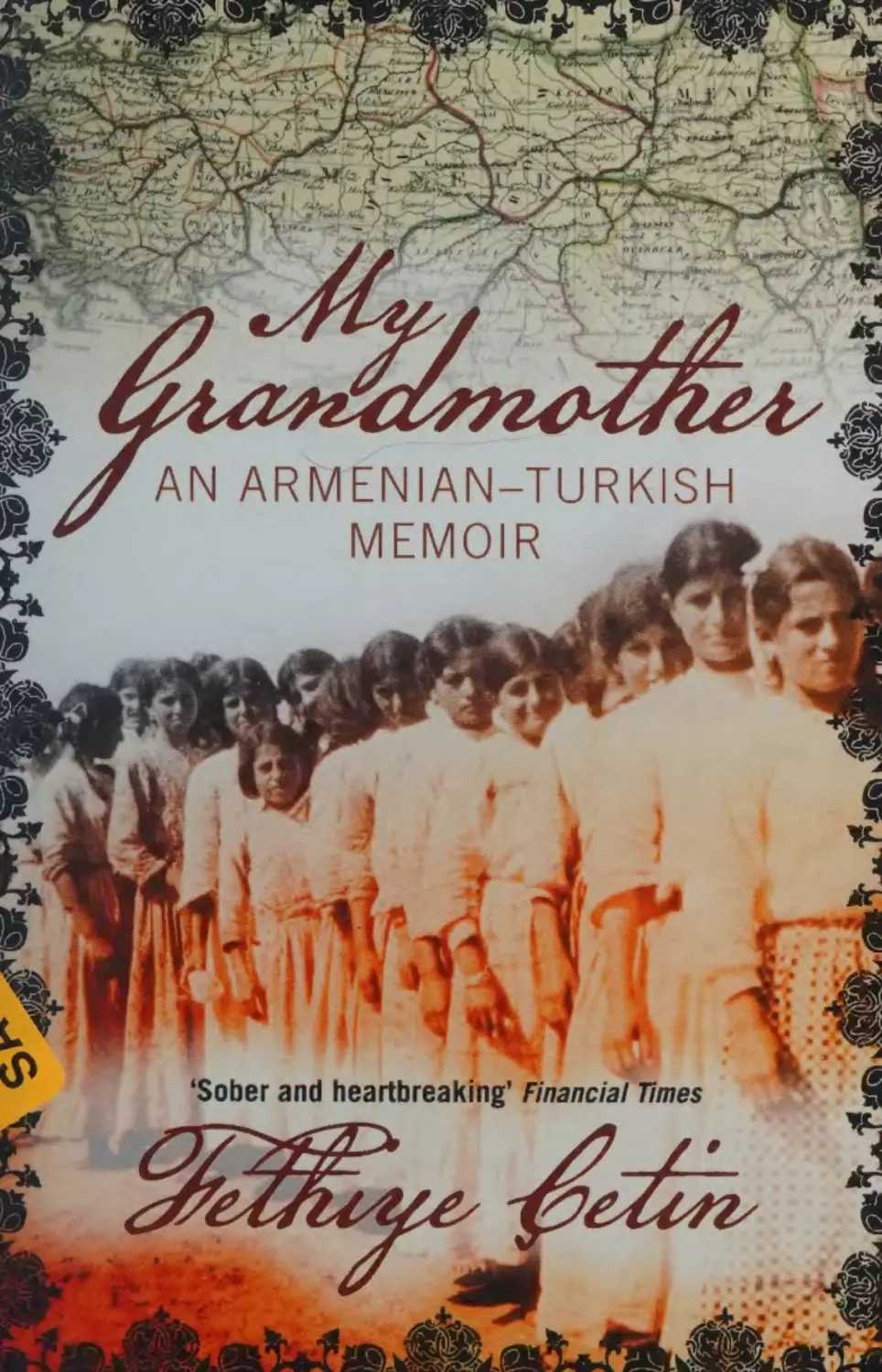
MY

GRANDMOTHER

An Armenian- Turkish Memoir

PET PELY Ey C ECE LN
Translated by Maureen Freely

v
VERSO
London

«+ New York

This paperback edition first published by Verso 2012
First published by Verso 2008
© Verso 2008
Translation © Maureen Freely 2008
Introduction © Maureen Freely 2008
First published as Anneannem: Anlati
© Metis Yayinlari 2004

All illustrations in this book have been reproduced courtesy of the author

All rights reserved
The moral rights of the authors have been asserted
357910864
Verso
UK: 6 Meard Street, London W1F 0EG
US: 20 Jay Street, Suite 1010, Brooklyn, NY 11201

www.versobooks.com
Verso is the imprint of New Left Books
ISBN-13: 978-1-84467-867-9

British Library Cataloguing in Publication Data
A catalogue record for this book is available from the British Library

Library of Congress Cataloging-in-Publication Data
A catalog record for this book is available from the Library of Congress
Typeset by Hewer Text UK Ltd, Edinburgh
Printed in the US by Maple Vail

I would like to thank my dear Ayse, Nadire, Necmiye, Zeynep,
Zehra and Handan, who gave me the courage to write this book,
and did everything in their power to help me persevere, casting
aside any excuse I made to shirk from the task; if it hadn’t been for
you, this book would never have come into being. I am so
fortunate to know you, and to have you as my friends.

i

i
f

icing
‘oy

pet
a)

,

Y
;

a
Ver ee

;

BLS:
7

na

4

eet
;

e

Ba

ue

Cees.

28eds

Ea

A oot
4

Rs

aa

ANT

ae

.

ives:

att
ety

Re

tae

Preface

Maureen Freely

When victorious generals~sit down to dictate history, their
greatest privilege is to choose what to leave out. Thus, Europeans
know little or nothing about the 1920 Treaty of Sévres, which,
had it been ratified, would have carved up most of what was left of
the Ottoman Empire at the end of World War One. Izmir and the
Aegean coast would have passed to the Greeks; a large part of

eastern Anatolia might have become part of an independent
Armenia, leaving only Istanbul and northern Anatolia in Ottoman
hands. But since much of this region was under Allied occupation
in 1920, it, too, had taken on the aspect of a European colony. And
so it might have remained, if Mustafa Kemal’s armies had not
risen up to reclaim the lands that now define the Republic of
Turkey.
But in 1927, when Kemal sat down to write the official history
of its birth, Sévres still cast a long shadow. It was the future that
might have been, had Europe and Anatolia’s Christian minorities
had their way. It is through this prism that four generations of
Turkish schoolchildren have been taught to view the catastrophes
of the last years of the Ottoman Empire, when Anatolia was
between one quarter and one third Christian. They are not told
that the triumvirate then in charge of the empire wished to
‘Turkify’ Anatolia by reducing that population to a level that
would render it politically insignificant. Nor are they told that the
same cadre aimed to relocate and resettle Anatolia’s many Muslim

Viii

My Grandmother

minorities — Kurdish, Arab, Circassian, Georgian, Laz, Albanian,
Bulgarian, amongst others — with a view to assimilating them.
Instead they are told that that the Armenians were fighting
alongside the Russians, in the process killing many Muslim Turks.

They are also told that the deportations and massacres of 1915
were in response to this treachery, and that diaspora claims that as
many as 1.5 million Armenians lost their lives are grossly inflated
and motivated mainly by a desire for money and territory.
For the past eighty years, Turkey’s powerful army and state
bureaucracies have guarded the official history with the greatest
zeal. Its penal codes are laden with laws severely curbing free
expression, ensuring that most Turks have had little or no access
to any information that might challenge or complicate the official
line. The break with the past was greatly aided by Ataturk’s
Alphabet Revolution (which moved Turkey from the Arabic to a
Latinate script, thereby making it impossible for later generations
to read anything published before 1928) and also by the Language
Revolution that followed: although reformers did not in the end
rid Turkish of all words of Arabic or Persian origin, they did
manage to excise almost two-thirds of its vocabulary. Offered a
single and unchanging version of the past, Turkey’s schoolchildren are to this day encouraged not to dwell on it, and to think
instead about the great and prosperous nation that Turkey might
one day become if all its patriotic citizens forget their tangled
Ottoman roots and work together. But as the Republic travels
through its ninth decade, it has found itself under growing
pressure to democratise, with many of those most in favour of
EU accession arguing that Turkey will only truly prosper if it
respects the human rights of all its diverse peoples.
To this end, a loose-knit network of grassroots, legal, and
academic groups have been arguing for a new definition of
Turkishness. In the place of the word ‘Turk’, which has racial
overtones, they have proposed the word Tiirkiyeli, which, because
it means ‘person of Turkey’, would allow its citizens to express

Fethiye Cetin

ix

ethnic, cultural and/or religious difference while still asserting
their allegiance to the nation. While this remains a controversial
proposal, there has in recent years been a real and widespread
renewal of interest in the Ottoman past, particularly in the area of
family history. But even the most superficial investigation,
motivated by nothing more than a simple desire to honour one’s
ancestors, can lead quickly into areas marked taboo.
There are, by some estimates, as many as two million Turks
who have at least one grandparent of Armenian extraction.
Fethiye Cetin is one of them. She was born in the south-eastern
province of Elazig, in the town of Maden, which straddles the

shores of the Tigris River. In Ottoman times Elazig was one of
the empire’s six Armenian provinces; today it is home to Azeri
and Kurdish as well as ethnic Turks. Fethiye’s father worked as a
manager at the town’s copper works; after his early death, she
moved with her mother and siblings into the home of her maternal
grandparents. It was only many years later, when she was a law
student in Ankara, that her beloved grandmother revealed to her
that her real name was not Seher but Heranus, that she was
Armenian by birth, and that she had been plucked from the death
march (grabbed from her mother’s arms) by the Turkish gendarme who had gone on to raise her as a Muslim. Her story
contradicted everything Fethiye knew about her family, her
history, and her country. She had assumed herself to be a Muslim
Turk; she now discovered a second legacy that threatened to
unravel her received identity forever.
Her great achievement in this memoir, written after more than
two decades of reflection, is to have cut right through the bitter
politics of genocide recognition and denial to tell the human story:
to bear witness. Her aim was to ‘reconcile us with our history; but
also to reconcile us with ourselves’. She wanted to bear witness, to
honour, to grieve for all those who lost their lives, their families,
and their homes, and to make common cause with all those who

wish to make sure that those ‘dark days’ never return. She wrote

x

My Grandmother

it first and foremost for Turkish readers, challenging the distortions of the official history that they all learned as children, and
appealing to their common humanity. In this she was far more
successful than she could have dreamed. From the day of
publication she received, and still receives, numerous calls from

people with similar stories, and also from people who simply
express their grief. Since its first publication in Turkey in 2004 it
has been reprinted seven times. It has also been translated into
French, Italian, Eastern and Western Armenian and will soon be
available in other languages, including Greek.
Heranus’ mother survived the death march and went on to join

her husband in New York, where they started a new family.
When Heranus sat down with her grand-daughter to tell her the
truth, her dream was to find the American sister she had never

met. She died before that dream could be realised. It was only
after Fethiye published her grandmother’s death notice in the
Istanbul-based Turkish-Armenian weekly, Agos, that a reunion
became possible.
The editor of Agos was

Hrant

Dink, who, like Heranus,

dreamed of a day when Turks and Armenians, having faced
and mourned their history together, might become good neighbours. When he was prosecuted for insulting Turkishness,
Fethiye Cetin acted as his lawyer. On 19 January 2007, after
receiving hundreds of death threats but no police protection,
Hrant Dink was gunned down outside his office by a young
ultranationalist. His murder provoked horror and grief at levels
that took the country and indeed the world by surprise. More than
100,000 people turned out for his funeral. Since his death, and
despite continuing intimidation, Agos has refused to shut down.
Though it retains its Turkish-Armenian focus, it has come to
represent all those in Turkey who wish to see an end to unchecked
militarism and the ultranationalism that sustains it, and in its place,

a democratic society in which diversity is respected and free
expression championed. Fethiye Cetin has continued to represent

Fethiye Cetin

xi

the family, who are still being prosecuted. A member of the
Istanbul Bar Association and the Committee to Promote Human
Rights, and formerly a spokesperson for the Minority Rights
Working Group, she is one of the democracy movement’s most
courageous advocates. Despite the dangers it faces from what she
has called ‘obscure forces’, she remains confident that democratisation, though slow, jagged and dangerous, cannot be checked.
In life, as in this book, her first aim is to give voice to those whom
history has silenced. It has been an honour to translate her.

are

seapnernaie“4
i

;

al

is

* SOO

ae
t

ete

|

WkaMeans!

a;

e abe ee Lat
i

ONE

;*
ape
Avice
ae

|):

Whenever I think of that January, I shudder; I feel cold. Somewhere deep inside, I begin to ache. When my mother wanted us to
know that she was in great pain, she would put her hand on her
left breast and say, ‘I ache here, just around here.’ Somewhere
deep inside my heart, I ache in just the same way.
The high walls that enclose the cold mosque courtyard are
made from massive stones that are blackened with age but
undiminished; the icy funeral stone chills a person just to look
at it, and there, on top of it, is a coffin. The slab and its pedestal

have both been chiselled from the same great stone. The pedestal
is so cold that when I touch it, I fear my hand will stick, so I draw
back. It is as if this courtyard — these colossal stones, these giant
walls — existed for no other purpose than to make a person feel
helpless and bereft.
Whenever I see a funeral stone now, I shudder, no matter what
the season, and usually I leave that place at once. But if I linger, it

all rushes back — the mosque courtyard, the funeral stone, the
freezing cold. And I begin to shiver.
It is night when Emrah rings. ‘We’ve lost our grandmother,’ he
says. I already know she’s dead. In the morning, in the cemetery,
in the place where they do the ritual cleansing (they call it a bath
house, and so now these words, too, send a chill through me) the
women wash down her body and when their work is done, they
summon me so that we can say our farewells. I say goodbye to her

2

My Grandmother

cold body; I kiss her on the cheeks. On my lips I feel the chill that
even now seems so ill-suited to her. I know she’s been placed in a
coffin but I just can’t accept it. It feels like a dream. I cannot
believe that my grandmother can be lying so still and helpless,
inside that coffin. And neither can I believe how hopelessly the
rest of us are going through the motions.
We wait with the women who are huddled together in the most
sheltered corner of the mosque courtyard. As we wait, crying
uncontrollably as we embrace each new arrival, someone rushes

over to us from the huddle of men and in a panic-stricken voice,
he asks:
‘Auntie Seher’s mother and father — what were their names?’
At first none of the women answer. Instead they exchange
glances, as the silence becomes ever more awkward. And still the
silence goes on, until one of the women, my Aunt Zehra, finally
breaks it:
‘Her father’s name was Hiiseyin, and her mother’s name was
Esma.’
No sooner has my aunt said these words than she turns to me,
as if to seek my approval, or so it seems to me.
Relieved to have extracted the answer he wants from this group
of tight-lipped women, the man turns back to the all-male crowd
that has gathered around the funeral stone, and as he does so,
these words rip from my heart through the silence:
‘But that’s not true! Her mother’s name wasn’t Esma, it was

isguhi! And her father wasn’t Hiiseyin, but Hovannes!’
This man has taken it upon himself to furnish the imam with
the names of the deceased’s parents, and now, just as he prepares
to do so, I am declaring those names to be false; he turns around,

fixing me with a hostile stare as he struggles to understand what I
have said.
My aunts begin to cry. Then all the other women join in, as if
my aunts have given them a sign. Usually crying is contagious. I
can’t stop my tears either. I fall silent, anxious that I might make

Fethiye Cetin

3

those around me cry even more if I repeat my accusation or stand
by my words. I bow my head as I cry inside, ashamed that even
here we have to carry on pretending.
The man stares at the huddle of weeping women for a while
longer, and then he gives us a look, as if to say, ‘Women!’ as he
walks away from us.

ag
pair

F

“"

a

ve

F

=e

2 tet Mie otal ii
i

in

vies

For the same reason that her mother’s name wasn’t Esma, and her

father’s wasn’t Hiiseyin, my grandmother’s real name was not
Seher, but Heranus. This, too, I found out very late.
At the time of Heranus’s childhood, Habab' was a large village
of 204 dwellings, situated within the boundaries of Palu and the
district of Ergani-Maden. The village boasted two churches and
one monastery.
Heranus was the second child to be born to Isguhi and
Hovannes’ Gadaryan. Because she was born after the death of
their first child, Markrit, Heranus was raised with great care. Two
more children arrived soon after her. When she was still a tiny
girl, Heranus helped look after these two boys, whose names were
Horen and Hirayr.
Heranus’s father Hovannes was the third of seven children and
one of six boys. His two older brothers were named Bogos and
Stepan, his younger brothers were named Hrant, Garabed, and
Manuk, and his only sister was named Zaruhi. The family became
bigger still after the eldest brothers married. At an early age,
Manuk was afflicted by an unknown malady from whose clutches
he was unable to wrest himself free. The entire village went to
1 Though commonly known as Habab, its correct Armenian name was Havav.
Today its name is Ekinozu and it belongs to the Kovancilar District.
2 This name appears in the gospels as Hovhannes. In Anatolia alone, there are
several variations, such as Ovanes, Ovanis, and Ohannes.

6

My Grandmother

church to pray for his recovery but to no avail. Yet just as the last
hope was dying away, Manuk returned to life. The entire village
celebrated, for the Gadaryans were its most important family.
Heranus’s grandfather, Hayrabed Efendi, was a highly respected
teacher who was known and loved throughout Palu and its environs,
as well as Ergani-Maden, and Kigi. He was known as a good man;

people listened to what he said. In those days there were colleges in
Ergani-Maden and Kigi to which children went to study after
finishing primary school. Hayrabed Efendi taught in these colleges.
He was a trustee of the church and served as its choirmaster. It was
said that his brother, Antreas Gadaryan, was a distinguished teacher
who was even better known than he. If people had trouble reading
old Armenian texts, they would take them to him. No matter how
difficult it was, Antreas would decipher it in no time. In his book
entitled Palu and its Traditions: its education and its intellectual life,’

Father Harutyun Sarkisyan wrote these words about him: ‘The
educator Antreas Gadaryan wasa child of Anatolia. . . he was short
and spoke very little, but under his thick eyebrows, his bright eyes
shone with an intelligence that impressed all those who met him from
the moment they made his acquaintance.’
The Gadaryan and Arzumanyan families both had roots in this
crowded, long-established village. The Gadaryans’ Hovannes was
fond of their neighbours’ eldest daughter, who was an Arzumanyan , and who, like his own mother, was named Isguhi; a day

arrived when his father asked him whether or not he wished to
marry their neighbour’s daughter. He said ‘yes’ without hesitation; he was so happy he could almost fly. Isguhi, who was six
years younger than him, also came from a big family. She was the
eldest, with two younger brothers, and four younger sisters. After
Hayk and Sirpuhi came the twin girls, Zaruhi and Diruhi. The
youngest was Siranus.
3 In Armenian, published in Cairo in 1932.

Fethiye Cetin

7

Isguhi’s mother Takuhi was the village healer. It was said that
she had as much knowledge as a doctor and was sought after
throughout the area when there was a case of broken bones. The
two families were on the best of terms, so everyone was in favour
of Hovannes marrying Isguhi. So it was a love-match, and
Heranus was their second-born. Her godfather was Levon Eliyan,
whose own forefathers had been godfathers to many other
Gadaryans over the years.
Heranus was a child who learned fast, and she also had an
ear for music. Because she loved to sing, her repertoire was
always growing, and she would also try to teach whatever she
learned to her sisters, brothers, and cousins. But there was one
song she loved more than any other, and she would return to it

as often as she could. And when her grandfather sat her on his
lap to teach her new songs, he would stroke her hair to let her

know how much he liked the way she sang them. She was
usually the one to start games; she was the leader, the one who
showed the way, and the other children were happy to go along
with her.
In 1913, the year Heranus started school, her father and two
of her uncles went to America, in the hope of working to save
enough money to set themselves up in business, as a number of
their relatives had already done. In those days, many men in
the village dreamed of going to America, to work amongst the
rich and become wealthy themselves. The first to go to America
was Uncle Bogos. Uncle Stepan followed. The next to undertake the long and tumultuous journey were her father and
Uncle Hrant.
Heranus started school the same year as her Uncle Stepan’s
daughter Maryam, and as soon as she had learned how to read and
write, she wrote a letter to her father and her uncles. Maryam

wrote her own message on the other side of the same sheet of
paper, which they sent to America.

These are the lines that Heranus wrote on her side of the paper:

8

My Grandmother

Dear Father, Dear Uncles,

We too hope to use our feeble pens to jot down a few lines and tell
you how we are, because we know this will please you.
We hope you are well, we all keep hoping and praying that you
are well. And we are going to school every day, and we are trying
very hard to be well-behaved children.
I kiss your hands, and so do Horen, Hirayr, Jiyayr, and Maryam.
Anna misses you very much and she sends you kisses.
Heranus Gadaryan
The Jirayr she mentions in the letter was, like Maryam, her uncle

Stepan’s child. Anna was her mother isguhi’s name within the
family. On the other side of the paper, Maryam wrote:
Dear Father, Respected Uncle,

I want to jot down a few lines and tell you how we are, because
maybe this will please you.
We pray for you to be well, so that we can be well too. Dear
and respected fathers, be sure that we never shy away from school,
and we are working hard.
Do not worry. But we ask you to please keep writing us letters.
We wish that our big Ohan Ahpar and Hrant Ahpar* would write
us letters, but they don’t.
I kiss your hands. Horen, Hirayr, Jirayr, Nektar, and Anna also
send their greetings.
Maryam Gadaryan

And so it was that the cousins Heranus and Maryam sent their
good news to their fathers and uncles on two sides of the same
sheet of paper. But the beautiful handwriting on one side of the
sheet is immediately noticeable. Its words look like flawless
pearls; they come from the hand of Heranus.
4 Armenian for ‘Big Brother’.

Heranus wrote on one side of the sheet of paper, and her
cousin Maryam on the other. The letter was found in Hovannes’
wallet after his death. See p. 8 for translation.

10

My Grandmother

Hovannes and Isguhi loved to dance, and if there was a celebration in the village, they would be there; they would become one
with the rhythm of the music and dance the halay for hours on
end. When her husband went to America, Isguh1 would attend
weddings and other village festivities with her uncle, to dance the
halay with him.
In the winter, when the nights were long, the dervishes would
come to visit, and that was when the village celebrated most
boisterously. The villagers would form a circle around the
dervishes, to watch with fear, surprise and adulation as they
performed with their skewers and burning braziers. They would
send their iron skewers in through one cheek and out the other,
but without spilling a single drop of blood. They would take the
burning braziers into their arms but their arms and their hands
would not burn. Heranus found the whole business shocking. One
day, while she was at school, her brother Horen was scalded by
boiling water, and there were terrible burns on the left half of his
chest and on his left arm. When Heranus looked at the burns on
her brother’s body, she had trouble believing what she’d seen the
dervishes do, and would spend long hours at night trying to make
sense of it.
The Gadaryans lived in a spacious two-storey house with many
rooms and a spacious courtyard. Heranus was good friends with
the dog that guarded the house and enjoyed playing with him.
Years later she would tell, over and over, the same wistful stories
about this courtyard and the games she played in it with her
cousins and the dog. Because most of the men in the family were
teachers, and the rest had gone to America, they employed
seasonal workers to tend the fields and the crops; these workers

and the two domestic servants stayed in rooms that opened onto
the courtyard. The family spent its winters in the house in the
village, and in the summer moved up to the mountain pastures.
There were a number of looms in the Gadaryan house. Like so
many other families in the village, they used them to make kilims

Fethiye Cetin

II

and multicoloured tablecloths. Heranug would later remember
with affection how her grandfather, who moved to the village
after he retired, would sit before the loom trying out new designs,
and how he would read the Gospels every evening.
The Gadaryans were a contented and generous family, and
their guests were never left wanting. People with unsolved
problems came in ever greater numbers to seek out Hayrabed
Efendi’s expertise. In this crowded and colourful multitude the
clever, mature and responsible Heranus stood out, winning much
admiration; no doubt this was partly because she was a beautiful,
fair-skinned girl with thick blonde hair. Judging by all these

stories, Heranus was a happy child. In later life, when she talked
about her childhood, she would say so herself.

7 wi ¢

iS

I was born in Ergani-Maden, where Hayrabed Efendi, Heranus’s
grandfather, once worked as a teacher. Today it is known simply
as Maden, a township in the district of Elazig. Maden was an old
settlement, which sat on two mountain slopes divided by a river
valley. The houses looked as if they had been built on top of one
another. In the past, Maden had served as a staging post along the
Silk Route; the river running through it is the Tigris. An ancient

bridge over the Tigris connected the two mountains and the two
sides of the city. Whenever it rained heavily, the river waters
would rise, sometimes so high as to come right over the bridge.
On the bridge were some meagre little shops that looked as if they
would collapse unless they huddled together. When the Tigris
flooded, the shops would fill with water and the bolts of cloth
would float off their shelves along with everything else, bouncing
up and down in the river currents until they vanished. Since it was
very dangerous to cross the bridge on days when the river was in
flood, policemen would be stationed at either end to keep people
from doing so. Until the waters had subsided, it was impossible to
cross from one side of the city to the other.
My mother and father were married for seven years; when my
father died, my mother was twenty-four years old, and she
returned to her father’s house with three children, one still in

swaddling clothes.

14

My Grandmother

Like so many others living in Maden, my father had worked in
the Etibank Copper Works. The living quarters for managers and
technicians were some way outside the city centre, and it was in
one of these dwellings that we lived. But my grandparents’ home
was an old two-storey house in the market, right in the town
centre. The ceilings were very high, as were the capacious
window recesses. I took ownership of one of the windows that
looked out onto the market. The base and the top of the window
were made of wood, and the recess was so large that I could play
here, and do drawings; I could watch Aunt Sabahat and Uncle
Mesut (who was only three years older than me) do their writing,
and in the same place I would sing songs and recite the poems I
had learned by heart. Whenever I did so, this window was my
stage. If there was anyone to listen, I would give concerts that I
never knew how to end.
It wasn’t just the windows I loved, but the whole house and
everyone in it, so much so that whenever we went to visit my
grandmother, and I realised that it was almost time to go home, I
would play tricks to keep us from leaving. My father never fell for
these ruses but sometimes when my grandmother kept insisting
(‘Let her stay with us!’) he would say, ‘All right, let her stay,’ and
with these words, the world became mine. But I didn’t always get
my way. Once, when I was too stubborn to yield, even though I
knew the game was up, my father carried me all the way home in
his arms.
My Aunt Sabahat and my Uncle Mesut went to school. To be
surrounded by their bags, notebooks, pens, and coloured pencils,
to watch them wink at each other as they and their friends
pretended to include me in their games, — these pleasures were
reason enough for me to employ any number of childish tricks to
stay in that house.
Saddled as she was with three small children, my mother had a
short fuse, so I looked forward to going to my grandparents’
house, where they and Aunt Zehra were patient with us and full of

Fethiye Cetin

15

compassion. This must be why, even at the age of two, I would
pack a few random things under my arm (a single sock, a knitting
needle, a dustcloth) and, every time I found an open door, would

seize my chance to head straight for my grandmother’s house. But
every time I’d be picked up by someone who knew us and taken
home.
One night, my mother, my sister, my brother and I stayed over
at my grandparents’ house. Haluk was newborn and in swaddling
clothes. Handan was still in nappies and had a pacifier in her
mouth. My father had dropped us off at my grandparents’ on his
way to Diyarbakir.
According to what I found out later, there had been a phone
call from Diyarbakir — ‘The item you ordered has arrived’ — and
my father had gone off to collect it. Apparently, it was a Singer
sewing machine with pedals. He’d been planning to return with it
the next day.
That night, we played cards until very late. My grandmother’s
favourite game was “elevens’, and she played it well. She taught it
to me, too. Or at least I thought I’d learned. I would so enjoy

watching them play, and from time to time I’d say a silent prayer
in the hope that they might include me in the game.
The next morning, there was a rapid, noisy knocking on the
door. To hear a knock on that door was such an unusual thing
that everyone in the house panicked and came clattering down the
wooden stairs. I stopped at the top of the stairs so that I could see
what was going on below. The man at the door, who was out of
breath, was calling my grandfather to the post office. “Uncle Fikri,
they’re calling you from Diyarbakir. You must come to the post
office straight away.’
As my grandfather put on his shoes and his coat, the other
members of the household rushed around trying to help him.
‘Don’t panic,’ he said, ‘just hope for the best, be patient,’ but he
himself couldn’t find one of his shoes, and then he was putting it
on the wrong foot. Finally he left and headed for the post office.

16

My Grandmother

After he was gone, a nervous, fearful silence set in as we sat and
waited. I could see the post office from my window. Sensing that
things were happening that I should not miss, I went upstairs to sit
at my window. I glued my eyes to the post office.
Some time later, two men holding my grandfather’s arms
carried him out of the building. He couldn’t walk, he looked
utterly shattered. As he drew closer, I could see he’d been crying.
Inside the house, the screams mixed with tears and the sound of

running feet. My mother and my aunt were crying so hard they
nearly threw themselves down the wooden stairs. They were
screaming. My father was dead. He’d had a heart attack; he’d

failed to rally. This is what they’d said on the phone.
After my father’s death, we moved to my grandparents’ house
— my mother, my sister, my brother, and me. So we were all
together, all the time. But I missed my father. One day I secretly
followed my mother and the others to the cemetery, and though I
discovered there that my father was buried under the ground, I
still waited, still hoped, for his return. I waited for years. The
concerts in the window sill came to an end, but my memory of
grandfather coming out of the post office held by two men, and of
the panic-stricken footsteps on the wooden stairs — these were
engraved in my mind, and for years they haunted me.
We left the company house and, together with my grandparents, moved to a larger house that was close to the school.

When he had graduated from the veterinary faculty in Ankara,
my Uncle Mahmut came back to live with us for a while before
doing his military service.
Uncle Mahmut, the eldest of five children, tried to comfort my

mother, telling her that ‘the responsibility for you and the three
children rests on my shoulders, so please don’t worry’. Because my
grandfather’s wages only just covered his own family’s household
expenses. There were already five people living there, and with the
four of us, that made nine. A little later, we moved to the Mahmudiye
stud farm to stay with my uncle Mahmut, who trained colts. When

Fethiye Cetin

ny

my uncle married, it was decided that the time had come for us to
‘climb off his shoulders’ and we returned to my grandparents.
There might not have been enough money to make ends meet,

but there were two things in this house that were never lacking.
The first was love, and the second was food. This was a family
that liked good food; they were willing to cut back on anything
else in order to be able to eat well.
My grandfather was a cheerful, charming, well-meaning man —
unless he was hungry, and then he was impossible. Once he’d
eaten his fill, he’d return to his old gentle, affable self, and it was

as if that fractious, belligerent man we'd just seen had never
existed. When he was going through one of his hunger crises, my
grandmother would go into overdrive, rushing to get him his food
while imploring him to act sensibly, reasonably, and all the while
trying to protect the rest of us from his wrath. At times like these,
we'd creep away to wait for him to eat his fill.
My grandfather was a shift worker at the factory, and he usually
worked nights; during Ramadan, the month of fasting, it was the

shift he preferred. Everyone in the house was emphatically in favour
of his taking the special Ramadan night shift, as was most of the
neighbourhood, and we would all pray that nothing would happen
to take him offit until the month had ended. Because if he was on the
night shift, he could sleep all day and fast while he slept.
Whatever shift he was on, no one but my grandmother dared
to go near him on days when he fasted, not until the sun had set
and we could sit down to eat.
My grandfather would not be woken up until just before the
ifiar and that was how he was spared his hunger pangs and we the
wrath of a grandfather whose eyes would roll to the back of his
head when his stomach was empty. When he had washed his face
and come to the table, we children had the job of telling him that
5 The hours between sunset and sunrise, when one is allowed to break one’s

fast during Ramadan.

18

My Grandmother

the call to prayer was underway or that the cannon had sounded. He
would sit down, fill his spoon with soup, raise it to his lips and wait for

us to say, ‘Grandad, the call to prayer is over!’, but if the wait went on
too long, he would get angry at the hoca and shout out, ‘Sing the call
to prayer, father — hey father! — read it now!’ and if still nothing
happened, would begin to rail against him. He’d fling the spoon
down, spring up and shake his fist, and would then sit down again, fill
his spoon with soup and resume the same position as before: “God
give me patience, father! Hey father, can you sing it now?’

One evening, my grandfather came home to find guests in the
house. We could tell he was hungry from the colour of his face
and also from the way he walked. So famished was he that his face
darkened the moment he entered the house; he walked towards

the women visitors with a heavy, ominous tread. The women all
jumped to their feet as a sign of respect. They waited for my
grandfather to say, ‘How good to see you, please sit down, make
yourselves comfortable,’ but instead he fixed my grandmother
with a stare as he breathed heavily through his nose; the women
were left standing. My grandfather went over to my grandmother
and hissed into her ear loud enough for the guests to hear:
‘Don’t these women have children or families? What are they
doing away from their houses at this hour, why won’t they go
home?’ My grandmother glared at him angrily:
‘Oi, Miisiirman,”® she whispered.
As the women watched, still standing, they broke into smiles,

showing no sign of anger or offence.
‘It’s time for us to go, anyway. Uncle Fikri’s hungry,’ they
said, and with that they left. In those days, everyone called my
grandfather “Uncle Fikri’; later, he became everyone’s ‘grandfather’. No one got upset about the things he said — not then, not
ever — and no one took offence.
6 A colloquial Turkish term for ‘Muslim’.

Early 1965. From left to right: my brother Haluk, Aunt
Sabahat, me, my mother, my sister Handan, my grandmother

and grandfather. He was in one of his worst moods that day.

20

My Grandmother

Whenever my grandmother got angry at my grandfather, she
would say ‘Oi, Miisiirman!’ She put the stress on the first syllable
of Muslim, making her anger and vitriol clear. At times like this,
my grandfather would say ‘Oi, Hiirme!’ and he, too, would put
the stress on the first syllable.
Whenever we heard them use the word ‘Oi’ with each other,

we'd try to make ourselves scarce — to wait for the storm to pass
and for our grandfather to fill his stomach.
But my mother, who was a keen observer and an excellent
mimic, would follow these arguments closely and later, when the
house was once more peaceful and quiet, she would amuse us by
wittily repeating all that had been said, imitating both my
grandparents. We’d fall about laughing.
My grandfather, who would have eaten by then, and who
would have returned to his usual charming self, would enjoy these
skits as much as the rest of us, and would often take part in them.
But my grandmother would shake her head and say, “We’ve
turned into a family of buffoons,’ casting furious, reproachful
looks in my grandfather’s direction. Seeing the anger in her eyes,
my grandfather would try to placate her. ‘Oi, woman! Why so
angry, didn’t I give you the three most beautiful daughters in the
world? What else could you possibly want?’ he would say, and
would gaze with love and pride at the three daughters whose
beauty he had just praised.
My grandmother always protected us. When my mother was
angry with us, she’d threaten us with her slipper. When she saw
this, my grandmother would stand in front of my mother and stop
her, calming her down, and we, always knowing the best escape,

rushed to take refuge in our grandmother’s arms.
Children often test the limits of their elders, and there must
have been moments when we tried our grandmother’s patience,
too. But she was always patient and compassionate with us. I
cannot remember a single time when she vented anger on us or

1957. From left to right: Aunt Sabahat,
Aunt Zehra and my mother, Vehbiye.

22

My Grandmother

said a harsh word. But she was sometimes strict with her other
grandchildren, and at times scolded them. For her, though, we
were charges who were to be protected at all times — fragile
children to be treated with the utmost care.
Throughout her life, that was how she treated us. This
preferential treatment sometimes provoked some jealousy in other
parts of the family; sometimes we were sarcastically referred to as
the ‘precious grandchildren’.

I was told that I resembled my father, and that my sister Handan
took after my mother, who was a beautiful woman. When people
met us for the first time, they’d say: ‘Fethiye looks like her father,
and Handan her mother.’ I knew exactly what these words meant:
Handan was beautiful and I was ugly. My grandmother would get
upset when people said this — as they did all the time. She would
take me on her lap, stroke my hair, and declare in a loud, stern
voice, ‘All my girl needs are her eyes!’ Once she was sure she had
everyone’s attention, she would intone, ‘It’s the eyes and the
eyebrows that count, the rest is mere words!’ Having recited that

old proverb, she would look lovingly into my eyes. There was
something so haughty in her voice, so righteous and didactic, that
nothing more would be said on the matter, apart from a few polite
comments about my eyes and eyebrows.

My grandfather, who did not get much pleasure from work,
retired as soon as he had worked the requisite time. In the early
days of his retirement, before he ran through his lump sum, he
kept insisting that he was going on a pilgrimage to Mecca. But my
grandmother never once gave him her approval for this plan.
Every time he brought up the pilgrimage, she would say, ‘Oi,
Miisiirman, the pilgrimage is to your own door,’ and as she spoke

she would give us a signal with her eyes. In the end my
grandfather was unable to go to Mecca; his lump sum went on
food, and was soon exhausted.

His greatest pleasure in life was food. His favourite dishes were
elaborate stews with lots of meat, butter, and tomato sauce; he

usually had to hire a porter to carry the meat home from the
butcher. His medium of exchange wasn’t money but meat. He’d
measure the prices of all things against meat. If he had just bought
a pullover, he would work out how many kilos of meat he could
have bought with the same sum and usually it made him unhappy
to think of all the meat he had foregone.
‘How much did you pay for this shirt?’ After working out the
quantity of meat he could have bought for the price of the shirt,
he’d say, ‘Imagine, spending all that on clothes.’ And he would
add with a moan, ‘It’s such a shame, isn’t it, when you think

that we could have bought x kilos of meat with that money.’ Or
he’d reproach us like this: ‘Instead of spending all that money

24

My Grandmother

on shoes, wouldn’t it have been better if we’d bought five kilos
of meat?’
When guests came to visit from other provinces or districts, his
first question after everyone had exchanged the usual greetings
was, ‘What’s the price of meat there?’ It angered him when people
replied, ‘I don’t know’, as he couldn’t understand how it was
possible not to know the answer: ‘Now how could someone not
know the price of meat in the place where they lived!’
Wherever we went, we had to find out the price of meat,
knowing full well what the question would be when we
returned.
So wherever we were, we had to find out how much meat cost,

and if we ever forgot, we did not dare leave the question
unanswered; instead we made something up to placate him.
We lied, we fooled him.

Though he’d been treated badly, and had often been fooled, my
grandfather never lost his faith in people; certain merchants
assumed from this that he must be a bit simple-minded, and it
was not uncommon for them to talk him into buying spoiled
goods — for example, a huge joint that had begun to smell. When
the bad meat reached the house, there would be another harsh
exchange in which the word ‘oi’ featured a great deal, and though
it would end with my grandfather admitting that he had been
cheated, he would never offer to take the meat back. This matter
(like so many others) was left to my grandmother to resolve: in a
huff, she would pick up the offending parcel and leave for the
market.
There, she would find the merchant, give him a good scolding
for what he had done and return the spoiled goods. When
neighbours saw my grandmother racing in the direction of the
market with her bag in hand, or something under her arm, they
would twitter and ask my mother, ‘What did Uncle Fikri buy this
time?’ My mother and other young women of the neighbourhood

Fethiye Cetin

25

would add this latest episode to their repertoire of stories and
imitations to be enjoyed in the evening.
One day my grandfather came home from the market with a large
basket of grapes. After taking a good long look at them, my
grandmother pronounced, “These grapes have no life left in them,
they’re no longer edible. Take them back to where they came from!’
As usual, my grandfather refused at first to admit the grapes were
spoiled. To show my grandmother how unfair she was being, and to
prove how beautiful the grapes really were, he picked up a bunch —
but as he raised his hand all.the grapes fell into the basket, leaving

him clutching only the stem. As usual, the rest of us were watching
from a distance, gripped with silent laughter.
My grandfather searched the basket for a bunch of grapes that
were still on their stem, and when he found one he showed it to

my grandmother, and then to the rest of us, saying ‘Grace be to
God, look at these grapes!’ But the next bunch he selected didn’t
look at all like the previous one; he picked it up hopefully but was
again left holding only the stem. Quickly putting it to one side, he
fell to searching the basket once again.
After peering into the depths of the basket my grandfather was
forced, in the end, to admit that the grapes were

off. His

performance was over; as always, he gave up, fell into a deep
silence, and for a long time would keep a low profile in the
neighbourhood. He left it to my grandmother to bring the matter
to a close: picking up the basket, she headed off to the market.
My grandmother was quick-witted and resourceful, and so good
at solving problems — not just in the market, but in many other
areas of life — that sometimes, in such situations, my grandfather
sometimes gave her the admiring nickname ‘Sergeant Seher’. To
describe her industry and dynamism, my mother called her
“Mistress Storm’.
There seemed to be nothing she couldn’t do. If she wasn’t
rolling my grandfather’s cigarettes, or putting them in the silver

26

My Grandmother

tobacco box, or ‘cupping’ with hot jars on his back whenever he
had a cold, or pouring molten lead into cold water over the head

of someone who thought themselves to have been cursed by the
evil eye, she was gathering up old pieces of cloth and sewing them
together to make patterned and colour-coordinated tablecloths
and prayer rugs, or knitting socks and gloves with five knitting
needles.
My grandmother was also famous for her cooking. No matter
how difficult and elaborate a dish was, in her hands, it was full of
flavour, and anyone who ate it could not stop talking about it. She
made beautiful bulgur-wheat balls stuffed with walnuts, raisins,
meat and onions, and kaburga dolma, maden kofte, hilorik skisi,
skili dolma, kibe mumbar, kibe kuduru, and

mefiune’, and no one

could stop talking about how tasty they were: “To go over to the
other side without having eaten her kibe mumbar would be
unthinkable.’ People would say that she had ‘passed her gift
to her daughters’ — their way of saying that my mother’s and
aunts’ cooking was just as flavourful as my grandmother's.
This was how my grandmother explained the ‘secret’ behind
her cooking: “To bring out the full flavour, you should never
skimp on ingredients. You should use plenty of meat, butter, and
tomato sauce. In other words, don’t be sparing. And then, when
you put it on the flame, don’t neglect it. You have to put your
whole soul into the food, and while the meal is cooking you have
to cook with it too.’

Her daughters, grandchildren, neighbours and friends were
always asking for her recipes. We'd often see her giving out their
details, and as she recited them, she would speak like a teacher
who loved her work. We heard her passing on some recipes so
often that we learned them by heart. I can still recite her recipe for
meftune, a dish much loved in our part of the world. This is how:
my grandmother told me how to make it:
7 Traditional meat dishes.

Fethiye Cetin

27

‘Buy a well-fatted joint of kid goat. Don’t take off a single
mouthful, and don’t chop it up — place the whole thing at the
bottom of the saucepan.’ As she said this, she’d demonstrate with
her hands just how the join should be laid in the saucepan. ‘Chop
up the aubergines and put them over the meat. Chop up two ripe
tomatoes, and two green chilli peppers. Then take the sumac
water that you’ve prepared in advance, and pour it over all the
ingredients — and don’t skimp on it. After you’ve brought it to the
boil twice over a high flame, turn down the heat. Fifteen minutes
before you take the saucepan off the flame, fill up a little cup with
water and pour it in, to separate the fat.’
She also placed importance on the way meftune was served
when it was ready. There was a special sauce to accompany
it, made with crushed green peppers and garlic, and you
poured it over the dish after it had been served onto plates,
which would then be decorated with finely chopped parsley.
The mefiune would then be brought to the table with bulgur
and vermicelli.
I don’t remember ever being hungry when I was a child. Living
as I did in a family that took its food and drink so seriously, food
for me was a form of torture. Years later, recognising the taste of a
dish I’d refused to eat as a child, I would realise what I’d missed,
but during my childhood I hated mealtimes.
My mother would try to force me to eat; mealtimes were battles
that would end with my mother shouting and screaming and
threatening me with her slipper. I would rush to my grandmother’s side, knowing this to be the best escape route. With the
greatest forbearance, my grandmother would bring me tea, bread
and cheese — the only three things I would consent to eat. She was
very patient and compassionate with us, and to tell the truth, we
three children knew our limits, too. Even so, there were times
when we longed for something that we could not quite put into
words. It would be at times like these that my grandmother would
sense what we desired, and she would do everything she could to

28

My Grandmother

make us happy, pampering us, taking us on her knee, and stroking

us on the back.
As soon as my grandmother sat down, Handan and Haluk
would clamber onto her lap and begin to play with her shrivelled
breasts. She would wait patiently for them to tire of this game;
never once did she push them away.
On days when we were sad, she would tell us the tale of Sister
Pizez®. She had told this story first to her own children, and then
to us; later on, she would tell it to her grandchildren’s children.
On cold winter evenings we would trap our grandmother in

front of the stove and would clamour for the story of Sister Pizez.
‘Please, Granny, tell us the story of Sister Pizez. What is Sister
Pizez, Granny?’
‘Sister Pizez is a winged beetle,’ she would say.
And she would begin to tell her story.
Sister Pizez had a load of dirty laundry. She was taking it up to
wash it in the stream when she ran into a hedgehog. ‘Sister Pizez,
will you marry me?’ asked the hedgehog. This is how Sister Pizez
replied:
“When you're angry, will you beat me?’ she asked the hedgehog.
‘I certainly will, said the hedgehog.
‘All right then, so tell me what you’d use to beat me,’ said Sister
Pizez. ‘T’ll sink my bristles into you,’ said the hedgehog. When
she heard that, Sister Pizez turned down the hedgehog’s marriage
proposal and continued on her way to the stream.
Before long, she ran into a cat. The cat, too, made a marriage
proposal. Sister Pizez asked him the same question she had asked
the hedgehog. ‘When you’re angry, what will you beat me with?’
‘If you make me angry,’ said the cat, ‘I'll scratch you.’ Upon
hearing his answer, Sister Pizez rejected his offer of marriage and
continued on her way to the stream.
8 Pizez is the Armenian word for flies with sheathlike wings.

Fethiye Cetin
Before long, she ran into Mister Rat. Mister Rat asked Sister
Pizez the same question. ‘Mistress Pizez, will you marry me?’ And
Sister Pizez asked Mister Rat, ‘When you’re angry, what will you
beat me with?’ Mister Rat showed her his tail and said, ‘With this
sweet little tail of mine.’ Looking at the tail, she thought to
herself, ‘This rat’s tail is soft, it won’t hurt.’ She accepted Mister
Rat’s proposal and they walked on to the stream together to wash

the clothes.
Before long, they heard music coming from the Bey’s house in
the distance. Knowing that there was a wedding at the Bey’s
house, and knowing that they would be inviting the guests to a
feast, Mister Rat said, ‘Let me run off now to the Bey’s house and
bring back some food. We're hungry, after all. After we’ve filled
our stomachs, we can finish the laundry.’ With that, he left the

riverside, and rushed off to find some food to bring back.
But when he got to the house, Mister Rat was so taken with the
cauldrons full of food, and the music, and the fun, that he forgot

all about Sister Pizez. He just ate and danced and enjoyed himself.
Meanwhile, Sister Pizez washed her laundry and beat it against
the stones, and then, leaning over the stream to scoop out a cup of
water, fell into the water and couldn’t save herself. Just then a
party making its way to the Bey’s house on horseback stopped by
the stream to water the horses. While they were drinking their
water, the horses heard a voice coming to them from the depths.
This is what Sister Pizez cried out:
‘Horsemen, oh horsemen, you sweet creatures with your pockets full,
When you get to the Bey’s house,

And you see Mister Rat,
Tell me that Sister Pizez has fallen into the stream, and tell him
to come at once!

The horsemen heard the voice, but they could see no one. They
couldn’t figure out where the voice was coming from. Before

ay)

30

My Grandmother
long, they were forced to continue their journey to the Bey’s
house. As soon as they got there, they told everyone about the
voice they'd heard by the side of the stream.
Mister Rat also heard what they said. Remembering his
forgotten wife, he left the Bey’s house and raced back to the
stream. Finding Sister Pizez by the side of the stream, he said:
“Give me your hand so I can helpahelp you.’
Because Sister Pizez was very angry at Mister Rat, she replied:
‘Not until I tell you how crossaloss I am.’
“Give me your hand so I can helpahelp you’
‘Not until I tell you how crossaloss I am. You’ve been off
gallivanting for three days, ho ho ho, and I am very cross with
you, ho ho.’
“Be cross, then, ho ho, and be done with you,’ said Mister Rat,
and picking up a handful of mud, he threw it at Sister Pizez and
ran off.

My grandmother’s children, grandchildren, and great-grandchildren all grew up hearing this story, and they all went on to tell it
to their own children. What we liked most, I think, were the
repetitions of nonsense words at the end: ‘Give me your hand so I

can helpahelp you.’ “Not until I tell you how crossaloss

lam. . .

>

After my father died, there were no more toys for me, nor did I

have a hankering for any. But, even though I never said so, I did
long for a musical instrument. When the other children were busy
playing house, I would find a piece of wood, stretch wires across
it, and try to get different sounds out of them. Sometimes I would
stretch rubber bands of different thicknesses alongside the wires,
ordering them according to the tension.
Then one day my Uncle Mahmut gave my little uncle, Mesut, a
mandolin. Uncle Mesut was at a boarding school in Diyarbakir
and he took his mandolin back with him. I could hardly wait for
him to come home for the holidays. But even more, because he’d
come home with his mandolin.
Uncle Mesut had learned the old Turkish folksong, ‘The train
comes, and it is welcome’ and when he came home he would play
it for us. After watching him closely, I took the mandolin and
begin to play the song I’d just heard.
I don’t know how it was that I could play the mandolin the
moment I picked it up, but when the other people in our house
saw that I could, it was decided that the mandolin should be left

with me. From then on, I played it whenever I could, and though
I could not read music, I managed to work out how to play every
song I heard.
When Handan sang with her beautiful voice, Haluk would
keep time on an overturned ‘Vita Oil’ tin and I would accompany

Bp)

My Grandmother

them on the mandolin. During the day we would practice the
songs people liked, and in the evenings would give concerts. All
of us — mother, aunts, my sister and brother — loved to sing. My
mother and my aunts were known for their lovely voices. I would
play and they would sing. Nearly everyone would join in — but
never once did I hear my grandmother singing. She’d never join
in with any Turkish folksong, though every once in a while, if it
was a tune she liked, she would keep the tempo with her hand.
She was proud that I had an aptitude for music, and when she
praised me, would say, ‘You take after our side of the family.’ I
did not do too badly at school either. When she saw the reports I
brought home from school, she would be very pleased, ‘After all,
you and Uncle Mahmut take after our side of the family.’ At the
time I had no idea what she was saying beyond the fact that she
was paying me a compliment: it would be years before I understood what she really meant.
Twice a year my mother would empty her trunk, pass her hands
over everything it contained, and pack it up again with the
painstaking care of an artist. We loved these days when she aired
her trunk. We'd sit beside her, examining each object as our
mother took it out. It contained mostly tablecloths, embroideries

and lacework that my mother had made for her trousseau, along
with the perfumes, pieces of jewellery and little presents our father
had bought for her.
Our favourites were a purplish-brown satin dressing gown, the
likes of which we had only seen in foreign films, and a comb,

brush and mirror set that came from the same world. Every time
we saw these things, we’d beg our mother to put on the dressing
gown and brush her hair while looking into that beautiful mirror.
In fact, she’d be longing to do just that, so she would put on the
dressing gown and, looking into the mirror, would brush her hair,

throwing it back from time to time like one of those movie stars. It
was a scene we adored. It was said that Uncle Mahmut had

Fethiye Cetin

33

brought the dressing gown and the mirror and brush set back with
him from America. At the time, Uncle Mahmut had been studying
in England. The idea that he might have been to America struck
us as entirely natural, and it didn’t occur to us to ask for the
details.

When my grandfather returned from prayer one afternoon, I had
my mandolin in my hands, practicing for a concert. As usual, he
coughed to let us know that he was coming in.
The reason for his noisy entrance was to give the women and
children a chance to hide anything they might have been doing
that they did not wish my grandfather to see. For example, my
mother smoked in front of everyone except my grandfather. My
grandfather knew this, but he acted as if he didn’t, and it was to
avoid shaming her that he would make such a noisy entrance; he

also gave her enough time to put out the cigarette and conceal the
evidence.
‘Today, in the mosque, the hoca gave a sermon about the
mandolin,’ he said. He waited until he had everyone’s attention
before. “He said it was a sin to play the mandolin. The oca told us
not to enter into sin by buying our children mandolins; he said
that instead of giving them mandolin lessons, we should send

them to study the Koran.’
Without missing a beat, my grandmother stepped in. “Was it
the hoca who said all this?’ she asked, so that she could be sure of

the facts.
“Yes, he was the one,’ said my grandfather, and my grandmother cried out in anger: “Blast that hoca! What makes playing
the mandolin a sin? If he or his children had a gift for the
mandolin, he wouldn’t be talking like that.’
Then she told my grandfather, ‘Don’t bring that ignorant
hoca’s idiotic words back into this house again.’ Having taken the
matter in hand and silenced my grandfather, she then nodded for
me to continue. I felt grateful to my grandmother. But perhaps my

34

My Grandmother

grandfather didn’t quite believe what he had heard in the mosque
either, because after this incident, he never did a thing to stop our
concerts with the mandolin and the Vita Oil can.
My grandparents were both good Muslims. But my grandmother had no time for bigotry or lack of reason, and was not
afraid to speak out against anyone who spoke unjustly, even if
that person was an imam; after admonishing everyone in the
room, she would in the end, manage to persuade my grandfather,
whom it suited to remain under her influence.

In the morning, we went to the cemetery. My grandmother had
been taken from the hospital morgue to the cemetery bath house.
Here they would ritually cleanse her before wrapping her in a
shroud. So we all headed for the cemetery — her children, her
grandchildren, her great-grandchildren, her sons-in-law. Only the
women were allowed in while she was being washed; the men
would say their farewells to my prancmmomes after she had been
cleansed and shrouded.
The four women attendants inside, hoping to draw attention
to their fine work and to show what a big tip they deserved,
were praying in loud voices while washing my grandmother
with soft and soapy loofahs, after which they would pour hot
water over her; each time they repeated this ritual, they would
look at us.
My grandmother loved cleanliness. Had she been able to raise
her head at that moment, I am sure she would have turned to these

women who were washing her with those soapy loofahs and said,
‘Don’t just caress me with those loofahs — rub me as hard as you
can and get all the dirt out.’
My grandmother didn’t take to dirty or slovenly people: if ever
someone tried to make a connection between uncleanliness and
poverty, she would refuse to countenance it, saying, ‘Cleanliness
is only a cake of soap away, my girl. Dirtiness has nothing to do
with being poor.’

36

My Grandmother

After soaping her down a few times with their sponges, the
attendants filled a hamam bowl with water and gave it to Aunt
Zehra. “Why don’t you each pour some water over her now?’,
they said, ‘It will ease your suffering.’ First Aunt Zehra and Aunt
Sabahat embraced their mother and cried, and then they each
poured water over her in turn. Handan, who had arrived from
Ankara, poured water over her first and then, embracing her

grandmother, she began to recite ‘Sister Clean, Sister Clean’ like a
dirge, as she cried uncontrollably.
My grandmother was renowned for her cleanliness. The moment
anyone walked into her threadbare provincial house, in which there
were no modern conveniences, the first thing that hit them was the
sweet smell of soap. Some of the houses we lived in had wooden
ceilings, floors, and windows. My mother, my grandmother, and
my sisters would scrub and scrub those boards with brushes and
soapy water until they were sparkling white. Whenever they
reproached anyone whose floors and windows were not sparkling
white they would be secretly congratulating themselves on theirs.
After they were washed, underwear and scarves made from
white cambric would be boiled in a pot for hours on end, and the

house would be fragrant with that cleansing boiling smell I can
still recall today.
As they proudly hung their whites outside, Seher Hanim and
her daughters would listen (without quite appearing to do so) to
what neighbours and passers-by had to say about them; but they
never hid their pleasure at hearing what people said because our
laundry was famous throughout Maden for its whiteness and for
the sweet smell it gave out as it dried. People walking past our
house would see the bright white laundry flapping in the wind,
and those to whom the sight was familiar would always say a few
words before continuing on their way.
Laundry days would begin with the zahfir ritual. Tahfir meant
washing certain pieces of laundry with soap under running water

Fethiye Cetin

37

before putting them into the tub. The clothes that received this
treatment were pyjama bottoms, trousers, underwear and socks.
My grandmother’s explanation was simple: “Urine’s spilled over
these things in the toilet. They can’t go into the tub until they’ve
been washed.’
The toilets in Maden were made of stone: there was a hole, and
there were two recesses in which to place your feet. ‘No matter
how careful you are in the toilet, you still can’t keep urine getting
on you,’ she would say. So laundry day would always begin with
their taking any piece of clothing that might have come in contact
with urine and ‘passing it through water’ — or in other words,
washing it first under running water.
The next job was to remove the elastic from the waists and cuffs
of pyjamas

and suchlike,

for the elastic was

to be washed

separately. After the whites had been boiled and dried, all the
laundry would be ironed, and after the elastic bands had been
‘hot-ironed’ they would be put back and tied up with a hook
needle or a buckle, and then the laundry would be carefully folded
and everything put back where it belonged. So did the ritual go on
every laundry day.
It angered my grandfather that laundry days were so frequent.
“You wash things so much you’re wearing everything out; clothes
can’t take such punishment,’ he’d say; but none of the women in
the house took his words too seriously.
The ¢ahfir ritual would continue even after we had bought a
washing machine and used it for all the laundry. Certain items did
not go into the machine unless they had been washed in advance —
and if socks, having been passed through water and then washed
in the machine, were still not clean enough, they would be washed

again by hand.
My grandmother loved to go out on visits and excursions; she
loved eating, and eating out; but she was so concerned about
cleanliness that if she was ever offered refreshment in a place she
found slovenly, she would refuse it, saying, “Thanks, but I’m

38

My Grandmother

fasting.’ Whoever had offered her the food or drink would not
hesitate to take this honest, candid, falsehood-hating woman at
face value; as they drew away, they would say, ‘As God wishes.’
When we were alone again, I’d tease her: “You tell us not to lie,
but you lie, too. Isn’t lying a sin, grandmother?’ She’d look very
annoyed, and say, ‘You're right, my girl, and may God forgive
me, but what could I do? That place was filthy.’

Hamam days I hated, except for the trip home. Divining that our
ablutions at home were not enough to get us clean, and refusing to
listen to any of our complaints and objections, our grandmother
would march us all off to the hamam. The bathgloves and loofahs,
the hot water and the steam — they hurt our young skin; to us, the
hamam was a form of punishment; it was to get through them as
fast as we could that we submitted to these torture sessions
without protest. But the trip home from the hamam remains one
of my most cherished memories. The moment we stepped into the
house, squeaky clean and smelling of soap, the grown-ups would
light the stove that they’d readied before our departure, and
before long the teakettle standing ready on top of the stove would
begin to rattle and boil. We would loll on the cushions behind the
stove, stretching like cats.

A few years after my father died, I noticed certain secret
discussions going on, aided by winks and nods, and conducted
in whispers so that we children could not hear. As you know,
adults think they can hide their discussions from children, but in

fact children hear everything and pick up on whatever is going on.
From the bits and pieces that I overheard, it transpired that a
number of men were in love with my mother and wished to marry
her.
Sometimes go-betweens would come to the house and shut
themselves up in a room with my grandmother; they would then
leave looking very mysterious. Whenever these people came,

Fethiye Cetin

39

they wouldn’t let us into the room, but after they left I would
pretend to be playing and paying no attention, while eavesdropping on everything people said.
Once, when they thought we were asleep and so did not speak
in low voices, I heard what they were saying very clearly. My
grandmother told my mother, ‘Look, my girl, you’re young,
" you're beautiful, get married. If there’s anyone you love, anyone
who suits you, don’t shy away, marry him.’
But my mother objected: ‘I’m not raising my children with a
stepfather.’ To which my. grandmother retorted, ‘Don’t worry
about the children, I’ll look after them. Don’t waste your youth.’
Later on, I heard her repeat this over and over: ‘If you want this,

my girl, don’t you worry. You get married, and I can look after
the children.’
I never found out whether or not my mother had wanted to
remarry, but she never did. When I overheard that conversation,
the thought that our mother might leave us sent me into a panic; I
told no one what I had heard, but spent several sleepless nights
worrying about what might happen.
But when I think back to those days, I understand my
grandmother’s insistence differently. Though they lived in a
repressive, conservative provincial town, she was still urging
her daughter, a ‘widowed woman’, to make a free choice, to enjoy
a sex life.

There were three cinemas in Maden. The most distant from the
house was owned by the factory and known in the town as the
‘company cinema’: here they would show foreign-language films
with subtitles, and only at night. This was why we could only
attend the ‘company cinema’ with an adult. Much though she
would have liked to do so, my mother, as a widowed woman, did

not dare go to the cinema at night, for fear of gossip. My
grandfather was no use either. So it was our grandmother we
begged to take us there. She had no desire to go herself — as she

40

My Grandmother

was unable to read or write, she couldn’t follow the subtitles — so
she would drop us off at the company cinema and then go on
elsewhere.
The Ozan cinema was right above our house. It had an

enclosed theatre for the winter and an open-air theatre for the
summer. We saw every film they showed in the summer cinema,
and would watch each screening until its run was over, memorising all the lines. The soundtrack was loud enough for us to hear it
inside the house
Then there was the Sezer cinema, which was across the Tigris,
on the mountainside opposite our house. To get there, we had to

walk across the ancient bridge and through the market.
There was an intense rivalry between these two cinemas. They
would show two, sometimes three films back to back, and would
compete for patronage by sending men out into the streets with
megaphones and billboards advertising the films. Women preferred the weepies with Muhterem Nur and Aysecik.’ A film was
only as good as the number of tears it caused its viewers to shed.
One day, one of the megaphone men shouted out: “This film
will make you weep and weep. It will make you weep so much
that you won’t need to bring just one handkerchief with you.
Bring ten!’
The women who heard him lost all interest in their work and
went running to see the film. Seeing how effective the handkerchief ploy had been, and thinking this might be a good way to
promote films, the megaphone man from the other cinema went
out into the streets the next day crying:
‘This film is going to make you cry so much, that handkerchiefs won’t be enough! Bring a sheet — not just one sheet, but five!’
They would let us go to daytime performances at the Sezer or
the Ozan cinemas even if there wasn’t an adult to take us. Our
biggest treat was to fill our pockets with the melon and
9 Well-known

Turkish actresses of the 1950s and 1960s.

Fethiye Cetin

4I

watermelon seeds our grandmother gave us and head for the
Saturday matinee. The seeds from the watermelons we ate
during the summer were never thrown away; instead they were
washed and dried. Then my grandmother would boil them in
salted water, pour them onto a metal sheet and roast them over
a flame. She’d wash the melon seeds in salted water, too.
Whenever we went to the cinema, our pockets were stuffed with
these seeds. It was schoolchildren who went to these matinees.
As we children munched on our seeds, we would laugh out loud
together during the comic.scenes, cry together during the sad
scenes, shout out during the action scenes to cheer on the
leading man — and if we were happy with the ending, we would
applaud together.
That day was the first day of the holidays; we had just been
given our reports. We three children crossed over to the Sezer
cinema in the market. Because it was showing two films back to
back that day, we were inside for a long time.
When the film finished, there was an announcement before the
lights came on. ‘Alo, alo. Attention, attention! (In Maden all
announcements began like this.) ‘Alo, alo. Attention, attention!

Everyone stay in their seats. Sit quietly and wait!’ Those who had
already stood up sat down again, and we all waited.
A while later, we learned what had happened from the mothers

and fathers who came to pick up their children. A rainstorm had
flooded the entire town, the river had burst its banks, and the

bridges were under water.
The ancient bridge, too, had been closed to all traffic — even to
pedestrians — until the following day. The shops on the bridge had
been flooded and the bridge itself was in danger. The families who
lived on this side of the river would be able to collect their
children; the families who lived on the other side of the river

would not.
I became anxious and fearful. I was in charge of my younger
brother and sister, and had to come up with a solution before they

42

My Grandmother

could see I was scared. In the end I eas to look for the cinema
owner, Uncle Faik.
Uncle Faik was a close friend of my father and my uncle. He
would never leave us stranded in a situation like this; he would

definitely work something out. The three of us got up and headed
for the cinema door, where we were stopped. I said that we
wanted to see Uncle Faik. “You wait inside,’ said the doorman.

Tl let Uncle Faik know.’
We sat, we waited, but the doorman did not budge from his

position, and he didn’t pass on our message to Uncle Faik. A
while later, when we had again stood up and gone to the door, a
woman rushed through the door. It was my grandmother. We ran
into her arms. Without making a fuss she hurried us outside as fast
as she could.
f
After passing through the market, we headed for the bridge.
Crowds had gathered on both sides of the river. The police were
not letting anyone cross, but people were pleading and arguing
with them.
Just behind the policemen were Fazl1 Hoca and Red Yasar,
both of whom had shops on the bridge; they fixed their blank eyes
on the churning waters, heads in their hands. Their shops had
been flooded, and now they were watching bolts of cloth bobbing
and sinking in the furious currents. All the shops on the bridge
had suffered the same fate, though the damage to Fazli Hoca’s
shop was said to be the worst.
By the time we reached the bridge the sky had darkened.
Supremely sure of herself, my grandmother went up to one of the
policemen blocking the bridge. “We’re here,’ she said. The
policeman (the Commissar, I was told later) said something to
his colleagues. Three of them approached us — their trouser legs
were rolled up as far as the knee. The Commissar picked us up
one by one and lifted us onto the three policemen’s backs. We
crossed the flooded bridge on piggyback; my grandmother
walked alongside us barefoot, her shoes in her hand.

Fethiye Cetin

43

When we got home, we found our mother waiting for us in the
street. She embraced us with joy. My grandmother had triumphed, once again, but — as was always the case — she didn’t
brag about it, and never mentioned that day again.
That night in our house there was much discussion as to how,

when the bridge had been closed to all traffic, my grandmother
had managed not just to cross the bridge but to convince three
policemen to carry us. Even when my grandfather paid tribute to
“Sergeant Seher’, she still showed no desire to dwell on it, and at

once tried to change the.subject. We crawled up onto our
grandmother’s lap, so that she could pat us on the back and
pamper us a little more.

2.
ie

;
ri

7" whl

'

7

a)

’

ayy

j

f

his

f

bytes

Mi
ve

,
.

det

o

wwrn
i

ur

ie

hsaad

“YT

red

‘

,

CREP

Sh

4

ea

t
uf
“I

he

je

Pe

}

vn)

7

a

i

bee ts

i
rT

Mein
y

4

oan

i

¢/

ik
oa

Tv

\3

i

ton,

tt

,

ir
‘

ae

f

ae}
.

nh

ibd.

¢

Tl

}

byep) eet
ne

ers

:

oe

whi

i

oF

Pirnft

:

eh eaeMAS i

bo

y

My grandmother spent her last days in my Aunt Zehra’s house in
Gebze.'° It was Aunt Zehra’s youngest son Emrah who gave the
other children and grandchildren the news of her death, and as
soon as we had heard, those of us who lived outside Gebze and
Istanbul — in Ankara, Elazig: and Edremit — had to set out at once
to make it to the funeral. We all gathered in Aunt Zehra’s house.
Aunt Zehra’s neighbours took a close interest in all arrivals,
competing with each other to feed each newcomer, open their
homes to us, and offer us beds.

We were moved and surprised by Aunt Zehra’s neighbours’
generosity. Whenever we tried to thank them, we got the same
answer:
‘Don’t thank us. Aunt Seher was grandmother to us all. She
was always such a helpful, generous, loving person. It is our duty
to help her through her final journey, please don’t deny this to us.’
Each one had a tale to tell about Seher’s qualities.
Helpfulness was a quality that came naturally to her, and it was
central to her character. She responded to those who needed help
not out of a sense of duty, or because she felt obliged to do good
works: she did so instinctively, because it was in her nature. The
moment she heard that someone needed help, she would rush to

their side to do whatever needed to be done. She refused to talk
10 An industrial town on the north coast of the Sea of Marmara.

46

My Grandmother

about her acts of kindness, and if anyone else tried to do so, would
recite the old proverb: “Do someone a kindness, then throw it in
the sea. If God doesn’t appreciate it, the fish will.’

Her opinion was highly valued, and when her neighbours had
had disagreements, they would ask her to arbitrate. If it was a
dispute between a man and his wife, usually my grandfather
would also be involved. She was forever being invited to other
people’s homes to resolve quarrels and restore the peace. My
grandfather would sometimes accompany her, but generally he’d
be sleeping or relaxing at home and so refused to go. Even if it
meant staying up all night, my grandmother would always
respond to anyone who needed her, anyone whose conflicts
she might help resolve.
When she began to complain about having trouble with her
eyes, my Uncle Mahmut took her to Ankara. He arranged for her
to be operated on at the Eye Bank. She came out with two pairs of
glasses — one for distance, and the other for close work. My uncle
warned her that she needed to wear them all the time, and he
asked us all to keep a close watch to make sure she did so. From

that day on, the household’s new job was to check every morning
to make sure our grandmother was wearing her glasses, and if she
wasn’t, to find them and make her wear them. One morning there
was a hunt for the glasses, and no one could find them. No corner
of the house was left unsearched, and although my grandmother
had evaded the first questions she was soon obliged to come clean.
There was a widow living in the neighbourhood. The previous
evening, she had come to visit my grandmother, and after saying
that she, too, was having trouble with her eyesight, she tried on
my grandmother’s glasses and said, ‘These glasses suit me
perfectly, Sister Seher.’ Whereupon my grandmother gave her
neighbour her glasses and their case.
Her explanation was clear and concise. ‘I can buy a new pair
but she cannot. With Allah’s blessing, may they bring her happy
days.’ That was all she would say; the subject was closed. My

Fethiye Cetin

47

grandmother went without glasses for a long time after that
because my uncle, who had her prescription, was out of the
country. To get her another pair of glasses, we had to wait for my

uncle to return from abroad, buy the glasses, and send them from
Ankara.
This is why my grandfather would describe my grandmother as
someone who provided ‘cradles for the newborn and coffins for
the dead,’ and though her goodwill towards others made him
proud, this didn’t stop him complaining about it.

wi.
i

ag

Prayers in the mosque had just come to an end and the
congregation joined the prayers at my grandmother’s funeral.
In a loud voice, the hoca said, ‘May God forgive her faults!’ and
‘Do you give her your blessing?’, repeating each line three times.
Those assembled in the courtyard replied, “We give her our
blessing!’ Once again I couldn’t stop myself: “Let her give us her
blessing,’ I cried. “May she forgive ws — forgive you, forgive us,
forgive us all.’ I could not stop my voice from getting louder and
louder. Everyone gave me puzzled looks; most understood
nothing of what I said.

se:
ie

ie

Goel

;

P

h

yt

,

pl
)

Gate

i

| q
Ree.

a

YC GG

Dataleiygy

ee

fee

Wak

{sont
y

ghd
Rivg

bedui
etta tat
(Laie
MAM
sdiciert
t

|

ih

at.

4

ee
—

ne
SameA
ee

(pag

Lo

f

Ae
4

hy ake tA hehehe coy aldal
i
ie.

:

=

Sep aa aly gut
’

ace
ved

i \ortee:

7

a

Heranus had successfully completed her third year in school.
Because she was a quick learner and a responsible child, she not
only helped her mother with the housework but looked after the
other children, playing with them, and trying to teach them what
she had learned in school. Whatever task she undertook, she saw
it through to the end.
One warm day in spring, the gendarmes raided the village.
They assembled a group of villagers in the meydan, and there, in
front of their eyes, slaughtered Nigoros Agha, the village headman, who spoke very good Turkish, and acted as negotiator
between the villagers, the tax collectors and other local authorities. Later they rounded up all the grown men in the village and
took them away. The gendarmes marched them off in pairs, each
with his hand tied to his companion’s. Among them were
Heranus’s grandfathers and three of her uncles. The word was
that these men were taken to Palu. But because they never
returned from wherever it was they were taken, it is impossible to
know exactly what happened.
The village was now made up of only women and children;
having watched as all the men — young and old — were beaten
with the butts of rifles, taunted, rounded up and marched away,
they were seized with terror; they could not bring themselves to
go back into their houses, they couldn’t work — they just gathered
together in the meydan to share their grief, to seek advice from the

52

My Grandmother

old people, and to argue. No one knew where or why the men had
been taken away, but there were many rumours.
Heranus’s paternal grandmother kept telling the others, “Don’t
worry, everything will work out fine, everyone will come back,’
and then, ‘You were children then, you don’t know the half of it.
Our village was raided just like this twenty years ago, the whole

village was emptied. They sent us all into exile.’
Another woman interjected, ‘Many people died on the roads,
and on the mountains. We buried our dead in those mountains.’
Heranus’s grandmother continued her story:
‘Some of us died, but most of us managed to survive on those
mountains for a very long time. Then one day we received
permission to return to our village, and this we did.
‘When we returned, we found our churches, schools and
houses burned and destroyed.
‘It took a few years to rebuild our homes and schools, but as
you can see we built each one to be stronger and more beautiful
than before’. Several other women nodded in assent.
But most of the younger women were not as optimistic as
Heranus’s grandmother. They insisted that this attack was not
the same as the one of twenty years earlier, and that the men
they’d taken away would never be coming back. In silence,
Heranus said every prayer she knew so that what her grandmother said might come true, that her grandfather and her
uncles might return, and she tried to guess which mountain
they’d been taken to. Like all the other children in the village,
she gave her full attention to the conversations going on
around her as she tried to figure out what had happened,
and what was still to come.
Heranus’s mother Isguh1 had been nine years old at the time of
the exile to which her mother-in-law had referred, and it must
have been her childhood experiences that made her foresee the
dangers ahead before any of the others; assembling her sisters, she
told them to cut off their hair, do everything to make their faces as

Fethiye Cetin

53

ugly as they could, and find unbecoming clothing that would keep
them from drawing attention to themselves.
All but the youngest, Siranus, obeyed her; after gathering up
their hair in five plaits and chopping each off, they went on to

follow her other instructions. But not only did Siranus refuse to
cut her hair — neither would she make her face ugly or wear
unflattering clothes.
On the evening of the day the men were taken, a raiding
party swept into the village. They kidnapped all the beautiful
young girls and women in_thevillage. Siranus was amongst
them. There was no news of Siranus or her fellow captives the
next day, nor was there any in the days that followed. Those
who’d seen Siranus and the others being taken captive said that
they had been caught by their plaits and bound by their hands
and carried off like that.
When Isguh: discovered that the gendarmes had not raided
some of the neighbouring villages — including, at that point, her
sister-in-law’s village — she took her three children, Heranus,
Horen and Hiyayr, and left for her sister-in-law’s house. But
before long the gendarmes came to this village, too, and this time
they gathered up all the men and women and took them to Palu.
Heranus, her mother, and her two brothers were among them.
In Palu they separated the men from the women. They shut the
women into the church courtyard. The men remained outside.
Before long the women and children could hear blood-curdling
screams from over the walls. Because the courtyard walls were
very high, they could see nothing of what was happening on the
other side. They stood there staring at each other; mothers,
grandmothers, children were holding each other and shaking. The
entire courtyard was trembling.
Heranus and her brothers clung to their mother’s skirts, but
though she was terrified, she was desperate to know what was
going on. Seeing that another girl had climbed onto someone’s
shoulders to see over the wall, she went to her side. The girl was

54

My Grandmother

still looking over the wall; when, after a very long while, she came
down again, she said what she had seen. All her life, Heranus
would never forget what came from this girl’s lips: “They’re
cutting the men’s throats, and throwing them into the river.’
After the cries had died away, the courtyard’s massive double
door swang open; the gendarmes then formed two lines and
marched the women and children out of Palu. Here they said that
they had permission to go back to their villages and that this
meant they should all return immediately to their village of origin.
They returned to their villages to find they’d been looted. The
Muslim villagers in the area had wasted no time, stripping
everything from their houses, right down to the beds and the
quilts.
On returning home, the women realised that they could no
longer afford the luxury of mourning for their men, but rushed
straight to their fields and gardens in search of food for their
empty stomachs. They worked together to gather enough of the
crops that had ripened to feed themselves for a few days; they
cracked the wheat on their rooftops to make cracked wheat;
boiling it, they satisfied their hunger.
They had no chance to contemplate what to do next. The
gendarmes came back to the village; announcing that all those
present were to be sent into exile, including bedridden women.
They ordered them to assemble at once. So began the long,
agonising death march.
By the time they reached Cermik Hamambasi, their numbers
had dwindled. The ever-diminishing procession was to rest there
and move on the next day. Iseuhi was carrying her young son
Hirayr in a bundle tied to her back. All the way, she had been so
determined not to fall to the back of the line that she was almost
running, holding her other two children’s hands tight as she
pulled and dragged them along. Many children had died along the
way, but she had managed to bring her children safe and sound

thus. Hunger, fatigue and silence had taken their toll, and they no

Fethiye Cetin

55

longer had the strength to put one foot in front of the other. In the
end they just collapsed on the ground.
The people of Cermik gathered around them, offering them

food and water in exchange for their gold and jewellery. But these
sunken-cheeked people had gone through all their money and
valuables during the early days of the march and now had nothing
left.
The crowd that had gathered around these miserable people
grew steadily larger; some gazed in horror; others in loathing. A
while later, some of these observers began to look at the children,
and when one of them caught their eye they would seek out this
child’s relatives. A corporal on horseback, whom they later
discovered was the commander of the Cermik gendarmes, asked
for Heranus, while Hidir Efendi of Karamusa, a village connected
to Cermik, asked for Horen. No one asked for Hirayr because he
was too young. Despite her hunger and fatigue, Isguhi sprang up
like a hawk and hid her children behind her. ‘No one can take
them from me. I’ll never give them up.’ She said these words as if
she were challenging the entire world. Iseuhi’s mother Takuhi
came over to her side and said that if she handed the children over
to these men, they’d fare much better. Heranus heard what her
grandmother said as she tried to persuade Isguhi:
“My girl, the children are dying one by one. No one’s going to
come out of this march alive. If you give these men your children,
you'll save their lives. If you don’t, they'll die. We’re all going to
die. Let these children live, at least; give them to these men.’
Heranus’s aunt Zaruhi came in on the grandmother’s side. She,
too, thought Heranus should be handed over to the corporal. Both
these women tried everything they knew to persuade Isguh1, but

she was
They
grabbed
forward
thrown

adamant.
were still arguing when the men pounced on them and
Heranus and Horen by their hands. Isguhi sprang
with all her strength but the gendarme had already
Heranus on his horse. Isguh1 lunged for the horse,

56

My Grandmother

grabbing the gendarme’s leg with one hand and Heranus with the
other, and pulled with all her might.
Seeing that he would not rid himself of this woman easily, the
gendarme took out his whip and began to lash her with it. Despite
the pain, Isguh1 kept her hand firmly clamped around Heranus’s
and tried to pull her child off the horse with every ounce of energy
she could muster, alternately imploring and cursing the man,
commanding him to give her back her daughter.
Then five-year-old Hirayr began to scream and cry. Thinking
something terrible was happening to him, Isguhi turned for just
one instant in the direction of the sound; at that very moment the
corporal spurred his horse, which sprang forward and, as fast as an
arrow, galloped off with Heranus on its back.
And so the roads parted for isguhi and Heranus at Cermik
Hamambasi, never to come together again. As for five-year-old
Hirayr, who had burst into tears because he feared the gendarme
was about to kill his mother and his sister, and Heranus’s aunt and
grandmother, who had said that ‘we are all going to die’, none
were to come through this death march alive.

After suffering a massive heart attack, but, with the help of
excellent care, coming through it, my grandfather exceeded
expectations by agreeing to changes in his diet. On one winter
day, however, his heart failed and he died. After my grandfather’s
death, and at the insistence of her children and grandchildren, my
grandmother gave up her house and distributed her belongings.
From this time on, she would divide her time amongst her
children, going from house to house until her last days in Gebze.
The only grandchild whose house she would stay in was Handan;
she said she was very comfortable there, and whenever she made
the trip from Elazig to Edremit to Istanbul, she would stop off at
Handan’s house in Ankara, where she would prolong her stay as
long as possible.
Handan had married at a very young age and devoted herself
to being a housewife. I was sent to teacher training college, this
being the easiest way to make a start in life so that I could begin to
look after my family. I applied to schools in Ankara so that Haluk
could continue at the university there, which was, as my mother
put it, ‘just in front of the house’. And so we came to live in
Ankara. Until Haluk finished his studies, I took on extra work
outside teaching hours. The year Haluk graduated, I took the
university examination and won a place in the law faculty. When
she heard that I had been accepted, my grandmother was very
pleased. Once again I was in her good books. Though my

58

My Grandmother

‘political ideas and my adversarial stance against the system caused
her worry, deep down she supported me and this, I think,
increased her confidence in me.
Lately my grandmother’s eyes had been bothering her; her
sight was failing. Despite an operation and the glasses the doctors
had given her — whose lenses were as thick as the bottom of a
bottle — her eyesight was getting worse by the day.
It was such bad luck for a woman as tidy, industrious, quick-

witted, and energetic as my grandmother to lose her eyesight.
Thank God, the houses in which she stayed all met her standards
of cleanliness. If she wore her thick glasses, she could just about
find her way to the bathroom and the bedroom. ‘My eyes have
lost their lustre’ was how my grandmother described it.
Every time we met, I would take her hand in mine, kiss it and

say, ‘Grandmother.’ She would reply, ‘Grandmother,’ and then
she would say my name and ask, ‘Is it you?’ Then, holding both
my hands very tight, she would ask an endless string of questions.
She’d never pass over a single detail and never forgot a thing; she
wanted to know about everything. During these conversations of
ours, she never once let go of my hands.

My grandmother had a very good memory. When she told us
about something that had happened fifty years earlier, we were
always amazed by the way she could remember the finest details.
And she was very clever.
One day when I paid a visit to Handan’s house, I heard that she
was in the bedroom that belonged to my two nephews, Evrim and
Ozgiir, who were at that time still in primary school. As I walked
down the corridor, I could hear the conversation in that room; I
stopped to listen. The boys were trying to recite a lesson, and my
grandmother was correcting their mistakes and reminding them of
the parts they’d left out. I carried on listening. Then Handan came
out of the kitchen, and I signalled for her to be quiet; we carried
on listening together. My grandmother was helping her greatgrandchildren with their lessons. First the boys would read out the
passage for their homework, and my grandmother would listen,
and then the boys would close the book and try to recite from
memory. Having heard the passage for the first and only time, my
grandmother could remember every last word; she was able to
correct the boys’ mistakes, and fill in the details they had missed
out. She would make them repeat the lesson until they had it
perfect.

'

‘
‘

1

iy

J
r

J

’¥

iveld

‘
j

4

vg

tea

i
v4

f

4

;

Bi

thesis.

,

vet

AOE,

OE RE
|

PAWS
ale

4

’

OT

ry"

Al
“<<

oe

Wits res, Pike Aeee,

Ree

ud

f

58 ee ee

aa .

sir

of

aes

i eres

ds ee
, oe

CAS ea or)

seats tr Paley oaeapraich

arty

™

Sigs

wie

aipes

ag

ie

?

if

Greig

'

ae

Wreeenrt

Se: Gite lant i ainiaiame
dea

:

iN

Py

rere

OIEE ADSL s avi righ Ce tele
Or

-

‘

nt Or TRE NY eyed

Ahn

ere.

4/
Po

re

af

bese

cm

es

One day in 1975, when she was staying with us in Ankara, she
said, “If you’re not busy, come sit with me, why don’t you, I have
something to tell you.’ I went to sit with her and she took my

hands between hers and said, “Did you know? My mother, father
and brother are all in America, and your uncle lost their address. If
anyone can find them, you can. Find them for me, will you?’
I could tell from her monotone and her choice of words that it
been a very difficult decision to speak to me. First I couldn’t quite
understand what she was saying.
“What are you saying, Grandmother? Do we now have relatives
living in America?’ I asked, mistakenly assuming she was joking.
But my grandmother was very serious. ‘I don’t know their address,
but I do know that they live in America, in New York,’ she said.
“So why did they go to America, Grandmother?’

‘They just went, that’s all.’
“When did they go there?’
“When I was a child.’
‘Okay, then, why didn’t they take you with them?’
‘I was going to go later, but your Uncle Mahmut broke off
relations. He lost their address.’
I was utterly bewildered. My head was full of questions but her
answers made no sense to me. For days I tried to get her to tell me
more, but I was not able to find out much beyond the fact that her real
parents lived in America. We had always been told that my grand-

62

My Grandmother

mother and grandfather were cousins. This wasn’t true. We'd always
been told that my grandmother was from Cermik. This wasn’t true
either. Much of what we had thought to be true turned out to be false.
But as I went in search of my grandmother’s family, I was to learn
many facts. I kept pressing my grandmother for more information,
always making sure that I only did so when we were alone. At the
time, I didn’t discuss what she told me with anyone else, and neither
did I discuss the shock waves it sent through my own life. I cannot
say if this was because my grandmother wanted it this way, or if it
came from my own shame, but I, too, hid what I was hearing from all
others: my world had been turned upside down, my distress ran very
deep, and I was trying to pull through it alone.
We formed a special and very secret alliance. I sensed her
longing to rid herself of the burden she had been carrying all these
years — to open the curtains that hid her secret, to tell this story
she had never shared with a soul — but I think she also knew that,
having gone through life knowing none of it, I would find it
deeply upsetting. She was protecting me.
I did everything I could to encourage her. At last she began to
speak. As she told her story, her voice would tail off, and it was
only after my insistent questions that she would take her story up
again. Though she related the events, she made no attempt to
explain them, and she was especially reluctant to describe her
thoughts or feelings.
‘My name was Heranus. My mother’s name was Isguhi, and
father’s name was Hovannes; he was living in America with
two uncles at the time. I had two brothers. They called
grandfather Hayrabed Efendi. His word was valued not just in
own village but throughout the area; everyone sought out

my
my
my
our
his

advice, that’s the kind of man he was. Our village was a good size;

it had three muéars.'' This was how she began.
11 An elected village authority.

Fethiye Cetin

63

She went on to tell me how the gendarmes had come to the
village one day and taken away all the men, including her
grandfather and her uncles; how her mother had taken refuge
with her children in her sister-in-law’s village; how the gendarmes
had then come to that village, rounded up everyone, the women
as well as the men, and taking them to Palu; how they’d cut the
men’s throats and thrown them into the river; how the river had
run with blood for days on end; and how the women and children

had been marched away from their homes and into exile.
‘During the march, my~mother was so anxious to avoid the
back of the line that she walked very fast, and because we couldn’t
keep up with her, she pulled us with her hands. At the back of the
line we could hear people crying, screaming, pleading. Every time
this happened, my mother would walk a little faster, to keep us
from looking over our shoulders. On the evening of the first day
of the march, two of my aunts came running from the back to

catch up with us, and they were crying hysterically.’
My grandmother stopped here. She took a deep breath. I kissed
her hand. She continued.
,
“My aunt — my uncle’s wife — was ill, and she couldn’t walk, so
the gendarmes killed her with a bayonet. They threw her body to
the side of the road.’
‘Grandmother, was she the wife of your father’s brother?’
‘No. She was the wife of my mother’s brother, and she was
pregnant.’
‘The elderly, the infirm, the ones who couldn’t walk —
throughout the march they’d kill them with their bayonets and
leave them lying there, just where they fell. They left them lying
there, unprotected, on the mountaintops.’
As she told me this agonising, barely believable story, I noticed
that my grandmother would not look me in the eye, that instead
she fixed her eyes on a point on the carpet; that while she held my
left hand tight she kept making the same movement with her right

64

My Grandmother

hand, passing over her thigh, as if she were ironing her dress,
smoothing out the wrinkles, over and over, without realising she
was doing so. Realising that it must be very tiring for her to tell
this story, I tried to think how I might give her a break. She was
very fond of frothy coffee. So I asked, ‘Grandmother, would you
like me to make you a coffee?’ She didn’t hear me. She kept doing
this thing with her hand, as she rocked very gently back and forth.
I took her right hand in mine and kissed it. I asked again. This
time she heard me. “Your coffee is good and frothy, so yes, why
don’t you make me some.’
When I brought back her coffee, I saw that she had raised
her head, looking up at the ceiling in the way people do when
they are trying to remember something. When she saw me, she
at once beckoned to me to sit down next to her. What this
woman had lived through defied belief and after burying these
memories for so many years, it taxed her brain to put them into
words, to tell the story. I put the coffee cup into her hands and

she continued:
‘After crossing the bridge at Maden — at Havler — my grandmother threw two of her grandchildren into the water. These
were my uncle’s daughters. They’d lost both their mother and
their father, and they couldn’t walk. One of the children sank
right away but the other child’s head bobbed up in the water. My
grandmother — my father’s mother — pushed her head back
underwater. The child’s head popped out of the water again,
and this was the last he saw of the world, for my grandmother

pushed him back under again. . . Then she threw herself into the
madly rushing water and disappeared from sight.’
Here my grandmother stopped. That this part of the story had
affected her deeply was clear from the way she kept returning to it
to tell it again. In the coming years, she would refer to this

incident many times, and each time the story would end with a
deep silence.
;

Fethiye Cetin

65

My grandmother then went on to tell me what had happened
during their stopover in Cermik Hamambasi; how her mother had
refused to take advice from her own sister and mother; how her
mother had refused to give up her children; how she had been
taken away by force.
‘They took me to a garden. It was brilliant green, like the
gardens in our village. The trees were full of fruit. There was a
stream passing through the middle of the garden and its water was
crystal clear. There were eight other girls from my village in that
garden; all of them had been taken the way I’d been.’
‘They filled our stomachs with hot food, and they gave us
permission to pick fruit from the trees. After a while I got it into my
head that I had to see my mother, and they promised to take me to
her. After that we played in the garden. We plucked pears and
apples from the trees, drank the ice-cold water from the stream.’
On the evening of that same day, the girls in the garden were
taken one by one to separate houses. And the gendarme commander came to the garden to collect Heranus. Heranus did not
want to go with him. ‘I began to cry, saying “I miss my mother!”’,
and I cried all through that night until morning.
‘They saw that this wasn’t working, so the next morning they
took me to Hamambasi. I went there, and it was completely
empty; there was no one there. I could see that they had taken my
mother and the others away; they had kept me all night and
brought me back in the morning to dash my hopes. I found out
that my mother and the others had moved on in the direction of
Siverek. After that, I would look at the mountains of Siverek
every day and cry.’
The doorbell rang; there were people coming. My grandmother
stopped her story there. And anyway, I did not have the strength
to hear much more. It was hard to keep myself from running out
into the street to cry and scream. I would never have believed any
of this, unless it was my grandmother telling me.

66

My Grandmother

What she told me did not fit with anything I knew. It turned
the known world on its head, smashing my values into a thousand

pieces. I no longer knew how I felt; and as inchoate thoughts
chattered and throbbed and swirled through my mind, I gave in to
a deep dread that threatened to engulf everything and everyone.
Whether my eyes were open or closed, certain images would
not go away: the crowd huddled in the church courtyard, and
especially the pupils of the children’s eyes; the babies who’d been
thrown into the water, and their fight to live, their heads bobbing
up in the water; the moment when Heranus was snatched from her

mother’s arms. . . And then, after seeing all these things, I would
remember the poems I recited for national holidays.
Because I was one of the best students in the class, my teachers
would ask me to read out heroic poems on every national holiday.
I would recite these poems about our “glorious past’ at the top of
my voice, and with such passion; but now I could not remember
this without seeing the children’s eyes opened wide with terror,
and their heads disappearing into the water, and the river that ran

red with blood for days.
I did not sleep at all that night. The next day I wandered about
like a ghost. My grandmother and I were not alone in the house
that day; we couldn’t speak.
It was during this time that I Pohatiteed one thing my
grandmother had said. When we were children, we were very
afraid of cemeteries, and we'd all try to scare each other with
terrifying stories about cemeteries and ghosts. The Maden cemetery was on the way to the gardens we used to go to for picnics.
Seeing our fear as we passed the cemetery, my grandmother
would say, “Don’t fear the dead, children, no one can hurt them
anymore. Evil comes from the living, not the dead.’ When my

grandmother said this to us, was she thinking of the things she had
just told me? I couldn’t find it in me to ask, but I am almost certain
that she was.

Fethiye Cetin

67

From that day on, an alliance formed between my grandmother
and me that no one else knew about; we shared a secret, and this

kept us close until the day she died.
There was a lot of coming and going during this period. It was
a long while before my grandmother and I had a chance to speak
again. Perhaps this was for the best. It gave me a chance to absorb
what she had told me and to resolve to some degree the
contradictory thoughts her story had provoked.
One day, when I found my grandmother alone in the house
again, I took her hands into mine, kissed her soft cheeks, and
asked her to continue the story where she had left off. Without a
moment’s pause, she began to speak:

‘The man who took me was Corporal Hiiseyin, the commander
of the Cermik gendarme headquarters. His wife’s name was Esma.
Though they dearly wanted children, they’d not been able to have
any. Hiiseyin — bless his soul, and may Allah show him an
abundance of mercy — was a good man. He had as much power as
a major. He considered me his child and looked after me very
well.
‘They used to call him a soft-hearted man. They had
massacred the Armenians of Cermik, too, and thrown them
into a bottomless well. There’s a waterhole between Cermik and
Ciingiis that they call Duden, and they say it has no bottom.
After cutting off their heads, they threw the Armenians into this
Duden. Colonel Hiiseyin was there for the massacre of the men,
but he refused to take part in it when they threw in the women
and children; he refused to obey orders. They said he’d been
punished for this.’
Unable to bear it any longer, I broke in:
‘Grandmother, if Corporal Hiiseyin was as soft-hearted as they
say, wouldn’t it have pained him at all to see the men slaughtered
and thrown into the well?’
This was what my grandmother said, after pausing to think:
‘How should I know?’

68

My Grandmother

She did not give me a chance to ask her again. She continued
with her story. It was clear to me that she loved Colonel Hiiseyin
very dearly, and that she did not wish to ask questions about him,
or to let others do so.
‘They gave me the name “Seher”’. I learned Turkish quickly. I
did whatever they asked.
‘But Esma Hanim could never manage to accept me.

‘Colonel Hiiseyin wanted me to call him father. He was very
happy whenever I called him father. “Call me father again, my
girl,” he’d say.
“One day a neighbour’s child cursed my father in the street. I got
very angry, and I cursed /zs father using the same word. This child’s
mother came to the house to complain that night, to say that I had

used a swearword. After the woman left, Colonel Hiiseyin called me
to his side. I went with my shoulders bowed, expecting a punishment. He pulled me to his side and said, “‘So tell me, my girl, what
happened today?” And I said that, actually, that child had cursed my
father first, and that it was after this that I had said, “Actually it is
your father who’s the. . .” and used the same curse word. My story
pleased him no end. After laughing heartily, he said, “That’s
splendid, my girl. So now tell me again — what was it you said?”
‘So I told him again. And he repeated the story many, many
times, that day and the days that followed. And every time, after
he’d laughed, he’d stroke my hair and say, “You've done me
proud, my girl.”
‘One holiday, Colonel Hiiseyin came home with material for
two silk dresses; Esma Hanim and I greeted him by kissing his
hand. He opened the package in his hand and showed us the two
pieces of material, which had been made from the same bolt of
silk, saying, “Look what I’ve brought you.”
‘When Esma Hanim saw that he had bought dresses made of
the same silk, she was so angry and jealous that she said these very
words: “If maids and servant girls wear silk, then what is the lady
of the house to wear?”
”

Fethiye Cetin

69

‘So that was how I found out I was a servant girl. Colonel
Hiiseyin was furious at his wife. Throwing the material to the
floor, he shouted, “That Sultan Resat — and may Allah strike him

blind — he turned every whining ninny into a lady, and he made
brilliant children their servants.” Whereupon he left the house,

not returning until the evening.’
It had wounded my grandmother deeply to be called a servant
girl. She told me about this incident and others like it many times
over. Each time she felt the-wound as keenly as she had felt it that
day, when she’d first heard it, and this is how her story continued:
‘So this is how I found out that I was supposed to be a servant
girl. I was a girl from a family that had seen the world; I was the
apple of my mother’s eye, and my father’s precious jewel. And
now I was a servant girl, and how I cried inside, how I grieved
every night. Even if Colonel Hiiseyin treated me like his
daughter, I was still a servant girl.’
With a painful smile, my grandmother continued:
‘Then, another day, another child and I got into an argument —
she was trying to take some bread from my hand and I didn’t want
to give it to her. When she threw a stone at me, I pushed her; she
fell on the ground and began to cry. Her mother came out and
called to Esma Hanim. ““Esma Hanim, Esma Hanim,” she said.

“Could you come out and take charge of this servant girl of
yours? She’s beating up the children.
My grandmother went on to tell me that Esma Hanim really
299

did treat her like a servant; that she couldn’t bear seeing how

fond her husband was of Seher; that, once my grandmother had
blossomed into a young woman, she began to fear that her
husband would take her for his wife, and that at this point she
became very jealous and treated her very badly. Because she’d
not been able to have children, she’d always feared that he
might take a second wife.
‘And so this is how it happened, my girl; as you know, the
good die young. And Colonel Hiiseyin died young.’

7°

My Grandmother

After Colonel Hiiseyin died, she went through more hard
times. But instead of telling me about them, she said only this:
‘There were eight of us altogether — eight girls from the same
village, all of us living now in Cermik. Each of us was in a
separate house. The women used to say to me, “You're the
unluckiest of us all.”
And Horen, who'd been taken off by Hidir Efendi, of Kar-

amusa Village — he was not Horen anymore, but Ahmet. Because
he worked as a shepherd, they called him ‘Ahmet the Shepherd.’
One day, when Ahmet the Shepherd came to Cermik to visit the
market, one of the girls from Habab saw him and recognised him.
She told him about his sister’s new home, family and name. The
news reached Ahmet the Shepherd’s sister Seher with the same
speed.
The two children asked to see each other. But Esma Hanim would
not grant my grandmother permission to see her brother. She
couldn’t stop them meeting, however.
‘Esma Hanim didn’t want me and Horen seeing each other. She
wouldn’t let him in the house, but we still managed to see each
other. Every time he came to town, we’d meet in secret, we'd

talk.’
From that day on, whenever they met in secret, brother and

sister would share every scrap of news they had about their
mother. They discovered that the survivors of the march had been
sent to Aleppo. Though there was no hard information about who
had or had not survived the march, rumours abounded. My
grandmother described the most widespread rumour with these
words: ‘They said that in the Urfa desert, an order came to kill
them. They took the survivors to Aleppo.’
After a short pause, she told me about meeting her aunt:
‘One day I was sweeping the front of the house. A woman
came up and stopped in the street outside. I lifted my head and
looked at her. She collapsed on the ground, racked with sobs.

Fethiye Cetin

71

This woman, dressed in the colourful kofik clothing of the Kurds
of the region, was my Aunt Siranus, who had been carried off in
that raid.’
Overcome by curiosity and excitement, I bombarded her with
questions: ‘Who were the men who kidnapped Siranus, where did
they take her, how did she track you down?’
Either my grandmother did not want to tell me who had
kidnapped Siranus, and what she had gone through thereafter, or
she didn’t know. She left-all my questions unanswered, saying
only this:
‘She had married a Kurd from Siverek, and her life was
comfortable.’
Returning to her meetings with her aunt, she continued her
story. Her aunt had followed every lead, spoken to everyone she
could, asked questions, and when she found that her niece was in
Cermik, had gone to see her, weighed down with gifts. Aunt and
niece embraced at the door; swaying back and forth, they had
cried very loudly. They were still crying when Esma Hanim came
to the door. Refusing to admit the aunt or her presents, she sent
her away.
Suddenly a vague memory came back to me from childhood.
We were in Maden. A visitor came with her grandson. They
said she was my grandmother’s aunt. I can remember her rosy
cheeks and her charming, beautiful face even today. And also
her many layered, multicoloured velvet clothes. In order to be
sure, I asked:
‘In Maden, when we were living in the house over the fountain,
the visitor who came with her grandson . . .”
‘Yes, after I married your grandfather, we saw a great deal of
each other.’
I remembered another detail about my grandmother and her
aunt. This red-cheeked woman asked if her son might ask for
Aunt Sabahat’s hand in marriage. She tried very hard to persuade
my grandmother, but to no avail. My grandmother’s answer was

72

My Grandmother

clear, short and definite: ‘I am not giving my daughter to a
relative!’
When my grandfather’s relations made the same request, my
grandmother’s response, in spite of her husband’s best efforts, was
the same: ‘I’m not giving my daughter to a relative!’
Esma Hanim’s older sister died at a very young age, as did her
sister’s husband. At the age of fifteen, her nephew Fikri was left
motherless and fatherless with no prospects and no means of
support. Fikri was a lazy, irresponsible boy who could not hold

down a job. They married him off to my grandmother, thinking
she would know how to handle a boy who was inclined to spend
his time with the town layabouts. According to the register (but
only the register) my grandmother, the daughter of Hiiseyin and
Esma, was marrying her cousin; one was fifteen, the other sixteen.
‘After your Uncle Mahmut came into the world, your grandfather went to do his military service. After he returned, he came
back to the house one day huffing and puffing. “I have some good
news for you, so make sure you have something good for me,
too.” I was filled with excitement and fear. “May it serve us well,
please God,” I said. “Your father has written a letter, he sent it to

your brother. Your brother will be bringing the letter over
tomorrow.”
‘That night I was so overjoyed and excited that I couldn’t sleep.
Horen came the next day, and when he took the letter from his
pocket my heart was pounding so hard that I thought it was going
to burst. He took the letter out of the pocket of his work-clothes
and he smoothed it open. We both looked at the letter but could
understand nothing. The letter was written in the old, Armenian
script. Hediye Hanim could read the old writing, and we got her
to decipher it for us. We discovered what had happened to our
mother, and how she had managed to find our father; we also
heard that our father had now come to Aleppo from America to
find us.’

Fethiye Cetin

3

“According to the man who had brought us the letter, our
father had been in Aleppo for some time. He’d been looking for
us, and had employed smugglers to help find us.
“The man who had brought the letter worked as a smuggler on
the Syrian-Turkish border; now he waited to take our answer

back to our father. We had a letter written in the new alphabet and
gave it to this man to send.
“After some time had passed, a new letter arrived from our
father, and with it he sent-us money. He wanted us to come to
Aleppo.
‘For days I pleaded with your grandfather, and in the end we
agreed to go there together. By now, your mother had been born.
We prepared for the journey.
“We sold our animals and gathered up our things, but then his
aunt, who had some authority in the family, managed to change
your grandfather’s mind. “Be careful, my boy — they'll take their
daughter away, and abandon you here with your children. On no
account should you go.” With all her cajoling she managed to
scare him.
‘His aunt then persuaded other members of the family to put
pressure on him, so in the end grandfather decided not to go and
not to send me either. As you know, your dear departed grandfather was simple, gullible. So I stayed, but Horen went. He had
to spirit himself across the border to Aleppo, going with the
smugglers who had been working with my father. When I said
goodbye to him I felt as if I had sent him away with the last piece
of my heart.
‘Years passed, and I’d lost all hope, when a letter came from
Horen. He had managed to find our father and together they’d
gone to America. We began to exchange letters. They sent
photographs, and we called a photographer to the house to have
our pictures taken, too, and we sent them some photographs. The
year your Uncle Mahmut finished lycée, they sent money in a
letter, so that I could buy a plane ticket to visit them in America.

Marseilles, en route to America, c. 1928-1929. Horen is

standing on the far left, wearing a new watch and
chain. Hovannes is seated in front of him.

This photograph accompanied Horen’s first letter from

America to his sister. Isguhi is standing on the far left,
back row, and next to her is Horen. Seated in the
middle are Hovannes and his brother Hrant.

76

My Grandmother

“If nothing else, just come for a few months,” they said, “so we
can see you.”
‘That summer, your uncle went in my place. My parents had
been expecting me to come, and when they saw your uncle
instead, they were very disappointed, and reproached him: “We
were expecting your mother, why didn’t you bring her with
your”
‘Horen and my American-born sister entertained him royally;
they took him to see the sights and said they would like him to
continue his studies in America. But after an argument with them,
your uncle broke off contact with all of them; when he came back,
he said, “I’ve lost their address,” and stopped me getting in touch
with them. We’ve never been in touch since, but I remember their
names, and the city they lived in. If I give you this information,
can you find them for me?
‘Why didn’t you go, grandmother? They sent you that money
so that you could go!’
‘I had no birth certificate and no passport. They said it would
be very hard for me to leave the country. One day your uncle
came to the house. “I’ve got myself a passport,” he announced;
“T’m going to America.” And I replied that, as much as I would
like to go, it seemed impossible for me to do so. But at least my
son should go and kiss my mother’s and father’s hands.’

“You didn’t need someone else to get you a birth certificate and
a passport. If you’d wanted it, you could have done it, grandmother. Why didn’t you try?’
‘How should I know?’
Whenever she did not want to explain something, whenever
she wanted to avoid an argument, my grandmother would always
give the same answer: “How should I know?’ Every time she said
these words, it seemed to me that she was saying, “You’re right, I
so longed to go; but I was helpless, so what could I do?’

She was a woman who had endured unimaginable hardship
throughout her life; if ever her children or those close to her faced

This photograph accompanied the family’s letter from

Turkey to Horen in America. At the bottom, my
grandfather wrote my grandmother’s words:
‘A family memento for my brother, 5/9/1949. Seher.’

78

My Grandmother

an obstacle, she did everything in her power to help them
overcome it. So why, when it came to the question of her true
identity, did she feel so helpless? Why could she not defend her
identity, or the family into which she had been born? Why
couldn’t she stand by her own wishes?
With time, I realised that my mother and aunts knew most of this

painful story. But she had never told them about the inhuman
crimes she had witnessed; I was the only one who knew of them.
It was with me that she shared the details that had most pained and
affected her. I think she could no longer bear to keep them to
herself.
Later I spoke with my mother, asking her why my uncle had
broken off relations with the family. My mother related my
uncle’s side of the story:
“After staying there two or three months, when your uncle said
he was ready to go home, they told him he should stay there to
continue his education. When your uncle refused, his grandfather

got angry and declared, “If you were always planning to go back,
why did you bother to come? We didn’t send that money so that
you could come over for the grand tour. If nothing else, your
mother could have used this money to buy herself'a house.” Your
uncle was so angered by these words that he decided to break off
all relations.
‘If what he said was true, your uncle was in the wrong. When
he first came back, he said, “As soon as I finish my education, as

soon as it’s humanly
money.”’ But he then
him, but he wouldn’t
it. He was very angry
behaved very selfishly.

possible, I’m sending them back their
forgot his promise. We pleaded with
give us the address — he said he’d lost
with them. If you ask me, your uncle
He did not think about our mother at all.’

I asked my mother why grandmother had hidden the truth from
us.

Fethiye Cetin

79

‘Your grandmother didn’t tell us anything either, my girl. We
found out from what other people told us, and in the course of
. events,’ she said.

“What events?’
“When we were children, we’d sometimes get into fights with

the other children in the neighbourhood. When they got mad at
us, they’d call us “convert’s spawn’. When they called us this,
your grandmother would be beside herself. Whenever she heard
this, she would throw a scarf over her head and go straight to see
the neighbours. She argued, reasoned, sometimes spoke sweetly
and sometimes lost her temper; but the long and the short of it was
that the neighbourhood children stopped calling us “convert’s
spawn” when they were angry.’
‘Did they forget you were converts?’
‘They didn’t forget — they just stopped using the word. They
said nothing. And as for us, we never mentioned it again,’ she
said, adding, “We didn’t know what the word “convert” meant,
and this is how we found out. The story in the town was that our
mother was Armenian and that her parents had gone to America

and left her here. But whenever we brought this up inside the
family, the subject was closed so quickly that we realised it was
not to be discussed, and so we never talked about it.’

Then my mother told me what had happened to my uncle when
he went to military school:
“Your uncle was very eager to continue his studies, but your
grandfather said, “‘I can’t support all these people by myself. What
good will an education do him? I can’t afford it anyway; let him
work instead and bring us in some money.” Your grandfather did
not have steady employment and we had to struggle to make ends
meet, so your uncle decided to enrol in a military boarding school
that gave scholarships. He prepared his documents and applied,
but despite the fact that he was an excellent student, this school

refused to take him.’
‘Why?’

80

My Grandmother

‘Because of a word on your grandmother’s birth certificate:
Muhtedi.’
‘What does muhtedi mean?’
‘Muhtedi is a word for people who become Muslims later on. In
other words, it means convert.’
This affair with the school upset my mother a great deal.
‘Aunt Zehra’s father-in-law, Kazim Efendi, may he rest in
peace, was for a time the director of the birth registrations office in
Maden; when he was in charge, he changed my mother’s birth
certificate. She didn’t ask on her own behalf, but wanted it altered
so that she could protect her children from harm.’
We lost our uncle at quite a young age. When he died, he was a
deputy in the National Assembly. Though from time to time he
criticised the state in superficial ways, throughout his life he
stayed within the bounds it set, never deviating from its official
ideology. Yet it was that same state that had refused to admit him
to military school.
When I asked my grandmother about the military school
refusing my uncle, I noticed that she was still distressed about
it. She sighed and said, “He always had perfect marks. He finished
school with top grades, but still they wouldn’t let him into the
military. Kazim Efendi, may God show him mercy, may his
resting place be bathed with heavenly light — after this happened,
he changed my birth certificate.’ But that was all she would say.
The pain hadn’t gone away.

We buried my grandmother, covered her with wet, cold earth,
and returned together to my aunt’s house. All day, people had
been coming and going. Every room in the house had filled, even
the kitchen and the balconies, and then emptied again. Once more
the neighbours made us food and brought it over to my aunt’s, set
the table, and invited us all to sit down. The old women gathered
together in one room to pray with their beads. By late afternoon
people began to leave in ones and twos, and towards evening, our

numbers had dwindled enough for us all to fit into the sitting
room. We settled in there and talked until late. Aunt Zehra’s
husband’s sister, Methiye Abla, turned to me at one point and
said, ‘Do you know, my mother-in-law was like your grand-

mother.’ What she meant by this was that her mother-in-law had
also been taken from the death march by a Muslim family. When
she saw my interest, she continued:
‘Haci’s grandfather (Haci was her husband’s name) took two
girls and one boy off the march, and brought them up. My
mother-in-law was one of them. Years later, after she had married
and her son was grown up, a man tracked them down one day. He

asked to see my mother-in-law, but they would not let him. The
man had a lot of money; it was my mother-in-law’s inheritance, he
said, and he’d come from a long way to give it to her, but it was
no use. Haci wouldn’t take the money either, and turned the man
away. The man was going to come back but they had scared him

82

My Grandmother

so much that no other relative approached my mother-in-law
again.’
Unable to help myself, I said, ‘If you ask me, the person who
was more frightened than anyone was Uncle Hact.’ She did not
reply, but nodded her assent. After that, we retreated into our

thoughts. After a pregnant silence, I was reluctant to let the matter
pass, and asked:
‘Couldn’t your mother-in-law have said to her son, “What
business is it of yours, this is my inheritance, it’s my right?”’
Methiye Abla said, ‘No, my dear, of course she couldn’t; she
said nothing, she couldn’t say a thing.’
‘Okay, but so many years had passed, and these women had
faced death and survived, so why were they still so fearful? Did
they not long for their real families, or were they afraid to do so?’
I asked.
Methiye Abla’s answer was very familiar. She thought for a
while and then, to show me how helpless she was, she turned up
the palms of her hands.
‘Dear God, how should I know?’

4

We stayed up late that night, talking about how it must have
affected them to live with such prejudice, to suffer such pressure
and fear. Methiye Abla told us how her older brother, also called
Haci, had fallen in love with my aunt, and how this news was
received at home.
“We were neighbours in Maden. We lived just across the street
from each other. The two families were close. Before long, people
began to talk about my brother’s involvement with your aunt. My
father loved your aunt, and your whole family, very much.
“We're going to bring their girl into our family, Zehra will
be my daughter-in-law,” he’d say, and the thought made him
happy. But my mother and the rest of the family didn’t want her.’
As she said these words, I looked over at Aunt Zehra, who
found an excuse to go into the kitchen. As Methiye Abla
continued with her story, Zehra came in and out of the kitchen;
she could overhear our conversation but didn’t join in.
‘They opposed the marriage, saying “Don’t contaminate the
race, don’t spoil our pure blood.” According to them, both your
grandmother and Zehra were not racially pure. However, my
father put his foot down and they went to ask for Zehra’s hand in
marriage. But’, she said, ‘imagine what happened?’ Curious, we
pressed her to contine. Methiye Abla smiled and went on:
‘Before long, your uncle Haci wanted to marry me. His mother
was an Armenian convert, too; his mother had not come back

84

My Grandmother

from Armenia either. And as the saying goes, if you do a bad deed
it will come back to haunt you. These people who didn’t want a
daughter-in-law with “impure blood” ended up handing their
own daughter over to a husband with “impure blood’. Anyway,
shall I tell you something? In the place where we come from, it’s
hard to find anyone without “impure blood” — there’s no one with any other kind.’

After I had heard my grandmother’s story, my mind was in
turmoil. How to find her relations in America? How to expose
these hypocrisies, and bring the truth out into the open? I had
still not found a way, I was still crushed under the weight of
what I’d discovered on 12 September 1980, when there was a
coup d’état.
Certain prominent people were so eager to purge the country
that they chose to sacrifice their own children. So hungry were
they for victims, they dispatched wave after wave of young people
to the torture chambers — but even this didn’t chill them.
Tens of thousands of households were scorched and destroyed
by this squall, ours included. There were trials — people went to
prison, or became fugitives; my uncle died, and immediately after,
my mother; and so the years passed.
My mother, like my uncle, left us at a relatively young age. She
was 59. It was very hard to bear her suffering. Because of the
turmoil after the coup, it had been a long time since I’d seen her,
and I missed her. It was with terrible longing that I counted the
days until we would be together again; then I received news of her
death.
Thinking that she might not have the strength to bear the loss
of a second child, we hid my mother’s death from my grandmother for some time. But she found out in the end, and though
she tried to keep a brave face, did not move from her prayer rug

86

My Grandmother

for days. She prayed and prayed, kneeling on the rug and crying,
imploring the Creator to take her too. It was around this time that
she had a very painful case of shingles, which affected her entire
back and her abdomen; she could not rid herself of this agonising
affliction for quite some time.
During the year that my own ‘September storm’ began to
abate, I met Ayse. Ayse worked in America, where she had lived
for years. We quickly became friends. I told her my grandmother’s story and she was very affected by it.
I noticed that her eyes filled with tears as she listened, and that
she had to struggle to keep herself from crying. Thinking I could
trust her, I asked for her help. Ayse agreed without hesitation and
asked me for whatever information I had. I gave her the names.
She went back to America.
Only a day after her departure, I was already waiting for Ayse’s
phone call. Though I knew that it was a difficult thing she’d
undertaken, my impatience grew as the days went on. But it
wasn’t long before Ayse rang. In her excitement she was hardly
able to breathe; she kept choking, as if her throat was blocked, and
then she’d right herself.
After returning to America, she had gone in search of the
Gadaryan family. Using the simplest, best-known channel, she’d
tracked down a distant relation.
‘After following a few leads that got me nowhere, I turned to
the most obvious solution. I picked up the New York phone
directory and called the first Gadaryan listed in it. That person
who answered turned out to belong to the new generation,
American born and bred. This distant relation remembered
hearing Heranus’s story as a child. He didn’t recognise any of
the names I gave him, but promised to make enquiries and ring
me back.’
I could hardly believe my ears. We had found my grandmother’s family. I wanted to visit my grandmother at once to tell
her what Ayse had told me, but then decided against it and waited

Fethiye Cetin

87

to hear more from Ayse. My grandmother was in Ankara at the
time, staying with Handan.
A short while later, Ayse rang again. Her voice was shaking.
She’d spoken a few times on the phone with Horen’s daughter
Virginia:
‘Do you know, the day you and I spoke about Heranus in
Istanbul, Horen had a stroke. Because he was home alone, they

couldn’t get him treatment right away. Right now he’s in hospital.
- His mind is still good; they told him that his sister had tried to
reach him, and he cried. It’s such bad luck, isn’t it?’
‘You're right, Ayse, it’s enough to make a person believe in
fate.’
“Oh, and before I forget, there’s something else. Horen named
one of his daughters “Heranus”’.’
I went to Ankara. I told my grandmother about Ayse’s
conversations with Horen’s daughter Virginia. It was only after
telling her everything else that — with the greatest reluctance — I
told her Horen had suffered a stroke and was now being looked
after in hospital.
She listened to me carefully, calmly, and without interruption;
only her red cheeks betrayed her emotions. When she learned that
her brother was in hospital, her first question was about his state
of health. I hadn’t intended to, but suddenly I was spouting lies:
‘Uncle Horen is recovering nicely, he’s responded well to
treatment. The doctors are hopeful.’
After murmuring a few things so softly that I couldn’t hear
them, she said:

‘My eyes aren’t good — I can’t go, but tell him, the moment he
gets out of hospital, he should jump on a plane and come, so that I
can see him.’
I didn’t know how to respond. Silently cursing myself, and
wanting to change the subject at once, I said:
‘Grandmother, did you know? Your brother Horen named one

of his daughters after you.’

88

My Grandmother

‘Now how would I know that?’
‘He gave her your name, grandmother; he named his daughter
Heranus.’
Then suddenly her eyes brightened, and a smile spread across
her face. ‘So they didn’t forget us,’ she said.
She grew so excited as she uttered these words that she began
to choke, and it was some time before she found her voice again.

She asked no more questions, and tried hard to hide her feelings,
but that day was the first time I ever heard my grandmother
humming Turkish folk songs to herself. My grandmother was
singing Turkish folk songs — so softly that I could catch neither
the words nor the tune.
Towards evening, Haluk joined us. Together with my nephews, we now made a big, noisy group. All evening long, my
grandmother teased us, cracked jokes, gave us impish smiles. We
were happily surprised: we were not used to seeing our grandmother like this.
That day and the next, she would spring to her feet every time
the phone rang, in the way that had once made my grandfather
call her “Sergeant Seher’ or ‘Mistress Storm’, and go to pick it up.
But even if she reached it first, she would wait for someone else to
come and answer, and would then listen attentively to the
conversation, to work out who it was at the other end of the
line. Handan and Haluk noticed this change in her, too.
The moment the phone rang, she’d almost fly from her chair,
landing in front of the phone before anyone else could get to it. I
think she was expecting a call from America.
The phone call never came. Uncle Horen died in hospital. And
for some unknown reason his daughters stopped talking to Ayse.
In spite of our entreaties, they did not call my grandmother;
instead they broke off all contact.

90

My Grandmother

I did not know what to tell my grandmother. In fact, she never
asked me anything, never uttered a word, but whenever we met,
would look into my face in a way that made me feel like bursting
into tears and imploring, begging her to forgive me. This, too, I
delayed too long, and this, too, I knew to be my fault; I felt so
guilty I couldn’t meet my grandmother’s gaze.
After this last attempt to make contact, my grandmother never
spoke of the matter again: there was nothing more to say. She’d
lost the last person in her family whom she knew. She didn’t talk
about the rest. The subject was closed.
But every time I saw her, she would take my hands between
hers, and then she would talk and talk about the old days. When
we hadn’t seen each other for a while, the moment she set eyes on
me, she would hurry to tell me about the new details that had
come back to her; usually she would forget what she had told me,
and related the same stories again and again.
While she remembered vividly things that had happened long
ago — even the smallest details — her short-term memory was
always playing games with her.
One day she told me about a painful event from her childhood:
‘But Grandmother,’ I exclaimed fearfully, “how can the things

these people did fit in with the tenets of Islam?’ This was what
scared me: while she was telling me all these things, she said
nothing about religion, offered no explanation or analysis, and
continued to invoke the Creator like the most devout Muslim.
Without hesitation, she said:

‘What they did doesn’t square with Islam or any other
religion.’ What she said next was what she repeated at the end
of every painful story. ‘May those days go away, and may they
never return.’
She paused, and thought, and then she told me something that
Nermin Hanim, Handan’s neighbour, had said. Once again, she
avoided giving her own explanation by telling me how someone

Fethiye Cetin

91

else saw it. Nermin Hanim and her whole family were very fond
of my grandmother. Nermin and her mother were both very
religious, the sort who prayed five times a day. They were from
Erzincan and had suffered throughout the Erzincan earthquake:'*
‘In Erzincan (Nermin Hanim told my grandmother) there were

many Armenians. During the days of slaughter, when they were
being deported, the Armenian women told the Muslims, “These
lands will bring you no bounty! You won’t hold on to them, you'll
never know peace in these lands!”
‘The years passed and lo and behold, one day the city of
Erzincan was struck by an earthquake. When it had finished, not a
single stone stood on top of another. Thousands died. So that was
when the Muslims turned to each other and said, ““The Armenians’ curse came

true.

999

12 The 1939 Erzincan earthquake measured 7.8 on the Richter scale, and killed

approximately 32,000 people.

Just as she was finishing high school, Handan’s eldest daughter
Ulgen — whom I loved dearly, and called ‘Kitty’ — fell in love with
a boy. Handan was not against the match, but gave her consent on
condition that her daughter should finish university before they
married.
The prospective groom had won over my grandmother; the
union met with her approval. And she tried to convince Handan
that the children should marry right away.. Almost every day, she
would find an excuse’ to mention it, and to ask whether the

wedding date had been set. Finally she explained why:
T’d like to become a toruntaht before I die.’
To become a toruntaht was to live long enough to see your
grandchild’s grandchild; according to a popular belief, anyone
who lived long enough to hold a grandchild’s grandchild in his or
her arms went straight to heaven. The moment they held that
infant in their arms, they were cleansed of all sin. So to become a
toruntaht was a rare blessing that Allah bestowed only on those
vassals he loved most.
My grandmother was asking her granddaughter’s daughter to
marry at once and so make her a toruntaht, thus opening the gates
of heaven for her. Before she finished university, Ulgen married.
As old and weak as she was, my grandmother wanted to be at the
wedding, and she arrived in excellent spirits; as the guest of honour,
she was given the best seat, and watched the proceedings with rapt

94

My Grandmother

attention from start to finish. At one point the band gave up its place
to us, her grandchildren. We began to play and sing. My grandmother was beside herself with joy. When the microphone passed to
Haluk we all began to clap, chanting ‘Haluk! Haluk!’
Though Haluk has an exceptional voice and a fine ear, he holds
it back; it takes a lot to get him to sing. Whenever we were having
a party and in high spirits, we would plead with him to sing.
When my grandmother heard Haluk’s name, she began to clap
and say, ‘Please, I beg you! I beg you!’ When he saw my
grandmother clapping, Haluk took the microphone without anyone having to persuade him. As he sang, my grandmother was so
ecstatic that she did something she had never done before — she
asked Haluk to sing a Turkish folksong for her. It was the song
called ‘Dersim’:
Dersim, inside four mountains
My rose in a copper jug

May God look after Dersim
I have a wound inside.
O what has become of my master?
His wilted, yellowed skin as pale as death
After my master left
This land turned to ruin
With six unripe melons
Dersim, let us go to Harput and back
May your hand be in mine
As we beg from door to door

Oh help us, help us
Why not ask for help?
May your hand be in mine
Why not three months on the road?

Fethiye Cetin

95

Grandmother swayed from side to side, beating time with her
hand as she listened to the song. When it was over, she called

Haluk to her side and kissed him twice on each cheek.
After the wedding, she did not have to wait long. My grandmother became a toruntaht. She took Handan’s grandchild into her
arms, and embraced Baby Ege as we took pictures. She seemed
blissfully happy.
By now my grandmother was very old. She visited Aunt Sabahat
in Elazig, and remained there for an extended stay. While she was
there, I didn’t see her at all, but when I heard she was coming to
stay with Aunt Zehra, I rushed to the airport to meet her. All her
grandchildren living in Istanbul came too. Zehra’s children,
Ercan, Ersan and Emrah, brought their wives and children along.
When she was brought out from the plane in a wheelchair, she
looked tired, worn out.
There wasn’t even an argument about which car she should
ride in. Everything had to be as my grandmother wished. Because
she liked the way Emrah drove, we put her into his car. Her
daughters went with her. The rest of us followed in the other cars.
Emrah took her up the apartment stairs in his arms. She seemed to
be asleep. Had she been herself, she would have turned to Emrah
and said, ‘My boy, I’m begging you. You'll hurt your back.’
Instead she opened her mouth like a bird a few times, but she
couldn’t manage a word.
We put her into bed, waiting for her to recover before we
kissed her hand. A while later, she got up. We went to her each in
turn, kissing her hand and trying to tell her who we were. She
returned the kisses of all those who kissed her hand but recognised
none of us. Our efforts to help her remember us were in vain.
After a time she recognised Emrah, and asked after his son
Aydin. Encouraged to see her acknowledge Emrah, most of us
went back and tried again; but still my grandmother couldn’t
recognise us.
;

Kort
=

My niece’s wedding: my grandmother putting a bracelet
onto the arm of the girl who would make her a toruntaht.

Fethiye Cetin

97

Then I went to her side. As always, I took her hands inside
mine and said:
‘Grandmother.’ And she answered as she always did. ‘Grandmother.’ Then Aunt Sabahat, who was sitting next to her, leaned
over to whisper into her ear: ‘Look, Mother, look who’s come!’
My grandmother’s reply was short and clear:
‘I recognise her from her voice . . .’
I bit my lip to keep from crying and, burying my head in her
hands, I kissed them. Then she kissed me. Still holding on to my
hands, she asked me if I was well, and how work was going, and
then: ‘How is Giilgin?’
Giilgin was not a relative; she was a friend of mine. The others
in the room looked at each other in surprise. This aged mind had
to struggle to remember children and grandchildren, but here she
was, able to recall someone she had not seen in a very long time.
Upon hearing that Giilgin was well, she then asked the question
that would cause her family to burst into surprised laughter:
‘How is her dog, is it still alive?’

Then she asked me a few more questions about what I’d been
doing. But after she heard one answer, it would take her a bit of
time to ask a second question. I think she was having trouble
gathering her thoughts. Before long, she wanted to put her head
on a pillow and lay down to rest.
I went back to see my grandmother the next day, and as often
as I could thereafter. Every time I saw her, her condition had
deteriorated. According to my aunt, she woke up only to eat and
use the toilet.
When she heard me say, ‘Grandmother,’ she would still sit up
and say, ‘Grandmother’; she would hold my hand, but wouldn’t

be able to speak; tiring quickly, she would soon have to lie down.
The last time I saw her, she was in bed. I went to her side and said,
‘Grandmother.’ She raised her head at once and took my hand,
but she couldn’t speak, couldn’t even say ‘Grandmother,’ couldn’t

98

My Grandmother

even hold up her head; she held onto my hand but once her head
had fallen back into the pillows, she couldn’t raise it again.
My grandmother and I never spoke again. She could no longer
tell me about her village or her childhood or her handsome uncle
who had worked as a teacher in Kigi or her grandfather or her
mother. No longer take my hands in hers and lose herself in her
thoughts. She could no longer look up, and after fixing her gaze
on a point in the ceiling, ask: ‘In that courtyard of ours, there was
something round. What was it, I wonder?’ And she could no

longer give me an answer.

4

I gave her death announcement to the newspaper Agos:'’
Her name was Heranus. She was the granddaughter of Herabet
Gadaryan, and the only daughter of Isguh: and Hovannes
Gadaryan.
She passed a happy childhood in the village of Habab, near
Palu, until she reached the fourth grade.
Then suddenly, she was thrown into the painful times
about which she would say, “May those days vanish never
to return’.
Heranus lost her entire family and never saw them again. She
was given a new name, to live in a new family.
She forgot her mother tongue and her religion, and though she
did not once in her life complain about this, she never ever forgot
her name, her village, her mother, her father, her grandfather or
her close relations. She lived until the age of 95, always hoping
that she might be able to see them and embrace them again one
day. Perhaps it was this hope that allowed her to live so long; until
her very last days, her mind remained sharp. Last week, we lost
Heranus, our grandmother, and sent her to her eternal resting
13 The Turkish-Armenian weekly that was edited by Hrant Dink until his
assassination in January 2007.

Author’s note: I gave the names in this notice as my grandmother had
requested.

100

My Grandmother
place. We are hoping that this announcement might reach the
relations (our relations) that we were never able to find while she
was alive, that they may share our grief, in the hope that ‘those
days may vanish, never to return.’

If I happen to find myself in the Istanbul district of Kadikéy and
am not in a hurry, I always make sure to visit Hasan’s bookstore.
Hasan grew up in Maden, too. The older generations of our two
families were well acquainted and on good terms. Hasan and I met
in Istanbul and quickly became friends. After my grandmother
had died, I dropped by to see him; as always, he ordered me a
coffee with no sugar. I told him about my grandmother, and he
expressed his sorrow and offered his condolences. As usual, we
were soon deep in conversation.
At one point, he said, ‘Do you know, when I was little, I came
with my grandmother to your house. Your grandmother had
made a gérek.'* We stayed for a while, and after we’d eaten the
corek, went to visit Auntie Seher, Saso Ibrahim’s wife, and Auntie
Tadimli. I noticed that in every house we visited that day, we
were offered the same ¢érek. And the ¢édreks in the other houses
were sweet braided breads, just like yours, and decorated with
eggs and dried cherry powder and fennel seeds, just like yours.
Of course I wanted each treat to be different, so I was
disappointed when we kept getting offered the same ¢érek, but
my grandmother ate a slice of gérek at each house we visited, and
drank a glass of tea. It was only years later that I realised what all
these houses we visited had in common. Auntie Seher, Sago
14 A braided sweet bread.

102

My Grandmother

Ibrahim’s wife, was Armenian; Auntie Tadimli was a Muslim

convert, like your grandmother.’
I was shocked. I asked Hasan if he could recollect when these
visits had taken place, but he couldn’t remember exactly. But he
recalled the visits themselves very clearly, and years later had seen
what the houses where he’d eaten the ¢dreks had in common. Yes,
my grandmother loved to make us sweet braided breads decorated
with eggs and dried cherry powder and fennel seeds, and she
would offer them to her guests, but I’d had no idea there were
other households in Maden where women who shared similar
pasts had made ¢dreks to give to visitors.
I realised now the significance of the gérek that our Armenian
neighbours, Aznif Hanim
guests at Easter.

and Yildiz Hanim, offered to their

After we had shared what we knew, what we remembered, we
were both overcome by emotion; tears welled up in our eyes.
They might have hidden it from their children and grandchildren,
but these women had carried on their traditions in secret; they'd
not forgotten their holy days, and would visit their neighbours
and celebrate together. It had taken until today to see this.
During a later visit, Hasan told me that people in the town had
referred to my grandmother and others like her as ‘the leftovers of
the sword’. They’d be talking about someone, and they’d say,
‘That one was a leftover of the sword, too.’
I felt my blood grow cold. I had heard this term before, but it
wounded me to hear it used to describe my grandmother and
those like her. The optimism that our memories of the ¢dreks had
brought us gave way to dark thoughts.

Several months had passed when Hrant Dink rang one day from
Agos: ‘Can you come to the office? Your relatives from America
are on the phone.’
When Hrant rang I was outside in the street, and it was raining.
I have no memory of the conversation we went on to have,
neither can I remember how it ended; I just stood there in the
street, dumbstruck.

The death announcement I had given to Agos was later printed
in a newspaper called Harac, which was printed in France,
alongside a news item that was critical of it. Archbishop Mesrob
Asgiyan, himself from the village of Habab, happened to notice it.
A distant relation of the Gadaryans, Asgtyan decided to ring them,
and got through to Margaret, my grandmother’s sister — the one
who was born in America, the one whose face she’d never had a

chance to see.
It was Richard Bedrosyan — Margaret’s son, and my grandmother’s nephew — who rang Agos. I began to exchange letters
with Margaret and Richard. Margaret (Auntie Marge, as she was
known) wrote me the story of what had happened to Isguht after
’ she had been separated from her daughter. From her I learned that
only two women from that large family had come through the
death march alive, and that when they had reached Aleppo, they
had been close to dying of starvation. These two women were
Isguhi and her sister Diruhi. All the others — the grandmothers,

104

My Grandmother

grandchildren, daughters and daughters-in-law who had set off on
the march with them — had lost their lives along the way, and their
bodies had been left by the side of the road.
Margaret also wrote to me that when her father had died in
1965, they’d found a piece of paper folded up in his wallet. This
letter that he’d folded and kept in his wallet for so many years was
from Heranus. Margaret had saved it, and sent me a photocopy. I
invited both the American and Turkish branches of our family to
visit my grandmother Heranus’s grave together.

“

Baby Ege, who had made my grandmother a toruntaht, grew up
without ever knowing her. One day, when this baby’s own
grandmother, Handan, was trying to put him to sleep, she told
him the story of Sister Pizez. And she told the child that the story
came from her grandmother’s grandmother. Because they lived in
different cities, Ege did not see his own grandmother again for a
year. The next time they were together, Ege asked for a story.
“What story would you like? What tale should I tell you?’
asked his grandmother.
In an eager voice, Baby Ege answered:

“Grandma, can you tell me the story of Sister Pizez?’

In 1910, following in the footsteps of his older brothers Bogos and
Stepan, Hovannes went to Bremen, where he boarded a ship to

America. But he was refused entry into the US. After this failed
attempt, Hovannes tried to enter the United States via Canada;
this time he succeeded. The three brothers worked together in the
grocery store they owned together.
Later on, Hovannes opened his own grocery store on Tenth
Avenue. He worked day and night, saving as much as he could.
Before long, the terrible news reached him. He heard that there were
no longer any Armenians in the lands they’d left behind, that only a
few of the Armenians who'd been forced out of their villages had
reached Aleppo and Der Zor'’, that almost everyone had been
slaughtered — women and children, old and young — and that there
were now campaigns to help the survivors, who were on the verge of
death from starvation and neglect. The brothers went half mad. They
knocked on every door but could find no news of their family. Some
time later, the Red Cross began to publish lists naming the survivors.
So now they began to visit the Red Cross, until Hovannes finally
discovered that his wife was alive and in Syria. It was not until 1920
that he and Isguhi were reunited. They threw their arms around each
other and cried, mourning the children and loved ones they had lost.
15 Also known as Dayr az-Zwar, the town was established by the Ottomans in
1867 and became part of independent Syria in 1946. Today it has a memorial to
the Armenian victims of the death marches.

108

My Grandmother

In 1928, when Hovannes discovered that Heranus and Horen
were still alive, he went straight to Aleppo. He paid a huge sum to
some smugglers who worked the border, asking them to find his
children and bring them to him. For days, for months, he watched
the road they had left on. In the end, he found Horen. When

Horen was brought to him, the first thing he did was to ask Horen
to take off his shirt. When he saw the burn marks on his left
shoulder and chest, Hovannes threw his arms around his son and
for a long time he wept.
In America Isguh1 and Hovannes had two more children, a son
and daughter, Harold and Margaret.
When Margaret reached school age, they sent her to an
Armenian school at the weekends so that she would learn the
language. At the end of the first day, she ran home and, all out of
breath, began to sing the Armenian song they had just learned at
school. Expecting her mother to be glad, Margaret was surprised
to see her crying. She stopped singing the song, because her
mother had fallen to the floor and was sobbing. When she saw
that she had frightened her little daughter, stunning her into
silence, Isguhi explained why she had cried. The song Margaret
had learned in school that day was Heranus’s favourite song,
which she had sung most often.
When Hovannes died in 1965 aged eighty-six, Margaret found
in his wallet, which he kept in his left breast, an old piece of paper
folded into four. Fearful that she might tear it, she opened it with
care: it was a letter written in Armenian, and there was writing on
both sides. Heranus had written on one side of the sheet, Maryam
on the other. The paper was close to disintegrating so Margaret
put it away in a safe place.

Margaret had trouble with her eyes. One day, when she was about
to go into hospital for an eye operation, she got a call from
Archbishop Mesrob Asgtyan. He’d read about Heranus’s death in
Agos. She rang her children at once. Richard, Nancy and Debra

Fethiye Cetin

109

set out together to find the granddaughter who had placed the
announcement.
We

made

contact; we

began to write to each other. We

exchanged photographs. Ayse did the translations. Margaret went
to church with her sons and daughters-in-law and her grandchildren to pray for her husband, her father, her mother, and for
Heranus, too. Nancy, Heranus’s niece, arranged for ten trees to be
planted in Armenia in her aunt’s memory. Margaret was receiving
the same treatment for her eye trouble as the older sister whose
face she never had a chance to see. The operation was unsuccessful and, despite further surgery, her condition worsened, as did
her asthma. Margaret was eighty years old and the doctors would
not let her make the long journey to see her sister’s grave. ‘It
doesn’t look as if I’ll ever make it to Heranus’s grave,’ she told her
children. ‘And I’m going to die without seeing Fethiye.’ Richard,
Nancy and Debra decided to give her a surprise on her eightieth
birthday.

When Ayse called me her voice was once again shaking with
excitement. ‘Would you like to be the present at Margaret’s
eightieth birthday?’
Richard, Nancy and Debra met me at New York’s JFK
Airport. The reunion affected us all deeply. When Richard and
I walked towards each other — it was more of a run than a walk
— we both began to cry. We threw our arms around each other
and began to wail. They’d told Margaret at the very last minute.
Though she had only just got out of hospital, she came to meet
me; after a five-hour drive, she’d had to spend hours waiting at

the airport. They'd also invited Ayse, who now lived in another
part of the country; it took her six hours to fly to New York.
Richard’s wife Beth was also there. Our emotional reunion
seemed to have made an impression on the people nearby; when
we looked around we saw we had attracted a crowd of
onlookers.

110

My Grandmother

From the day the invitation arrived until the moment we met at
the airport, I had been tense and anxious. Though we came from
the same family, we were people who had grown up in different
lands, speaking different languages and belonging to different
cultures. I kept asking myself how it would be when we met:
whether we would warm to each other, whether we would even be

able to understand each other. I didn’t close my eyes once during
the flight. When I passed through passport control and customs I
noticed that I was wet with perspiration. Moisture was streaming
down my neck. But I tried to stay calm by reminding myself that
Ayse would be there. I saw her as my saviour. The moment I
walked through the door, I heard a woman’s soft voice, to my left
on the other side of the iron partition, calling my name. When I
turned my head I saw that it was Beth approaching me, with a
smile that was as warm as her voice. We recognised each other
from the photographs. Without waiting until we had reached the
end of the partition separating new arrivals from those greeting
them, we threw our arms around each other. Aunt Marge was
right next to her. As we cried and embraced, she touched my neck
and said, “This is our family trait. This family perspires at the nape
of the neck.’ Our laughter mixed with our tears, and from that
moment on all my anxieties left me, and I relaxed.
The same day, we went to New Jersey to visit my grand-

mother’s parents’ grave. I wanted to buy flowers, but it was early
evening and most florists were shut. Of the flowers I was able to
find, the best were pink roses, and I bought two bouquets:
Hovannes and isguhi were buried in the same grave. As I put
the roses on the gravestone, I asked for absolution from my
grandmother and all her family, in my name and in the names of
those who had brought about their unspeakable pain.

Like her older sister, Auntie Marge loved to cook and entertain
visitors. We ate royally throughout our time together, and
conversed for hours on end. At every opportunity we wrapped
our arms around each other and cried. Auntie Marge would take
me by the hand and, grasping it tightly and gesturing upwards,
she would try to console me by saying, ‘She can see us, and
believe me, she is overjoyed.’
I gave Marge a silk embroidered cloth and a loofah that
my grandmother had made with her own hands. She held
them as if she were afraid of hurting them. She unfolded
them and turned them over in her hands, then folded them

carefully, only to unwrap and caress them again. And all the
while she moaned audibly. We were all there with her —
Richard,

Ayse

Beth,

Nancy,

Debra,

Debra’s

husband

and myself. As if by a prearranged

Michael,

signal, we

all

drew back, so that she could be alone with her older sister,

retreating to the far side of the sitting room to grieve in
our own way.
I had so many questions to ask Marge. To remind myself, I’d
take notes at night, and every time I had the chance, would deluge

her with questions. The person who got worn out during our visit
was Ayse, who was translating around the clock. The questions
weren't all one-way. There was so much that Marge and my
cousins wanted to learn from me, too.

12

My Grandmother

One morning in the kitchen, after breakfast, Auntie Marge
said, ‘Heranus’s favourite song went like this,’ and she began to
hum it. She could remember the tune, but not the words. Try as
she might, she could only remember the second line: ‘played a

song of love.’ Suddenly I remembered the only song I’d ever
heard my grandmother hum, during the days after I had told her
I'd re-established contact with her brother. Now I asked myself if
this was the song she had been humming. I shared my thoughts
with Aunt Marge. She stopped, thought, and said, ‘It could be.’
Marge tried very hard to remember the other words, but to no avail.
She rang a few childhood friends, who couldn’t remember either. But
Aunt Marge didn’t give up. She rang her church choir. Two women in
the choir remembered the song, which was about a shepherd.
Hingalla' ¢

A sad shepherd on the mountain

Played a song of love
A song for flaming cheeks
A song for burning eyes
A song for joyful days to come
Oh poor shepherd boy
Forever you will roam
The deep gorges and valleys
Hingalla, hingalla
A song for flaming cheeks
A song for burning eyes
A song for joyful days to come
16 Translated into English by Nouritza Matossian and Hagop Varoujian.

Fethiye Cetin

113

Here comes the springtime

Bringing fresh flowers
Bright coloured flowers
I love them ‘hah hah hah’
Bright coloured flowers
Oh poor shepherd boy
Forever you will roam
The deep gorges and valleys
Hingalla, hingalla
A song for flaming cheeks |
A song for burning eyes
A song for joyful days to come

“My mother never missed the village dances: she loved to dance,
and she did so beautifully. But after her ordeal, she never
danced again,’ Aunt Marge told me afterwards. I asked her if
she knew the dances. ‘I do,’ she said. I asked her if she would
mind showing me a few steps. She didn’t disappoint me.
Leaning against the table, she rose to her feet. “This is called
the halay,’ she said, and she began to dance. I sprang from my
chair, ran to her side, put my arm in hers and together in her
kitchen we did the halay.
The day before we parted company, the family gathered for a
farewell meal. At one point during the meal Richard said, ‘I must

have been four or five years old when I first heard what the Turks
had done to the Armenians. All my life, I’ve been afraid of Turks.
I nurtured a deep hatred of them. Their denial has made things
even worse. Then I found out that you were part of our family but
Turkish at the same time. Now I love all parts of this big family
and I’m desperate to meet my other cousins and even make music
with them. But I still hate all those who deny what happened;
these people I shall never forgive.’
*”

*

*

114

My Grandmother

Aunt Marge bought presents for my sister, brother, nieces and
nephews. As she gave them to me, she said, ‘I want so much to see
them. But my health is getting steadily worse, and it’s possible
that I'll never have chance to do so —I hope they will think of me
when they receive these.’ She bought them all elegant presents
that would last, accompanying each one with a handwritten note.
Then she said, “We’re family, too,’ and wished that all of us,
who had been separated for so long, would stay in touch from

then on. Together we made this promise, and then we raised our
glasses in a toast to every living member of our family.

A note on the author

Fethiye Cetin was born in Ergani-Maden. She attended schools in
Mahmudiye, Maden, and Elazig. A graduate of the Ankara
University Law Faculty, and a member of the Istanbul Bar
Association and the Committee to Promote Human Rights,
she has also served as a spokesperson for the Minority Rights
Working Group. Her articles have appeared in many newspapers
and periodicals. She lives in Istanbul.

LO Gp eeGeay Ae
GS
dha
S
B
Pings
b>
"4

7
ww)

»
sel
Oo

‘Gripping and thought-provoking

... Spare and elegant ... This moving

~

testimony transcends politics and brings the Armenian tragedy to life with

}

tenderness as well as sadness.’ Independent

7

Growing up in the small town of Maden in Turkey, Fethiye Cetin knew her

i

‘si

grandmother as a happy and respected Muslim housewife called Seher.

ian

Only decades later did she discover the truth. Her grandmother’s name

be

was not Seher but Heranus. She was born a Christian Armenian. Most of

A]

the men in her village had been slaughtered in 1915. A Turkish gendarme

SC}

ian
Or

y
|
SON
BOK oo

"%
po)

é

§
ve

ae

é

BHyAS

=

had stolen her from her mother and adopted her. Cetin’s family histo

tied her directly to the terrible origins of modern Turkey and the organize
denial of its Ottoman past as the shared home of many faiths and way:
of life.

A deeply affecting memoir, My Grandmotheris also a step towards anothe
kind of Turkey, one that is finally at peace with its past.
‘A striking memoir’ /rish Times

Is

TPL MEMOIR
Tw

www.versobooks.com

5

BN

ae
lk em COD. ask. Fue
ot

ae

978-1-84467-867-9

781844"678679

$17.95/£9.99/$21.50CAN

"(5

ns
POL
OR
aS

ain

IM

Front cover photo © Bett
Cover design by Jarr

ots

'

0

vo

GD ack.
fury ED. ack g